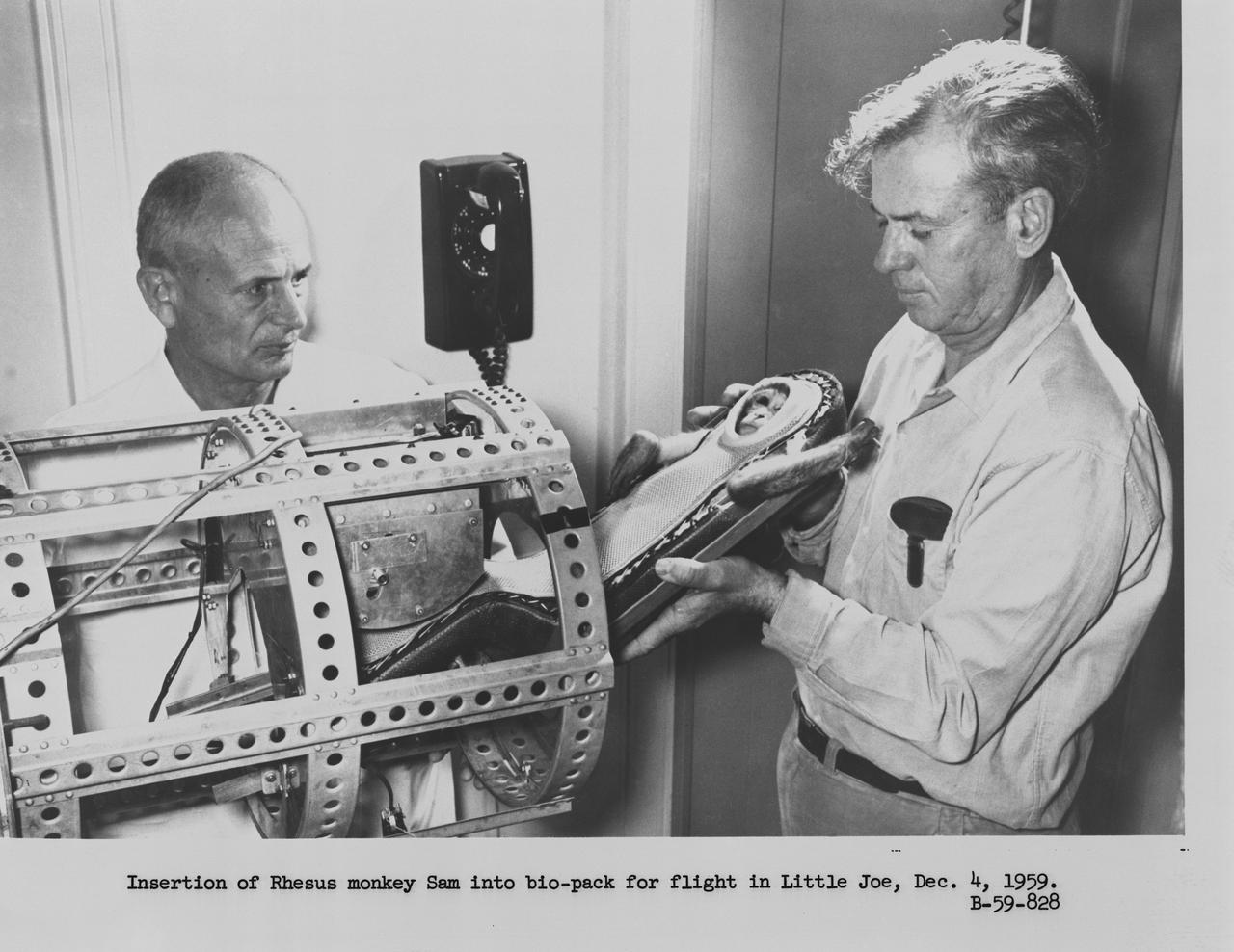
B59-00828 (21 Jan. 1959) --- The test subject, a rhesus monkey named Miss Sam, is seen encased in a model of the Mercury fiberglass contour couch. She is being placed in a container for the Little Joe 1B suborbital test flight of the Mercury Capsule. Photo credit: NASA
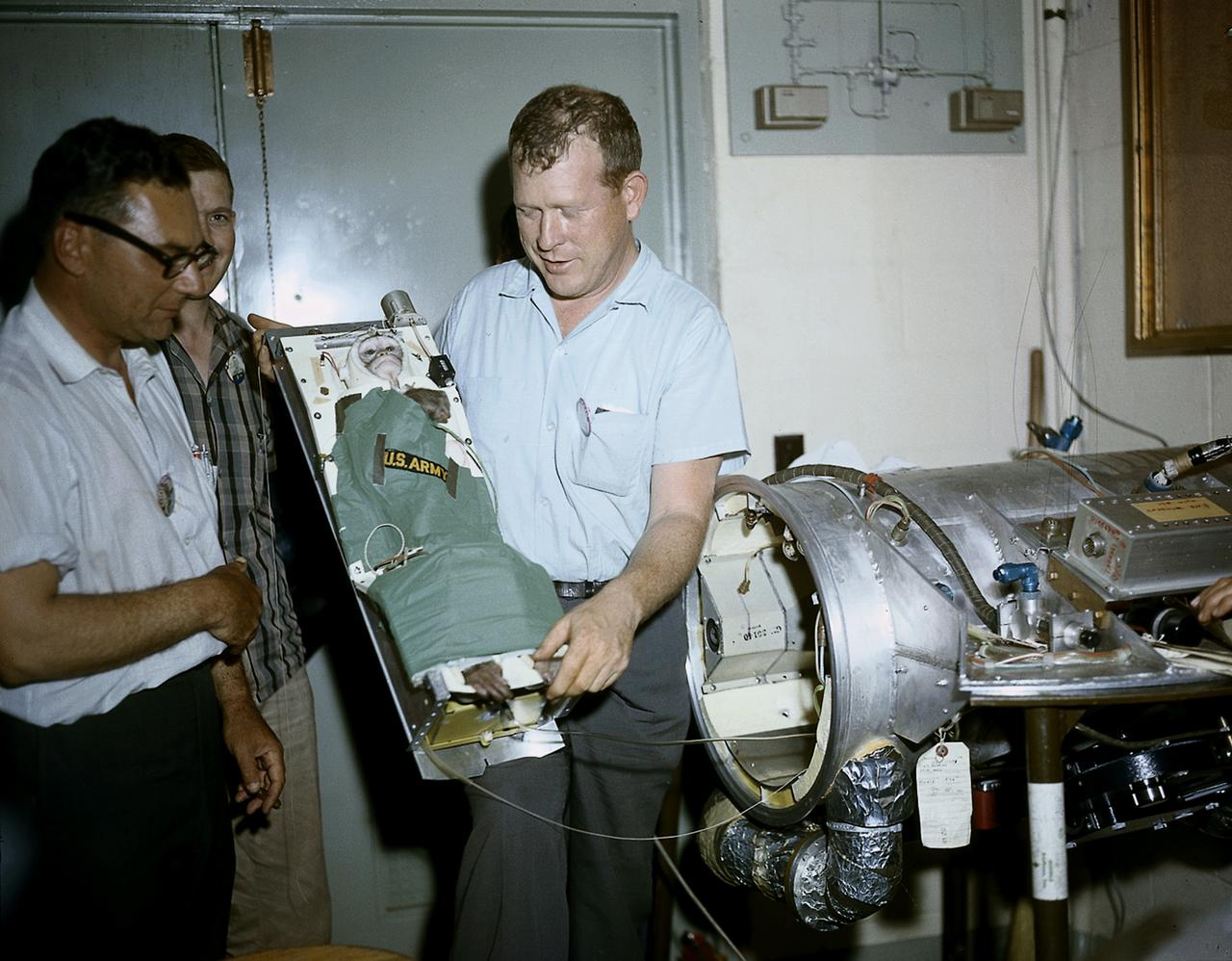
A squirrel monkey, Able, is being ready for placement into a capsule for a preflight test of Jupiter, AM-18 mission. AM-18 was launched on May 28, 1959 and also carried a rhesus monkey, Baker, into suborbit.
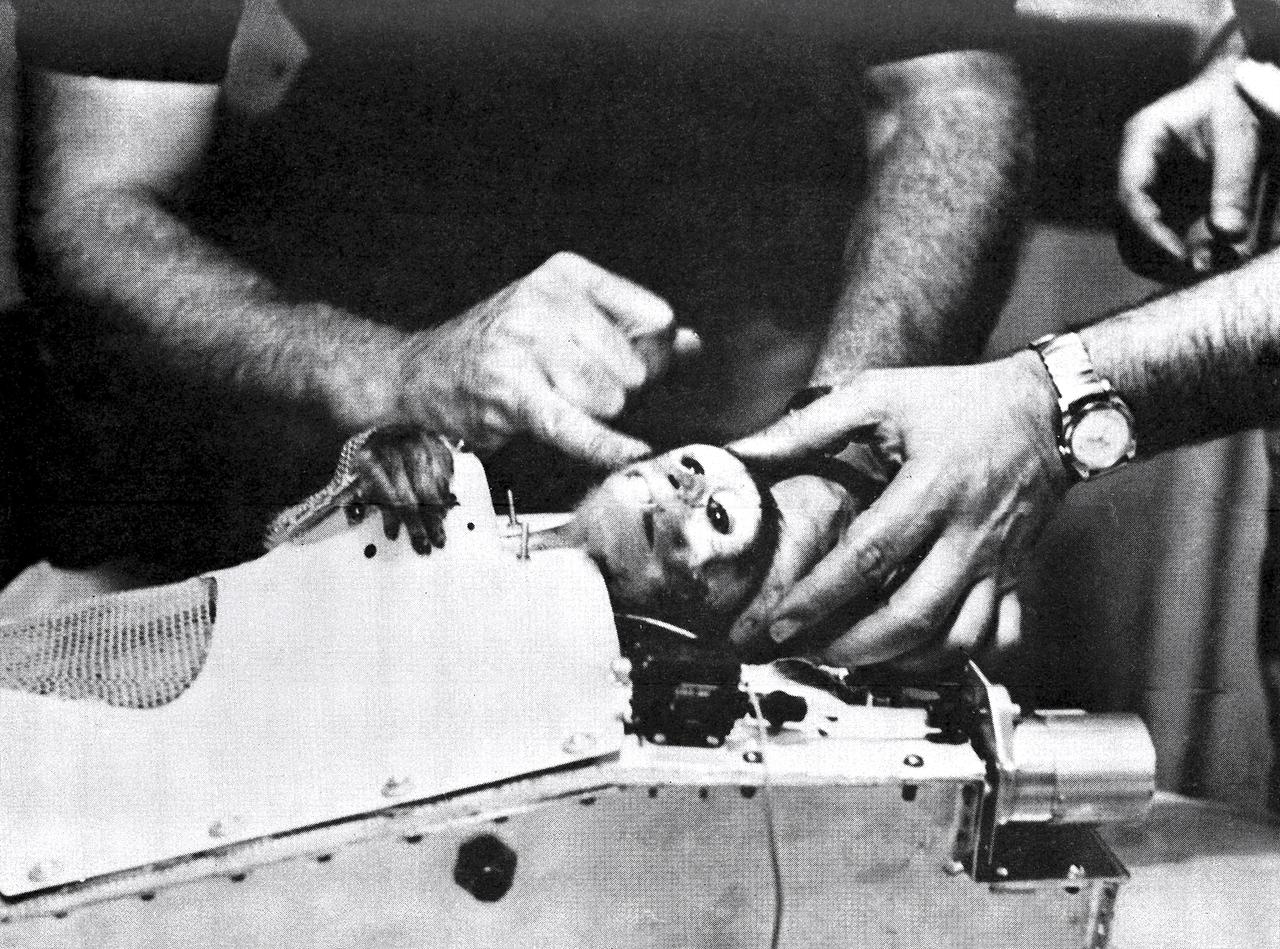
On May 28, 1959, a Jupiter Intermediate Range Ballistic Missile provided by a U.S. Army team in Redstone Arsenal, Alabama, launched a nose cone carrying Baker, A South American squirrel monkey and Able, An American-born rhesus monkey. This photograph shows Able after recovery of the nose cone of the Jupiter rocket by U.S.S. Kiowa.
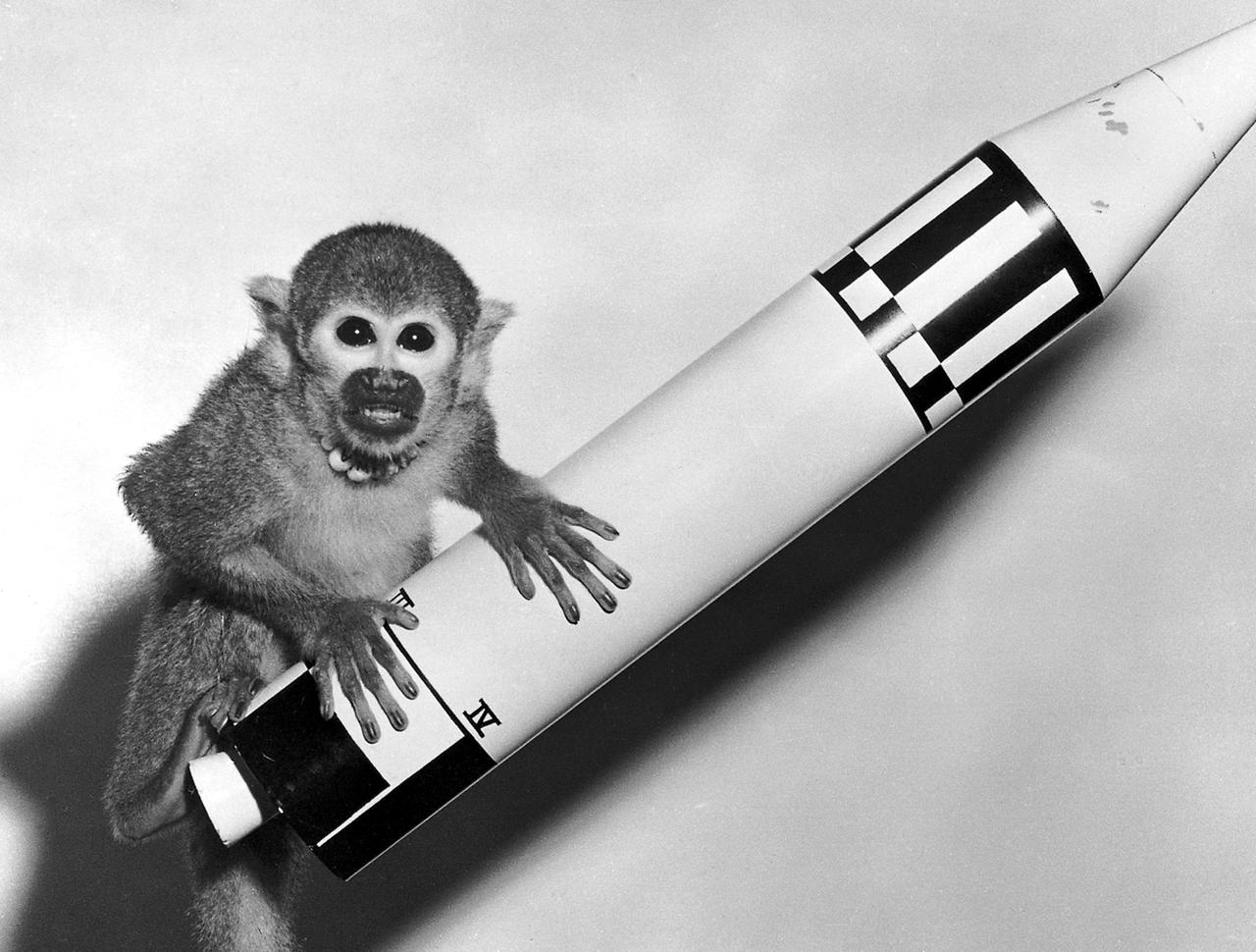
Monkey Baker, payload of Jupiter (AM-18), poses on a model of the Jupiter vehicle, May 29, 1959
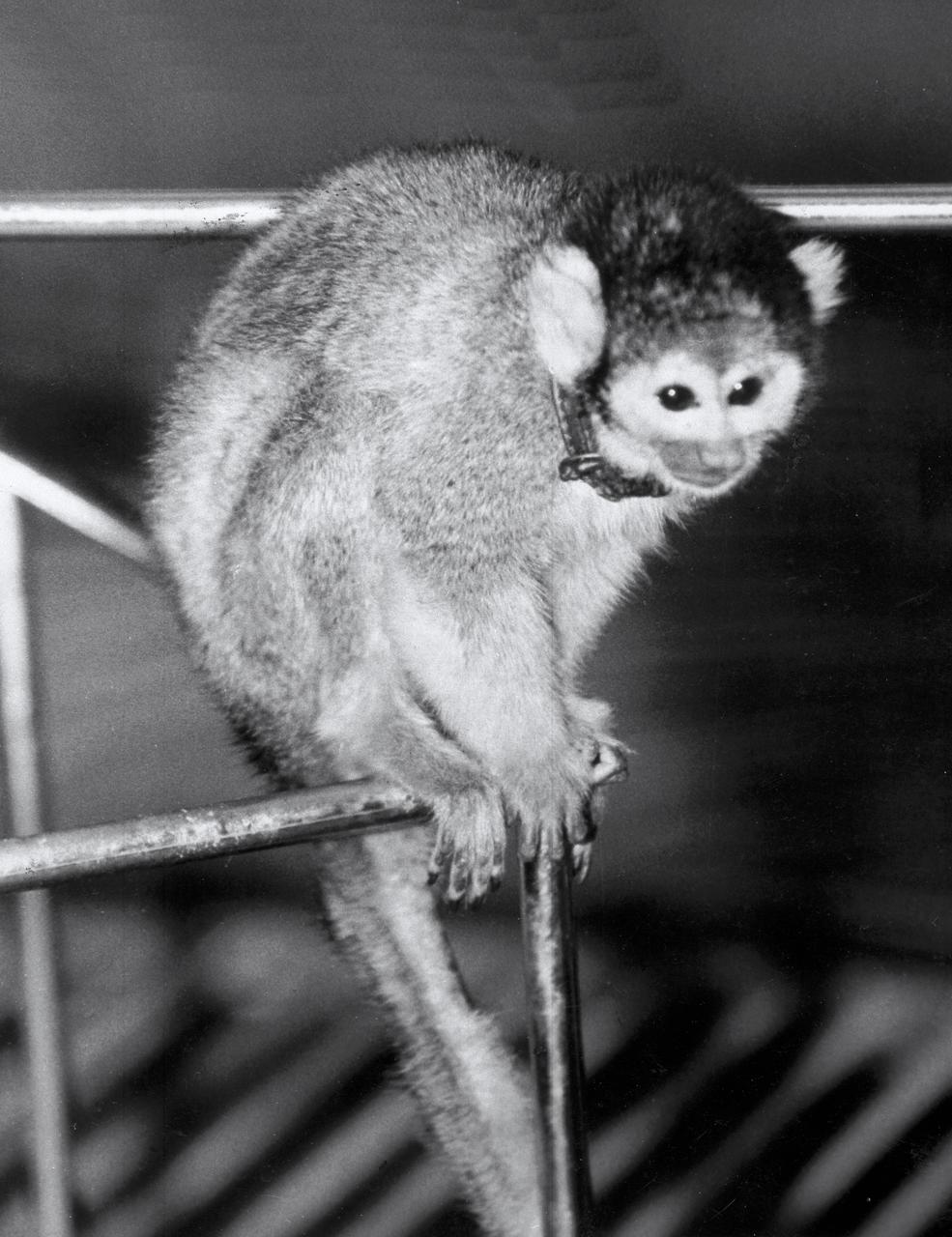
On May 28, 1958, Jupiter Intermediate Range Ballistic Missile provided by U.S. Army team in Huntsville, Alabama, launched a nose cone carrying Baker, a South American squirrel monkey and Able, an American-born rhesus monkey. Baker, pictured here and commonly known as "Miss Baker", was later given a home at the U.S. Space and Rocket Center until her death on November 29, 1984. Able died in 1958. (Photo - Courtesy of Huntsville/Madison County Public Library)
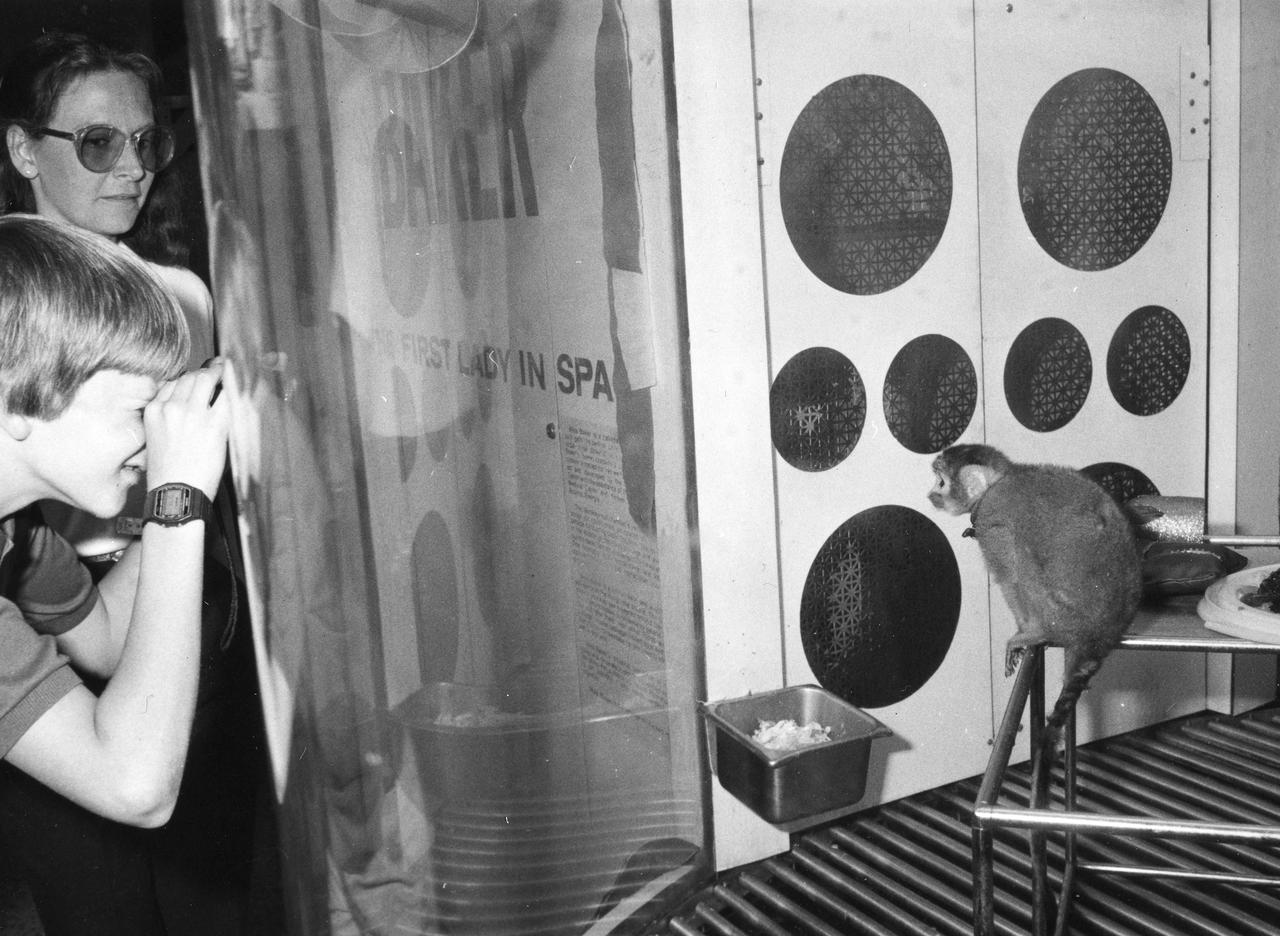
Miss Baker, a squirrel monkey who made a historical flight aboard the Jupiter (AM-18) in May 1959, is seen here in her viewing area where she resided at the U.S. Space and Rocket Center.
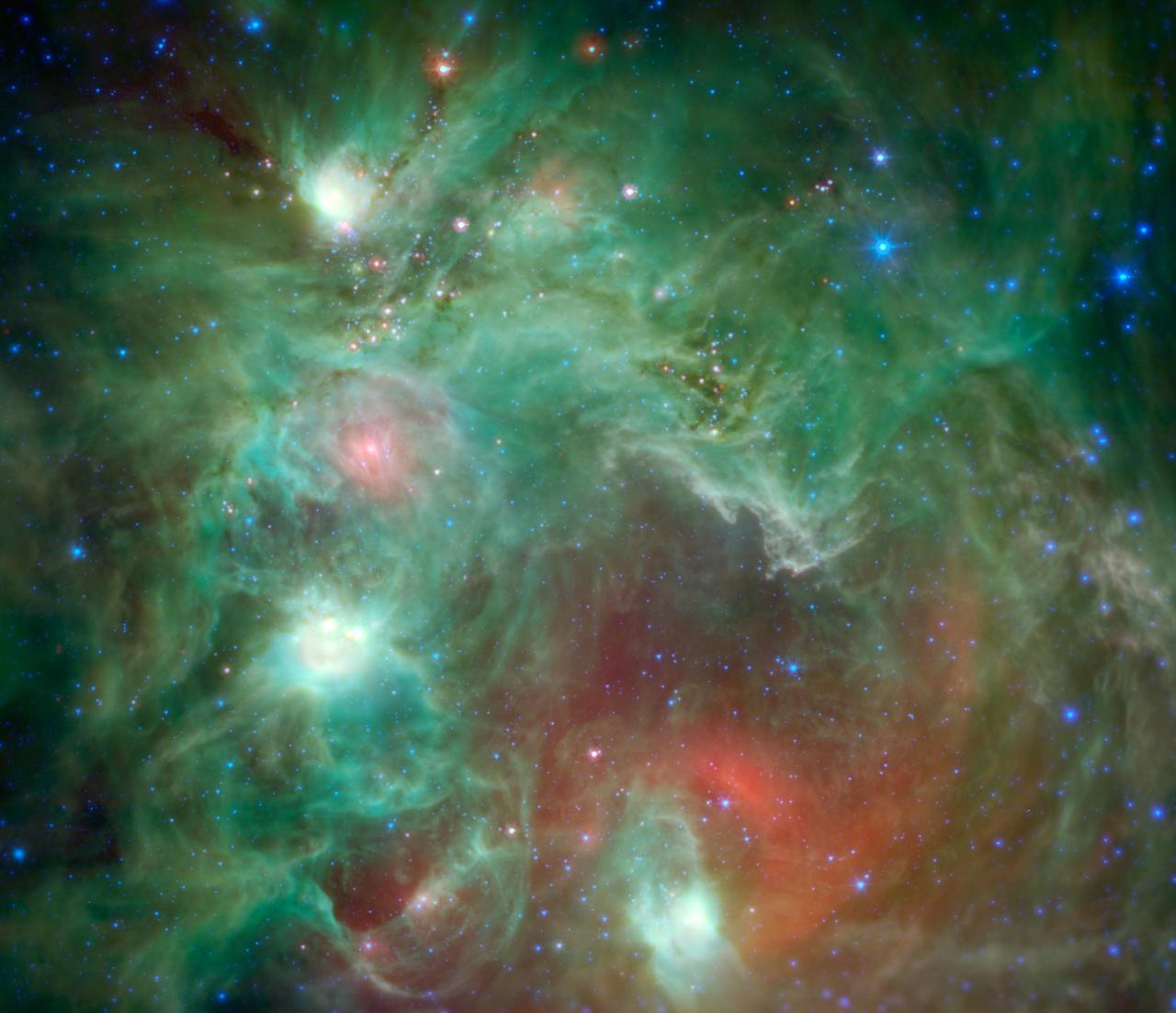
Scores of baby stars shrouded by dust are revealed in this infrared image of the star-forming region NGC 2174, as seen by NASA Spitzer Space Telescope. Found in the constellation Orion, NGC 2174 is located around 6,400 light-years away. Some of the clouds in the region resemble the face of a monkey in visible-light images, hence the nebula's nickname: the "Monkey Head." However, in infrared images such as this, the monkey disappears. That's because different clouds are highlighted in infrared and visible-light images. Found in the northern reaches of the constellation Orion, NGC 2174 is located around 6,400 light-years away. Columns of dust, slightly to the right of center in the image, are being carved out of the dust by radiation and stellar winds from the hottest young stars recently born in the area. Spitzer's infrared view provides us with a preview of the next clusters of stars that will be born in the coming millennia. The reddish spots of light scattered through the darker filaments are infant stars swaddled by blankets of warm dust. The warm dust glows brightly at infrared wavelengths. Eventually, these stars will pop out of their dusty envelopes and their light will carve away at the dust clouds surrounding them. In this image, infrared wavelengths have been assigned visible colors we see with our eyes. Light with a wavelength of 3.5 microns is shown in blue, 8.0 microns is green, and 24 microns in red. The greens show the organic molecules in the dust clouds, illuminated by starlight. Reds are caused by the thermal radiation emitted from the very hottest areas of dust. Areas around the edges that were not observed by Spitzer have been filled in using infrared observations from NASA's Wide Field Infrared Survey Explorer, or WISE. http://photojournal.jpl.nasa.gov/catalog/PIA19836
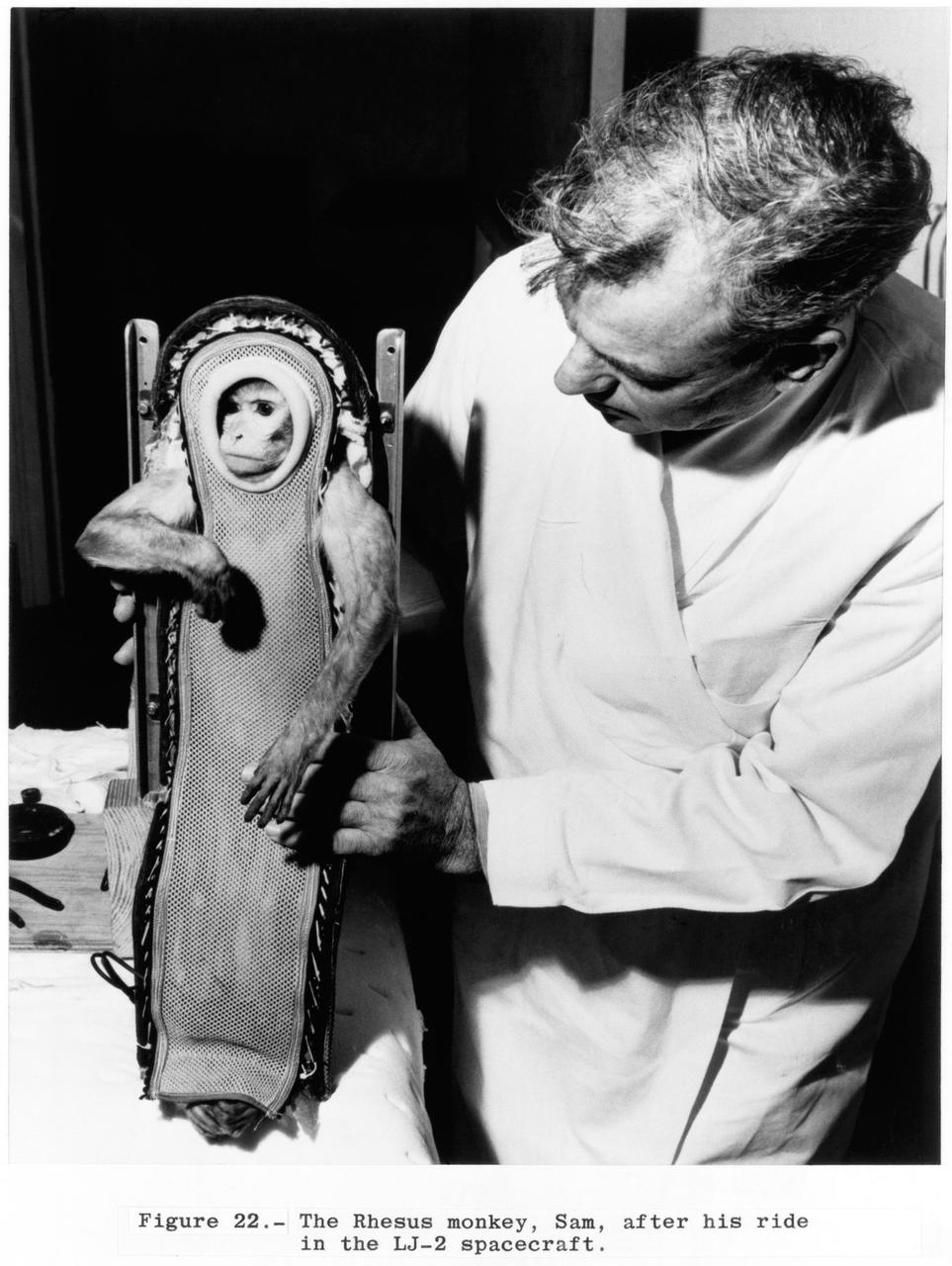
S63-19199 (4 Dec. 1959) --- Sam, the Rhesus monkey, and his handler after his ride in the Little Joe 2 (LJ-2) spacecraft. He is still encased in his contour couch. A U.S. Navy destroyer safely recovered Sam after he experienced three minutes of weightlessness during the flight. Photo credit: NASA
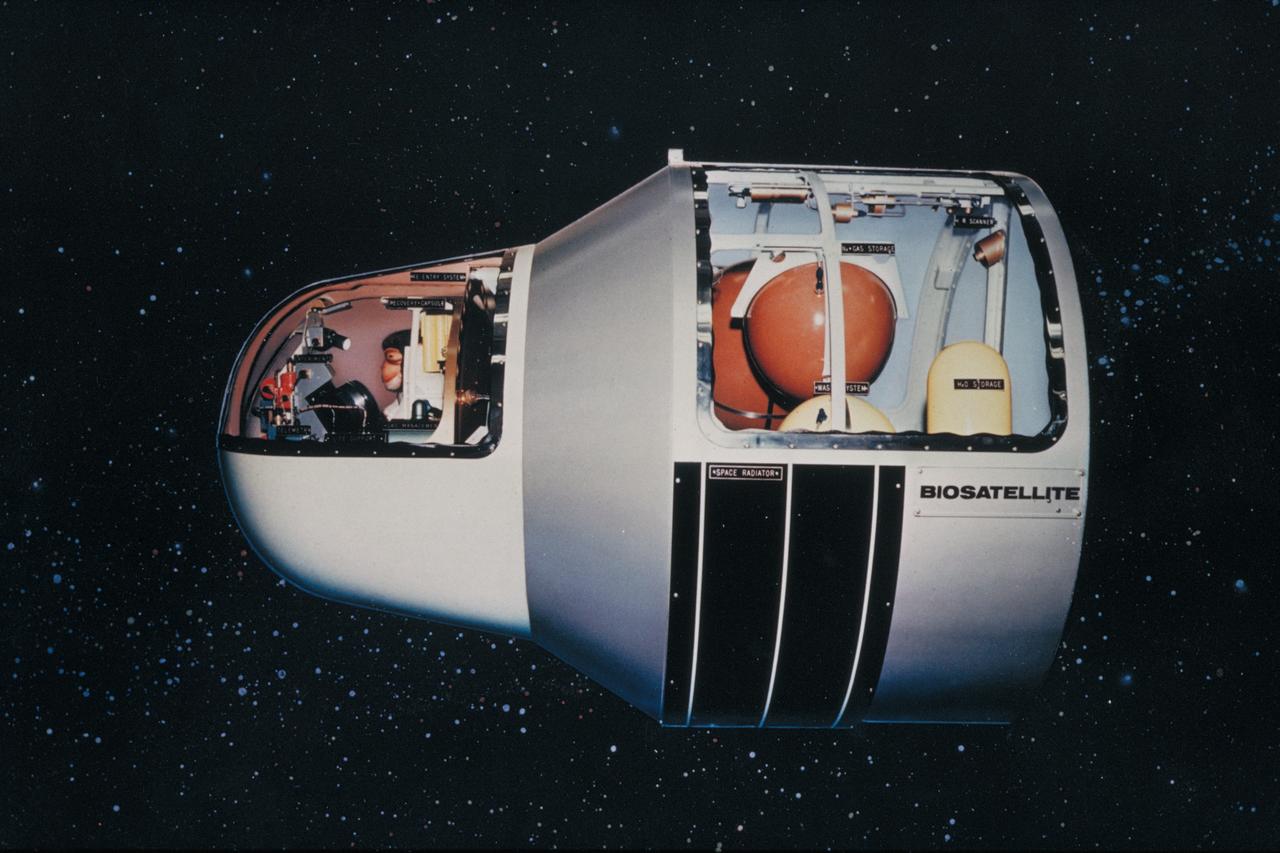
Cicra 1968 - 1969: Biosatellite model with monkey shown in the front of the capsule and the life spport package in the rear.

For Inspiration and Recognition of Science and Technology; FIRST Robotics Competition 2010 Silicon Valley Regional held at San Jose State University, San Jose, California The Funky Monkeys, Lynbrook H.S. CA Team 846
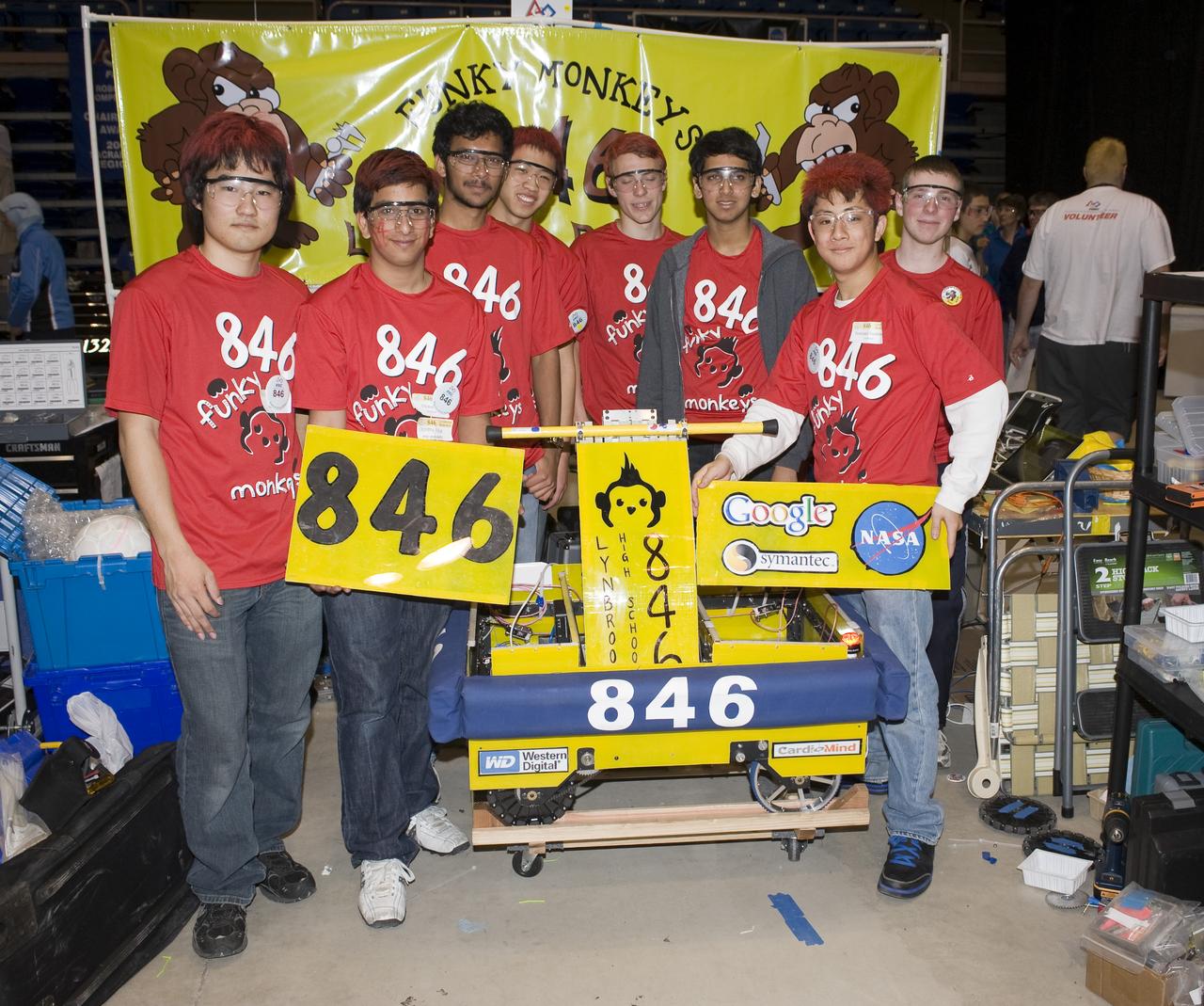
For Inspiration and Recognition of Science and Technology; FIRST Robotics Competition 2010 Silicon Valley Regional held at San Jose State University, San Jose, California The Funky Monkeys, Lynbrook H.S., CA Team 846
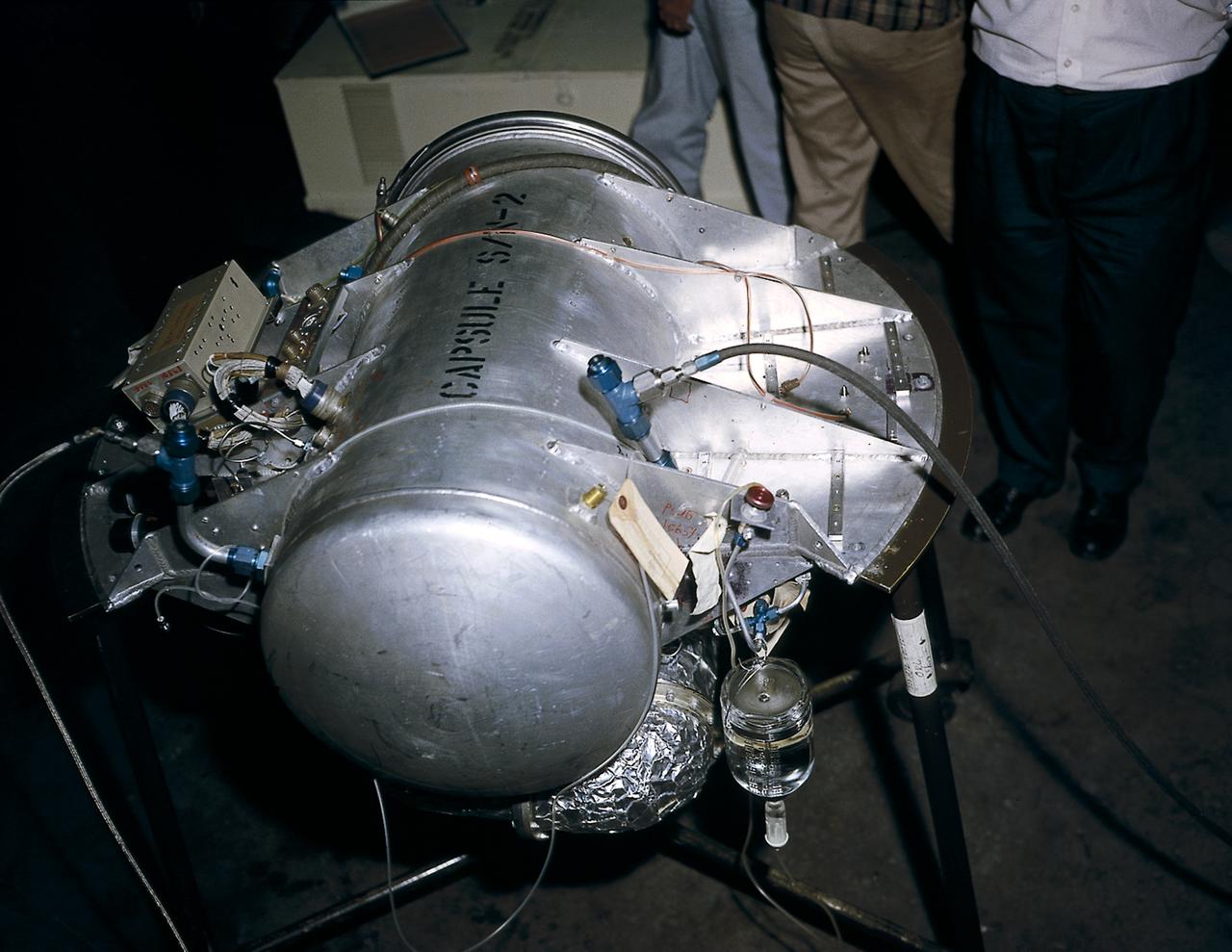
The capsule ready to be installed in the nose cone of Jupiter, AM-18, for pre-flight test, May 18, 1959. The capsule carried monkeys, Baker and Able, as the payload of AM-18 mission
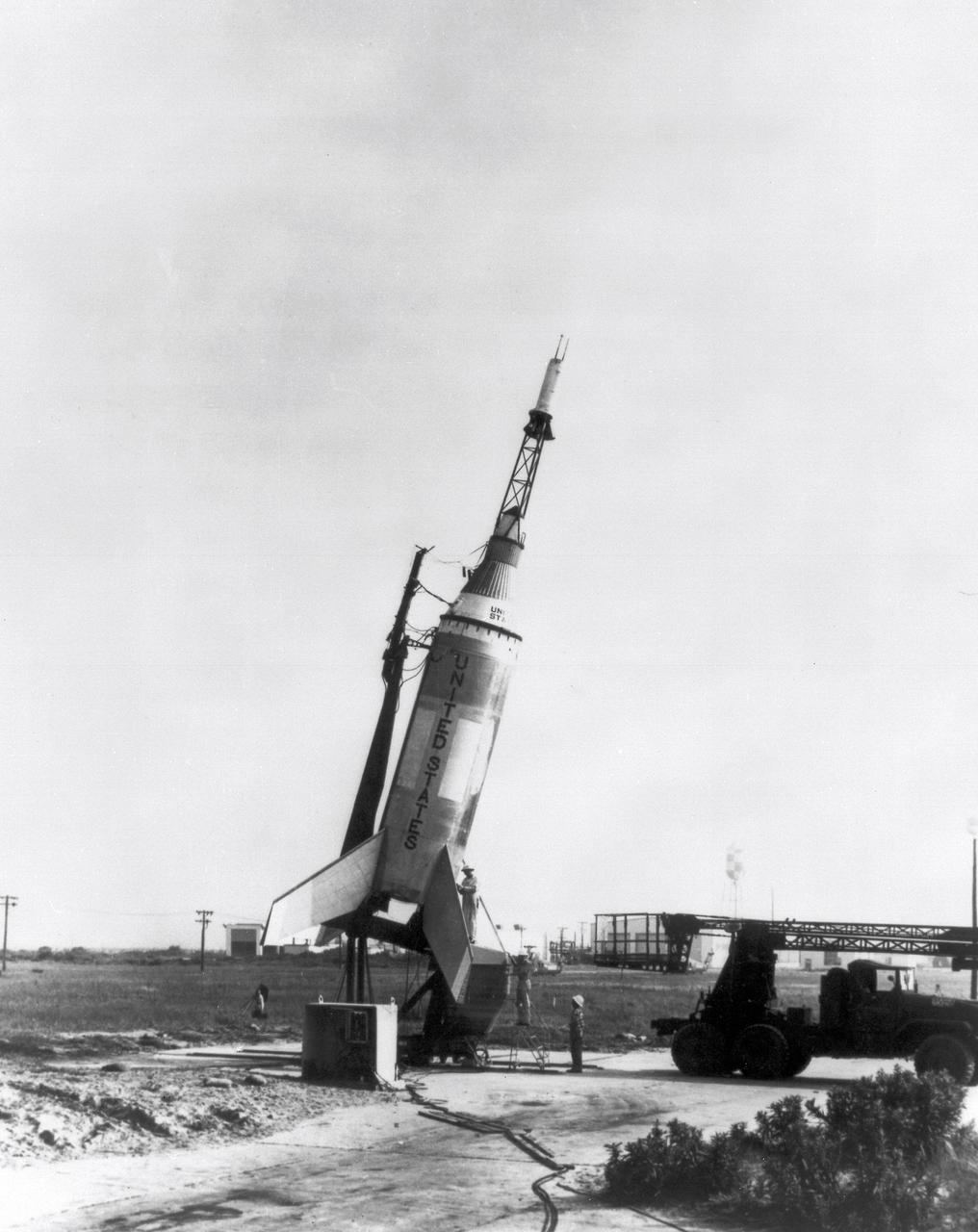
The Little Joe launch vehicle for the LJ1 mission on the launch pad at the wallops Flight Facility, Wallops Island, Virginia, on January 21, 1960. This mission achieved the suborbital Mercury cupsule test, testing of the escape system, and biomedical tests by using a monkey, named Miss Sam.
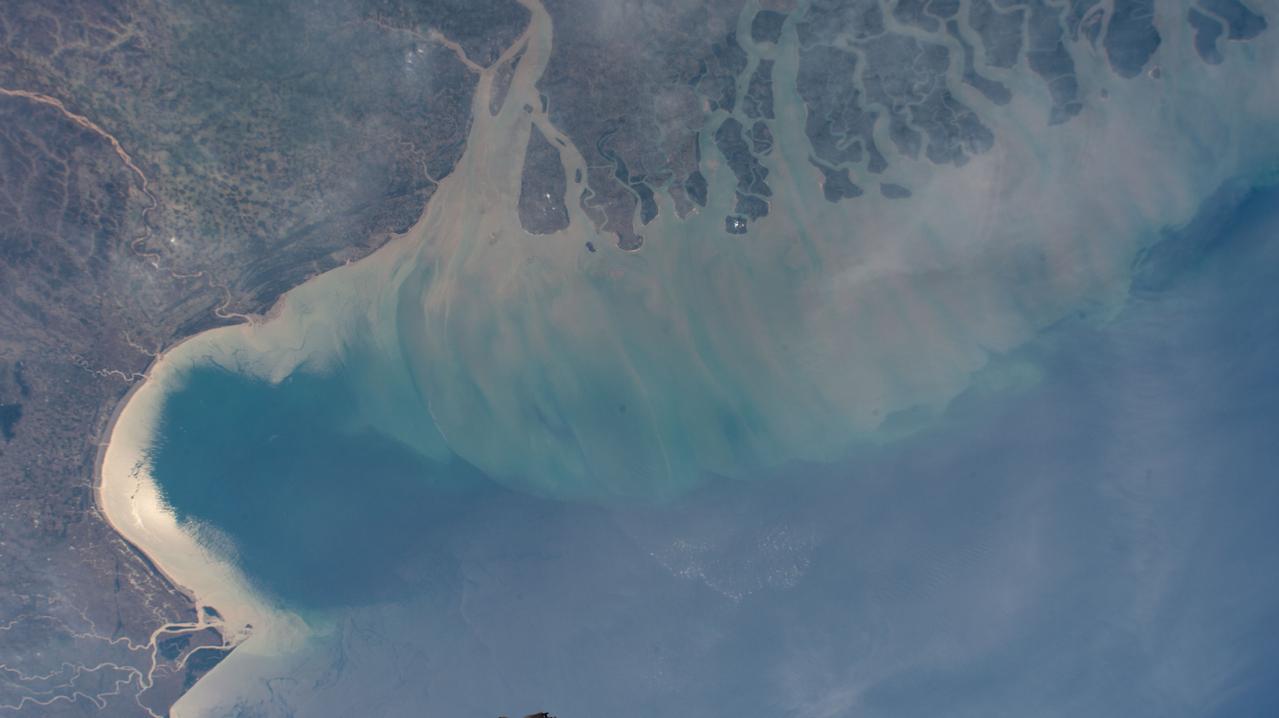
iss062e039313 (Feb. 21, 2020) --- The coasts of India and Bangladesh, pictured from the International Space Station from an altitude of 263 miles, meet at the Bay of Bengal. The area is known for its vast mangrove forests and rich variety of wildlife including monkeys, elephants and tigers.

The launch of the Little Joe booster for the LJ1B mission on the launch pad from the wallops Flight Facility, Wallops Island, Virginia, on January 21, 1960. This mission achieved the suborbital Mercury capsule test, testing of the escape system, and biomedical tests by using a monkey, named Miss Sam.
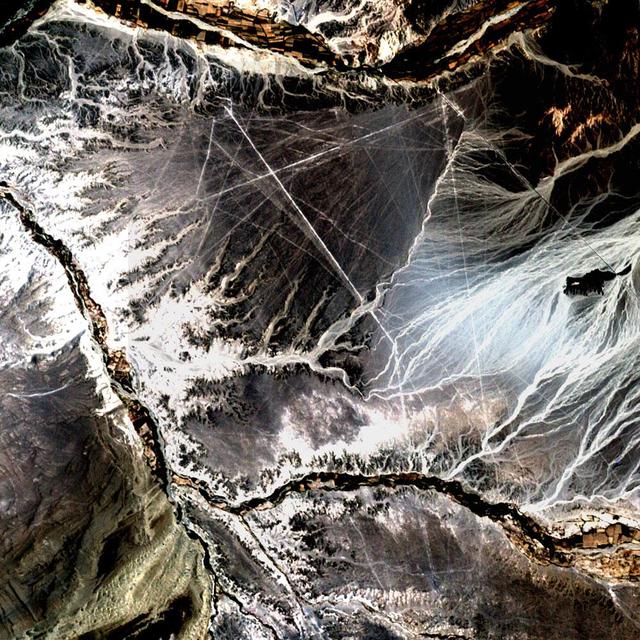
Acquisition Date: November 10, 2002 In the desert of southwest Peru, between the Andes Mountains and the Peruvian coast, lies a plateau with huge geometric patterns and spirals, animal figures including a monkey, a spider, and an 'owl man,' and thousands of perfectly straight lines. The last of these was drawn about a thousand years ago. Known as the Nazca lines, the drawings have mystified scientists since they were first discovered in the 1920s. Pictured here is all that can be seen of these lines by Landsat 7's 15 meter pan band, which has been used to sharpen the 30 meter Bands 3, 2, and 1. Credit: NASA/GSFC/Landsat/USGS To learn more about Landsat and to see the orginal high res file go to: <a href="http://landsat.usgs.gov/gallery_view.php?category=greenflag&thesort=mainTitle" rel="nofollow">landsat.usgs.gov/gallery_view.php?category=greenflag&...</a>
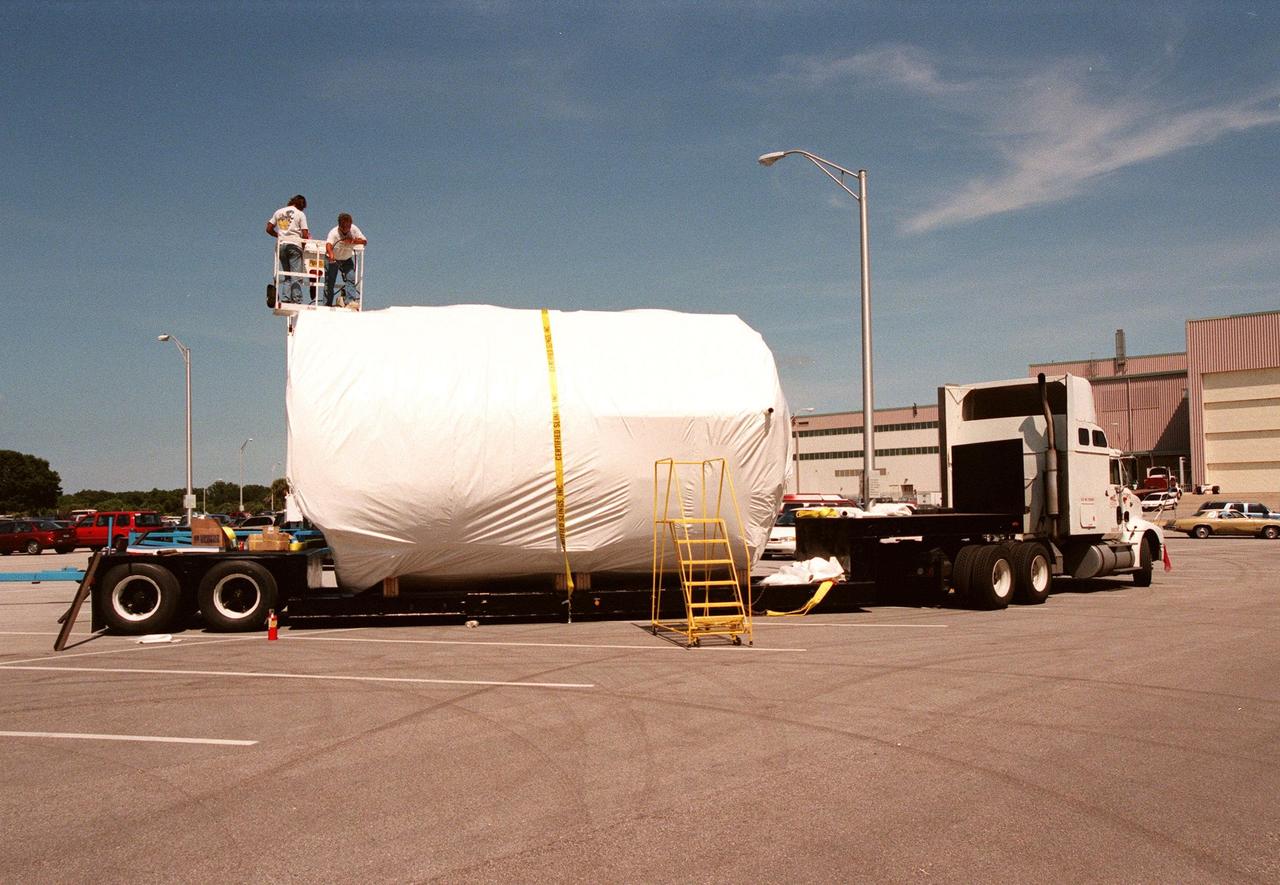
Spacelab is wrapped and ready for transport to the National Air and Space Museum in Washington, DC. Spacelab was designed by the European Space Agency (ESA) for the Space Shuttle program and first flew on STS-9 in November 1983. Its final flight was the STS-90 Neurolab mission in April 1998. A sister module will travel home and be placed on display in Europe. The Spacelab concept of modular experiment racks in a pressurized shirt-sleeve environment made it highly user-friendly and accessible. Numerous experiments conceived by hundreds of scientists on the ground were conducted by flight crews in orbit. Spacelab modules served as on-orbit homes for everything from squirrel monkeys to plant seeds. They supported astronomical as well as Earth observations, for servicing the Hubble Space Telescope and for research preparatory to the International Space Station. One of the greatest benefits afforded by the Spacelab missions was the opportunity to fly a mission more than once, with the second or third flight building on the experiences and data gathered from its predecessors
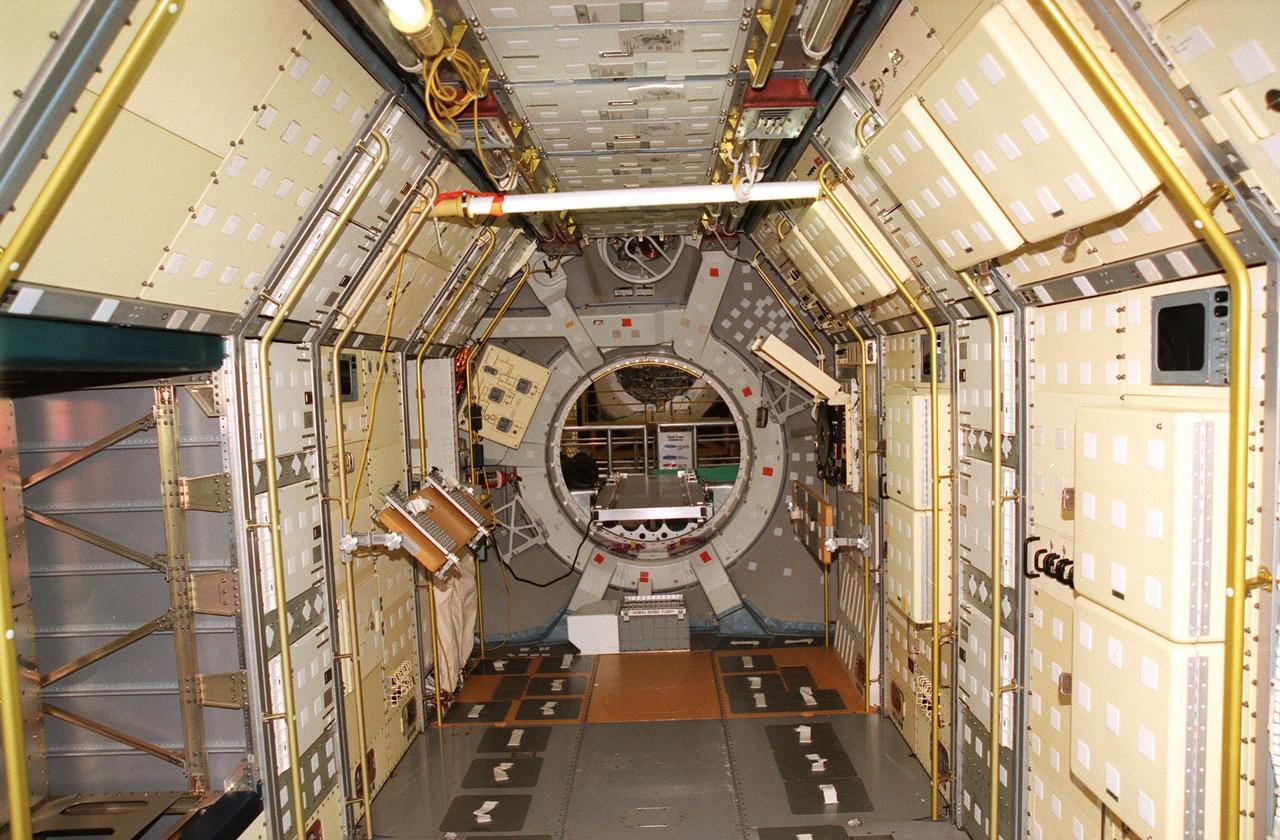
Viewed looking forward, this Spacelab module is empty now, being prepared in the Operations & Checkout Building for shipment to the National Air and Space Museum in Washington, DC. Visible on the floor are the foot restraints used by astronauts to keep them stationary while conducting experiments. Spacelab was designed by the European Space Agency (ESA) for the Space Shuttle program. It first flew on STS-9 in November 1983 and its final flight was the STS-90 Neurolab mission in April 1998. The Spacelab concept of modular experiment racks in a pressurized shirt-sleeve environment made it highly user-friendly and accessible. Numerous experiments conceived by hundreds of scientists on the ground were conducted by flight crews in orbit. Spacelab modules served as on-orbit homes for everything from squirrel monkeys to plant seeds. They supported astronomical as well as Earth observations, for servicing the Hubble Space Telescope and for research preparatory to the International Space Station. One of the greatest benefits afforded by the Spacelab missions was the opportunity to fly a mission more than once, with the second or third flight building on the experiences and data gathered from its predecessors
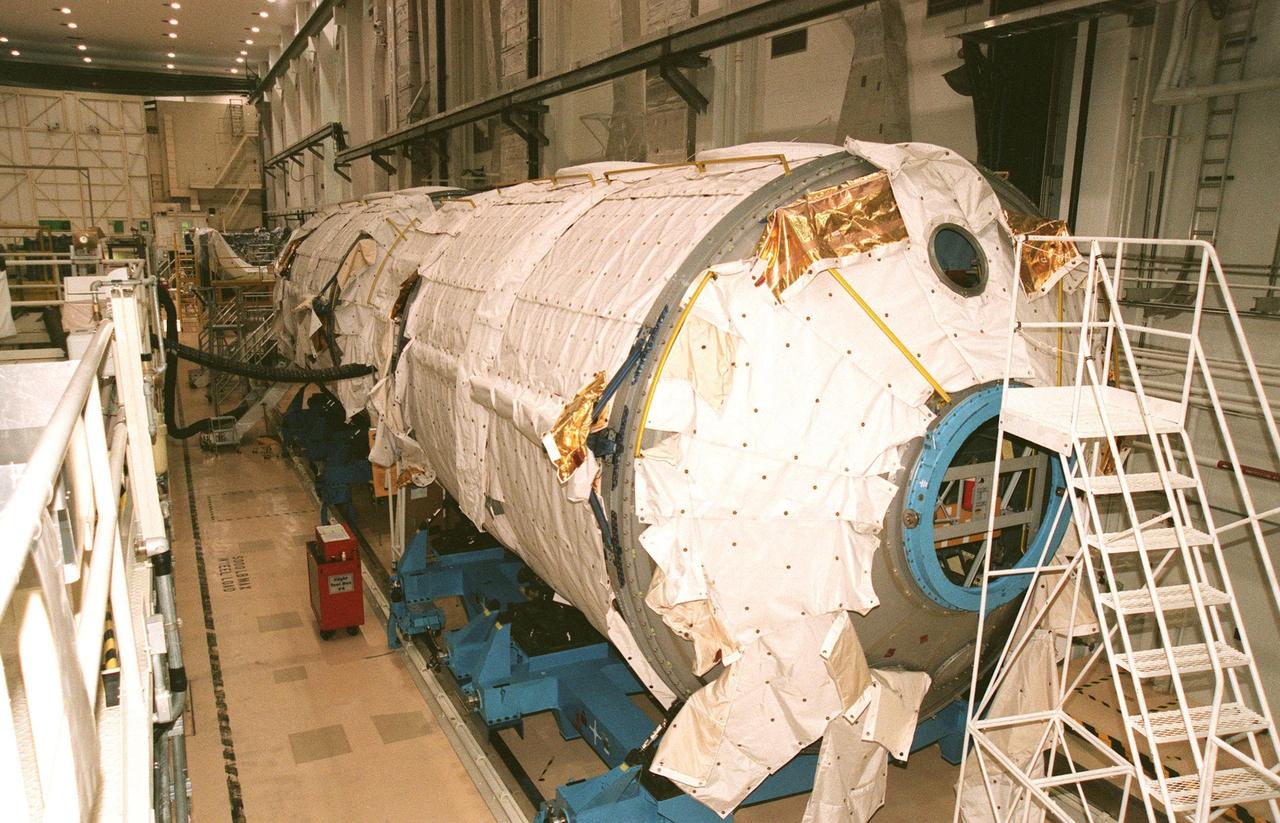
KENNEDY SPACE CENTER, FLA. -- Two Spacelab modules (end to end) are made ready in the Operations and Checkout Building for shipment to the National Air and Space Museum in Washington, DC. Spacelab was designed by the European Space Agency (ESA) for the Space Shuttle program and first flew on STS-9 in November 1983. Its final flight was the STS-90 Neurolab mission in April 1998. The sister module (first in line) will travel home and be placed on display in Europe. The Spacelab concept of modular experiment racks in a pressurized shirt-sleeve environment made it highly user-friendly and accessible. Numerous experiments conceived by hundreds of scientists on the ground were conducted by flight crews in orbit. Spacelab modules served as on-orbit homes for everything from squirrel monkeys to plant seeds. They supported astronomical as well as Earth observations, for servicing the Hubble Space Telescope and for research preparatory to the International Space Station. One of the greatest benefits afforded by the Spacelab missions was the opportunity to fly a mission more than once, with the second or third flight building on the experiences and data gathered from its predecessors
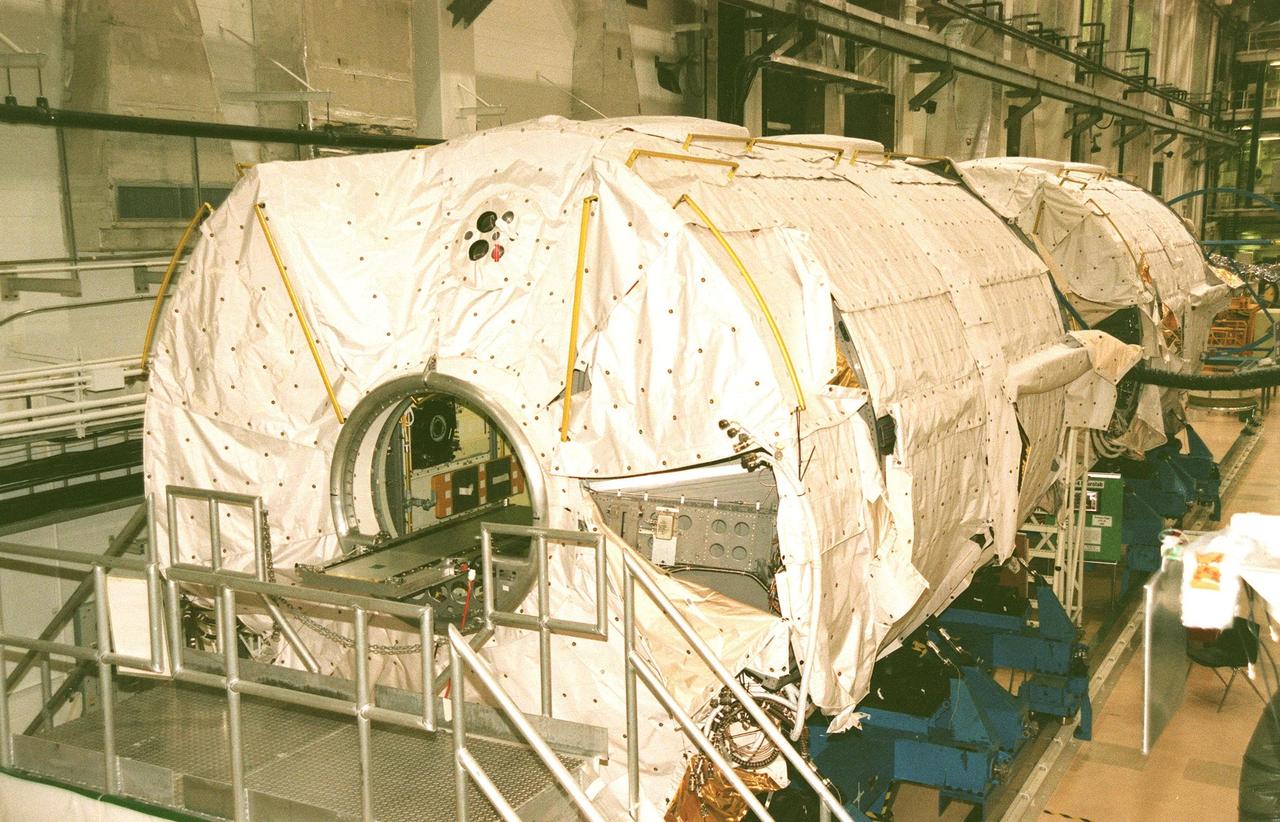
Spacelab Module MD001 (foreground) and its sister module (behind it) are prepared for shipment to the National Air and Space Museum in Washington, DC. Spacelab was designed by the European Space Agency (ESA) for the Space Shuttle program. It first flew on STS-9 in November 1983 and its final flight was the STS-90 Neurolab mission in April 1998. The sister module will travel home and be placed on display in Europe. The Spacelab concept of modular experiment racks in a pressurized shirt-sleeve environment made it highly user-friendly and accessible. Numerous experiments conceived by hundreds of scientists on the ground were conducted by flight crews in orbit. Spacelab modules served as on-orbit homes for everything from squirrel monkeys to plant seeds. They supported astronomical as well as Earth observations, for servicing the Hubble Space Telescope and for research preparatory to the International Space Station. One of the greatest benefits afforded by the Spacelab missions was the opportunity to fly a mission more than once, with the second or third flight building on the experiences and data gathered from its predecessors
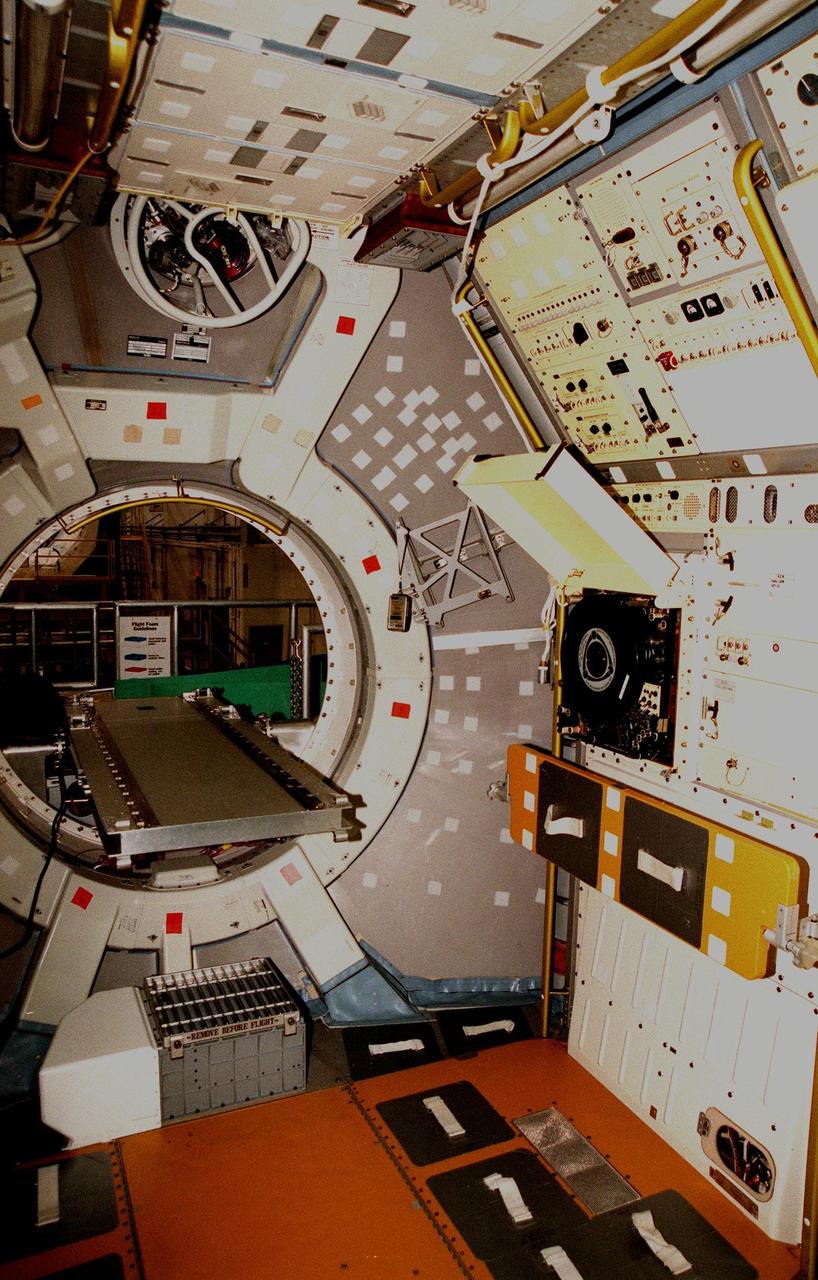
KENNEDY SPACE CENTER, FLA. -- A closeup view of the hatch to this Spacelab module shows an empty interior as the module is being prepared in the Operations & Checkout Building for shipment to the National Air and Space Museum in Washington, DC. Visible on the floor are the foot restraints used by astronauts to keep them stationary while conducting experiments. Spacelab was designed by the European Space Agency (ESA) for the Space Shuttle program. It first flew on STS-9 in November 1983 and its final flight was the STS-90 Neurolab mission in April 1998. The Spacelab concept of modular experiment racks in a pressurized shirt-sleeve environment made it highly user-friendly and accessible. Numerous experiments conceived by hundreds of scientists on the ground were conducted by flight crews in orbit. Spacelab modules served as on-orbit homes for everything from squirrel monkeys to plant seeds. They supported astronomical as well as Earth observations, for servicing the Hubble Space Telescope and for research preparatory to the International Space Station. One of the greatest benefits afforded by the Spacelab missions was the opportunity to fly a mission more than once, with the second or third flight building on the experiences and data gathered from its predecessors
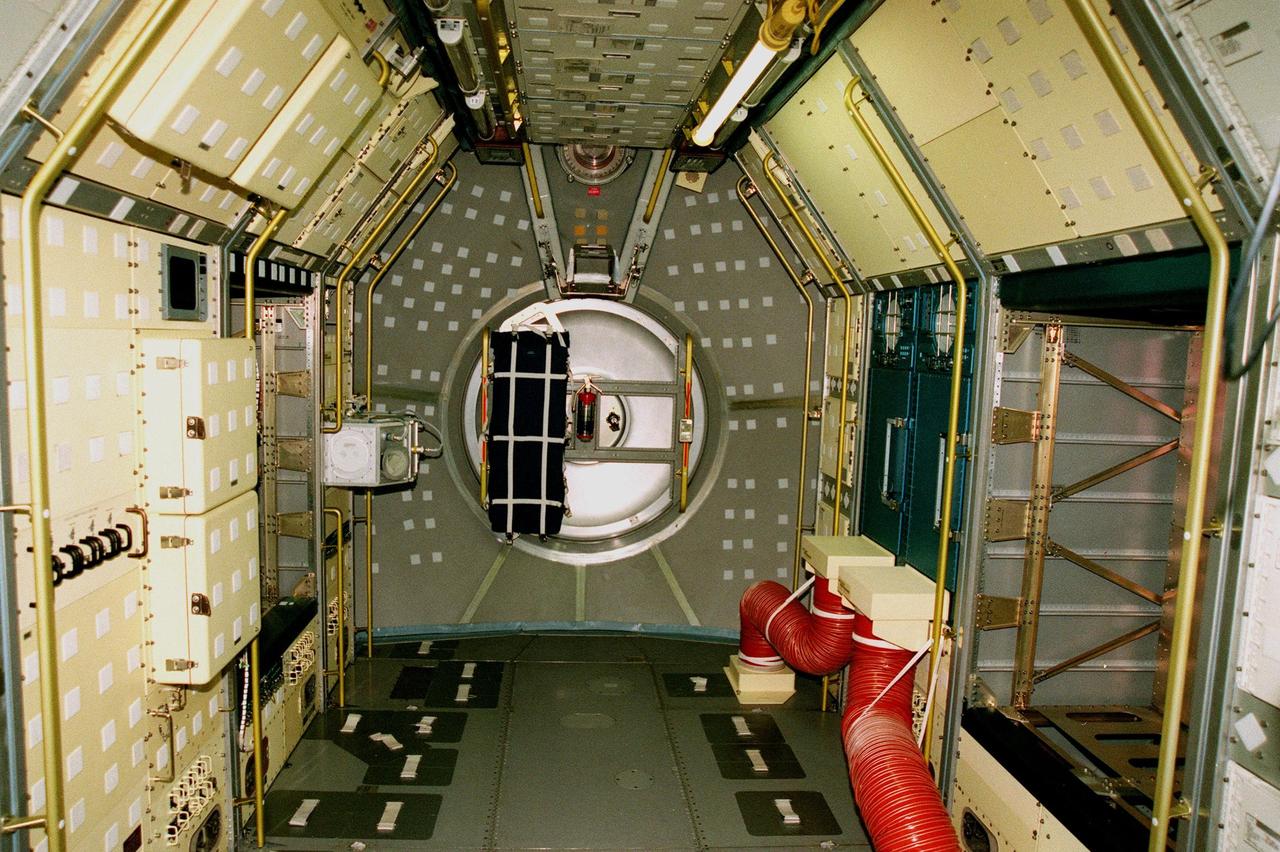
Viewed looking aft, this Spacelab module is empty now, being prepared in the Operations & Checkout Building for shipment to the National Air and Space Museum in Washington, DC. Visible on the floor are the foot restraints used by astronauts to keep them stationary while conducting experiments. Spacelab was designed by the European Space Agency (ESA) for the Space Shuttle program. It first flew on STS-9 in November 1983 and its final flight was the STS-90 Neurolab mission in April 1998. The Spacelab concept of modular experiment racks in a pressurized shirt-sleeve environment made it highly user-friendly and accessible. Numerous experiments conceived by hundreds of scientists on the ground were conducted by flight crews in orbit. Spacelab modules served as on-orbit homes for everything from squirrel monkeys to plant seeds. They supported astronomical as well as Earth observations, for servicing the Hubble Space Telescope and for research preparatory to the International Space Station. One of the greatest benefits afforded by the Spacelab missions was the opportunity to fly a mission more than once, with the second or third flight building on the experiences and data gathered from its predecessors
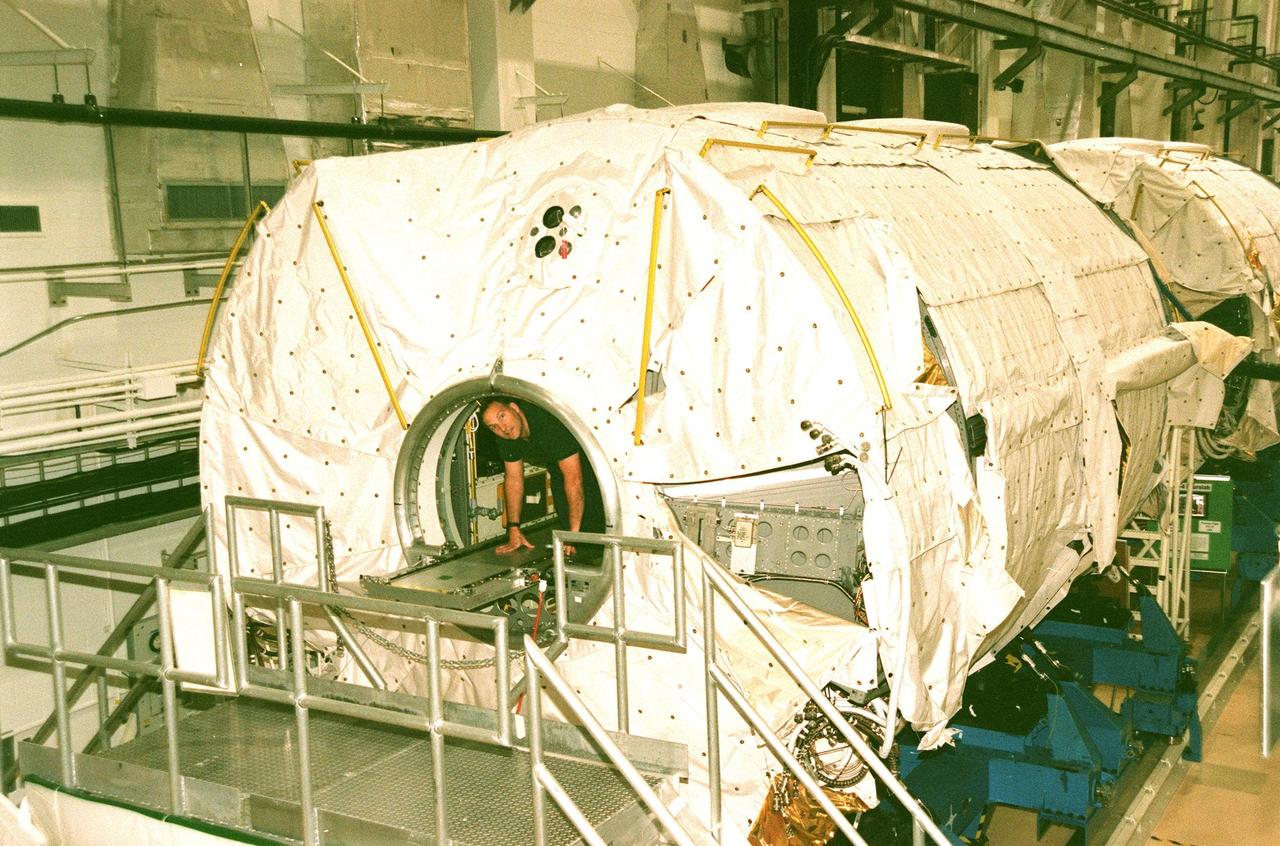
Jim Dumoulin, NASA Payload Electrical Systems engineer, crawls out of the Spacelab module for the last time after stowing some equipment for its final trip to the National Air and Space Museum in Washington, DC. He has worked on the Spacelab program since its first launch on STS-9 in November 1983 as part of the NASA Civil Service Level IV experiment integration team. Spacelab was designed by the European Space Agency (ESA) for the Space Shuttle program. Its final flight was the STS-90 Neurolab mission in April 1998. The Spacelab concept of modular experiment racks in a pressurized shirt-sleeve environment made it highly user-friendly and accessible. Numerous experiments conceived by hundreds of scientists on the ground were conducted by flight crews in orbit. Spacelab modules served as on-orbit homes for everything from squirrel monkeys to plant seeds. They supported astronomical as well as Earth observations, for servicing the Hubble Space Telescope and for research preparatory to the International Space Station. One of the greatest benefits afforded by the Spacelab missions was the opportunity to fly a mission more than once, with the second or third flight building on the experiences and data gathered from its predecessors
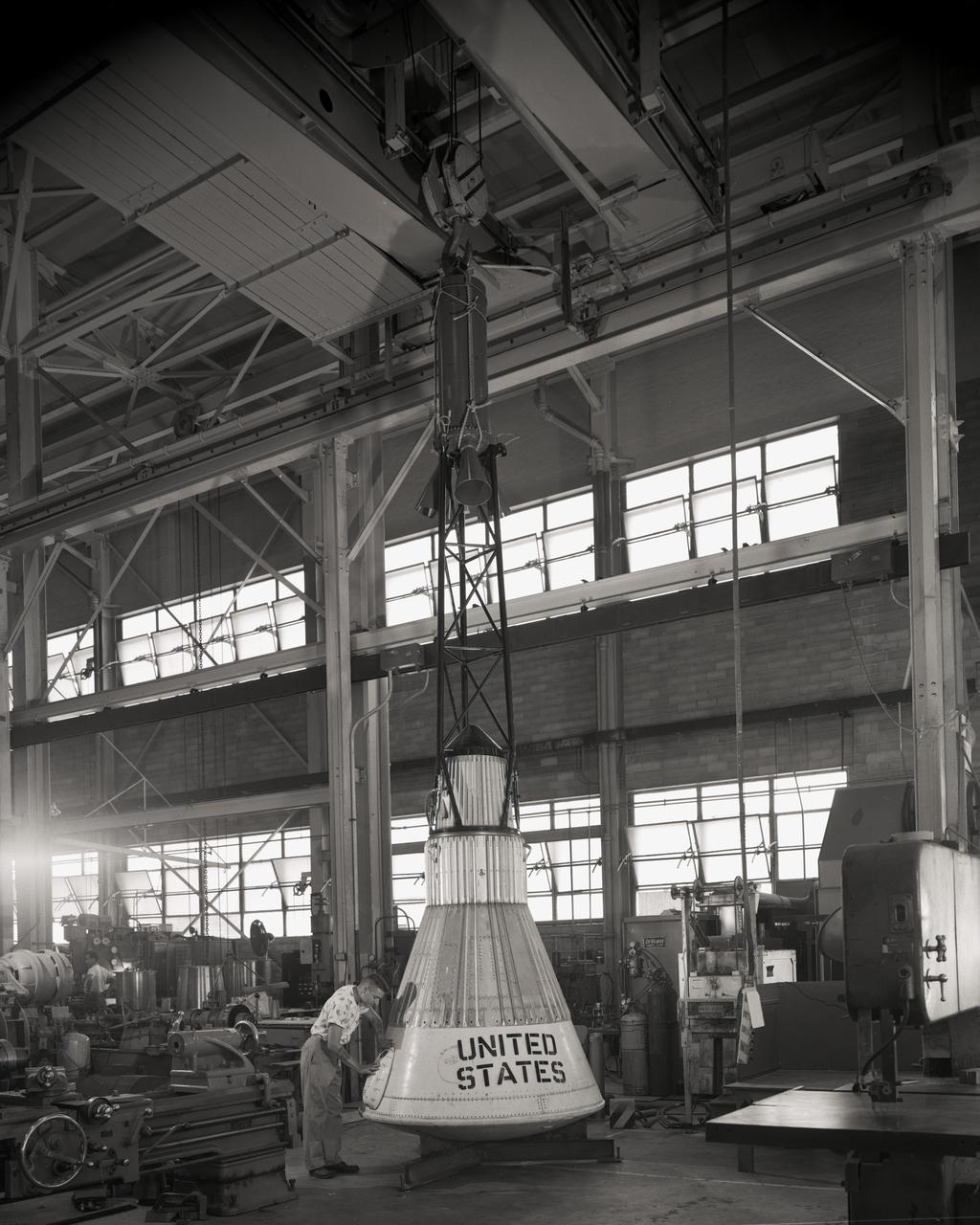
Assembling the Little Joe capsules. The capsules were manufactured in-house by Langley technicians. Three capsules are shown here in various stages of assembly. The escape tower and rocket motors shown on the completed capsule would be removed before shipping and finally assembly for launching at Wallops Island. Joseph Shortal wrote (vol. 3, p. 32): Design of the Little Joe capsules began at Langley before McDonnell started on the design of the Mercury capsule and was, therefore, a separate design. Although it was not designed to carry a man, it did have to carry a monkey. It had to meet the weight and center of gravity requirements of Mercury and withstand the same aerodynamic loads during the exit trajectory. Although in comparison with the overall Mercury Project, Little Joe was a simple undertaking, the fact that an attempt was made to condense a normal two-year project into a 6-month one with in house labor turned it into a major undertaking for Langley. Project Mercury: Little Joe: Boilerplate Mercury spacecraft undergo fabrication at the shops of the Langley Research Center. They will launched atop Little Joe rockets to test the spacecraft recovery systems. -- Published in Joseph A. Shortal, History of Wallops Station: Origins and Activities Through 1949, (Wallops Island, VA: National Aeronautics and Space Administration, Wallops Station, nd), Comment Edition. L59-4947 Technicians prepare a Little Joe launch vehicle prototype for the Mercury space program, 1959. Photograph published in Winds of Change, 75th Anniversary NASA publication, page 76, by James Schultz

Assembling the Little Joe capsules. The capsules were manufactured in-house by Langley technicians. Three capsules are shown here in various stages of assembly. The escape tower and rocket motors shown on the completed capsule would be removed before shipping and finally assembly for launching at Wallops Island. Joseph Shortal wrote (vol. 3, p. 32): Design of the Little Joe capsules began at Langley before McDonnell started on the design of the Mercury capsule and was, therefore, a separate design. Although it was not designed to carry a man, it did have to carry a monkey. It had to meet the weight and center of gravity requirements of Mercury and withstand the same aerodynamic loads during the exit trajectory. Although in comparison with the overall Mercury Project, Little Joe was a simple undertaking, the fact that an attempt was made to condense a normal two-year project into a 6-month one with in house labor turned it into a major undertaking for Langley. Project Mercury: Little Joe: Boilerplate Mercury spacecraft undergo fabrication at the shops of the Langley Research Center. They will launched atop Little Joe rockets to test the spacecraft recovery systems. -- Published in Joseph A. Shortal, History of Wallops Station: Origins and Activities Through 1949, (Wallops Island, VA: National Aeronautics and Space Administration, Wallops Station, nd), Comment Edition. L59-4947 Technicians prepare a Little Joe launch vehicle prototype for the Mercury space program, 1959. Photograph published in Winds of Change, 75th Anniversary NASA publication, page 76, by James Schultz
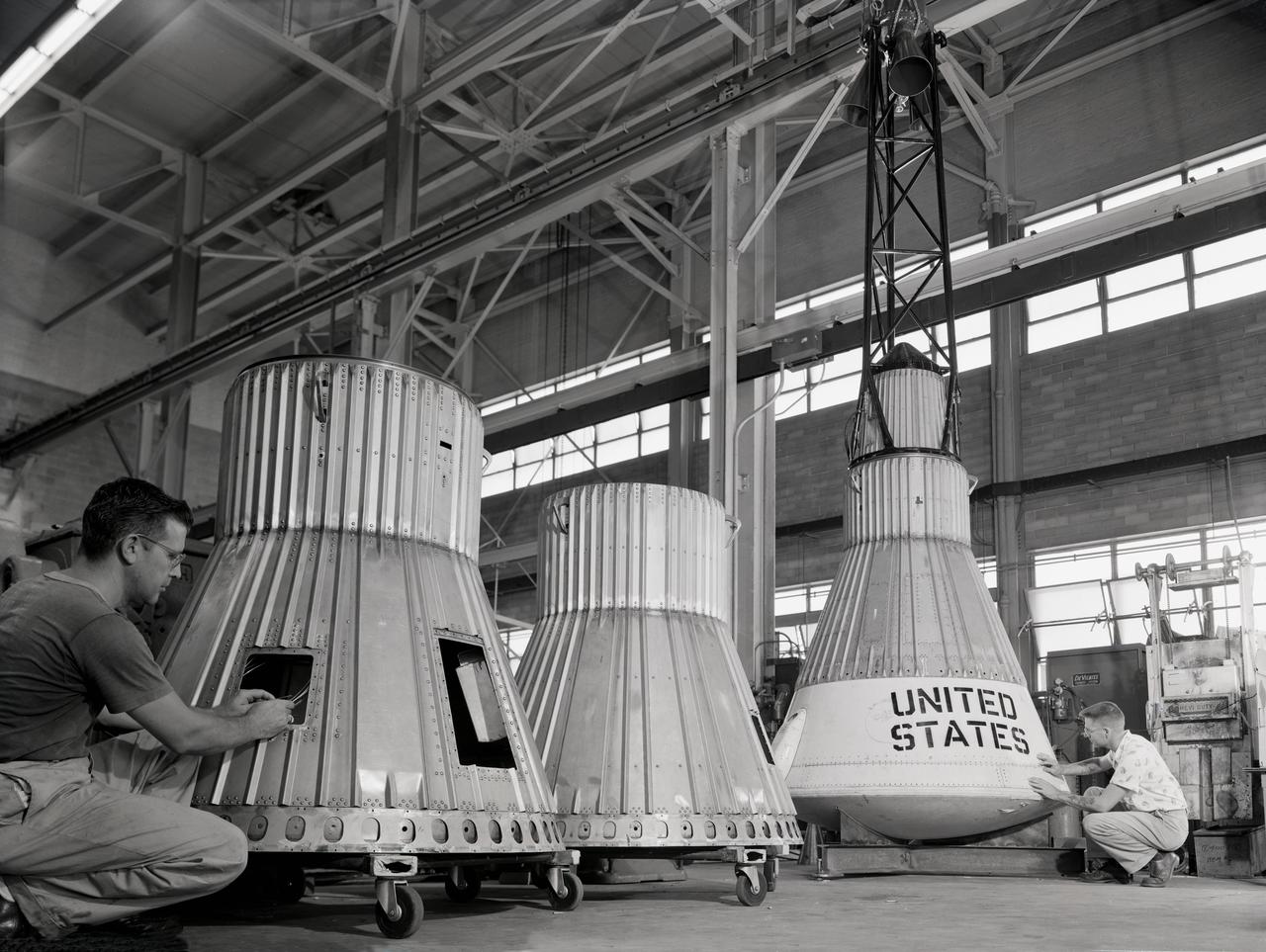
Assembling the Little Joe capsules. The capsules were manufactured in-house by Langley technicians. Three capsules are shown here in various stages of assembly. The escape tower and rocket motors shown on the completed capsule would be removed before shipping and finally assembly for launching at Wallops Island. Joseph Shortal wrote (vol. 3, p. 32): Design of the Little Joe capsules began at Langley before McDonnell started on the design of the Mercury capsule and was, therefore, a separate design. Although it was not designed to carry a man, it did have to carry a monkey. It had to meet the weight and center of gravity requirements of Mercury and withstand the same aerodynamic loads during the exit trajectory. Although in comparison with the overall Mercury Project, Little Joe was a simple undertaking, the fact that an attempt was made to condense a normal two-year project into a 6-month one with in house labor turned it into a major undertaking for Langley. Project Mercury: Little Joe: Boilerplate Mercury spacecraft undergo fabrication at the shops of the Langley Research Center. They will launched atop Little Joe rockets to test the spacecraft recovery systems. -- Published in Joseph A. Shortal, History of Wallops Station: Origins and Activities Through 1949, (Wallops Island, VA: National Aeronautics and Space Administration, Wallops Station, nd), Comment Edition. L59-4947 Technicians prepare a Little Joe launch vehicle prototype for the Mercury space program, 1959. Photograph published in Winds of Change, 75th Anniversary NASA publication, page 76, by James Schultz

NASA Spitzer Space Telescope celebrated its 12th anniversary with a new digital calendar showcasing some of the mission most notable discoveries and popular cosmic eye candy. The digital calendar is online at http://www.jpl.nasa.gov/images/spitzer/20150820/Spitzer12thAnniversaryCalendar.pdf The calendar follows the life of the mission, with each month highlighting top infrared images and discoveries from successive years -- everything from a dying star resembling the eye of a monster to a star-studded, swirling galaxy. The final month includes a brand new image of the glittery star-making factory known as the Monkey Head nebula. Spitzer, which launched into space on August 25, 2003, from Cape Canaveral, Florida, is still going strong. It continues to use its ultra-sensitive infrared vision to probe asteroids, comets, exoplanets (planets outside our solar system) and some of the farthest known galaxies. Recently, Spitzer helped discover the closest known rocky exoplanet to us, named HD219134b, at 21 light-years away. In fact, Spitzer's exoplanet studies continue to surprise the astronomy community. The telescope wasn't originally designed to study exoplanets, but as luck -- and some creative engineering -- would have it, Spitzer has turned out to be a critical tool in the field, probing the climates and compositions of these exotic worlds. This pioneering work began in 2005, when Spitzer became the first telescope to detect light from an exoplanet. http://photojournal.jpl.nasa.gov/catalog/PIA19872

Assembling the Little Joe capsules. The capsules were manufactured in-house by Langley technicians. Three capsules are shown here in various stages of assembly. The escape tower and rocket motors shown on the completed capsule would be removed before shipping and finally assembly for launching at Wallops Island. Joseph Shortal wrote (vol. 3, p. 32): Design of the Little Joe capsules began at Langley before McDonnell started on the design of the Mercury capsule and was, therefore, a separate design. Although it was not designed to carry a man, it did have to carry a monkey. It had to meet the weight and center of gravity requirements of Mercury and withstand the same aerodynamic loads during the exit trajectory. Although in comparison with the overall Mercury Project, Little Joe was a simple undertaking, the fact that an attempt was made to condense a normal two-year project into a 6-month one with in house labor turned it into a major undertaking for Langley. Project Mercury: Little Joe: Boilerplate Mercury spacecraft undergo fabrication at the shops of the Langley Research Center. They will launched atop Little Joe rockets to test the spacecraft recovery systems. -- Published in Joseph A. Shortal, History of Wallops Station: Origins and Activities Through 1949, (Wallops Island, VA: National Aeronautics and Space Administration, Wallops Station, nd), Comment Edition. L59-4947 Technicians prepare a Little Joe launch vehicle prototype for the Mercury space program, 1959. Photograph published in Winds of Change, 75th Anniversary NASA publication, page 76, by James Schultz

Assembling the Little Joe capsules. The capsules were manufactured in-house by Langley technicians. Three capsules are shown here in various stages of assembly. The escape tower and rocket motors shown on the completed capsule would be removed before shipping and finally assembly for launching at Wallops Island. Joseph Shortal wrote (vol. 3, p. 32): Design of the Little Joe capsules began at Langley before McDonnell started on the design of the Mercury capsule and was, therefore, a separate design. Although it was not designed to carry a man, it did have to carry a monkey. It had to meet the weight and center of gravity requirements of Mercury and withstand the same aerodynamic loads during the exit trajectory. Although in comparison with the overall Mercury Project, Little Joe was a simple undertaking, the fact that an attempt was made to condense a normal two-year project into a 6-month one with in house labor turned it into a major undertaking for Langley. Project Mercury: Little Joe: Boilerplate Mercury spacecraft undergo fabrication at the shops of the Langley Research Center. They will launched atop Little Joe rockets to test the spacecraft recovery systems. -- Published in Joseph A. Shortal, History of Wallops Station: Origins and Activities Through 1949, (Wallops Island, VA: National Aeronautics and Space Administration, Wallops Station, nd), Comment Edition. L59-4947 Technicians prepare a Little Joe launch vehicle prototype for the Mercury space program, 1959. Photograph published in Winds of Change, 75th Anniversary NASA publication, page 76, by James Schultz
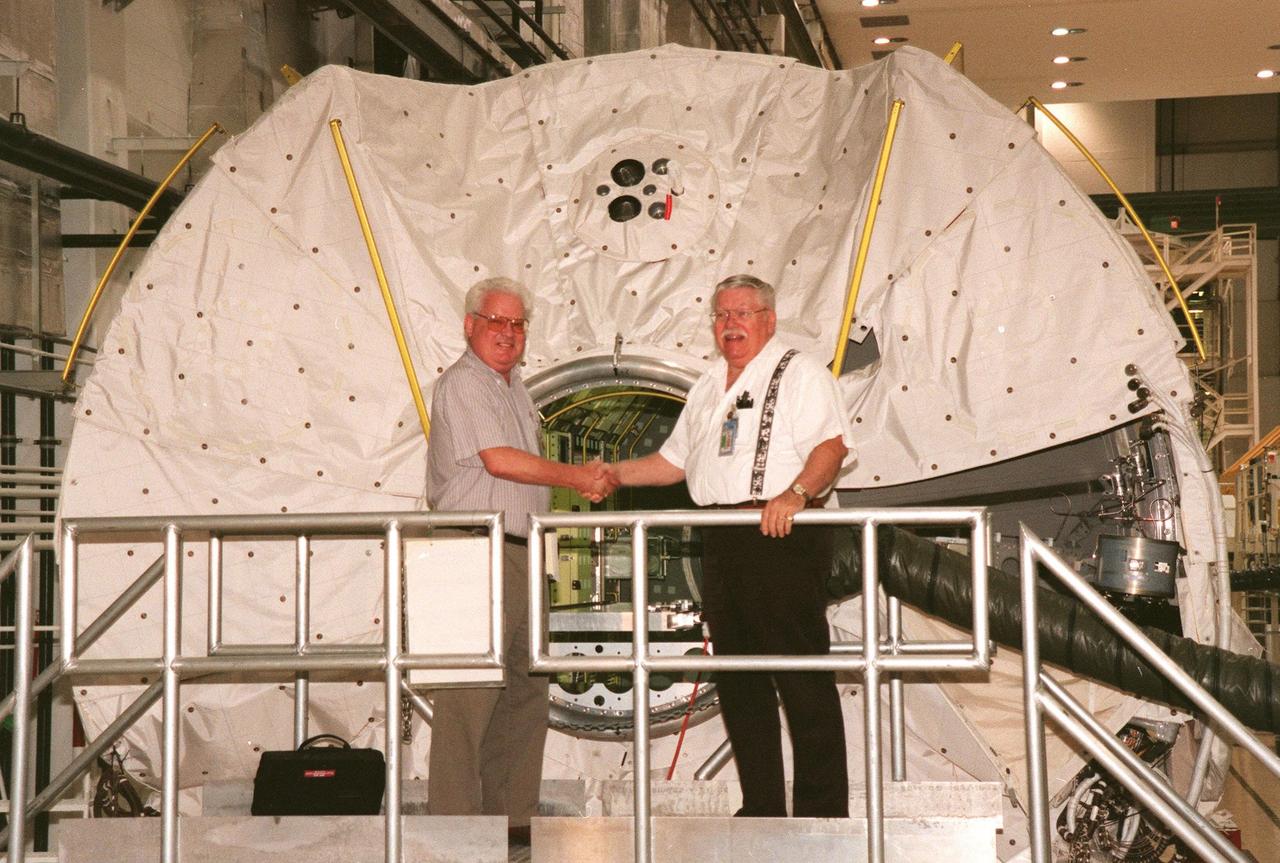
KENNEDY SPACE CENTER, FLA. -- In the Operations and Checkout Building, Rainer Goercke shakes hands with Norman Jatz in front of the Spacelab Module MD001 as they prepare to close it for the last time before shipment to the National Air and Space Museum in Washington, DC. Goercke and Jatz have been on the Spacelab program since 1979 and were part of the team that first unloaded the module at KSC. Goercke is the only remaining European representative from the German-based Spacelab contractor, ERNO, and Jatz is a mechanical engineering lead from Boeing. Spacelab was designed by the European Space Agency (ESA) for the Space Shuttle program. It first flew on STS-9 in November 1983 and its final flight was the STS-90 Neurolab mission in April 1998. The sister module will travel home and be placed on display in Europe. The Spacelab concept of modular experiment racks in a pressurized shirt-sleeve environment made it highly user-friendly and accessible. Numerous experiments conceived by hundreds of scientists on the ground were conducted by flight crews in orbit. Spacelab modules served as on-orbit homes for everything from squirrel monkeys to plant seeds. They supported astronomical as well as Earth observations, for servicing the Hubble Space Telescope and for research preparatory to the International Space Station. One of the greatest benefits afforded by the Spacelab missions was the opportunity to fly a mission more than once, with the second or third flight building on the experiences and data gathered from its predecessors
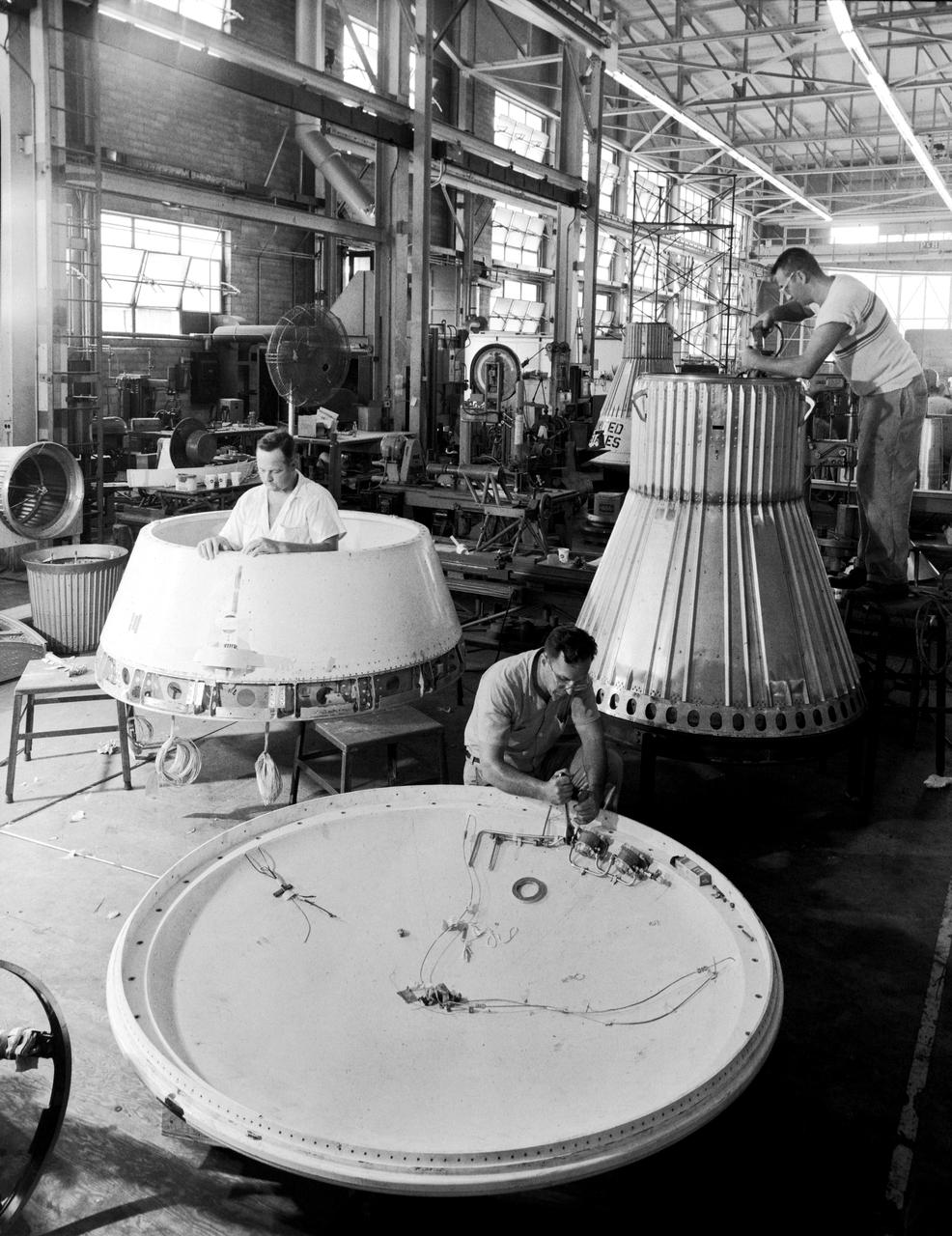
Assembling the Little Joe capsules. The capsules were manufactured in-house by Langley technicians. Three capsules are shown here in various stages of assembly. The escape tower and rocket motors shown on the completed capsule would be removed before shipping and finally assembly for launching at Wallops Island. Joseph Shortal wrote (vol. 3, p. 32): Design of the Little Joe capsules began at Langley before McDonnell started on the design of the Mercury capsule and was, therefore, a separate design. Although it was not designed to carry a man, it did have to carry a monkey. It had to meet the weight and center of gravity requirements of Mercury and withstand the same aerodynamic loads during the exit trajectory. Although in comparison with the overall Mercury Project, Little Joe was a simple undertaking, the fact that an attempt was made to condense a normal two-year project into a 6-month one with in house labor turned it into a major undertaking for Langley. Project Mercury: Little Joe: Boilerplate Mercury spacecraft undergo fabrication at the shops of the Langley Research Center. They will launched atop Little Joe rockets to test the spacecraft recovery systems. -- Published in Joseph A. Shortal, History of Wallops Station: Origins and Activities Through 1949, (Wallops Island, VA: National Aeronautics and Space Administration, Wallops Station, nd), Comment Edition. L59-4947 Technicians prepare a Little Joe launch vehicle prototype for the Mercury space program, 1959. Photograph published in Winds of Change, 75th Anniversary NASA publication, page 76, by James Schultz
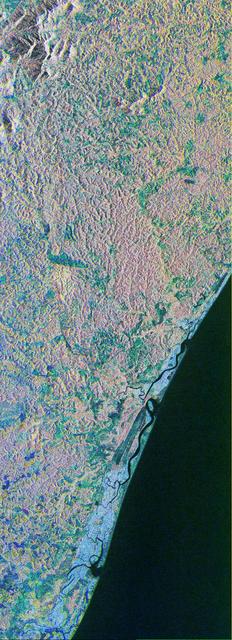
This is a color composite image of southern Bahia, Brazil, centered at 15.22 degree south latitude and 39.07 degrees west longitude. The image was acquired by the Spaceborne Imaging Radar-C/X-band Synthetic Aperture Radar aboard the space shuttle Endeavour on its 38th orbit of Earth on October 2, 1994. The image covers an area centered over the Una Biological Reserve, one the largest protected areas in northeastern Brazil. The 7,000-hectare reserve is administered by the Brazilian Institute for the Environment and is part of the larger Atlantic coastal forest, a narrow band of rain forest extending along the eastern coast of Brazil. The Atlantic coastal forest of southern Bahia is one of the world's most threatened and diverse ecosystems. Due to widespread settlement, only 2 to 5 percent of the original forest cover remains. Yet the region still contains an astounding variety of plants and animals, including a large number of endemic species. More than half of the region's tree species and 80 percent of its animal species are indigenous and found nowhere else on Earth. The Una Reserve is also the only federally protected habitat for the golden-headed lion tamarin, the yellow-breasted capuchin monkey and many other endangered species. In the past few years, scientists from Brazilian and international conservation organizations have coordinated efforts to study the biological diversity of this region and to develop practical and economically viable options for preserving the remaining primary forests in southern Bahia. The shuttle imaging radar is used in this study to identify various land uses and vegetation types, including remaining patches of primary forest, cabruca forest (cacao planted in the understory of the native forest), secondary forest, pasture and coastal mangrove. Standard remote-sensing technology that relies on light reflected from the forest canopy cannot accurately distinguish between cabruca and undisturbed forest. Optical remote sensing is also limited by the nearly continuous cloud cover in the region and heavy rainfall, which occurs more than 150 days each year. The ability of the shuttle radars to "see" through the forest canopy to the cultivated cacao below -- independent of weather or sunlight conditions --will allow researchers to distinguish forest from cabruca in unprecedented detail. This SIR-C/X-SAR image was produced by assigning red to the L-band, green to the C-band and blue to the X-band. The Una Reserve is located in the middle of the image west of the coastline and slightly northwest of Comandatuba River. The reserve's primary forests are easily detected by the pink areas in the image. The intensity of red in these areas is due to the high density of forest vegetation (biomass) detected by the radar's L-band (horizontally transmitted and vertically received) channel. Secondary forest is visible along the reserve's eastern border. The Serrado Mar mountain range is located in the top left portion of the image. Cabruca forest to the west of Una Reserve has a different texture and a yellow color. The removal of understory in cabruca forest reduces its biomass relative to primary forest, which changes the L-band and C-band penetration depth and returns, and produces a different texture and color in the image. The region along the Atlantic is mainly mangrove swamp, agricultural fields and urban areas. The high intensity of blue in this region is a result of increasing X-band return in areas covered with swamp and low vegetation. The image clearly separates the mangrove region (east of coastal Highway 001, shown in blue) from the taller and dryer forest west of the highway. The high resolution capability of SIR-C/X-SAR imaging and the sensitivity of its frequency and polarization channels to various land covers will be used for monitoring and mapping areas of importance for conservation. http://photojournal.jpl.nasa.gov/catalog/PIA01764