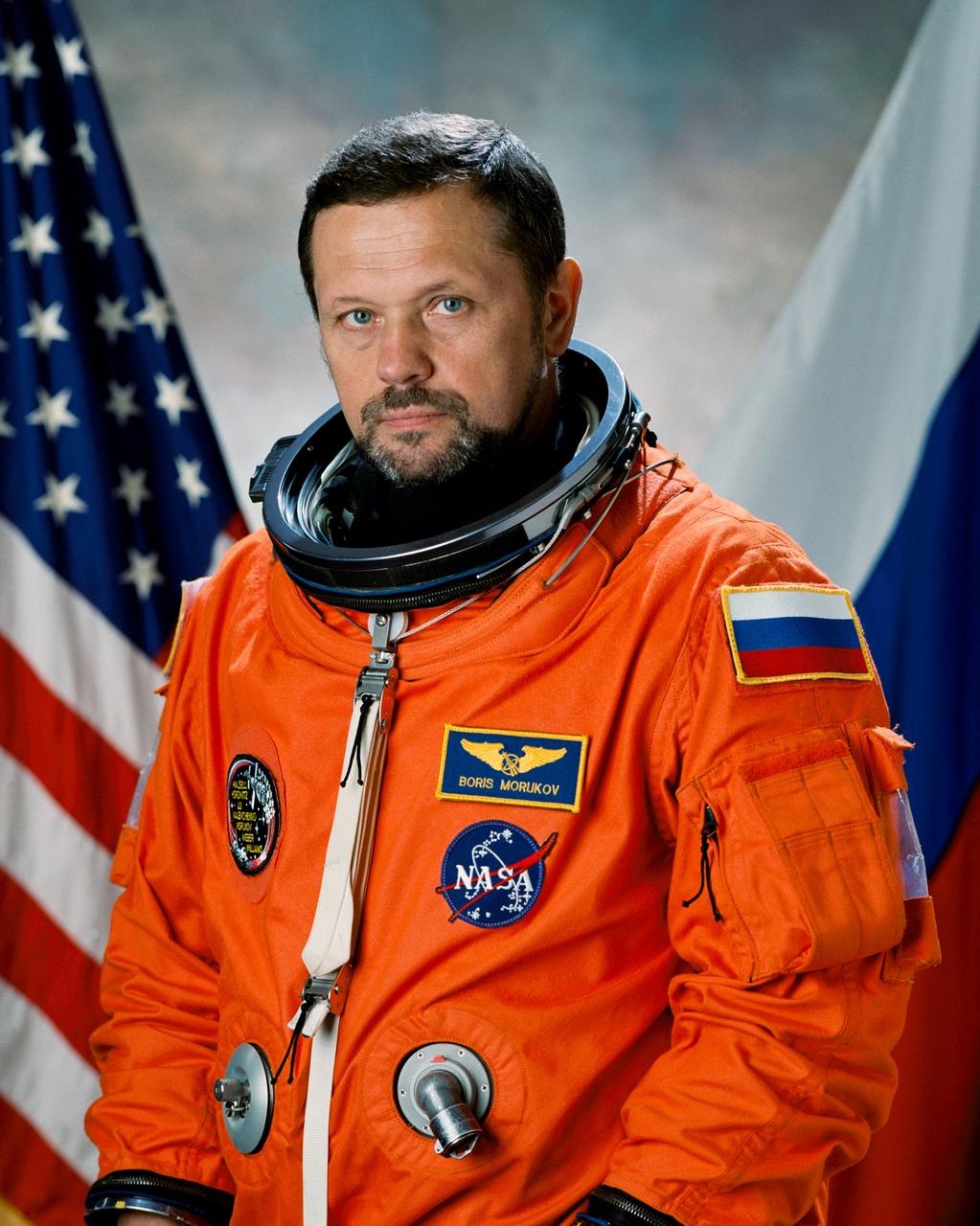
S99-07607 (July 1999) --- Cosmonaut Boris V. Morukov, Russian Space Agency (RSA). (Morukov was assigned in the summer of 1999 to serve on the crew of STS-106, the second Shuttle-Assembly mission for the International Space Station.)
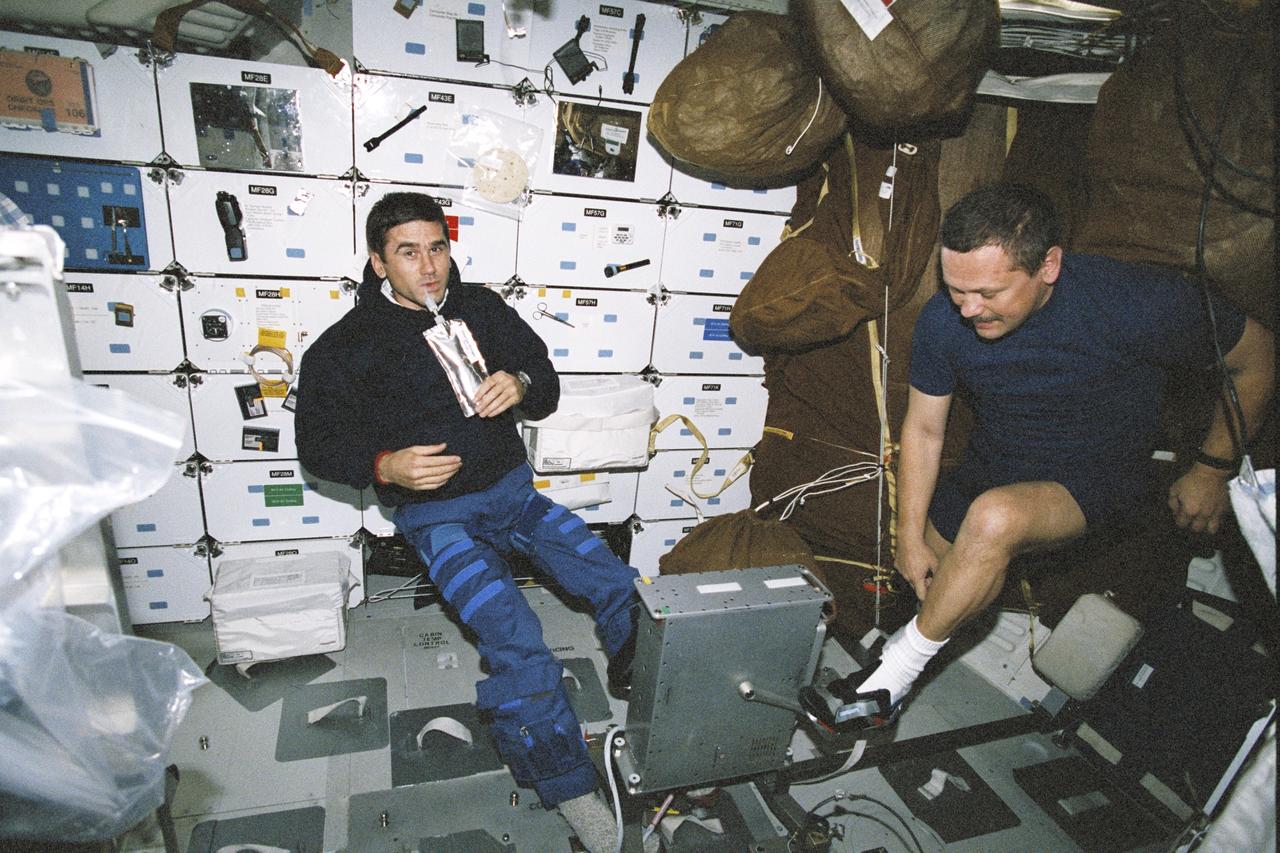
STS106-316-031 (8-20 September 2000) --- Cosmonaut Yuri I. Malenchenko (left), drinks a beverage, as cosmonaut Boris V. Morukov, prepares to exercise using an ergometer on the mid deck of the Space Shuttle Atlantis. Malenchenko and Morukov are mission specialists who represent Rosaviakosmos.
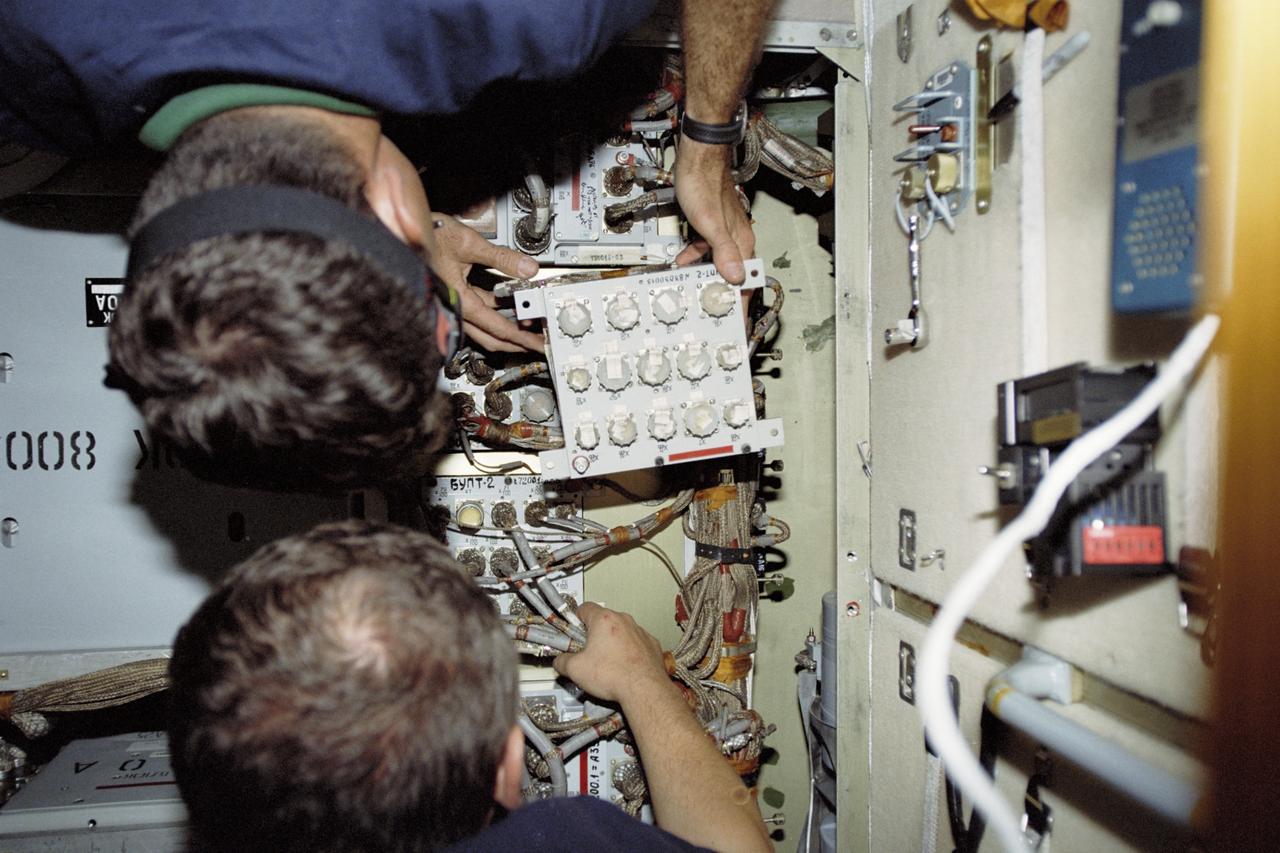
STS-106 Mission Specialist (MS) Daniel Burbank (with headband light) and MS / cosmonaut Boris Morukov work on the storage batteries in the Functional Cargo Block (FGB) / Zarya.

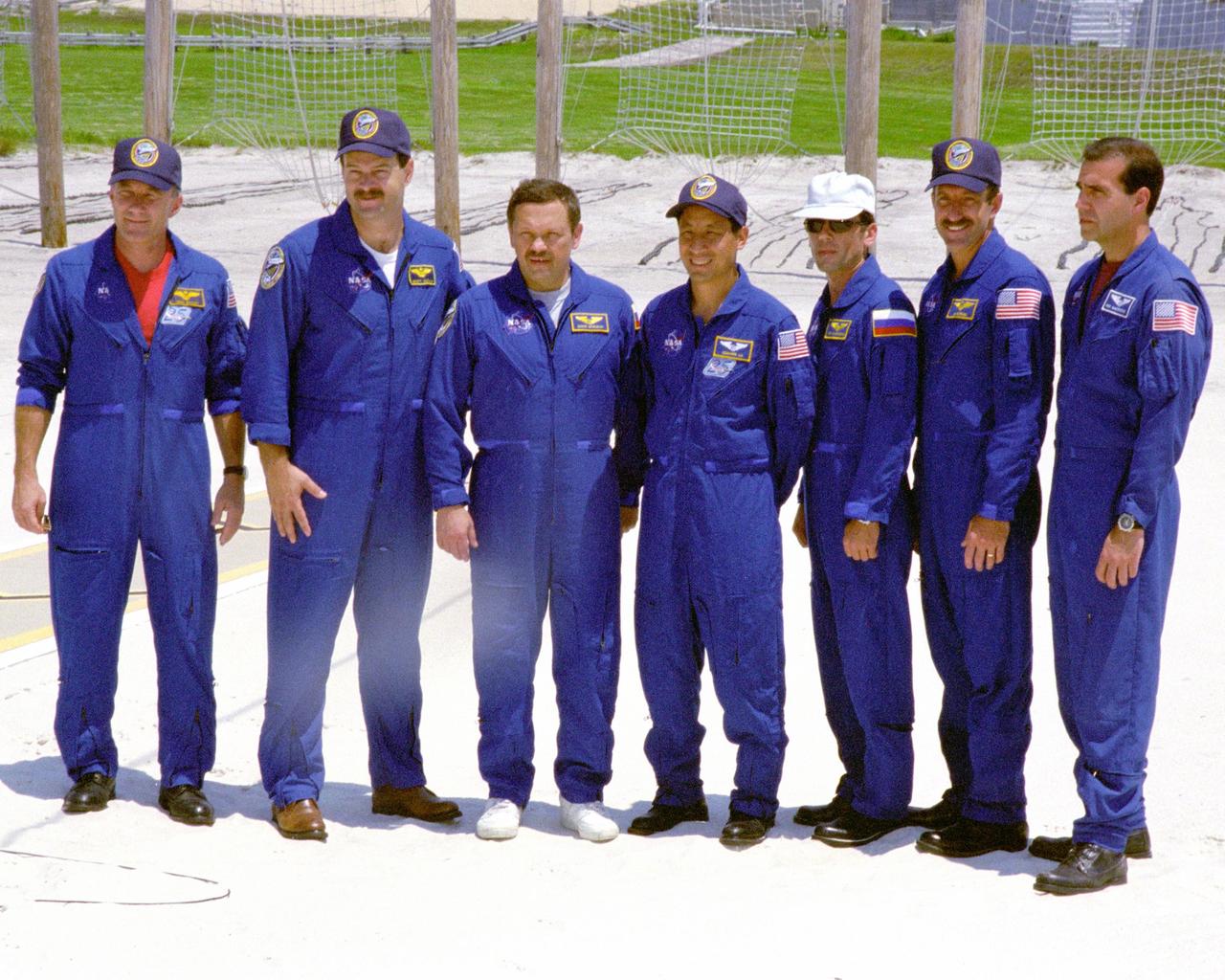
Five NASA astronauts and two cosmonauts representing the Russian Aviation and Space Agency take a break in training from their scheduled September 2000 visit to the International Space Station (ISS). Astronauts Terrence W. Wilcutt (right front), and Scott D. Altman (left front) are mission commander and pilot, respectively. On the back row (from the left) are mission specialists Boris V. Morukov, cosmonaut, along with astronauts Richard A. Mastracchio, Edward T. Lu, and Daniel C. Burbank, and cosmonaut Yuri I. Malenchenko. Morukov and Malenchenko represent the Russian Aviation and Space Agency. Launched aboard the Space Shuttle Atlantis on September 8, 2000 at 7:46 a.m. (CDT), the STS-106 crew successfully prepared the International Space Station (ISS) for occupancy. Acting as plumbers, movers, installers and electricians, they installed batteries, power converters, a toilet and a treadmill on the outpost. They also delivered more than 2,993 kilograms (6,600 pounds) of supplies. Lu and Malenchenko performed a space walk to connect power, and data and communications cables to the newly arrived Zvezda Service Module and the Station.
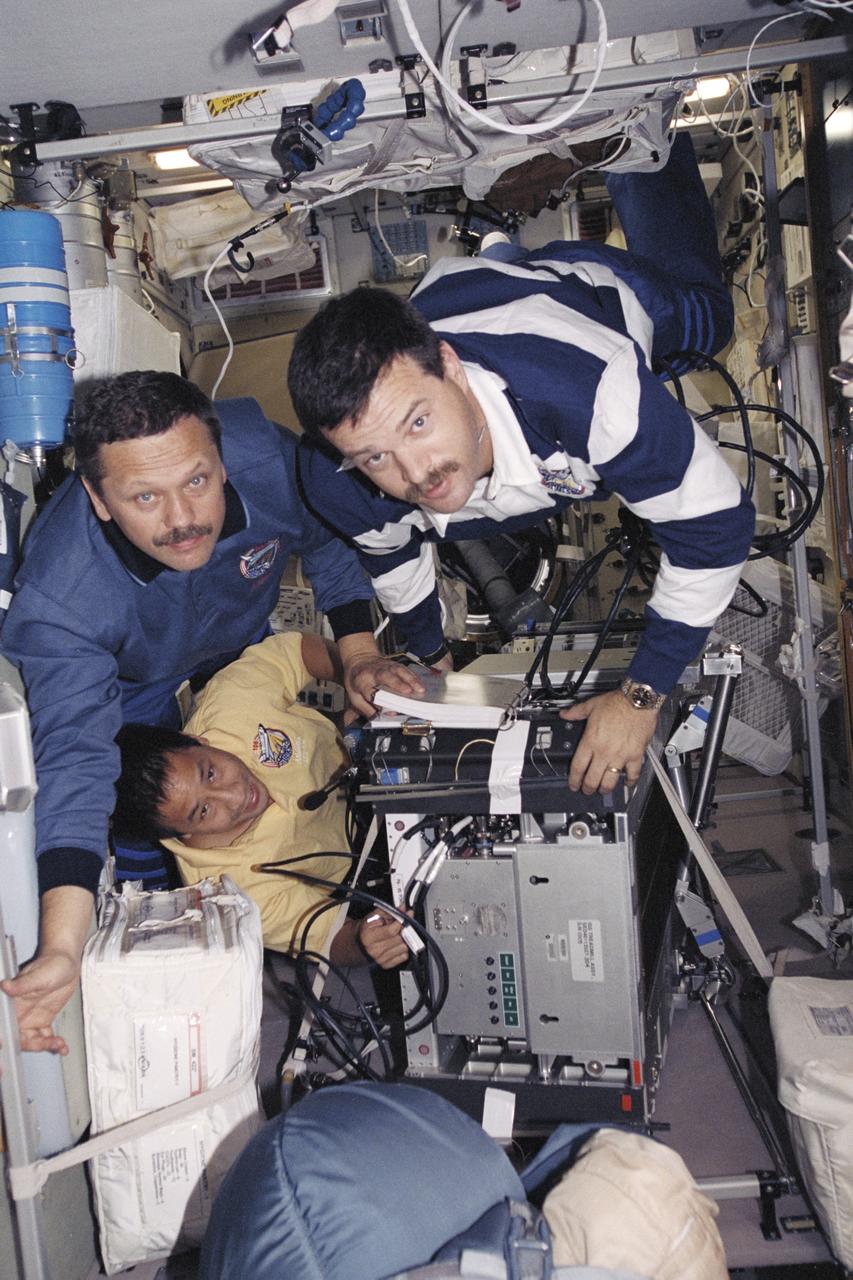
STS106-373-004 (8-20 September 2000) --- Three members of the STS-106 crew move the treadmill device. They are (counterclockwise from bottom) astronaut Edward T. Lu and cosmonaut Boris V. Morukov, both mission specialists, along with astronaut Scott D. Altman, pilot.
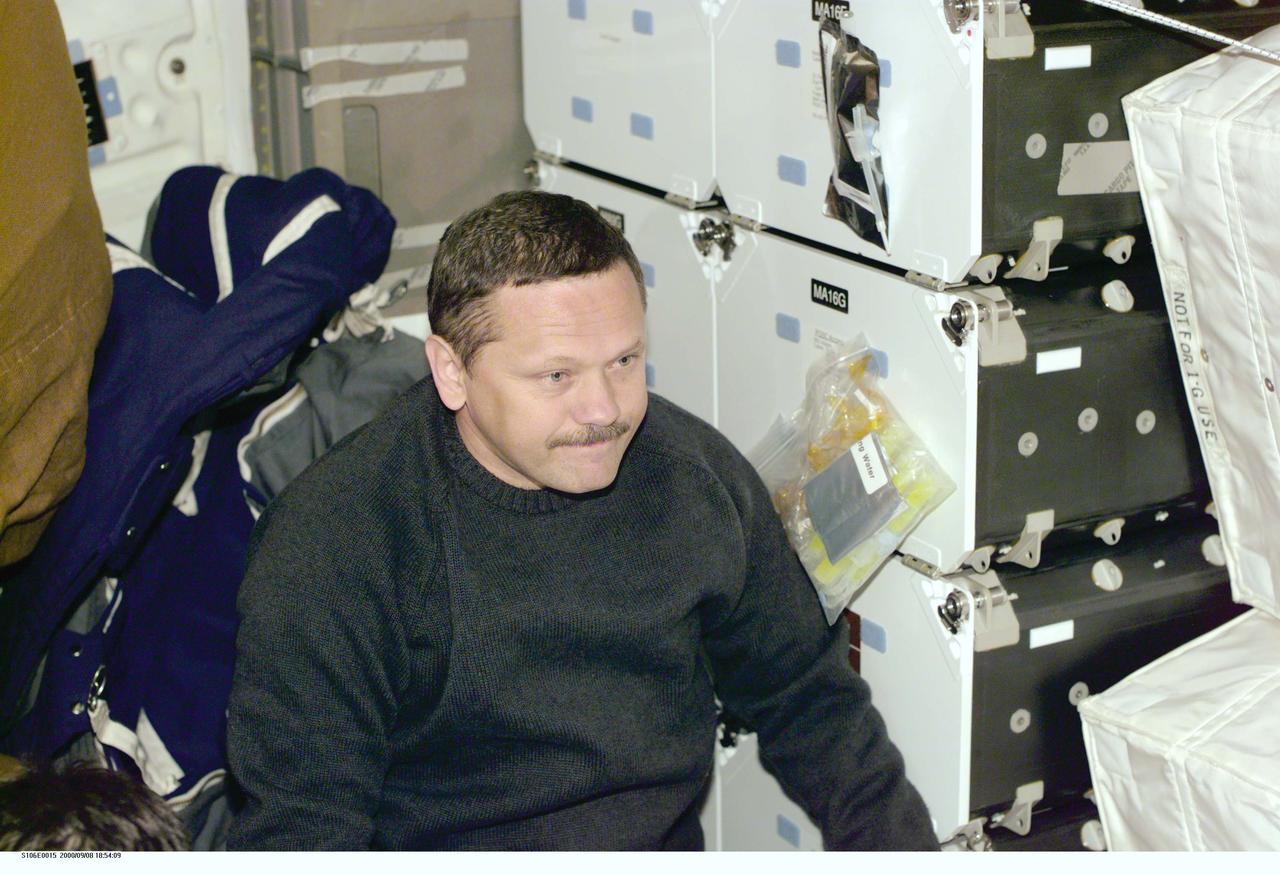
S106-E-5015 (8 September 2000) --- Cosmonaut Boris V. Morukov, mission specialist representing the Russian Aviation and Space Agency, sizes up some of the work ahead over the next several days onboard the Space Shuttle Atlantis.
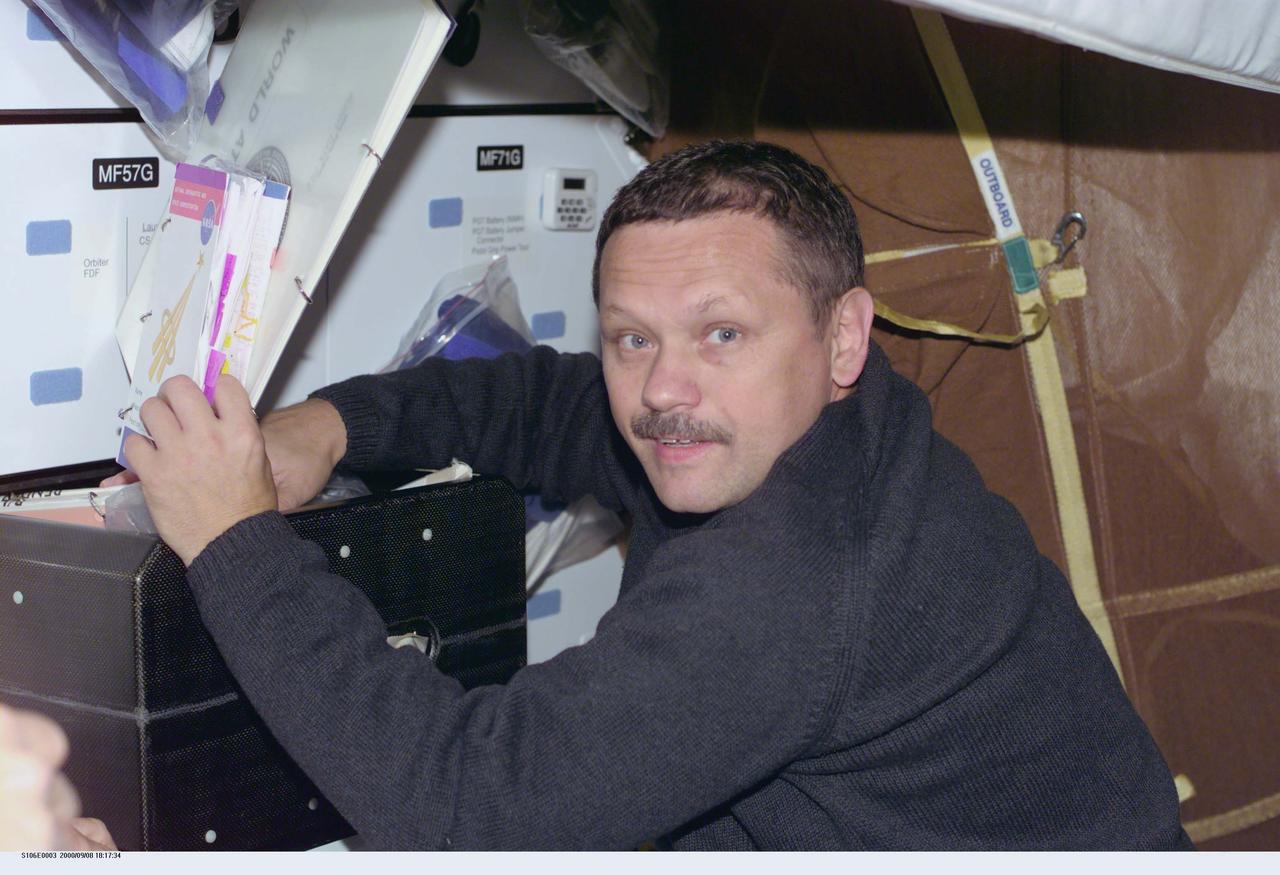
STS106-E-5003 (8 September 2000) --- Cosmonaut Boris V. Morukov, mission specialist representing the Russian Aviation and Space Agency, begins to organize affairs during Flight Day 1 onboard the Earth-orbiting Space Shuttle Atlantis.
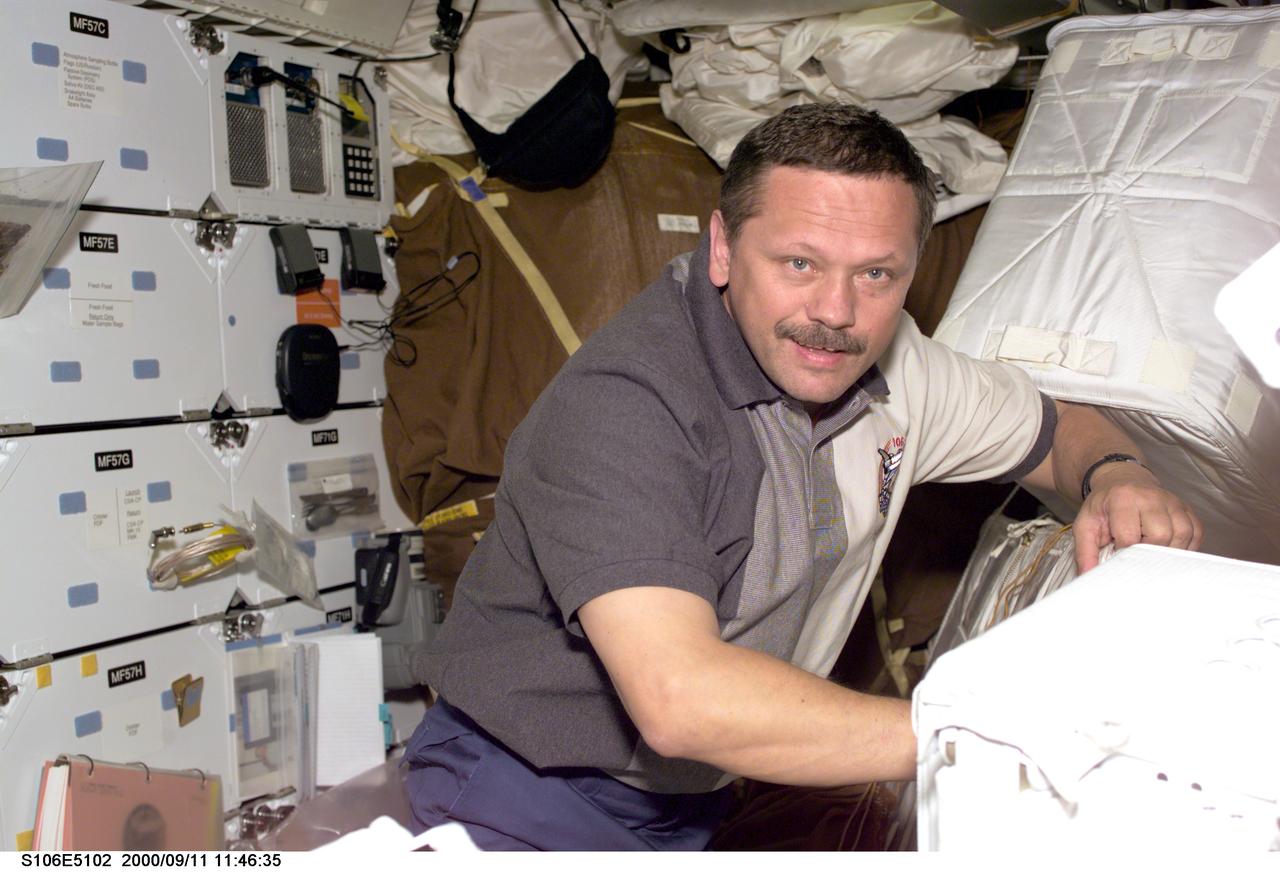
S106-E-5102 (11 September 2000) --- Cosmonaut Boris V. Morukov, mission specialist representing the Russian Aviation and Space Agency, moves around supplies on the mid deck of the Space Shuttle Atlantis. The seven-member STS-106 crew is involved in preparations for the opening of doors into the International Space Station (ISS) and the movement of supplies into it.
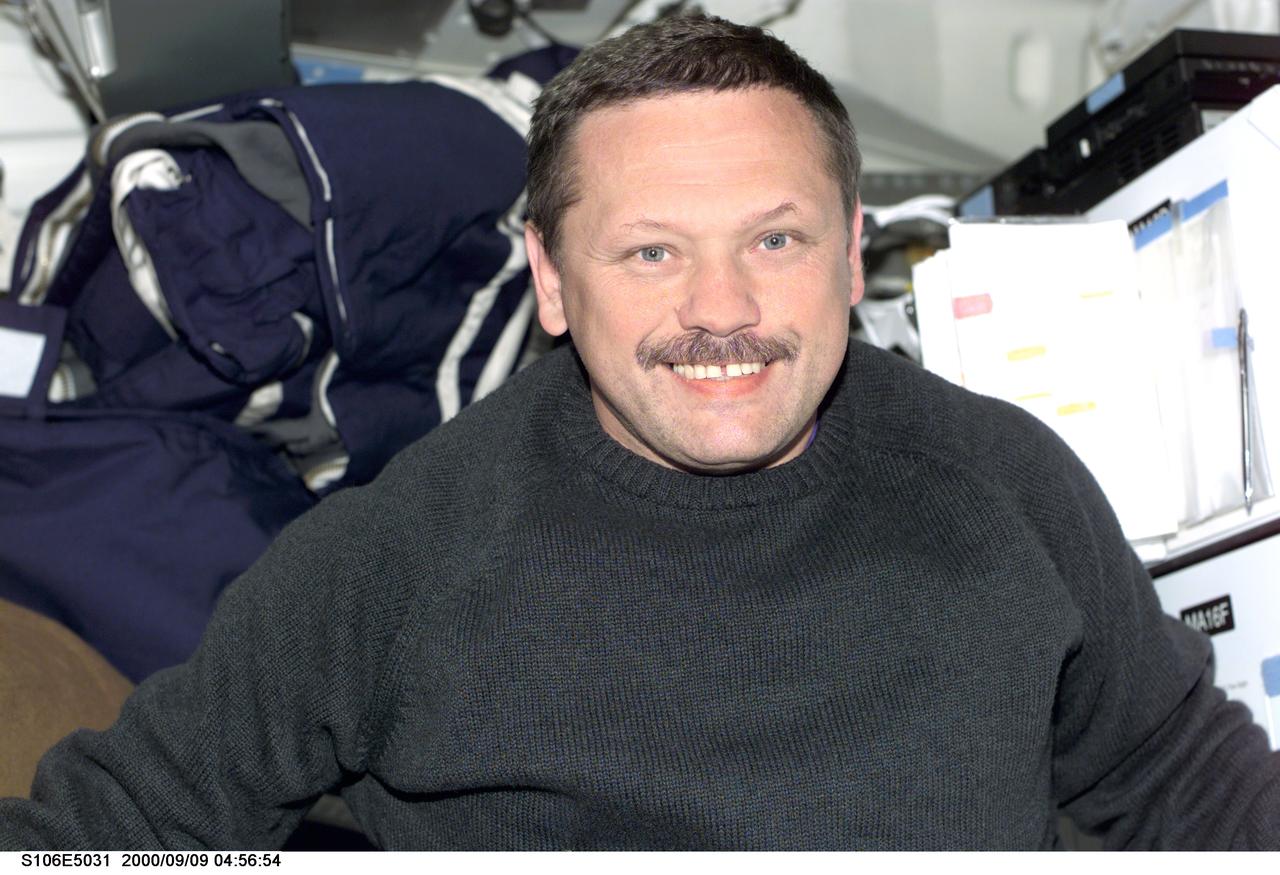
S106-E-5031 (9 September 2000) --- Cosmonaut Boris V. Morukov, one of two mission specialists who represent the Russian Aviation and Space Agency on this scheduled 11-day mission, appears to like the progress of the effort by the seven-member crew to keep up its busy agenda onboard the Space Shuttle Atlantis. The crew is less than 24 hours away from Atlantis' scheduled docking with the International Space Station (ISS).
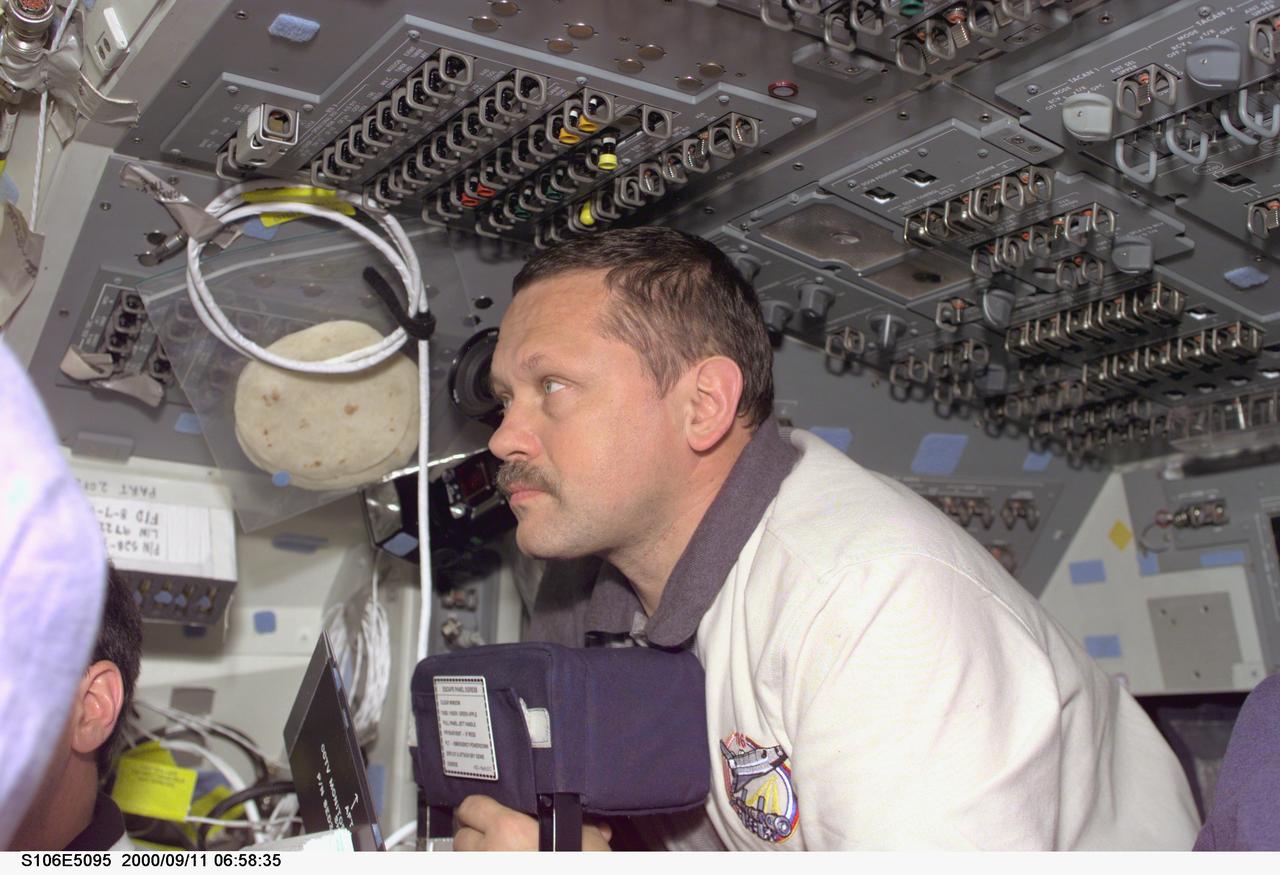
S106-E-5095 (11 September 2000) --- Cosmonaut Boris V. Morukov, mission specialist representing the Russian Aviation and Space Agency, is attentive to a crew head session on the flight deck of the Earth-orbiting Space Shuttle Atlantis. The Atlantis was docked with the International Space Station (ISS) when this electronic still camera's (ESC) image was recorded.
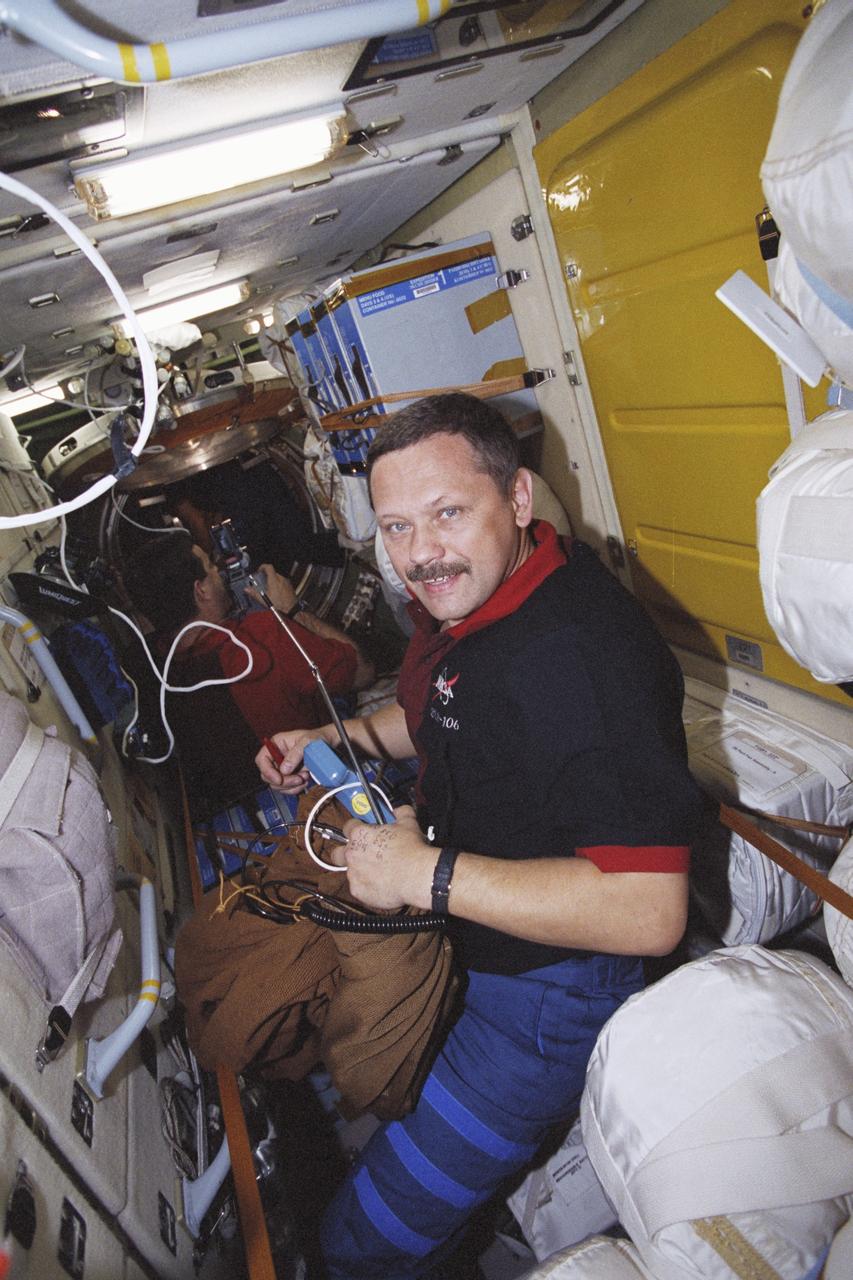
STS106-322-017 (8-20 September 2000) --- Cosmonaut Boris V. Morukov, mission specialist representing the Russian Aviation and Space Agency, works onboard the Functional Cargo Block (FGB) as the seven-man STS-106 crew carried out its busy move- and install-effort on the International Space Station. The astronauts and cosmonauts were able to accomplish the movement of several tons of hardware and supplies during the period the station was docked with the Space Shuttle Atlantis.
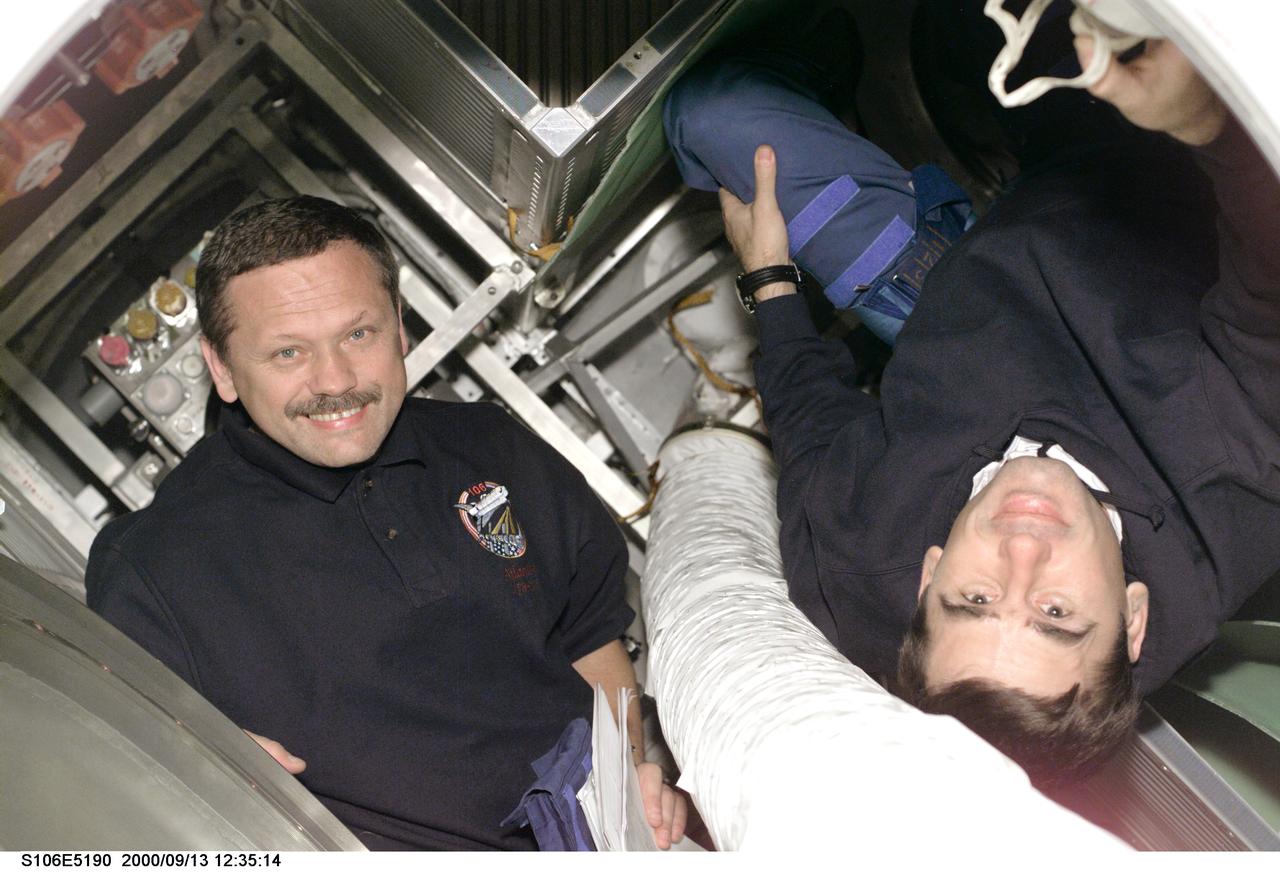
S106-E-5190 (13 September 2000) --- Part of Flight Day 5 activity included interface with the Progress supply vehicle which joined the International Space Station (ISS) last month. Pictured in the supply vehicle are cosmonauts Boris V. Morukov, left, and Yuri I. Malenchenko, both mission specialists representing the Russian Aviation and Space Agency.
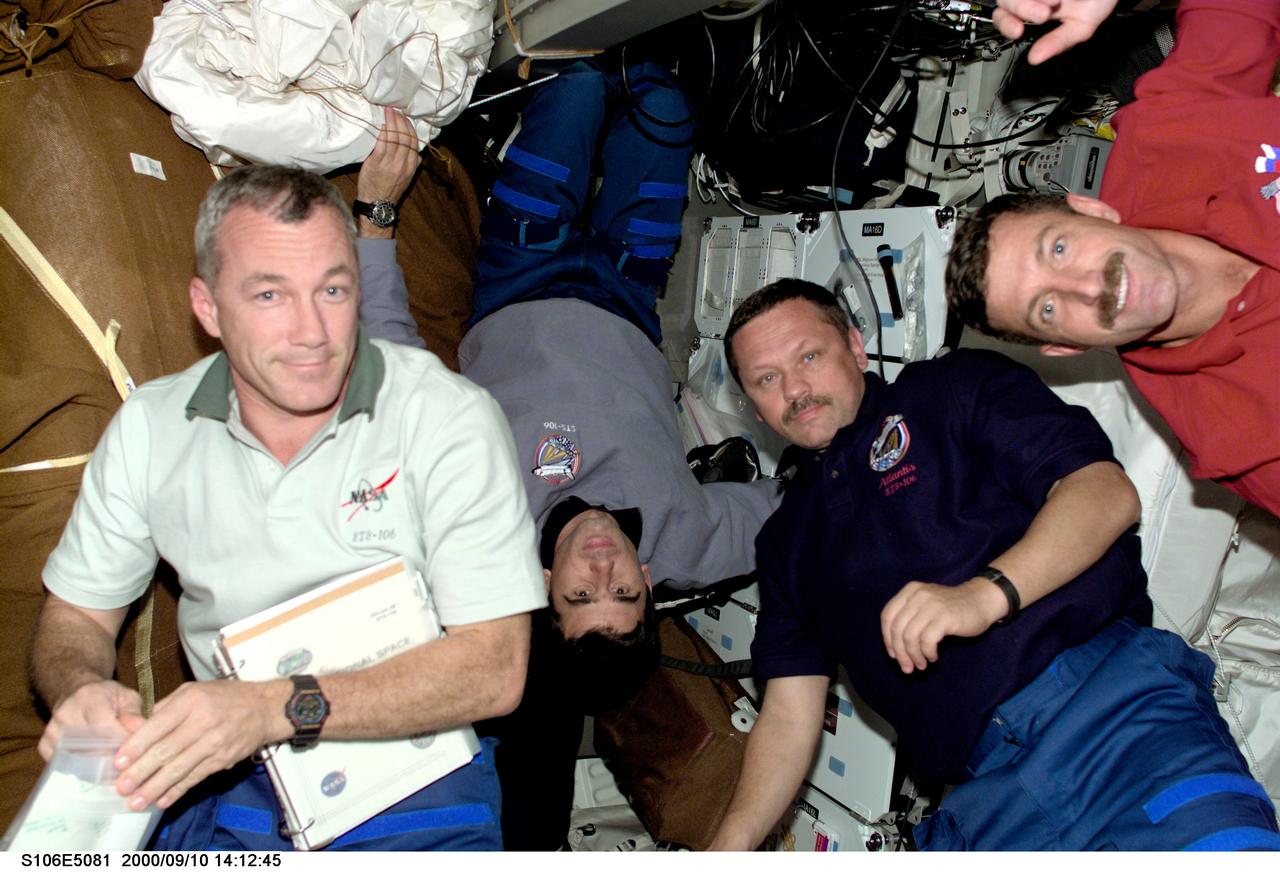
S106-E-5081 (10 September 2000) --- Two cosmonauts and two astronauts discuss supplies to be moved from Atlantis mid deck during Flight Day 3 activity. From the left are astronaut Terrence W. Wilcutt, mission commander; cosmonauts Yuri I. Malenchenko and Boris V. Morukov, mission specialists representing the Russian Aviation and Space Agency; along with astronaut Daniel C. Burbank, mission specialist.
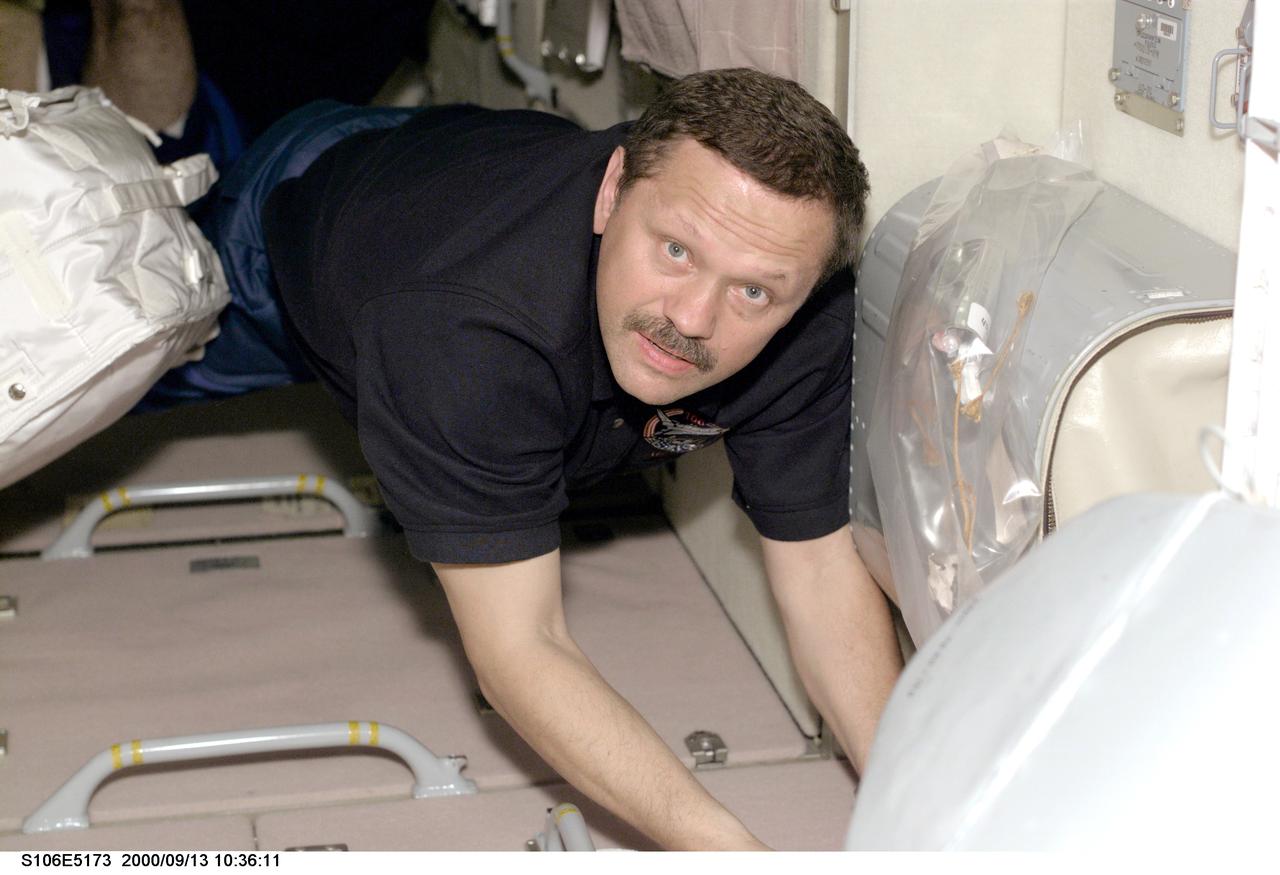
S106-E-5173 (13 September 2000) --- Cosmonaut Boris V. Morukov, mission specialist representing the Russian Aviation and Space Agency, is part of the team effort to ready the International Space Station (ISS) for permanent habitation. The STS-106 astronauts and cosmonauts are continuing electrical work and transfer activities as they near the halfway point of docked operations with the International Space Station. In all, the crew will have 189 hours, 40 minutes of planned Atlantis-ISS docked time.
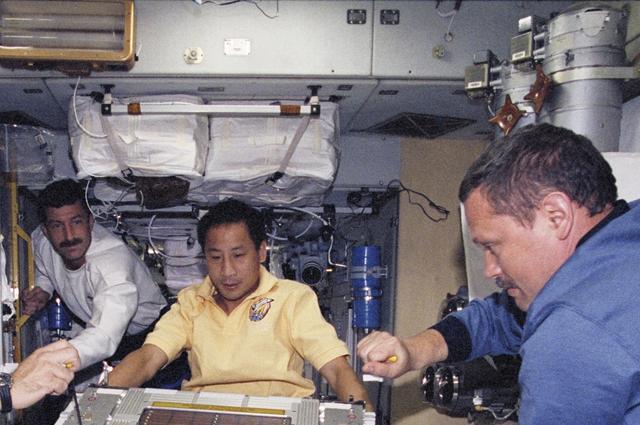
STS106-390-029 (8-20 September 2000) --- Astronauts Scott D. Altman (left), STS-106 pilot, Daniel C. Burbank, and Edward T. Lu, both mission specialists, along with cosmonaut Boris V. Morukov, mission specialist representing Rosaviakosmos, assemble a treadmill in the Zvezda Service Module on the International Space Station (ISS).
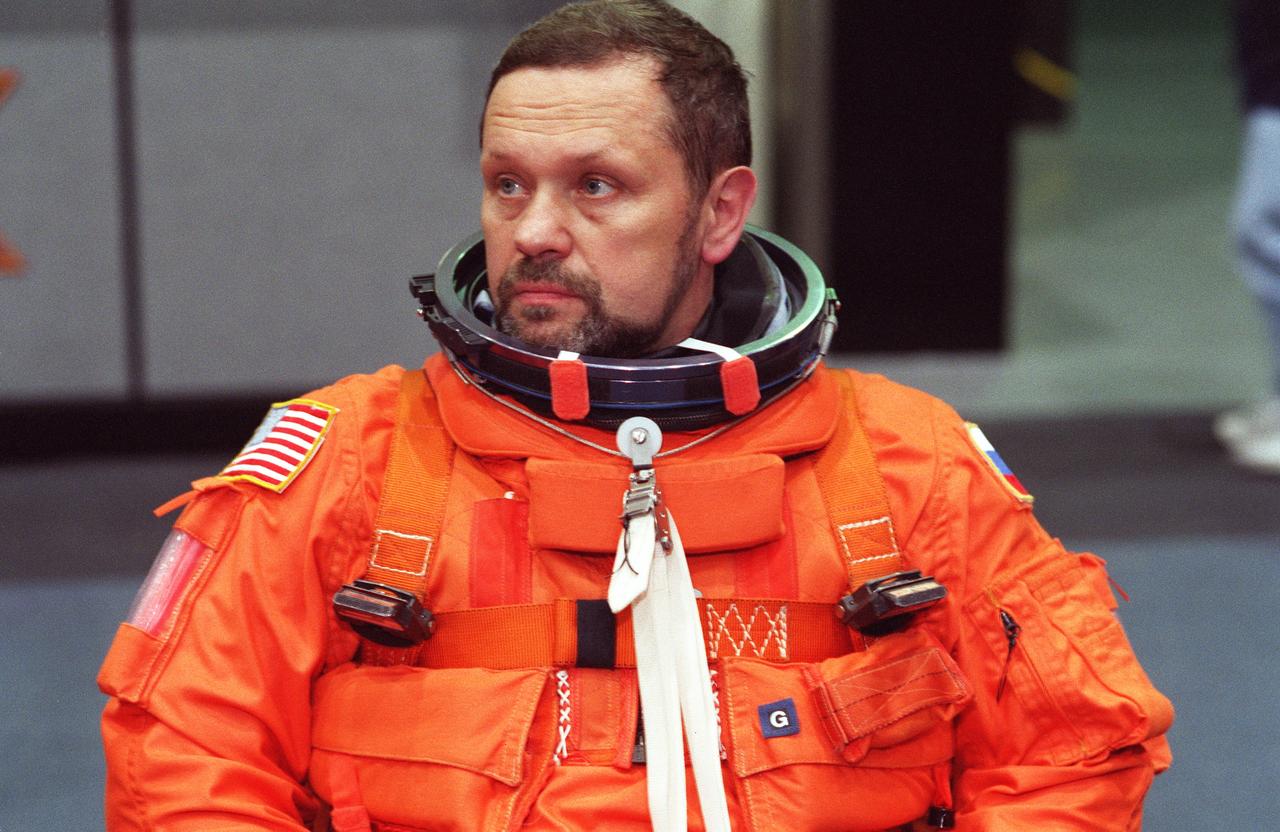
S99-14210 (15 November 1999) --- Cosmonaut Boris V. Morukov, mission specialist representing the Russian Space Agency (RSA), listens attentively to a briefing which covered emergency bailout procedures. Out of frame are six crew mates who joined Morukov for the emergency bailout training.
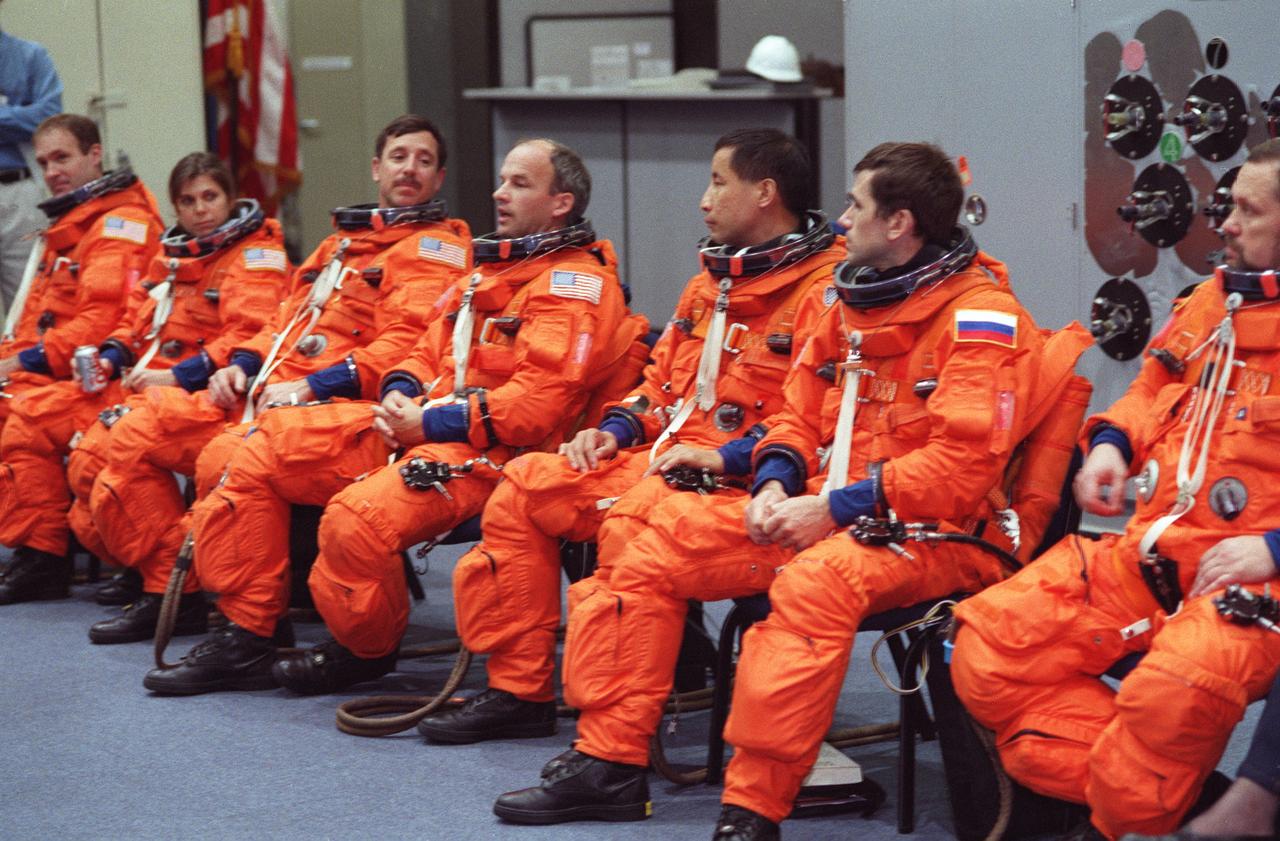
S99-14209 (15 November 1999) --- The seven crew members for STS-101 are seated during a briefing regarding emergency egress procedures. From the left are astronauts James D. Halsell, Jr., Mary Ellen Weber, Scott J. Horowitz, Jeffrey N. Williams and Edward T. Lu, along with cosmonauts Yuri I. Malenchenko and Boris V. Morukov. Malenchenko and Morukov represent the Russian Space Agency (RSA). Editor's Note: Since this photograph was taken, changes in crew personnel have been made. Cosmonauts Yuri I. Malenchenko and Boris V. Morukov, along with astronaut Edward T. Lu were moved to STS-106. Astronauts James S. Voss and Susan J. Helms, and cosmonaut Yury V. Usachev were added to the STS-101 crew. Malenchenko, Morukov and Usachev all represent the Russian Space Agency (RSA).
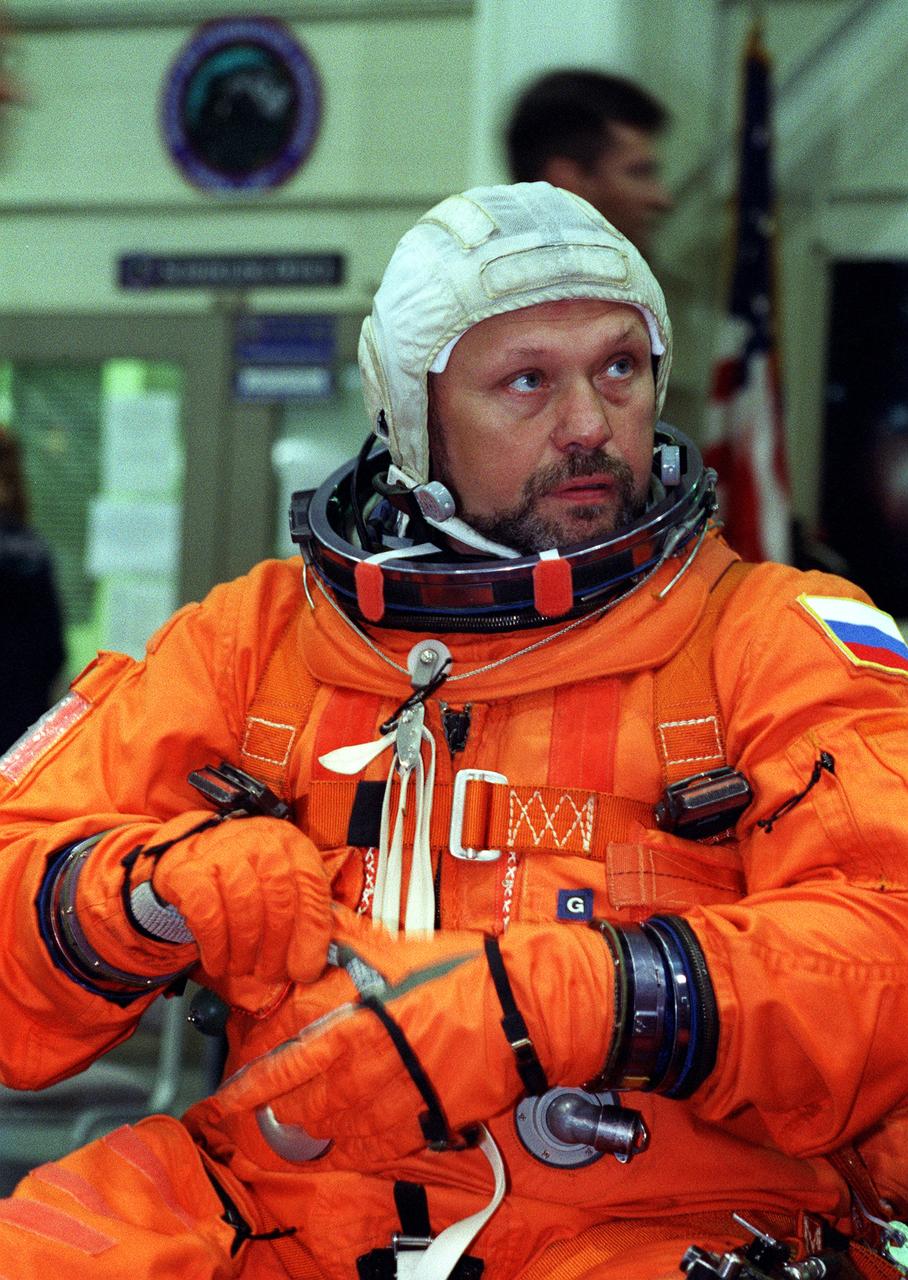
S99-06202 (25 June 1999) --- Cosmonaut Boris V. Morukov, mission specialist representing the Russian Space Agency (RSA), is briefed by a member of the crew training staff (out of frame) during an emergency egress training session at the Johnson Space Center's Systems Integration Facility. Morukov will join five astronauts and a second cosmonaut for one of next year's scheduled missions with the International Space Station (ISS).
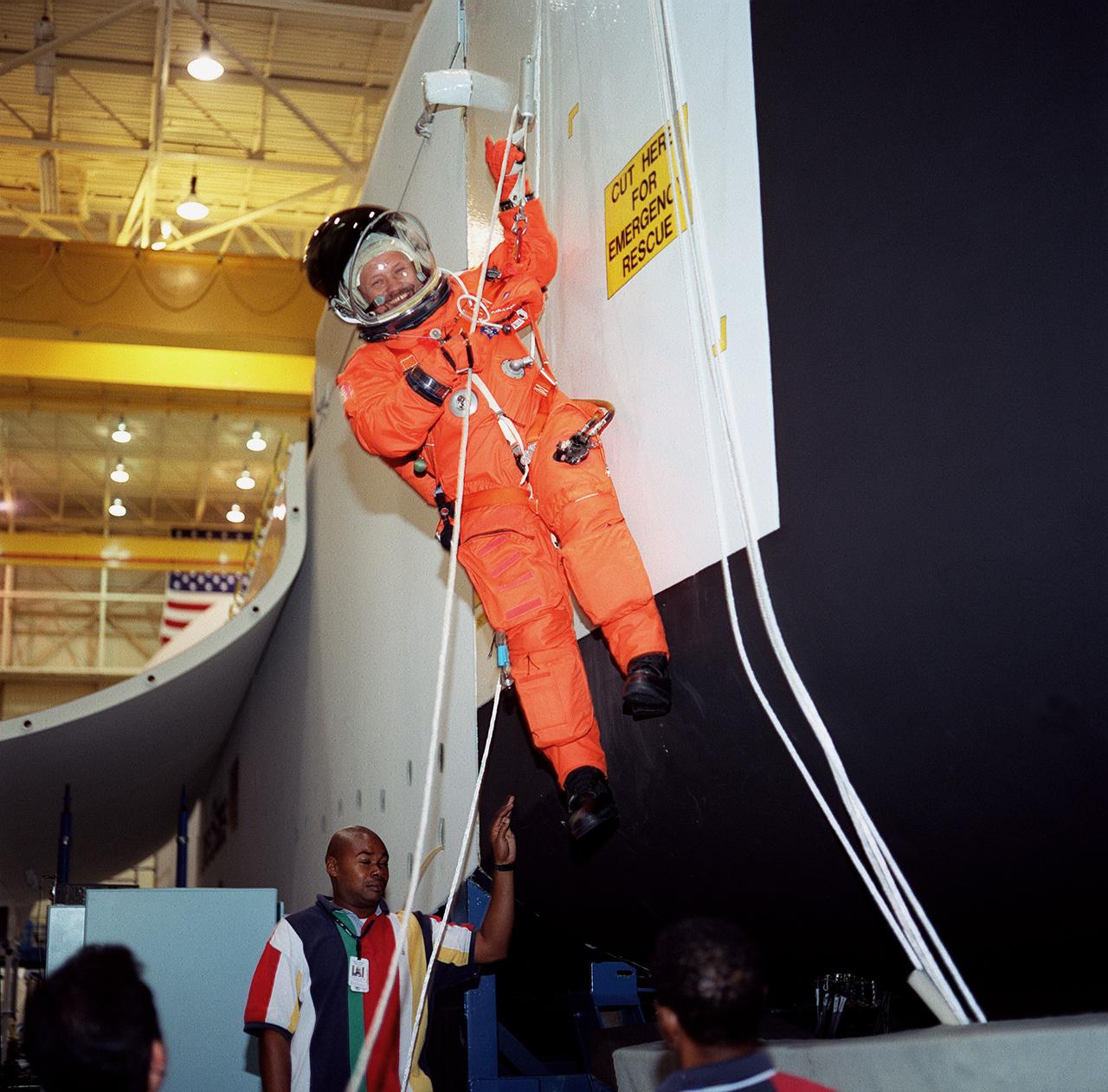
S99-06459 (25 June 1999) --- Cosmonaut Boris V. Morukov, mission specialist representing the Russian Space Agency (RSA), descends from the top of the crew cabin of the Full Fuselage Trainer (FFT) during an emergency egress training session at the Johnson Space Center's Systems Integration Facility. Morukov will join five astronauts and a second cosmonaut for one of next year's scheduled missions with the International Space Station (ISS).
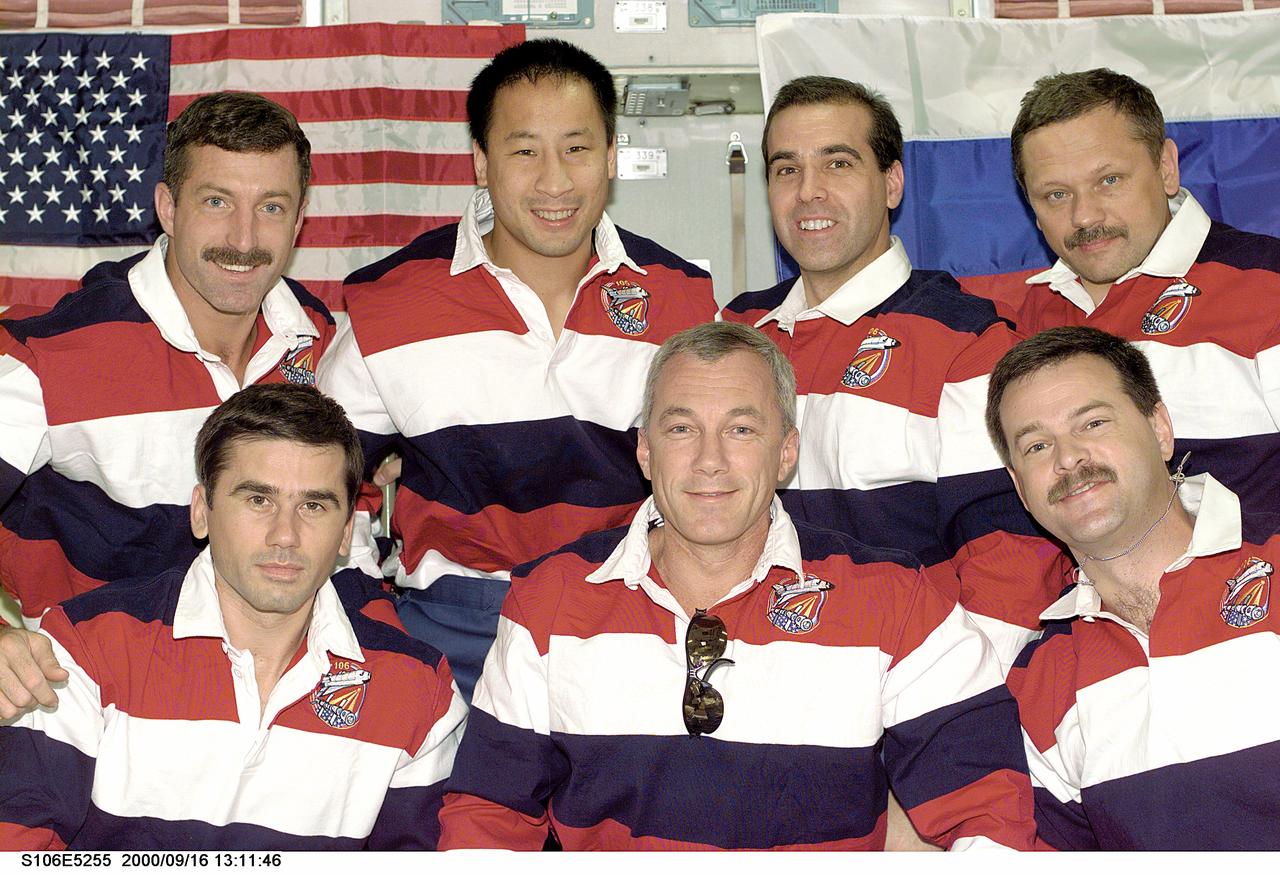
S106-E-5255 (16 September 2000) --- STS-106 crew members, rapidly approaching the time when good-byes to the International Space Station (ISS) will be in order, pose for an inflight crew portrait, snapped by a pre-set electronic still camera (ESC) nearby. Astronaut Terrence W. Wilcutt, mission commander, is at front center, and Scott D. Altman, pilot, front right. Cosmonaut Yuri I. Malenchenko, mission specialist, is at front left. In the rear are (from the left) astronauts Daniel C. Burbank, Edward T. Lu and Richard A. Mastracchio, along with cosmonaut Boris V. Morukov, all mission specialists. Malenchenko and Morukov represent the Russian Aviation and Space Agency.
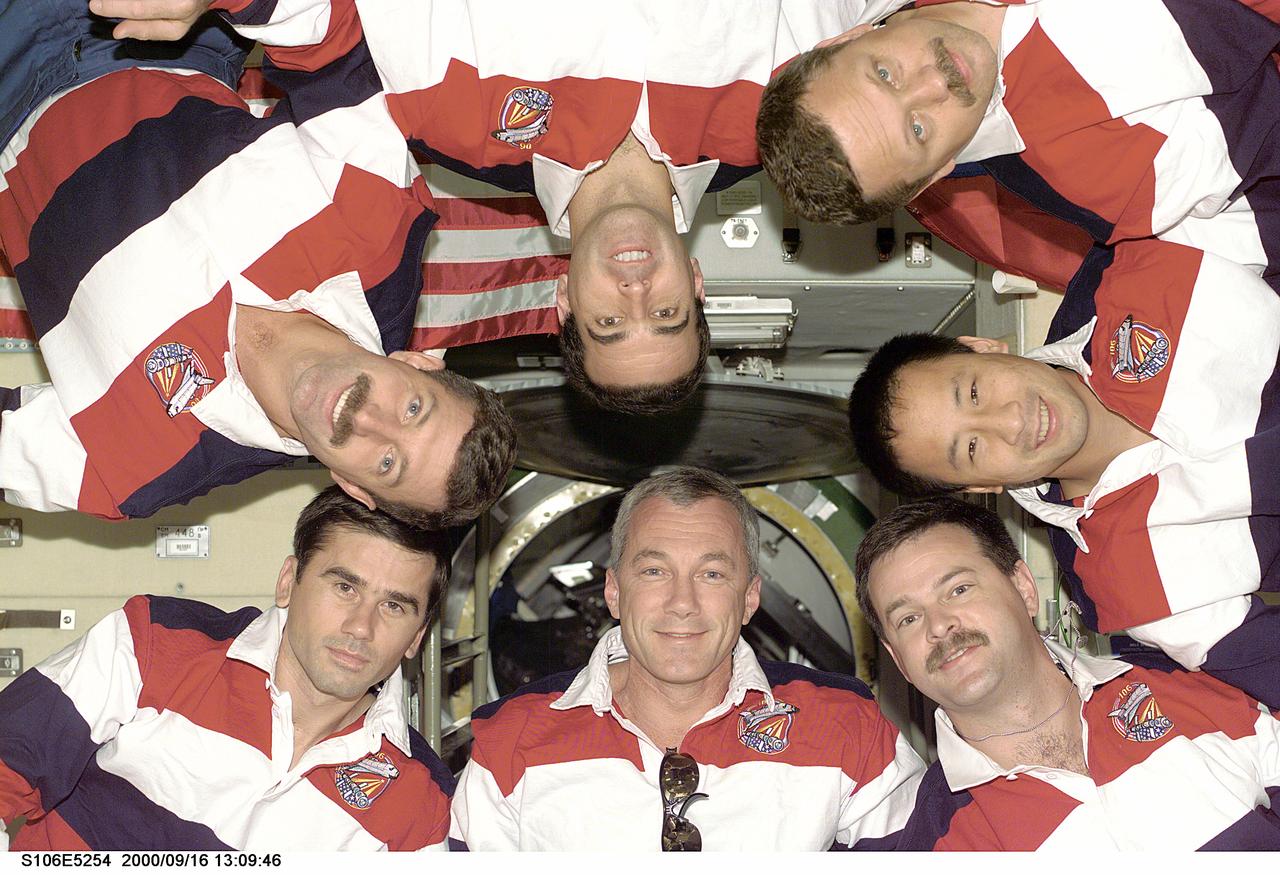
S106-E-5254 (16 September 2000) --- A brief break during busy moving tasks and detail work afforded the STS-106 crew members an opportunity for another traditional inflight crew portrait, snapped by a pre-set electronic still camera (ESC) nearby. Astronaut Terrence W. Wilcutt, mission commander, is at bottom center. Counterclockwise from that point are cosmonaut Yuri I. Malenchenko, astronauts Daniel C. Burbank and Richard A. Mastracchio, cosmonaut Boris V. Morukov and astronaut Edward T. Lu, all mission specialists; along with astronaut Scott D. Altman, pilot. Malenchenko and Morukov represent the Russian Aviation and Space Agency.
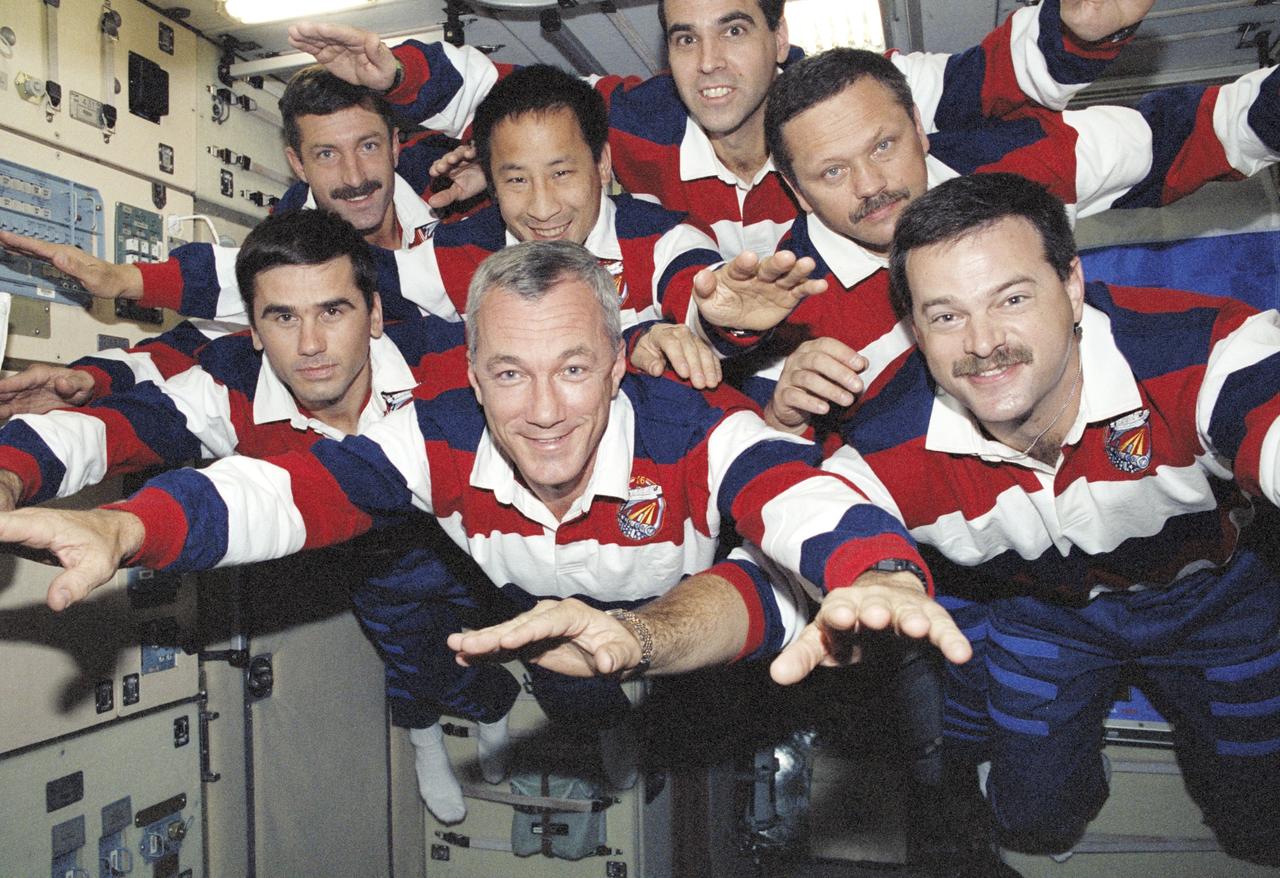
STS106-373-034 (8-20 September 2000) --- The seven crew members for the STS-106 mission pose in a flying position for the traditional in-flight crew portrait in the Zvezda Service Module on the International Space Station (ISS). In the foreground are astronauts Terrence W. Wilcutt (center), mission commander, flanked by cosmonaut Yuri I. Malenchenko (left), mission specialist, and Scott D. Altman, pilot. On the back row are astronauts Daniel C. Burbank, Edward T. Lu, and Richard A. Mastracchio, along with cosmonaut Boris V. Morukov, all mission specialists. Malenchenko and Morukov represent Rosaviakosmos.
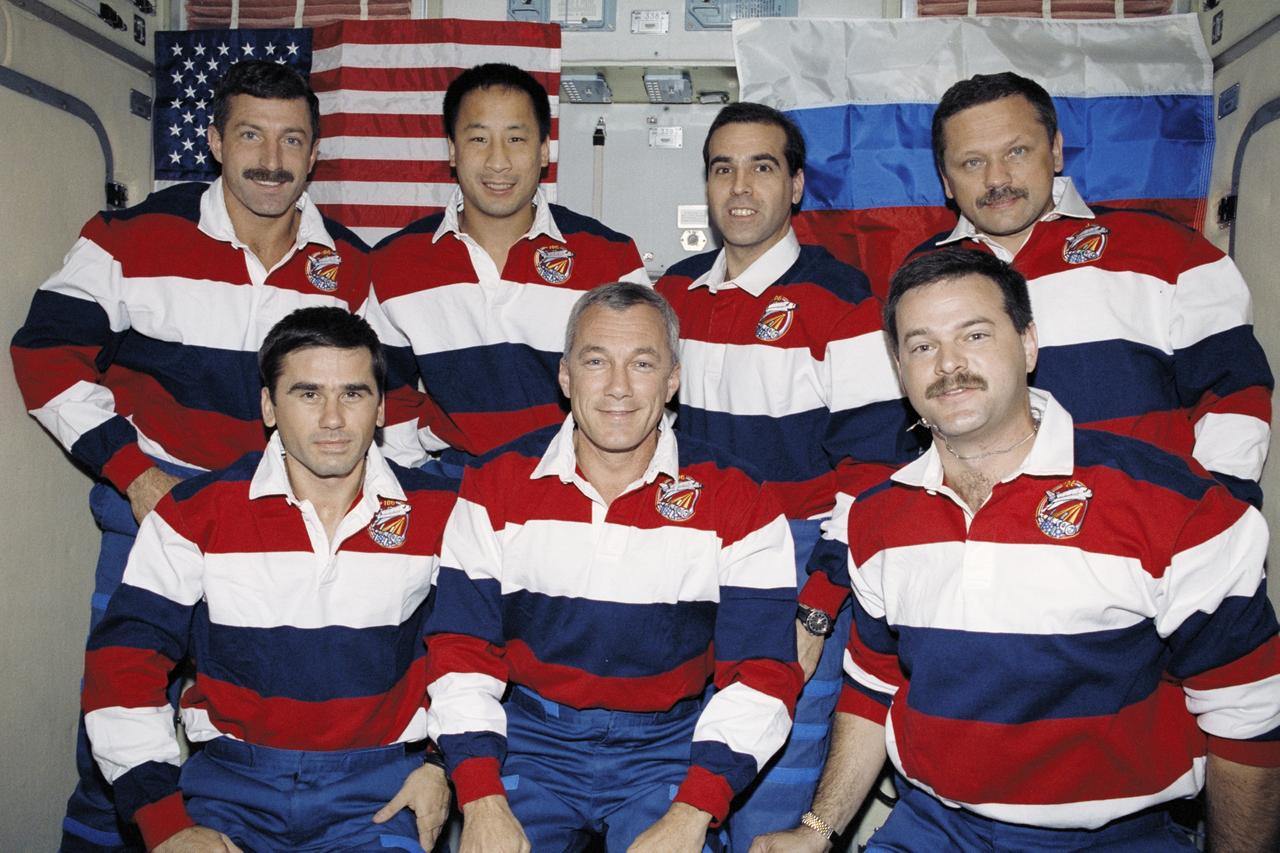
STS106-373-019 (8-20 September 2000) --- Five astronauts and two cosmonauts pose for the STS-106 version of the traditional inflight crew portrait. Though the tradition is long standing, this portrait represents a relatively new element as it was taken onboard the International Space Station, docked for a few days with the Space Shuttle Atlantis. In front, from the left, are cosmonaut Yuri I. Malenchenko, mission specialist; Terrence W. Wilcutt, mission commander; and Scott D. Altman, pilot. In back are, from left, astronauts Daniel C. Burbank, Edward T. Lu and Richard A. Mastracchio, along with cosmonaut Boris V. Morukov. Morukov and Malenchenko represent the Russian Aviaition and Space Agency.
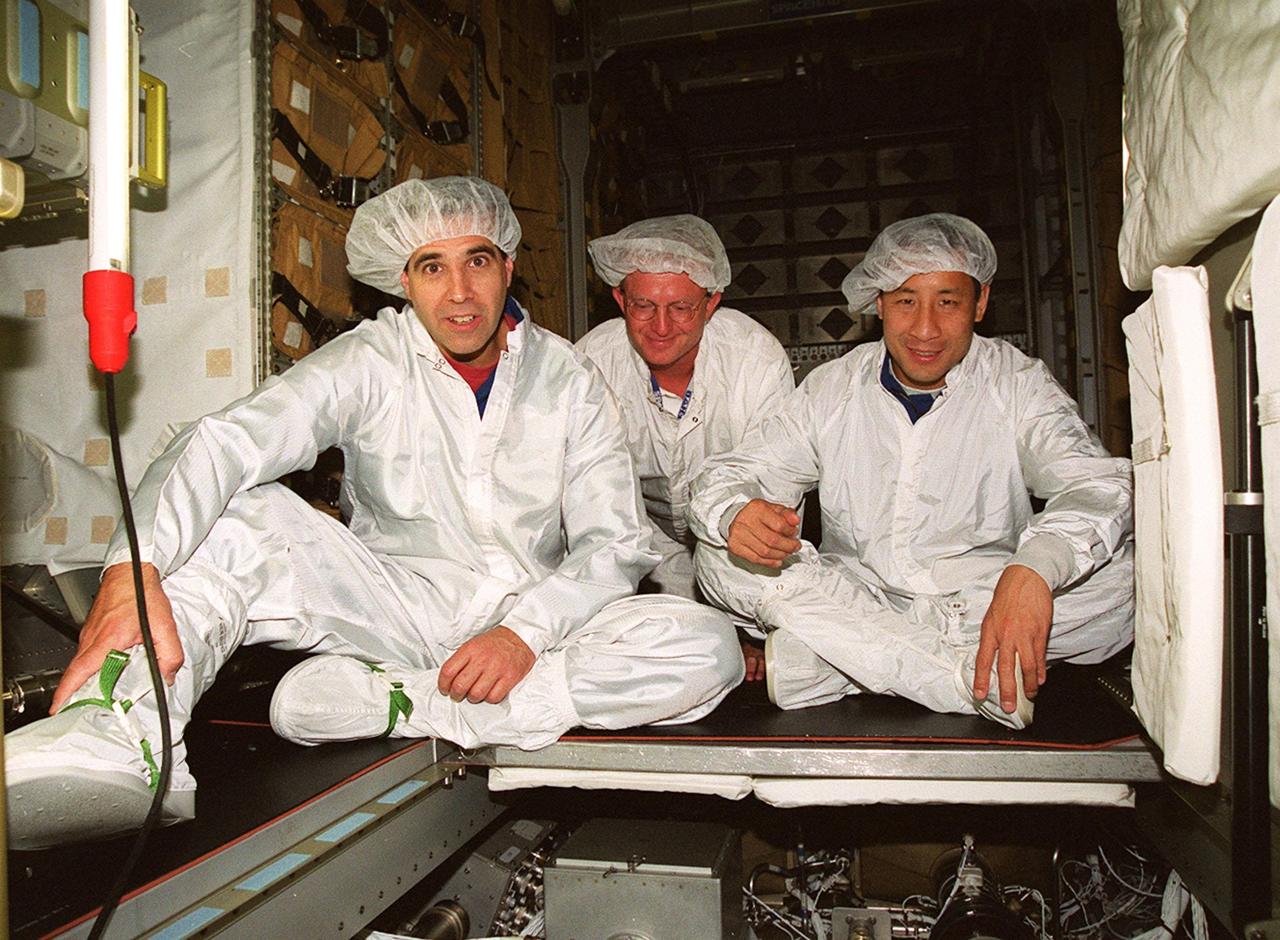
KENNEDY SPACE CENTER, FLA. -- Taking a break in their activities inside the SPACEHAB module are STS-106 Mission Specialists Richard Mastracchio (left) and Edward Lu (right). At center is a Boeing technician. Mastracchio and Lu, along with Pilot Scott Altman and Mission Specialist Boris Morukov, are visiting SPACEHAB to become familiar with the payload on their mission. Morukov is a cosmonaut with the Russian Space Agency. During the mission, the crew will complete service module support tasks on orbit, transfer supplies and outfit the Space Station for the first long-duration crew. STS-106 is scheduled to launch Sept. 8
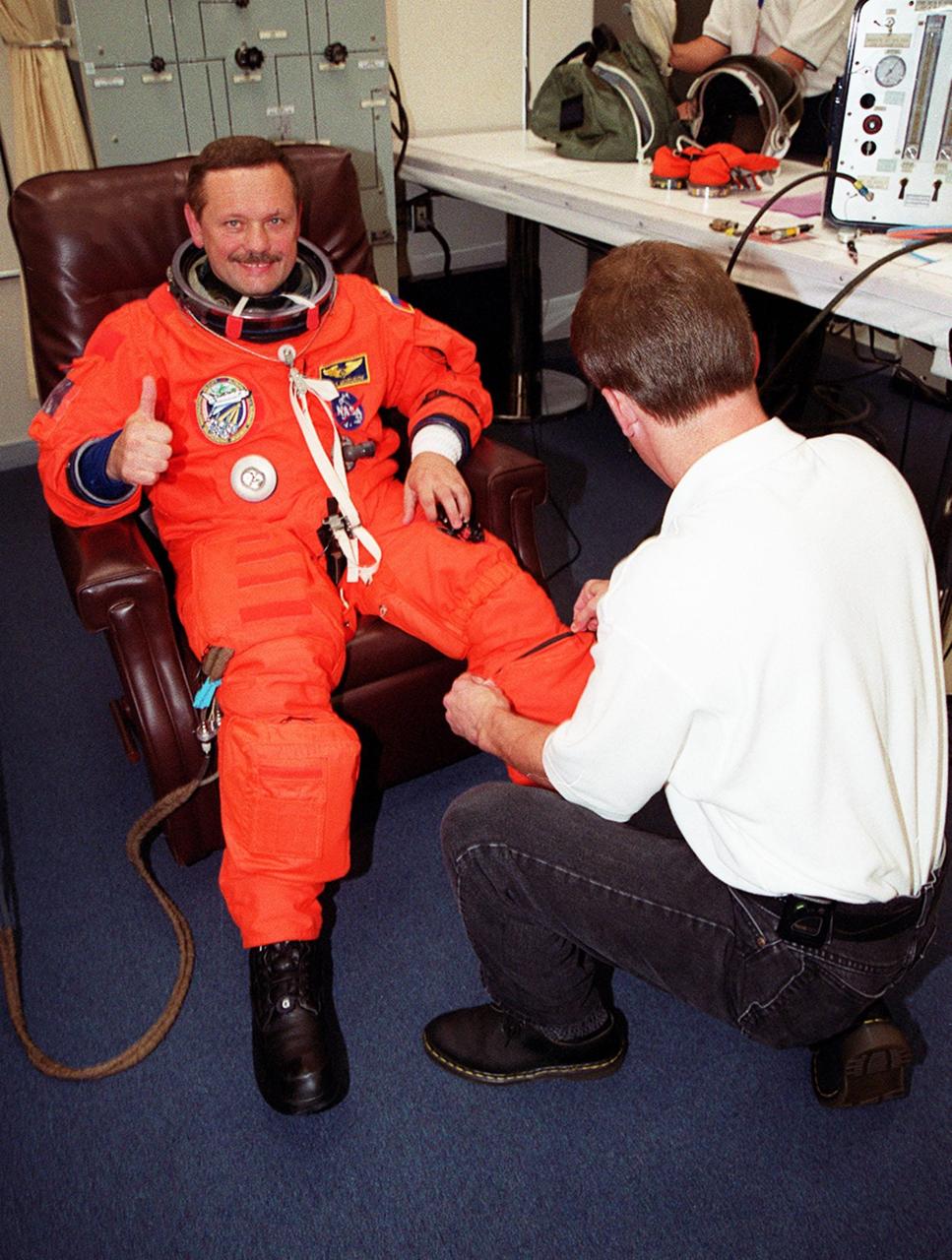
STS-106 Mission Specialist Boris V. Morukov gives a thumbs up for launch during suitup in the Operations and Checkout Building before launch. This is Morukov’s first space flight. Space Shuttle Atlantis is set to lift off 8:45 a.m. EDT on the fourth flight to the International Space Station. During the 11-day mission, the seven-member crew will perform support tasks on orbit, transfer supplies and prepare the living quarters in the newly arrived Zvezda Service Module. The first long-duration crew, dubbed “Expedition One,” is due to arrive at the Station in late fall

STS106-S-002 (June 2000) --- Five NASA astronauts and two cosmonauts representing the Russian Aviation and Space Agency take a break in training from their scheduled September 2000 visit to the International Space Station. Astronauts Terrence W. Wilcutt (right front) and Scott D. Altman (left front) are mission commander and pilot, respectively, for the mission. On the back row are the mission specialists. They are (from left) cosmonaut Boris V. Morukov, along with astronauts Richard A. Mastracchio, Edward T. Lu and Daniel C. Burbank and cosmonaut Yuri I. Malenchenko. Morukov and Malenchenko represent the Russian Aviation and Space Agency.
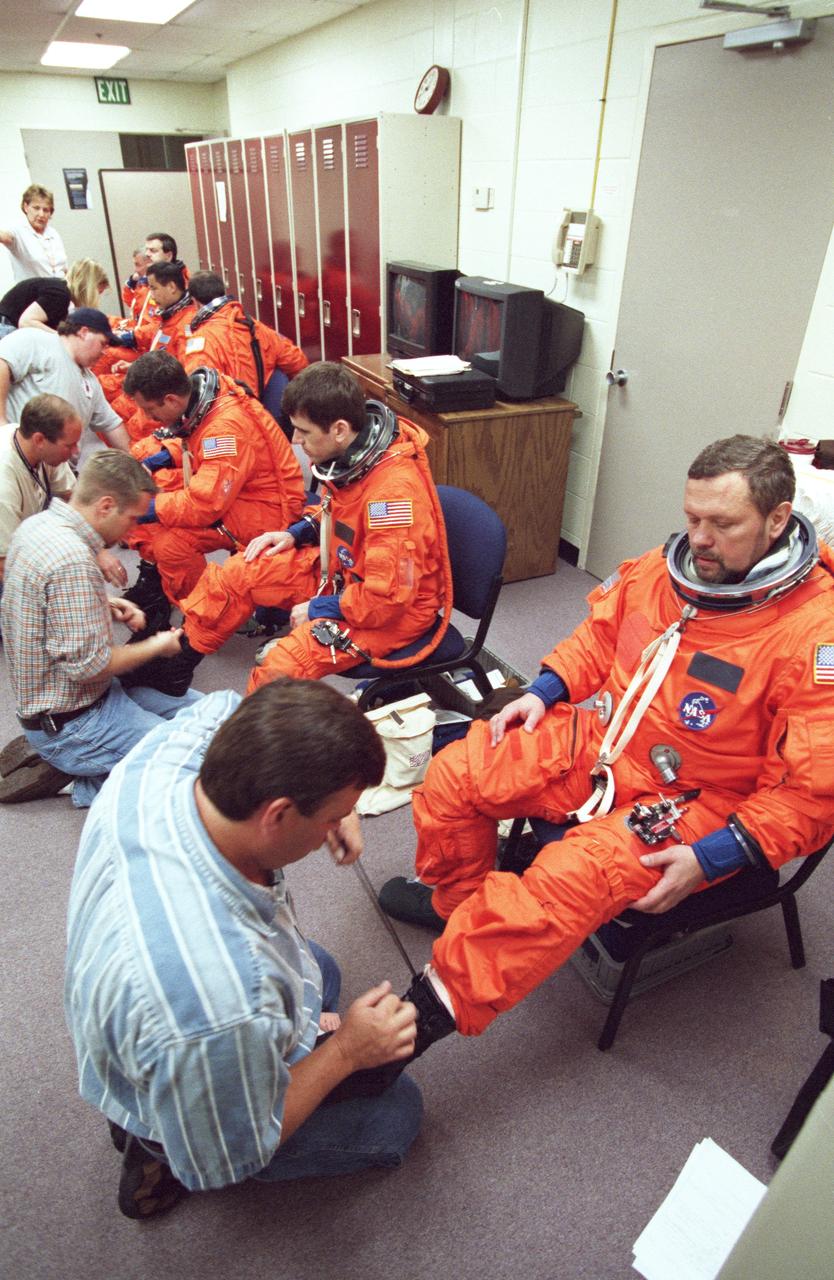
JSC2000-02217 (March 2000) --- United Space Alliance suit technician Mike Birkenseher helps cosmonaut Boris V. Morukov with the donning of his launch and entry suit (LES) prior to STS-106 training in the Systems Integration Facility at the Johnson Space Center (JSC).

JSC2000-03357 (19 April 2000) --- Cosmonaut Boris V. Morukov, mission specialist representing the Russian Aviation and Space Agency, participates in a launch and entry procedures simulation on the mid deck of one of the crew compartment trainers in the Johnson Space Center's Systems Integration Facility.
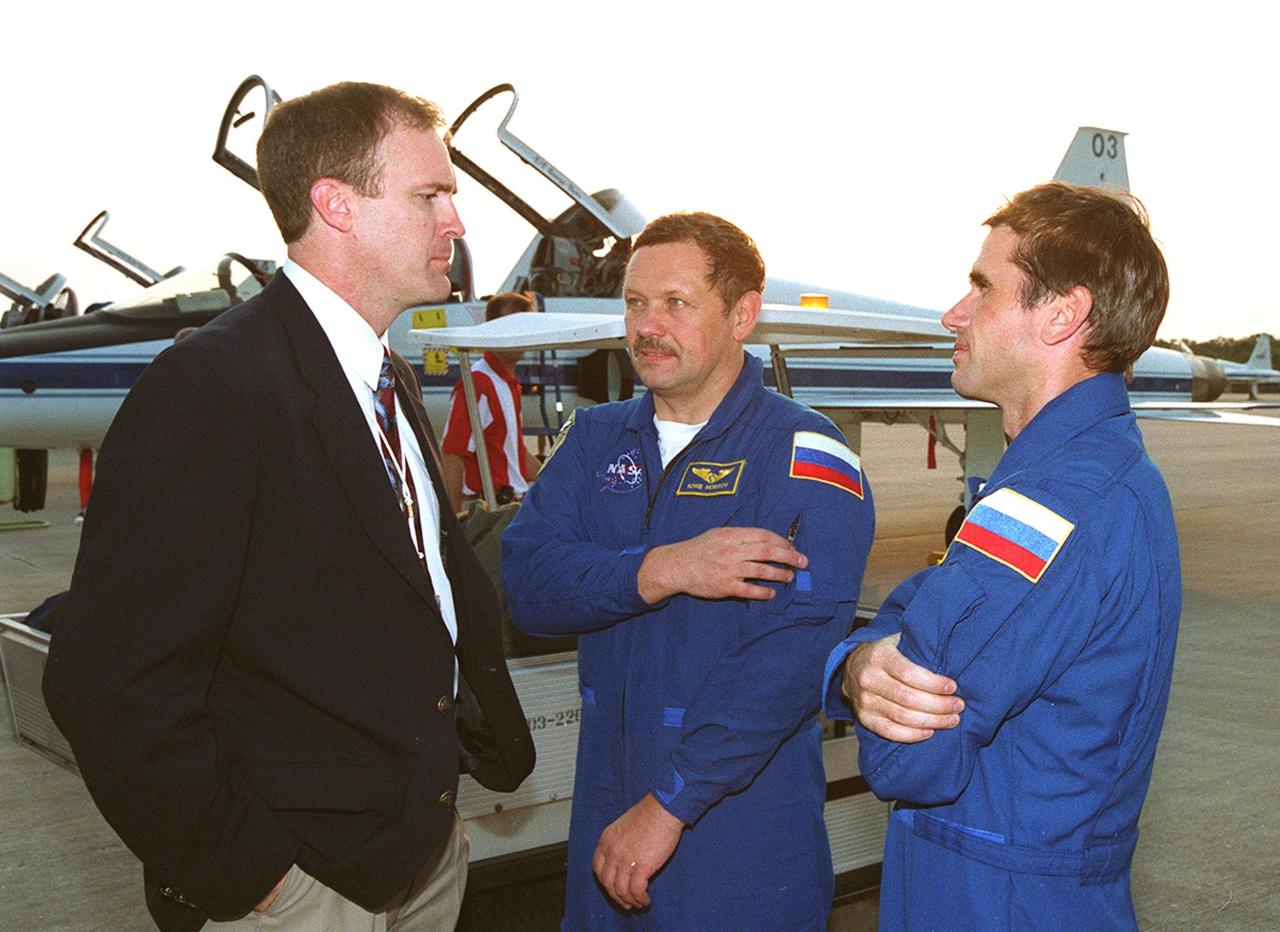
Jim Halsell Jr. (left), former mission commander and now the manager, Shuttle Program Integration Office, chats with STS-106 Mission Specialists Boris V. Morukov (center) and Yuri I. Malenchenko (right) after their arrival at KSC. Morukov and Malenchenko, who are with the Russian Aviation and Space Agency, are at KSC with the rest of the crew to take part in Terminal Countdown Demonstration Test activities, which include emergency egress training and a simulated launch countdown. STS-106 is scheduled to launch Sept. 8, 2000, at 8:31 a.m. EDT from Launch Pad 39B. On the 11-day mission, the seven-member crew will perform support tasks on orbit, transfer supplies and prepare the living quarters in the newly arrived Zvezda Service Module. The first long-duration crew, dubbed “Expedition One,” is due to arrive at the Station in late fall
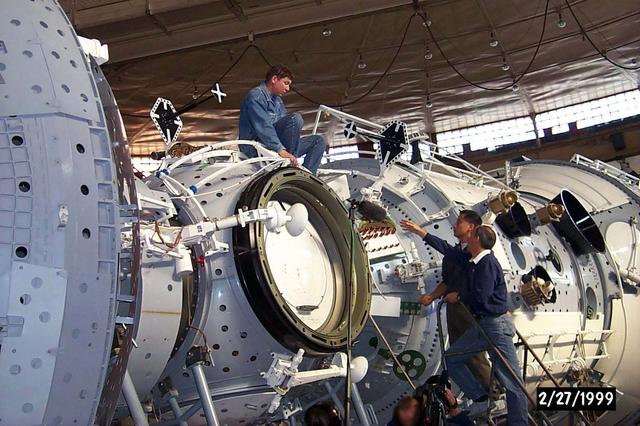
99-E-14665 (27 February 1999) --- Astronauts Edward T. Lu (left) and Jeffrey N. Williams check out full-scale training hardware for the International Space Station (ISS) in the Hydrolab facility at Star City, Russia. The two mission specialists, along with other members of the STS-101 crew, are currently in training at the Gagarin Cosmonaut Training Center for next year's STS-101 mission to the International Space Station (ISS). Editor's Note: Since this photograph was taken, changes in crew personnel have been made. Cosmonauts Yuri I. Malenchenko and Boris V. Morukov, along with astronaut Edward T. Lu were moved to STS-106. Astronauts James S. Voss and Susan J. Helms, and cosmonaut Yury V. Usachev were added to the STS-101 crew. Malenchenko, Morukov and Usachev all represent the Russian Space Agency (RSA).
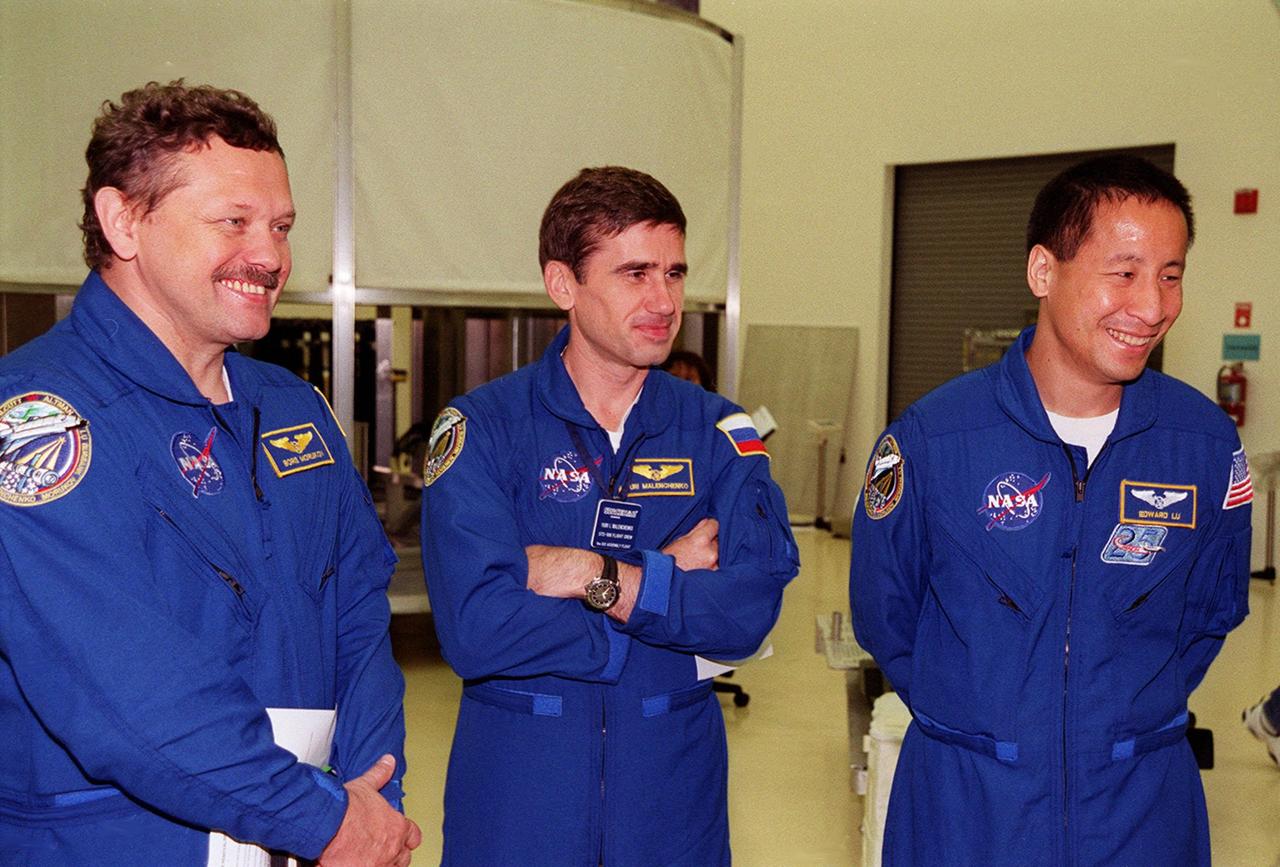
KENNEDY SPACE CENTER, FLA. -- Taking a break during Crew Equipment Interface Test activities at SPACEHAB are STS-106 Mission Specialists Boris V. Morukov, Yuri I. Malenchenko and Edward T. Lu. Malenchenko and Morukov represent the Russian Aviation and Space Agency. STS-106 is scheduled to launch Sept. 8, 2000, at 8:31 a.m. EDT from Launch Pad 39B on an 11-day mission to the International Space Station. The seven-member crew will prepare the Space Station for its first resident crew and begin outfitting the newly arrived Zvezda Service Module. They will perform support tasks on orbit, transfer supplies and prepare the Zvezda living quarters for the first long-duration crew, dubbed “Expedition One,” which is due to arrive at the Station in late fall
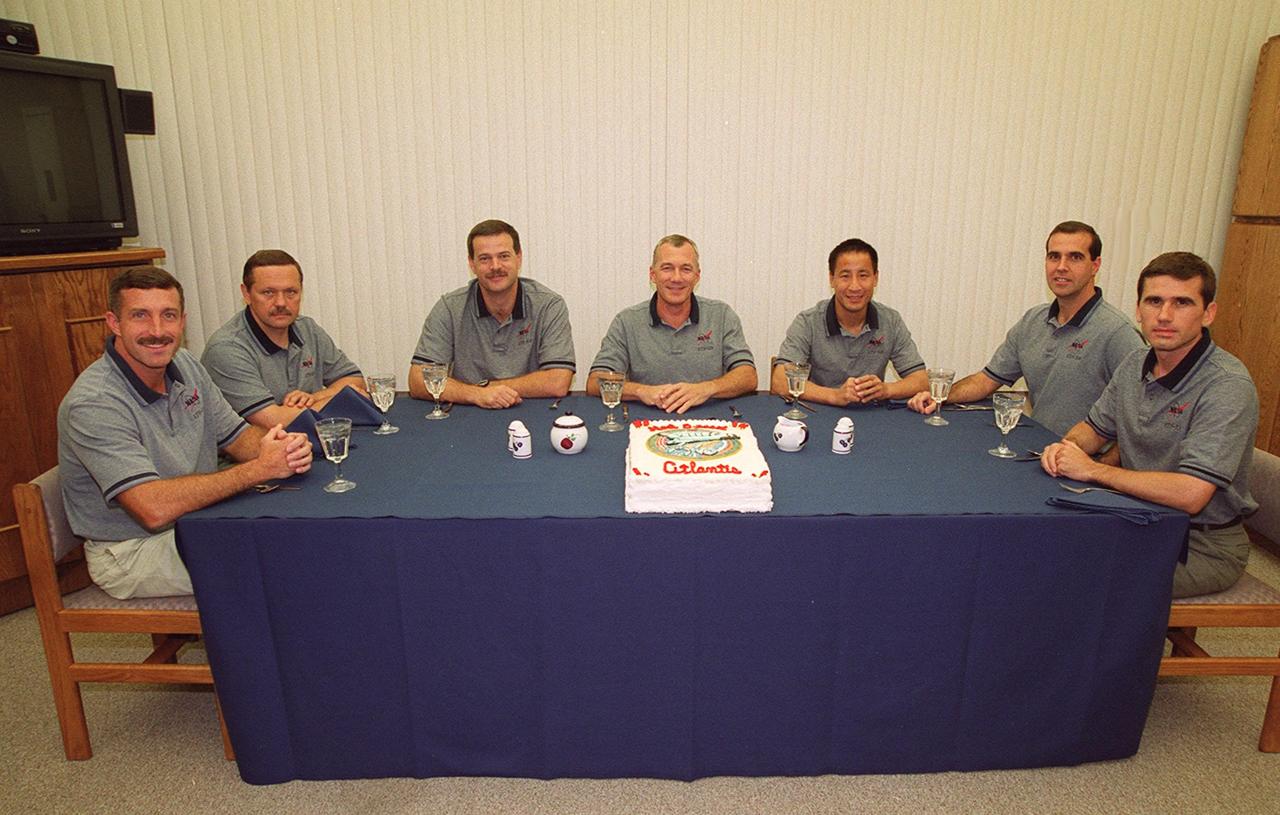
The STS-106 crew relax after breakfast and before suitup for launch. Seated (left to right) are Mission Specialists Daniel C. Burbank and Boris V. Morukov; Pilot Scott D. Altman; Commander Terrence W. Wilcutt; and Mission Specialists Edward T. Lu, Richard A. Mastracchio and Yuri I. Malenchenko. Morukov and Malenchenko are with the Russian Aviation and Space Agency. Launch of Space Shuttle Atlantis is set for 8:45 a.m. EDT on the fourth flight to the International Space Station. On the 11-day mission, the seven-member crew will perform support tasks on orbit, transfer supplies and prepare the living quarters in the newly arrived Zvezda Service Module. The first long-duration crew, dubbed “Expedition One,” is due to arrive at the Station in late fall
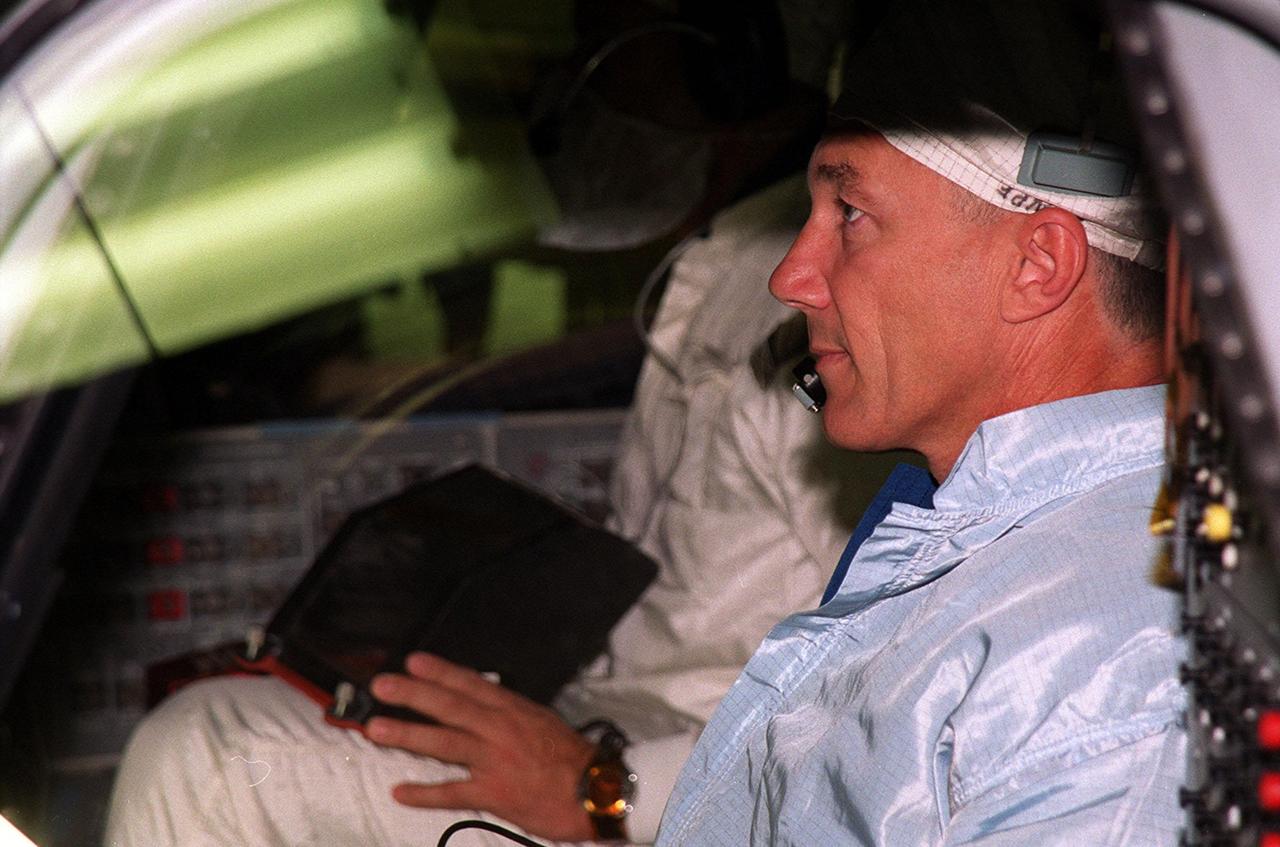
STS-106 Mission Commander Terrence W. Wilcutt checks out the windows in Space Shuttle orbiter Atlantis in Orbiter Processing Facility bay 3. He and the other crew members Pilot Scott D. Altman and Mission Specialists Edward T. Lu, Daniel C. Burbank, Yuri I. Malenchenko, Boris V. Morukov and Richard A. Mastracchio are taking part in Crew Equipment Interface Test (CEIT) activities. Malenchenko and Morukov represent the Russian Aviation and Space Agency. On the 11-day mission, the seven-member crew will perform support tasks on orbit, transfer supplies and prepare the living quarters in the newly arrived Zvezda Service Module for the first long-duration crew, dubbed "Expedition One," which is due to arrive at the Station in late fall. STS-106 is scheduled to launch Sept. 8, 2000, at 8:31 a.m. EDT from Launch Pad 39B
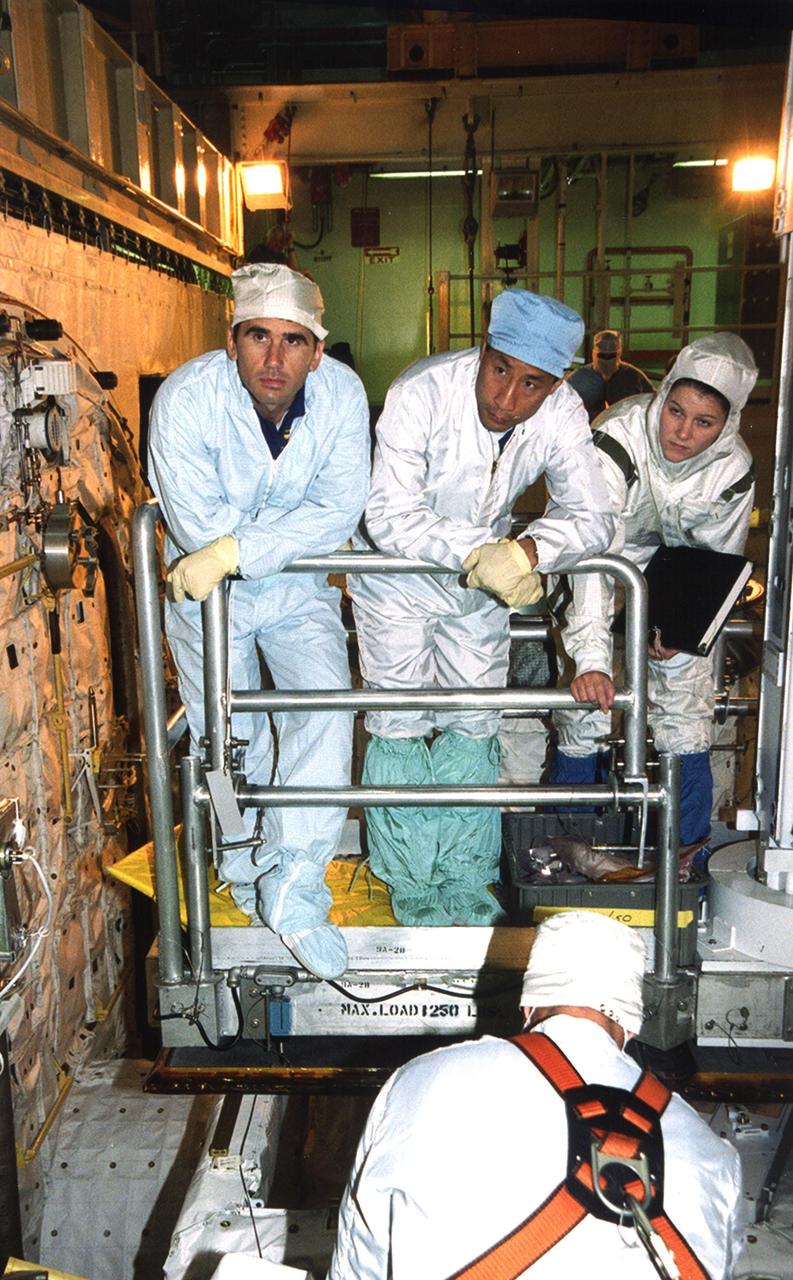
In Orbiter Processing Facility bay 3, STS-106 Mission Specialists Yuri I. Malenchenko (left) and Edward T. Lu (center) familiarize themselves with equipment in the payload bay of Space Shuttle orbiter Atlantis with the help of KSC employees as part of Crew Equipment Interface Test (CEIT) activities for their mission. The other crew members are Commander Terrence W. Wilcutt, Pilot Scott D. Altman, and Mission Specialists Daniel C. Burbank, Boris V. Morukov and Richard A. Mastracchio. Malenchenko and Morukov represent the Russian Aviation and Space Agency. On the 11-day mission, the seven-member crew will perform support tasks on orbit, transfer supplies and prepare the living quarters in the newly arrived Zvezda Service Module for the first long-duration crew, dubbed "Expedition One," which is due to arrive at the Station in late fall. STS-106 is scheduled to launch Sept. 8, 2000, at 8:31 a.m. EDT from Launch Pad 39B
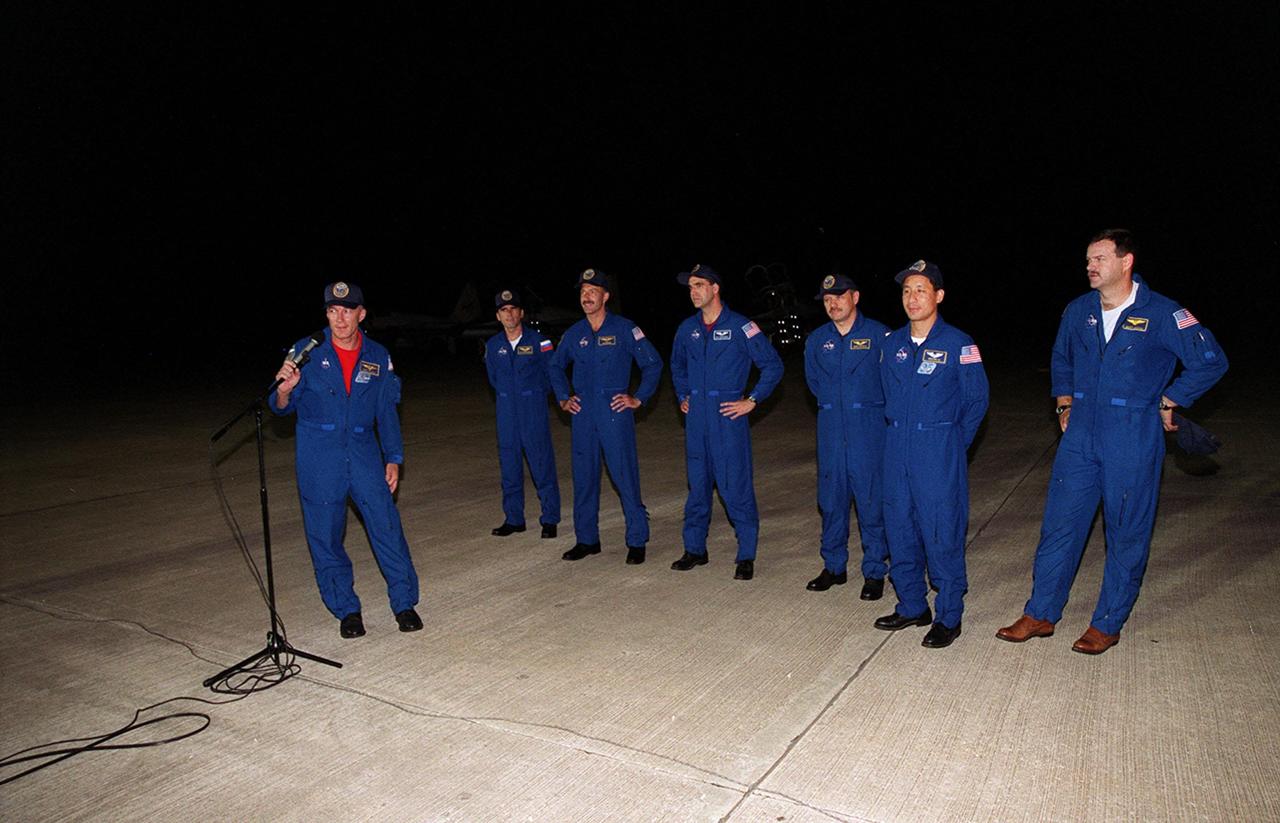
After their arrival at the KSC Shuttle Landing Facility, the STS-106 crew meet the media. Commander Terrence W. Wilcutt, at the microphone, says a few words; the rest of the crew waits behind him. From left, they are Mission Specialists Yuri I. Malenchenko, Daniel C. Burbank, Richard A. Mastracchio, Boris V. Morukov and Edward T. Lu; and Pilot Scott D. Altman. Malenchenko and Morukov are with the Russian Aviation and Space Agency. The crew will be making pre-launch preparations for the fourth flight to the International Space Station. STS-106 is scheduled to launch Sept. 8, 2000, at 8:45 a.m. EDT from Launch Pad 39B. On the 11-day mission, the seven-member crew will perform support tasks on orbit, transfer supplies and prepare the living quarters in the newly arrived Zvezda Service Module. The first long-duration crew, dubbed “Expedition One,” is due to arrive at the Station in late fall
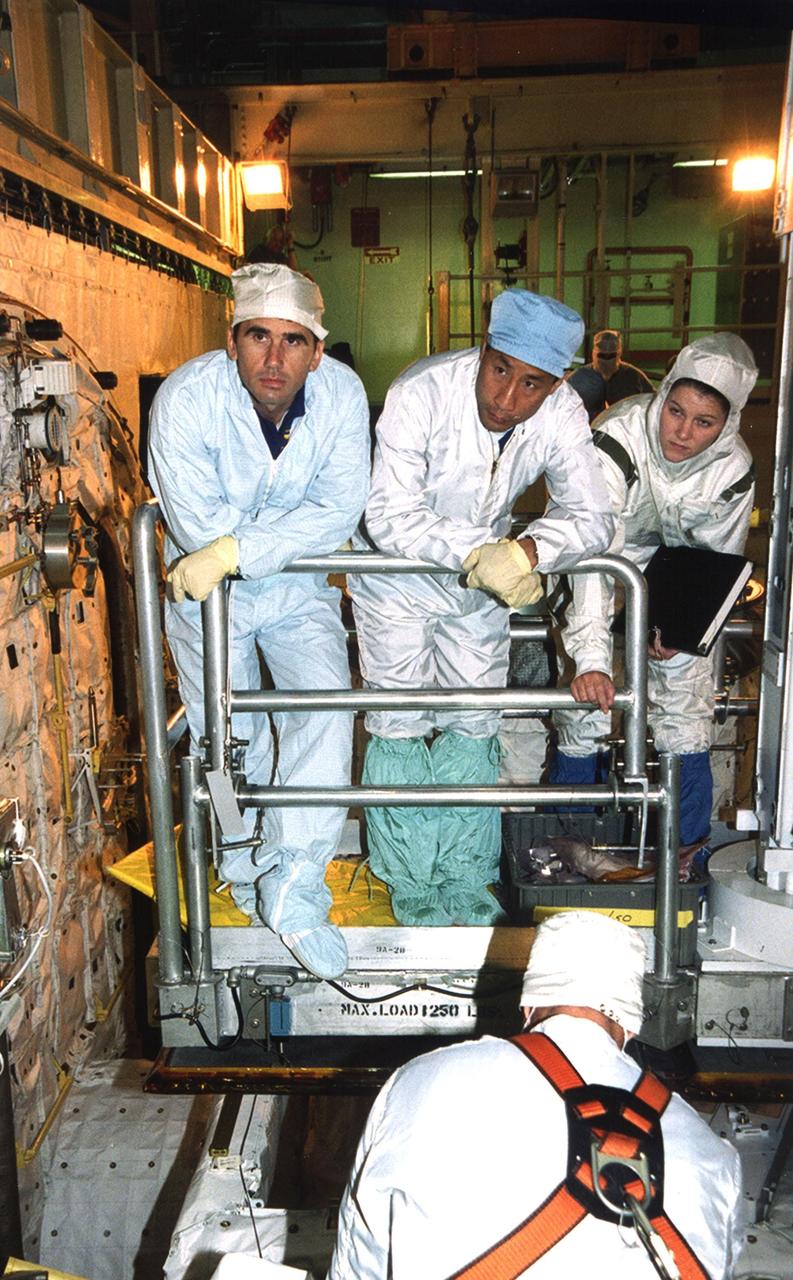
In Orbiter Processing Facility bay 3, STS-106 Mission Specialists Yuri I. Malenchenko (left) and Edward T. Lu (center) familiarize themselves with equipment in the payload bay of Space Shuttle orbiter Atlantis with the help of KSC employees as part of Crew Equipment Interface Test (CEIT) activities for their mission. The other crew members are Commander Terrence W. Wilcutt, Pilot Scott D. Altman, and Mission Specialists Daniel C. Burbank, Boris V. Morukov and Richard A. Mastracchio. Malenchenko and Morukov represent the Russian Aviation and Space Agency. On the 11-day mission, the seven-member crew will perform support tasks on orbit, transfer supplies and prepare the living quarters in the newly arrived Zvezda Service Module for the first long-duration crew, dubbed "Expedition One," which is due to arrive at the Station in late fall. STS-106 is scheduled to launch Sept. 8, 2000, at 8:31 a.m. EDT from Launch Pad 39B
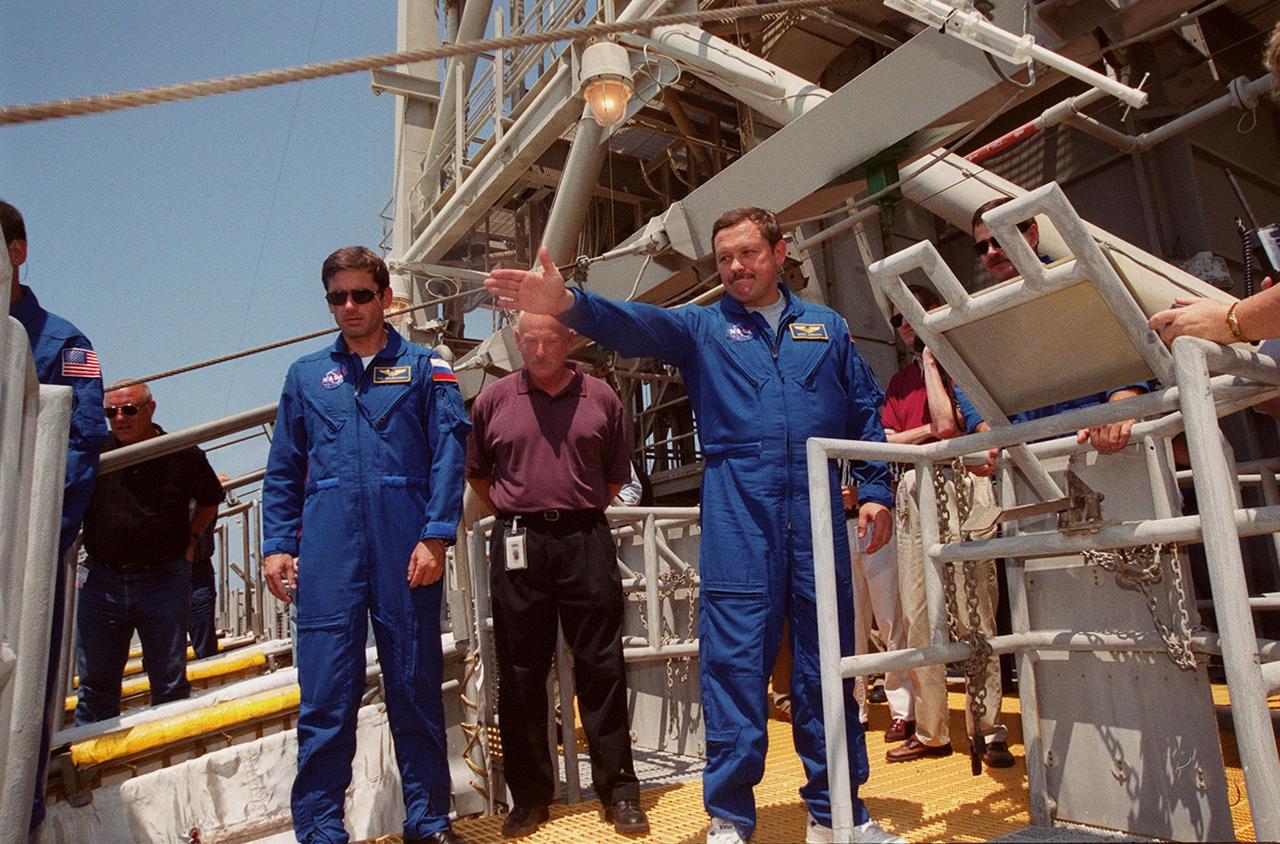
KENNEDY SPACE CENTER, Fla. -- STS-106 Mission Specialist Yuri I. Malenchenko, left, looks on after Boris V. Morukov releases a slide wire basket at the 195-foot level of Launch Pad 39-B. Malenchenko and Morukov are with the Russian Aviation and Space Agency. The flight crew were at Kennedy Space Center to take part in Terminal Countdown Demonstration Test (TCDT) activities. The TCDT provides the crew with emergency egress training and opportunities to inspect their mission payload in the orbiter’s payload bay. STS-106 is scheduled to launch Sept. 8, 2000, at 8:31 a.m. EDT from Launch Pad 39B. On the 11-day mission, the seven-member crew will perform support tasks on orbit, transfer supplies and prepare the living quarters in the newly arrived Zvezda Service Module. The first long-duration crew, dubbed “Expedition One,” is due to arrive at the Station in late fall
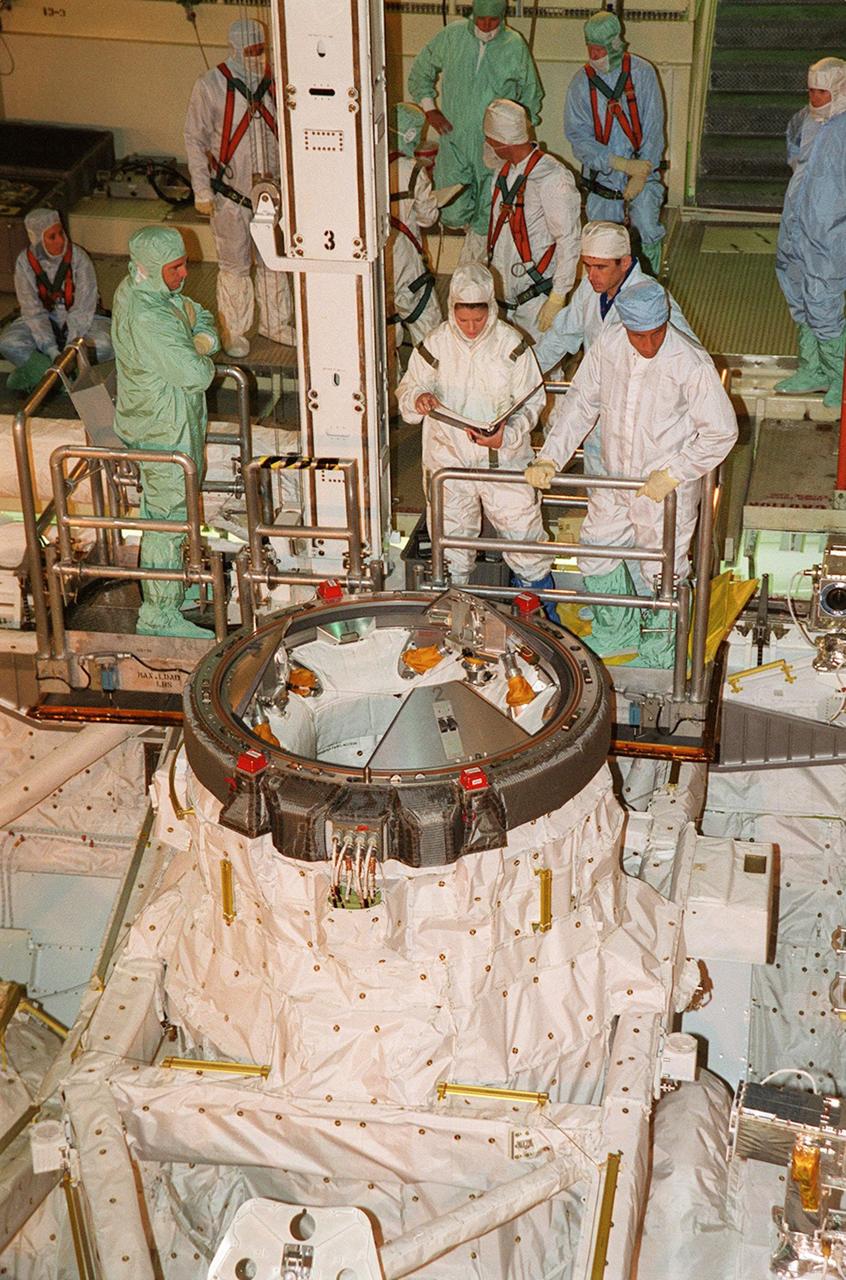
In Orbiter Processing Facility bay 3, the STS-106 crew familiarizes themselves with equipment in the payload bay of Space Shuttle orbiter Atlantis with the help of KSC employees as part of Crew Equipment Interface Test (CEIT) activities for their mission. The STS-106 crew members are Commander Terrence W. Wilcutt, Pilot Scott D. Altman, and Mission Specialists Edward T. Lu, Daniel C. Burbank, Yuri I. Malenchenko, Boris V. Morukov and Richard A. Mastracchio. Malenchenko and Morukov represent the Russian Aviation and Space Agency. On the 11-day mission, the seven-member crew will perform support tasks on orbit, transfer supplies and prepare the living quarters in the newly arrived Zvezda Service Module for the first long-duration crew, dubbed "Expedition One," which is due to arrive at the Station in late fall. STS-106 is scheduled to launch Sept. 8, 2000, at 8:31 a.m. EDT from Launch Pad 39B
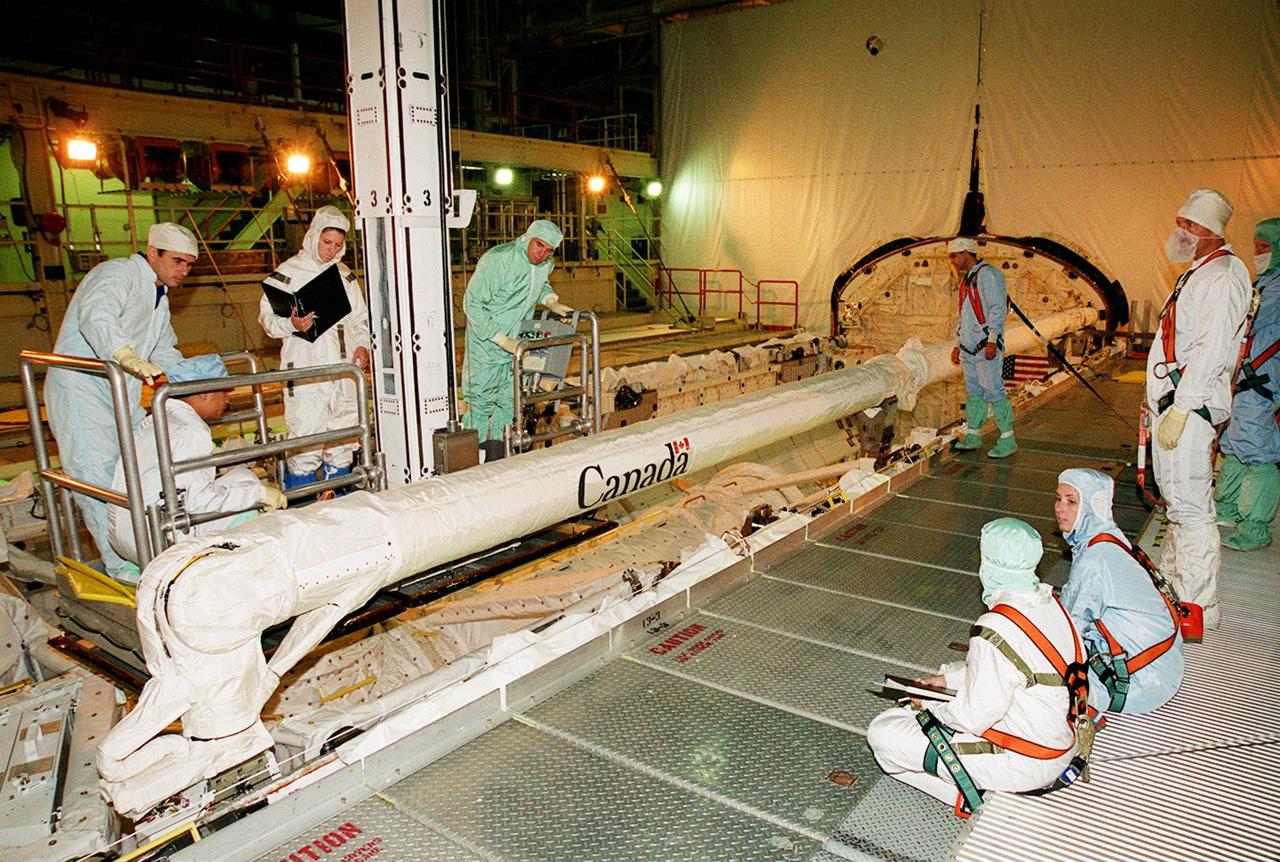
In Orbiter Processing Facility bay 3, the STS-106 crew familiarizes themselves with the payload bay of Space Shuttle orbiter Atlantis with the help of KSC employees as part of Crew Equipment Interface Test (CEIT) activities for their mission. The STS-106 crew members are Commander Terrence W. Wilcutt, Pilot Scott D. Altman, and Mission Specialists Edward T. Lu, Daniel C. Burbank, Yuri I. Malenchenko, Boris V. Morukov and Richard A. Mastracchio. Malenchenko and Morukov represent the Russian Aviation and Space Agency. On the 11-day mission, the seven-member crew will perform support tasks on orbit, transfer supplies and prepare the living quarters in the newly arrived Zvezda Service Module for the first long-duration crew, dubbed "Expedition One," which is due to arrive at the Station in late fall. STS-106 is scheduled to launch Sept. 8, 2000, at 8:31 a.m. EDT from Launch Pad 39B
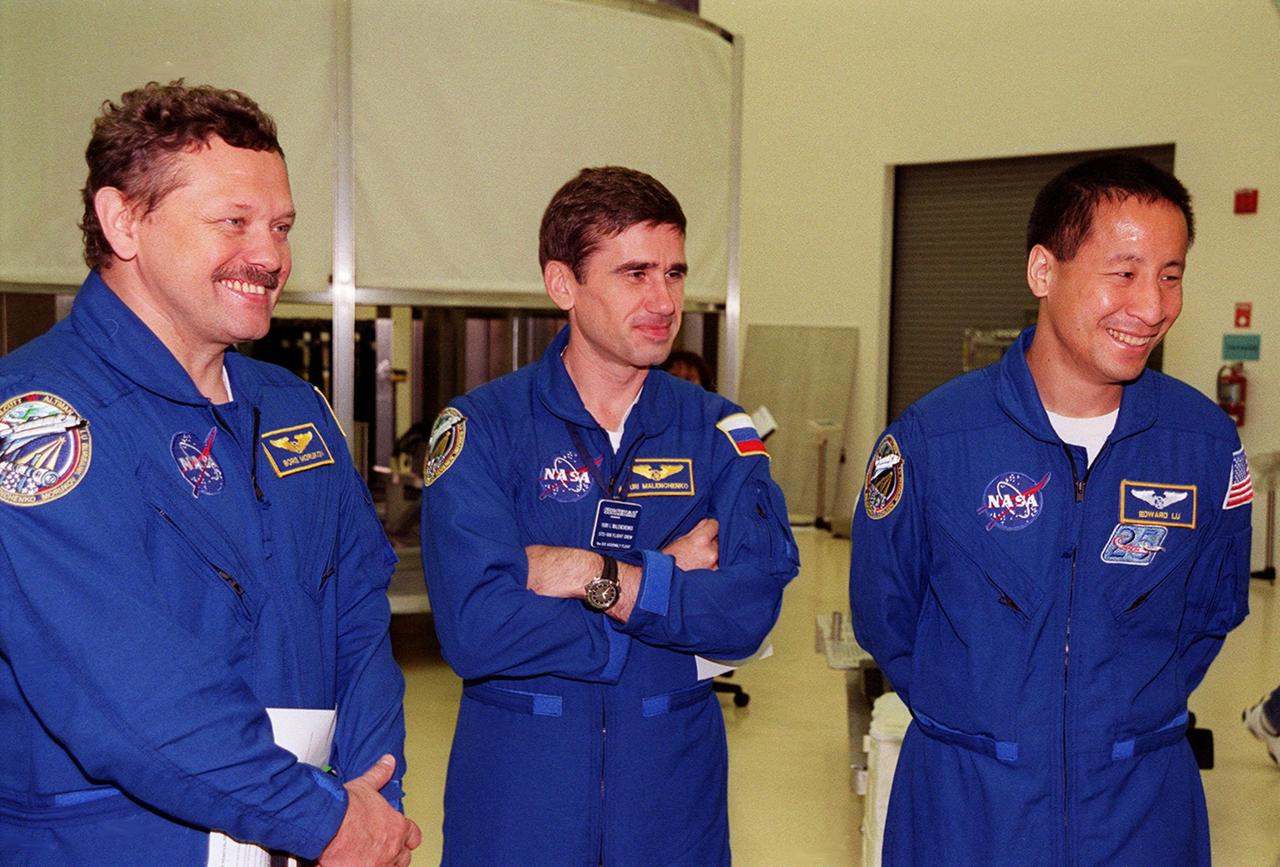
KENNEDY SPACE CENTER, FLA. -- Taking a break during Crew Equipment Interface Test activities at SPACEHAB are STS-106 Mission Specialists Boris V. Morukov, Yuri I. Malenchenko and Edward T. Lu. Malenchenko and Morukov represent the Russian Aviation and Space Agency. STS-106 is scheduled to launch Sept. 8, 2000, at 8:31 a.m. EDT from Launch Pad 39B on an 11-day mission to the International Space Station. The seven-member crew will prepare the Space Station for its first resident crew and begin outfitting the newly arrived Zvezda Service Module. They will perform support tasks on orbit, transfer supplies and prepare the Zvezda living quarters for the first long-duration crew, dubbed “Expedition One,” which is due to arrive at the Station in late fall
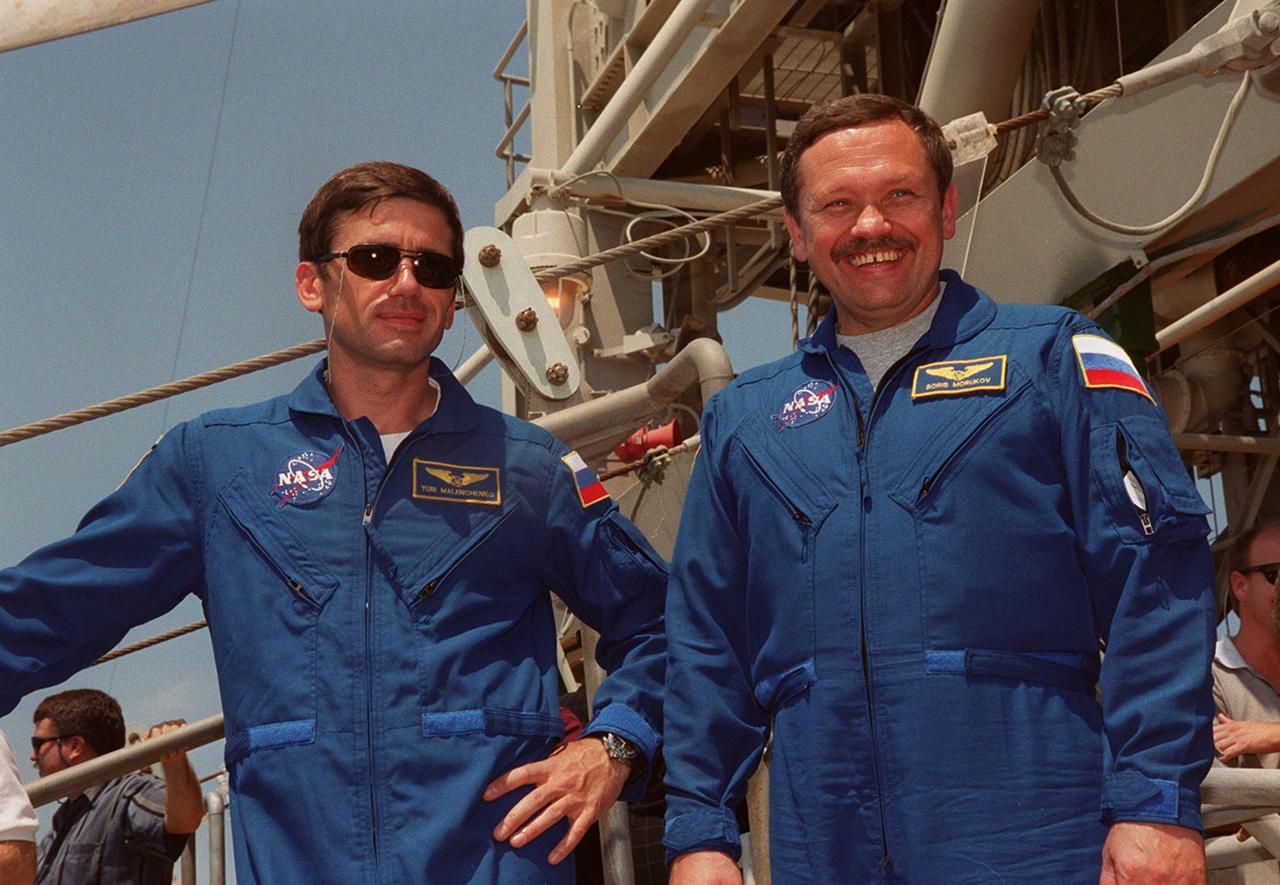
KENNEDY SPACE CENTER, Fla. -- STS-106 Mission Specialists Yuri I. Malenchenko, left, and Boris V. Morukov pause at the 195-foot level of Launch Pad 39-B. Malenchenko and Morukov are with the Russian Aviation and Space Agency. The flight crew were at Kennedy Space Center to take part in Terminal Countdown Demonstration Test (TCDT) activities. The TCDT provides the crew with emergency egress training and opportunities to inspect their mission payload in the orbiter’s payload bay. STS-106 is scheduled to launch Sept. 8, 2000, at 8:31 a.m. EDT from Launch Pad 39B. On the 11-day mission, the seven-member crew will perform support tasks on orbit, transfer supplies and prepare the living quarters in the newly arrived Zvezda Service Module. The first long-duration crew, dubbed “Expedition One,” is due to arrive at the Station in late fall

KENNEDY SPACE CENTER, FLA. -- At SPACEHAB members of the STS-106 crew check out equipment they will be using during their mission to the International Space Station. Starting second from left, they are Mission Specialists Daniel C. Burbank, Edward T. Lu, and Yuri I. Malenchenkov; Pilot Scott D. Altman, and Mission Specialists Richard A. Mastracchio and Boris V. Morukov. Not seen is Commander Terrence W. Wilcutt. Malenchenko and Morukov represent the Russian Aviation and Space Agency. The crew is taking part in Crew Equipment Interface Test activities at KSC. On the 11-day mission, the seven-member crew will perform support tasks on orbit, transfer supplies and prepare the living quarters in the newly arrived Zvezda Service Module for the first long-duration crew, dubbed “Expedition One,” which is due to arrive at the Station in late fall. STS-106 is scheduled to launch Sept. 8, 2000, at 8:31 a.m. EDT from Launch Pad 39B
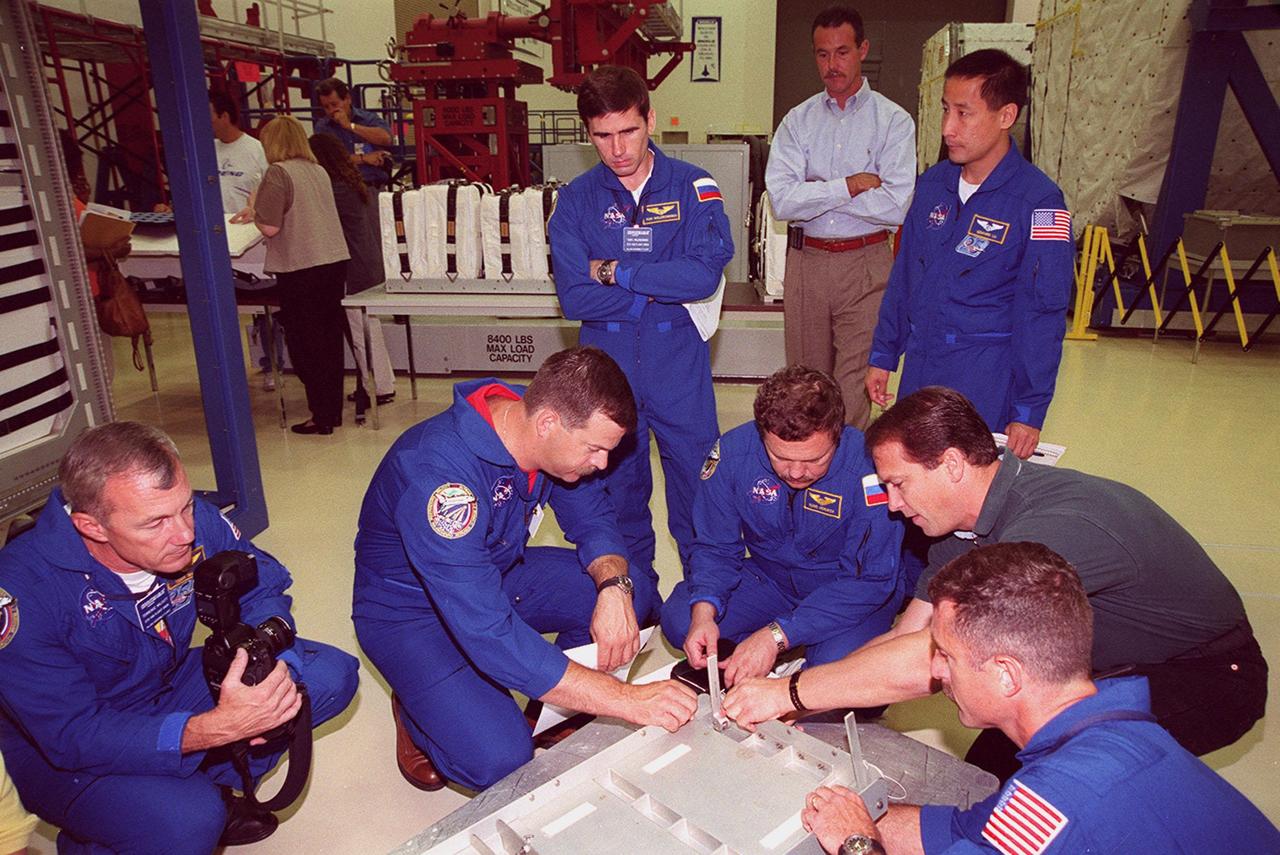
KENNEDY SPACE CENTER, FLA. -- At SPACEHAB members of the STS-106 crew check out equipment they will be using during their mission to the International Space Station. From left are Commander Terrence W. Wilcutt, Pilot Scott D. Altman, and Mission Specialists Yuri I. Malenchenko (standing), Boris V. Morukov, Edward T. Lu (also standing), and (in the foreground, right) Daniel C. Burbank. Malenchenko and Morukov represent the Russian Aviation and Space Agency. STS-106 is scheduled to launch Sept. 8, 2000, at 8:31 a.m. EDT from Launch Pad 39B on an 11-day mission. The seven-member crew will prepare the Space Station for its first resident crew and begin outfitting the newly arrived Zvezda Service Module. They will perform support tasks on orbit, transfer supplies and prepare the Zvezda living quarters for the first long-duration crew, dubbed “Expedition One,” which is due to arrive at the Station in late fall
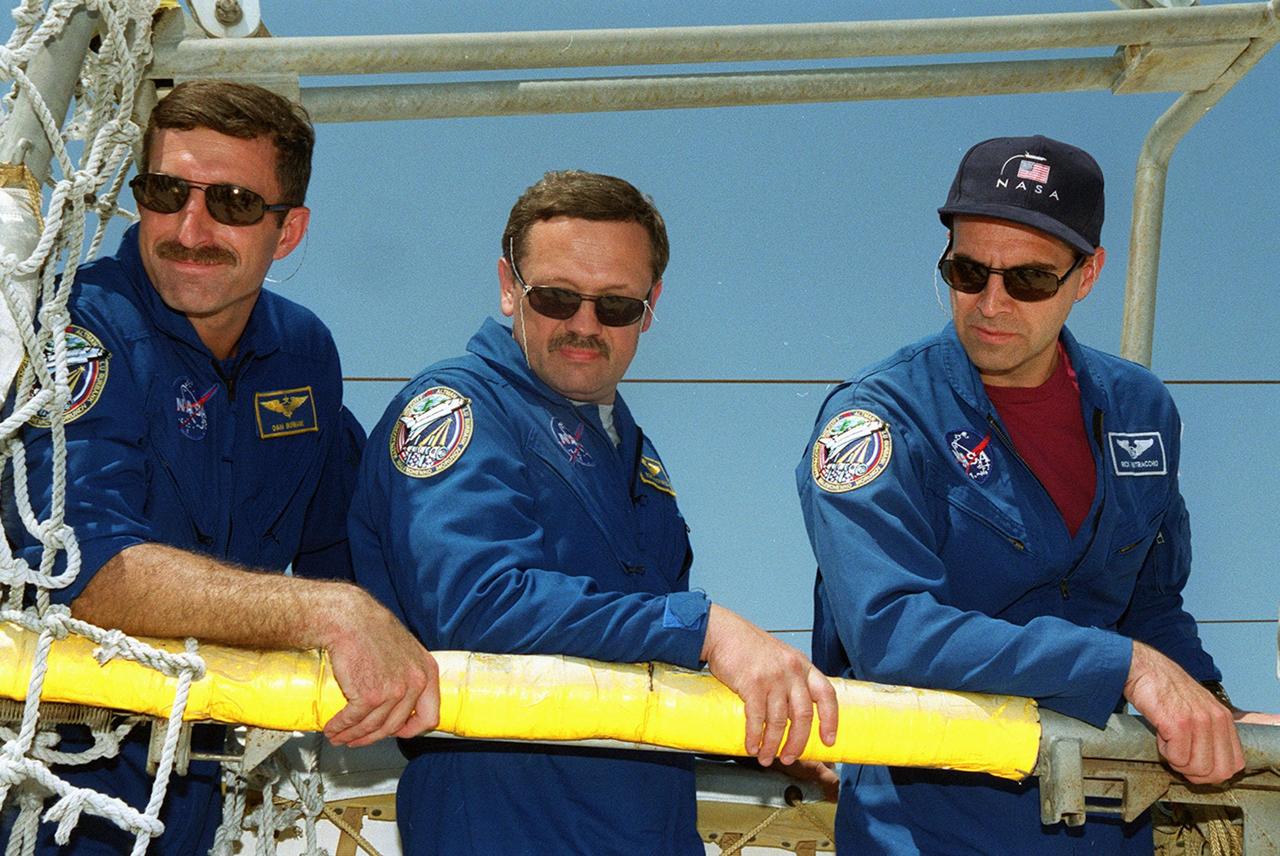
KENNEDY SPACE CENTER, Fla. -- STS-106 Mission Specialists stand in a slide wire basket at the foot of Launch Pad 39-B. Pictured from left are Daniel C. Burbank, Boris V. Morukov and Yuri I. Malenchenko. Malenchenko and Morukov are with the Russian Aviation and Space Agency. The flight crew were at Kennedy Space Center to take part in Terminal Countdown Demonstration Test (TCDT) activities. The TCDT provides the crew with emergency egress training and opportunities to inspect their mission payload in the orbiter’s payload bay. STS-106 is scheduled to launch Sept. 8, 2000, at 8:31 a.m. EDT from Launch Pad 39B. On the 11-day mission, the seven-member crew will perform support tasks on orbit, transfer supplies and prepare the living quarters in the newly arrived Zvezda Service Module. The first long-duration crew, dubbed “Expedition One,” is due to arrive at the Station in late fall
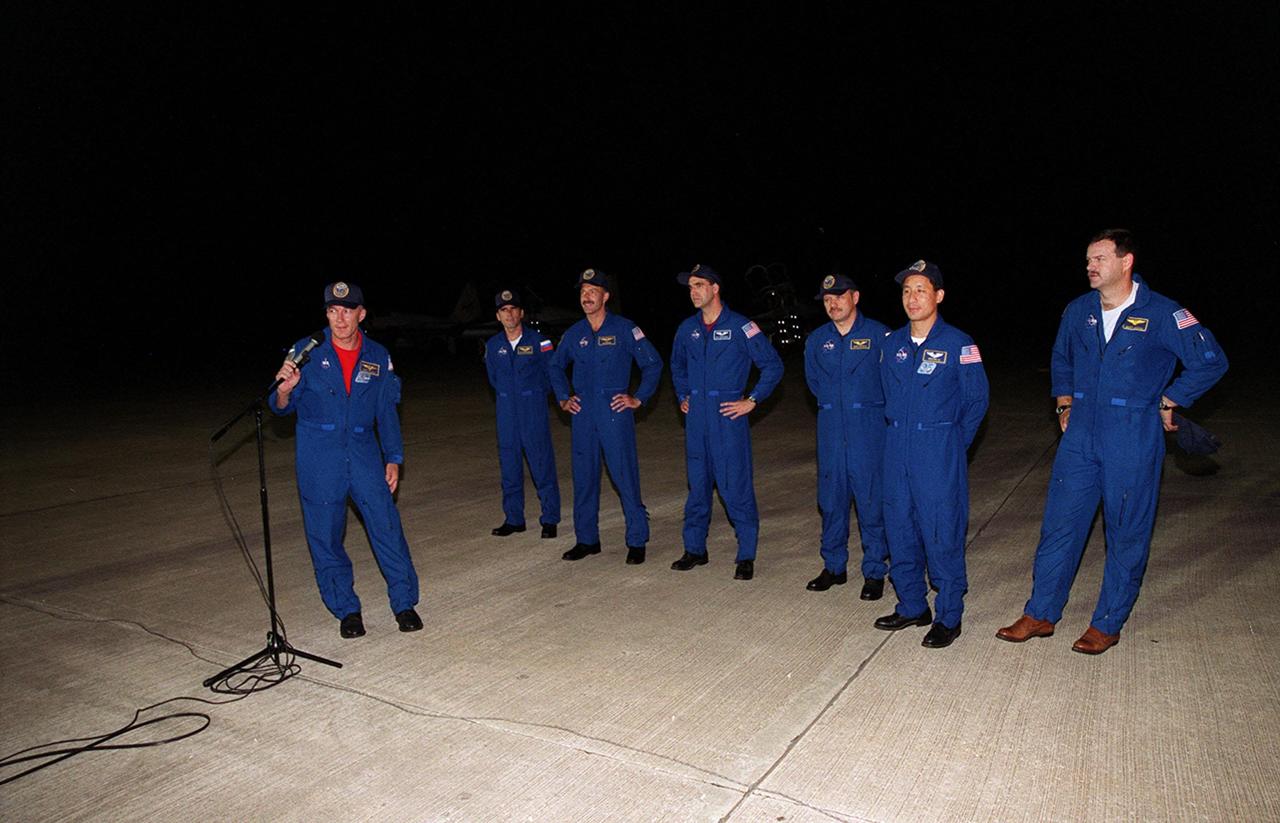
After their arrival at the KSC Shuttle Landing Facility, the STS-106 crew meet the media. Commander Terrence W. Wilcutt, at the microphone, says a few words; the rest of the crew waits behind him. From left, they are Mission Specialists Yuri I. Malenchenko, Daniel C. Burbank, Richard A. Mastracchio, Boris V. Morukov and Edward T. Lu; and Pilot Scott D. Altman. Malenchenko and Morukov are with the Russian Aviation and Space Agency. The crew will be making pre-launch preparations for the fourth flight to the International Space Station. STS-106 is scheduled to launch Sept. 8, 2000, at 8:45 a.m. EDT from Launch Pad 39B. On the 11-day mission, the seven-member crew will perform support tasks on orbit, transfer supplies and prepare the living quarters in the newly arrived Zvezda Service Module. The first long-duration crew, dubbed “Expedition One,” is due to arrive at the Station in late fall
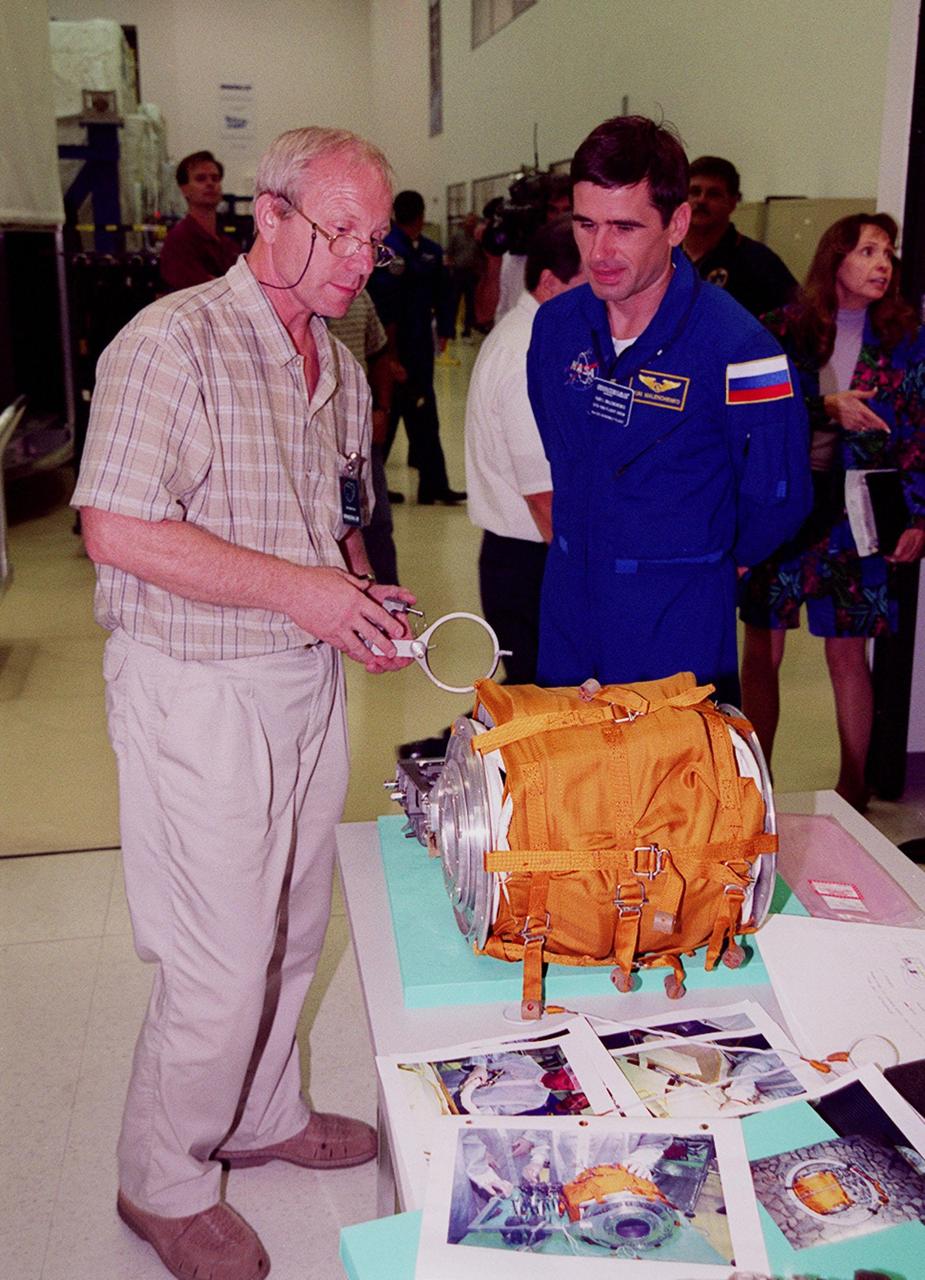
KENNEDY SPACE CENTER, FLA. -- STS-106 Mission Specialist Yuri I. Malenchenko (right) examines equipment at SPACEHAB, part of the payload on the mission to the International Space Station. He and the other crew members Commander Terrence W. Wilcutt, Pilot Scott D. Altman, and Mission Specialists Edward T. Lu, Daniel C. Burbank, Boris V. Morukov and Richard A. Mastracchio are taking part in Crew Equipment Interface Test (CEIT) activities at SPACEHAB. Malenchenko and Morukov represent the Russian Aviation and Space Agency. On the 11-day mission, the seven-member crew will perform support tasks on orbit, transfer supplies and prepare the living quarters in the newly arrived Zvezda Service Module for the first long-duration crew, dubbed "Expedition One," which is due to arrive at the Station in late fall. STS-106 is scheduled to launch Sept. 8, 2000, at 8:31 a.m. EDT from Launch Pad 39B
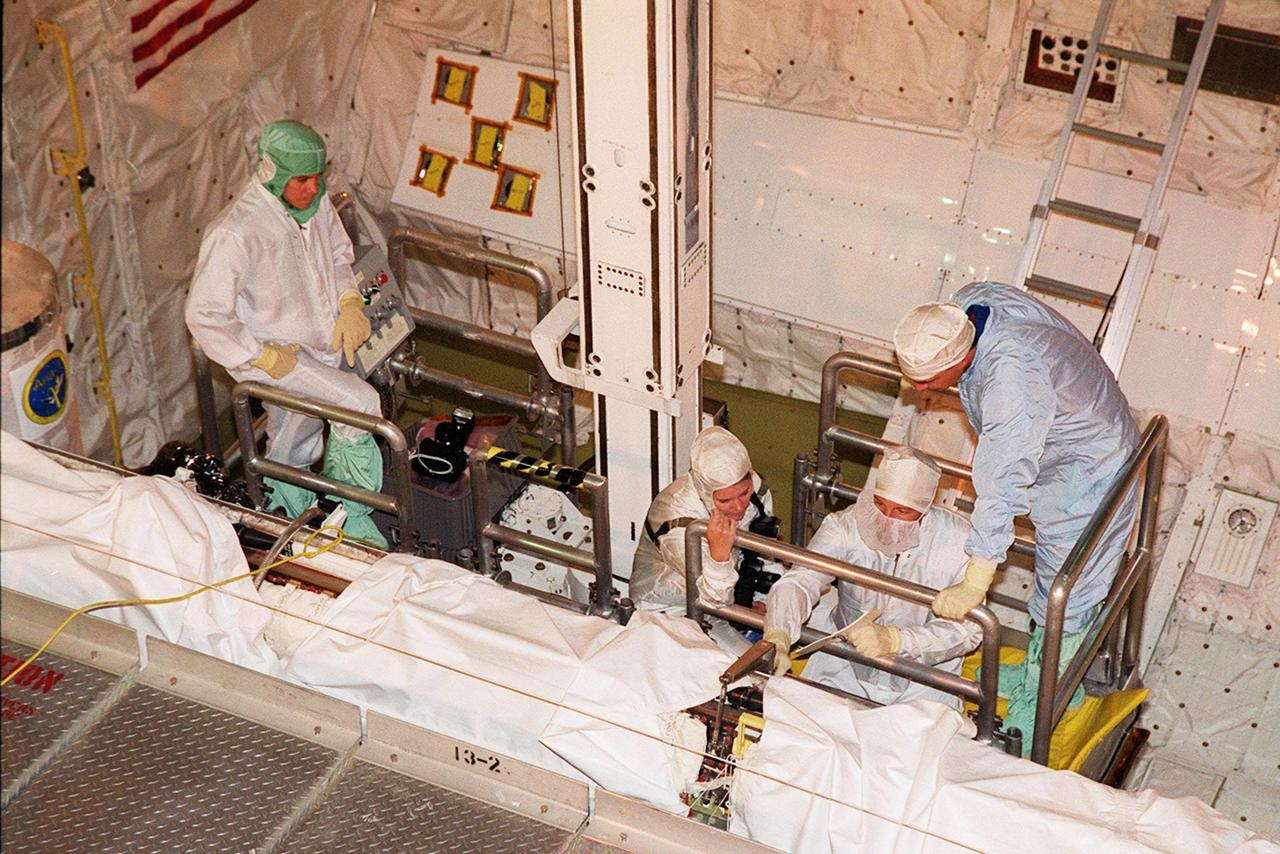
In Orbiter Processing Facility bay 3, members of the STS-106 crew familiarize themselves with equipment in the payload bay of Space Shuttle orbiter Atlantis with the help of KSC employees as part of Crew Equipment Interface Test (CEIT) activities for their mission. The STS-106 crew members are Commander Terrence W. Wilcutt, Pilot Scott D. Altman, and Mission Specialists Edward T. Lu, Daniel C. Burbank, Yuri I. Malenchenko, Boris V. Morukov and Richard A. Mastracchio. Malenchenko and Morukov represent the Russian Aviation and Space Agency. On the 11-day mission, the seven-member crew will perform support tasks on orbit, transfer supplies and prepare the living quarters in the newly arrived Zvezda Service Module for the first long-duration crew, dubbed "Expedition One," which is due to arrive at the Station in late fall. STS-106 is scheduled to launch Sept. 8, 2000, at 8:31 a.m. EDT from Launch Pad 39B
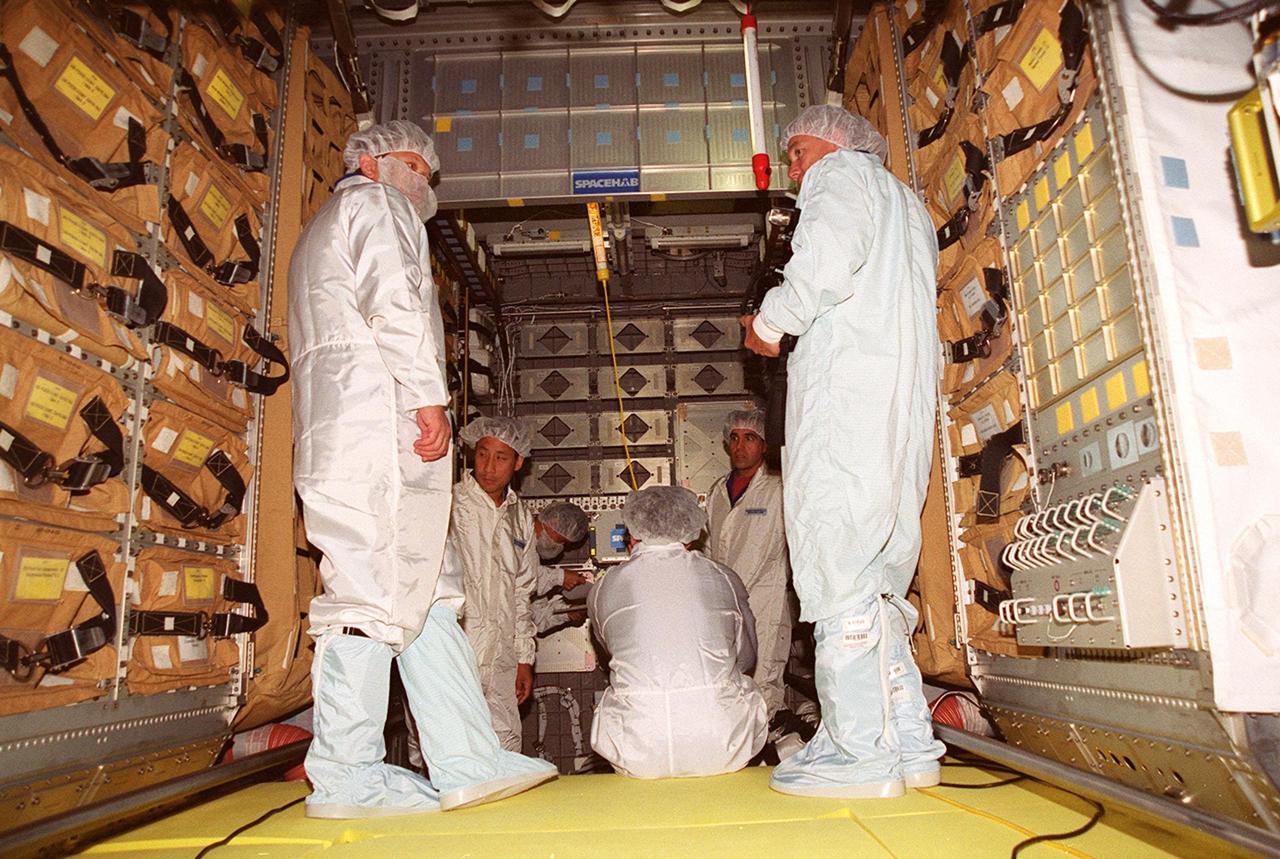
KENNEDY SPACE CENTER, FLA. -- During Crew Equipment Interface Test activities, the STS-106 crew check out equipment inside the SPACEHAB module. From left are Mission Specialists Boris V. Morukov, Edward T. Lu (kneeling), Yuri I. Malenchenko (back to camera) and Richard A. Mastracchio; and Commander Terrence W. Wilcutt. Malenchenko and Morukov represent the Russian Aviation and Space Agency. STS-106 is scheduled to launch Sept. 8, 2000, at 8:31 a.m. EDT from Launch Pad 39B on an 11-day mission to the International Space Station. The seven-member crew will prepare the Space Station for its first resident crew and begin outfitting the newly arrived Zvezda Service Module. They will perform support tasks on orbit, transfer supplies and prepare the Zvezda living quarters for the first long-duration crew, dubbed “Expedition One,” which is due to arrive at the Station in late fall
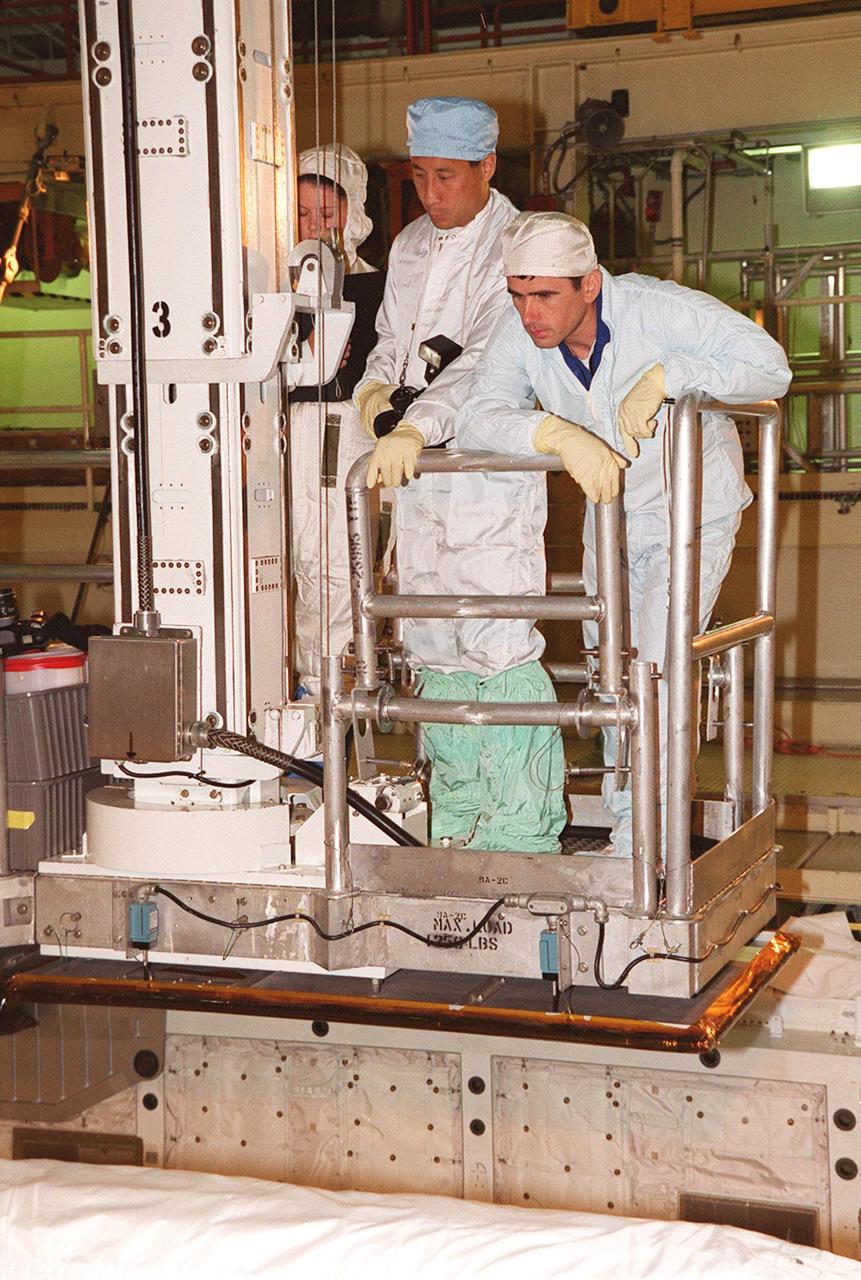
In Orbiter Processing Facility bay 3, STS-106 Mission Specialists Edward T. Lu (center) and Yuri I. Malenchenko (right) familiarize themselves with equipment in the payload bay of Space Shuttle orbiter Atlantis with the help of KSC employees as part of Crew Equipment Interface Test (CEIT) activities for their mission. The other crew members are Commander Terrence W. Wilcutt, Pilot Scott D. Altman, and Mission Specialists Daniel C. Burbank, Boris V. Morukov and Richard A. Mastracchio. Malenchenko and Morukov represent the Russian Aviation and Space Agency. On the 11-day mission, the seven-member crew will perform support tasks on orbit, transfer supplies and prepare the living quarters in the newly arrived Zvezda Service Module for the first long-duration crew, dubbed "Expedition One," which is due to arrive at the Station in late fall. STS-106 is scheduled to launch Sept. 8, 2000, at 8:31 a.m. EDT from Launch Pad 39B
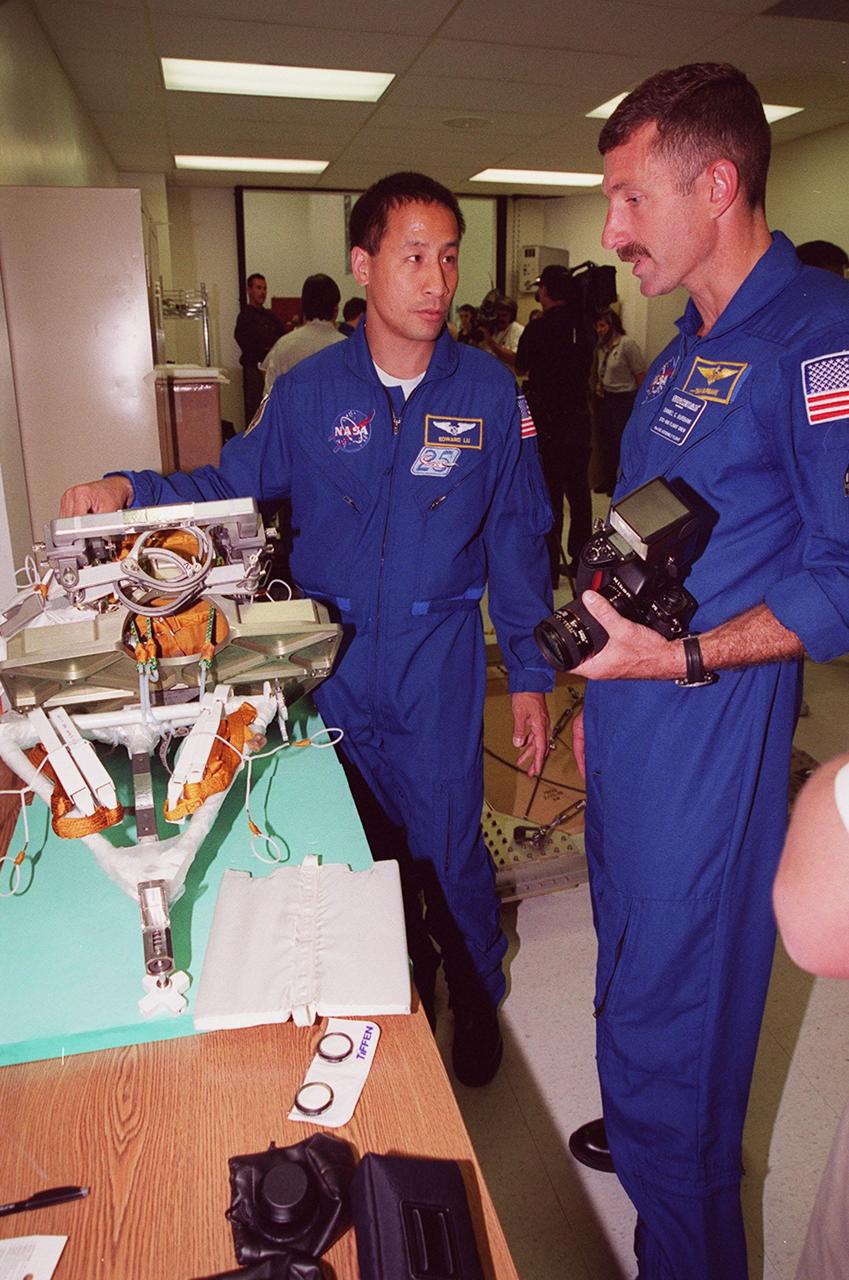
KENNEDY SPACE CENTER, FLA. -- STS-106 Mission Specialists Edward T. Lu (left) and Daniel C. Burbank examine equipment at SPACEHAB, part of the payload on the mission to the International Space Station. They and the other crew members Commander Terrence W. Wilcutt, Pilot Scott D. Altman, and Mission Specialists Yuri I. Malenchenko, Boris V. Morukov and Richard A. Mastracchio are taking part in Crew Equipment Interface Test (CEIT) activities at SPACEHAB. Malenchenko and Morukov represent the Russian Aviation and Space Agency. On the 11-day mission, the seven-member crew will perform support tasks on orbit, transfer supplies and prepare the living quarters in the newly arrived Zvezda Service Module for the first long-duration crew, dubbed "Expedition One," which is due to arrive at the Station in late fall. STS-106 is scheduled to launch Sept. 8, 2000, at 8:31 a.m. EDT from Launch Pad 39B
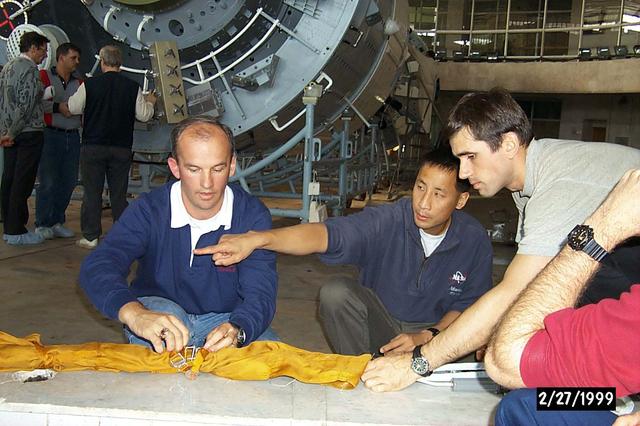
99-E-14662 (27 February 1999)--- From the left, astronauts Jeffrey N. Williams and Edward T. Lu, along with cosmonaut Yuri I. Malenchenko, familiarize themselves with training hardware at the Hydrolab facility in Star City, Russia. The three mission specialists, along with other members of their seven person crew, are currently training at the Gagarin Cosmonaut Training Center for next year's scheduled STS-101 mission to the International Space Station (ISS). Editor's Note: Since this photograph was taken, changes in crew personnel have been made. Cosmonauts Yuri I. Malenchenko and Boris V. Morukov, along with astronaut Edward T. Lu were moved to STS-106. Astronauts James S. Voss and Susan J. Helms, and cosmonaut Yury V. Usachev were added to the STS-101 crew. Malenchenko, Morukov and Usachev all represent the Russian Space Agency (RSA).
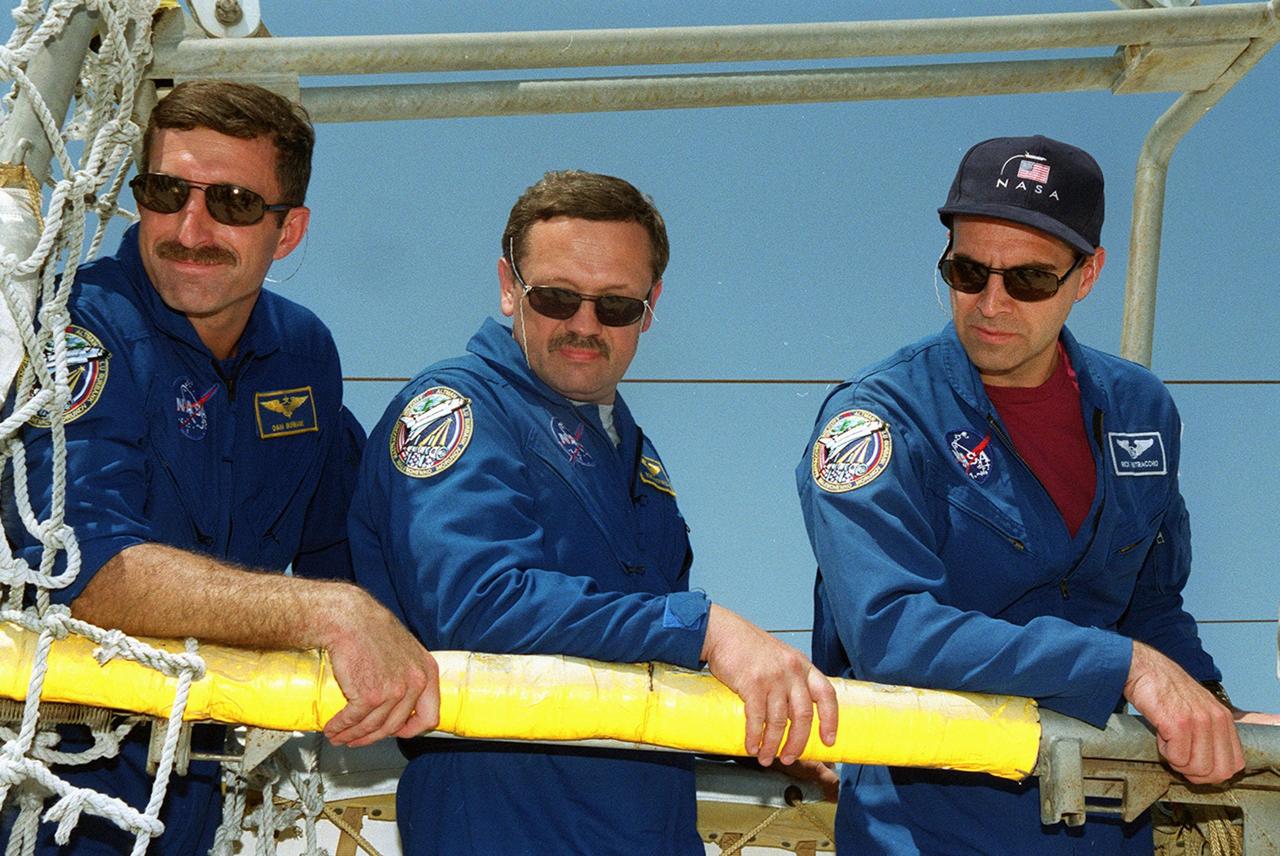
KENNEDY SPACE CENTER, Fla. -- STS-106 Mission Specialists stand in a slide wire basket at the foot of Launch Pad 39-B. Pictured from left are Daniel C. Burbank, Boris V. Morukov and Yuri I. Malenchenko. Malenchenko and Morukov are with the Russian Aviation and Space Agency. The flight crew were at Kennedy Space Center to take part in Terminal Countdown Demonstration Test (TCDT) activities. The TCDT provides the crew with emergency egress training and opportunities to inspect their mission payload in the orbiter’s payload bay. STS-106 is scheduled to launch Sept. 8, 2000, at 8:31 a.m. EDT from Launch Pad 39B. On the 11-day mission, the seven-member crew will perform support tasks on orbit, transfer supplies and prepare the living quarters in the newly arrived Zvezda Service Module. The first long-duration crew, dubbed “Expedition One,” is due to arrive at the Station in late fall
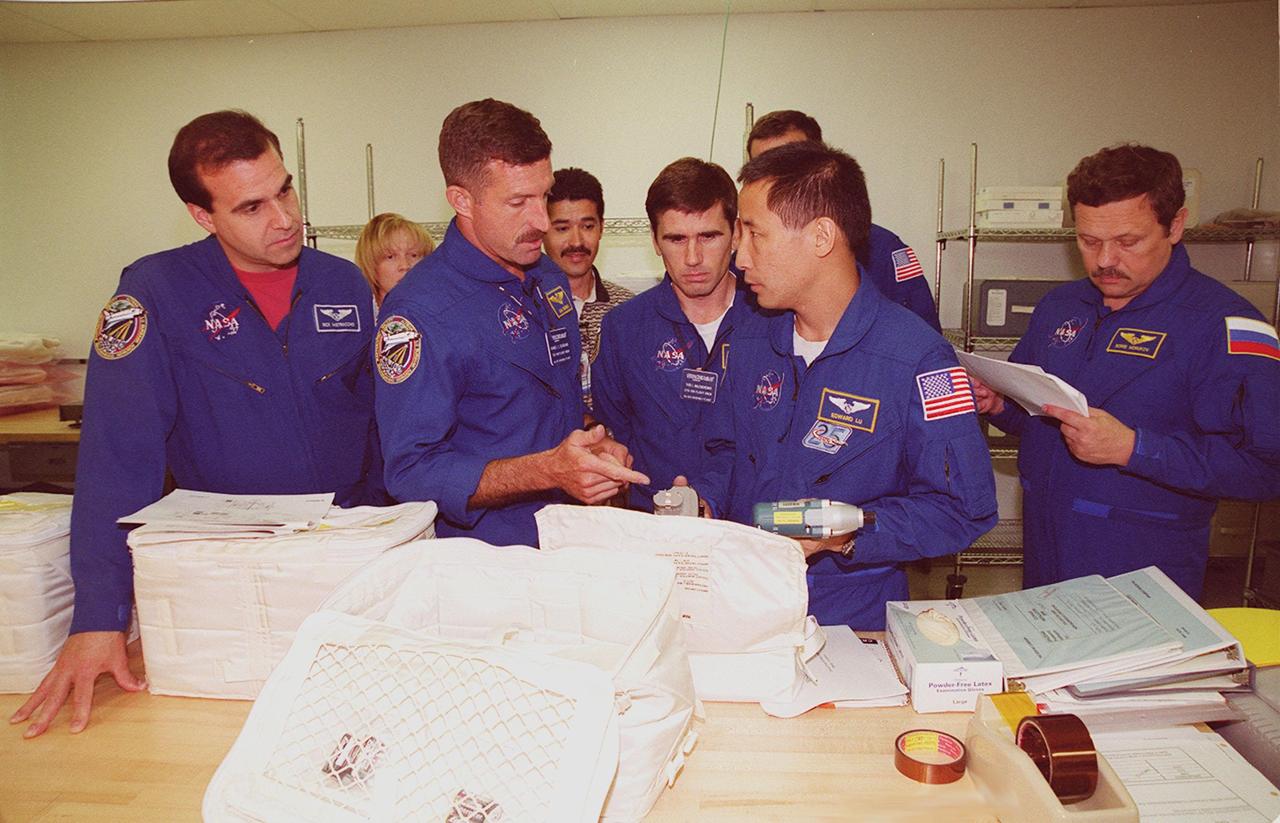
KENNEDY SPACE CENTER, FLA. -- At SPACEHAB members of the STS-106 crew check out equipment they will be using during their mission to the International Space Station. From left are Mission Specialists Richard A. Mastracchio, Daniel C. Burbank, Yuri I. Malenchenko, Edward T. Lu and Boris V. Morukov. Behind Lu is Pilot Scott D. Altman. Not seen is Commander Terrence W. Wilcutt. Malenchenko and Morukov represent the Russian Aviation and Space Agency. The astronauts are taking part in Crew Equipment Interface Test activities at KSC. On the 11-day mission, the seven-member crew will perform support tasks on orbit, transfer supplies and prepare the living quarters in the newly arrived Zvezda Service Module for the first long-duration crew, dubbed "Expedition One," which is due to arrive at the Station in late fall. STS-106 is scheduled to launch Sept. 8, 2000, at 8:31 a.m. EDT from Launch Pad 39B
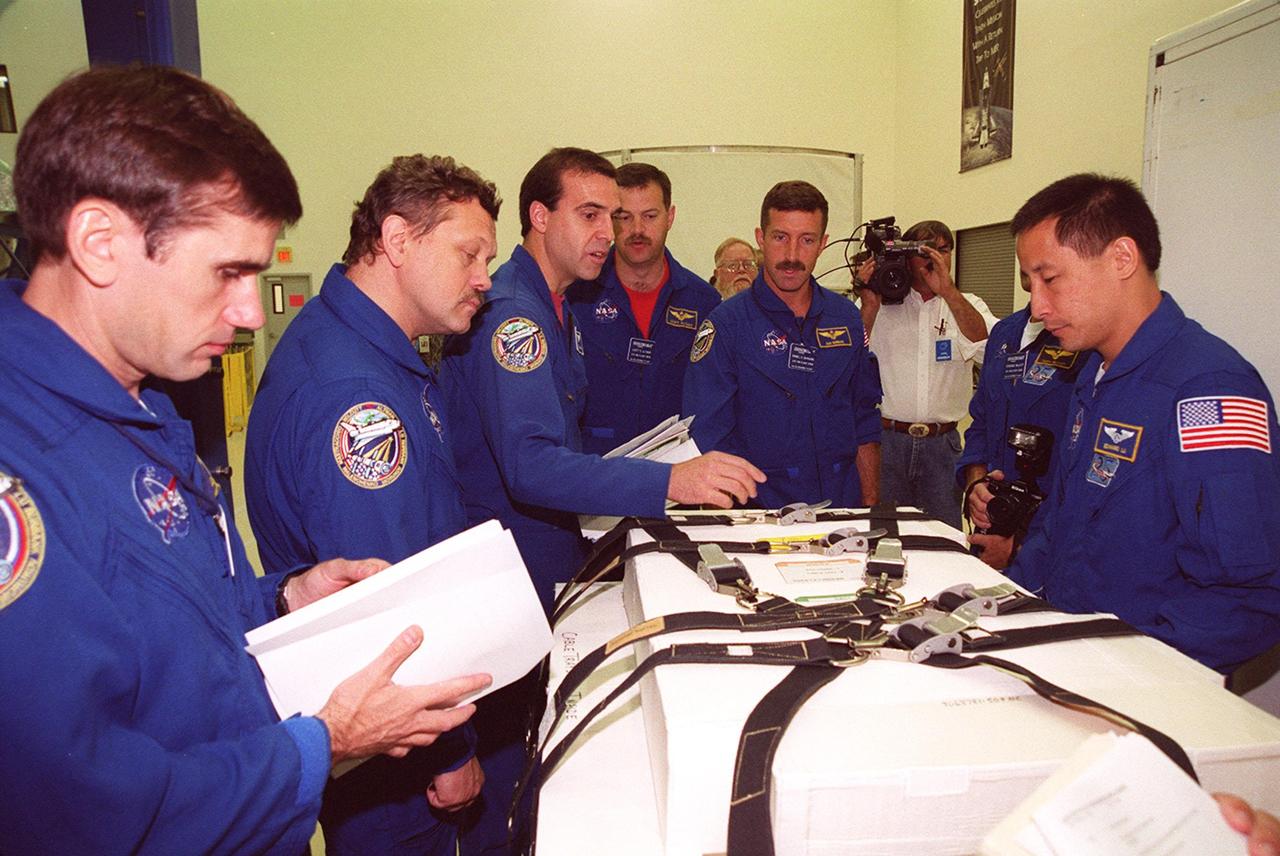
KENNEDY SPACE CENTER, FLA. -- During Crew Equipment Interface Test activities, the STS-106 crew check equipment at SPACEHAB that they will be using on their mission. From left are Mission Specialists Yuri I. Malenchenko, Boris V. Morukov and Richard A. Mastracchio, Pilot Scott D. Altman, and Mission Specialists Daniel C. Burbank and Edward T. Lu. Malenchenko and Morukov represent the Russian Aviation and Space Agency. STS-106 is scheduled to launch Sept. 8, 2000, at 8:31 a.m. EDT from Launch Pad 39B on an 11-day mission to the International Space Station. The seven-member crew will prepare the Space Station for its first resident crew and begin outfitting the newly arrived Zvezda Service Module. They will perform support tasks on orbit, transfer supplies and prepare the Zvezda living quarters for the first long-duration crew, dubbed “Expedition One,” which is due to arrive at the Station in late fall
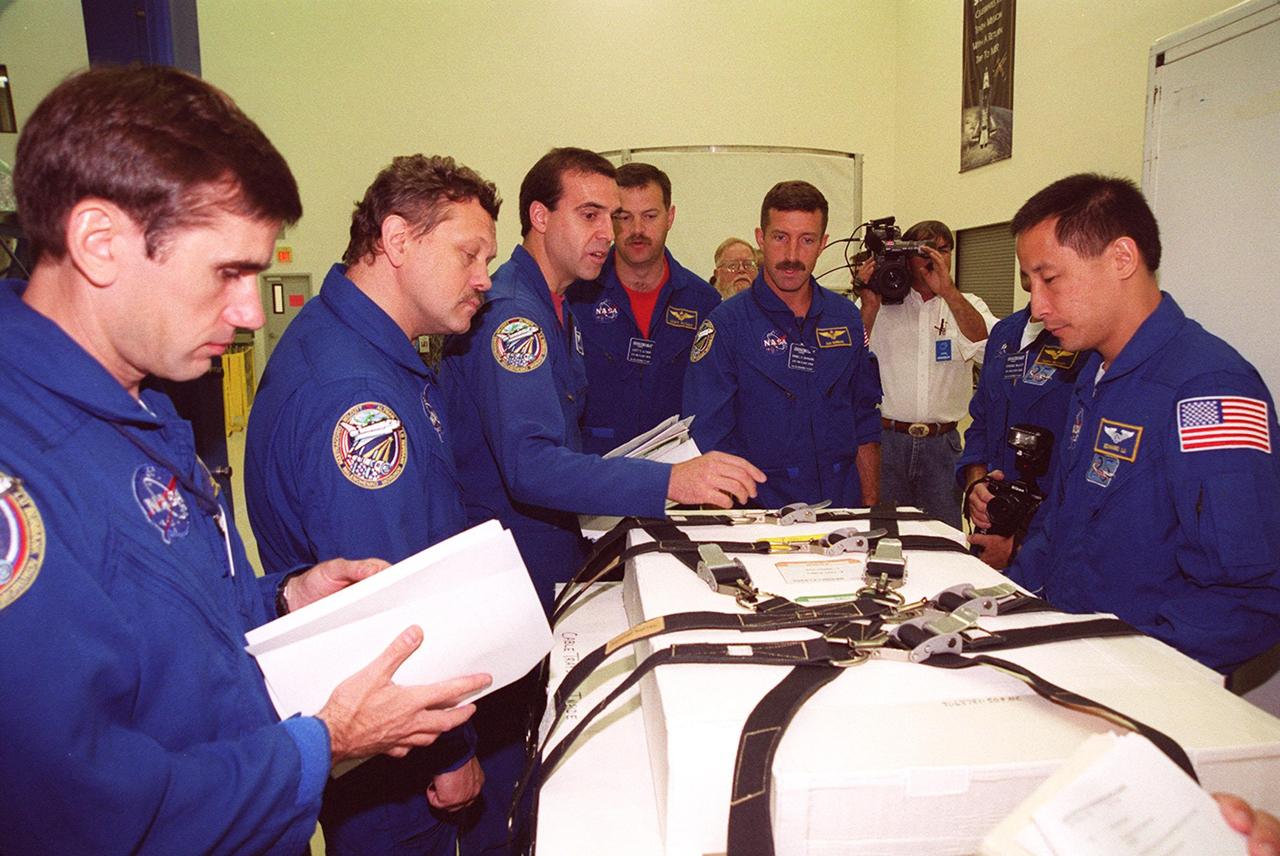
KENNEDY SPACE CENTER, FLA. -- During Crew Equipment Interface Test activities, the STS-106 crew check equipment at SPACEHAB that they will be using on their mission. From left are Mission Specialists Yuri I. Malenchenko, Boris V. Morukov and Richard A. Mastracchio, Pilot Scott D. Altman, and Mission Specialists Daniel C. Burbank and Edward T. Lu. Malenchenko and Morukov represent the Russian Aviation and Space Agency. STS-106 is scheduled to launch Sept. 8, 2000, at 8:31 a.m. EDT from Launch Pad 39B on an 11-day mission to the International Space Station. The seven-member crew will prepare the Space Station for its first resident crew and begin outfitting the newly arrived Zvezda Service Module. They will perform support tasks on orbit, transfer supplies and prepare the Zvezda living quarters for the first long-duration crew, dubbed “Expedition One,” which is due to arrive at the Station in late fall
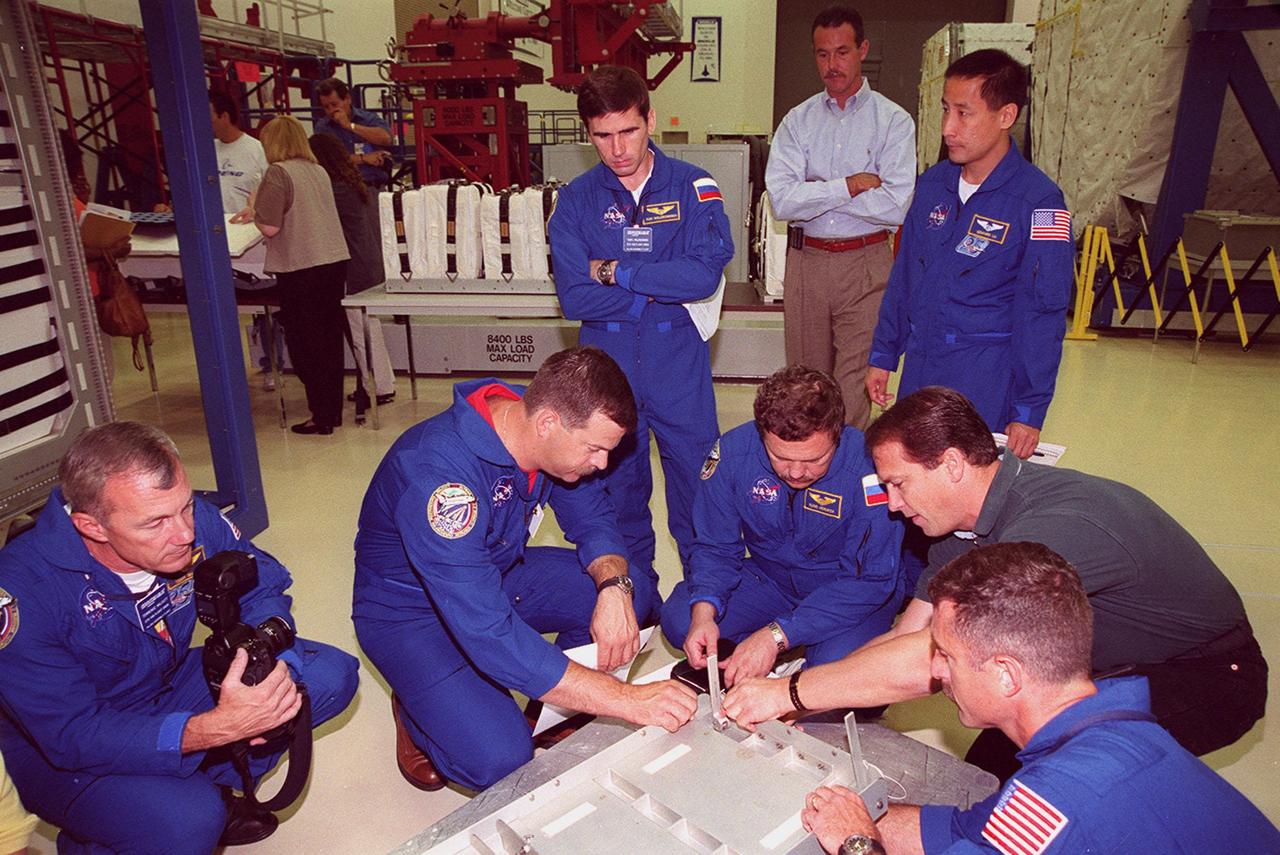
KENNEDY SPACE CENTER, FLA. -- At SPACEHAB members of the STS-106 crew check out equipment they will be using during their mission to the International Space Station. From left are Commander Terrence W. Wilcutt, Pilot Scott D. Altman, and Mission Specialists Yuri I. Malenchenko (standing), Boris V. Morukov, Edward T. Lu (also standing), and (in the foreground, right) Daniel C. Burbank. Malenchenko and Morukov represent the Russian Aviation and Space Agency. STS-106 is scheduled to launch Sept. 8, 2000, at 8:31 a.m. EDT from Launch Pad 39B on an 11-day mission. The seven-member crew will prepare the Space Station for its first resident crew and begin outfitting the newly arrived Zvezda Service Module. They will perform support tasks on orbit, transfer supplies and prepare the Zvezda living quarters for the first long-duration crew, dubbed “Expedition One,” which is due to arrive at the Station in late fall
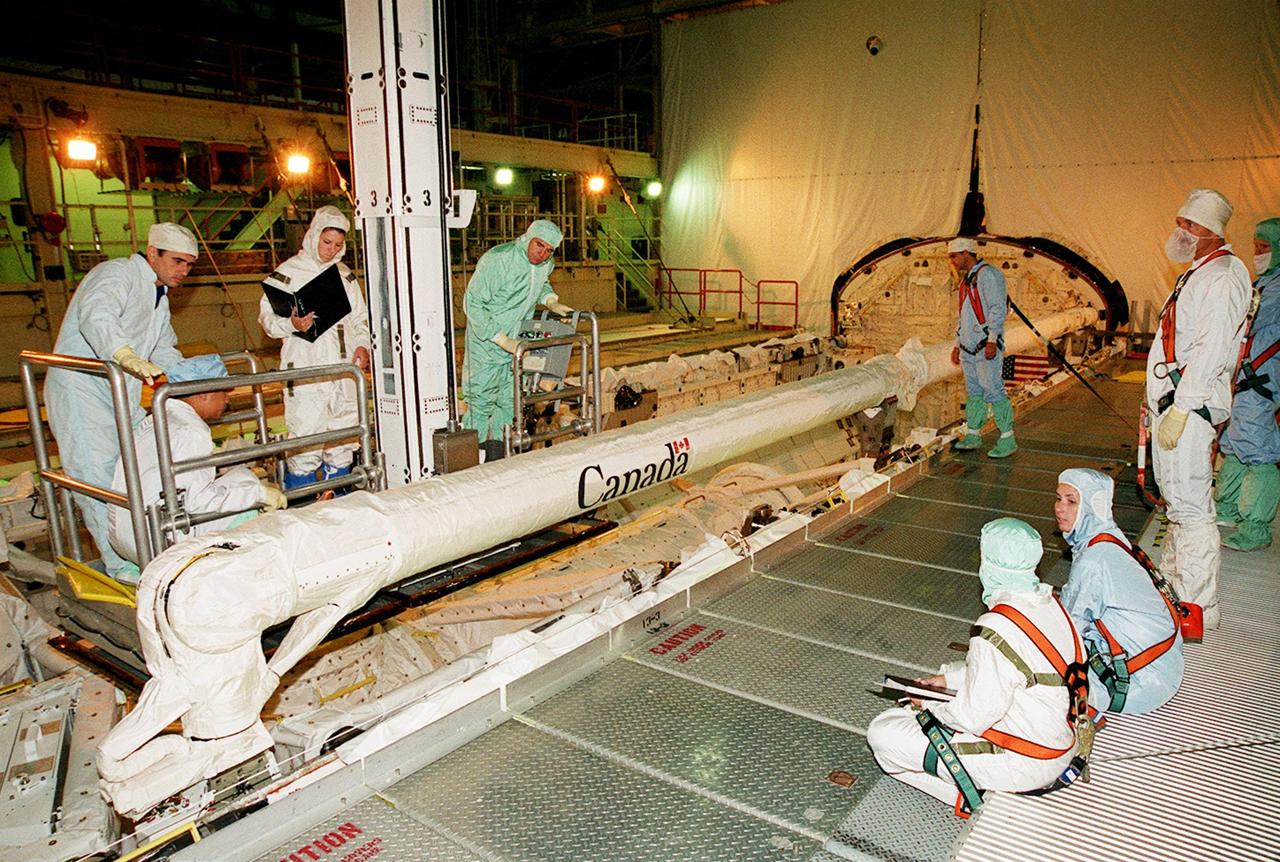
In Orbiter Processing Facility bay 3, the STS-106 crew familiarizes themselves with the payload bay of Space Shuttle orbiter Atlantis with the help of KSC employees as part of Crew Equipment Interface Test (CEIT) activities for their mission. The STS-106 crew members are Commander Terrence W. Wilcutt, Pilot Scott D. Altman, and Mission Specialists Edward T. Lu, Daniel C. Burbank, Yuri I. Malenchenko, Boris V. Morukov and Richard A. Mastracchio. Malenchenko and Morukov represent the Russian Aviation and Space Agency. On the 11-day mission, the seven-member crew will perform support tasks on orbit, transfer supplies and prepare the living quarters in the newly arrived Zvezda Service Module for the first long-duration crew, dubbed "Expedition One," which is due to arrive at the Station in late fall. STS-106 is scheduled to launch Sept. 8, 2000, at 8:31 a.m. EDT from Launch Pad 39B
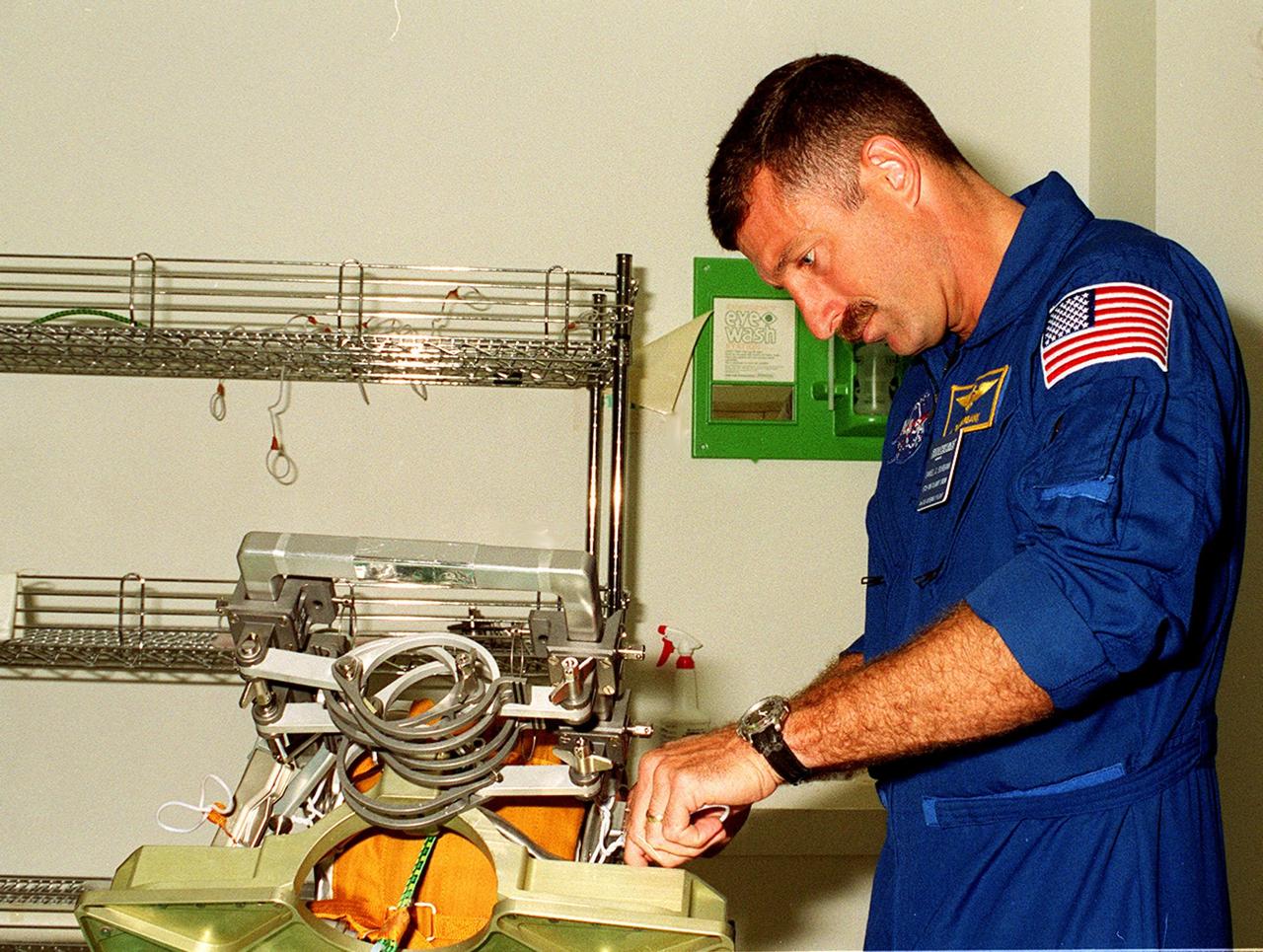
STS-106 Mission Specialist Daniel C. Burbank checks out a Russian foot restraint at SPACEHAB, part of the payload on the mission to the International Space Station. He and the other crew members Commander Terrence W. Wilcutt, Pilot Scott D. Altman, and Mission Specialists Edward T. Lu, Yuri I. Malenchenko, Boris V. Morukov and Richard A. Mastracchio are taking part in Crew Equipment Interface Test (CEIT) activities at SPACEHAB. Malenchenko and Morukov represent the Russian Aviation and Space Agency. On the 11-day mission, the seven-member crew will perform support tasks on orbit, transfer supplies and prepare the living quarters in the newly arrived Zvezda Service Module for the first long-duration crew, dubbed “Expedition One,” which is due to arrive at the Station in late fall. STS-106 is scheduled to launch Sept. 8, 2000, at 8:31 a.m. EDT from Launch Pad 39B

KENNEDY SPACE CENTER, FLA. -- At SPACEHAB members of the STS-106 crew check out equipment they will be using during their mission to the International Space Station. From left are Mission Specialists Richard A. Mastracchio, Daniel C. Burbank, Yuri I. Malenchenko, Edward T. Lu and Boris V. Morukov. Behind Lu is Pilot Scott D. Altman. Not seen is Commander Terrence W. Wilcutt. Malenchenko and Morukov represent the Russian Aviation and Space Agency. The astronauts are taking part in Crew Equipment Interface Test activities at KSC. On the 11-day mission, the seven-member crew will perform support tasks on orbit, transfer supplies and prepare the living quarters in the newly arrived Zvezda Service Module for the first long-duration crew, dubbed "Expedition One," which is due to arrive at the Station in late fall. STS-106 is scheduled to launch Sept. 8, 2000, at 8:31 a.m. EDT from Launch Pad 39B
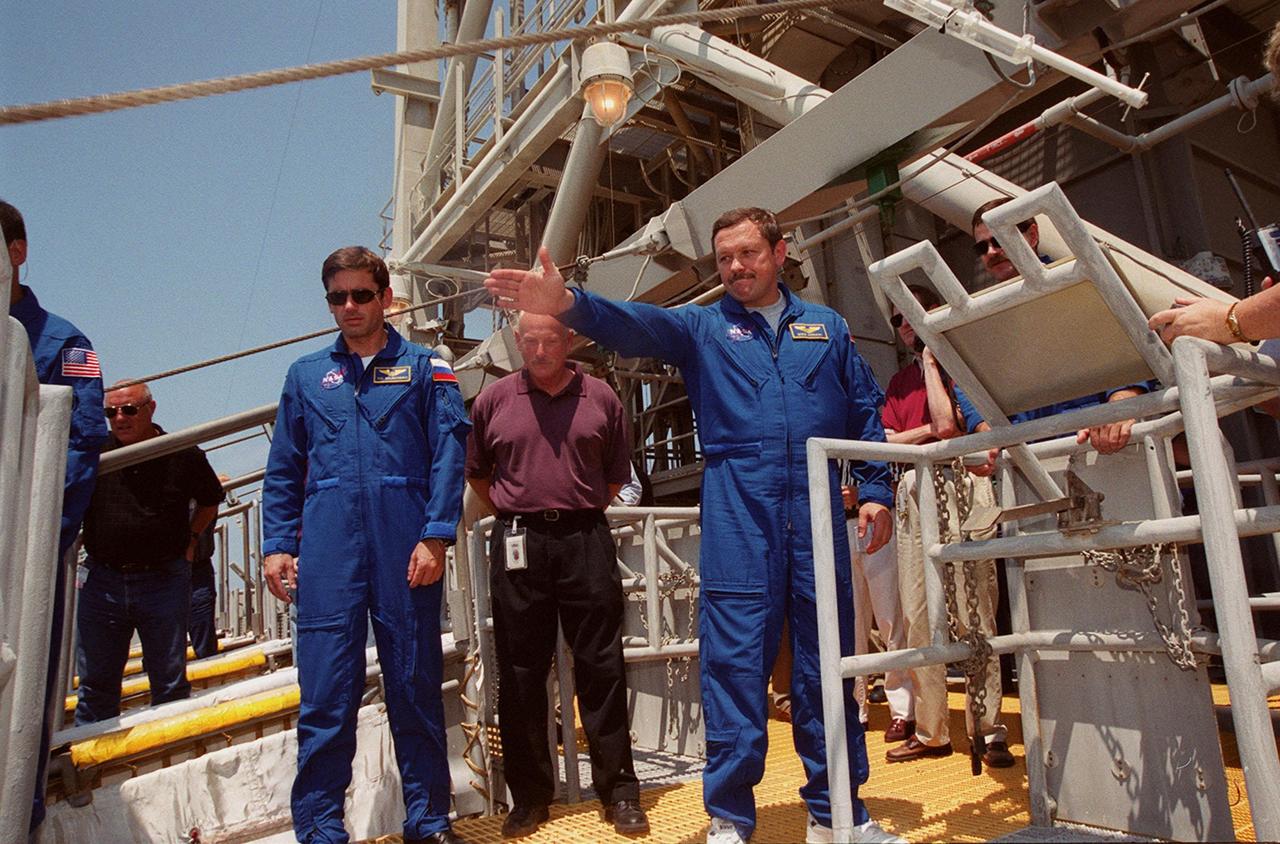
KENNEDY SPACE CENTER, Fla. -- STS-106 Mission Specialist Yuri I. Malenchenko, left, looks on after Boris V. Morukov releases a slide wire basket at the 195-foot level of Launch Pad 39-B. Malenchenko and Morukov are with the Russian Aviation and Space Agency. The flight crew were at Kennedy Space Center to take part in Terminal Countdown Demonstration Test (TCDT) activities. The TCDT provides the crew with emergency egress training and opportunities to inspect their mission payload in the orbiter’s payload bay. STS-106 is scheduled to launch Sept. 8, 2000, at 8:31 a.m. EDT from Launch Pad 39B. On the 11-day mission, the seven-member crew will perform support tasks on orbit, transfer supplies and prepare the living quarters in the newly arrived Zvezda Service Module. The first long-duration crew, dubbed “Expedition One,” is due to arrive at the Station in late fall
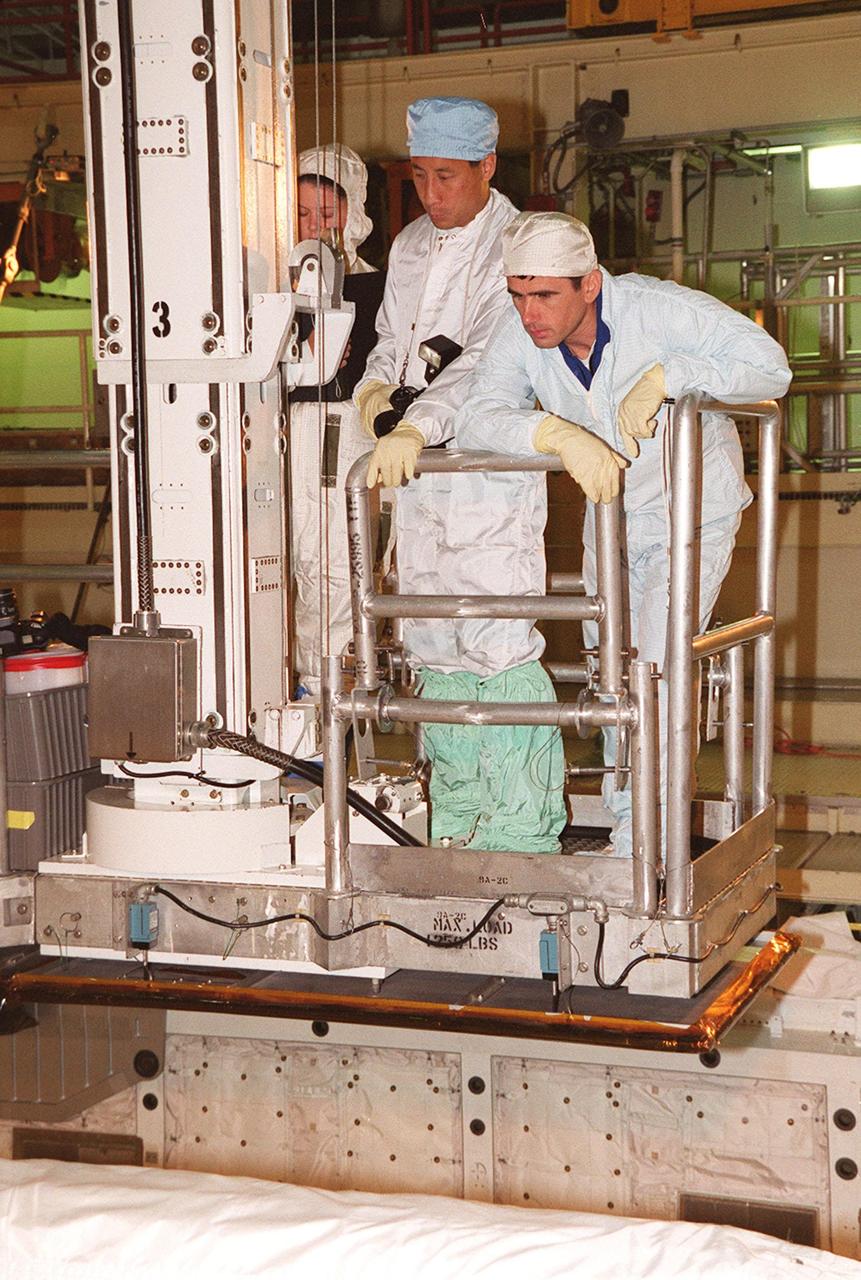
In Orbiter Processing Facility bay 3, STS-106 Mission Specialists Edward T. Lu (center) and Yuri I. Malenchenko (right) familiarize themselves with equipment in the payload bay of Space Shuttle orbiter Atlantis with the help of KSC employees as part of Crew Equipment Interface Test (CEIT) activities for their mission. The other crew members are Commander Terrence W. Wilcutt, Pilot Scott D. Altman, and Mission Specialists Daniel C. Burbank, Boris V. Morukov and Richard A. Mastracchio. Malenchenko and Morukov represent the Russian Aviation and Space Agency. On the 11-day mission, the seven-member crew will perform support tasks on orbit, transfer supplies and prepare the living quarters in the newly arrived Zvezda Service Module for the first long-duration crew, dubbed "Expedition One," which is due to arrive at the Station in late fall. STS-106 is scheduled to launch Sept. 8, 2000, at 8:31 a.m. EDT from Launch Pad 39B
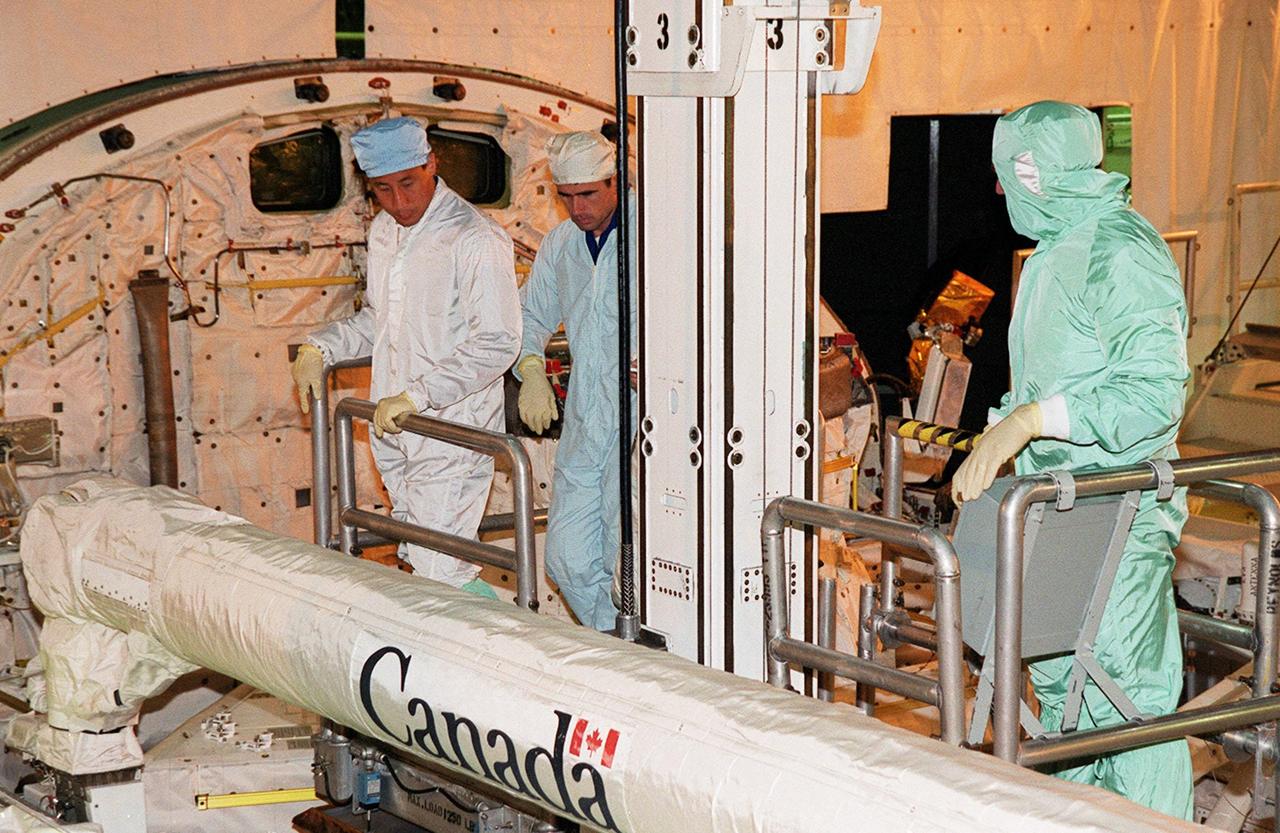
In Orbiter Processing Facility bay 3, STS-106 Mission Specialists Edward T. Lu (left) and Yuri I. Malenchenko (center) familiarize themselves with equipment in the payload bay of Space Shuttle orbiter Atlantis with the help of KSC employees as part of Crew Equipment Interface Test (CEIT) activities for their mission. The other crew members are Commander Terrence W. Wilcutt, Pilot Scott D. Altman, and Mission Specialists Daniel C. Burbank, Boris V. Morukov and Richard A. Mastracchio. Malenchenko and Morukov represent the Russian Aviation and Space Agency. On the 11-day mission, the seven-member crew will perform support tasks on orbit, transfer supplies and prepare the living quarters in the newly arrived Zvezda Service Module for the first long-duration crew, dubbed "Expedition One," which is due to arrive at the Station in late fall. STS-106 is scheduled to launch Sept. 8, 2000, at 8:31 a.m. EDT from Launch Pad 39B
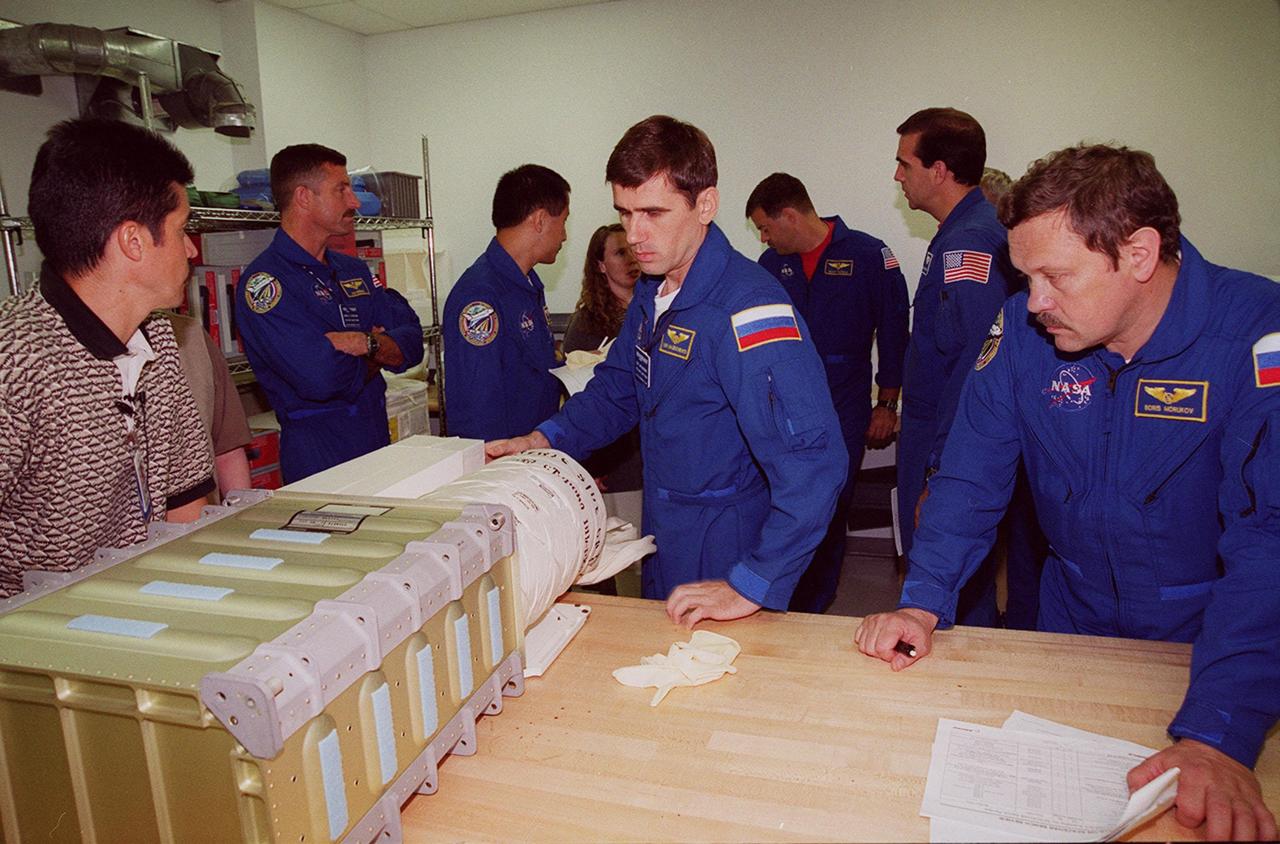
KENNEDY SPACE CENTER, FLA. -- At SPACEHAB members of the STS-106 crew check out equipment they will be using during their mission to the International Space Station. Starting second from left, they are Mission Specialists Daniel C. Burbank, Edward T. Lu, and Yuri I. Malenchenkov; Pilot Scott D. Altman, and Mission Specialists Richard A. Mastracchio and Boris V. Morukov. Not seen is Commander Terrence W. Wilcutt. Malenchenko and Morukov represent the Russian Aviation and Space Agency. The crew is taking part in Crew Equipment Interface Test activities at KSC. On the 11-day mission, the seven-member crew will perform support tasks on orbit, transfer supplies and prepare the living quarters in the newly arrived Zvezda Service Module for the first long-duration crew, dubbed “Expedition One,” which is due to arrive at the Station in late fall. STS-106 is scheduled to launch Sept. 8, 2000, at 8:31 a.m. EDT from Launch Pad 39B
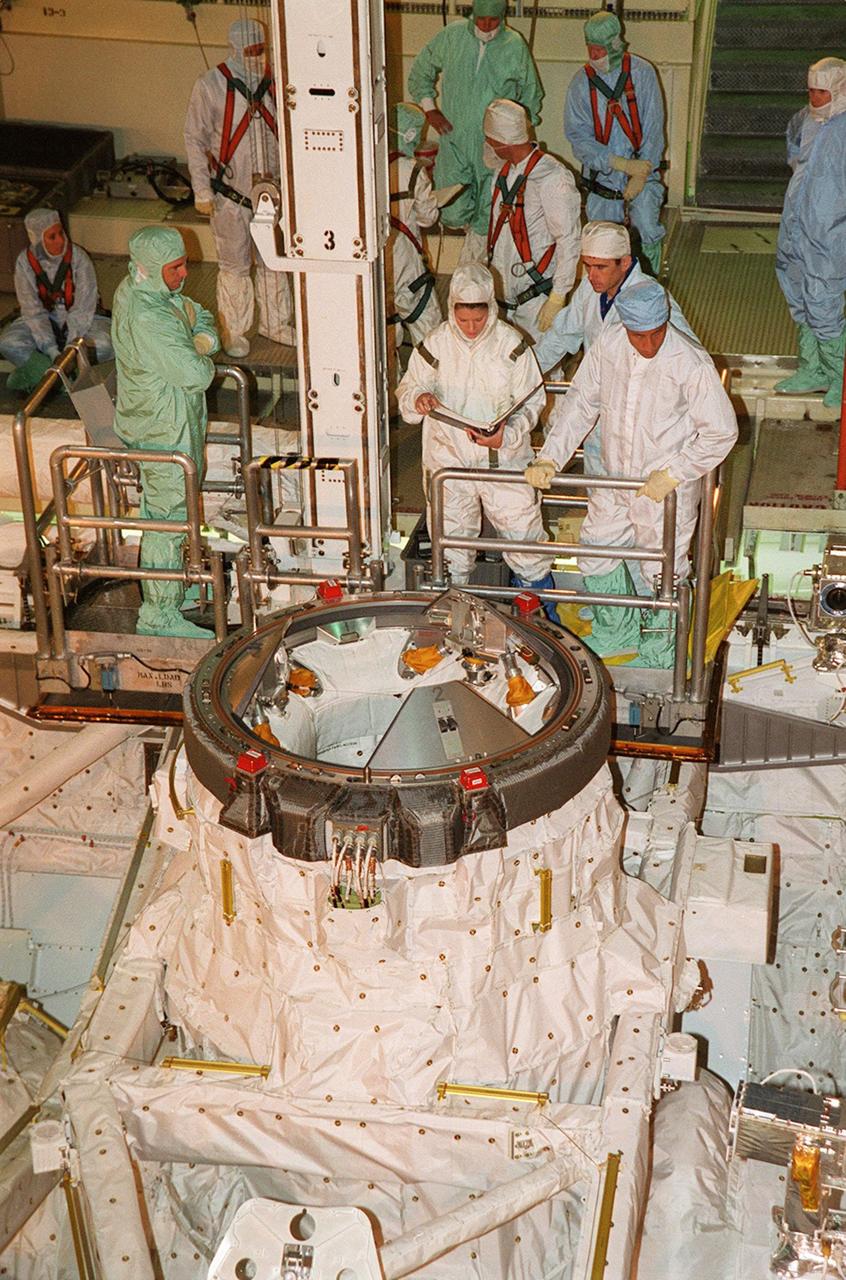
In Orbiter Processing Facility bay 3, the STS-106 crew familiarizes themselves with equipment in the payload bay of Space Shuttle orbiter Atlantis with the help of KSC employees as part of Crew Equipment Interface Test (CEIT) activities for their mission. The STS-106 crew members are Commander Terrence W. Wilcutt, Pilot Scott D. Altman, and Mission Specialists Edward T. Lu, Daniel C. Burbank, Yuri I. Malenchenko, Boris V. Morukov and Richard A. Mastracchio. Malenchenko and Morukov represent the Russian Aviation and Space Agency. On the 11-day mission, the seven-member crew will perform support tasks on orbit, transfer supplies and prepare the living quarters in the newly arrived Zvezda Service Module for the first long-duration crew, dubbed "Expedition One," which is due to arrive at the Station in late fall. STS-106 is scheduled to launch Sept. 8, 2000, at 8:31 a.m. EDT from Launch Pad 39B

In Orbiter Processing Facility bay 3, members of the STS-106 crew familiarize themselves with equipment in the payload bay of Space Shuttle orbiter Atlantis with the help of KSC employees as part of Crew Equipment Interface Test (CEIT) activities for their mission. The STS-106 crew members are Commander Terrence W. Wilcutt, Pilot Scott D. Altman, and Mission Specialists Edward T. Lu, Daniel C. Burbank, Yuri I. Malenchenko, Boris V. Morukov and Richard A. Mastracchio. Malenchenko and Morukov represent the Russian Aviation and Space Agency. On the 11-day mission, the seven-member crew will perform support tasks on orbit, transfer supplies and prepare the living quarters in the newly arrived Zvezda Service Module for the first long-duration crew, dubbed "Expedition One," which is due to arrive at the Station in late fall. STS-106 is scheduled to launch Sept. 8, 2000, at 8:31 a.m. EDT from Launch Pad 39B
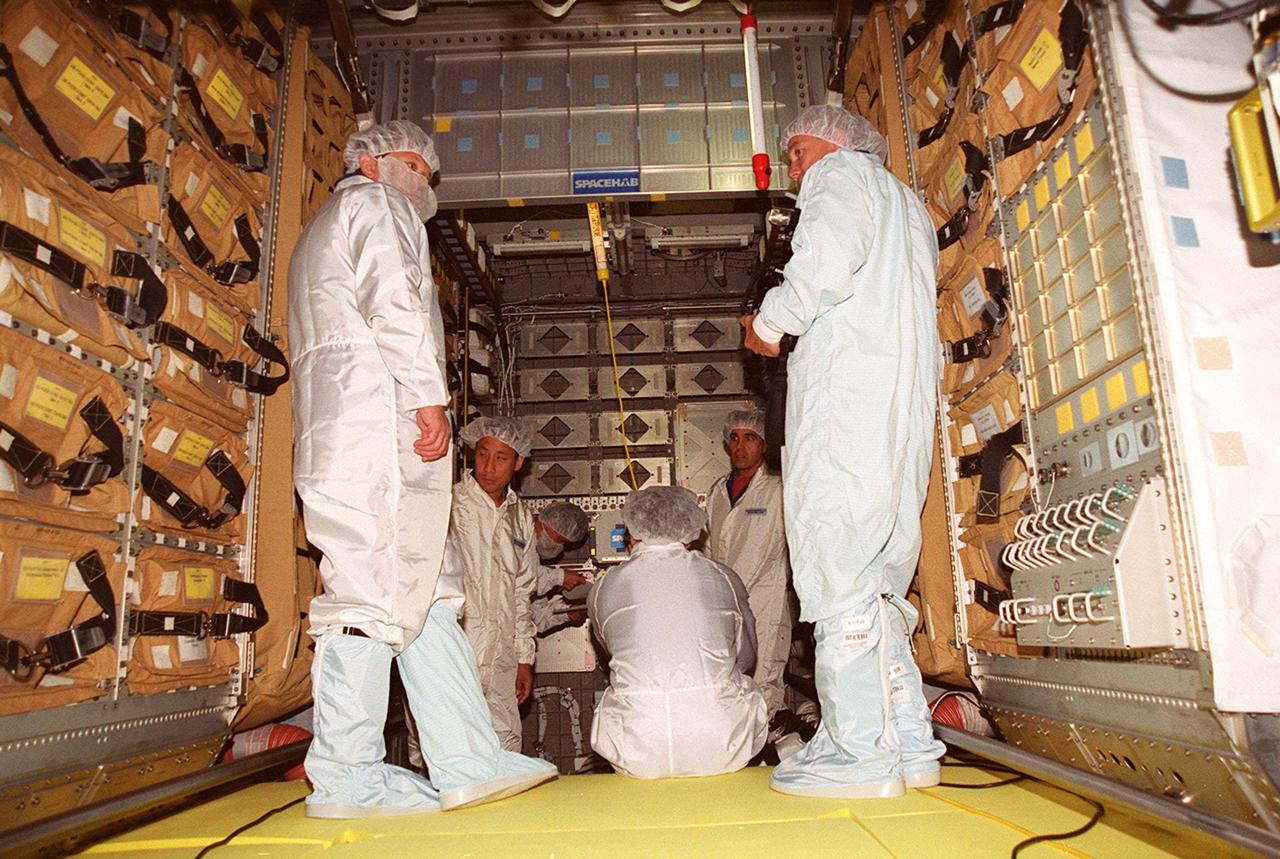
KENNEDY SPACE CENTER, FLA. -- During Crew Equipment Interface Test activities, the STS-106 crew check out equipment inside the SPACEHAB module. From left are Mission Specialists Boris V. Morukov, Edward T. Lu (kneeling), Yuri I. Malenchenko (back to camera) and Richard A. Mastracchio; and Commander Terrence W. Wilcutt. Malenchenko and Morukov represent the Russian Aviation and Space Agency. STS-106 is scheduled to launch Sept. 8, 2000, at 8:31 a.m. EDT from Launch Pad 39B on an 11-day mission to the International Space Station. The seven-member crew will prepare the Space Station for its first resident crew and begin outfitting the newly arrived Zvezda Service Module. They will perform support tasks on orbit, transfer supplies and prepare the Zvezda living quarters for the first long-duration crew, dubbed “Expedition One,” which is due to arrive at the Station in late fall
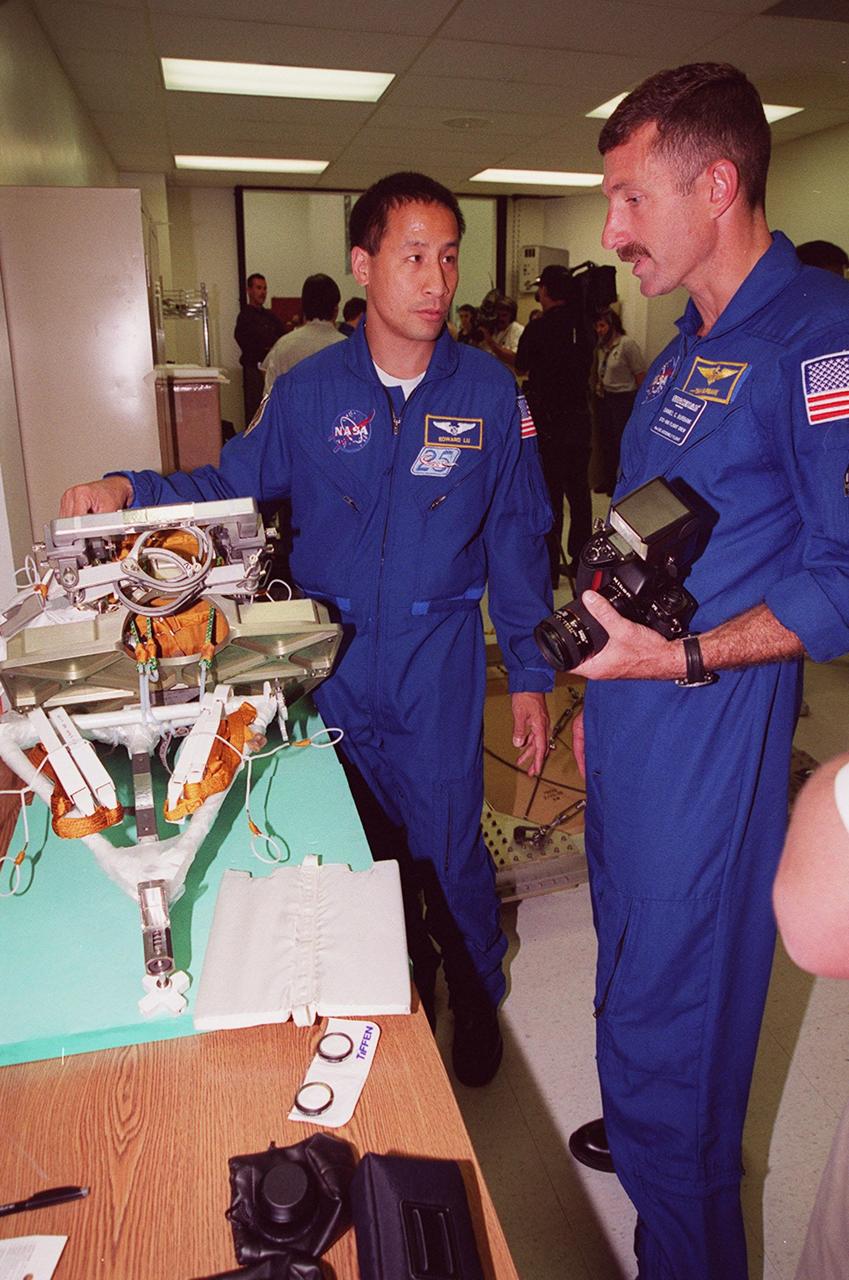
KENNEDY SPACE CENTER, FLA. -- STS-106 Mission Specialists Edward T. Lu (left) and Daniel C. Burbank examine equipment at SPACEHAB, part of the payload on the mission to the International Space Station. They and the other crew members Commander Terrence W. Wilcutt, Pilot Scott D. Altman, and Mission Specialists Yuri I. Malenchenko, Boris V. Morukov and Richard A. Mastracchio are taking part in Crew Equipment Interface Test (CEIT) activities at SPACEHAB. Malenchenko and Morukov represent the Russian Aviation and Space Agency. On the 11-day mission, the seven-member crew will perform support tasks on orbit, transfer supplies and prepare the living quarters in the newly arrived Zvezda Service Module for the first long-duration crew, dubbed "Expedition One," which is due to arrive at the Station in late fall. STS-106 is scheduled to launch Sept. 8, 2000, at 8:31 a.m. EDT from Launch Pad 39B

In Orbiter Processing Facility bay 3, STS-106 Mission Specialists Edward T. Lu (left) and Yuri I. Malenchenko (center) familiarize themselves with equipment in the payload bay of Space Shuttle orbiter Atlantis with the help of KSC employees as part of Crew Equipment Interface Test (CEIT) activities for their mission. The other crew members are Commander Terrence W. Wilcutt, Pilot Scott D. Altman, and Mission Specialists Daniel C. Burbank, Boris V. Morukov and Richard A. Mastracchio. Malenchenko and Morukov represent the Russian Aviation and Space Agency. On the 11-day mission, the seven-member crew will perform support tasks on orbit, transfer supplies and prepare the living quarters in the newly arrived Zvezda Service Module for the first long-duration crew, dubbed "Expedition One," which is due to arrive at the Station in late fall. STS-106 is scheduled to launch Sept. 8, 2000, at 8:31 a.m. EDT from Launch Pad 39B
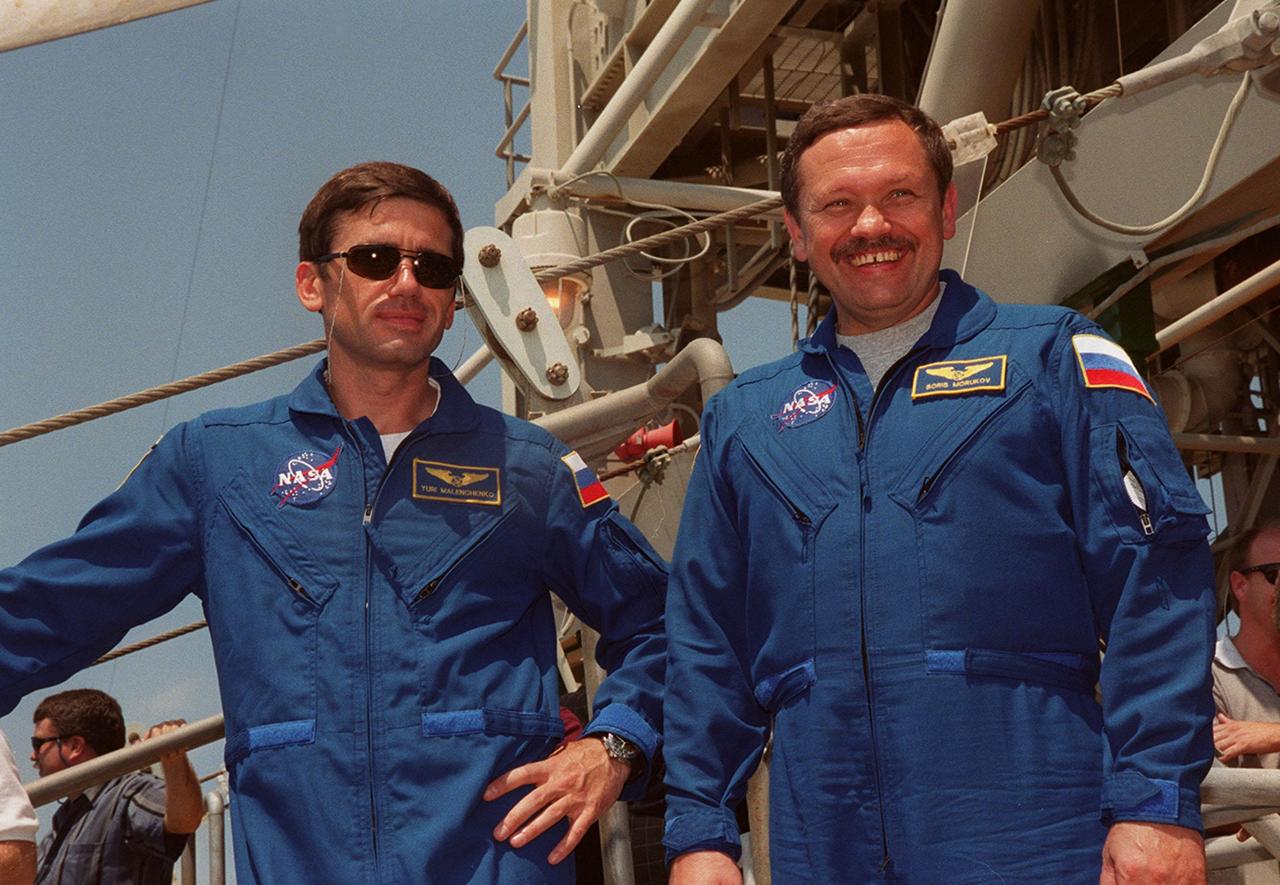
KENNEDY SPACE CENTER, Fla. -- STS-106 Mission Specialists Yuri I. Malenchenko, left, and Boris V. Morukov pause at the 195-foot level of Launch Pad 39-B. Malenchenko and Morukov are with the Russian Aviation and Space Agency. The flight crew were at Kennedy Space Center to take part in Terminal Countdown Demonstration Test (TCDT) activities. The TCDT provides the crew with emergency egress training and opportunities to inspect their mission payload in the orbiter’s payload bay. STS-106 is scheduled to launch Sept. 8, 2000, at 8:31 a.m. EDT from Launch Pad 39B. On the 11-day mission, the seven-member crew will perform support tasks on orbit, transfer supplies and prepare the living quarters in the newly arrived Zvezda Service Module. The first long-duration crew, dubbed “Expedition One,” is due to arrive at the Station in late fall
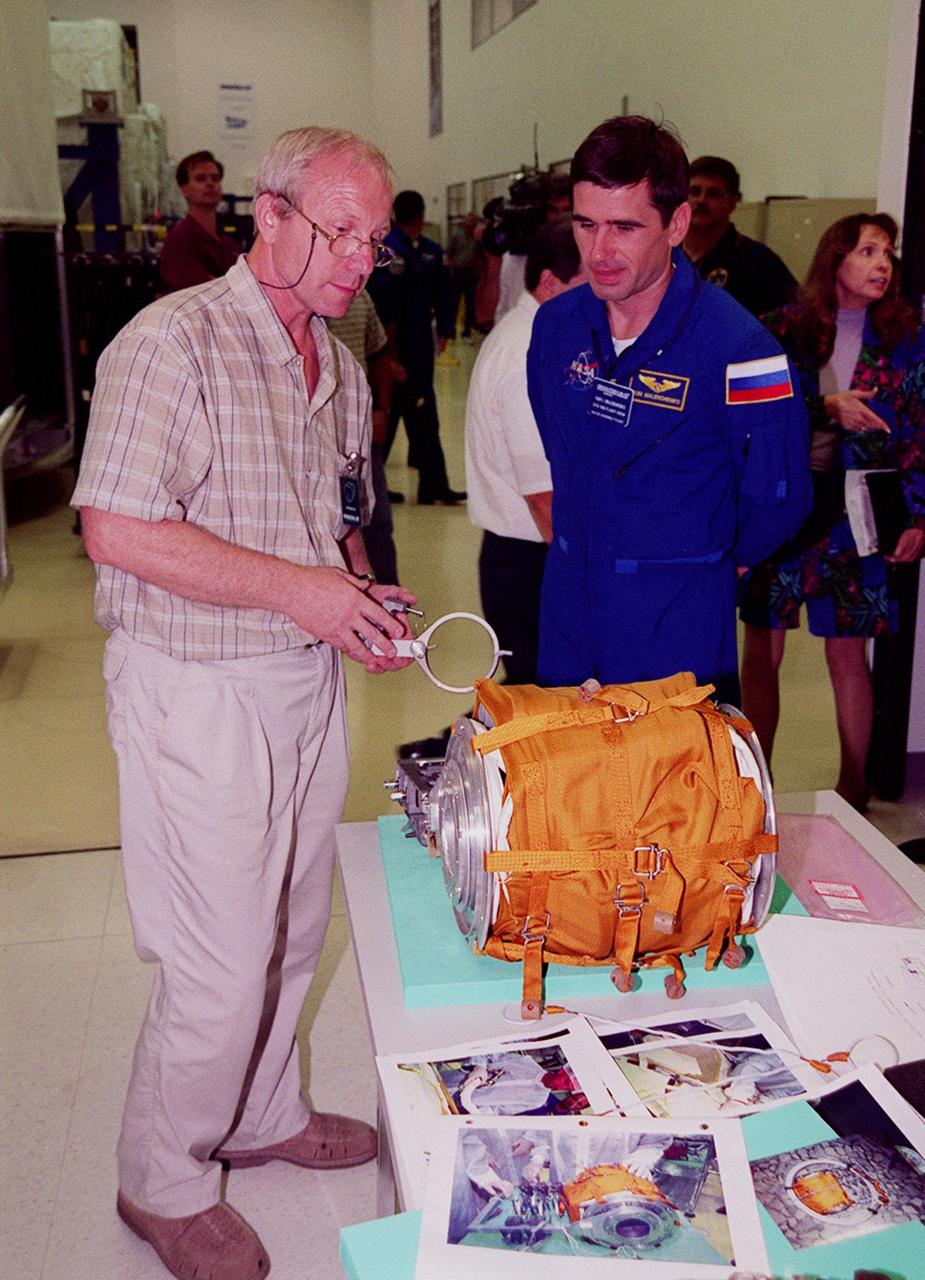
KENNEDY SPACE CENTER, FLA. -- STS-106 Mission Specialist Yuri I. Malenchenko (right) examines equipment at SPACEHAB, part of the payload on the mission to the International Space Station. He and the other crew members Commander Terrence W. Wilcutt, Pilot Scott D. Altman, and Mission Specialists Edward T. Lu, Daniel C. Burbank, Boris V. Morukov and Richard A. Mastracchio are taking part in Crew Equipment Interface Test (CEIT) activities at SPACEHAB. Malenchenko and Morukov represent the Russian Aviation and Space Agency. On the 11-day mission, the seven-member crew will perform support tasks on orbit, transfer supplies and prepare the living quarters in the newly arrived Zvezda Service Module for the first long-duration crew, dubbed "Expedition One," which is due to arrive at the Station in late fall. STS-106 is scheduled to launch Sept. 8, 2000, at 8:31 a.m. EDT from Launch Pad 39B
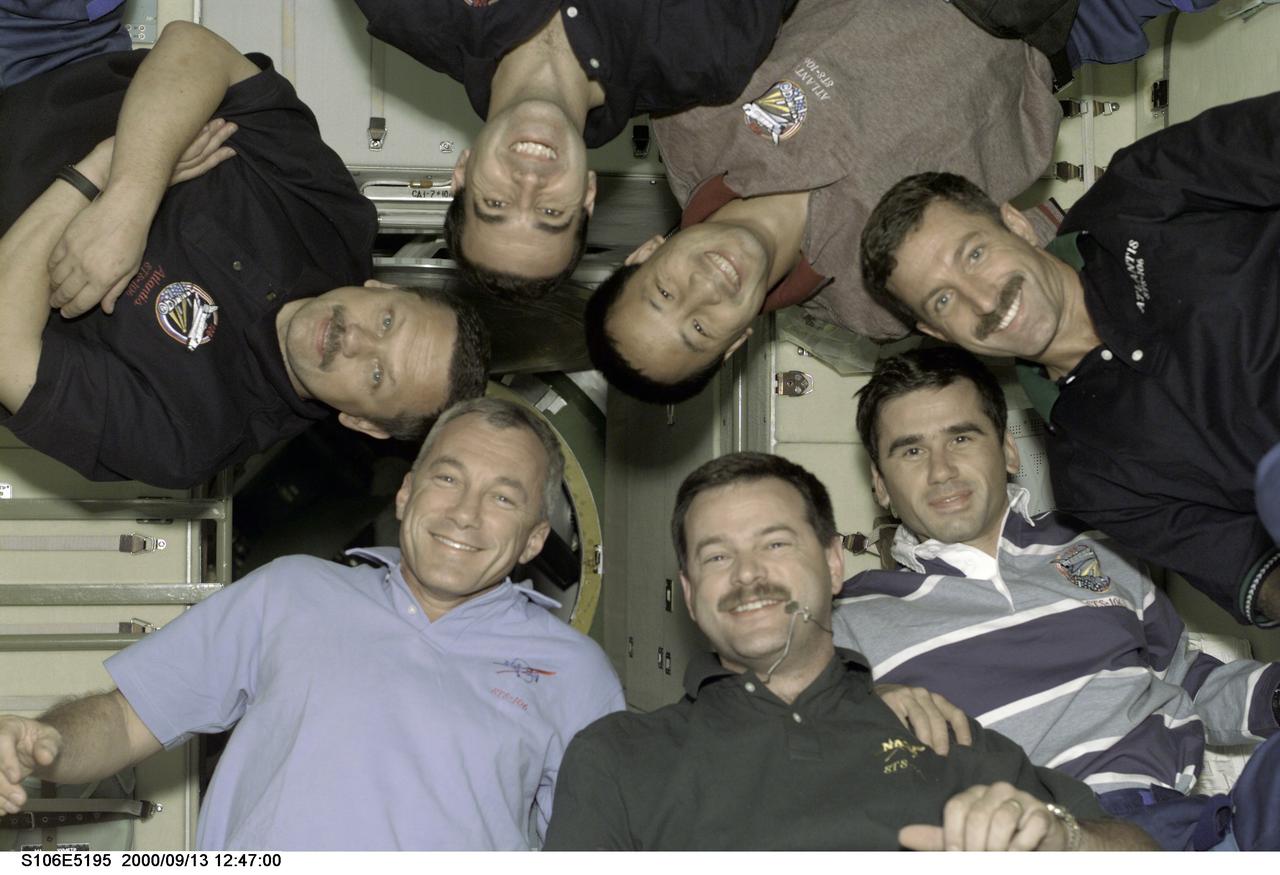
STS106-E-5195 (13 September 2000) --- Two cosmonauts and five astronauts pose for a tradition-based inflight crew portrait aboard the International Space Station (ISS), which is currently docked with the Space Shuttle Atlantis. Astronauts Terrence W. Wilcutt, mission commander, and Scott D. Altman (bottom center) are surrounded by the five mission specialists (counterclockwise from Wilcutt) -- cosmonaut Boris V. Morukov, astronauts Richard A. Mastracchio, Edward T. Lu and Daniel C. Burbank, along with cosmonaut Yuri I. Malenchenko. Morukov and Malenchenko represent the Russian Aviation and Space Agency. The seven had just taken a brief break from the continuing tasks they're performing to help ready the ISS for other astronauts and cosmonauts permanent habitation in the near future.
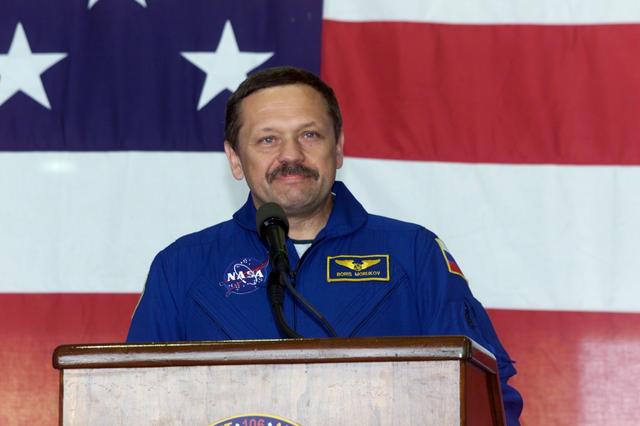
JSC2000-E-23460 (21 September 2000) --- Cosmonaut Boris V. Morukov, STS-106 mission specialist representing the Russian Aviation and Space Agency, addresses the crowd that visited Ellington Field's Hangar 990 to welcome home the STS-106 astronauts. The seven-man crew landed approximately 24 hours earlier in Florida, wrapping up a 4.9 million-mile mission in which more than three tons of equipment were delivered to the international outpost.
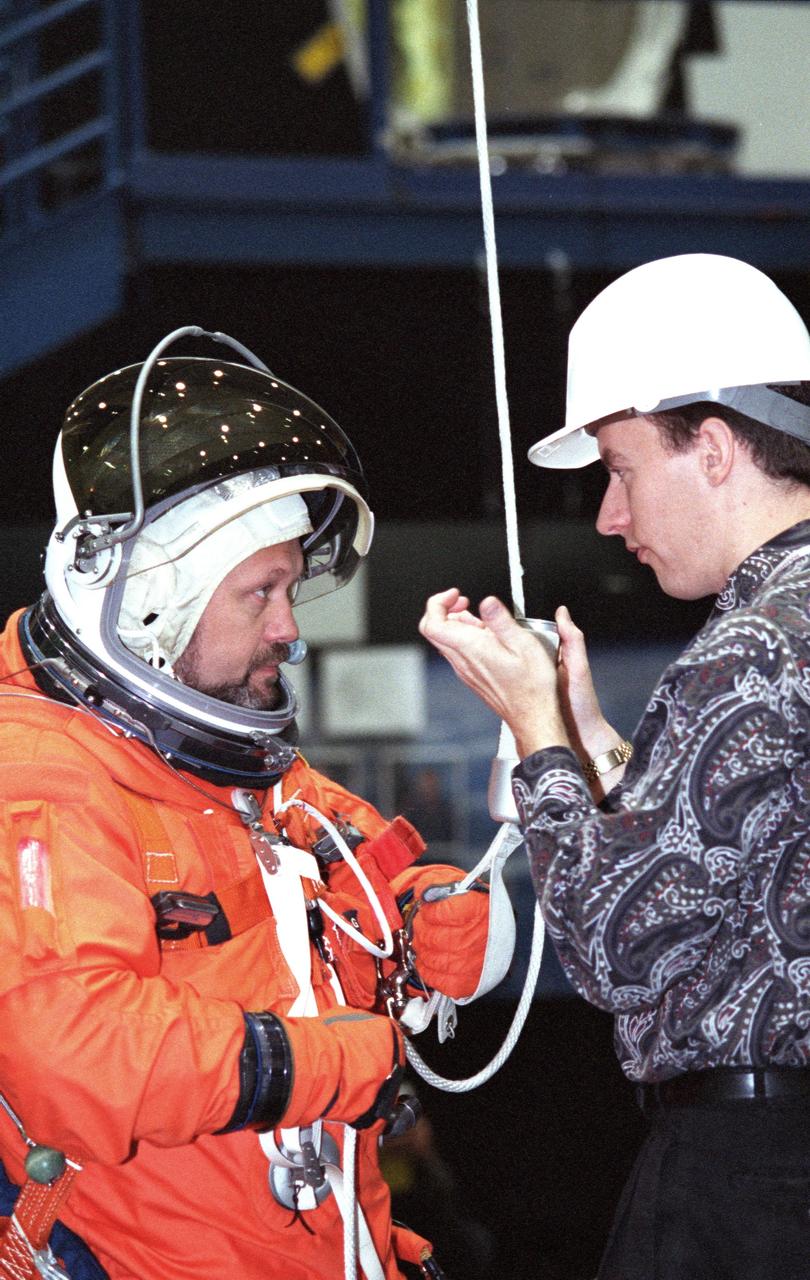
JSC2000-02938 (5 April 2000) --- David Pogue (right), a crew escape equipment trainer, briefs cosmonaut Boris V. Morukov on the usage of a special device that enables the STS-106 mission specialist to rappel from a shuttle in trouble on the ground. A nearby crew-training mockup in the JSC's Systems Integration Facility allowed the Russian Aviation and Space Agency's cosmonaut the opportunity to train for procedures to follow in the event of the need to evacuate a distressed shuttle's cabin while on the ground.
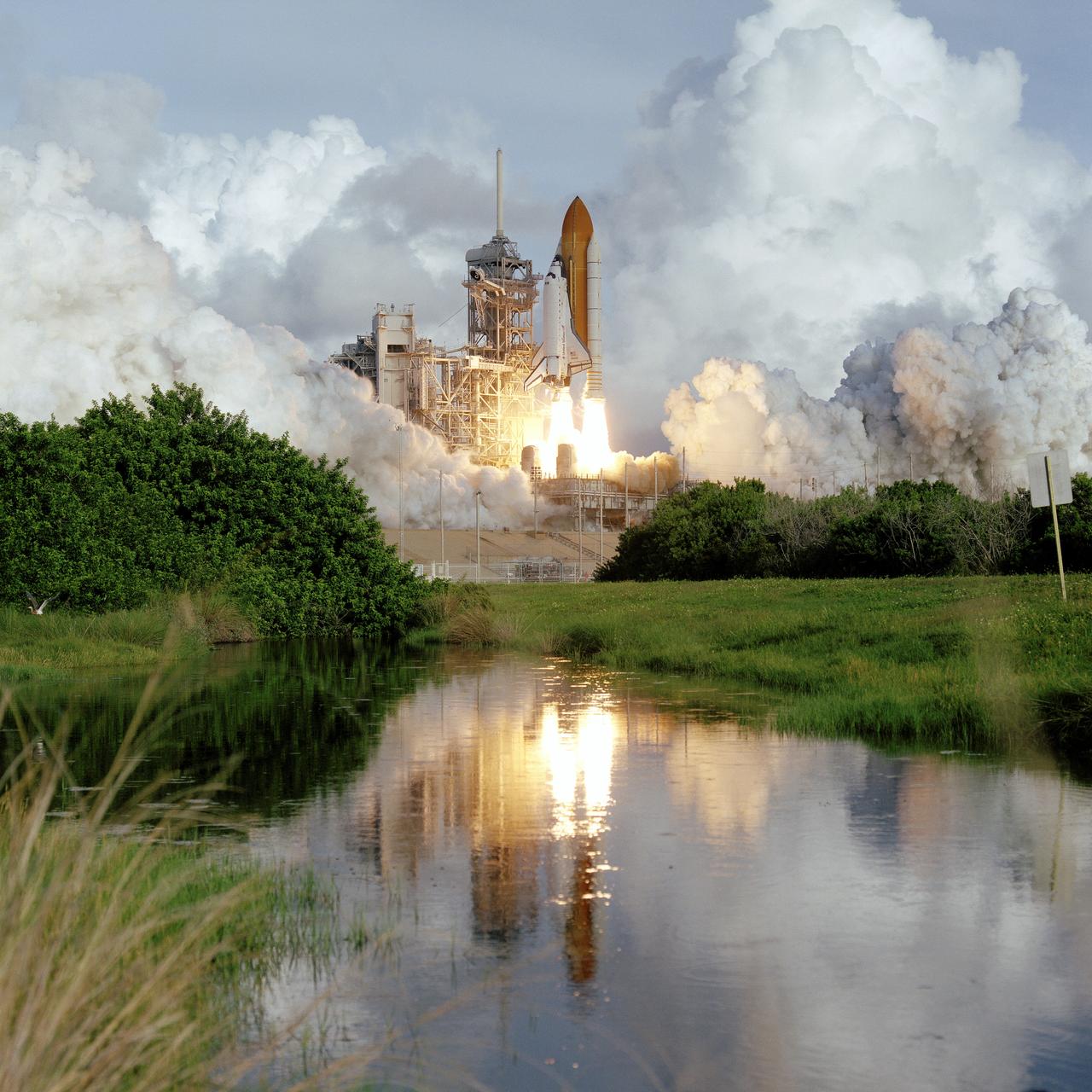
STS106-S-010 (8 Sept. 2000) --- The Space Shuttle Atlantis is mirrored in nearby marsh waters as it makes its 22nd launch into space. The perfect on-time liftoff for STS-106 occurred at 8:45:47 a.m. (EDT), Sept. 8, 2000. Onboard the shuttle were astronauts Terrence W. Wilcutt, Scott D. Altman, Edward T. Lu, Richard A. Mastracchio and Daniel C. Burbank, along with cosmonauts Yuri I. Malenchenko and Boris V. Morukov who represent the Russian Aviation and Space Agency.
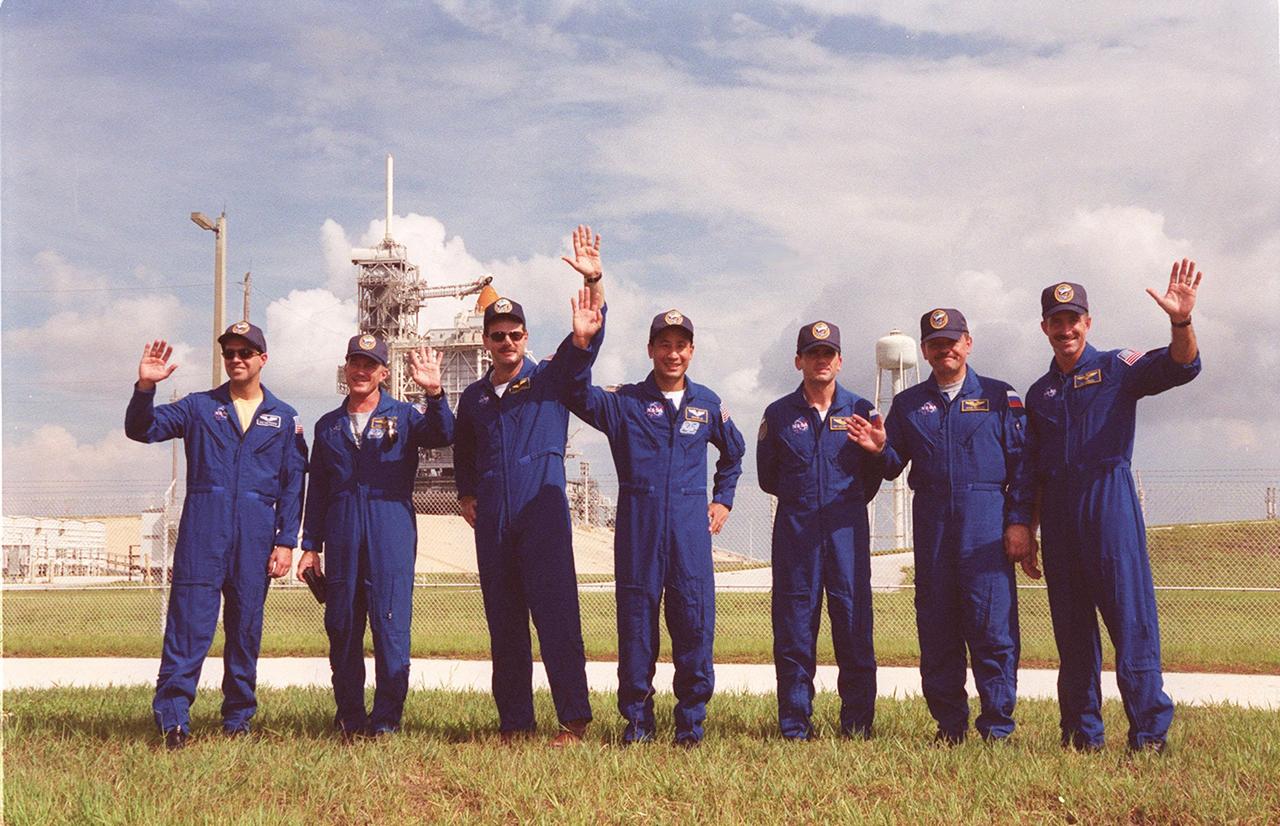
While meeting with family on the day before launch, the STS-106 crew poses for a photo. Waving, left to right, are Mission Specialist Richard A. Mastracchio, Commander Terrence W. Wilcutt, Pilot Scott D. Altman, and Mission Specialists Edward T. Lu, Yuri I. Malenchenko, Boris V. Morukov and Daniel C. Burbank. Malenchenko and Morukov are with the Russian Aviation and Space Agency. In the background (left) is Launch Pad 39B and Space Shuttle Atlantis, with the Rotating Service Structure still in place.; STS-106 is scheduled to launch Sept. 8, 2000, at 8:45 a.m. EDT from Launch Pad 39B. On the 11-day mission, the seven-member crew will perform support tasks on orbit, transfer supplies and prepare the living quarters in the newly arrived Zvezda Service Module. The first long-duration crew, dubbed “Expedition One,” is due to arrive at the Station in late fall. Landing is targeted for Sept. 19 at 4:59 a.m. EDT at the KSC Shuttle Landing Facility
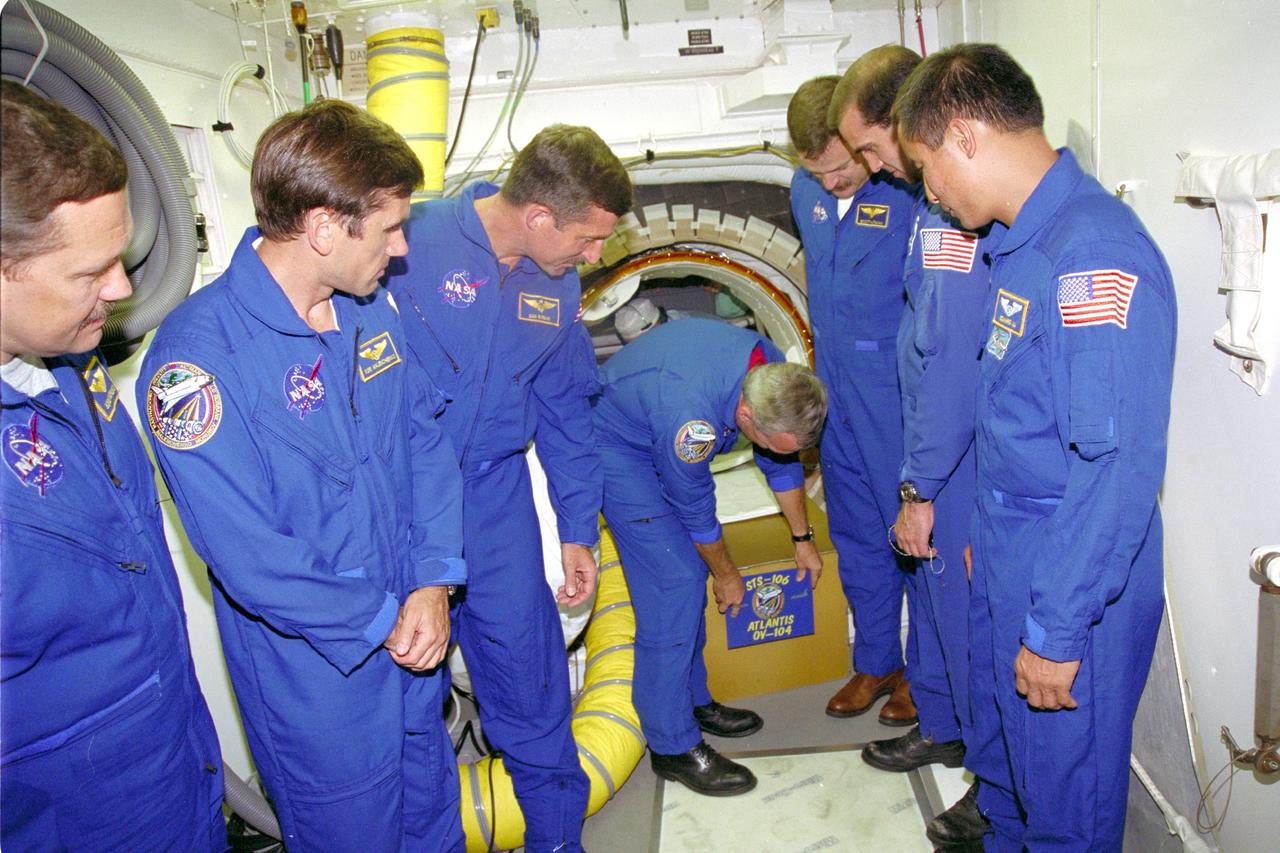
KENNEDY SPACE CENTER, FLA. -- STS-106 Commander Terrence W. Wilcutt bends to place the STS-106 mission patch at the entrance of Atlantis in the white room of Launch Pad 39-B. Other STS-106 crew members pictured are, from left, Mission Specialists Boris V. Morukov, Yuri I. Malenchenko, Daniel C. Burbank, Pilot Scott D. Altman, Mission Specialists Richard A. Mastracchio and Edward T. Lu. Malenchenko and Morukov are with the Russian Aviation and Space Agency. The flight crew were at Kennedy Space Center to take part in Terminal Countdown Demonstration Test (TCDT) activities. The TCDT provides the crew with emergency egress training and opportunities to inspect their mission payload in the orbiter’s payload bay. STS-106 is scheduled to launch Sept. 8, 2000, at 8:31 a.m. EDT from Launch Pad 39B. On the 11-day mission, the seven-member crew will perform support tasks on orbit, transfer supplies and prepare the living quarters in the newly arrived Zvezda Service Module. The first long-duration crew, dubbed “Expedition One,” is due to arrive at the Station in late fall
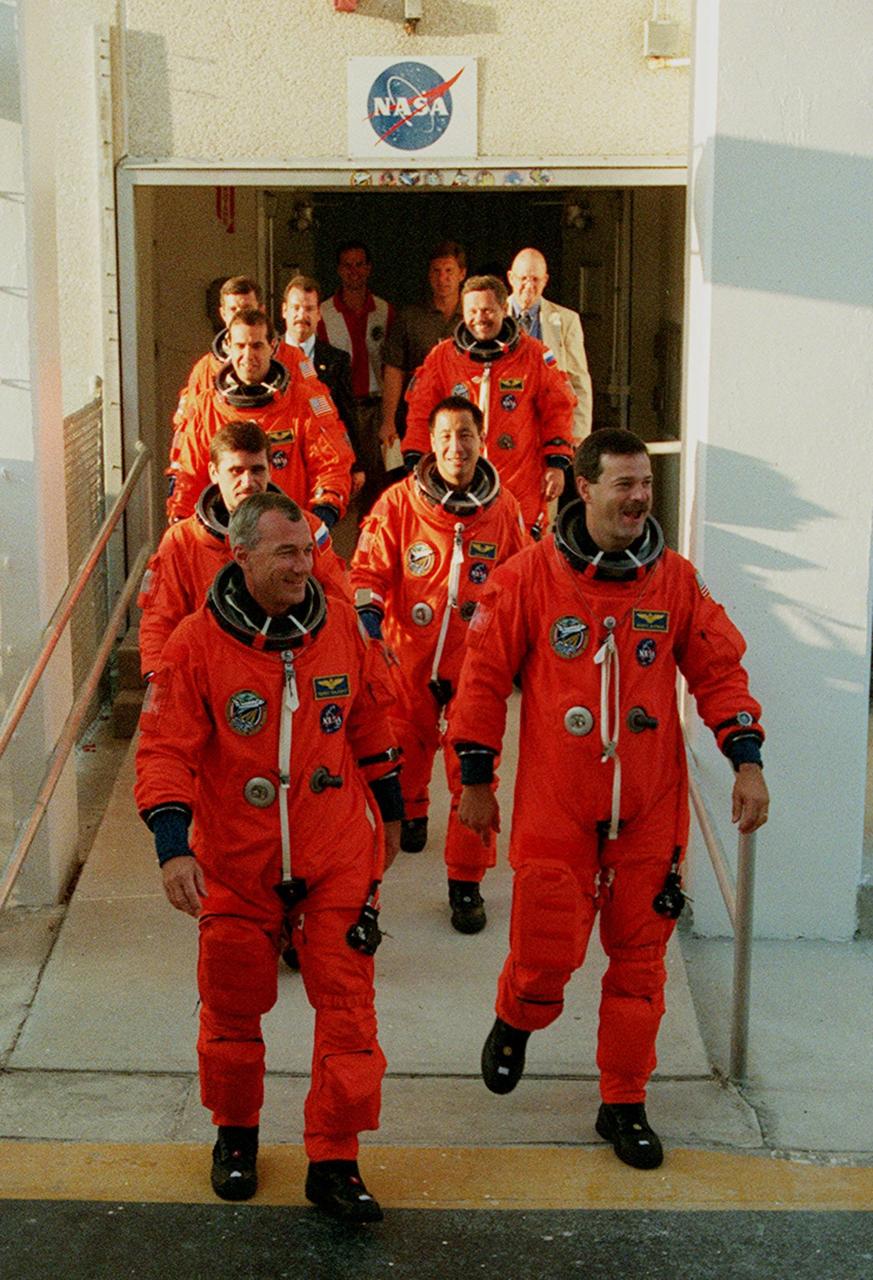
KENNEDY SPACE CENTER, Fla. -- The STS-106 flight crew departs the Operations & Checkout Facility to take part in Terminal Countdown Demonstration Test (TCDT) activities. The TCDT provides the crew with emergency egress training and opportunities to inspect their mission payload in the orbiter’s payload bay. Crew members taking part in the TCDT are, from left to right front to back, Commander Terrence W. Wilcutt, Pilot Scott D. Altman, Mission Specialists Yuri I. Malenchenko, Edward T. Lu, Richard A. Mastracchio, Boris V. Morukov and Daniel C. Burbank. Malenchenko and Morukov are with the Russian Aviation and Space Agency. STS-106 is scheduled to launch Sept. 8, 2000, at 8:31 a.m. EDT from Launch Pad 39B. On the 11-day mission, the seven-member crew will perform support tasks on orbit, transfer supplies and prepare the living quarters in the newly arrived Zvezda Service Module. The first long-duration crew, dubbed “Expedition One,” is due to arrive at the Station in late fall
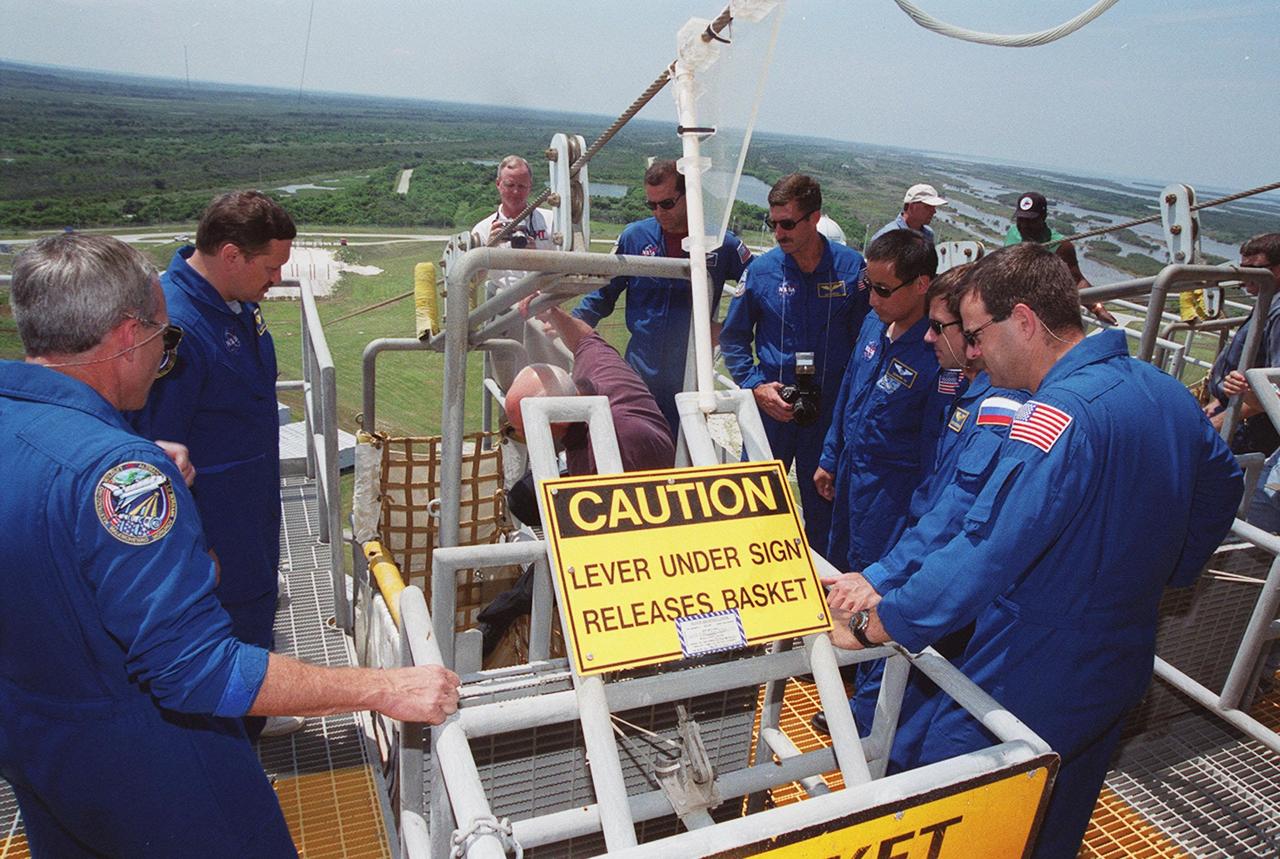
KENNEDY SPACE CENTER, Fla. -- The STS-106 flight crew review the slide wire basket egress system at Launch Pad 39-B. Pictured from left are Commander Terrence W. Wilcutt, Mission Specialists Boris V. Morukov, Richard A. Mastracchio, Daniel C. Burbank, Edward T. Lu, Yuri I. Malenchenko and Pilot Scott D. Altman. Malenchenko and Morukov are with the Russian Aviation and Space Agency. The flight crew were at Kennedy Space Center to take part in Terminal Countdown Demonstration Test (TCDT) activities. The TCDT provides the crew with emergency egress training and opportunities to inspect their mission payload in the orbiter’s payload bay. STS-106 is scheduled to launch Sept. 8, 2000, at 8:31 a.m. EDT from Launch Pad 39B. On the 11-day mission, the seven-member crew will perform support tasks on orbit, transfer supplies and prepare the living quarters in the newly arrived Zvezda Service Module. The first long-duration crew, dubbed “Expedition One,” is due to arrive at the Station in late fall
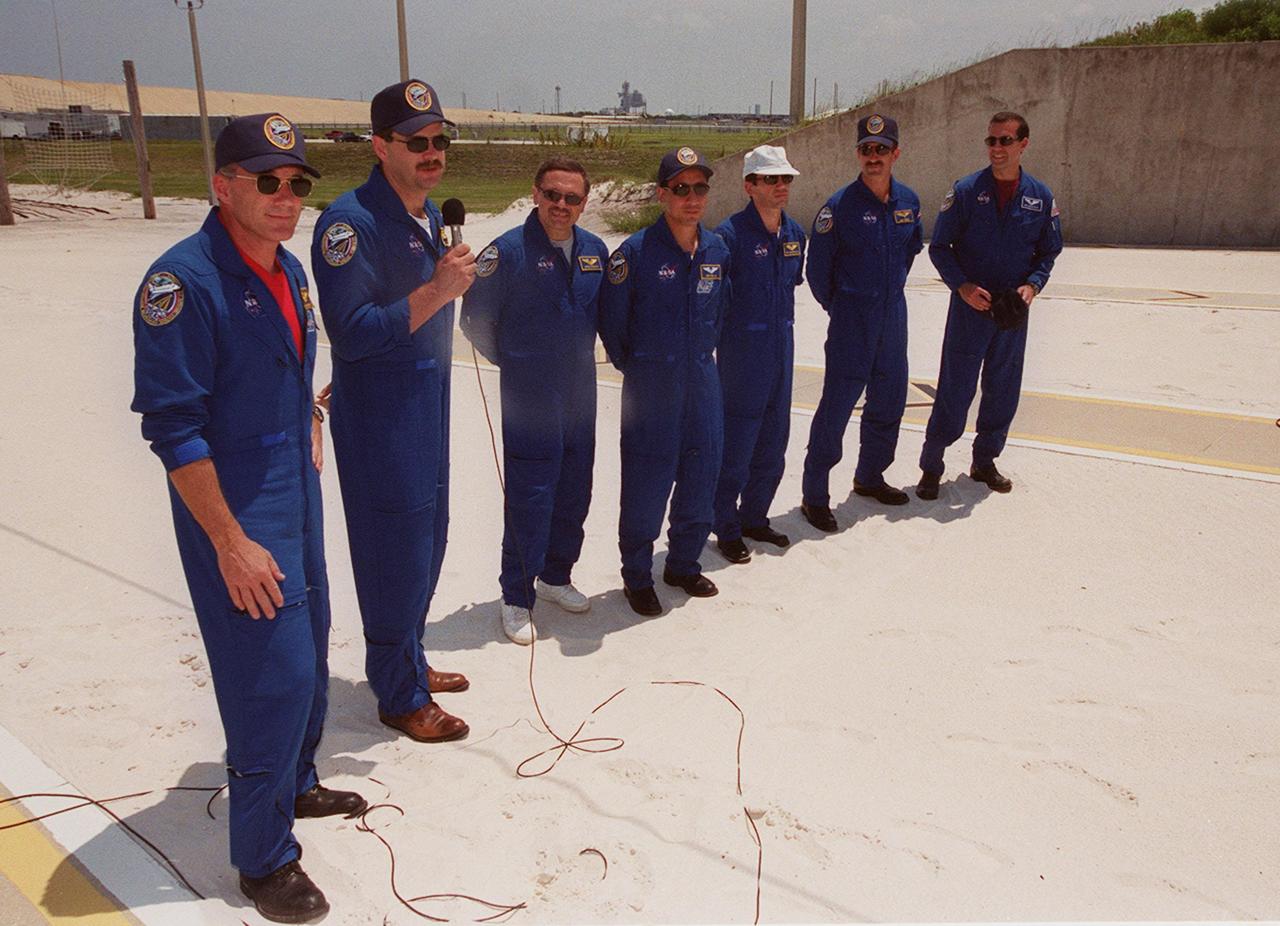
KENNEDY SPACE CENTER, Fla. -- STS-106 Pilot Scott D. Altman, left of STS-106 Commander Terrence W. Wilcutt, answers a question during a press conference at the slide wire basket area of Launch Pad 39-B. Other crew members pictured are, from left, Mission Specialists Boris V. Morukov, Edward T. Lu, Yuri I. Malenchenko, Daniel C. Burbank and Richard A. Mastracchio. Malenchenko and Morukov are with the Russian Aviation and Space Agency. The flight crew were at Kennedy Space Center to take part in Terminal Countdown Demonstration Test (TCDT) activities. The TCDT provides the crew with emergency egress training and opportunities to inspect their mission payload in the orbiter’s payload bay. STS-106 is scheduled to launch Sept. 8, 2000, at 8:31 a.m. EDT from Launch Pad 39B. On the 11-day mission, the seven-member crew will perform support tasks on orbit, transfer supplies and prepare the living quarters in the newly arrived Zvezda Service Module. The first long-duration crew, dubbed “Expedition One,” is due to arrive at the Station in late fall
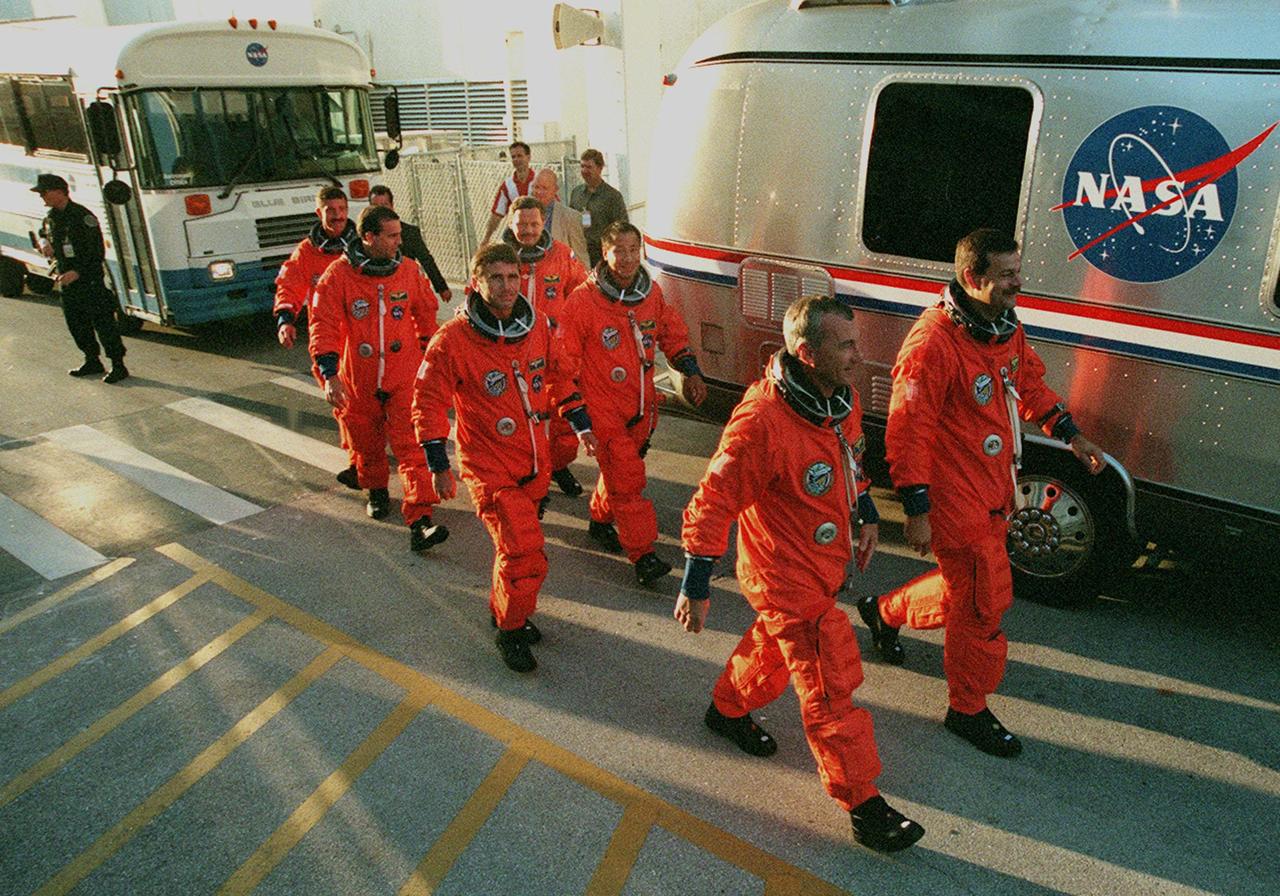
KENNEDY SPACE CENTER, Fla. -- The STS-106 flight crew departs the Operations & Checkout Facility to take part in Terminal Countdown Demonstration Test (TCDT) activities. The TCDT provides the crew with emergency egress training and opportunities to inspect their mission payload in the orbiter’s payload bay. Crew members taking part in the TCDT are, from left to right front to back, Commander Terrence W. Wilcutt, Pilot Scott D. Altman, Mission Specialists Yuri I. Malenchenko, Edward T. Lu, Richard A. Mastracchio, Boris V. Morukov and Daniel C. Burbank. Malenchenko and Morukov are with the Russian Aviation and Space Agency. STS-106 is scheduled to launch Sept. 8, 2000, at 8:31 a.m. EDT from Launch Pad 39B. On the 11-day mission, the seven-member crew will perform support tasks on orbit, transfer supplies and prepare the living quarters in the newly arrived Zvezda Service Module. The first long-duration crew, dubbed “Expedition One,” is due to arrive at the Station in late fall
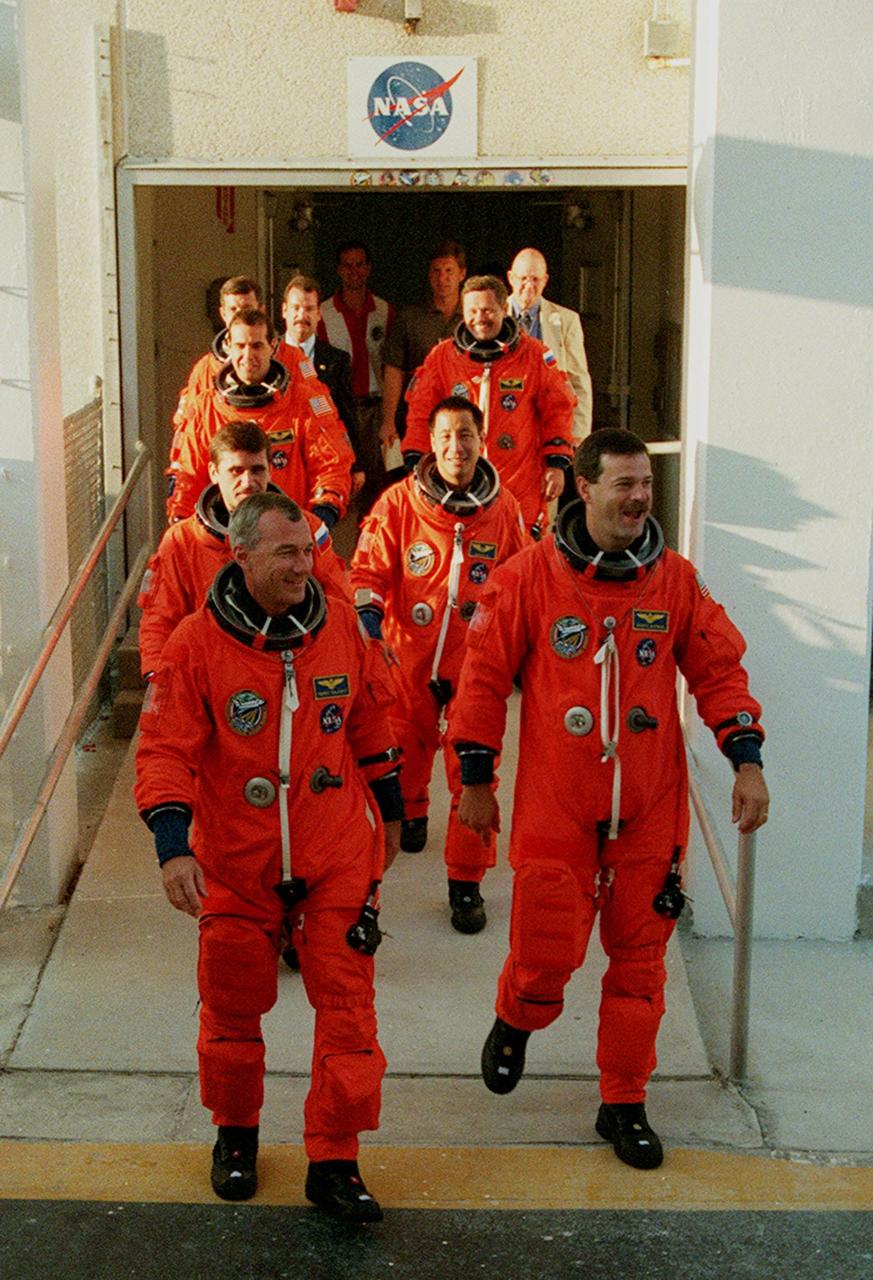
KENNEDY SPACE CENTER, Fla. -- The STS-106 flight crew departs the Operations & Checkout Facility to take part in Terminal Countdown Demonstration Test (TCDT) activities. The TCDT provides the crew with emergency egress training and opportunities to inspect their mission payload in the orbiter’s payload bay. Crew members taking part in the TCDT are, from left to right front to back, Commander Terrence W. Wilcutt, Pilot Scott D. Altman, Mission Specialists Yuri I. Malenchenko, Edward T. Lu, Richard A. Mastracchio, Boris V. Morukov and Daniel C. Burbank. Malenchenko and Morukov are with the Russian Aviation and Space Agency. STS-106 is scheduled to launch Sept. 8, 2000, at 8:31 a.m. EDT from Launch Pad 39B. On the 11-day mission, the seven-member crew will perform support tasks on orbit, transfer supplies and prepare the living quarters in the newly arrived Zvezda Service Module. The first long-duration crew, dubbed “Expedition One,” is due to arrive at the Station in late fall
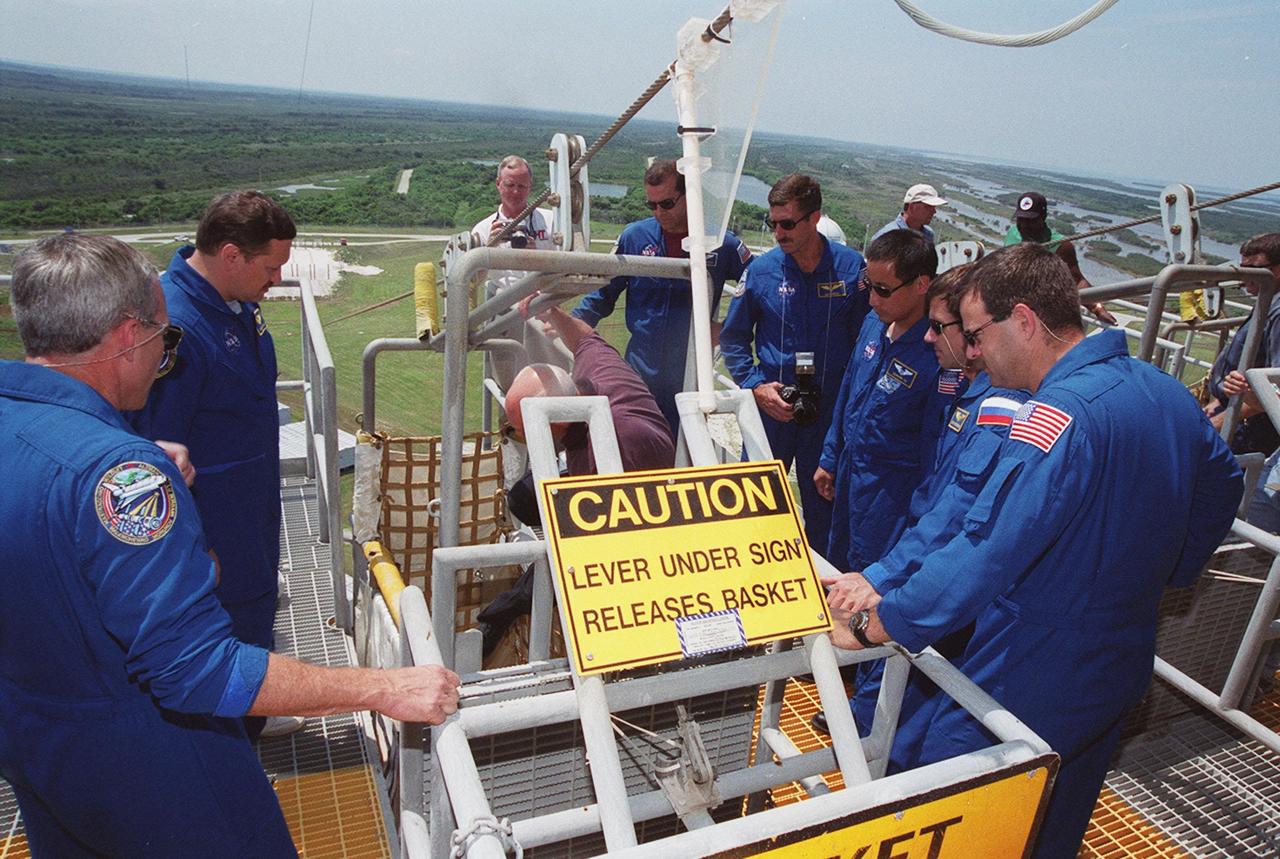
KENNEDY SPACE CENTER, Fla. -- The STS-106 flight crew review the slide wire basket egress system at Launch Pad 39-B. Pictured from left are Commander Terrence W. Wilcutt, Mission Specialists Boris V. Morukov, Richard A. Mastracchio, Daniel C. Burbank, Edward T. Lu, Yuri I. Malenchenko and Pilot Scott D. Altman. Malenchenko and Morukov are with the Russian Aviation and Space Agency. The flight crew were at Kennedy Space Center to take part in Terminal Countdown Demonstration Test (TCDT) activities. The TCDT provides the crew with emergency egress training and opportunities to inspect their mission payload in the orbiter’s payload bay. STS-106 is scheduled to launch Sept. 8, 2000, at 8:31 a.m. EDT from Launch Pad 39B. On the 11-day mission, the seven-member crew will perform support tasks on orbit, transfer supplies and prepare the living quarters in the newly arrived Zvezda Service Module. The first long-duration crew, dubbed “Expedition One,” is due to arrive at the Station in late fall
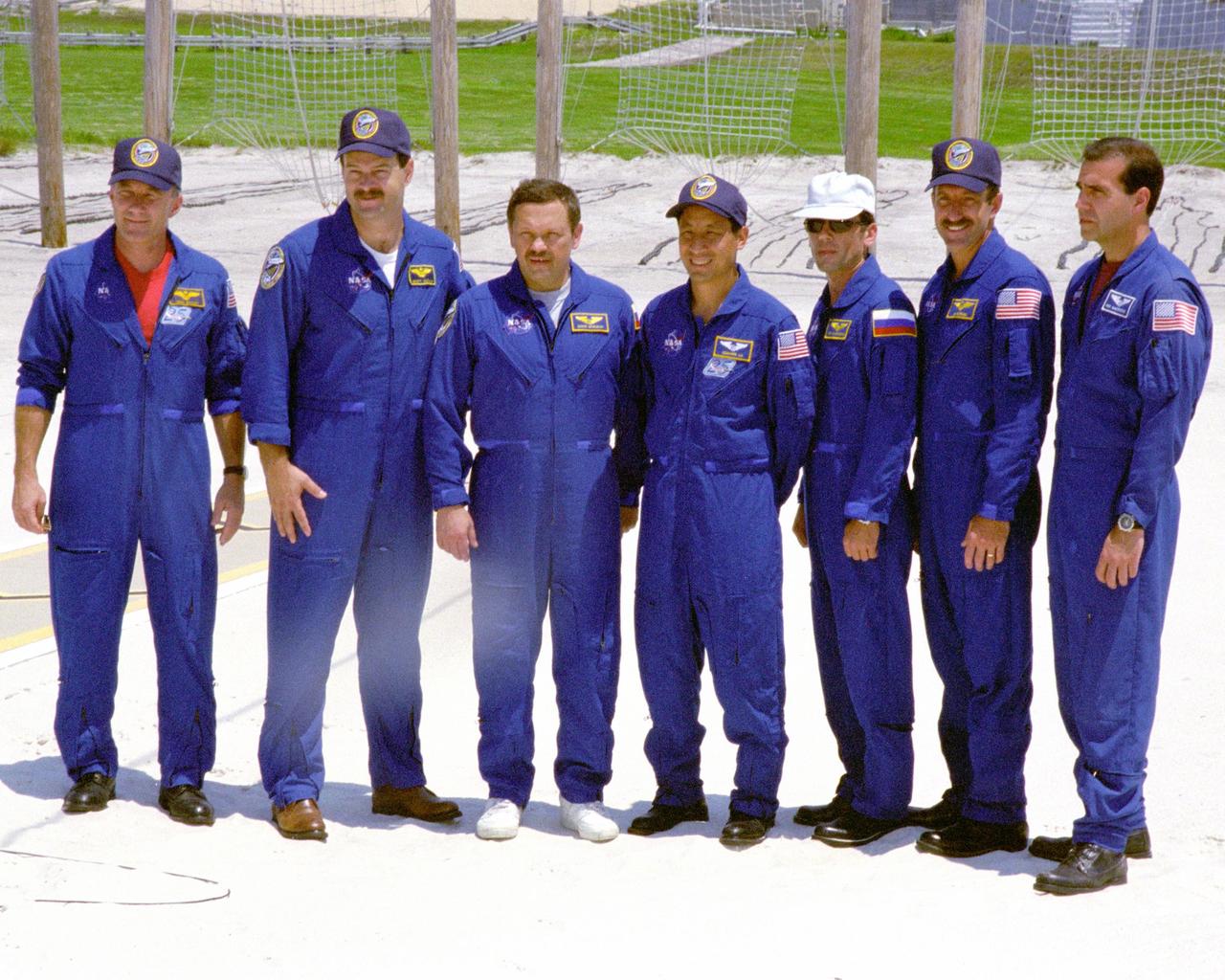
KENNEDY SPACE CENTER, FLA. - The STS-106 flight crew participate in a question and answer session for the media at the slide wire basket area of Launch Pad 39-B. Crew members pictured are, from left, Commander Terrence W. Wilcutt, Pilot Scott D. Altman, Mission Specialists Boris V. Morukov, Edward T. Lu, Yuri I. Malenchenko, Daniel C. Burbank and Richard A. Mastracchio. Malenchenko and Morukov are with the Russian Aviation and Space Agency. The flight crew were at Kennedy Space Center to take part in Terminal Countdown Demonstration Test (TCDT) activities. The TCDT provides the crew with emergency egress training and opportunities to inspect their mission payload in the orbiter’s payload bay. STS-106 is scheduled to launch Sept. 8, 2000, at 8:31 a.m. EDT from Launch Pad 39B. On the 11-day mission, the seven-member crew will perform support tasks on orbit, transfer supplies and prepare the living quarters in the newly arrived Zvezda Service Module. The first long-duration crew, dubbed “Expedition One,” is due to arrive at the Station in late fall.
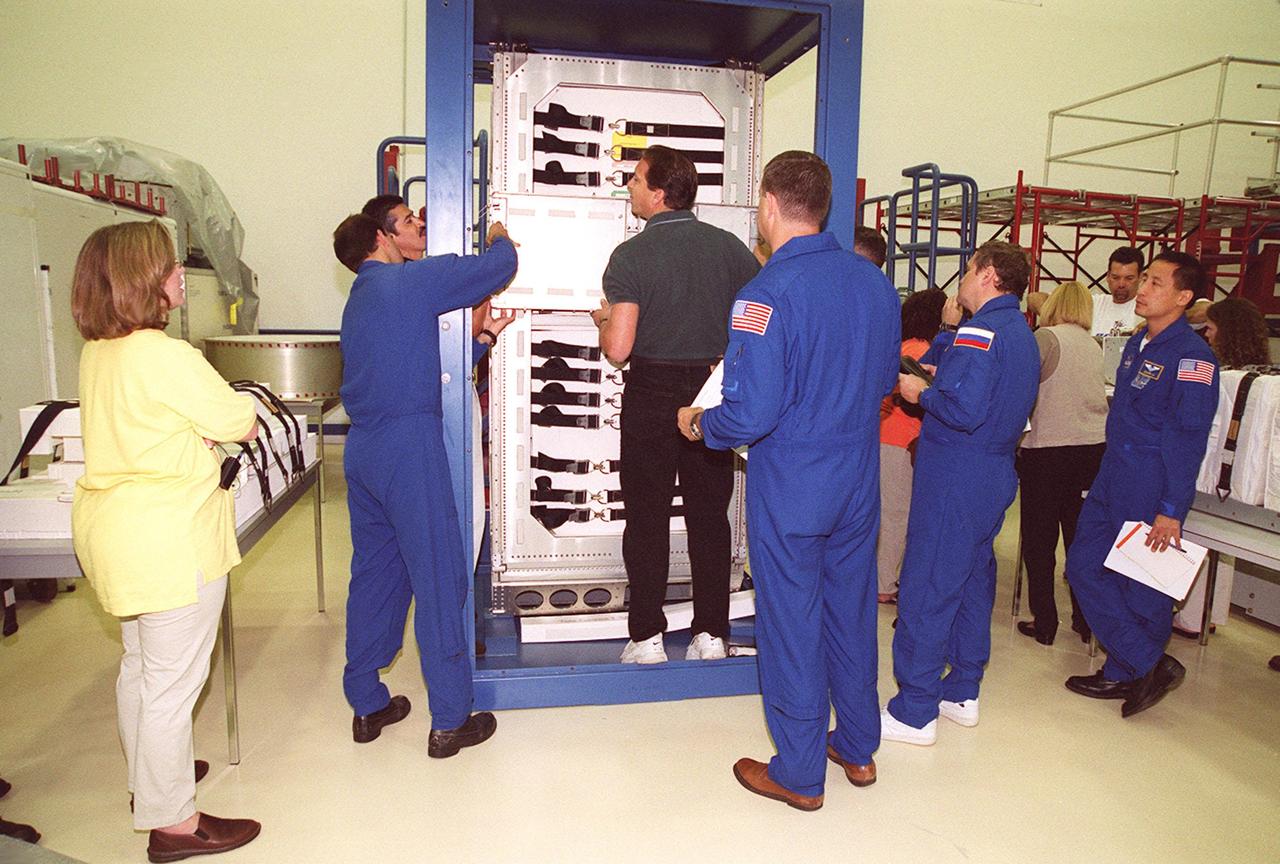
KENNEDY SPACE CENTER, FLA. -- As part of Crew Equipment Interface Test (CEIT) activities at SPACEHAB, members of the STS-106 crew check out a Maximum Envelope Support Structure (MESS) rack they will be using during their mission to the International Space Station. Seen here (with backs to camera, in uniform) are Mission Specialist Richard A. Mastracchio, Pilot Scott D. Altman, Boris V. Morukov, and Edward T. Lu (at right). Also taking part in the CEIT are Commander Terrence W. Wilcutt and Mission Specialists Yuri I. Malenchenko and Daniel C. Burbank. Malenchenko and Morukov represent the Russian Aviation and Space Agency. STS-106 is scheduled to launch Sept. 8, 2000, at 8:31 a.m. EDT from Launch Pad 39B on an 11-day mission. The seven-member crew will prepare the Space Station for its first resident crew and begin outfitting the newly arrived Zvezda Service Module. They will perform support tasks on orbit, transfer supplies and prepare the Zvezda living quarters for the first long-duration crew, dubbed “Expedition One,” which is due to arrive at the Station in late fall
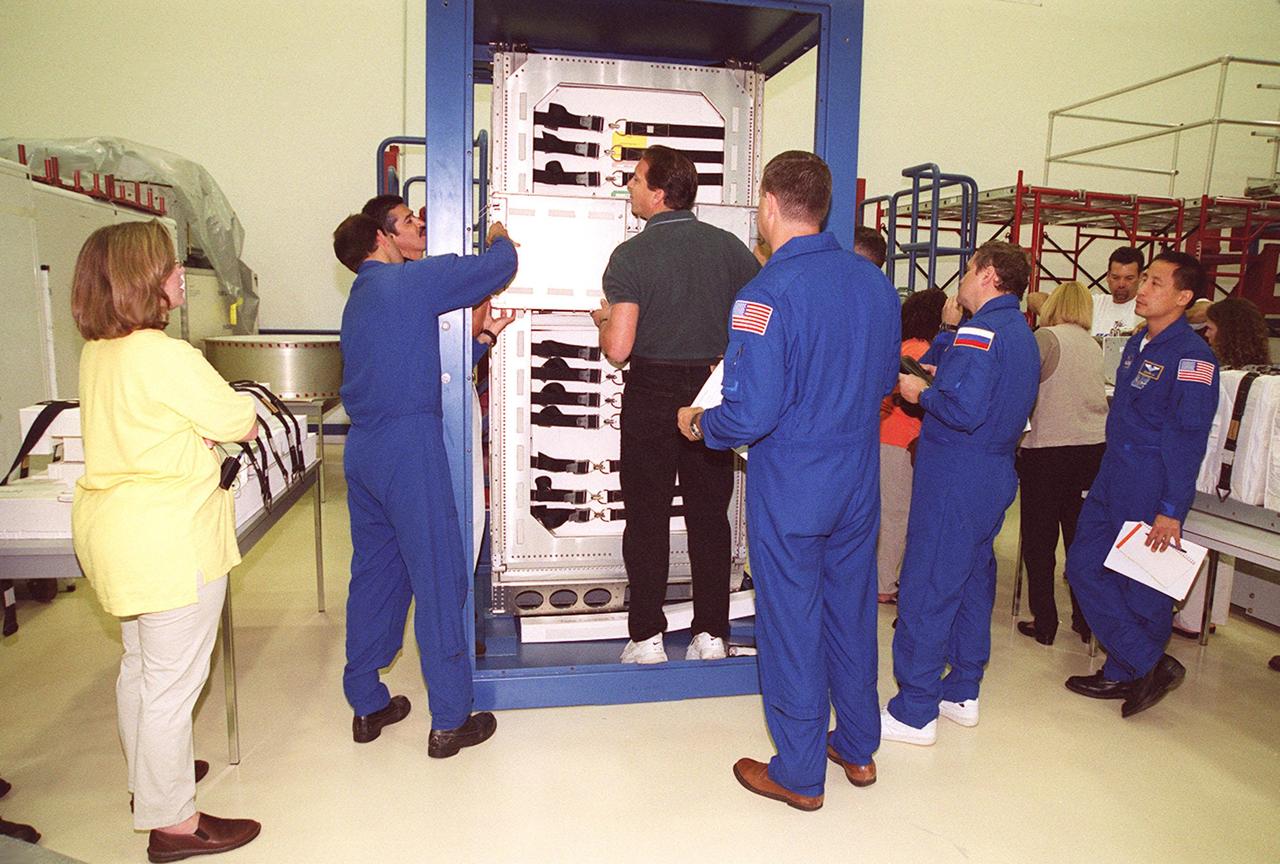
KENNEDY SPACE CENTER, FLA. -- As part of Crew Equipment Interface Test (CEIT) activities at SPACEHAB, members of the STS-106 crew check out a Maximum Envelope Support Structure (MESS) rack they will be using during their mission to the International Space Station. Seen here (with backs to camera, in uniform) are Mission Specialist Richard A. Mastracchio, Pilot Scott D. Altman, Boris V. Morukov, and Edward T. Lu (at right). Also taking part in the CEIT are Commander Terrence W. Wilcutt and Mission Specialists Yuri I. Malenchenko and Daniel C. Burbank. Malenchenko and Morukov represent the Russian Aviation and Space Agency. STS-106 is scheduled to launch Sept. 8, 2000, at 8:31 a.m. EDT from Launch Pad 39B on an 11-day mission. The seven-member crew will prepare the Space Station for its first resident crew and begin outfitting the newly arrived Zvezda Service Module. They will perform support tasks on orbit, transfer supplies and prepare the Zvezda living quarters for the first long-duration crew, dubbed “Expedition One,” which is due to arrive at the Station in late fall
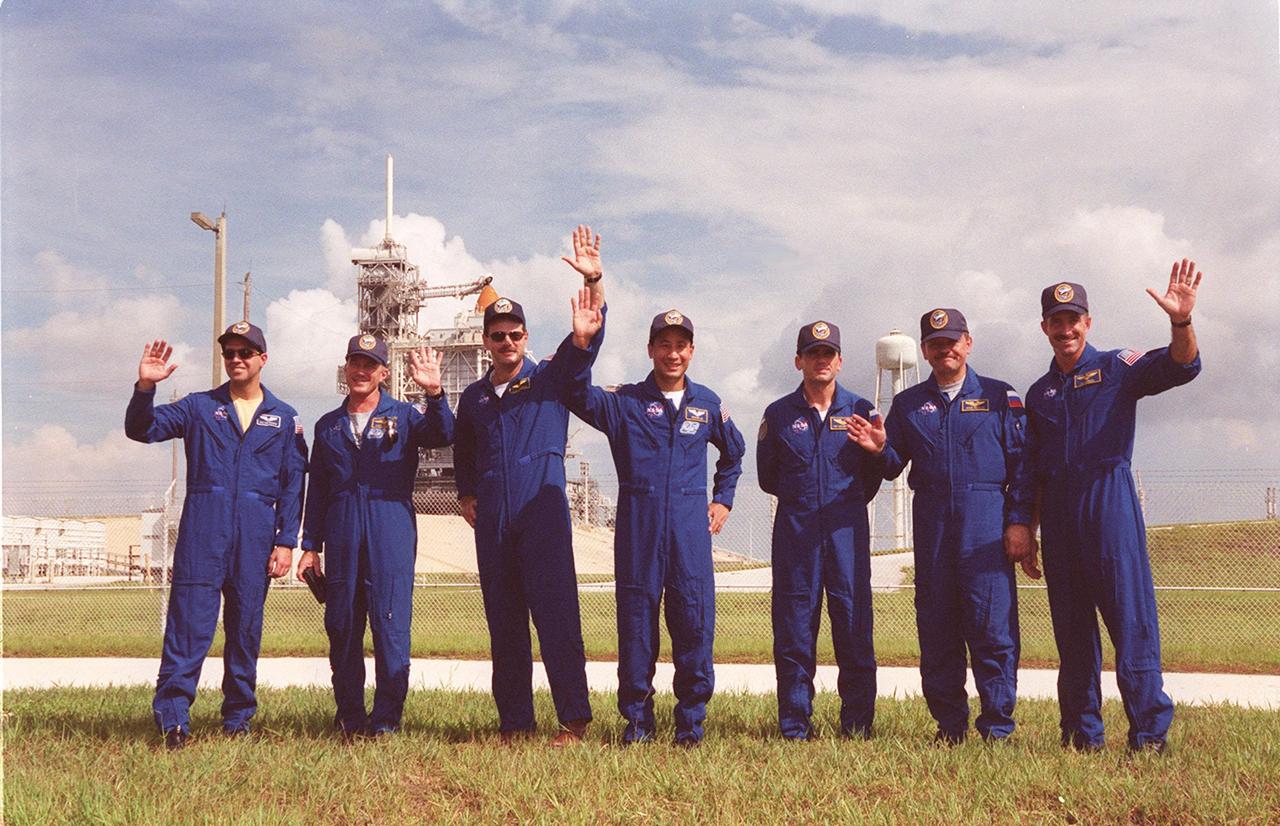
While meeting with family on the day before launch, the STS-106 crew poses for a photo. Waving, left to right, are Mission Specialist Richard A. Mastracchio, Commander Terrence W. Wilcutt, Pilot Scott D. Altman, and Mission Specialists Edward T. Lu, Yuri I. Malenchenko, Boris V. Morukov and Daniel C. Burbank. Malenchenko and Morukov are with the Russian Aviation and Space Agency. In the background (left) is Launch Pad 39B and Space Shuttle Atlantis, with the Rotating Service Structure still in place.; STS-106 is scheduled to launch Sept. 8, 2000, at 8:45 a.m. EDT from Launch Pad 39B. On the 11-day mission, the seven-member crew will perform support tasks on orbit, transfer supplies and prepare the living quarters in the newly arrived Zvezda Service Module. The first long-duration crew, dubbed “Expedition One,” is due to arrive at the Station in late fall. Landing is targeted for Sept. 19 at 4:59 a.m. EDT at the KSC Shuttle Landing Facility
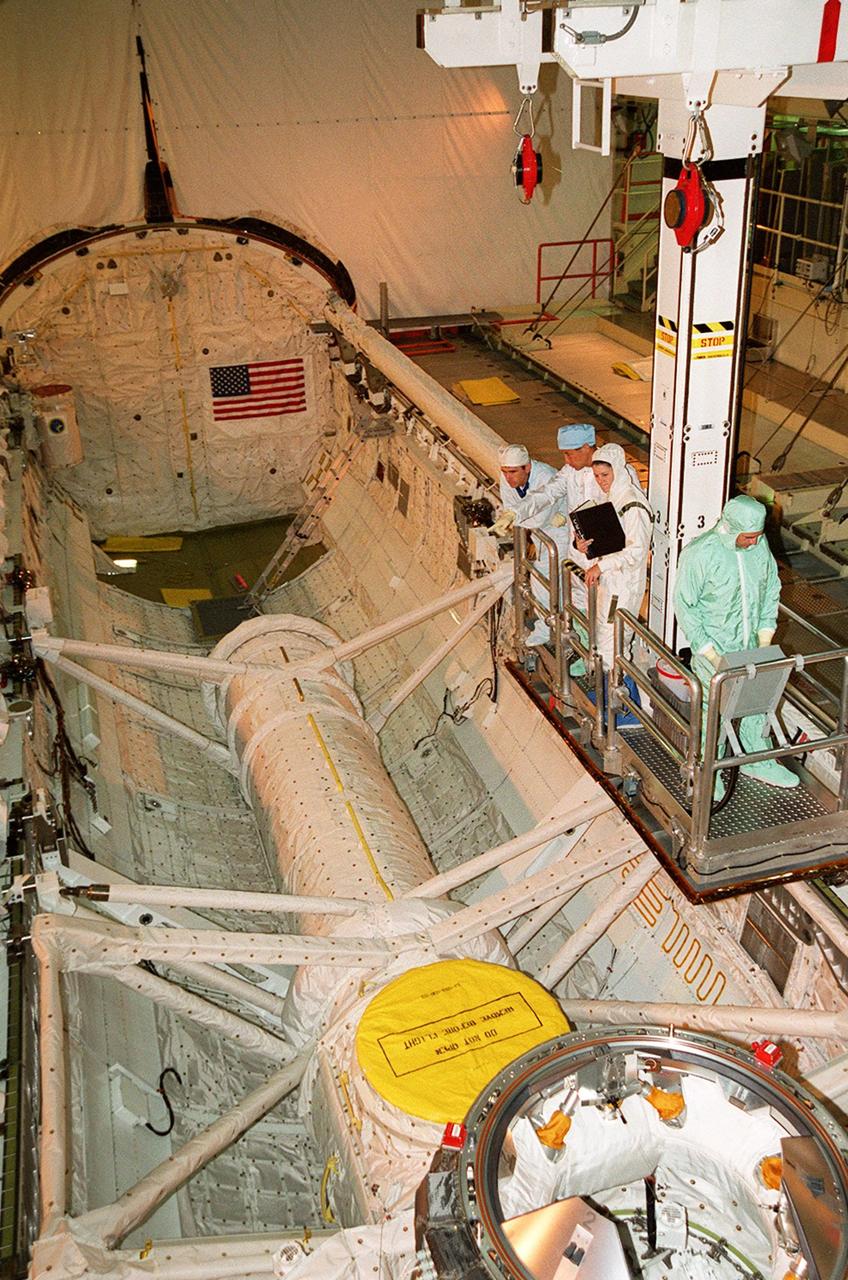
In Orbiter Processing Facility bay 3, STS-106 Mission Specialists Yuri I. Malenchenko (left) and Edward T. Lu (beside him) familiarize themselves with equipment in the payload bay of Space Shuttle orbiter Atlantis with the help of KSC employees as part of Crew Equipment Interface Test (CEIT) activities for their mission. The other crew members are Commander Terrence W. Wilcutt, Pilot Scott D. Altman, and Mission Specialists Daniel C. Burbank, Boris V. Morukov and Richard A. Mastracchio. Malenchenko and Morukov represent the Russian Aviation and Space Agency. On the 11-day mission, the seven-member crew will perform support tasks on orbit, transfer supplies and prepare the living quarters in the newly arrived Zvezda Service Module for the first long-duration crew, dubbed "Expedition One," which is due to arrive at the Station in late fall. STS-106 is scheduled to launch Sept. 8, 2000, at 8:31 a.m. EDT from Launch Pad 39B
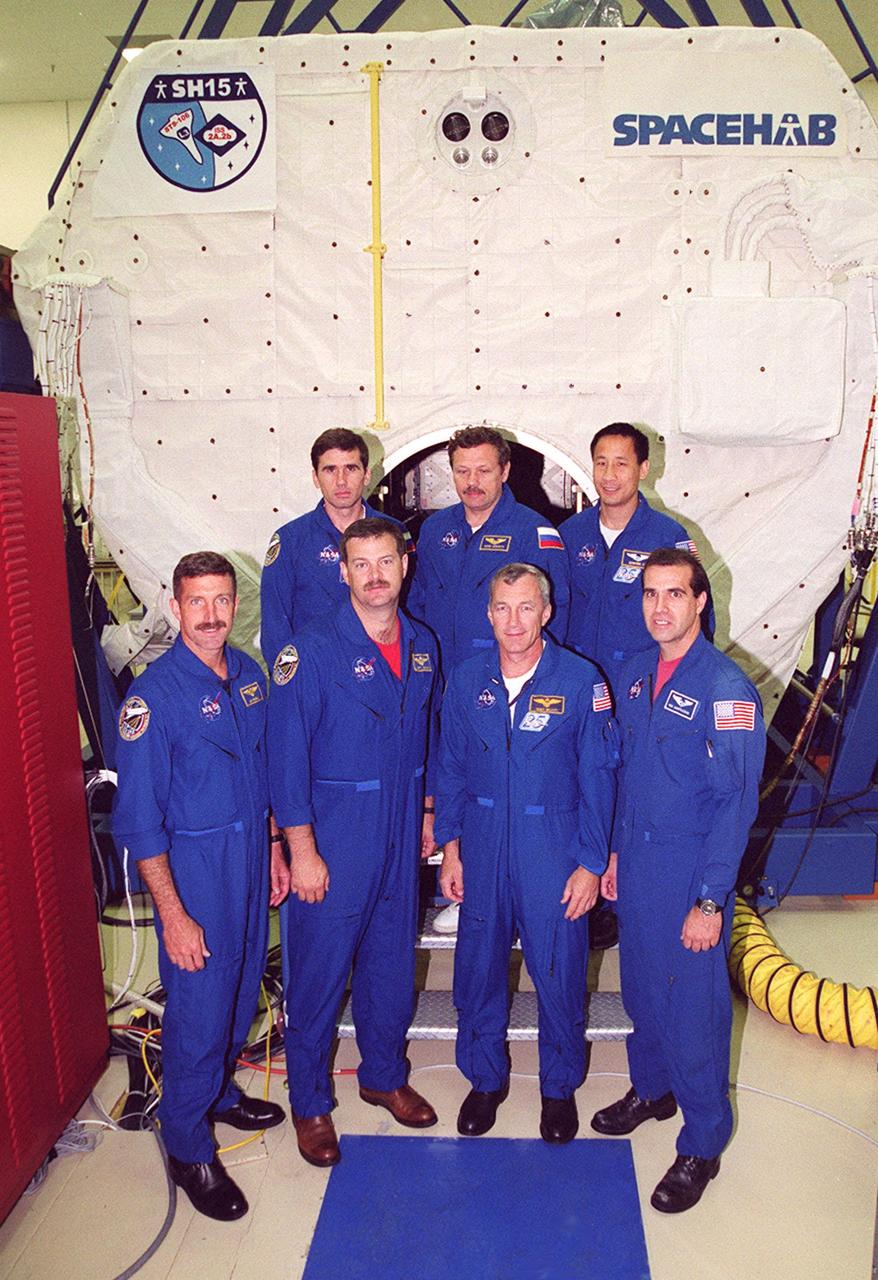
KENNEDY SPACE CENTER, FLA. -- The STS-106 crew poses in front of the SPACEHAB module during Crew Equipment Interface Test activities. From left, in the foreground, are Mission Specialist Daniel C. Burbank, Pilot Scott D. Altman, Commander Terrence W. Wilcutt and Richard A. Mastracchio; in the background are Mission Specialists Yuri I. Malenchenko, Boris V. Morukov and Edward T. Lu. Malenchenko and Morukov represent the Russian Aviation and Space Agency. STS-106 is scheduled to launch Sept. 8, 2000, at 8:31 a.m. EDT from Launch Pad 39B on an 11-day mission to the International Space Station. The seven-member crew will prepare the Space Station for its first resident crew and begin outfitting the newly arrived Zvezda Service Module. They will perform support tasks on orbit, transfer supplies and prepare the Zvezda living quarters for the first long-duration crew, dubbed “Expedition One,” which is due to arrive at the Station in late fall
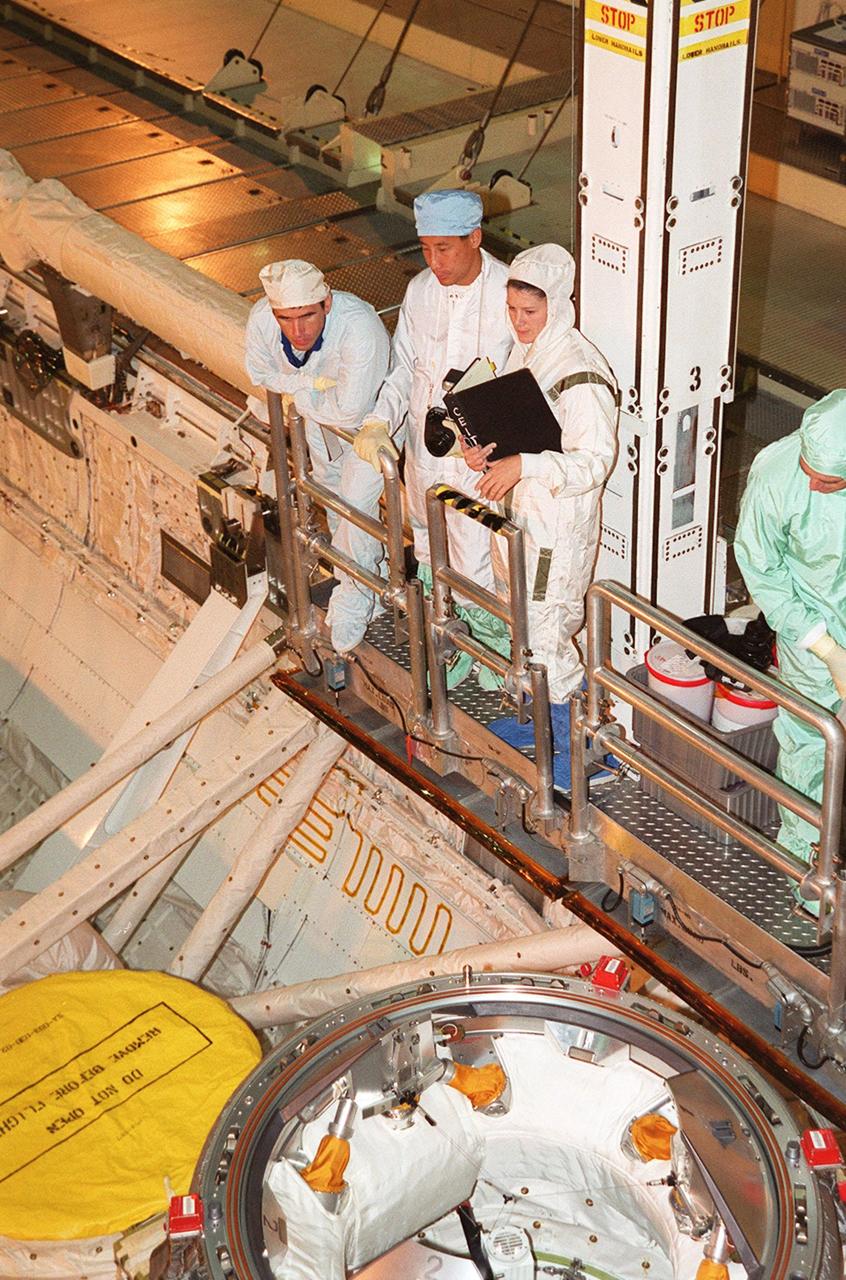
In Orbiter Processing Facility bay 3, STS-106 Mission Specialists Yuri I. Malenchenko (left) and Edward T. Lu (beside him) familiarize themselves with equipment in the payload bay of Space Shuttle orbiter Atlantis with the help of KSC employees as part of Crew Equipment Interface Test (CEIT) activities for their mission. The other crew members are Commander Terrence W. Wilcutt, Pilot Scott D. Altman, and Mission Specialists Daniel C. Burbank, Boris V. Morukov and Richard A. Mastracchio. Malenchenko and Morukov represent the Russian Aviation and Space Agency. On the 11-day mission, the seven-member crew will perform support tasks on orbit, transfer supplies and prepare the living quarters in the newly arrived Zvezda Service Module for the first long-duration crew, dubbed "Expedition One," which is due to arrive at the Station in late fall. STS-106 is scheduled to launch Sept. 8, 2000, at 8:31 a.m. EDT from Launch Pad 39B
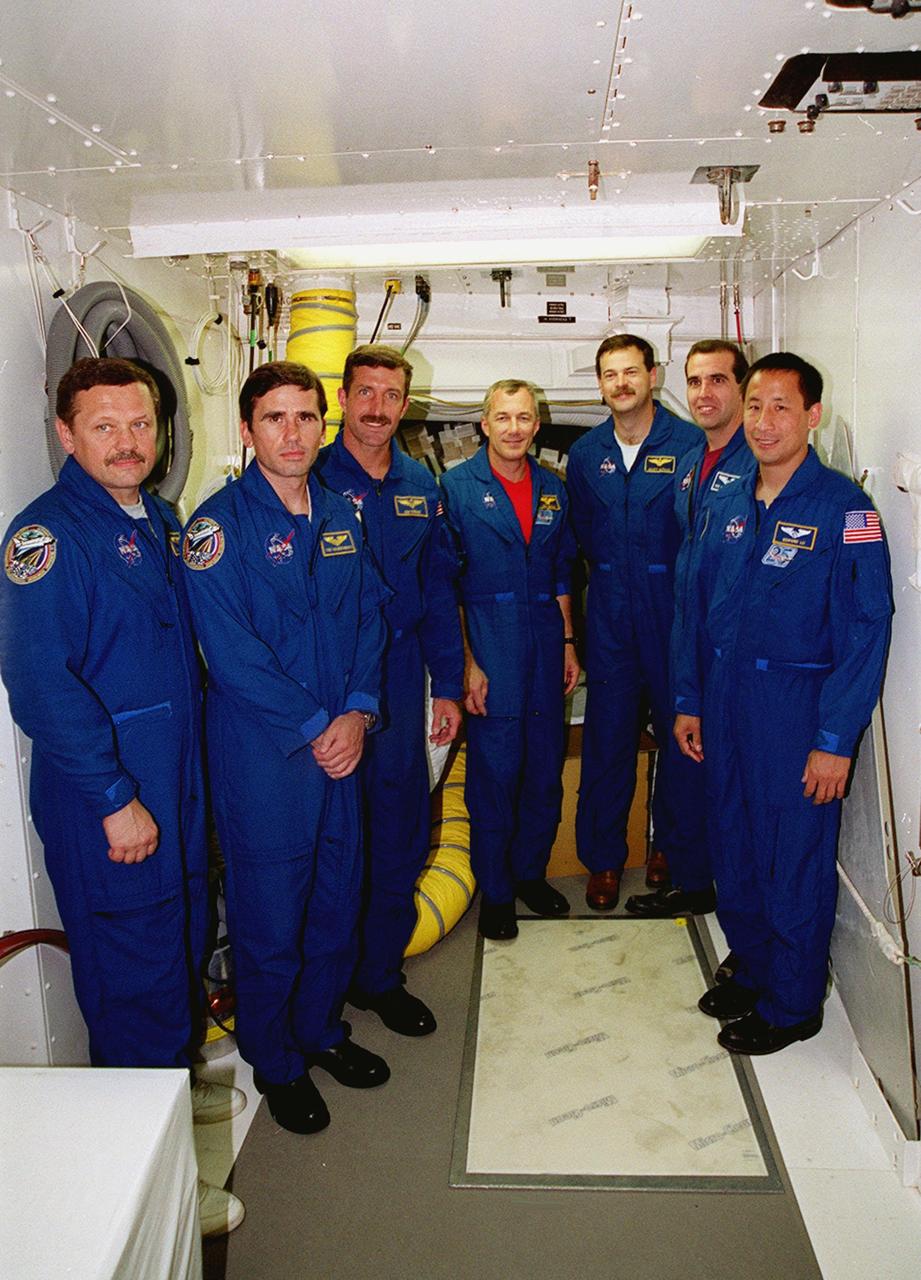
KENNEDY SPACE CENTER, Fla. -- The STS-106 flight crew gather in the white room of Launch Pad 39-B. Crew members pictured are, from left, Mission Specialists Boris V. Morukov, Yuri I. Malenchenko, Daniel C. Burbank, Commander Terrence W. Wilcutt, Pilot Scott D. Altman, Mission Specialists Richard A. Mastracchio and Edward T. Lu. Malenchenko and Morukov are with the Russian Aviation and Space Agency. The flight crew were at Kennedy Space Center to take part in Terminal Countdown Demonstration Test (TCDT) activities. The TCDT provides the crew with emergency egress training and opportunities to inspect their mission payload in the orbiter’s payload bay. STS-106 is scheduled to launch Sept. 8, 2000, at 8:31 a.m. EDT from Launch Pad 39B. On the 11-day mission, the seven-member crew will perform support tasks on orbit, transfer supplies and prepare the living quarters in the newly arrived Zvezda Service Module. The first long-duration crew, dubbed “Expedition One,” is due to arrive at the Station in late fall
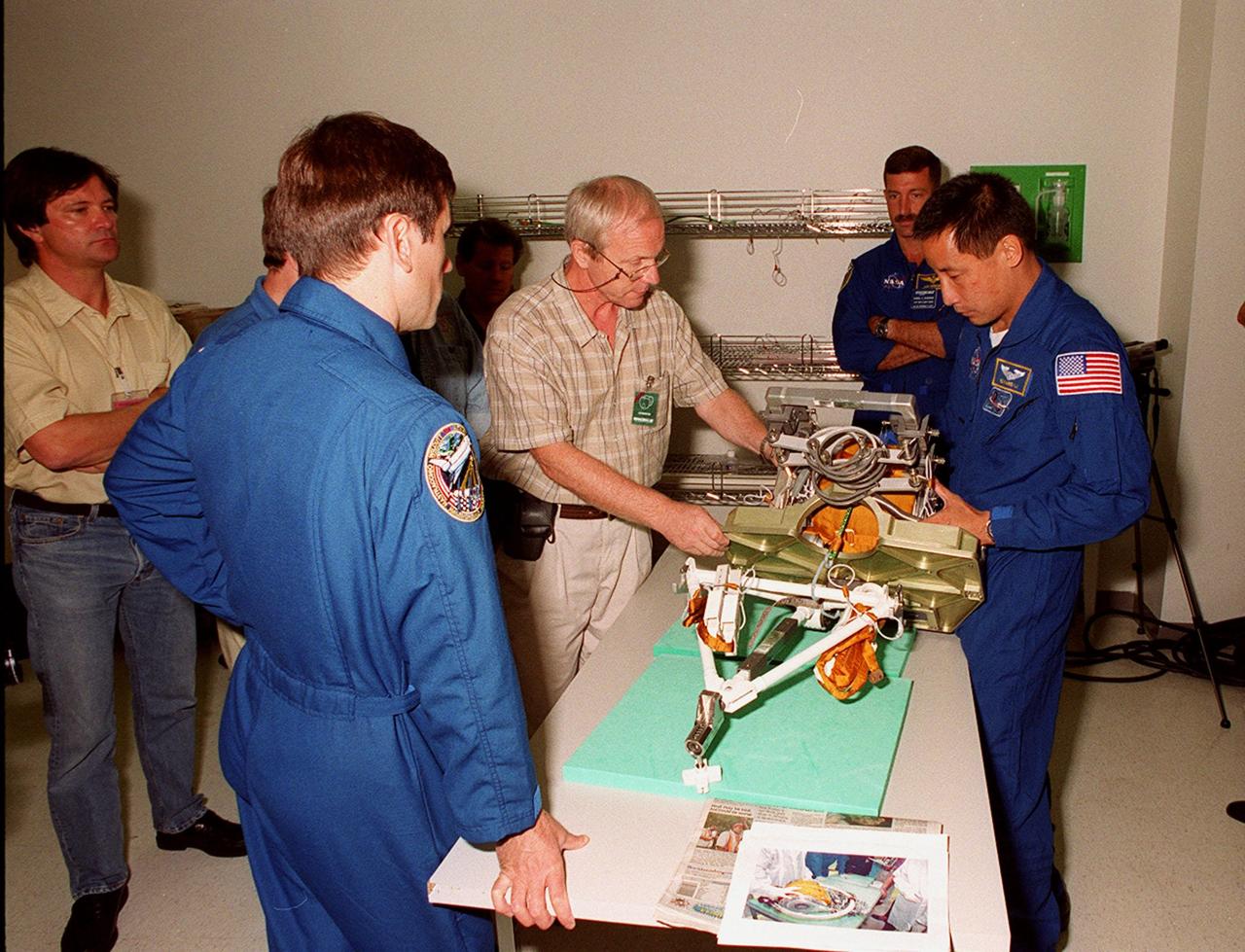
KENNEDY SPACE CENTER, FLA. -- During Crew Equipment Interface Test (CEIT) activities at SPACEHAB, members of the STS-106 crew check out a Russian foot restraint, equipment that will be part of the payload on their mission to the International Space Station. Around the table are Mission Specialist Yuri I. Malenchenko (back to camera), a SPACEHAB worker, and Mission Specialists Daniel C. Burbank (at end of table) and Edward T. Lu (right). Others at KSC for the CEIT are Commander Terrence W. Wilcutt, Pilot Scott D. Altman, and Mission Specialists Boris V. Morukov and Richard A. Mastracchio. Malenchenko and Morukov represent the Russian Aviation and Space Agency. On the 11-day mission, the seven-member crew will perform support tasks on orbit, transfer supplies and prepare the living quarters in the newly arrived Zvezda Service Module for the first long-duration crew, dubbed “Expedition One,” which is due to arrive at the Station in late fall. STS-106 is scheduled to launch Sept. 8, 2000, at 8:31 a.m. EDT from Launch Pad 39B
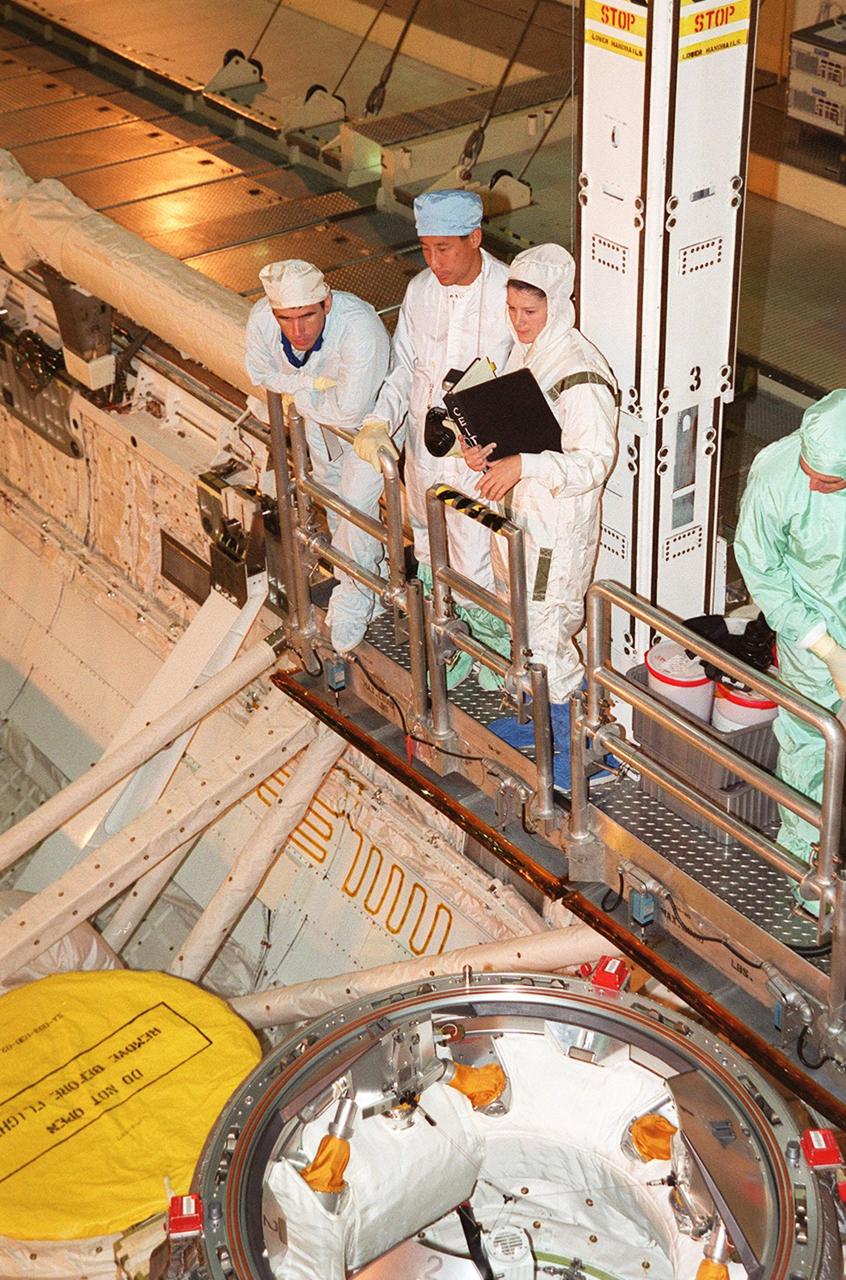
In Orbiter Processing Facility bay 3, STS-106 Mission Specialists Yuri I. Malenchenko (left) and Edward T. Lu (beside him) familiarize themselves with equipment in the payload bay of Space Shuttle orbiter Atlantis with the help of KSC employees as part of Crew Equipment Interface Test (CEIT) activities for their mission. The other crew members are Commander Terrence W. Wilcutt, Pilot Scott D. Altman, and Mission Specialists Daniel C. Burbank, Boris V. Morukov and Richard A. Mastracchio. Malenchenko and Morukov represent the Russian Aviation and Space Agency. On the 11-day mission, the seven-member crew will perform support tasks on orbit, transfer supplies and prepare the living quarters in the newly arrived Zvezda Service Module for the first long-duration crew, dubbed "Expedition One," which is due to arrive at the Station in late fall. STS-106 is scheduled to launch Sept. 8, 2000, at 8:31 a.m. EDT from Launch Pad 39B
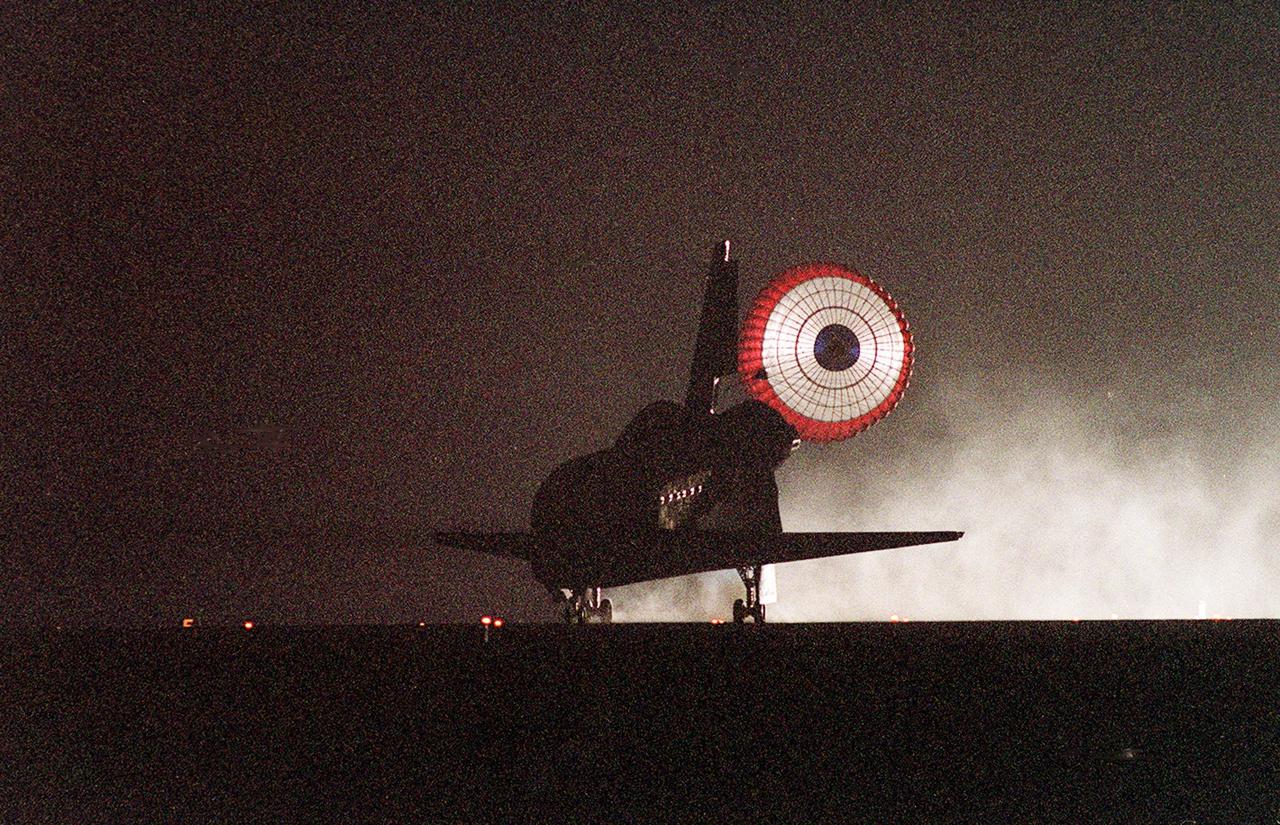
KENNEDY SPACE CENTER, Fla. -- Upon touchdown on Runway 15 of KSC’s Shuttle Landing Facility, Atlantis’s drag chute opens to help slow the vehicle. At the controls are Commander Terrence W. Wilcutt and Pilot Scott D. Altman. Also on board the orbiter are Mission Specialists Edward T. Lu, Yuri I. Malenchenko, Boris V. Morukov, Richard A. Mastracchio and Daniel C. Burbank. Malenchenko and Morukov are with the Russian Aviation and Space Agency. Atlantis and crew traveled 4.9 million miles on the 11-day, 19-hour, 11-minute STS-106 mission. Main gear touchdown was at 3:56:48 a.m. EDT, landing on orbit 185 of the mission. Nose gear touchdown was at 3:56:57 a.m. EDT and wheel stop at 3:58:01 a.m. EDT. The crew has returned from the International Space Station where they transferred nearly 5,000 pounds of equipment and supplies for use by the first resident crew expected to arrive in November. This was the 99th flight in the Shuttle program and the 22nd for Atlantis. STS-106 also marked the 15th nighttime landing in Shuttle history and the 23rd consecutive landing at KSC
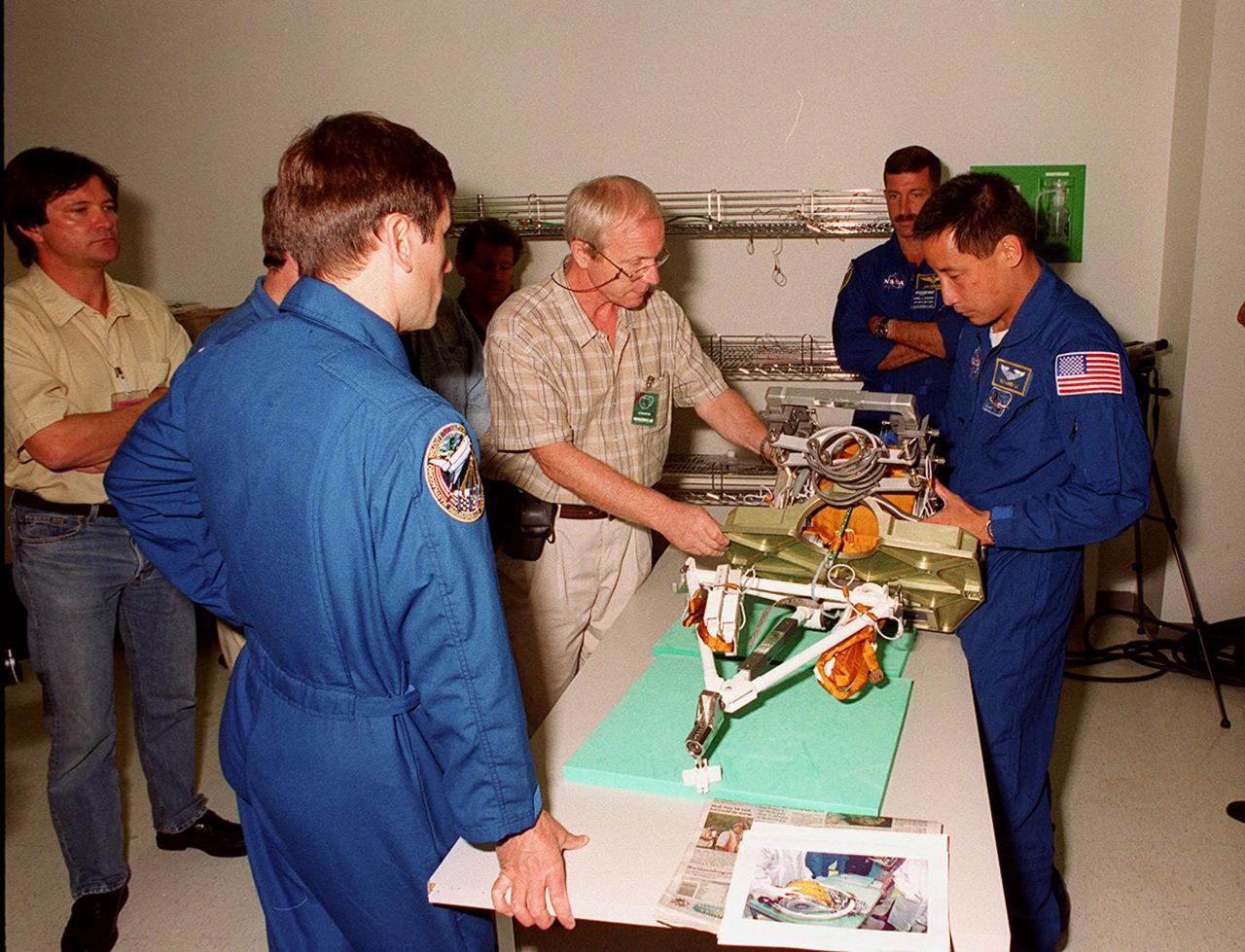
KENNEDY SPACE CENTER, FLA. -- During Crew Equipment Interface Test (CEIT) activities at SPACEHAB, members of the STS-106 crew check out a Russian foot restraint, equipment that will be part of the payload on their mission to the International Space Station. Around the table are Mission Specialist Yuri I. Malenchenko (back to camera), a SPACEHAB worker, and Mission Specialists Daniel C. Burbank (at end of table) and Edward T. Lu (right). Others at KSC for the CEIT are Commander Terrence W. Wilcutt, Pilot Scott D. Altman, and Mission Specialists Boris V. Morukov and Richard A. Mastracchio. Malenchenko and Morukov represent the Russian Aviation and Space Agency. On the 11-day mission, the seven-member crew will perform support tasks on orbit, transfer supplies and prepare the living quarters in the newly arrived Zvezda Service Module for the first long-duration crew, dubbed “Expedition One,” which is due to arrive at the Station in late fall. STS-106 is scheduled to launch Sept. 8, 2000, at 8:31 a.m. EDT from Launch Pad 39B
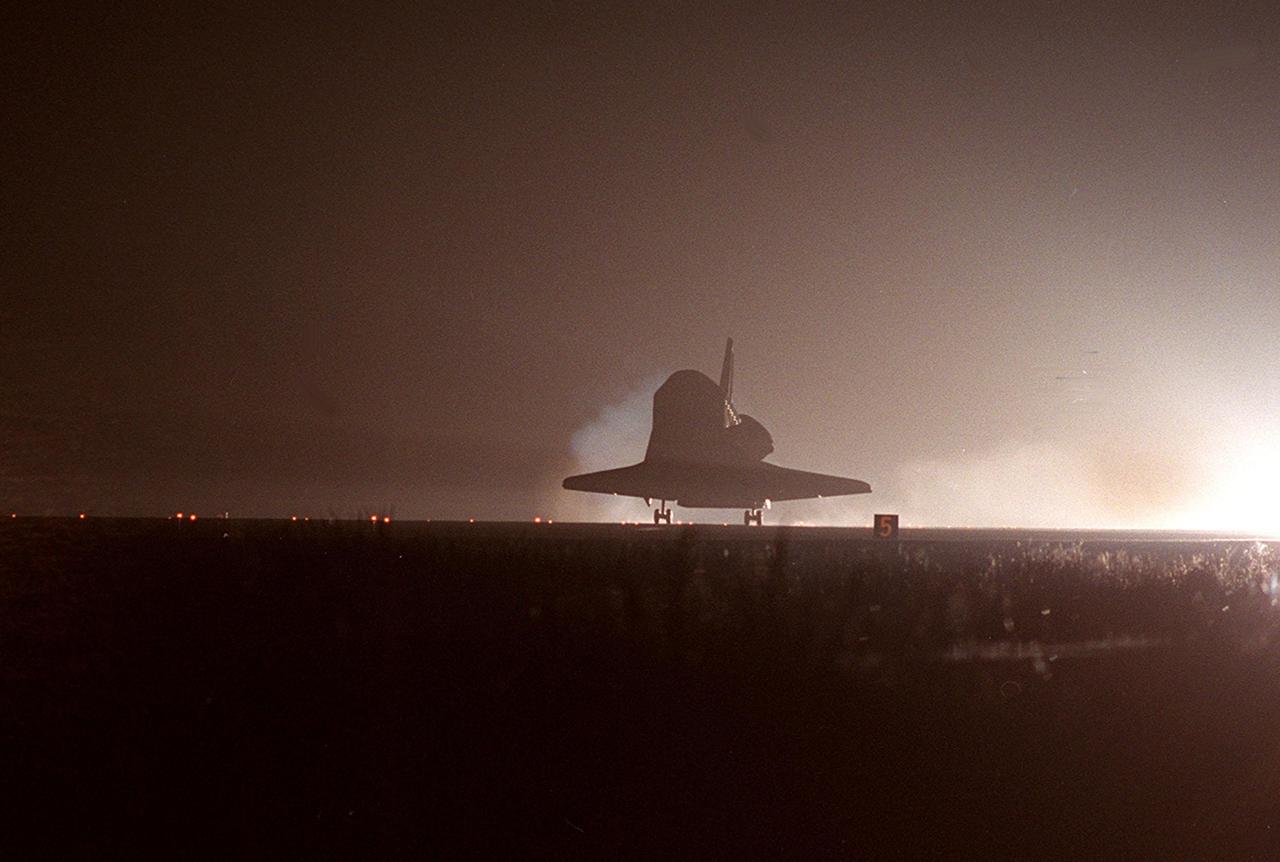
KENNEDY SPACE CENTER, Fla. -- Space Shuttle Atlantis appears ghostlike in the runway lights as it touches down on the KSC Shuttle Landing Facility Runway 15. At the controls are Commander Terrence W. Wilcutt and Pilot Scott D. Altman. Also on board the orbiter are Mission Specialists Edward T. Lu, Yuri I. Malenchenko, Boris V. Morukov, Richard A. Mastracchio and Daniel C. Burbank. Malenchenko and Morukov are with the Russian Aviation and Space Agency. Atlantis and crew traveled 4.9 million miles on the 11-day, 19-hour, 11-minute STS-106 mission. Main gear touchdown was at 3:56:48 a.m. EDT, landing on orbit 185 of the mission. Nose gear touchdown was at 3:56:57 a.m. EDT and wheel stop at 3:58:01 a.m. EDT. The crew has returned from the International Space Station where they transferred nearly 5,000 pounds of equipment and supplies for use by the first resident crew expected to arrive in November. This was the 99th flight in the Shuttle program and the 22nd for Atlantis. STS-106 also marked the 15th nighttime landing in Shuttle history and the 23rd consecutive landing at KSC
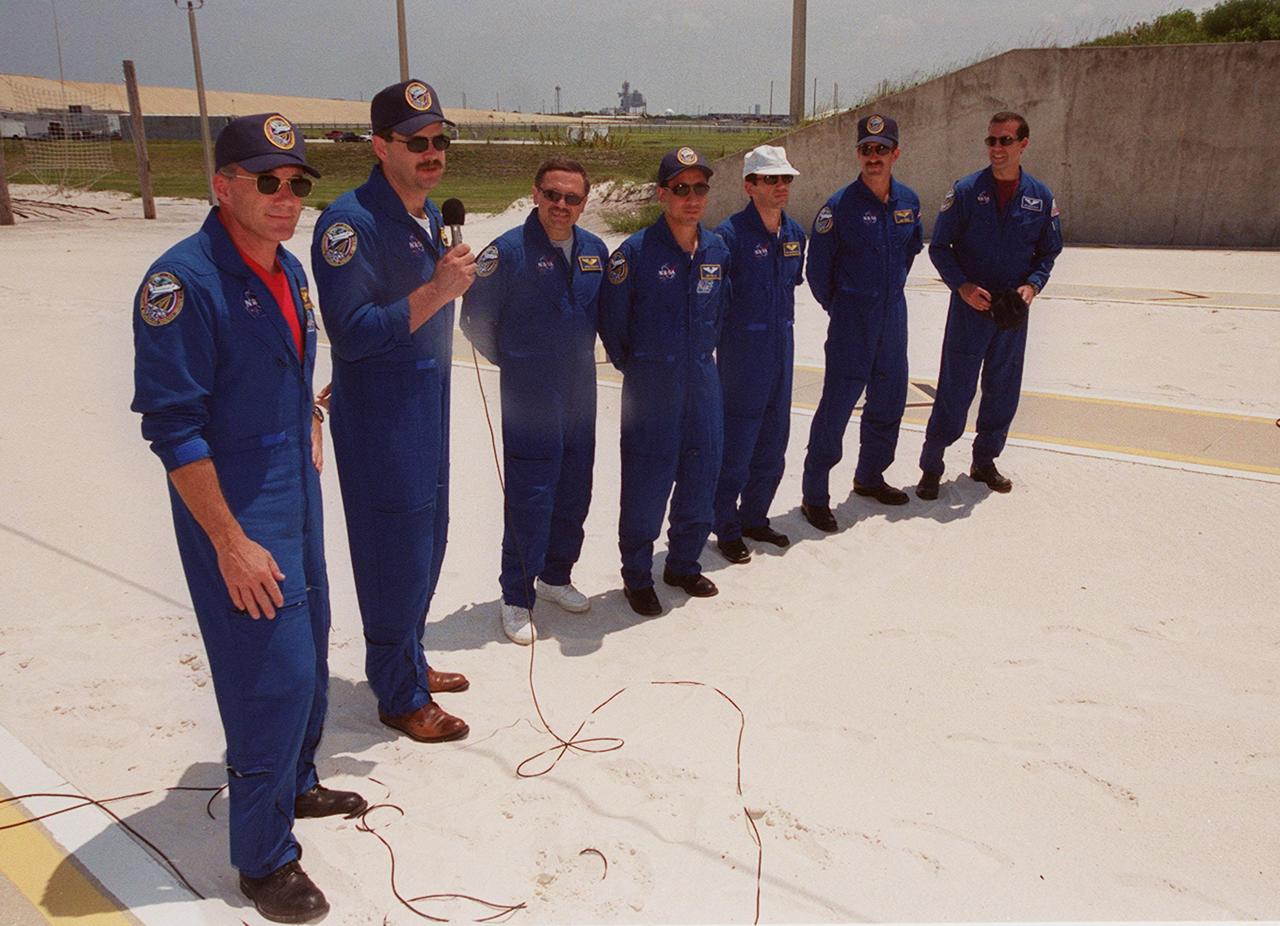
KENNEDY SPACE CENTER, Fla. -- STS-106 Pilot Scott D. Altman, left of STS-106 Commander Terrence W. Wilcutt, answers a question during a press conference at the slide wire basket area of Launch Pad 39-B. Other crew members pictured are, from left, Mission Specialists Boris V. Morukov, Edward T. Lu, Yuri I. Malenchenko, Daniel C. Burbank and Richard A. Mastracchio. Malenchenko and Morukov are with the Russian Aviation and Space Agency. The flight crew were at Kennedy Space Center to take part in Terminal Countdown Demonstration Test (TCDT) activities. The TCDT provides the crew with emergency egress training and opportunities to inspect their mission payload in the orbiter’s payload bay. STS-106 is scheduled to launch Sept. 8, 2000, at 8:31 a.m. EDT from Launch Pad 39B. On the 11-day mission, the seven-member crew will perform support tasks on orbit, transfer supplies and prepare the living quarters in the newly arrived Zvezda Service Module. The first long-duration crew, dubbed “Expedition One,” is due to arrive at the Station in late fall
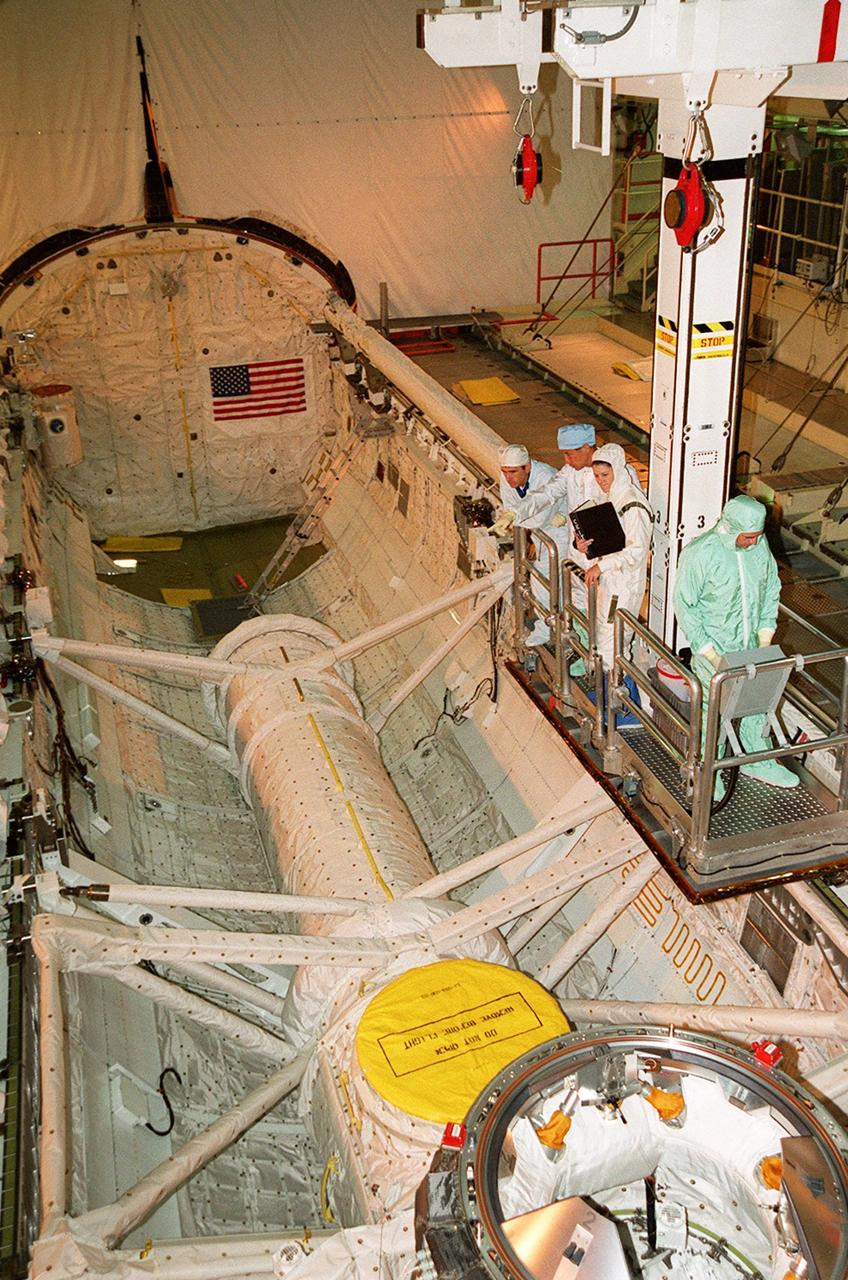
In Orbiter Processing Facility bay 3, STS-106 Mission Specialists Yuri I. Malenchenko (left) and Edward T. Lu (beside him) familiarize themselves with equipment in the payload bay of Space Shuttle orbiter Atlantis with the help of KSC employees as part of Crew Equipment Interface Test (CEIT) activities for their mission. The other crew members are Commander Terrence W. Wilcutt, Pilot Scott D. Altman, and Mission Specialists Daniel C. Burbank, Boris V. Morukov and Richard A. Mastracchio. Malenchenko and Morukov represent the Russian Aviation and Space Agency. On the 11-day mission, the seven-member crew will perform support tasks on orbit, transfer supplies and prepare the living quarters in the newly arrived Zvezda Service Module for the first long-duration crew, dubbed "Expedition One," which is due to arrive at the Station in late fall. STS-106 is scheduled to launch Sept. 8, 2000, at 8:31 a.m. EDT from Launch Pad 39B
KENNEDY SPACE CENTER, FLA. - The STS-106 flight crew participate in a question and answer session for the media at the slide wire basket area of Launch Pad 39-B. Crew members pictured are, from left, Commander Terrence W. Wilcutt, Pilot Scott D. Altman, Mission Specialists Boris V. Morukov, Edward T. Lu, Yuri I. Malenchenko, Daniel C. Burbank and Richard A. Mastracchio. Malenchenko and Morukov are with the Russian Aviation and Space Agency. The flight crew were at Kennedy Space Center to take part in Terminal Countdown Demonstration Test (TCDT) activities. The TCDT provides the crew with emergency egress training and opportunities to inspect their mission payload in the orbiter’s payload bay. STS-106 is scheduled to launch Sept. 8, 2000, at 8:31 a.m. EDT from Launch Pad 39B. On the 11-day mission, the seven-member crew will perform support tasks on orbit, transfer supplies and prepare the living quarters in the newly arrived Zvezda Service Module. The first long-duration crew, dubbed “Expedition One,” is due to arrive at the Station in late fall.
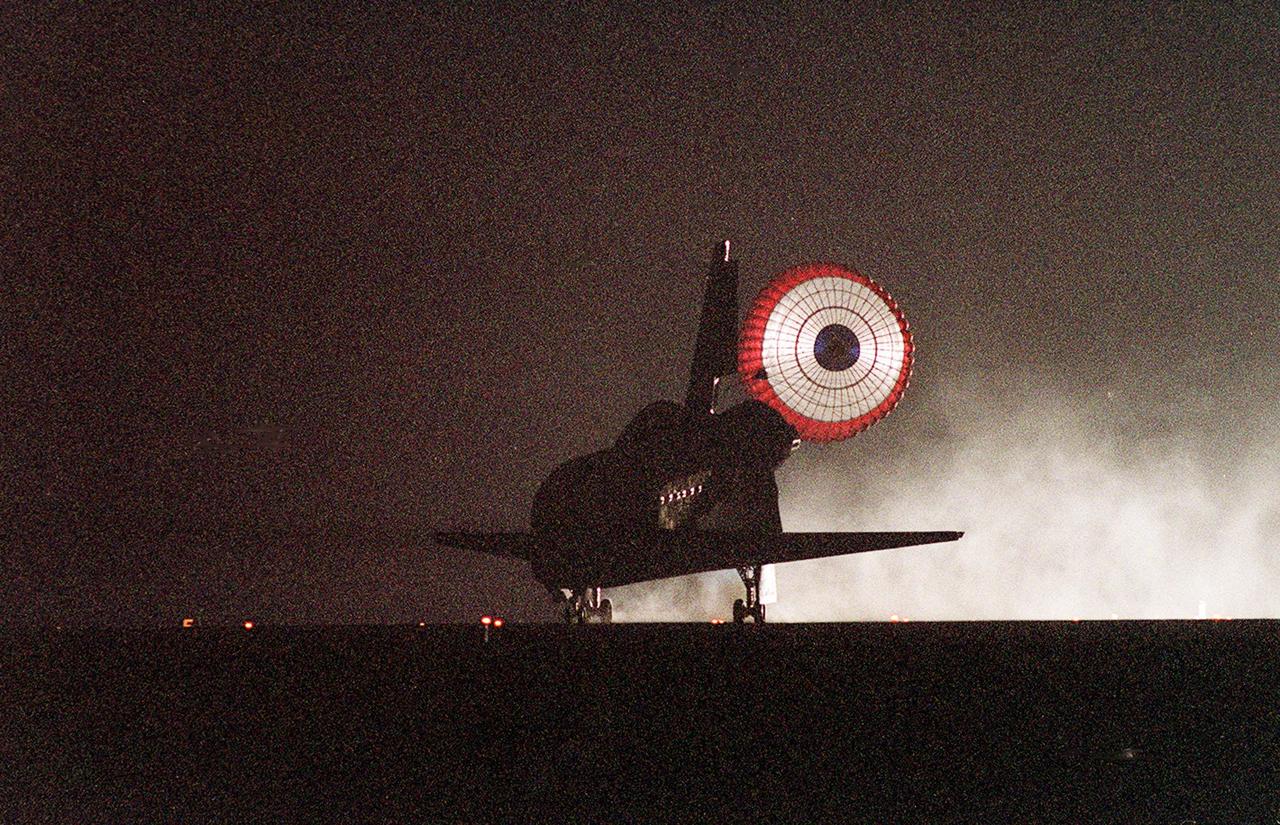
KENNEDY SPACE CENTER, Fla. -- Upon touchdown on Runway 15 of KSC’s Shuttle Landing Facility, Atlantis’s drag chute opens to help slow the vehicle. At the controls are Commander Terrence W. Wilcutt and Pilot Scott D. Altman. Also on board the orbiter are Mission Specialists Edward T. Lu, Yuri I. Malenchenko, Boris V. Morukov, Richard A. Mastracchio and Daniel C. Burbank. Malenchenko and Morukov are with the Russian Aviation and Space Agency. Atlantis and crew traveled 4.9 million miles on the 11-day, 19-hour, 11-minute STS-106 mission. Main gear touchdown was at 3:56:48 a.m. EDT, landing on orbit 185 of the mission. Nose gear touchdown was at 3:56:57 a.m. EDT and wheel stop at 3:58:01 a.m. EDT. The crew has returned from the International Space Station where they transferred nearly 5,000 pounds of equipment and supplies for use by the first resident crew expected to arrive in November. This was the 99th flight in the Shuttle program and the 22nd for Atlantis. STS-106 also marked the 15th nighttime landing in Shuttle history and the 23rd consecutive landing at KSC
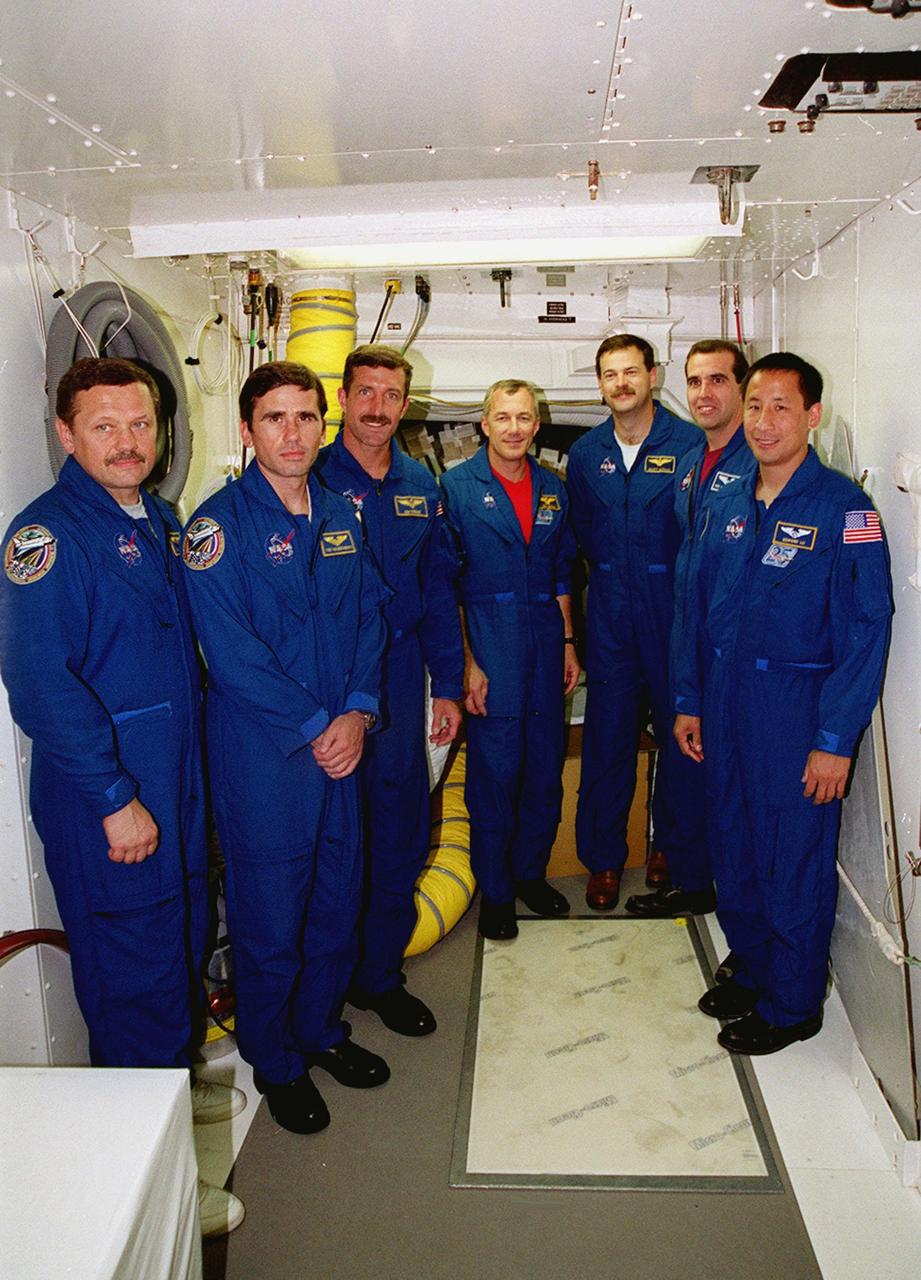
KENNEDY SPACE CENTER, Fla. -- The STS-106 flight crew gather in the white room of Launch Pad 39-B. Crew members pictured are, from left, Mission Specialists Boris V. Morukov, Yuri I. Malenchenko, Daniel C. Burbank, Commander Terrence W. Wilcutt, Pilot Scott D. Altman, Mission Specialists Richard A. Mastracchio and Edward T. Lu. Malenchenko and Morukov are with the Russian Aviation and Space Agency. The flight crew were at Kennedy Space Center to take part in Terminal Countdown Demonstration Test (TCDT) activities. The TCDT provides the crew with emergency egress training and opportunities to inspect their mission payload in the orbiter’s payload bay. STS-106 is scheduled to launch Sept. 8, 2000, at 8:31 a.m. EDT from Launch Pad 39B. On the 11-day mission, the seven-member crew will perform support tasks on orbit, transfer supplies and prepare the living quarters in the newly arrived Zvezda Service Module. The first long-duration crew, dubbed “Expedition One,” is due to arrive at the Station in late fall