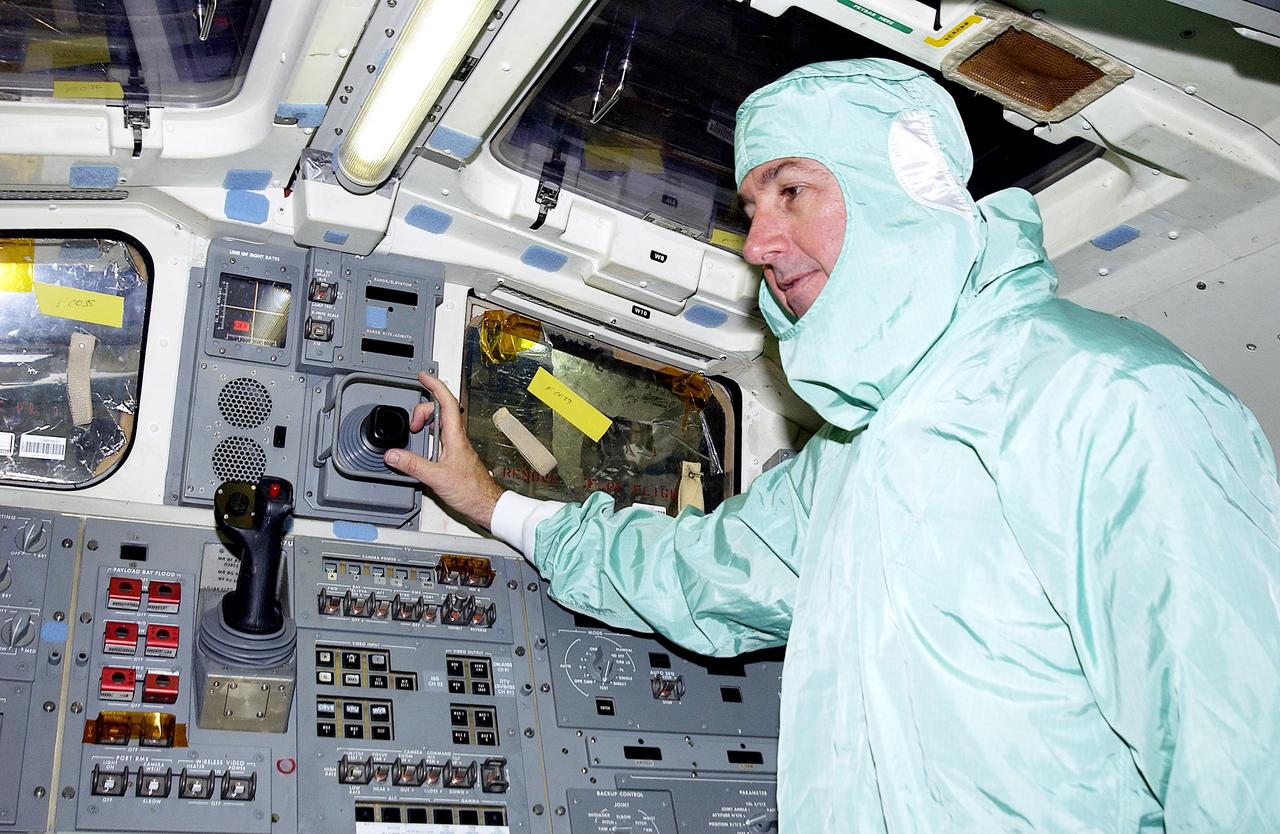
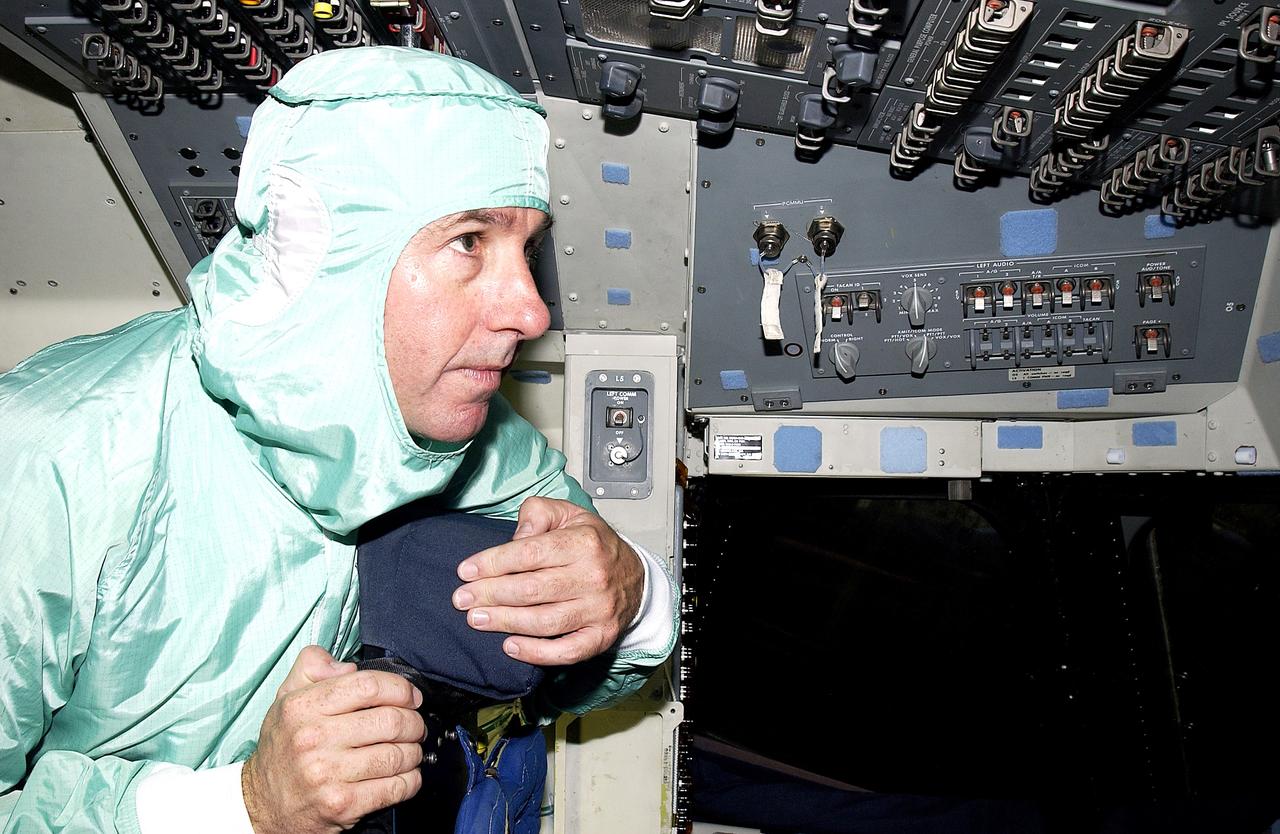
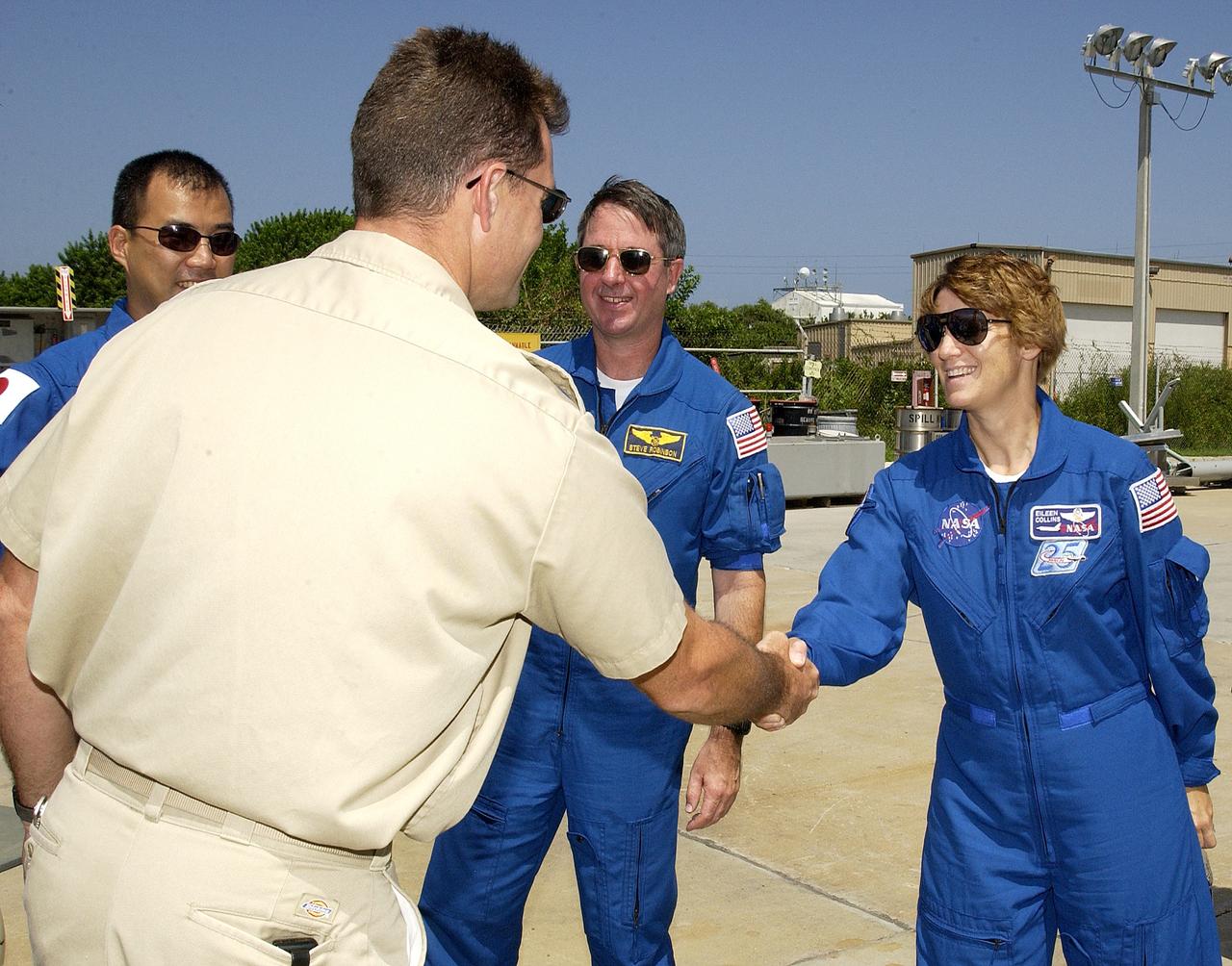
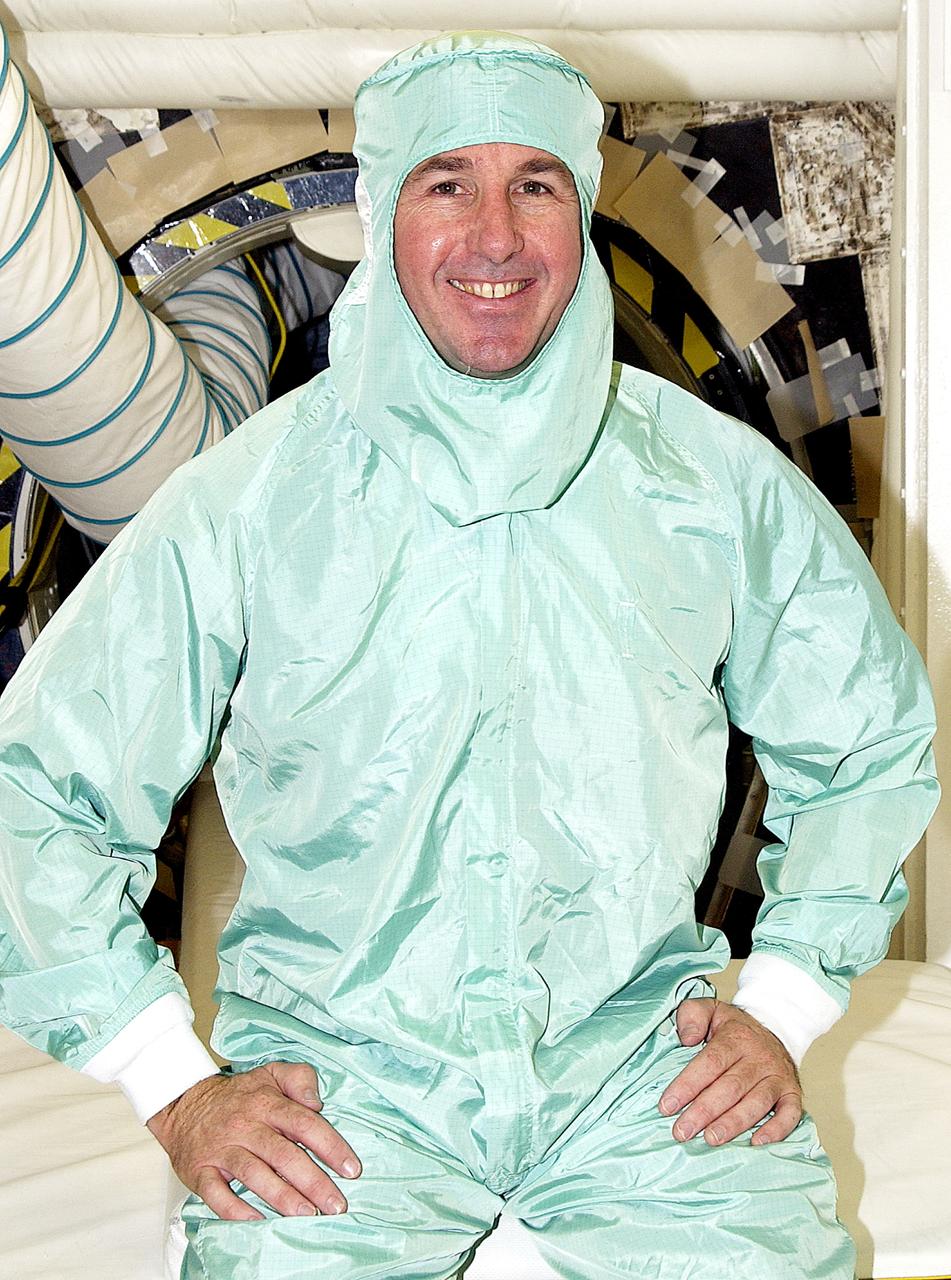
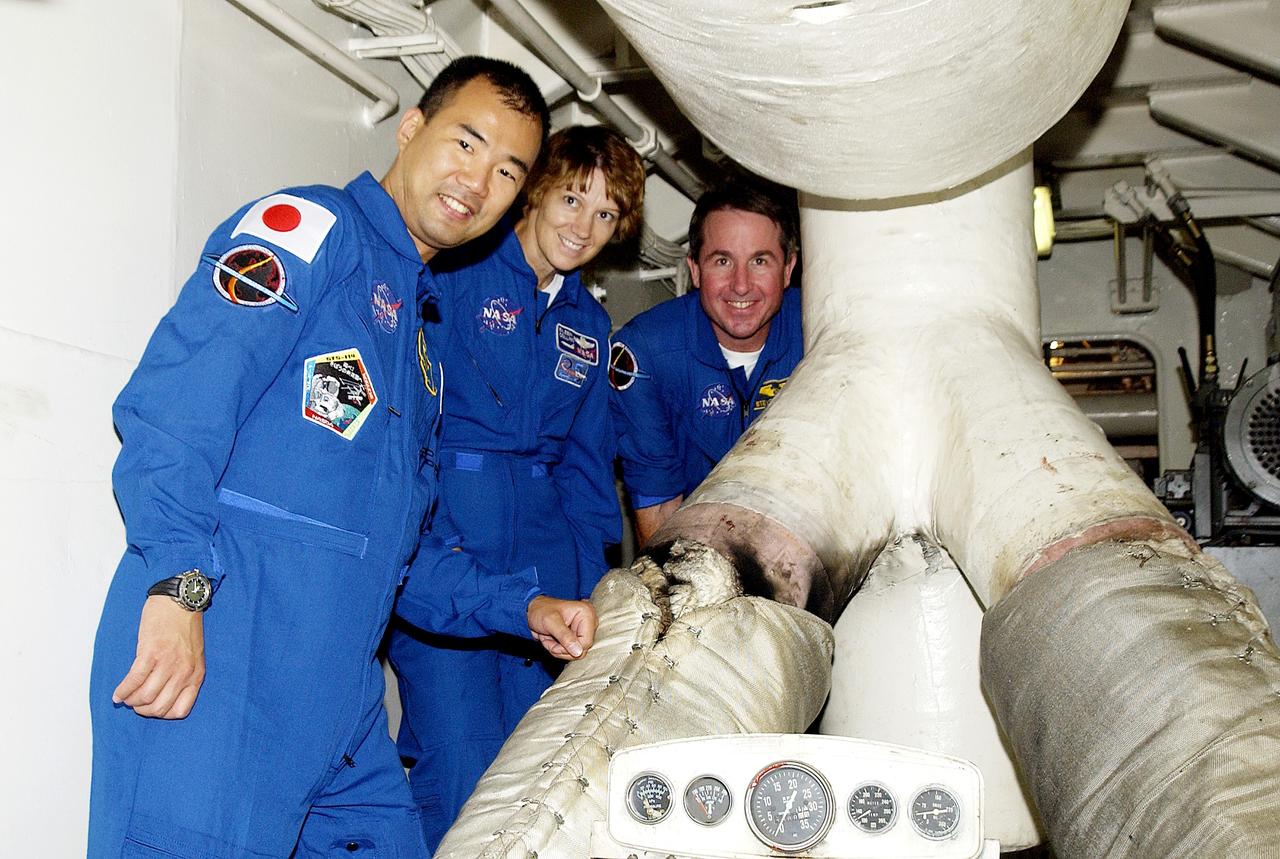
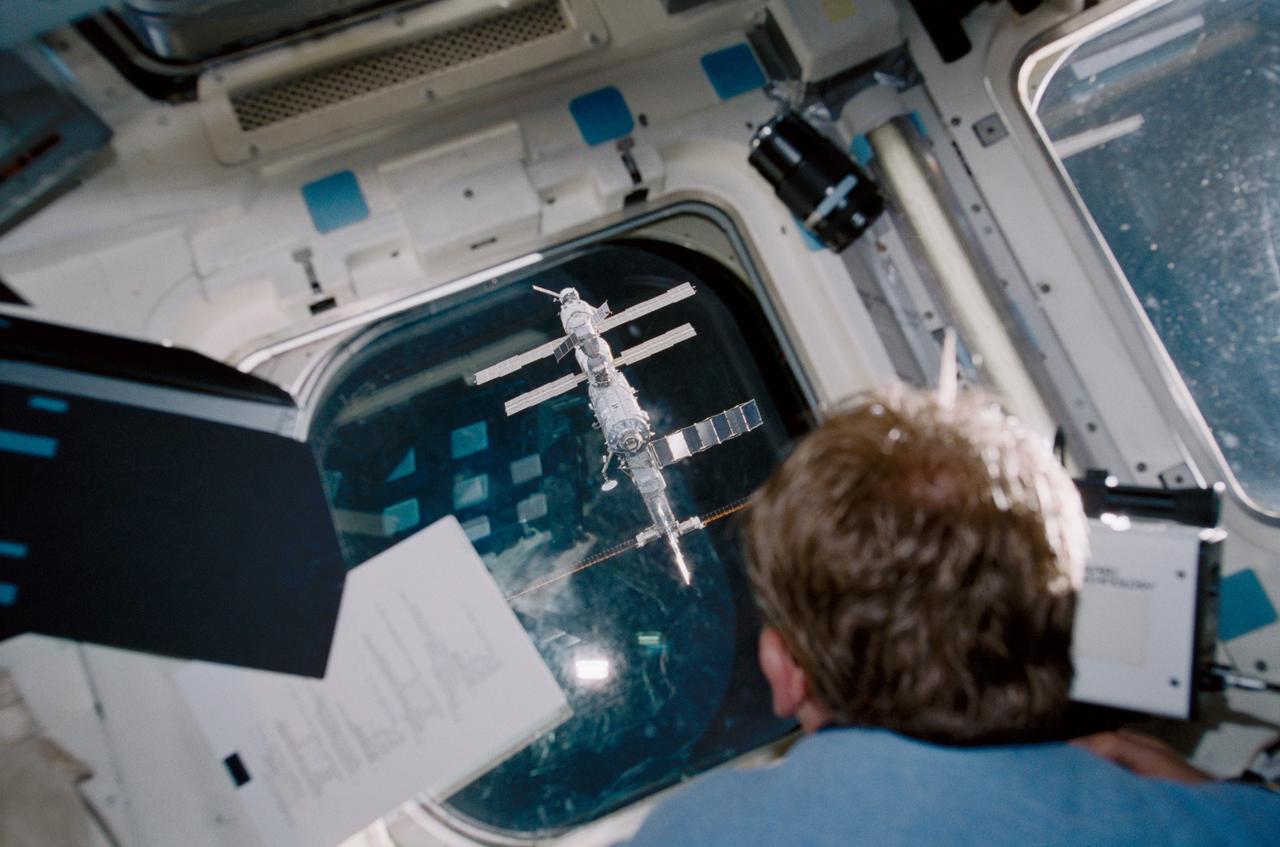
STS-102 astronaut and mission specialist, Andrew S.W. Thomas, gazes through an aft window of the Space Shuttle Orbiter Discovery as it approaches the docking bay of the International Space Station (ISS). Launched March 8, 2001, STS-102's primary cargo was the Leonardo, the Italian Space Agency-built Multipurpose Logistics Module (MPLM). The Leonardo MPLM is the first of three such pressurized modules that will serve as the ISS's moving vans, carrying laboratory racks filled with equipment, experiments, and supplies to and from the Station aboard the Space Shuttle. The cylindrical module is approximately 21-feet long and 15- feet in diameter, weighing almost 4.5 tons. It can carry up to 10 tons of cargo in 16 standard Space Station equipment racks. Of the 16 racks the module can carry, 5 can be furnished with power, data, and fluid to support refrigerators or freezers. In order to function as an attached station module as well as a cargo transport, the logistics module also includes components that provide life support, fire detection and suppression, electrical distribution, and computer functions. NASA's 103rd overall mission and the 8th Space Station Assembly Flight, STS-102 mission also served as a crew rotation flight. It delivered the Expedition Two crew to the Station and returned the Expedition One crew back to Earth.
International Space Station (ISS)
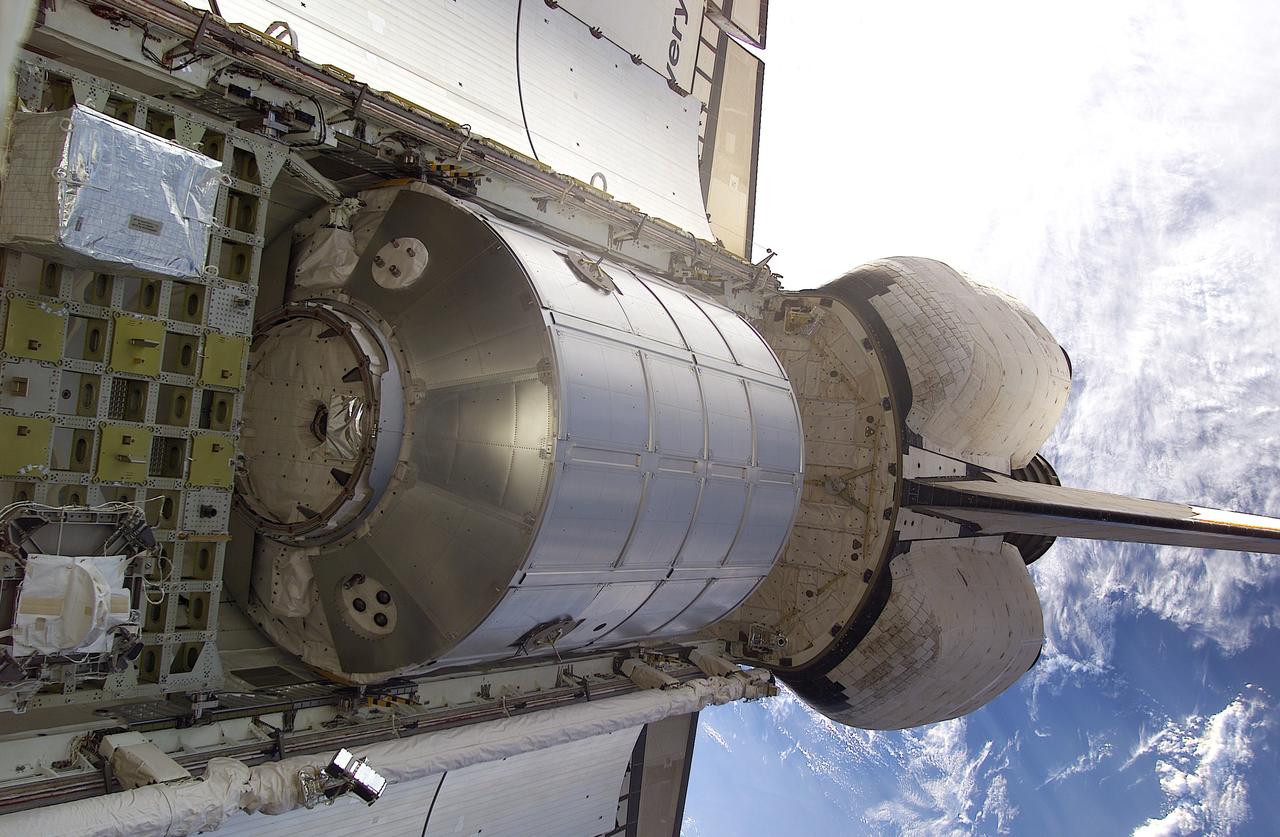
This in-orbit close up shows the Italian Space Agency-built multipurpose Logistics Module (MPLM), Leonardo, the primary cargo of the STS-102 mission, resting in the payload bay of the Space Shuttle Orbiter Discovery. The Leonardo MPLM is the first of three such pressurized modules that will serve as the International Space Station's (ISS') moving vans, carrying laboratory racks filled with equipment, experiments, and supplies to and from the Station aboard the Space Shuttle. The cylindrical module is approximately 21-feet long and 15- feet in diameter, weighing almost 4.5 tons. It can carry up to 10 tons of cargo in 16 standard Space Station equipment racks. Of the 16 racks the module can carry, 5 can be furnished with power, data, and fluid to support refrigerators or freezers. In order to function as an attached station module as well as a cargo transport, the logistics module also includes components that provide life support, fire detection and suppression, electrical distribution, and computer functions. The eighth station assembly flight and NASA's 103rd overall flight, STS-102 launched March 8, 2001 for an almost 13 day mission.
International Space Station (ISS)
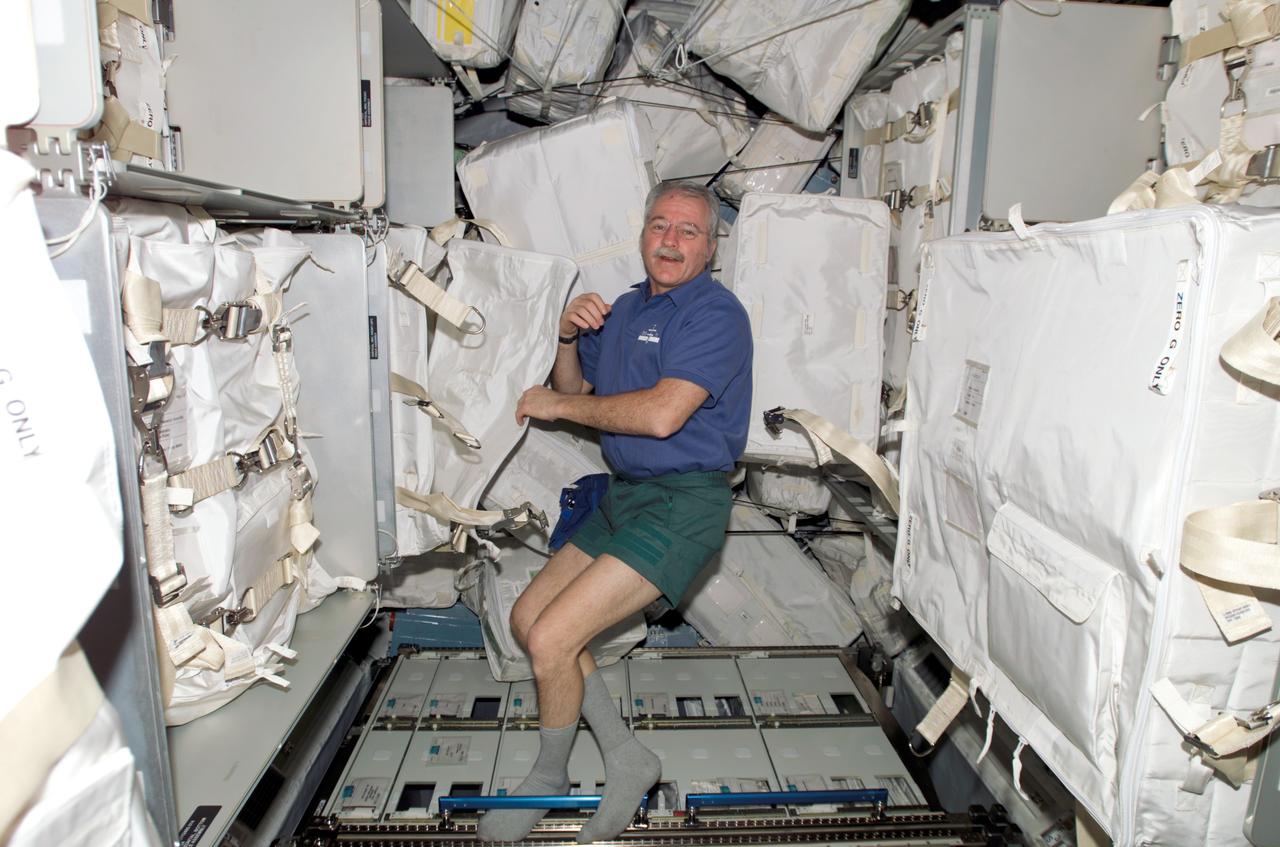
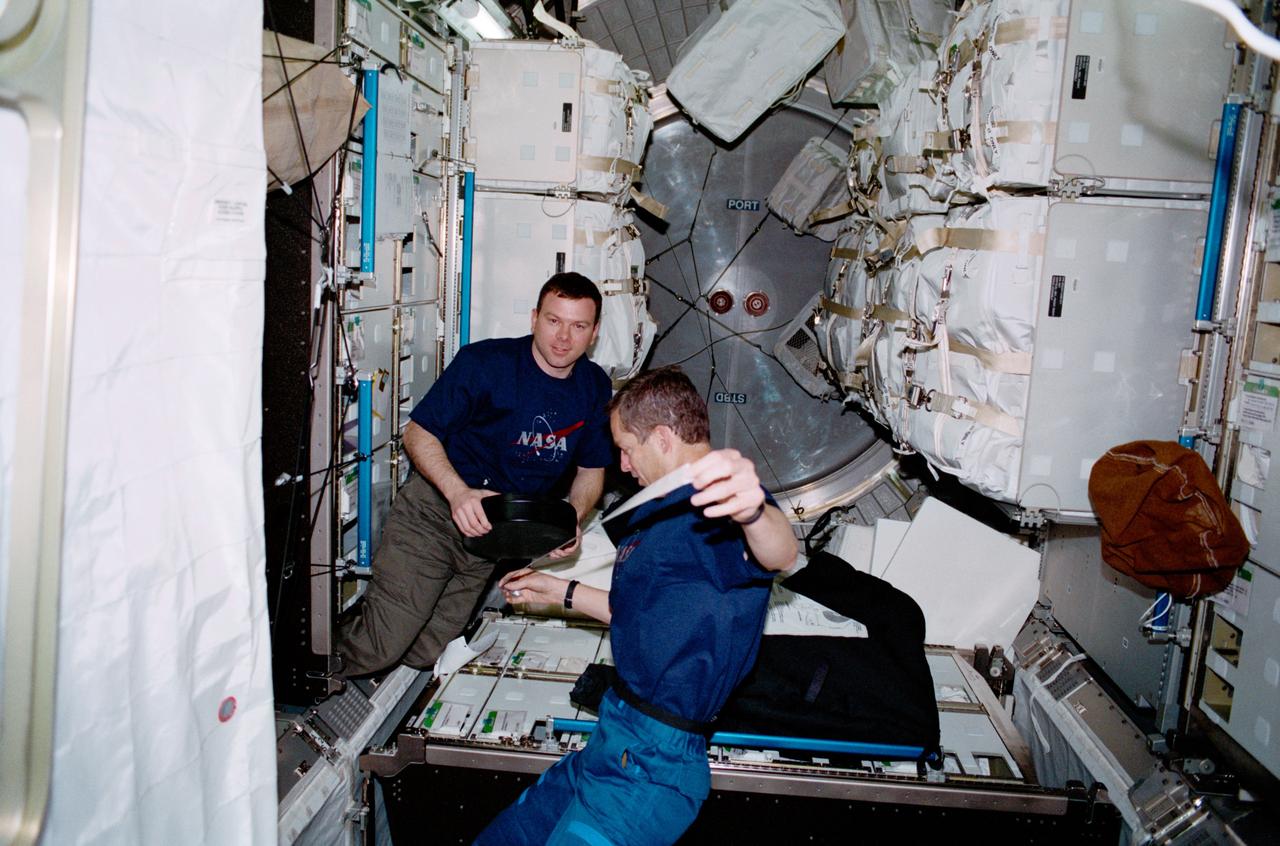
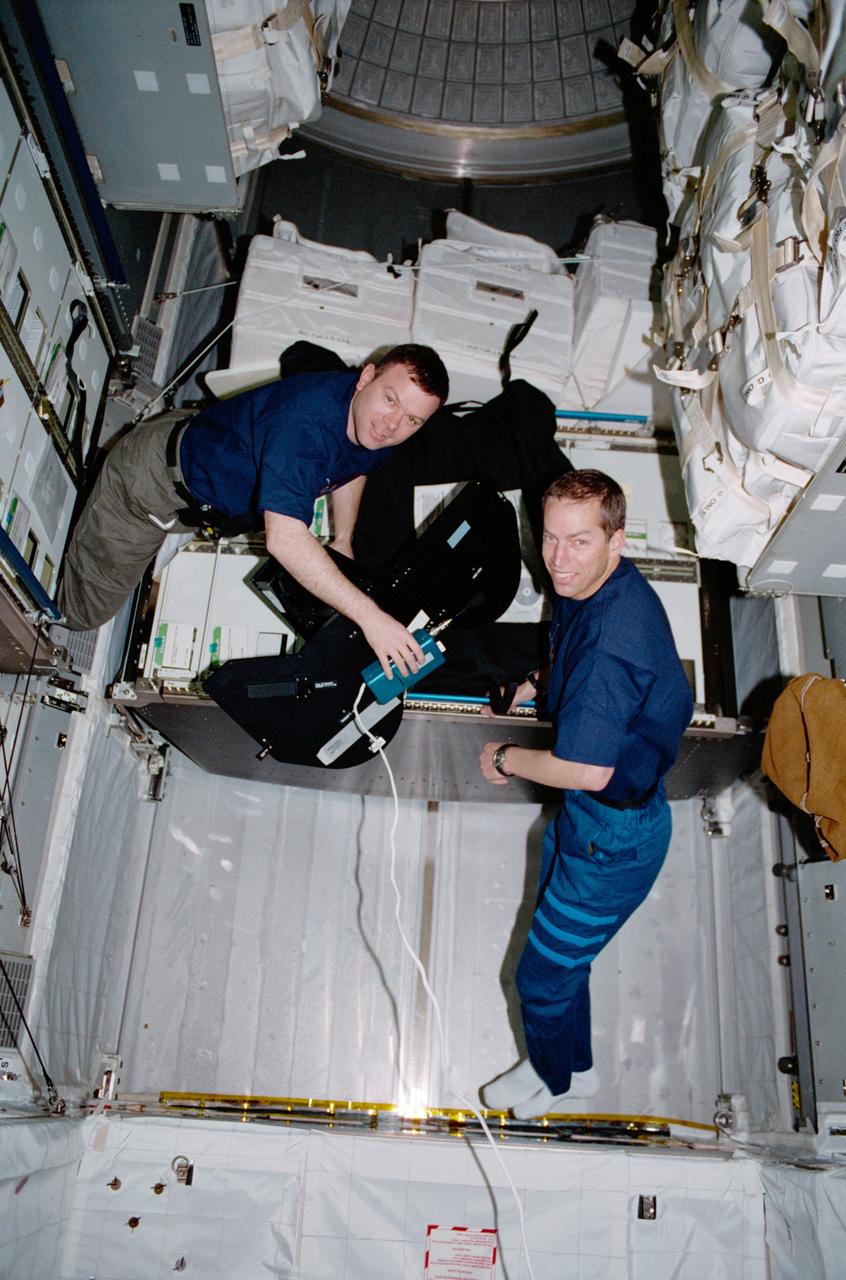
Pilot James M. Kelly (left) and Commander James D. Wetherbee for the STS-102 mission, participate in the movement of supplies inside Leonardo, the Italian Space Agency built Multipurpose Logistics Module (MPLM). In this particular photograph, the two are handling a film magazine for the IMAX cargo bay camera. The primary cargo of the STS-102 mission, the Leonardo MPLM is the first of three such pressurized modules that will serve as the International Space Station's (ISS') moving vans, carrying laboratory racks filled with equipment, experiments, and supplies to and from the Station aboard the Space Shuttle. The cylindrical module is approximately 21-feet long and 15- feet in diameter, weighing almost 4.5 tons. It can carry up to 10 tons of cargo in 16 standard Space Station equipment racks. Of the 16 racks the module can carry, 5 can be furnished with power, data, and fluid to support refrigerators or freezers. In order to function as an attached station module as well as a cargo transport, the logistics module also includes components that provide life support, fire detection and suppression, electrical distribution, and computer functions. The eighth station assembly flight, the STS-102 mission also served as a crew rotation flight. It delivered the Expedition Two crew to the Station and returned the Expedition One crew back to Earth.
International Space Station (ISS)
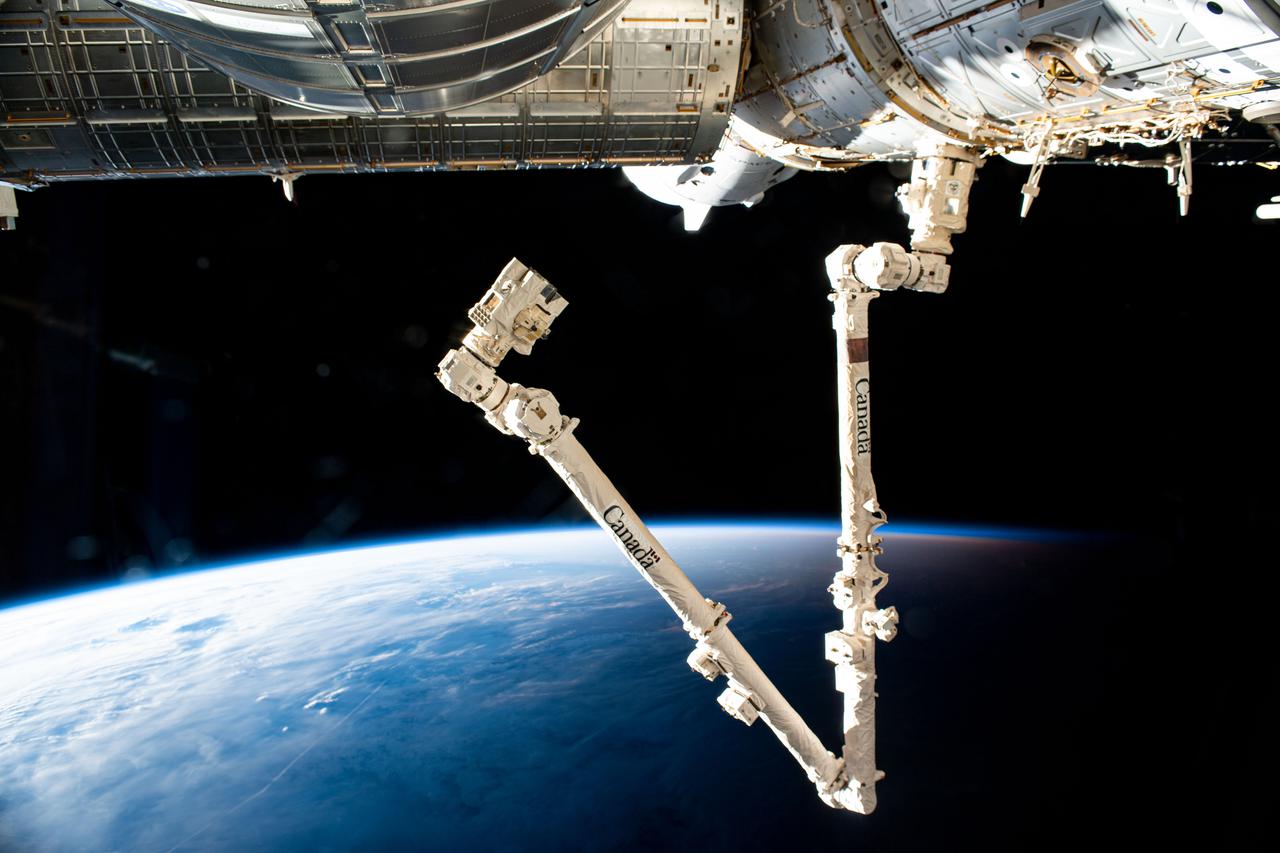
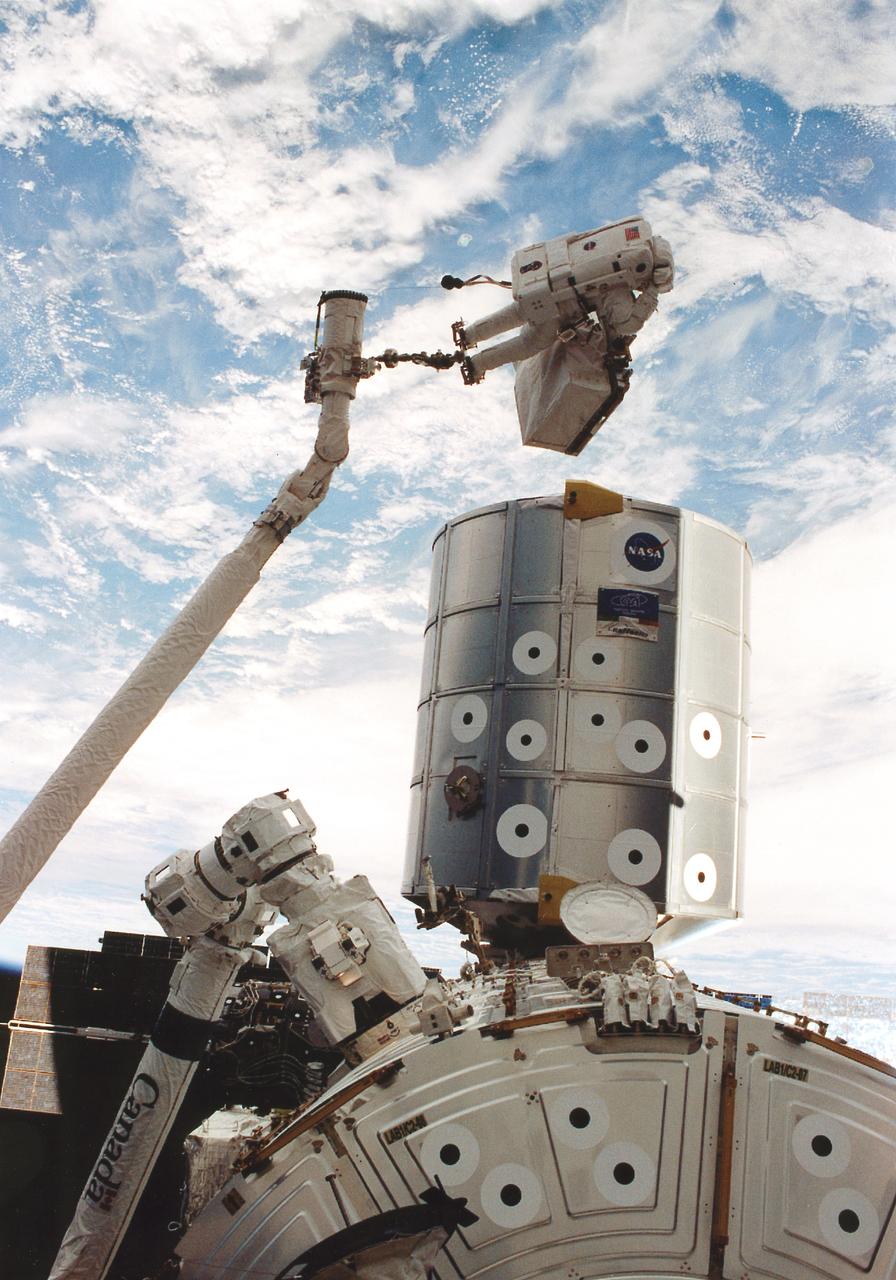
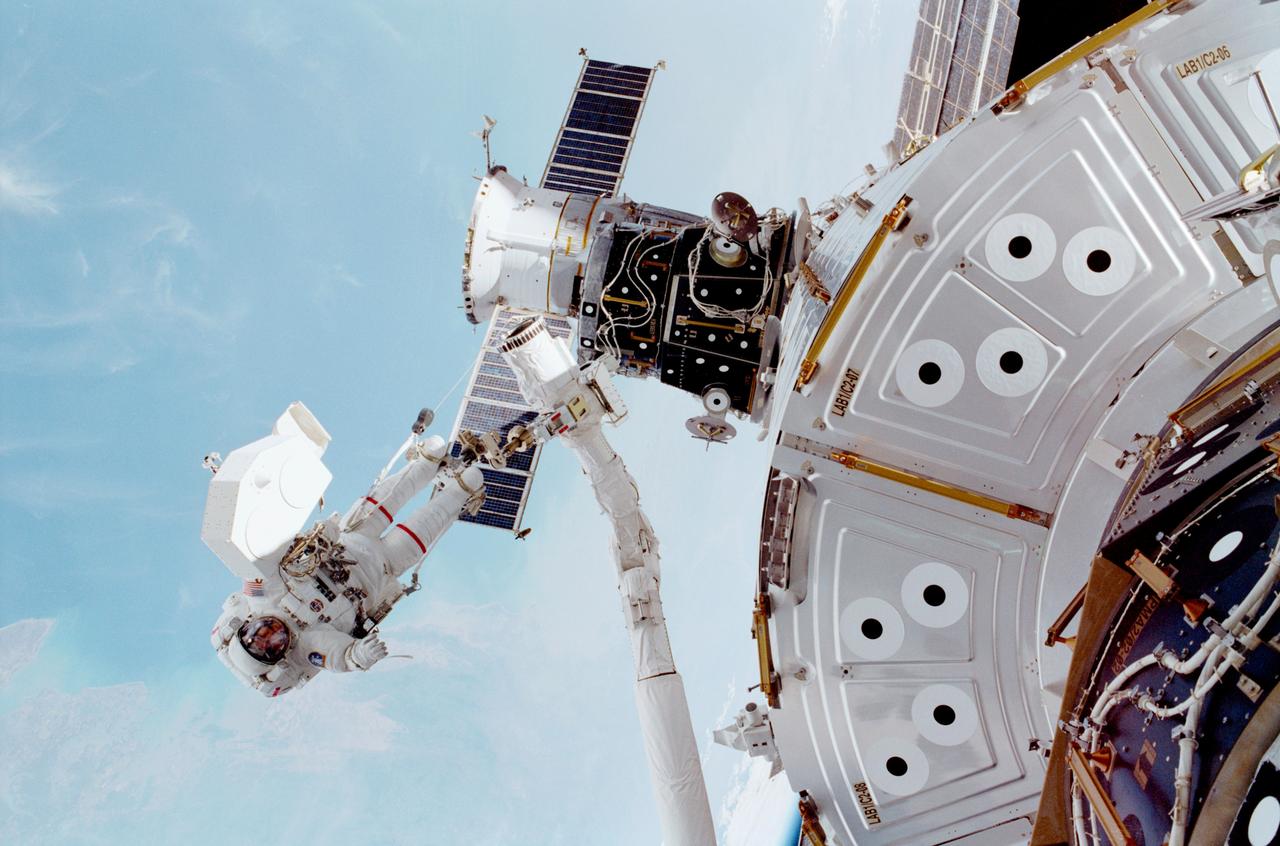
This is a Space Shuttle STS-100 mission onboard photograph. Astronaut Scott Parazynski totes a Direct Current Switching Unit while anchored on the end of the Canadian-built Remote Manipulator System (RMS) robotic arm. The RMS is in the process of moving Parazynski to the exterior of the Destiny laboratory (right foreground), where he will secure the spare unit, a critical part of the station's electrical system, to the stowage platform in case future crews will need it. Also in the photograph are the Italian-built Raffaello multipurpose Logistics Module (center) and the new Canadarm2 (lower right) or Space Station Remote Manipulator System.
International Space Station (ISS)
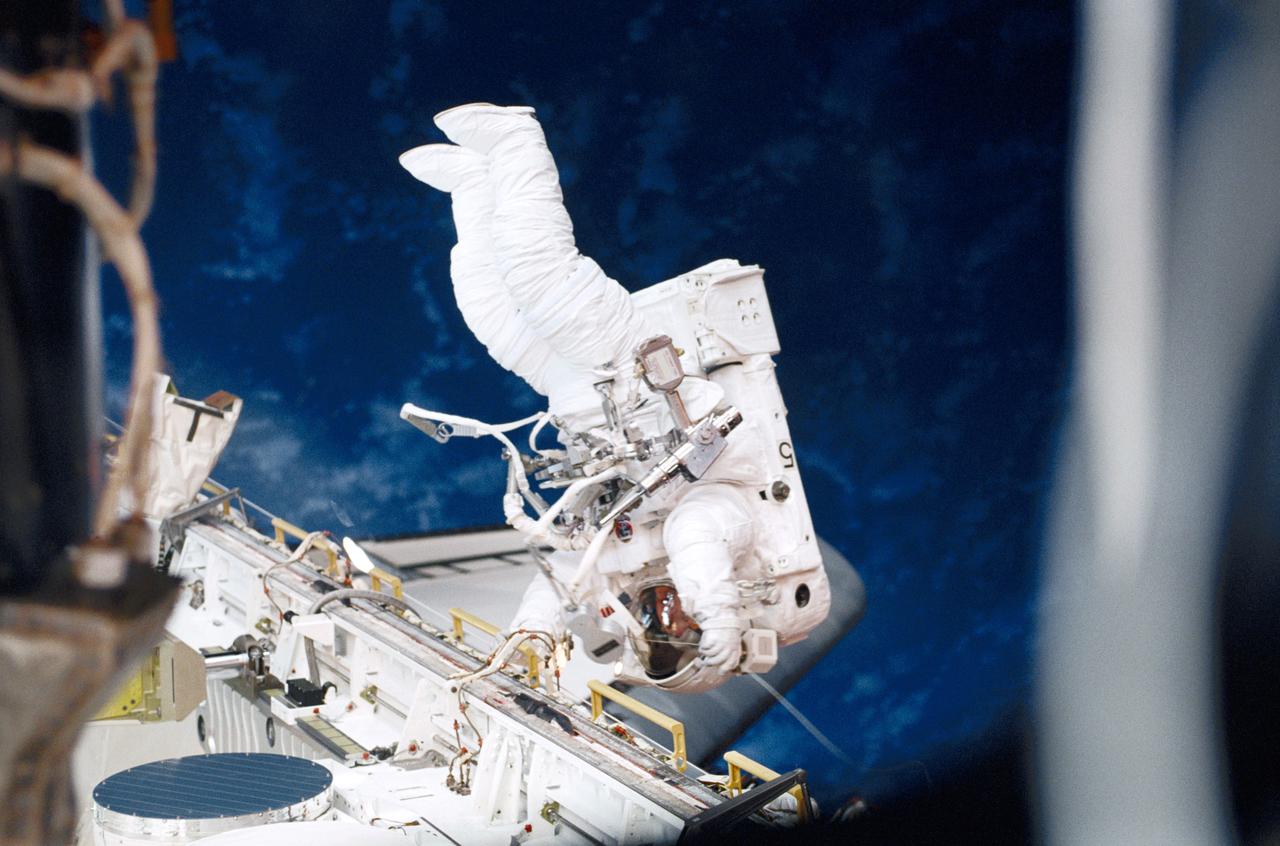
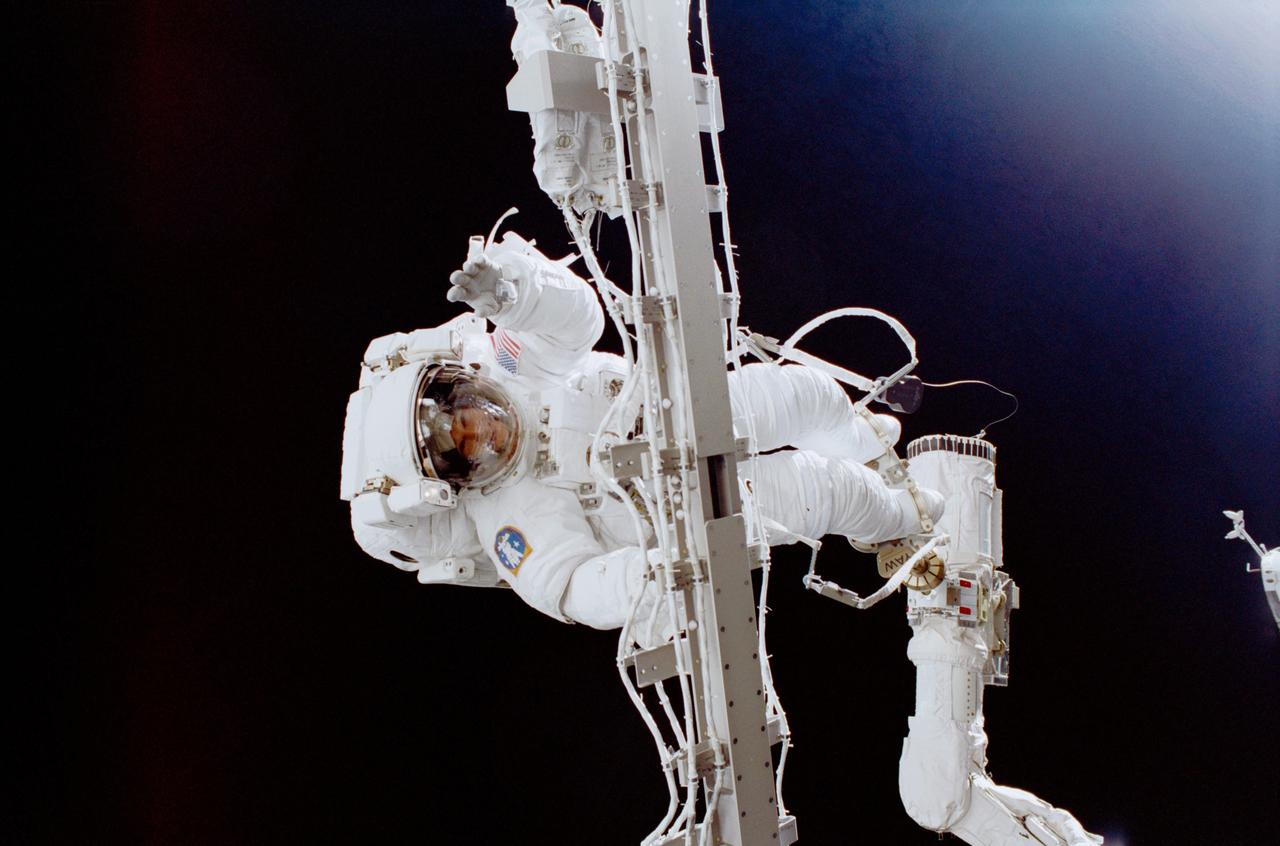
STS-102 mission astronaut Susan J. Helms translates along the longerons of the Space Shuttle Discovery during the first of two space walks. During this walk, the Pressurized Mating Adapter 3 was prepared for repositioning from the Unity Module's Earth-facing berth to its port-side berth to make room for the Leonardo multipurpose Logistics Module (MPLM), supplied by the Italian Space Agency. The Leonardo MPLM is the first of three such pressurized modules that will serve as the International Space Station's (ISS') moving vans, carrying laboratory racks filled with equipment, experiments, and supplies to and from the Station aboard the Space Shuttle. The cylindrical module is approximately 21-feet long and 15- feet in diameter, weighing almost 4.5 tons. It can carry up to 10 tons of cargo in 16 standard Space Station equipment racks. Of the 16 racks the module can carry, 5 can be furnished with power, data, and fluid to support refrigerators or freezers. In order to function as an attached station module as well as a cargo transport, the logistics module also includes components that provide life support, fire detection and suppression, electrical distribution, and computer functions. NASA's 103rd overall mission and the 8th Space Station Assembly Flight, STS-102 mission also served as a crew rotation flight. It delivered the Expedition Two crew to the Station and returned the Expedition One crew back to Earth.
International Space Station (ISS)
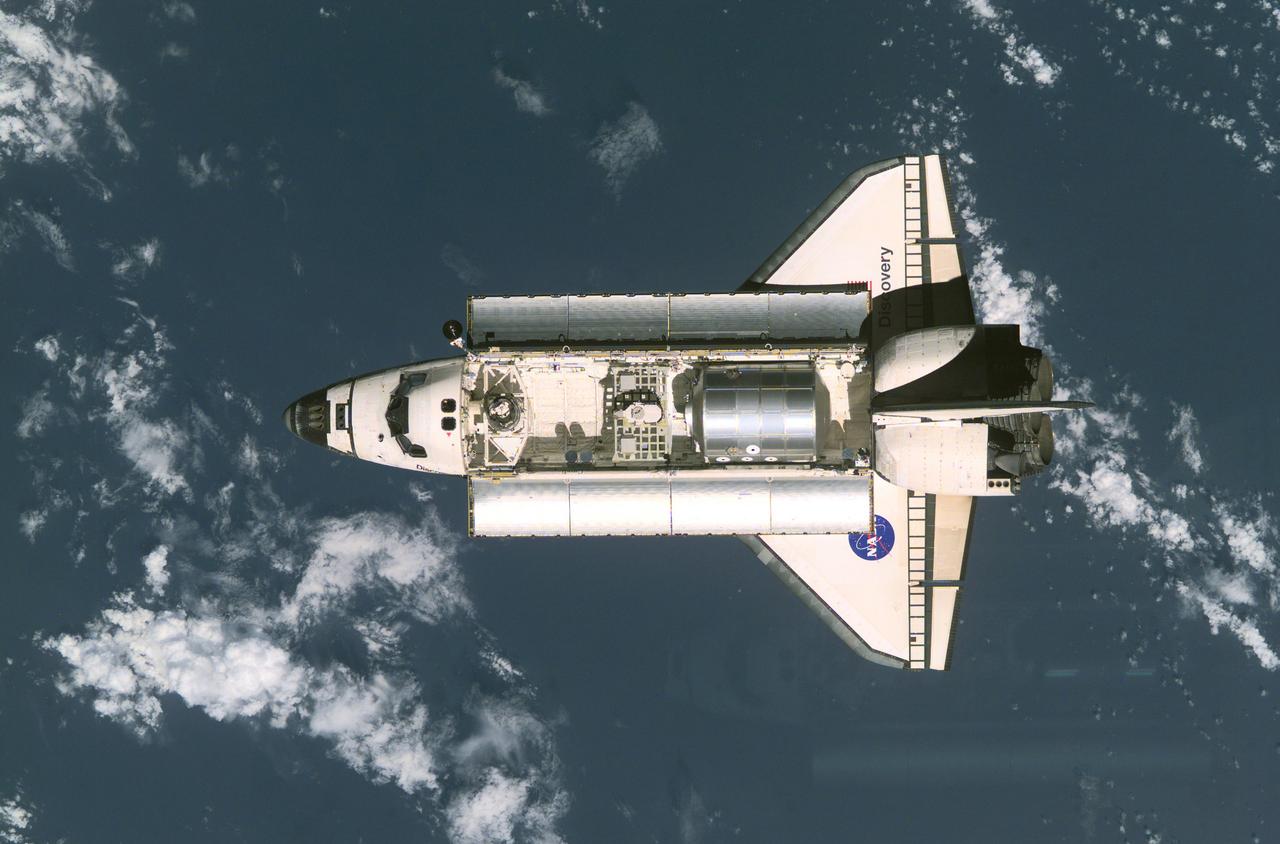
This is a view of the Space Shuttle Discovery as it approaches the International Space Station (ISS) during the STS-105 mission. Visible in the payload bay of Discovery are the Multipurpose Logistics Module (MPLM) Leonardo at right, which stores various supplies and experiments to be transferred into the ISS; at center, the Integrated Cargo Carrier (ICC) which carries the Early Ammonia Servicer (EAS); and two Materials International Space Station Experiment (MISSE) containers at left. Aboard Discovery were the ISS Expedition Three crew, who were to replace the Expedition Two crew that had been living on the ISS for the past five months.
Space Shuttle Projects
STS-102 astronaut and mission specialist James S. Voss works outside Destiny, the U.S. Laboratory (shown in lower frame) on the International Space Station (ISS), while anchored to the Remote Manipulator System (RMS) robotic arm on the Space Shuttle Discovery during the first of two space walks. During this space walk, the longest to date in space shuttle history, Voss in tandem with Susan Helms (out of frame), prepared the Pressurized Mating Adapter 3 for repositioning from the Unity Module's Earth-facing berth to its port-side berth to make room for the Leonardo Multipurpose Logistics Module (MPLM) supplied by the Italian Space Agency. The The Leonardo MPLM is the first of three such pressurized modules that will serve as the ISS' moving vans, carrying laboratory racks filled with equipment, experiments, and supplies to and from the Station aboard the Space Shuttle. The cylindrical module is approximately 21-feet long and 15- feet in diameter, weighing almost 4.5 tons. It can carry up to 10 tons of cargo in 16 standard Space Station equipment racks. Of the 16 racks the module can carry, 5 can be furnished with power, data, and fluid to support refrigerators or freezers. In order to function as an attached station module as well as a cargo transport, the logistics module also includes components that provide life support, fire detection and suppression, electrical distribution, and computer functions. Launched on May 8, 2001 for nearly 13 days in space, the STS-102 mission was the 8th spacecraft assembly flight to the ISS and NASA's 103rd overall mission. The mission also served as a crew rotation flight. It delivered the Expedition Two crew to the Station and returned the Expedition One crew back to Earth.
International Space Station (ISS)
STS-102 mission astronaut Susan J. Helms works outside the International Space Station (ISS) while holding onto a rigid umbilical and her feet anchored to the Remote Manipulator System (RMS) robotic arm on the Space Shuttle Discovery during the first of two space walks. During this space walk, the longest to date in space shuttle history, Helms in tandem with James S. Voss (out of frame), prepared the Pressurized Mating Adapter 3 for repositioning from the Unity Module's Earth-facing berth to its port-side berth to make room for the Leonardo Multipurpose Logistics Module (MPLM) supplied by the Italian Space Agency. The Leonardo MPLM is the first of three such pressurized modules that will serve as the ISS's moving vans, carrying laboratory racks filled with equipment, experiments, and supplies to and from the Station aboard the Space Shuttle. The cylindrical module is approximately 21-feet long and 15- feet in diameter, weighing almost 4.5 tons. It can carry up to 10 tons of cargo in 16 standard Space Station equipment racks. Of the 16 racks the module can carry, 5 can be furnished with power, data, and fluid to support refrigerators or freezers. In order to function as an attached station module as well as a cargo transport, the logistics module also includes components that provide life support, fire detection and suppression, electrical distribution, and computer functions. Launched on May 8, 2001 for nearly 13 days in space, STS-102 mission was the 8th spacecraft assembly flight to the ISS and NASA's 103rd overall mission. The mission also served as a crew rotation flight. It delivered the Expedition Two crew to the Station and returned the Expedition One crew back to Earth.
International Space Station (ISS)
Astronaut Paul W. Richards, STS-102 mission specialist, works in the cargo bay of the Space Shuttle Discovery during the second of two scheduled space walks. Richards, along with astronaut Andy Thomas, spent 6.5 hours outside the International Space Station (ISS), continuing work to outfit the station and prepare for delivery of its robotic arm. STS-102 delivered the first Multipurpose Logistics Modules (MPLM) named Leonardo, which was filled with equipment and supplies to outfit the U.S. Destiny Laboratory Module. The Leonardo MPLM is the first of three such pressurized modules that will serve as the ISS' moving vans, carrying laboratory racks filled with equipment, experiments, and supplies to and from the Station aboard the Space Shuttle. The cylindrical module is approximately 21-feet long and 15- feet in diameter, weighing almost 4.5 tons. It can carry up to 10 tons of cargo in 16 standard Space Station equipment racks. Of the 16 racks the module can carry, 5 can be furnished with power, data, and fluid to support refrigerators or freezers. In order to function as an attached station module as well as a cargo transport, the logistics module also includes components that provide life support, fire detection and suppression, electrical distribution, and computer functions. NASA's 103rd overall mission and the 8th Space Station Assembly Flight, STS-102 mission also served as a crew rotation flight. It delivered the Expedition Two crew to the Station and returned the Expedition One crew back to Earth.
International Space Station (ISS)
STS-102 mission astronauts James S. Voss and James D. Weatherbee share a congratulatory handshake as the Space Shuttle Orbiter Discovery successfully docks with the International Space Station (ISS). Photographed from left to right are: Astronauts Susan J. Helms, mission specialist; James S. Voss, Expedition 2 crew member; James D. Weatherbee, mission commander; Andrew S.W. Thomas, mission specialist; and nearly out of frame is James M. Kelley, Pilot. Launched March 8, 2001, STS-102's primary cargo was the Leonardo, the Italian Space Agency-built Multipurpose Logistics Module (MPLM). The Leonardo MPLM is the first of three such pressurized modules that will serve as ISS' moving vans, carrying laboratory racks filled with equipment, experiments, and supplies to and from the Station aboard the Space Shuttle. The cylindrical module is approximately 21-feet long and 15- feet in diameter, weighing almost 4.5 tons. It can carry up to 10 tons of cargo in 16 standard Space Station equipment racks. Of the 16 racks the module can carry, 5 can be furnished with power, data, and fluid to support refrigerators or freezers. In order to function as an attached station module as well as a cargo transport, the logistics module also includes components that provide life support, fire detection and suppression, electrical distribution, and computer functions. NASA's 103rd overall mission and the 8th Space Station Assembly Flight, STS-102 mission also served as a crew rotation flight. It delivered the Expedition Two crew to the Station and returned the Expedition One crew back to Earth.
International Space Station (ISS)
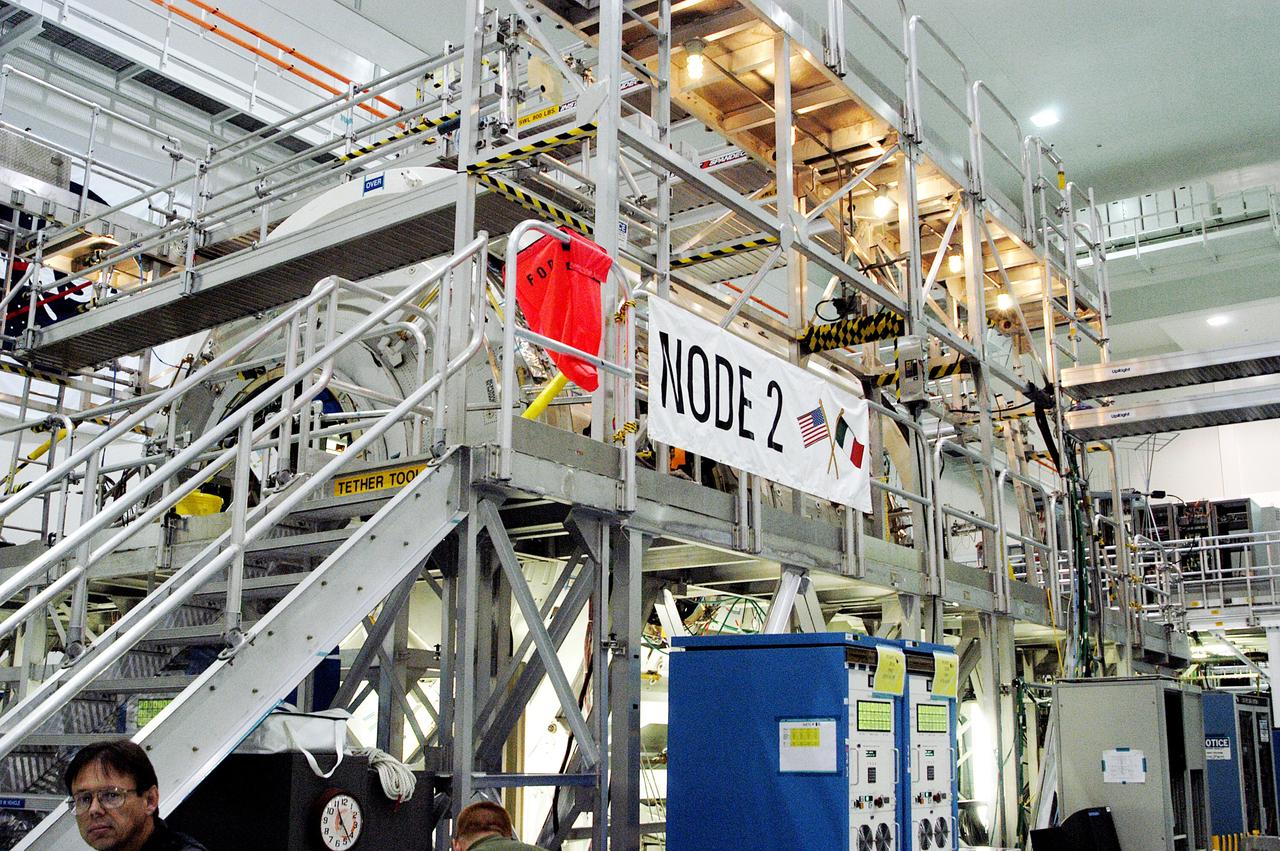
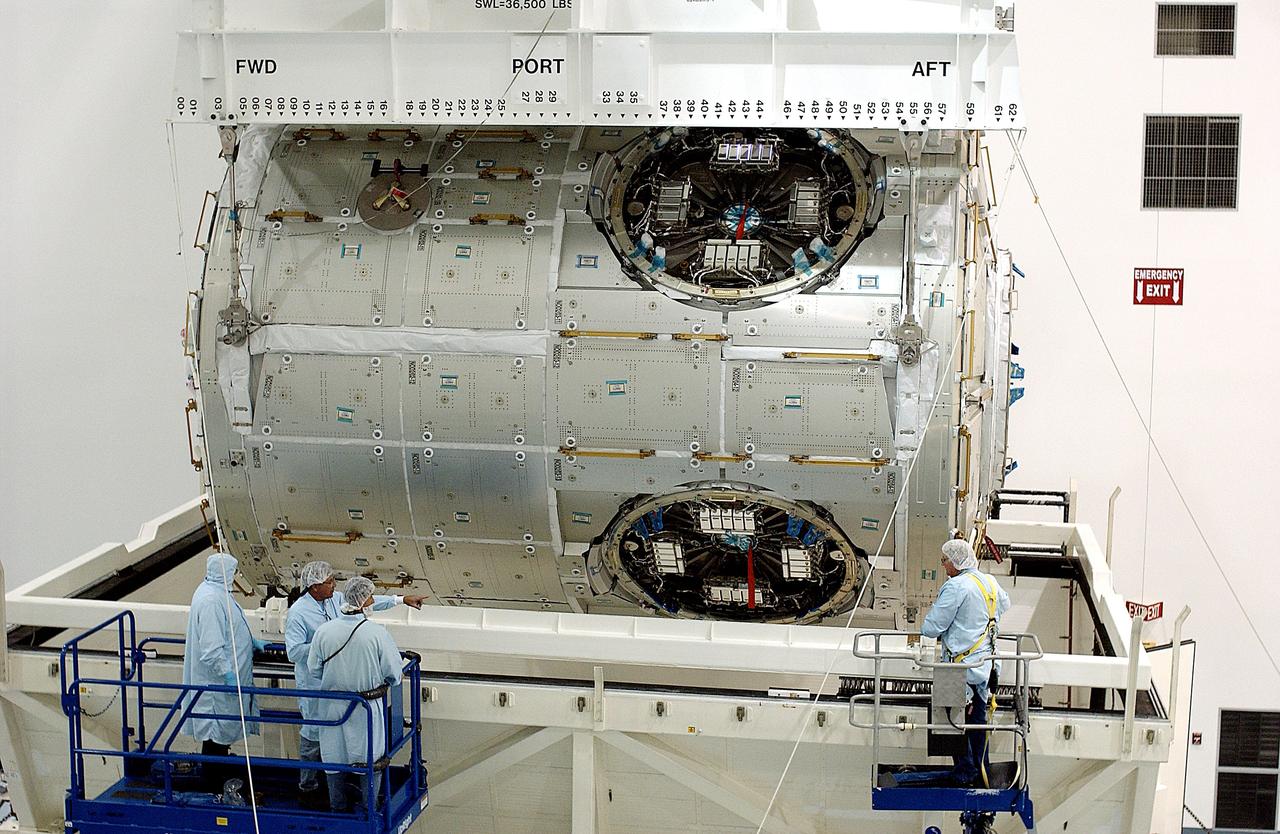
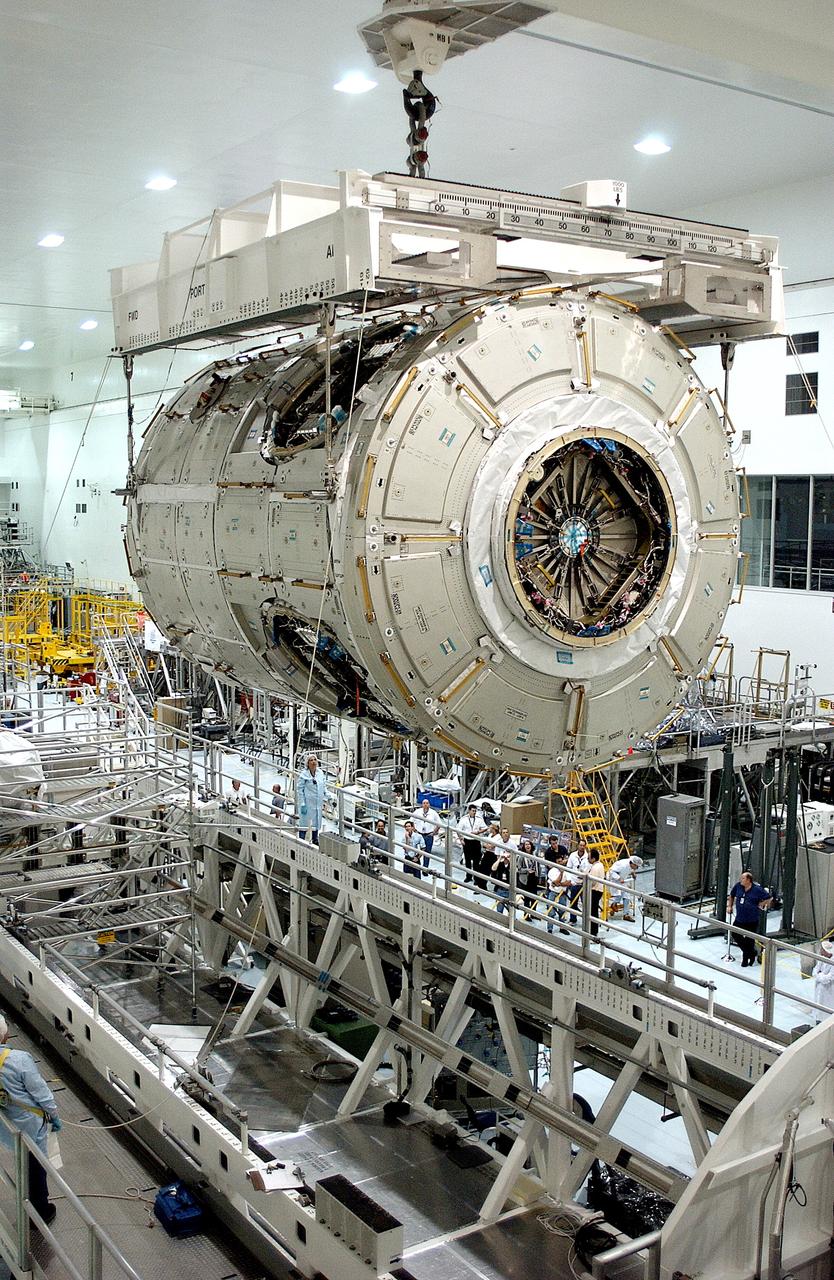
KENNEDY SPACE CENTER, FLA. - The  U.S. Node 2 is undergoing a Multi-Element Integrated Test (MEIT) in the Space Station Processing Facility.  Node 2 attaches to the end of the U.S. Lab on the ISS and provides attach locations for the Japanese laboratory, European laboratory, the Centrifuge Accommodation Module and, eventually, Multipurpose Logistics Modules. It will provide the primary docking location for the Shuttle when a pressurized mating adapter is attached to Node 2.  Installation of the module will complete the U.S. Core of the ISS.
KENNEDY SPACE CENTER, FLA. - The U.S. Node 2 is undergoing a Multi-Element Integrated Test (MEIT) in the Space Station Processing Facility. Node 2 attaches to the end of the U.S. Lab on the ISS and provides attach locations for the Japanese laboratory, European laboratory, the Centrifuge Accommodation Module and, eventually, Multipurpose Logistics Modules. It will provide the primary docking location for the Shuttle when a pressurized mating adapter is attached to Node 2. Installation of the module will complete the U.S. Core of the ISS.
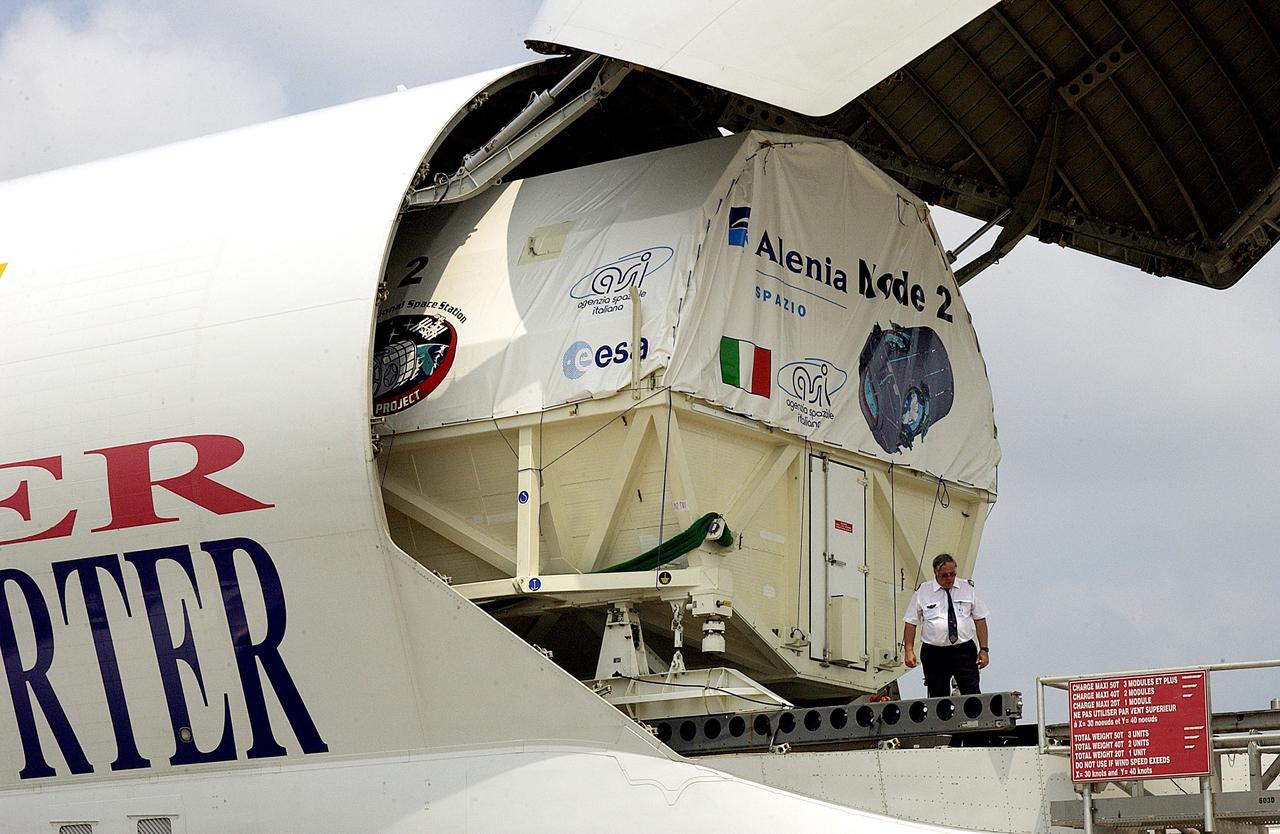
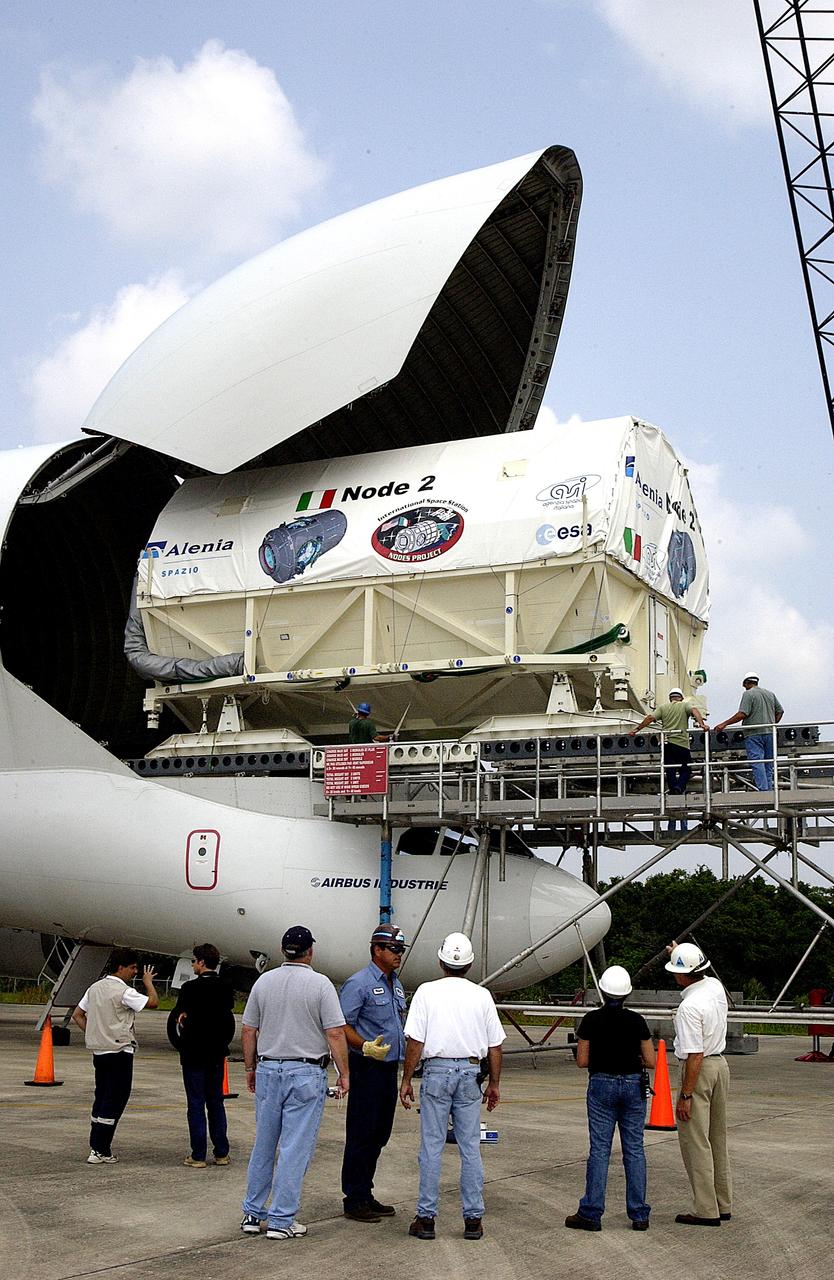
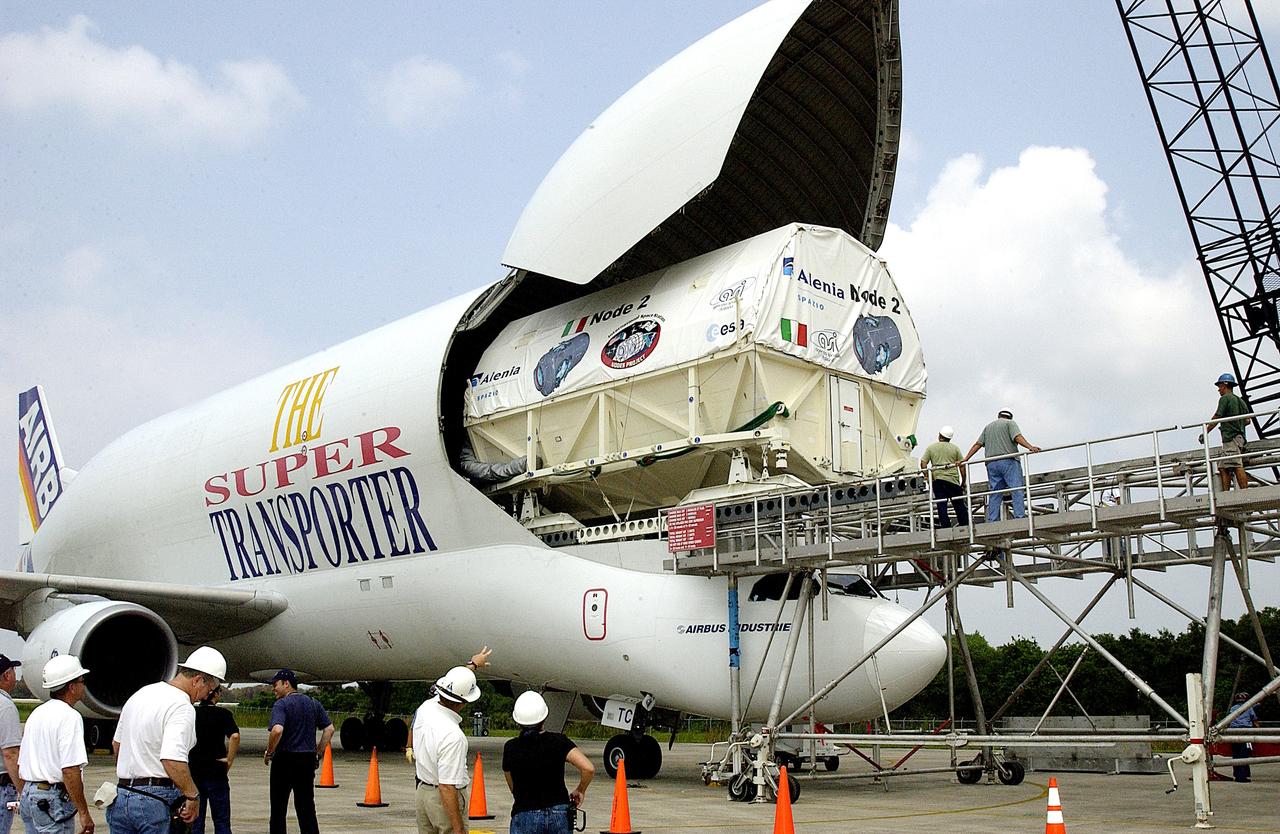
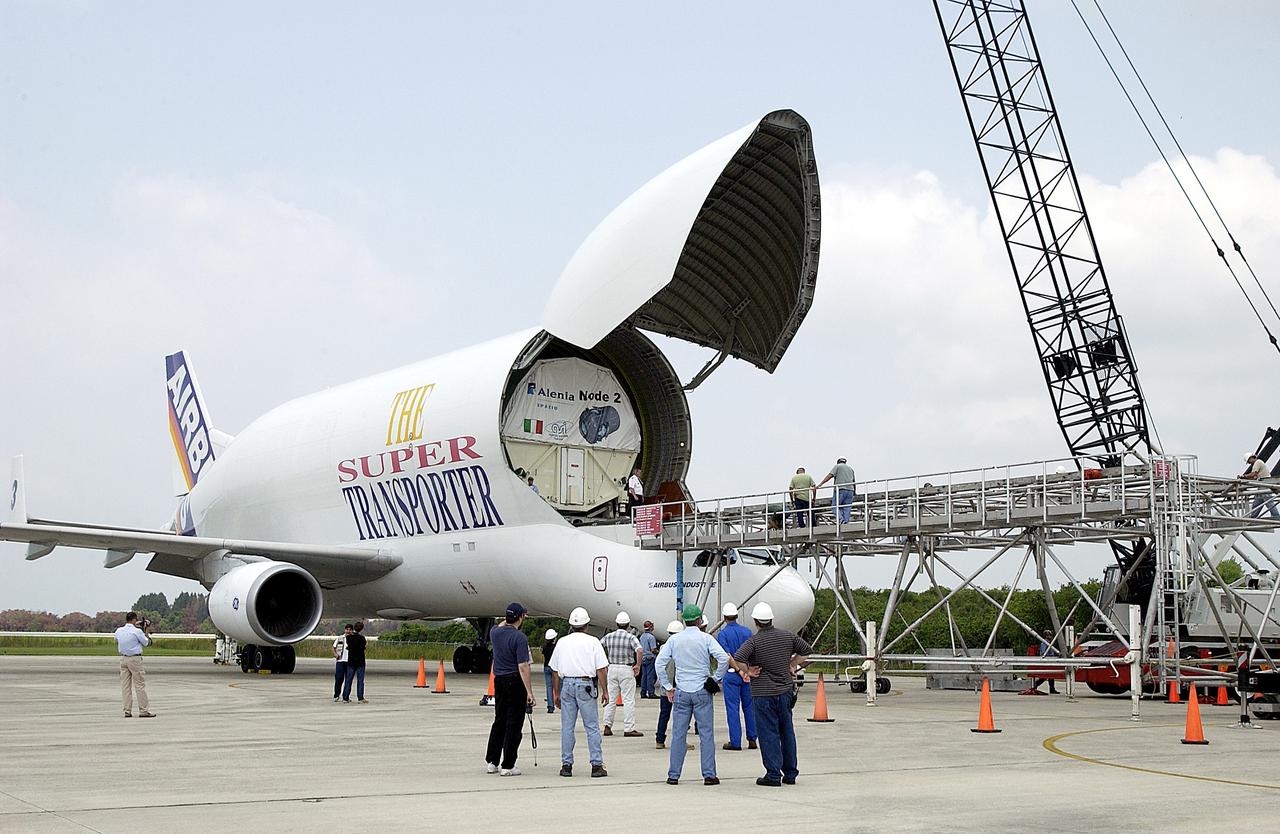
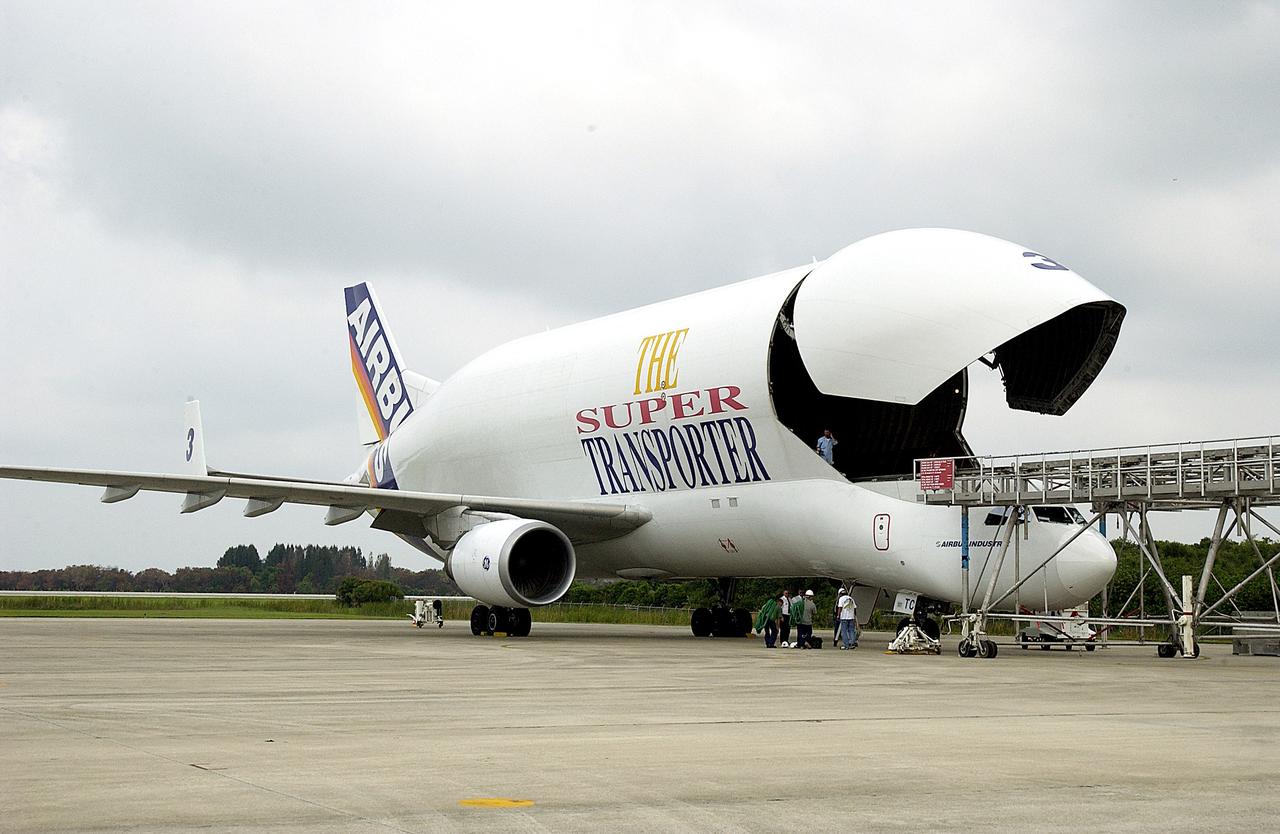
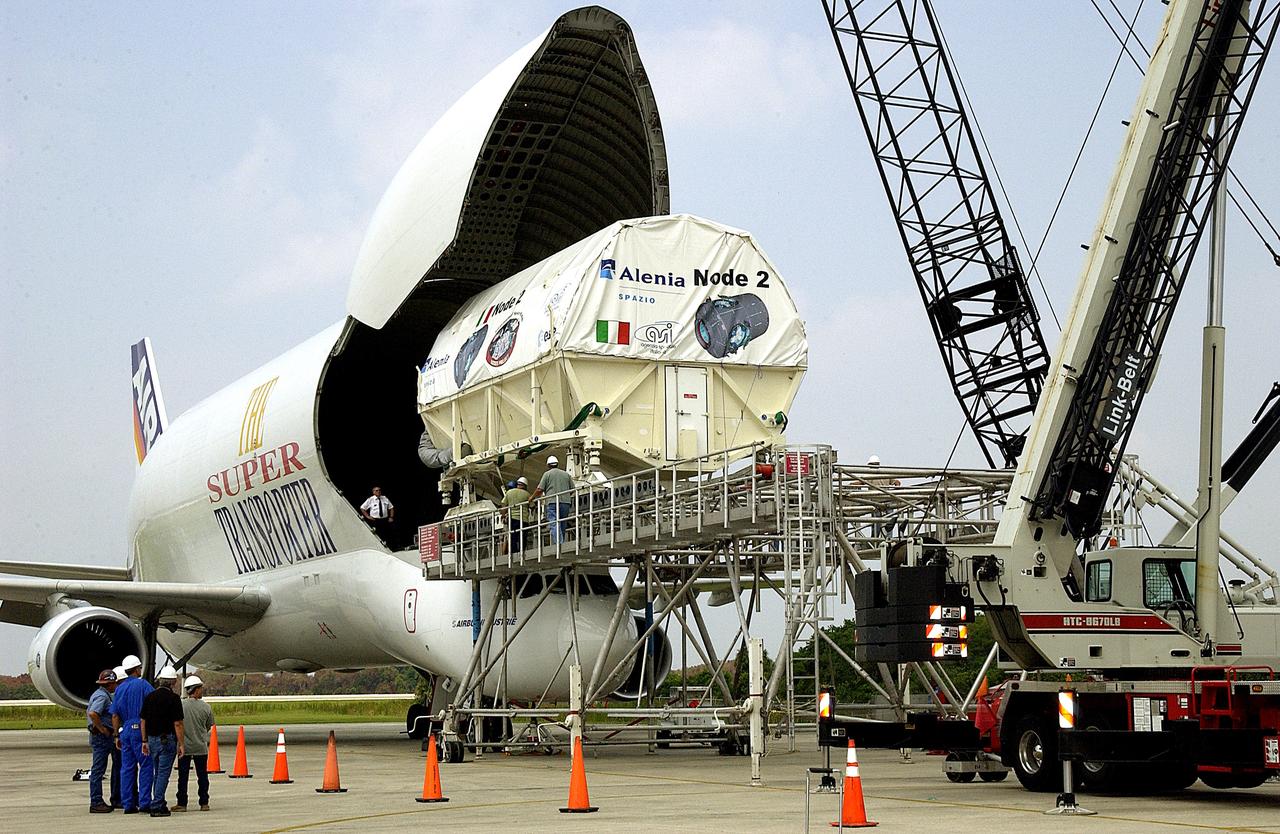
KENNEDY SPACE CENTER, FLA. - At the Shuttle Landing Facility, the nose of the Beluga aircraft is open to offload the Italian-built module, U.S. Node 2, for the International Space Station.  The second of three Station connecting modules, Node 2 attaches to the end of the U.S. Lab and provides attach locations for the Japanese laboratory, European laboratory, the Centrifuge Accommodation Module and, later, Multipurpose Logistics Modules. It will provide the primary docking location for the Shuttle when a pressurized mating adapter is attached to Node 2.  Installation of the module will complete  the U.S. Core of the ISS.  Node 2 is the designated payload for mission STS-120.  No orbiter or launch date has been determined yet.
KENNEDY SPACE CENTER, FLA. - At the Shuttle Landing Facility, the nose of the Beluga aircraft is open to offload the Italian-built module, U.S. Node 2, for the International Space Station. The second of three Station connecting modules, Node 2 attaches to the end of the U.S. Lab and provides attach locations for the Japanese laboratory, European laboratory, the Centrifuge Accommodation Module and, later, Multipurpose Logistics Modules. It will provide the primary docking location for the Shuttle when a pressurized mating adapter is attached to Node 2. Installation of the module will complete the U.S. Core of the ISS. Node 2 is the designated payload for mission STS-120. No orbiter or launch date has been determined yet.
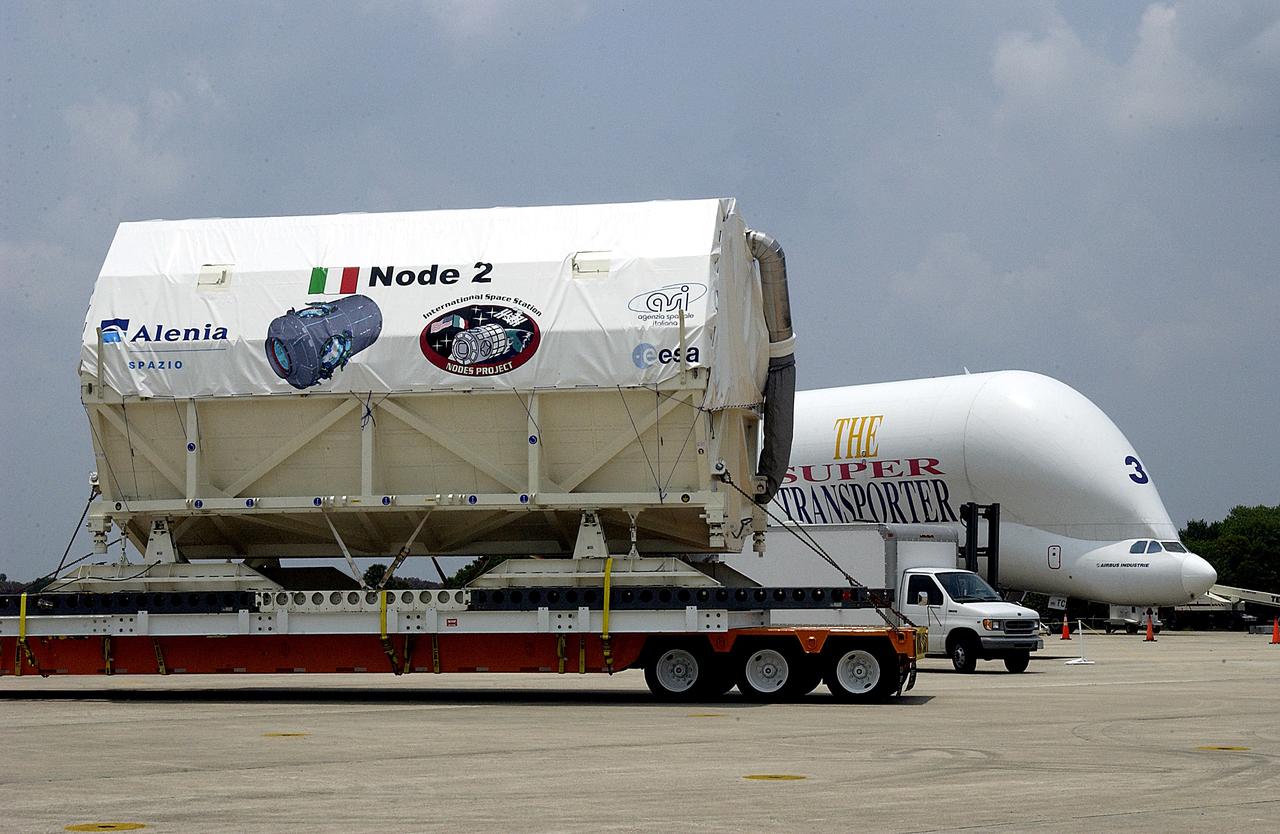
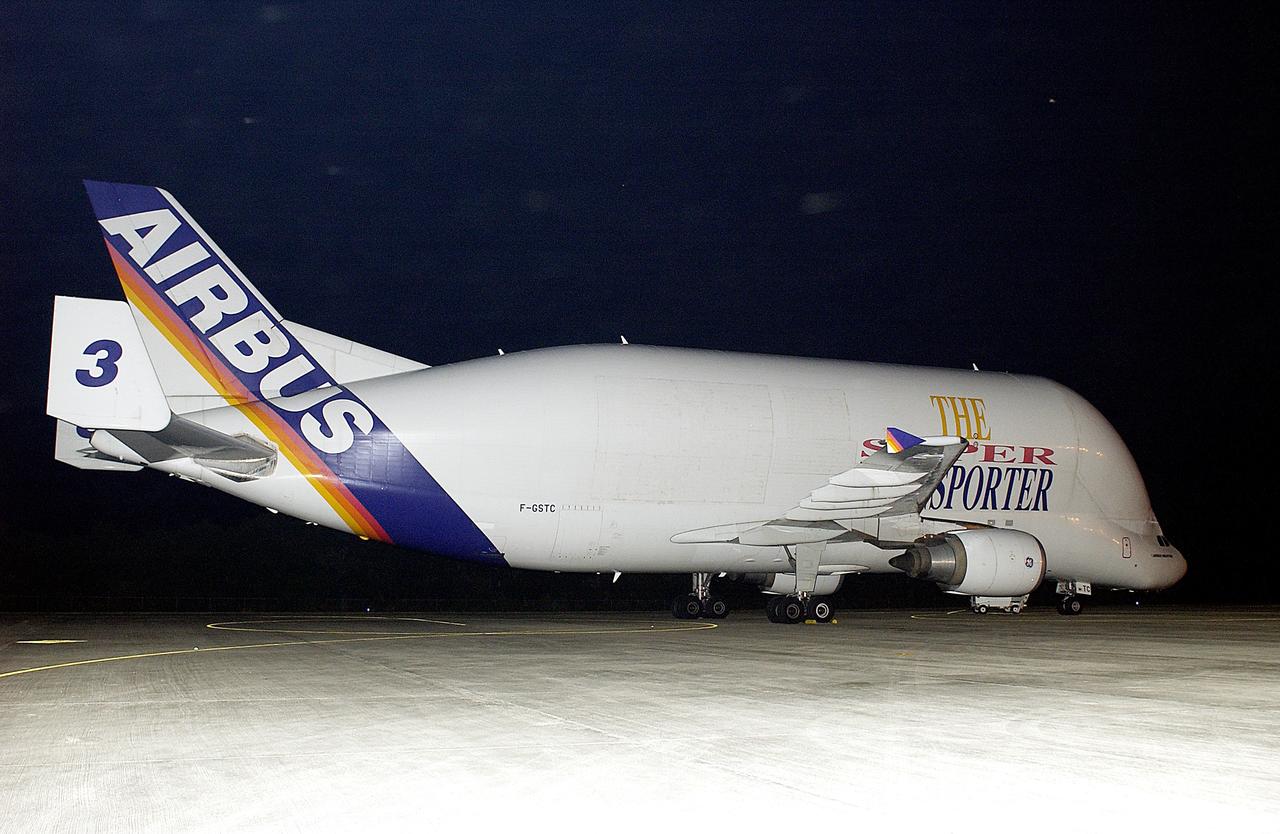
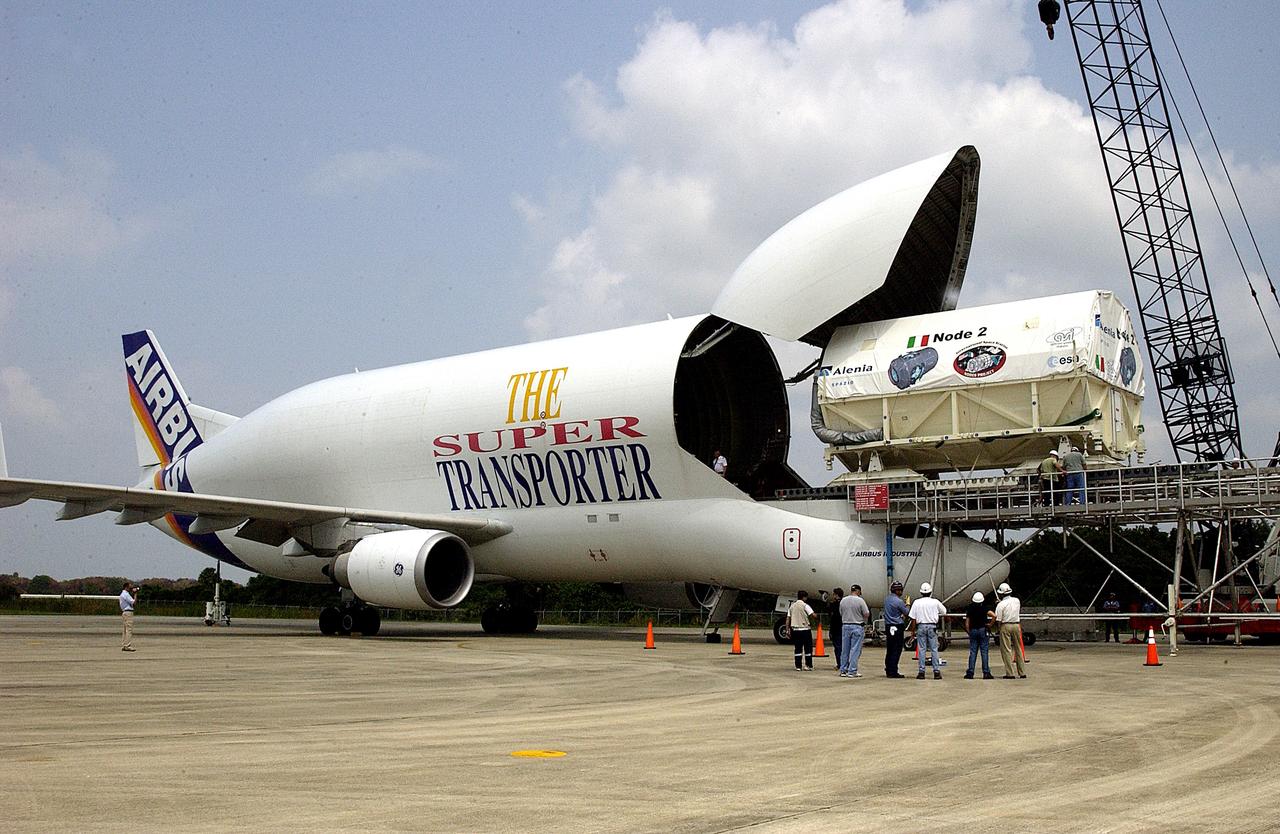
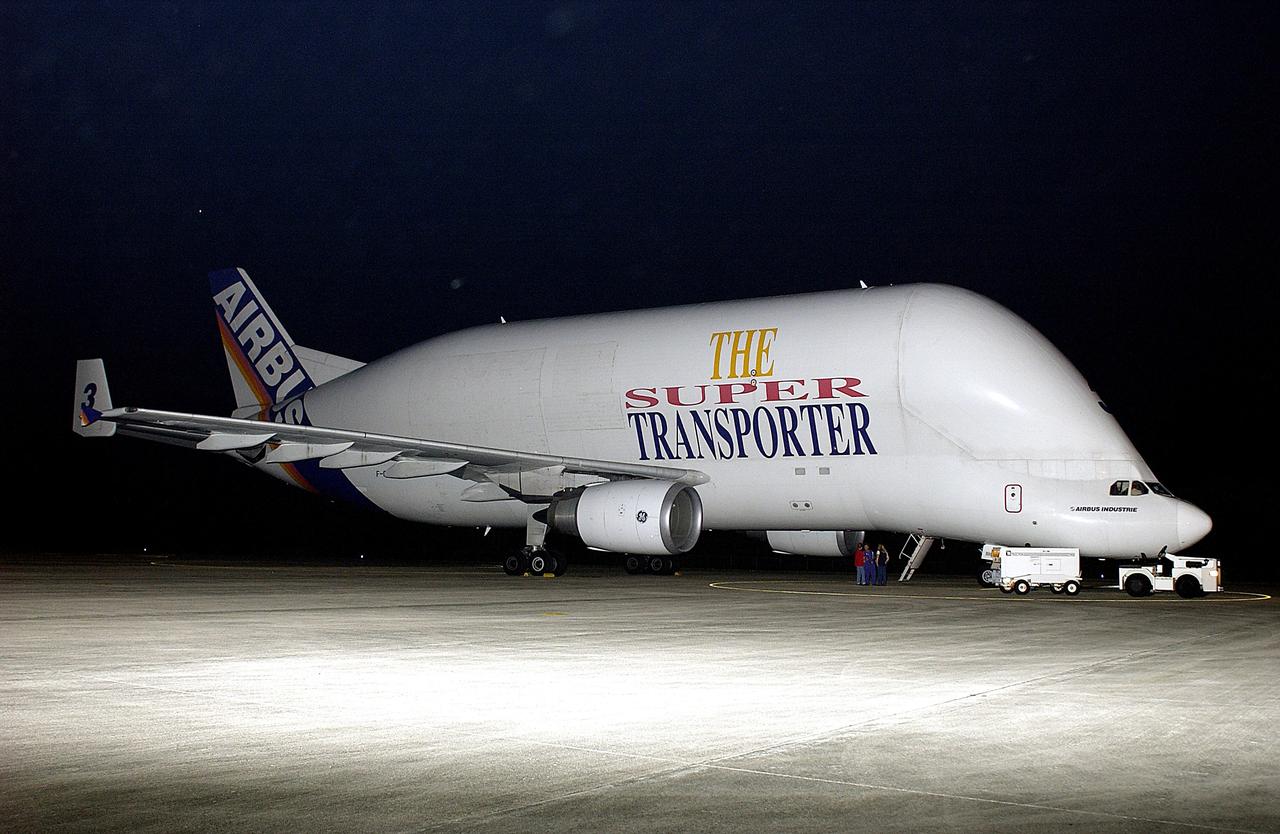
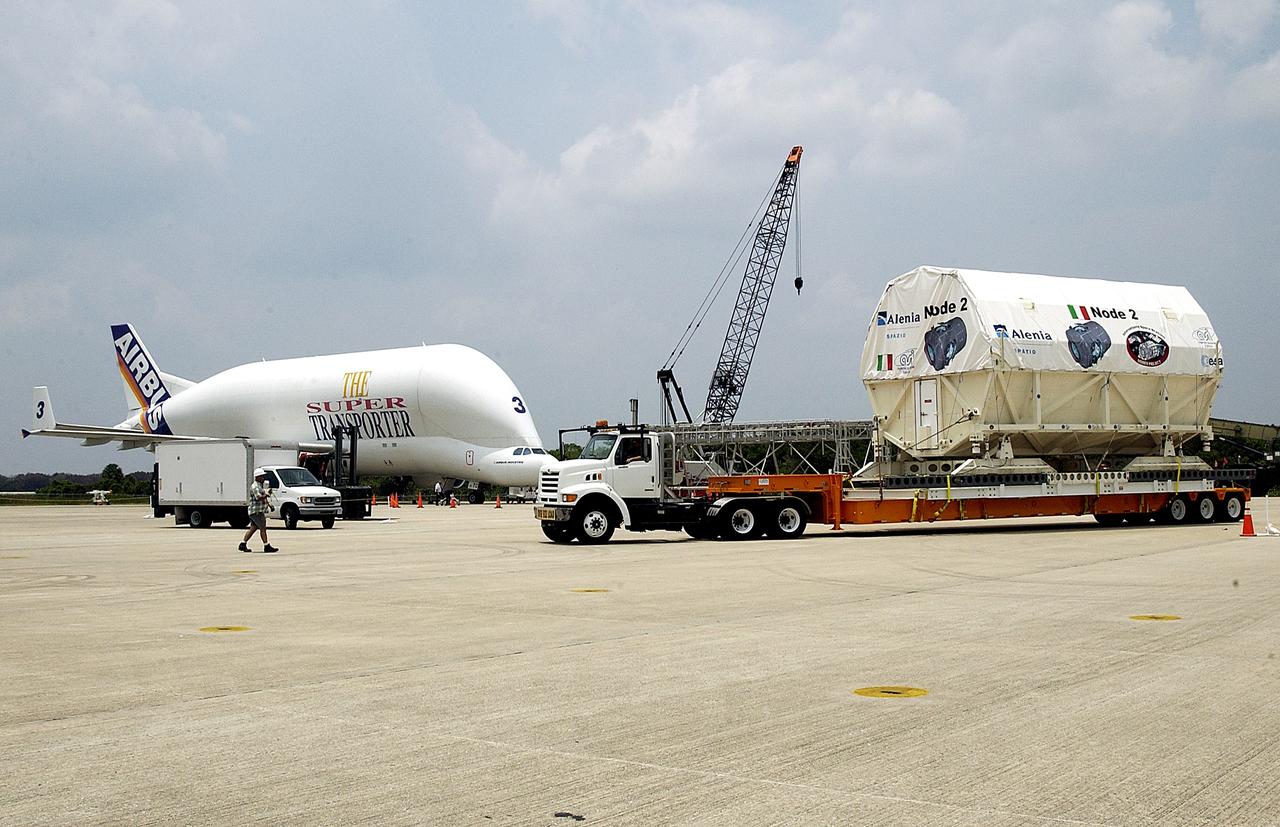
KKENNEDY SPACE CENTER, FLA. -  A Beluga aircraft arrives at the Shuttle Landing Facility with its cargo of the Italian-built module, U.S. Node 2, for the International Space Station.  The second of three Station connecting modules, Node 2 attaches to the end of the U.S. Lab and provides attach locations for the Japanese laboratory, European laboratory, the Centrifuge Accommodation Module and, later, Multipurpose Logistics Modules. It will provide the primary docking location for the Shuttle when a pressurized mating adapter is attached to Node 2.  Installation of the module will complete  the U.S. Core of the ISS.  Node 2 is the designated payload for mission STS-120.  No orbiter or launch date has been determined yet.
KKENNEDY SPACE CENTER, FLA. - A Beluga aircraft arrives at the Shuttle Landing Facility with its cargo of the Italian-built module, U.S. Node 2, for the International Space Station. The second of three Station connecting modules, Node 2 attaches to the end of the U.S. Lab and provides attach locations for the Japanese laboratory, European laboratory, the Centrifuge Accommodation Module and, later, Multipurpose Logistics Modules. It will provide the primary docking location for the Shuttle when a pressurized mating adapter is attached to Node 2. Installation of the module will complete the U.S. Core of the ISS. Node 2 is the designated payload for mission STS-120. No orbiter or launch date has been determined yet.
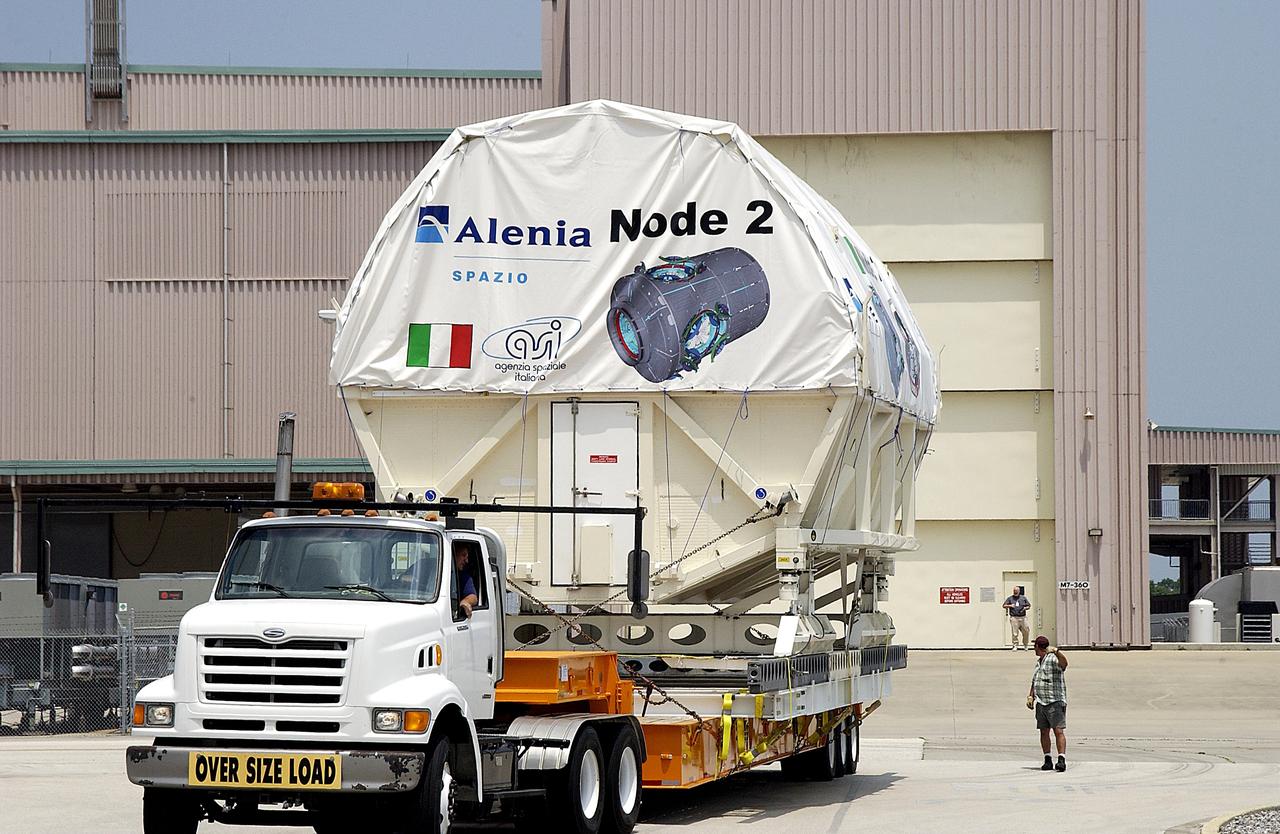
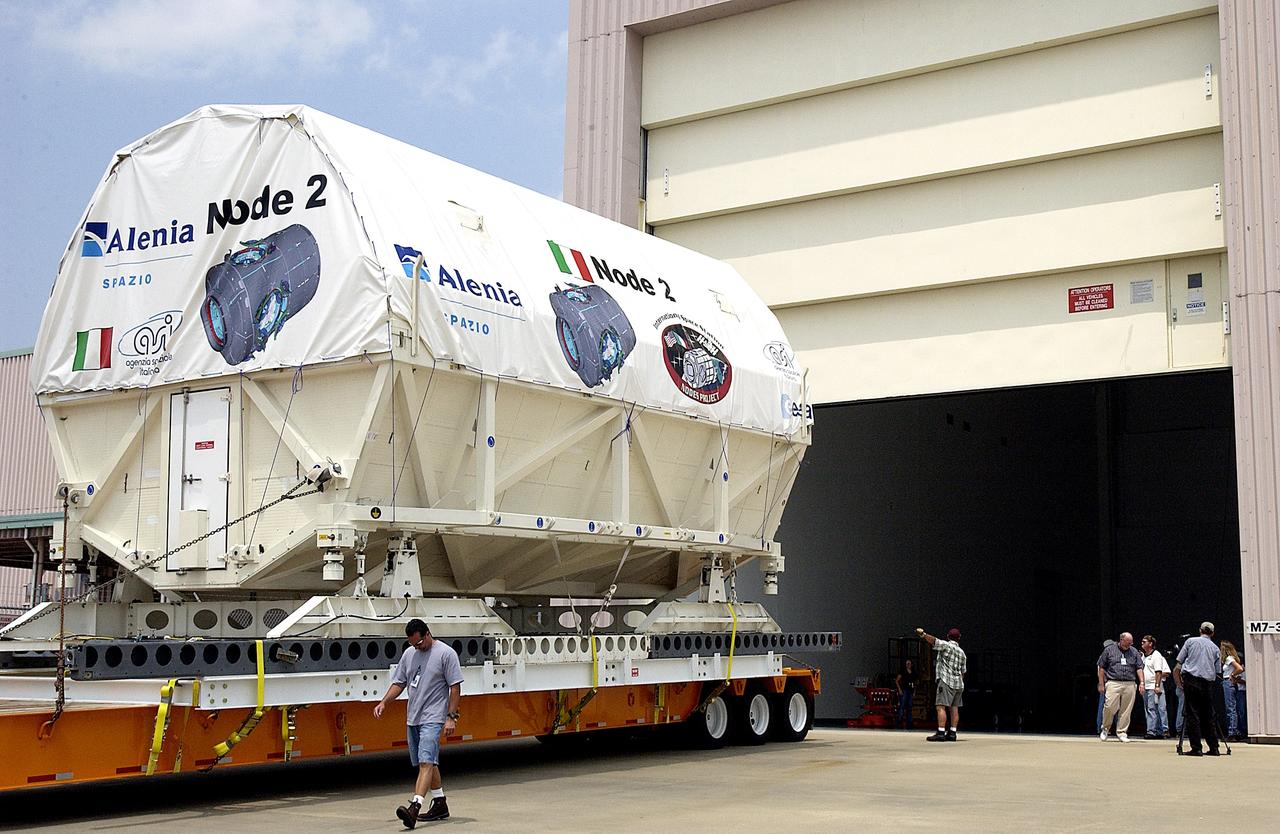
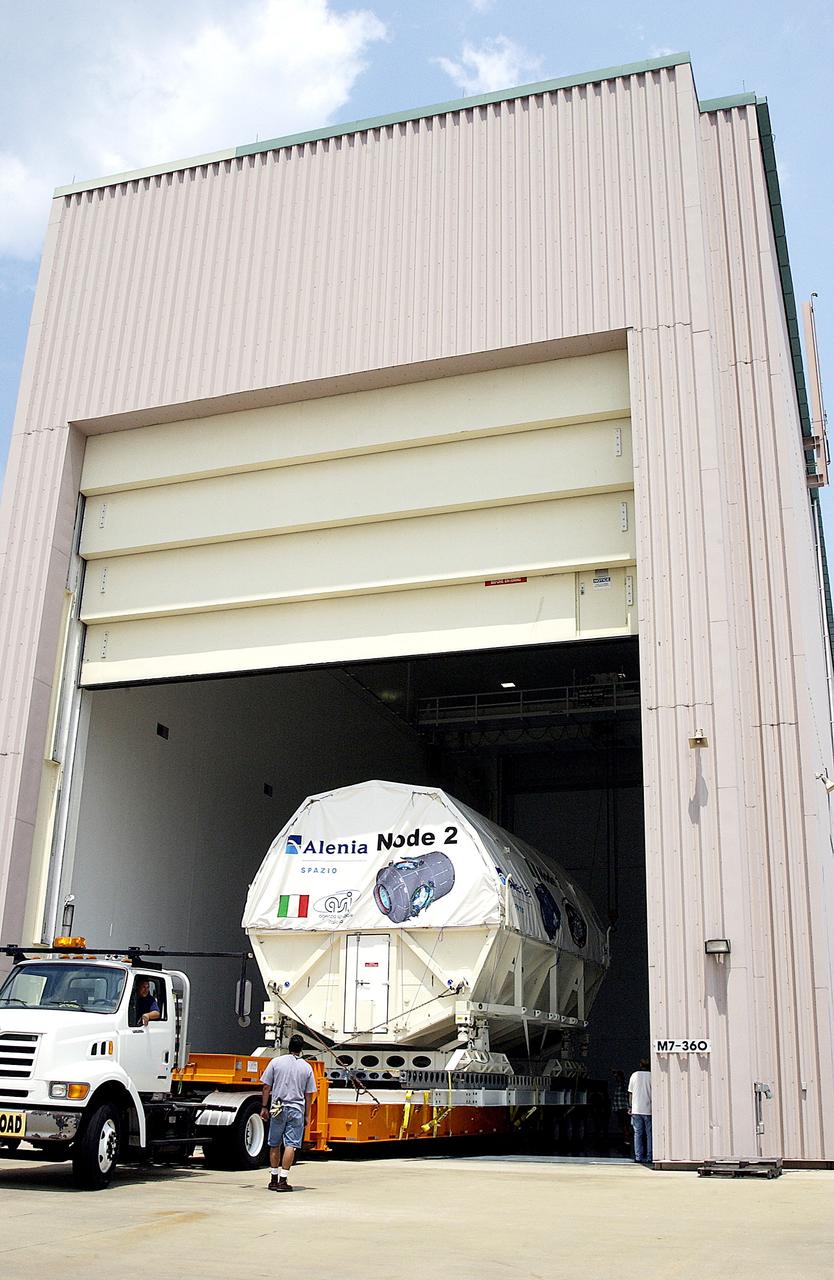
KENNEDY SPACE CENTER, FLA. -  The Italian-built module, U.S. Node 2, is moved into the Space Station Processing Facility. The second of three connecting modules on the International Space Station, Node 2 attaches to the end of the U.S. Lab and provides attach locations for the Japanese laboratory, European laboratory, the Centrifuge Accommodation Module and, later, Multipurpose Logistics Modules. It will provide the primary docking location for the Shuttle when a pressurized mating adapter is attached to Node 2.  Installation of the module will complete  the U.S. Core of the ISS.  Node 2 is the designated payload for mission STS-120.  No orbiter or launch date has been determined yet.
KENNEDY SPACE CENTER, FLA. - The Italian-built module, U.S. Node 2, is moved into the Space Station Processing Facility. The second of three connecting modules on the International Space Station, Node 2 attaches to the end of the U.S. Lab and provides attach locations for the Japanese laboratory, European laboratory, the Centrifuge Accommodation Module and, later, Multipurpose Logistics Modules. It will provide the primary docking location for the Shuttle when a pressurized mating adapter is attached to Node 2. Installation of the module will complete the U.S. Core of the ISS. Node 2 is the designated payload for mission STS-120. No orbiter or launch date has been determined yet.
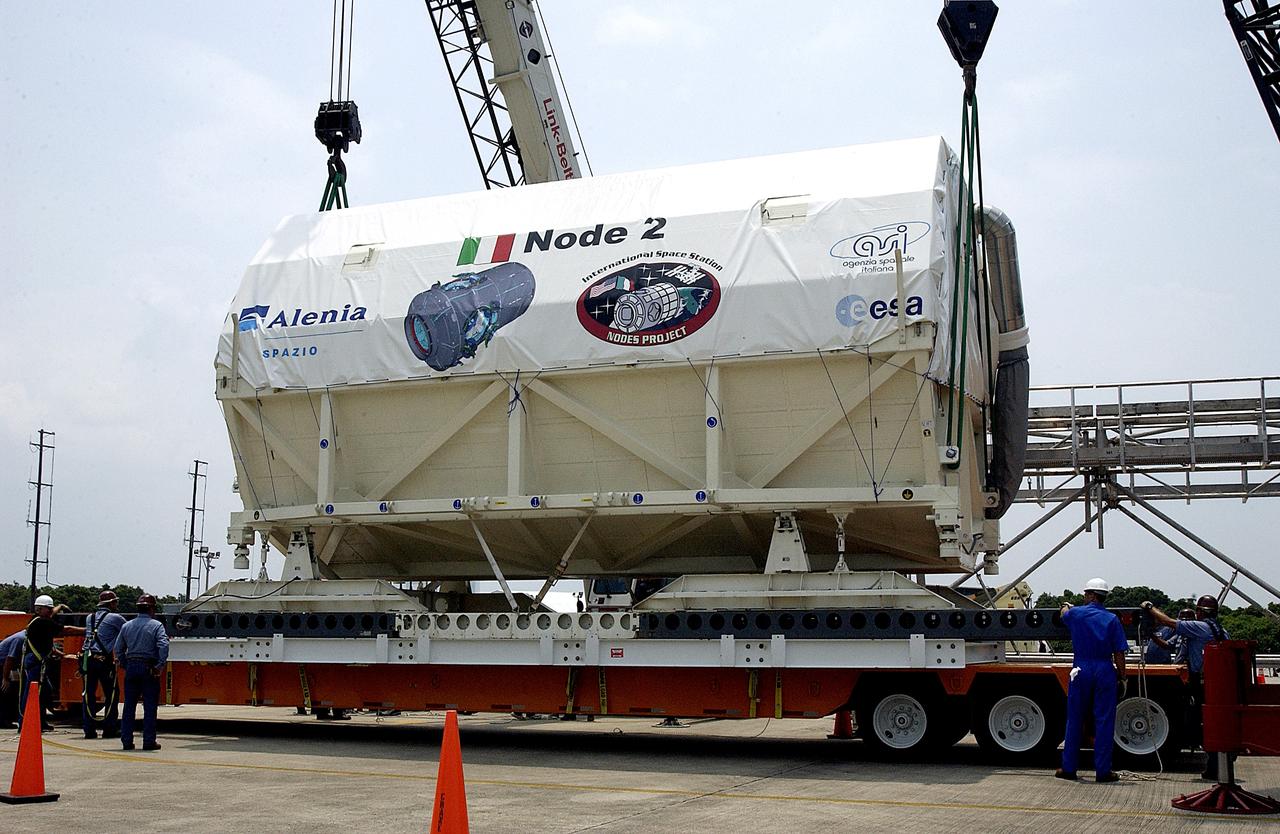
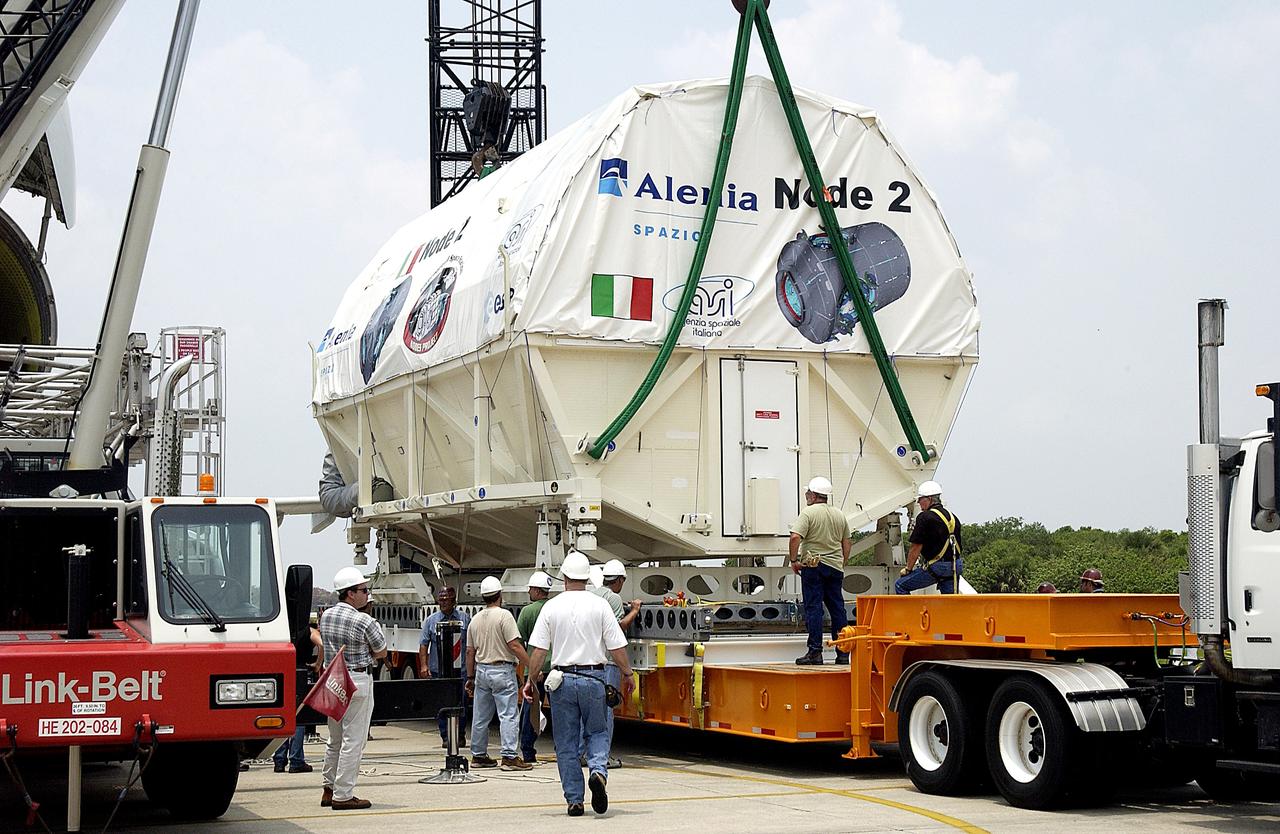
KENNEDY SPACE CENTER, FLA. -  The Italian-built module, U.S. Node 2, is lowered onto a transporter after its arrival at the Shuttle Landing Facility.  It will be taken to the Space Station Processing Facility.  The second of three connecting modules on the International Space Station, Node 2 attaches to the end of the U.S. Lab and provides attach locations for the Japanese laboratory, European laboratory, the Centrifuge Accommodation Module and, later, Multipurpose Logistics Modules. It will provide the primary docking location for the Shuttle when a pressurized mating adapter is attached to Node 2.  Installation of the module will complete  the U.S. Core of the ISS.  Node 2 is the designated payload for mission STS-120.  No orbiter or launch date has been determined yet.
KENNEDY SPACE CENTER, FLA. - The Italian-built module, U.S. Node 2, is lowered onto a transporter after its arrival at the Shuttle Landing Facility. It will be taken to the Space Station Processing Facility. The second of three connecting modules on the International Space Station, Node 2 attaches to the end of the U.S. Lab and provides attach locations for the Japanese laboratory, European laboratory, the Centrifuge Accommodation Module and, later, Multipurpose Logistics Modules. It will provide the primary docking location for the Shuttle when a pressurized mating adapter is attached to Node 2. Installation of the module will complete the U.S. Core of the ISS. Node 2 is the designated payload for mission STS-120. No orbiter or launch date has been determined yet.
KENNEDY SPACE CENTER, FLA. - The Italian-built module, U.S. Node 2, for the International Space Station is offloaded from a Beluga at the Shuttle Landing Facility. The second of three Station connecting modules, Node 2 attaches to the end of the U.S. Lab and provides attach locations for the Japanese laboratory, European laboratory, the Centrifuge Accommodation Module and, later, Multipurpose Logistics Modules. It will provide the primary docking location for the Shuttle when a pressurized mating adapter is attached to Node 2.  Installation of the module will complete  the U.S. Core of the ISS.  Node 2 is the designated payload for mission STS-120.  No orbiter or launch date has been determined yet.
KENNEDY SPACE CENTER, FLA. - The Italian-built module, U.S. Node 2, for the International Space Station is offloaded from a Beluga at the Shuttle Landing Facility. The second of three Station connecting modules, Node 2 attaches to the end of the U.S. Lab and provides attach locations for the Japanese laboratory, European laboratory, the Centrifuge Accommodation Module and, later, Multipurpose Logistics Modules. It will provide the primary docking location for the Shuttle when a pressurized mating adapter is attached to Node 2. Installation of the module will complete the U.S. Core of the ISS. Node 2 is the designated payload for mission STS-120. No orbiter or launch date has been determined yet.
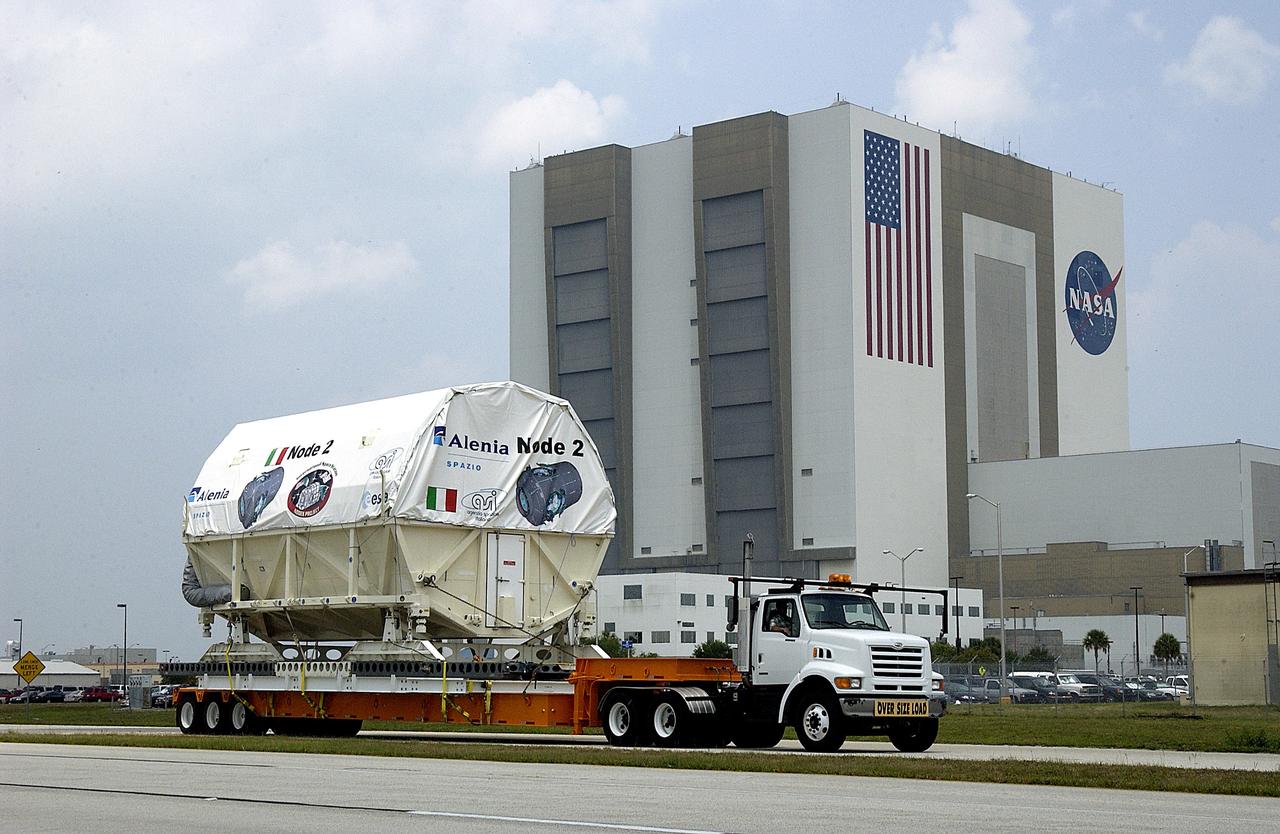
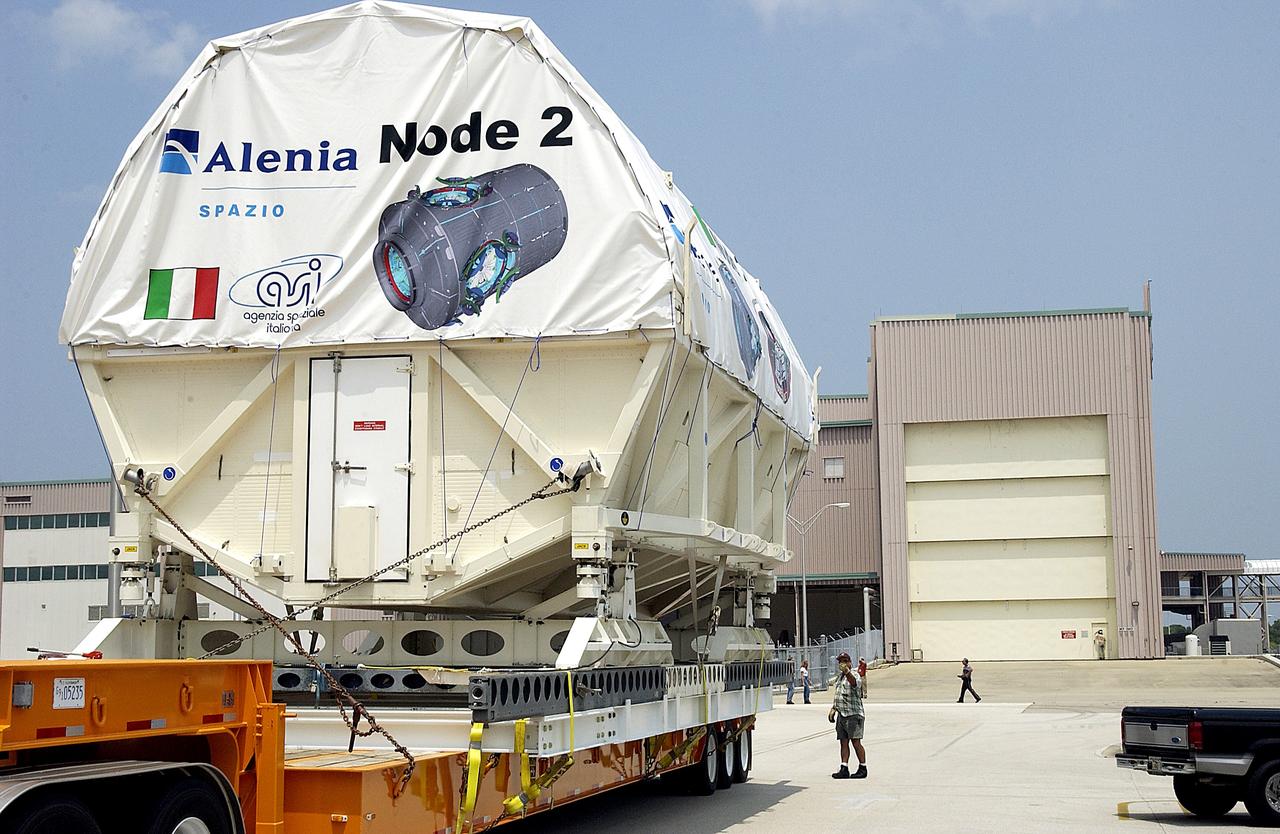
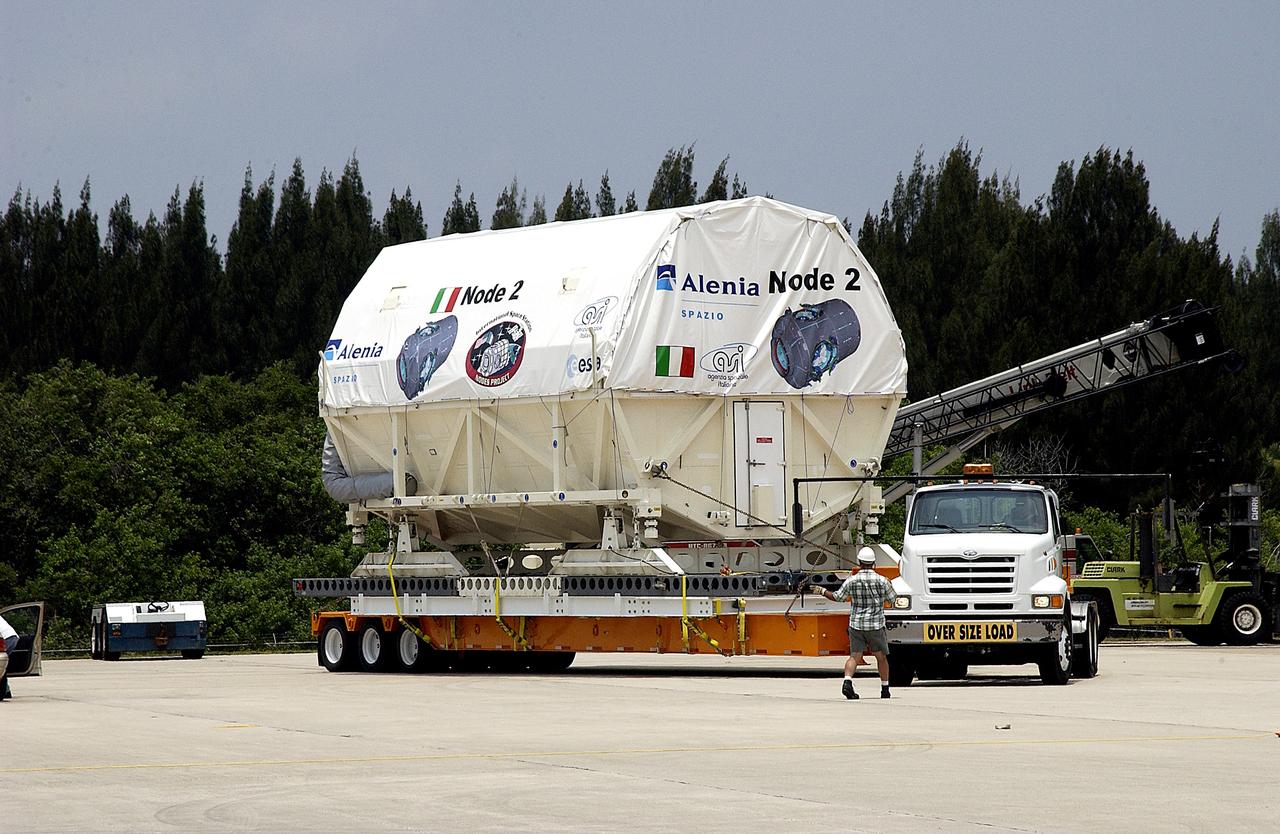
KENNEDY SPACE CENTER, FLA. -  The Italian-built module, U.S. Node 2, moves past the Vehicle Assembly Building as it is transferred to the Space Station Processing Facility. The second of three connecting modules on the International Space Station, Node 2 attaches to the end of the U.S. Lab and provides attach locations for the Japanese laboratory, European laboratory, the Centrifuge Accommodation Module and, later, Multipurpose Logistics Modules. It will provide the primary docking location for the Shuttle when a pressurized mating adapter is attached to Node 2.  Installation of the module will complete  the U.S. Core of the ISS.  Node 2 is the designated payload for mission STS-120.  No orbiter or launch date has been determined yet.
KENNEDY SPACE CENTER, FLA. - The Italian-built module, U.S. Node 2, moves past the Vehicle Assembly Building as it is transferred to the Space Station Processing Facility. The second of three connecting modules on the International Space Station, Node 2 attaches to the end of the U.S. Lab and provides attach locations for the Japanese laboratory, European laboratory, the Centrifuge Accommodation Module and, later, Multipurpose Logistics Modules. It will provide the primary docking location for the Shuttle when a pressurized mating adapter is attached to Node 2. Installation of the module will complete the U.S. Core of the ISS. Node 2 is the designated payload for mission STS-120. No orbiter or launch date has been determined yet.
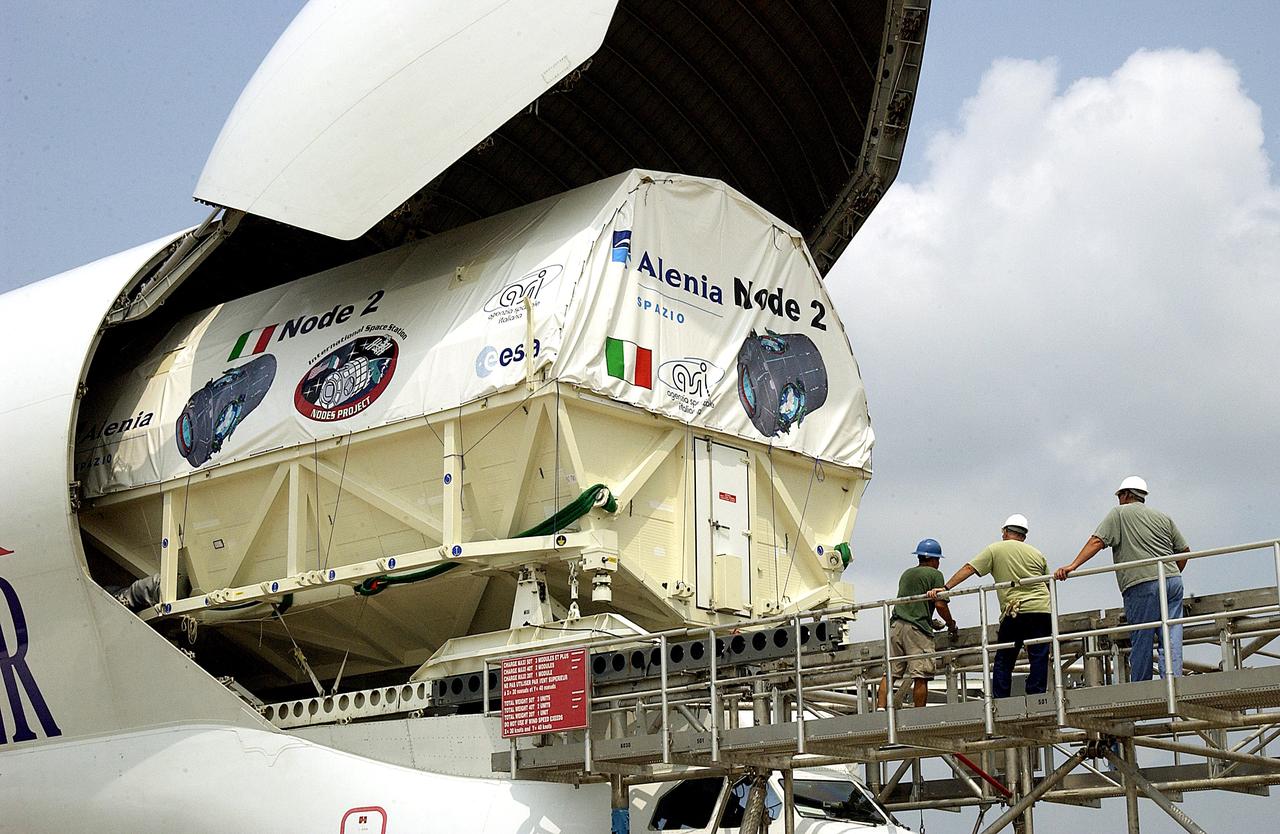
KENNEDY SPACE CENTER, FLA. - The Italian-built module, U.S. Node 2, for the International Space Station is offloaded from a Beluga aircraft at the Shuttle Landing Facility. The second of three Station connecting modules, Node 2 attaches to the end of the U.S. Lab and provides attach locations for the Japanese laboratory, European laboratory, the Centrifuge Accommodation Module and, later, Multipurpose Logistics Modules. It will provide the primary docking location for the Shuttle when a pressurized mating adapter is attached to Node 2.  Installation of the module will complete  the U.S. Core of the ISS.  Node 2 is the designated payload for mission STS-120.  No orbiter or launch date has been determined yet.
KENNEDY SPACE CENTER, FLA. - The Italian-built module, U.S. Node 2, for the International Space Station is offloaded from a Beluga aircraft at the Shuttle Landing Facility. The second of three Station connecting modules, Node 2 attaches to the end of the U.S. Lab and provides attach locations for the Japanese laboratory, European laboratory, the Centrifuge Accommodation Module and, later, Multipurpose Logistics Modules. It will provide the primary docking location for the Shuttle when a pressurized mating adapter is attached to Node 2. Installation of the module will complete the U.S. Core of the ISS. Node 2 is the designated payload for mission STS-120. No orbiter or launch date has been determined yet.
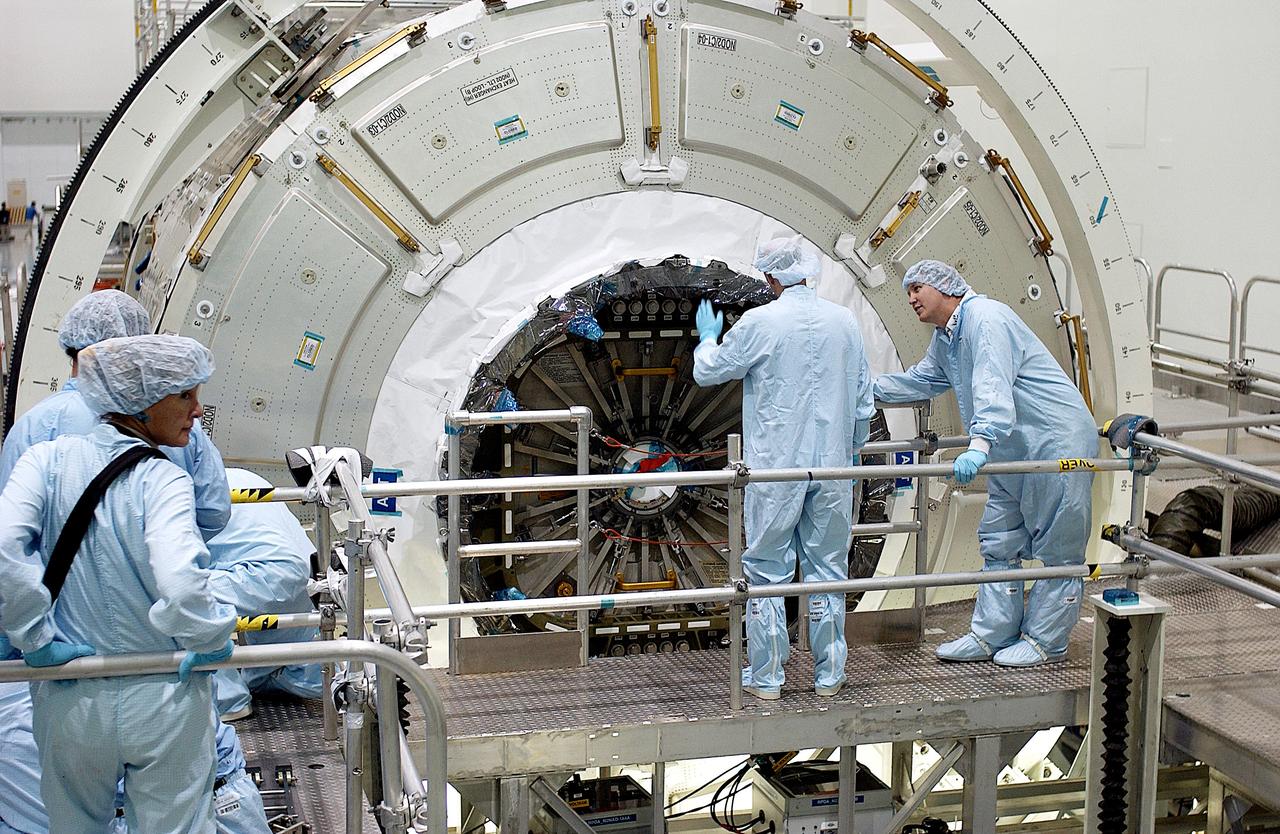
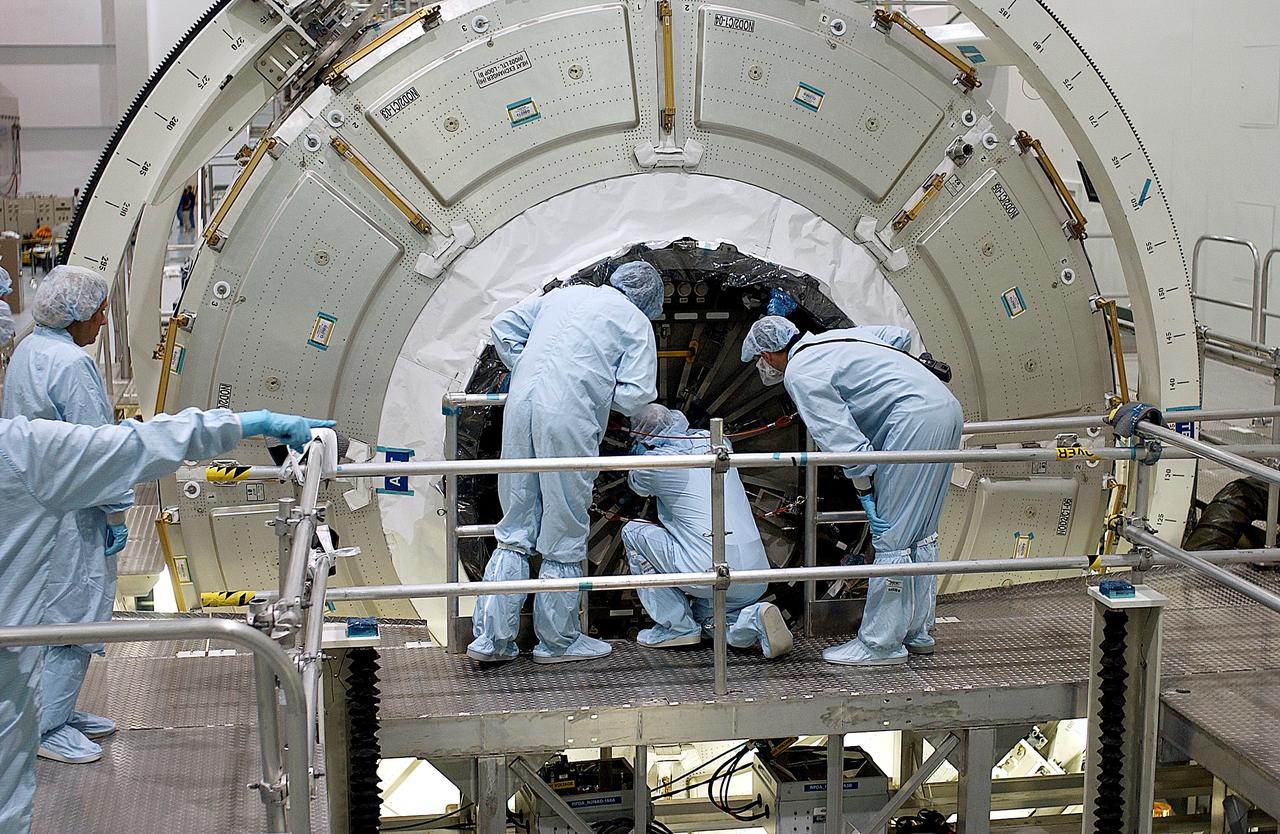
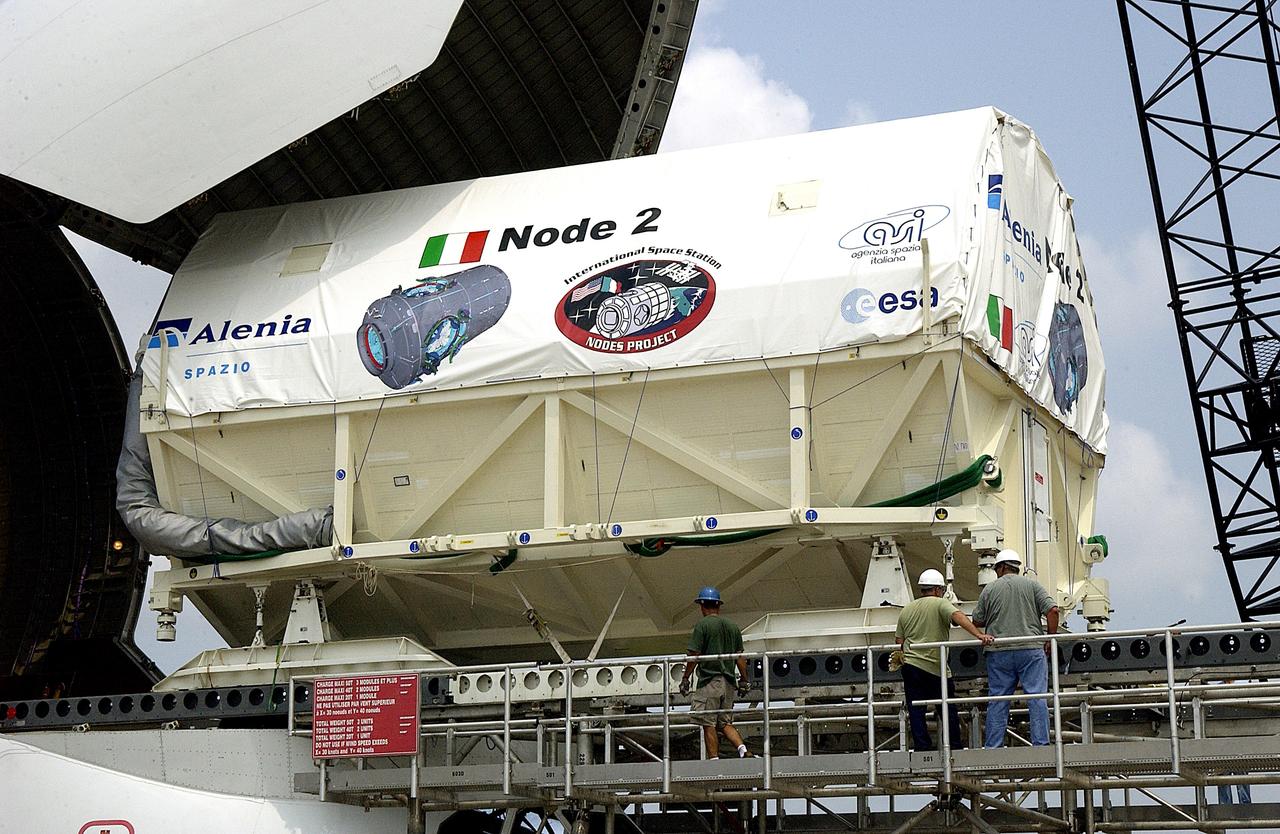
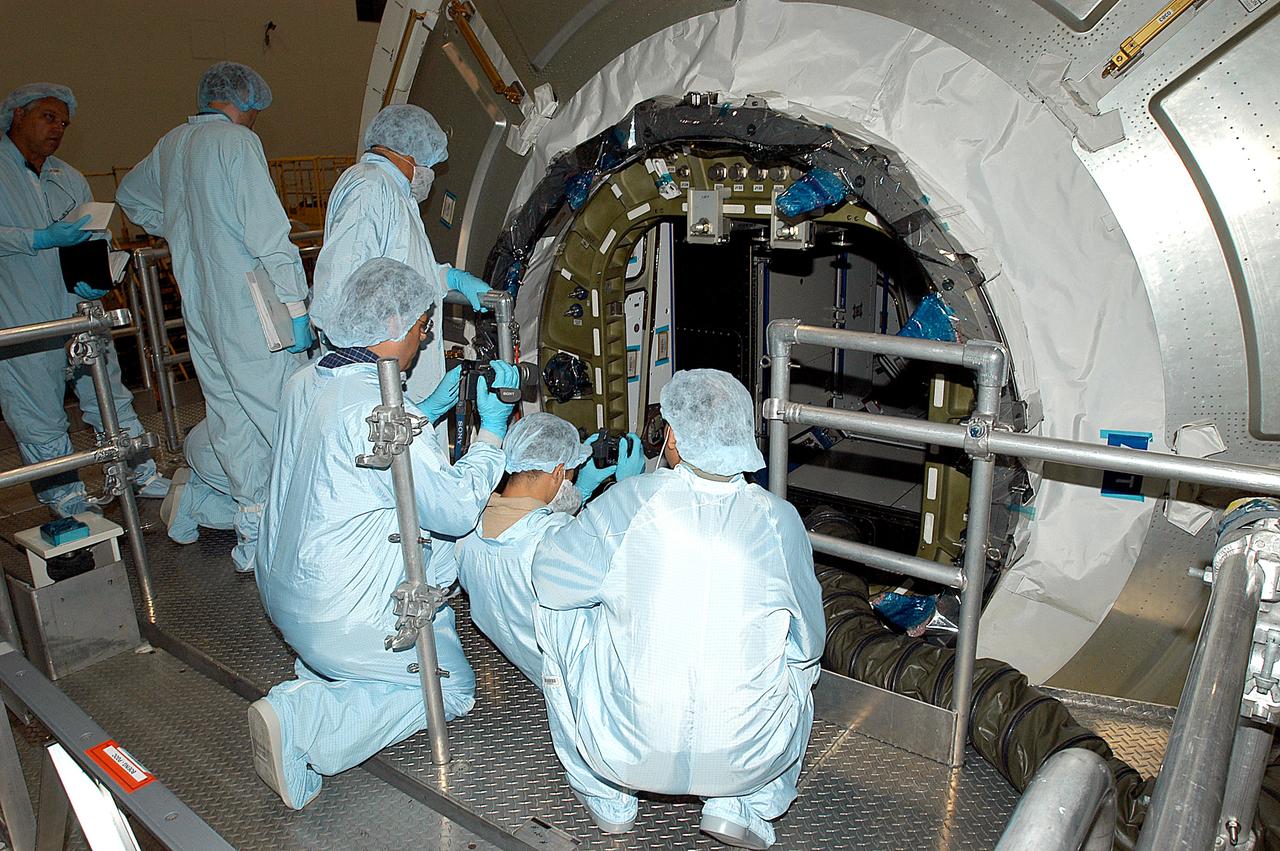
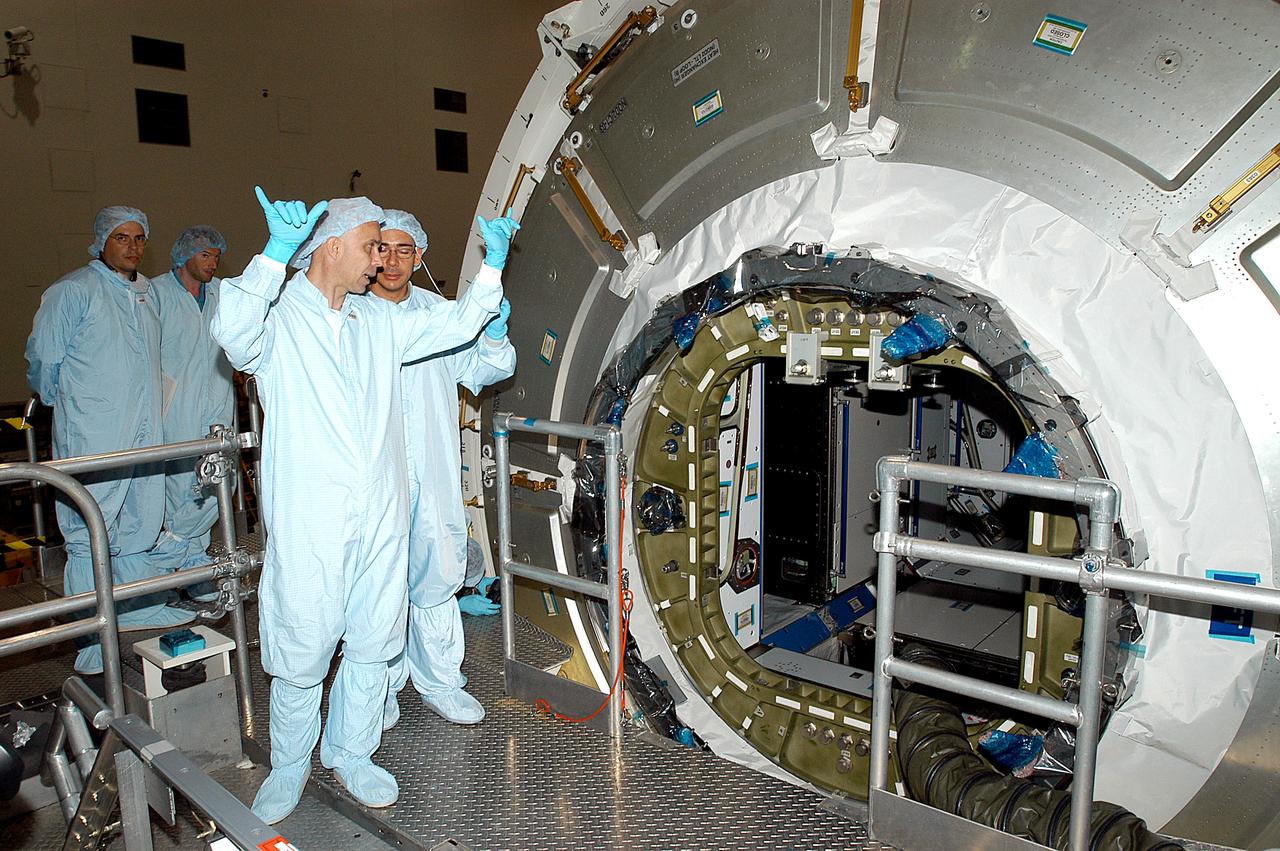
KENNEDY SPACE CENTER, FLA. -  Workers in the Space Station Processing Facility attempt to open the hatch on the Italian-built Node 2, a future element of the International Space Station.  Node 2 arrived at KSC June 1.  The second of three Station connecting modules, the module  attaches to the end of the U.S. Lab and provides attach locations for the Japanese laboratory, European laboratory, the Centrifuge Accommodation Module and, later, Multipurpose Logistics Modules. It will provide the primary docking location for the Shuttle when a pressurized mating adapter is attached to Node 2.  Installation of the module will complete  the U.S. Core of the ISS.  Node 2 is the designated payload for mission STS-120.  No orbiter or launch date has been determined yet.
KENNEDY SPACE CENTER, FLA. - Workers in the Space Station Processing Facility attempt to open the hatch on the Italian-built Node 2, a future element of the International Space Station. Node 2 arrived at KSC June 1. The second of three Station connecting modules, the module attaches to the end of the U.S. Lab and provides attach locations for the Japanese laboratory, European laboratory, the Centrifuge Accommodation Module and, later, Multipurpose Logistics Modules. It will provide the primary docking location for the Shuttle when a pressurized mating adapter is attached to Node 2. Installation of the module will complete the U.S. Core of the ISS. Node 2 is the designated payload for mission STS-120. No orbiter or launch date has been determined yet.
KENNEDY SPACE CENTER, FLA. - The Italian-built module, U.S. Node 2, for the International Space Station is offloaded from a Beluga aircraft at the Shuttle Landing Facility. The second of three Station connecting modules, Node 2 attaches to the end of the U.S. Lab and provides attach locations for the Japanese laboratory, European laboratory, the Centrifuge Accommodation Module and, later, Multipurpose Logistics Modules. It will provide the primary docking location for the Shuttle when a pressurized mating adapter is attached to Node 2.  Installation of the module will complete  the U.S. Core of the ISS.  Node 2 is the designated payload for mission STS-120.  No orbiter or launch date has been determined yet.
KENNEDY SPACE CENTER, FLA. - The Italian-built module, U.S. Node 2, for the International Space Station is offloaded from a Beluga aircraft at the Shuttle Landing Facility. The second of three Station connecting modules, Node 2 attaches to the end of the U.S. Lab and provides attach locations for the Japanese laboratory, European laboratory, the Centrifuge Accommodation Module and, later, Multipurpose Logistics Modules. It will provide the primary docking location for the Shuttle when a pressurized mating adapter is attached to Node 2. Installation of the module will complete the U.S. Core of the ISS. Node 2 is the designated payload for mission STS-120. No orbiter or launch date has been determined yet.
KENNEDY SPACE CENTER, FLA. - The Italian-built module, U.S. Node 2, for the International Space Station is offloaded from a Beluga at the Shuttle Landing Facility. The second of three Station connecting modules, Node 2 attaches to the end of the U.S. Lab and provides attach locations for the Japanese laboratory, European laboratory, the Centrifuge Accommodation Module and, later, Multipurpose Logistics Modules. It will provide the primary docking location for the Shuttle when a pressurized mating adapter is attached to Node 2.  Installation of the module will complete  the U.S. Core of the ISS.  Node 2 is the designated payload for mission STS-120.  No orbiter or launch date has been determined yet.
KENNEDY SPACE CENTER, FLA. - The Italian-built module, U.S. Node 2, for the International Space Station is offloaded from a Beluga at the Shuttle Landing Facility. The second of three Station connecting modules, Node 2 attaches to the end of the U.S. Lab and provides attach locations for the Japanese laboratory, European laboratory, the Centrifuge Accommodation Module and, later, Multipurpose Logistics Modules. It will provide the primary docking location for the Shuttle when a pressurized mating adapter is attached to Node 2. Installation of the module will complete the U.S. Core of the ISS. Node 2 is the designated payload for mission STS-120. No orbiter or launch date has been determined yet.
KENNEDY SPACE CENTER, FLA. - The Italian-built module, U.S. Node 2, for the International Space Station is offloaded from a Beluga aircraft at the Shuttle Landing Facility. The second of three Station connecting modules, Node 2 attaches to the end of the U.S. Lab and provides attach locations for the Japanese laboratory, European laboratory, the Centrifuge Accommodation Module and, later, Multipurpose Logistics Modules. It will provide the primary docking location for the Shuttle when a pressurized mating adapter is attached to Node 2.  Installation of the module will complete  the U.S. Core of the ISS.  Node 2 is the designated payload for mission STS-120.  No orbiter or launch date has been determined yet.
KENNEDY SPACE CENTER, FLA. - The Italian-built module, U.S. Node 2, for the International Space Station is offloaded from a Beluga aircraft at the Shuttle Landing Facility. The second of three Station connecting modules, Node 2 attaches to the end of the U.S. Lab and provides attach locations for the Japanese laboratory, European laboratory, the Centrifuge Accommodation Module and, later, Multipurpose Logistics Modules. It will provide the primary docking location for the Shuttle when a pressurized mating adapter is attached to Node 2. Installation of the module will complete the U.S. Core of the ISS. Node 2 is the designated payload for mission STS-120. No orbiter or launch date has been determined yet.
KENNEDY SPACE CENTER, FLA. - The Italian-built module, U.S. Node 2, for the International Space Station is offloaded from a Beluga aircraft at the Shuttle Landing Facility. The second of three Station connecting modules, Node 2 attaches to the end of the U.S. Lab and provides attach locations for the Japanese laboratory, European laboratory, the Centrifuge Accommodation Module and, later, Multipurpose Logistics Modules. It will provide the primary docking location for the Shuttle when a pressurized mating adapter is attached to Node 2.  Installation of the module will complete  the U.S. Core of the ISS.  Node 2 is the designated payload for mission STS-120.  No orbiter or launch date has been determined yet.
KENNEDY SPACE CENTER, FLA. - The Italian-built module, U.S. Node 2, for the International Space Station is offloaded from a Beluga aircraft at the Shuttle Landing Facility. The second of three Station connecting modules, Node 2 attaches to the end of the U.S. Lab and provides attach locations for the Japanese laboratory, European laboratory, the Centrifuge Accommodation Module and, later, Multipurpose Logistics Modules. It will provide the primary docking location for the Shuttle when a pressurized mating adapter is attached to Node 2. Installation of the module will complete the U.S. Core of the ISS. Node 2 is the designated payload for mission STS-120. No orbiter or launch date has been determined yet.
KENNEDY SPACE CENTER, FLA. -  The Italian-built module, U.S. Node 2, moves past the Beluga aircraft that brought it to KSC as it is transferred to the Space Station Processing Facility. The second of three connecting modules on the International Space Station, Node 2 attaches to the end of the U.S. Lab and provides attach locations for the Japanese laboratory, European laboratory, the Centrifuge Accommodation Module and, later, Multipurpose Logistics Modules. It will provide the primary docking location for the Shuttle when a pressurized mating adapter is attached to Node 2.  Installation of the module will complete  the U.S. Core of the ISS.  Node 2 is the designated payload for mission STS-120.  No orbiter or launch date has been determined yet.
KENNEDY SPACE CENTER, FLA. - The Italian-built module, U.S. Node 2, moves past the Beluga aircraft that brought it to KSC as it is transferred to the Space Station Processing Facility. The second of three connecting modules on the International Space Station, Node 2 attaches to the end of the U.S. Lab and provides attach locations for the Japanese laboratory, European laboratory, the Centrifuge Accommodation Module and, later, Multipurpose Logistics Modules. It will provide the primary docking location for the Shuttle when a pressurized mating adapter is attached to Node 2. Installation of the module will complete the U.S. Core of the ISS. Node 2 is the designated payload for mission STS-120. No orbiter or launch date has been determined yet.
KENNEDY SPACE CENTER, FLA. -  The Italian-built module, U.S. Node 2, is secured on a transporter after its arrival at the Shuttle Landing Facility.  It will be taken to the Space Station Processing Facility.  The second of three connecting modules on the International Space Station, Node 2 attaches to the end of the U.S. Lab and provides attach locations for the Japanese laboratory, European laboratory, the Centrifuge Accommodation Module and, later, Multipurpose Logistics Modules. It will provide the primary docking location for the Shuttle when a pressurized mating adapter is attached to Node 2.  Installation of the module will complete  the U.S. Core of the ISS.  Node 2 is the designated payload for mission STS-120.  No orbiter or launch date has been determined yet.
KENNEDY SPACE CENTER, FLA. - The Italian-built module, U.S. Node 2, is secured on a transporter after its arrival at the Shuttle Landing Facility. It will be taken to the Space Station Processing Facility. The second of three connecting modules on the International Space Station, Node 2 attaches to the end of the U.S. Lab and provides attach locations for the Japanese laboratory, European laboratory, the Centrifuge Accommodation Module and, later, Multipurpose Logistics Modules. It will provide the primary docking location for the Shuttle when a pressurized mating adapter is attached to Node 2. Installation of the module will complete the U.S. Core of the ISS. Node 2 is the designated payload for mission STS-120. No orbiter or launch date has been determined yet.
KENNEDY SPACE CENTER, FLA. -  The Italian-built module, U.S. Node 2, begins its transfer from  the Shuttle Landing Facility to the Space Station Processing Facility.  The second of three connecting modules on the International Space Station, Node 2 attaches to the end of the U.S. Lab and provides attach locations for the Japanese laboratory, European laboratory, the Centrifuge Accommodation Module and, later, Multipurpose Logistics Modules. It will provide the primary docking location for the Shuttle when a pressurized mating adapter is attached to Node 2.  Installation of the module will complete  the U.S. Core of the ISS.  Node 2 is the designated payload for mission STS-120.  No orbiter or launch date has been determined yet.
KENNEDY SPACE CENTER, FLA. - The Italian-built module, U.S. Node 2, begins its transfer from the Shuttle Landing Facility to the Space Station Processing Facility. The second of three connecting modules on the International Space Station, Node 2 attaches to the end of the U.S. Lab and provides attach locations for the Japanese laboratory, European laboratory, the Centrifuge Accommodation Module and, later, Multipurpose Logistics Modules. It will provide the primary docking location for the Shuttle when a pressurized mating adapter is attached to Node 2. Installation of the module will complete the U.S. Core of the ISS. Node 2 is the designated payload for mission STS-120. No orbiter or launch date has been determined yet.
KENNEDY SPACE CENTER, FLA. -  The Italian-built module, U.S. Node 2, nears the Space Station Processing Facility after its move from the Shuttle Landing Facility. The second of three connecting modules on the International Space Station, Node 2 attaches to the end of the U.S. Lab and provides attach locations for the Japanese laboratory, European laboratory, the Centrifuge Accommodation Module and, later, Multipurpose Logistics Modules. It will provide the primary docking location for the Shuttle when a pressurized mating adapter is attached to Node 2.  Installation of the module will complete  the U.S. Core of the ISS.  Node 2 is the designated payload for mission STS-120.  No orbiter or launch date has been determined yet.
KENNEDY SPACE CENTER, FLA. - The Italian-built module, U.S. Node 2, nears the Space Station Processing Facility after its move from the Shuttle Landing Facility. The second of three connecting modules on the International Space Station, Node 2 attaches to the end of the U.S. Lab and provides attach locations for the Japanese laboratory, European laboratory, the Centrifuge Accommodation Module and, later, Multipurpose Logistics Modules. It will provide the primary docking location for the Shuttle when a pressurized mating adapter is attached to Node 2. Installation of the module will complete the U.S. Core of the ISS. Node 2 is the designated payload for mission STS-120. No orbiter or launch date has been determined yet.
KENNEDY SPACE CENTER, FLA. -  Workers in the Space Station Processing Facility look over the hatch on the Italian-built Node 2, a future element of the International Space Station.  Node 2 arrived at KSC June 1.  The second of three Station connecting modules, the module  attaches to the end of the U.S. Lab and provides attach locations for the Japanese laboratory, European laboratory, the Centrifuge Accommodation Module and, later, Multipurpose Logistics Modules. It will provide the primary docking location for the Shuttle when a pressurized mating adapter is attached to Node 2.  Installation of the module will complete  the U.S. Core of the ISS.  Node 2 is the designated payload for mission STS-120.  No orbiter or launch date has been determined yet.
KENNEDY SPACE CENTER, FLA. - Workers in the Space Station Processing Facility look over the hatch on the Italian-built Node 2, a future element of the International Space Station. Node 2 arrived at KSC June 1. The second of three Station connecting modules, the module attaches to the end of the U.S. Lab and provides attach locations for the Japanese laboratory, European laboratory, the Centrifuge Accommodation Module and, later, Multipurpose Logistics Modules. It will provide the primary docking location for the Shuttle when a pressurized mating adapter is attached to Node 2. Installation of the module will complete the U.S. Core of the ISS. Node 2 is the designated payload for mission STS-120. No orbiter or launch date has been determined yet.
KENNEDY SPACE CENTER, FLA. - The Italian-built module, U.S. Node 2, for the International Space Station is offloaded from a Beluga at the Shuttle Landing Facility. The second of three Station connecting modules, Node 2 attaches to the end of the U.S. Lab and provides attach locations for the Japanese laboratory, European laboratory, the Centrifuge Accommodation Module and, later, Multipurpose Logistics Modules. It will provide the primary docking location for the Shuttle when a pressurized mating adapter is attached to Node 2.  Installation of the module will complete  the U.S. Core of the ISS.  Node 2 is the designated payload for mission STS-120.  No orbiter or launch date has been determined yet.
KENNEDY SPACE CENTER, FLA. - The Italian-built module, U.S. Node 2, for the International Space Station is offloaded from a Beluga at the Shuttle Landing Facility. The second of three Station connecting modules, Node 2 attaches to the end of the U.S. Lab and provides attach locations for the Japanese laboratory, European laboratory, the Centrifuge Accommodation Module and, later, Multipurpose Logistics Modules. It will provide the primary docking location for the Shuttle when a pressurized mating adapter is attached to Node 2. Installation of the module will complete the U.S. Core of the ISS. Node 2 is the designated payload for mission STS-120. No orbiter or launch date has been determined yet.
KENNEDY SPACE CENTER, FLA. - A Beluga aircraft arrives at the Shuttle Landing Facility with its cargo of the Italian-built module, U.S. Node 2, for the International Space Station.  The second of three Station connecting modules, Node 2 attaches to the end of the U.S. Lab and provides attach locations for the Japanese laboratory, European laboratory, the Centrifuge Accommodation Module and, later, Multipurpose Logistics Modules. It will provide the primary docking location for the Shuttle when a pressurized mating adapter is attached to Node 2.  Installation of the module will complete  the U.S. Core of the ISS.  Node 2 is the designated payload for mission STS-120.  No orbiter or launch date has been determined yet.
KENNEDY SPACE CENTER, FLA. - A Beluga aircraft arrives at the Shuttle Landing Facility with its cargo of the Italian-built module, U.S. Node 2, for the International Space Station. The second of three Station connecting modules, Node 2 attaches to the end of the U.S. Lab and provides attach locations for the Japanese laboratory, European laboratory, the Centrifuge Accommodation Module and, later, Multipurpose Logistics Modules. It will provide the primary docking location for the Shuttle when a pressurized mating adapter is attached to Node 2. Installation of the module will complete the U.S. Core of the ISS. Node 2 is the designated payload for mission STS-120. No orbiter or launch date has been determined yet.
KENNEDY SPACE CENTER, FLA. - The Italian-built module, U.S. Node 2, for the International Space Station is offloaded from a Beluga aircraft at the Shuttle Landing Facility.  The second of three Station connecting modules, Node 2 attaches to the end of the U.S. Lab and provides attach locations for the Japanese laboratory, European laboratory, the Centrifuge Accommodation Module and, later, Multipurpose Logistics Modules. It will provide the primary docking location for the Shuttle when a pressurized mating adapter is attached to Node 2.  Installation of the module will complete  the U.S. Core of the ISS.  Node 2 is the designated payload for mission STS-120.  No orbiter or launch date has been determined yet.
KENNEDY SPACE CENTER, FLA. - The Italian-built module, U.S. Node 2, for the International Space Station is offloaded from a Beluga aircraft at the Shuttle Landing Facility. The second of three Station connecting modules, Node 2 attaches to the end of the U.S. Lab and provides attach locations for the Japanese laboratory, European laboratory, the Centrifuge Accommodation Module and, later, Multipurpose Logistics Modules. It will provide the primary docking location for the Shuttle when a pressurized mating adapter is attached to Node 2. Installation of the module will complete the U.S. Core of the ISS. Node 2 is the designated payload for mission STS-120. No orbiter or launch date has been determined yet.
KENNEDY SPACE CENTER, FLA. -  The Italian-built module, U.S. Node 2, waits at the Space Station Processing Facility for the door to open. The second of three connecting modules on the International Space Station, Node 2 attaches to the end of the U.S. Lab and provides attach locations for the Japanese laboratory, European laboratory, the Centrifuge Accommodation Module and, later, Multipurpose Logistics Modules. It will provide the primary docking location for the Shuttle when a pressurized mating adapter is attached to Node 2.  Installation of the module will complete  the U.S. Core of the ISS.  Node 2 is the designated payload for mission STS-120.  No orbiter or launch date has been determined yet.
KENNEDY SPACE CENTER, FLA. - The Italian-built module, U.S. Node 2, waits at the Space Station Processing Facility for the door to open. The second of three connecting modules on the International Space Station, Node 2 attaches to the end of the U.S. Lab and provides attach locations for the Japanese laboratory, European laboratory, the Centrifuge Accommodation Module and, later, Multipurpose Logistics Modules. It will provide the primary docking location for the Shuttle when a pressurized mating adapter is attached to Node 2. Installation of the module will complete the U.S. Core of the ISS. Node 2 is the designated payload for mission STS-120. No orbiter or launch date has been determined yet.
KENNEDY SPACE CENTER, FLA. - The Italian-built module, U.S. Node 2, for the International Space Station after offloading from a Beluga aircraft at the Shuttle Landing Facility. The second of three Station connecting modules, Node 2 attaches to the end of the U.S. Lab and provides attach locations for the Japanese laboratory, European laboratory, the Centrifuge Accommodation Module and, later, Multipurpose Logistics Modules. It will provide the primary docking location for the Shuttle when a pressurized mating adapter is attached to Node 2.  Installation of the module will complete  the U.S. Core of the ISS.  Node 2 is the designated payload for mission STS-120.  No orbiter or launch date has been determined yet.
KENNEDY SPACE CENTER, FLA. - The Italian-built module, U.S. Node 2, for the International Space Station after offloading from a Beluga aircraft at the Shuttle Landing Facility. The second of three Station connecting modules, Node 2 attaches to the end of the U.S. Lab and provides attach locations for the Japanese laboratory, European laboratory, the Centrifuge Accommodation Module and, later, Multipurpose Logistics Modules. It will provide the primary docking location for the Shuttle when a pressurized mating adapter is attached to Node 2. Installation of the module will complete the U.S. Core of the ISS. Node 2 is the designated payload for mission STS-120. No orbiter or launch date has been determined yet.
KENNEDY SPACE CENTER, FLA. -  The Italian-built module, U.S. Node 2, arrives at the Space Station Processing Facility after its move from the Shuttle Landing Facility. The second of three connecting modules on the International Space Station, Node 2 attaches to the end of the U.S. Lab and provides attach locations for the Japanese laboratory, European laboratory, the Centrifuge Accommodation Module and, later, Multipurpose Logistics Modules. It will provide the primary docking location for the Shuttle when a pressurized mating adapter is attached to Node 2.  Installation of the module will complete  the U.S. Core of the ISS.  Node 2 is the designated payload for mission STS-120.  No orbiter or launch date has been determined yet.
KENNEDY SPACE CENTER, FLA. - The Italian-built module, U.S. Node 2, arrives at the Space Station Processing Facility after its move from the Shuttle Landing Facility. The second of three connecting modules on the International Space Station, Node 2 attaches to the end of the U.S. Lab and provides attach locations for the Japanese laboratory, European laboratory, the Centrifuge Accommodation Module and, later, Multipurpose Logistics Modules. It will provide the primary docking location for the Shuttle when a pressurized mating adapter is attached to Node 2. Installation of the module will complete the U.S. Core of the ISS. Node 2 is the designated payload for mission STS-120. No orbiter or launch date has been determined yet.
KENNEDY SPACE CENTER, FLA.  - In the Space Station Processing Facility, work is ongoing on the U.S. Node 2, the second of three Space Station connecting modules.  The Italian-built Node 2 attaches to the end of the U.S. Lab and will provide attach locations for the Japanese laboratory, European laboratory, the Centrifuge Accommodation Module and, later, Multipurpose Logistics Modules. It will provide the primary docking location for the Shuttle when a pressurized mating adapter is attached to Node 2.  Installation of the module will complete the U.S. Core of the ISS.  Node 2 is the designated payload for mission STS-120.  No orbiter or launch date has been determined yet.
KENNEDY SPACE CENTER, FLA. - In the Space Station Processing Facility, work is ongoing on the U.S. Node 2, the second of three Space Station connecting modules. The Italian-built Node 2 attaches to the end of the U.S. Lab and will provide attach locations for the Japanese laboratory, European laboratory, the Centrifuge Accommodation Module and, later, Multipurpose Logistics Modules. It will provide the primary docking location for the Shuttle when a pressurized mating adapter is attached to Node 2. Installation of the module will complete the U.S. Core of the ISS. Node 2 is the designated payload for mission STS-120. No orbiter or launch date has been determined yet.
KENNEDY SPACE CENTER, FLA.  -  Work is ongoing on the U.S. Node 2 in the Space Station Processing Facility.  The second of three Space Station connecting modules, the Italian-built Node 2 attaches to the end of the U.S. Lab and will provide attach locations for the Japanese laboratory, European laboratory, the Centrifuge Accommodation Module and, later, Multipurpose Logistics Modules. It will provide the primary docking location for the Shuttle when a pressurized mating adapter is attached to Node 2.  Installation of the module will complete the U.S. Core of the ISS.  Node 2 is the designated payload for mission STS-120.  No orbiter or launch date has been determined yet.
KENNEDY SPACE CENTER, FLA. - Work is ongoing on the U.S. Node 2 in the Space Station Processing Facility. The second of three Space Station connecting modules, the Italian-built Node 2 attaches to the end of the U.S. Lab and will provide attach locations for the Japanese laboratory, European laboratory, the Centrifuge Accommodation Module and, later, Multipurpose Logistics Modules. It will provide the primary docking location for the Shuttle when a pressurized mating adapter is attached to Node 2. Installation of the module will complete the U.S. Core of the ISS. Node 2 is the designated payload for mission STS-120. No orbiter or launch date has been determined yet.
KENNEDY SPACE CENTER, FLA. - The U.S. Node 2 is unveiled after its arrival in the Space Station Processing Facility.  The second of three Station connecting modules, the Italian-built Node 2 attaches to the end of the U.S. Lab and provides attach locations for the Japanese laboratory, European laboratory, the Centrifuge Accommodation Module and, later, Multipurpose Logistics Modules. It will provide the primary docking location for the Shuttle when a pressurized mating adapter is attached to Node 2.  Installation of the module will complete  the U.S. Core of the ISS.  Node 2 is the designated payload for mission STS-120.  No orbiter or launch date has been determined yet.
KENNEDY SPACE CENTER, FLA. - The U.S. Node 2 is unveiled after its arrival in the Space Station Processing Facility. The second of three Station connecting modules, the Italian-built Node 2 attaches to the end of the U.S. Lab and provides attach locations for the Japanese laboratory, European laboratory, the Centrifuge Accommodation Module and, later, Multipurpose Logistics Modules. It will provide the primary docking location for the Shuttle when a pressurized mating adapter is attached to Node 2. Installation of the module will complete the U.S. Core of the ISS. Node 2 is the designated payload for mission STS-120. No orbiter or launch date has been determined yet.
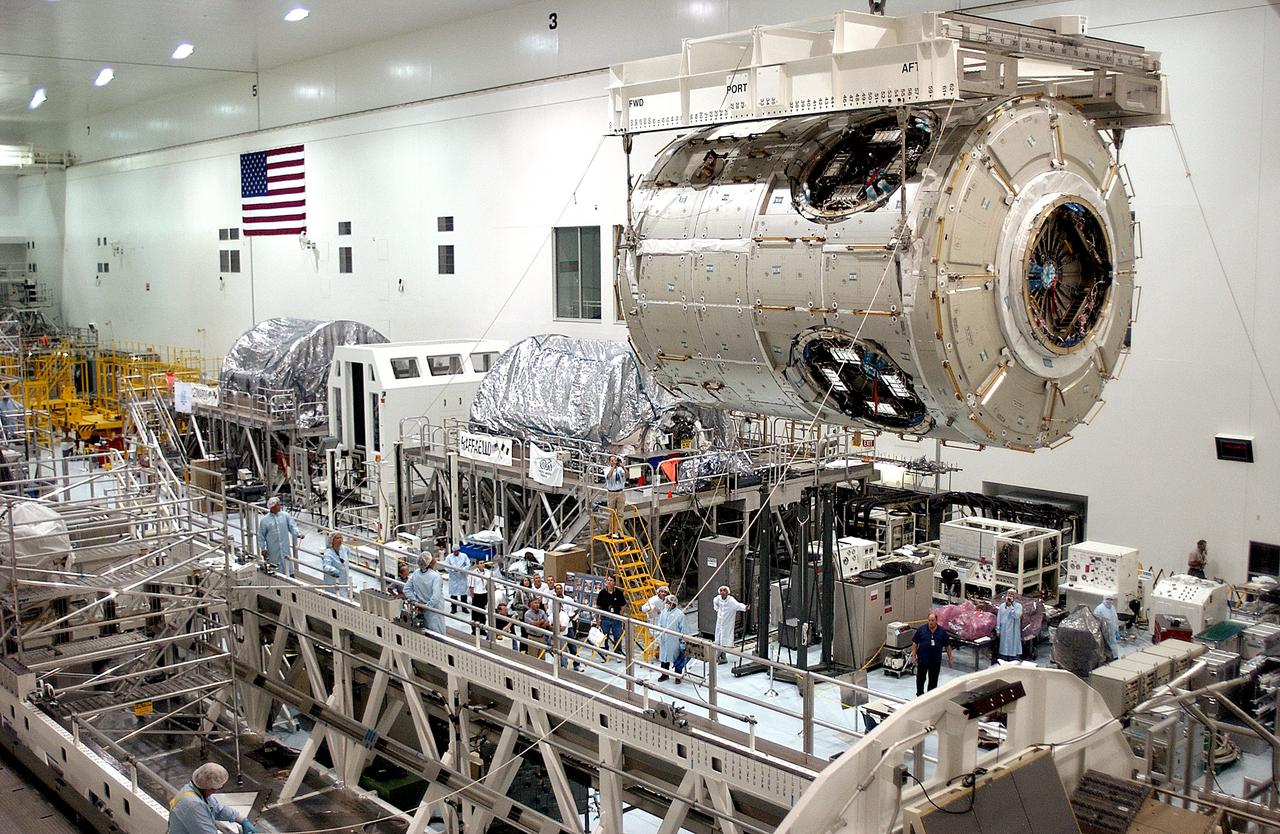
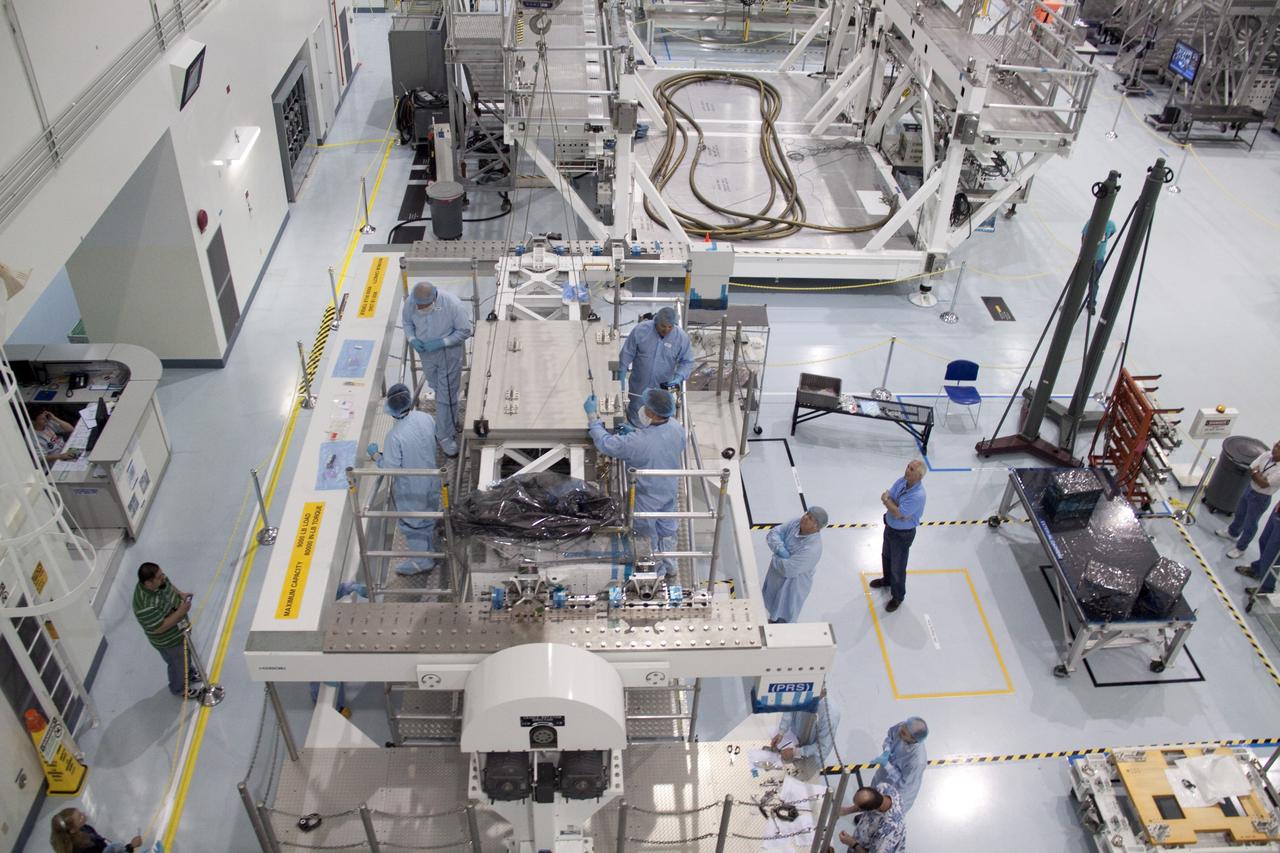
KENNEDY SPACE CENTER, FLA. - An overhead crane in the Space Station Processing Facility carries the U.S. Node 2 across the floor to a workstand.  The second of three connecting modules on the International Space Station, the Italian-built Node 2 attaches to the end of the U.S. Lab and provides attach locations for the Japanese laboratory, European laboratory, the Centrifuge Accommodation Module and, later, Multipurpose Logistics Modules. It will provide the primary docking location for the Shuttle when a pressurized mating adapter is attached to Node 2.  Installation of the module will complete  the U.S. Core of the ISS.  Node 2 is the designated payload for mission STS-120.  No orbiter or launch date has been determined yet.
KENNEDY SPACE CENTER, FLA. - An overhead crane in the Space Station Processing Facility carries the U.S. Node 2 across the floor to a workstand. The second of three connecting modules on the International Space Station, the Italian-built Node 2 attaches to the end of the U.S. Lab and provides attach locations for the Japanese laboratory, European laboratory, the Centrifuge Accommodation Module and, later, Multipurpose Logistics Modules. It will provide the primary docking location for the Shuttle when a pressurized mating adapter is attached to Node 2. Installation of the module will complete the U.S. Core of the ISS. Node 2 is the designated payload for mission STS-120. No orbiter or launch date has been determined yet.
KENNEDY SPACE CENTER, FLA. - The U.S. Node 2 is moved toward a workstand in the Space Station Processing Facility.  The second of three connecting modules on the International Space Station, the Italian-built Node 2 attaches to the end of the U.S. Lab and provides attach locations for the Japanese laboratory, European laboratory, the Centrifuge Accommodation Module and, later, Multipurpose Logistics Modules. It will provide the primary docking location for the Shuttle when a pressurized mating adapter is attached to Node 2.  Installation of the module will complete  the U.S. Core of the ISS.  Node 2 is the designated payload for mission STS-120.  No orbiter or launch date has been determined yet.
KENNEDY SPACE CENTER, FLA. - The U.S. Node 2 is moved toward a workstand in the Space Station Processing Facility. The second of three connecting modules on the International Space Station, the Italian-built Node 2 attaches to the end of the U.S. Lab and provides attach locations for the Japanese laboratory, European laboratory, the Centrifuge Accommodation Module and, later, Multipurpose Logistics Modules. It will provide the primary docking location for the Shuttle when a pressurized mating adapter is attached to Node 2. Installation of the module will complete the U.S. Core of the ISS. Node 2 is the designated payload for mission STS-120. No orbiter or launch date has been determined yet.
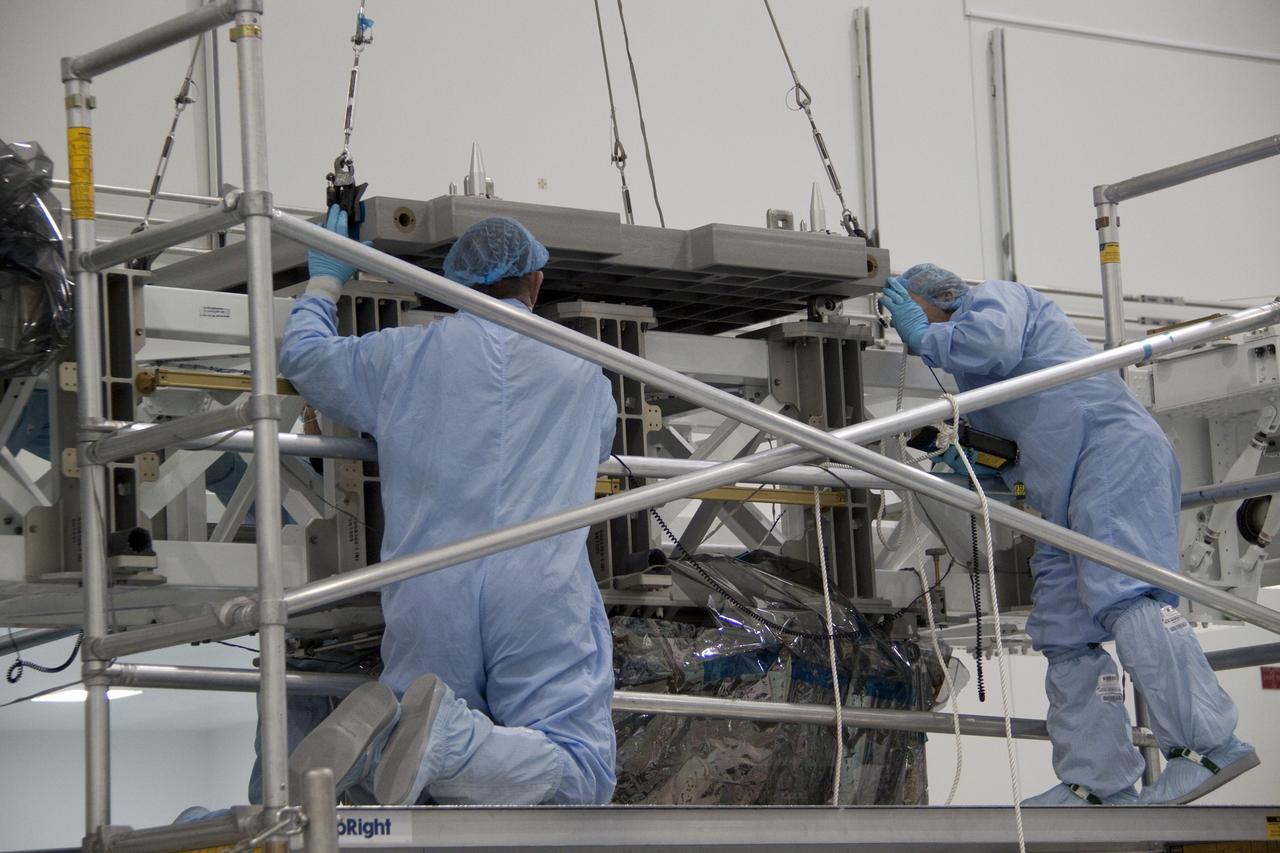
KENNEDY SPACE CENTER, FLA. - An overhead crane in the Space Station Processing Facility is attached to the U.S. Node 2 to lift it out of its shipping container.  The node will be moved to a workstand.  The second of three connecting modules on the International Space Station, the Italian-built Node 2 attaches to the end of the U.S. Lab and provides attach locations for the Japanese laboratory, European laboratory, the Centrifuge Accommodation Module and, later, Multipurpose Logistics Modules. It will provide the primary docking location for the Shuttle when a pressurized mating adapter is attached to Node 2.  Installation of the module will complete  the U.S. Core of the ISS.  Node 2 is the designated payload for mission STS-120.  No orbiter or launch date has been determined yet.
KENNEDY SPACE CENTER, FLA. - An overhead crane in the Space Station Processing Facility is attached to the U.S. Node 2 to lift it out of its shipping container. The node will be moved to a workstand. The second of three connecting modules on the International Space Station, the Italian-built Node 2 attaches to the end of the U.S. Lab and provides attach locations for the Japanese laboratory, European laboratory, the Centrifuge Accommodation Module and, later, Multipurpose Logistics Modules. It will provide the primary docking location for the Shuttle when a pressurized mating adapter is attached to Node 2. Installation of the module will complete the U.S. Core of the ISS. Node 2 is the designated payload for mission STS-120. No orbiter or launch date has been determined yet.
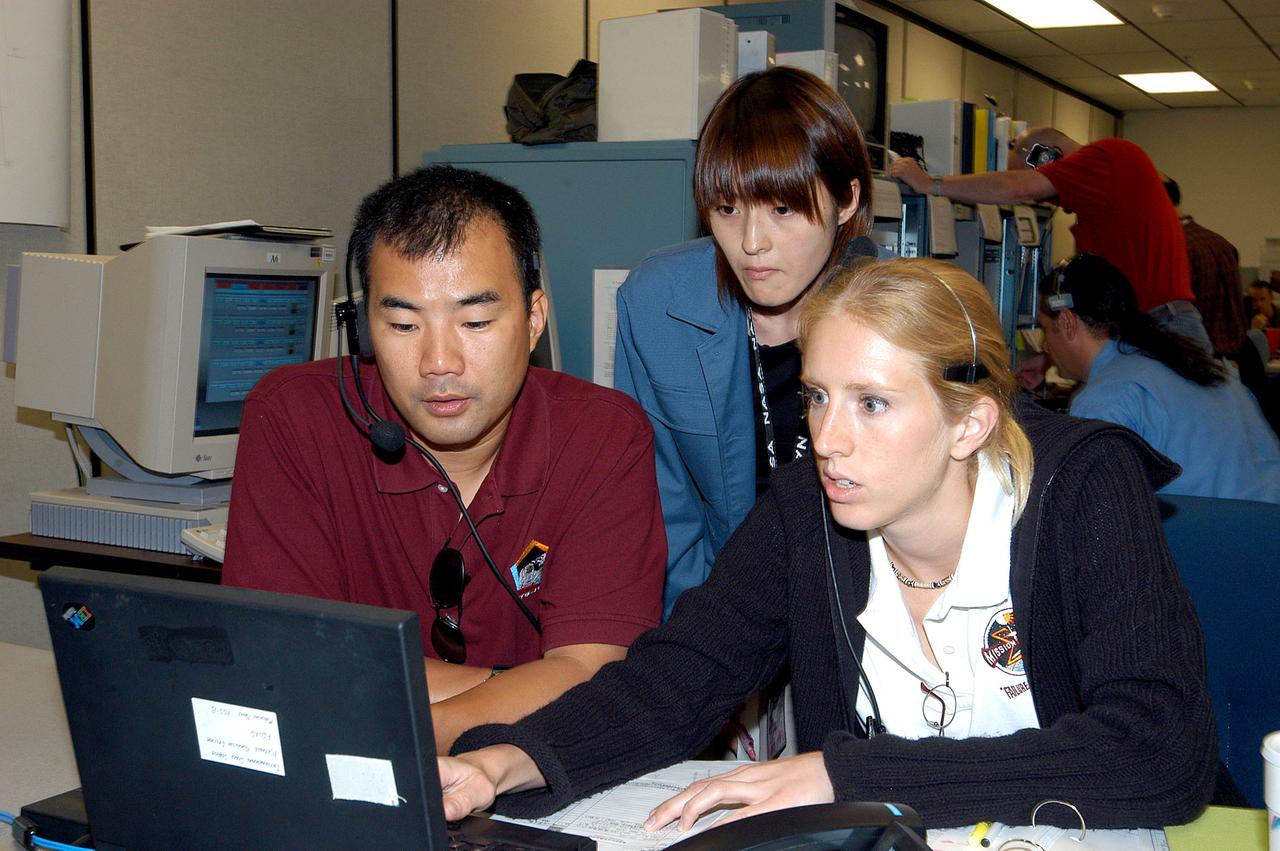
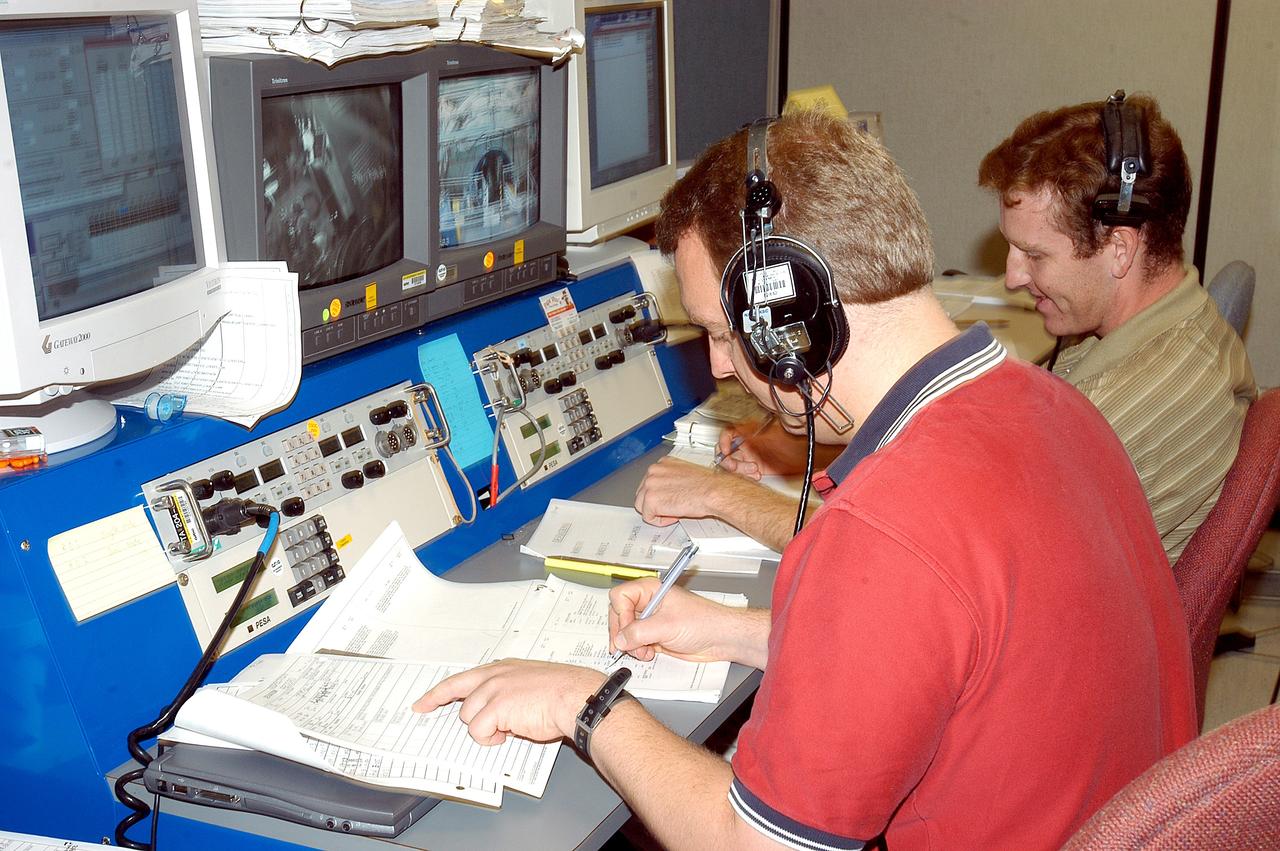
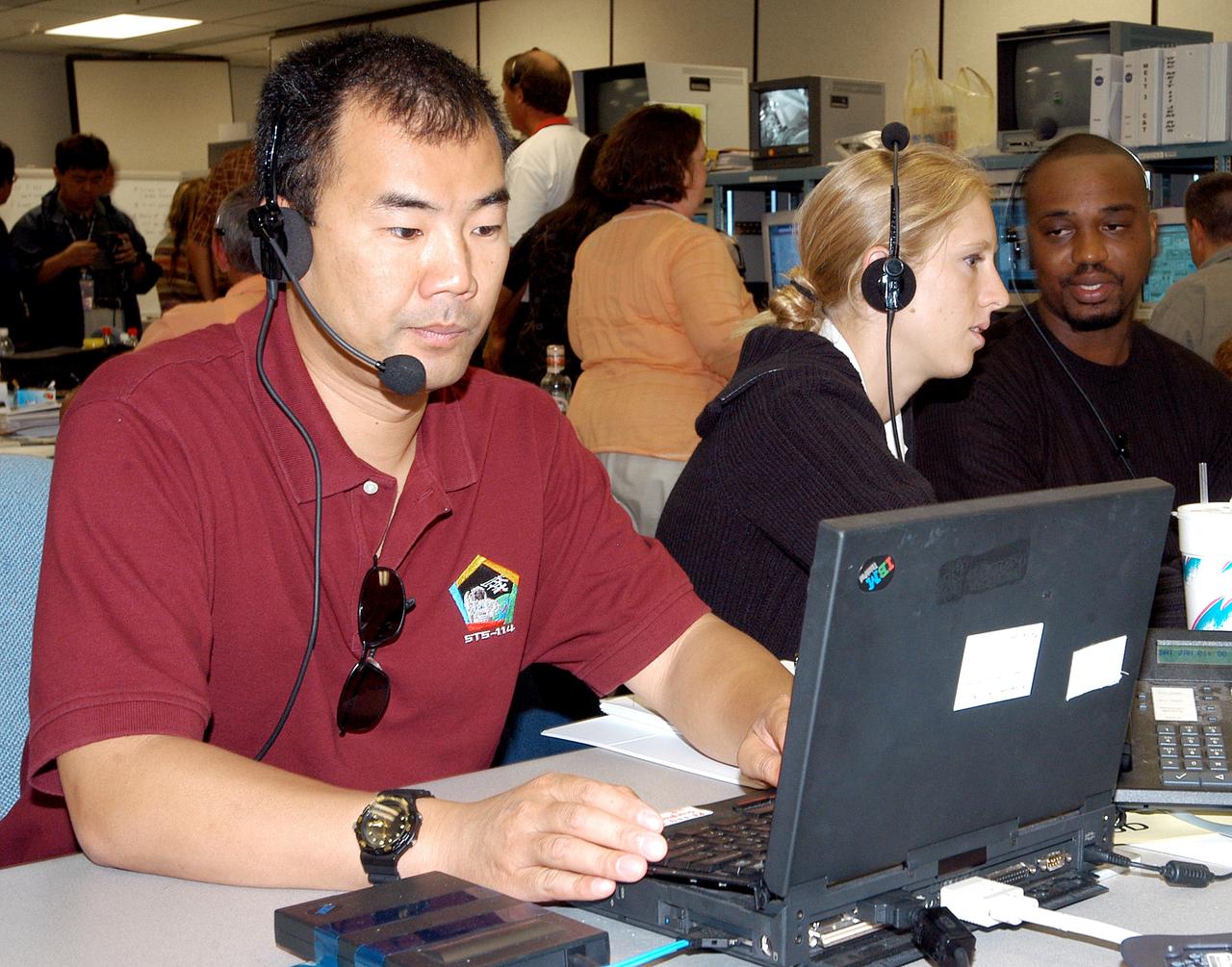
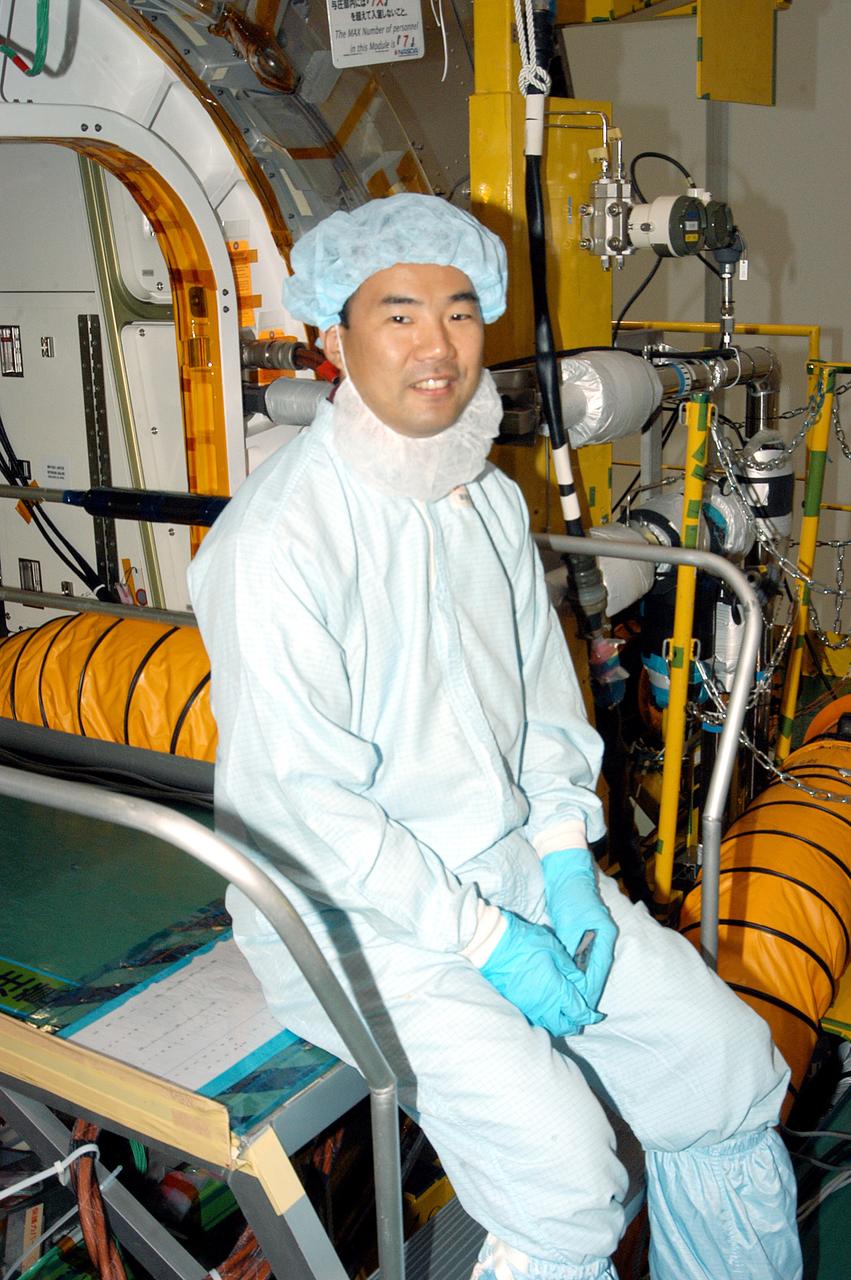
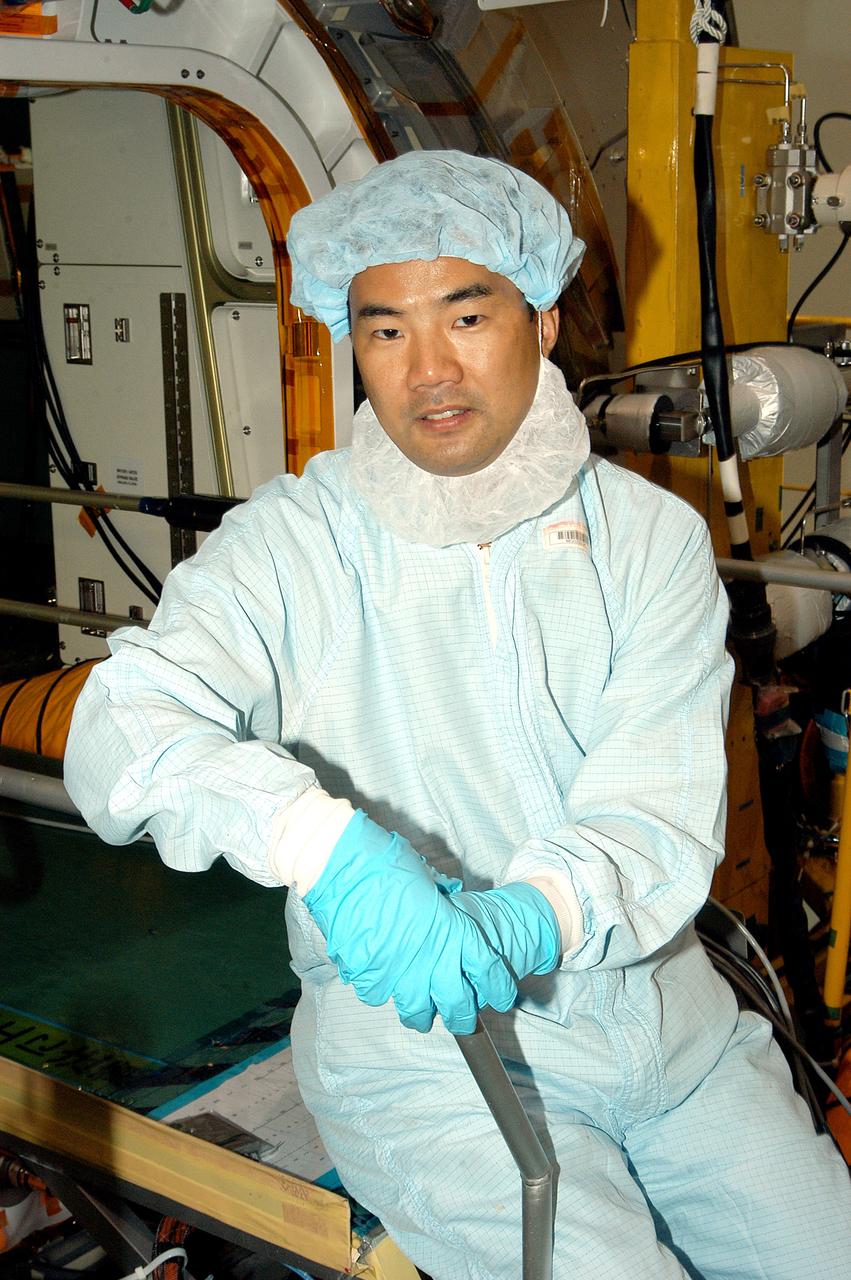
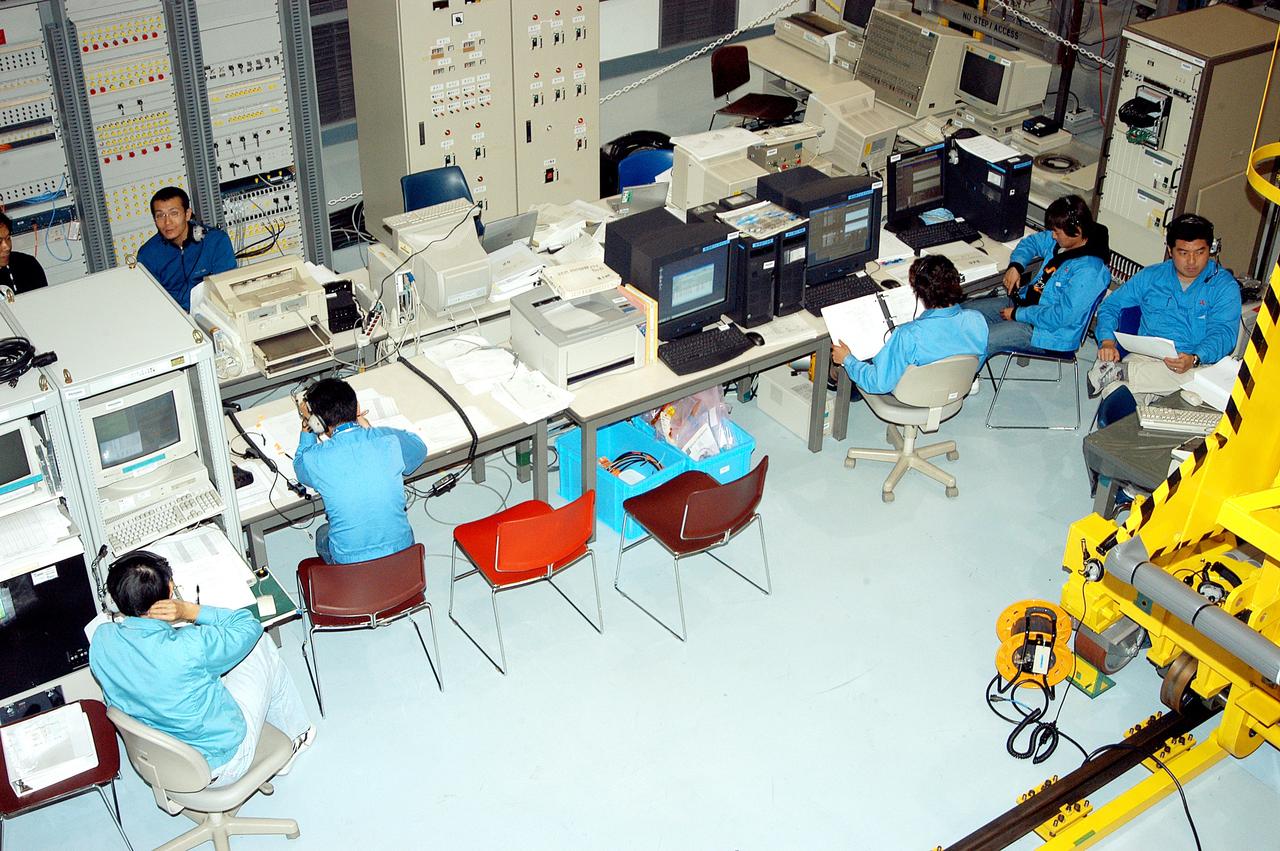
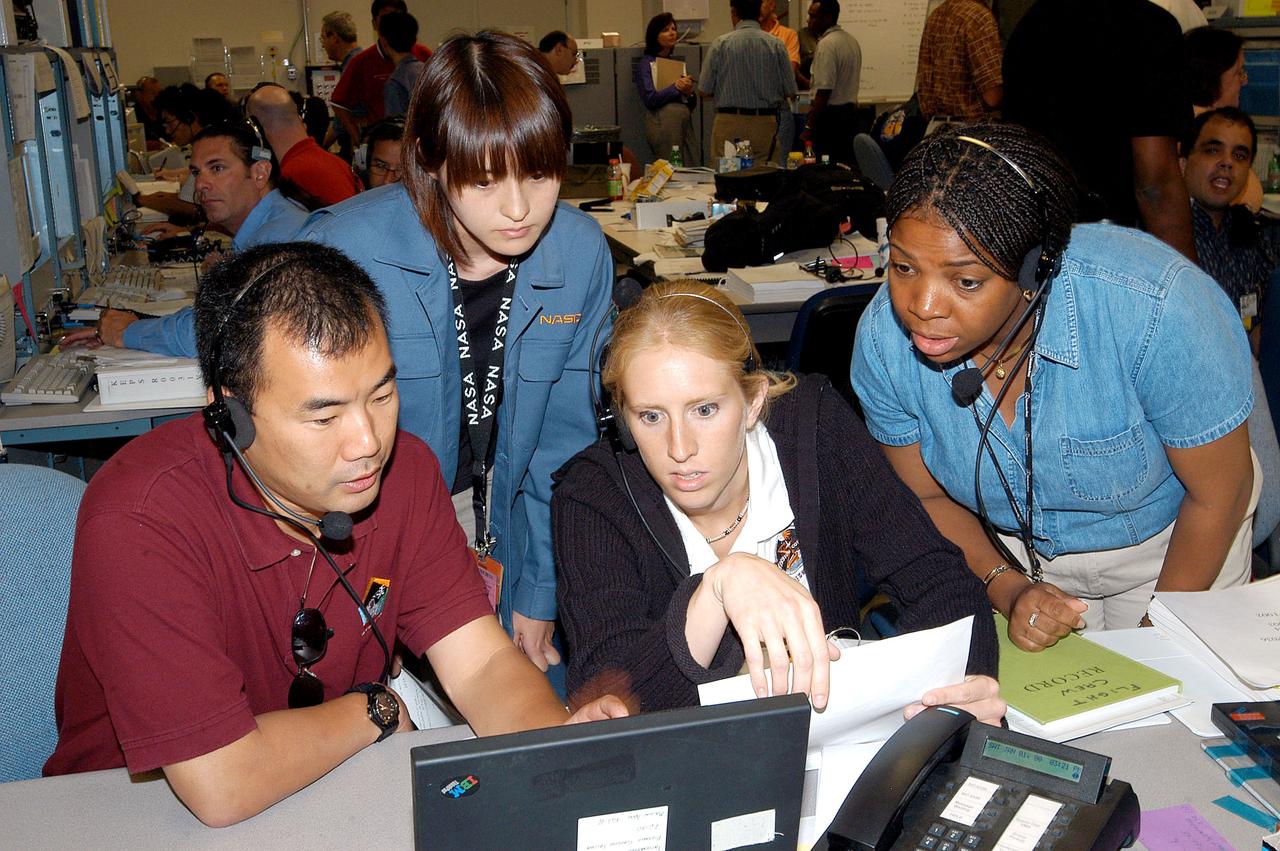
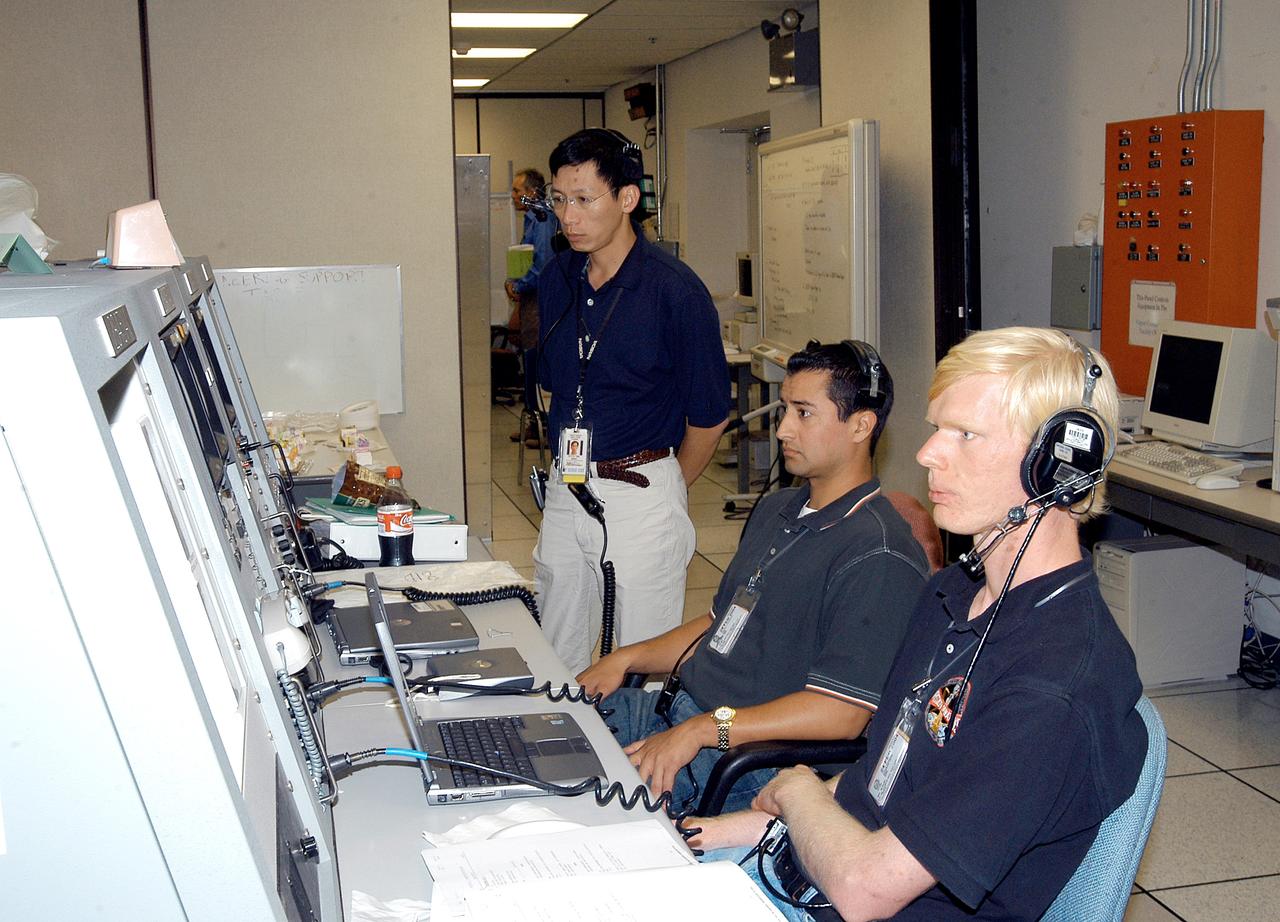
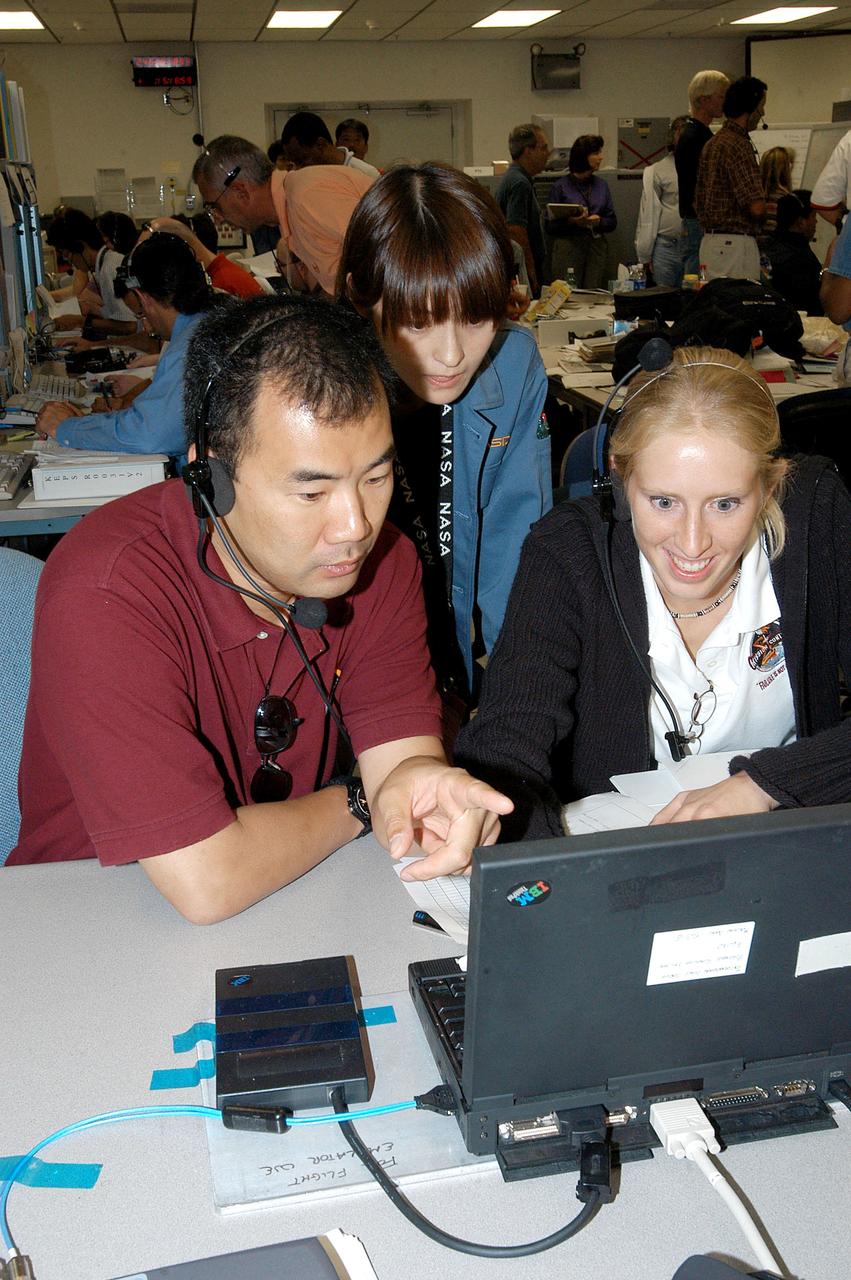
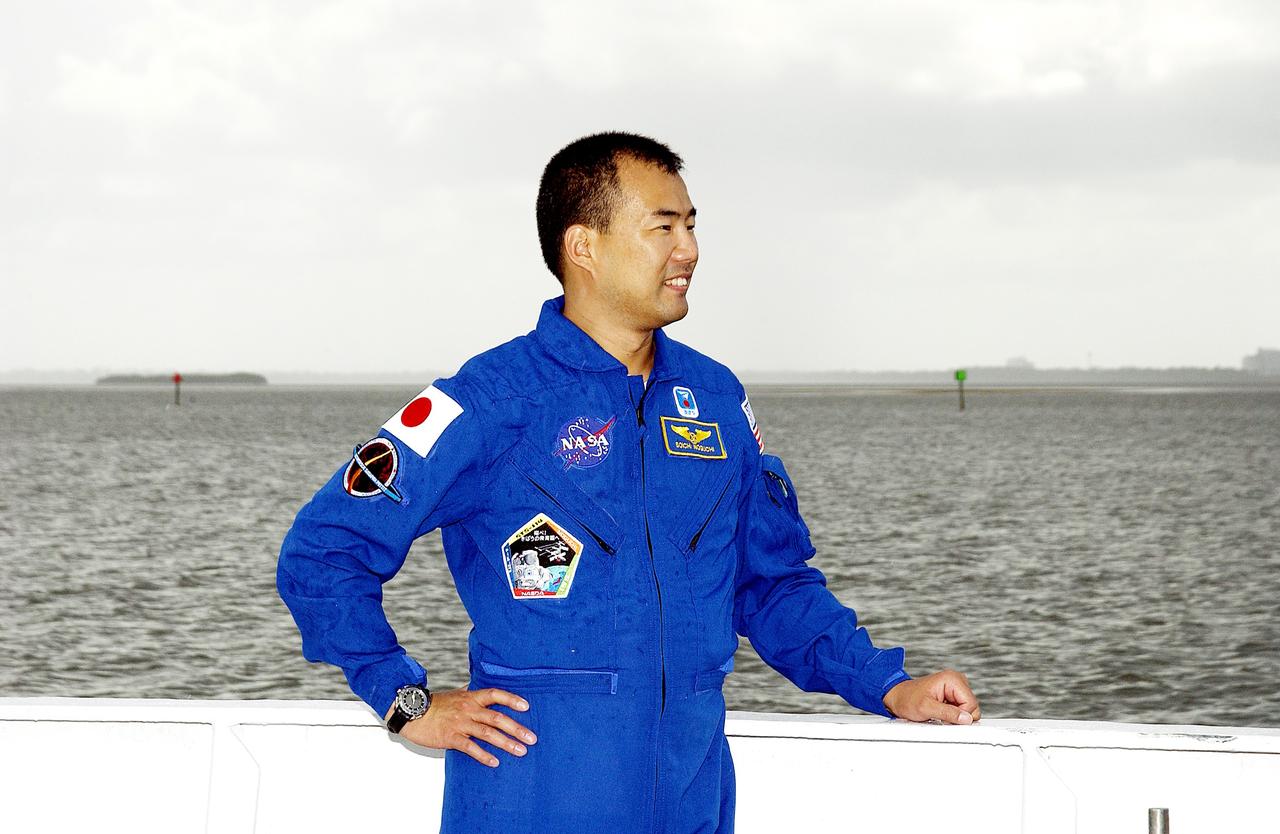
KENNEDY SPACE CENTER, FLA. -  Astronaut Soichi Noguchi (left), with the National Space Development Agency of Japan (NASDA), works at a console during a Multi-Element Integrated Test (MEIT) of the U.S. Node 2 and the Japanese Experiment Module (JEM) in the Space Station Processing Facility.  The JEM, developed by NASDA, is Japan's primary contribution to the Station. It will enhance the unique research capabilities of the orbiting complex by providing an additional environment for astronauts to conduct science experiments. Noguchi is assigned to mission STS-114 as a mission specialist.  Node 2 provides attach locations for the Japanese laboratory, as well as European laboratory, the Centrifuge Accommodation Module and, eventually, Multipurpose Logistics Modules.  Installation of the module will complete the U.S. Core of the ISS.
KENNEDY SPACE CENTER, FLA. - Astronaut Soichi Noguchi (left), with the National Space Development Agency of Japan (NASDA), works at a console during a Multi-Element Integrated Test (MEIT) of the U.S. Node 2 and the Japanese Experiment Module (JEM) in the Space Station Processing Facility. The JEM, developed by NASDA, is Japan's primary contribution to the Station. It will enhance the unique research capabilities of the orbiting complex by providing an additional environment for astronauts to conduct science experiments. Noguchi is assigned to mission STS-114 as a mission specialist. Node 2 provides attach locations for the Japanese laboratory, as well as European laboratory, the Centrifuge Accommodation Module and, eventually, Multipurpose Logistics Modules. Installation of the module will complete the U.S. Core of the ISS.
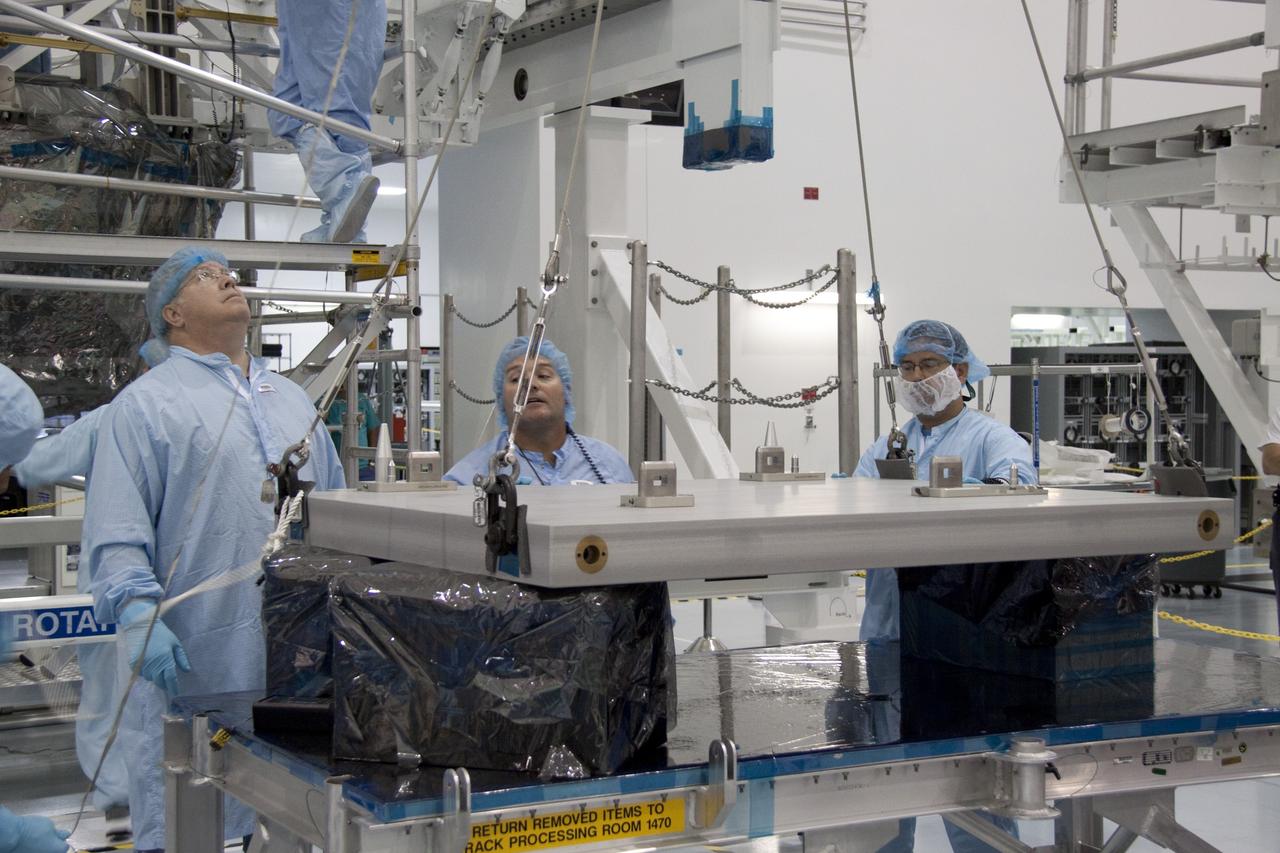
KENNEDY SPACE CENTER, FLA. - An overhead crane in the Space Station Processing Facility lifts the U.S. Node 2 out of its shipping container.  The node will be moved to a workstand.  The second of three connecting modules on the International Space Station, the Italian-built Node 2 attaches to the end of the U.S. Lab and provides attach locations for the Japanese laboratory, European laboratory, the Centrifuge Accommodation Module and, later, Multipurpose Logistics Modules. It will provide the primary docking location for the Shuttle when a pressurized mating adapter is attached to Node 2.  Installation of the module will complete  the U.S. Core of the ISS.  Node 2 is the designated payload for mission STS-120.  No orbiter or launch date has been determined yet.
KENNEDY SPACE CENTER, FLA. - An overhead crane in the Space Station Processing Facility lifts the U.S. Node 2 out of its shipping container. The node will be moved to a workstand. The second of three connecting modules on the International Space Station, the Italian-built Node 2 attaches to the end of the U.S. Lab and provides attach locations for the Japanese laboratory, European laboratory, the Centrifuge Accommodation Module and, later, Multipurpose Logistics Modules. It will provide the primary docking location for the Shuttle when a pressurized mating adapter is attached to Node 2. Installation of the module will complete the U.S. Core of the ISS. Node 2 is the designated payload for mission STS-120. No orbiter or launch date has been determined yet.
KENNEDY SPACE CENTER, FLA. - The U.S. Node 2 moves toward a workstand in the Space Station Processing Facility.  The second of three connecting modules on the International Space Station, the Italian-built Node 2 attaches to the end of the U.S. Lab and provides attach locations for the Japanese laboratory, European laboratory, the Centrifuge Accommodation Module and, later, Multipurpose Logistics Modules. It will provide the primary docking location for the Shuttle when a pressurized mating adapter is attached to Node 2.  Installation of the module will complete  the U.S. Core of the ISS.  Node 2 is the designated payload for mission STS-120.  No orbiter or launch date has been determined yet.
KENNEDY SPACE CENTER, FLA. - The U.S. Node 2 moves toward a workstand in the Space Station Processing Facility. The second of three connecting modules on the International Space Station, the Italian-built Node 2 attaches to the end of the U.S. Lab and provides attach locations for the Japanese laboratory, European laboratory, the Centrifuge Accommodation Module and, later, Multipurpose Logistics Modules. It will provide the primary docking location for the Shuttle when a pressurized mating adapter is attached to Node 2. Installation of the module will complete the U.S. Core of the ISS. Node 2 is the designated payload for mission STS-120. No orbiter or launch date has been determined yet.
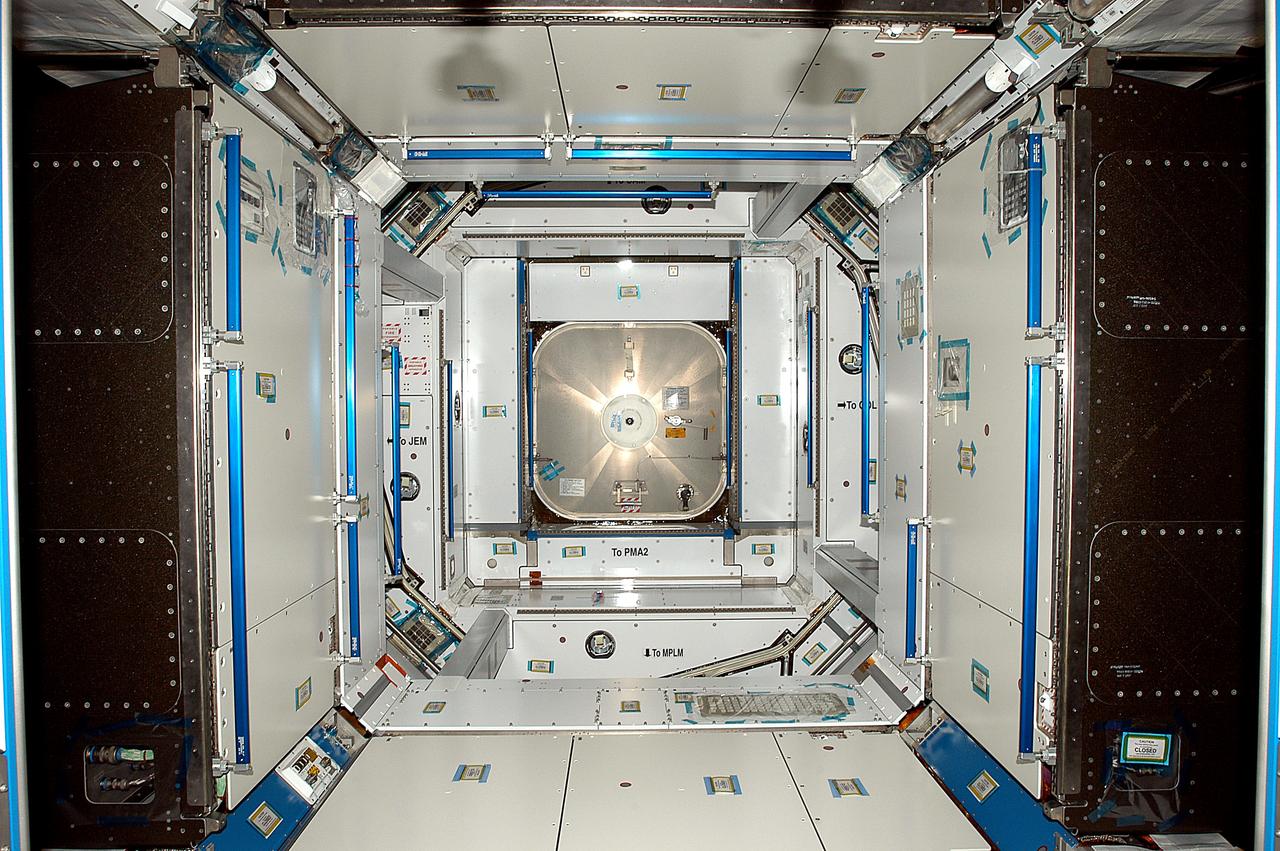
KENNEDY SPACE CENTER, FLA. -  The inside of the Italian-built Node 2 looks pristine after opening of the hatch.  A future element of the International Space Station,  Node 2 arrived at KSC June 1.  The second of three Station connecting modules, Node 2 attaches to the end of the U.S. Lab and provides attach locations for the Japanese laboratory, European laboratory, the Centrifuge Accommodation Module and, later, Multipurpose Logistics Modules. It will provide the primary docking location for the Shuttle when a pressurized mating adapter is attached to Node 2.  Installation of the module will complete  the U.S. Core of the ISS.  Node 2 is the designated payload for mission STS-120.  No orbiter or launch date has been determined yet.
KENNEDY SPACE CENTER, FLA. - The inside of the Italian-built Node 2 looks pristine after opening of the hatch. A future element of the International Space Station, Node 2 arrived at KSC June 1. The second of three Station connecting modules, Node 2 attaches to the end of the U.S. Lab and provides attach locations for the Japanese laboratory, European laboratory, the Centrifuge Accommodation Module and, later, Multipurpose Logistics Modules. It will provide the primary docking location for the Shuttle when a pressurized mating adapter is attached to Node 2. Installation of the module will complete the U.S. Core of the ISS. Node 2 is the designated payload for mission STS-120. No orbiter or launch date has been determined yet.
KENNEDY SPACE CENTER, FLA. -  The U.S. Node 2 is lowered onto a workstand in the Space Station Processing Facility.  The second of three connecting modules on the International Space Station, the Italian-built Node 2 attaches to the end of the U.S. Lab and provides attach locations for the Japanese laboratory, European laboratory, the Centrifuge Accommodation Module and, later, Multipurpose Logistics Modules. It will provide the primary docking location for the Shuttle when a pressurized mating adapter is attached to Node 2.  Installation of the module will complete  the U.S. Core of the ISS.  Node 2 is the designated payload for mission STS-120.  No orbiter or launch date has been determined yet.
KENNEDY SPACE CENTER, FLA. - The U.S. Node 2 is lowered onto a workstand in the Space Station Processing Facility. The second of three connecting modules on the International Space Station, the Italian-built Node 2 attaches to the end of the U.S. Lab and provides attach locations for the Japanese laboratory, European laboratory, the Centrifuge Accommodation Module and, later, Multipurpose Logistics Modules. It will provide the primary docking location for the Shuttle when a pressurized mating adapter is attached to Node 2. Installation of the module will complete the U.S. Core of the ISS. Node 2 is the designated payload for mission STS-120. No orbiter or launch date has been determined yet.
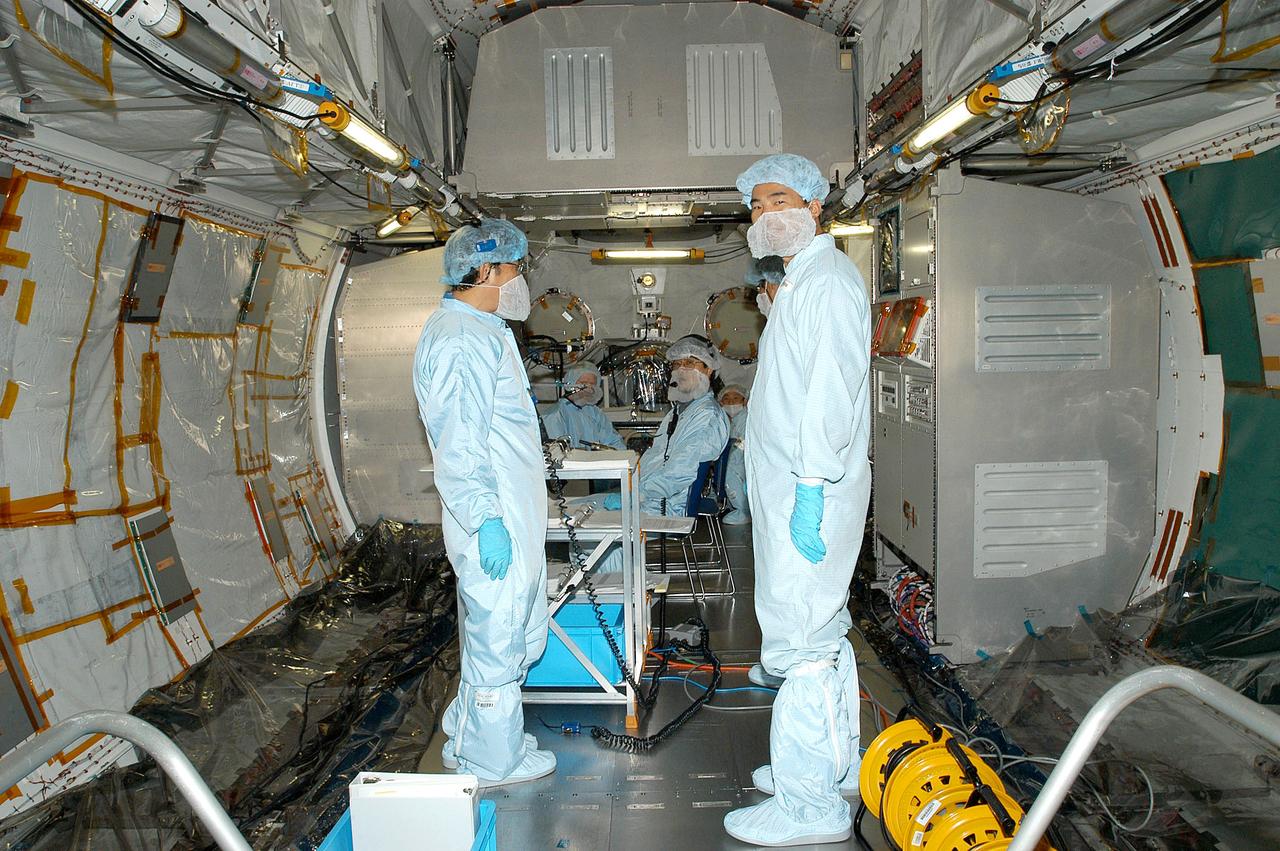
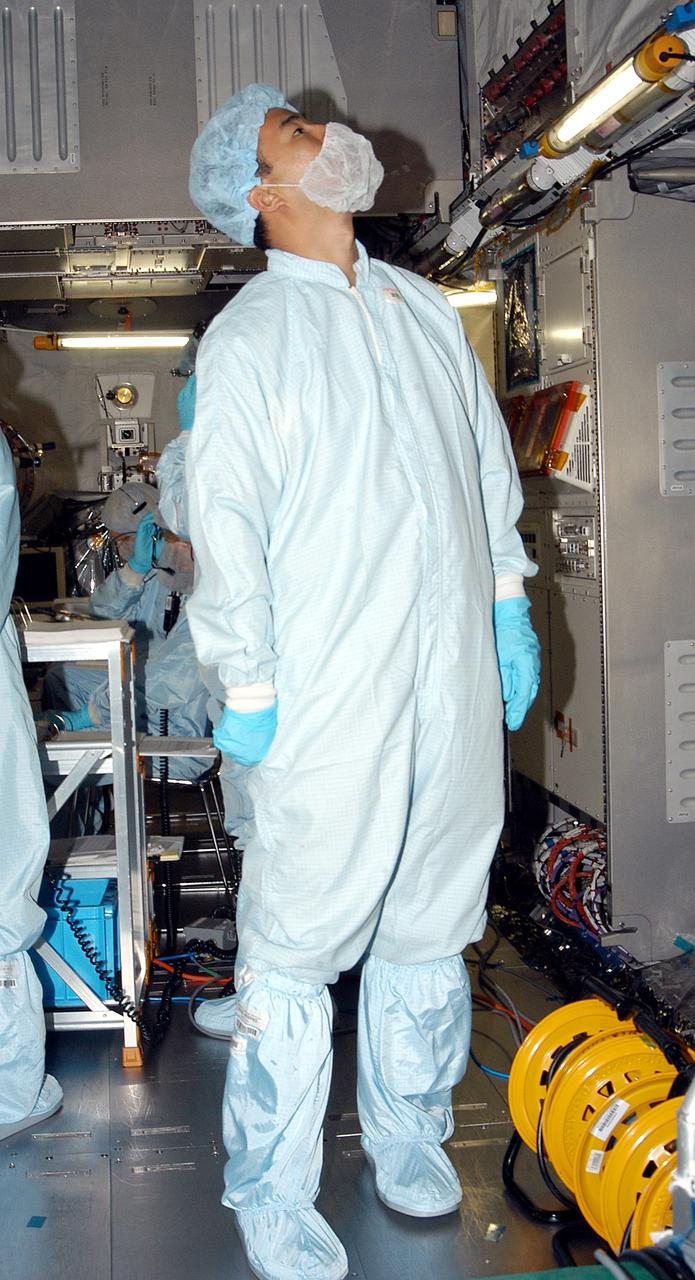
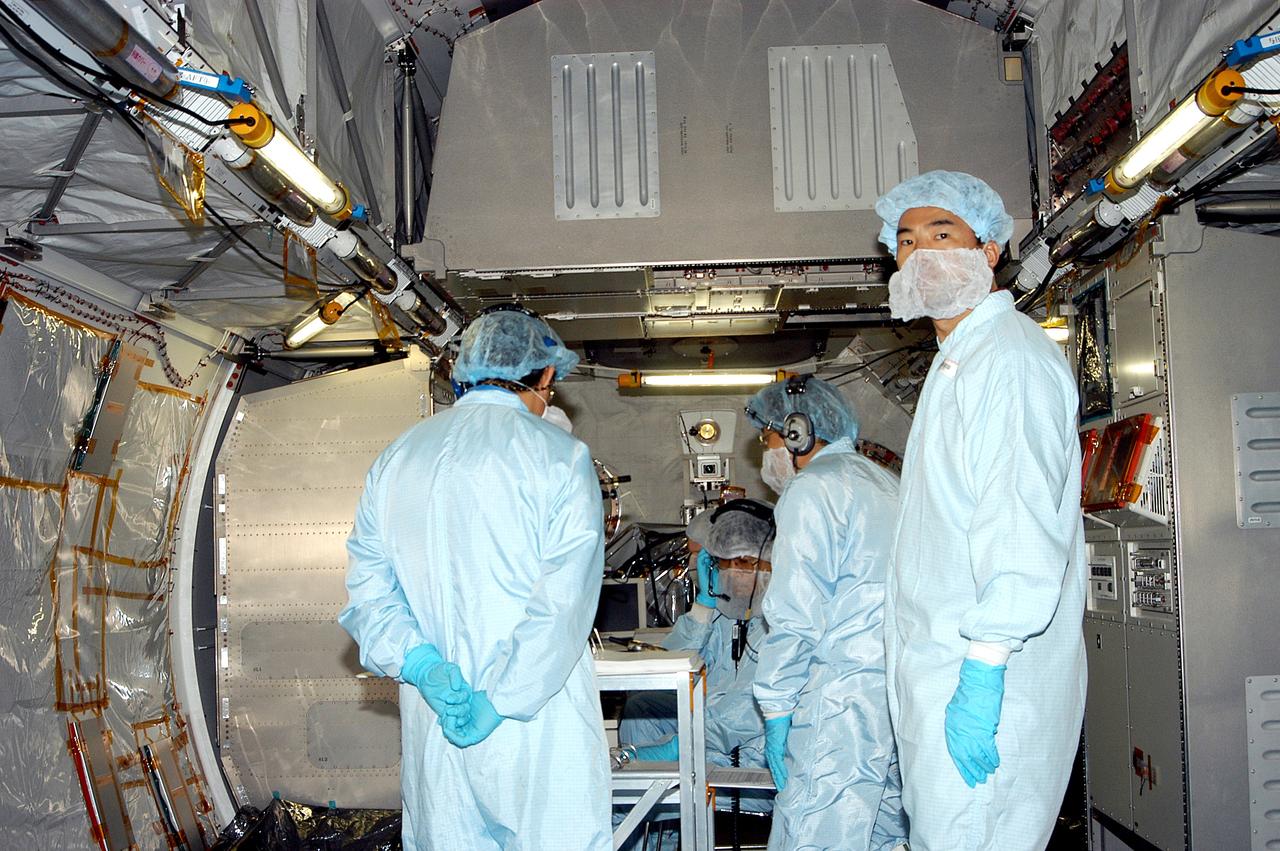
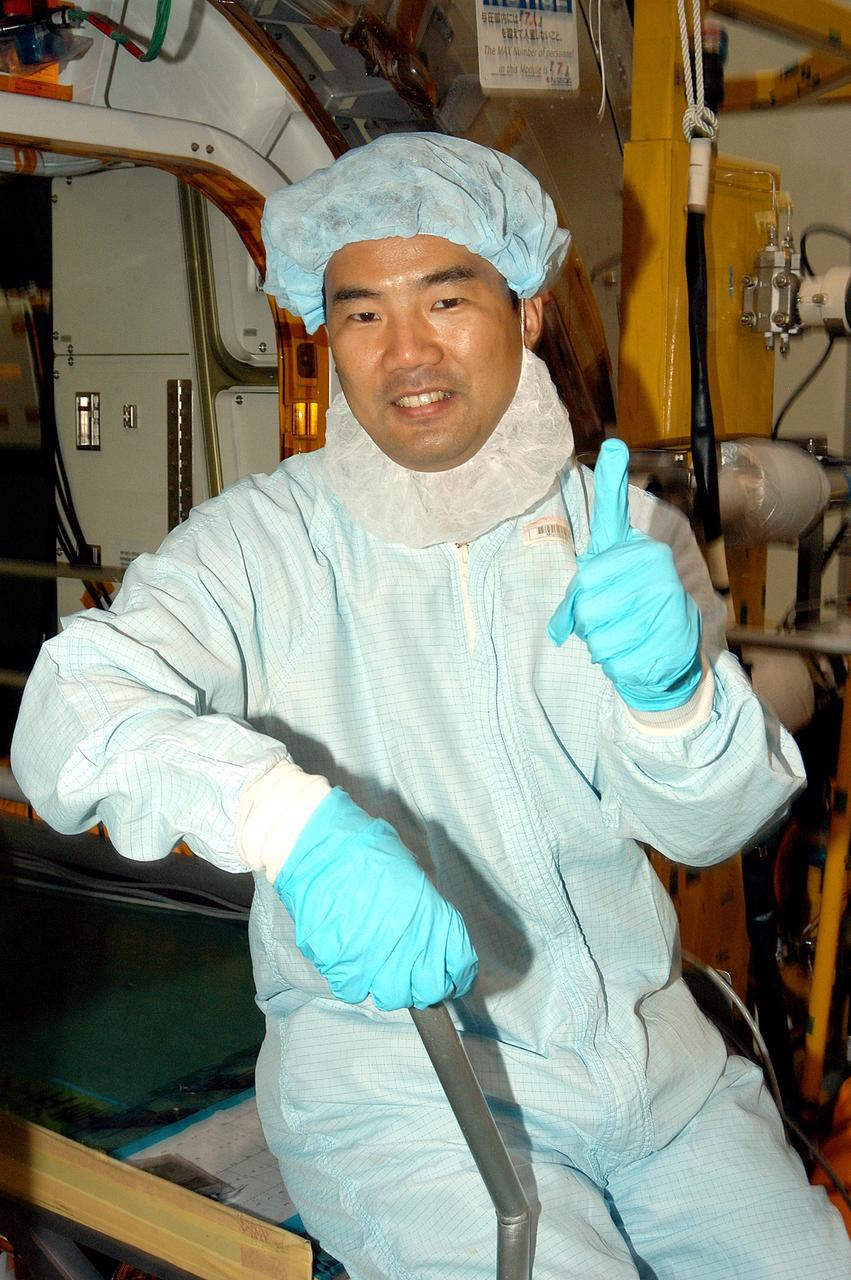
KENNEDY SPACE CENTER, FLA. -  In the Space Station Processing Facility, astronaut Soichi Noguchi (right), with the National Space Development Agency of Japan (NASDA), stands inside the Japanese Experiment Module (JEM) that is undergoing a Multi-Element Integrated Test (MEIT) with the U.S. Node 2.  The JEM, developed by NASDA, is Japan's primary contribution to the Station. It will enhance the unique research capabilities of the orbiting complex by providing an additional environment for astronauts to conduct science experiments. Noguchi is assigned to mission STS-114 as a mission specialist.  Node 2 provides attach locations for the Japanese laboratory, as well as European laboratory, the Centrifuge Accommodation Module and, eventually, Multipurpose Logistics Modules.  Installation of the module will complete the U.S. Core of the ISS.
KENNEDY SPACE CENTER, FLA. - In the Space Station Processing Facility, astronaut Soichi Noguchi (right), with the National Space Development Agency of Japan (NASDA), stands inside the Japanese Experiment Module (JEM) that is undergoing a Multi-Element Integrated Test (MEIT) with the U.S. Node 2. The JEM, developed by NASDA, is Japan's primary contribution to the Station. It will enhance the unique research capabilities of the orbiting complex by providing an additional environment for astronauts to conduct science experiments. Noguchi is assigned to mission STS-114 as a mission specialist. Node 2 provides attach locations for the Japanese laboratory, as well as European laboratory, the Centrifuge Accommodation Module and, eventually, Multipurpose Logistics Modules. Installation of the module will complete the U.S. Core of the ISS.
KENNEDY SPACE CENTER, FLA. - An overhead crane in the Space Station Processing Facility moves the U.S. Node 2 across the floor to a workstand.  The second of three connecting modules on the International Space Station, the Italian-built Node 2 attaches to the end of the U.S. Lab and provides attach locations for the Japanese laboratory, European laboratory, the Centrifuge Accommodation Module and, later, Multipurpose Logistics Modules. It will provide the primary docking location for the Shuttle when a pressurized mating adapter is attached to Node 2.  Installation of the module will complete  the U.S. Core of the ISS.  Node 2 is the designated payload for mission STS-120.  No orbiter or launch date has been determined yet.
KENNEDY SPACE CENTER, FLA. - An overhead crane in the Space Station Processing Facility moves the U.S. Node 2 across the floor to a workstand. The second of three connecting modules on the International Space Station, the Italian-built Node 2 attaches to the end of the U.S. Lab and provides attach locations for the Japanese laboratory, European laboratory, the Centrifuge Accommodation Module and, later, Multipurpose Logistics Modules. It will provide the primary docking location for the Shuttle when a pressurized mating adapter is attached to Node 2. Installation of the module will complete the U.S. Core of the ISS. Node 2 is the designated payload for mission STS-120. No orbiter or launch date has been determined yet.
KENNEDY SPACE CENTER, FLA. - The U.S. Node 2 is lowered toward a workstand in the Space Station Processing Facility.  The second of three connecting modules on the International Space Station, the Italian-built Node 2 attaches to the end of the U.S. Lab and provides attach locations for the Japanese laboratory, European laboratory, the Centrifuge Accommodation Module and, later, Multipurpose Logistics Modules. It will provide the primary docking location for the Shuttle when a pressurized mating adapter is attached to Node 2.  Installation of the module will complete  the U.S. Core of the ISS.  Node 2 is the designated payload for mission STS-120.  No orbiter or launch date has been determined yet.
KENNEDY SPACE CENTER, FLA. - The U.S. Node 2 is lowered toward a workstand in the Space Station Processing Facility. The second of three connecting modules on the International Space Station, the Italian-built Node 2 attaches to the end of the U.S. Lab and provides attach locations for the Japanese laboratory, European laboratory, the Centrifuge Accommodation Module and, later, Multipurpose Logistics Modules. It will provide the primary docking location for the Shuttle when a pressurized mating adapter is attached to Node 2. Installation of the module will complete the U.S. Core of the ISS. Node 2 is the designated payload for mission STS-120. No orbiter or launch date has been determined yet.
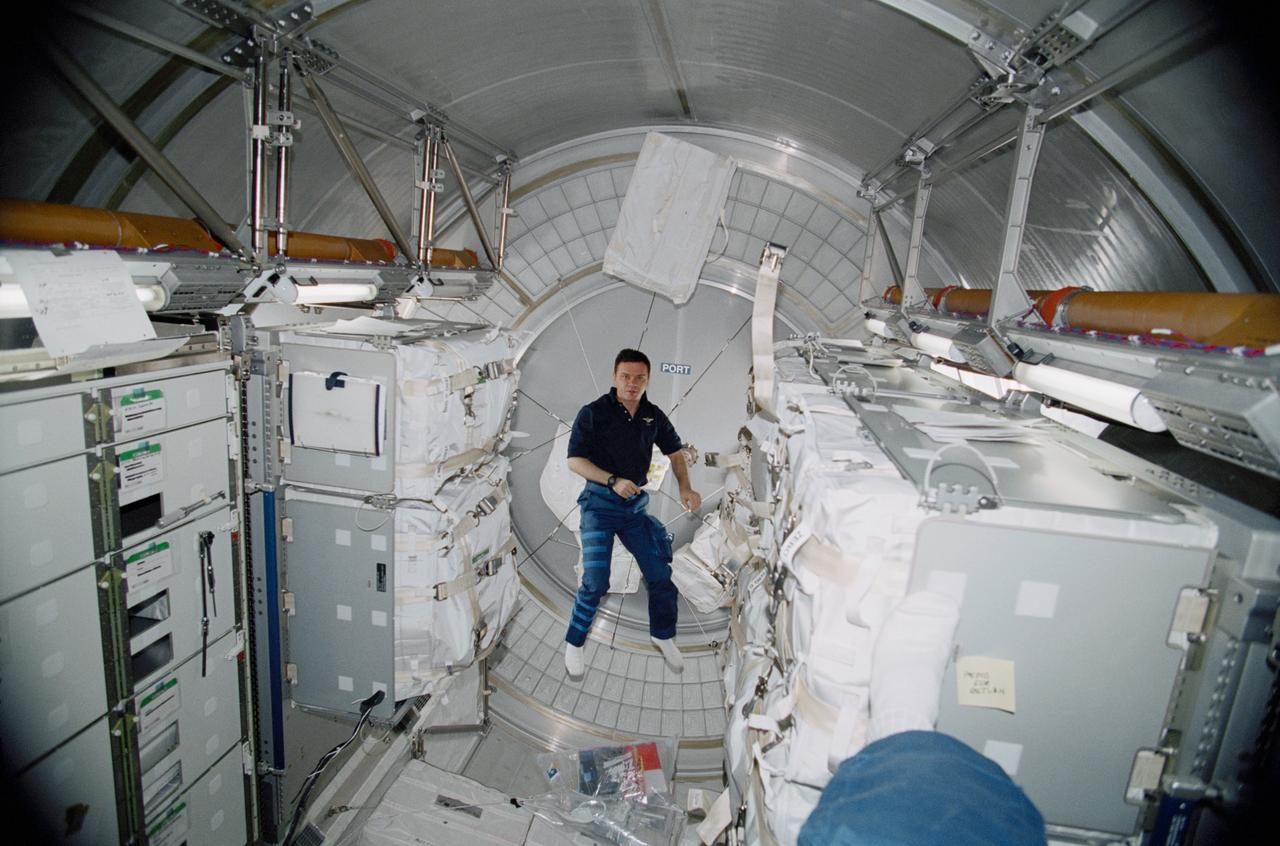
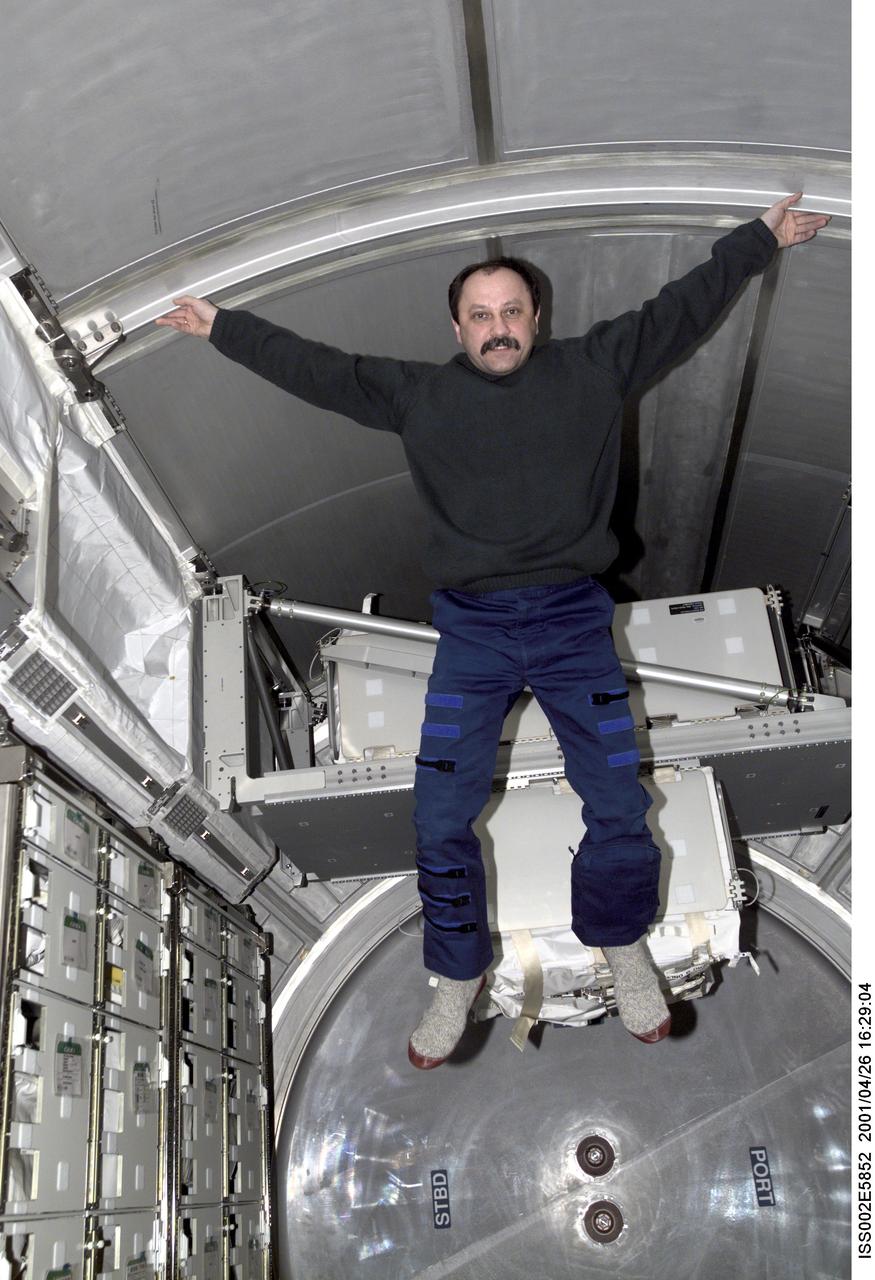
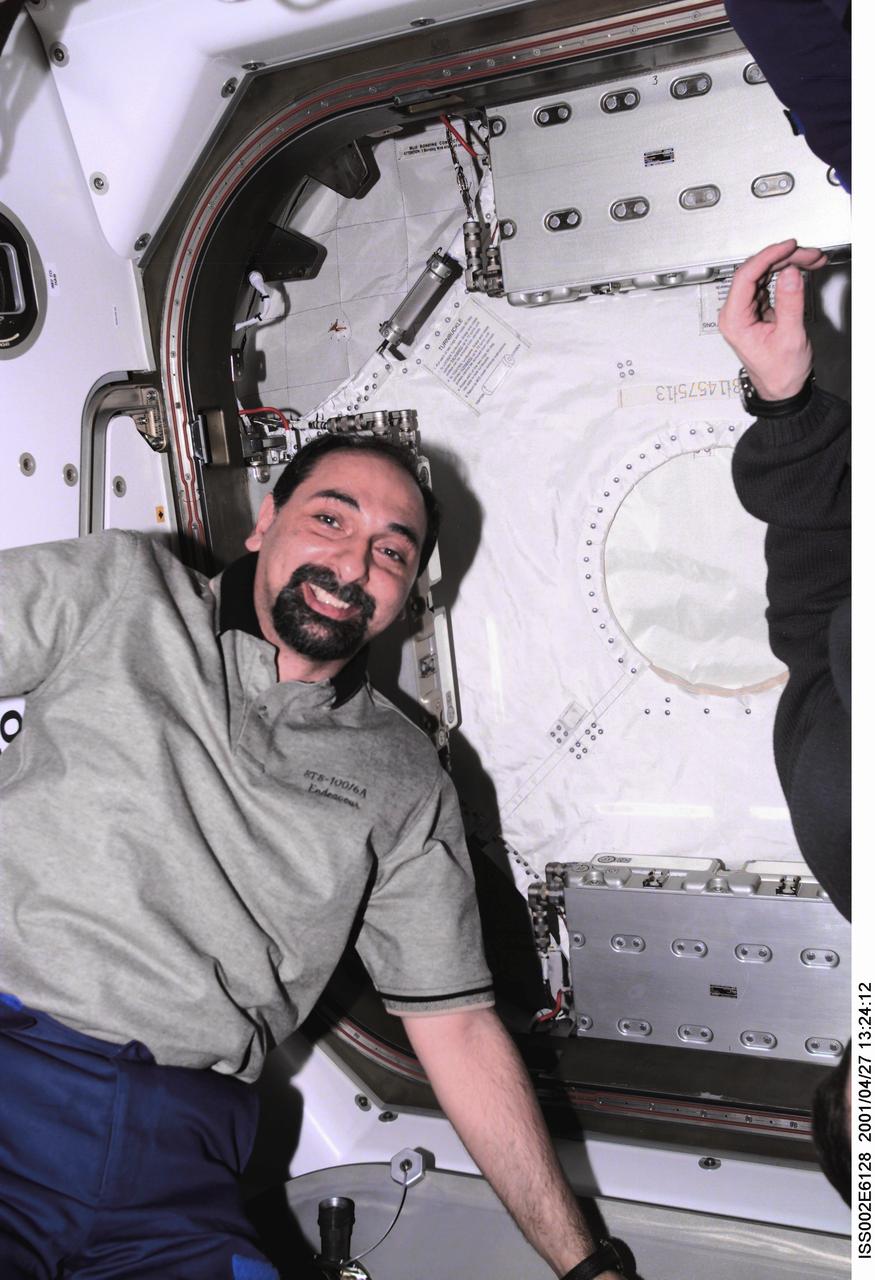
A crewmember of Expedition One, cosmonaut Yuri P. Gidzenko, is dwarfed by transient hardware aboard Leonardo, the Italian Space Agency-built Multi-Purpose Logistics Module (MPLM), a primary cargo of the STS-102 mission. The Leonardo MPLM is the first of three such pressurized modules that will serve as the International Space Station's (ISS's) moving vans, carrying laboratory racks filled with equipment, experiments and supplies to and from the Space Station aboard the Space Shuttle. The cylindrical module is approximately 21-feet long and 15- feet in diameter, weighing almost 4.5 tons. It can carry up to 10 tons of cargo into 16 standard Space Station equipment racks. Of the 16 racks the module can carry, 5 can be furnished with power, data, and fluid to support refrigerators or freezers. In order to function as an attached station module as well as a cargo transport, the logistics module also includes components that provide life support, fire detection and suppression, electrical distribution, and computer functions. The eighth Shuttle mission to visit the ISS, the STS-102 mission served as a crew rotation flight. It delivered the Expedition Two crew to the Station and returned the Expedition One crew back to Earth.
International Space Station (ISS)
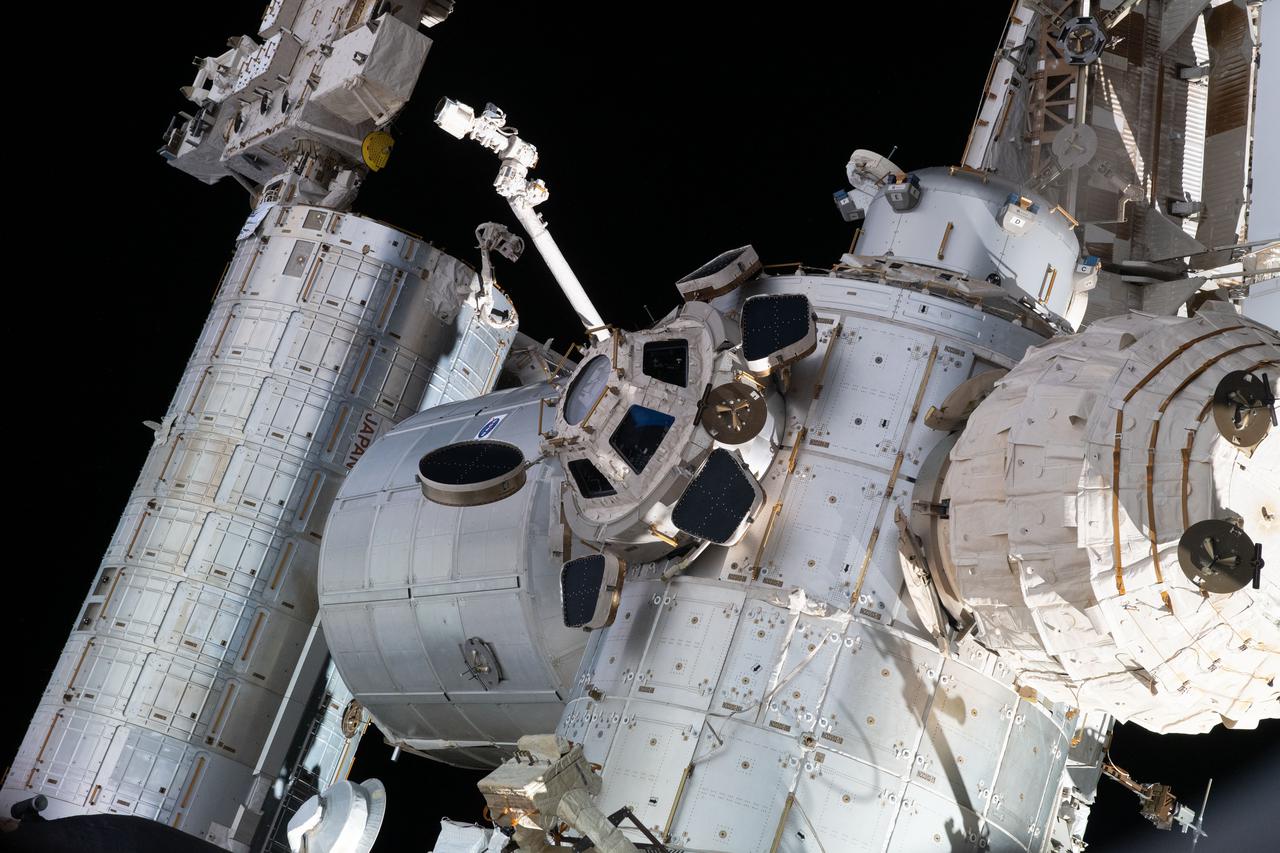
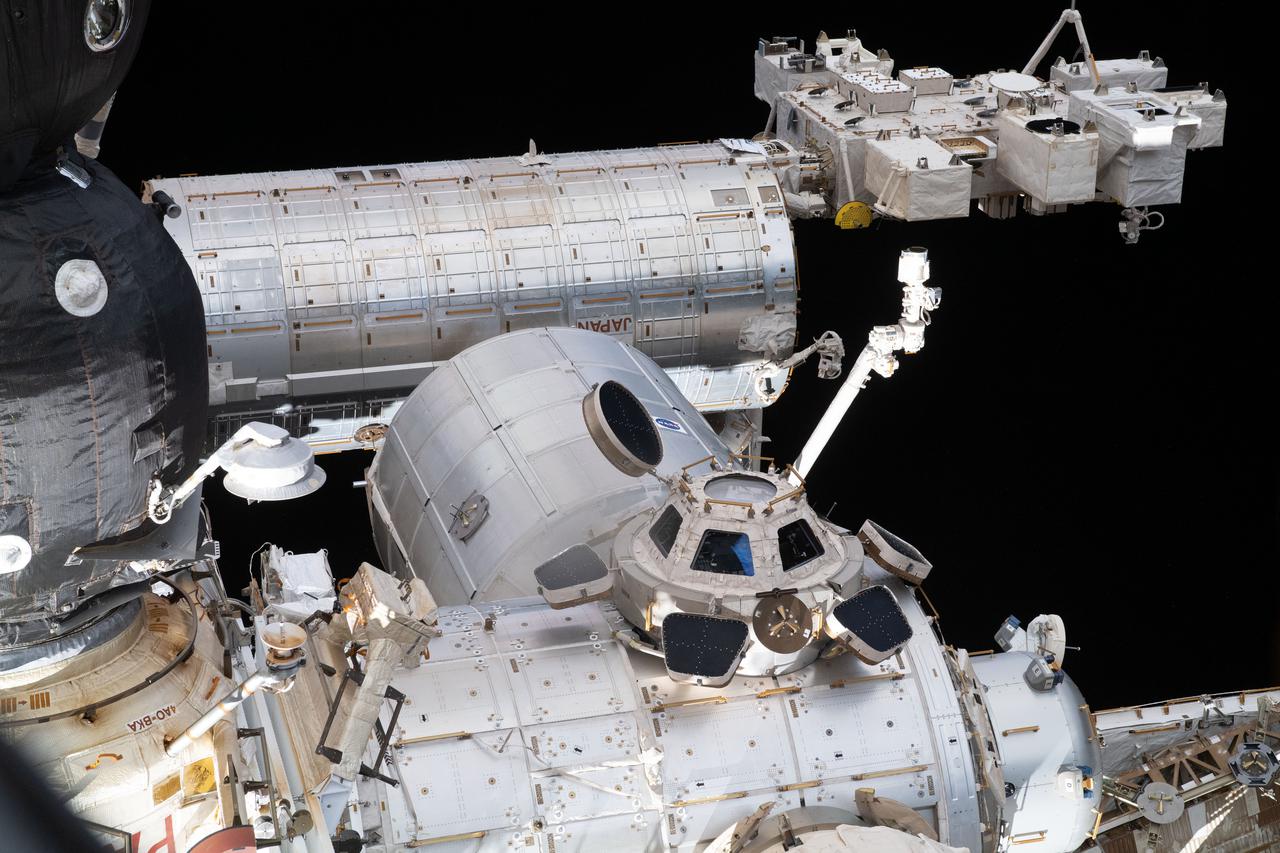
iss065e241366 (Aug. 12, 2021) --- Key portions of the International Space Station are pictured from a window on Russia's newest addition to the orbiting lab, the Nauka Multipurpose Laboratory Module. From left to right are Japan's Kibo laboratory module with its attached Exposed Facility where a variety of experiments are placed in the vacuum of space, including: the Japanese robotic arm attached to Kibo; the Leonardo Multipurpose Logistics Module attached to the Tranquility module; and the seven-windowed cupola and the Bigelow Expandable Module, or BEAM, attached to Tranquility.
iss065e241366
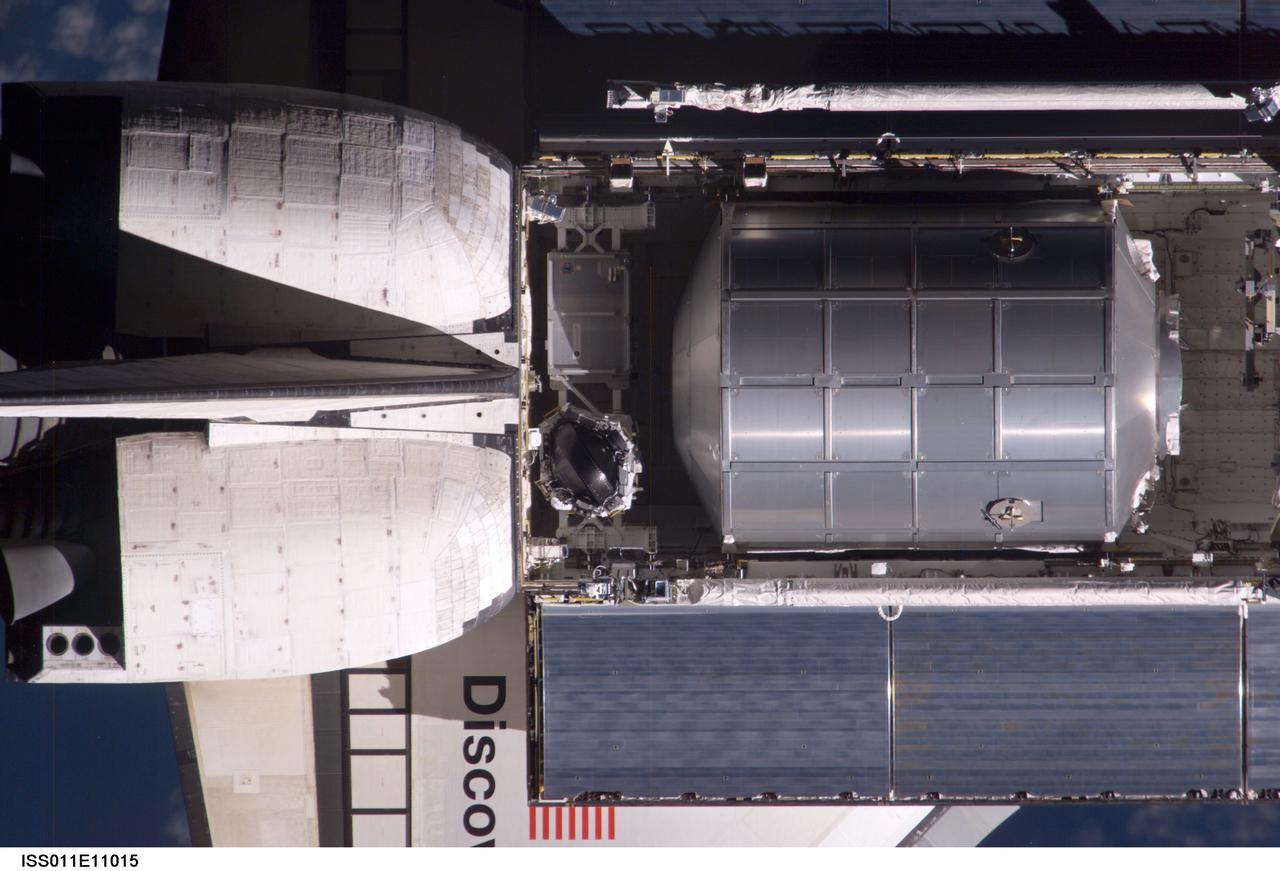
ISS011-E-11015 (28 July 2005) --- The Space Shuttle Discovery's cargo bay and Multipurpose Logistics Module (MPLM) payload as seen from the International Space Station (ISS) just prior to docking earlier today.
Mapping sequence performed during the STS-114 R-Bar Pitch Maneuver.
KENNEDY SPACE CENTER, FLA. -  Workers in the Space Station Processing Facility attempt to open the hatch on the Italian-built Node 2, a future element of the International Space Station.  Node 2 arrived at KSC June 1.  The second of three Station connecting modules, the module  attaches to the end of the U.S. Lab and provides attach locations for the Japanese laboratory, European laboratory, the Centrifuge Accommodation Module and, later, Multipurpose Logistics Modules. It will provide the primary docking location for the Shuttle when a pressurized mating adapter is attached to Node 2.  Installation of the module will complete  the U.S. Core of the ISS.  Node 2 is the designated payload for mission STS-120.  No orbiter or launch date has been determined yet.Installation of the module will complete  the U.S. Core of the ISS.  Node 2 is the designated payload for mission STS-120.  No orbiter or launch date has been determined yet.
KENNEDY SPACE CENTER, FLA. - Workers in the Space Station Processing Facility attempt to open the hatch on the Italian-built Node 2, a future element of the International Space Station. Node 2 arrived at KSC June 1. The second of three Station connecting modules, the module attaches to the end of the U.S. Lab and provides attach locations for the Japanese laboratory, European laboratory, the Centrifuge Accommodation Module and, later, Multipurpose Logistics Modules. It will provide the primary docking location for the Shuttle when a pressurized mating adapter is attached to Node 2. Installation of the module will complete the U.S. Core of the ISS. Node 2 is the designated payload for mission STS-120. No orbiter or launch date has been determined yet.Installation of the module will complete the U.S. Core of the ISS. Node 2 is the designated payload for mission STS-120. No orbiter or launch date has been determined yet.
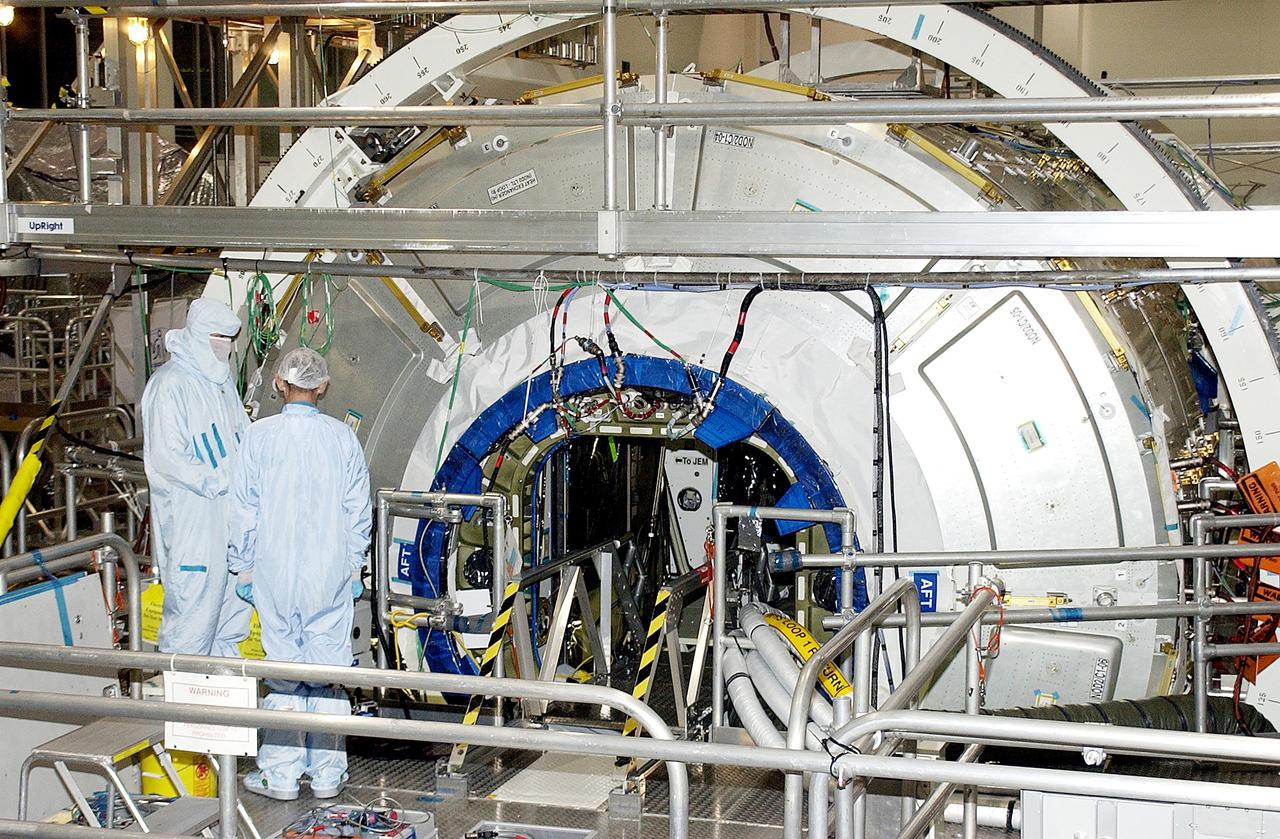
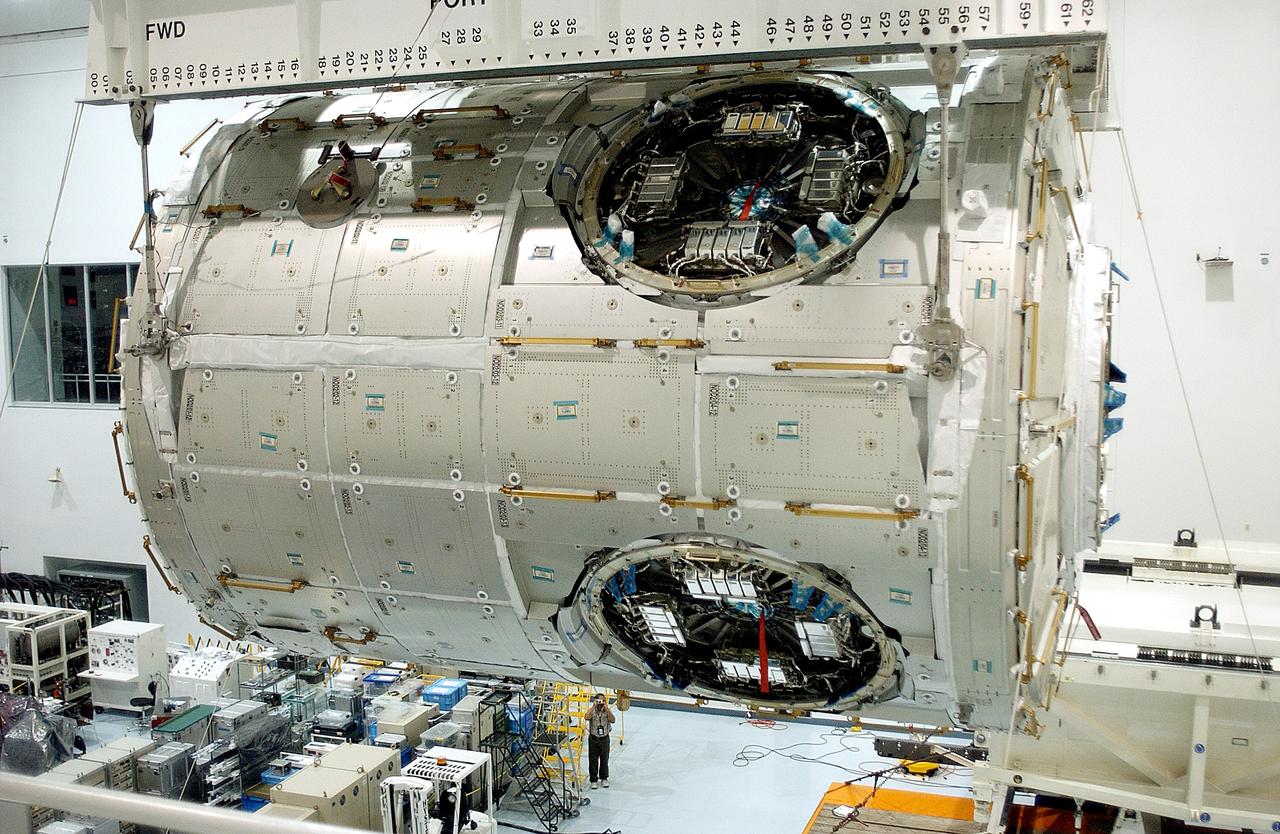
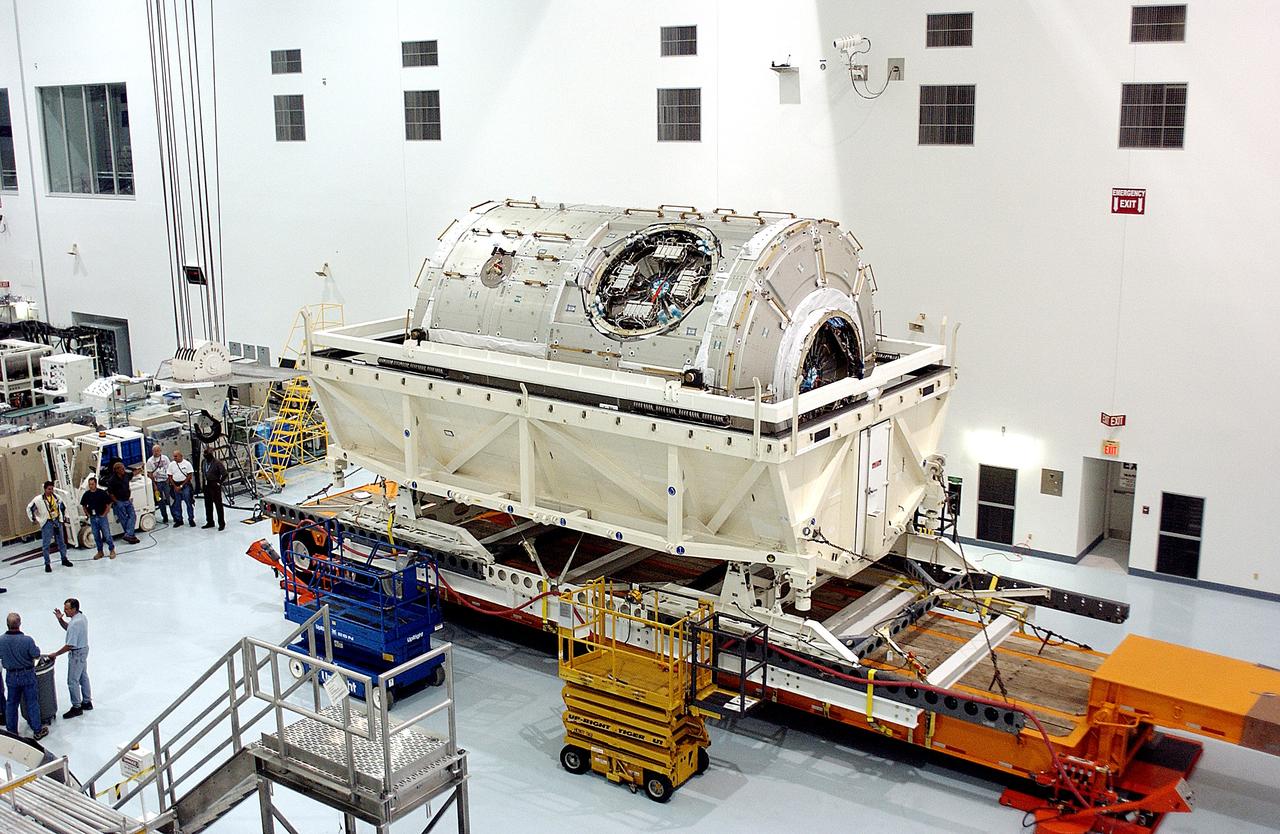
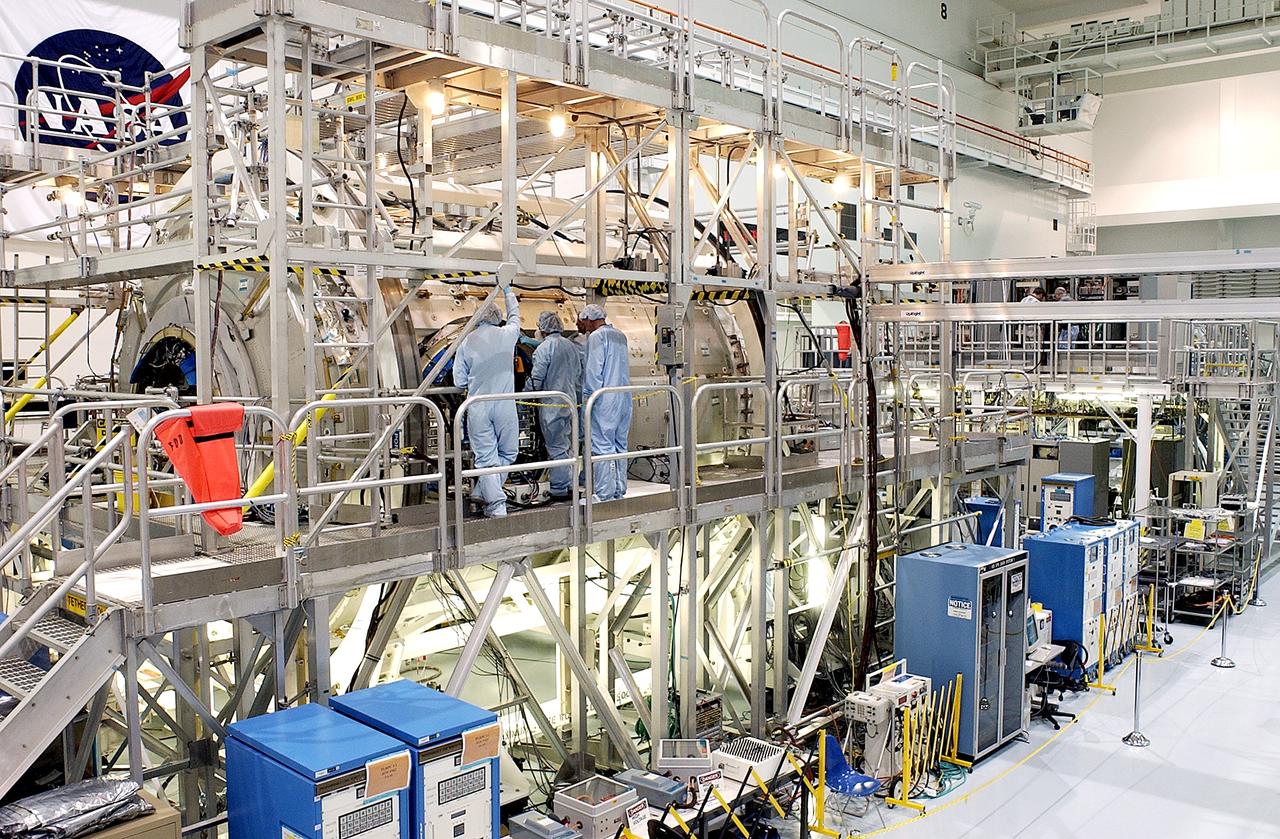
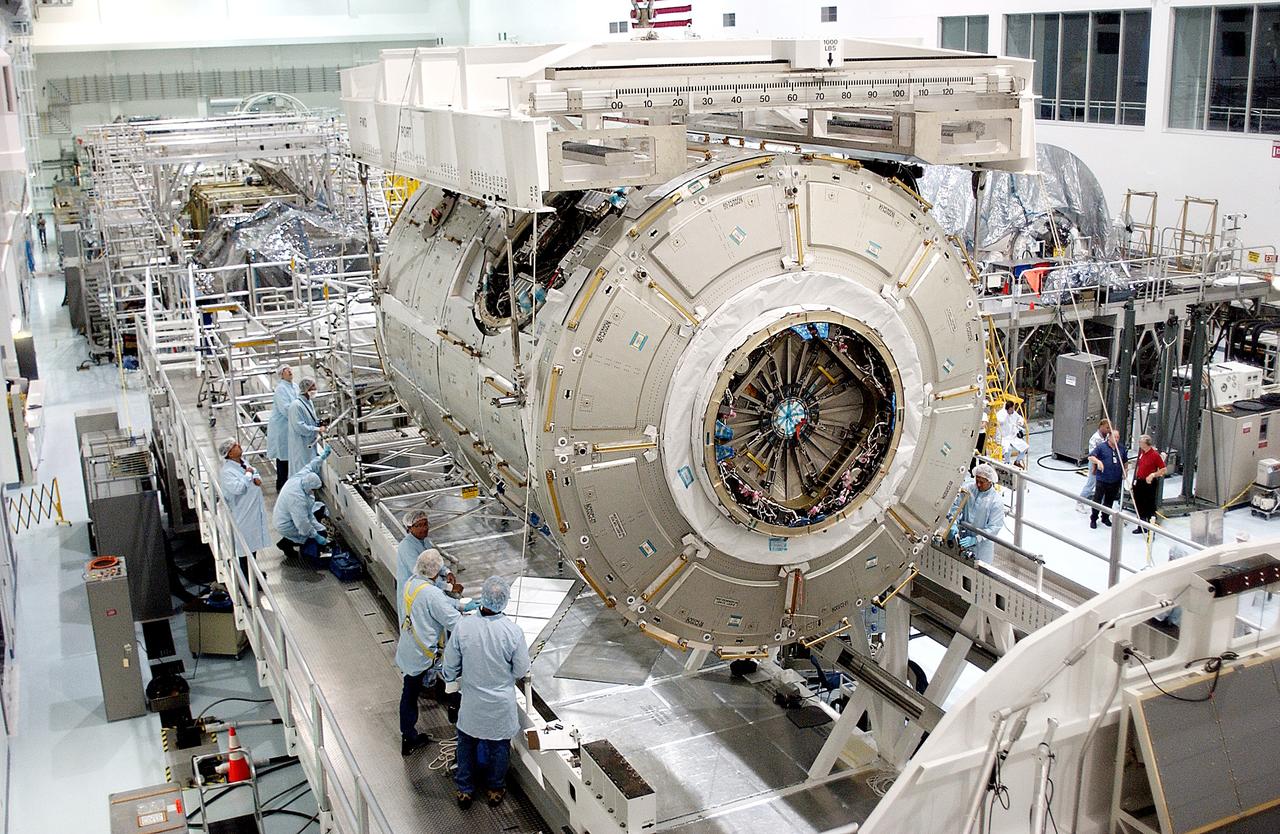
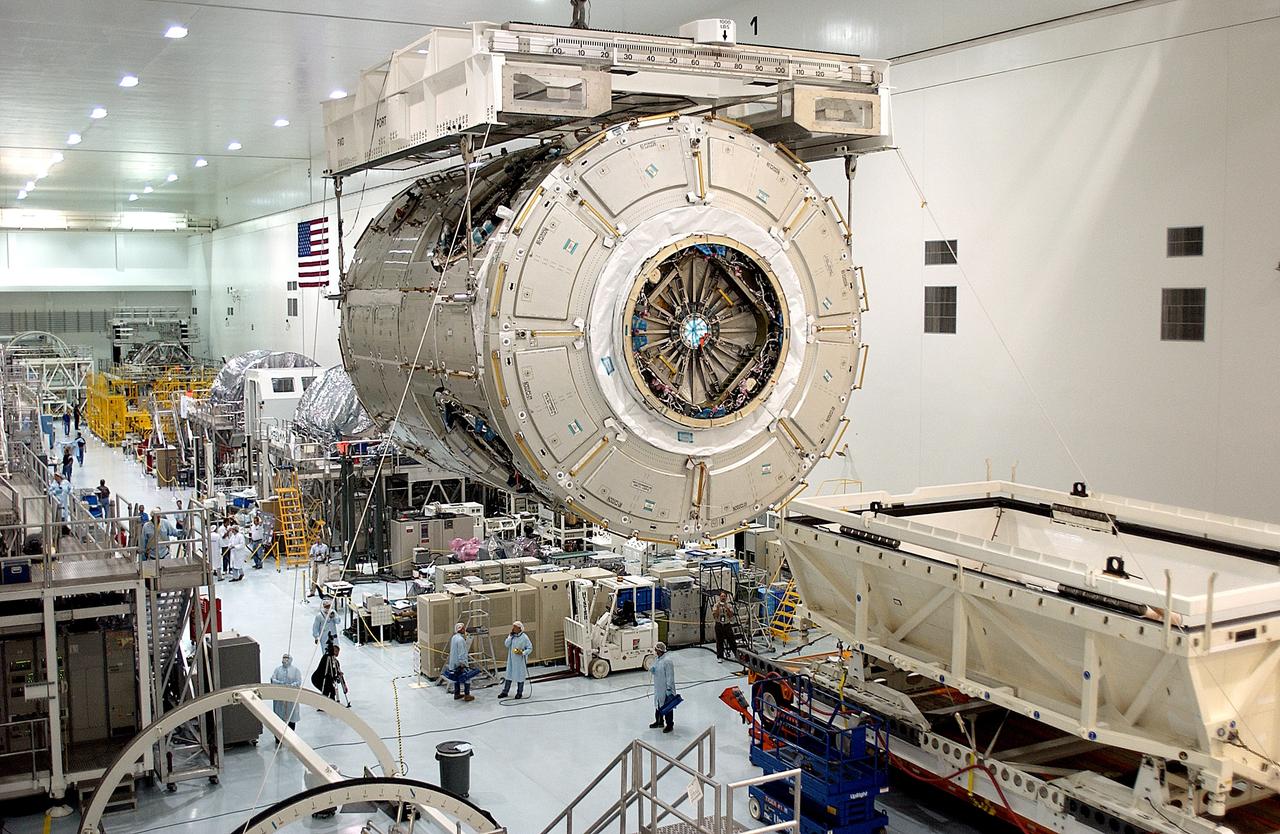
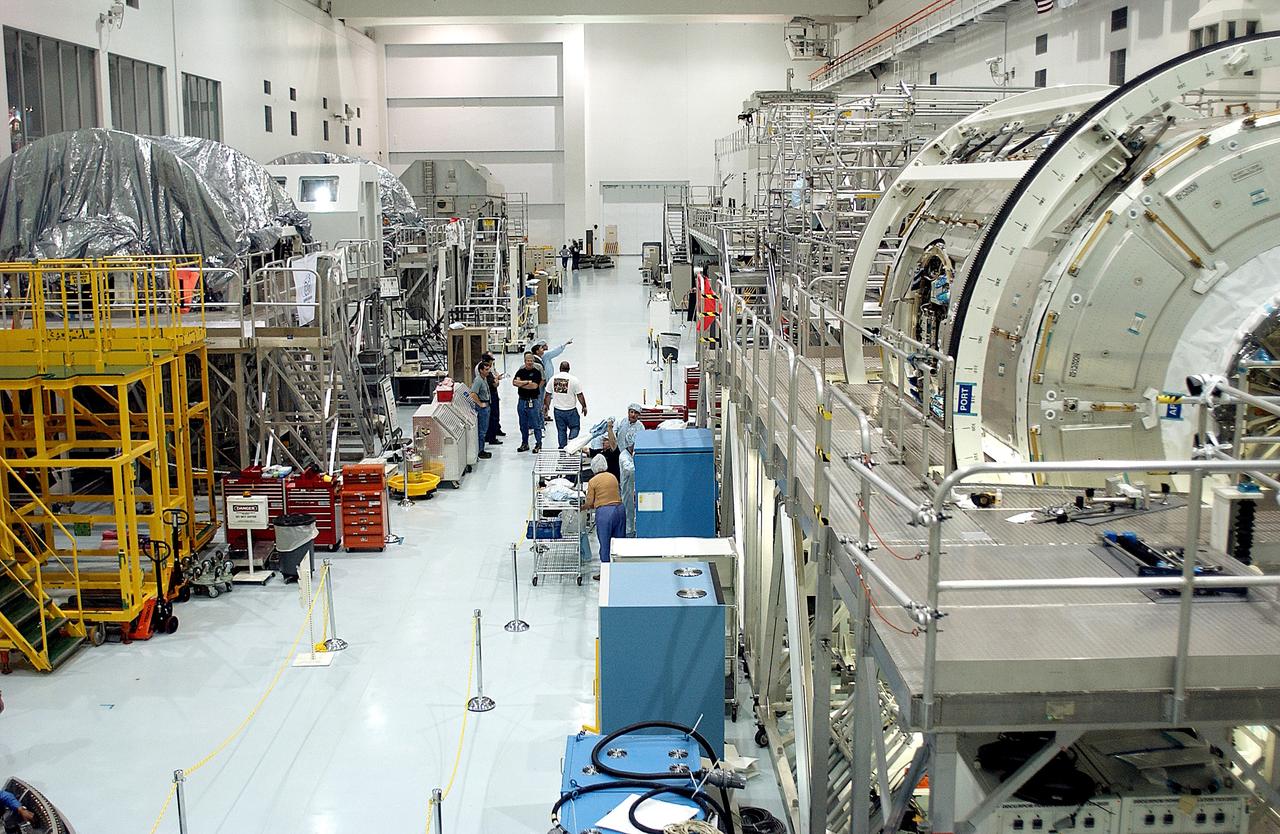
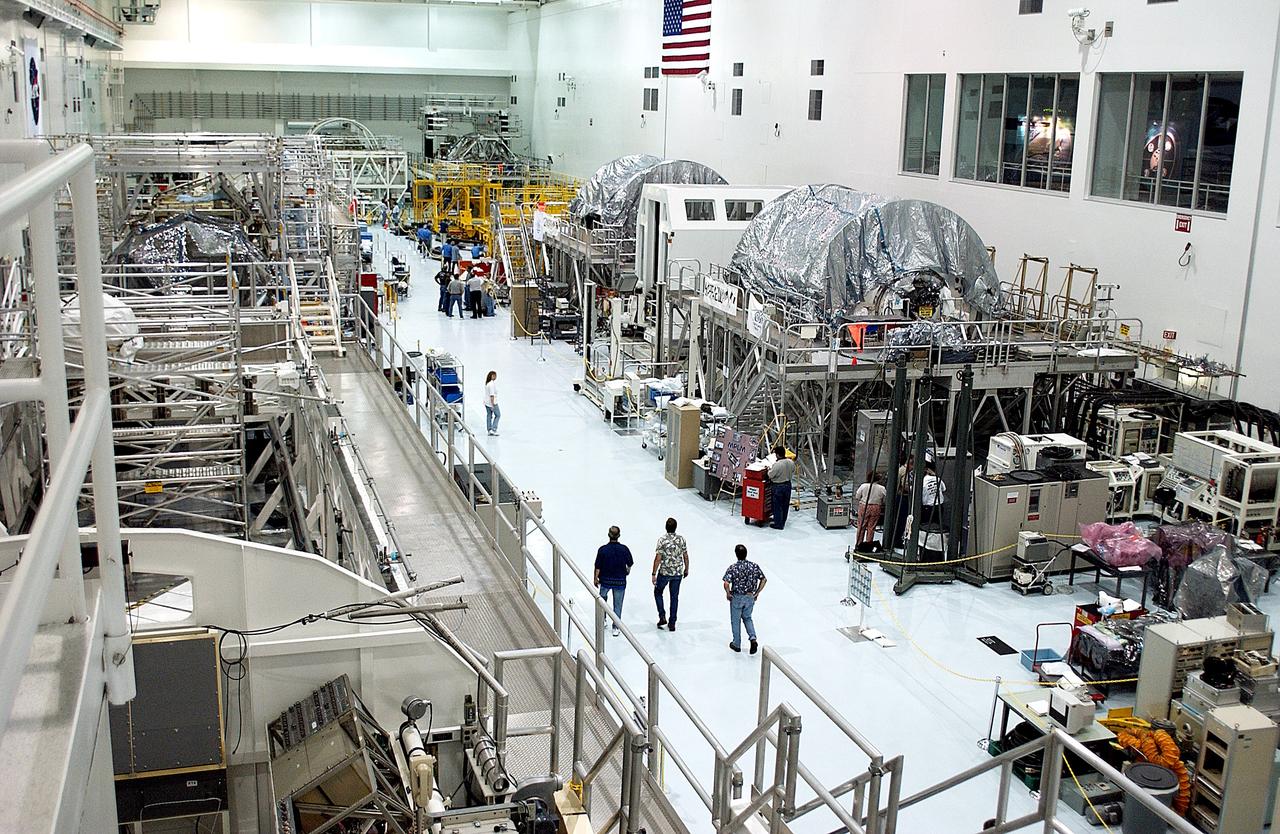
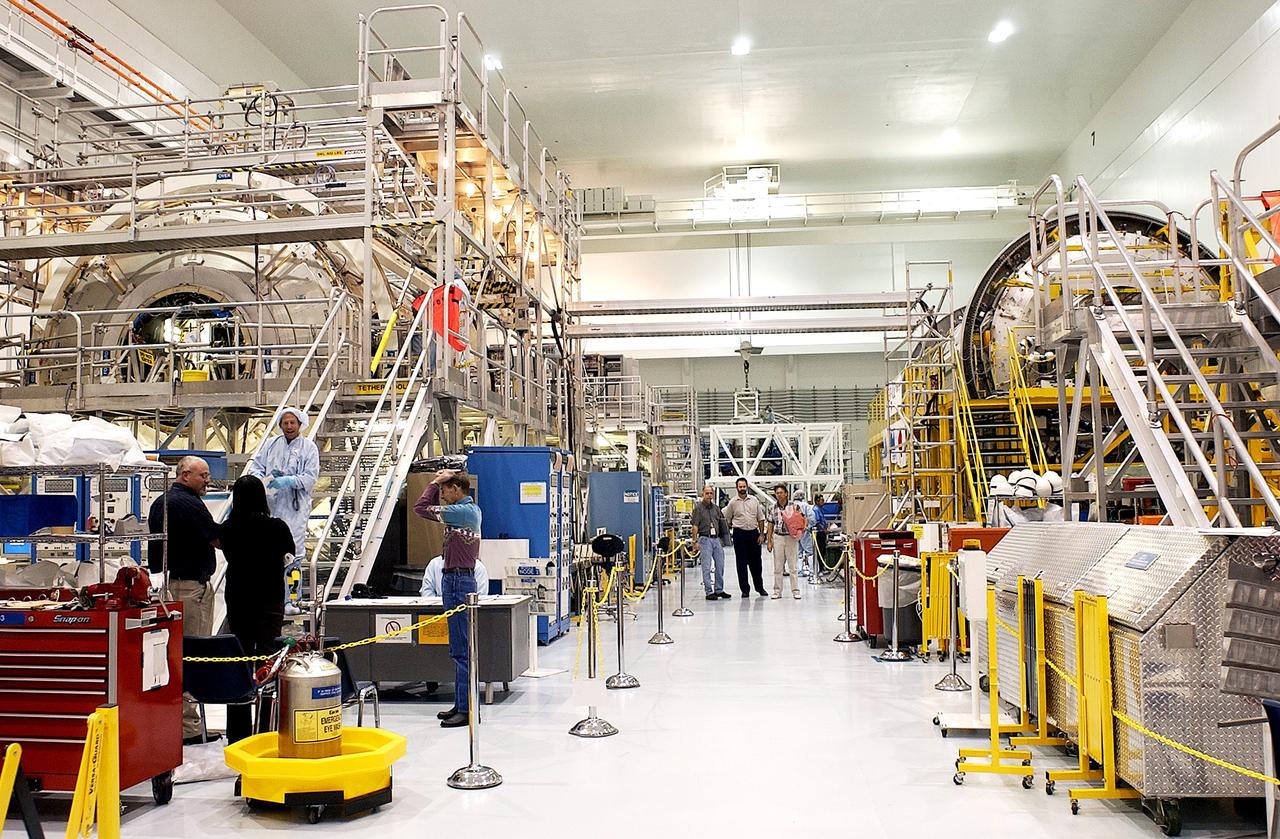
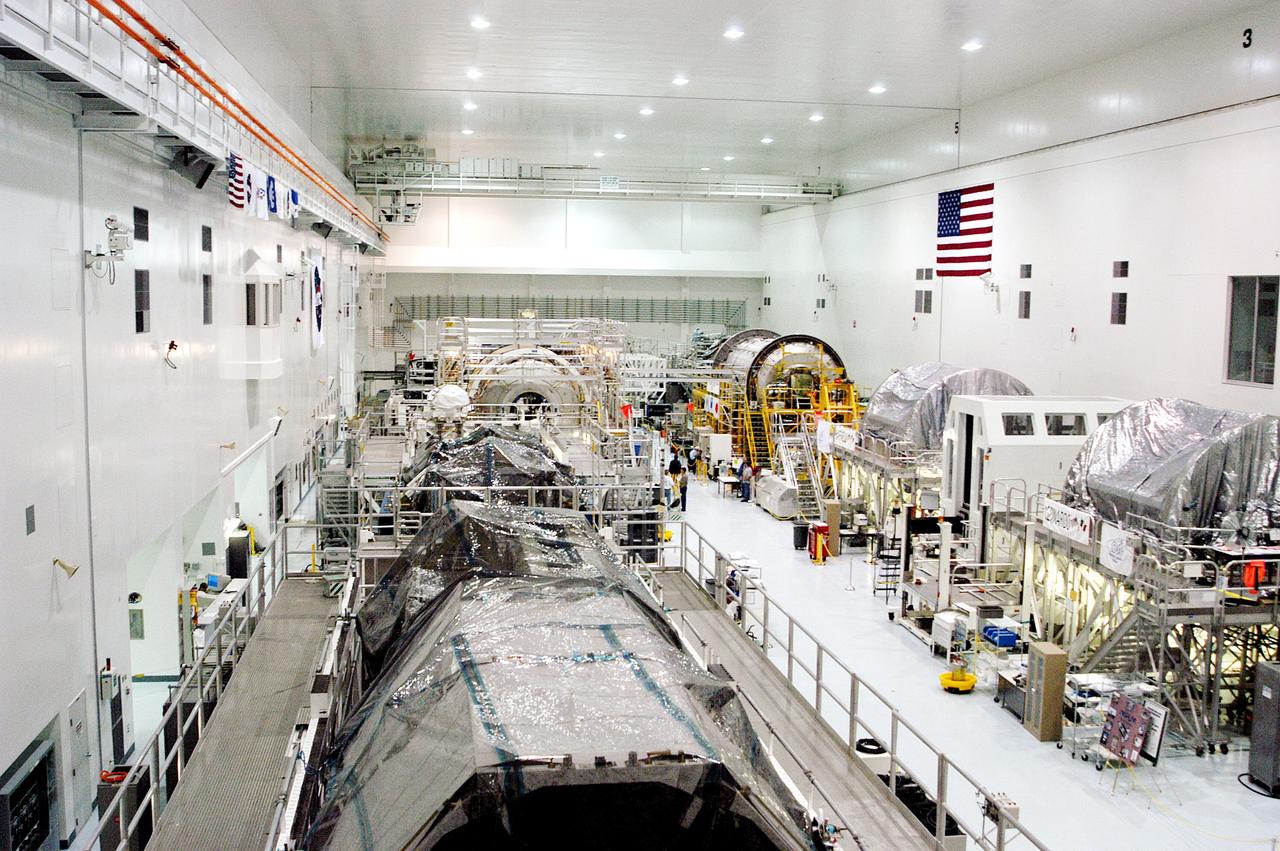
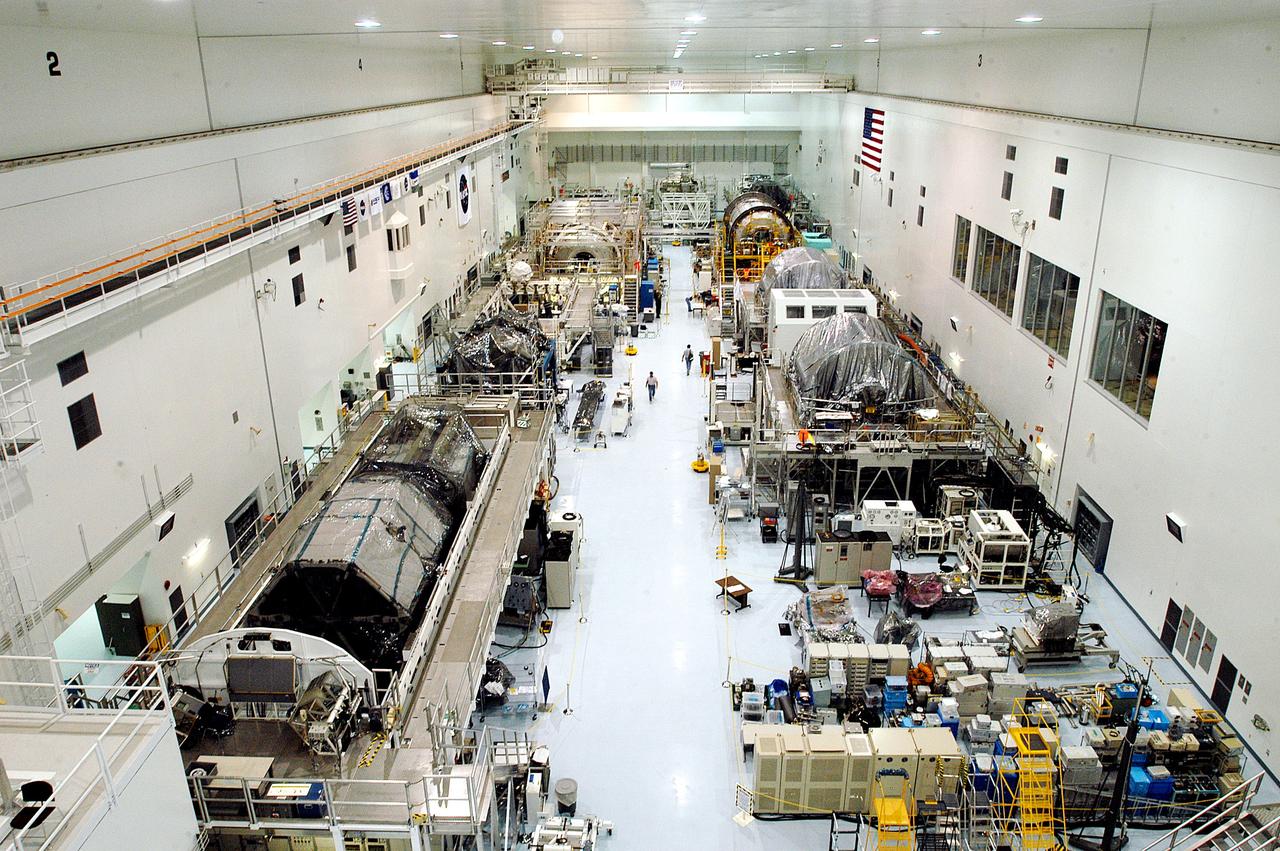
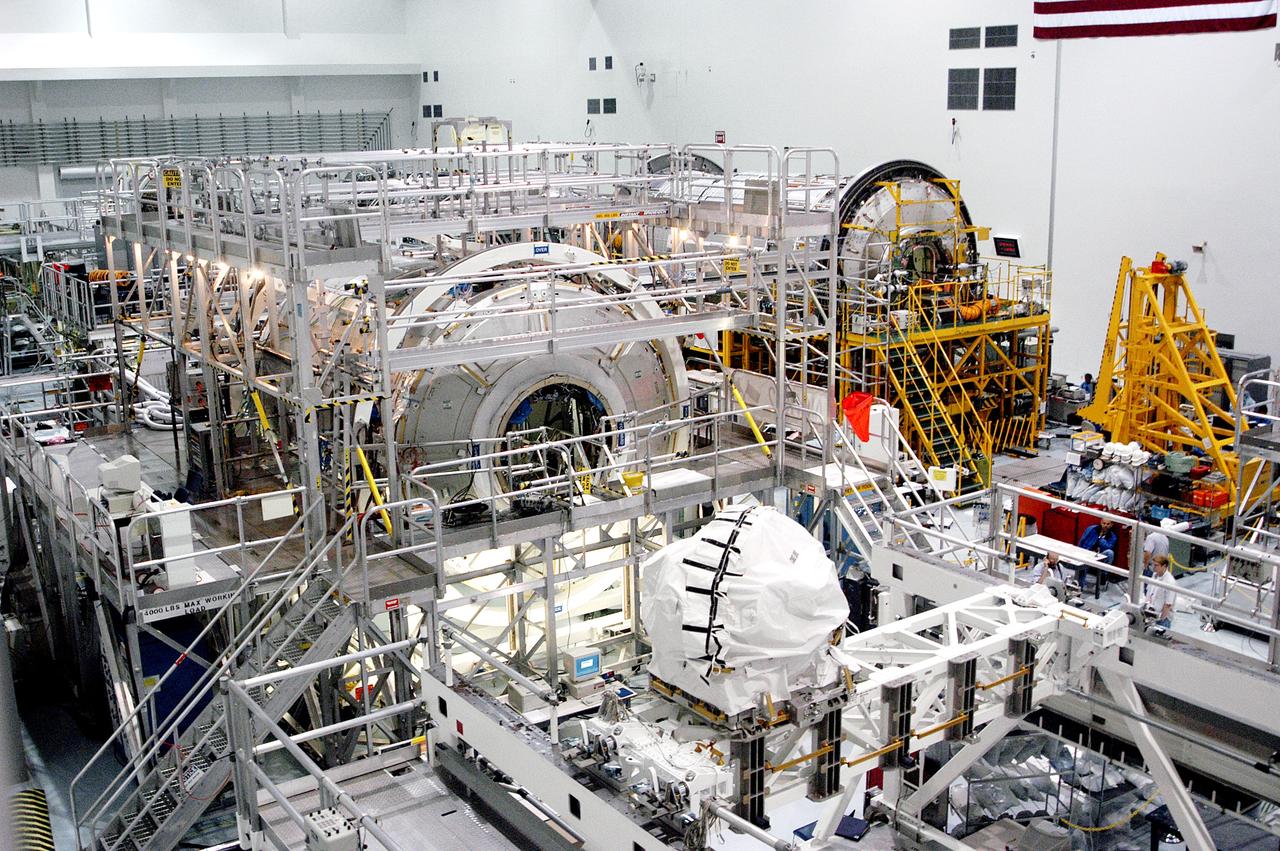
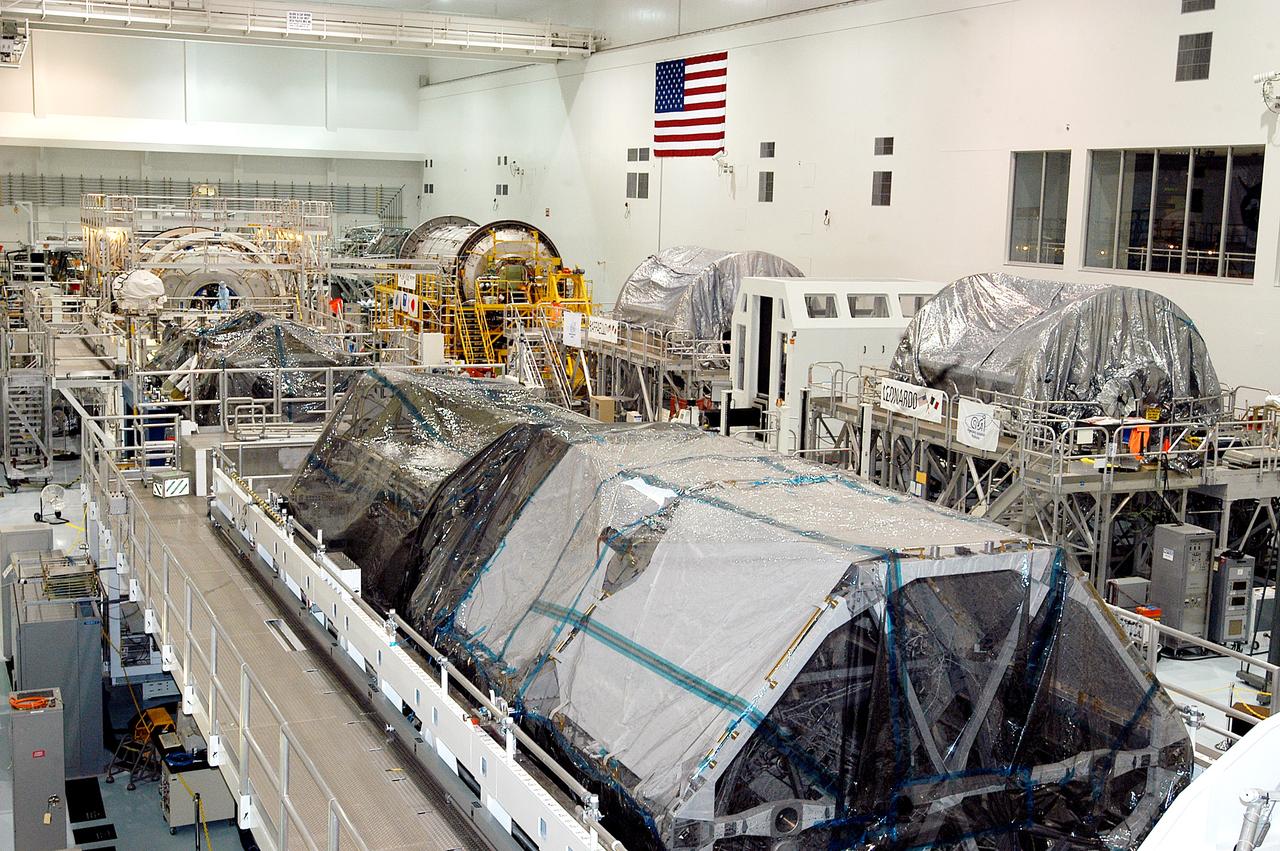
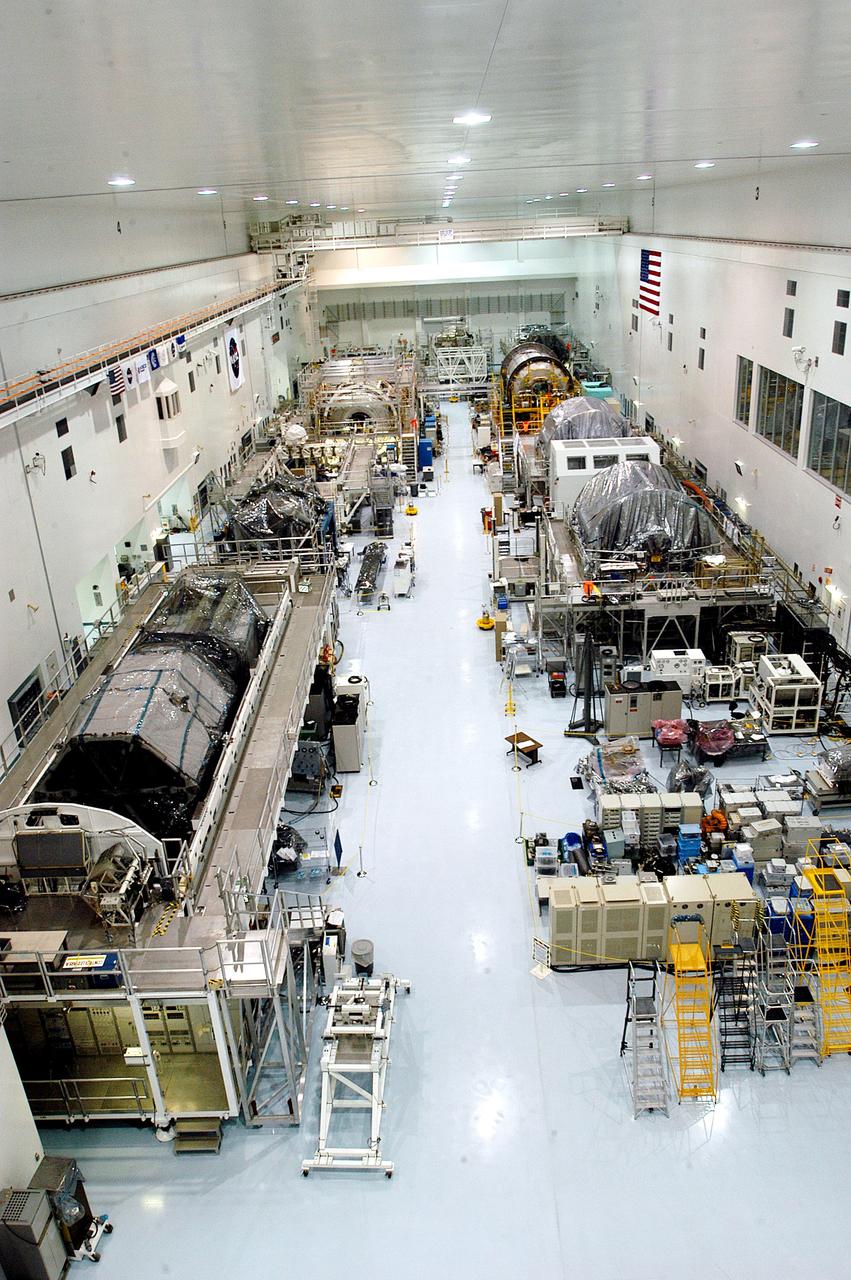
KENNEDY SPACE CENTER, FLA. - An overview of the Space Station Processing Facility shows workstands and ISS elements.   The most recent additions are the Japanese Experiment Module (JEM)’s pressurized module and the Italian-built Node 2.  The pressurized module is the first element of the JEM, Japan’s primary contribution to the Space Station, to be delivered to KSC. It will enhance the unique research capabilities of the orbiting complex by providing an additional shirt-sleeve environment for astronauts to conduct science experiments.  Node 2 will be installed on the end of the U.S. Lab and provides attach locations for the Japanese laboratory, European laboratory, the Centrifuge Accommodation Module and, later, Multipurpose Logistics Modules. It will provide the primary docking location for the Shuttle when a pressurized mating adapter is attached to Node 2.  Installation of the module will complete  the U.S. Core of the ISS.
KENNEDY SPACE CENTER, FLA. - An overview of the Space Station Processing Facility shows workstands and ISS elements. The most recent additions are the Japanese Experiment Module (JEM)’s pressurized module and the Italian-built Node 2. The pressurized module is the first element of the JEM, Japan’s primary contribution to the Space Station, to be delivered to KSC. It will enhance the unique research capabilities of the orbiting complex by providing an additional shirt-sleeve environment for astronauts to conduct science experiments. Node 2 will be installed on the end of the U.S. Lab and provides attach locations for the Japanese laboratory, European laboratory, the Centrifuge Accommodation Module and, later, Multipurpose Logistics Modules. It will provide the primary docking location for the Shuttle when a pressurized mating adapter is attached to Node 2. Installation of the module will complete the U.S. Core of the ISS.
KENNEDY SPACE CENTER, FLA. - A view of the Space Station Processing Facility shows workstands and ISS elements.   The most recent additions are the Japanese Experiment Module (JEM)’s pressurized module and the Italian-built Node 2.  The pressurized module is the first element of the JEM, Japan’s primary contribution to the Space Station, to be delivered to KSC. It will enhance the unique research capabilities of the orbiting complex by providing an additional shirt-sleeve environment for astronauts to conduct science experiments.  Node 2 will be installed on the end of the U.S. Lab and provides attach locations for the Japanese laboratory, European laboratory, the Centrifuge Accommodation Module and, later, Multipurpose Logistics Modules. It will provide the primary docking location for the Shuttle when a pressurized mating adapter is attached to Node 2.  Installation of the module will complete  the U.S. Core of the ISS.
KENNEDY SPACE CENTER, FLA. - A view of the Space Station Processing Facility shows workstands and ISS elements. The most recent additions are the Japanese Experiment Module (JEM)’s pressurized module and the Italian-built Node 2. The pressurized module is the first element of the JEM, Japan’s primary contribution to the Space Station, to be delivered to KSC. It will enhance the unique research capabilities of the orbiting complex by providing an additional shirt-sleeve environment for astronauts to conduct science experiments. Node 2 will be installed on the end of the U.S. Lab and provides attach locations for the Japanese laboratory, European laboratory, the Centrifuge Accommodation Module and, later, Multipurpose Logistics Modules. It will provide the primary docking location for the Shuttle when a pressurized mating adapter is attached to Node 2. Installation of the module will complete the U.S. Core of the ISS.
KENNEDY SPACE CENTER, FLA.  - In the Space Station Processing Facility can be seen the U.S. Node 2 (at left) and the Japanese Experiment Module (JEM)’s Pressurized Module (at right).  The  Italian-built Node 2, the second of three Space Station connecting modules, attaches to the end of the U.S. Lab and will provide attach locations for the Japanese laboratory, European laboratory, the Centrifuge Accommodation Module and, later, Multipurpose Logistics Modules. It will provide the primary docking location for the Shuttle when a pressurized mating adapter is attached to Node 2.  Installation of the module will complete the U.S. Core of the ISS.  Node 2 is the designated payload for mission STS-120.  No orbiter or launch date has been determined yet.  The Pressurized Module is the first element of the JEM to be delivered to KSC. The JEM is Japan's primary contribution to the Station. It will enhance the unique research capabilities of the orbiting complex by providing an additional environment for astronauts to conduct science experiments.  The JEM also includes an exposed facility (platform) for space environment experiments, a robotic manipulator system, and two logistics modules. The various JEM components will be  assembled in space over the course of three Shuttle missions.
KENNEDY SPACE CENTER, FLA. - In the Space Station Processing Facility can be seen the U.S. Node 2 (at left) and the Japanese Experiment Module (JEM)’s Pressurized Module (at right). The Italian-built Node 2, the second of three Space Station connecting modules, attaches to the end of the U.S. Lab and will provide attach locations for the Japanese laboratory, European laboratory, the Centrifuge Accommodation Module and, later, Multipurpose Logistics Modules. It will provide the primary docking location for the Shuttle when a pressurized mating adapter is attached to Node 2. Installation of the module will complete the U.S. Core of the ISS. Node 2 is the designated payload for mission STS-120. No orbiter or launch date has been determined yet. The Pressurized Module is the first element of the JEM to be delivered to KSC. The JEM is Japan's primary contribution to the Station. It will enhance the unique research capabilities of the orbiting complex by providing an additional environment for astronauts to conduct science experiments. The JEM also includes an exposed facility (platform) for space environment experiments, a robotic manipulator system, and two logistics modules. The various JEM components will be assembled in space over the course of three Shuttle missions.
KENNEDY SPACE CENTER, FLA. -  The Italian-built module, U.S. Node 2, begins its transfer from  the Shuttle Landing Facility to the Space Station Processing Facility.  Inthe background, left, is the Beluga aircraft that brought it to KSC.  The second of three connecting modules on the International Space Station, Node 2 attaches to the end of the U.S. Lab and provides attach locations for the Japanese laboratory, European laboratory, the Centrifuge Accommodation Module and, later, Multipurpose Logistics Modules. It will provide the primary docking location for the Shuttle when a pressurized mating adapter is attached to Node 2.  Installation of the module will complete  the U.S. Core of the ISS.  Node 2 is the designated payload for mission STS-120.  No orbiter or launch date has been determined yet.
KENNEDY SPACE CENTER, FLA. - The Italian-built module, U.S. Node 2, begins its transfer from the Shuttle Landing Facility to the Space Station Processing Facility. Inthe background, left, is the Beluga aircraft that brought it to KSC. The second of three connecting modules on the International Space Station, Node 2 attaches to the end of the U.S. Lab and provides attach locations for the Japanese laboratory, European laboratory, the Centrifuge Accommodation Module and, later, Multipurpose Logistics Modules. It will provide the primary docking location for the Shuttle when a pressurized mating adapter is attached to Node 2. Installation of the module will complete the U.S. Core of the ISS. Node 2 is the designated payload for mission STS-120. No orbiter or launch date has been determined yet.
iss065e241371 (Aug. 12, 2021) --- Key portions of the International Space Station are pictured from a window on Russia's newest addition to the orbiting lab, the Nauka Multipurpose Laboratory Module. At left is part of the Soyuz MS-18 crew ship docked to the Rassvet module. From top to bottom are Japan's Kibo laboratory module with its attached Exposed Facility where a variety of experiments are placed in the vacuum of space, including: the Japanese robotic arm attached to Kibo; the Leonardo Multipurpose Logistics Module attached to the Tranquility module; and the seven-windowed cupola attached to Tranquility.
iss065e241371
KENNEDY SPACE CENTER, FLA. -   Astronaut Soichi Noguchi, with the National Space Development Agency of Japan (NASDA), works at a console during a Multi-Element Integrated Test (MEIT) of the U.S. Node 2 and the Japanese Experiment Module (JEM).  Noguchi is assigned to mission STS-114 as a mission specialist.   Node 2 attaches to the end of the U.S. Lab on the ISS and provides attach locations for the Japanese laboratory, European laboratory, the Centrifuge Accommodation Module and, eventually, Multipurpose Logistics Modules. It will provide the primary docking location for the Shuttle when a pressurized mating adapter is attached to Node 2.  Installation of the module will complete the U.S. Core of the ISS.   The JEM, developed by NASDA,  is Japan's primary contribution to the Station. It will enhance the unique research capabilities of the orbiting complex by providing an additional environment for astronauts to conduct science experiments.
KENNEDY SPACE CENTER, FLA. - Astronaut Soichi Noguchi, with the National Space Development Agency of Japan (NASDA), works at a console during a Multi-Element Integrated Test (MEIT) of the U.S. Node 2 and the Japanese Experiment Module (JEM). Noguchi is assigned to mission STS-114 as a mission specialist. Node 2 attaches to the end of the U.S. Lab on the ISS and provides attach locations for the Japanese laboratory, European laboratory, the Centrifuge Accommodation Module and, eventually, Multipurpose Logistics Modules. It will provide the primary docking location for the Shuttle when a pressurized mating adapter is attached to Node 2. Installation of the module will complete the U.S. Core of the ISS. The JEM, developed by NASDA, is Japan's primary contribution to the Station. It will enhance the unique research capabilities of the orbiting complex by providing an additional environment for astronauts to conduct science experiments.
KENNEDY SPACE CENTER, FLA. -  Astronaut Soichi Noguchi, with the National Space Development Agency of Japan (NASDA), rests inside the Japanese Experiment Module (JEM), undergoing a Multi-Element Integrated Test (MEIT)  in the Space Station Processing Facility.  Noguchi is assigned to mission STS-114 as a mission specialist.   Node 2 attaches to the end of the U.S. Lab on the ISS and provides attach locations for the Japanese laboratory, European laboratory, the Centrifuge Accommodation Module and, eventually, Multipurpose Logistics Modules. It will provide the primary docking location for the Shuttle when a pressurized mating adapter is attached to Node 2.  Installation of the module will complete the U.S. Core of the ISS.   The JEM, developed by NASDA,  is Japan's primary contribution to the Station. It will enhance the unique research capabilities of the orbiting complex by providing an additional environment for astronauts to conduct science experiments.
KENNEDY SPACE CENTER, FLA. - Astronaut Soichi Noguchi, with the National Space Development Agency of Japan (NASDA), rests inside the Japanese Experiment Module (JEM), undergoing a Multi-Element Integrated Test (MEIT) in the Space Station Processing Facility. Noguchi is assigned to mission STS-114 as a mission specialist. Node 2 attaches to the end of the U.S. Lab on the ISS and provides attach locations for the Japanese laboratory, European laboratory, the Centrifuge Accommodation Module and, eventually, Multipurpose Logistics Modules. It will provide the primary docking location for the Shuttle when a pressurized mating adapter is attached to Node 2. Installation of the module will complete the U.S. Core of the ISS. The JEM, developed by NASDA, is Japan's primary contribution to the Station. It will enhance the unique research capabilities of the orbiting complex by providing an additional environment for astronauts to conduct science experiments.
KENNEDY SPACE CENTER, FLA. -   Workers in the Space Station Processing Facility look over paperwork during a Multi-Element Integrated Test (MEIT) of the U.S. Node 2 and the Japanese Experiment Module (JEM).   Node 2 attaches to the end of the U.S. Lab on the ISS and provides attach locations for the Japanese laboratory, European laboratory, the Centrifuge Accommodation Module and, eventually, Multipurpose Logistics Modules. It will provide the primary docking location for the Shuttle when a pressurized mating adapter is attached to Node 2.  Installation of the module will complete the U.S. Core of the ISS.   The JEM, developed by the National Space Development Agency of Japan (NASDA), is Japan's primary contribution to the Station. It will enhance the unique research capabilities of the orbiting complex by providing an additional environment for astronauts to conduct science experiments.
KENNEDY SPACE CENTER, FLA. - Workers in the Space Station Processing Facility look over paperwork during a Multi-Element Integrated Test (MEIT) of the U.S. Node 2 and the Japanese Experiment Module (JEM). Node 2 attaches to the end of the U.S. Lab on the ISS and provides attach locations for the Japanese laboratory, European laboratory, the Centrifuge Accommodation Module and, eventually, Multipurpose Logistics Modules. It will provide the primary docking location for the Shuttle when a pressurized mating adapter is attached to Node 2. Installation of the module will complete the U.S. Core of the ISS. The JEM, developed by the National Space Development Agency of Japan (NASDA), is Japan's primary contribution to the Station. It will enhance the unique research capabilities of the orbiting complex by providing an additional environment for astronauts to conduct science experiments.
KENNEDY SPACE CENTER, FLA. -  In the Space Station Processing Facility, workers talk near the opened hatch of the Italian-built Node 2.  A future element of the International Space Station,  Node 2 arrived at KSC June 1.  The second of three Station connecting modules, Node 2 attaches to the end of the U.S. Lab and provides attach locations for the Japanese laboratory, European laboratory, the Centrifuge Accommodation Module and, later, Multipurpose Logistics Modules. It will provide the primary docking location for the Shuttle when a pressurized mating adapter is attached to Node 2.  Installation of the module will complete  the U.S. Core of the ISS.  Node 2 is the designated payload for mission STS-120.  No orbiter or launch date has been determined yet.
KENNEDY SPACE CENTER, FLA. - In the Space Station Processing Facility, workers talk near the opened hatch of the Italian-built Node 2. A future element of the International Space Station, Node 2 arrived at KSC June 1. The second of three Station connecting modules, Node 2 attaches to the end of the U.S. Lab and provides attach locations for the Japanese laboratory, European laboratory, the Centrifuge Accommodation Module and, later, Multipurpose Logistics Modules. It will provide the primary docking location for the Shuttle when a pressurized mating adapter is attached to Node 2. Installation of the module will complete the U.S. Core of the ISS. Node 2 is the designated payload for mission STS-120. No orbiter or launch date has been determined yet.
KENNEDY SPACE CENTER, FLA. -   Workers in the Space Station Processing Facility observe consoles during a Multi-Element Integrated Test (MEIT) of the U.S. Node 2 and the Japanese Experiment Module (JEM).   Node 2 attaches to the end of the U.S. Lab on the ISS and provides attach locations for the Japanese laboratory, European laboratory, the Centrifuge Accommodation Module and, eventually, Multipurpose Logistics Modules. It will provide the primary docking location for the Shuttle when a pressurized mating adapter is attached to Node 2.  Installation of the module will complete the U.S. Core of the ISS.   The JEM, developed by the National Space Development Agency of Japan (NASDA), is Japan's primary contribution to the Station. It will enhance the unique research capabilities of the orbiting complex by providing an additional environment for astronauts to conduct science experiments.
KENNEDY SPACE CENTER, FLA. - Workers in the Space Station Processing Facility observe consoles during a Multi-Element Integrated Test (MEIT) of the U.S. Node 2 and the Japanese Experiment Module (JEM). Node 2 attaches to the end of the U.S. Lab on the ISS and provides attach locations for the Japanese laboratory, European laboratory, the Centrifuge Accommodation Module and, eventually, Multipurpose Logistics Modules. It will provide the primary docking location for the Shuttle when a pressurized mating adapter is attached to Node 2. Installation of the module will complete the U.S. Core of the ISS. The JEM, developed by the National Space Development Agency of Japan (NASDA), is Japan's primary contribution to the Station. It will enhance the unique research capabilities of the orbiting complex by providing an additional environment for astronauts to conduct science experiments.
KENNEDY SPACE CENTER, FLA. -   Astronaut Soichi Noguchi, with the National Space Development Agency of Japan (NASDA), is inside the Japanese Experiment Module (JEM), undergoing a Multi-Element Integrated Test (MEIT)  in the Space Station Processing Facility.  Noguchi is assigned to mission STS-114 as a mission specialist.   Node 2 attaches to the end of the U.S. Lab on the ISS and provides attach locations for the Japanese laboratory, European laboratory, the Centrifuge Accommodation Module and, eventually, Multipurpose Logistics Modules. It will provide the primary docking location for the Shuttle when a pressurized mating adapter is attached to Node 2.  Installation of the module will complete the U.S. Core of the ISS.   The JEM, developed by NASDA,  is Japan's primary contribution to the Station. It will enhance the unique research capabilities of the orbiting complex by providing an additional environment for astronauts to conduct science experiments.
KENNEDY SPACE CENTER, FLA. - Astronaut Soichi Noguchi, with the National Space Development Agency of Japan (NASDA), is inside the Japanese Experiment Module (JEM), undergoing a Multi-Element Integrated Test (MEIT) in the Space Station Processing Facility. Noguchi is assigned to mission STS-114 as a mission specialist. Node 2 attaches to the end of the U.S. Lab on the ISS and provides attach locations for the Japanese laboratory, European laboratory, the Centrifuge Accommodation Module and, eventually, Multipurpose Logistics Modules. It will provide the primary docking location for the Shuttle when a pressurized mating adapter is attached to Node 2. Installation of the module will complete the U.S. Core of the ISS. The JEM, developed by NASDA, is Japan's primary contribution to the Station. It will enhance the unique research capabilities of the orbiting complex by providing an additional environment for astronauts to conduct science experiments.
KENNEDY SPACE CENTER, FLA. - In the Space Station Processing Facility, the U.S. Node 2 (center) and the Japanese Experiment Module (JEM), background right, await a Multi-Element Integrated Test (MEIT). Node 2 attaches to the end of the U.S. Lab on the International Space Station and provides attach locations for the Japanese laboratory, European laboratory, the Centrifuge Accommodation Module and, eventually, Multipurpose Logistics Modules. It will provide the primary docking location for the Shuttle when a pressurized mating adapter is attached to Node 2.  Installation of the module will complete the U.S. Core of the ISS.  The National Space Development Agency of Japan (NASDA) developed their laboratory at the Tsukuba Space Center near Tokyo. It is the first element, named "Kibo" (Hope), to be delivered to KSC. The JEM is Japan's primary contribution to the Station. It will enhance the unique research capabilities of the orbiting complex by providing an additional environment for astronauts to conduct science experiments.
KENNEDY SPACE CENTER, FLA. - In the Space Station Processing Facility, the U.S. Node 2 (center) and the Japanese Experiment Module (JEM), background right, await a Multi-Element Integrated Test (MEIT). Node 2 attaches to the end of the U.S. Lab on the International Space Station and provides attach locations for the Japanese laboratory, European laboratory, the Centrifuge Accommodation Module and, eventually, Multipurpose Logistics Modules. It will provide the primary docking location for the Shuttle when a pressurized mating adapter is attached to Node 2. Installation of the module will complete the U.S. Core of the ISS. The National Space Development Agency of Japan (NASDA) developed their laboratory at the Tsukuba Space Center near Tokyo. It is the first element, named "Kibo" (Hope), to be delivered to KSC. The JEM is Japan's primary contribution to the Station. It will enhance the unique research capabilities of the orbiting complex by providing an additional environment for astronauts to conduct science experiments.
KENNEDY SPACE CENTER, FLA. -  Workers in the Space Station Processing Facility are lined up at consoles during  a Multi-Element Integrated Test (MEIT ) of the Japanese Experiment Module (JEM) and U.S. Node 2.  Node 2 attaches to the end of the U.S. Lab on the ISS and provides attach locations for the Japanese laboratory, European laboratory, the Centrifuge Accommodation Module and, eventually, Multipurpose Logistics Modules. It will provide the primary docking location for the Shuttle when a pressurized mating adapter is attached to Node 2.  Installation of the module will complete the U.S. Core of the ISS.   The JEM, developed by NASDA,  is Japan's primary contribution to the Station. It will enhance the unique research capabilities of the orbiting complex by providing an additional environment for astronauts to conduct science experiments.
KENNEDY SPACE CENTER, FLA. - Workers in the Space Station Processing Facility are lined up at consoles during a Multi-Element Integrated Test (MEIT ) of the Japanese Experiment Module (JEM) and U.S. Node 2. Node 2 attaches to the end of the U.S. Lab on the ISS and provides attach locations for the Japanese laboratory, European laboratory, the Centrifuge Accommodation Module and, eventually, Multipurpose Logistics Modules. It will provide the primary docking location for the Shuttle when a pressurized mating adapter is attached to Node 2. Installation of the module will complete the U.S. Core of the ISS. The JEM, developed by NASDA, is Japan's primary contribution to the Station. It will enhance the unique research capabilities of the orbiting complex by providing an additional environment for astronauts to conduct science experiments.
KENNEDY SPACE CENTER, FLA. -  Astronaut Soichi Noguchi (left), with the National Space Development Agency of Japan (NASDA), points to data on the console during a Multi-Element Integrated Test (MEIT) of the U.S. Node 2 and the Japanese Experiment Module (JEM) in the Space Station Processing Facility.  The JEM, developed by NASDA, is Japan's primary contribution to the Station. It will enhance the unique research capabilities of the orbiting complex by providing an additional environment for astronauts to conduct science experiments. Noguchi is assigned to mission STS-114 as a mission specialist.  Node 2 provides attach locations for the Japanese laboratory, as well as European laboratory, the Centrifuge Accommodation Module and, eventually, Multipurpose Logistics Modules.  Installation of the module will complete the U.S. Core of the ISS.
KENNEDY SPACE CENTER, FLA. - Astronaut Soichi Noguchi (left), with the National Space Development Agency of Japan (NASDA), points to data on the console during a Multi-Element Integrated Test (MEIT) of the U.S. Node 2 and the Japanese Experiment Module (JEM) in the Space Station Processing Facility. The JEM, developed by NASDA, is Japan's primary contribution to the Station. It will enhance the unique research capabilities of the orbiting complex by providing an additional environment for astronauts to conduct science experiments. Noguchi is assigned to mission STS-114 as a mission specialist. Node 2 provides attach locations for the Japanese laboratory, as well as European laboratory, the Centrifuge Accommodation Module and, eventually, Multipurpose Logistics Modules. Installation of the module will complete the U.S. Core of the ISS.
KENNEDY SPACE CENTER, FLA. -  Various elements intended for the International Space Station are lined up in the Space Station Processing Facility.  The newest to arrive at KSC are in the rear: at left, the U.S. Node 2, and next to it at right, the Japanese Experiment Module (JEM).  The two elements are undergoing a Multi-Element Integrated Test (MEIT).   Node 2 attaches to the end of the U.S. Lab on the ISS and provides attach locations for the Japanese laboratory, European laboratory, the Centrifuge Accommodation Module and, eventually, Multipurpose Logistics Modules. It will provide the primary docking location for the Shuttle when a pressurized mating adapter is attached to Node 2.  Installation of the module will complete the U.S. Core of the ISS.   Developed by the National Space Development Agency of Japan (NASDA), the JEM is Japan's primary contribution to the Station. It will enhance the unique research capabilities of the orbiting complex by providing an additional environment for astronauts to conduct science experiments.
KENNEDY SPACE CENTER, FLA. - Various elements intended for the International Space Station are lined up in the Space Station Processing Facility. The newest to arrive at KSC are in the rear: at left, the U.S. Node 2, and next to it at right, the Japanese Experiment Module (JEM). The two elements are undergoing a Multi-Element Integrated Test (MEIT). Node 2 attaches to the end of the U.S. Lab on the ISS and provides attach locations for the Japanese laboratory, European laboratory, the Centrifuge Accommodation Module and, eventually, Multipurpose Logistics Modules. It will provide the primary docking location for the Shuttle when a pressurized mating adapter is attached to Node 2. Installation of the module will complete the U.S. Core of the ISS. Developed by the National Space Development Agency of Japan (NASDA), the JEM is Japan's primary contribution to the Station. It will enhance the unique research capabilities of the orbiting complex by providing an additional environment for astronauts to conduct science experiments.
KENNEDY SPACE CENTER, FLA. -  Various elements intended for the International Space Station are lined up in the Space Station Processing Facility.  The newest to arrive at KSC are in the rear: at left, the U.S. Node 2, and next to it at right, the Japanese Experiment Module (JEM).  The two elements are undergoing a Multi-Element Integrated Test (MEIT).   Node 2 attaches to the end of the U.S. Lab on the ISS and provides attach locations for the Japanese laboratory, European laboratory, the Centrifuge Accommodation Module and, eventually, Multipurpose Logistics Modules. It will provide the primary docking location for the Shuttle when a pressurized mating adapter is attached to Node 2.  Installation of the module will complete the U.S. Core of the ISS.   Developed by the National Space Development Agency of Japan (NASDA), the JEM is Japan's primary contribution to the Station. It will enhance the unique research capabilities of the orbiting complex by providing an additional environment for astronauts to conduct science experiments.
KENNEDY SPACE CENTER, FLA. - Various elements intended for the International Space Station are lined up in the Space Station Processing Facility. The newest to arrive at KSC are in the rear: at left, the U.S. Node 2, and next to it at right, the Japanese Experiment Module (JEM). The two elements are undergoing a Multi-Element Integrated Test (MEIT). Node 2 attaches to the end of the U.S. Lab on the ISS and provides attach locations for the Japanese laboratory, European laboratory, the Centrifuge Accommodation Module and, eventually, Multipurpose Logistics Modules. It will provide the primary docking location for the Shuttle when a pressurized mating adapter is attached to Node 2. Installation of the module will complete the U.S. Core of the ISS. Developed by the National Space Development Agency of Japan (NASDA), the JEM is Japan's primary contribution to the Station. It will enhance the unique research capabilities of the orbiting complex by providing an additional environment for astronauts to conduct science experiments.
KENNEDY SPACE CENTER, FLA. -  Astronaut Soichi Noguchi (left), with the National Space Development Agency of Japan (NASDA), points to data on the console during a Multi-Element Integrated Test (MEIT) of the U.S. Node 2 and the Japanese Experiment Module (JEM) in the Space Station Processing Facility.  The JEM, developed by NASDA, is Japan's primary contribution to the Station. It will enhance the unique research capabilities of the orbiting complex by providing an additional environment for astronauts to conduct science experiments. Noguchi is assigned to mission STS-114 as a mission specialist.  Node 2 provides attach locations for the Japanese laboratory, as well as European laboratory, the Centrifuge Accommodation Module and, eventually, Multipurpose Logistics Modules.  Installation of the module will complete the U.S. Core of the ISS.
KENNEDY SPACE CENTER, FLA. - Astronaut Soichi Noguchi (left), with the National Space Development Agency of Japan (NASDA), points to data on the console during a Multi-Element Integrated Test (MEIT) of the U.S. Node 2 and the Japanese Experiment Module (JEM) in the Space Station Processing Facility. The JEM, developed by NASDA, is Japan's primary contribution to the Station. It will enhance the unique research capabilities of the orbiting complex by providing an additional environment for astronauts to conduct science experiments. Noguchi is assigned to mission STS-114 as a mission specialist. Node 2 provides attach locations for the Japanese laboratory, as well as European laboratory, the Centrifuge Accommodation Module and, eventually, Multipurpose Logistics Modules. Installation of the module will complete the U.S. Core of the ISS.
KENNEDY SPACE CENTER, FLA. -  Astronaut Soichi Noguchi, with the National Space Development Agency of Japan (NASDA), signals success during a Multi-Element Integrated Test (MEIT ) of the Japanese Experiment Module (JEM) in the Space Station Processing Facility.  Noguchi is assigned to mission STS-114 as a mission specialist.   Node 2 attaches to the end of the U.S. Lab on the ISS and provides attach locations for the Japanese laboratory, European laboratory, the Centrifuge Accommodation Module and, eventually, Multipurpose Logistics Modules. It will provide the primary docking location for the Shuttle when a pressurized mating adapter is attached to Node 2.  Installation of the module will complete the U.S. Core of the ISS.   The JEM, developed by NASDA,  is Japan's primary contribution to the Station. It will enhance the unique research capabilities of the orbiting complex by providing an additional environment for astronauts to conduct science experiments.
KENNEDY SPACE CENTER, FLA. - Astronaut Soichi Noguchi, with the National Space Development Agency of Japan (NASDA), signals success during a Multi-Element Integrated Test (MEIT ) of the Japanese Experiment Module (JEM) in the Space Station Processing Facility. Noguchi is assigned to mission STS-114 as a mission specialist. Node 2 attaches to the end of the U.S. Lab on the ISS and provides attach locations for the Japanese laboratory, European laboratory, the Centrifuge Accommodation Module and, eventually, Multipurpose Logistics Modules. It will provide the primary docking location for the Shuttle when a pressurized mating adapter is attached to Node 2. Installation of the module will complete the U.S. Core of the ISS. The JEM, developed by NASDA, is Japan's primary contribution to the Station. It will enhance the unique research capabilities of the orbiting complex by providing an additional environment for astronauts to conduct science experiments.
KENNEDY SPACE CENTER, FLA. -   Astronaut Soichi Noguchi (right), with the National Space Development Agency of Japan (NASDA), is inside the Japanese Experiment Module (JEM), undergoing a Multi-Element Integrated Test (MEIT)  in the Space Station Processing Facility.  Noguchi is assigned to mission STS-114 as a mission specialist.   Node 2 attaches to the end of the U.S. Lab on the ISS and provides attach locations for the Japanese laboratory, European laboratory, the Centrifuge Accommodation Module and, eventually, Multipurpose Logistics Modules. It will provide the primary docking location for the Shuttle when a pressurized mating adapter is attached to Node 2.  Installation of the module will complete the U.S. Core of the ISS.   The JEM, developed by NASDA,  is Japan's primary contribution to the Station. It will enhance the unique research capabilities of the orbiting complex by providing an additional environment for astronauts to conduct science experiments.
KENNEDY SPACE CENTER, FLA. - Astronaut Soichi Noguchi (right), with the National Space Development Agency of Japan (NASDA), is inside the Japanese Experiment Module (JEM), undergoing a Multi-Element Integrated Test (MEIT) in the Space Station Processing Facility. Noguchi is assigned to mission STS-114 as a mission specialist. Node 2 attaches to the end of the U.S. Lab on the ISS and provides attach locations for the Japanese laboratory, European laboratory, the Centrifuge Accommodation Module and, eventually, Multipurpose Logistics Modules. It will provide the primary docking location for the Shuttle when a pressurized mating adapter is attached to Node 2. Installation of the module will complete the U.S. Core of the ISS. The JEM, developed by NASDA, is Japan's primary contribution to the Station. It will enhance the unique research capabilities of the orbiting complex by providing an additional environment for astronauts to conduct science experiments.
KENNEDY SPACE CENTER, FLA. -  Various elements intended for the International Space Station are lined up in the Space Station Processing Facility.  The newest to arrive at KSC are in the rear: at left, the U.S. Node 2, and at right, the Japanese Experiment Module (JEM).  The two elements are undergoing a Multi-Element Integrated Test (MEIT).   Node 2 attaches to the end of the U.S. Lab on the ISS and provides attach locations for the Japanese laboratory, European laboratory, the Centrifuge Accommodation Module and, eventually, Multipurpose Logistics Modules. It will provide the primary docking location for the Shuttle when a pressurized mating adapter is attached to Node 2.  Installation of the module will complete the U.S. Core of the ISS.   Developed by the National Space Development Agency of Japan (NASDA), the JEM is Japan's primary contribution to the Station. It will enhance the unique research capabilities of the orbiting complex by providing an additional environment for astronauts to conduct science experiments.
KENNEDY SPACE CENTER, FLA. - Various elements intended for the International Space Station are lined up in the Space Station Processing Facility. The newest to arrive at KSC are in the rear: at left, the U.S. Node 2, and at right, the Japanese Experiment Module (JEM). The two elements are undergoing a Multi-Element Integrated Test (MEIT). Node 2 attaches to the end of the U.S. Lab on the ISS and provides attach locations for the Japanese laboratory, European laboratory, the Centrifuge Accommodation Module and, eventually, Multipurpose Logistics Modules. It will provide the primary docking location for the Shuttle when a pressurized mating adapter is attached to Node 2. Installation of the module will complete the U.S. Core of the ISS. Developed by the National Space Development Agency of Japan (NASDA), the JEM is Japan's primary contribution to the Station. It will enhance the unique research capabilities of the orbiting complex by providing an additional environment for astronauts to conduct science experiments.
KENNEDY SPACE CENTER, FLA. -   Technicians in the Space Station Processing Facility work on a Multi-Element Integrated Test (MEIT) of the U.S. Node 2 and the Japanese Experiment Module (JEM).   Node 2 attaches to the end of the U.S. Lab on the ISS and provides attach locations for the Japanese laboratory, European laboratory, the Centrifuge Accommodation Module and, eventually, Multipurpose Logistics Modules. It will provide the primary docking location for the Shuttle when a pressurized mating adapter is attached to Node 2.  Installation of the module will complete the U.S. Core of the ISS.   The JEM, developed by the National Space Development Agency of Japan (NASDA), is Japan's primary contribution to the Station. It will enhance the unique research capabilities of the orbiting complex by providing an additional environment for astronauts to conduct science experiments.
KENNEDY SPACE CENTER, FLA. - Technicians in the Space Station Processing Facility work on a Multi-Element Integrated Test (MEIT) of the U.S. Node 2 and the Japanese Experiment Module (JEM). Node 2 attaches to the end of the U.S. Lab on the ISS and provides attach locations for the Japanese laboratory, European laboratory, the Centrifuge Accommodation Module and, eventually, Multipurpose Logistics Modules. It will provide the primary docking location for the Shuttle when a pressurized mating adapter is attached to Node 2. Installation of the module will complete the U.S. Core of the ISS. The JEM, developed by the National Space Development Agency of Japan (NASDA), is Japan's primary contribution to the Station. It will enhance the unique research capabilities of the orbiting complex by providing an additional environment for astronauts to conduct science experiments.
KENNEDY SPACE CENTER, FLA. -  Astronaut Soichi Noguchi, with the National Space Development Agency of Japan (NASDA), rests inside the Japanese Experiment Module (JEM), undergoing a Multi-Element Integrated Test (MEIT)  in the Space Station Processing Facility.  Noguchi is assigned to mission STS-114 as a mission specialist.   Node 2 attaches to the end of the U.S. Lab on the ISS and provides attach locations for the Japanese laboratory, European laboratory, the Centrifuge Accommodation Module and, eventually, Multipurpose Logistics Modules. It will provide the primary docking location for the Shuttle when a pressurized mating adapter is attached to Node 2.  Installation of the module will complete the U.S. Core of the ISS.   The JEM, developed by NASDA,  is Japan's primary contribution to the Station. It will enhance the unique research capabilities of the orbiting complex by providing an additional environment for astronauts to conduct science experiments.
KENNEDY SPACE CENTER, FLA. - Astronaut Soichi Noguchi, with the National Space Development Agency of Japan (NASDA), rests inside the Japanese Experiment Module (JEM), undergoing a Multi-Element Integrated Test (MEIT) in the Space Station Processing Facility. Noguchi is assigned to mission STS-114 as a mission specialist. Node 2 attaches to the end of the U.S. Lab on the ISS and provides attach locations for the Japanese laboratory, European laboratory, the Centrifuge Accommodation Module and, eventually, Multipurpose Logistics Modules. It will provide the primary docking location for the Shuttle when a pressurized mating adapter is attached to Node 2. Installation of the module will complete the U.S. Core of the ISS. The JEM, developed by NASDA, is Japan's primary contribution to the Station. It will enhance the unique research capabilities of the orbiting complex by providing an additional environment for astronauts to conduct science experiments.
KENNEDY SPACE CENTER, FLA. -  Various elements intended for the International Space Station are lined up in the Space Station Processing Facility.  The newest to arrive at KSC are in the rear: at left, the U.S. Node 2, and next to it at right, the Japanese Experiment Module (JEM).  The two elements are undergoing a Multi-Element Integrated Test (MEIT).   Node 2 attaches to the end of the U.S. Lab on the ISS and provides attach locations for the Japanese laboratory, European laboratory, the Centrifuge Accommodation Module and, eventually, Multipurpose Logistics Modules. It will provide the primary docking location for the Shuttle when a pressurized mating adapter is attached to Node 2.  Installation of the module will complete the U.S. Core of the ISS.   Developed by the National Space Development Agency of Japan (NASDA), the JEM is Japan's primary contribution to the Station. It will enhance the unique research capabilities of the orbiting complex by providing an additional environment for astronauts to conduct science experiments.
KENNEDY SPACE CENTER, FLA. - Various elements intended for the International Space Station are lined up in the Space Station Processing Facility. The newest to arrive at KSC are in the rear: at left, the U.S. Node 2, and next to it at right, the Japanese Experiment Module (JEM). The two elements are undergoing a Multi-Element Integrated Test (MEIT). Node 2 attaches to the end of the U.S. Lab on the ISS and provides attach locations for the Japanese laboratory, European laboratory, the Centrifuge Accommodation Module and, eventually, Multipurpose Logistics Modules. It will provide the primary docking location for the Shuttle when a pressurized mating adapter is attached to Node 2. Installation of the module will complete the U.S. Core of the ISS. Developed by the National Space Development Agency of Japan (NASDA), the JEM is Japan's primary contribution to the Station. It will enhance the unique research capabilities of the orbiting complex by providing an additional environment for astronauts to conduct science experiments.
ISS002-E-6128 (27 April 2001) --- Umberto Guidoni of the European Space Agency (ESA), STS-100 mission specialist, poses for a photograph in Unity Node 1 as the hatch to the Multipurpose Logistics Module (MPLM) Raphaello is being closed near the end of the STS-100 mission.  The image was taken with a digital still camera.
Guidoni in front of Node 1/Unity hatch
ISS002-E-5852 (26 April 2001) --- Yury V. Usachev of Rosaviakosmos, Expedtion Two mission commander, enjoys the extra space provided by the Multipurpose Logistics Module (MPLM) Raphaello which was mated to the International Space Station (ISS) during the STS-100 mission.  The image was taken with a digital still camera.
Usachev in Raffaello Multi-Purpose Logistics Module (MPLM)
ISS011-E-11364 (31 July 2005) --- Astronaut John L. Phillips, Expedition 11 NASA Space Station science officer and flight engineer, participates in the movement of supplies and equipment inside Raffaello, the Italian Space Agency-built Multipurpose Logistics Module (MPLM) to the international space station.
Phillips in MPLM during transfer operations.
STS102-317-001 (8 - 21 March 2001) ---  Astronauts James M. Kelly (left) and James D. Wetherbee, pilot and commander, respectively, for the STS-102 mission,  participate in the movement of supplies  inside Leonardo, the Italian Space Agency-built Multipurpose Logistics Module (MPLM).
Wetherbee and Kelly in the MPLM
CAPE CANAVERAL, Fla. - In the Space Station Processing Facility at NASA's Kennedy Space Center in Florida, technicians secure the pump module assembly plate into position onto the Lightweight Multi-Purpose Experiment Support Structure Carrier, or LMC. The module assembly will be used to secure the return of a failed ammonia pump module in shuttle Atlantis' payload bay. Atlantis and its payload are being prepared for the STS-135 mission, which will deliver the Raffaello multipurpose logistics module packed with supplies, logistics and spare parts to the International Space Station. STS-135 is targeted to launch June 28, and will be the last spaceflight for the Space Shuttle Program. Photo credit: NASA/Jack Pfaller
KSC-2011-2988
CAPE CANAVERAL, Fla. - In the Space Station Processing Facility at NASA's Kennedy Space Center in Florida, technicians guide an overhead crane as it lifts the pump module assembly plate for transfer to the Lightweight Multi-Purpose Experiment Support Structure Carrier, or LMC. The module assembly will be used to secure the return of a failed ammonia pump module in shuttle Atlantis' payload bay. Atlantis and its payload are being prepared for the STS-135 mission, which will deliver the Raffaello multipurpose logistics module packed with supplies, logistics and spare parts to the International Space Station. STS-135 is targeted to launch June 28, and will be the last spaceflight for the Space Shuttle Program. Photo credit: NASA/Jack Pfaller
KSC-2011-2983
CAPE CANAVERAL, Fla. - In the Space Station Processing Facility at NASA's Kennedy Space Center in Florida, technicians guide an overhead crane as it lifts the pump module assembly plate for transfer to the Lightweight Multi-Purpose Experiment Support Structure Carrier, or LMC. The module assembly will be used to secure the return of a failed ammonia pump module in shuttle Atlantis' payload bay. Atlantis and its payload are being prepared for the STS-135 mission, which will deliver the Raffaello multipurpose logistics module packed with supplies, logistics and spare parts to the International Space Station. STS-135 is targeted to launch June 28, and will be the last spaceflight for the Space Shuttle Program. Photo credit: NASA/Jack Pfaller
KSC-2011-2982
CAPE CANAVERAL, Fla. - In the Space Station Processing Facility at NASA's Kennedy Space Center in Florida, technicians guide an overhead crane as it lowers the pump module assembly plate toward the Lightweight Multi-Purpose Experiment Support Structure Carrier, or LMC. The module assembly will be used to secure the return of a failed ammonia pump module in shuttle Atlantis' payload bay. Atlantis and its payload are being prepared for the STS-135 mission, which will deliver the Raffaello multipurpose logistics module packed with supplies, logistics and spare parts to the International Space Station. STS-135 is targeted to launch June 28, and will be the last spaceflight for the Space Shuttle Program. Photo credit: NASA/Jack Pfaller
KSC-2011-2986
CAPE CANAVERAL, Fla. - In the Space Station Processing Facility at NASA's Kennedy Space Center in Florida, technicians monitor the progress of an overhead crane as it lifts the pump module assembly plate for transfer to the Lightweight Multi-Purpose Experiment Support Structure Carrier, or LMC. The module assembly will be used to secure the return of a failed ammonia pump module in shuttle Atlantis' payload bay. Atlantis and its payload are being prepared for the STS-135 mission, which will deliver the Raffaello multipurpose logistics module packed with supplies, logistics and spare parts to the International Space Station. STS-135 is targeted to launch June 28, and will be the last spaceflight for the Space Shuttle Program. Photo credit: NASA/Jack Pfaller
KSC-2011-2980
CAPE CANAVERAL, Fla. -- In the Space Station Processing Facility at NASA's Kennedy Space Center in Florida, technicians guide an overhead crane as it lifts the pump module assembly plate for transfer to the Lightweight Multi-Purpose Experiment Support Structure Carrier, or LMC. The module assembly will be used to secure the return of a failed ammonia pump module in shuttle Atlantis' payload bay. Atlantis and its payload are being prepared for the STS-135 mission, which will deliver the Raffaello multipurpose logistics module packed with supplies, logistics and spare parts to the International Space Station. STS-135 is targeted to launch June 28, and will be the last spaceflight for the Space Shuttle Program. Photo credit: NASA/Jack Pfaller
KSC-2011-2984
CAPE CANAVERAL, Fla. - In the Space Station Processing Facility at NASA's Kennedy Space Center in Florida, technicians guide an overhead crane as it lifts the pump module assembly plate for transfer to the Lightweight Multi-Purpose Experiment Support Structure Carrier, or LMC. The module assembly will be used to secure the return of a failed ammonia pump module in shuttle Atlantis' payload bay. Atlantis and its payload are being prepared for the STS-135 mission, which will deliver the Raffaello multipurpose logistics module packed with supplies, logistics and spare parts to the International Space Station. STS-135 is targeted to launch June 28, and will be the last spaceflight for the Space Shuttle Program. Photo credit: NASA/Jack Pfaller
KSC-2011-2981
CAPE CANAVERAL, Fla. - In the Space Station Processing Facility at NASA's Kennedy Space Center in Florida, technicians guide an overhead crane as it lowers the pump module assembly plate toward the Lightweight Multi-Purpose Experiment Support Structure Carrier, or LMC. The module assembly will be used to secure the return of a failed ammonia pump module in shuttle Atlantis' payload bay. Atlantis and its payload are being prepared for the STS-135 mission, which will deliver the Raffaello multipurpose logistics module packed with supplies, logistics and spare parts to the International Space Station. STS-135 is targeted to launch June 28, and will be the last spaceflight for the Space Shuttle Program. Photo credit: NASA/Jack Pfaller
KSC-2011-2985
CAPE CANAVERAL, Fla. - In the Space Station Processing Facility at NASA's Kennedy Space Center in Florida, technicians monitor the progress of an overhead crane as it lifts the pump module assembly plate for transfer to the Lightweight Multi-Purpose Experiment Support Structure Carrier, or LMC. The module assembly will be used to secure the return of a failed ammonia pump module in shuttle Atlantis' payload bay. Atlantis and its payload are being prepared for the STS-135 mission, which will deliver the Raffaello multipurpose logistics module packed with supplies, logistics and spare parts to the International Space Station. STS-135 is targeted to launch June 28, and will be the last spaceflight for the Space Shuttle Program. Photo credit: NASA/Jack Pfaller
KSC-2011-2979
CAPE CANAVERAL, Fla. - In the Space Station Processing Facility at NASA's Kennedy Space Center in Florida, technicians attach cables from an overhead crane to the pump module assembly plate for transfer to the Lightweight Multi-Purpose Experiment Support Structure Carrier, or LMC. The module assembly will be used to secure the return of a failed ammonia pump module in shuttle Atlantis' payload bay. Atlantis and its payload are being prepared for the STS-135 mission, which will deliver the Raffaello multipurpose logistics module packed with supplies, logistics and spare parts to the International Space Station. STS-135 is targeted to launch June 28, and will be the last spaceflight for the Space Shuttle Program. Photo credit: NASA/Jack Pfaller
KSC-2011-2978
CAPE CANAVERAL, Fla. - In the Space Station Processing Facility at NASA's Kennedy Space Center in Florida, technicians secure the pump module assembly plate into position onto the Lightweight Multi-Purpose Experiment Support Structure Carrier, or LMC. The module assembly will be used to secure the return of a failed ammonia pump module in shuttle Atlantis' payload bay. Atlantis and its payload are being prepared for the STS-135 mission, which will deliver the Raffaello multipurpose logistics module packed with supplies, logistics and spare parts to the International Space Station. STS-135 is targeted to launch June 28, and will be the last spaceflight for the Space Shuttle Program. Photo credit: NASA/Jack Pfaller
KSC-2011-2987
iss065e045231 (May 13, 2021) --- The forward portion of the International Space Station is pictured as it orbited into a sunrise 263 miles above the East China Sea. Prominent in the foreground, is the Canadarm2 robotic arm attached to the Harmony module. Toward the center top, is the SpaceX Crew Dragon Endeavour docked to Harmony's forward-facing international docking adapter. Portions of the Permanent Multipurpose Logistics Module, the Kibo laboratory module, the U.S. Destiny laboratory module and Harmony are also viewed in the frame.
iss065e045231
KENNEDY SPACE CENTER, FLA. -  STS-114  Mission Specialists Soichi Noguchi and Stephen Robinson visit the engine room of the Liberty Star, one of two SRB Retrieval Ships.  Noguchi is with the Japanese space agency NASDA. Other crew members on the tour are Commander Eileen Collins and Pilot James Kelly.  On their mission, the crew will carry the MultiPurpose Logistics Module (MPLM) Raffaello and External Stowage Platform 2 to the International Space Station.  The MPLM will contain supplies and equipment.  Another goal of the mission is to remove and replace a Control Moment Gyro.  Launch date for mission STS-114 is under review.
KENNEDY SPACE CENTER, FLA. - STS-114 Mission Specialists Soichi Noguchi and Stephen Robinson visit the engine room of the Liberty Star, one of two SRB Retrieval Ships. Noguchi is with the Japanese space agency NASDA. Other crew members on the tour are Commander Eileen Collins and Pilot James Kelly. On their mission, the crew will carry the MultiPurpose Logistics Module (MPLM) Raffaello and External Stowage Platform 2 to the International Space Station. The MPLM will contain supplies and equipment. Another goal of the mission is to remove and replace a Control Moment Gyro. Launch date for mission STS-114 is under review.
KENNEDY SPACE CENTER, FLA. -  STS-114 Pilot James Kelly sits in the entry hatch to orbiter Atlantis.  He and other crew members - Commander Eileen Collins and  Mission Specialists Soichi Noguchi and Stephen Robinson -  are at KSC for equipment familiarization. Noguchi is with the Japanese space agency NASDA. Mission STS-114 will carry the MultiPurpose Logistics Module (MPLM) Raffaello and External Stowage Platform 2 to the International Space Station.  The MPLM will contain supplies and equipment.  Another goal of the mission is to remove and replace a Control Moment Gyro.  Launch date for mission STS-114 is under review.
KENNEDY SPACE CENTER, FLA. - STS-114 Pilot James Kelly sits in the entry hatch to orbiter Atlantis. He and other crew members - Commander Eileen Collins and Mission Specialists Soichi Noguchi and Stephen Robinson - are at KSC for equipment familiarization. Noguchi is with the Japanese space agency NASDA. Mission STS-114 will carry the MultiPurpose Logistics Module (MPLM) Raffaello and External Stowage Platform 2 to the International Space Station. The MPLM will contain supplies and equipment. Another goal of the mission is to remove and replace a Control Moment Gyro. Launch date for mission STS-114 is under review.
KENNEDY SPACE CENTER, FLA. -   STS-114 Mission Specialist Stephen Robinson looks at equipment in the flight deck of orbiter Atlantis.  He and other crew members -  Commander Eileen Collins, Pilot James Kelly and Mission Specialist Soichi Noguchi - are at KSC for equipment familiarization.  Noguchi is with the Japanese space agency NASDA.  Mission STS-114 will carry the MultiPurpose Logistics Module (MPLM) Raffaello and External Stowage Platform 2 to the International Space Station.  The MPLM will contain supplies and equipment.  Another goal of the mission is to remove and replace a Control Moment Gyro.  Launch date for mission STS-114 is under review.
KENNEDY SPACE CENTER, FLA. - STS-114 Mission Specialist Stephen Robinson looks at equipment in the flight deck of orbiter Atlantis. He and other crew members - Commander Eileen Collins, Pilot James Kelly and Mission Specialist Soichi Noguchi - are at KSC for equipment familiarization. Noguchi is with the Japanese space agency NASDA. Mission STS-114 will carry the MultiPurpose Logistics Module (MPLM) Raffaello and External Stowage Platform 2 to the International Space Station. The MPLM will contain supplies and equipment. Another goal of the mission is to remove and replace a Control Moment Gyro. Launch date for mission STS-114 is under review.
KENNEDY SPACE CENTER, FLA. -  Members of the STS-114 crew are welcomed to the Liberty Star, one of two SRB Retrieval Ships, by Captain Bren Wade (back to camera).  Crew members, from left, are Mission Specialist Soichi Noguchi, Mission Specialist Stephen Robinson and Commander Eileen Collins. Noguchi is with the Japanese space agency NASDA. Not pictured is Pilot James Kelly.  On their mission, the crew will carry the MultiPurpose Logistics Module (MPLM) Raffaello and External Stowage Platform 2 to the International Space Station.  The MPLM will contain supplies and equipment.  Another goal of the mission is to remove and replace a Control Moment Gyro.  Launch date for mission STS-114 is under review.
KENNEDY SPACE CENTER, FLA. - Members of the STS-114 crew are welcomed to the Liberty Star, one of two SRB Retrieval Ships, by Captain Bren Wade (back to camera). Crew members, from left, are Mission Specialist Soichi Noguchi, Mission Specialist Stephen Robinson and Commander Eileen Collins. Noguchi is with the Japanese space agency NASDA. Not pictured is Pilot James Kelly. On their mission, the crew will carry the MultiPurpose Logistics Module (MPLM) Raffaello and External Stowage Platform 2 to the International Space Station. The MPLM will contain supplies and equipment. Another goal of the mission is to remove and replace a Control Moment Gyro. Launch date for mission STS-114 is under review.
KENNEDY SPACE CENTER, FLA. -  STS-114 Pilot James Kelly talks with Bren Wade, captain of the Liberty Star, one of the SRB Retrieval Ships docked at Hangar AF on the Banana River.  Kelly and other crew members Commander Eileen Collins and Mission Specialists  Soichi Noguchi and Stephen Robinson toured the ships.  Noguchi is with the Japanese space agency NASDA.  Mission STS-114 will carry the MultiPurpose Logistics Module (MPLM) Raffaello and External Stowage Platform 2 to the International Space Station.  The MPLM will contain supplies and equipment.  Another goal of the mission is to remove and replace a Control Moment Gyro.  Launch date for mission STS-114 is under review.
KENNEDY SPACE CENTER, FLA. - STS-114 Pilot James Kelly talks with Bren Wade, captain of the Liberty Star, one of the SRB Retrieval Ships docked at Hangar AF on the Banana River. Kelly and other crew members Commander Eileen Collins and Mission Specialists Soichi Noguchi and Stephen Robinson toured the ships. Noguchi is with the Japanese space agency NASDA. Mission STS-114 will carry the MultiPurpose Logistics Module (MPLM) Raffaello and External Stowage Platform 2 to the International Space Station. The MPLM will contain supplies and equipment. Another goal of the mission is to remove and replace a Control Moment Gyro. Launch date for mission STS-114 is under review.
KENNEDY SPACE CENTER, FLA. -  STS-114 Mission Specialist Stephen Robinson sits in the entry hatch to orbiter Atlantis.  He and other crew members - Commander Eileen Collins, Pilot James Kelly and  Mission Specialist Soichi Noguchi - are at KSC for equipment familiarization. Noguchi is with the Japanese space agency NASDA. Mission STS-114 will carry the MultiPurpose Logistics Module (MPLM) Raffaello and External Stowage Platform 2 to the International Space Station.  The MPLM will contain supplies and equipment.  Another goal of the mission is to remove and replace a Control Moment Gyro.  Launch date for mission STS-114 is under review.
KENNEDY SPACE CENTER, FLA. - STS-114 Mission Specialist Stephen Robinson sits in the entry hatch to orbiter Atlantis. He and other crew members - Commander Eileen Collins, Pilot James Kelly and Mission Specialist Soichi Noguchi - are at KSC for equipment familiarization. Noguchi is with the Japanese space agency NASDA. Mission STS-114 will carry the MultiPurpose Logistics Module (MPLM) Raffaello and External Stowage Platform 2 to the International Space Station. The MPLM will contain supplies and equipment. Another goal of the mission is to remove and replace a Control Moment Gyro. Launch date for mission STS-114 is under review.
KENNEDY SPACE CENTER, FLA. -  STS-114 Commander Eileen Collins sits in the entry hatch to orbiter Atlantis.  She and other crew members - Pilot James Kelly and  Mission Specialists Soichi Noguchi and Stephen Robinson -  are at KSC for equipment familiarization. Noguchi is with the Japanese space agency NASDA. Mission STS-114 will carry the MultiPurpose Logistics Module (MPLM) Raffaello and External Stowage Platform 2 to the International Space Station.  The MPLM will contain supplies and equipment.  Another goal of the mission is to remove and replace a Control Moment Gyro.  Launch date for mission STS-114 is under review.
KENNEDY SPACE CENTER, FLA. - STS-114 Commander Eileen Collins sits in the entry hatch to orbiter Atlantis. She and other crew members - Pilot James Kelly and Mission Specialists Soichi Noguchi and Stephen Robinson - are at KSC for equipment familiarization. Noguchi is with the Japanese space agency NASDA. Mission STS-114 will carry the MultiPurpose Logistics Module (MPLM) Raffaello and External Stowage Platform 2 to the International Space Station. The MPLM will contain supplies and equipment. Another goal of the mission is to remove and replace a Control Moment Gyro. Launch date for mission STS-114 is under review.
KENNEDY SPACE CENTER, FLA. -   STS-114 Mission Specialist Stephen Robinson checks equipment in the flight deck of orbiter Atlantis.  He and other crew members -  Commander Eileen Collins, Pilot James Kelly and Mission Specialist Soichi Noguchi - are at KSC for equipment familiarization.  Noguchi is with the Japanese space agency NASDA.  Mission STS-114 will carry the MultiPurpose Logistics Module (MPLM) Raffaello and External Stowage Platform 2 to the International Space Station.  The MPLM will contain supplies and equipment.  Another goal of the mission is to remove and replace a Control Moment Gyro.  Launch date for mission STS-114 is under review.
KENNEDY SPACE CENTER, FLA. - STS-114 Mission Specialist Stephen Robinson checks equipment in the flight deck of orbiter Atlantis. He and other crew members - Commander Eileen Collins, Pilot James Kelly and Mission Specialist Soichi Noguchi - are at KSC for equipment familiarization. Noguchi is with the Japanese space agency NASDA. Mission STS-114 will carry the MultiPurpose Logistics Module (MPLM) Raffaello and External Stowage Platform 2 to the International Space Station. The MPLM will contain supplies and equipment. Another goal of the mission is to remove and replace a Control Moment Gyro. Launch date for mission STS-114 is under review.
KENNEDY SPACE CENTER, FLA. -   STS-114 Mission Specialist Soichi Noguchi checks the midbody of orbiter Atlantis.  He and other crew members -  Commander Eileen Collins, Pilot James Kelly and Mission Specialist Stephen Robinson - are at KSC for equipment familiarization.  Noguchi is with the Japanese space agency NASDA.  Mission STS-114 will carry the MultiPurpose Logistics Module (MPLM) Raffaello and External Stowage Platform 2 to the International Space Station.  The MPLM will contain supplies and equipment.  Another goal of the mission is to remove and replace a Control Moment Gyro.  Launch date for mission STS-114 is under review.
KENNEDY SPACE CENTER, FLA. - STS-114 Mission Specialist Soichi Noguchi checks the midbody of orbiter Atlantis. He and other crew members - Commander Eileen Collins, Pilot James Kelly and Mission Specialist Stephen Robinson - are at KSC for equipment familiarization. Noguchi is with the Japanese space agency NASDA. Mission STS-114 will carry the MultiPurpose Logistics Module (MPLM) Raffaello and External Stowage Platform 2 to the International Space Station. The MPLM will contain supplies and equipment. Another goal of the mission is to remove and replace a Control Moment Gyro. Launch date for mission STS-114 is under review.