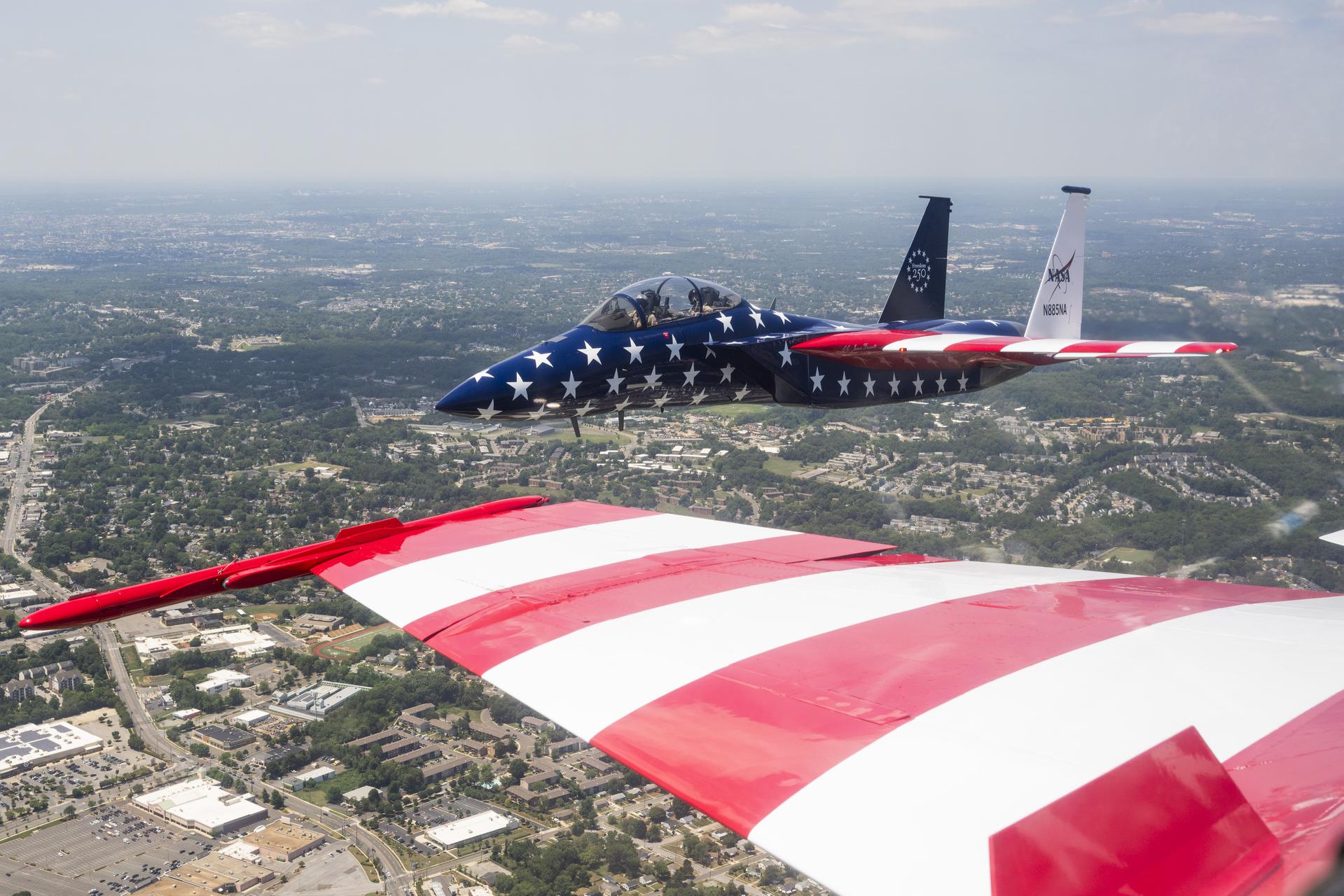
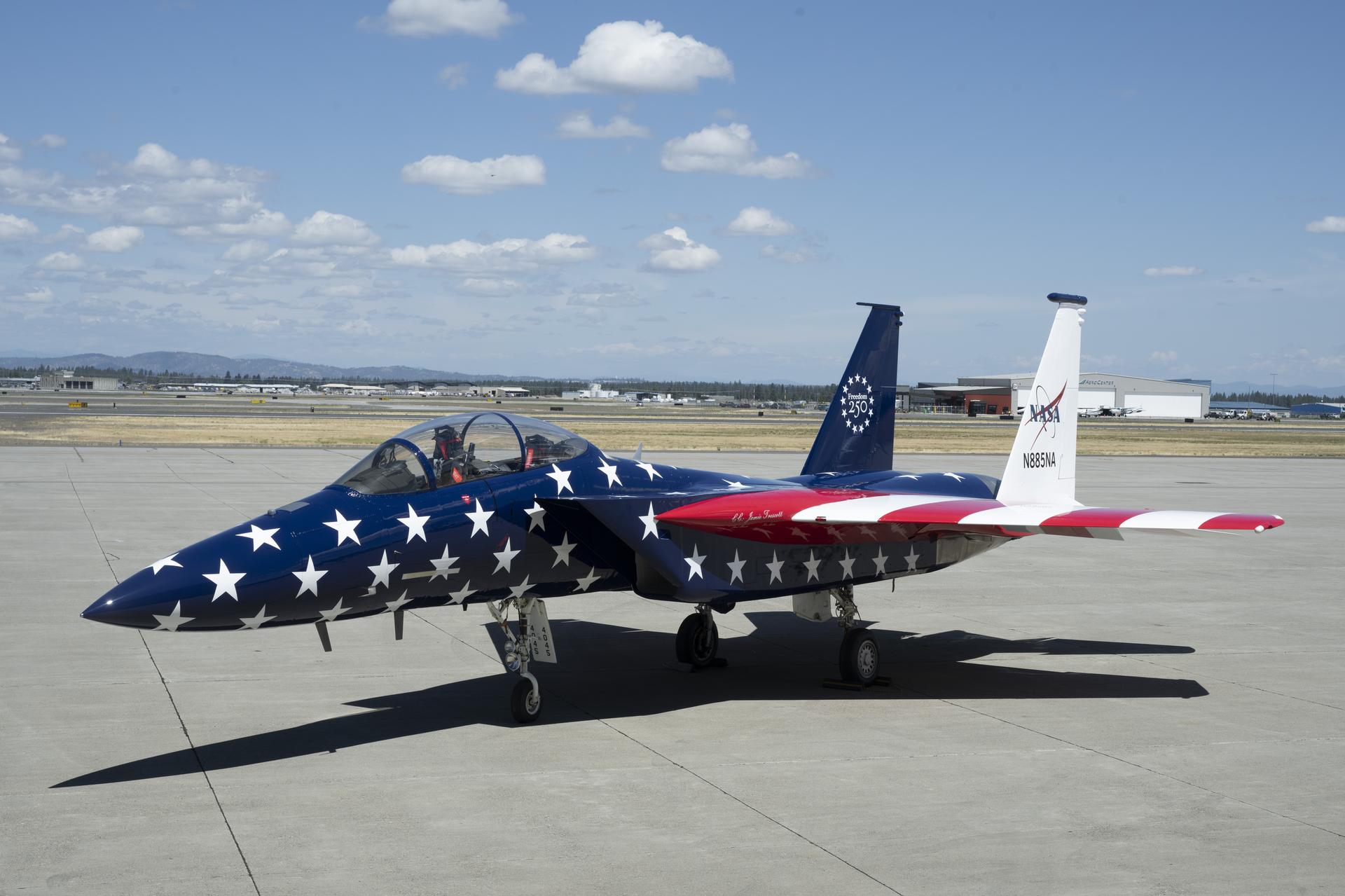
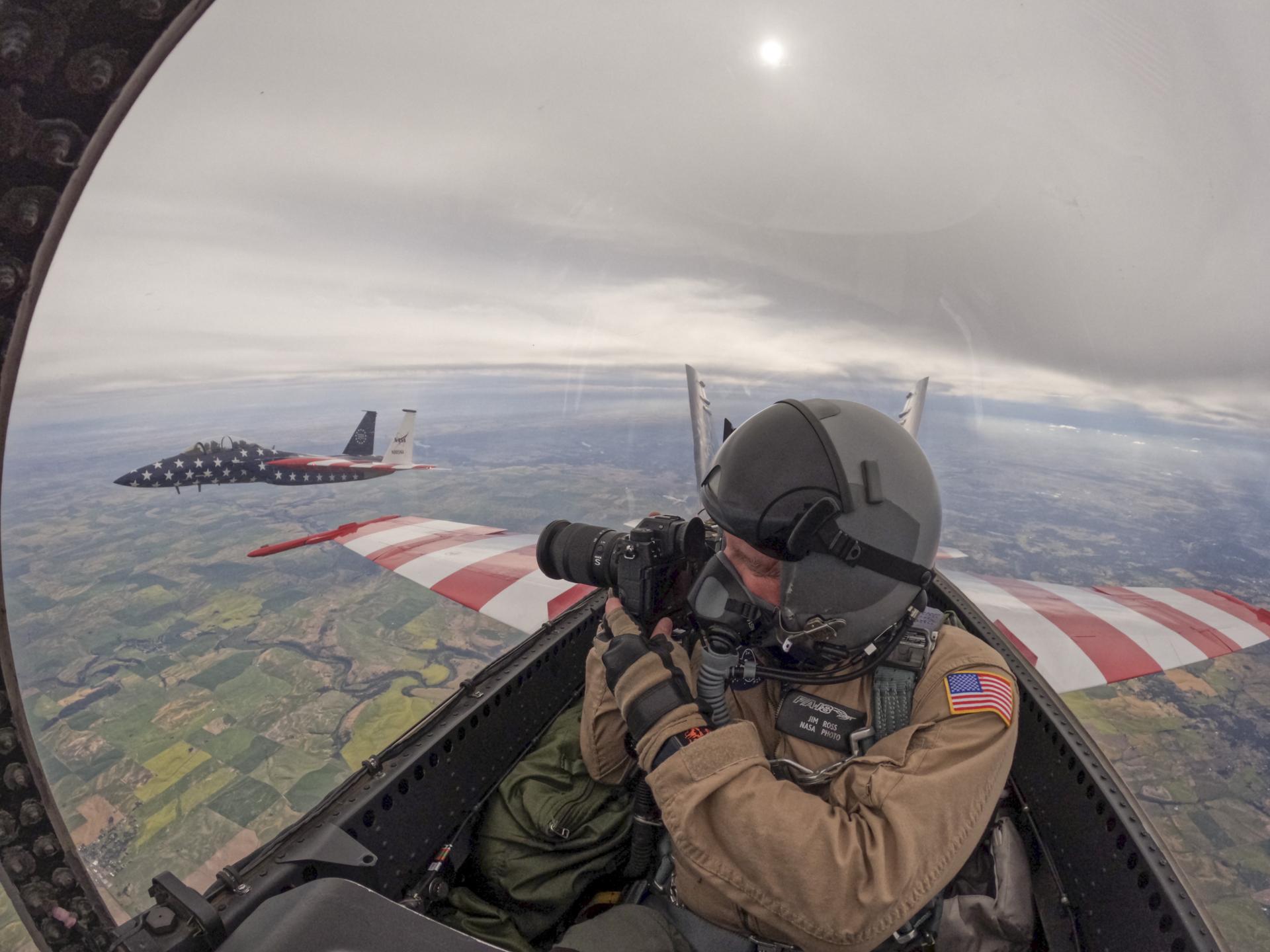
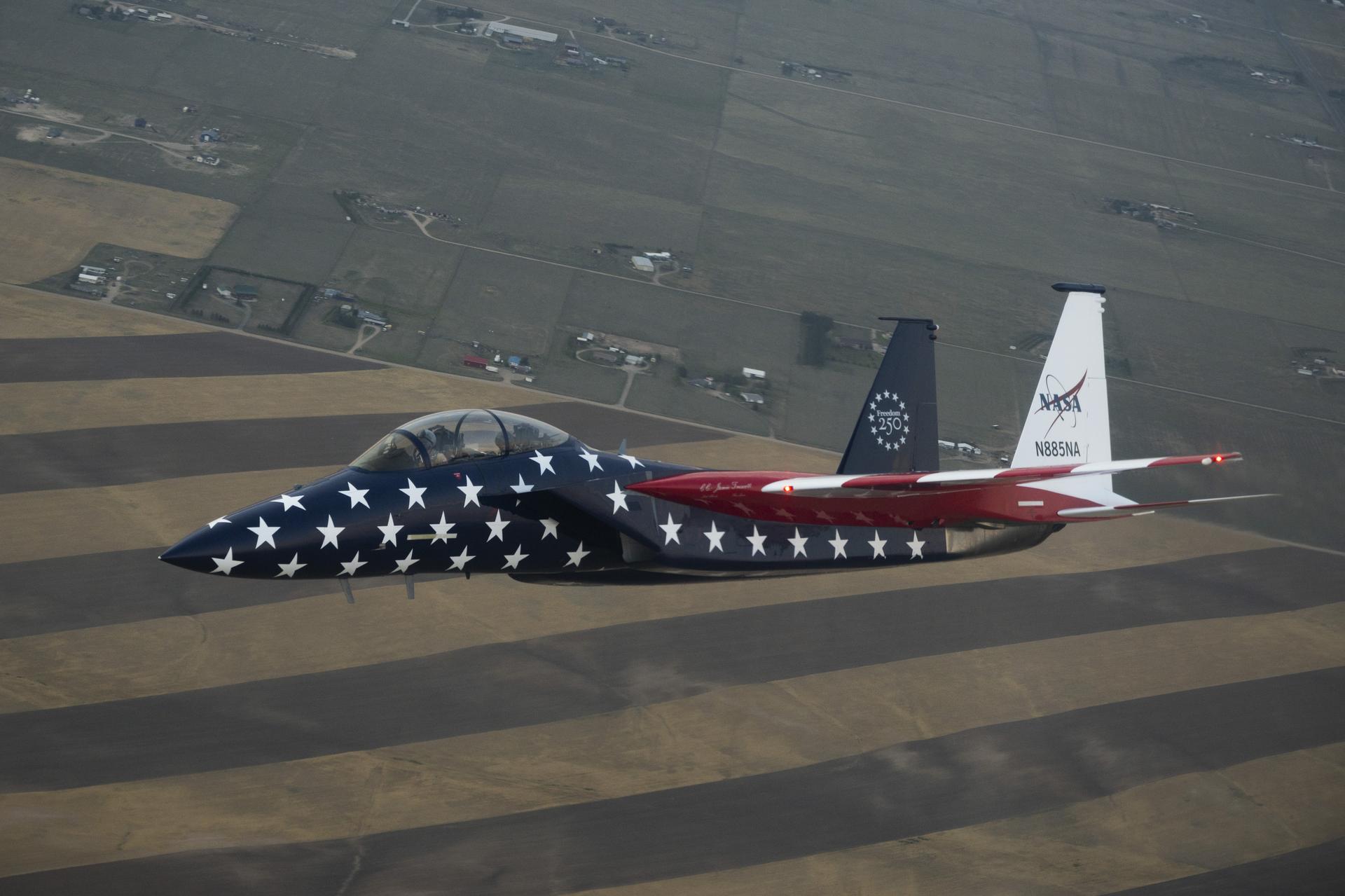
The No Chase COA (NCC) team at NASA Armstrong Flight Research Center pose for a group photo with the unmanned aircraft system the Ikhana.
NASA’s AFRC No Chase COA Team
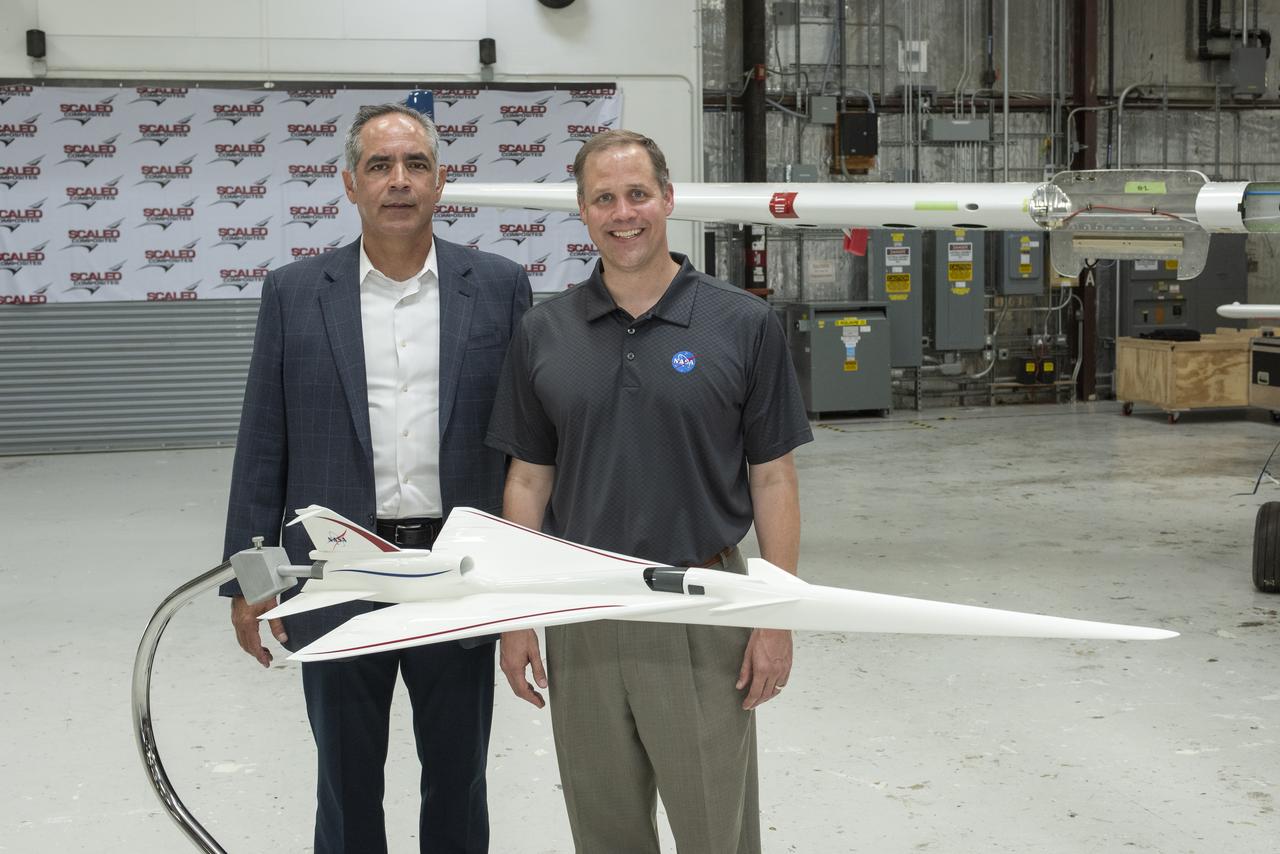
NASA Administrator Bridenstine stands with AFRC center director McBride by model NASA's Supersonic X-Plane, X-59 Quiet Supersonic Technology or QueSST. Bridenstine spoke at press event at Mojave Air and Space Port in California. The goal of X-59 is to quiet the sound when aircraft pierce the speed of sound and make a loud sonic boom on the ground.
NASA Administrator Bridenstine and Armstrong Flight Research Center's Center Director McBride stand beside model of NASA's Supersonic X-Plane, X-59 Quiet Supersonic Technology or QueSST at press event in Mojave Air & Space Port in California
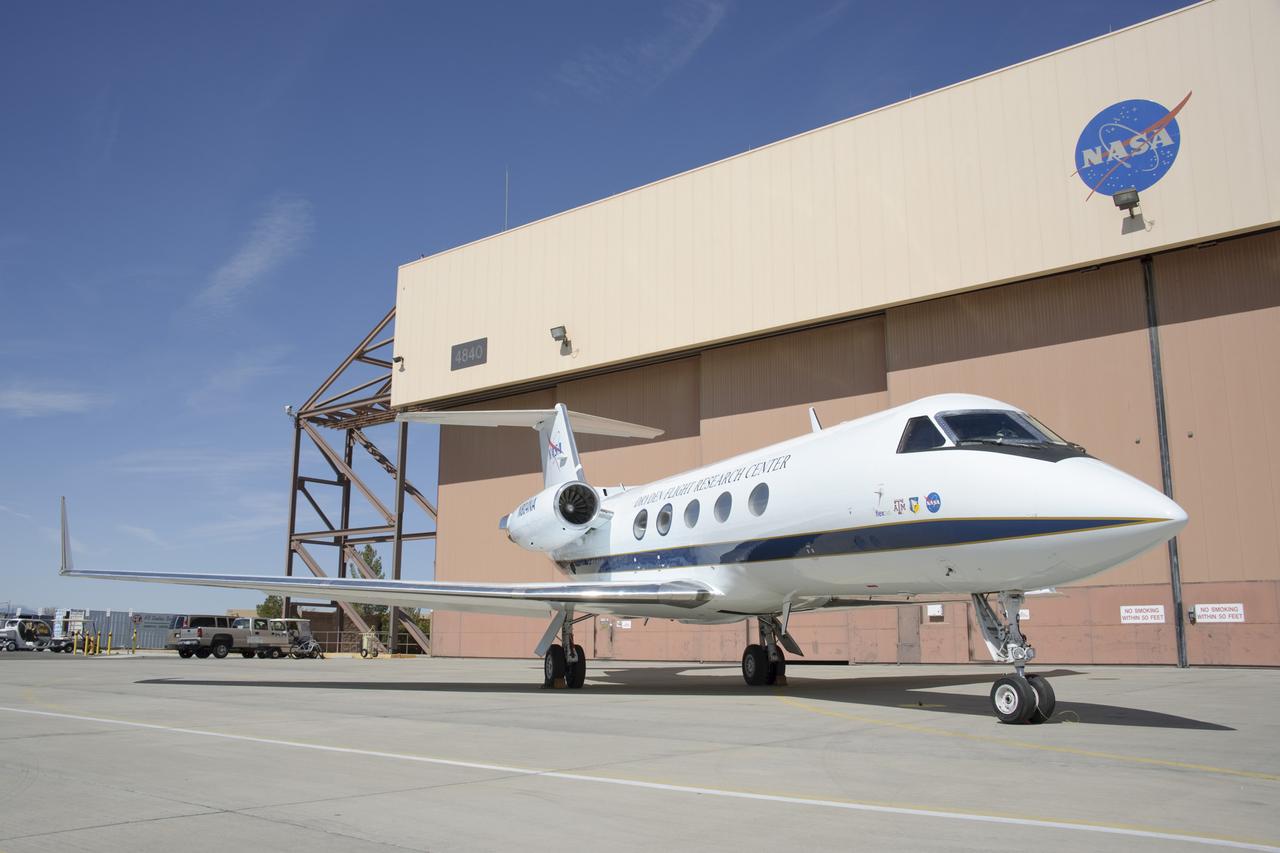
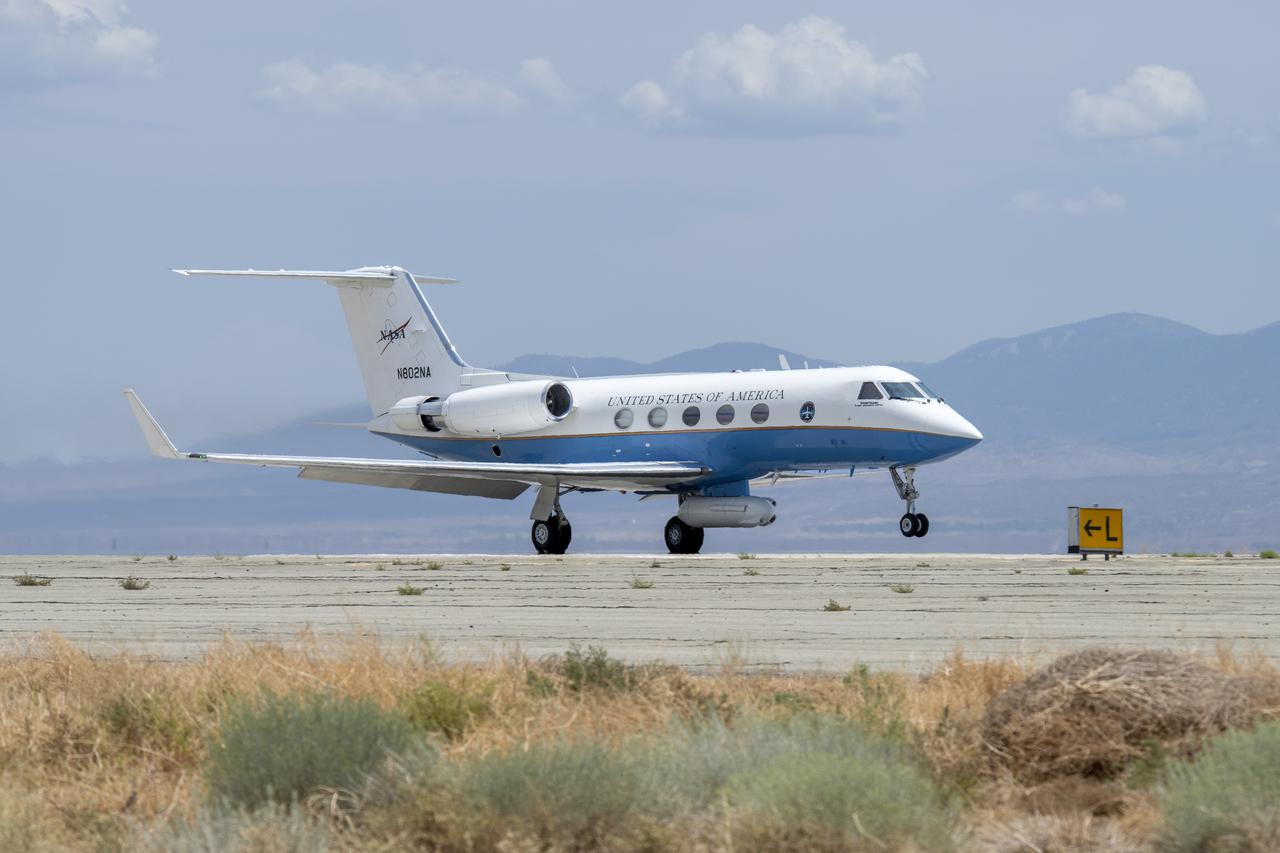
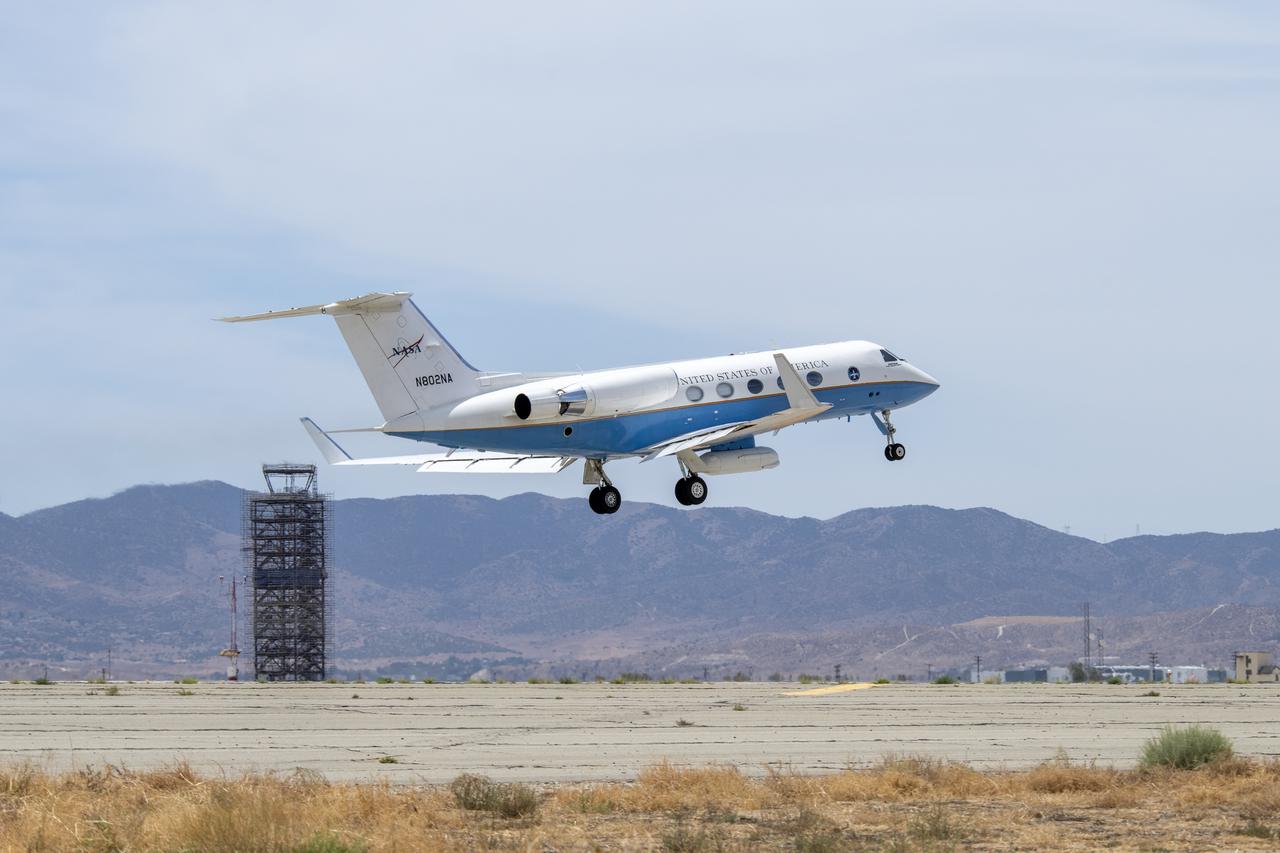
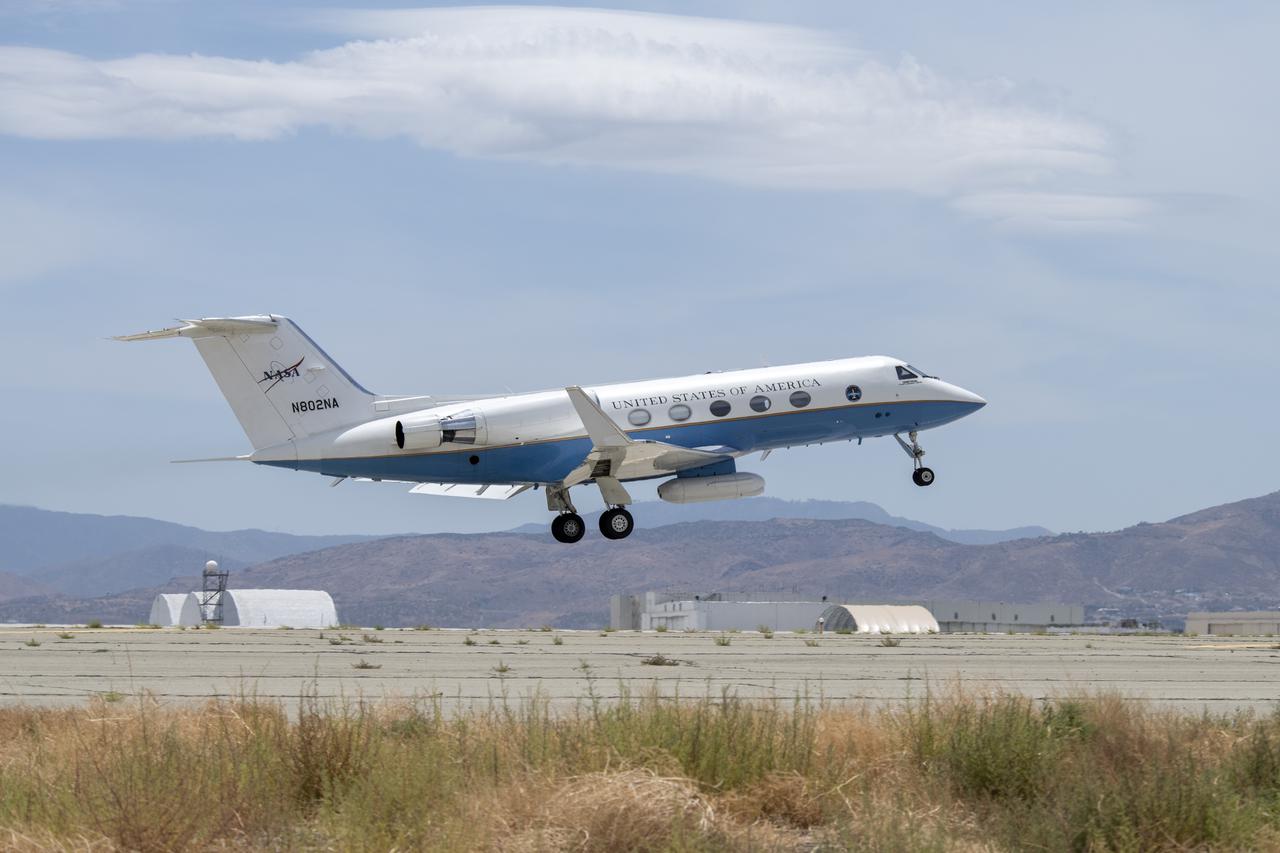
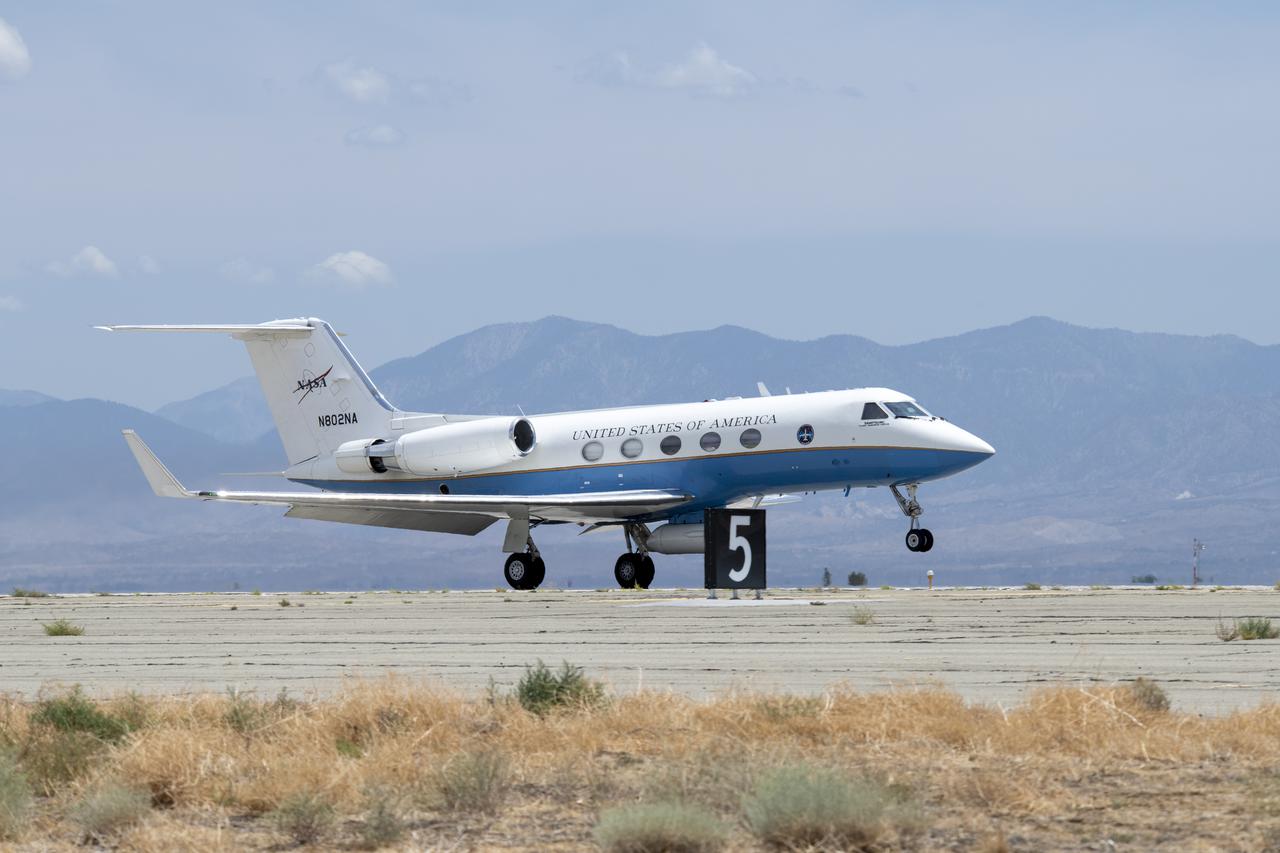
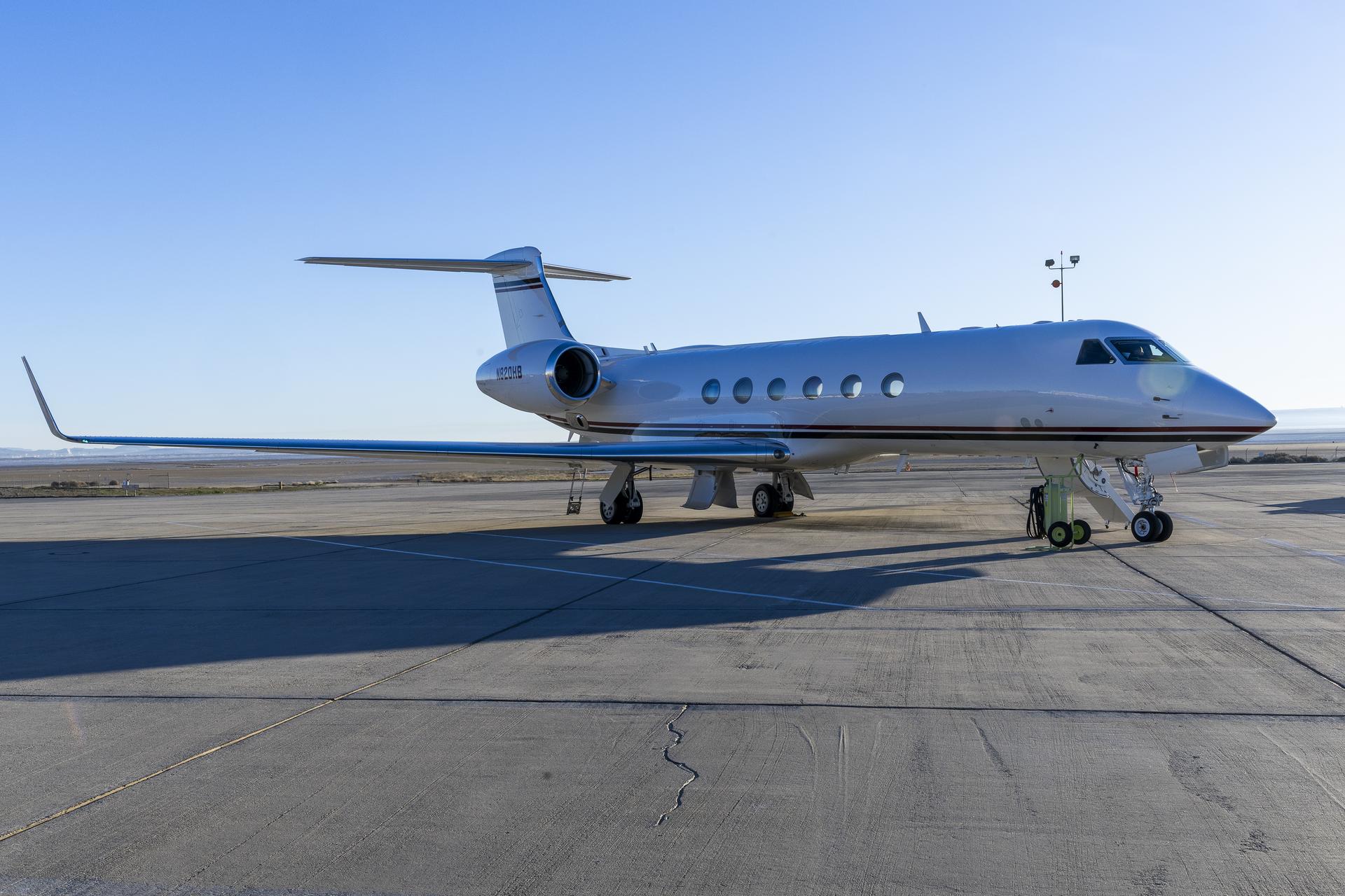
NASA’s Subsonic Research Aircraft Testbed, or SCRAT, is a modified Gulfstream III that operates out of Armstrong Flight Research Center in Edwards, California. SCRAT the test bed aircraft for the ACTE flexible-flap research project, which examines flexible wing flap technology’s benefits to aerodynamic efficiency.
ED11-0072-14
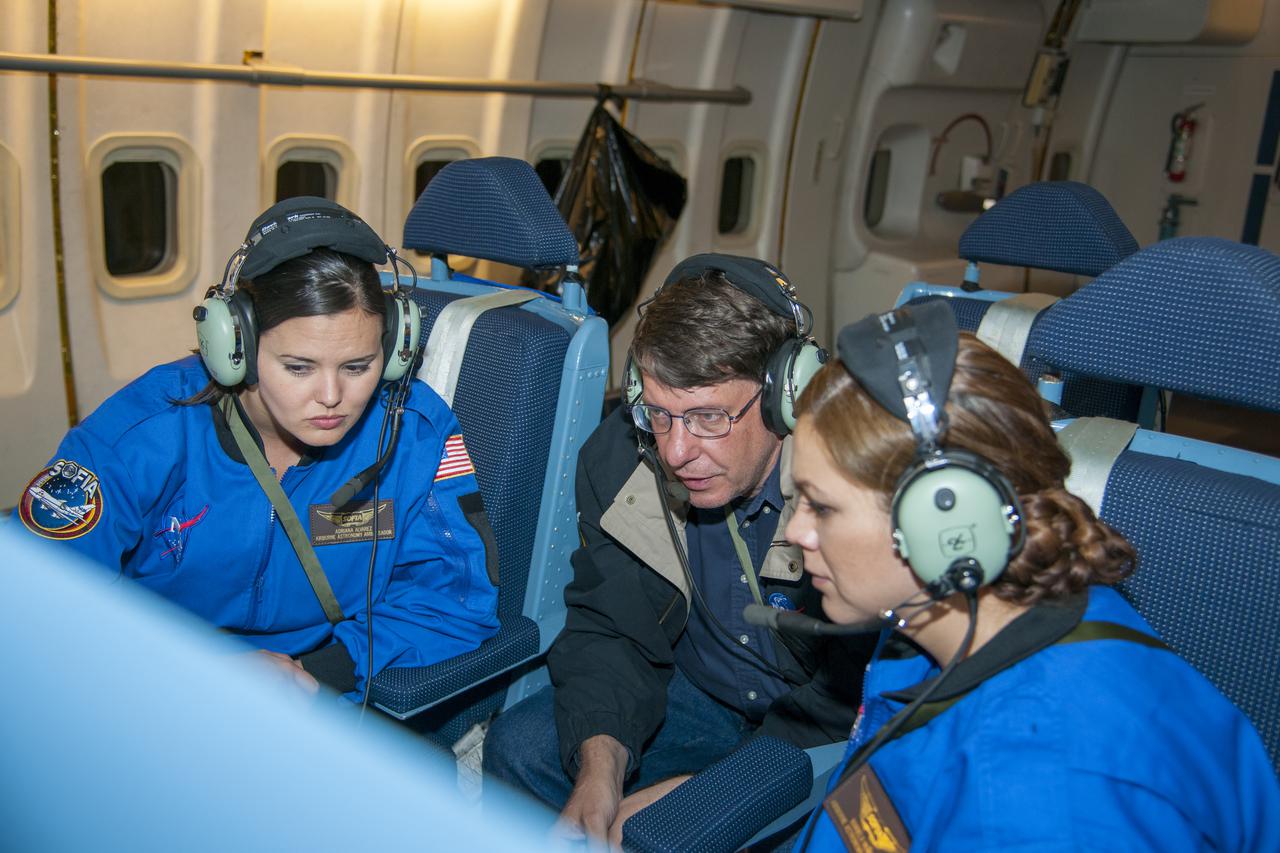
Dana Backamn explains SOFIA’s observations during a flight with Airborne Astronomy Ambassador educators Adriana Alvarez and Mariela Muñoz.
SOFIA Observations Explained
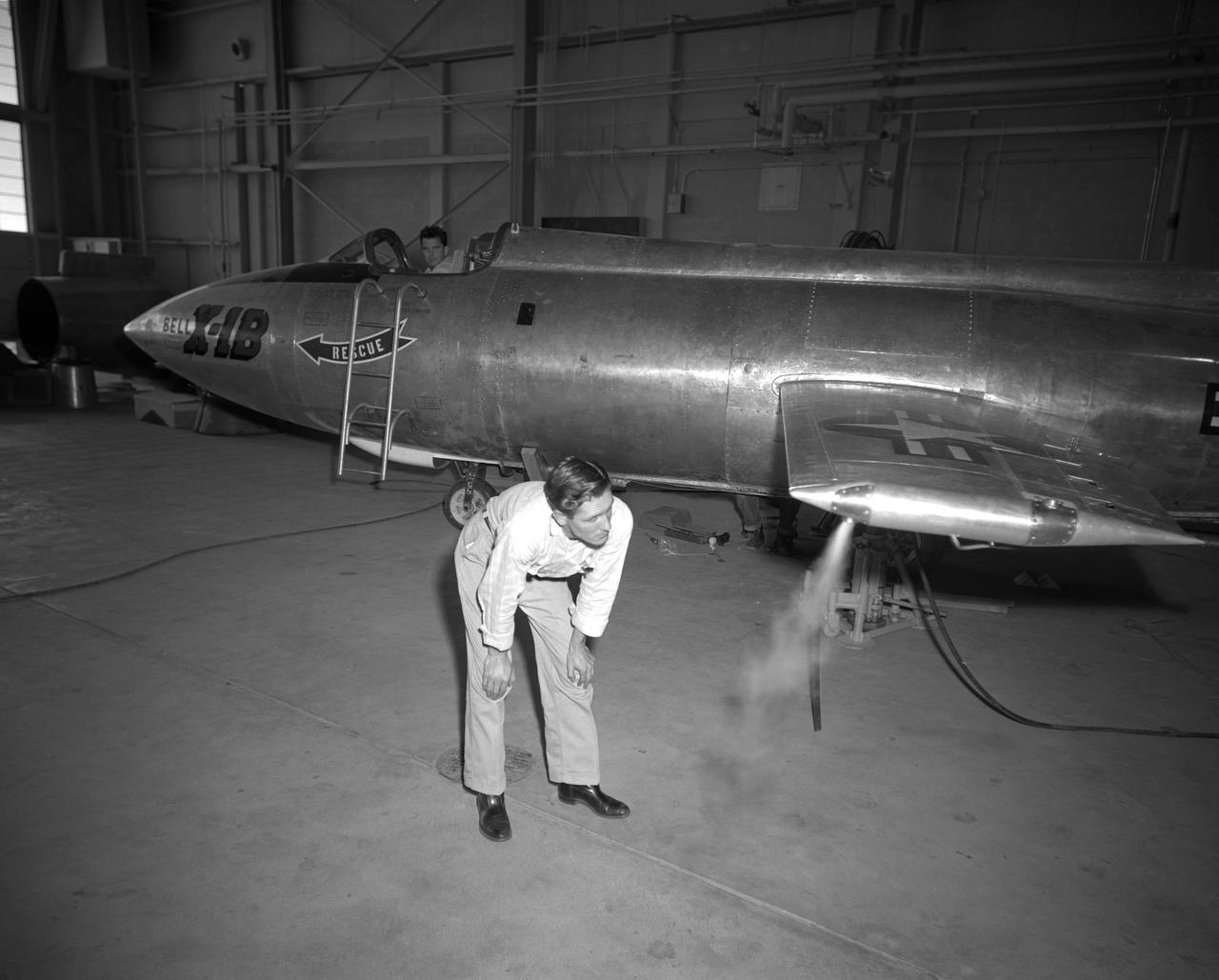
The X-1B reaction control system thrusters are tested in 1958 and later proven on the X-15 as a way to control a vehicle in the absence of dynamic pressure.
NASA Armstrong Celebrates 70 Years of Flight Research
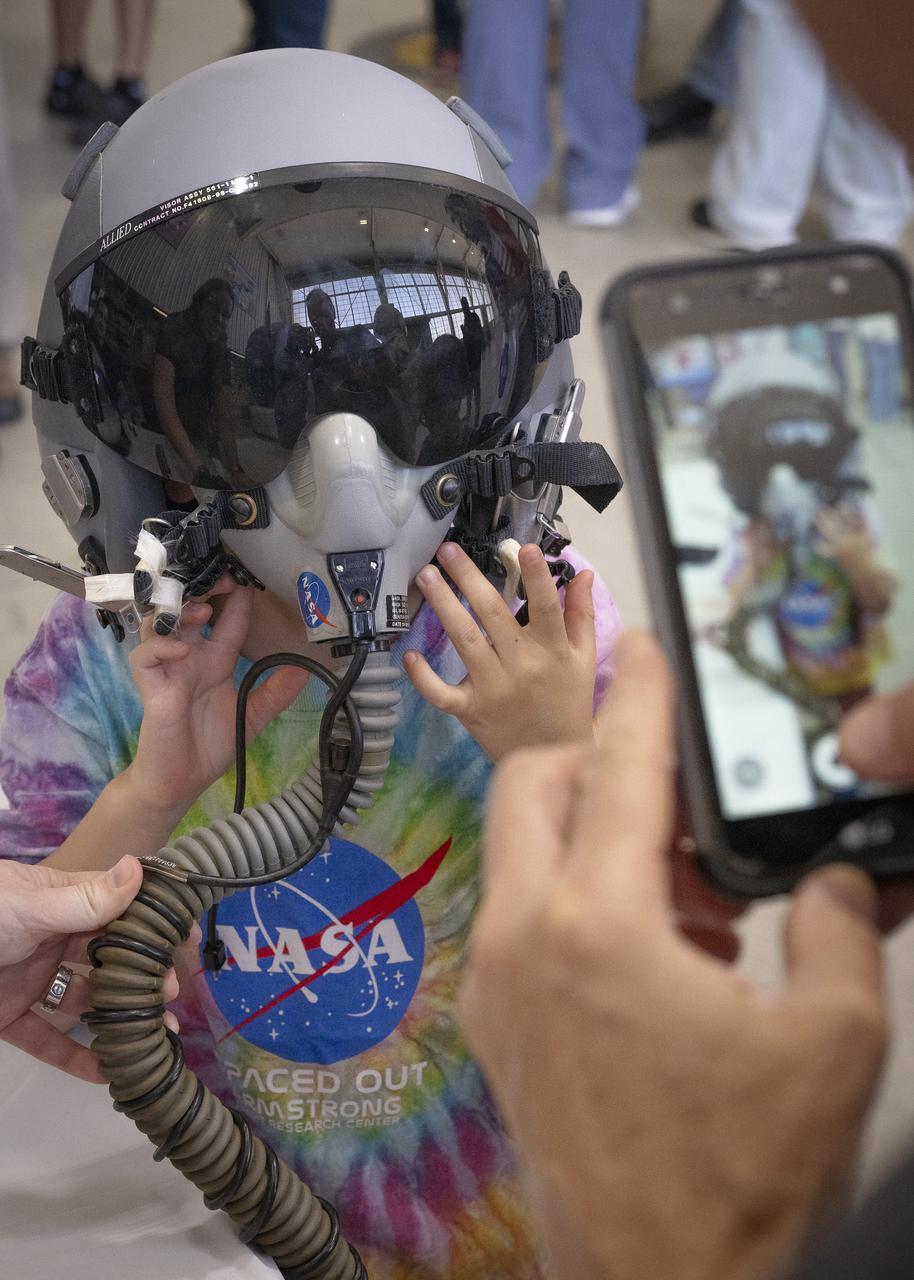
On June 17, 2025, NASA’s Armstrong Flight Research Center in Edwards, California, hosted Bring Kids to Work Day, offering hands-on activities that introduced children and their families to the exciting world of aeronautics and flight research.
NASA Armstrong Bring Kids to Work Day 2025
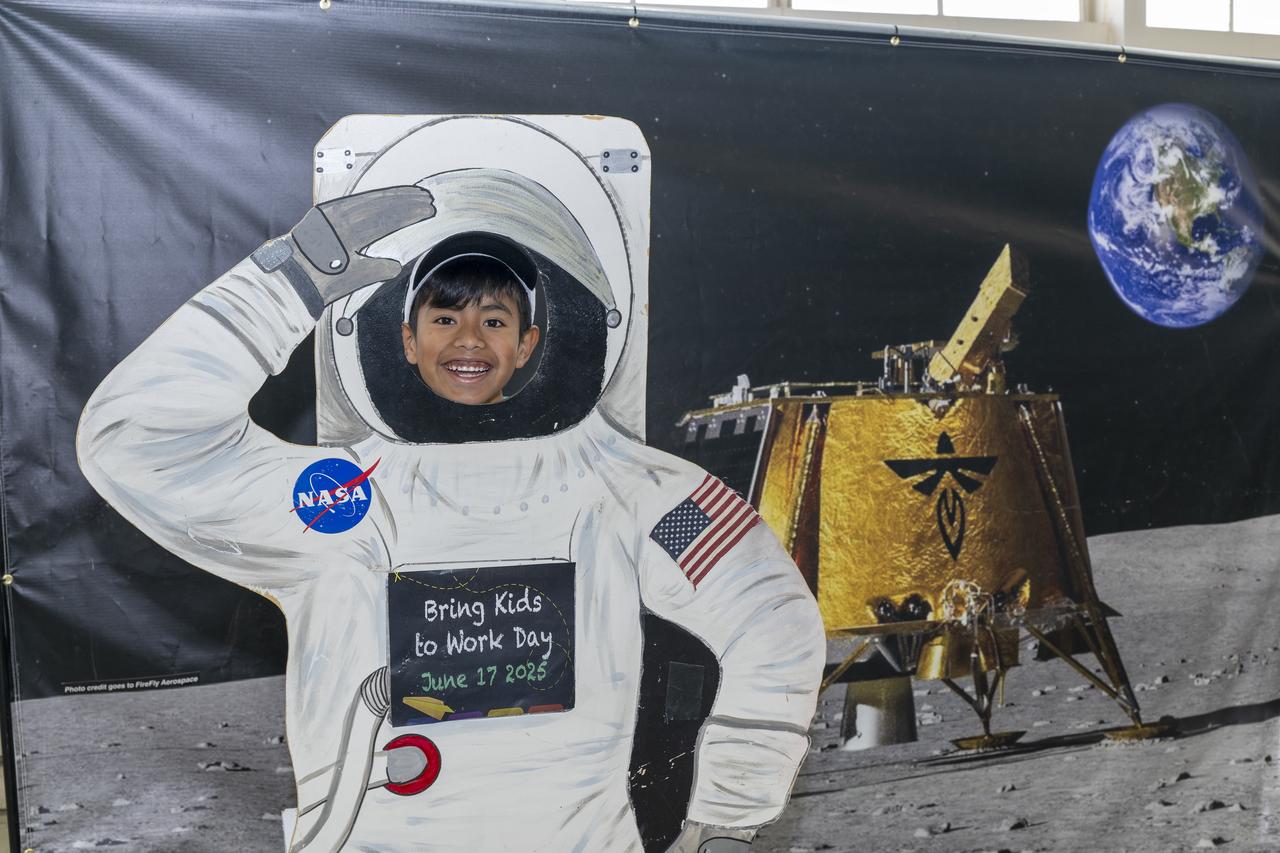
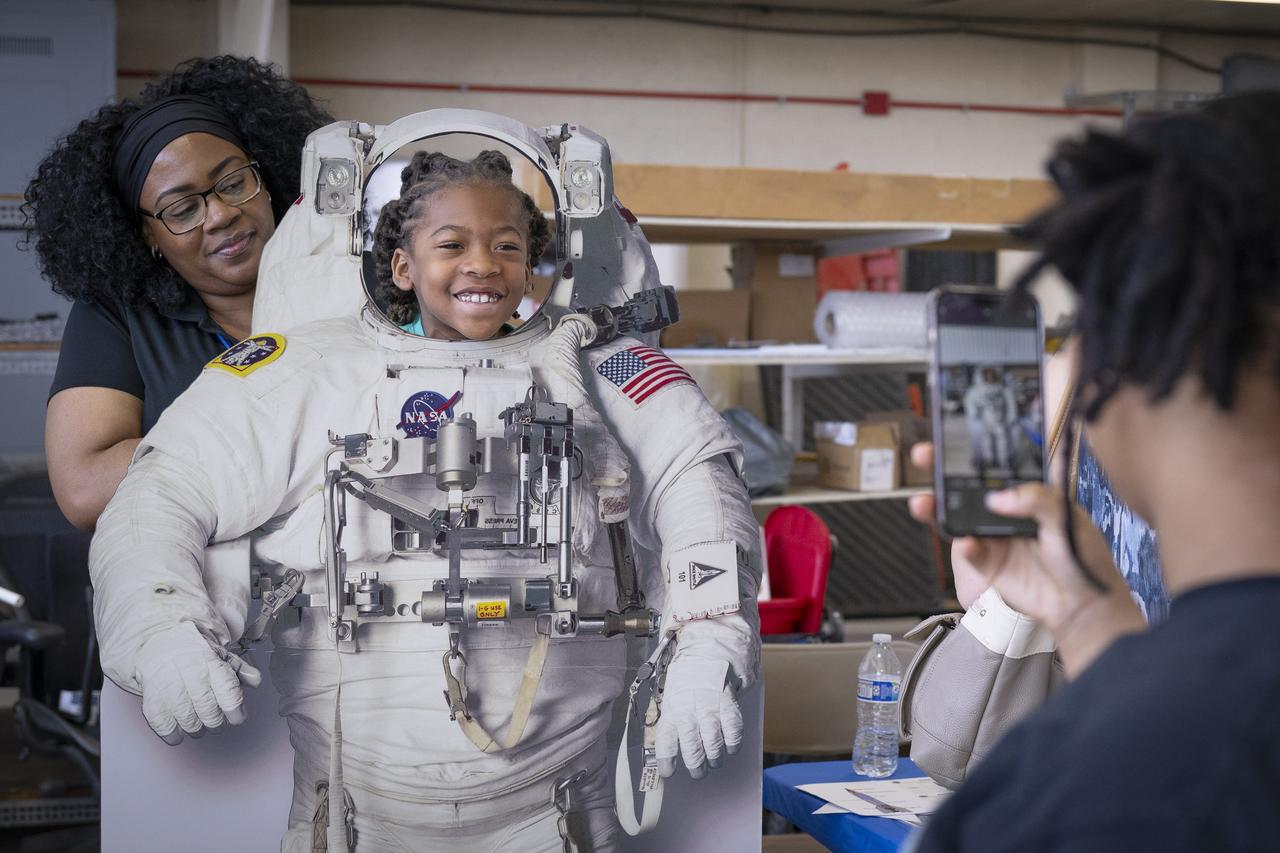
A child poses in an astronaut cutout suit during Bring Kids to Work Day on June 17, 2025, at NASA’s Armstrong Flight Research Center in Edwards, California. The event offered children and their families an up-close look at the center’s research aircraft and engaged them in educational activities promoting science, technology, engineering, and mathematics.
NASA Armstrong Bring Kids to Work Day 2025
On June 17, 2025, NASA’s Armstrong Flight Research Center in Edwards, California, hosted Bring Kids to Work Day, offering hands-on activities that introduced children and their families to the exciting world of aeronautics and flight research.
NASA Armstrong Bring Kids to Work Day 2025
On June 17, 2025, NASA’s Armstrong Flight Research Center in Edwards, California, hosted Bring Kids to Work Day, offering hands-on activities that introduced children and their families to the exciting world of aeronautics and flight research.
NASA Armstrong Bring Kids to Work Day 2025
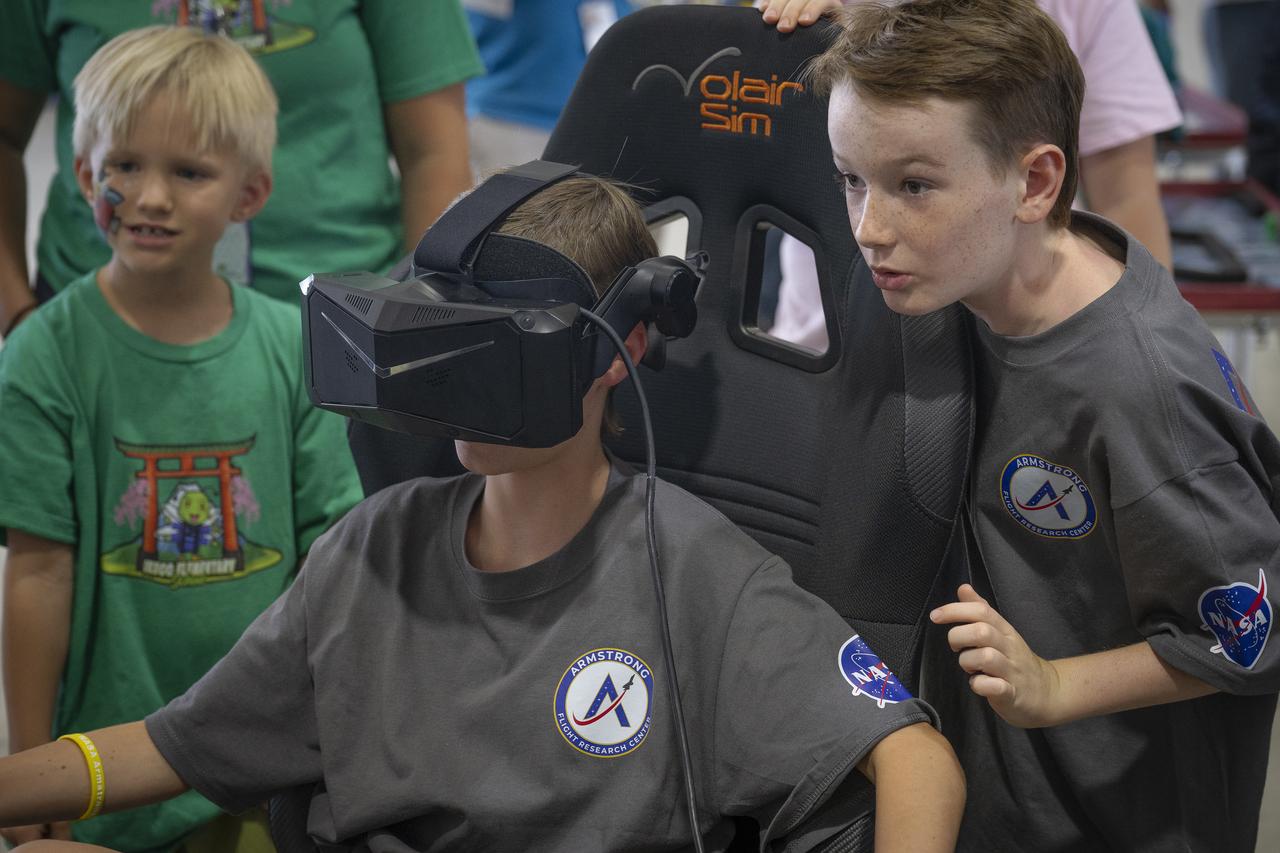
Children explore a virtual reality flight simulator during Bring Kids to Work Day on June 17, 2025, at NASA’s Armstrong Flight Research Center in Edwards, California. The immersive experience introduced participants to aerospace engineering and flight research in an engaging, hands-on environment.
NASA Armstrong Bring Kids to Work Day 2025
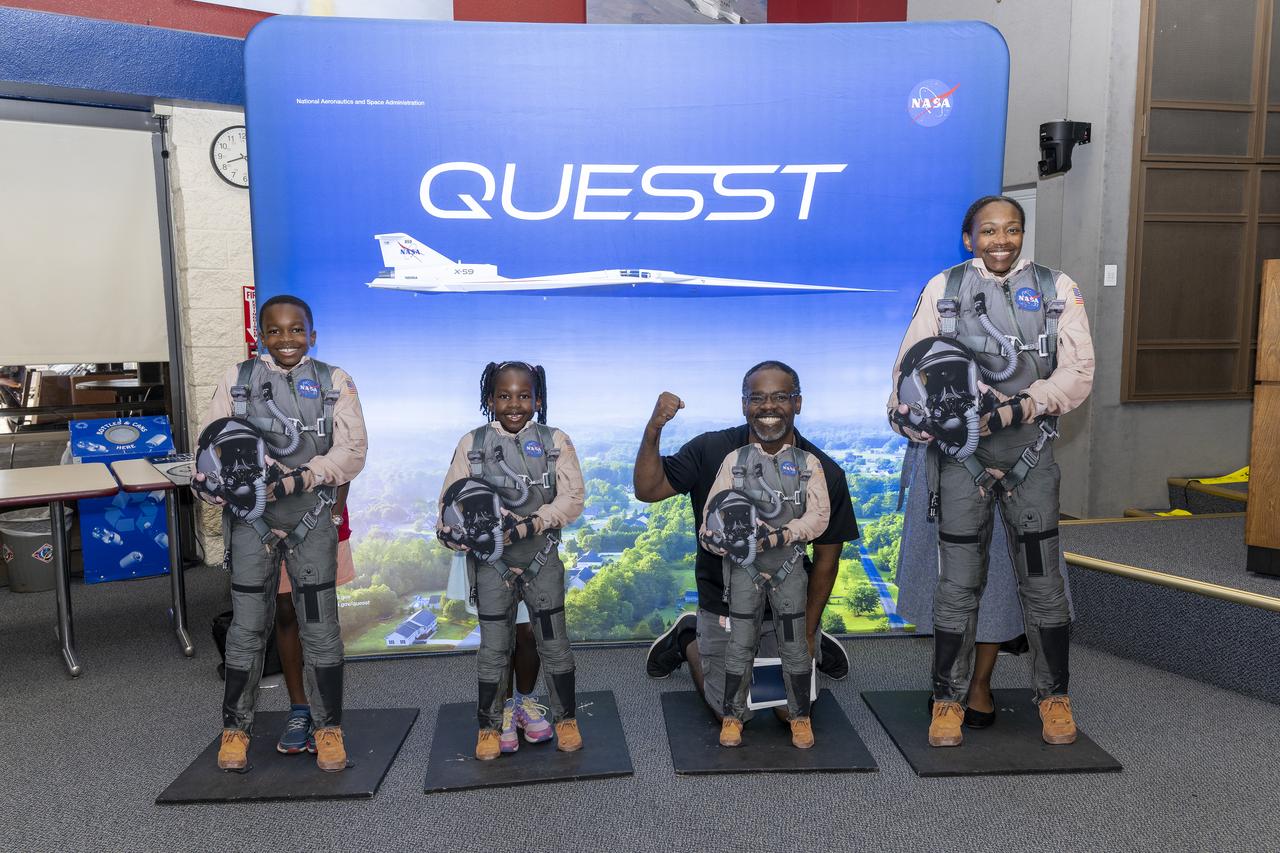
During Bring Kids to Work Day at NASA’s Armstrong Flight Research Center in Edwards, California, on June 17, 2025, participants pose with flight suit cutouts in front of NASA’s Quesst display. NASA's Quesst mission, which features the agency’s X-59 quiet supersonic experimental aircraft, will demonstrate technology to fly supersonic, or faster than the speed of sound, without generating loud sonic booms.
NASA Armstrong Bring Kids to Work Day 2025
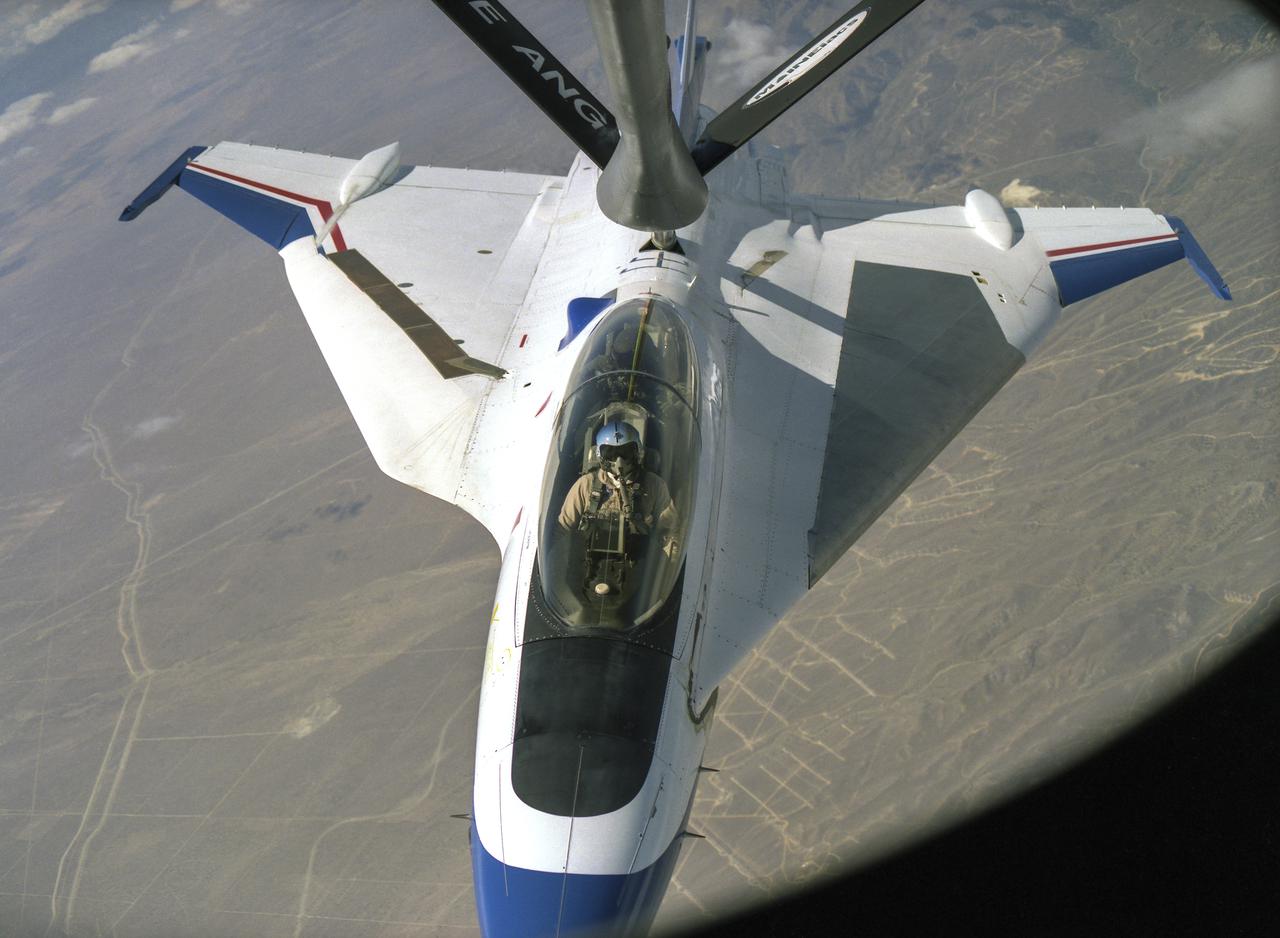
An F-16XL refuels in-flight. Only two XLs were built, and NASA eventually operated both for experimental purposes, including an active supersonic laminar flow experiment.
F-16XL Refuels In-Flight
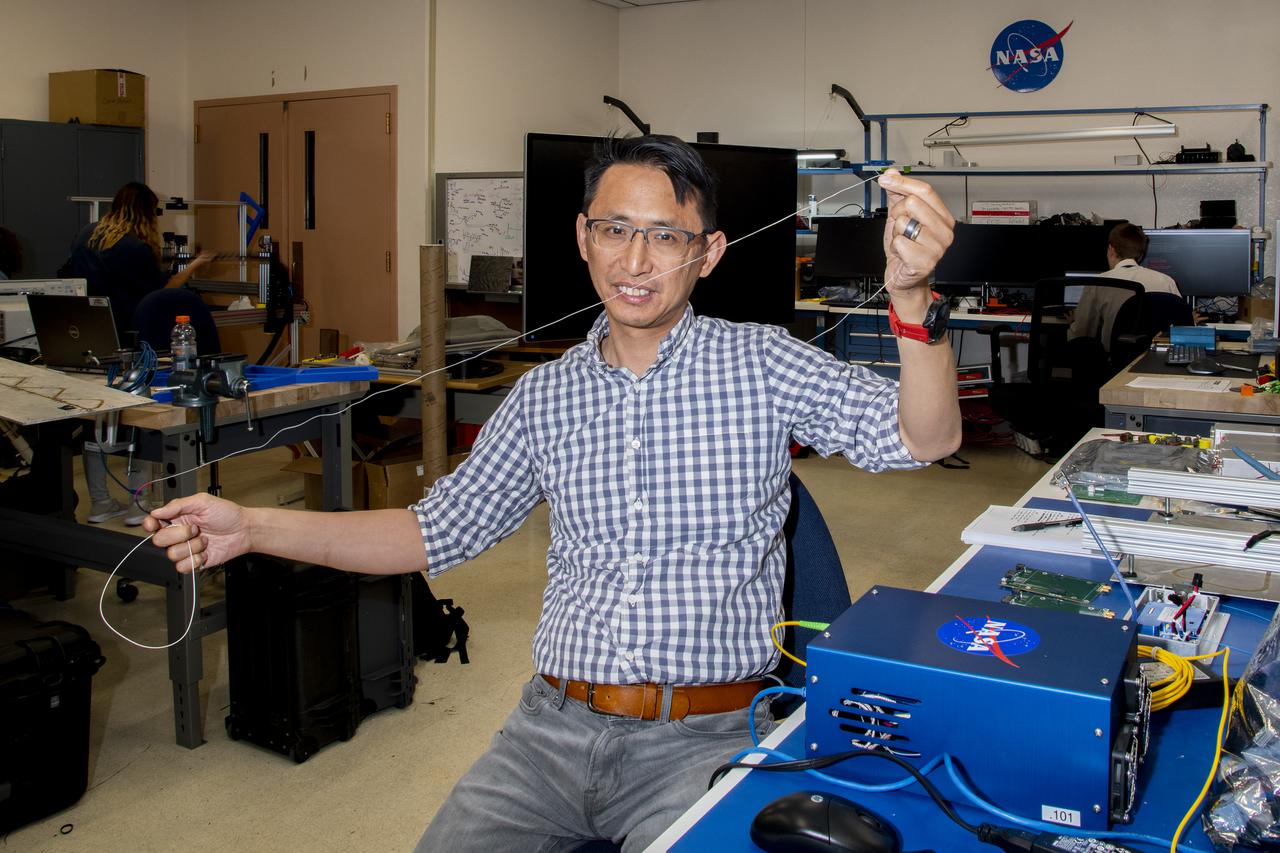
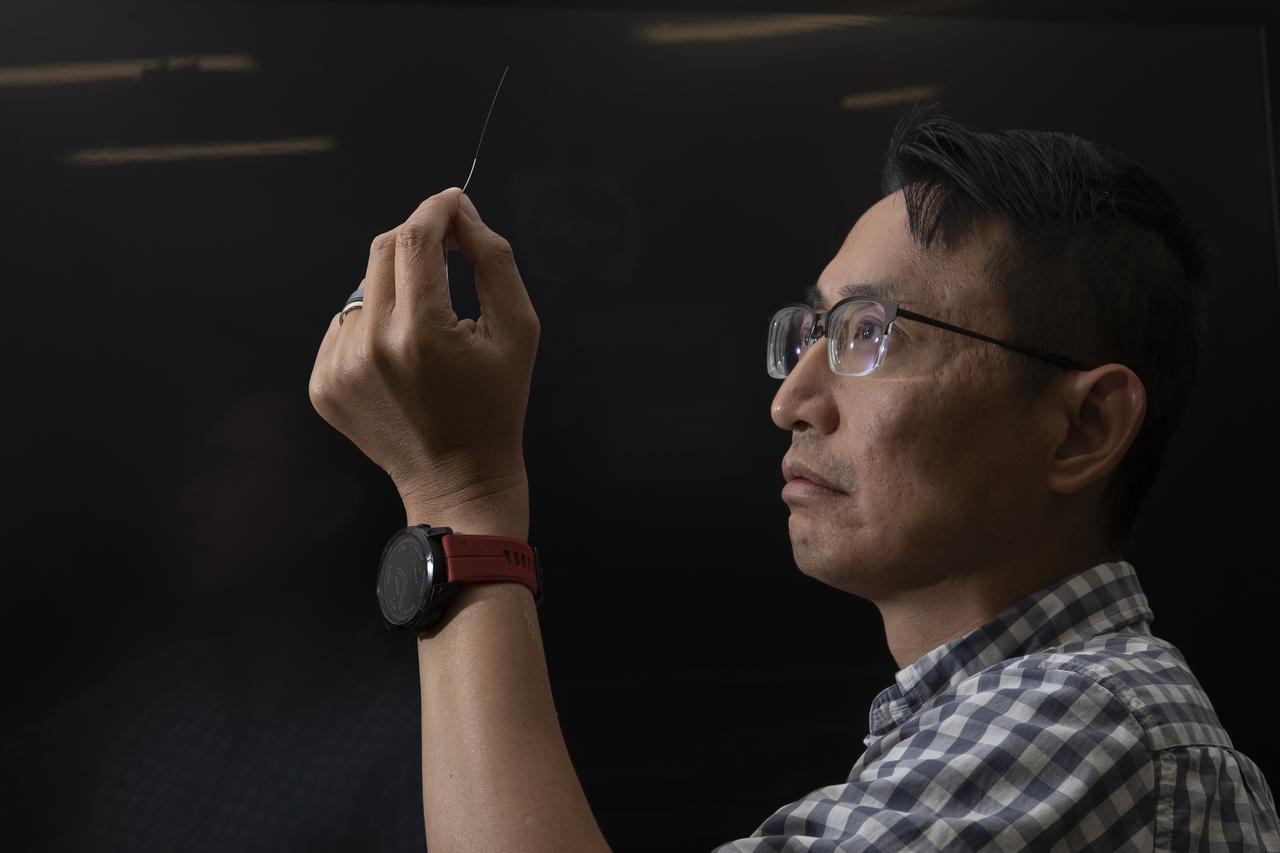
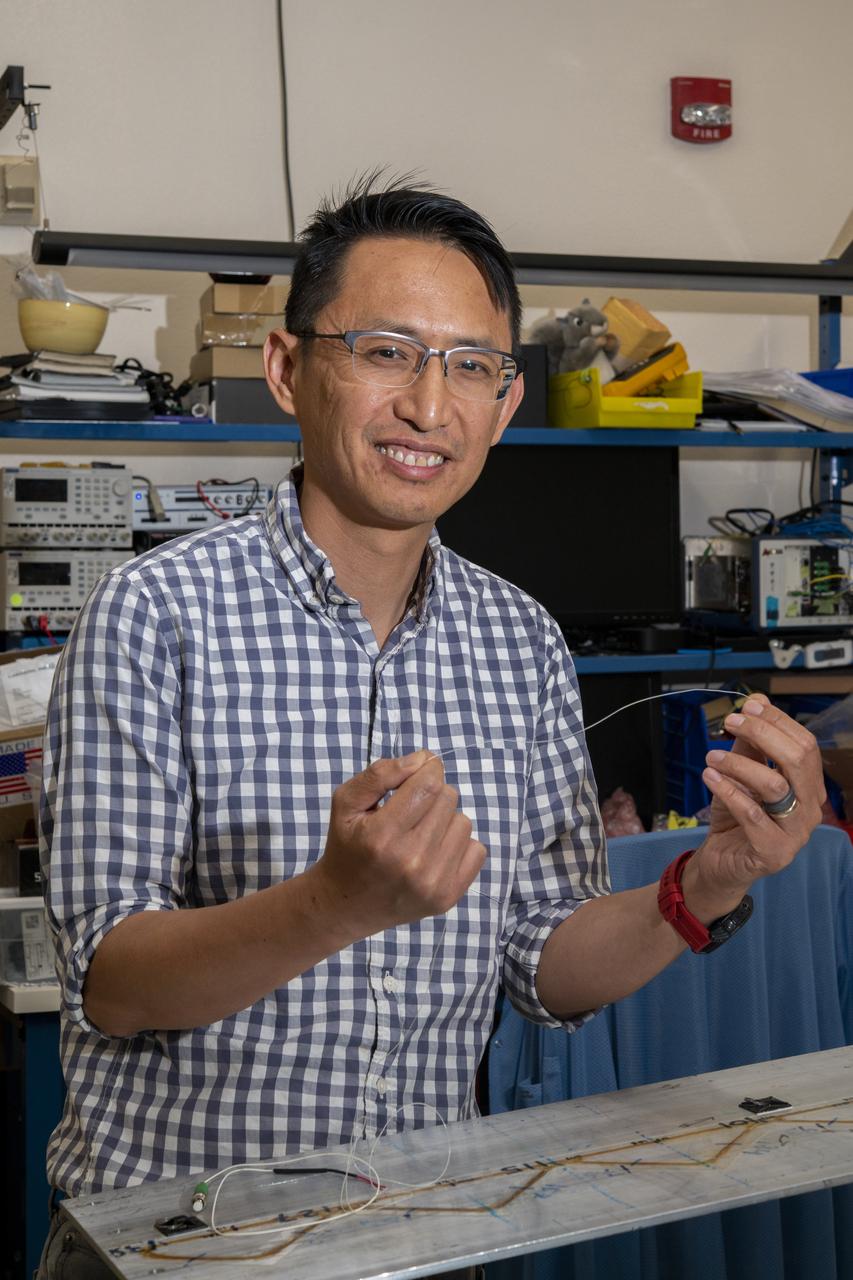
Patrick Chan, electronics engineer, and NASA Armstrong Flight Research Center’s FOSS portfolio project manager, shows a fiber used in a temperature sensing system. Armstrong’s Fiber Optic Sensing System was used to measure temperatures during tests aimed at turning oxygen into liquid oxygen. Testing was conducted at NASA’s Glenn Research Center in Cleveland, Ohio.
Helping CryoFILL Turn Oxygen into Fuel
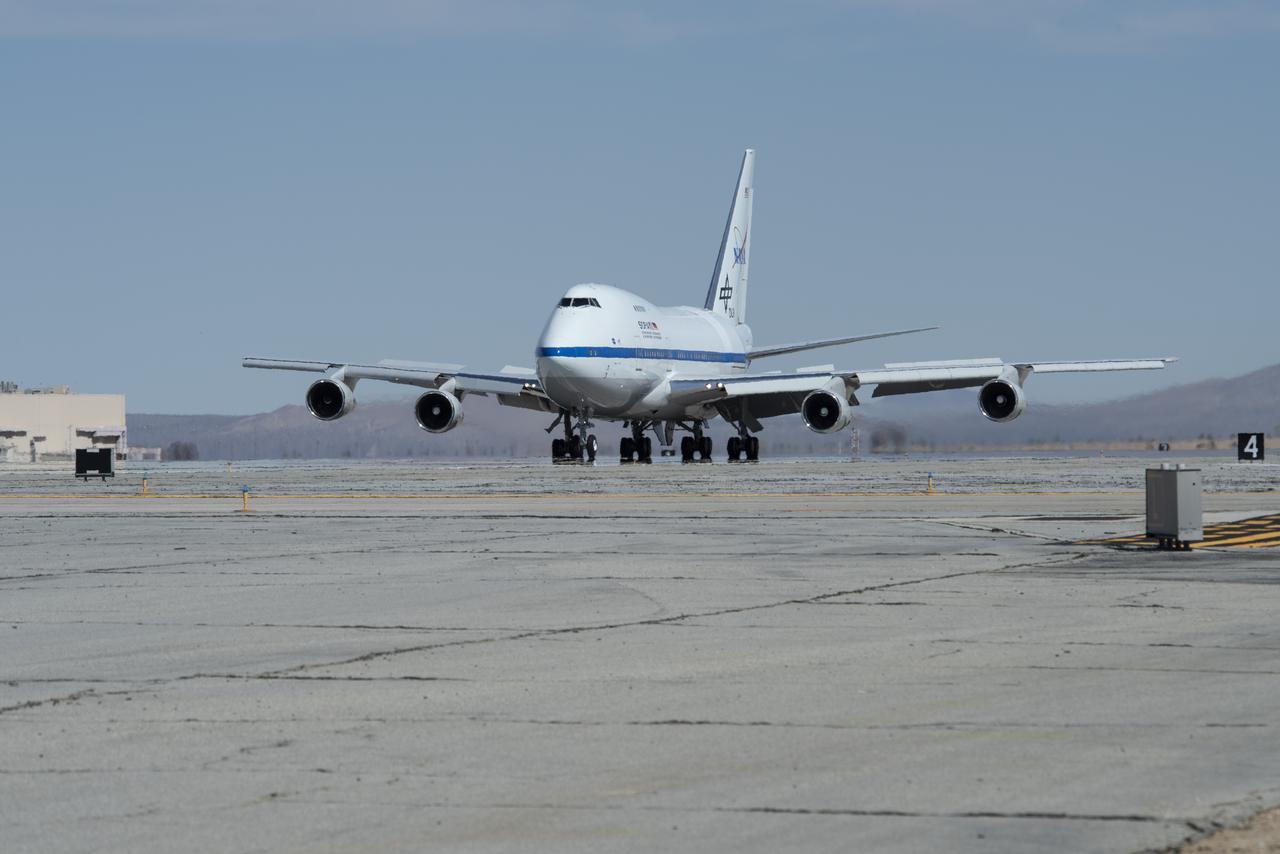
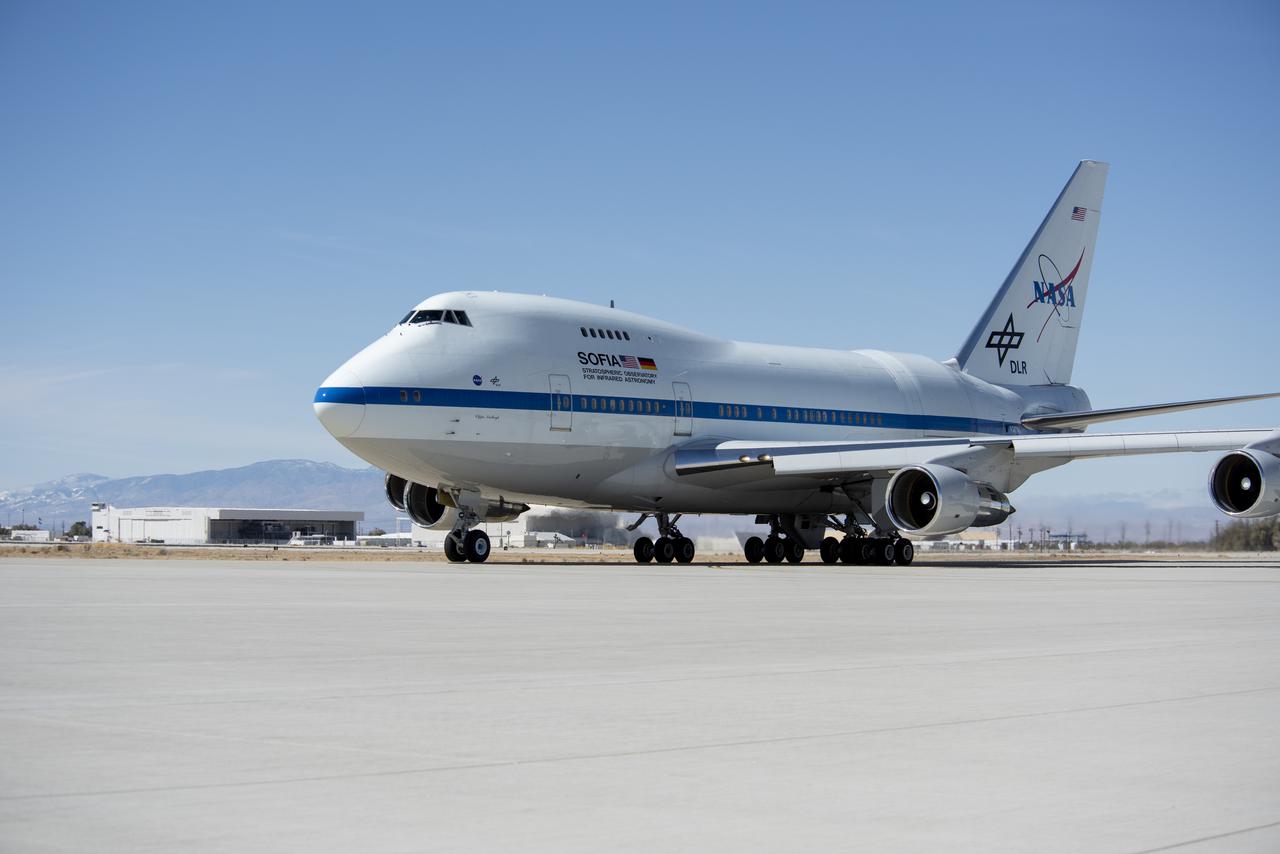
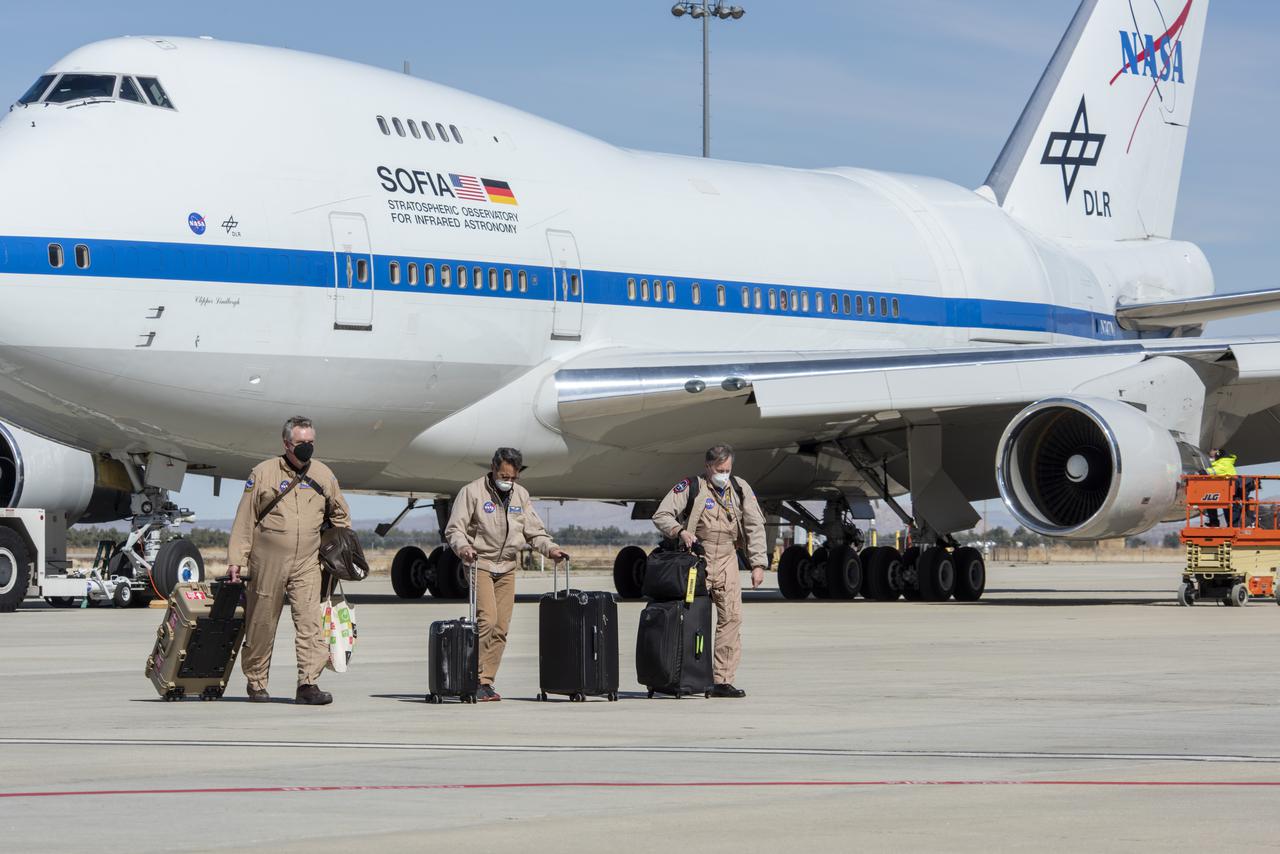
SOFIA Returns to NASA's Armstrong Flight Research Center Building 703 Caption: SOFIA returns to NASA's Armstrong Flight Research Center building 703 in Palmdale, California on March 16, 2021 after spending six months in Germany conducting science observations.
SOFIA Returns to NASA's Armstrong Flight Research Center Building 703
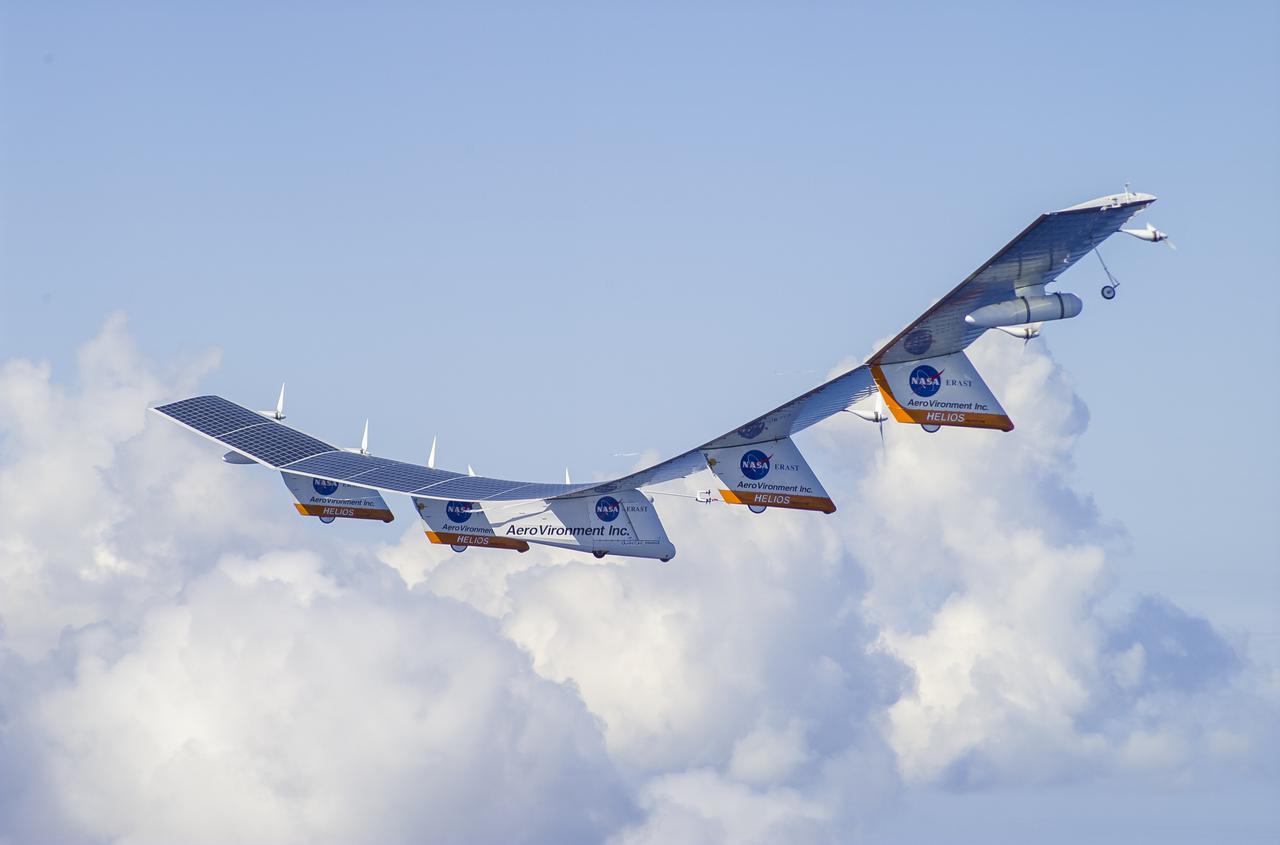
The AeroVironment Helios high-altitude, solar-powered aircraft flies in Kauai, Hawaii. Helios reached 96,300 feet altitude, the record for sustained, level flight for a winged aircraft.
Helios Flies High
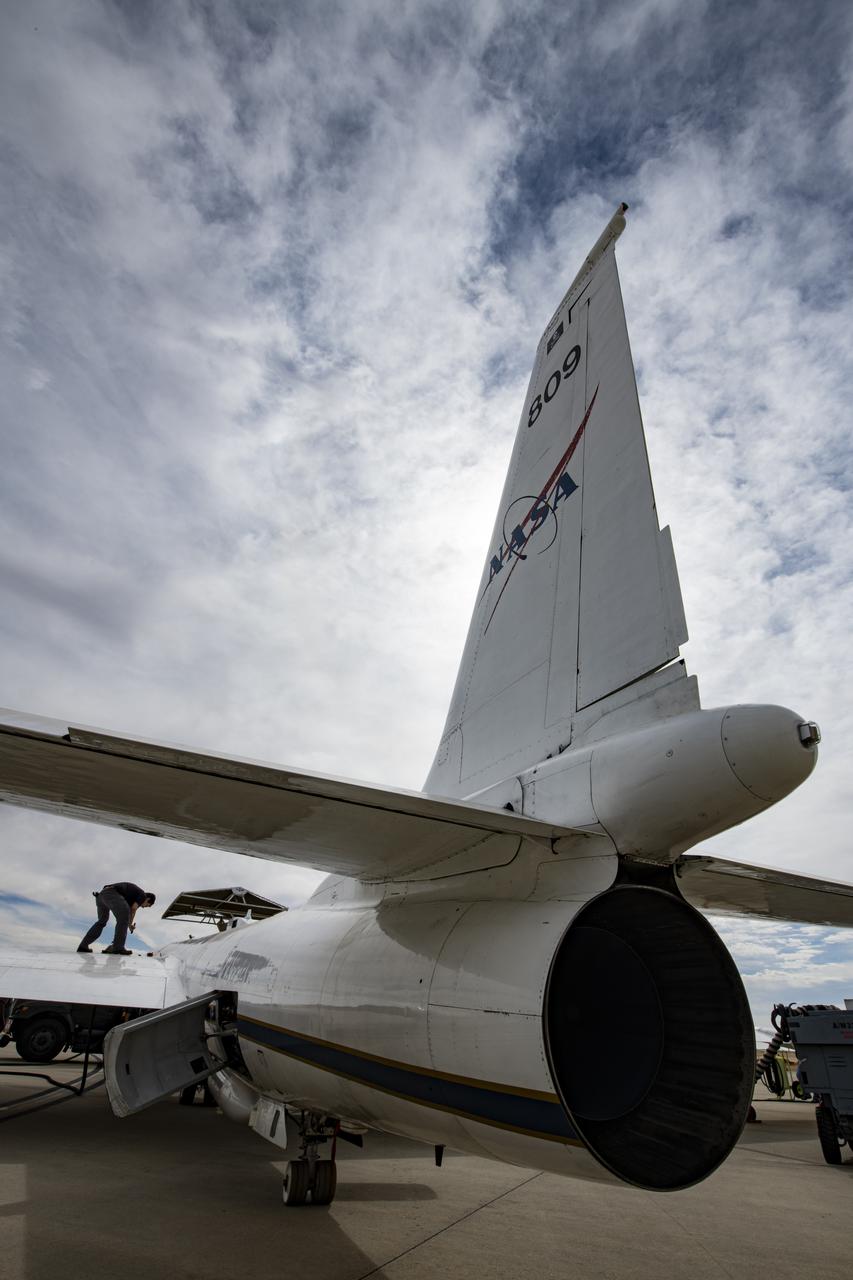
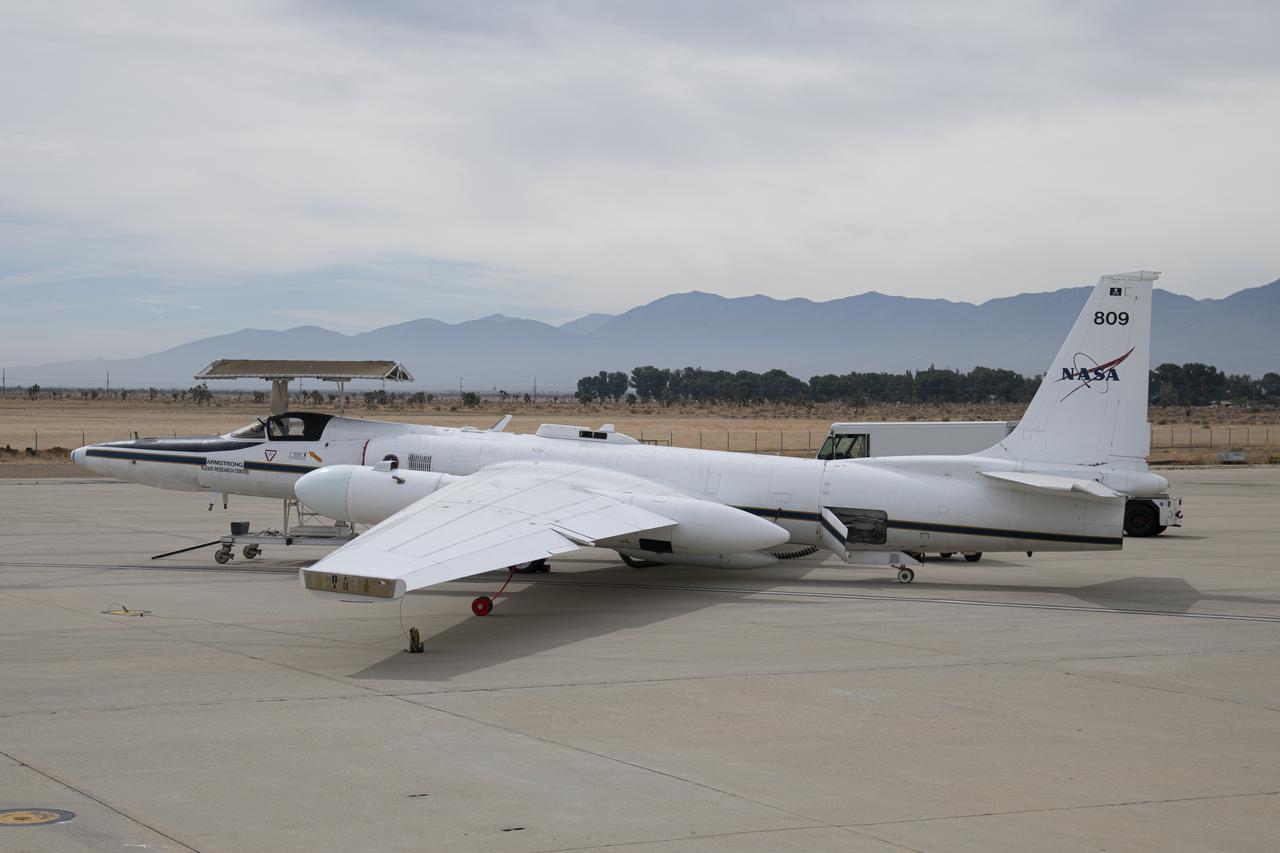
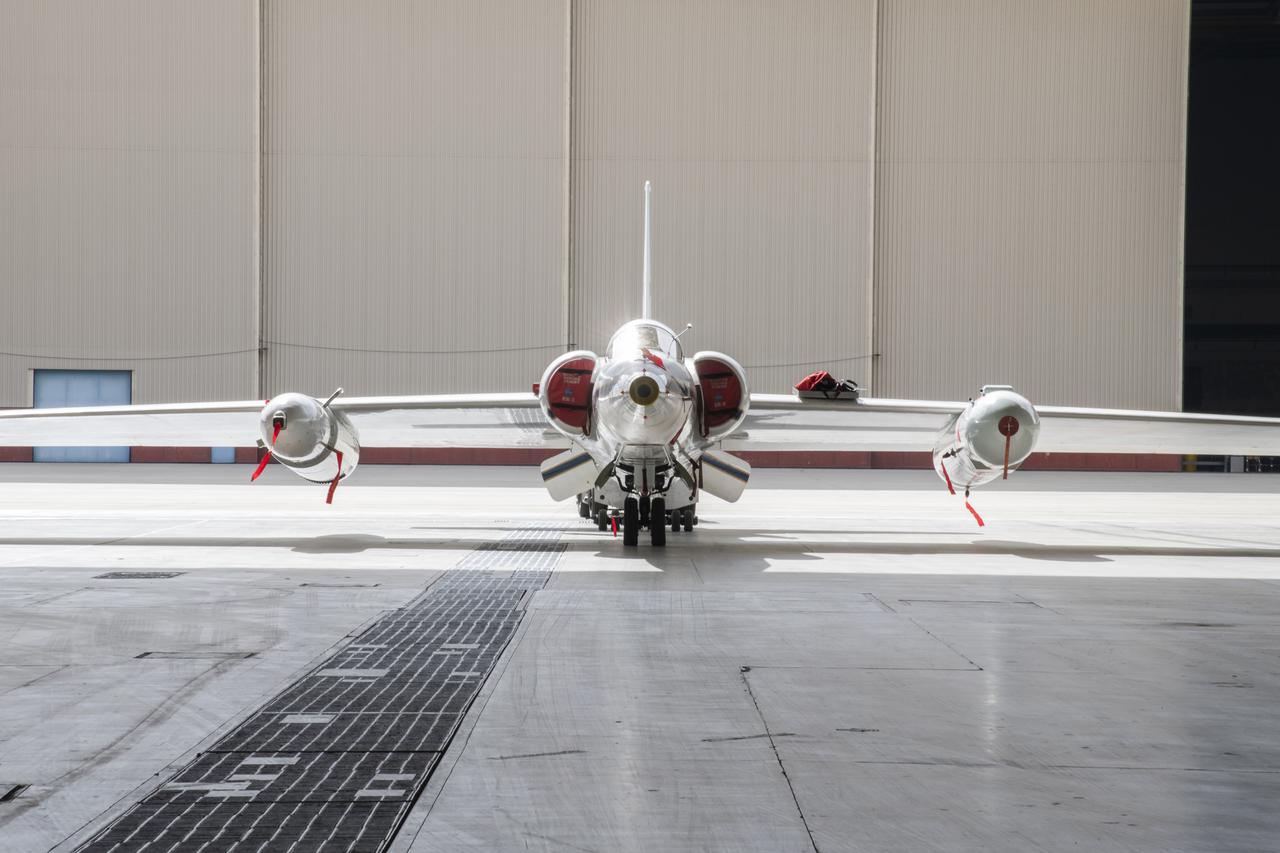
NASA’s Armstrong Flight Research Center ER-2 #809 high-altitude aircraft prepped for Dynamics and Chemistry of the Summer Stratosphere (DCOTSS) science flights in Palmdale, CA.
NASA launches DCOTSS Science Flights
NASA's Armstrong Flight Research Center ER-2 pilot Gary Toroni and engineering technician Raul "Corky" Cortes preparing for Dynamics and Chemistry of the Summer Stratosphere (DCOTSS) science flights in Palmdale, CA on June 17, 2021.
NASA Launches DCOTSS Science Flights
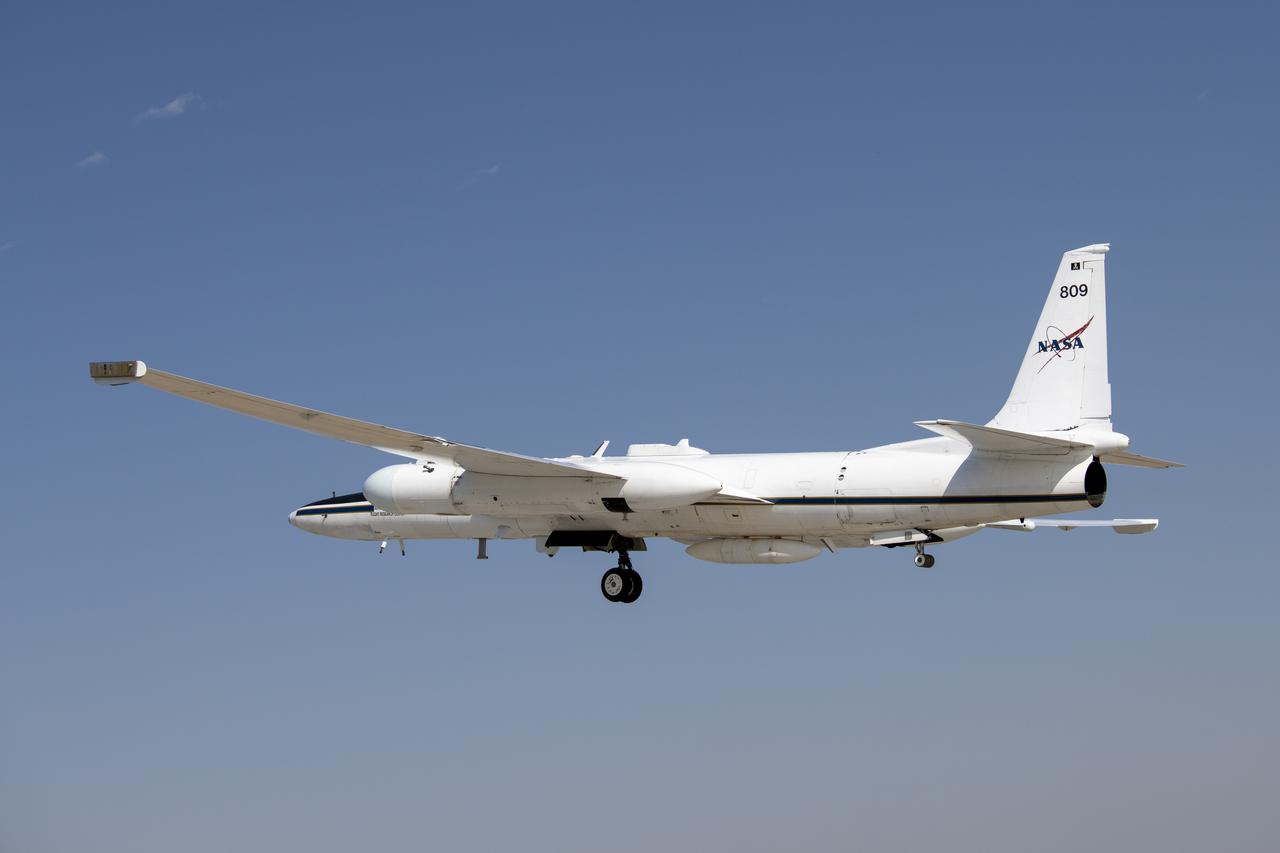
NASA's Armstrong Flight Research Center operates ER-2 #809 high-altitude aircraft for Dynamics and Chemistry of the Summer Stratosphere (DCOTSS) science flights on June 17, 2021.
NASA Launches DCOTSS Science Flights
NASA's Armstrong Flight Research Center ER-2 #809 high-altitude aircraft prepared for Dynamics and Chemistry of the Summer Stratosphere (DCOTSS) science flights in Palmdale, CA on June 17, 2021.
NASA Launches DCOTSS Science Flights
NASA’s Armstrong Flight Research Center ER-2 #809 high-altitude aircraft maintained by avionics technician Gregory Bantalin for Dynamics and Chemistry of the Summer Stratosphere (DCOTSS) science flights.
NASA launches DCOTSS Science Flights
Patrick Chan, electronics engineer, and NASA Armstrong’s FOSS portfolio project manager, closely examines an optic fiber inside of a protective sleeve. Armstrong’s Fiber Optic Sensing System recently supported tests in which oxygen was turned into liquid oxygen at minus 297 degrees Fahrenheit. Testing was aimed at developing technologies could allow future astronauts to manufacture rocket fuel on the Moon.
Helping CryoFILL Turn Oxygen into Fuel
NASA’s Armstrong Flight Research Center flies the C-20 aircraft in support of the Advanced Synthetic Aperture Radar (ASAR) campaign on July 22, 2021. 
C-20 ASAR Flight
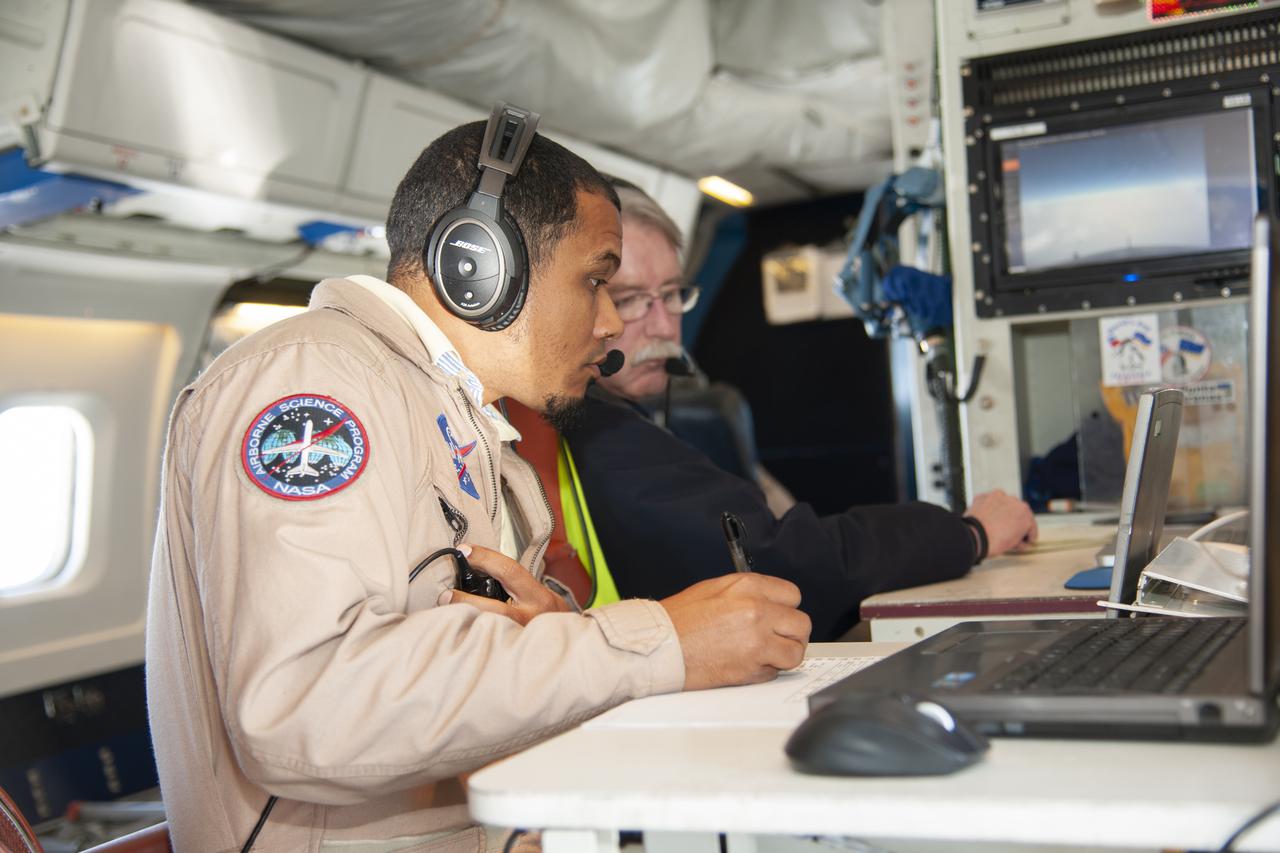
Matt Berry, left, and Chris Jennison examine incoming data on NASA’s DC-8 airborne science aircraft. The 62-year-old ex-airliner is one of seven DC-8s still flying.
Incoming Data Aboard DC-8
NASA's Armstrong Flight Research Center flies the C-20 aircraft in support of the Advanced Synthetic Aperture Radar (ASAR) campaign on July 22, 2021.
C-20 ASAR Flight
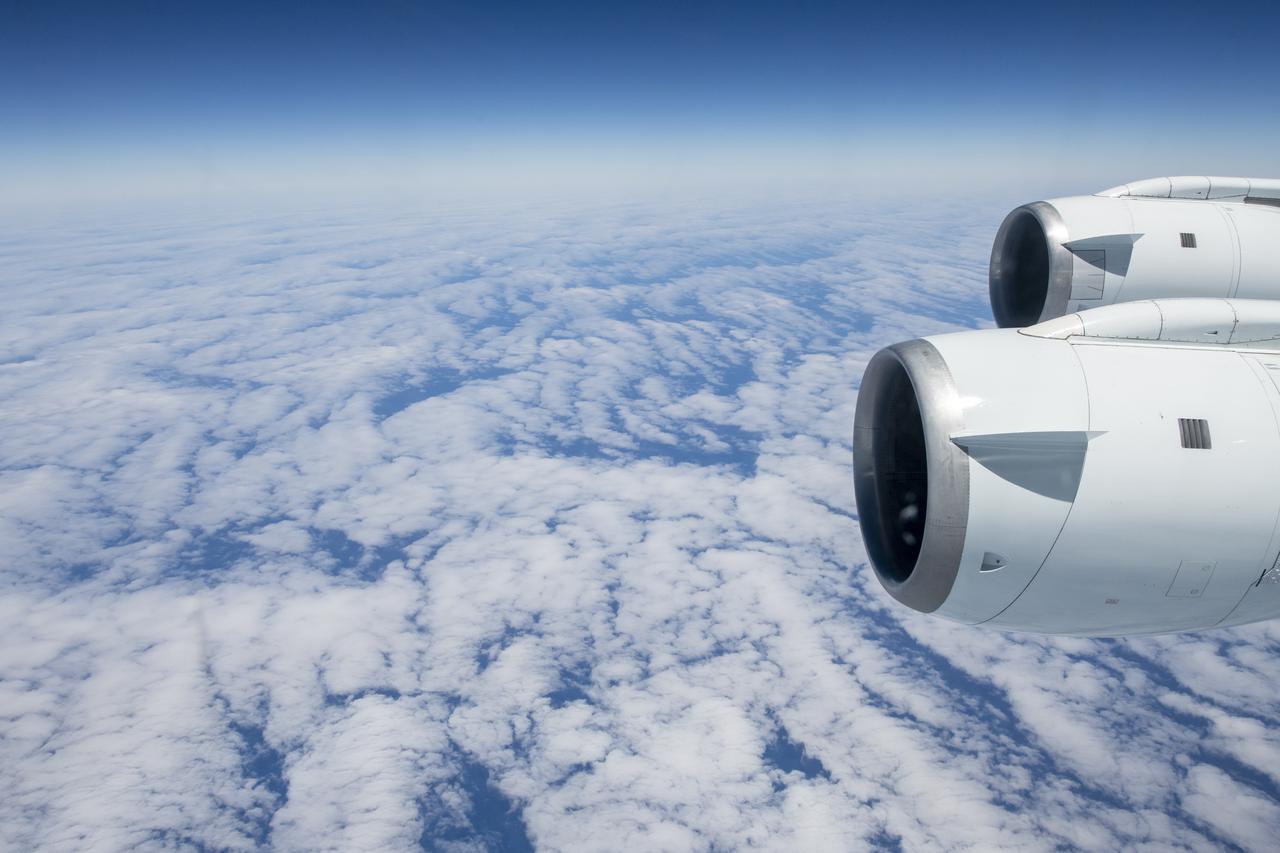
A group of university students and mentors flew aboard NASA Armstrong Flight Research Center’s DC-8 aircraft to study air quality as part of NASA’s Student Airborne Research Program (SARP). Based at NASA’s Armstrong Building 703 in Palmdale, California, the DC-8 flew over the Central Valley to measure pollution and monitor air quality on Tuesday, June 21, 2022.
NASA Flies Students on DC-8 to Study Air Quality
Tim Logan
SSP2 Flight-1
NASA's Armstrong Flight Research Center ER-2 #809 high-altitude aircraft prepped for Dynamics and Chemistry of the Summer Stratosphere (DCOTSS) science flights in Palmdale, CA.
NASA launches DCOTSS Science Flights
NASA's Armstrong Flight Research Center flies the C-20 aircraft in support of the Advanced Synthetic Aperture Radar (ASAR) campaign on July 22, 2021.
C-20 ASAR Flight
NASA's Armstrong Flight Research Center ER-2 #809 high-altitude aircraft prepped for Dynamics and Chemistry of the Summer Stratosphere (DCOTSS) science flights in Palmdale, CA.
NASA launches DCOTSS Science Flights
Particle Analysis by Laser Mass Spectrometry or PALMS instrument maintained by Dave Thomson and Justin Jacquot of Purdue University as part of NASA's Dynamics and Chemistry of the Summer Stratosphere (DCOTSS) mission
NASA launches DCOTSS Science Flights
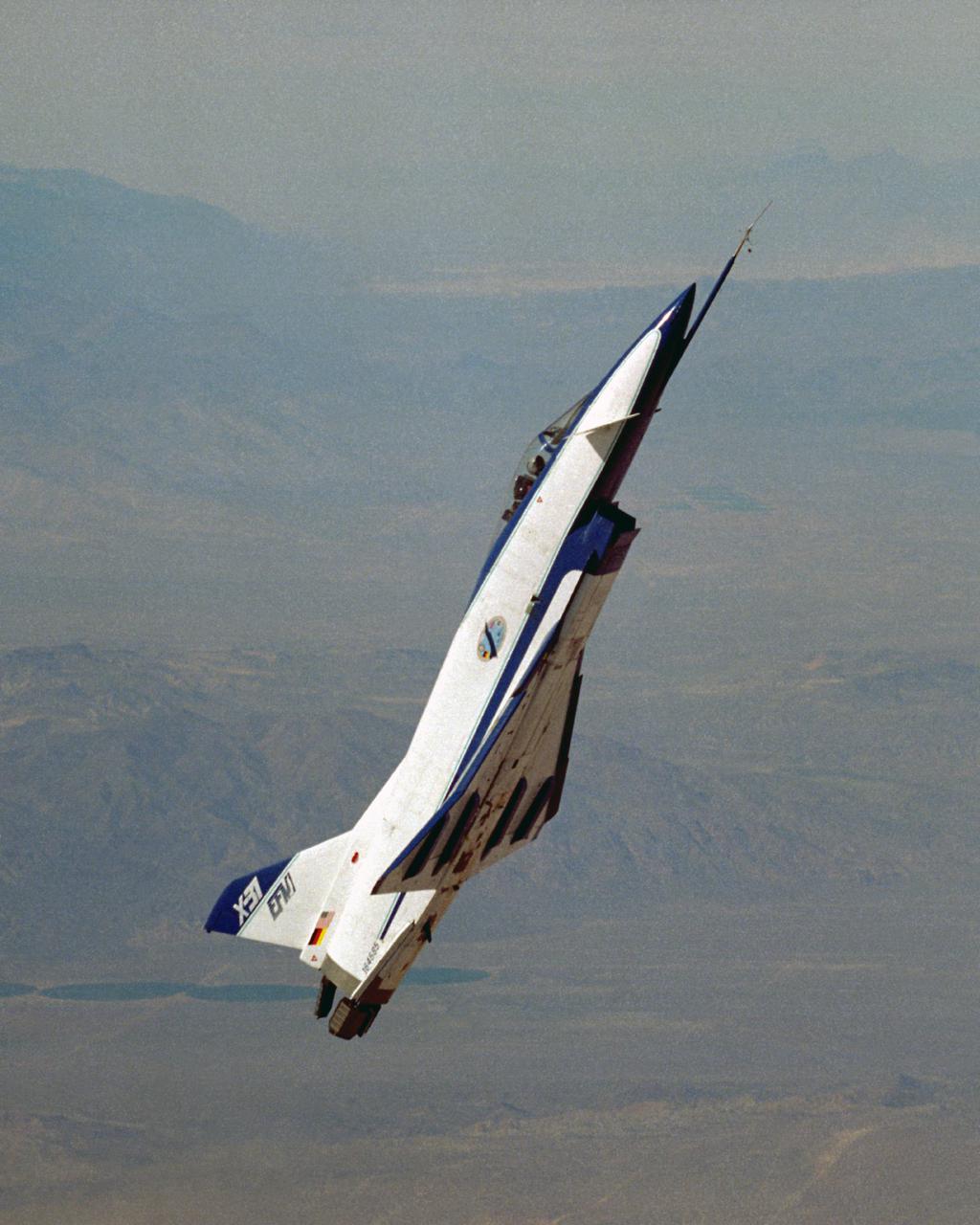
The X-31, the world’s first international X-plane, demonstrates controlled flight at high alpha courtesy of its canards and thrust vectoring paddles in the exhaust stream.
World’s First International X-Plane
NASA's Armstrong Flight Research Center ER-2 #809 high-altitude aircraft prepared for Dynamics and Chemistry of the Summer Stratosphere (DCOTSS) science flights in Palmdale, CA on June 17, 2021
NASA Launches DCOTSS Science Flights
NASA’s Armstrong Flight Research Center’s FOSS, Fiber Optic Sensing System, recently supported tests of a system designed to turn oxygen into liquid oxygen, a component of rocket fuel. Patrick Chan, electronics engineer, and NASA Armstrong’s FOSS portfolio project manager, shows fiber like that used in the testing.
Helping CryoFILL Turn Oxygen into Fuel
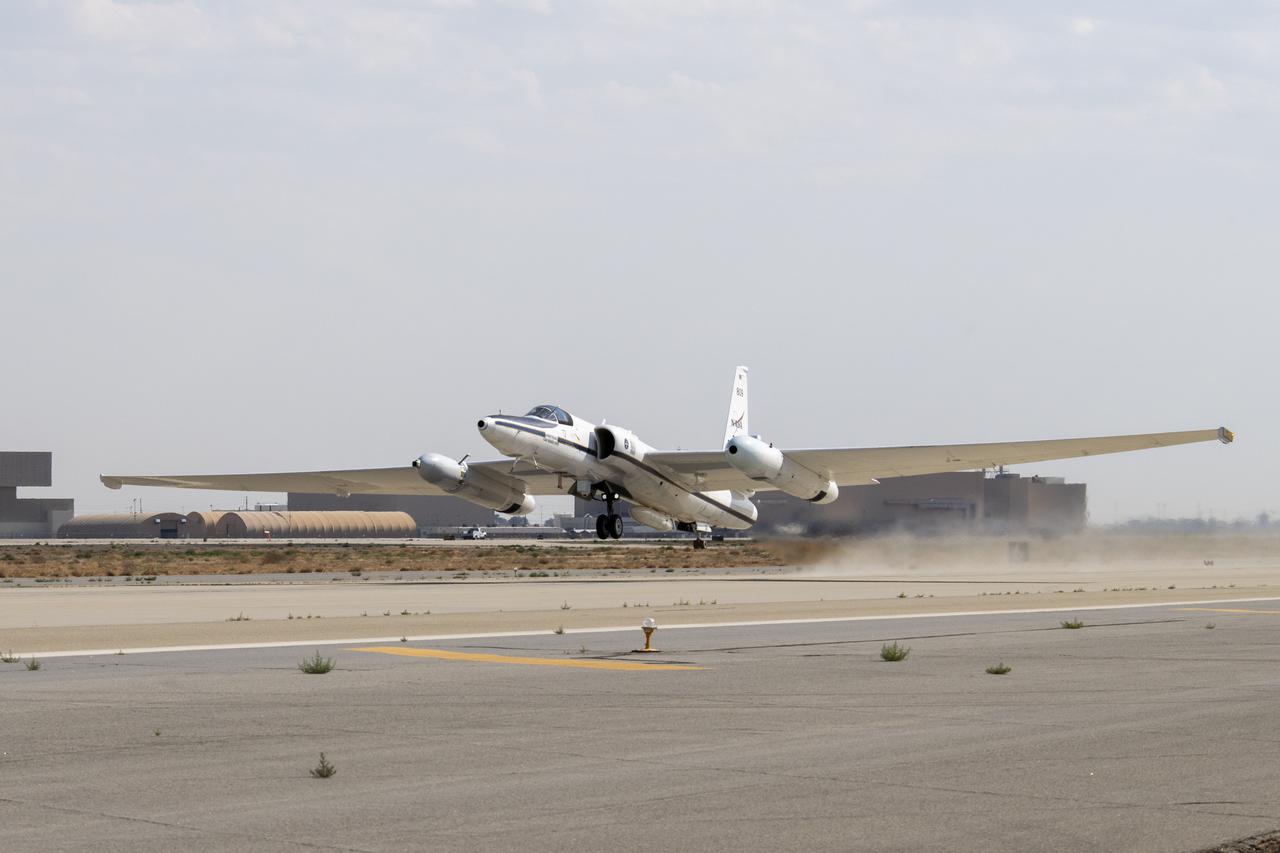
NASA’s Armstrong Flight Research Center ER-2 #809 high-altitude aircraft taking off for Dynamics and Chemistry of the Summer Stratosphere (DCOTSS) science flights in Palmdale, CA on June 17, 2021.
NASA Launches DCOTSS Science Flights
NASA's Armstrong Flight Research Center ER-2 #809 high-altitude aircraft prepped for Dynamics and Chemistry of the Summer Stratosphere (DCOTSS) science flights in Palmdale, CA.
NASA launches DCOTSS Science Flights
SOFIA Returns to NASA's Armstrong Flight Research Center Building 703 Caption: SOFIA returns to NASA's Armstrong Flight Research Center Building 703 in Palmdale, California on March 16, 2021 after spending six months in Germany conducting science observations.
SOFIA Returns to NASA's Armstrong Flight Research Center Building 703
NASA’s Armstrong Flight Research Center flies the C-20 aircraft in support of the Advanced Synthetic Aperture Radar (ASAR) campaign on July 22, 2021. 
C-20 ASAR Flight
SOFIA Returns to NASA’s Armstrong Flight Research Center Building 703 Caption: SOFIA pilots are welcomed home to NASA’s Armstrong Flight Research Center Building 703 in Palmdale, California on March 16, 2021. From left to right: Tracy Phelps, Jeff Borton and Wayne Ringelberg
SOFIA Returns to NASA’s Armstrong Flight Research Center Building 703
NASA’s Armstrong Flight Research Center operates ER-2 #809 high-altitude aircraft for Dynamics and Chemistry of the Summer Stratosphere (DCOTSS) science flights on June 17, 2021.
NASA Launches DCOTSS Science Flights
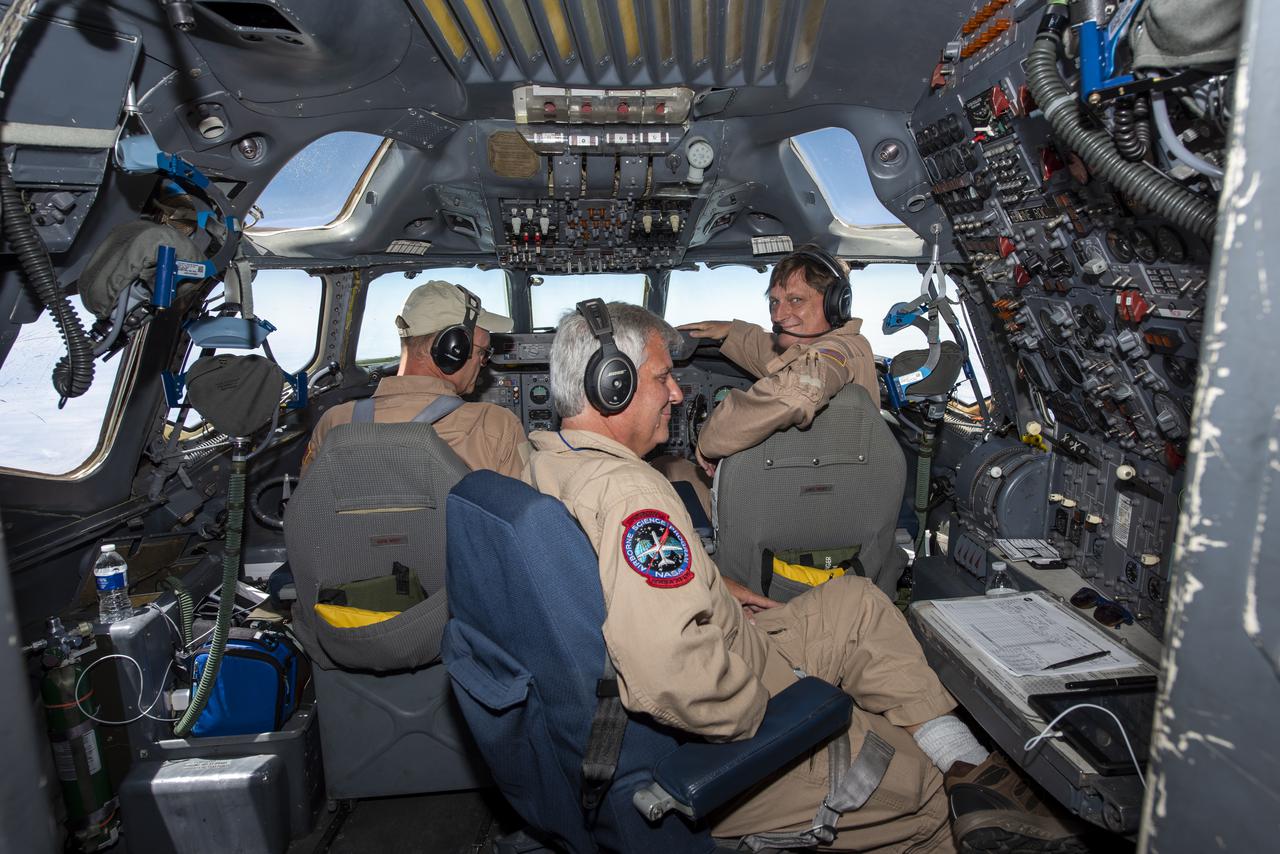
NASA's Armstrong Flight Research Center flies the DC-8 airborne science laboratory in support of the Convective Processes Experiment - Aerosols and Winds campaign, CPEX-AW, on Aug 6, 2021. From left to right: Nils Larson, David Fedors and Mark Crane
DC-8 CPEX-AW Science Flight
NASA's Armstrong Flight Research Center flies the DC-8 airborne science laboratory in support of the Convective Processes Experiment - Aerosols and Winds campaign, CPEX-AW,  on Aug 6, 2021.
DC-8 CPEX-AW Science Flight
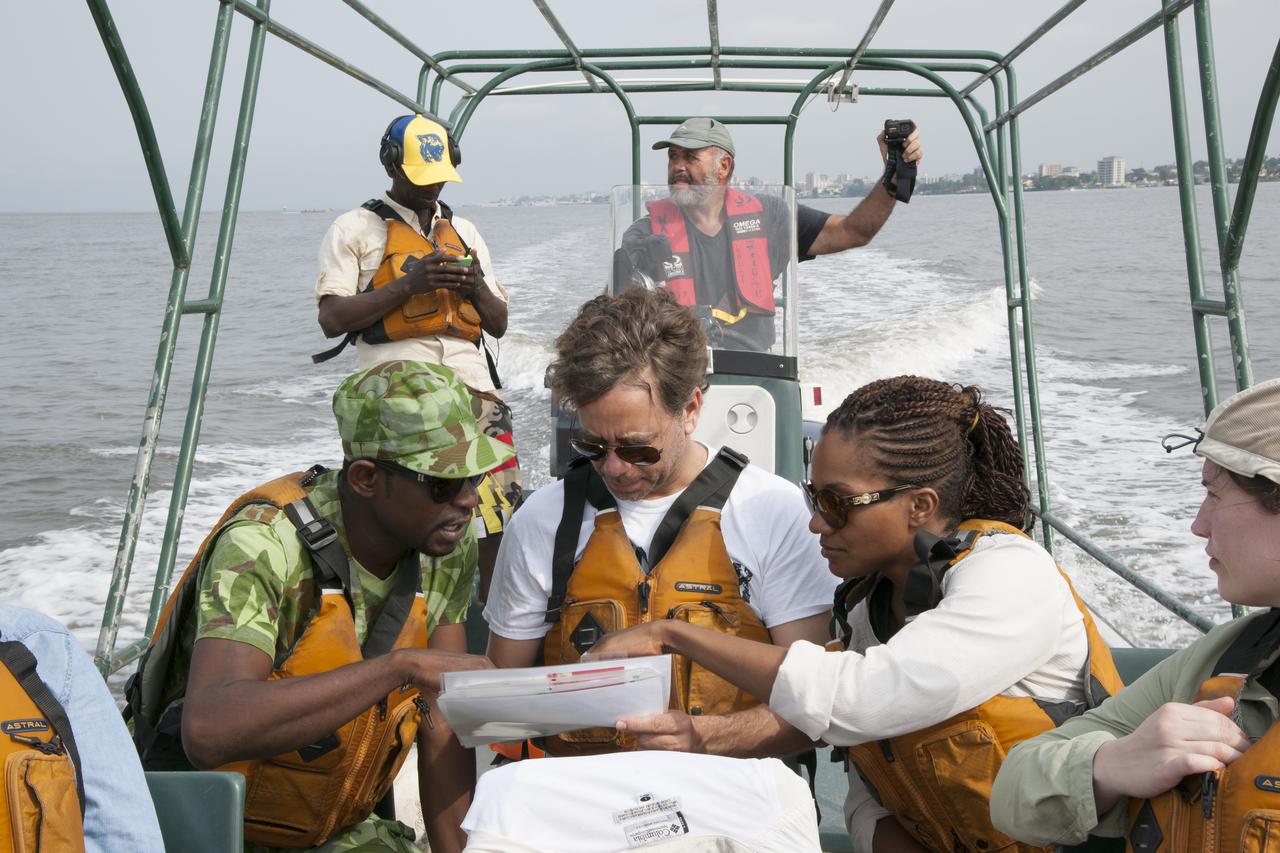
Sam Choi and Naiara Pinto observe Google Earth overlaid with in almost real time what the synthetic aperture radar is mapping from the C-20A aircraft. Researchers were in the sky and on the ground to take measurements of plant mass, distribution of trees, shrubs and ground cover and the diversity of plants and how much carbon is absorbed by them.
AfriSAR 2016
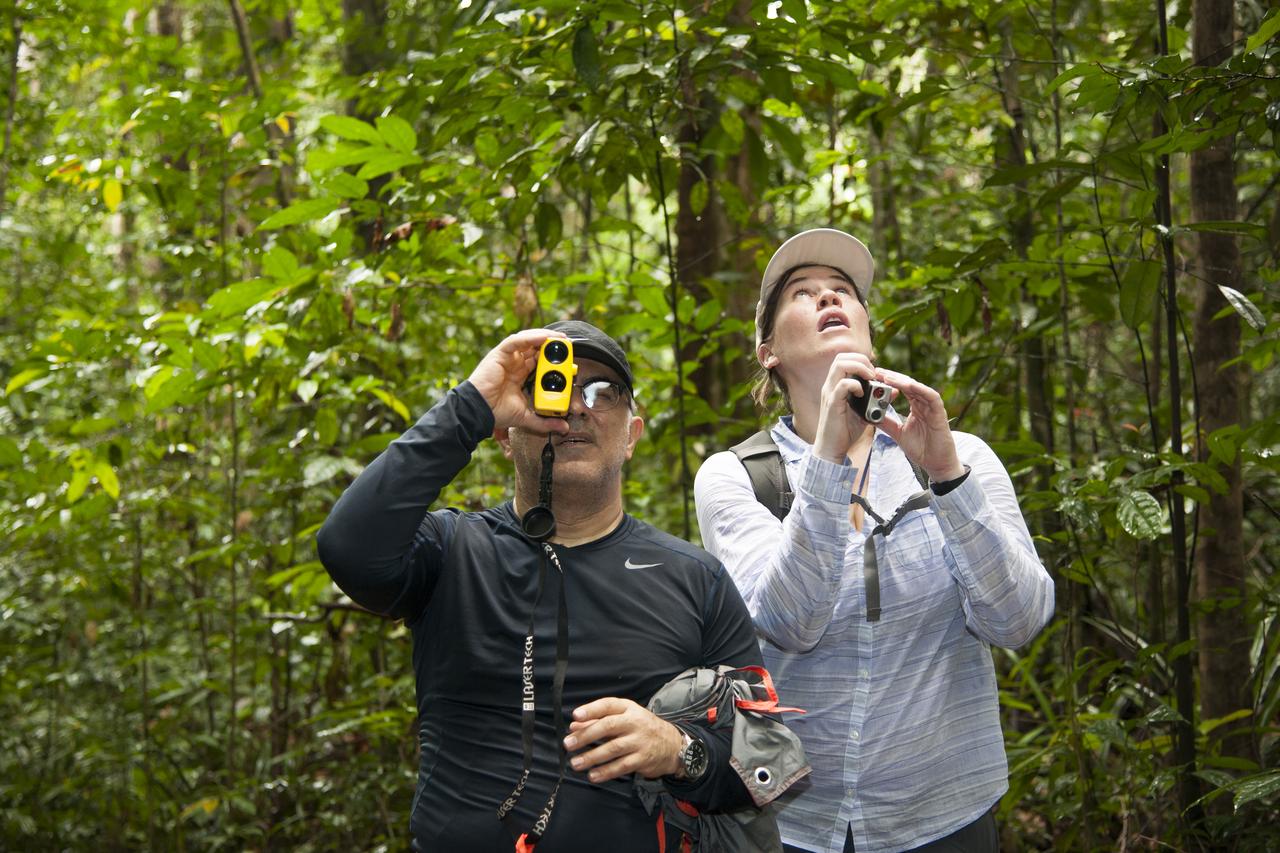
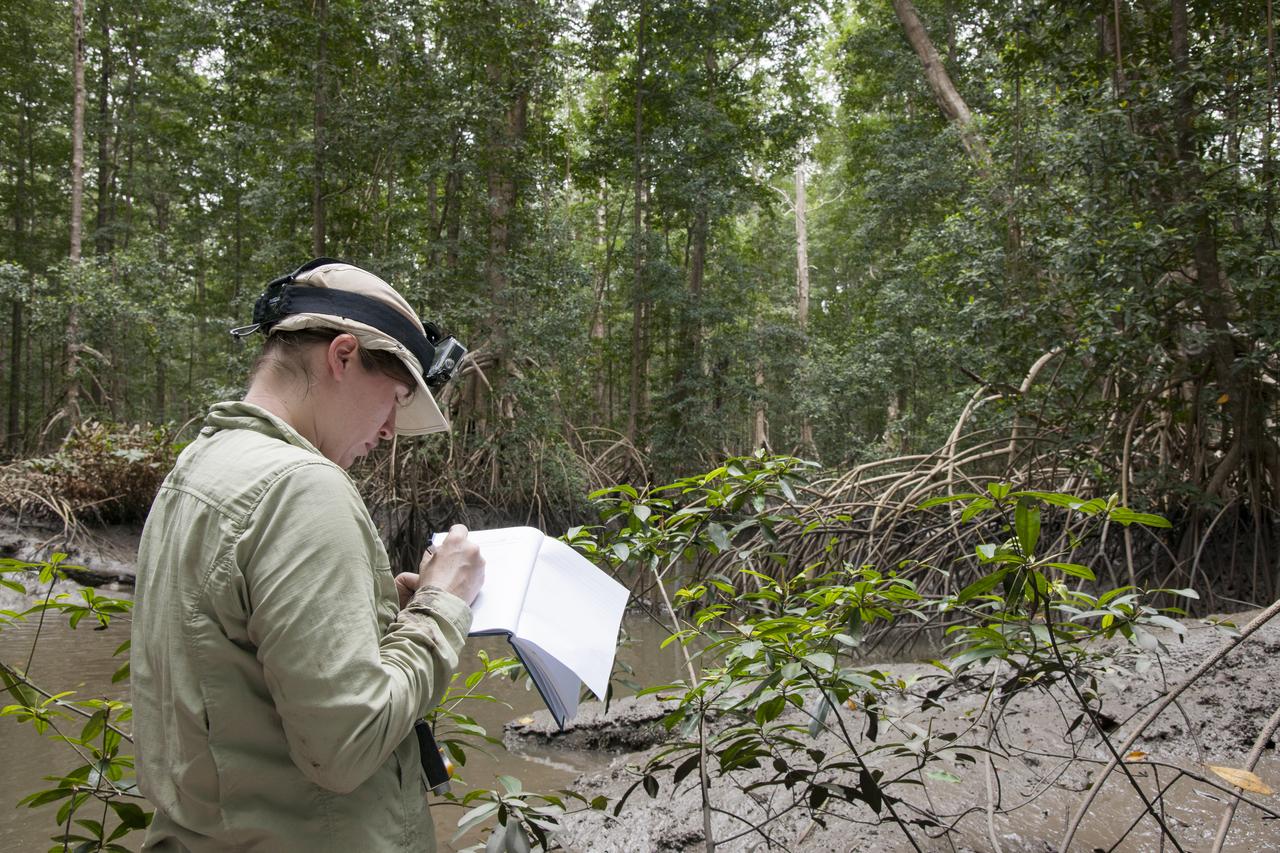
AfriSAR team members Sassan Saatchi (left) from NASA’s Jet Propulsion Laboratory and Laura Duncanson from NASA’s Goddard Space Flight Center take measurements of trees in the rainforest in the Mondah National Park, Gabon, Africa.
AfriSAR 2016
Members of the AfriSAR team standing by the C-20A in Gabon, Africa, which is usually based at NASA Armstrong Flight Research Center in California include, from left, John McGrath, Carlos Meza, Stu Broce, Samuel Choi, David Fedors, Naiara Pinto, Mark Scherer, Marc Simard, Vincent Moreno, Chuck Irving and Kean Tham.
AfriSAR 2016
C-20A crew chief Vince Moreno inspects the aircraft.
AfriSAR 2016
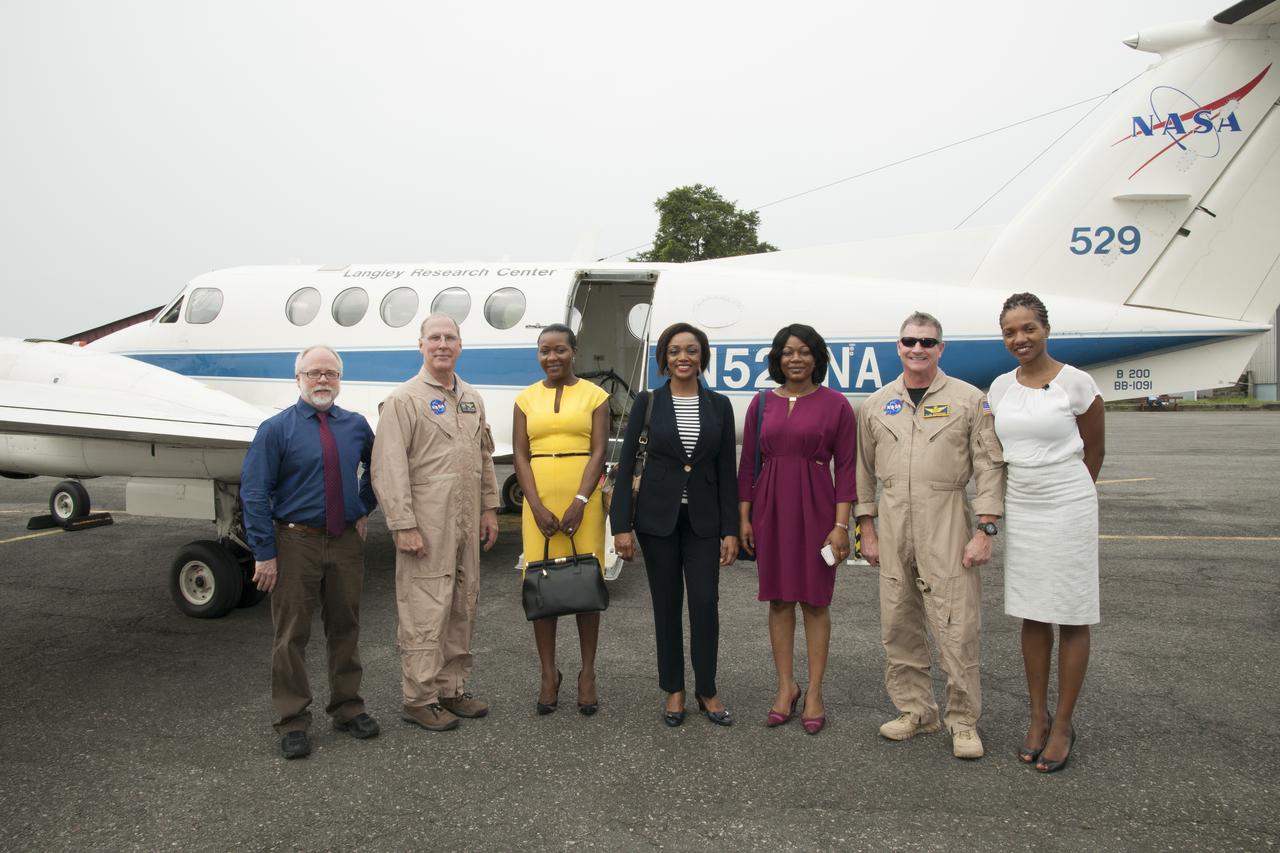
The NASA Langley Research Center-based B-200 in Gabon, Africa, was visited by three representatives of the Gabon Ministry of the Numerical Economy (the three women seen in the middle). In the photo from left are Bryan Blair, Rick Yasky, the three Gabon representatives, Alan Barringer and Lola Fatoyinbo.
AfriSAR 2016
A member of the Gabon National Park Agency Ecoguard discussed the next research destination with Lola Fatoyinbo, Marc Simard and Laura Duncanson.
AfriSAR 2016
Armstrong Pilots David Fedors and Stu Broce are at the controls of the C-20A in March 2016 as it flies a synthetic aperture radar over areas of interest in the AfriSAR mission based in Gabon, Africa. The international campaign included measurements of flora in the country’s rainforests, wetlands, mangrove forests and savanna.
AfriSAR 2016
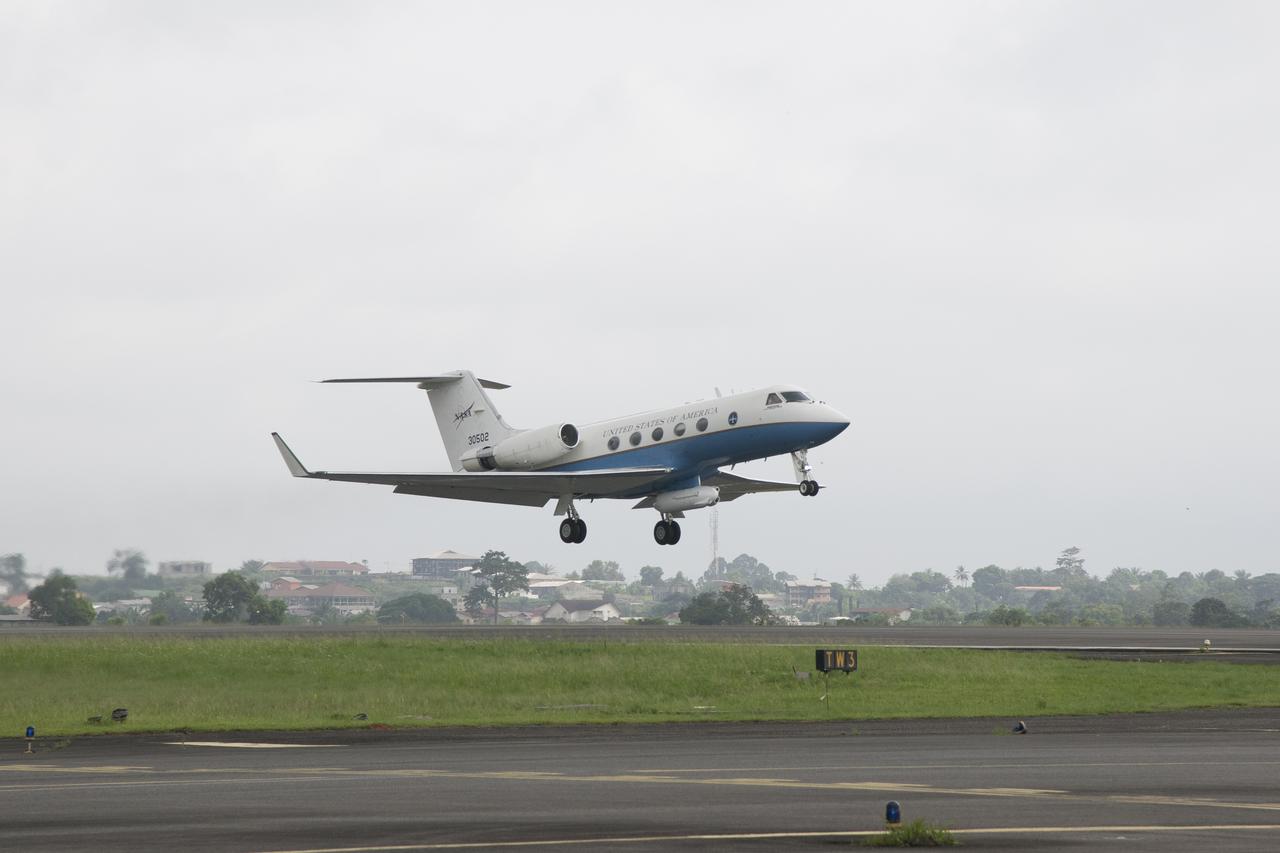
NASA’s C-20A takes off from Libreville International Airport in Gabon, Africa, in support of the AfriSAR  campaign in March 2016. Gabon is a Central African country slightly smaller than the state of Colorado that features the world’s second largest rainforest. In addition to environmental measurements, the flights were used for calibrating satellites for current and upcoming missions.
AfriSAR 2016
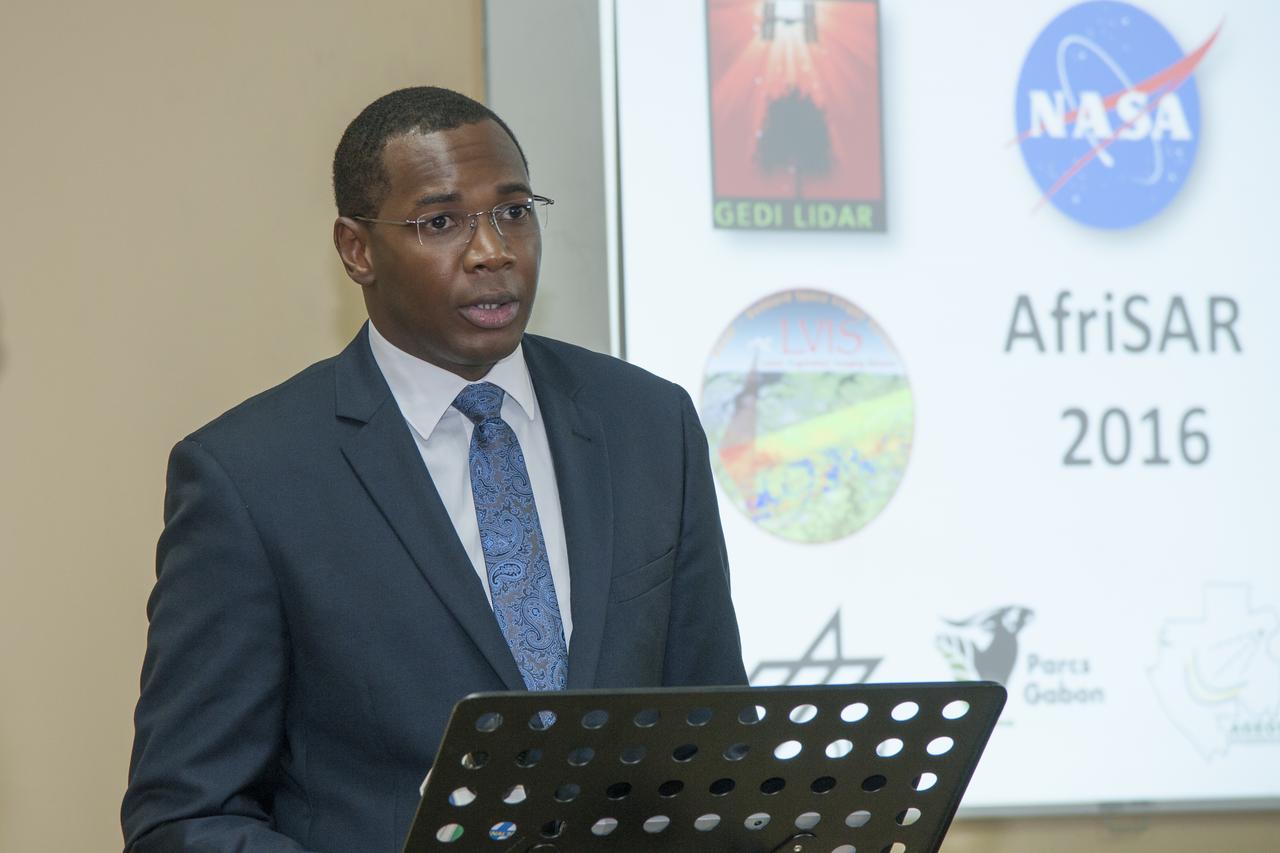
Tanguay Gahouma Bekale, director general of the Gabonese Space Agency, talks to media about the AfriSAR mission.
AfriSAR 2016
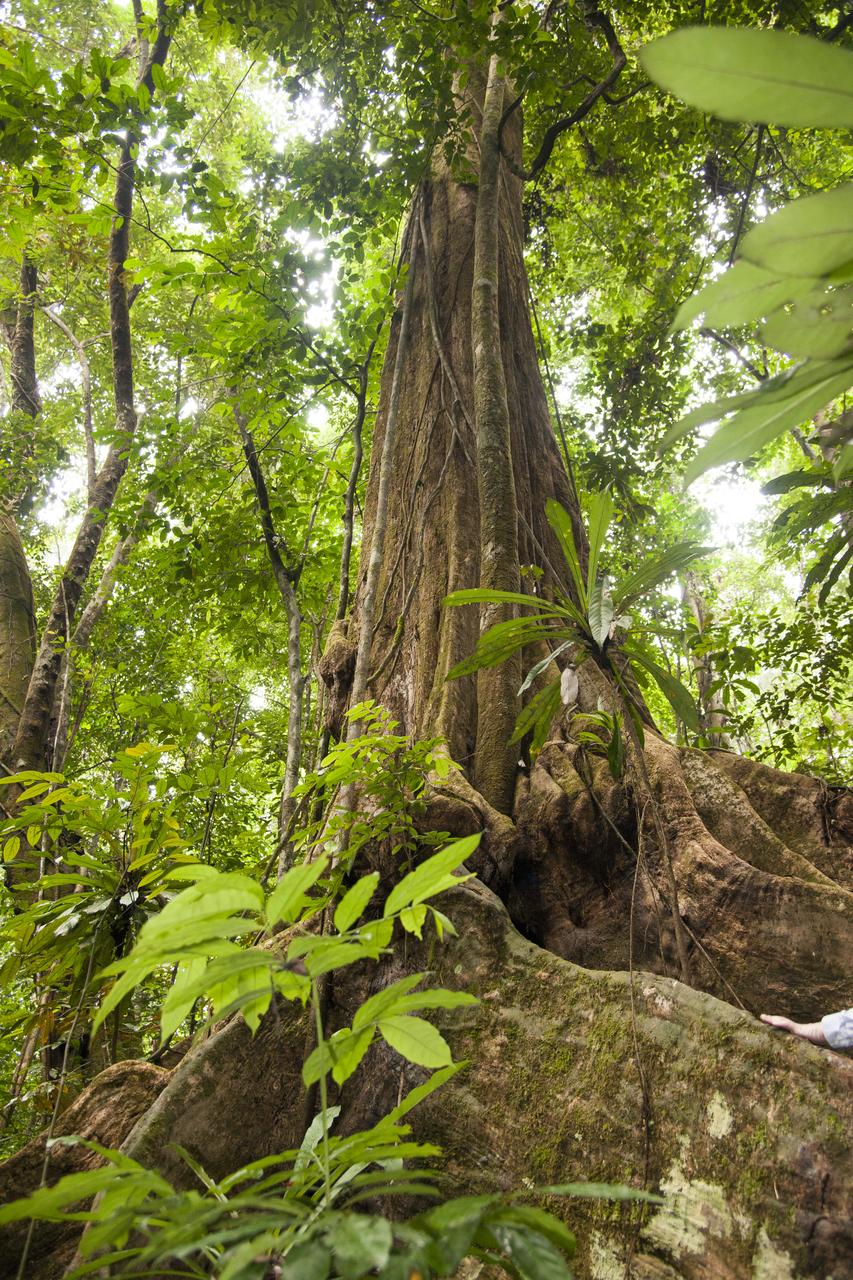
The Okoumé tree is large, as compared to a hand seen in the bottom right portion of the image. The Mondah National Park is one of the field research sites for NASA’s AfriSAR campaign.
AfriSAR 2016
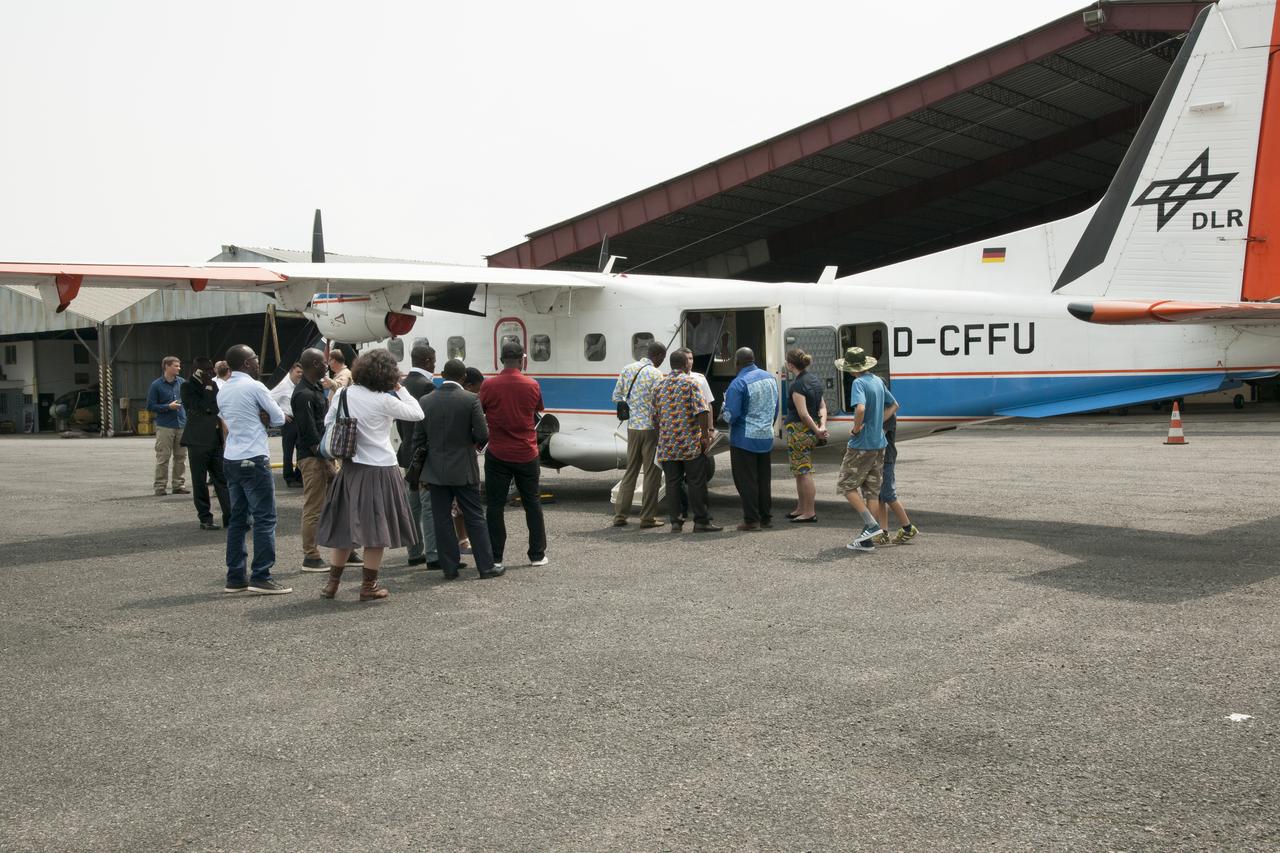
During an education outreach event in Gabon, Africa, students and educators, look at the German Aerospace Center Dornier DO-228 twin-engine turboprop aircraft.
AfriSAR 2016
Mark Scherer prepares the C-20A for the AfriSAR mission.
AfriSAR 2016
In Gabon, Africa, the Mondah National Park is one of the field research sites for NASA’s AfriSAR campaign. Gabon is a Central African country slightly smaller than the state of Colorado that features the world’s second largest rainforest. In addition to environmental measurements, the flights were used for calibrating satellites for current and upcoming missions.
AfriSAR 2016
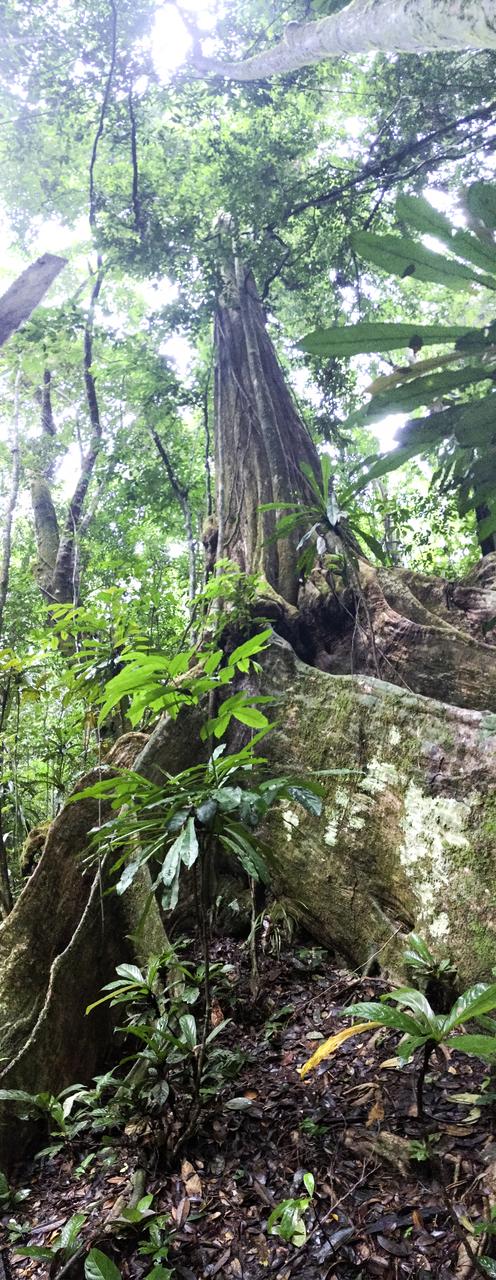
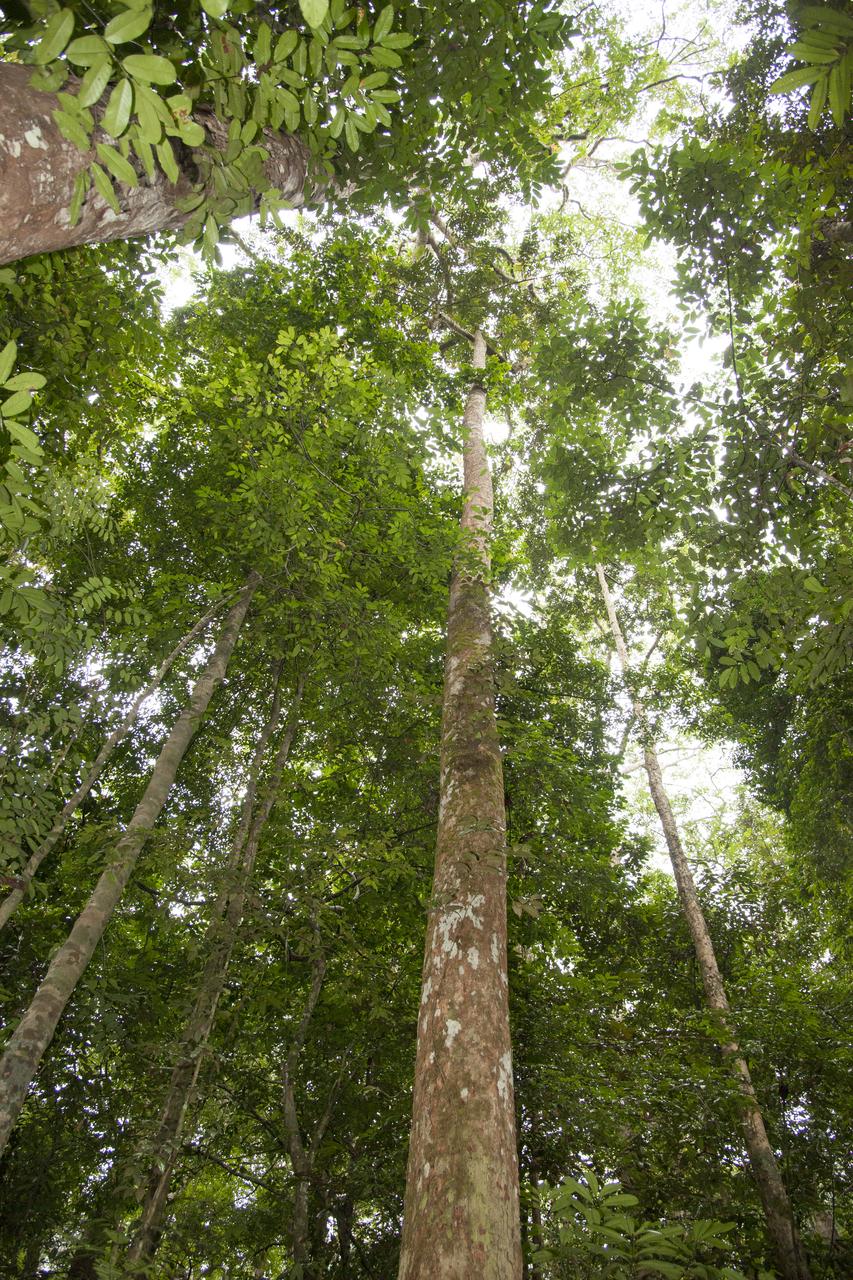
The Okoume’ tree grows tall above the other flora to reach for the suns energy.
AfriSAR 2016
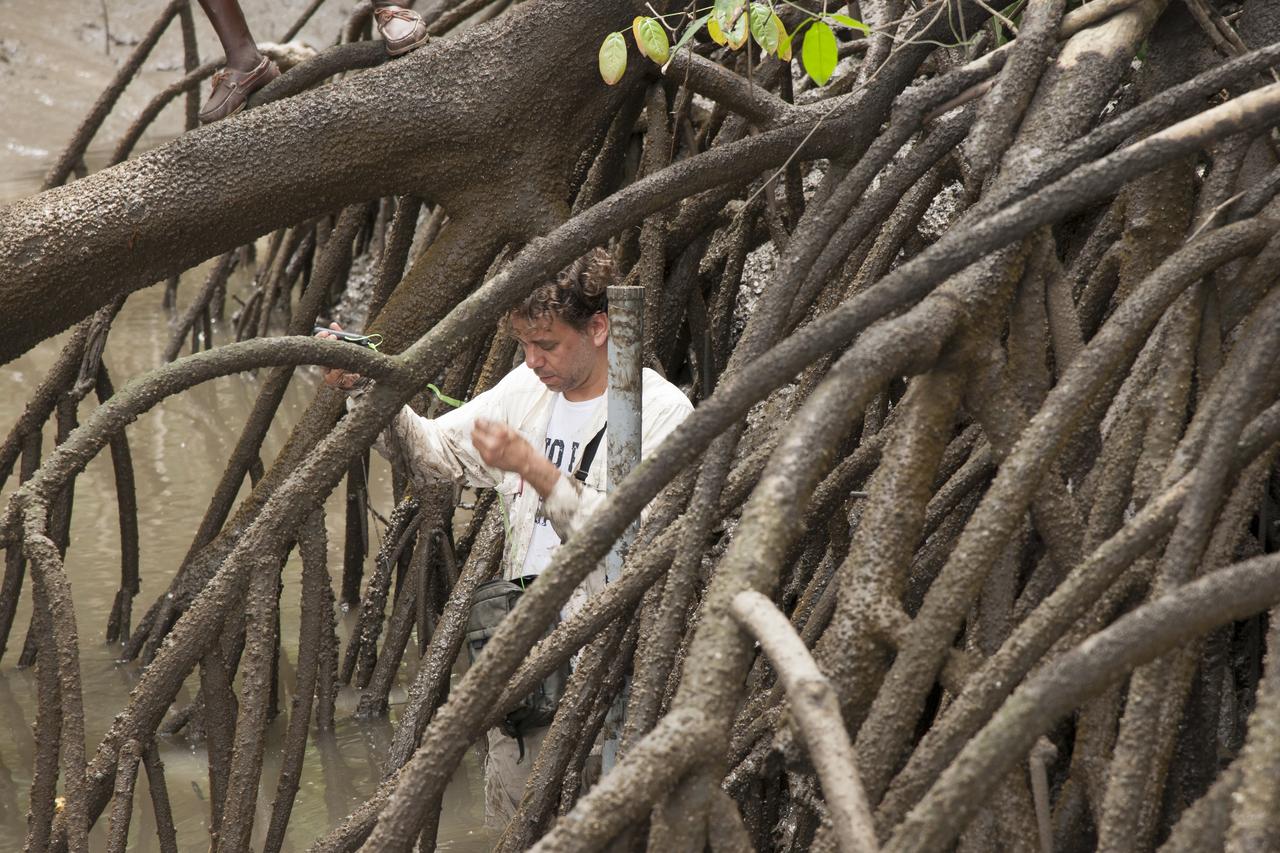
Marc Simard of the Jet Propulsion Laboratory installs a gauge that will record water level changes in the Pongara Mongrove.
AfriSAR 2016
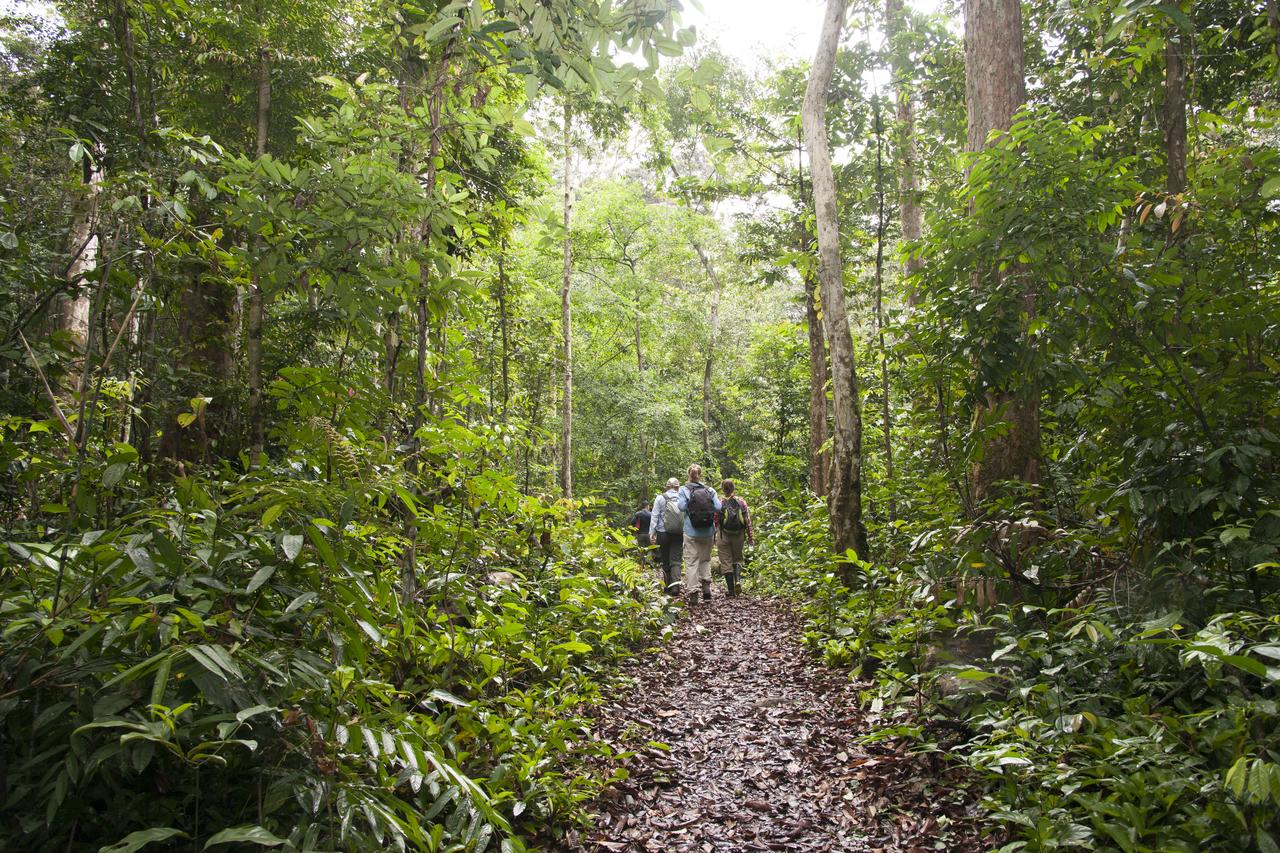
NASA researchers walk through the Mondah rainforest to collect tree and flora measurements and other data as part of the AfriSAR mission.
AfriSAR 2016
Goddard Space Center’s Laura Duncanson records global positioning satellite coordinates of the Pongara Mangrove and tree heights and diameters.
AfriSAR 2016
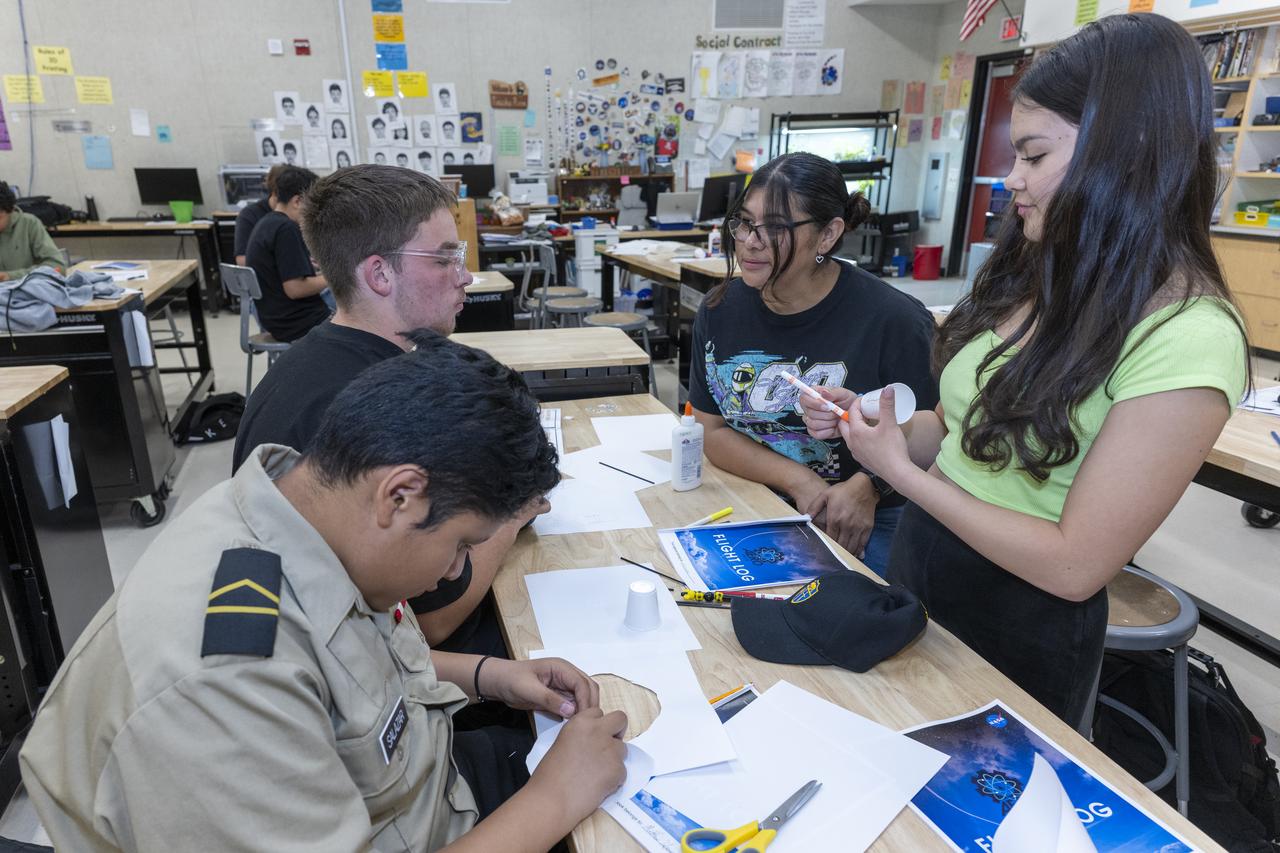
Students from Tropico Middle School in Rosamond, California, build their own paper planes as part of a project during NASA Aero Fair on April 9, 2025.
NASA Platform Connects Classrooms and Communities
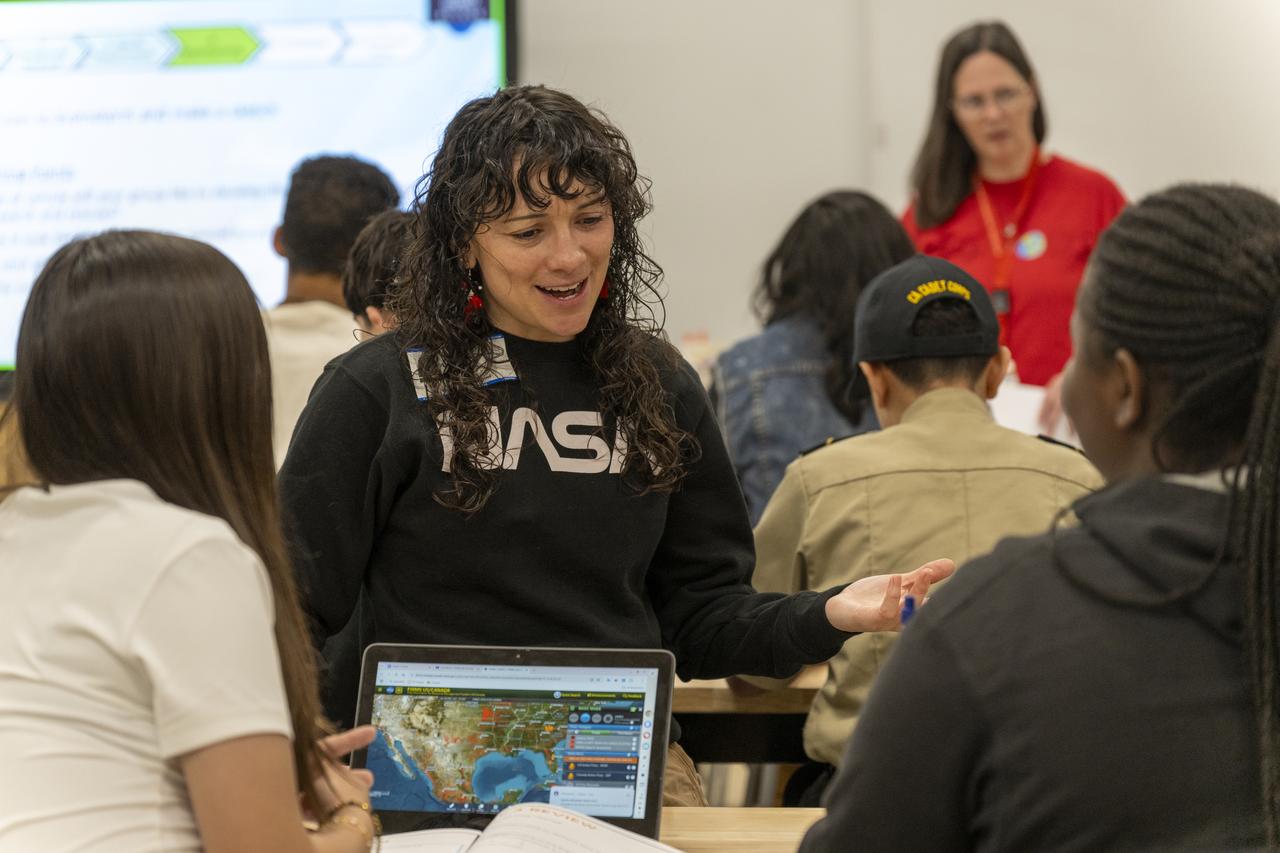
Giovanna Camacho, Pathways systems engineering intern from NASA’s Armstrong Flight Research Center in Edwards, California, teaches students about aeronautics during Aero Fair at Tropico Middle School in Rosamond, California, on April 9, 2025.
NASA Platform Connects Classrooms and Communities
Giovanna Camacho, Pathways systems engineering intern at NASA’s Armstrong Flight Research Center in Edwards, California, teaches students about aeronautics during Aero Fair at Tropico Middle School in Rosamond, California, on April 9, 2025.
NASA Platform Connects Classrooms and Communities
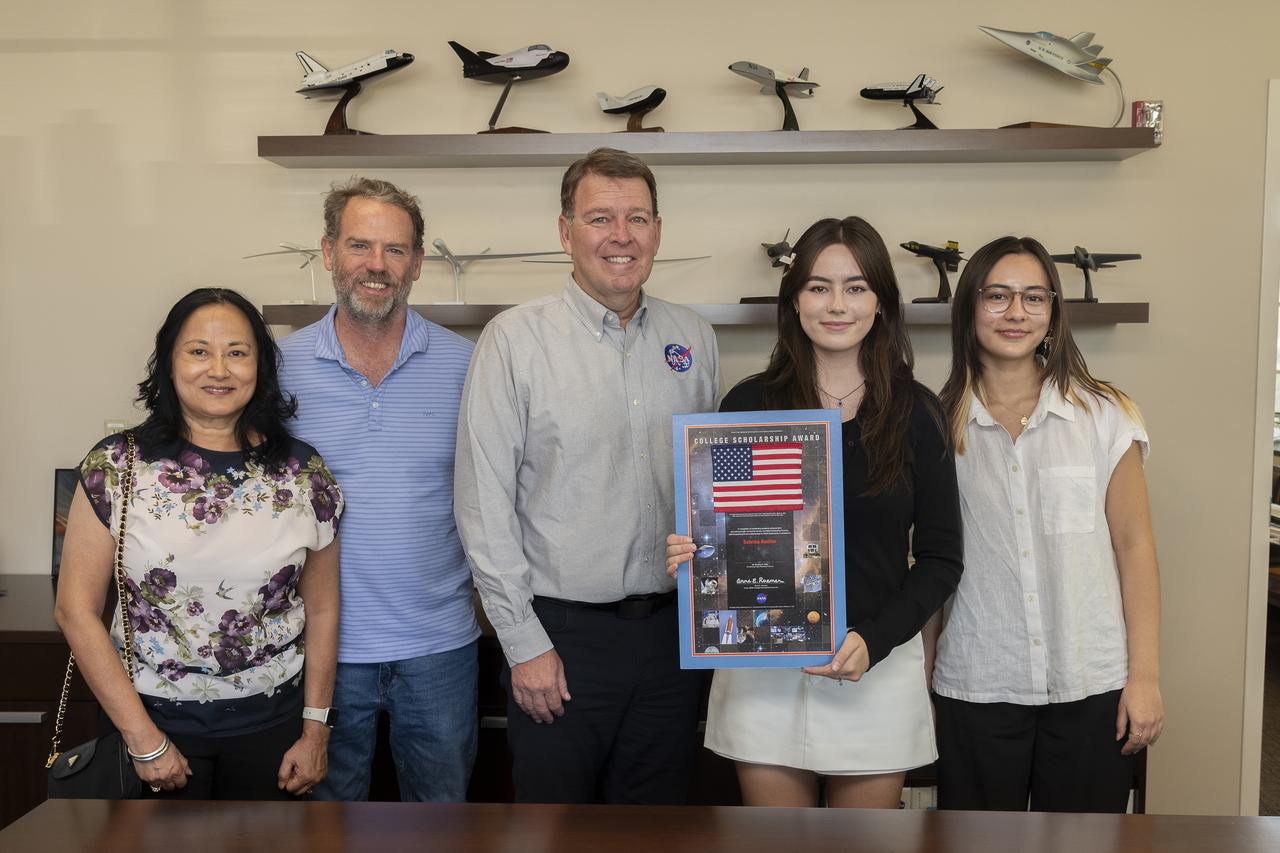
Brad Flick, center director at NASA’s Armstrong Flight Research Center in Edwards, California, presents a 2024 NASA College Scholarship Award to Sabrina Redifer. From left to right are Sabrina Redifer’s parents Matthew and Saynne Redifer, Flick, Sabrina Redifer, and her sister Samantha Redifer.
Southern California Student Wins NASA Scholarship
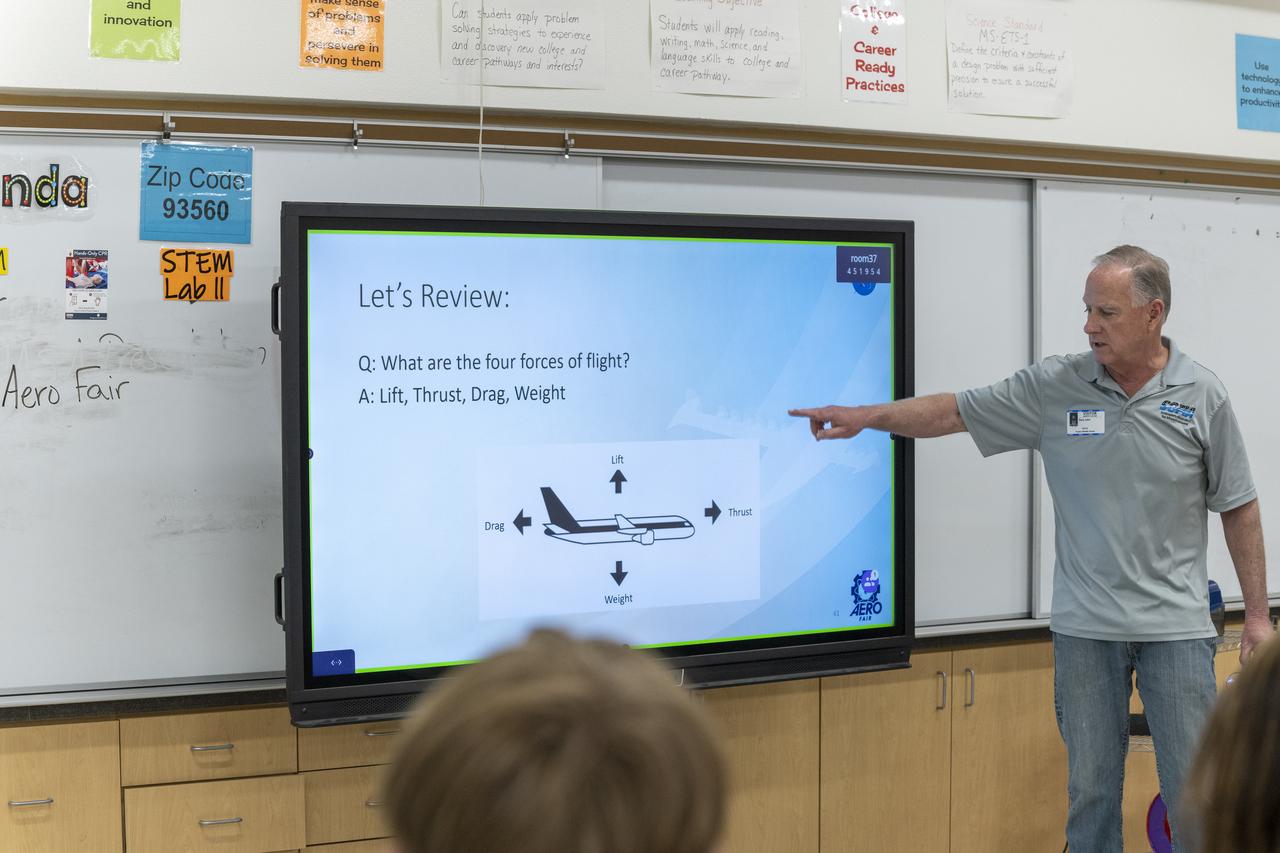
Gary Laier, center liaison for the Small Business Innovation Research/Small Business Technology Transfer (SBIR/STTR) program at NASA’s Armstrong Flight Research Center in Edwards, California, teaches students about aeronautics during Aero Fair at Tropico Middle School in Rosamond, California, on April 9, 2025.
NASA Platform Connects Classrooms and Communities
Gary Laier, center liaison for the Small Business Innovation Research/Small Business Technology Transfer (SBIR/STTR) program at NASA’s Armstrong Flight Research Center in Edwards, California, teaches students about aeronautics during Aero Fair at Tropico Middle School in Rosamond, California, on April 9, 2025.
NASA Platform Connects Classrooms and Communities
Members of the DC-8 program team tour an empty aircraft and recall past missions. Usually the DC-8 has between 15 and 30 instrument racks installed for a given science mission. The aircraft was spacious by comparison on May 2, 2024, when NASA personnel, friends, and family gathered at NASA’s Armstrong Flight Research Center Building 703 in Palmdale, California to celebrate the DC-8 staff, aircraft, and science campaigns. Conversing here are DC-8 aircraft deputy manager Kirsten Boogaard, left, with NASA Armstrong pilot Carrie Worth, Mike Zimmerman, and NASA Armstrong public affairs specialist for airborne science, Erica Heim.
NASA Armstrong Event Celebrates NASA DC-8 Aircraft
Orville, NASA’s high-flying squirrel, hangs onto the DC-8 aircraft at NASA’s Armstrong Flight Research Center Building 703 in Palmdale, California. On May 2, 2024, NASA personnel, friends, and family celebrated the DC-8 staff, aircraft, and science campaigns.
NASA Armstrong Event Celebrates NASA DC-8 Aircraft
Retired NASA mission manager Chris Jennison and Randy Albertson, right, who retired in 2019 as NASA’s Airborne Science Program deputy director, stand in front of the DC-8 aircraft at NASA’s Armstrong Flight Research Center Building 703 in Palmdale, California. On May 2, 2024, NASA personnel, friends, and family celebrated the DC-8 staff, aircraft, and science campaigns.
NASA Armstrong Event Celebrates NASA DC-8 Aircraft
Rocky Radcliff, Kevin Hall, and Herman “Chico” Rijfkogel stand in front of NASA’s DC-8 aircraft at the agency’s Armstrong Flight Research Center Building 703 in Palmdale, California. On May 2, 2024, NASA personnel, friends, and family celebrated the DC-8 staff, aircraft, and science campaigns.
NASA Armstrong Event Celebrates NASA DC-8 Aircraft
Orville, NASA’s high-flying squirrel, uses the microphone at the mission director station onboard the DC-8 aircraft at NASA’s Armstrong Flight Research Center Building 703 in Palmdale, California. On May 2, 2024, NASA personnel, friends, and family celebrated the DC-8 staff, aircraft, and science campaigns.
NASA Armstrong Event Celebrates NASA DC-8 Aircraft
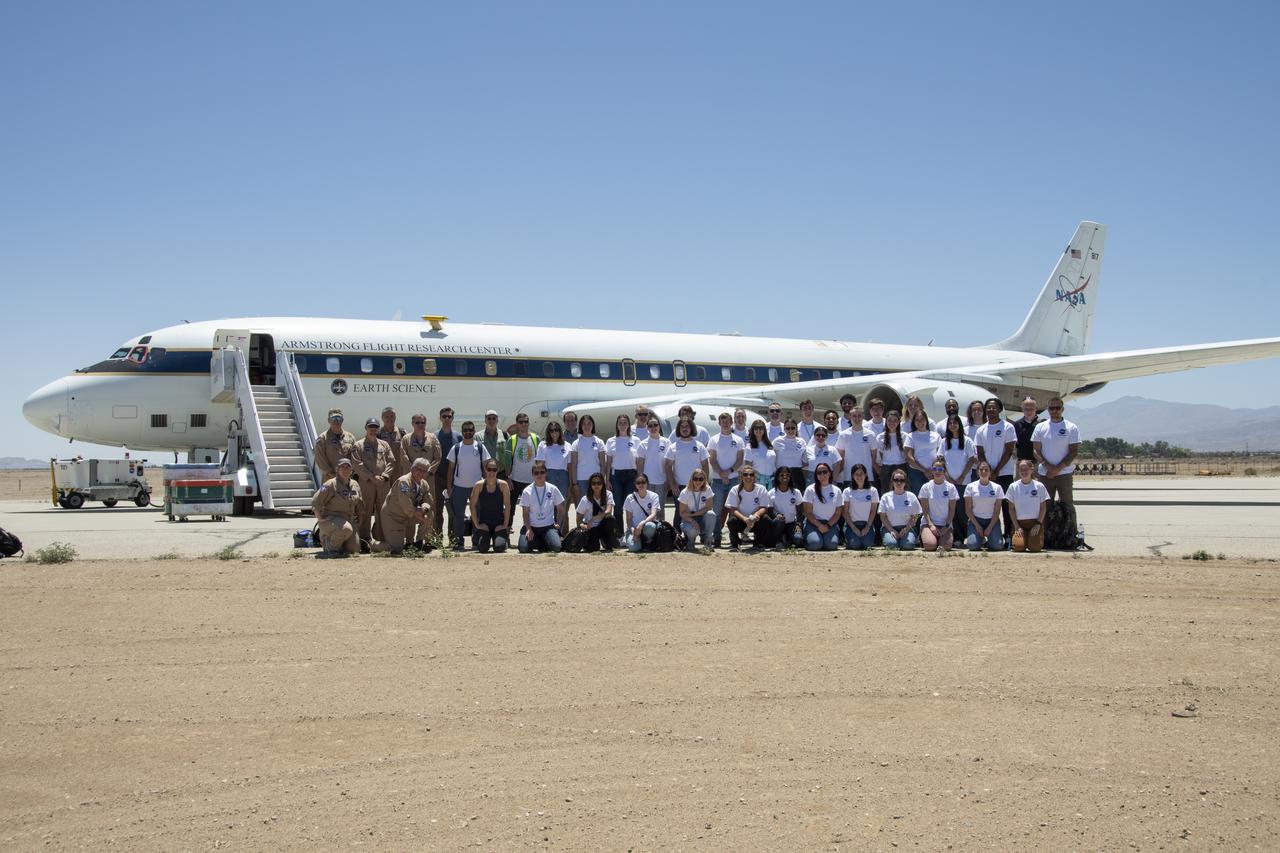
NASA Student Airborne Research Program participants pose in front of the DC-8 before their flight on Jun 23, 2022. The students are joined by mentors and professors to study air quality over the Central Valley in California.
NASA SARP Students Fly on DC-8
People tour the inside of the DC-8 aircraft at NASA’s Armstrong Flight Research Center Building 703 in Palmdale, California. On May 2, 2024, NASA personnel, friends, and family celebrated the DC-8 staff, aircraft, and science campaigns.
NASA Armstrong Event Celebrates NASA DC-8 Aircraft
Orville, NASA’s high-flying squirrel, finds mischief onboard the DC-8 aircraft at NASA’s Armstrong Flight Research Center Building 703 in Palmdale, California. On May 2, 2024, NASA personnel, friends, and family celebrated the DC-8 staff, aircraft, and science campaigns.
NASA Armstrong Event Celebrates NASA DC-8 Aircraft
Members of past science missions pose together in front of the DC-8 aircraft’s left engine turbine at NASA’s Armstrong Flight Research Center Building 703 in Palmdale, California. From left are avionics lead Kelly Jellison, chemical scientist Katherine Ball, DC-8 Deputy Program Manager Kirsten Boogaard, and DC-8 safety engineer Garry Moors. On May 2, 2024, NASA personnel, friends, and family celebrated the DC-8 staff, aircraft, and science campaigns.
NASA Armstrong Event Celebrates NASA DC-8 Aircraft
The X-59 simulator at NASA's Armstrong Flight Research Center in Edwards, California, will help pilots prepare for Quesst missions. Quesst is NASA's mission to demonstrate how the X-59 can fly supersonic without generating loud sonic booms and then survey what people hear when it flies overhead.
NASA Armstrong Facilities Include X-59 Simulator
Orville, NASA’s high-flying squirrel, tries his paw at piloting the DC-8 aircraft at NASA’s Armstrong Flight Research Center Building 703 in Palmdale, California. On May 2, 2024, NASA personnel, friends, and family celebrated the DC-8 staff, aircraft, and science campaigns.
NASA Armstrong Event Celebrates NASA DC-8 Aircraft
NASA pilot Tracy Phelps and his daughter Rachael Phelps look at a poster onboard the DC-8 at NASA’s Armstrong Flight Research Center Building 703 in Palmdale, California. On May 2, 2024, NASA personnel, friends, and family celebrated the DC-8 staff, aircraft, and science campaigns.
NASA Armstrong Event Celebrates NASA DC-8 Aircraft
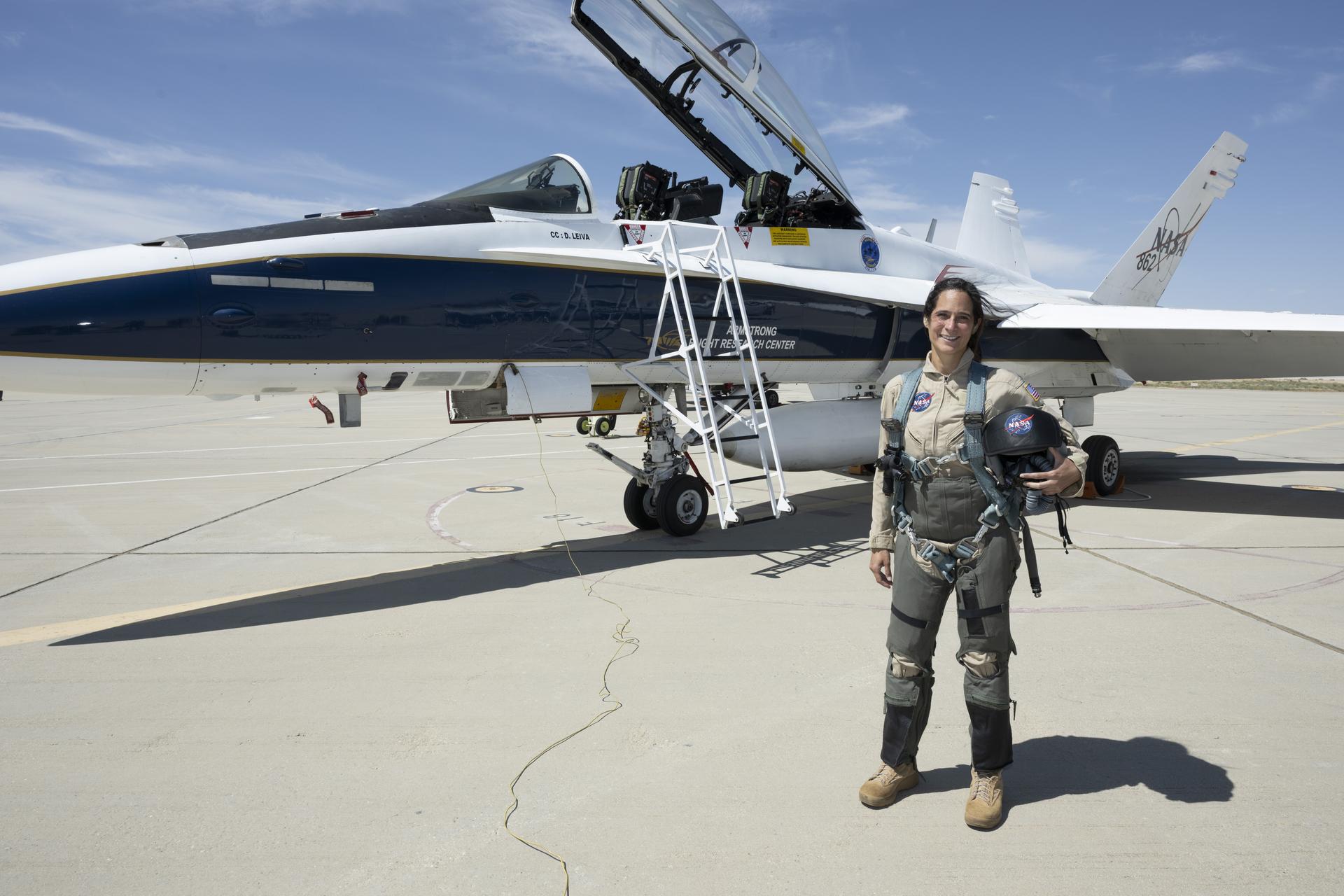
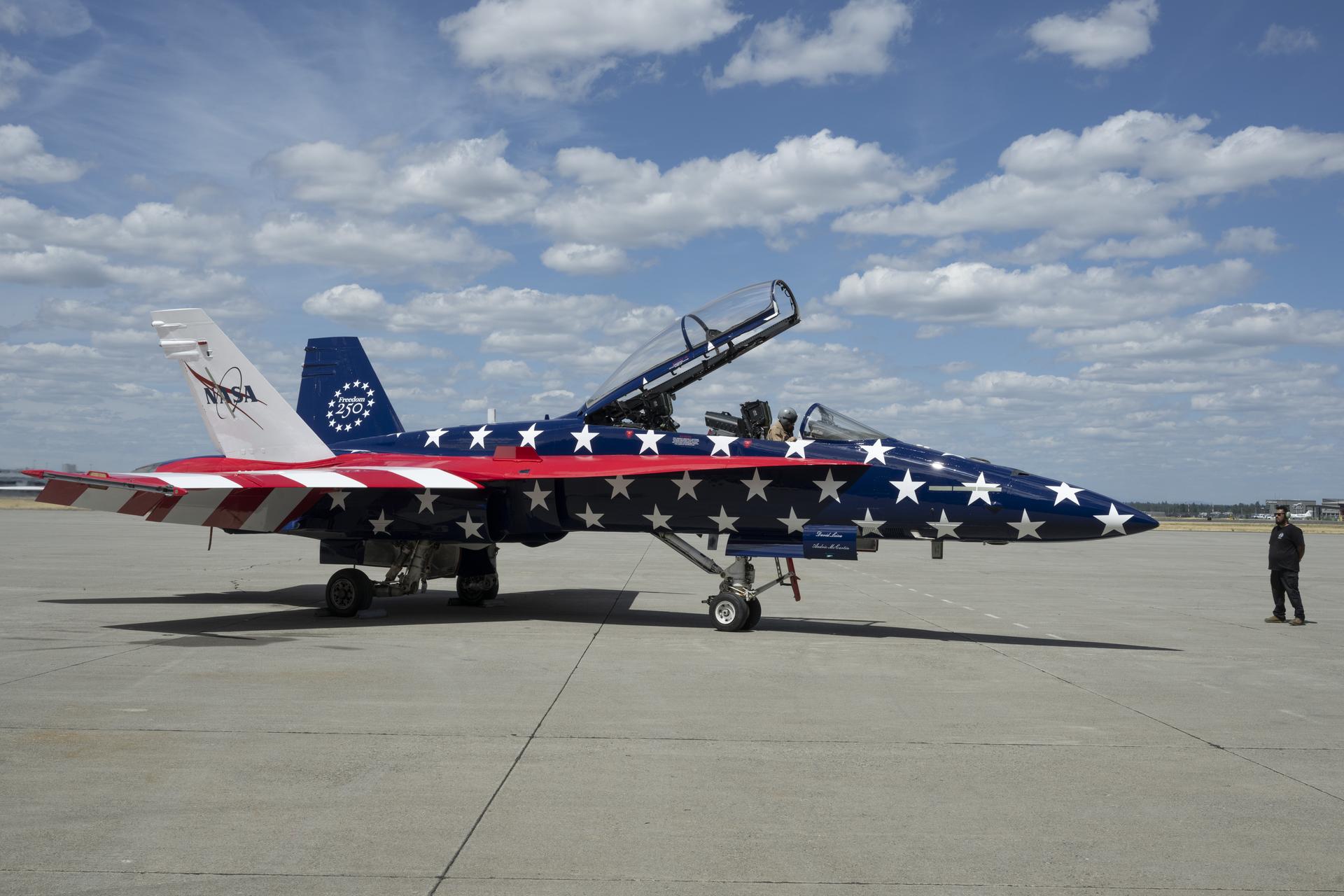
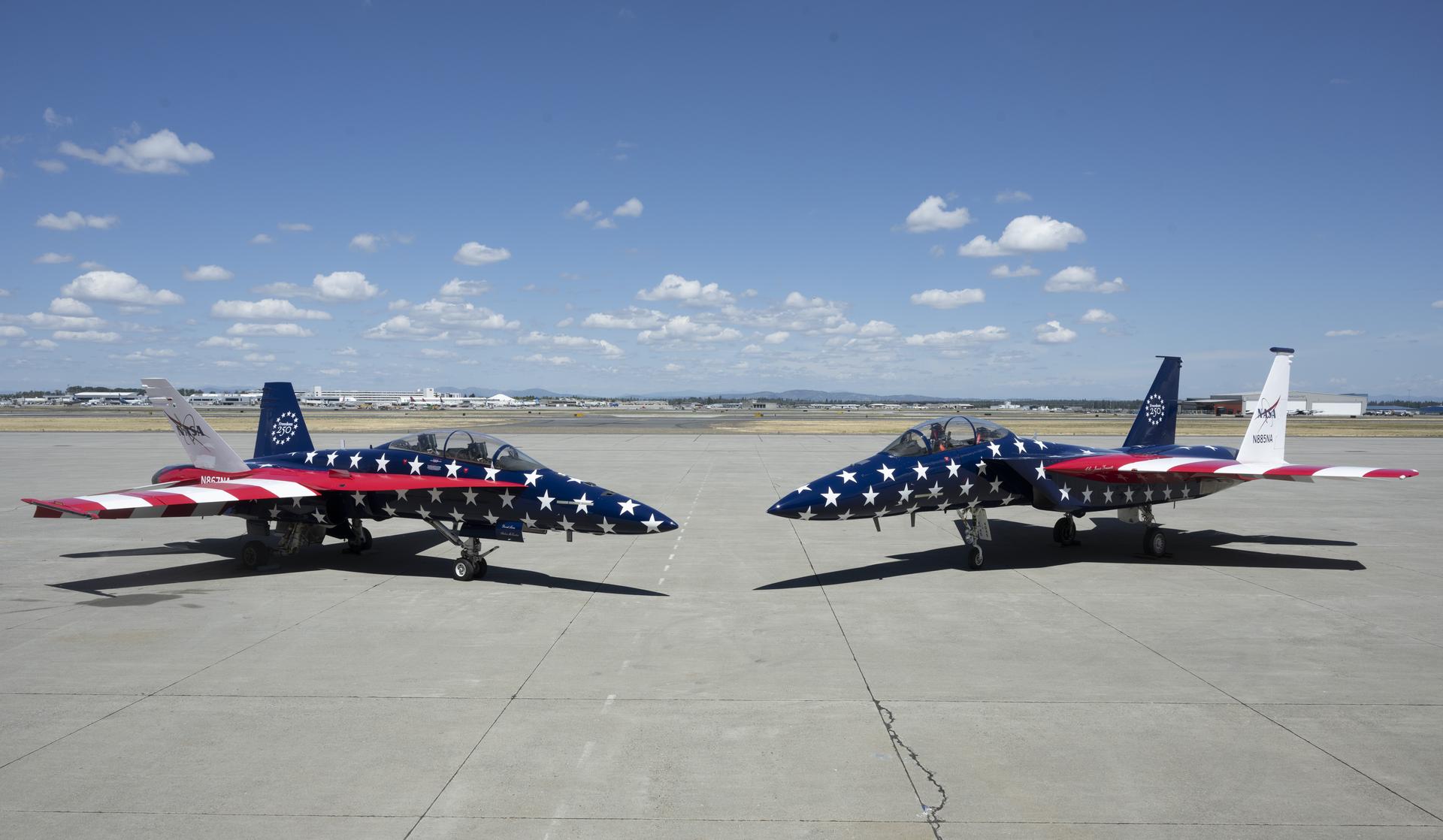
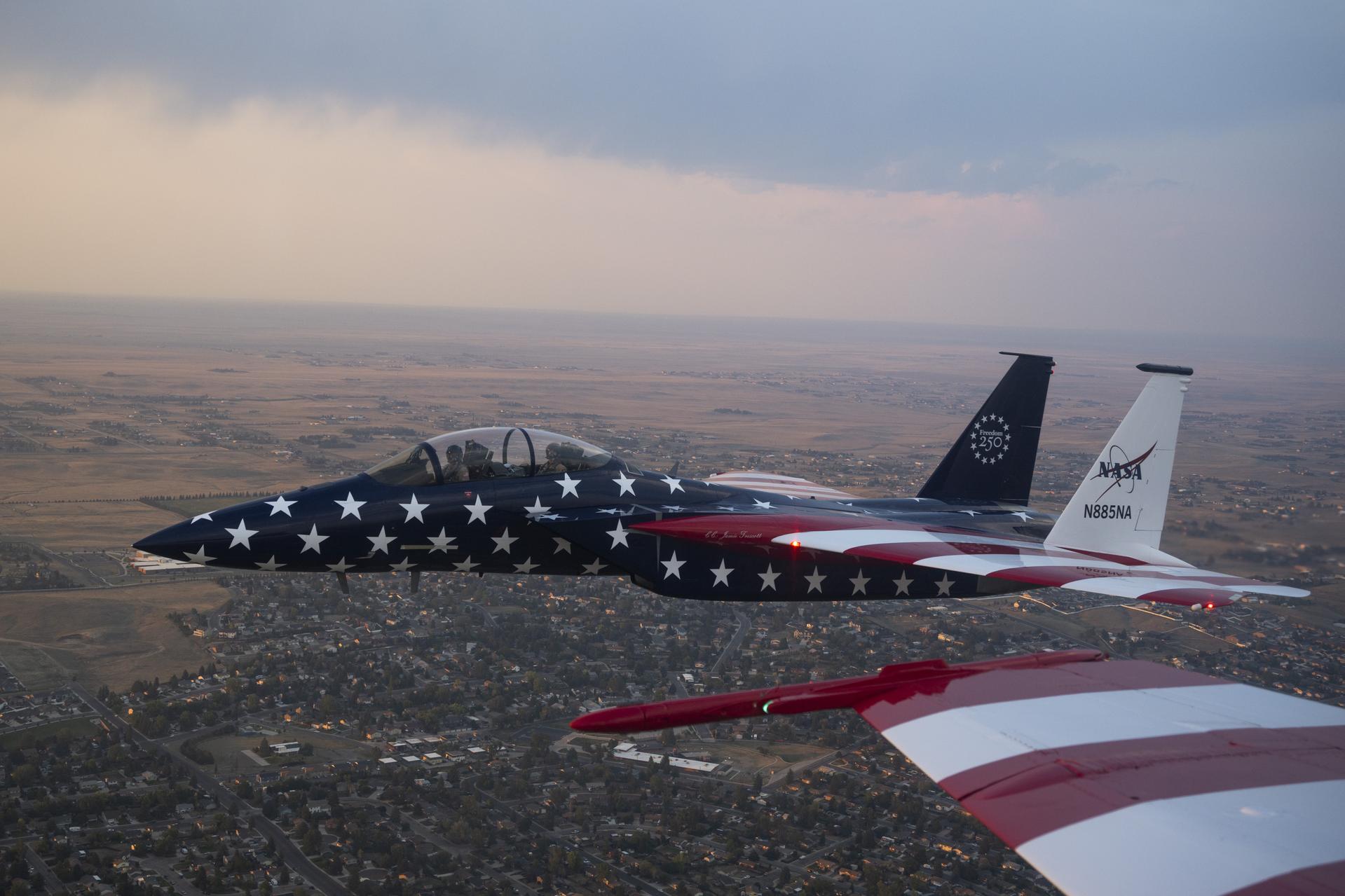
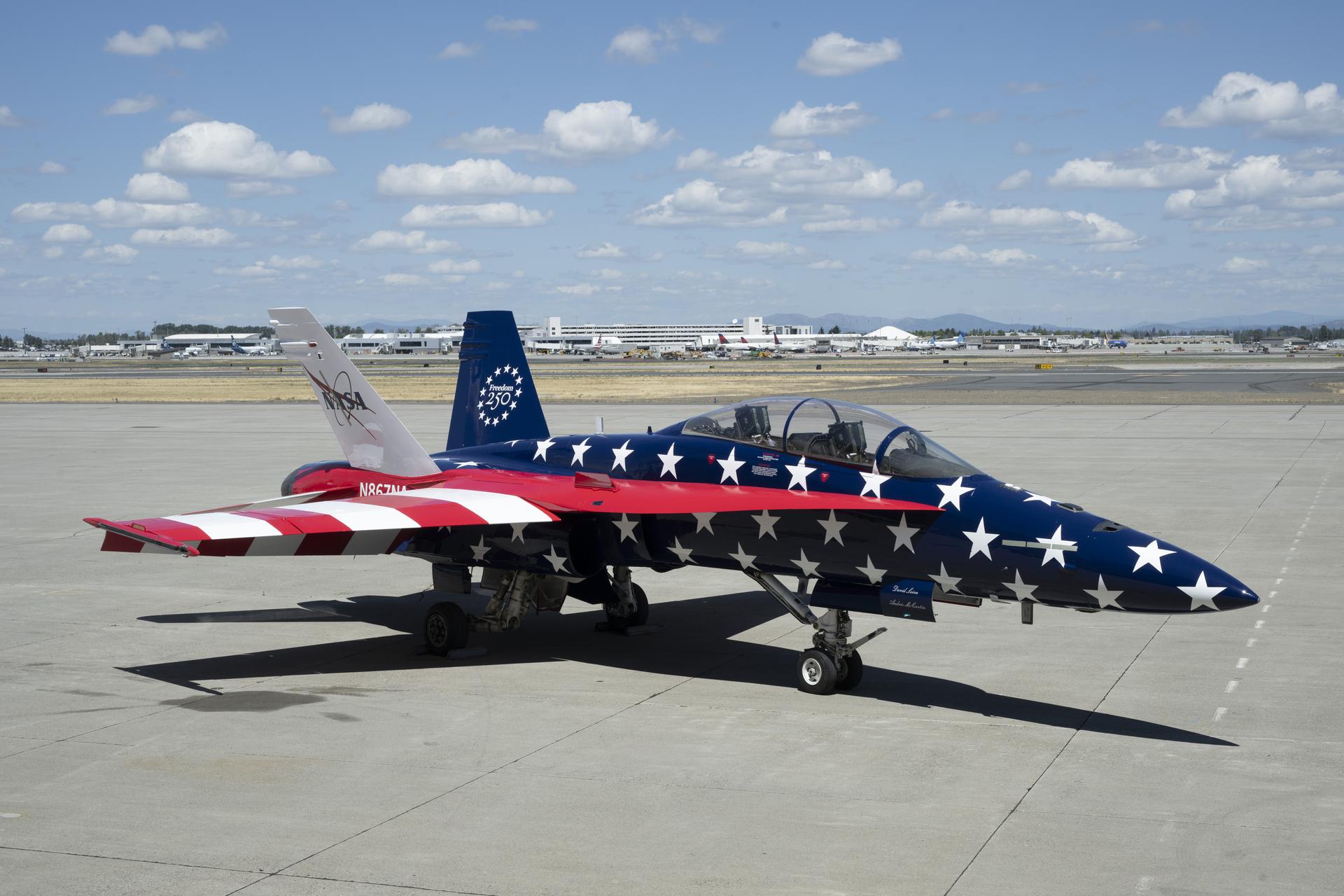
NASA 862, which is an F/A-18D based at NASA’s Armstrong Flight Research Center in Edwards, California, has paint applied at the U.S. Air Force Corrosion Control Facility. The facility is located on Edwards Air Force Base and is also known as the Paint Barn.
NASA 862 Enters Air Force Paint Barn
NASA's Super Guppy Turbine cargo aircraft in the hangar at NASA's Armstrong Flight Research Center on August 24, 2021. This unique whale-like aircraft arrived at the center's Building 703 in Palmdale, CA to support crews in the performance of routine maintenance. The Super Guppy aircraft, operated by NASA's Johnson Space Center, aids in the transportation of oversized aerospace cargo in a practical and economical way.
NASA's Super Guppy in the hangar at Armstrong Building 703
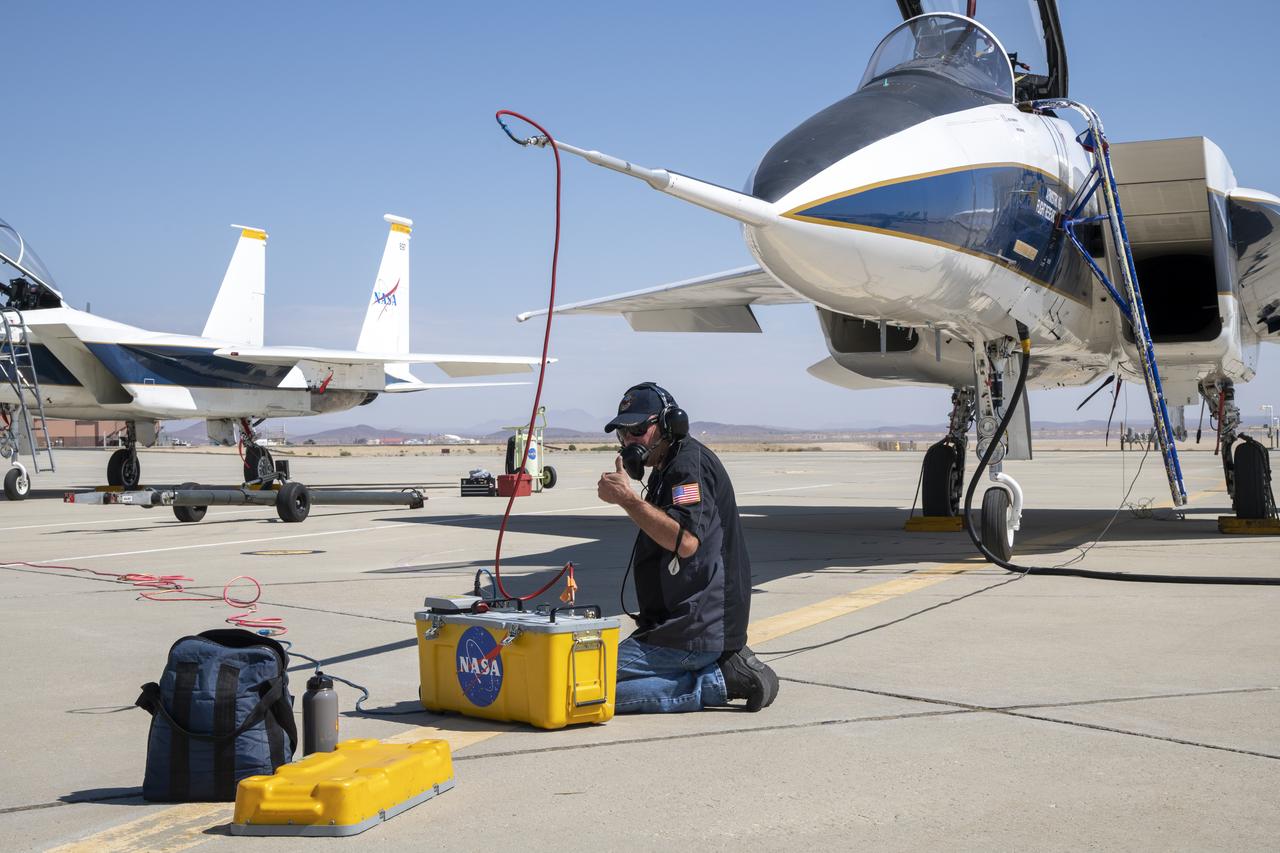
Claudia Sales, NASA’s acting X-59 deputy chief engineer and airworthiness certification lead for the quiet supersonic research aircraft, supports ground testing for Acoustic Research Measurements (ARM) flights. The test campaign to evaluate technologies that reduce aircraft noise was conducted at NASA’s Armstrong Flight Research Center in Edwards, California, in 2018.
NASA Employees’ Careers Started as Interns
NASA's ER-2 aircraft is prepared for a check flight by Eric Hintsa, scientist of the Unmanned Aircraft Systems (UAS) Chromatograph for Atmospheric Trace Species (UCATS) instrument, on May 13, 2022.
NASA's ER-2 is prepared for the Dynamics and Chemistry of the Summer Stratosphere, or DCOTSS, 2022 campaign.
Robotics teams gather on the main floor of the 2025 Aerospace Valley FIRST Robotics Competition at Eastside High School in Lancaster, California, adjusting and testing the functions of their robots, on April 3, 2025
NASA Supports Next Generation of Innovators at Robotics Competition
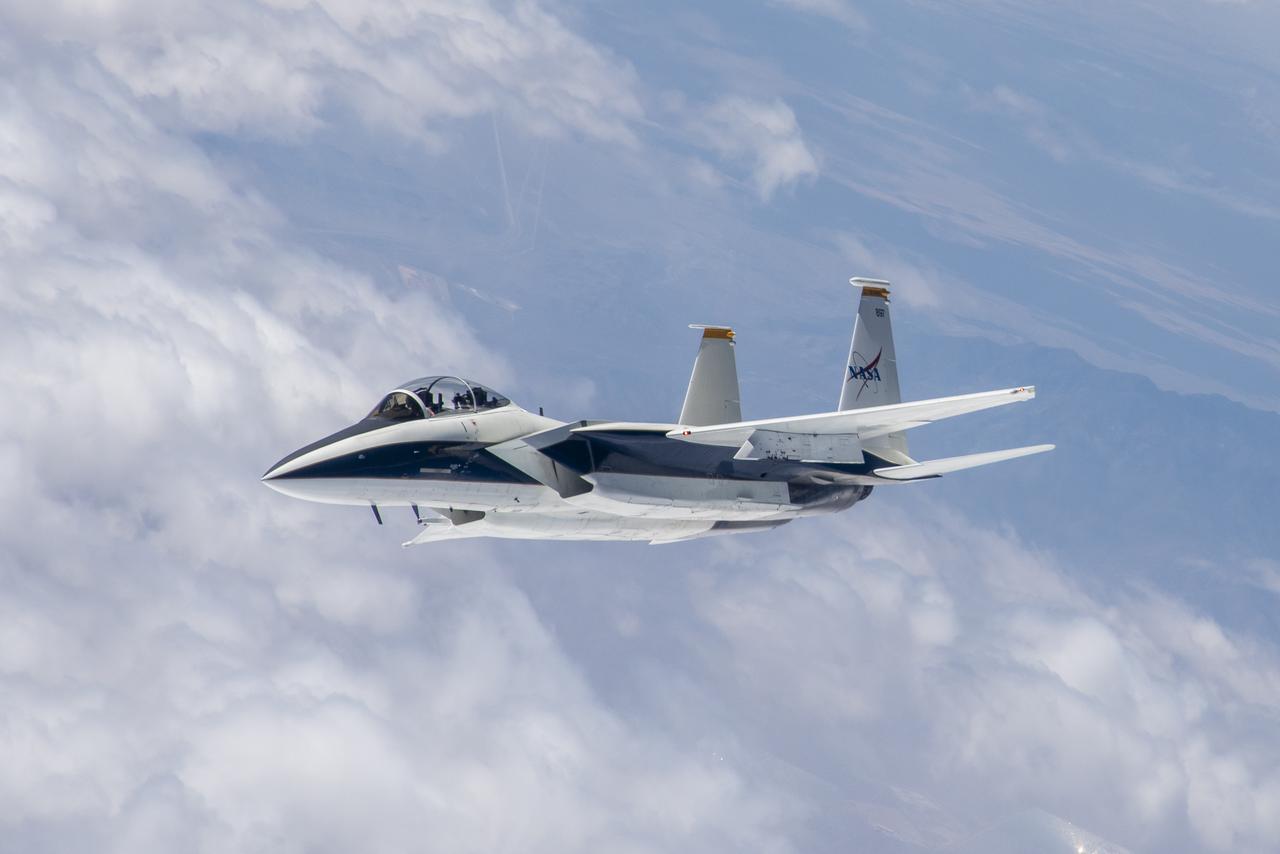
The F-15 Advanced Controls Technology for Integrated Vehicles, the first pre-production F-15B, shows its canards. Less obvious are the multi-axis thrust vectoring exhaust nozzles.
F-15 ACTIVE Lands
NASA’s Armstrong Flight Research Center DC-8 taking off from Building 703 in Palmdale, CA for the Student Airborne Research Program flights on December 7, 2021.
NASA DC-8 SARP 2020-21
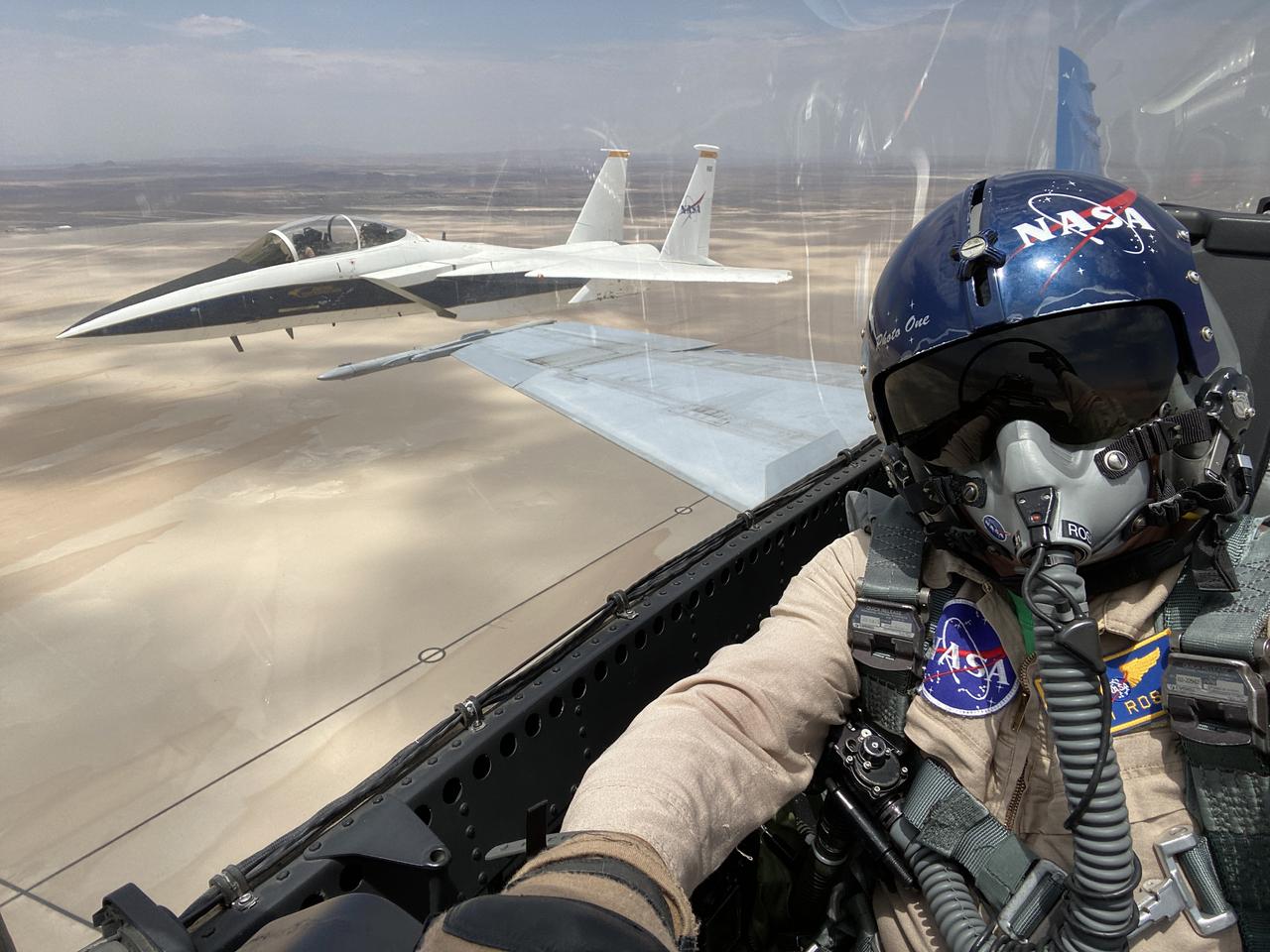
NASA research pilot Nils Larson and photographer Jim Ross complete aerobatic maneuvers in a NASA Armstrong Flight Research Center in Edwards, California owned T-34C aircraft during a proficiency flight. 
NASA Armstrong Flight Research Center T-34C Aircraft in Flight
NASA's Super Guppy Turbine cargo aircraft in the hangar at NASA's Armstrong Flight Research Center on August 24, 2021. This unique whale-like aircraft arrived at the center's Building 703 in Palmdale, CA to support crews in the performance of routine maintenance. The Super Guppy aircraft, operated by NASA's Johnson Space Center, aids in the transportation of oversized aerospace cargo in a practical and economical way.
NASA's Super Guppy in the hangar at Armstrong Building 703
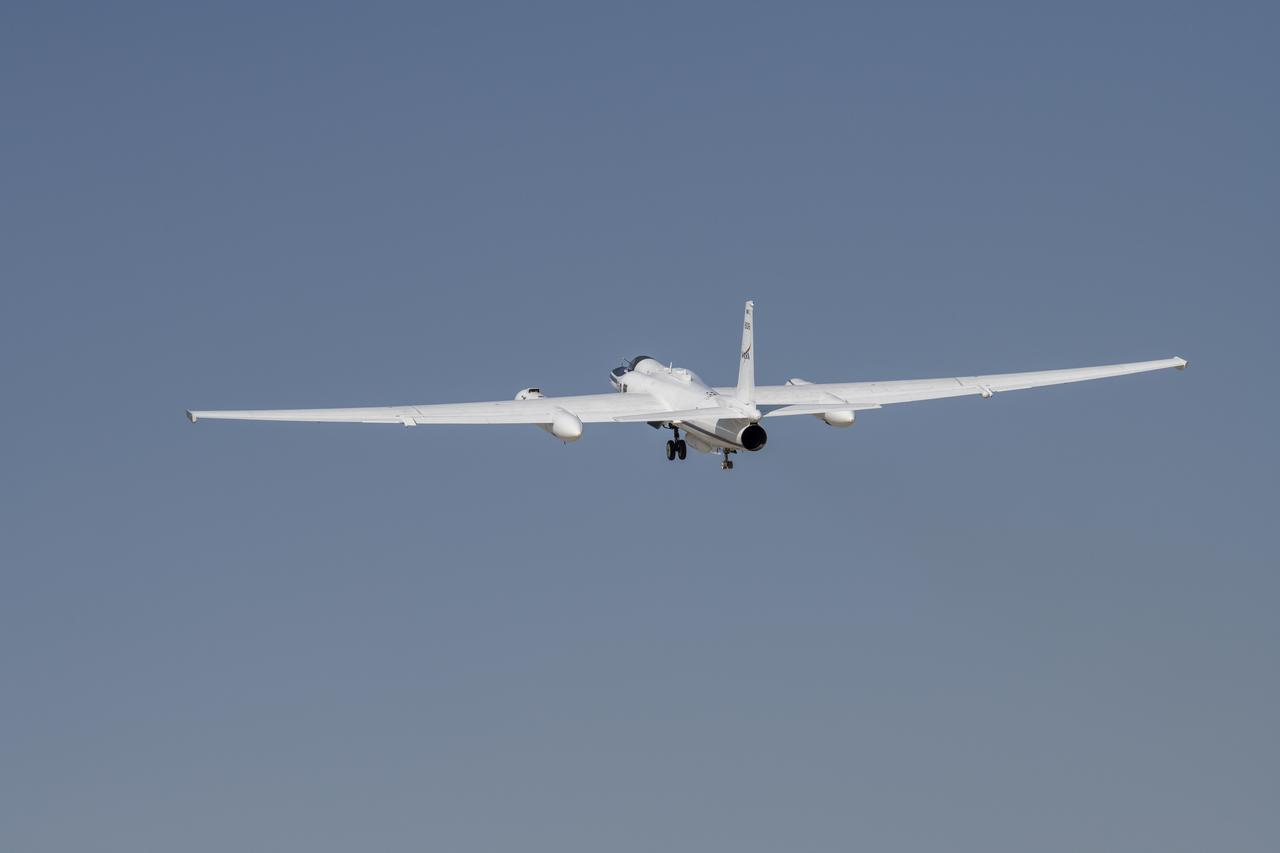
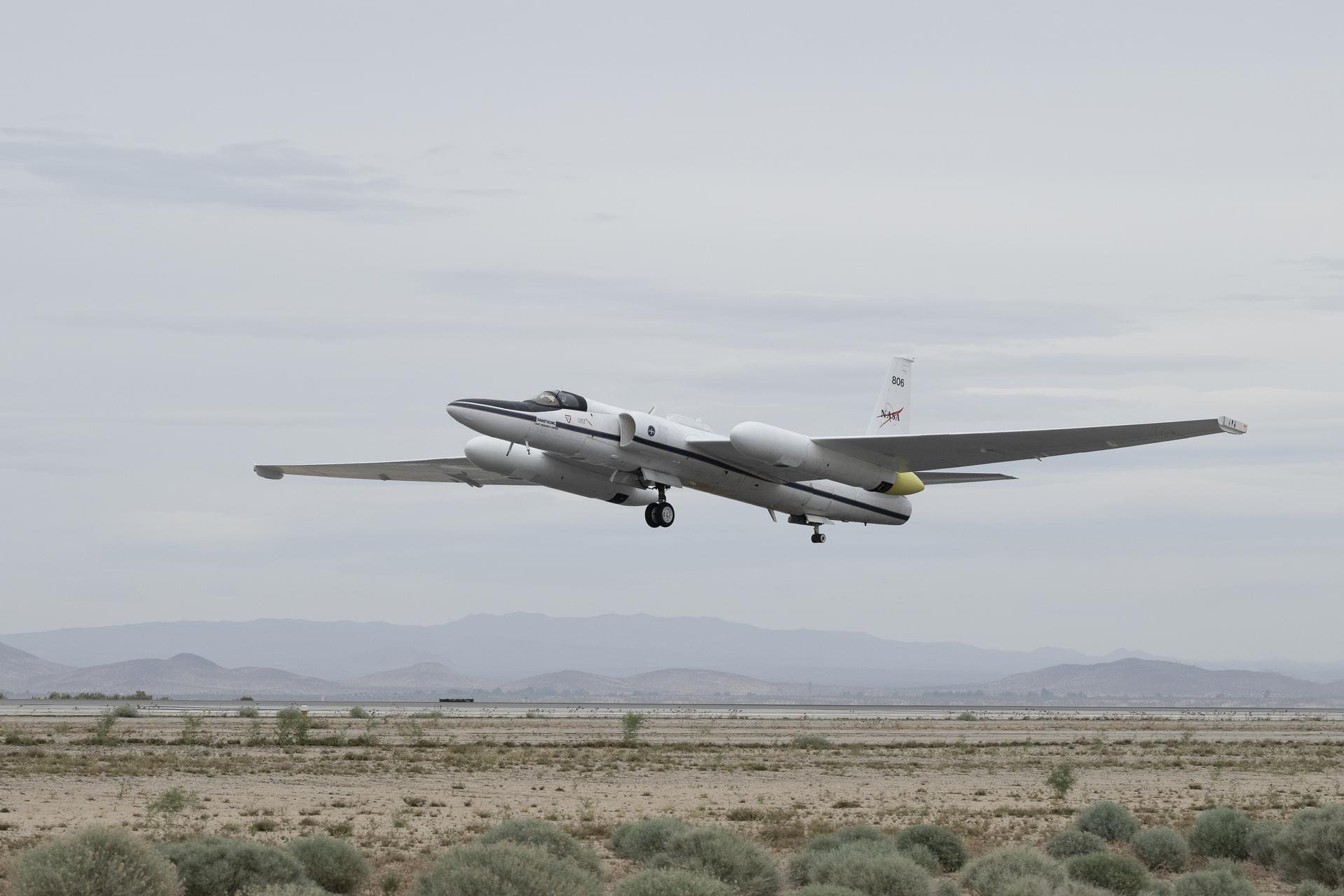
NASA’s ER-2 No. 806 returns to flying high-altitude on April 7, 2022, after three years of heavy maintenance. NASA Armstrong operates two ER-2 aircraft to collect information about Earth resources, celestial observations, atmospheric chemistry and dynamics, and oceanic processes.
NASA’s ER-2 No.806 Returns to Flight
The Stratospheric Observatory for Infrared Astronomy (SOFIA) returns to NASA’s Armstrong Flight Research Center Building 703 on Aug. 11 after a productive month of science flights out of Christchurch International Airport in New Zealand.
SOFIA Returns from Southern Hemisphere Deployment
NASA’s Armstrong Flight Research Center in Edwards, California, flew the B200 King Air in support of the Signals of Opportunity Synthetic Aperture Radar (SoOpSAR) campaign. Prior to deploying the plane, NASA research pilot Jeff Borton provides ground checks of the aircraft on Feb. 27, 2023.
King Air N801NA SoOpSAR Deployment
Students tour a control room at NASA’s Armstrong Research Flight Center in Edwards, California. The students are from the engineering club at Palmdale High School in Palmdale, California.
Engineering Club Visits NASA Armstrong
Boeing’s MD-90 aircraft flies from Victorville California to Palmdale, California on August 15, 2023. This aircraft will be NASA’s future Sustainable Flight Demonstrator. Modifications to the aircraft will include changes to the fuselage and most notably the use of a transonic truss-braced wing.
Boeing MD-90 flies from Victorville, California to Palmdale, California where it will begin modifications as part of NASA Sustainable Flight Demonstrator
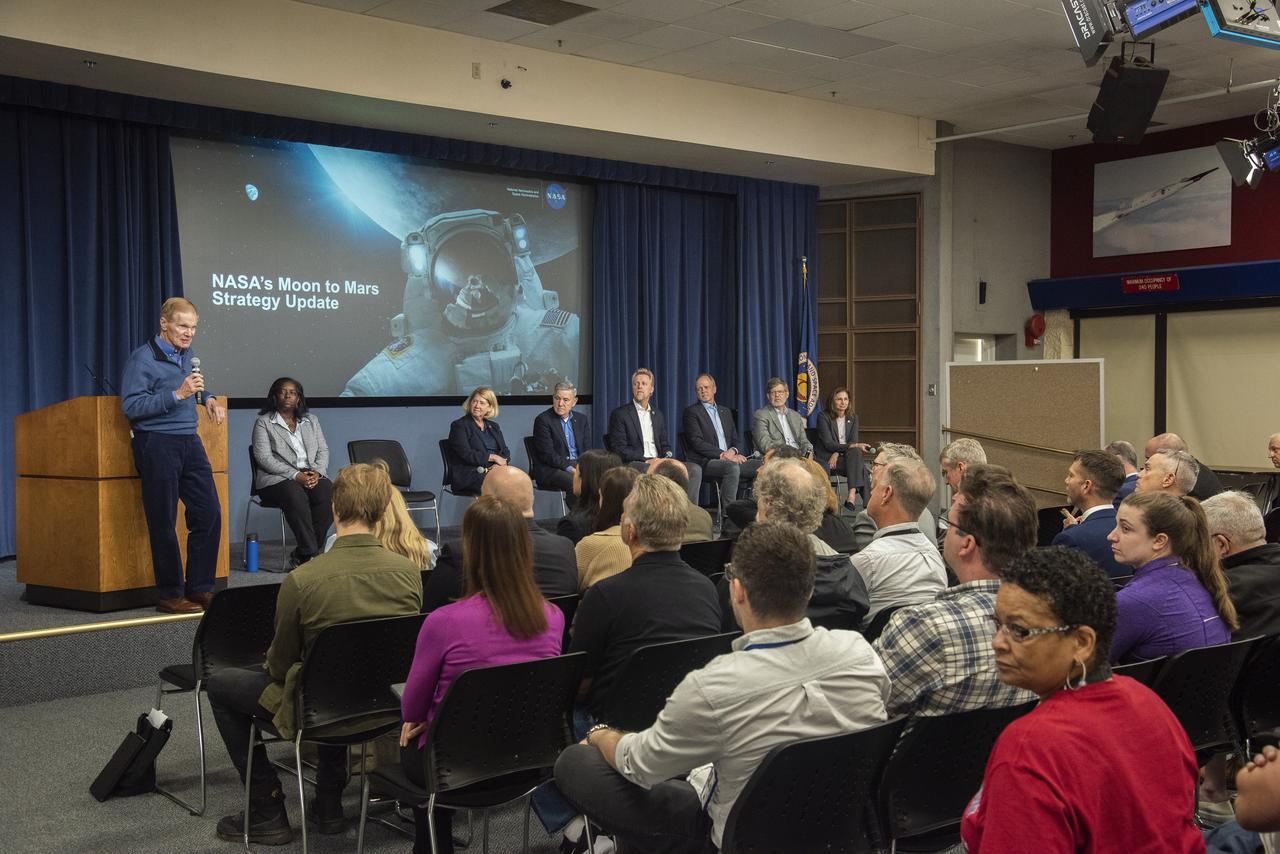
In Armstrong auditorium, Bridenstine discusses the future of NASA under his administration then answered questions from employees
Bridenstine holds town hall with employees speaking of his vision for the agency and answering questions.
Eric Miranda, who works at the U.S. Air Force Corrosion Control Facility, paints areas in a stencil for adding some finishing touches to NASA 862, which is an F/A-18D based at NASA’s Armstrong Flight Research Center in Edwards, California. The corrosion control facility is located on Edwards Air Force Base and is also known as the Paint Barn.
NASA 862 Enters Air Force Paint Barn
The Stratospheric Observatory for Infrared Astronomy (SOFIA) returns to NASA’s Armstrong Flight Research Center Building 703 on Aug. 11 after a productive month of science flights out of Christchurch International Airport in New Zealand.
SOFIA Returns from Southern Hemisphere Deployment
Boeing’s MD-90 aircraft flies from Victorville California to Palmdale, California on August 15, 2023. This aircraft will be NASA’s future Sustainable Flight Demonstrator. Modifications to the aircraft will include changes to the fuselage and most notably the use of a transonic truss-braced wing.
Boeing MD-90 flies from Victorville, California to Palmdale, California where it will begin modifications as part of NASA Sustainable Flight Demonstrator
DC-8 lifts off from Air Force Plant 42 in Palmdale, Calif.
DC-8 Lift Off