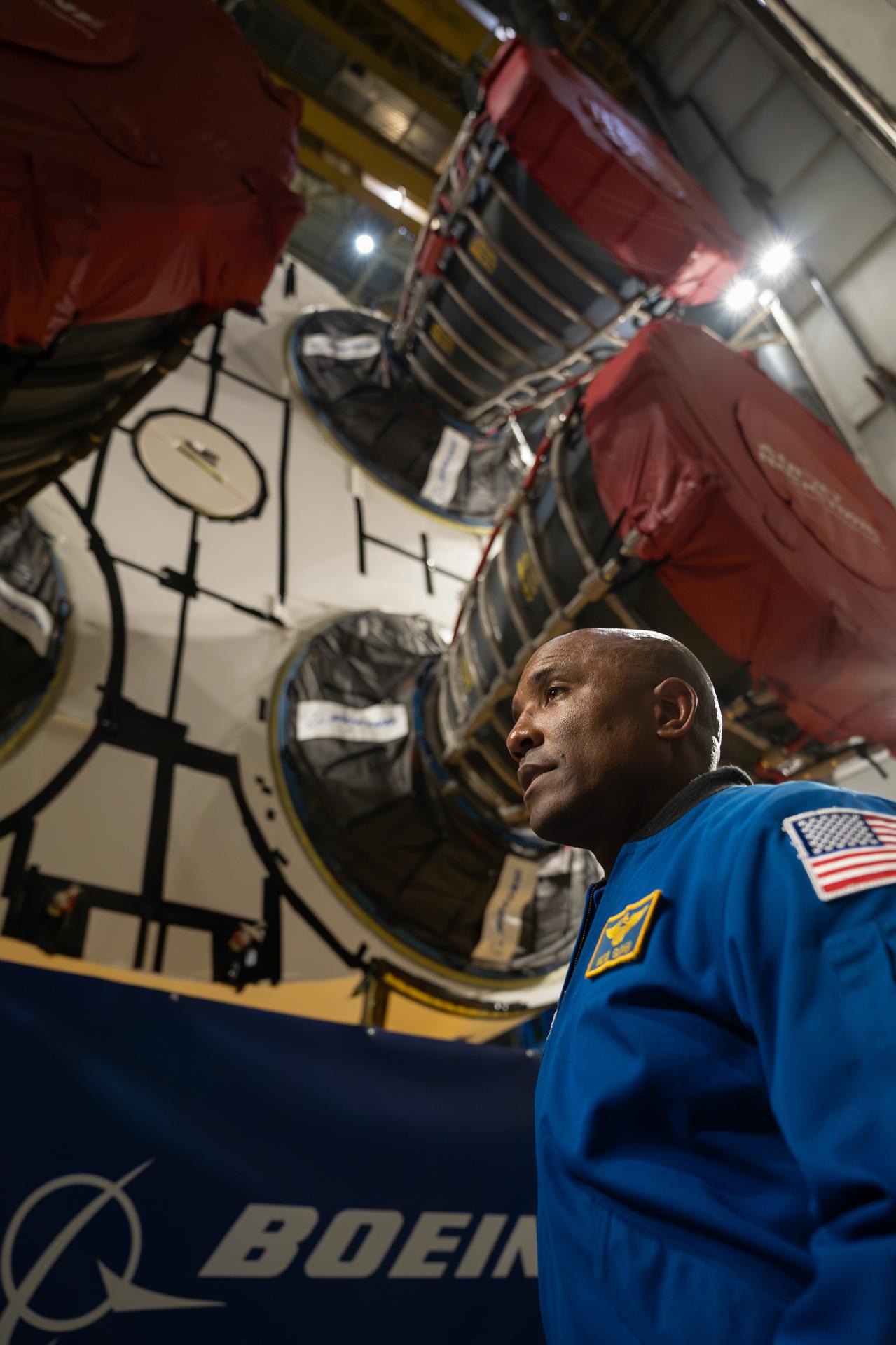
NASA astronaut Victor Glover views the core stage of the SLS (Space Launch System) rocket that will help power Artemis II at NASA’s Michoud Assembly Facility in New Orleans July 15. Glover will pilot Artemis II, the first crewed mission of NASA’s Artemis campaign. Crews moved the 212-foot-tall core stage with its four RS-25 engines to Building 110 at NASA Michoud prior to rolling it out to NASA’s Pegasus barge July 16 for delivery to NASA’s Kennedy Space Center in Florida.

These artist’s concepts show SpaceX’s Starship Human Landing System (HLS) on the Moon. NASA is working with SpaceX to develop Starship HLS to carry astronauts from lunar orbit to the Moon’s surface and back for Artemis III and Artemis IV as part of the agency’s Artemis campaign. At about 165 feet (50 m), Starship HLS will be about the same height as a 15-story building. An elevator on Starship HLS will be used to transport crew and cargo between the lander and the Moon’s surface.
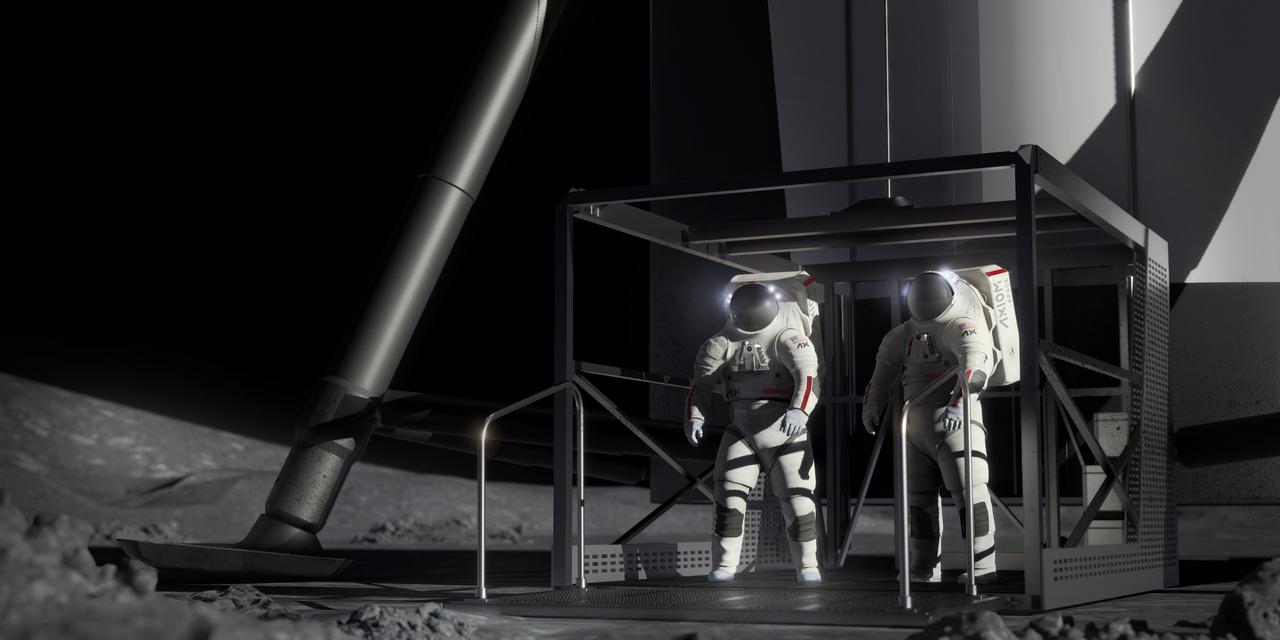
These artist’s concepts show SpaceX’s Starship Human Landing System (HLS) on the Moon. NASA is working with SpaceX to develop Starship HLS to carry astronauts from lunar orbit to the Moon’s surface and back for Artemis III and Artemis IV as part of the agency’s Artemis campaign. At about 165 feet (50 m), Starship HLS will be about the same height as a 15-story building. An elevator on Starship HLS will be used to transport crew and cargo between the lander and the Moon’s surface.
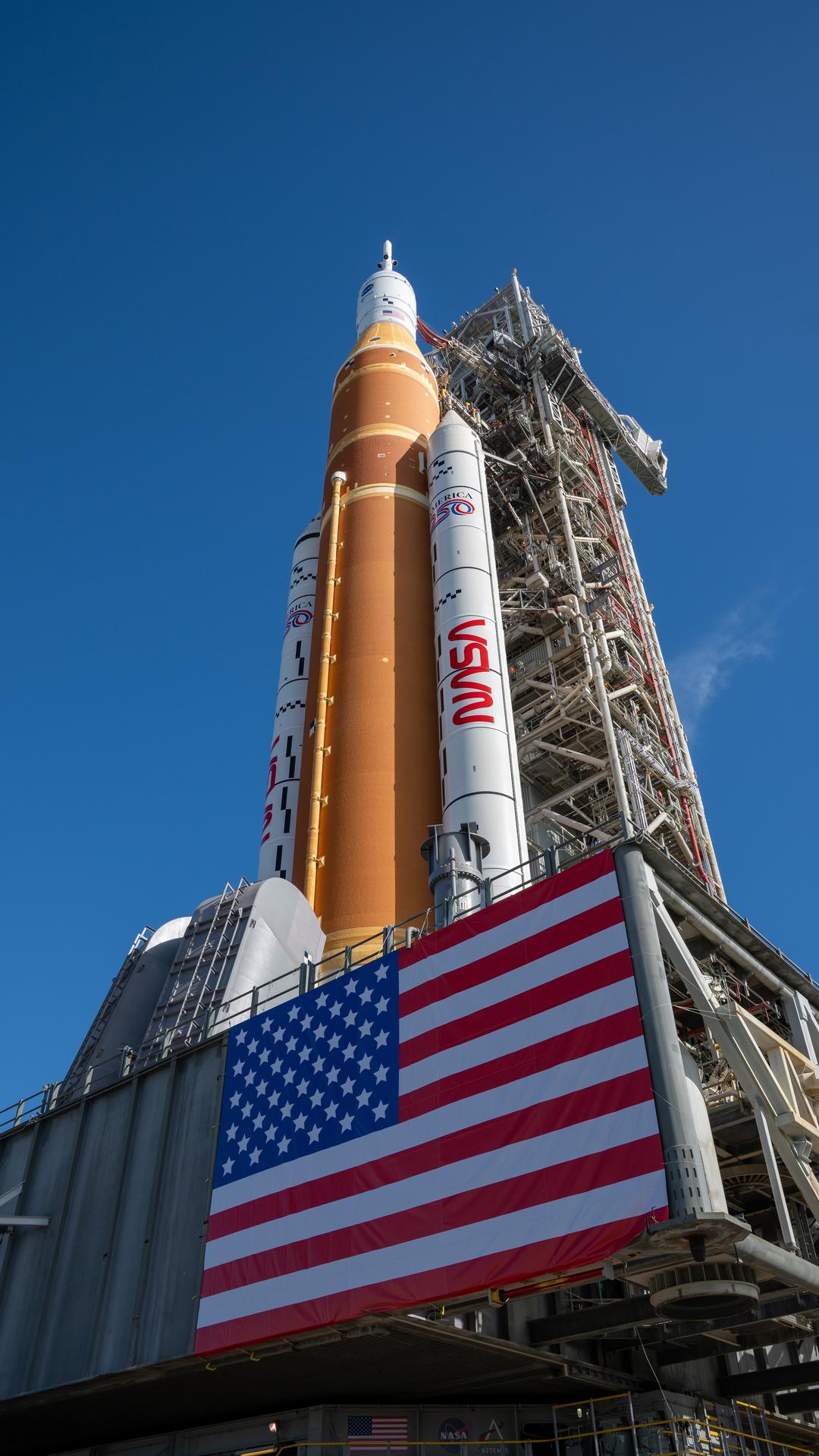
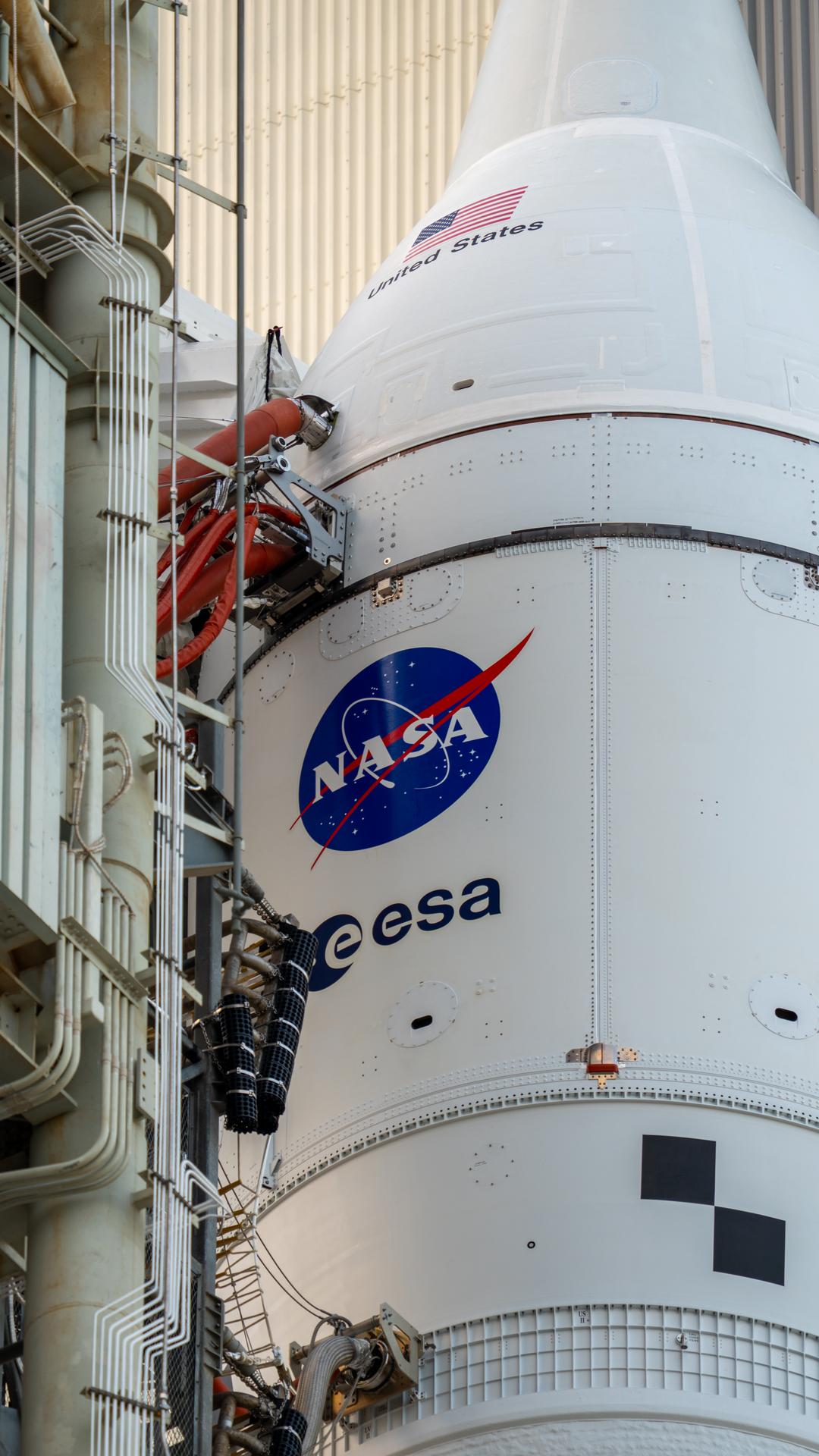
This image shows NASA’s SLS (Space Launch System) and Orion spacecraft rolling out of the Vehicle Assembly Building at NASA’s Kennedy Space Center. NASA's massive Crawler-Transporter, upgraded for the Artemis program, carries the powerful SLS rocket and Orion spacecraft on the Mobile Launcher from the Vehicle Assembly Building to Launch Pad 39B at Kennedy Space Center in preparation for the Artemis II mission.

NASA’s Pegasus barge departs from NASA’s Michoud Assembly Facility in New Orleans on April 21. The barge arrived at NASA’s Kennedy Space Center in Florida on April 27 with the largest section of the core stage for the agency’s SLS (Space Launch System) rocket that will launch the crewed Artemis III mission in 2027. Engineers will complete outfitting and vertical integration of the top four-fifths – the section containing the liquid hydrogen tank, liquid oxygen tank, intertank, and forward skirt – of the SLS core stage at NASA Kennedy. Next year’s Artemis III mission will launch astronauts to Earth’s orbit aboard the Orion spacecraft on top of SLS to test rendezvous and docking capabilities between Orion and commercial spacecraft needed to land Artemis IV astronauts on the Moon in 2028. NASA’s SLS is the only rocket capable of sending Orion, astronauts, and supplies to the Moon in a single launch. Image credit: NASA/Michael DeMocker

NASA’s Pegasus barge departs from NASA’s Michoud Assembly Facility in New Orleans on April 21. The barge arrived at NASA’s Kennedy Space Center in Florida on April 27 with the largest section of the core stage for the agency’s SLS (Space Launch System) rocket that will launch the crewed Artemis III mission in 2027. Engineers will complete outfitting and vertical integration of the top four-fifths – the section containing the liquid hydrogen tank, liquid oxygen tank, intertank, and forward skirt – of the SLS core stage at NASA Kennedy. Next year’s Artemis III mission will launch astronauts to Earth’s orbit aboard the Orion spacecraft on top of SLS to test rendezvous and docking capabilities between Orion and commercial spacecraft needed to land Artemis IV astronauts on the Moon in 2028. NASA’s SLS is the only rocket capable of sending Orion, astronauts, and supplies to the Moon in a single launch. Image credit: NASA/Michael DeMocker

NASA’s Pegasus barge departs from NASA’s Michoud Assembly Facility in New Orleans on April 21. The barge arrived at NASA’s Kennedy Space Center in Florida on April 27 with the largest section of the core stage for the agency’s SLS (Space Launch System) rocket that will launch the crewed Artemis III mission in 2027. Engineers will complete outfitting and vertical integration of the top four-fifths – the section containing the liquid hydrogen tank, liquid oxygen tank, intertank, and forward skirt – of the SLS core stage at NASA Kennedy. Next year’s Artemis III mission will launch astronauts to Earth’s orbit aboard the Orion spacecraft on top of SLS to test rendezvous and docking capabilities between Orion and commercial spacecraft needed to land Artemis IV astronauts on the Moon in 2028. NASA’s SLS is the only rocket capable of sending Orion, astronauts, and supplies to the Moon in a single launch. Image credit: NASA/Michael DeMocker

NASA’s Pegasus barge departs from NASA’s Michoud Assembly Facility in New Orleans on April 21. The barge arrived at NASA’s Kennedy Space Center in Florida on April 27 with the largest section of the core stage for the agency’s SLS (Space Launch System) rocket that will launch the crewed Artemis III mission in 2027. Engineers will complete outfitting and vertical integration of the top four-fifths – the section containing the liquid hydrogen tank, liquid oxygen tank, intertank, and forward skirt – of the SLS core stage at NASA Kennedy. Next year’s Artemis III mission will launch astronauts to Earth’s orbit aboard the Orion spacecraft on top of SLS to test rendezvous and docking capabilities between Orion and commercial spacecraft needed to land Artemis IV astronauts on the Moon in 2028. NASA’s SLS is the only rocket capable of sending Orion, astronauts, and supplies to the Moon in a single launch. Image credit: NASA/Michael DeMocker

NASA’s Pegasus barge departs from NASA’s Michoud Assembly Facility in New Orleans on April 21. The barge arrived at NASA’s Kennedy Space Center in Florida on April 27 with the largest section of the core stage for the agency’s SLS (Space Launch System) rocket that will launch the crewed Artemis III mission in 2027. Engineers will complete outfitting and vertical integration of the top four-fifths – the section containing the liquid hydrogen tank, liquid oxygen tank, intertank, and forward skirt – of the SLS core stage at NASA Kennedy. Next year’s Artemis III mission will launch astronauts to Earth’s orbit aboard the Orion spacecraft on top of SLS to test rendezvous and docking capabilities between Orion and commercial spacecraft needed to land Artemis IV astronauts on the Moon in 2028. NASA’s SLS is the only rocket capable of sending Orion, astronauts, and supplies to the Moon in a single launch. Image credit: NASA/Michael DeMocker
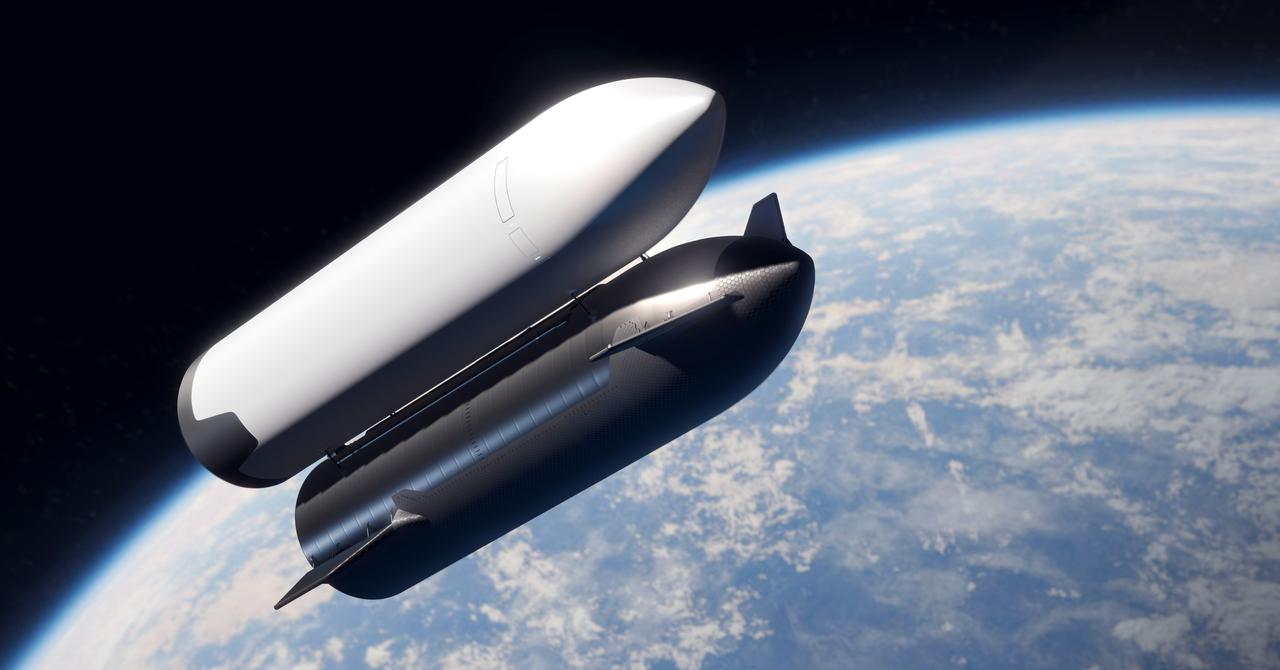
These artist’s concepts show SpaceX’s Starship Human Landing System (HLS) in operation on its journey to the Moon. Before astronauts launch in NASA’s Orion spacecraft atop the agency’s SLS (Space Launch System) rocket, SpaceX will launch a storage depot to Earth orbit. For Artemis III and Artemis IV, SpaceX plans to complete propellant loading operations in Earth orbit to send a fully fueled Starship HLS to the Moon. Starship HLS will then dock directly to Orion so that two astronauts can transfer from the spacecraft to the lander to descend to the Moon’s surface, while two others remain in Orion. Beginning with Artemis IV, NASA’s Gateway lunar space station will serve as the crew transfer point. NASA is working with SpaceX to develop Starship HLS to carry astronauts from lunar orbit to the Moon’s surface and back for Artemis III and Artemis IV as part of the agency’s Artemis campaign.

These artist’s concepts show SpaceX’s Starship Human Landing System (HLS) in operation on its journey to the Moon. Before astronauts launch in NASA’s Orion spacecraft atop the agency’s SLS (Space Launch System) rocket, SpaceX will launch a storage depot to Earth orbit. For Artemis III and Artemis IV, SpaceX plans to complete propellant loading operations in Earth orbit to send a fully fueled Starship HLS to the Moon. Starship HLS will then dock directly to Orion so that two astronauts can transfer from the spacecraft to the lander to descend to the Moon’s surface, while two others remain in Orion. Beginning with Artemis IV, NASA’s Gateway lunar space station will serve as the crew transfer point. NASA is working with SpaceX to develop Starship HLS to carry astronauts from lunar orbit to the Moon’s surface and back for Artemis III and Artemis IV as part of the agency’s Artemis campaign.
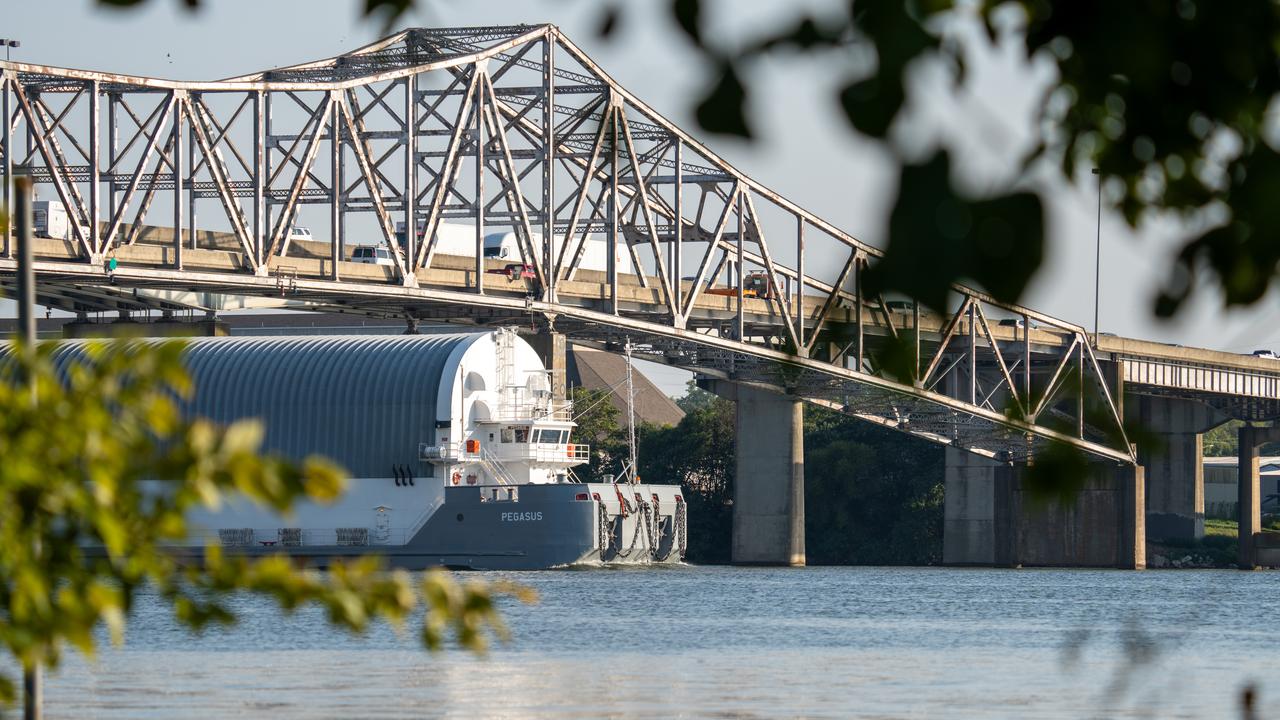
NASA’s Pegasus barge, ferrying the launch vehicle stage adapter for NASA’s SLS (Space Launch System) rocket, departed the agency’s Marshall Space Flight Center in Huntsville, Alabama, Aug. 21, passing through nearby Decatur. The cone-shaped adapter is part of the SLS rocket that will power Artemis II mission, the first crewed flight of the agency’s Artemis campaign. The barge will stop briefly at NASA’s Michoud Assembly Facility in New Orleans to pick up additional hardware elements for Artemis III and Artemis IV before heading to the agency’s Kennedy Space Center in Florida, where the adapter will be readied for stacking and launch preparations.
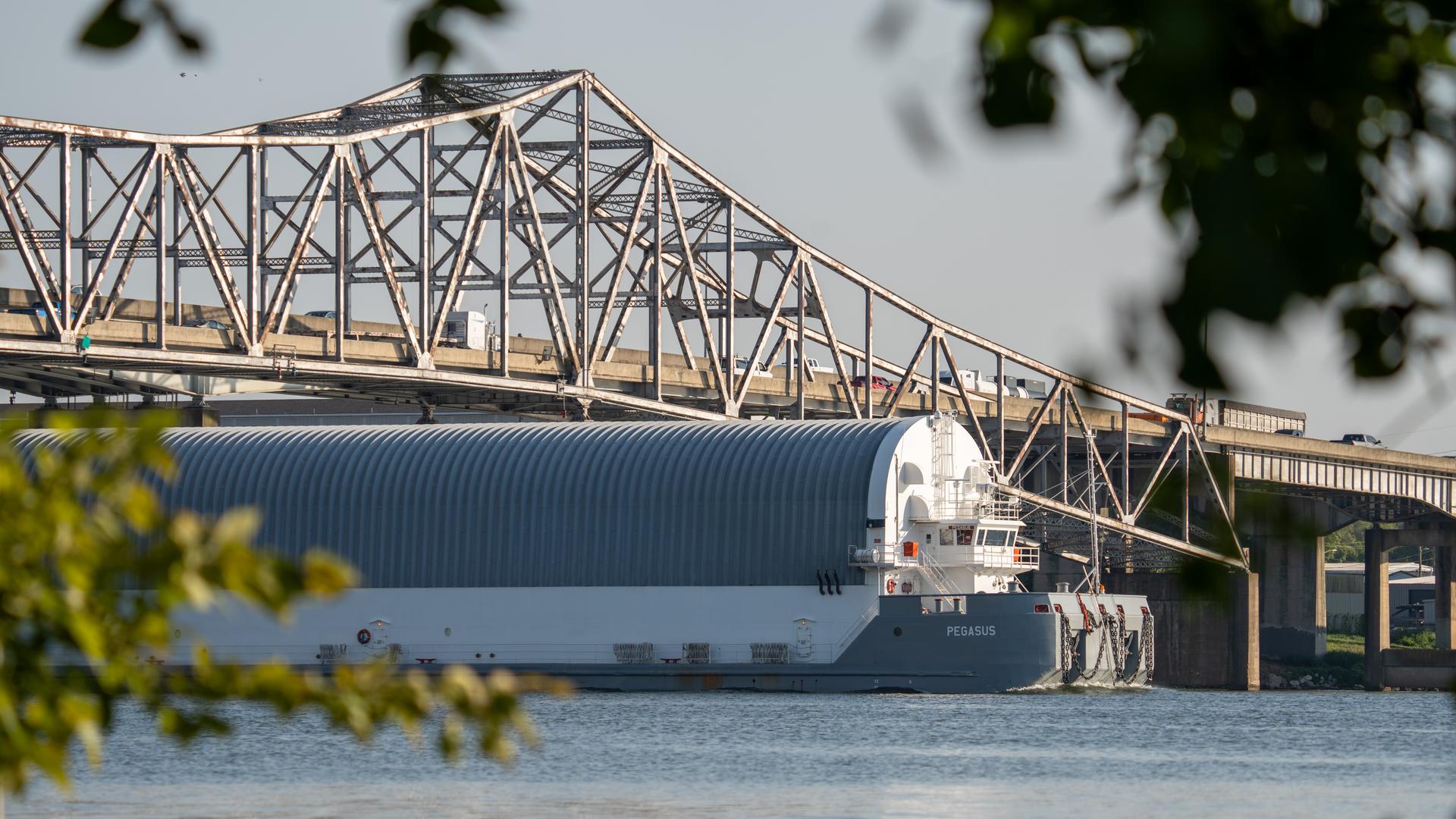
NASA’s Pegasus barge, ferrying the launch vehicle stage adapter for NASA’s SLS (Space Launch System) rocket, departed the agency’s Marshall Space Flight Center in Huntsville, Alabama, Aug. 21, passing through nearby Decatur. The cone-shaped adapter is part of the SLS rocket that will power Artemis II mission, the first crewed flight of the agency’s Artemis campaign. The barge will stop briefly at NASA’s Michoud Assembly Facility in New Orleans to pick up additional hardware elements for Artemis III and Artemis IV before heading to the agency’s Kennedy Space Center in Florida, where the adapter will be readied for stacking and launch preparations.

NASA Administrator Bill Nelson, is seen during an update on NASA's Artemis campaign, Thursday, Dec. 5, 2024, at the NASA Headquarters Mary W. Jackson Building in Washington. Photo Credit: (NASA/Bill Ingalls)

NASA Administrator Bill Nelson, gives remarks during an update on NASA's Artemis campaign, Thursday, Dec. 5, 2024, at the NASA Headquarters Mary W. Jackson Building in Washington. Photo Credit: (NASA/Bill Ingalls)

NASA Administrator Bill Nelson, gives remarks during an update on NASA's Artemis campaign, Thursday, Dec. 5, 2024, at the NASA Headquarters Mary W. Jackson Building in Washington. Photo Credit: (NASA/Bill Ingalls)

NASA Deputy Administrator Pam Melroy, gives remarks during an update on NASA's Artemis campaign, Thursday, Dec. 5, 2024, at the NASA Headquarters Mary W. Jackson Building in Washington. Photo Credit: (NASA/Bill Ingalls)
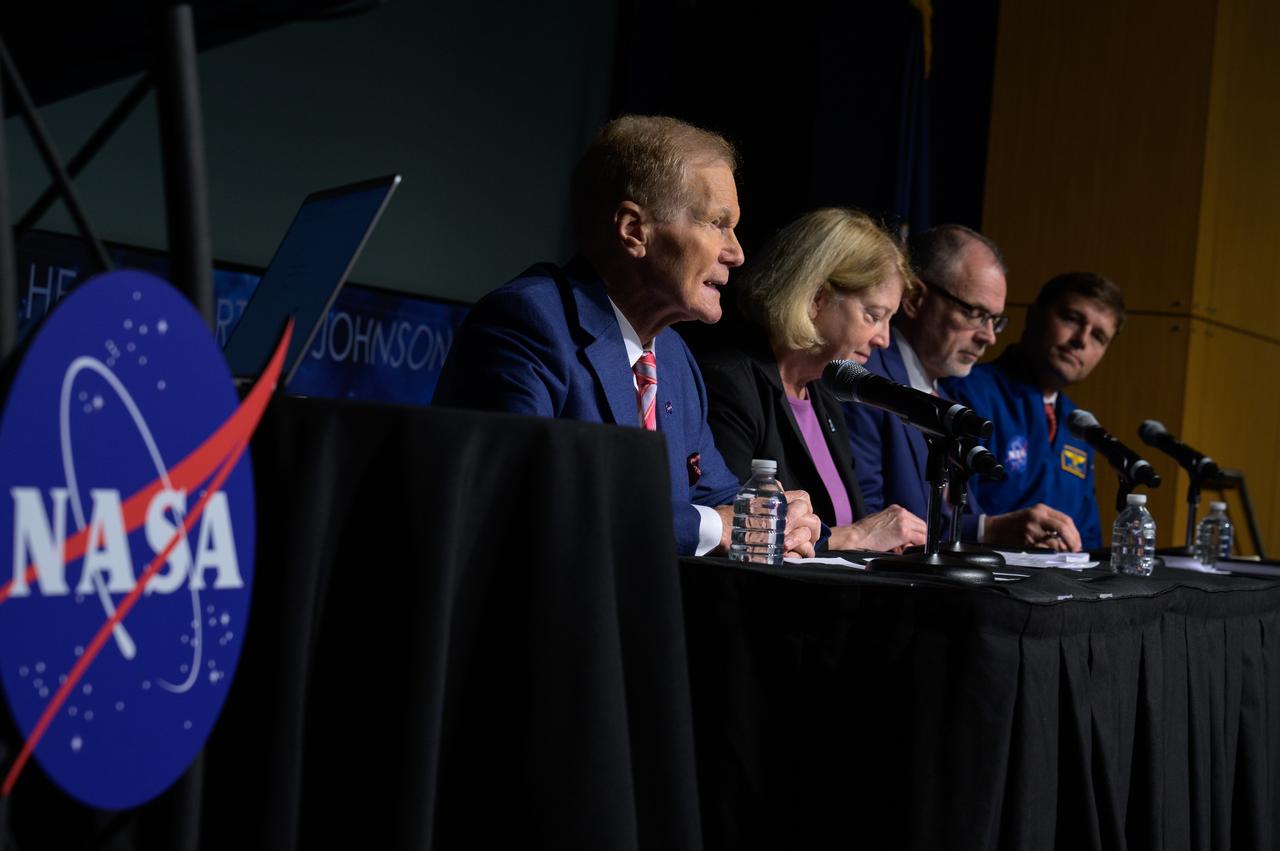
NASA Administrator Bill Nelson, left, gives remarks during an update on NASA's Artemis campaign, Thursday, Dec. 5, 2024, at the NASA Headquarters Mary W. Jackson Building in Washington. Photo Credit: (NASA/Bill Ingalls)
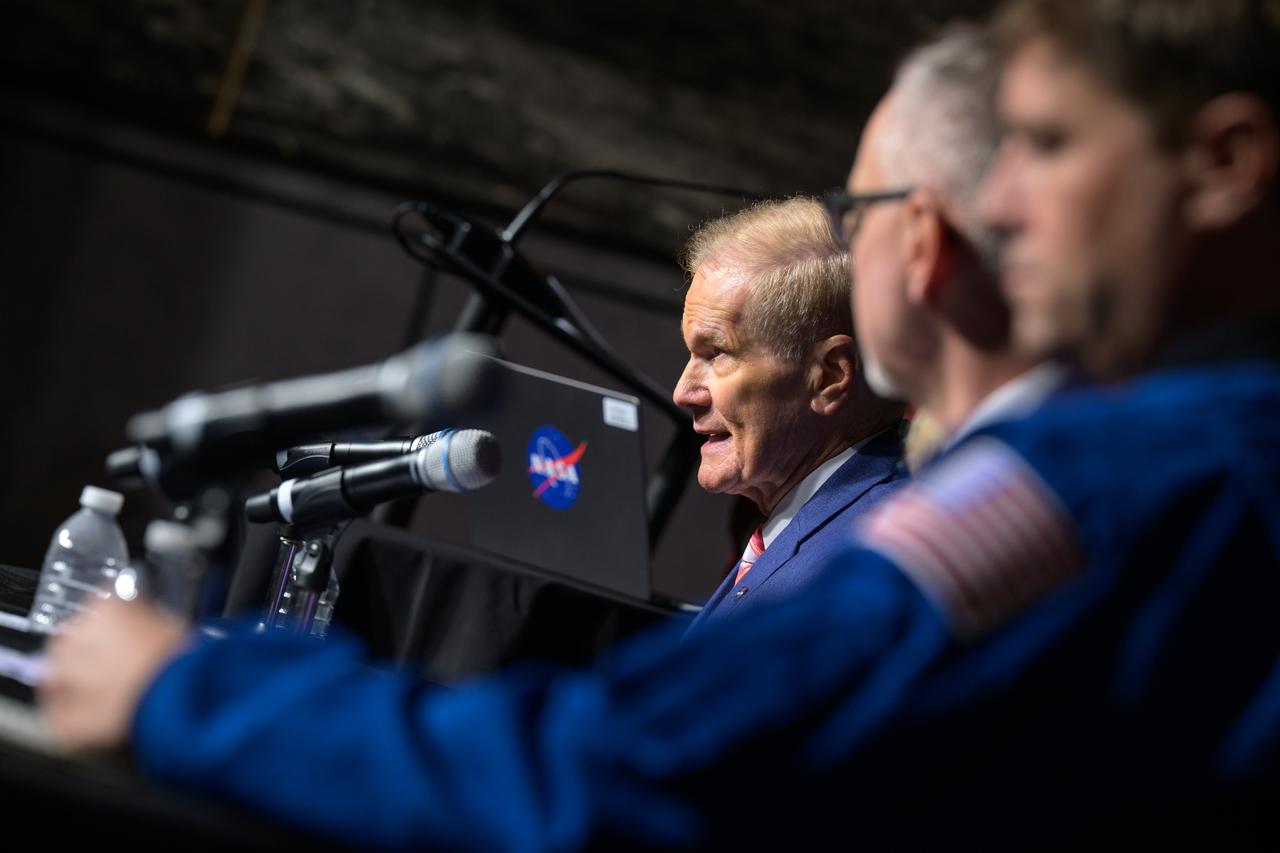
NASA Administrator Bill Nelson, gives remarks during an update on NASA's Artemis campaign, Thursday, Dec. 5, 2024, at the NASA Headquarters Mary W. Jackson Building in Washington. Photo Credit: (NASA/Bill Ingalls)
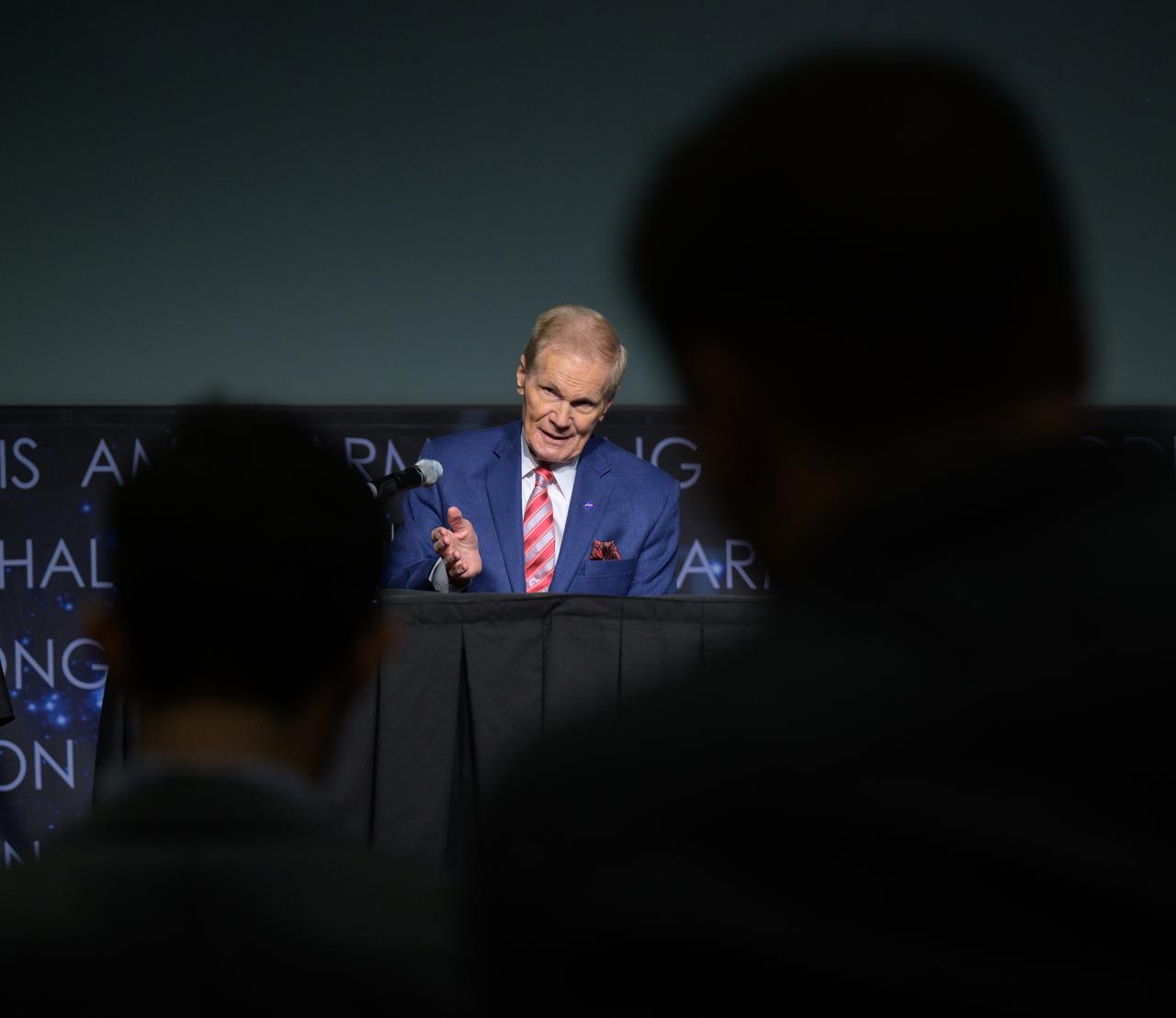
NASA Administrator Bill Nelson, gives remarks during an update on NASA's Artemis campaign, Thursday, Dec. 5, 2024, at the NASA Headquarters Mary W. Jackson Building in Washington. Photo Credit: (NASA/Bill Ingalls)

NASA Deputy Administrator Pam Melroy, gives remarks during an update on NASA's Artemis campaign, Thursday, Dec. 5, 2024, at the NASA Headquarters Mary W. Jackson Building in Washington. Photo Credit: (NASA/Bill Ingalls)
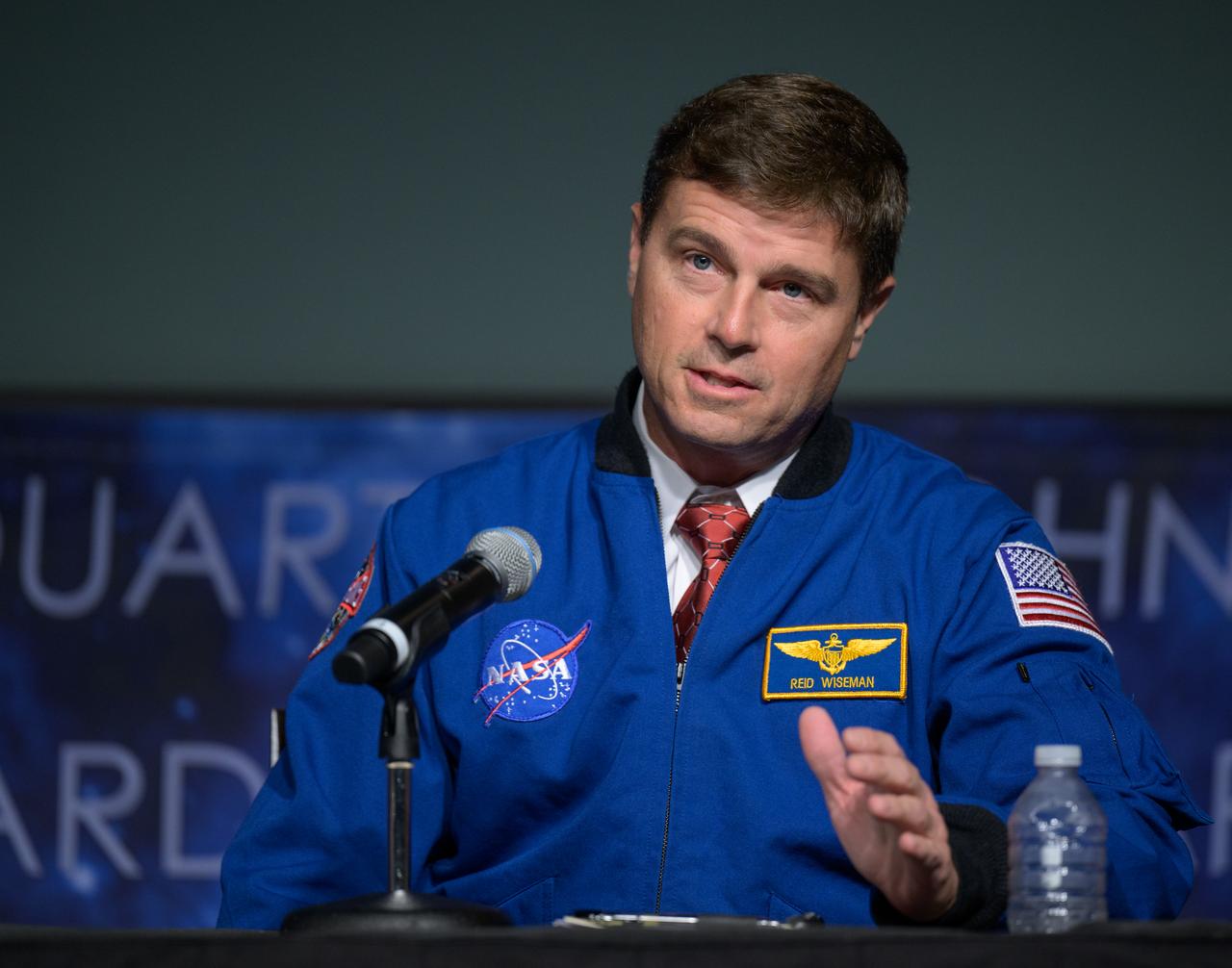
NASA Astronaut and Artemis II commander Reid Wiseman, gives remarks during an update on NASA's Artemis campaign, Thursday, Dec. 5, 2024, at the NASA Headquarters Mary W. Jackson Building in Washington. Photo Credit: (NASA/Bill Ingalls)
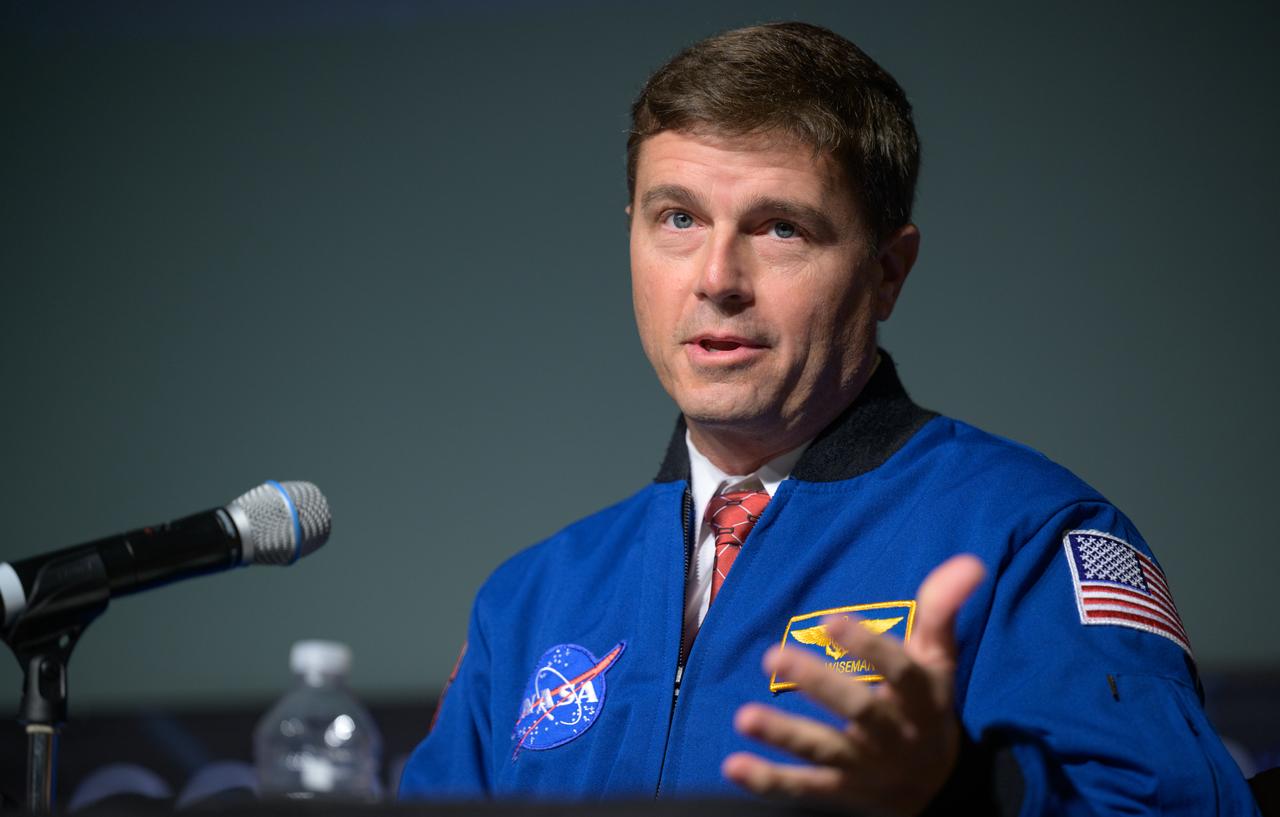
NASA Astronaut and Artemis II commander Reid Wiseman, gives remarks during an update on NASA's Artemis campaign, Thursday, Dec. 5, 2024, at the NASA Headquarters Mary W. Jackson Building in Washington. Photo Credit: (NASA/Bill Ingalls)

Technicians at NASA’s Michoud Assembly Facility prepare to move the engine section of NASA’s Space Launch System rocket for Artemis IV to the Vertical Assembly Building for the next step in production. This hardware is the first large piece manufactured for the Artemis IV mission and makes up the lowest portion of the 212-foot-tall core stage. When complete, the engine section will house the four RS-25 engines and include vital systems for mounting, controlling and delivering fuel from the propellant tanks to the rocket’s engines. Together with its four RS-25 engines and its twin solid rocket boosters, it will produce 8.8 million pounds of thrust to send NASA’s Orion spacecraft, astronauts, and supplies beyond Earth’s orbit to the Moon and, ultimately, Mars. Offering more payload mass, volume capability, and energy to speed missions through space, the SLS rocket, along with NASA’s Gateway in lunar orbit, the Human Landing System, and Orion spacecraft, is part of NASA’s backbone for deep space exploration and the Artemis lunar program. No other rocket is capable of carrying astronauts in Orion around the Moon in a single mission. Photographed on Thursday, May 12, 2022. Image credit: NASA/Michael DeMocker
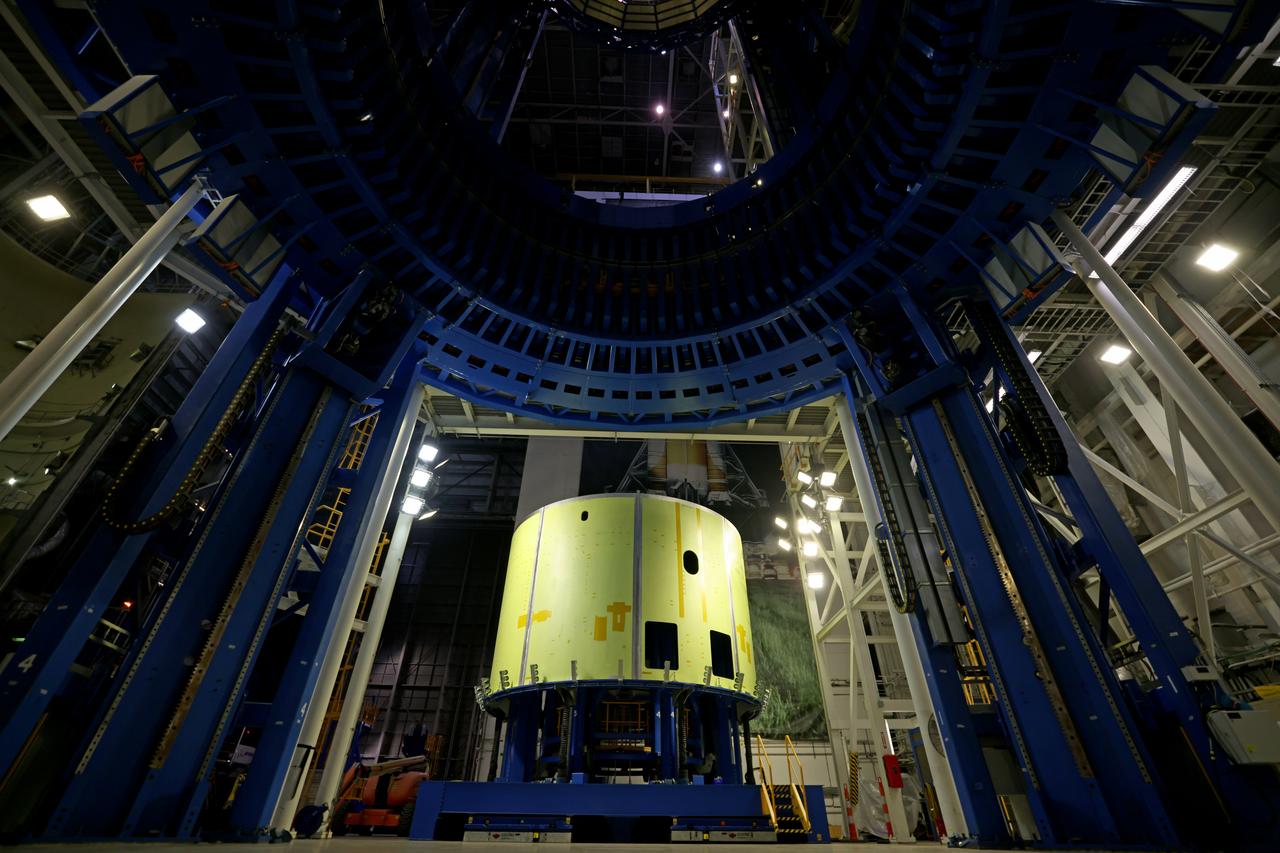
Technicians at NASA’s Michoud Assembly Facility prepare to move the engine section of NASA’s Space Launch System rocket for Artemis IV to the Vertical Assembly Building for the next step in production. This hardware is the first large piece manufactured for the Artemis IV mission and makes up the lowest portion of the 212-foot-tall core stage. When complete, the engine section will house the four RS-25 engines and include vital systems for mounting, controlling and delivering fuel from the propellant tanks to the rocket’s engines. Together with its four RS-25 engines and its twin solid rocket boosters, it will produce 8.8 million pounds of thrust to send NASA’s Orion spacecraft, astronauts, and supplies beyond Earth’s orbit to the Moon and, ultimately, Mars. Offering more payload mass, volume capability, and energy to speed missions through space, the SLS rocket, along with NASA’s Gateway in lunar orbit, the Human Landing System, and Orion spacecraft, is part of NASA’s backbone for deep space exploration and the Artemis lunar program. No other rocket is capable of carrying astronauts in Orion around the Moon in a single mission. Photographed on Thursday, May 12, 2022. Image credit: NASA/Michael DeMocker
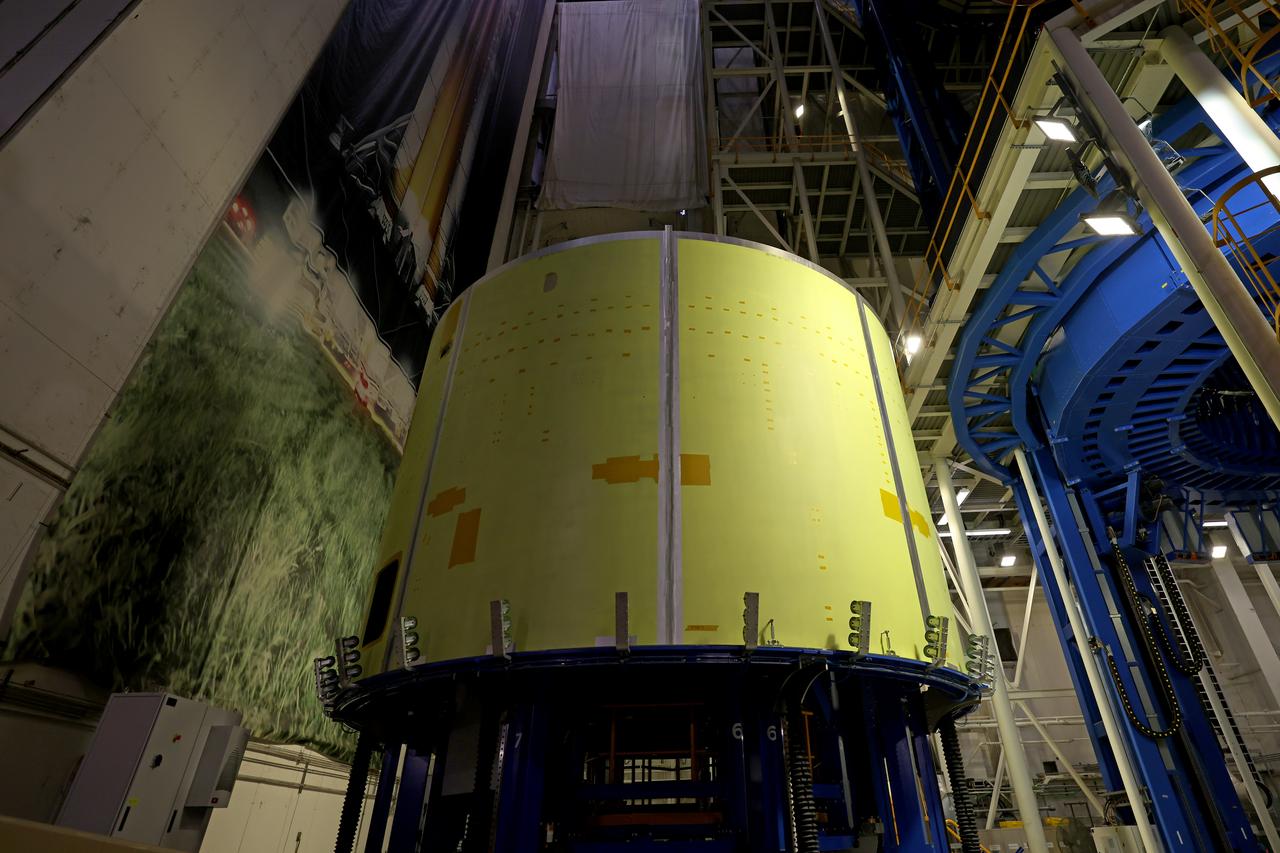
Technicians at NASA’s Michoud Assembly Facility prepare to move the engine section of NASA’s Space Launch System rocket for Artemis IV to the Vertical Assembly Building for the next step in production. This hardware is the first large piece manufactured for the Artemis IV mission and makes up the lowest portion of the 212-foot-tall core stage. When complete, the engine section will house the four RS-25 engines and include vital systems for mounting, controlling and delivering fuel from the propellant tanks to the rocket’s engines. Together with its four RS-25 engines and its twin solid rocket boosters, it will produce 8.8 million pounds of thrust to send NASA’s Orion spacecraft, astronauts, and supplies beyond Earth’s orbit to the Moon and, ultimately, Mars. Offering more payload mass, volume capability, and energy to speed missions through space, the SLS rocket, along with NASA’s Gateway in lunar orbit, the Human Landing System, and Orion spacecraft, is part of NASA’s backbone for deep space exploration and the Artemis lunar program. No other rocket is capable of carrying astronauts in Orion around the Moon in a single mission. Photographed on Thursday, May 12, 2022. Image credit: NASA/Michael DeMocker

NASA moved the core stage, or the largest section, of the SLS (Space Launch System) rocket that will launch the crewed Artemis III mission in 2027 from the agency’s Michoud Assembly Facility to the agency’s Pegasus barge in New Orleans on April 20. The barge will ferry the top four-fifths – the section containing the liquid hydrogen tank, liquid oxygen tank, intertank, and forward skirt – of the SLS core stage to NASA’s Kennedy Space Center in Florida to complete outfitting and vertical integration. Teams with NASA and Boeing, the SLS core stage lead contractor, used specialized transporters to guide the top four-fifths from the NASA rocket factory to Pegasus. Prior to the move, technicians added an engine section transportation simulator to the rocket stage for shipment to the Space Coast. Next year’s Artemis III mission will launch astronauts to Earth’s orbit aboard the Orion spacecraft on top of SLS to test rendezvous and docking capabilities between Orion and commercial spacecraft needed to land Artemis IV astronauts on the Moon in 2028. NASA’s SLS is the only rocket capable of sending Orion, astronauts, and supplies to the Moon in a single launch. Photo Credit: NASA/Eric Bordelon
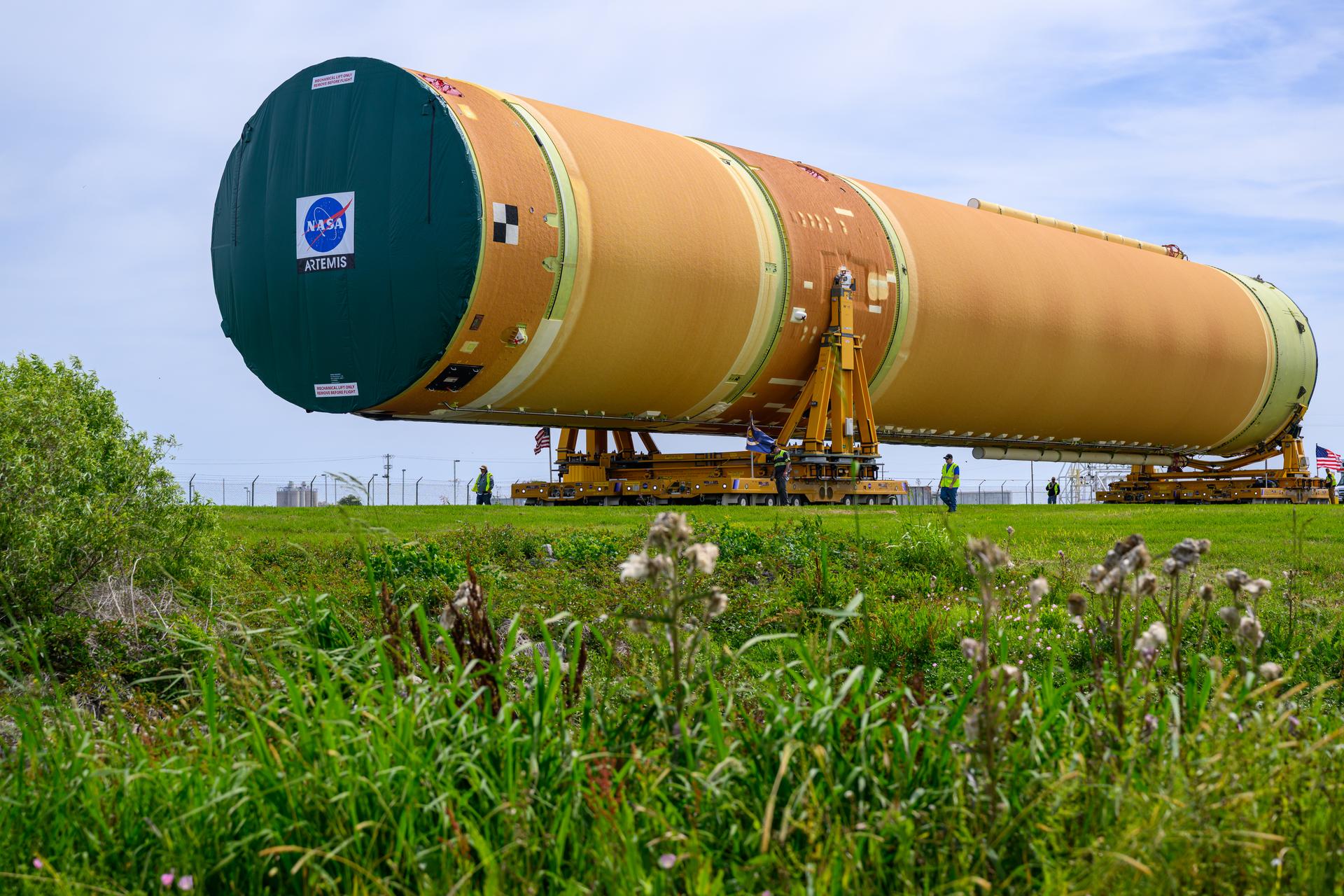
NASA moved the core stage, or the largest section, of the SLS (Space Launch System) rocket that will launch the crewed Artemis III mission in 2027 from the agency’s Michoud Assembly Facility to the agency’s Pegasus barge in New Orleans on April 20. The barge will ferry the top four-fifths – the section containing the liquid hydrogen tank, liquid oxygen tank, intertank, and forward skirt – of the SLS core stage to NASA’s Kennedy Space Center in Florida to complete outfitting and vertical integration. Teams with NASA and Boeing, the SLS core stage lead contractor, used specialized transporters to guide the top four-fifths from the NASA rocket factory to Pegasus. Prior to the move, technicians added an engine section transportation simulator to the rocket stage for shipment to the Space Coast. Next year’s Artemis III mission will launch astronauts to Earth’s orbit aboard the Orion spacecraft on top of SLS to test rendezvous and docking capabilities between Orion and commercial spacecraft needed to land Artemis IV astronauts on the Moon in 2028. NASA’s SLS is the only rocket capable of sending Orion, astronauts, and supplies to the Moon in a single launch. Photo Credit: NASA/Eric Bordelon
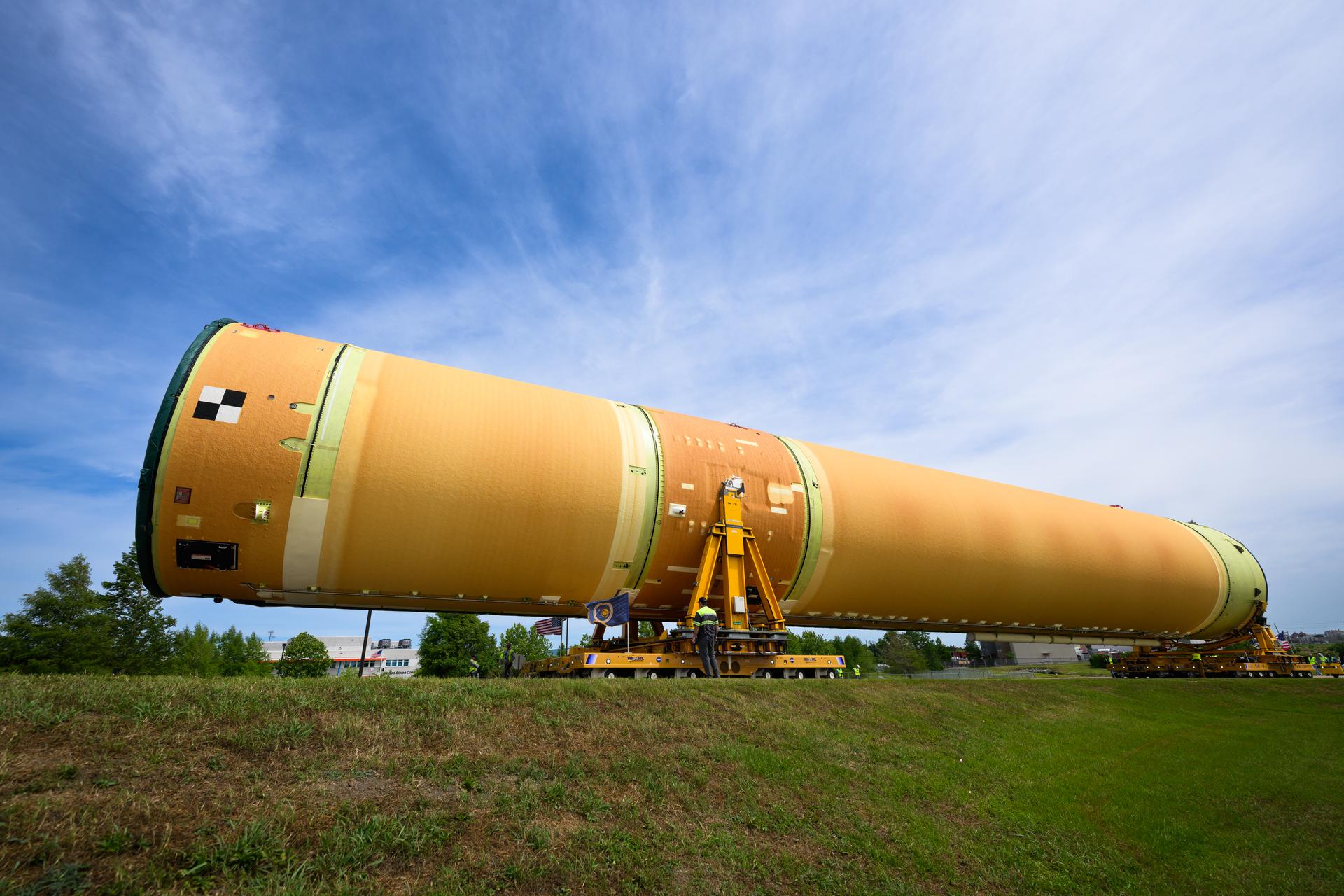
NASA moved the core stage, or the largest section, of the SLS (Space Launch System) rocket that will launch the crewed Artemis III mission in 2027 from the agency’s Michoud Assembly Facility to the agency’s Pegasus barge in New Orleans on April 20. The barge will ferry the top four-fifths – the section containing the liquid hydrogen tank, liquid oxygen tank, intertank, and forward skirt – of the SLS core stage to NASA’s Kennedy Space Center in Florida to complete outfitting and vertical integration. Teams with NASA and Boeing, the SLS core stage lead contractor, used specialized transporters to guide the top four-fifths from the NASA rocket factory to Pegasus. Prior to the move, technicians added an engine section transportation simulator to the rocket stage for shipment to the Space Coast. Next year’s Artemis III mission will launch astronauts to Earth’s orbit aboard the Orion spacecraft on top of SLS to test rendezvous and docking capabilities between Orion and commercial spacecraft needed to land Artemis IV astronauts on the Moon in 2028. NASA’s SLS is the only rocket capable of sending Orion, astronauts, and supplies to the Moon in a single launch. Photo Credit: NASA/Eric Bordelon
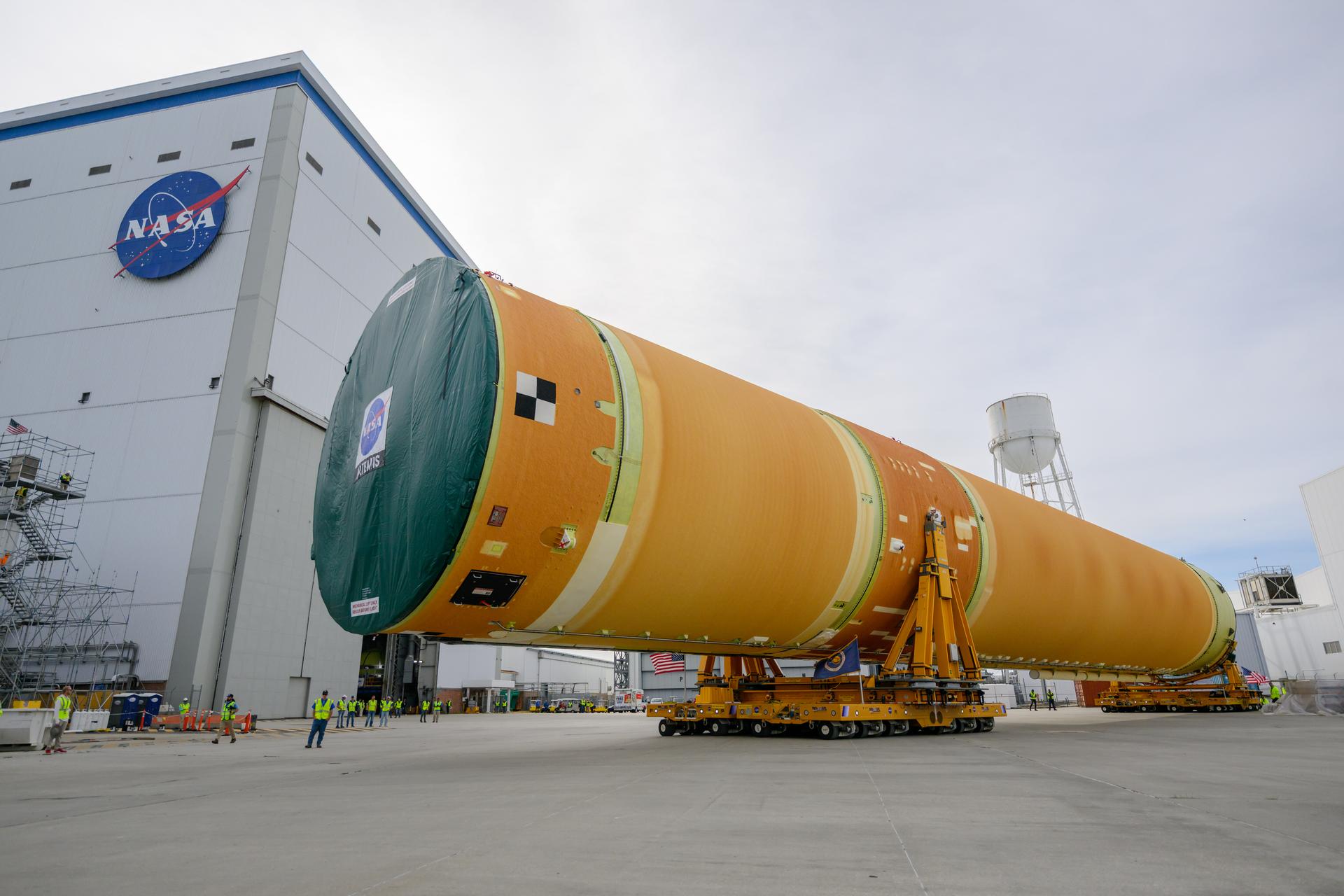
NASA moved the core stage, or the largest section, of the SLS (Space Launch System) rocket that will launch the crewed Artemis III mission in 2027 from the agency’s Michoud Assembly Facility to the agency’s Pegasus barge in New Orleans on April 20. The barge will ferry the top four-fifths – the section containing the liquid hydrogen tank, liquid oxygen tank, intertank, and forward skirt – of the SLS core stage to NASA’s Kennedy Space Center in Florida to complete outfitting and vertical integration. Teams with NASA and Boeing, the SLS core stage lead contractor, used specialized transporters to guide the top four-fifths from the NASA rocket factory to Pegasus. Prior to the move, technicians added an engine section transportation simulator to the rocket stage for shipment to the Space Coast. Next year’s Artemis III mission will launch astronauts to Earth’s orbit aboard the Orion spacecraft on top of SLS to test rendezvous and docking capabilities between Orion and commercial spacecraft needed to land Artemis IV astronauts on the Moon in 2028. NASA’s SLS is the only rocket capable of sending Orion, astronauts, and supplies to the Moon in a single launch. Photo Credit: NASA/Eric Bordelon
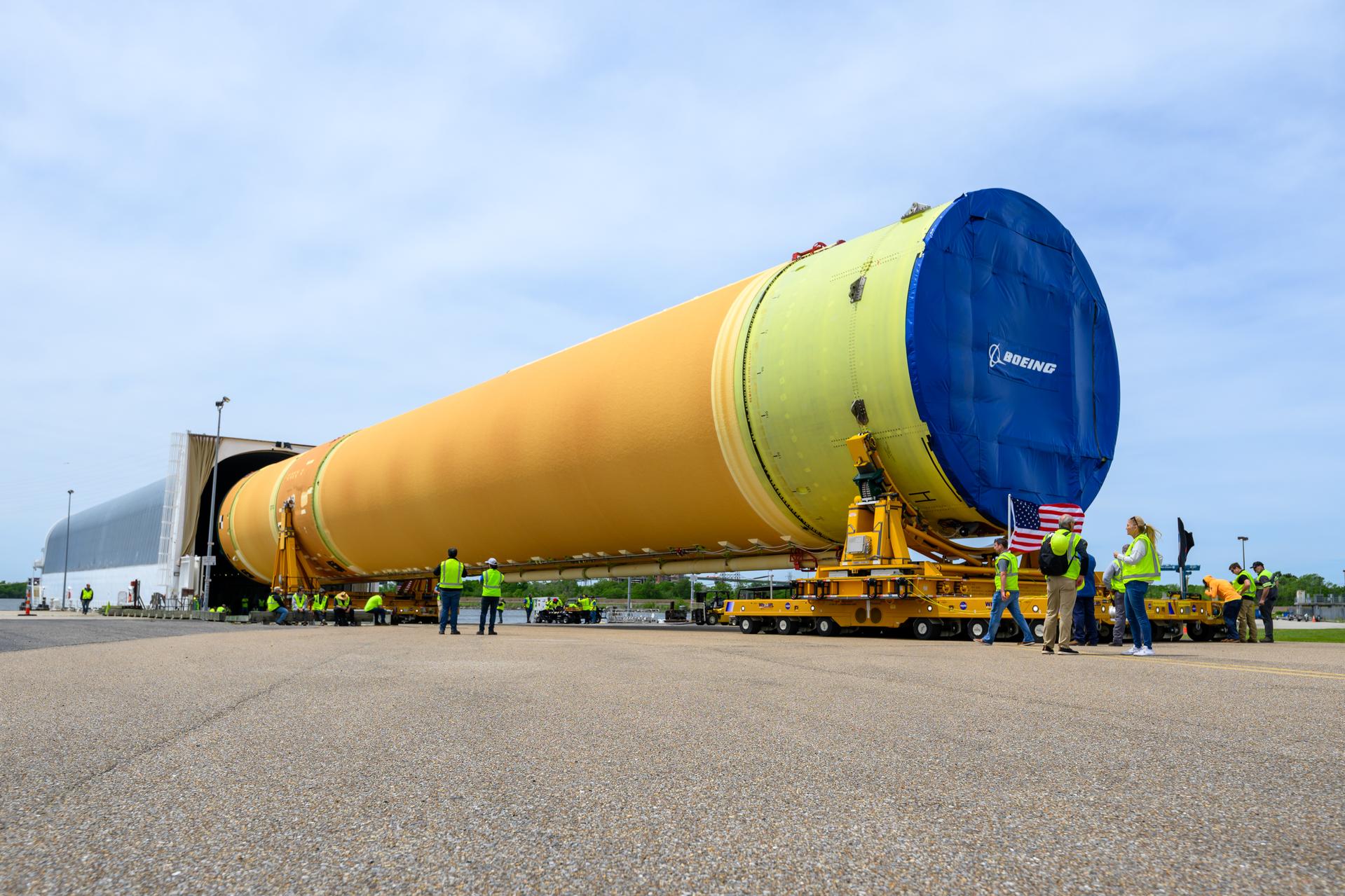
NASA moved the core stage, or the largest section, of the SLS (Space Launch System) rocket that will launch the crewed Artemis III mission in 2027 from the agency’s Michoud Assembly Facility to the agency’s Pegasus barge in New Orleans on April 20. The barge will ferry the top four-fifths – the section containing the liquid hydrogen tank, liquid oxygen tank, intertank, and forward skirt – of the SLS core stage to NASA’s Kennedy Space Center in Florida to complete outfitting and vertical integration. Teams with NASA and Boeing, the SLS core stage lead contractor, used specialized transporters to guide the top four-fifths from the NASA rocket factory to Pegasus. Prior to the move, technicians added an engine section transportation simulator to the rocket stage for shipment to the Space Coast. Next year’s Artemis III mission will launch astronauts to Earth’s orbit aboard the Orion spacecraft on top of SLS to test rendezvous and docking capabilities between Orion and commercial spacecraft needed to land Artemis IV astronauts on the Moon in 2028. NASA’s SLS is the only rocket capable of sending Orion, astronauts, and supplies to the Moon in a single launch. Photo Credit: NASA/Eric Bordelon
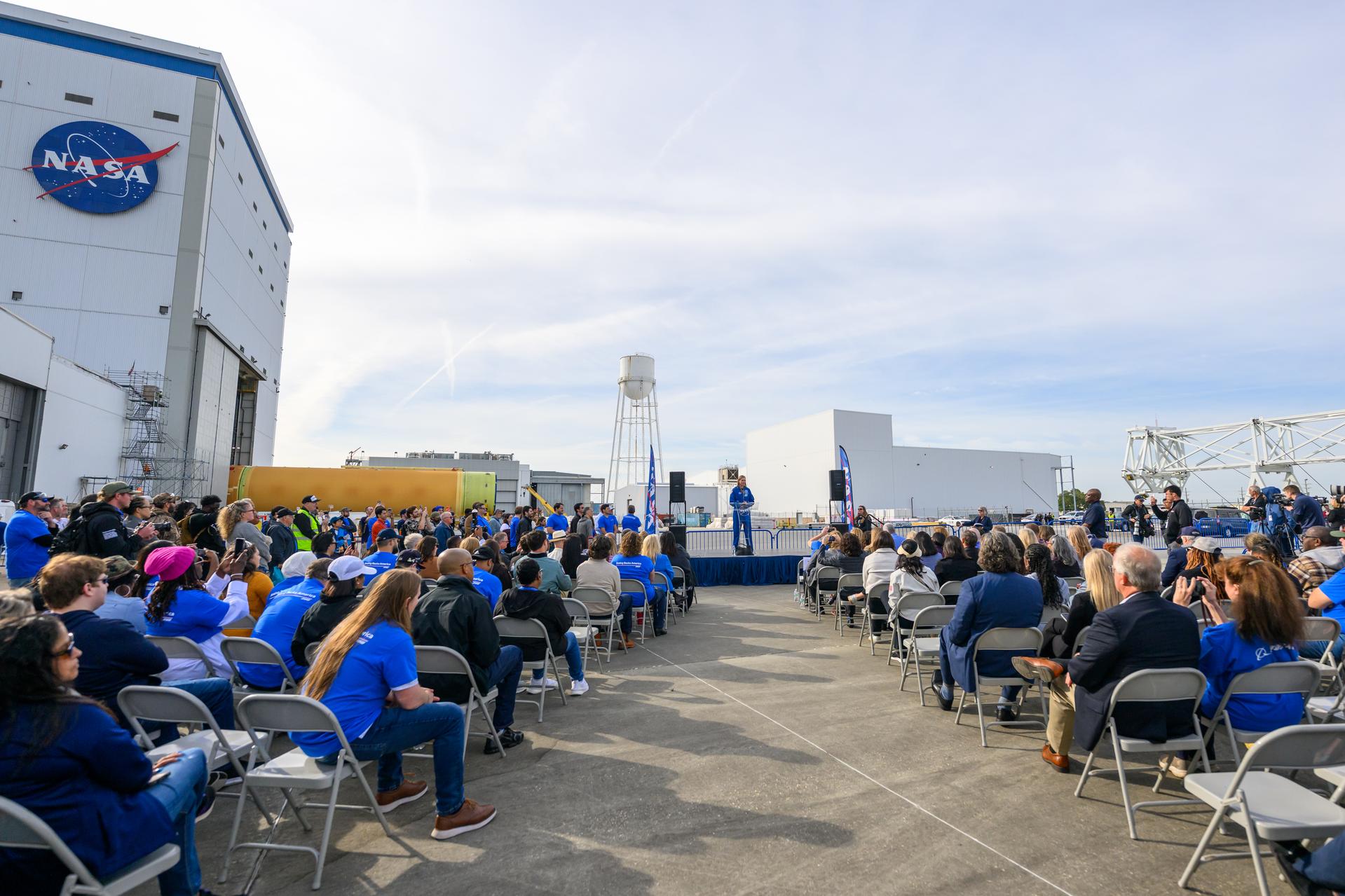
NASA moved the core stage, or the largest section, of the SLS (Space Launch System) rocket that will launch the crewed Artemis III mission in 2027 from the agency’s Michoud Assembly Facility to the agency’s Pegasus barge in New Orleans on April 20. The barge will ferry the top four-fifths – the section containing the liquid hydrogen tank, liquid oxygen tank, intertank, and forward skirt – of the SLS core stage to NASA’s Kennedy Space Center in Florida to complete outfitting and vertical integration. Teams with NASA and Boeing, the SLS core stage lead contractor, used specialized transporters to guide the top four-fifths from the NASA rocket factory to Pegasus. Prior to the move, technicians added an engine section transportation simulator to the rocket stage for shipment to the Space Coast. Next year’s Artemis III mission will launch astronauts to Earth’s orbit aboard the Orion spacecraft on top of SLS to test rendezvous and docking capabilities between Orion and commercial spacecraft needed to land Artemis IV astronauts on the Moon in 2028. NASA’s SLS is the only rocket capable of sending Orion, astronauts, and supplies to the Moon in a single launch. Photo Credit: NASA/Eric Bordelon
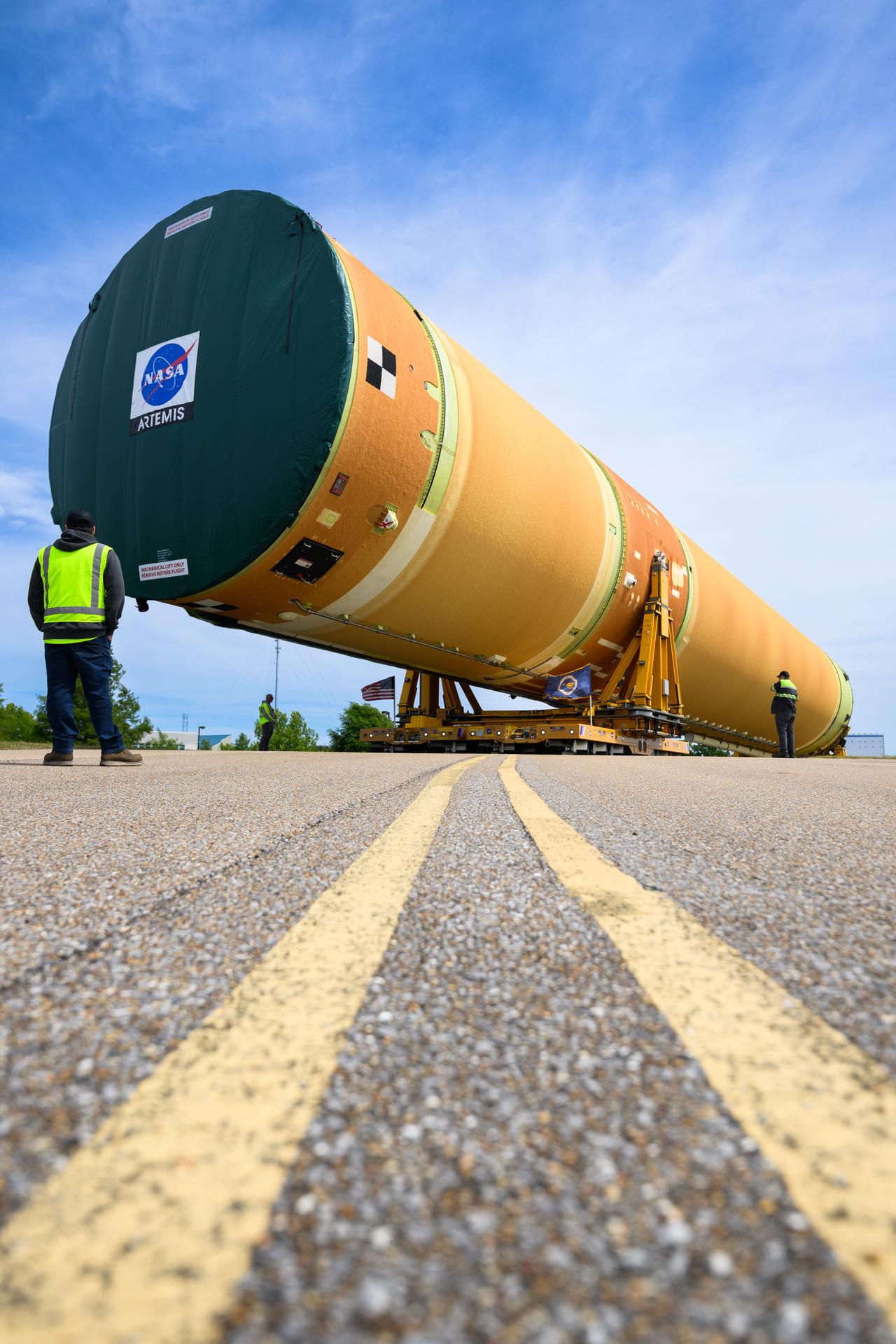
NASA moved the core stage, or the largest section, of the SLS (Space Launch System) rocket that will launch the crewed Artemis III mission in 2027 from the agency’s Michoud Assembly Facility to the agency’s Pegasus barge in New Orleans on April 20. The barge will ferry the top four-fifths – the section containing the liquid hydrogen tank, liquid oxygen tank, intertank, and forward skirt – of the SLS core stage to NASA’s Kennedy Space Center in Florida to complete outfitting and vertical integration. Teams with NASA and Boeing, the SLS core stage lead contractor, used specialized transporters to guide the top four-fifths from the NASA rocket factory to Pegasus. Prior to the move, technicians added an engine section transportation simulator to the rocket stage for shipment to the Space Coast. Next year’s Artemis III mission will launch astronauts to Earth’s orbit aboard the Orion spacecraft on top of SLS to test rendezvous and docking capabilities between Orion and commercial spacecraft needed to land Artemis IV astronauts on the Moon in 2028. NASA’s SLS is the only rocket capable of sending Orion, astronauts, and supplies to the Moon in a single launch. Photo Credit: NASA/Eric Bordelon
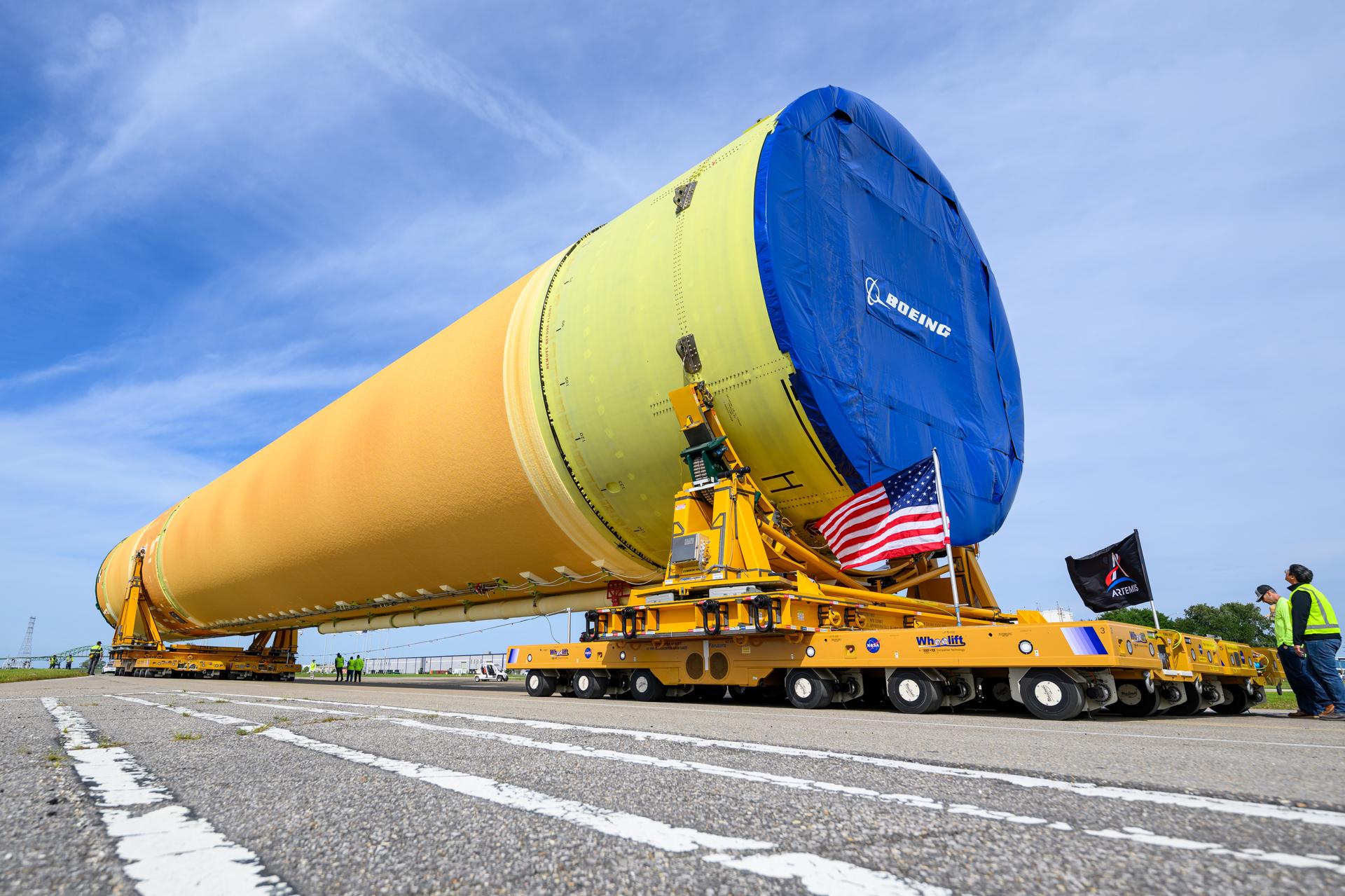
NASA moved the core stage, or the largest section, of the SLS (Space Launch System) rocket that will launch the crewed Artemis III mission in 2027 from the agency’s Michoud Assembly Facility to the agency’s Pegasus barge in New Orleans on April 20. The barge will ferry the top four-fifths – the section containing the liquid hydrogen tank, liquid oxygen tank, intertank, and forward skirt – of the SLS core stage to NASA’s Kennedy Space Center in Florida to complete outfitting and vertical integration. Teams with NASA and Boeing, the SLS core stage lead contractor, used specialized transporters to guide the top four-fifths from the NASA rocket factory to Pegasus. Prior to the move, technicians added an engine section transportation simulator to the rocket stage for shipment to the Space Coast. Next year’s Artemis III mission will launch astronauts to Earth’s orbit aboard the Orion spacecraft on top of SLS to test rendezvous and docking capabilities between Orion and commercial spacecraft needed to land Artemis IV astronauts on the Moon in 2028. NASA’s SLS is the only rocket capable of sending Orion, astronauts, and supplies to the Moon in a single launch. Photo Credit: NASA/Eric Bordelon
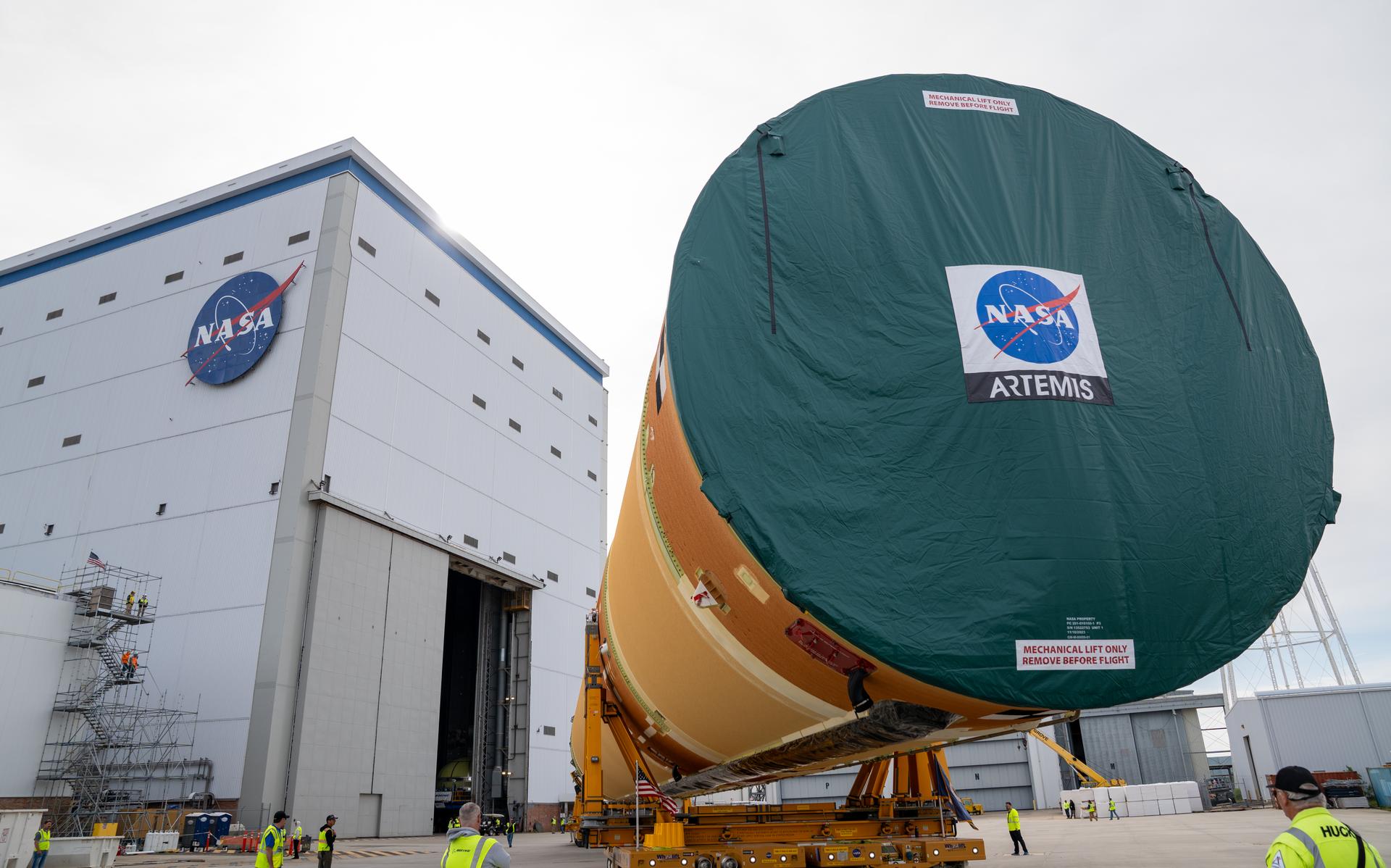
NASA moved the core stage, or the largest section, of the SLS (Space Launch System) rocket that will launch the crewed Artemis III mission in 2027 from the agency’s Michoud Assembly Facility to the agency’s Pegasus barge in New Orleans on April 20. The barge will ferry the top four-fifths – the section containing the liquid hydrogen tank, liquid oxygen tank, intertank, and forward skirt – of the SLS core stage to NASA’s Kennedy Space Center in Florida to complete outfitting and vertical integration. Teams with NASA and Boeing, the SLS core stage lead contractor, used specialized transporters to guide the top four-fifths from the NASA rocket factory to Pegasus. Prior to the move, technicians added an engine section transportation simulator to the rocket stage for shipment to the Space Coast. Next year’s Artemis III mission will launch astronauts to Earth’s orbit aboard the Orion spacecraft on top of SLS to test rendezvous and docking capabilities between Orion and commercial spacecraft needed to land Artemis IV astronauts on the Moon in 2028. NASA’s SLS is the only rocket capable of sending Orion, astronauts, and supplies to the Moon in a single launch. Photo Credit: (NASA/Brandon Hancock)
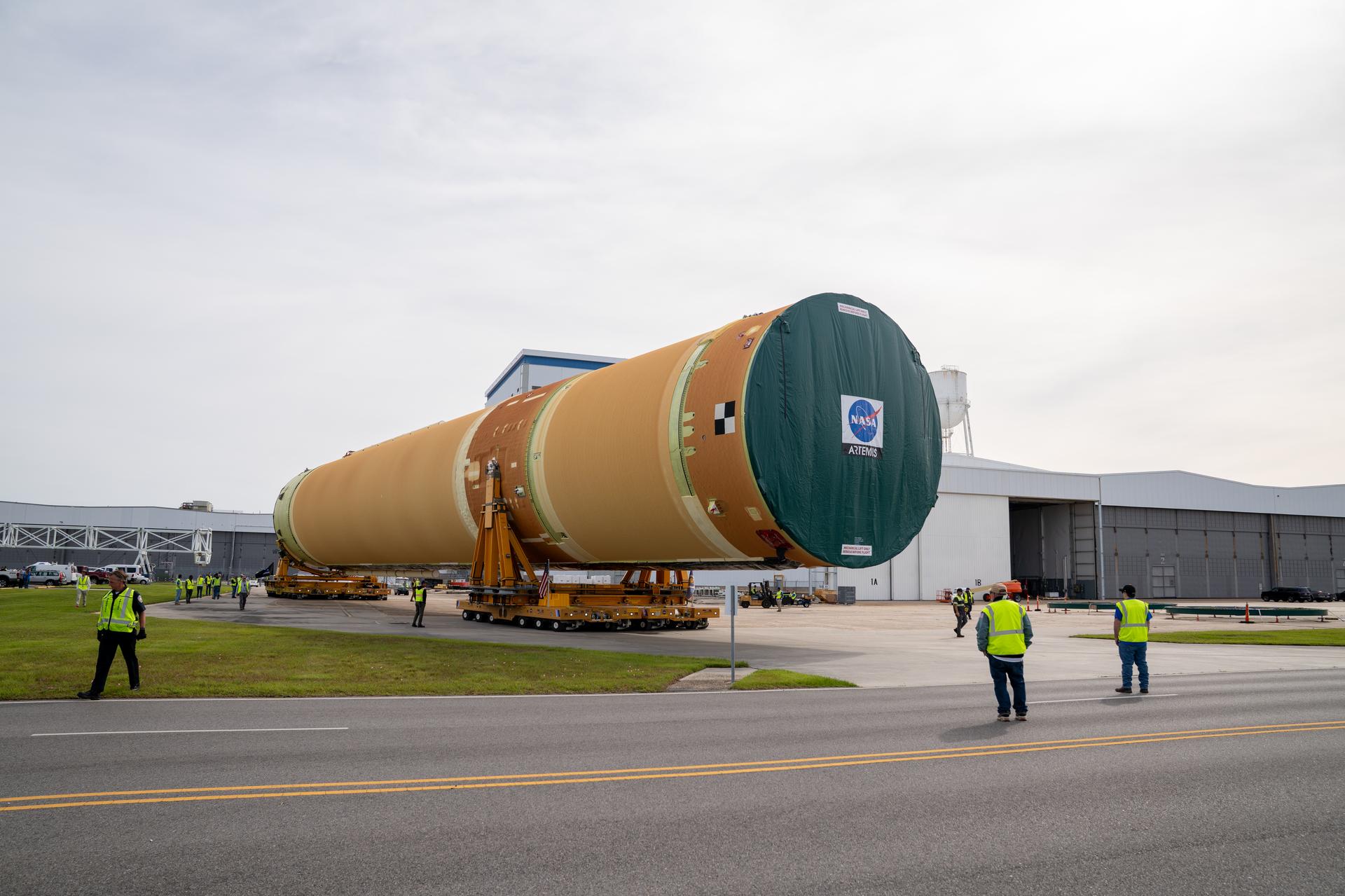
NASA moved the core stage, or the largest section, of the SLS (Space Launch System) rocket that will launch the crewed Artemis III mission in 2027 from the agency’s Michoud Assembly Facility to the agency’s Pegasus barge in New Orleans on April 20. The barge will ferry the top four-fifths – the section containing the liquid hydrogen tank, liquid oxygen tank, intertank, and forward skirt – of the SLS core stage to NASA’s Kennedy Space Center in Florida to complete outfitting and vertical integration. Teams with NASA and Boeing, the SLS core stage lead contractor, used specialized transporters to guide the top four-fifths from the NASA rocket factory to Pegasus. Prior to the move, technicians added an engine section transportation simulator to the rocket stage for shipment to the Space Coast. Next year’s Artemis III mission will launch astronauts to Earth’s orbit aboard the Orion spacecraft on top of SLS to test rendezvous and docking capabilities between Orion and commercial spacecraft needed to land Artemis IV astronauts on the Moon in 2028. NASA’s SLS is the only rocket capable of sending Orion, astronauts, and supplies to the Moon in a single launch. Photo Credit: (NASA/Brandon Hancock)
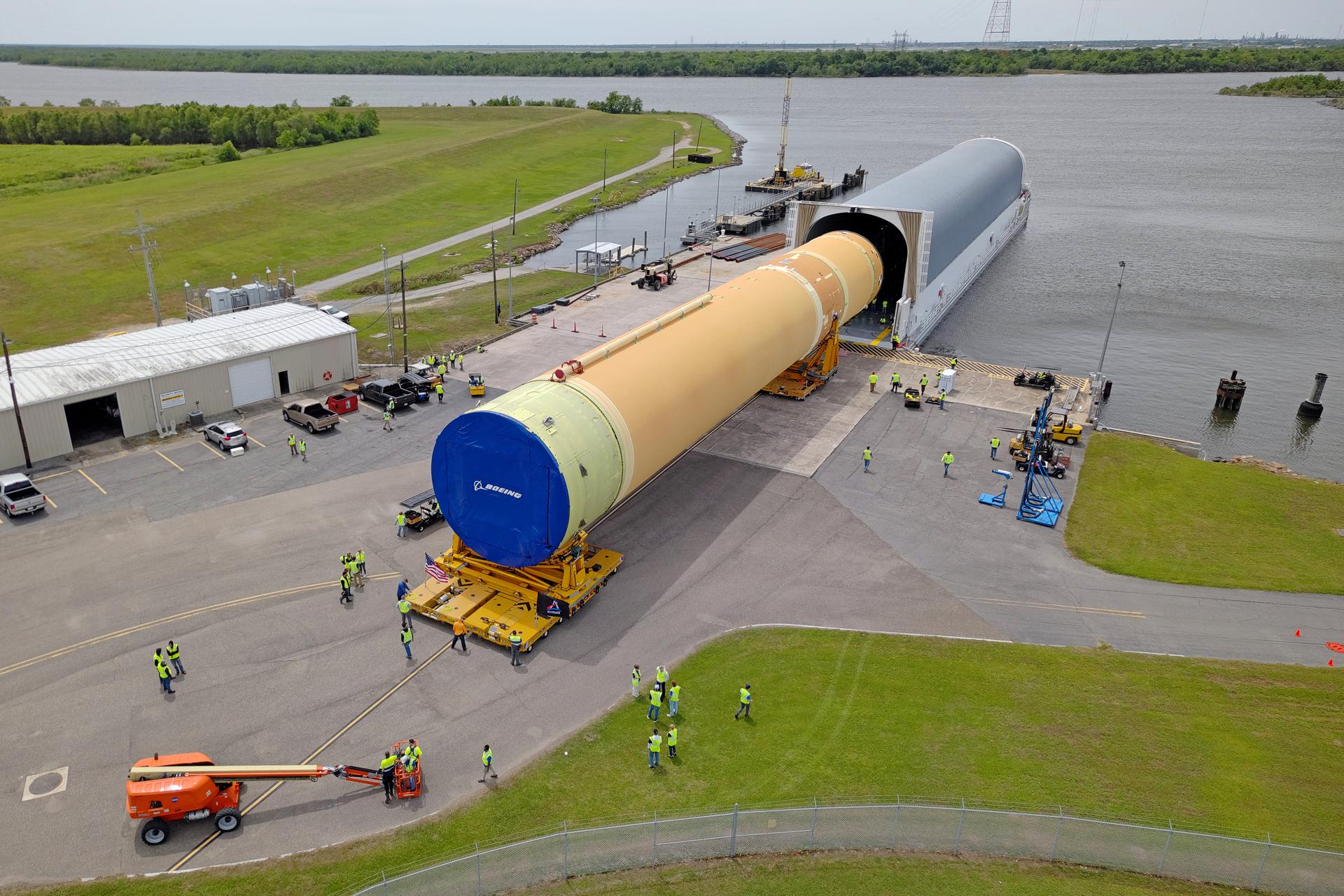
NASA moved the core stage, or the largest section, of the SLS (Space Launch System) rocket that will launch the crewed Artemis III mission in 2027 from the agency’s Michoud Assembly Facility to the agency’s Pegasus barge in New Orleans on April 20. The barge will ferry the top four-fifths – the section containing the liquid hydrogen tank, liquid oxygen tank, intertank, and forward skirt – of the SLS core stage to NASA’s Kennedy Space Center in Florida to complete outfitting and vertical integration. Teams with NASA and Boeing, the SLS core stage lead contractor, used specialized transporters to guide the top four-fifths from the NASA rocket factory to Pegasus. Prior to the move, technicians added an engine section transportation simulator to the rocket stage for shipment to the Space Coast. Next year’s Artemis III mission will launch astronauts to Earth’s orbit aboard the Orion spacecraft on top of SLS to test rendezvous and docking capabilities between Orion and commercial spacecraft needed to land Artemis IV astronauts on the Moon in 2028. NASA’s SLS is the only rocket capable of sending Orion, astronauts, and supplies to the Moon in a single launch. Image credit: NASA/Michael DeMocker
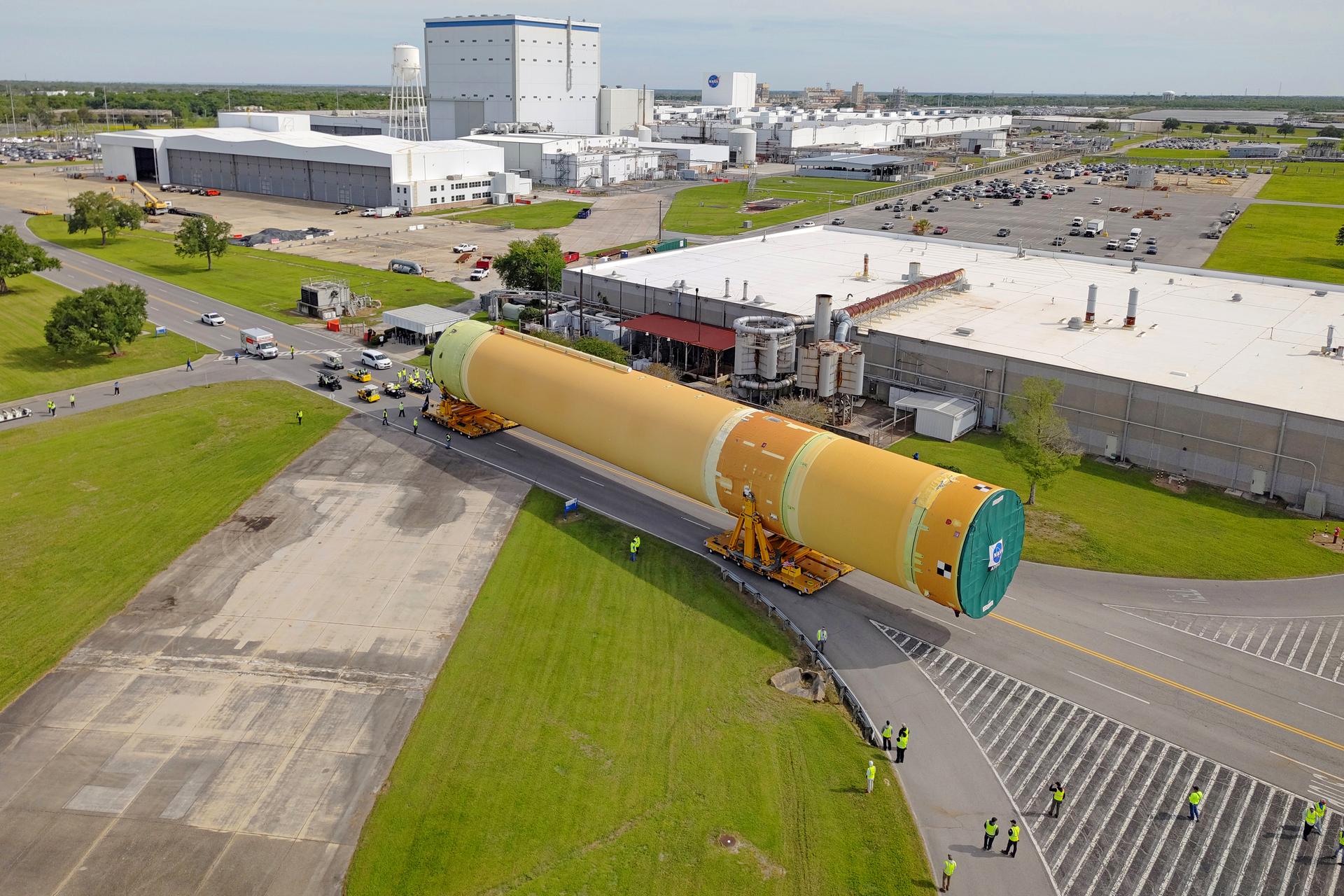
NASA moved the core stage, or the largest section, of the SLS (Space Launch System) rocket that will launch the crewed Artemis III mission in 2027 from the agency’s Michoud Assembly Facility to the agency’s Pegasus barge in New Orleans on April 20. The barge will ferry the top four-fifths – the section containing the liquid hydrogen tank, liquid oxygen tank, intertank, and forward skirt – of the SLS core stage to NASA’s Kennedy Space Center in Florida to complete outfitting and vertical integration. Teams with NASA and Boeing, the SLS core stage lead contractor, used specialized transporters to guide the top four-fifths from the NASA rocket factory to Pegasus. Prior to the move, technicians added an engine section transportation simulator to the rocket stage for shipment to the Space Coast. Next year’s Artemis III mission will launch astronauts to Earth’s orbit aboard the Orion spacecraft on top of SLS to test rendezvous and docking capabilities between Orion and commercial spacecraft needed to land Artemis IV astronauts on the Moon in 2028. NASA’s SLS is the only rocket capable of sending Orion, astronauts, and supplies to the Moon in a single launch. Image credit: NASA/Michael DeMocker
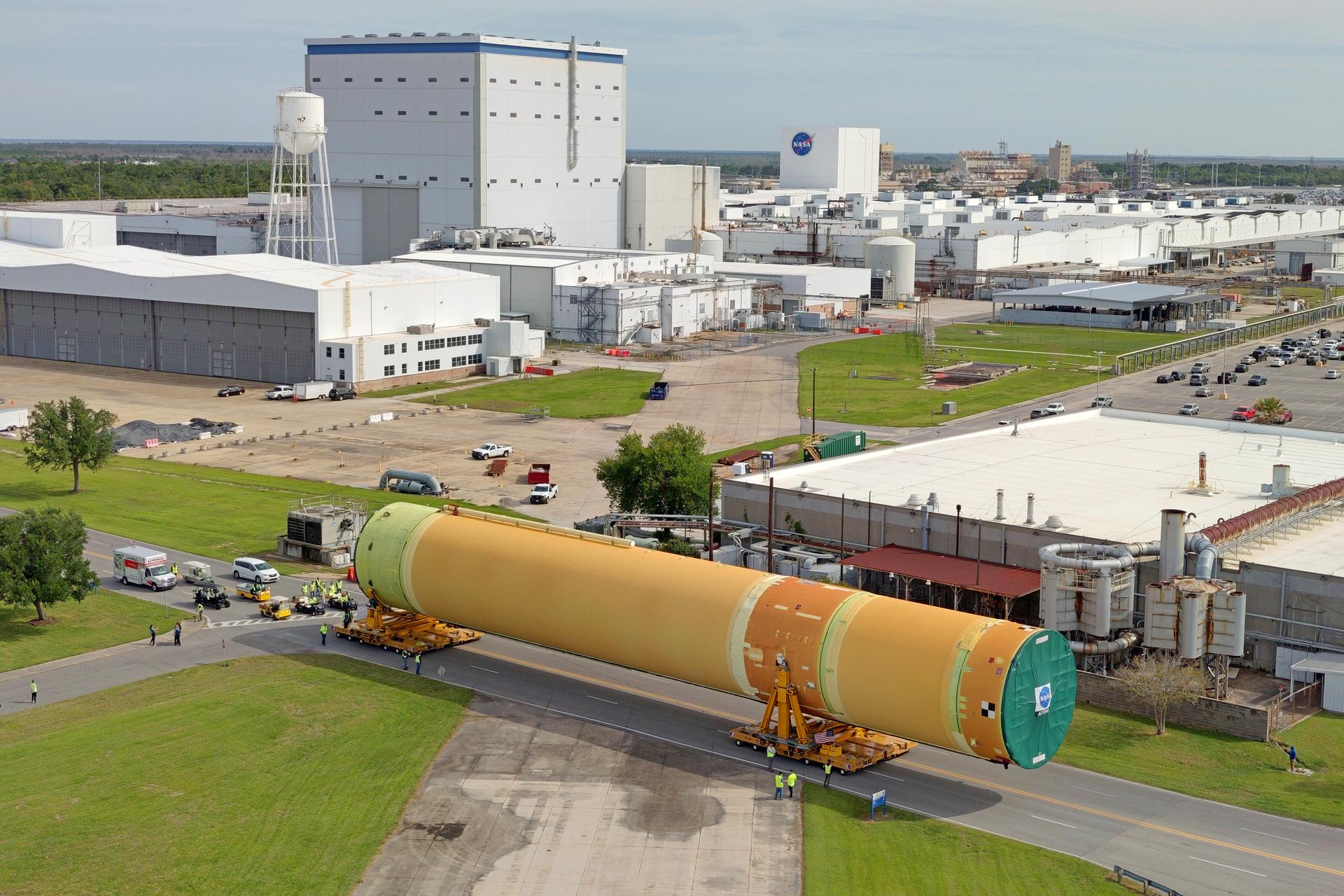
NASA moved the core stage, or the largest section, of the SLS (Space Launch System) rocket that will launch the crewed Artemis III mission in 2027 from the agency’s Michoud Assembly Facility to the agency’s Pegasus barge in New Orleans on April 20. The barge will ferry the top four-fifths – the section containing the liquid hydrogen tank, liquid oxygen tank, intertank, and forward skirt – of the SLS core stage to NASA’s Kennedy Space Center in Florida to complete outfitting and vertical integration. Teams with NASA and Boeing, the SLS core stage lead contractor, used specialized transporters to guide the top four-fifths from the NASA rocket factory to Pegasus. Prior to the move, technicians added an engine section transportation simulator to the rocket stage for shipment to the Space Coast. Next year’s Artemis III mission will launch astronauts to Earth’s orbit aboard the Orion spacecraft on top of SLS to test rendezvous and docking capabilities between Orion and commercial spacecraft needed to land Artemis IV astronauts on the Moon in 2028. NASA’s SLS is the only rocket capable of sending Orion, astronauts, and supplies to the Moon in a single launch. Image credit: NASA/Michael DeMocker
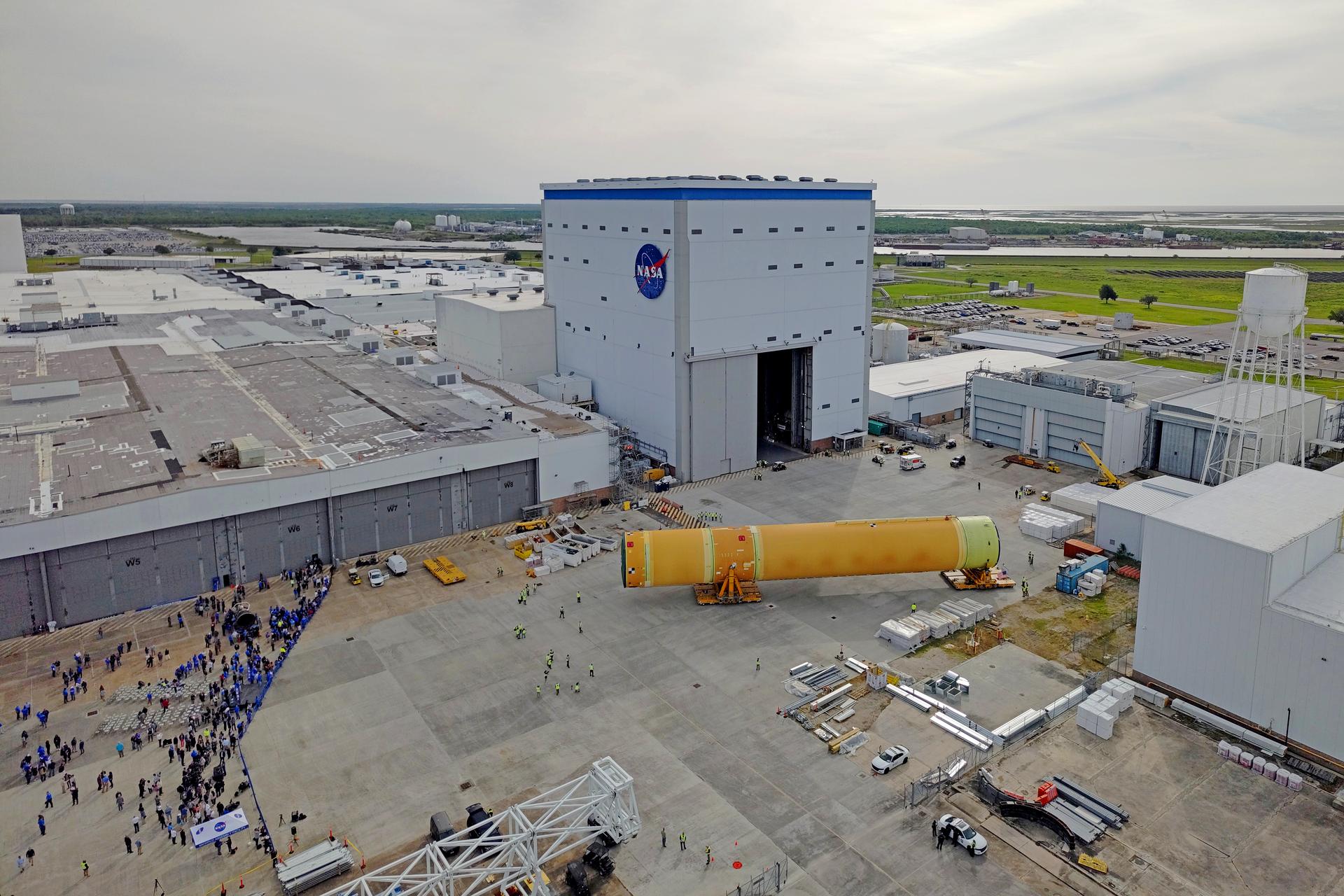
NASA moved the core stage, or the largest section, of the SLS (Space Launch System) rocket that will launch the crewed Artemis III mission in 2027 from the agency’s Michoud Assembly Facility to the agency’s Pegasus barge in New Orleans on April 20. The barge will ferry the top four-fifths – the section containing the liquid hydrogen tank, liquid oxygen tank, intertank, and forward skirt – of the SLS core stage to NASA’s Kennedy Space Center in Florida to complete outfitting and vertical integration. Teams with NASA and Boeing, the SLS core stage lead contractor, used specialized transporters to guide the top four-fifths from the NASA rocket factory to Pegasus. Prior to the move, technicians added an engine section transportation simulator to the rocket stage for shipment to the Space Coast. Next year’s Artemis III mission will launch astronauts to Earth’s orbit aboard the Orion spacecraft on top of SLS to test rendezvous and docking capabilities between Orion and commercial spacecraft needed to land Artemis IV astronauts on the Moon in 2028. NASA’s SLS is the only rocket capable of sending Orion, astronauts, and supplies to the Moon in a single launch. Image credit: NASA/Michael DeMocker
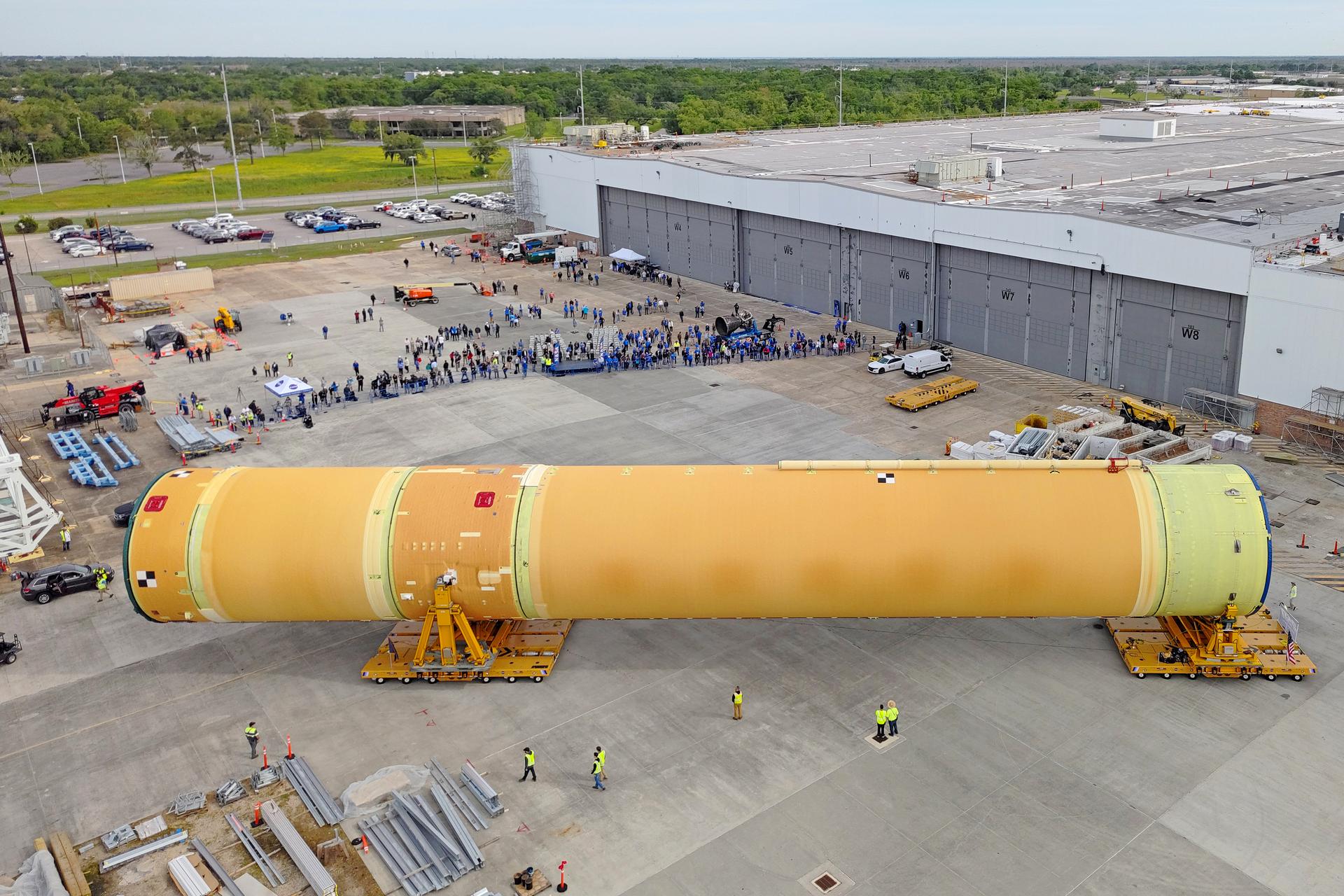
NASA moved the core stage, or the largest section, of the SLS (Space Launch System) rocket that will launch the crewed Artemis III mission in 2027 from the agency’s Michoud Assembly Facility to the agency’s Pegasus barge in New Orleans on April 20. The barge will ferry the top four-fifths – the section containing the liquid hydrogen tank, liquid oxygen tank, intertank, and forward skirt – of the SLS core stage to NASA’s Kennedy Space Center in Florida to complete outfitting and vertical integration. Teams with NASA and Boeing, the SLS core stage lead contractor, used specialized transporters to guide the top four-fifths from the NASA rocket factory to Pegasus. Prior to the move, technicians added an engine section transportation simulator to the rocket stage for shipment to the Space Coast. Next year’s Artemis III mission will launch astronauts to Earth’s orbit aboard the Orion spacecraft on top of SLS to test rendezvous and docking capabilities between Orion and commercial spacecraft needed to land Artemis IV astronauts on the Moon in 2028. NASA’s SLS is the only rocket capable of sending Orion, astronauts, and supplies to the Moon in a single launch. Image credit: NASA/Michael DeMocker
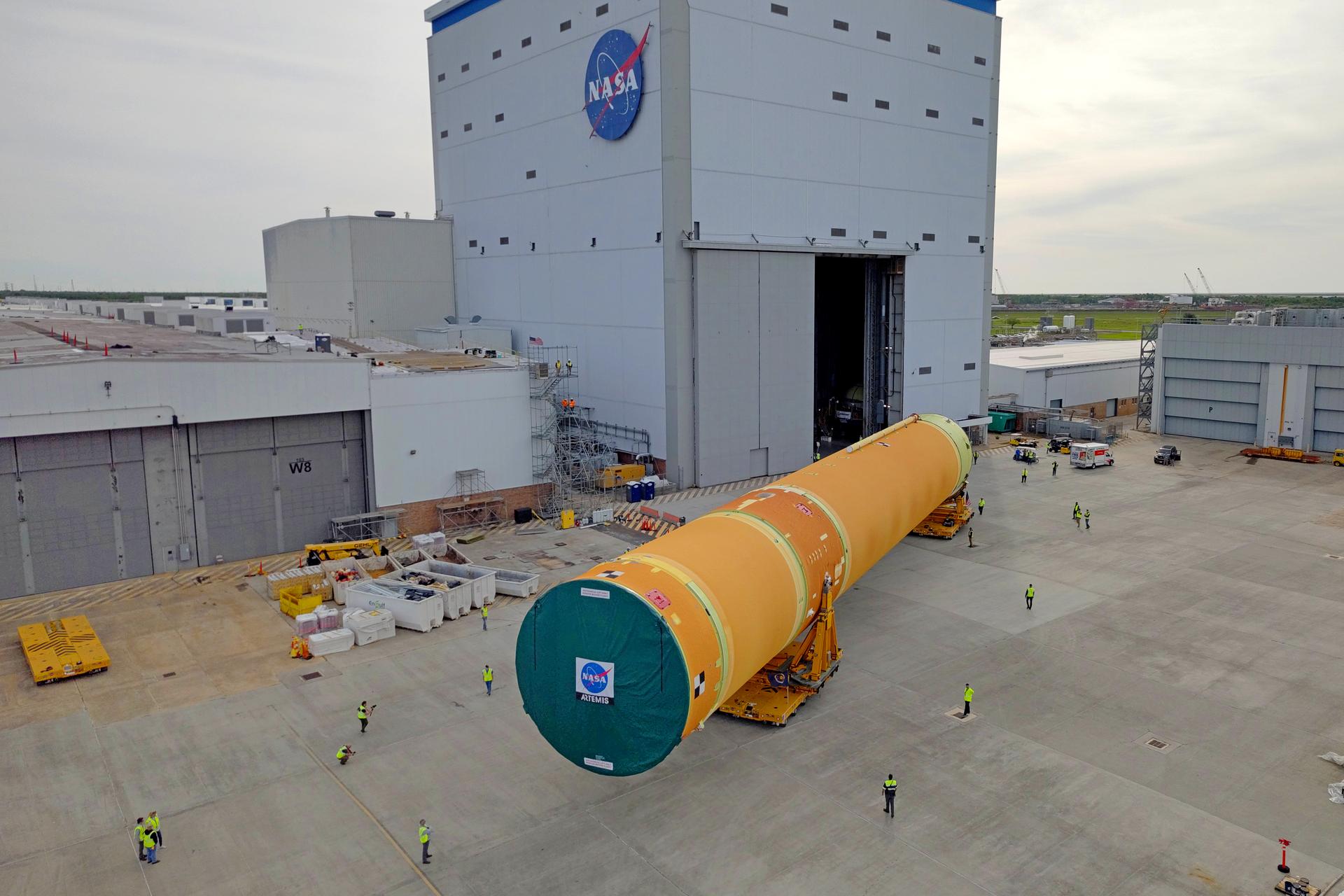
NASA moved the core stage, or the largest section, of the SLS (Space Launch System) rocket that will launch the crewed Artemis III mission in 2027 from the agency’s Michoud Assembly Facility to the agency’s Pegasus barge in New Orleans on April 20. The barge will ferry the top four-fifths – the section containing the liquid hydrogen tank, liquid oxygen tank, intertank, and forward skirt – of the SLS core stage to NASA’s Kennedy Space Center in Florida to complete outfitting and vertical integration. Teams with NASA and Boeing, the SLS core stage lead contractor, used specialized transporters to guide the top four-fifths from the NASA rocket factory to Pegasus. Prior to the move, technicians added an engine section transportation simulator to the rocket stage for shipment to the Space Coast. Next year’s Artemis III mission will launch astronauts to Earth’s orbit aboard the Orion spacecraft on top of SLS to test rendezvous and docking capabilities between Orion and commercial spacecraft needed to land Artemis IV astronauts on the Moon in 2028. NASA’s SLS is the only rocket capable of sending Orion, astronauts, and supplies to the Moon in a single launch. Image credit: NASA/Michael DeMocker
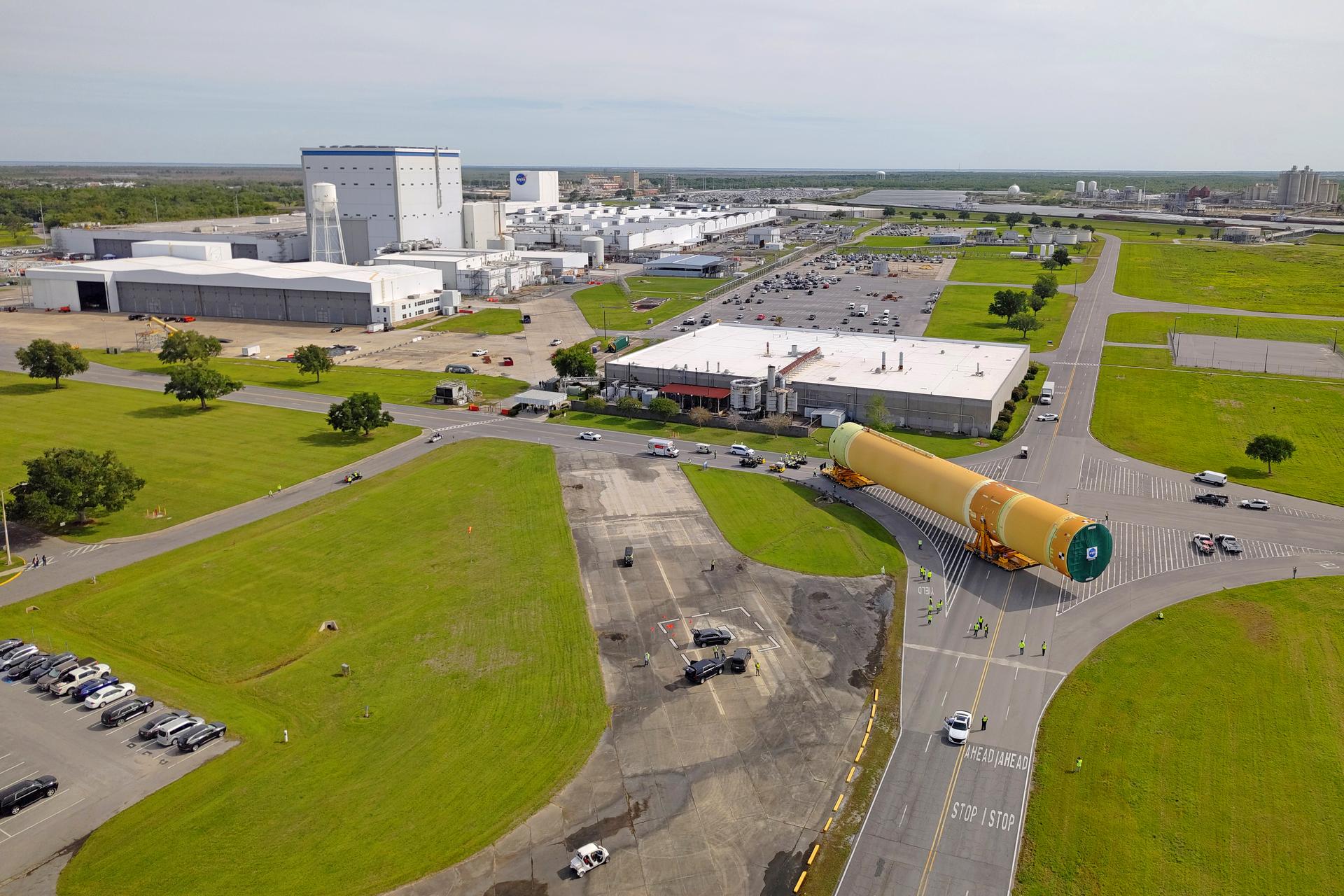
NASA moved the core stage, or the largest section, of the SLS (Space Launch System) rocket that will launch the crewed Artemis III mission in 2027 from the agency’s Michoud Assembly Facility to the agency’s Pegasus barge in New Orleans on April 20. The barge will ferry the top four-fifths – the section containing the liquid hydrogen tank, liquid oxygen tank, intertank, and forward skirt – of the SLS core stage to NASA’s Kennedy Space Center in Florida to complete outfitting and vertical integration. Teams with NASA and Boeing, the SLS core stage lead contractor, used specialized transporters to guide the top four-fifths from the NASA rocket factory to Pegasus. Prior to the move, technicians added an engine section transportation simulator to the rocket stage for shipment to the Space Coast. Next year’s Artemis III mission will launch astronauts to Earth’s orbit aboard the Orion spacecraft on top of SLS to test rendezvous and docking capabilities between Orion and commercial spacecraft needed to land Artemis IV astronauts on the Moon in 2028. NASA’s SLS is the only rocket capable of sending Orion, astronauts, and supplies to the Moon in a single launch. Image credit: NASA/Michael DeMocker
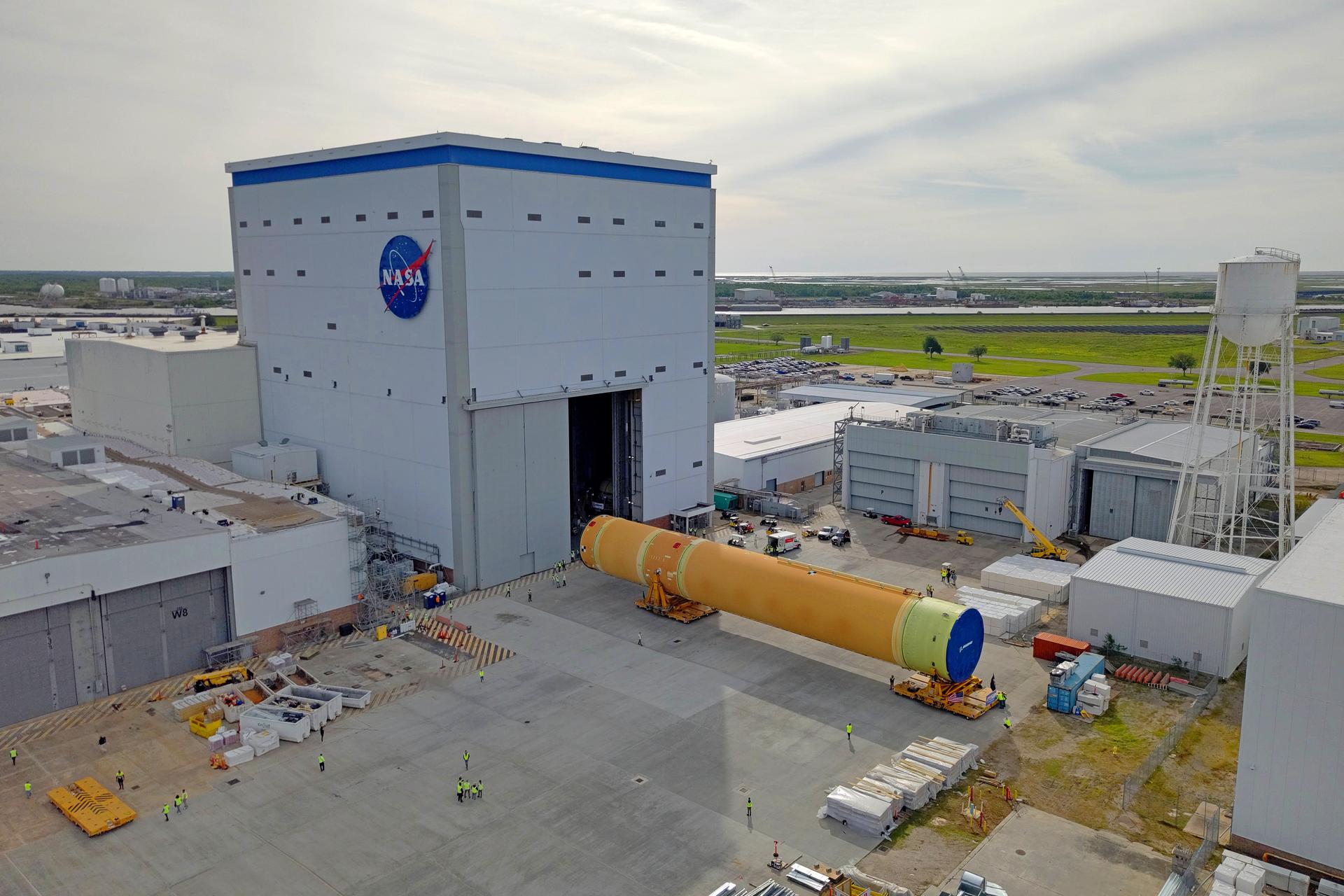
NASA moved the core stage, or the largest section, of the SLS (Space Launch System) rocket that will launch the crewed Artemis III mission in 2027 from the agency’s Michoud Assembly Facility to the agency’s Pegasus barge in New Orleans on April 20. The barge will ferry the top four-fifths – the section containing the liquid hydrogen tank, liquid oxygen tank, intertank, and forward skirt – of the SLS core stage to NASA’s Kennedy Space Center in Florida to complete outfitting and vertical integration. Teams with NASA and Boeing, the SLS core stage lead contractor, used specialized transporters to guide the top four-fifths from the NASA rocket factory to Pegasus. Prior to the move, technicians added an engine section transportation simulator to the rocket stage for shipment to the Space Coast. Next year’s Artemis III mission will launch astronauts to Earth’s orbit aboard the Orion spacecraft on top of SLS to test rendezvous and docking capabilities between Orion and commercial spacecraft needed to land Artemis IV astronauts on the Moon in 2028. NASA’s SLS is the only rocket capable of sending Orion, astronauts, and supplies to the Moon in a single launch. Image credit: NASA/Michael DeMocker
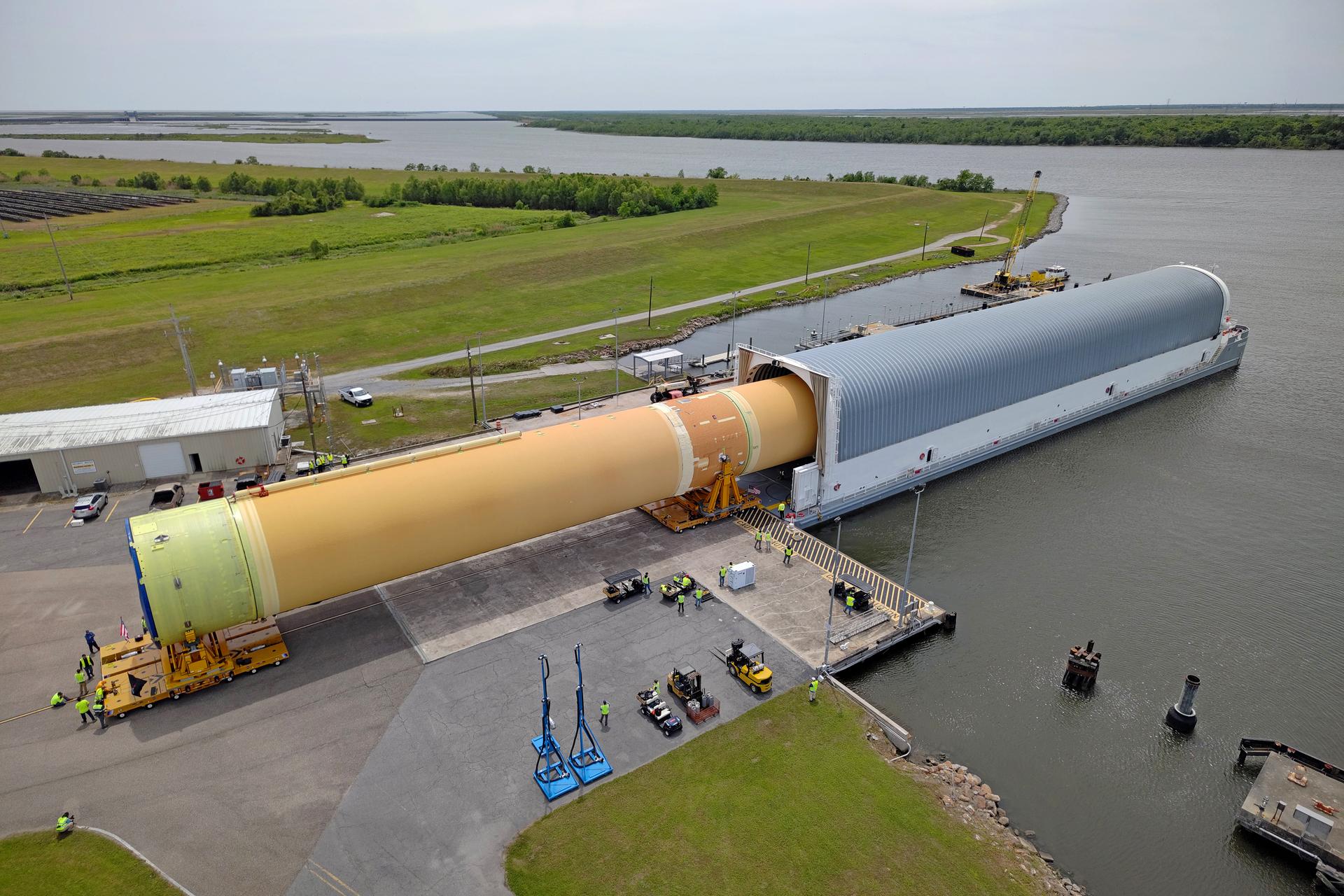
NASA moved the core stage, or the largest section, of the SLS (Space Launch System) rocket that will launch the crewed Artemis III mission in 2027 from the agency’s Michoud Assembly Facility to the agency’s Pegasus barge in New Orleans on April 20. The barge will ferry the top four-fifths – the section containing the liquid hydrogen tank, liquid oxygen tank, intertank, and forward skirt – of the SLS core stage to NASA’s Kennedy Space Center in Florida to complete outfitting and vertical integration. Teams with NASA and Boeing, the SLS core stage lead contractor, used specialized transporters to guide the top four-fifths from the NASA rocket factory to Pegasus. Prior to the move, technicians added an engine section transportation simulator to the rocket stage for shipment to the Space Coast. Next year’s Artemis III mission will launch astronauts to Earth’s orbit aboard the Orion spacecraft on top of SLS to test rendezvous and docking capabilities between Orion and commercial spacecraft needed to land Artemis IV astronauts on the Moon in 2028. NASA’s SLS is the only rocket capable of sending Orion, astronauts, and supplies to the Moon in a single launch. Image credit: NASA/Michael DeMocker
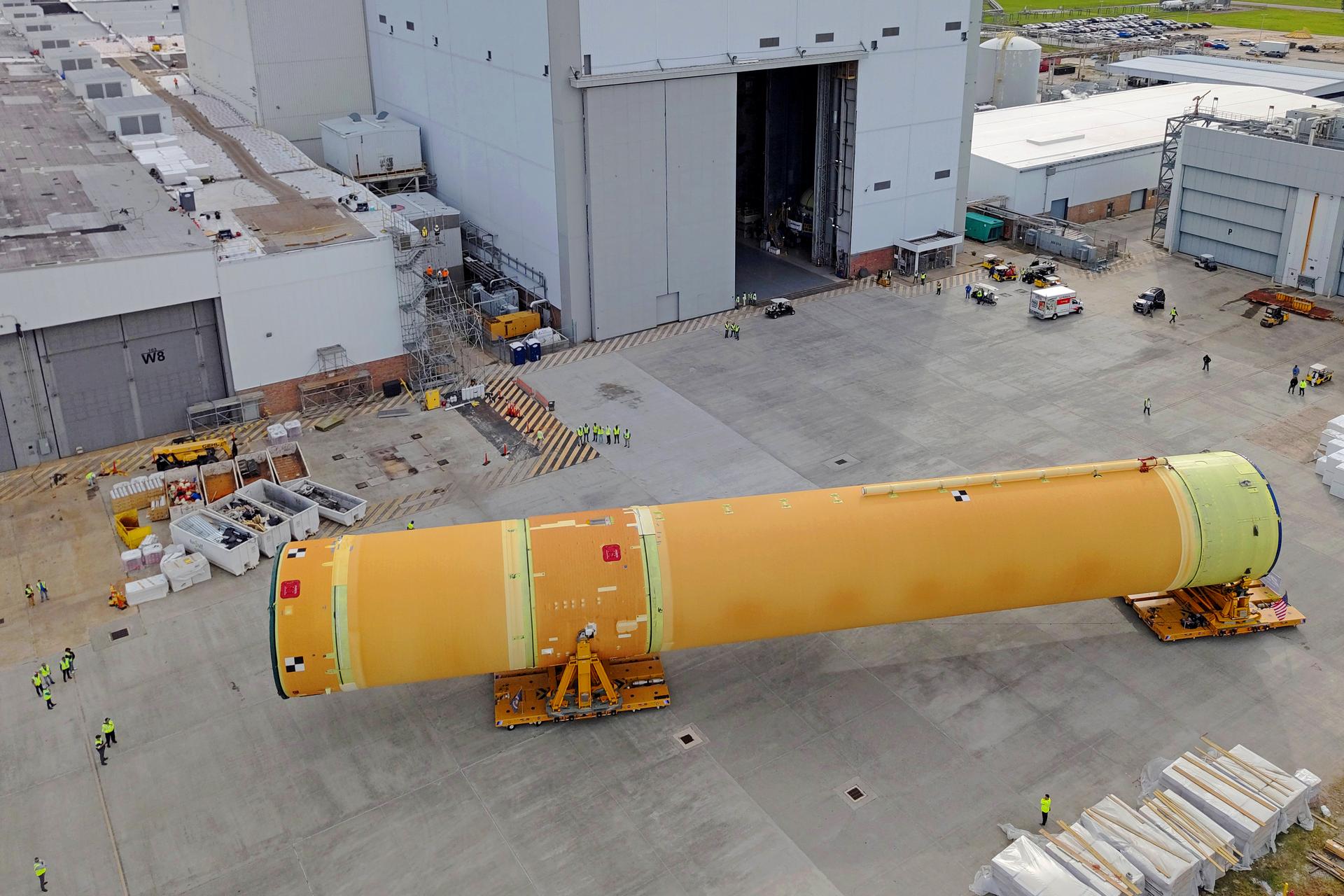
NASA moved the core stage, or the largest section, of the SLS (Space Launch System) rocket that will launch the crewed Artemis III mission in 2027 from the agency’s Michoud Assembly Facility to the agency’s Pegasus barge in New Orleans on April 20. The barge will ferry the top four-fifths – the section containing the liquid hydrogen tank, liquid oxygen tank, intertank, and forward skirt – of the SLS core stage to NASA’s Kennedy Space Center in Florida to complete outfitting and vertical integration. Teams with NASA and Boeing, the SLS core stage lead contractor, used specialized transporters to guide the top four-fifths from the NASA rocket factory to Pegasus. Prior to the move, technicians added an engine section transportation simulator to the rocket stage for shipment to the Space Coast. Next year’s Artemis III mission will launch astronauts to Earth’s orbit aboard the Orion spacecraft on top of SLS to test rendezvous and docking capabilities between Orion and commercial spacecraft needed to land Artemis IV astronauts on the Moon in 2028. NASA’s SLS is the only rocket capable of sending Orion, astronauts, and supplies to the Moon in a single launch. Image credit: NASA/Michael DeMocker
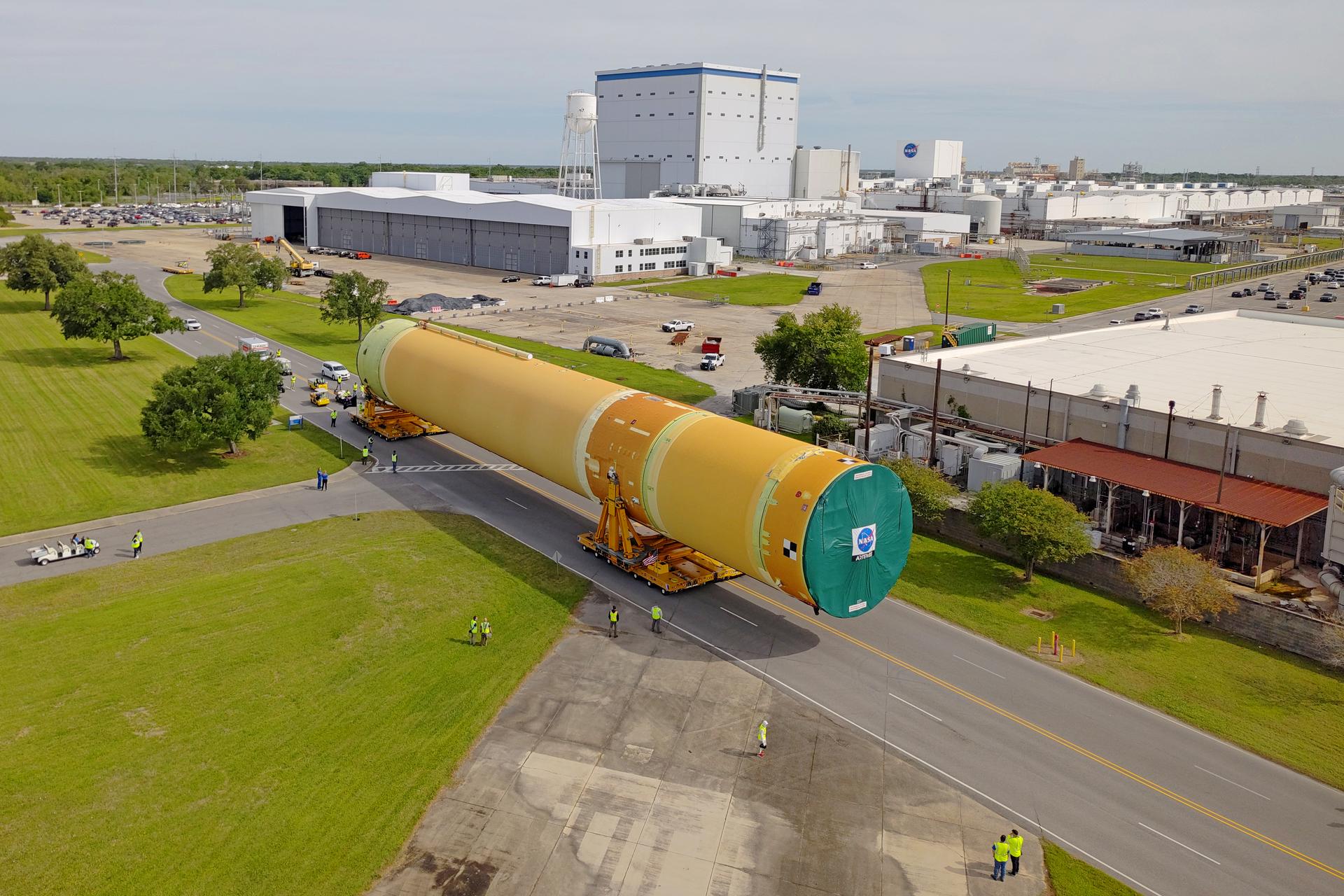
NASA moved the core stage, or the largest section, of the SLS (Space Launch System) rocket that will launch the crewed Artemis III mission in 2027 from the agency’s Michoud Assembly Facility to the agency’s Pegasus barge in New Orleans on April 20. The barge will ferry the top four-fifths – the section containing the liquid hydrogen tank, liquid oxygen tank, intertank, and forward skirt – of the SLS core stage to NASA’s Kennedy Space Center in Florida to complete outfitting and vertical integration. Teams with NASA and Boeing, the SLS core stage lead contractor, used specialized transporters to guide the top four-fifths from the NASA rocket factory to Pegasus. Prior to the move, technicians added an engine section transportation simulator to the rocket stage for shipment to the Space Coast. Next year’s Artemis III mission will launch astronauts to Earth’s orbit aboard the Orion spacecraft on top of SLS to test rendezvous and docking capabilities between Orion and commercial spacecraft needed to land Artemis IV astronauts on the Moon in 2028. NASA’s SLS is the only rocket capable of sending Orion, astronauts, and supplies to the Moon in a single launch. Image credit: NASA/Michael DeMocker
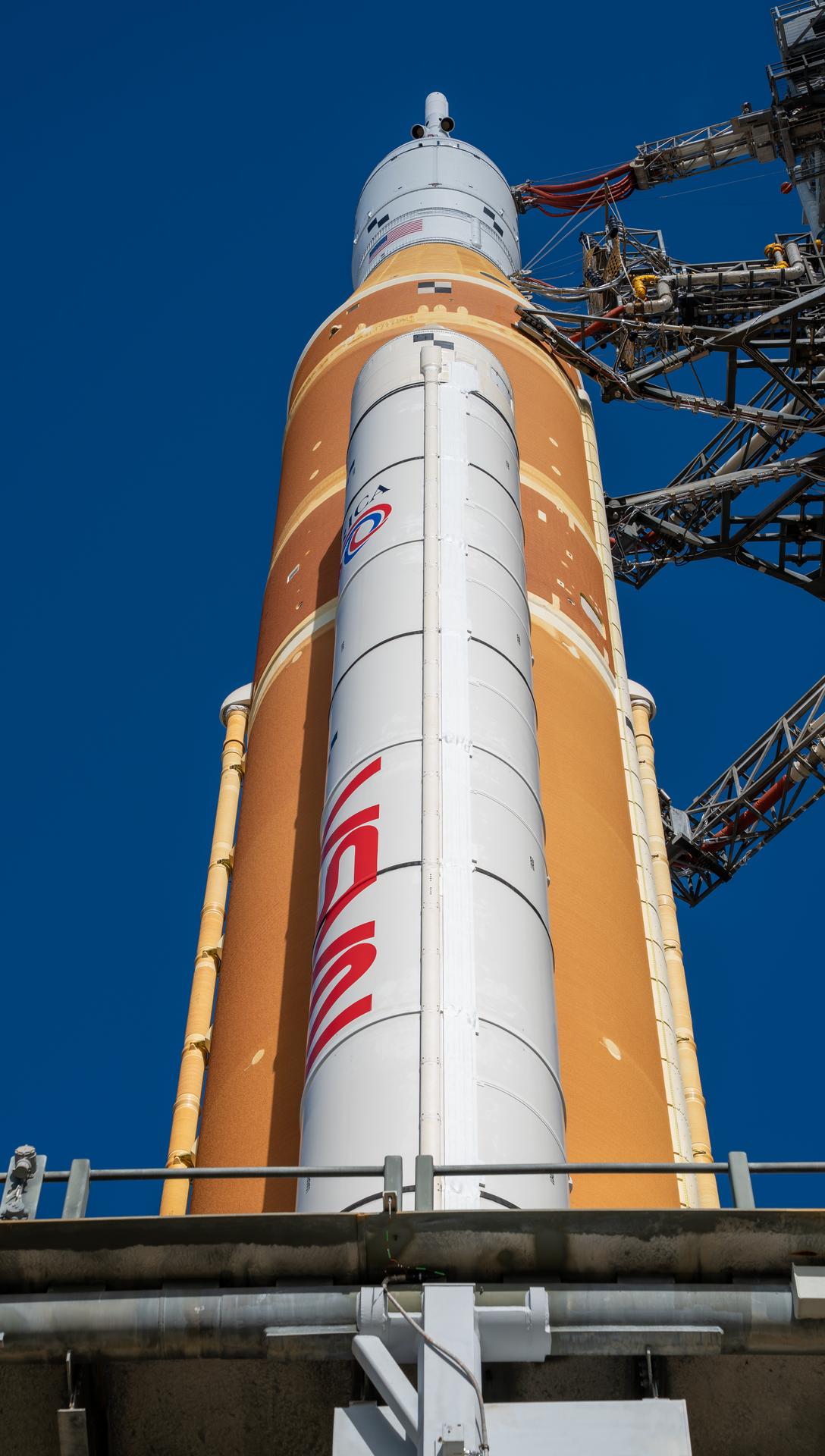
This image shows NASA’s SLS (Space Launch System) and Orion spacecraft rolling out of the Vehicle Assembly Building at NASA’s Kennedy Space Center. NASA's massive Crawler-Transporter, upgraded for the Artemis program, carries the powerful SLS rocket and Orion spacecraft on the Mobile Launcher from the Vehicle Assembly Building to Launch Pad 39B at Kennedy Space Center in preparation for the Artemis II mission.
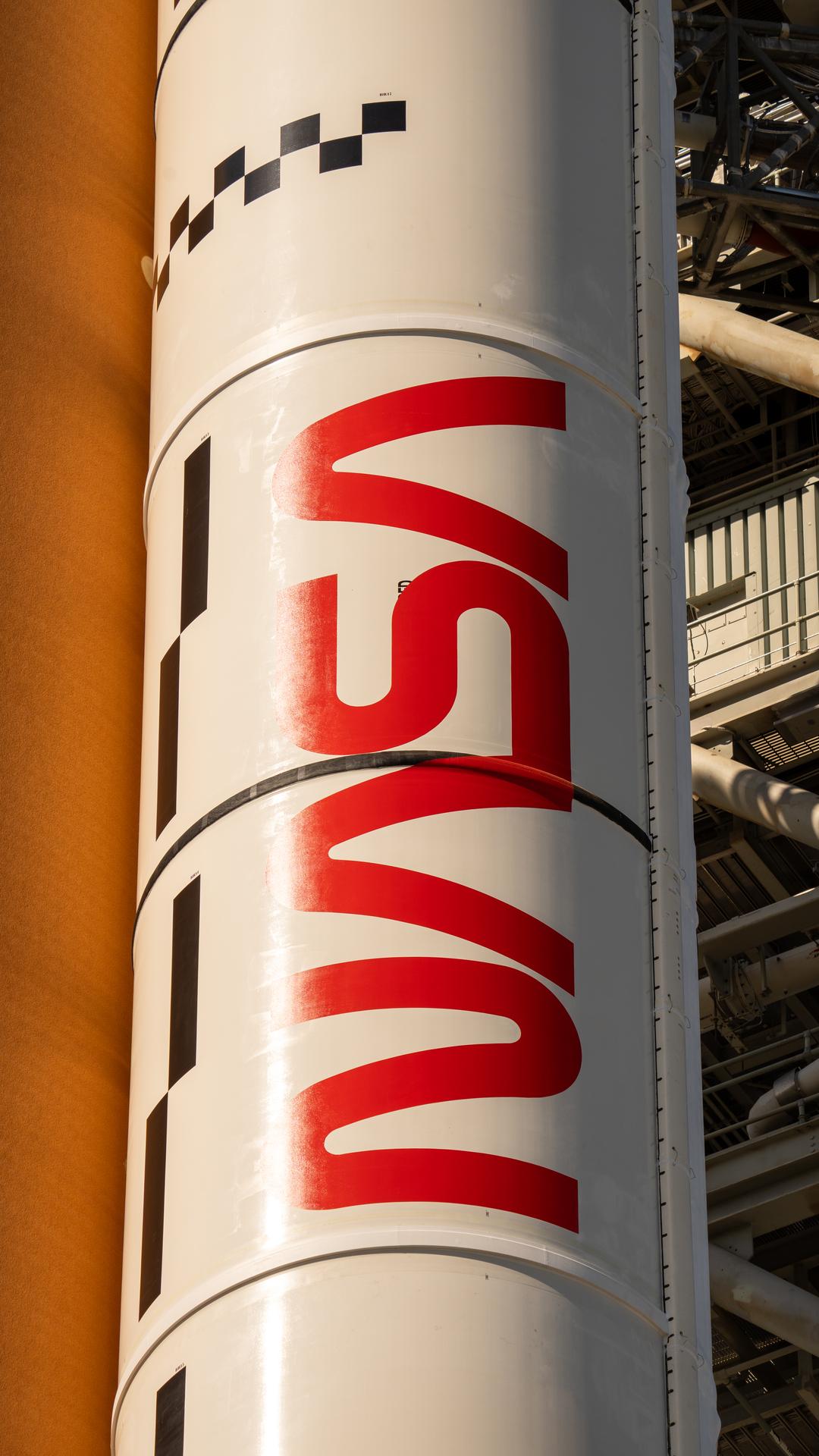
This image shows NASA’s SLS (Space Launch System) and Orion spacecraft rolling out of the Vehicle Assembly Building at NASA’s Kennedy Space Center. NASA's massive Crawler-Transporter, upgraded for the Artemis program, carries the powerful SLS rocket and Orion spacecraft on the Mobile Launcher from the Vehicle Assembly Building to Launch Pad 39B at Kennedy Space Center in preparation for the Artemis II mission.
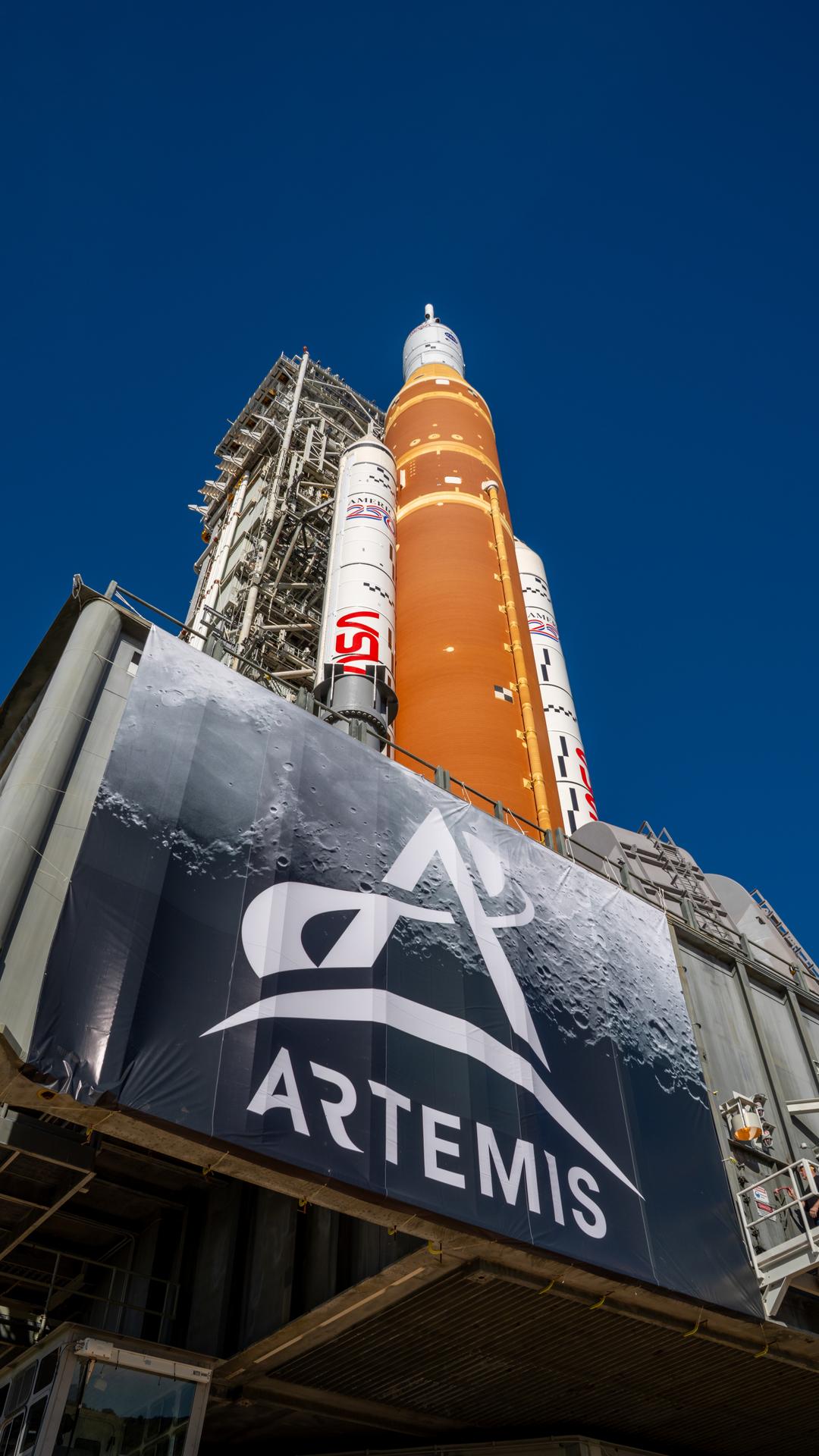
This image shows NASA’s SLS (Space Launch System) and Orion spacecraft rolling out of the Vehicle Assembly Building at NASA’s Kennedy Space Center. NASA's massive Crawler-Transporter, upgraded for the Artemis program, carries the powerful SLS rocket and Orion spacecraft on the Mobile Launcher from the Vehicle Assembly Building to Launch Pad 39B at Kennedy Space Center in preparation for the Artemis II mission.
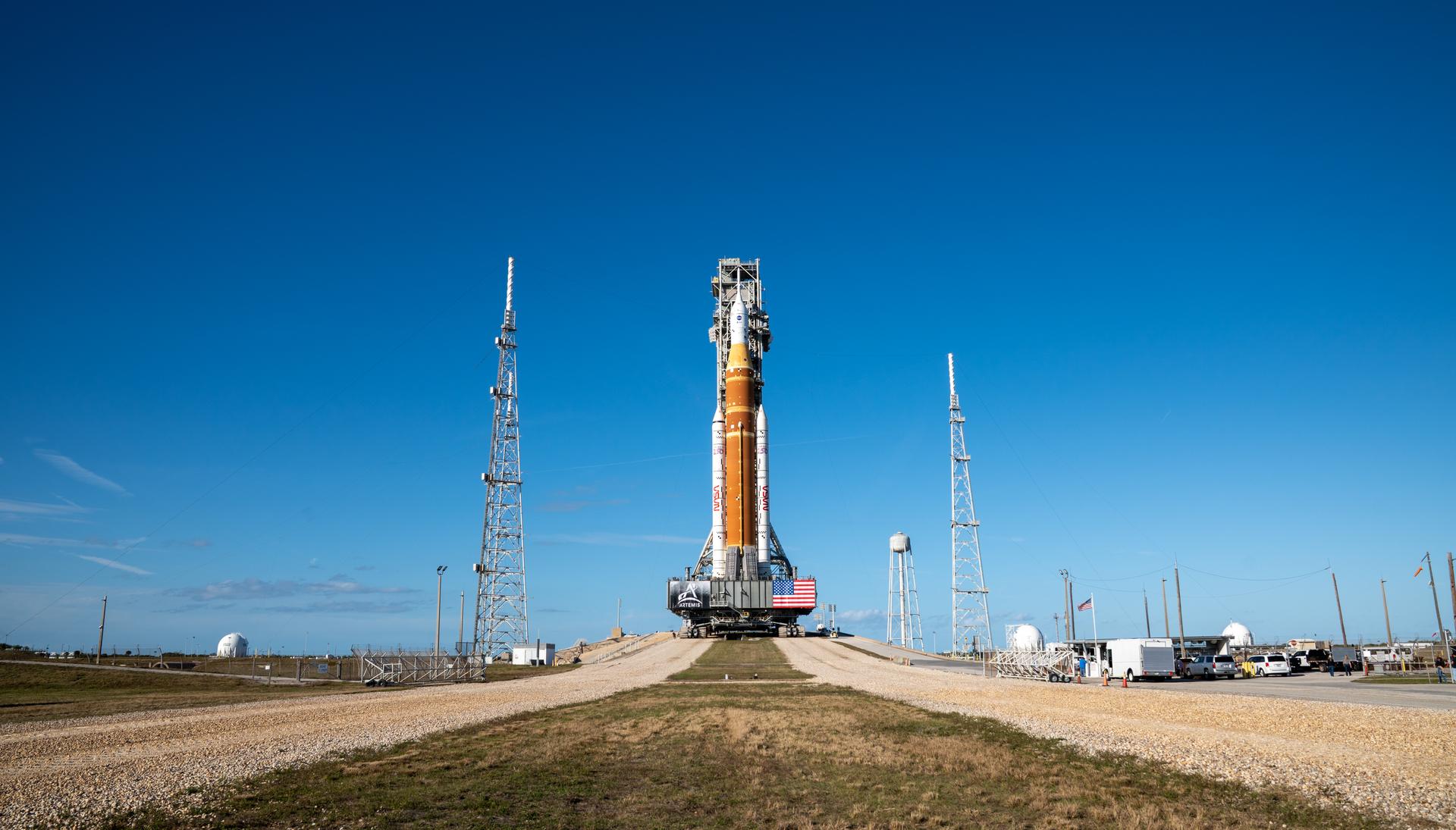
This image shows NASA’s SLS (Space Launch System) and Orion spacecraft rolling out of the Vehicle Assembly Building at NASA’s Kennedy Space Center. NASA's massive Crawler-Transporter, upgraded for the Artemis program, carries the powerful SLS rocket and Orion spacecraft on the Mobile Launcher from the Vehicle Assembly Building to Launch Pad 39B at Kennedy Space Center in preparation for the Artemis II mission.
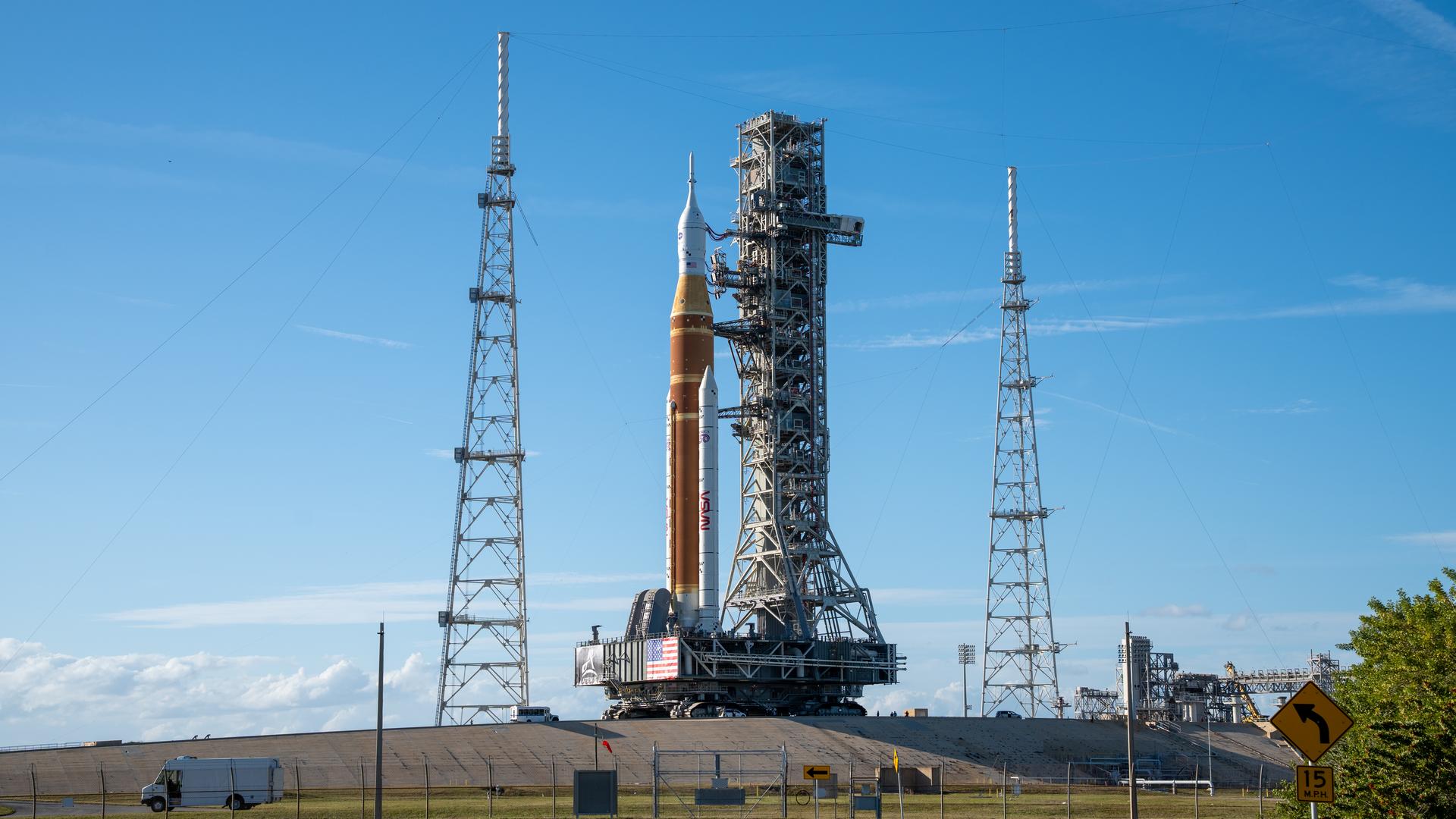
This image shows NASA’s SLS (Space Launch System) and Orion spacecraft rolling out of the Vehicle Assembly Building at NASA’s Kennedy Space Center. NASA's massive Crawler-Transporter, upgraded for the Artemis program, carries the powerful SLS rocket and Orion spacecraft on the Mobile Launcher from the Vehicle Assembly Building to Launch Pad 39B at Kennedy Space Center in preparation for the Artemis II mission.
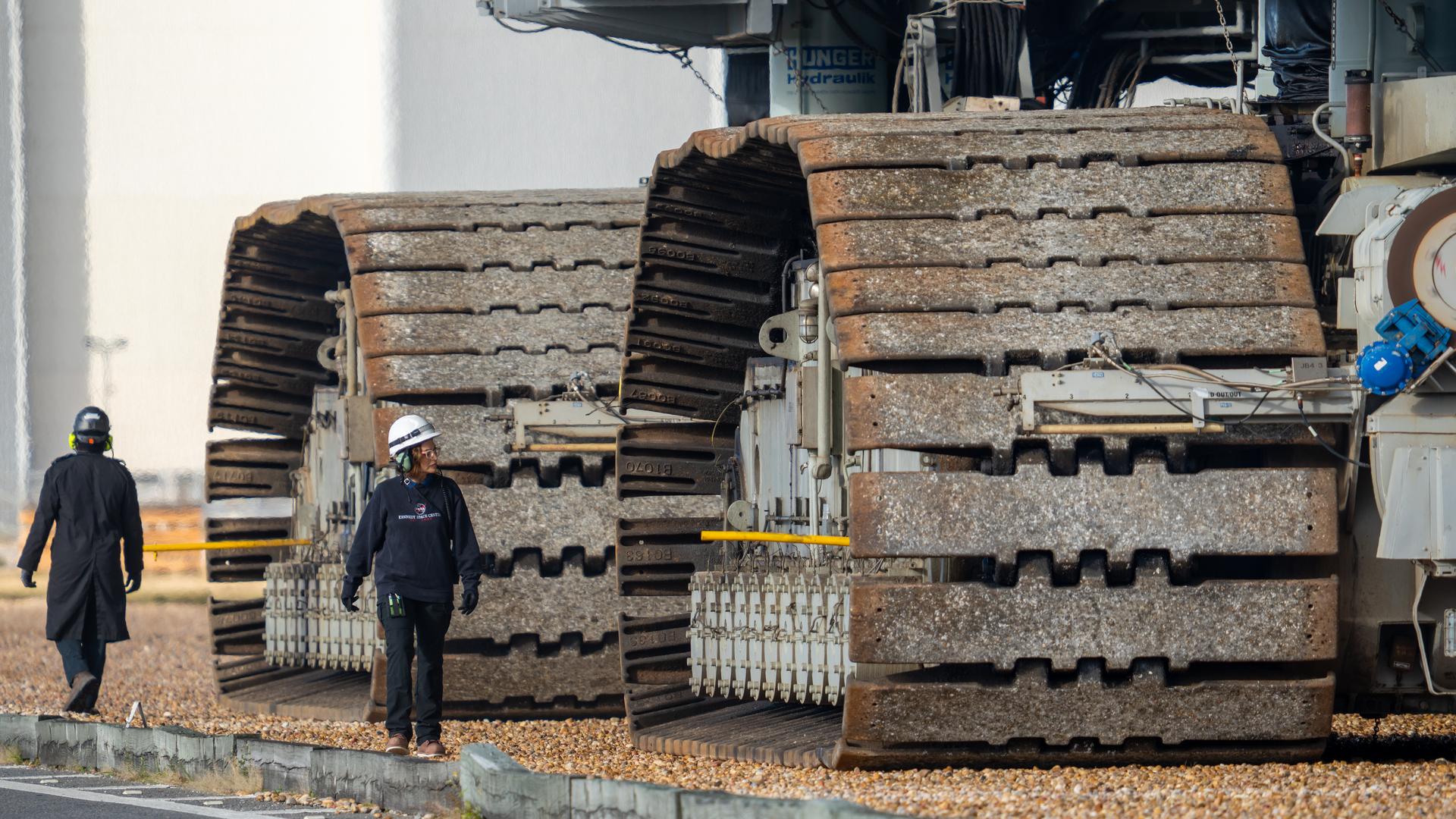
This image shows NASA’s SLS (Space Launch System) and Orion spacecraft rolling out of the Vehicle Assembly Building at NASA’s Kennedy Space Center. NASA's massive Crawler-Transporter, upgraded for the Artemis program, carries the powerful SLS rocket and Orion spacecraft on the Mobile Launcher from the Vehicle Assembly Building to Launch Pad 39B at Kennedy Space Center in preparation for the Artemis II mission.
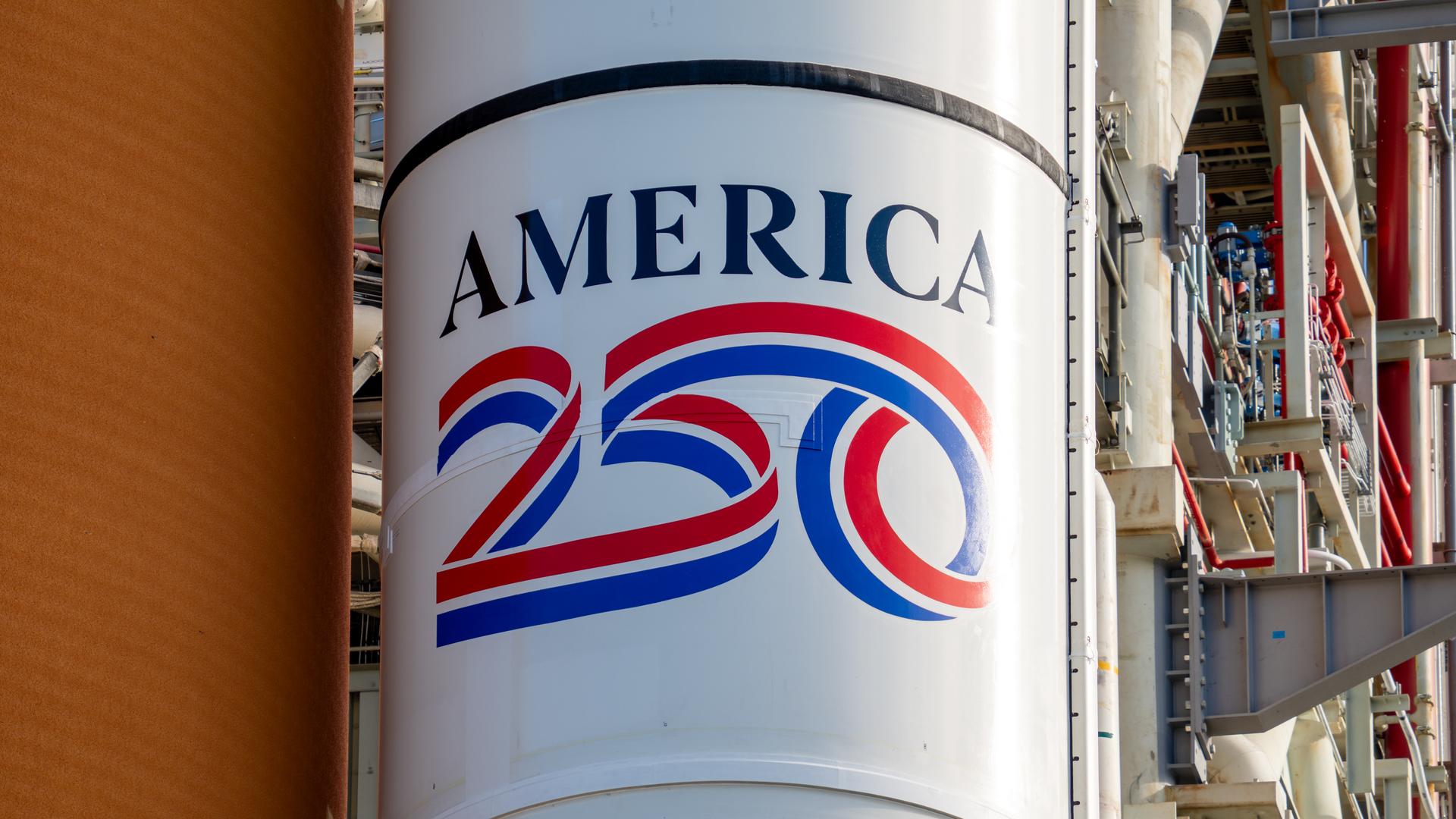
This image shows NASA’s SLS (Space Launch System) and Orion spacecraft rolling out of the Vehicle Assembly Building at NASA’s Kennedy Space Center. NASA's massive Crawler-Transporter, upgraded for the Artemis program, carries the powerful SLS rocket and Orion spacecraft on the Mobile Launcher from the Vehicle Assembly Building to Launch Pad 39B at Kennedy Space Center in preparation for the Artemis II mission.
This image shows NASA’s SLS (Space Launch System) and Orion spacecraft rolling out of the Vehicle Assembly Building at NASA’s Kennedy Space Center. NASA's massive Crawler-Transporter, upgraded for the Artemis program, carries the powerful SLS rocket and Orion spacecraft on the Mobile Launcher from the Vehicle Assembly Building to Launch Pad 39B at Kennedy Space Center in preparation for the Artemis II mission.
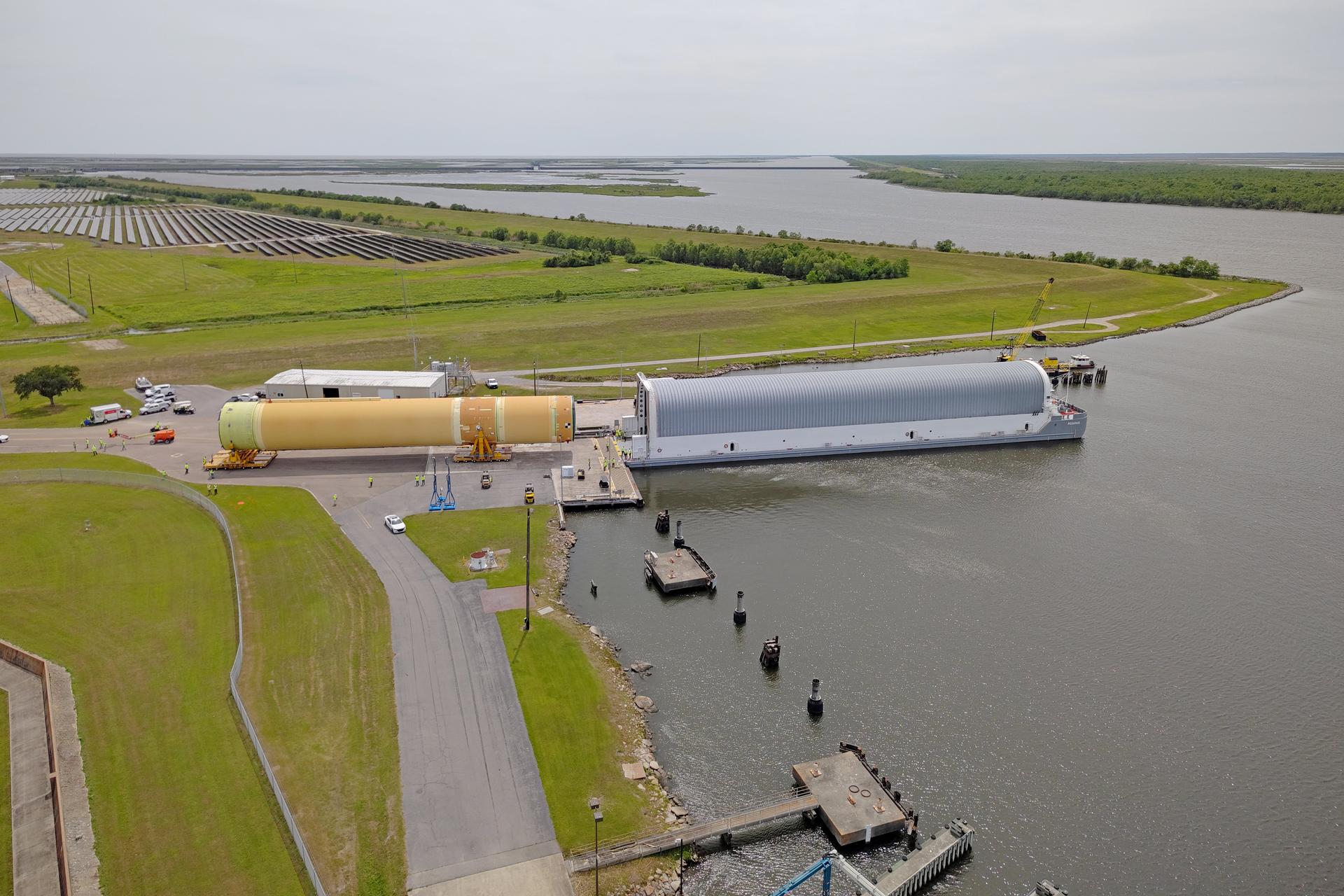
NASA moved the core stage, or the largest section, of the SLS (Space Launch System) rocket that will launch the crewed Artemis III mission in 2027 from the agency’s Michoud Assembly Facility to the agency’s Pegasus barge in New Orleans on April 20. The barge will ferry the top four-fifths – the section containing the liquid hydrogen tank, liquid oxygen tank, intertank, and forward skirt – of the SLS core stage to NASA’s Kennedy Space Center in Florida to complete outfitting and vertical integration. Teams with NASA and Boeing, the SLS core stage lead contractor, used specialized transporters to guide the top four-fifths from the NASA rocket factory to Pegasus. Prior to the move, technicians added an engine section transportation simulator to the rocket stage for shipment to the Space Coast. Next year’s Artemis III mission will launch astronauts to Earth’s orbit aboard the Orion spacecraft on top of SLS to test rendezvous and docking capabilities between Orion and commercial spacecraft needed to land Artemis IV astronauts on the Moon in 2028. NASA’s SLS is the only rocket capable of sending Orion, astronauts, and supplies to the Moon in a single launch.
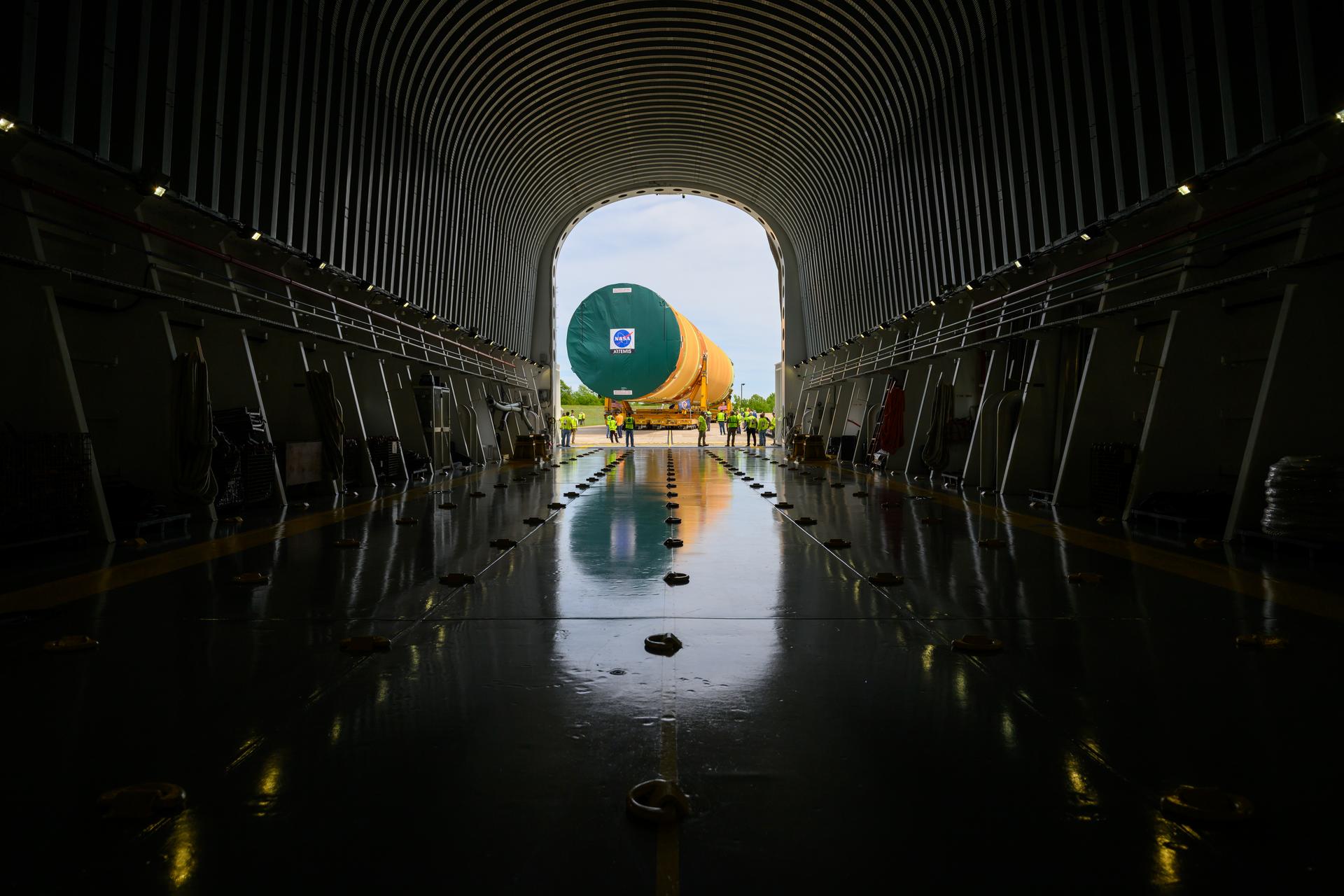
NASA moved the core stage, or the largest section, of the SLS (Space Launch System) rocket that will launch the crewed Artemis III mission in 2027 from the agency’s Michoud Assembly Facility to the agency’s Pegasus barge in New Orleans on April 20. The barge will ferry the top four-fifths – the section containing the liquid hydrogen tank, liquid oxygen tank, intertank, and forward skirt – of the SLS core stage to NASA’s Kennedy Space Center in Florida to complete outfitting and vertical integration. Teams with NASA and Boeing, the SLS core stage lead contractor, used specialized transporters to guide the top four-fifths from the NASA rocket factory to Pegasus. Prior to the move, technicians added an engine section transportation simulator to the rocket stage for shipment to the Space Coast. Next year’s Artemis III mission will launch astronauts to Earth’s orbit aboard the Orion spacecraft on top of SLS to test rendezvous and docking capabilities between Orion and commercial spacecraft needed to land Artemis IV astronauts on the Moon in 2028. NASA’s SLS is the only rocket capable of sending Orion, astronauts, and supplies to the Moon in a single launch.
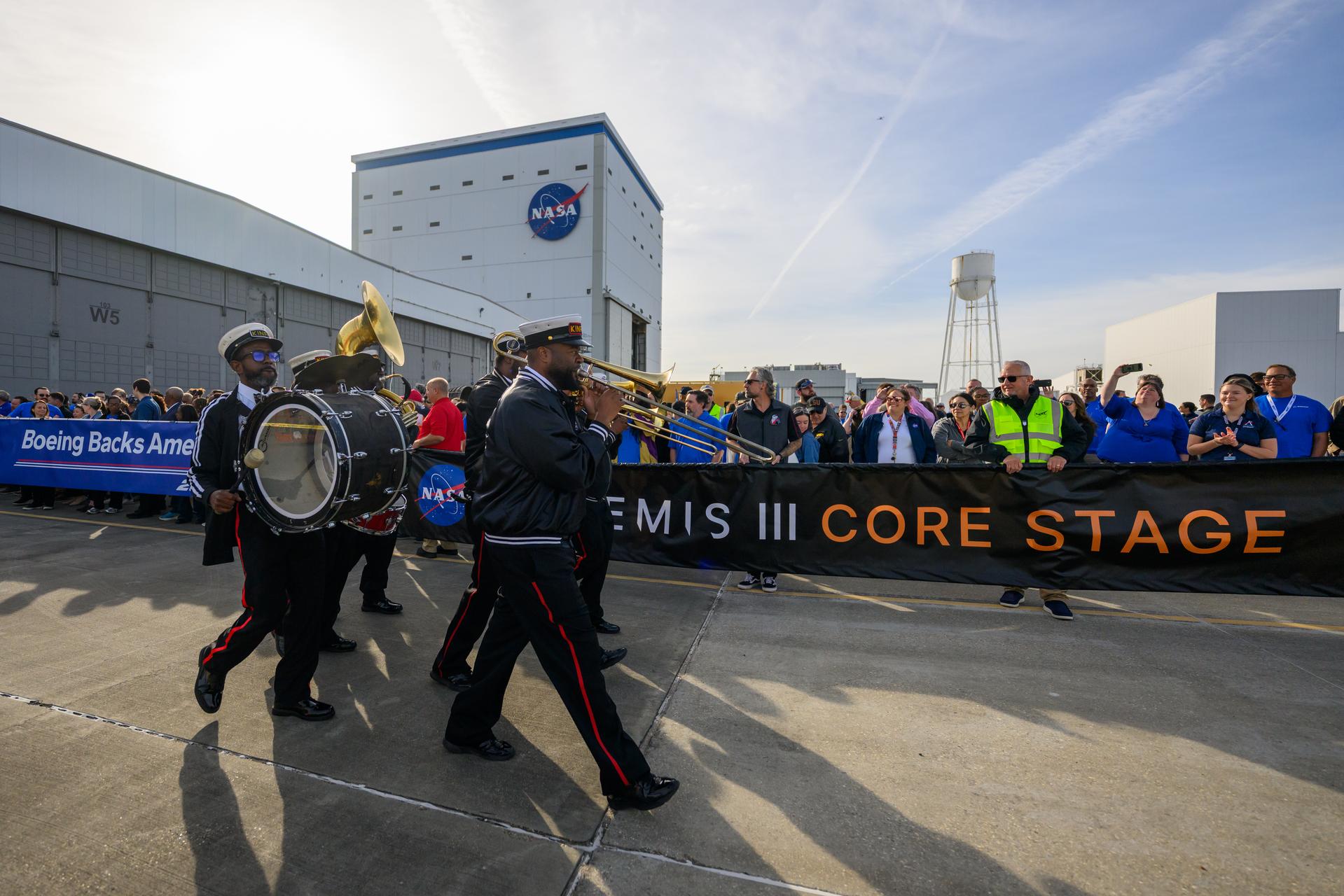
NASA moved the core stage, or the largest section, of the SLS (Space Launch System) rocket that will launch the crewed Artemis III mission in 2027 from the agency’s Michoud Assembly Facility to the agency’s Pegasus barge in New Orleans on April 20. The barge will ferry the top four-fifths – the section containing the liquid hydrogen tank, liquid oxygen tank, intertank, and forward skirt – of the SLS core stage to NASA’s Kennedy Space Center in Florida to complete outfitting and vertical integration. Teams with NASA and Boeing, the SLS core stage lead contractor, used specialized transporters to guide the top four-fifths from the NASA rocket factory to Pegasus. Prior to the move, technicians added an engine section transportation simulator to the rocket stage for shipment to the Space Coast. Next year’s Artemis III mission will launch astronauts to Earth’s orbit aboard the Orion spacecraft on top of SLS to test rendezvous and docking capabilities between Orion and commercial spacecraft needed to land Artemis IV astronauts on the Moon in 2028. NASA’s SLS is the only rocket capable of sending Orion, astronauts, and supplies to the Moon in a single launch.
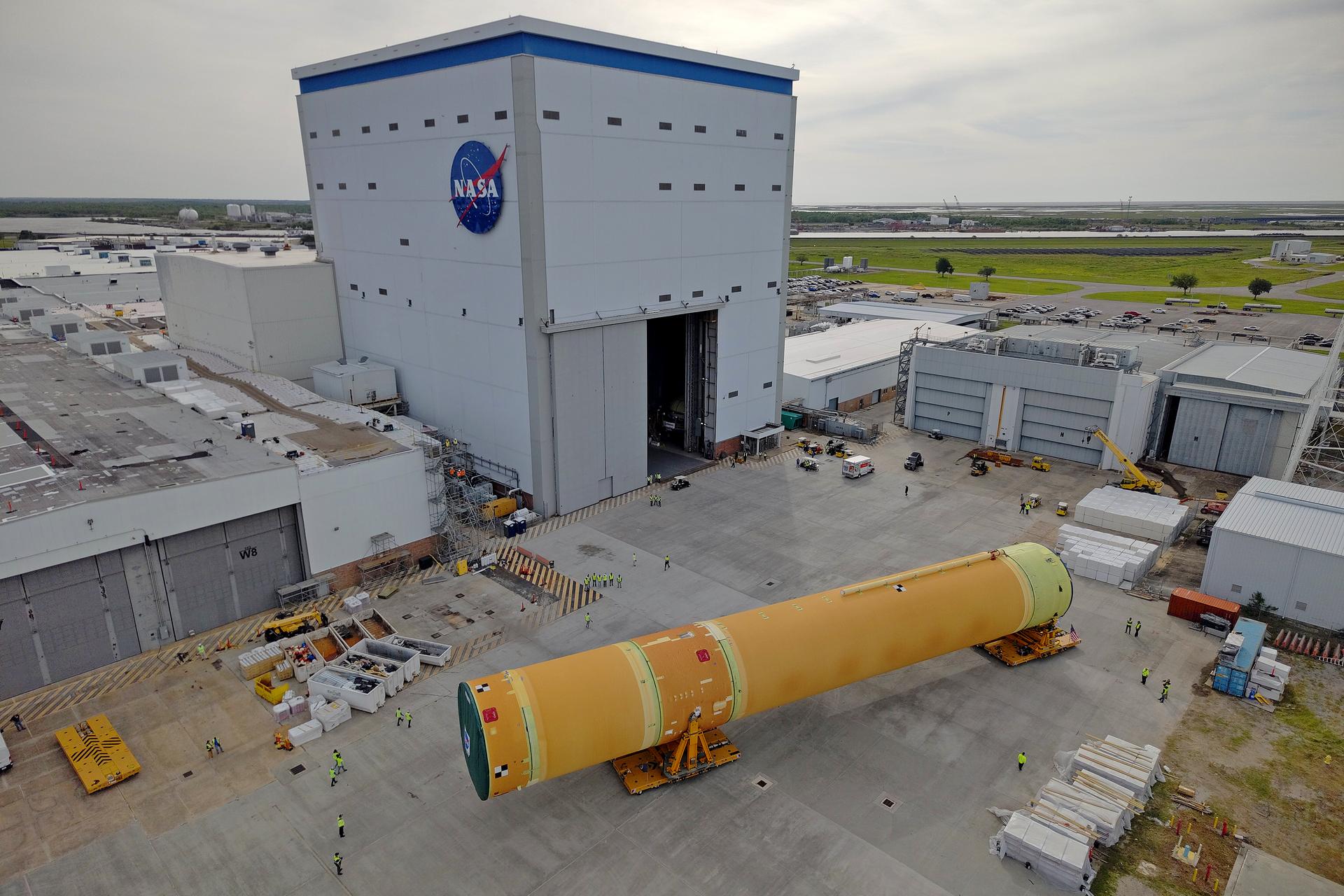
NASA moved the core stage, or the largest section, of the SLS (Space Launch System) rocket that will launch the crewed Artemis III mission in 2027 from the agency’s Michoud Assembly Facility to the agency’s Pegasus barge in New Orleans on April 20. The barge will ferry the top four-fifths – the section containing the liquid hydrogen tank, liquid oxygen tank, intertank, and forward skirt – of the SLS core stage to NASA’s Kennedy Space Center in Florida to complete outfitting and vertical integration. Teams with NASA and Boeing, the SLS core stage lead contractor, used specialized transporters to guide the top four-fifths from the NASA rocket factory to Pegasus. Prior to the move, technicians added an engine section transportation simulator to the rocket stage for shipment to the Space Coast. Next year’s Artemis III mission will launch astronauts to Earth’s orbit aboard the Orion spacecraft on top of SLS to test rendezvous and docking capabilities between Orion and commercial spacecraft needed to land Artemis IV astronauts on the Moon in 2028. NASA’s SLS is the only rocket capable of sending Orion, astronauts, and supplies to the Moon in a single launch.
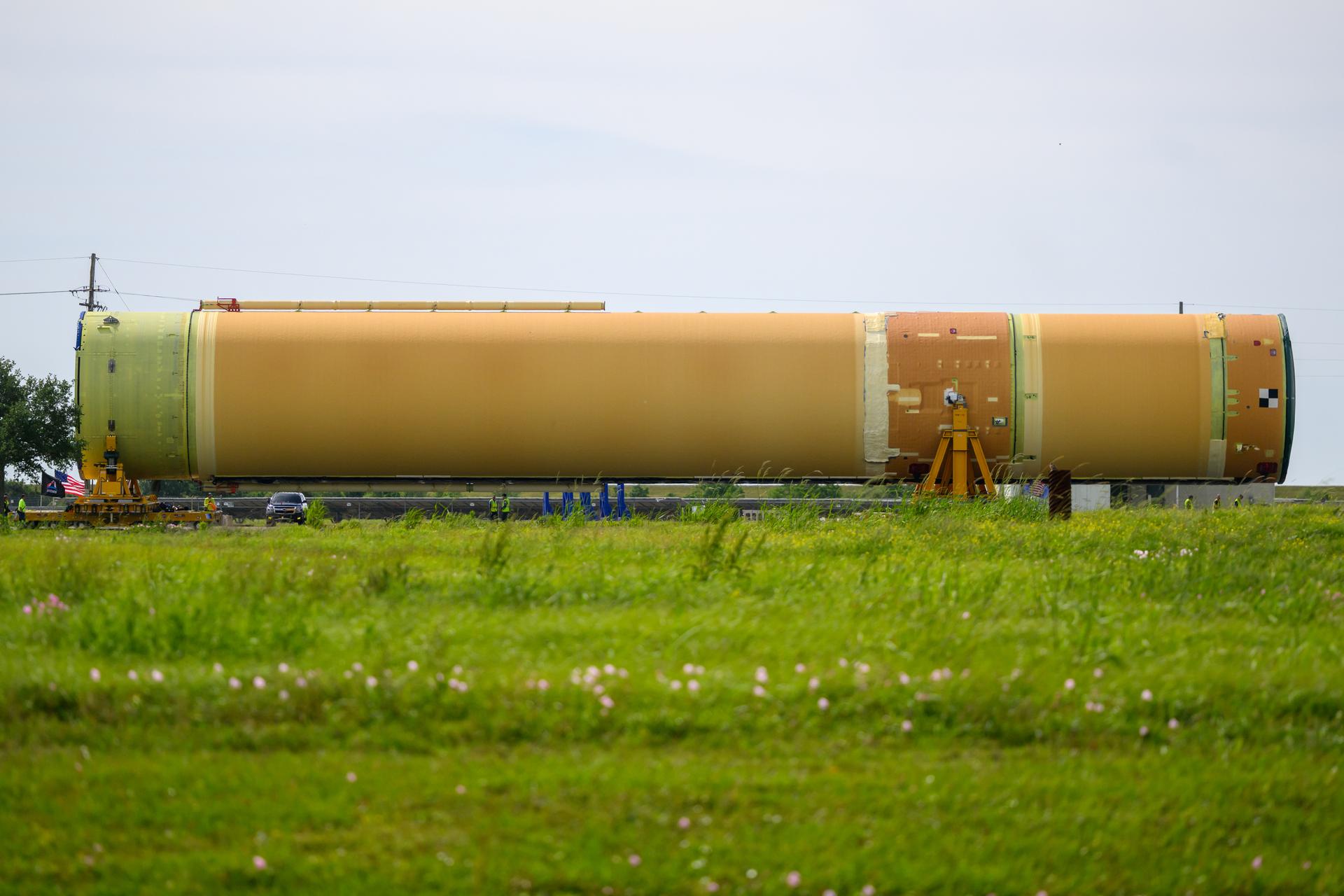
NASA moved the core stage, or the largest section, of the SLS (Space Launch System) rocket that will launch the crewed Artemis III mission in 2027 from the agency’s Michoud Assembly Facility to the agency’s Pegasus barge in New Orleans on April 20. The barge will ferry the top four-fifths – the section containing the liquid hydrogen tank, liquid oxygen tank, intertank, and forward skirt – of the SLS core stage to NASA’s Kennedy Space Center in Florida to complete outfitting and vertical integration. Teams with NASA and Boeing, the SLS core stage lead contractor, used specialized transporters to guide the top four-fifths from the NASA rocket factory to Pegasus. Prior to the move, technicians added an engine section transportation simulator to the rocket stage for shipment to the Space Coast. Next year’s Artemis III mission will launch astronauts to Earth’s orbit aboard the Orion spacecraft on top of SLS to test rendezvous and docking capabilities between Orion and commercial spacecraft needed to land Artemis IV astronauts on the Moon in 2028. NASA’s SLS is the only rocket capable of sending Orion, astronauts, and supplies to the Moon in a single launch.
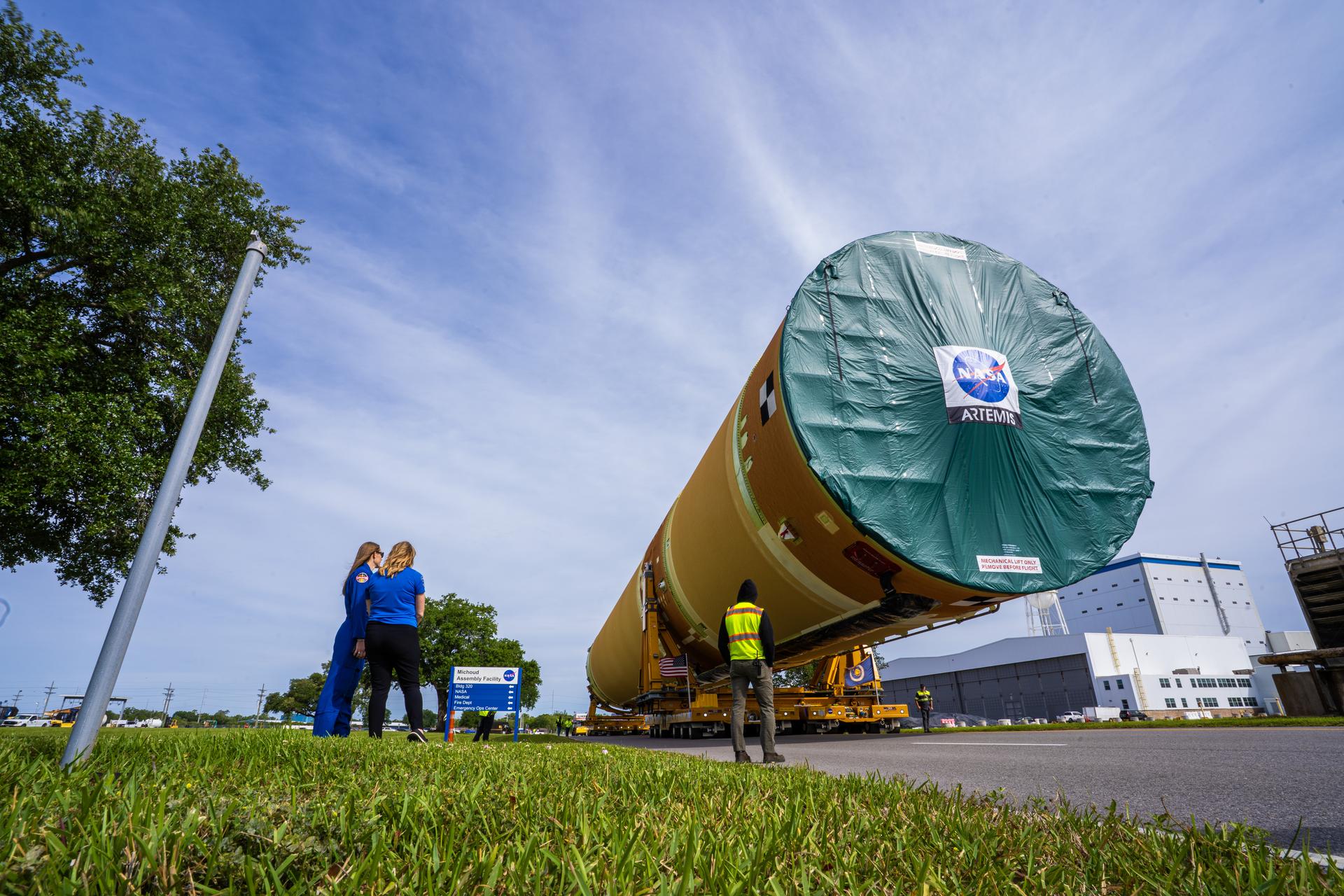
NASA moved the core stage, or the largest section, of the SLS (Space Launch System) rocket that will launch the crewed Artemis III mission in 2027 from the agency’s Michoud Assembly Facility to the agency’s Pegasus barge in New Orleans on April 20. The barge will ferry the top four-fifths – the section containing the liquid hydrogen tank, liquid oxygen tank, intertank, and forward skirt – of the SLS core stage to NASA’s Kennedy Space Center in Florida to complete outfitting and vertical integration. Teams with NASA and Boeing, the SLS core stage lead contractor, used specialized transporters to guide the top four-fifths from the NASA rocket factory to Pegasus. Prior to the move, technicians added an engine section transportation simulator to the rocket stage for shipment to the Space Coast. Next year’s Artemis III mission will launch astronauts to Earth’s orbit aboard the Orion spacecraft on top of SLS to test rendezvous and docking capabilities between Orion and commercial spacecraft needed to land Artemis IV astronauts on the Moon in 2028. NASA’s SLS is the only rocket capable of sending Orion, astronauts, and supplies to the Moon in a single launch.
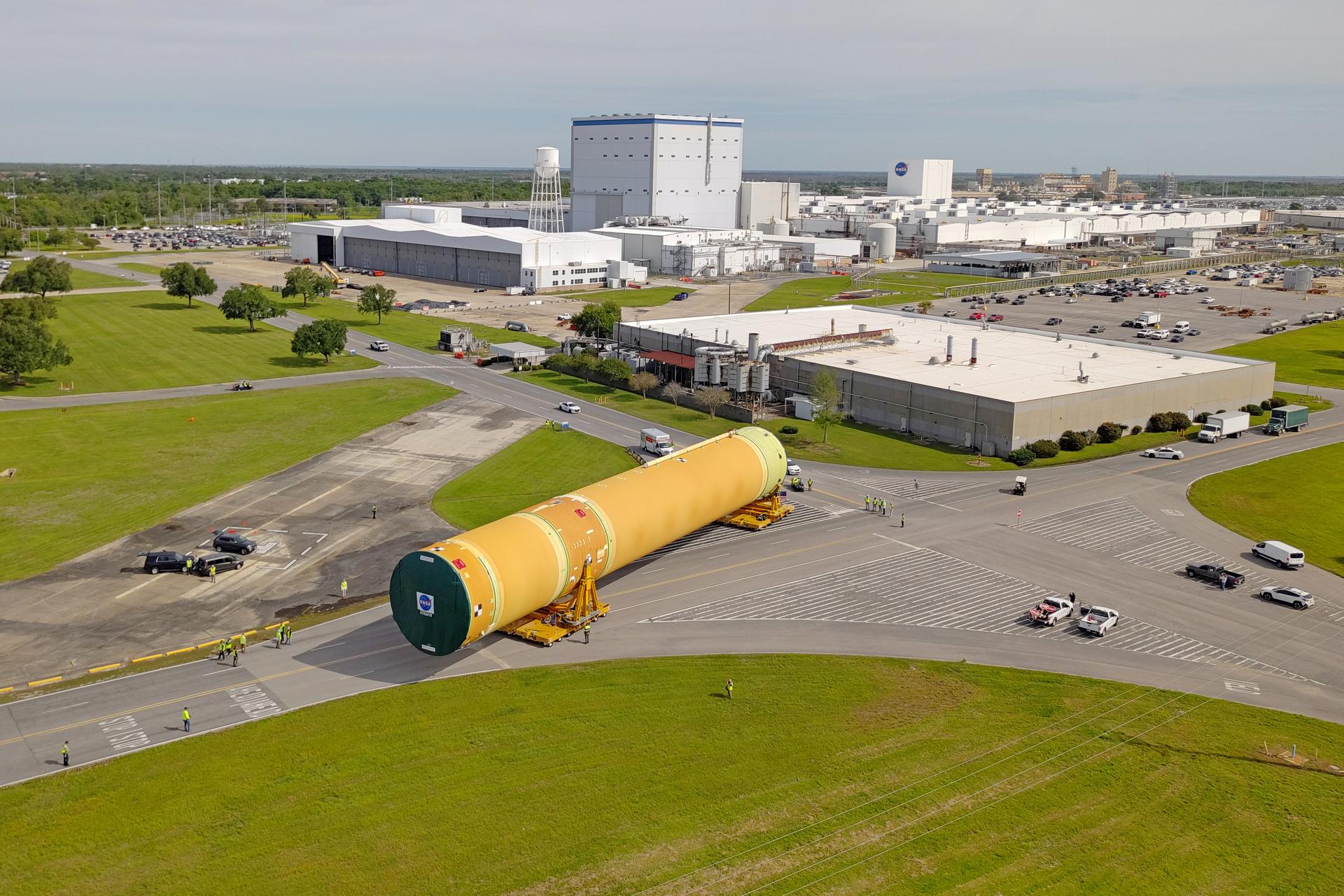
NASA moved the core stage, or the largest section, of the SLS (Space Launch System) rocket that will launch the crewed Artemis III mission in 2027 from the agency’s Michoud Assembly Facility to the agency’s Pegasus barge in New Orleans on April 20. The barge will ferry the top four-fifths – the section containing the liquid hydrogen tank, liquid oxygen tank, intertank, and forward skirt – of the SLS core stage to NASA’s Kennedy Space Center in Florida to complete outfitting and vertical integration. Teams with NASA and Boeing, the SLS core stage lead contractor, used specialized transporters to guide the top four-fifths from the NASA rocket factory to Pegasus. Prior to the move, technicians added an engine section transportation simulator to the rocket stage for shipment to the Space Coast. Next year’s Artemis III mission will launch astronauts to Earth’s orbit aboard the Orion spacecraft on top of SLS to test rendezvous and docking capabilities between Orion and commercial spacecraft needed to land Artemis IV astronauts on the Moon in 2028. NASA’s SLS is the only rocket capable of sending Orion, astronauts, and supplies to the Moon in a single launch.
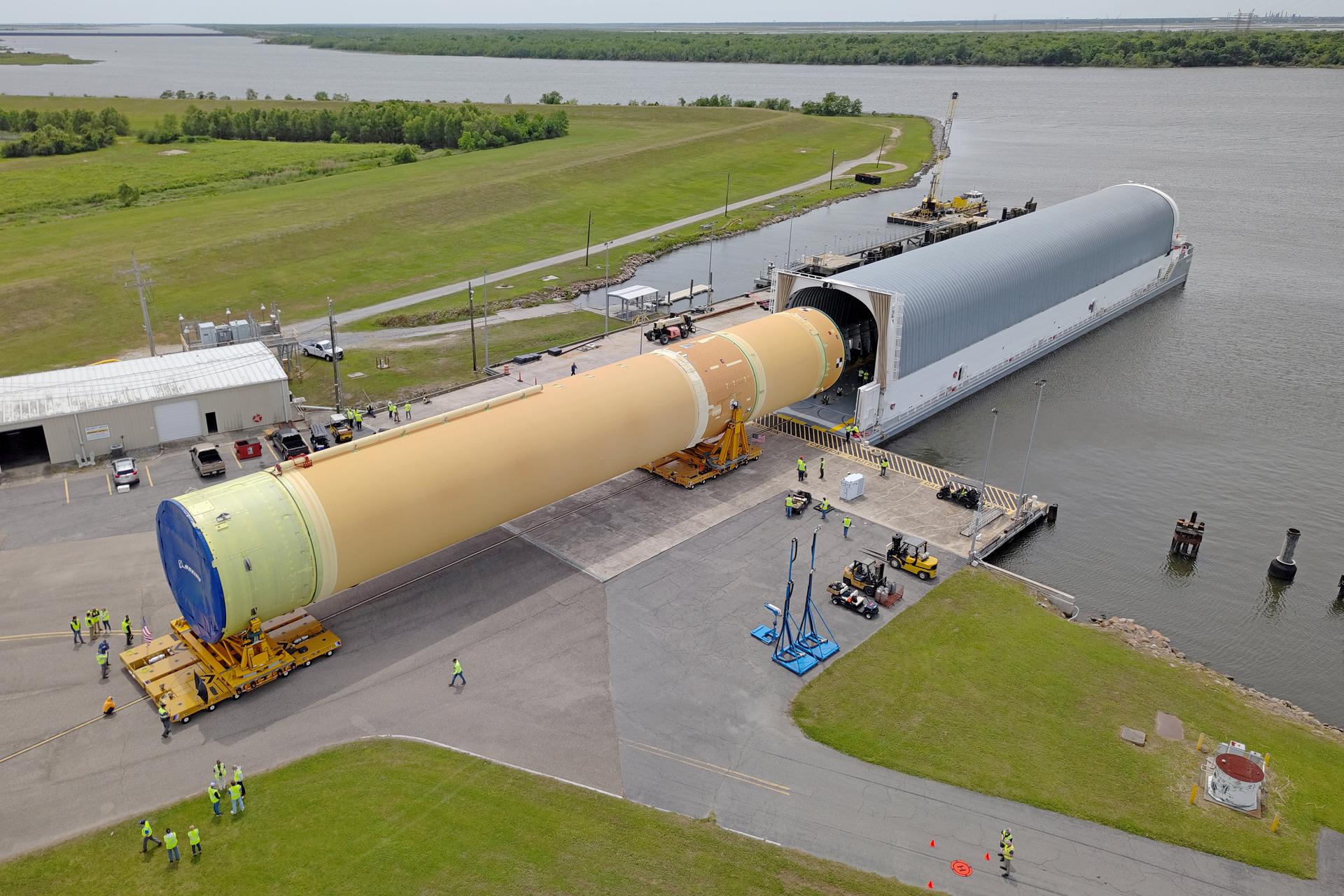
NASA moved the core stage, or the largest section, of the SLS (Space Launch System) rocket that will launch the crewed Artemis III mission in 2027 from the agency’s Michoud Assembly Facility to the agency’s Pegasus barge in New Orleans on April 20. The barge will ferry the top four-fifths – the section containing the liquid hydrogen tank, liquid oxygen tank, intertank, and forward skirt – of the SLS core stage to NASA’s Kennedy Space Center in Florida to complete outfitting and vertical integration. Teams with NASA and Boeing, the SLS core stage lead contractor, used specialized transporters to guide the top four-fifths from the NASA rocket factory to Pegasus. Prior to the move, technicians added an engine section transportation simulator to the rocket stage for shipment to the Space Coast. Next year’s Artemis III mission will launch astronauts to Earth’s orbit aboard the Orion spacecraft on top of SLS to test rendezvous and docking capabilities between Orion and commercial spacecraft needed to land Artemis IV astronauts on the Moon in 2028. NASA’s SLS is the only rocket capable of sending Orion, astronauts, and supplies to the Moon in a single launch.
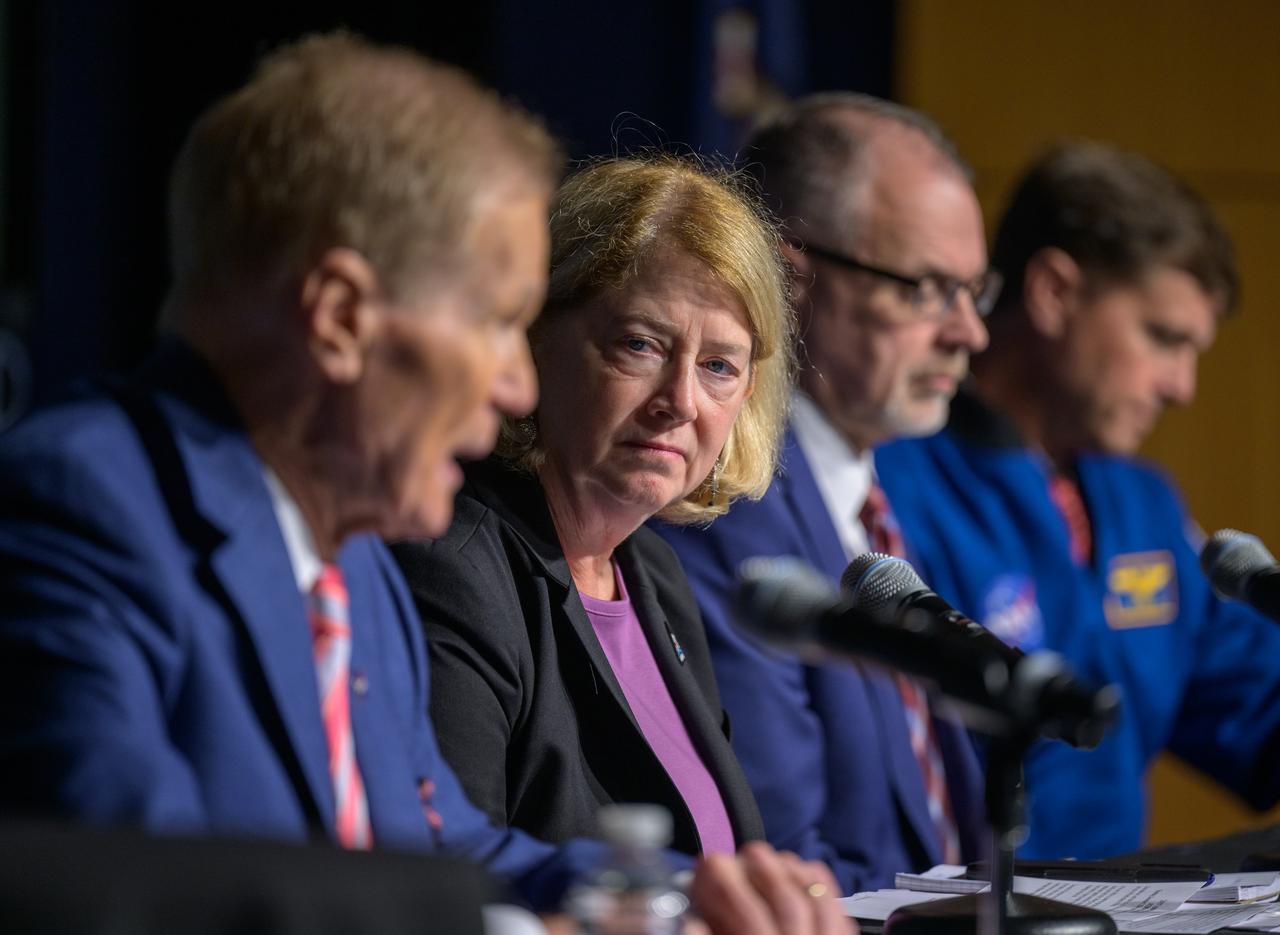
NASA Deputy Administrator Pam Melroy, listens as NASA Administrator Bill Nelson, gives remarks during an update on NASA's Artemis campaign, Thursday, Dec. 5, 2024, at the NASA Headquarters Mary W. Jackson Building in Washington. Photo Credit: (NASA/Bill Ingalls)
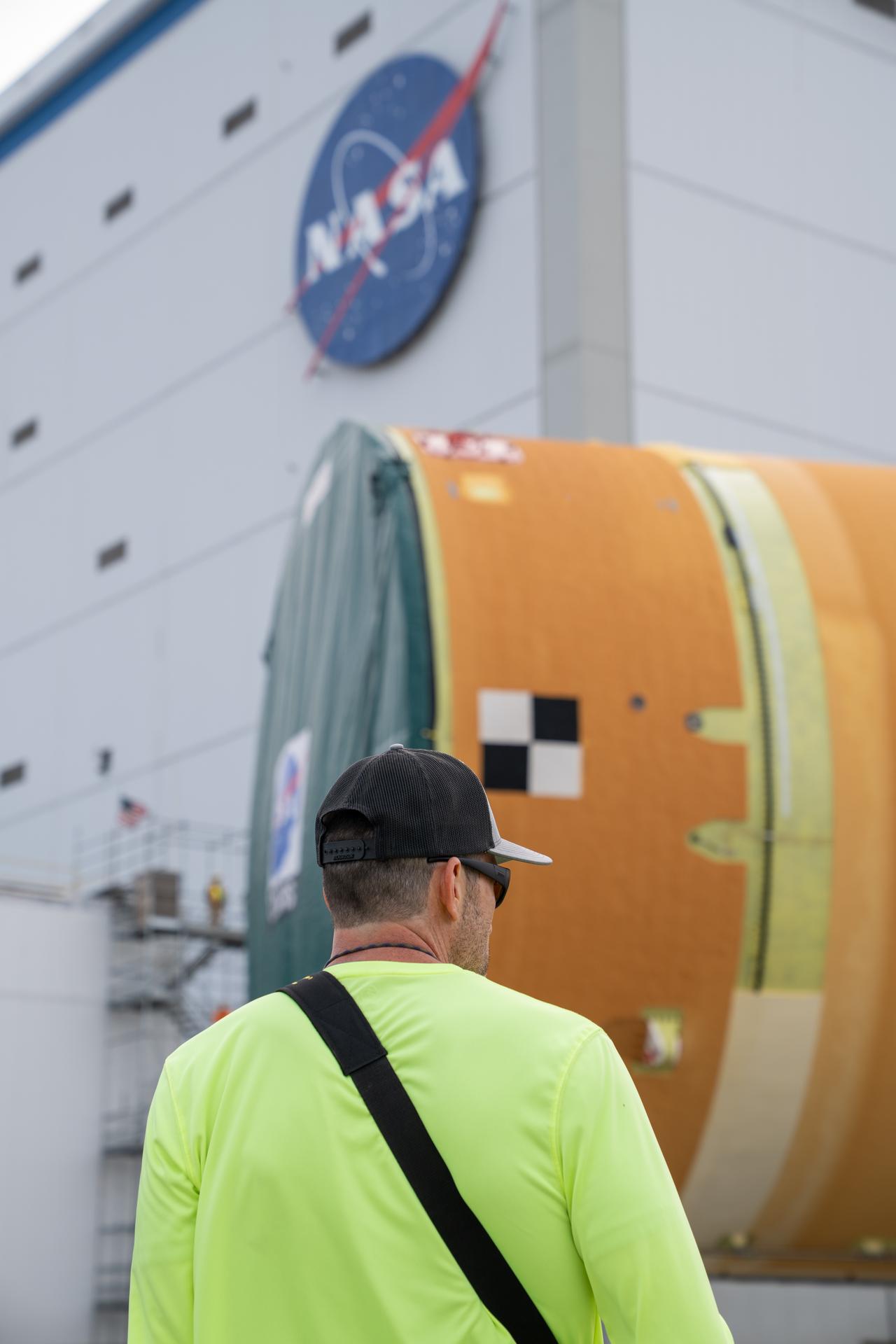
NASA moved the core stage, or the largest section, of the SLS (Space Launch System) rocket that will launch the crewed Artemis III mission in 2027 from the agency’s Michoud Assembly Facility to the agency’s Pegasus barge in New Orleans on April 20. The barge will ferry the top four-fifths – the section containing the liquid hydrogen tank, liquid oxygen tank, intertank, and forward skirt – of the SLS core stage to NASA’s Kennedy Space Center in Florida to complete outfitting and vertical integration. Teams with NASA and Boeing, the SLS core stage lead contractor, used specialized transporters to guide the top four-fifths from the NASA rocket factory to Pegasus. Prior to the move, technicians added an engine section transportation simulator to the rocket stage for shipment to the Space Coast. Next year’s Artemis III mission will launch astronauts to Earth’s orbit aboard the Orion spacecraft on top of SLS to test rendezvous and docking capabilities between Orion and commercial spacecraft needed to land Artemis IV astronauts on the Moon in 2028. NASA’s SLS is the only rocket capable of sending Orion, astronauts, and supplies to the Moon in a single launch. Photo Credit: (NASA/Brandon Hancock)
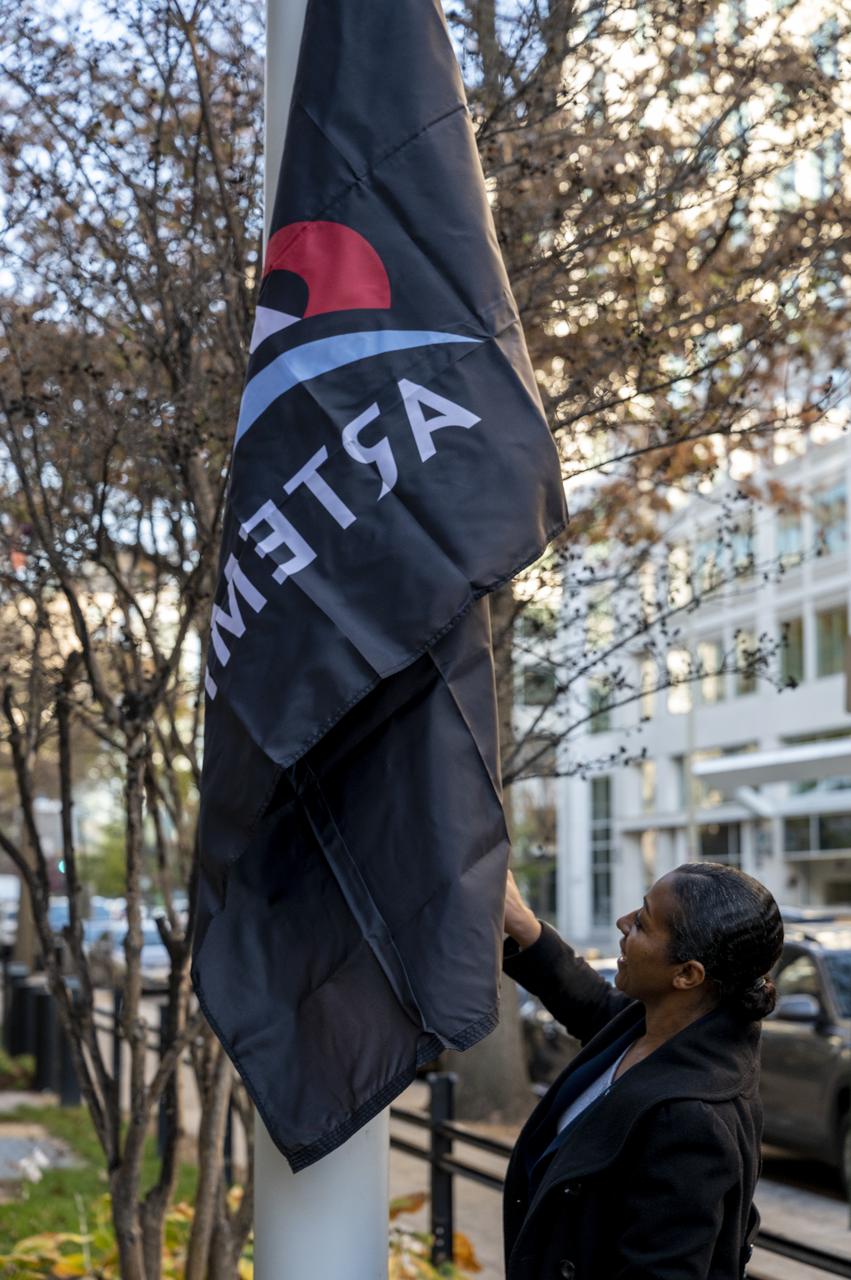
Artemis Mission Development Manager Mike Sarafin, Artemis Mission Integration Manager Sheela Logan, and Assistant Deputy Associate Administrator for Exploration Systems Development Tom Whitmeyer raise Artemis flags Wednesday, Nov. 23, 2022, at the Mary W. Jackson NASA Headquarters building in Washington. Photo Credit: (NASA/Keegan Barber)
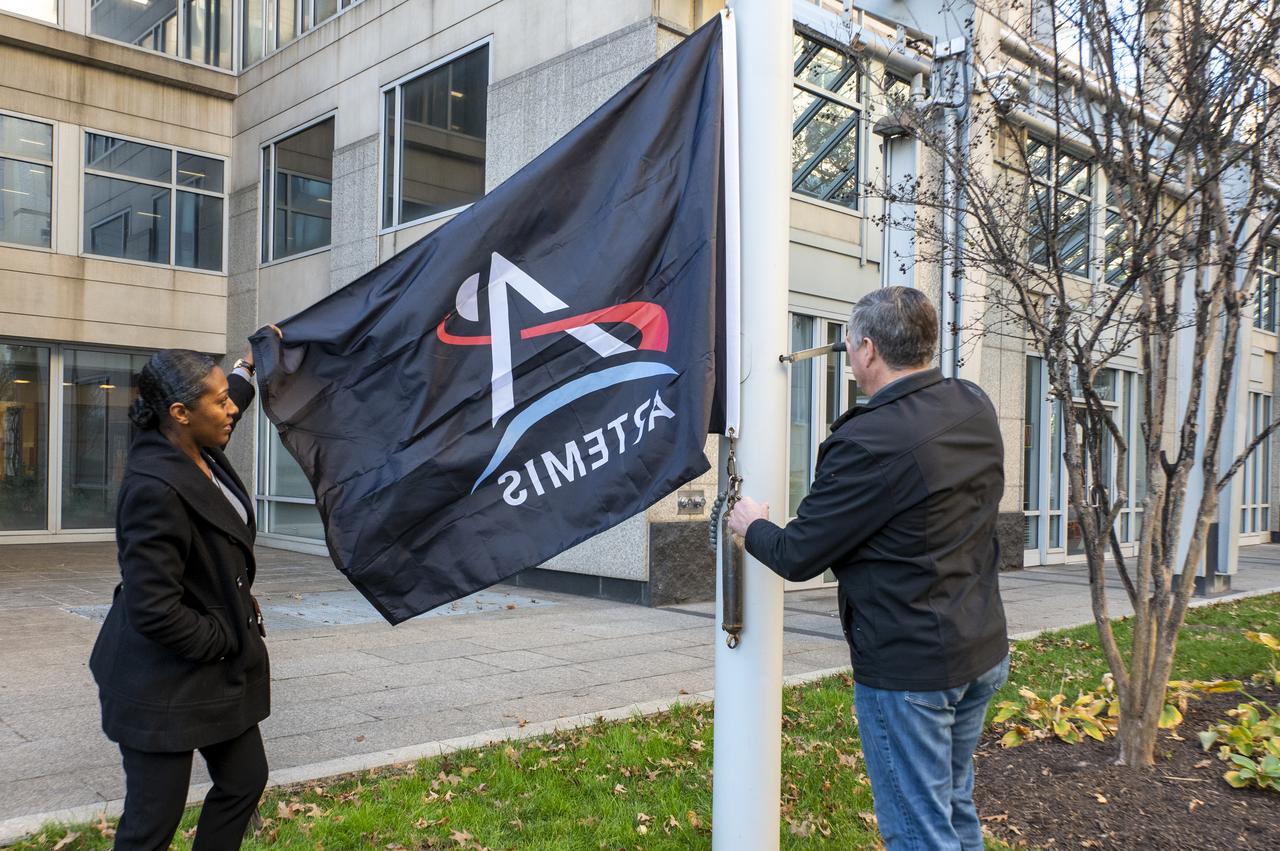
Artemis Mission Development Manager Mike Sarafin, Artemis Mission Integration Manager Sheela Logan, and Assistant Deputy Associate Administrator for Exploration Systems Development Tom Whitmeyer raise Artemis flags Wednesday, Nov. 23, 2022, at the Mary W. Jackson NASA Headquarters building in Washington. Photo Credit: (NASA/Keegan Barber)
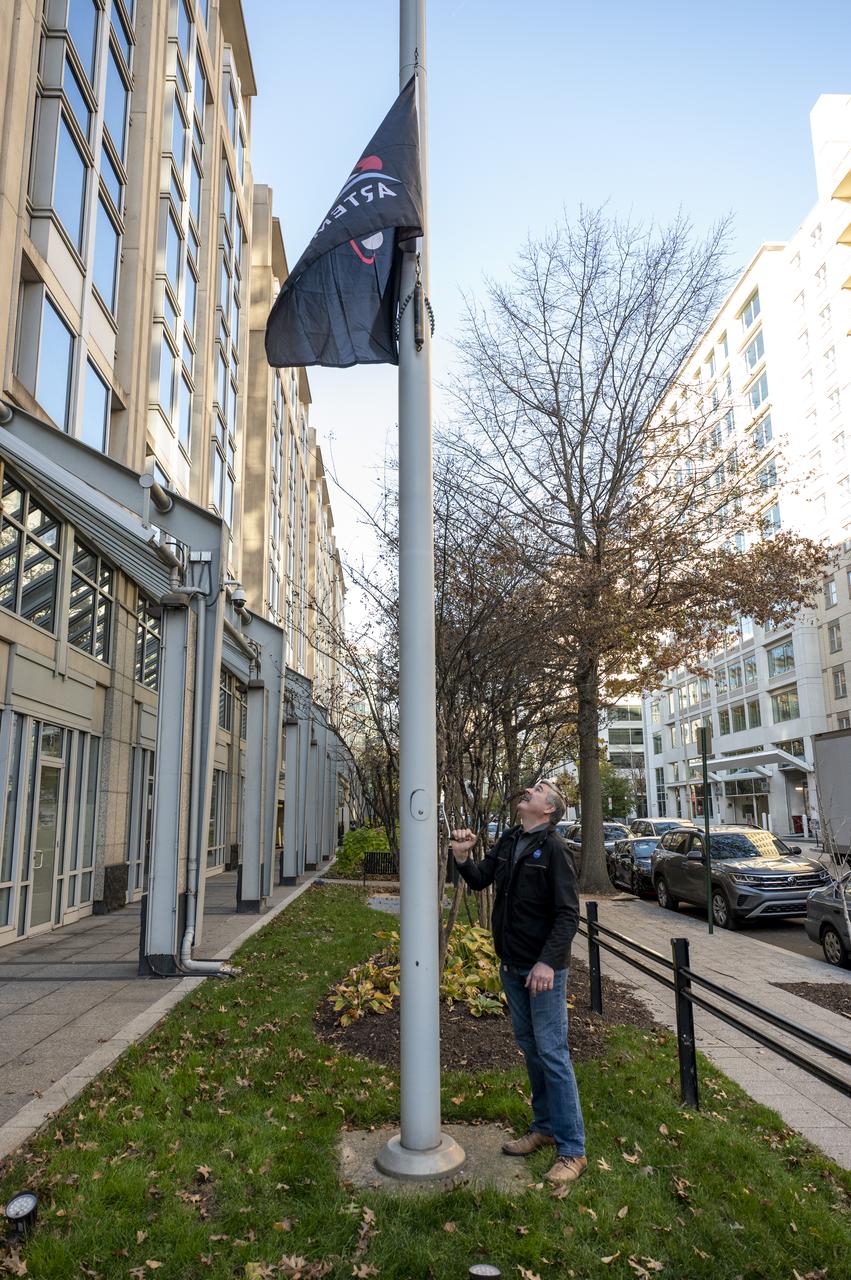
Artemis Mission Development Manager Mike Sarafin, Artemis Mission Integration Manager Sheela Logan, and Assistant Deputy Associate Administrator for Exploration Systems Development Tom Whitmeyer raise Artemis flags Wednesday, Nov. 23, 2022, at the Mary W. Jackson NASA Headquarters building in Washington. Photo Credit: (NASA/Keegan Barber)
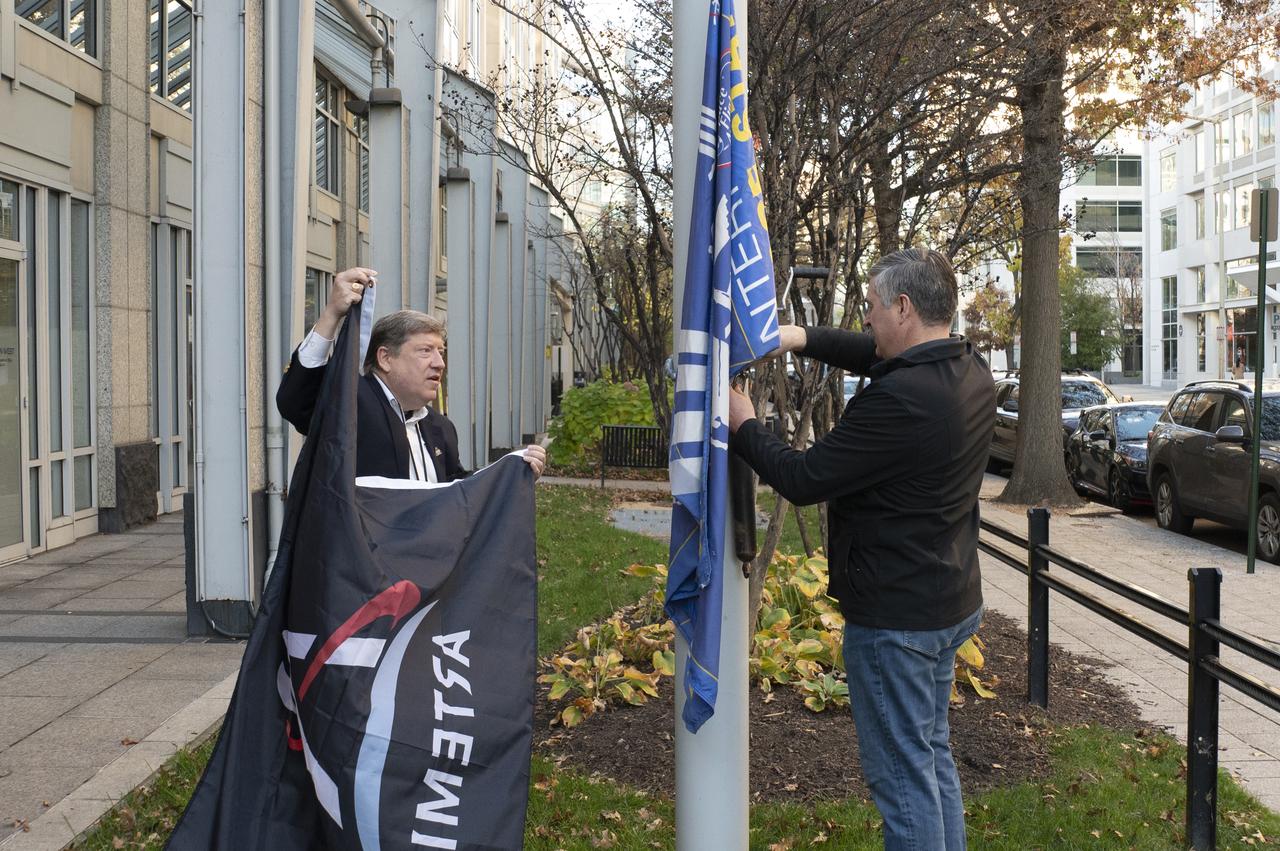
Artemis Mission Development Manager Mike Sarafin, Artemis Mission Integration Manager Sheela Logan, and Assistant Deputy Associate Administrator for Exploration Systems Development Tom Whitmeyer raise Artemis flags Wednesday, Nov. 23, 2022, at the Mary W. Jackson NASA Headquarters building in Washington. Photo Credit: (NASA/Keegan Barber)
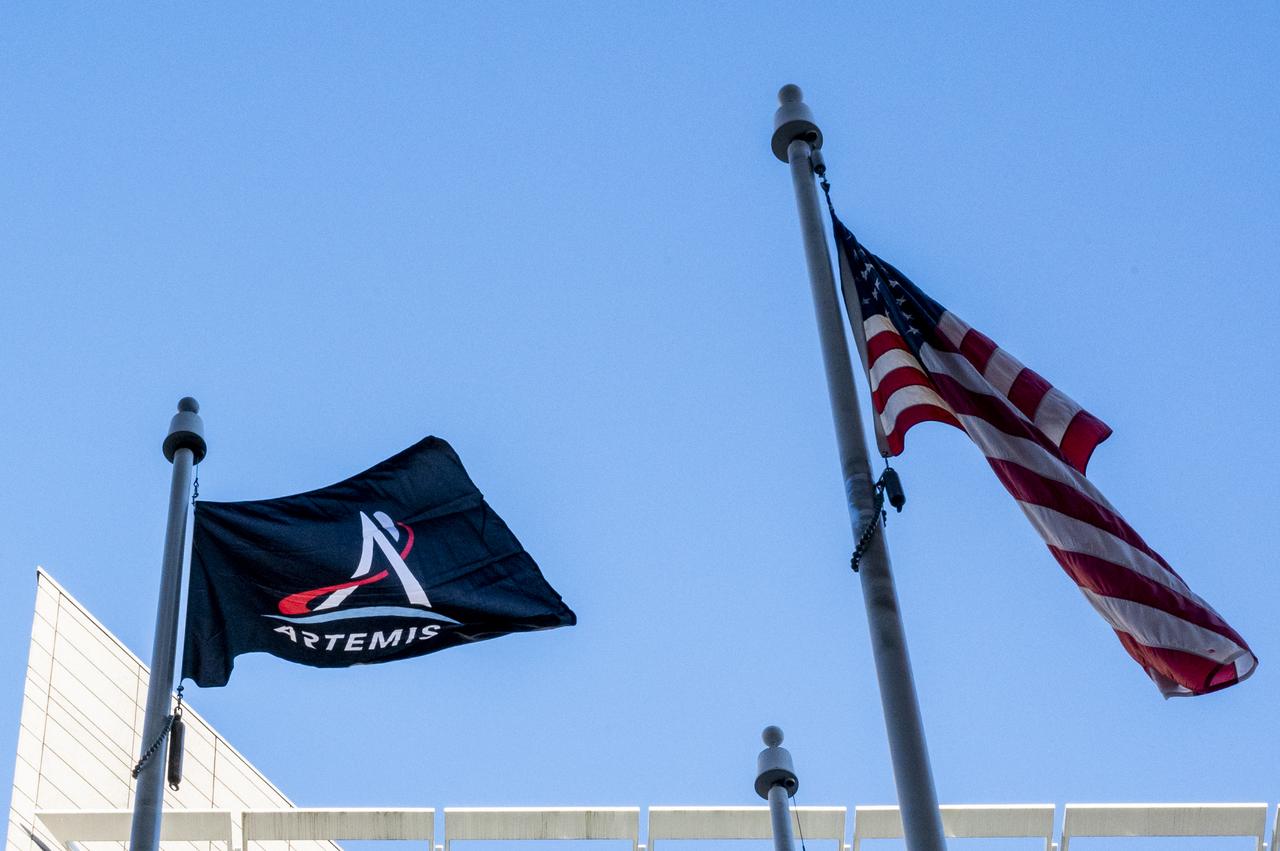
Artemis Mission Development Manager Mike Sarafin, Artemis Mission Integration Manager Sheela Logan, and Assistant Deputy Associate Administrator for Exploration Systems Development Tom Whitmeyer raise Artemis flags Wednesday, Nov. 23, 2022, at the Mary W. Jackson NASA Headquarters building in Washington. Photo Credit: (NASA/Keegan Barber)
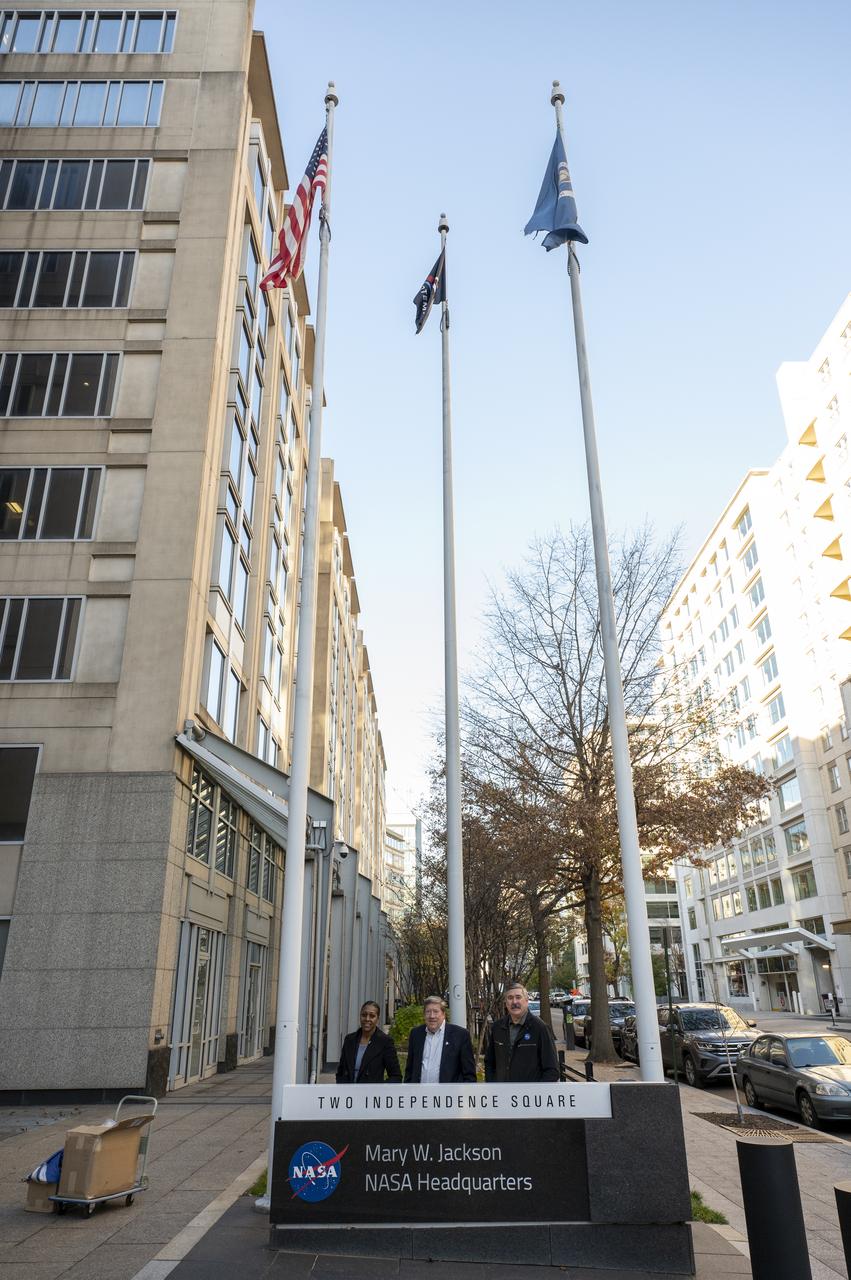
Artemis Mission Development Manager Mike Sarafin, Artemis Mission Integration Manager Sheela Logan, and Assistant Deputy Associate Administrator for Exploration Systems Development Tom Whitmeyer raise Artemis flags Wednesday, Nov. 23, 2022, at the Mary W. Jackson NASA Headquarters building in Washington. Photo Credit: (NASA/Keegan Barber)
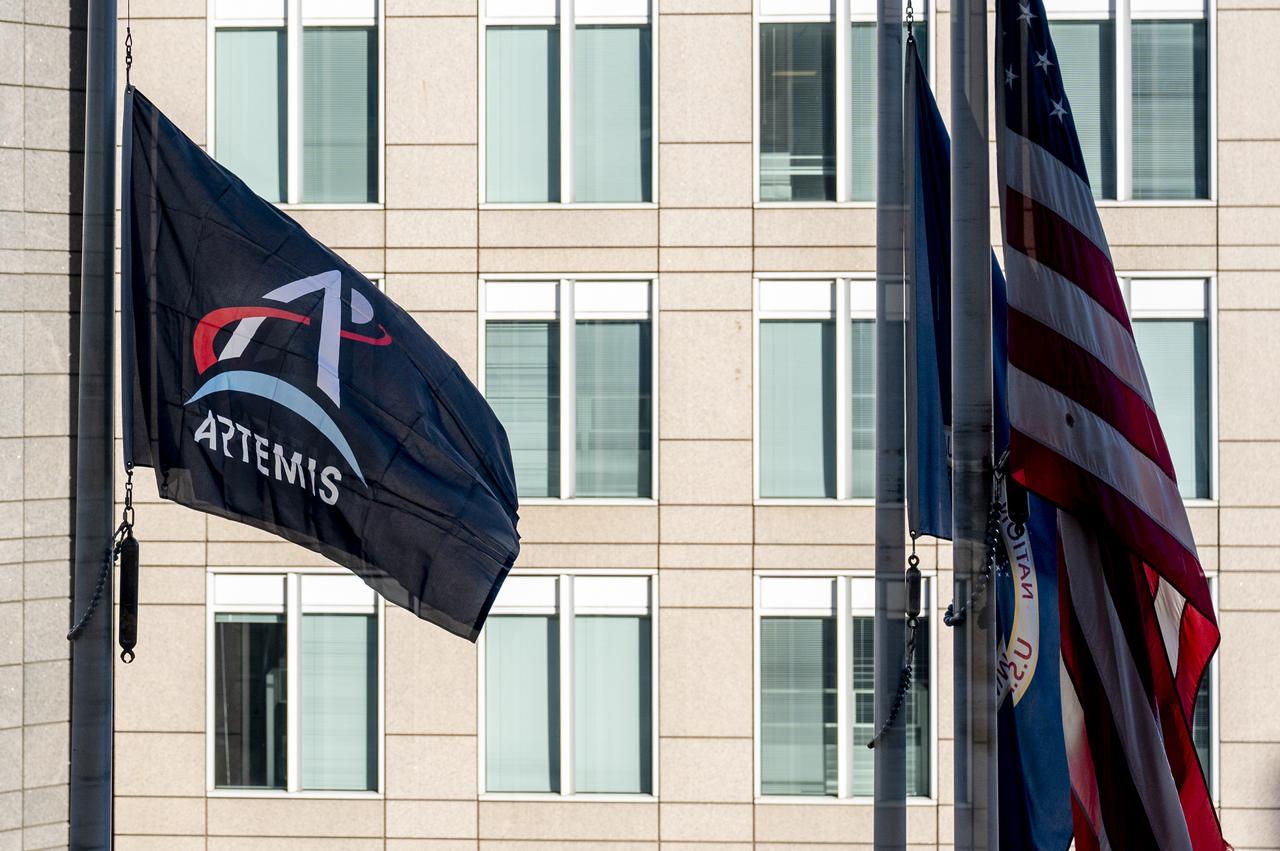
Artemis Mission Development Manager Mike Sarafin, Artemis Mission Integration Manager Sheela Logan, and Assistant Deputy Associate Administrator for Exploration Systems Development Tom Whitmeyer raise Artemis flags Wednesday, Nov. 23, 2022, at the Mary W. Jackson NASA Headquarters building in Washington. Photo Credit: (NASA/Keegan Barber)

NASA Administrator Bill Nelson poses for a picture with Snoopy at the Press Site countdown clock, Saturday, Aug. 27, 2022, at NASA’s Kennedy Space Center in Florida. NASA’s Artemis I flight test is the first integrated flight test of the agency’s deep space exploration systems: the Orion spacecraft, Space Launch System (SLS) rocket, and ground systems. Launch of the uncrewed flight test is targeted for no earlier than Aug. 29 at 8:33 a.m. ET. Photo Credit: (NASA/Keegan Barber)
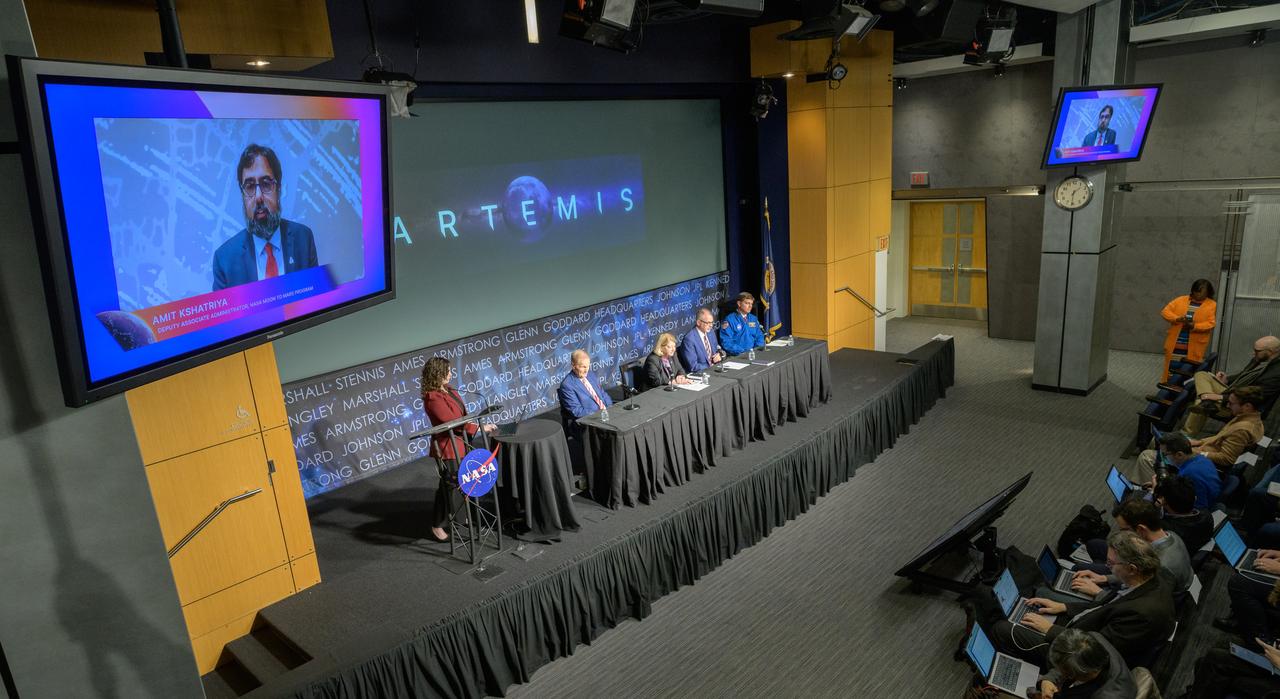
NASA Deputy Associate Administrator for the Moon to Mars Program in the Explorations Systems Development Mission Directorate, Amit Kshatriya, on monitors, NASA Administrator Bill Nelson, seated left, NASA Deputy Administrator Pam Melroy, NASA Associate Administrator Jim Free, and, NASA Astronaut and Artemis II commander Reid Wiseman, right, are seen during an update on NASA's Artemis campaign, Thursday, Dec. 5, 2024, at the NASA Headquarters Mary W. Jackson Building in Washington. Photo Credit: (NASA/Bill Ingalls)
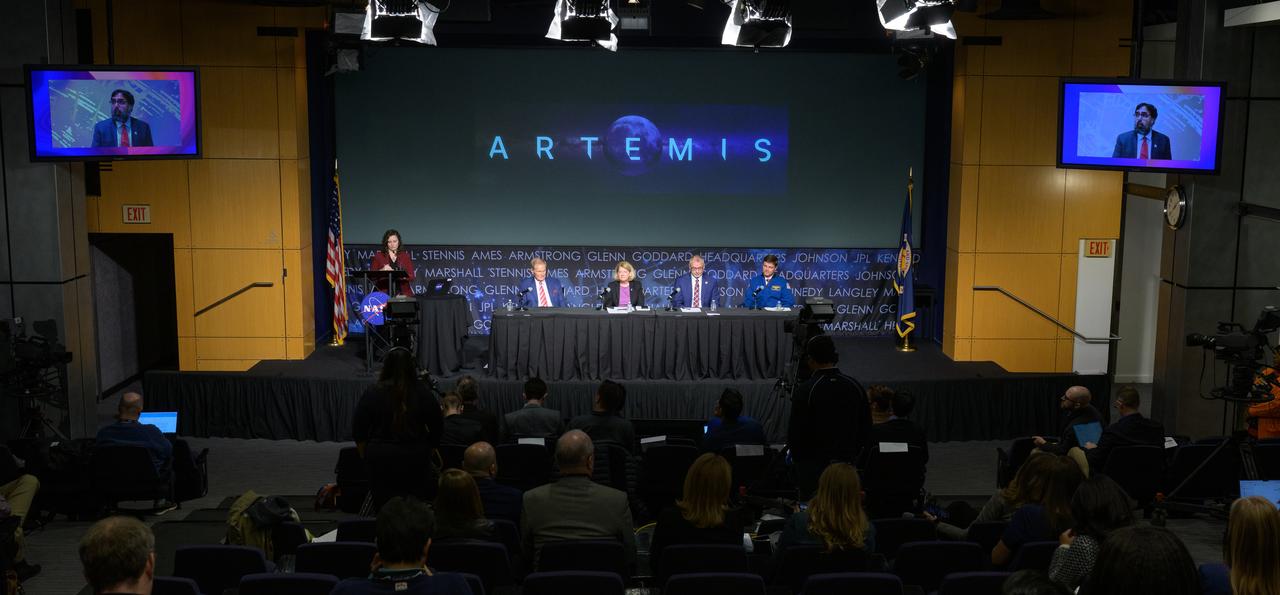
NASA Deputy Associate Administrator for the Moon to Mars Program in the Explorations Systems Development Mission Directorate, Amit Kshatriya, on monitors, NASA Administrator Bill Nelson, seated left, NASA Deputy Administrator Pam Melroy, NASA Associate Administrator Jim Free, and, NASA Astronaut and Artemis II commander Reid Wiseman, right, are seen during an update on NASA's Artemis campaign, Thursday, Dec. 5, 2024, at the NASA Headquarters Mary W. Jackson Building in Washington. Photo Credit: (NASA/Bill Ingalls)
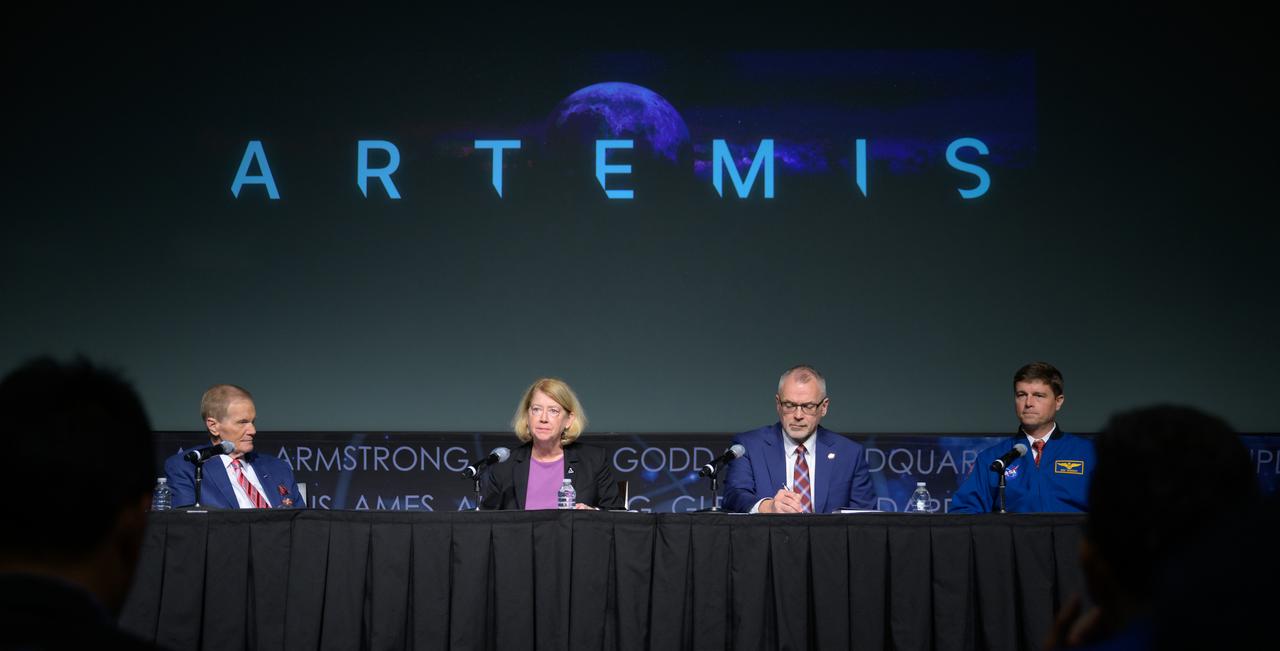
NASA Administrator Bill Nelson, left, NASA Deputy Administrator Pam Melroy, NASA Associate Administrator Jim Free, and, NASA Astronaut and Artemis II commander Reid Wiseman, right, are seen during an update on NASA's Artemis campaign, Thursday, Dec. 5, 2024, at the NASA Headquarters Mary W. Jackson Building in Washington. Photo Credit: (NASA/Bill Ingalls)
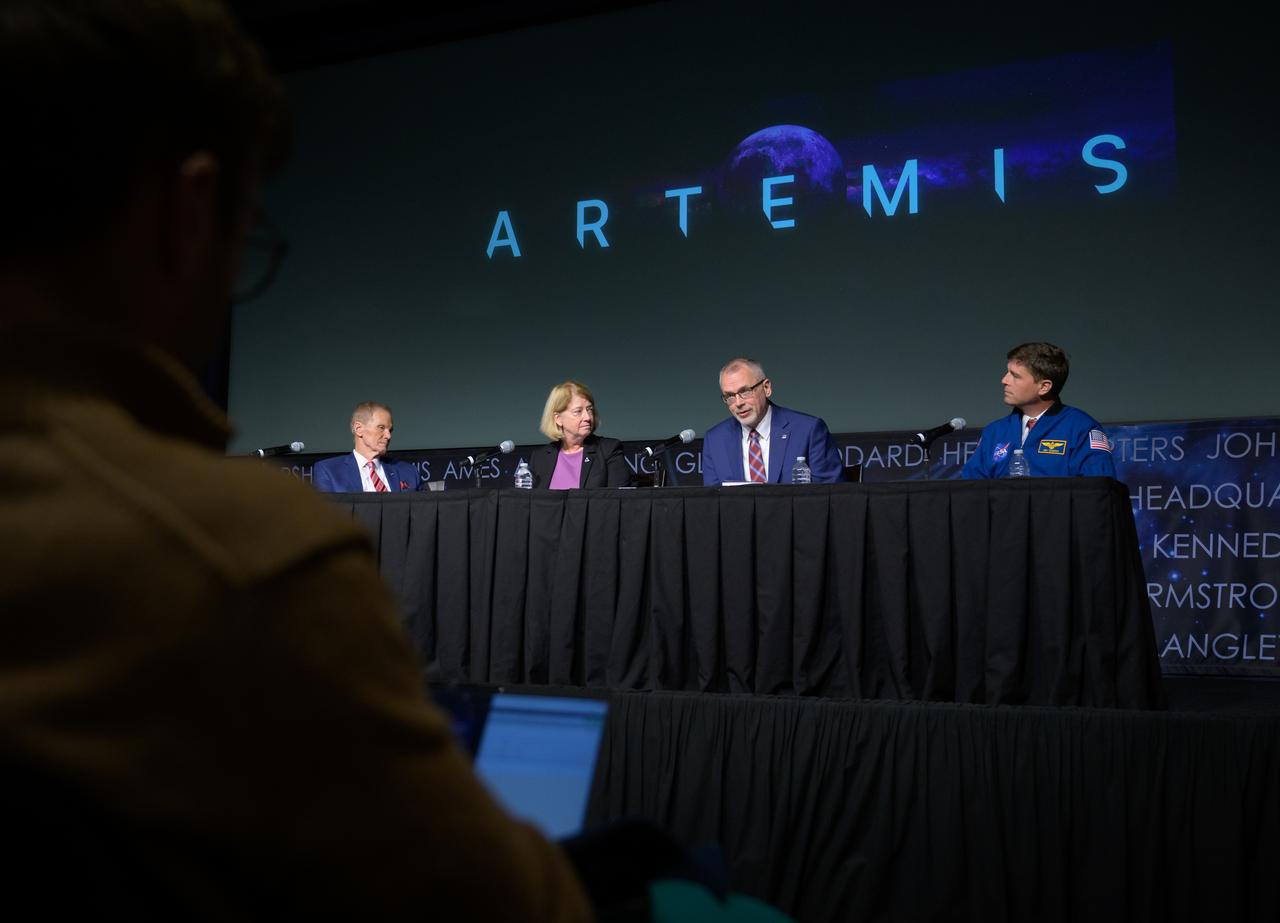
NASA Administrator Bill Nelson, left, NASA Deputy Administrator Pam Melroy, NASA Associate Administrator Jim Free, and, NASA Astronaut and Artemis II commander Reid Wiseman, right, are seen during an update on NASA's Artemis campaign, Thursday, Dec. 5, 2024, at the NASA Headquarters Mary W. Jackson Building in Washington. Photo Credit: (NASA/Bill Ingalls)
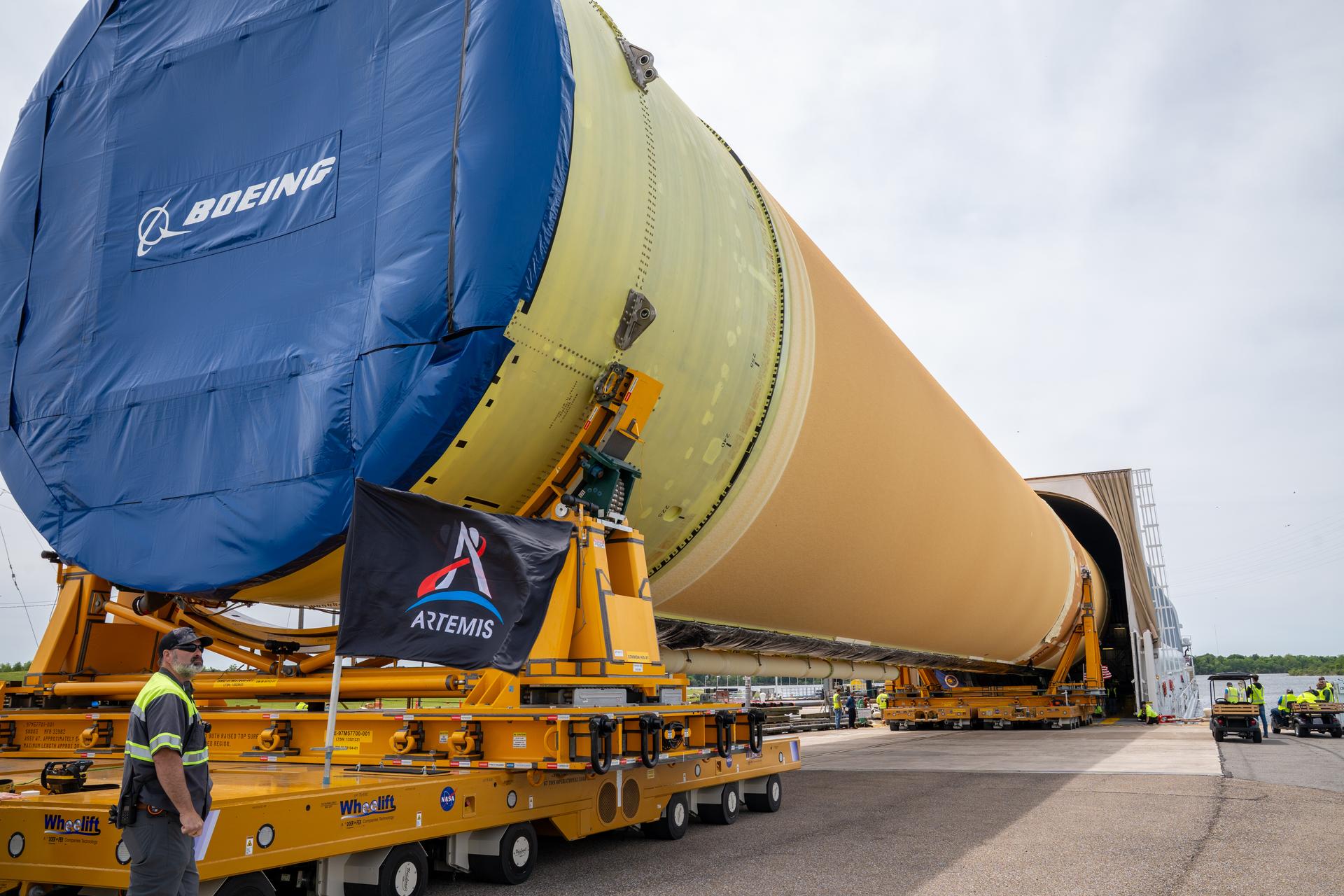
NASA moved the core stage, or the largest section, of the SLS (Space Launch System) rocket that will launch the crewed Artemis III mission in 2027 from the agency’s Michoud Assembly Facility to the agency’s Pegasus barge in New Orleans on April 20. The barge will ferry the top four-fifths – the section containing the liquid hydrogen tank, liquid oxygen tank, intertank, and forward skirt – of the SLS core stage to NASA’s Kennedy Space Center in Florida to complete outfitting and vertical integration. Teams with NASA and Boeing, the SLS core stage lead contractor, used specialized transporters to guide the top four-fifths from the NASA rocket factory to Pegasus. Prior to the move, technicians added an engine section transportation simulator to the rocket stage for shipment to the Space Coast. Next year’s Artemis III mission will launch astronauts to Earth’s orbit aboard the Orion spacecraft on top of SLS to test rendezvous and docking capabilities between Orion and commercial spacecraft needed to land Artemis IV astronauts on the Moon in 2028. NASA’s SLS is the only rocket capable of sending Orion, astronauts, and supplies to the Moon in a single launch. Photo Credit: (NASA/Brandon Hancock)
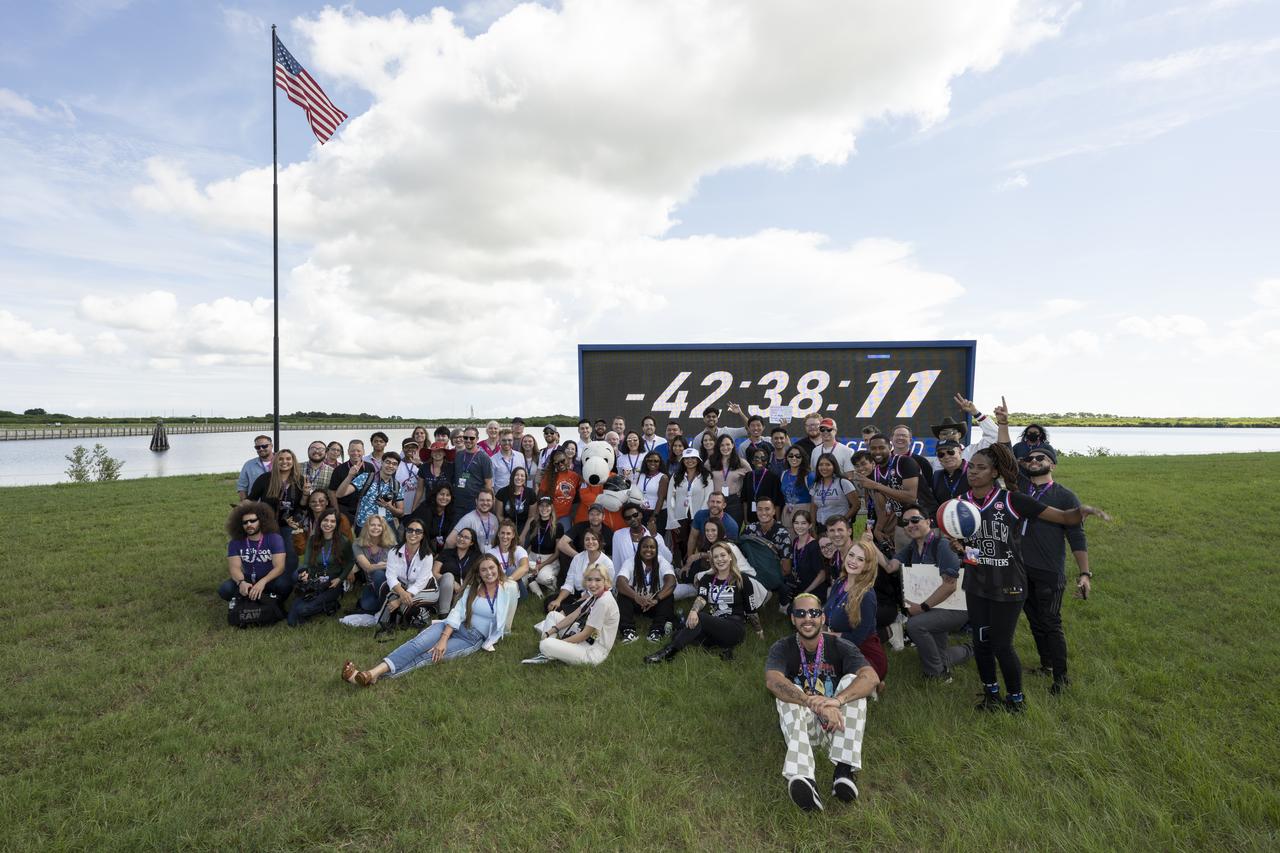
NASA Social attendees pose for a picture with Snoopy at the Press Site countdown clock, Saturday, Aug. 27, 2022, at NASA’s Kennedy Space Center in Florida. NASA’s Artemis I flight test is the first integrated flight test of the agency’s deep space exploration systems: the Orion spacecraft, Space Launch System (SLS) rocket, and ground systems. Launch of the uncrewed flight test is targeted for no earlier than Aug. 29 at 8:33 a.m. ET. Photo Credit: (NASA/Keegan Barber)
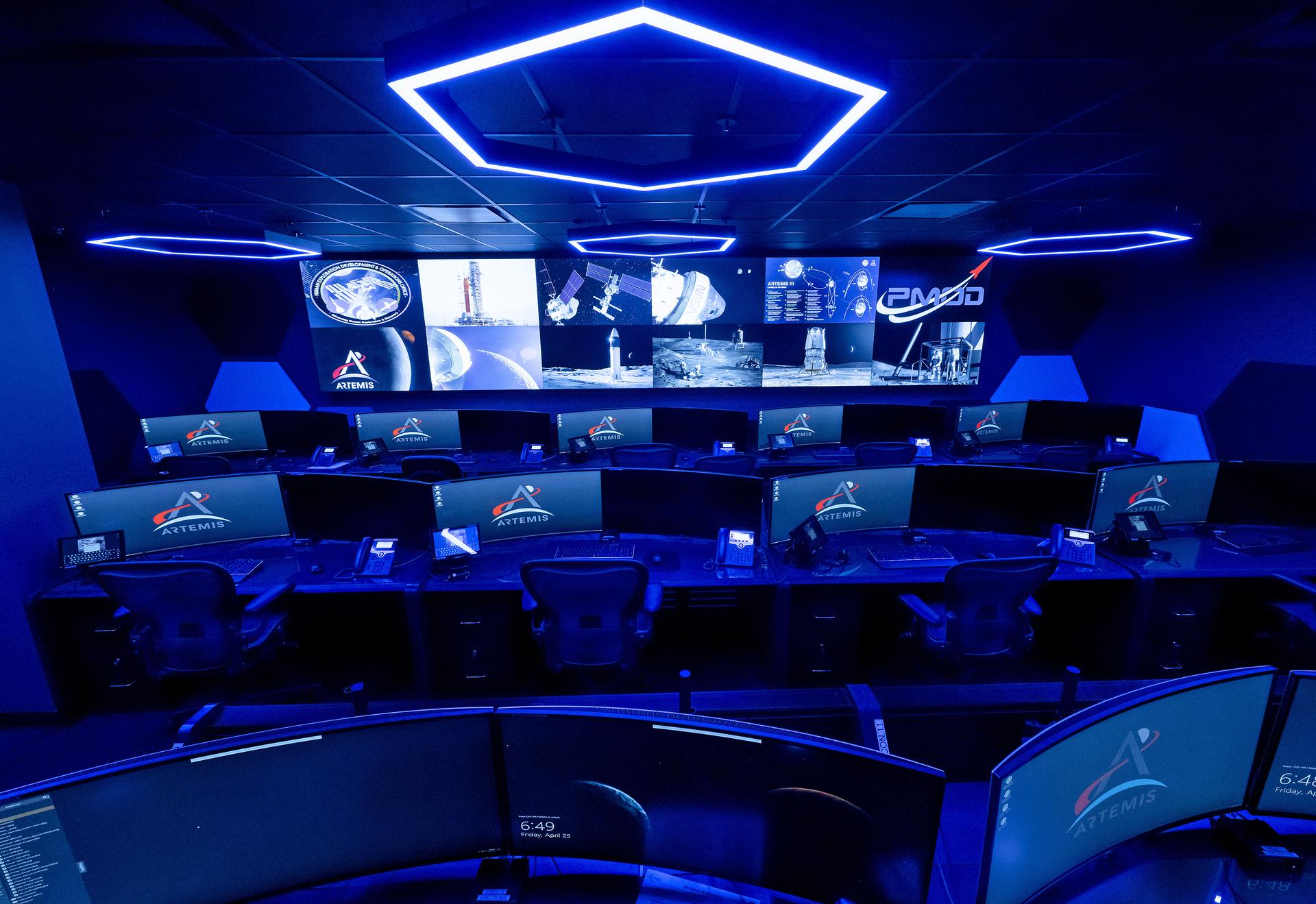
These photos offer a look inside the twin control rooms at NASA’s Marshall Space Flight Center in Huntsville, Alabama, where engineers will monitor Artemis science and future landing operations for Artemis. The LUCA (Lunar Utilization Control Area) and LESA (Lander Engineering Support Area) rooms are part of the Huntsville Operations Support Center at NASA Marshall. The LUCA is specially designed to support a wide variety of science operations on and around the Moon – and beyond. Engineers in the LUCA monitored operations for the Lunar Node-1 experiment, an autonomous navigation payload that was part of the first NASA Commercial Lunar Payload Services (CLPS) launch on Intuitive Machines’ Nova-C lunar lander in 2024. NASA Marshall flight controllers will use the LUCA again for Artemis II to monitor science operations. Beginning with Artemis III, members of the NASA Human Landing System Mission Insight Support Team – a group of engineers, safety leads, flight operations experts, and technical authorities – will work in the LESA. There, they will monitor lander systems in real-time and be involved in key decision-making processes throughout the mission. For more information, contact NASA Marshall’s Office of Communications at 256-544-0034.

These photos offer a look inside the twin control rooms at NASA’s Marshall Space Flight Center in Huntsville, Alabama, where engineers will monitor Artemis science and future landing operations for Artemis. The LUCA (Lunar Utilization Control Area) and LESA (Lander Engineering Support Area) rooms are part of the Huntsville Operations Support Center at NASA Marshall. The LUCA is specially designed to support a wide variety of science operations on and around the Moon – and beyond. Engineers in the LUCA monitored operations for the Lunar Node-1 experiment, an autonomous navigation payload that was part of the first NASA Commercial Lunar Payload Services (CLPS) launch on Intuitive Machines’ Nova-C lunar lander in 2024. NASA Marshall flight controllers will use the LUCA again for Artemis II to monitor science operations. Beginning with Artemis III, members of the NASA Human Landing System Mission Insight Support Team – a group of engineers, safety leads, flight operations experts, and technical authorities – will work in the LESA. There, they will monitor lander systems in real-time and be involved in key decision-making processes throughout the mission. For more information, contact NASA Marshall’s Office of Communications at 256-544-0034.
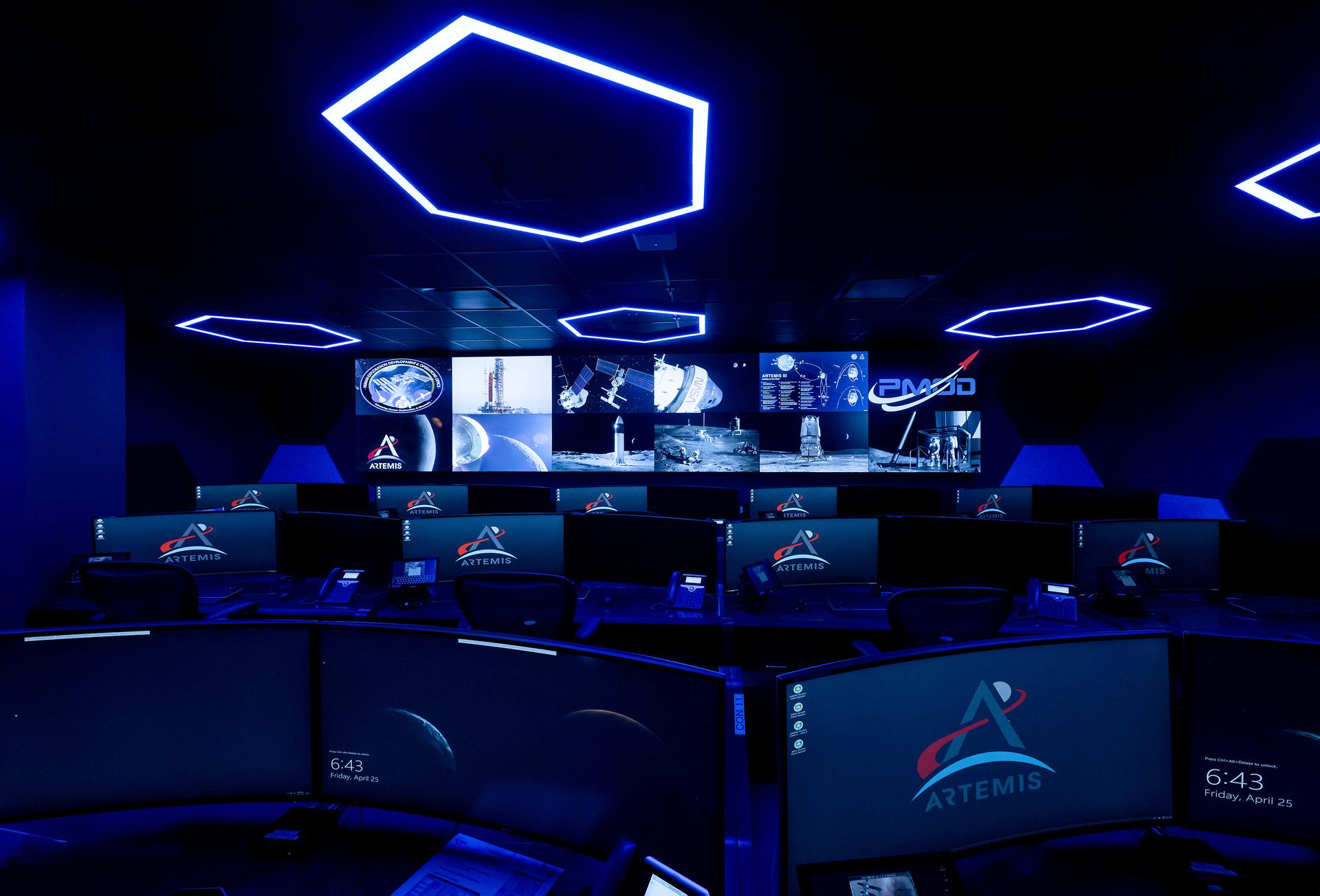
These photos offer a look inside the twin control rooms at NASA’s Marshall Space Flight Center in Huntsville, Alabama, where engineers will monitor Artemis science and future landing operations for Artemis. The LUCA (Lunar Utilization Control Area) and LESA (Lander Engineering Support Area) rooms are part of the Huntsville Operations Support Center at NASA Marshall. The LUCA is specially designed to support a wide variety of science operations on and around the Moon – and beyond. Engineers in the LUCA monitored operations for the Lunar Node-1 experiment, an autonomous navigation payload that was part of the first NASA Commercial Lunar Payload Services (CLPS) launch on Intuitive Machines’ Nova-C lunar lander in 2024. NASA Marshall flight controllers will use the LUCA again for Artemis II to monitor science operations. Beginning with Artemis III, members of the NASA Human Landing System Mission Insight Support Team – a group of engineers, safety leads, flight operations experts, and technical authorities – will work in the LESA. There, they will monitor lander systems in real-time and be involved in key decision-making processes throughout the mission. For more information, contact NASA Marshall’s Office of Communications at 256-544-0034.

These photos offer a look inside the twin control rooms at NASA’s Marshall Space Flight Center in Huntsville, Alabama, where engineers will monitor Artemis science and future landing operations for Artemis. The LUCA (Lunar Utilization Control Area) and LESA (Lander Engineering Support Area) rooms are part of the Huntsville Operations Support Center at NASA Marshall. The LUCA is specially designed to support a wide variety of science operations on and around the Moon – and beyond. Engineers in the LUCA monitored operations for the Lunar Node-1 experiment, an autonomous navigation payload that was part of the first NASA Commercial Lunar Payload Services (CLPS) launch on Intuitive Machines’ Nova-C lunar lander in 2024. NASA Marshall flight controllers will use the LUCA again for Artemis II to monitor science operations. Beginning with Artemis III, members of the NASA Human Landing System Mission Insight Support Team – a group of engineers, safety leads, flight operations experts, and technical authorities – will work in the LESA. There, they will monitor lander systems in real-time and be involved in key decision-making processes throughout the mission. For more information, contact NASA Marshall’s Office of Communications at 256-544-0034.

These photos offer a look inside the twin control rooms at NASA’s Marshall Space Flight Center in Huntsville, Alabama, where engineers will monitor Artemis science and future landing operations for Artemis. The LUCA (Lunar Utilization Control Area) and LESA (Lander Engineering Support Area) rooms are part of the Huntsville Operations Support Center at NASA Marshall. The LUCA is specially designed to support a wide variety of science operations on and around the Moon – and beyond. Engineers in the LUCA monitored operations for the Lunar Node-1 experiment, an autonomous navigation payload that was part of the first NASA Commercial Lunar Payload Services (CLPS) launch on Intuitive Machines’ Nova-C lunar lander in 2024. NASA Marshall flight controllers will use the LUCA again for Artemis II to monitor science operations. Beginning with Artemis III, members of the NASA Human Landing System Mission Insight Support Team – a group of engineers, safety leads, flight operations experts, and technical authorities – will work in the LESA. There, they will monitor lander systems in real-time and be involved in key decision-making processes throughout the mission. For more information, contact NASA Marshall’s Office of Communications at 256-544-0034.
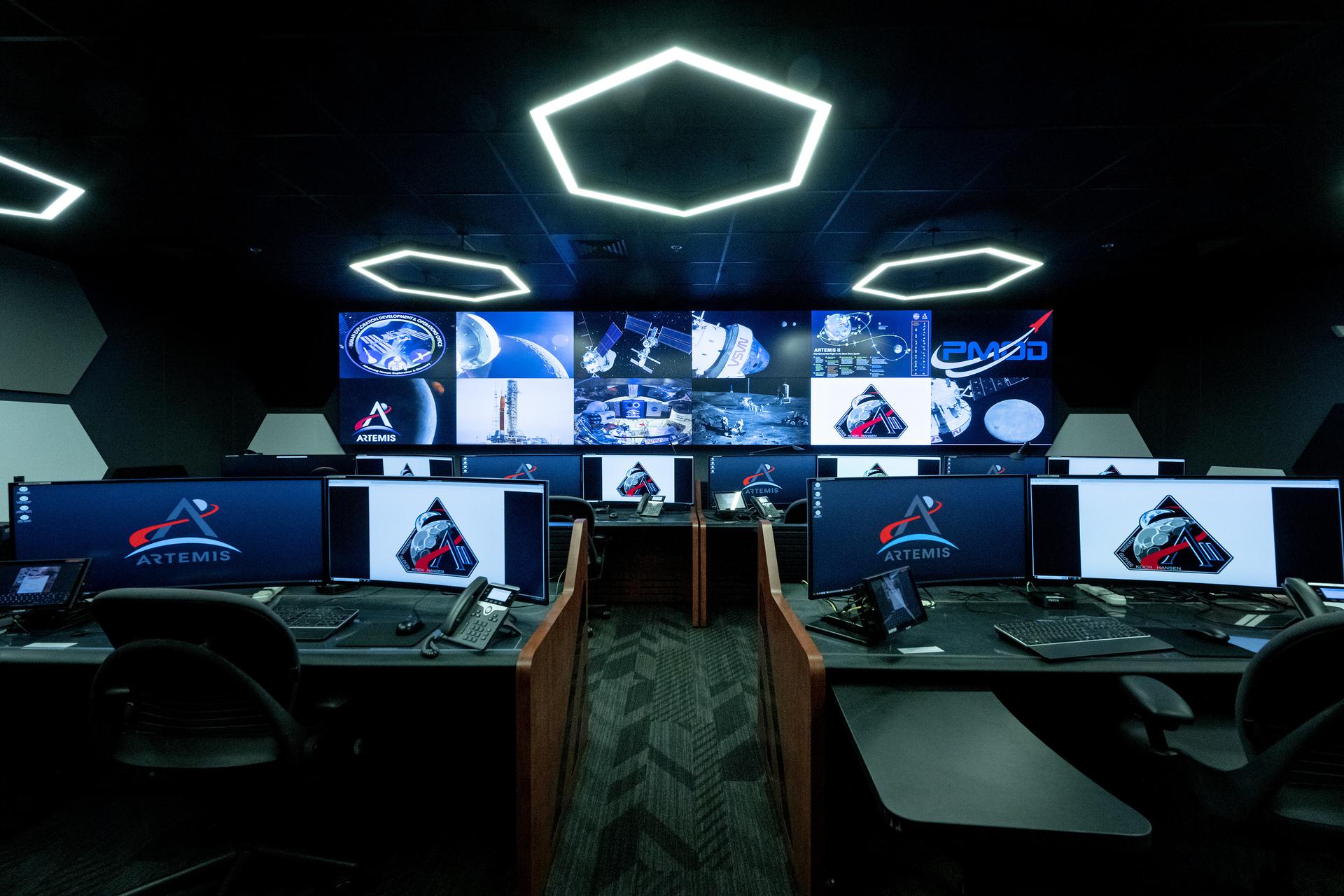
These photos offer a look inside the twin control rooms at NASA’s Marshall Space Flight Center in Huntsville, Alabama, where engineers will monitor Artemis science and future landing operations for Artemis. The LUCA (Lunar Utilization Control Area) and LESA (Lander Engineering Support Area) rooms are part of the Huntsville Operations Support Center at NASA Marshall. The LUCA is specially designed to support a wide variety of science operations on and around the Moon – and beyond. Engineers in the LUCA monitored operations for the Lunar Node-1 experiment, an autonomous navigation payload that was part of the first NASA Commercial Lunar Payload Services (CLPS) launch on Intuitive Machines’ Nova-C lunar lander in 2024. NASA Marshall flight controllers will use the LUCA again for Artemis II to monitor science operations. Beginning with Artemis III, members of the NASA Human Landing System Mission Insight Support Team – a group of engineers, safety leads, flight operations experts, and technical authorities – will work in the LESA. There, they will monitor lander systems in real-time and be involved in key decision-making processes throughout the mission. For more information, contact NASA Marshall’s Office of Communications at 256-544-0034.

NASA Associate Administrator Jim Free, gives remarks during an update on NASA's Artemis campaign, Thursday, Dec. 5, 2024, at the NASA Headquarters Mary W. Jackson Building in Washington. Photo Credit: (NASA/Bill Ingalls)
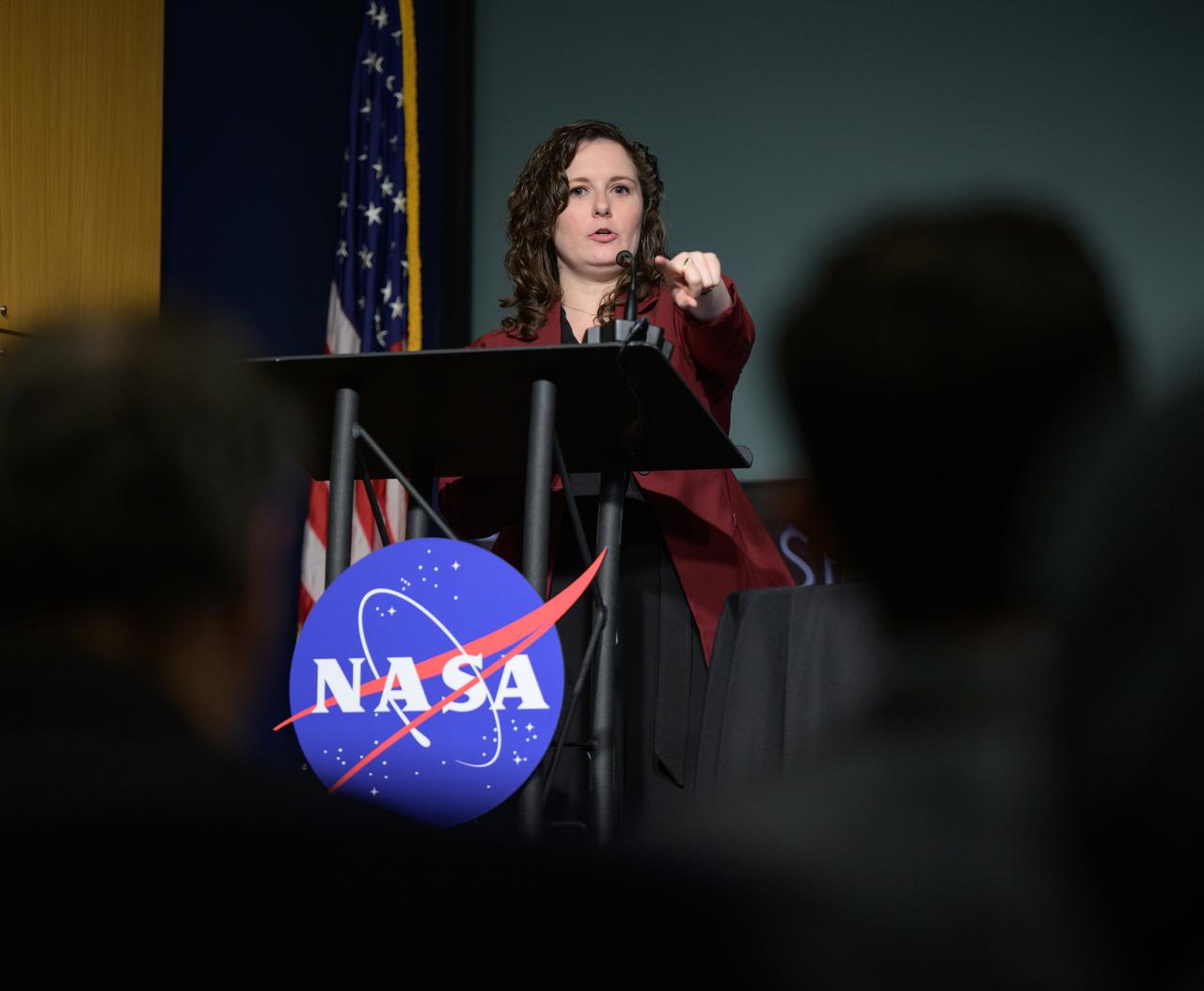
Senior Advisor for NASA's Office of Communications Meira Bernstein, moderates an update on NASA's Artemis campaign, Thursday, Dec. 5, 2024, at the NASA Headquarters Mary W. Jackson Building in Washington. Photo Credit: (NASA/Bill Ingalls)
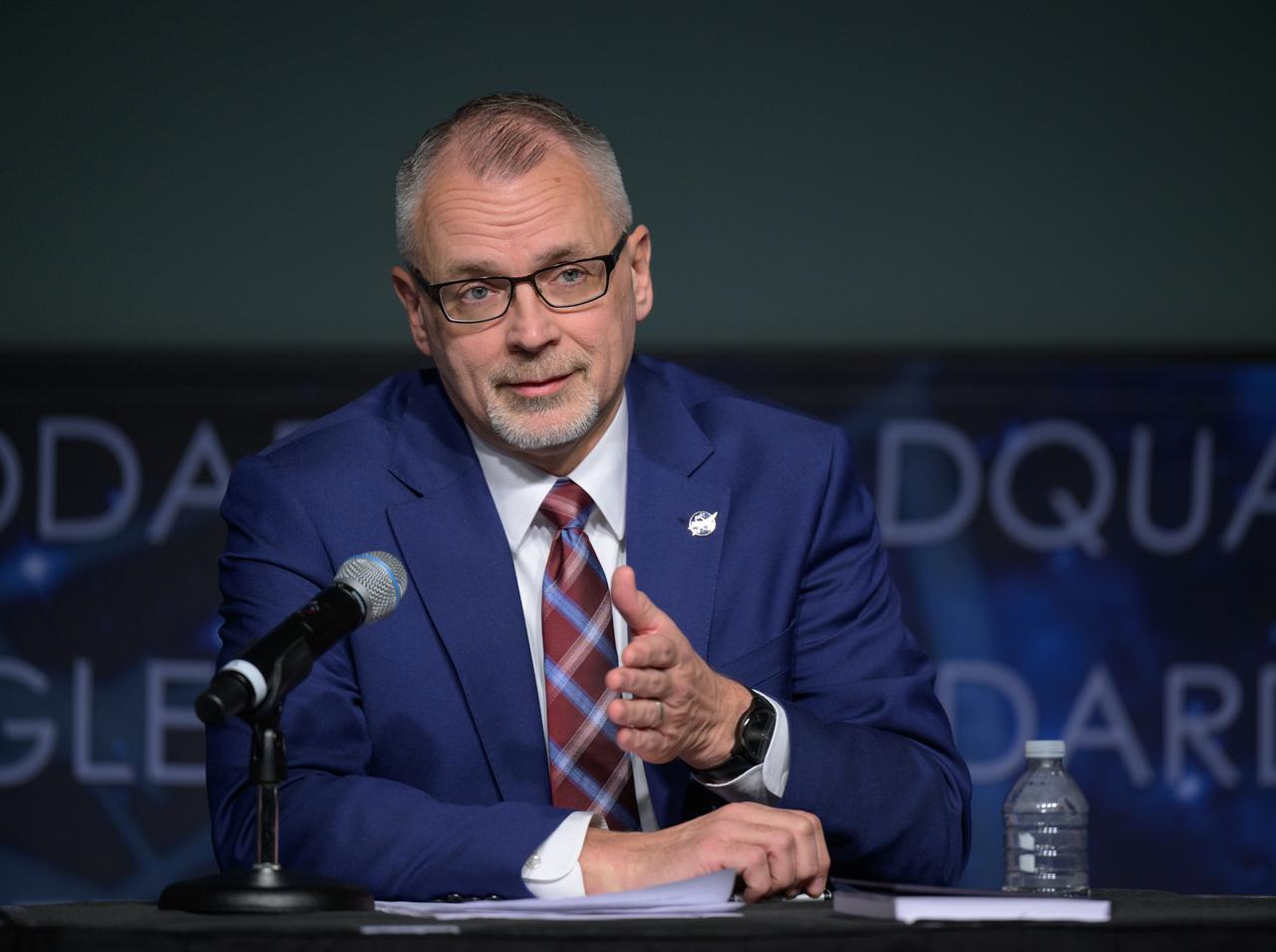
NASA Associate Administrator Jim Free, gives remarks during an update on NASA's Artemis campaign, Thursday, Dec. 5, 2024, at the NASA Headquarters Mary W. Jackson Building in Washington. Photo Credit: (NASA/Bill Ingalls)
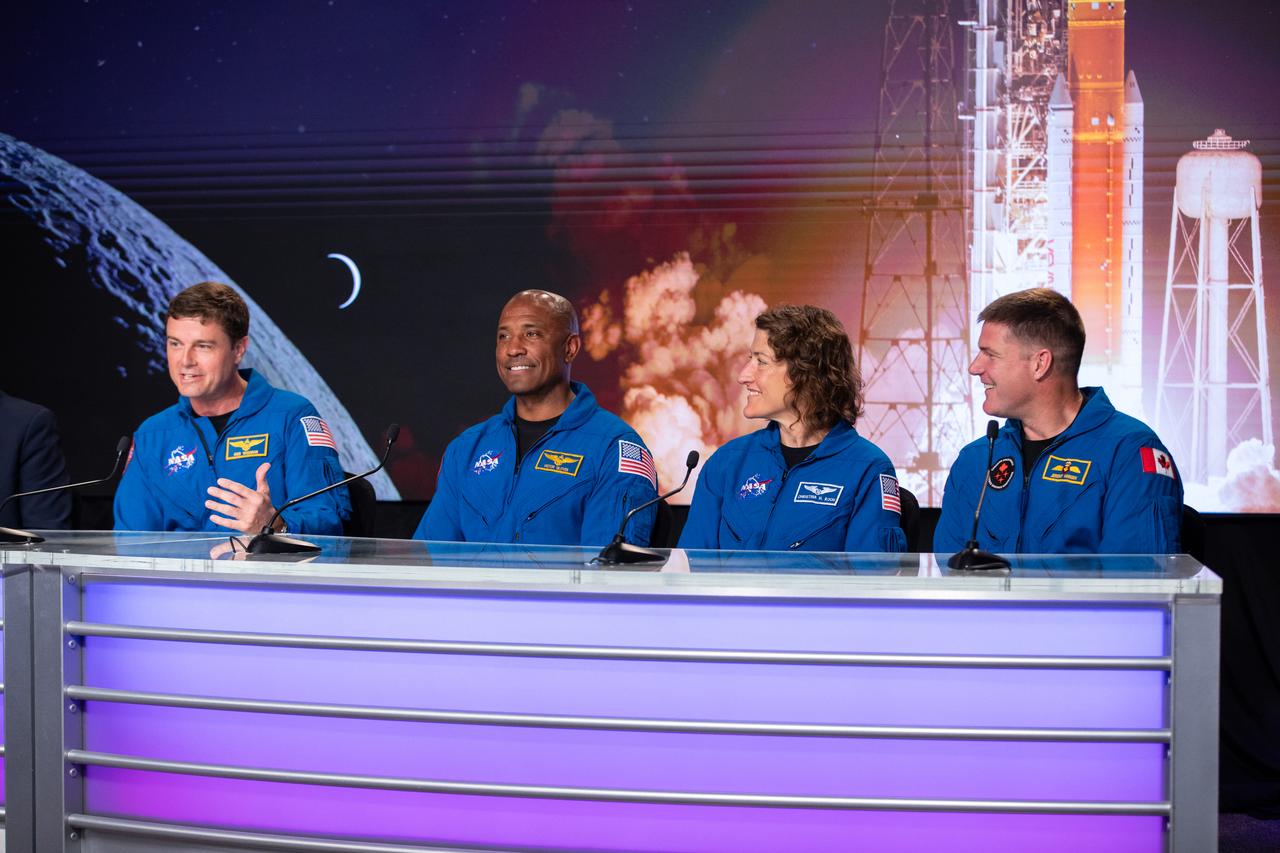
NASA senior leadership and the Artemis II crew participate in a news conference on Aug. 8, 2023, at the agency’s Kennedy Space Center in Florida. Participants include from left, NASA astronaut Reid Wiseman, Artemis II commander; NASA astronaut Victor Glover, Artemis II pilot; NASA astronaut Christina Hammock Koch, Artemis II mission specialist; and CSA (Canadian Space Agency) astronaut Jeremy Hansen, Artemis II mission specialist. Artemis II is the first crewed mission on NASA’s path to establishing a long-term lunar presence for science and exploration under Artemis and is the first mission with astronauts to the Moon.
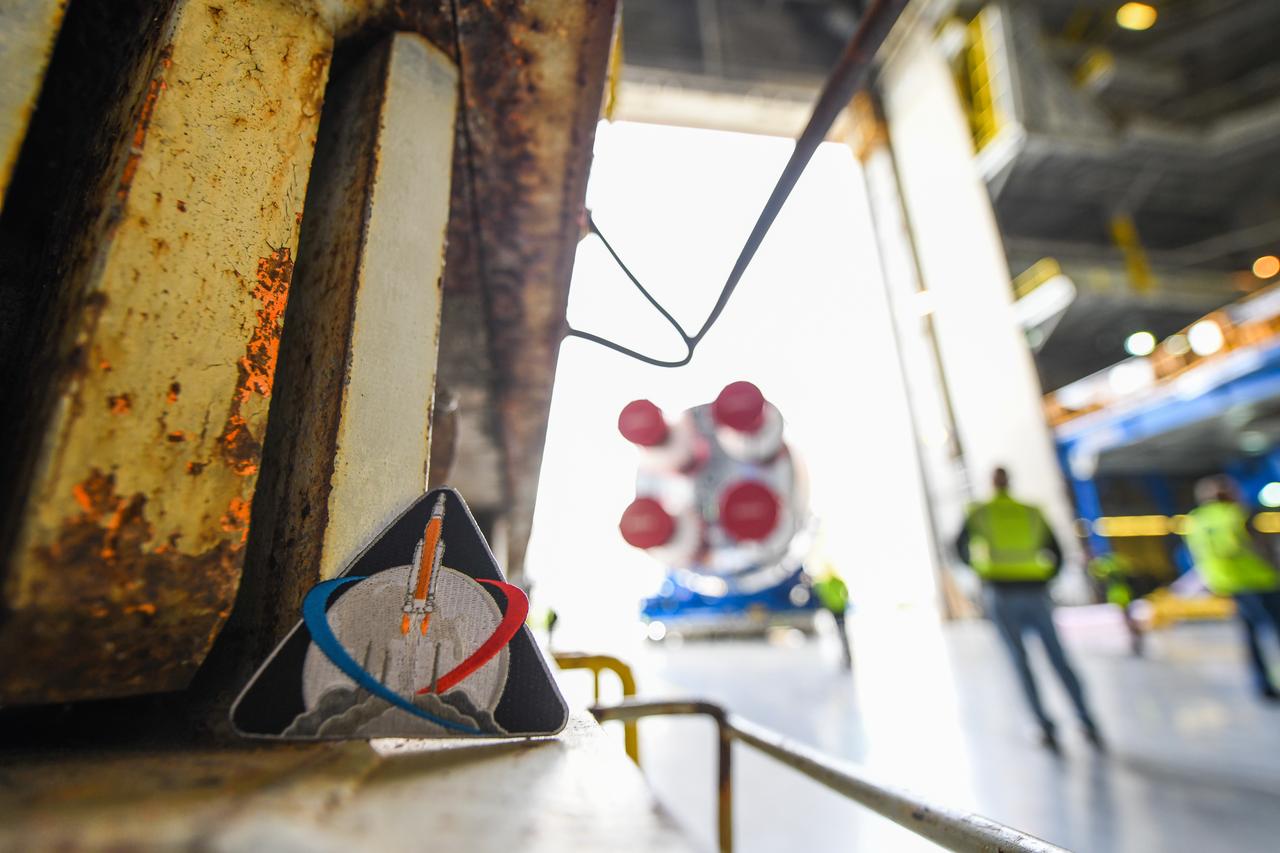
These images show how teams at NASA’s Michoud Assembly Facility in New Orleans moved the core stage, complete with all four RS-25 engines, for NASA’s Space Launch System (SLS) rocket to Building 110 for final shipping preparations on Jan. 1. The SLS core stage includes state-of-the-art avionics, propulsion systems and two colossal propellant tanks that collectively hold 733,000 gallons of liquid oxygen and liquid hydrogen to power its four RS-25 engines. The completed stage, which will provide more than 2 million pounds of thrust to help power the first Artemis mission to the Moon, will be shipped via the agency’s Pegasus barge from Michoud to NASA’s Stennis Space Center near Bay St. Louis, Mississippi, later this month. Once at Stennis, the Artemis rocket stage will be loaded into the B-2 Test Stand for the core stage Green Run test series. The comprehensive test campaign will progressively bring the entire core stage, including its avionics and engines, to life for the first time to verify the stage is fit for flight ahead of the launch of Artemis I.
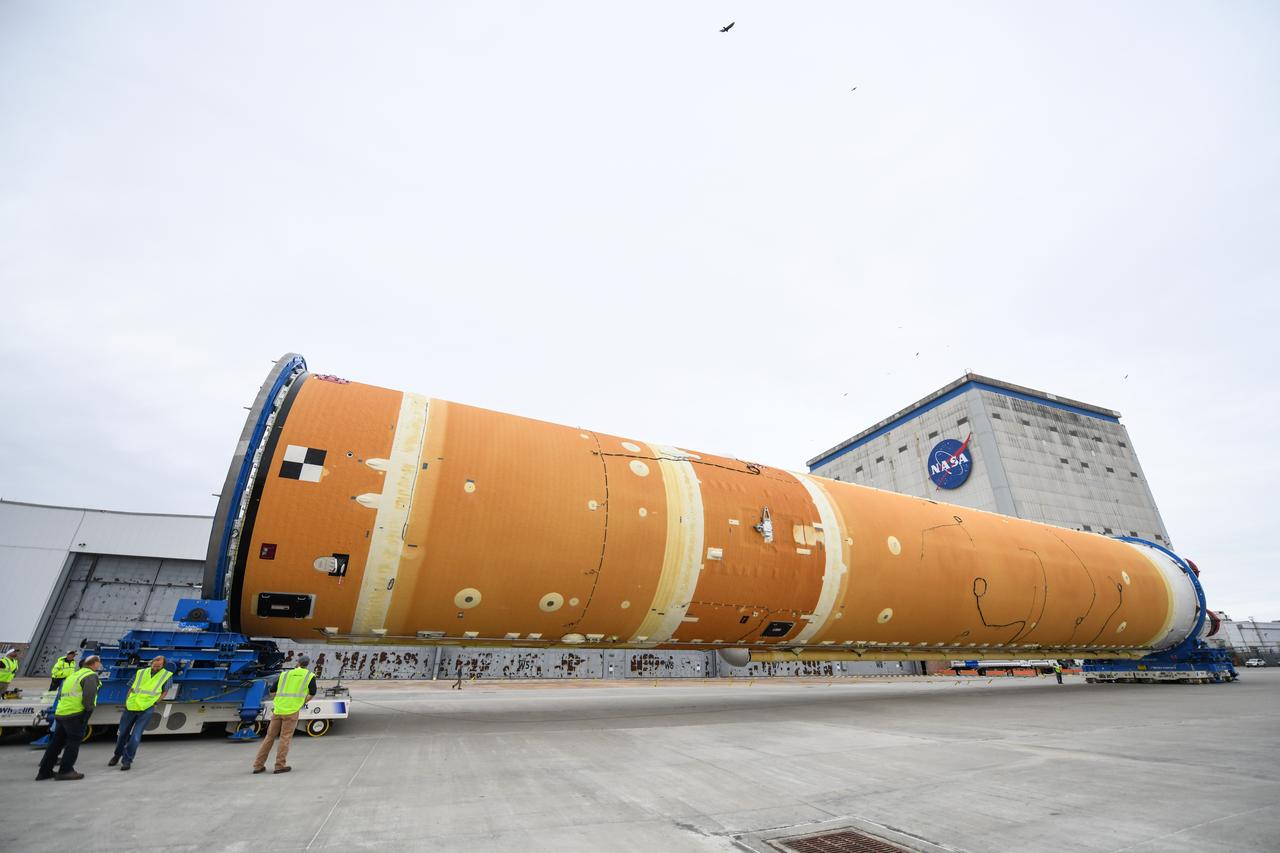
These images show how teams at NASA’s Michoud Assembly Facility in New Orleans moved the core stage, complete with all four RS-25 engines, for NASA’s Space Launch System (SLS) rocket to Building 110 for final shipping preparations on Jan. 1. The SLS core stage includes state-of-the-art avionics, propulsion systems and two colossal propellant tanks that collectively hold 733,000 gallons of liquid oxygen and liquid hydrogen to power its four RS-25 engines. The completed stage, which will provide more than 2 million pounds of thrust to help power the first Artemis mission to the Moon, will be shipped via the agency’s Pegasus barge from Michoud to NASA’s Stennis Space Center near Bay St. Louis, Mississippi, later this month. Once at Stennis, the Artemis rocket stage will be loaded into the B-2 Test Stand for the core stage Green Run test series. The comprehensive test campaign will progressively bring the entire core stage, including its avionics and engines, to life for the first time to verify the stage is fit for flight ahead of the launch of Artemis I.
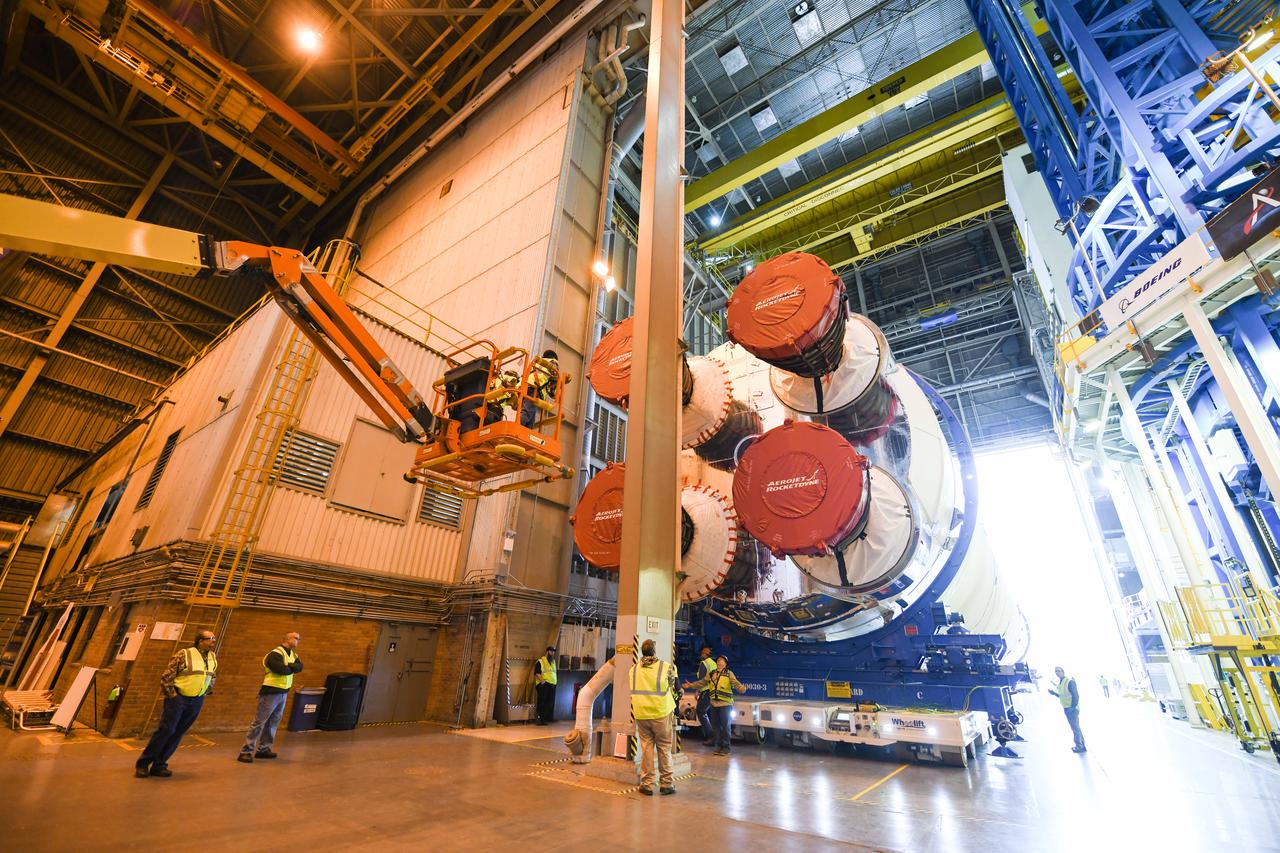
These images show how teams at NASA’s Michoud Assembly Facility in New Orleans moved the core stage, complete with all four RS-25 engines, for NASA’s Space Launch System (SLS) rocket to Building 110 for final shipping preparations on Jan. 1. The SLS core stage includes state-of-the-art avionics, propulsion systems and two colossal propellant tanks that collectively hold 733,000 gallons of liquid oxygen and liquid hydrogen to power its four RS-25 engines. The completed stage, which will provide more than 2 million pounds of thrust to help power the first Artemis mission to the Moon, will be shipped via the agency’s Pegasus barge from Michoud to NASA’s Stennis Space Center near Bay St. Louis, Mississippi, later this month. Once at Stennis, the Artemis rocket stage will be loaded into the B-2 Test Stand for the core stage Green Run test series. The comprehensive test campaign will progressively bring the entire core stage, including its avionics and engines, to life for the first time to verify the stage is fit for flight ahead of the launch of Artemis I.
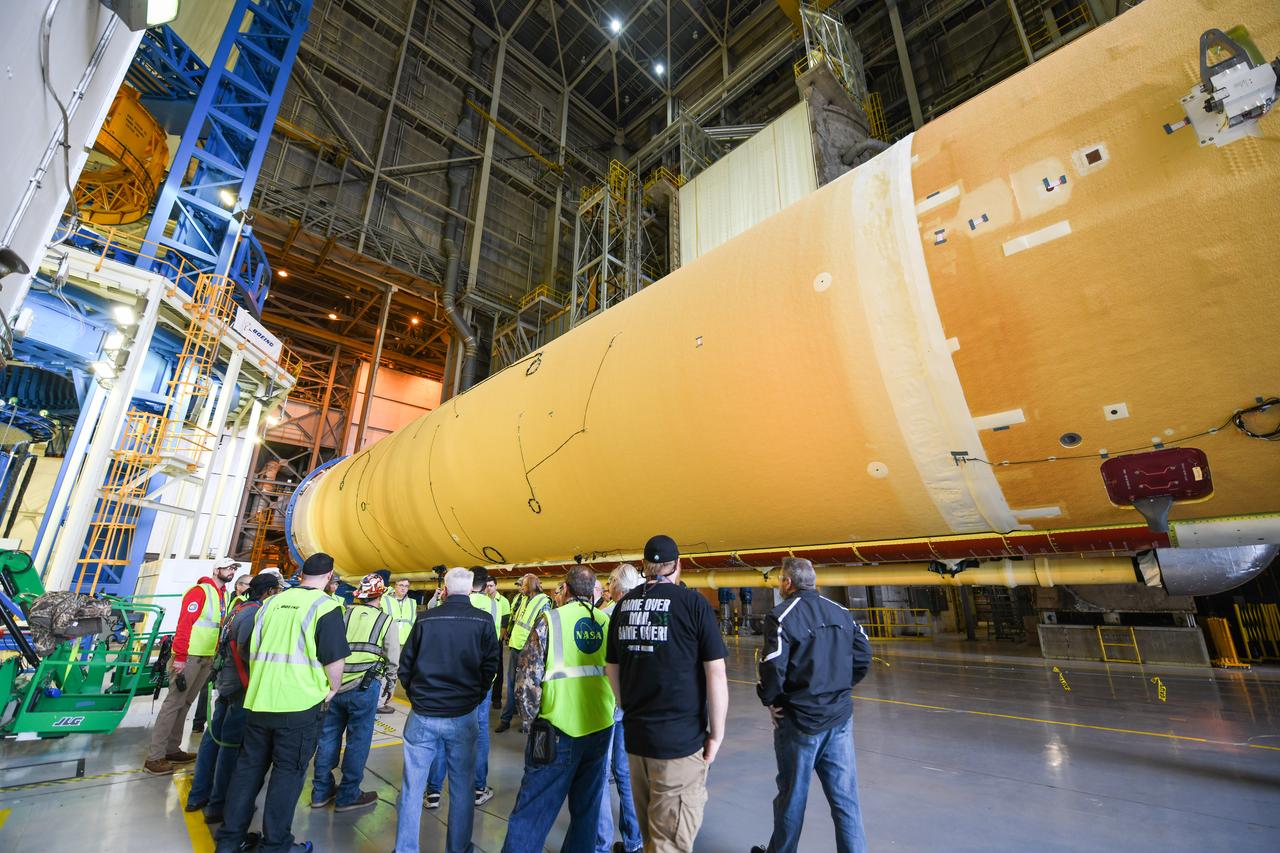
These images show how teams at NASA’s Michoud Assembly Facility in New Orleans moved the core stage, complete with all four RS-25 engines, for NASA’s Space Launch System (SLS) rocket to Building 110 for final shipping preparations on Jan. 1. The SLS core stage includes state-of-the-art avionics, propulsion systems and two colossal propellant tanks that collectively hold 733,000 gallons of liquid oxygen and liquid hydrogen to power its four RS-25 engines. The completed stage, which will provide more than 2 million pounds of thrust to help power the first Artemis mission to the Moon, will be shipped via the agency’s Pegasus barge from Michoud to NASA’s Stennis Space Center near Bay St. Louis, Mississippi, later this month. Once at Stennis, the Artemis rocket stage will be loaded into the B-2 Test Stand for the core stage Green Run test series. The comprehensive test campaign will progressively bring the entire core stage, including its avionics and engines, to life for the first time to verify the stage is fit for flight ahead of the launch of Artemis I.
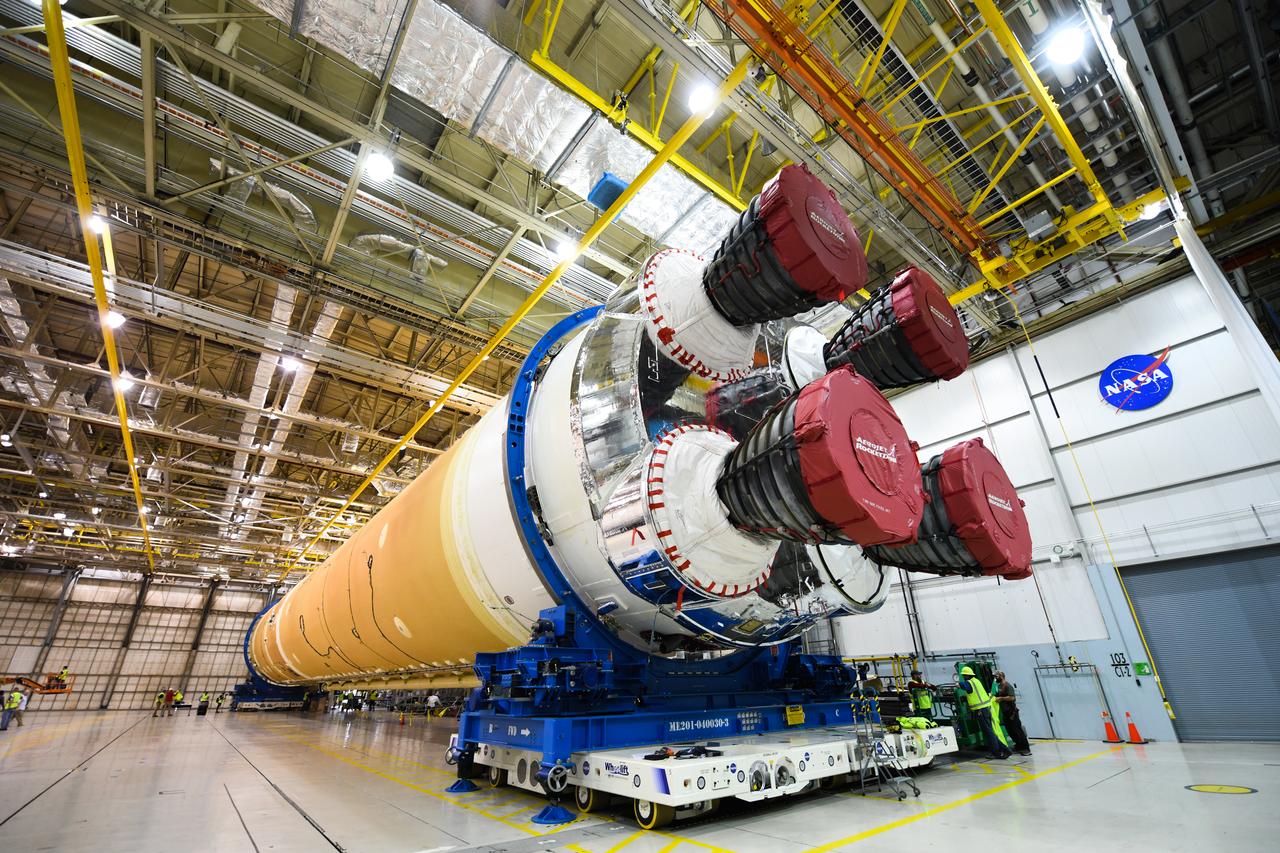
These images show how teams at NASA’s Michoud Assembly Facility in New Orleans moved the core stage, complete with all four RS-25 engines, for NASA’s Space Launch System (SLS) rocket to Building 110 for final shipping preparations on Jan. 1. The SLS core stage includes state-of-the-art avionics, propulsion systems and two colossal propellant tanks that collectively hold 733,000 gallons of liquid oxygen and liquid hydrogen to power its four RS-25 engines. The completed stage, which will provide more than 2 million pounds of thrust to help power the first Artemis mission to the Moon, will be shipped via the agency’s Pegasus barge from Michoud to NASA’s Stennis Space Center near Bay St. Louis, Mississippi, later this month. Once at Stennis, the Artemis rocket stage will be loaded into the B-2 Test Stand for the core stage Green Run test series. The comprehensive test campaign will progressively bring the entire core stage, including its avionics and engines, to life for the first time to verify the stage is fit for flight ahead of the launch of Artemis I.
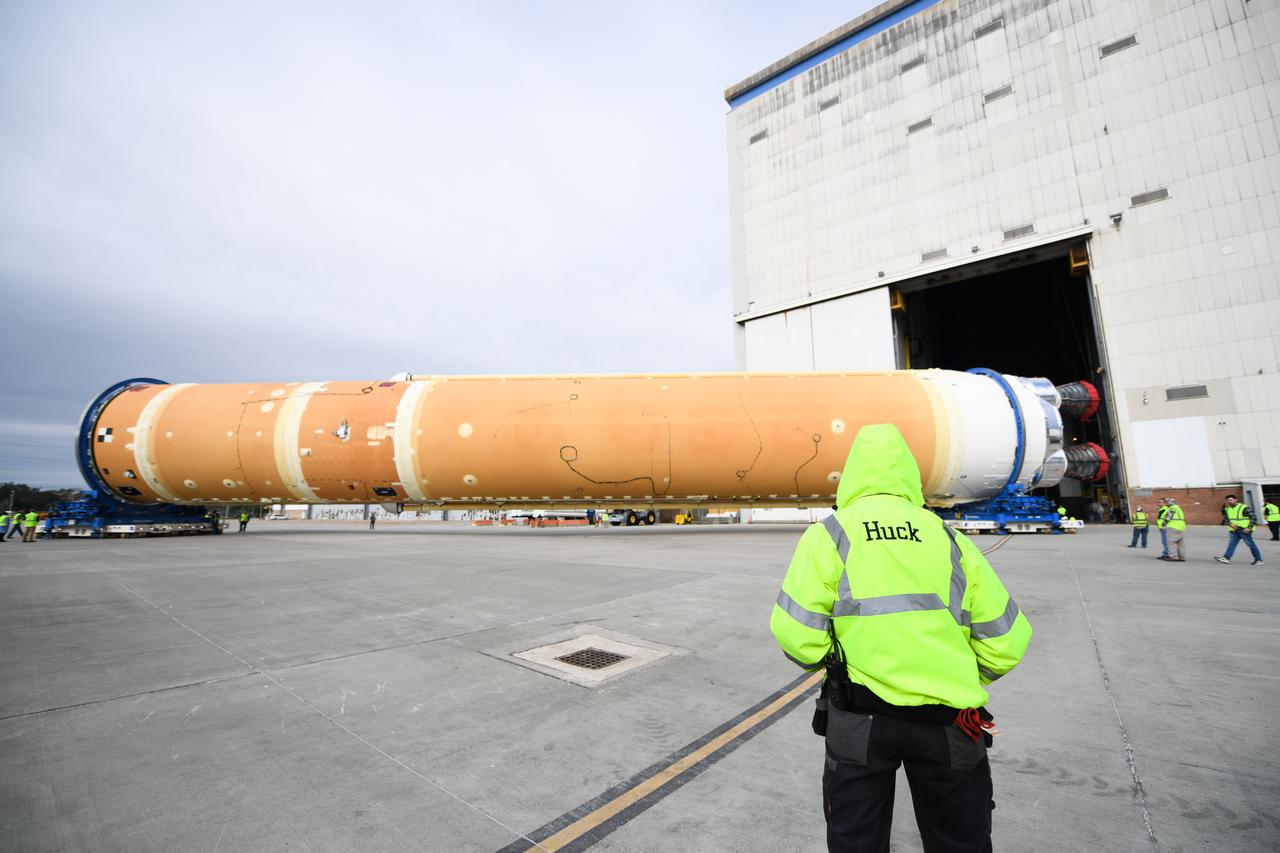
These images show how teams at NASA’s Michoud Assembly Facility in New Orleans moved the core stage, complete with all four RS-25 engines, for NASA’s Space Launch System (SLS) rocket to Building 110 for final shipping preparations on Jan. 1. The SLS core stage includes state-of-the-art avionics, propulsion systems and two colossal propellant tanks that collectively hold 733,000 gallons of liquid oxygen and liquid hydrogen to power its four RS-25 engines. The completed stage, which will provide more than 2 million pounds of thrust to help power the first Artemis mission to the Moon, will be shipped via the agency’s Pegasus barge from Michoud to NASA’s Stennis Space Center near Bay St. Louis, Mississippi, later this month. Once at Stennis, the Artemis rocket stage will be loaded into the B-2 Test Stand for the core stage Green Run test series. The comprehensive test campaign will progressively bring the entire core stage, including its avionics and engines, to life for the first time to verify the stage is fit for flight ahead of the launch of Artemis I.
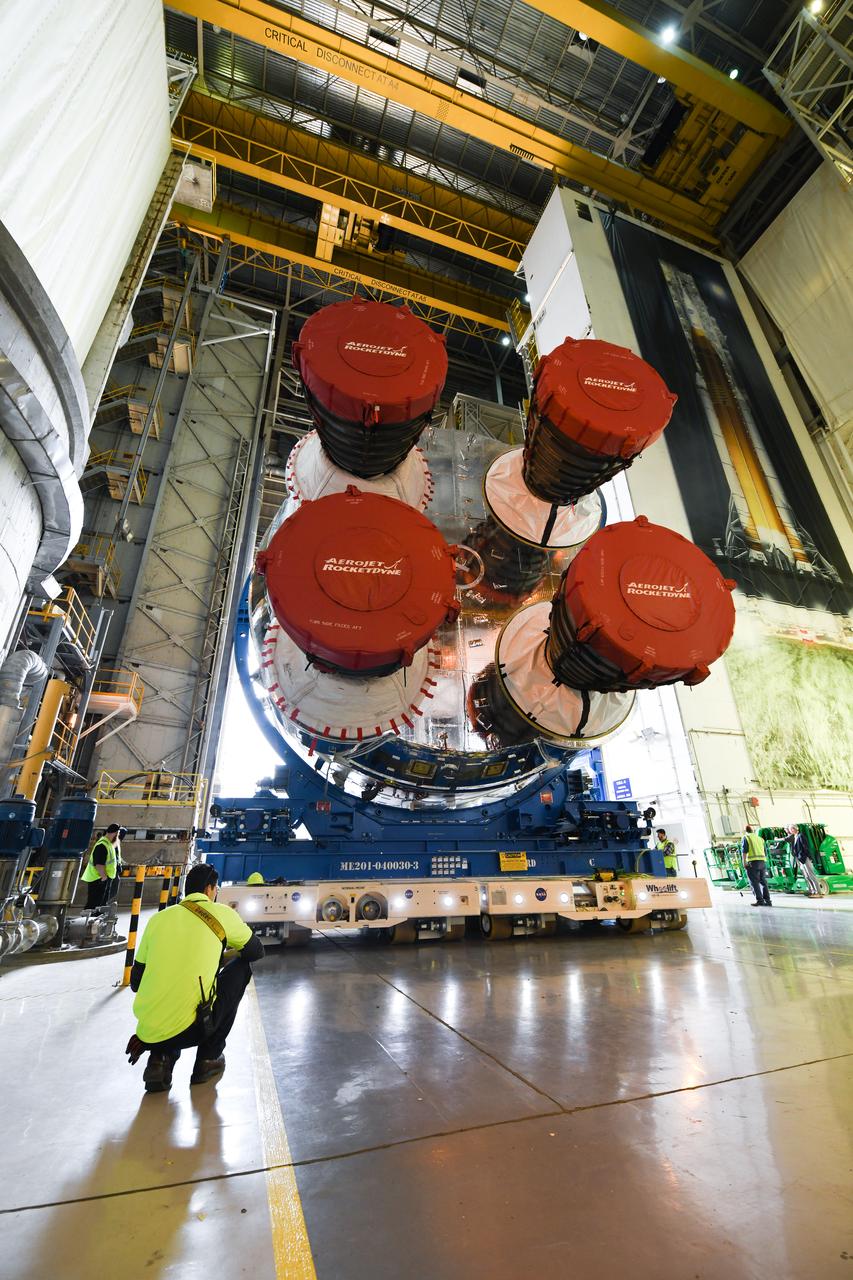
These images show how teams at NASA’s Michoud Assembly Facility in New Orleans moved the core stage, complete with all four RS-25 engines, for NASA’s Space Launch System (SLS) rocket to Building 110 for final shipping preparations on Jan. 1. The SLS core stage includes state-of-the-art avionics, propulsion systems and two colossal propellant tanks that collectively hold 733,000 gallons of liquid oxygen and liquid hydrogen to power its four RS-25 engines. The completed stage, which will provide more than 2 million pounds of thrust to help power the first Artemis mission to the Moon, will be shipped via the agency’s Pegasus barge from Michoud to NASA’s Stennis Space Center near Bay St. Louis, Mississippi, later this month. Once at Stennis, the Artemis rocket stage will be loaded into the B-2 Test Stand for the core stage Green Run test series. The comprehensive test campaign will progressively bring the entire core stage, including its avionics and engines, to life for the first time to verify the stage is fit for flight ahead of the launch of Artemis I.
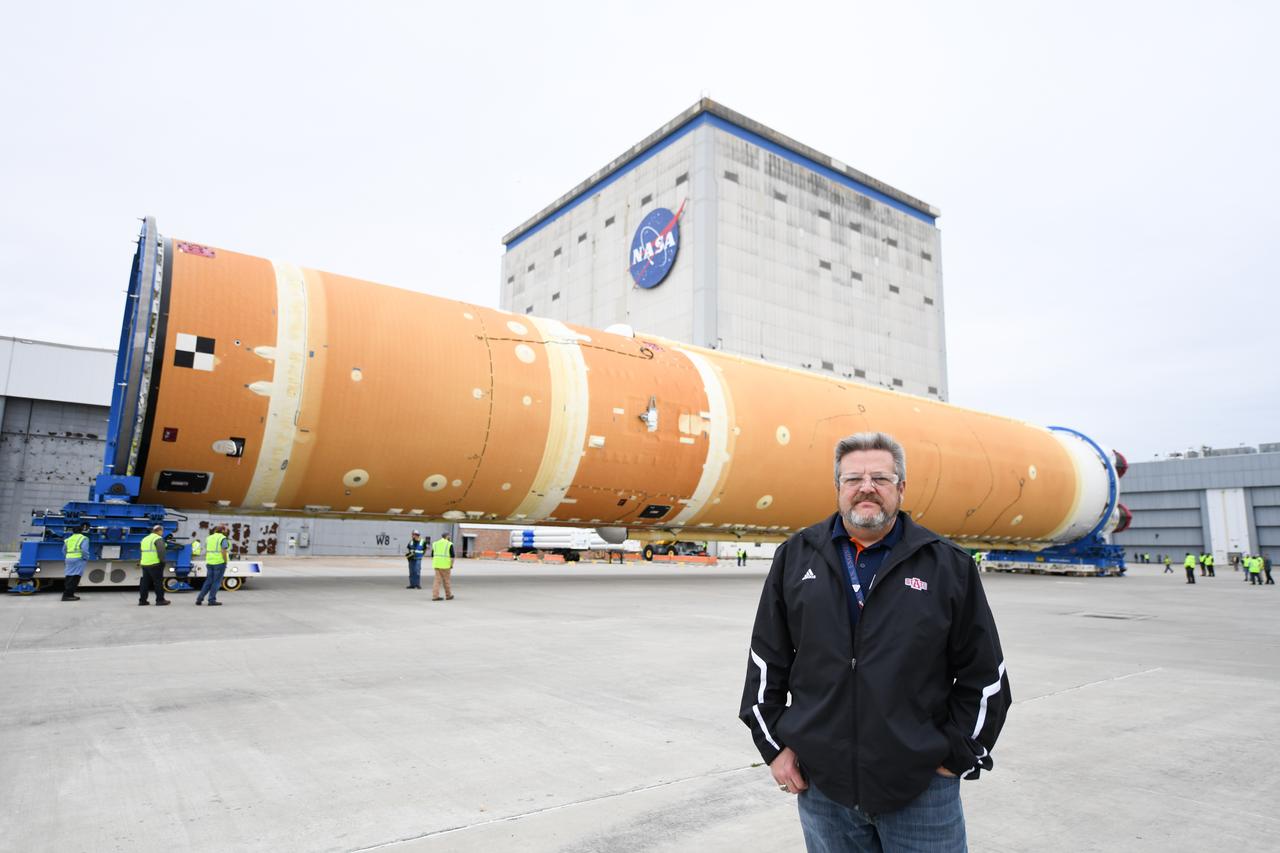
These images show how teams at NASA’s Michoud Assembly Facility in New Orleans moved the core stage, complete with all four RS-25 engines, for NASA’s Space Launch System (SLS) rocket to Building 110 for final shipping preparations on Jan. 1. The SLS core stage includes state-of-the-art avionics, propulsion systems and two colossal propellant tanks that collectively hold 733,000 gallons of liquid oxygen and liquid hydrogen to power its four RS-25 engines. The completed stage, which will provide more than 2 million pounds of thrust to help power the first Artemis mission to the Moon, will be shipped via the agency’s Pegasus barge from Michoud to NASA’s Stennis Space Center near Bay St. Louis, Mississippi, later this month. Once at Stennis, the Artemis rocket stage will be loaded into the B-2 Test Stand for the core stage Green Run test series. The comprehensive test campaign will progressively bring the entire core stage, including its avionics and engines, to life for the first time to verify the stage is fit for flight ahead of the launch of Artemis I.

These images show how teams at NASA’s Michoud Assembly Facility in New Orleans moved the core stage, complete with all four RS-25 engines, for NASA’s Space Launch System (SLS) rocket to Building 110 for final shipping preparations on Jan. 1. The SLS core stage includes state-of-the-art avionics, propulsion systems and two colossal propellant tanks that collectively hold 733,000 gallons of liquid oxygen and liquid hydrogen to power its four RS-25 engines. The completed stage, which will provide more than 2 million pounds of thrust to help power the first Artemis mission to the Moon, will be shipped via the agency’s Pegasus barge from Michoud to NASA’s Stennis Space Center near Bay St. Louis, Mississippi, later this month. Once at Stennis, the Artemis rocket stage will be loaded into the B-2 Test Stand for the core stage Green Run test series. The comprehensive test campaign will progressively bring the entire core stage, including its avionics and engines, to life for the first time to verify the stage is fit for flight ahead of the launch of Artemis I.
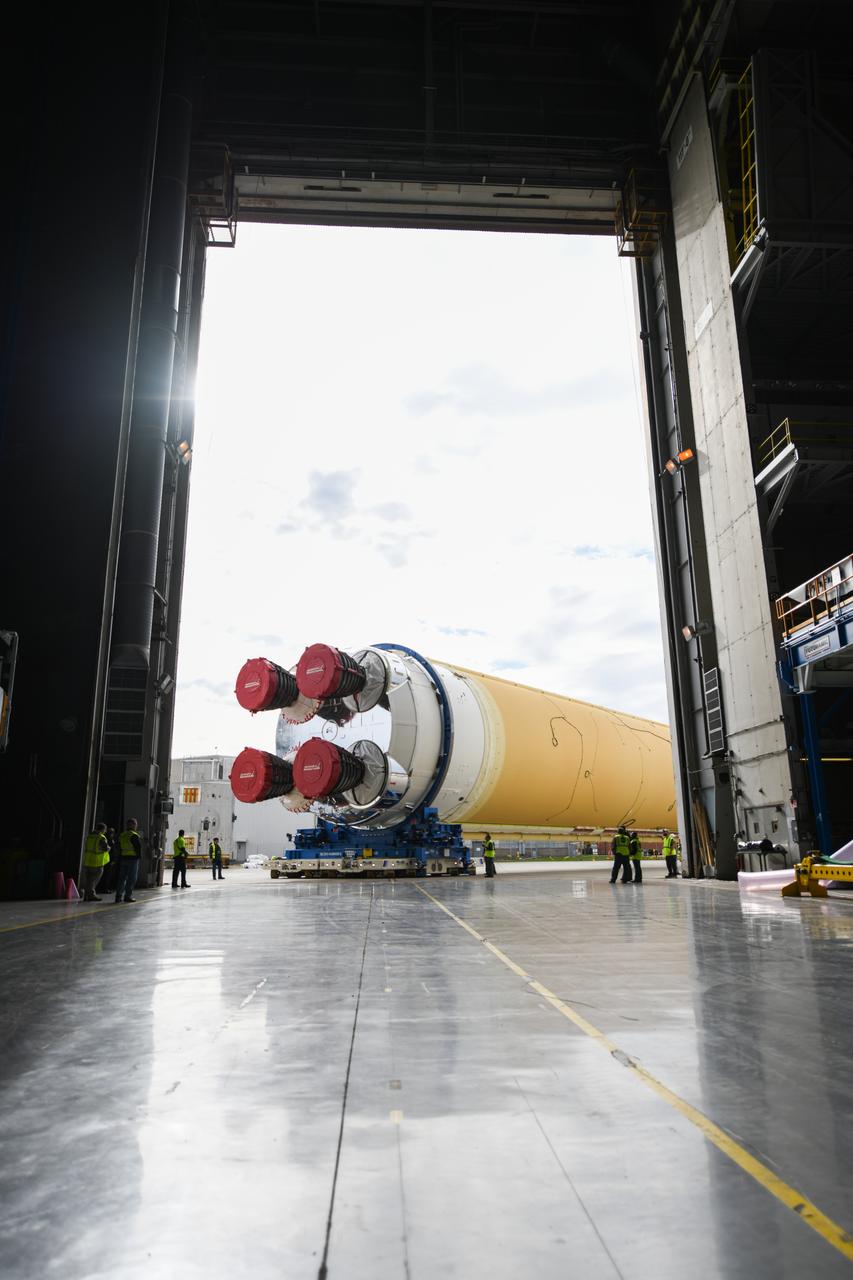
These images show how teams at NASA’s Michoud Assembly Facility in New Orleans moved the core stage, complete with all four RS-25 engines, for NASA’s Space Launch System (SLS) rocket to Building 110 for final shipping preparations on Jan. 1. The SLS core stage includes state-of-the-art avionics, propulsion systems and two colossal propellant tanks that collectively hold 733,000 gallons of liquid oxygen and liquid hydrogen to power its four RS-25 engines. The completed stage, which will provide more than 2 million pounds of thrust to help power the first Artemis mission to the Moon, will be shipped via the agency’s Pegasus barge from Michoud to NASA’s Stennis Space Center near Bay St. Louis, Mississippi, later this month. Once at Stennis, the Artemis rocket stage will be loaded into the B-2 Test Stand for the core stage Green Run test series. The comprehensive test campaign will progressively bring the entire core stage, including its avionics and engines, to life for the first time to verify the stage is fit for flight ahead of the launch of Artemis I.
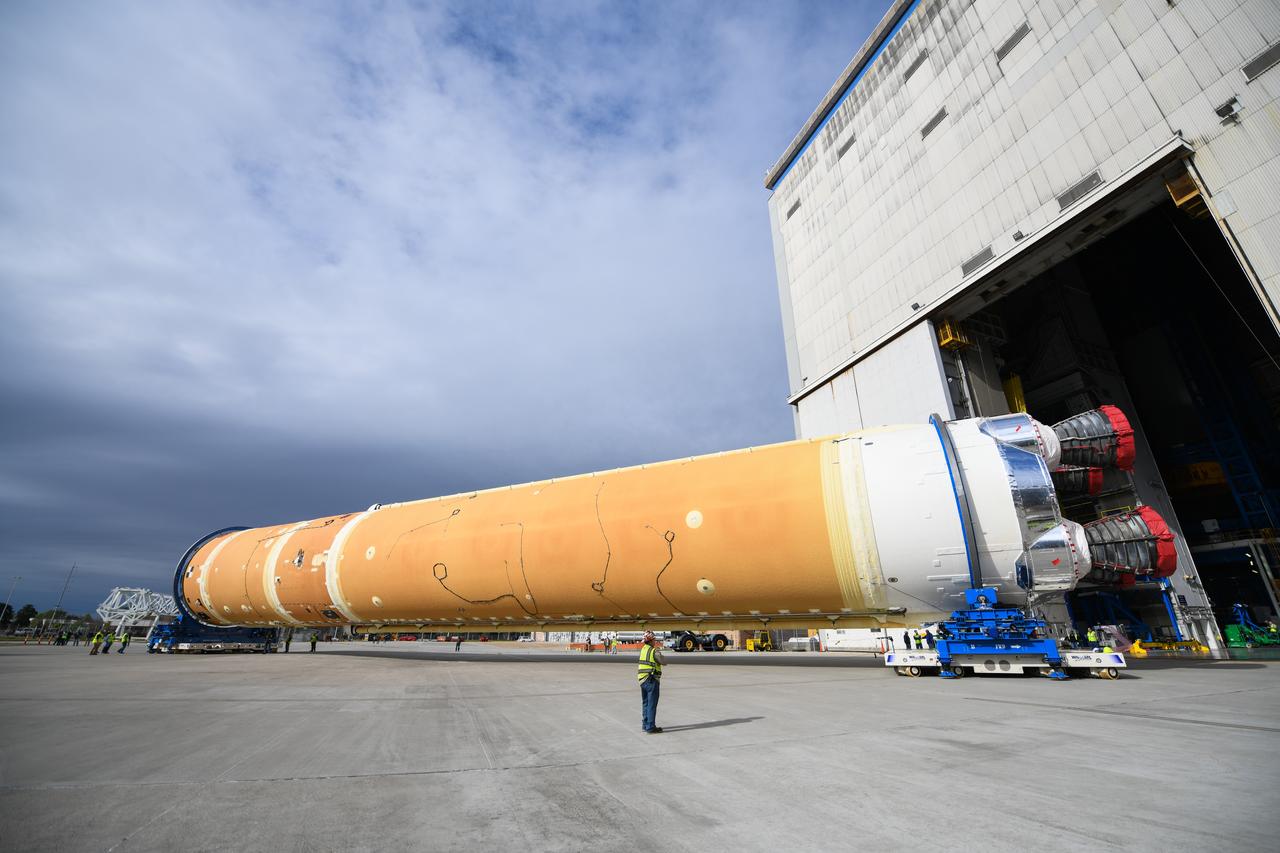
These images show how teams at NASA’s Michoud Assembly Facility in New Orleans moved the core stage, complete with all four RS-25 engines, for NASA’s Space Launch System (SLS) rocket to Building 110 for final shipping preparations on Jan. 1. The SLS core stage includes state-of-the-art avionics, propulsion systems and two colossal propellant tanks that collectively hold 733,000 gallons of liquid oxygen and liquid hydrogen to power its four RS-25 engines. The completed stage, which will provide more than 2 million pounds of thrust to help power the first Artemis mission to the Moon, will be shipped via the agency’s Pegasus barge from Michoud to NASA’s Stennis Space Center near Bay St. Louis, Mississippi, later this month. Once at Stennis, the Artemis rocket stage will be loaded into the B-2 Test Stand for the core stage Green Run test series. The comprehensive test campaign will progressively bring the entire core stage, including its avionics and engines, to life for the first time to verify the stage is fit for flight ahead of the launch of Artemis I.