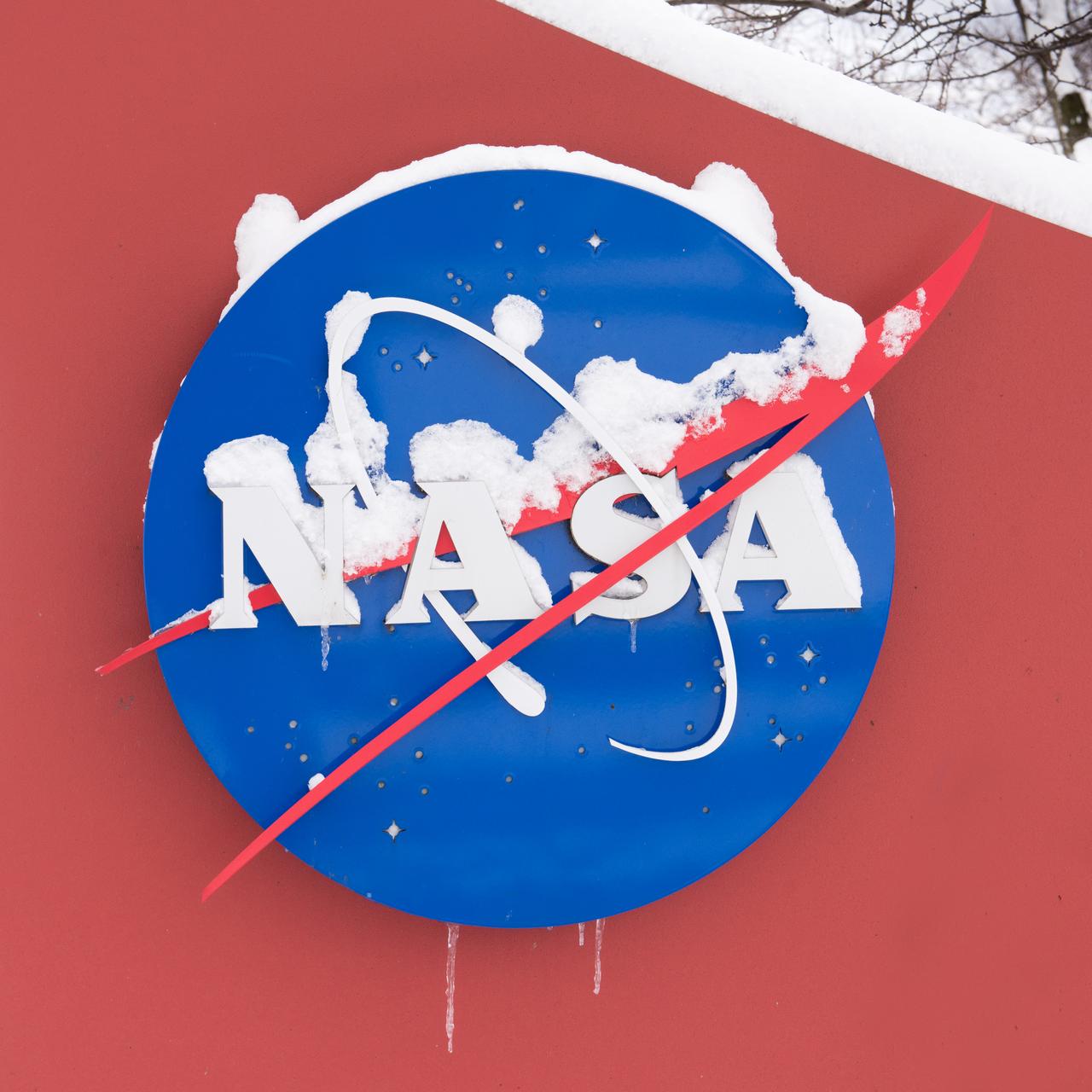
Late winter photograph of a snow-covered NASA Insignia at the Glenn Research Center in Cleveland, OH.
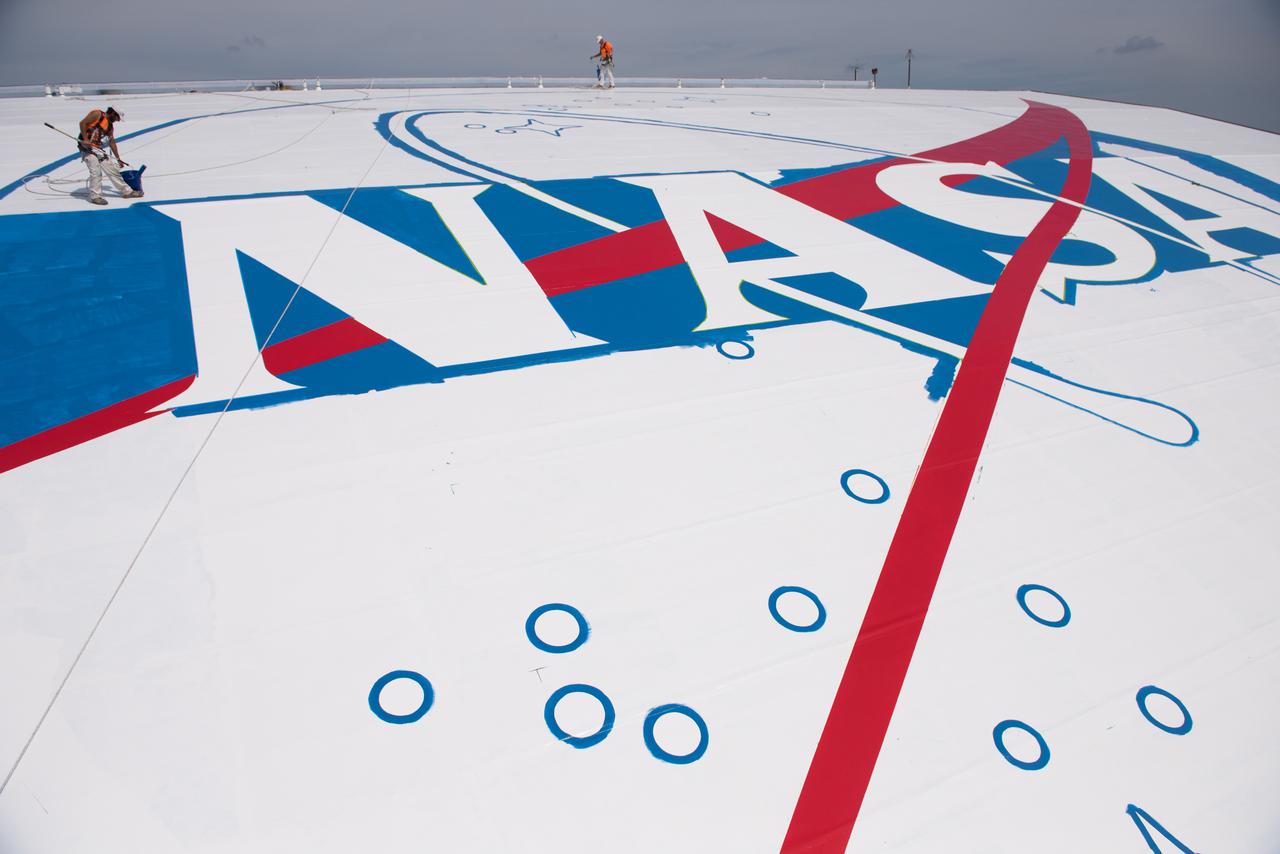
Painters paint the NASA Insignia or Meatball on the Hangar Roof
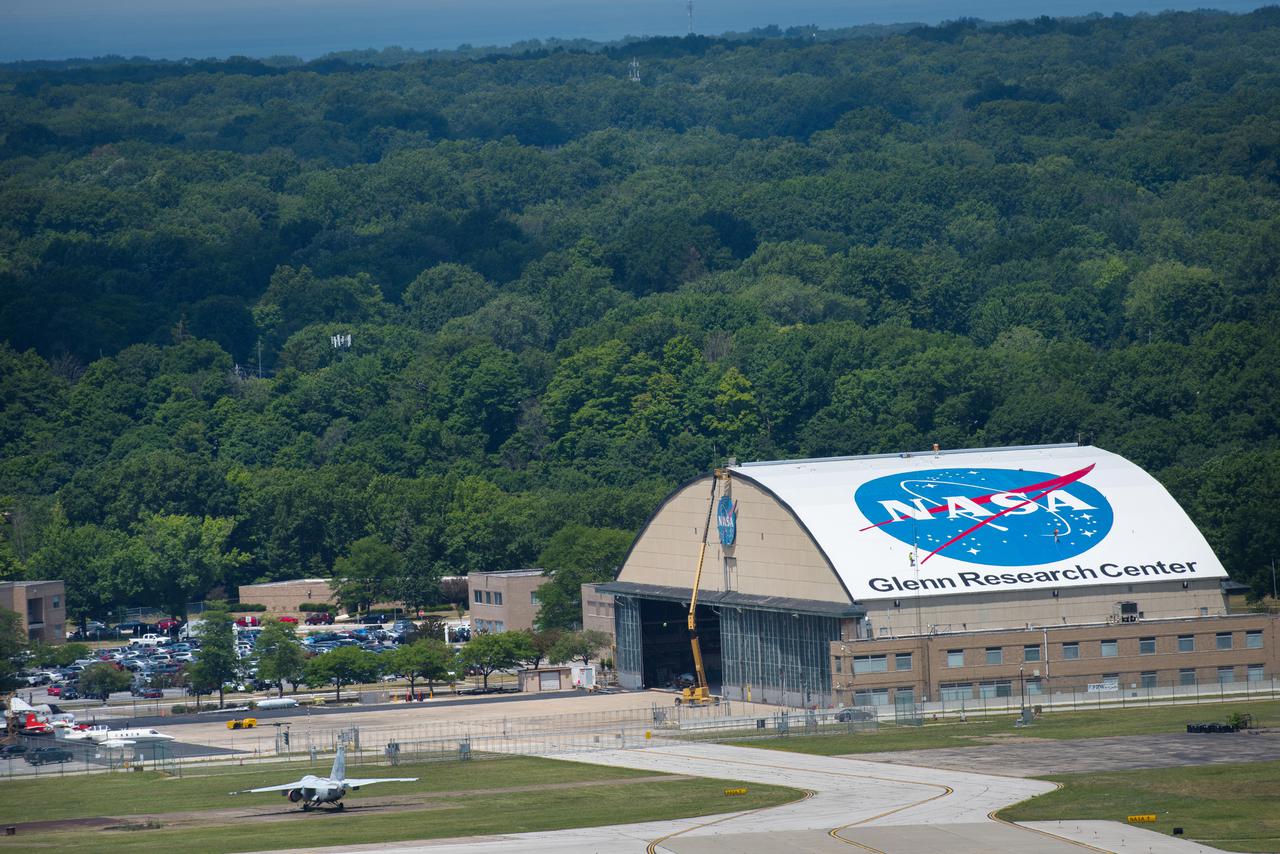
The NASA Insignia or Meatball, is painted on the Hangar Roof
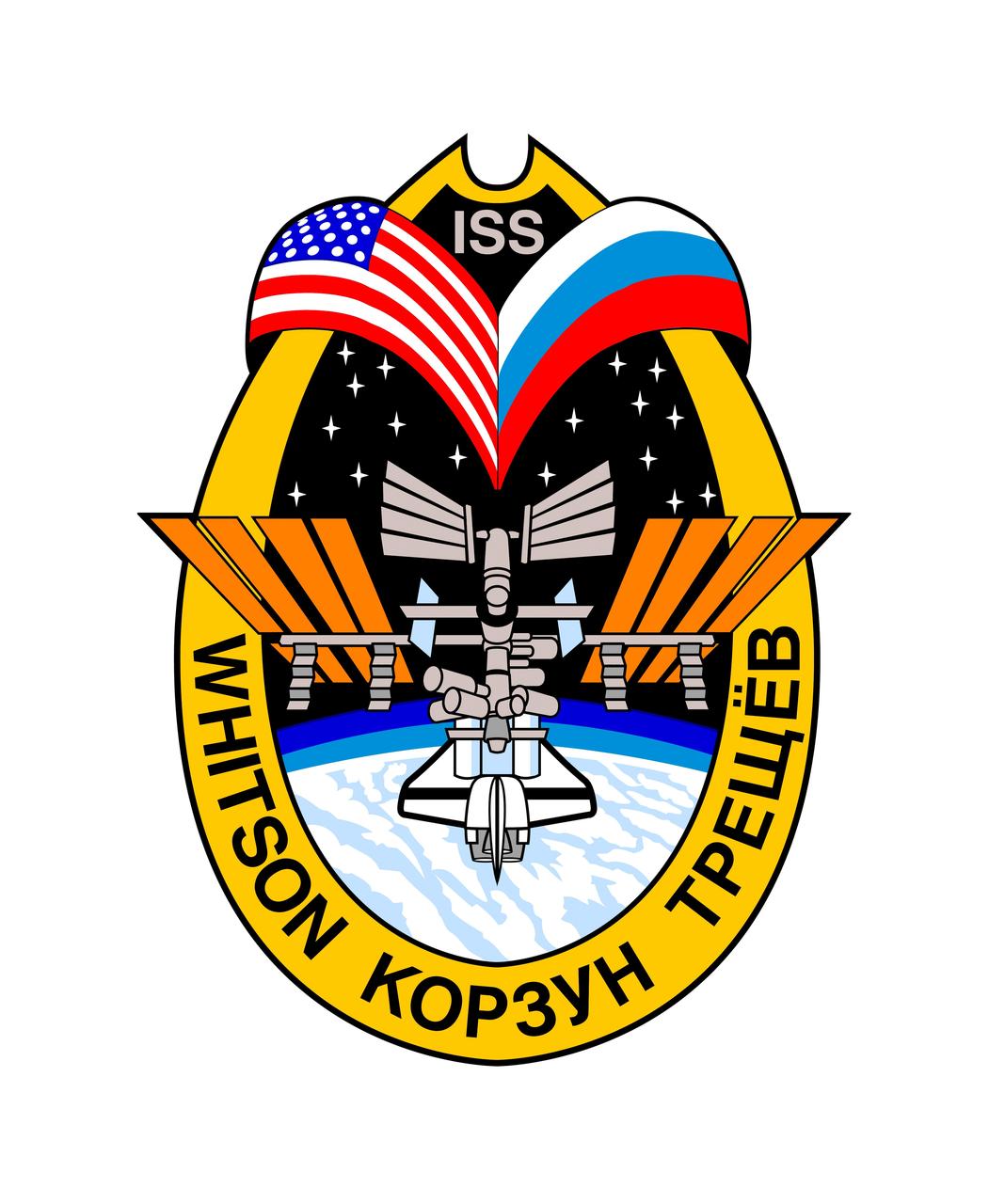
ISS005-S-001 (January 2002) -- The International Space Station (ISS) Expedition Five patch depicts the station in its completed configuration and represents the vision of mankind's first step as a permanent human presence in space. The United States and Russian flags are joined together in a Roman numeral V to represent both the nationalities of the crew and the fifth crew to live aboard the ISS. Crew members? names are shown in the border of this patch. This increment encompasses a new phase in growth for the station, with three shuttle crews delivering critical components and building blocks to the ISS. To signify the participation of each crew member, the shuttle is docked to the station beneath a constellation of 17 stars symbolizing all those visiting and living aboard station during this increment. The NASA insignia design for shuttle flights and station increments is reserved for use by the astronauts and for other official use as the NASA Administrator may authorize. Public availability has been approved only in the forms of illustrations by the various news media. When and if there is any change in this policy, which is not anticipated, the change will be publicly announced.

ISS006-S-001 (September 2002) --- The International Space Station (ISS) Expedition Six crew patch depicts the station orbiting the Earth on its mission of international cooperation and scientific research. The Earth is placed in the center of the patch to emphasize that work conducted aboard this orbiting laboratory is intended to improve life on our home planet. The shape of the space station’s orbit symbolizes the role that experience gained from ISS will have on future exploration of our solar system and beyond. The American and Russian flags encircling the Earth represent the native countries of the Expedition 6 crew members, which are just two of the many participant countries contributing to the ISS and committed to the peaceful exploration of space. The NASA insignia design for International Space Station (ISS) missions is reserved for use by the crew members and for other official use as the NASA Administrator may authorize. Public availability has been approved only in the forms of illustrations by the various news media. When and if there is any change in this policy, which is not anticipated, the change will be publicly announced.
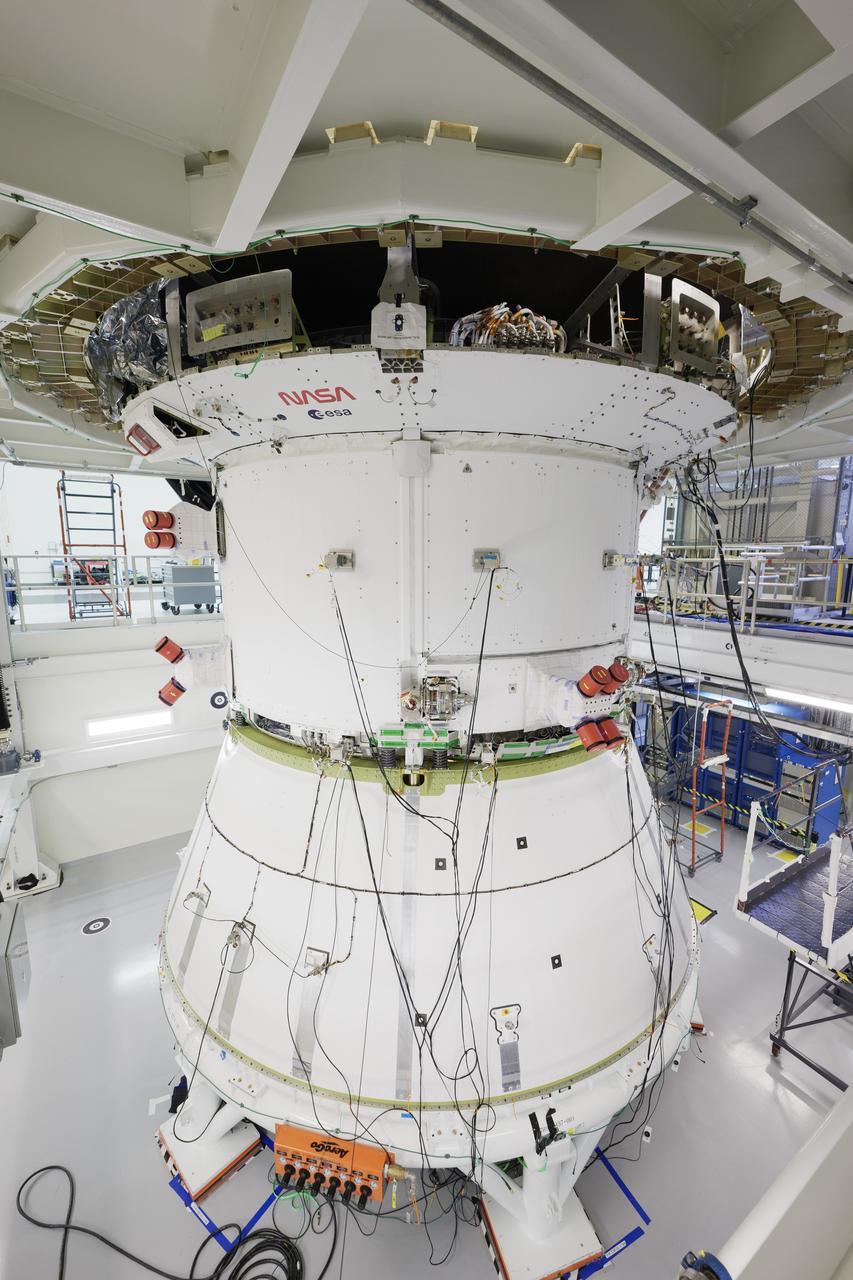
The Orion spacecraft for NASA’s Artemis II mission received its latest makeover. Teams adhered the agency’s iconic “worm” logo and ESA (European Space Agency) insignia on the spacecraft’s crew module adapter on Sunday, Jan. 28, inside the Neil Armstrong Operations and Checkout Building at NASA’s Kennedy Space Center in Florida.
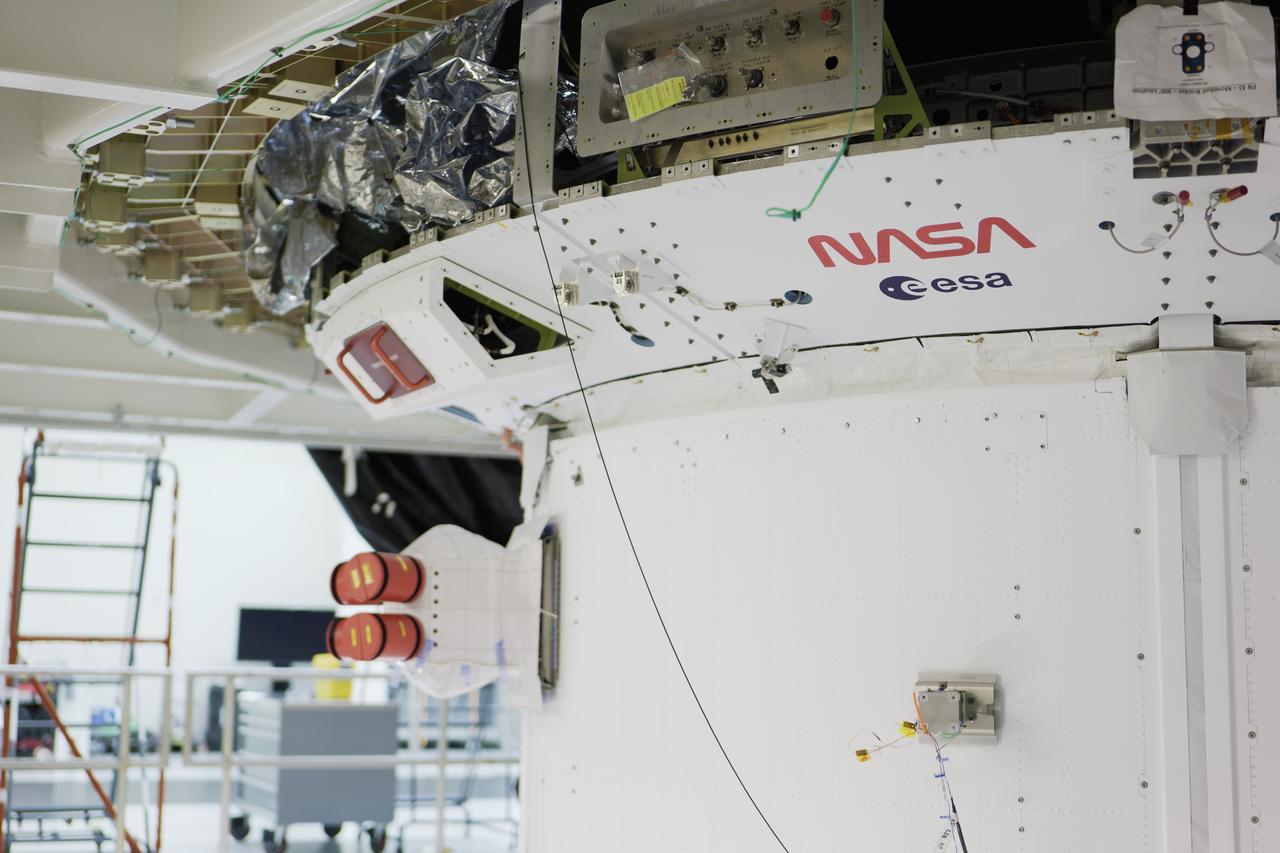
The Orion spacecraft for NASA’s Artemis II mission received its latest makeover. Teams adhered the agency’s iconic “worm” logo and ESA (European Space Agency) insignia on the spacecraft’s crew module adapter on Sunday, Jan. 28, inside the Neil Armstrong Operations and Checkout Building at NASA’s Kennedy Space Center in Florida.
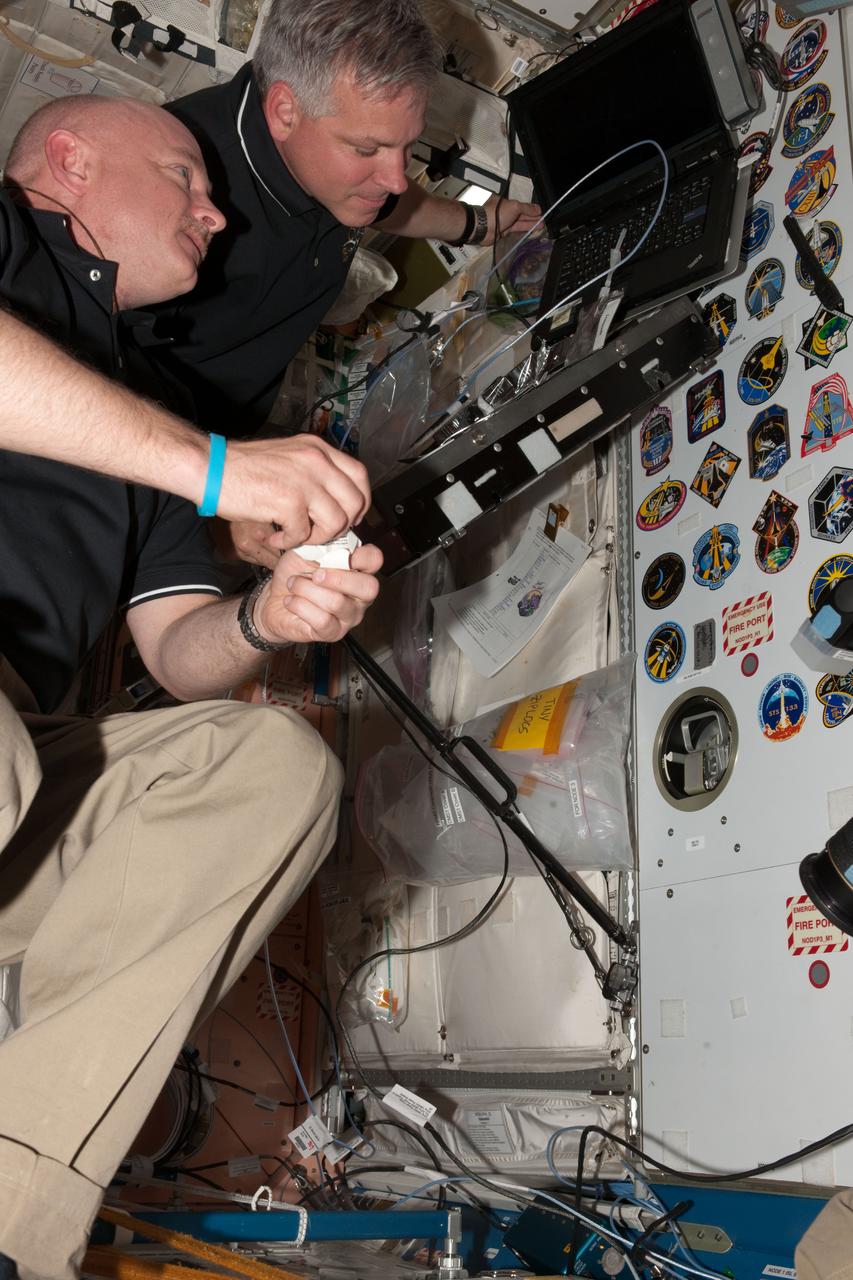
ISS027-E-035420 (21 May 2011) --- NASA astronaut Mark Kelly, Expedition 27 commander, looks at the various mission insignias placed in the Unity node of the International Space Station before placing the STS-134 insignia among them. NASA astronaut Greg H. Johnson, pilot, is pictured as well.
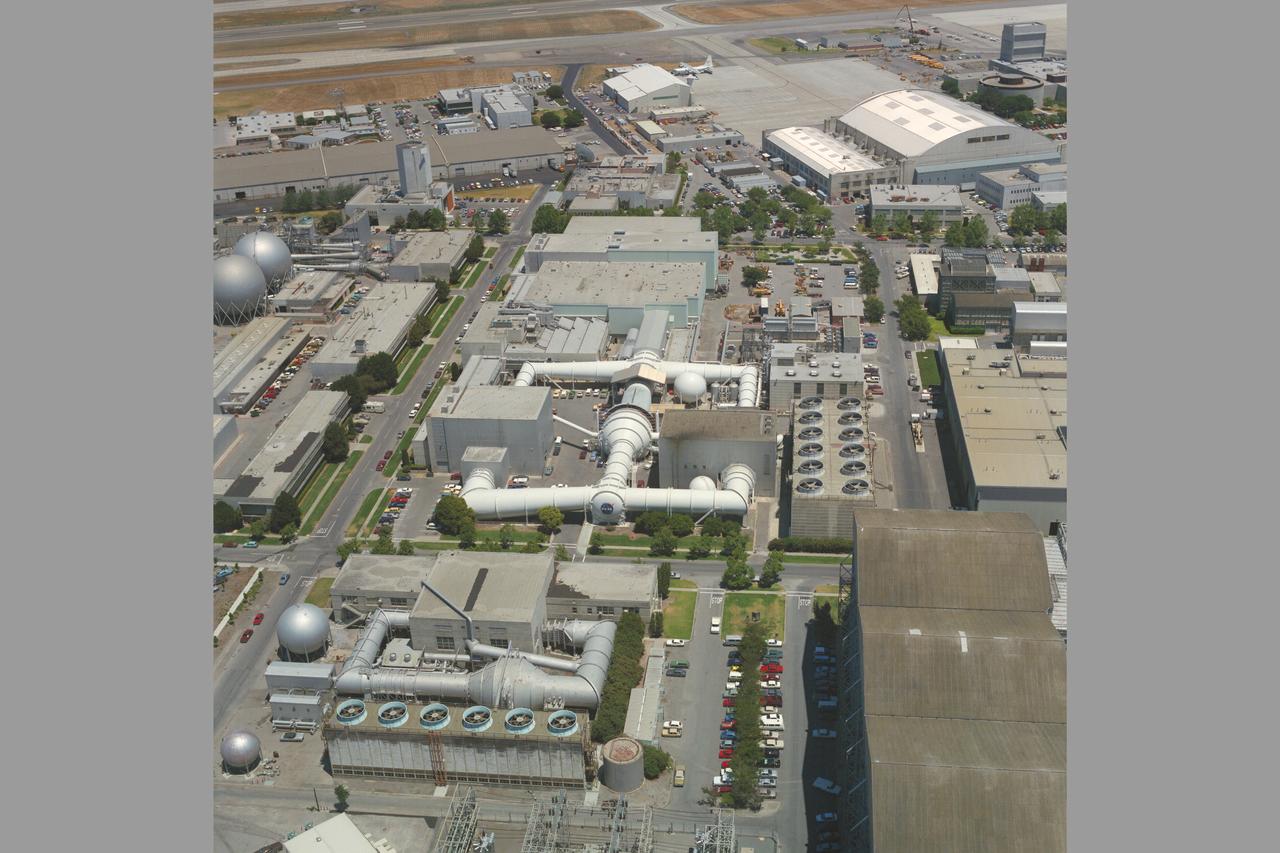
Aerial view of Unitary Plan Wind Tunnel complex with NASA insignia
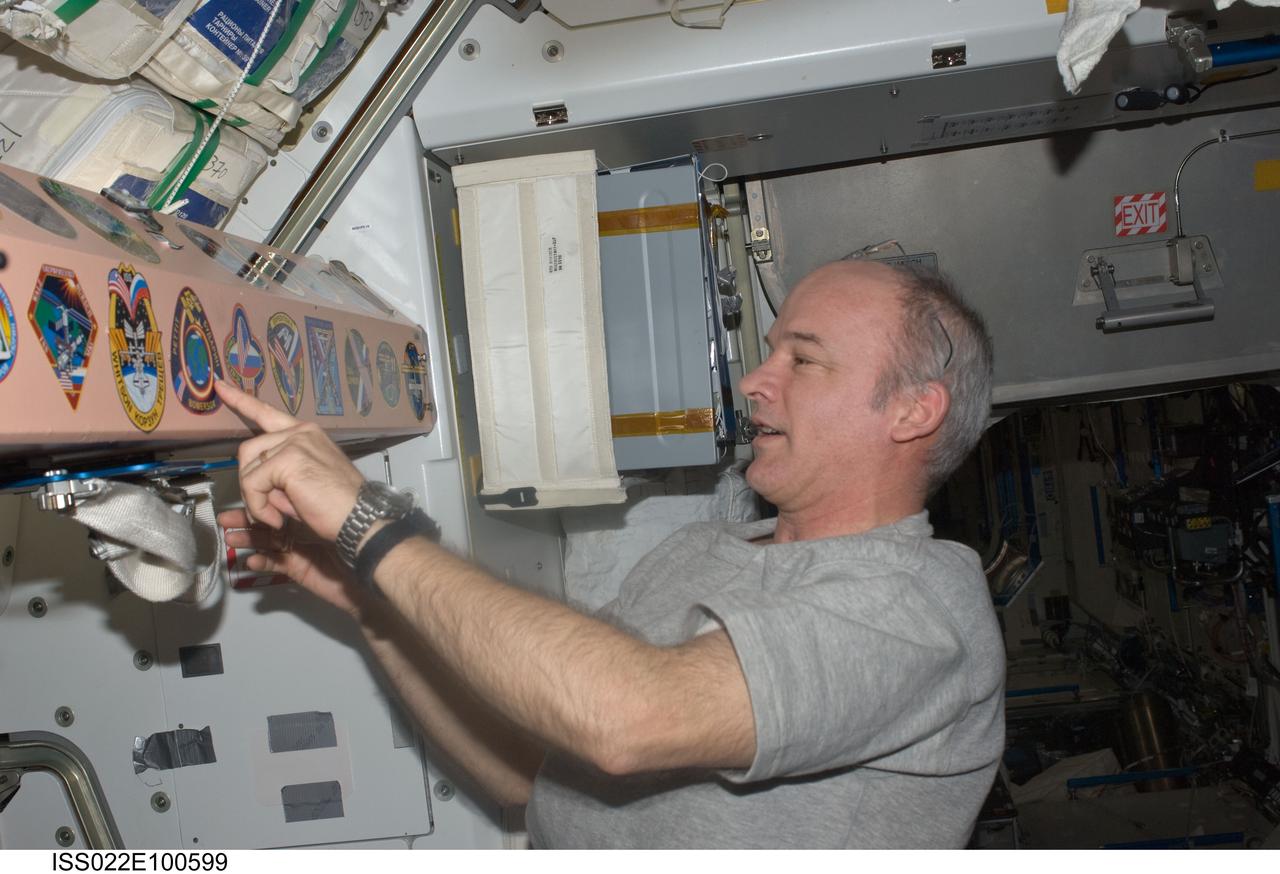
ISS022-E-100599 (17 March 2010) --- NASA astronaut Jeffrey Williams, Expedition 22 commander, looks at the various mission insignias placed in the Unity node of the International Space Station after placing the Expedition 22 insignia among them.
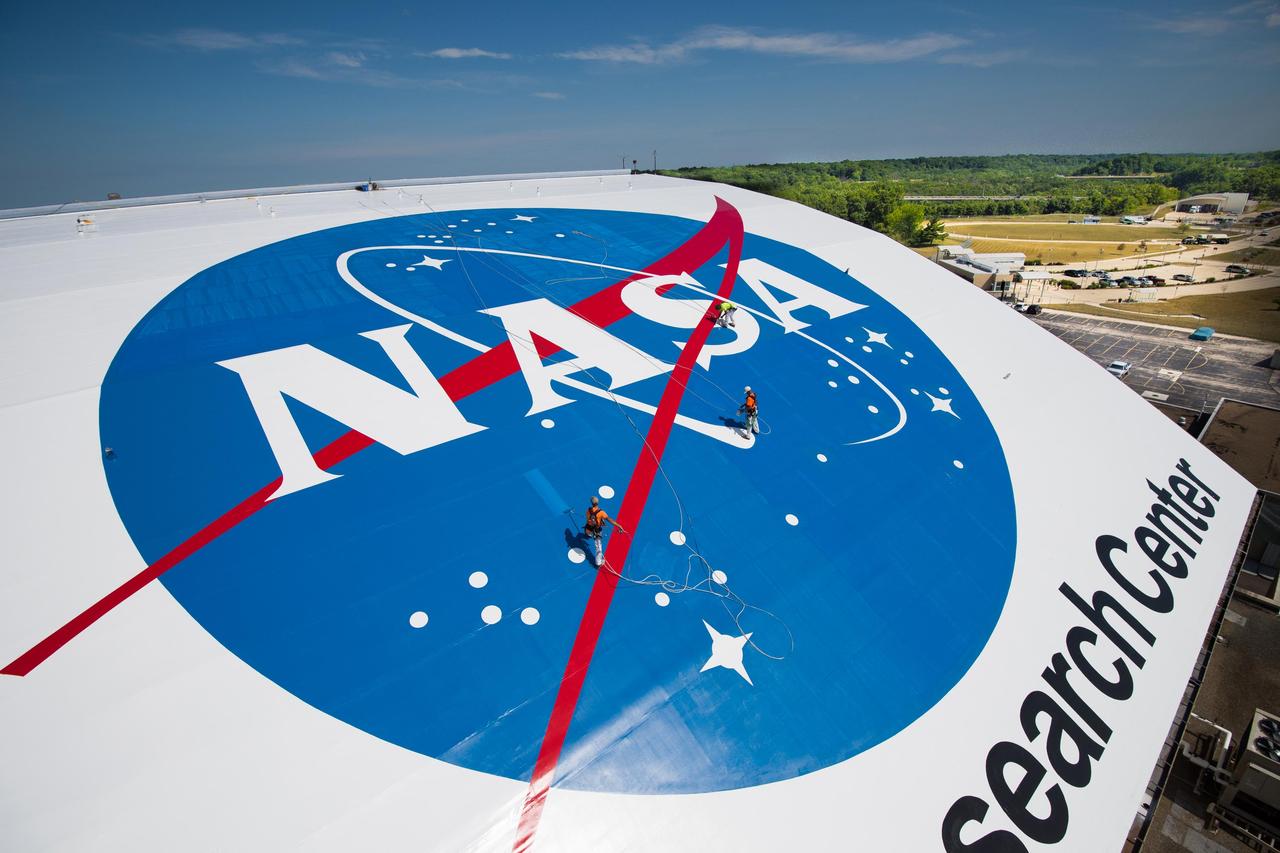
Workers complete the newly painted NASA Insignia on the Hangar roof at NASA Glenn Research Center.
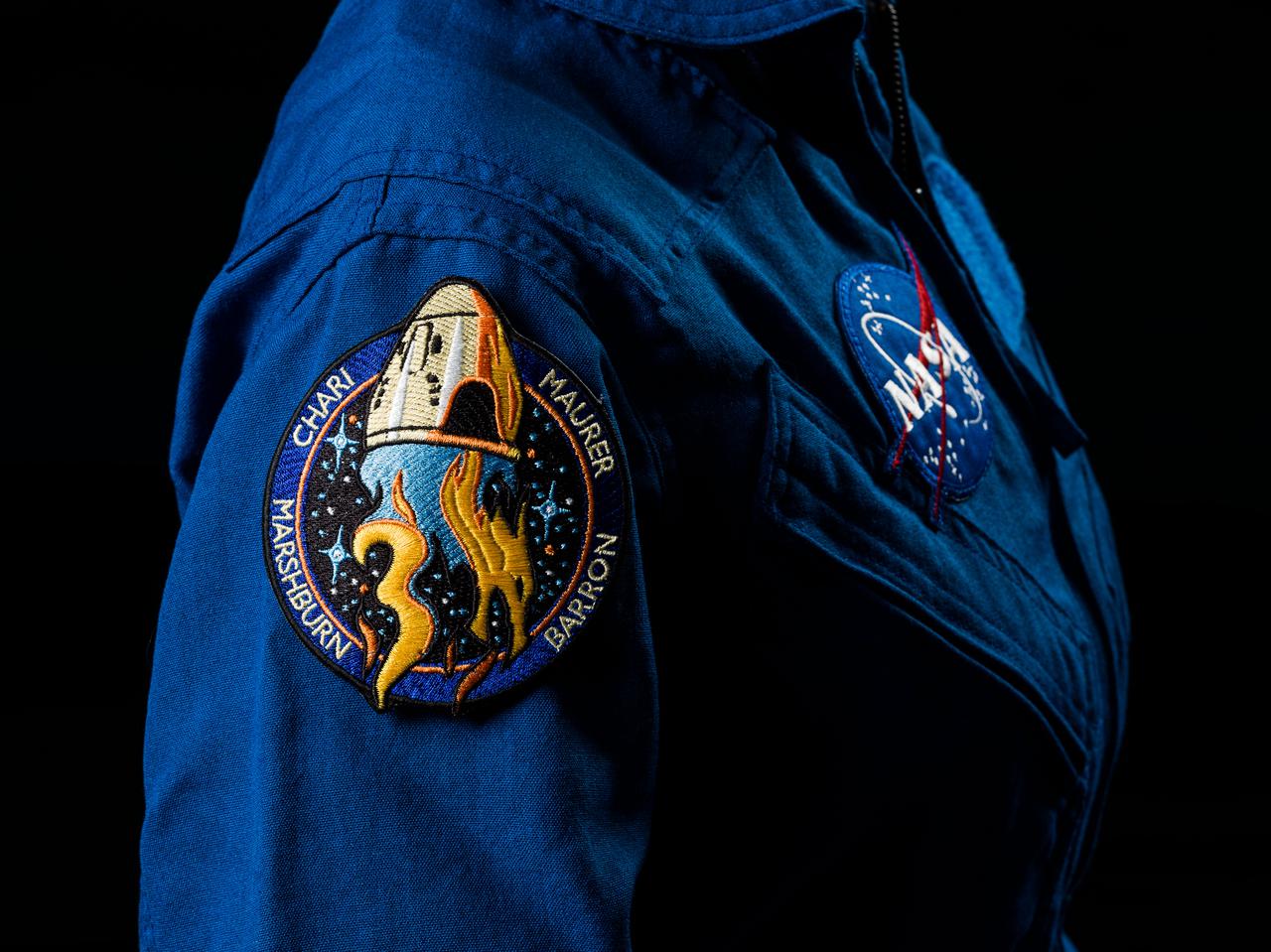
jsc2021e046979 (Oct. 18, 2021) --- The SpaceX Crew-3 insignia patch is pictured attached to NASA's blue flight suit.
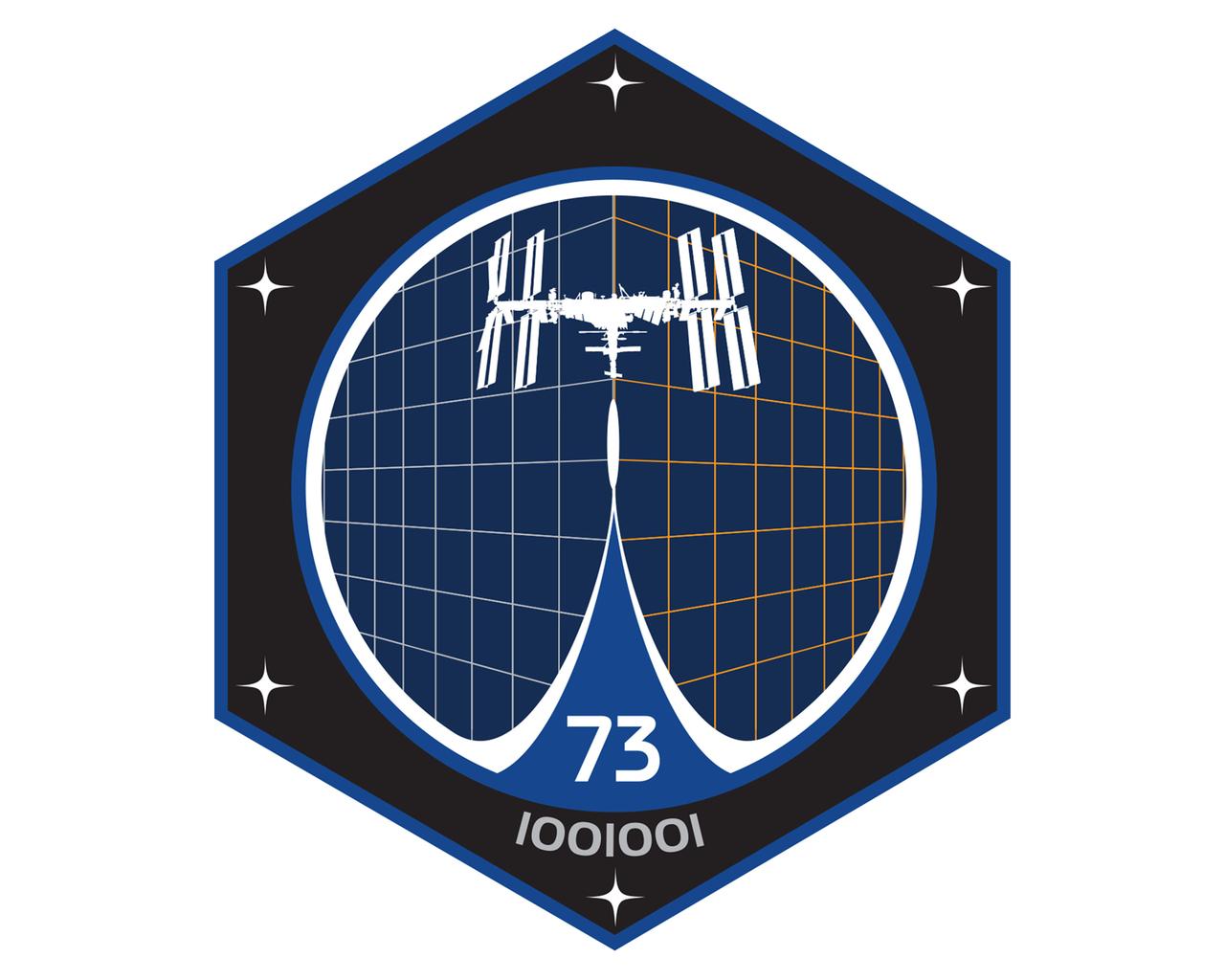
iss073-s-001 (July 15, 2024) --- The official insignia of the Expedition 73 crew on the International Space Station. Credit: NASA
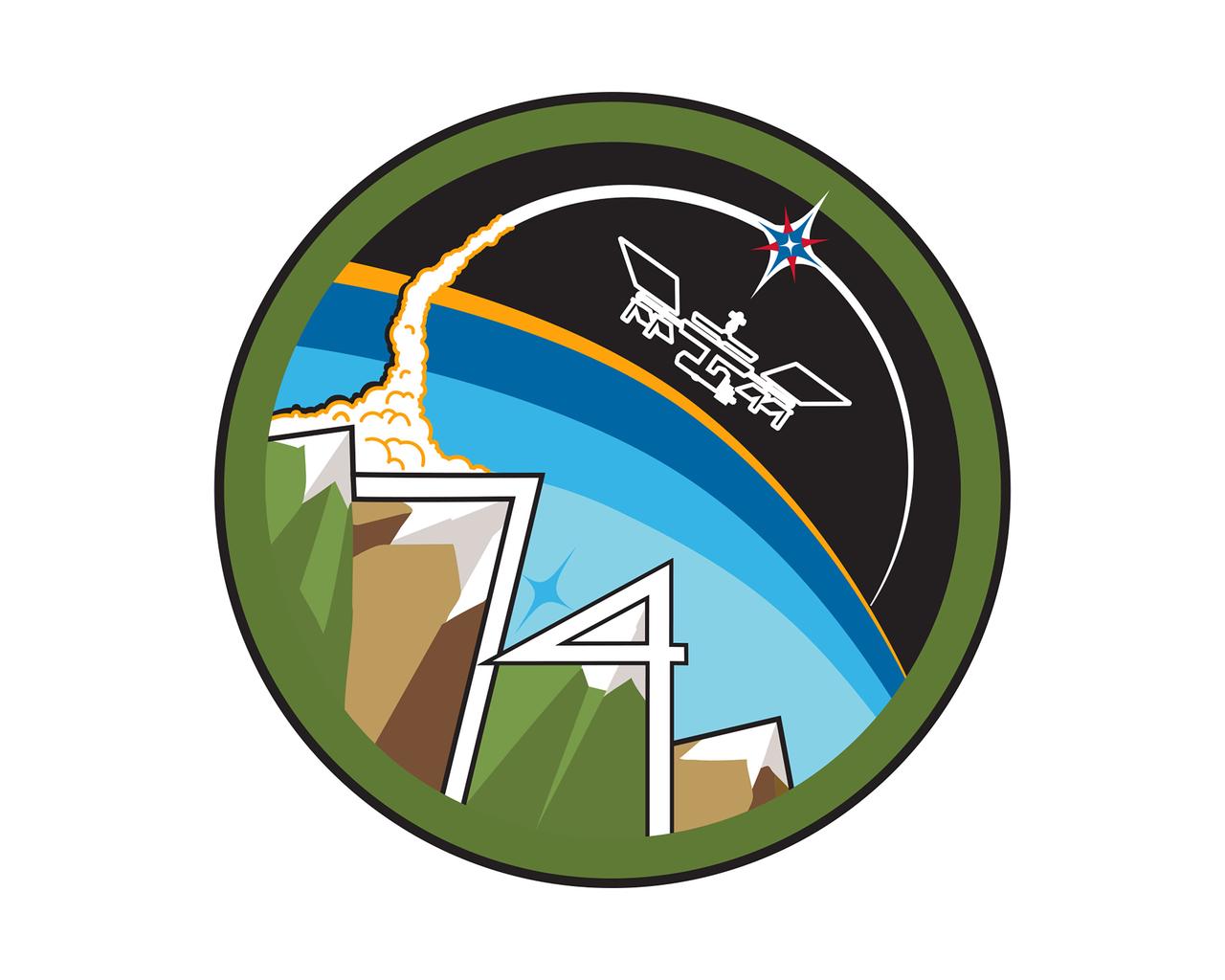
iss074-s-001 (Jan. 29, 2025) --- The official insignia of the Expedition 74 crew on the International Space Station. Credit: NASA

Aboard a Gagarin Cosmonaut Training Center aircraft, Expedition 59 crewmembers Alexey Ovchinin of Roscosmos (left), Nick Hague of NASA (center) and Christina Koch of NASA (right) display crew insignia stickers on the wall of the cabin Feb. 26 as they flew to their launch site at the Baikonur Cosmodrome in Kazakhstan from Star City, Russia for final pre-launch training. They will launch March 14, U.S. time, on the Soyuz MS-12 spacecraft from the Baikonur Cosmodrome in Kazakhstan for a six-and-a-half month mission on the International Space Station. NASA/Victor Zelentsov
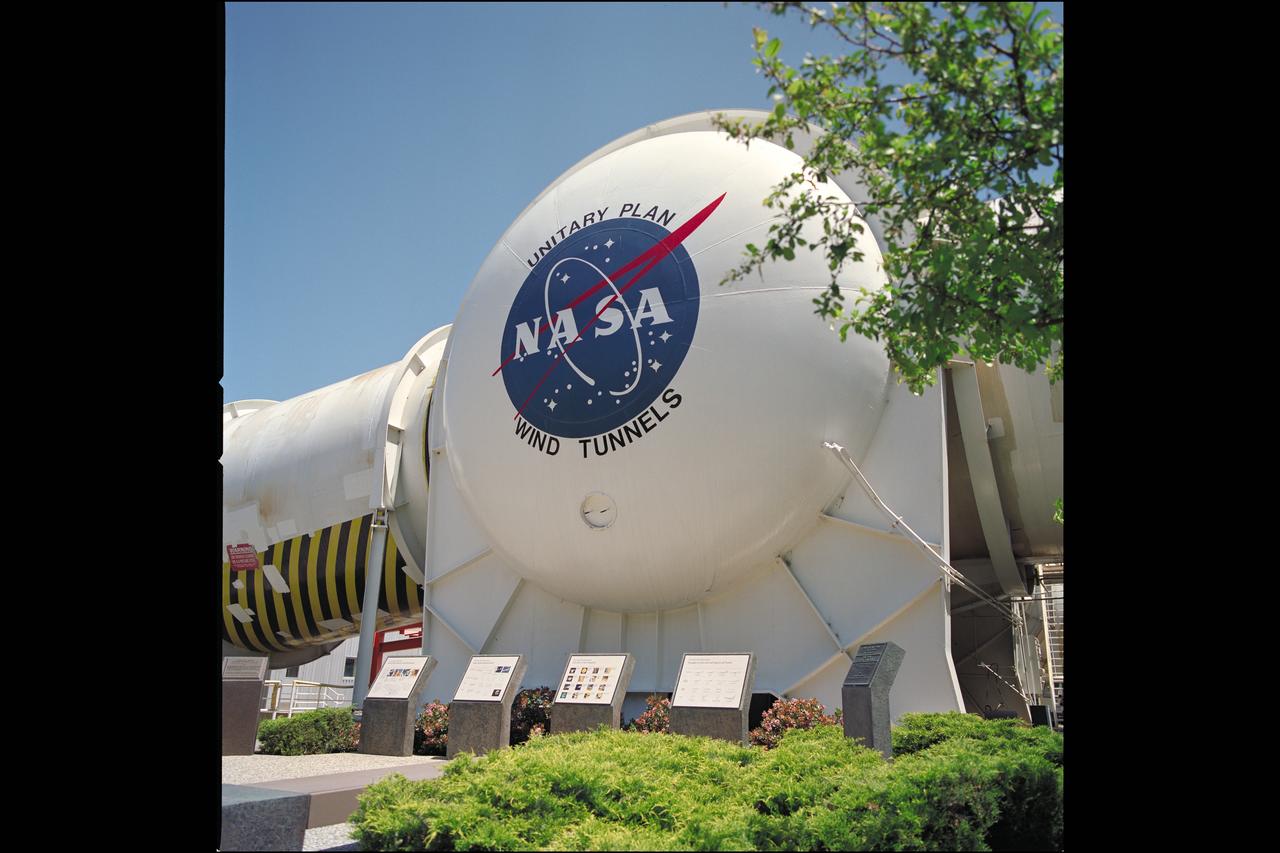
N-227 Unitary Plan Wind Tunnel with NASA 'Meatball' insignia over looking the National Historical Landmark sites' commemorative plaques
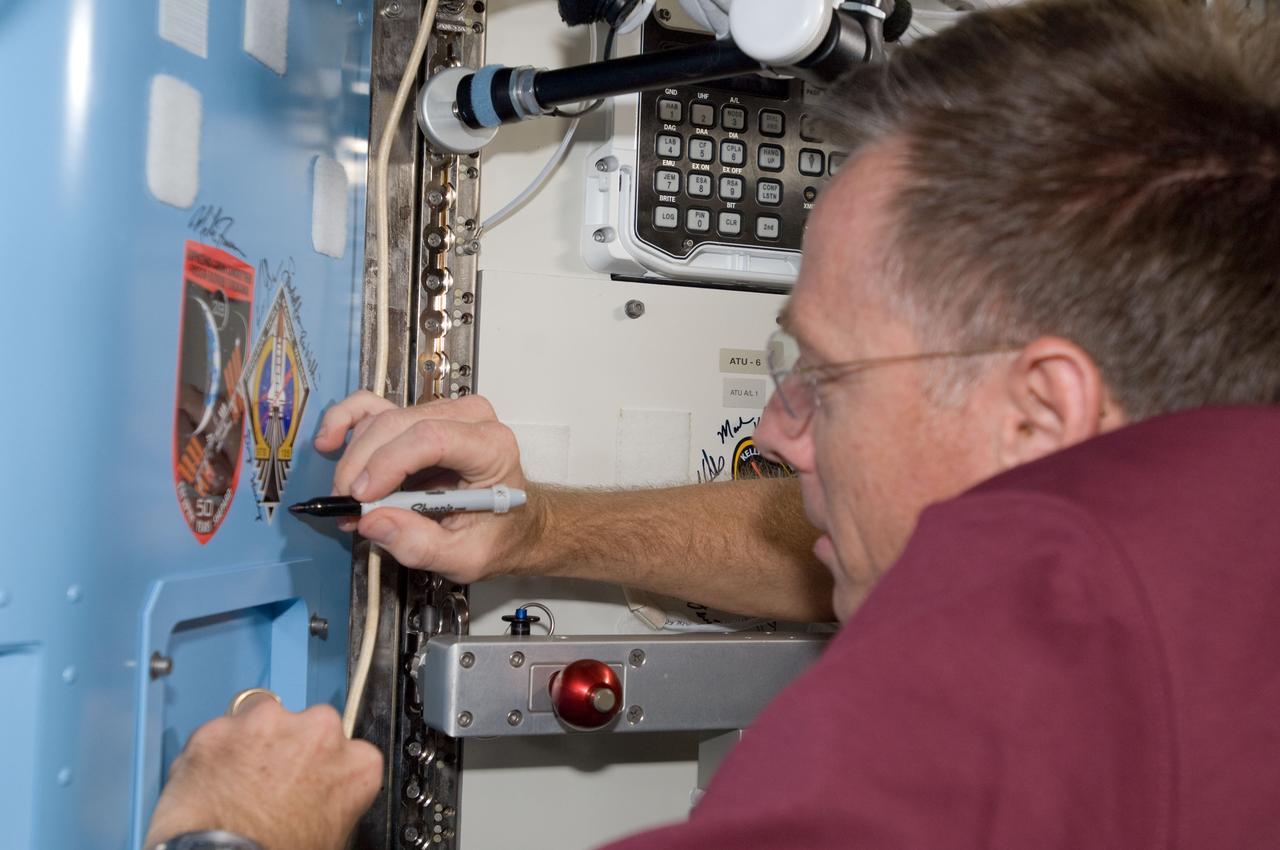
S135-E-009493 (18 July 2011) --- NASA astronaut Chris Ferguson, STS-135 commander, signs an insignia decal for his mission in the Quest airlock of the International Space Station. The shuttle insignia is mounted next to that of the Expedition 28. Having docked Atlantis to the station over a week ago, Ferguson and three crewmates are preparing to undock from the station early on July 19 and prepare for a July 21 landing in Florida. Photo credit: NASA
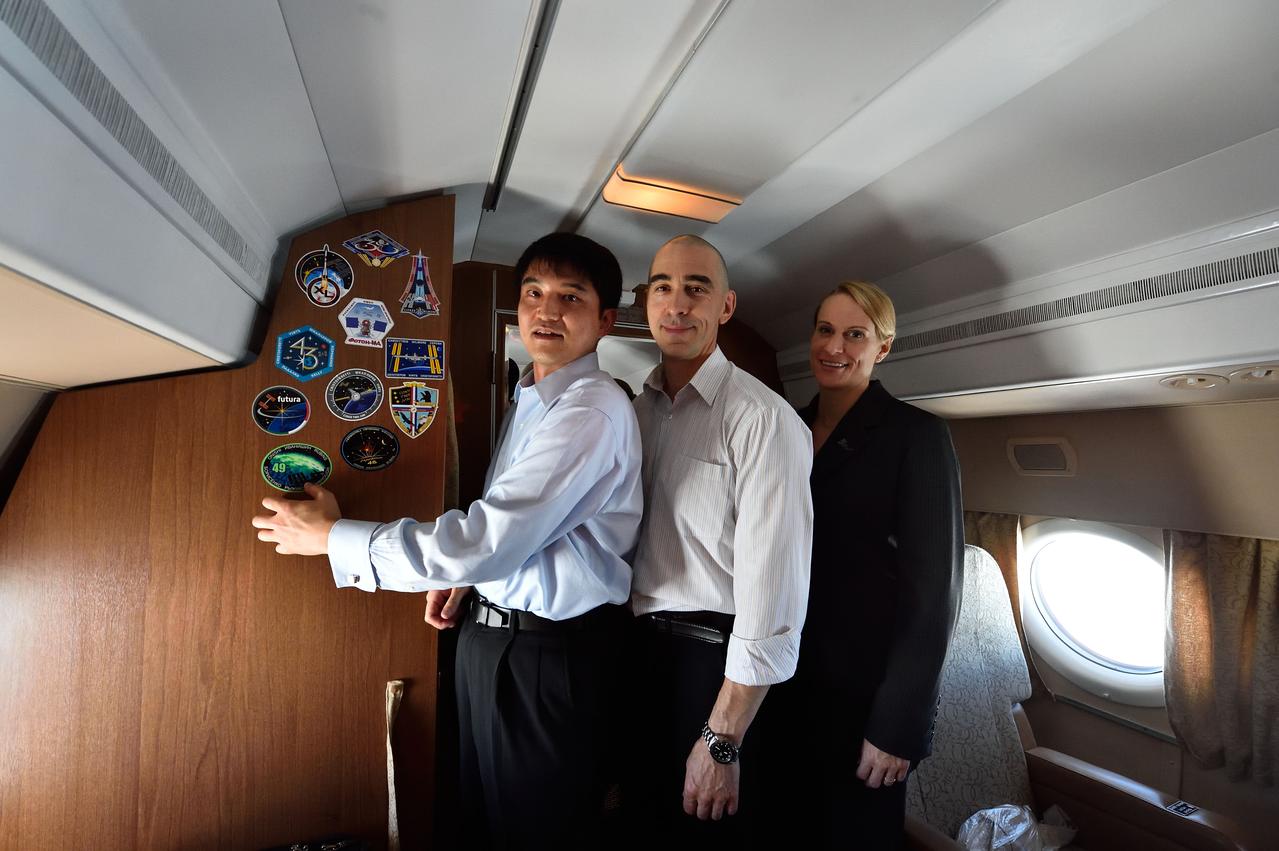
Aboard their aircraft on route to their launch site in Baikonur, Kazakhstan, ISS Expedition 48-49 crewmembers Takuya Onishi of the Japan Aerospace Exploration Agency (left), Anatoly Ivanishin of Roscosmos (center) and Kate Rubins of NASA (right) affix their mission insignia sticker to the wall June 24 after departing their training base in Star City, Russia. The trio will launch July 7 from the Baikonur Cosmodrome in Kazakhstan on the Soyuz MS-01 spacecraft for a planned four-month mission on the International Space Station. NASA/Alexander Vysotsky

iss072e005807 (Sept. 28, 2024) --- NASA astronaut and Expedition 72 Flight Engineer Jeanette Epps poses for a portrait inside the SpaceX Dragon Endeavour spacecraft docked to the Harmony module's space-facing port on the International Space Station. Epps points to her mission's insignia, SpaceX Crew-8, alongside the insignias of four other missions that have launched to space aboard Dragon Endeavour.
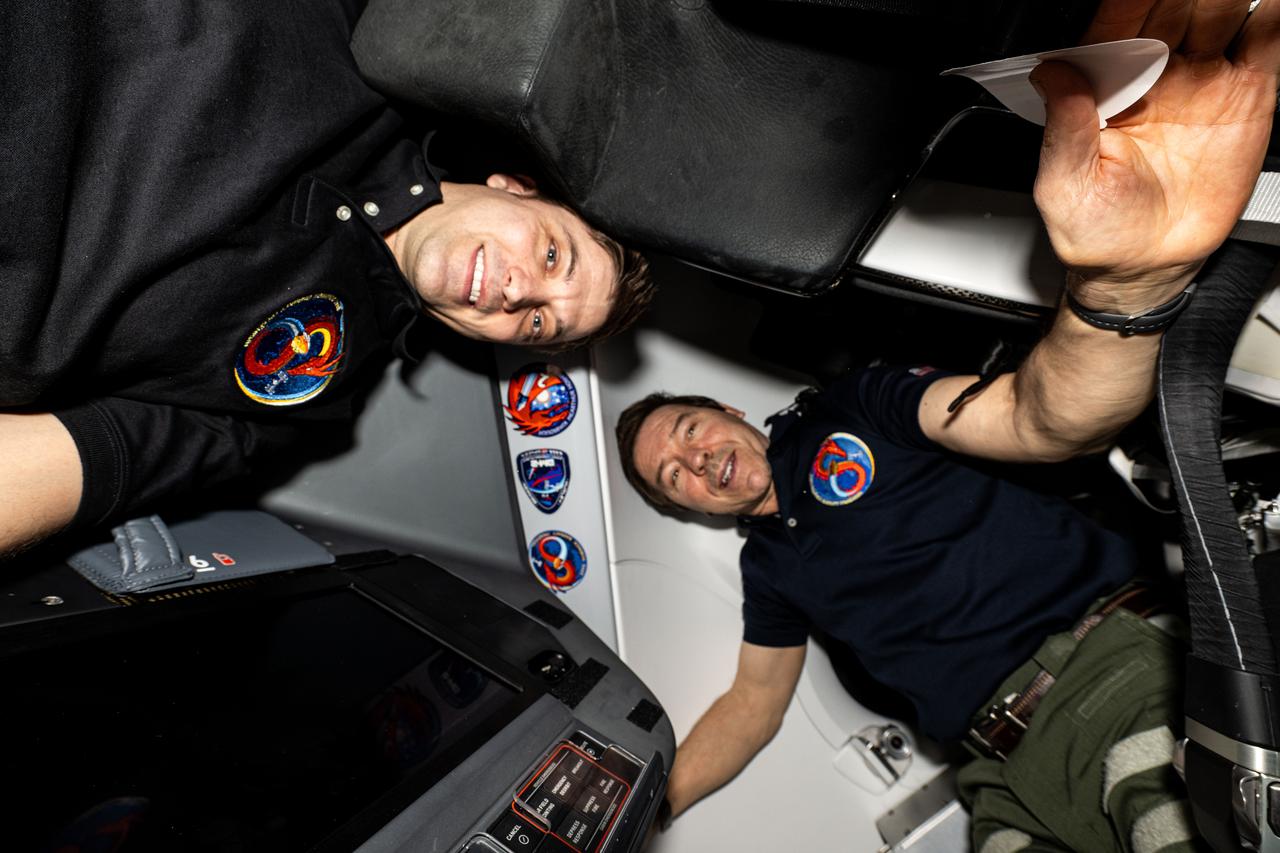
iss072e005790 (Sept. 28, 2024) --- Expedition 72 Flight Engineers (from left) Matthew Dominick and Mike Barratt, both NASA astronauts, pose for a portrait inside the SpaceX Dragon Endeavour spacecraft docked to the Harmony module's space-facing port on the International Space Station. Dominick and Barratt appear next to their mission's insignia, SpaceX Crew-8, alongside the insignias of four other missions that have launched to space aboard Dragon Endeavour.

S83-30608 (29 April 1983) --- The night launch of the space shuttle Challenger heading toward its third Earth-orbital mission is featured in the official insignia for STS-8. The eighth flight of the United States Space Transportation System (STS) is represented by eight stars of the constellation Aquila, "The Eagle," astronauts Richard H. Truly, commander; Daniel C. Brandenstein, pilot; Dale A. Gardner, Guion S. Bluford, and William E. Thornton -- all mission specialists -- have their surnames on the border of the insignia. The NASA insignia design for space shuttle flights is reserved for use by the astronauts and for other official use as the NASA Administrator may authorize. Public availability has been approved only in the forms of illustrations by the various news media. When and if there is any change in this policy, which is not anticipated, the change will be publicly announced. Photo credit: NASA
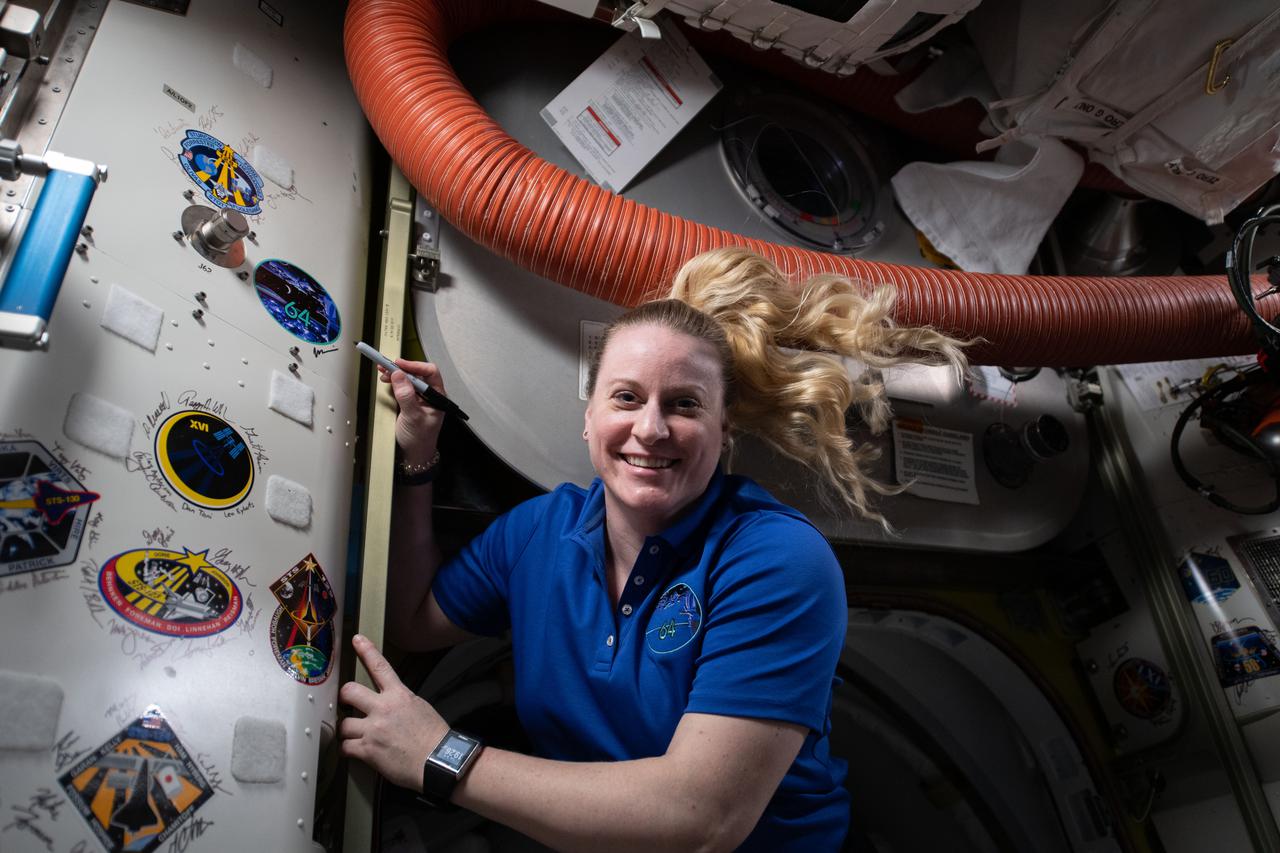
iss064e053364 (April 7, 2021) --- NASA astronaut and Expedition 64 Flight Engineer Kate Rubins signs her name next to the Expedition 64 mission insignia affixed inside the International Space Station.
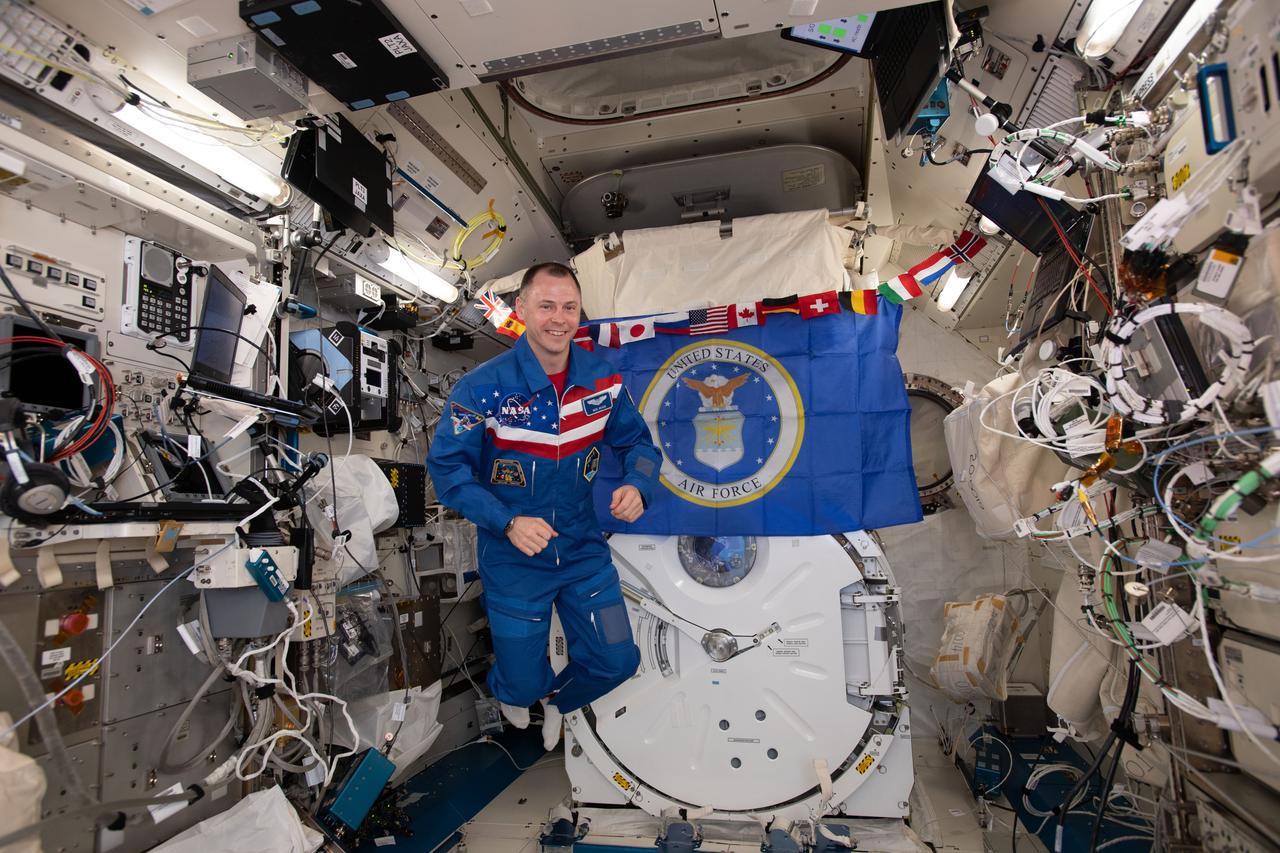
iss059e042272 (April 30, 2019) --- NASA astronaut Nick Hague poses for a portrait with the insignia of the United States Air Force behind him aboard the International Space Station.
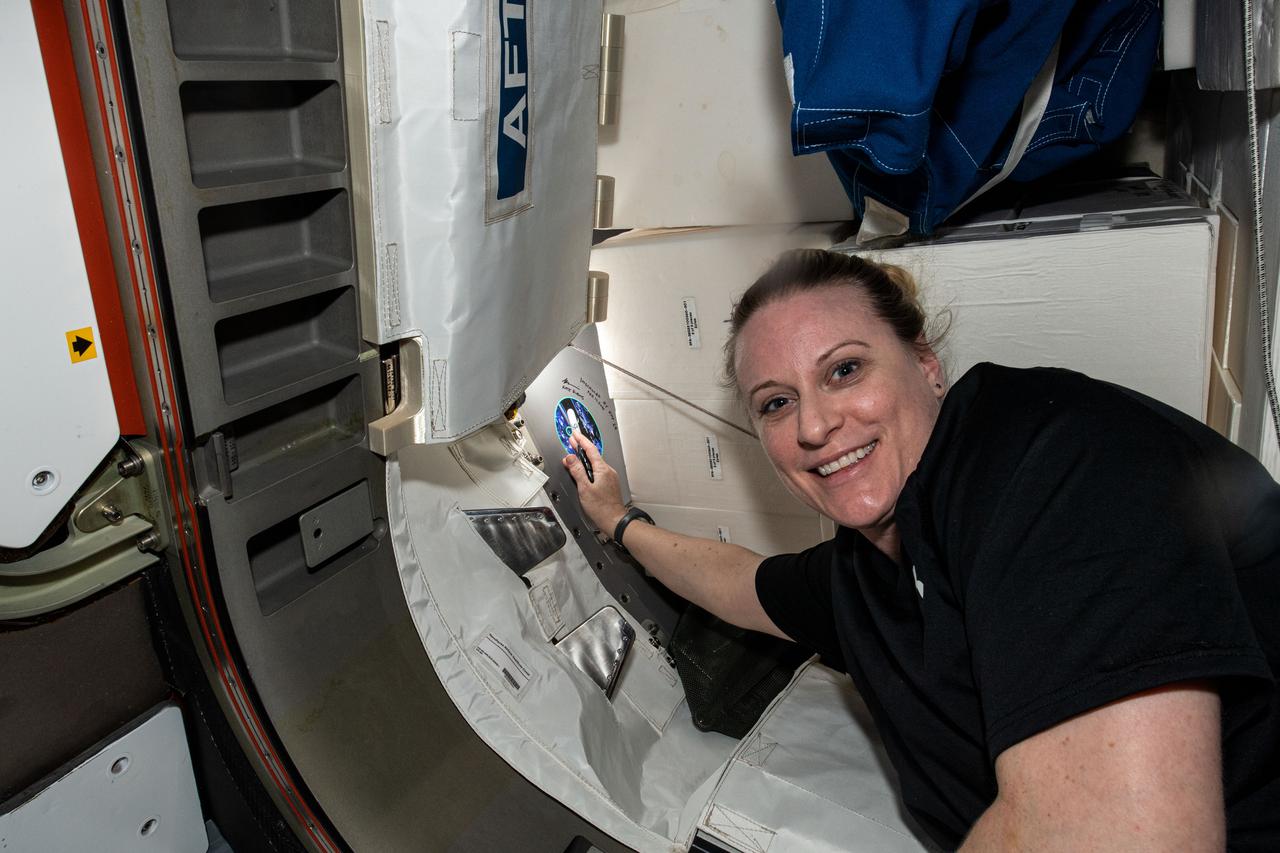
iss064e031800 (Feb. 11,2021) --- NASA astronaut and Expedition 64 Flight Engineer Kate Rubins signs her name near her mission's insignia sticker in the vestibule between the Tranquility module and the NanoRacks Bishop airlock.
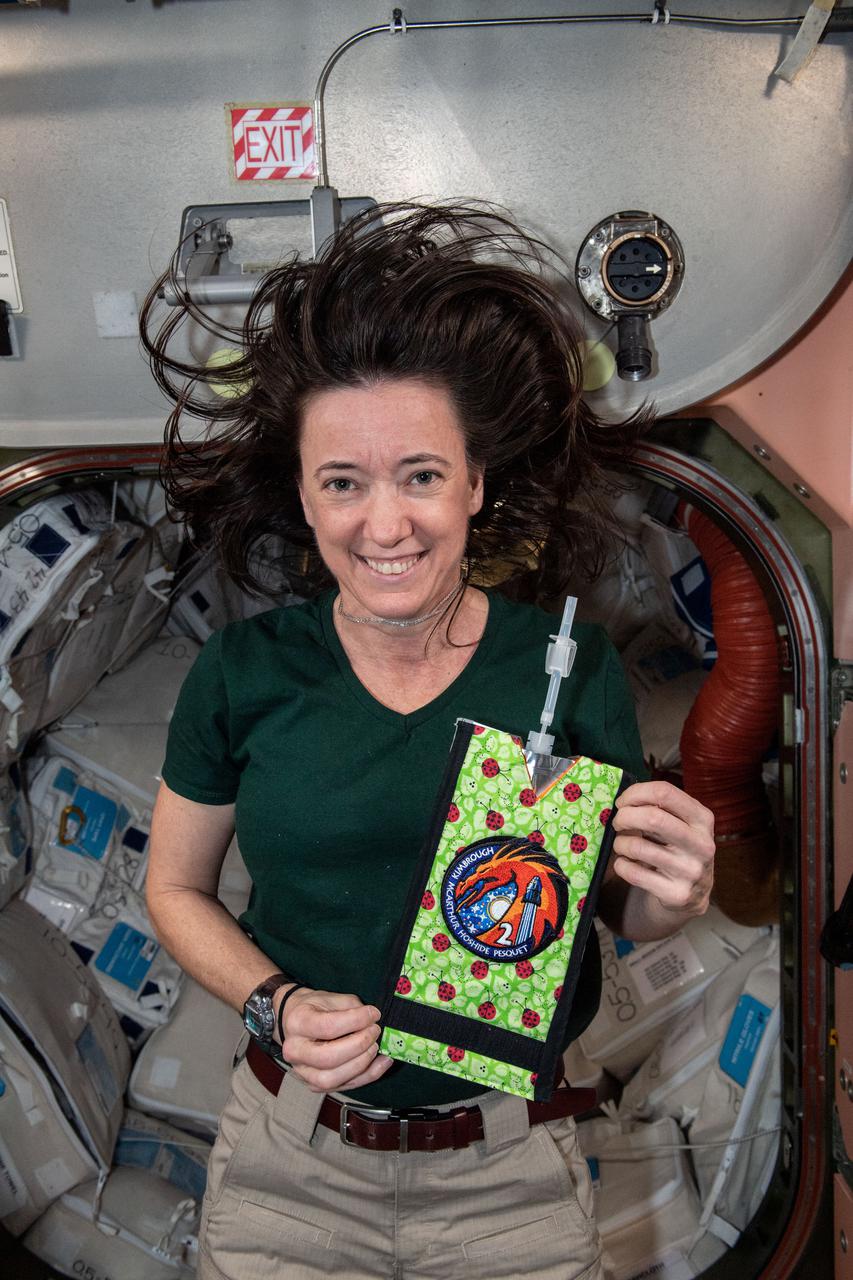
iss066e008128 (Oct. 21, 2021) --- NASA astronaut and Expedition 66 Flight Engineer Megan McArthur holds a personalized drink pouch bearing the SpaceX Crew-2 mission insignia patch.
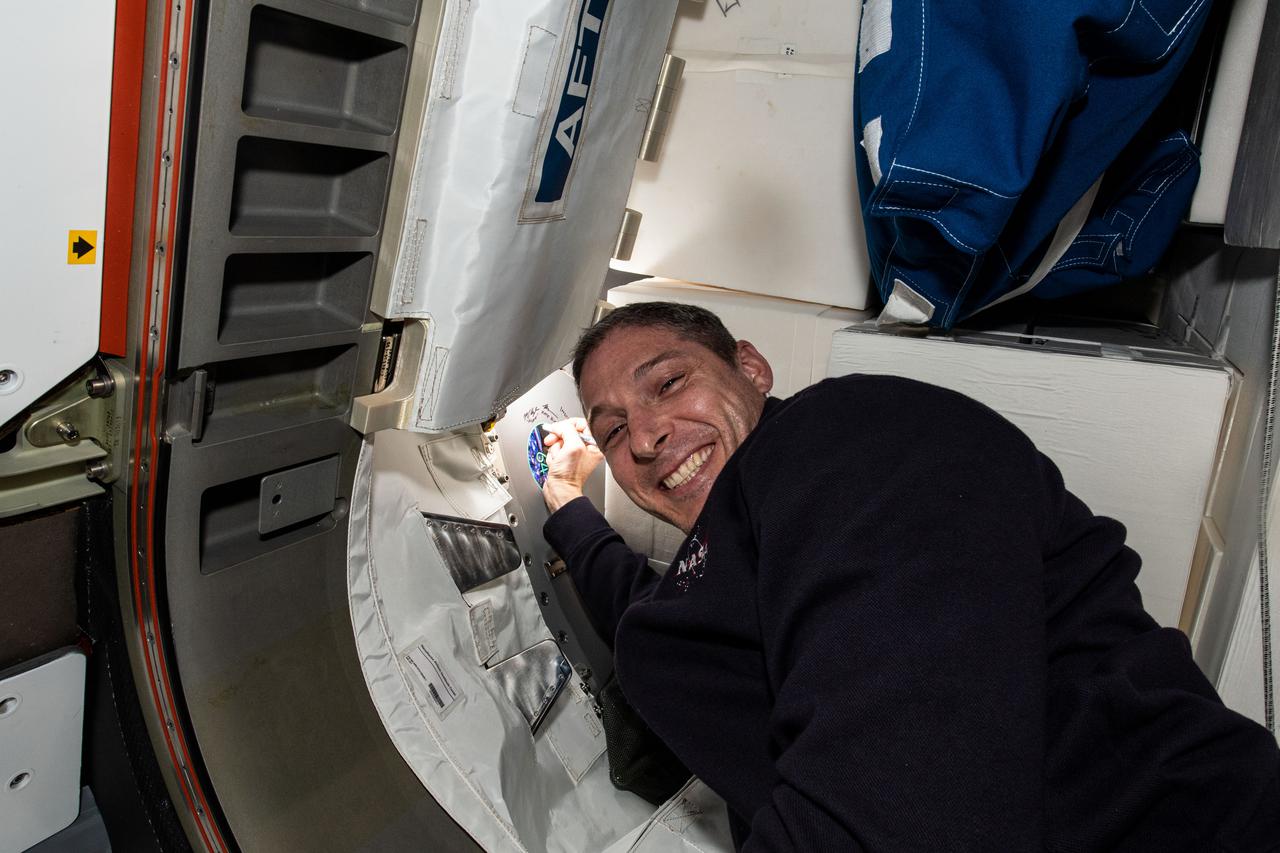
iss064e031801 (Feb. 11,2021) --- NASA astronaut and Expedition 64 Flight Engineer Michael Hopkins signs his name near his mission's insignia sticker in the vestibule between the Tranquility module and the NanoRacks Bishop airlock.
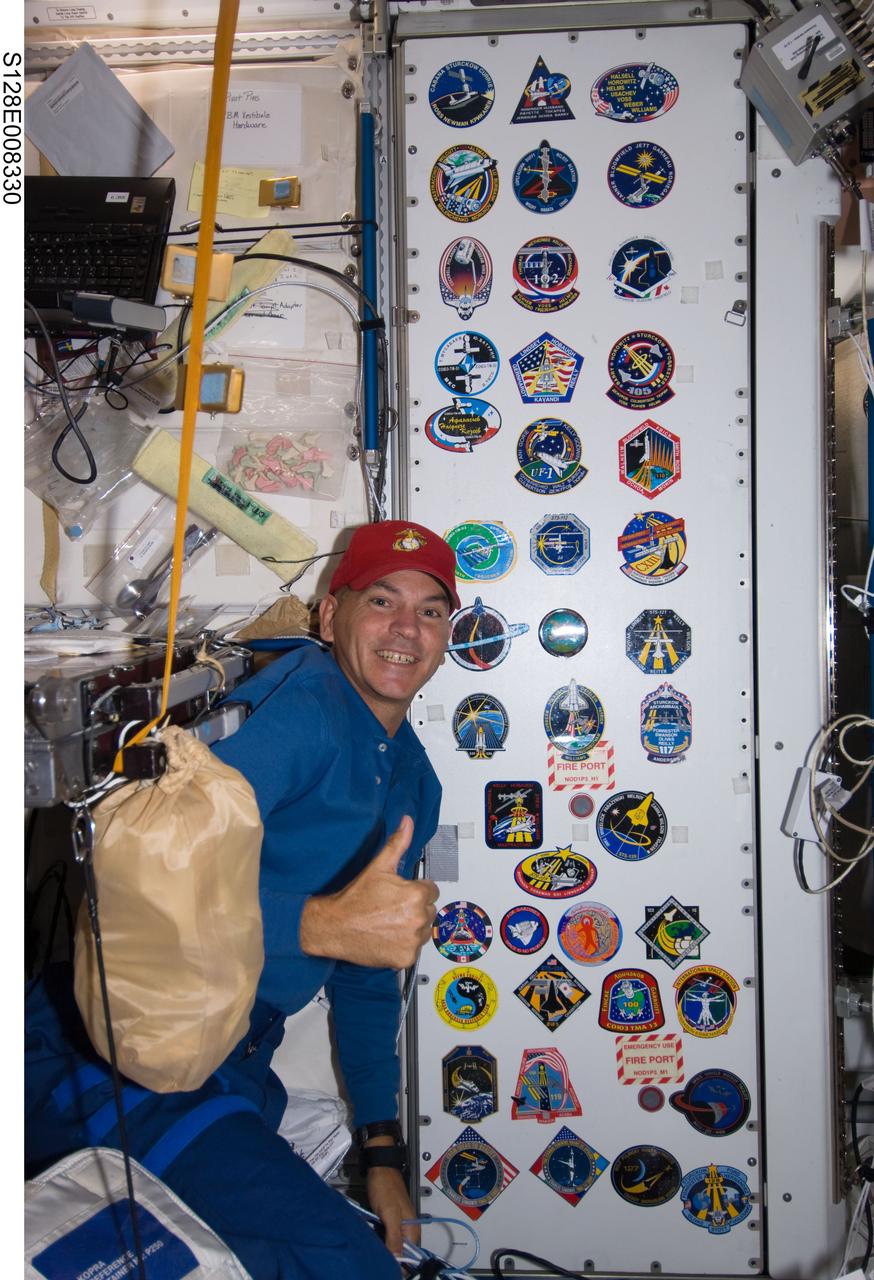
S128-E-008330 (7 Sept. 2009) --- NASA astronaut Rick Sturckow, STS-128 commander, poses for a photo with the growing collection, in the Unity node, of insignias representing crews who have worked on the International Space Station.
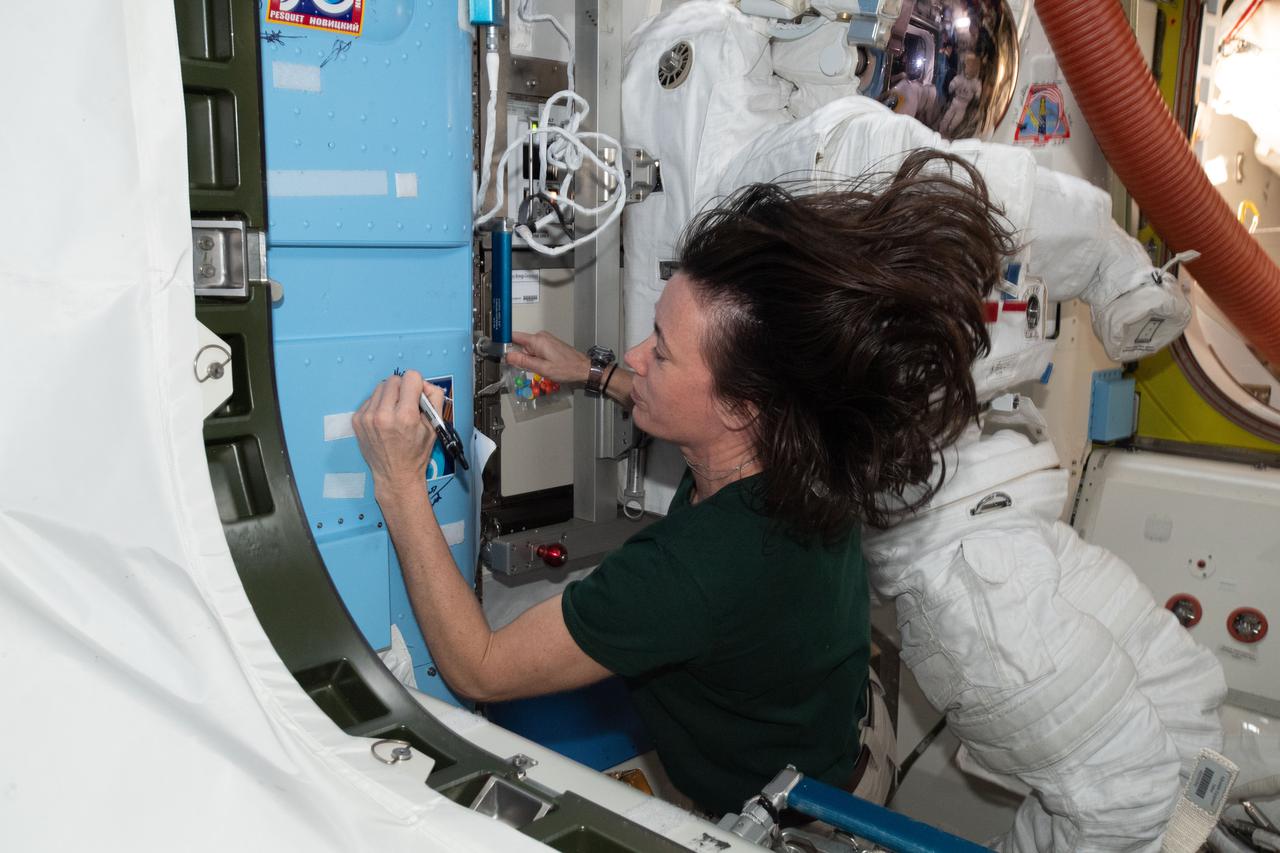
iss065e389558 (Sept. 17, 2021) --- NASA astronaut and Expedition 65 Flight Engineer Megan McArthur signs her name around the Expedition 65 mission insignia sticker affixed to the vestibule in between the Unity module and the Quest airlock.
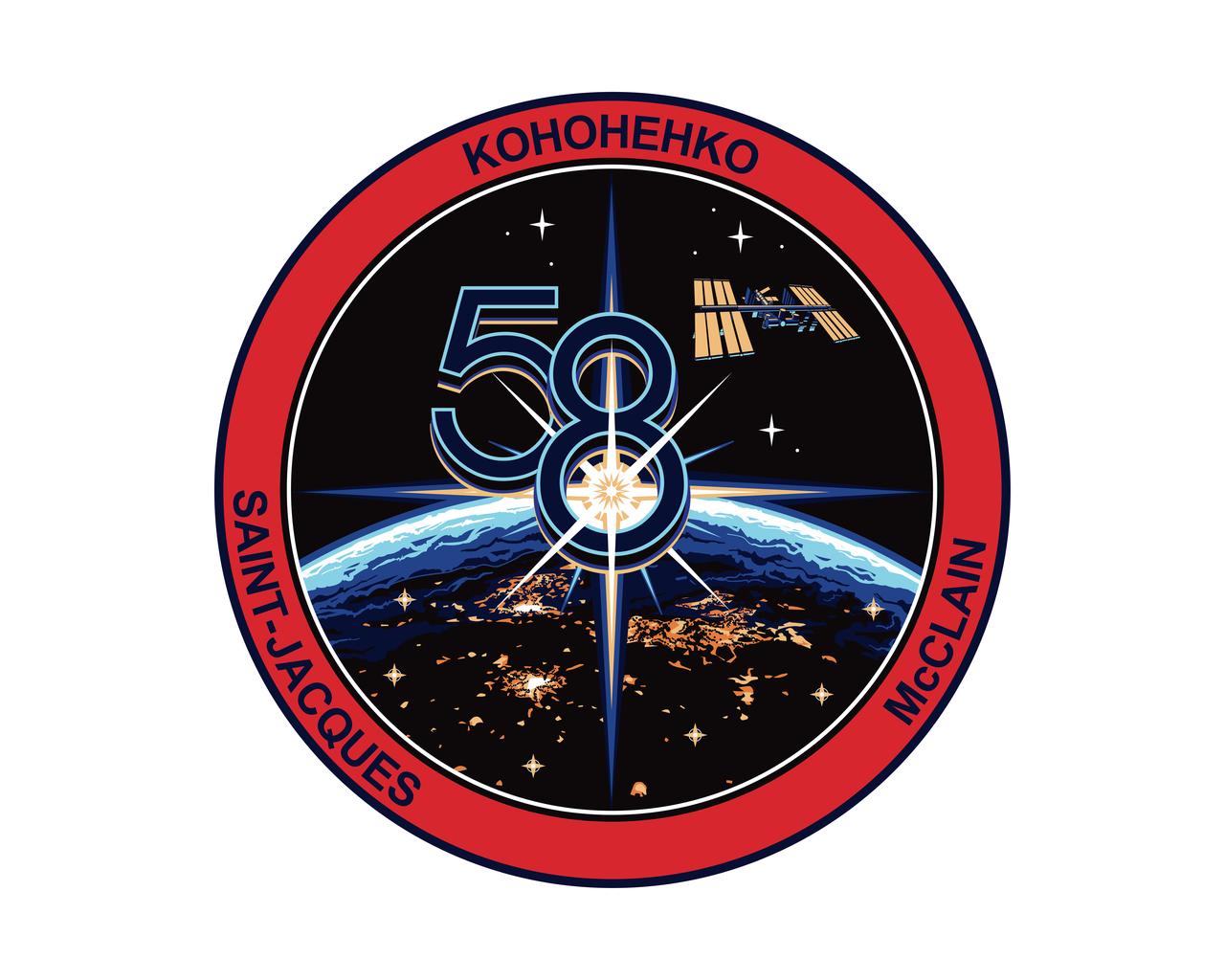
iss058-s-001b (Nov. 27, 2018) --- The official insignia for the three-member Expedition 58 crew with Anne McClain of NASA, Oleg Kononenko of Roscosmos and David Saint-Jacques of the Canadian Space Agency.
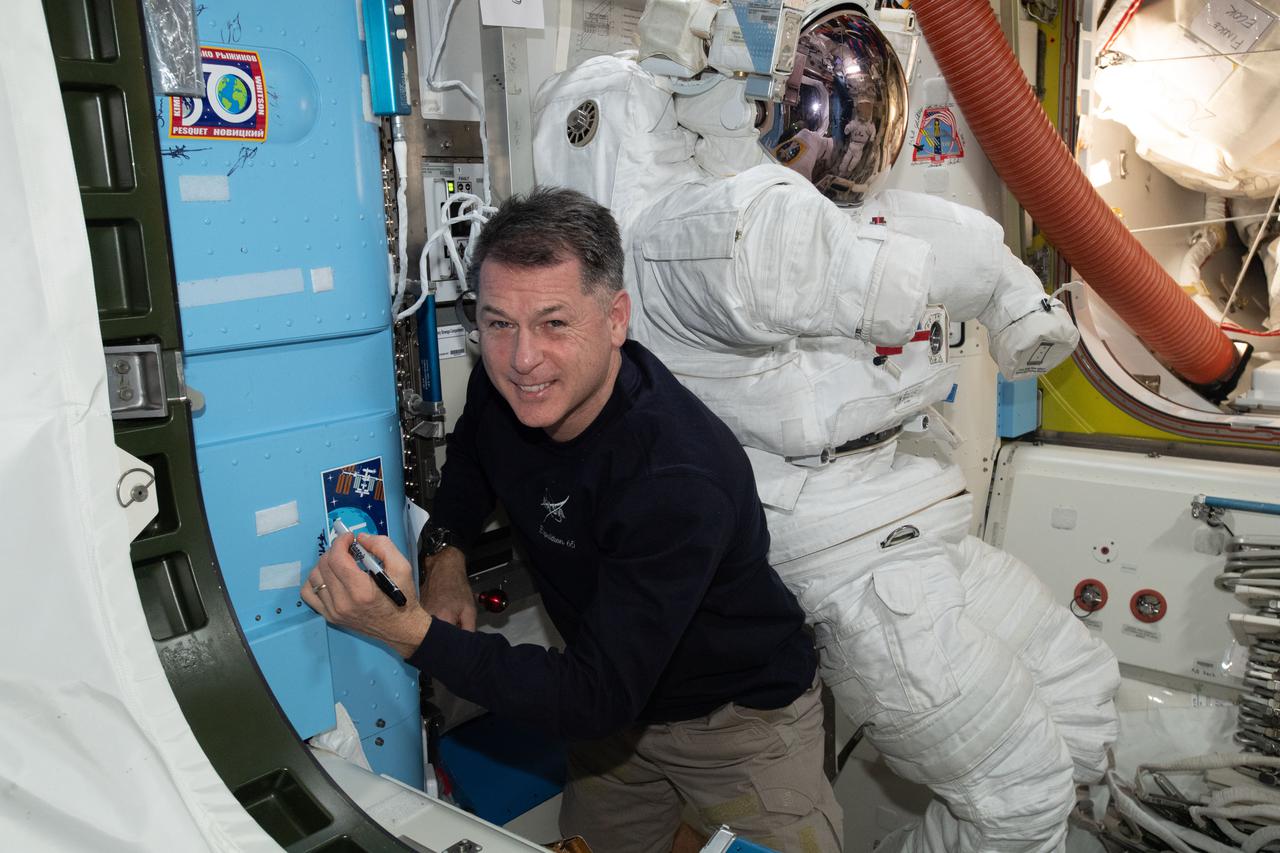
iss065e389550 (Sept. 17, 2021) --- NASA astronaut and Expedition 65 Flight Engineer Shane Kimbrough signs his name around the Expedition 65 mission insignia sticker affixed to the vestibule in between the Unity module and the Quest airlock.
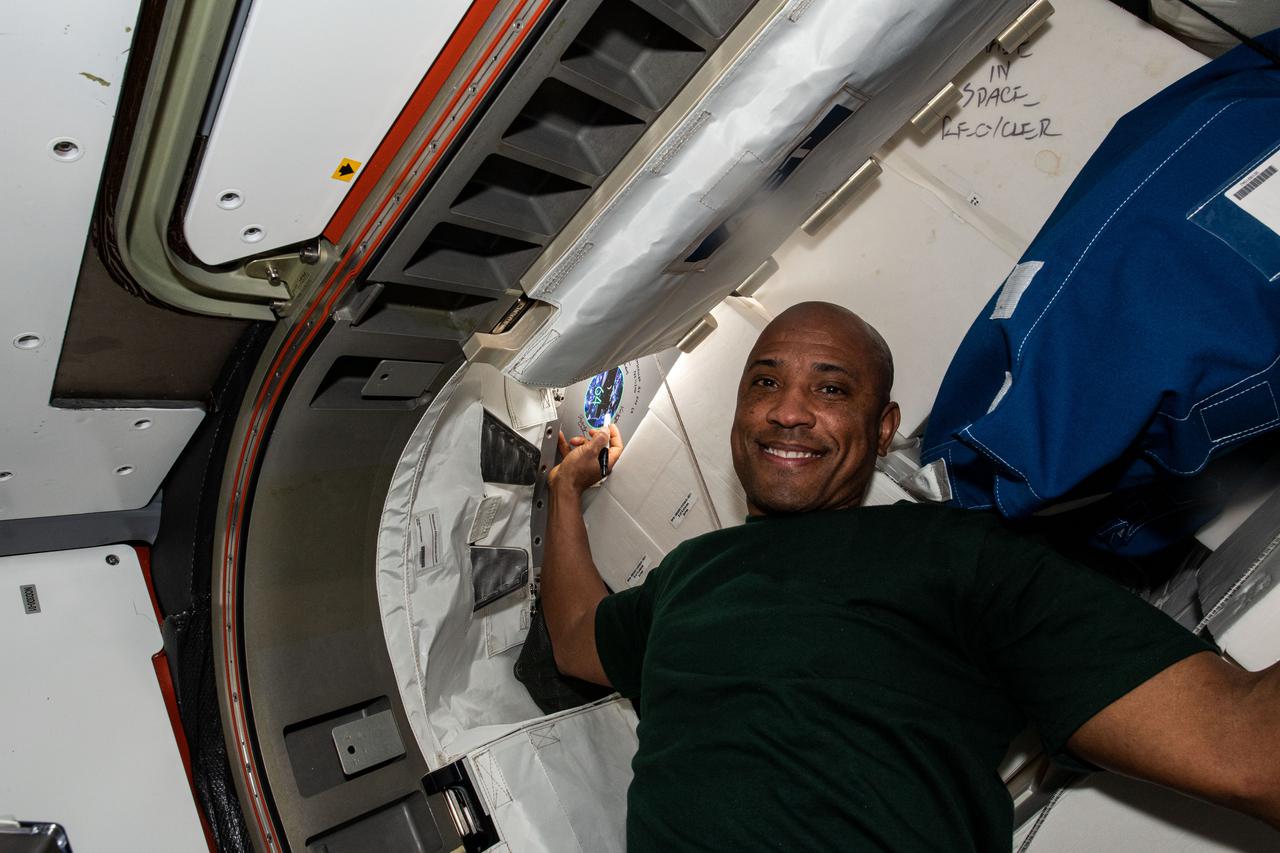
iss064e031803 (Feb. 11,2021) --- NASA astronaut and Expedition 64 Flight Engineer Victor Glover signs his name near his mission's insignia sticker in the vestibule between the Tranquility module and the NanoRacks Bishop airlock.
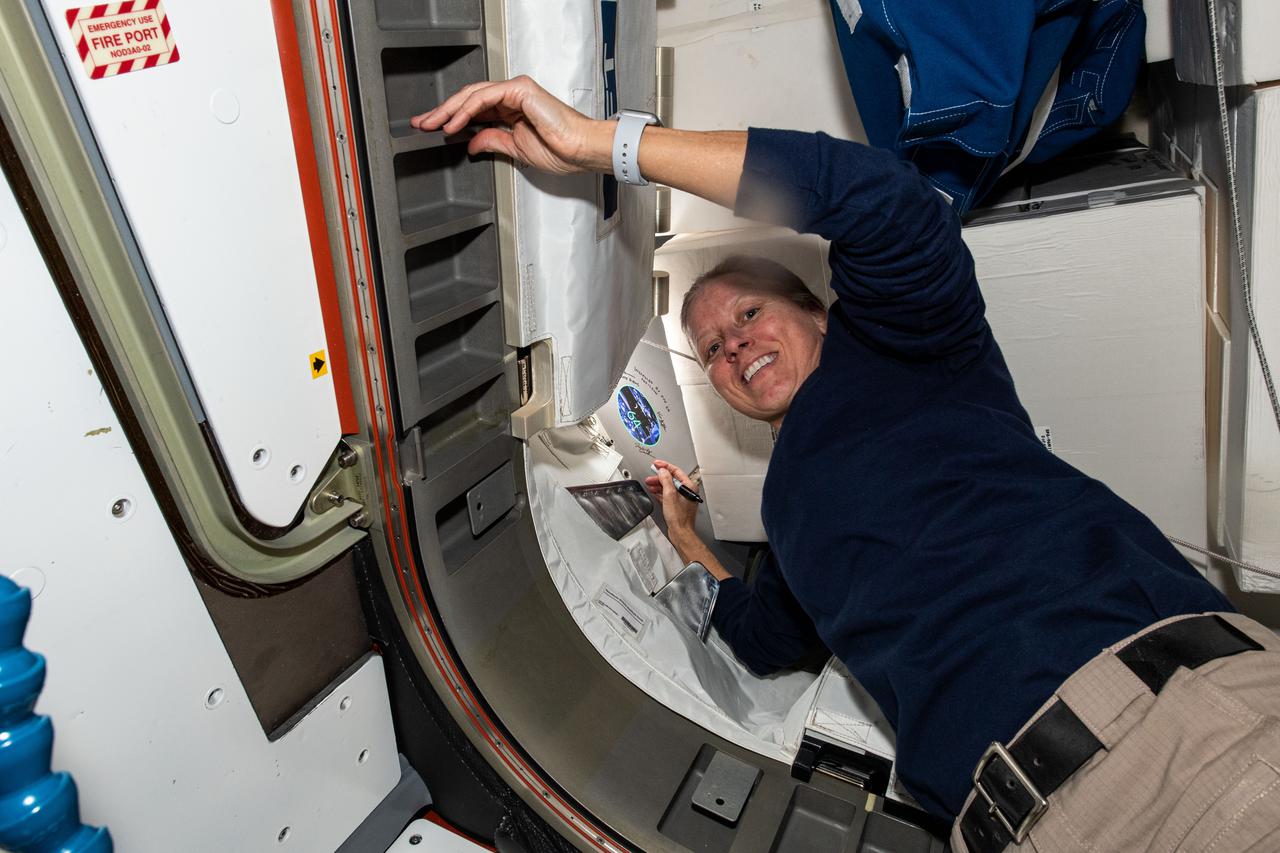
iss064e031802 (Feb. 11,2021) --- NASA astronaut and Expedition 64 Flight Engineer Shannon Walker signs her name near her mission's insignia sticker in the vestibule between the Tranquility module and the NanoRacks Bishop airlock.
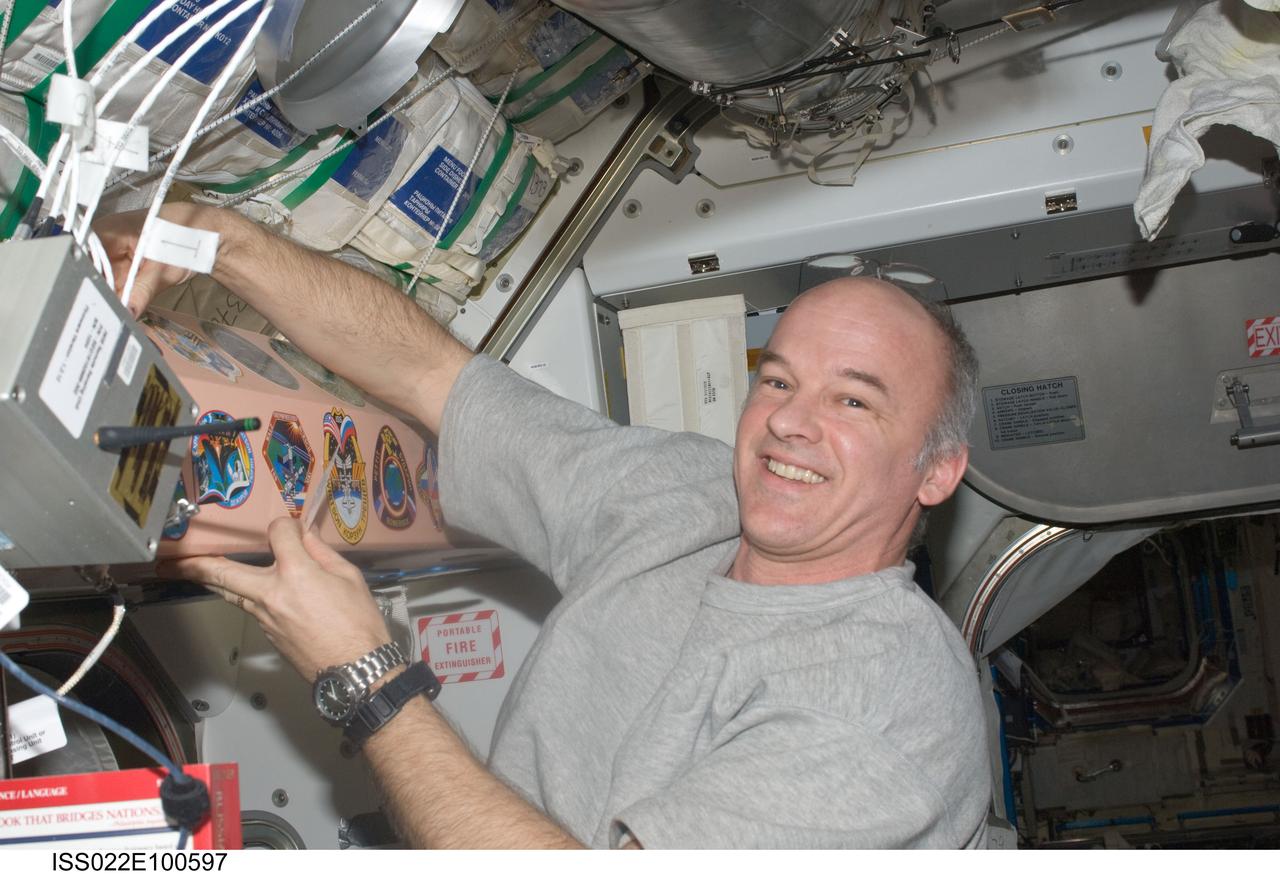
ISS022-E-100597 (17 March 2010) --- NASA astronaut Jeffrey Williams, Expedition 22 commander, places the Expedition 22 mission insignia along with others in the Unity node of the International Space Station.
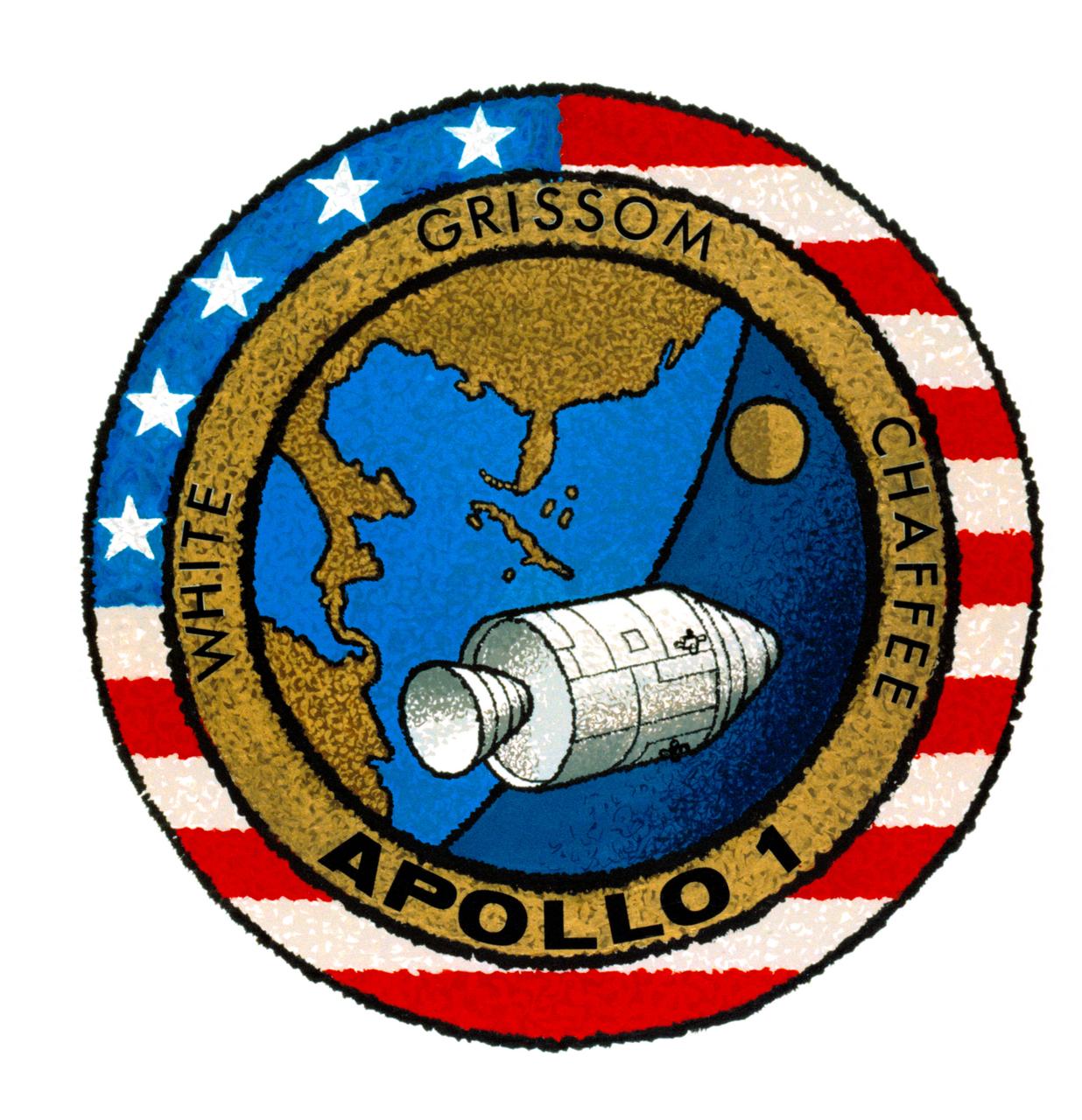
S66-36742 (1966) --- This is the insignia for the National Aeronautics and Space Administration's (NASA) Apollo 1 mission, the first manned Apollo flight. Crew members are astronauts Virgil I. Grissom, Edward H. White II and Roger B. Chaffee. The NASA insignia design for Apollo flights is reserved for use by the astronauts and for other official use as the NASA Administrator may authorize. Public availability has been approved only in the form of illustrations by the various news media. When and if there is any change in this policy, which we do not anticipate, it will be publicly announced. EDITOR'S NOTE: The three astronauts lost their lives in a fire during a simulation on the launch pad on Jan. 27, 1967.
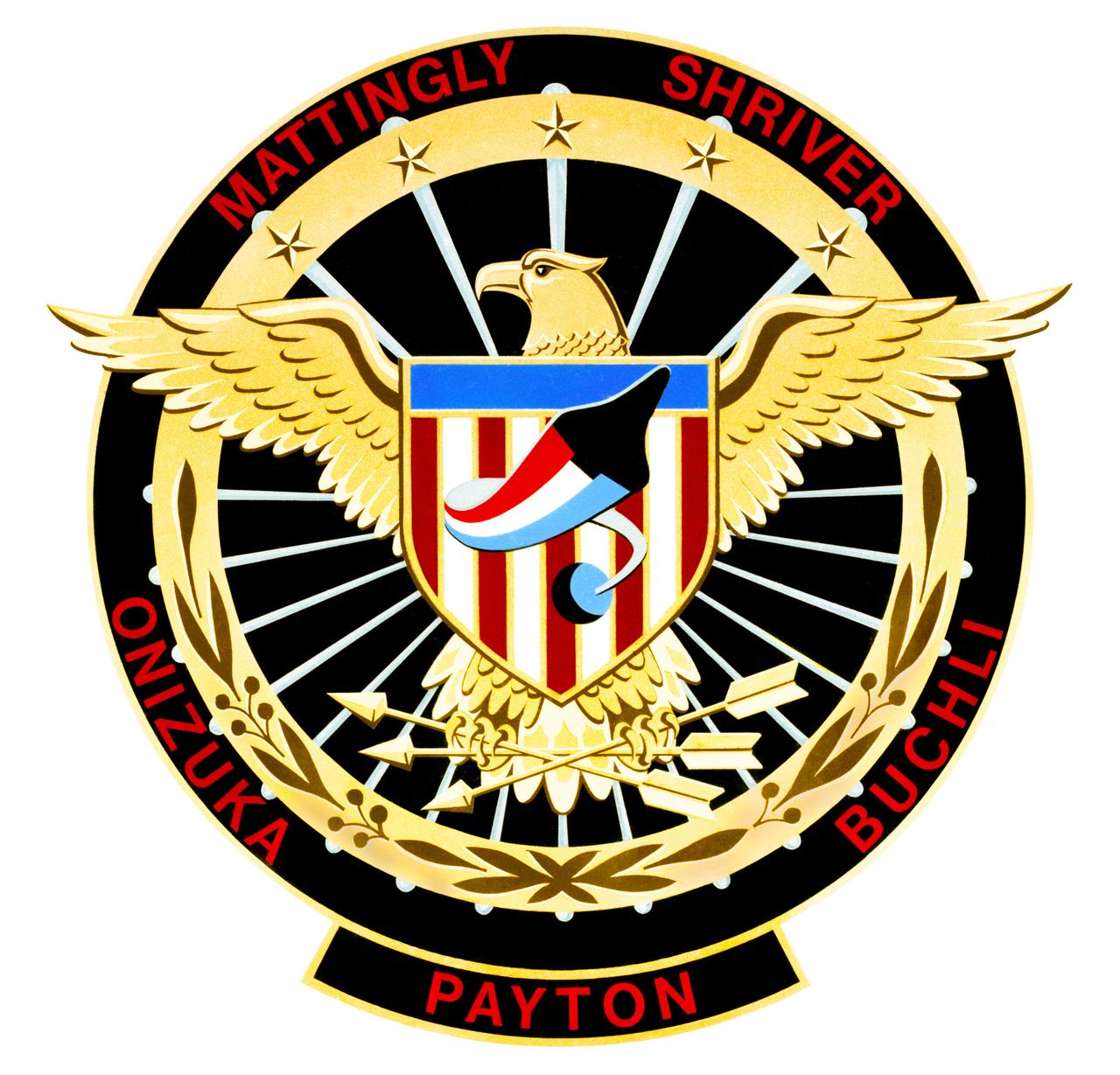
S84-42223 (10 Nov. 1984) --- The crew insignia for STS-51C includes the names of its five crew members are astronauts Thomas K. Mattingly, commander; Loren J. Shriver, pilot; Ellison L. Onizuka and James F. Buchli, mission specialists; and Gary E. Payton, payload specialist. The NASA insignia design for space shuttle flights is reserved for use by the astronauts and for other official use as the NASA Administrator may authorize. Public availability has been approved only in the forms of illustrations by the various news media. When and if there is any change in this policy, which is not anticipated, the change will be publicly announced. Photo credit: NASA
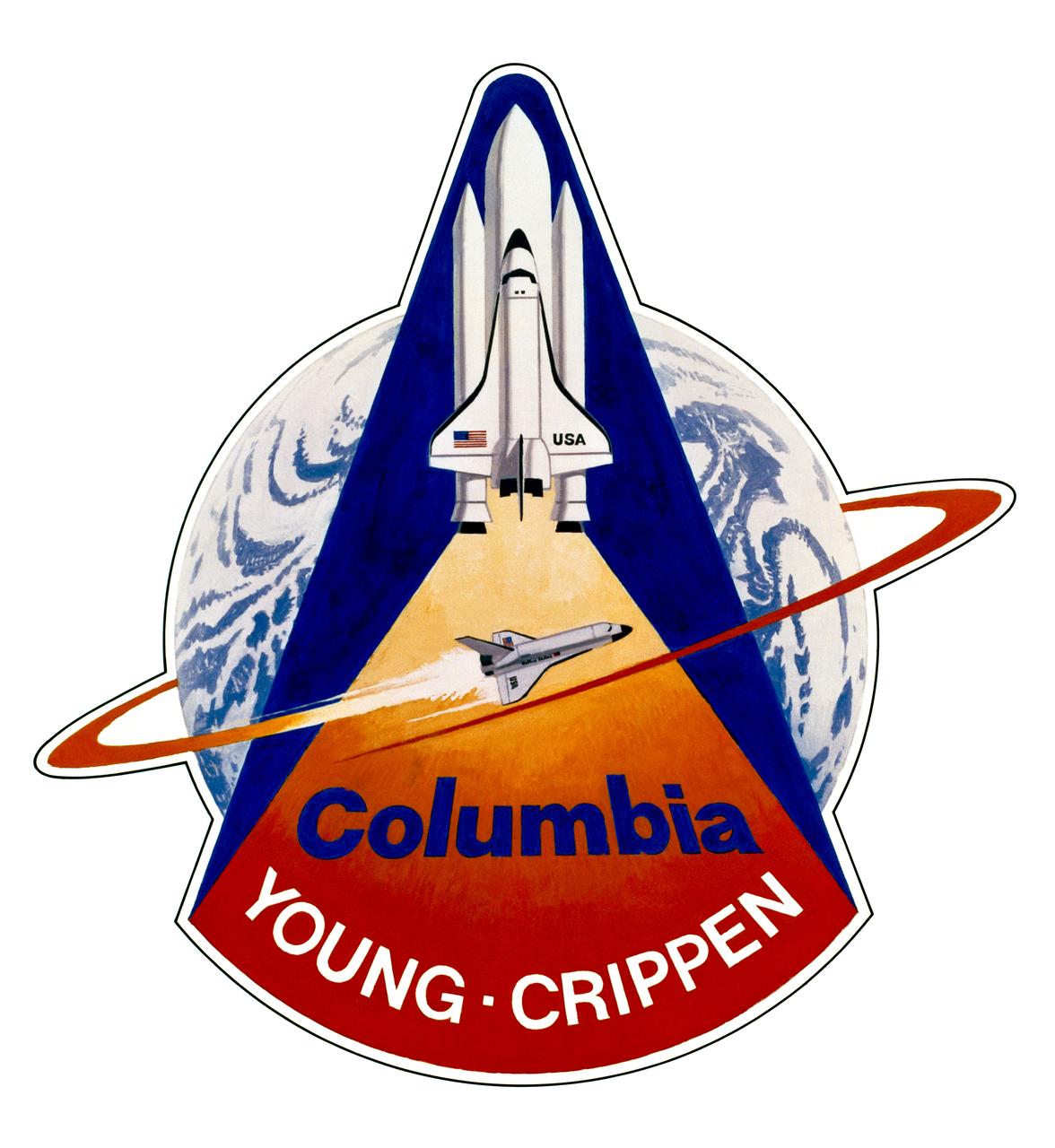
S79-30685 (10 March 1979) --- This is the official insignia for the first space shuttle orbital flight test (STS-1). Crew of the 102 Columbia on STS-1 will be astronauts John W. Young, commander, and Robert L. Crippen, pilot. The artwork was done by artist Robert McCall. The NASA insignia design for space shuttle flights is reserved for use by the astronauts and for other official use as the NASA Administrator may authorize. Public availability has been approved only in the forms of illustrations by the various news media. When and if there is any change in this policy, which is not anticipated, the change will be publicly announced. Photo credit: NASA

NASA astronauts Reid Wiseman, Victor Glover, and Christina Hammock Koch, and CSA astronaut Jeremy Hansen were announced Monday, April 3 as the four astronauts who will venture around the Moon on Artemis II, the first crewed mission on NASA’s path to establishing a long-term presence at the Moon for science and exploration through Artemis. The crew assignments are as follows: Commander Reid Wiseman, Pilot Victor Glover, Mission Specialist 1 Christina Koch, Mission Specialist 2 Jeremy Hansen. This image was modified to include CSA’s insignia on the center front of Hansen’s spacesuit. The insignia was not available at the time of the photo. It will be on Hansen’s suit for Artemis II.

Canadian Space Agency Astronaut Jeremy Hansen is making his first flight to space as a mission specialist on the Artemis II mission. He was one of two recruits selected by CSA in May 2009 through the third Canadian Astronaut Recruitment Campaign and has served in many roles supporting human spaceflight. Hansen has served as Capcom in NASA's Mission Control Center at the Johnson Space Center and in 2017, became the first Canadian to be entrusted with leading a NASA astronaut class, leading the training of astronaut candidates from the United States and Canada. This image was modified to include CSA’s insignia on the center front of Hansen’s spacesuit. The insignia was not available at the time of the photo. It will be on Hansen’s suit for Artemis II.
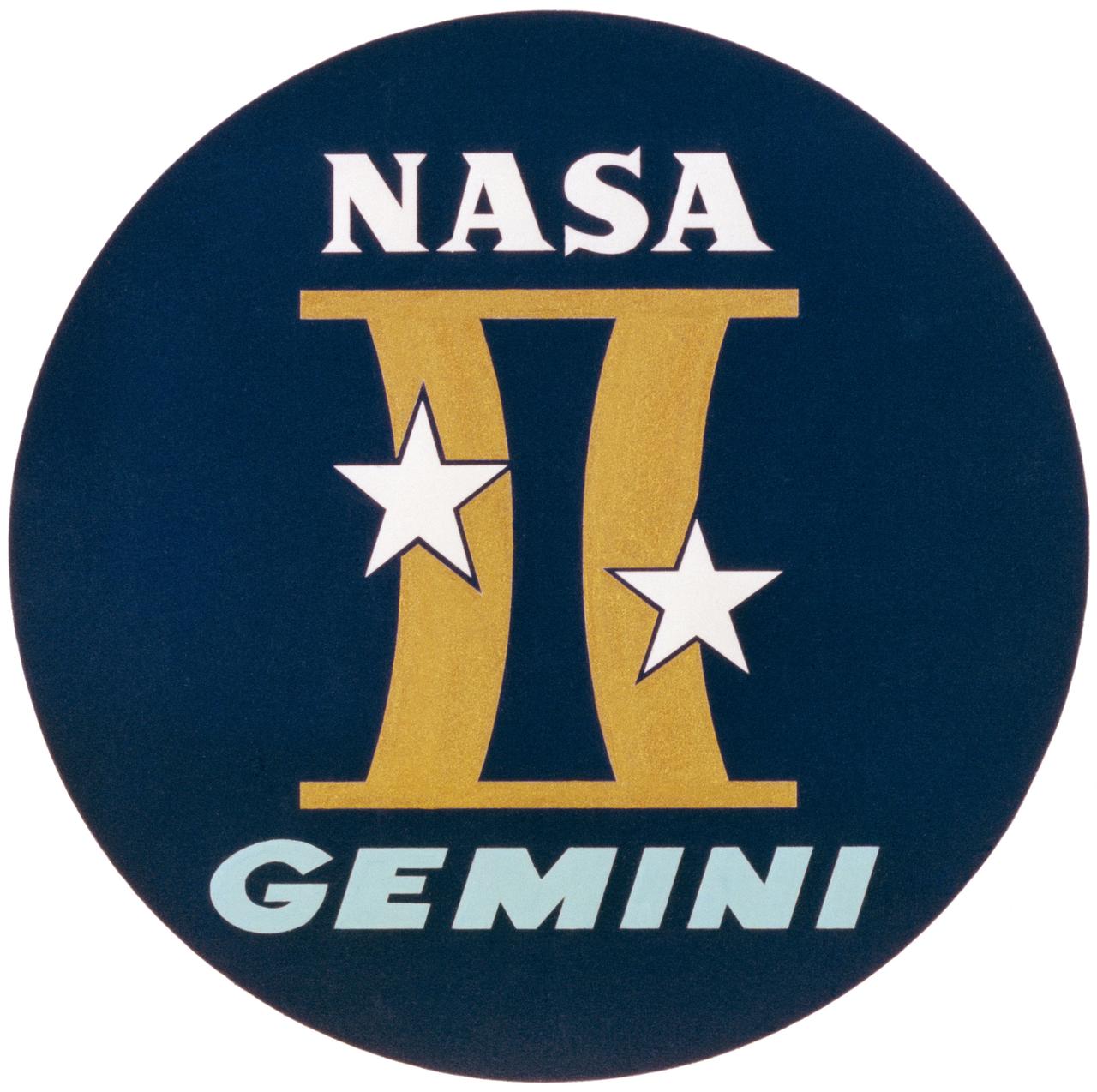
S65-54354 (30 Aug. 1965) --- The insignia of the Gemini Space Program is a disc of dark blue as a background for a gold Zodiac Gemini symbol. A white star on each of the two vertical curves of the Gemini symbol represent the Gemini twins, Pollux and Castor. The NASA insignia design for Gemini flights is reserved for use by the astronauts and for other official use as the NASA Administrator may authorize. Public availability has been approved only in the form of illustrations by the various news media. When and if there is any change in this policy, which we do not anticipate, it will be publicly announced.
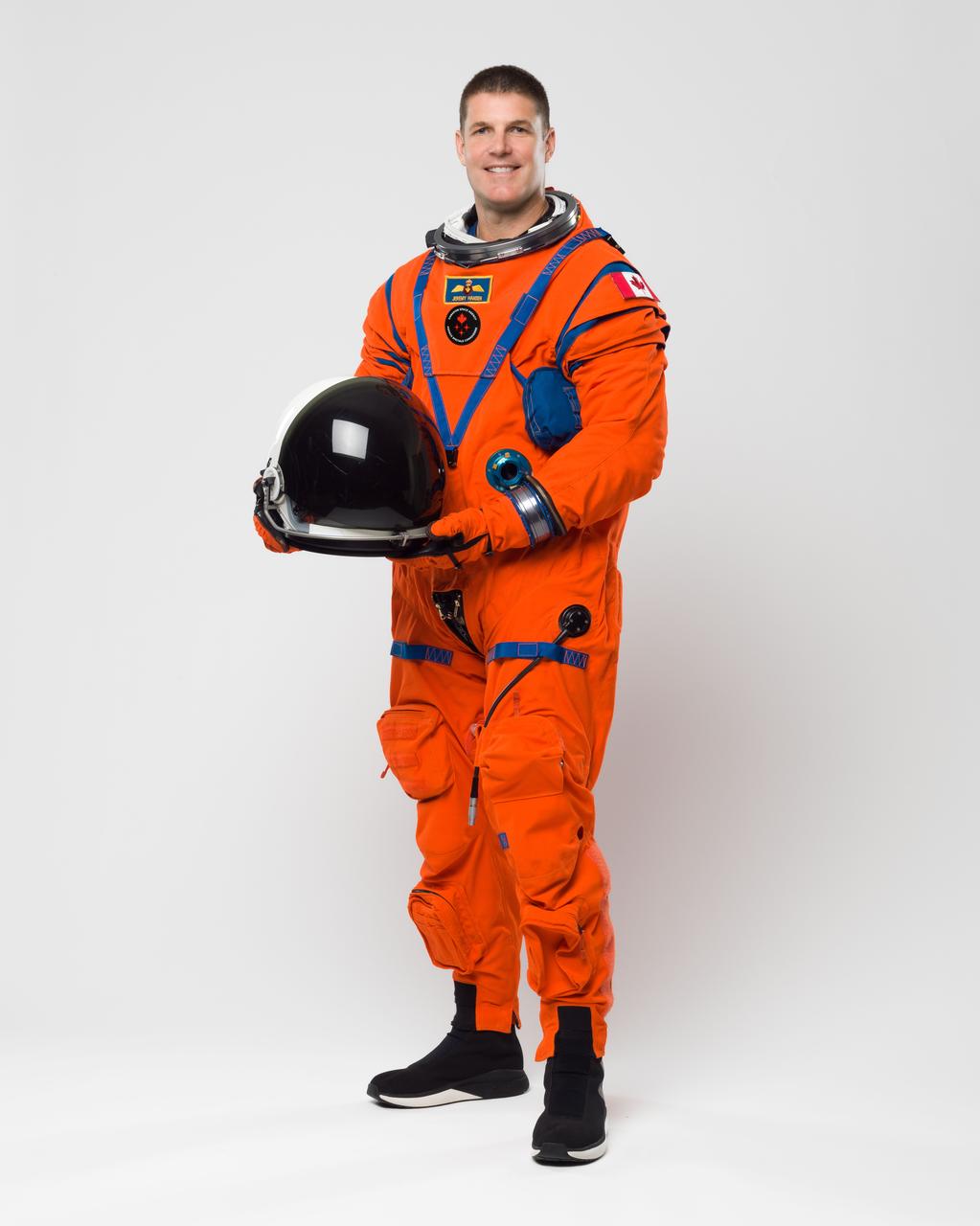
Canadian Space Agency Astronaut Jeremy Hansen is making his first flight to space as a mission specialist on the Artemis II mission. He was one of two recruits selected by CSA in May 2009 through the third Canadian Astronaut Recruitment Campaign and has served in many roles supporting human spaceflight. Hansen has served as Capcom in NASA's Mission Control Center at the Johnson Space Center and in 2017, became the first Canadian to be entrusted with leading a NASA astronaut class, leading the training of astronaut candidates from the United States and Canada. This image was modified to include CSA’s insignia on the center front of Hansen’s spacesuit. The insignia was not available at the time of the photo. It will be on Hansen’s suit for Artemis II.
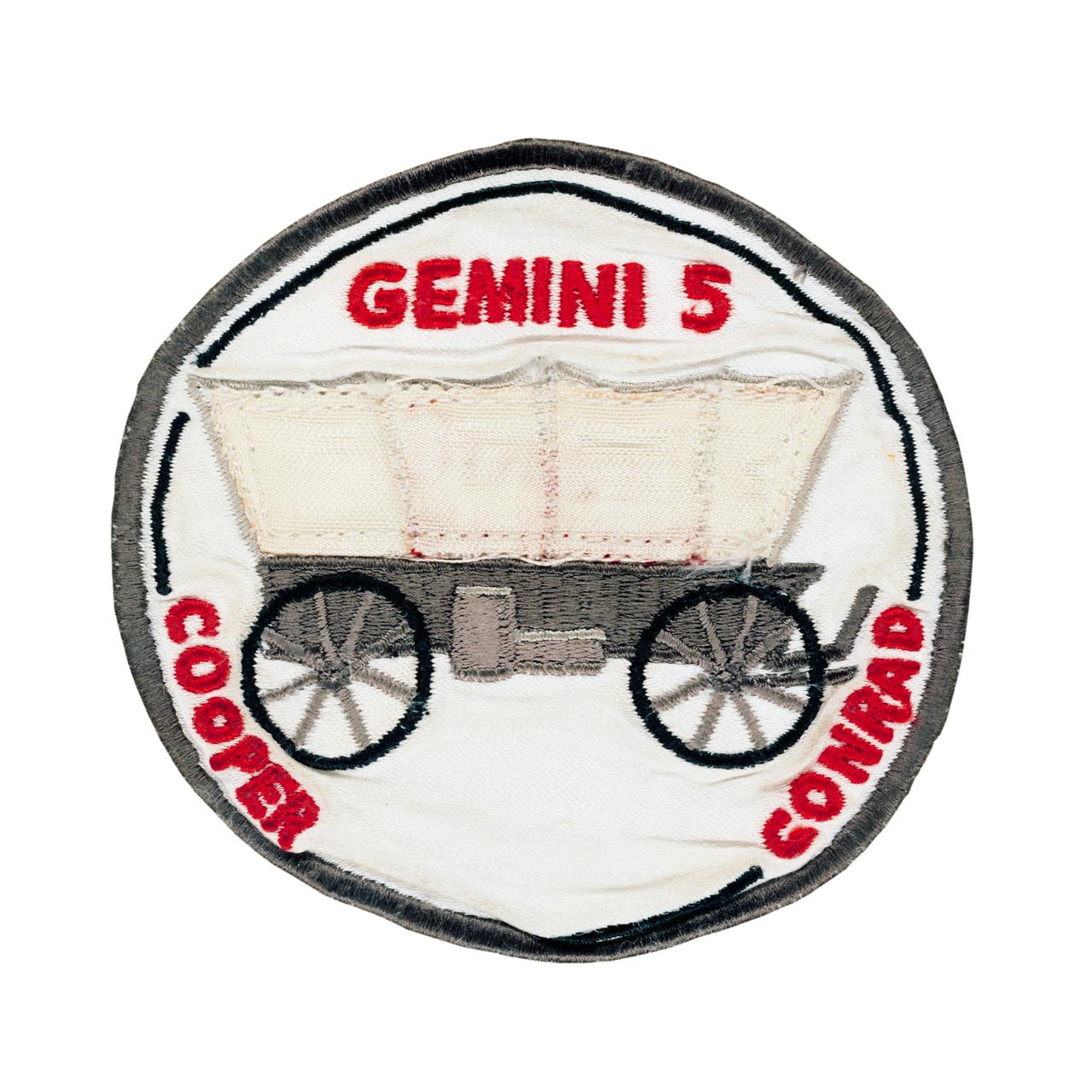
S66-59530 (August 1965) --- This is the insignia of the Gemini-Titan 5 (GT-5) spaceflight. The Gemini-5 prime crew members are astronauts L. Gordon Cooper Jr., command pilot; and Charles Conrad Jr., pilot. The covered wagon symbolizes pioneer spirit of space exploration. The NASA insignia design for Gemini flights is reserved for use by the astronauts and for other official use as the NASA Administrator may authorize. Public availability has been approved only in the form of illustrations by the various news media. When and if there is any change in this policy, which we do not anticipate, it will be publicly announced.
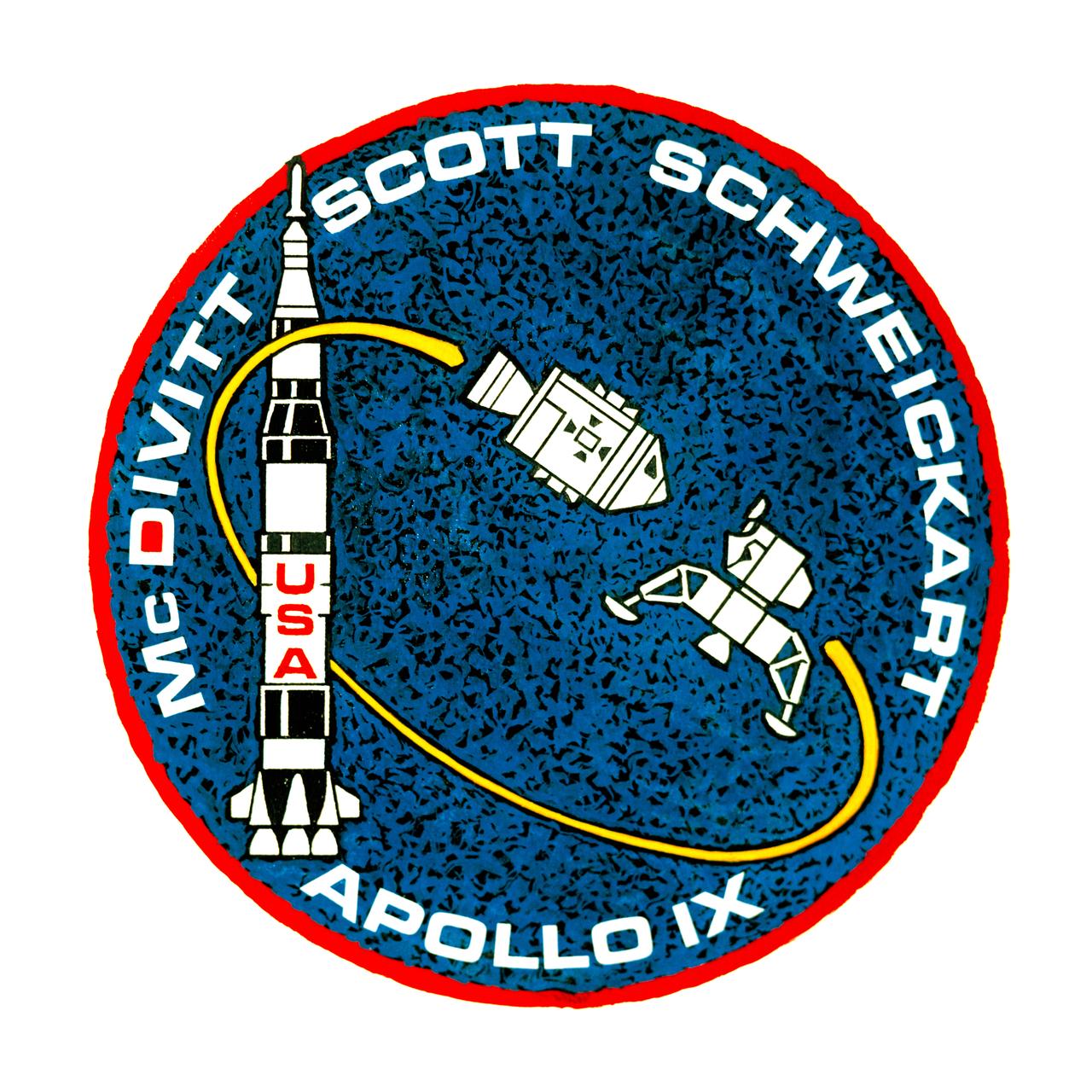
S69-18569 (February 1969) --- The insignia of the Apollo 9 space mission. The crew consist of astronauts James A. McDivitt, commander; David R. Scott, command module pilot; and Russell L. Schweickart, lunar module pilot. The Apollo 9 mission will evaluate spacecraft lunar module systems performance during manned Earth-orbital flight. The NASA insignia design for Apollo flights is reserved for use by the astronauts and for other official use as the NASA Administrator may authorize. Public availability has been approved only in the form of illustrations by the various news media. When and if there is any change in this policy, which we do not anticipate, it will be publicly announced.
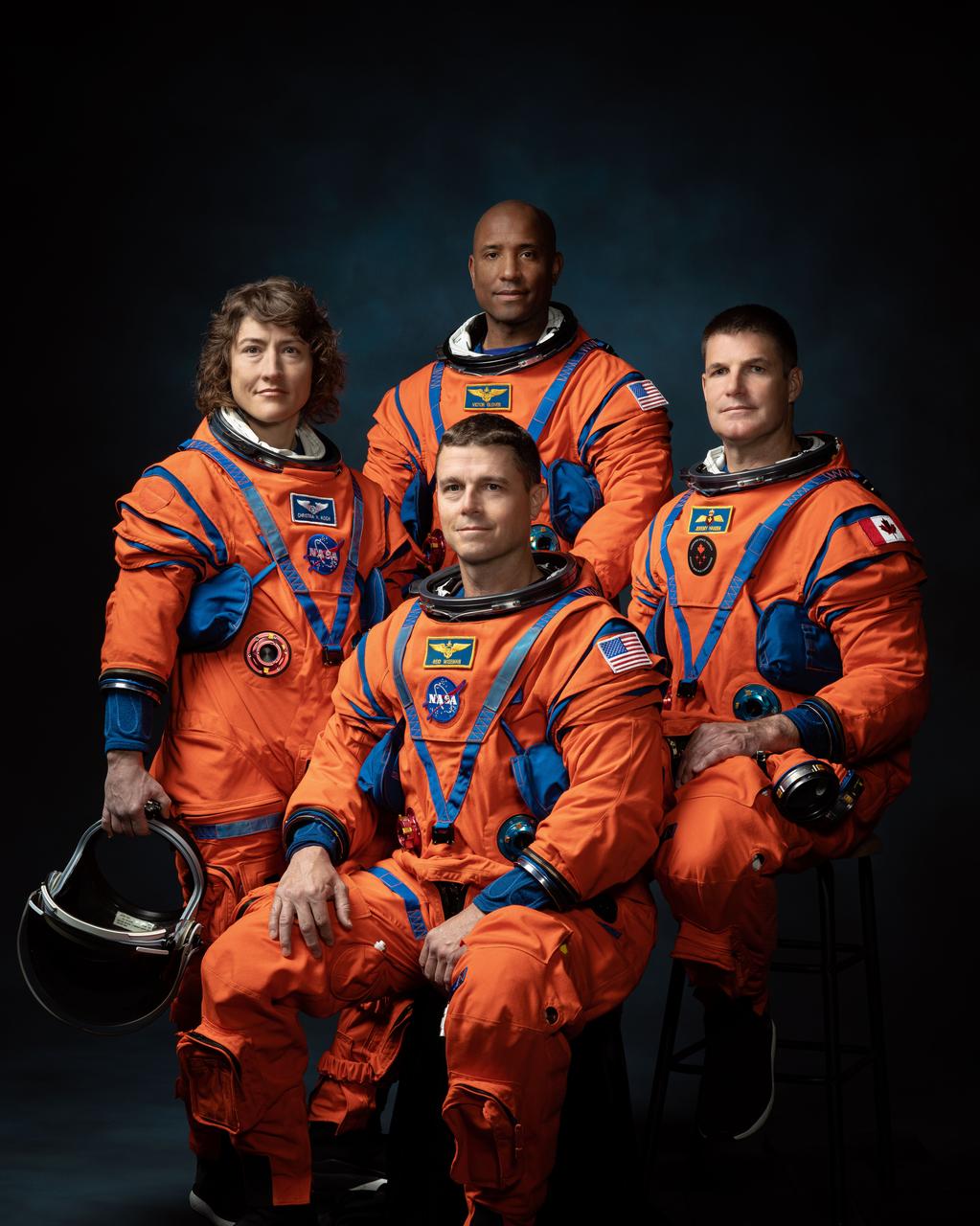
NASA astronauts Reid Wiseman, Victor Glover, and Christina Hammock Koch, and CSA astronaut Jeremy Hansen were announced Monday, April 3 as the four astronauts who will venture around the Moon on Artemis II, the first crewed mission on NASA’s path to establishing a long-term presence at the Moon for science and exploration through Artemis. The crew assignments are as follows: Commander Reid Wiseman, Pilot Victor Glover, Mission Specialist 1 Christina Koch, Mission Specialist 2 Jeremy Hansen. This image was modified to include CSA’s insignia on the center front of Hansen’s spacesuit. The insignia was not available at the time of the photo. It will be on Hansen’s suit for Artemis II. PHOTOGRAPHER: Josh Valcarcel
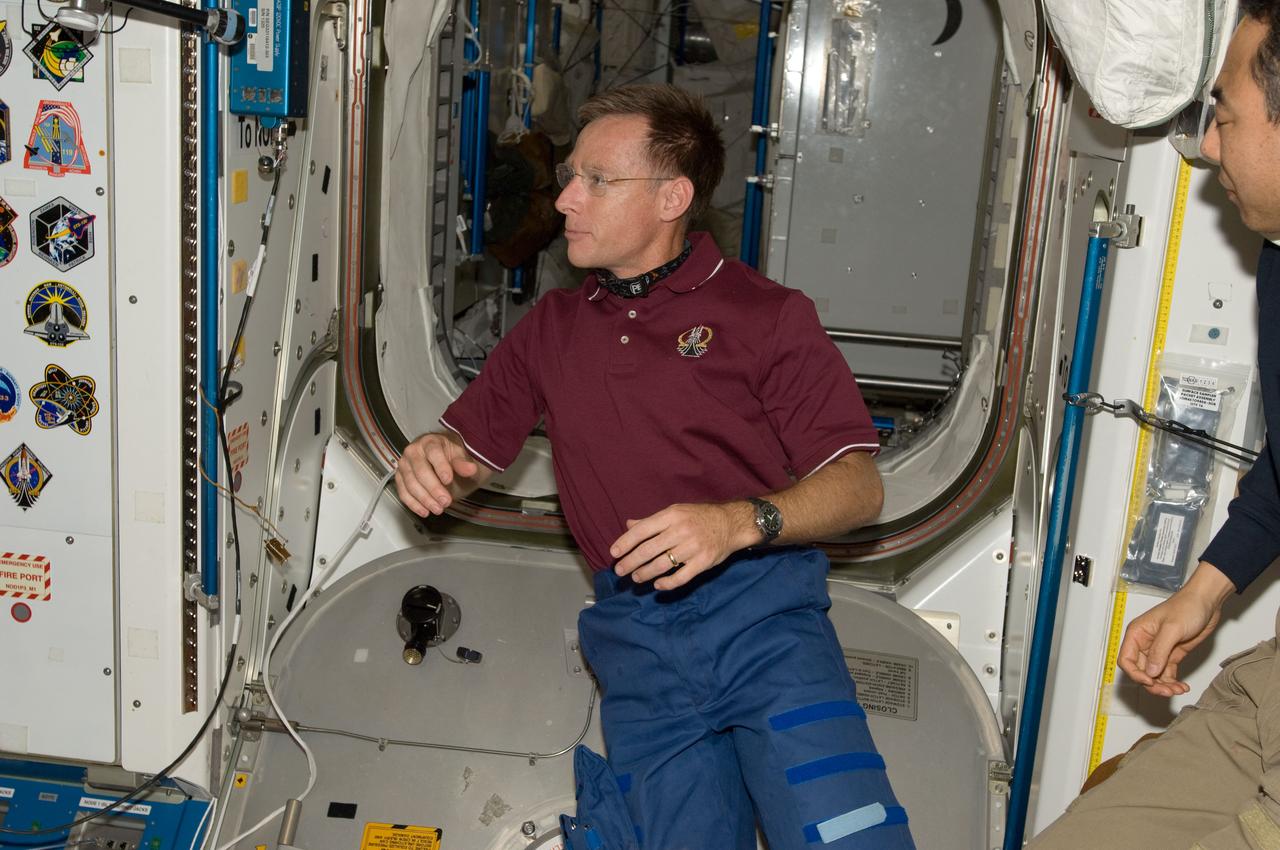
S135-E-009479 (18 July 2011) --- Inside the International Space Station's Node 1 or Unity, NASA astronaut Chris Ferguson, STS-135 commander, prepares to add his mission's decal as the final piece of the collection of shuttle crew insignias, partially visible at left. Photo credit: NASA
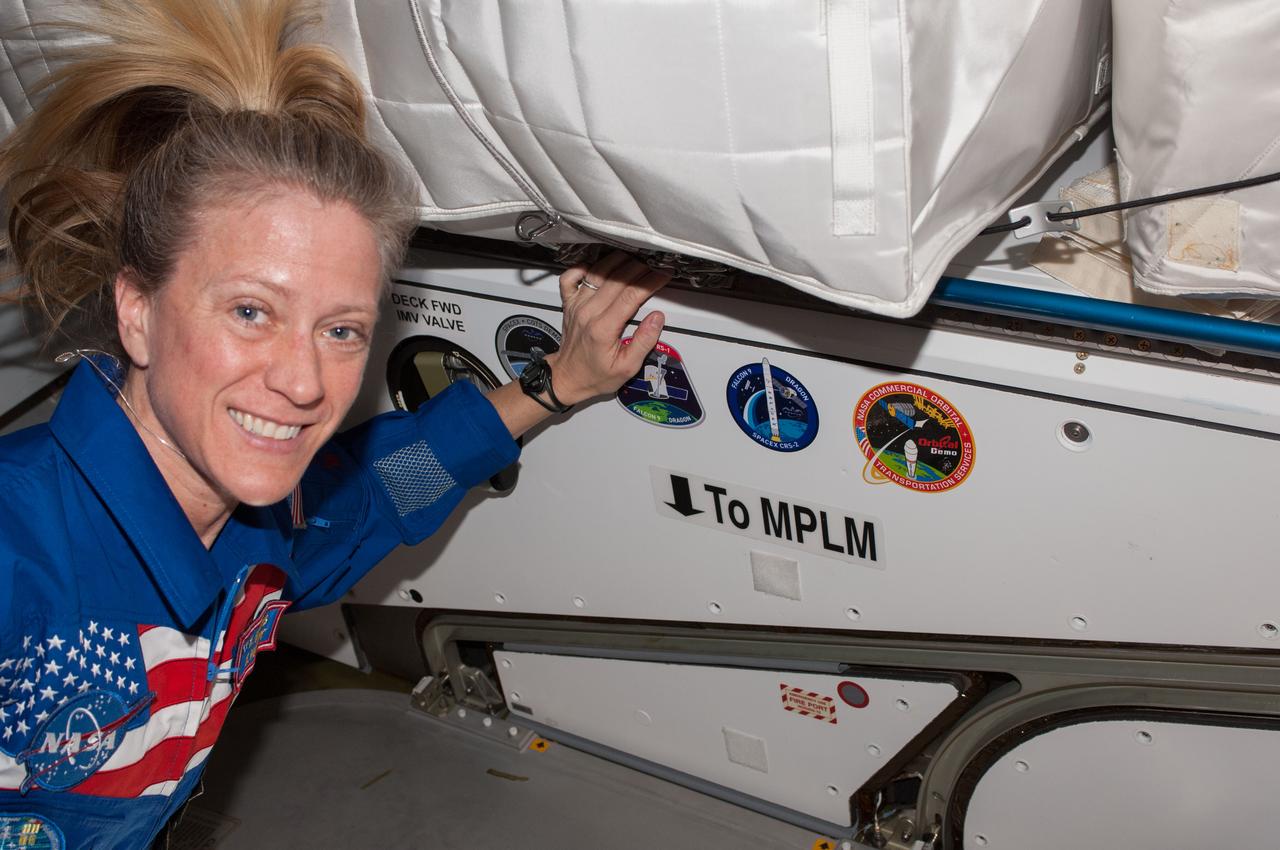
ISS037-E-028325 (9 Nov. 2013) --- NASA astronaut Karen Nyberg, Expedition 37 flight engineer, poses for a photo after placing the NASA Commercial Orbital Transportation Services insignia in the Harmony node of the International Space Station.
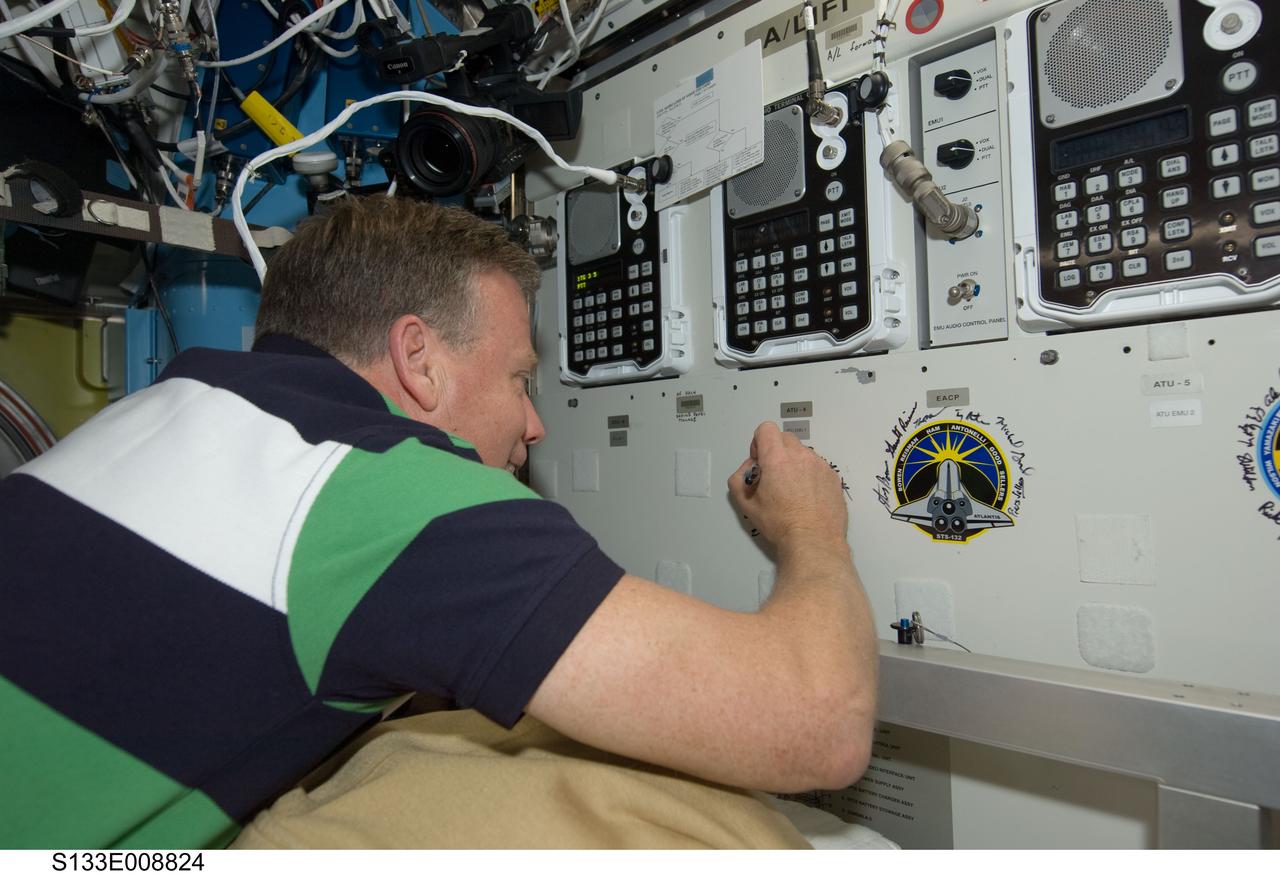
S133-E-008824 (5 March 2011) --- NASA astronaut Steve Lindsey, STS-133 commander, signs the STS-133 patch, which was added to the growing collection of insignias representing crews who performed spacewalks from the Quest airlock of the International Space Station. Photo credit: NASA or National Aeronautics and Space Administration
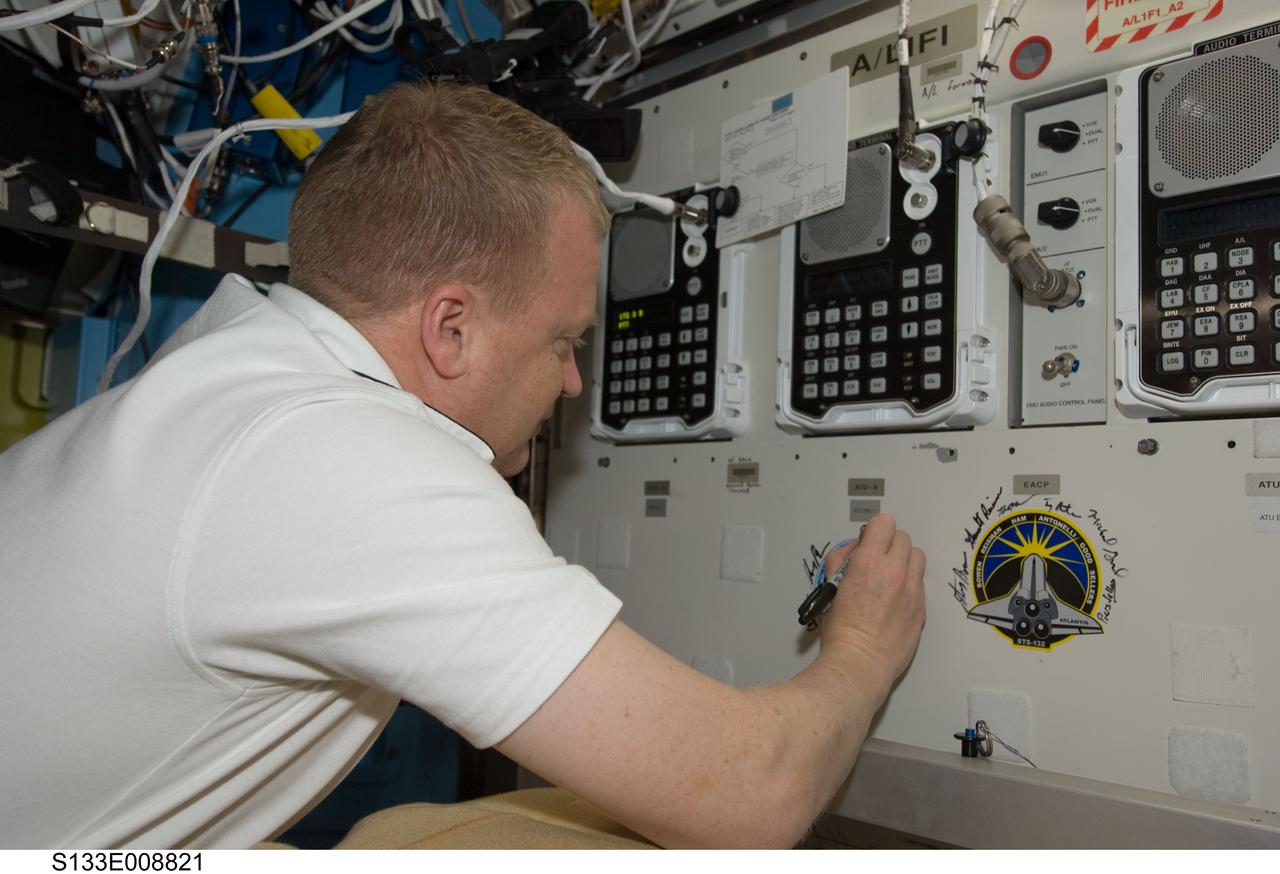
S133-E-008821 (5 March 2011) --- NASA astronaut Eric Boe, STS-133 pilot, signs the STS-133 patch, which was added to the growing collection of insignias representing crews who performed spacewalks from the Quest airlock of the International Space Station. Photo credit: NASA or National Aeronautics and Space Administration
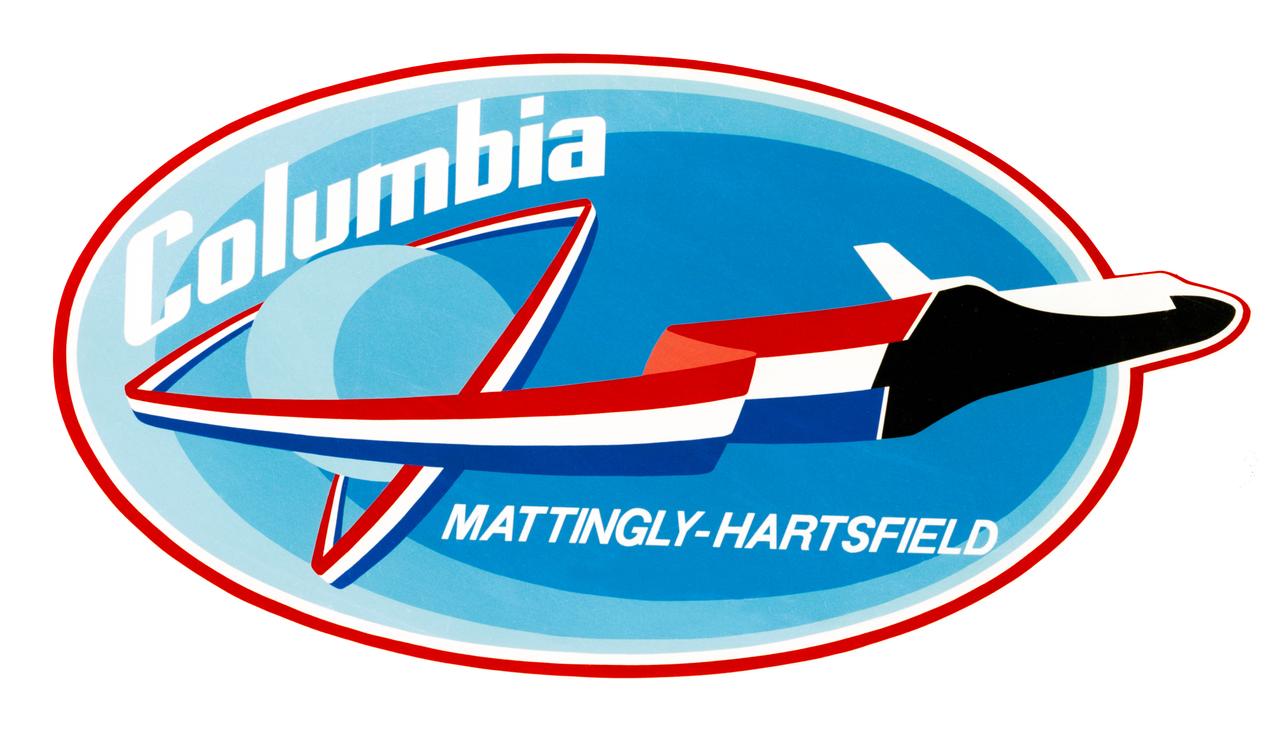
S82-29695 (April 1982) --- This oval shaped artwork is the insignia for the fourth Space Transportation System (STS-4) flight in the National Aeronautics and Space Administration's (NASA) space shuttle Columbia. The Columbia, with its crew of astronauts Thomas K. Mattingly II, and Henry W. Hartsfield Jr. aboard, will launch from the Kennedy Space Center (KSC), and orbit Earth for approximately one week in summer of 1982. The insignia shows the Columbia trailing our nation's colors in the shape of her flight number, representing the fourth and final flight of the highly successful flight test phase. She then streaks on into the future, entering the exciting operational phase scheduled to begin with STS-5. The NASA insignia design for space shuttle flights is reserved for use by the astronauts and for other official use as the NASA Administrator may authorize. Public availability has been approved only in the forms of illustrations by the various news media. When and if there is any change in this policy, which is not anticipated, the change will be publicly announced. Photo credit: NASA
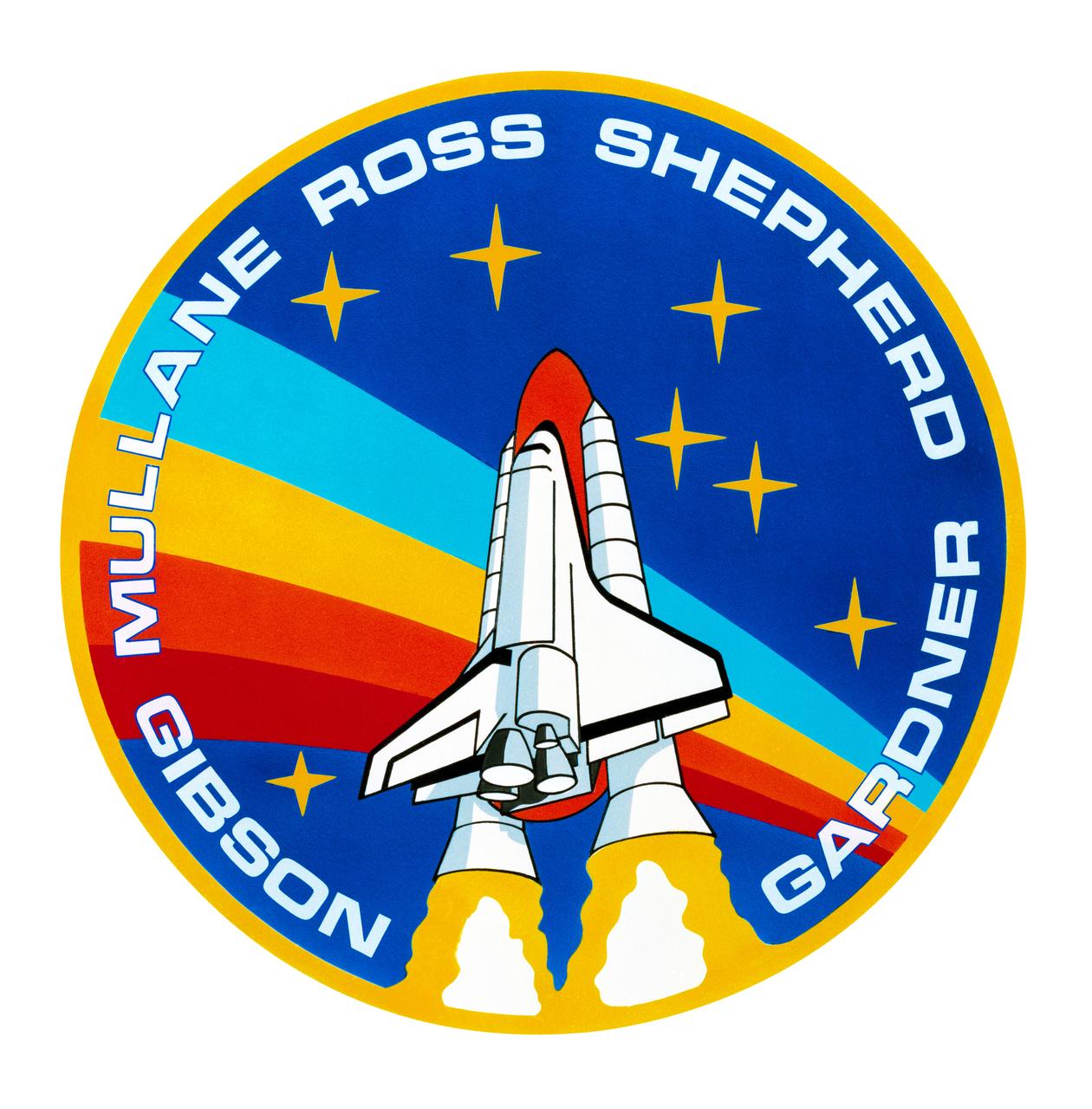
S88-41481 (15 July 1988) --- This is the official insignia of the NASA STS-27 mission. The patch depicts the space shuttle lifting off against the multi-colored backdrop of a rainbow, symbolizing the triumphal return to flight of our nation's manned space program. The design also commemorates the memory of the crew of Challenger mission STS51-L, represented by the seven stars. The names of the flight crew members of STS-27 are located along the border of the patch. They are astronauts Robert L. Gibson, commander; Guy S. Gardner, pilot; Jerry L. Ross, Richard M. (Mike) Mullane and William M. Shepherd, mission specialists. Each crew member contributed to the design of the insignia. The NASA insignia design for space shuttle flights is reserved for use by the astronauts and for other official use as the NASA Administrator may authorize. Public availability has been approved only in the forms of illustrations by the various news media. When and if there is any change in this policy, which is not anticipated, the change will be publicly announced. Photo credit: NASA
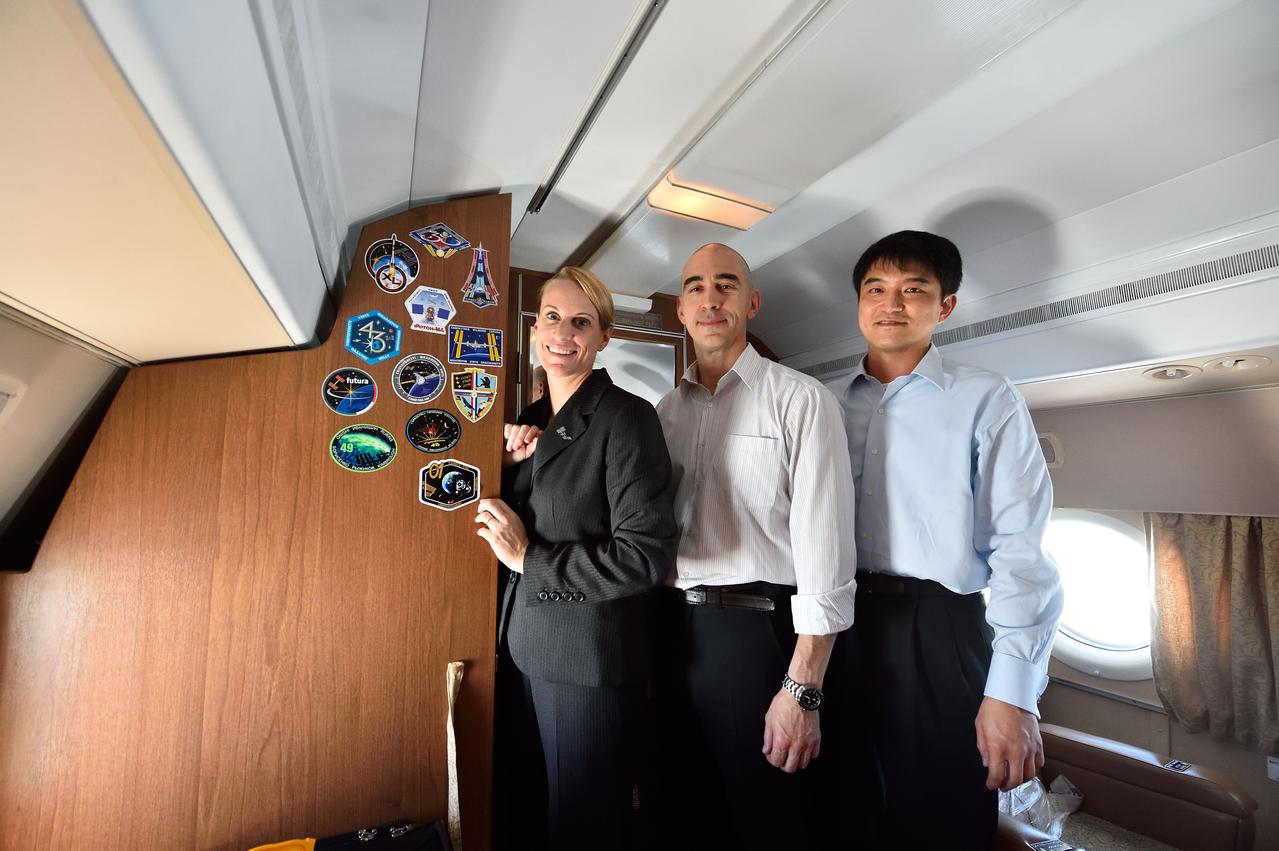
Aboard their aircraft en route to their launch site in Baikonur, Kazakhstan, ISS Expedition 48-49 crewmembers Kate Rubins of NASA (left), Anatoly Ivanishin of Roscosmos (center) and Takuya Onishi of the Japan Aerospace Exploration Agency (right) pose for pictures after affixing their mission insignia stickers to the wall June 24 following their departure from their training base in Star City, Russia. The trio will launch July 7 from the Baikonur Cosmodrome in Kazakhstan on the Soyuz MS-01 spacecraft for a planned four-month mission on the International Space Station. NASA/Alexander Vysotsky
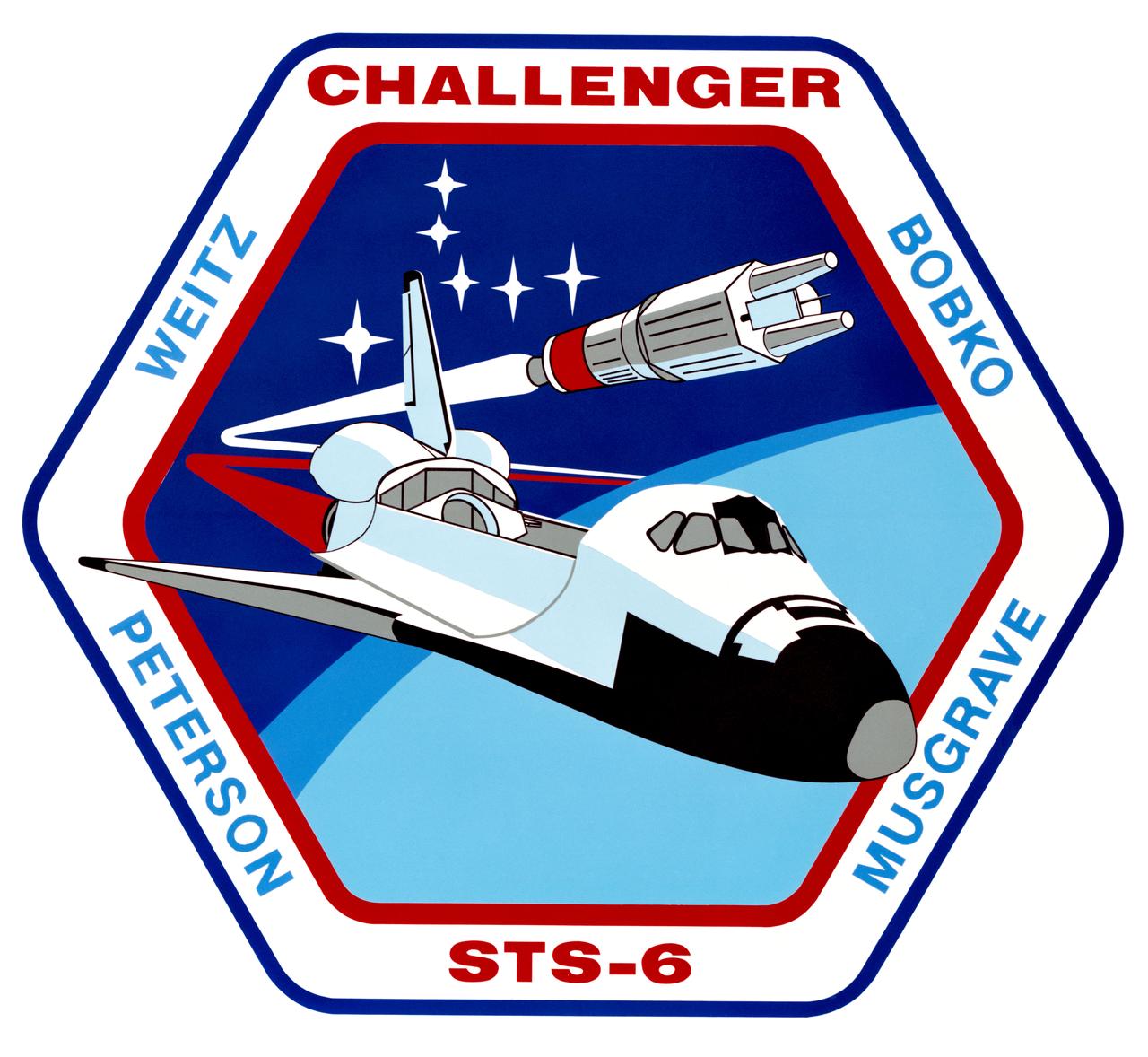
S82-39531 (December 1982) --- This is the official insignia for space shuttle mission STS-6. The crew members for this mission are astronauts Paul J. Weitz, commander; Karol J. Bobko, pilot; F. Story Musgrave, mission specialist; and Donald H. Peterson, mission specialist. The sixth space shuttle flight is represented by the hexagonal shape of the insignia and the six stars, in the portrayed constellation Virgo. The sign Virgo is also symbolic of the first flight of the space shuttle Challenger. Depicted above the spacecraft?s open cargo bay is the combined Inertial Upper Stage (IUS) and a Tracking and Data Relay Satellite. This is the first shuttle flight of the IUS rocket, which will carry the first TDRS to a geosynchronous orbit of 24,000 statute miles. The NASA insignia design for space shuttle flights is reserved for use by the astronauts and for other official use as the NASA Administrator may authorize. Public availability has been approved only in the forms of illustrations by the various news media. When and if there is any change in this policy, which is not anticipated, the change will be publicly announced. Photo credit: NASA
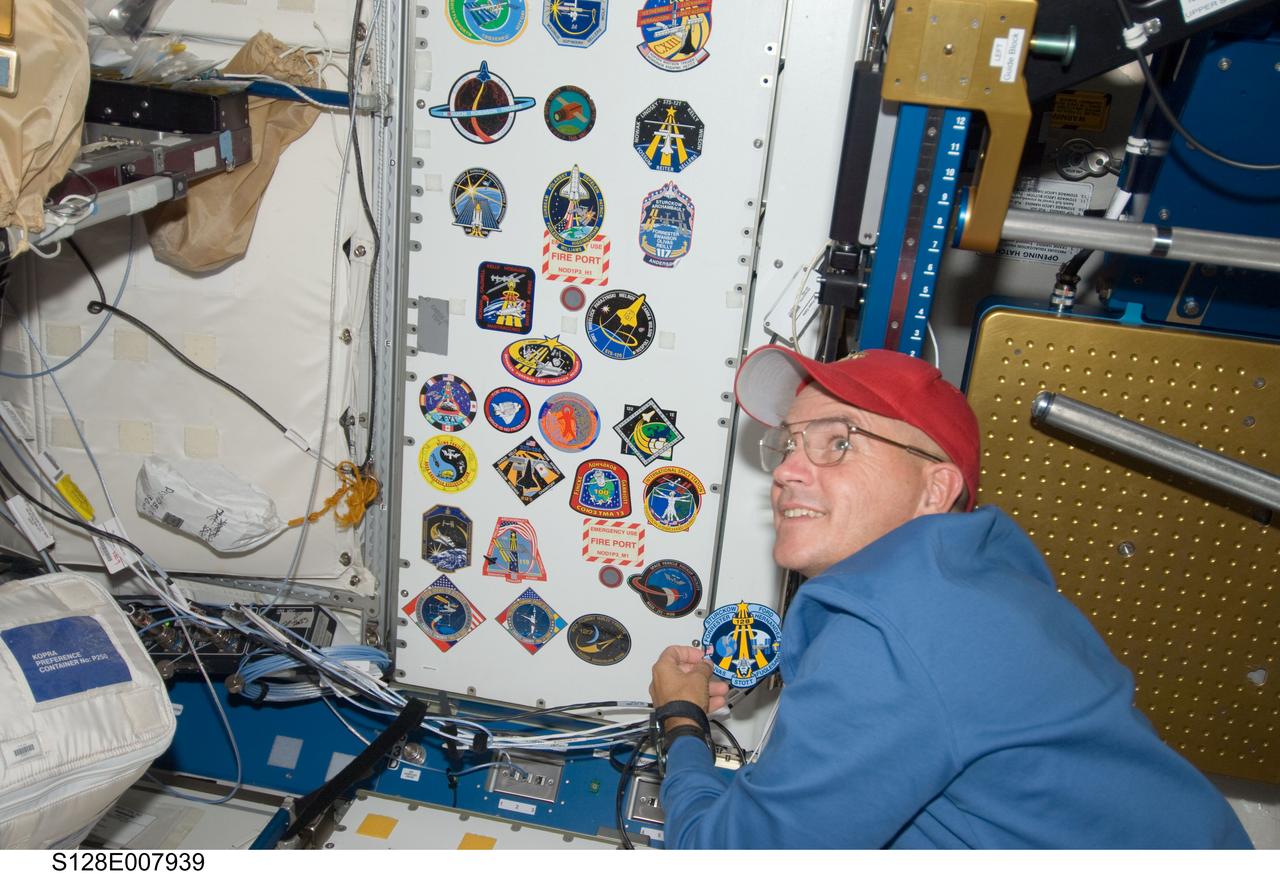
S128-E-007939 (7 Sept. 2009) --- NASA astronaut Rick Sturckow, STS-128 commander, adds his crew’s patch to the growing collection, in the Unity node, of insignias representing crews who have worked on the International Space Station.
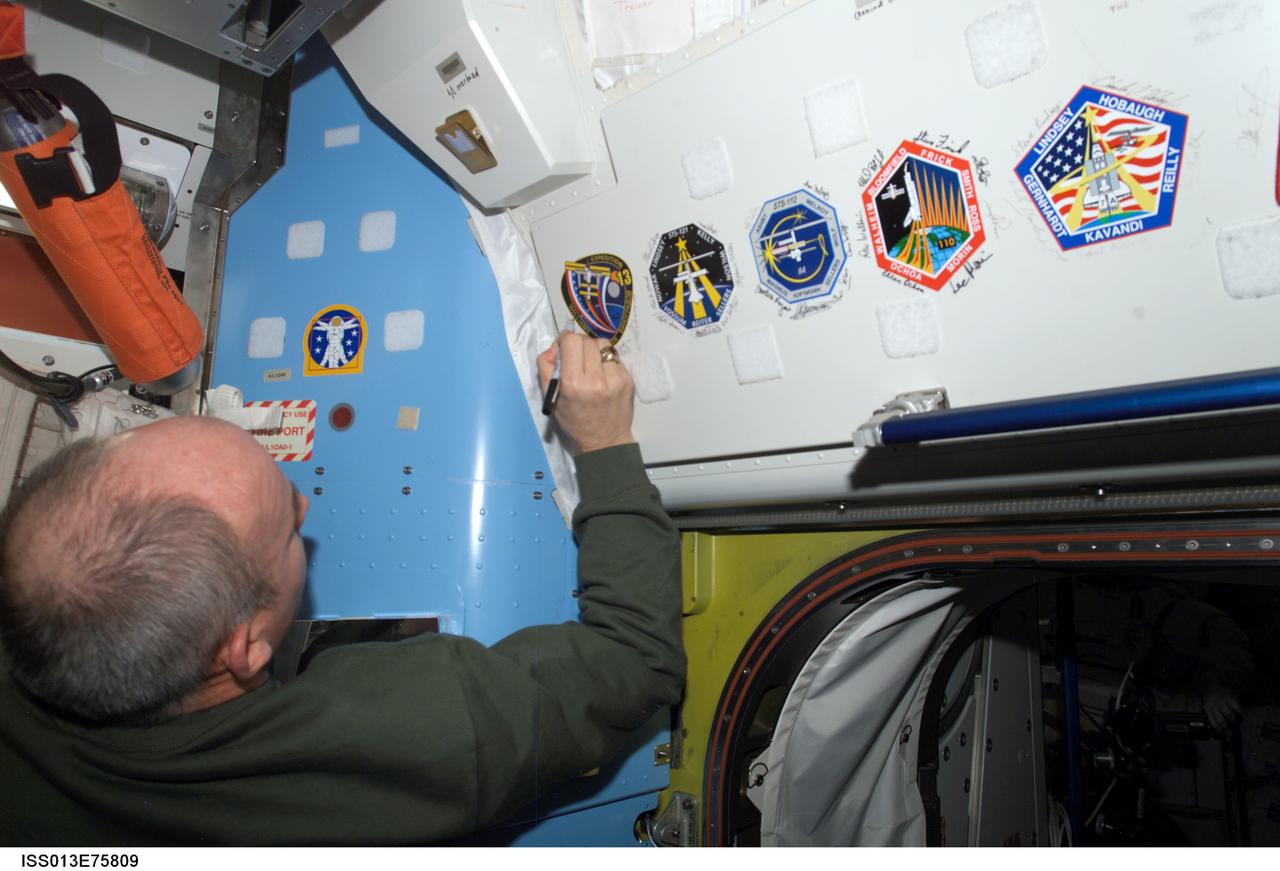
ISS013-E-75809 (4 Sept. 2006) --- Astronaut Jeffrey N. Williams, Expedition 13 NASA space station science officer and flight engineer, signs the Expedition 13 patch, which was added to the growing collection of insignias representing crews who have performed spacewalks from the Quest Airlock of the International Space Station.
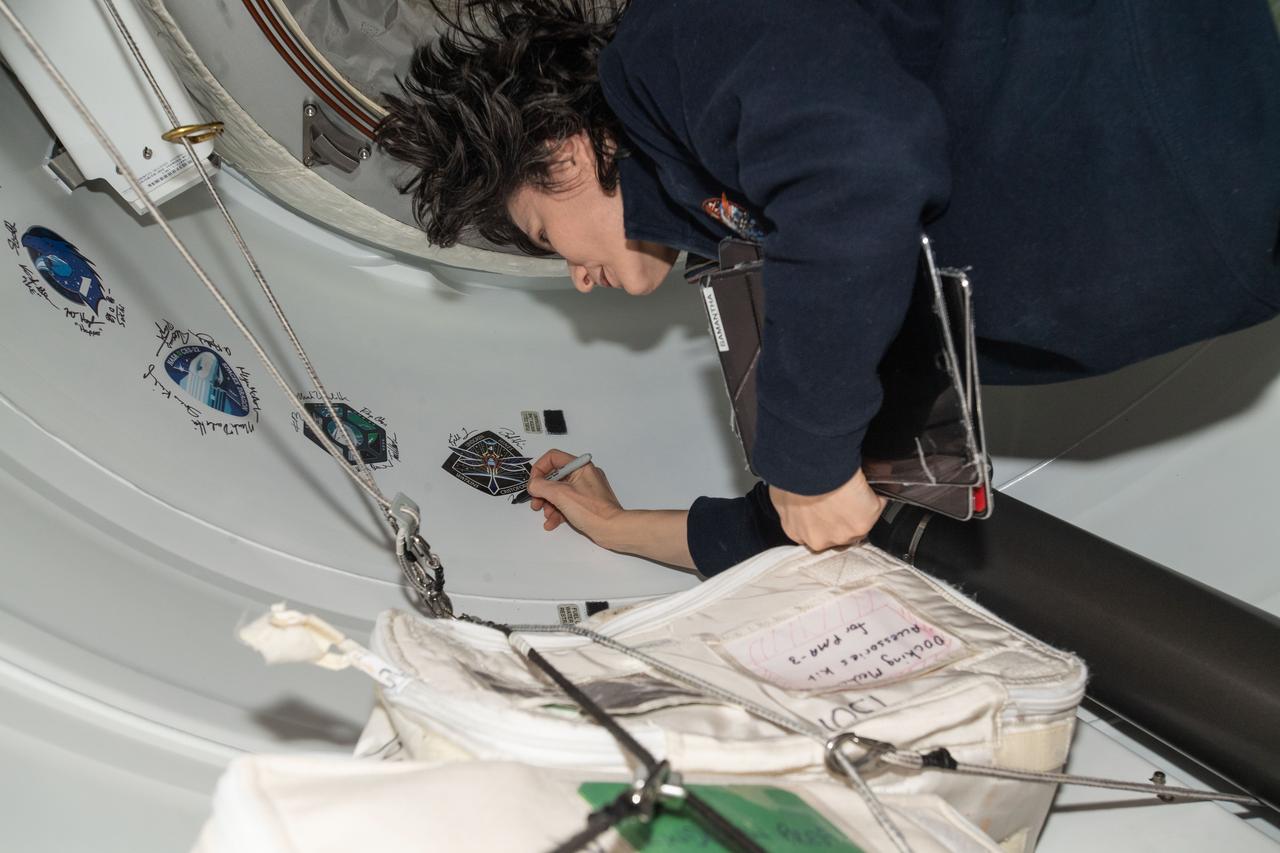
iss068e016455 (Oct. 12, 2022) --- NASA astronaut and Expedition 68 Commander Samantha Cristoforetti, also a SpaceX Crew-4 Mission Specialist, signs her name around the Crew-4 mission insignia affixed to the vestibule between the Harmony module's space-facing port and the Dragon Freedom crew ship.
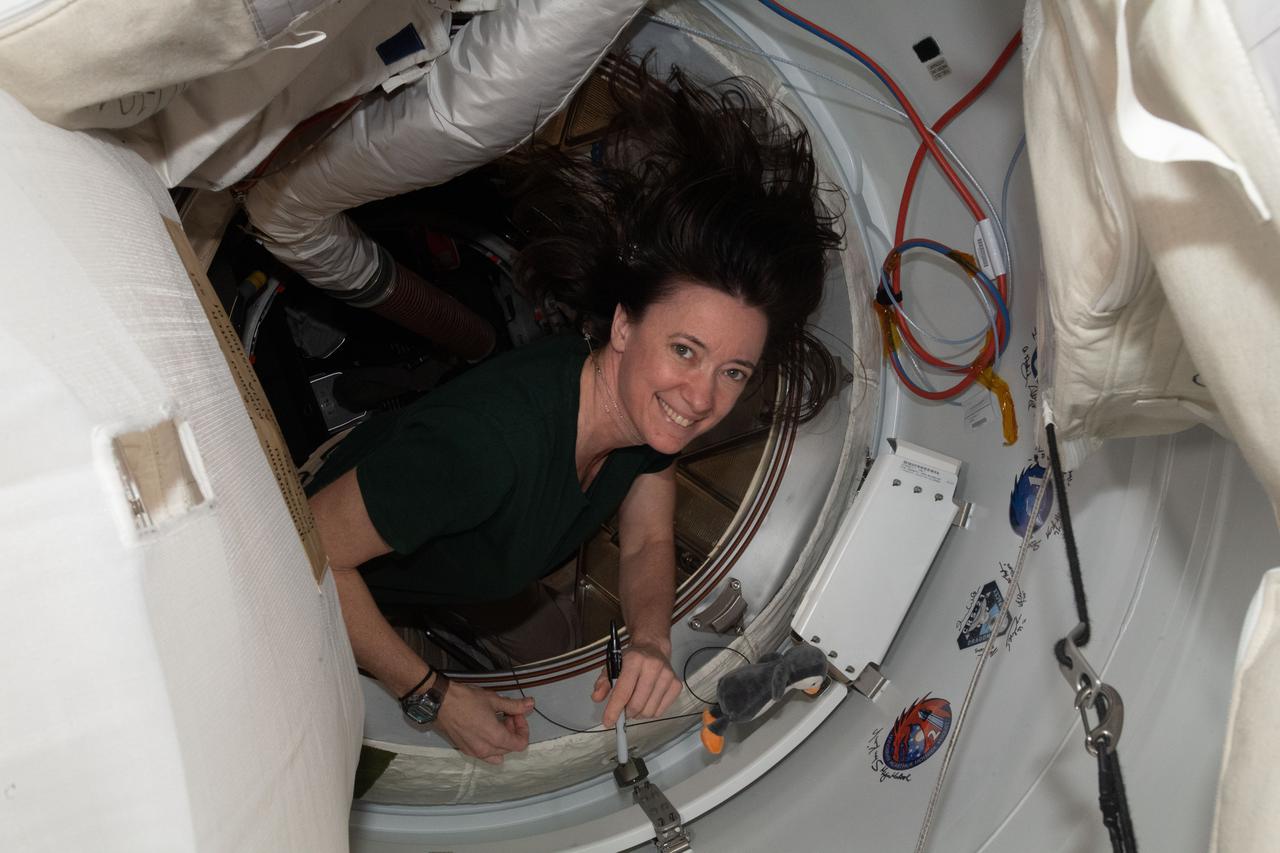
iss065e389596 (Sept. 17, 2021) --- NASA astronaut and Expedition 65 Flight Engineer Megan McArthur signs her name around the SpaceX Crew-2 mission insignia sticker affixed to the vestibule in between the Harmony module and its space-facing international docking adapter where the SpaceX Crew Dragon Endeavour is docked.
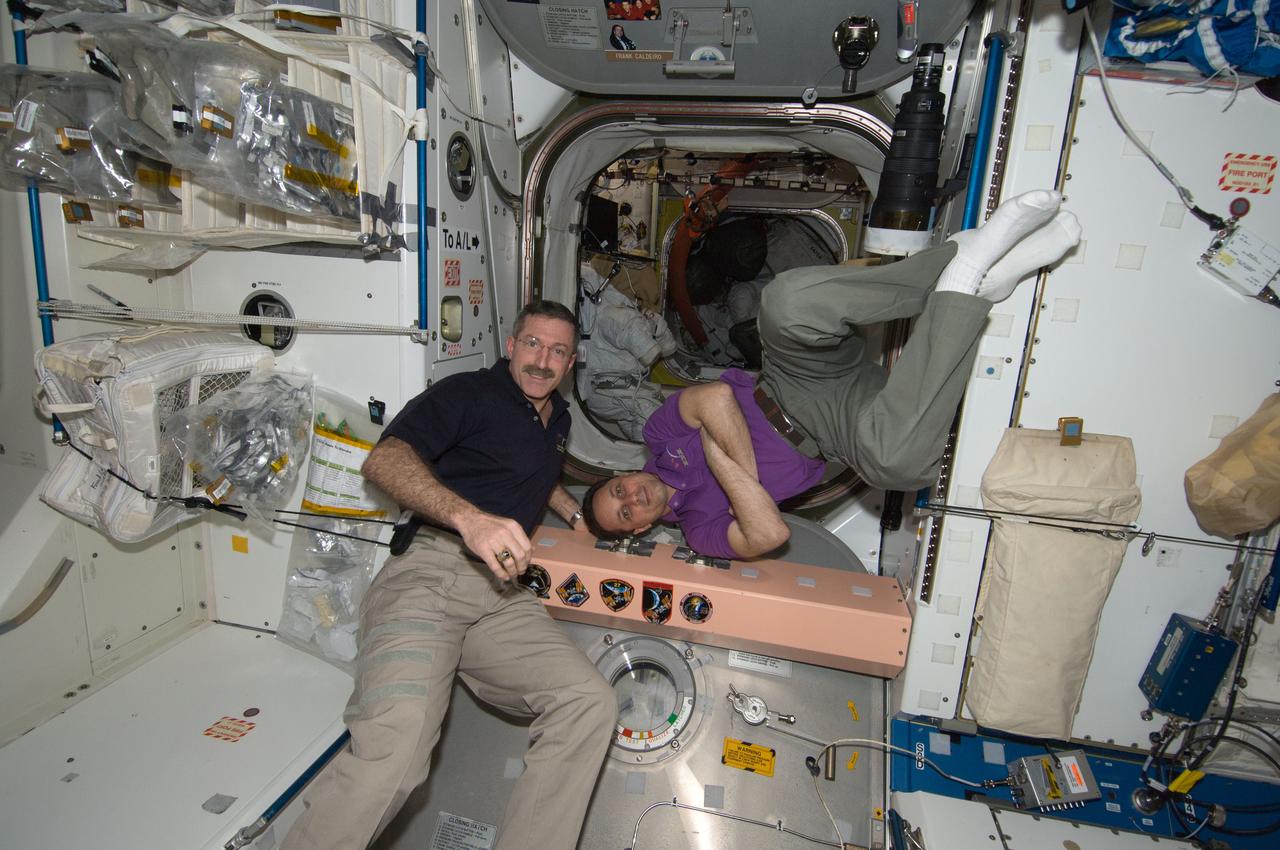
ISS030-E-241316 (21 April 2012) --- In the Unity node, NASA astronaut Dan Burbank (left), Expedition 30 commander; and Russian cosmonaut Anton Shkaplerov, flight engineer, are pictured near a growing collection of insignias representing crews who have worked on the International Space Station.
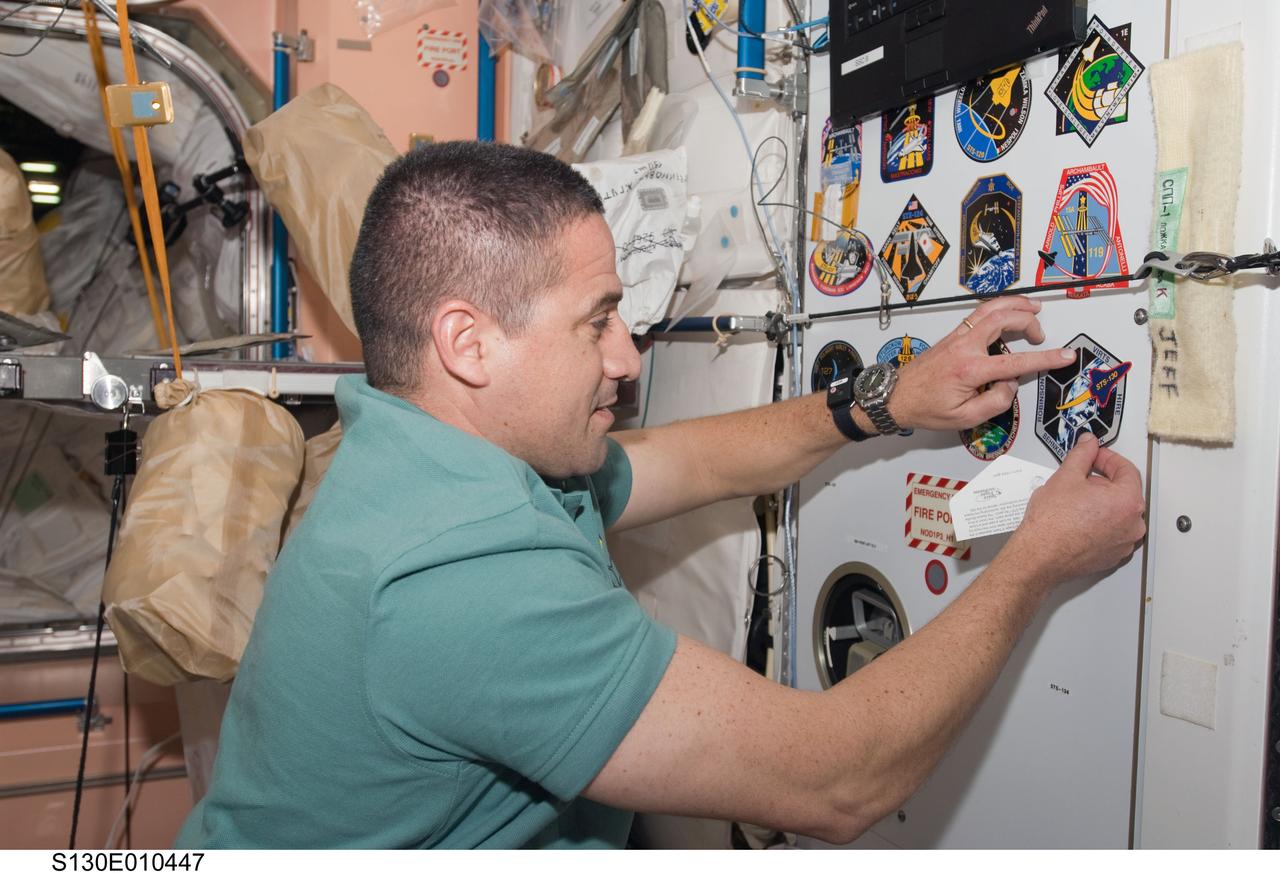
S130-E-010447 (18 Feb. 2010) --- NASA astronaut George Zamka, STS-130 commander, adds his crew's patch to the growing collection, in the Unity node, of insignias representing crews who have worked on the International Space Station.
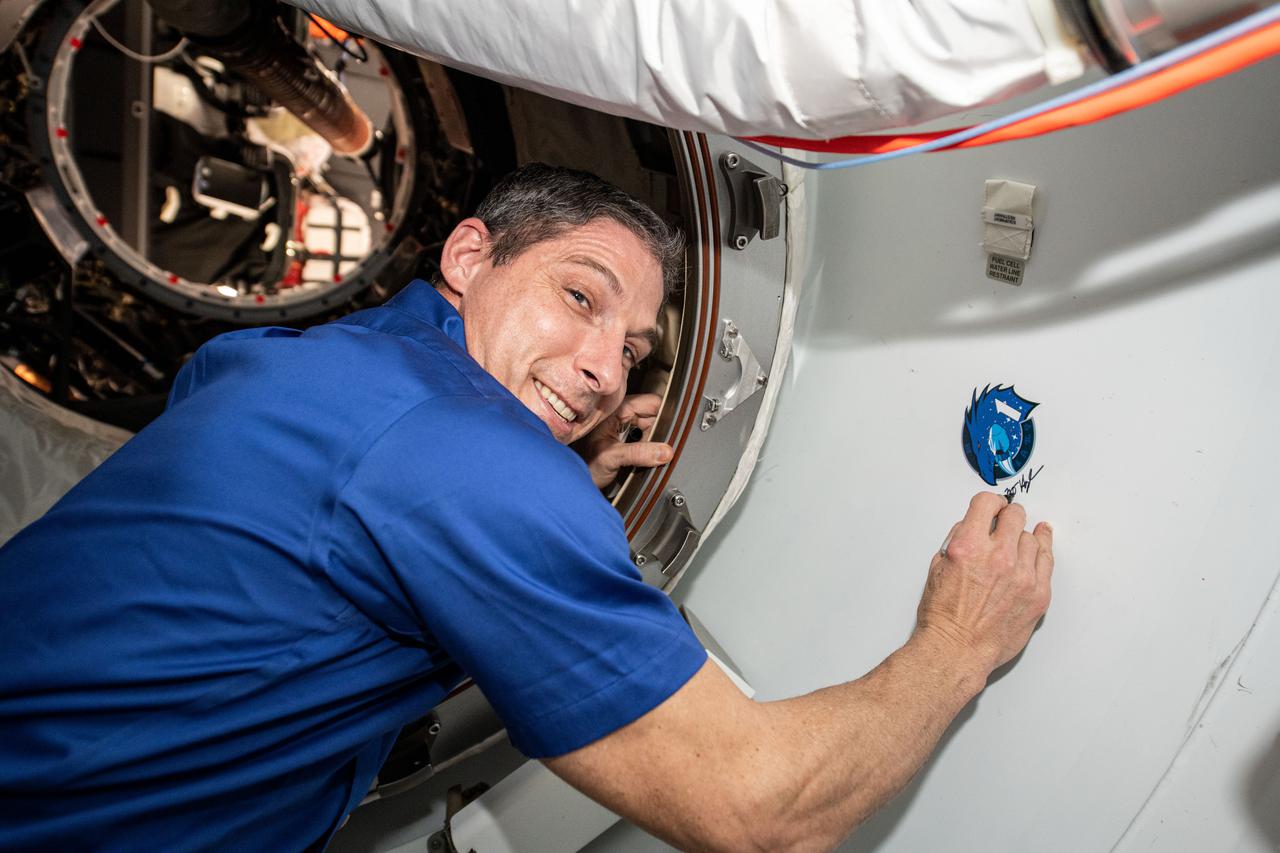
iss064e052199 (April 4, 2021) --- SpaceX Crew-1 Commander Michael Hopkins of NASA signs his name next to the mission insignia affixed to the vestibule between the Crew Dragon spacecraft and the Harmony module's forward international docking adapter.

iss061-s-001 (April 23, 2019) --- The mission insignia for the Expedition 61 crew with Commander Luca Parmitano of ESA (European Space Agency), NASA astronauts Drew Morgan, Christina Koch and Jessica Meir and Roscosmos cosmonauts Alexander Skvortsov and Oleg Skripochka.
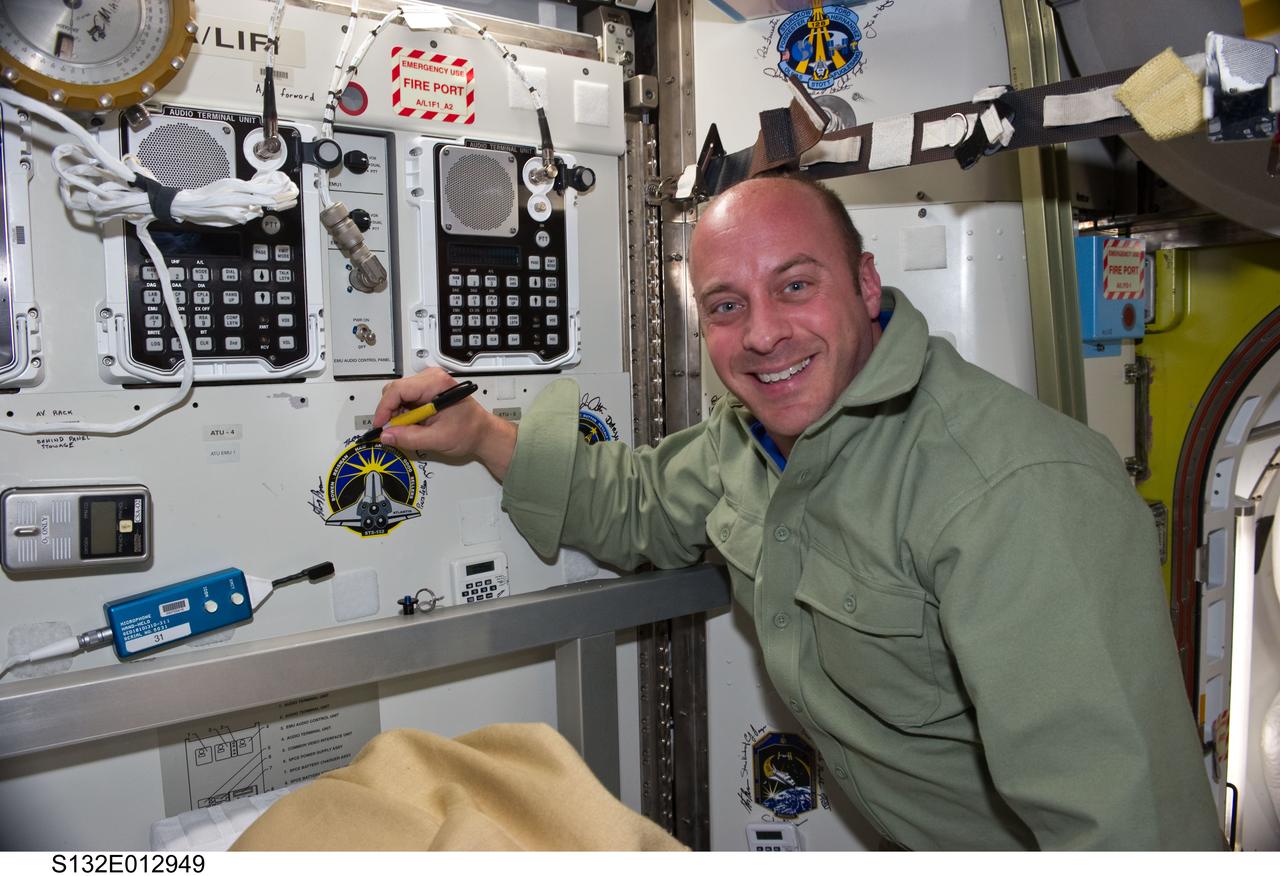
S132-E-012949 (22 May 2010) --- NASA astronaut Garrett Reisman, STS-132 mission specialist, poses for a photo while signing the STS-132 patch, which was added to the growing collection of insignias representing crews who performed spacewalks from the Quest airlock of the International Space Station.
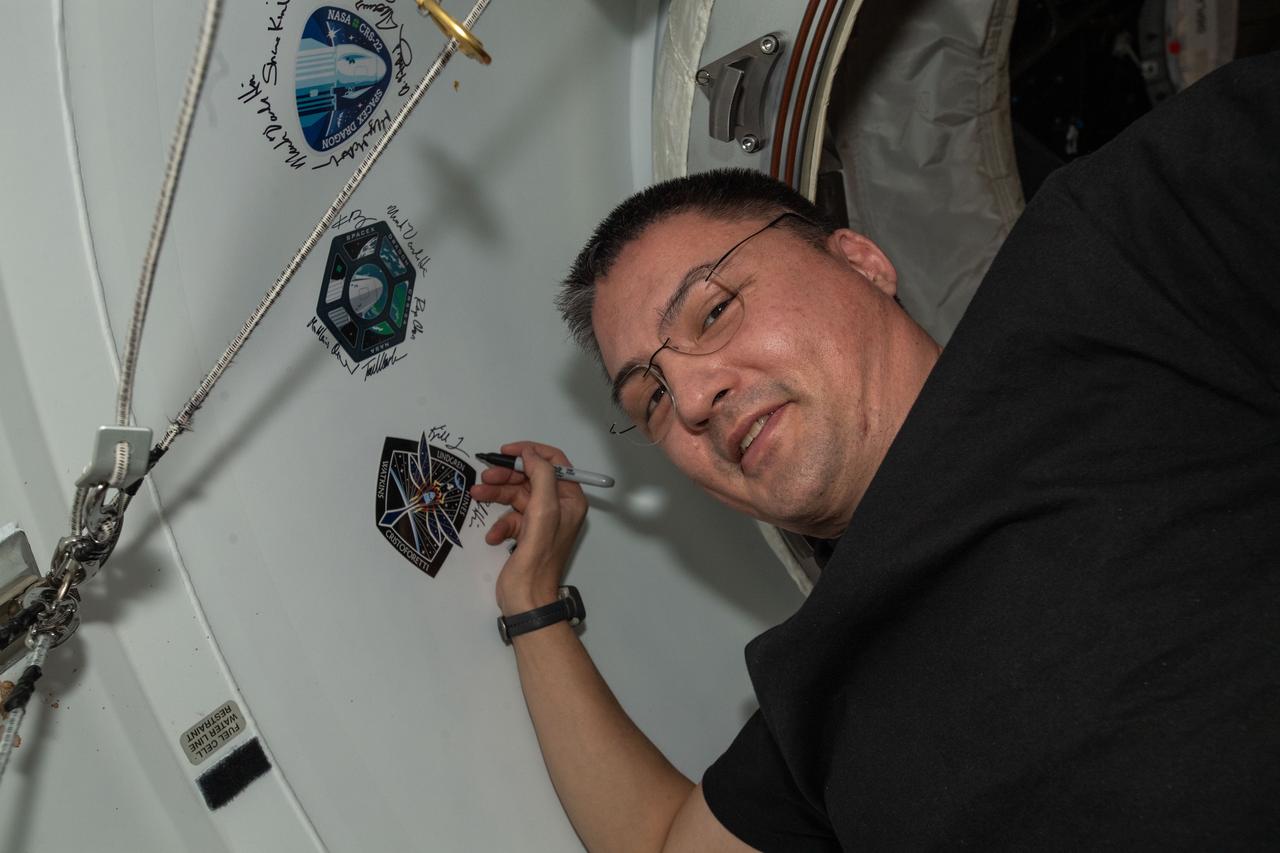
iss068e016454 (Oct. 12, 2022) --- NASA astronaut and Expedition 68 Flight Engineer Kjell Lindgren, also the SpaceX Crew-4 Commander, signs his name around the Crew-4 mission insignia affixed to the vestibule between the Harmony module's space-facing port and the Dragon Freedom crew ship.
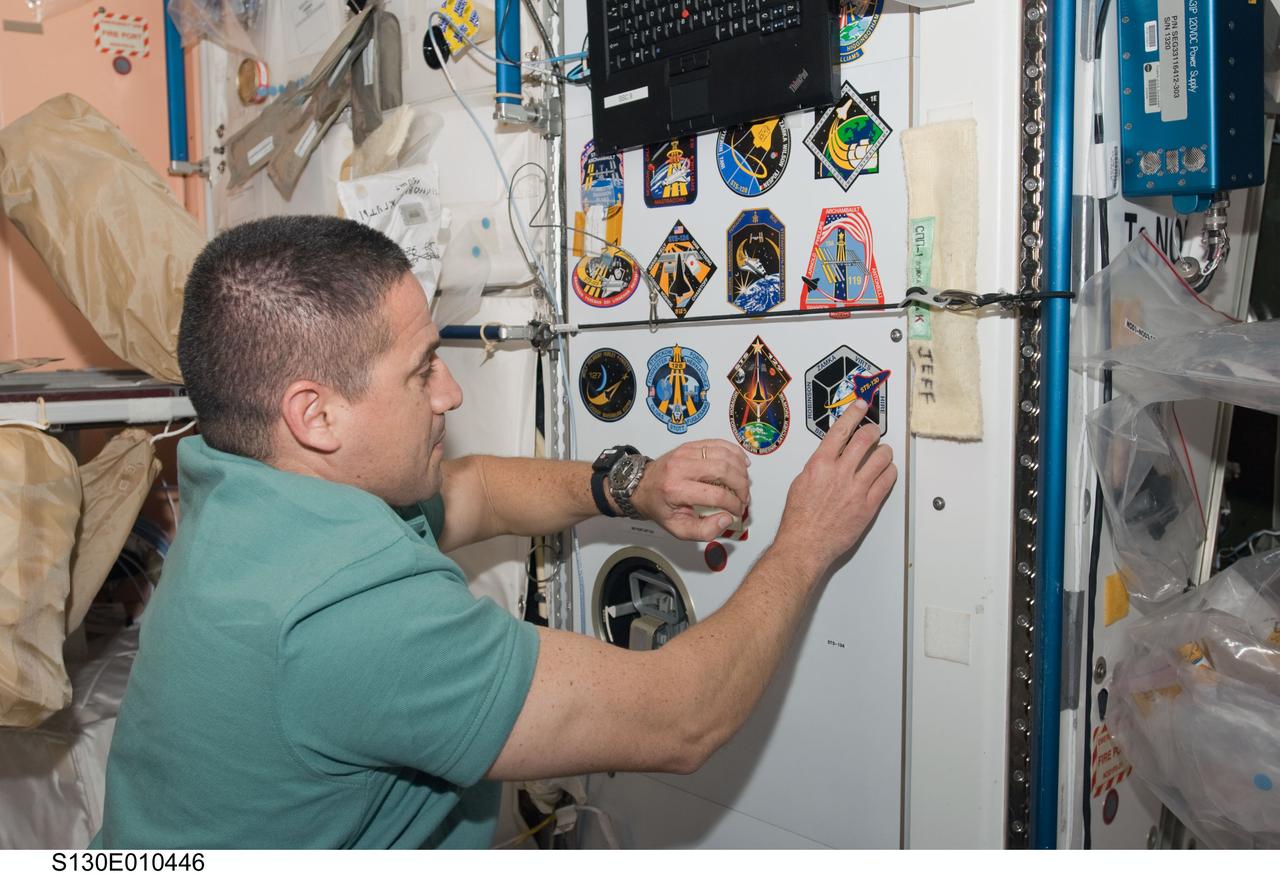
S130-E-010446 (18 Feb. 2010) --- NASA astronaut George Zamka, STS-130 commander, adds his crew's patch to the growing collection, in the Unity node, of insignias representing crews who have worked on the International Space Station.
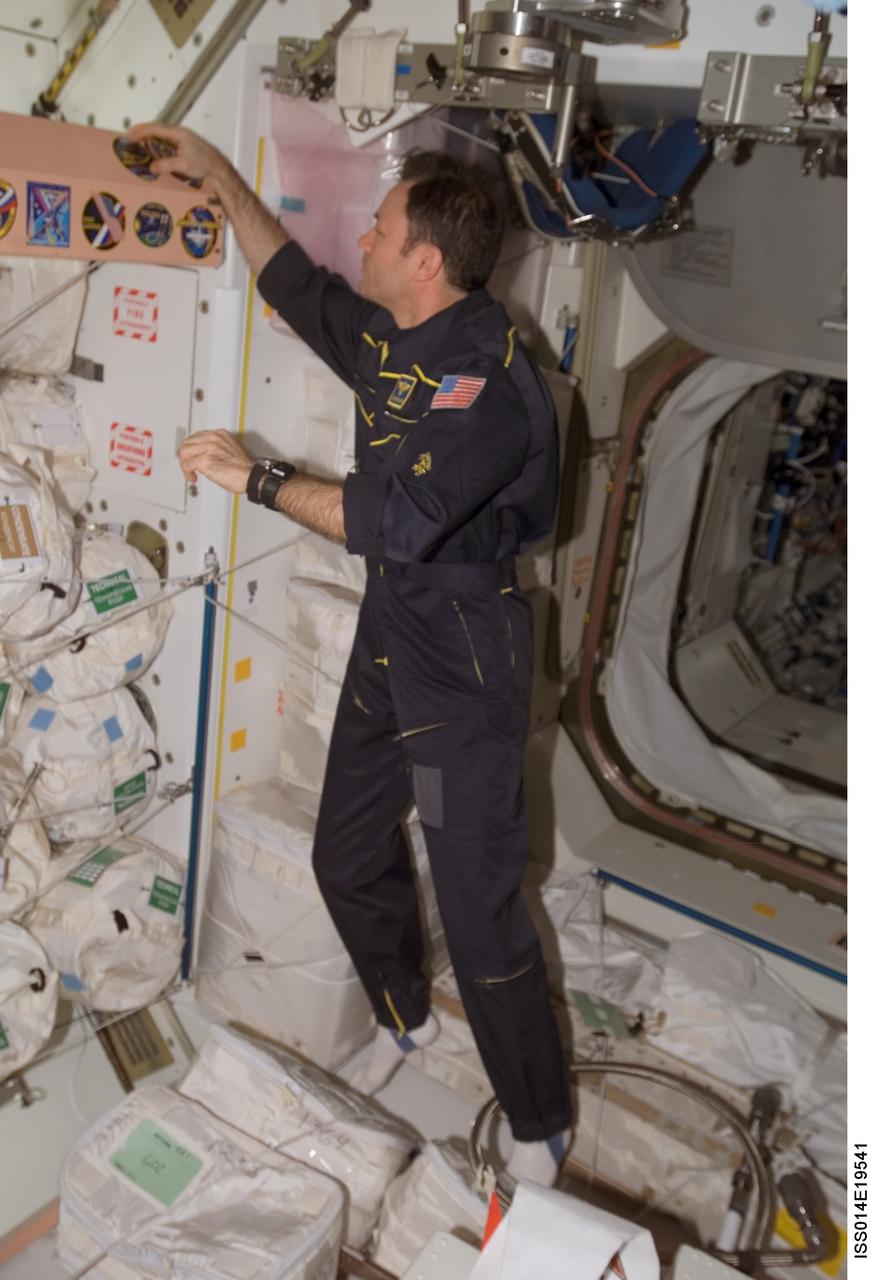
ISS014-E-19541 (17 April 2007) --- Astronaut Michael E. Lopez-Alegria, Expedition 14 commander and NASA space station science officer, adds the Expedition 14 patch to the Unity node's growing collection of insignias representing crews who have lived and worked on the International Space Station.
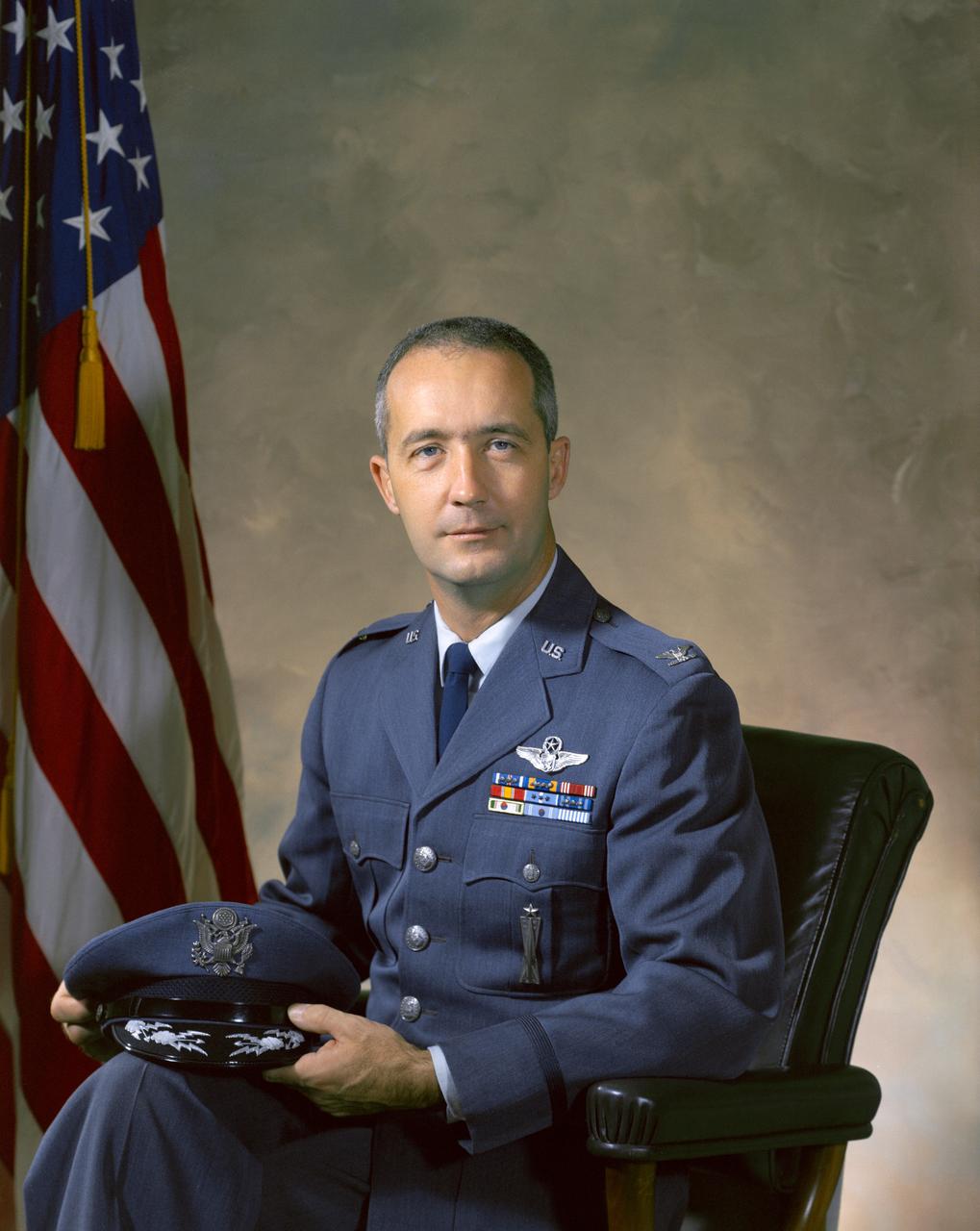
S68-55278 (December 1968) --- Portrait of astronaut James A. McDivitt, in his Air Force uniform with rank insignia showing he is Air Force Colonel. Editor's Note: Since the photo was made, James A. McDivitt retired as Brigadier General from the United States Air Force, and left NASA in June of 1972.
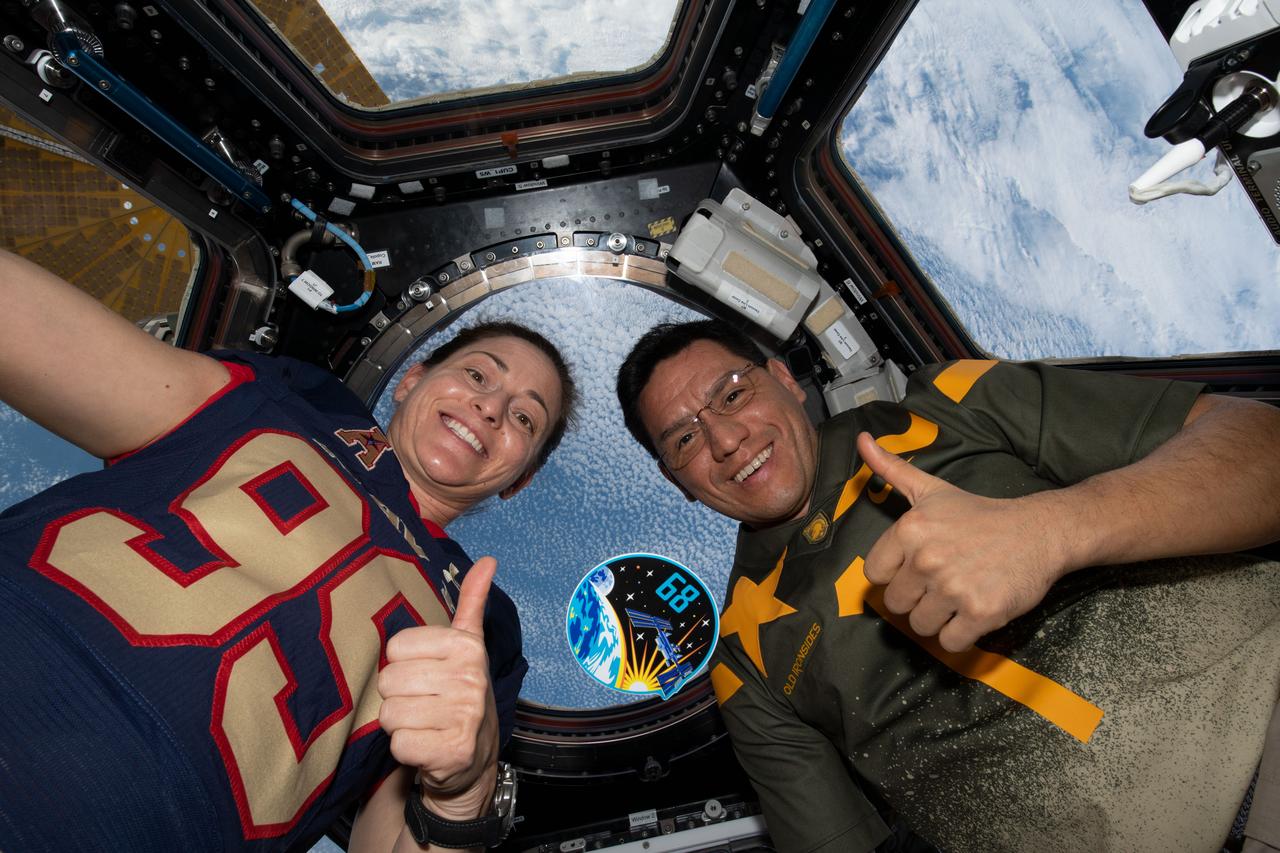
iss068e029132 (Dec. 10, 2022) --- Expedition 68 Flight Engineers Nicole Mann and Frank Rubio, both from NASA, pose with their mission's insignia inside the cupola as the International Space Station orbited 262 miles above the northern Pacific Ocean.
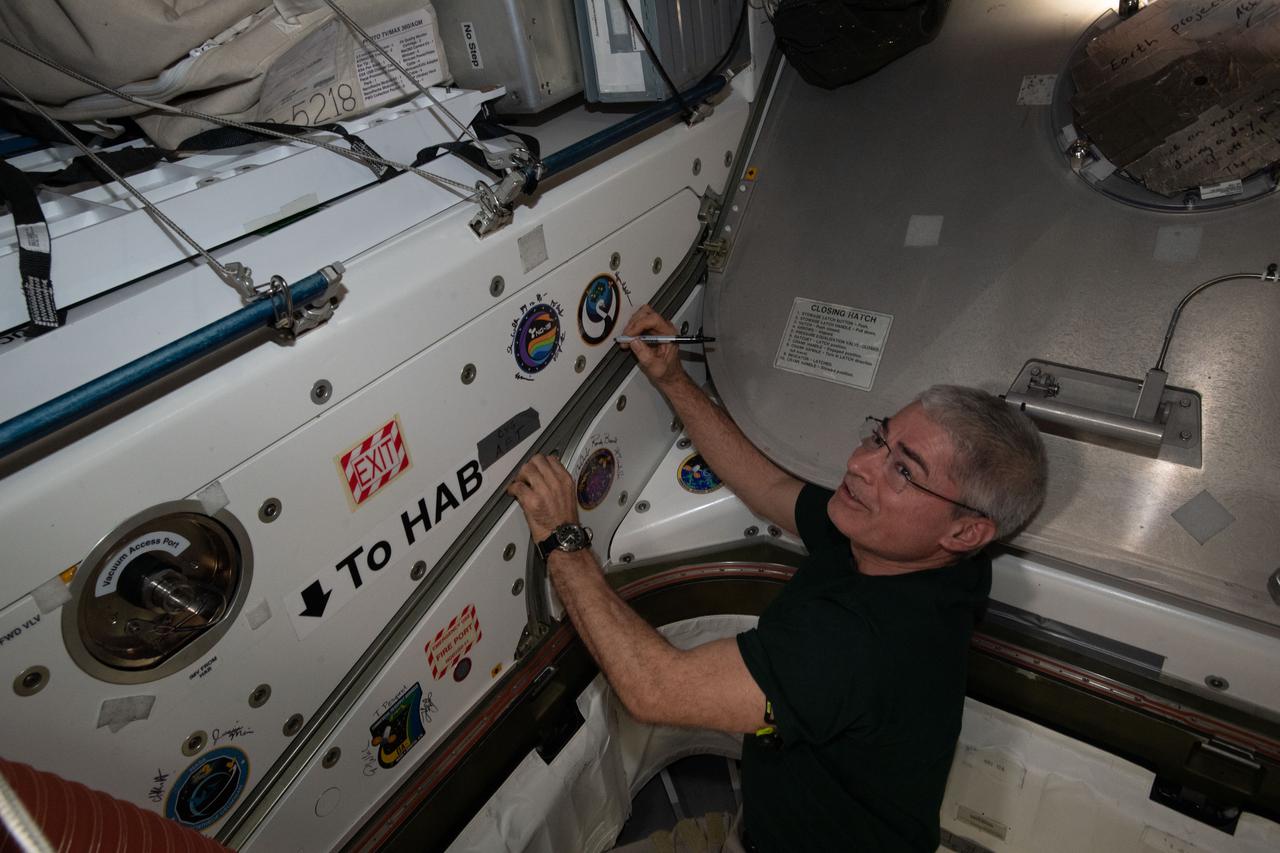
iss065e389501 (Sept. 17, 2021) --- NASA astronaut and Expedition 65 Flight Engineer Mark Vande Hei signs his name around the Northrop Grumman-16 (NG-16) mission insignia sticker affixed to the vestibule in between the Unity module and the Cygnus space freighter.
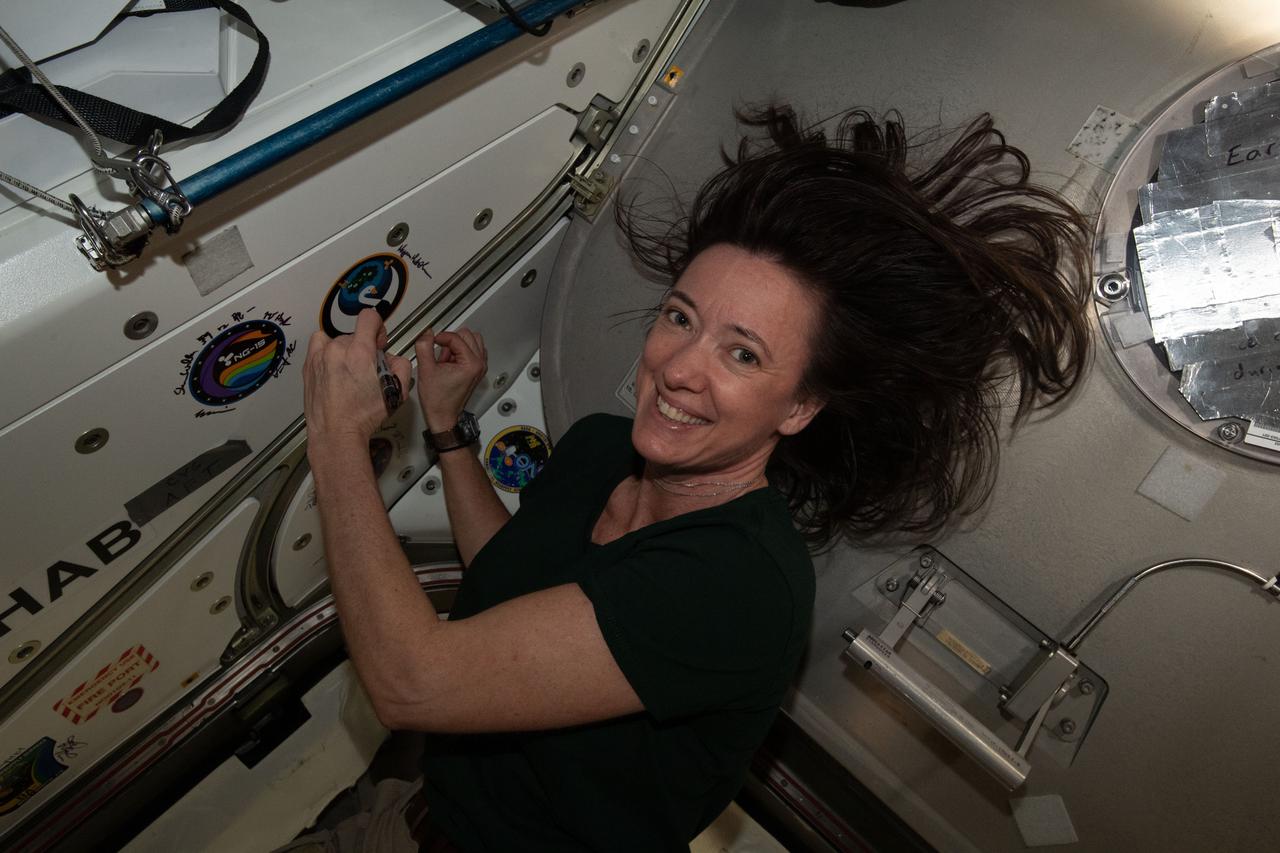
iss065e389491 (Sept. 17, 2021) --- NASA astronaut and Expedition 65 Flight Engineer Megan McArthur signs her name around the Northrop Grumman-16 (NG-16) mission insignia sticker affixed to the vestibule in between the Unity module and the Cygnus space freighter.
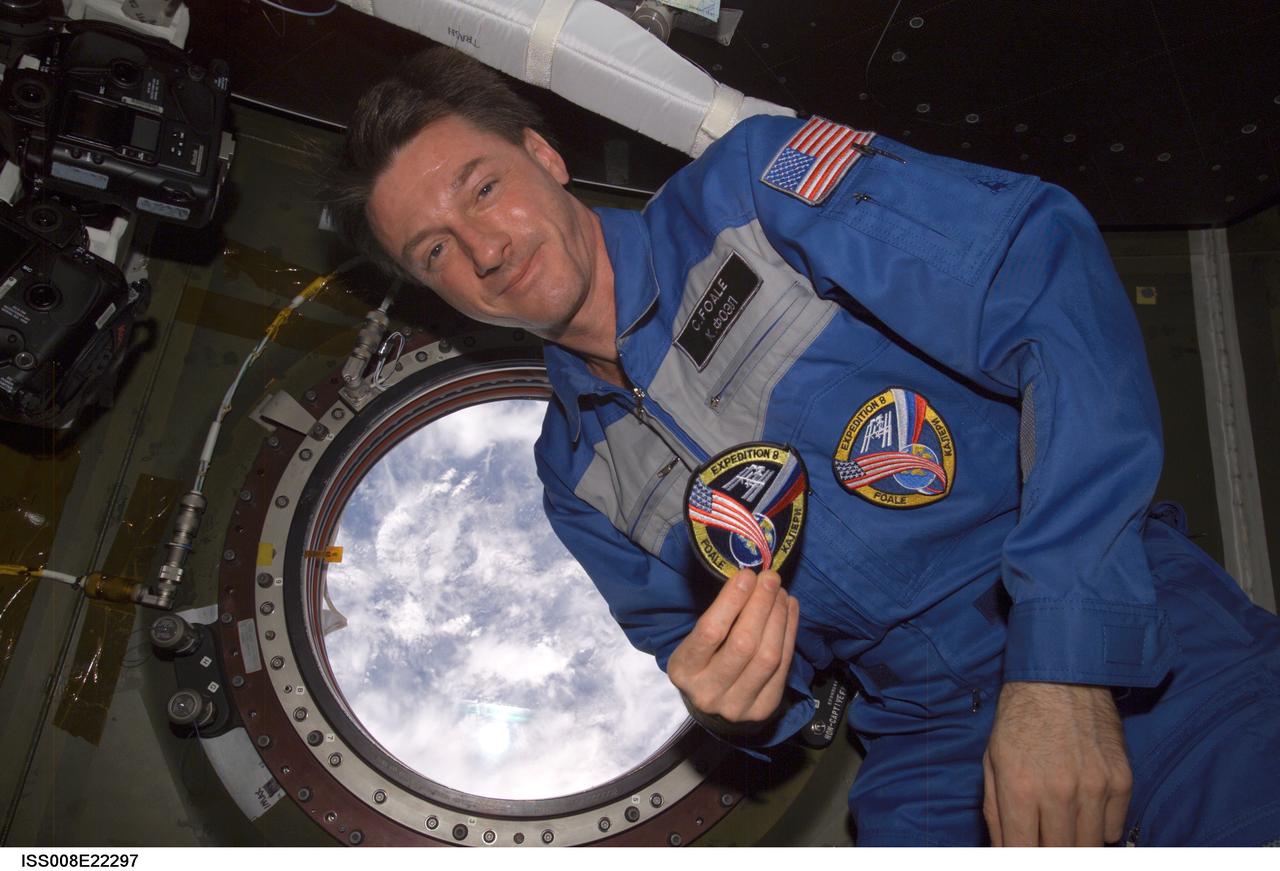
ISS008-E-22297 (26 April 2004) --- Astronaut C. Michael Foale, Expedition 8 commander and NASA ISS science officer, poses with the mission insignia near the nadir window in the Destiny laboratory of the International Space Station (ISS).
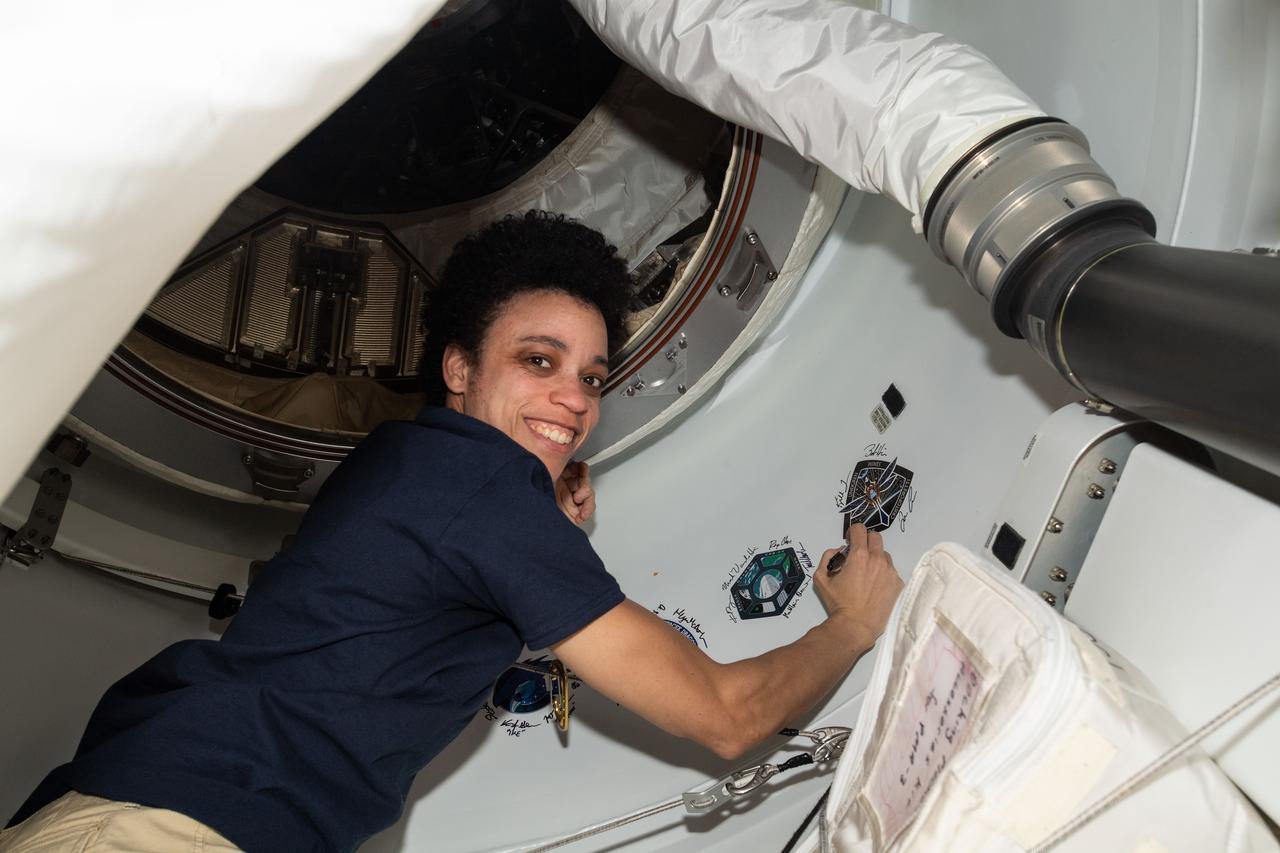
iss068e016462 (Oct. 12, 2022) --- NASA astronaut and Expedition 68 Flight Engineer Jessica Watkins, also a SpaceX Crew-4 Mission Specialist, signs her name around the Crew-4 mission insignia affixed to the vestibule between the Harmony module's space-facing port and the Dragon Freedom crew ship.
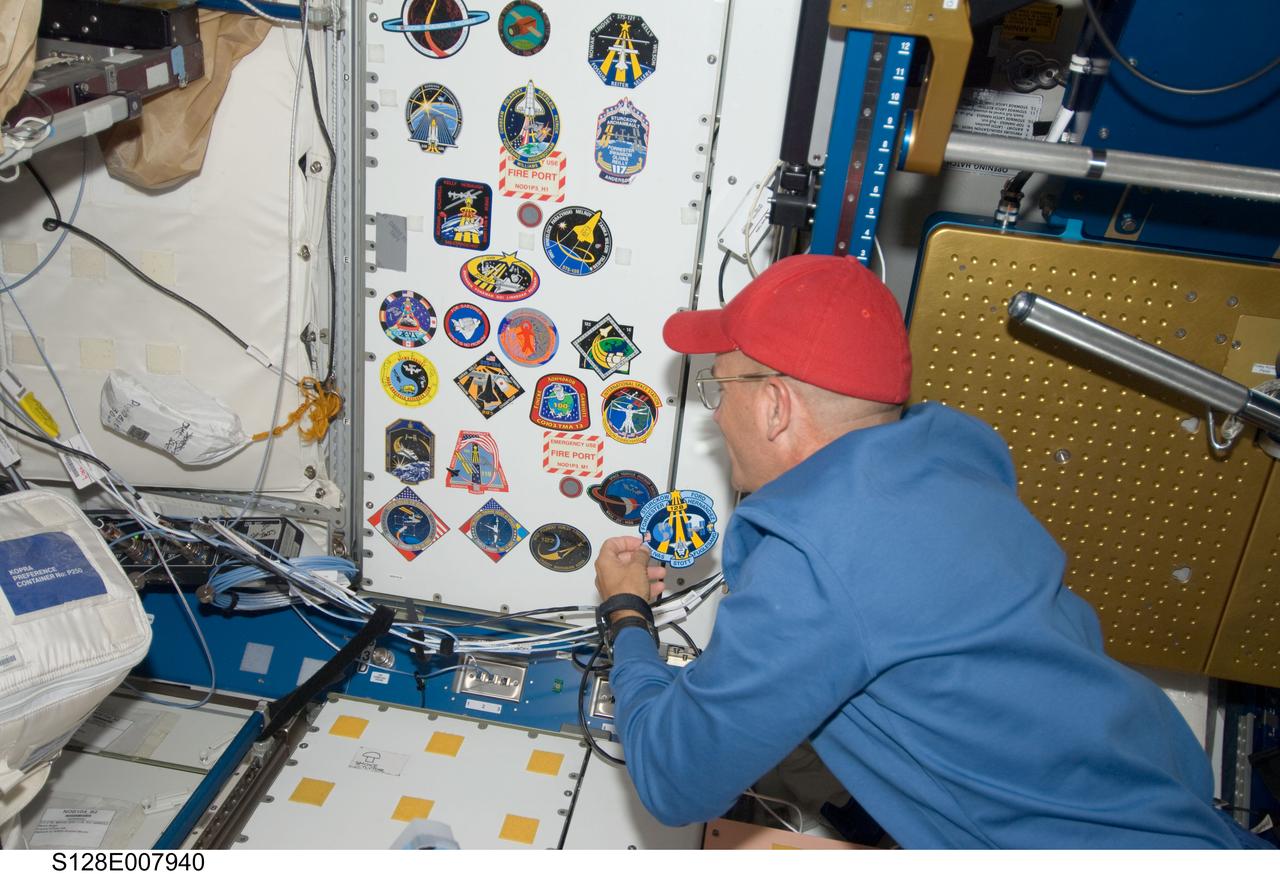
S128-E-007940 (7 Sept. 2009) --- NASA astronaut Rick Sturckow, STS-128 commander, adds his crew’s patch to the growing collection, in the Unity node, of insignias representing crews who have worked on the International Space Station.
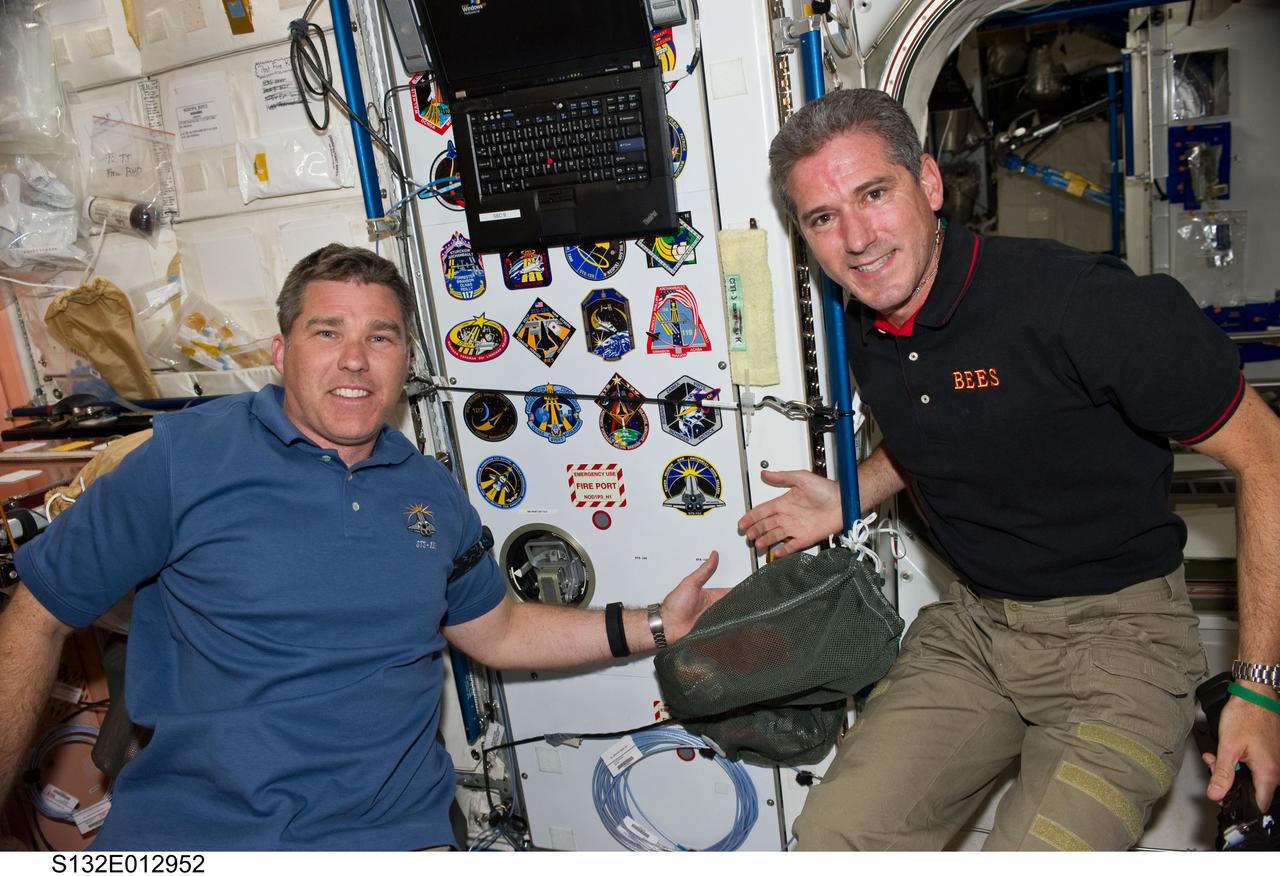
S132-E-012952 (22 May 2010) --- NASA astronauts Steve Bowen (left) and Michael Good, STS-132 mission specialists, pose for a photo after adding the STS-132 patch to the growing collection, in the Unity node, of insignias representing crews who have worked on the International Space Station.
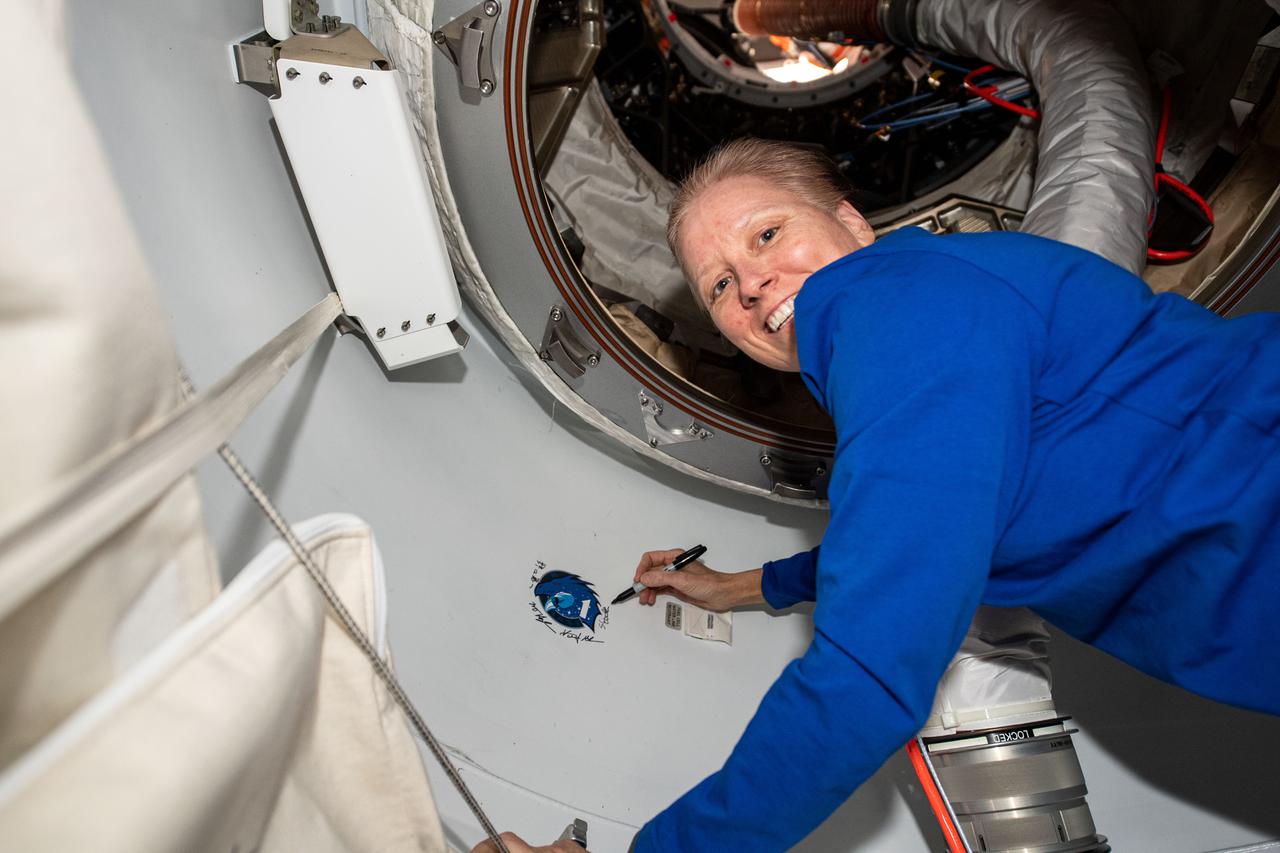
iss064e052207 (April 4, 2021) --- SpaceX Crew-1 Mission Specialist Shannon Walker of NASA signs her name next to the mission insignia affixed to the vestibule between the Crew Dragon spacecraft and the Harmony module's forward international docking adapter.
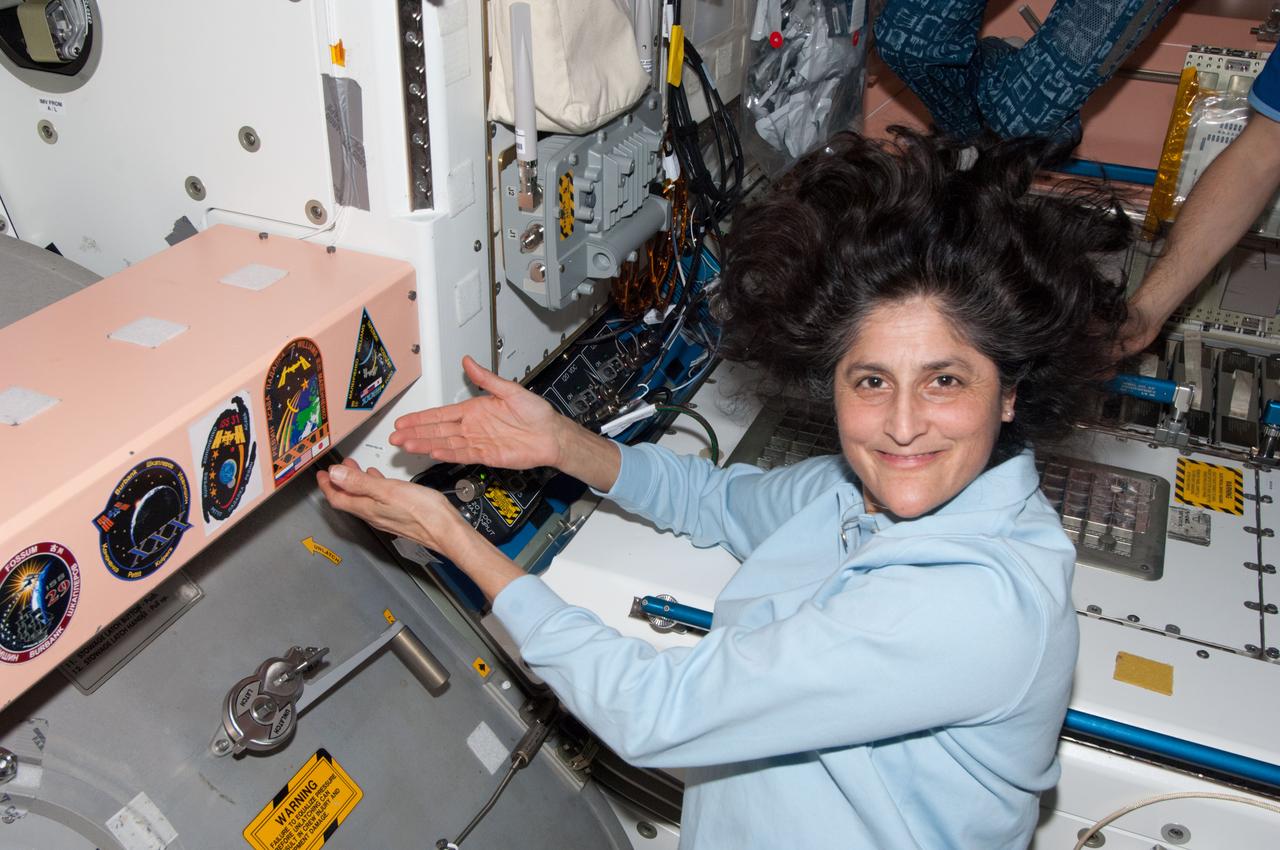
ISS033-E-022053 (17 Nov. 2012) --- In the Unity node, NASA astronaut Sunita Williams, Expedition 33 commander, adds the Expedition 33 patch to the growing collection of insignias representing crews who have worked on the International Space Station, following the ceremony of Changing-of-Command from Expedition 33 to Expedition 34.
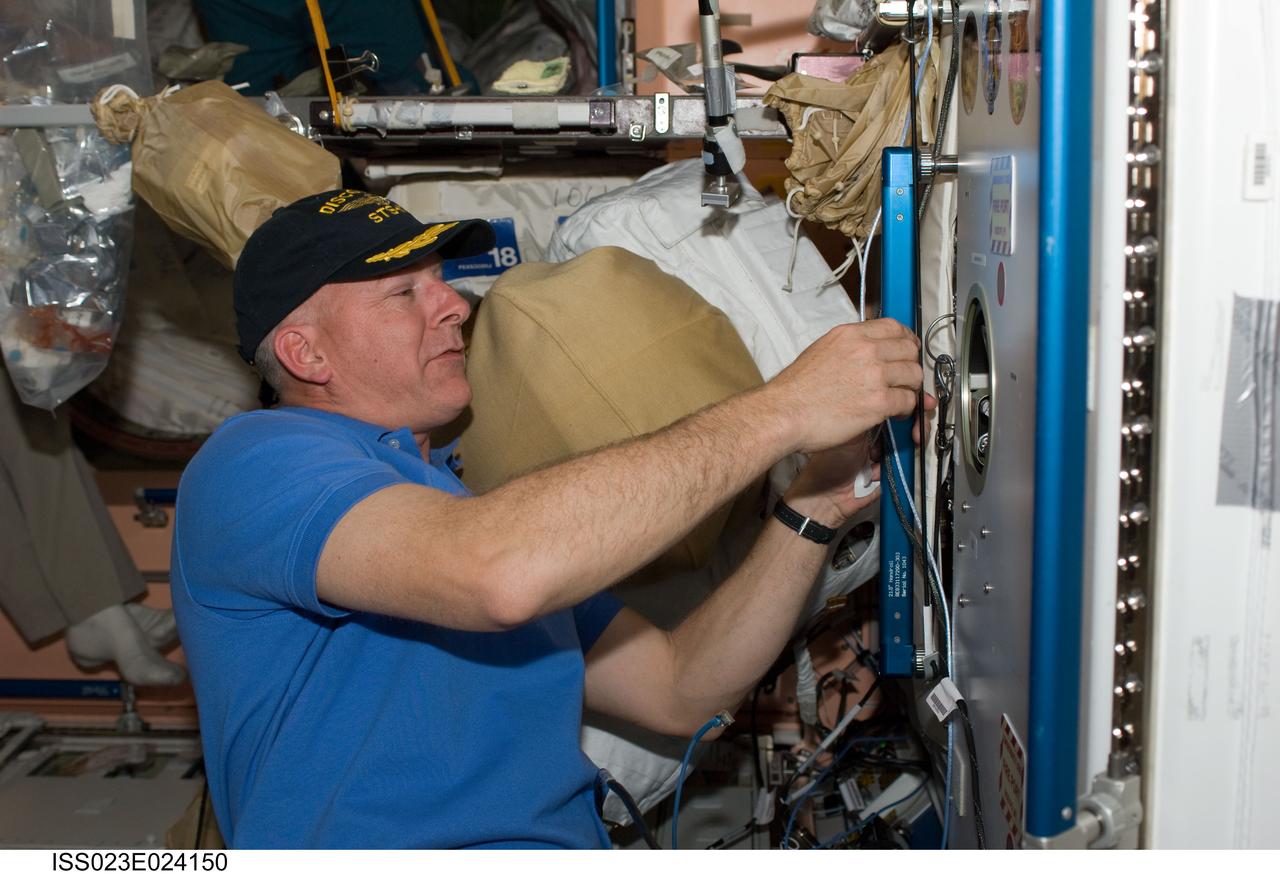
ISS023-E-024150 (16 April 2010) --- NASA astronaut Alan Poindexter, STS-131 commander, adds his crew's patch to the growing collection, in the Unity node, of insignias representing crews who have worked on the International Space Station.
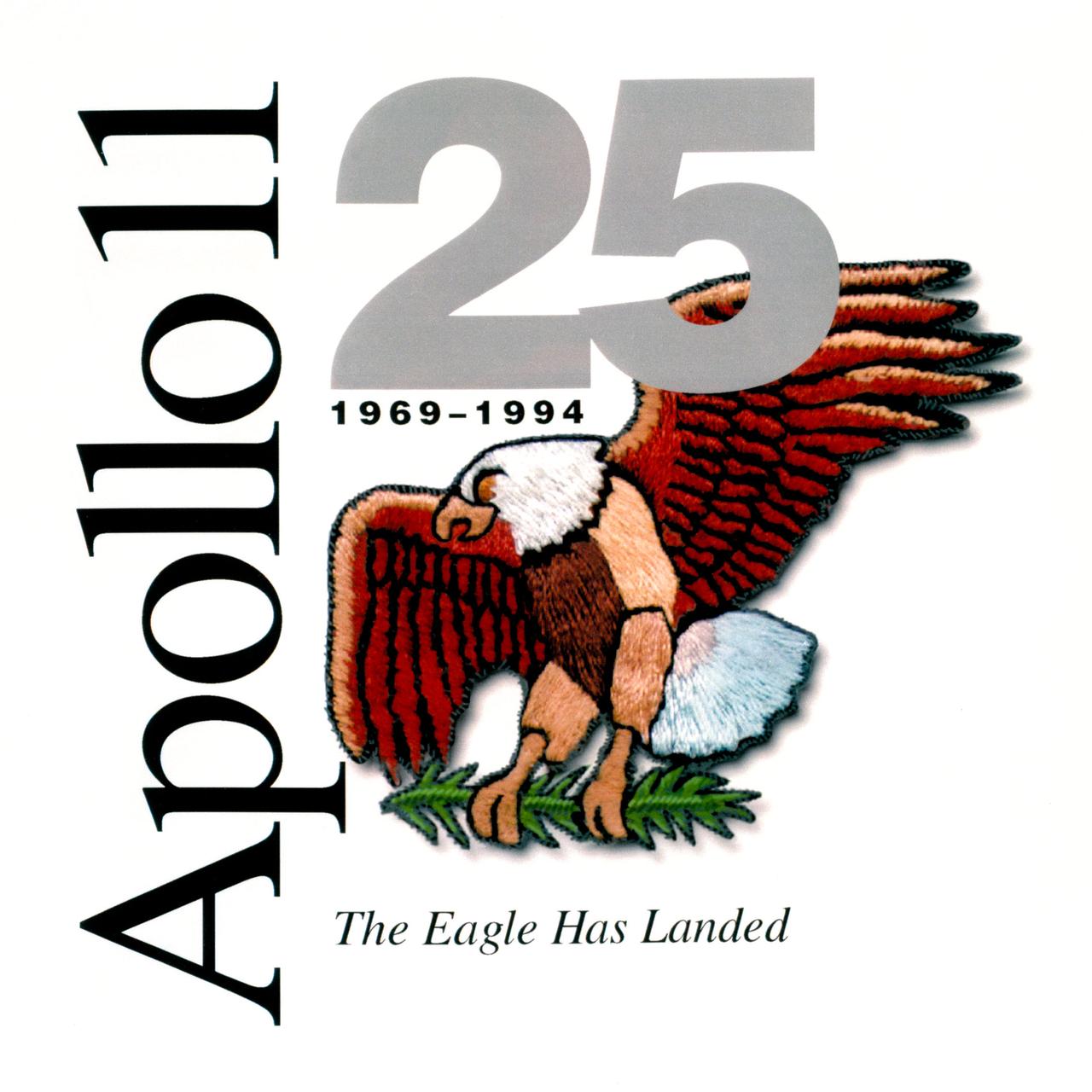
This official NASA commemorative logo marks the 25th anniversary of the first lunar landing. The design incorporates an eagle, from the original Apoll 11 crew insignia, descending toward the lunar surface with an olive branch, symbolizing America's peaceful mission in space. Alternative Headquarters number is 93-HC-312 or 93-H-336.
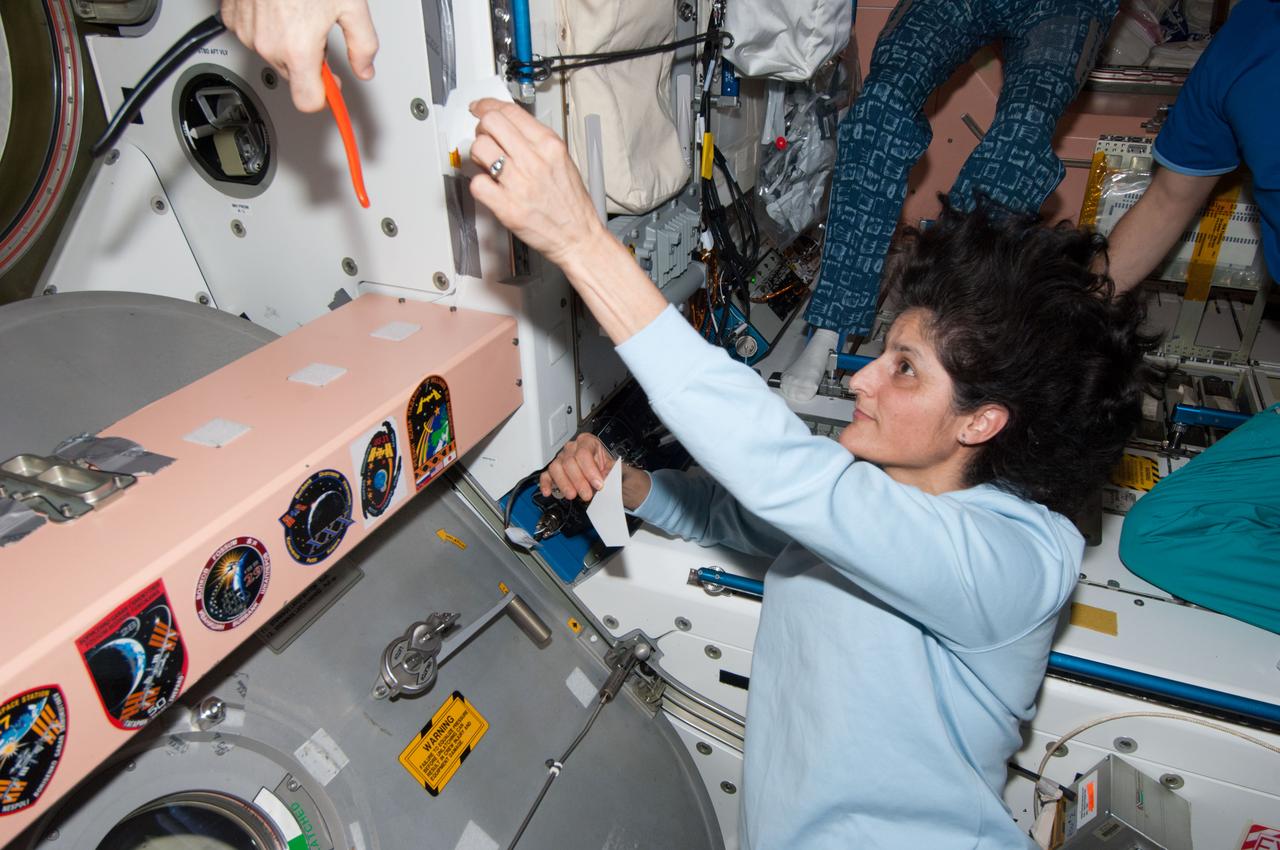
ISS033-E-022048 (17 Nov. 2012) --- In the Unity node, NASA astronaut Sunita Williams, Expedition 33 commander, prepares to add the Expedition 33 patch to the growing collection of insignias representing crews who have worked on the International Space Station, following the ceremony of Changing-of-Command from Expedition 33 to Expedition 34.
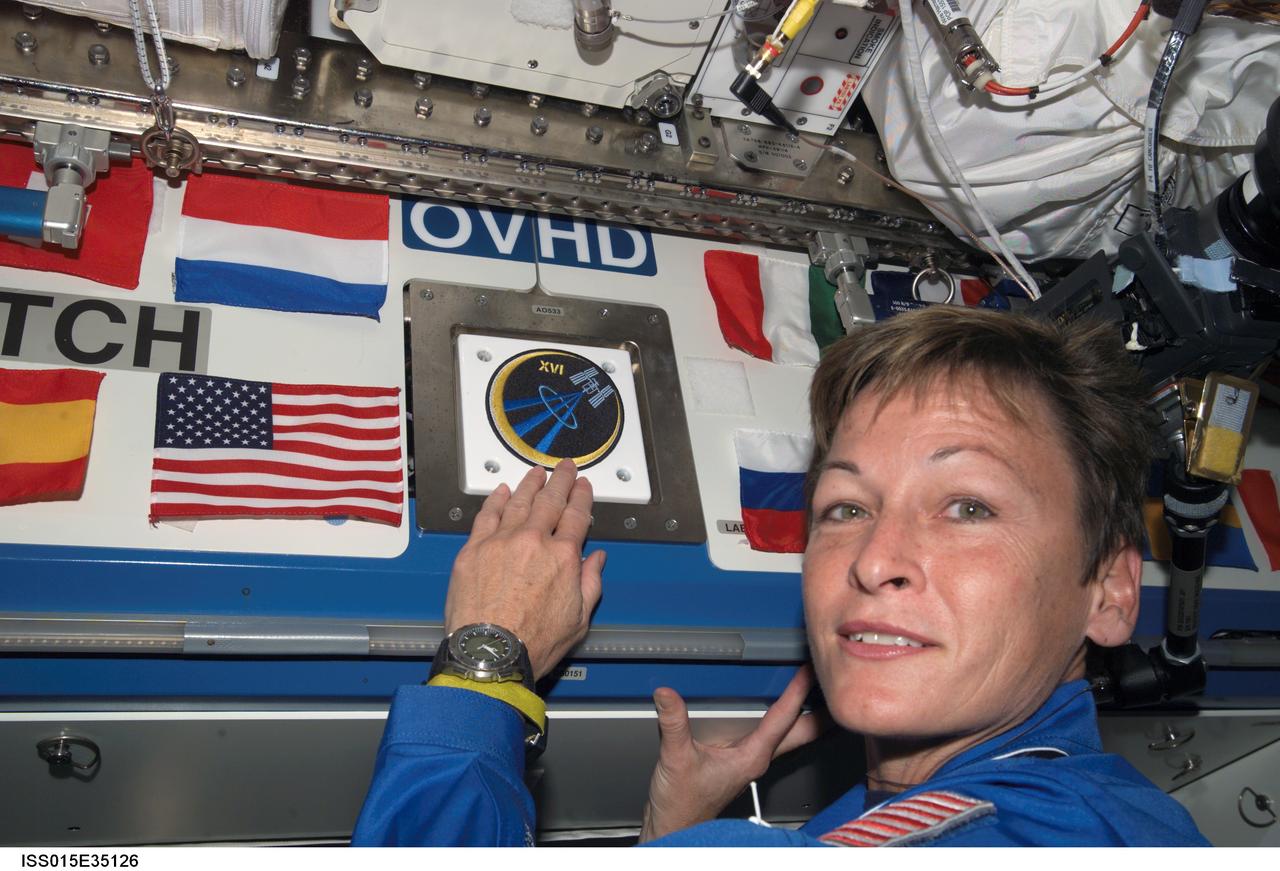
ISS015-E-35126 (19 Oct. 2007) --- NASA astronaut Peggy A. Whitson, Expedition 16 commander, places the Expedition 16 patch above a hatch in the Destiny laboratory, which adds to the growing collection of insignias representing crews who have lived and worked on the International Space Station.
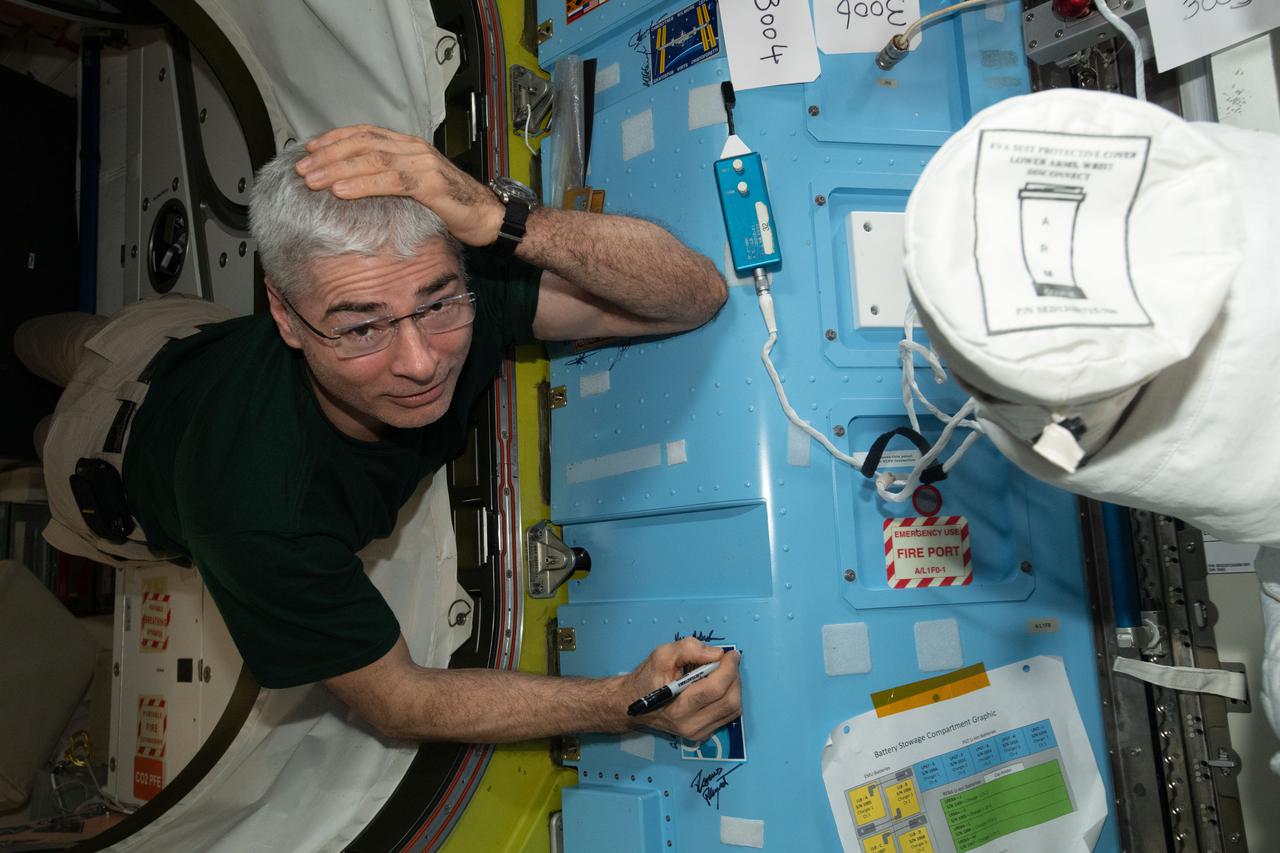
iss065e389561 (Sept. 17, 2021) --- NASA astronaut and Expedition 65 Flight Engineer Mark Vande Hei signs his name around the Expedition 65 mission insignia sticker affixed to the vestibule in between the Unity module and the Quest airlock.
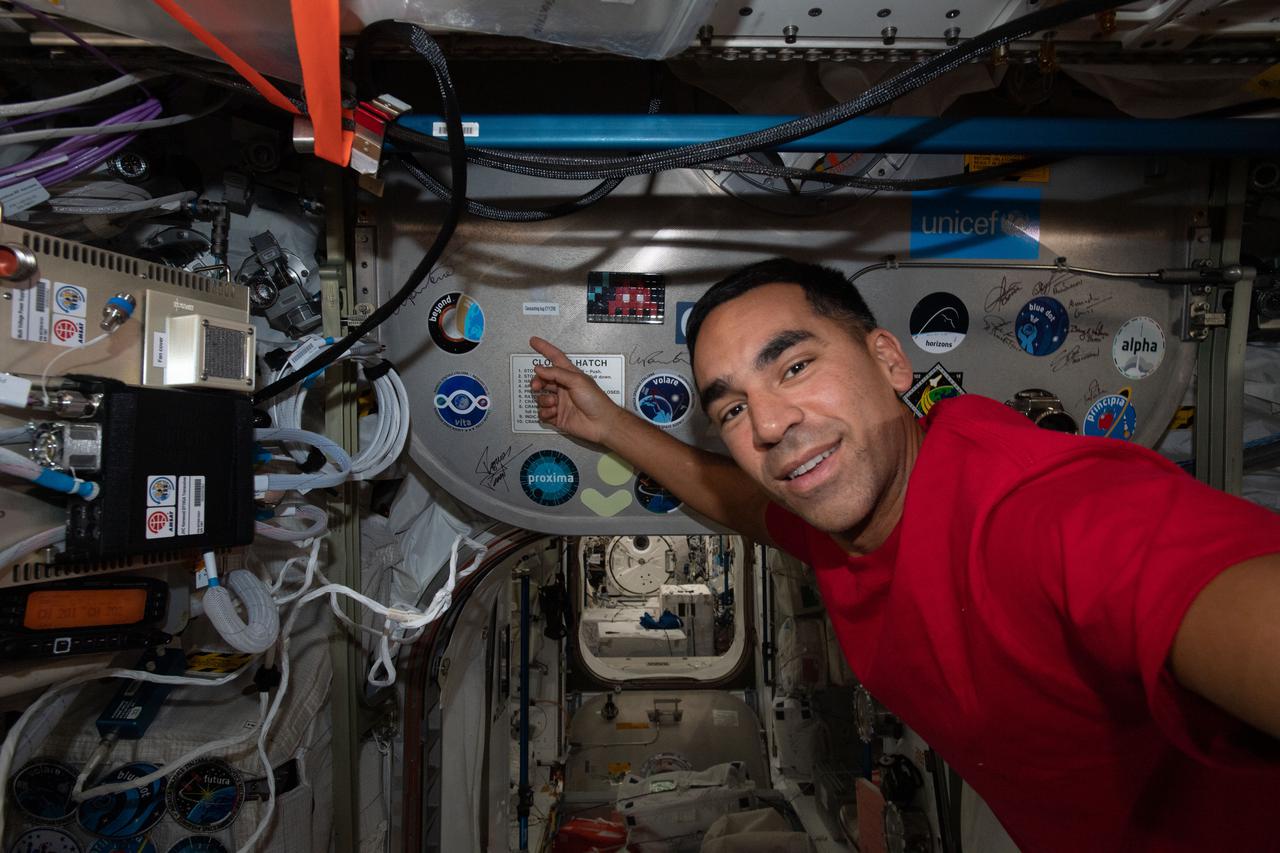
iss066e086630 (Dec. 5, 2021) --- NASA astronaut and Expedition 66 Flight Engineer Raja Chari is pictured inside the Columbus laboratory module pointing to the "Beyond" mission insignia representing ESA (European Space Agency) astronaut Luca Parmitano's stay aboard the International Space Station.
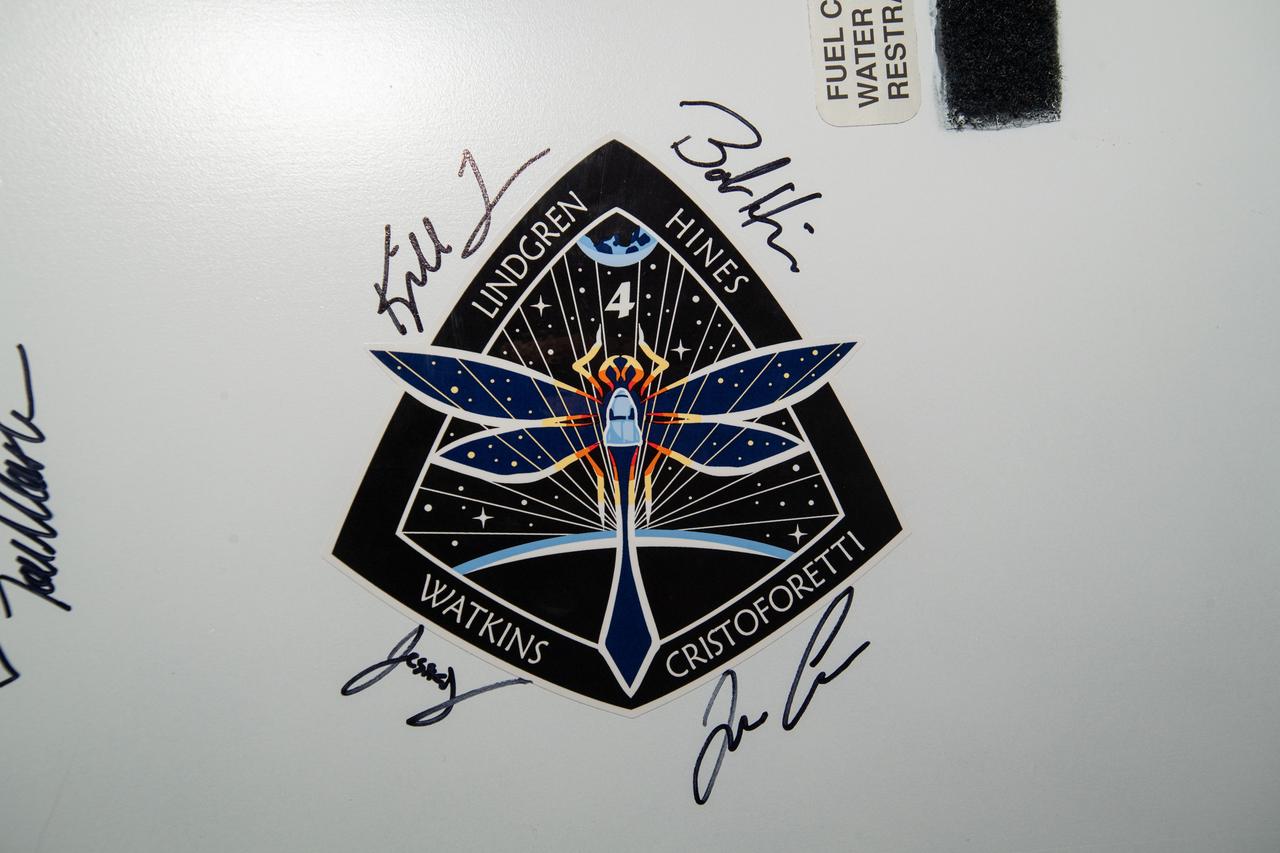
iss068e016463 (Oct. 12, 2022) --- The SpaceX Crew-4 mission insignia, affixed to the vestibule between the Harmony module's space-facing port and the Dragon Freedom crew ship, is surrounded by the signatures of Crew-4 members Kjell Lindgren, Bob Hines, Jessica Watkins, and Samantha Cristoforetti. Credit: NASA/Kjell Lindgren
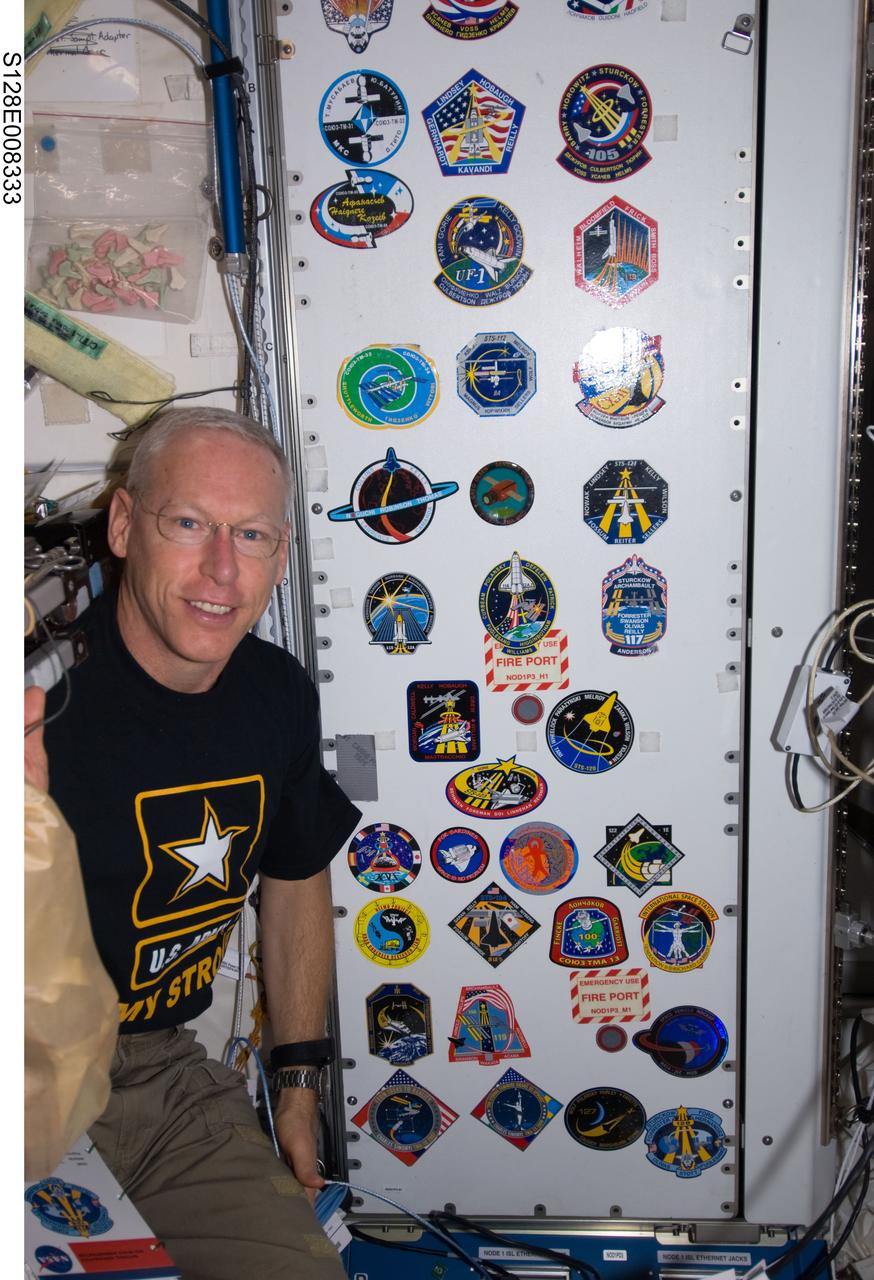
S128-E-008333 (7 Sept. 2009) --- NASA astronaut Patrick Forrester, STS-128 mission specialist, poses for a photo with the growing collection, in the Unity node, of insignias representing crews who have worked on the International Space Station.
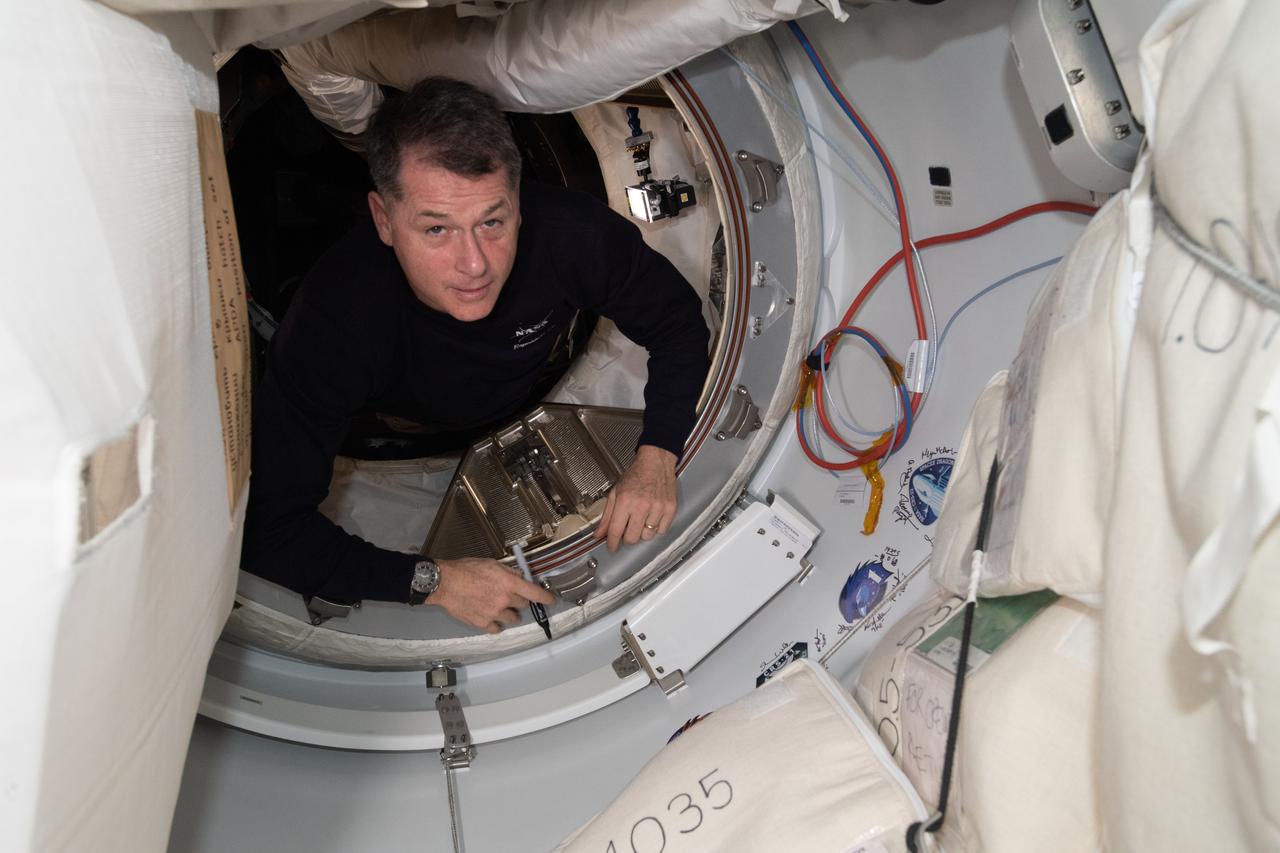
iss065e389568 (Sept. 17, 2021) --- NASA astronaut and Expedition 65 Flight Engineer Shane Kimbrough signs his name around the SpaceX Crew-2 mission insignia sticker affixed to the vestibule in between the Harmony module and its space-facing international docking adapter where the SpaceX Crew Dragon Endeavour is docked.
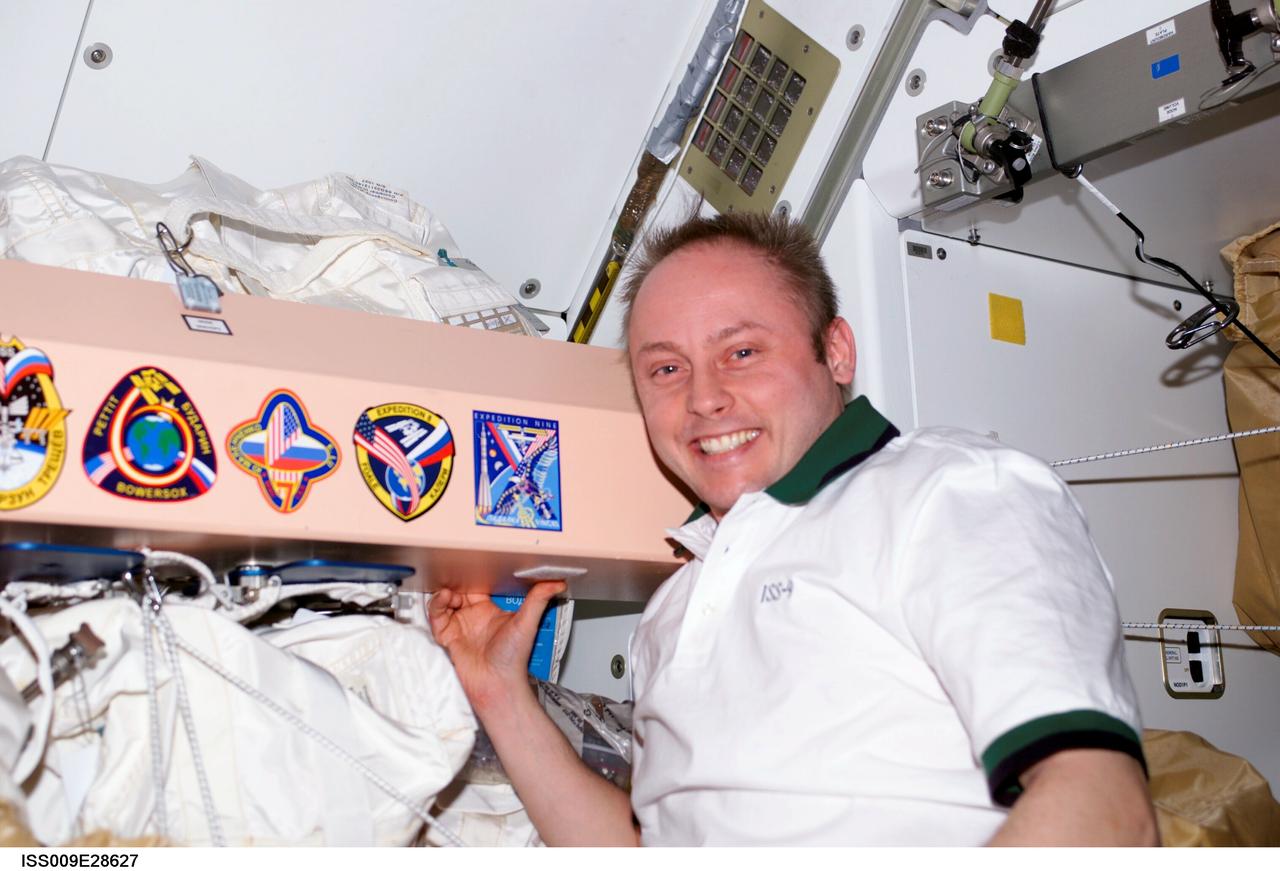
ISS009-E-28627 (1 July 2004) --- Astronaut Edward M. (Mike) Fincke, Expedition 9 NASA ISS science officer and flight engineer, poses by the Expedition mission insignias placed in the Unity node of the International Space Station (ISS).
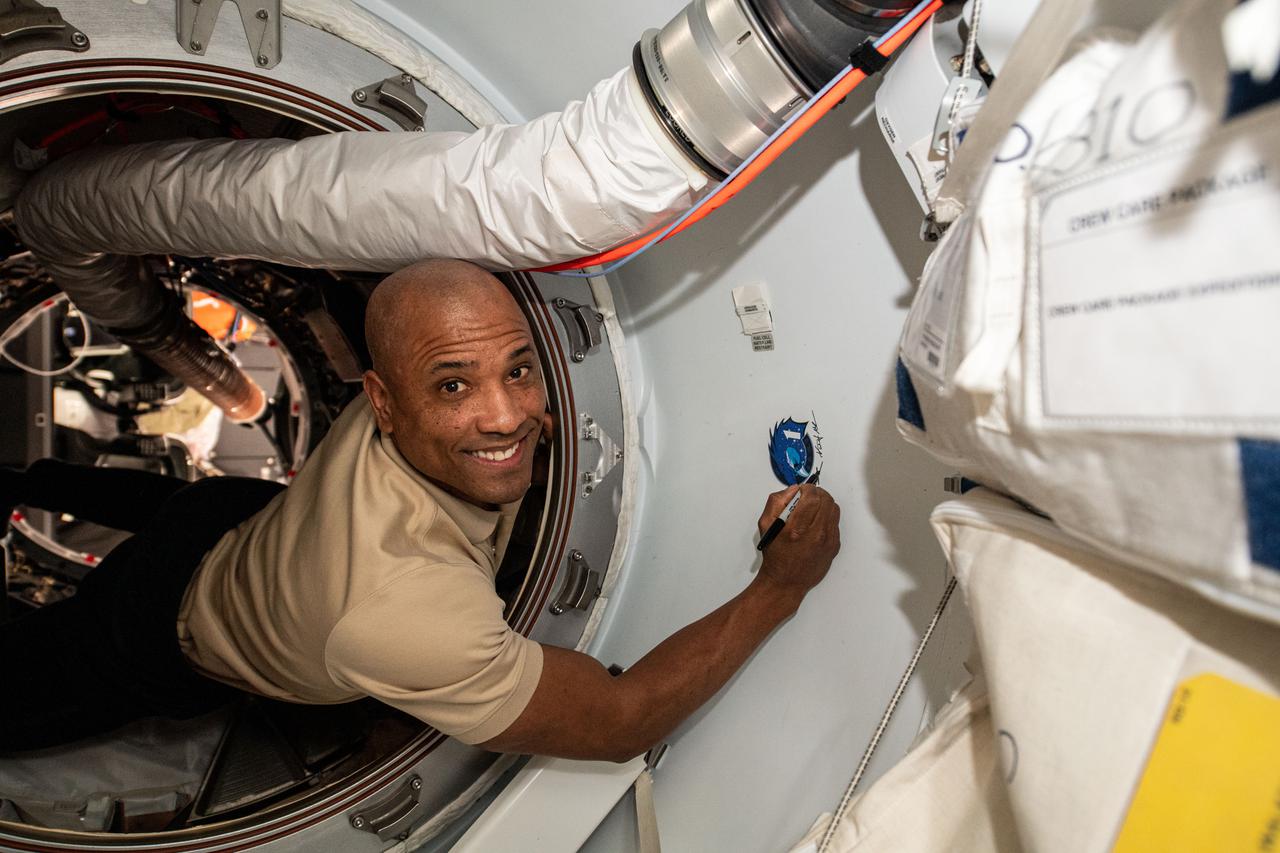
iss064e052200 (April 4, 2021) --- SpaceX Crew-1 Pilot Victor Glover of NASA signs his name next to the mission insignia affixed to the vestibule between the Crew Dragon spacecraft and the Harmony module's forward international docking adapter.
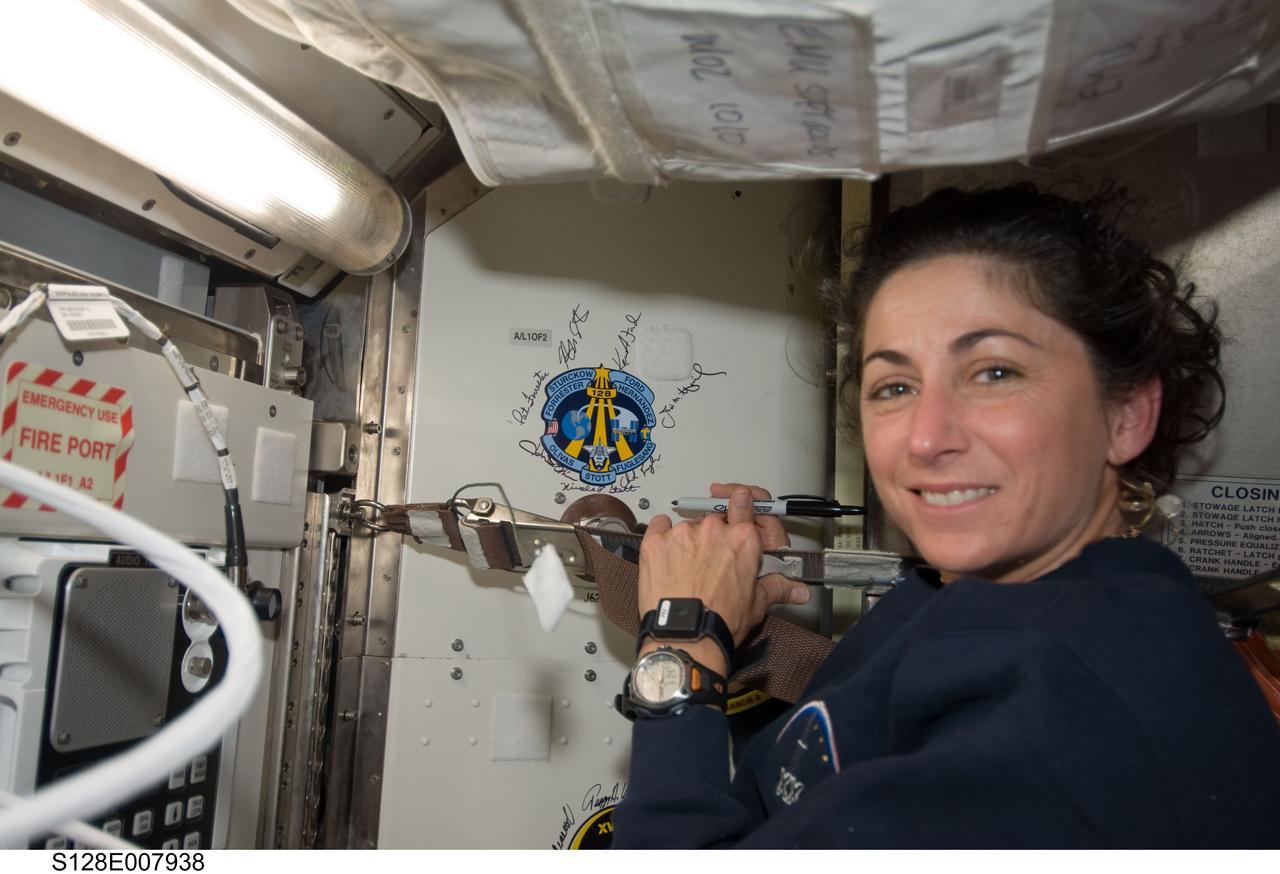
S128-E-007938 (7 Sept. 2009) --- NASA astronaut Nicole Stott, Expedition 20 flight engineer, poses for a photo after signing the STS-128 patch, which was added to the growing collection of insignias representing crews who performed spacewalks from the Quest airlock of the International Space Station.
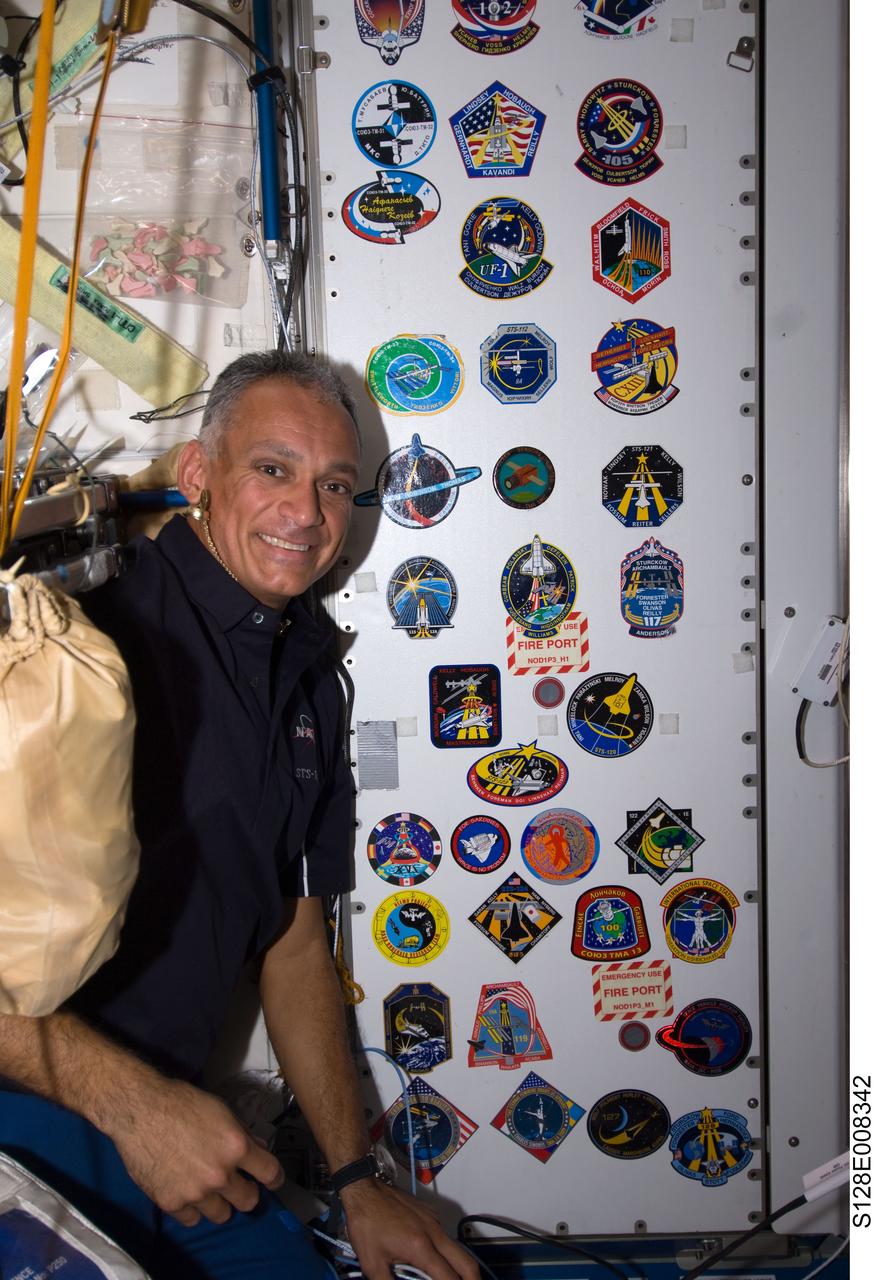
S128-E-008342 (7 Sept. 2009) --- NASA astronaut John “Danny” Olivas, STS-128 mission specialist, poses for a photo with the growing collection, in the Unity node, of insignias representing crews who have worked on the International Space Station.
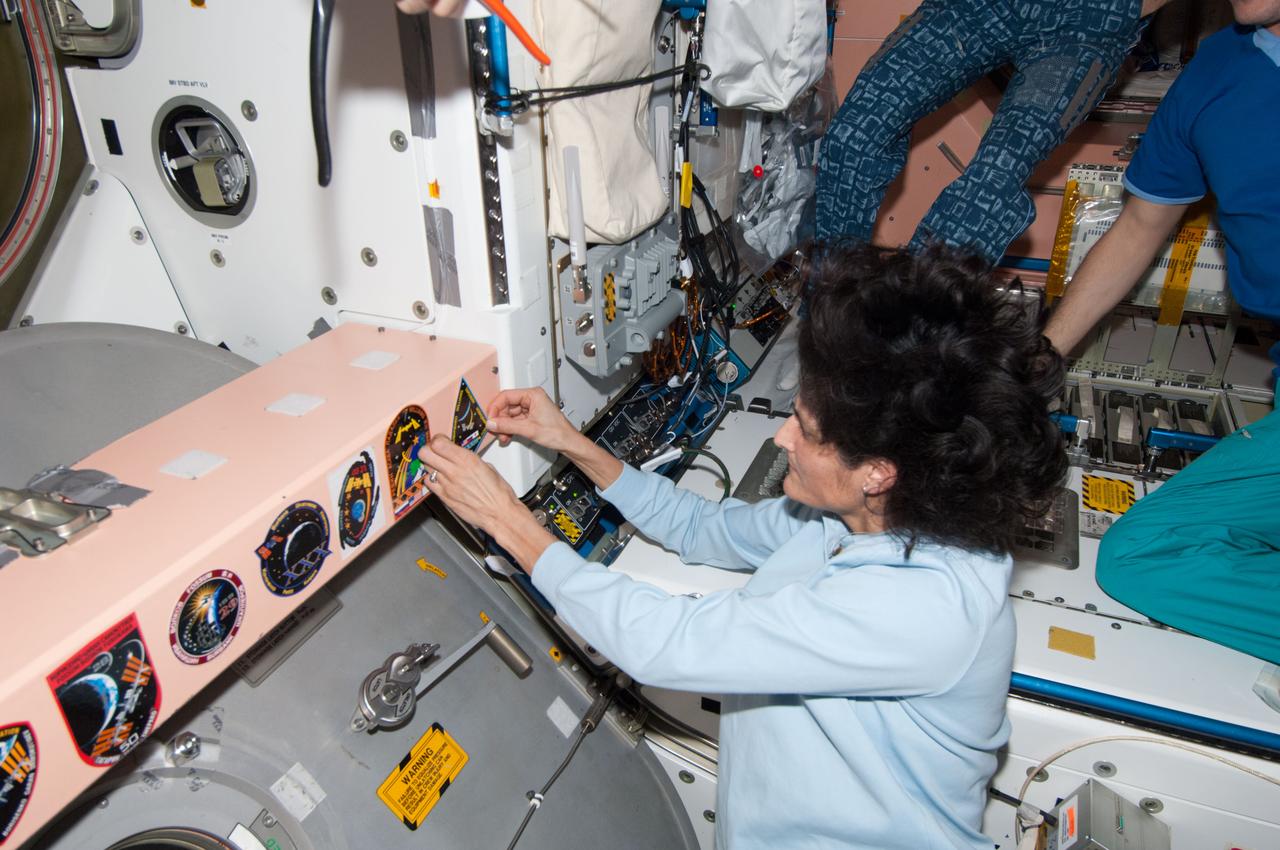
ISS033-E-022049 (17 Nov. 2012) --- In the Unity node, NASA astronaut Sunita Williams, Expedition 33 commander, adds the Expedition 33 patch to the growing collection of insignias representing crews who have worked on the International Space Station, following the ceremony of Changing-of-Command from Expedition 33 to Expedition 34.
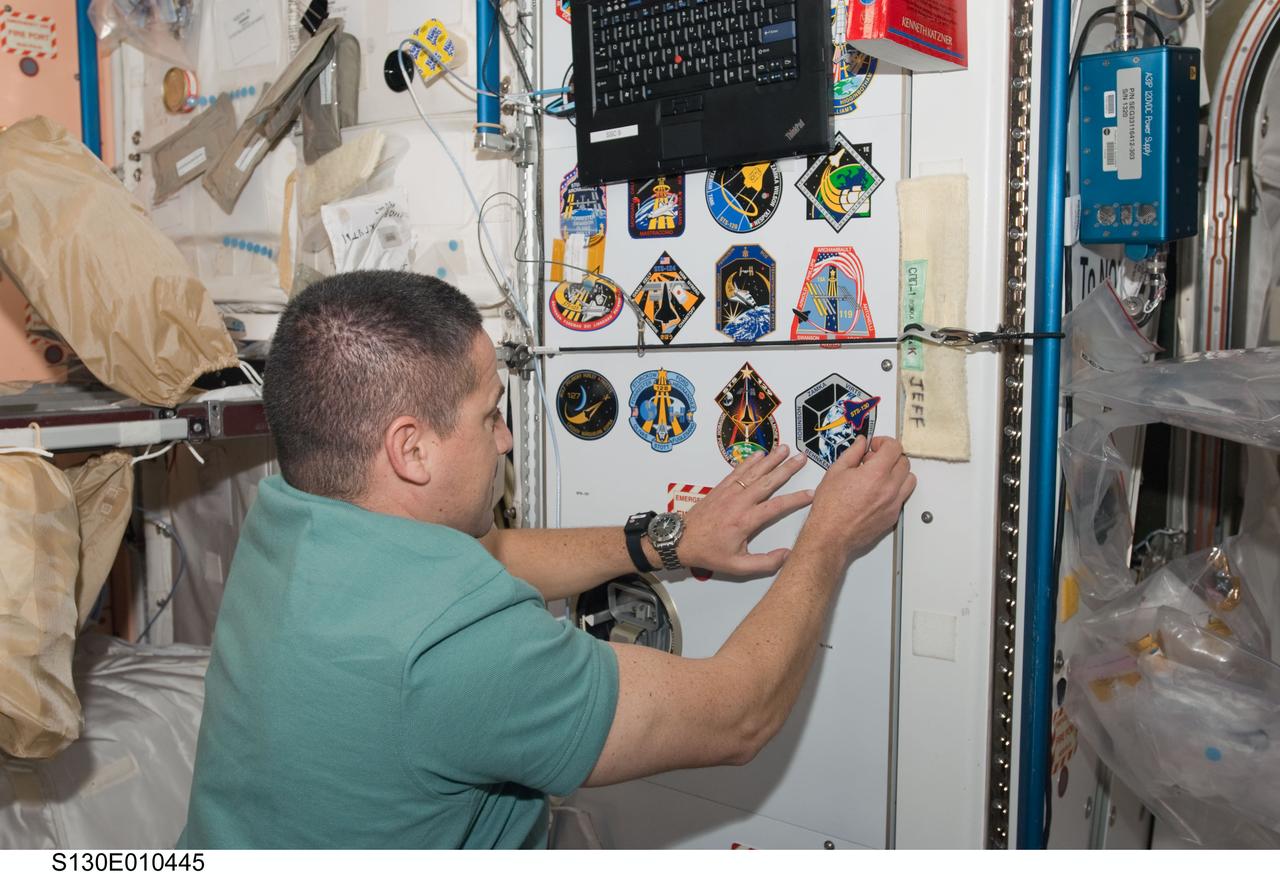
S130-E-010445 (18 Feb. 2010) --- NASA astronaut George Zamka, STS-130 commander, adds his crew's patch to the growing collection, in the Unity node, of insignias representing crews who have worked on the International Space Station.
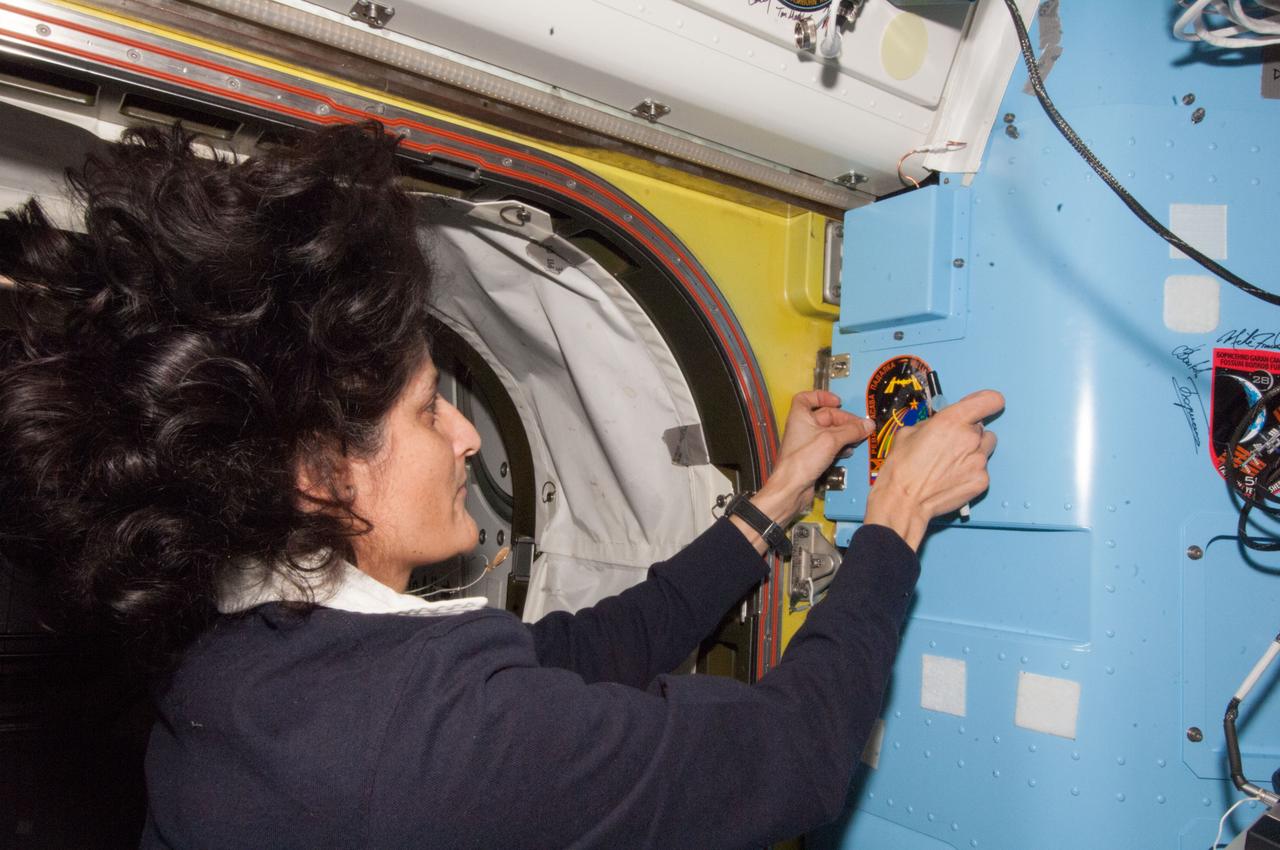
ISS033-E-022110 (18 Nov. 2012) --- NASA astronaut Sunita Williams, Expedition 33 commander, adds the Expedition 32 patch to the growing collection of insignias representing crews who performed spacewalks from the Quest airlock of the International Space Station.
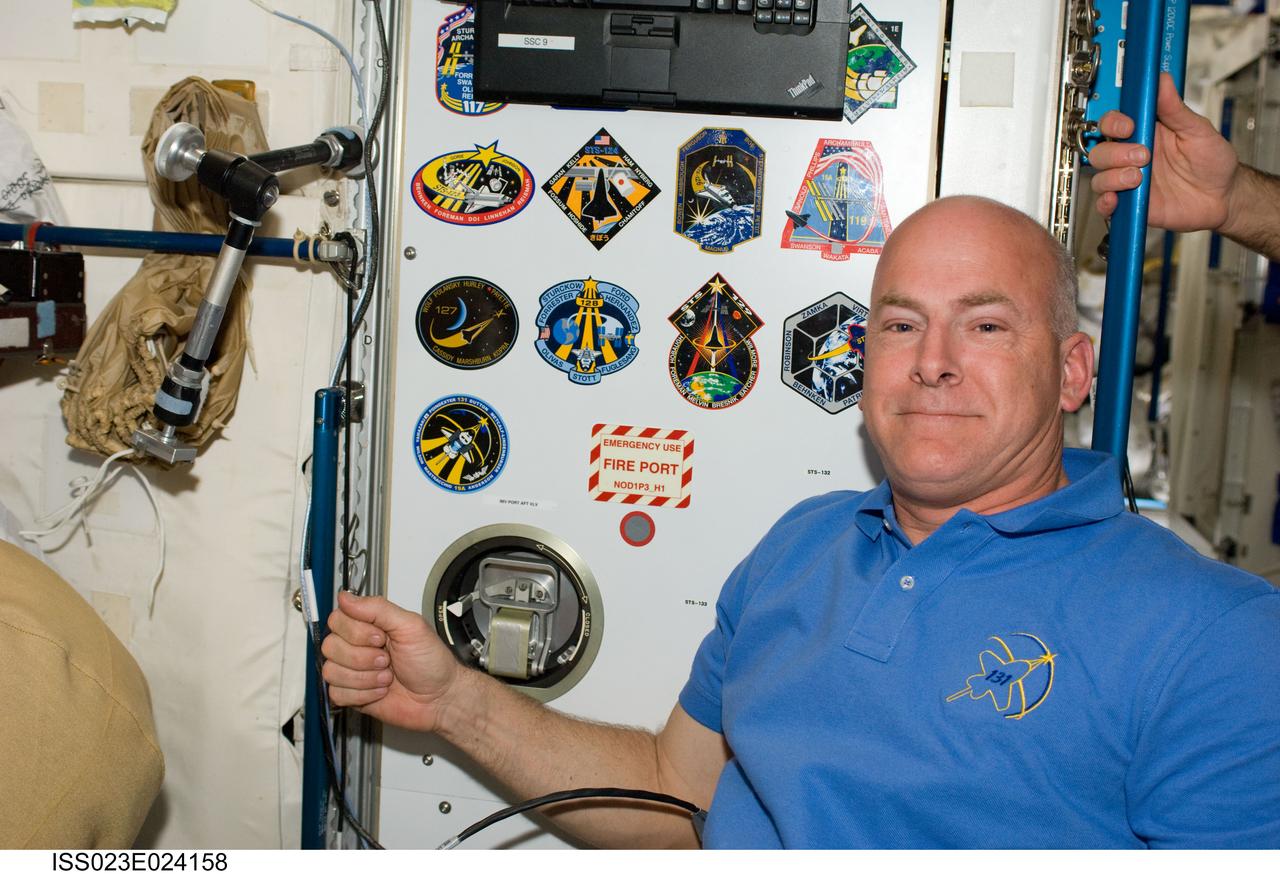
ISS023-E-024158 (16 April 2010) --- NASA astronaut Alan Poindexter, STS-131 commander, poses for a photo after adding his crew's patch to the growing collection, in the Unity node, of insignias representing crews who have worked on the International Space Station.
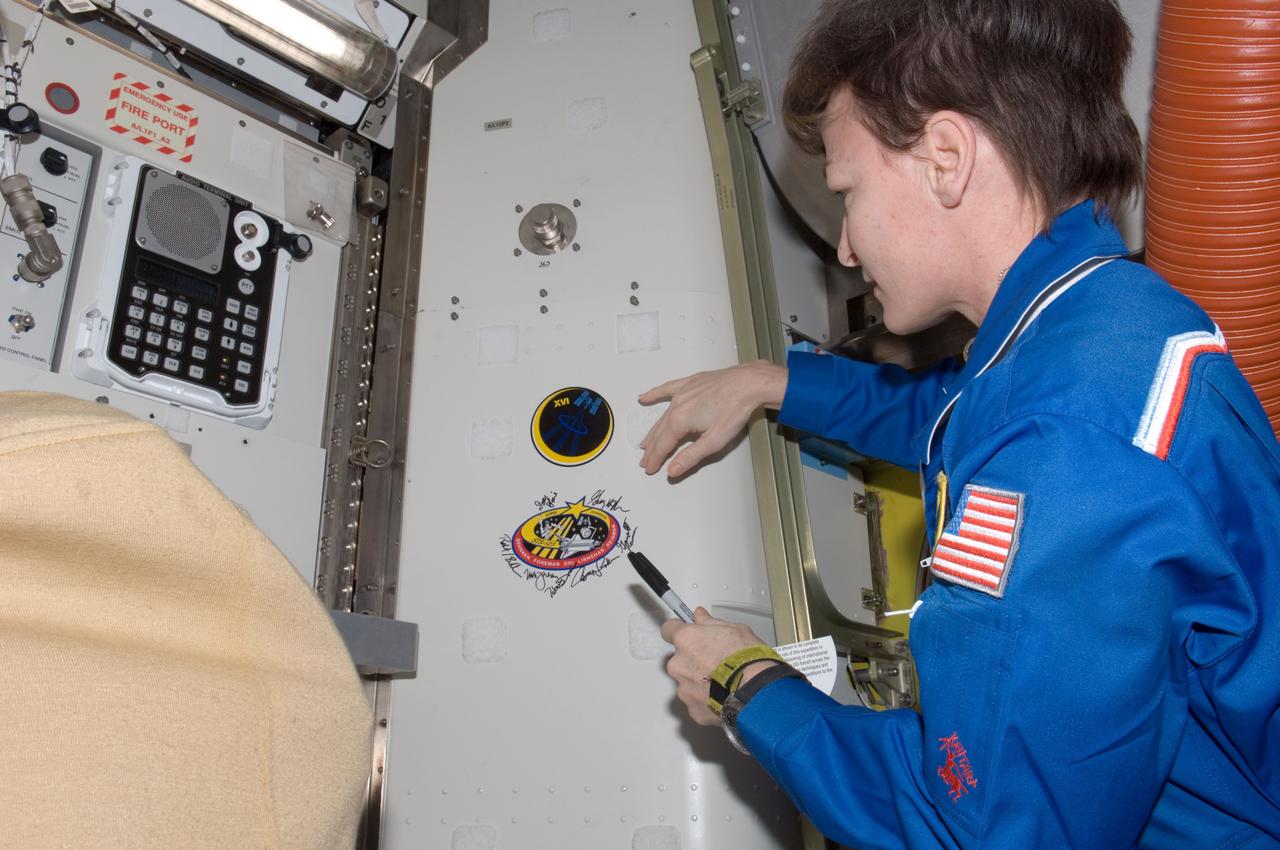
ISS016-E-036380 (17 April 2008) --- NASA astronaut Peggy Whitson, Expedition 16 commander, prepares to sign the Expedition 16 patch, which was added to the growing collection of insignias representing crews who performed spacewalks from the Quest Airlock of the International Space Station.
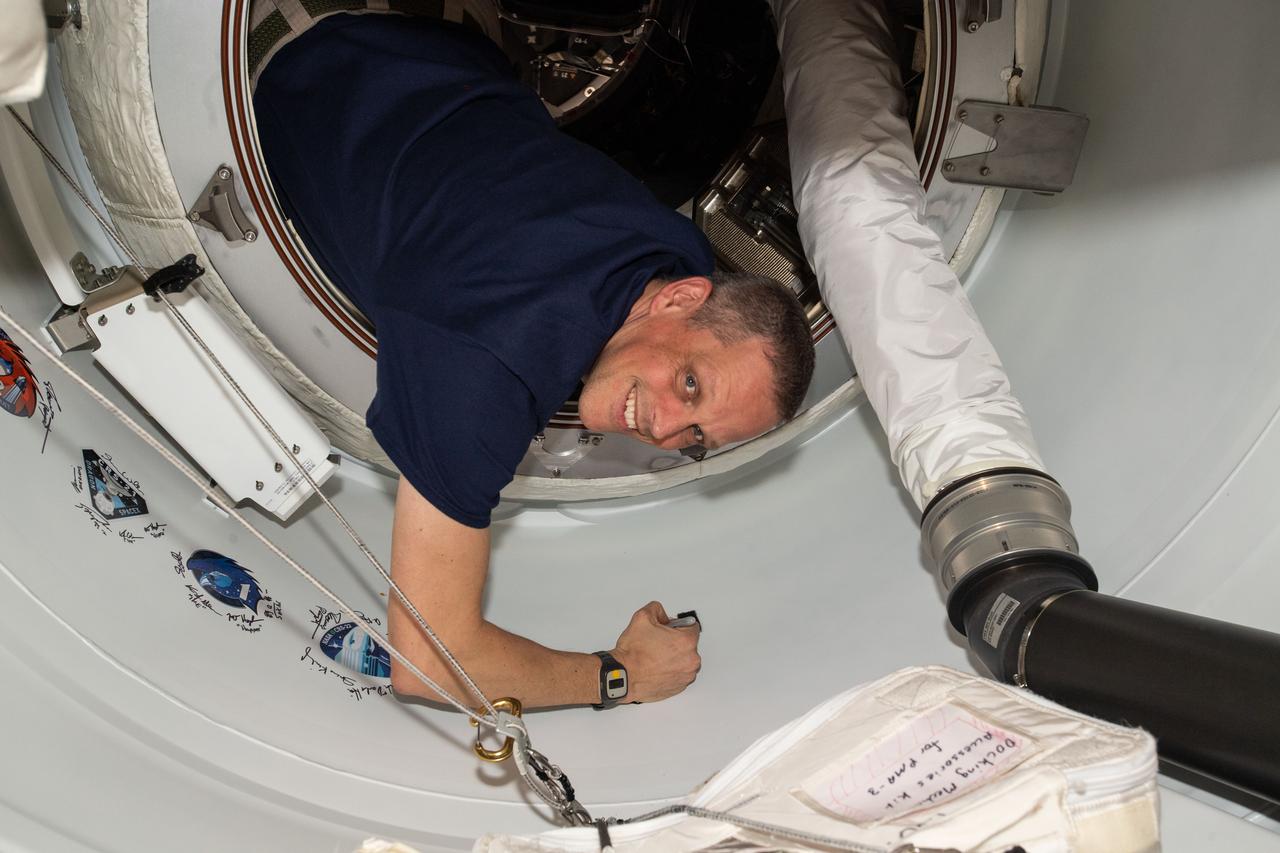
iss068e016449 (Oct. 12, 2022) --- NASA astronaut and Expedition 68 Flight Engineer Bob Hines, also the SpaceX Crew-4 Pilot, signs his name around the Crew-4 mission insignia affixed to the vestibule between the Harmony module's space-facing port and the Dragon Freedom crew ship.
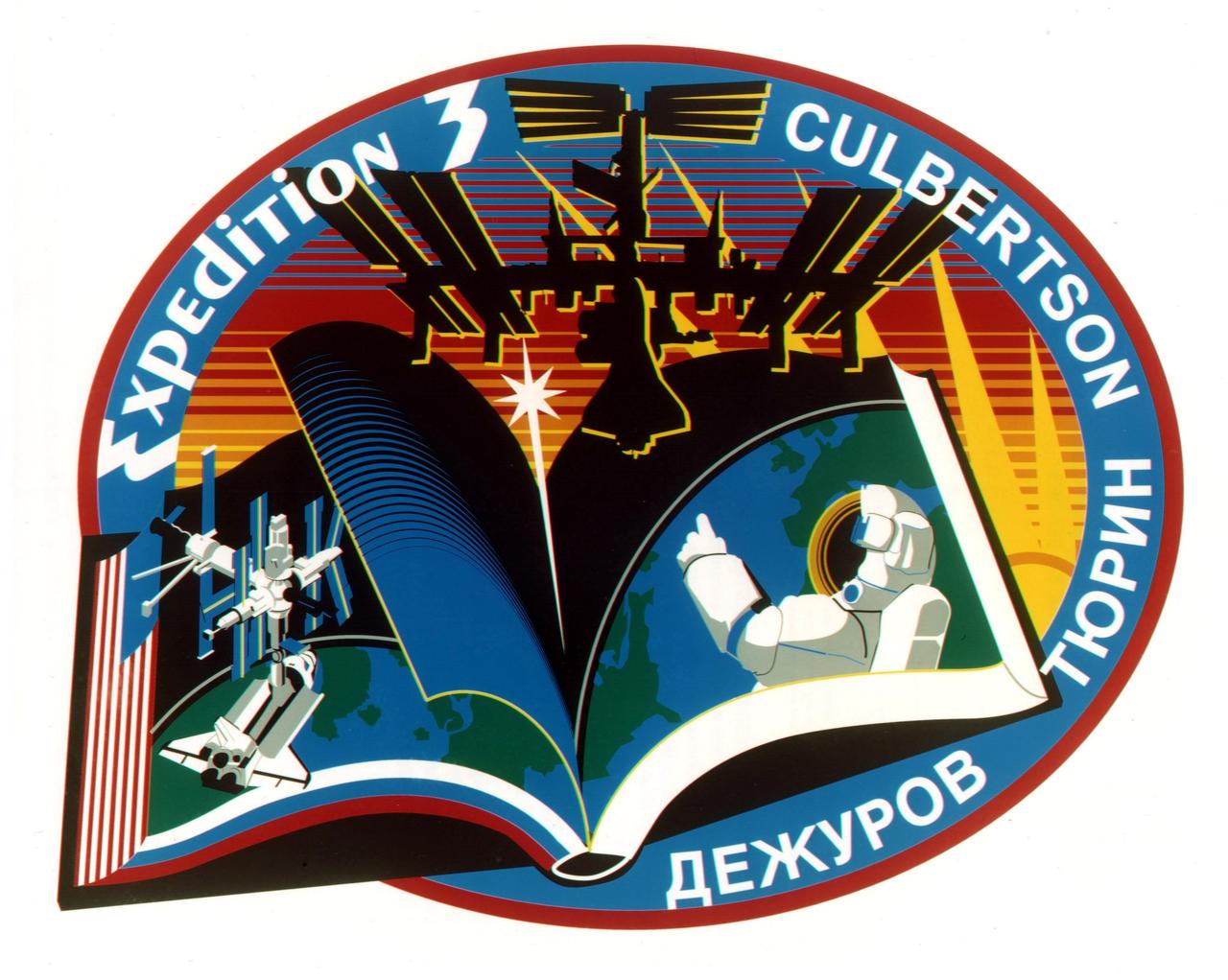
JOHNSON SPACE CENTER, HOUSTON, TEXAS -- EXPEDITION THREE INSIGNIA -- The Expedition Three crew members -- astronaut Frank L. Culbertson Jr., commander, and cosmonauts Vladimir N. Dezhurov and Mikhail Tyurin -- had the following to say about the insignia for their scheduled mission aboard the International Space Station (ISS): "The book of space history turns from the chapter written onboard the Russian Mir Station and the U.S. Space Shuttle to the next new chapter, one that will be written on the blank pages of the future by space explorers working for the benefit of the entire world. The space walker signifies the human element of this endeavor. The star representing the members of the third expedition, and the entire multi-national Space Station building team, streaks into the dawning era of cooperative space exploration, represented by the image of the International Space Station as it nears completion." The insignia design for ISS flights is reserved for use by the astronauts and cosmonauts and for other official use as the NASA Administrator and NASA's international partners may authorize. Public availability has been approved only in the form of illustrations by the various news media. When and if there is any change in this policy, which we do not anticipate, it will be publicly announced
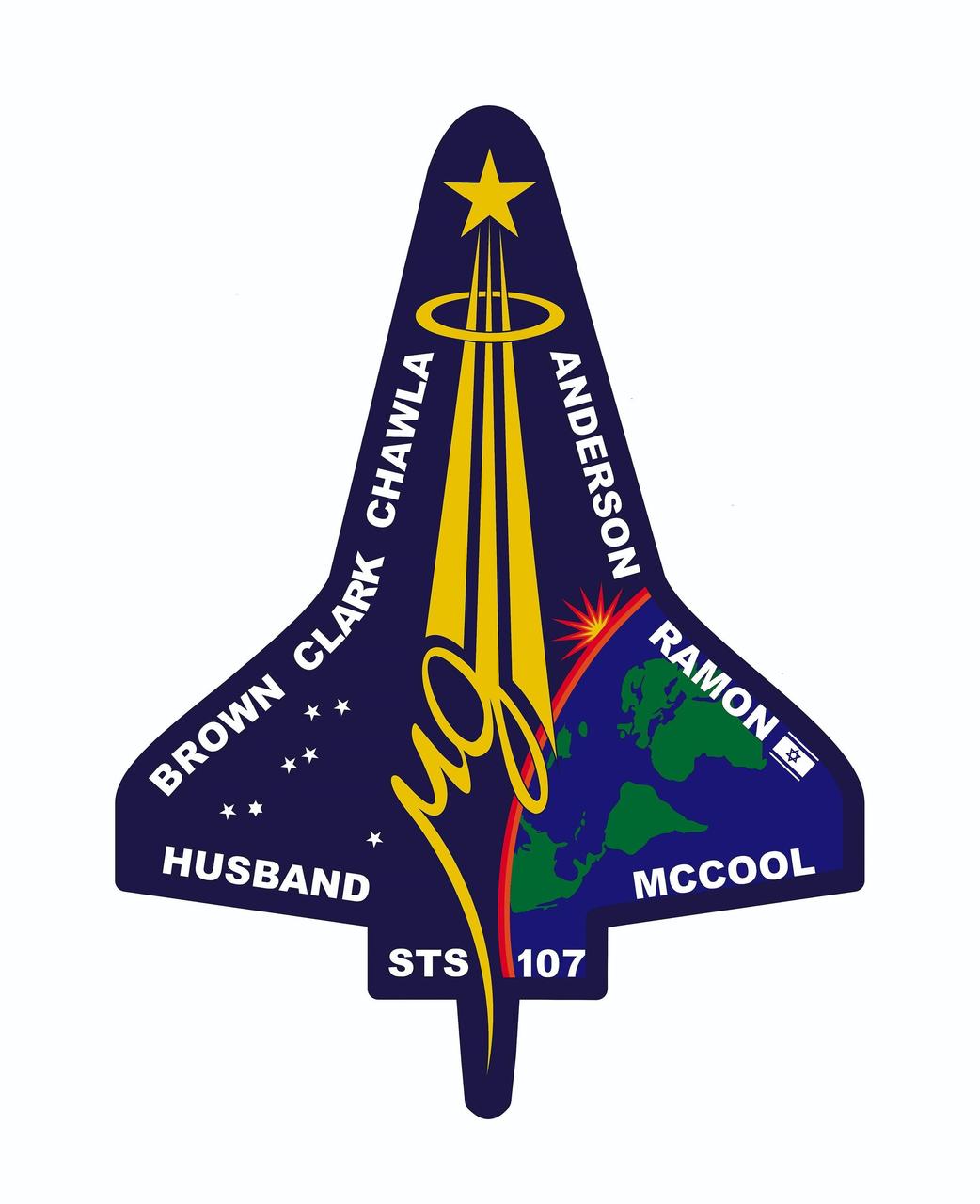
JOHNSON SPACE CENTER, HOUSON, TEXAS -- STS-107 INSIGNIA -- This is the insignia for STS-107, which is a multi-discipline microgravity and Earth science research mission with a multitude of international scientific investigations conducted continuously during the planned 16 days on orbit. The central element of the patch is the microgravity symbol flowing into the rays of the astronaut symbol. The mission inclination is portrayed by the 39-degree angle of the astronaut symbol to the Earth's horizon. The sunrise is representative of the numerous experiments that are the dawn of a new era for continued microgravity research on the International Space Station and beyond. The breadth of science conducted on this mission will have widespread benefits to life on Earth and our continued exploration of space, illustrated by the Earth and stars. The constellation Columba (the dove) was chosen to symbolize peace on Earth and the Space Shuttle Columbia. The seven stars also represent the mission crew members and honor the original astronauts who paved the way to make research in space possible. The Israeli flag is adjacent to the name of the payload specialist who is the first person from that country to fly on the Space Shuttle. The NASA insignia design for Space Shuttle flights is reserved for use by the astronauts and for other official use as the NASA Administrator may authorize. Public availability has been approved only in the form of illustrations by the various news media. When and if there is any change in this policy, which we do not anticipate, it will be publicly announced.
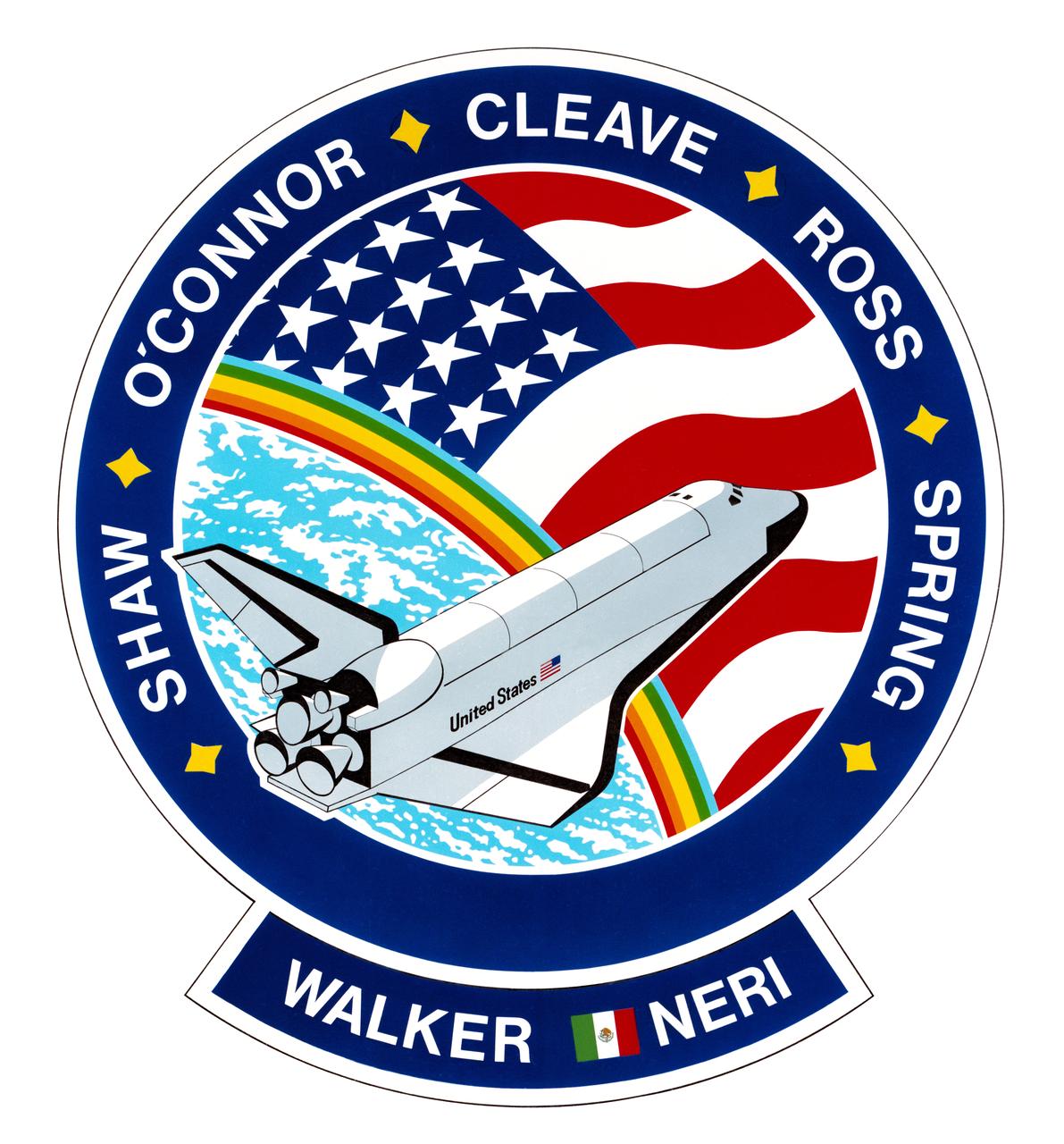
S85-36635 (October 1985) --- This is the insignia designed by the STS-61B crew members to represent their November 1985 mission aboard the space shuttle Atlantis, depicted here in Earth orbit, making only its second spaceflight. The design is surrounded by the surnames of the seven crew members. They are astronauts Brewster Shaw Jr., commander; Bryan D. O'Conner, pilot; Mary L. Cleave, Jerry L. Ross and Sherwood C. Spring, all mission specialists; and payload specialists Charles D. Walker, representing McDonnell Douglas, and Rodolfo Neri, representing Morelos of Mexico (note flag). The NASA insignia design for space shuttle flights is reserved for use by the astronauts and for other official use as the NASA Administrator may authorize. Public availability has been approved only in the forms of illustrations by the various news media. When and if there is any change in this policy, which is not anticipated, the change will be publicly announced. Photo credit: NASA
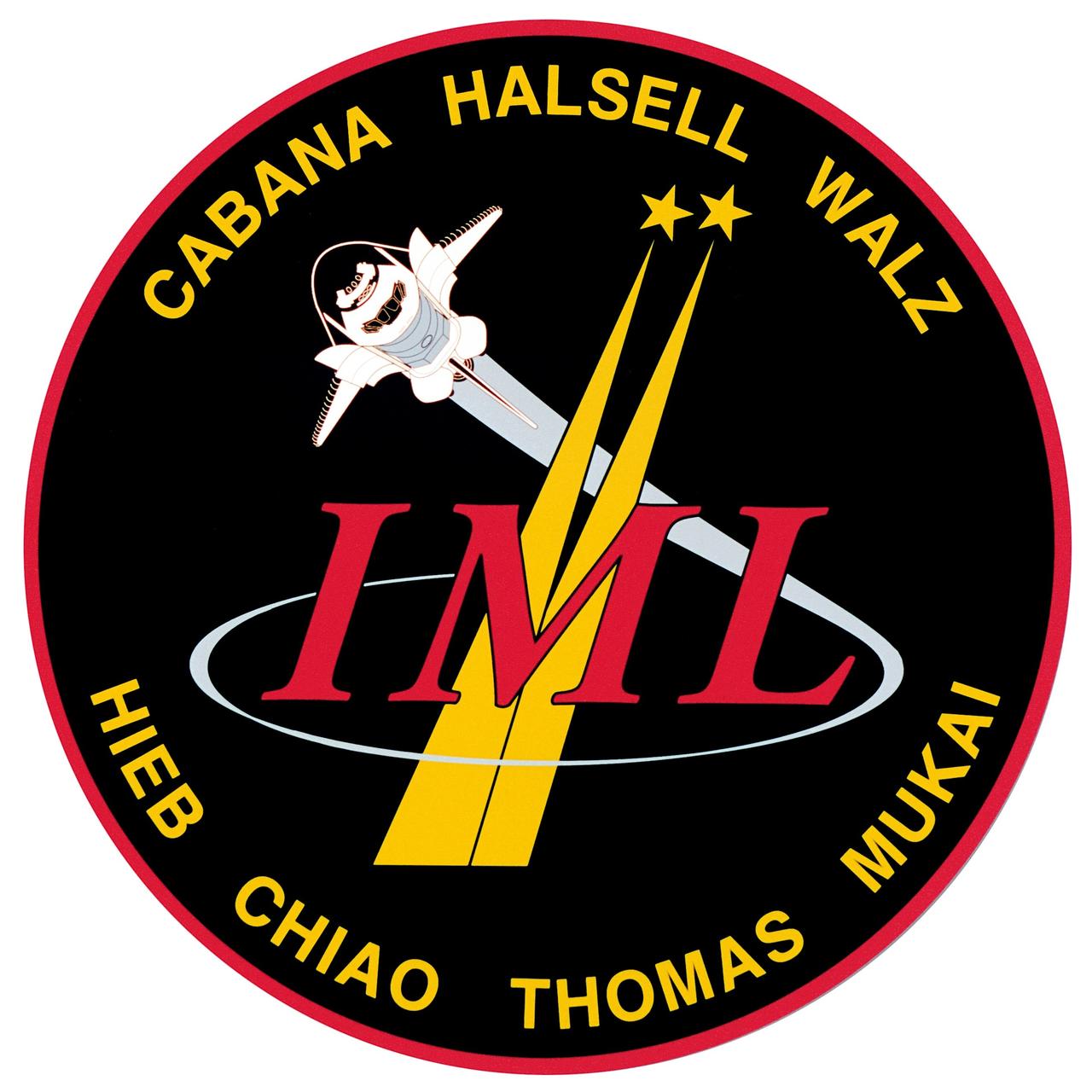
STS065-S-001 (March 1994) --- Designed by the crew members, the STS-65 insignia features the International Microgravity Laboratory (IML-2) mission and its Spacehab module which will fly aboard the space shuttle Columbia. IML-2 is reflected in the emblem by two gold stars shooting toward the heavens behind the IML lettering. The space shuttle Columbia is depicted orbiting the logo and reaching into space, with Spacehab on an international quest for a better understanding of the effects of spaceflight on materials processing and life sciences. The NASA insignia design for space shuttle flights is reserved for use by the astronauts and for other official use as the NASA Administrator may authorize. Public availability has been approved only in the forms of illustrations by the various news media. When and if there is any change in this policy, which is not anticipated, the change will be publicly announced. Photo credit: NASA

S66-28075 (May 1966) --- Insignia of the Gemini IX spaceflight. Roman numeral indicates ninth flight in the Gemini series. Two spacecraft symbolize rendezvous and docking of Gemini with an Agena. Astronaut and umbilical (tether) line denote planned extravehicular activity (EVA). Astronauts Thomas P. Stafford, command pilot, and Eugene A. Cernan, pilot, are members of the Gemini IX prime crew. The NASA insignia design for Gemini flights is reserved for use by the astronauts and for other official use as the NASA Administrator may authorize. Public availability has been approved only in the form of illustrations by the various news media. When and if there is any change in this policy, which we do not anticipate, it will be publicly announced. Photo credit: NASA
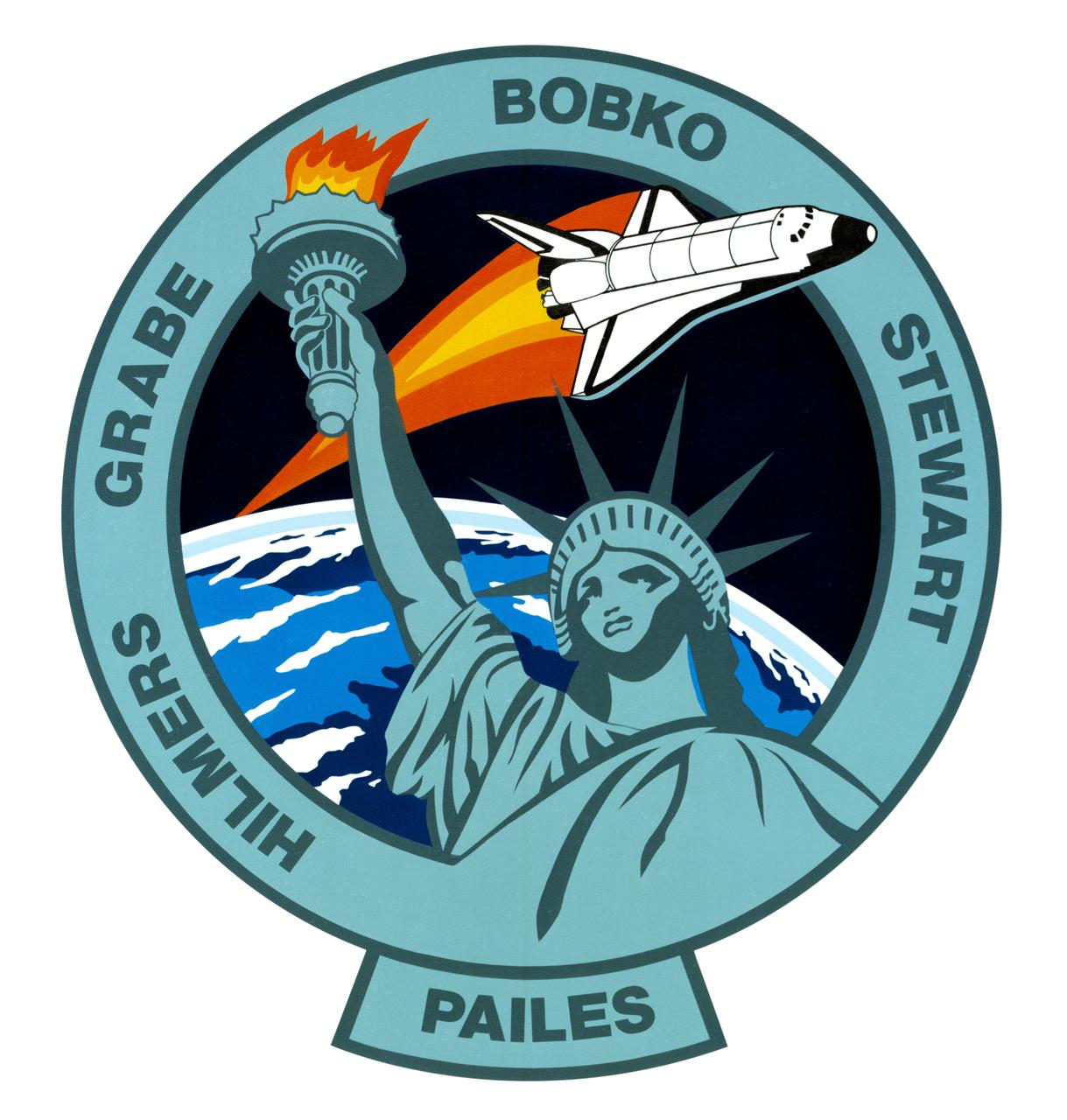
S85-39862 (1 Sept. 1985) --- The 51-J mission insignia, designed by Atlantis's first crew, pays tribute to the Statue of Liberty and the ideas it symbolizes. The historical gateway figure bears additional significance for astronauts Karol J. Bobko, mission commander; and Ronald J. Grabe, pilot, both New York natives. Other members of the five-man crew, whose surnames encircle the artwork, are Robert L. Stewart and David C. Hilmers, mission specialists; and William A. Pailes, payload specialist. The NASA insignia design for space shuttle flights is reserved for use by the astronauts and for other official use as the NASA Administrator may authorize. Public availability has been approved only in the forms of illustrations by the various news media. When and if there is any change in this policy, which is not anticipated, the change will be publicly announced. Photo credit: NASA
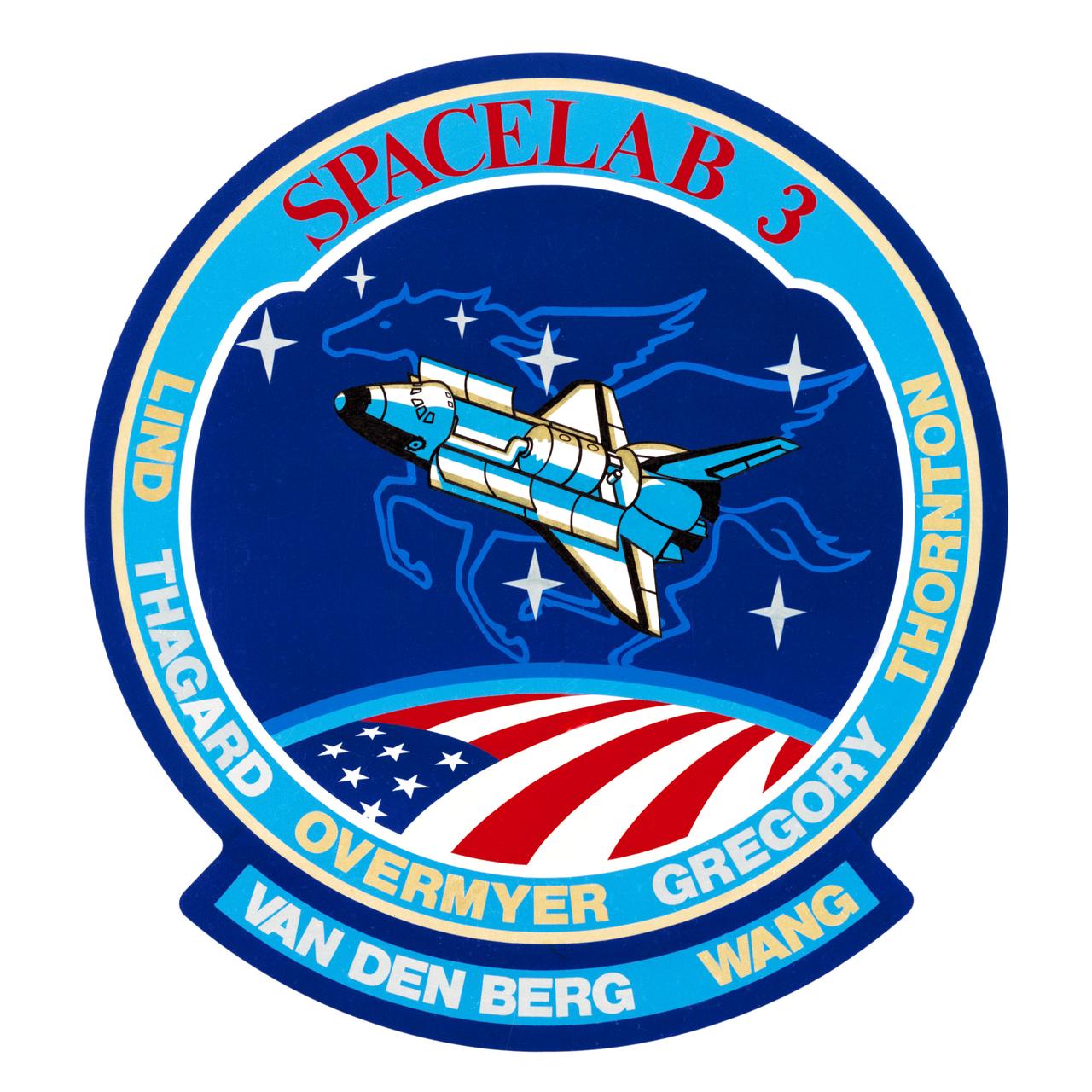
S84-44372 (December 1984) --- The space shuttle Discovery and its science module payload are featured in the insignia for the STS-51B/Spacelab 3 mission. The seven stars of the constellation Pegasus surround the orbiting spaceship above the flag draped Earth. Surnames of the seven crew members encircle the scene. Crew members are astronauts Robert F. Overmyer, Frederick D. Gregory, Don L. Lind, Norman E. Thagard and William E. Thornton; and payload specialists Lodewijk van den Berg and Taylor G. Wang. The artwork was done by Carol Ann Lind. The NASA insignia design for space shuttle flights is reserved for use by the astronauts and for other official use as the NASA Administrator may authorize. Public availability has been approved only in the forms of illustrations by the various news media. When and if there is any change in this policy, which is not anticipated, the change will be publicly announced. Photo credit: NASA

S81-29900 (May 1981) --- This is the official insignia for STS-2 the United States second space shuttle orbital flight test mission. Crewmen are astronauts Joe H. Engle, commander, and Richard H. Truly, pilot. Their spacecraft, orbiter 102 Columbia, is depicted along with the crew members surnames, and the merged eagle and American flag. The number two is significant, as it applies to the number of crew members as well as the second flight for the Columbia and the second in a series of space shuttle missions. The NASA insignia design for space shuttle flights is reserved for use by the astronauts and for other official use as the NASA Administrator may authorize. Public availability has been approved only in the forms of illustrations by the various news media. When and if there is any change in this policy, which is not anticipated, the change will be publicly announced. Photo credit: NASA