A Mars Science Laboratory cap is displayed in the Randall E. Scott Radiological Control Center at NASA's Kennedy Space Center. The facility was recently named in honor of Randy Scott, a professional health physicist of more than 40 years. He served as the Florida spaceport's Radiation Protection Officer for 14 years until his death June 17, 2016. Launched Nov. 26, 2011, the Mars Science Laboratory with the Curiosity lander was powered by a radioisotope thermalelectric generator. Located in the Neil Armstrong Operations and Checkout building, the Randall E. Scott Radiological Control Center is staffed by technical and radiological experts from NASA, the U.S. Department of Energy, the U.S. Air Force 45th Space Wing and the state of Florida. The group performs data collection and assessment functions supporting launch site and field data collection activities during launces involving plutonium-powered spacecraft such as the Mars Science Laboratory.
Radiological Control Center (RADCC) Renaming Ceremony
Nancy Bray, director of Spaceport Integration and Services at NASA's Kennedy Space Center, speaks during ceremonies to name the Radiological Control Center in honor for Randy Scott. A professional health physicist of more than 40 years, Scott served as the Florida spaceport's Radiation Protection Officer for 14 years until his death June 17, 2016.
Radiological Control Center (RADCC) Renaming Ceremony
Nancy Bray, director of Spaceport Integration and Services at NASA's Kennedy Space Center, left, is joined by Myrna Scott, center, and Dr. David Tipton, chief of Aerospace Medicine and Occupational Health, in cutting a ceremonial ribbon dedicating the Randal E. Scott Radiological Control Center at the Florida spaceport. Myrna Scott is the widow of Randy Scott, who was a professional health physicist of more than 40 years. He served as the Florida spaceport's Radiation Protection Officer for 14 years until his death June 17, 2016.
Radiological Control Center (RADCC) Renaming Ceremony
Consoles in the Radiological Control Center at NASA's Kennedy Space Center are seen during ceremonies to name the facility in honor of Randy Scott. A professional health physicist of more than 40 years, Scott served as the Florida spaceport's Radiation Protection Officer for 14 years until his death June 17, 2016. Located in the Neil Armstrong Operations and Checkout building, the Randall E. Scott Radiological Control Center is staffed by technical and radiological experts from NASA, the U.S. Department of Energy, the U.S. Air Force 45th Space Wing and the state of Florida. The group performs data collection and assessment functions supporting launch site and field data collection activities.
Radiological Control Center (RADCC) Renaming Ceremony
Nancy Bray, director of Spaceport Integration and Services at NASA's Kennedy Space Center, left, is joined by Myrna Scott, center, and Dr. David Tipton, chief of Aerospace Medicine and Occupational Health, in cutting a ceremonial ribbon dedicating the Randal E. Scott Radiological Control Center at the Florida spaceport. Myrna Scott is the widow of Randy Scott, who was a professional health physicist of more than 40 years. He served as the Florida spaceport's Radiation Protection Officer for 14 years until his death June 17, 2016.
Radiological Control Center (RADCC) Renaming Ceremony
A portion of the Radiological Control Center at NASA's Kennedy Space Center is seen during ceremonies to name the facility in honor of Randy Scott. A professional health physicist of more than 40 years, Scott served as the Florida spaceport's Radiation Protection Officer for 14 years until his death June 17, 2016. Located in the Neil Armstrong Operations and Checkout building, the Randall E. Scott Radiological Control Center is staffed by technical and radiological experts from NASA, the U.S. Department of Energy, the U.S. Air Force 45th Space Wing and the state of Florida. The group performs data collection and assessment functions supporting launch site and field data collection activities.
Radiological Control Center (RADCC) Renaming Ceremony
Myrna Scott holds a replica of the emblem noting that the Radiological Control Center at NASA's Kennedy Space Center has been named in honor of her husband, Randy Scott who died last year. A ceremony honored the extensive contributions of Randy Scott. A professional health physicist of more than 40 years, Scott served as the Florida spaceport's Radiation Protection Officer for 14 years until his death June 17, 2016.
Radiological Control Center (RADCC) Renaming Ceremony
Space Center, presents Myrna Scott, widow of Randy Scott, with a replica of the emblem noting that the spaceport's Radiological Control Center has been named in honor of her husband who died last year. The ceremony in the center's Radiological Control Center honored the extensive contributions of Randy Scott. A professional health physicist of more than 40 years, Scott served as the Florida spaceport's Radiation Protection Officer for 14 years until his death June 17, 2016.
Radiological Control Center (RADCC) Renaming Ceremony
Nancy Bray, director of Spaceport Integration and Services at NASA's Kennedy Space Center, left, is joined by Myrna Scott, center, and Dr. David Tipton, chief of Aerospace Medicine and Occupational Health, in cutting a ceremonial ribbon dedicating the Randal E. Scott Radiological Control Center at the Florida spaceport. Myrna Scott is the widow of Randy Scott, who was a professional health physicist of more than 40 years. He served as the Florida spaceport's Radiation Protection Officer for 14 years until his death June 17, 2016.
Radiological Control Center (RADCC) Renaming Ceremony
Family members of Randy Scott gather in the Radiological Control Center at NASA's Kennedy Space Center following ceremonies to name the facility in his honor. A professional health physicist of more than 40 years, Scott served as the Florida spaceport's Radiation Protection Officer for 14 years until his death June 17, 2016.
Radiological Control Center (RADCC) Renaming Ceremony
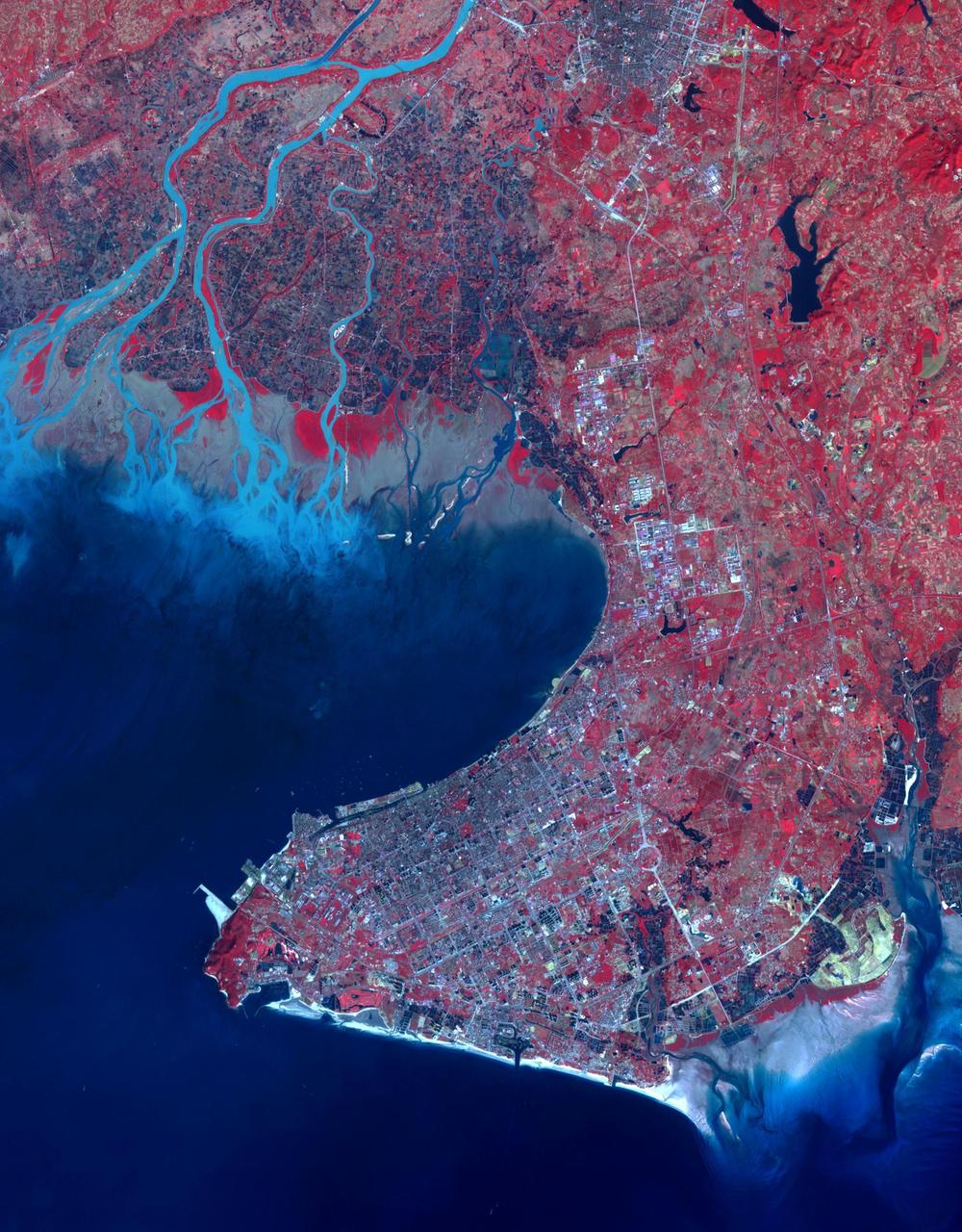
This image from NASA Terra spacecraft shows Beihai, a city in the south of Guangxi, People republic of China.
Beihai, Guanxi, China
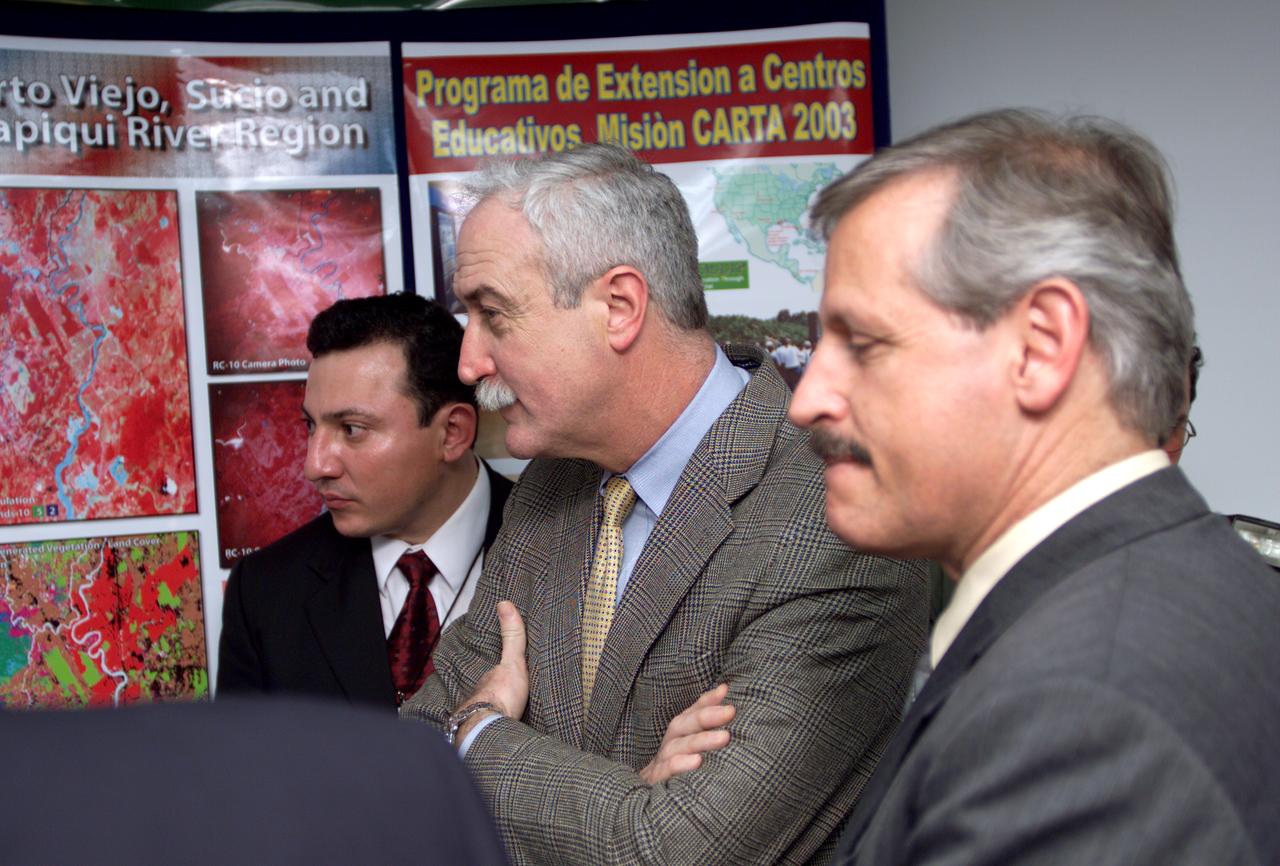
L-R; Jorge Andres Diaz, Director of the Costa Rican National Hangar for Airborne Research division of the National Center for High Technology(CENAT); NASA Administrator Sean O'Keefe; and Fernando Gutierrez, Costa Rican Minister of Science and Technology(MICIT), viewing posters showing how NASA activities have made an impact on Costa Rican people. Mr. O'Keefe was in Costa Rica to participate in the AirSAR 2004 Mesoamerica campaign, which used NASA DFRC's DC-8 airborne laboratory aircraft. AirSAR 2004 is a three-week expedition by an international team of scientists that will use an all-weather imaging tool, called the Airborne Synthetic Aperture Radar (AirSAR), in a mission ranging from the tropical rain forests of Central America to frigid Antarctica.
Personnel viewing posters showing how NASA activities have made an impact on Costa Rican people
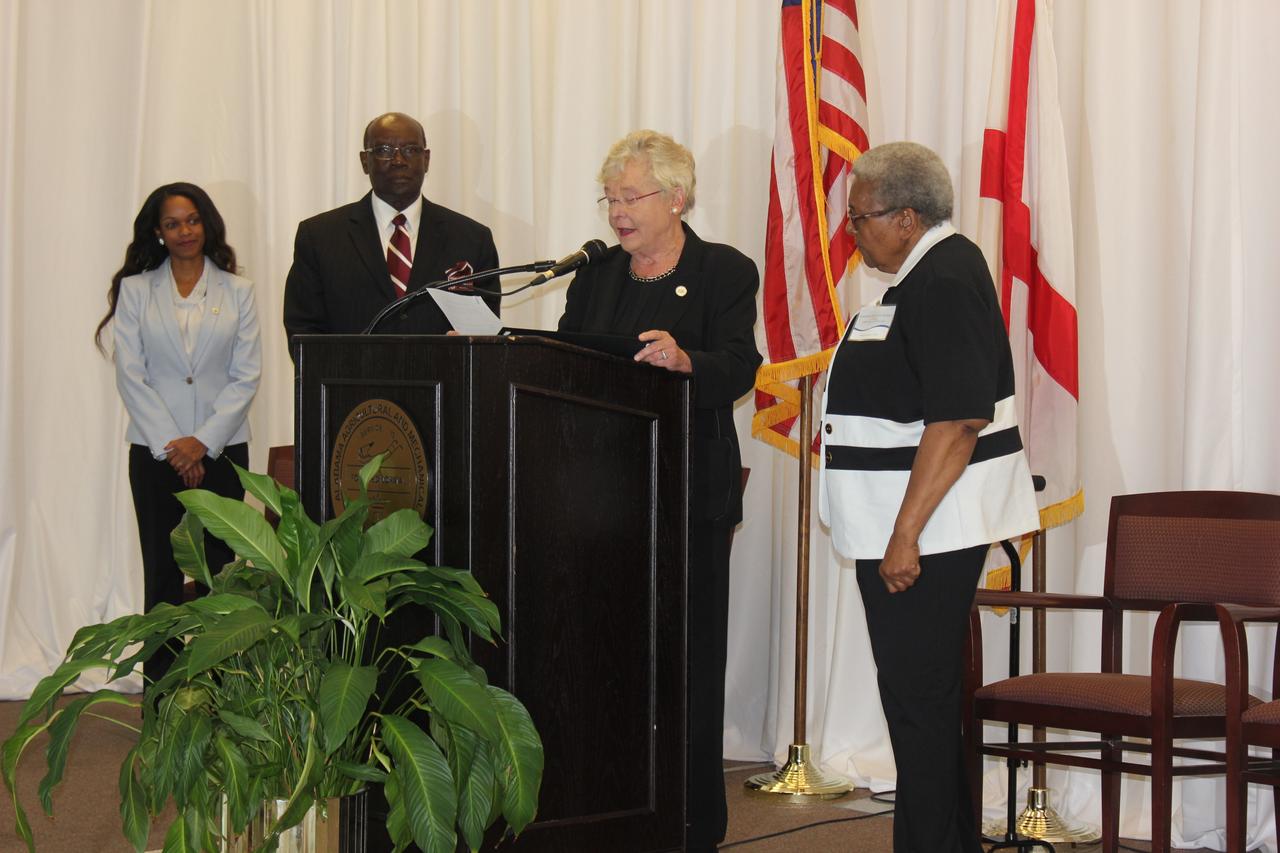
Retired Marshall scientist, Jeanette Scissum-Mickens, was honored by Alabama Governor Kay Ivey at the Alabama Historically Black Colleges and Universities Roundtable Discussion: Minority Women in STEM event held at the University of Alabama A&M in Huntsville, Alabama. Scissum-Mickens was honored as the “Hidden Figure of Alabama A&M.” She was the first African-American mathematician hired by Marshall in 1964.
Jeanette Scissum-Mickens, was honored by Alabama Governor Kay Ivey at the Alabama Historically Black Colleges and Universities Roundtable Discussion: Minority Women in STEM
Representatives of the state of Alabama, academia, and industry listen and take part in a panel discussion led by NASA Marshall Space Flight Center's Ruth Jones as part of the first Alabama Historically Black Colleges and Universities Roundtable Discussion. The event focused on drawing more minorities, specifically women, into academic fields and careers in science, technology, engineering and mathematics.
Alabama Historically Black Colleges and Universities Roundtable Discussion
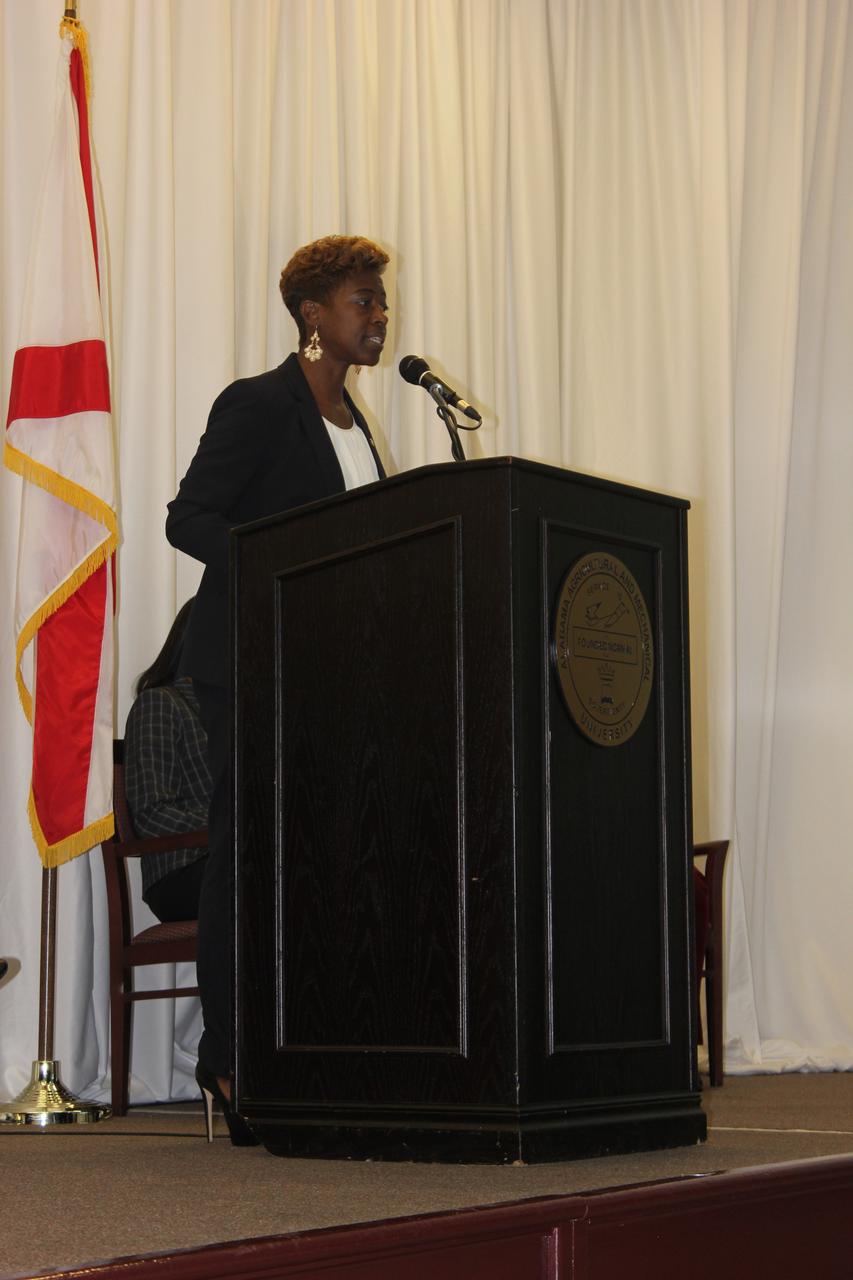
Marshall’s Ruth Jones, a mishap investigation specialist, told her NASA story and spoke about minority statistics in science, technology, engineering and mathematics (STEM). Jones also led a panel discussing how to engage, encourage and draw more minority students in to STEM fields and careers.
Marshall Space Flight Center's Ruth Jones Speaks at Alabama Historically Black Colleges and Universities Roundtable Discussion
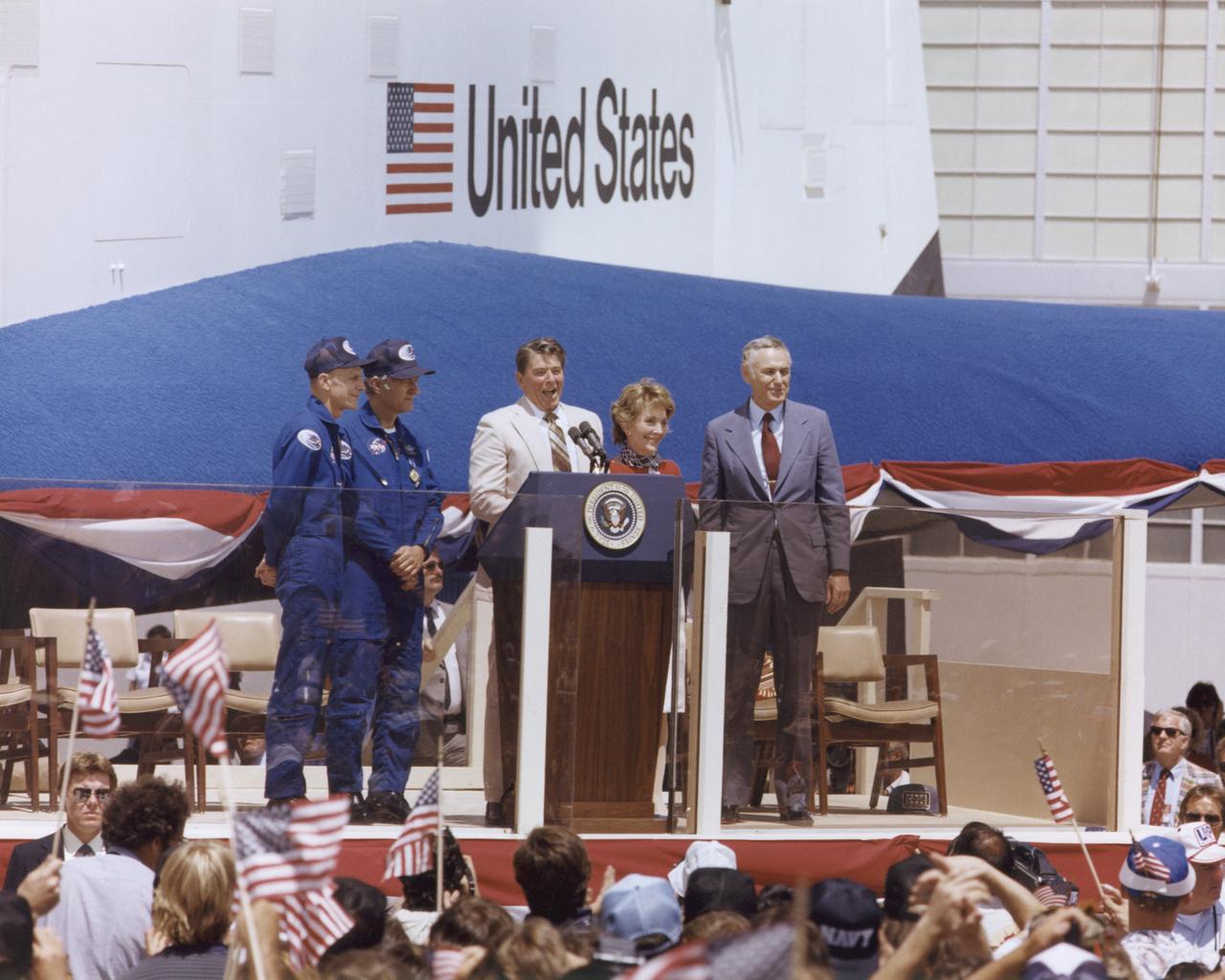
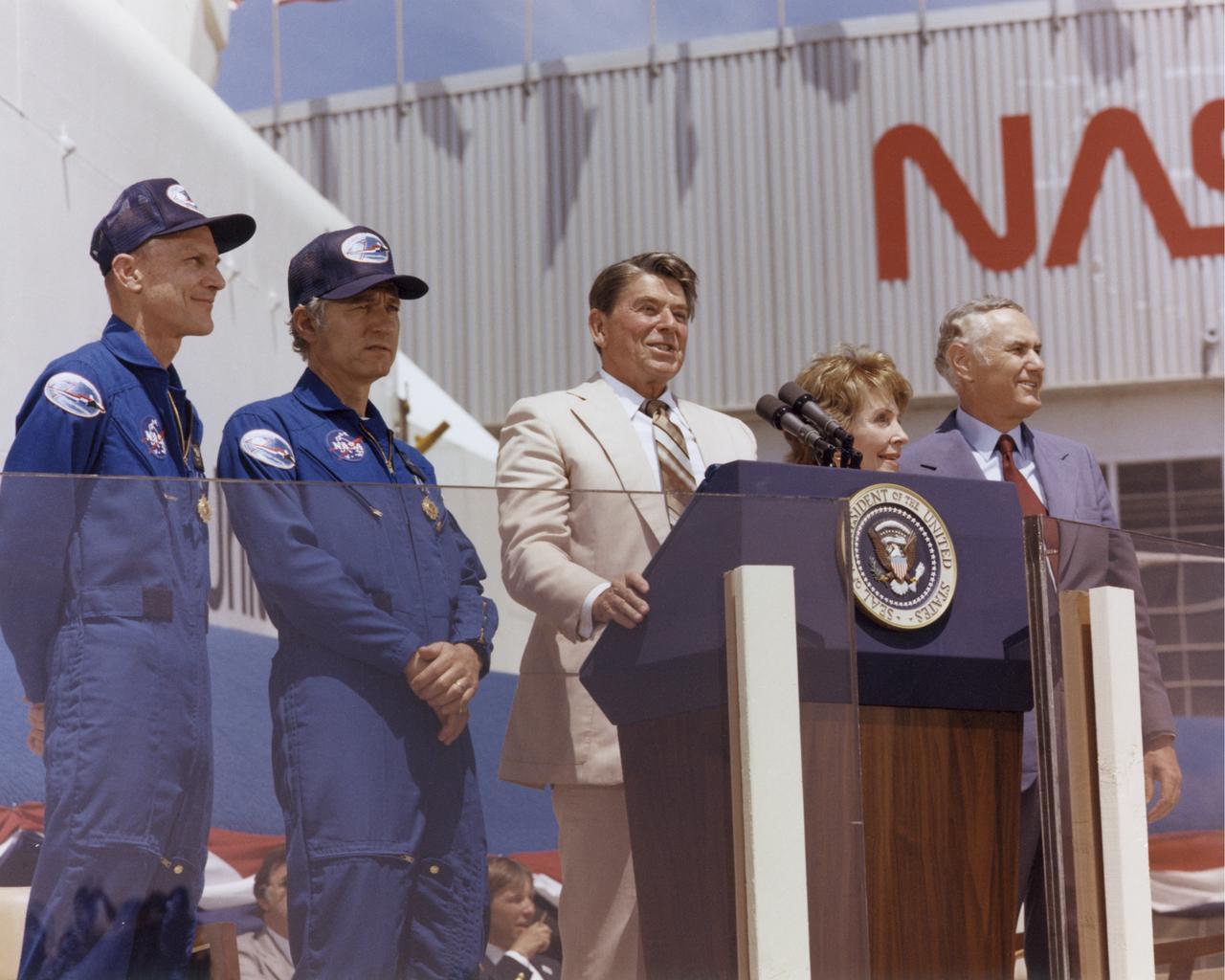
President Ronald Reagan speaks to a crowd of more than 45,000 people at NASA's Dryden Flight Research Center following the landing of STS-4 on July 4, 1982. To the right of the President are Mrs. Reagan and NASA Administrator James M. Beggs. To the left are STS-4 Columbia astronauts Thomas K. Mattingly and Henry W. Hartsfield, Jr. Prototype Space Shuttle Enterprise is in the background.
President Ronald Reagan speaks to a crowd of more than 45,000 people at NASA's Dryden Flight Research Center following the landing of STS-4 on July 4, 1982
President Ronald Reagan speaks to a crowd of more than 45,000 people at NASA's Dryden Flight Research Center following the landing of STS-4 on July 4, 1982. To the right of the President are Mrs. Reagan and NASA Administrator James M. Beggs. To the left are STS-4 Columbia astronauts Thomas K. Mattingly and Henry W. Hartsfield, Jr. Prototype Space Shuttle Enterprise is in the background.
President Ronald Reagan speaks to a crowd of more than 45,000 people at NASA's Dryden Flight Research Center following the landing of STS-4 on July 4, 1982
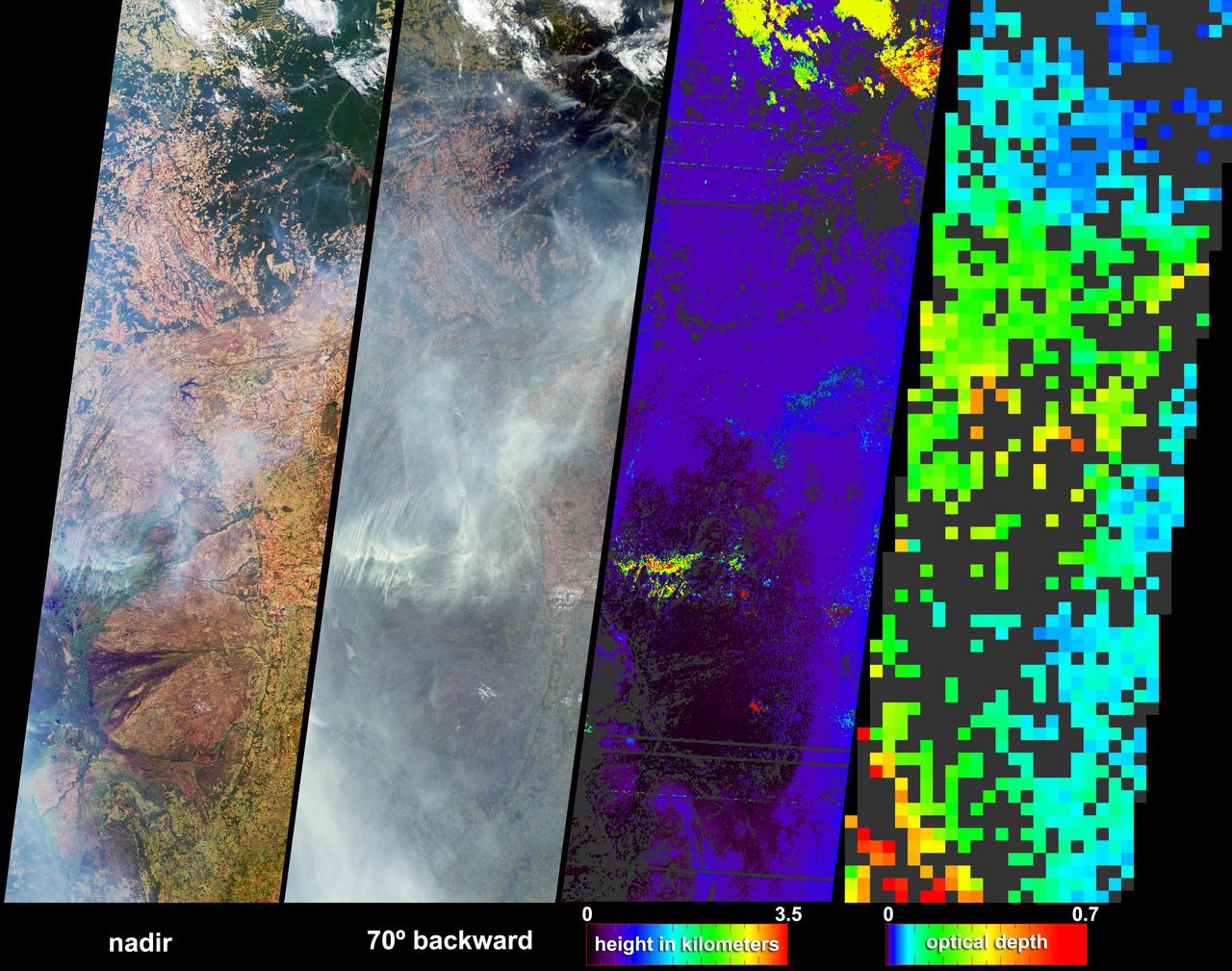
Numerous fires occurred near the headwaters of the Xingu River and the Xingu Indigenous Peoples Reserve in Mato Grosso, Brazil, during late June and early July, 2004, as seen by NASA Terra spacecraft.
Fire and Deforestation near the Xingu River
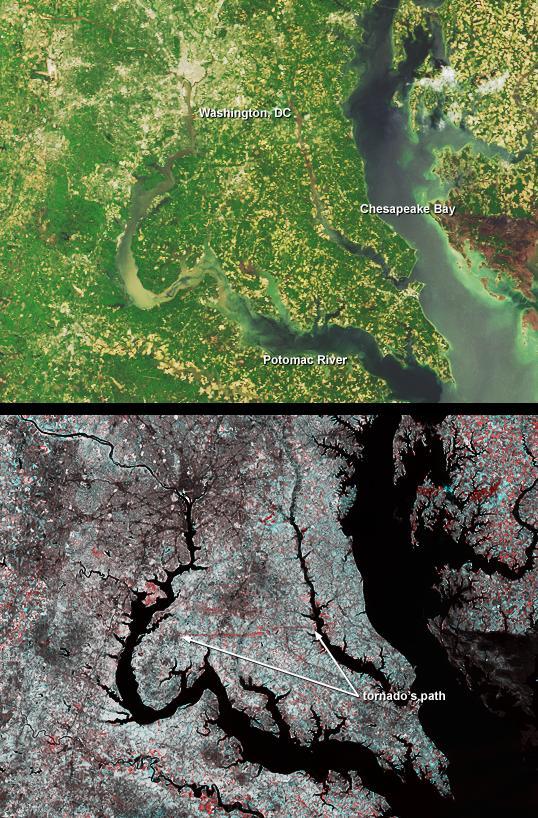
A category F4 tornado tore through La Plata, Maryland on April 28, 2002, killing 5 and injuring more than 100 people. This image from NASA Terra satellite was acquired on May 1, 2002.
Tornado Cuts Through La Plata, Maryland
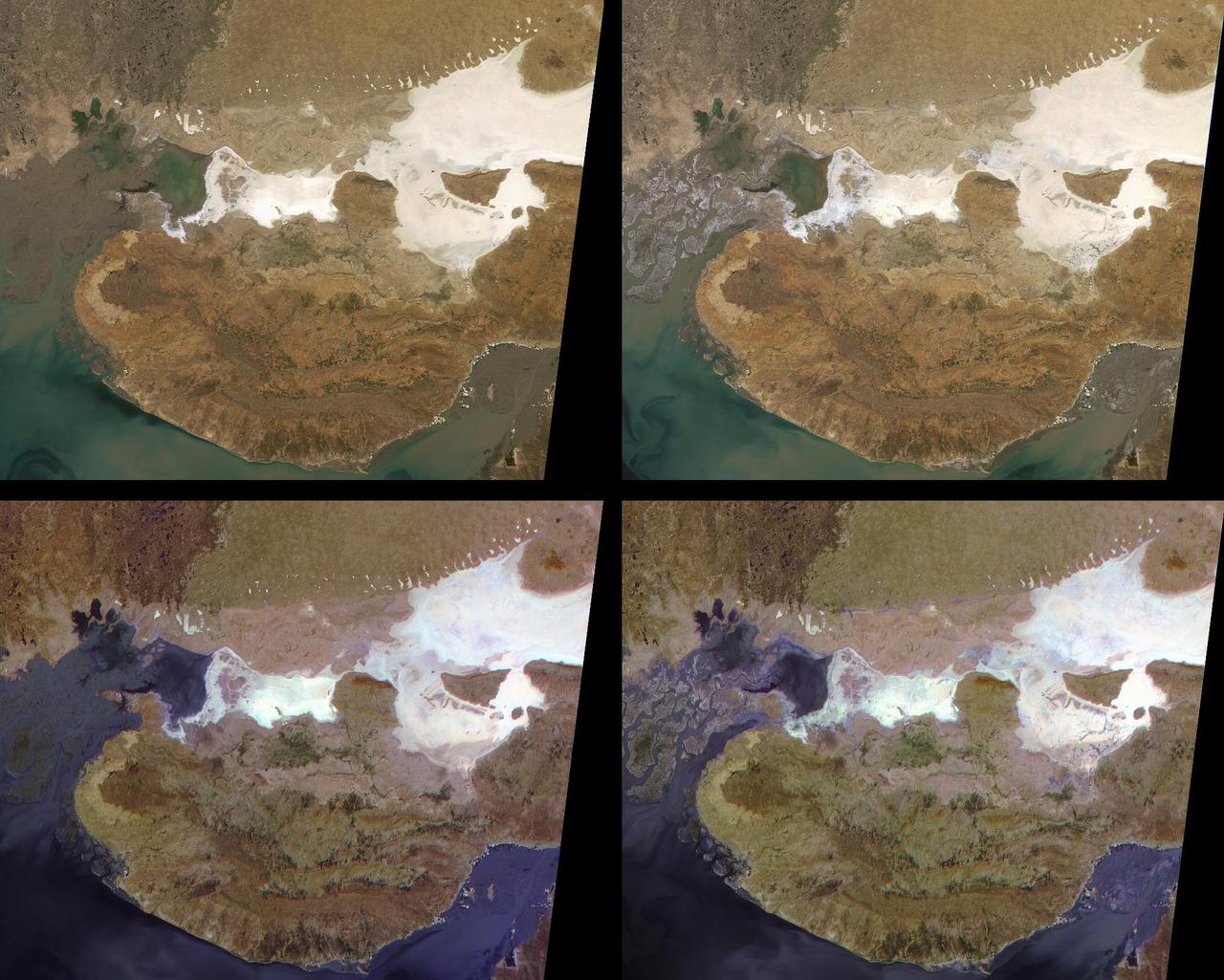
This image from NASA Terra satellite shows the Kachchh region in the Gujarat province of western India. On January 26, 2001, a magnitude 7.7 earthquake devastated this area, killing 20,000 people and destroying buildings, dams, and port facilities.
Liquefaction Effects from the Bhuj earthquake
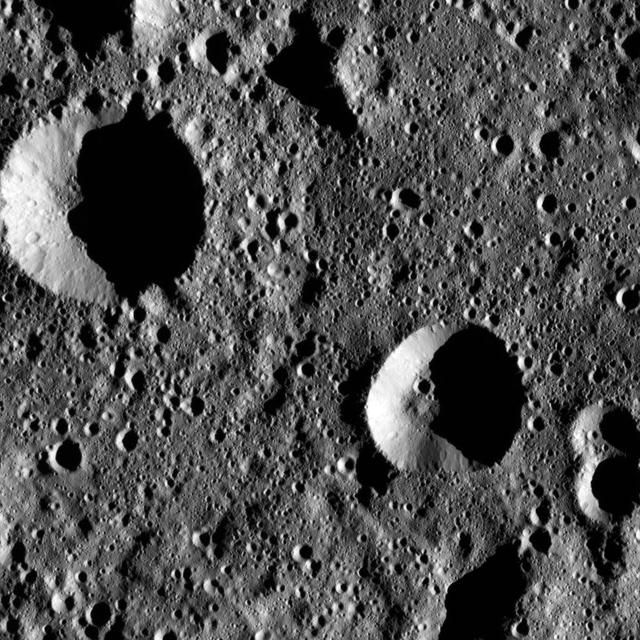
Omonga Crater on Ceres was named for a rice spirit who dwells in the moon, according to legends of the Mori people of the Indonesian island of Sulawesi. NASA Dawnspacecraft spotted Omonga from above the surface.
Dawn LAMO Image 72
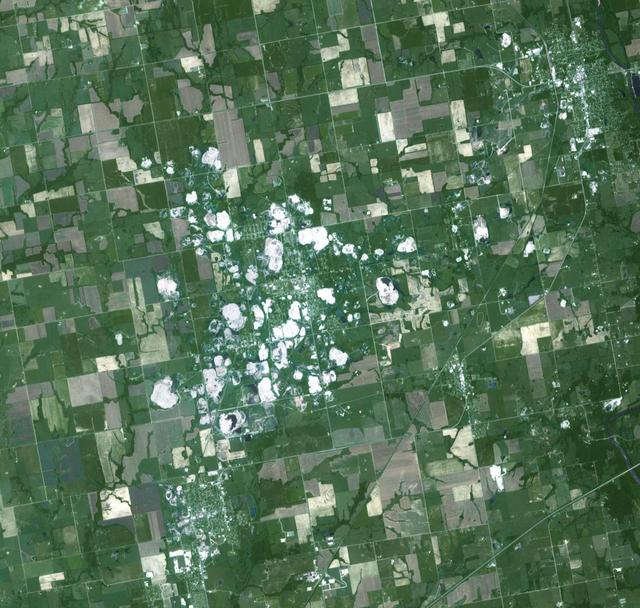
NASA Terra spacecraft acquired this image of Picher, Oklahoma which once boasted 20,000 people in this mining town in northeast Oklahoma. Now, after a 2009 tornado, and a federal cleanup program, the town is a modern-day ghost town.
Picher, Oklahoma
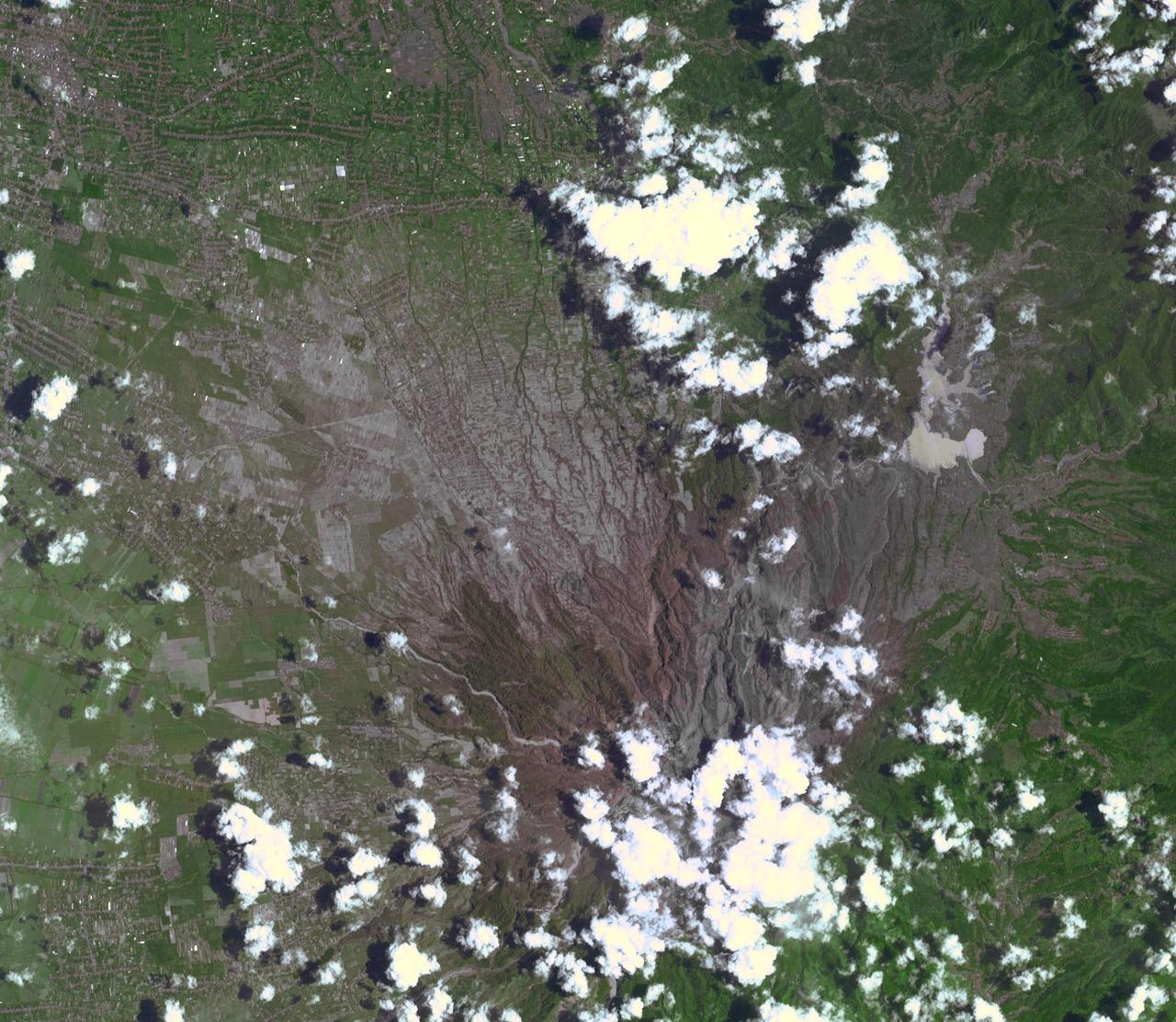
On Feb. 13, 2014, violent eruption of Kelud stratovolcano in Java, Indonesia sent volcanic ash covering an area of 70,000 square miles, prompting the evacuation of tens of thousands of people. This image is from NASA Terra spacecraft.
Ashy Aftermath of Indonesian Volcano Eruption seen by NASA Spacecraft
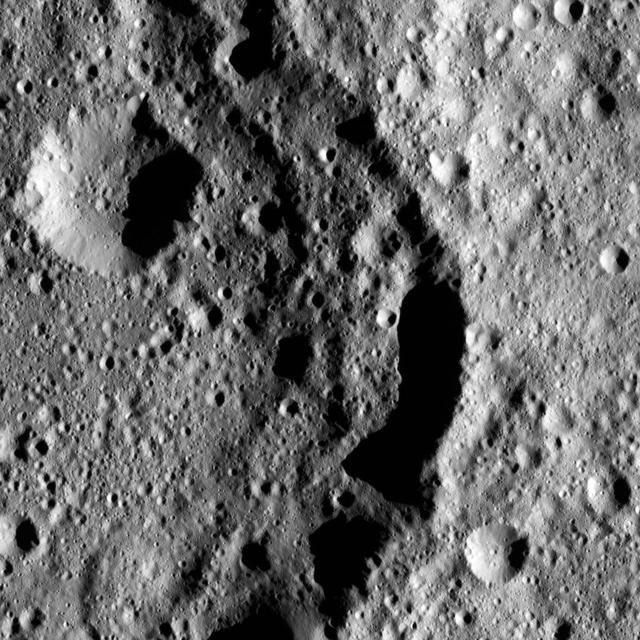
This image from NASA Dawn spacecraft shows terrain within Chaminuka Crater on Ceres. Chaminuka was named for the spirit who provides rains during times of drought, according to the legends of the Shona people of Zimbabwe.
Dawn LAMO Image 73
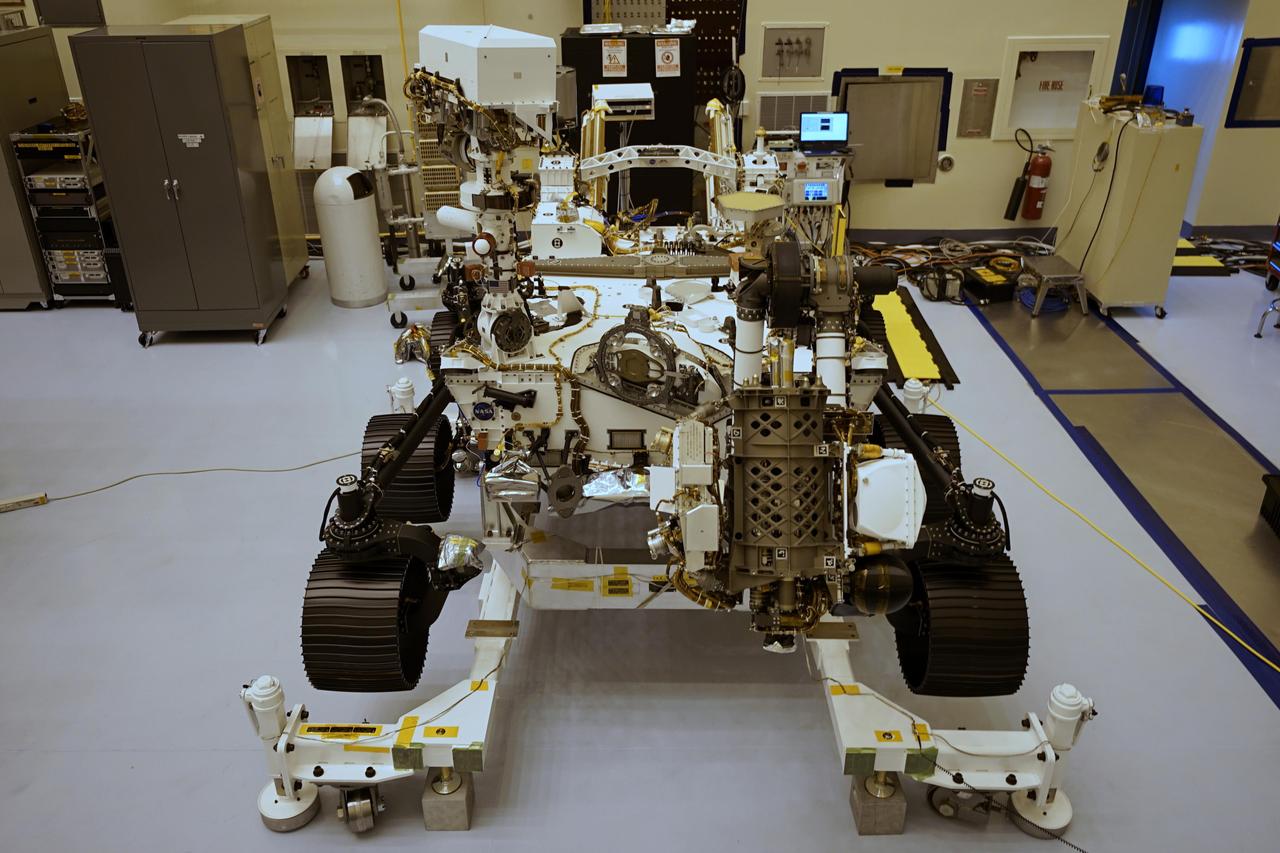
Top center: The plate affixed to the aft crossbeam of NASA's Mars Perseverance rover — seen here on March 16, 2020, at NASA's Kennedy Space Center in Florida — carries 10,932,295 names submitted by people during NASA's "Send Your Name to Mars" campaign and essays of the 155 finalists in the "Name the Rover" contest.  https://photojournal.jpl.nasa.gov/catalog/PIA23770
Perseverance Rover at Cape
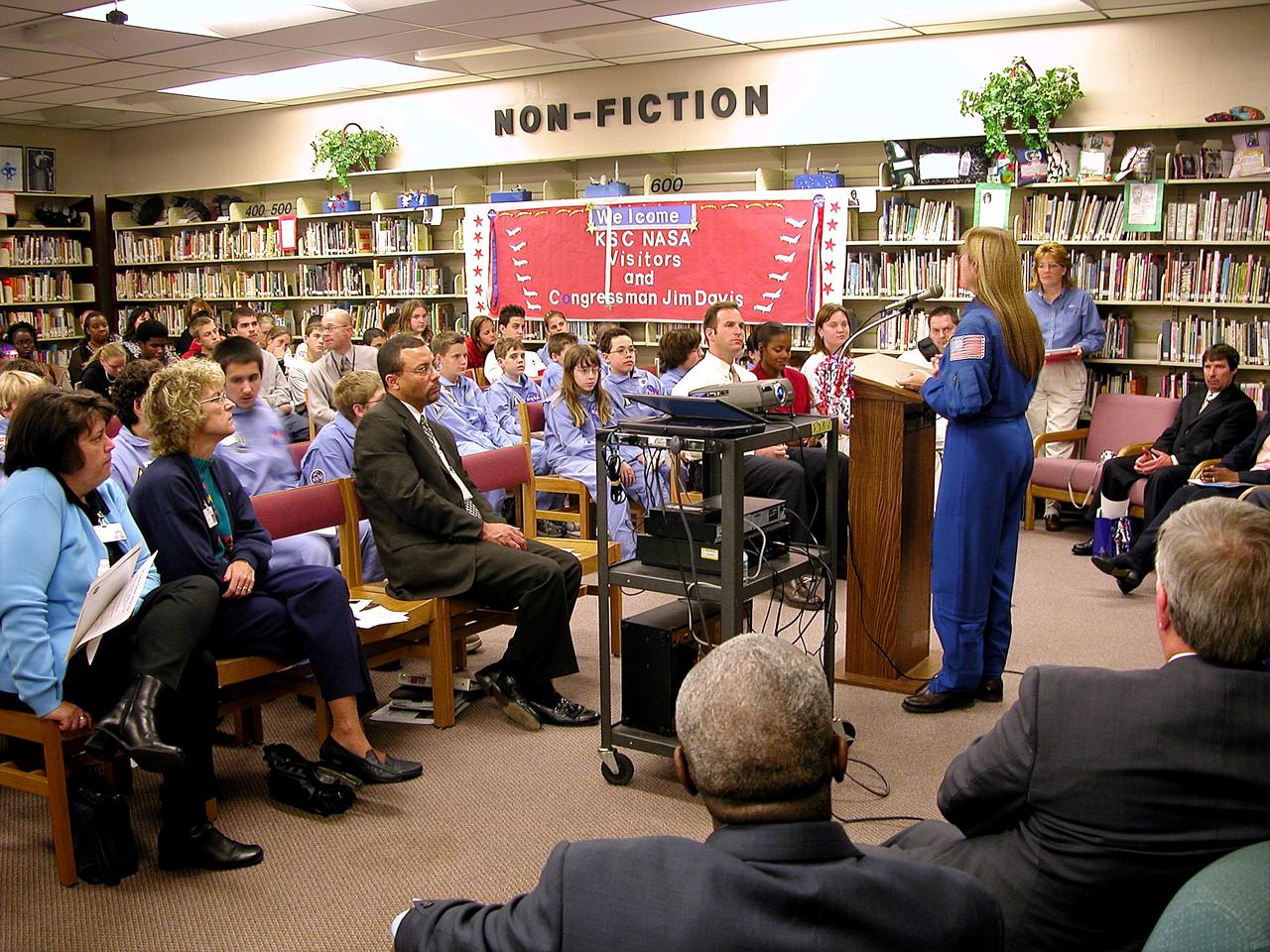
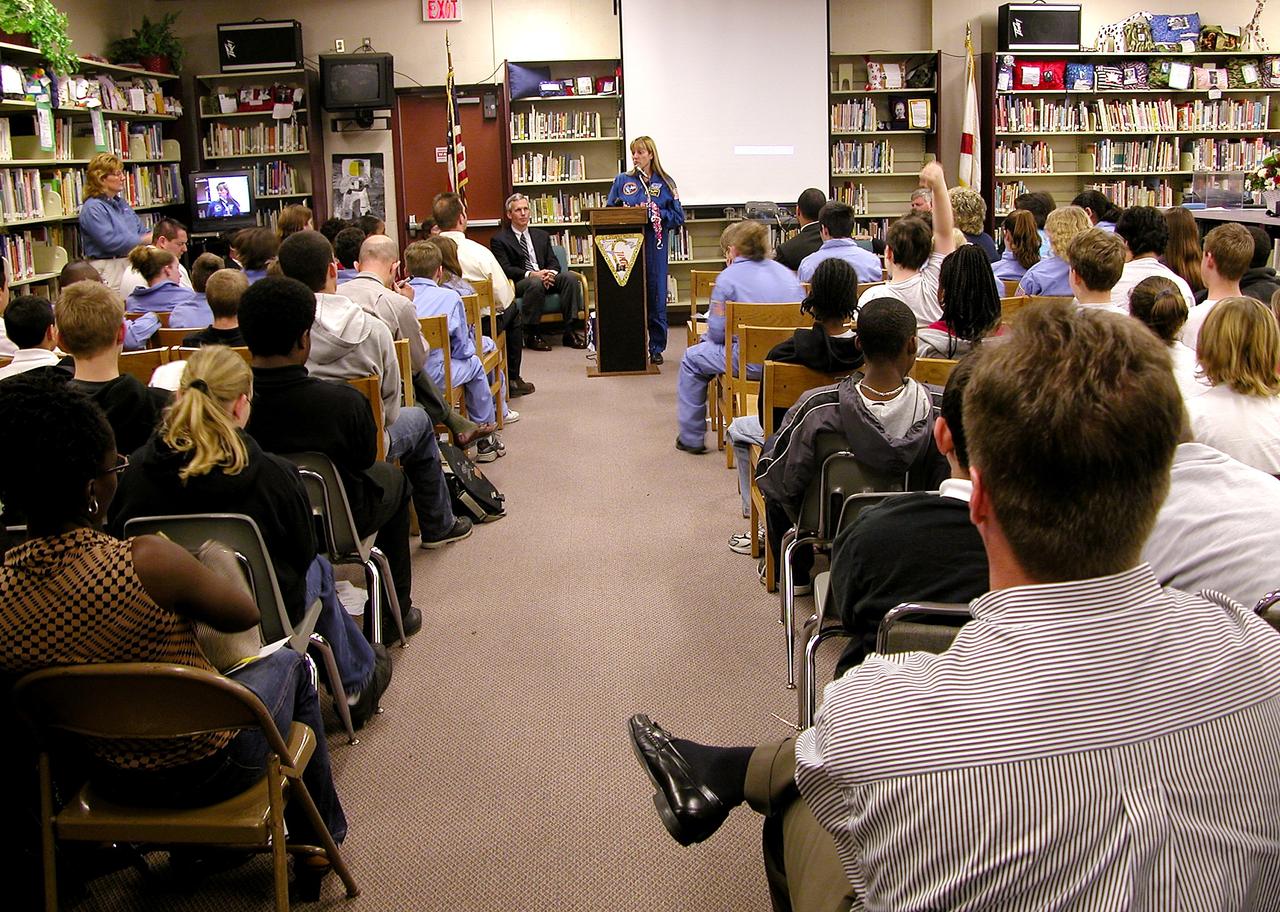
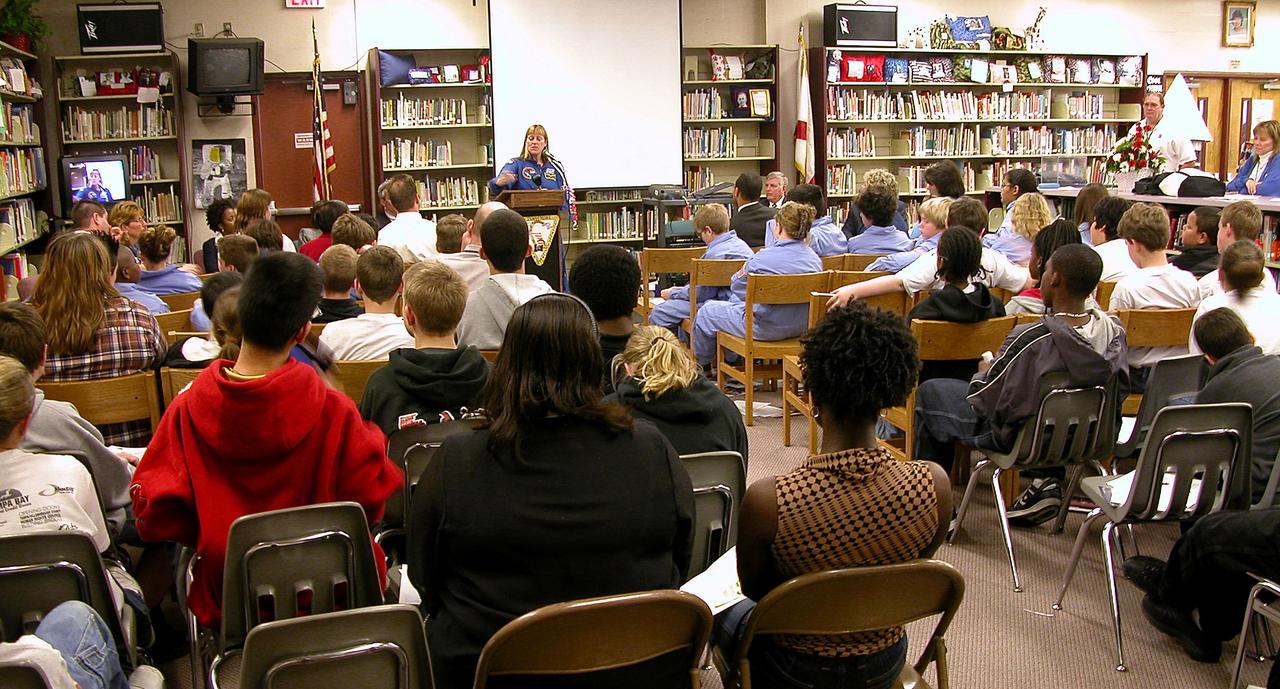
KENNEDY SPACE CENTER, FLA. - Astronaut Kay Hire talks to students in Garland V. Stewart Magnet Middle School, a NASA Explorer School (NES) in Tampa, Fla.  She joined Center Director Jim Kennedy in sharing the agency’s new vision for space exploration with the next generation of explorers. Kennedy is talking with students about our destiny as explorers, NASA’s stepping stone approach to exploring Earth, the Moon, Mars and beyond, how space impacts our lives, and how people and machines rely on each other in space.
KENNEDY SPACE CENTER, FLA. - Astronaut Kay Hire talks to students in Garland V. Stewart Magnet Middle School, a NASA Explorer School (NES) in Tampa, Fla. She joined Center Director Jim Kennedy in sharing the agency’s new vision for space exploration with the next generation of explorers. Kennedy is talking with students about our destiny as explorers, NASA’s stepping stone approach to exploring Earth, the Moon, Mars and beyond, how space impacts our lives, and how people and machines rely on each other in space.
KENNEDY SPACE CENTER, FLA. - Astronaut Kay Hire talks to students in Garland V. Stewart Magnet Middle School, a NASA Explorer School (NES) in Tampa, Fla.  She joined Center Director Jim Kennedy in sharing the agency’s new vision for space exploration with the next generation of explorers. Kennedy is talking with students about our destiny as explorers, NASA’s stepping stone approach to exploring Earth, the Moon, Mars and beyond, how space impacts our lives, and how people and machines rely on each other in space.
KENNEDY SPACE CENTER, FLA. - Astronaut Kay Hire talks to students in Garland V. Stewart Magnet Middle School, a NASA Explorer School (NES) in Tampa, Fla. She joined Center Director Jim Kennedy in sharing the agency’s new vision for space exploration with the next generation of explorers. Kennedy is talking with students about our destiny as explorers, NASA’s stepping stone approach to exploring Earth, the Moon, Mars and beyond, how space impacts our lives, and how people and machines rely on each other in space.
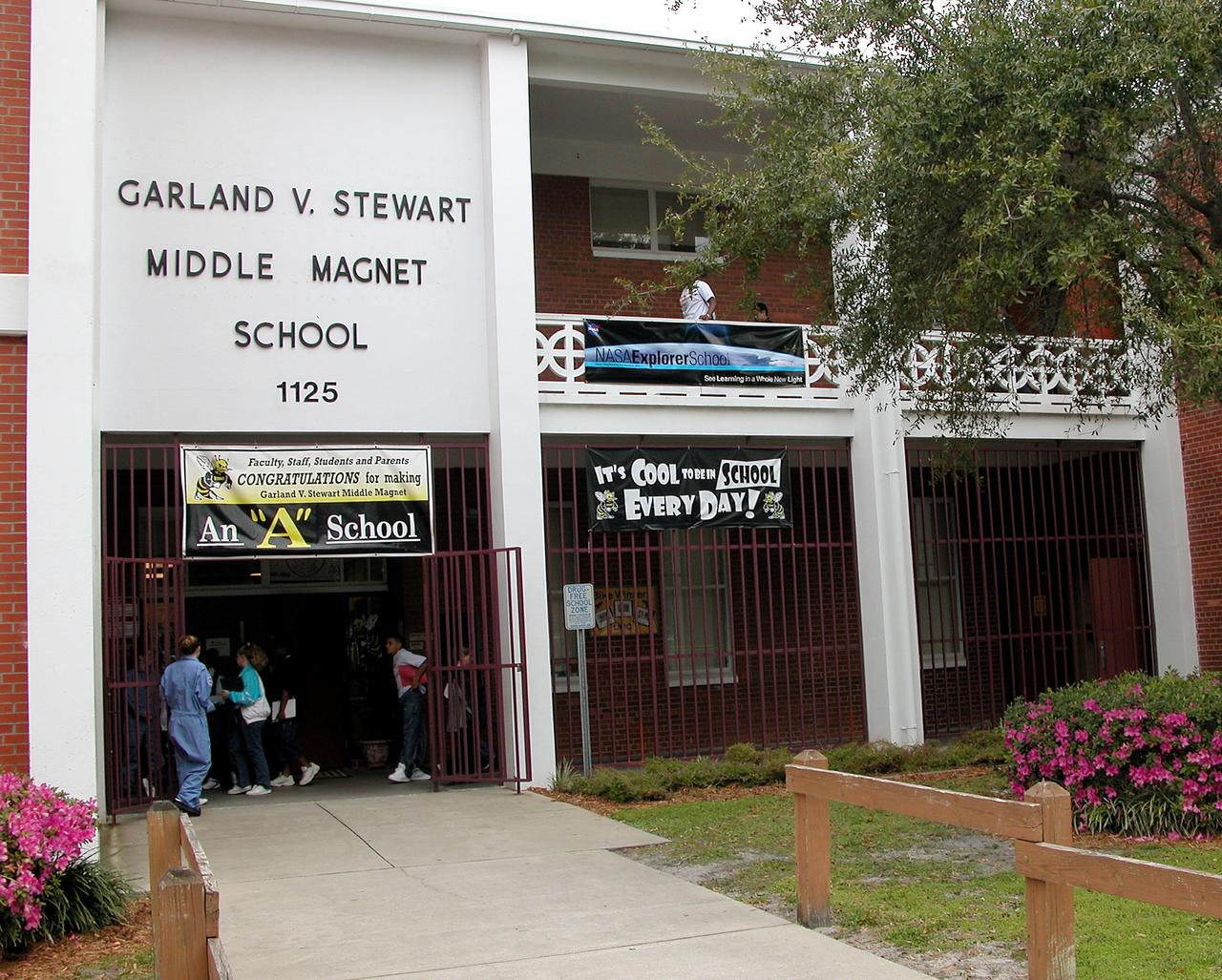
KENNEDY SPACE CENTER, FLA. - Garland V. Stewart Magnet Middle School, a NASA Explorer School (NES) in Tampa, Fla., is the site where Center Director Jim Kennedy and astronaut Kay Hire shared the agency’s new vision for space exploration with the next generation of explorers. Kennedy talked with students about our destiny as explorers, NASA’s stepping stone approach to exploring Earth, the Moon, Mars and beyond, how space impacts our lives, and how people and machines rely on each other in space.
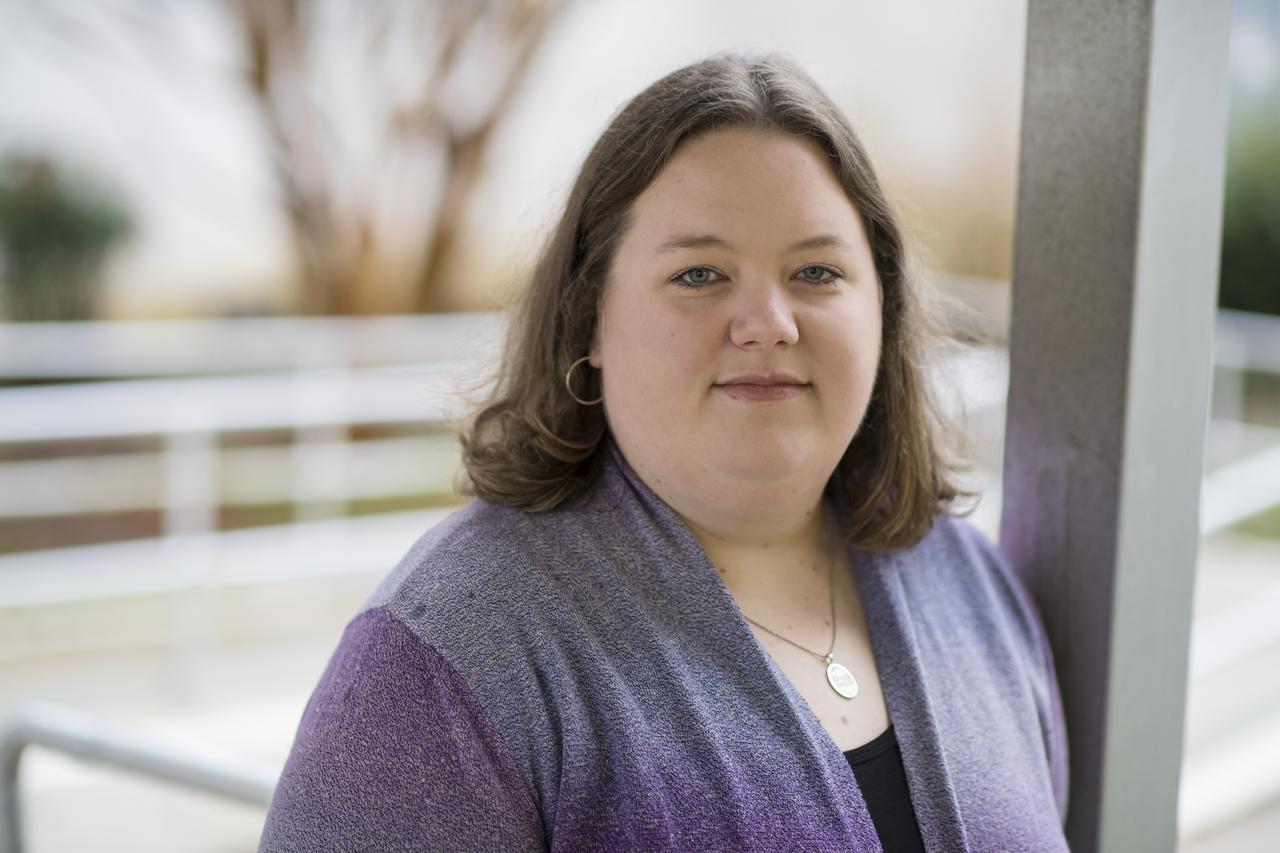
NASA Wallops Flight Facility Public Affairs Specialist, Rebecca Hudson, Thursday, Feb. 6, 2020 at Wallops Flight Facility in Virginia. “What I really think stands out the most is when you go to a launch and you see people who have never seen one before. Some people get so emotional, they cry. It’s so energizing to see people get that excited.   For me, every single time we launch a rocket —whether it be a sounding rocket or something as big as an Antares rocket or anything in between — all the hard work and long hours, all that leading up to it… you kind of forget it as soon as you see that emotion that people are experiencing.   I always think about that as I drive home at night: “Do you know how many people we made happy today?” And so I think that is important — no matter what we do here, whether it’s my job or the test director’s or the administrator’s or all points in between — everybody’s got something to contribute.   You ask little kids what their big dream is, and it’s not uncommon to hear “astronaut.” It’s not uncommon to hear they want to fly in a spaceship. That’s not uncommon. But we’re doing that. We’re making dreams for people.” Photo Credit: (NASA/Aubrey Gemignani)
Rebecca Hudson Portrait
Portrait of Robin "Rob" Lee of the Office of Diversity & Equal Opp. Branch, in front of NASA Langley's "Meatball." The portrait was done for Thalia Patrinos at NASA Headquarters as part of "Faces of NASA" project.   Due to the COVID-19 pandemic, masks were mandated by Governor Northam in Virginia in public settings.  "Well, little did I know, even at a young age, he instilled in me the  importance of seeing people for people. And being able to help people  and being able to meet them in their time of need. And that carried me  throughout my entire life. Even still today.”  — Robin Lee, Director of  Office of Diversity and Equal Opportunity, Langley Research Center
Portrait of Robin "Rob" Lee
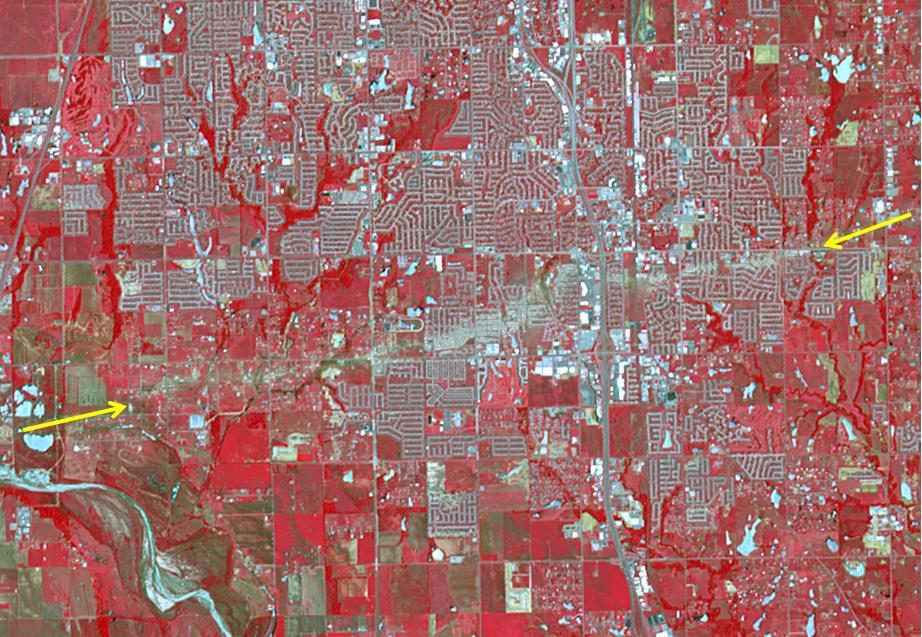
The Newcastle-Moore EF-5 tornado ripped through central Oklahoma on May 20, 2013, killing 24 people and leaving behind more than  billion in damage. This image was acquired NASA Terra spacecraft on June 2, 2013.
NASA Spacecraft Captures Swath of Destruction from Deadly Oklahoma Tornado
Governor Kay Ivey recognized retired NASA Space Flight Center team member, Jeanette Scissum-Mickens on Sept. 27 at the Alabama HBCU Roundtable Discussion: Minority Women in STEM held at the Alabama A&M University. Scissum-Mickens was honored as the “Hidden Figure of Alabama A&M.” She was the first African American mathematician hired by Marshall in 1964. While at Marshall, she was a space scientist and helped improved forecast models of the sunspot cycle and led activities in Marshall’s Atmospheric, Magentospheric, and Plasmas in Space project.
Alabama Governor Kay Ivey Recognized Retired NASA Scientist Jeanette Scissum-Mickens
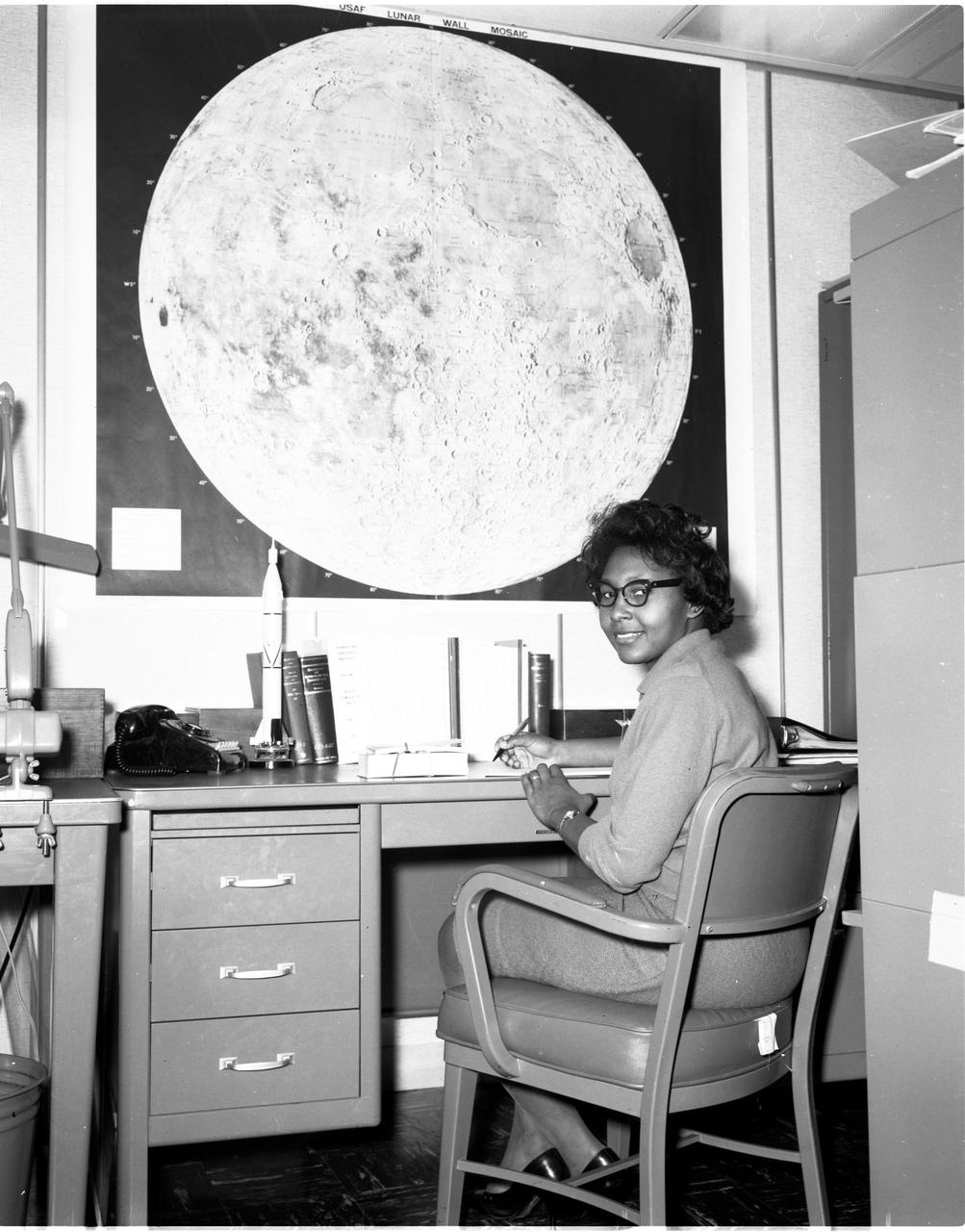
Jeanette Scissum joined NASA’s Marshall Space Flight Center in 1964 after earning bachelor's and master's degrees in mathematics from Alabama A&M University. Scissum published a NASA report in 1967, “Survey of Solar Cycle Prediction Models,” which put forward techniques for improved forecasting of the sunspot cycle. In the mid-1970s she worked as a space scientist in the Space Environment Branch of Marshall’s Space Sciences Laboratory and later led activities in Marshall’s Atmospheric, Magnetospheric, and Plasmas in Space project.In 1975, Scissum wrote an article for the National Technical Association, “Equal Employment Opportunity and the Supervisor – A Counselor’s View,” which argued that many discrimination complaints could be avoided “through adequate and meaningful communication.” Scissum later worked at NASA Headquarters as a computer systems analyst responsible for analyzing and directing NASA management information and technical support systems.
Jeanette Scissum-Mickens
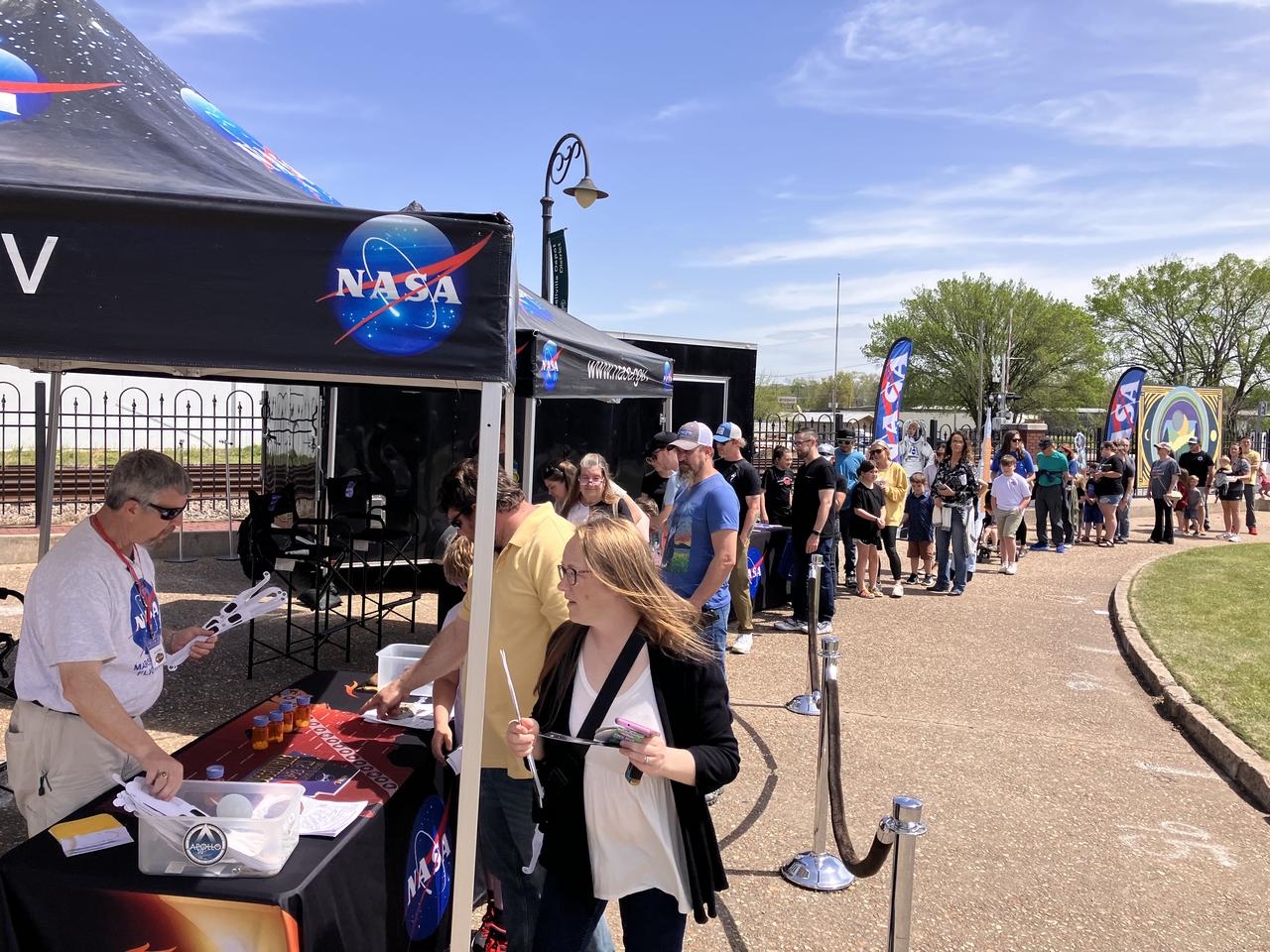
NASA gives out solar eclipse glasses for people to safely view the eclipse on April 8 in Russellville, Arkansas.
NASA Stennis Participates in NASA Eclipse Events
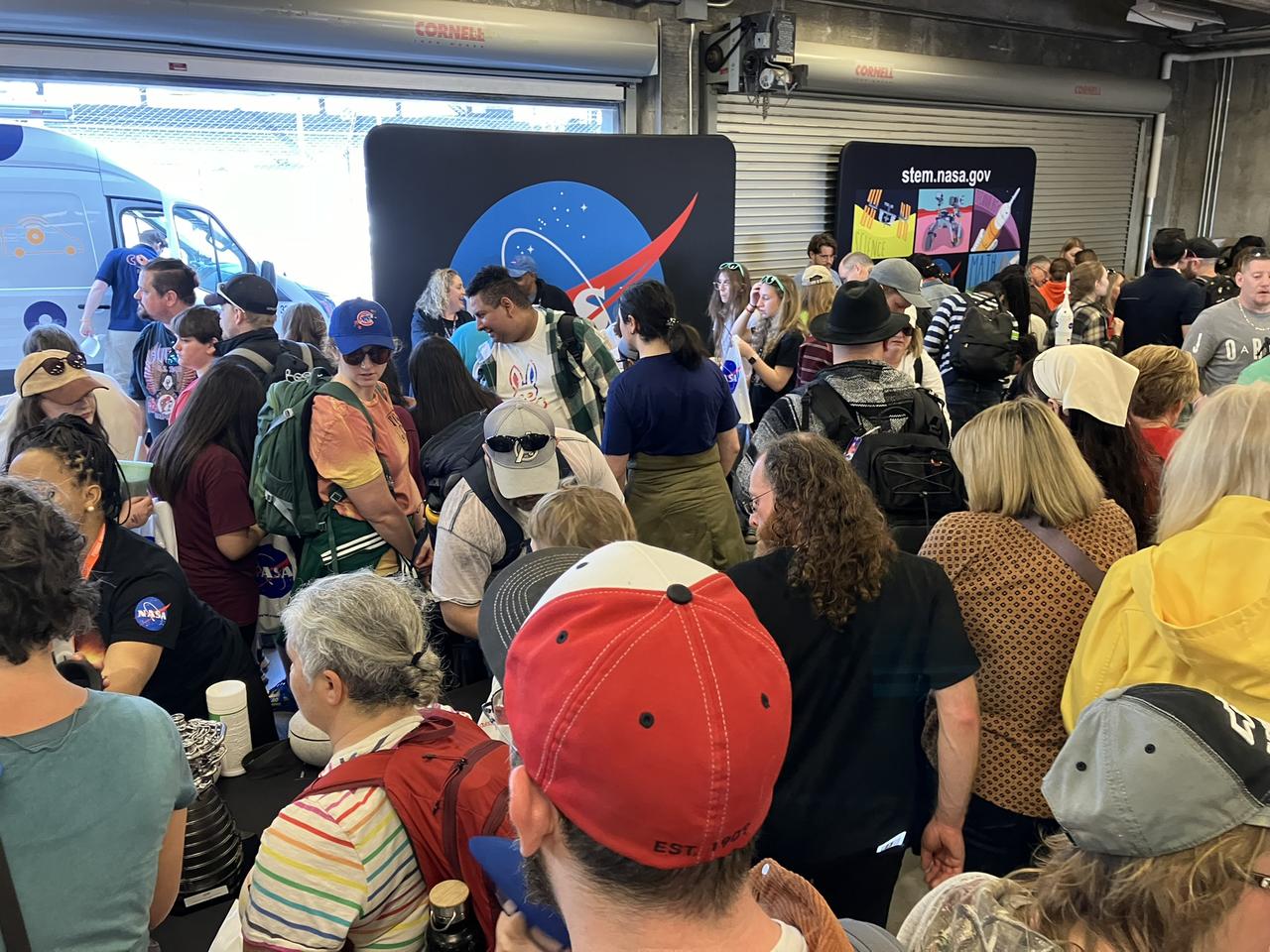
People learn about the work conducted at NASA Stennis in south Mississippi while visiting the NASA Stennis booth at the Indianapolis Motor Speedway in Indiana on April 8.
NASA Stennis Participates in NASA Eclipse Events
"When I left college, I went to go work in investment banking on Wall Street. It was one of these experiences where people said, ‘that’s the most awesome job ever. How did you manage to do that?’ But once I was inside that world, I felt very disconnected from people. I felt like the world was passing me by while I was inside cars going to business meetings and dinners. And I really wasn’t interacting with people, or understanding the challenges they were going through.  So I applied to a number of medical schools. Once I got my letters of acceptance, I just chose one and I went. Then I felt like I was really doing what I wanted to do.   I had a tremendous experience in my training and my classes. I just felt like, ‘wow. This is what I’m meant to do.’ Everybody has their thing. Everybody has a place where they shine. And for me, it’s being a physician, helping people heal, solving medical problems. Helping people feel better in their own bodies, no matter what that looks like."   NASA Headquarters Medical Director, Dr. Andrea Fore, poses for a portrait while working from home during the COVID-19 pandemic, Monday, July 13, 2020 in Maryland. Photo Credit: (NASA/Aubrey Gemignani)
Andrea Fore Portrait
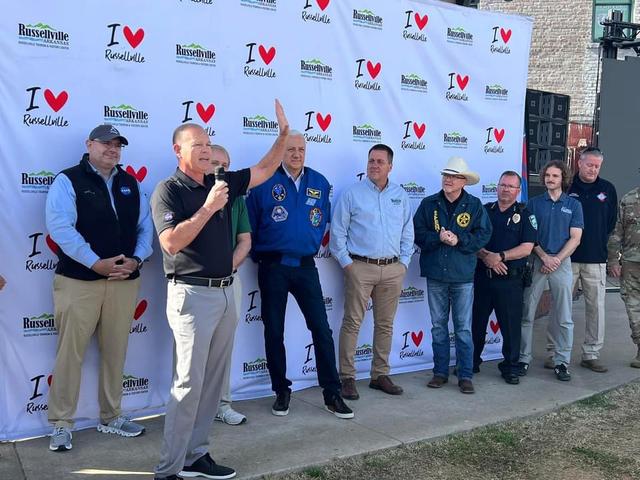
NASA Stennis Acting Center Director John Bailey, front left, speaks to people gathered to view the total solar eclipse in Russellville, Arkansas, on April 8.
NASA Stennis Participates in NASA Eclipse Events
NASA Armstrong pilots Stu Broce, Greg Nelson and Tim Williams sign autographs for people at the Los Angeles County Air Show in Lancaster, California.
NASA Armstrong Supported 2018 Los Angeles County Air Show
KENNEDY SPACE CENTER, FLA. - Center Director Jim Kennedy talks to students in Garland V. Stewart Magnet Middle School, a NASA Explorer School (NES) in Tampa, Fla.  Kennedy  made the trip with NASA astronaut Kay Hire to share the agency’s new vision for space exploration with the next generation of explorers. Kennedy is talking with students about our destiny as explorers, NASA’s stepping stone approach to exploring Earth, the Moon, Mars and beyond, how space impacts our lives, and how people and machines rely on each other in space.
KENNEDY SPACE CENTER, FLA. - Center Director Jim Kennedy talks to students in Garland V. Stewart Magnet Middle School, a NASA Explorer School (NES) in Tampa, Fla. Kennedy made the trip with NASA astronaut Kay Hire to share the agency’s new vision for space exploration with the next generation of explorers. Kennedy is talking with students about our destiny as explorers, NASA’s stepping stone approach to exploring Earth, the Moon, Mars and beyond, how space impacts our lives, and how people and machines rely on each other in space.
KENNEDY SPACE CENTER, FLA. - Center Director Jim Kennedy talks to radio station WFLA-AM and Florida Radio Network about his trip to Garland V. Stewart Magnet Middle School, a NASA Explorer School (NES) in Tampa, Fla.  Kennedy  made the trip with NASA astronaut Kay Hire to share the agency’s new vision for space exploration with the next generation of explorers. Kennedy is talking with students about our destiny as explorers, NASA’s stepping stone approach to exploring Earth, the Moon, Mars and beyond, how space impacts our lives, and how people and machines rely on each other in space.
KENNEDY SPACE CENTER, FLA. - Center Director Jim Kennedy talks to radio station WFLA-AM and Florida Radio Network about his trip to Garland V. Stewart Magnet Middle School, a NASA Explorer School (NES) in Tampa, Fla. Kennedy made the trip with NASA astronaut Kay Hire to share the agency’s new vision for space exploration with the next generation of explorers. Kennedy is talking with students about our destiny as explorers, NASA’s stepping stone approach to exploring Earth, the Moon, Mars and beyond, how space impacts our lives, and how people and machines rely on each other in space.
KENNEDY SPACE CENTER, FLA. - Center Director Jim Kennedy talks to WTSP-ABC News about his trip to Garland V. Stewart Magnet Middle School, a NASA Explorer School (NES) in Tampa, Fla.  Kennedy  made the trip with NASA astronaut Kay Hire to share the agency’s new vision for space exploration with the next generation of explorers. Kennedy is talking with students about our destiny as explorers, NASA’s stepping stone approach to exploring Earth, the Moon, Mars and beyond, how space impacts our lives, and how people and machines rely on each other in space.
KENNEDY SPACE CENTER, FLA. - Center Director Jim Kennedy talks to WTSP-ABC News about his trip to Garland V. Stewart Magnet Middle School, a NASA Explorer School (NES) in Tampa, Fla. Kennedy made the trip with NASA astronaut Kay Hire to share the agency’s new vision for space exploration with the next generation of explorers. Kennedy is talking with students about our destiny as explorers, NASA’s stepping stone approach to exploring Earth, the Moon, Mars and beyond, how space impacts our lives, and how people and machines rely on each other in space.
"People aren’t always recognized for who they are at work.   “So giving a person time to actually talk about themselves, and be proud of what they do, and talk about how hard it might be to maintain their career with everything else going on — makes them feel valued and appreciated. And highlighting them in that way on the Faces of NASA page, makes that pride permanent.   “I think I’m always seeking out projects that help people feel seen. And maybe that’s why I got so into photography initially. I struggle with that myself — feeling seen. And so to help other people feel seen is definitely an interest of mine that I keep coming back to."  Aubrey Gemignani, Photo Archivist/Photographer, Mori Associates, in NASA’s Office of Communications, poses for a portrait, Thursday, March 16, 2023, in Washington, DC.  Photo Credit: (NASA/Joel Kowsky)
Aubrey Gemignani Portrait
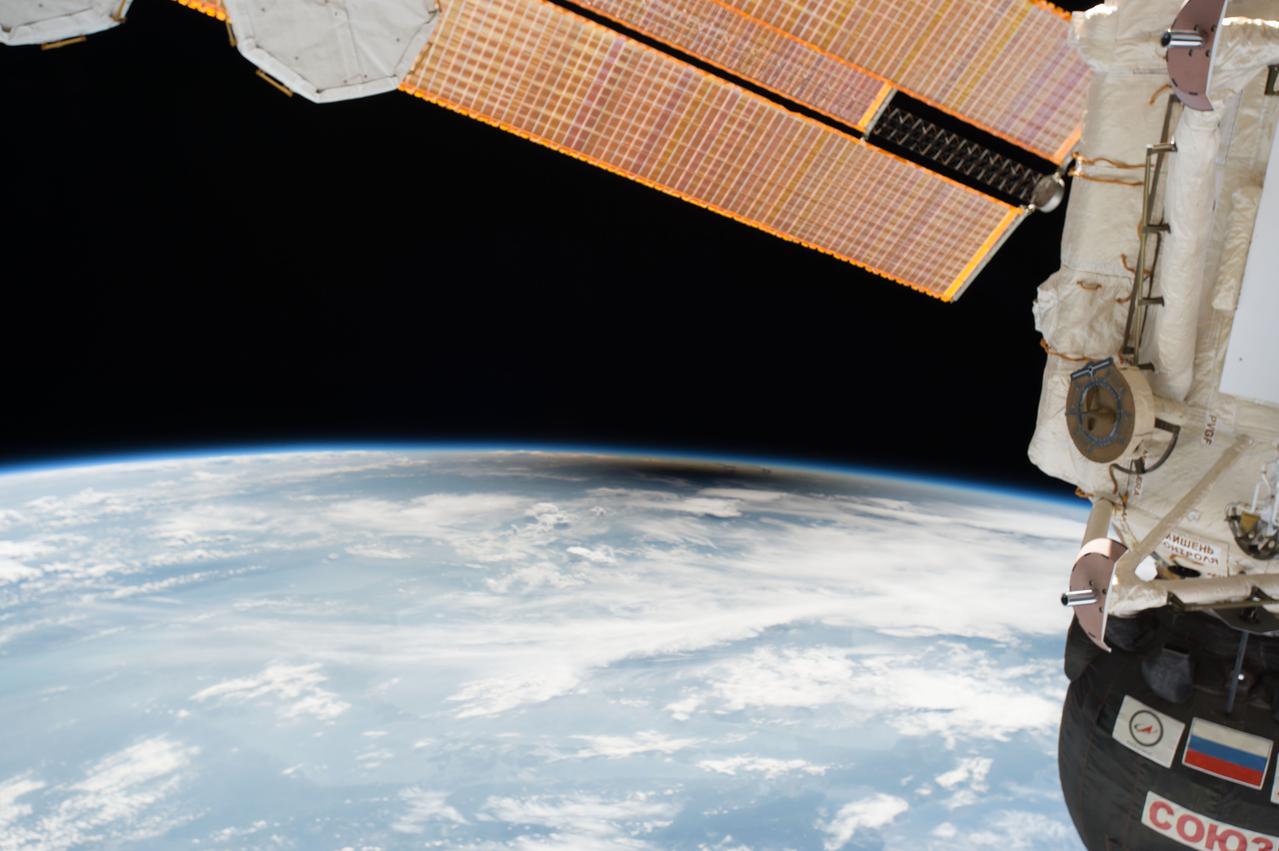
iss052e056122 (Aug. 21, 2017) --- As millions of people across the United States experienced a total eclipse as the umbra, or moon’s shadow passed over them, only six people witnessed the umbra from space. Viewing the eclipse from orbit were NASA’s Randy Bresnik, Jack Fischer and Peggy Whitson, ESA (European Space Agency’s) Paolo Nespoli, and Roscosmos’ Commander Fyodor Yurchikhin and Sergey Ryazanskiy. The space station crossed the path of the eclipse three times as it orbited above the continental United States at an altitude of 250 miles.
iss052e056122
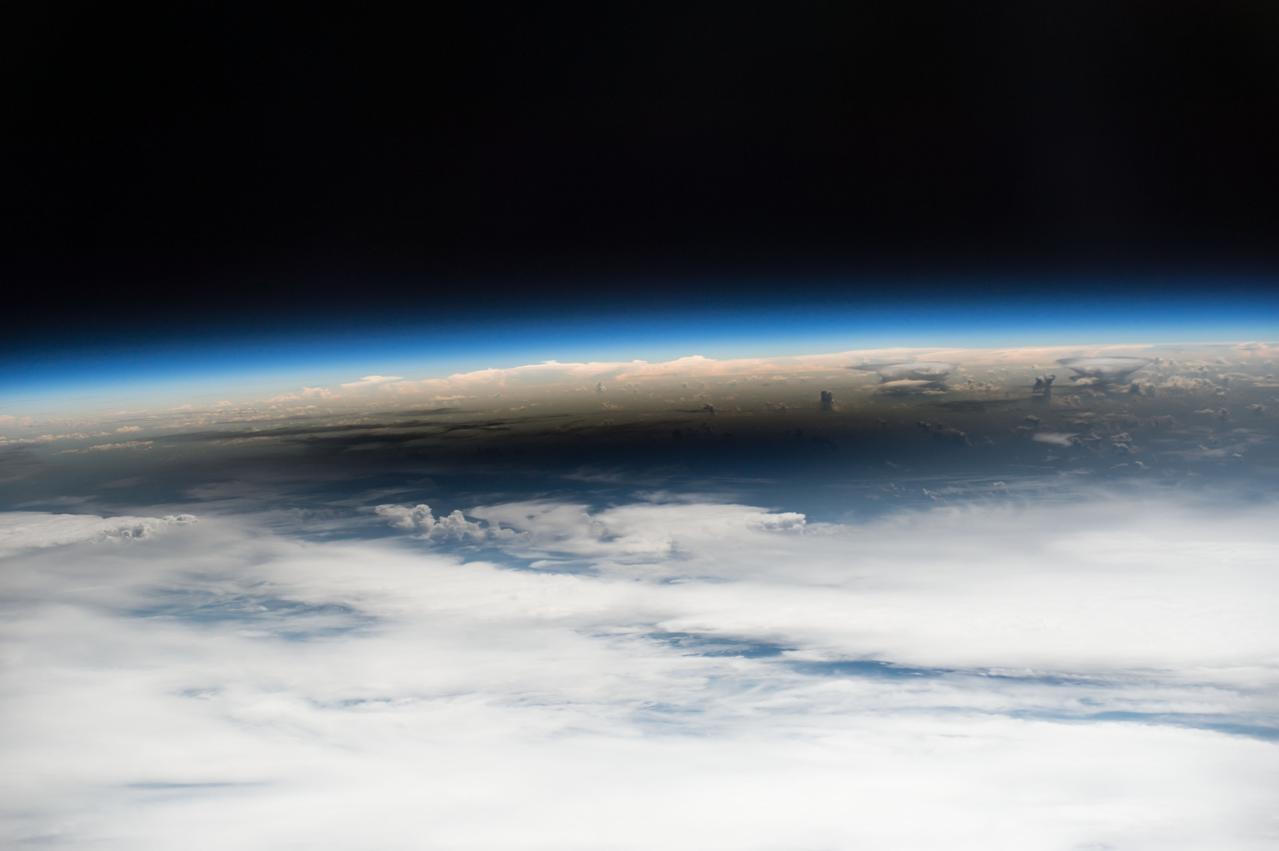
iss052e056245 (Aug. 21, 2017) --- As millions of people across the United States experienced a total eclipse as the umbra, or moon’s shadow passed over them, only six people witnessed the umbra from space. Viewing the eclipse from orbit were NASA’s Randy Bresnik, Jack Fischer and Peggy Whitson, ESA (European Space Agency’s) Paolo Nespoli, and Roscosmos’ Commander Fyodor Yurchikhin and Sergey Ryazanskiy. The space station crossed the path of the eclipse three times as it orbited above the continental United States at an altitude of 250 miles.
iss052e056245
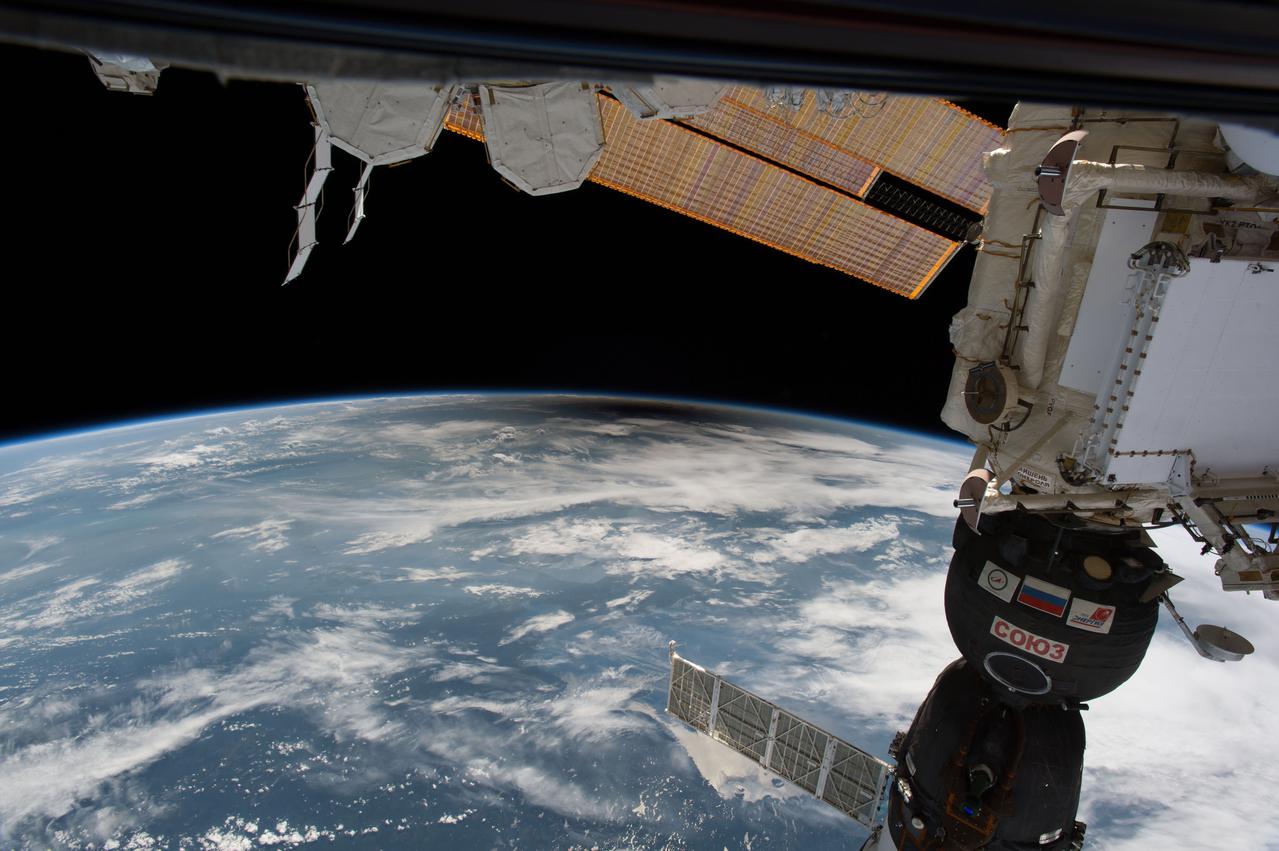
iss052e056225 (Aug. 21, 2017) --- As millions of people across the United States experienced a total eclipse as the umbra, or moon’s shadow passed over them, only six people witnessed the umbra from space. Viewing the eclipse from orbit were NASA’s Randy Bresnik, Jack Fischer and Peggy Whitson, ESA (European Space Agency’s) Paolo Nespoli, and Roscosmos’ Commander Fyodor Yurchikhin and Sergey Ryazanskiy. The space station crossed the path of the eclipse three times as it orbited above the continental United States at an altitude of 250 miles.
iss052e056225
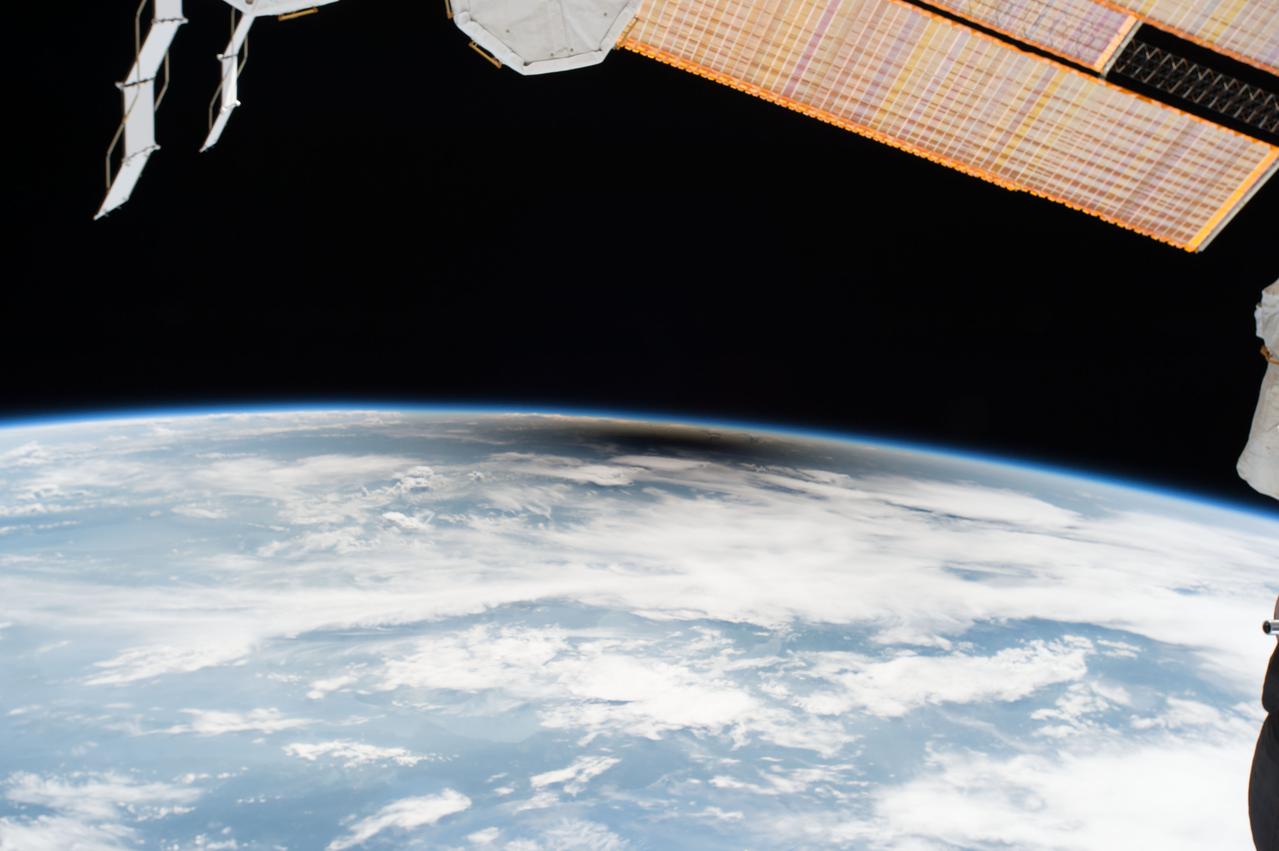
iss052e056222 (Aug. 21, 2017) --- As millions of people across the United States experienced a total eclipse as the umbra, or moon’s shadow passed over them, only six people witnessed the umbra from space. Viewing the eclipse from orbit were NASA’s Randy Bresnik, Jack Fischer and Peggy Whitson, ESA (European Space Agency’s) Paolo Nespoli, and Roscosmos’ Commander Fyodor Yurchikhin and Sergey Ryazanskiy. The space station crossed the path of the eclipse three times as it orbited above the continental United States at an altitude of 250 miles.
iss052e056222
“Some people [may say], 'You have too many cooks in the kitchen,’ but I think there's a line. It's good to have a lot of input because people bring many different perspectives that you would never even consider if you just pushed an idea forward with one person. This is especially true in the area we work in with digital [communications], which is changing so frequently; you constantly have to innovate, so including diverse voices and thoughts is important.   “I'm an older sister, and I don't know if some of that [leadership style] comes from when we were kids, always making sure that I involved her. My sister had trouble pronouncing words when she was younger, so I was her translator, ensuring people could understand what she wanted or needed. And maybe that translated into who I am, making sure people have voices and are heard [at NASA]...I've achieved a lot that I didn't even know I wanted to accomplish because I couldn't have imagined this career progression for myself.   “But now that I'm here, I would like to achieve more in terms of what NASA looks like internally, especially after getting involved with the NASA Science IDEA working group and diversity efforts. I would love to one, help people outside of NASA realize that they could work here and two, push people internally to the forefront so that they can be considered for higher-level things and progress.”  NASA Science Mission Directorate Digital Manager Emily Furfaro poses for a portrait on Thursday, Aug. 22, 2024, at the Mary W. Jackson NASA Headquarters building in Washington.  Photo Credit: (NASA/Keegan Barber)
Emily Furfaro Portrait
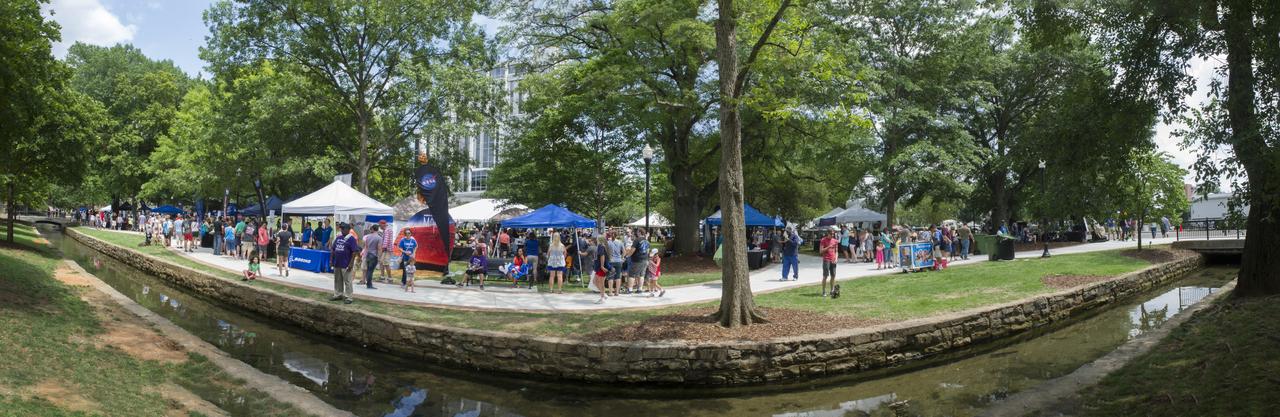
MORE THAN 7,500 PEOPLE ATTENDED NASA MARSHALL SPACE CENTER AND DOWNTOWN HUNTSVILLE, INC.’S THIRD ANNUAL CELEBRATION OF NASA AND THE COMMUNITY JUNE 18. THIS YEAR, THE EVENT MOVED TO HUNTSVILLE’S BIG SPRING PARK.
NASA IN THE PARK
“At the end of the day people won't remember what you said or did. They will remember how you made them feel.’ [This quote] resonates with me because I feel my job in public engagement is creating unique experiences for people, so when they walk away you’ve touched them in a way that leaves a meaningful impression.  “[The ceremony] was more than just a street renaming. In my mind, I was thinking, who am I doing this for? I am doing this for any person who feels that he or she was not valued, or perhaps they were not seen or not heard. What will people think when they walk up and see Hidden Figures Way? Will they think of those times in their life where they weren't seen, or they felt they didn't have a voice?  “It was a time to make that [street] meaningful and to leave a lasting impression with people to see that name and feel proud to be part of it. That was a really proud moment for me to be charged with bringing [the ceremony] together and creating this memorable experience.”  Chief of the Public Engagement Division at NASA Headquarters, Cindy Steele, poses for a portrait, Monday, February 8, 2021 at NASA Headquarters in Washington. Photo Credit: (NASA/Aubrey Gemignani)
Cindy Steele Portrait
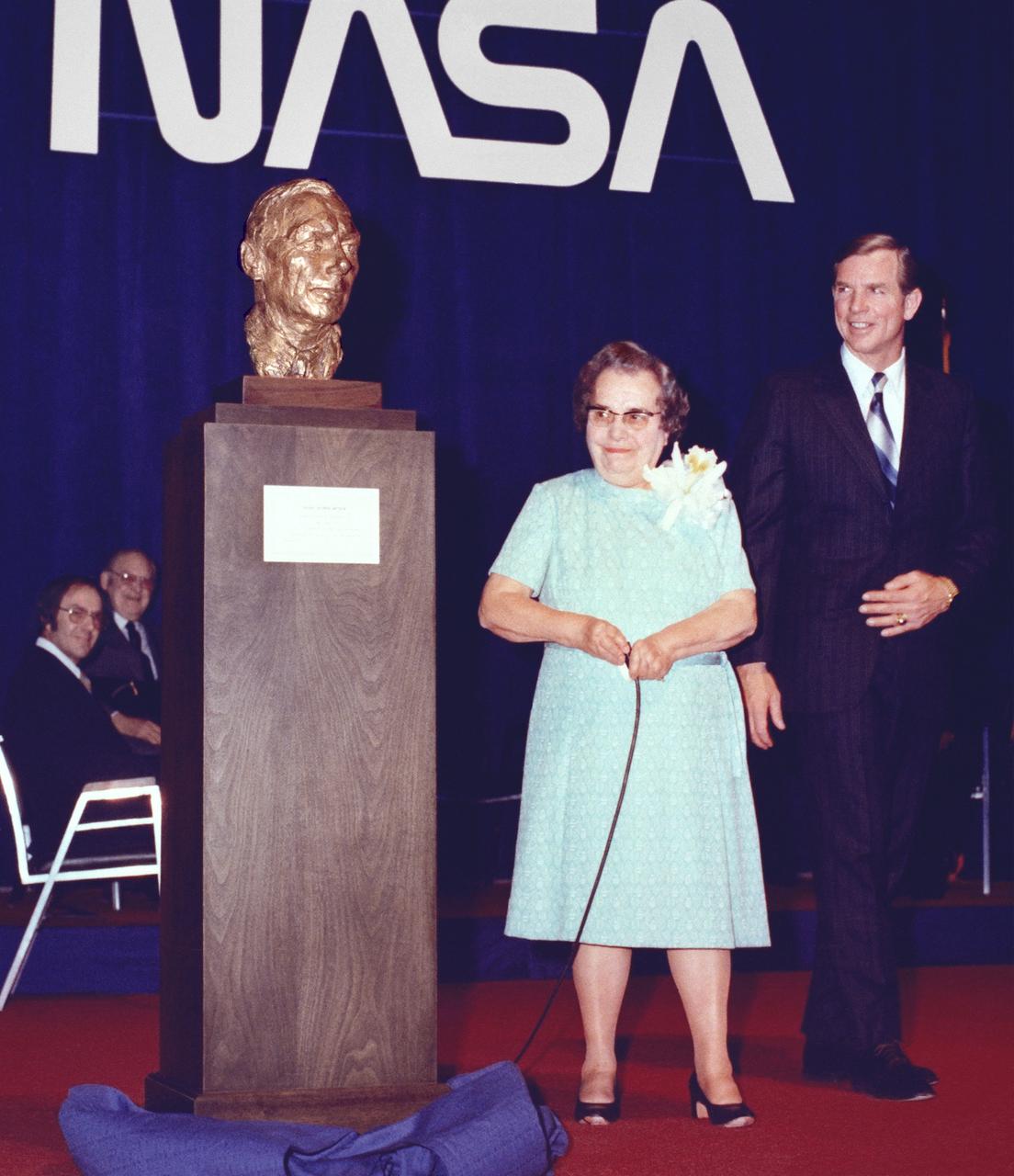
On March 26, 1976, the NASA Flight Research Center opened its doors to hundreds of guests for the dedication of the center in honor of Hugh Latimer Dryden. The dedication was very much a local event; following Center Director David Scott’s opening remarks, the Antelope Valley High School’s symphonic band played the national anthem. Invocation was given followed by recognition of the invited guests. Dr. Hugh Dryden, a man of total humility, received praise from all those present. Dryden, who died in 1965, had been a pioneering aeronautical scientist who became director of the National Advisory Committee for Aeronautics (NACA) in 1949 and then deputy administrator of the NACA’s successor, NASA, in 1958. Very much interested in flight research, he had been responsible for establishing a permanent facility at the location later named in his honor.  As Center Director David Scott looks on, Mrs. Hugh L. Dryden (Mary Libbie Travers) unveils the memorial to her husband at the dedication ceremony.On March 26, 1976, the NASA Flight Research Center opened its doors to hundreds of guests for the dedication of the center in honor of Hugh Latimer Dryden.
Mrs. Hugh Dryden unveils the memorial to her late husband at center dedication, with center director David Scott
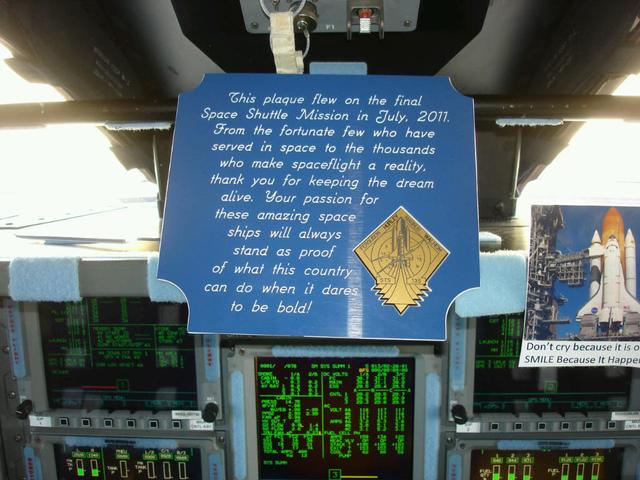
JSC2011-E-068995 (21 July 2011) --- The crew of STS-135 left this plaque in the cockpit of Atlantis as a tribute to all of the people who have worked on the Space Shuttle Program. Photo credit: NASA
STS-135 Postflight
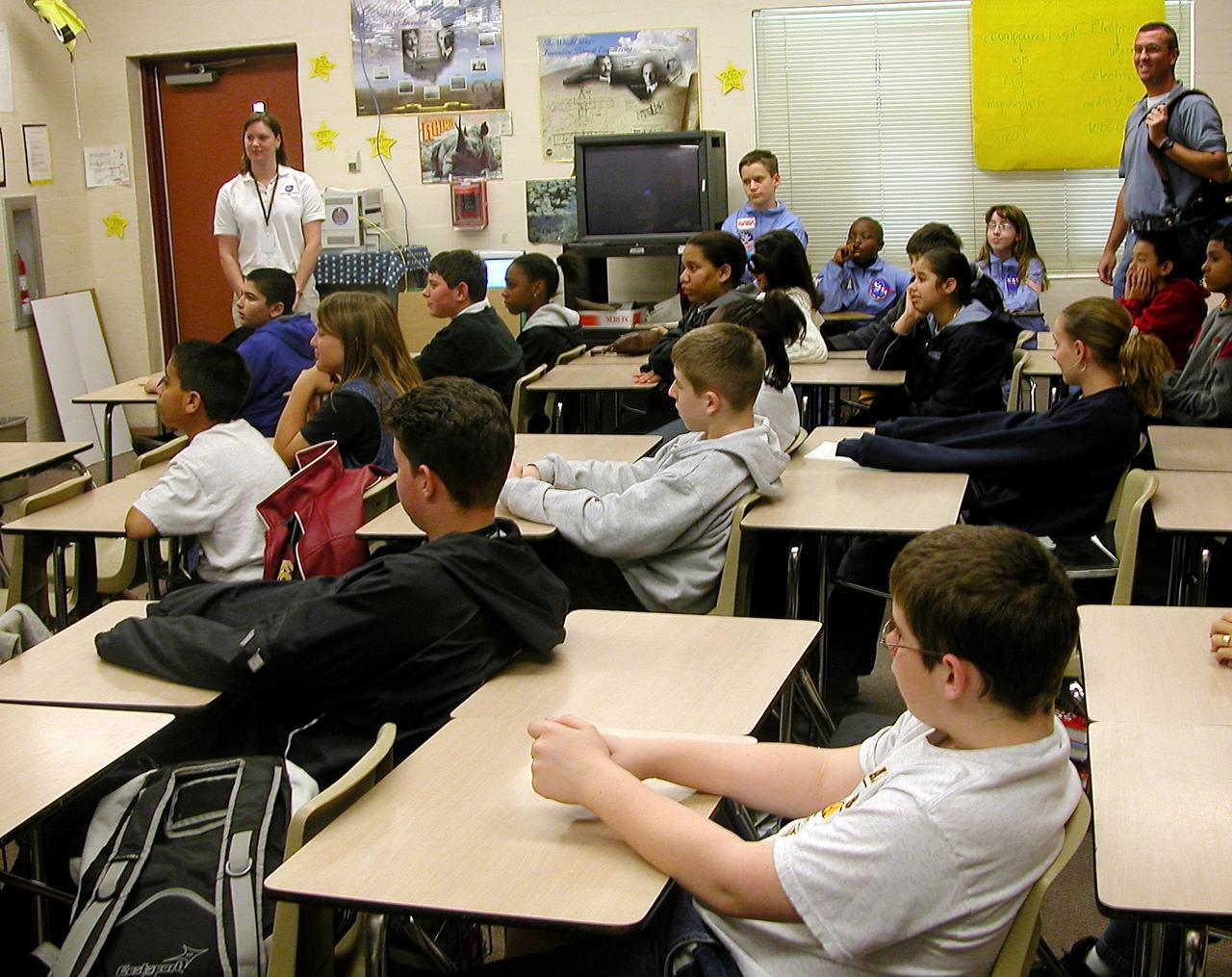
KENNEDY SPACE CENTER, FLA. - Students at Garland V. Stewart Magnet Middle School, a NASA Explorer School (NES) in Tampa, Fla., listen attentively to astronaut Kay Hire.  She and Center Director Jim Kennedy were at the school to share the agency’s new vision for space exploration with the next generation of explorers. Kennedy is talking with students about our destiny as explorers, NASA’s stepping stone approach to exploring Earth, the Moon, Mars and beyond, how space impacts our lives, and how people and machines rely on each other in space.
KENNEDY SPACE CENTER, FLA. - Students at Garland V. Stewart Magnet Middle School, a NASA Explorer School (NES) in Tampa, Fla., listen attentively to astronaut Kay Hire. She and Center Director Jim Kennedy were at the school to share the agency’s new vision for space exploration with the next generation of explorers. Kennedy is talking with students about our destiny as explorers, NASA’s stepping stone approach to exploring Earth, the Moon, Mars and beyond, how space impacts our lives, and how people and machines rely on each other in space.
KENNEDY SPACE CENTER, FLA. - Warren Elly (left), with WTVT-TV, Fox News, talks with Center Director Jim Kennedy at Garland V. Stewart Magnet Middle School, a NASA Explorer School (NES) in Tampa, Fla. Kennedy was joined by astronaut Kay Hire in sharing the agency’s new vision for space exploration with the next generation of explorers. Kennedy talked with students about our destiny as explorers, NASA’s stepping stone approach to exploring Earth, the Moon, Mars and beyond, how space impacts our lives, and how people and machines rely on each other in space.
KENNEDY SPACE CENTER, FLA. - Students at Garland V. Stewart Magnet Middle School, a NASA Explorer School (NES) in Tampa, Fla., listen attentively to astronaut Kay Hire.  She and Center Director Jim Kennedy were at the school to share the agency’s new vision for space exploration with the next generation of explorers. Kennedy is talking with students about our destiny as explorers, NASA’s stepping stone approach to exploring Earth, the Moon, Mars and beyond, how space impacts our lives, and how people and machines rely on each other in space.
KENNEDY SPACE CENTER, FLA. - Students at Garland V. Stewart Magnet Middle School, a NASA Explorer School (NES) in Tampa, Fla., listen attentively to astronaut Kay Hire. She and Center Director Jim Kennedy were at the school to share the agency’s new vision for space exploration with the next generation of explorers. Kennedy is talking with students about our destiny as explorers, NASA’s stepping stone approach to exploring Earth, the Moon, Mars and beyond, how space impacts our lives, and how people and machines rely on each other in space.
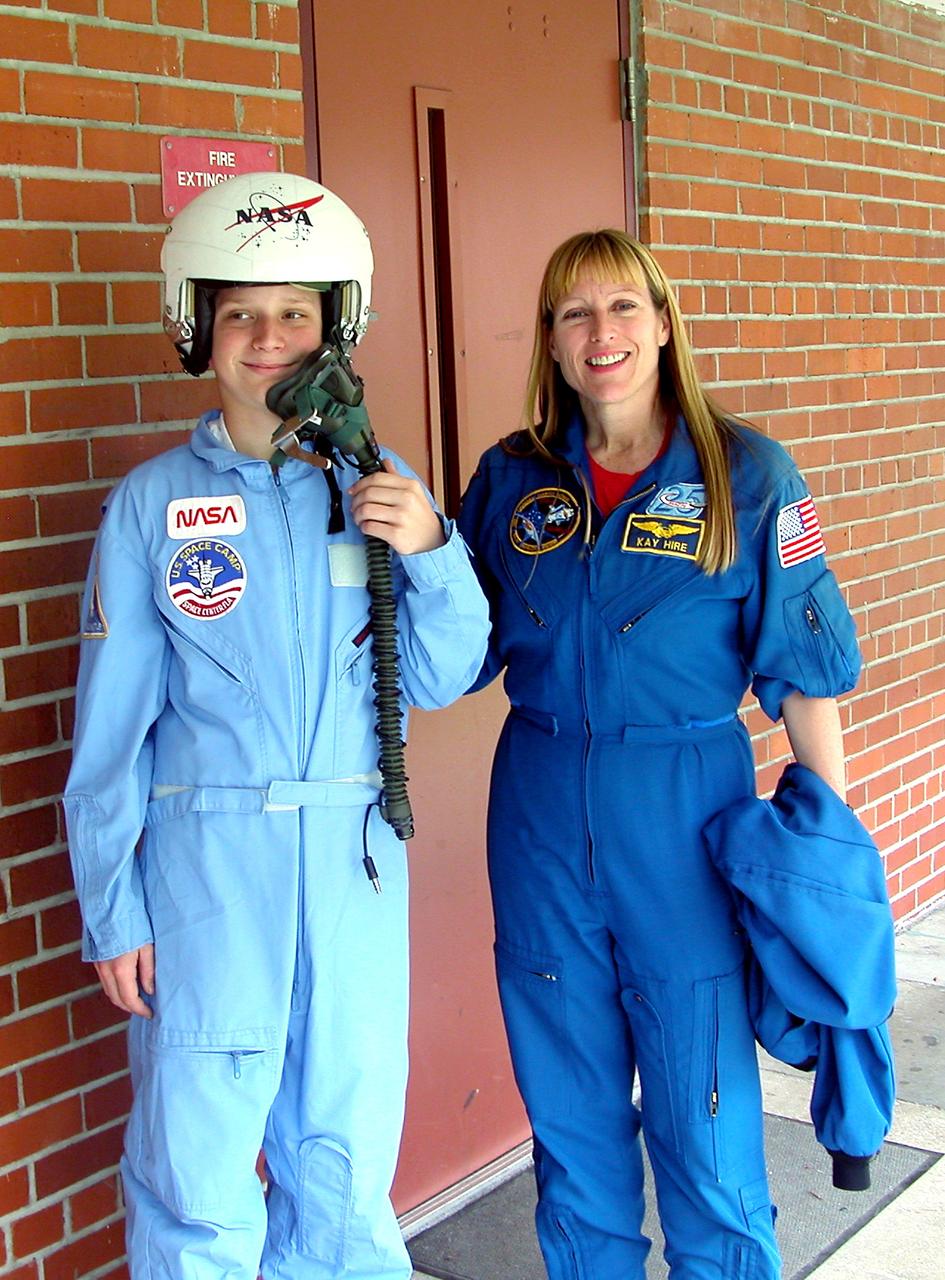
KENNEDY SPACE CENTER, FLA. - Astronaut Kay Hire poses with 8th grader Kristy Wiggins at Garland V. Stewart Magnet Middle School, a NASA Explorer School (NES) in Tampa, Fla.  Hire joined Center Director Jim Kennedy at the school in sharing the agency’s new vision for space exploration with the next generation of explorers. Kennedy is talking with students about our destiny as explorers, NASA’s stepping stone approach to exploring Earth, the Moon, Mars and beyond, how space impacts our lives, and how people and machines rely on each other in space.
KENNEDY SPACE CENTER, FLA. - Astronaut Kay Hire poses with 8th grader Kristy Wiggins at Garland V. Stewart Magnet Middle School, a NASA Explorer School (NES) in Tampa, Fla. Hire joined Center Director Jim Kennedy at the school in sharing the agency’s new vision for space exploration with the next generation of explorers. Kennedy is talking with students about our destiny as explorers, NASA’s stepping stone approach to exploring Earth, the Moon, Mars and beyond, how space impacts our lives, and how people and machines rely on each other in space.
Goddard's Ritsko Wins 2011 SAVE Award  The winner of the 2011 SAVE Award is Matthew Ritsko, a Goddard financial manager. His tool lending library would track and enable sharing of expensive space-flight tools and hardware after projects no longer need them.  This set of images represents the types of tools used at NASA.  To read more go to: <a href="http://www.nasa.gov/topics/people/features/ritsko-save.html" rel="nofollow">www.nasa.gov/topics/people/features/ritsko-save.html</a>  Exploration Systems Project Manager Mike Weiss speaks about a Hubble Servicing Mission hand tool, developed at Goddard.  Credit: NASA/GSFC/Debbie McCallum
STS 135 Landing
"The public perception of NASA has a lot to do with our technological successes and the discoveries that we've made, but none of that is possible without the people.   "In the six or so years that I've worked at NASA, I've learned a lot of incredible stories — not just of the struggles that different spacecraft encounter on their journeys throughout the universe. There are so many problems that need to be solved and fixes that need to be made, but there are also so many stories of teams that had to work together to accomplish their goals. And a lot of times, these teams are working after hours, on weekends, working late nights and early mornings. These are people who have other problems in their lives that they have to solve, and they're still showing up and making magic happen.  "This is why [Aubrey Gemignani] and I started Faces of NASA: We wanted to make that connection. It's not just rockets, astronauts, and telescopes. Hundreds of thousands of people come together to make these missions possible, and that's the part that's really interesting for me.  "I like to hold a mirror to other people, and in every Faces of NASA interview, I try to hold a mirror up to what the person has accomplished to get them to be proud of it. For many of those people, it's the first time they have to self-reflect.  "That's what's really nice about [the Faces of NASA project]. Everyone who works here is just living day-to-day, so when they have an opportunity to stop for a moment and look back on how far they've come... it's the best feeling for both of us. They're like, 'Wow, I've never really stopped to think about how much I've accomplished or how far I've come.' And I get to share that moment with them. That's my favorite part of Faces of NASA."   NASA Communications Strategist, Thalia Patrinos, poses for a portrait, Thursday, July 11, 2024, in Washington. Photo Credit: (NASA/Aubrey Gemignani)
Thalia Patrinos Portrait
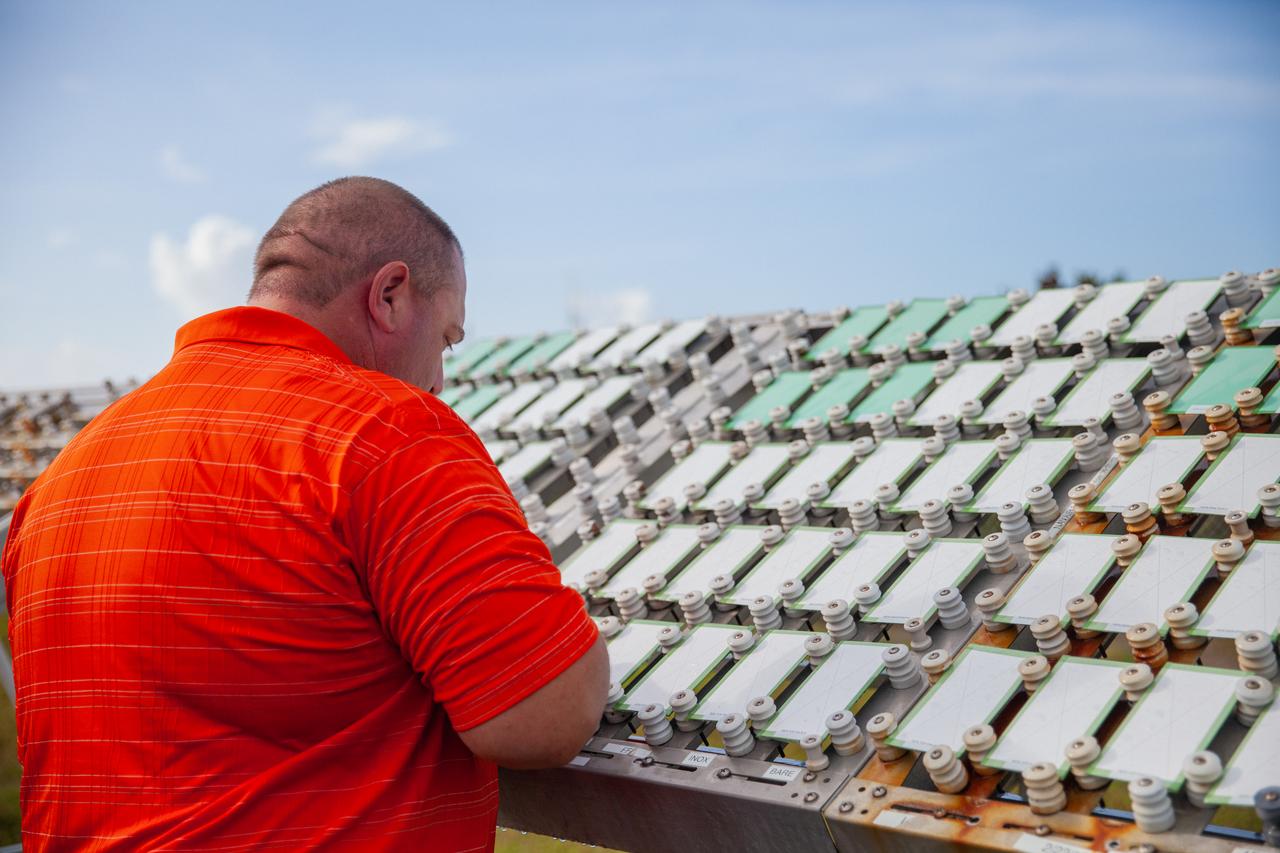
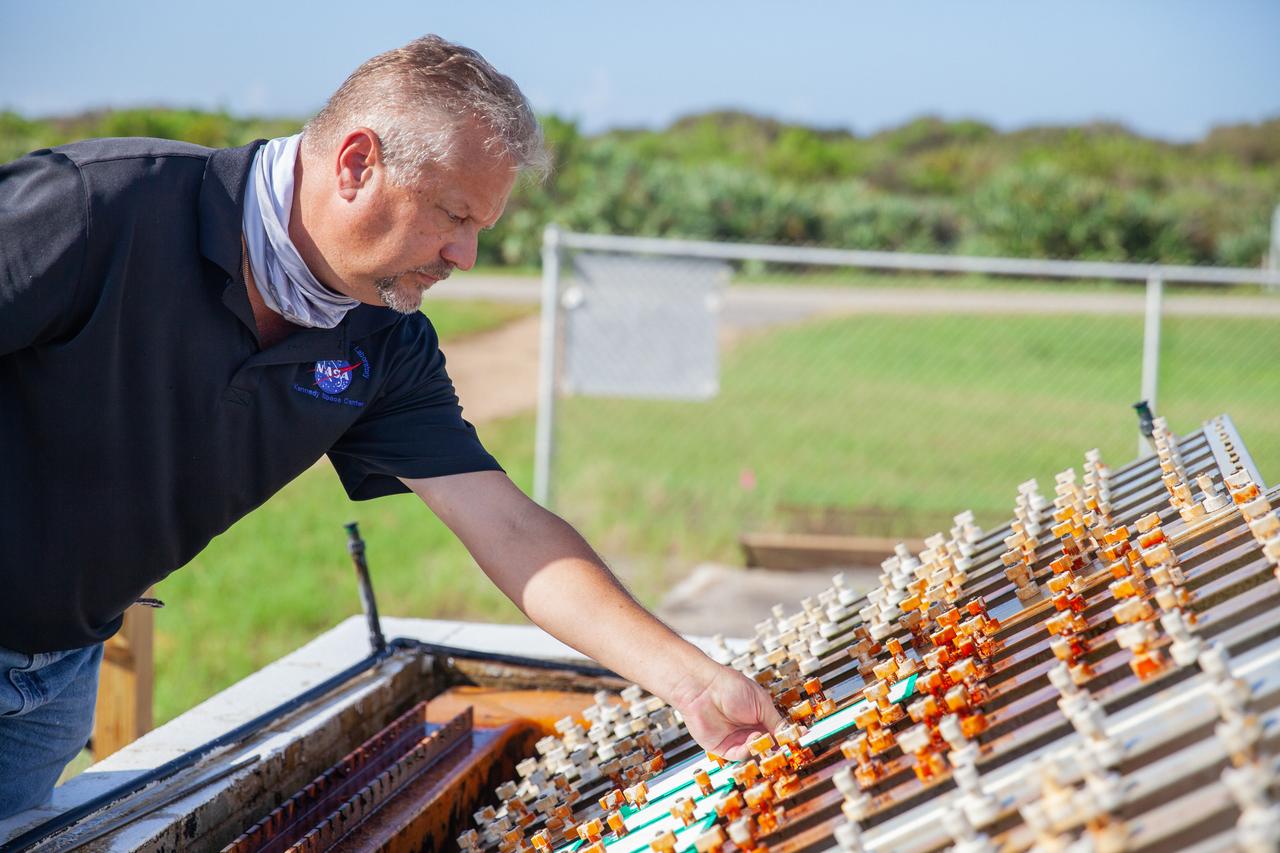
A Mechanical and Environmental Testing Lab engineer examines samples at the corrosion engineering test site at NASA’s Kennedy Space Center in Florida on Oct. 6, 2020. The corrosion lab is a network of people, equipment, and facilities that provides engineering services and technical innovations in all areas of corrosion for NASA and external customers.
Engineering Labs Equipment
Timothy Risch, a technical manager at NASA’s Armstrong Flight Research Center in Edwards, California, cautions people should prepare for and be ready to survive a serious accident. He presented during Safety Day on April 4, 2024, at NASA’s Armstrong Flight Research Center in Edwards, California.
NASA Values Safety and Reducing Risk
A Mechanical and Environmental Testing Lab engineer examines samples at the corrosion engineering test site on Oct. 6, 2020, at NASA’s Kennedy Space Center in Florida. The corrosion lab is a network of people, equipment, and facilities that provides engineering services and technical innovations in all areas of corrosion for NASA and external customers.
Engineering Labs Equipment
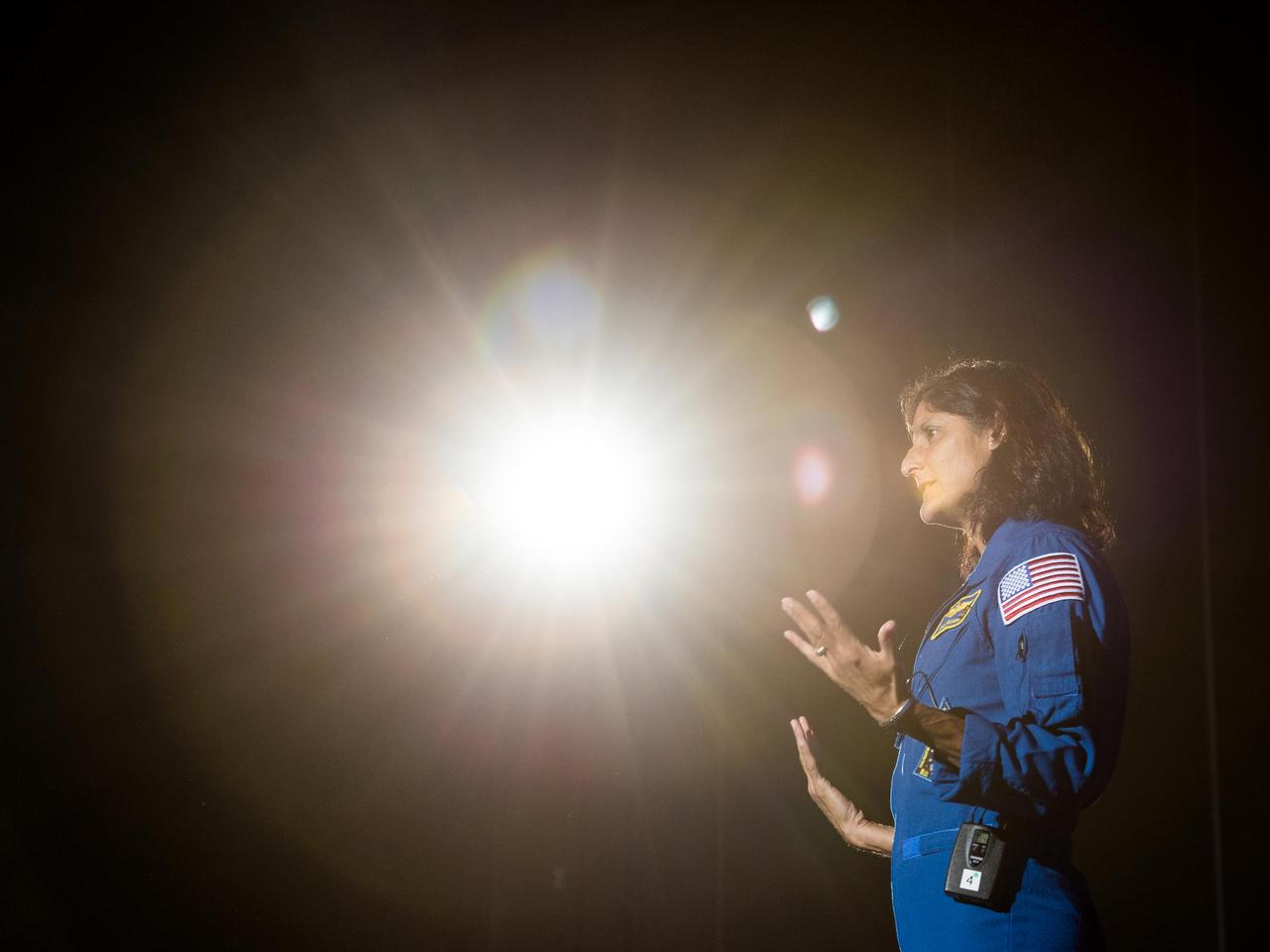
Astronaut Sunita Williams gives a talk at NASA's Plum Brook Station. In June, NASA Glenn hosted an Open House at Plum Brook Station in Sandusky to celebrate the 75th anniversary of the Center. Thousands of people attended, and some lucky kids got to see awesome experiments and meet astronaut Suni Williams.
Plum Brook Station Open House - 2016
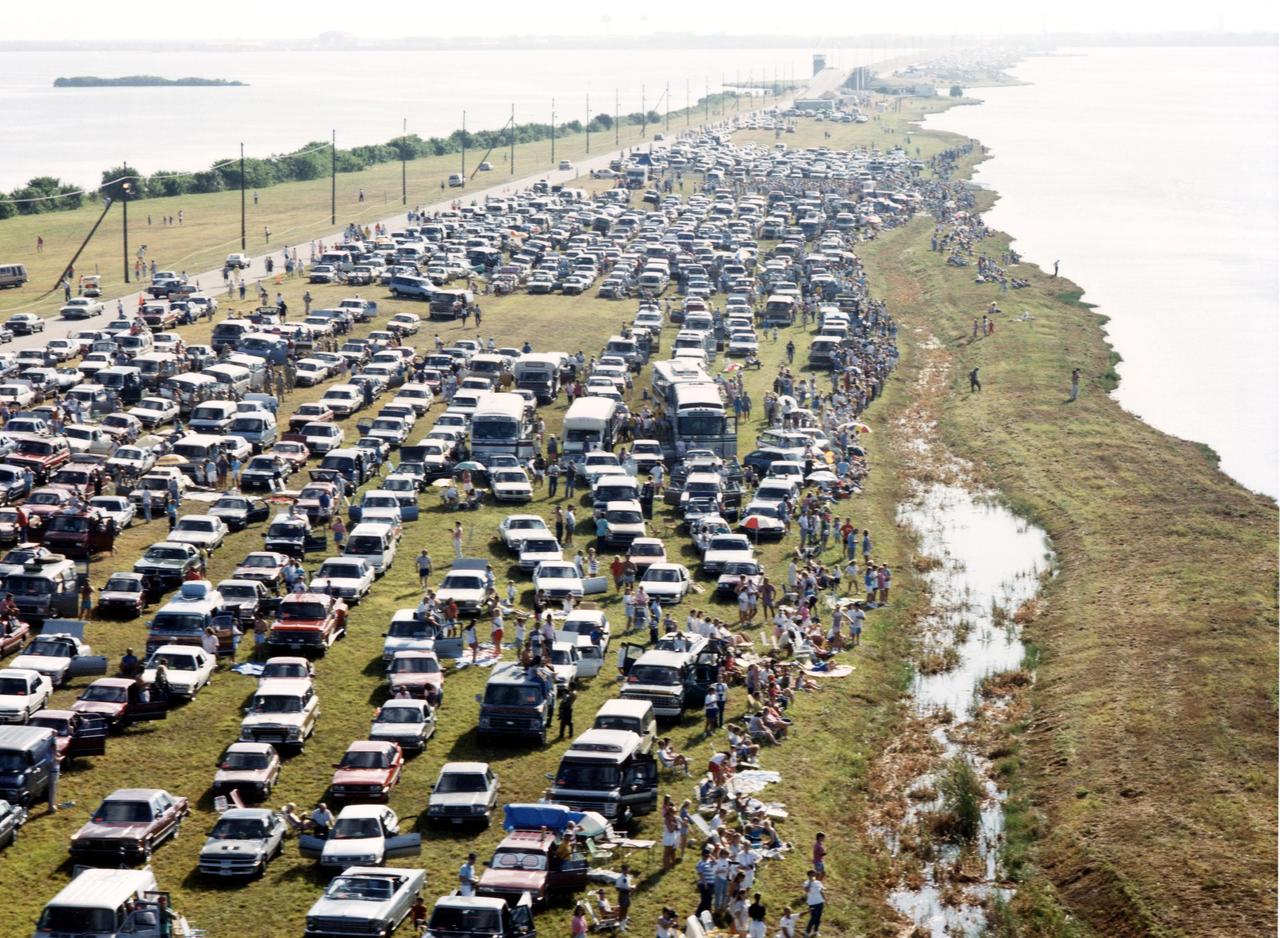
NASA employees, their family and friends gather on the NASA causeway over the Banana River, south of Kennedy Space Center, the morning of the launch of STS-26 and the Space Shuttle Discovery. An estimated 1 million people were expected to view the 11:37 a.m. launch from various locations in Central Florida
ksc-88pc-1176
People tour the inside of the DC-8 aircraft at NASA’s Armstrong Flight Research Center Building 703 in Palmdale, California. On May 2, 2024, NASA personnel, friends, and family celebrated the DC-8 staff, aircraft, and science campaigns.
NASA Armstrong Event Celebrates NASA DC-8 Aircraft
The X-59 simulator at NASA's Armstrong Flight Research Center in Edwards, California, will help pilots prepare for Quesst missions. Quesst is NASA's mission to demonstrate how the X-59 can fly supersonic without generating loud sonic booms and then survey what people hear when it flies overhead.
NASA Armstrong Facilities Include X-59 Simulator
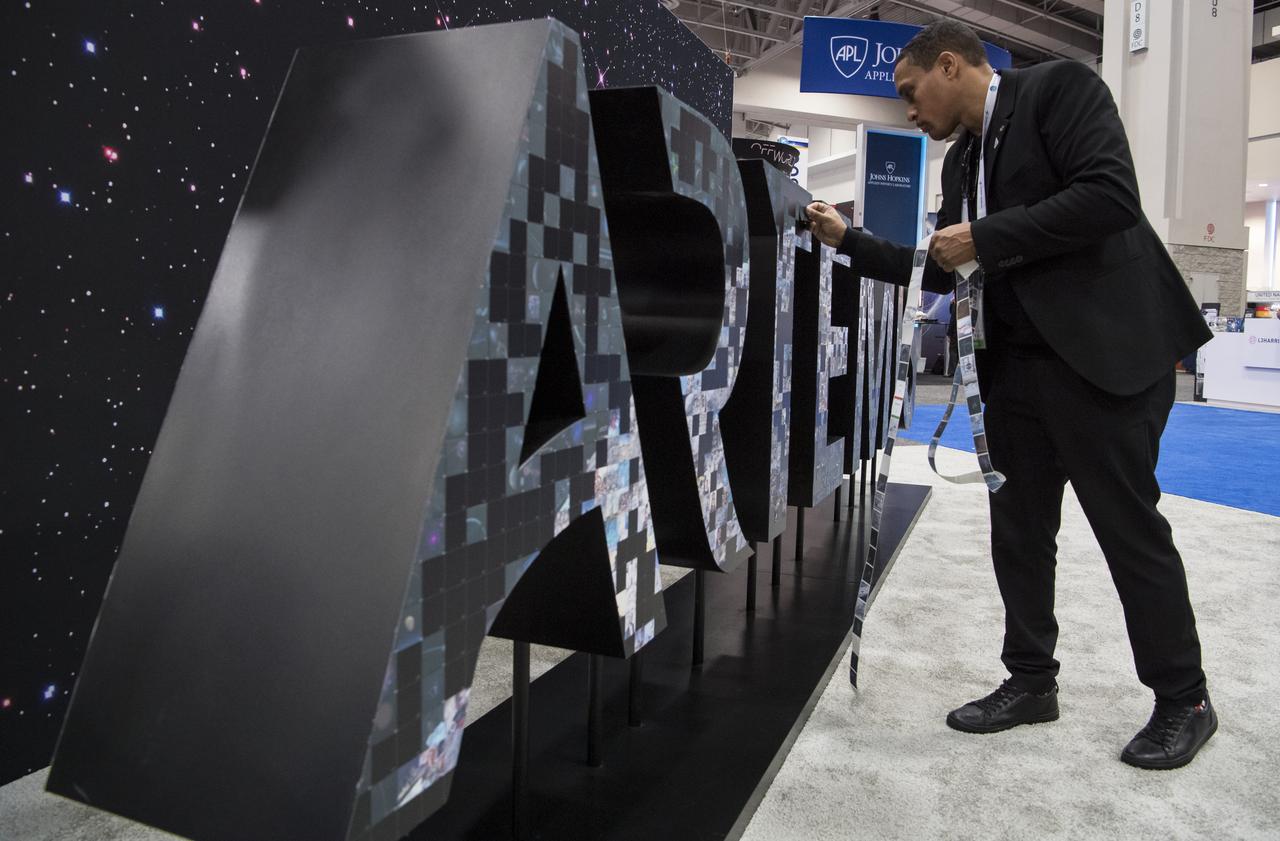
Photos of people who have visited the NASA exhibit are placed on the Artemis sign during the 70th International Astronautical Congress, Wednesday, Oct. 23, 2019 at the Walter E. Washington Convention Center in Washington. Photo credit: (NASA/Aubrey Gemignani)
70th International Astronautical Congress
"A piece of my story that I think needs to get told is that broken crayons still color.   "So often we hear that there's this cycle of hurt, and hurt people hurt people, and if you came from something, you have to be a product of your environment.    "I do feel like, in a lot of ways, we are, whether you want to be or not. The people that raise you give you a bag, and they put things in it, and you carry those things with you, good or bad, for the rest of your life. But just because my dad struggled with addiction and just because my mom wasn't always there didn't mean that I had to be either of those things.    "I didn't have an example, a great example, of what love looked like all the time, but I did, right? I didn't have the Cosbys, but I had exactly what I needed to be who I needed to be. I think that part of my story is what I'd like to tell more of.    "Yeah, I came from brokenness, but I'm not broken."  NASA Public Affairs Specialist, Tyrone McCoy, poses for a portrait, Tuesday, June 14, 2022, at the Mary W. Jackson NASA Headquarters building in Washington. Photo Credit: (NASA/Bill Ingalls)
Tyrone McCoy Portrait
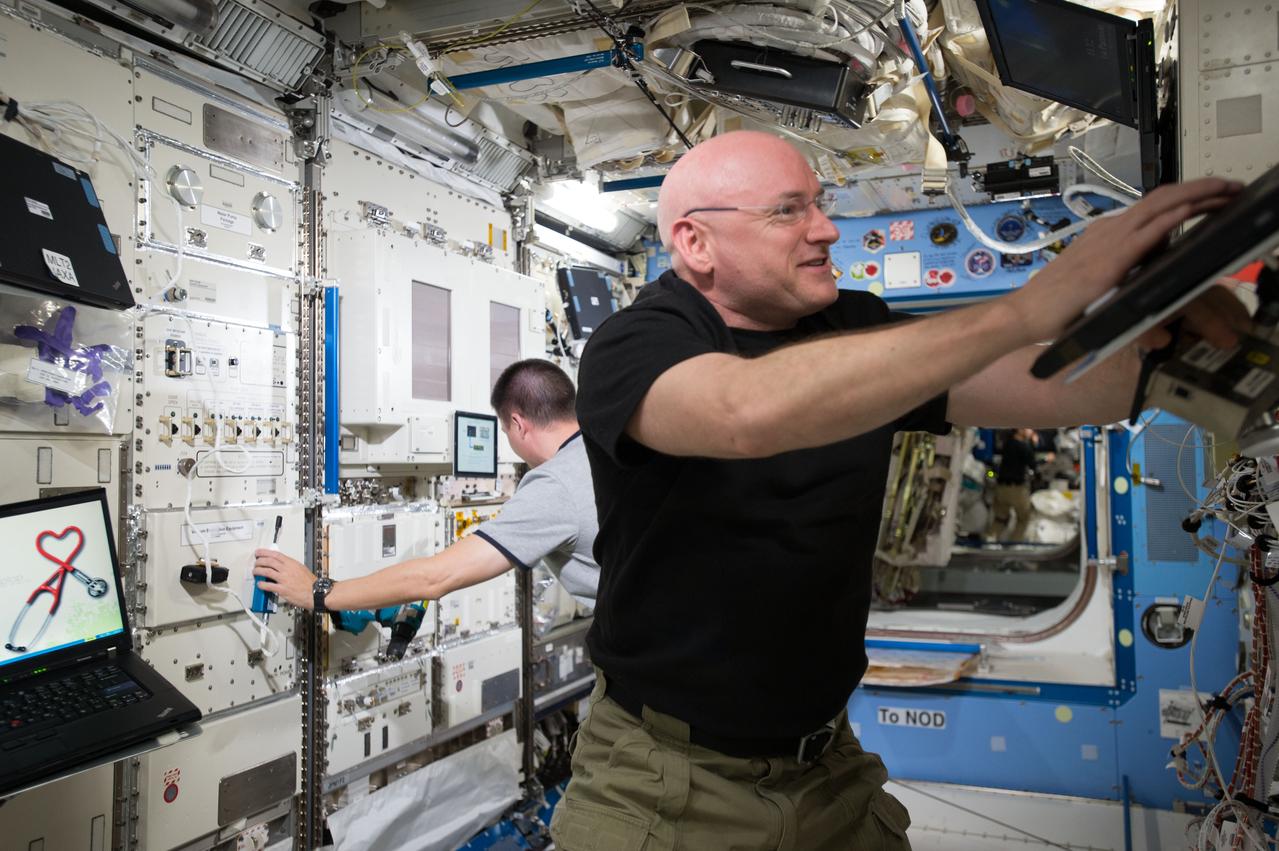
ISS044E079682 (09/01/2015) --- NASA Astronaut Scott Kelly works inside the U.S. Destiny Laboratory. Destiny is the primary research laboratory for U.S. payloads, supporting a wide range of experiments and studies contributing to health, safety and quality of life for people all over the world.
MSPR-2 installation and checkout
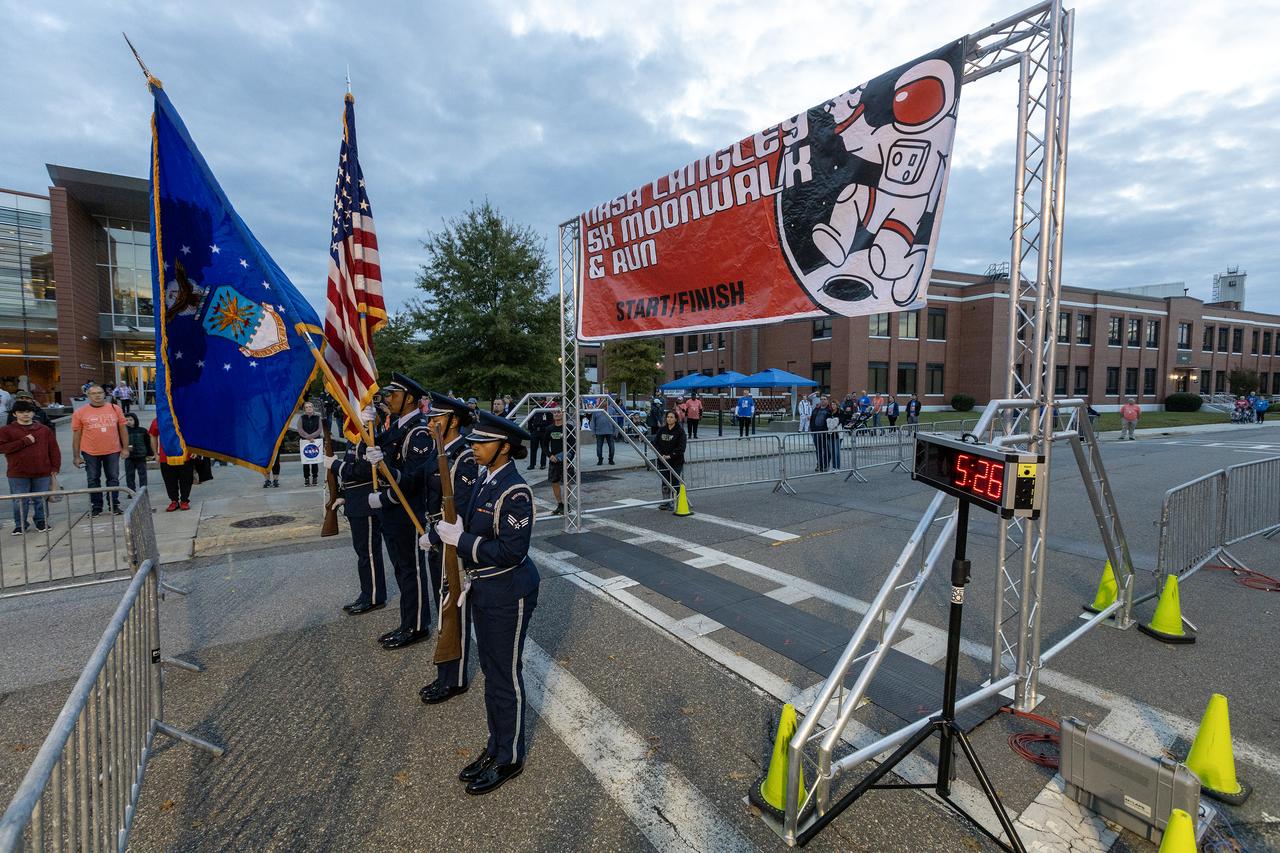
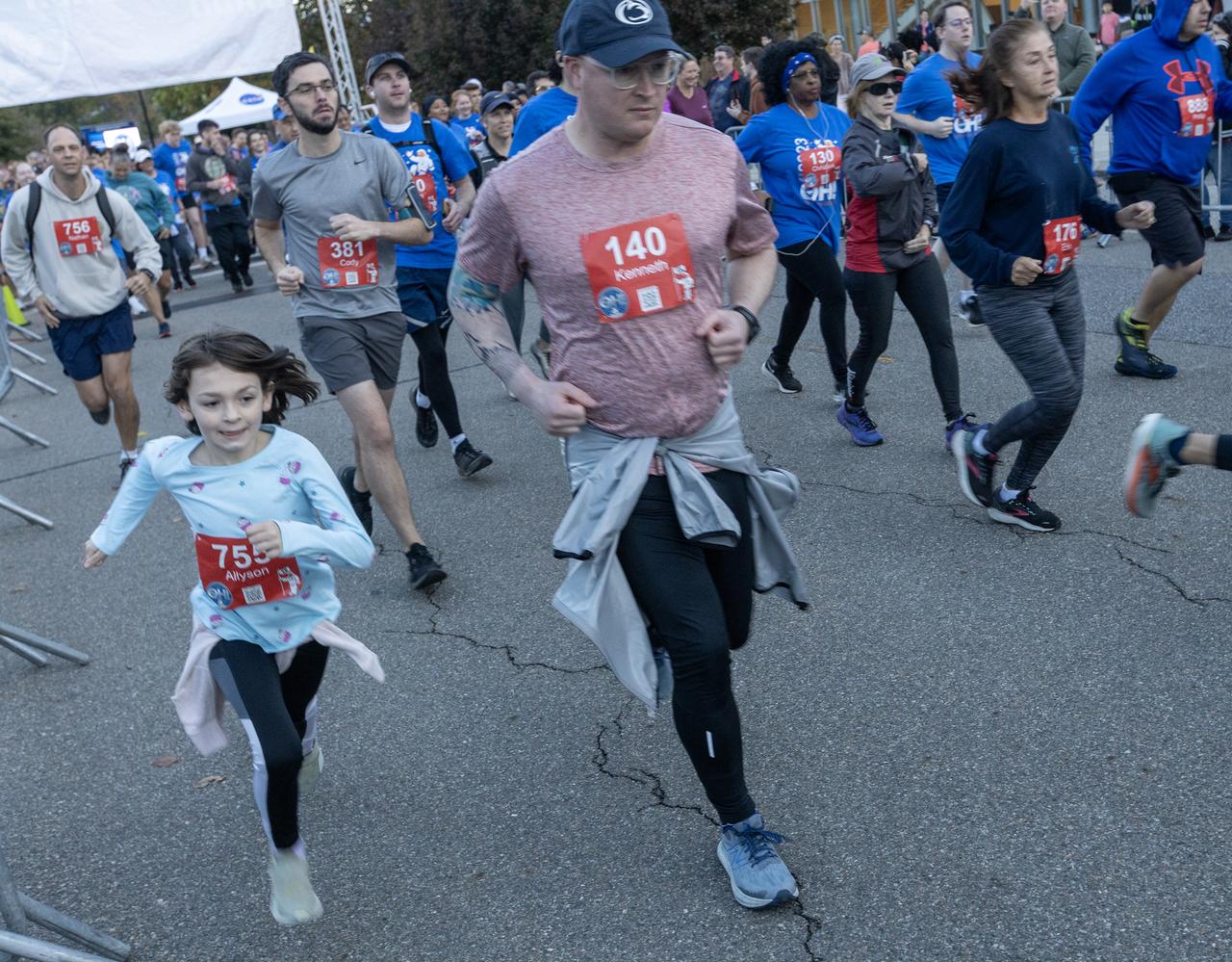
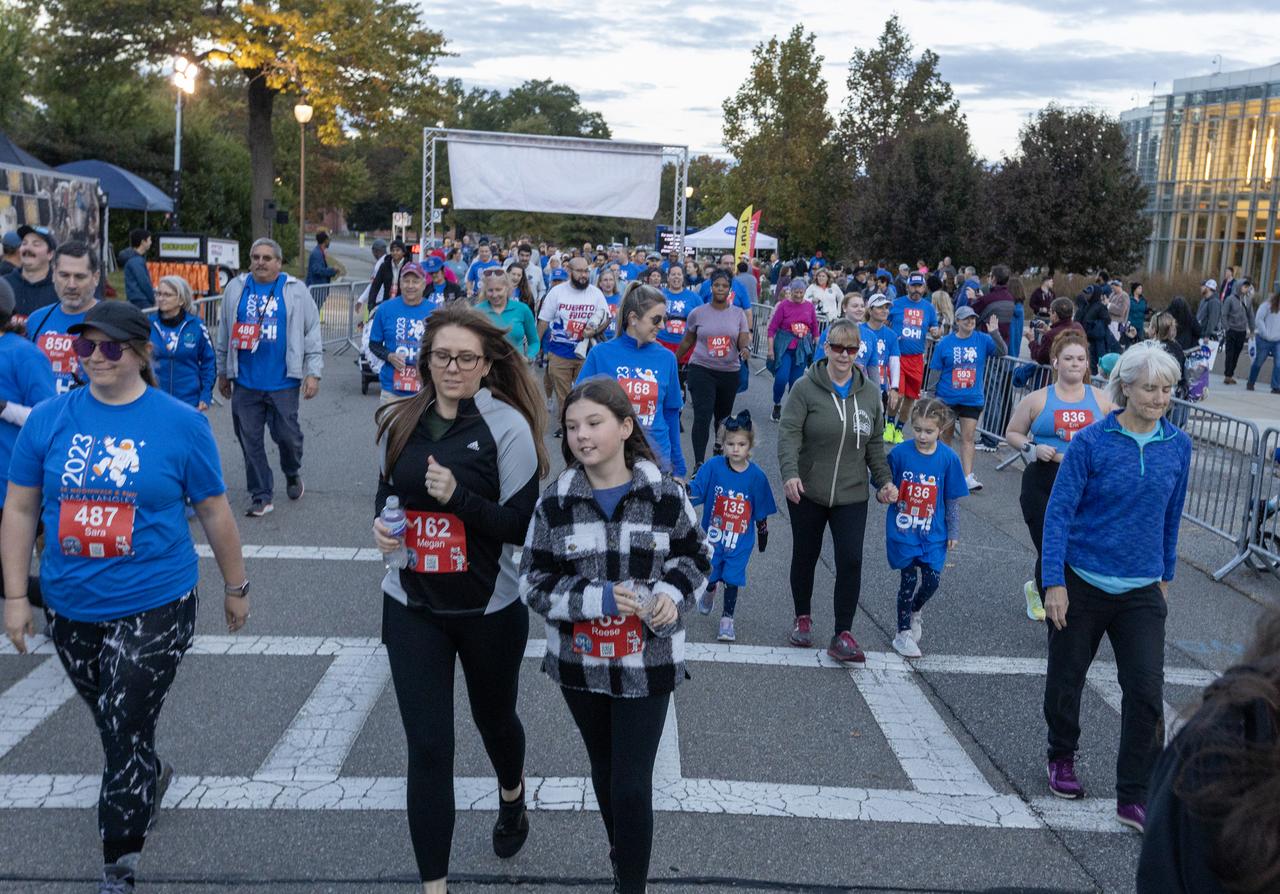
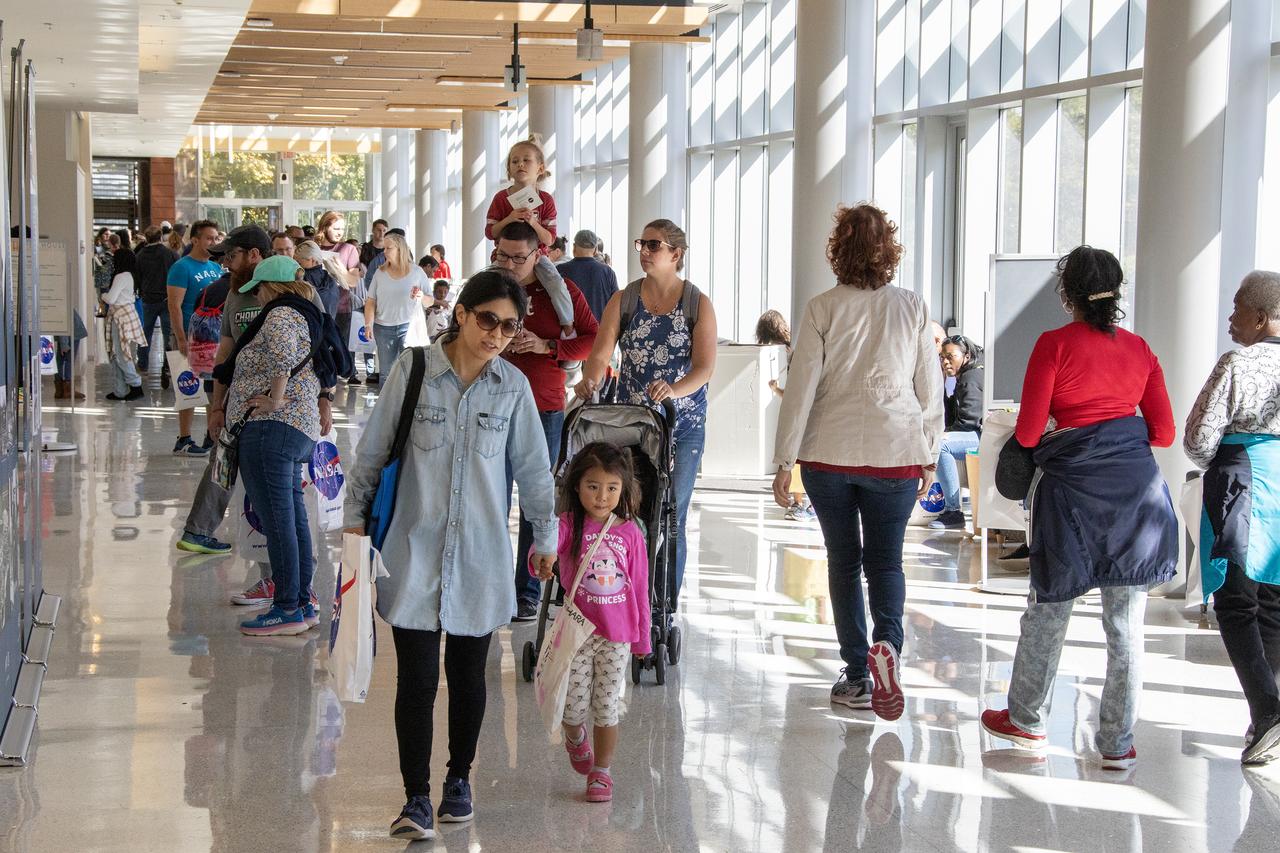
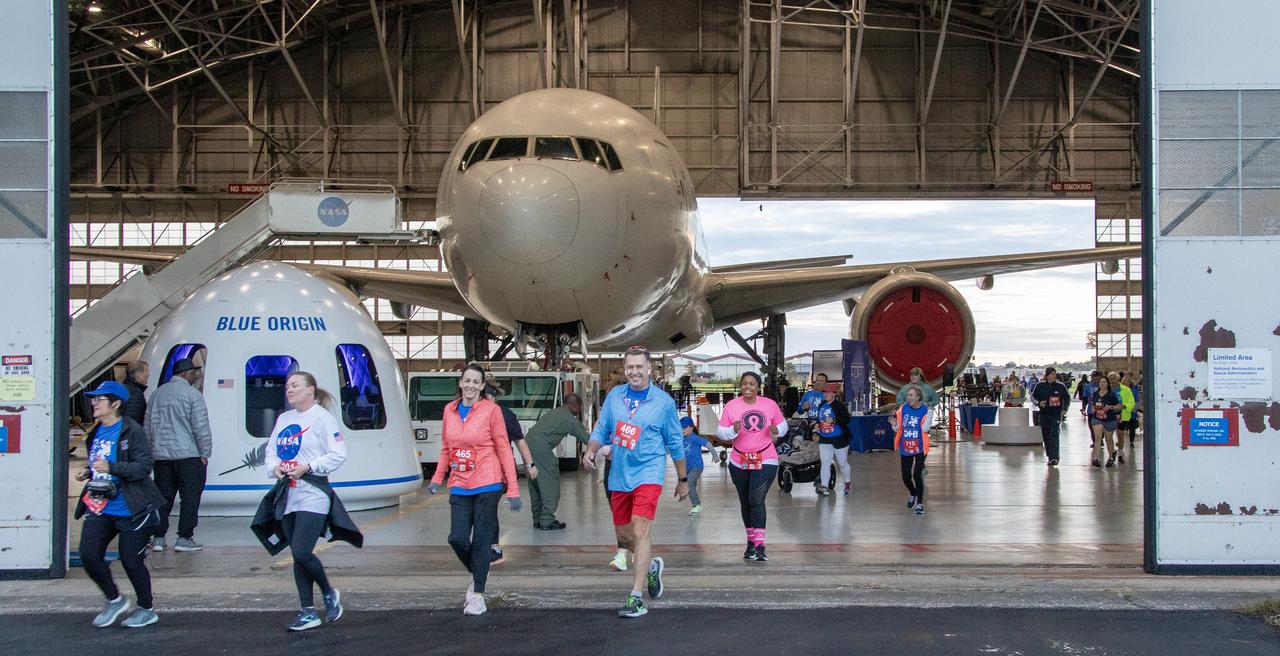
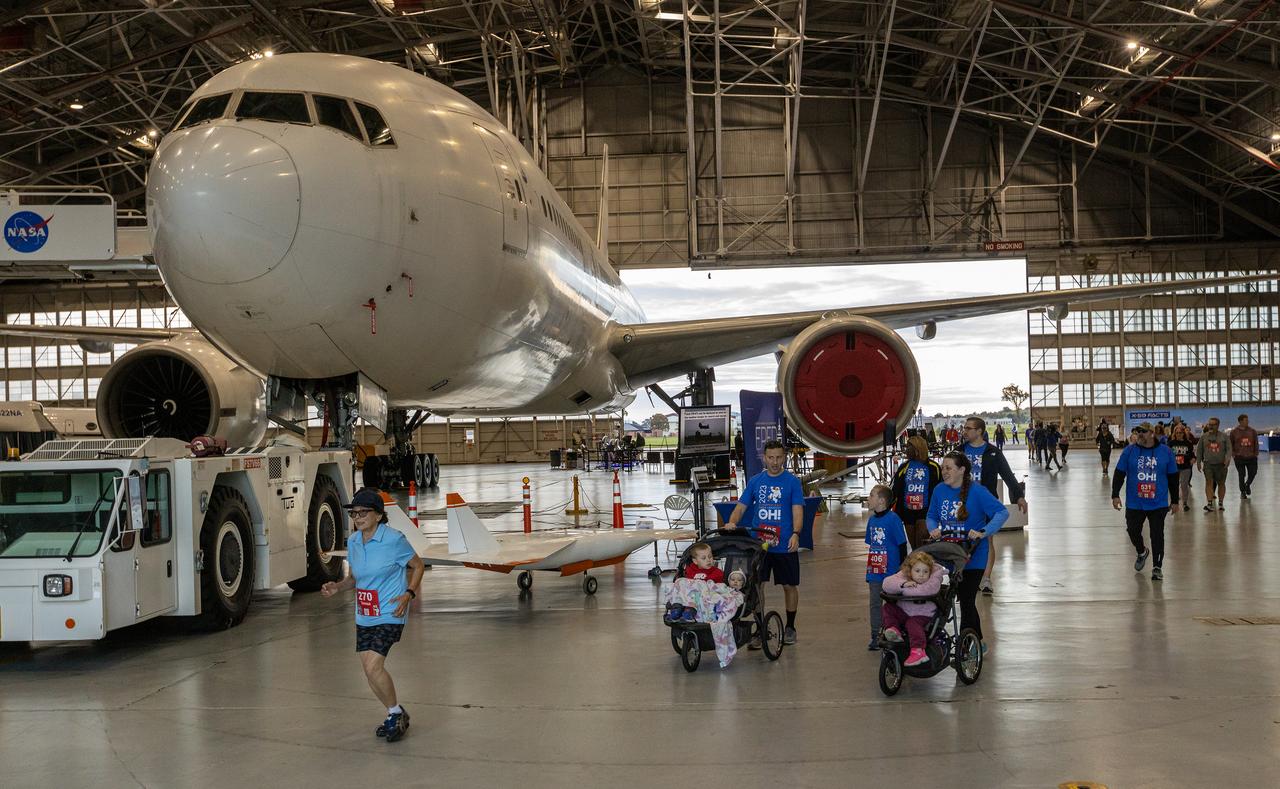
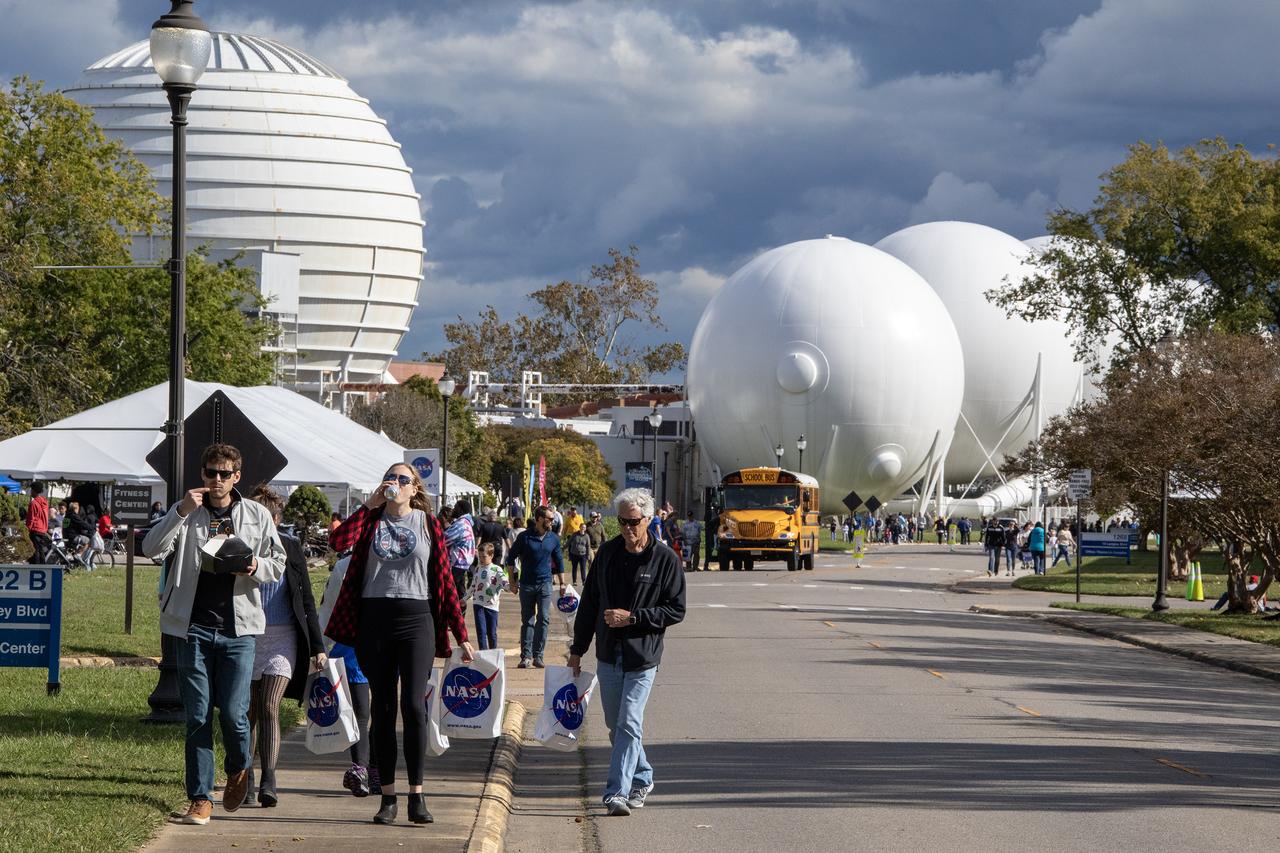
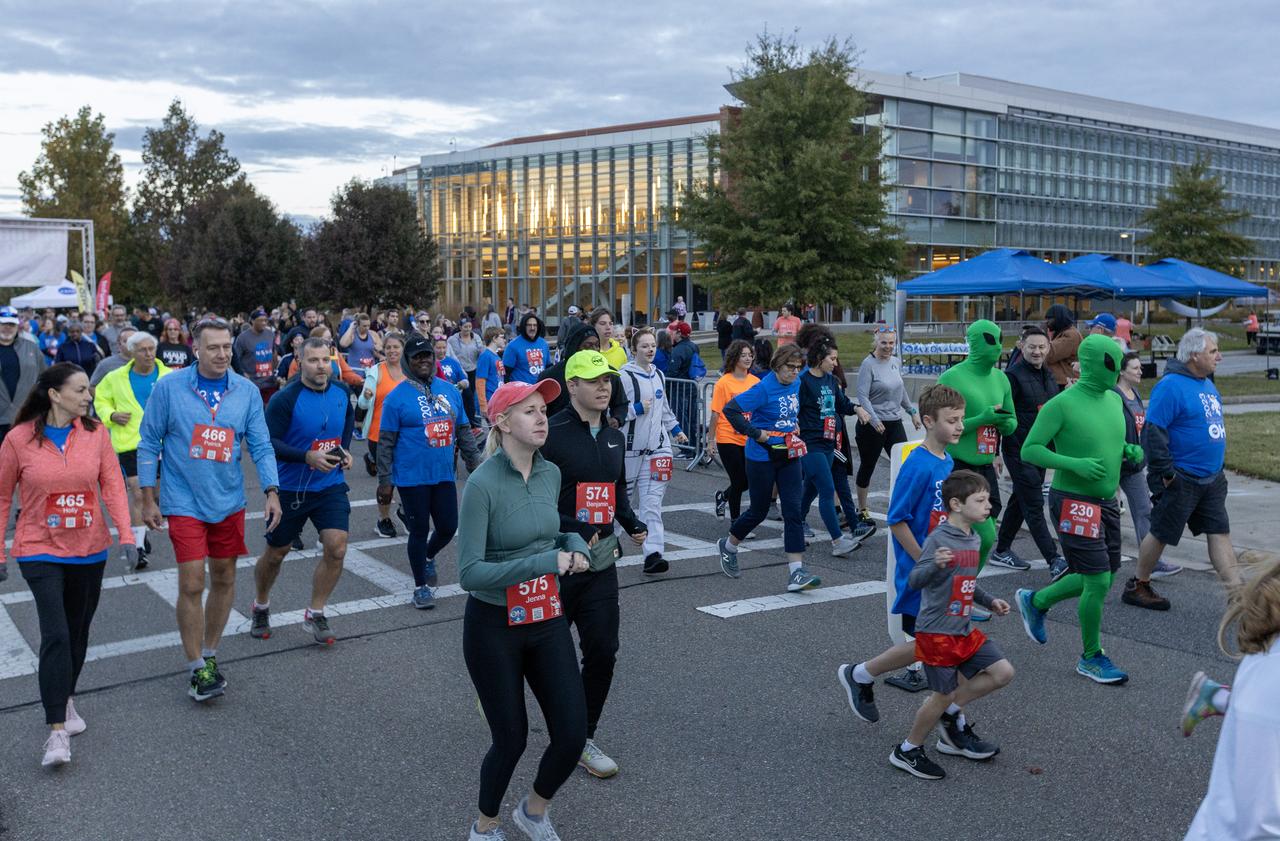
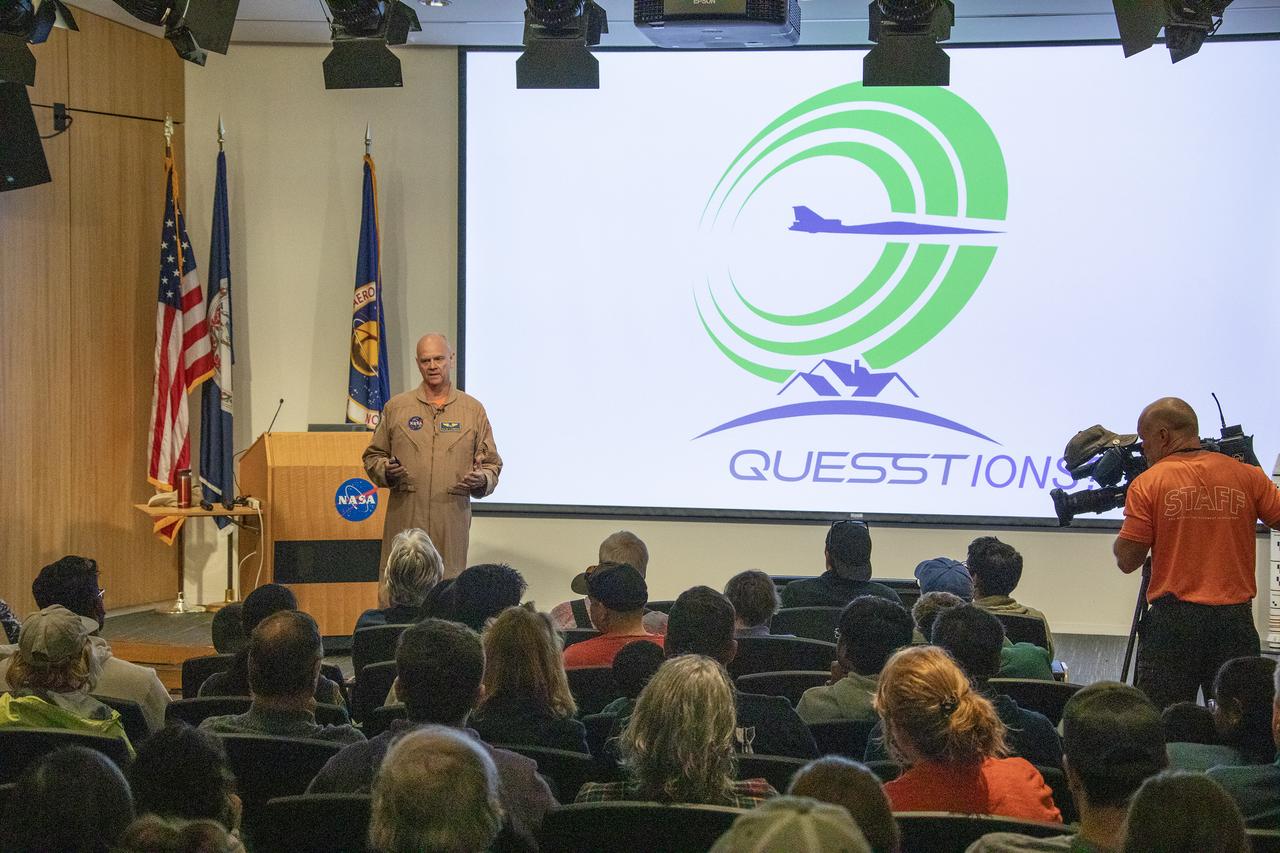
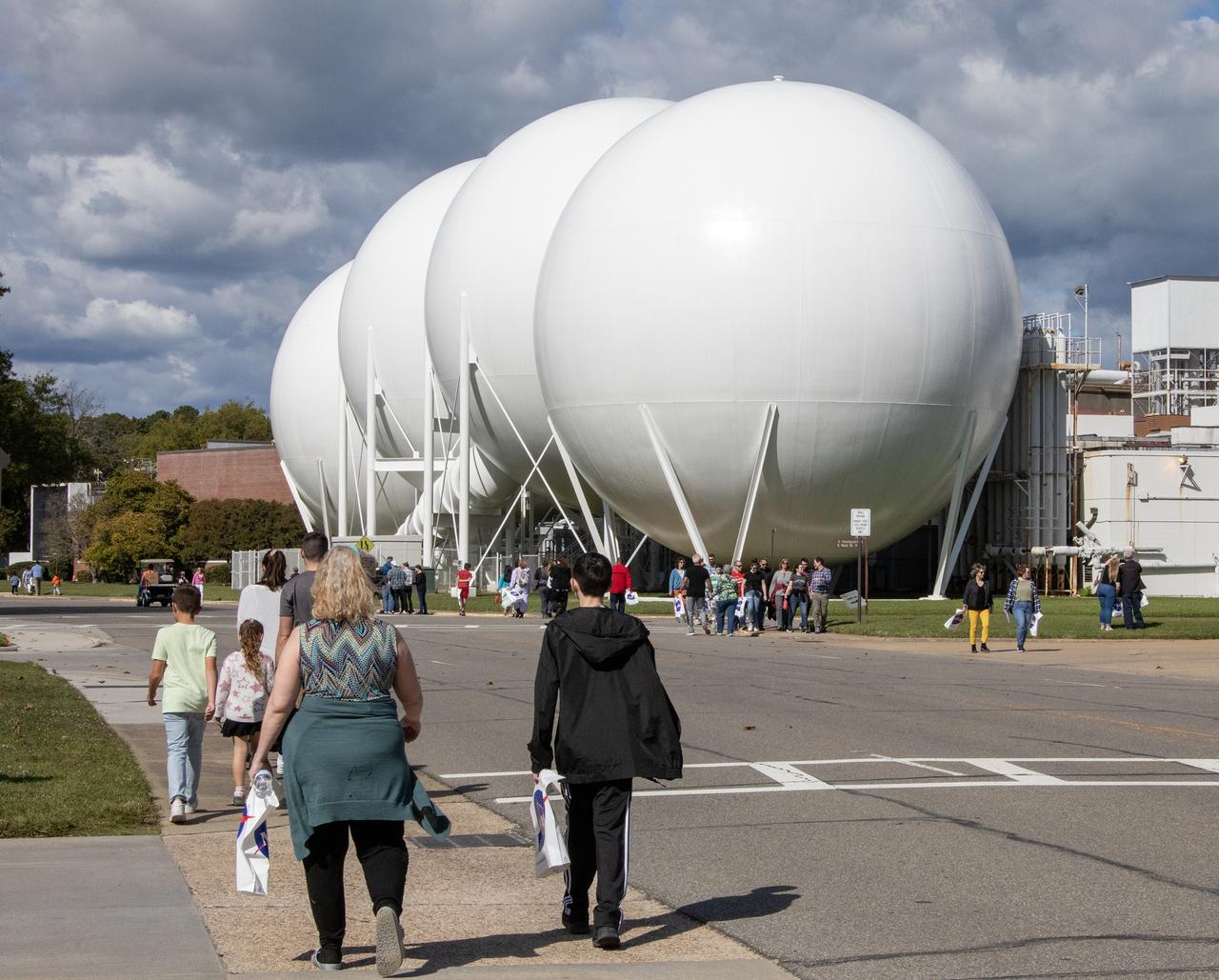
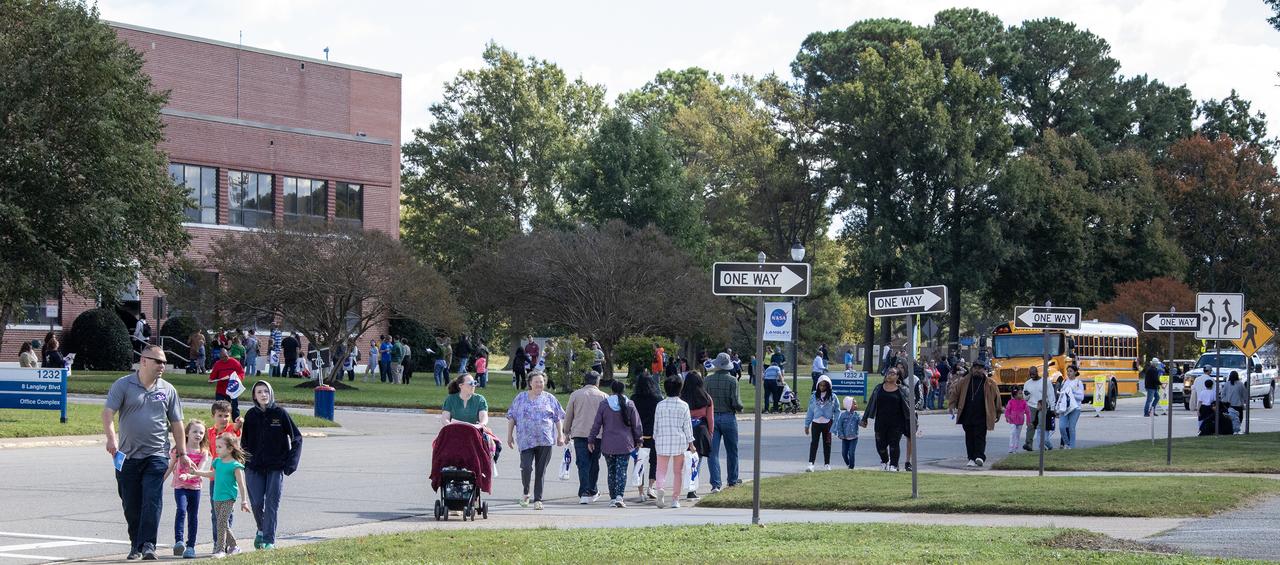
More than 37,000 people registered to attend the NASA Langley open house. Starting with the Annual 5K Moon Walk Run and the talented Nils Larson, X59 pilot and Astronaut Victor Glover reunited at Langley’s hangar and hosted by Center Director Clayton Turner.
2023 NASA Langley Open House
More than 37,000 people registered to attend the NASA Langley open house. Starting with the Annual 5K Moon Walk Run and the talented Nils Larson, X59 pilot and Astronaut Victor Glover reunited at Langley’s hangar and hosted by Center Director Clayton Turner.
2023 NASA Langley Open House
More than 37,000 people registered to attend the NASA Langley open house. Starting with the Annual 5K Moon Walk Run and the talented Nils Larson, X59 pilot and Astronaut Victor Glover reunited at Langley’s hangar and hosted by Center Director Clayton Turner.
2023 NASA Langley Open House
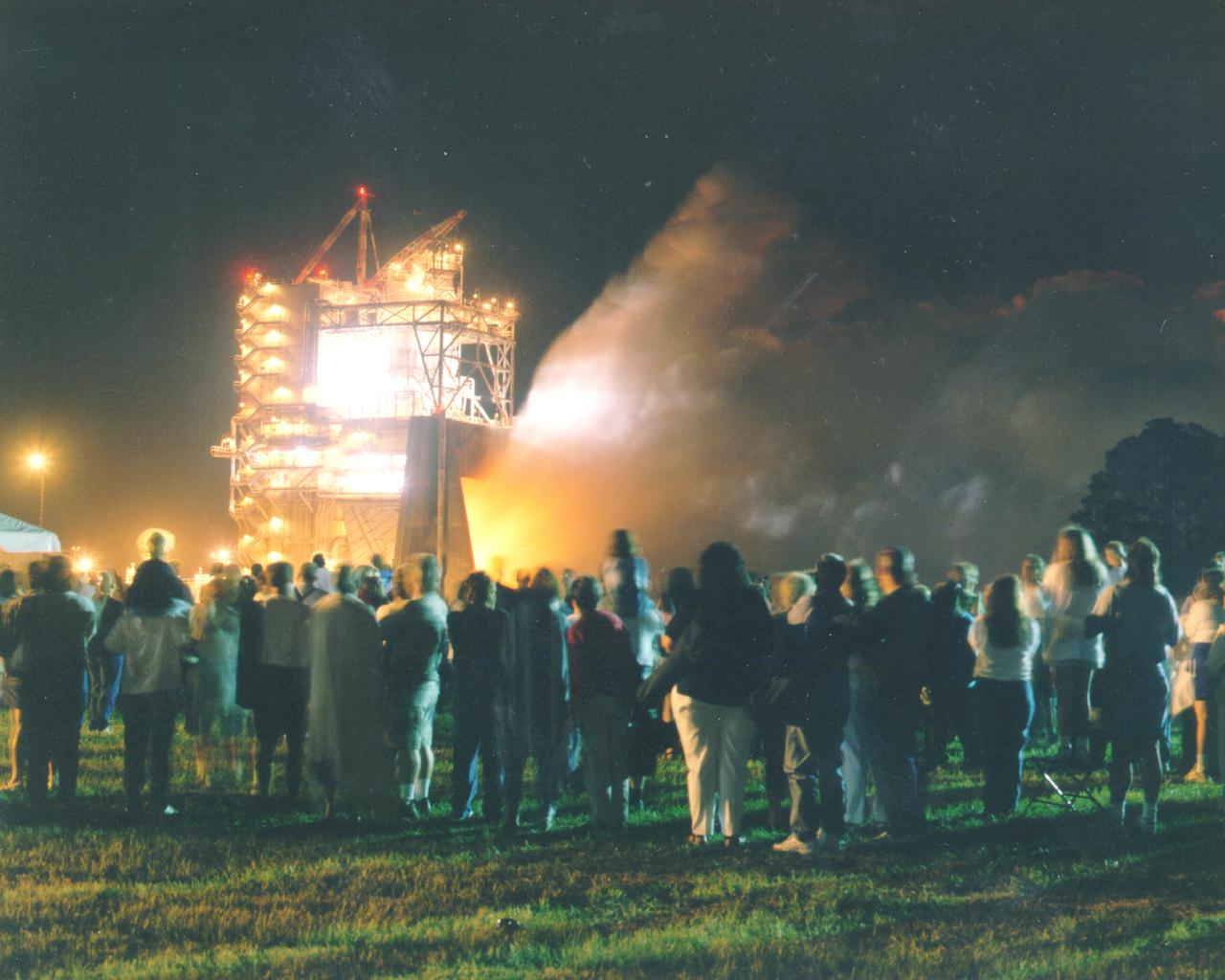
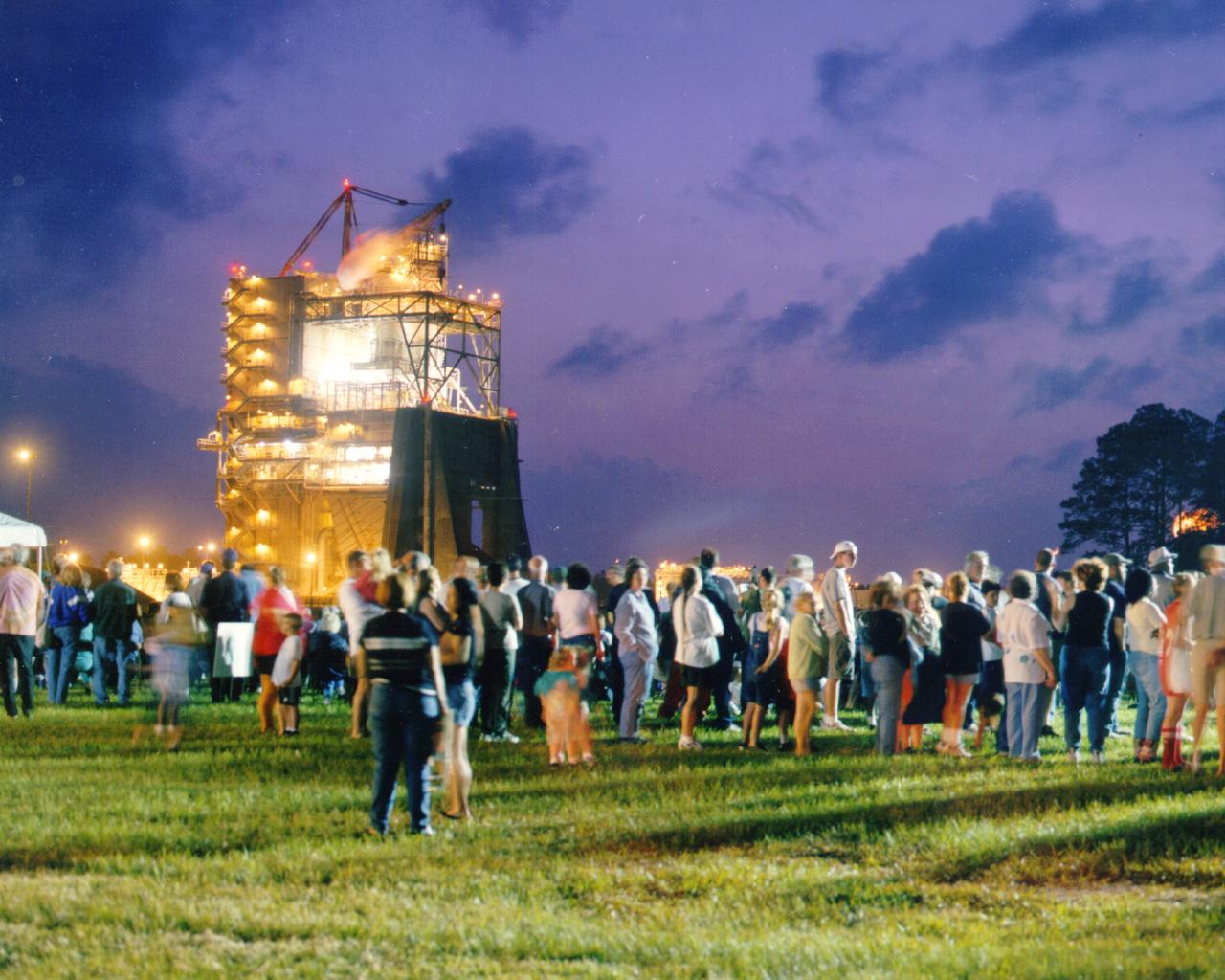
Approximately 13,000 people fill the grounds at NASA's John C. Stennis Space Center for the first-ever evening public engine test of a Space Shuttle Main Engine. The test marked Stennis Space Center's 20th anniversary celebration of the first Space Shuttle mission.
Thousands gather to watch a Space Shuttle Main Engine Test
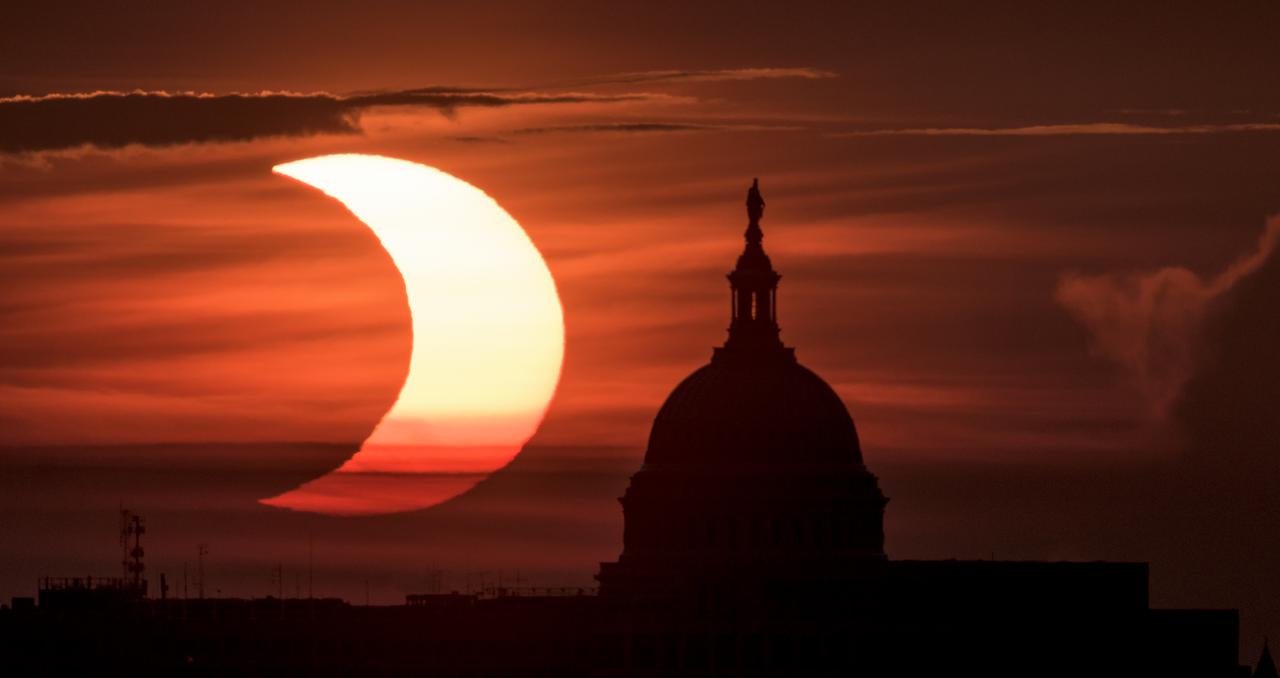
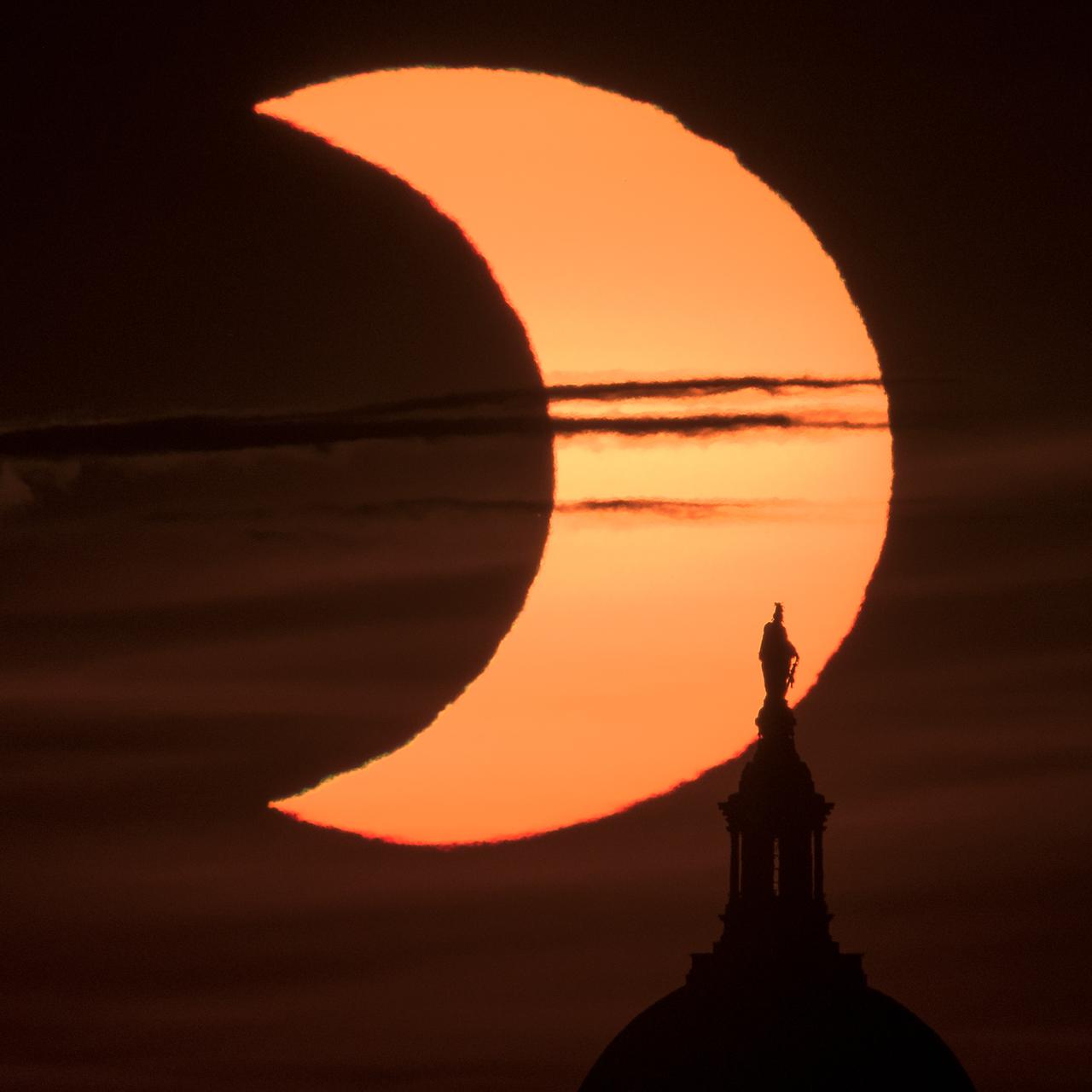
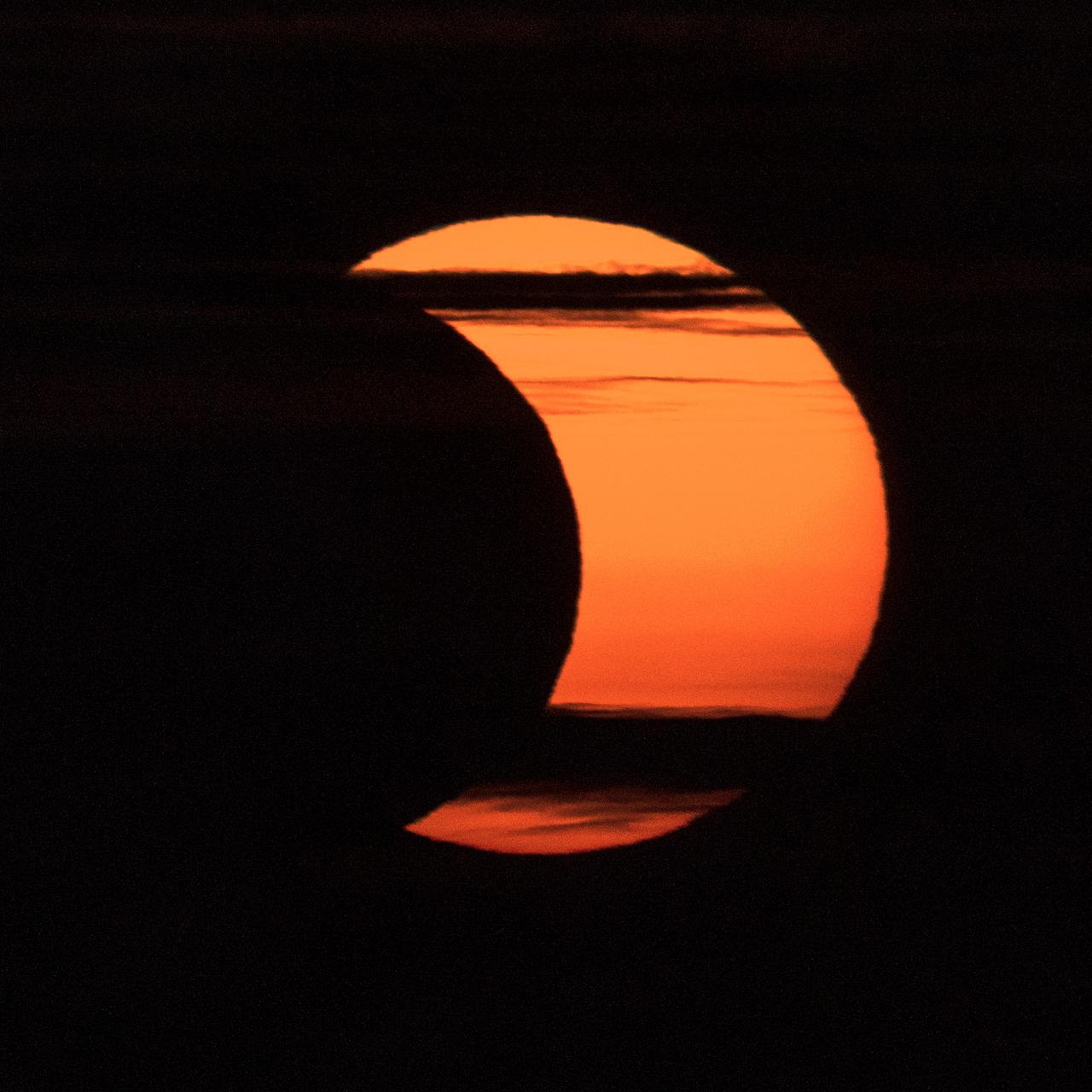
A partial solar eclipse is seen as the sun rises to the left of the United States Capitol building, Thursday, June 10, 2021, as seen from Arlington, Virginia. The annular or “ring of fire” solar eclipse is only visible to some people in Greenland, Northern Russia, and Canada. Photo Credit: (NASA/Bill Ingalls)
Partial Solar Eclipse
A partial solar eclipse is seen as the sun rises behind the United States Capitol Building, Thursday, June 10, 2021, as seen from Arlington, Virginia. The annular or “ring of fire” solar eclipse is only visible to some people in Greenland, Northern Russia, and Canada. Photo Credit: (NASA/Bill Ingalls)
Partial Solar Eclipse
More than 37,000 people registered to attend the NASA Langley open house. Starting with the Annual 5K Moon Walk Run and the talented Nils Larson, X59 pilot and Astronaut Victor Glover reunited at Langley’s hangar and hosted by Center Director Clayton Turner.
2023 NASA Langley Open House
More than 37,000 people registered to attend the NASA Langley open house. Starting with the Annual 5K Moon Walk Run and the talented Nils Larson, X59 pilot and Astronaut Victor Glover reunited at Langley’s hangar and hosted by Center Director Clayton Turner.
2023 NASA Langley Open House
Thousands of people watch the first-ever evening public engine test of a Space Shuttle Main Engine at NASA's John C. Stennis Space Center. The spectacular test marked Stennis Space Center's 20th anniversary celebration of the first Space Shuttle mission.
First-ever evening public engine test of a Space Shuttle Main Engine
More than 37,000 people registered to attend the NASA Langley open house. Starting with the Annual 5K Moon Walk Run and the talented Nils Larson, X59 pilot and Astronaut Victor Glover reunited at Langley’s hangar and hosted by Center Director Clayton Turner.
2023 NASA Langley Open House
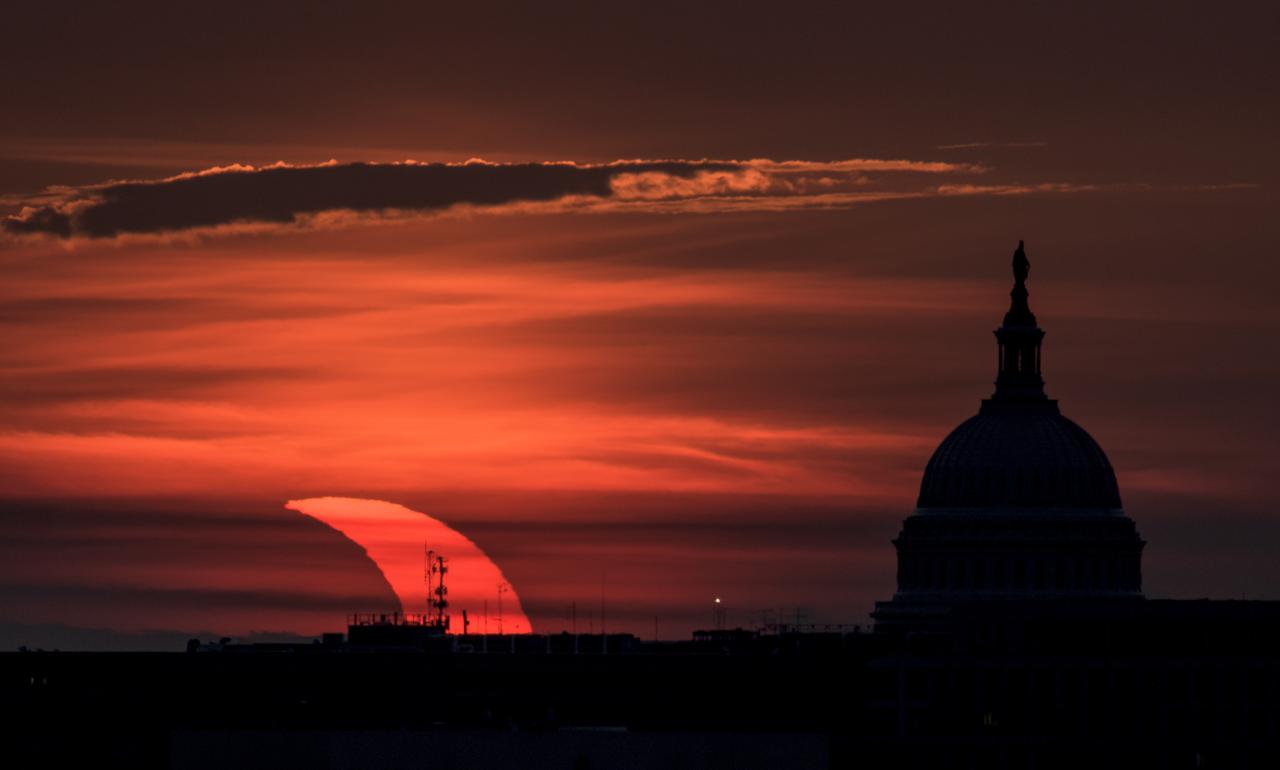
A partial solar eclipse is seen from Arlington, Virginia, Thursday, June 10, 2021.  The annular or “ring of fire” solar eclipse is only visible to some people in Greenland, Northern Russia, and Canada. Photo Credit: (NASA/Bill Ingalls)
Partial Solar Eclipse
More than 37,000 people registered to attend the NASA Langley open house. Starting with the Annual 5K Moon Walk Run and the talented Nils Larson, X59 pilot and Astronaut Victor Glover reunited at Langley’s hangar and hosted by Center Director Clayton Turner.
2023 NASA Langley Open House
Speaker David Nils Larson on the X59.  More than 37,000 people registered to attend the NASA Langley open house. Starting with the Annual 5K Moon Walk Run and the talented Nils Larson, X59 pilot and Astronaut Victor Glover reunited at Langley’s hangar and hosted by Center Director Clayton Turner.
2023 NASA Langley Open House
More than 37,000 people registered to attend the NASA Langley open house. Starting with the Annual 5K Moon Walk Run and the talented Nils Larson, X59 pilot and Astronaut Victor Glover reunited at Langley’s hangar and hosted by Center Director Clayton Turner.
2023 NASA Langley Open House
More than 37,000 people registered to attend the NASA Langley open house. Starting with the Annual 5K Moon Walk Run and the talented Nils Larson, X59 pilot and Astronaut Victor Glover reunited at Langley’s hangar and hosted by Center Director Clayton Turner.
2023 NASA Langley Open House
More than 37,000 people registered to attend the NASA Langley open house. Starting with the Annual 5K Moon Walk Run and the talented Nils Larson, X59 pilot and Astronaut Victor Glover reunited at Langley’s hangar and hosted by Center Director Clayton Turner.
2023 NASA Langley Open House
A partial solar eclipse is seen as the sun rises to the left of the United States Capitol building, Thursday, June 10, 2021, as seen from Arlington, Virginia. The annular or “ring of fire” solar eclipse is only visible to some people in Greenland, Northern Russia, and Canada. Photo Credit: (NASA/Bill Ingalls)
Partial Solar Eclipse
More than 37,000 people registered to attend the NASA Langley open house. Starting with the Annual 5K Moon Walk Run and the talented Nils Larson, X59 pilot and Astronaut Victor Glover reunited at Langley’s hangar and hosted by Center Director Clayton Turner.
2023 NASA Langley Open House
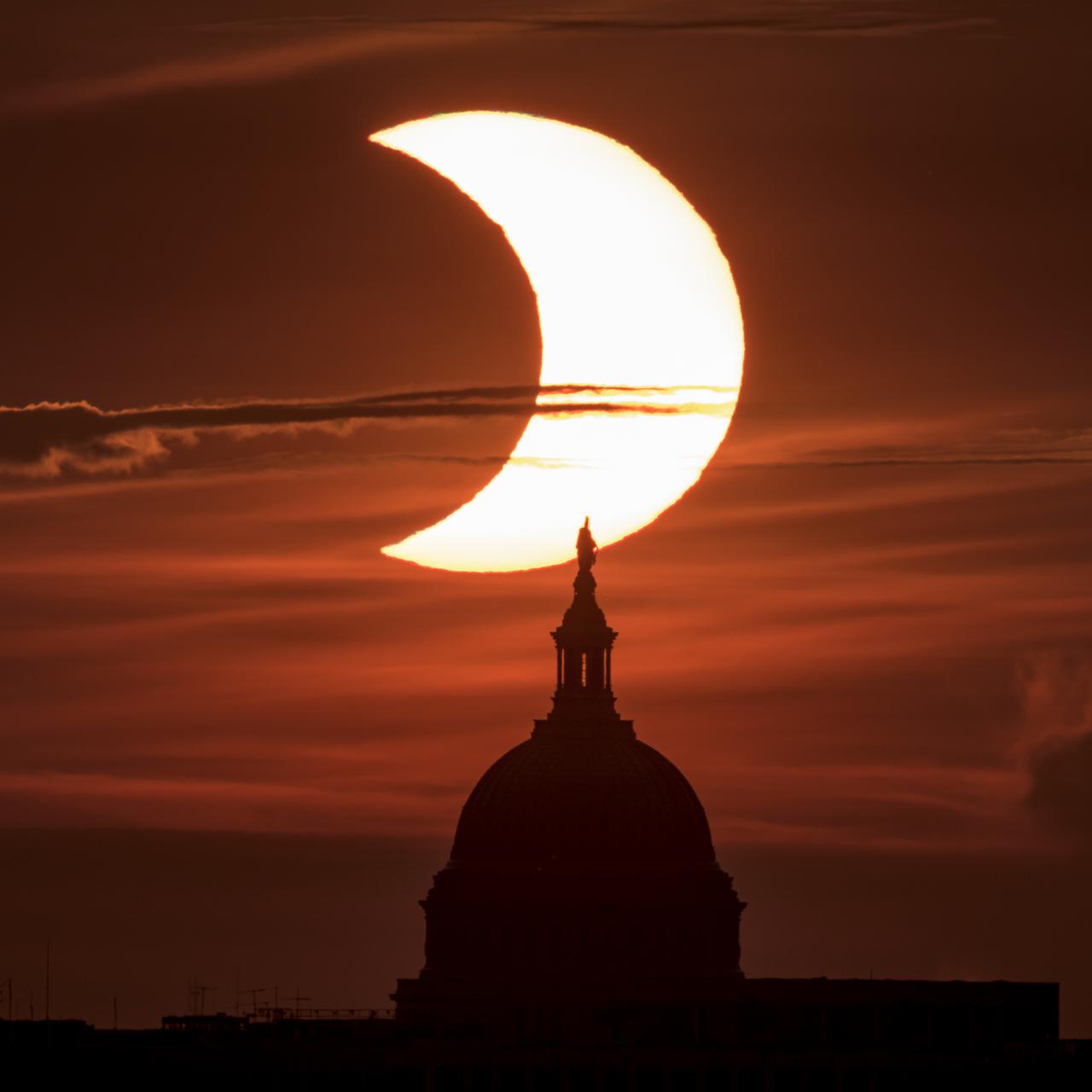
A partial solar eclipse is seen as the sun rises behind the Statue of Freedom atop the United States Capitol Building, Thursday, June 10, 2021, as seen from Arlington, Virginia. The annular or “ring of fire” solar eclipse is only visible to some people in Greenland, Northern Russia, and Canada. Photo Credit: (NASA/Bill Ingalls)
Partial Solar Eclipse
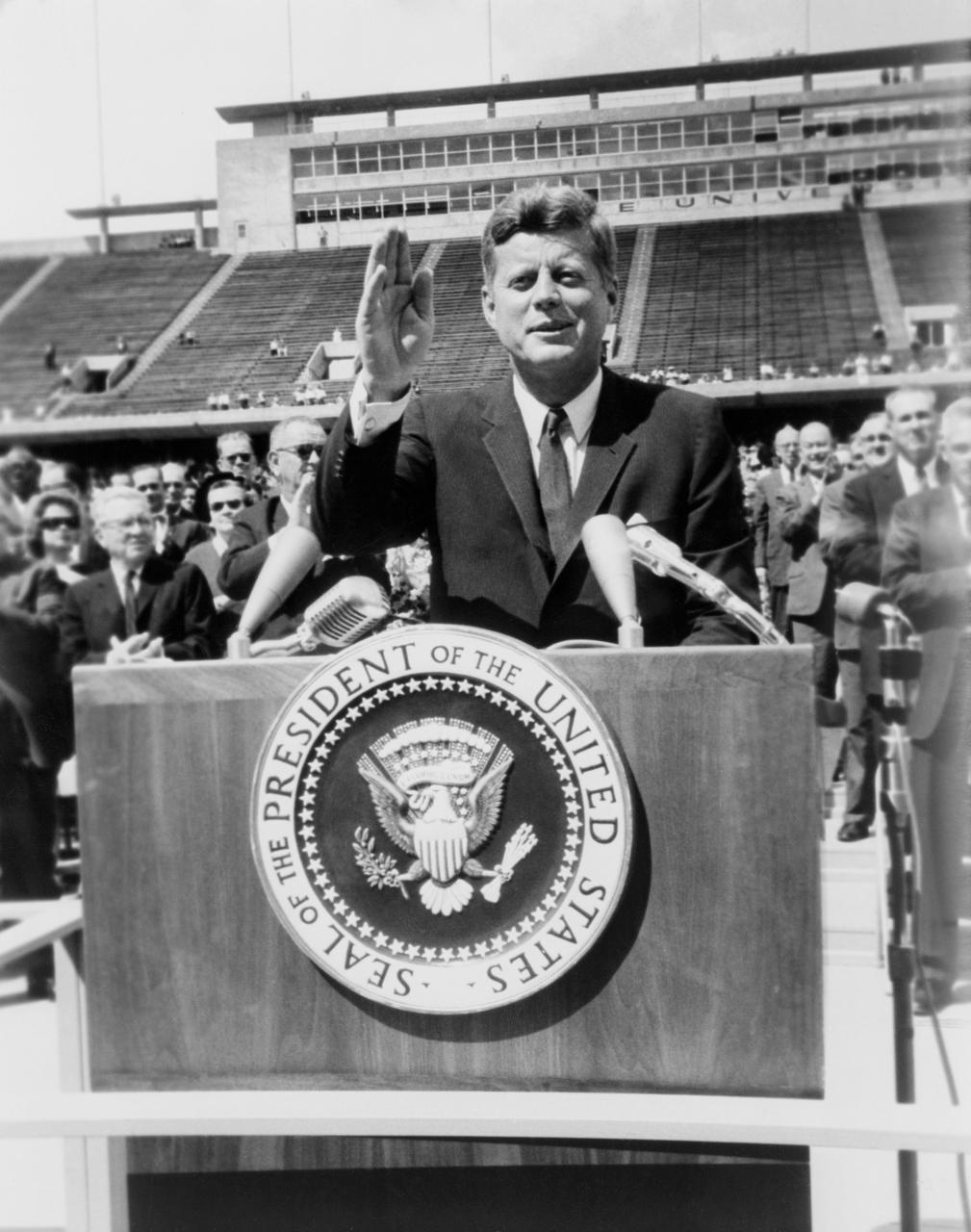
S67-19620 (12 Sept. 1962) --- On Sept. 12, 1962, President John F. Kennedy delivers a speech announcing his goals for the nation?s space effort to land a human being on the moon before a crowd of 35,000 people in the football stadium at Rice University in Houston, Texas. Photo credit: NASA
s67-19620
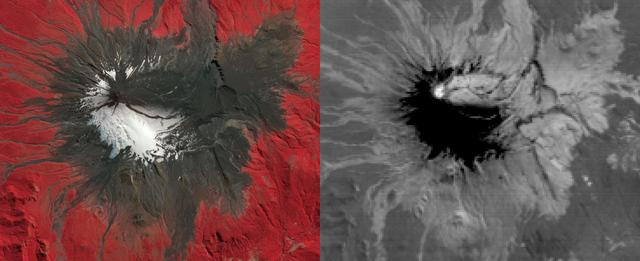
On March 3, 2015, Chile's Villarrica volcano erupted, forcing the evacuation of thousands of people. The eruption deposited a layer of ash over the volcano's eastern slope, blanketing and darkening the normal winter snow cover. The eruption and its effects were captured by the Advanced Spaceborne Thermal Emission and Reflection Radiometer (ASTER) instrument on NASA's Terra spacecraft on March 9. Black flows on the other flanks are mud and ash flows. Vegetation is displayed in red colors. The thermal infrared image shows hot spots (white colored) at the summit crater, indicating continuing volcanic activity. The ash blanket is warmer (brighter) than the cold snow (black). The image covers an area of 13.5 by 16.5 kilometers, and is located at 39.4 degrees south, 71.9 degrees west.   http://photojournal.jpl.nasa.gov/catalog/PIA19241
NASA Spacecraft Views Erupting Chilean Volcano
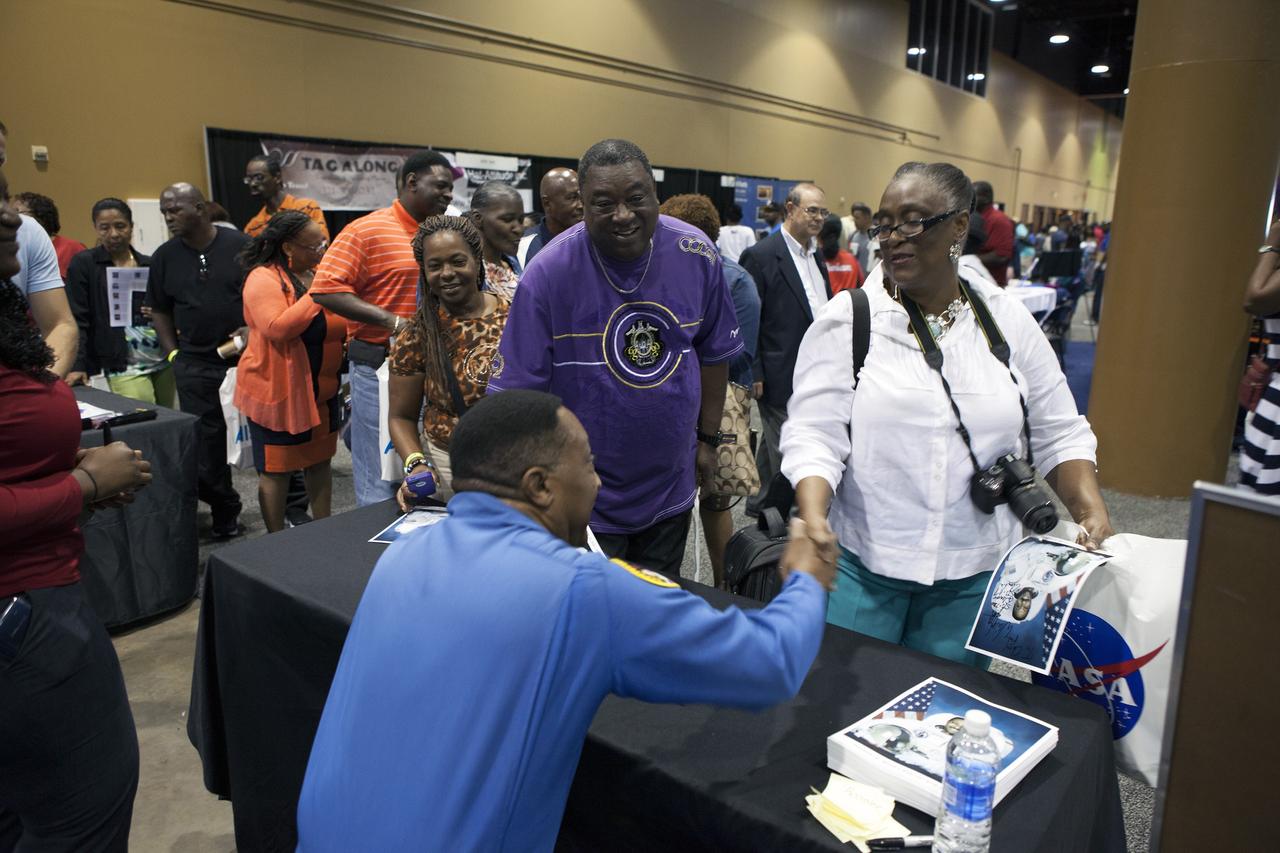
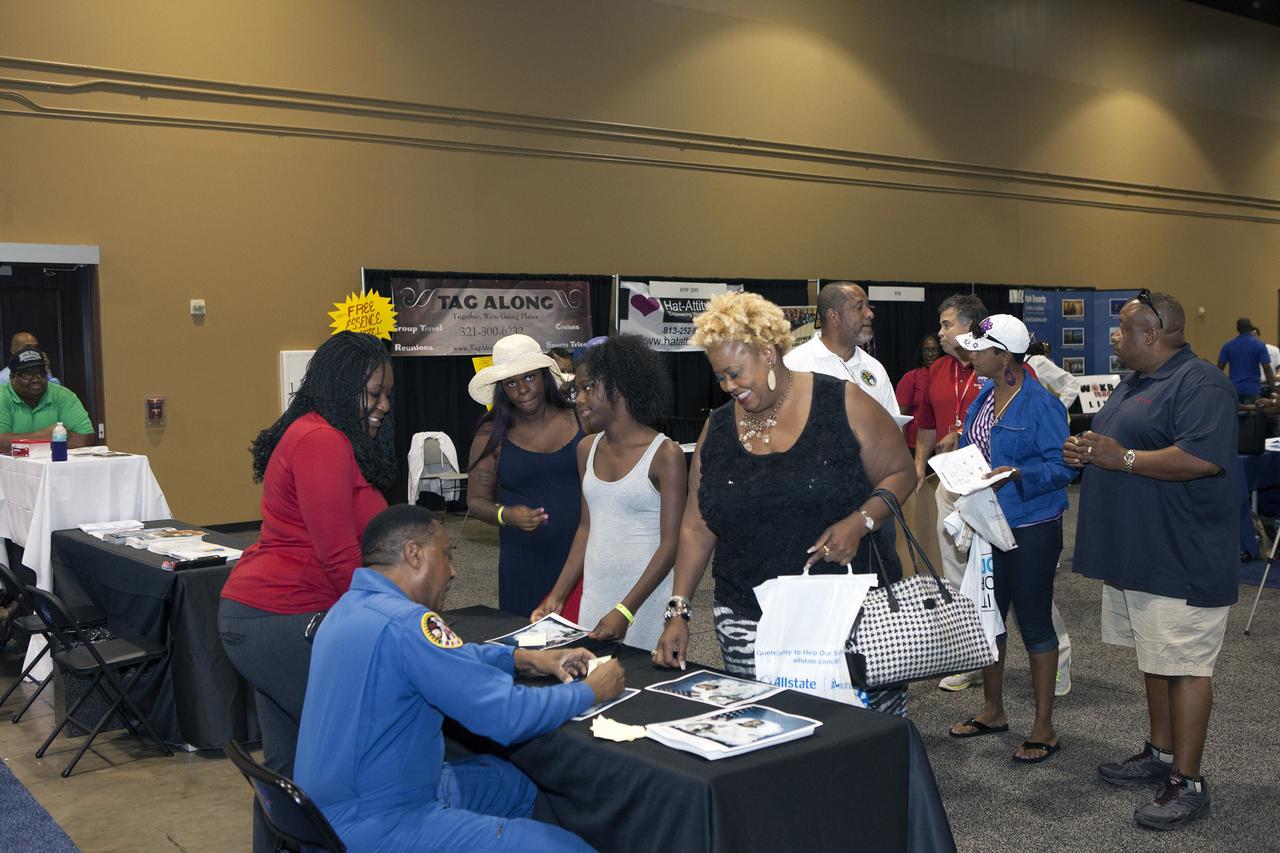
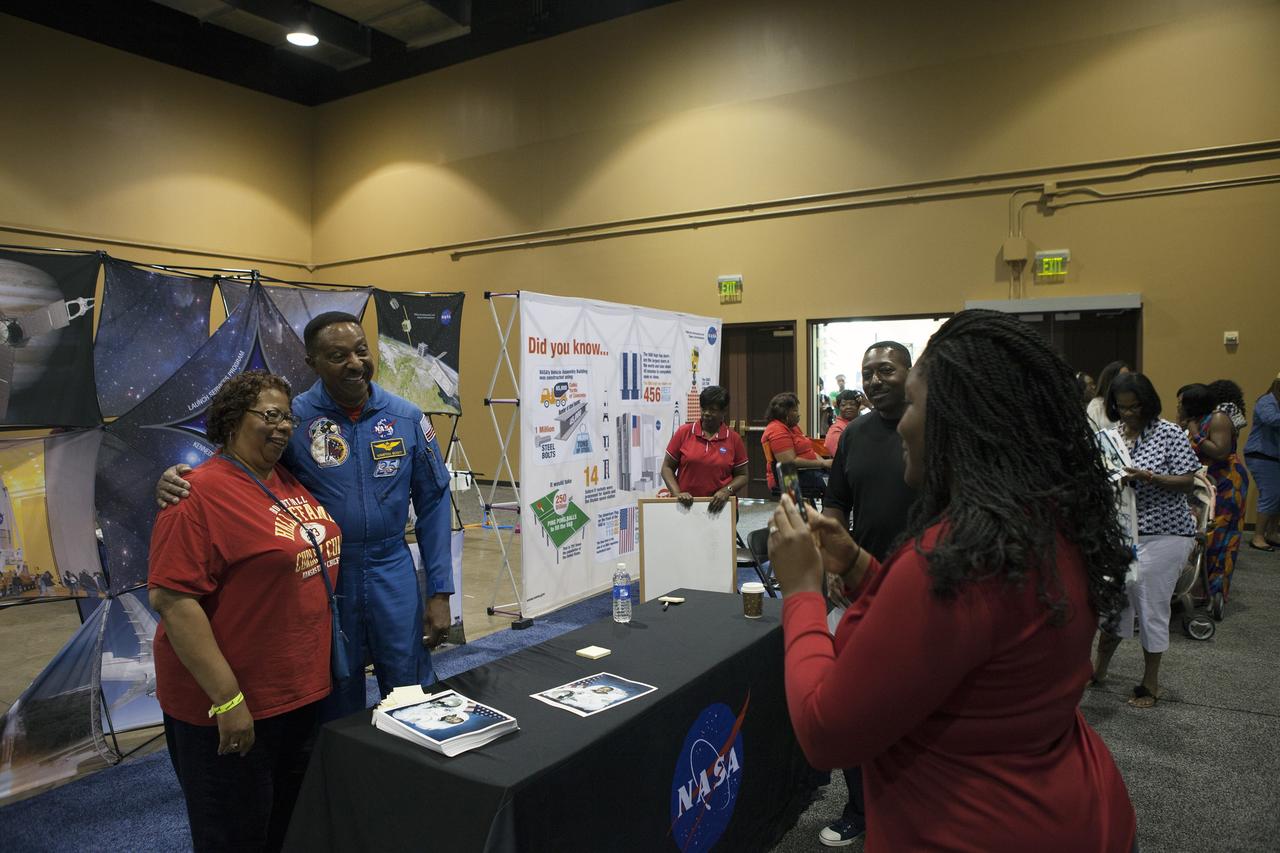
KISSIMMEE, Fla. – Former NASA astronaut Winston Scott signed autographs and posed for pictures with guests at the agency exhibit during the Tom Joyner Family Reunion. Now a senior vice president at the Florida Institute of Technology, he said that he likes to emphasize to young people how important a good education is in preparation for the future.      The Tom Joyner Family Reunion is designed to present uplifting programs, entertainment and information about growing, diverse communities. An annual event of the nationally-syndicated Tom Joyner Morning Show, the many exhibits included NASA's participation focusing on encouraging young people to consider studies and careers in STEM -- science, technology, engineering and math. NASA's Education Division promoted the benefits of math and scientific learning along with career opportunities offered by the space agency. The activities took place at the Gaylord Palms Resort in Kissimmee, Florida, during the Labor Day weekend. Photo credit: NASA/Daniel Casper
KSC-2014-3654
KISSIMMEE, Fla. – Former NASA astronaut Winston Scott signed autographs and posed for pictures with guests at the agency exhibit during the Tom Joyner Family Reunion. Now a senior vice president at the Florida Institute of Technology, he said that he likes to emphasize to young people how important a good education is in preparation for the future.    The Tom Joyner Family Reunion is designed to present uplifting programs, entertainment and information about growing, diverse communities. An annual event of the nationally-syndicated Tom Joyner Morning Show, the many exhibits included NASA's participation focusing on encouraging young people to consider studies and careers in STEM -- science, technology, engineering and math. NASA's Education Division promoted the benefits of math and scientific learning along with career opportunities offered by the space agency. The activities took place at the Gaylord Palms Resort in Kissimmee, Florida, during the Labor Day weekend. Photo credit: NASA/Daniel Casper
KSC-2014-3649
KISSIMMEE, Fla. – Former NASA astronaut Winston Scott signed autographs and posed for pictures with guests at the agency exhibit during the Tom Joyner Family Reunion. Now a senior vice president at the Florida Institute of Technology, he said that he likes to emphasize to young people how important a good education is in preparation for the future.      The Tom Joyner Family Reunion is designed to present uplifting programs, entertainment and information about growing, diverse communities. An annual event of the nationally-syndicated Tom Joyner Morning Show, the many exhibits included NASA's participation focusing on encouraging young people to consider studies and careers in STEM -- science, technology, engineering and math. NASA's Education Division promoted the benefits of math and scientific learning along with career opportunities offered by the space agency. The activities took place at the Gaylord Palms Resort in Kissimmee, Florida, during the Labor Day weekend. Photo credit: NASA/Daniel Casper
KSC-2014-3652
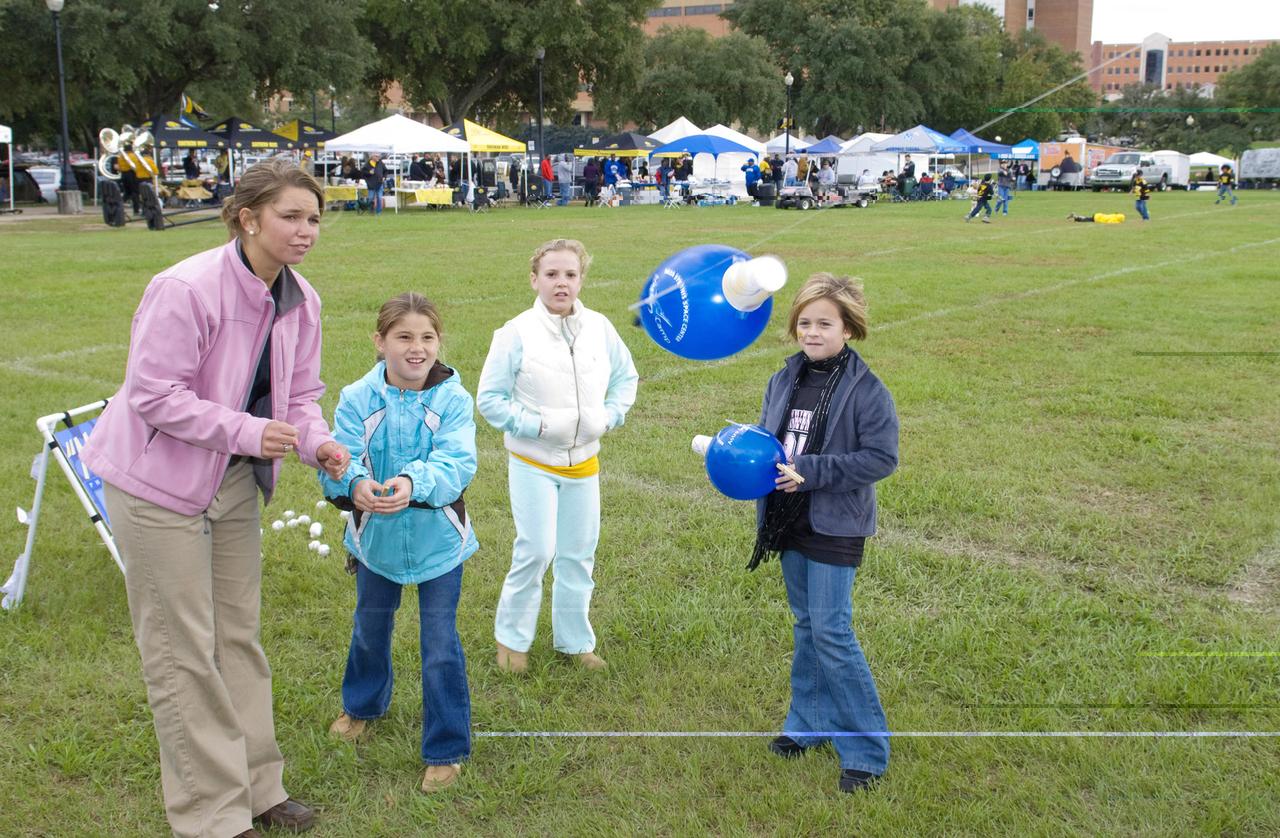
Fallon Nettles (left), an Astro Camp counselor at NASA's John C. Stennis Space Center, assists a young fan attending the University of Southern Mississippi football game in Hattiesburg, Miss., on Oct. 17 in launching a balloon 'rocket.' Prior to the game, Stennis Space Center hosted hands-on activities and exhibits for families as part of its first-ever Space Day at USM. The activities were versions of those featured in the daylong and weeklong Astro Camp sessions sponsored by Stennis throughout each year. Stennis Space Center is located in nearby Hancock County and is the nation's premier rocket engine testing facility. The USM activities were part of Stennis' ongoing effort to educate people about the NASA mission and to introduce children and young people to space and space exploration.
Stennis hosts Space Day activities at USM
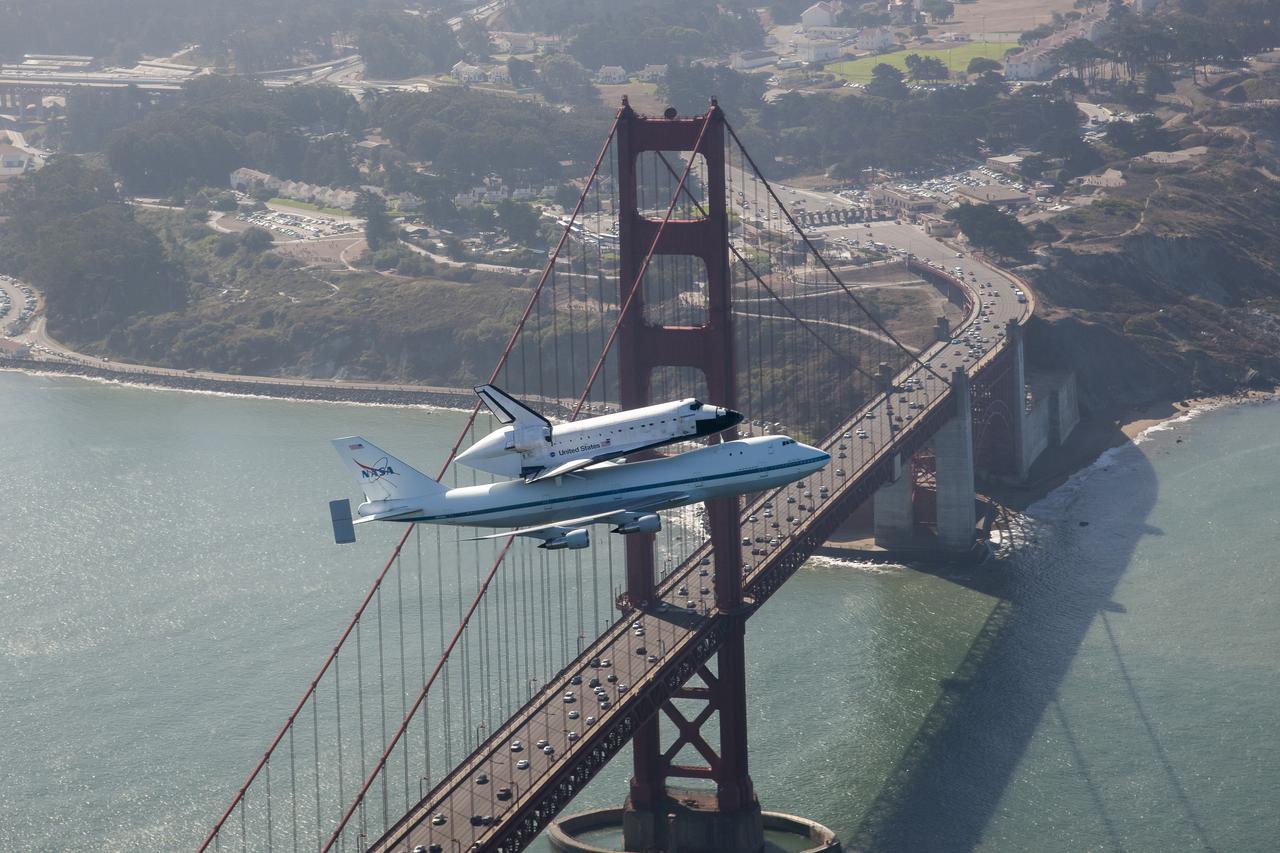
Space shuttle Endeavour and its host NASA 747 Shuttle Carrier Aircraft fly by the Golden Gate Bridge in 2012 on its way to the Los Angeles International Airport and an overland journey to the California Science Center. Californians looked up at the morning sky Sept. 21 to catch a glimpse of Endeavour. The final leg of Endeavour’s flight from NASA’s Kennedy Space Center, Florida, offered many people an opportunity to witness the historic flight. Space shuttle Endeavour and its host NASA 747 Shuttle Carrier Aircraft fly by the Golden Gate Bridge in 2012 on its way to the Los Angeles International Airport and an overland journey to the California Science Center. Californians looked up at the morning sky Sept. 21 to catch a glimpse of Endeavour. The final leg of Endeavour’s flight from NASA’s Kennedy Space Center, Florida, offered many people an opportunity to witness the historic flight.
Space Shuttle Endeavour Toured California in 2012
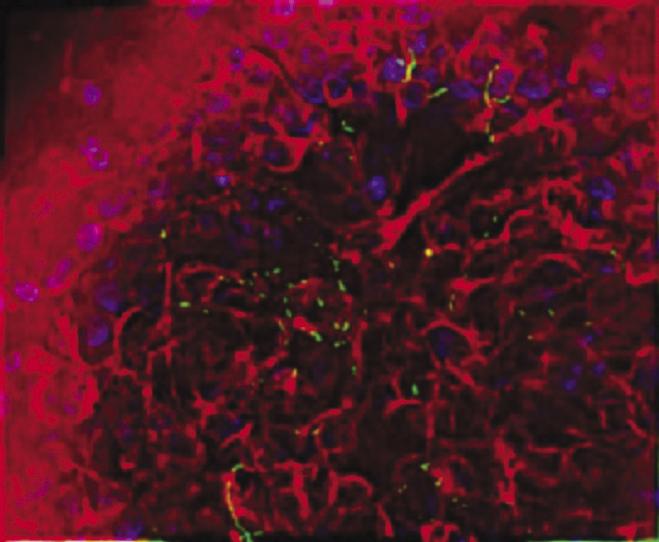
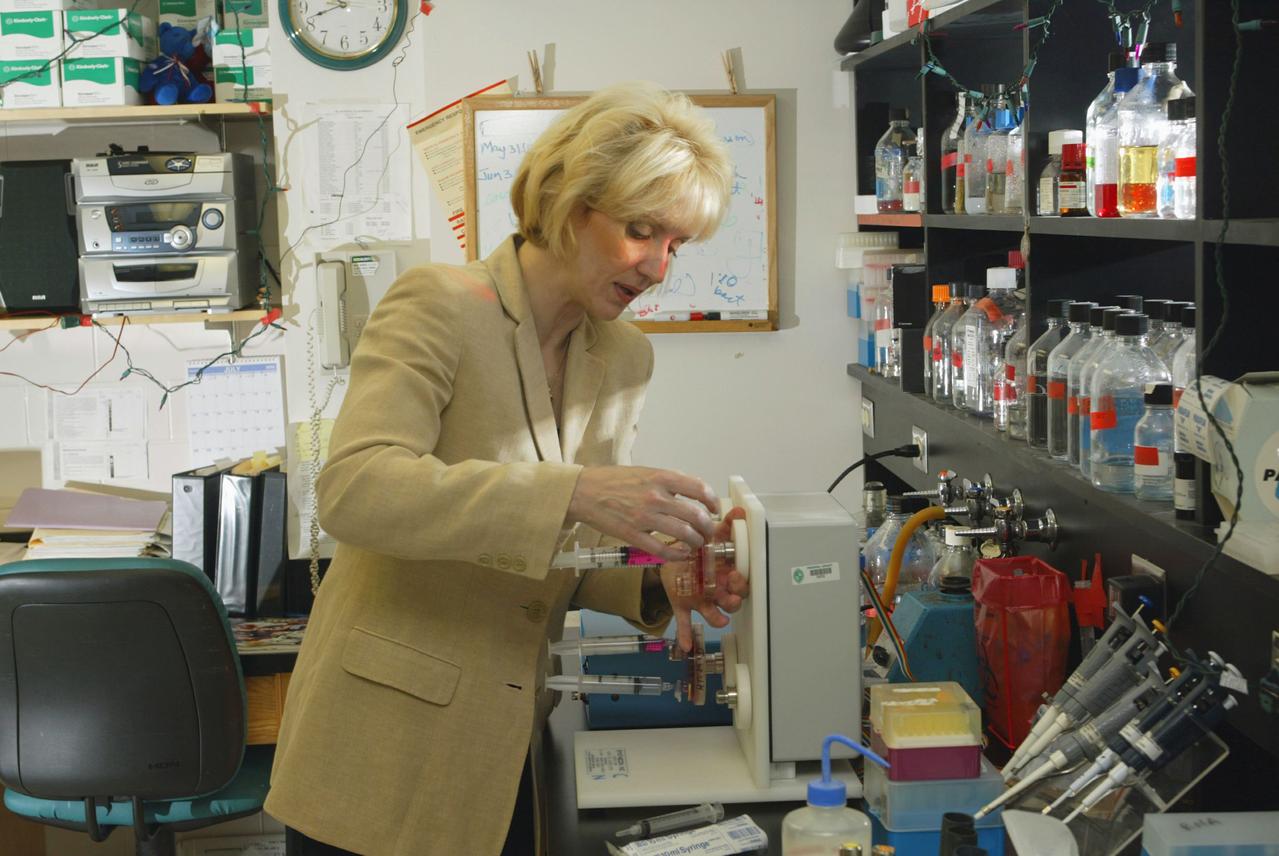
Salmonella typhimurium appears green in on human intestinal tissue (stained red) cultured in a NASA rotating wall bioreactor. Dr. Cheryl Nickerson of Tulane University is studying the effects of simulated low-g on a well-known pathogen, Salmonella typhimurium, a bacterium that causes two to four million cases of gastrointestinal illness in the United States each year. While most healthy people recover readily, S. typhimurium can kill people with weakened immune systems. Thus, a simple case of food poisoning could disrupt a space mission. Using the NASA rotating-wall bioreactor, Nickerson cultured S. typhimurium in modeled microgravity. Mice infected with the bacterium died an average of three days faster than the control mice, indicating that S. typhimurium's virulence was enhanced by the bioreactor. Earlier research showed that 3 percent of the genes were altered by exposure to the bioreactor. Nickerson's work earned her a 2001 Presidential Early Career Award for Scientists and Engineers.
Biotechnology
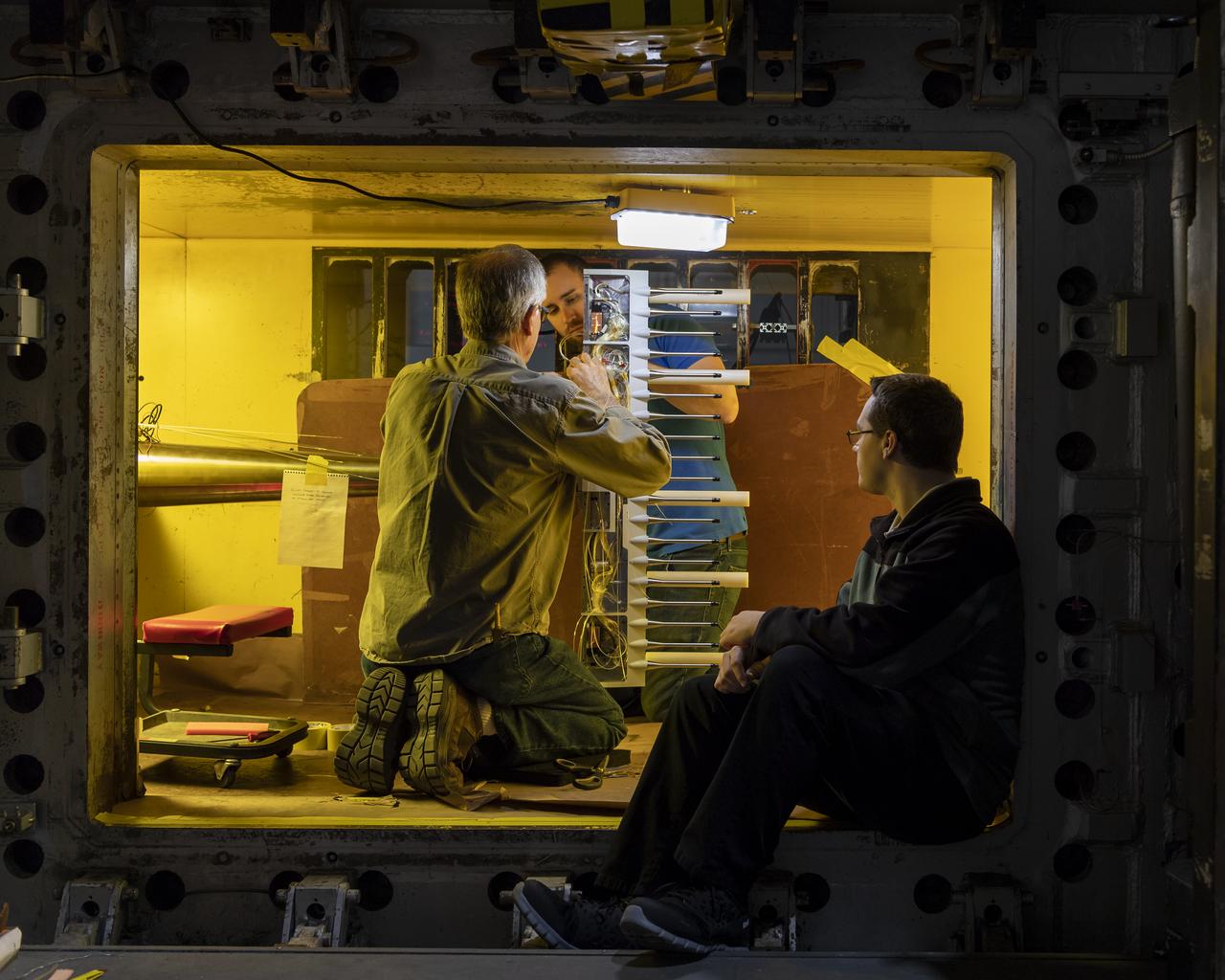
LaRC OCIO's Media Solutions Branch Photographer Harlen Capen photographed the installation of a new flow survey rake for the supersonic Unitary Plan Wind Tunnel (UPWT). The hardware – shown installed in the 4-foot, high-Mach-number Test Section 2 with a coating of Pressure Sensitive Paint – consists of a purpose-built sting, rake body, and two different types of pressure measurement probes. The survey rake will be used to characterize the flow in the test section in support of the "CFD Central Flight Dynamics as a Surrogate for High Speed Supersonic Tests"  People in the photo L to R  are, Ricky L. Hall, Jacobs Technology, Inc.,Supersonic/Hypersonic Testing Branch - Group A, Alexander (Alex) Moore Jacobs Technology, Inc, Supersonic/Hypersonic Testing Branch and Mathew A. (Alec) Reed, Jacobs Technology, In.   NASA photographer Harlen Capen won First Place in the NASA's 2019 Still Photographer of the Year competition in the "People" category with this image.
UPWT
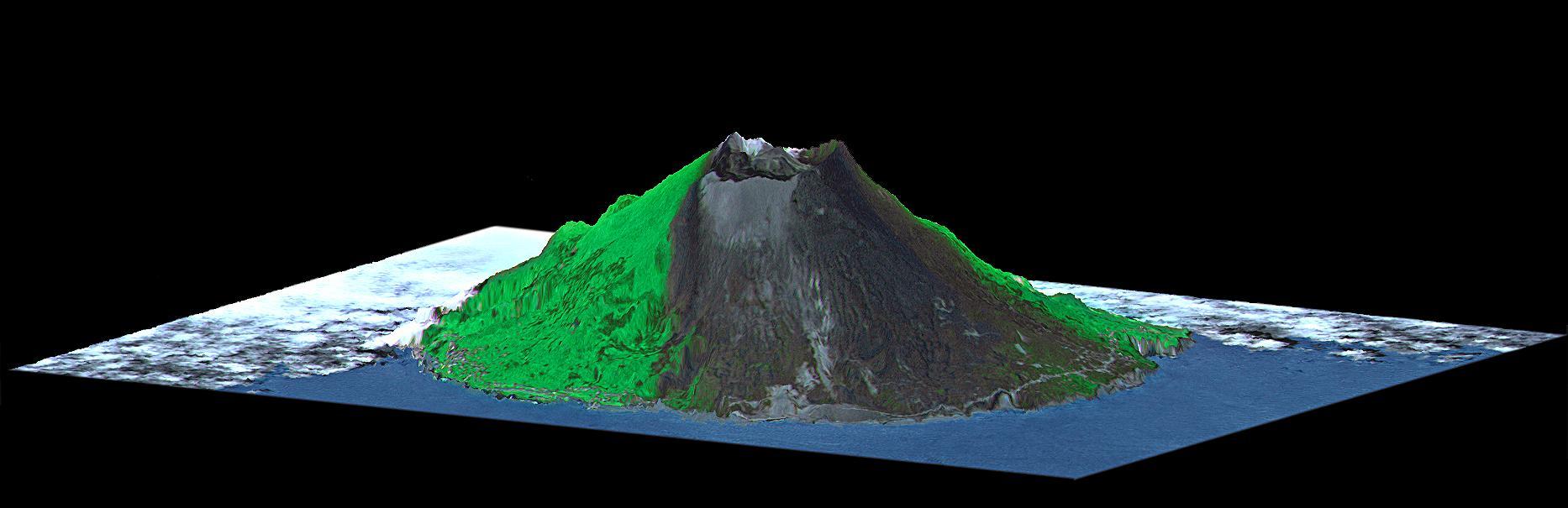
Mount Oyama is a 820-meter-high (2,700 feet) volcano on the island of Miyake-Jima, Japan. In late June 2000, a series of earthquakes alerted scientists to possible volcanic activity. On June 27, authorities evacuated 2,600 people, and on July 8 the volcano began erupting and erupted five times over that week. The dark gray blanket covering green vegetation in the image is the ash deposited by prevailing northeasterly winds between July 8 and 17. This island is about 180 kilometers (110 miles) south of Tokyo and is part of the Izu chain of volcanic islands that runs south from the main Japanese island of Honshu. Miyake-Jima is home to 3,800 people. The previous major eruptions of Mount Oyama occurred in 1983 and 1962, when lava flows destroyed hundreds of houses. An earlier eruption in 1940 killed 11 people.  This image is a perspective view created by combining image data from the Advanced Spaceborne Thermal Emission and Reflection Radiometer (ASTER) aboard NASA's Terra satellite with an elevation model from the Shuttle Radar Topography Mission (SRTM). Vertical relief is exaggerated, and the image includes cosmetic adjustments to clouds and image color to enhance clarity of terrain features.  http://photojournal.jpl.nasa.gov/catalog/PIA02771
ASTER-SRTM Perspective of Mount Oyama Volcano, Miyake-Jima Island, Japan
"There are a lot of things I can do that other people who are 'able-bodied' can't. For example, I was at Costco, and they hadn't opened the doors yet, so we were all waiting outside (Costco customers, gotta love them. Every day is Black Friday). Anyway, I'm sitting there at the door waiting to go in. The security guard was trying to separate these two flatbed carts, and I asked him, and I was sincere when I said this, I go, 'Do you want help?' [He says] ‘Oh, hahaha no, no.’ And that really makes me mad.   “Nine out of ten times when I offer my help, that's the response. Number one, people think I'm joking. Number two, how could I ever be helpful? Somebody in my position, 'my position,' right?   "So, he gave up, and I took my chair and quickly hit the carts at the right spot. Because of my chair being heavy, I was able to separate them. Did that teach him a lesson not to do that ever again? Probably not. But the truth is, I was able to do that, and he wasn't. And he would never guess I could do something he can't do.  “I wish people would look at us and say, wow, I wonder what she can do that is really cool, because that's how I look at my community. I don't look at the fact that they can't walk. I look and wonder what they could do. I would like to see [more of] that, so I'll keep offering my help. People need to realize not to make assumptions. Be open and curious about the abilities of everybody.   “They say if you live long enough, there's a good chance you'll join this community. And just remember, if that were to happen, don't give up because with the right resources, you can have a great life. I know people who have become disabled who tell me their life didn't begin until they became part of the community because it's given them this whole new perspective and value to people, to the human spirit.   “And that's what I like to impart to everybody; don't feel sorry for me because, with the right help, it's great."   NASA Headquarters External Informa
Dana Bolles Portrait
Dr. Cheryl Nickerson (right) of Tulane University is studying the effects of simulated low-g on a well-known pathogen, Salmonella typhimurium, a bacterium that causes two to four million cases of gastrointestinal illness in the United States each year. While most healthy people recover readily, S. typhimurium can kill people with weakened immune systems. Thus, a simple case of food poisoning could disrupt a space mission. Using the NASA rotating-wall bioreactor, Nickerson cultured S. typhimurium in modeled microgravity. Mice infected with the bacterium died an average of three days faster than the control mice, indicating that S. typhimurium's virulence was enhanced by the bioreactor. Earlier research showed that 3 percent of the genes were altered by exposure to the bioreactor. Nickerson's work earned her a 2001 Presidential Early Career Award for Scientists and Engineers.
Biotechnology
Dr. Cheryl Nickerson of Tulane University is studying the effects of simulated low-g on a well-known pathogen, Salmonella typhimurium, a bacterium that causes two to four million cases of gastrointestinal illness in the United States each year. While most healthy people recover readily, S. typhimurium can kill people with weakened immune systems. Thus, a simple case of food poisoning could disrupt a space mission. Using the NASA rotating-wall bioreactor, Nickerson cultured S. typhimurium in modeled microgravity. Mice infected with the bacterium died an average of three days faster than the control mice, indicating that S. typhimurium's virulence was enhanced by the bioreactor. Earlier research showed that 3 percent of the genes were altered by exposure to the bioreactor. Nickerson's work earned her a 2001 Presidential Early Career Award for Scientists and Engineers.
Biotechnology
Dr. Cheryl Nickerson of Tulane University is studying the effects of simulated low-g on a well-known pathogen, Salmonella typhimurium, a bacterium that causes two to four million cases of gastrointestinal illness in the United States each year. While most healthy people recover readily, S. typhimurium can kill people with weakened immune systems. Thus, a simple case of food poisoning could disrupt a space mission. Using the NASA rotating-wall bioreactor, Nickerson cultured S. typhimurium in modeled microgravity. Mice infected with the bacterium died an average of three days faster than the control mice, indicating that S. typhimurium's virulence was enhanced by the bioreactor. Earlier research showed that 3 percent of the genes were altered by exposure to the bioreactor. Nickerson's work earned her a 2001 Presidential Early Career Award for Scientists and Engineers.
Biotechnology