
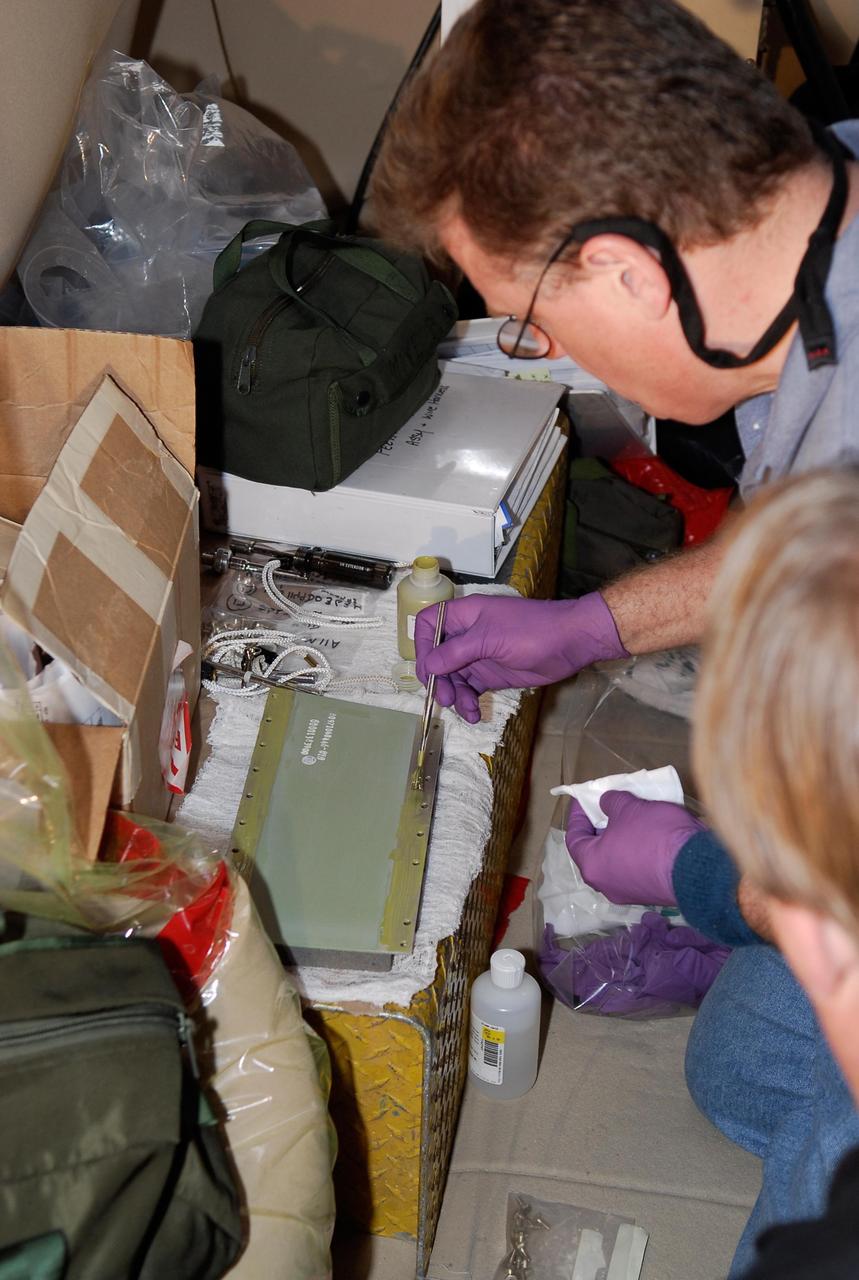
This image shows what happened underneath NASA Phoenix Mars Lander Robotic Arm wrist on Sol 3. The pin that goes through the loop is what holds the wrist in place. The rotation of the wrist pops the pin free.
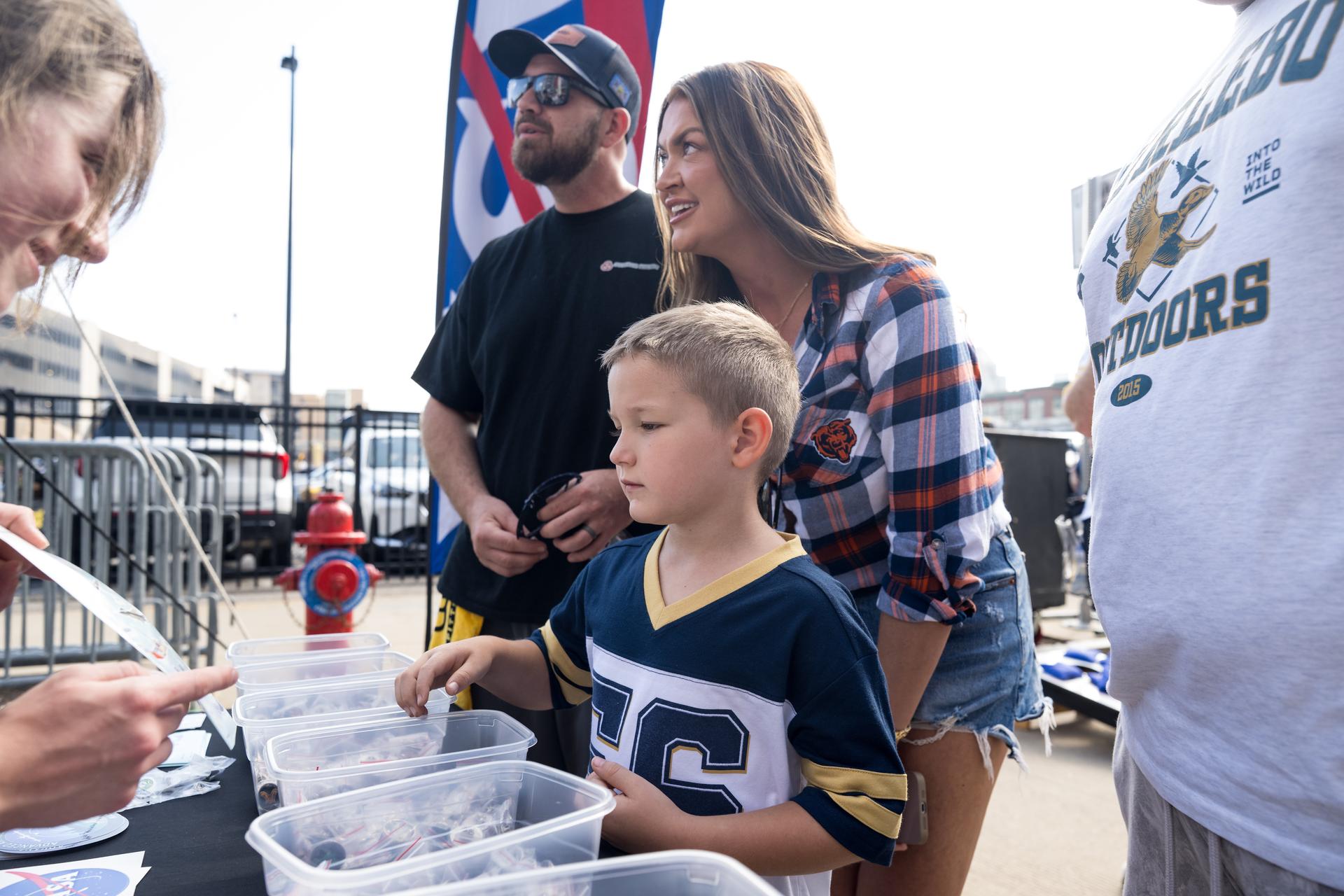
Fans collect NASA pins outside the NASA Experience Zone at an NFL game between the Pittsburgh Steelers and the Atlanta Falcons at Acrisure Stadium, Sunday, Sept. 13, 2026, in Pittsburgh, Pennsylvania. NASA’s engagement at NFL games is part of the agency's Inspiration Tour, aimed at strengthening connections between NASA and its partners and showcasing innovation in air and space in the lead up to the MAX POWER aerospace technology expo and airshow at the agency's Kennedy Space Center in early November. Photo Credit: (NASA/Aubrey Gemignani)
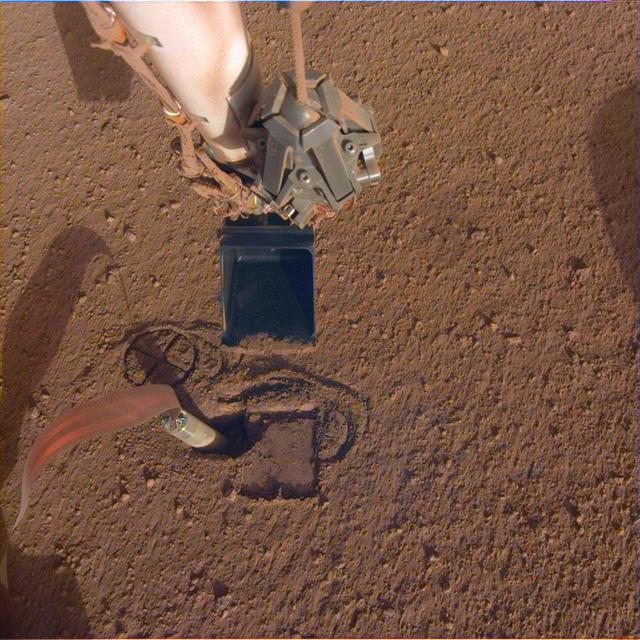
NASA InSight's robotic arm will use its scoop to pin the spacecraft's heat probe, or "mole," against the wall of its hole. The mole is part of an instrument formally called the Heat Flow and Physical Properties Package, or HP3, provided by the German Aerospace Center (DLR). Animation available at https://photojournal.jpl.nasa.gov/catalog/PIA23373

NASA astronaut Doug Wheelock leaves a NASA pin on the headstone of the Extortion 17, fellow service members who lost their lives during his tour of duty in Afghanistan, as part of National Wreaths Across America Day, Sat., Dec. 14, 2019 at Arlington National Cemetery in Arlington, Va. National Wreaths Across America Day is held annually to celebrate the lives of military veterans. Wheelock honored those who lost their lives in the quest for space exploration as well as fellow service members. Photo Credit: (NASA/Aubrey Gemignani)
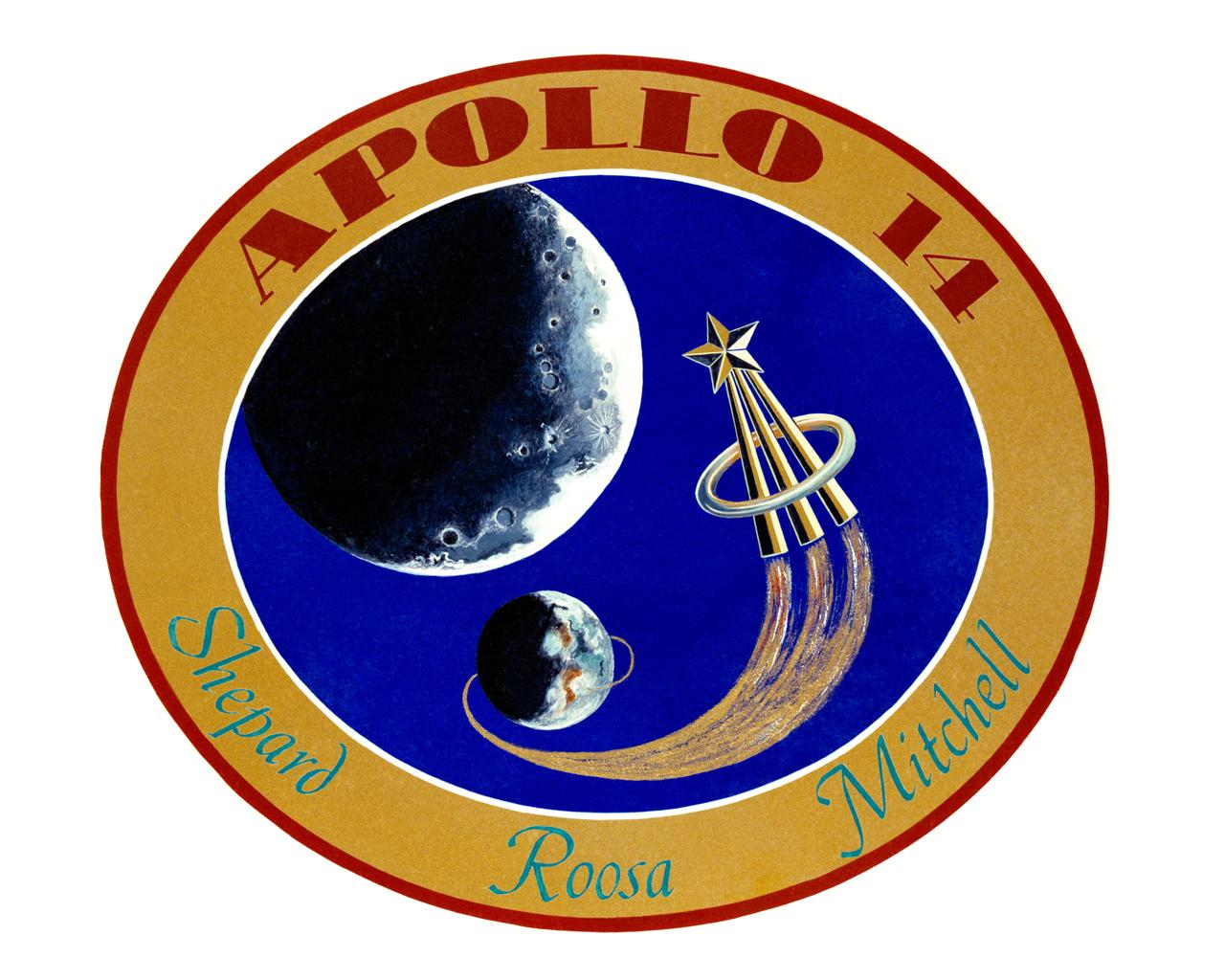
S70-17851 (September 1970) --- This is the Apollo 14 crew patch designed by astronauts Alan B. Shepard Jr., commander; Stuart A. Roosa, command module pilot; and Edgar D. Mitchell, lunar module pilot. It features the astronaut lapel pin approaching the moon and leaving a comet trail from the liftoff point on Earth. The pin design was adopted by the astronaut corps several years ago. Astronauts who have not yet flown in space wear silver pins. Those who have flown wear gold pins. The NASA insignia design for Apollo flights is reserved for use by the astronauts and for other official use as the NASA Administrator may authorize. Public availability has been approved only in the form of illustrations by the various news media. When and if there is any change in this policy, which we do not anticipate, it will be publicly announced.
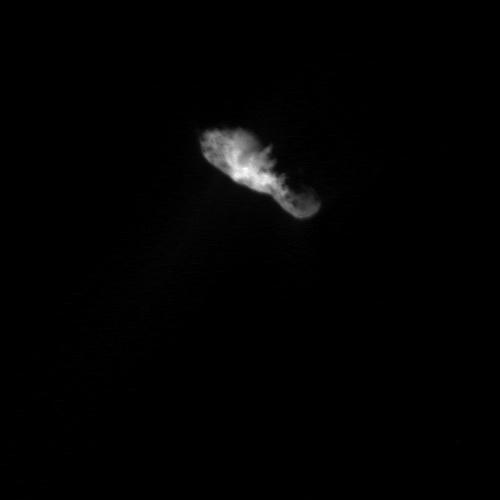
Sunlight illuminates the bowling-pin shaped nucleus from directly below comet Borrelly as seen by NASA Deep Space 1. At this distance, many features become vivid on the surface of the nucleus, including a jagged line between day and night on the comet.

NASA Administrator Sean O'Keefe comes to Ames for employee briefing and tour. Here he welcomes JASON kids to NASA while handing out patches and pins.
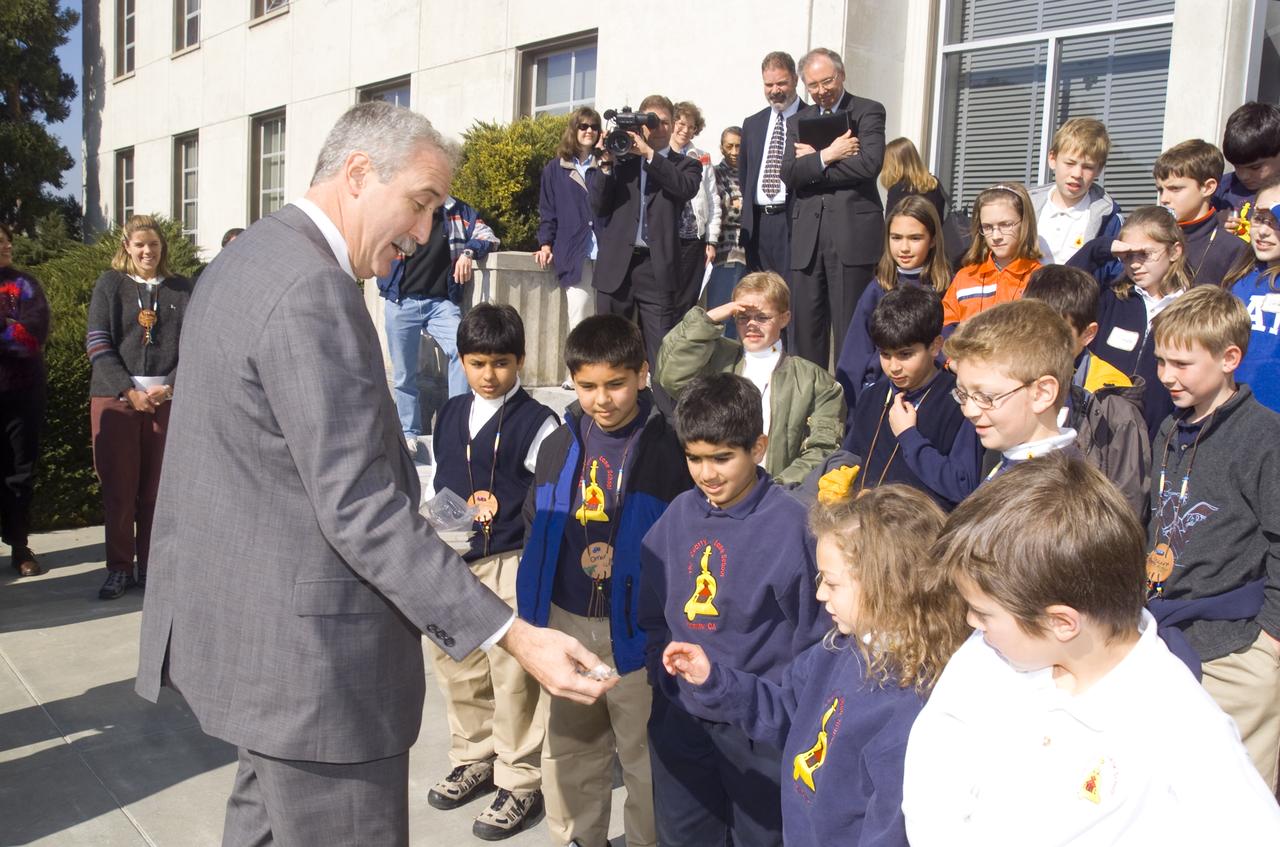
NASA Administrator Sean O'Keefe comes to Ames for employee briefing and tour. Here he welcomes JASON kids to NASA while handing out patches and pins.
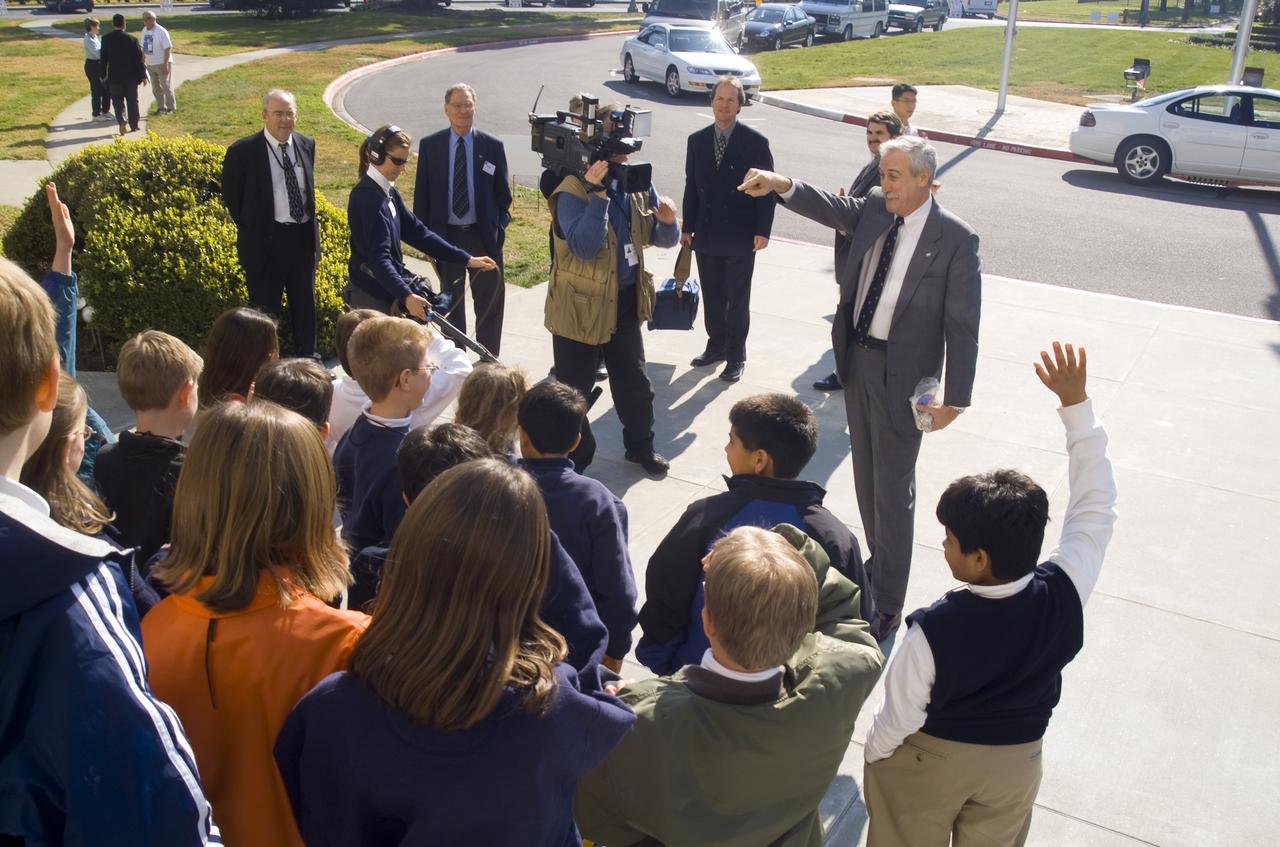
NASA Administrator Sean O'Keefe comes to Ames for employee briefing and tour. Here he welcomes JASON kids to NASA while handing out patches and pins. Tom Clausen and Donald James, Ames Education Office in background.
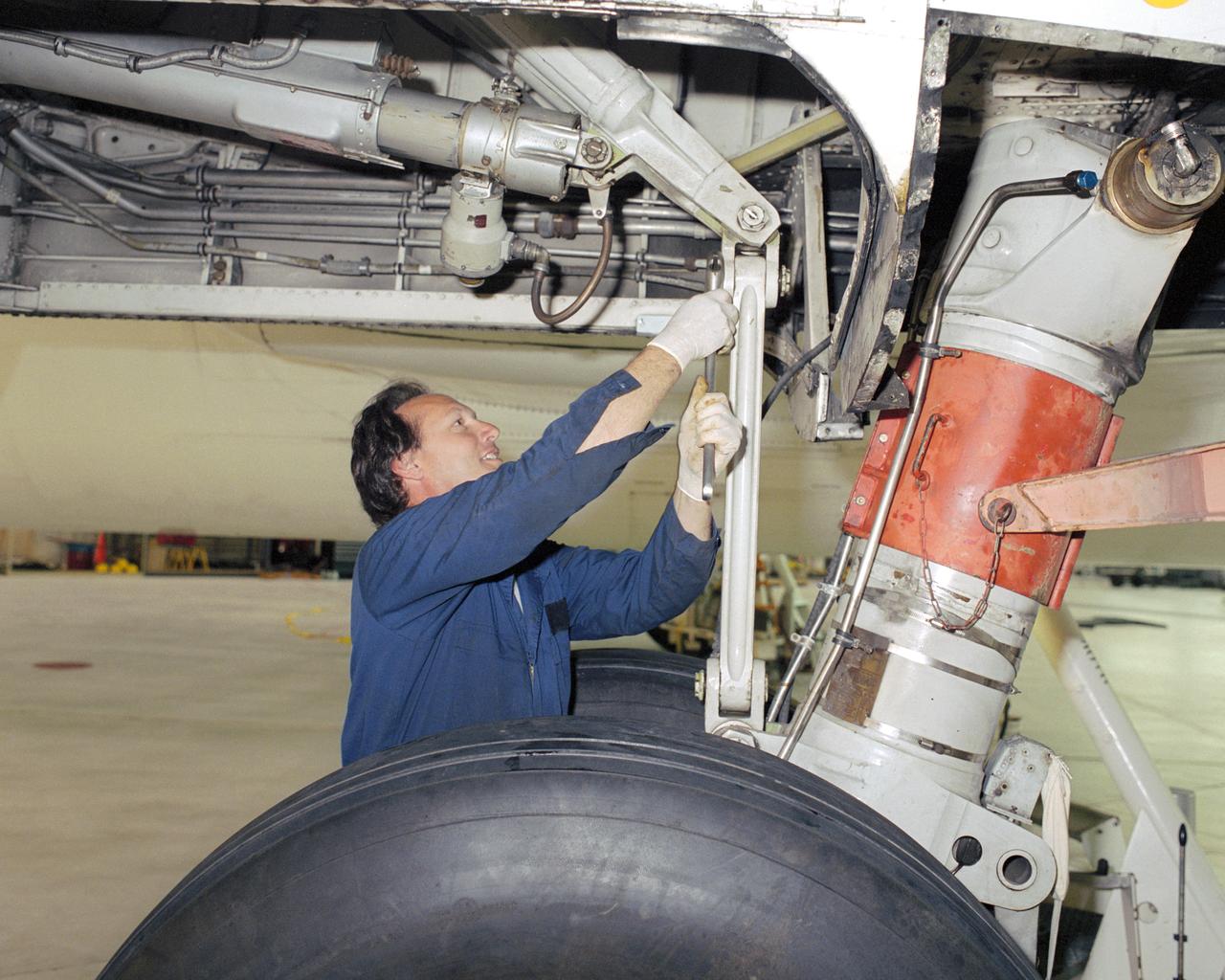
Assistant crew chief David Wyckoff applies some elbow grease to loosen a link pin during a landing gear changeout on NASA Johnson Space Center's Super Guppy.
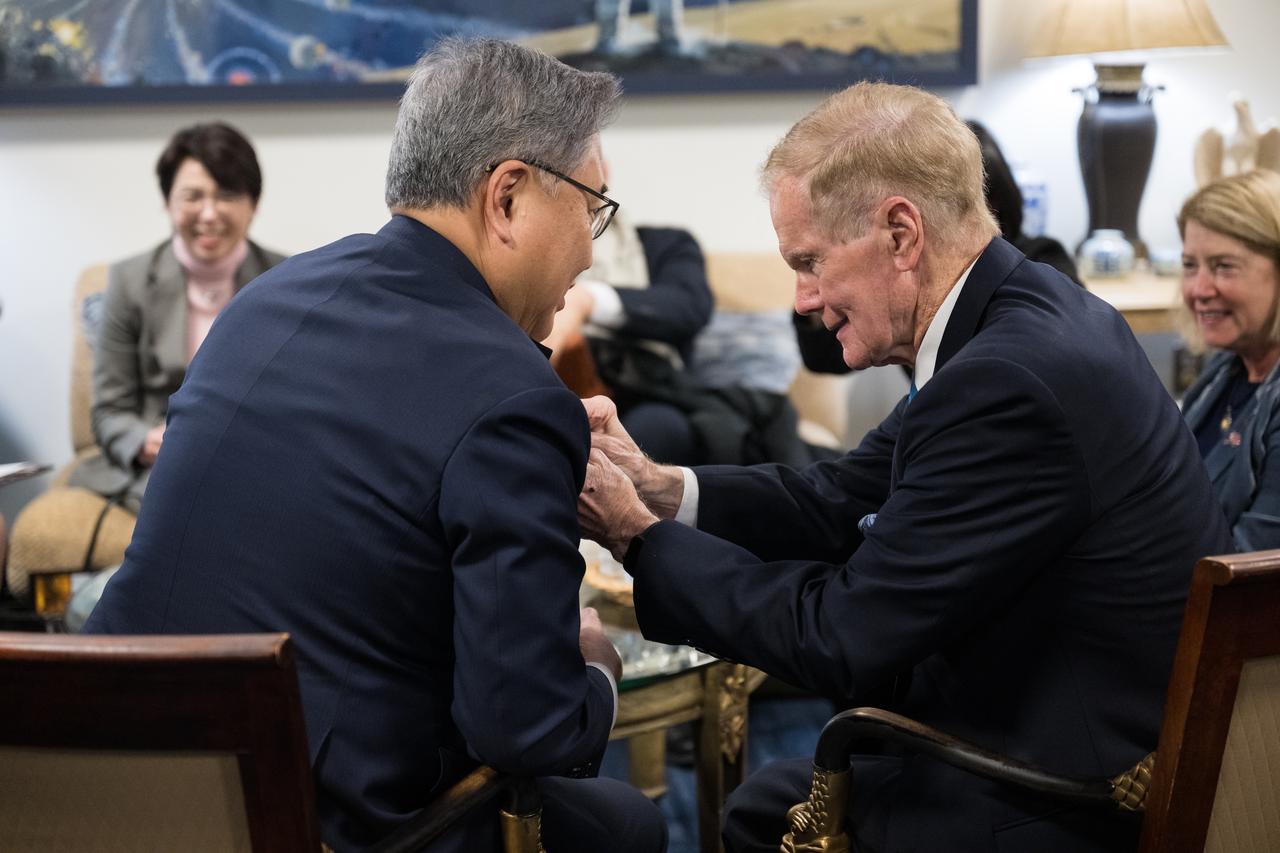
NASA Administrator Bill Nelson presents a NASA pin to the Republic of Korea Minister of Foreign Affairs, Jin Park, Thursday, Feb. 2, 2023 at the Mary W. Jackson NASA Headquarters building in Washington DC. Photo Credit: (NASA/Aubrey Gemignani)
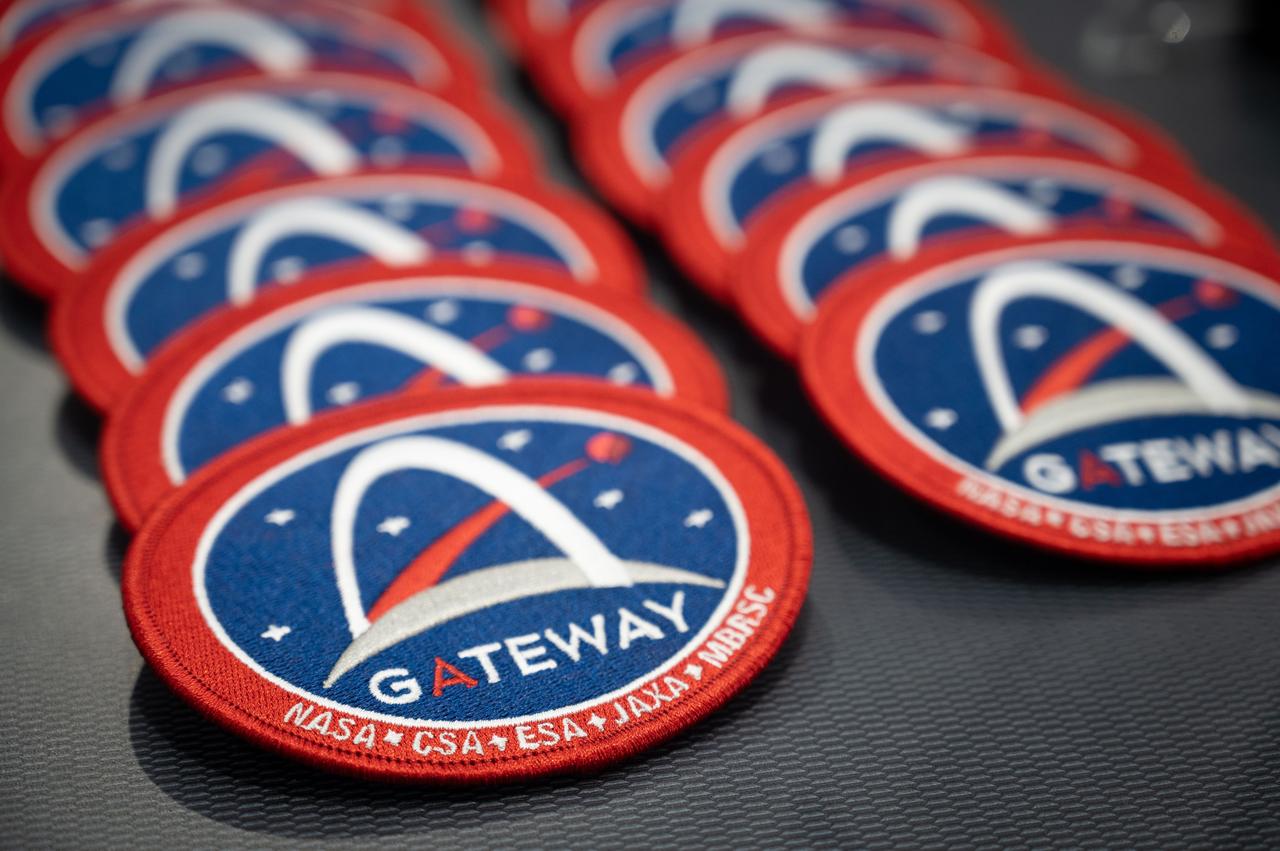
jsc2024e055761 (July 26, 2024) -- A display of Gateway patches at the NASA Pavilion during EAA AirVenture Oshkosh 2024. Gateway highlights at NASA’s exhibition space include a detailed 1:100th scale model of Gateway, a selfie station for Moon photos, and exclusive Gateway stickers, pins, and patches. Photo Credit: NASA/Andrew Carlsen
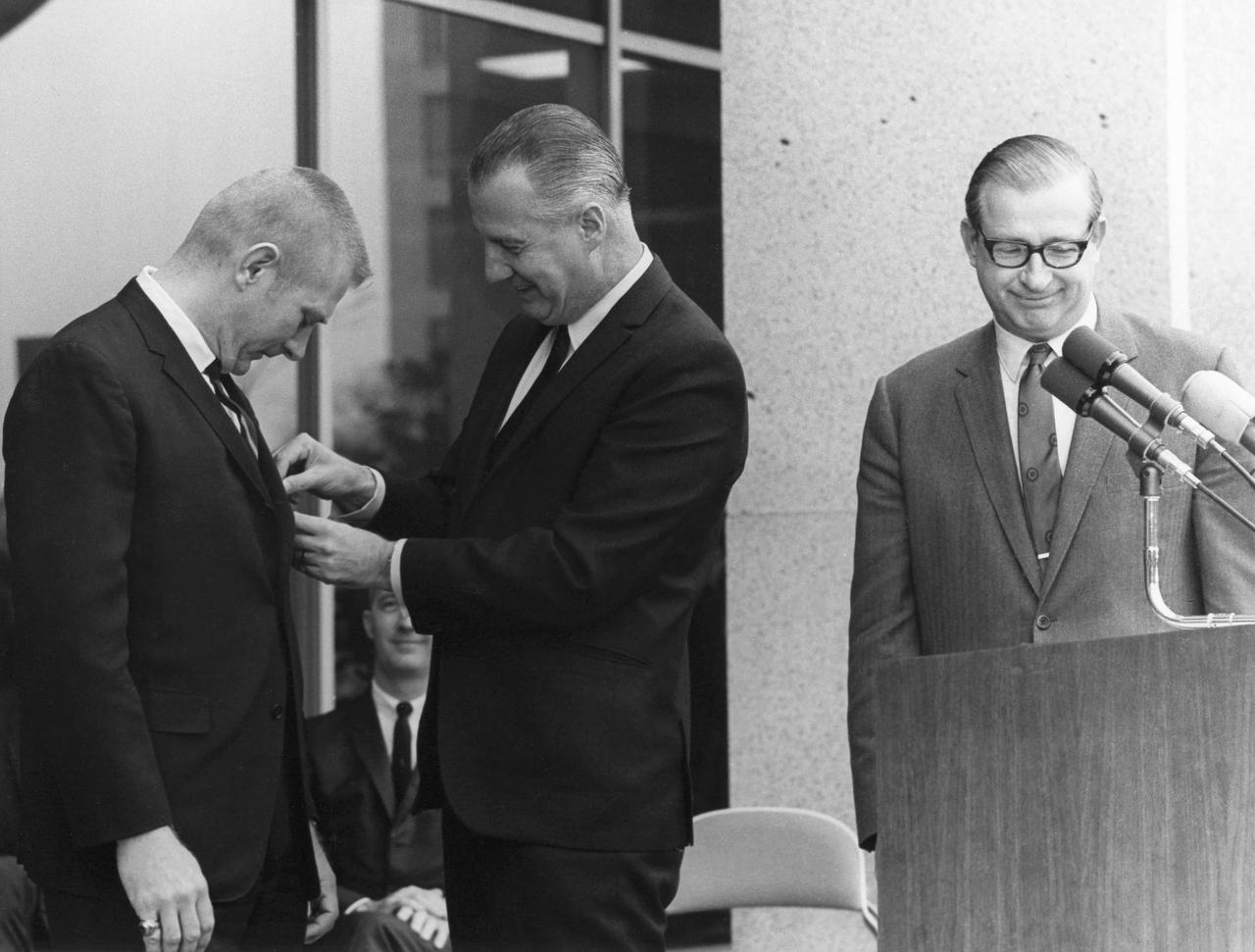
JSC2013-E-009914 (1969) -- Vice President Spiro Agnew pins Flight Director Eugene F. Kranz as NASA Administrator Thomas Paine and Apollo 9 Commander James A. McDivitt look on. Photo credit: NASA Hq. photo identification no. is 69-H-537
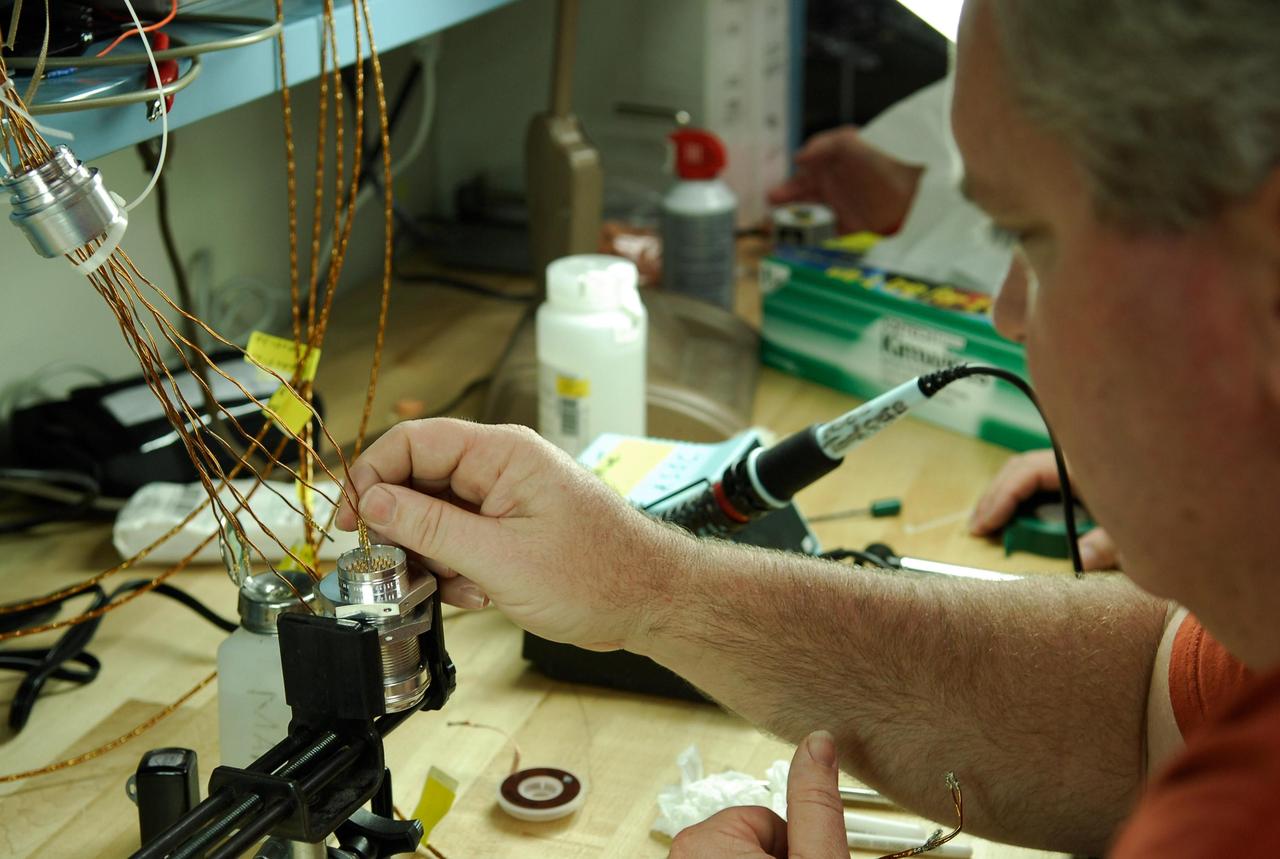
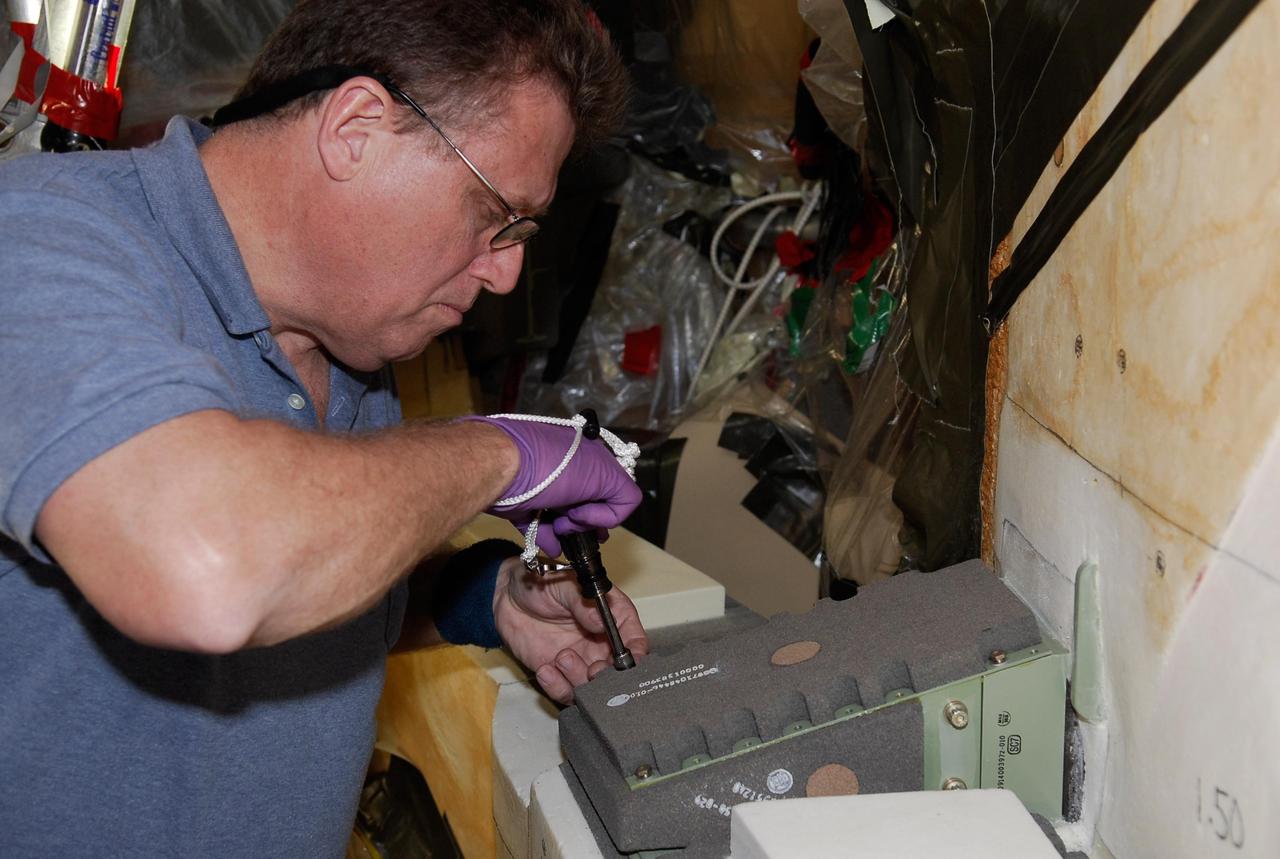
KENNEDY SPACE CENTER, FLA. -- At a lab at NASA's Kennedy Space Center, Bob Arp, an aerospace technician with the United Launch Alliance, inserts a wire from an electrical harness onto the pin of a replacement feed-through connector during preparations to solder the pins to the socket of the connector. The connector will be installed in the external fuel tank for space shuttle Atlantis' STS-122 mission. The technician performed this exacting task on the Centaur upper stage for Atlas and Titan launches in 1994 and was specifically chosen for the task. Soldering the connector pins and sockets together addresses the most likely cause of a problem in the engine cutoff sensor system, or ECO system. Some of the tank's ECO sensors failed during propellant tanking for launch attempts on Dec. 6 and Dec. 9. Results of a tanking test on Dec. 18 pointed to an open circuit in the feed-through connector wiring, which is located at the base of the tank. The feed-through connector passes the wires from the inside of the tank to the outside. After the soldering is completed and the connector is reinstalled, shuttle program managers will decide on how to proceed. The launch date for mission STS-122 is under review. Photo credit: NASA/Kim Shiflett
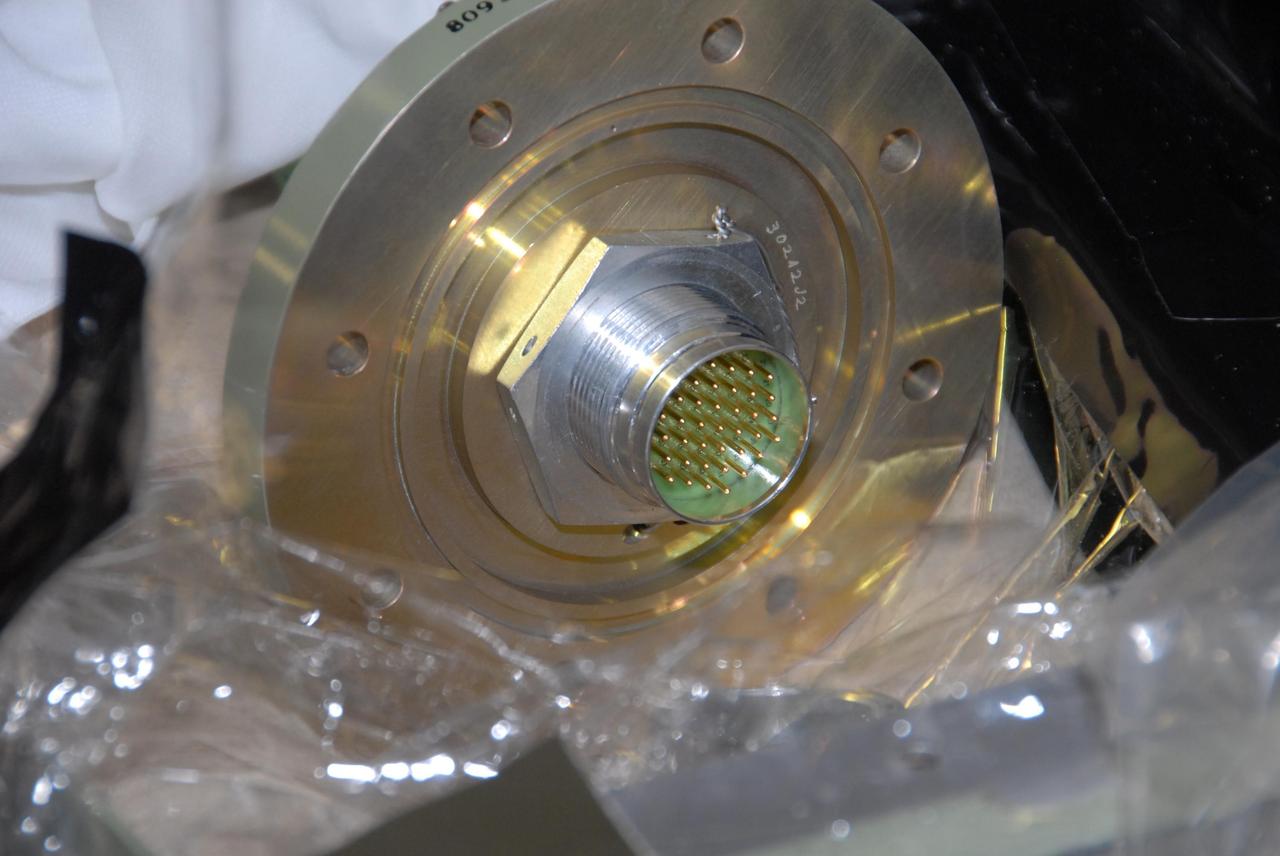
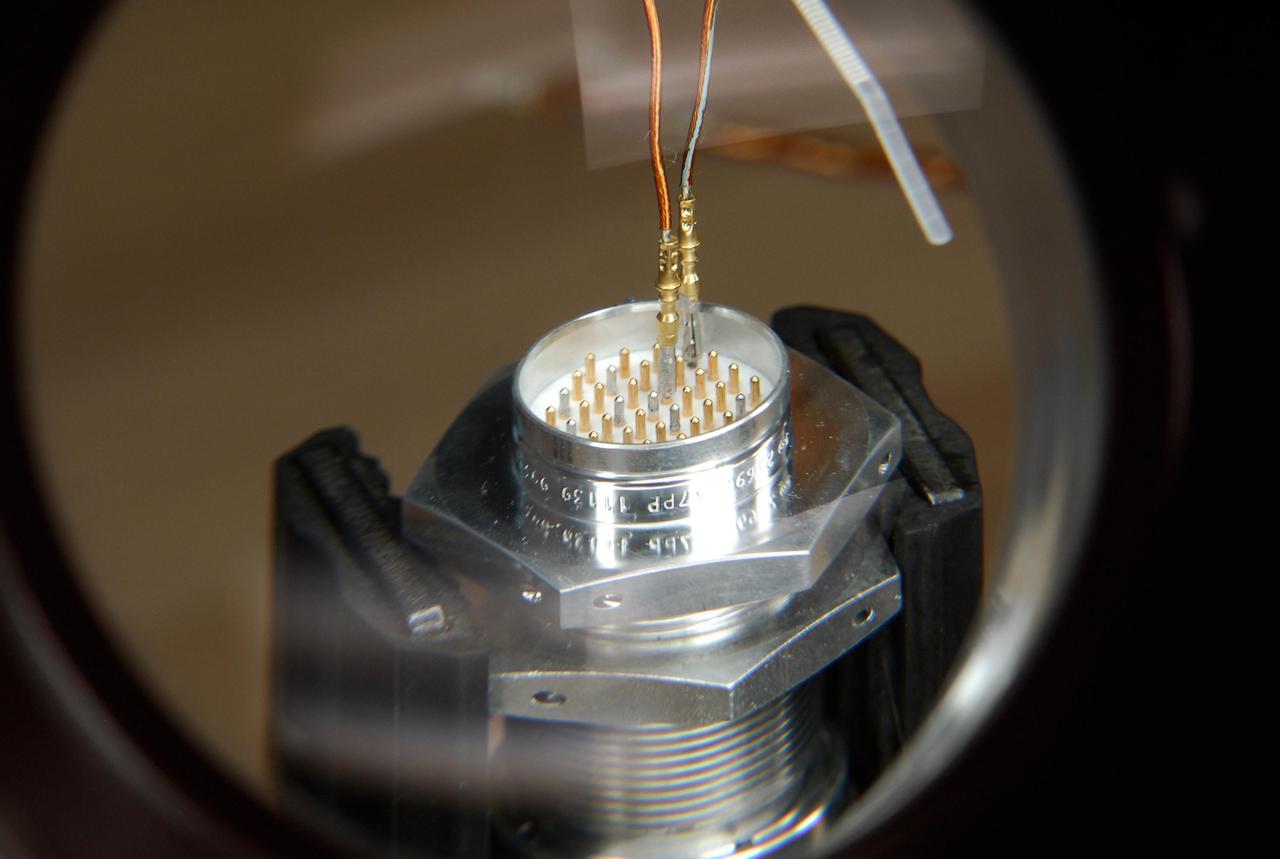
KENNEDY SPACE CENTER, FLA. -- This closeup of the replacement feed-through connector for the engine cutoff, or ECO, sensor system on space shuttle Atlantis shows the pins that were soldered at Kennedy. The feed-through connector passes the wires from the inside of the tank to the outside. Results of a tanking test on Dec. 18 pointed to an open circuit in the feed-through connector wiring, which is located at the base of the tank. The pins in the replacement connector have been precisely soldered to create a connection that allows sensors inside the tank to send signals to the computers onboard Atlantis. The work is being done on Launch Pad 39A. Space shuttle Atlantis is now targeted for launch on Feb. 7. Photo credit: NASA/George Shelton
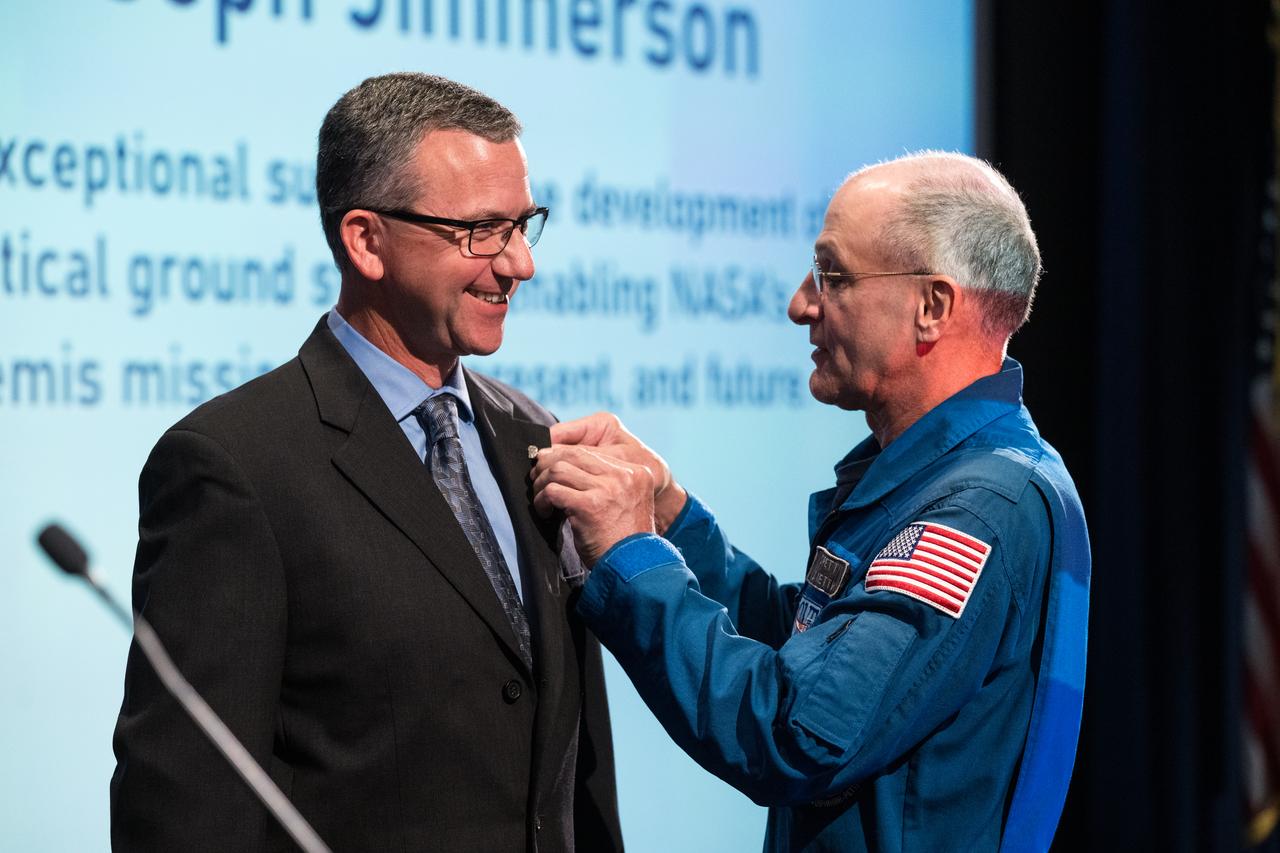
NASA astronaut Don Pettit presents NASA Range Operations Contract Engineer Manager at Wallops Flight Facility, Joseph Jimmerson, with a Silver Snoopy pin, Wednesday, Sept. 17, 2025, at NASA’s Goddard Space Flight Center in Greenbelt, Md. Pettit and Hague served as part of Expedition 72 onboard the International Space Station. Photo Credit: (NASA/Aubrey Gemignani)
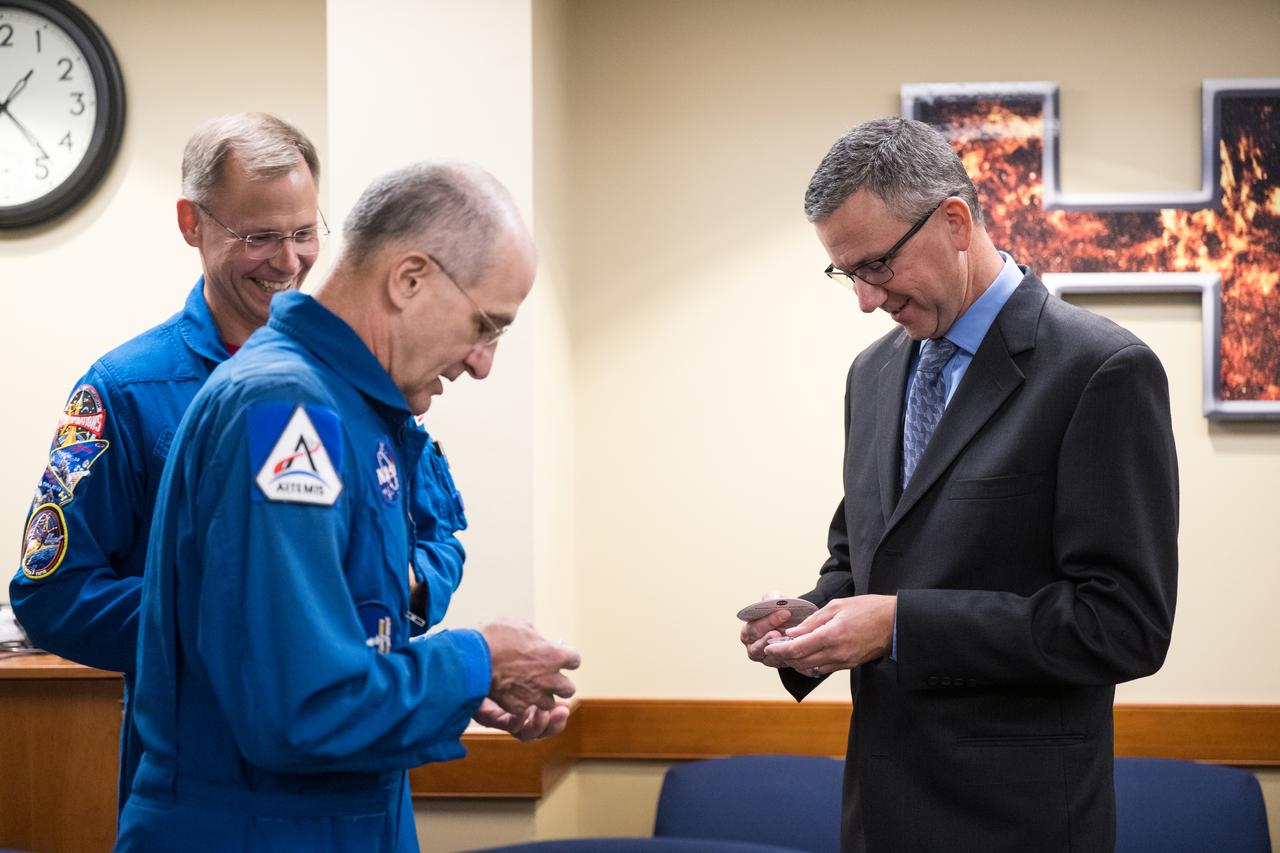
NASA astronauts Nick Hague and Don Pettit give NASA Range Operations Contract Engineer Manager at Wallops Flight Facility, Joseph Jimmerson, stickers and pins from their mission before a Silver Snoopy award presentation, Wednesday, Sept. 17, 2025, at NASA’s Goddard Space Flight Center in Greenbelt, Md. Pettit and Hague served as part of Expedition 72 onboard the International Space Station. Photo Credit: (NASA/Aubrey Gemignani)
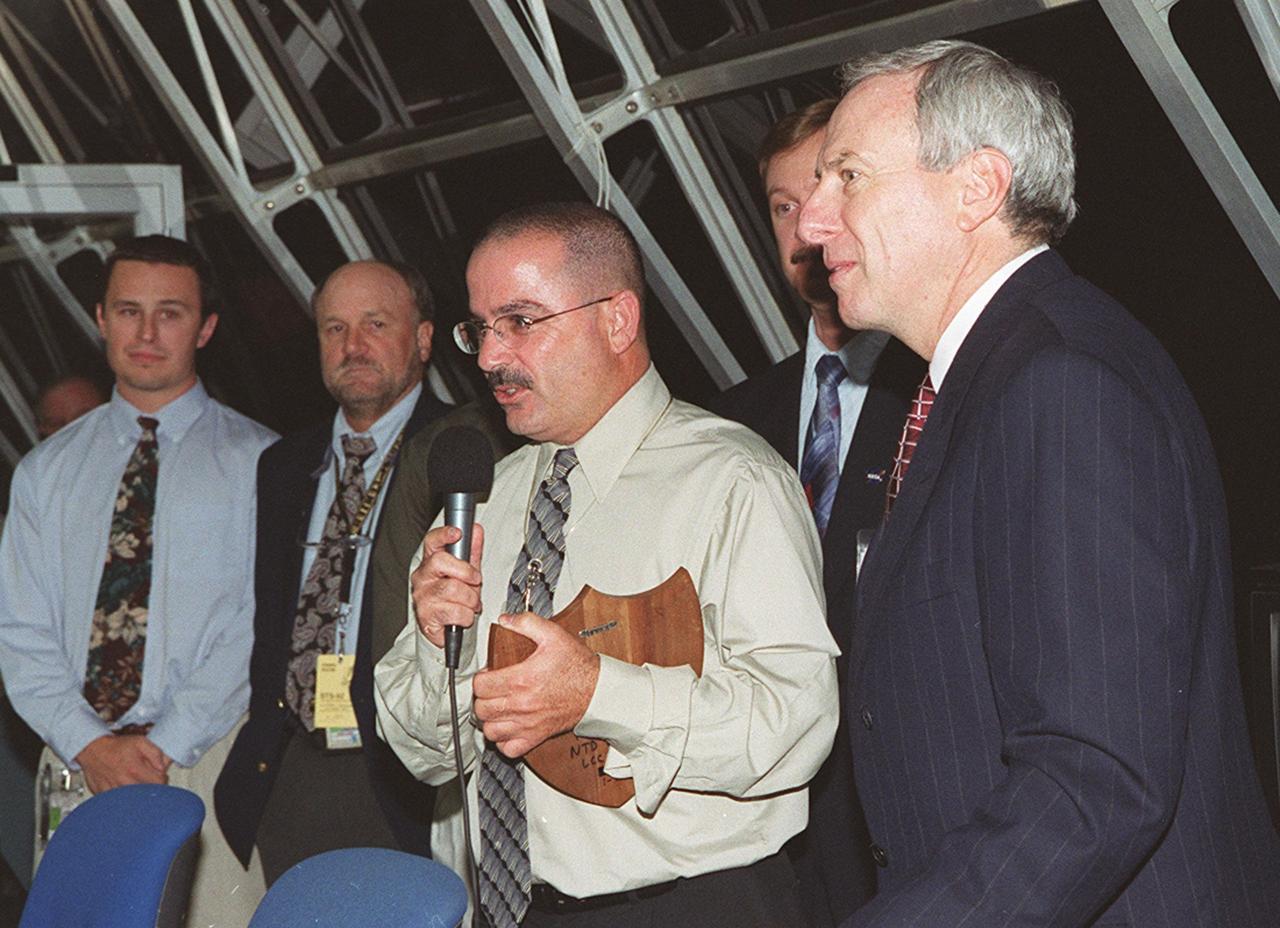
Jorge Rivera (with microphone) shares his thoughts after receiving congratulations for his observatory powers from NASA Administrator Dan Goldin (right). A NASA external tank mechanical engineer, Rivera is the one who spotted the misplaced lock pin on Shuttle Discovery Oct. 10, shortly before the intended launch of mission STS-92, causing a scrub for safety reasons
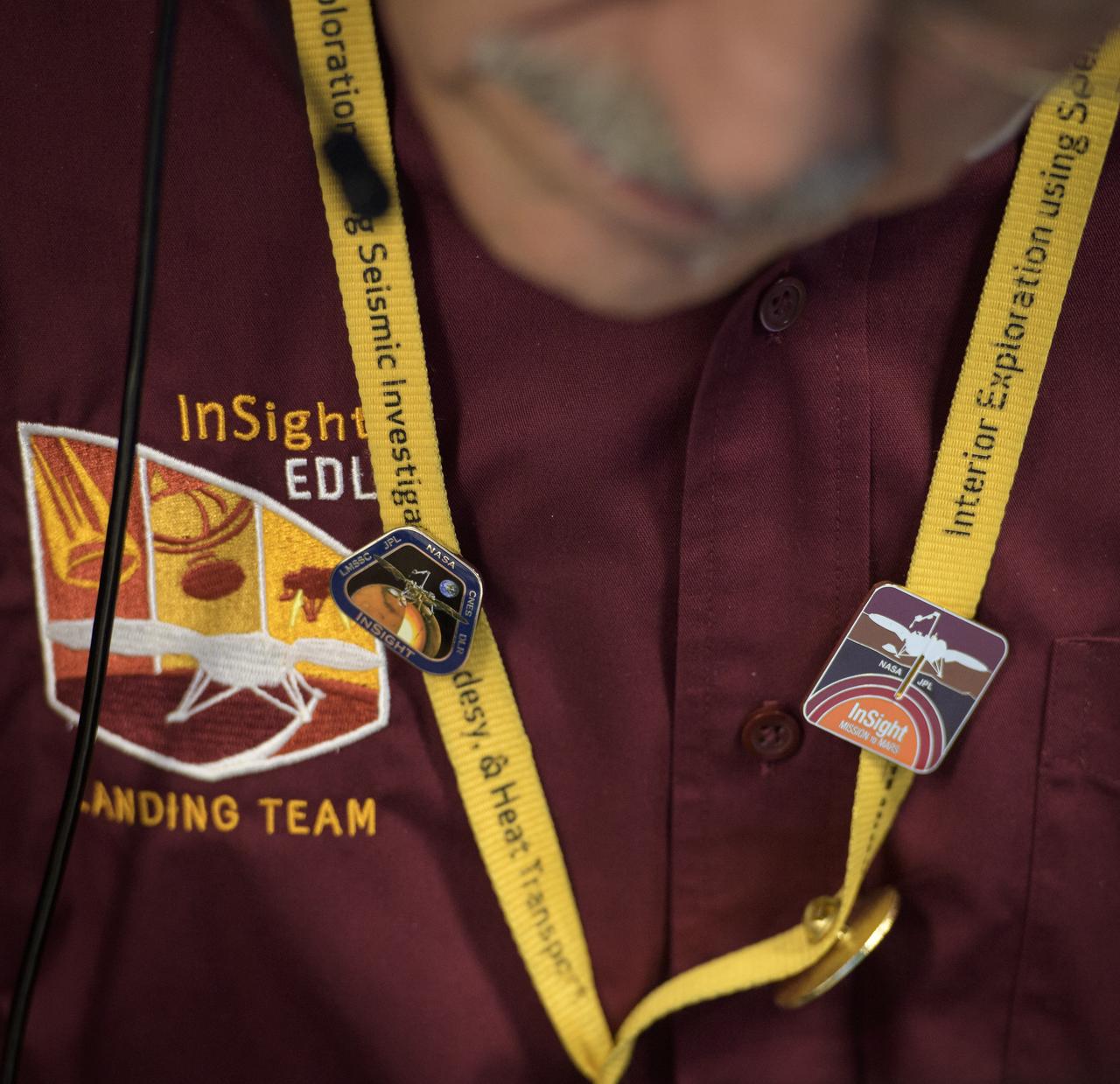
Shirt, lanyard, and mission pins are seen on a Mars InSight team member as they monitor the status of the lander prior to it touching down on Mars, Monday, Nov. 26, 2018 inside the Mission Support Area at NASA's Jet Propulsion Laboratory in Pasadena, California. InSight, short for Interior Exploration using Seismic Investigations, Geodesy and Heat Transport, is a Mars lander designed to study the "inner space" of Mars: its crust, mantle, and core. Photo Credit: (NASA/Bill Ingalls)
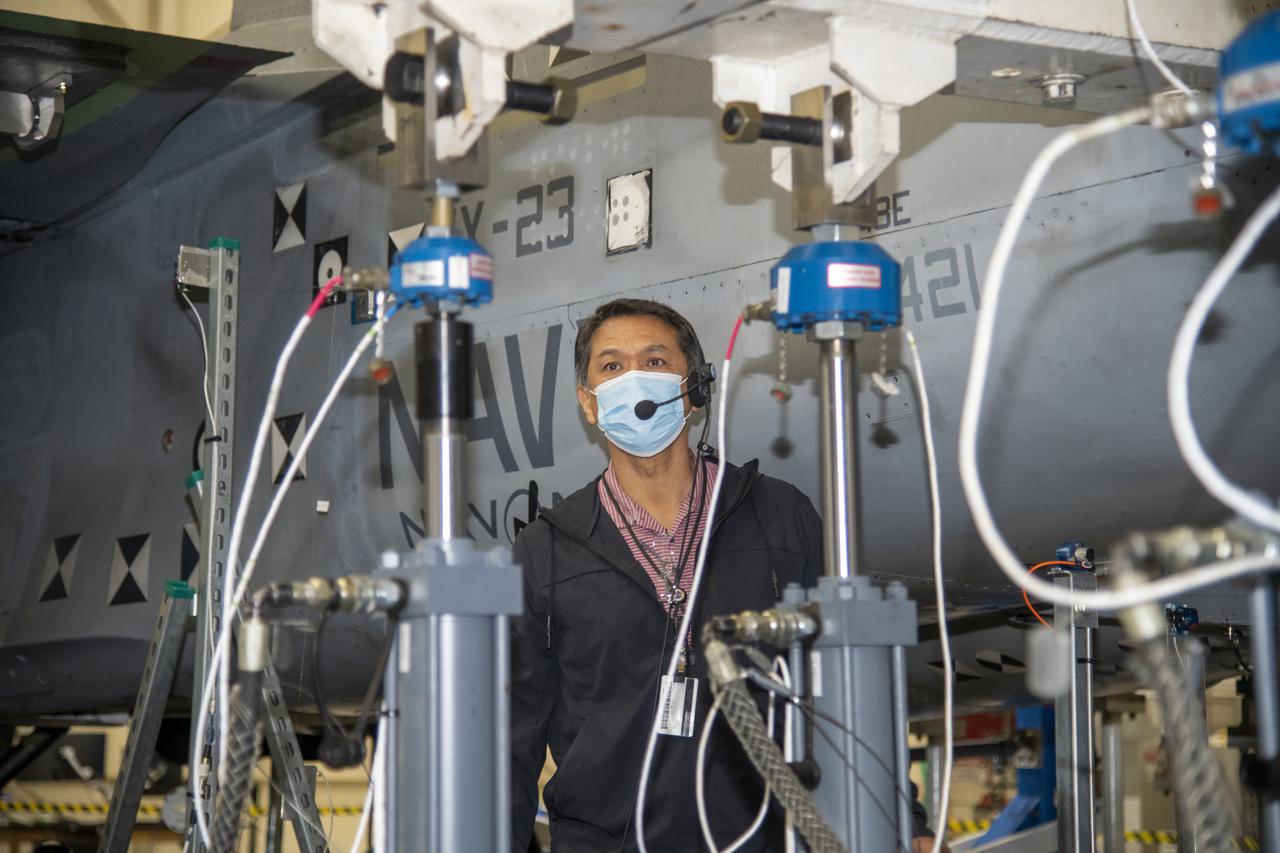
Larry Hudson does an inspection after the actuator on the F/A-18E from the Naval Air Systems Command (NAVAIR) in Patuxent River, Maryland, is pinned to the horizontal tail load test fixture. The aircraft is in NASA’s Armstrong Flight Research Center Flight Loads Laboratory in Edwards, California, for the center’s biggest load calibrations tests. This testing is needed before the aircraft can serve as a test vehicle for determining if it can safely manage maneuvers and proposed upgrades.
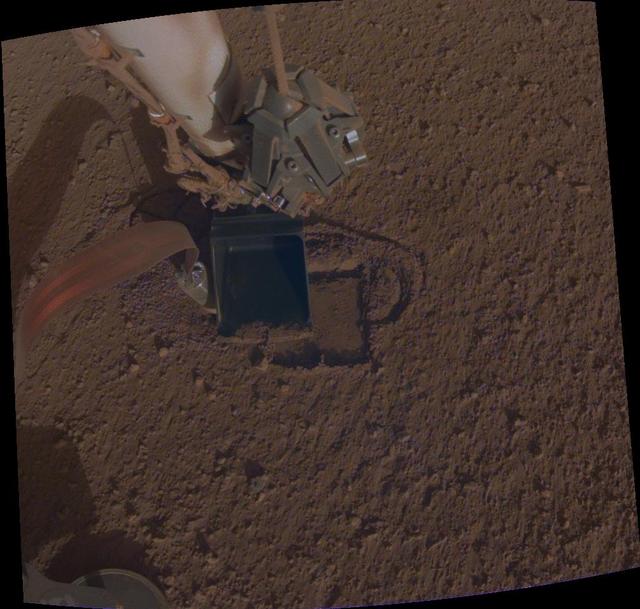
This animation shows NASA InSight's heat probe, or "mole," digging about a centimeter (half an inch) below the surface last week. Using a technique called "pinning," InSight recently pressed against the mole using a scoop on its robotic arm to help the self-hammering heat probe dig so that it can "take the temperature" of Mars. Animation available at https://photojournal.jpl.nasa.gov/catalog/PIA23379
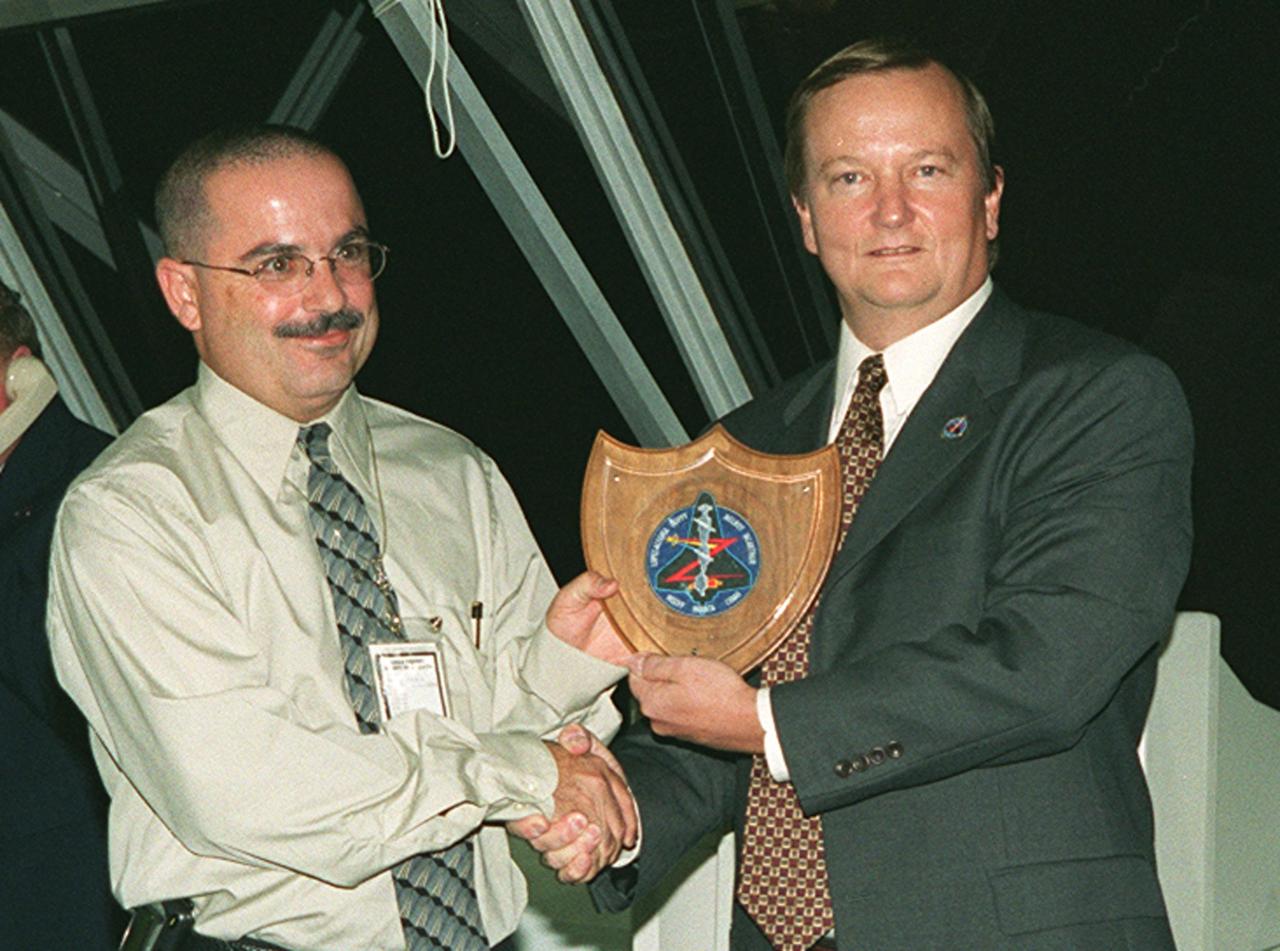
Jorge Rivera (center) receives a plaque and congratulations for his observatory powers from Shuttle Launch Director Mike Leinbach (right). A NASA external tank mechanical engineer, Rivera is the one who spotted the misplaced lock pin on Shuttle Discovery Oct. 10, shortly before the intended launch of mission STS-92, causing a scrub for safety reasons

Dr. David Korsmeyer, associate center director for research and technology at Ames, presents an Ames Research Center pin to President Joe Biden in front of Air Force One at Moffett Federal Airfield, near NASA’s Ames Research Center in California’s Silicon Valley, Thursday, Jan. 19, 2023. President Biden was en route to tour recent storm damage in the state.
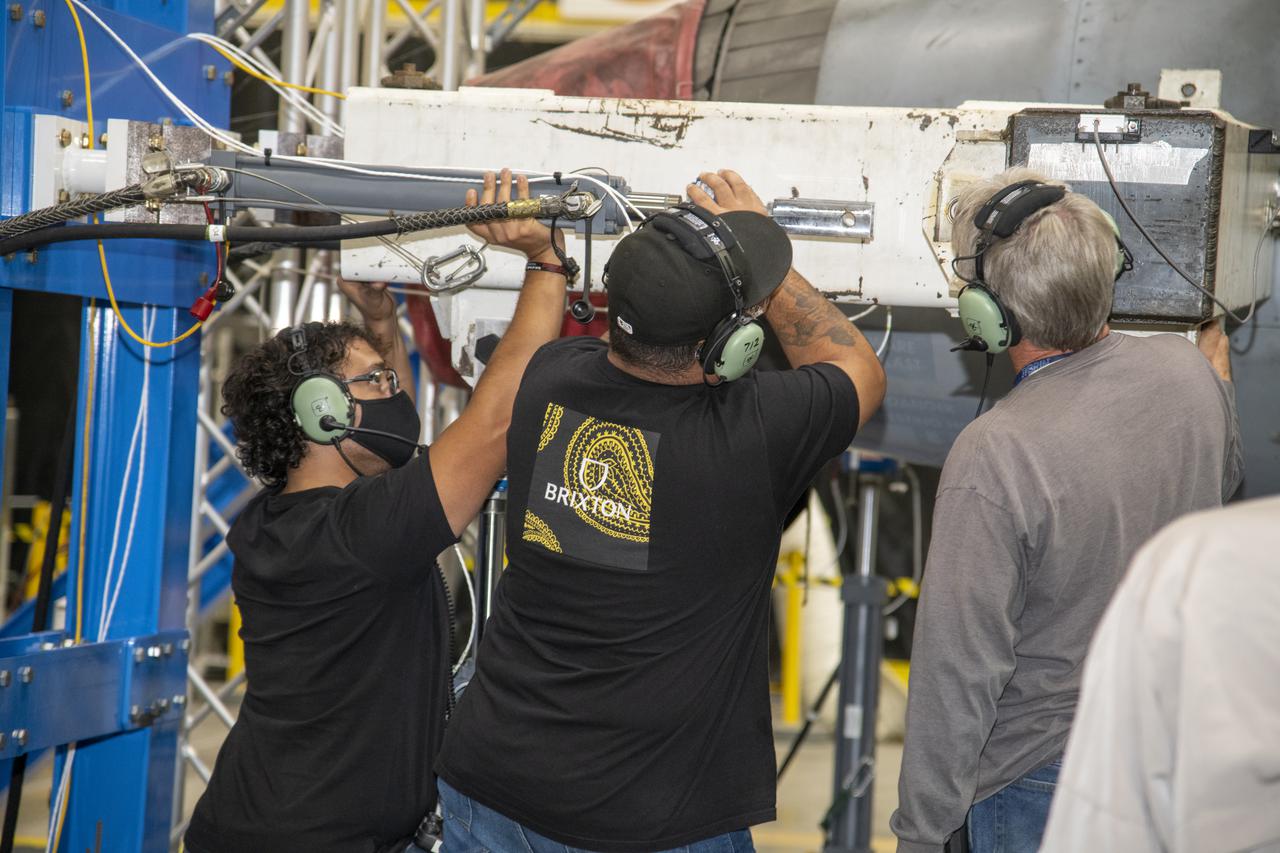
The actuator on the F/A-18E from the Naval Air Systems Command (NAVAIR) in Patuxent River, Maryland, is positioned for pinning to the horizontal tail load test fixture. The aircraft is in NASA’s Armstrong Flight Research Center Flight Loads Laboratory in Edwards, California, for the center’s biggest load calibrations tests. This testing is needed before the aircraft can serve as a test vehicle for determining if it can safely manage maneuvers and proposed upgrades.
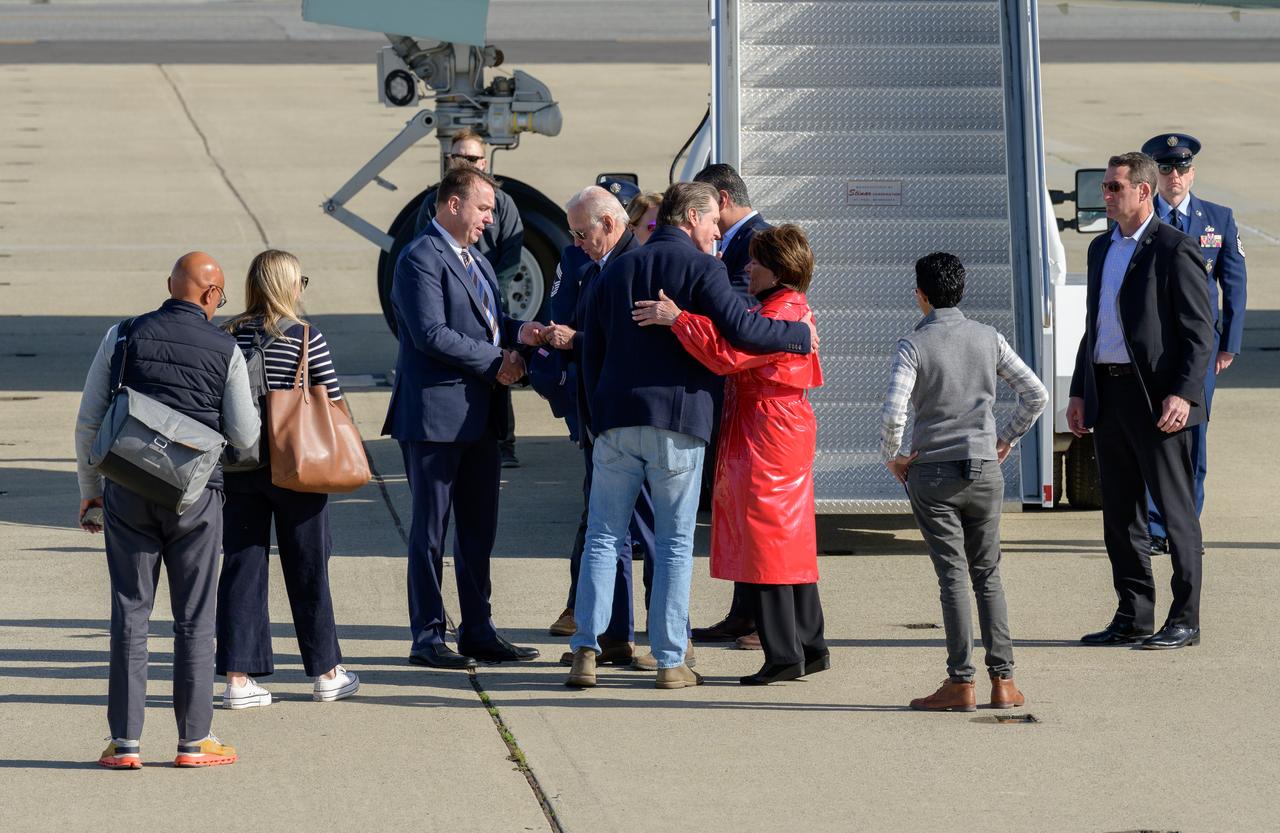
Dr. David Korsmeyer, associate center director for research and technology at Ames, presents an Ames Research Center pin to President Joe Biden in front of Air Force One at Moffett Federal Airfield, near NASA’s Ames Research Center in California’s Silicon Valley, Thursday, Jan. 19, 2023. President Biden was en route to tour recent storm damage in the state.
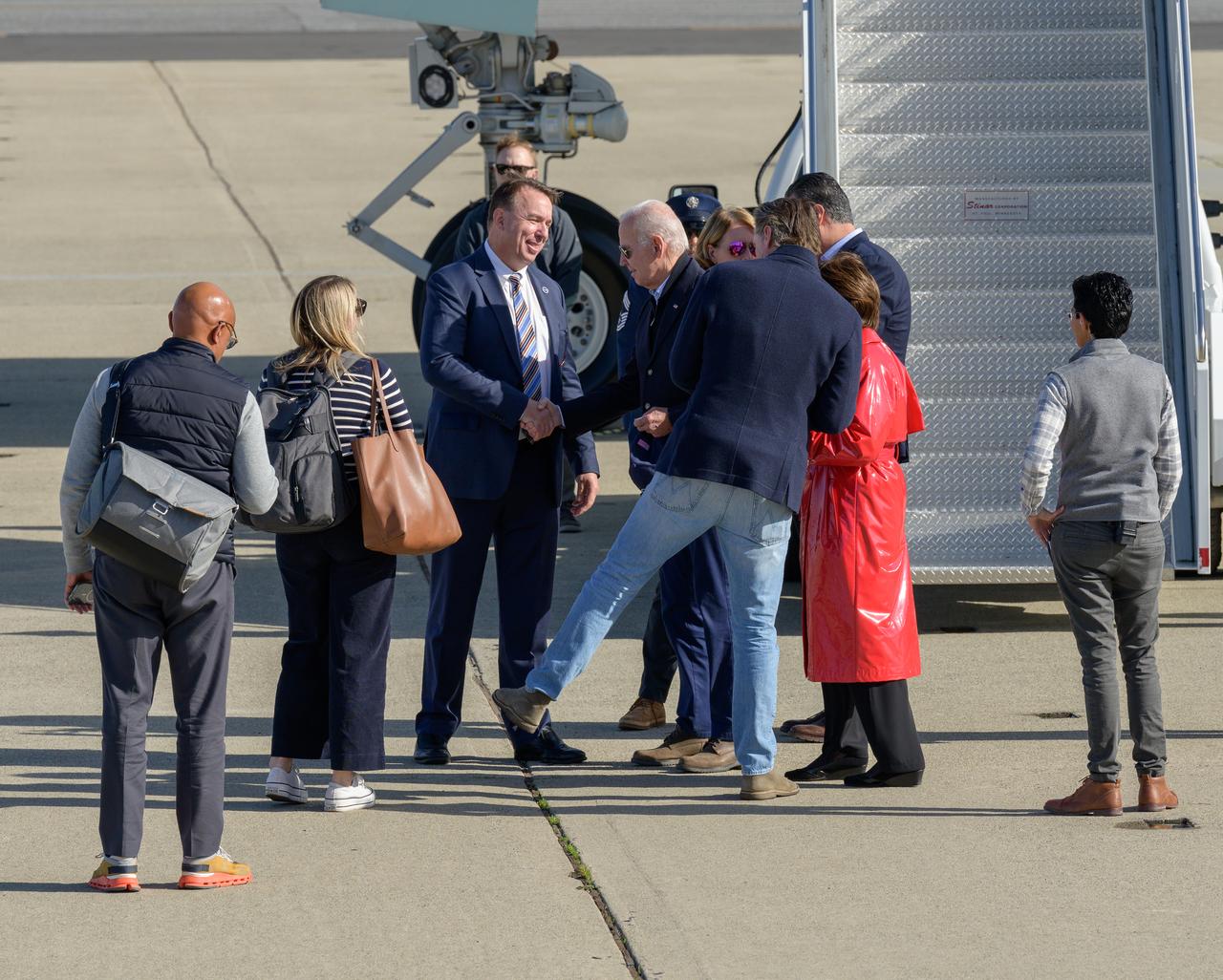
Dr. David Korsmeyer, associate center director for research and technology at Ames, presents an Ames Research Center pin to President Joe Biden in front of Air Force One at Moffett Federal Airfield, near NASA’s Ames Research Center in California’s Silicon Valley, Thursday, Jan. 19, 2023. President Biden was en route to tour recent storm damage in the state.
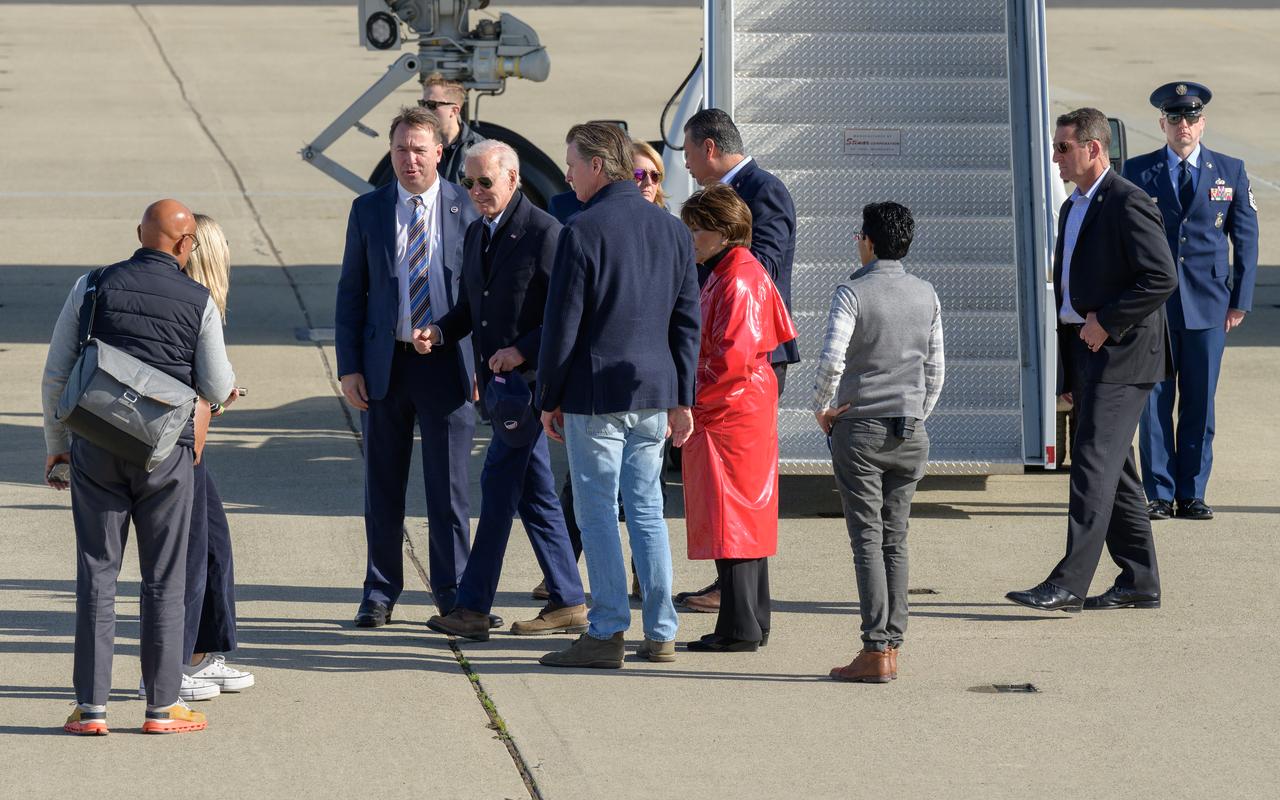
Dr. David Korsmeyer, associate center director for research and technology at Ames, presents an Ames Research Center pin to President Joe Biden in front of Air Force One at Moffett Federal Airfield, near NASA’s Ames Research Center in California’s Silicon Valley, Thursday, Jan. 19, 2023. President Biden was en route to tour recent storm damage in the state.
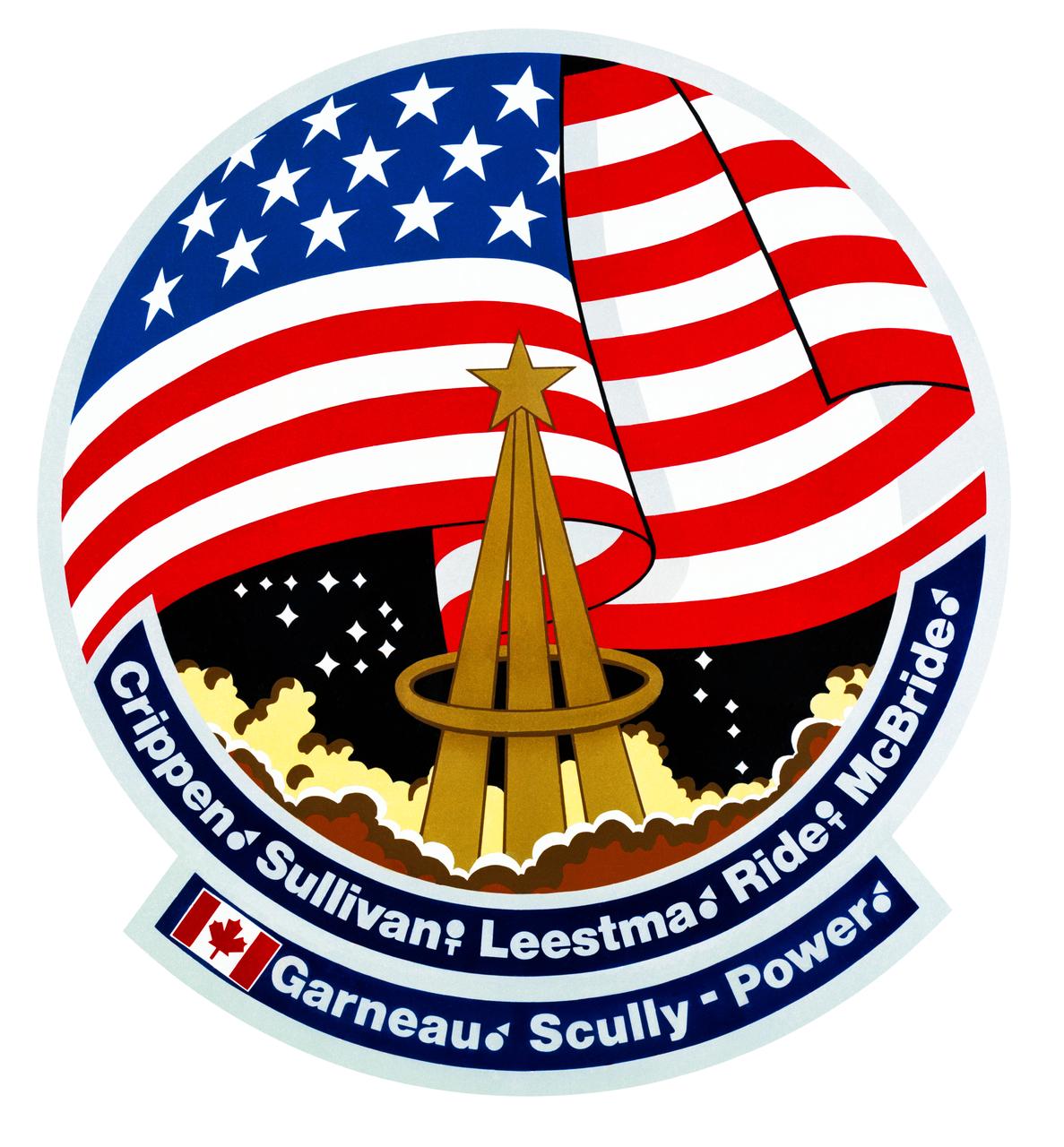
S84-36158 (June 1984) --- The STS-41G Challenger mission insignia focuses on its seven crew members (first to exceed six), the United States flag and the Unity symbol known as the astronaut pin. The pin design in center shows a trio of trajectories merging in infinite space, capped by a bright shining star and encircled by an elliptical wreath denoting orbital flight. Crew members for the (originally-scheduled 17th STS) mission include astronauts Robert L. Crippen and Jon A. McBride, commander and pilot, respectively, whose surnames flank those of the NASA mission specialists - astronauts Kathryn D. Sullivan, David C. Leestma and Sally K. Ride. Paul Scully-Power, a United States Navy oceanographer, and Marc Garneau, a Canadian, join the crew as payload specialists. The artwork was done for NASA by Patrick Rawlings. The NASA insignia design for space shuttle flights is reserved for use by the astronauts and for other official use as the NASA Administrator may authorize. Public availability has been approved only in the forms of illustrations by the various news media. When and if there is any change in this policy, which is not anticipated, the change will be publicly announced. Photo credit: NASA
KENNEDY SPACE CENTER, FLA. -- At a lab at NASA's Kennedy Space Center, the first two of nine pins have been soldered to the socket of the replacement feed-through connector that will be installed in the external fuel tank for space shuttle Atlantis' STS-122 mission. Two United Launch Alliance technicians, who performed this exacting task on the Centaur upper stage for Atlas and Titan launches in 1994, will be doing the soldering. Soldering the connector pins and sockets together addresses the most likely cause of a problem in the engine cutoff sensor system, or ECO system. Some of the tank's ECO sensors failed during propellant tanking for launch attempts on Dec. 6 and Dec. 9. Results of a tanking test on Dec. 18 pointed to an open circuit in the feed-through connector wiring, which is located at the base of the tank. The feed-through connector passes the wires from the inside of the tank to the outside. After the soldering is completed and the connector is reinstalled, shuttle program managers will decide on how to proceed. The launch date for mission STS-122 is under review. Photo credit: NASA/Kim Shiflett
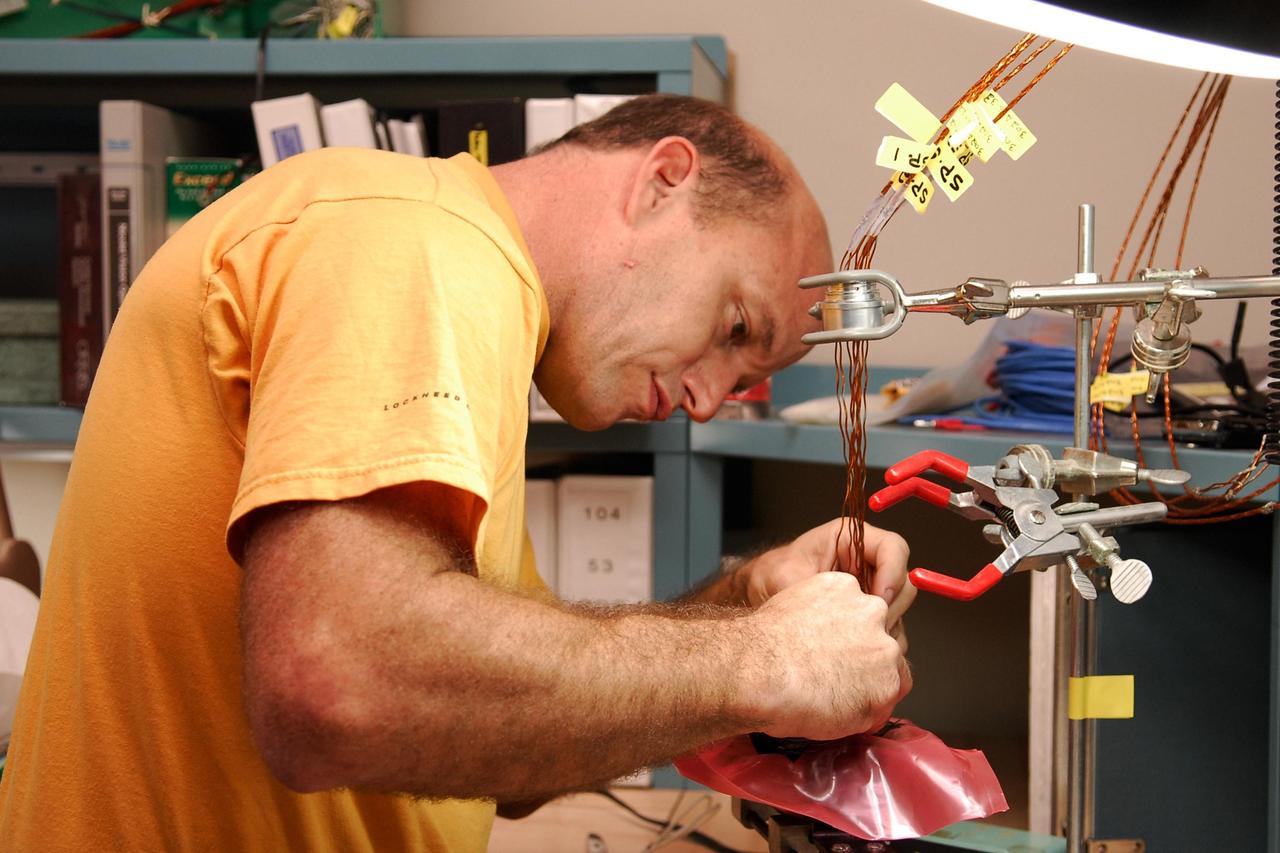
KENNEDY SPACE CENTER, FLA. -- At a lab at NASA's Kennedy Space Center, Kevin Wyckoff, an aerospace technician with the United Launch Alliance, inserts an electrical wiring harness into a replacement feed-through connector during preparations to solder the pins to the socket of the connector. The connector will later be installed in the external fuel tank for space shuttle Atlantis' STS-122 mission. The technician performed this exacting task on the Centaur upper stage for Atlas and Titan launches in 1994 and was specifically chosen for the task. Soldering the connector pins and sockets together addresses the most likely cause of a problem in the engine cutoff sensor system, or ECO system. Some of the tank's ECO sensors failed during propellant tanking for launch attempts on Dec. 6 and Dec. 9. Results of a tanking test on Dec. 18 pointed to an open circuit in the feed-through connector wiring, which is located at the base of the tank. The feed-through connector passes the wires from the inside of the tank to the outside. After the soldering is completed and the connector is reinstalled, shuttle program managers will decide on how to proceed. The launch date for mission STS-122 is under review. Photo credit: NASA/Kim Shiflett
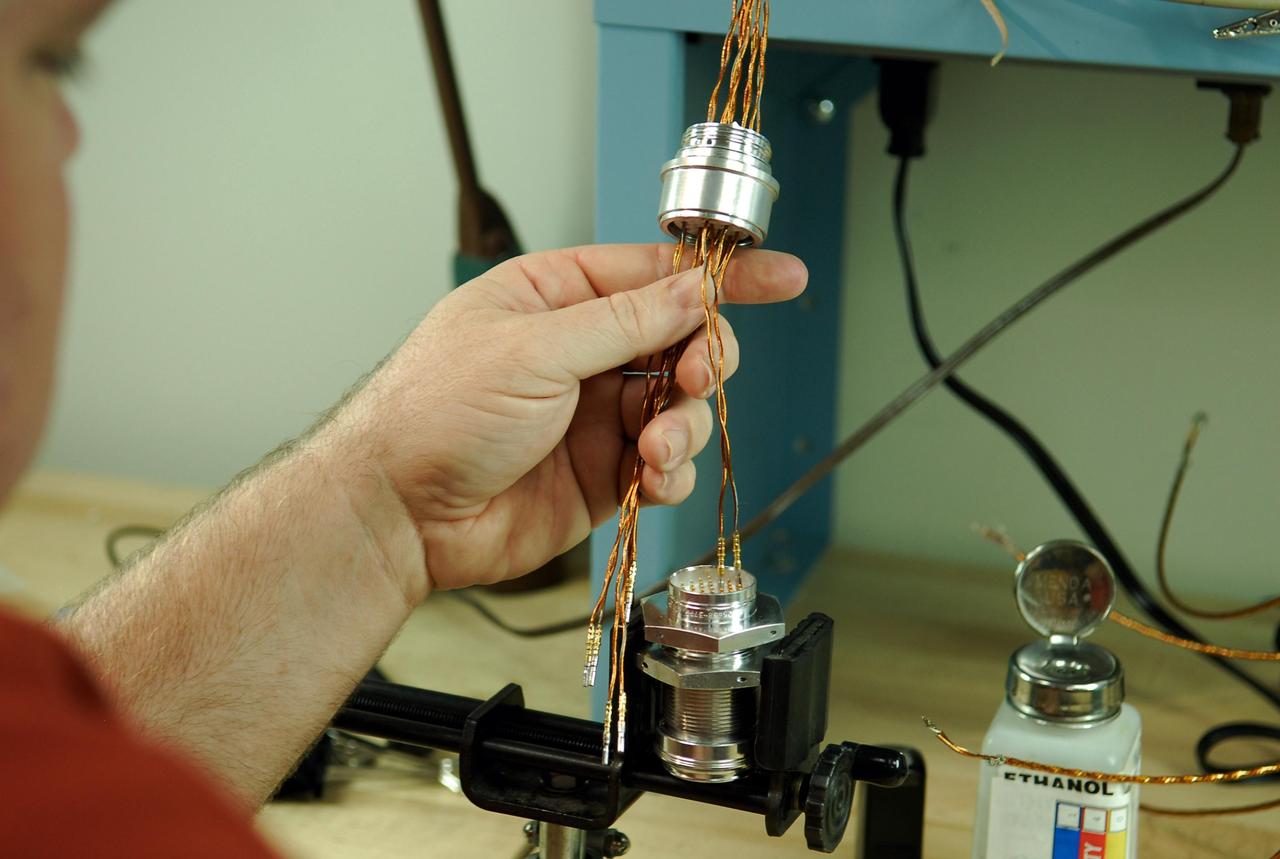
KENNEDY SPACE CENTER, FLA. -- At a lab at NASA's Kennedy Space Center, Bob Arp, an aerospace technician with the United Launch Alliance, examinies the pins remaining to be soldered to the socket of the replacement feed-through connector that will be installed in the external fuel tank for space shuttle Atlantis' STS-122 mission. The technician performed this exacting task on the Centaur upper stage for Atlas and Titan launches in 1994 and was specifically chosen for the task. Soldering the connector pins and sockets together addresses the most likely cause of a problem in the engine cutoff sensor system, or ECO system. Some of the tank's ECO sensors failed during propellant tanking for launch attempts on Dec. 6 and Dec. 9. Results of a tanking test on Dec. 18 pointed to an open circuit in the feed-through connector wiring, which is located at the base of the tank. The feed-through connector passes the wires from the inside of the tank to the outside. After the soldering is completed and the connector is reinstalled, shuttle program managers will decide on how to proceed. The launch date for mission STS-122 is under review. Photo credit: NASA/Kim Shiflett
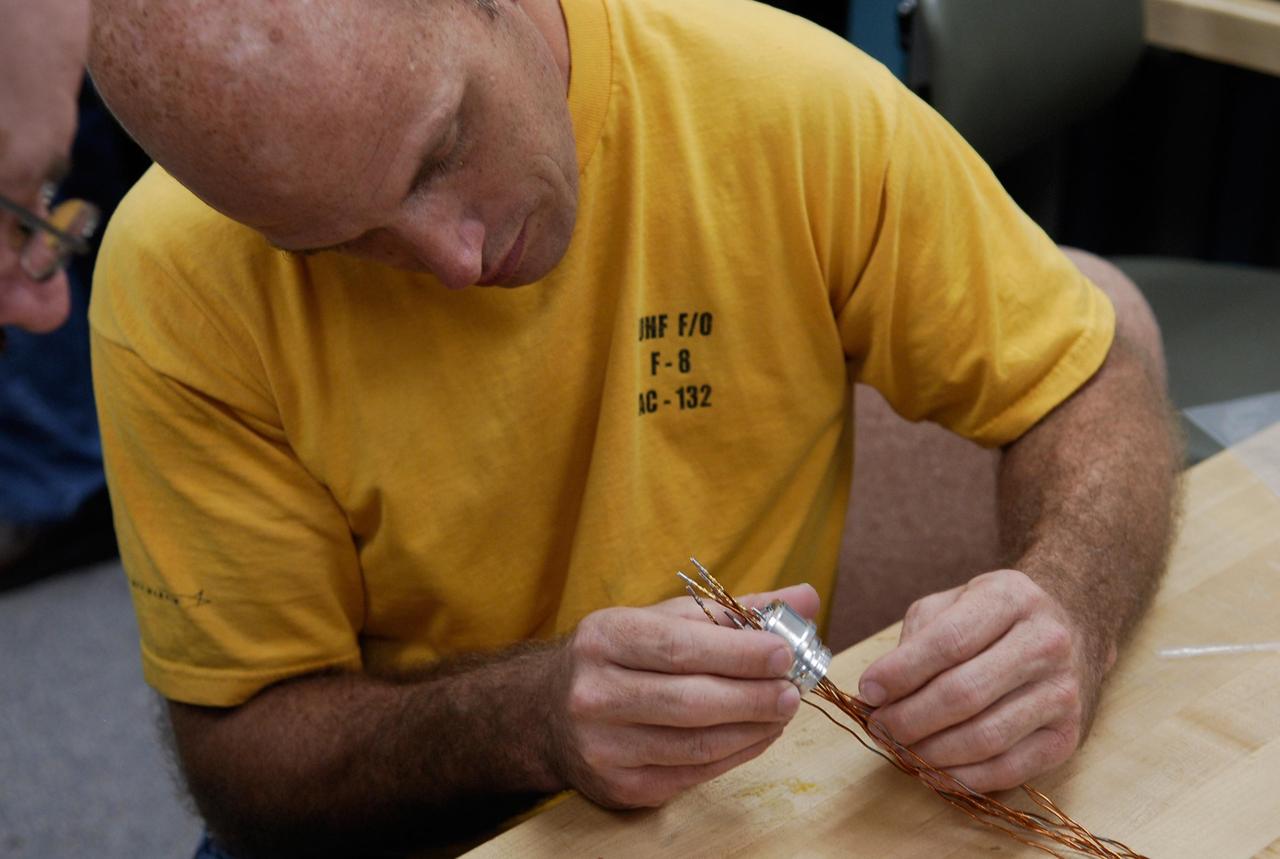
KENNEDY SPACE CENTER, FLA. -- At a lab at NASA's Kennedy Space Center, Kevin Wyckoff, an aerospace technician with the United Launch Alliance, examines an electrical wiring harness. The harness will be inserted into a replacement feed-through connector during preparations to solder the pins to the socket of the connector. The connector will later be installed in the external fuel tank for space shuttle Atlantis' STS-122 mission. The technician performed this exacting task on the Centaur upper stage for Atlas and Titan launches in 1994 and was specifically chosen for the task. Soldering the connector pins and sockets together addresses the most likely cause of a problem in the engine cutoff sensor system, or ECO system. Some of the tank's ECO sensors failed during propellant tanking for launch attempts on Dec. 6 and Dec. 9. Results of a tanking test on Dec. 18 pointed to an open circuit in the feed-through connector wiring, which is located at the base of the tank. The feed-through connector passes the wires from the inside of the tank to the outside. After the soldering is completed and the connector is reinstalled, shuttle program managers will decide on how to proceed. The launch date for mission STS-122 is under review. Photo credit: NASA/Kim Shiflett
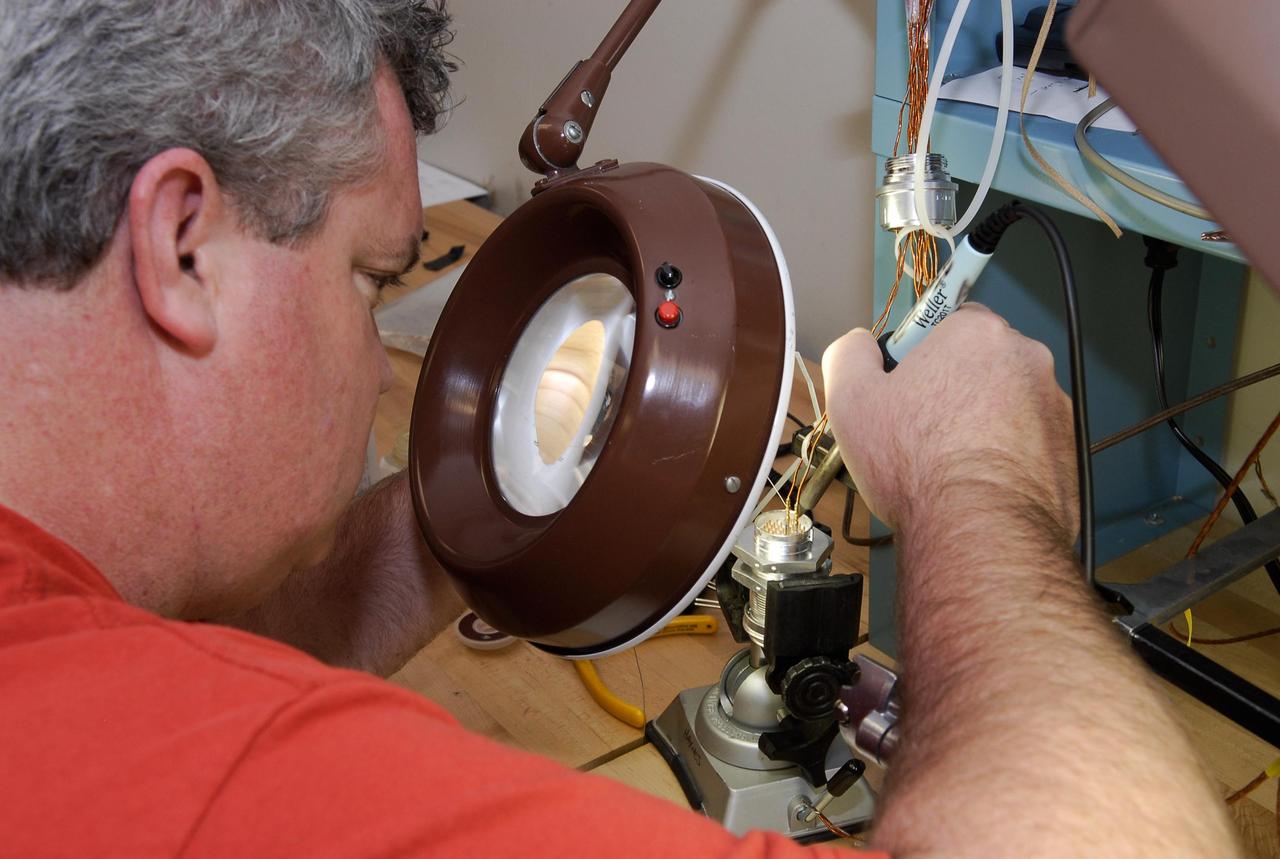
KENNEDY SPACE CENTER, FLA. -- At a lab at NASA's Kennedy Space Center, Bob Arp, an aerospace technician with the United Launch Alliance, solders a pin to the socket of the replacement feed-through connector that will be installed in the external fuel tank for space shuttle Atlantis' STS-122 mission. The technician performed this exacting task on the Centaur upper stage for Atlas and Titan launches in 1994 and was specifically chosen for the task. Soldering the connector pins and sockets together addresses the most likely cause of a problem in the engine cutoff sensor system, or ECO system. Some of the tank's ECO sensors failed during propellant tanking for launch attempts on Dec. 6 and Dec. 9. Results of a tanking test on Dec. 18 pointed to an open circuit in the feed-through connector wiring, which is located at the base of the tank. The feed-through connector passes the wires from the inside of the tank to the outside. After the soldering is completed and the connector is reinstalled, shuttle program managers will decide on how to proceed. The launch date for mission STS-122 is under review. Photo credit: NASA/Kim Shiflett

KENNEDY SPACE CENTER, FLA. -- At a lab at NASA's Kennedy Space Center, the first two of nine pins have been soldered to the socket of the replacement feed-through connector that will be installed in the external fuel tank for space shuttle Atlantis' STS-122 mission. Two United Launch Alliance technicians, who performed this exacting task on the Centaur upper stage for Atlas and Titan launches in 1994, will be doing the soldering. Soldering the connector pins and sockets together addresses the most likely cause of a problem in the engine cutoff sensor system, or ECO system. Some of the tank's ECO sensors failed during propellant tanking for launch attempts on Dec. 6 and Dec. 9. Results of a tanking test on Dec. 18 pointed to an open circuit in the feed-through connector wiring, which is located at the base of the tank. The feed-through connector passes the wires from the inside of the tank to the outside. After the soldering is completed and the connector is reinstalled, shuttle program managers will decide on how to proceed. The launch date for mission STS-122 is under review. Photo credit: NASA/Kim Shiflett

KENNEDY SPACE CENTER, FLA. -- At a lab at NASA's Kennedy Space Center, aerospace technicians with the United Launch Alliance inspect an electrical wiring harness that has been inserted into a replacement feed-through connector during preparations to solder the pins to the socket of the connector that will be installed in the external fuel tank for space shuttle Atlantis' STS-122 mission. The technicians performed this exacting task on the Centaur upper stage for Atlas and Titan launches in 1994 and were specifically chosen for the task. Soldering the connector pins and sockets together addresses the most likely cause of a problem in the engine cutoff sensor system, or ECO system. Some of the tank's ECO sensors failed during propellant tanking for launch attempts on Dec. 6 and Dec. 9. Results of a tanking test on Dec. 18 pointed to an open circuit in the feed-through connector wiring, which is located at the base of the tank. The feed-through connector passes the wires from the inside of the tank to the outside. After the soldering is completed and the connector is reinstalled, shuttle program managers will decide on how to proceed. The launch date for mission STS-122 is under review. Photo credit: NASA/Kim Shiflett
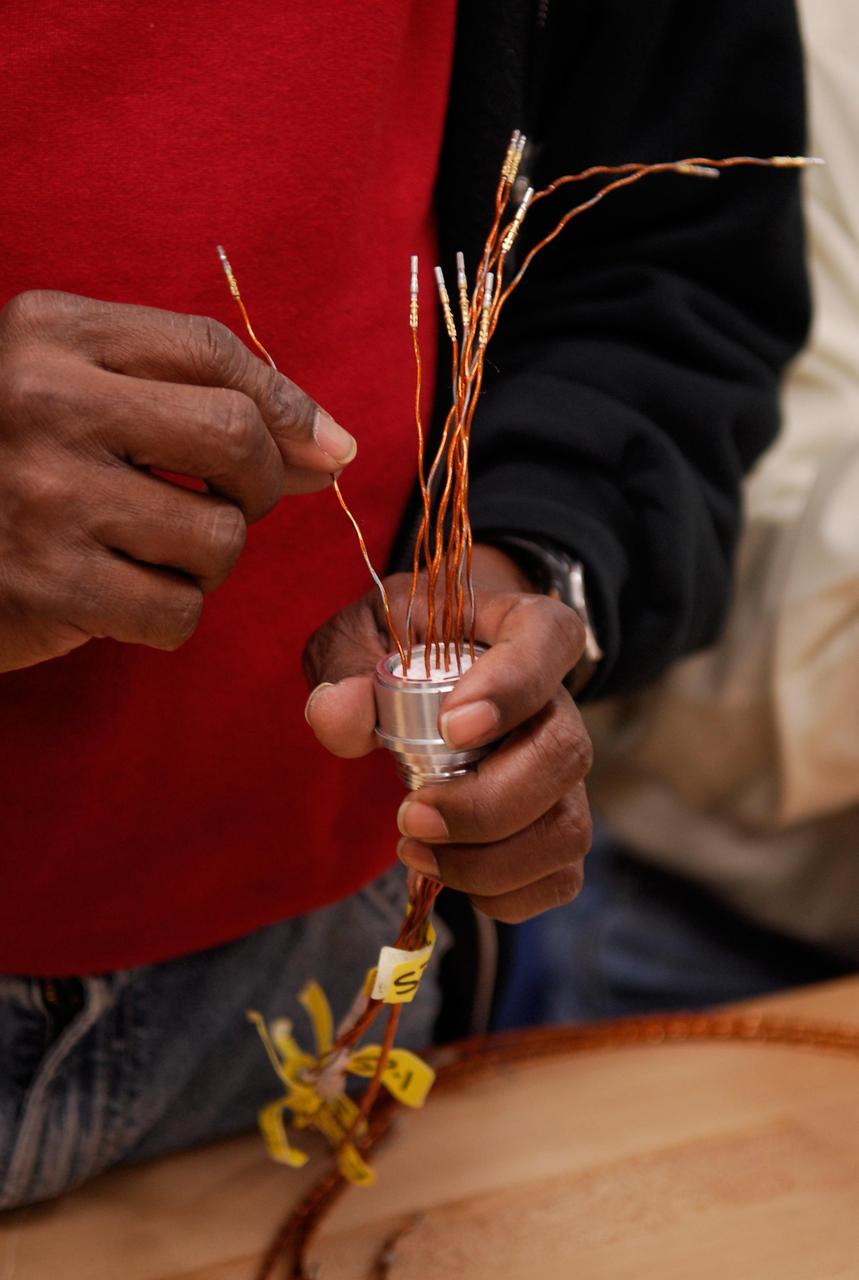
KENNEDY SPACE CENTER, FLA. -- At a lab at NASA's Kennedy Space Center, a Lockheed Martin technician prepares an electrical wiring harness during a procedure to solder the pins to the socket of the replacement feed-through connector that will be installed in the external fuel tank for space shuttle Atlantis' STS-122 mission. Two United Launch Alliance technicians, who performed this exacting task on the Centaur upper stage for Atlas and Titan launches in 1994, will be doing the soldering. Soldering the connector pins and sockets together addresses the most likely cause of a problem in the engine cutoff sensor system, or ECO system. Some of the tank's ECO sensors failed during propellant tanking for launch attempts on Dec. 6 and Dec. 9. Results of a tanking test on Dec. 18 pointed to an open circuit in the feed-through connector wiring, which is located at the base of the tank. The feed-through connector passes the wires from the inside of the tank to the outside. After the soldering is completed and the connector is reinstalled, shuttle program managers will decide on how to proceed. The launch date for mission STS-122 is under review. Photo credit: NASA/Kim Shiflett
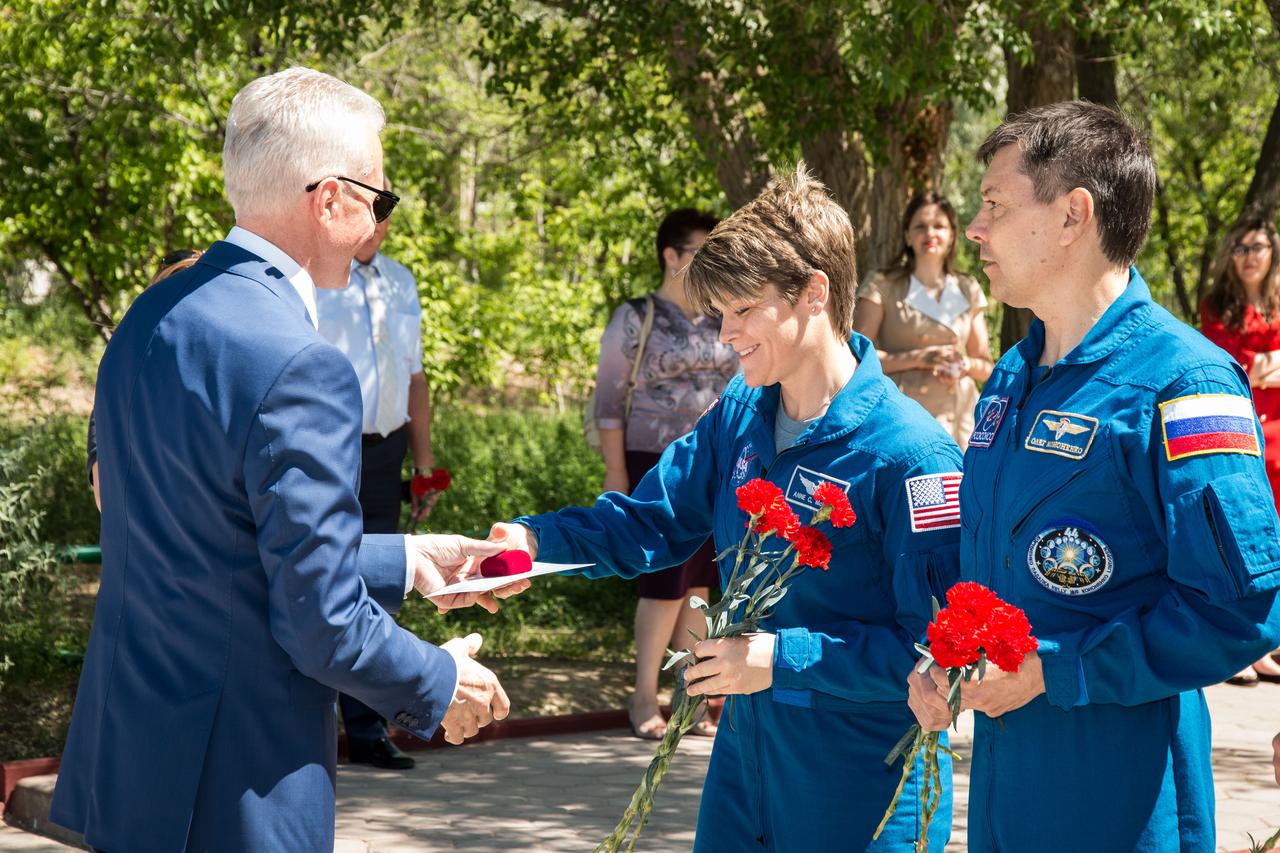
jsc2018e050015 - At the Cosmonaut Hotel crew quarters in Baikonur, Kazakhstan, Expedition 56 backup crewmember Anne McClain of NASA receives a silver pin bearing an emblem of the town from a local official as crewmate Oleg Kononenko of Roscosmos looks on. Along with David Saint-Jacques of the Canadian Space Agency, they are serving as backups to the prime crew, Serena Aunon-Chancellor of NASA, Sergey Prokopyev of Roscosmos and Alexander Gerst of the European Space Agency, who will launch June 6 on the Soyuz MS-09 spacecraft from Baikonur for a six-month mission on the International Space Station...NASA/Victor Zelentsov.

C-20A crew chief Isac Mata stows metal pins used to secure the landing gear, while Ian Elkin, operations engineer, boards the aircraft to prepare for takeoff from NASA’s Armstrong Flight Research Center in Edwards, California, on Wednesday, April 29, 2026. The aircraft conducted science flights over Central California carrying NASA’s UAVSAR (Uninhabited Aerial Vehicle Synthetic Aperture Radar), which collects detailed ground‑movement data to improve earthquake‑hazard models and support a new Earth‑observing satellite.
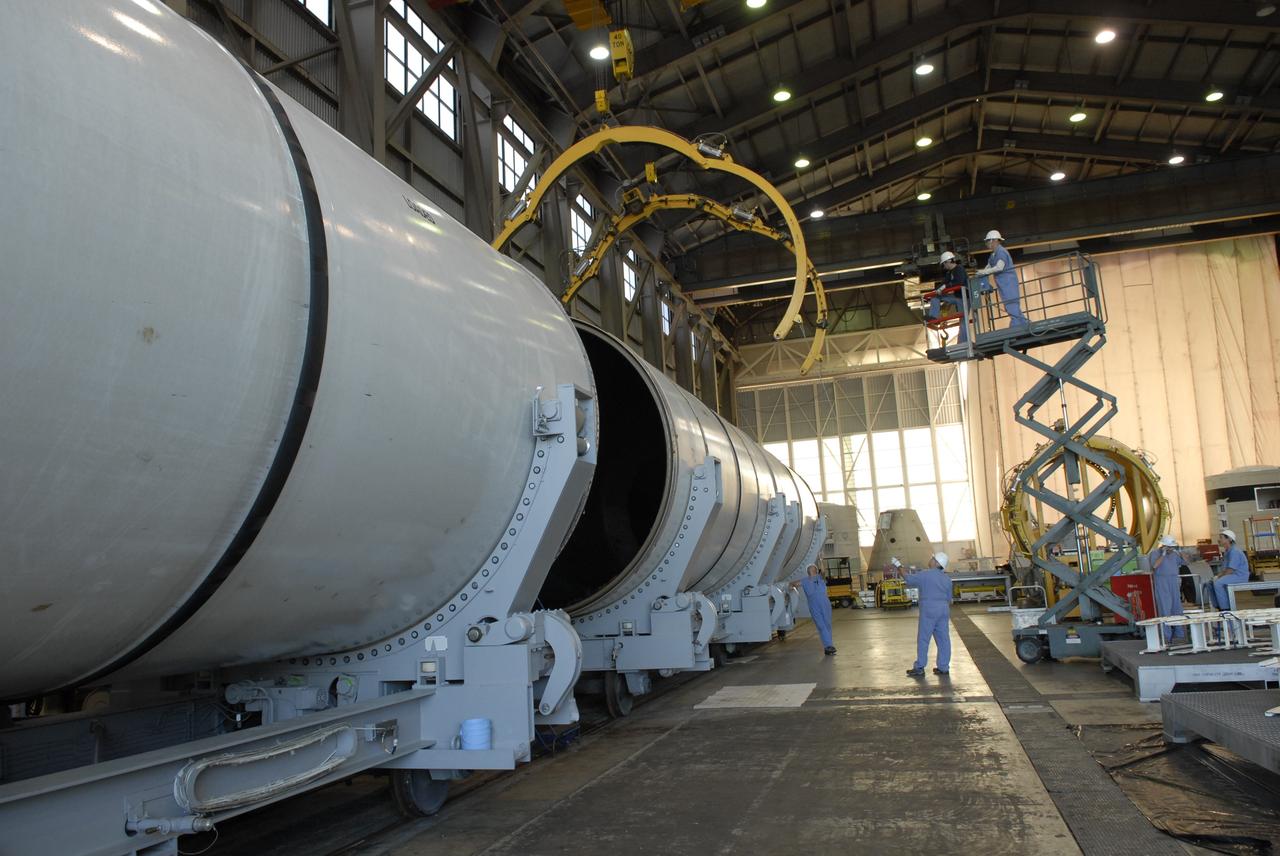
CAPE CANAVERAL, Fla. -- In Hangar AF at Cape Canaveral, Fla., separation rings are moved above two segments of one of the retrieved solid rocket boosters from the STS-126 launch. The rings will be lowered and locked around the segments. The pins attaching the segments to each other are removed at the start. Each separation ring has three joints that help mold the ring around the segment and an air motor is used to rotate the rings to separate the segments. After disassembly, the segments will be sent to ATK (Alliant Techsystems) in Utah for final processing and return to Kennedy for another shuttle launch. Photo credit: NASA/Jack Pfaller

jsc2017e110803 (Aug. 21, 2017) --- Employees at NASA’s Johnson Space Center in Houston joined the rest of the country in experiencing the 2017 eclipse on Aug. 21, 2017. Many used protective eclipse glasses, and others made use of manufactured or pin-hole cameras of opportunity to view the eclipse. In Houston, the partial eclipse duration was 2 hours, 59 minutes, reaching its maximum level of 67 percent at 1:17 p.m. CDT. Some members of the team supporting the International Space Station in the Christopher C. Kraft Mission Control Center took advantage of a break in their duties to step outside the windowless building to witness what their colleagues in orbit also saw and documented with a variety of cameras.
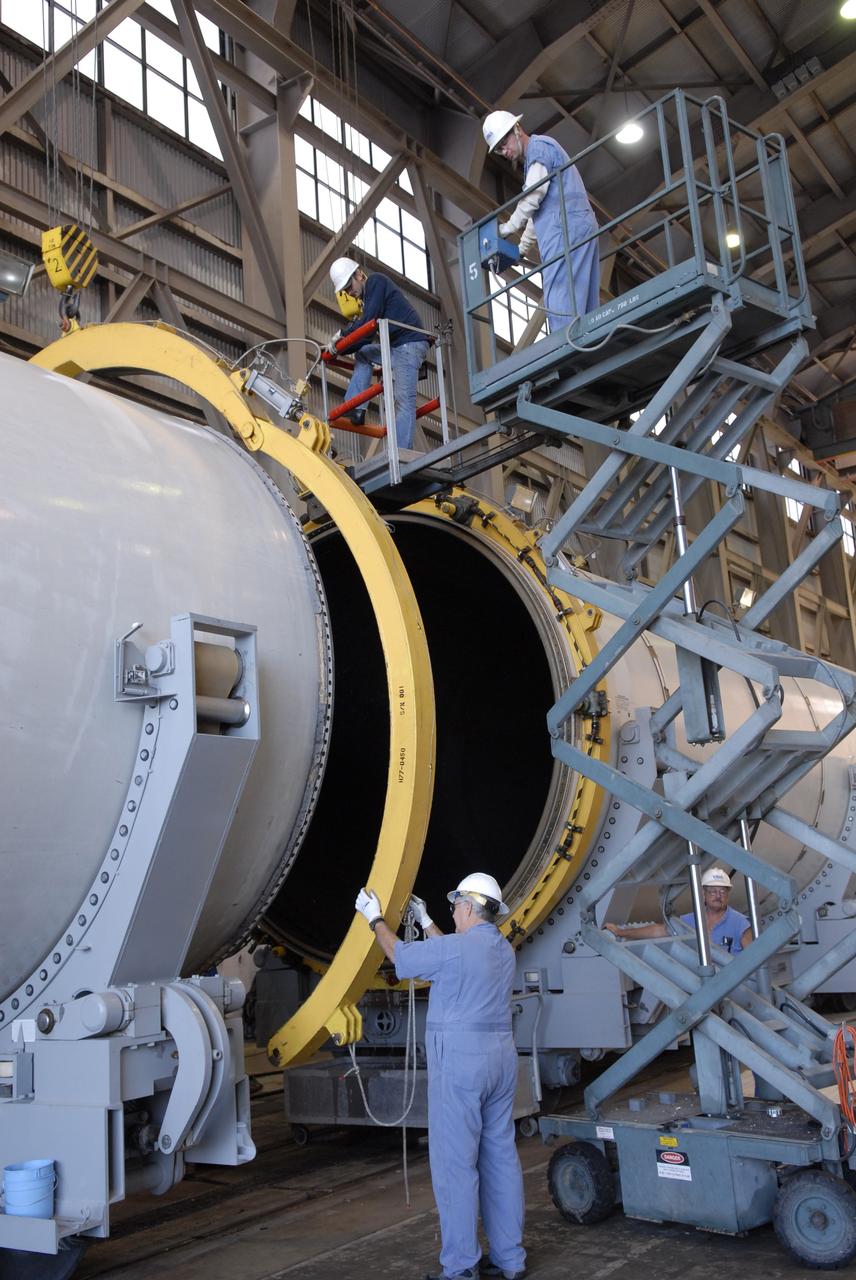
CAPE CANAVERAL, Fla. -- In Hangar AF at Cape Canaveral, Fla., workers again remove separation rings from around segments of one of the retrieved solid rocket boosters from the STS-126 launch. The pins attaching the segments to each other are removed at the start. Each separation ring has three joints that help mold the ring around the segment and an air motor is used to rotate the rings to separate the segments. After disassembly, the segments will be sent to ATK (Alliant Techsystems) in Utah for final processing and return to Kennedy for another shuttle launch. Photo credit: NASA/Jack Pfaller
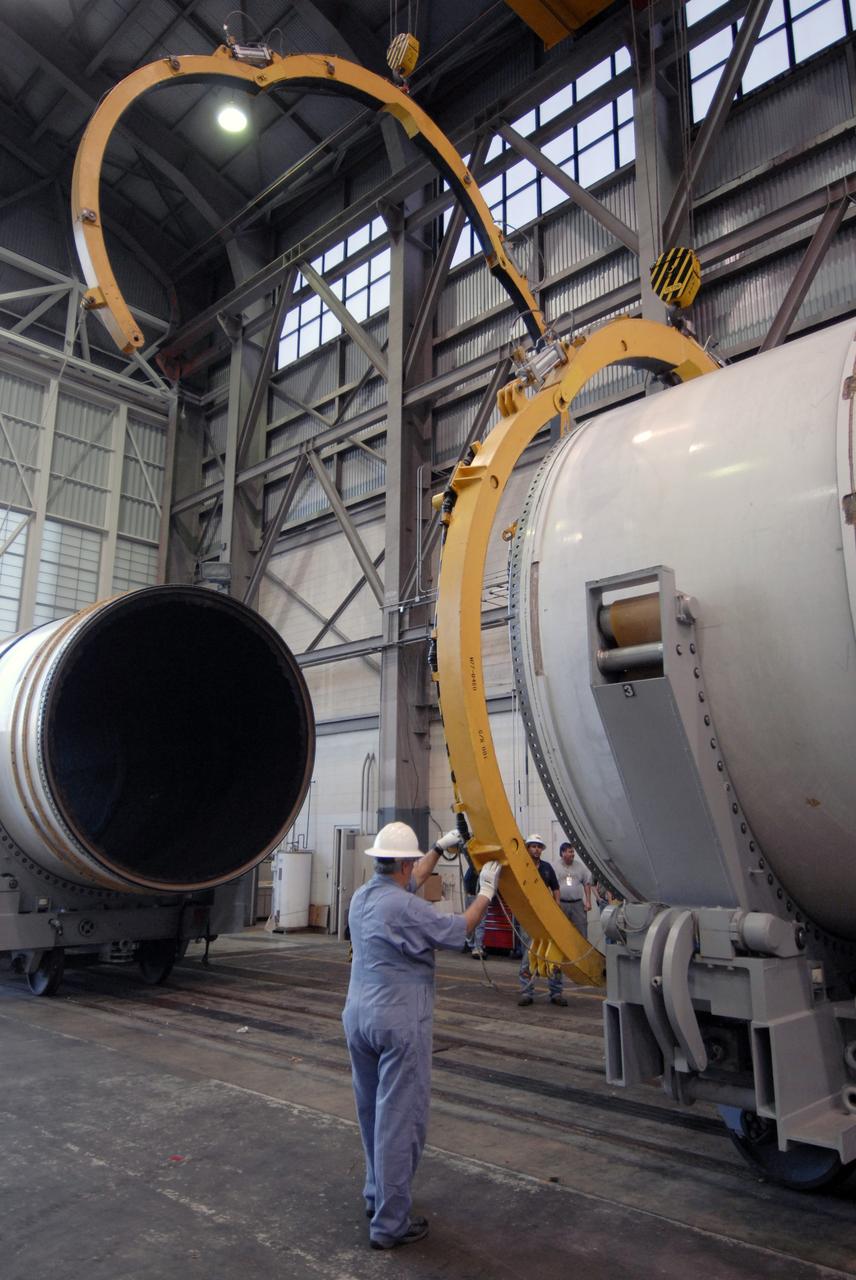
CAPE CANAVERAL, Fla. -- In Hangar AF at Cape Canaveral, Fla., workers remove the separation rings from around a segment of one of the retrieved solid rocket boosters from the STS-126 launch. The pins attaching the segments to each other are removed at the start. Each separation ring has three joints that help mold the ring around the segment and an air motor is used to rotate the rings to separate the segments. After disassembly, the segments will be sent to ATK (Alliant Techsystems) in Utah for final processing and return to Kennedy for another shuttle launch. Photo credit: NASA/Jack Pfaller
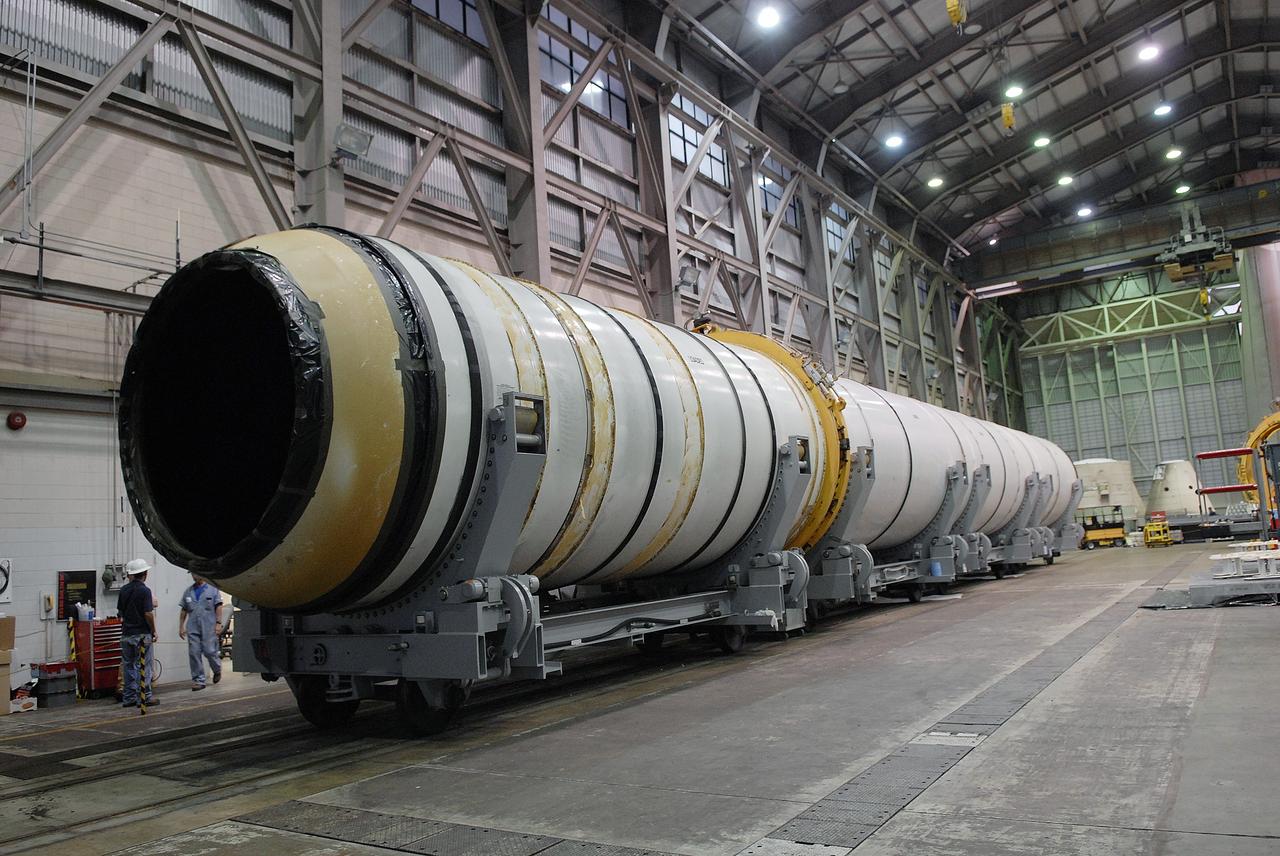
CAPE CANAVERAL, Fla. -- In Hangar AF at Cape Canaveral, Fla., one of the retrieved solid rocket boosters from the STS-126 launch is ready to be disassembled. Separation rings will be used to move the segments apart. The pins attaching the segments to each other are removed at the start. Each separation ring has three joints that help mold the ring around the seg¬ment and an air motor is used to rotate the rings to separate the segments. After disassembly, the segments will be sent to ATK (Alliant Techsystems) in Utah for final processing and return to Kennedy for another shuttle launch. Photo credit: NASA/Jack Pfaller

jsc2017e110808 (Aug. 21, 2017) --- Employees at NASA’s Johnson Space Center in Houston joined the rest of the country in experiencing the 2017 eclipse on Aug. 21, 2017. Many used protective eclipse glasses, and others made use of manufactured or pin-hole cameras of opportunity to view the eclipse. In Houston, the partial eclipse duration was 2 hours, 59 minutes, reaching its maximum level of 67 percent at 1:17 p.m. CDT. Some members of the team supporting the International Space Station in the Christopher C. Kraft Mission Control Center took advantage of a break in their duties to step outside the windowless building to witness what their colleagues in orbit also saw and documented with a variety of cameras.

CAPE CANAVERAL, Fla. -- In Hangar AF at Cape Canaveral, Fla., workers separate segments of one of the retrieved solid rocket boosters from the STS-126 launch. The pins attaching the segments to each other are removed at the start. Each separation ring has three joints that help mold the ring around the segment and an air motor is used to rotate the rings to separate the segments. After disassembly, the segments will be sent to ATK (Alliant Techsystems) in Utah for final processing and return to Kennedy for another shuttle launch. Photo credit: NASA/Jack Pfaller
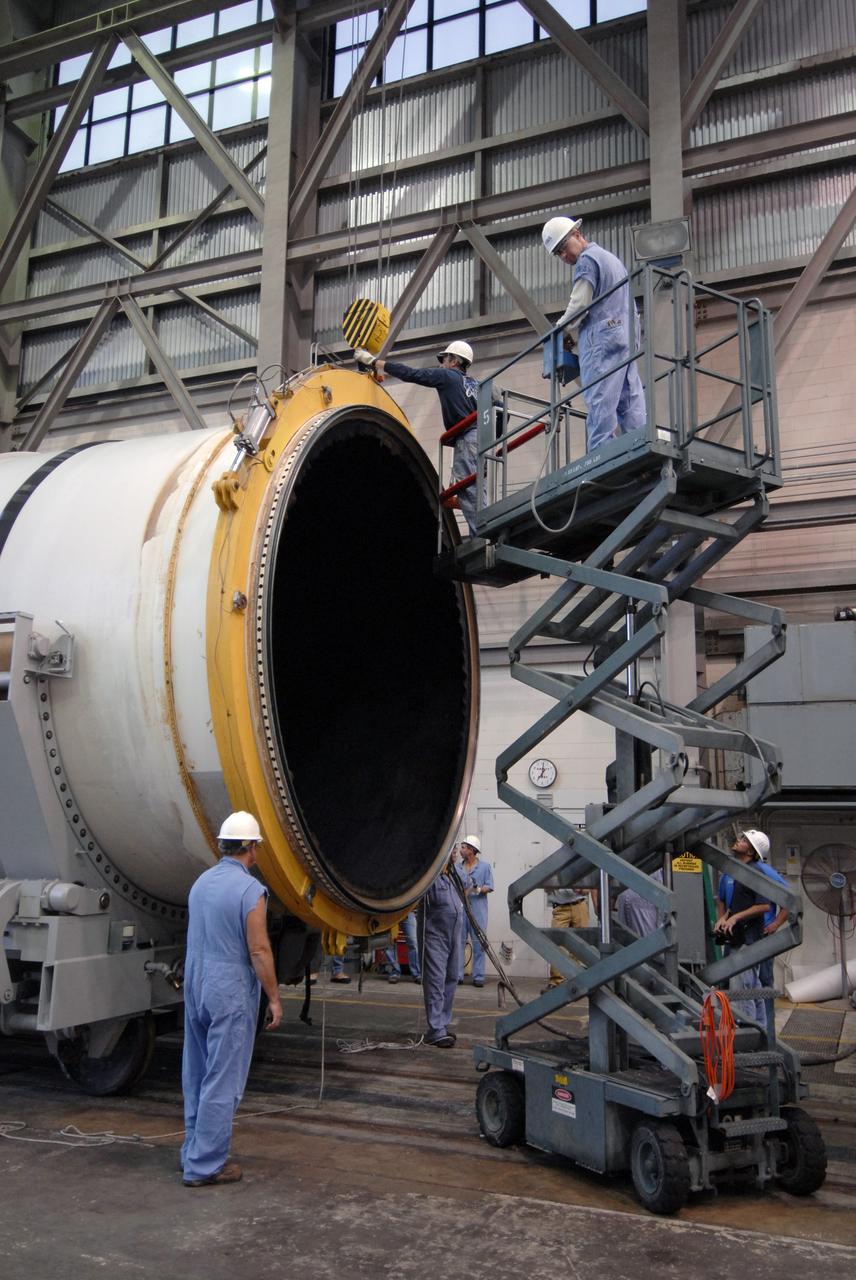
CAPE CANAVERAL, Fla. -- In Hangar AF at Cape Canaveral, Fla., workers get ready to remove one of the separation rings from around a segment of one of the retrieved solid rocket boosters from the STS-126 launch. The pins attaching the segments to each other are removed at the start. Each separation ring has three joints that help mold the ring around the segment and an air motor is used to rotate the rings to separate the segments. After disassembly, the segments will be sent to ATK (Alliant Techsystems) in Utah for final processing and return to Kennedy for another shuttle launch. Photo credit: NASA/Jack Pfaller
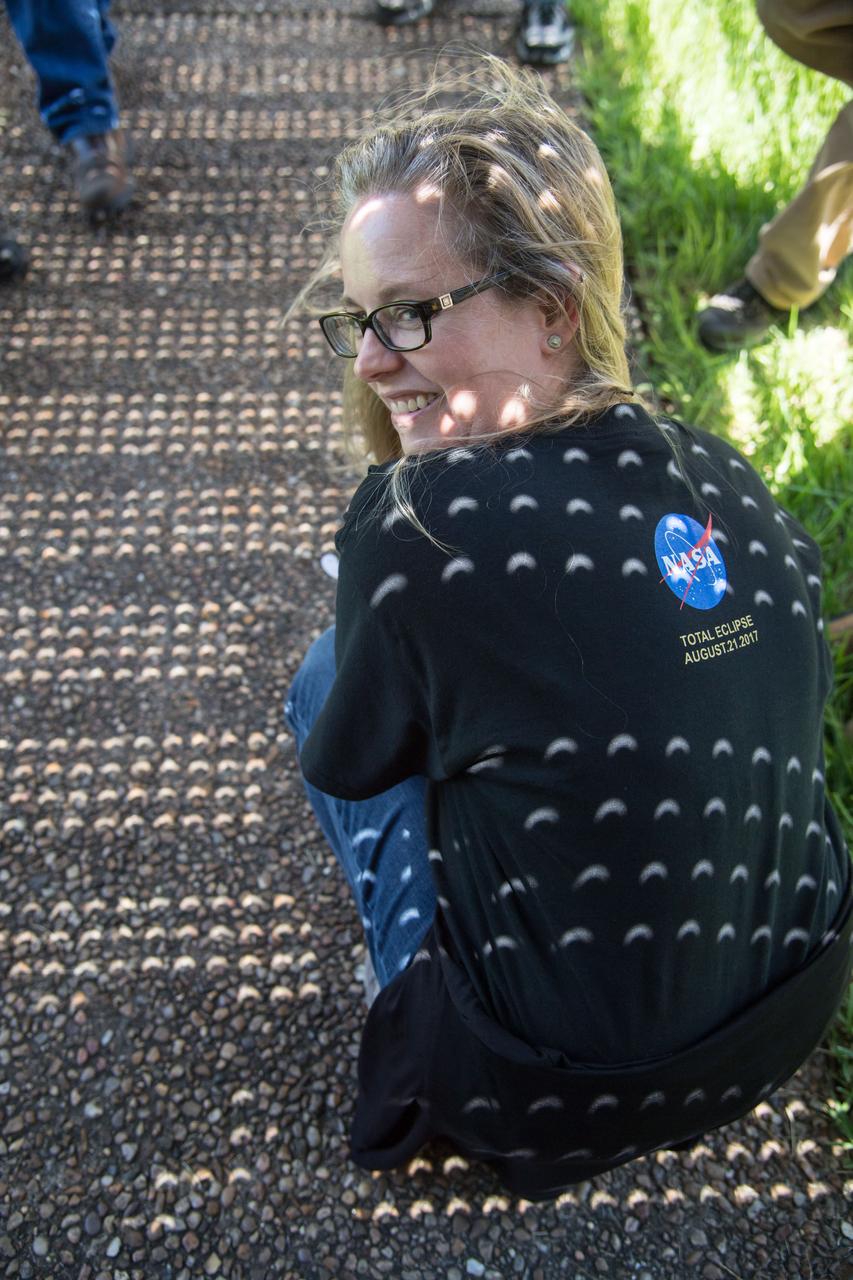
jsc2017e110791 (Aug. 21, 2017) --- Employees at NASA’s Johnson Space Center in Houston joined the rest of the country in experiencing the 2017 eclipse on Aug. 21, 2017. Many used protective eclipse glasses, and others made use of manufactured or pin-hole cameras of opportunity to view the eclipse. In Houston, the partial eclipse duration was 2 hours, 59 minutes, reaching its maximum level of 67 percent at 1:17 p.m. CDT. Some members of the team supporting the International Space Station in the Christopher C. Kraft Mission Control Center took advantage of a break in their duties to step outside the windowless building to witness what their colleagues in orbit also saw and documented with a variety of cameras.

jsc2017e110783 (Aug. 21, 2017) --- Employees at NASA’s Johnson Space Center in Houston joined the rest of the country in experiencing the 2017 eclipse on Aug. 21, 2017. Many used protective eclipse glasses, and others made use of manufactured or pin-hole cameras of opportunity to view the eclipse. In Houston, the partial eclipse duration was 2 hours, 59 minutes, reaching its maximum level of 67 percent at 1:17 p.m. CDT. Some members of the team supporting the International Space Station in the Christopher C. Kraft Mission Control Center took advantage of a break in their duties to step outside the windowless building to witness what their colleagues in orbit also saw and documented with a variety of cameras.
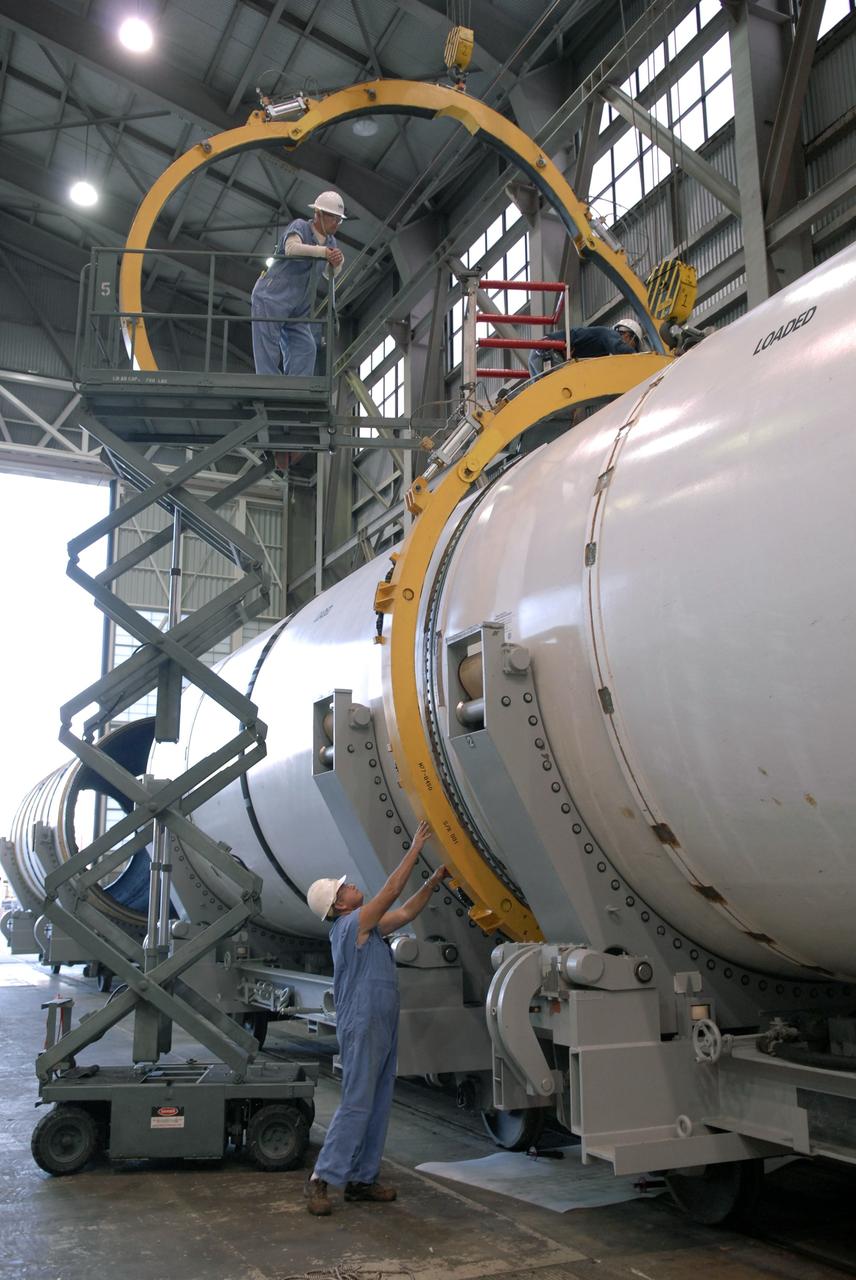
CAPE CANAVERAL, Fla. -- In Hangar AF at Cape Canaveral, Fla., workers put separation rings around segments of one of the retrieved solid rocket boosters from the STS-126 launch. The pins attaching the segments to each other are removed at the start. Each separation ring has three joints that help mold the ring around the segment and an air motor is used to rotate the rings to separate the segments. After disassembly, the segments will be sent to ATK (Alliant Techsystems) in Utah for final processing and return to Kennedy for another shuttle launch. Photo credit: NASA/Jack Pfaller
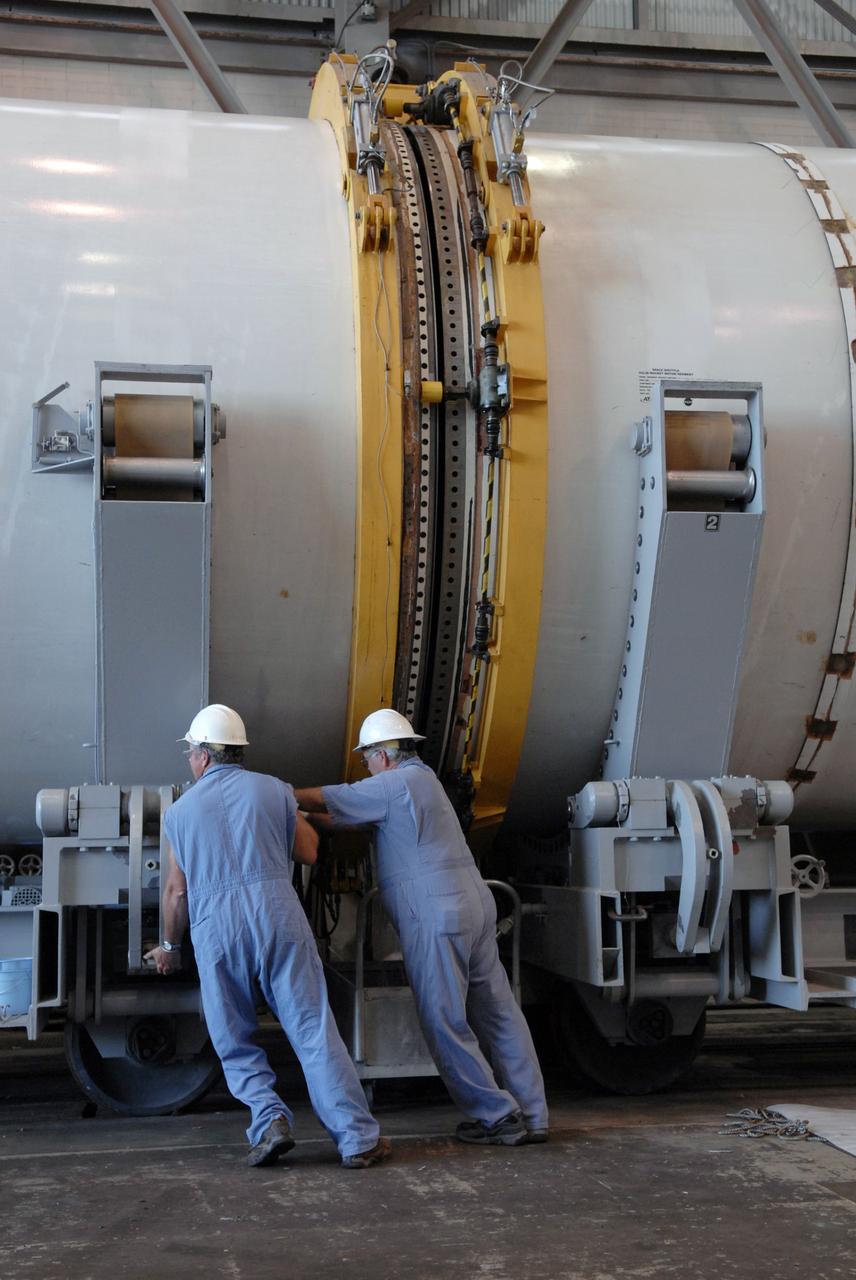
CAPE CANAVERAL, Fla. -- In Hangar AF at Cape Canaveral, Fla., with separation rings in place, workers begin to move apart segments of one of the retrieved solid rocket boosters from the STS-126 launch. The pins attaching the segments to each other are removed at the start. Each separation ring has three joints that help mold the ring around the segment and an air motor is used to rotate the rings to separate the segments. After disassembly, the segments will be sent to ATK (Alliant Techsystems) in Utah for final processing and return to Kennedy for another shuttle launch. Photo credit: NASA/Jack Pfaller
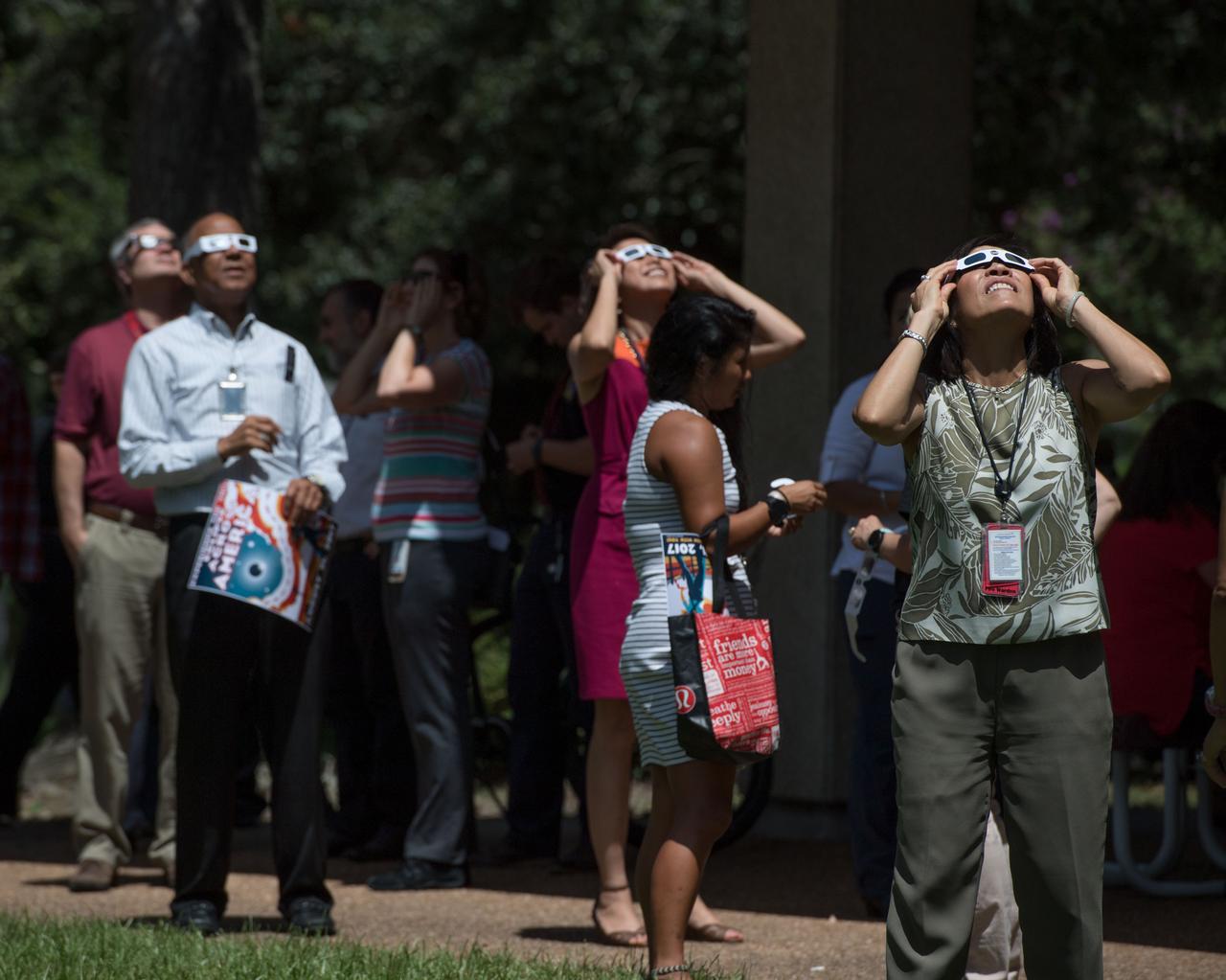
jsc2017e110798 (Aug. 21, 2017) --- Employees at NASA’s Johnson Space Center in Houston joined the rest of the country in experiencing the 2017 eclipse on Aug. 21, 2017. Many used protective eclipse glasses, and others made use of manufactured or pin-hole cameras of opportunity to view the eclipse. In Houston, the partial eclipse duration was 2 hours, 59 minutes, reaching its maximum level of 67 percent at 1:17 p.m. CDT. Some members of the team supporting the International Space Station in the Christopher C. Kraft Mission Control Center took advantage of a break in their duties to step outside the windowless building to witness what their colleagues in orbit also saw and documented with a variety of cameras.

On National Wreaths Across America Day, items are seen on top of the headstone of the Extortion 17, service members who lost their lives during a tour of duty in Afghanistan, Sat., Dec. 14, 2019 at Arlington National Cemetery in Arlington, Va. National Wreaths Across America Day is held annually to celebrate the lives of military veterans. NASA astronaut Doug Wheelock served with the Extortion 17 and honored them as well as those who lost their lives in the quest for space exploration by laying wreaths at their headstones and at the memorial sites. Photo Credit: (NASA/Aubrey Gemignani)
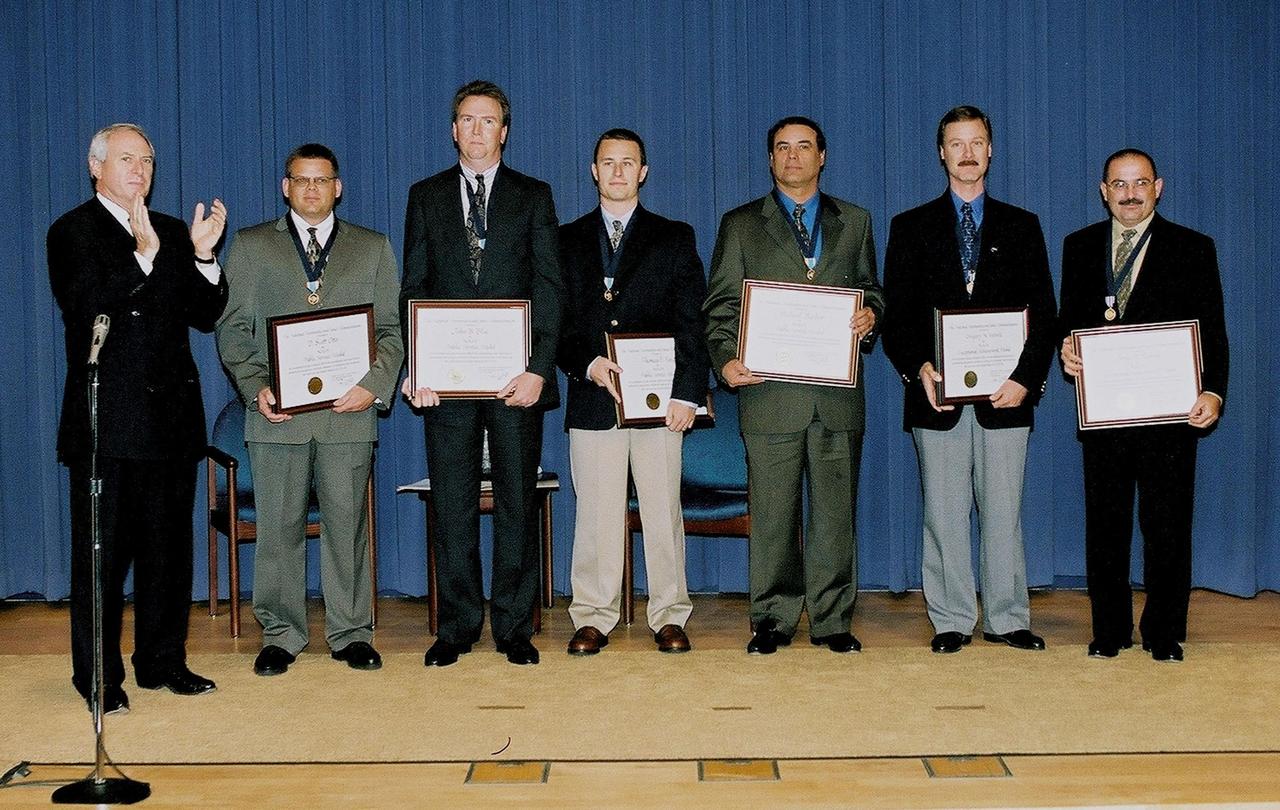
NASA Administrator Daniel Goldin (left) applauds the Space Shuttle ice and debris inspection team who were recognized for their keen safety observations prior to the launch of Space Shuttle Discovery. Standing next to Goldin are (left to right) D. Scott Otto, with Lockheed Martin Space Services Company; John B. Blue, Thomas F. Ford and Michael Barber, with United Space Alliance; Gregory N. Katnik and Jorge E. Rivera, with NASA. Katnick and Rivera received the agency’s Exceptional Achievement Medal; Barber, Blue, Ford and Otto received the NASA Public Service Medal. While scanning the launch pad before launch, the team found a stray 4-inch pin near the Shuttle’s external fuel tank that could have caused damage during launch. Discovery was safely launched the next day, on Oct. 11
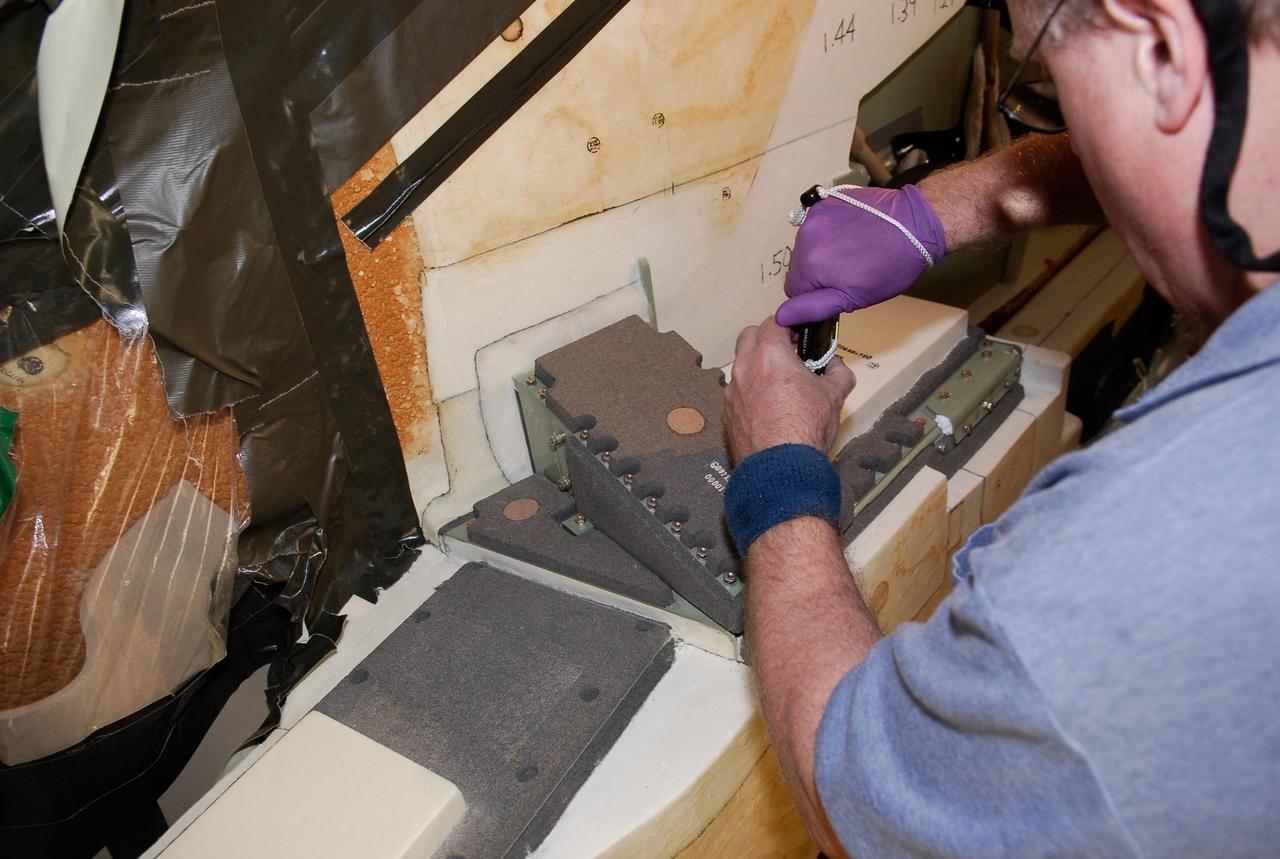
KENNEDY SPACE CENTER, FLA. -- On Launch Pad 39A at NASA's Kennedy Space Center, a technician completes installing the cover over the engine cutoff, or ECO, sensor system connector and wiring on space shuttle Atlantis' external tank. The feed-through connector passes the wires from the inside of the tank to the outside. Results of a tanking test on Dec. 18 pointed to an open circuit in the feed-through connector wiring, which is located at the base of the tank. The pins in the replacement connector were precisely soldered to create a connection that allows sensors inside the tank to send signals to the computers onboard Atlantis. The launch date for the shuttle's STS-122 mission has now been targeted for Feb. 7. Photo credit: NASA/Kim Shiflett
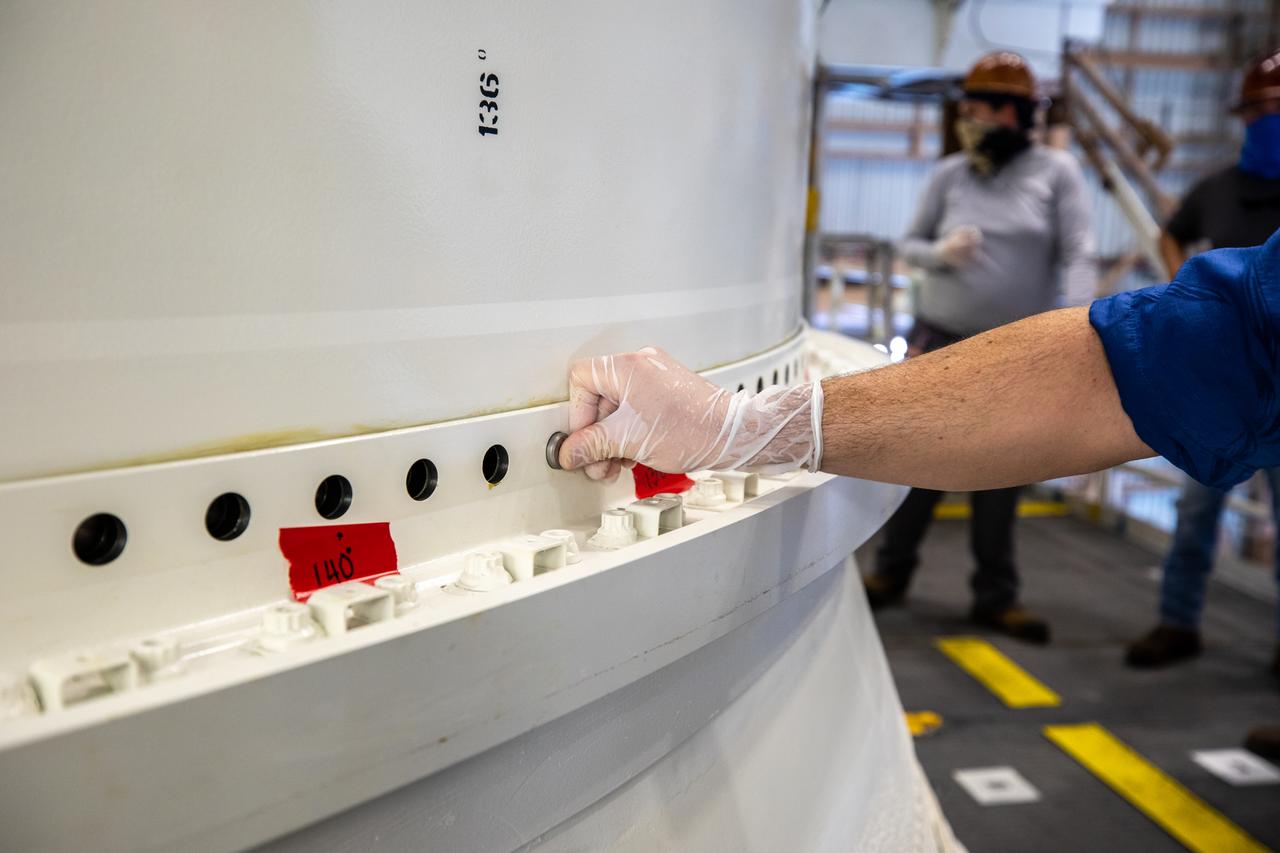
Inside the Rotation, Processing and Surge Facility at NASA’s Kennedy Space Center in Florida, Pablo Martinez, a handling, mechanical and structures engineer on the Jacobs Technology Inc. Test and Operations Support Contract, inserts the first of many pins that will secure the Space Launch System’s (SLS) right-hand motor segment to the rocket’s right-hand aft skirt. The right-hand motor segment is one of five segments that makes up one of two solid rocket boosters. Once the aft segments are mated to the two aft skirts, they will be moved to the Vehicle Assembly Building for stacking on the mobile launcher. Manufactured by Northrop Grumman in Utah, the twin boosters provide more than 75 percent of the total SLS thrust at launch. Under the Artemis program, NASA will land the first woman and the next man on the Moon by 2024. The first in a series of increasingly complex missions, Artemis I will test the Orion spacecraft and SLS as an integrated system ahead of crewed flights to the Moon.
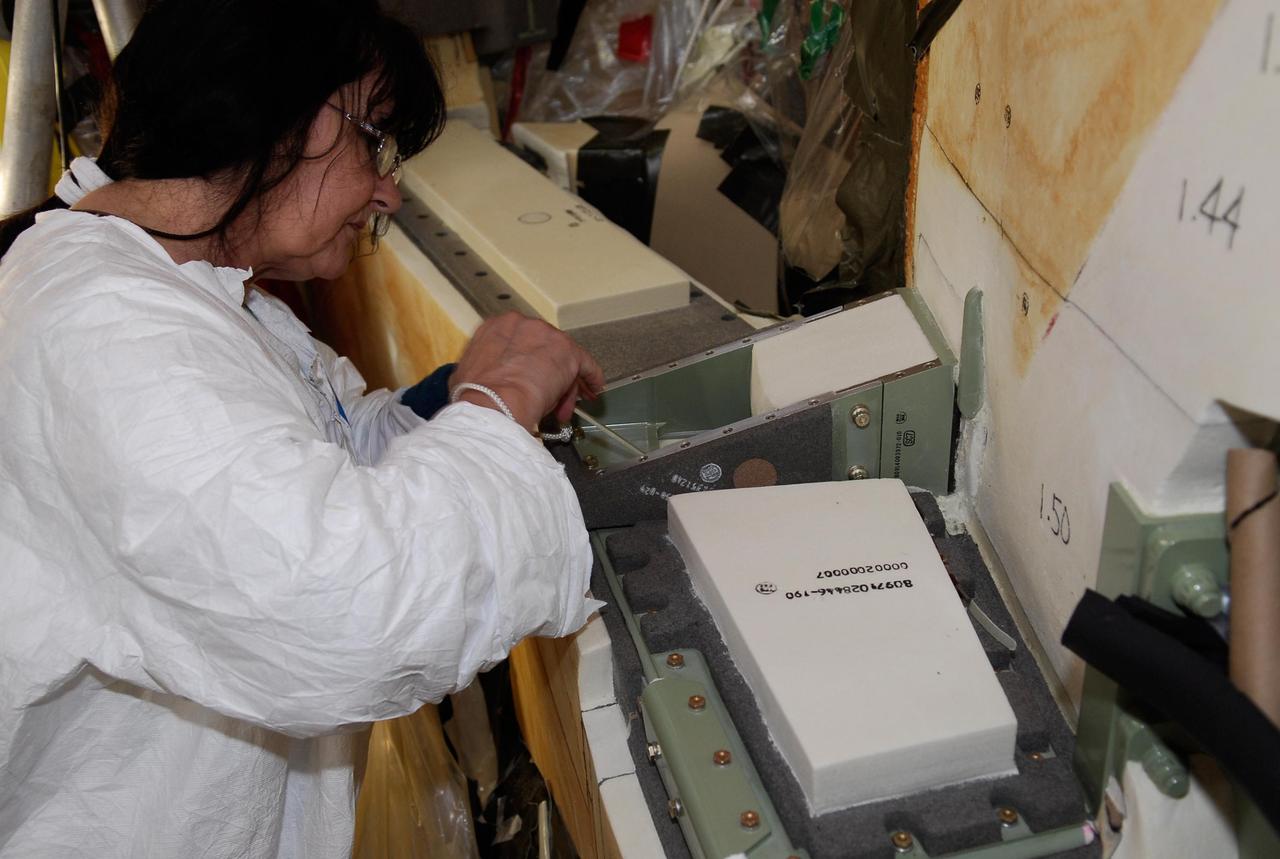
KENNEDY SPACE CENTER, FLA. -- On Launch Pad 39A at NASA's Kennedy Space Center, a technician trims foam placed around the engine cutoff, or ECO, sensor system connector and wiring on space shuttle Atlantis' external tank. The foam was removed to enable engineers to remove and replace a feed-through ECO sensor connector on the tank. The feed-through connector passes the wires from the inside of the tank to the outside. Results of a tanking test on Dec. 18 pointed to an open circuit in the feed-through connector wiring, which is located at the base of the tank. The pins in the replacement connector were precisely soldered to create a connection that allows sensors inside the tank to send signals to the computers onboard Atlantis. The launch date for the shuttle's STS-122 mission has now been targeted for Feb. 7. Photo credit: NASA/Kim Shiflett
KENNEDY SPACE CENTER, FLA. -- On Launch Pad 39A at NASA's Kennedy Space Center, technicians prepare the cover to be installed over the engine cutoff, or ECO, sensor system connector and wiring on space shuttle space shuttle Atlantis' external tank. The feed-through connector passes the wires from the inside of the tank to the outside. Results of a tanking test on Dec. 18 pointed to an open circuit in the feed-through connector wiring, which is located at the base of the tank. The pins in the replacement connector were precisely soldered to create a connection that allows sensors inside the tank to send signals to the computers onboard Atlantis. The launch date for the shuttle's STS-122 mission has now been targeted for Feb. 7. Photo credit: NASA/Kim Shiflett
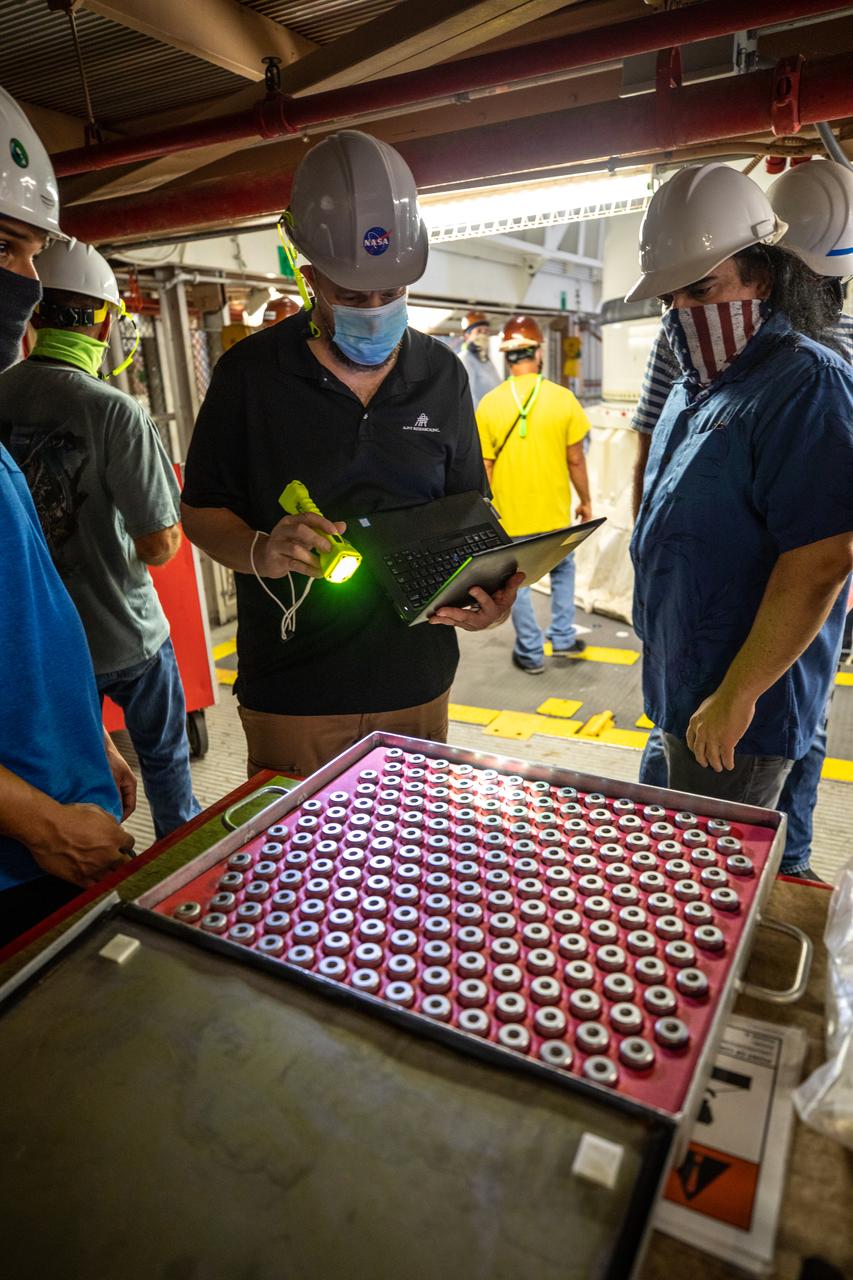
Inside the Rotation, Processing and Surge Facility at NASA’s Kennedy Space Center in Florida, technicians inspect the pins that will be used to secure the right-hand motor segment – one of five segments that make up one of two solid rocket boosters for the agency’s Space Launch System (SLS) – to the right-hand aft skirt on June 24, 2020. Once the aft segments are mated to the two aft skirts, they will be moved to the Vehicle Assembly Building for stacking on the mobile launcher. Manufactured by Northrop Grumman in Utah, the twin boosters provide more than 75 percent of the total SLS thrust at launch. Under the Artemis program, NASA will land the first woman and the next man on the Moon by 2024. The first in a series of increasingly complex missions, Artemis I will test the Orion spacecraft and SLS as an integrated system ahead of crewed flights to the Moon.
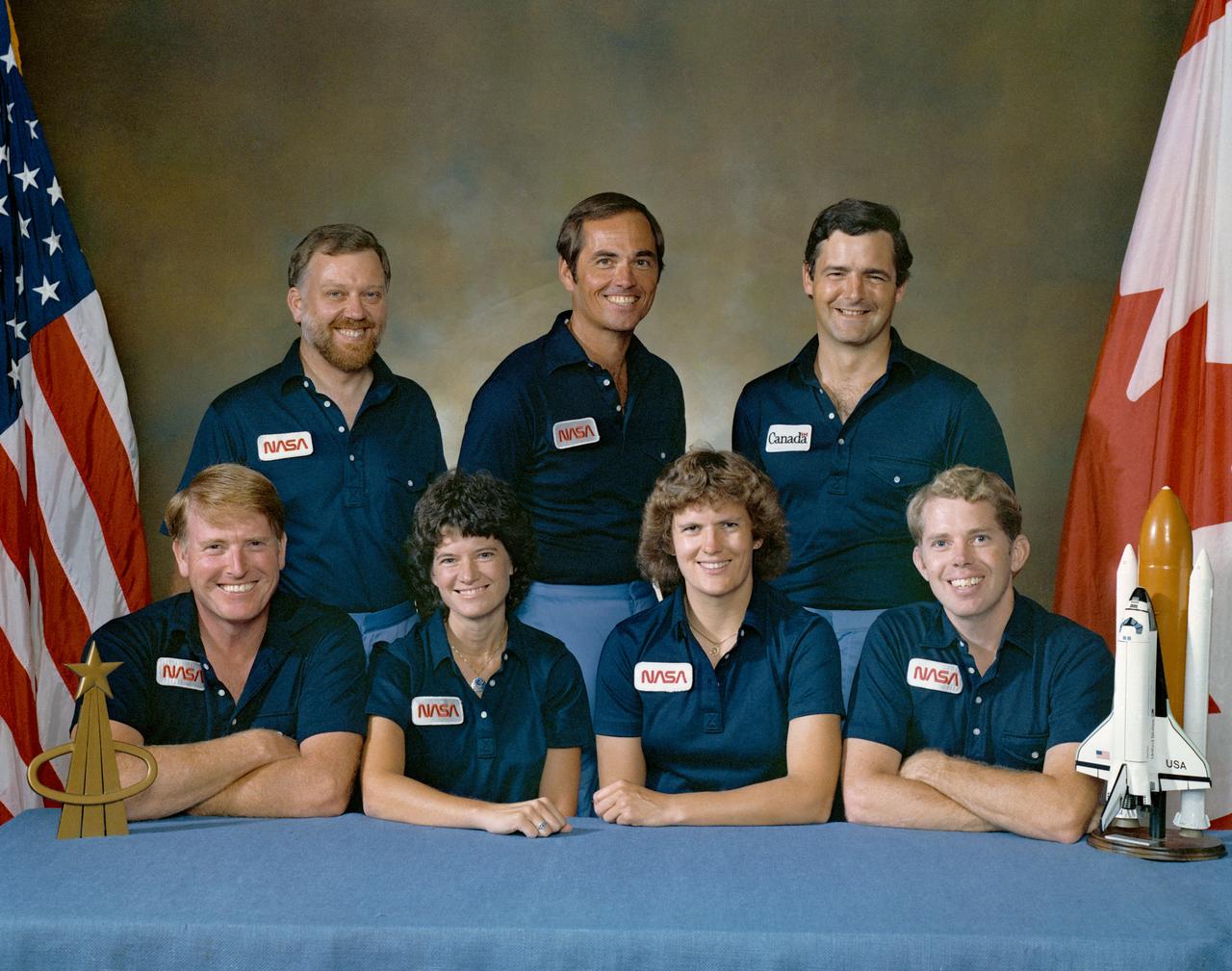
S84-37981 (20 July 1984) --- The space shuttle Challenger will carry these seven persons into space for NASA's STS-41G mission scheduled for October 1984. They are (bottom row, left to right) astronauts Jon A. McBride, pilot; and Sally K. Ride, Kathryn D. Sullivan and David C. Leestma -- all mission specialists. Astronaut Robert L. Crippen crew commander, is flanked by Paul D. Scully-Power and Marc Garneau, both payload specialists. Scully-Power is an oceanographer for the U.S. Navy and Garneau represents the National Research Council (Canada). The replica of a gold astronaut pin near McBride signifies unity. The group represents the largest space shuttle crew thus far. Photo credit: NASA
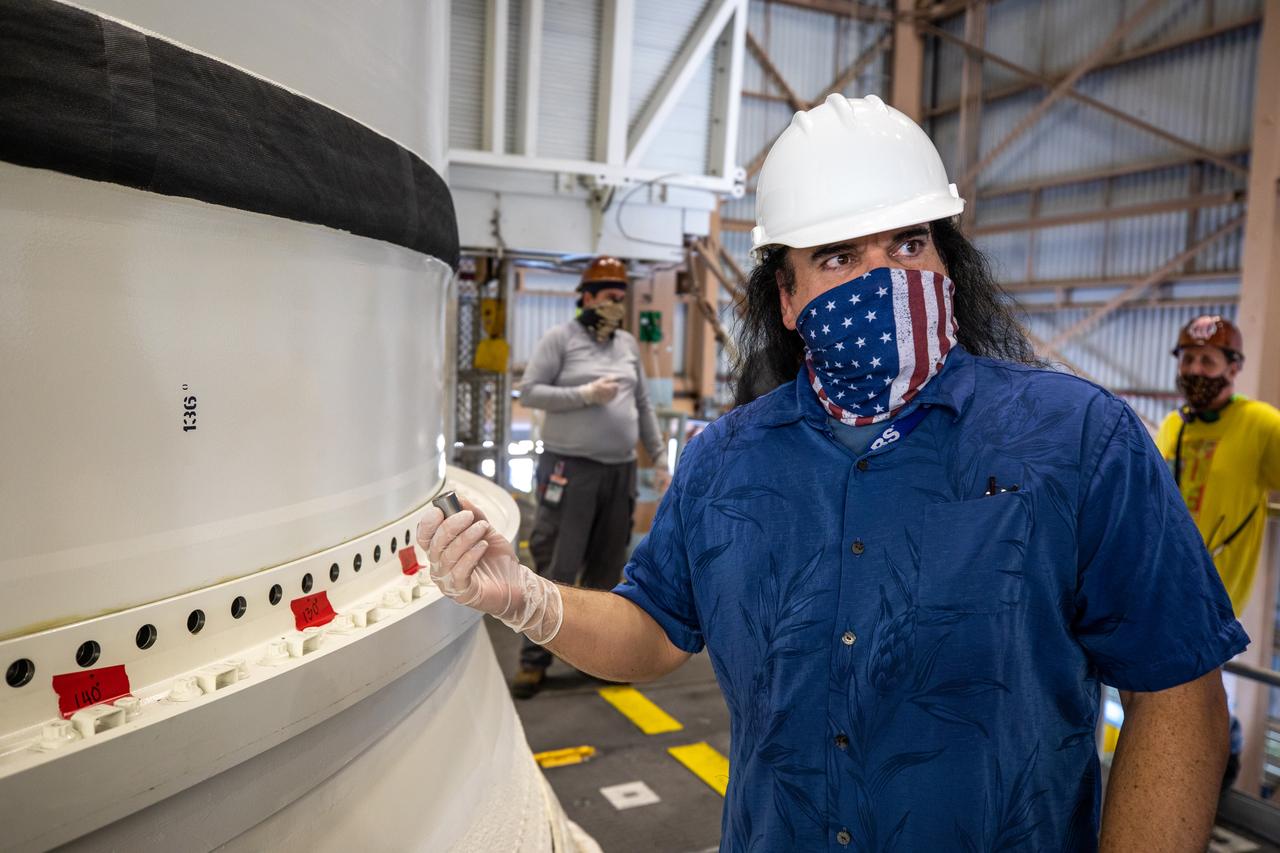
Inside the Rotation, Processing and Surge Facility at NASA’s Kennedy Space Center in Florida, Pablo Martinez, a handling, mechanical and structures engineer on the Jacobs Technology Inc. Test and Operations Support Contract, prepares to insert the first of many pins that will secure the Space Launch System’s (SLS) right-hand motor segment to the rocket’s right-hand aft skirt. The right-hand motor segment is one of five segments that makes up one of two solid rocket boosters. Once the aft segments are mated to the two aft skirts, they will be moved to the Vehicle Assembly Building for stacking on the mobile launcher. Manufactured by Northrop Grumman in Utah, the twin boosters provide more than 75 percent of the total SLS thrust at launch. Under the Artemis program, NASA will land the first woman and the next man on the Moon by 2024. The first in a series of increasingly complex missions, Artemis I will test the Orion spacecraft and SLS as an integrated system ahead of crewed flights to the Moon.
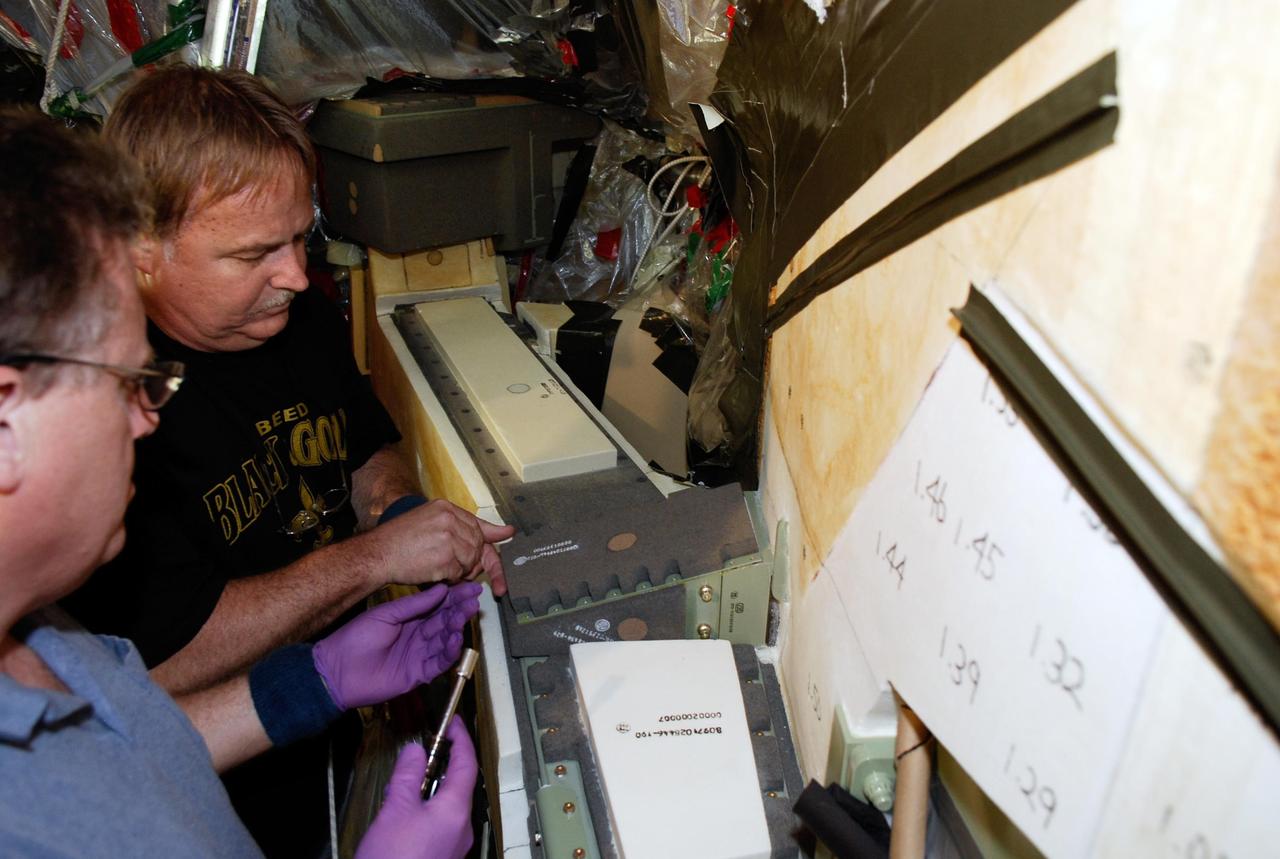
KENNEDY SPACE CENTER, FLA. -- On Launch Pad 39A at NASA's Kennedy Space Center, a technician begins attaching the cover over the engine cutoff, or ECO, sensor system connector and wiring on space shuttle Atlantis' external tank. The feed-through connector passes the wires from the inside of the tank to the outside. Results of a tanking test on Dec. 18 pointed to an open circuit in the feed-through connector wiring, which is located at the base of the tank. The pins in the replacement connector were precisely soldered to create a connection that allows sensors inside the tank to send signals to the computers onboard Atlantis. The launch date for the shuttle's STS-122 mission has now been targeted for Feb. 7. Photo credit: NASA/Kim Shiflett

KENNEDY SPACE CENTER, FLA. -- On Launch Pad 39A at NASA's Kennedy Space Center, foam insulation is being trimmed for placement around the engine cutoff, or ECO, sensor system connector and wiring on space shuttle Atlantis' external tank. The foam was removed to enable engineers to remove and replace a feed-through ECO sensor connector on the tank. The feed-through connector passes the wires from the inside of the tank to the outside. Results of a tanking test on Dec. 18 pointed to an open circuit in the feed-through connector wiring, which is located at the base of the tank. The pins in the replacement connector were precisely soldered to create a connection that allows sensors inside the tank to send signals to the computers onboard Atlantis. The launch date for the shuttle's STS-122 mission has now been targeted for Feb. 7. Photo credit: NASA/Kim Shiflett
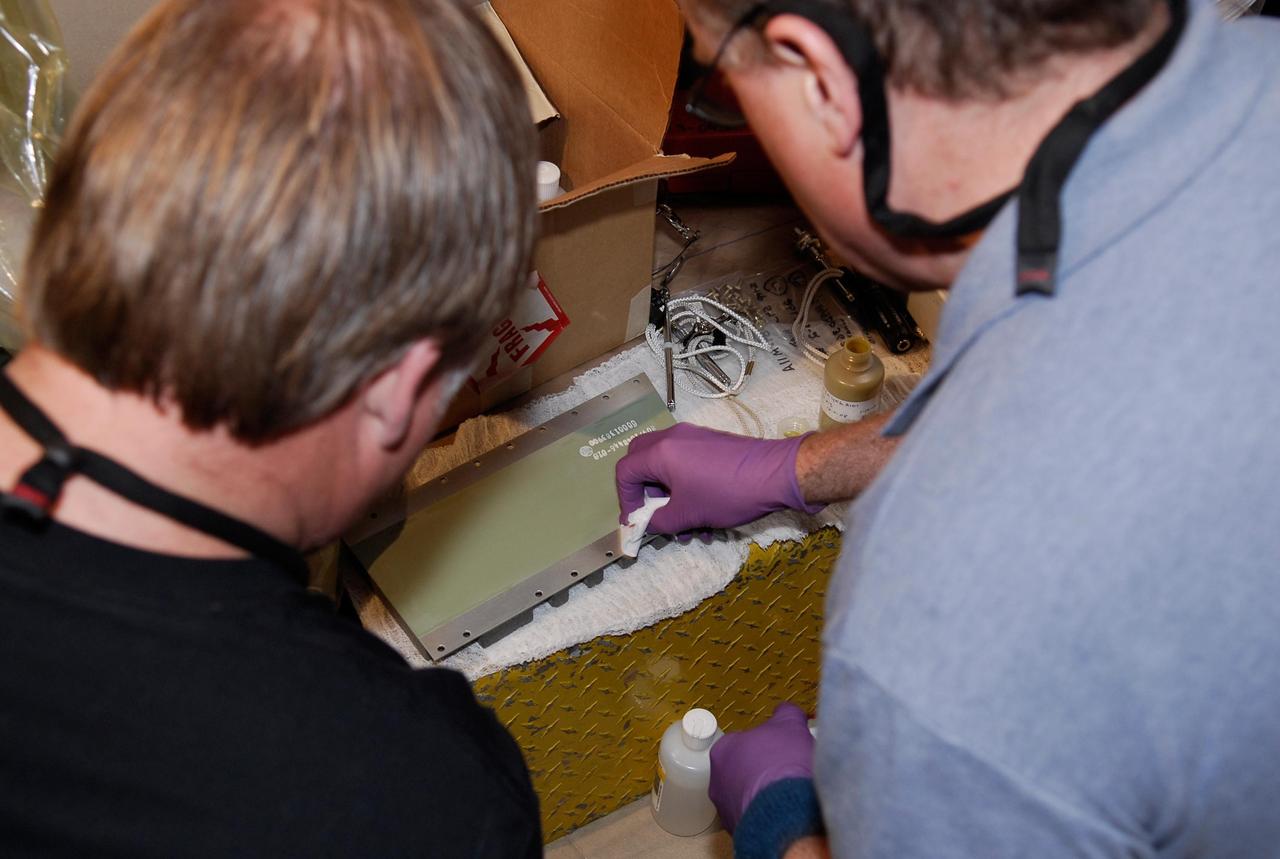
KENNEDY SPACE CENTER, FLA. -- On Launch Pad 39A at NASA's Kennedy Space Center, technicians prepare the cover to be installed over the engine cutoff, or ECO, sensor system connector and wiring on space shuttle Atlantis' external tank. The feed-through connector passes the wires from the inside of the tank to the outside. Results of a tanking test on Dec. 18 pointed to an open circuit in the feed-through connector wiring, which is located at the base of the tank. The pins in the replacement connector were precisely soldered to create a connection that allows sensors inside the tank to send signals to the computers onboard Atlantis. The launch date for the shuttle's STS-122 mission has now been targeted for Feb. 7. Photo credit: NASA/Kim Shiflett
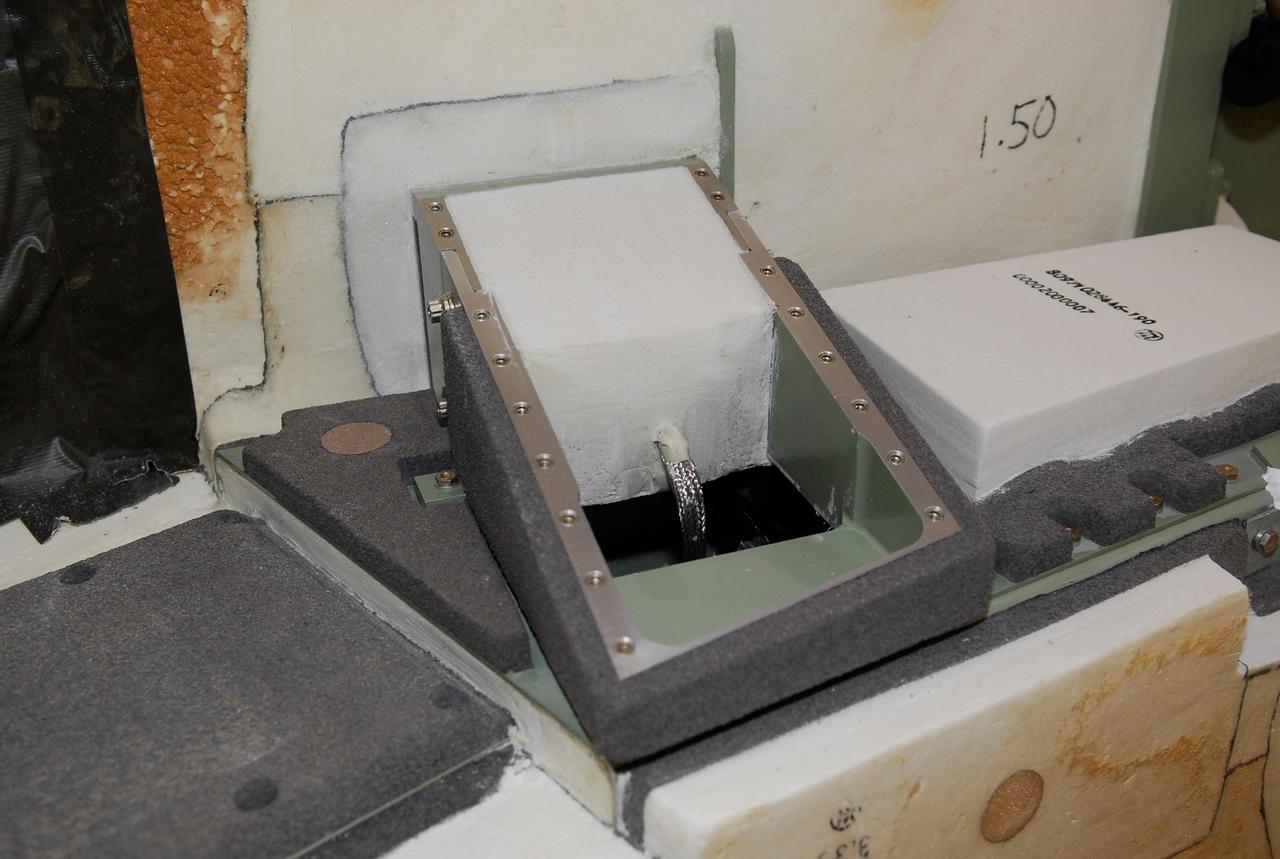
KENNEDY SPACE CENTER, FLA. -- On Launch Pad 39A at NASA's Kennedy Space Center, foam is being replaced around the engine cutoff, or ECO, sensor system connector and wiring on space shuttle Atlantis' external tank. The foam was removed to enable engineers to remove and replace a feed-through ECO sensor connector on the tank. The feed-through connector passes the wires from the inside of the tank to the outside. Results of a tanking test on Dec. 18 pointed to an open circuit in the feed-through connector wiring, which is located at the base of the tank. The pins in the replacement connector were precisely soldered to create a connection that allows sensors inside the tank to send signals to the computers onboard Atlantis. The launch date for the shuttle's STS-122 mission has now been targeted for Feb. 7. Photo credit: NASA/Kim Shiflett

KENNEDY SPACE CENTER, FLA. -- On Launch Pad 39A at NASA's Kennedy Space Center, foam is being replaced around the engine cutoff, or ECO, sensor system connector and wiring on space shuttle Atlantis' external tank. The foam was removed to enable engineers to remove and replace a feed-through ECO sensor connector on the tank. The feed-through connector passes the wires from the inside of the tank to the outside. Results of a tanking test on Dec. 18 pointed to an open circuit in the feed-through connector wiring, which is located at the base of the tank. The pins in the replacement connector were precisely soldered to create a connection that allows sensors inside the tank to send signals to the computers onboard Atlantis. The launch date for the shuttle's STS-122 mission has now been targeted for Feb. 7. Photo credit: NASA/Kim Shiflett
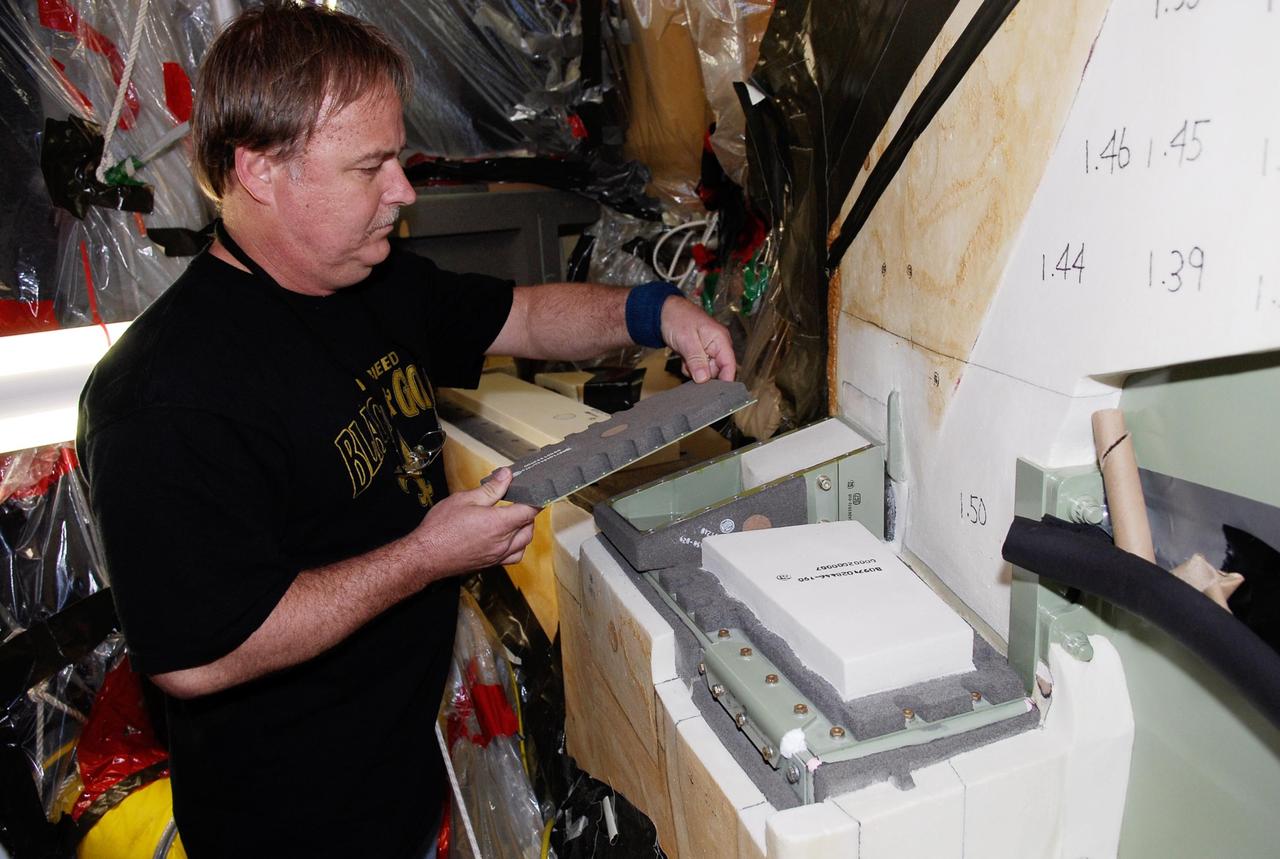
KENNEDY SPACE CENTER, FLA. -- On Launch Pad 39A at NASA's Kennedy Space Center, a technician gets ready to place the cover over the engine cutoff, or ECO, sensor system connector and wiring on space shuttle Atlantis' external tank. The feed-through connector passes the wires from the inside of the tank to the outside. Results of a tanking test on Dec. 18 pointed to an open circuit in the feed-through connector wiring, which is located at the base of the tank. The pins in the replacement connector were precisely soldered to create a connection that allows sensors inside the tank to send signals to the computers onboard Atlantis. The launch date for the shuttle's STS-122 mission has now been targeted for Feb. 7. Photo credit: NASA/Kim Shiflett
KENNEDY SPACE CENTER, FLA. -- On Launch Pad 39A at NASA's Kennedy Space Center, a technician attaches the cover over the engine cutoff, or ECO, sensor system connector and wiring on space shuttle Atlantis' external tank. The feed-through connector passes the wires from the inside of the tank to the outside. Results of a tanking test on Dec. 18 pointed to an open circuit in the feed-through connector wiring, which is located at the base of the tank. The pins in the replacement connector were precisely soldered to create a connection that allows sensors inside the tank to send signals to the computers onboard Atlantis. The launch date for the shuttle's STS-122 mission has now been targeted for Feb. 7. Photo credit: NASA/Kim Shiflett
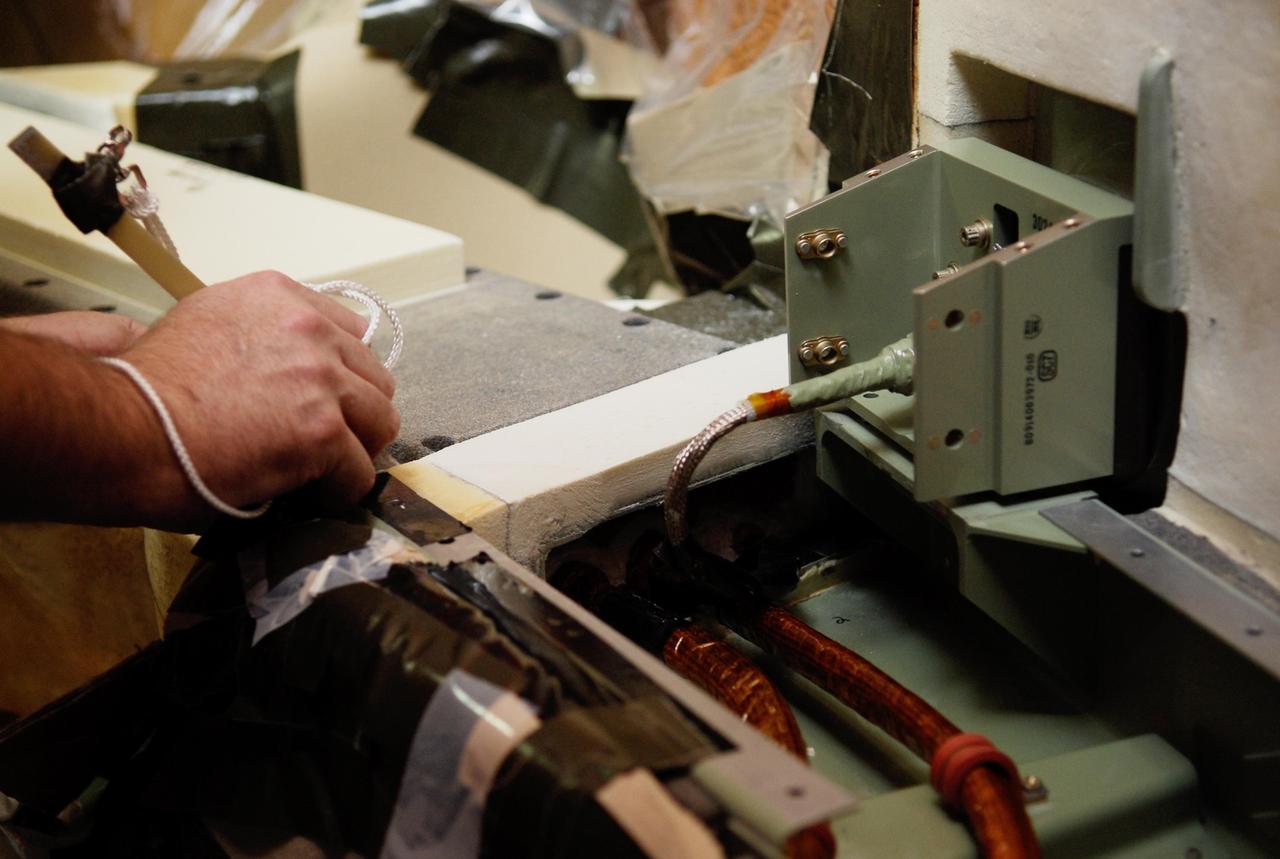
KENNEDY SPACE CENTER, FLA. -- On Launch Pad 39A at NASA's Kennedy Space Center, foam insulation is being trimmed for placement around the engine cutoff, or ECO, sensor system connector and wiring on space shuttle Atlantis' external tank. The foam was removed to enable engineers to remove and replace a feed-through ECO sensor connector on the tank. The feed-through connector passes the wires from the inside of the tank to the outside. Results of a tanking test on Dec. 18 pointed to an open circuit in the feed-through connector wiring, which is located at the base of the tank. The pins in the replacement connector were precisely soldered to create a connection that allows sensors inside the tank to send signals to the computers onboard Atlantis. The launch date for the shuttle's STS-122 mission has now been targeted for Feb. 7. Photo credit: NASA/Kim Shiflett
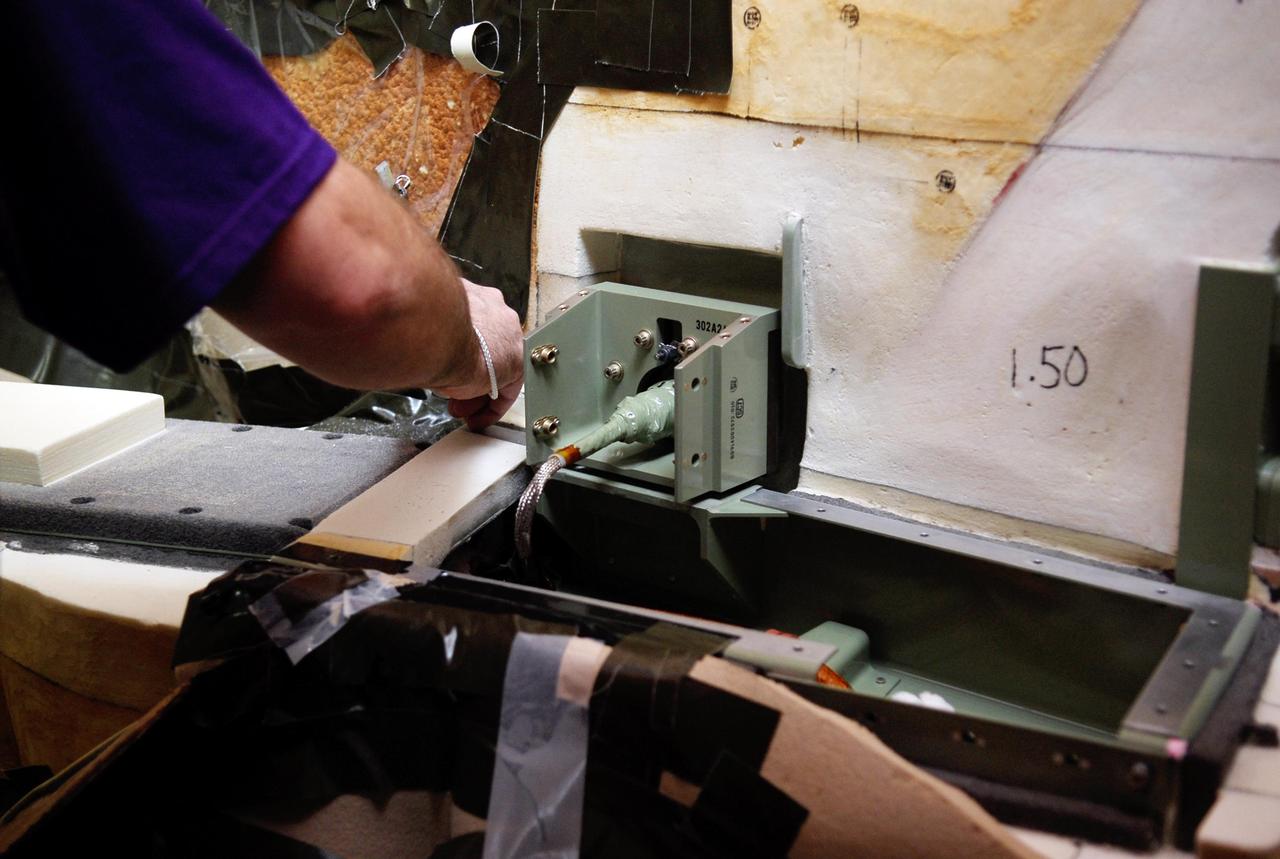
KENNEDY SPACE CENTER, FLA. -- On Launch Pad 39A at NASA's Kennedy Space Center, foam insulation is being trimmed for placement around the engine cutoff, or ECO, sensor system connector and wiring on space shuttle Atlantis' external tank. The foam was removed to enable engineers to remove and replace a feed-through ECO sensor connector on the tank. The feed-through connector passes the wires from the inside of the tank to the outside. Results of a tanking test on Dec. 18 pointed to an open circuit in the feed-through connector wiring, which is located at the base of the tank. The pins in the replacement connector were precisely soldered to create a connection that allows sensors inside the tank to send signals to the computers onboard Atlantis. The launch date for the shuttle's STS-122 mission has now been targeted for Feb. 7. Photo credit: NASA/Kim Shiflett
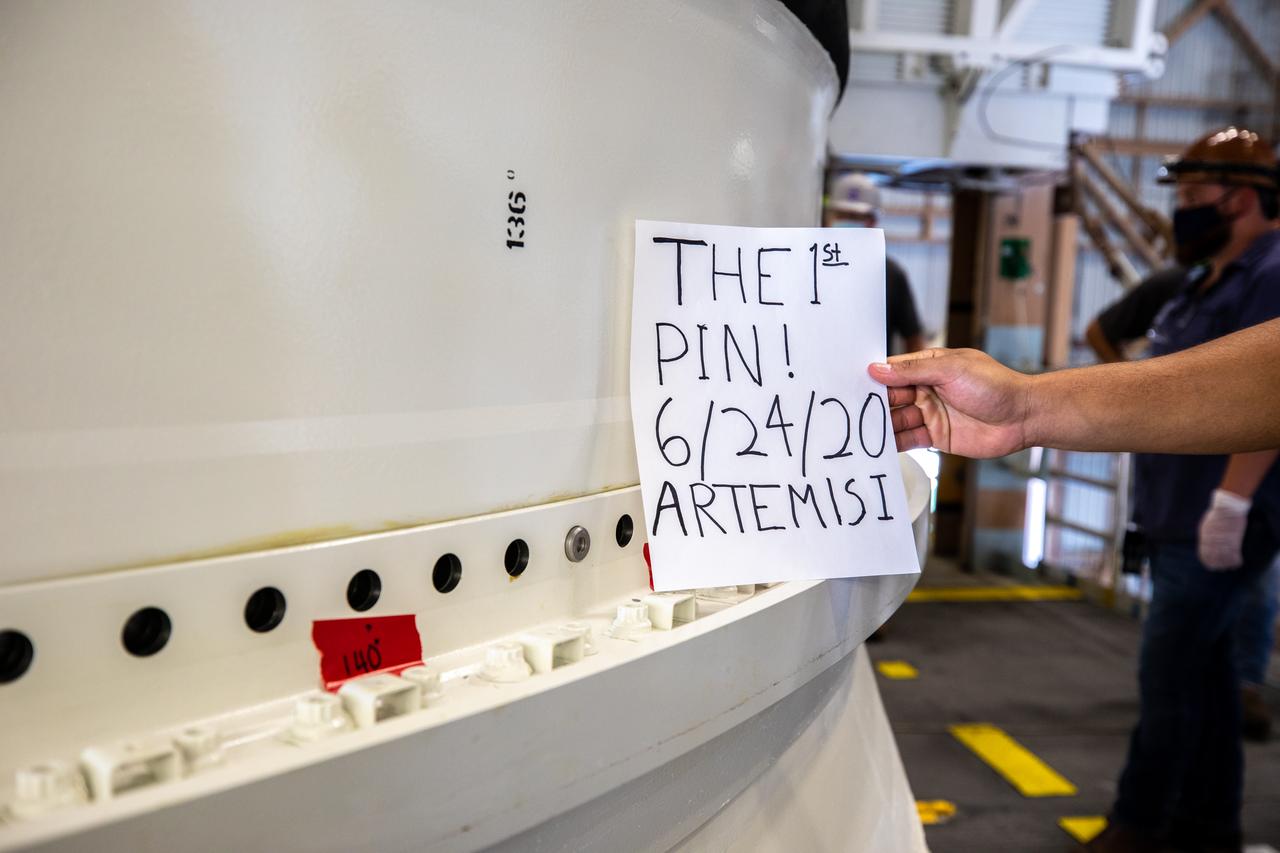
Inside the Rotation, Processing and Surge Facility at NASA’s Kennedy Space Center in Florida, the first of many pins that will secure the right-hand motor segment – one of five segments that make up one of two solid rocket boosters for the agency’s Space Launch System (SLS) – to the rocket’s right-hand aft skirt is inserted on June 24, 2020. Once the aft segments are mated to the two aft skirts, they will be moved to the Vehicle Assembly Building for stacking on the mobile launcher. Manufactured by Northrop Grumman in Utah, the twin boosters provide more than 75 percent of the total SLS thrust at launch. Under the Artemis program, NASA will land the first woman and the next man on the Moon by 2024. The first in a series of increasingly complex missions, Artemis I will test the Orion spacecraft and SLS as an integrated system ahead of crewed flights to the Moon.
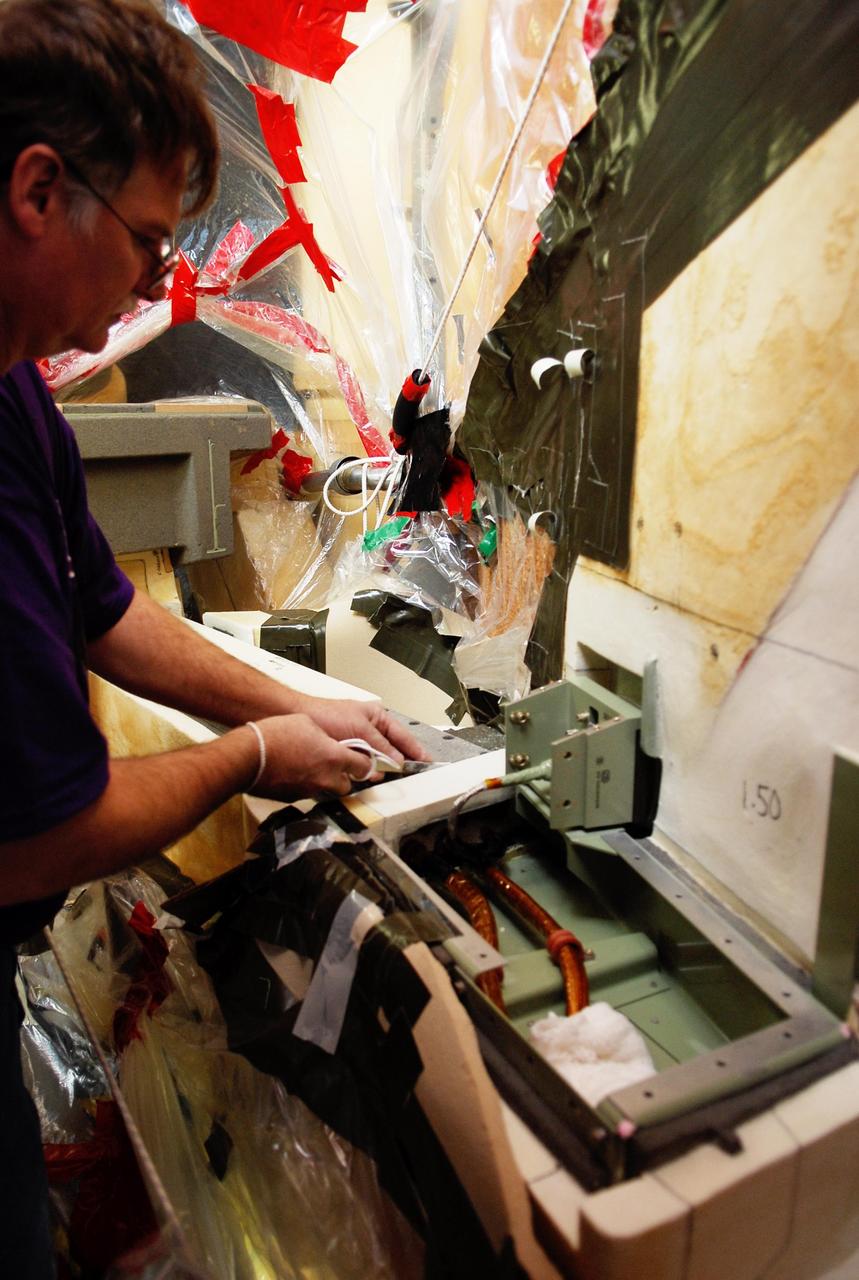
KENNEDY SPACE CENTER, FLA. -- On Launch Pad 39A at NASA's Kennedy Space Center, foam insulation is being trimmed for placement around the engine cutoff, or ECO, sensor system connector and wiring on space shuttle Atlantis' external tank. The foam was removed to enable engineers to remove and replace a feed-through ECO sensor connector on the tank. The feed-through connector passes the wires from the inside of the tank to the outside. Results of a tanking test on Dec. 18 pointed to an open circuit in the feed-through connector wiring, which is located at the base of the tank. The pins in the replacement connector were precisely soldered to create a connection that allows sensors inside the tank to send signals to the computers onboard Atlantis. The launch date for the shuttle's STS-122 mission has now been targeted for Feb. 7. Photo credit: NASA/Kim Shiflett
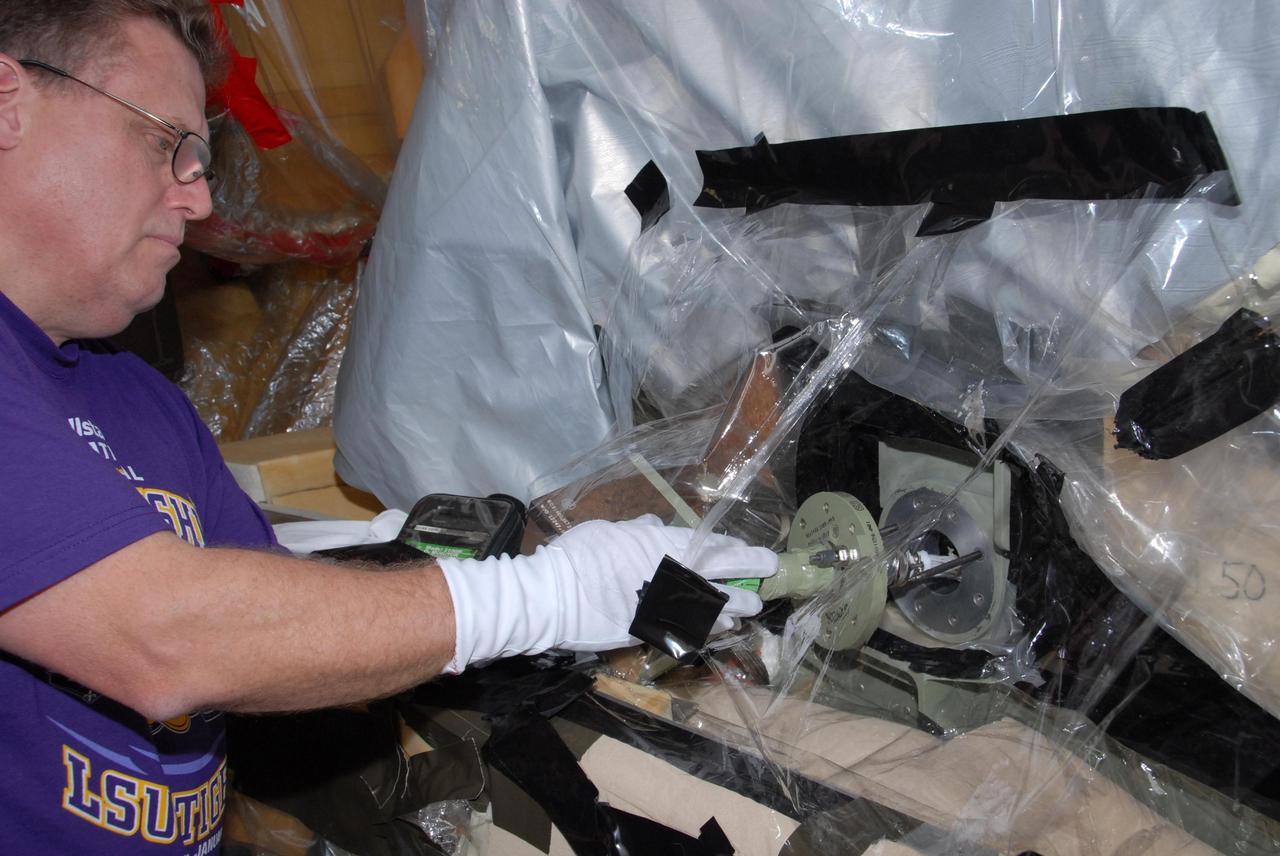
KENNEDY SPACE CENTER, FLA. -- Lloyd Johns, with Lockheed Martin, attaches the replacement feed-through connector in the engine cutoff, or ECO, sensor system to the internal connector on space shuttle Atlantis' external tank. The feed-through connector passes the wires from the inside of the tank to the outside. Results of a tanking test on Dec. 18 pointed to an open circuit in the feed-through connector wiring, which is located at the base of the tank. The pins in the replacement connector have been precisely soldered to create a connection that allows sensors inside the tank to send signals to the computers onboard Atlantis. The work is being done on Launch Pad 39A. Space shuttle Atlantis is now targeted for launch on Feb. 7. Photo credit: NASA/George Shelton

STS098-819-038 (17 February 2001) --- Much of Metropolitan Houston appears in this nearly vertical image photographed with a handheld 70mm camera onboard the Earth-orbiting Space Shuttle Atlantis. Interstate 45 and Highways 146 and 6 can be traced from lower right in Galveston County as they head into different directions toward a wide range of points in the city and its suburbs. NASA's Johnson Space Center can be easily pin-pointed just above the center point in the frame. Other points of interest in the area can be located by tracking over the various U.S., state and interstate highways---10, 51, 610 loop, Beltway 8 and others. Downtown Houston is at left center, but the so-called Uptown area is just out of frame at left. Galveston Bay takes up most of the upper right quadrant. Lake Houston is at upper left. A small piece of the Gulf of Mexico is in lower right.
KENNEDY SPACE CENTER, FLA. -- Lloyd Johns, with Lockheed Martin, attaches the replacement feed-through connector in the engine cutoff, or ECO, sensor system to the internal connector on space shuttle Atlantis' external tank. The feed-through connector passes the wires from the inside of the tank to the outside. Results of a tanking test on Dec. 18 pointed to an open circuit in the feed-through connector wiring, which is located at the base of the tank. The pins in the replacement connector have been precisely soldered to create a connection that allows sensors inside the tank to send signals to the computers onboard Atlantis. The work is being done on Launch Pad 39A. Space shuttle Atlantis is now targeted for launch on Feb. 7. Photo credit: NASA/George Shelton
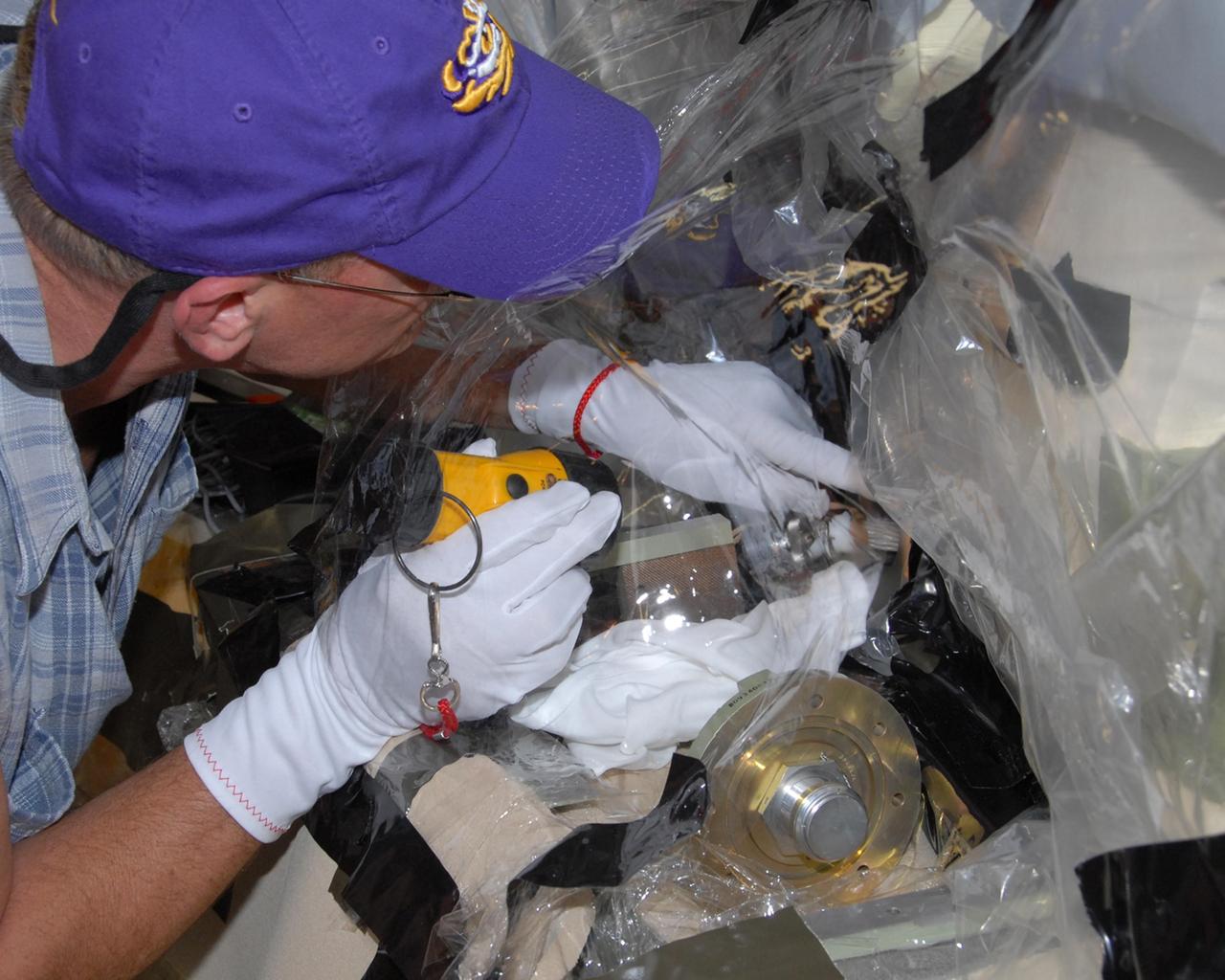
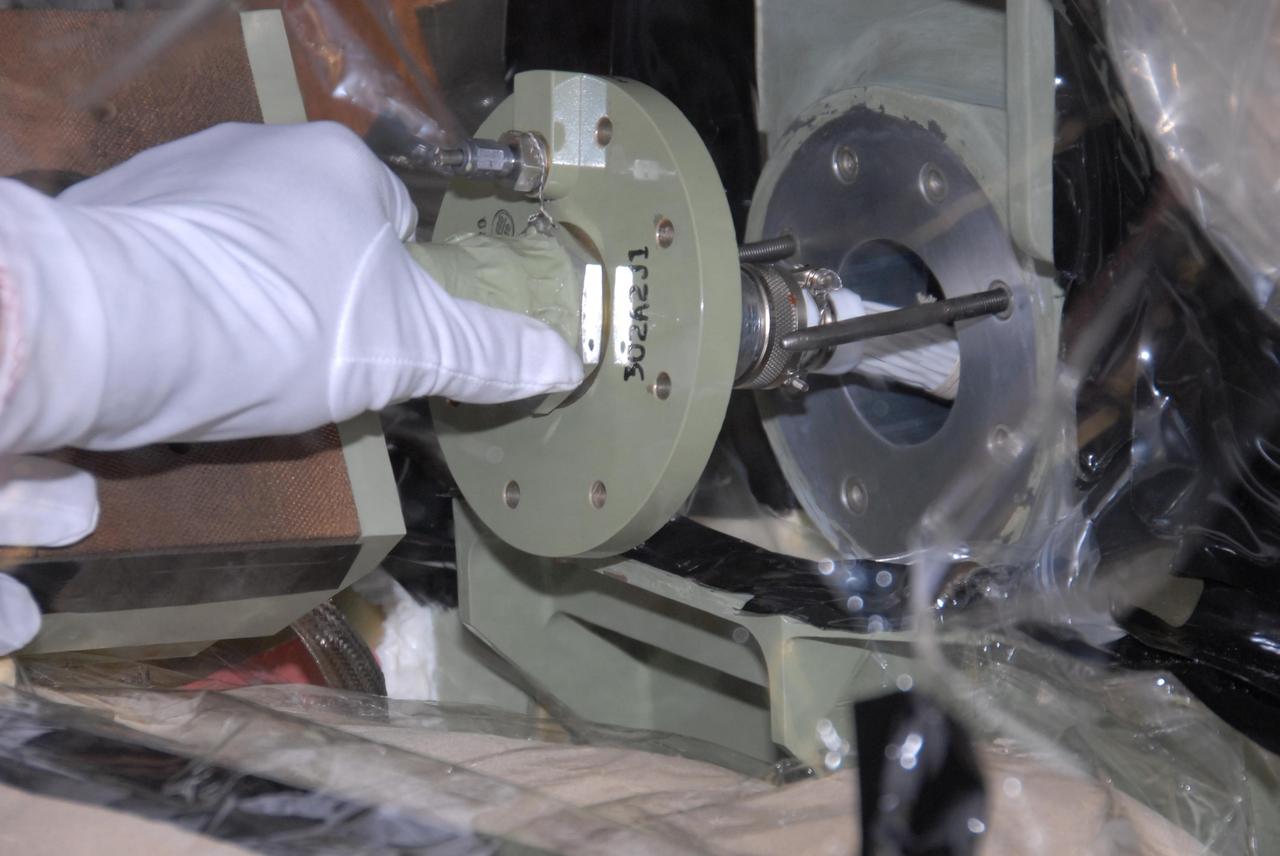
KENNEDY SPACE CENTER, FLA. -- Mike Berger, with Lockheed Martin, examines the internal connector on space shuttle Atlantis' external tank to which the replacement feed-through connector in the engine cutoff, or ECO, sensor system will be attached. The replacement connector is seen below Berger's hand. The feed-through connector passes the wires from the inside of the tank to the outside. Results of a tanking test on Dec. 18 pointed to an open circuit in the feed-through connector wiring, which is located at the base of the tank. The pins in the replacement connector have been precisely soldered to create a connection that allows sensors inside the tank to send signals to the computers onboard Atlantis. The work is being done on Launch Pad 39A. Space shuttle Atlantis is now targeted for launch on Feb. 7. Photo credit: NASA/George Shelton
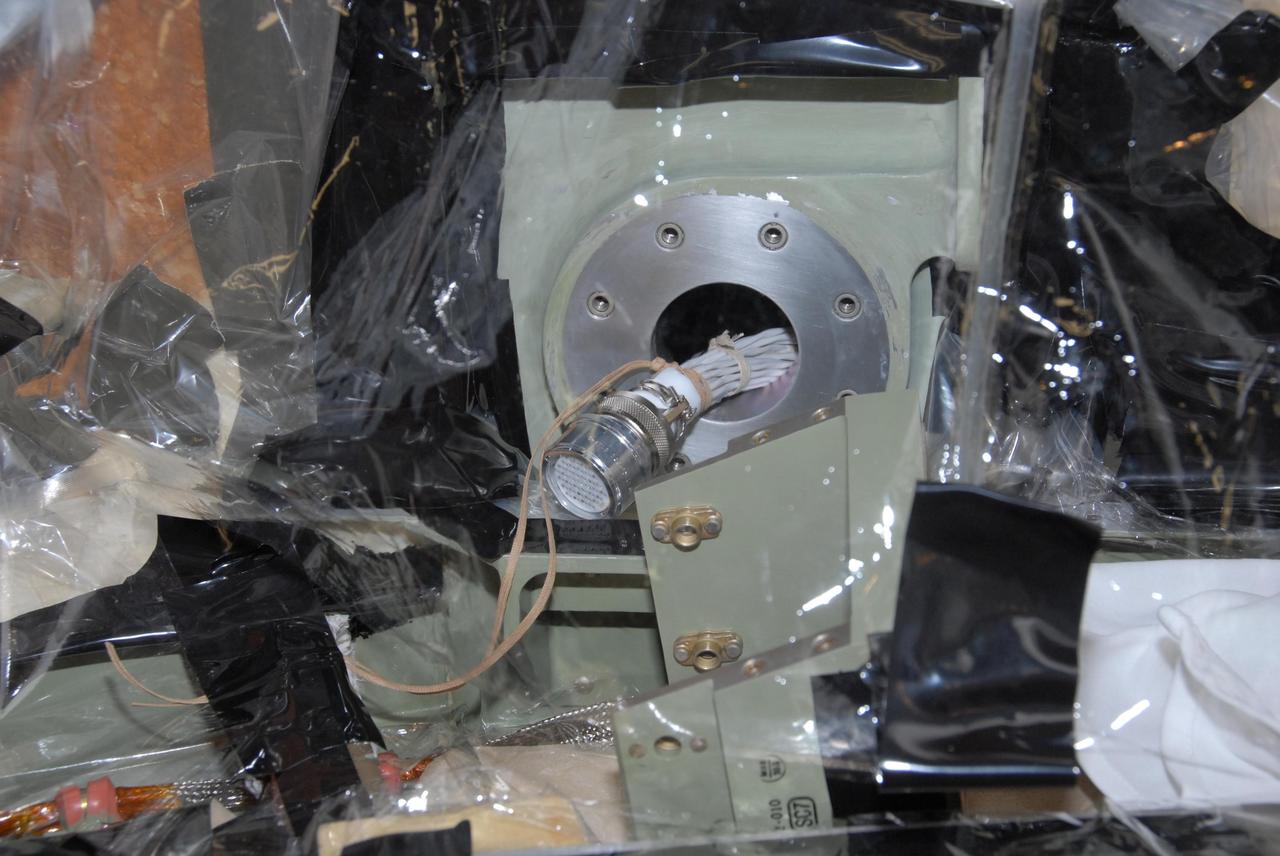
KENNEDY SPACE CENTER, FLA. -- This closeup shows the internal connector to which the replacement feed-through connector in the engine cutoff, or ECO, sensor system on space shuttle Atlantis' external tank will be installed. The feed-through connector passes the wires from the inside of the tank to the outside. Results of a tanking test on Dec. 18 pointed to an open circuit in the feed-through connector wiring, which is located at the base of the tank. The pins in the replacement connector have been precisely soldered to create a connection that allows sensors inside the tank to send signals to the computers onboard Atlantis. The work is being done on Launch Pad 39A. Space shuttle Atlantis is now targeted for launch on Feb. 7. Photo credit: NASA/George Shelton
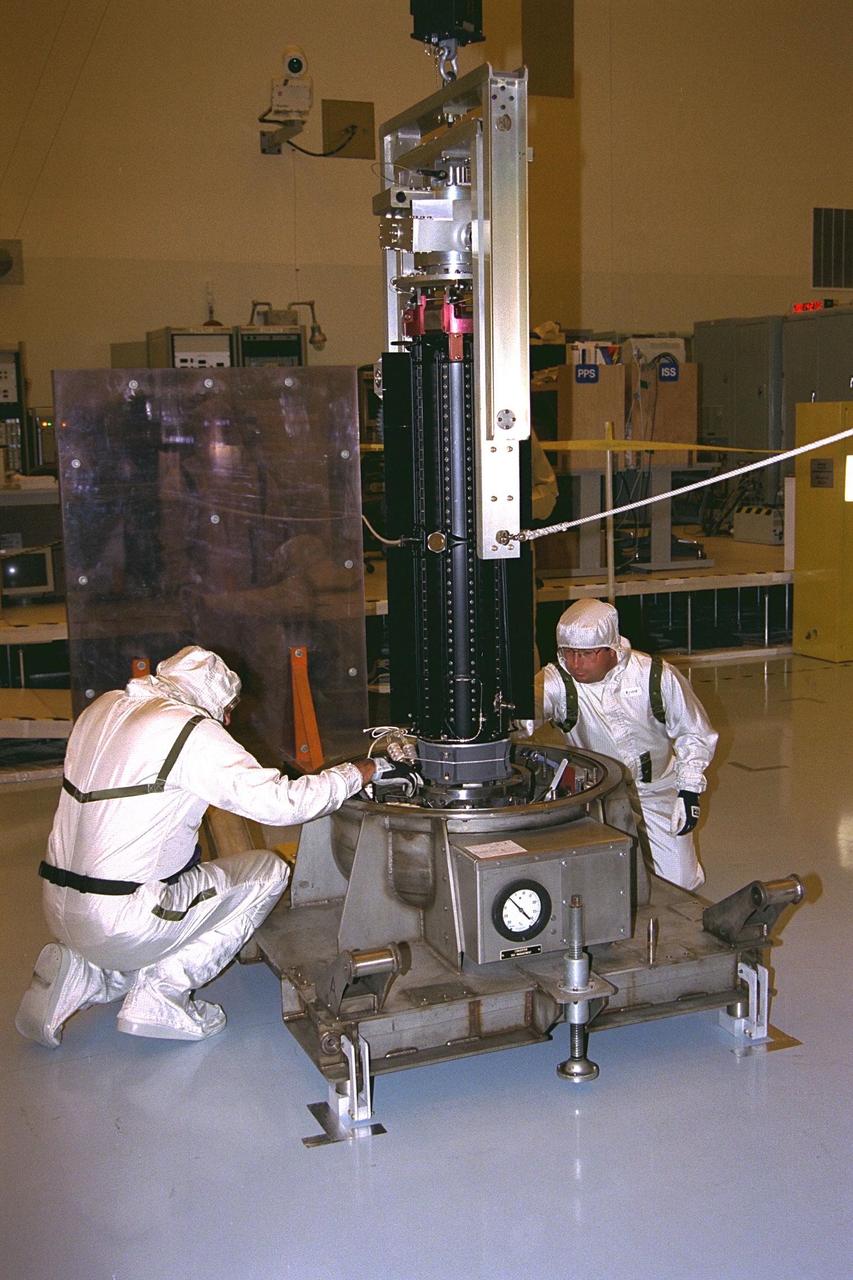
Lockheed Martin Missile and Space Co. employees Joe Collingwood, at right, and Ken Dickinson retract pins in the storage base to release a radioisotope thermoelectric generator (RTG) in preparation for hoisting operations. This RTG and two others will be installed on the Cassini spacecraft for mechanical and electrical verification testing in the Payload Hazardous Servicing Facility. The RTGs will provide electrical power to Cassini on its 6.7-year trip to the Saturnian system and during its four-year mission at Saturn. RTGs use heat from the natural decay of plutonium to generate electric power. The generators enable spacecraft to operate at great distances from the Sun where solar power systems are not feasible. The Cassini mission is targeted for an Oct. 6 launch aboard a Titan IVB/Centaur expendable launch vehicle. Cassini is built and managed by NASA’s Jet Propulsion Laboratory
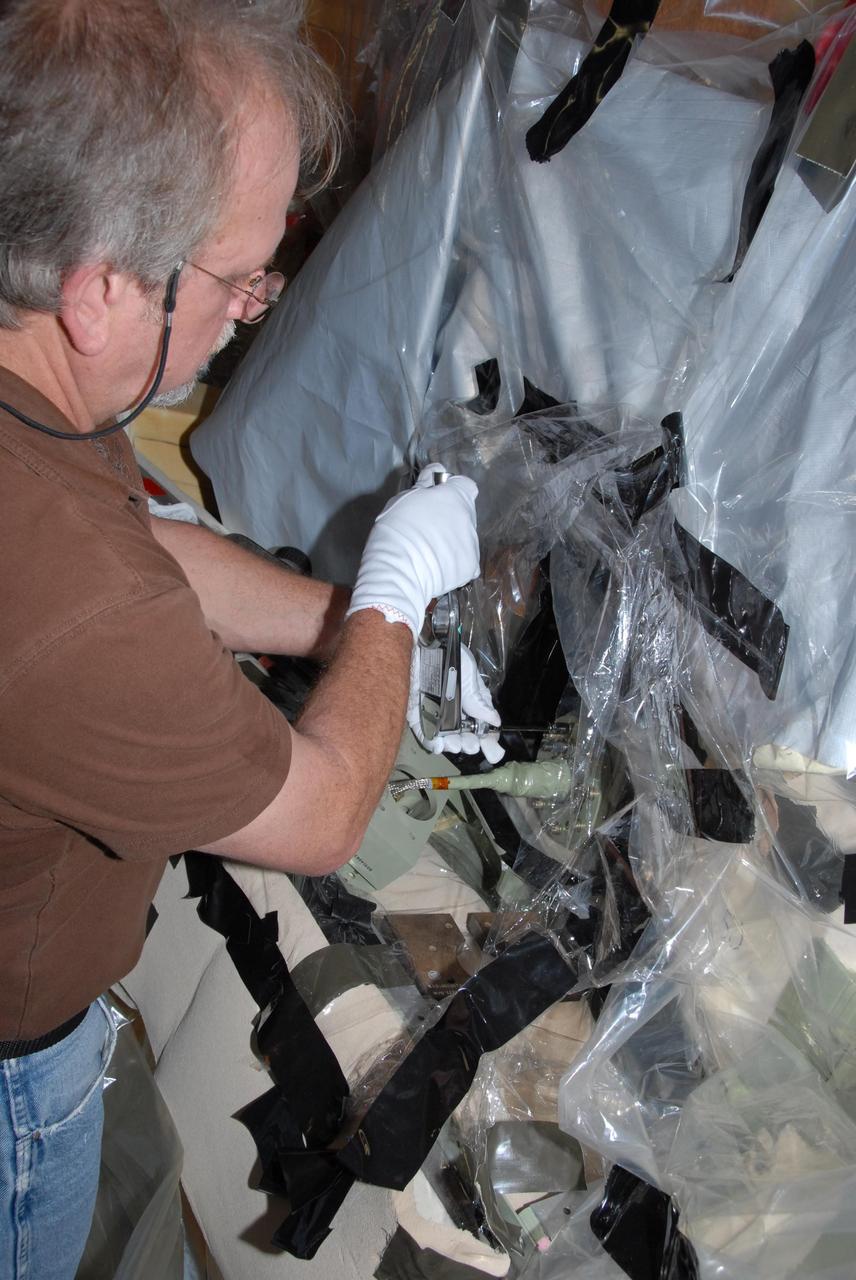
KENNEDY SPACE CENTER, FLA. -- Ray Clark, a Lockheed Martin engineer, completes attaching the replacement feed-through connector in the engine cutoff, or ECO, sensor system to the internal connector on space shuttle Atlantis' external tank. The feed-through connector passes the wires from the inside of the tank to the outside. Results of a tanking test on Dec. 18 pointed to an open circuit in the feed-through connector wiring, which is located at the base of the tank. The pins in the replacement connector have been precisely soldered to create a connection that allows sensors inside the tank to send signals to the computers onboard Atlantis. The work is being done on Launch Pad 39A. Space shuttle Atlantis is now targeted for launch on Feb. 7. Photo credit: NASA/George Shelton
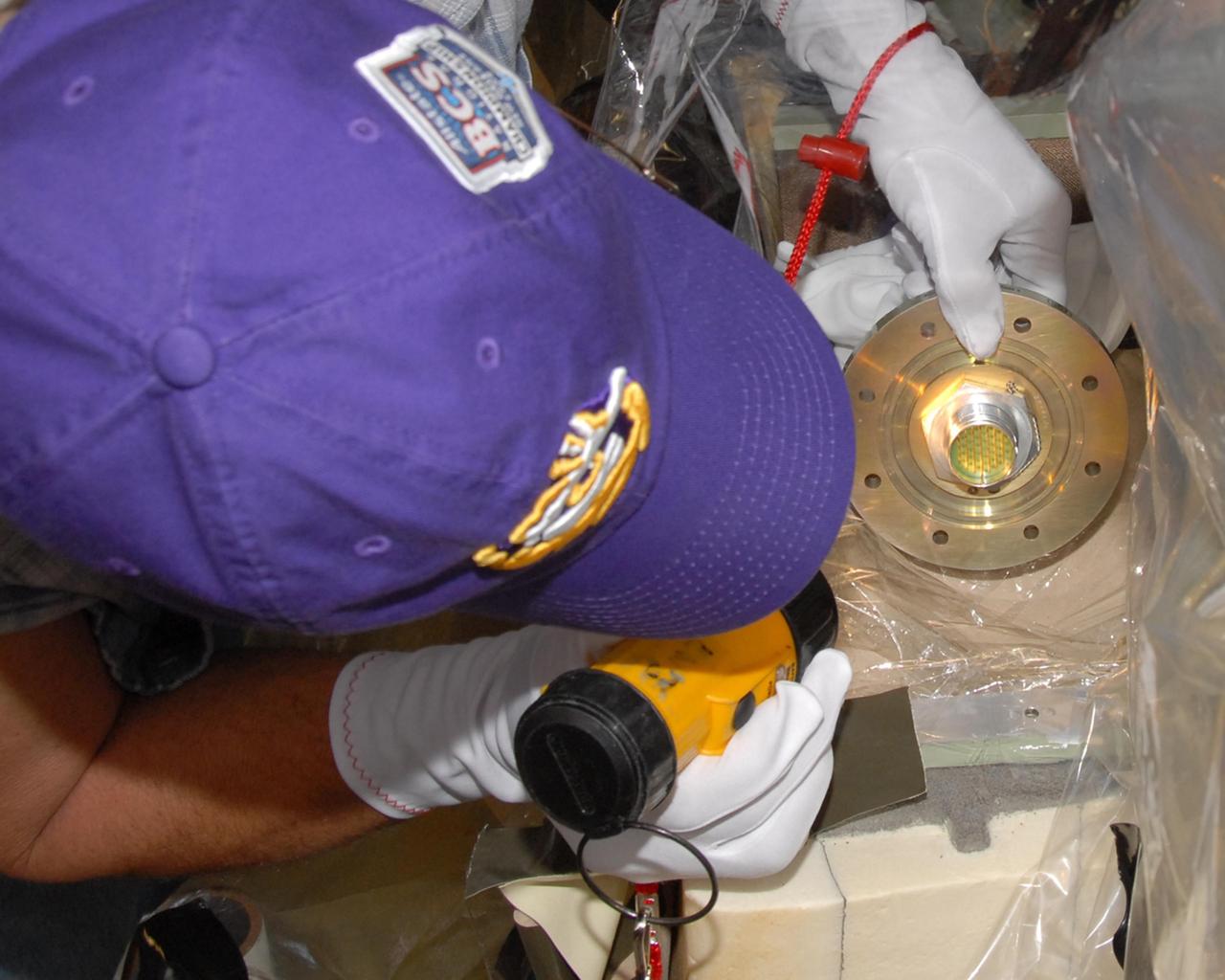
KENNEDY SPACE CENTER, FLA. -- Mike Berger, with Lockheed Martin, examines the replacement feed-through connector for the engine cutoff, or ECO, sensor system in space shuttle Atlantis' external tank. The feed-through connector passes the wires from the inside of the tank to the outside. Results of a tanking test on Dec. 18 pointed to an open circuit in the feed-through connector wiring, which is located at the base of the tank. The pins in the replacement connector have been precisely soldered to create a connection that allows sensors inside the tank to send signals to the computers onboard Atlantis. The work is being done on Launch Pad 39A. Space shuttle Atlantis is now targeted for launch on Feb. 7. Photo credit: NASA/George Shelton
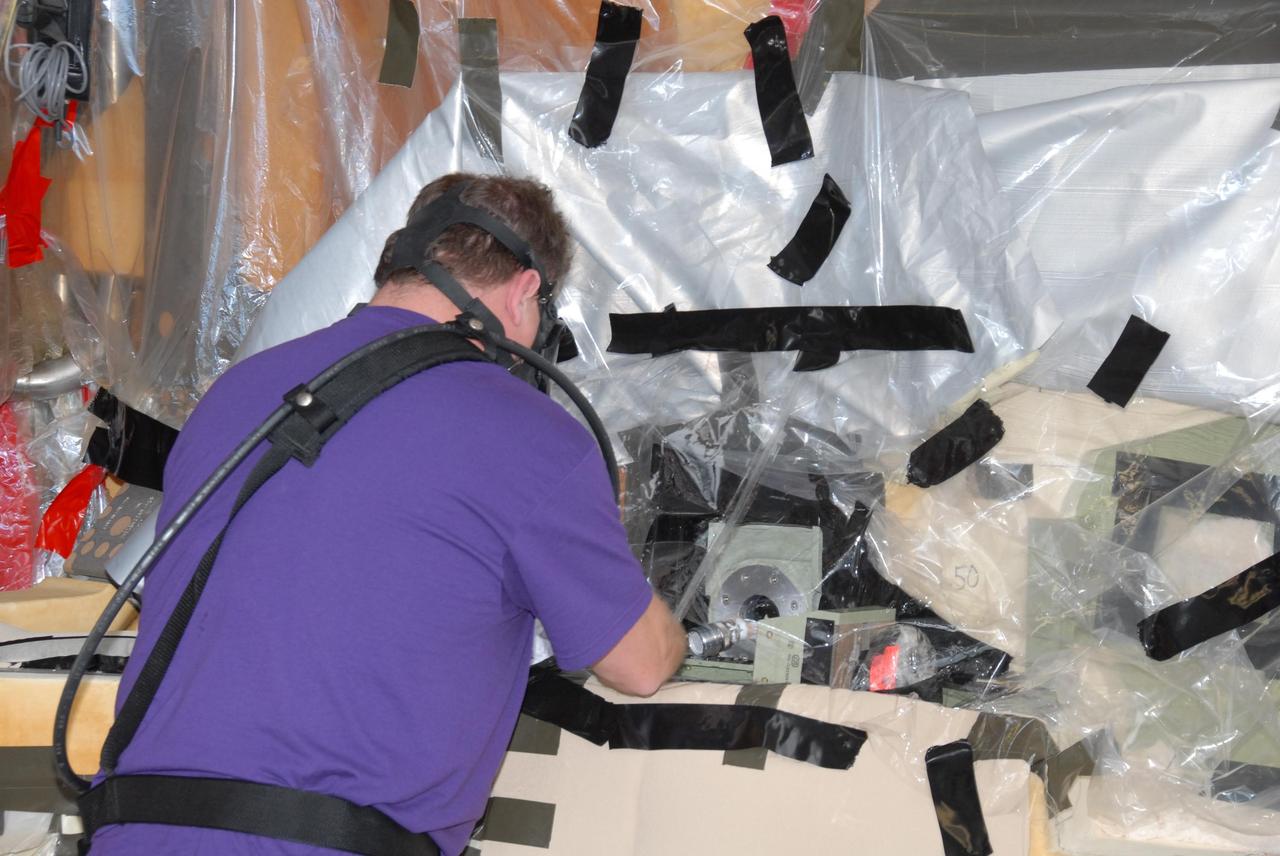
KENNEDY SPACE CENTER, FLA. -- Lloyd Johns, with Lockheed Martin, prepares the area where the replacement feed-through connector in the engine cutoff, or ECO, sensor system on space shuttle Atlantis' external tank will be installed. Seen next to Johns' arm is the internal connector. The area is wrapped in material for weather protection. Berger wears safety equipment as helium gas is employed to keep the equipment under wrap dry. The feed-through connector passes the wires from the inside of the tank to the outside. Results of a tanking test on Dec. 18 pointed to an open circuit in the feed-through connector wiring, which is located at the base of the tank. The pins in the replacement connector have been precisely soldered to create a connection that allows sensors inside the tank to send signals to the computers onboard Atlantis. The work is being done on Launch Pad 39A. Space shuttle Atlantis is now targeted for launch on Feb. 7. Photo credit: NASA/George Shelton
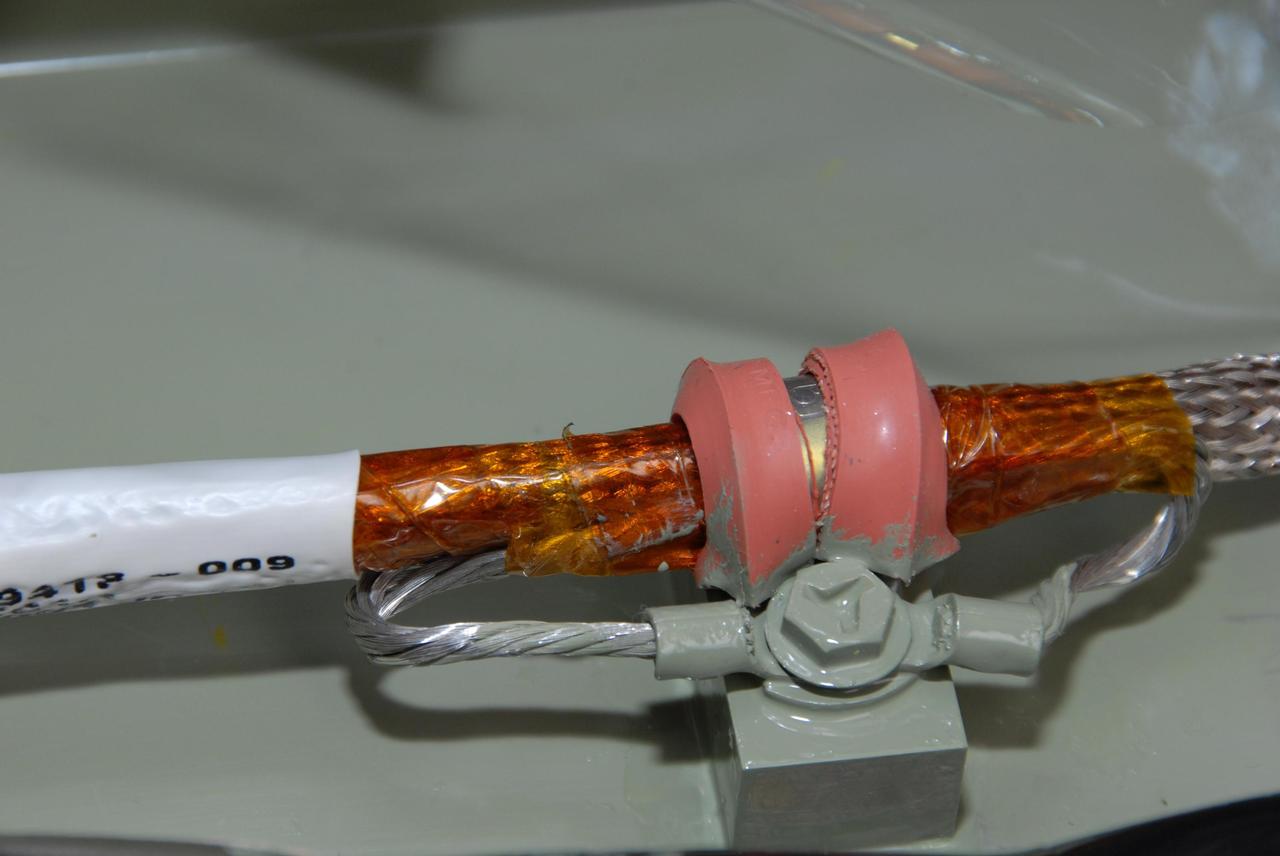
KENNEDY SPACE CENTER, FLA. -- This closeup shows the final splicing completed on the wiring between space shuttle Atlantis' external tank and the engine cutoff, or ECO, sensor system before the replacement feed-through connector in the ECO sensor system is installed. Cryogenic shielding is installed around the wiring. The feed-through connector passes the wires from the inside of the tank to the outside. Results of a tanking test on Dec. 18 pointed to an open circuit in the feed-through connector wiring, which is located at the base of the tank. The pins in the replacement connector have been precisely soldered to create a connection that allows sensors inside the tank to send signals to the computers onboard Atlantis. The work is being done on Launch Pad 39A. Space shuttle Atlantis is now targeted for launch on Feb. 7. Photo credit: NASA/George Shelton
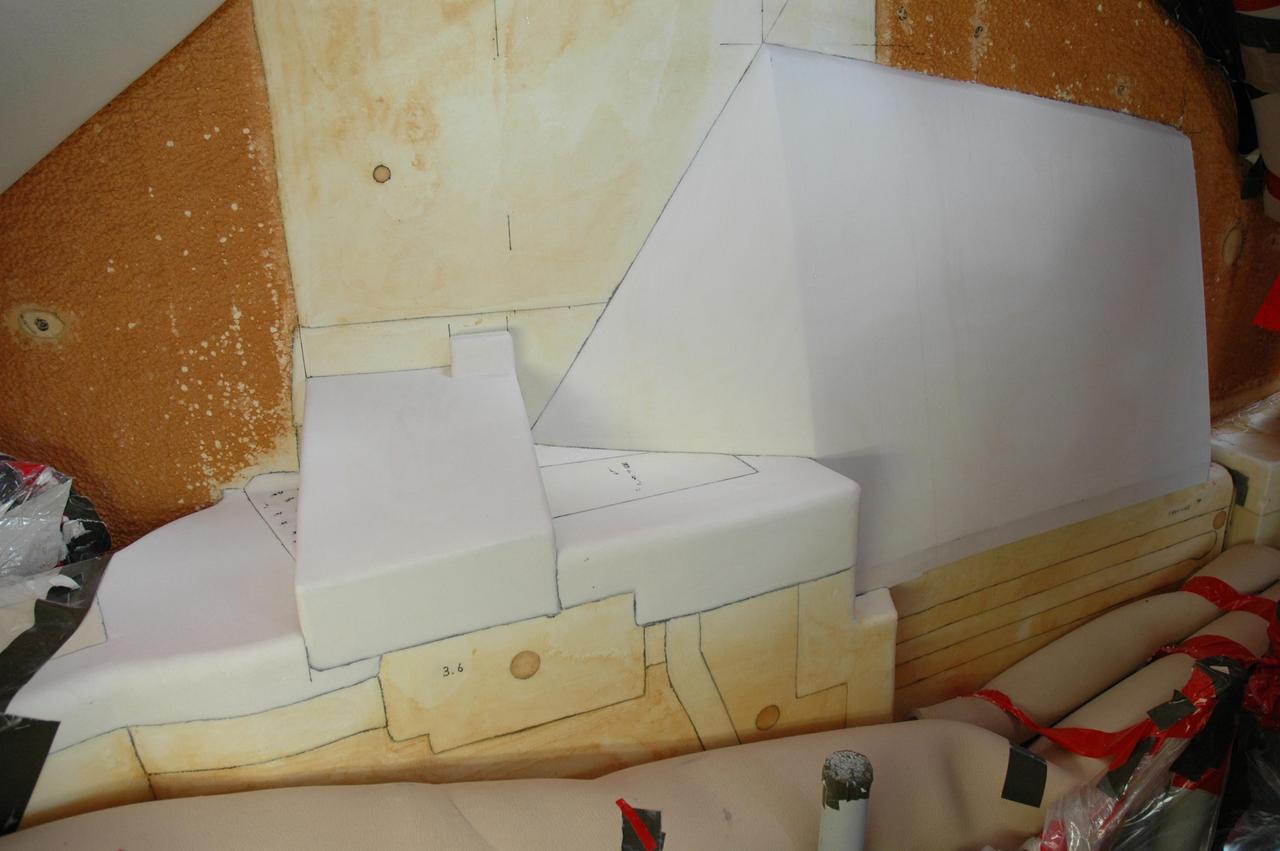
KENNEDY SPACE CENTER, FLA. -- The white foam insulation freshly reapplied to space shuttle Atlantis's external tank completes the work to remove and replace the feed-through connector on the engine cut-off, or ECO, sensor connector. The repair work was done on Atlantis while the shuttle has been on Launch Pad 39A at NASA's Kennedy Space Center. The foam was removed to enable engineers to remove and replace the ECO sensor connector on the tank. The feed-through connector passes the wires from the inside of the tank to the outside. Results of a tanking test on Dec. 18 pointed to an open circuit in the feed-through connector wiring, which is located at the base of the tank. The pins in the replacement connector were precisely soldered to create a connection that allows sensors inside the tank to send signals to the computers onboard Atlantis. The repair work was done on Atlantis while the shuttle has been on Launch Pad 39A at NASA's Kennedy Space Center. The launch date for the shuttle's STS-122 mission has now been targeted for Feb. 7. Photo credit: NASA/Cory Husten
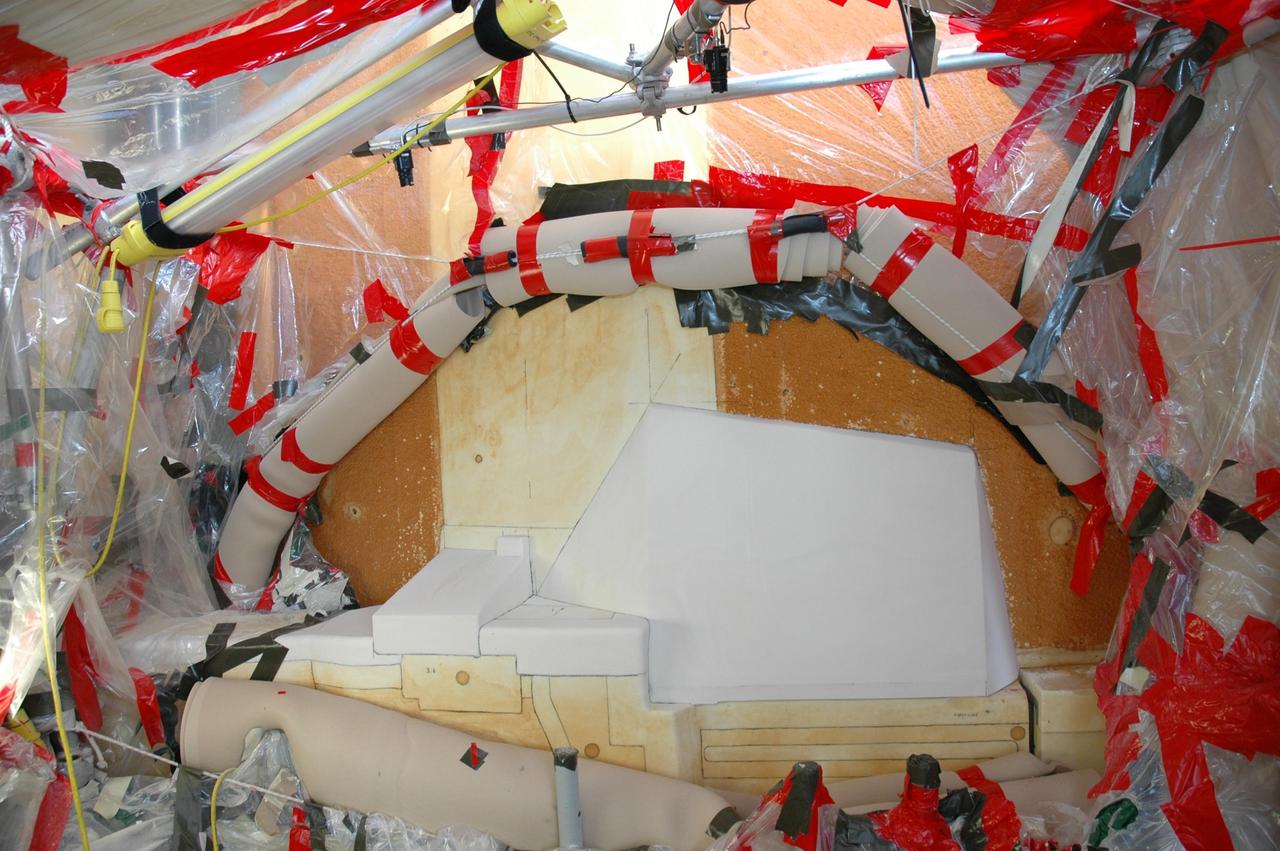
KENNEDY SPACE CENTER, FLA. -- The white foam insulation freshly reapplied to space shuttle Atlantis's external tank completes the work to remove and replace the feed-through connector on the engine cut-off, or ECO, sensor connector. The repair work was done on Atlantis while the shuttle has been on Launch Pad 39A at NASA's Kennedy Space Center. The foam was removed to enable engineers to remove and replace the ECO sensor connector on the tank. The feed-through connector passes the wires from the inside of the tank to the outside. Results of a tanking test on Dec. 18 pointed to an open circuit in the feed-through connector wiring, which is located at the base of the tank. The pins in the replacement connector were precisely soldered to create a connection that allows sensors inside the tank to send signals to the computers onboard Atlantis. The repair work was done on Atlantis while the shuttle has been on Launch Pad 39A at NASA's Kennedy Space Center. The launch date for the shuttle's STS-122 mission has now been targeted for Feb. 7. Photo credit: NASA/Cory Husten
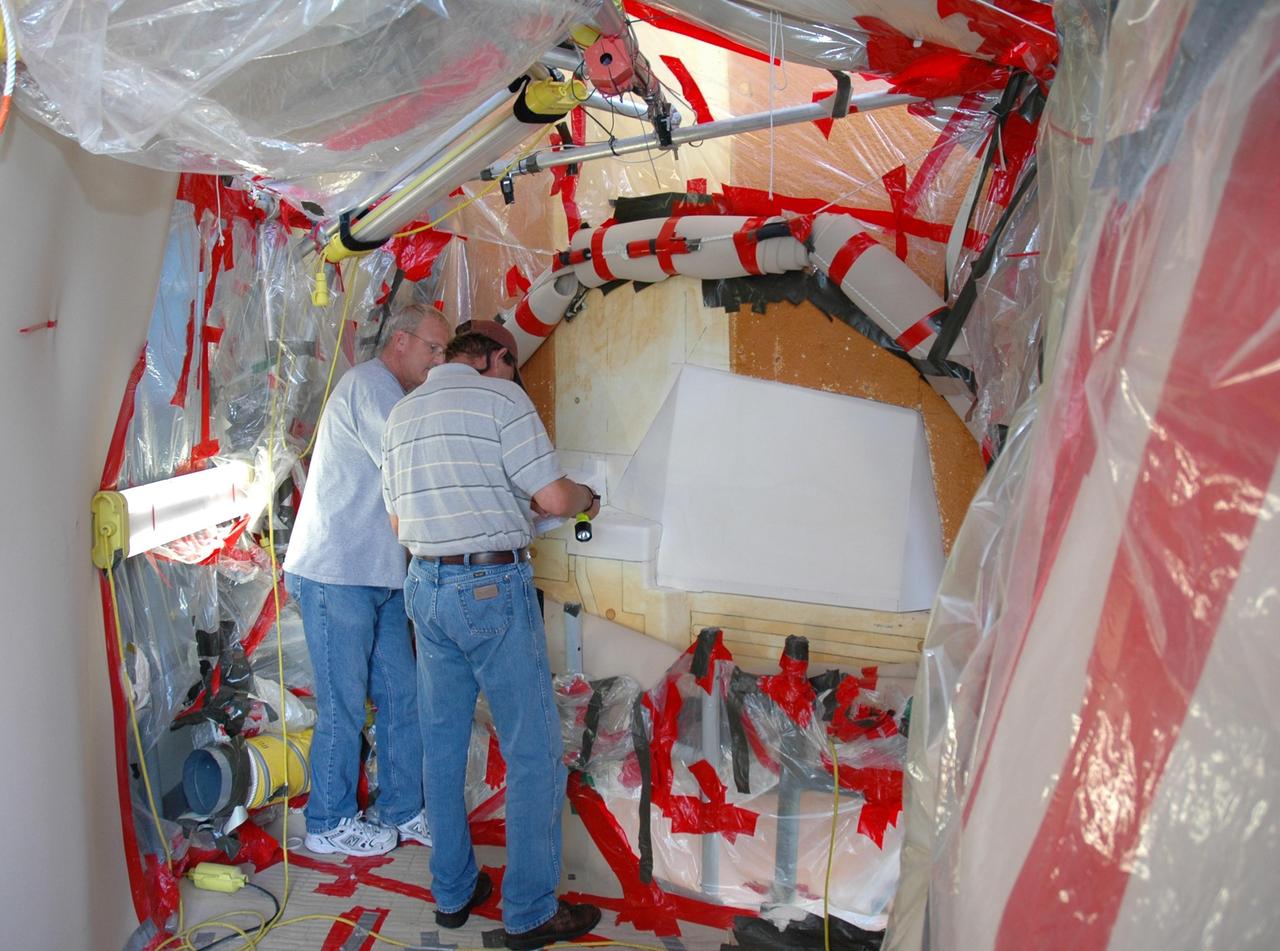
KENNEDY SPACE CENTER, FLA. -- Quality inspectors with NASA and Lockheed Martin examine a red-line drawing of foam placement on space shuttle Atlantis's external tank (in front of them) to verify the foam insulation that was reapplied. The foam covers the feed-through engine cut-off, or ECO, sensor connector. The foam was removed to enable engineers to remove and replace the ECO sensor connector on the tank. The feed-through connector passes the wires from the inside of the tank to the outside. Results of a tanking test on Dec. 18 pointed to an open circuit in the feed-through connector wiring, which is located at the base of the tank. The pins in the replacement connector were precisely soldered to create a connection that allows sensors inside the tank to send signals to the computers onboard Atlantis. The repair work was done on Atlantis while the shuttle has been on Launch Pad 39A at NASA's Kennedy Space Center. The launch date for the shuttle's STS-122 mission has now been targeted for Feb. 7. Photo credit: NASA/Cory Husten
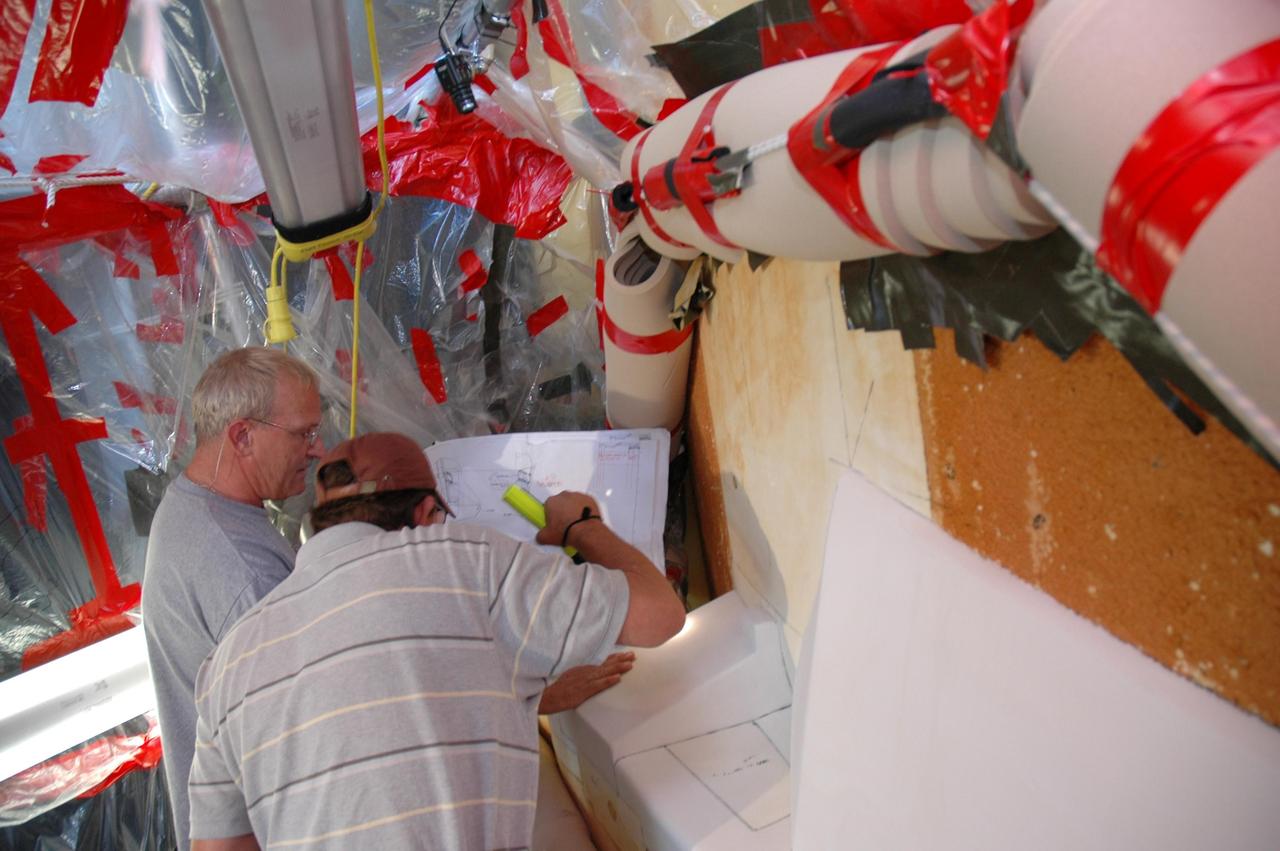
KENNEDY SPACE CENTER, FLA. -- Quality inspectors with NASA and Lockheed Martin examine a red-line drawing of foam placement on space shuttle Atlantis's external tank (in front of them) to verify the foam insulation that was reapplied. The foam covers the feed-through engine cut-off, or ECO, sensor connector. The foam was removed to enable engineers to remove and replace the ECO sensor connector on the tank. The feed-through connector passes the wires from the inside of the tank to the outside. Results of a tanking test on Dec. 18 pointed to an open circuit in the feed-through connector wiring, which is located at the base of the tank. The pins in the replacement connector were precisely soldered to create a connection that allows sensors inside the tank to send signals to the computers onboard Atlantis. The repair work was done on Atlantis while the shuttle has been on Launch Pad 39A at NASA's Kennedy Space Center. The launch date for the shuttle's STS-122 mission has now been targeted for Feb. 7. Photo credit: NASA/Cory Husten
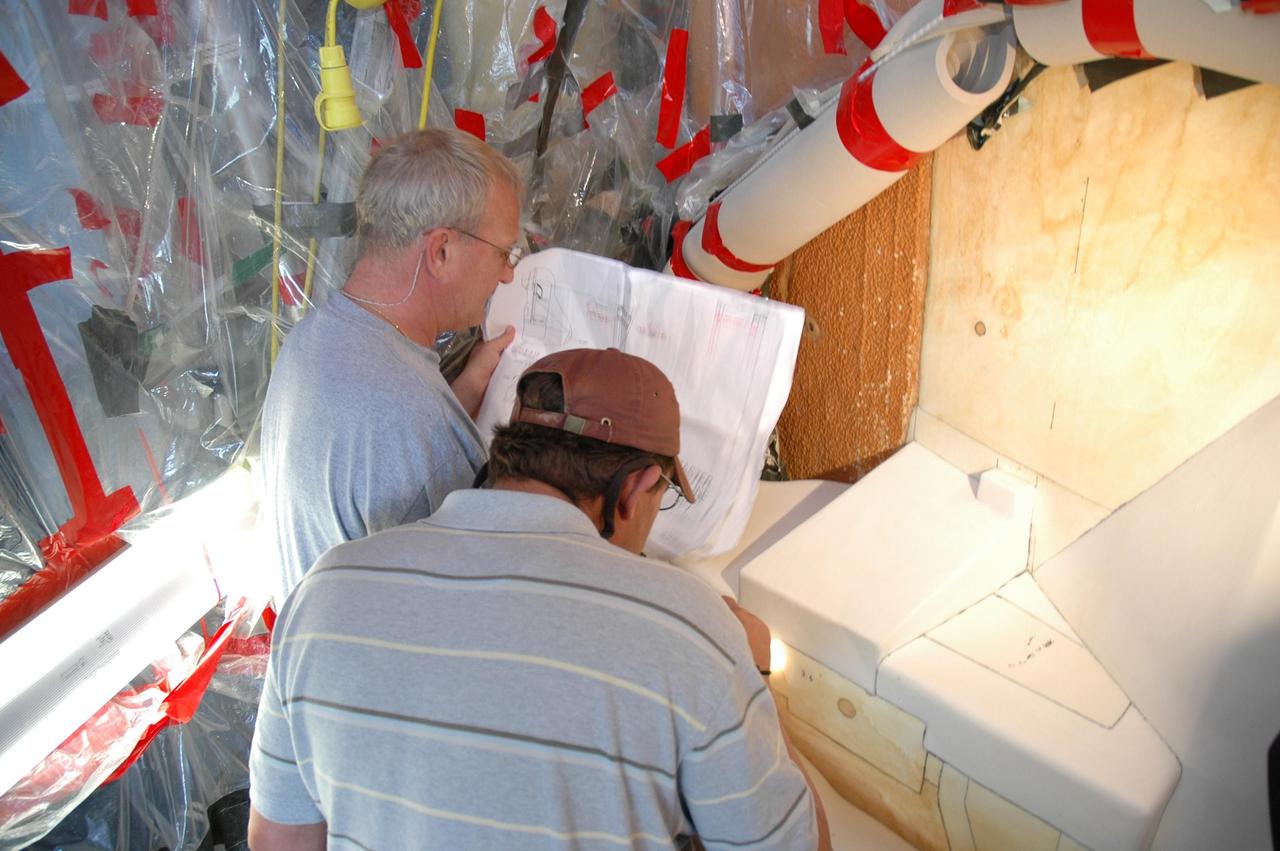
KENNEDY SPACE CENTER, FLA. -- Quality inspectors with NASA and Lockheed Martin examine a red-line drawing of foam placement on space shuttle Atlantis's external tank (in front of them) to verify the foam insulation that was reapplied. The foam covers the feed-through engine cut-off, or ECO, sensor connector. The foam was removed to enable engineers to remove and replace the ECO sensor connector on the tank. The feed-through connector passes the wires from the inside of the tank to the outside. Results of a tanking test on Dec. 18 pointed to an open circuit in the feed-through connector wiring, which is located at the base of the tank. The pins in the replacement connector were precisely soldered to create a connection that allows sensors inside the tank to send signals to the computers onboard Atlantis. The repair work was done on Atlantis while the shuttle has been on Launch Pad 39A at NASA's Kennedy Space Center. The launch date for the shuttle's STS-122 mission has now been targeted for Feb. 7. Photo credit: NASA/Cory Husten
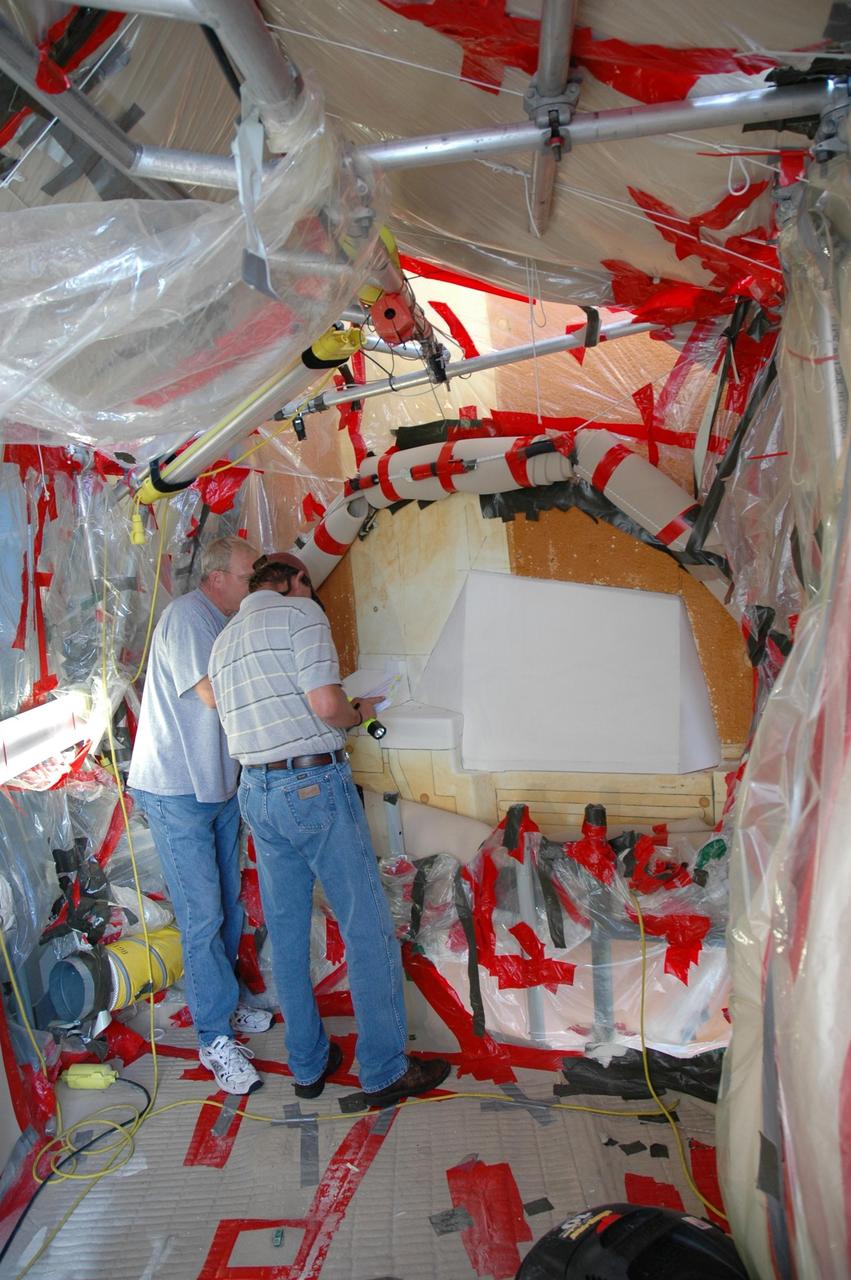
KENNEDY SPACE CENTER, FLA. -- Quality inspectors with NASA and Lockheed Martin examine a red-line drawing of foam placement on space shuttle Atlantis's external tank (in front of them) to verify the foam insulation that was reapplied. The foam covers the feed-through engine cut-off, or ECO, sensor connector. The foam was removed to enable engineers to remove and replace the ECO sensor connector on the tank. The feed-through connector passes the wires from the inside of the tank to the outside. Results of a tanking test on Dec. 18 pointed to an open circuit in the feed-through connector wiring, which is located at the base of the tank. The pins in the replacement connector were precisely soldered to create a connection that allows sensors inside the tank to send signals to the computers onboard Atlantis. The repair work was done on Atlantis while the shuttle has been on Launch Pad 39A at NASA's Kennedy Space Center. The launch date for the shuttle's STS-122 mission has now been targeted for Feb. 7. Photo credit: NASA/Cory Husten

KENNEDY SPACE CENTER, FLA. -- On Launch Pad 39A, Lockheed Martin engineer Ray Clark splices wires between space shuttle Atlantis' external tank and the engine cutoff, or ECO, sensor system. The replacement feed-through connector in the ECO sensor system will be installed later. Some of the tank's ECO sensors gave failed readings during propellant tanking for Atlantis' STS-122 mission launch attempts on Dec. 6 and Dec. 9. Results of a tanking test on Dec. 18 pointed to an open circuit in the feed-through connector wiring, which is located at the base of the tank. The feed-through connector passes the wires from the inside of the tank to the outside. The pins in the replacement connector have been precisely soldered to create a connection that allows sensors inside the tank to send signals to the computers onboard Atlantis. No problems with the ECO sensors themselves have been found. NASA's Space Shuttle Program has proposed a target launch date of Feb. 7 for the STS-122 mission. That proposed launch date remains under evaluation pending coordination with all partners in the International Space Station Program. Photo credit: NASA/George Shelton
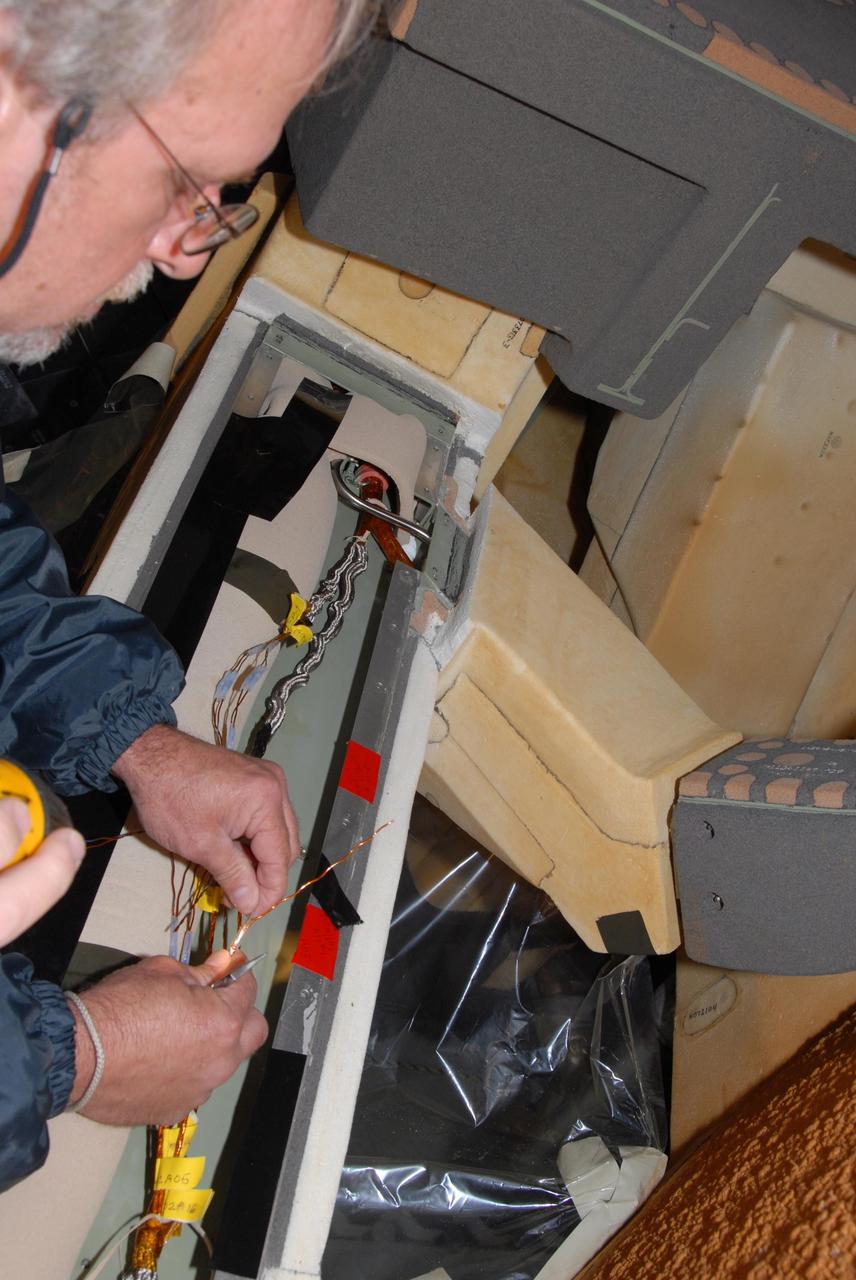
KENNEDY SPACE CENTER, FLA. -- On Launch Pad 39A, Lockheed Martin engineer Ray Clark splices wires between space shuttle Atlantis' external tank and the engine cutoff, or ECO, sensor system. The replacement feed-through connector in the ECO sensor system will be installed later. Some of the tank's ECO sensors gave failed readings during propellant tanking for Atlantis' STS-122 mission launch attempts on Dec. 6 and Dec. 9. Results of a tanking test on Dec. 18 pointed to an open circuit in the feed-through connector wiring, which is located at the base of the tank. The feed-through connector passes the wires from the inside of the tank to the outside. The pins in the replacement connector have been precisely soldered to create a connection that allows sensors inside the tank to send signals to the computers onboard Atlantis. No problems with the ECO sensors themselves have been found. NASA's Space Shuttle Program has proposed a target launch date of Feb. 7 for the STS-122 mission. That proposed launch date remains under evaluation pending coordination with all partners in the International Space Station Program. Photo credit: NASA/George Shelton
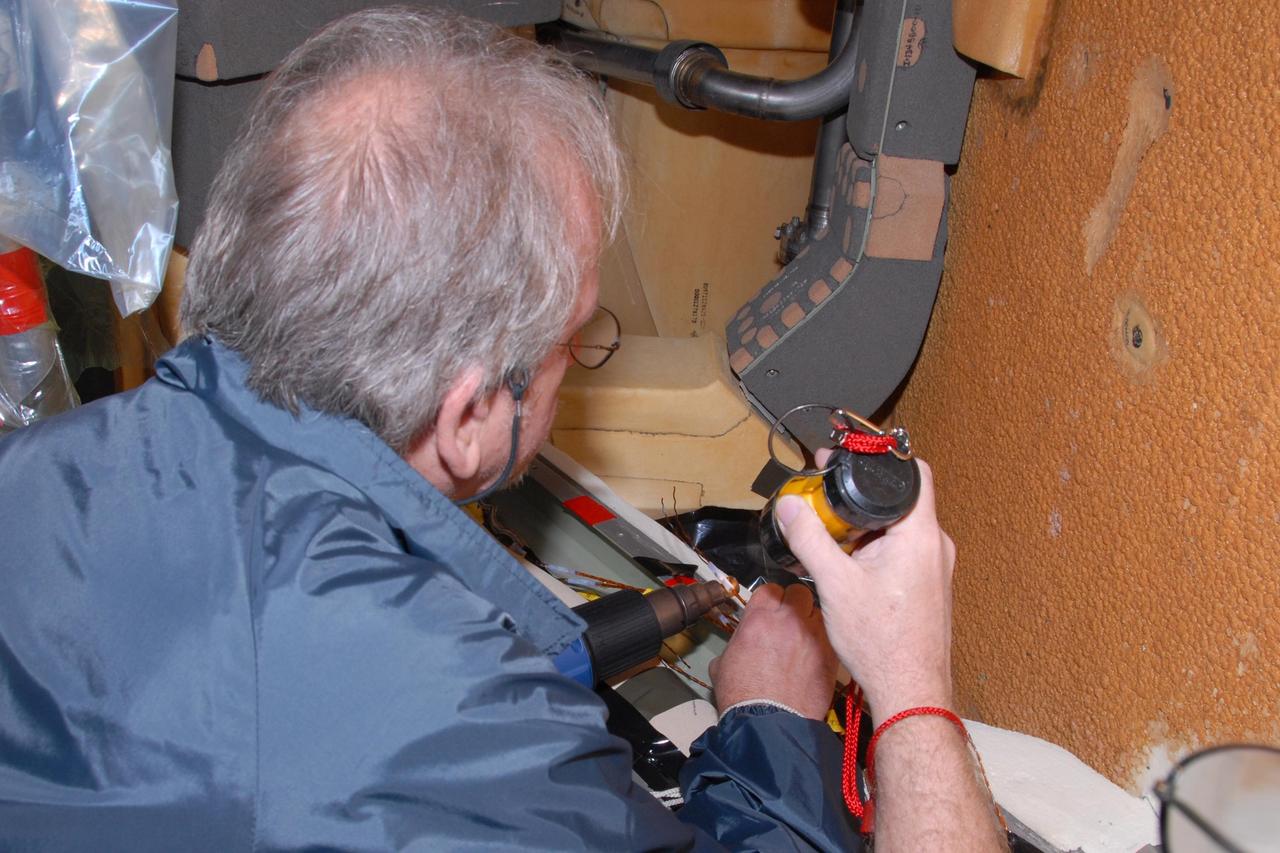
KENNEDY SPACE CENTER, FLA. -- On Launch Pad 39A, Lockheed Martin engineer Ray Clark splices wires between space shuttle Atlantis' external tank and the engine cutoff, or ECO, sensor system. The replacement feed-through connector in the ECO sensor system will be installed later. Some of the tank's ECO sensors gave failed readings during propellant tanking for Atlantis' STS-122 mission launch attempts on Dec. 6 and Dec. 9. Results of a tanking test on Dec. 18 pointed to an open circuit in the feed-through connector wiring, which is located at the base of the tank. The feed-through connector passes the wires from the inside of the tank to the outside. The pins in the replacement connector have been precisely soldered to create a connection that allows sensors inside the tank to send signals to the computers onboard Atlantis. No problems with the ECO sensors themselves have been found. NASA's Space Shuttle Program has proposed a target launch date of Feb. 7 for the STS-122 mission. That proposed launch date remains under evaluation pending coordination with all partners in the International Space Station Program. Photo credit: NASA/George Shelton
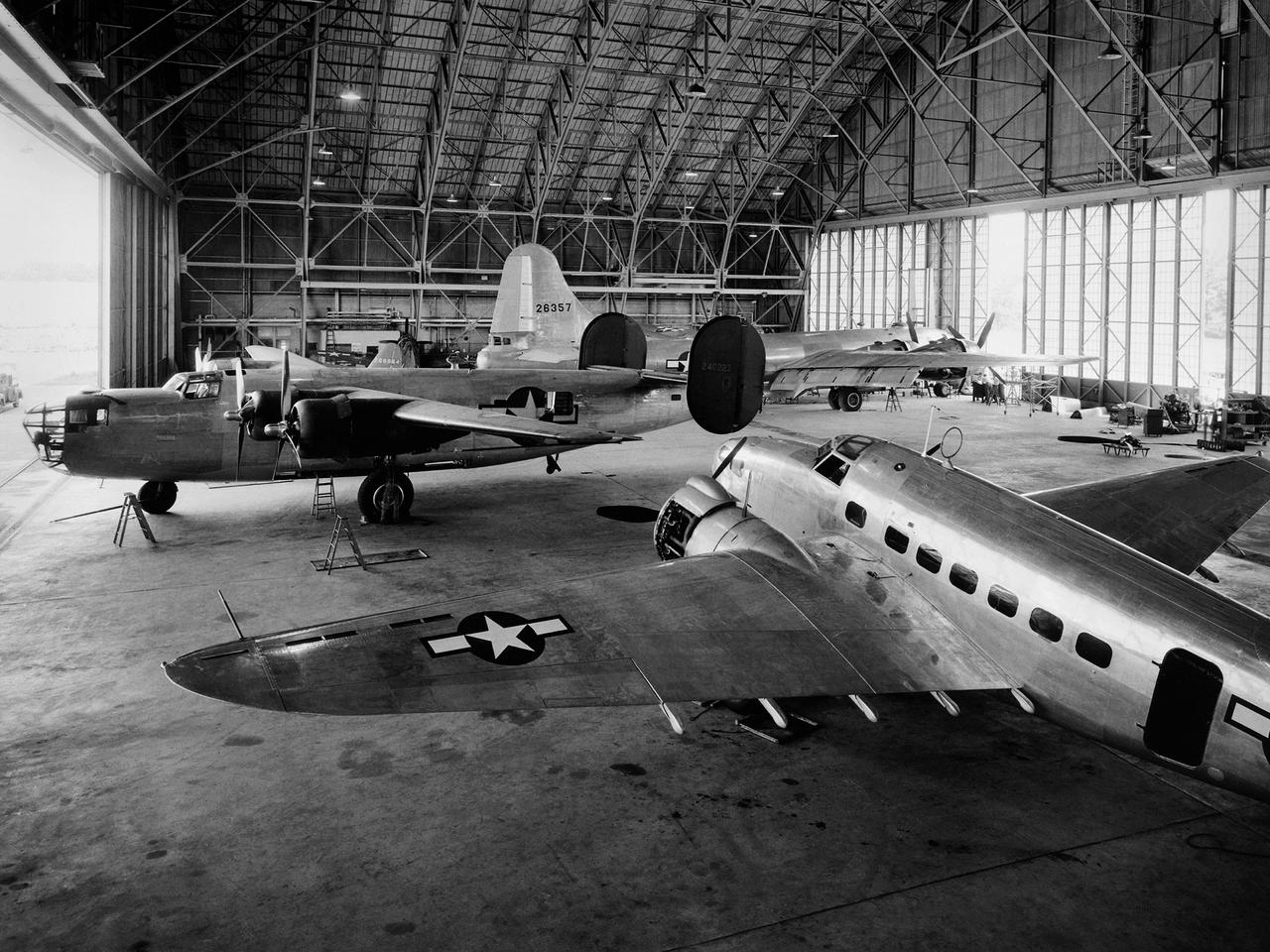
A Consolidated B–24D Liberator (left), Boeing B–29 Superfortress (background), and Lockheed RA–29 Hudson (foreground) parked inside the Flight Research Building at the National Advisory Committee for Aeronautics (NACA) Aircraft Engine Research Laboratory in Cleveland, Ohio. A P–47G Thunderbolt and P–63A King Cobra are visible in the background. The laboratory utilized 15 different aircraft during the final 2.5 years of World War II. This starkly contrasts with the limited-quantity, but long-duration aircraft of the NASA’s modern fleet. The Flight Research Building is a 272- by 150-foot hangar with an internal height ranging from 40 feet at the sides to 90 feet at its apex. The steel support trusses were pin-connected at the top with tension members extending along the corrugated transite walls down to the floor. The 37.5-foot-tall and 250-foot-long doors on either side can be opened in sections. The hangar included a shop area and stock room along the far wall, and a single-story office wing with nine offices, behind the camera. The offices were later expanded. The hangar has been in continual use since its completion in December 1942. Nearly 70 different aircraft have been sheltered here over the years. Temporary offices were twice constructed over half of the floor area when office space was at a premium.
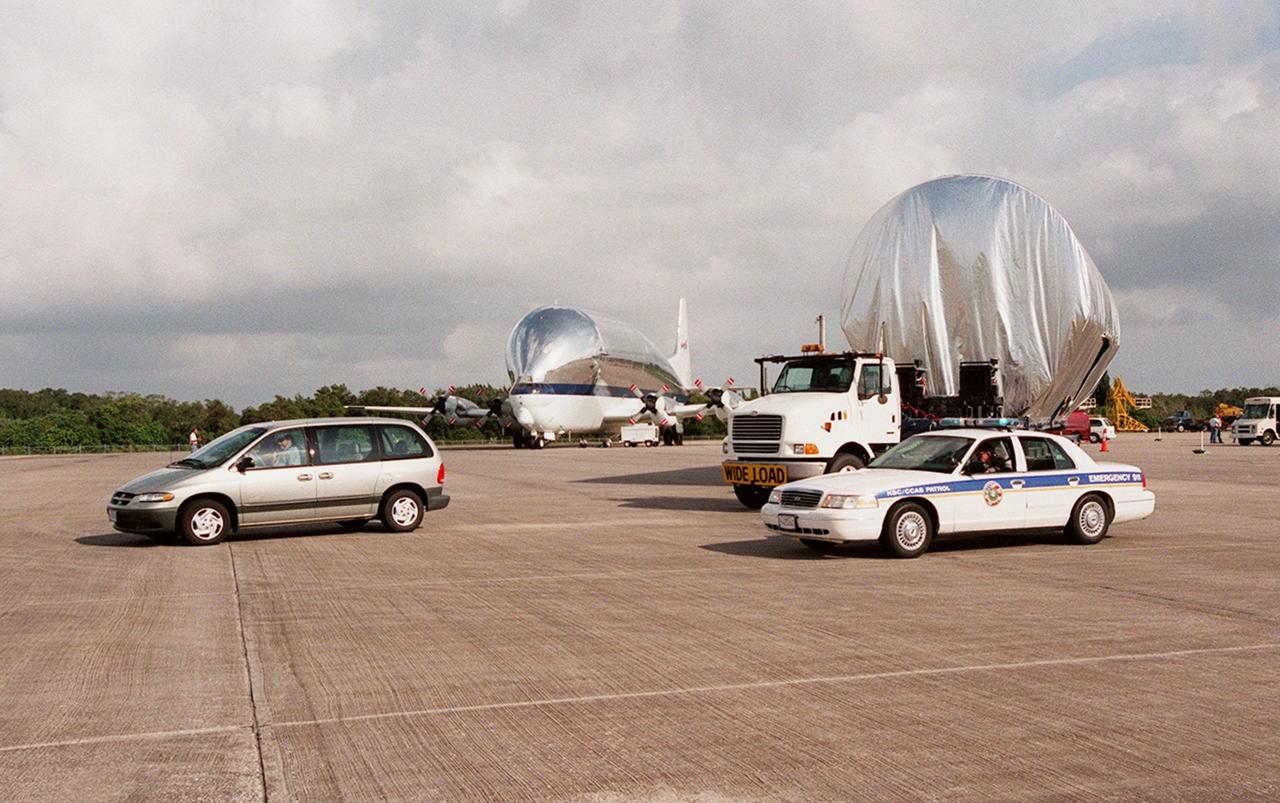
KENNEDY SPACE CENTER, FLA. -- Escort vehicles prepare to leave the Shuttle Landing Facility with the S1 truss (at right) on its trek to the Operations and Checkout Building. Manufactured by the Boeing Co. in Huntington Beach, Calif., this component of the ISS is the first starboard (right-side) truss segment, whose main job is providing structural support for the orbiting research facility's radiator panels that cool the Space Station's complex power system. The S1 truss segment also will house communications systems, external experiment positions and other subsystems. Primarily constructed of aluminum, the truss segment is 45 feet long, 15 feet wide and 6 feet tall. When fully outfitted, it will weigh 31,137 pounds. The truss is slated for flight in 2001. The truss arrived at KSC aboard NASA's Super Guppy, seen in the background. The aircraft is uniquely built with a 25-foot diameter fuselage designed to handle oversized loads and a "fold-away" nose that opens 110 degrees for cargo loading. A system of rails in the cargo compartment, used with either Guppy pallets or fixtures designed for specific cargo, makes cargo loading simple and efficient. Rollers mounted in the rails allow pallets or fixtures to be moved by an electric winch mounted beneath the cargo floor. Automatic hydraulic lock pins in each rail secure the pallet for flight
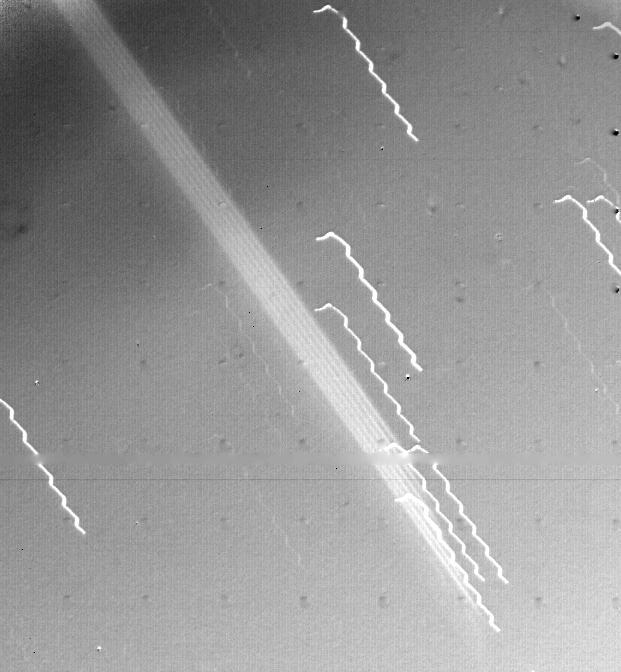
First evidence of a ring around the planet Jupiter is seen in this photograph taken by Voyager 1 on March 4, 1979. The multiple exposure of the extremely thin faint ring appears as a broad light band crossing the center of the picture. The edge of the ring is 1,212,000 km from the spacecraft and 57,000 km from the visible cloud deck of Jupiter. The background stars look like broken hair pins because of spacecraft motion during the 11 minute 12 second exposure. The wavy motion of the star trails is due to the ultra-slow natural oscillation of the spacecraft (with a period of 78 seconds). The black dots are geometric calibration points in the camera. The ring thickness is estimated to be 30 km or less. The photograph was part of a sequence planned to search for such rings in Jupiter's equatorial plane. The ring has been invisible from Earth because of its thinness and its transparency when viewed at any angle except straight on. JPL manages and controls the Voyager Project for NASA's Office of Space Science. http://photojournal.jpl.nasa.gov/catalog/PIA02251
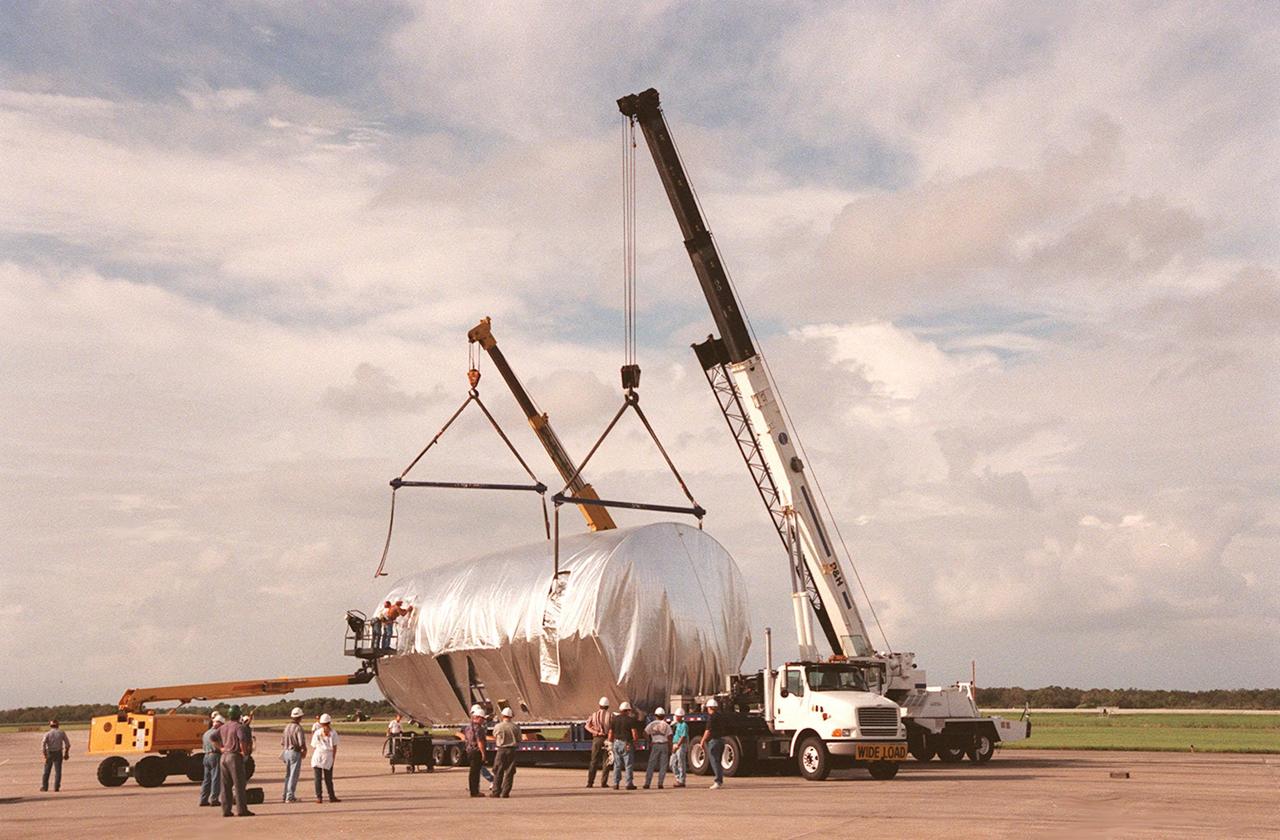
KENNEDY SPACE CENTER, FLA. -- At the Shuttle Landing Facility, workers attach cranes to the S1 truss, a segment of the International Space Station, to lift the truss to a payload transporter for its transfer to the Operations and Checkout Building. Manufactured by the Boeing Co. in Huntington Beach, Calif., this component of the ISS is the first starboard (right-side) truss segment, whose main job is providing structural support for the orbiting research facility's radiator panels that cool the Space Station's complex power system. The S1 truss segment also will house communications systems, external experiment positions and other subsystems. Primarily constructed of aluminum, the truss segment is 45 feet long, 15 feet wide and 6 feet tall. When fully outfitted, it will weigh 31,137 pounds. The truss is slated for flight in 2001. The truss arrived at KSC aboard NASA's Super Guppy, with a 25-foot diameter fuselage designed to handle oversized loads. Loading the Guppy is easy because of the unique "fold-away" nose of the aircraft that opens 110 degrees for cargo loading. A system of rails in the cargo compartment, used with either Guppy pallets or fixtures designed for specific cargo, makes cargo loading simple and efficient. Rollers mounted in the rails allow pallets or fixtures to be moved by an electric winch mounted beneath the cargo floor. Automatic hydraulic lock pins in each rail secure the pallet for flight
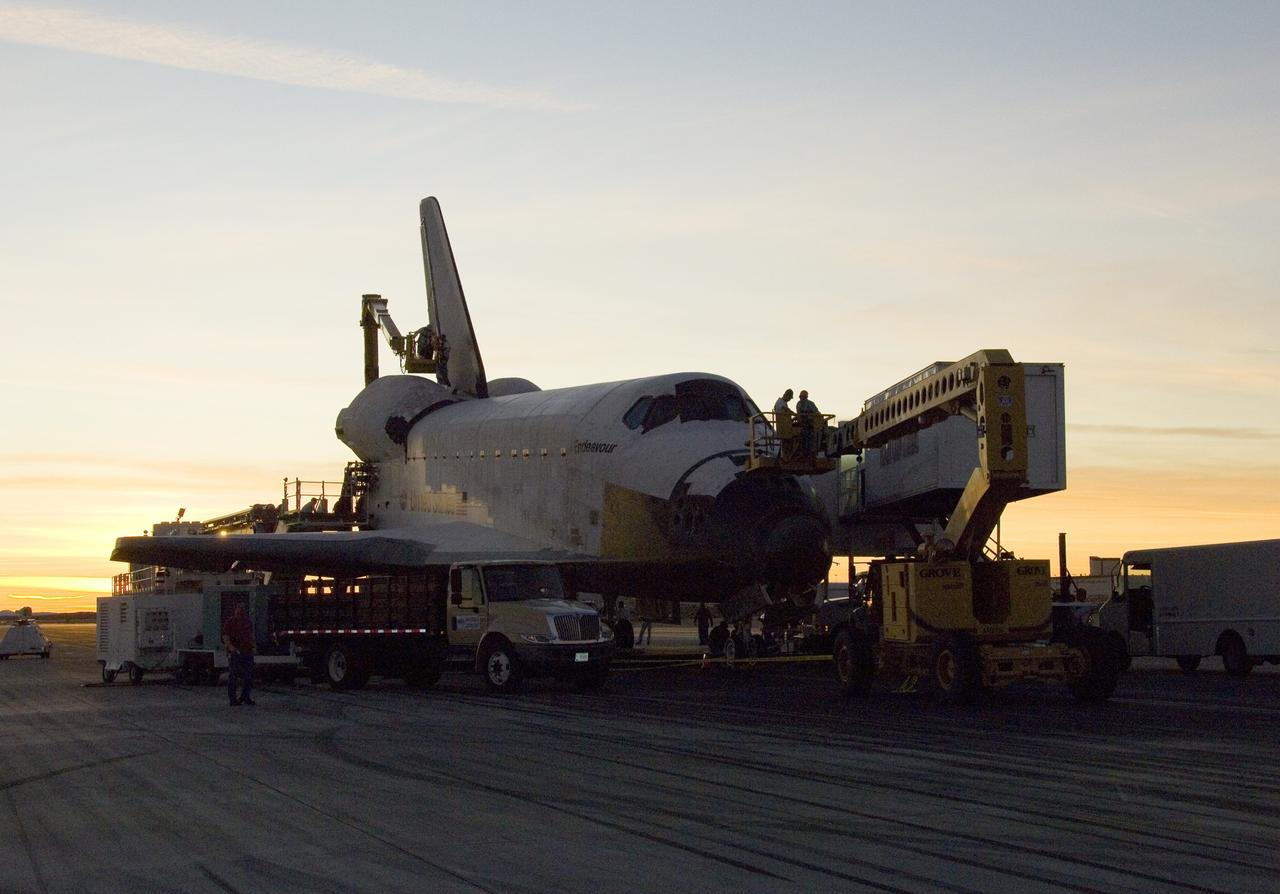
EDWARDS, Calif. – On Edwards Air Force Base in California, space shuttle Endeavour undergoes recovery operations after its landing. The orbiter convoy normally begins recovery operations in earnest about two hours before the shuttle is scheduled to land. Specially designed vehicles or units and a team of trained personnel “safe” the orbiter and prepare it for towing. Purge and Coolant Umbilical Access Vehicles are moved into position behind the orbiter to get access to the umbilical areas. The flight crew is replaced aboard the orbiter by exchange sup¬port personnel who prepare the orbiter for ground tow operations, install switch guards and remove data packages from any onboard experiments. After a total safety downgrade, vehicle ground personnel make numerous preparations for the towing operation, including install¬ing landing gear lock pins, disconnecting the nose landing gear drag link, positioning the towing vehicle in front of the orbiter and connecting the tow bar. The decision to land Endeavour at Edwards was made due to weather concerns at NASA's Kennedy Space Center in Florida. In the 52nd landing at Edwards, Endeavour touched down at 4:25 p.m. EST to end the STS-126 mission, completing its 16-day journey of more than 6.6 million miles in space. Endeavour will be returned to Kennedy atop a Shuttle Carrier Aircraft, or SCA, a modified Boeing 747 jetliner. Photo credit: NASA/Tony Landis, VAFB
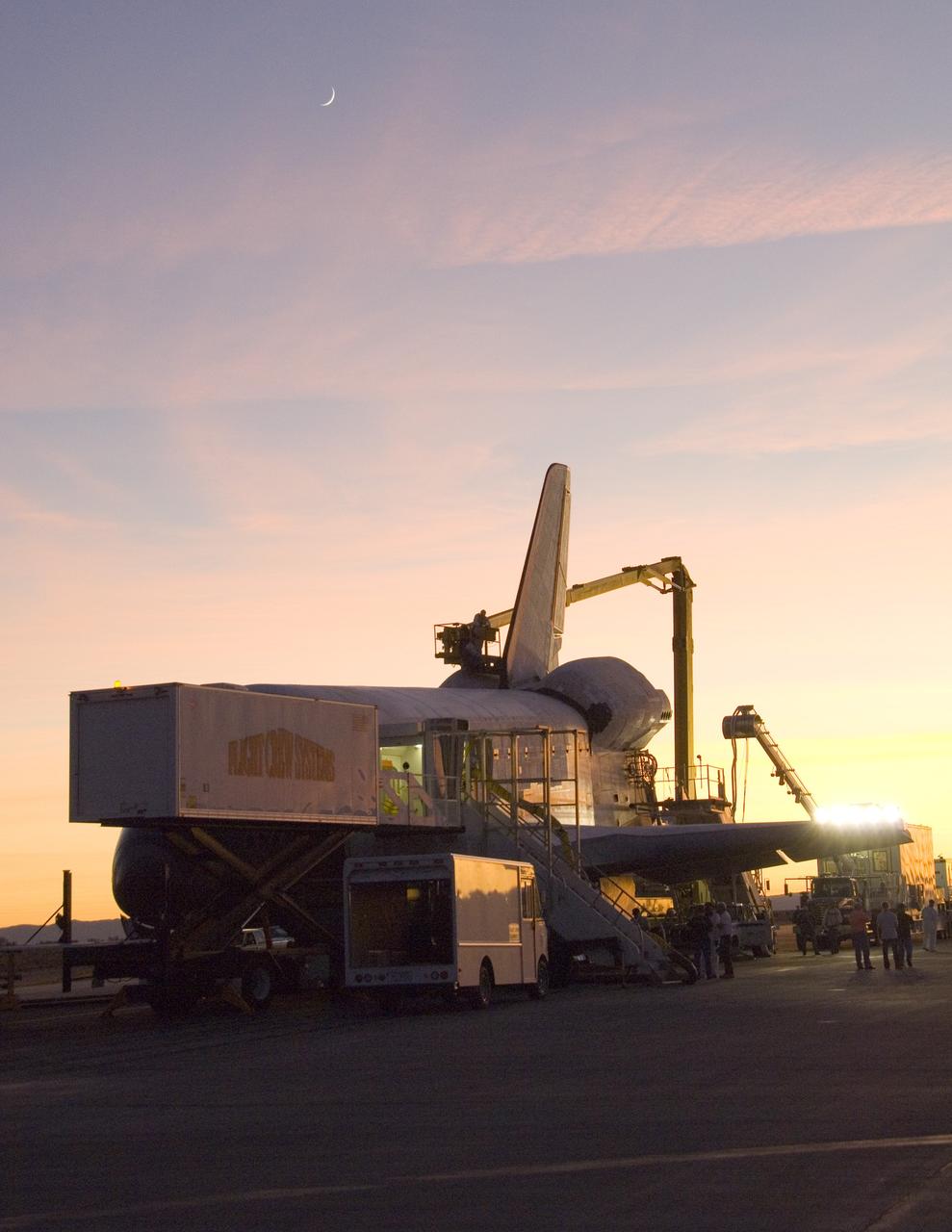
EDWARDS, Calif. – On Edwards Air Force Base in California, space shuttle Endeavour undergoes recovery operations after its landing. The orbiter convoy normally begins recovery operations in earnest about two hours before the shuttle is scheduled to land. Specially designed vehicles or units and a team of trained personnel “safe” the orbiter and prepare it for towing. Purge and Coolant Umbilical Access Vehicles are moved into position behind the orbiter to get access to the umbilical areas. The flight crew is replaced aboard the orbiter by exchange sup¬port personnel who prepare the orbiter for ground tow operations, install switch guards and remove data packages from any onboard experiments. After a total safety downgrade, vehicle ground personnel make numerous preparations for the towing operation, including install¬ing landing gear lock pins, disconnecting the nose landing gear drag link, positioning the towing vehicle in front of the orbiter and connecting the tow bar. The decision to land Endeavour at Edwards was made due to weather concerns at NASA's Kennedy Space Center in Florida. In the 52nd landing at Edwards, Endeavour touched down at 4:25 p.m. EST to end the STS-126 mission, completing its 16-day journey of more than 6.6 million miles in space. Endeavour will be returned to Kennedy atop a Shuttle Carrier Aircraft, or SCA, a modified Boeing 747 jetliner. Photo credit: NASA/Tony Landis, VAFB
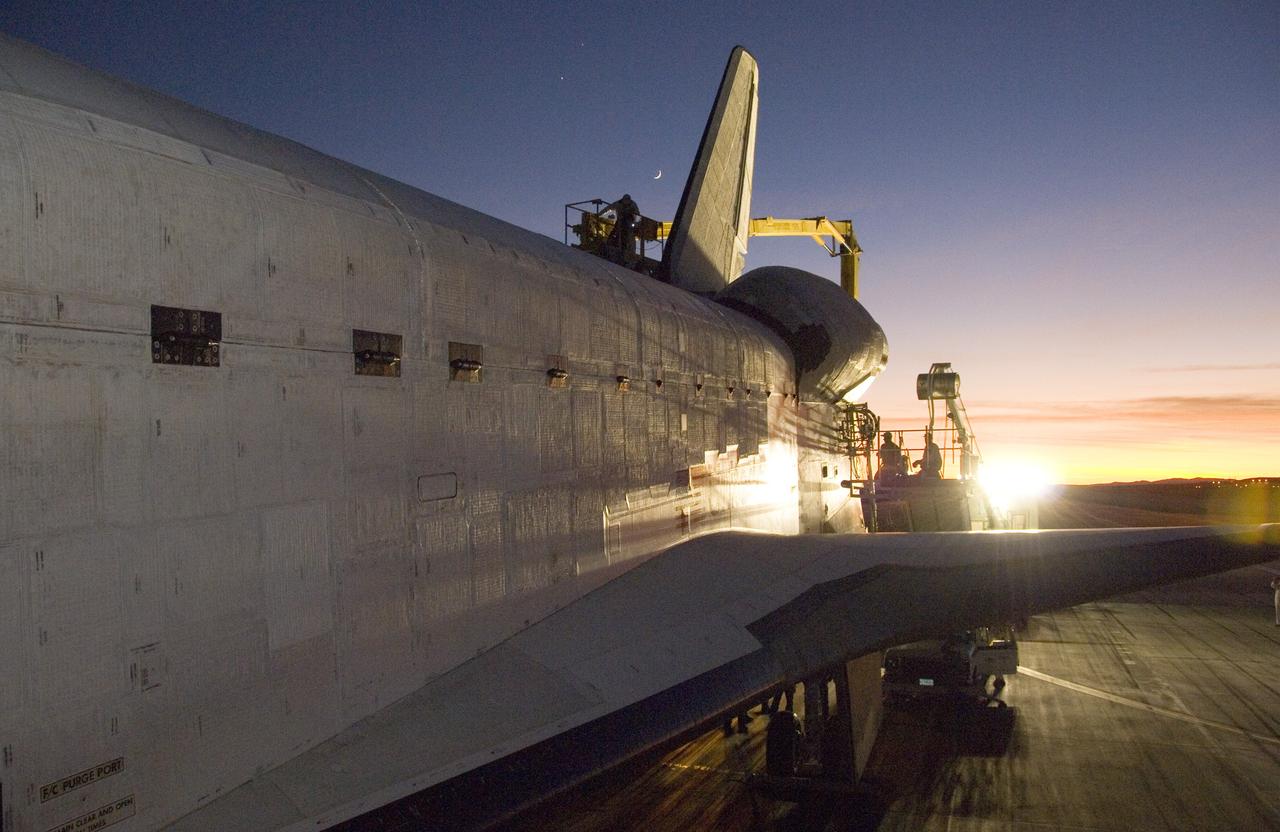
EDWARDS, Calif. – Against a setting sun, space shuttle Endeavour undergoes recovery operations on Edwards Air Force Base in California after its landing. The orbiter convoy normally begins recovery operations in earnest about two hours before the shuttle is scheduled to land. Specially designed vehicles or units and a team of trained personnel “safe” the orbiter and prepare it for towing. Purge and Coolant Umbilical Access Vehicles are moved into position behind the orbiter to get access to the umbilical areas. The flight crew is replaced aboard the orbiter by exchange sup¬port personnel who prepare the orbiter for ground tow operations, install switch guards and remove data packages from any onboard experiments. After a total safety downgrade, vehicle ground personnel make numerous preparations for the towing operation, including install¬ing landing gear lock pins, disconnecting the nose landing gear drag link, positioning the towing vehicle in front of the orbiter and connecting the tow bar. The decision to land Endeavour at Edwards was made due to weather concerns at NASA's Kennedy Space Center in Florida. In the 52nd landing at Edwards, Endeavour touched down at 4:25 p.m. EST to end the STS-126 mission, completing its 16-day journey of more than 6.6 million miles in space. Endeavour will be returned to Kennedy atop a Shuttle Carrier Aircraft, or SCA, a modified Boeing 747 jetliner. Photo credit: NASA/Tony Landis, VAFB
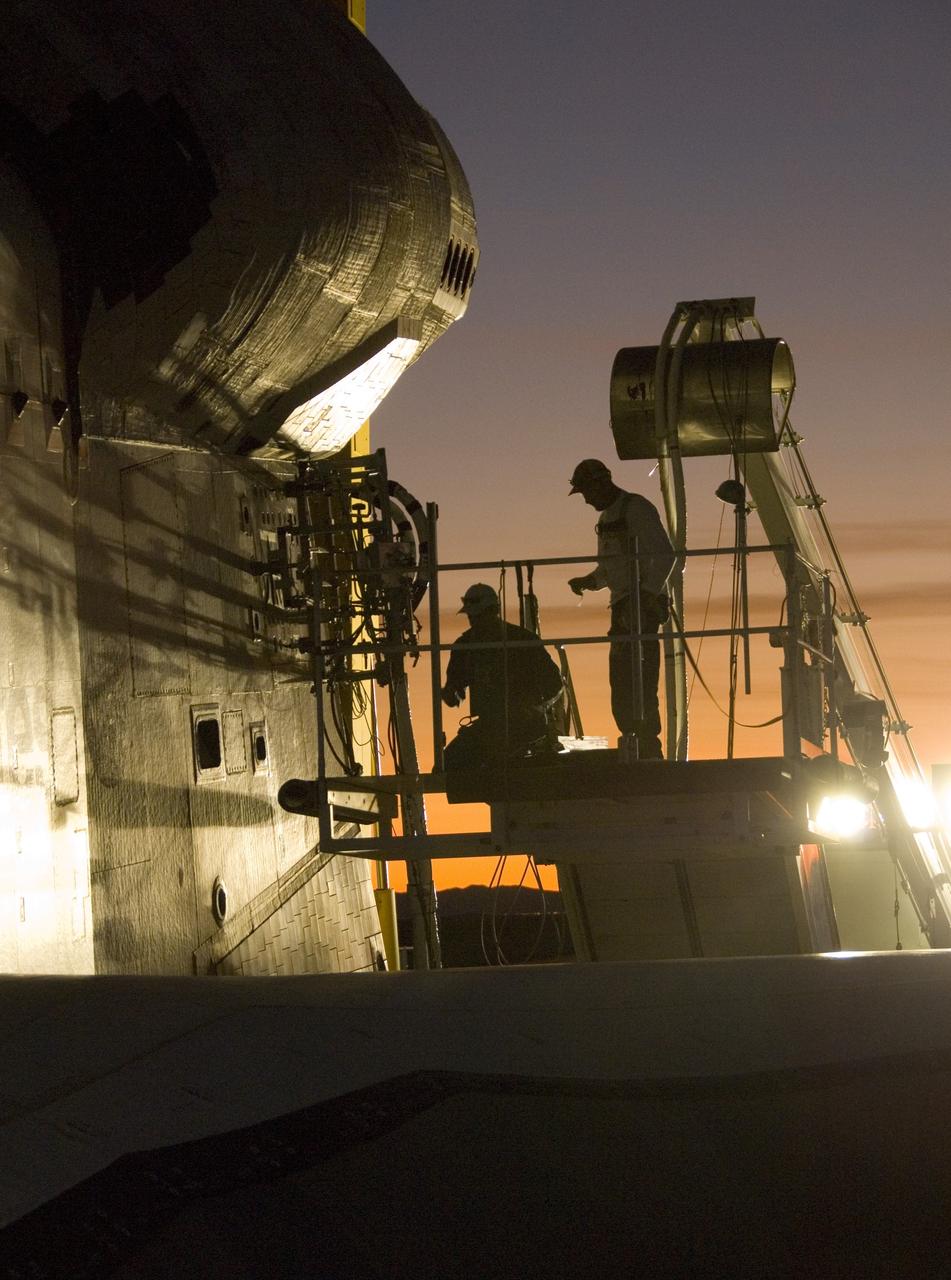
EDWARDS, Calif. – Against a setting sun, space shuttle Endeavour undergoes recovery operations on Edwards Air Force Base in California after its landing. The orbiter convoy normally begins recovery operations in earnest about two hours before the shuttle is scheduled to land. Specially designed vehicles or units and a team of trained personnel “safe” the orbiter and prepare it for towing. Purge and Coolant Umbilical Access Vehicles are moved into position behind the orbiter to get access to the umbilical areas. The flight crew is replaced aboard the orbiter by exchange sup¬port personnel who prepare the orbiter for ground tow operations, install switch guards and remove data packages from any onboard experiments. After a total safety downgrade, vehicle ground personnel make numerous preparations for the towing operation, including install¬ing landing gear lock pins, disconnecting the nose landing gear drag link, positioning the towing vehicle in front of the orbiter and connecting the tow bar. The decision to land Endeavour at Edwards was made due to weather concerns at NASA's Kennedy Space Center in Florida. In the 52nd landing at Edwards, Endeavour touched down at 4:25 p.m. EST to end the STS-126 mission, completing its 16-day journey of more than 6.6 million miles in space. Endeavour will be returned to Kennedy atop a Shuttle Carrier Aircraft, or SCA, a modified Boeing 747 jetliner. Photo credit: NASA/Tony Landis, VAFB
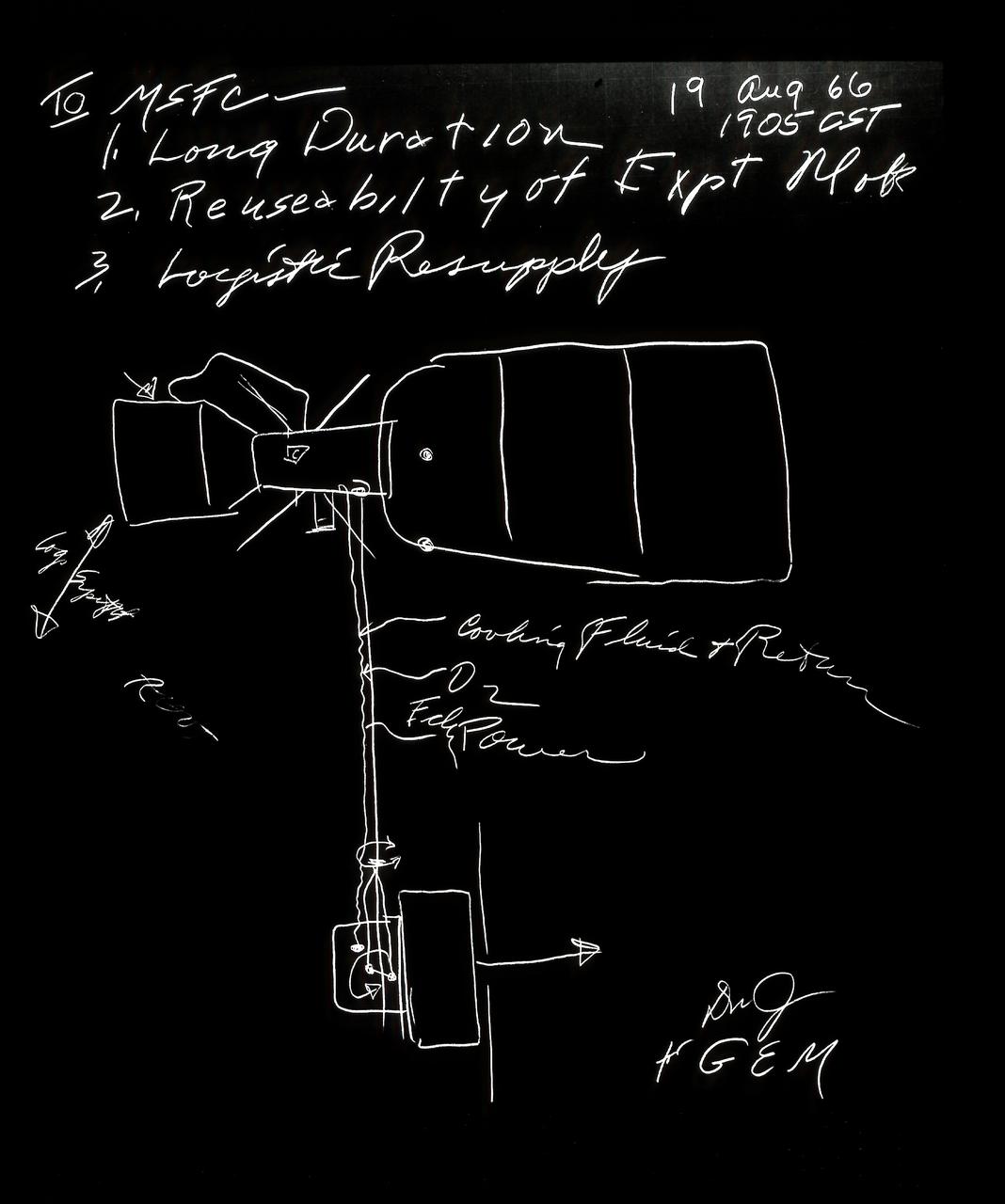
Seldom in aerospace history has a major decision been as promptly and concisely recorded as with the Skylab shown in this sketch. At a meeting at the Marshall Space Flight Center on August 19, 1966, George E. Mueller, NASA Associate Administrator for Marned Space Flight, used a felt pen and poster paper to pin down the final conceptual layout for the budding space station's (established as the Skylab in 1970) major elements. General Davy Jones, first program director, added his initials and those of Dr. Mueller in the lower right corner. The goals of the Skylab were to enrich our scientific knowledge of the Earth, the Sun, the stars, and cosmic space; to study the effects of weightlessness on living organisms, including man; to study the effects of the processing and manufacturing of materials utilizing the absence of gravity; and to conduct Earth resource observations. The Skylab also conducted 19 selected experiments submitted by high school students. Skylab's 3 different 3-man crews spent up to 84 days in Earth orbit. The Marshall Space Flight Center (MSFC) had responsibility for developing and integrating most of the major components of the Skylab: the Orbital Workshop (OWS), Airlock Module (AM), Multiple Docking Adapter (MDA), Apollo Telescope Mount (ATM), Payload Shroud (PS), and most of the experiments. MSFC was also responsible for providing the Saturn IB launch vehicles for three Apollo spacecraft and crews and a Saturn V launch vehicle for the Skylab.
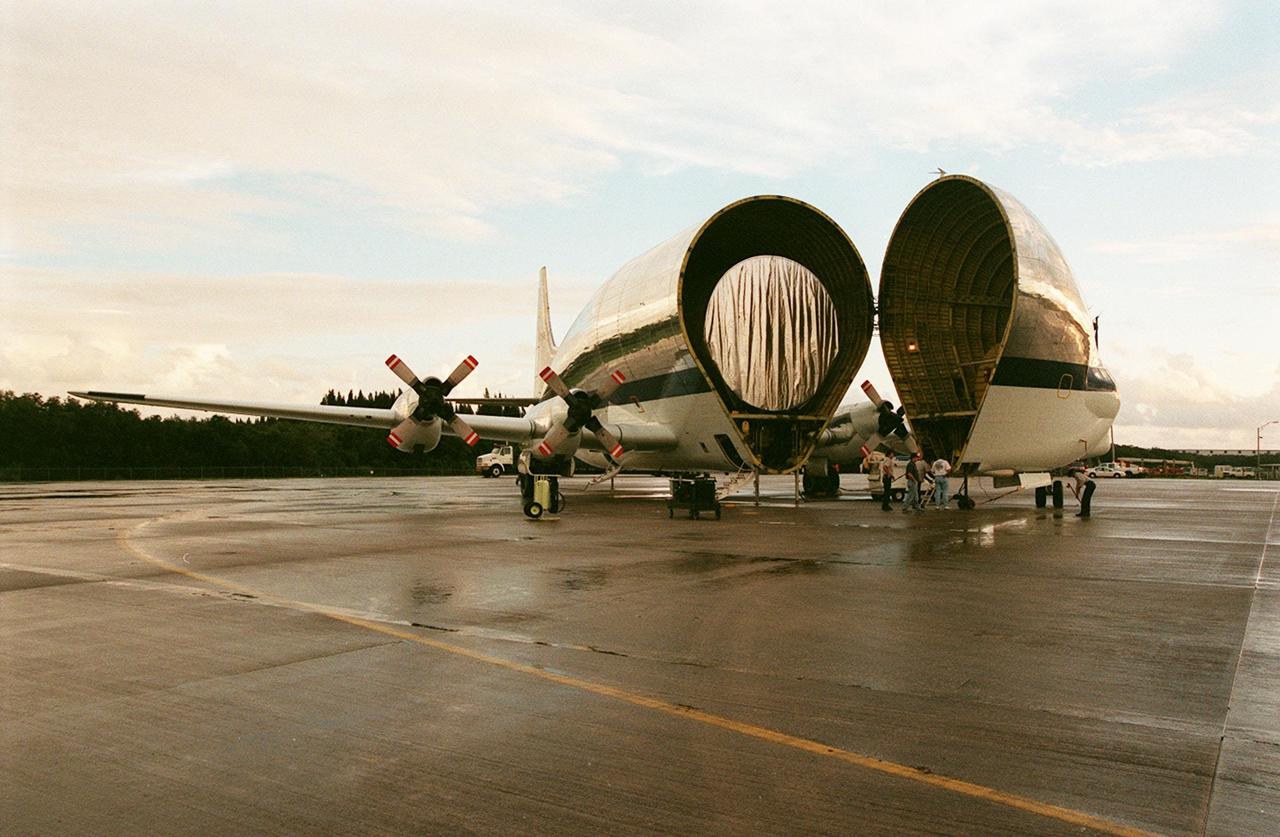
KENNEDY SPACE CENTER, FLA. -- At KSC's Shuttle Landing Facility, NASA's Super Guppy opens to reveal its cargo, the International Space Station's (ISS) S1 truss. Manufactured by the Boeing Co. in Huntington Beach, Calif., this component of the ISS is the first starboard (right-side) truss segment, whose main job is providing structural support for the orbiting research facility's radiator panels that cool the Space Station's complex power system. The S1 truss segment also will house communications systems, external experiment positions and other subsystems. Primarily constructed of aluminum, the truss segment is 45 feet long, 15 feet wide and 6 feet tall. When fully outfitted, it will weigh 31,137 pounds. The truss is slated for flight in 2001. The Super Guppy, with its 25-foot diameter fuselage designed to handle oversized loads, is well prepared to transport the truss and other ISS segments. Loading the Guppy is easy because of the unique "fold-away" nose of the aircraft that opens 110 degrees for cargo loading. A system of rails in the cargo compartment, used with either Guppy pallets or fixtures designed for specific cargo, makes cargo loading simple and efficient. Rollers mounted in the rails allow pallets or fixtures to be moved by an electric winch mounted beneath the cargo floor. Automatic hydraulic lock pins in each rail secure the pallet for flight. The truss is to be transferred to the Operations and Checkout Building