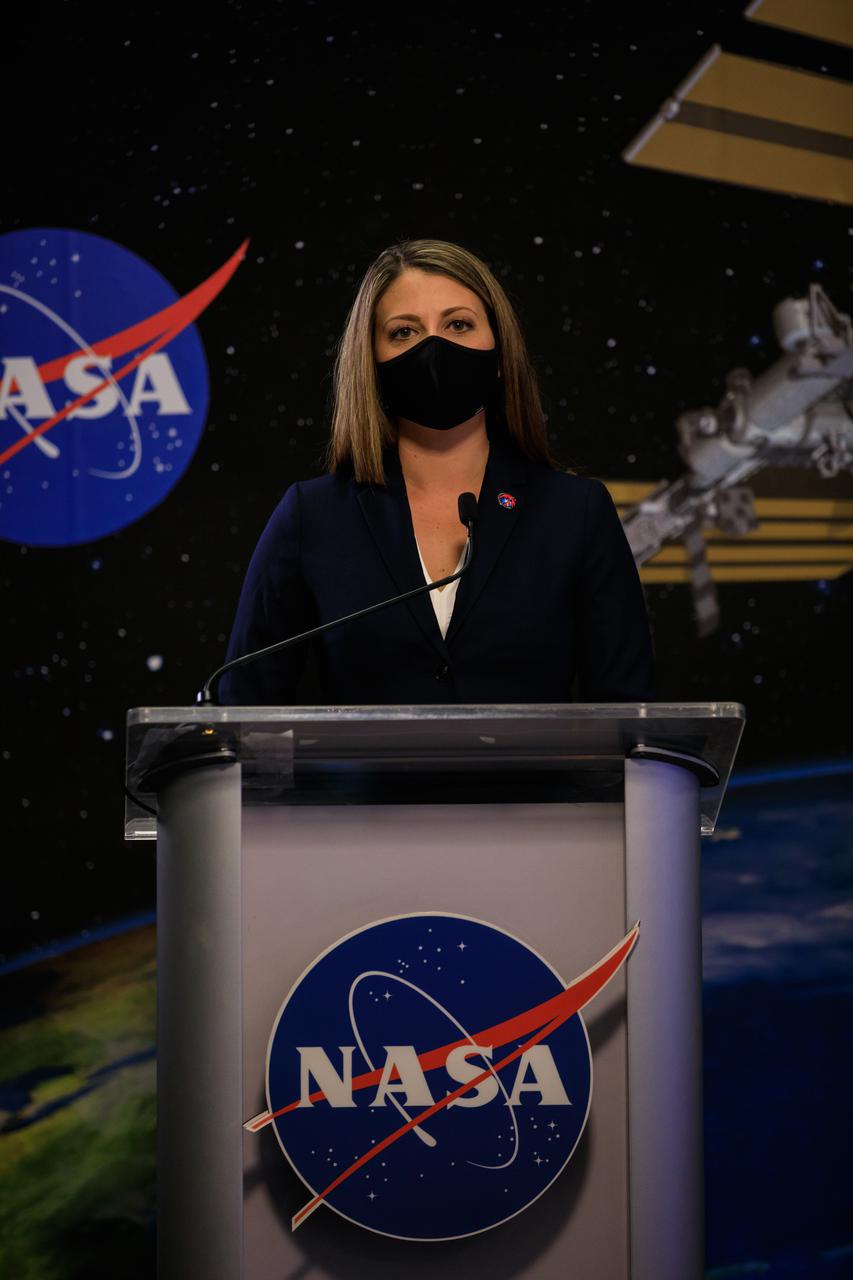
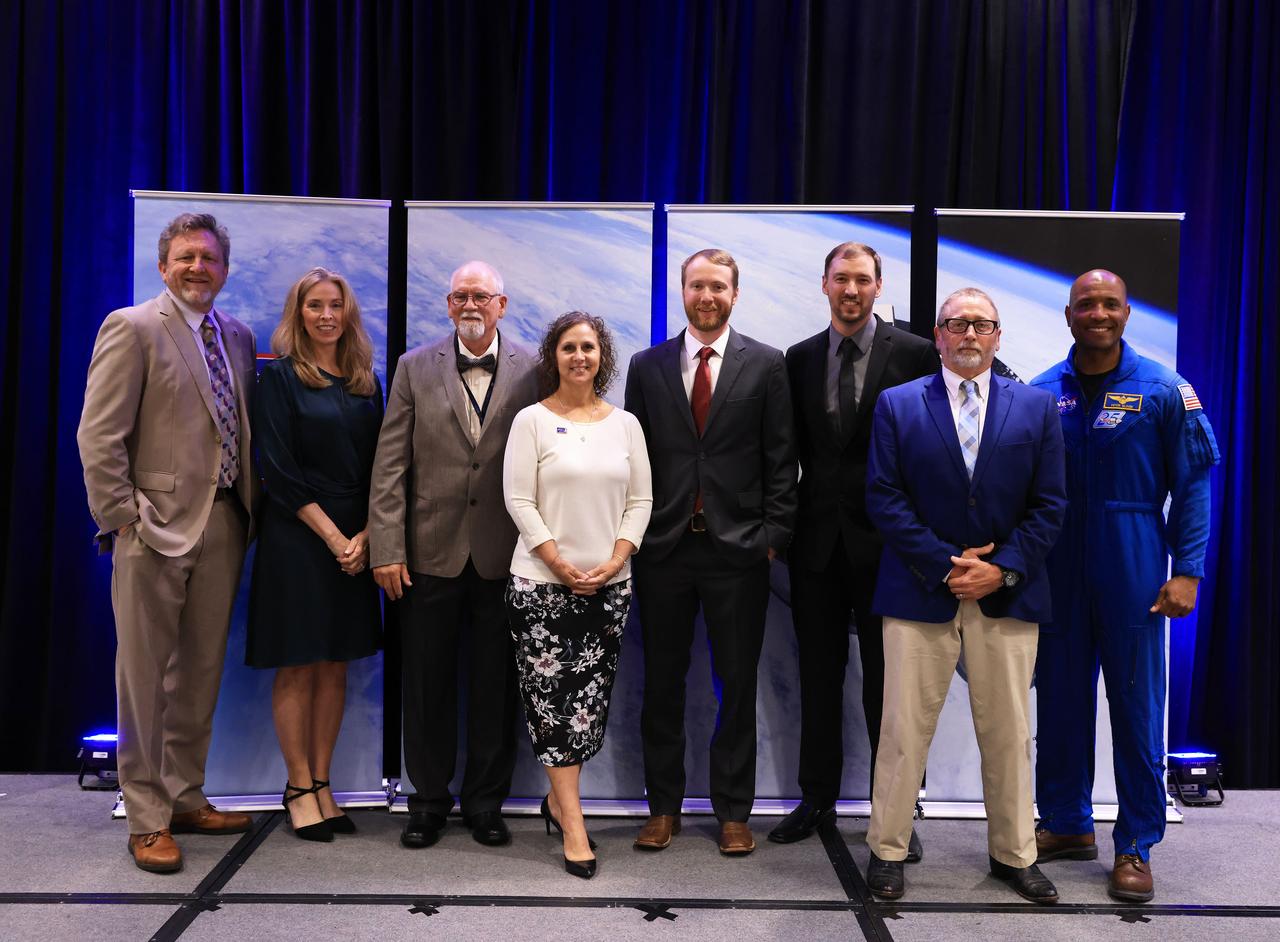
NASA astronaut and Artemis II crew member Victor Glover stands with Honoree Award recipients from NASA’s Stennis Space Center following presentation of the awards during NASA’s Space Flight Awareness Program ceremony on May 4 in Orlando, Florida. Recipients (and their companies), along with ceremony presenters were: (left to right) NASA Stennis Associate Director Rodney McKellip, Shelly Lunsford (SaiTech Inc.), Odie Ladner (Aerojet Rocketdyne, an L3 Harris Technologies company), Rachel Deschamp (Alutiiq Essential Services), Peyton Pinson (NASA), Jack Conley (NASA), Ronnie Good (NASA), and Glover.
NASA Space Flight Awareness Program Recognizes Stennis Employees
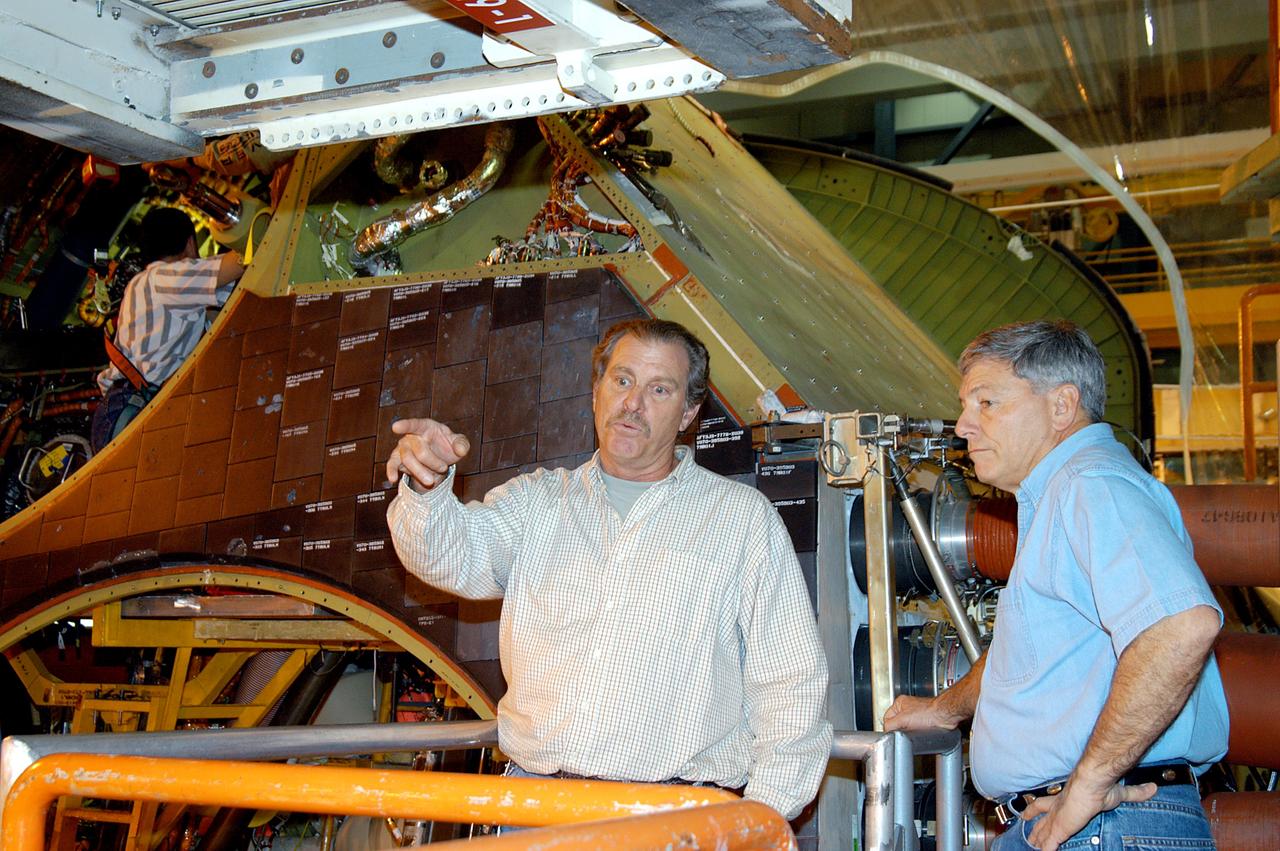
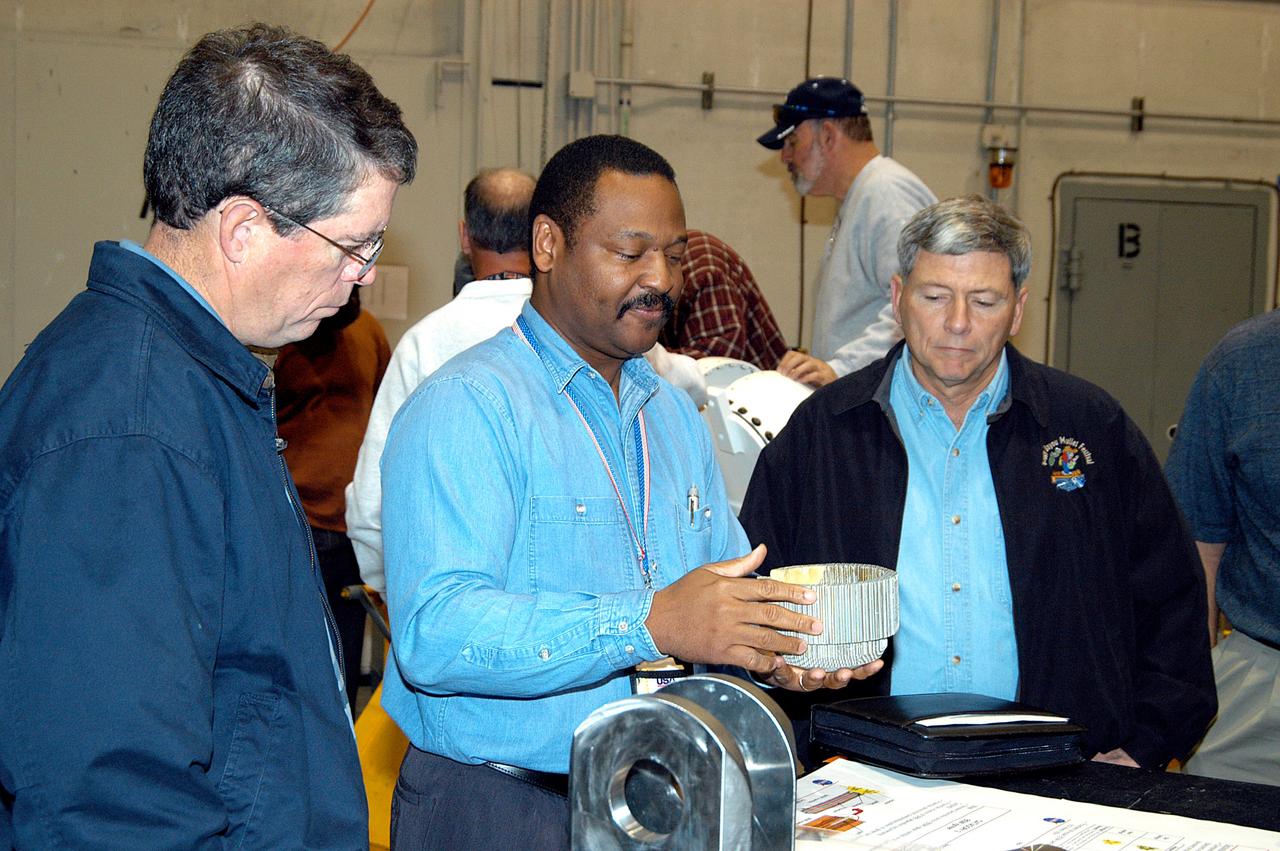
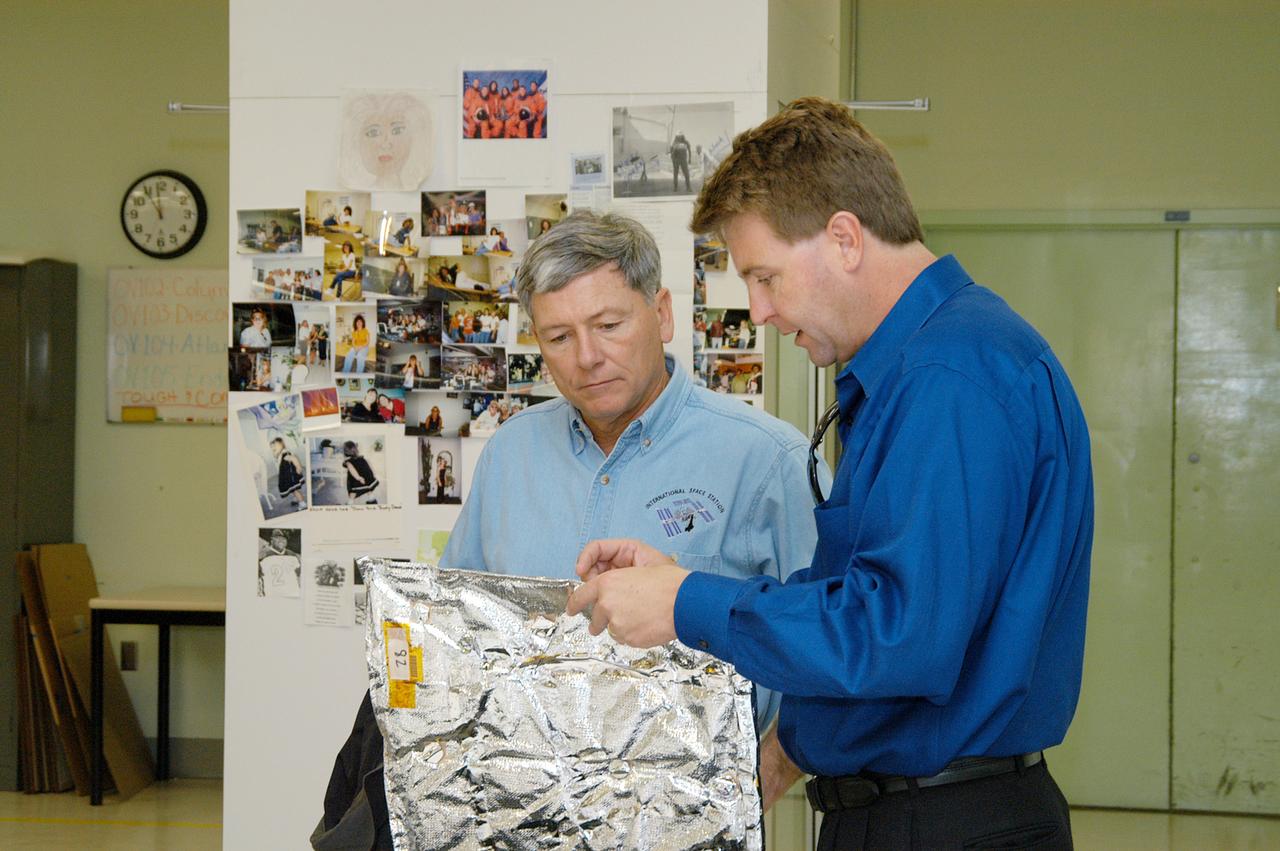
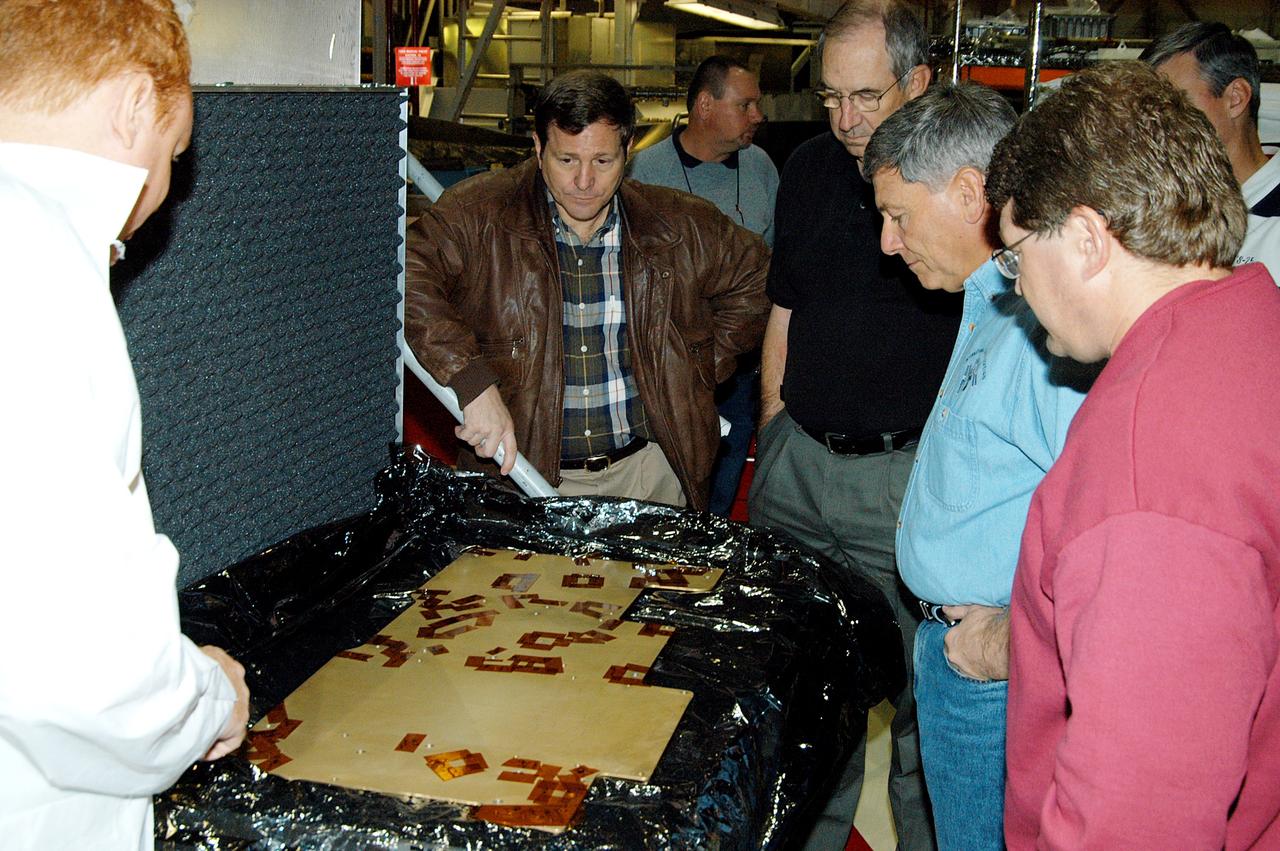
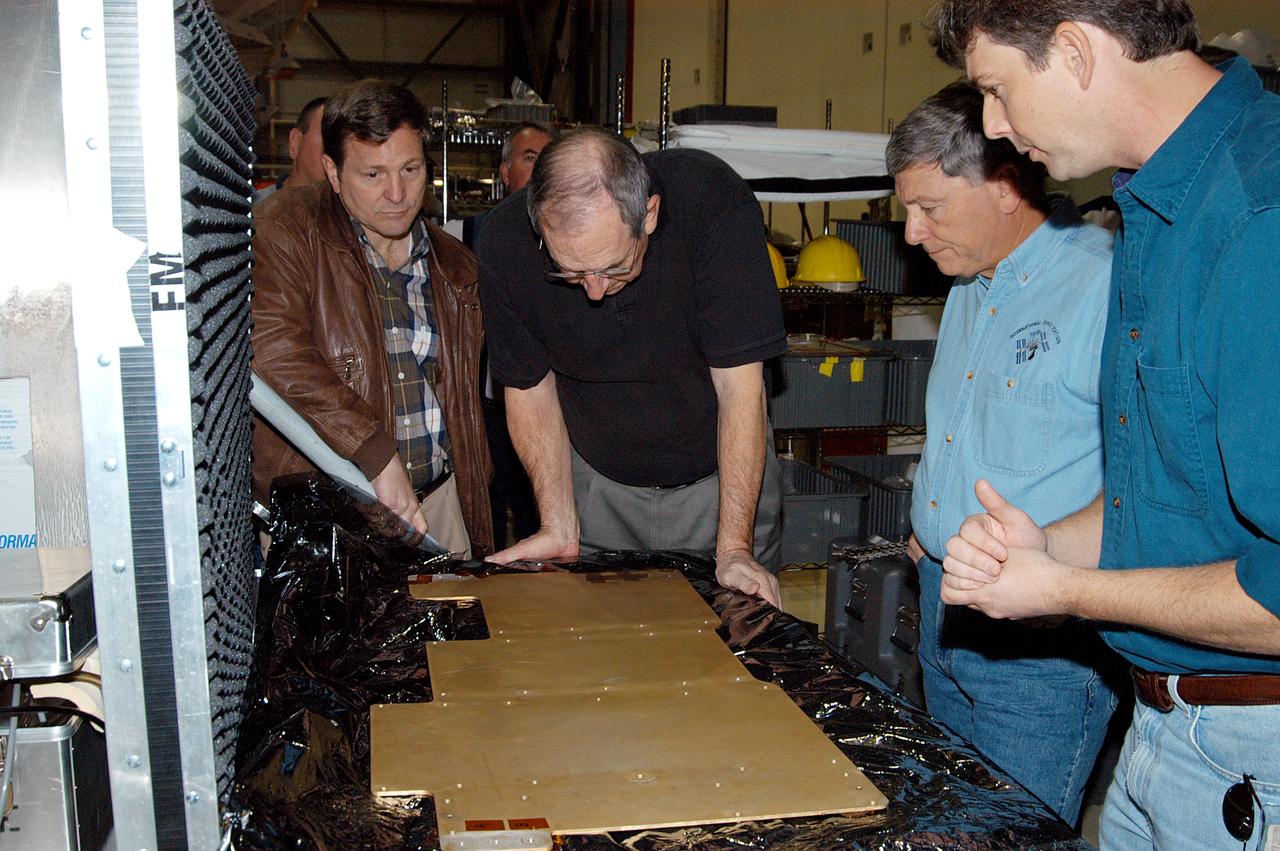
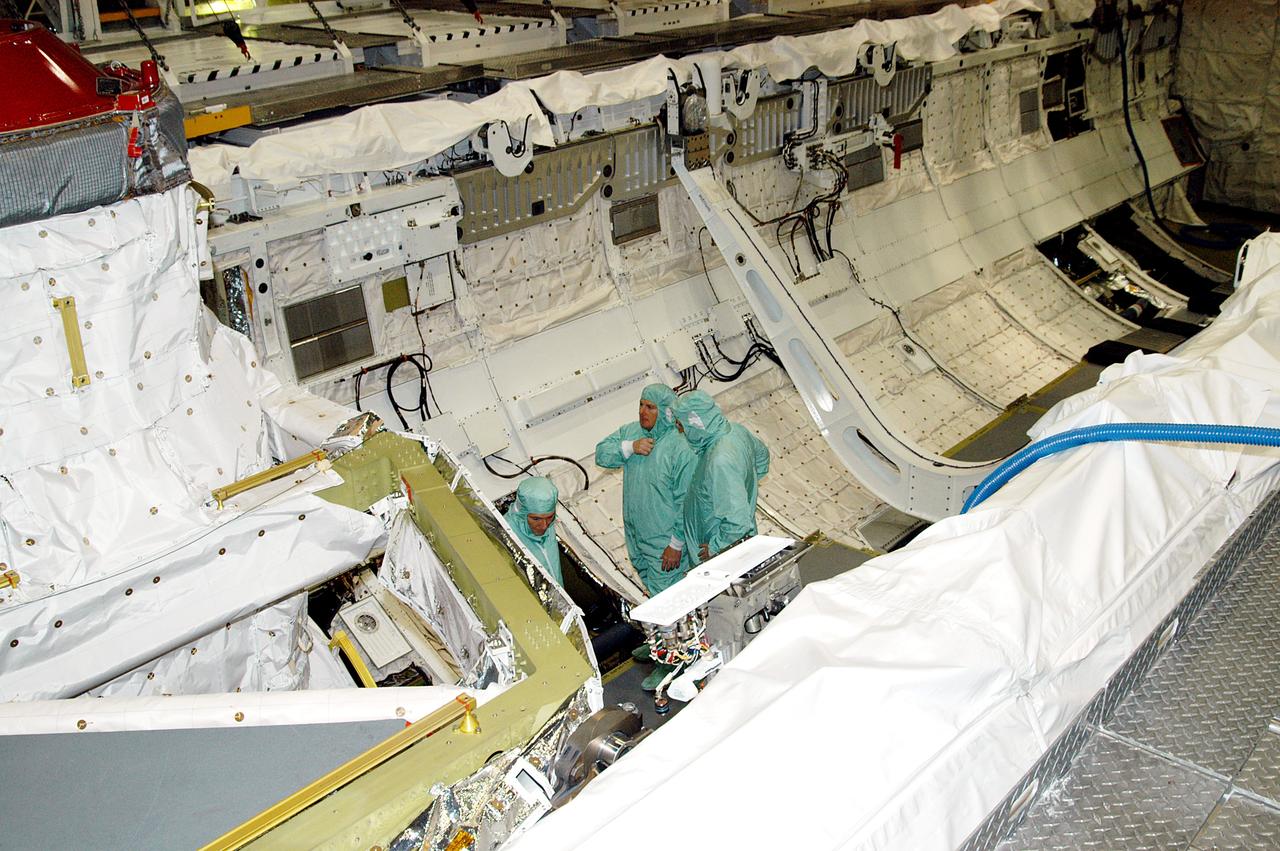
KENNEDY SPACE CENTER, FLA. -- From left, NASA Deputy Program Manager of the Space Shuttle Program Michael Wetmore, United Space Alliance (USA) Vice President and Space Shuttle Program Manager Howard DeCastro, NASA Deputy Associate Administrator for Space Station and Shuttle Programs Michael Kostelnik, and a USA technician examine cold plates in Orbiter Processing Facility Bay 2.  NASA and USA Space Shuttle program management are participating in a leadership workday.  The day is intended to provide management with an in-depth, hands-on look at Shuttle processing activities at KSC.
KENNEDY SPACE CENTER, FLA. -- From left, NASA Deputy Program Manager of the Space Shuttle Program Michael Wetmore, United Space Alliance (USA) Vice President and Space Shuttle Program Manager Howard DeCastro, NASA Deputy Associate Administrator for Space Station and Shuttle Programs Michael Kostelnik, and a USA technician examine cold plates in Orbiter Processing Facility Bay 2. NASA and USA Space Shuttle program management are participating in a leadership workday. The day is intended to provide management with an in-depth, hands-on look at Shuttle processing activities at KSC.
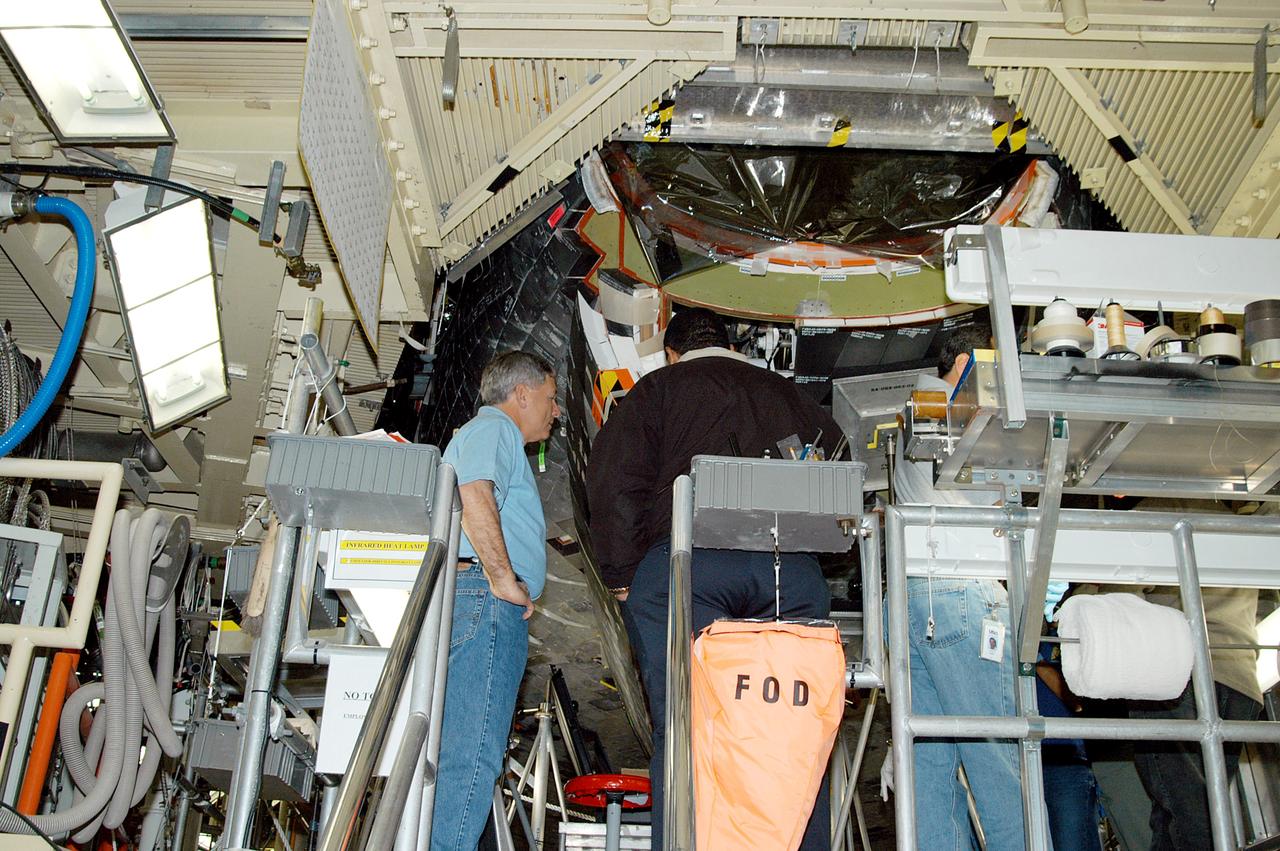
KENNEDY SPACE CENTER, FLA. -- From left, a United Space Alliance (USA) technician briefs NASA Deputy Program Manager of the Space Shuttle Program Michael Wetmore, USA Vice President and Space Shuttle Program Manager Howard DeCastro, and NASA Deputy Associate Administrator for Space Station and Shuttle Programs Michael Kostelnik on the use of cold plates in Orbiter Processing Facility Bay 2.  NASA and USA Space Shuttle program management are participating in a leadership workday.  The day is intended to provide management with an in-depth, hands-on look at Shuttle processing activities at KSC.
KENNEDY SPACE CENTER, FLA. -- From left, a United Space Alliance (USA) technician briefs NASA Deputy Program Manager of the Space Shuttle Program Michael Wetmore, USA Vice President and Space Shuttle Program Manager Howard DeCastro, and NASA Deputy Associate Administrator for Space Station and Shuttle Programs Michael Kostelnik on the use of cold plates in Orbiter Processing Facility Bay 2. NASA and USA Space Shuttle program management are participating in a leadership workday. The day is intended to provide management with an in-depth, hands-on look at Shuttle processing activities at KSC.
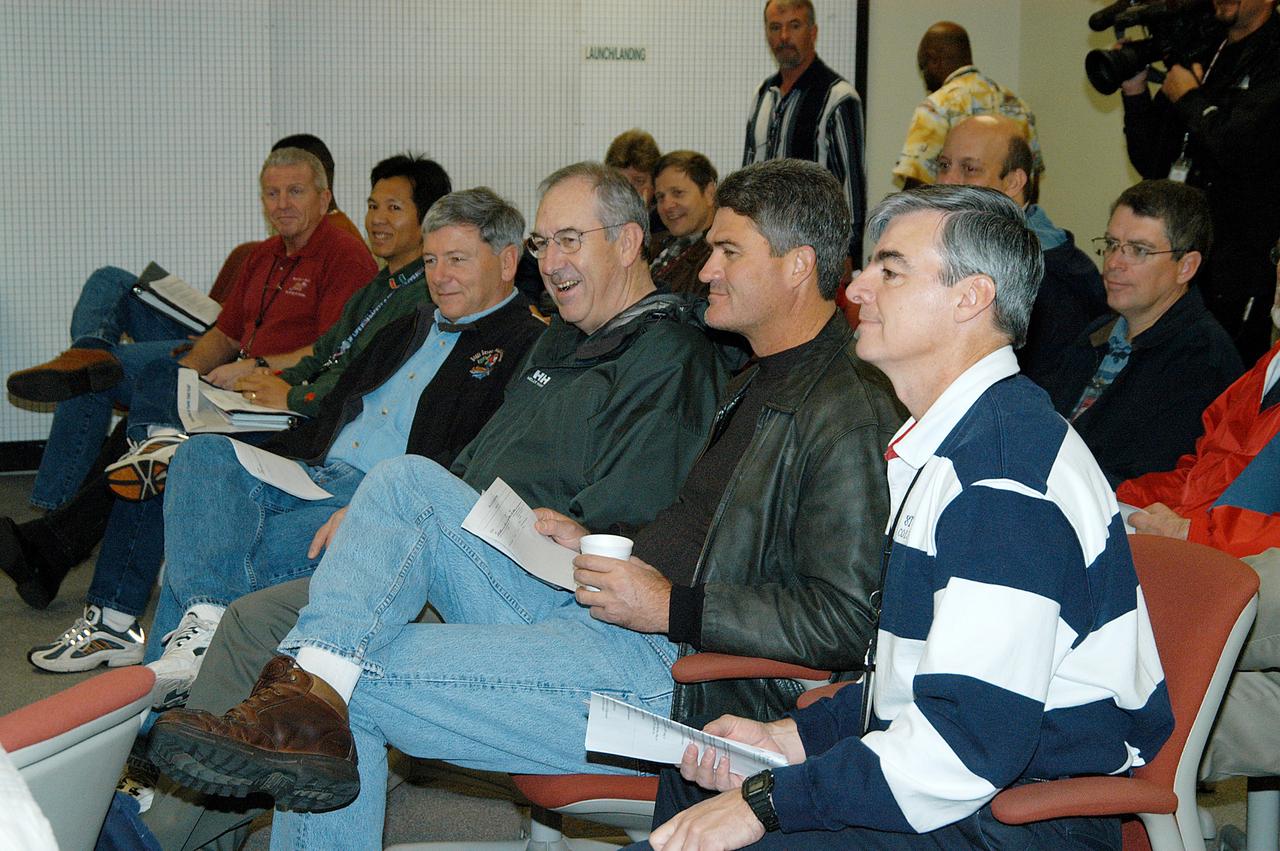
KENNEDY SPACE CENTER, FLA. -- NASA and United Space Alliance (USA) Space Shuttle program managers attend a briefing, part of activities during a leadership workday.  The day is intended to provide management with an in-depth, hands-on look at Shuttle processing activities at KSC.  Starting third from left are NASA Deputy Associate Administrator for Space Station and Shuttle Programs Michael Kostelnik, USA Vice President and Space Shuttle Program Manager Howard DeCastro, NASA Space Shuttle Program Manager William Parsons, and USA Associate Program Manager of Ground Operations Andy Allen.
KENNEDY SPACE CENTER, FLA. -- NASA and United Space Alliance (USA) Space Shuttle program managers attend a briefing, part of activities during a leadership workday. The day is intended to provide management with an in-depth, hands-on look at Shuttle processing activities at KSC. Starting third from left are NASA Deputy Associate Administrator for Space Station and Shuttle Programs Michael Kostelnik, USA Vice President and Space Shuttle Program Manager Howard DeCastro, NASA Space Shuttle Program Manager William Parsons, and USA Associate Program Manager of Ground Operations Andy Allen.
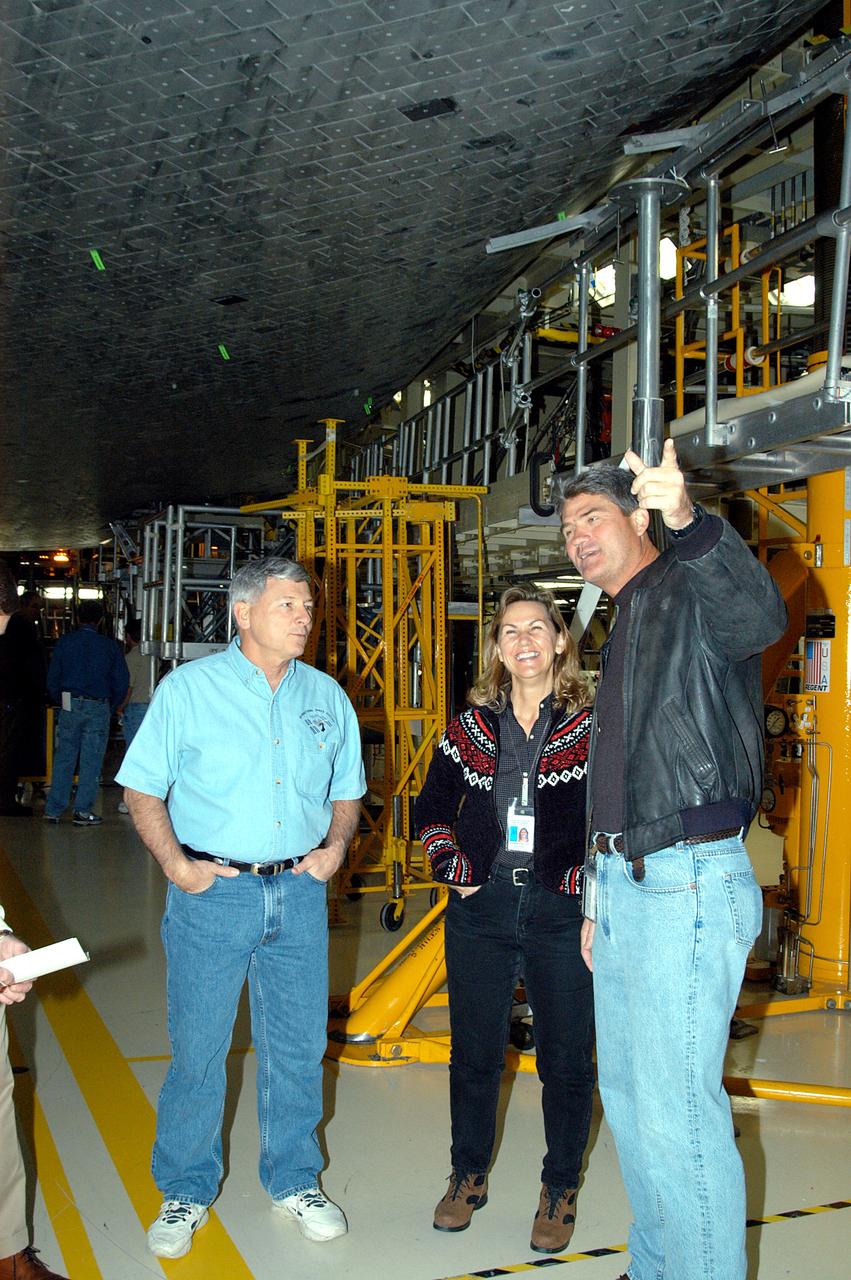
KENNEDY SPACE CENTER, FLA. -- From left, NASA Deputy Associate Administrator for Space Station and Shuttle Programs Michael Kostelnik, United Space Alliance (USA) Director of Orbiter Operations Patty Stratton, and NASA Space Shuttle Program Manager William Parsons view the underside of Shuttle Discovery in Orbiter Processing Facility Bay 3.  NASA and USA Space Shuttle program management are participating in a leadership workday.  The day is intended to provide management with an in-depth, hands-on look at Shuttle processing activities at KSC.
KENNEDY SPACE CENTER, FLA. -- From left, NASA Deputy Associate Administrator for Space Station and Shuttle Programs Michael Kostelnik, United Space Alliance (USA) Director of Orbiter Operations Patty Stratton, and NASA Space Shuttle Program Manager William Parsons view the underside of Shuttle Discovery in Orbiter Processing Facility Bay 3. NASA and USA Space Shuttle program management are participating in a leadership workday. The day is intended to provide management with an in-depth, hands-on look at Shuttle processing activities at KSC.
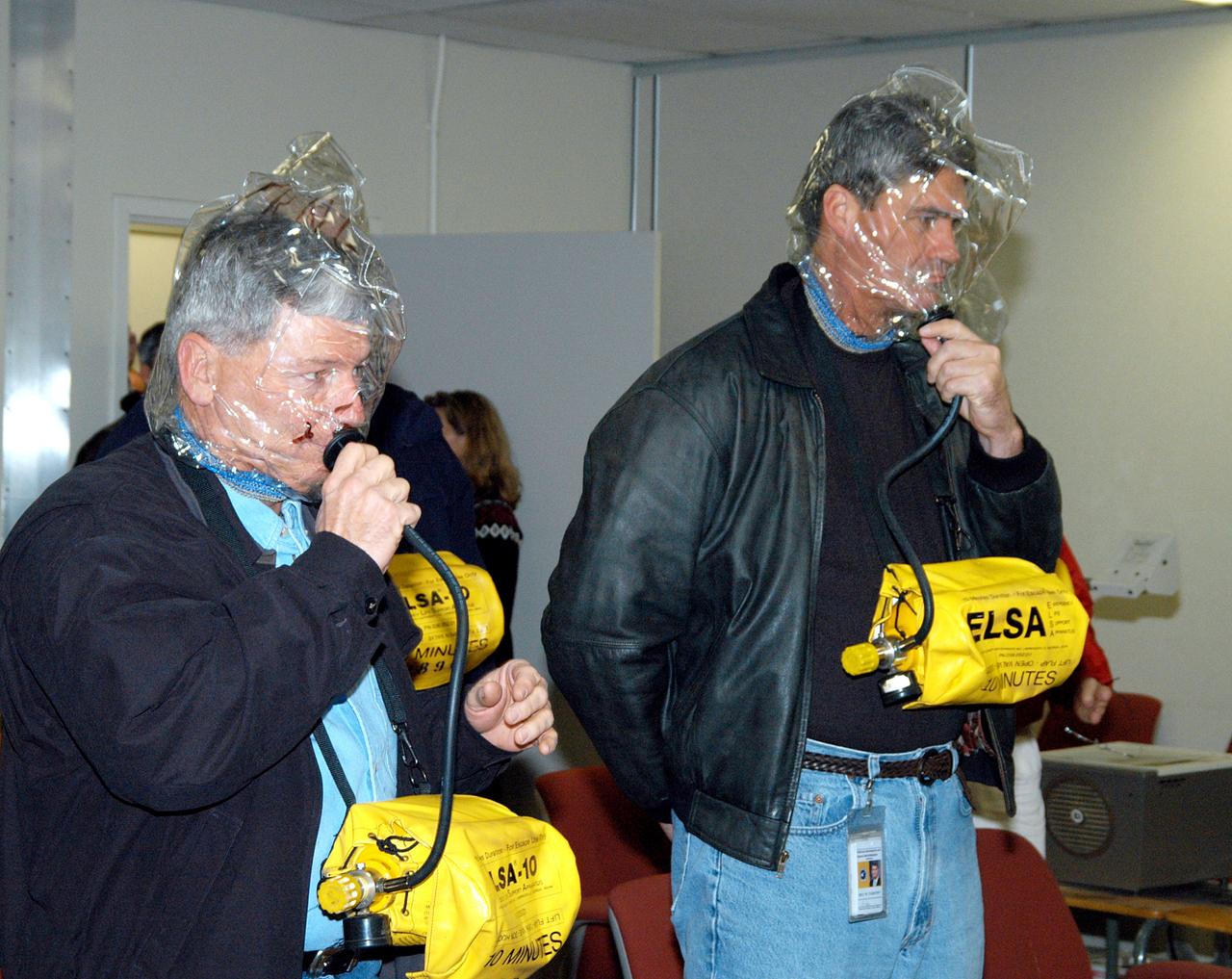
KENNEDY SPACE CENTER, FLA. -- From left, NASA Deputy Associate Administrator for Space Station and Shuttle Programs Michael Kostelnik and NASA Space Shuttle Program Manager William Parsons each don an Emergency Life Support Apparatus (ELSA) during training on the proper use of the escape devices.  NASA and United Space Alliance (USA) Space Shuttle program management are participating in a leadership workday.  The day is intended to provide management with an in-depth, hands-on look at Shuttle processing activities at KSC.
KENNEDY SPACE CENTER, FLA. -- From left, NASA Deputy Associate Administrator for Space Station and Shuttle Programs Michael Kostelnik and NASA Space Shuttle Program Manager William Parsons each don an Emergency Life Support Apparatus (ELSA) during training on the proper use of the escape devices. NASA and United Space Alliance (USA) Space Shuttle program management are participating in a leadership workday. The day is intended to provide management with an in-depth, hands-on look at Shuttle processing activities at KSC.
KENNEDY SPACE CENTER, FLA. -- From front row left, NASA Deputy Associate Administrator for Space Station and Shuttle Programs Michael Kostelnik and NASA Space Shuttle Program Manager William Parsons are trained on the proper use of the Emergency Life Support Apparatus (ELSA).  NASA and United Space Alliance (USA) Space Shuttle program management are participating in a leadership workday.  The day is intended to provide management with an in-depth, hands-on look at Shuttle processing activities at KSC.
KENNEDY SPACE CENTER, FLA. -- From front row left, NASA Deputy Associate Administrator for Space Station and Shuttle Programs Michael Kostelnik and NASA Space Shuttle Program Manager William Parsons are trained on the proper use of the Emergency Life Support Apparatus (ELSA). NASA and United Space Alliance (USA) Space Shuttle program management are participating in a leadership workday. The day is intended to provide management with an in-depth, hands-on look at Shuttle processing activities at KSC.
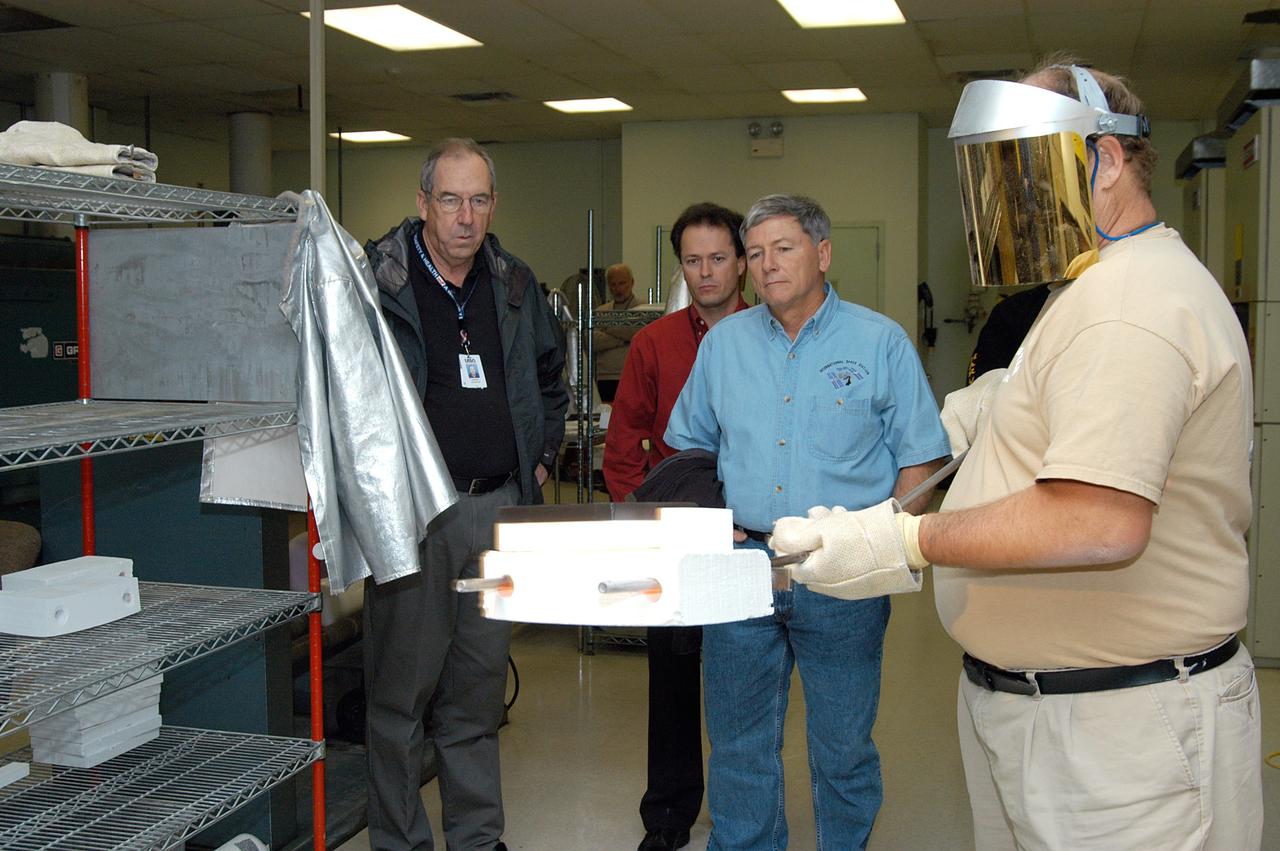
KENNEDY SPACE CENTER, FLA. -- From left, United Space Alliance (USA) Deputy Space Shuttle Program Manager of Operations Loren Shriver, USA Associate Program Manager of Ground Operations Andy Allen, NASA Deputy Associate Administrator for Space Station and Shuttle Programs Michael Kostelnik, and USA Vice President and Space Shuttle Program Manager Howard DeCastro examine a tile used in the Shuttle's Thermal Protection System (TPS) in KSC's TPS Facility.  NASA and USA Space Shuttle program management are participating in a leadership workday.  The day is intended to provide management with an in-depth, hands-on look at Shuttle processing activities at KSC.
KENNEDY SPACE CENTER, FLA. -- From left, United Space Alliance (USA) Deputy Space Shuttle Program Manager of Operations Loren Shriver, USA Associate Program Manager of Ground Operations Andy Allen, NASA Deputy Associate Administrator for Space Station and Shuttle Programs Michael Kostelnik, and USA Vice President and Space Shuttle Program Manager Howard DeCastro examine a tile used in the Shuttle's Thermal Protection System (TPS) in KSC's TPS Facility. NASA and USA Space Shuttle program management are participating in a leadership workday. The day is intended to provide management with an in-depth, hands-on look at Shuttle processing activities at KSC.
Ronnie Rigney (r), chief of the Propulsion Test Office in the Project Directorate at Stennis Space Center, stands with agency colleagues to receive the prestigious American Institute of Aeronautics and Astronautics George M. Low Space Transportation Award on Sept. 12. Rigney accepted the award on behalf of the NASA and contractor team at Stennis for their support of the Space Shuttle Program that ended last summer. From 1975 to 2009, Stennis Space Center tested every main engine used to power 135 space shuttle missions. Stennis continued to provide flight support services through the end of the Space Shuttle Program in July 2011. The center also supported transition and retirement of shuttle hardware and assets through September 2012. The 2012 award was presented to the space shuttle team 'for excellence in the conception, development, test, operation and retirement of the world's first and only reusable space transportation system.' Joining Rigney for the award ceremony at the 2012 AIAA Conference in Pasadena, Calif., were: (l to r) Allison Zuniga, NASA Headquarters; Michael Griffin, former NASA administrator; Don Noah, Johnson Space Center in Houston; Steve Cash, Marshall Space Flight Center in Huntsville, Ala.; and Pete Nickolenko, Kennedy Space Center in Florida.
Space Shuttle Program
Ronnie Rigney (r), chief of the Propulsion Test Office in the Project Directorate at Stennis Space Center, stands with agency colleagues to receive the prestigious American Institute of Aeronautics and Astronautics George M. Low Space Transportation Award on Sept. 12. Rigney accepted the award on behalf of the NASA and contractor team at Stennis for their support of the Space Shuttle Program that ended last summer. From 1975 to 2009, Stennis Space Center tested every main engine used to power 135 space shuttle missions. Stennis continued to provide flight support services through the end of the Space Shuttle Program in July 2011. The center also supported transition and retirement of shuttle hardware and assets through September 2012. The 2012 award was presented to the space shuttle team 'for excellence in the conception, development, test, operation and retirement of the world's first and only reusable space transportation system.' Joining Rigney for the award ceremony at the 2012 AIAA Conference in Pasadena, Calif., were: (l to r) Allison Zuniga, NASA Headquarters; Michael Griffin, former NASA administrator; Don Noah, Johnson Space Center in Houston; Steve Cash, Marshall Space Flight Center in Huntsville, Ala.; and Pete Nickolenko, Kennedy Space Center in Florida.
Space Shuttle Program
KENNEDY SPACE CENTER, FLA. -- United Space Alliance (USA) Vice President and Space Shuttle Program Manager Howard DeCastro (left) and NASA Deputy Associate Administrator for Space Station and Shuttle Programs Michael Kostelnik (third from left) watch as a USA technician (right) creates a tile for use in the Shuttle's Thermal Protection System (TPS).  NASA and USA Space Shuttle program management are participating in a leadership workday.  The day is intended to provide management with an in-depth, hands-on look at Shuttle processing activities at KSC.
KENNEDY SPACE CENTER, FLA. -- United Space Alliance (USA) Vice President and Space Shuttle Program Manager Howard DeCastro (left) and NASA Deputy Associate Administrator for Space Station and Shuttle Programs Michael Kostelnik (third from left) watch as a USA technician (right) creates a tile for use in the Shuttle's Thermal Protection System (TPS). NASA and USA Space Shuttle program management are participating in a leadership workday. The day is intended to provide management with an in-depth, hands-on look at Shuttle processing activities at KSC.
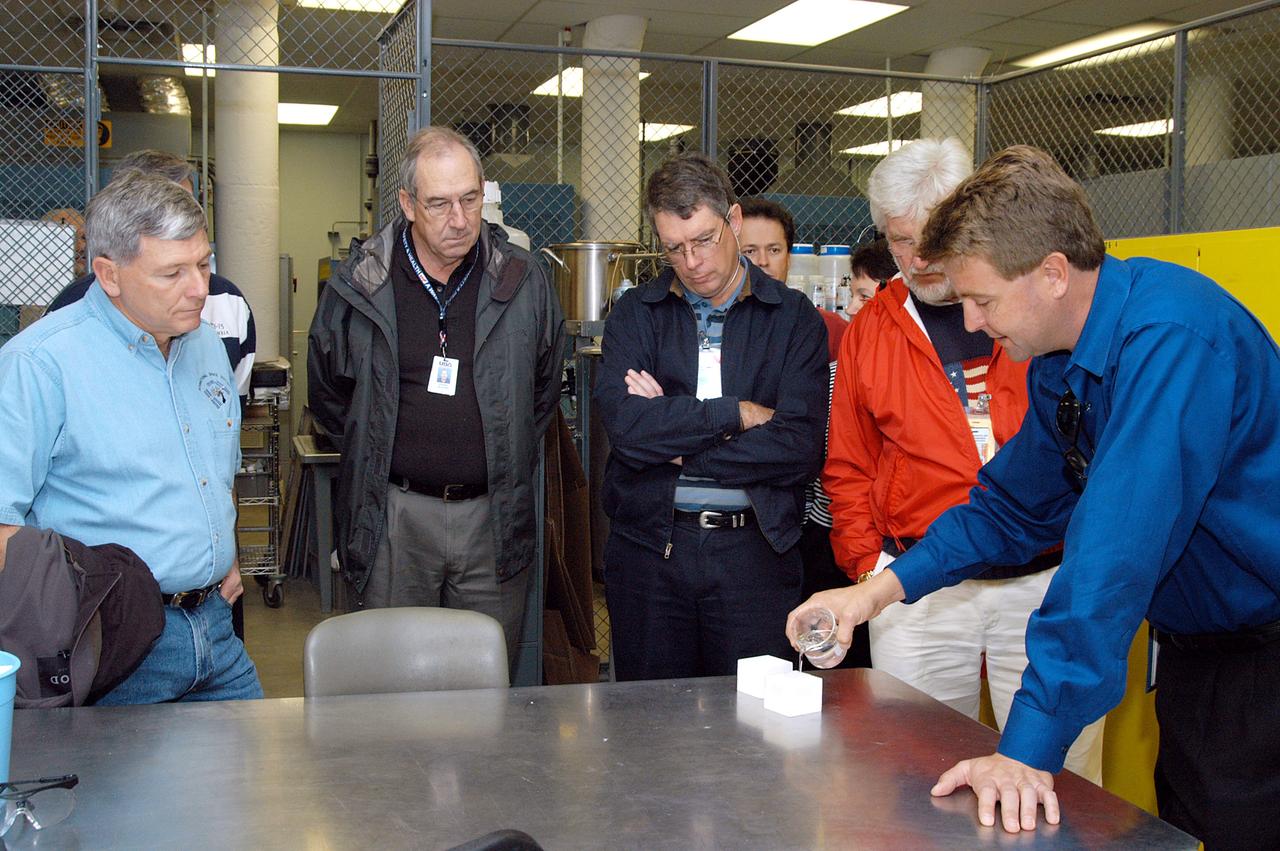
KENNEDY SPACE CENTER, FLA. -- From left, NASA Deputy Associate Administrator for Space Station and Shuttle Programs Michael Kostelnik and United Space Alliance (USA) Vice President and Space Shuttle Program Manager Howard DeCastro are briefed on the properties of the tile used in the Shuttle's Thermal Protection System (TPS) by USA Manager of the TPS Facility Martin Wilson (right).  NASA and USA Space Shuttle program management are participating in a leadership workday.  The day is intended to provide management with an in-depth, hands-on look at Shuttle processing activities at KSC.
KENNEDY SPACE CENTER, FLA. -- From left, NASA Deputy Associate Administrator for Space Station and Shuttle Programs Michael Kostelnik and United Space Alliance (USA) Vice President and Space Shuttle Program Manager Howard DeCastro are briefed on the properties of the tile used in the Shuttle's Thermal Protection System (TPS) by USA Manager of the TPS Facility Martin Wilson (right). NASA and USA Space Shuttle program management are participating in a leadership workday. The day is intended to provide management with an in-depth, hands-on look at Shuttle processing activities at KSC.
KENNEDY SPACE CENTER, FLA. -- United Space Alliance (USA) technicians demonstrate the construction of a thermal blanket used in the Shuttle's thermal protection system for USA Vice President and Space Shuttle Program Manager Howard DeCastro (second from left) and NASA Deputy Associate Administrator for Space Station and Shuttle Programs Michael Kostelnik (right).  NASA and USA Space Shuttle program management are participating in a leadership workday.  The day is intended to provide management with an in-depth, hands-on look at Shuttle processing activities at KSC.
KENNEDY SPACE CENTER, FLA. -- United Space Alliance (USA) technicians demonstrate the construction of a thermal blanket used in the Shuttle's thermal protection system for USA Vice President and Space Shuttle Program Manager Howard DeCastro (second from left) and NASA Deputy Associate Administrator for Space Station and Shuttle Programs Michael Kostelnik (right). NASA and USA Space Shuttle program management are participating in a leadership workday. The day is intended to provide management with an in-depth, hands-on look at Shuttle processing activities at KSC.
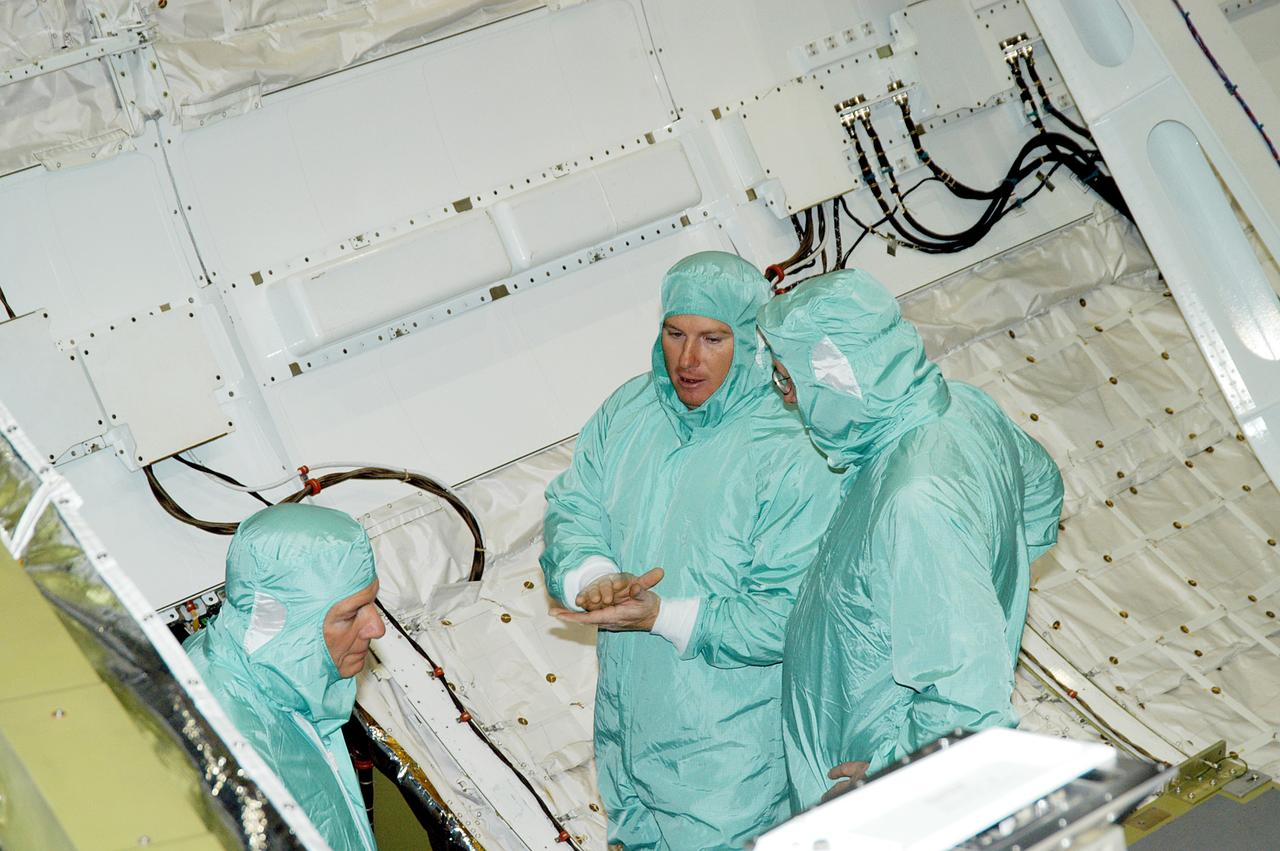
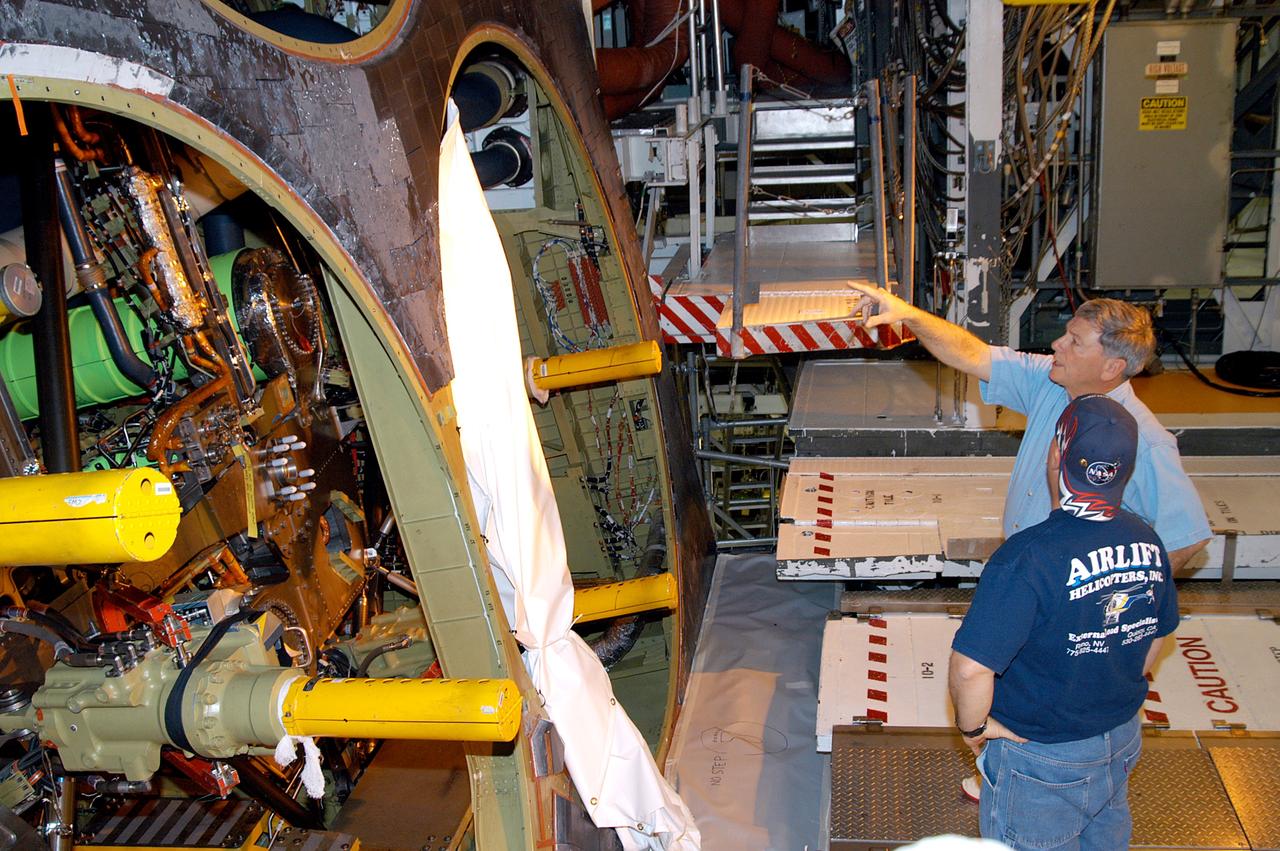
KENNEDY SPACE CENTER, FLA. -- In Orbiter Processing Facility Bay 1, NASA Deputy Associate Administrator for Space Station and Shuttle Programs Michael Kostelnik (left) and United Space Alliance (USA) Vice President and Space Shuttle Program Manager Howard DeCastro (right) are briefed by a USA technician (center) on Shuttle processing in the payload bay of orbiter Atlantis.  NASA and USA Space Shuttle program management are participating in a leadership workday.  The day is intended to provide management with an in-depth, hands-on look at Shuttle processing activities at KSC.
KENNEDY SPACE CENTER, FLA. -- In Orbiter Processing Facility Bay 1, NASA Deputy Associate Administrator for Space Station and Shuttle Programs Michael Kostelnik (left) and United Space Alliance (USA) Vice President and Space Shuttle Program Manager Howard DeCastro (right) are briefed by a USA technician (center) on Shuttle processing in the payload bay of orbiter Atlantis. NASA and USA Space Shuttle program management are participating in a leadership workday. The day is intended to provide management with an in-depth, hands-on look at Shuttle processing activities at KSC.
KENNEDY SPACE CENTER, FLA. -- In Orbiter Processing Facility Bay 1, NASA Deputy Associate Administrator for Space Station and Shuttle Programs Michael Kostelnik (left) and United Space Alliance (USA) Vice President and Space Shuttle Program Manager Howard DeCastro (right) are briefed by a USA technician (center) on Shuttle processing in the payload bay of orbiter Atlantis.  NASA and USA Space Shuttle program management are participating in a leadership workday.  The day is intended to provide management with an in-depth, hands-on look at Shuttle processing activities at KSC.
KENNEDY SPACE CENTER, FLA. -- In Orbiter Processing Facility Bay 1, NASA Deputy Associate Administrator for Space Station and Shuttle Programs Michael Kostelnik (left) and United Space Alliance (USA) Vice President and Space Shuttle Program Manager Howard DeCastro (right) are briefed by a USA technician (center) on Shuttle processing in the payload bay of orbiter Atlantis. NASA and USA Space Shuttle program management are participating in a leadership workday. The day is intended to provide management with an in-depth, hands-on look at Shuttle processing activities at KSC.
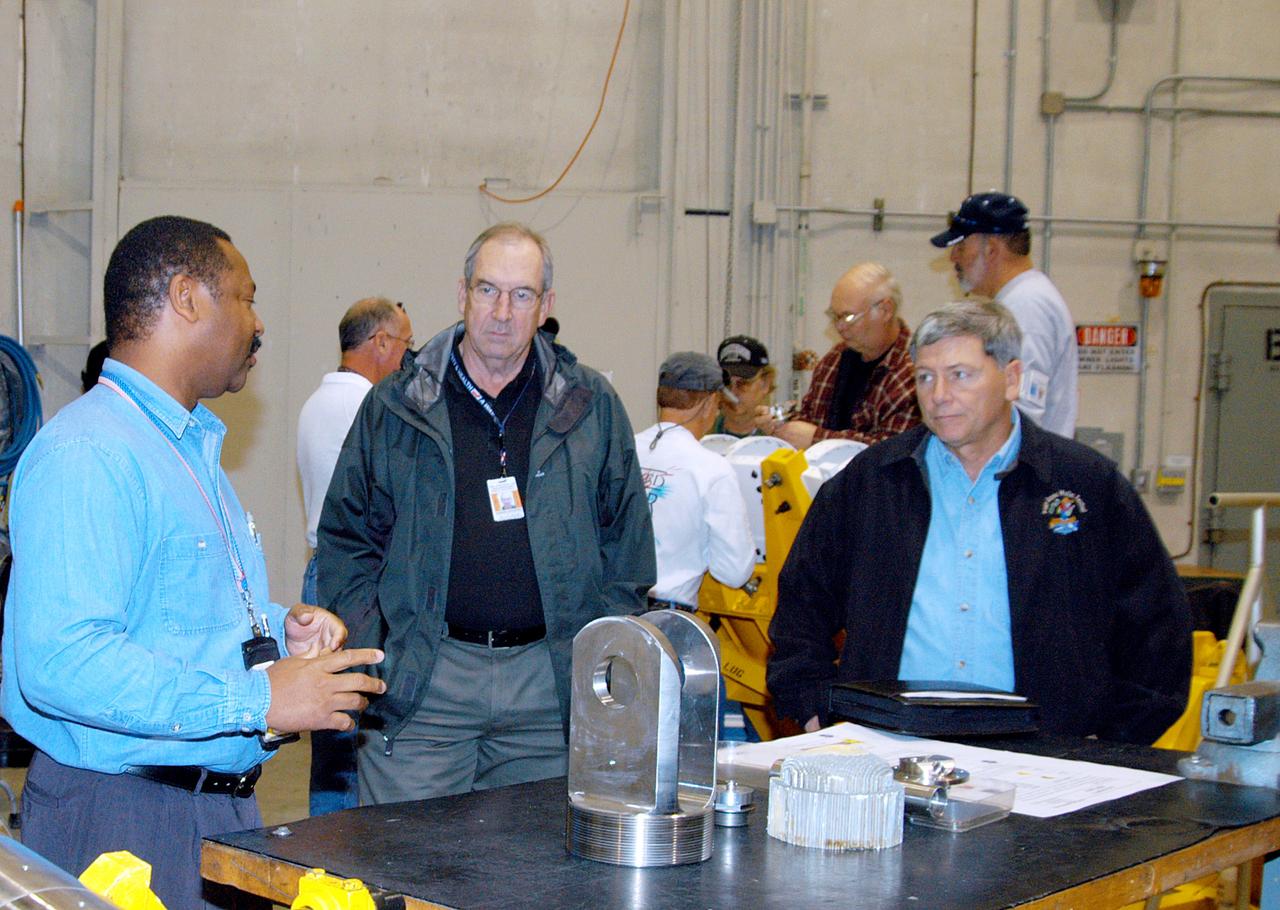
KENNEDY SPACE CENTER, FLA. -- From left, a United Space Alliance (USA) technician discusses aspects of Shuttle processing performed in the Solid Rocket Booster (SRB) Assembly and Refurbishment Facility (ARF) with USA Vice President and Space Shuttle Program Manager Howard DeCastro and NASA Deputy Associate Administrator for Space Station and Shuttle Programs Michael Kostelnik.  NASA and USA Space Shuttle program management are participating in a leadership workday.  The day is intended to provide management with an in-depth, hands-on look at Shuttle processing activities at KSC.
KENNEDY SPACE CENTER, FLA. -- From left, a United Space Alliance (USA) technician discusses aspects of Shuttle processing performed in the Solid Rocket Booster (SRB) Assembly and Refurbishment Facility (ARF) with USA Vice President and Space Shuttle Program Manager Howard DeCastro and NASA Deputy Associate Administrator for Space Station and Shuttle Programs Michael Kostelnik. NASA and USA Space Shuttle program management are participating in a leadership workday. The day is intended to provide management with an in-depth, hands-on look at Shuttle processing activities at KSC.
KENNEDY SPACE CENTER, FLA. -- United Space Alliance (USA) Vice President and Space Shuttle Program Manager Howard DeCastro (left) and NASA Deputy Associate Administrator for Space Station and Shuttle Programs Michael Kostelnik (center) are briefed on the use of a cold plate in Orbiter Processing Facility Bay 2 by a USA technician (right).  NASA and USA Space Shuttle program management are participating in a leadership workday.  The day is intended to provide management with an in-depth, hands-on look at Shuttle processing activities at KSC.
KENNEDY SPACE CENTER, FLA. -- United Space Alliance (USA) Vice President and Space Shuttle Program Manager Howard DeCastro (left) and NASA Deputy Associate Administrator for Space Station and Shuttle Programs Michael Kostelnik (center) are briefed on the use of a cold plate in Orbiter Processing Facility Bay 2 by a USA technician (right). NASA and USA Space Shuttle program management are participating in a leadership workday. The day is intended to provide management with an in-depth, hands-on look at Shuttle processing activities at KSC.
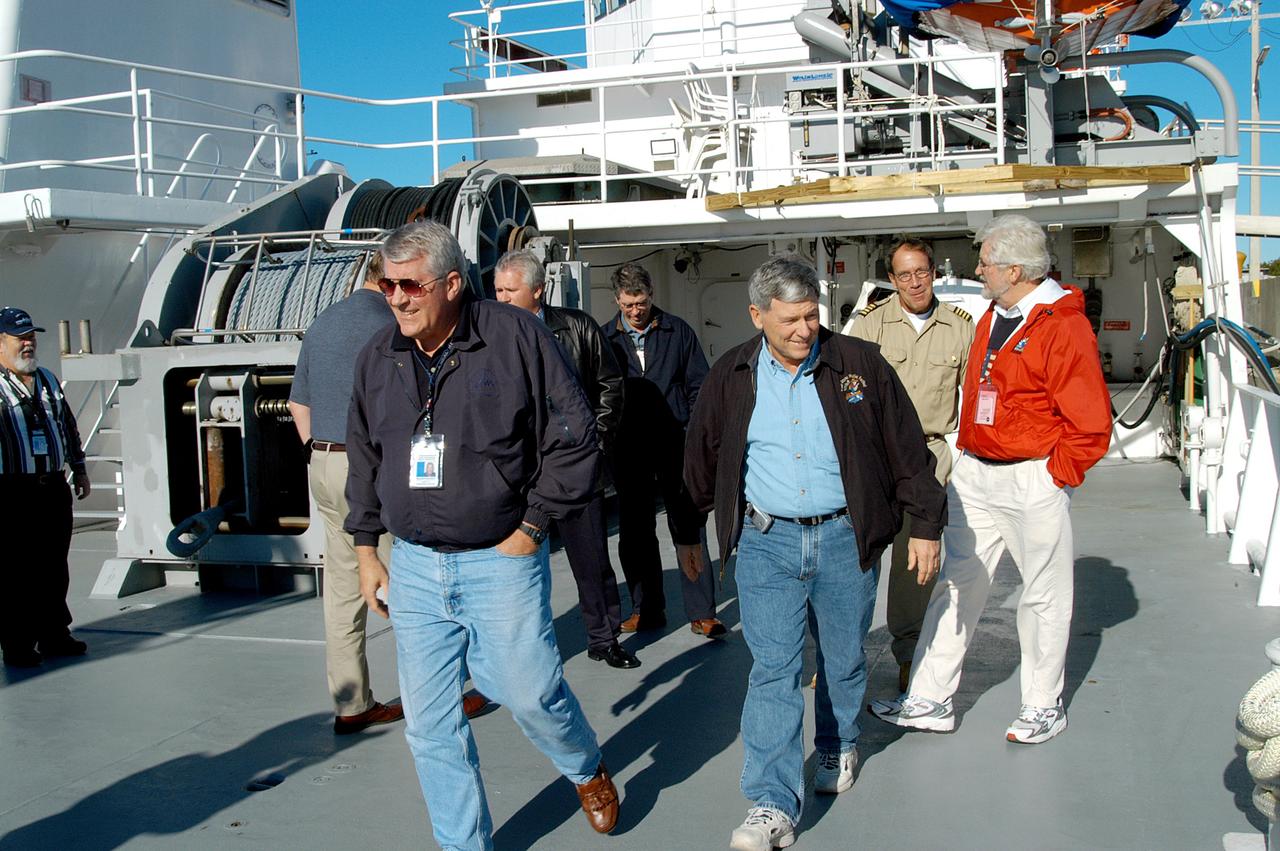
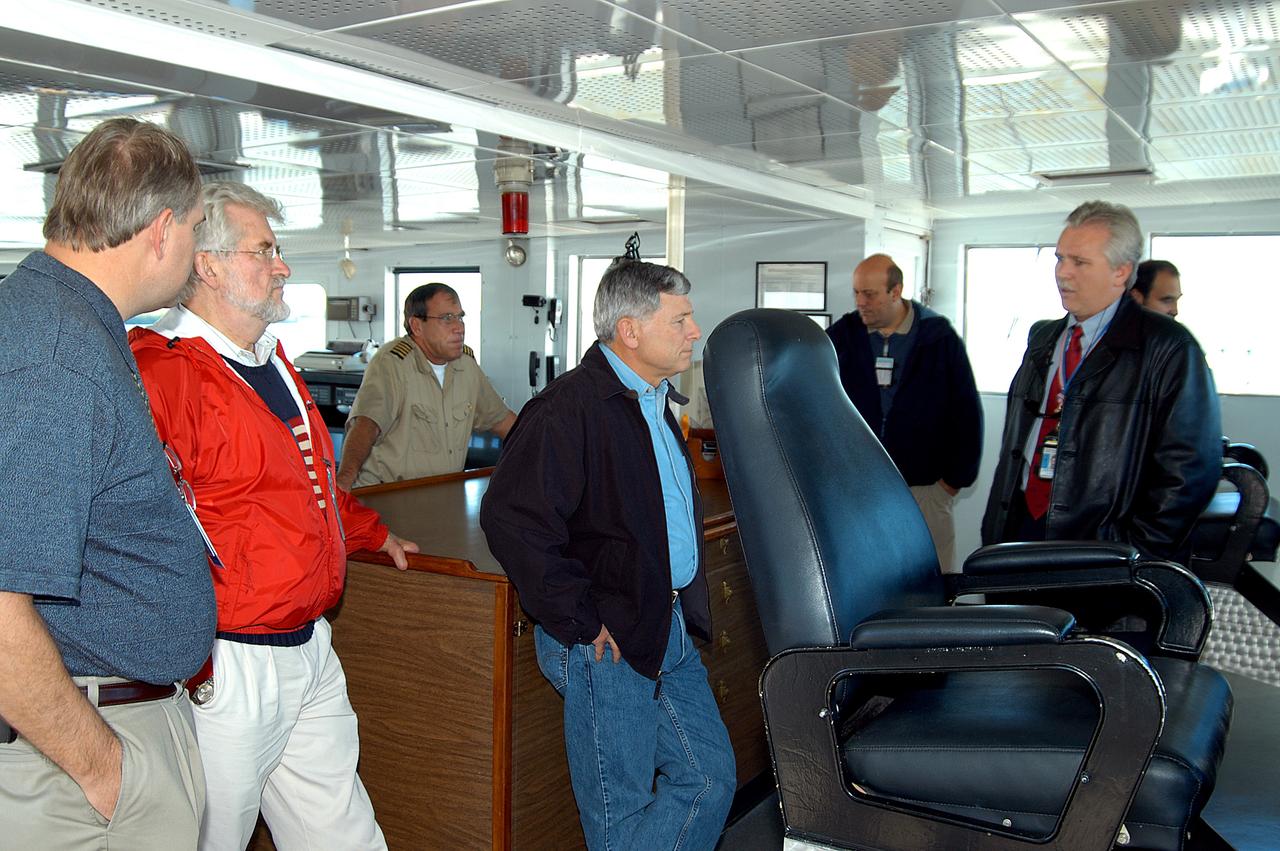
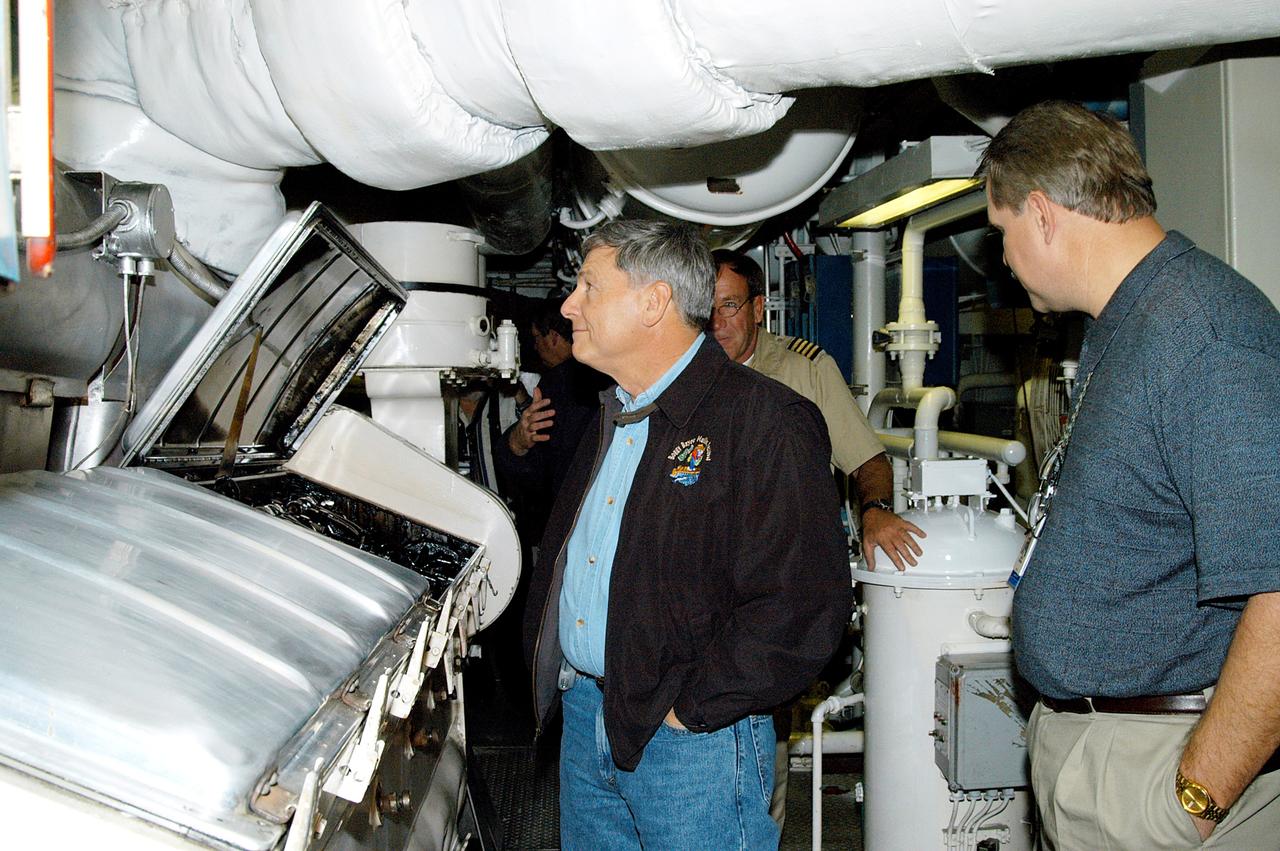
KENNEDY SPACE CENTER, FLA. -- United Space Alliance (USA) Vice President and Associate Program Manager of Florida Operations Bill Pickavance (left front) and NASA Deputy Associate Administrator for Space Station and Shuttle Programs Michael Kostelnik (right front) tour a solid rocket booster (SRB) retrieval ship at Cape Canaveral.  NASA and USA Space Shuttle program management are participating in a leadership workday.  The day is intended to provide management with an in-depth, hands-on look at Shuttle processing activities at KSC.
KENNEDY SPACE CENTER, FLA. -- United Space Alliance (USA) Vice President and Associate Program Manager of Florida Operations Bill Pickavance (left front) and NASA Deputy Associate Administrator for Space Station and Shuttle Programs Michael Kostelnik (right front) tour a solid rocket booster (SRB) retrieval ship at Cape Canaveral. NASA and USA Space Shuttle program management are participating in a leadership workday. The day is intended to provide management with an in-depth, hands-on look at Shuttle processing activities at KSC.
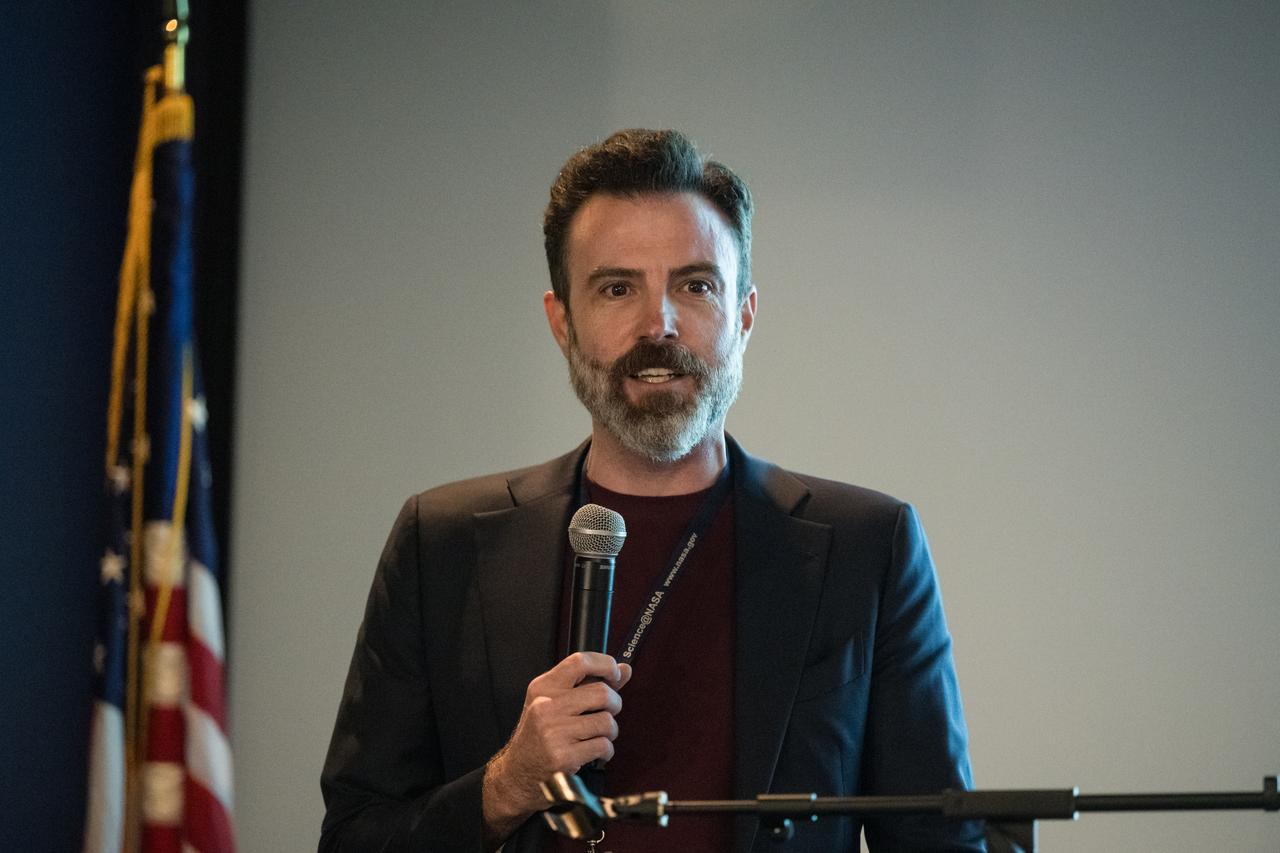
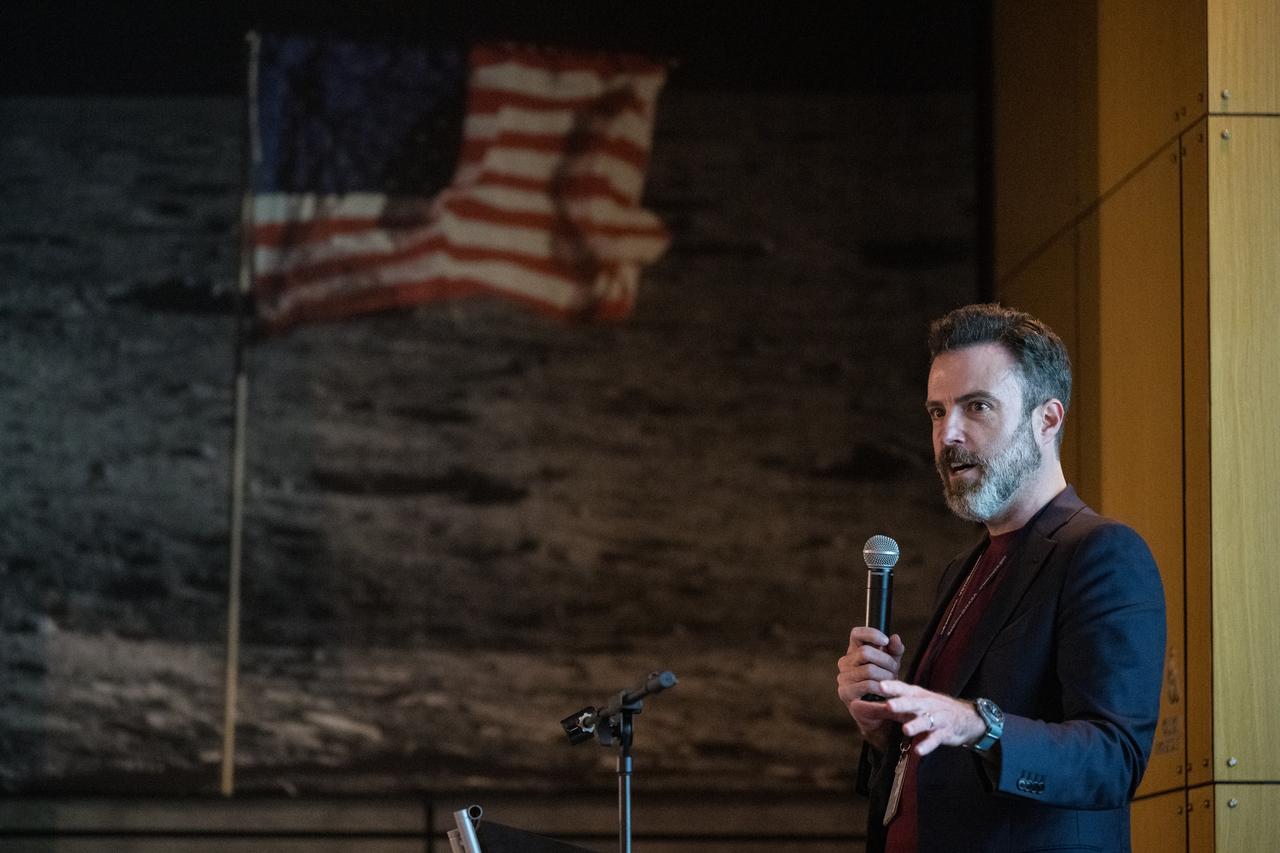
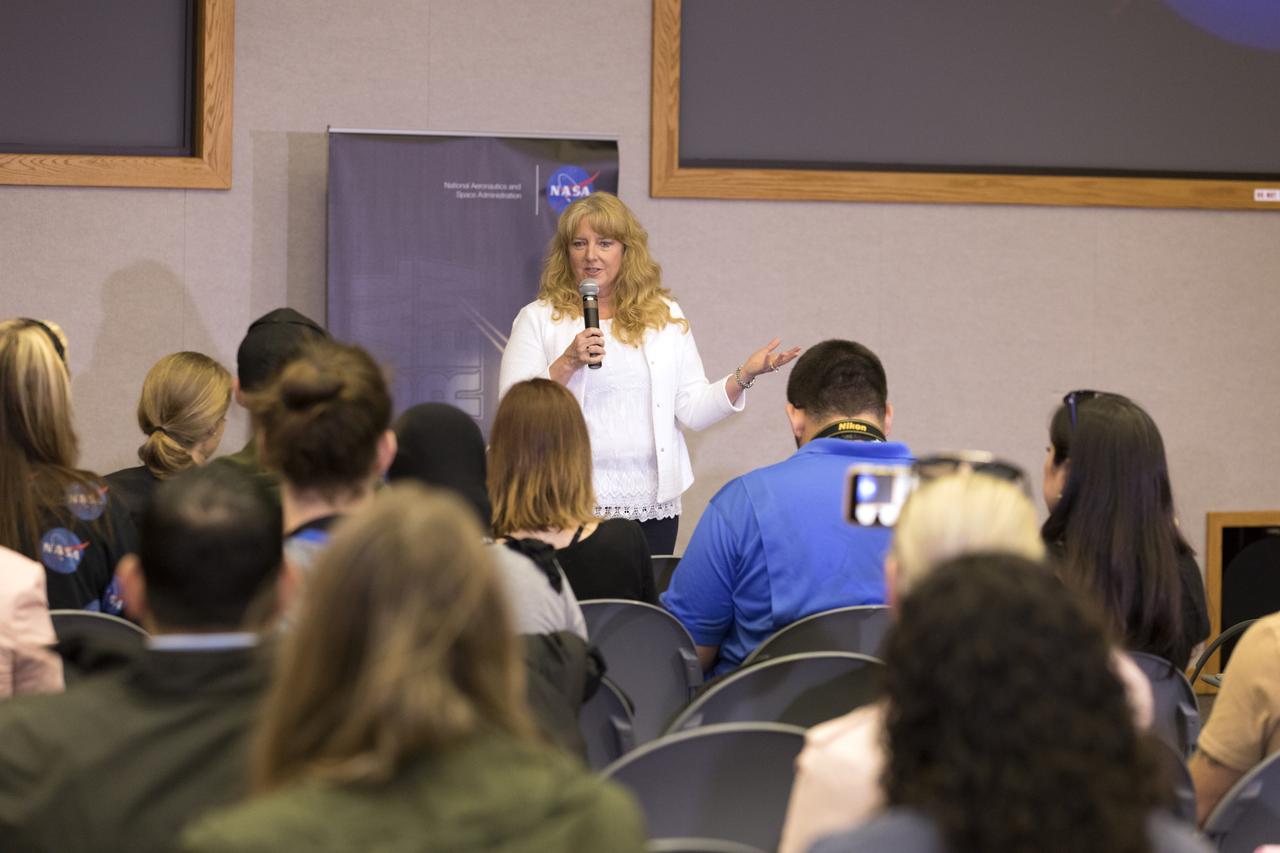
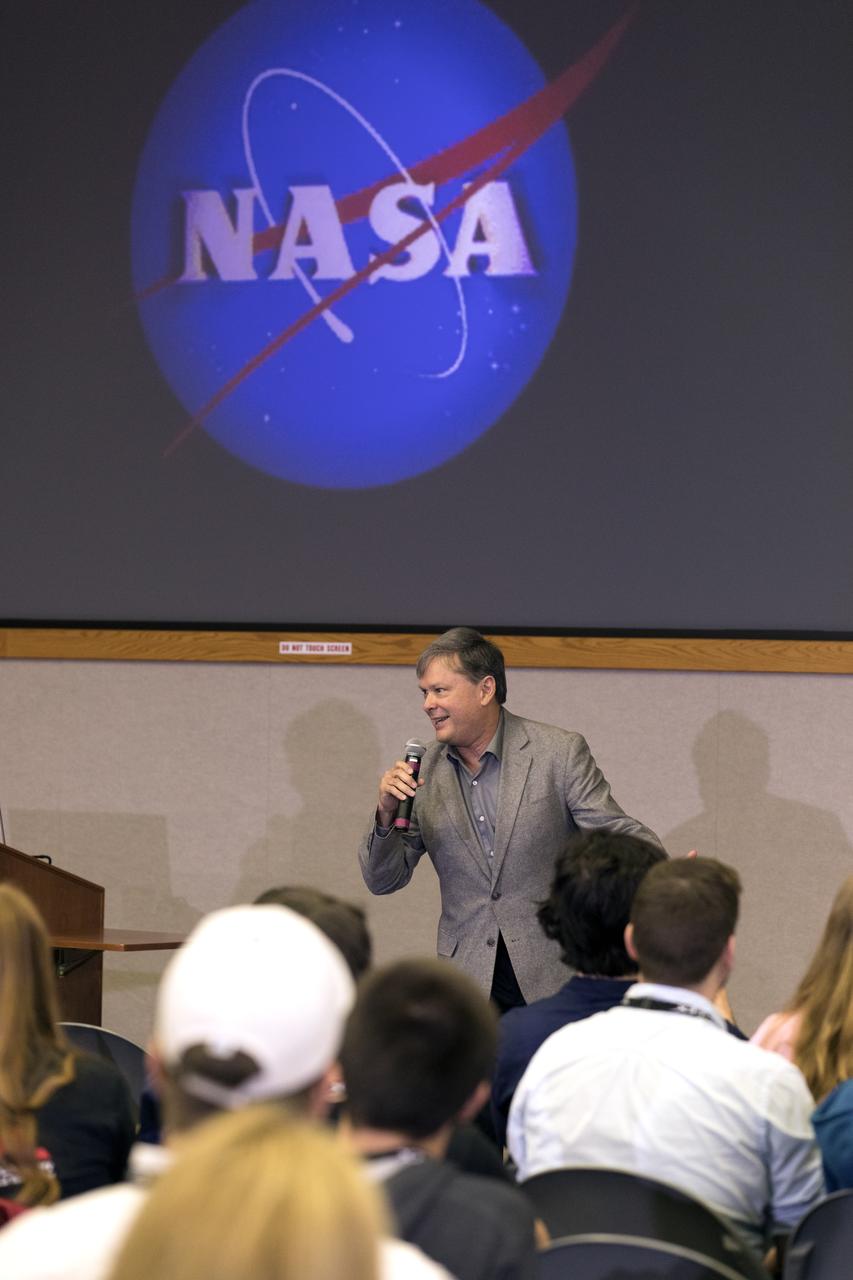
Director of the Space Weather Program, Jamie Favors, speaks about the Space Weather Pilot Project, Tuesday, August 6, 2024, at the Mary W. Jackson NASA Headquarters building in Washington. Every summer early career researchers from NASA’s DEVELOP National Program come to NASA Headquarters and present their research projects. DEVELOP is a training and development program where early career researchers work on Earth science projects, mentored by science advisors from NASA and partner agencies, and provide research results to local communities. Photo Credit: (NASA/Aubrey Gemignani)
Develop Program Event and Poster Session
Director of the Space Weather Program, Jamie Favors, speaks about the Space Weather Pilot Project, Tuesday, August 6, 2024, at the Mary W. Jackson NASA Headquarters building in Washington. Every summer early career researchers from NASA’s DEVELOP National Program come to NASA Headquarters and present their research projects. DEVELOP is a training and development program where early career researchers work on Earth science projects, mentored by science advisors from NASA and partner agencies, and provide research results to local communities. Photo Credit: (NASA/Aubrey Gemignani)
Develop Program Event and Poster Session
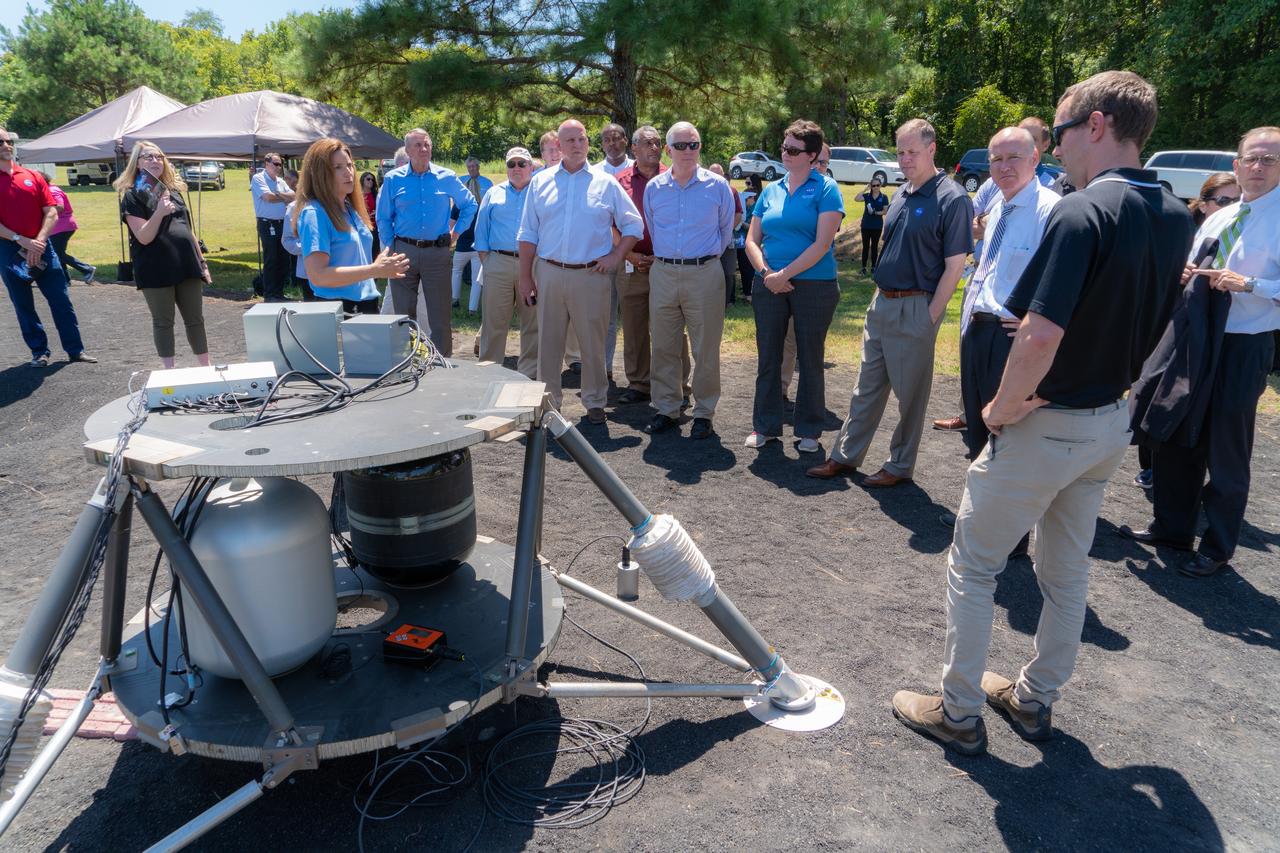
Lisa Watson-Morgan, center left, program manager of NASA’s Human Landing System Program at NASA’s Marshall Space Flight Center in Huntsville, Alabama, shows NASA Administrator Jim Bridenstine equipment used to test seismic sensors on a lunar lander platform on a simulated lunar surface at the center Aug. 16, 2019. Bridenstine was joined by Representatives Mo Brooks and Robert Aderholt of Alabama and Representative Scott DesJarlais of Tennessee. Planetary scientists performed the experiment to learn how these waves travel through simulated regolith, which is material similar to the Moon’s surface. The experiment will help guide instrument deployment scenarios for NASA’s Commercial Lunar Payload Service (CLPS) Program, delivering small science and technology payloads for Artemis. That same day, Bridenstine announced Marshall will lead the agency’s Human Landing System Program. (NASA/Fred Deaton)  For more information: https://www.nasa.gov/artemis-1
NASA Marshall Showcases Lander Testing Capabilities
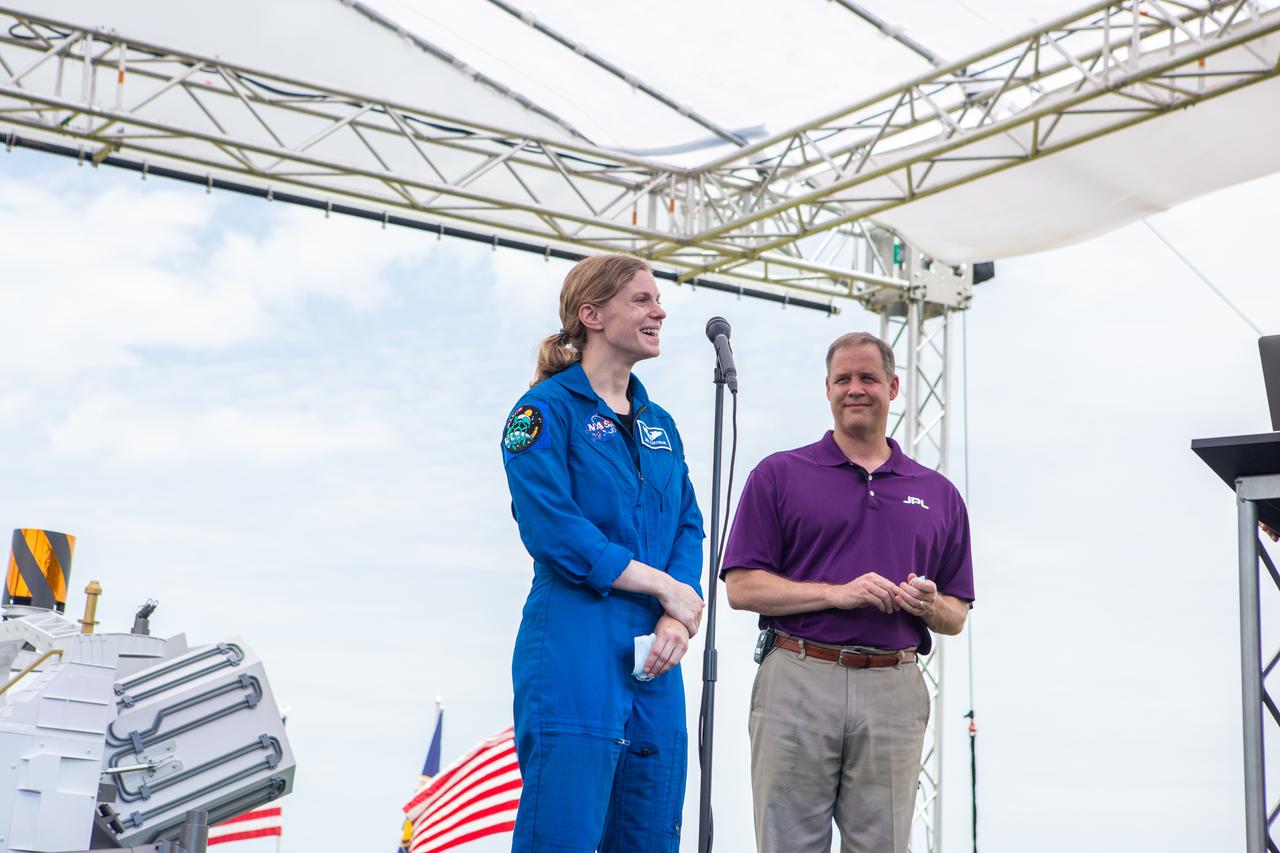
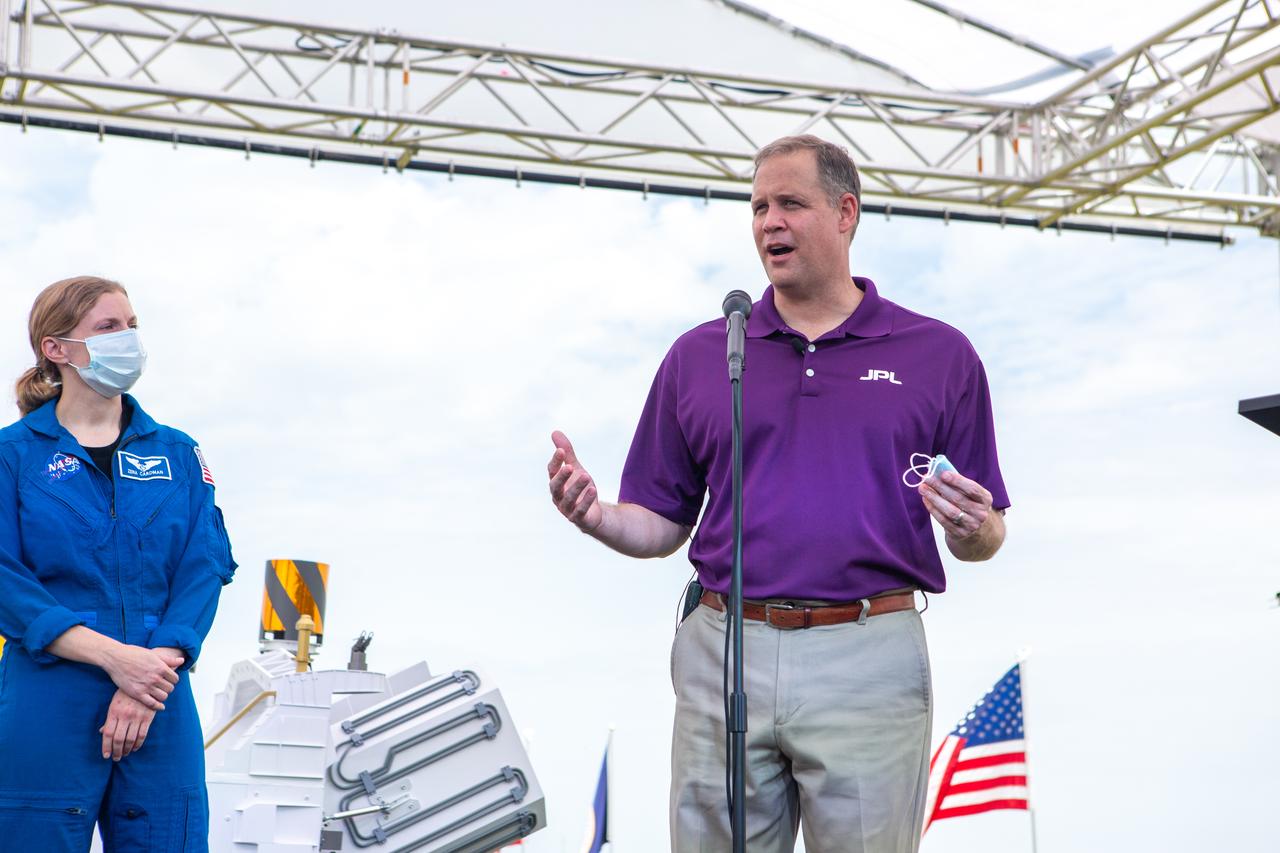
NASA Administrator Jim Bridenstine answers a question during a Mars 2020 NASA Social at Kennedy Space Center’s News Center in Florida on July 29, 2020. At left is NASA astronaut Zena Cardman. The Mars Perseverance rover and Ingenuity helicopter are scheduled to launch July 30, on a United Launch Alliance Atlas V 541 rocket from Space Launch Complex 41 at nearby Cape Canaveral Air Force Station. The rover is part of NASA’s Mars Exploration Program, a long-term effort of robotic exploration of the Red Planet. The rover will search for habitable conditions in the ancient past and signs of past microbial life on Mars. The Launch Services Program at Kennedy is responsible for launch management.
Mars 2020 Facebook Live / NASA Social
NASA astronaut Zena Cardman answers a question during a Mars 2020 NASA Social at Kennedy Space Center’s News Center in Florida on July 29, 2020. At right is NASA Administrator Jim Bridenstine. The Mars Perseverance rover and Ingenuity helicopter are scheduled to launch July 30, on a United Launch Alliance Atlas V 541 rocket from Space Launch Complex 41 at nearby Cape Canaveral Air Force Station. The rover is part of NASA’s Mars Exploration Program, a long-term effort of robotic exploration of the Red Planet. The rover will search for habitable conditions in the ancient past and signs of past microbial life on Mars. The Launch Services Program at Kennedy is responsible for launch management.
Mars 2020 Facebook Live / NASA Social
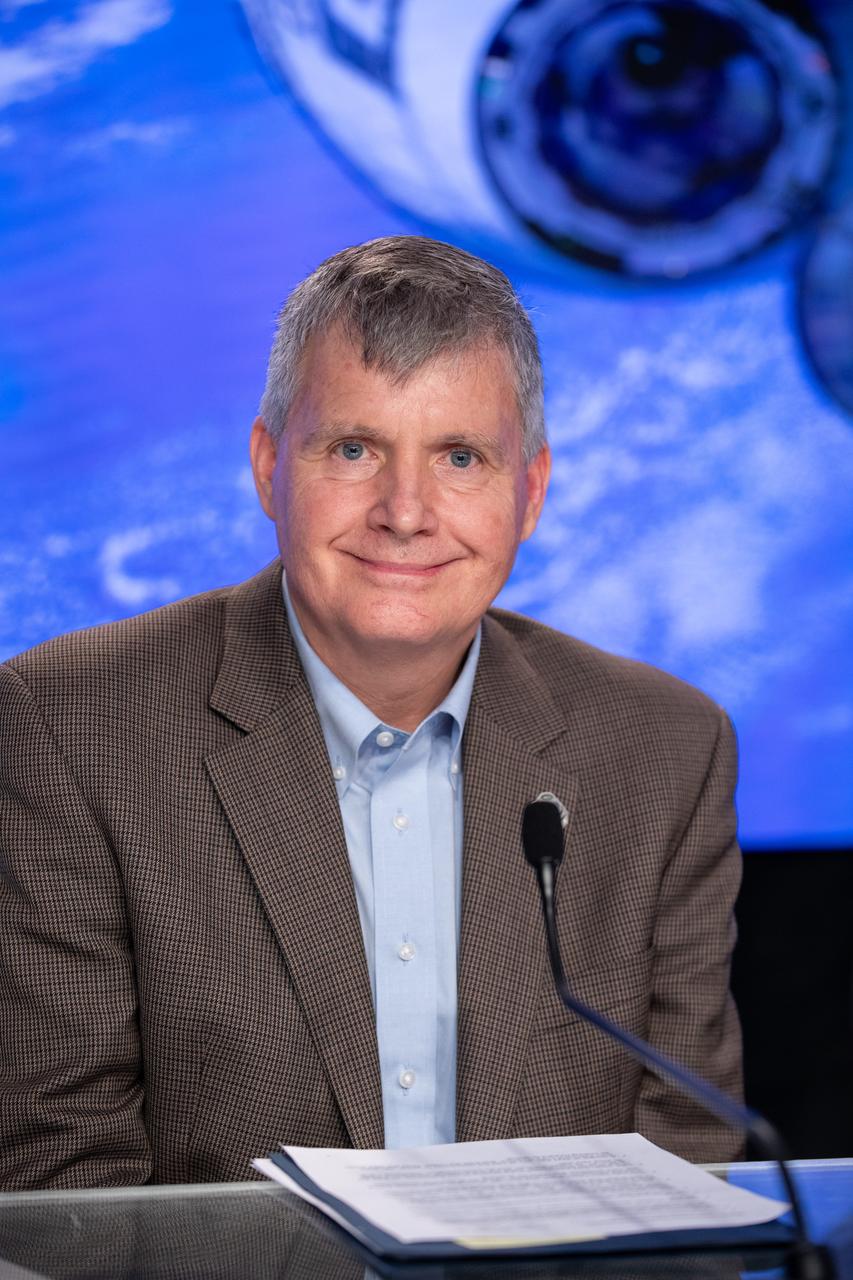
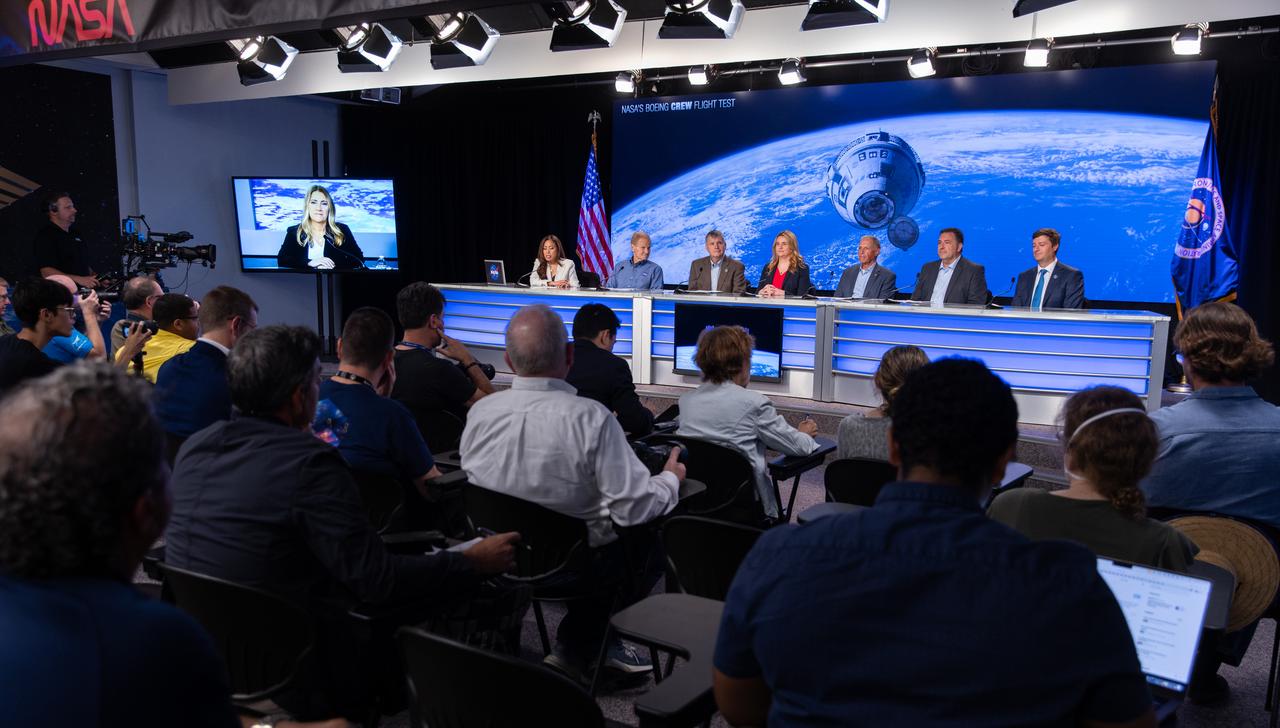
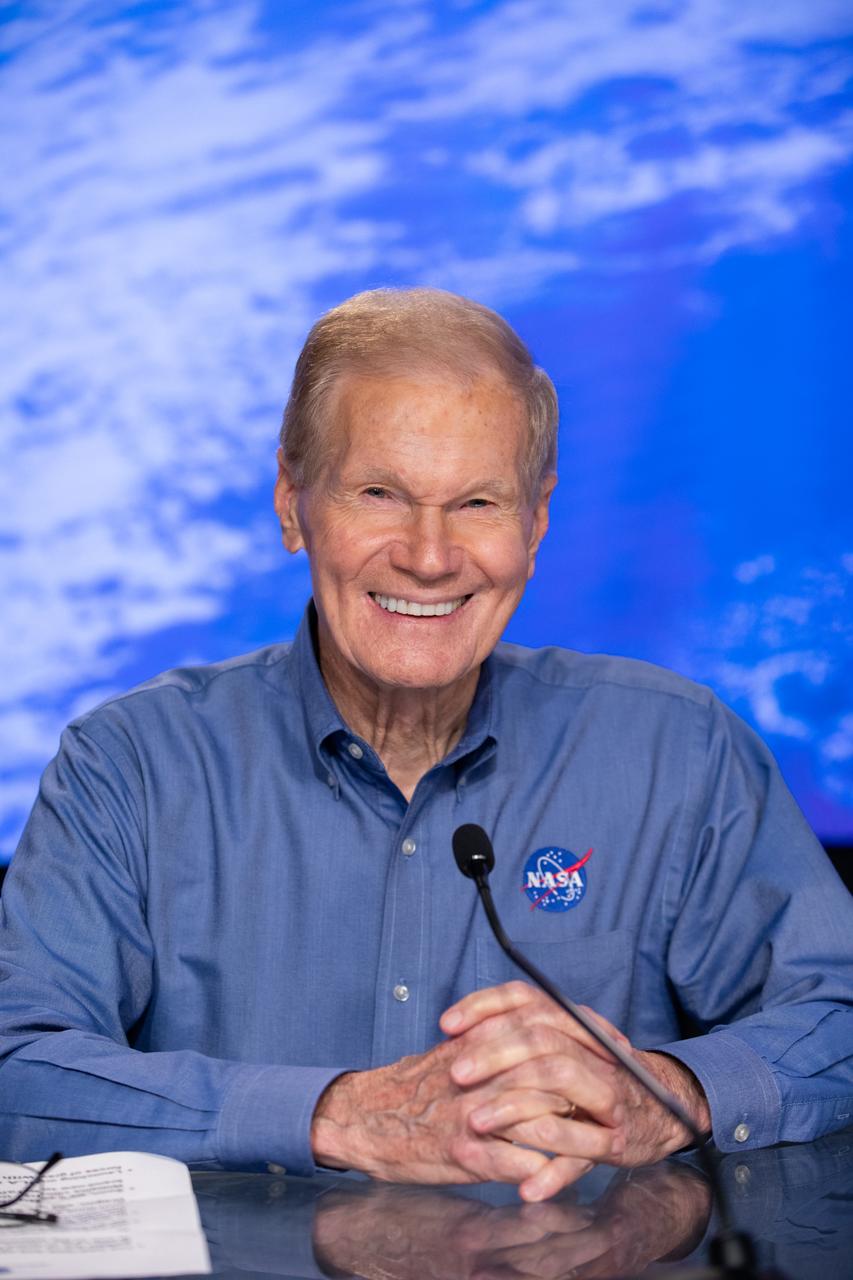
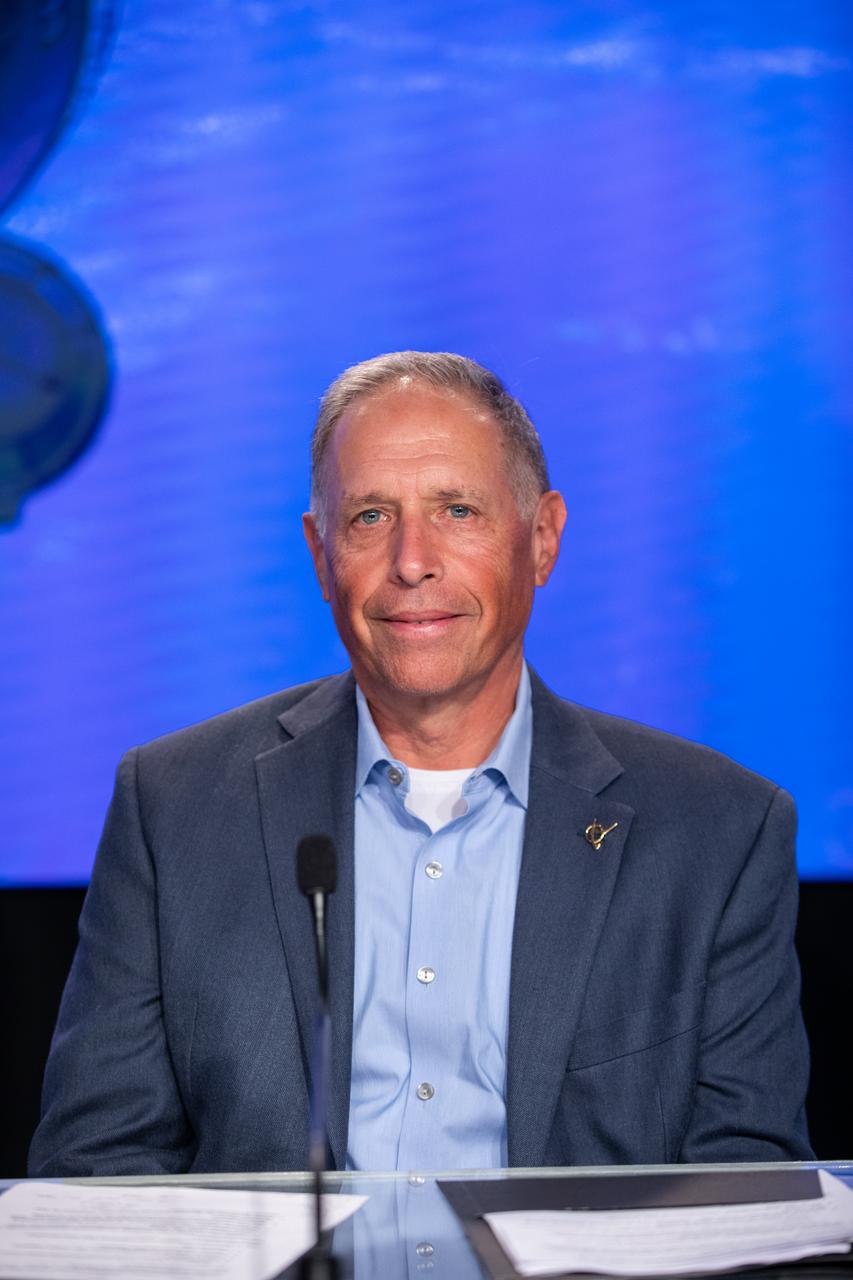
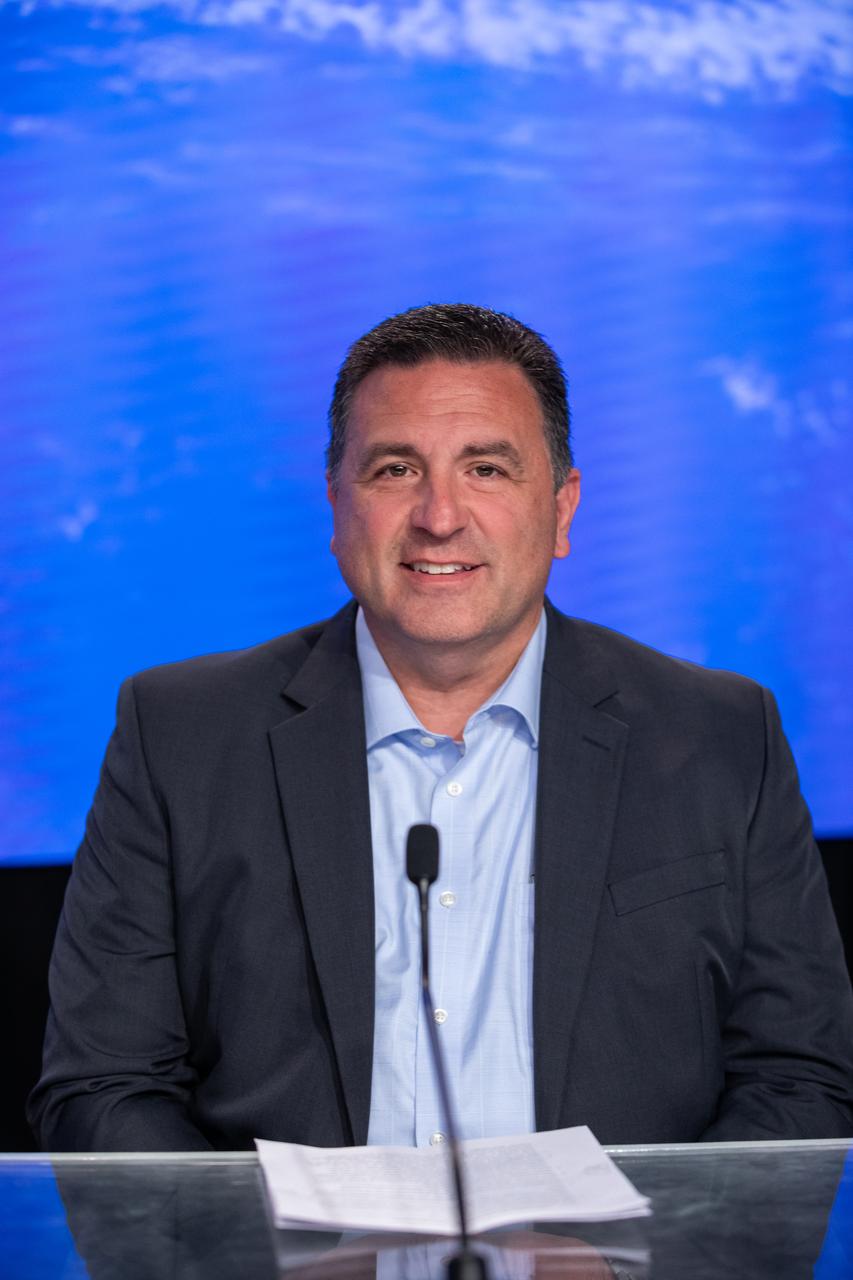
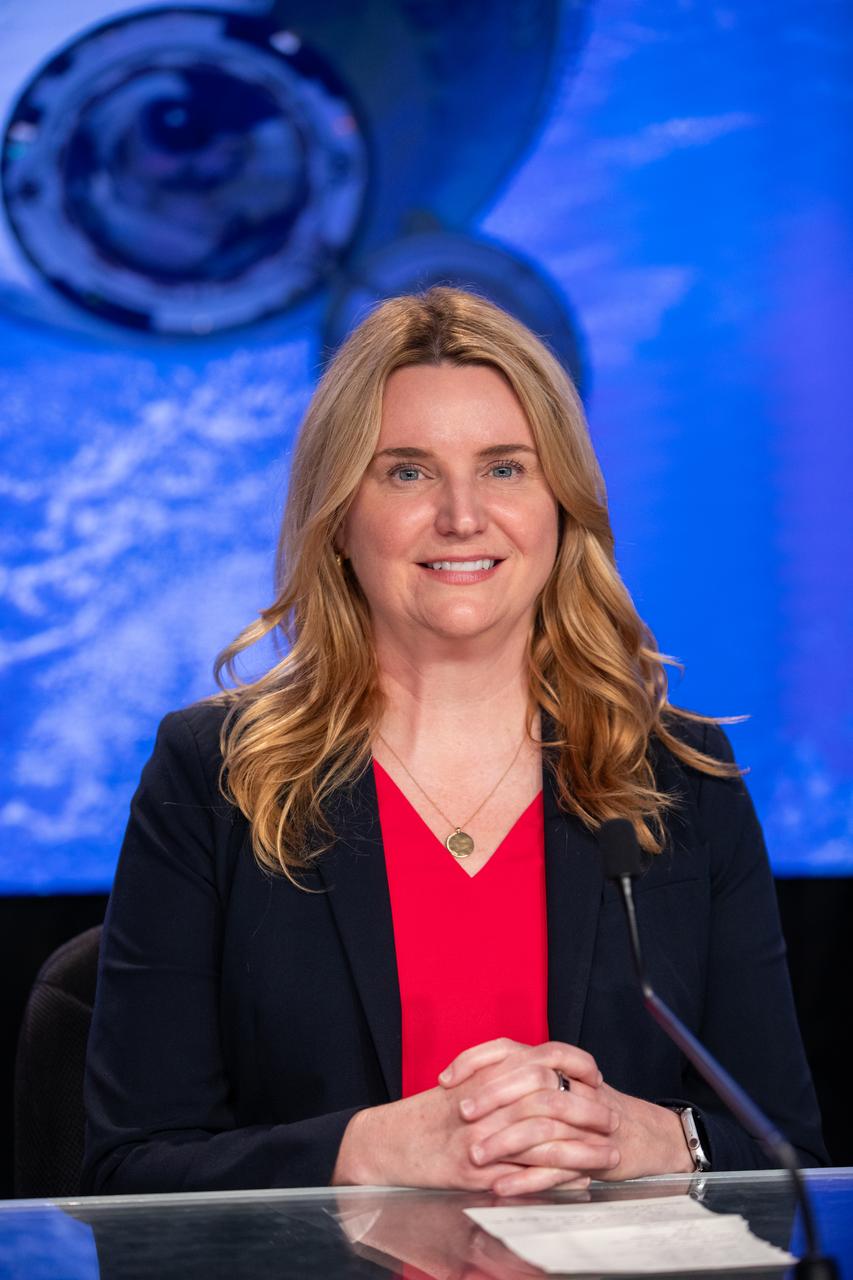
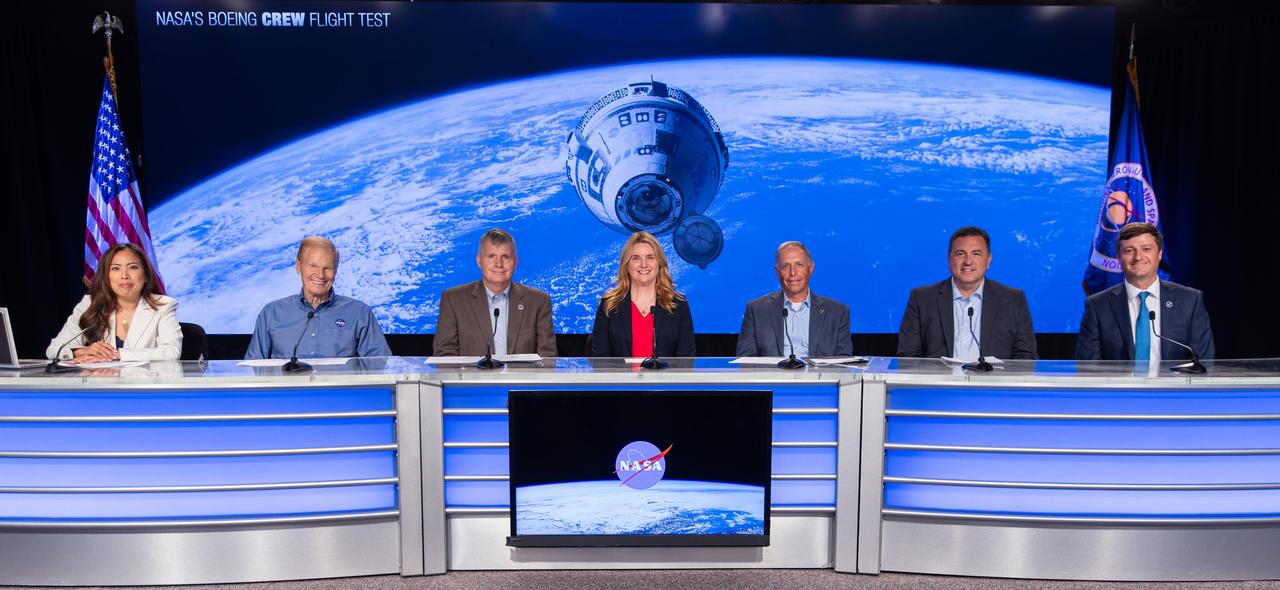
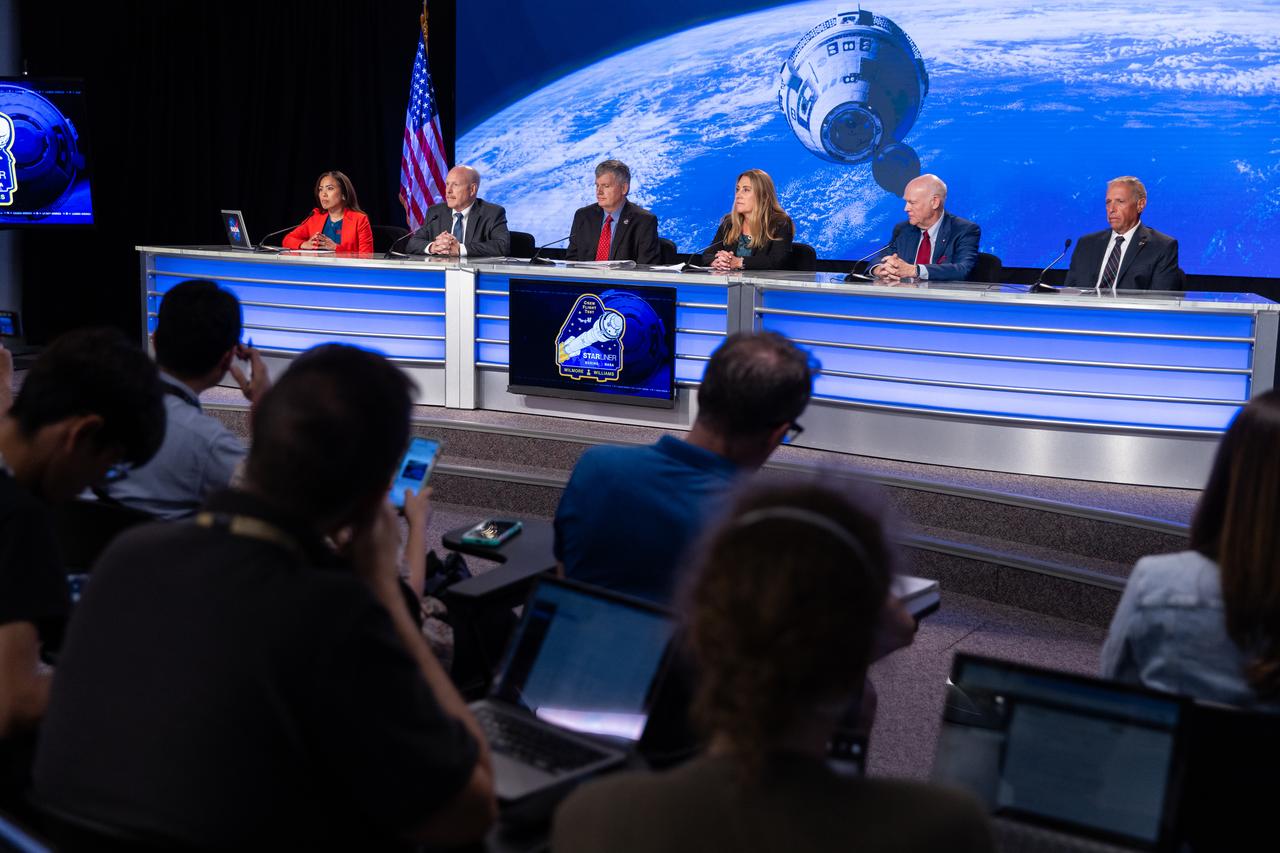
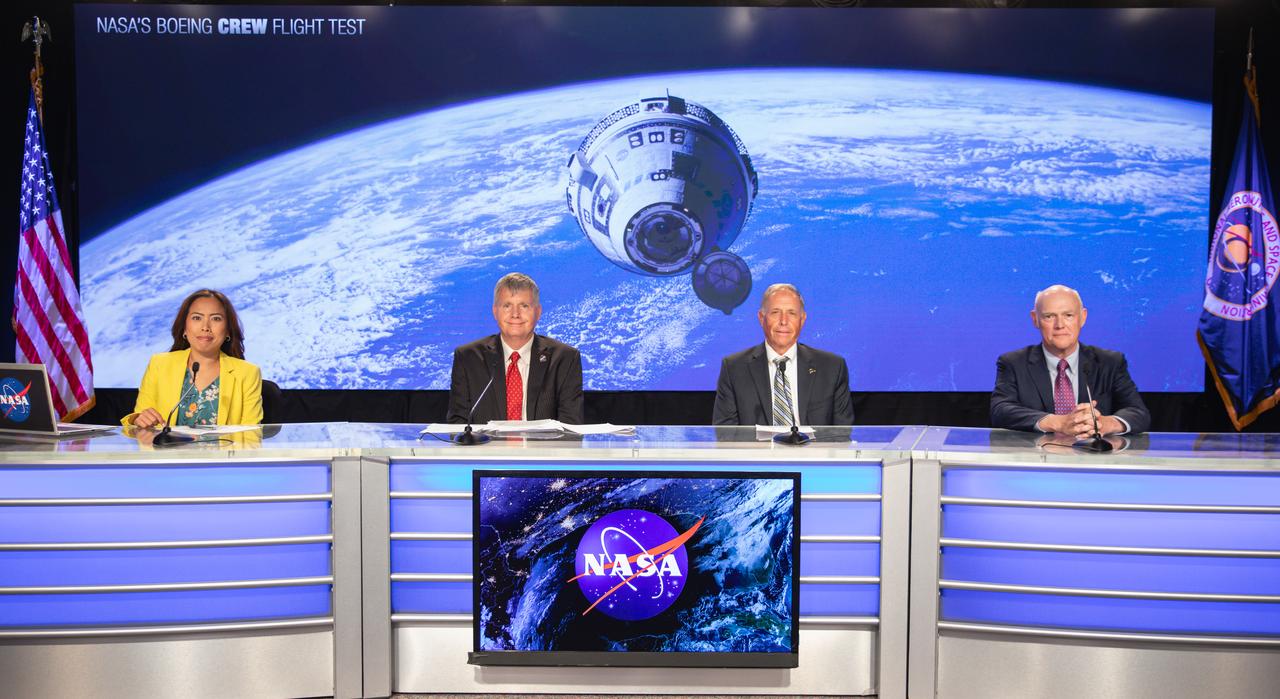
Officials from NASA, Boeing, ULA (United Launch Alliance) , and the U.S. Space Force 45th Weather Squadron participate in a prelaunch briefing for NASA’s Boeing Crew Flight Test at the agency’s Kennedy Space Center in Florida, Friday, May 3, 2024. From left to right at the dais are Megan Cruz, NASA Communications; Bill Nelson, NASA administrator; Steve Stich, manager, NASA’s Commercial Crew Program; Dana Weigel, manager, NASA’s International Space Station Program; Jennifer Buchli, chief scientist, NASA’s International Space Station Program; Mark Nappi, vice president and program manager, Boeing Commercial Crew Program; Gary Wentz, vice president, Government and Commercial Programs, ULA; Brian Cizek, launch weather officer, U.S. Space Force, 45th Weather Squadron. As part of the agency’s Commercial Crew Program, NASA astronauts Butch Wilmore and Suni Williams are the first to launch aboard Boeing’s Starliner spacecraft atop a ULA Atlas V rocket from Space Launch Complex-41 at Cape Canaveral Space Force Station in Florida. Liftoff is scheduled for 10:34 p.m. ET on Monday, May 6.
CCP Boeing CFT Prelaunch News Conference
Officials from NASA, Boeing, ULA (United Launch Alliance) , and the U.S. Space Force 45th Weather Squadron participate in a prelaunch briefing for NASA’s Boeing Crew Flight Test at the agency’s Kennedy Space Center in Florida, Friday, May 3, 2024. From left to right at the dais are Megan Cruz, NASA Communications; Bill Nelson, NASA administrator; Steve Stich, manager, NASA’s Commercial Crew Program; Dana Weigel, manager, NASA’s International Space Station Program; Jennifer Buchli, chief scientist, NASA’s International Space Station Program; Mark Nappi, vice president and program manager, Boeing Commercial Crew Program; Gary Wentz, vice president, Government and Commercial Programs, ULA; Brian Cizek, launch weather officer, U.S. Space Force, 45th Weather Squadron. As part of the agency’s Commercial Crew Program, NASA astronauts Butch Wilmore and Suni Williams are the first to launch aboard Boeing’s Starliner spacecraft atop a ULA Atlas V rocket from Space Launch Complex-41 at Cape Canaveral Space Force Station in Florida. Liftoff is scheduled for 10:34 p.m. ET on Monday, May 6.
CCP Boeing CFT Prelaunch News Conference
Officials from NASA, Boeing, ULA (United Launch Alliance) , and the U.S. Space Force 45th Weather Squadron participate in a prelaunch briefing for NASA’s Boeing Crew Flight Test at the agency’s Kennedy Space Center in Florida, Friday, May 3, 2024. From left to right at the dais are Megan Cruz, NASA Communications; Bill Nelson, NASA administrator; Steve Stich, manager, NASA’s Commercial Crew Program; Dana Weigel, manager, NASA’s International Space Station Program; Jennifer Buchli, chief scientist, NASA’s International Space Station Program; Mark Nappi, vice president and program manager, Boeing Commercial Crew Program; Gary Wentz, vice president, Government and Commercial Programs, ULA; Brian Cizek, launch weather officer, U.S. Space Force, 45th Weather Squadron. As part of the agency’s Commercial Crew Program, NASA astronauts Butch Wilmore and Suni Williams are the first to launch aboard Boeing’s Starliner spacecraft atop a ULA Atlas V rocket from Space Launch Complex-41 at Cape Canaveral Space Force Station in Florida. Liftoff is scheduled for 10:34 p.m. ET on Monday, May 6.
CCP Boeing CFT Prelaunch News Conference
Officials from NASA, Boeing, ULA (United Launch Alliance) , and the U.S. Space Force 45th Weather Squadron participate in a prelaunch briefing for NASA’s Boeing Crew Flight Test at the agency’s Kennedy Space Center in Florida, Friday, May 3, 2024. From left to right at the dais are Megan Cruz, NASA Communications; Bill Nelson, NASA administrator; Steve Stich, manager, NASA’s Commercial Crew Program; Dana Weigel, manager, NASA’s International Space Station Program; Jennifer Buchli, chief scientist, NASA’s International Space Station Program; Mark Nappi, vice president and program manager, Boeing Commercial Crew Program; Gary Wentz, vice president, Government and Commercial Programs, ULA; Brian Cizek, launch weather officer, U.S. Space Force, 45th Weather Squadron. As part of the agency’s Commercial Crew Program, NASA astronauts Butch Wilmore and Suni Williams are the first to launch aboard Boeing’s Starliner spacecraft atop a ULA Atlas V rocket from Space Launch Complex-41 at Cape Canaveral Space Force Station in Florida. Liftoff is scheduled for 10:34 p.m. ET on Monday, May 6.
CCP Boeing CFT Prelaunch News Conference
Officials from NASA, Boeing, ULA (United Launch Alliance) , and the U.S. Space Force 45th Weather Squadron participate in a prelaunch briefing for NASA’s Boeing Crew Flight Test at the agency’s Kennedy Space Center in Florida, Friday, May 3, 2024. From left to right at the dais are Megan Cruz, NASA Communications; Bill Nelson, NASA administrator; Steve Stich, manager, NASA’s Commercial Crew Program; Dana Weigel, manager, NASA’s International Space Station Program; Jennifer Buchli, chief scientist, NASA’s International Space Station Program; Mark Nappi, vice president and program manager, Boeing Commercial Crew Program; Gary Wentz, vice president, Government and Commercial Programs, ULA; Brian Cizek, launch weather officer, U.S. Space Force, 45th Weather Squadron. As part of the agency’s Commercial Crew Program, NASA astronauts Butch Wilmore and Suni Williams are the first to launch aboard Boeing’s Starliner spacecraft atop a ULA Atlas V rocket from Space Launch Complex-41 at Cape Canaveral Space Force Station in Florida. Liftoff is scheduled for 10:34 p.m. ET on Monday, May 6.
CCP Boeing CFT Prelaunch News Conference
Officials from NASA, Boeing, ULA (United Launch Alliance) , and the U.S. Space Force 45th Weather Squadron participate in a prelaunch briefing for NASA’s Boeing Crew Flight Test at the agency’s Kennedy Space Center in Florida, Friday, May 3, 2024. From left to right at the dais are Megan Cruz, NASA Communications; Bill Nelson, NASA administrator; Steve Stich, manager, NASA’s Commercial Crew Program; Dana Weigel, manager, NASA’s International Space Station Program; Jennifer Buchli, chief scientist, NASA’s International Space Station Program; Mark Nappi, vice president and program manager, Boeing Commercial Crew Program; Gary Wentz, vice president, Government and Commercial Programs, ULA; Brian Cizek, launch weather officer, U.S. Space Force, 45th Weather Squadron. As part of the agency’s Commercial Crew Program, NASA astronauts Butch Wilmore and Suni Williams are the first to launch aboard Boeing’s Starliner spacecraft atop a ULA Atlas V rocket from Space Launch Complex-41 at Cape Canaveral Space Force Station in Florida. Liftoff is scheduled for 10:34 p.m. ET on Monday, May 6.
CCP Boeing CFT Prelaunch News Conference
Officials from NASA, Boeing, ULA (United Launch Alliance) , and the U.S. Space Force 45th Weather Squadron participate in a prelaunch briefing for NASA’s Boeing Crew Flight Test at the agency’s Kennedy Space Center in Florida, Friday, May 3, 2024. From left to right at the dais are Megan Cruz, NASA Communications; Bill Nelson, NASA administrator; Steve Stich, manager, NASA’s Commercial Crew Program; Dana Weigel, manager, NASA’s International Space Station Program; Jennifer Buchli, chief scientist, NASA’s International Space Station Program; Mark Nappi, vice president and program manager, Boeing Commercial Crew Program; Gary Wentz, vice president, Government and Commercial Programs, ULA; Brian Cizek, launch weather officer, U.S. Space Force, 45th Weather Squadron. As part of the agency’s Commercial Crew Program, NASA astronauts Butch Wilmore and Suni Williams are the first to launch aboard Boeing’s Starliner spacecraft atop a ULA Atlas V rocket from Space Launch Complex-41 at Cape Canaveral Space Force Station in Florida. Liftoff is scheduled for 10:34 p.m. ET on Monday, May 6.
CCP Boeing CFT Prelaunch News Conference
Officials from NASA, Boeing, ULA (United Launch Alliance) , and the U.S. Space Force 45th Weather Squadron participate in a prelaunch briefing for NASA’s Boeing Crew Flight Test at the agency’s Kennedy Space Center in Florida, Friday, May 3, 2024. From left to right at the dais are Megan Cruz, NASA Communications; Bill Nelson, NASA administrator; Steve Stich, manager, NASA’s Commercial Crew Program; Dana Weigel, manager, NASA’s International Space Station Program; Jennifer Buchli, chief scientist, NASA’s International Space Station Program; Mark Nappi, vice president and program manager, Boeing Commercial Crew Program; Gary Wentz, vice president, Government and Commercial Programs, ULA; Brian Cizek, launch weather officer, U.S. Space Force, 45th Weather Squadron. As part of the agency’s Commercial Crew Program, NASA astronauts Butch Wilmore and Suni Williams are the first to launch aboard Boeing’s Starliner spacecraft atop a ULA Atlas V rocket from Space Launch Complex-41 at Cape Canaveral Space Force Station in Florida. Liftoff is scheduled for 10:34 p.m. ET on Monday, May 6.
CCP Boeing CFT Prelaunch News Conference
Officials from NASA, Boeing, ULA (United Launch Alliance) , and the U.S. Space Force 45th Weather Squadron participate in a prelaunch briefing for NASA’s Boeing Crew Flight Test at the agency’s Kennedy Space Center in Florida, Friday, May 3, 2024. From left to right at the dais are Megan Cruz, NASA Communications; Bill Nelson, NASA administrator; Steve Stich, manager, NASA’s Commercial Crew Program; Dana Weigel, manager, NASA’s International Space Station Program; Jennifer Buchli, chief scientist, NASA’s International Space Station Program; Mark Nappi, vice president and program manager, Boeing Commercial Crew Program; Gary Wentz, vice president, Government and Commercial Programs, ULA; Brian Cizek, launch weather officer, U.S. Space Force, 45th Weather Squadron. As part of the agency’s Commercial Crew Program, NASA astronauts Butch Wilmore and Suni Williams are the first to launch aboard Boeing’s Starliner spacecraft atop a ULA Atlas V rocket from Space Launch Complex-41 at Cape Canaveral Space Force Station in Florida. Liftoff is scheduled for 10:34 p.m. ET on Monday, May 6.
CCP Boeing CFT Prelaunch News Conference
NASA Deputy Administrator Jim Morhard answers questions during a Mars 2020 NASA Social at Kennedy Space Center’s News Center in Florida on July 29, 2020. The Mars Perseverance rover and Ingenuity helicopter are scheduled to launch July 30, on a United Launch Alliance Atlas V 541 rocket from Space Launch Complex 41 at nearby Cape Canaveral Air Force Station. The rover is part of NASA’s Mars Exploration Program, a long-term effort of robotic exploration of the Red Planet. The rover will search for habitable conditions in the ancient past and signs of past microbial life on Mars. The Launch Services Program at Kennedy is responsible for launch management.
Mars 2020 Facebook Live / NASA Social
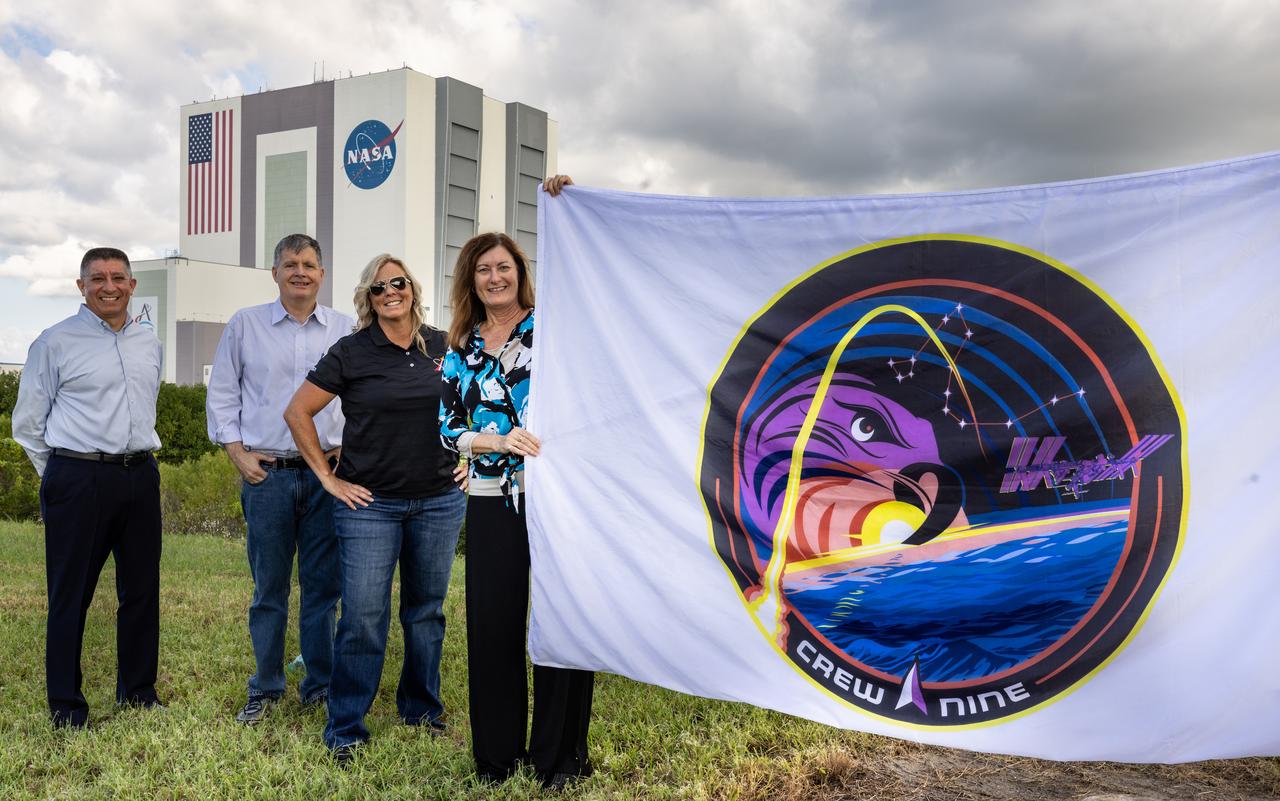
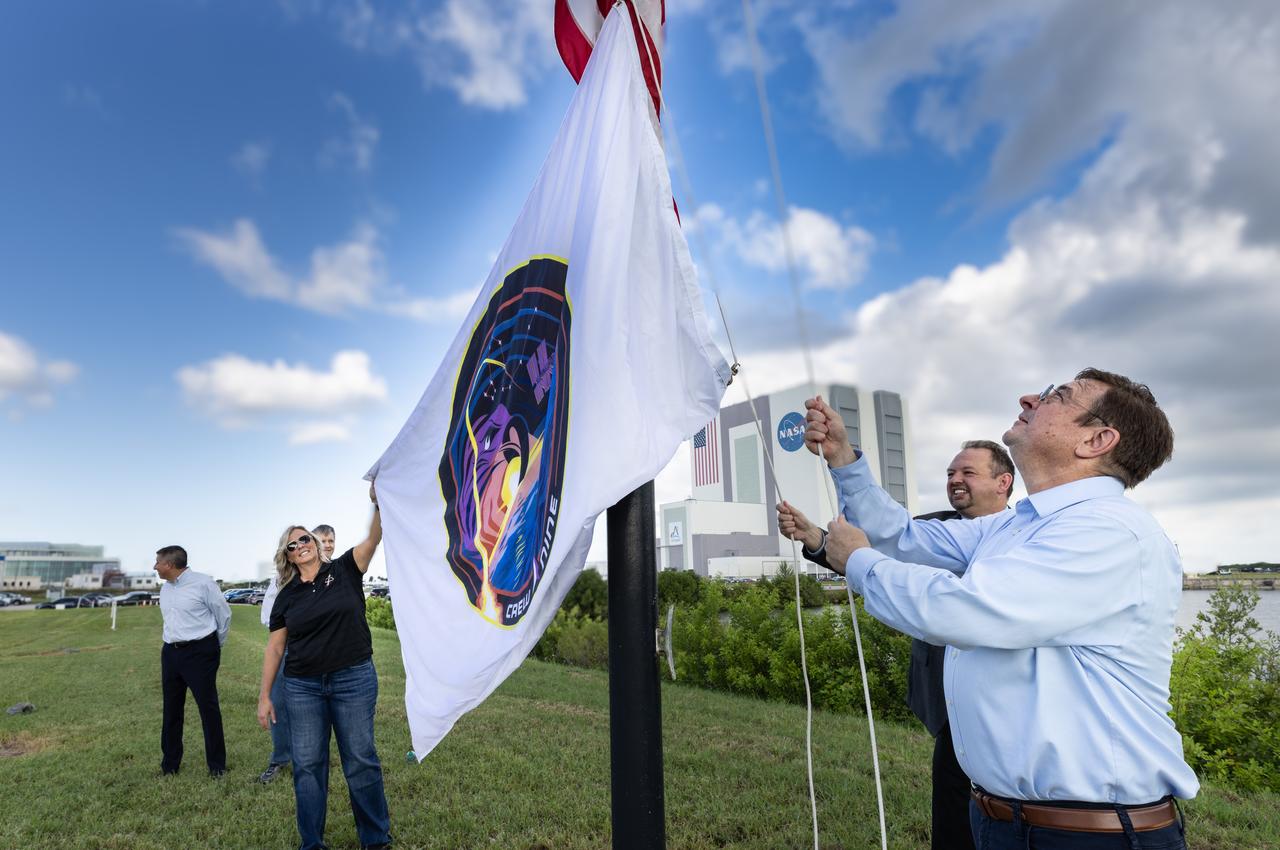
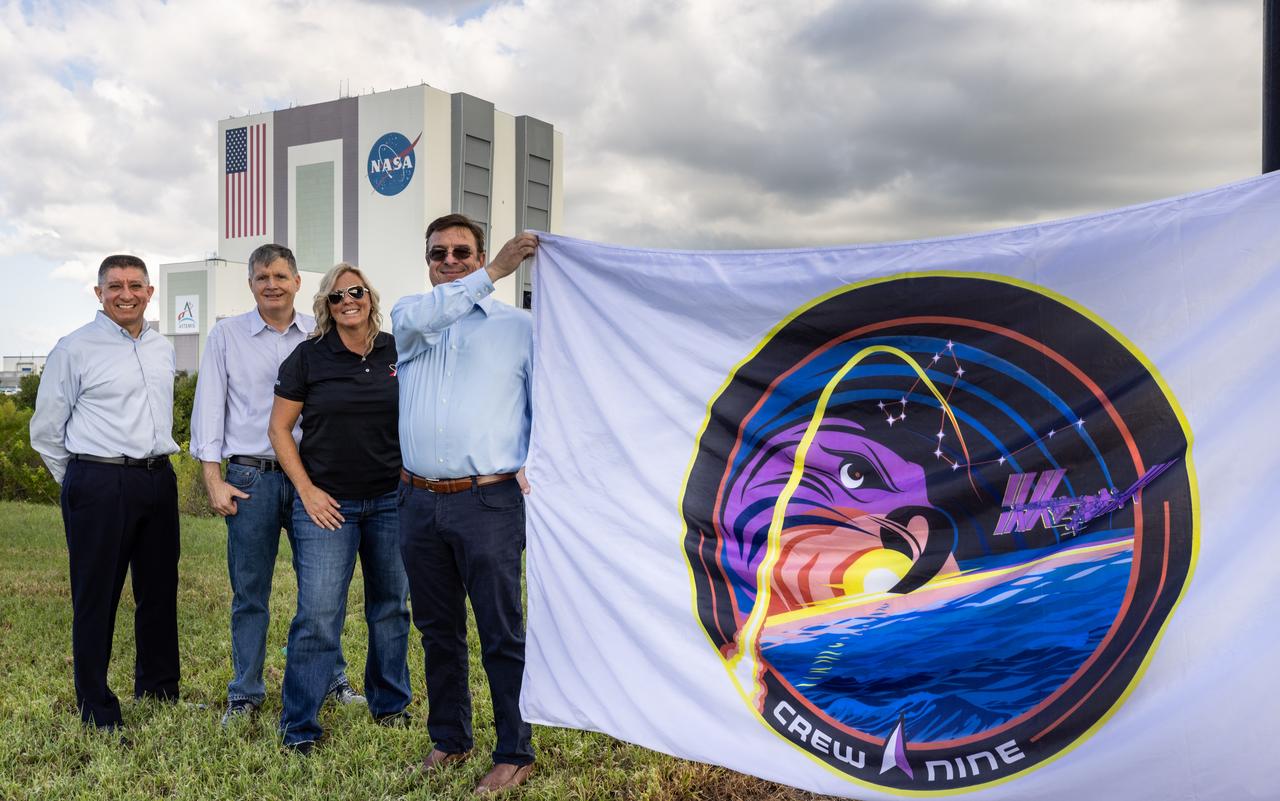
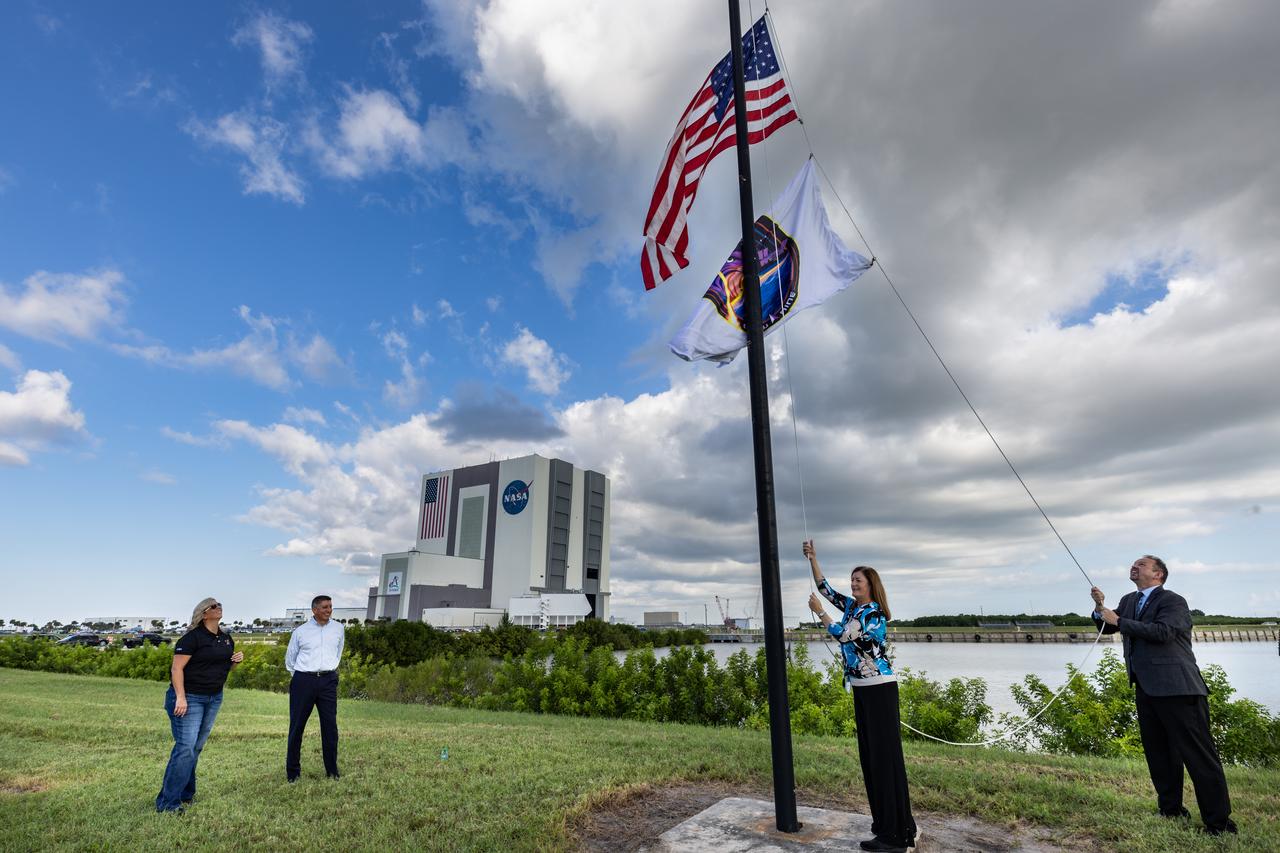
From left, Richard Jones, CCP (Commercial Crew Program) deputy program manager at NASA’s Johnson Space Center in Houston; Steve Stich, program manager for CCP; Dana Hutcherson, CCP deputy program manager at NASA’s Kennedy Space Center in Florida; and Deb Cole, CCP technical manager, pose with the agency’s SpaceX Crew-9 mission flag near the countdown clock at the NASA News Center at Kennedy on Tuesday, Sept. 24, 2024. The Crew-9 mission will send NASA astronaut Nick Hague and Roscosmos cosmonaut Aleksandr Gorbunov to the International Space Station aboard SpaceX’s Dragon spacecraft and Falcon 9 rocket.
CCP Crew-9 Flag Raising
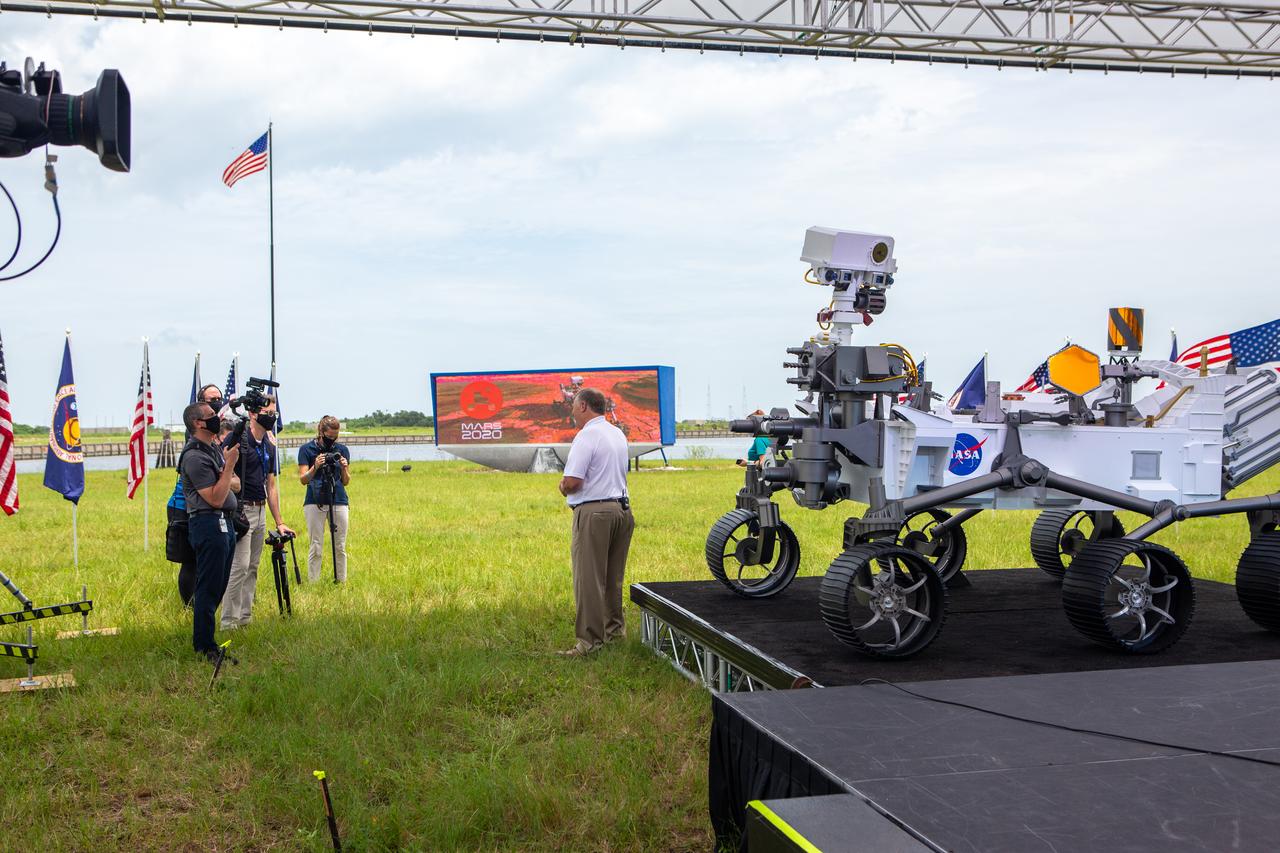
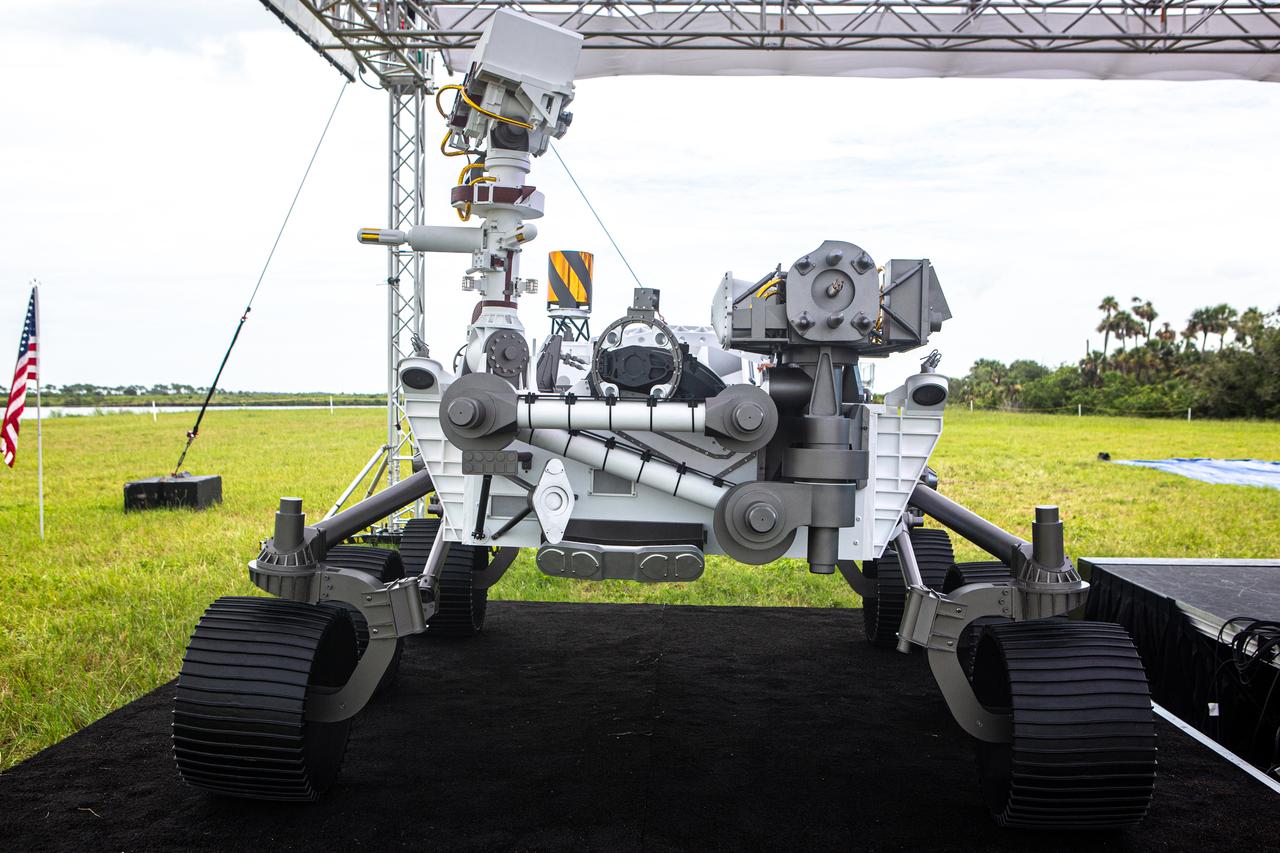
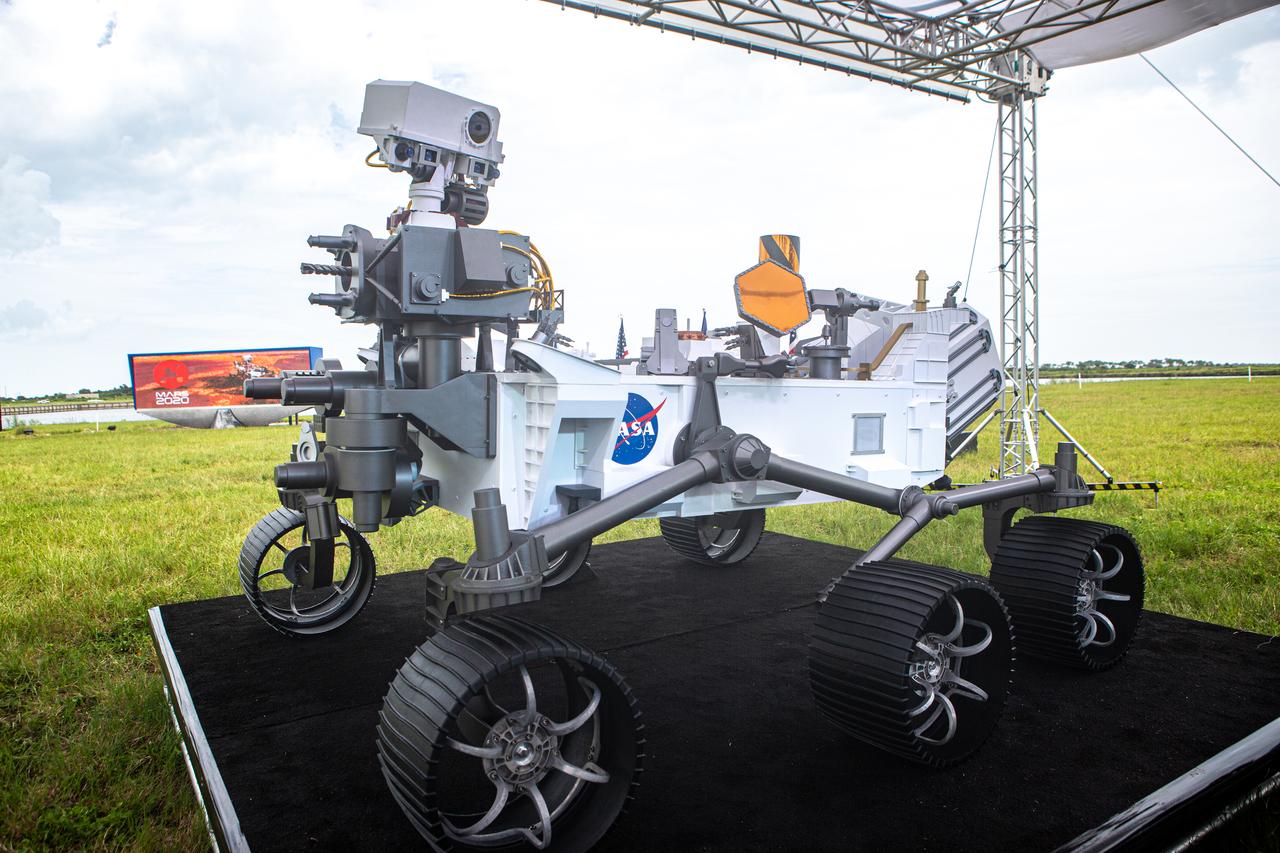
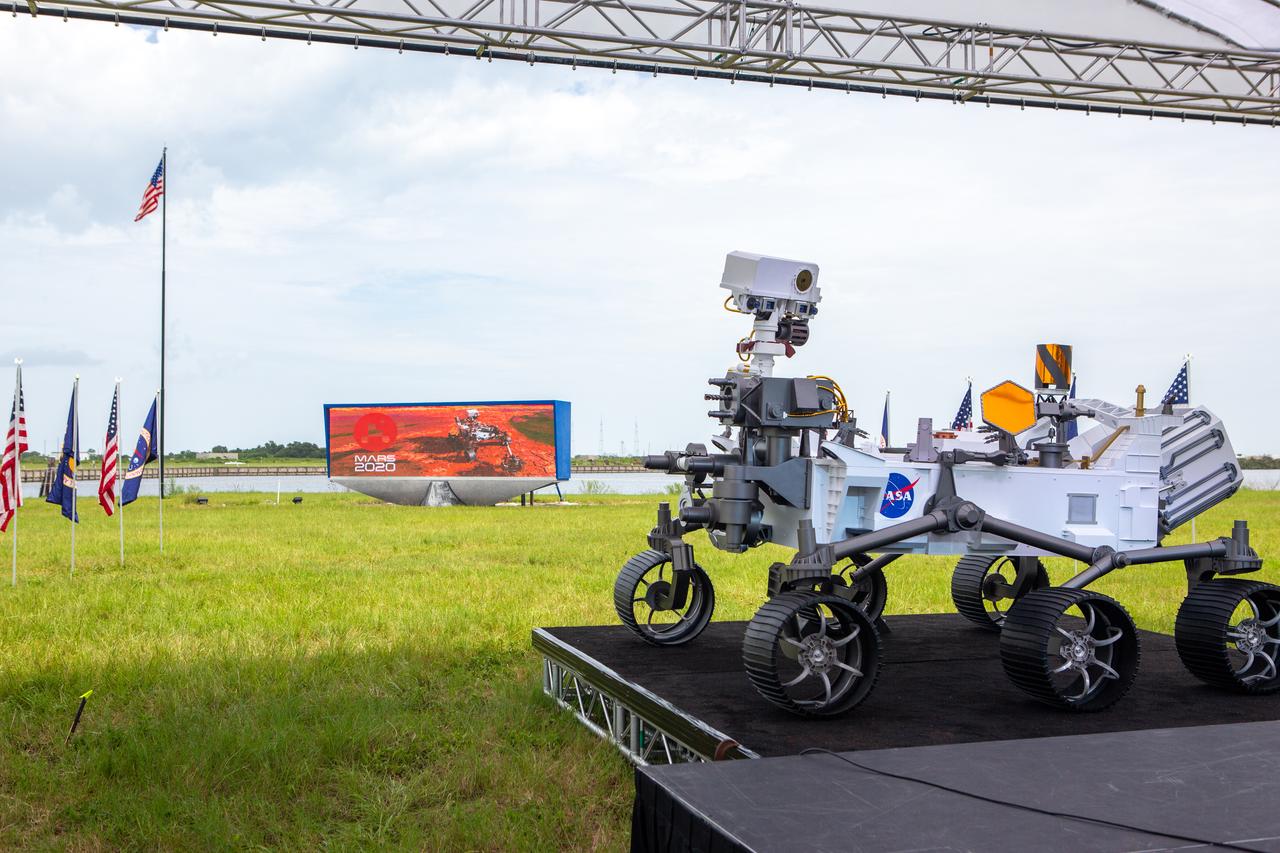
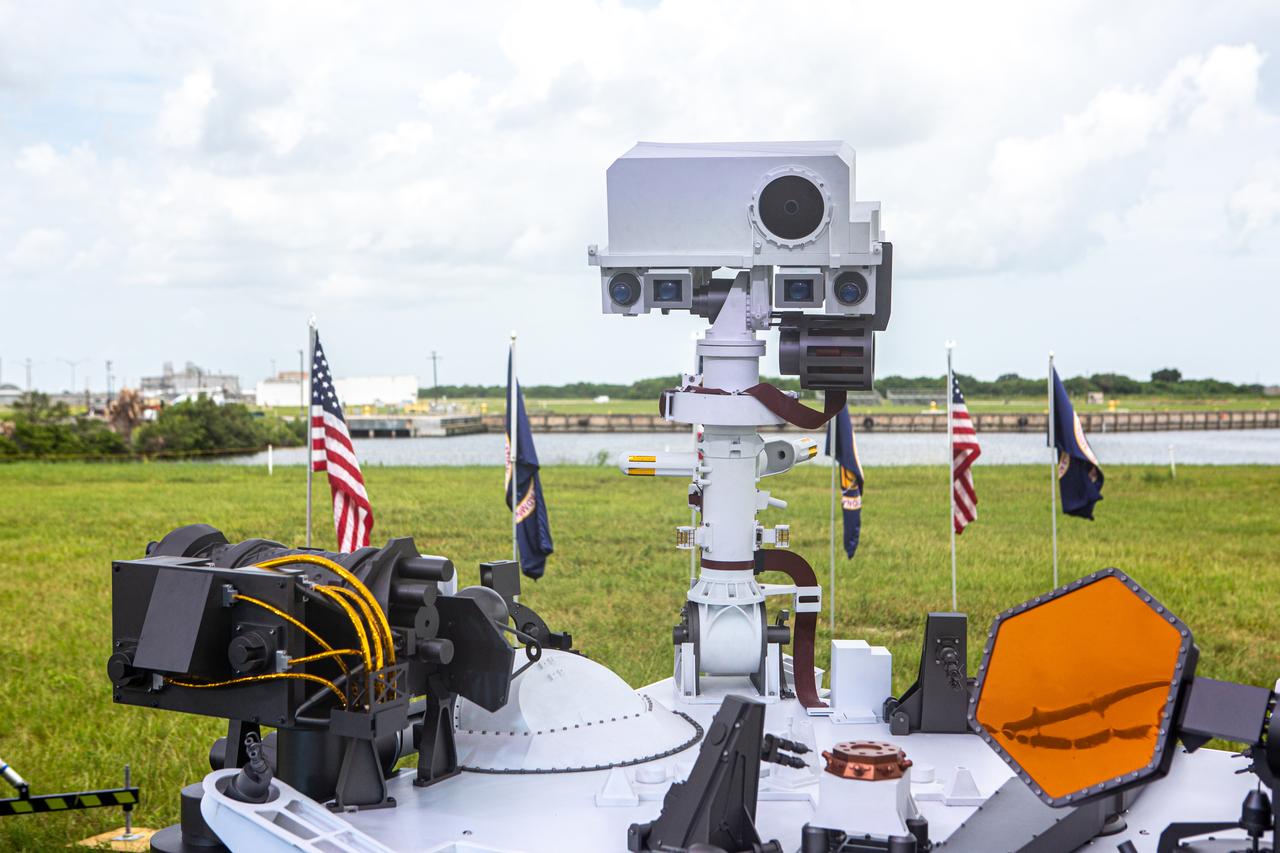
A full-scale mockup of NASA’s Mars 2020 Perseverance rover is on display at the News Center at the agency’s Kennedy Space Center in Florida on July 29, 2020. The rover and Ingenuity helicopter are scheduled to launch July 30, on a United Launch Alliance Atlas V 541 rocket from Space Launch Complex 41 at nearby Cape Canaveral Air Force Station. The rover is part of NASA’s Mars Exploration Program, a long-term effort of robotic exploration of the Red Planet. The rover will search for habitable conditions in the ancient past and signs of past microbial life on Mars. The Launch Services Program at Kennedy is responsible for launch management.
Mars 2020 Facebook Live / NASA Social
A full-scale mockup of NASA’s Mars 2020 Perseverance rover is on display near the countdown clock at the News Center at the agency’s Kennedy Space Center in Florida on July 29, 2020. The rover and Ingenuity helicopter are scheduled to launch July 30, on a United Launch Alliance Atlas V 541 rocket from Space Launch Complex 41 at nearby Cape Canaveral Air Force Station. The rover is part of NASA’s Mars Exploration Program, a long-term effort of robotic exploration of the Red Planet. The rover will search for habitable conditions in the ancient past and signs of past microbial life on Mars. The Launch Services Program at Kennedy is responsible for launch management.
Mars 2020 Facebook Live / NASA Social
A full-scale mockup of NASA’s Mars 2020 Perseverance rover is on display at the News Center at the agency’s Kennedy Space Center in Florida on July 29, 2020. The rover and Ingenuity helicopter are scheduled to launch July 30, on a United Launch Alliance Atlas V 541 rocket from Space Launch Complex 41 at nearby Cape Canaveral Air Force Station. The rover is part of NASA’s Mars Exploration Program, a long-term effort of robotic exploration of the Red Planet. The rover will search for habitable conditions in the ancient past and signs of past microbial life on Mars. The Launch Services Program at Kennedy is responsible for launch management.
Mars 2020 Facebook Live / NASA Social
A full-scale mockup of NASA’s Mars 2020 Perseverance rover is on display at the News Center at the agency’s Kennedy Space Center in Florida on July 29, 2020. The rover and Ingenuity helicopter are scheduled to launch July 30, on a United Launch Alliance Atlas V 541 rocket from Space Launch Complex 41 at nearby Cape Canaveral Air Force Station. The rover is part of NASA’s Mars Exploration Program, a long-term effort of robotic exploration of the Red Planet. The rover will search for habitable conditions in the ancient past and signs of past microbial life on Mars. The Launch Services Program at Kennedy is responsible for launch management.
Mars 2020 Facebook Live / NASA Social
David Forrest (right), deputy manager of the SE&I (Systems Engineering and Integration) Office in NASA’s Commercial Low Earth Orbit Development Program, with help of NASA’s CCP (Commercial Crew Program) Deputy Program Manager Dana Hutcherson and NASA Public Affairs Officer Steven Siceloff, raises the agency’s SpaceX Crew-9 mission flag near the countdown clock at the NASA News Center at the agency’s Kennedy Space Center in Florida on Tuesday, Sept. 24, 2024. Forrest previously served as deputy manager for CCP’s SE&I Office at Kennedy. In the background is CCP’s Deputy Program Manager at NASA’s Johnson Space Center in Houston Richard Jones (far left) and CCP program manager Steve Stich. The Crew-9 mission will send NASA astronaut Nick Hague and Roscosmos cosmonaut Aleksandr Gorbunov to the International Space Station aboard SpaceX’s Dragon spacecraft and Falcon 9 rocket.
CCP Crew-9 Flag Raising
From left, Richard Jones, CCP (Commercial Crew Program) deputy program manager at NASA’s Johnson Space Center in Houston; Steve Stich, program manager for CCP; Dana Hutcherson, CCP deputy program manager at NASA’s Kennedy Space Center in Florida; and Diana Oglesby, director, Strategic Integration and Management Division, Space Operations Mission Directorate, pose with the agency’s SpaceX Crew-9 mission flag near the countdown clock at the NASA News Center at the Kennedy on Tuesday, Sept. 24, 2024. Oglesby previously served as manager of CCP’s Program Control and Integration Office at Kennedy. The Crew-9 mission will send NASA astronaut Nick Hague and Roscosmos cosmonaut Aleksandr Gorbunov to the International Space Station aboard SpaceX’s Dragon spacecraft and Falcon 9 rocket.
CCP Crew-9 Flag Raising
From left, Richard Jones, CCP (Commercial Crew Program) deputy program manager at NASA’s Johnson Space Center in Houston; Steve Stich, program manager for CCP; Dana Hutcherson, CCP deputy program manager at NASA’s Kennedy Space Center in Florida; and David Forrest, deputy manager, SE&I (Systems Engineering and Integration) Office, NASA’s Commercial Low Earth Orbit Development Program, pose with the agency’s SpaceX Crew-9 mission flag near the countdown clock at the NASA News Center at Kennedy on Tuesday, Sept. 24, 2024. Forrest previously served as deputy manager for CCP’s SE&I Office at Kennedy. The Crew-9 mission will send NASA astronaut Nick Hague and Roscosmos cosmonaut Aleksandr Gorbunov to the International Space Station aboard SpaceX’s Dragon spacecraft and Falcon 9 rocket.
CCP Crew-9 Flag Raising
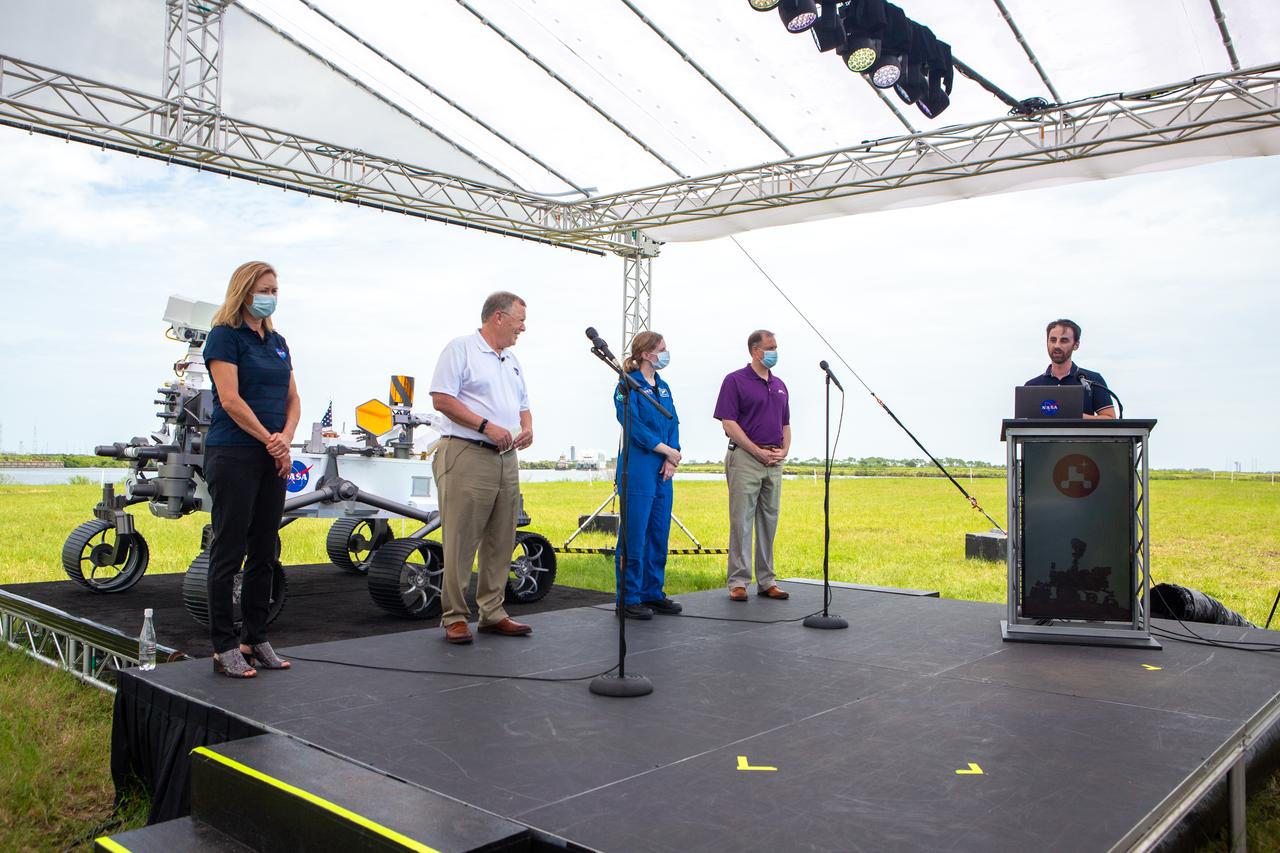
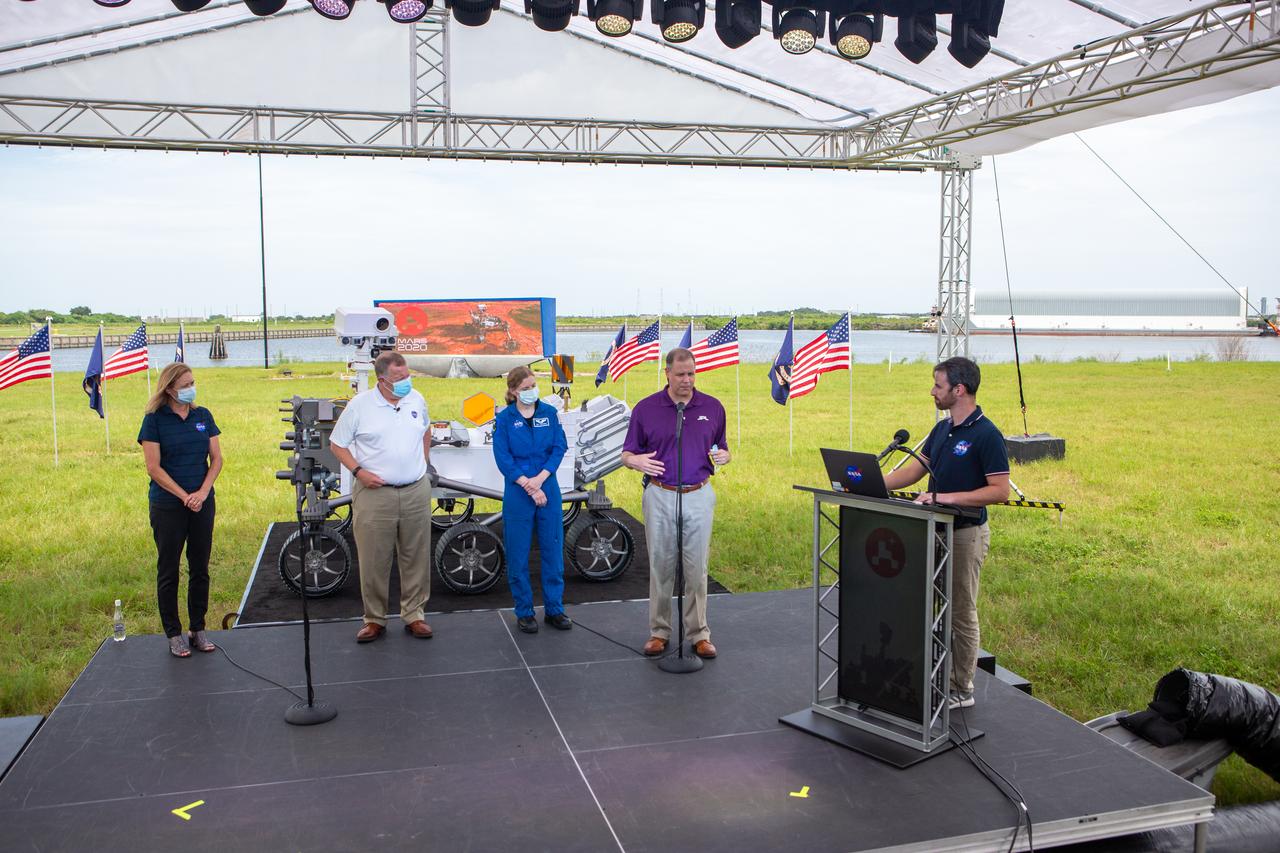
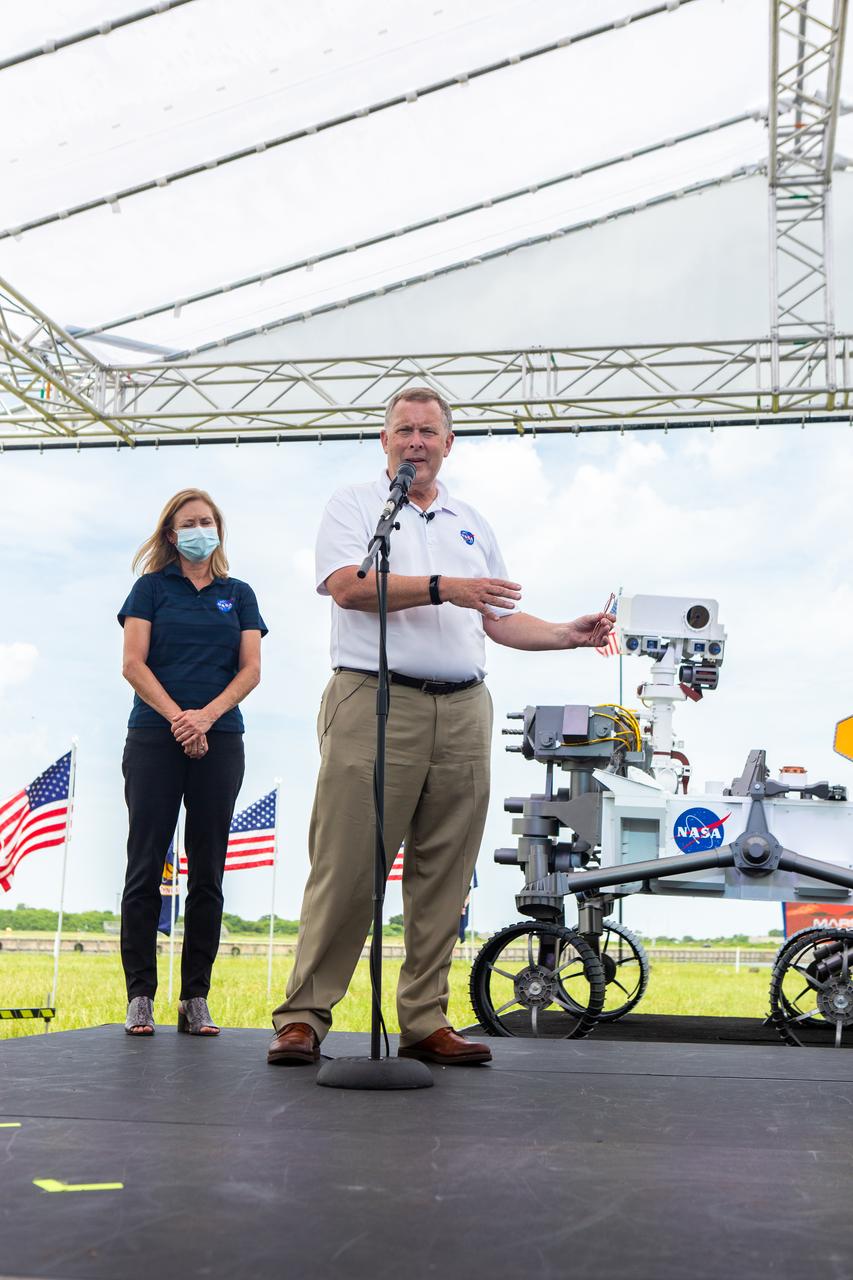
A full-scale mockup of NASA’s Mars 2020 Perseverance rover is on display at the News Center at the agency’s Kennedy Space Center in Florida on July 29, 2020. A Mars 2020 NASA Social is in progress featuring, right to left, Kennedy Space Center Deputy Director Janet Petro, NASA Deputy Administrator Jim Morhard, NASA astronaut Zena Cardman, and NASA Administrator Jim Bridenstine. The Mars Perseverance rover and Ingenuity helicopter are scheduled to launch July 30, on a United Launch Alliance Atlas V 541 rocket from Space Launch Complex 41 at nearby Cape Canaveral Air Force Station. The rover is part of NASA’s Mars Exploration Program, a long-term effort of robotic exploration of the Red Planet. The rover will search for habitable conditions in the ancient past and signs of past microbial life on Mars. The Launch Services Program at Kennedy is responsible for launch management.
Mars 2020 Facebook Live / NASA Social
KENNEDY SPACE CENTER, FLA. -- NASA Deputy Associate Administrator for Space Station and Shuttle Programs Michael Kostelnik (center) is given a tour of a solid rocket booster (SRB) retrieval ship by United Space Alliance (USA) employee Joe Chaput (right).  NASA and USA Space Shuttle program management are participating in a leadership workday.  The day is intended to provide management with an in-depth, hands-on look at Shuttle processing activities at KSC.
KENNEDY SPACE CENTER, FLA. -- NASA Deputy Associate Administrator for Space Station and Shuttle Programs Michael Kostelnik (center) is given a tour of a solid rocket booster (SRB) retrieval ship by United Space Alliance (USA) employee Joe Chaput (right). NASA and USA Space Shuttle program management are participating in a leadership workday. The day is intended to provide management with an in-depth, hands-on look at Shuttle processing activities at KSC.
KENNEDY SPACE CENTER, FLA. -- United Space Alliance (USA) Manager of the Thermal Protection System (TPS) Facility Martin Wilson (right) briefs NASA Deputy Associate Administrator for Space Station and Shuttle Programs Michael Kostelnik (left) on the properties of a thermal blanket used in the Shuttle's TPS.  NASA and USA Space Shuttle program management are participating in a leadership workday.  The day is intended to provide management with an in-depth, hands-on look at Shuttle processing activities at KSC.
KENNEDY SPACE CENTER, FLA. -- United Space Alliance (USA) Manager of the Thermal Protection System (TPS) Facility Martin Wilson (right) briefs NASA Deputy Associate Administrator for Space Station and Shuttle Programs Michael Kostelnik (left) on the properties of a thermal blanket used in the Shuttle's TPS. NASA and USA Space Shuttle program management are participating in a leadership workday. The day is intended to provide management with an in-depth, hands-on look at Shuttle processing activities at KSC.
KENNEDY SPACE CENTER, FLA. -- NASA Deputy Associate Administrator for Space Station and Shuttle Programs Michael Kostelnik (left) discusses some of the working parts inside the nose of Shuttle Discovery in Orbiter Processing Facility Bay 3 with a United Space Alliance (USA) technician (back to camera).  NASA and USA Space Shuttle program management are participating in a leadership workday.  The day is intended to provide management with an in-depth, hands-on look at Shuttle processing activities at KSC.
KENNEDY SPACE CENTER, FLA. -- NASA Deputy Associate Administrator for Space Station and Shuttle Programs Michael Kostelnik (left) discusses some of the working parts inside the nose of Shuttle Discovery in Orbiter Processing Facility Bay 3 with a United Space Alliance (USA) technician (back to camera). NASA and USA Space Shuttle program management are participating in a leadership workday. The day is intended to provide management with an in-depth, hands-on look at Shuttle processing activities at KSC.
KENNEDY SPACE CENTER, FLA. -- A United Space Alliance (USA) technician (center) discusses aspects of Shuttle processing performed in the Solid Rocket Booster (SRB) Assembly and Refurbishment Facility (ARF) with NASA Deputy Associate Administrator for Space Station and Shuttle Programs Michael Kostelnik (right).  NASA and USA Space Shuttle program management are participating in a leadership workday.  The day is intended to provide management with an in-depth, hands-on look at Shuttle processing activities at KSC.
KENNEDY SPACE CENTER, FLA. -- A United Space Alliance (USA) technician (center) discusses aspects of Shuttle processing performed in the Solid Rocket Booster (SRB) Assembly and Refurbishment Facility (ARF) with NASA Deputy Associate Administrator for Space Station and Shuttle Programs Michael Kostelnik (right). NASA and USA Space Shuttle program management are participating in a leadership workday. The day is intended to provide management with an in-depth, hands-on look at Shuttle processing activities at KSC.
KENNEDY SPACE CENTER, FLA. -- NASA Deputy Associate Administrator for Space Station and Shuttle Programs Michael Kostelnik (left) tours a solid rocket booster (SRB) retrieval ship at Cape Canaveral.  NASA and United Space Alliance (USA) Space Shuttle program management are participating in a leadership workday.  The day is intended to provide management with an in-depth, hands-on look at Shuttle processing activities at KSC.
KENNEDY SPACE CENTER, FLA. -- NASA Deputy Associate Administrator for Space Station and Shuttle Programs Michael Kostelnik (left) tours a solid rocket booster (SRB) retrieval ship at Cape Canaveral. NASA and United Space Alliance (USA) Space Shuttle program management are participating in a leadership workday. The day is intended to provide management with an in-depth, hands-on look at Shuttle processing activities at KSC.
KENNEDY SPACE CENTER, FLA. -- NASA Deputy Associate Administrator for Space Station and Shuttle Programs Michael Kostelnik (top) discusses the inner workings of Shuttle Atlantis in Orbiter Processing Facility Bay 1 with a United Space Alliance (USA) technician (bottom).  NASA and USA Space Shuttle program management are participating in a leadership workday.  The day is intended to provide management with an in-depth, hands-on look at Shuttle processing activities at KSC.
KENNEDY SPACE CENTER, FLA. -- NASA Deputy Associate Administrator for Space Station and Shuttle Programs Michael Kostelnik (top) discusses the inner workings of Shuttle Atlantis in Orbiter Processing Facility Bay 1 with a United Space Alliance (USA) technician (bottom). NASA and USA Space Shuttle program management are participating in a leadership workday. The day is intended to provide management with an in-depth, hands-on look at Shuttle processing activities at KSC.
KENNEDY SPACE CENTER, FLA. -- NASA Deputy Associate Administrator for Space Station and Shuttle Programs Michael Kostelnik (right) discusses a speed brake on Shuttle Discovery in Orbiter Processing Facility Bay 3 with a United Space Alliance (USA) technician (left).  NASA and USA Space Shuttle program management are participating in a leadership workday.  The day is intended to provide management with an in-depth, hands-on look at Shuttle processing activities at KSC.
KENNEDY SPACE CENTER, FLA. -- NASA Deputy Associate Administrator for Space Station and Shuttle Programs Michael Kostelnik (right) discusses a speed brake on Shuttle Discovery in Orbiter Processing Facility Bay 3 with a United Space Alliance (USA) technician (left). NASA and USA Space Shuttle program management are participating in a leadership workday. The day is intended to provide management with an in-depth, hands-on look at Shuttle processing activities at KSC.
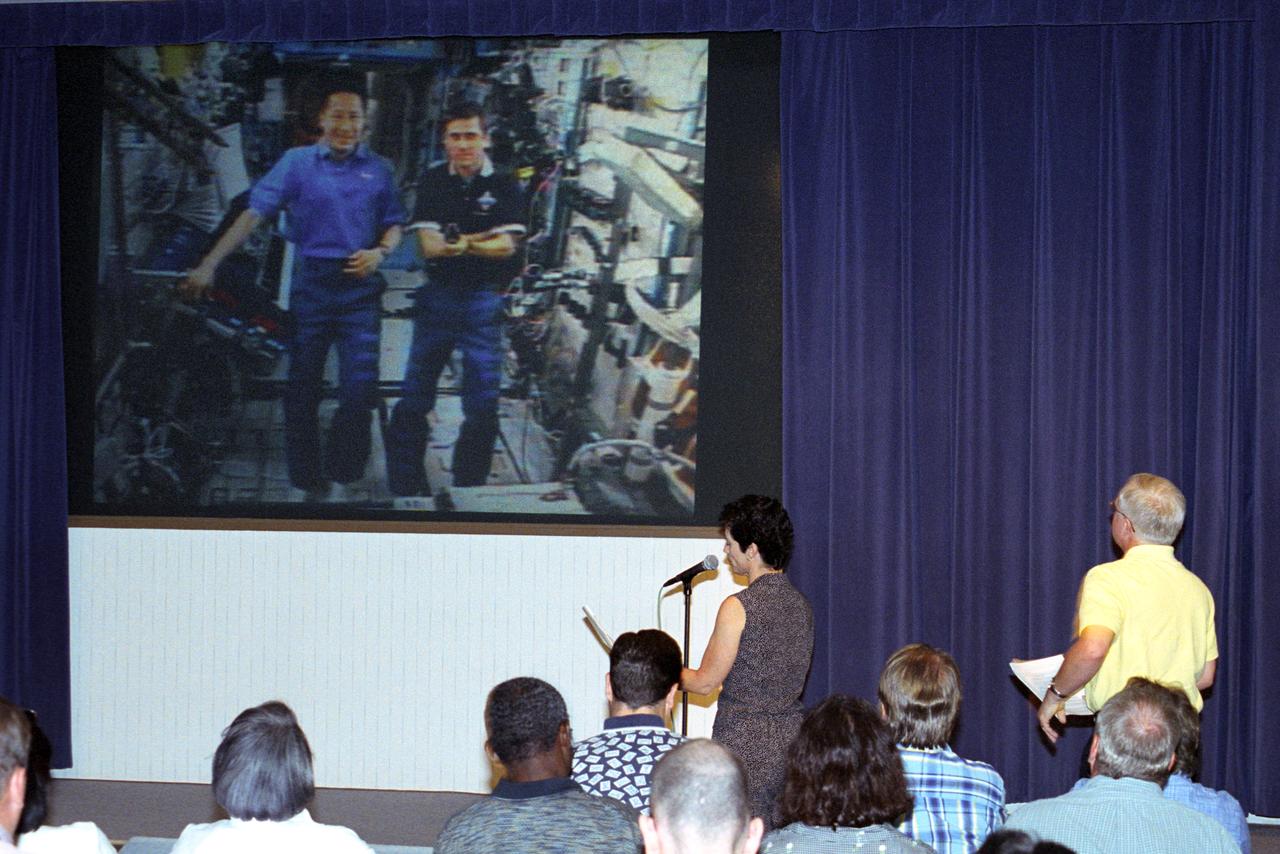
Teacher Kim Cantrell from the Edwards Air Force Base Middle School, Edwards, Calif., participating in a live uplink at NASA Dryden as part of NASA's Explorer Schools program, asks the crew of the International Space Station a question.
Teacher Kim Cantrell from the Edwards Air Force Base Middle School, Edwards, Calif., participating in a live uplink at NASA Dryden as part of NASA's Explorer Schools program, asks the crew of the International Space Station a question
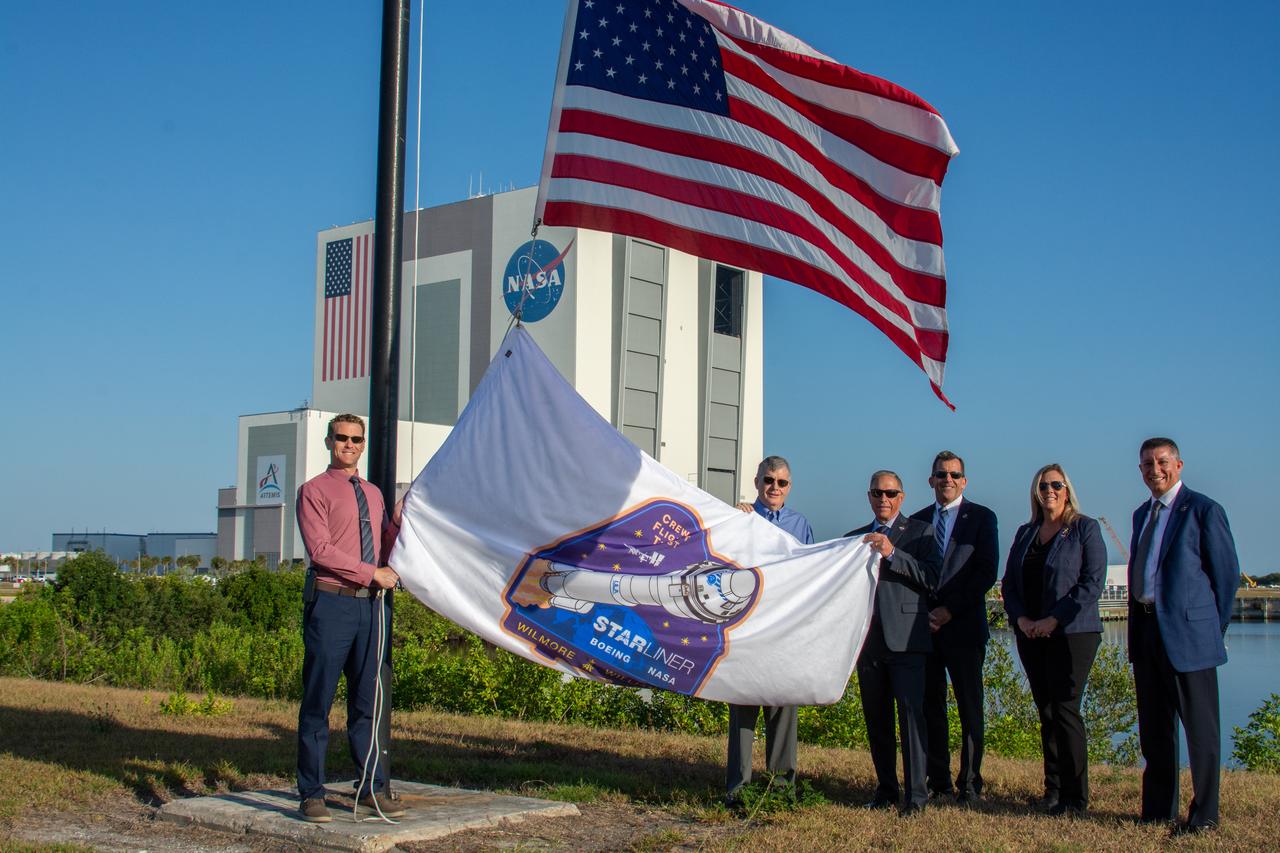
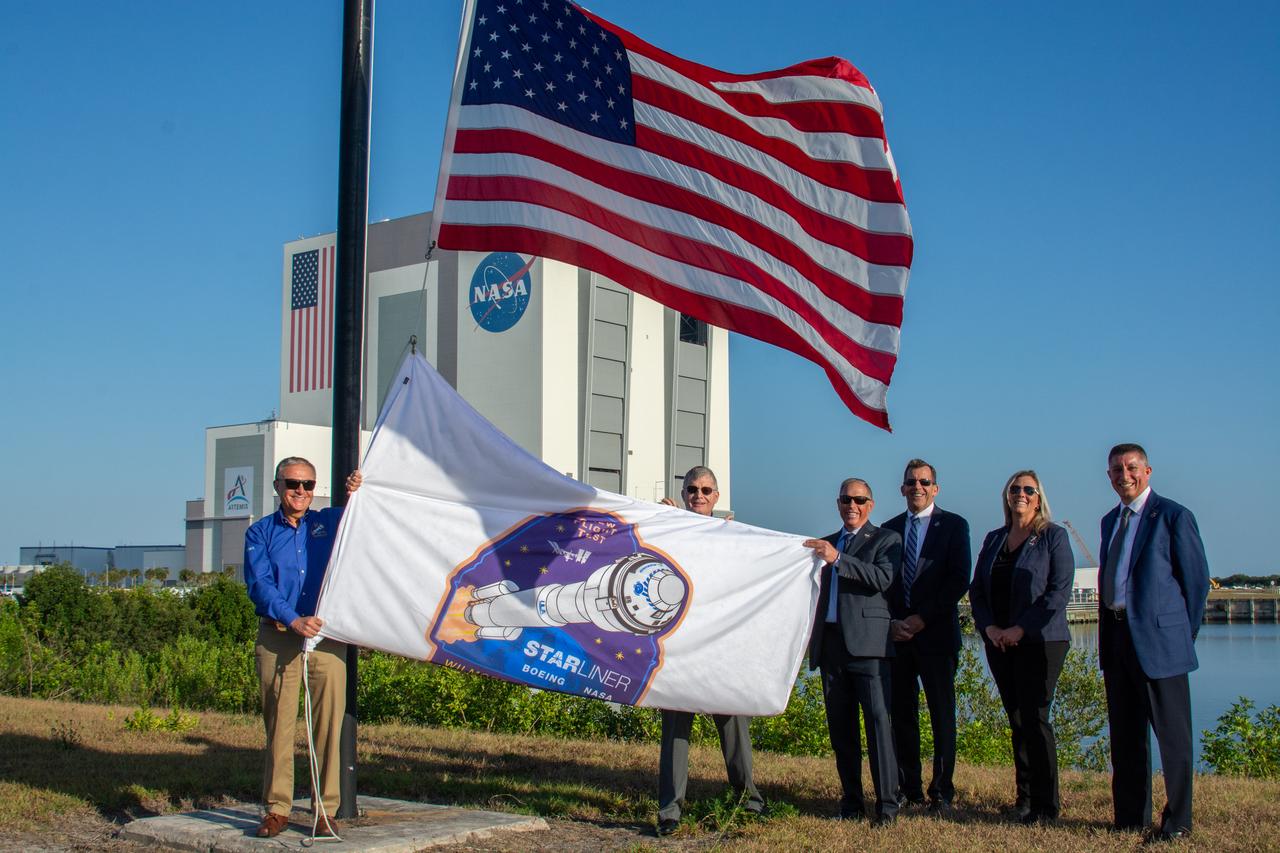
From left to right, Ian Kappes, deputy launch vehicle office manager, NASA Kennedy Space Center Commercial Crew Program; Steve Stich, manager, NASA’s Commercial Crew Program; Mark Nappi, vice president and program manager, Boeing Commercial Crew Program; Leroy Cain, mission integration and operations manager, Boeing’s Commercial Crew Program; Dana Hutcherson, deputy program manager, NASA’s Commercial Crew Program; and Richard Jones, deputy program manager, NASA’s Commercial Crew Program, prepare to raise NASA’s Boeing Crew Flight Test flag on Thursday, April 25, 2024, near the countdown clock at the Press Site at the Florida spaceport. As part of the agency’s Commercial Crew Program, NASA astronauts Butch Wilmore and Suni Williams are the first to launch to the International Space Station aboard Boeing’s Starliner spacecraft atop a United Launch Alliance Atlas V rocket from Space Launch Complex-41 at nearby Cape Canaveral Space Force Station. Liftoff is scheduled for 10:34 p.m. ET on Monday, May 6.
CFT Flag Raising
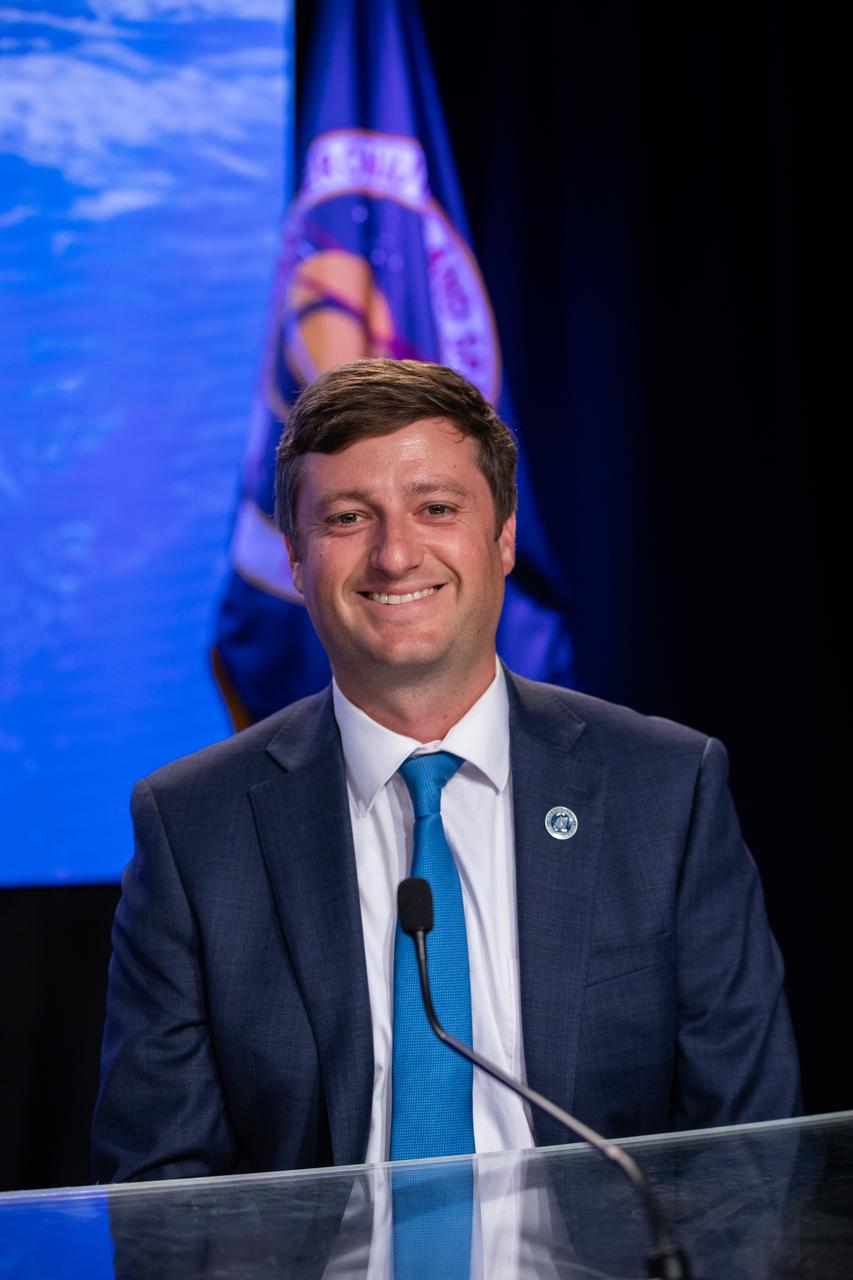
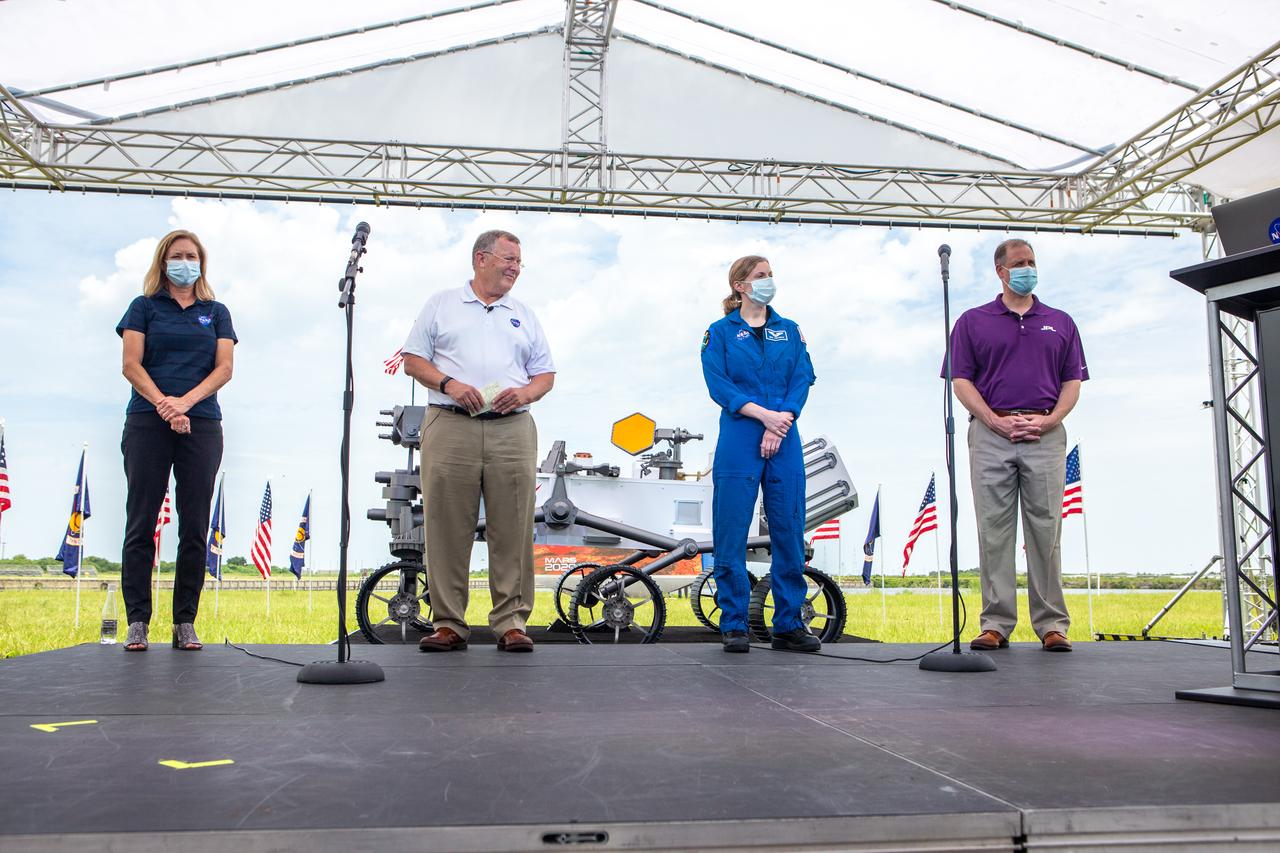
Joshua Santora, at the podium, NASA Communications, moderates a Mars 2020 NASA Social at Kennedy Space Center’s News Center in Florida on July 29, 2020. Participants from left are Kennedy Deputy Director Janet Petro, NASA Deputy Administrator Jim Morhard, NASA astronaut Zena Cardman, and NASA Administrator Jim Bridenstine. The Mars Perseverance rover and Ingenuity helicopter are scheduled to launch July 30, on a United Launch Alliance Atlas V 541 rocket from Space Launch Complex 41 at nearby Cape Canaveral Air Force Station. The rover is part of NASA’s Mars Exploration Program, a long-term effort of robotic exploration of the Red Planet. The rover will search for habitable conditions in the ancient past and signs of past microbial life on Mars. The Launch Services Program at Kennedy is responsible for launch management.
Mars 2020 Facebook Live / NASA Social
Joshua Santora, at the podium, NASA Communications, moderates a Mars 2020 NASA Social at Kennedy Space Center’s News Center in Florida on July 29, 2020. Participants from left are Kennedy Deputy Director Janet Petro, NASA Deputy Administrator Jim Morhard, NASA astronaut Zena Cardman, and NASA Administrator Jim Bridenstine. The Mars Perseverance rover and Ingenuity helicopter are scheduled to launch July 30, on a United Launch Alliance Atlas V 541 rocket from Space Launch Complex 41 at nearby Cape Canaveral Air Force Station. The rover is part of NASA’s Mars Exploration Program, a long-term effort of robotic exploration of the Red Planet. The rover will search for habitable conditions in the ancient past and signs of past microbial life on Mars. The Launch Services Program at Kennedy is responsible for launch management.
Mars 2020 Facebook Live / NASA Social
A Mars 2020 NASA Social is held at Kennedy Space Center’s News Center in Florida on July 29, 2020. Participants from left are Kennedy Deputy Director Janet Petro, NASA Deputy Administrator Jim Morhard, NASA astronaut Zena Cardman, and NASA Administrator Jim Bridenstine. The Mars Perseverance rover and Ingenuity helicopter are scheduled to launch July 30, on a United Launch Alliance Atlas V 541 rocket from Space Launch Complex 41 at nearby Cape Canaveral Air Force Station. The rover is part of NASA’s Mars Exploration Program, a long-term effort of robotic exploration of the Red Planet. The rover will search for habitable conditions in the ancient past and signs of past microbial life on Mars. The Launch Services Program at Kennedy is responsible for launch management.
Mars 2020 Facebook Live / NASA Social
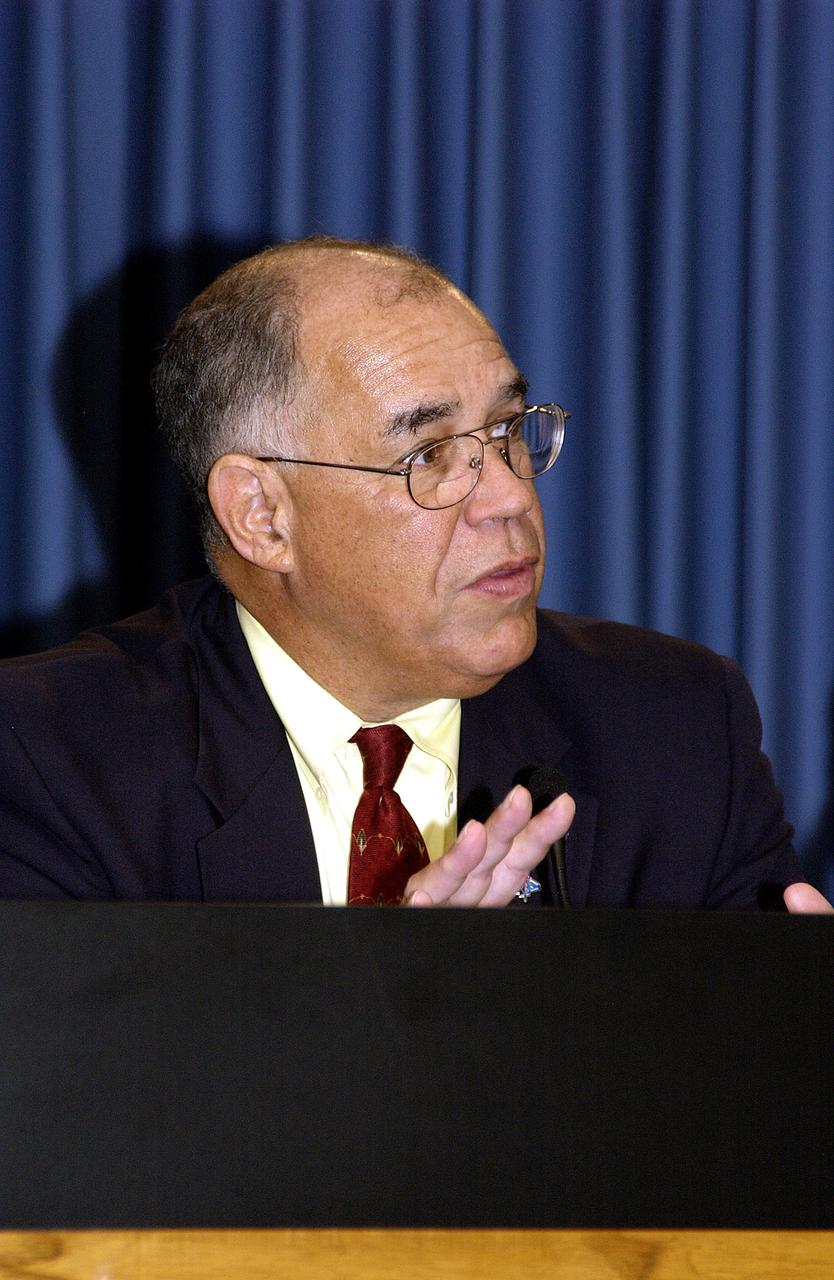
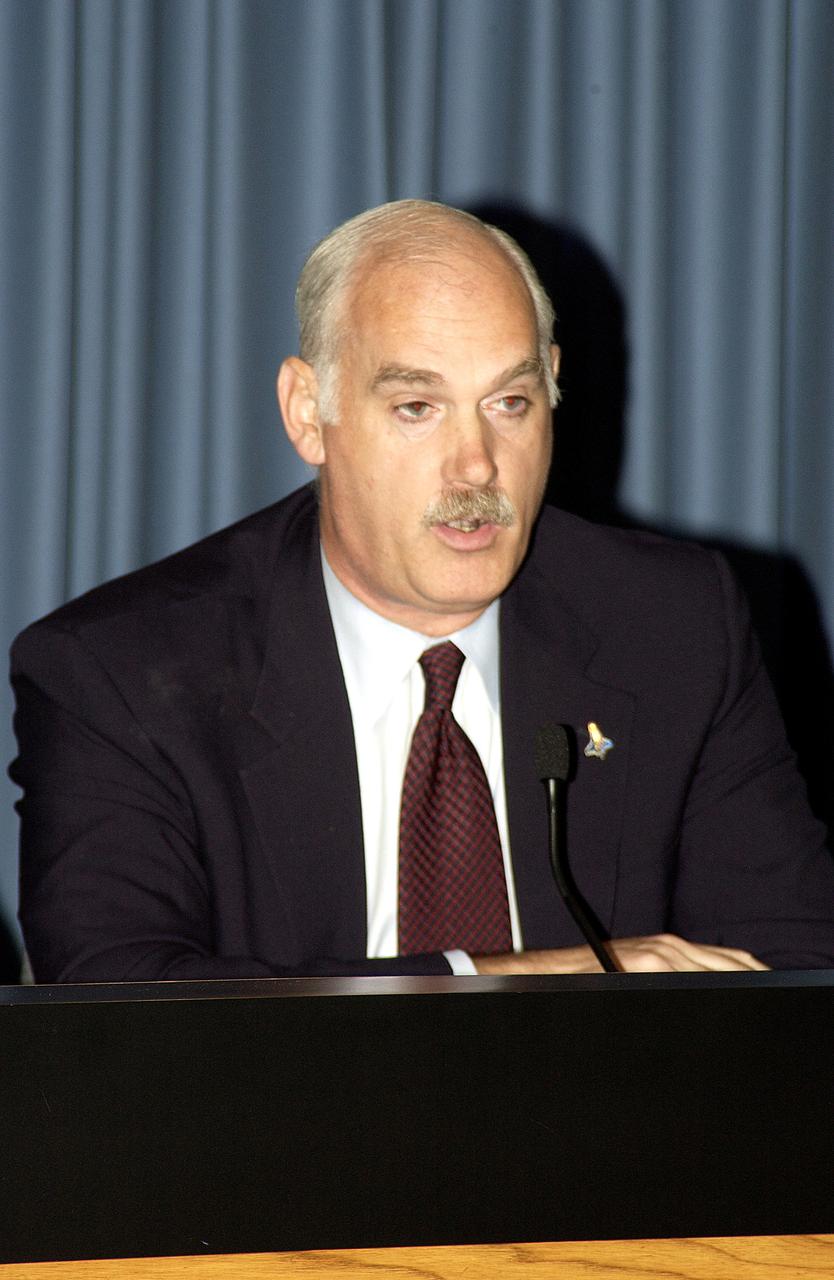
KENNEDY SPACE CENTER, FLA.  -  NASA Deputy Administrator Fred Gregory speaks at a media briefing at KSC.  NASA officials discussed the agency’s human space flight program.  Others on the panel were Associate Administrator for Space Flight Bill Readdy and Associate Administrator for Safety and Mission Assurance Bryan O’Connor.
KENNEDY SPACE CENTER, FLA. - NASA Deputy Administrator Fred Gregory speaks at a media briefing at KSC. NASA officials discussed the agency’s human space flight program. Others on the panel were Associate Administrator for Space Flight Bill Readdy and Associate Administrator for Safety and Mission Assurance Bryan O’Connor.
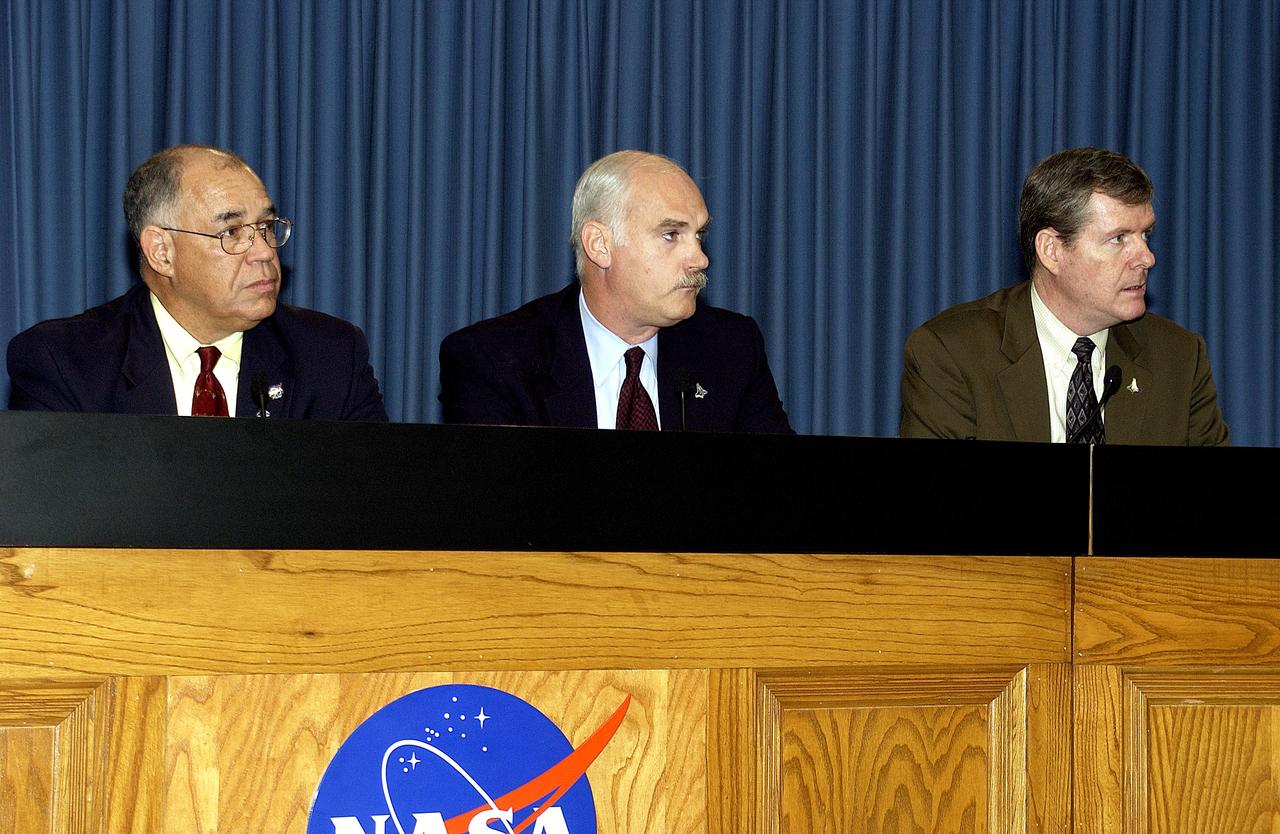
KENNEDY SPACE CENTER, FLA.  -  NASA officials brief the media at KSC about the agency’s human space flight program.  On the panel (left to right) are NASA Deputy Administrator Fred Gregory, Associate Administrator for Space Flight Bill Readdy and Associate Administrator for Safety and Mission Assurance Bryan O’Connor.
KENNEDY SPACE CENTER, FLA. - NASA officials brief the media at KSC about the agency’s human space flight program. On the panel (left to right) are NASA Deputy Administrator Fred Gregory, Associate Administrator for Space Flight Bill Readdy and Associate Administrator for Safety and Mission Assurance Bryan O’Connor.
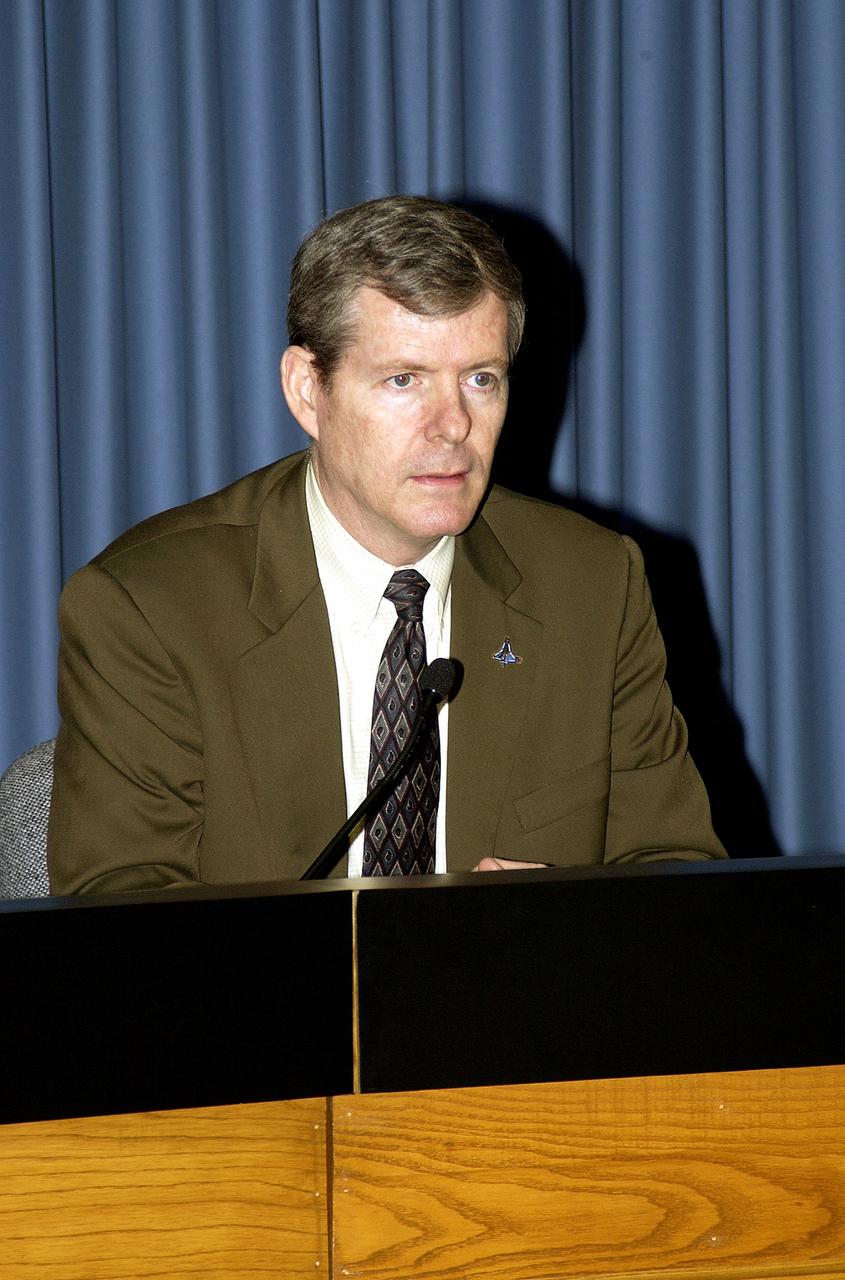
KENNEDY SPACE CENTER, FLA.  -  Associate Administrator for Safety and Mission Assurance Bryan O’Connor  speaks at a media briefing at KSC.  NASA officials discussed the agency’s human space flight program.  Others on the panel were NASA Deputy Administrator Fred Gregory and Associate Administrator for Space Flight Bill Readdy
KENNEDY SPACE CENTER, FLA. - Associate Administrator for Safety and Mission Assurance Bryan O’Connor speaks at a media briefing at KSC. NASA officials discussed the agency’s human space flight program. Others on the panel were NASA Deputy Administrator Fred Gregory and Associate Administrator for Space Flight Bill Readdy
KENNEDY SPACE CENTER, FLA.  -  Associate Administrator for Space Flight Bill Readdy speaks at a media briefing at KSC.  NASA officials discussed the agency’s human space flight program.  Others on the panel were NASA Deputy Administrator Fred Gregory and Associate Administrator for Safety and Mission Assurance Bryan O’Connor.
KENNEDY SPACE CENTER, FLA. - Associate Administrator for Space Flight Bill Readdy speaks at a media briefing at KSC. NASA officials discussed the agency’s human space flight program. Others on the panel were NASA Deputy Administrator Fred Gregory and Associate Administrator for Safety and Mission Assurance Bryan O’Connor.
NASA Deputy Administrator Jim Morhard answers questions during a Mars 2020 NASA Social at Kennedy Space Center’s News Center in Florida on July 29, 2020. Standing behind him is Kennedy Deputy Director Janet Petro. The Mars Perseverance rover and Ingenuity helicopter are scheduled to launch July 30, on a United Launch Alliance Atlas V 541 rocket from Space Launch Complex 41 at nearby Cape Canaveral Air Force Station. The rover is part of NASA’s Mars Exploration Program, a long-term effort of robotic exploration of the Red Planet. The rover will search for habitable conditions in the ancient past and signs of past microbial life on Mars. The Launch Services Program at Kennedy is responsible for launch management.
Mars 2020 Facebook Live / NASA Social
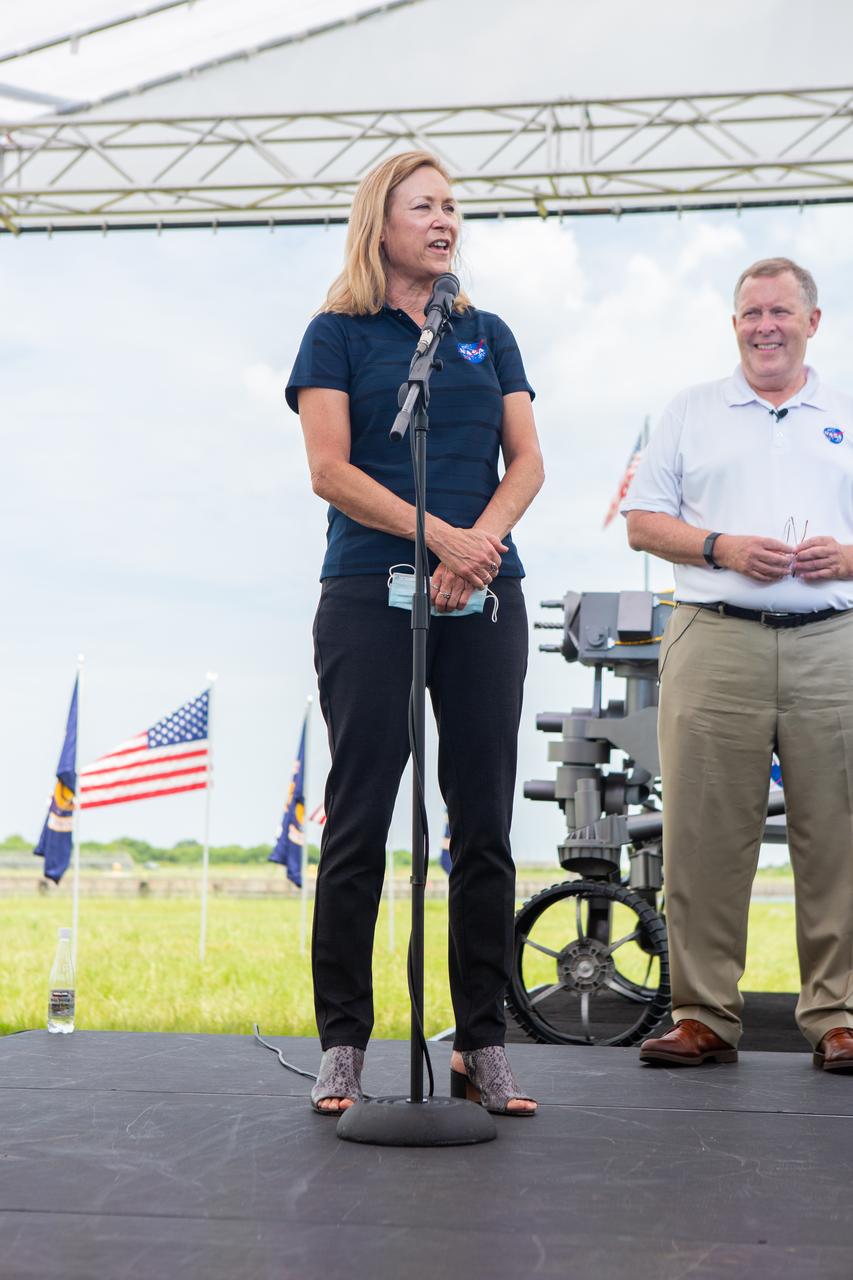
Kennedy Space Center Deputy Director Janet Petro answers questions during a Mars 2020 NASA Social at the center’s News Center in Florida on July 29, 2020. At right is NASA Deputy Administrator Jim Morhard. The Mars Perseverance rover and Ingenuity helicopter are scheduled to launch July 30, on a United Launch Alliance Atlas V 541 rocket from Space Launch Complex 41 at nearby Cape Canaveral Air Force Station. The rover is part of NASA’s Mars Exploration Program, a long-term effort of robotic exploration of the Red Planet. The rover will search for habitable conditions in the ancient past and signs of past microbial life on Mars. The Launch Services Program at Kennedy is responsible for launch management.
Mars 2020 Facebook Live / NASA Social
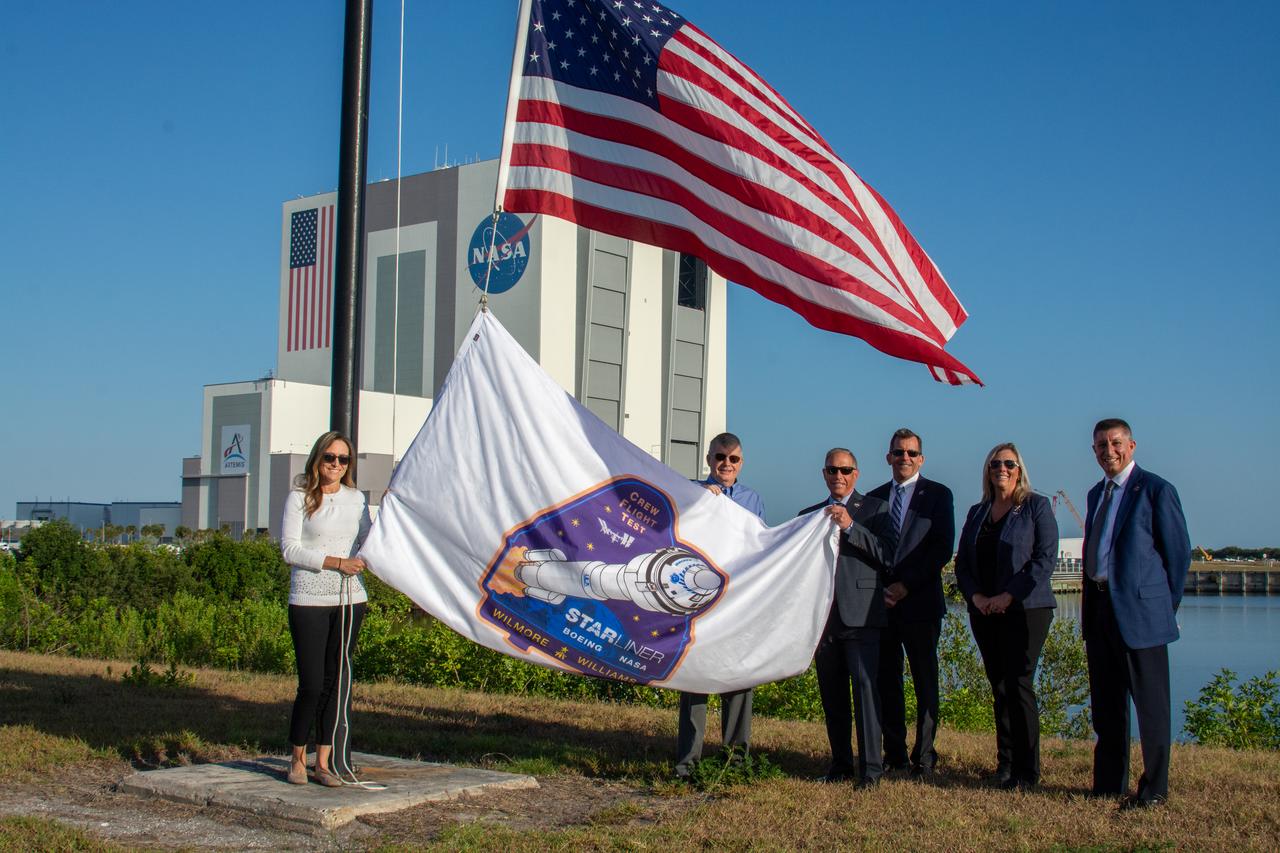
From left to right, Rami Intriago, Boeing Starliner resident office manager, NASA’s Kennedy Space Center Commercial Crew Program; Steve Stich, manager, NASA’s Commercial Crew Program; Mark Nappi, vice president and manager, Boeing Commercial Crew Program; Leroy Cain, mission integration and operations manager, Boeing’s Commercial Crew Program; Dana Hutcherson, deputy manager, NASA’s Commercial Crew Program; and Richard Jones, deputy manager, NASA’s Johnson Space Center Commercial Crew Program, prepare to raise NASA’s Boeing Crew Flight Test flag on Thursday, April 25, 2024, near the countdown clock at the Press Site at the Florida spaceport. As part of the agency’s Commercial Crew Program, NASA astronauts Butch Wilmore and Suni Williams are the first to launch to the International Space Station aboard Boeing’s Starliner spacecraft atop a United Launch Alliance Atlas V rocket from Space Launch Complex-41 at nearby Cape Canaveral Space Force Station. Liftoff is scheduled for 10:34 p.m. ET on Monday, May 6.
CFT Flag Raising
After the first launch attempt of NASA’s Boeing Crew Flight Test, a news conference is held on Monday, May 6, 2024, at the agency’s Kennedy Space Center in Florida. As part of the agency’s Commercial Crew Program, the first crewed launch to the International Space Station aboard Boeing’s Starliner spacecraft atop a United Launch Alliance Atlas V rocket from Space Launch Complex-41 at nearby Cape Canaveral Space Force Station was targeted for 10:34 p.m. ET but scrubbed for the day. Participants, from left to right are, Megan Cruz, NASA Communications; NASA Associate Administrator for Space Operations Ken Bowersox; NASA Commercial Crew Program Manager Steve Stich; NASA International Space Station Program Manager Dana Weigel; ULA (United Launch Alliance) President and CEO, Tory Bruno; and Vice President and Program Manager of Boeing’s Commercial Crew Program Mark Nappi.
NASA’s Boeing Crew Flight Test Post-Scrub News Conference
Steve Payne, launch integration manager, NASA’s Commercial Crew Program Ground and Mission Operations Office, speaks to members of the media Thursday, Feb. 28, in the Kennedy Space Center’s Mission Briefing Room of the Neil Armstrong Operations and Checkout Building. The briefing focused on launch of the SpaceX Demo-1 Commercial Crew Program mission to the International Space Station. The inaugural flight of the Crew Dragon, known as Demo-1, will be uncrewed, lifting off atop a SpaceX Falcon 9 rocket from Launch Complex 39A at Kennedy Saturday, March 2, at 2:49 a.m. EST. The mission is designed to validate end-to-end systems and capabilities, leading to certification to fly crew. NASA has worked with SpaceX and Boeing in developing the CCP spacecraft to facilitate new human spaceflight systems launching from U.S. soil with the goal of safe, reliable and cost-effective access to low-Earth orbit destinations such as the space station.
Participants in NASA Social Briefing Learn About SpaceX Demo-1 M
Carol Scott, deputy manager, NASA Commercial Crew Program Launch Vehicle Office, speaks to members of the media Thursday, Feb. 28, in the Kennedy Space Center’s Mission Briefing Room of the Neil Armstrong Operations and Checkout Building. The briefing focused on launch of the SpaceX Demo-1 Commercial Crew Program mission to the International Space Station. The inaugural flight of the Crew Dragon, known as Demo-1, will be uncrewed, lifting off atop a SpaceX Falcon 9 rocket from Launch Complex 39A at Kennedy Saturday, March 2, at 2:49 a.m. EST. The mission is designed to validate end-to-end systems and capabilities, leading to certification to fly crew. NASA has worked with SpaceX and Boeing in developing the CCP spacecraft to facilitate new human spaceflight systems launching from U.S. soil with the goal of safe, reliable and cost-effective access to low-Earth orbit destinations such as the space station.
Participants in NASA Social Briefing Learn About SpaceX Demo-1 M
From left to right, Courtney Stern, ground and mission operations recovery/rescue, NASA Kennedy Space Center Commercial Crew Program; Steve Stich, manager, NASA’s Commercial Crew Program; Mark Nappi, vice president and manager, Boeing Commercial Crew Program; Leroy Cain, mission integration and operations manager, Boeing’s Commercial Crew Program; Dana Hutcherson, deputy manager, NASA’s Commercial Crew Program; and Richard Jones, deputy manager, NASA’s Commercial Crew Program, prepare to raise the NASA’s Boeing Crew Flight Test flag on Thursday, April 25, 2024, near the countdown clock at the Press Site at the Florida spaceport. As part of the agency’s Commercial Crew Program, NASA astronauts Butch Wilmore and Suni Williams are the first to launch to the International Space Station aboard Boeing’s Starliner spacecraft atop a United Launch Alliance Atlas V rocket from nearby Space Launch Complex-41 at Cape Canaveral Space Force Station. Liftoff is scheduled for 10:34 p.m. ET on Monday, May 6.
CFT Flag Raising
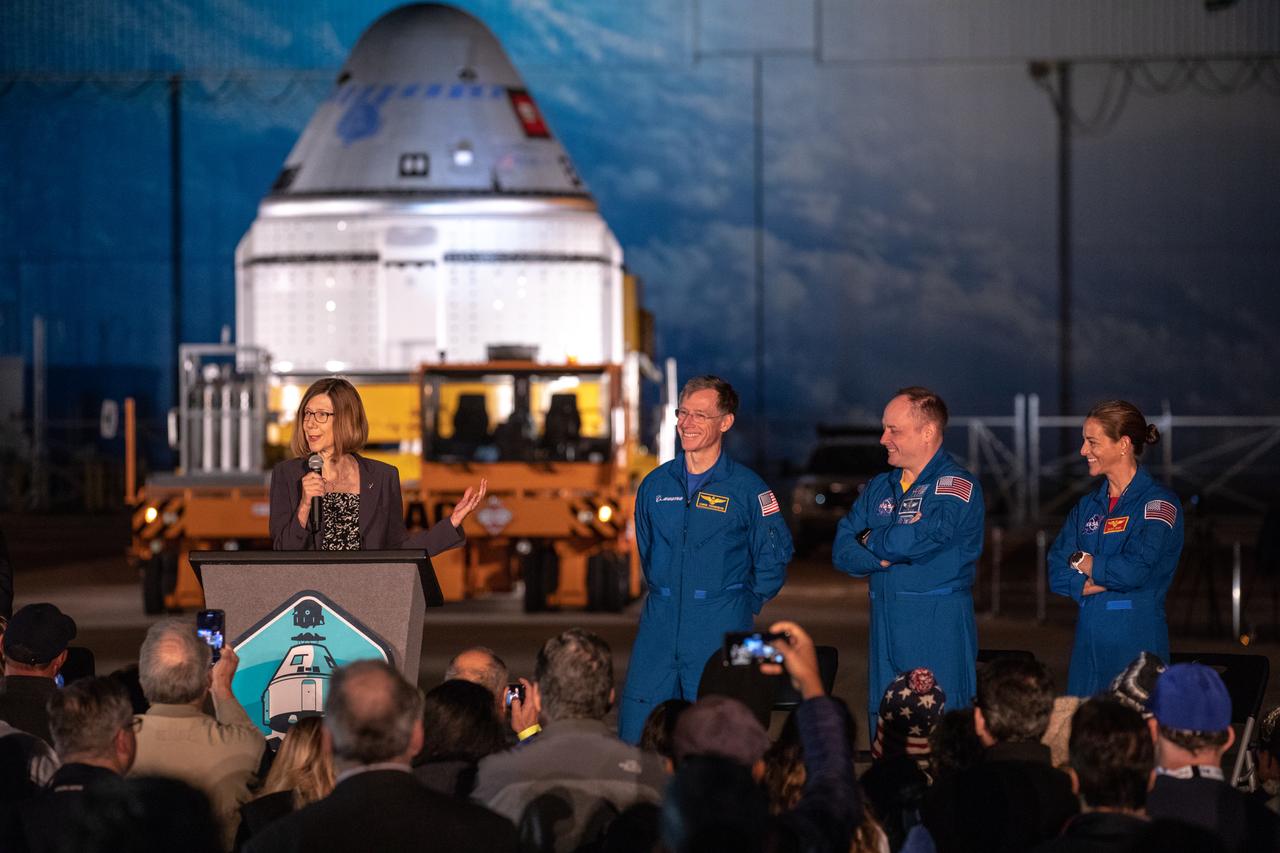
Kathy Lueders, program manager, NASA’s Commercial Crew Program, speaks during the Boeing CST-100 Starliner spacecraft rollout from the company’s Commercial Crew and Cargo Processing Facility at Kennedy Space Center in Florida on Nov. 21, 2019. Starliner will make the trip to Space Launch Complex 41 at Cape Canaveral Air Force Station where it will be secured atop a United Launch Alliance Atlas V rocket for Boeing’s Orbital Flight Test to the International Space Station for NASA’s Commercial Crew Program.
CCP Boeing CST-100 Starliner OFT Rollout Remarks - Departure from C3PF
David Brady, ISS assistant program scientist, speaks to members of the media Thursday, Feb. 28, in the Kennedy Space Center’s Mission Briefing Room of the Neil Armstrong Operations and Checkout Building. The briefing focused on launch of the SpaceX Demo-1 Commercial Crew Program mission to the International Space Station. The inaugural flight of the Crew Dragon, known as Demo-1, will be uncrewed, lifting off atop a SpaceX Falcon 9 rocket from Launch Complex 39A at Kennedy Saturday, March 2, at 2:49 a.m. EST. The mission is designed to validate end-to-end systems and capabilities, leading to certification to fly crew. NASA has worked with SpaceX and Boeing in developing the CCP spacecraft to facilitate new human spaceflight systems launching from U.S. soil with the goal of safe, reliable and cost-effective access to low-Earth orbit destinations such as the space station.
Participants in NASA Social Briefing Learn About SpaceX Demo-1 M
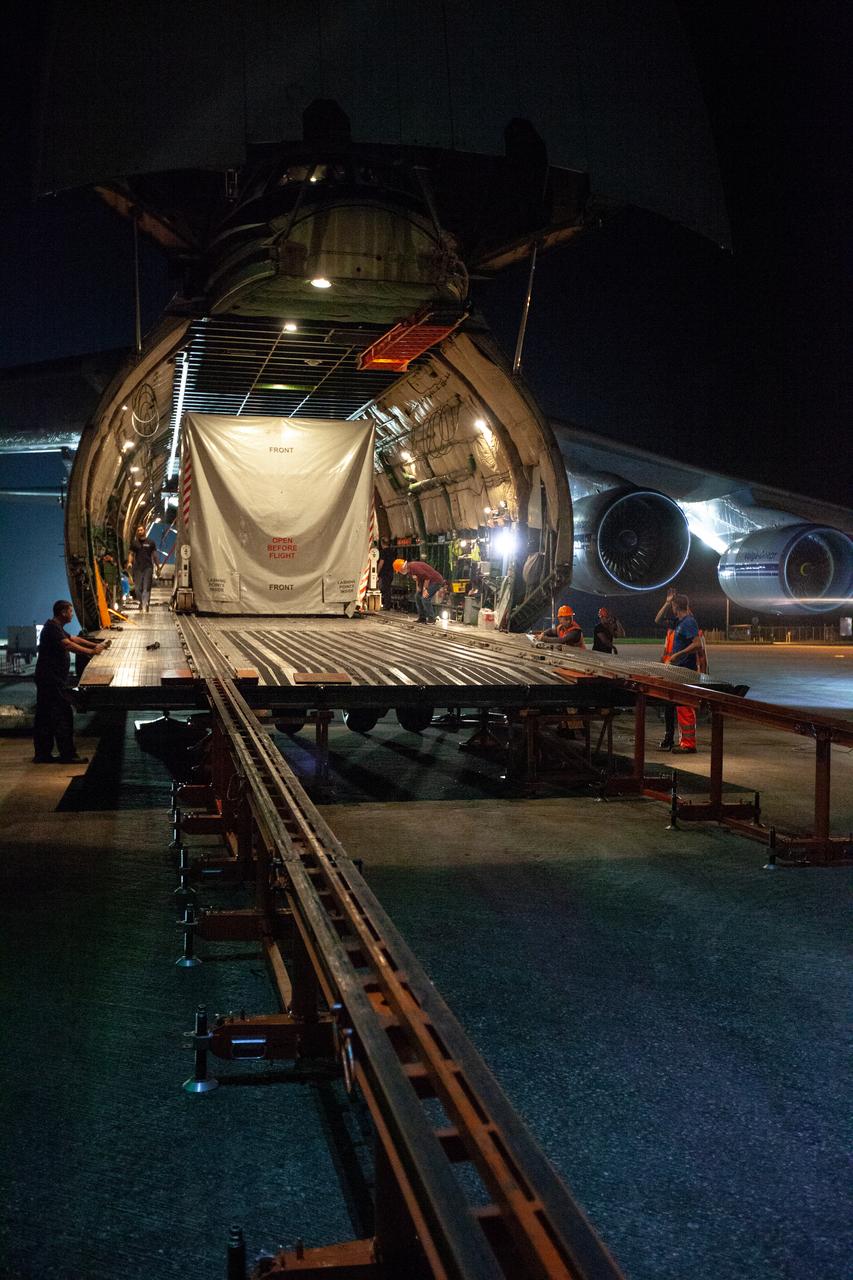
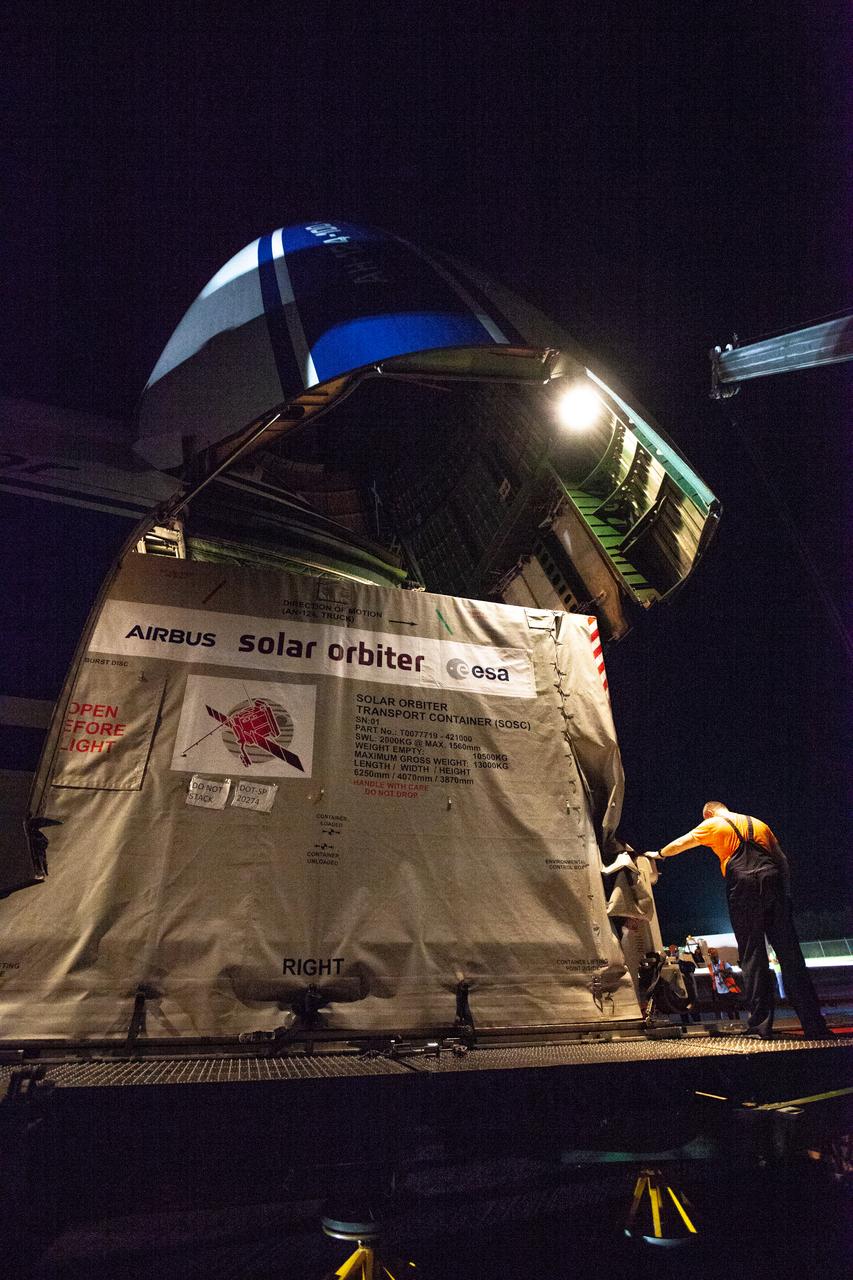
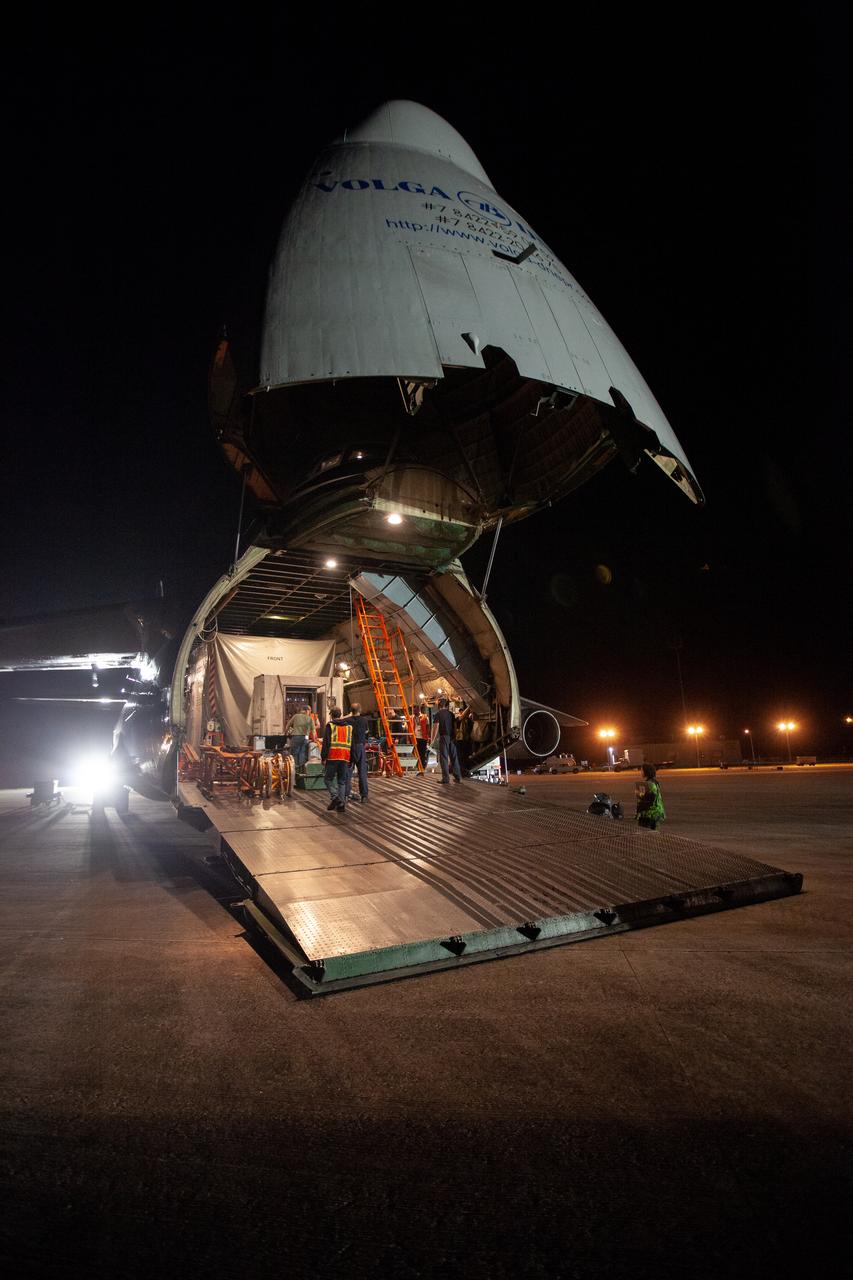
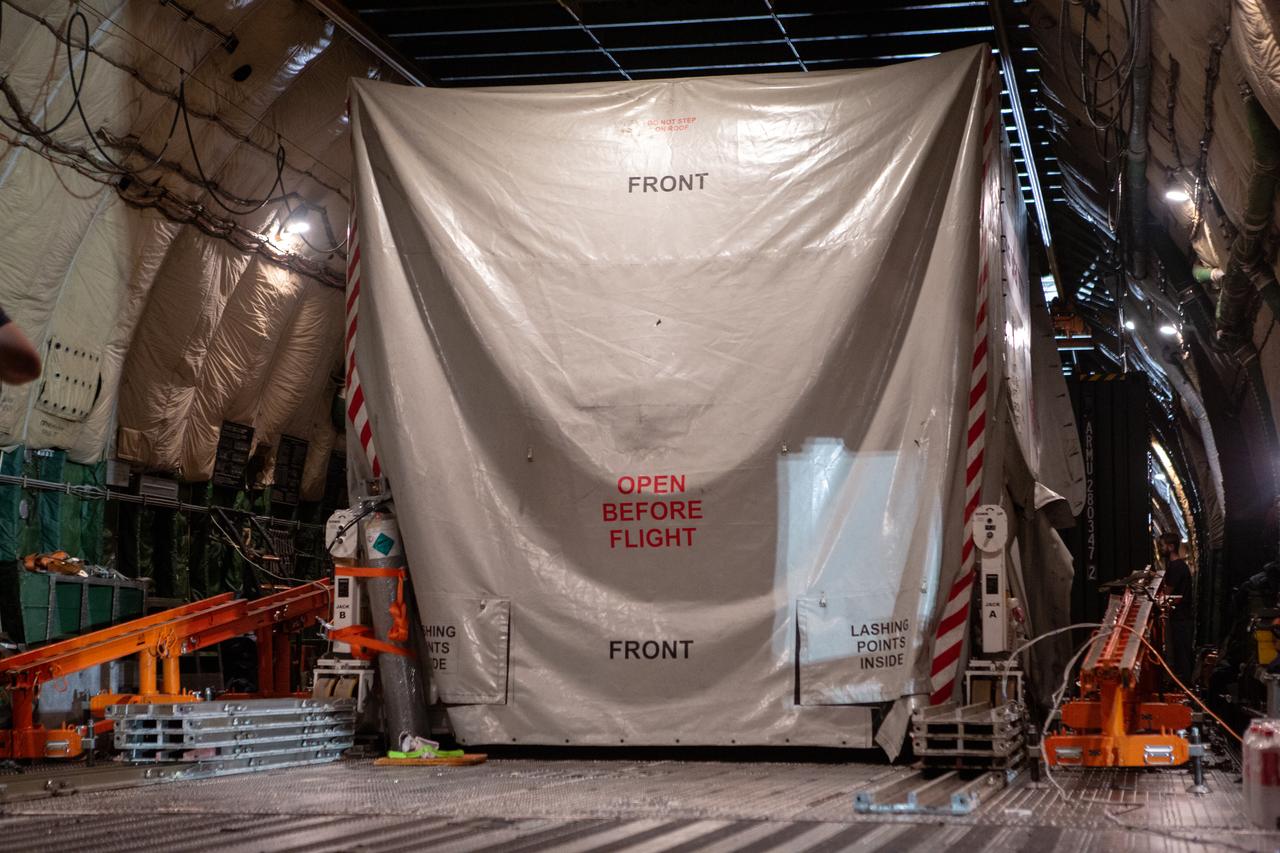
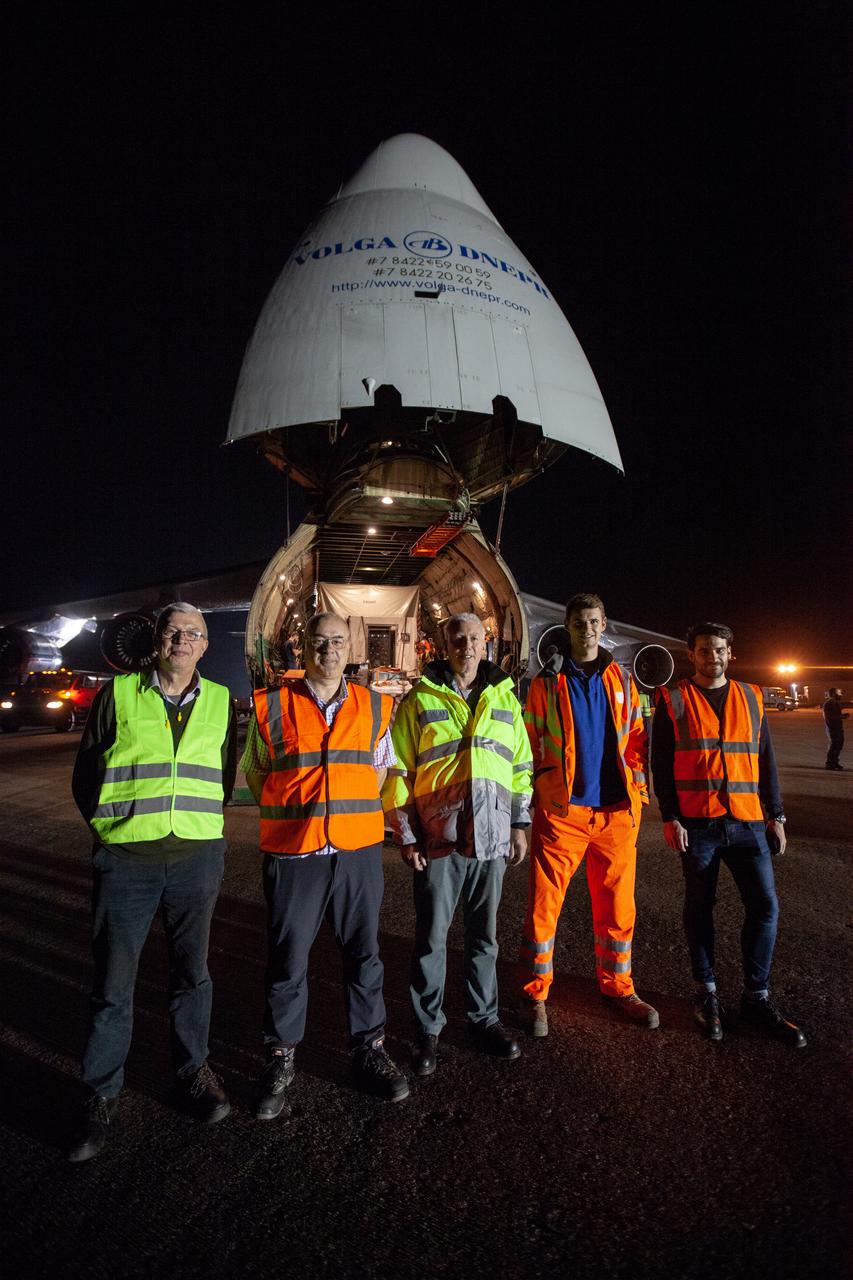
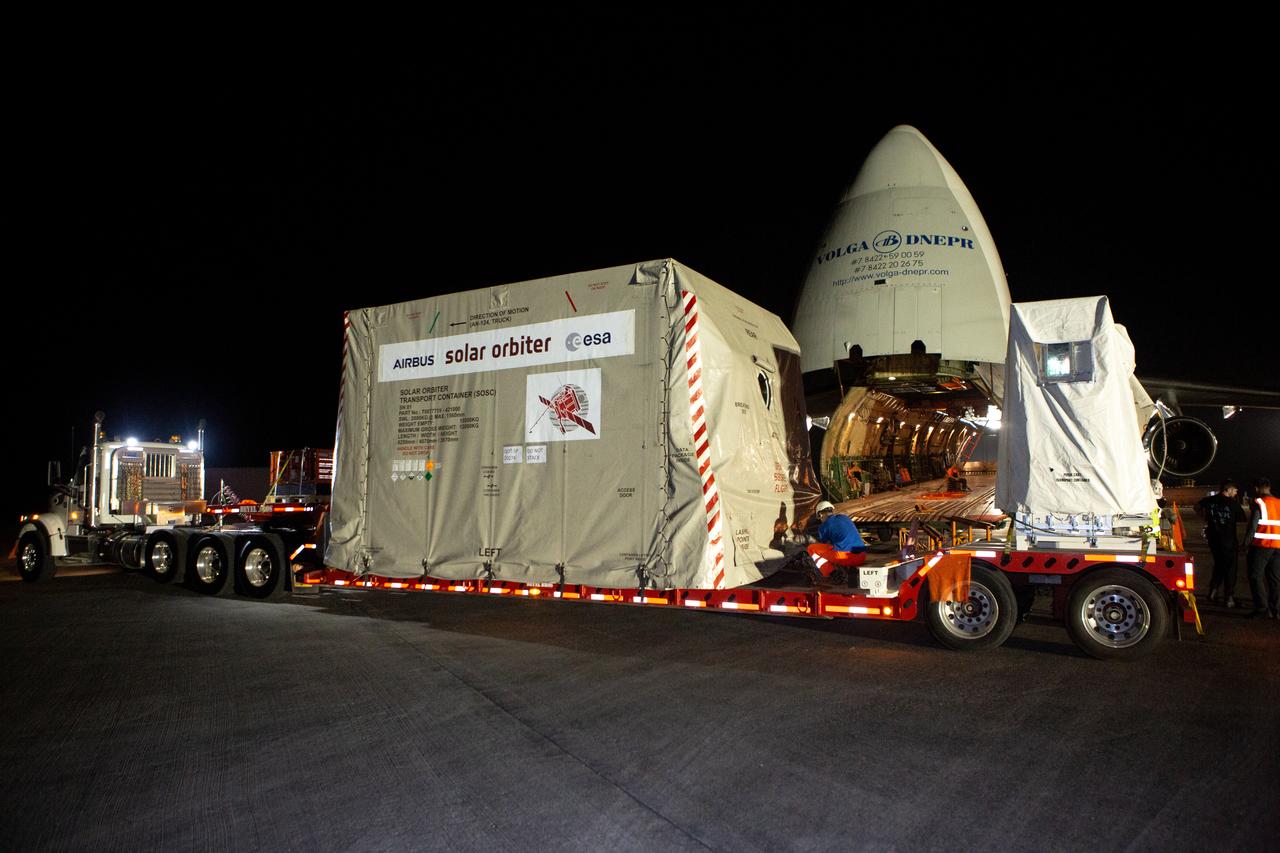
The Solar Orbiter spacecraft is moved out of an Antonov An-124 cargo plane at NASA Kennedy Space Center’s Launch and Landing Facility on Nov. 1, 2019. The spacecraft was delivered to the Florida spaceport from Munich, Germany, then transported to the Astrotech Space Operations facility in nearby Titusville.  Solar Orbiter is a European Space Agency mission with strong NASA participation. The mission aims to study the Sun, its outer atmosphere and solar winds. The spacecraft will provide the first images of the Sun’s poles. NASA’s Launch Services Program based at Kennedy is managing the launch. Liftoff is scheduled for Feb. 5, 2020, from Cape Canaveral Air Force Station aboard a United Launch Alliance Atlas V rocket.
Solar Orbiter Arrival
The Solar Orbiter spacecraft is moved out of an Antonov An-124 cargo plane at NASA Kennedy Space Center’s Launch and Landing Facility on Nov. 1, 2019. The spacecraft was delivered to the Florida spaceport from Munich, Germany, then transported to the Astrotech Space Operations facility in nearby Titusville.  Solar Orbiter is a European Space Agency mission with strong NASA participation. The mission aims to study the Sun, its outer atmosphere and solar winds. The spacecraft will provide the first images of the Sun’s poles. NASA’s Launch Services Program based at Kennedy is managing the launch. Liftoff is scheduled for Feb. 5, 2020, from Cape Canaveral Air Force Station aboard a United Launch Alliance Atlas V rocket.
Solar Orbiter Arrival
The Solar Orbiter spacecraft is moved out of an Antonov An-124 cargo plane at NASA Kennedy Space Center’s Launch and Landing Facility on Nov. 1, 2019. The spacecraft was delivered to the Florida spaceport from Munich, Germany, then transported to the Astrotech Space Operations facility in nearby Titusville.  Solar Orbiter is a European Space Agency mission with strong NASA participation. The mission aims to study the Sun, its outer atmosphere and solar winds. The spacecraft will provide the first images of the Sun’s poles. NASA’s Launch Services Program based at Kennedy is managing the launch. Liftoff is scheduled for Feb. 5, 2020, from Cape Canaveral Air Force Station aboard a United Launch Alliance Atlas V rocket.
Solar Orbiter Arrival
The Solar Orbiter spacecraft is moved out of an Antonov An-124 cargo plane at NASA Kennedy Space Center’s Launch and Landing Facility on Nov. 1, 2019. The spacecraft was delivered to the Florida spaceport from Munich, Germany, then transported to the Astrotech Space Operations facility in nearby Titusville.  Solar Orbiter is a European Space Agency mission with strong NASA participation. The mission aims to study the Sun, its outer atmosphere and solar winds. The spacecraft will provide the first images of the Sun’s poles. NASA’s Launch Services Program based at Kennedy is managing the launch. Liftoff is scheduled for Feb. 5, 2020, from Cape Canaveral Air Force Station aboard a United Launch Alliance Atlas V rocket.
Solar Orbiter Arrival
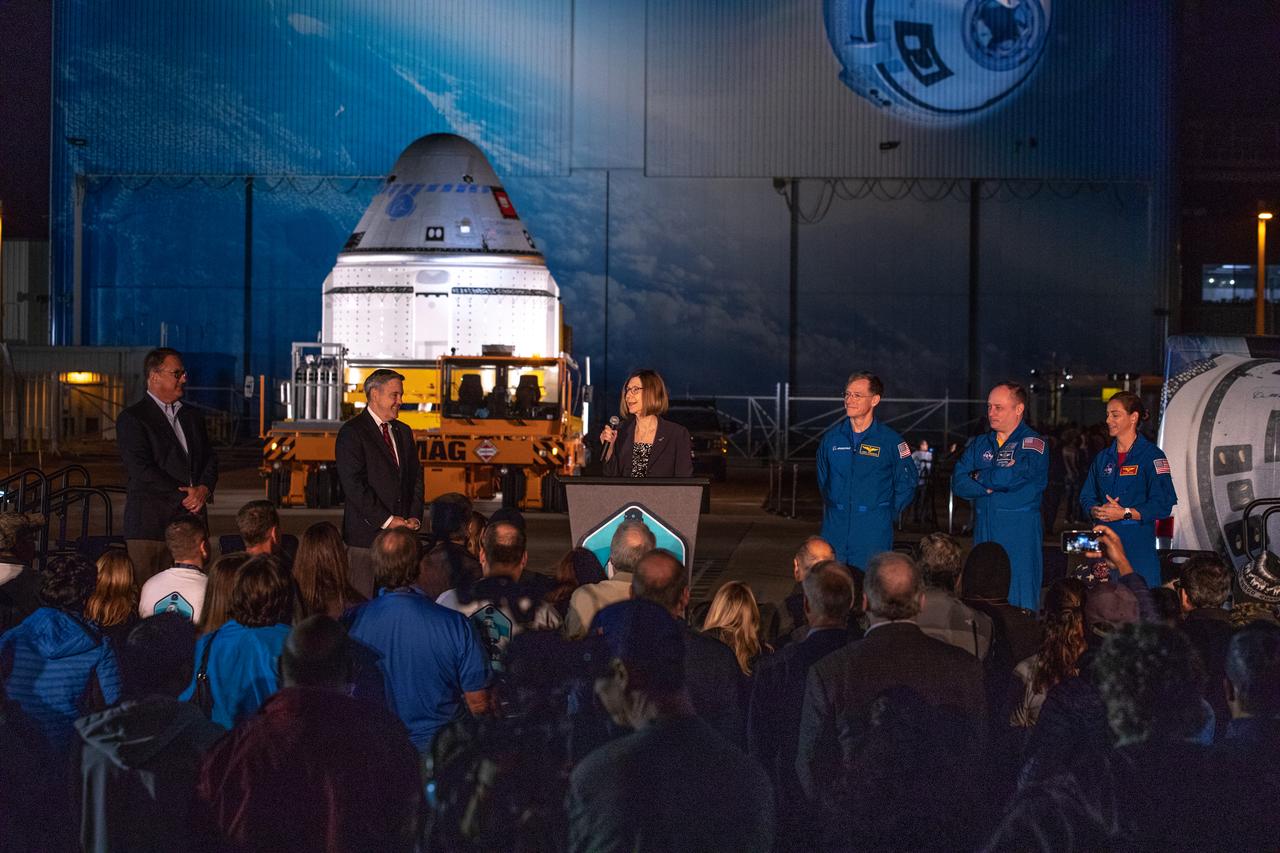
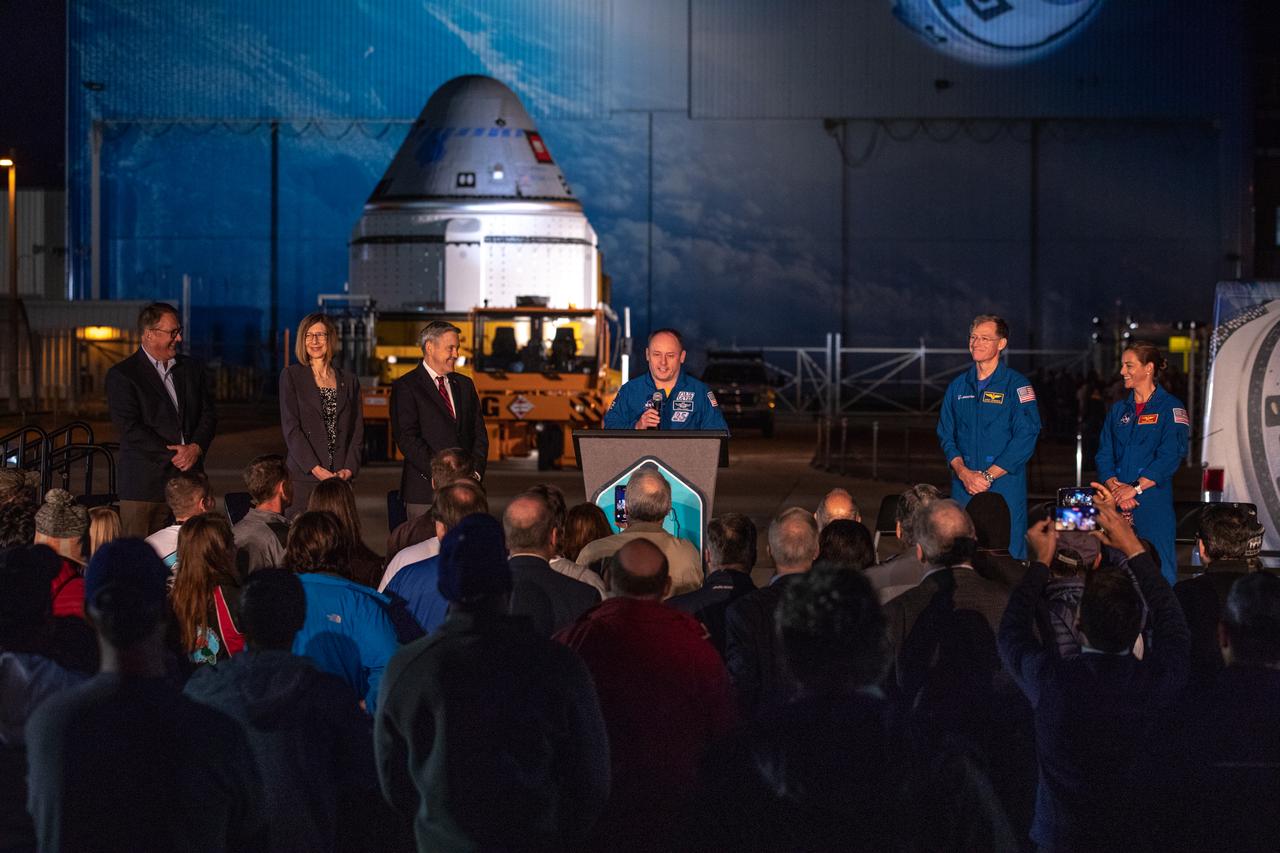
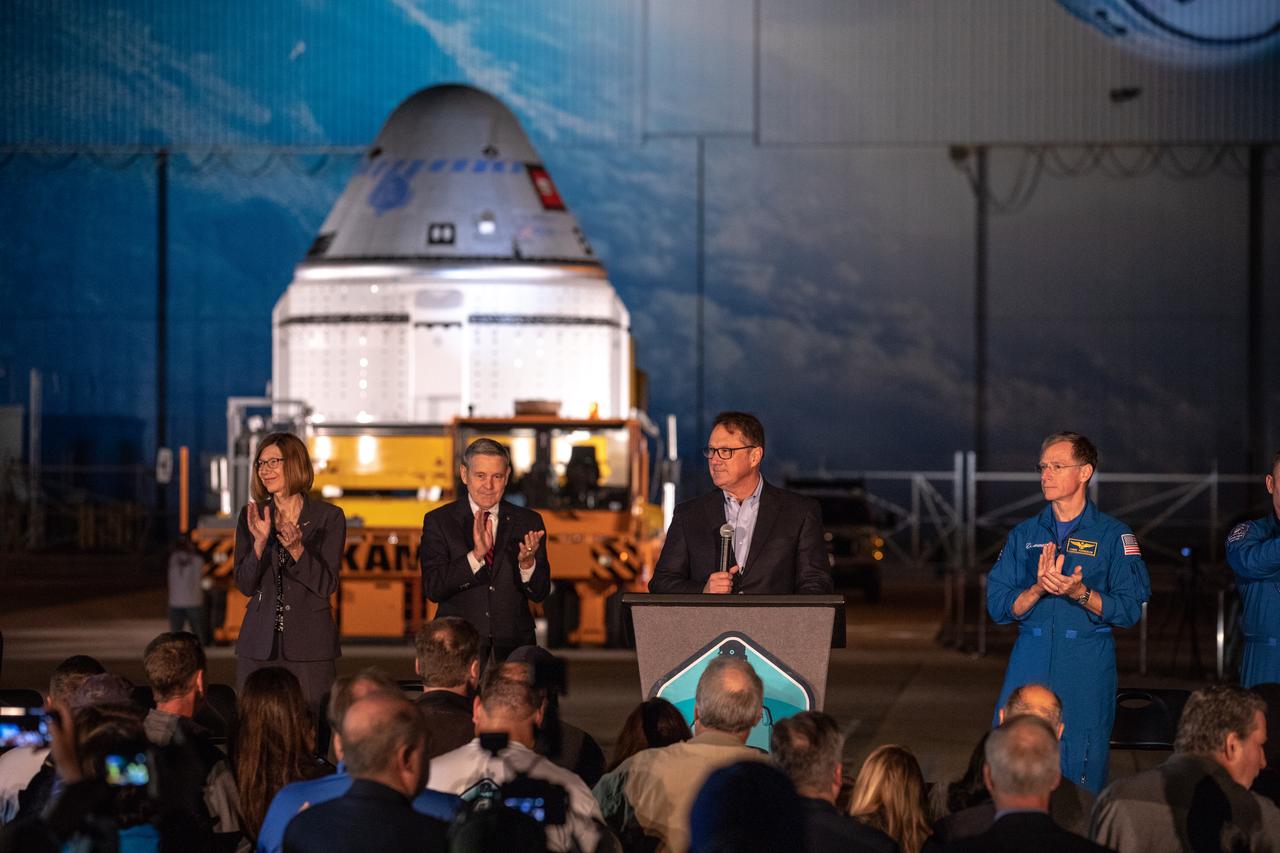
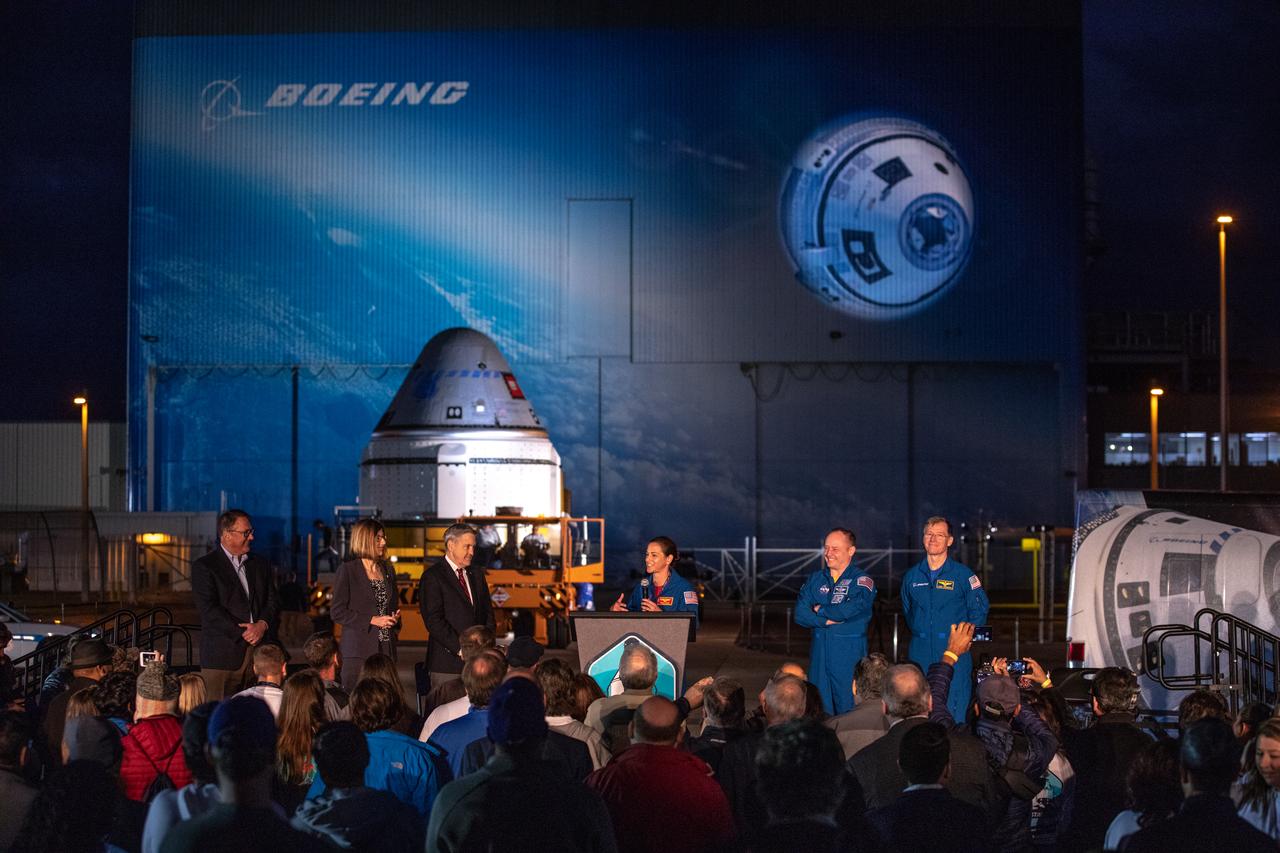
NASA astronaut Mike Fincke speaks during the Boeing CST-100 Starliner spacecraft rollout from the company’s Commercial Crew and Cargo Processing Facility at Kennedy Space Center in Florida on Nov. 21, 2019. To his left are Boeing astronaut Chris Ferguson and NASA astronaut Nicole Mann. To Fincke’s right (from left to right) are John Mulholland, Boeing vice president and program manager, Commercial Crew Program; NASA’s Commercial Crew Program Manager Kathy Lueders and Kennedy Space Center Director Bob Cabana. Starliner will make the trip to Space Launch Complex 41 at Cape Canaveral Air Force Station where it will be secured atop a United Launch Alliance Atlas V rocket for Boeing’s Orbital Flight Test to the International Space Station for NASA’s Commercial Crew Program.
CCP Boeing CST-100 Starliner OFT Rollout Remarks - Departure from C3PF
Deb Cole (second from right), CCP (Commercial Crew Program) technical manager, with help from NASA Public Affairs Officer Steven Siceloff, raises the agency’s SpaceX Crew-9 mission flag near the countdown clock at the NASA News Center at the agency’s Kennedy Space Center in Florida on Tuesday, Sept. 24, 2024. In the background looking on is CCP Deputy Program Manager Dana Hutcherson (far left) at Kennedy and CCP Deputy Program Manager at NASA’s Johnson Space Center in Houston Richard Jones. The Crew-9 mission will send NASA astronaut Nick Hague and Roscosmos cosmonaut Aleksandr Gorbunov to the International Space Station aboard SpaceX’s Dragon spacecraft and Falcon 9 rocket.
CCP Crew-9 Flag Raising
John Mulholland, Boeing vice president and program manager, Commercial Crew Program, speaks during the Boeing CST-100 Starliner spacecraft rollout from the company’s Commercial Crew and Cargo Processing Facility at Kennedy Space Center in Florida on Nov. 21, 2019. Starliner will make the trip to Space Launch Complex 41 at Cape Canaveral Air Force Station where it will be secured atop a United Launch Alliance Atlas V rocket for Boeing’s Orbital Flight Test to the International Space Station for NASA’s Commercial Crew Program.
CCP Boeing CST-100 Starliner OFT Rollout Remarks - Departure from C3PF
Kathy Lueders, program manager, NASA’s Commercial Crew Program, speaks during the Boeing CST-100 Starliner spacecraft rollout from the company’s Commercial Crew and Cargo Processing Facility at Kennedy Space Center in Florida on Nov. 21, 2019. To her left (from left to right) are Boeing astronaut Chris Ferguson and NASA astronauts Mike Fincke and Nicole Mann. Starliner will make the trip to Space Launch Complex 41 at Cape Canaveral Air Force Station where it will be secured atop a United Launch Alliance Atlas V rocket for Boeing’s Orbital Flight Test to the International Space Station for NASA’s Commercial Crew Program.
CCP Boeing CST-100 Starliner OFT Rollout Remarks - Departure from C3PF
NASA astronaut Nicole Mann speaks during the Boeing CST-100 Starliner spacecraft rollout from the company’s Commercial Crew and Cargo Processing Facility at Kennedy Space Center in Florida on Nov. 21, 2019. To her left (from left to right) are NASA astronaut Mike Fincke and Boeing astronaut Chris Ferguson. To Mann’s right (from left to right) are John Mulholland, Boeing vice president and program manager, Commercial Crew Program; NASA’s Commercial Crew Program Manager Kathy Lueders and Kennedy Director Bob Cabana. Starliner will make the trip to Space Launch Complex 41 at Cape Canaveral Air Force Station where it will be secured atop a United Launch Alliance Atlas V rocket for Boeing’s Orbital Flight Test to the International Space Station for NASA’s Commercial Crew Program.
CCP Boeing CST-100 Starliner OFT Rollout Remarks - Departure from C3PF
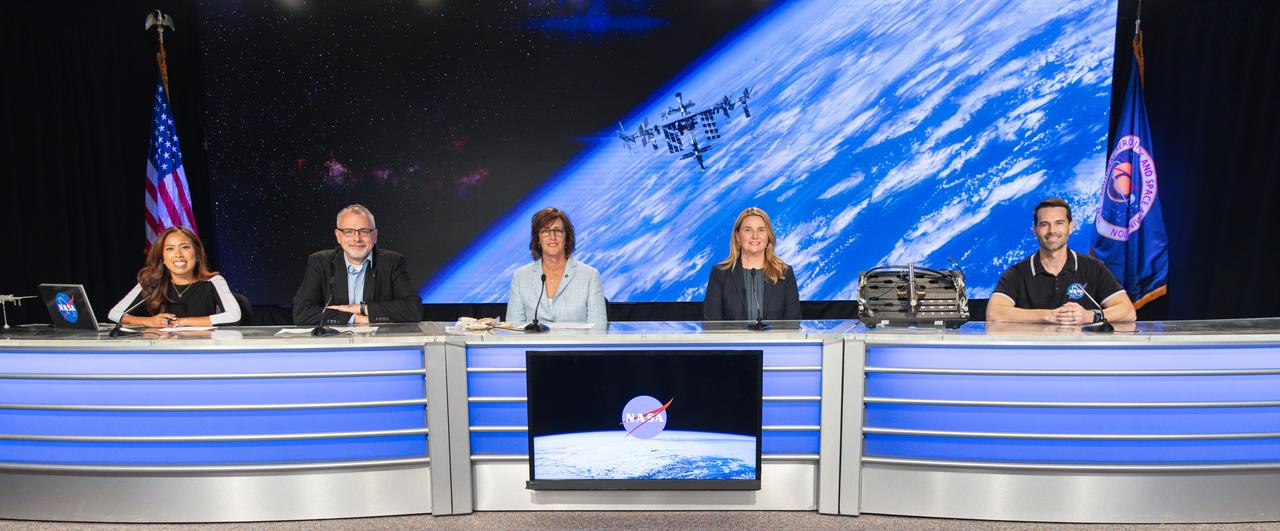
NASA leaders participate in an International Space Station 101 Panel Livestream inside the John Holliman Auditorium of the News Center at the agency’s Kennedy Space Center in Florida on Friday, Sept. 27, 2024, ahead of NASA’s SpaceX Crew-9 mission to the International Space Station. Participants, from left to right, are Megan Cruz, NASA Communications; NASA Associate Administrator Jim Free; Robyn Gatens, director, NASA’s International Space Station Program, and acting director, NASA’s Commercial Spaceflight Division; Jennifer Buchli, chief scientist, NASA’s International Space Station Program; and John Posey, Dragon engineer, NASA’s Commercial Crew Program. Liftoff of the ninth crew rotation mission with SpaceX to the space station as part of the agency’s Commercial Crew Program is targeted for 1:17 p.m. EDT Sept. 28, 2024, from Space Launch Complex-40 at Cape Canaveral Space Force Station in Florida.
NASA International Space Station and Social Panel
Marie Lewis, NASA Communications, moderates the SpaceX Crew-2 prelaunch news conference held at NASA’s Kennedy Space Center in Florida on April 20, 2021. Participants included: Steve Stich, manager, NASA Commercial Crew Program; Joel Montalbano, manager, International Space Station Program; Benji Reed, senior director, Human Spaceflight Programs, SpaceX; Norm Knight, deputy manager, Flight Operations Directorate; Junichi Sakai, manager, International Space Station Program, JAXA; Frank de Winne, manager, International Space Station Program, ESA; Kirt Costello, chief scientist, International Space Station Program; and Brian Cizek, launch weather officer, 45th Weather Squadron, U.S. Space Force.
SpaceX Crew-2 Prelaunch News Conference
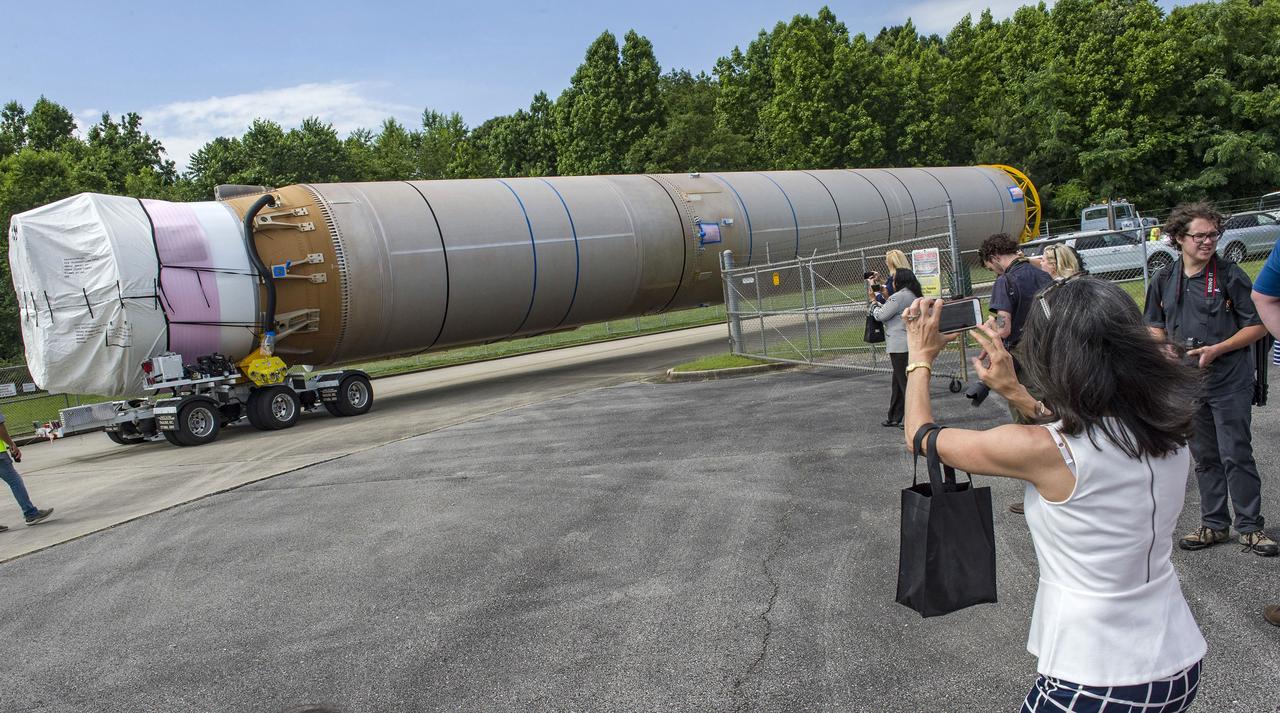
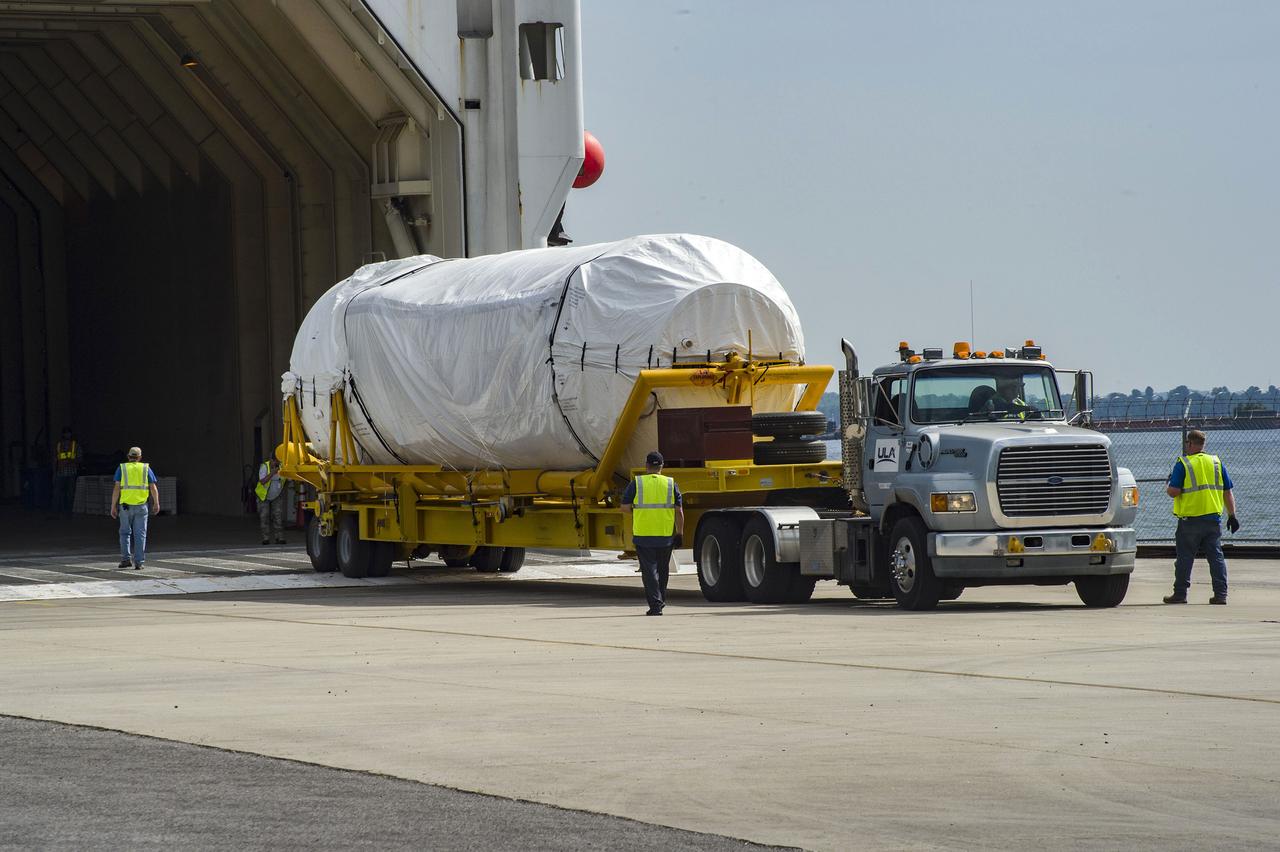
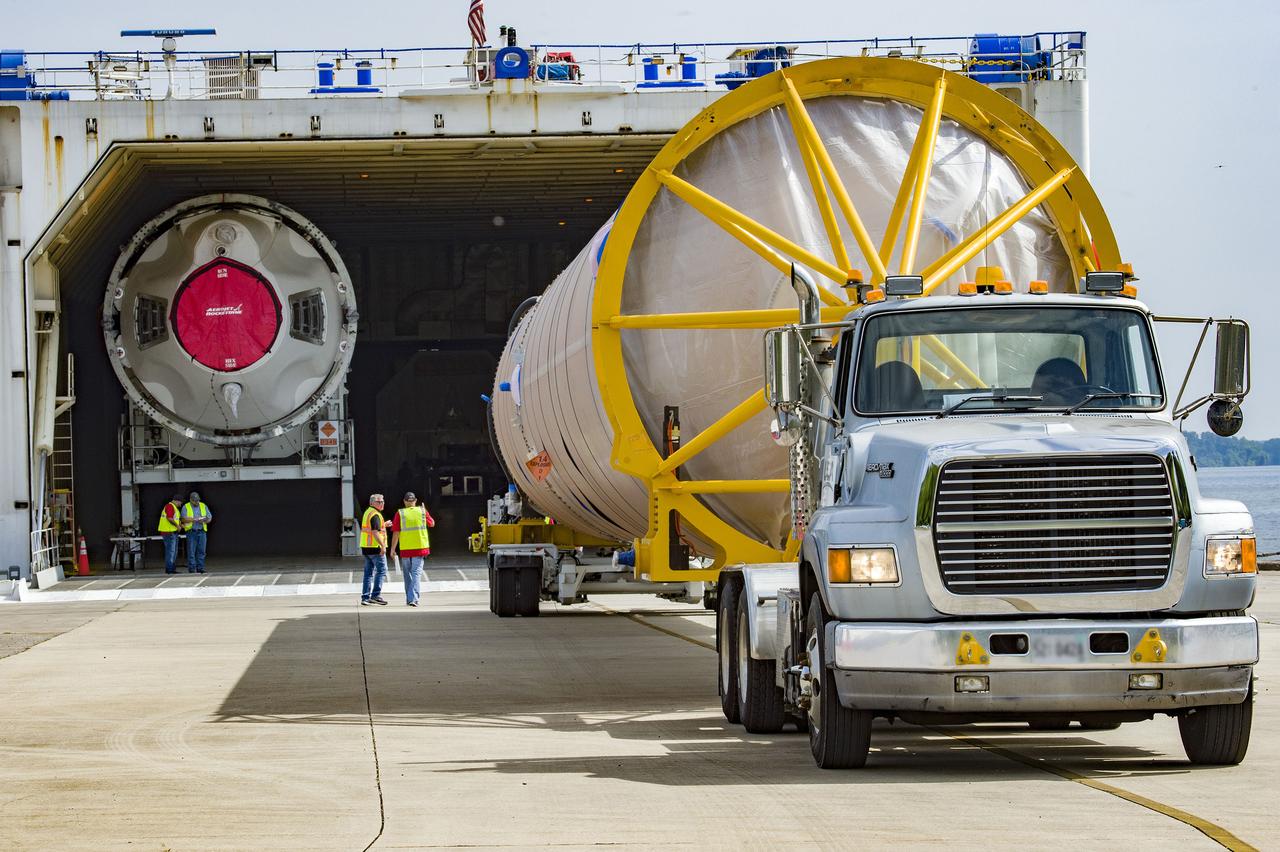
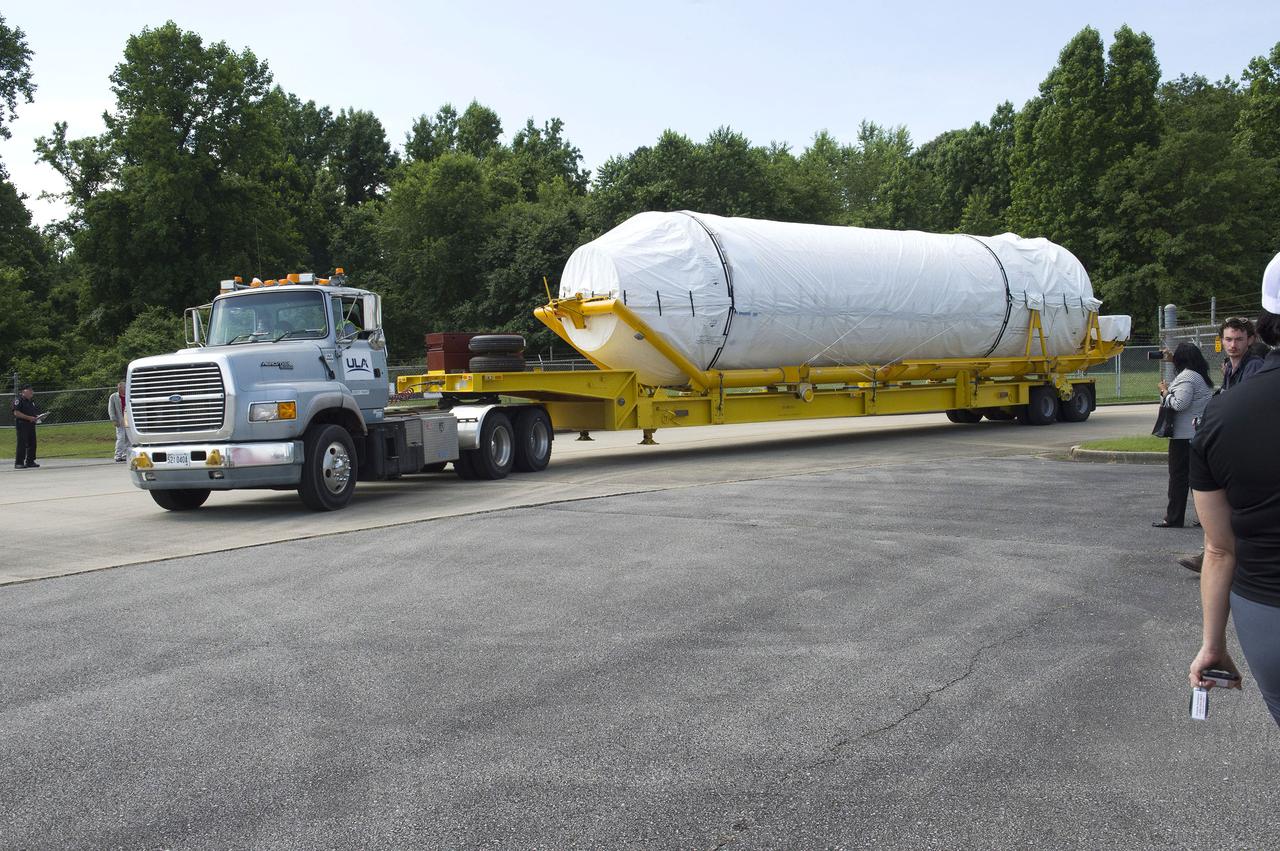
The United Launch Alliance Atlas V rocket that will launch Boeing’s CST-100 Starliner on the Crew Flight Test (CFT) mission to the International Space Station for NASA’s Commercial Crew Program emerged from the factory on May 24, 2019, rolling into a giant cargo ship for transport to Cape Canaveral.
Boeing CST-100 Starliner CFT Booster Departure
The United Launch Alliance Atlas V rocket that will launch Boeing’s CST-100 Starliner on the Crew Flight Test (CFT) mission to the International Space Station for NASA’s Commercial Crew Program emerged from the factory on May 24, 2019, rolling into a giant cargo ship for transport to Cape Canaveral.
Boeing CST-100 Starliner CFT Booster Departure
The United Launch Alliance Atlas V rocket that will launch Boeing’s CST-100 Starliner on the Crew Flight Test (CFT) mission to the International Space Station for NASA’s Commercial Crew Program emerged from the factory on May 24, 2019, rolling into a giant cargo ship for transport to Cape Canaveral.
Boeing CST-100 Starliner CFT Booster Departure
The United Launch Alliance Atlas V rocket that will launch Boeing’s CST-100 Starliner on the Crew Flight Test (CFT) mission to the International Space Station for NASA’s Commercial Crew Program emerged from the factory on May 24, 2019, rolling into a giant cargo ship for transport to Cape Canaveral.
Boeing CST-100 Starliner CFT Booster Departure
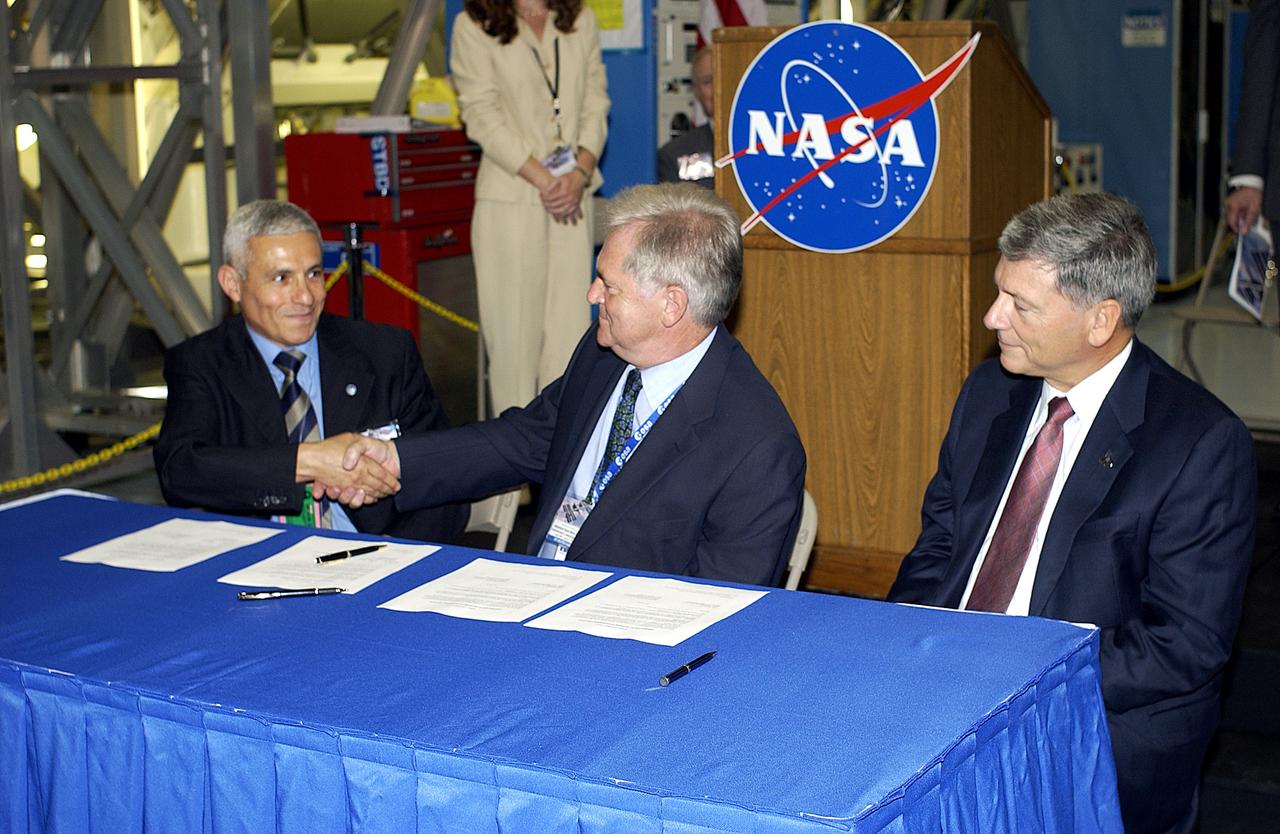
KENNEDY SPACE CENTER, FLA. - Andrea Lorenzoni, International Space Station Program manager for Node 2, Italian Space Agency; Alan Thirkettle, International Space Station Program manager for Node 2, European Space Agency (ESA); and NASA’s Michael C. Kostelnik, deputy associate administrator for International Space Station and Shuttle Programs, sign documents officially transferring ownership of Node 2 between the ESA and NASA. The signing was part of a  ceremony highlighting the arrival of two major components of the International Space Station.  NASA's Node 2, built by the European Space Agency (ESA) in Italy, arrived at KSC on June 1. It will be the next pressurized module installed on the Station. The pressurized module (above right) of the Japanese Experiment Module (JEM),  named "Kibo" (Hope), arrived at KSC on June 4. It is Japan's primary contribution to the Station. Emceed by Lisa Malone (far left), deputy director of External Relations and Business Development at KSC, the ceremony also included these speakers: Center Director Roy Bridges Jr.; NASA’s William Gerstenmaier, International Space Station Program manager; and Kuniaki Shiraki, JEM Project manager, National Aerospace and Development Agency of Japan.
KENNEDY SPACE CENTER, FLA. - Andrea Lorenzoni, International Space Station Program manager for Node 2, Italian Space Agency; Alan Thirkettle, International Space Station Program manager for Node 2, European Space Agency (ESA); and NASA’s Michael C. Kostelnik, deputy associate administrator for International Space Station and Shuttle Programs, sign documents officially transferring ownership of Node 2 between the ESA and NASA. The signing was part of a ceremony highlighting the arrival of two major components of the International Space Station. NASA's Node 2, built by the European Space Agency (ESA) in Italy, arrived at KSC on June 1. It will be the next pressurized module installed on the Station. The pressurized module (above right) of the Japanese Experiment Module (JEM), named "Kibo" (Hope), arrived at KSC on June 4. It is Japan's primary contribution to the Station. Emceed by Lisa Malone (far left), deputy director of External Relations and Business Development at KSC, the ceremony also included these speakers: Center Director Roy Bridges Jr.; NASA’s William Gerstenmaier, International Space Station Program manager; and Kuniaki Shiraki, JEM Project manager, National Aerospace and Development Agency of Japan.
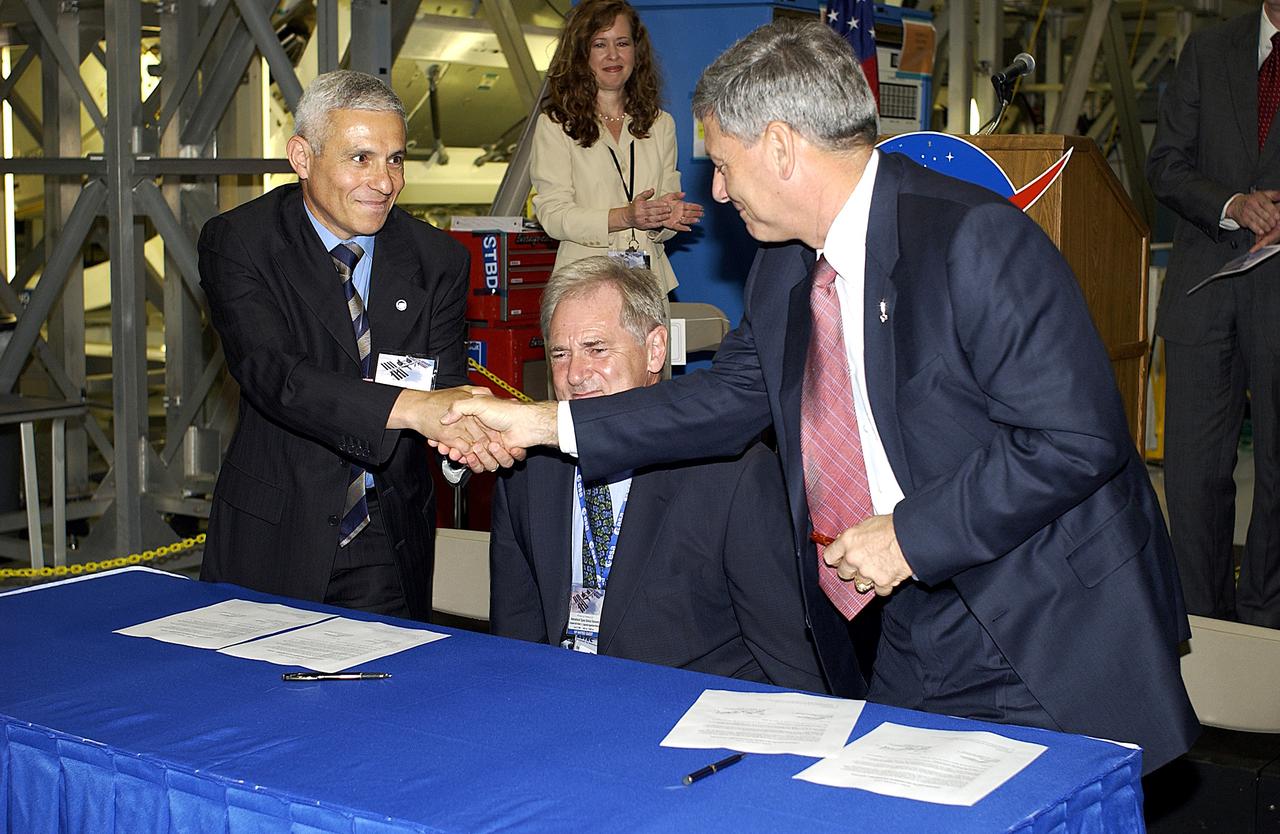
KENNEDY SPACE CENTER, FLA. - At ceremony highlighting the arrival of two major components of the International Space Station, Node 2 and the Japanese Experiment Module (JEM), ownership of Node 2 was officially transferred between the European Space Agency and NASA.  Shaking hands after the signing are Andrea Lorenzoni, International Space Station Program manager for Node 2, Italian Space Agency; and Alan Thirkettle, International Space Station Program manager for Node 2, European Space Agency (ESA).  At right is NASA’s Michael C. Kostelnik, deputy associate administrator for International Space Station and Shuttle Programs.  NASA's Node 2, built by ESA in Italy, arrived at KSC on June 1. It will be the next pressurized module installed on the Station. The pressurized module of the Japanese Experiment Module (JEM),  named "Kibo" (Hope), arrived at KSC on June 4. It is Japan's primary contribution to the Station. Emceed by Lisa Malone, deputy director of External Relations and Business Development at KSC, the ceremony also included these speakers: Center Director Roy Bridges Jr.; NASA’s William Gerstenmaier, International Space Station Program manager; and Kuniaki Shiraki, JEM Project manager, National Aerospace and Development Agency of Japan.
KENNEDY SPACE CENTER, FLA. - At ceremony highlighting the arrival of two major components of the International Space Station, Node 2 and the Japanese Experiment Module (JEM), ownership of Node 2 was officially transferred between the European Space Agency and NASA. Shaking hands after the signing are Andrea Lorenzoni, International Space Station Program manager for Node 2, Italian Space Agency; and Alan Thirkettle, International Space Station Program manager for Node 2, European Space Agency (ESA). At right is NASA’s Michael C. Kostelnik, deputy associate administrator for International Space Station and Shuttle Programs. NASA's Node 2, built by ESA in Italy, arrived at KSC on June 1. It will be the next pressurized module installed on the Station. The pressurized module of the Japanese Experiment Module (JEM), named "Kibo" (Hope), arrived at KSC on June 4. It is Japan's primary contribution to the Station. Emceed by Lisa Malone, deputy director of External Relations and Business Development at KSC, the ceremony also included these speakers: Center Director Roy Bridges Jr.; NASA’s William Gerstenmaier, International Space Station Program manager; and Kuniaki Shiraki, JEM Project manager, National Aerospace and Development Agency of Japan.
KENNEDY SPACE CENTER, FLA. - At a ceremony highlighting the arrival of two major components of the International Space Station, Node 2 and the Japanese Experiment Module (JEM), ownership of Node 2 was officially transferred between the European Space Agency (ESA) and NASA.  Shaking hands after the signing are (left) Andrea Lorenzoni, International Space Station Program manager for Node 2, Italian Space Agency, and (right) NASA’s Michael C. Kostelnik (right), deputy associate administrator for International Space Station and Shuttle Programs.  Also part of the signing is (center) Alan Thirkettle (center), International Space Station Program manager for Node 2, European Space Agency.  NASA's Node 2, built by ESA in Italy, arrived at KSC on June 1. It will be the next pressurized module installed on the Station. The pressurized module of the Japanese Experiment Module (JEM),  named "Kibo" (Hope), arrived at KSC on June 4. It is Japan's primary contribution to the Station. Emceed by Lisa Malone (background, left),  deputy director of External Relations and Business Development at KSC, the ceremony also included these speakers: Center Director Roy Bridges Jr.; NASA’s William Gerstenmaier, International Space Station Program manager; and Kuniaki Shiraki, JEM Project manager, National Aerospace and Development Agency of Japan.
KENNEDY SPACE CENTER, FLA. - At a ceremony highlighting the arrival of two major components of the International Space Station, Node 2 and the Japanese Experiment Module (JEM), ownership of Node 2 was officially transferred between the European Space Agency (ESA) and NASA. Shaking hands after the signing are (left) Andrea Lorenzoni, International Space Station Program manager for Node 2, Italian Space Agency, and (right) NASA’s Michael C. Kostelnik (right), deputy associate administrator for International Space Station and Shuttle Programs. Also part of the signing is (center) Alan Thirkettle (center), International Space Station Program manager for Node 2, European Space Agency. NASA's Node 2, built by ESA in Italy, arrived at KSC on June 1. It will be the next pressurized module installed on the Station. The pressurized module of the Japanese Experiment Module (JEM), named "Kibo" (Hope), arrived at KSC on June 4. It is Japan's primary contribution to the Station. Emceed by Lisa Malone (background, left), deputy director of External Relations and Business Development at KSC, the ceremony also included these speakers: Center Director Roy Bridges Jr.; NASA’s William Gerstenmaier, International Space Station Program manager; and Kuniaki Shiraki, JEM Project manager, National Aerospace and Development Agency of Japan.
The New York-based artist team Geraluz, left, and WERC, right, and their son Amaru Alvarez, 5, pose for picture with the mural “To the Moon, and Back” by the artist team that was created as part of the reimagined NASA Art Program, Tuesday, September 24, 2024, at 350 Hudson Street in New York City. The murals use geometrical patterns to invite deeper reflection on the exploration, creativity, and connection with the cosmos. Photo Credit: (NASA/Joel Kowsky)
NASA Reestablishes Historical Art Program with Space-Themed Mura
Amaru Alvarez, 5, the son of the artist team Geraluz and WERC and model for the mural, poses for picture with the mural “To the Moon, and Back” by the New York-based artist team that was created as part of the reimagined NASA Art Program, Tuesday, September 24, 2024, at 350 Hudson Street in New York City. The murals use geometrical patterns to invite deeper reflection on the exploration, creativity, and connection with the cosmos.  Photo Credit: (NASA/Joel Kowsky)
NASA Reestablishes Historical Art Program with Space-Themed Mura
The inaugural murals for the relaunched NASA Art Program appear side-by-side at 350 Hudson Street, Tuesday, Sept. 24, 2024, in New York City. The murals, titled “To the Moon, and Back,” were created by New York-based artist team Geraluz and WERC and use geometrical patterns to invite deeper reflection on the exploration, creativity, and connection with the cosmos. Photo Credit: (NASA/Joel Kowsky)
NASA Reestablishes Historical Art Program with Space-Themed Mura
The New York-based artist team Geraluz, left, and WERC, right, and their son Amaru Alvarez, 5, pose for picture with the mural “To the Moon, and Back” by the artist team that was created as part of the reimagined NASA Art Program, Tuesday, September 24, 2024, at 350 Hudson Street in New York City. The murals use geometrical patterns to invite deeper reflection on the exploration, creativity, and connection with the cosmos. Photo Credit: (NASA/Joel Kowsky)
NASA Reestablishes Historical Art Program with Space-Themed Mural
Samara Karasyk, President and CEO of the Hudson Square Business Improvement District talks to a member of the media in front of the mural “To the Moon, and Back” by the New York-based artist team Geraluz and WERC that was created as part of the reimagined NASA Art Program, Tuesday, September 24, 2024, in New York City’s Hudson Square neighborhood. For the inaugural project of the reestablished NASA Art Program the agency collaborated with the Hudson Square Business Improvement District on an open call for New York-based artists to design and install a large-scale mural inspired by NASA’s work and missions. Photo Credit: (NASA/Joel Kowsky)
NASA Reestablishes Historical Art Program with Space-Themed Mura
The inaugural murals for the relaunched NASA Art Program appear side-by-side at 350 Hudson Street, Monday, Sept. 23, 2024, in New York City. The murals, titled “To the Moon, and Back,” were created by New York-based artist team Geraluz and WERC and use geometrical patterns to invite deeper reflection on the exploration, creativity, and connection with the cosmos. Photo Credit: (NASA/Joel Kowsky)
NASA Reestablishes Historical Art Program with Space-Themed Mura
Artist Geraluz talks to a member of the media in front of the mural “To the Moon, and Back” by the New York-based artist team Geraluz and WERC that was created as part of the reimagined NASA Art Program, Tuesday, September 24, 2024, in New York City’s Hudson Square neighborhood. For the inaugural project of the reestablished NASA Art Program the agency collaborated with the Hudson Square Business Improvement District on an open call for New York-based artists to design and install a large-scale mural inspired by NASA’s work and missions. Photo Credit: (NASA/Joel Kowsky)
NASA Reestablishes Historical Art Program with Space-Themed Mural
Michelle Jones, NASA’s deputy associate administrator for communications, left, and Aya Collins, director of the engagement division of NASA’s Office of Communications, record a video for social media in front of the mural “To the Moon, and Back” by the New York-based artist team Geraluz and WERC that was created as part of the reimagined NASA Art Program, Tuesday, September 24, 2024, in New York City’s Hudson Square neighborhood. For the inaugural project of the reestablished NASA Art Program the agency collaborated with the Hudson Square Business Improvement District on an open call for New York-based artists to design and install a large-scale mural inspired by NASA’s work and missions. Photo Credit: (NASA/Joel Kowsky)
NASA Reestablishes Historical Art Program with Space-Themed Mura
Members of the European Space Agency (ESA)/Airbus Defence and Space team pause for a photo at NASA Kennedy Space Center’s Launch and Landing Facility during the arrival of the Solar Orbiter spacecraft on Nov. 1, 2019. The spacecraft was delivered to the Florida spaceport aboard an Antonov An-124 cargo plane from Munich, Germany, then transported to the Astrotech Space Operations facility in nearby Titusville. Solar Orbiter is a European Space Agency mission with strong NASA participation. The mission aims to study the Sun, its outer atmosphere and solar winds. The spacecraft will provide the first images of the Sun’s poles. NASA’s Launch Services Program based at Kennedy is managing the launch. Liftoff is scheduled for Feb. 5, 2020, from Cape Canaveral Air Force Station aboard a United Launch Alliance Atlas V rocket.
Solar Orbiter Arrival
A news conference is held at the agency’s Kennedy Space Center in Florida on Saturday, June 1, 2024, after the second launch attempt of NASA’s Boeing Crew Flight Test scrubbed for the day. As part of the agency’s Commercial Crew Program, NASA astronauts Butch Wilmore and Suni Williams will be the first to launch to the International Space Station aboard Boeing’s Starliner spacecraft atop a ULA (United Launch Alliance) Atlas V rocket from Space Launch Complex-41 at nearby Cape Canaveral Space Force Station. Participants, from left to right, are Megan Cruz, NASA Communications; Steve Stich, NASA Commercial Crew Program manager; Mark Nappi, vice president and program manager for the Commercial Crew Program at Boeing; and Tory Bruno, ULA president and CEO.
NASA’s Boeing Crew Flight Test Post-Scrub News Conference
Members of the media attend a postlaunch news conference hosted at NASA’s Kennedy Space Center in Florida on Friday, Aug. 1, 2025, following the launch of NASA’s SpaceX Crew-11 mission to the International Space Station. Participants include Antonia Jaramillo, NASA Communications; Ken Bowersox, associate administrator, NASA’s Space Operations Mission Directorate; Steve Stich, manager, NASA’s Commercial Crew Program; Dana Weigel, manager, NASA’s Commercial Crew Program; Naoki Nagai, program manager, International Space Station, Human Spaceflight Technology Directorate, JAXA, and Sarah Walker, director, Dragon Mission Management. NASA astronauts Zena Cardman and Mike Fincke, along with JAXA (Japan Aerospace Exploration Agency) astronaut Kimiya Yui and Roscosmos cosmonaut Oleg Platonov, launched aboard SpaceX’s Dragon spacecraft and Falcon 9 rocket at 12:09 p.m. EDT on the 11th crew rotation mission with SpaceX to the space station as part of NASA’s Commercial Crew Program.
NASA's SpaceX Crew-11 Postlaunch News Conference
As seen in a long exposure image, a SpaceX Falcon 9 rocket carrying the company's Dragon spacecraft lifts off on NASA’s SpaceX Crew-9 mission to the International Space Station with NASA astronaut Nick Hague and Roscosmos cosmonaut Aleksandr Gorbunov aboard Saturday, Sept. 28, 2024, from Space Launch Complex-40 at Cape Canaveral Space Force Station in Florida. Crew-9 is the ninth crew rotation mission of the SpaceX Dragon spacecraft and Falcon 9 rocket to the space station as part of the agency’s Commercial Crew Program. Hague and Gorbunov launched at 1:17 p.m. EDT to begin a mission aboard the orbital outpost lasting about five months.
Space X Crew-9 Launch Day Photo
A SpaceX Crew-2 prelaunch news conference was held at NASA’s Kennedy Space Center in Florida on April 20, 2021. Participants included, from left to right: Steve Stich, manager, NASA Commercial Crew Program; Joel Montalbano, manager, International Space Station Program; Benji Reed, senior director, Human Spaceflight Programs, SpaceX; Norm Knight, deputy manager, Flight Operations Directorate; Junichi Sakai, manager, International Space Station Program, JAXA; Frank de Winne, manager, International Space Station Program, ESA; Kirt Costello, chief scientist, International Space Station Program; and Brian Cizek, launch weather officer, 45th Weather Squadron, U.S. Space Force.
SpaceX Crew-2 Prelaunch News Conference
KENNEDY SPACE CENTER, FLA. -   Alan Thirkettle, International Space Station Program manager for Node 2, European Space Agency (ESA), speaks to guests and the media gathered in the Space Station Processing Facility at a ceremony highlighting the arrival of two major components of the International Space Station.  NASA's Node 2, built by the European Space Agency (ESA) in Italy, arrived at KSC on June 1. It will be the next pressurized module installed on the Station. The pressurized module of the Japanese Experiment Module (JEM), named "Kibo" (Hope), arrived at KSC on June 4. It is Japan's primary contribution to the Station. The ceremony held today included the official transfer of ownership signing of Node 2 between the ESA and NASA.. Emceed by Lisa Malone, deputy director of External Relations and Business Development at KSC, the ceremony also included these speakers: Center Director Roy Bridges Jr.; NASA’s Michael C. Kostelnik, deputy associate administrator for International Space Station and Shuttle Programs and William Gerstenmaier, International Space Station Program manager; Andrea Lorenzoni, International Space Station Program manager for Node 2, Italian Space Agency; and Kuniaki Shiraki, JEM Project manager, National Aerospace and Development Agency of Japan.
KENNEDY SPACE CENTER, FLA. - Alan Thirkettle, International Space Station Program manager for Node 2, European Space Agency (ESA), speaks to guests and the media gathered in the Space Station Processing Facility at a ceremony highlighting the arrival of two major components of the International Space Station. NASA's Node 2, built by the European Space Agency (ESA) in Italy, arrived at KSC on June 1. It will be the next pressurized module installed on the Station. The pressurized module of the Japanese Experiment Module (JEM), named "Kibo" (Hope), arrived at KSC on June 4. It is Japan's primary contribution to the Station. The ceremony held today included the official transfer of ownership signing of Node 2 between the ESA and NASA.. Emceed by Lisa Malone, deputy director of External Relations and Business Development at KSC, the ceremony also included these speakers: Center Director Roy Bridges Jr.; NASA’s Michael C. Kostelnik, deputy associate administrator for International Space Station and Shuttle Programs and William Gerstenmaier, International Space Station Program manager; Andrea Lorenzoni, International Space Station Program manager for Node 2, Italian Space Agency; and Kuniaki Shiraki, JEM Project manager, National Aerospace and Development Agency of Japan.
The Solar Orbiter spacecraft is secured inside the United Launch Alliance payload fairing in the Astrotech Space Operations facility in Titusville, Florida on Jan. 20, 2020. Solar Orbiter is an international cooperative mission between ESA (European Space Agency) and NASA. The mission aims to study the Sun, its outer atmosphere and solar wind. The spacecraft will provide the first images of the Sun’s poles. NASA’s Launch Services Program based at Kennedy is managing the launch. The spacecraft has been developed by Airbus Defence and Space. Solar Orbiter will launch in February 2020 aboard a United Launch Alliance Atlas V rocket from Space Launch Complex 41 at Cape Canaveral Air Force Station in Florida.
Solar Orbiter Encapsulation