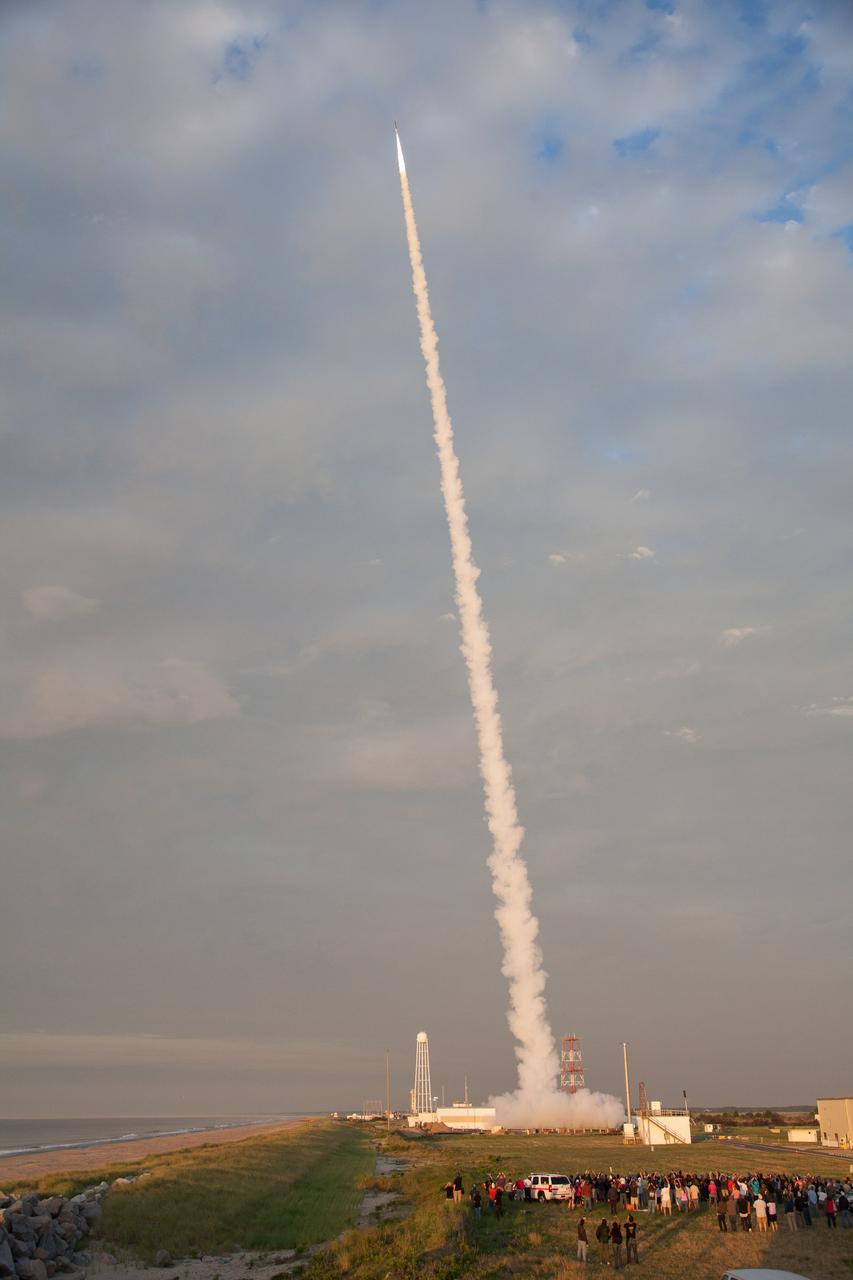
NASA successfully launched a NASA Terrier-Improved Orion suborbital sounding rocket carrying student experiments with the RockOn/RockSat-C programs at 6 a.m., today More than 200 middle school and university students and instructors participating in Rocket Week at Wallops were on hand to witness the launch. Through RockOn and RockSat-C students are learning and applying skills required to develop experiments for suborbital rocket flight. In addition, middle school educators through the Wallops Rocket Academy for Teachers (WRATS) are learning about applying rocketry basics in their curriculum. The payload flew to an altitude of 71.4 miles and descended by parachute into the Atlantic Ocean off the coast of Wallops. Payload recovery is in progress. The next launch from NASA’s Wallops Flight Facility is a Black Brant IX suborbital sounding rocket currently scheduled between 6 and 10 a.m., July 7. For more information on NASA’s Wallops Flight Facility, visit: <a href="http://www.nasa.gov/wallops" rel="nofollow">www.nasa.gov/wallops</a> <b><a href="http://www.nasa.gov/audience/formedia/features/MP_Photo_Guidelines.html" rel="nofollow">NASA image use policy.</a></b> <b><a href="http://www.nasa.gov/centers/goddard/home/index.html" rel="nofollow">NASA Goddard Space Flight Center</a></b> enables NASA’s mission through four scientific endeavors: Earth Science, Heliophysics, Solar System Exploration, and Astrophysics. Goddard plays a leading role in NASA’s accomplishments by contributing compelling scientific knowledge to advance the Agency’s mission. <b>Follow us on <a href="http://twitter.com/NASAGoddardPix" rel="nofollow">Twitter</a></b> <b>Like us on <a href="http://www.facebook.com/pages/Greenbelt-MD/NASA-Goddard/395013845897?ref=tsd" rel="nofollow">Facebook</a></b> <b>Find us on <a href="http://instagrid.me/nasagoddard/?vm=grid" rel="nofollow">Instagram</a></b>

NASA successfully launched a NASA Terrier-Improved Orion suborbital sounding rocket carrying student experiments with the RockOn/RockSat-C programs at 6 a.m., today. More than 200 middle school and university students and instructors participating in Rocket Week at Wallops were on hand to witness the launch. Through RockOn and RockSat-C students are learning and applying skills required to develop experiments for suborbital rocket flight. In addition, middle school educators through the Wallops Rocket Academy for Teachers (WRATS) are learning about applying rocketry basics in their curriculum. The payload flew to an altitude of 71.4 miles and descended by parachute into the Atlantic Ocean off the coast of Wallops. Payload recovery is in progress. The next launch from NASA’s Wallops Flight Facility is a Black Brant IX suborbital sounding rocket currently scheduled between 6 and 10 a.m., July 7. Credits: NASA Wallops Optics Lab <b><a href="http://www.nasa.gov/audience/formedia/features/MP_Photo_Guidelines.html" rel="nofollow">NASA image use policy.</a></b> <b><a href="http://www.nasa.gov/centers/goddard/home/index.html" rel="nofollow">NASA Goddard Space Flight Center</a></b> enables NASA’s mission through four scientific endeavors: Earth Science, Heliophysics, Solar System Exploration, and Astrophysics. Goddard plays a leading role in NASA’s accomplishments by contributing compelling scientific knowledge to advance the Agency’s mission. <b>Follow us on <a href="http://twitter.com/NASAGoddardPix" rel="nofollow">Twitter</a></b> <b>Like us on <a href="http://www.facebook.com/pages/Greenbelt-MD/NASA-Goddard/395013845897?ref=tsd" rel="nofollow">Facebook</a></b> <b>Find us on <a href="http://instagrid.me/nasagoddard/?vm=grid" rel="nofollow">Instagram</a></b>

NASA successfully launched the RockSat-X education payload on a Terrier-Improved Malemute suborbital sounding rocket at 7:33:30 a.m. EDT Aug. 17 from the Wallops Flight Facility in Virginia. Students from eight community colleges and universities from across the United States participated in the RockSat-X project.The payload carrying the experiments flew to an altitude of 95 miles. Data was received from most of the student experiments. However, the payload was not recovered as planned. NASA will investigate the anomaly. Credit: NASA/Wallops/A. Stancil <b><a href="http://www.nasa.gov/audience/formedia/features/MP_Photo_Guidelines.html" rel="nofollow">NASA image use policy.</a></b> <b><a href="http://www.nasa.gov/centers/goddard/home/index.html" rel="nofollow">NASA Goddard Space Flight Center</a></b> enables NASA’s mission through four scientific endeavors: Earth Science, Heliophysics, Solar System Exploration, and Astrophysics. Goddard plays a leading role in NASA’s accomplishments by contributing compelling scientific knowledge to advance the Agency’s mission. <b>Follow us on <a href="http://twitter.com/NASAGoddardPix" rel="nofollow">Twitter</a></b> <b>Like us on <a href="http://www.facebook.com/pages/Greenbelt-MD/NASA-Goddard/395013845897?ref=tsd" rel="nofollow">Facebook</a></b> <b>Find us on <a href="http://instagrid.me/nasagoddard/?vm=grid" rel="nofollow">Instagram</a></b>