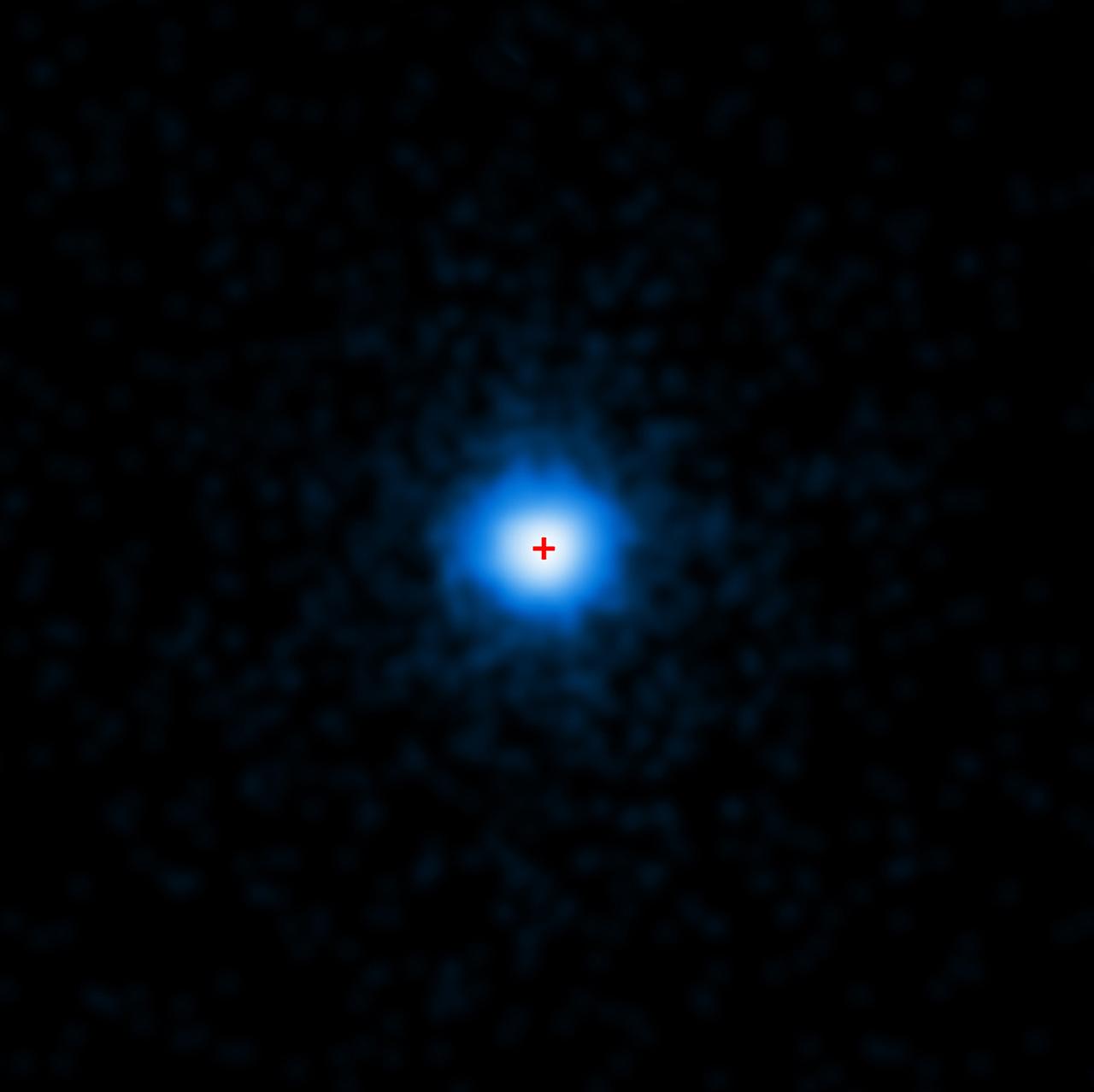
NASA image release April 6, 2011 NASA's Chandra X-ray Observatory completed this four-hour exposure of GRB 110328A on April 4. The center of the X-ray source corresponds to the very center of the host galaxy imaged by Hubble (red cross). Credit: NASA/CXC/ Warwick/A. Levan NASA's Swift, Hubble Space Telescope and Chandra X-ray Observatory have teamed up to study one of the most puzzling cosmic blasts yet observed. More than a week later, high-energy radiation continues to brighten and fade from its location. Astronomers say they have never seen anything this bright, long-lasting and variable before. Usually, gamma-ray bursts mark the destruction of a massive star, but flaring emission from these events never lasts more than a few hours. Although research is ongoing, astronomers say that the unusual blast likely arose when a star wandered too close to its galaxy's central black hole. Intense tidal forces tore the star apart, and the infalling gas continues to stream toward the hole. According to this model, the spinning black hole formed an outflowing jet along its spin axis. A powerful blast of X- and gamma rays is seen if this jet is pointed in our direction. To read more go to: <a href="http://www.nasa.gov/topics/universe/features/star-disintegration.html" rel="nofollow">www.nasa.gov/topics/universe/features/star-disintegration...</a> <b><a href="http://www.nasa.gov/centers/goddard/home/index.html" rel="nofollow">NASA Goddard Space Flight Center</a></b> enables NASA’s mission through four scientific endeavors: Earth Science, Heliophysics, Solar System Exploration, and Astrophysics. Goddard plays a leading role in NASA’s accomplishments by contributing compelling scientific knowledge to advance the Agency’s mission. <b>Follow us on <a href="http://twitter.com/NASA_GoddardPix" rel="nofollow">Twitter</a></b> <b>Join us on <a href="http://www.facebook.com/pages/Greenbelt-MD/NASA-Goddard/395013845897?ref=tsd" rel="nofollow">Facebook</a></b>

NASA image release April 6, 2011 Images from Swift's Ultraviolet/Optical (white, purple) and X-ray telescopes (yellow and red) were combined in this view of GRB 110328A. The blast was detected only in X-rays, which were collected over a 3.4-hour period on March 28. Credit: NASA/Swift/Stefan Immler NASA's Swift, Hubble Space Telescope and Chandra X-ray Observatory have teamed up to study one of the most puzzling cosmic blasts yet observed. More than a week later, high-energy radiation continues to brighten and fade from its location. Astronomers say they have never seen anything this bright, long-lasting and variable before. Usually, gamma-ray bursts mark the destruction of a massive star, but flaring emission from these events never lasts more than a few hours. Although research is ongoing, astronomers say that the unusual blast likely arose when a star wandered too close to its galaxy's central black hole. Intense tidal forces tore the star apart, and the infalling gas continues to stream toward the hole. According to this model, the spinning black hole formed an outflowing jet along its spin axis. A powerful blast of X- and gamma rays is seen if this jet is pointed in our direction. To read more go to: <a href="http://www.nasa.gov/topics/universe/features/star-disintegration.." rel="nofollow">www.nasa.gov/topics/universe/features/star-disintegration..</a>. NASA Goddard Space Flight Center enables NASA’s mission through four scientific endeavors: Earth Science, Heliophysics, Solar System Exploration, and Astrophysics. Goddard plays a leading role in NASA’s accomplishments by contributing compelling scientific knowledge to advance the Agency’s mission. Follow us on Twitter Join us on Facebook
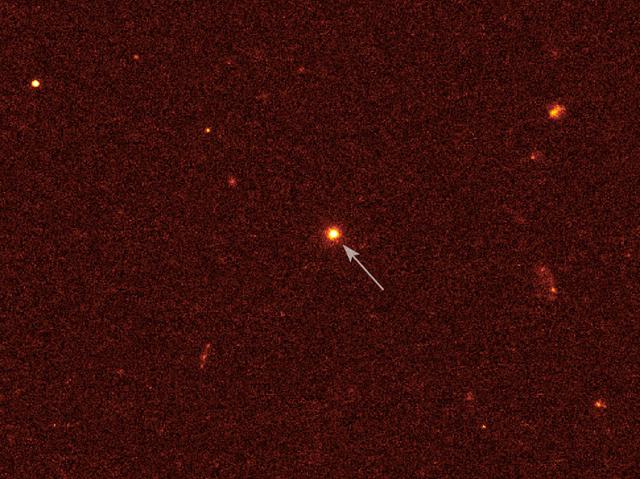
NASA image releaes April 6, 2011 This is a visible-light image of GRB 110328A's host galaxy (arrow) taken on April 4 by the Hubble Space Telescope's Wide Field Camera 3. The galaxy is 3.8 billion light-years away. Credit: NASA/ESA/A. Fruchter (STScI) NASA's Swift, Hubble Space Telescope and Chandra X-ray Observatory have teamed up to study one of the most puzzling cosmic blasts yet observed. More than a week later, high-energy radiation continues to brighten and fade from its location. Astronomers say they have never seen anything this bright, long-lasting and variable before. Usually, gamma-ray bursts mark the destruction of a massive star, but flaring emission from these events never lasts more than a few hours. Although research is ongoing, astronomers say that the unusual blast likely arose when a star wandered too close to its galaxy's central black hole. Intense tidal forces tore the star apart, and the infalling gas continues to stream toward the hole. According to this model, the spinning black hole formed an outflowing jet along its spin axis. A powerful blast of X- and gamma rays is seen if this jet is pointed in our direction. To read more go to: <a href="http://www.nasa.gov/topics/universe/features/star-disintegration.." rel="nofollow">www.nasa.gov/topics/universe/features/star-disintegration..</a>. NASA Goddard Space Flight Center enables NASA’s mission through four scientific endeavors: Earth Science, Heliophysics, Solar System Exploration, and Astrophysics. Goddard plays a leading role in NASA’s accomplishments by contributing compelling scientific knowledge to advance the Agency’s mission. Follow us on Twitter Join us on Facebook