
These composite images from NASA Dawn spacecraft images show the spectacular spectral diversity of asteroid Vesta surface.
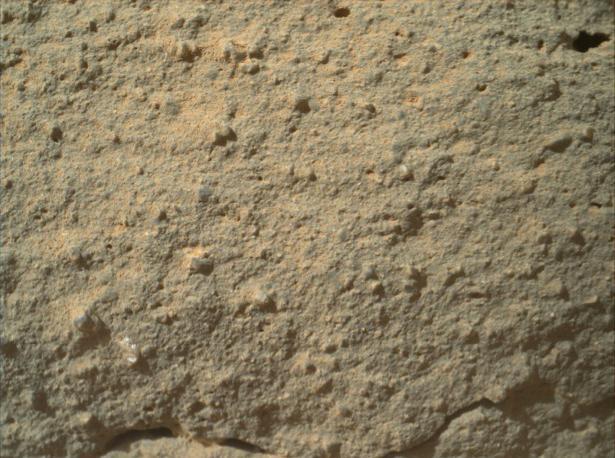
This image from NASA Curiosity rover shows the great diversity of grains found on the surface of a Martian rock.

This full-resolution mosaic of Venus, obtained by NASA Magellan spacecraft, shows an area replete with diverse volcanic features. http://photojournal.jpl.nasa.gov/catalog/PIA00265
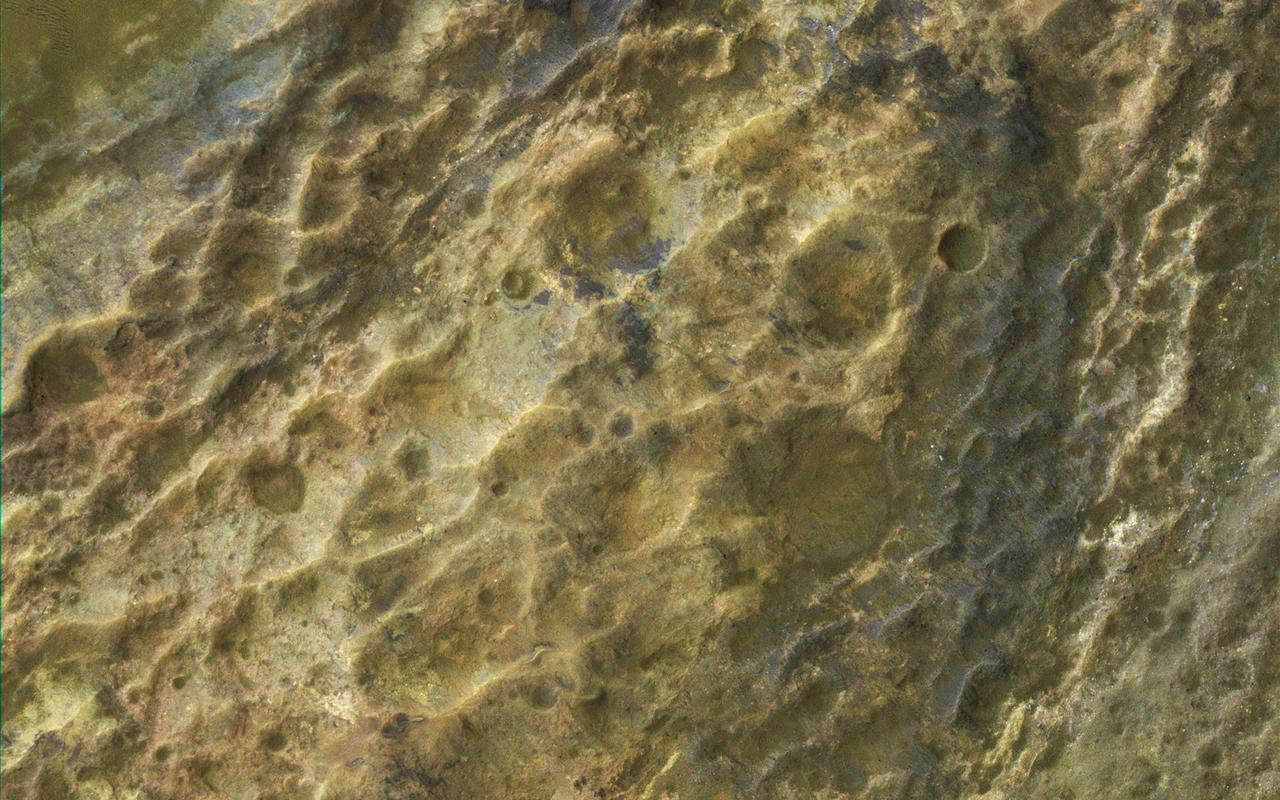
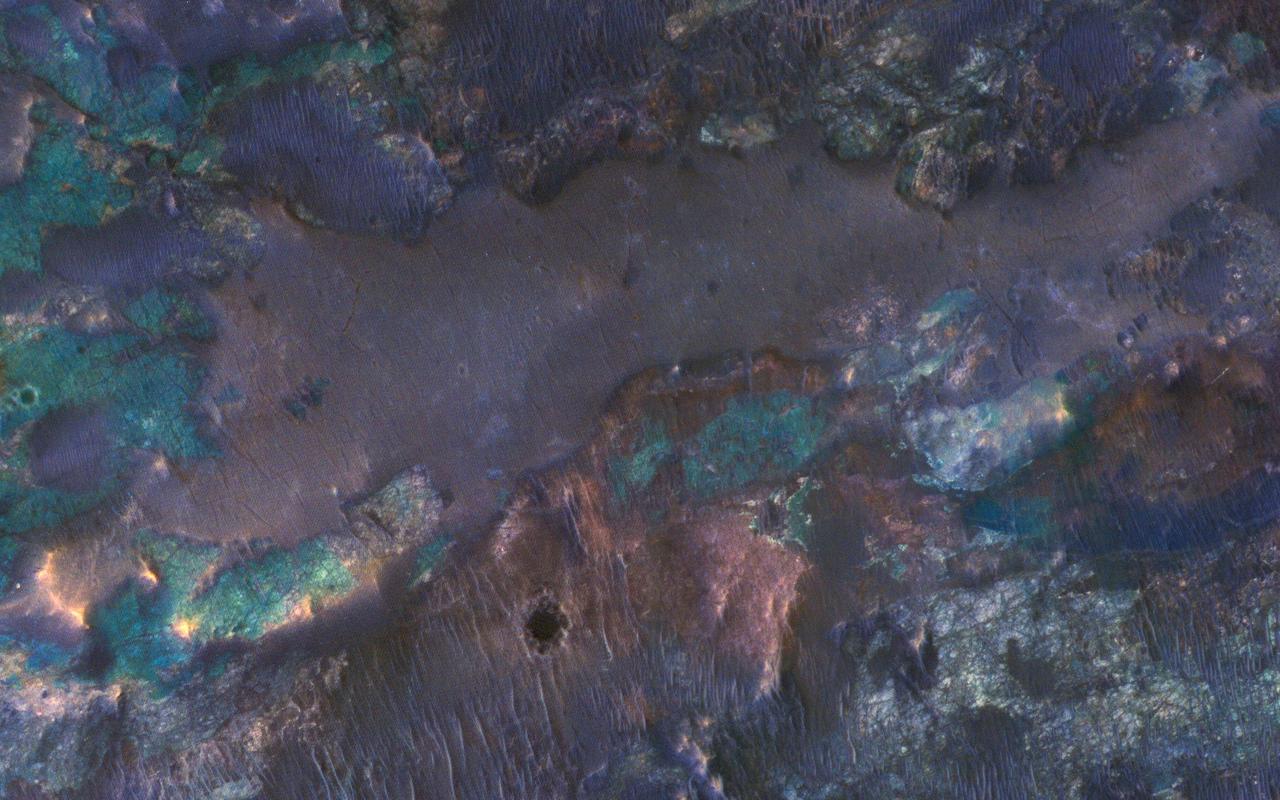
This image captured by NASA Mars Reconnaissance Orbiter MRO covers diverse surface units on the floor of eastern Coprates Chasma in eastern Valles Marineris. The bedrock has diverse minerals producing wonderful color contrasts. In over 10 years of orbiting Mars, HiRISE has acquired nearly 50,000 large images, but they cover less than 3 percent of the Martian surface. https://photojournal.jpl.nasa.gov/catalog/PIA21606
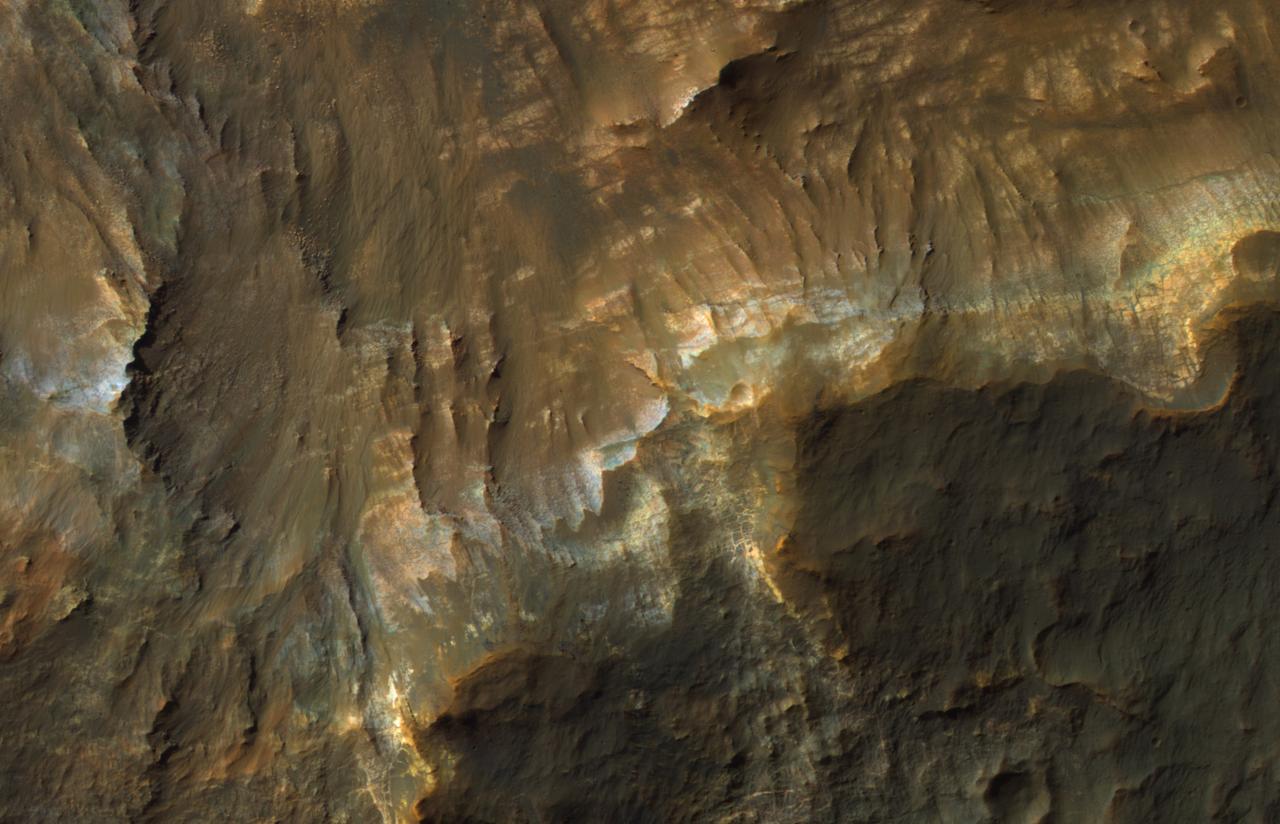
This color image from NASA's Mars Reconnaissance Orbiter (MRO) shows bedrock layers of diverse colors and composition. For more information see https://photojournal.jpl.nasa.gov/catalog/PIA22437
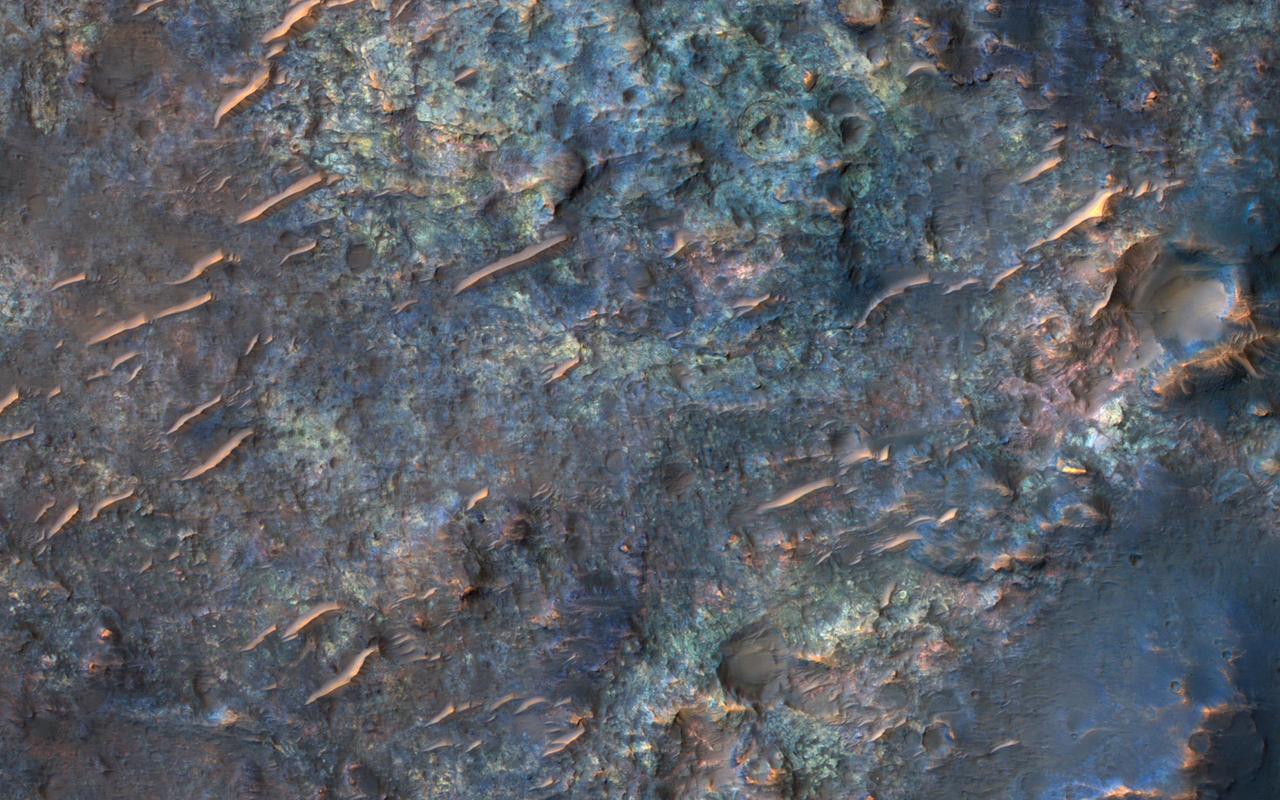
This image from NASA's Mars Reconnaissance Orbiter (MRO) shows bedrock units with diverse colors indicating different mineral concentrations. More information is available at https://photojournal.jpl.nasa.gov/catalog/PIA22434
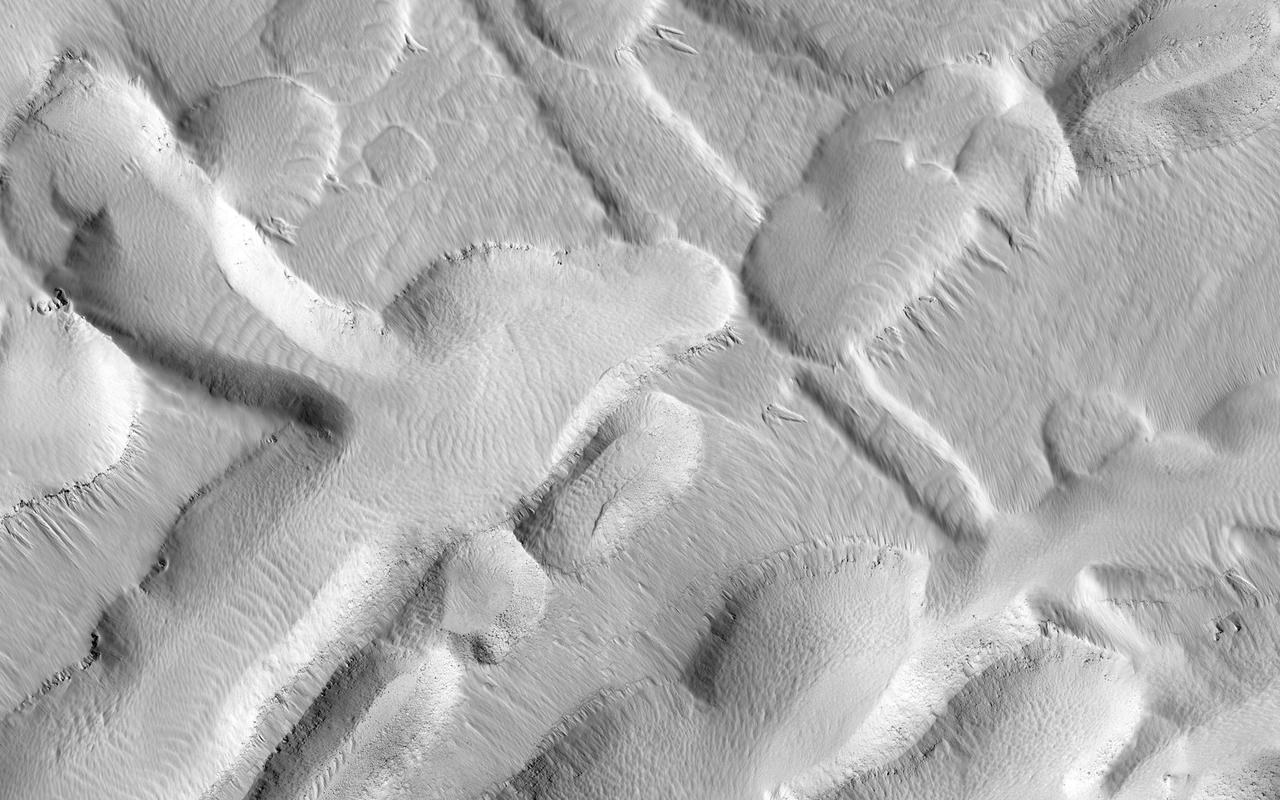
This observation from NASA Mars Reconnaissance Orbiter shows an incredible diversity of ancient lava tubes and impact craters filled with sediment on the flank of Arsia Mons.
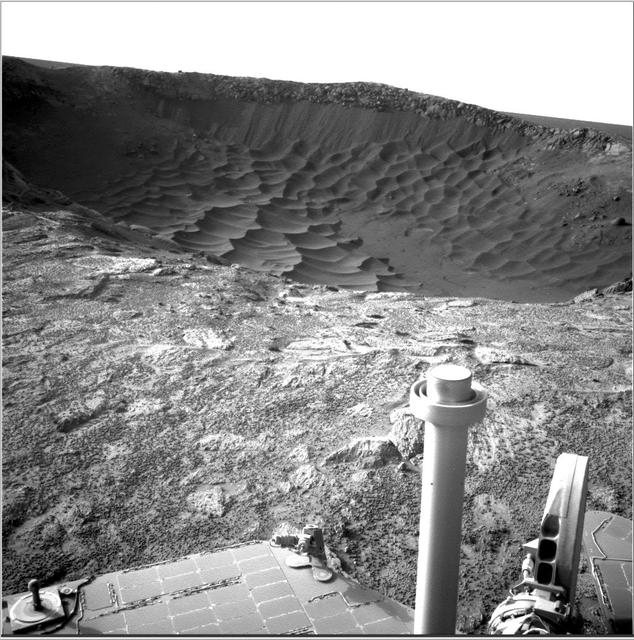
This image from NASA Mars Exploration Rover at the edge of Santa Maria crater shows diverse textures of the crater. Contrast has been enhanced to emphasize the textures.

An astonishing diversity of geological features, ecological systems and human landscapes across North America is indicated within this image from NASA Terra spacecraft.
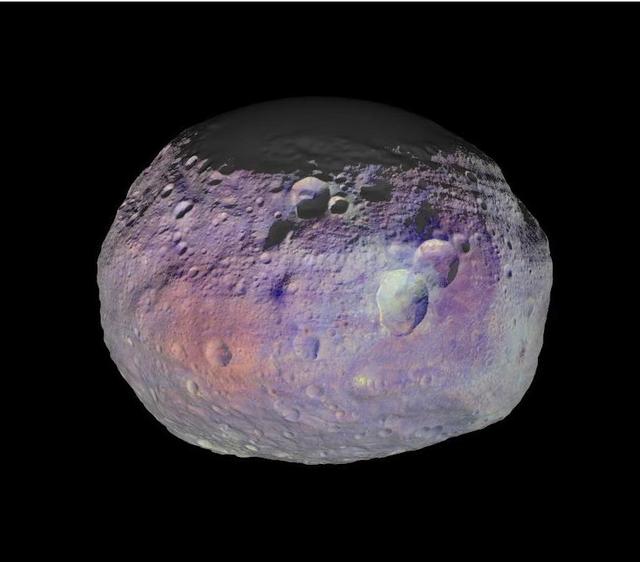
This image of asteroid Vesta is one of many images taken by NASA Dawn spacecraft to create an animation showing the diversity of minerals through color representation.

The area in and near the landing site selected for landing of NASA Mars Science Laboratory offers a diversity of possible targets for examination by the mission rover, Curiosity.

This is a full resolution radar mosaic of the Lavinia region of Venus as seen by NASA Magellan spacecraft. This area shows a diverse set of geologic features. http://photojournal.jpl.nasa.gov/catalog/PIA00087

Retired Marshall scientist, Jeanette Scissum-Mickens, was honored by Alabama Governor Kay Ivey at the Alabama Historically Black Colleges and Universities Roundtable Discussion: Minority Women in STEM event held at the University of Alabama A&M in Huntsville, Alabama. Scissum-Mickens was honored as the “Hidden Figure of Alabama A&M.” She was the first African-American mathematician hired by Marshall in 1964.
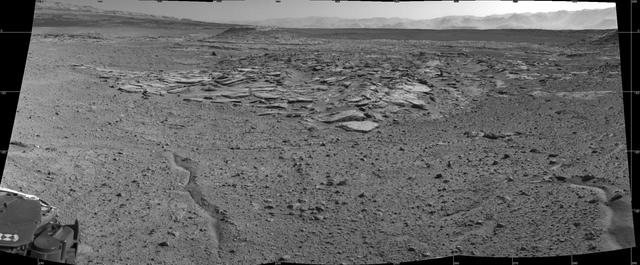
NASA Curiosity Mars rover recorded this view of various rock types at waypoint called the Kimberley shortly after arriving at the location on April 2, 2014. The site offers a diversity of rock types exposed close together.
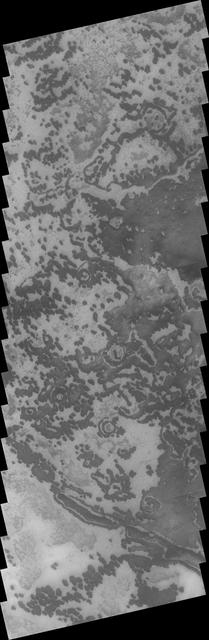
This VIS image from NASA 2001 Mars Odyssey spacecraft of the south polar region was collected during the summer season. The markings of the pole are very diverse and easy to see after the winter frost has been removed.
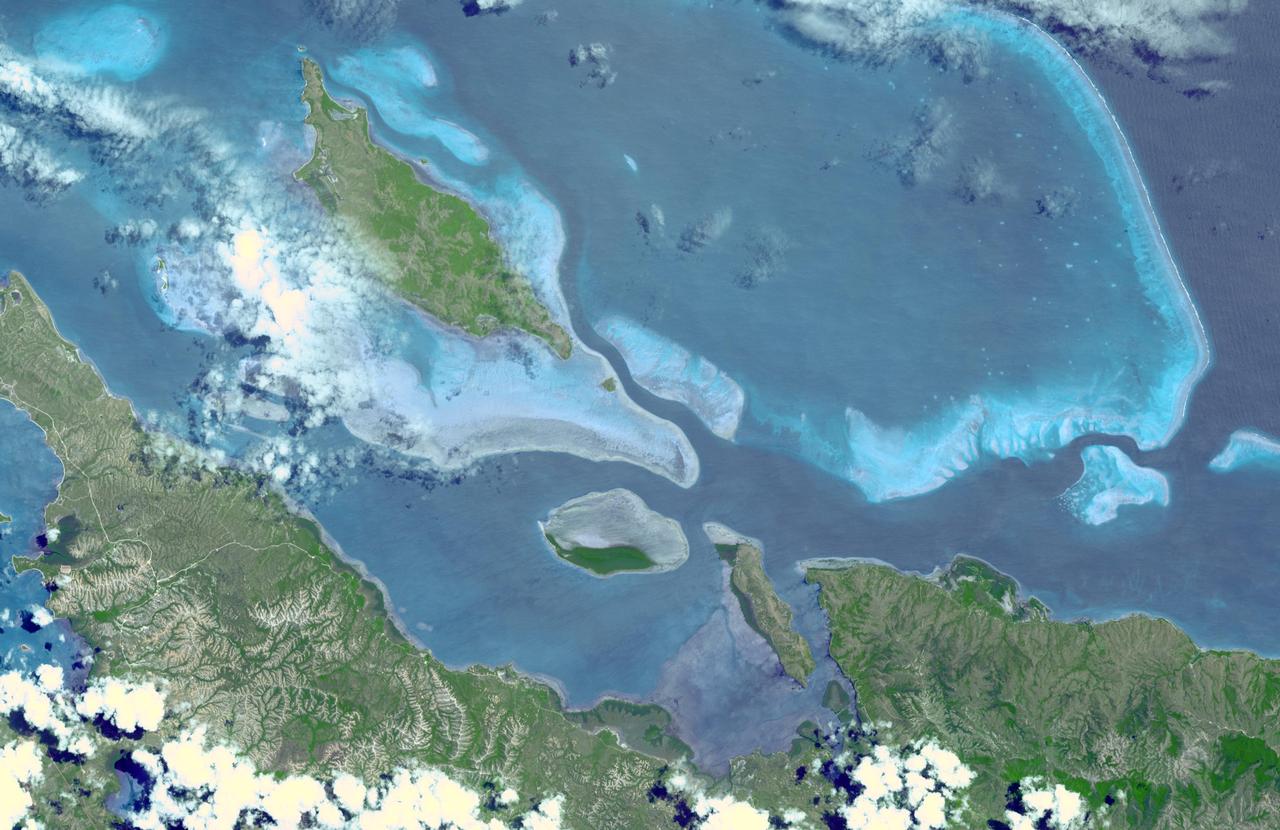
In this image, taken by NASA Terra spacecraft, six marine clusters represent the main diversity of coral reefs and associated ecosystems in the French Pacific Ocean archipelago of New Caledonia.
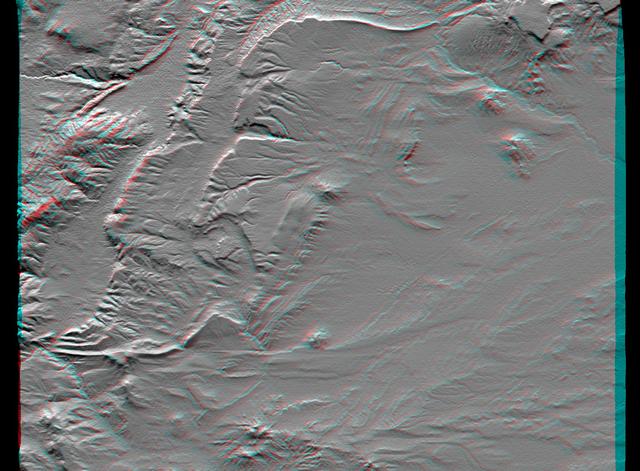
This anaglyph, from NASA Shuttle Radar Topography Mission, is of an area southwest of Zapala, Argentina, showing a wide diversity of geologic features. 3D glasses are necessary to view this image.
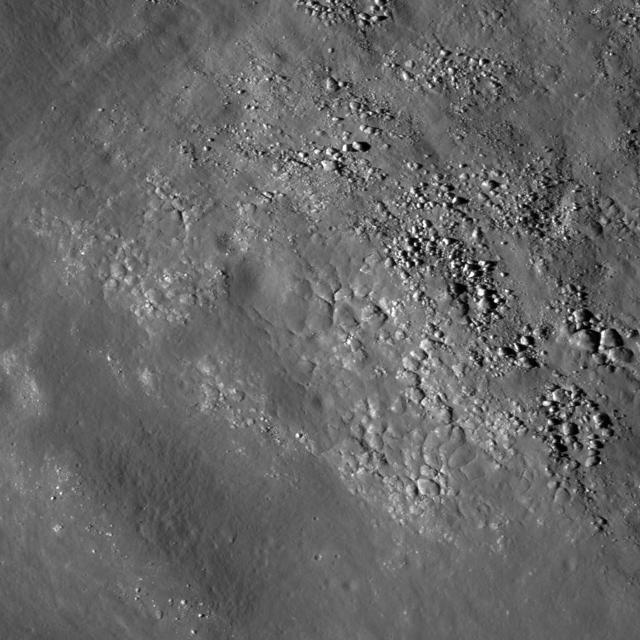
Diverse textures on the floor of Saha E which could be the result of impact melt coating boulders and other deposits on the floor of the crater on the lunar farside in this image taken by NASA Lunar Reconnaissance Orbiter.
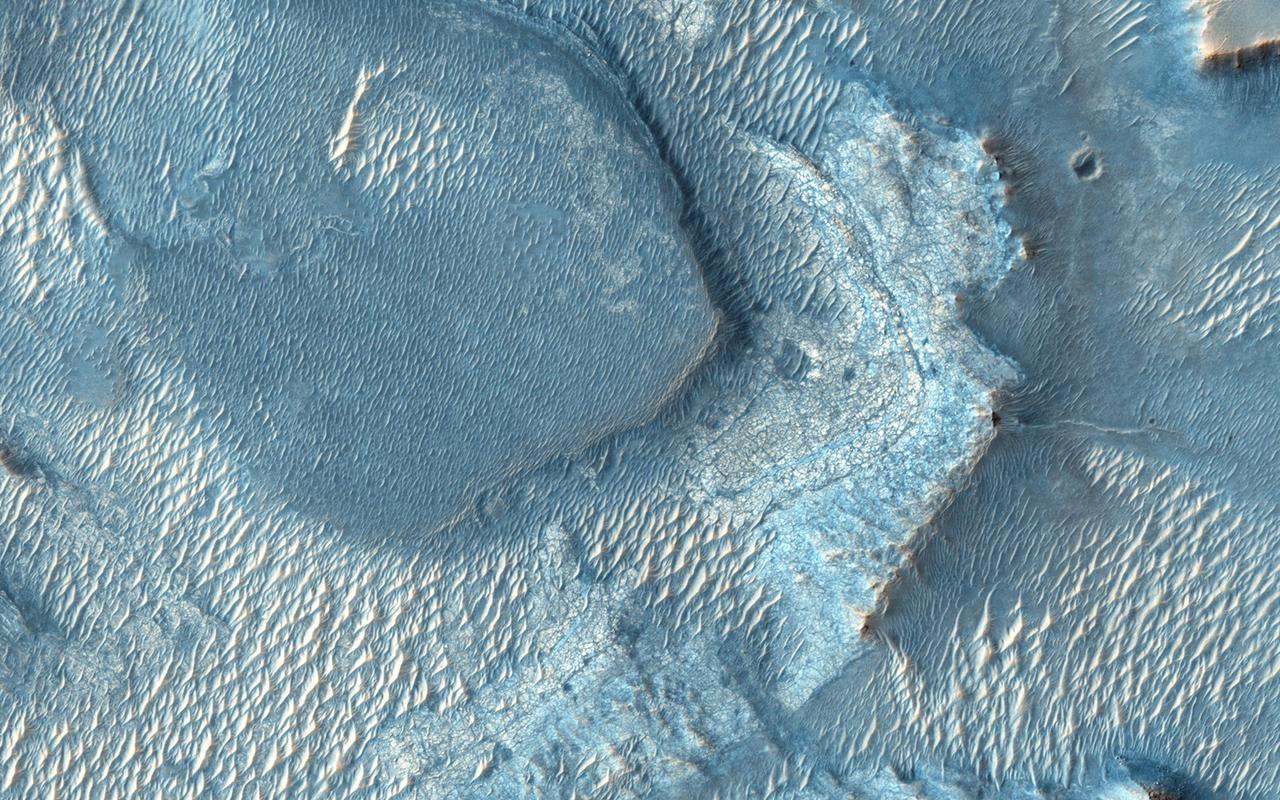
Nili Fossae, once considered a potential landing spot for the Mars Science Laboratory, has one of the largest, most diverse exposures of clay minerals as seen by NASA Mars Reconnaissance Orbiter.
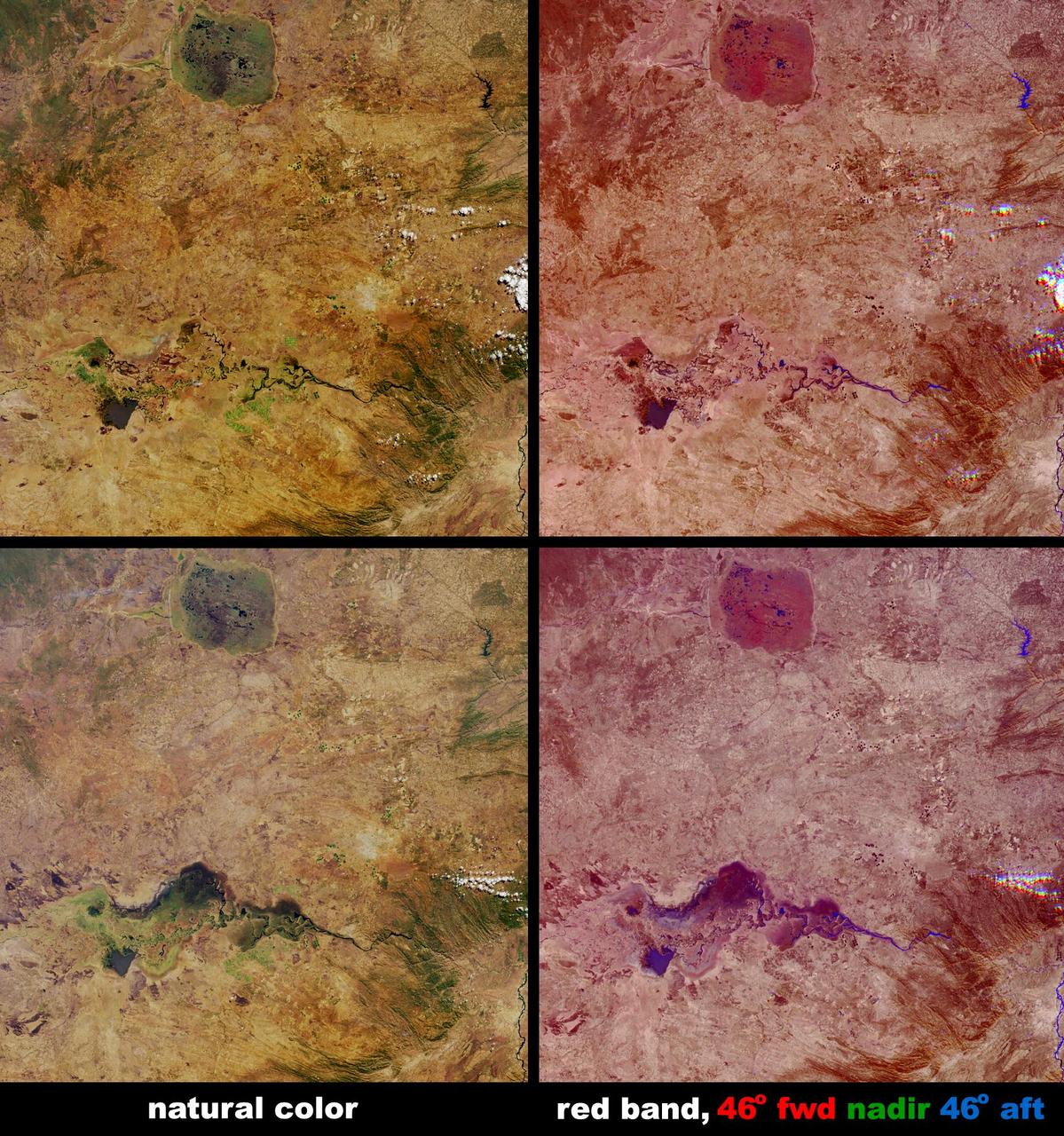
Heavy rainfall in southern Africa between December 2003 and April 2004 provided central Zambia with floodwaters needed to support the diverse uses of water within the Kafue Flats area as seen by NASA Terra spacecraft.

Data from NASA Moon Mineralogy Mapper instrument on the Indian Space Research Organization Chandrayaan-1 spacecraft reveal subtle and previously unknown lunar diversity and features. Animation available at the Photojournal.

From a position in the shallow Yellowknife Bay depression, NASA Mars rover Curiosity used its right Mast Camera Mastcam to take the telephoto images combined into this panorama of geological diversity.
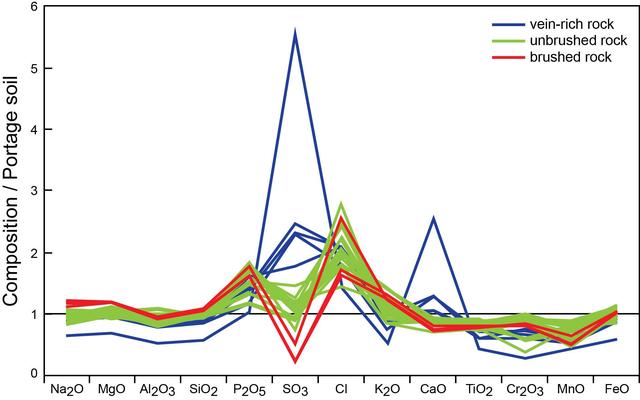
This graphic presents results from APXS onboard NASA rover Curiosity, with the comparisons simplified across diverse elements by dividing the amount of each element measured in the rocks by the amount of the same element in a local soil.

From a position in the shallow Yellowknife Bay depression, NASA Mars rover Curiosity used its right Mast Camera Mastcam to take the telephoto images combined into this panorama of geological diversity.

NASA Mars Reconnaissance Orbiter shows the surface outside this large crater is relatively dark, while the interior wall of the crater exposes lighter, layered bedrock of diverse colors.

This ethereal scene captured by NASA New Horizons spacecraft tells yet another story of Pluto diversity of geological and compositional features-this time in an enhanced color image of the north polar area.

The Aristarchus region is one of the most diverse and interesting areas on the Moon. About 500 images from NASA's Clementine spacecraft were processed and combined into a multispectral mosaic of this region. http://photojournal.jpl.nasa.gov/catalog/PIA00090

This ultraviolet image from NASA Galaxy Evolution Explorer is of a diverse group of galaxy types. NGC 3190 is a dusty edge on spiral galaxy. NGC 3187 is highly distorted.

Representatives of the state of Alabama, academia, and industry listen and take part in a panel discussion led by NASA Marshall Space Flight Center's Ruth Jones as part of the first Alabama Historically Black Colleges and Universities Roundtable Discussion. The event focused on drawing more minorities, specifically women, into academic fields and careers in science, technology, engineering and mathematics.
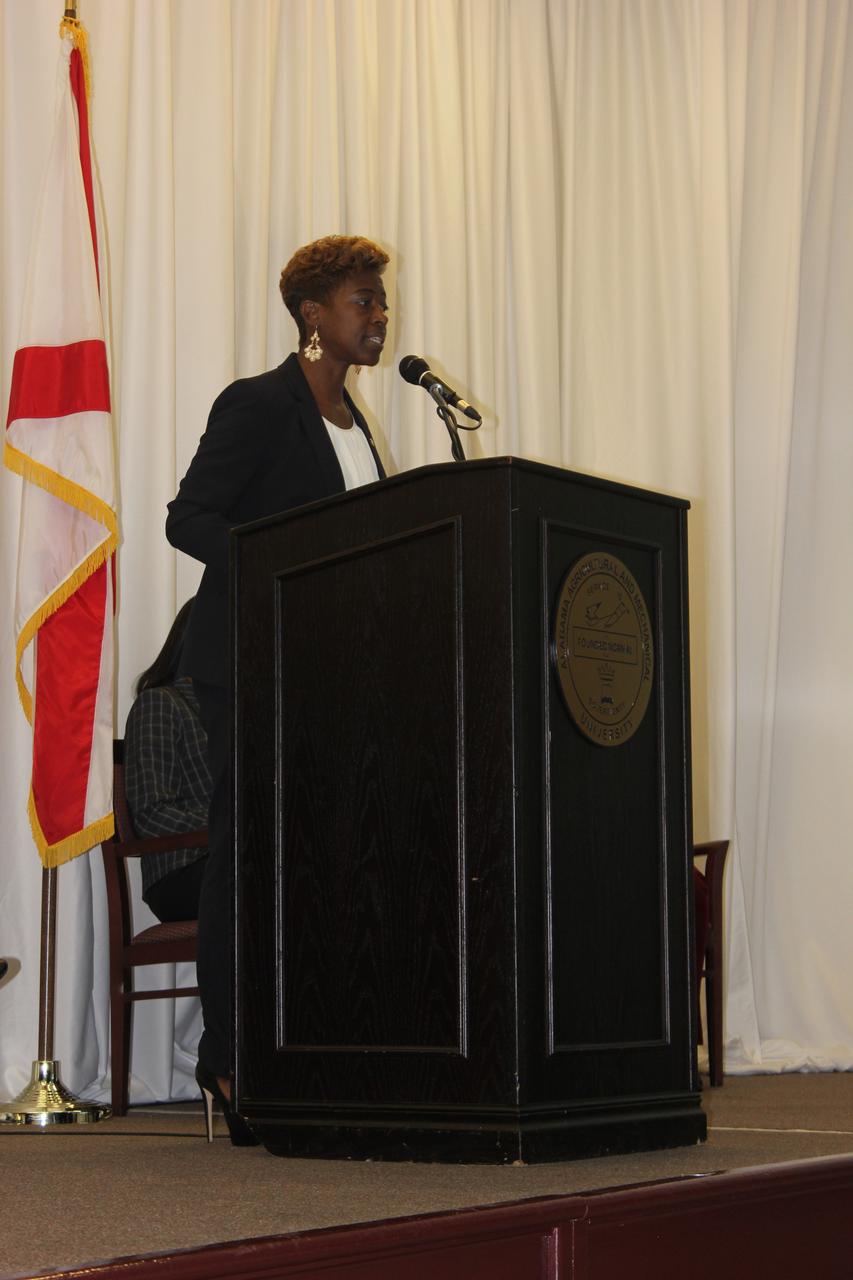
Marshall’s Ruth Jones, a mishap investigation specialist, told her NASA story and spoke about minority statistics in science, technology, engineering and mathematics (STEM). Jones also led a panel discussing how to engage, encourage and draw more minority students in to STEM fields and careers.
The collision that created Hargraves Crater impacted into diverse bedrock lithologies of ancient Mars; the impact ejecta is a rich mix of rock types with different colors and textures, as seen by NASA Mars Reconnaissance Orbiter. The crater is named after Robert Hargraves who discovered and studied meteorite impacts on the Earth. https://photojournal.jpl.nasa.gov/catalog/PIA21609
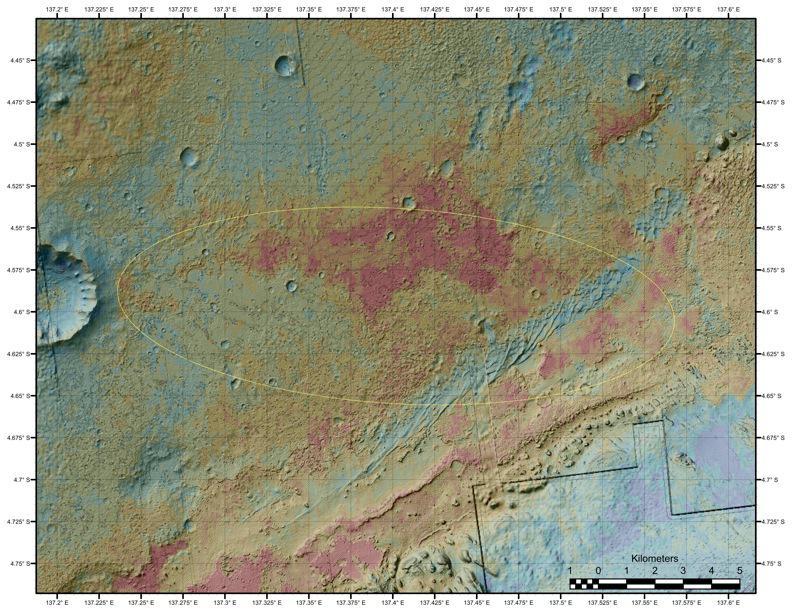
The area where NASA Curiosity rover will land on Aug. 5 PDT Aug. 6 EDT has a geological diversity that scientists are eager to investigate, as seen in this false-color map based on data from NASA Mars Odyssey orbiter.
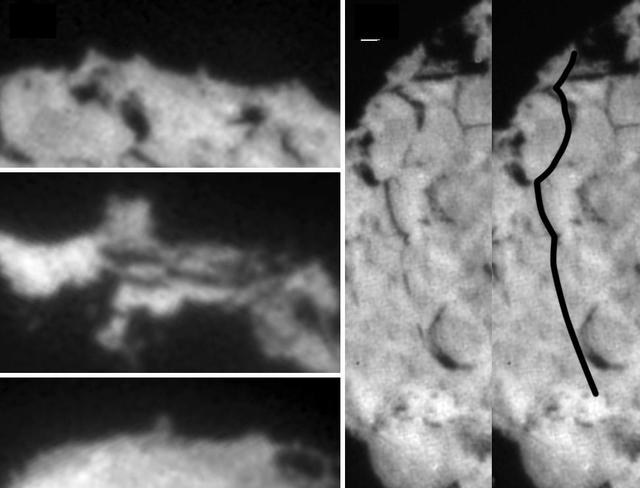
These images taken by NASA's Stardust spacecraft highlight the diverse features that make up the surface of comet Wild 2, showing a variety of small pinnacles and mesas seen on the limb of the comet and the location of a 2-kilometer (1.2-mile) series of aligned scarps, or cliffs, that are best seen in the stereo images. http://photojournal.jpl.nasa.gov/catalog/PIA06284
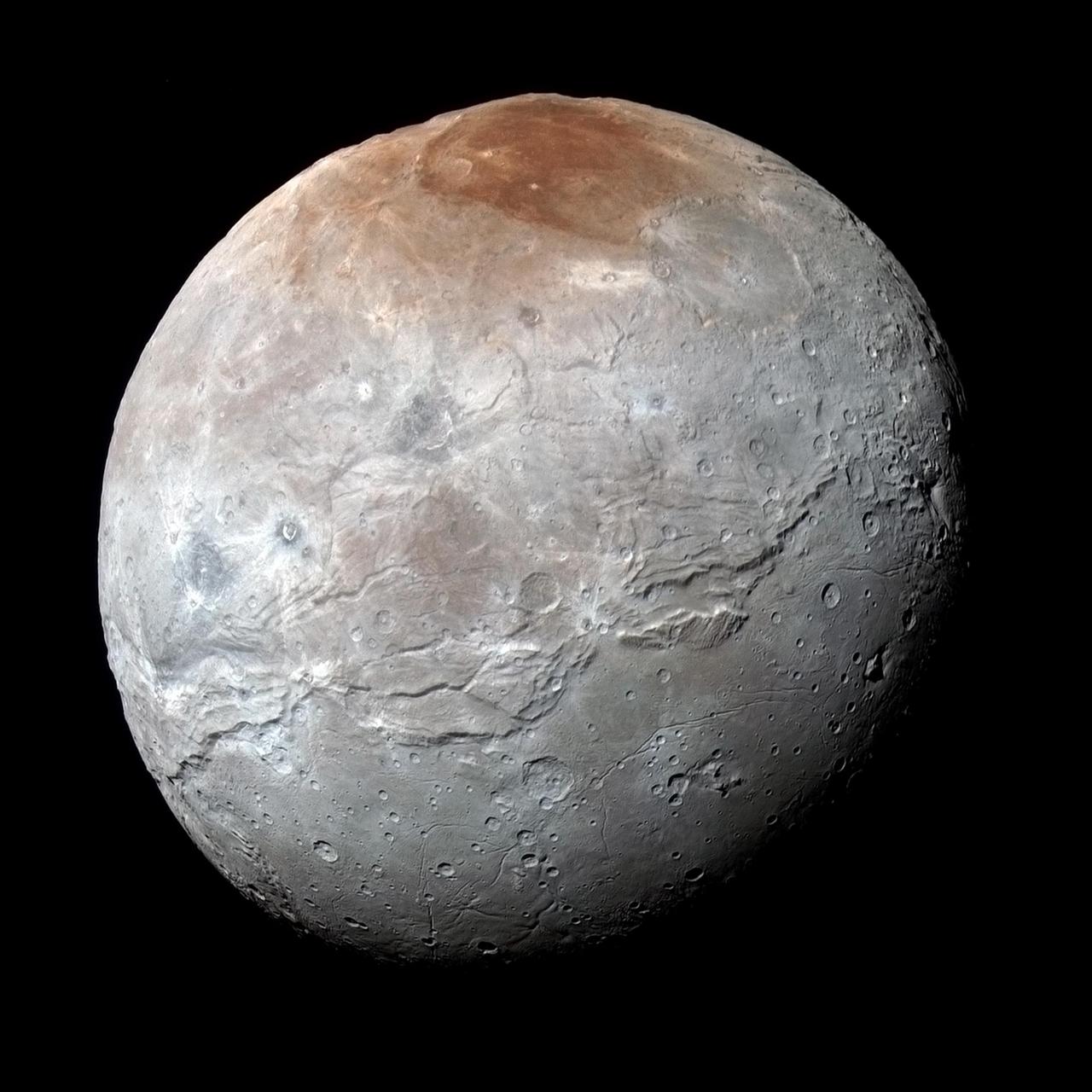
NASA's New Horizons captured this high-resolution enhanced color view of Charon just before closest approach on July 14, 2015. The image combines blue, red and infrared images taken by the spacecraft's Ralph/Multispectral Visual Imaging Camera (MVIC); the colors are processed to best highlight the variation of surface properties across Charon. Charon's color palette is not as diverse as Pluto's; most striking is the reddish north (top) polar region, informally named Mordor Macula. Charon is 754 miles (1,214 kilometers) across; this image resolves details as small as 1.8 miles (2.9 kilometers). http://photojournal.jpl.nasa.gov/catalog/PIA19968
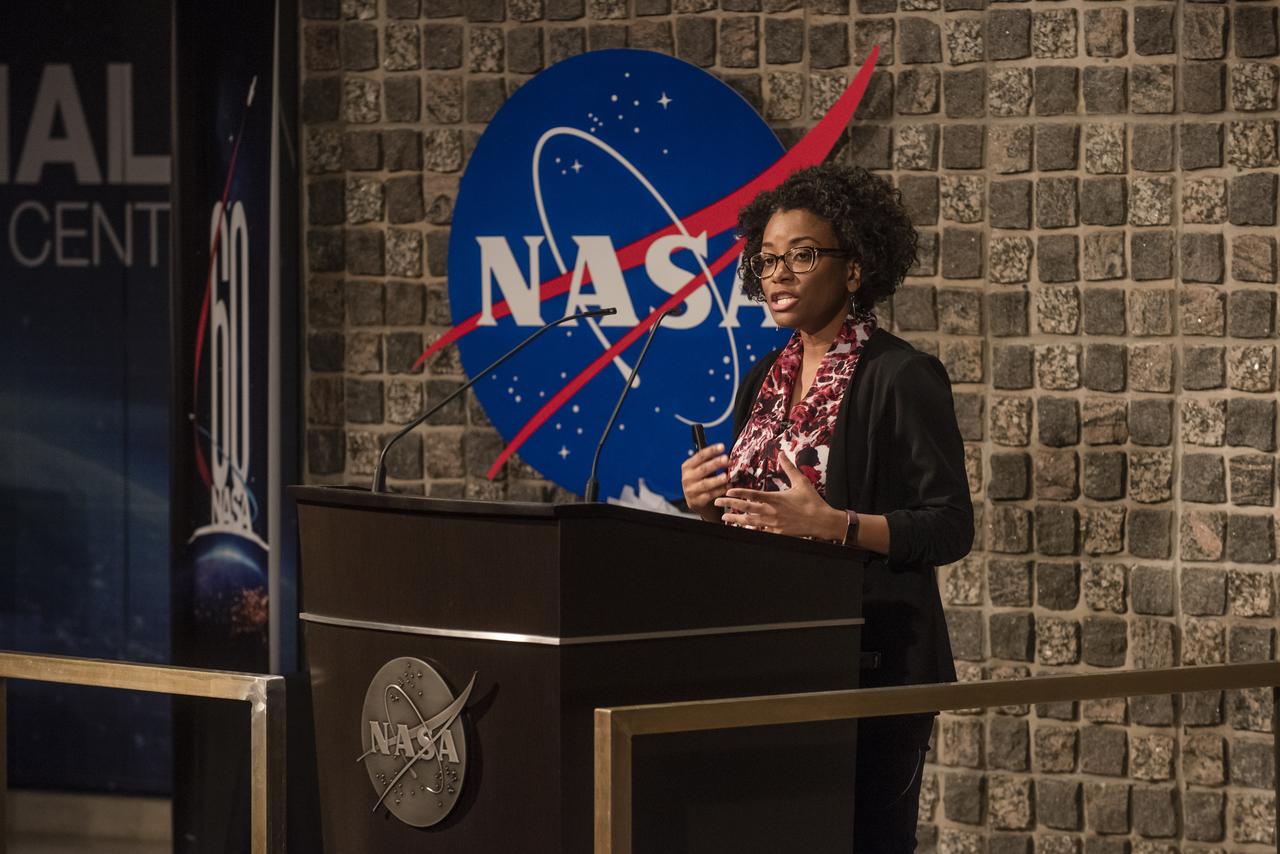
Dr. Shanique Brown, an assistant professor of industrial-organizational psychology at Wayne State University in Detroit, Michigan, delivers the Black History Month keynote address to team members at NASA's Marshall Space Flight Center Feb. 28. Participants mingled with Brown and Marshall leaders after the speech and a panel discussion on diversity and inclusion, and sampled a variety of ethnic foods. The 2019 commemoration, themed "Migrations From Here to There," was organized by Marshall's Office of Diversity and Equal Opportunity

Crystal Moten, NASA Headquarters Office of Diversity and Equal Opportunity, speaks at the MLK Day of Service, Tuesday, January 21, 2020 at NASA Headquarters in Washington. Photo Credit: (NASA/Aubrey Gemignani)
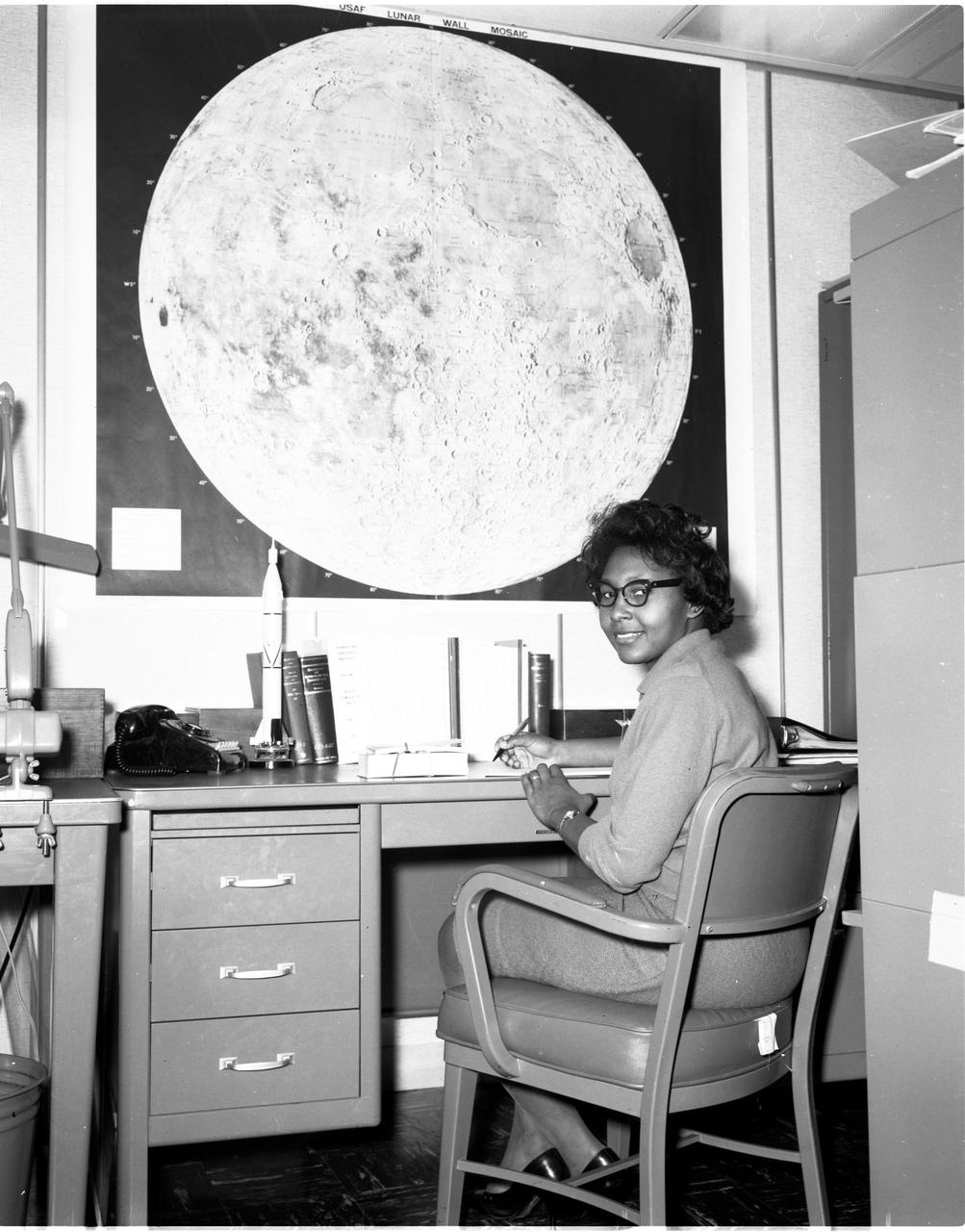
Jeanette Scissum joined NASA’s Marshall Space Flight Center in 1964 after earning bachelor's and master's degrees in mathematics from Alabama A&M University. Scissum published a NASA report in 1967, “Survey of Solar Cycle Prediction Models,” which put forward techniques for improved forecasting of the sunspot cycle. In the mid-1970s she worked as a space scientist in the Space Environment Branch of Marshall’s Space Sciences Laboratory and later led activities in Marshall’s Atmospheric, Magnetospheric, and Plasmas in Space project.In 1975, Scissum wrote an article for the National Technical Association, “Equal Employment Opportunity and the Supervisor – A Counselor’s View,” which argued that many discrimination complaints could be avoided “through adequate and meaningful communication.” Scissum later worked at NASA Headquarters as a computer systems analyst responsible for analyzing and directing NASA management information and technical support systems.
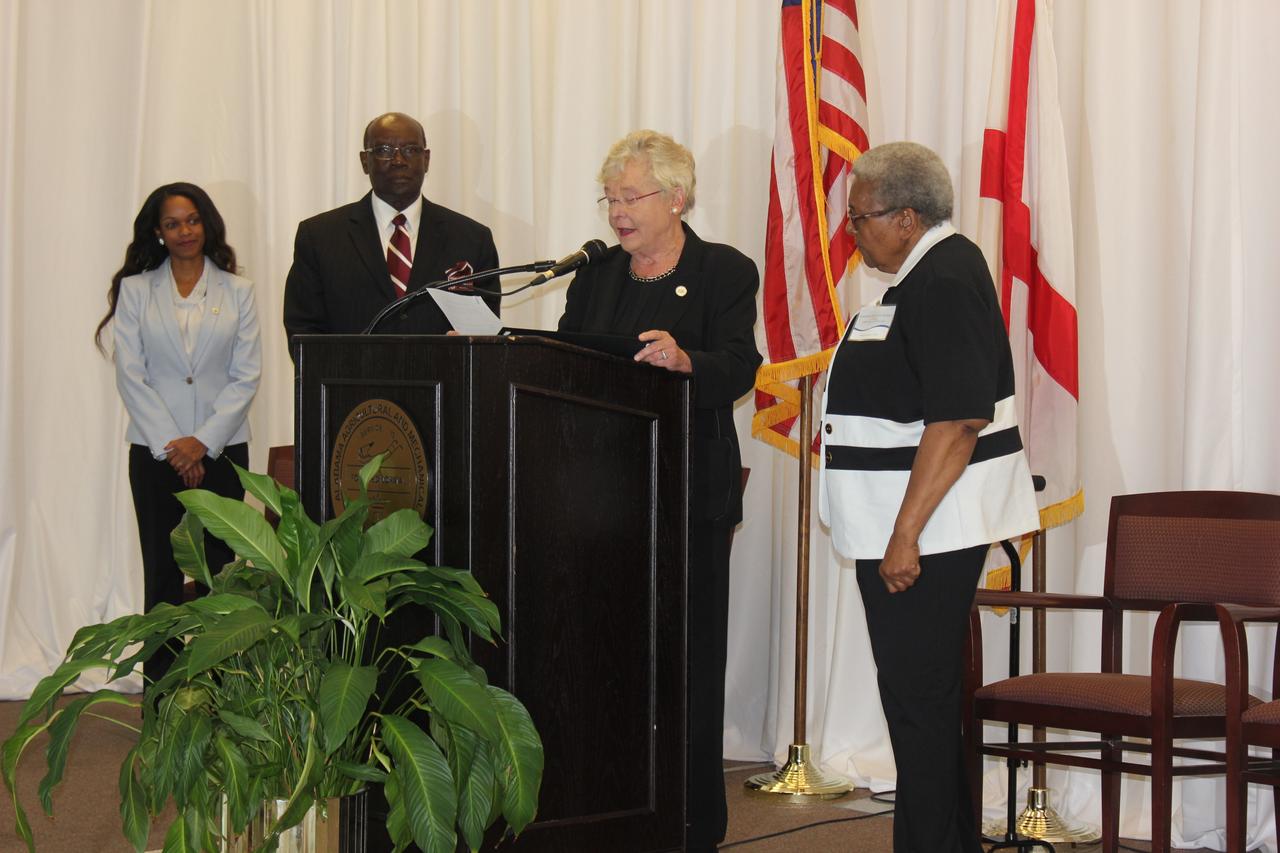
Governor Kay Ivey recognized retired NASA Space Flight Center team member, Jeanette Scissum-Mickens on Sept. 27 at the Alabama HBCU Roundtable Discussion: Minority Women in STEM held at the Alabama A&M University. Scissum-Mickens was honored as the “Hidden Figure of Alabama A&M.” She was the first African American mathematician hired by Marshall in 1964. While at Marshall, she was a space scientist and helped improved forecast models of the sunspot cycle and led activities in Marshall’s Atmospheric, Magentospheric, and Plasmas in Space project.
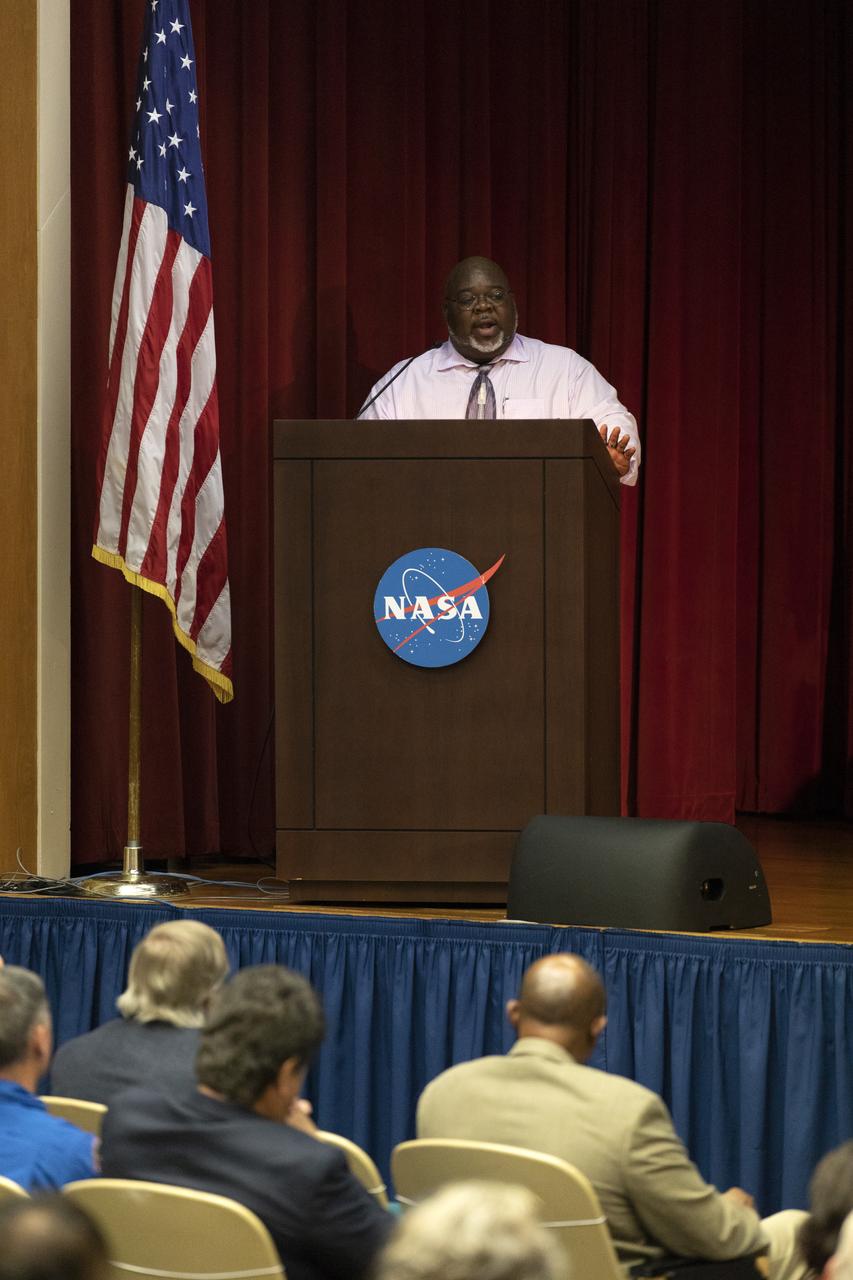
Kennedy Space Center Office of Diversity and Equal Opportunity Manager Rob Grant speaks to NASA civil service and contractor employees and guests in Kennedy Space Center’s Training Auditorium on April 12, 2019. Rogers talked about the power of diversity during “Columbia: The Mission Continues,” an event organized by the Apollo Challenger Columbia Lessons Learned Program (ACCLLP). The event is part of the Space Shuttle Columbia national tour and took place on the 38th anniversary of STS-1, the first orbital spaceflight of NASA’s Space Shuttle Program. The tour launched at Kennedy and will make its way to each of the 10 NASA centers.

Portrait of Robin "Rob" Lee of the Office of Diversity & Equal Opp. Branch, in front of NASA Langley's "Meatball." The portrait was done for Thalia Patrinos at NASA Headquarters as part of "Faces of NASA" project. Due to the COVID-19 pandemic, masks were mandated by Governor Northam in Virginia in public settings. "Well, little did I know, even at a young age, he instilled in me the importance of seeing people for people. And being able to help people and being able to meet them in their time of need. And that carried me throughout my entire life. Even still today.” — Robin Lee, Director of Office of Diversity and Equal Opportunity, Langley Research Center

This image was acquired on May 15, 2018 by NASA's Mars Reconnaissance Orbiter. This observation shows relatively bright mounds scattered throughout darker and diverse surfaces in Chryse Planitia. These mounds are hundreds of meters in size. The largest of the mounds shows a central pit, similar to the collapsed craters found at the summit of some volcanoes on Earth. The origins of these pitted mounds or cratered cones are uncertain. They could be the result of the interaction of lava and water, or perhaps formed from the eruption of hot mud originating from beneath the surface. These features are very interesting to scientists who study Mars, especially to those involved in the ExoMars Trace Gas Orbiter mission. If these mounds are indeed mud-related, they may be one of the long sought after sources for transient methane on Mars. More information is available at https://photojournal.jpl.nasa.gov/catalog/PIA22682
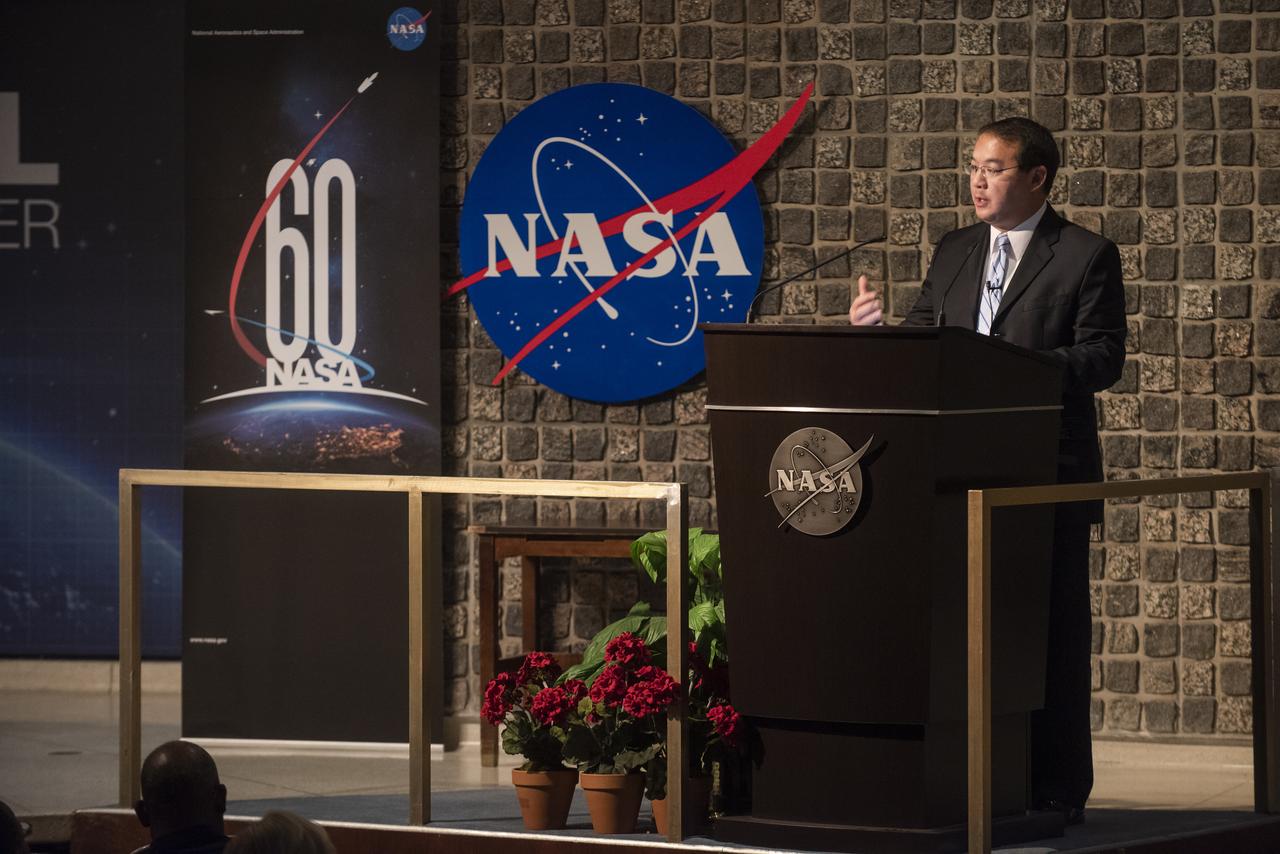
Steve Shih, NASA associate administrator for Diversity & Equal Opportunity, addresses NASA team members during a Nov. 6 mentoring event at the agency's Marshall Space Flight Center. Shih discussed ways for team members on both sides of the mentoring equation to get the most out of the experience.
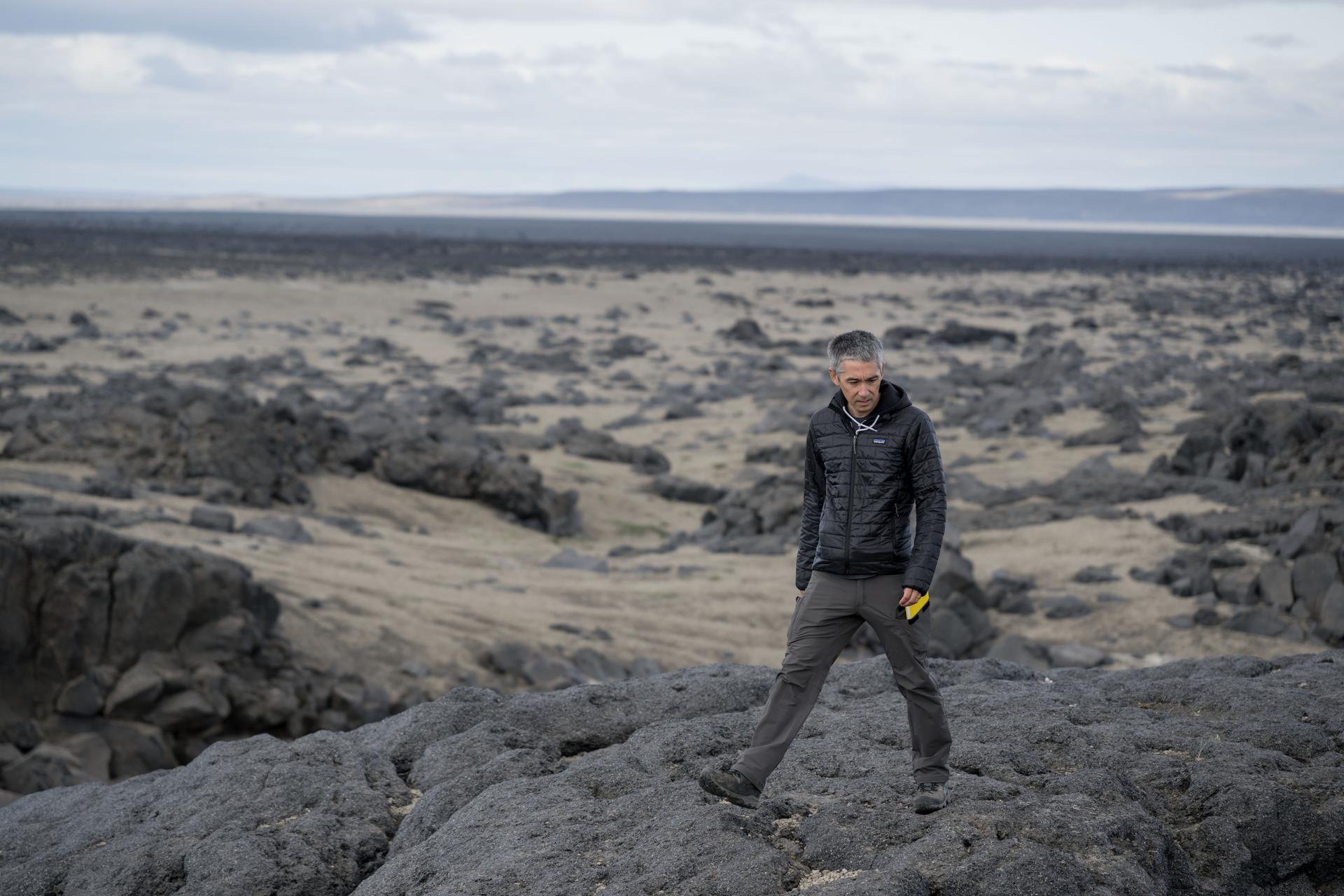
NASA astronaut candidate Yuri Kubo walks across a lava flow in Iceland during an Artemis geology field training expedition. Iceland’s diverse volcanic terrain is an excellent stand-in for lunar and planetary processes and provides an ideal environment in which to simulate surface science operations. Credit: NASA/James Blair
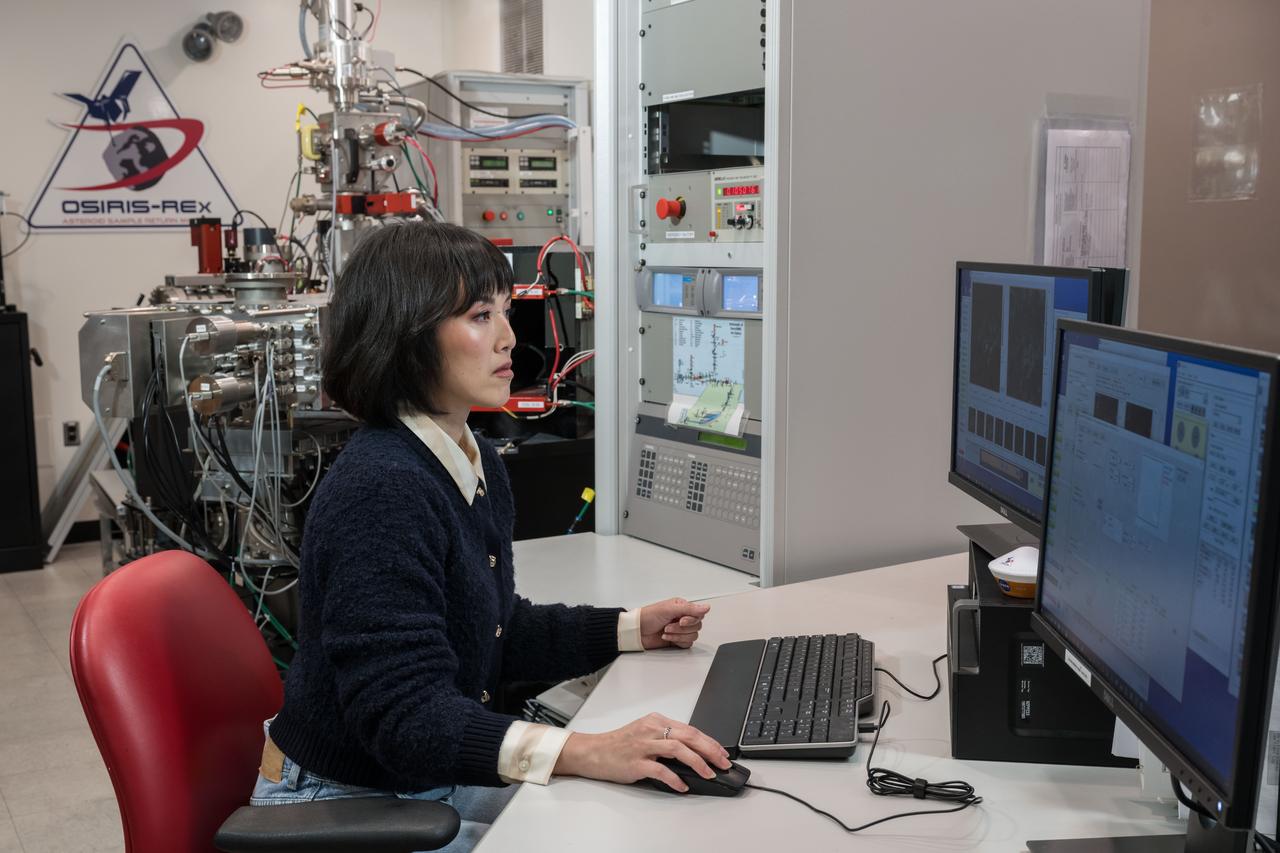
Ann Nguyen, co-lead author of a new paper that gives insights into the diverse origin of asteroid Bennu’s “parent” asteroid works alongside the NanoSIMS 50L (nanoscale secondary ion mass spectrometry) ion microprobe in the Astromaterials Research and Exploration Science Division at NASA’s Johnson Space Center in Houston.

The audience for a Take Up Space (Literally) presentation at the 30th annual ESSENCE Fest in New Orleans on July 5 listens to a conversation with NASA representatives about Black women in the aerospace industry and diversity in science, technology, engineering, and mathematics (STEM).
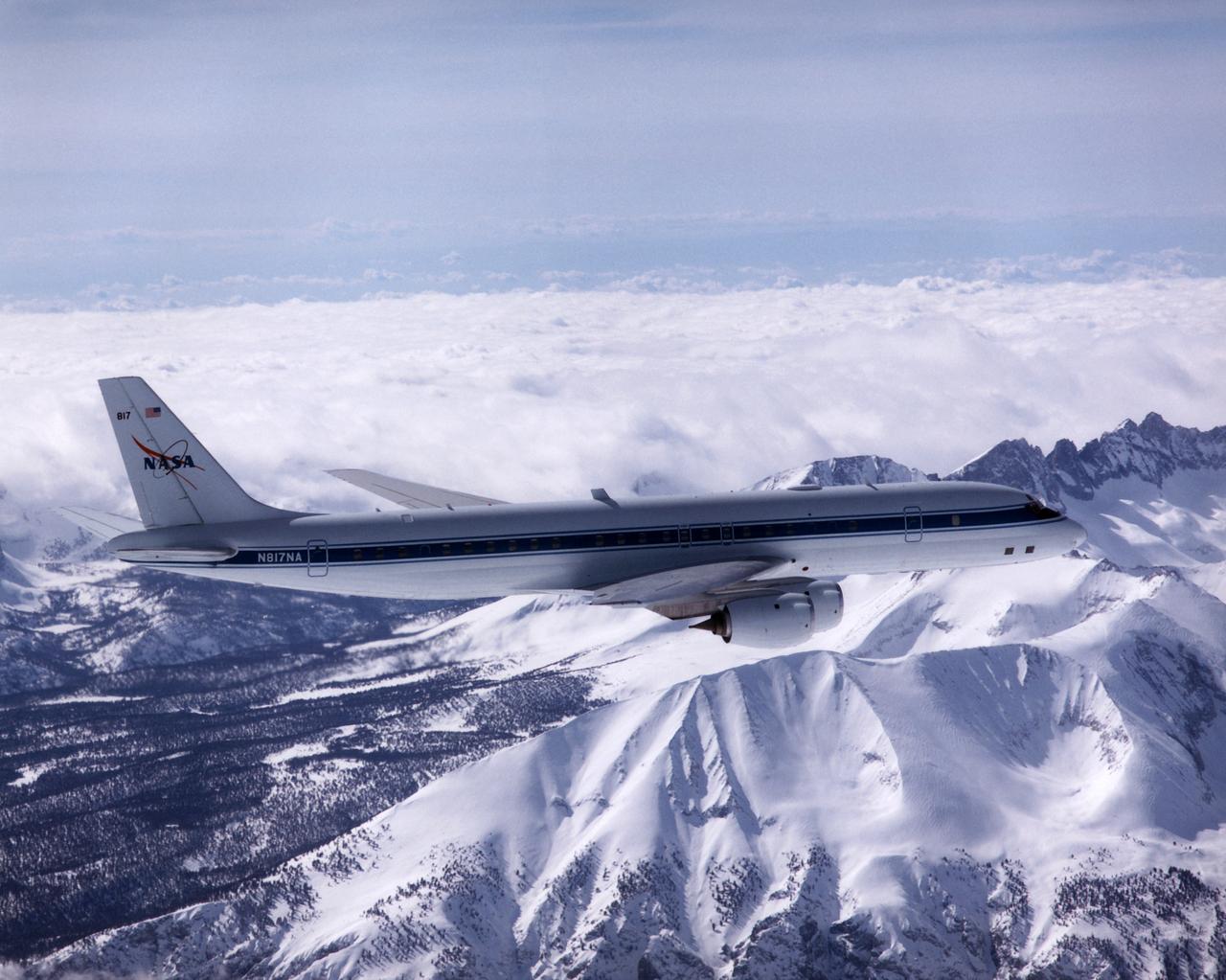
NASA's DC-8 Airborne Laboratory during a flight over the snow-covered Sierra Nevada Mountains. Over the past several years the DC-8 has conducted research missions in such diverse places as the Pacific in spring and Sweden in winter.
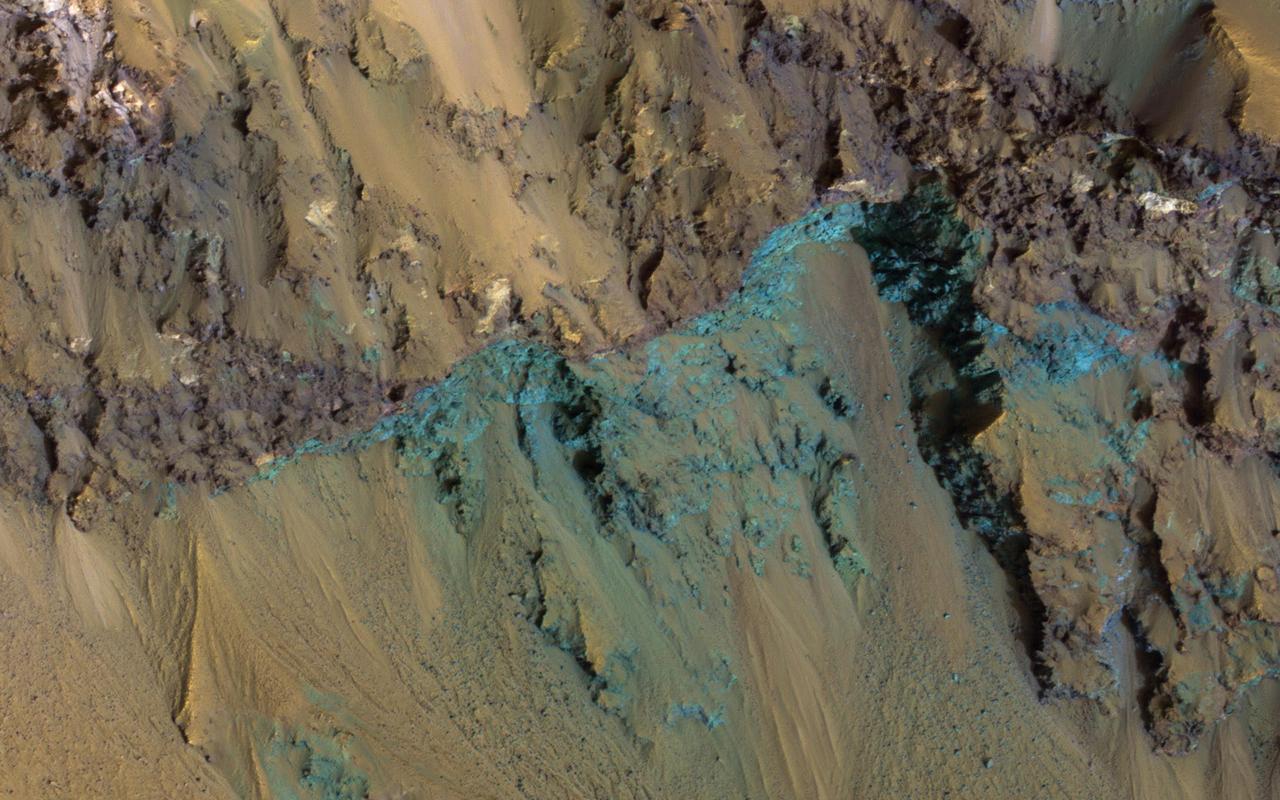
This image from NASA's Mars Reconnaissance Orbiter (MRO) shows Hale Crater, a large impact crater (more than 100 kilometers) with a suite of interesting features such as active gullies, active recurring slope lineae, and extensive icy ejecta flows. There are also exposed diverse (colorful) bedrock units. https://photojournal.jpl.nasa.gov/catalog/PIA22465
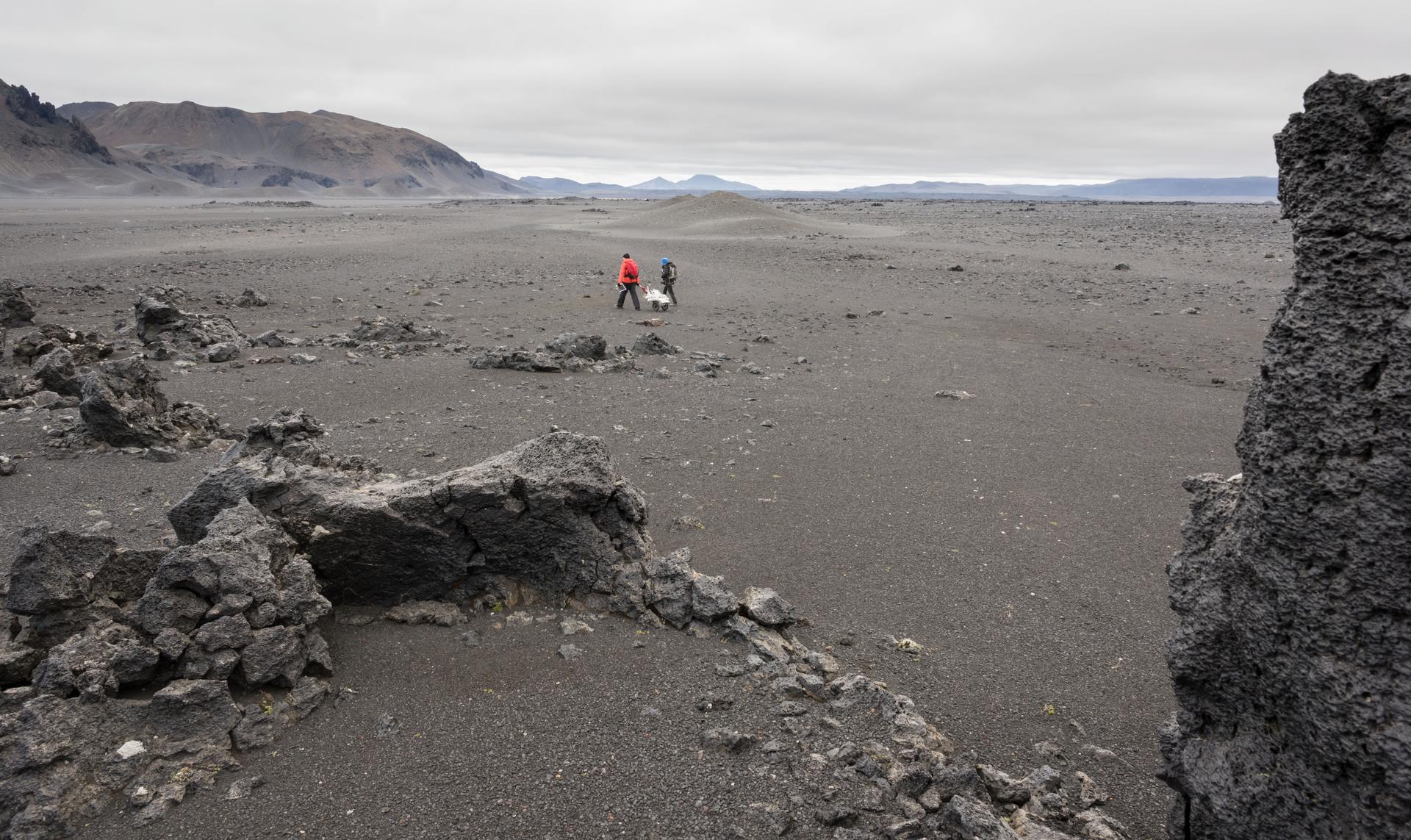
Participants in Artemis geology field training expedition walk a tool cart across a volcanic landscape in Iceland. Iceland’s diverse volcanic terrain is an excellent stand-in for lunar and planetary processes and provides an ideal environment in which to simulate surface science operations. Credit: NASA/James Blair
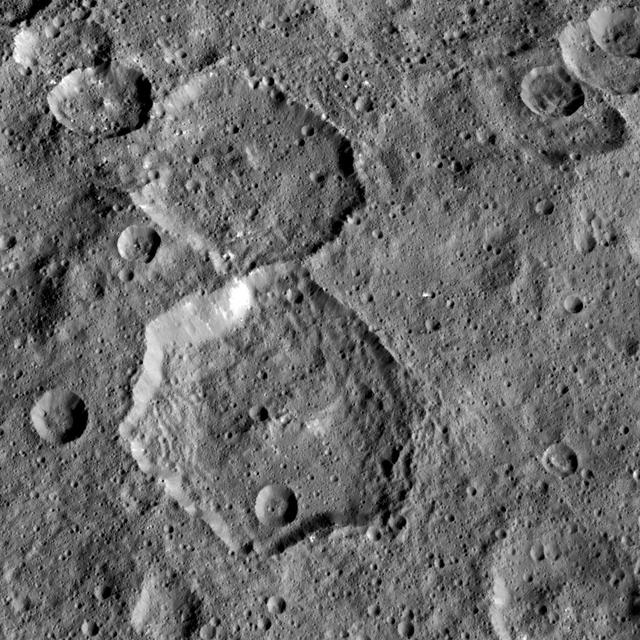
NASA's Dawn mission has found that craters on Ceres show a diversity of shapes that provide important clues about the structure of Ceres' subsurface. The bottom half of this pair of craters is called Fejokoo, named after the Nigerian god who supplied yams. The hexagonal shape of that 42-mile (68-kilometer) crater is probably due to the presence of fractures in the crust, along which the crater rims tend to align. Polygonal craters are frequent on Ceres. Most display six or seven sides, like in the case of Fejokoo, but a few nonagons -- nine-sided shapes -- have been discovered. Polygonal craters are also commonly found on other solar system bodies, such as Mars, Earth's moon and icy moons of giant planets. Dawn took this image on May 4, 2015, from an altitude of 915 miles (1,470 kilometers). The image has a resolution of 450 feet (140 meters) per pixel. http://photojournal.jpl.nasa.gov/catalog/PIA21399
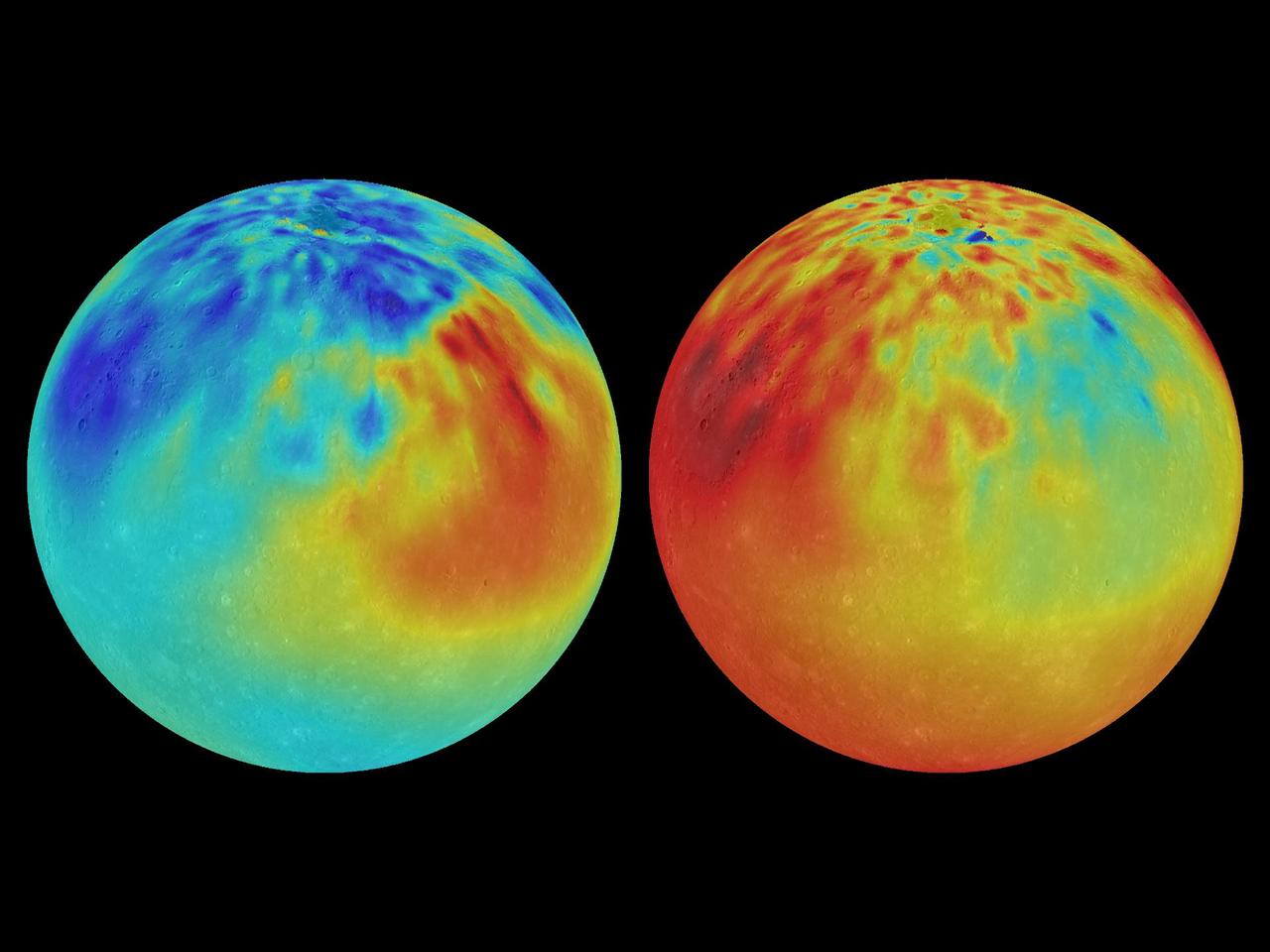
During NASA MESSENGER four-year orbital mission, the spacecraft X-Ray Spectrometer XRS instrument mapped out the chemical composition of Mercury and discovered striking regions of chemical diversity. These maps of magnesium/silicon (left) and aluminium/silicon (right) use red colors to indicate high values and blue colors for low values. In the maps shown here, the Caloris basin can be identified as a region with low Mg/Si and high Ca/Si on the upper left of each map. An extensive region with high Mg/Si is also clearly visible in the maps but is not correlated with any visible impact basin. Instrument: X-Ray Spectrometer (XRS) and Mercury Dual Imaging System (MDIS) Left Image: Map of Mg/Si Right Image: Map of Al/Si http://photojournal.jpl.nasa.gov/catalog/PIA19417
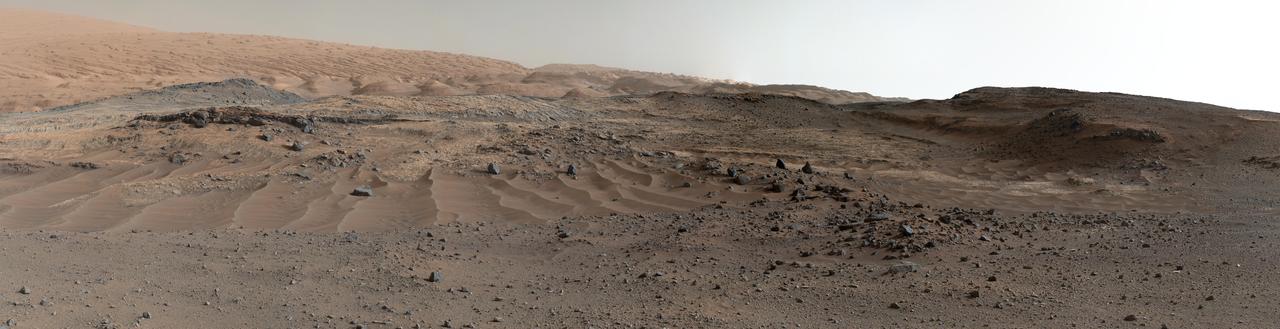
A southward-looking panorama combining images from both cameras of the Mast Camera Mastcam instrument on NASA Curiosity Mars Rover shows diverse geological textures on Mount Sharp. A southward-looking panorama combining images from both cameras of the Mast Camera (Mastcam) instrument on NASA's Curiosity Mars Rover shows diverse geological textures on Mount Sharp. Three years after landing on Mars, the mission is investigating this layered mountain for evidence about changes in Martian environmental conditions, from an ancient time when conditions were favorable for microbial life to the much-drier present. Gravel and sand ripples fill the foreground, typical of terrains that Curiosity traversed to reach Mount Sharp from its landing site. Outcrops in the midfield are of two types: dust-covered, smooth bedrock that forms the base of the mountain, and sandstone ridges that shed boulders as they erode. Rounded buttes in the distance contain sulfate minerals, perhaps indicating a change in the availability of water when they formed. Some of the layering patterns on higher levels of Mount Sharp in the background are tilted at different angles than others, evidence of complicated relationships still to be deciphered. The scene spans from southeastward at left to southwestward at right. The component images were taken on April 10 and 11, 2015, the 952nd and 953rd Martian days (or sols) since the rover's landing on Mars on Aug. 6, 2012, UTC (Aug. 5, PDT). Images in the central part of the panorama are from Mastcam's right-eye camera, which is equipped with a 100-millimeter-focal-length telephoto lens. Images used in outer portions, including the most distant portions of the mountain in the scene, were taken with Mastcam's left-eye camera, using a wider-angle, 34-millimeter lens. http://photojournal.jpl.nasa.gov/catalog/PIA19803
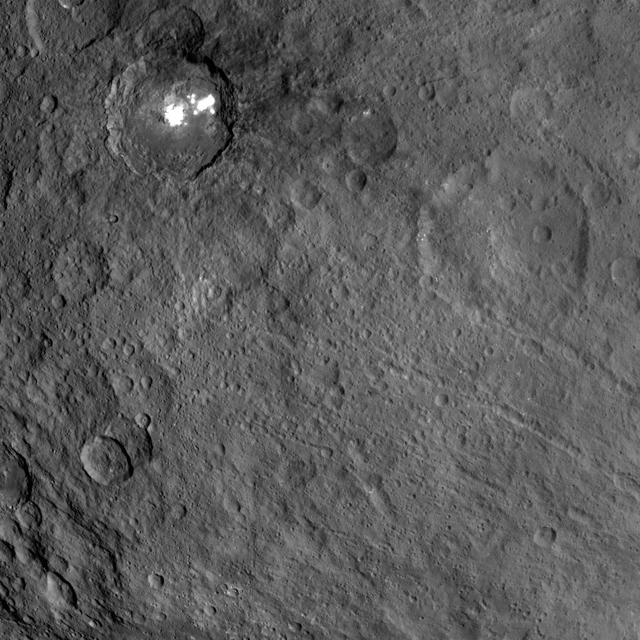
This view obtained by NASA's Dawn spacecraft during its Survey orbit illustrates the diversity and complexity of Ceres' geology. It shows familiar features: Occator Crater with its bright deposits (called faculae) of carbonates and other salts, a series of linear features (at right) called Samhain Catenae, and another large crater on the right side of the image called Kirnis. A relatively fresh crater called Lociyo, superimposed on an older crater, can be seen toward the bottom left of the picture. Studying the morphologies and relationships between various types of geological features can help scientists reconstruct Ceres' history. Occator appears to be one of the youngest features in this picture, except for a couple of smaller craters. The 71-mile-wide (115-kilometer-wide) Kirnis Crater on the other hand is an old, eroded crater. It owes its peculiar polygonal shape in part to its overlap with one of the Samhain Catenae. This illustrates the role of fractures in driving the geometry of some of Ceres' craters. The origin of these particular catenae is not understood yet, and is not necessarily related to the Pongal Catena. Kirnis Crater is named after a Lithuanian spirit-guardian of cherry trees, whereas the Samhain Catenae refer to a Gaelic festival organized at the end of the harvest season. It was observed in Ireland and Scotland during seven days in October and November, nearly halfway between the autumn equinox and the winter solstice. This picture was obtained on June 25, 2015, from an altitude of 2,700 miles (4,400 kilometers). It is centered at 1.7 degrees north latitude, and 249 degrees east longitude. https://photojournal.jpl.nasa.gov/catalog/PIA21409
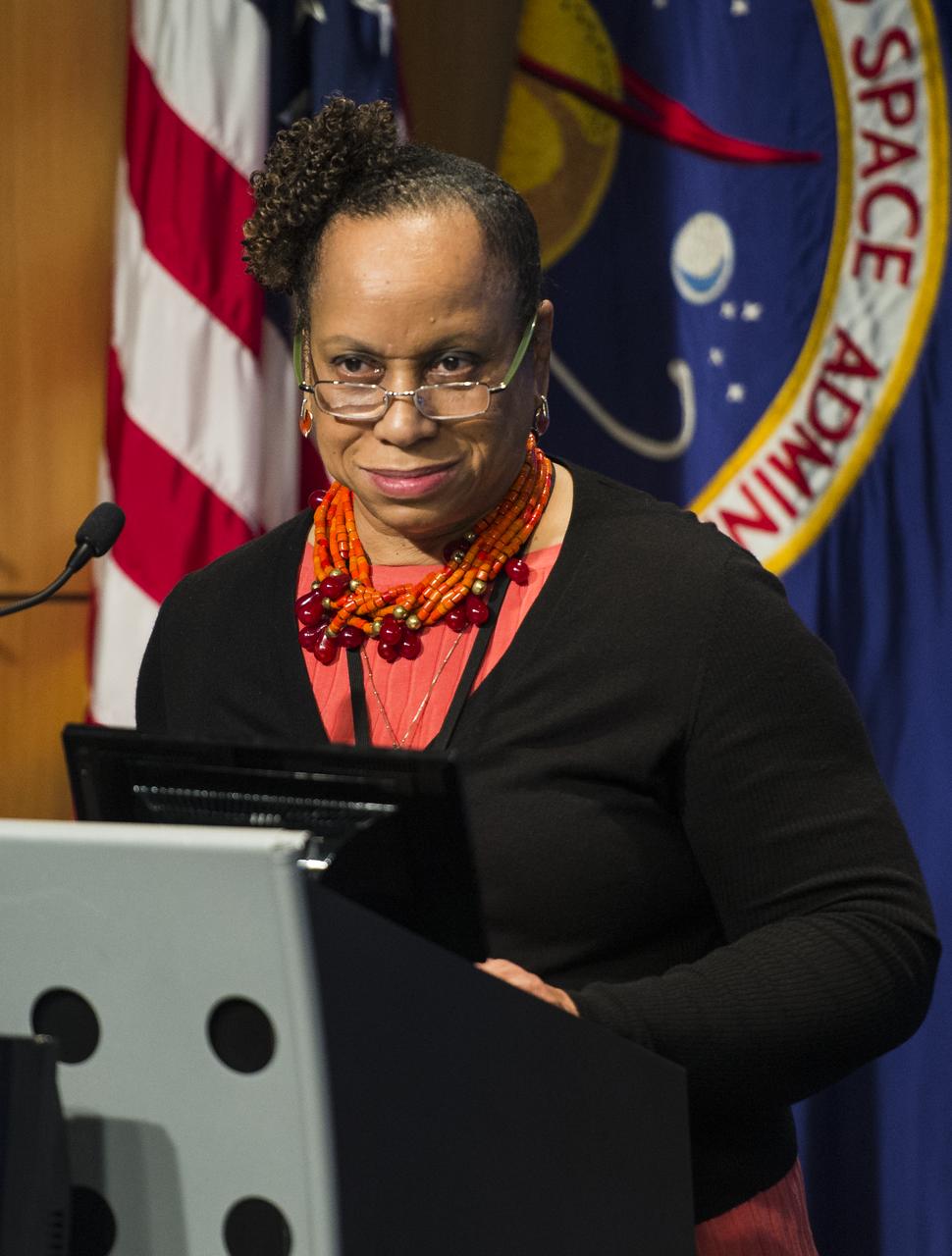
Brenda Manuel, Associate Administrator for Diversity and Equal Opportunity at NASA gives opening remarks at an event celebrating the 50th Anniversary of the Civil Rights Act of 1964 on Monday, June 23, 2014 in the James E. Webb Auditorium at NASA Headquarters in Washington, DC. the event highlighted the influence of the Civil Rights Act on NASA. Photo Credit: (NASA/Joel Kowsky)
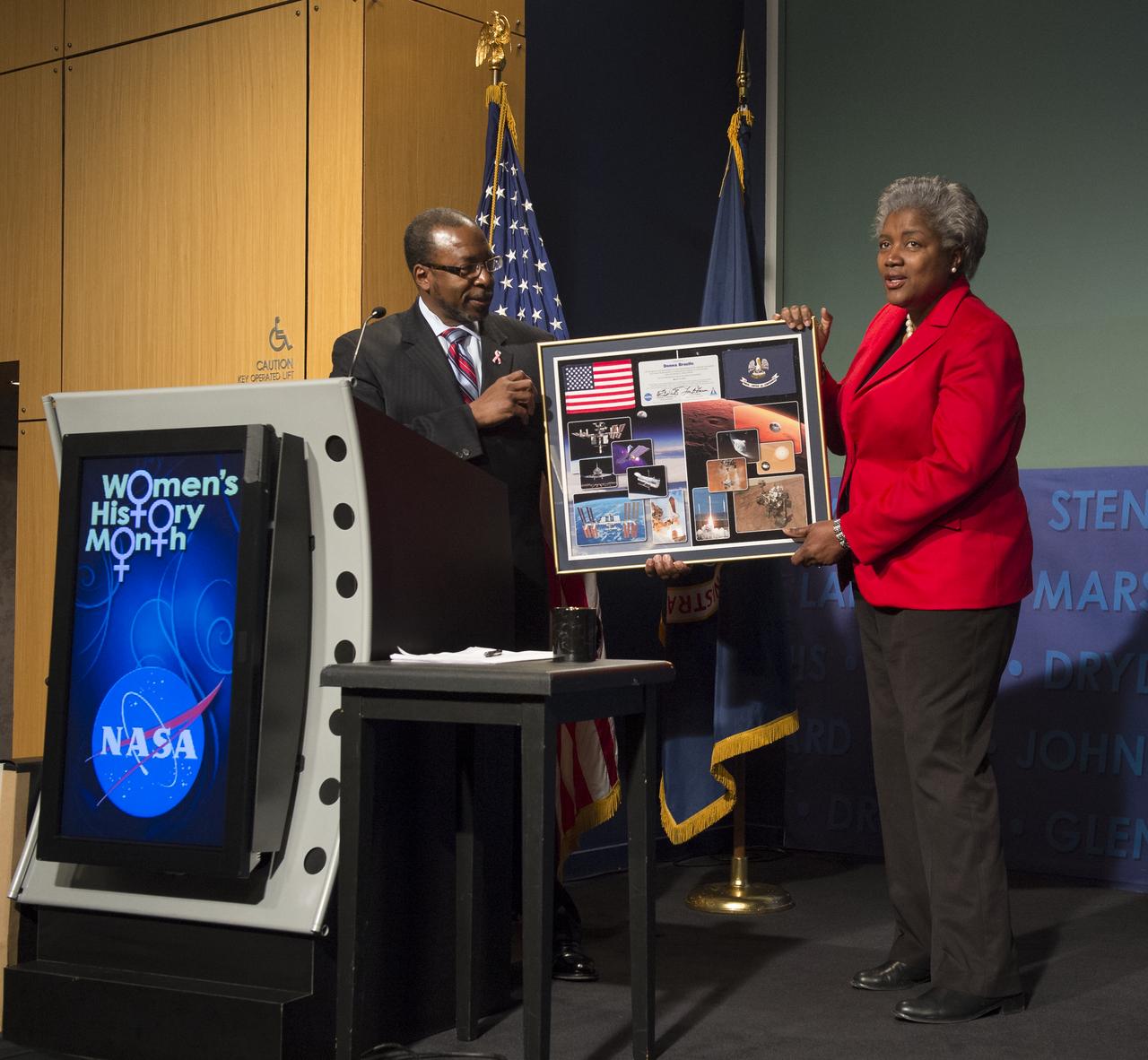
Dr. Woodrow Whitlow, Jr. (left), Associate Administrator for Mission Support Directorate at NASA Headquarters presents Donna Brazile, keynote speaker at a program celebrating National Women's History Month, with a framed NASA montage, Thursday, March 14, 2013 in Washington. The theme of theprogram was "Women Inspiring Innovation Through Imagination," and was sponsored by the HQ Equal Opportunity and Diversity Management Division at NASA Headquarters. The event also commemorates the 100th Anniversary of the Women's Suffrage March on Washington. Photo Credit: (NASA/Carla Cioffi)
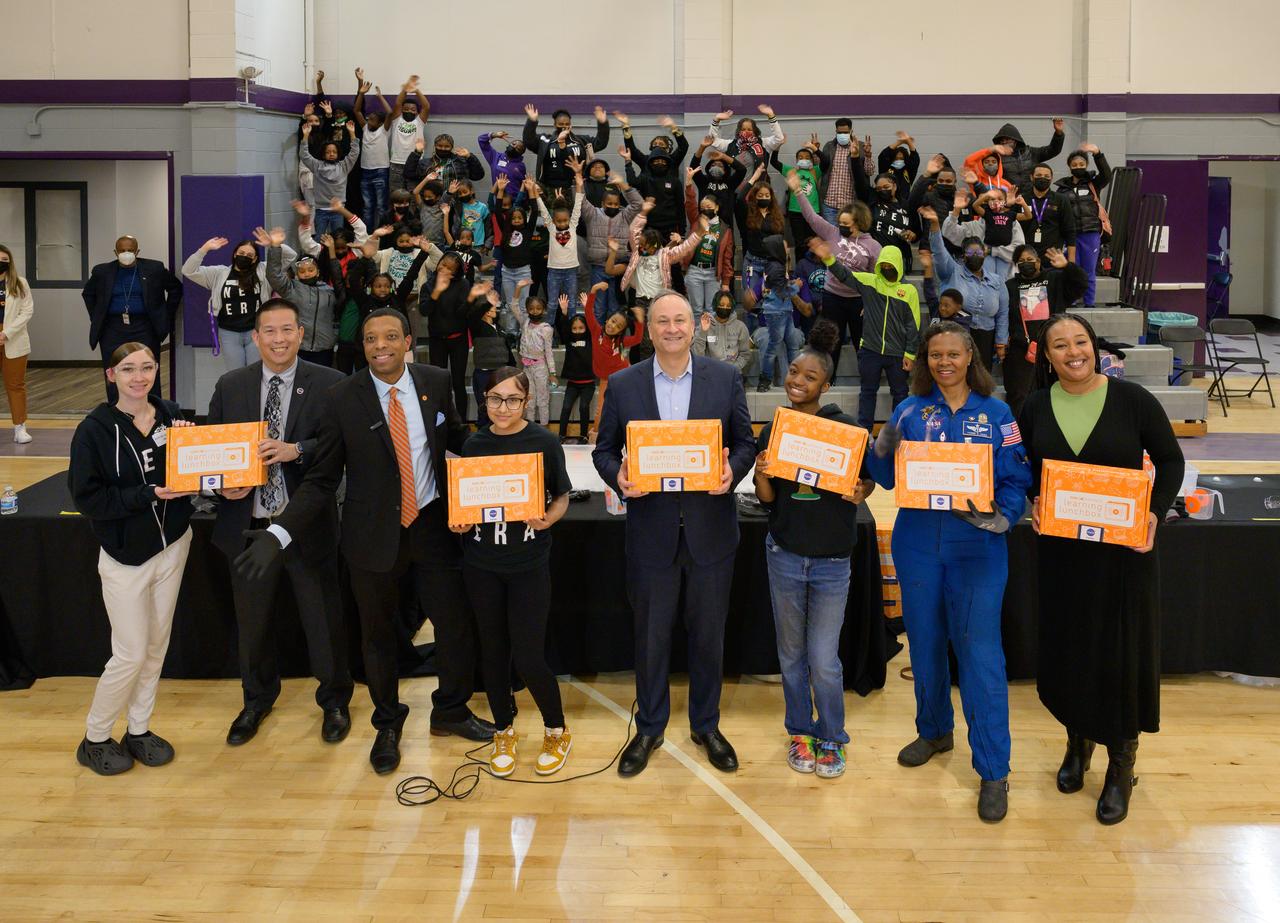
Second Gentleman Douglas Emhoff, center, with COSI and NASA staff and students from the East Oakland Youth Development Center in Oakland, California. Hosted in honor of Women’s History Month by the Center of Science and Industry (COSI) under a NASA OSTEM agreement, the Oakland activities reached 500 East Bay students and provided five space-focused learning activities that showcase the diversity of STEM at NASA.

Donna Brazile, adjunct professor at Georgetown University, syndicated newspaper columnist and vice chair of voter registration and participation at the Democratic National Committee (DNC), gives the keynote speech at a program celebrating National Women's History Month at NASA Headquarters, Thursday, March 14, 2013 in Washington. The theme of this year's program was "Women Inspiring Innovation Through Imagination." The program was sponsored by the HQ Equal Opportunity and Diversity Management Division at NASA Headquarters and commemorates the 100th Anniversary of the Women's Suffrage March on Washington. Photo Credit: (NASA/Carla Cioffi)
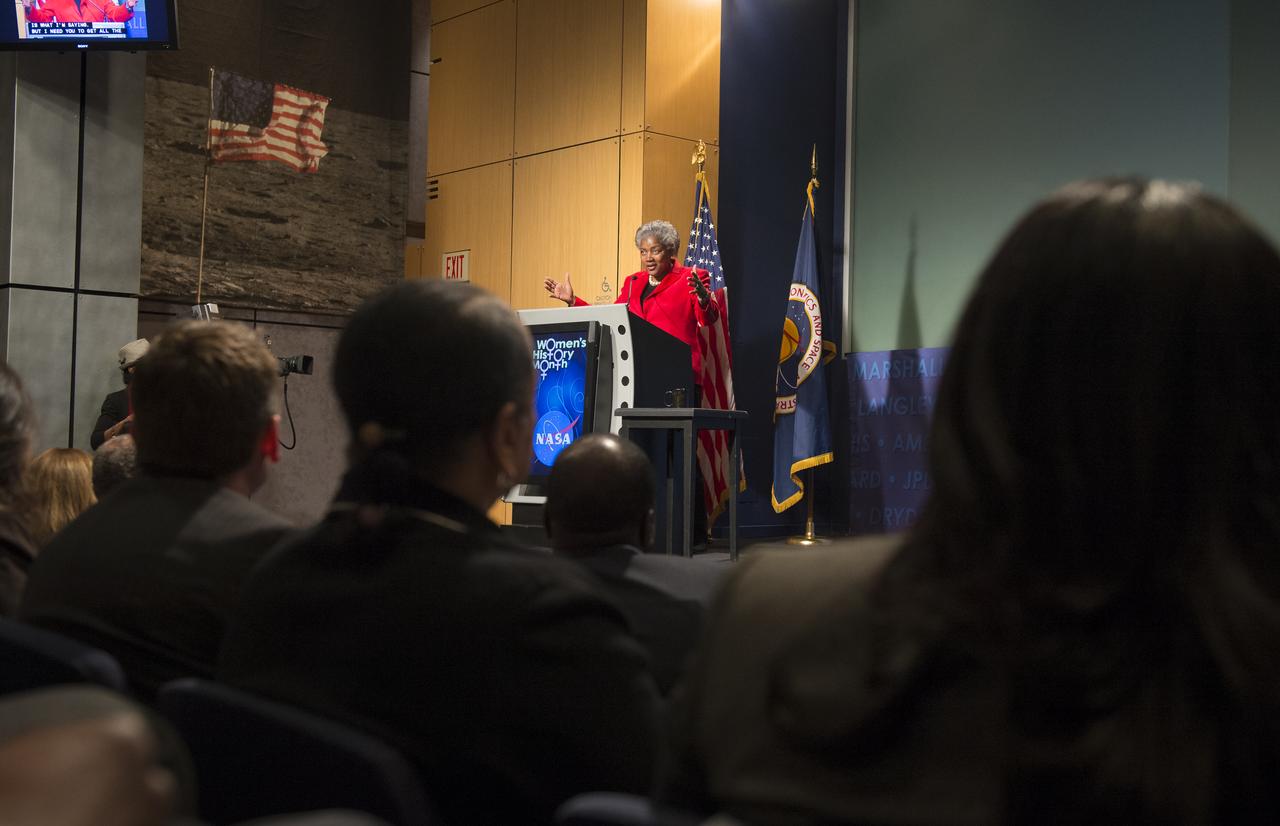
Donna Brazile, adjunct professor at Georgetown University, syndicated newspaper columnist and vice chair of voter registration and participation at the Democratic National Committee (DNC), gives the keynote speech at a program celebrating National Women's History Month at NASA Headquarters, Thursday, March 14, 2013 in Washington. The theme of this year's program was "Women Inspiring Innovation Through Imagination." The program was sponsored by the HQ Equal Opportunity and Diversity Management Division at NASA Headquarters and commemorates the 100th Anniversary of the Women's Suffrage March on Washington. Photo Credit: (NASA/Carla Cioffi)

Donna Brazile, adjunct professor at Georgetown University, syndicated newspaper columnist and vice chair of voter registration and participation at the Democratic National Committee (DNC), gives the keynote speech at a program celebrating National Women's History Month at NASA Headquarters, Thursday, March 14, 2013 in Washington. The theme of this year's program was "Women Inspiring Innovation Through Imagination." The program was sponsored by the HQ Equal Opportunity and Diversity Management Division at NASA Headquarters and commemorates the 100th Anniversary of the Women's Suffrage March on Washington. Photo Credit: (NASA/Carla Cioffi)
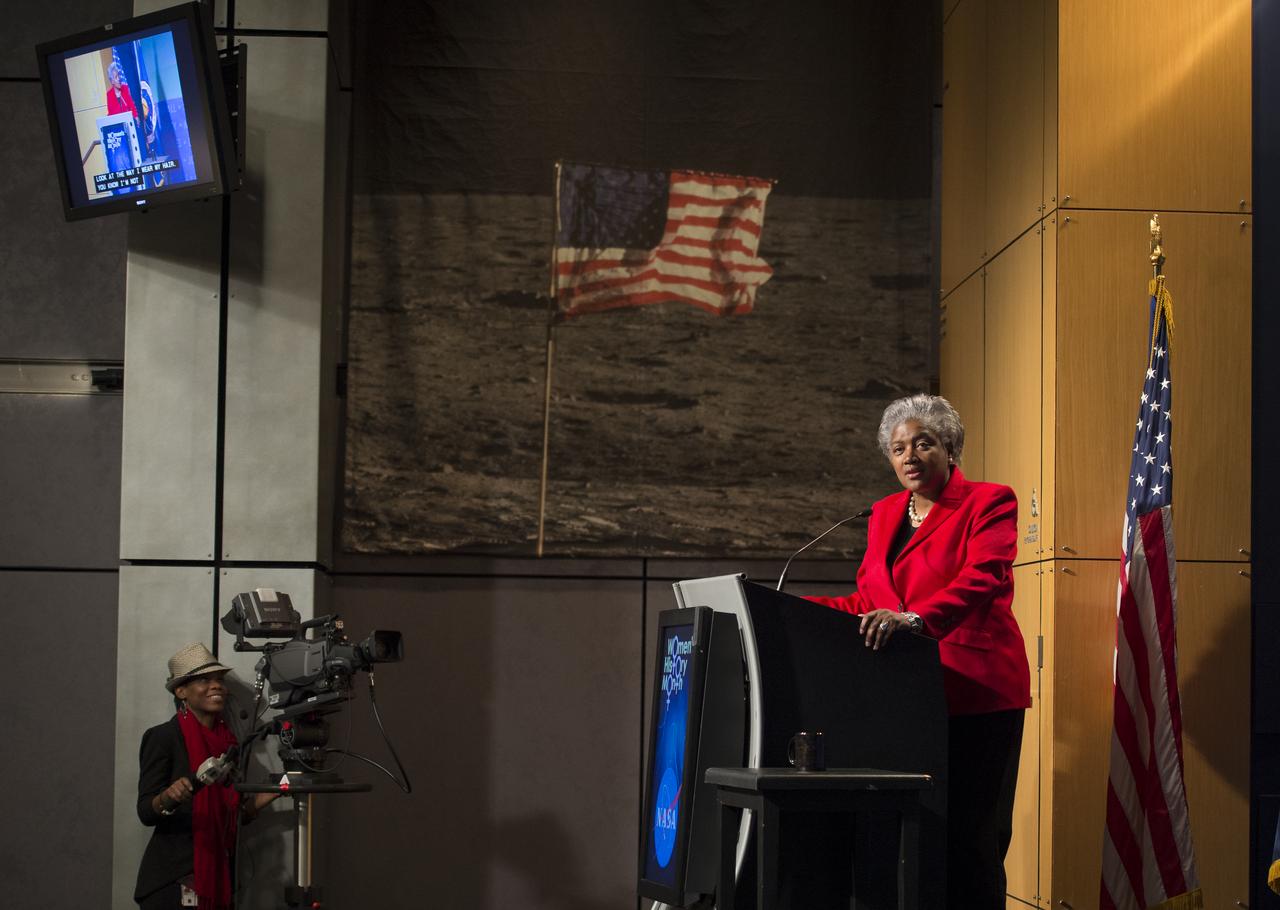
Donna Brazile, adjunct professor at Georgetown University, syndicated newspaper columnist and vice chair of voter registration and participation at the Democratic National Committee (DNC), gives the keynote speech at a program celebrating National Women's History Month at NASA Headquarters, Thursday, March 14, 2013 in Washington. The theme of this year's program was "Women Inspiring Innovation Through Imagination." The program was sponsored by the HQ Equal Opportunity and Diversity Management Division at NASA Headquarters and commemorates the 100th Anniversary of the Women's Suffrage March on Washington. Photo Credit: (NASA/Carla Cioffi)

Donna Brazile, adjunct professor at Georgetown University, syndicated newspaper columnist and vice chair of voter registration and participation at the Democratic National Committee (DNC), gives the keynote speech at a program celebrating National Women's History Month at NASA Headquarters, Thursday, March 14, 2013 in Washington. The theme of this year's program was "Women Inspiring Innovation Through Imagination." The program was sponsored by the HQ Equal Opportunity and Diversity Management Division at NASA Headquarters and commemorates the 100th Anniversary of the Women's Suffrage March on Washington. Photo Credit: (NASA/Carla Cioffi)
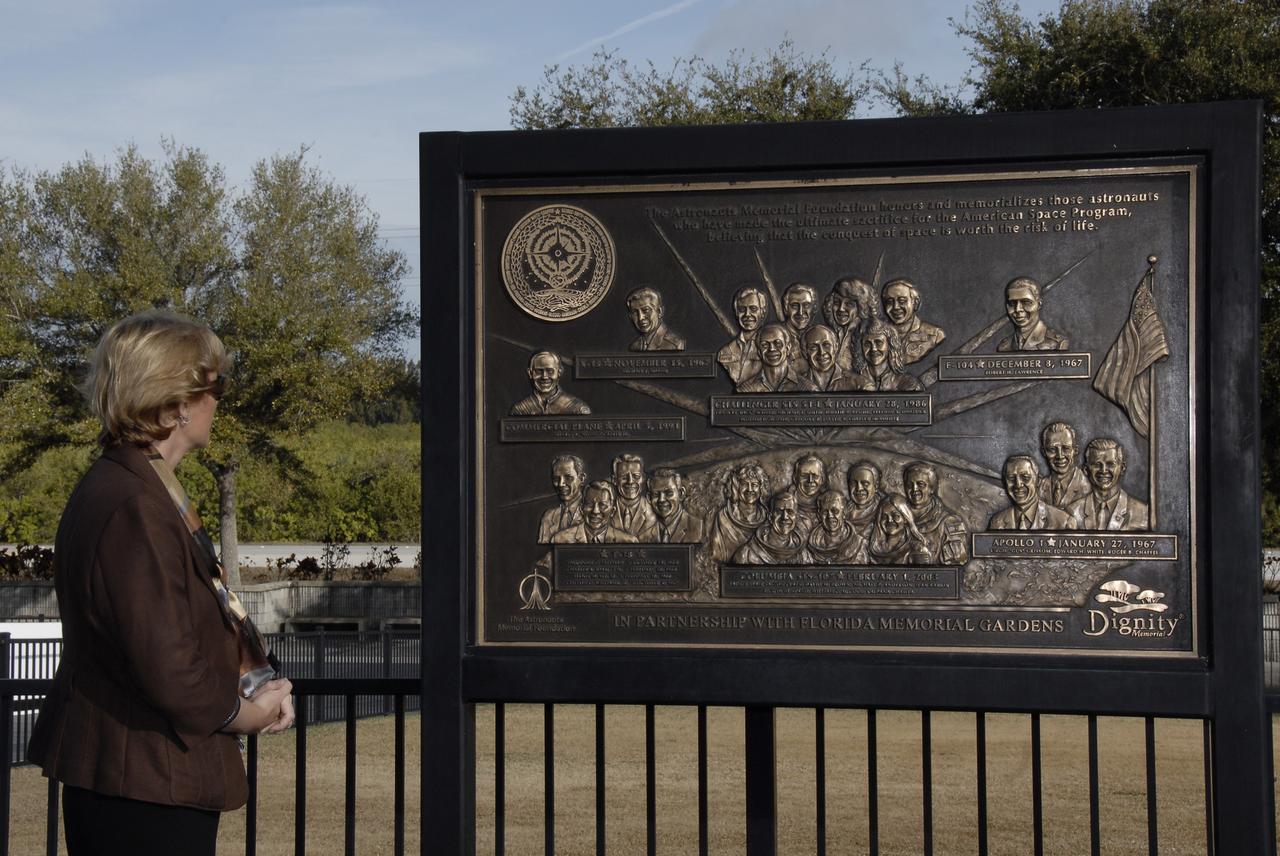
CAPE CANAVERAL, Fla. – Near the Space Mirror Memorial at NASA's Kennedy Space Center Visitor Complex, a large plaque commemorates the crews of Apollo 1 and space shuttles Challenger and Columbia who lost their lives while furthering the cause of exploration and discovery. At left is Tara Gillam, manager of the Office of Diversity and Equal Opportunity at Kennedy. Jan. 29 is NASA's Day of Remembrance observance and included a wreath-laying ceremony in front of the Space Mirror Memorial. Photo credit: NASA/Kim Shiflett
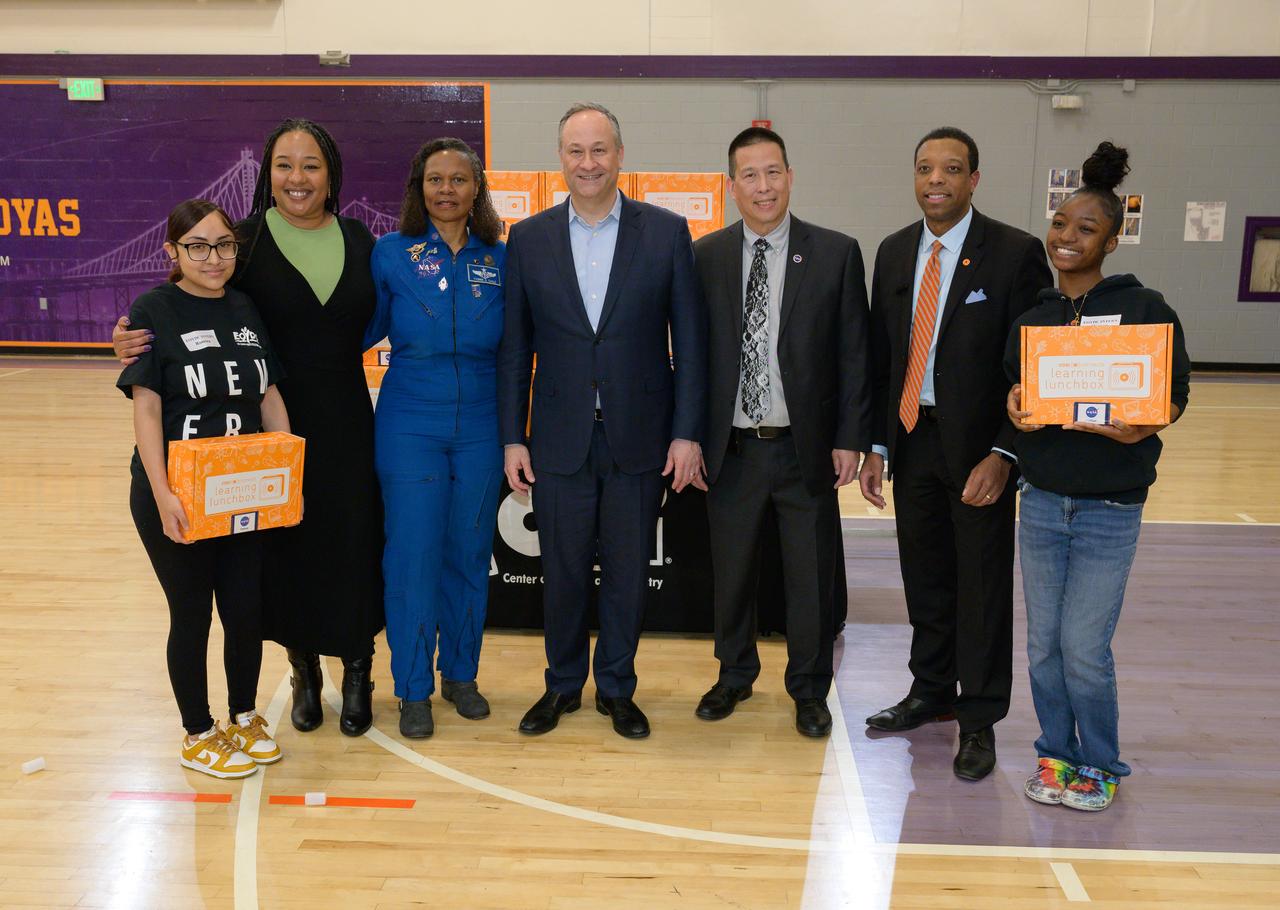
Second Gentleman Douglas Emhoff, center, with NASA and COSI staff at the East Oakland Youth Development Center in Oakland, California. Hosted in honor of Women’s History Month by the Center of Science and Industry (COSI) under a NASA OSTEM agreement, the Oakland activities reached 500 East Bay students and provided five space-focused learning activities that showcase the diversity of STEM at NASA.

J. Keith Motley, Chancellor, University of Massachusetts Boston, and Chair, APLU (Association of Public and Land-grant Universities) Commission on Access, Diversity and Excellence, speaks at the Symposium on Supporting Underrepresented Minority Males in Science, Technology, Engineering and Mathematics (STEM), Tuesday, February 28, 2012 at NASA Headquarters in Washington. Photo Credit: (NASA/Carla Cioffi)
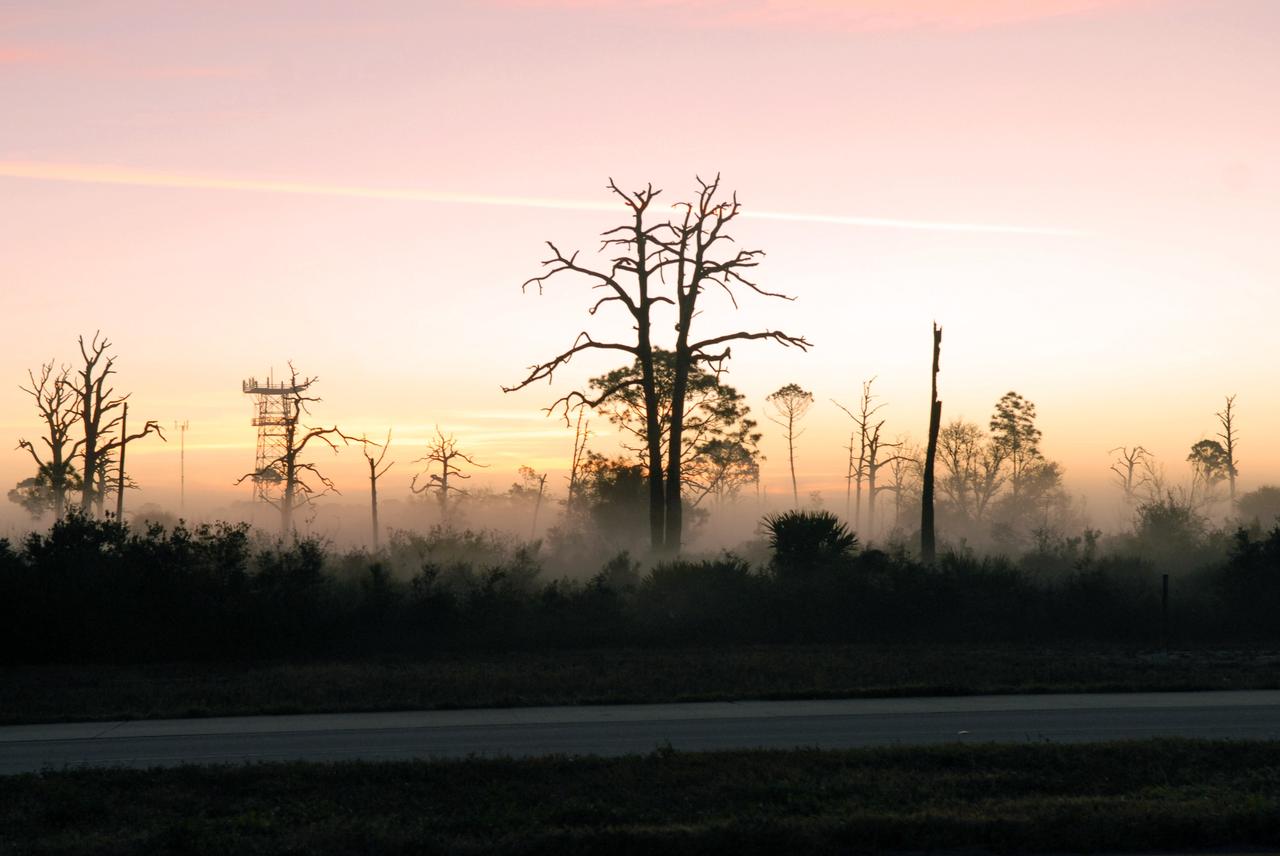
CAPE CANAVERAL, Fla. -- Fog blankets the woods near a road in the Merritt Island National Wildlife Refuge at NASA's Kennedy Space Center in Florida. The center shares a boundary with the refuge that includes salt-water estuaries, brackish marshes, hardwood hammocks and pine flatwoods. The diverse landscape provides habitat for more than 310 species of birds, 25 mammals, 117 fishes and 65 amphibians and reptiles. Photo credit: NASA/Jack Pfaller
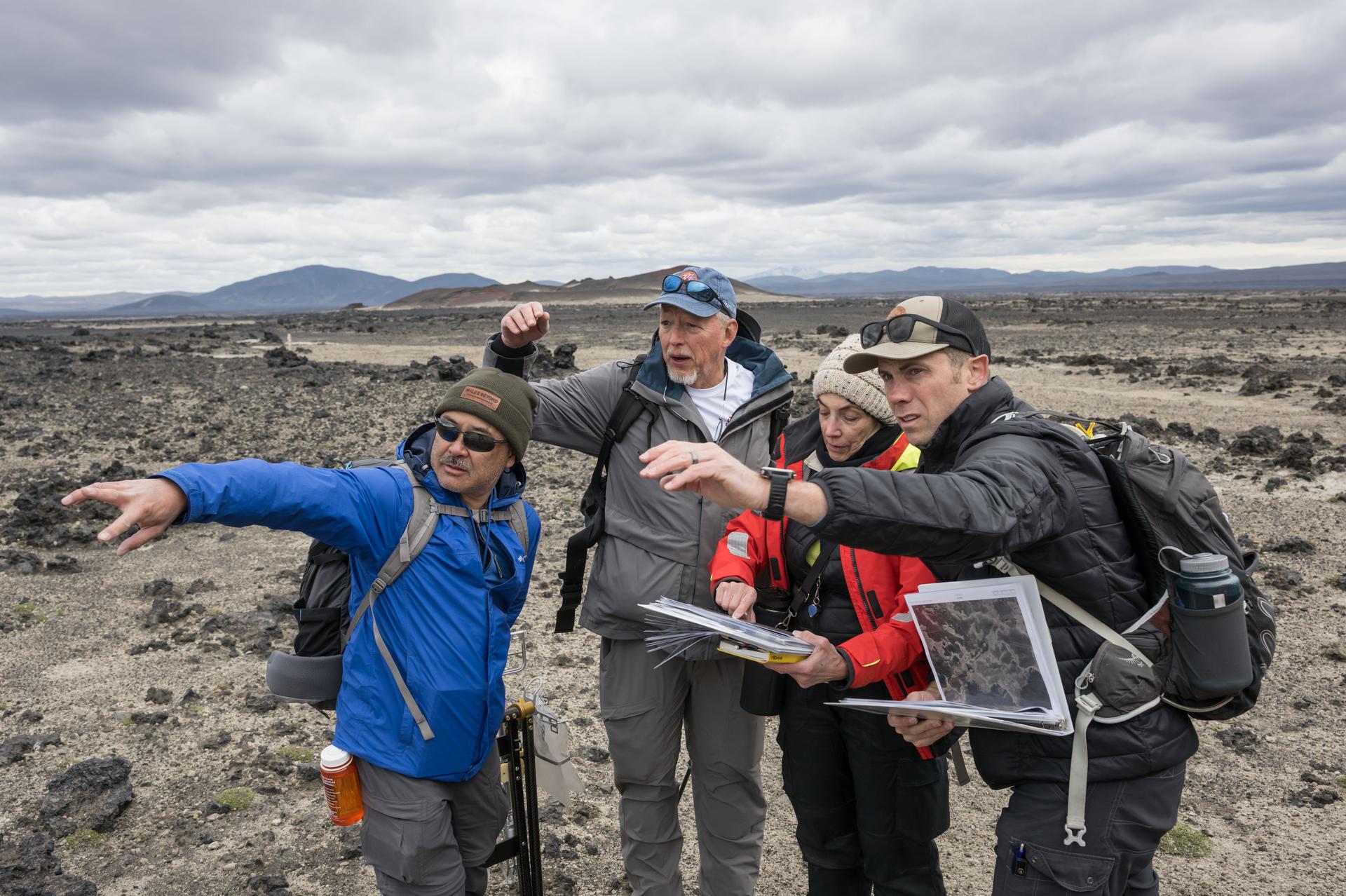
From left, Japan Aerospace Exploration Agency (JAXA) astronaut Aki Hoshide, chief training officer John Ray, EVA task officer Bridget Scheib, and NASA astronaut candidate Cameron Jones participate in a navigation training activity in Iceland as part of an Artemis geology field training expedition. Iceland’s diverse volcanic terrain is an excellent stand-in for lunar and planetary processes and provides an ideal environment in which to simulate surface science operations. Credit: NASA/James Blair

CAPE CANAVERAL, Fla. -- A great white heron joins roseate spoonbills and white ibis searching the water for food at NASA's Kennedy Space Center in Florida. The center shares a boundary with the Merritt Island National Wildlife Refuge that includes salt-water estuaries, brackish marshes, hardwood hammocks and pine flatwoods. The diverse landscape provides habitat for more than 310 species of birds, 25 mammals, 117 fishes and 65 amphibians and reptiles. Photo credit: NASA/Tim Jacobs
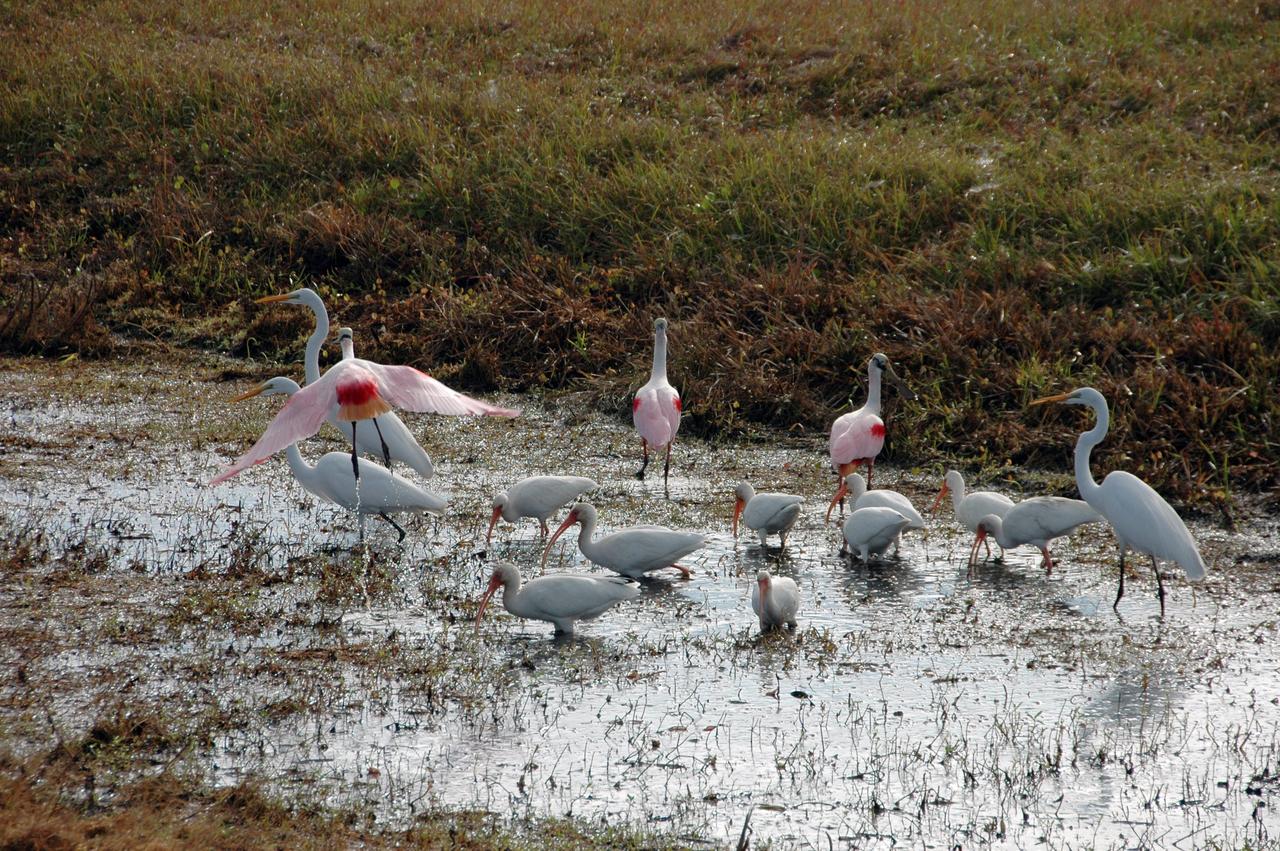
CAPE CANAVERAL, Fla. -- Great white herons, roseate spoonbills and white ibis search the water for food at NASA's Kennedy Space Center in Florida. The center shares a boundary with the Merritt Island National Wildlife Refuge that includes salt-water estuaries, brackish marshes, hardwood hammocks and pine flatwoods. The diverse landscape provides habitat for more than 310 species of birds, 25 mammals, 117 fishes and 65 amphibians and reptiles. Photo credit: NASA/Tim Jacobs
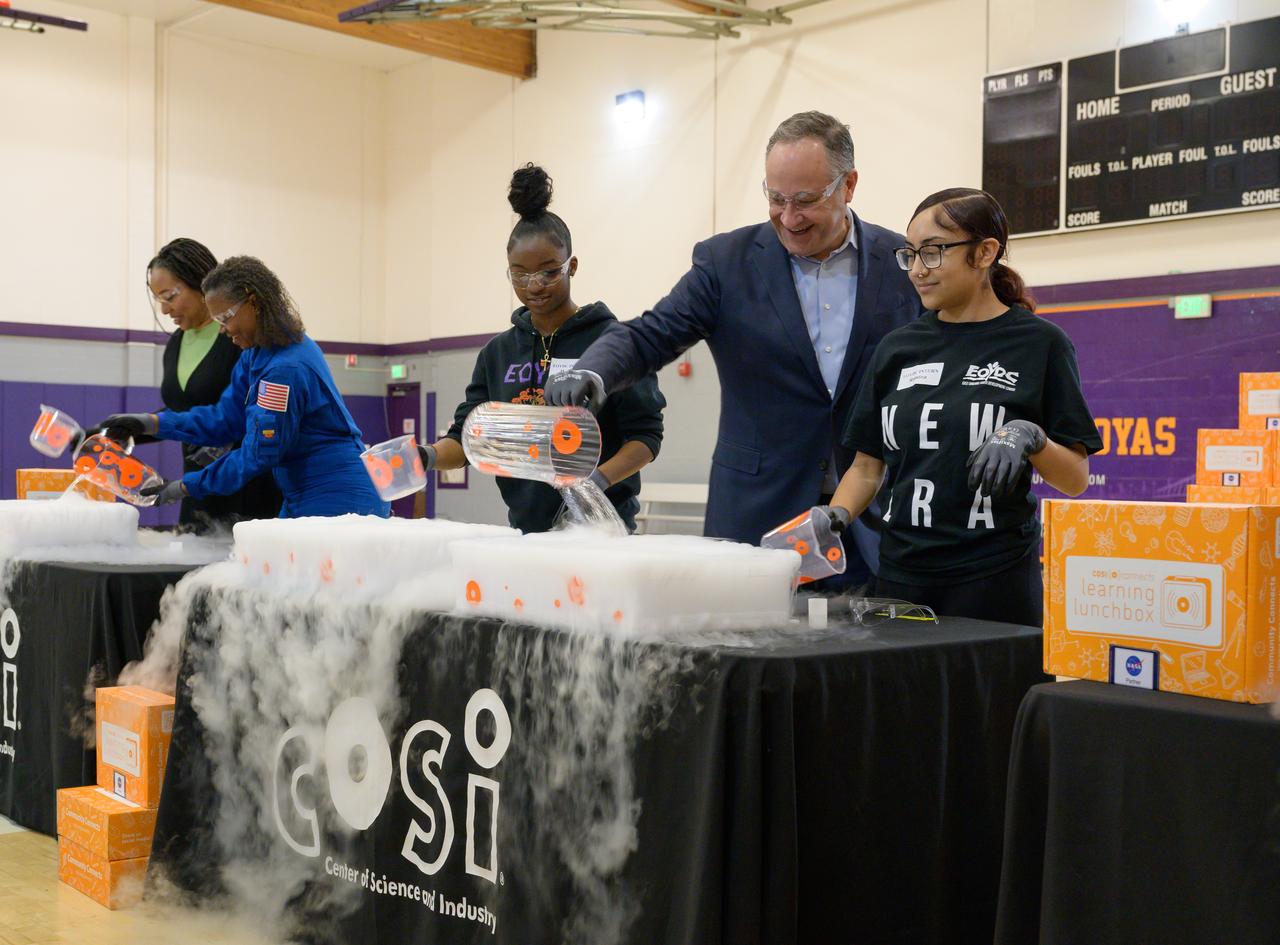
Second Gentleman Douglas Emhoff, second from right, participates in a “make a cloud” demonstration with students at the East Oakland Youth Development Center in Oakland, California. Hosted in honor of Women’s History Month by the Center of Science and Industry (COSI) under a NASA OSTEM agreement, the Oakland activities reached 500 East Bay students and provided five space-focused learning activities that showcase the diversity of STEM at NASA.

J. Keith Motley, Chancellor, University of Massachusetts Boston, and Chair, APLU (Association of Public and Land-grant Universities) Commission on Access, Diversity and Excellence, speaks at the Symposium on Supporting Underrepresented Minority Males in Science, Technology, Engineering and Mathematics (STEM), Tuesday, February 28, 2012 at NASA Headquarters in Washington. Photo Credit: (NASA/Carla Cioffi)
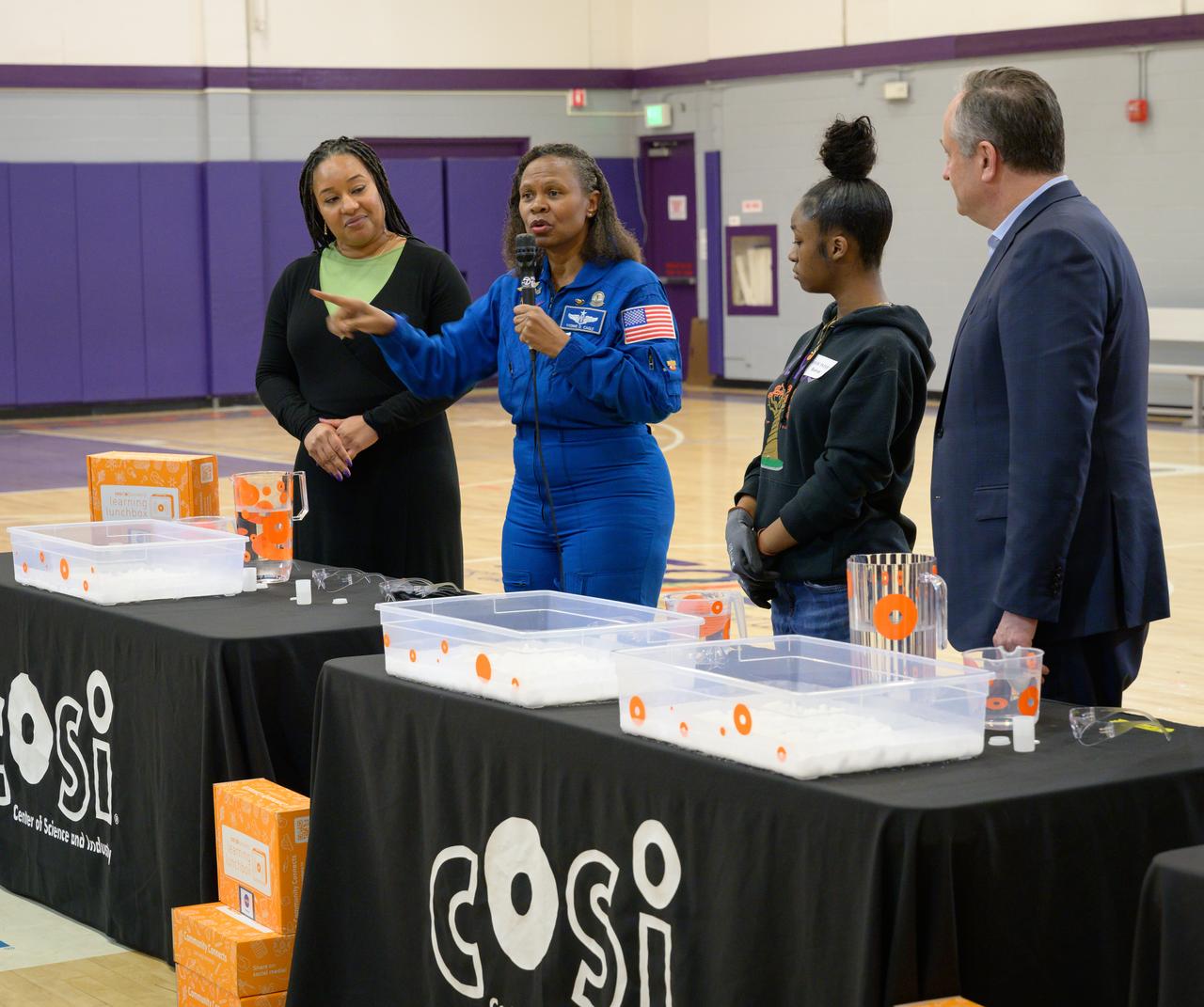
Astronaut Yvonne Cagle provides opening remarks at the East Oakland Youth Development Center in Oakland, California. Hosted in honor of Women’s History Month by the Center of Science and Industry (COSI) under a NASA OSTEM agreement, the Oakland activities reached 500 East Bay students and provided five space-focused learning activities that showcase the diversity of STEM at NASA.
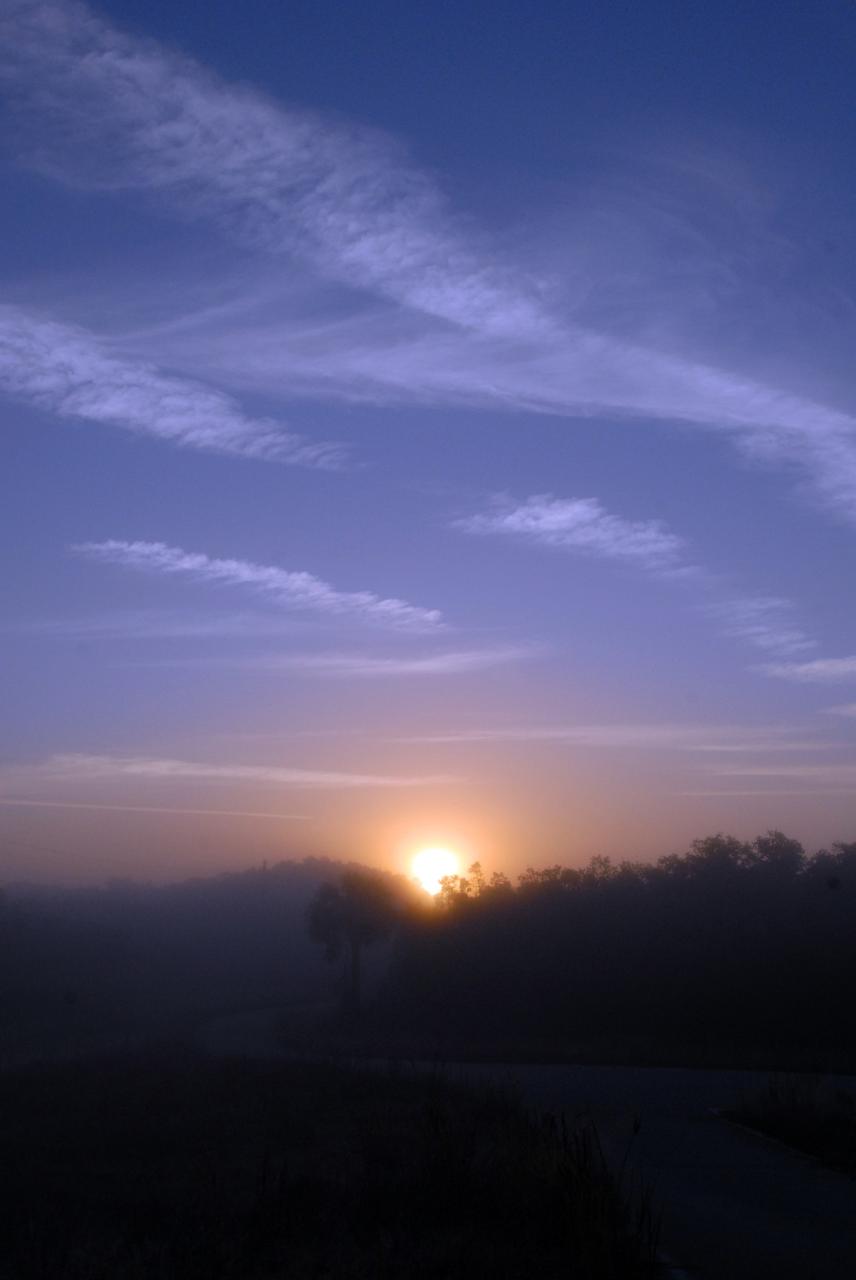
CAPE CANAVERAL, Fla. – Sunrise casts an orange glow over the wooded landscape surrounding NASA's Kennedy Space Center in Florida. The center shares a boundary with the Merritt Island National Wildlife Refuge that includes salt-water estuaries, brackish marshes, hardwood hammocks and pine flatwoods. The diverse landscape provides habitat for more than 310 species of birds, 25 mammals, 117 fishes and 65 amphibians and reptiles. Photo credit: NASA/Jack Pfaller
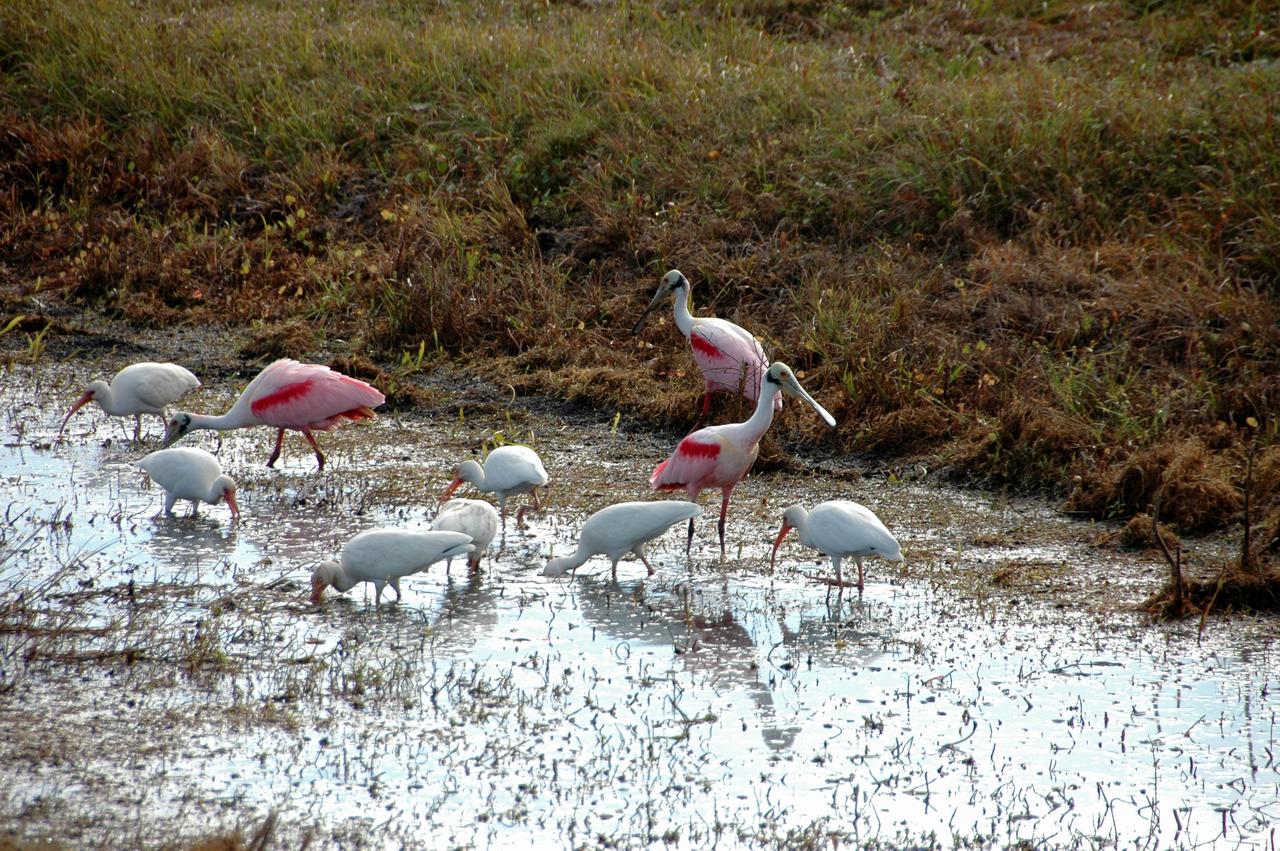
CAPE CANAVERAL, Fla. -- Roseate spoonbills and white ibis search the water for food at NASA's Kennedy Space Center in Florida. The center shares a boundary with the Merritt Island National Wildlife Refuge that includes salt-water estuaries, brackish marshes, hardwood hammocks and pine flatwoods. The diverse landscape provides habitat for more than 310 species of birds, 25 mammals, 117 fishes and 65 amphibians and reptiles. Photo credit: NASA/Tim Jacobs
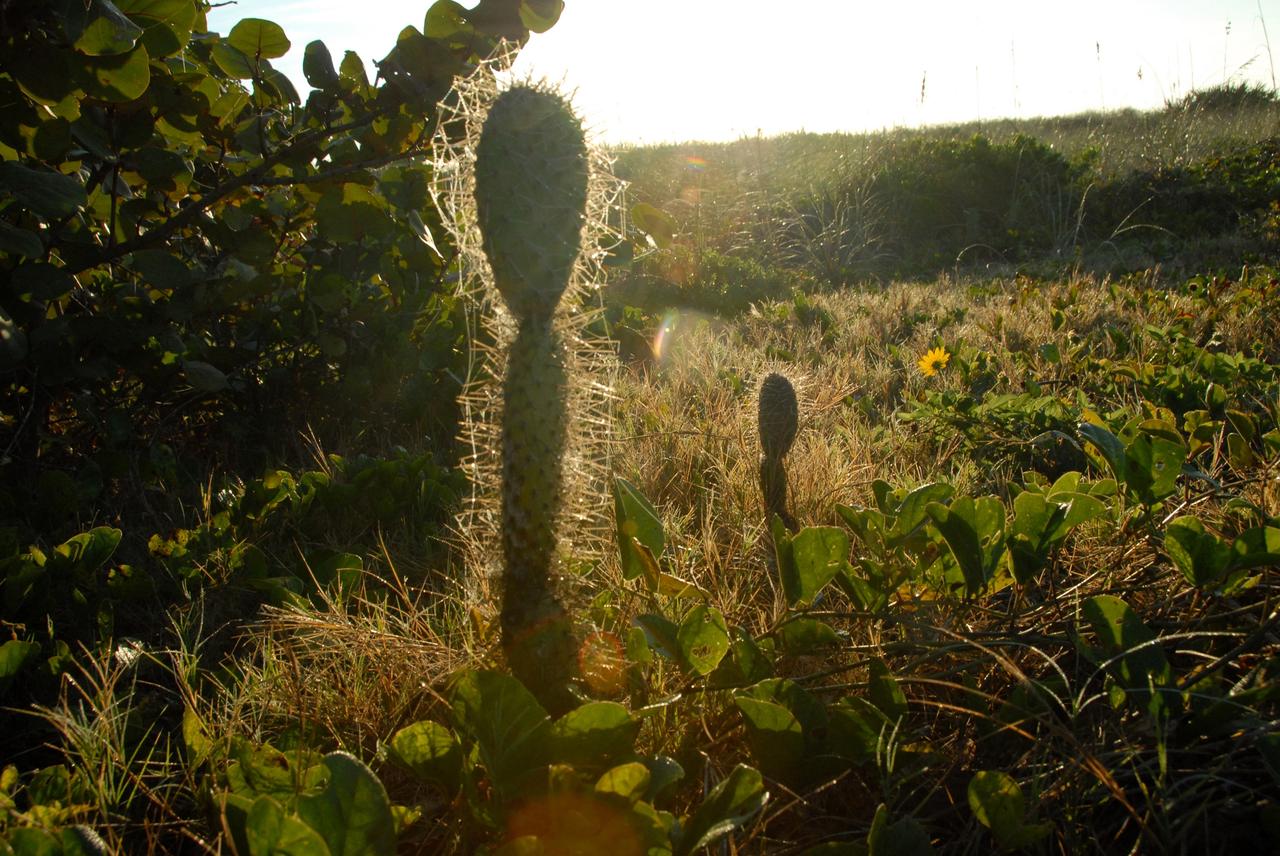
CAPE CANAVERAL, Fla. -- Morning light sculpts a cactus on the roadside at NASA's Kennedy Space Center in Florida. The center shares a boundary with the Merritt Island National Wildlife Refuge that includes salt-water estuaries, brackish marshes, hardwood hammocks and pine flatwoods. The diverse landscape provides habitat for more than 310 species of birds, 25 mammals, 117 fishes and 65 amphibians and reptiles. Photo credit: NASA/Jack Pfaller
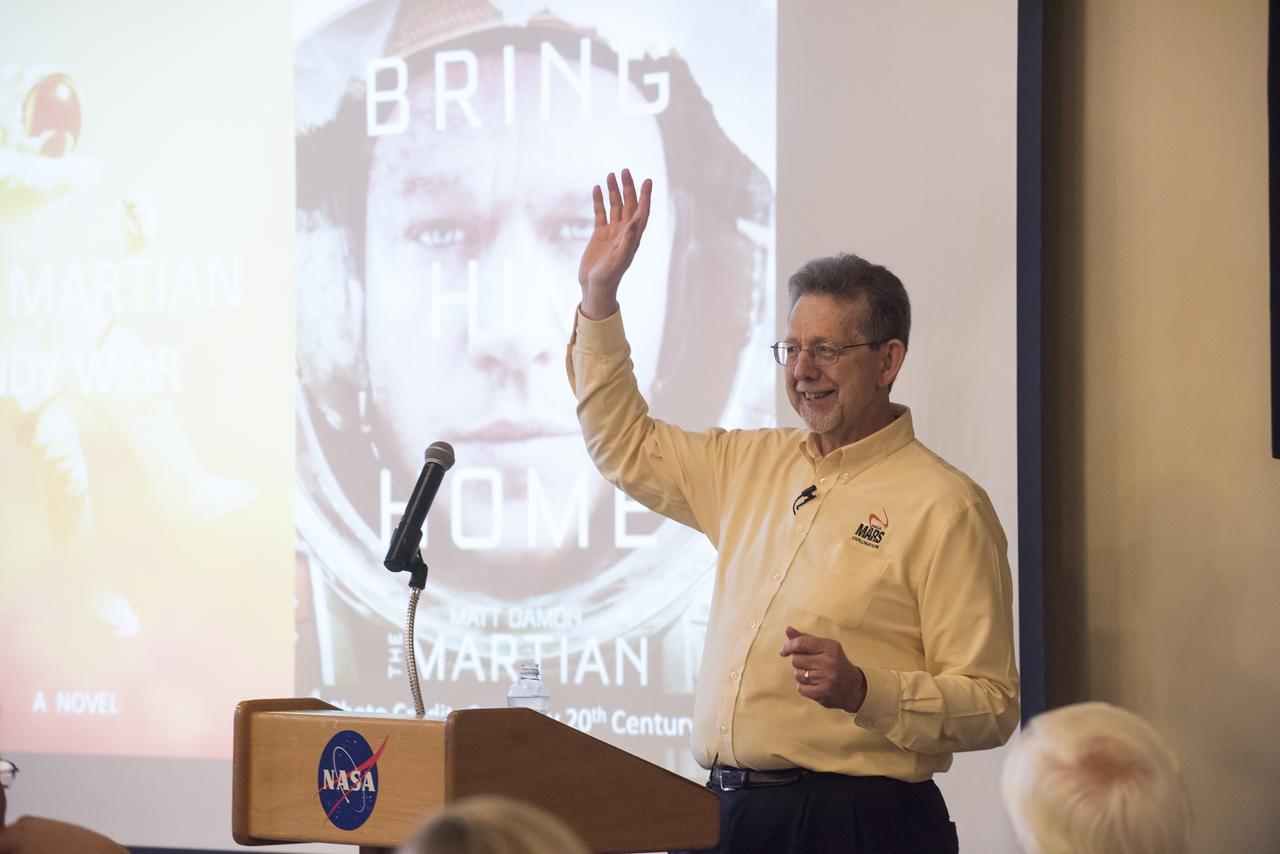
JIM GREEN, DIRECTOR OF PLANETARY SCIENCE AT NASA HEADQUARTERS, ADDRESSES MARSHALL TEAM MEMBERS DURING A JUNE 28 LUNCHEON HOSTED BY THE MARSHALL ASSOCIATION. OVER THE COURSE OF HIS 35-YEAR CAREER AT NASA, HE HAS SUPPORTED A DIVERSE ARRAY OF PLANETARY SCIENCE MISSIONS, AND RECENTLY SERVED AS SCIENCE ADVISOR FOR THE FILM ADAPTATION OF "THE MARTIAN." GREEN'S PRESENTATION WAS TITLED "THE MARTIAN: SCIENCE FICTION VS. SCIENCE FACT," IN WHICH HE DISCUSSED THE MOVIE AND THE NATION'S JOURNEY TO MARS. THE MARSHALL ASSOCIATION IS THE CENTER'S PROFESSIONAL, EMPLOYEE SERVICE ORGANIZATION.

NASA Kennedy Space Center Deputy Director Janet Petro participates in a virtual town hall meeting on Aug. 20, 2020, inside the Florida spaceport’s Press Site auditorium. During the town hall, Kennedy’s senior leaders answered questions submitted by the workforce and discussed a wide range of topics, including upcoming milestones, updates on the criteria for returning to onsite work, and diversity and inclusion at the multi-user spaceport.
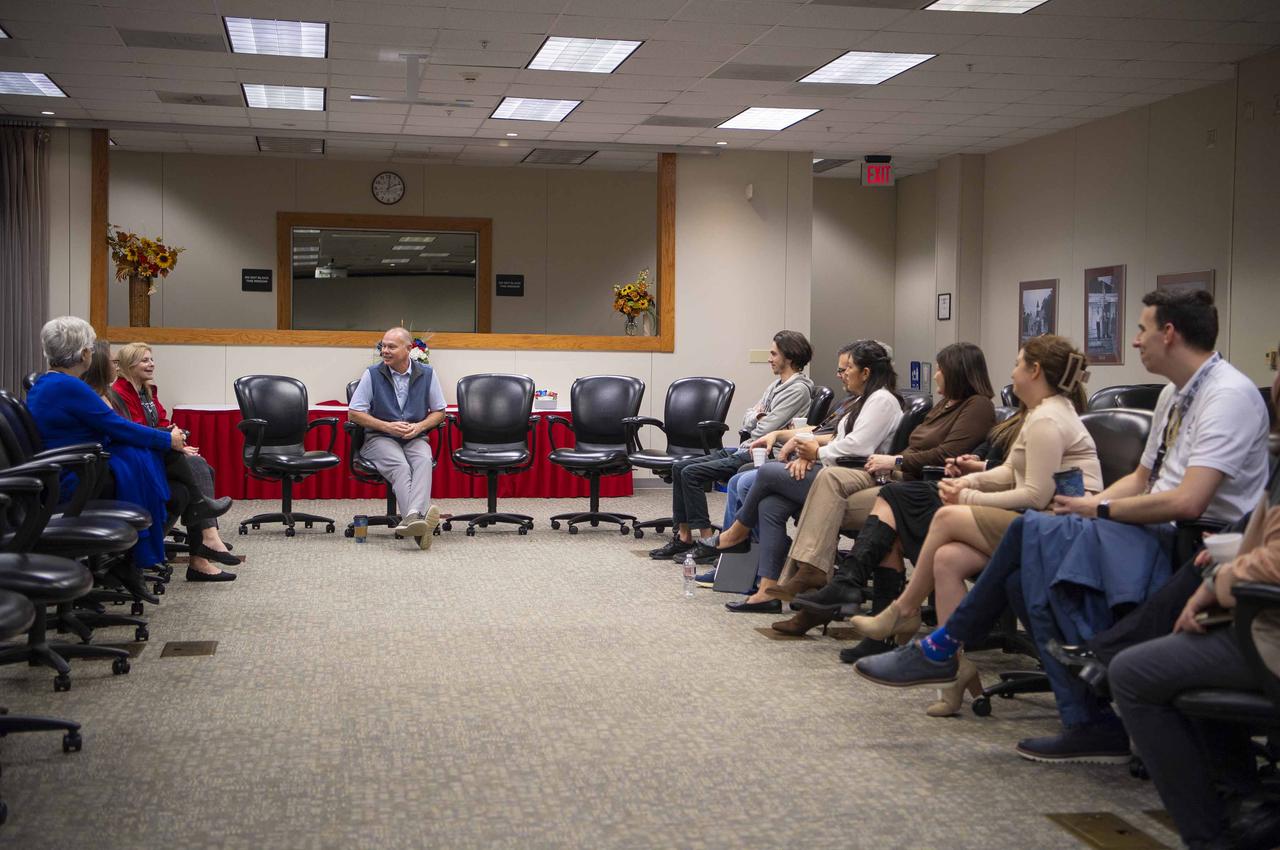
NASA Stennis Director John Bailey hosts a Java with John session on Dec. 10 with employees representing the Office of the Chief Financial Officer, Office of STEM Engagement, Office of Diversity and Equal Opportunity, Office of the Chief Human Capital Officer, and the center’s Autonomous Systems Laboratory team. Java with John is an employee-led discussion in a casual environment aimed at fostering a culture in which employees are welcome to share what matters most to them at work.
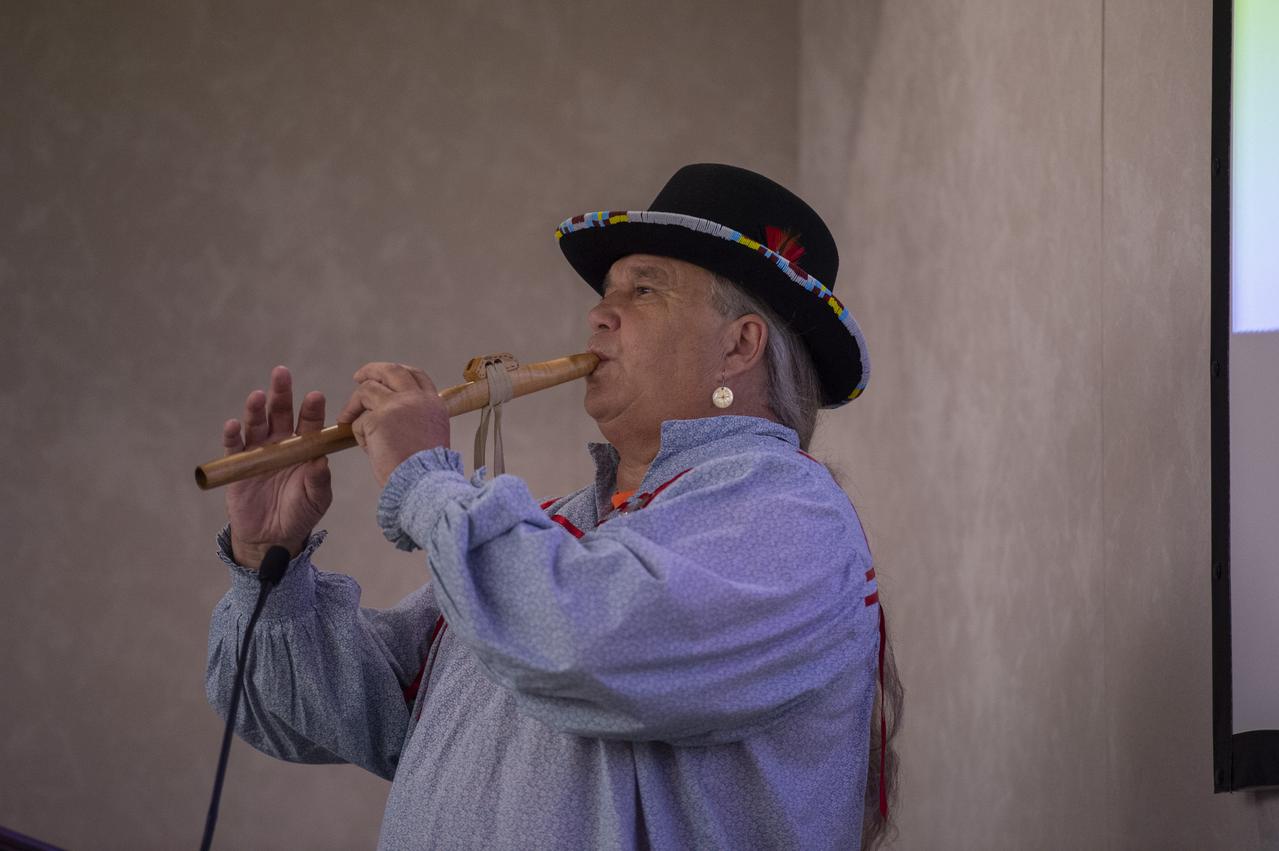
JIMMY YELLOWHORSE, FROM DECATUR, ALABAMA, PLAYS A HAND-CARVED FLUTE DURING THE NATIVE AMERICAN HERITAGE MONTH PROGRAM NOV. 13 AT NASA’S MARSHALL SPACE FLIGHT CENTER. YELLOWHORSE CRAFTED THE FLUTE HIMSELF FROM CEDAR, WALNUT AND MAHOGANY, USING TRADITIONAL CHEROKEE TECHNIQUES. THE ANNUAL OBSERVANCE, COORDINATED BY MARSHALL'S OFFICE OF DIVERSITY AND EQUAL OPPORTUNITY, HONORS THE CULTURE AND CONTRIBUTIONS OF NATIVE AMERICANS THROUGH STORYTELLING AND ETHNIC FOOD SAMPLINGS.
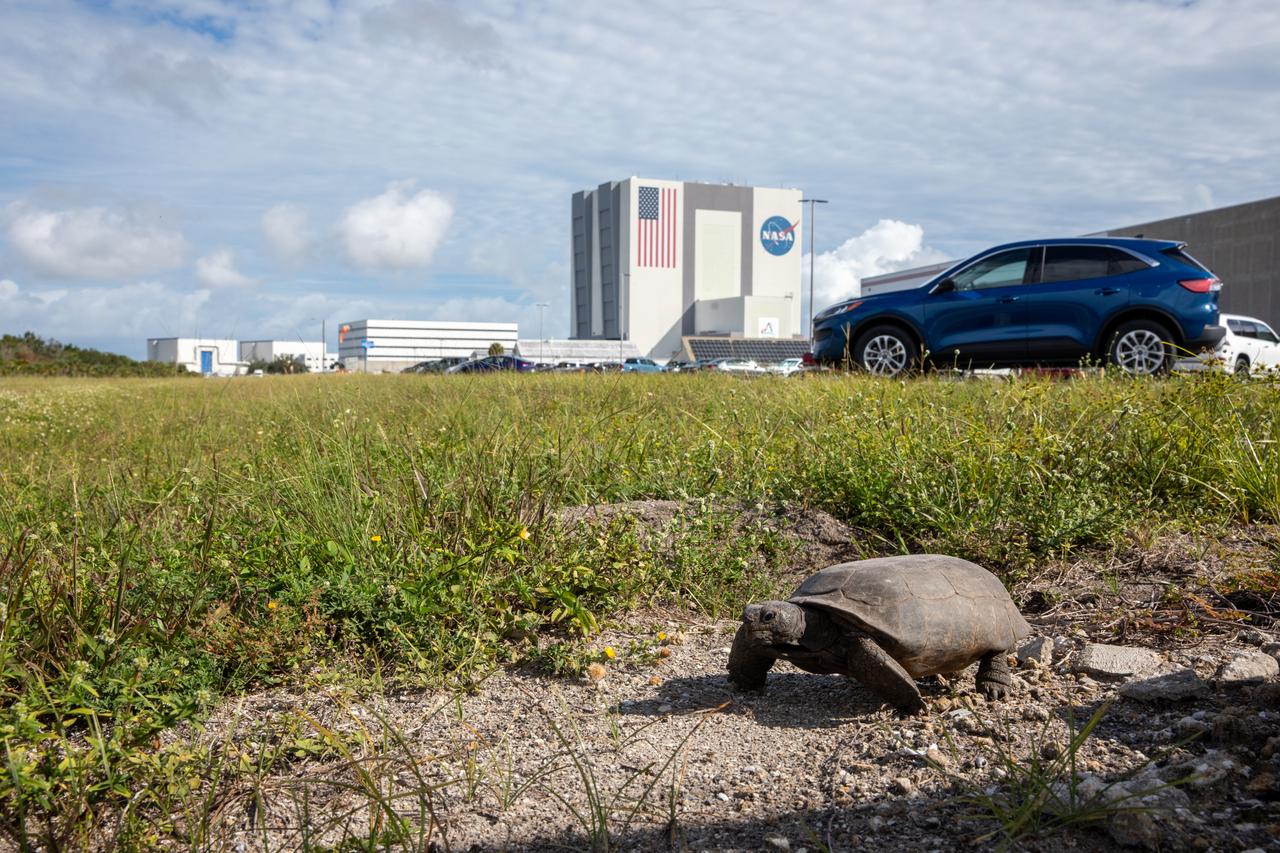
A tortoise walks through the grass at NASA's Kennedy Space Center in Florida on Monday, Sept. 25, 2023. In view in the background is the iconic Vehicle Assembly Building. The center shares over 140,000 acres with Canaveral National Seashore and Merritt Island National Wildlife Refuge, a diverse ecosystem and home to more than 1,000 species of plants, 117 species of fish, 68 species of amphibians and reptiles, 330 species of birds, and 31 different types of mammals.
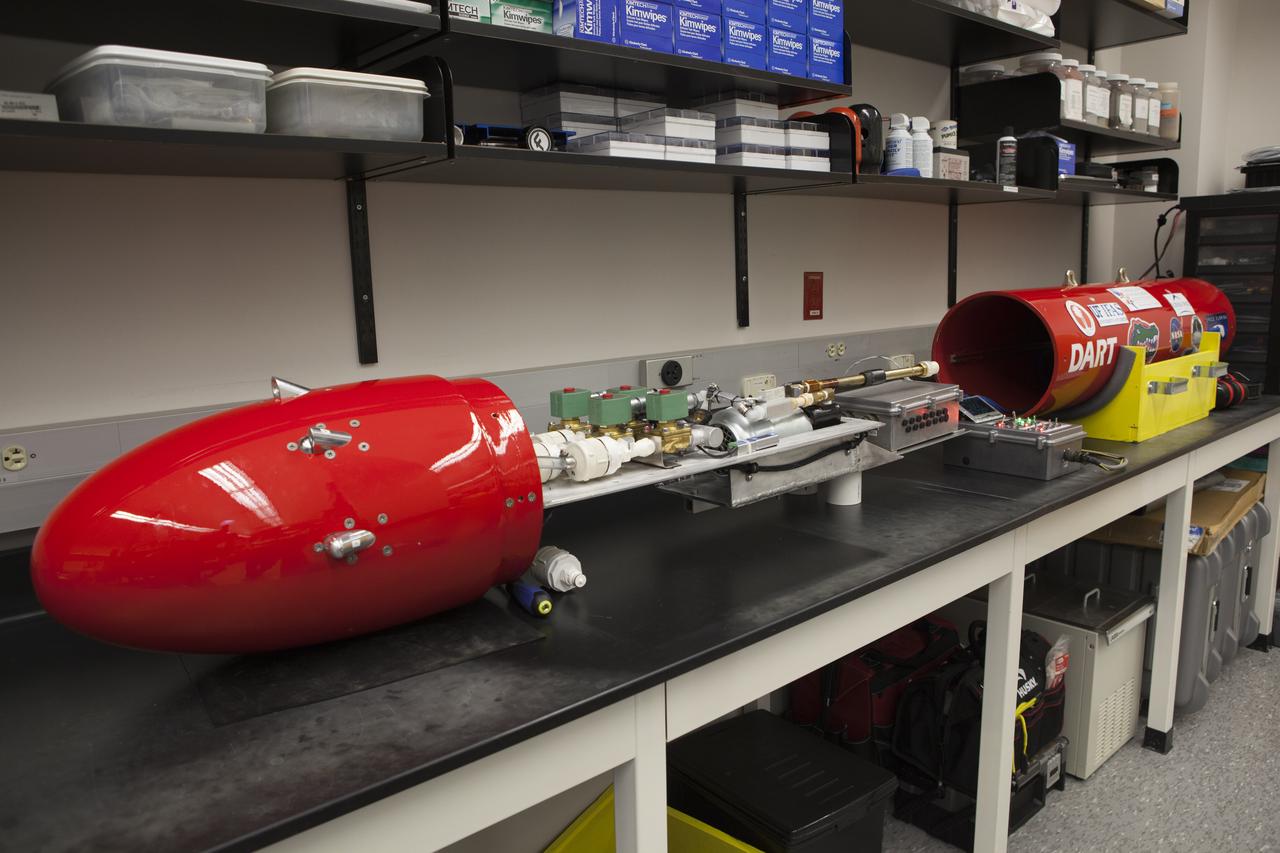
The Dust Atmospheric Recovery Technology, or DART, spacecraft is being assembled in a laboratory inside the Space Life Sciences Lab at NASA’s Kennedy Space Center in Florida. DART will characterize the dust loading and microbial diversity in the atmosphere over Florida during summer months with a special emphasis on their interactions during an African dust storm. DART will be used to collect atmospheric aerosols and suspended microbial cells over Florida and Kennedy. Results will help predict the risks of excessive microbial contamination adhering to spacecraft surfaces.
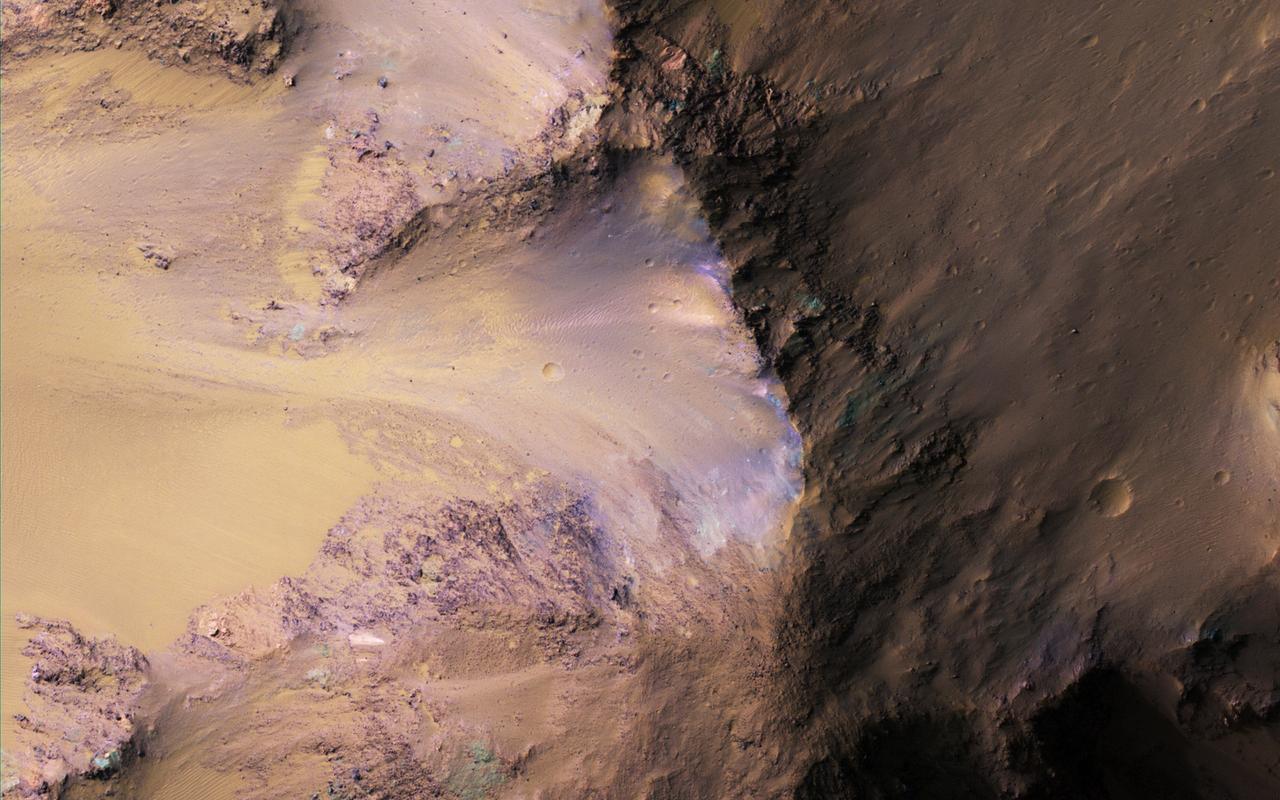
NASA's Mars Reconnaissance Orbiter (MRO) observed this image of Ganges Chasma in the northeast portion of Valles Marineris, and opens into outflow channels that flowed to the north. Scattered hills on the canyon floor may be remnants of chaos terrain that formed from collapse of the canyon. Some of the bedrock has diverse colors. More information is available at https://photojournal.jpl.nasa.gov/catalog/PIA22536
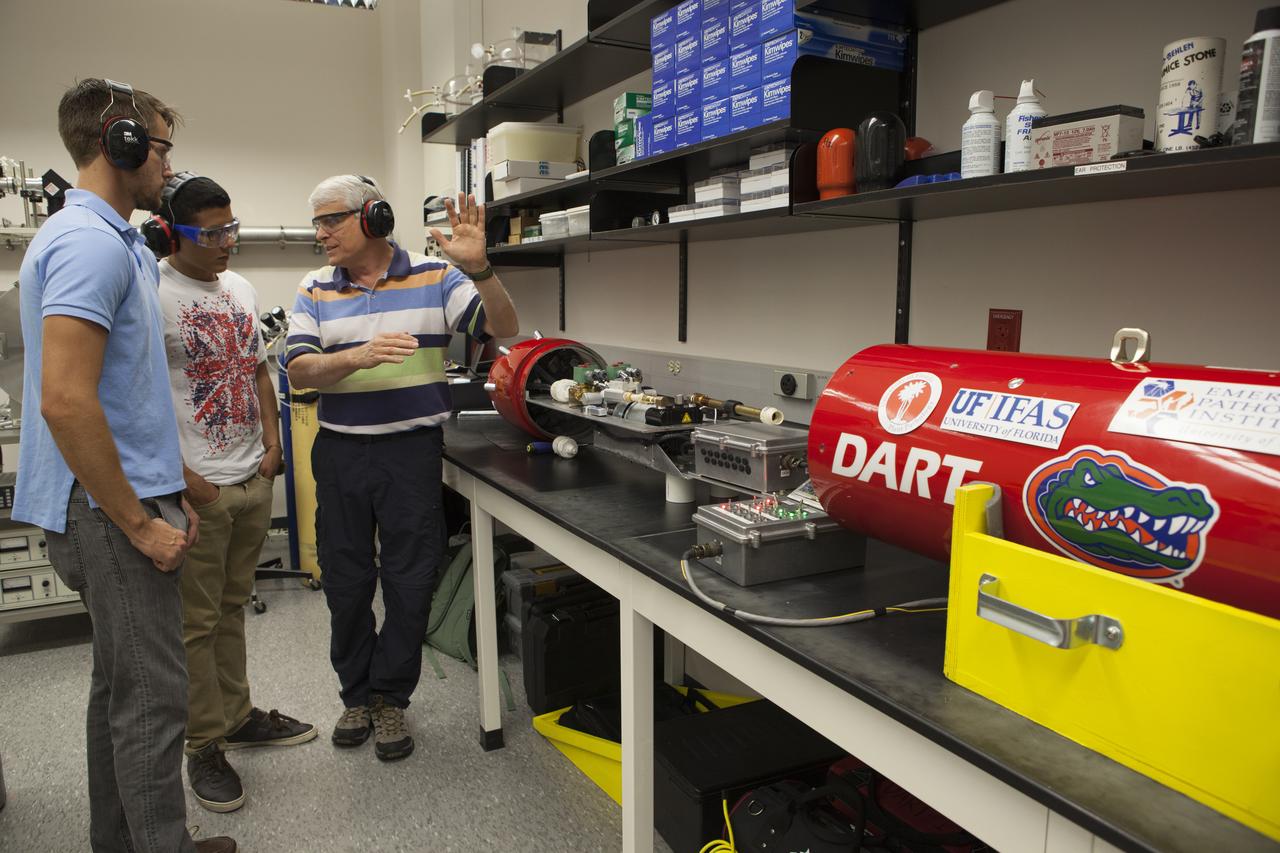
Researchers at NASA’s Kennedy Space Center in Florida check readings on the Dust Atmospheric Recovery Technology, or DART, spacecraft inside a laboratory at the Space Life Sciences Lab. DART will characterize the dust loading and microbial diversity in the atmosphere over Florida during summer months with a special emphasis on their interactions during an African dust storm. DART will be used to collect atmospheric aerosols and suspended microbial cells over Florida and Kennedy. Results will help predict the risks of excessive microbial contamination adhering to spacecraft surfaces.
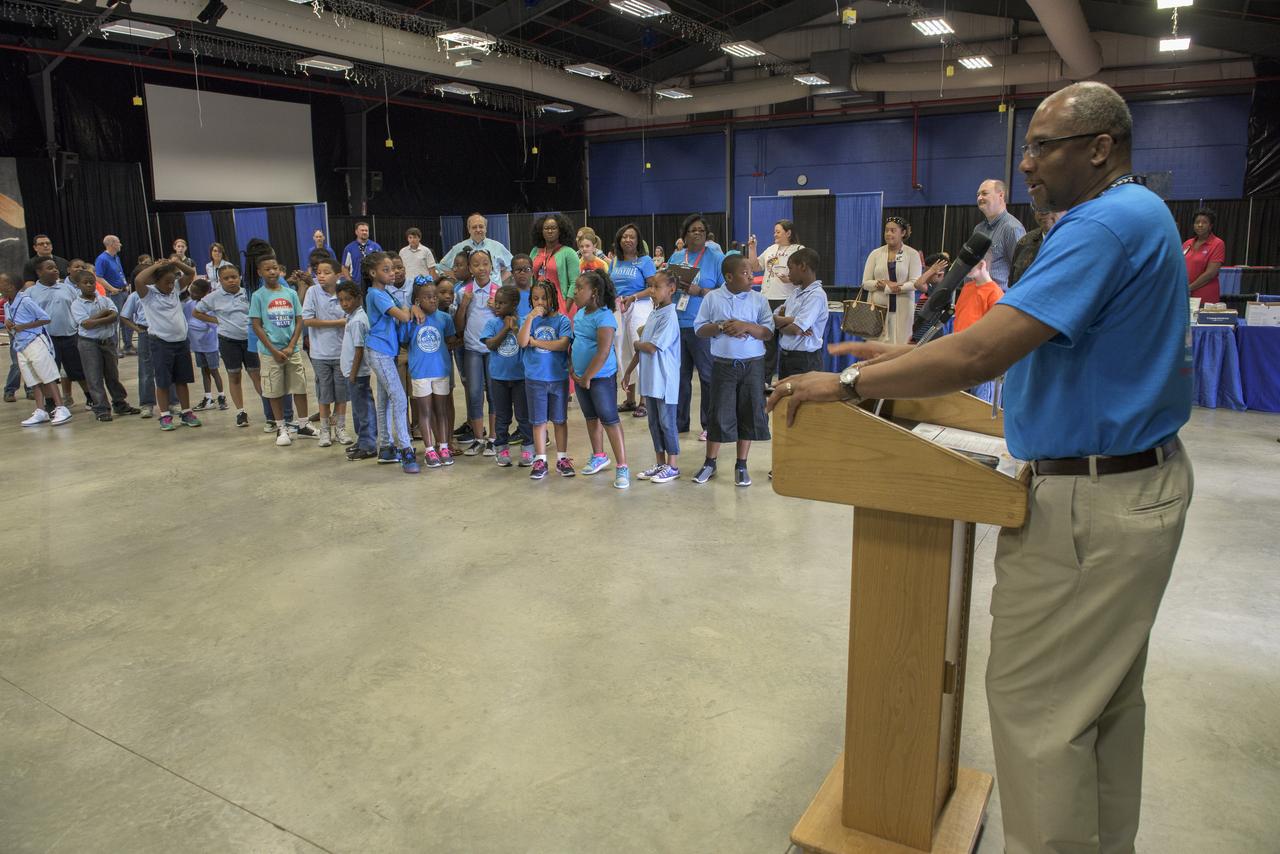
NASA’S MARSHALL SPACE FLIGHT CENTER KICKS OFF ITS ANNUAL "TAKE OUR CHILDREN TO WORK DAY" EVENTS JUNE 23 WITH OPENING REMARKS FROM LOUCIOUS HIRES, DIRECTOR OF MARSHALL’S OFFICE OF DIVERSITY AND EQUAL OPPORTUNITY. AN ESTIMATED 500 POTENTIAL FUTURE SPACEFARERS, SCIENTISTS AND ENGINEERS IN GRADES 3-12 TOOK PART IN THE DAY’S ACTIVITIES, TOURS AND PRESENTATIONS.
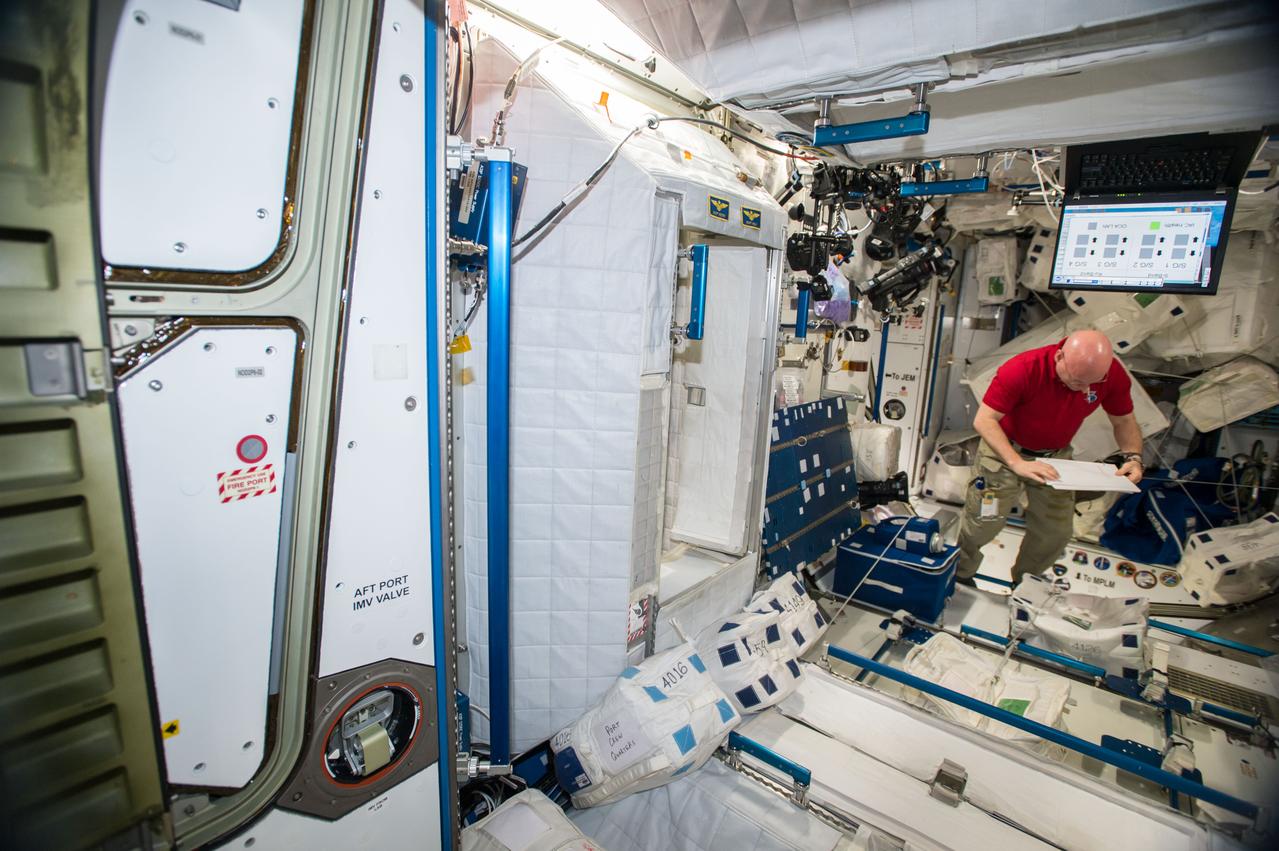
iss043e198418 (5/15/2015) --- NASA astronaut Scott Kelly is shown during the collection of surface and air samples using various devices in multiple locations to characterize the types of microbial populations on the International Space Station (ISS) for the Microbial Observatory-1 payload. The Microbial Payload Tracking Series (Microbial Observatory-1) investigation monitors the types of microbes present on ISS over a one-year period. Samples are returned to Earth for further study, enabling scientists to understand the diversity of the microbial flora on the ISS and how it changes over time.
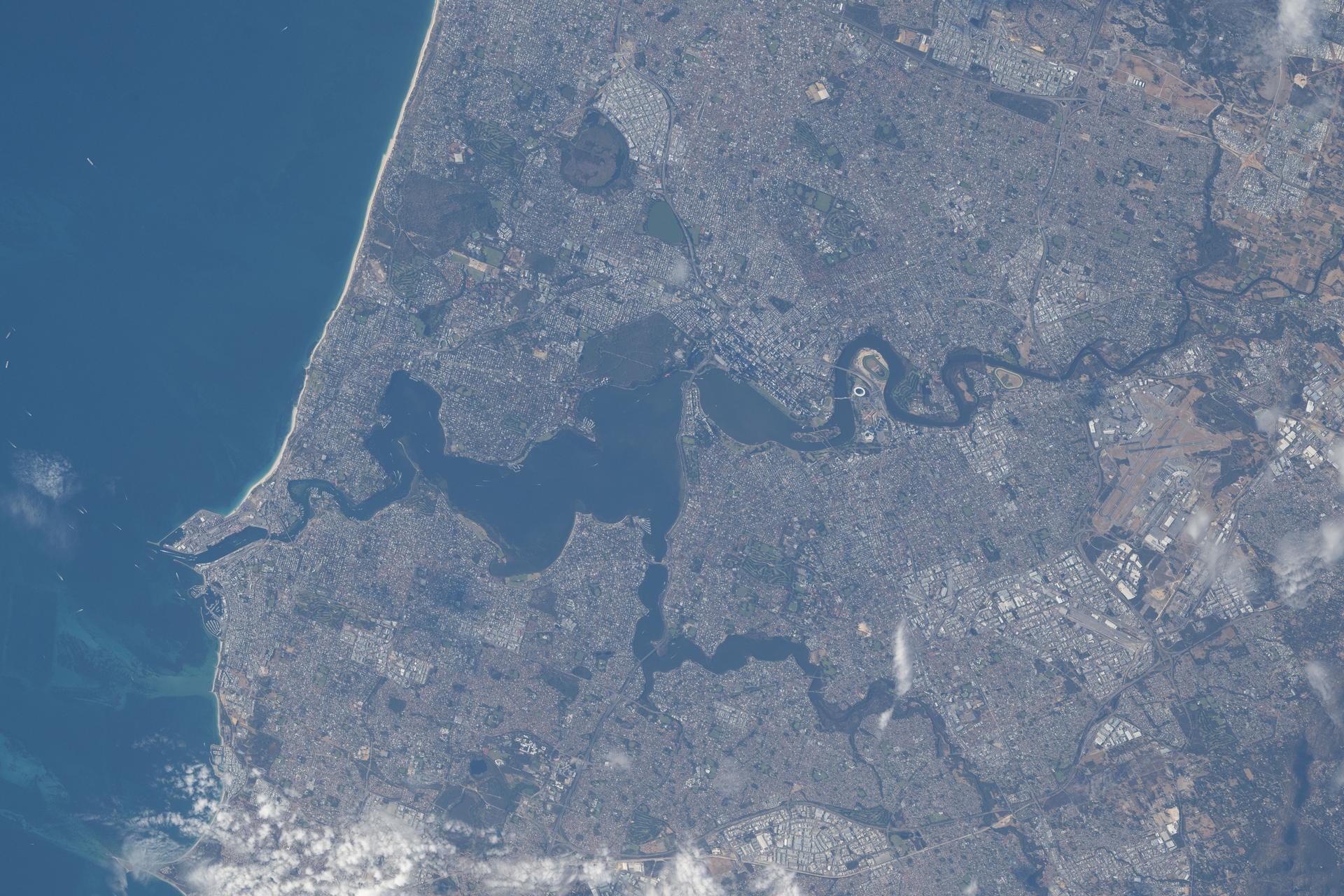
iss074e0376130 (March 26, 2026) --- Perth, Australia, located on the nation’s southwestern coast along the Indian Ocean and home to a metropolitan population of nearly 2.5 million, is pictured from the International Space Station as it orbited 269 miles above the province of Western Australia. The Swan River—popular for recreation and home to a diverse array of fish and migratory birds—splits the city and empties into the Indian Ocean. Credit: NASA/Chris Williams
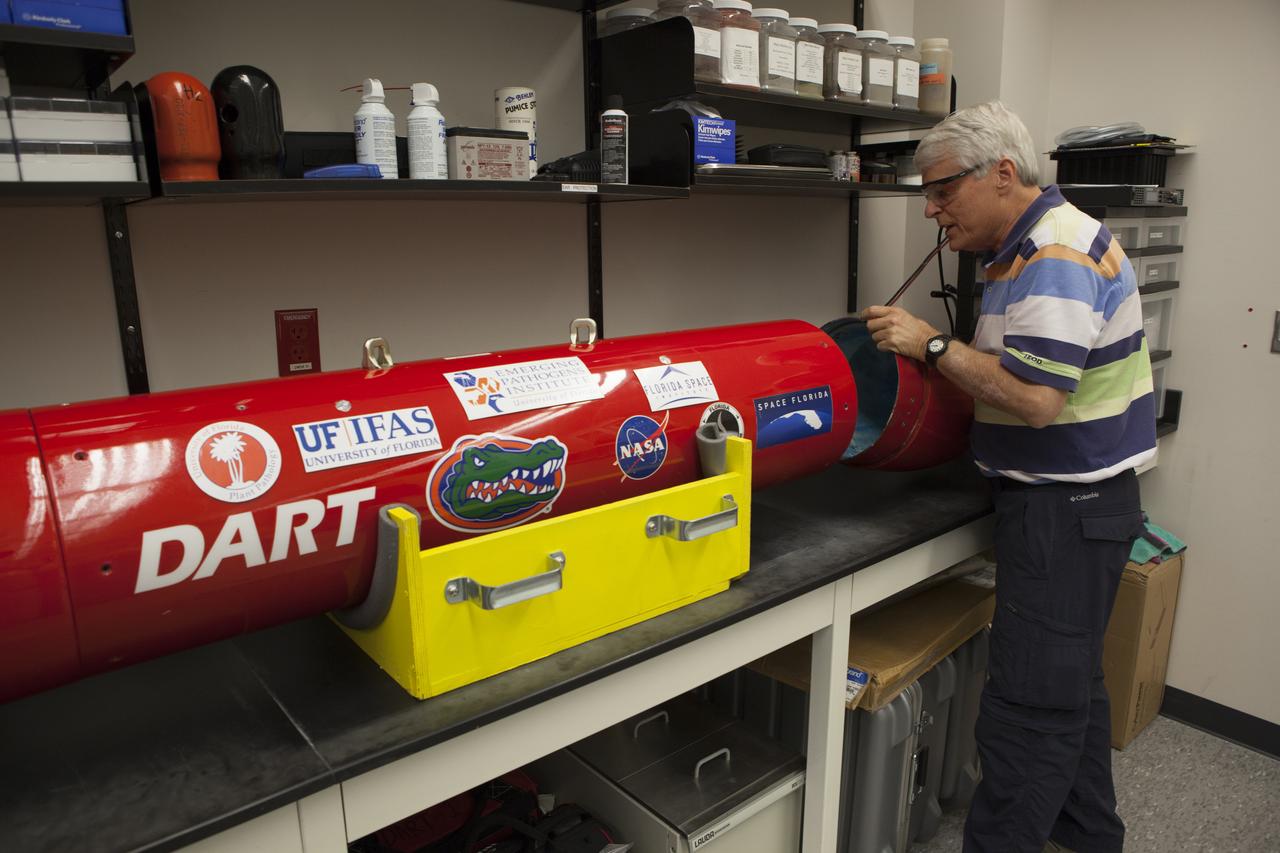
A researcher from the University of Florida in Gainesville, checks the Dust Atmospheric Recovery Technology, or DART, spacecraft in a laboratory inside the Space Life Sciences Lab at NASA’s Kennedy Space Center in Florida. DART will characterize the dust loading and microbial diversity in the atmosphere over Florida during summer months with a special emphasis on their interactions during an African dust storm. DART will be used to collect atmospheric aerosols and suspended microbial cells over Florida and Kennedy. Results will help predict the risks of excessive microbial contamination adhering to spacecraft surfaces.
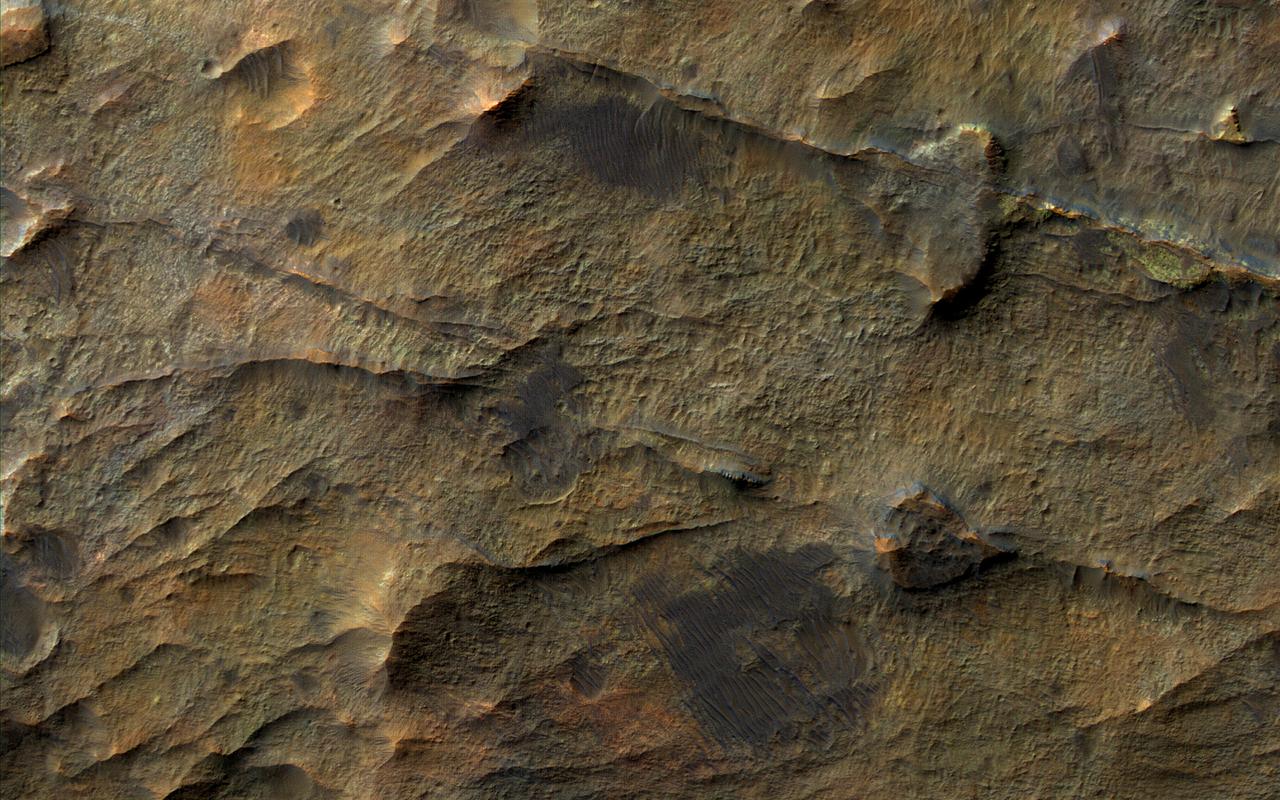
In this observation from NASA's Mars Reconnaissance Orbiter (MRO), we see a set of straight ridges in ancient bedrock near Nirgal Valles. The patterns indicate fractures from tectonic stresses, but how have they been hardened to now stand in positive relief after billions of years of erosion? It is possible that groundwater flowed through the fractures, depositing various durable minerals, some of which we see in diverse colors. https://photojournal.jpl.nasa.gov/catalog/PIA22333
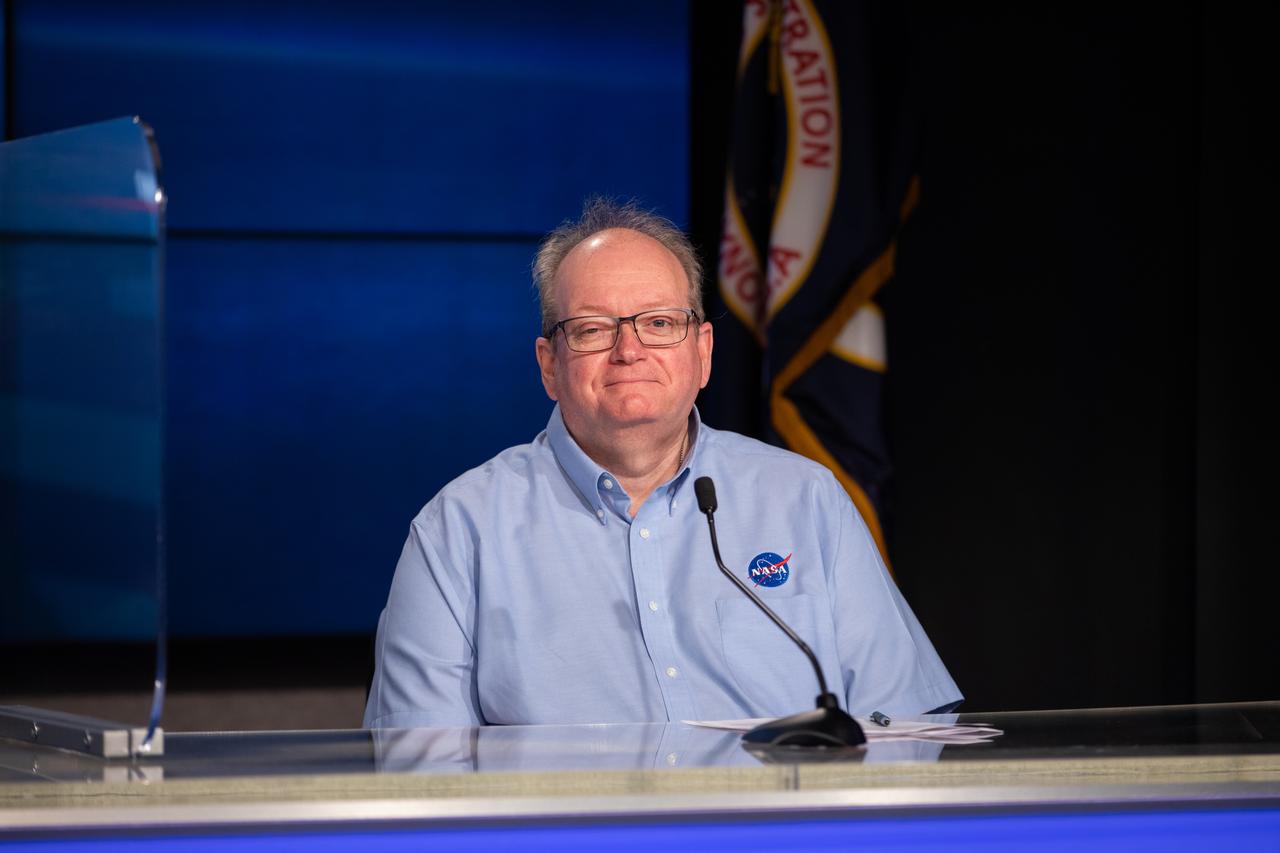
NASA Kennedy Space Center Associate Director, Management Burt Summerfield participates in a virtual town hall meeting on Aug. 20, 2020, inside the Florida spaceport’s Press Site auditorium. During the town hall, Kennedy’s senior leaders answered questions submitted by the workforce and discussed a wide range of topics, including upcoming milestones, updates on the criteria for returning to onsite work, and diversity and inclusion at the multi-user spaceport.

NASA Kennedy Space Center Director Bob Cabana participates in a virtual town hall meeting on Aug. 20, 2020, inside the Florida spaceport’s Press Site auditorium. During the town hall, Kennedy’s senior leaders answered questions submitted by the workforce and discussed a wide range of topics, including upcoming milestones, updates on the criteria for returning to onsite work, and diversity and inclusion at the multi-user spaceport.

From left, NASA Kennedy Space Center Associate Director, Technical Kelvin Manning; Director Bob Cabana; Deputy Director Janet Petro; and Associate Director, Management Burt Summerfield participate in a virtual town hall meeting on Aug. 20, 2020, inside the Florida spaceport’s Press Site auditorium. During the town hall, Kennedy’s senior leaders answered questions submitted by the workforce and discussed a wide range of topics, including upcoming milestones, updates on the criteria for returning to onsite work, and diversity and inclusion at the multi-user spaceport.

Veronica Villalobos, Director, Office of Diversity and Inclusion, Office of Personnel Management, participates in a panel discussion at the Women, Innovation and Aerospace event celebrating Women's History Month at the George Washington University Jack Morton Auditorium, Thursday, March 8, 2012 in Washington. The WIA day-long event will help to foster a discussion for students and early career professionals about how to continue to encourage women to enter and succeed in the field of aerospace. Photo Credit: (NASA/Carla Cioffi)
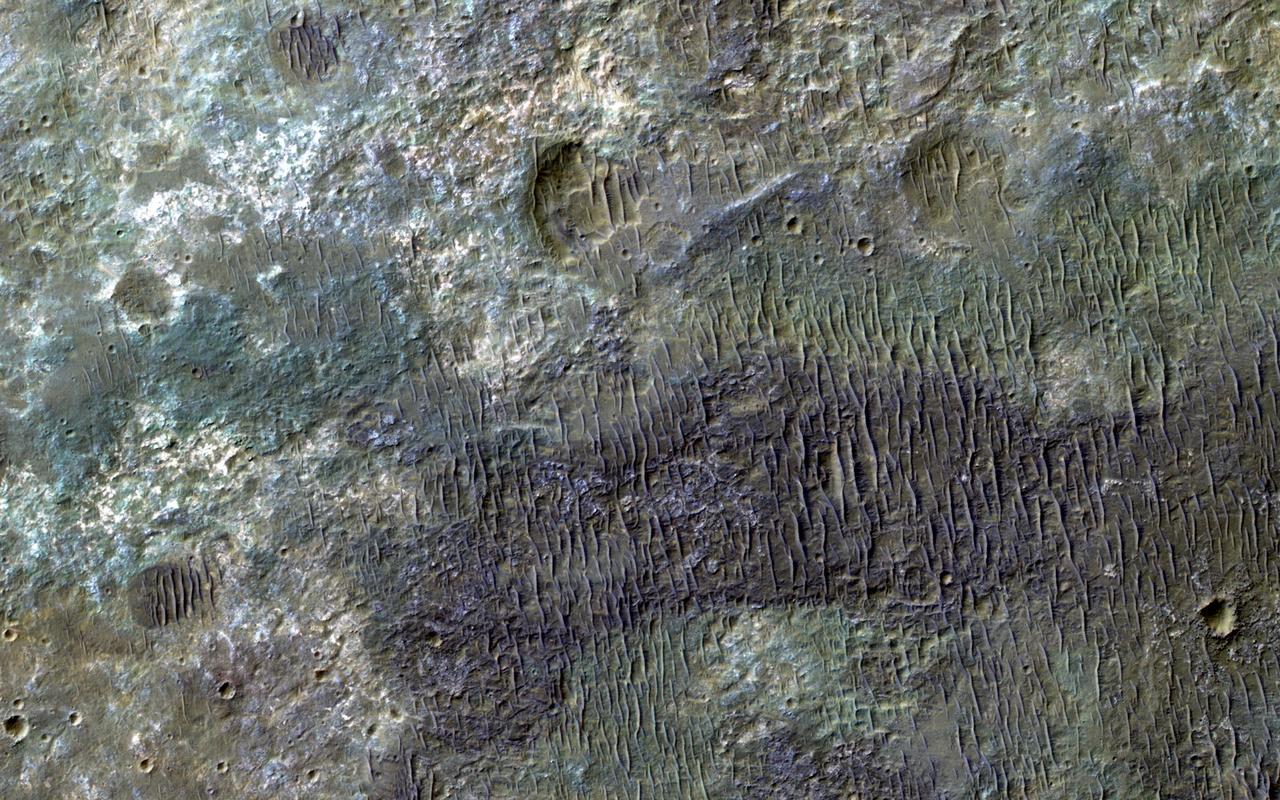
This image from NASA Mars Reconnaissance Orbiter spacecraft covers some of the plains south of Capri Chasma in eastern Valles Marineris. Where the aeolian (wind-blown) sedimentary cover has been stripped away, we see diverse colors indicative of of a variety of altered minerals formed in Mars' wetter past. http://photojournal.jpl.nasa.gov/catalog/PIA20730

NASA Kennedy Space Center Associate Director, Technical Kelvin Manning participates in a virtual town hall meeting on Aug. 20, 2020, inside the Florida spaceport’s Press Site auditorium. During the town hall, Kennedy’s senior leaders answered questions submitted by the workforce and discussed a wide range of topics, including upcoming milestones, updates on the criteria for returning to onsite work, and diversity and inclusion at the multi-user spaceport.
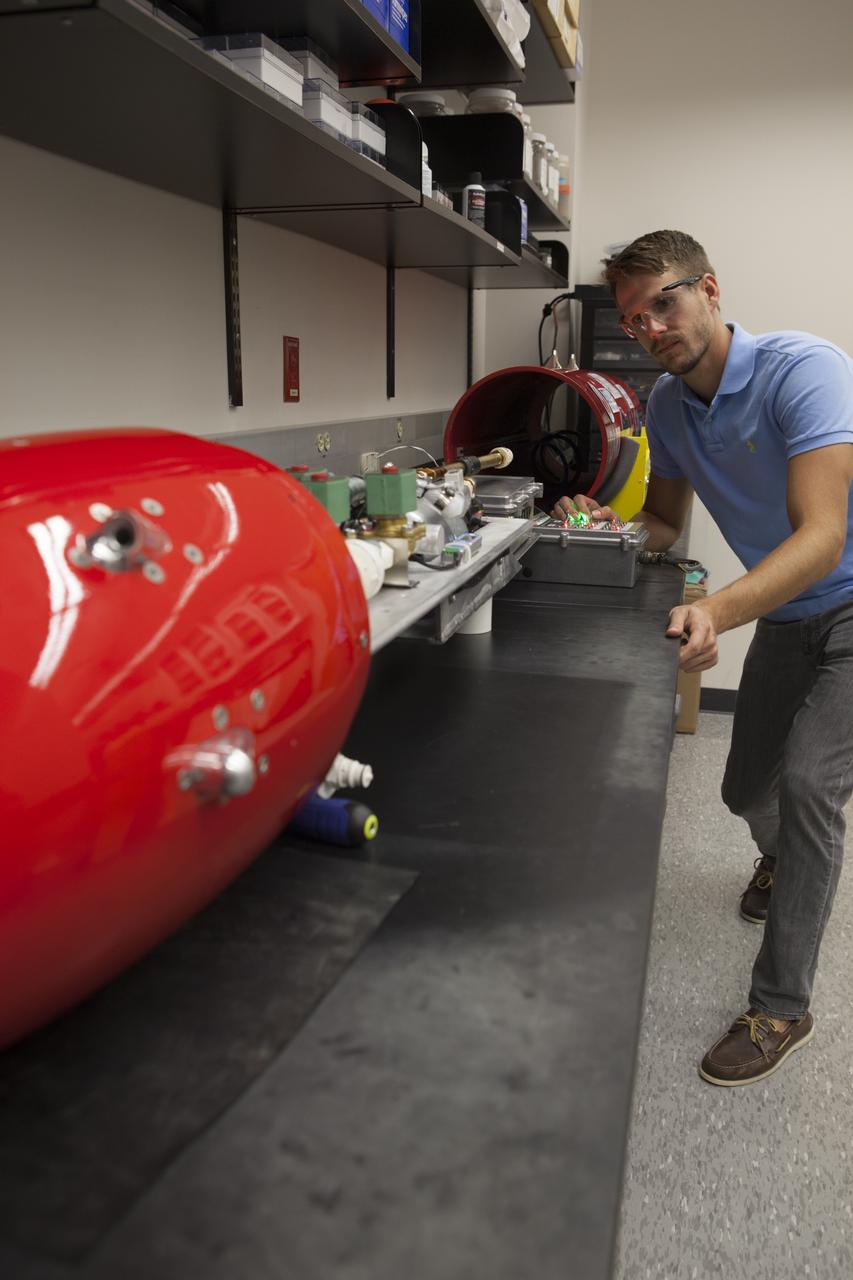
A researcher at NASA’s Kennedy Space Center in Florida checks a reading on the Dust Atmospheric Recovery Technology, or DART, spacecraft inside a laboratory at the Space Life Sciences Lab. DART will characterize the dust loading and microbial diversity in the atmosphere over Florida during summer months with a special emphasis on their interactions during an African dust storm. DART will be used to collect atmospheric aerosols and suspended microbial cells over Florida and Kennedy. Results will help predict the risks of excessive microbial contamination adhering to spacecraft surfaces.
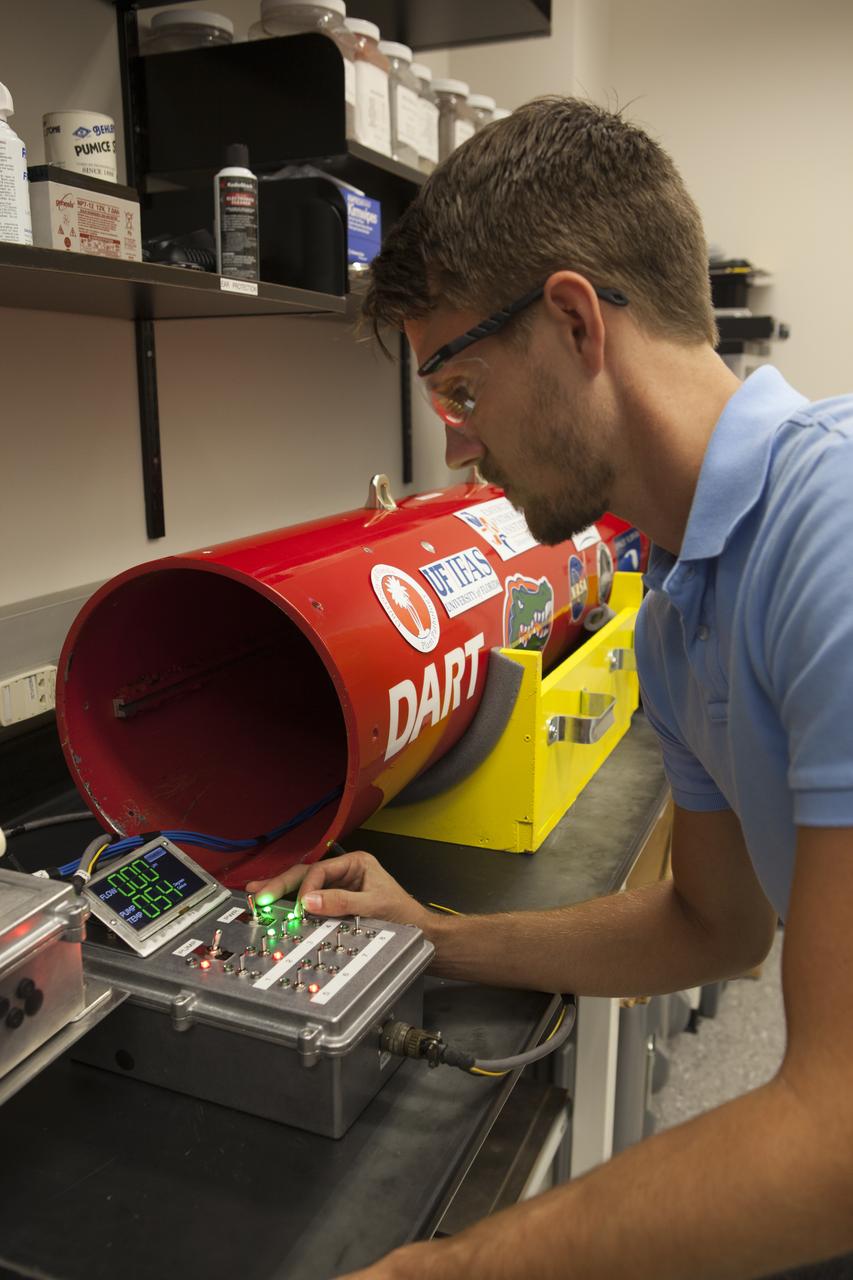
A researcher at NASA’s Kennedy Space Center in Florida checks a reading on the Dust Atmospheric Recovery Technology, or DART, spacecraft inside a laboratory at the Space Life Sciences Lab. DART will characterize the dust loading and microbial diversity in the atmosphere over Florida during summer months with a special emphasis on their interactions during an African dust storm. DART will be used to collect atmospheric aerosols and suspended microbial cells over Florida and Kennedy. Results will help predict the risks of excessive microbial contamination adhering to spacecraft surfaces.
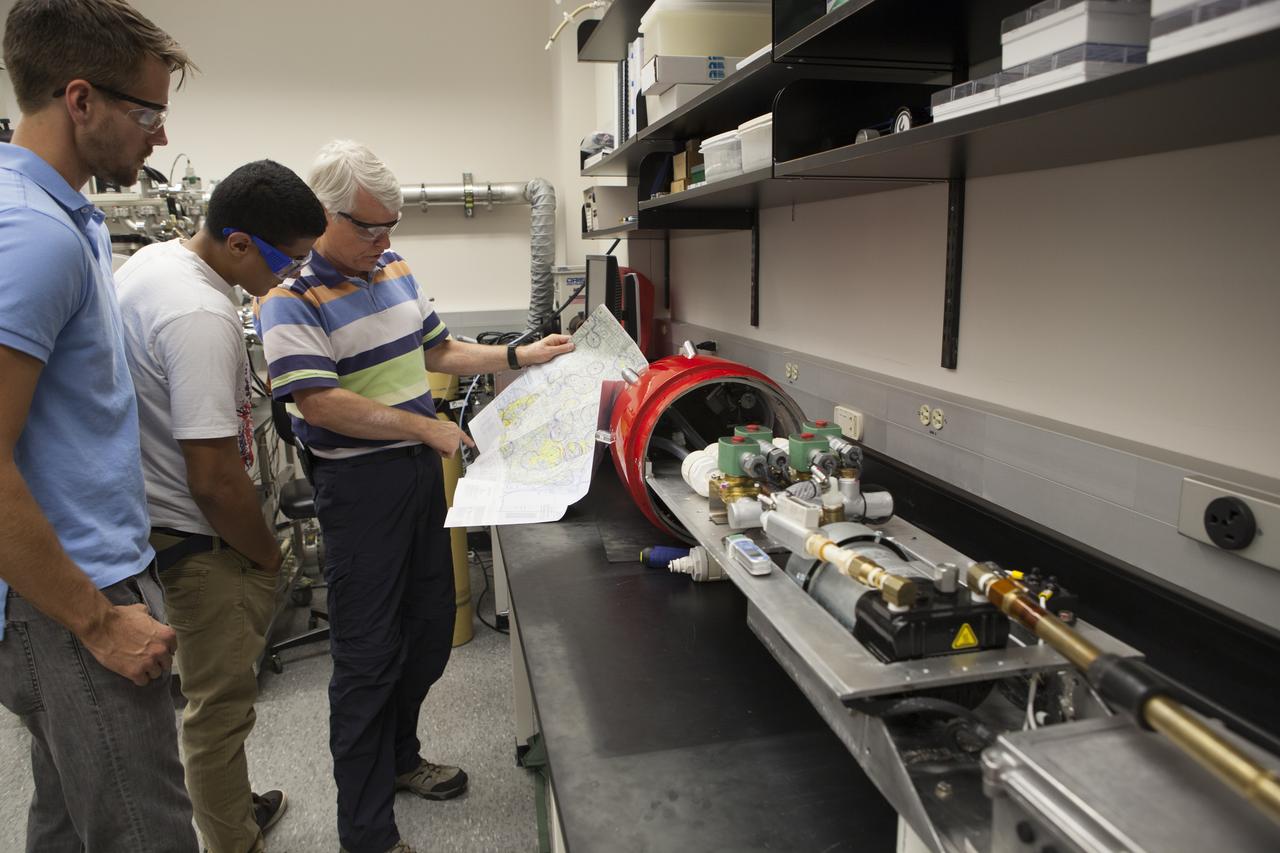
Researchers at NASA’s Kennedy Space Center in Florida check readings on the Dust Atmospheric Recovery Technology, or DART, spacecraft inside a laboratory at the Space Life Sciences Lab. DART will characterize the dust loading and microbial diversity in the atmosphere over Florida during summer months with a special emphasis on their interactions during an African dust storm. DART will be used to collect atmospheric aerosols and suspended microbial cells over Florida and Kennedy. Results will help predict the risks of excessive microbial contamination adhering to spacecraft surfaces.
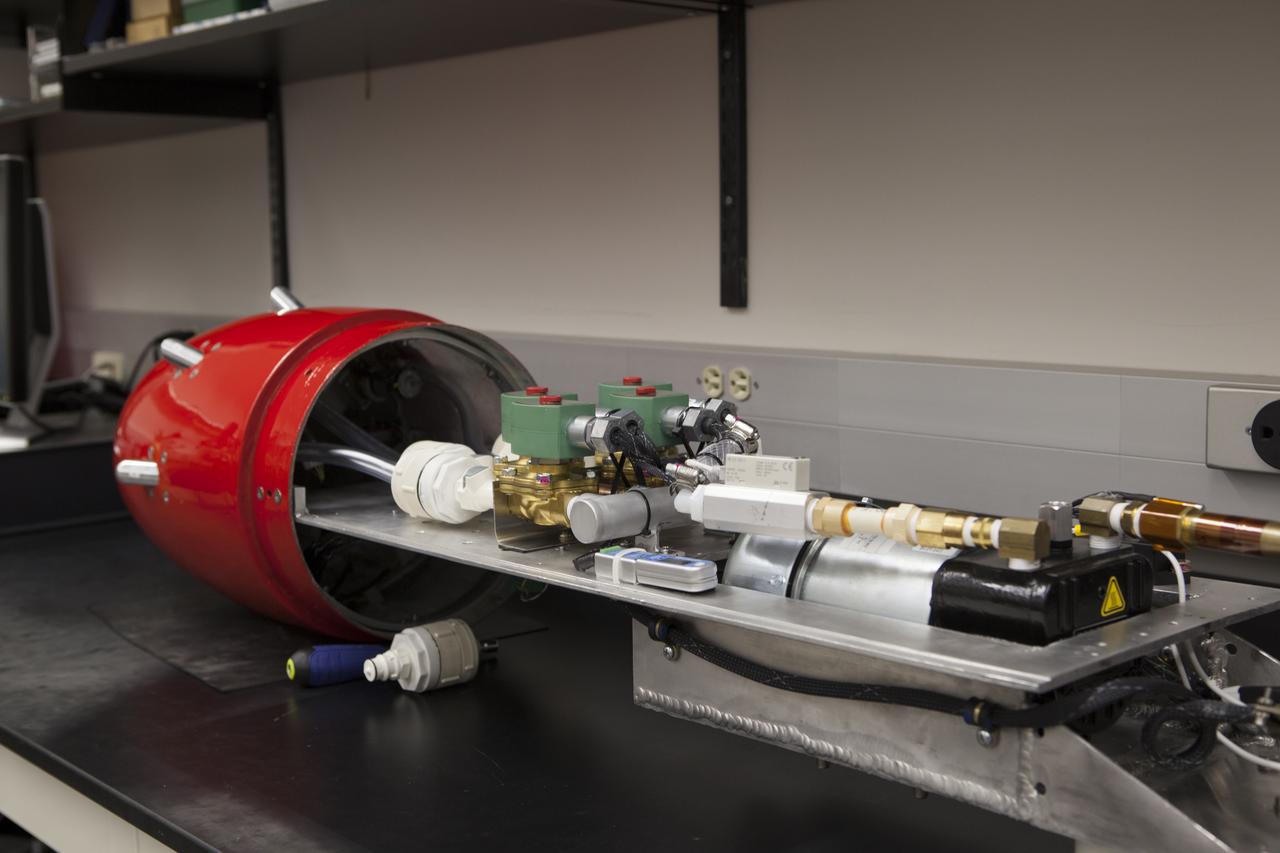
The Dust Atmospheric Recovery Technology, or DART, spacecraft is being assembled in a laboratory inside the Space Life Sciences Lab at NASA’s Kennedy Space Center in Florida. DART will characterize the dust loading and microbial diversity in the atmosphere over Florida during summer months with a special emphasis on their interactions during an African dust storm. DART will be used to collect atmospheric aerosols and suspended microbial cells over Florida and Kennedy. Results will help predict the risks of excessive microbial contamination adhering to spacecraft surfaces.
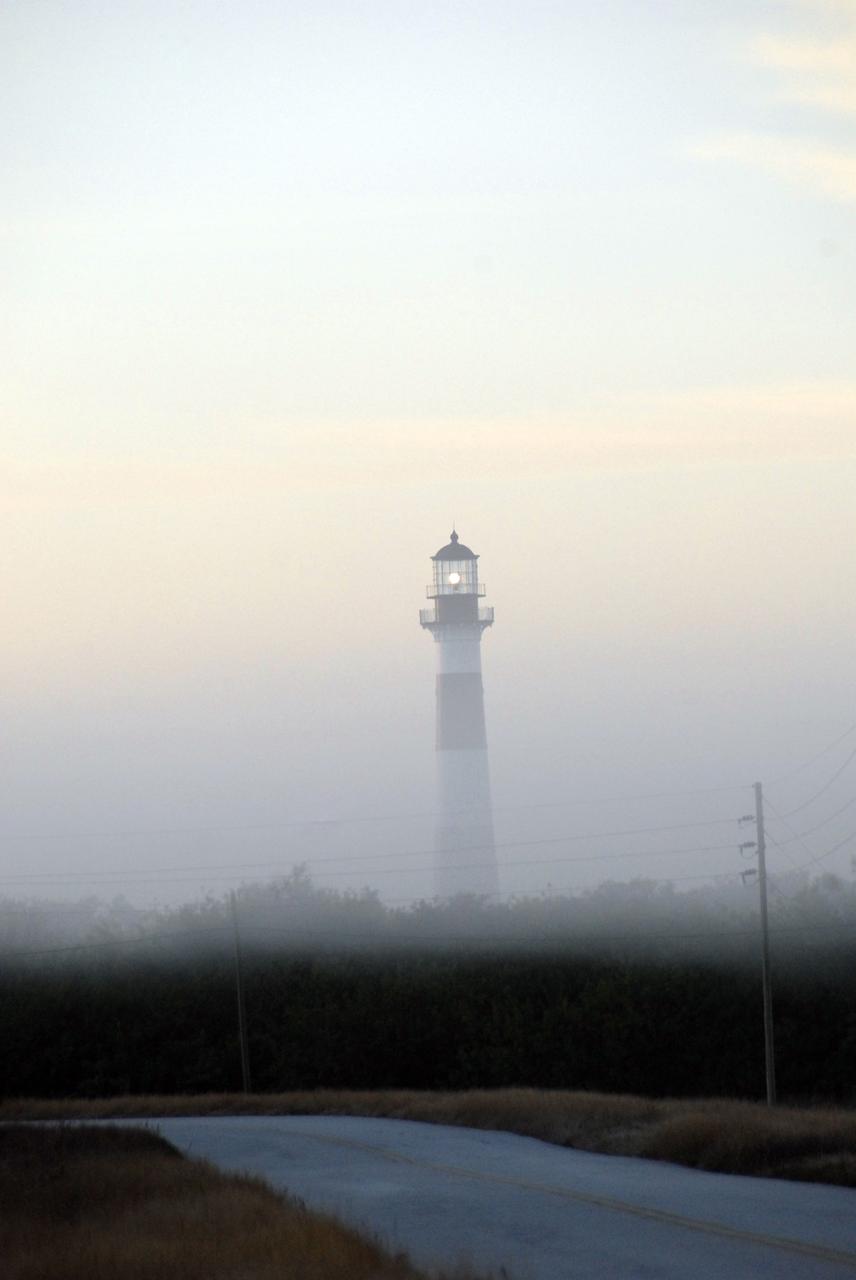
CAPE CANAVERAL, Fla. – Fog envelops the Cape Canaveral Lighthouse that has graced Cape Canaveral's shore for more than 100 years under the stewardship of the U.S. Air Force. The center shares a boundary with the refuge that includes salt-water estuaries, brackish marshes, hardwood hammocks and pine flatwoods. The diverse landscape provides habitat for more than 310 species of birds, 25 mammals, 117 fishes and 65 amphibians and reptiles. Photo credit: NASA/Jack Pfaller
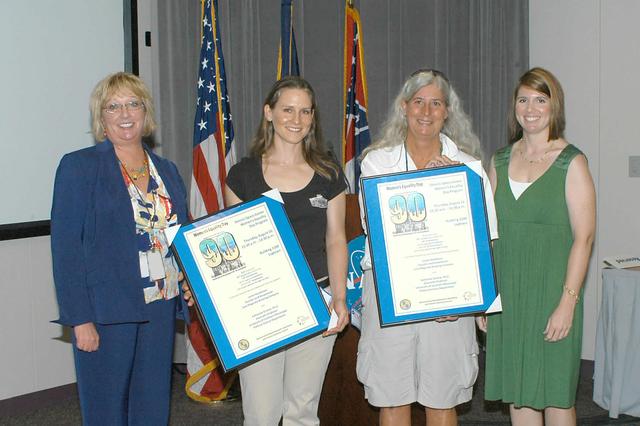
NASA's John C. Stennis Space Center celebrated Women's Equality Day with a program featuring presentations from a pair of area women - Leslie Henderson, founder and brewmaster of Lazy Magnolia Brewing Co. in Kiln, Miss., and Kathanne Greene, associate professor of political science at the University of Southern Mississippi in Hattiesburg. Shown are (l to r): Jo Ann Larson, Stennis Equal Opportunity officer; Henderson; Greene; and Shannon Breland, public affairs officer for the Naval Research Laboratory at Stennis and a member of the Stennis Diversity Council.
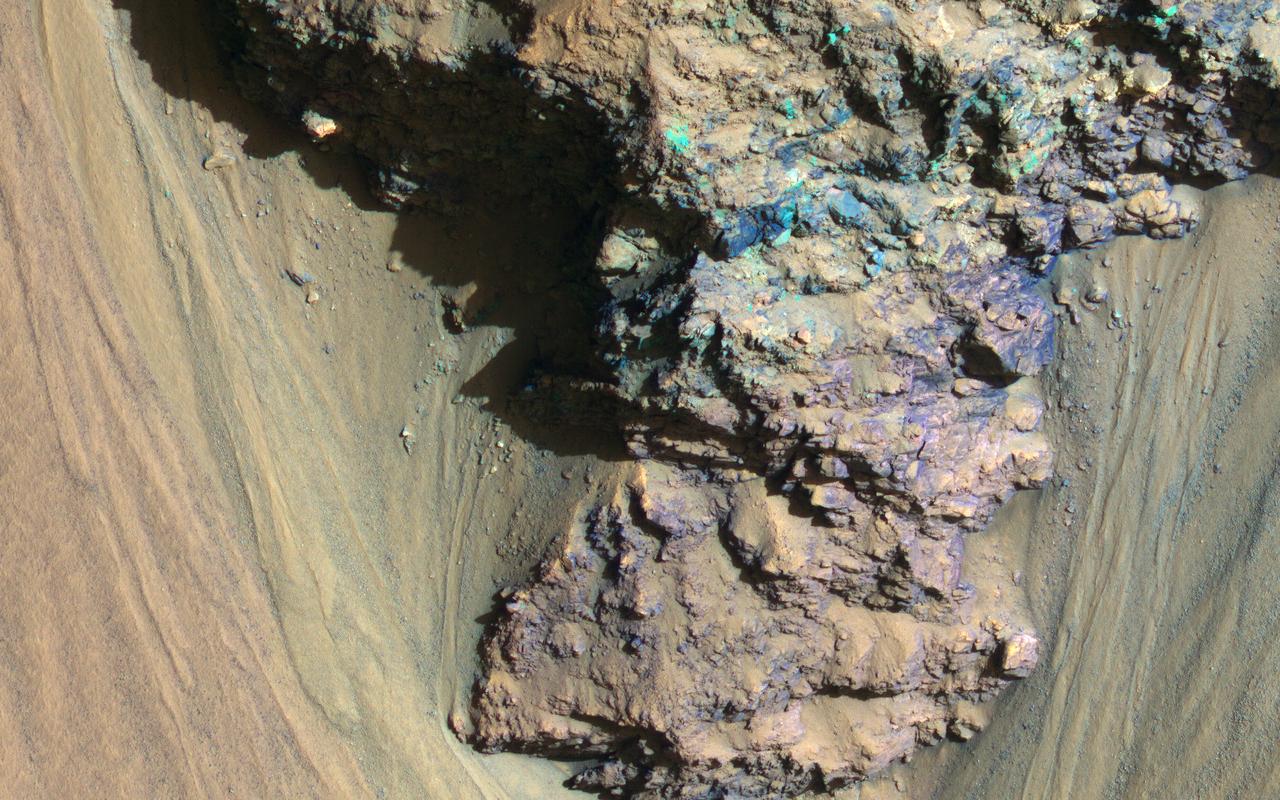
An enhanced-color image from NASA's Mars Reconnaissance Orbiter (MRO) reveals bedrock that is several kilometers below the top of the giant Valles Marineris canyons. The upper layers have relatively little diversity of colors and textures, but deeper levels show more complex processes. The upper layers could be mostly volcanic while the lower layers were influenced by the period of heavy bombardment and greater interactions with water. https://photojournal.jpl.nasa.gov/catalog/PIA22238
![The combination of morphological and topographic information from stereo images from NASA's Mars Reconnaissance Orbiter, as well as compositional data from near-infrared spectroscopy has been proven to be a powerful tool for understanding the geology of Mars. Beginning with the OMEGA instrument on the European Space Agency's Mars Express orbiter in 2003, the surface of Mars has been examined at near-infrared wavelengths by imaging spectrometers that are capable of detecting specific minerals and mapping their spatial extent. The CRISM (Compact Reconnaissance Imaging Spectrometer for Mars) instrument on our orbiter is a visible/near-infrared imaging spectrometer, and the HiRISE camera works together with it to document the appearance of mineral deposits detected by this orbital prospecting. Mawrth Vallis is one of the regions on Mars that has attracted much attention because of the nature and diversity of the minerals identified by these spectrometers. It is a large, ancient outflow channel on the margin of the Southern highlands and Northern lowlands. Both the OMEGA and CRISM instruments have detected clay minerals here that must have been deposited in a water-rich environment, probably more than 4 billion years ago. For this reason, Mawrth Vallis is one of the two candidate landing sites for the future Mars Express Rover Mission planned by the European Space Agency. This image was targeted on a location where the CRISM instrument detected a specific mineral called alunite, KAl3(SO4)2(OH)6. Alunite is a hydrated aluminum potassium sulfate, a mineral that is notable because it must have been deposited in a wet acidic environment, rich in sulfuric acid. Our image shows that the deposit is bright and colorful, and extensively fractured. The width of the cutout is 1.2 kilometers. The map is projected here at a scale of 50 centimeters (19.7 inches) per pixel. [The original image scale is 60.1 centimeters (23.7 inches) per pixel (with 2 x 2 binning); objects on the order of 180 centimeters (70.9 inches) across are resolved.] North is up. https://photojournal.jpl.nasa.gov/catalog/PIA21936](https://images-assets.nasa.gov/image/PIA21936/PIA21936~medium.jpg)
The combination of morphological and topographic information from stereo images from NASA's Mars Reconnaissance Orbiter, as well as compositional data from near-infrared spectroscopy has been proven to be a powerful tool for understanding the geology of Mars. Beginning with the OMEGA instrument on the European Space Agency's Mars Express orbiter in 2003, the surface of Mars has been examined at near-infrared wavelengths by imaging spectrometers that are capable of detecting specific minerals and mapping their spatial extent. The CRISM (Compact Reconnaissance Imaging Spectrometer for Mars) instrument on our orbiter is a visible/near-infrared imaging spectrometer, and the HiRISE camera works together with it to document the appearance of mineral deposits detected by this orbital prospecting. Mawrth Vallis is one of the regions on Mars that has attracted much attention because of the nature and diversity of the minerals identified by these spectrometers. It is a large, ancient outflow channel on the margin of the Southern highlands and Northern lowlands. Both the OMEGA and CRISM instruments have detected clay minerals here that must have been deposited in a water-rich environment, probably more than 4 billion years ago. For this reason, Mawrth Vallis is one of the two candidate landing sites for the future Mars Express Rover Mission planned by the European Space Agency. This image was targeted on a location where the CRISM instrument detected a specific mineral called alunite, KAl3(SO4)2(OH)6. Alunite is a hydrated aluminum potassium sulfate, a mineral that is notable because it must have been deposited in a wet acidic environment, rich in sulfuric acid. Our image shows that the deposit is bright and colorful, and extensively fractured. The width of the cutout is 1.2 kilometers. The map is projected here at a scale of 50 centimeters (19.7 inches) per pixel. [The original image scale is 60.1 centimeters (23.7 inches) per pixel (with 2 x 2 binning); objects on the order of 180 centimeters (70.9 inches) across are resolved.] North is up. https://photojournal.jpl.nasa.gov/catalog/PIA21936