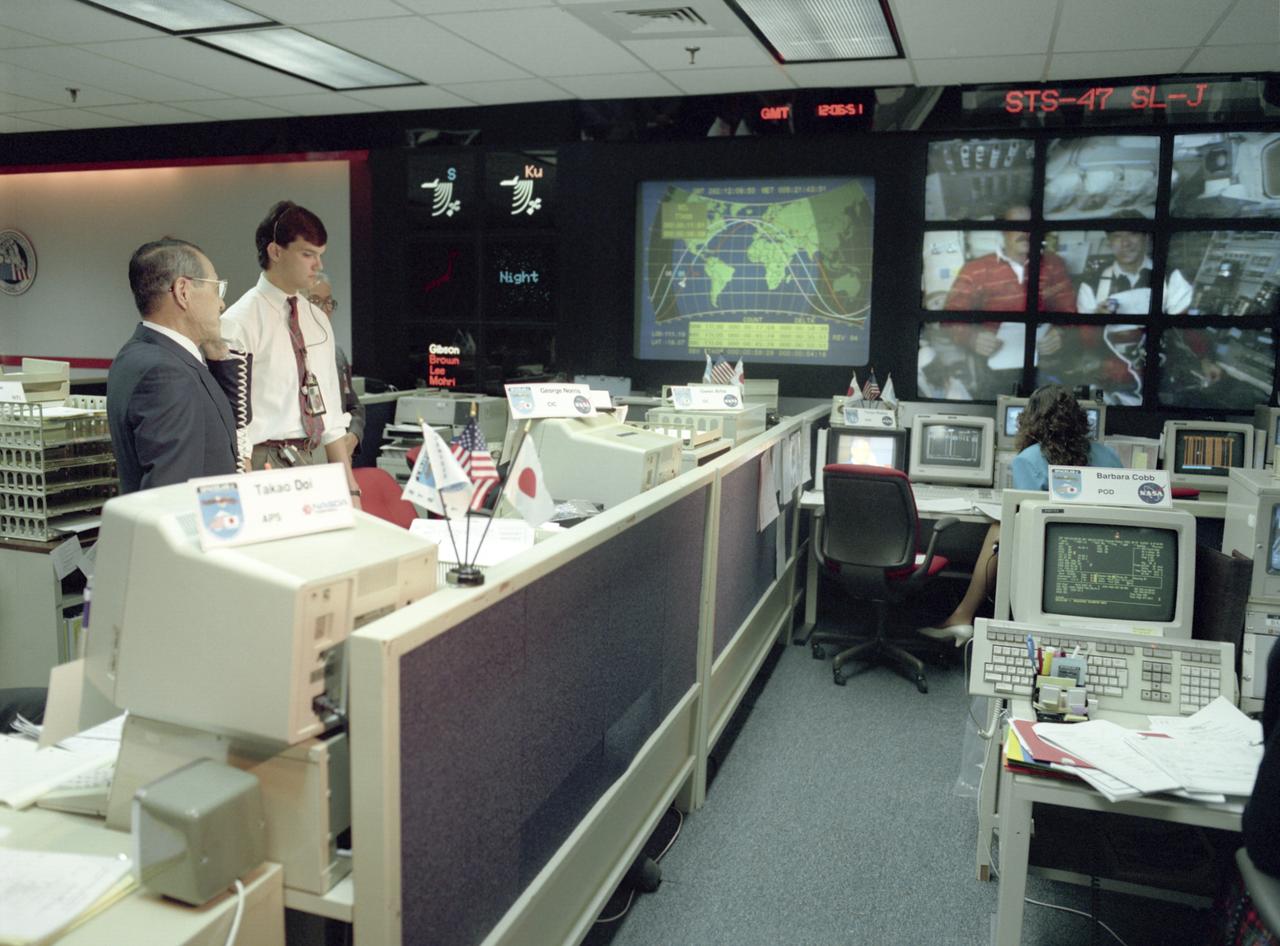
The science laboratory, Spacelab-J (SL-J), flown aboard the STS-47 flight was a joint venture between NASA and the National Space Development Agency of Japan (NASDA) utilizing a manned Spacelab module. The mission conducted 24 materials science and 20 life science experiments, of which 35 were sponsored by NASDA, 7 by NASA, and two collaborative efforts. Materials science investigations covered such fields as biotechnology, electronic materials, fluid dynamics and transport phenomena, glasses and ceramics, metals and alloys, and acceleration measurements. Life sciences included experiments on human health, cell separation and biology, developmental biology, animal and human physiology and behavior, space radiation, and biological rhythms. Test subjects included the crew, Japanese koi fish (carp), cultured animal and plant cells, chicken embryos, fruit flies, fungi and plant seeds, and frogs and frog eggs. From the Huntsville Operations Support Center (HOSC) Spacelab Payload Operations Control Center (SL POCC), NASDA President, Mr. Yamano, speaks to Payload Specialist Mamoru Mohri, a Japanese crew member aboard the STS-47 Spacelab J mission.
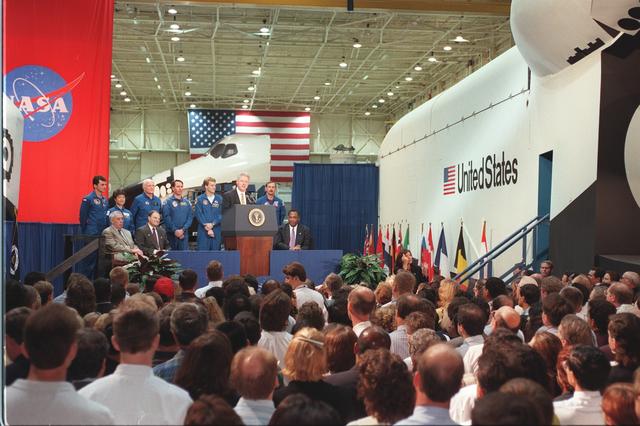
S98-05024 (14 April 1998) --- A large crowd of JSC employees listen to President Bill Clinton during an April 14 visit to the Johnson Space Center. On the dais with the President (seated, from the left) are JSC Director George W.S. Abbey, U.S. Rep. Nick Lampson (D.-TX), and Houston Mayor Lee Brown. Standing behind them are members of the STS-95 crew: (from the left) Pedro Duque of ESA, Chiaki Mukai of NASDA, U.S. Sen. John H. Glenn Jr. (D.-Ohio), Stephen K. Robinson, Scott E. Parazynski, Steven W. Lindsey (behind Clinton) and Curtis L. Brown Jr. Out of the frame is NASA Administrator Daniel Goldin who also addressed the crowd. The Chief Executive earlier had gone inside several of the shuttle and ISS crew training facilities and mockups. Photo Credit: Joe McNally, National Geographic, for NASA
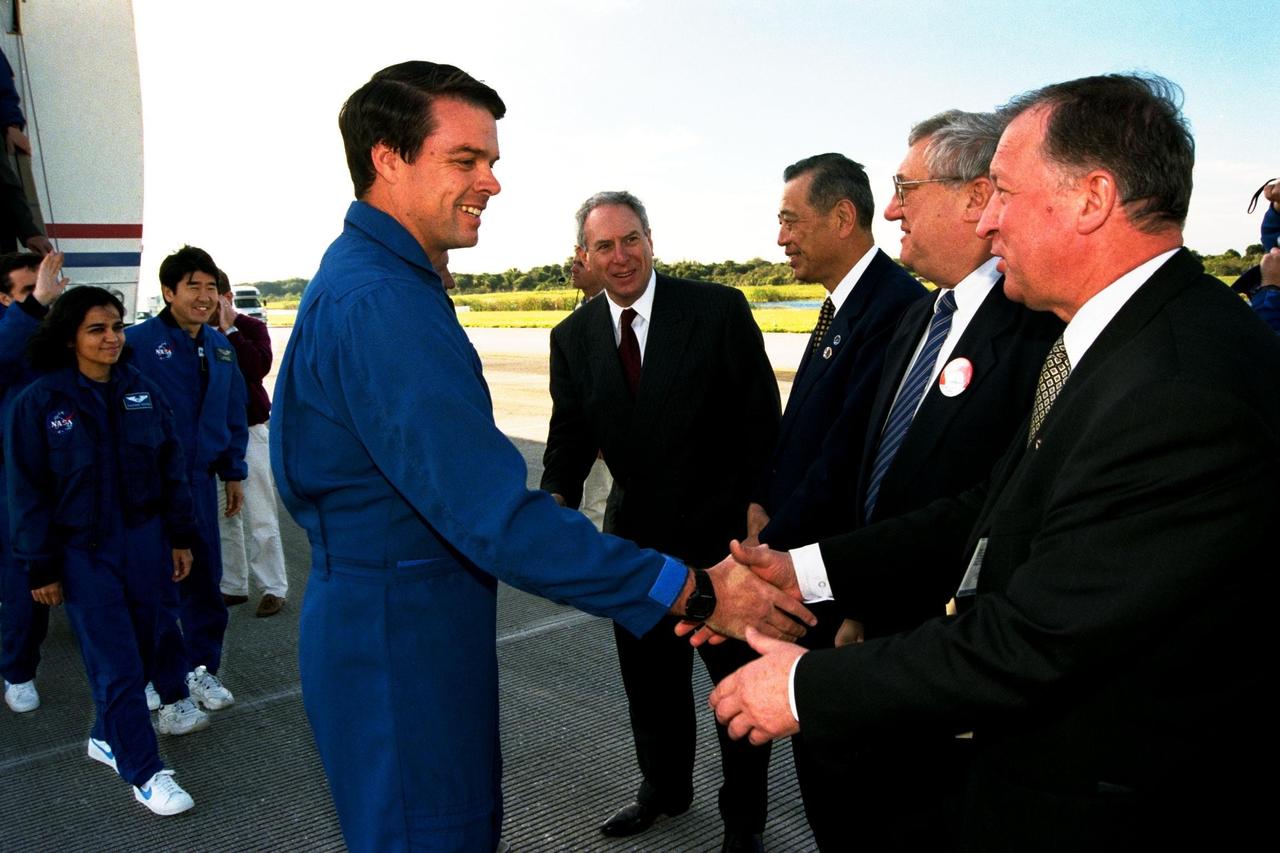
STS-87 Commander Kevin Kregel, center, shakes hands with the deputy director general of the National Space Agency of Ukraine (NSAU), Eduard Kuznetsov, at far right. Next to Kuznetsov is the Honorable Yuri Shcherbak, Ukraine's ambassador to the United States, standing with the president of the National Space Development Agency (NASDA) of Japan, Isao Uchida, and NASA Administrator Daniel Goldin (center). Approaching the VIPs from the left of the photo are Mission Specialists Kalpana Chawla, Ph.D., and Takao Doi, Ph.D., of NASDA. STS-87 concluded its mission with a main gear touchdown at 7:20:04 a.m. EST Dec. 5, at KSC's Shuttle Landing Facility Runway 33, drawing the 15-day, 16-hour and 34-minute-long mission of 6.5 million miles to a close. Also onboard the orbiter were Pilot Steven Lindsey; Mission Specialist Winston Scott; and Payload Specialist Leonid Kadenyuk of NSAU. During the 88th Space Shuttle mission, the crew performed experiments on the United States Microgravity Payload-4 and pollinated plants as part of the Collaborative Ukrainian Experiment. This was the 12th landing for Columbia at KSC and the 41st KSC landing in the history of the Space Shuttle program
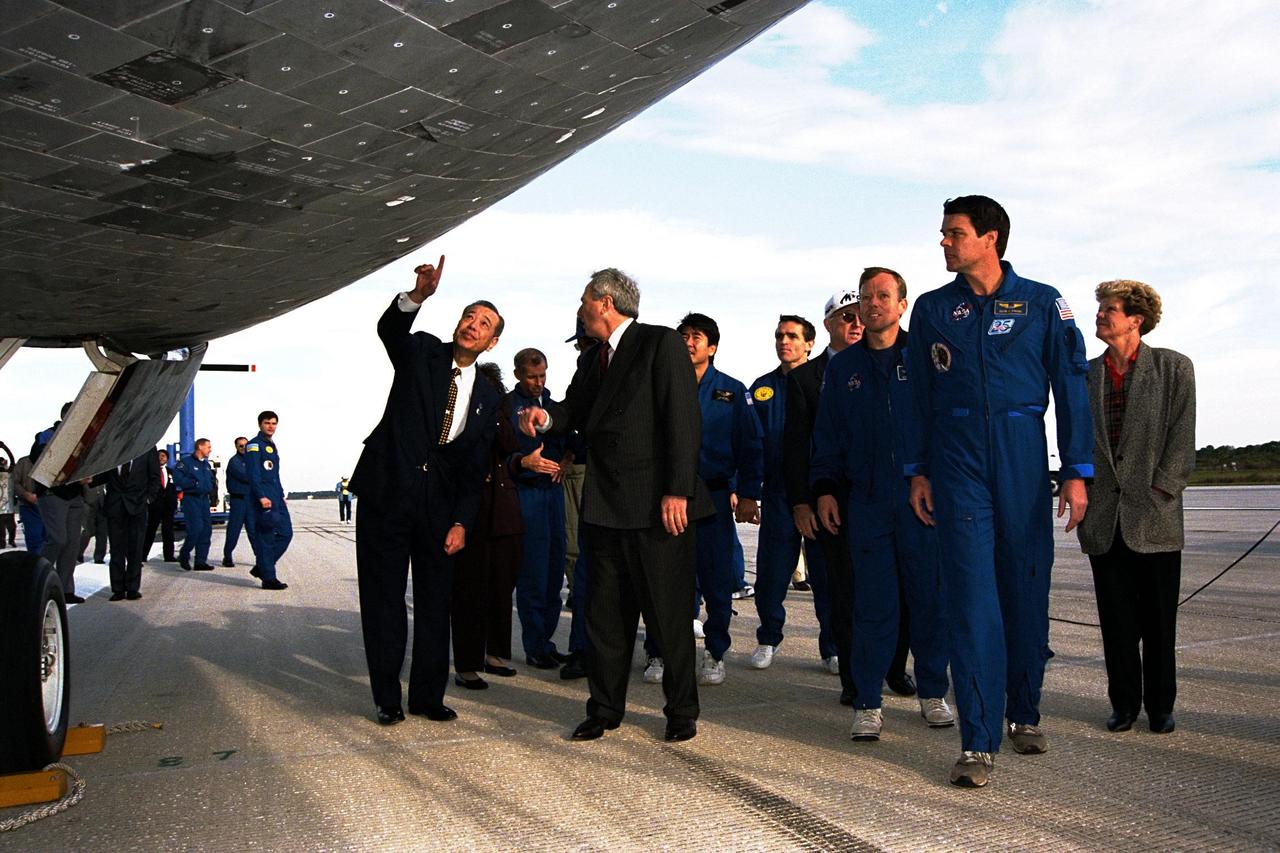
STS-87 crew members regard the tiles underneath the orbiter Columbia shortly after its return to Runway 33 at Kennedy Space Center's Shuttle Landing Facility. Pointing to the tiles is the president of the National Space Development Agency (NASDA) of Japan, Isao Uchida, who is standing next to NASA Administrator Daniel Goldin. STS-87 Commander Kevin Kregel, at right, looks on as Pilot Steve Lindsey follows behind him to continue inspecting the orbiter. STS-87 concluded its mission with a main gear touchdown at 7:20:04 a.m. EST Dec. 5, drawing the 15-day, 16-hour and 34-minute-long mission of 6.5 million miles to a close. Also onboard the orbiter were Mission Specialists Winston Scott; Kalpana Chawla, Ph.D.; and Takao Doi, Ph.D., of NASDA; along with Payload Specialist Leonid Kadenyuk of the National Space Agency of Ukraine. During the 88th Space Shuttle mission, the crew performed experiments on the United States Microgravity Payload-4 and pollinated plants as part of the Collaborative Ukrainian Experiment. This was the 12th landing for Columbia at KSC and the 41st KSC landing in the history of the Space Shuttle program
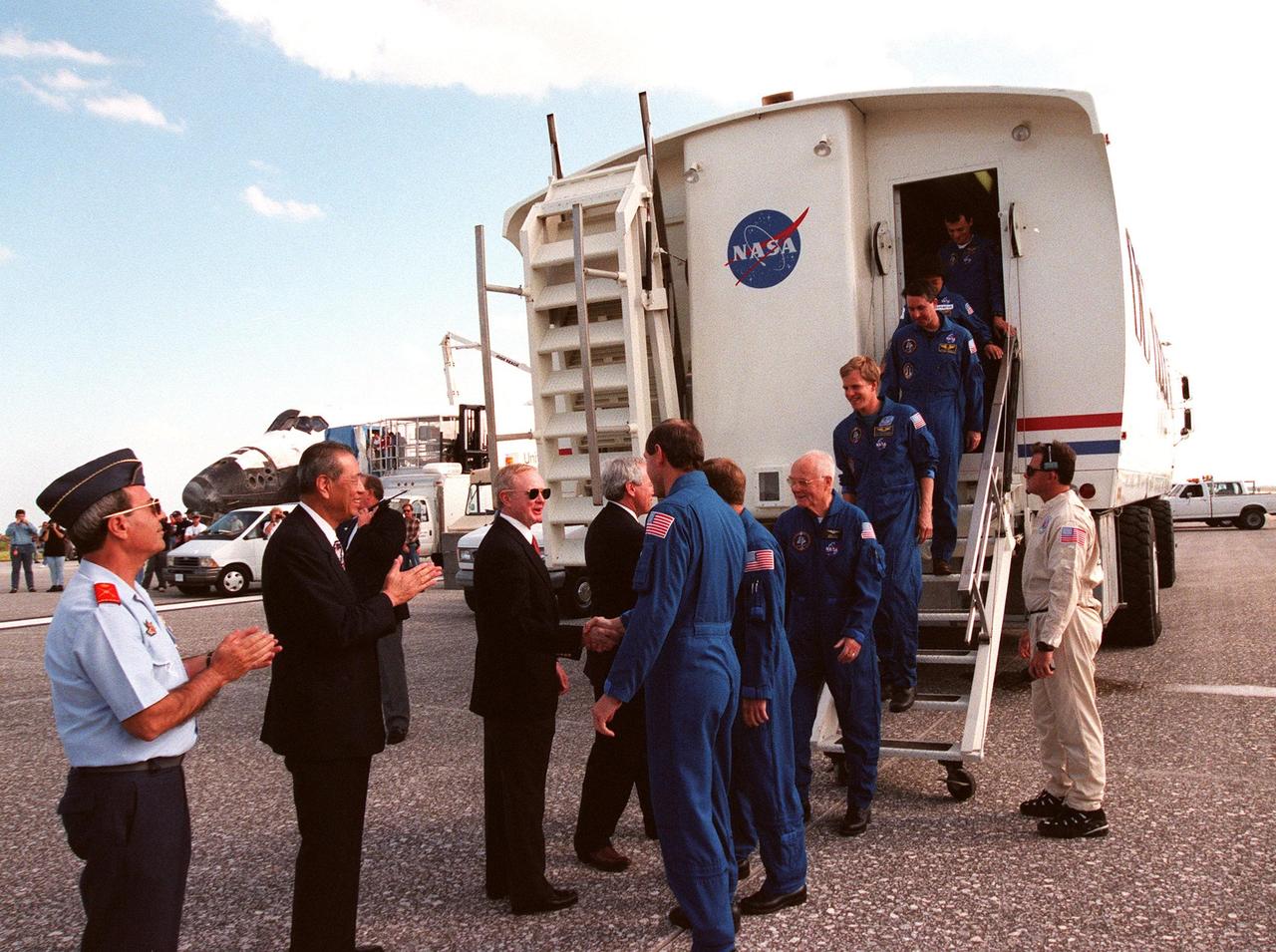
Following touchdown at 12:04 p.m. EST at the Shuttle Landing Facility, the STS-95 crew leave the Crew Transport Vehicle where they are met by (left to right) a Spanish dignitary; Isao Uchida, president of the National Space Development Agency of Japan (NASDA); Center Director Roy Bridges; and NASA Administrator Daniel Goldin. The crew, from left to right, are Mission Commander Curtis L. Brown Jr. (shaking hands with Bridges); Pilot Steven W. Lindsey; Payload Specialist John H. Glenn Jr., a senator from Ohio and one of the original Mercury 7 astronauts; Mission Specialist Scott E. Parazynski; Mission Specialist Stephen K. Robinson; Payload Specialist Chiaki Mukai, with the National Space Development Agency of Japan (NASDA); and Mission Specialist Pedro Duque of Spain, with the European Space Agency (ESA). The successful mission lasted nine days and included research payloads such as the Spartan solar-observing deployable spacecraft, the Hubble Space Telescope Orbital Systems Test Platform, the International Extreme Ultraviolet Hitchhiker, as well as the SPACEHAB single module with experiments on space flight and the aging process
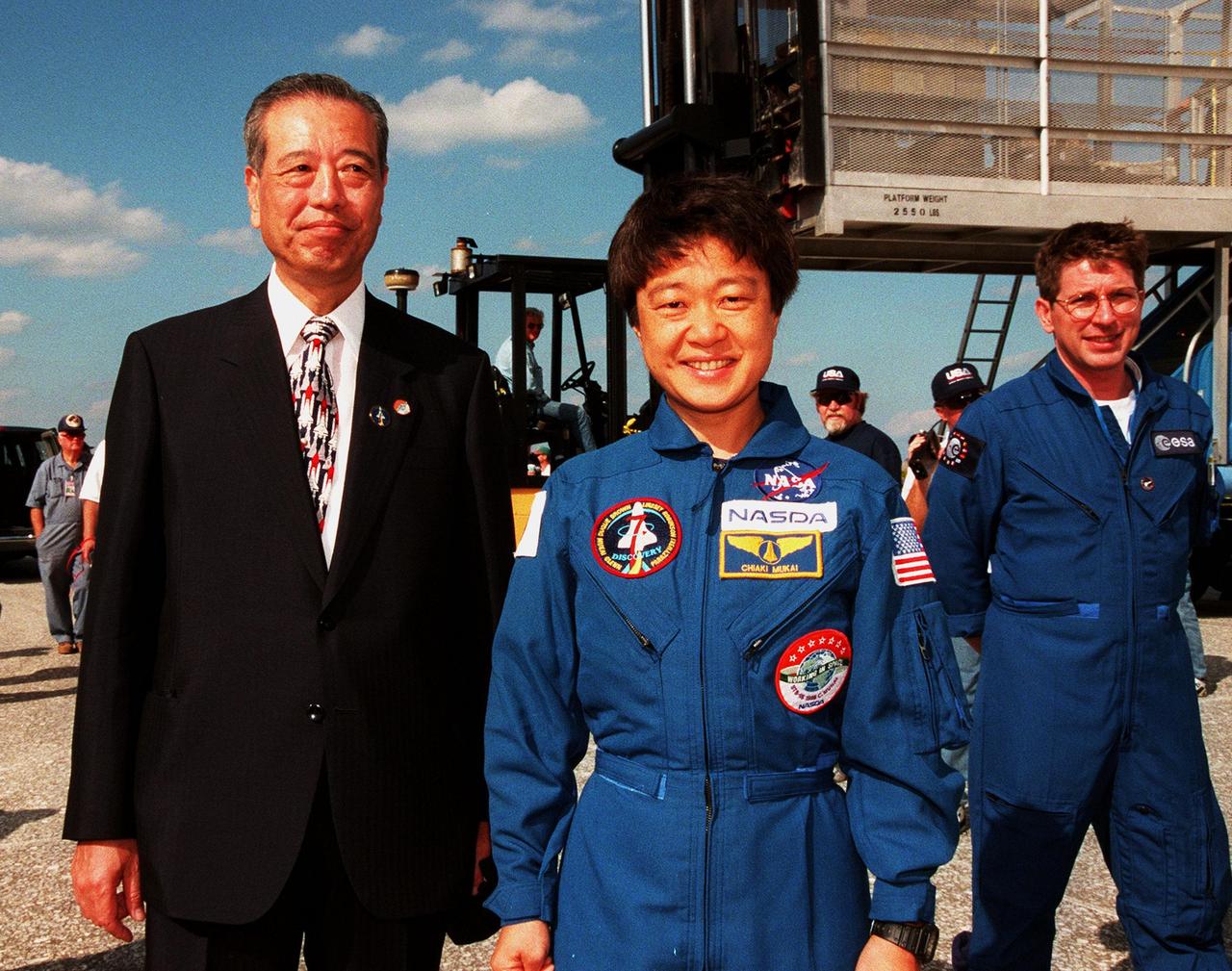
STS-95 Payload Specialist Chiaki Mukai, M.D. (center), with the National Space Development Agency of Japan (NASDA), poses for a photograph with NASDA President Isao Uchida (left). Behind her at the right is a representative of the European Space Agency (ESA). Mukai was one of a crew of seven aboard orbiter Discovery, which landed at KSC at 12:04 p.m. EST, after a successful mission spanning nine days and 3.6 million miles. The other crew members are Mission Commander Curtis L. Brown Jr.; Pilot Steven W. Lindsey; Mission Specialists Stephen K. Robinson; Scott E. Parazynski and Pedro Duque of Spain, with the European Space Agency; and Payload Specialist John H. Glenn Jr., a senator from Ohio. The mission included research payloads such as the Spartan solar-observing deployable spacecraft, the Hubble Space Telescope Orbital Systems Test Platform, the International Extreme Ultraviolet Hitchhiker, as well as the SPACEHAB single module with experiments on space flight and the aging process
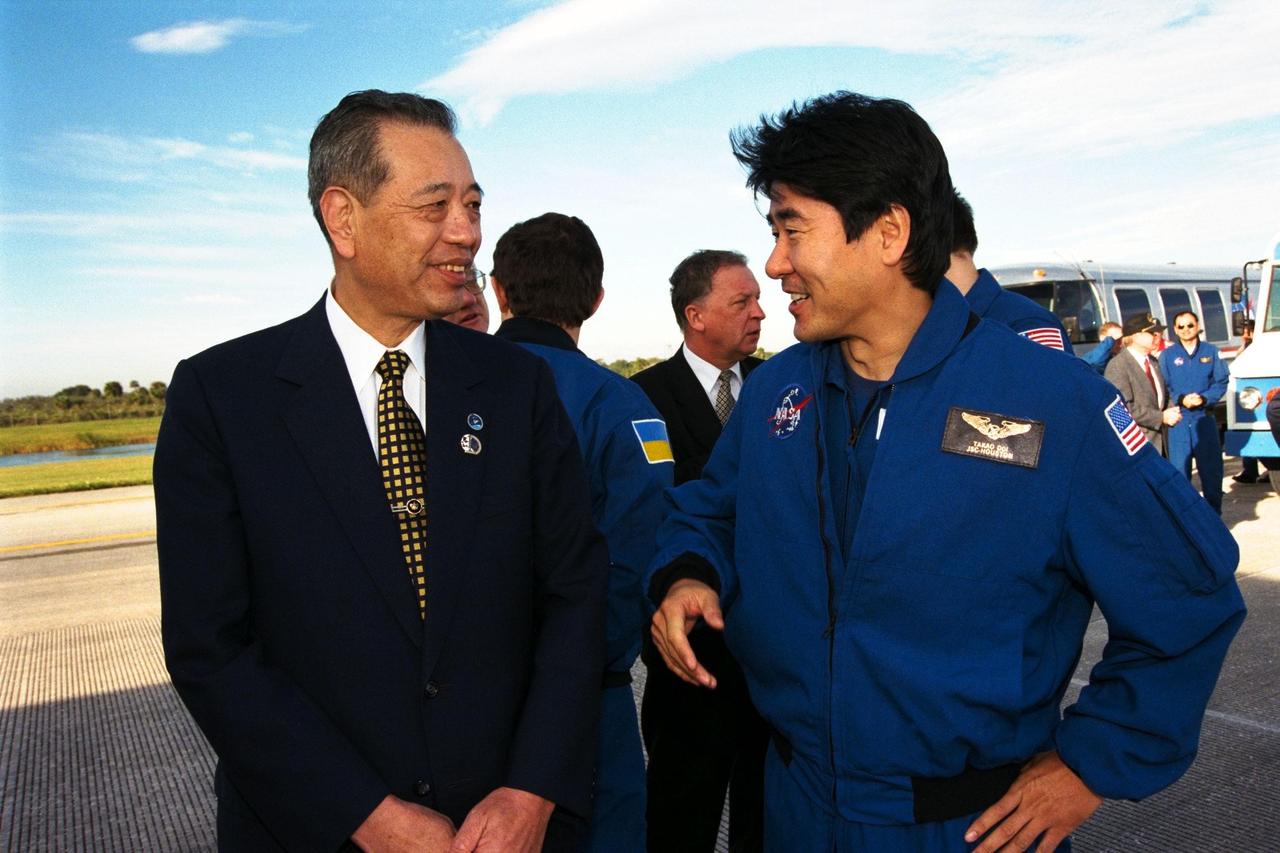
The president of the National Space Development Agency (NASDA) of Japan, Isao Uchida, at left, chats with STS-87 Mission Specialist Takao Doi, Ph.D., of NASDA, shortly after the landing of Columbia at Kennedy Space Center. STS-87 concluded its mission with a main gear touchdown at 7:20:04 a.m. EST Dec. 5, at KSC's Shuttle Landing Facility Runway 33, drawing the 15-day, 16-hour and 34-minute-long mission of 6.5 million miles to a close. Also onboard the orbiter were Commander Kevin Kregel; Pilot Steven Lindsey; Mission Specialists Winston Scott and Kalpana Chawla, Ph.D.; and Payload Specialist Leonid Kadenyuk of the National Space Agency of Ukraine. During the 88th Space Shuttle mission, the crew performed experiments on the United States Microgravity Payload-4 and pollinated plants as part of the Collaborative Ukrainian Experiment. This was the 12th landing for Columbia at KSC and the 41st KSC landing in the history of the Space Shuttle program
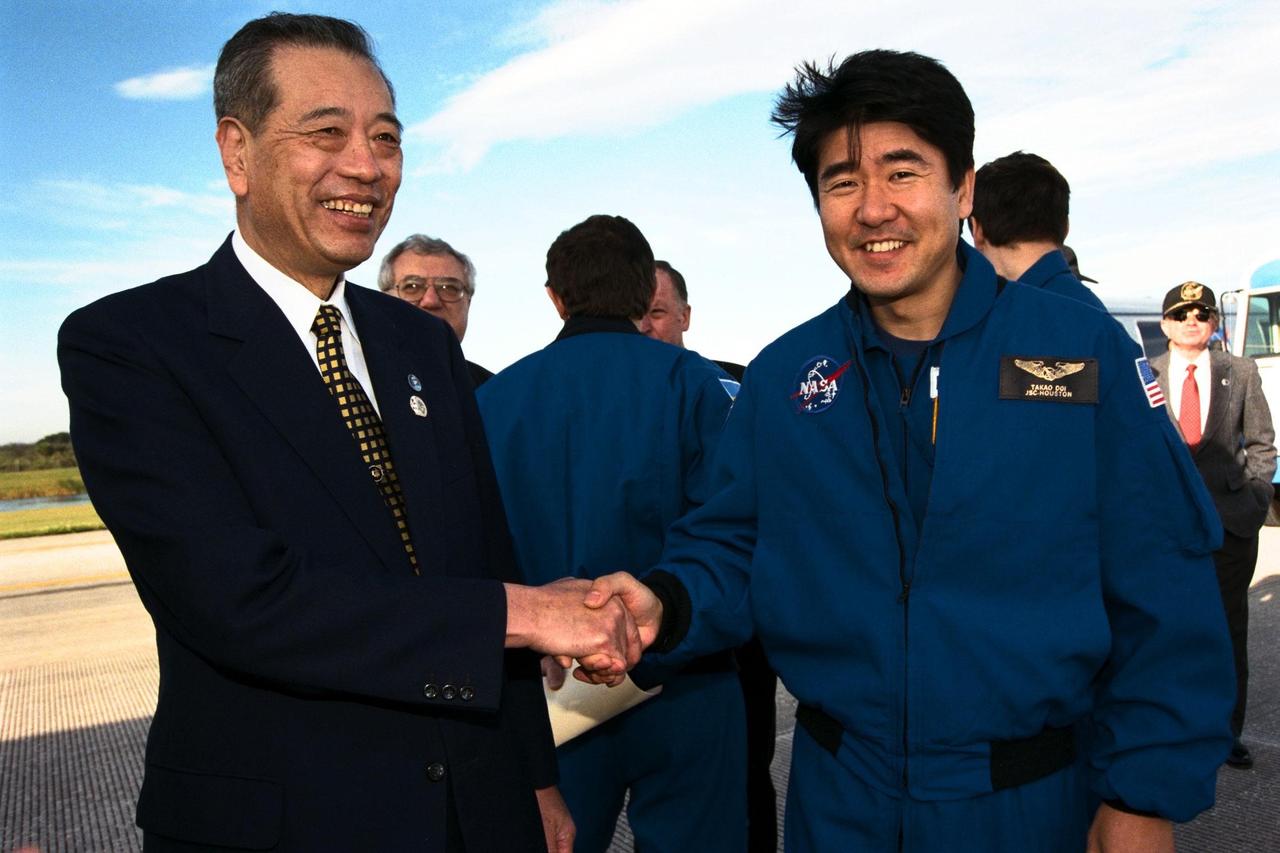
The president of the National Space Development Agency (NASDA) of Japan, Isao Uchida, at left, shakes hands with STS-87 Mission Specialist Takao Doi, Ph.D., of NASDA, shortly after the landing of Columbia at Kennedy Space Center. STS-87 concluded its mission with a main gear touchdown at 7:20:04 a.m. EST Dec. 5, at KSC's Shuttle Landing Facility Runway 33, drawing the 15-day, 16-hour and 34-minute-long mission of 6.5 million miles to a close. Also onboard the orbiter were Commander Kevin Kregel; Pilot Steven Lindsey; Mission Specialists Winston Scott and Kalpana Chawla, Ph.D.; and Payload Specialist Leonid Kadenyuk of the National Space Agency of Ukraine. During the 88th Space Shuttle mission, the crew performed experiments on the United States Microgravity Payload-4 and pollinated plants as part of the Collaborative Ukrainian Experiment. This was the 12th landing for Columbia at KSC and the 41st KSC landing in the history of the Space Shuttle program
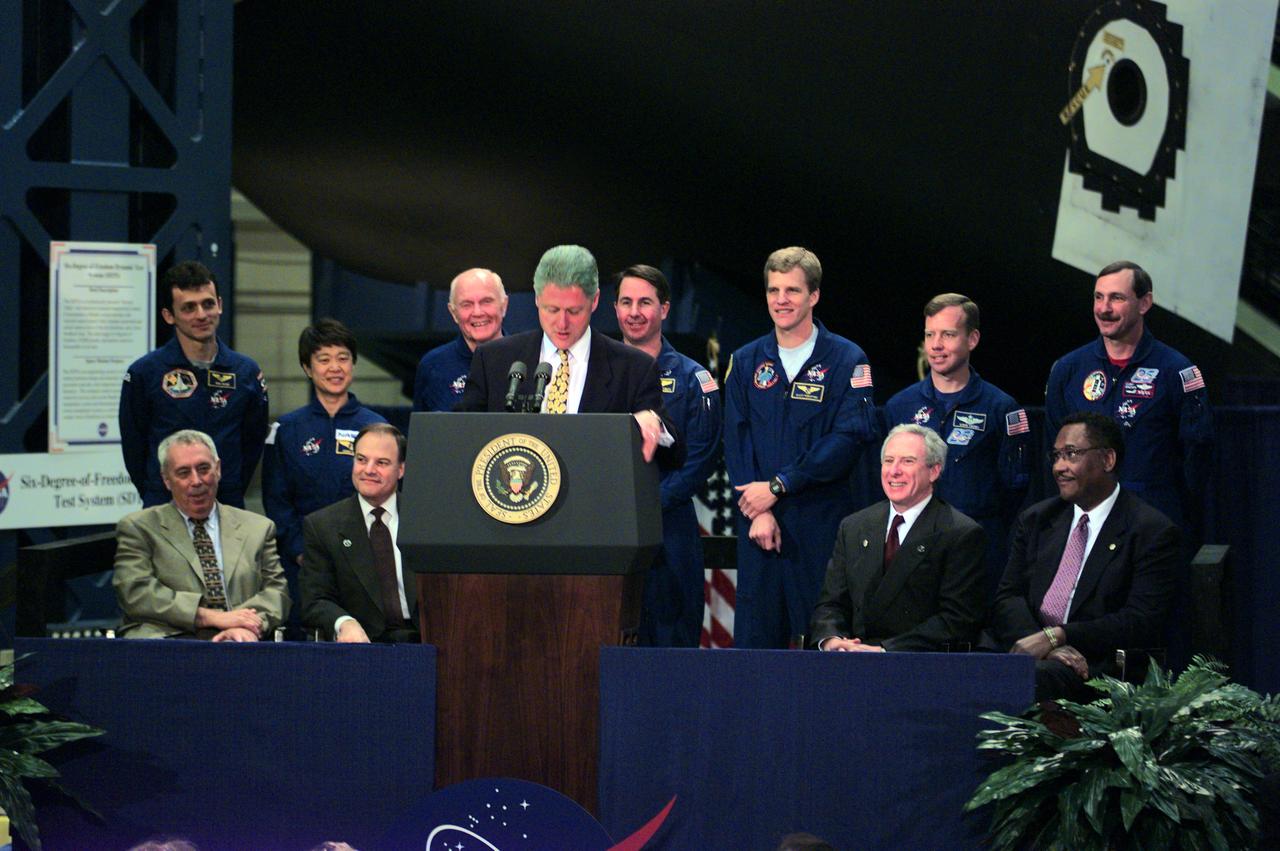
98-E-03312 (14 April 1998) --- President Bill Clinton (at lectern) addresses employees at NASA's Johnson Space Center (JSC) during an April 14 visit to the Houston facility. Seated behind him (from the left) are JSC Director George W.S. Abbey, U.S. Rep. Nick Lampson (D.-TX), NASA Administrator Daniel Goldin and Houston Mayor Lee Brown. Standing are members of the STS-95 crew: (from the left) Pedro Duque, Chiaki Mukai, U.S. Sen. John H. Glenn Jr. (D.-Ohio), Stephen K. Robinson, Scott E. Parazynski, Steven W. Lindsey and Curtis L. Brown Jr. Brown is commander of the scheduled flight aboard Discovery. Mukai represents Japan's National Space Development Agency (NASDA) and Duque is with the European Space Agency (ESA). Photo Credit: NASA or the National Aeronautics and Space Administration.
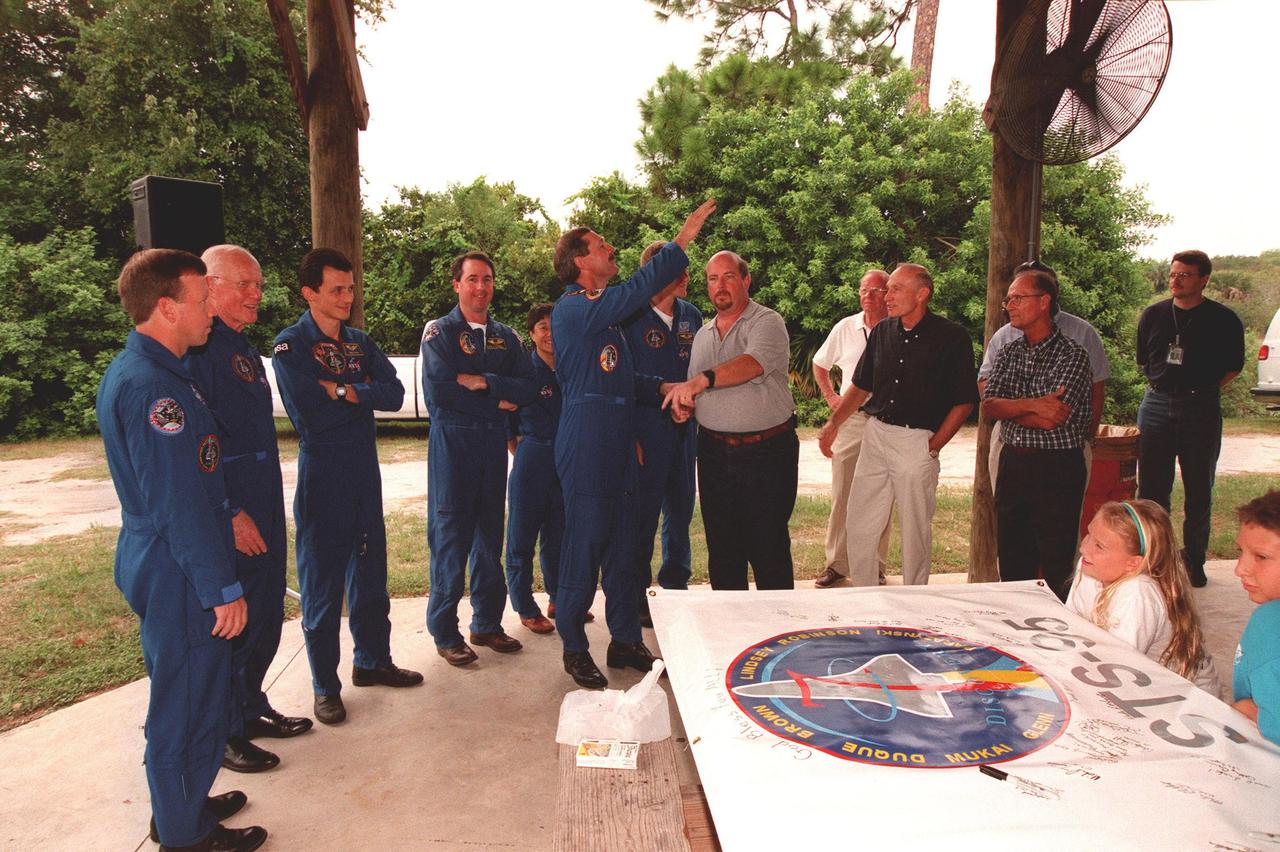
During a break in the Crew Equipment Interface Test (CEIT), the STS-95 crew gathers with United Space Alliance (USA) personnel and their families. From left are Pilot Steven W. Lindsey; Payload Specialist John H. Glenn Jr., a senator from Ohio; Pedro Duque, with the European Space Agency (ESA); Mission Specialist Stephen K. Robinson, Ph.D.; Chiaki Mukai, with the National Space Development Agency of Japan (NASDA); Mission Commander Curtis L. Brown Jr. (with arm raised); Mission Specialist Scott E. Parazynski, M.D.; Jim Furr, USA National Space Flight Awareness representative; Jack King, USA Public Affairs; Bob Sieck, KSC director of Shuttle Processing; and Ed Adamek, USA vice president and associate program manager for Ground Operations at KSC