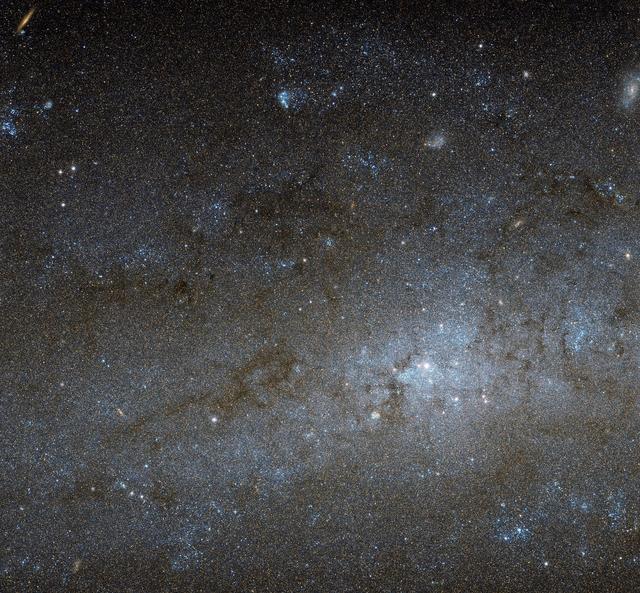
This Hubble image shows the central region of a spiral galaxy known as NGC 247. NGC 247 is a relatively small spiral galaxy in the southern constellation of Cetus (The Whale). Lying at a distance of around 11 million light-years from us, it forms part of the Sculptor Group, a loose collection of galaxies that also contains the more famous NGC 253 (otherwise known as the Sculptor Galaxy). NGC 247’s nucleus is visible here as a bright, whitish patch, surrounded by a mixture of stars, gas and dust. The dust forms dark patches and filaments that are silhouetted against the background of stars, while the gas has formed into bright knots known as H II regions, mostly scattered throughout the galaxy’s arms and outer areas. This galaxy displays one particularly unusual and mysterious feature — it is not visible in this image, but can be seen clearly in wider views of the galaxy, such as this picture from ESO’s MPG/ESO 2.2-metre telescope. The northern part of NGC 247’s disc hosts an apparent void, a gap in the usual swarm of stars and H II regions that spans almost a third of the galaxy’s total length. There are stars within this void, but they are quite different from those around it. They are significantly older, and as a result much fainter and redder. This indicates that the star formation taking place across most of the galaxy’s disc has somehow been arrested in the void region, and has not taken place for around one billion years. Although astronomers are still unsure how the void formed, recent studies suggest it might have been caused by gravitational interactions with part of another galaxy.
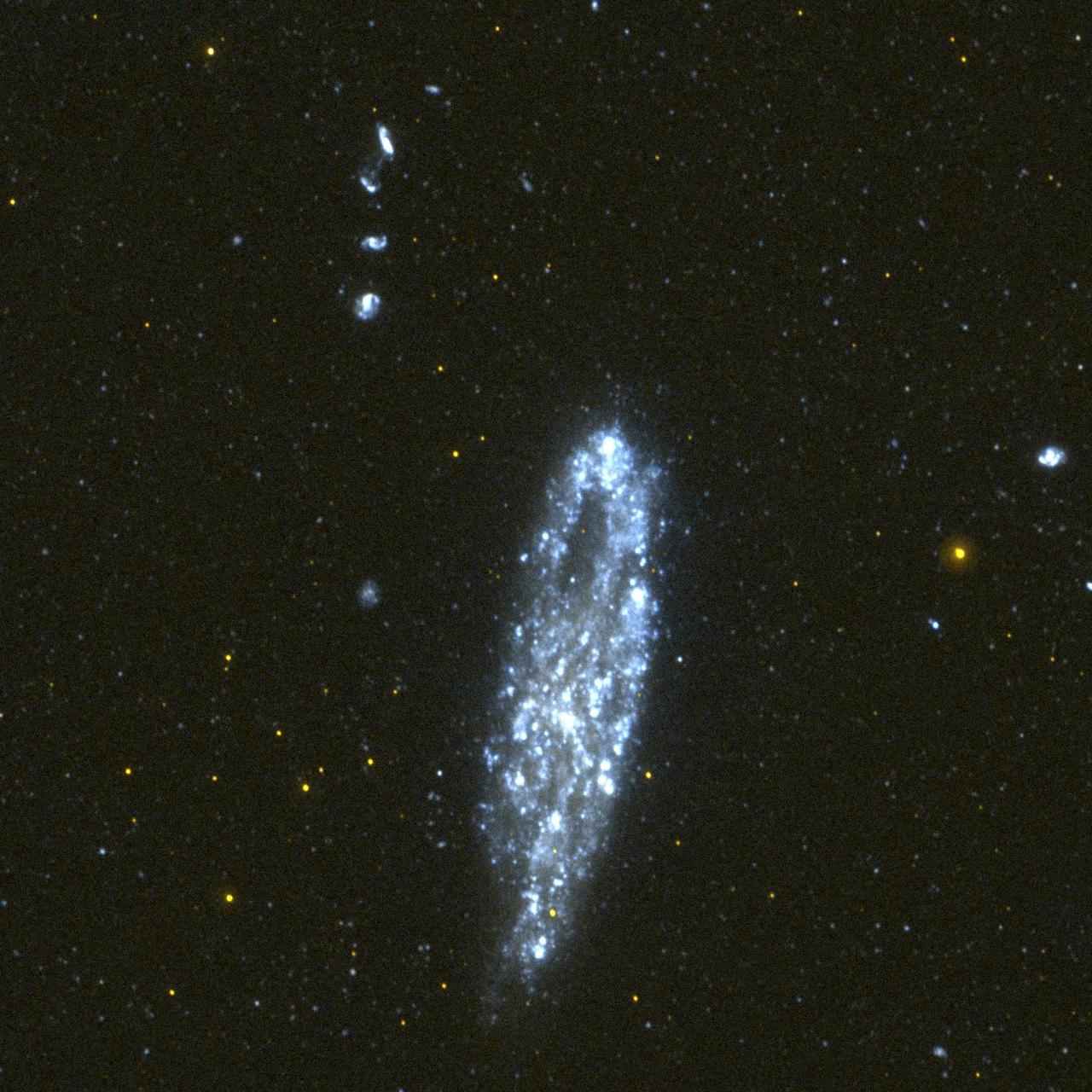
This image of the dwarf spiral galaxy NGC 247 was taken by Galaxy Evolution Explorer on October 13, 2003, in a single orbit exposure of 1600 seconds. The region that looks like a "hole" in the upper part of the galaxy is a location with a deficit of gas and therefore a lower star formation rate and ultraviolet brightness. Optical images of this galaxy show a bright star on the southern edge. This star is faint and red in the Galaxy Evolution Explorer ultraviolet image, revealing that it is a foreground star in our Milky Way galaxy. The string of background galaxies to the North-East (upper left) of NGC 247 is 355 million light years from our Milky Way galaxy whereas NGC 247 is a mere 9 million light years away. The faint blue light that can be seen in the Galaxy Evolution Explorer image of the upper two of these background galaxies may indicate that they are in the process of merging together. http://photojournal.jpl.nasa.gov/catalog/PIA04922
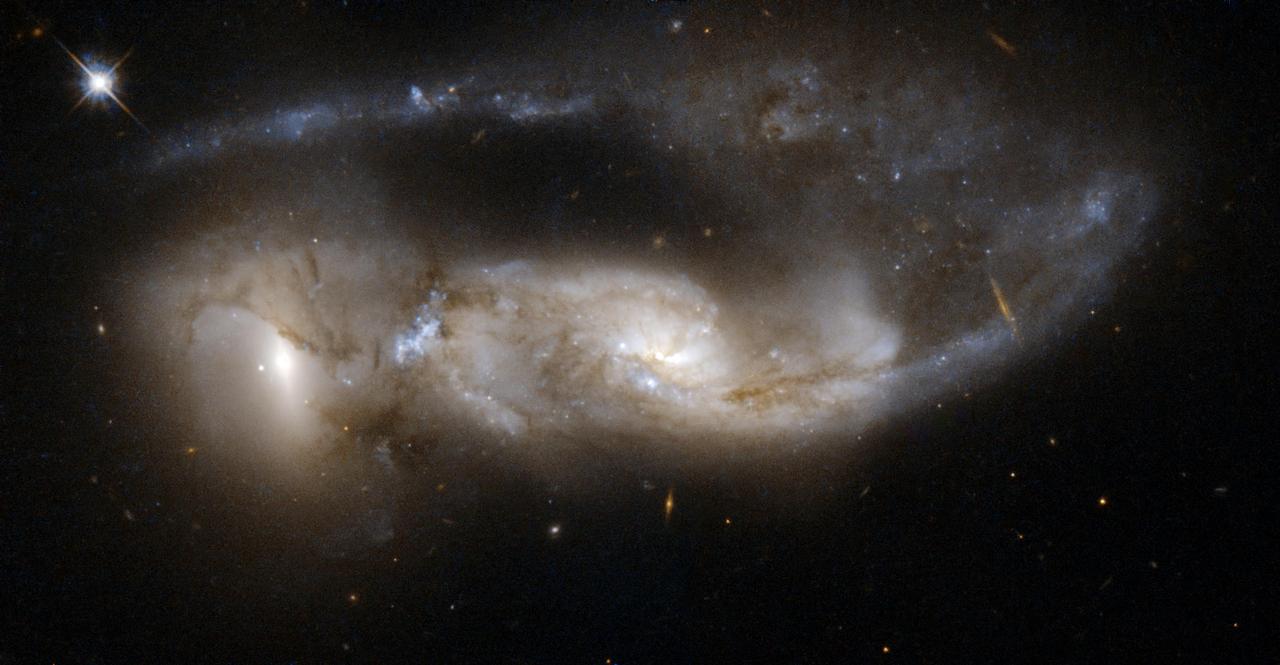
NGC 6621/2 VV 247, Arp 81 is a strongly interacting pair of galaxies, seen about 100 million years after their closest approach. This image is part of a large collection of images of merging galaxies taken by NASA Hubble Space Telescope.
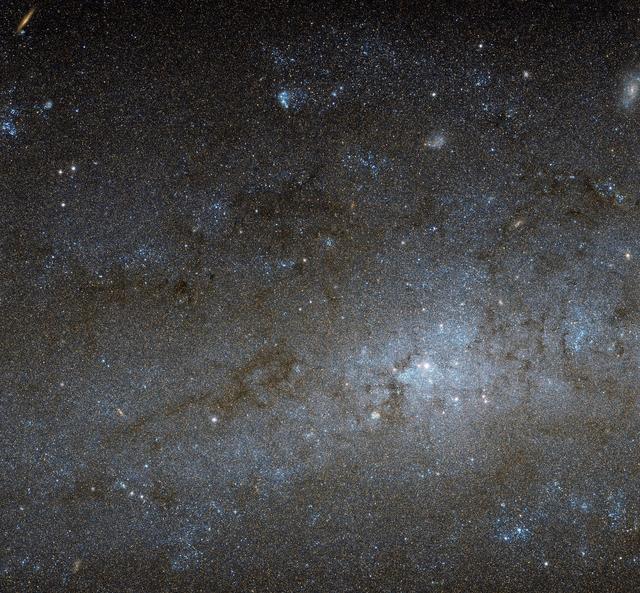
This Hubble image shows the central region of a spiral galaxy known as NGC 247. NGC 247 is a relatively small spiral galaxy in the southern constellation of Cetus (The Whale). Lying at a distance of around 11 million light-years from us, it forms part of the Sculptor Group, a loose collection of galaxies that also contains the more famous NGC 253 (otherwise known as the Sculptor Galaxy). NGC 247’s nucleus is visible here as a bright, whitish patch, surrounded by a mixture of stars, gas and dust. The dust forms dark patches and filaments that are silhouetted against the background of stars, while the gas has formed into bright knots known as H II regions, mostly scattered throughout the galaxy’s arms and outer areas. This galaxy displays one particularly unusual and mysterious feature — it is not visible in this image, but can be seen clearly in wider views of the galaxy, such as a picture from ESO’s MPG/ESO 2.2-meter telescope. The northern part of NGC 247’s disc hosts an apparent void, a gap in the usual swarm of stars and H II regions that spans almost a third of the galaxy’s total length. There are stars within this void, but they are quite different from those around it. They are significantly older, and as a result much fainter and redder. This indicates that the star formation taking place across most of the galaxy’s disk has somehow been arrested in the void region, and has not taken place for around one billion years. Although astronomers are still unsure how the void formed, recent studies suggest it might have been caused by gravitational interactions with part of another galaxy. Image Credit: NASA/ESA