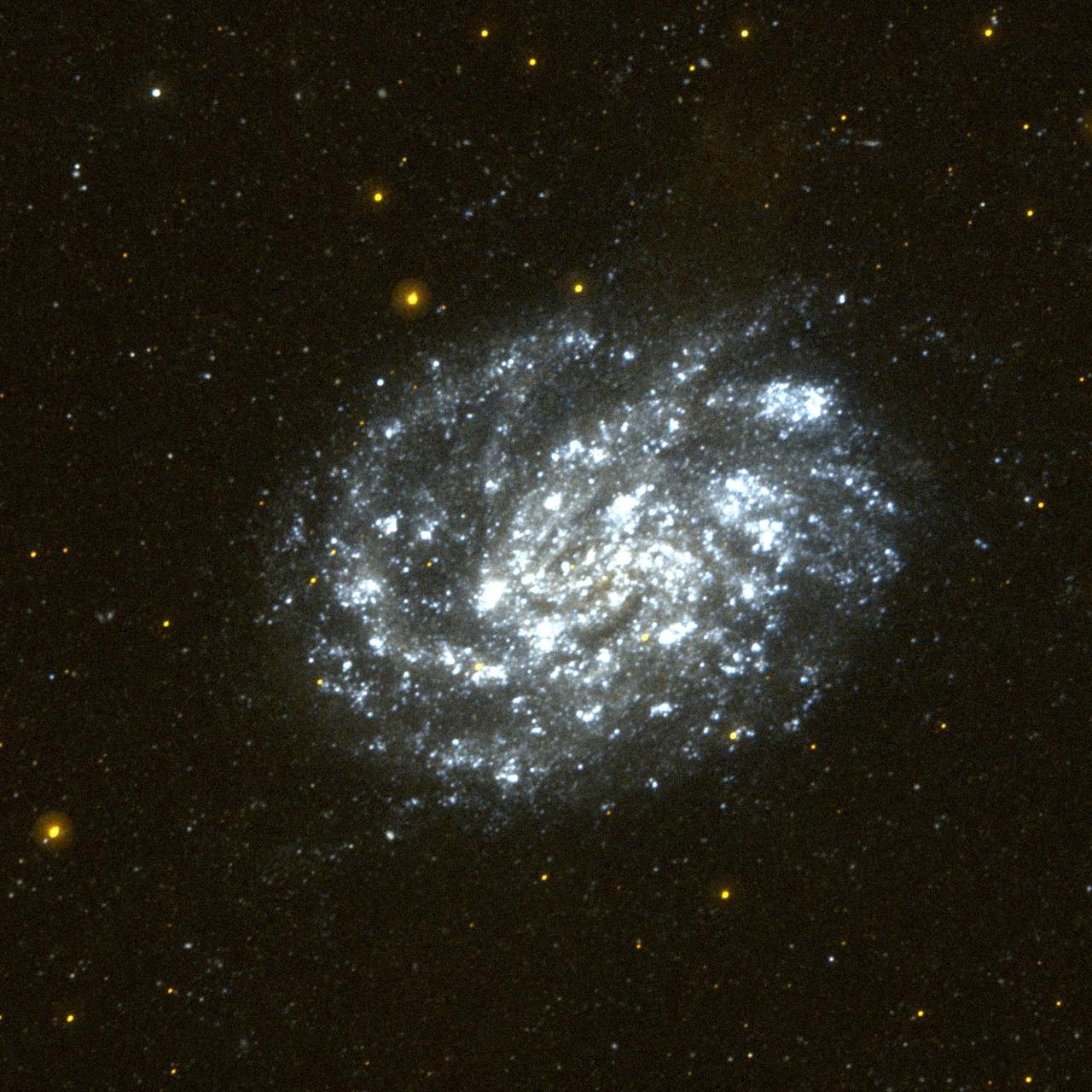
This image of the nearby spiral galaxy NGC 300 was taken by Galaxy Evolution Explorer in a single orbit exposure of 27 minutes on October 10, 2003. NGC 300 lies 7 million light years from our Milky Way galaxy and is one of a group of galaxies in the constellation Sculptor. NGC 300 is often used as a prototype of a spiral galaxy because in optical images it displays flowing spiral arms and a bright central region of older (and thus redder) stars. The Galaxy Evolution Explorer image taken in ultraviolet light shows us that NGC 300 is an efficient star-forming galaxy. The bright blue regions in the Galaxy Evolution Explorer image reveal new stars forming all the way into the nucleus of NGC 300. http://photojournal.jpl.nasa.gov/catalog/PIA04924
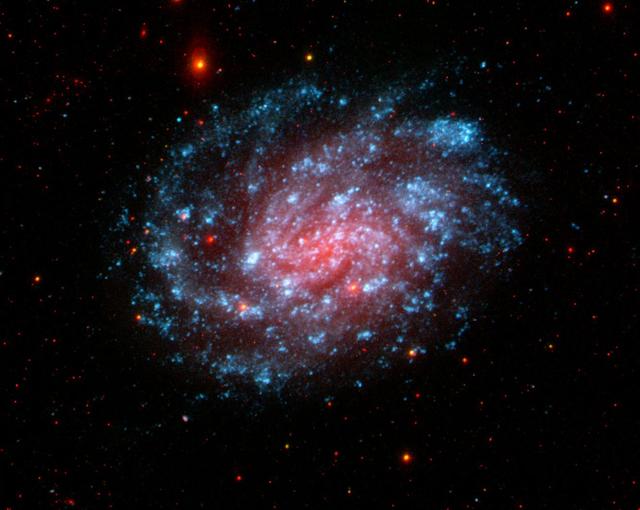
This image from NASA Galaxy Evolution Explorer shows the galaxy NGC 300, located about seven million light-years away in the constellation Sculptor. It is a classic spiral galaxy with open arms and vigorous star formation throughout.
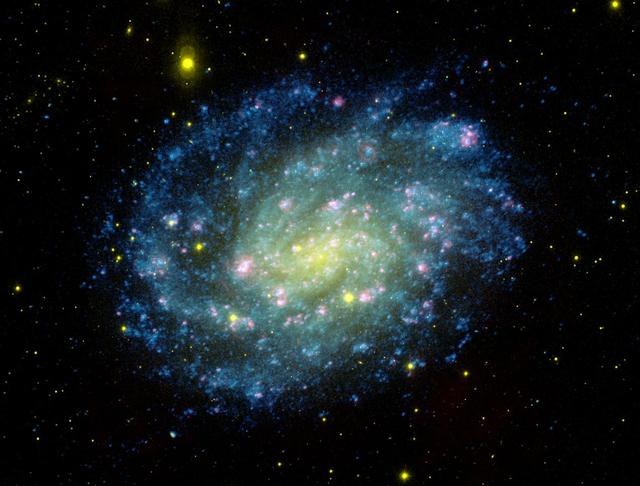
Young hot blue stars dominate the outer spiral arms of nearby galaxy NGC 300, while the older stars congregate in the nuclear regions which appear yellow-green in this image from NASA Galaxy Evolution Explorer.
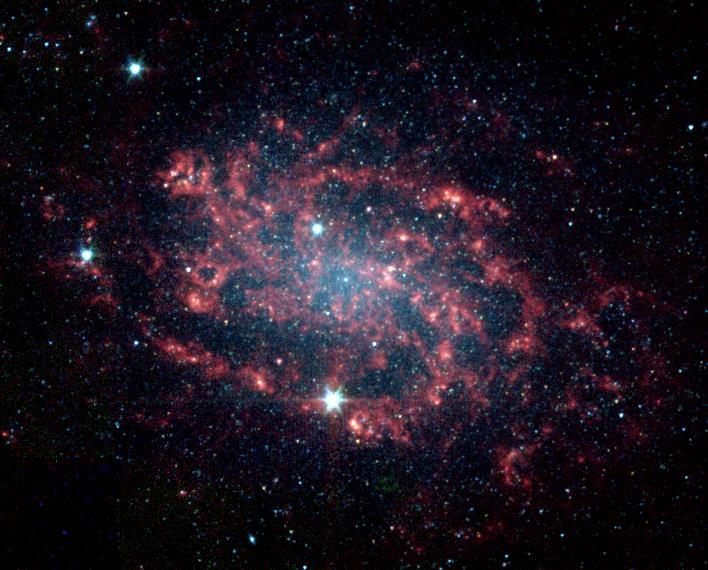
Sometimes, the best way to understand how something works is to take it apart. The same is true for galaxies like NGC 300, which NASA's Spitzer Space Telescope has divided into its various parts. NGC 300 is a face-on spiral galaxy located 7.5 million light-years away in the southern constellation Sculptor. This false-color image taken by the infrared array camera on Spitzer readily distinguishes the main star component of the galaxy (blue) from its dusty spiral arms (red). The star distribution peaks strongly in the central bulge where older stars congregate, and tapers off along the arms where younger stars reside. Thanks to Spitzer's unique ability to sense the heat or infrared emission from dust, astronomers can now clearly trace the embedded dust structures within NGC 300's arms. When viewed at visible wavelengths, the galaxy's dust appears as dark lanes, largely overwhelmed by bright starlight. With Spitzer, the dust - in particular organic compounds called polycyclic aromatic hydrocarbons - can be seen in vivid detail (red). These organic molecules are produced, along with heavy elements, by the stellar nurseries that pepper the arms. The findings provide a better understanding of spiral galaxy mechanics and, in the future, will help decipher more distant galaxies, whose individual components cannot be resolved. This image was taken on Nov. 21, 2003 and is composed of photographs obtained at four wavelengths: 3.6 microns (blue), 4.5 microns (green), 5.8 microns (orange) and 8 microns (red). http://photojournal.jpl.nasa.gov/catalog/PIA05879
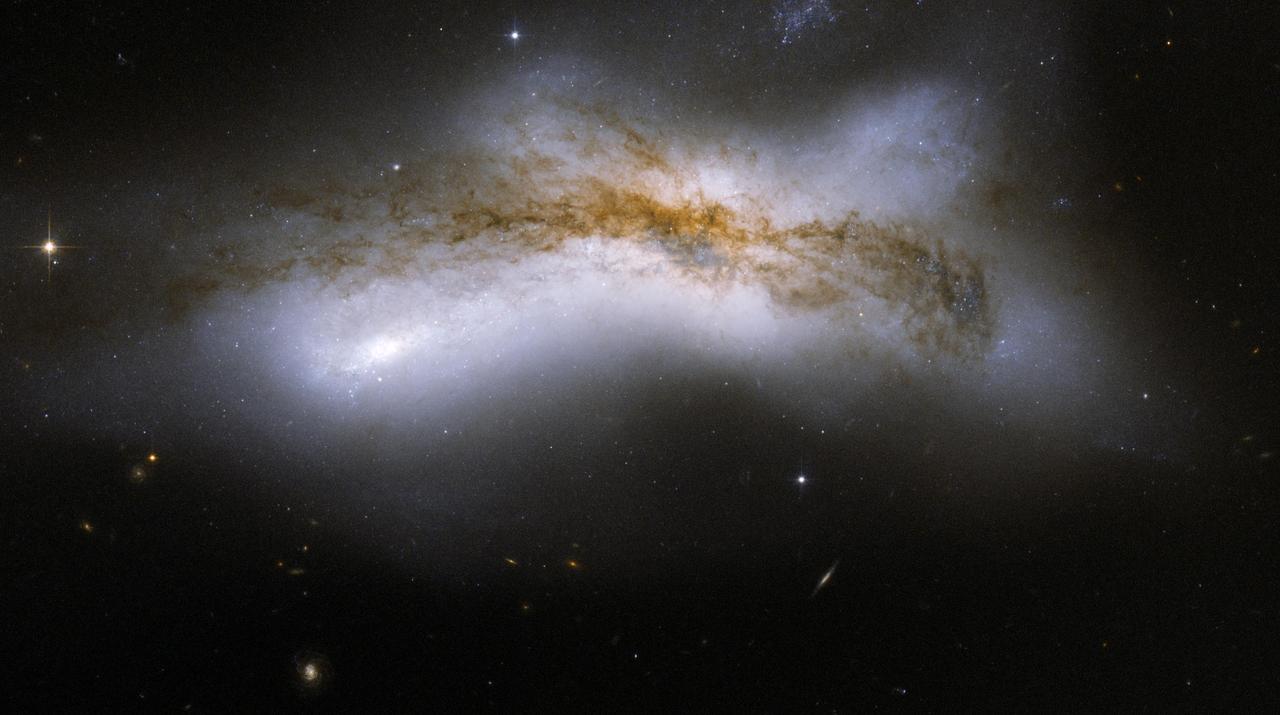
NGC 520 is the product of a collision between two disk galaxies that started 300 million years ago. This image is part of a large collection of images of merging galaxies taken by NASA Hubble Space Telescope.
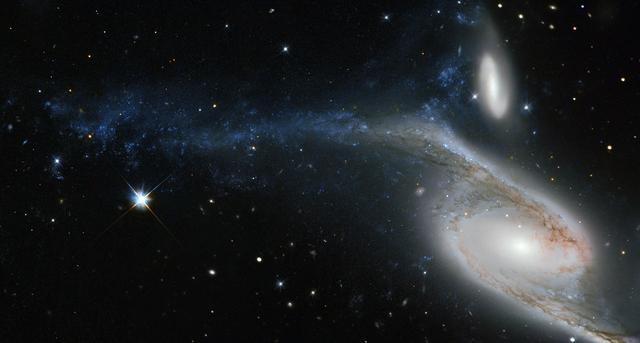
This picture, taken by the NASA/ESA Hubble Space Telescope’s Wide Field Planetary Camera 2 (WFPC2), shows a galaxy known as NGC 6872 in the constellation of Pavo (The Peacock). Its unusual shape is caused by its interactions with the smaller galaxy that can be seen just above NGC 6872, called IC 4970. They both lie roughly 300 million light-years away from Earth. From tip to tip, NGC 6872 measures over 500,000 light-years across, making it the second largest spiral galaxy discovered to date. In terms of size it is beaten only by NGC 262, a galaxy that measures a mind-boggling 1.3 million light-years in diameter! To put that into perspective, our own galaxy, the Milky Way, measures between 100,000 and 120,000 light-years across, making NGC 6872 about five times its size. The upper left spiral arm of NGC 6872 is visibly distorted and is populated by star-forming regions, which appear blue on this image. This may have been be caused by IC 4970 recently passing through this arm — although here, recent means 130 million years ago! Astronomers have noted that NGC 6872 seems to be relatively sparse in terms of free hydrogen, which is the basis material for new stars, meaning that if it weren’t for its interactions with IC 4970, NGC 6872 might not have been able to produce new bursts of star formation. Credit: Image credit: ESA/Hubble & NASA / Acknowledgement: Judy Schmidt <b><a href="http://www.nasa.gov/audience/formedia/features/MP_Photo_Guidelines.html" rel="nofollow">NASA image use policy.</a></b> <b><a href="http://www.nasa.gov/centers/goddard/home/index.html" rel="nofollow">NASA Goddard Space Flight Center</a></b> enables NASA’s mission through four scientific endeavors: Earth Science, Heliophysics, Solar System Exploration, and Astrophysics. Goddard plays a leading role in NASA’s accomplishments by contributing compelling scientific knowledge to advance the Agency’s mission. <b>Follow us on <a href="http://twitter.com/NASAGoddardPix" rel="nofollow">Twitter</a></b> <b>Like us on <a href="http://www.facebook.com/pages/Greenbelt-MD/NASA-Goddard/395013845897?ref=tsd" rel="nofollow">Facebook</a></b> <b>Find us on <a href="http://instagram.com/nasagoddard?vm=grid" rel="nofollow">Instagram</a></b>

Chandra X-Ray Observatory provided this composite X-ray (blue and green) and optical (red) image of the active galaxy NGC 1068 showing gas blowing away in a high-speed wind from the vicinity of a central supermassive black hole. Regions of intense star formation in the irner spiral arms of the galaxy are highlighted by both optical and x-ray emissions. A doughnut shaped cloud of cool gas and dust surrounding the black hole, known as the torus, appears as the elongated white spot . It has has a mass of about 5 million suns and is estimated to extend from within a few light years of the black hole out to about 300 light years.
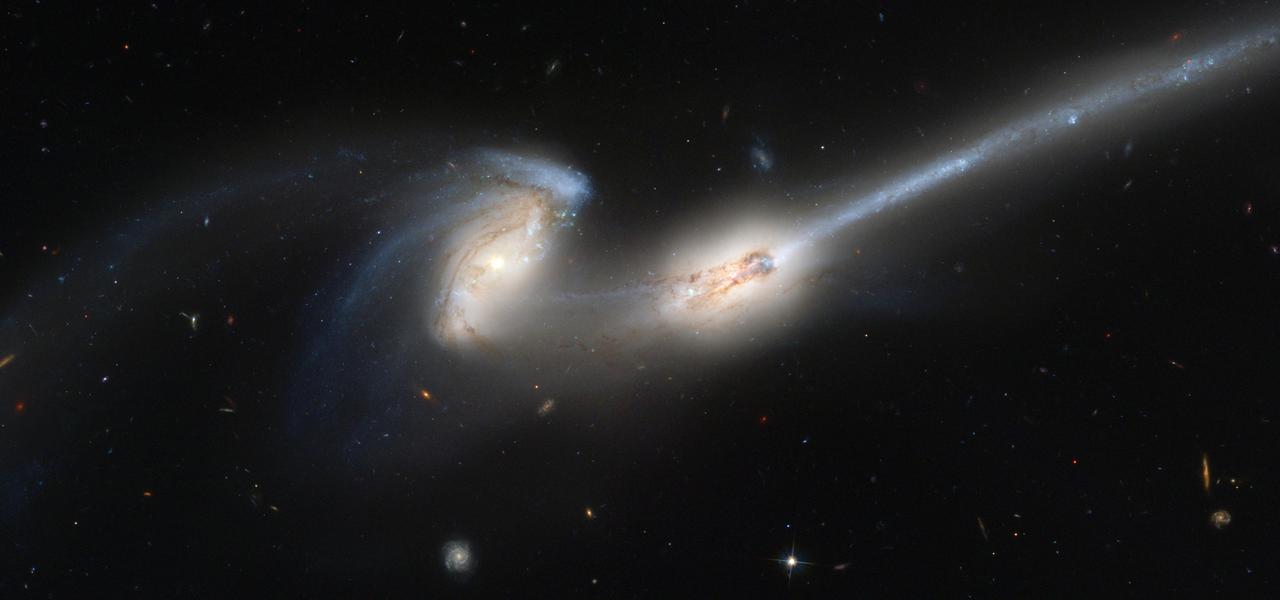
The Advanced Camera for Surveys (ACS), the newest camera on the Hubble Space Telescope, has captured a spectacular pair of galaxies. Located 300 million light-years away in the constellation Coma Berenices, the colliding galaxies have been nicknamed "The Mice" because of the long tails of stars and gas emanating from each galaxy. Otherwise known as NGC 4676, the pair will eventually merge into a single giant galaxy. In the galaxy at left, the bright blue patch is resolved into a vigorous cascade of clusters and associations of young, hot blue stars, whose formation has been triggered by the tidal forces of the gravitational interaction. The clumps of young stars in the long, straight tidal tail (upper right) are separated by fainter regions of material. These dim regions suggest that the clumps of stars have formed from the gravitational collapse of the gas and dust that once occupied those areas. Some of the clumps have luminous masses comparable to dwarf galaxies that orbit the halo of our own Milky Way Galaxy. Computer simulations by astronomers show that we are seeing two near identical spiral galaxies approximately 160 million years after their closest encounter. The simulations also show that the pair will eventually merge, forming a large, nearly spherical galaxy (known as an elliptical galaxy). The Mice presage what may happen to our own Milky Way several billion years from now when it collides with our nearest large neighbor, the Andromeda Galaxy (M31). This picture is assembled from three sets of images taken on April 7, 2002, in blue, orange, and near-infrared filters. Credit: NASA, H. Fort (JHU), G. Illingworth (USCS/LO), M. Clampin (STScI), G. Hartig (STScI), the ACS Science Team, and ESA.