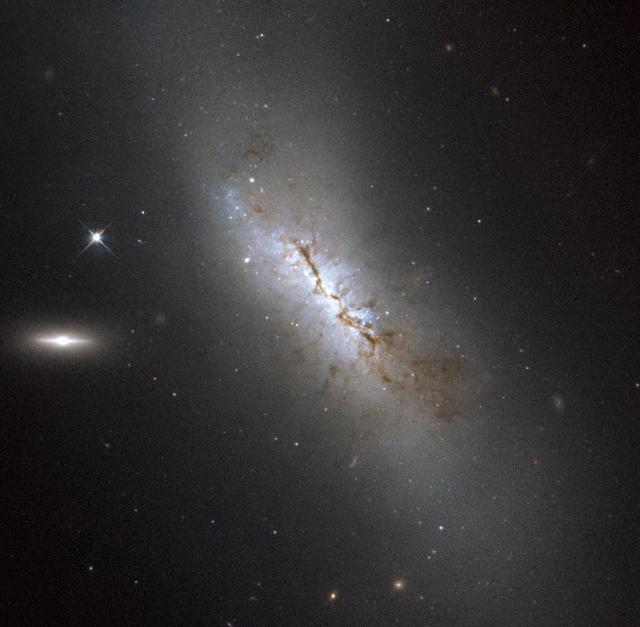
The galaxy pictured here is NGC 4424, located in the constellation of Virgo. It is not visible with the naked eye but has been captured here with the NASA/ESA Hubble Space Telescope. Although it may not be obvious from this image, NGC 4424 is in fact a spiral galaxy. In this image it is seen more or less edge on, but from above you would be able to see the arms of the galaxy wrapping around its centre to give the characteristic spiral form . In 2012 astronomers observed a supernova in NGC 4424 — a violent explosion marking the end of a star’s life. During a supernova explosion, a single star can often outshine an entire galaxy. However, the supernova in NGC 4424, dubbed SN 2012cg, cannot be seen here as the image was taken ten years prior to the explosion. Along the central region of the galaxy, clouds of dust block the light from distant stars and create dark patches. To the left of NGC 4424 there are two bright objects in the frame. The brightest is another, smaller galaxy known as LEDA 213994 and the object closer to NGC 4424 is an anonymous star in our Milky Way. A version of this image was entered into the Hubble's Hidden Treasures image processing competition by contestant Gilles Chapdelaine.
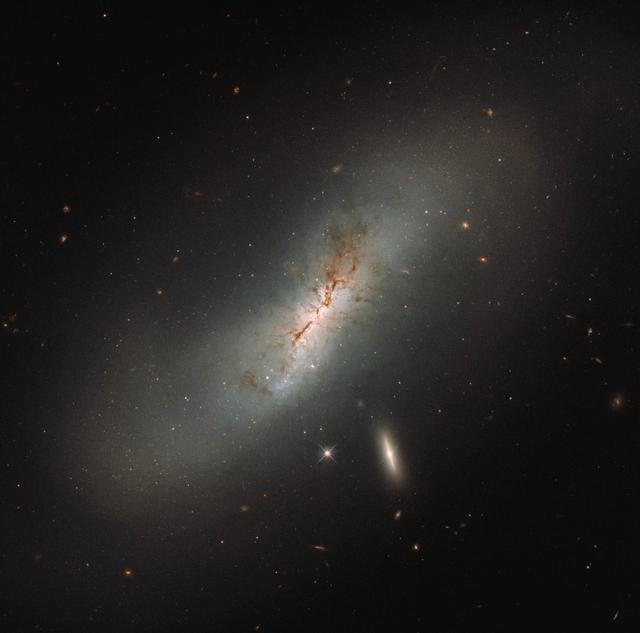
Some astronomical objects have endearing or quirky nicknames, inspired by mythology or their own appearance. Take, for example, the constellation of Orion (The Hunter), the Sombrero Galaxy, the Horsehead Nebula, or even the Milky Way. However, the vast majority of cosmic objects appear in astronomical catalogs and are given rather less poetic names based on the order of their discovery. Two galaxies are clearly visible in this Hubble image, the larger of which is NGC 4424. This galaxy is cataloged in the New General Catalog of Nebulae and Clusters of Stars (NGC), which was compiled in 1888. The NGC is one of the largest astronomical catalogs, which is why so many Hubble Pictures of the Week feature NGC objects. In total there are 7,840 entries in the catalog and they are also generally the larger, brighter, and more eye-catching objects in the night sky, and hence the ones more easily spotted by early stargazers. The smaller, flatter, bright galaxy sitting just below NGC 4424 is named LEDA 213994. The Lyon-Meudon Extragalactic Database (LEDA) is far more modern than the NGC and contains millions of objects. Many NGC objects still go by their initial names simply because they were christened within the NGC first. However, since astronomers can't resist a good acronym and “Leda” is more appealing than “the LMED,” the smaller galaxy is called "Leda." Leda was a princess in Ancient Greek mythology. Image credit: ESA/Hubble & NASA <b><a href="http://www.nasa.gov/audience/formedia/features/MP_Photo_Guidelines.html" rel="nofollow">NASA image use policy.</a></b> <b><a href="http://www.nasa.gov/centers/goddard/home/index.html" rel="nofollow">NASA Goddard Space Flight Center</a></b> enables NASA’s mission through four scientific endeavors: Earth Science, Heliophysics, Solar System Exploration, and Astrophysics. Goddard plays a leading role in NASA’s accomplishments by contributing compelling scientific knowledge to advance the Agency’s mission. <b>Follow us on <a href="http://twitter.com/NASAGoddardPix" rel="nofollow">Twitter</a></b> <b>Like us on <a href="http://www.facebook.com/pages/Greenbelt-MD/NASA-Goddard/395013845897?ref=tsd" rel="nofollow">Facebook</a></b> <b>Find us on <a href="http://instagrid.me/nasagoddard/?vm=grid" rel="nofollow">Instagram</a></b>