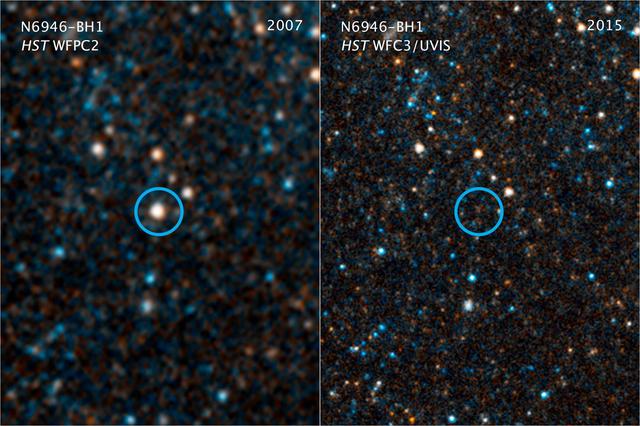
This pair of visible-light and near-infrared photos from NASA's Hubble Space Telescope shows the giant star N6946-BH1 before and after it vanished out of sight by imploding to form a black hole. The left image shows the star, which is 25 times the mass of our sun, as it looked in 2007. In 2009, the star shot up in brightness to become over 1 million times more luminous than our sun for several months. But then it seemed to vanish, as seen in the right panel image from 2015. A small amount of infrared light has been detected from where the star used to be. This radiation probably comes from debris falling onto a black hole. The black hole is located 22 million light-years away in the spiral galaxy NGC 6946. https://photojournal.jpl.nasa.gov/catalog/PIA21467
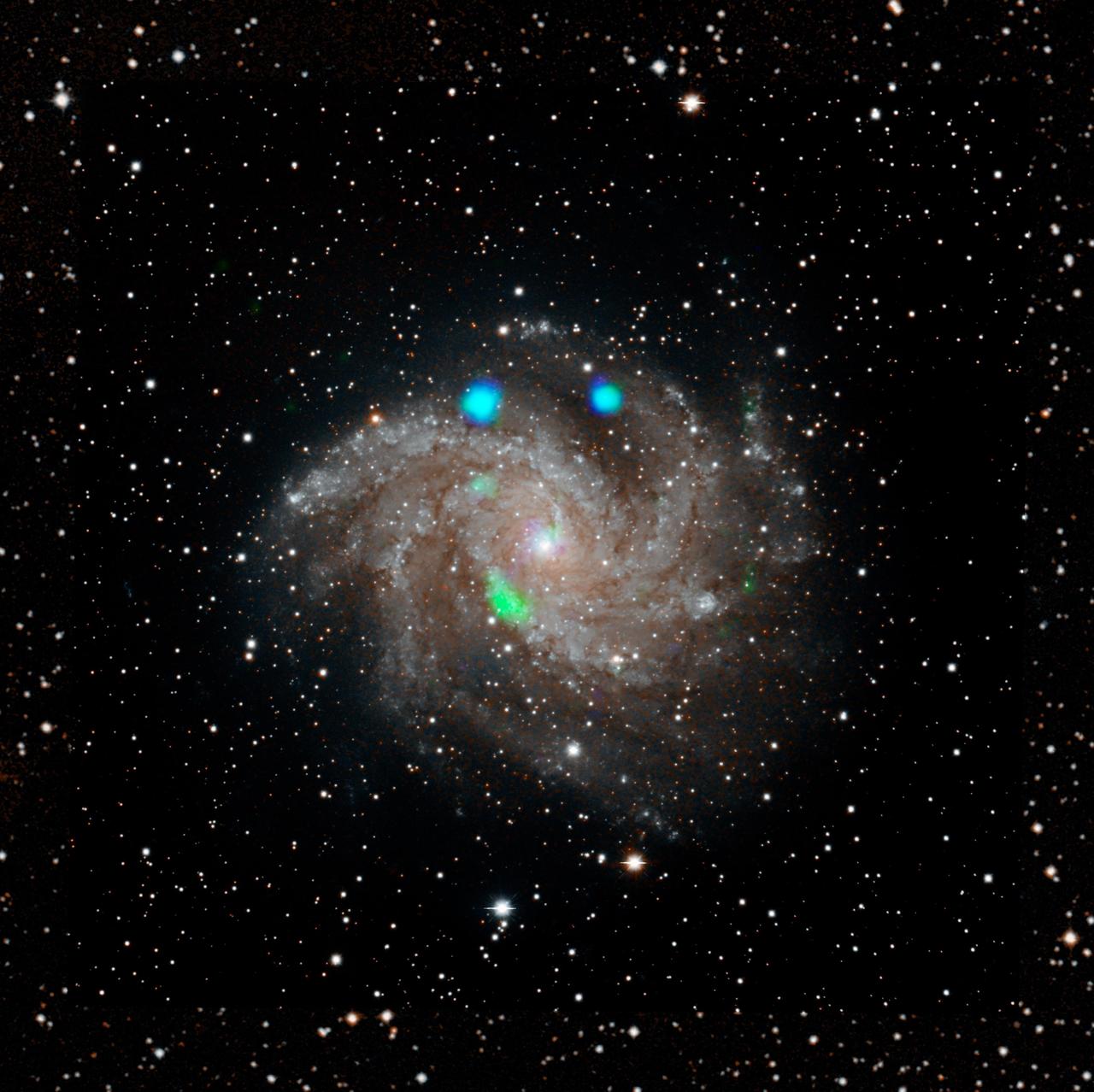
This visible-light image of the Fireworks galaxy (NGC 6946) comes from the Digital Sky Survey and is overlaid with data from NASA's NuSTAR observatory (shown in blue and green). Blue light indicates X-rays captured during the first of two observations by NuSTAR, in May 2017. Green light indicates X-rays seen less than two weeks later in the second observation. This means that the source of the green spot to the lower left of the galactic center began radiating in the time between those two observations. Two bright sources near the top of the image show a combination of blue and green, indicating those sources were visible during both observations. The X-ray data don't have the same spatial resolution as the visible-light image, so the X-ray sources appear larger. https://photojournal.jpl.nasa.gov/catalog/PIA23401