
This poster artfully depicts Solar Surfing, an early stage NASA study to support potential future missions that could travel closer to the Sun’s surface than ever before. The solar transition region, a very thin layer near the Sun’s surface, is of great interest to heliophysicists. In this zone, temperatures range from 10,000 to 1.8 million degrees Fahrenheit. The NASA Innovative Advanced Concepts (NIAC) program funds a study by a team at NASA’s Kennedy Space Center in Florida to further research a novel, highly reflective coating for a solar shield that could allow spacecraft to approach the Sun close enough to investigate this exciting region – about 500,000 miles from the surface. The better heliophysicists understand the Sun and how it generates energy, the better they can make predictions of the Sun’s effect on our planet – and improve our everyday communications, electronics, and transportation.
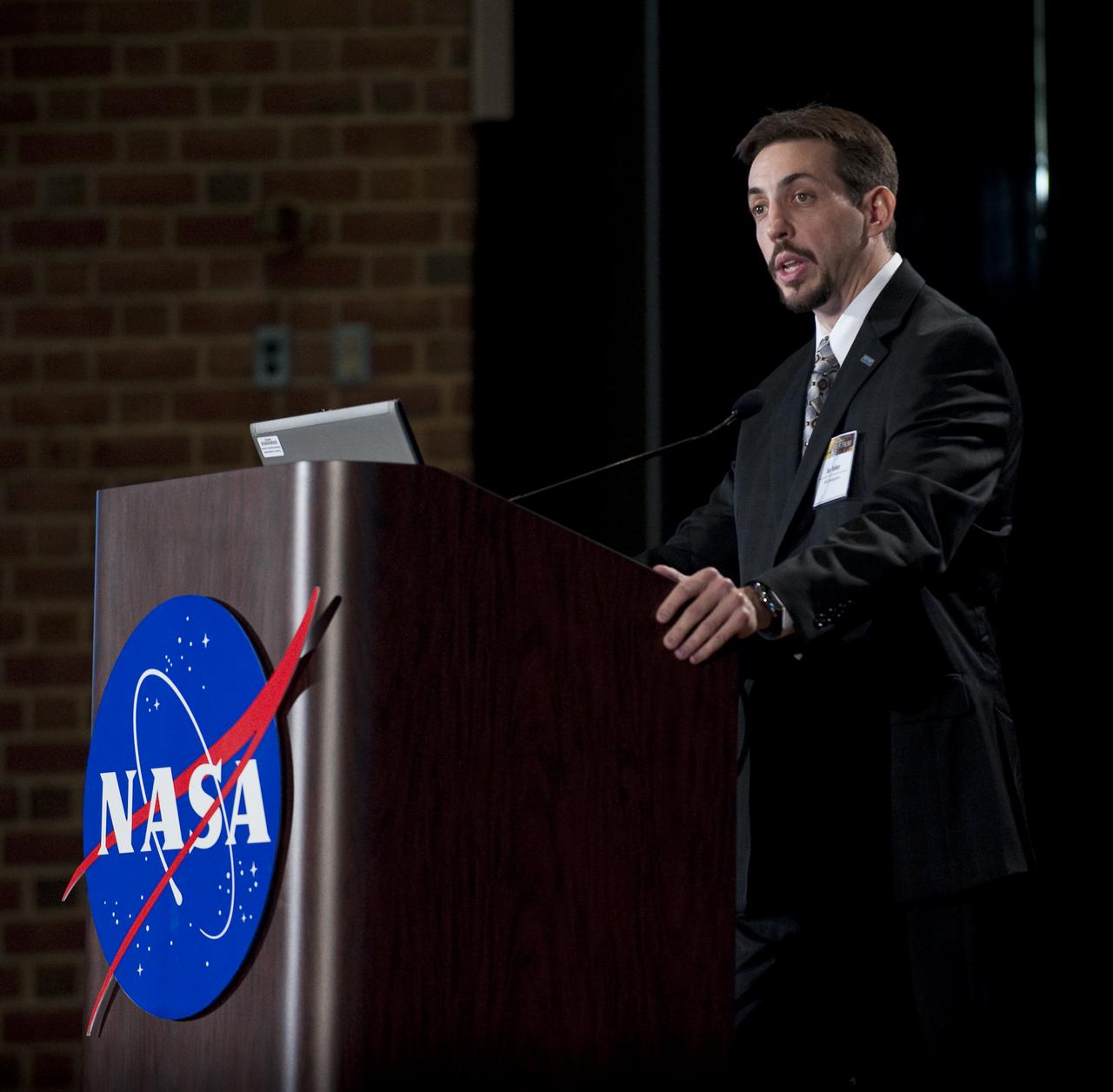
Program Executive for the NASA Innovative Advanced Concepts (NIAC) Program Jay Falker speaks during the NASA New Space Technology Industry Forum being held at the University of Maryland in College Park on Tuesday, July 13, 2010. During the two-day event, speakers are focusing on the president's fiscal year 2011 budget request for NASA's new Space Technology Program. Representatives from industry, academia and the federal government are in attendance to discuss strategy, development and implementation of NASA's proposed new technology-enabled exploration. Photo Credit: (NASA/Bill Ingalls)

An illustration of the small robots that form Shapeshifter. Dubbed "cobots," they each have a propeller for flying and can combine to form a sphere, rolling on the ground to save energy. Shapeshifter is a developing concept for a transformational vehicle to explore treacherous, distant worlds. The flying amphibious robot is part of the early-stage research program NASA Innovative Advanced Concepts (NIAC), which offers several phases of funding to visionary concepts, helping turn ideas that sound like science fiction into science fact. JPL Principle Investigator Ali Agha envisions Shapeshifter as a mission to Saturn's moon Titan, the only other world in the solar system known to have liquid in the form of methane lakes, rivers and seas on its surface. https://photojournal.jpl.nasa.gov/catalog/PIA23435
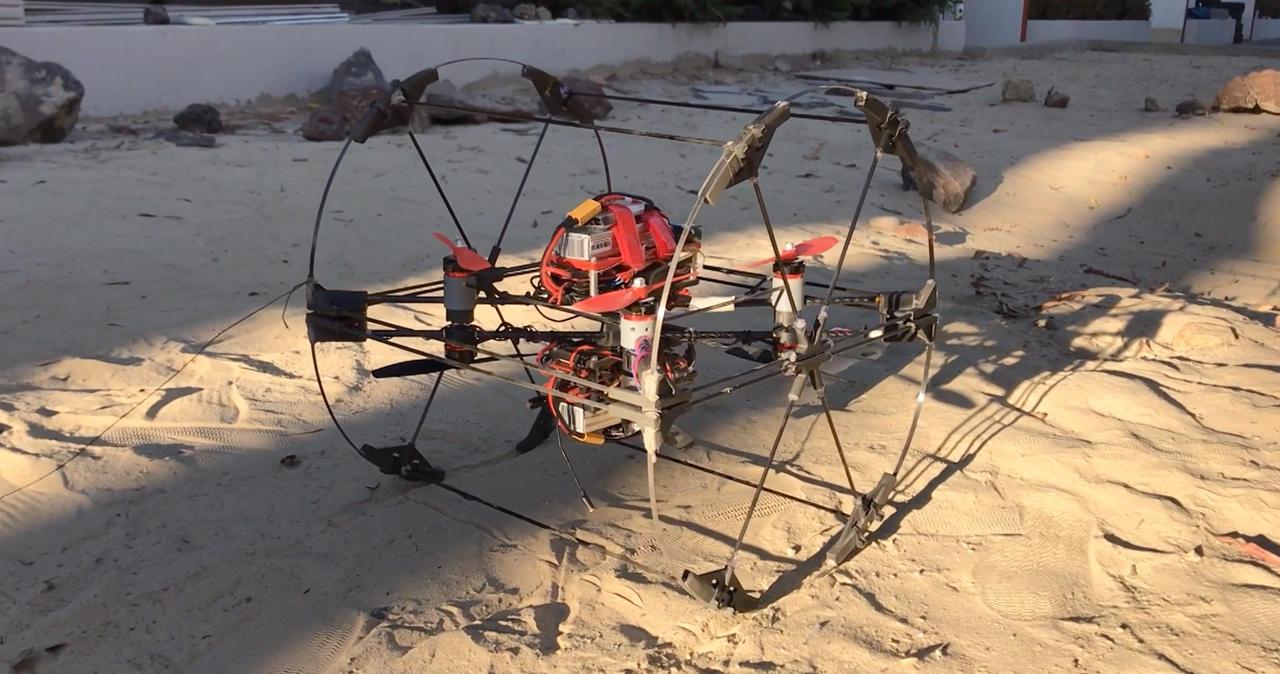
A prototype of the transforming robot Shapeshifter is tested in the robotics yard at NASA's Jet Propulsion Laboratory. Shapeshifter is made of smaller robots that can morph into rolling spheres, flying drones, swimming submersibles and more. Shapeshifter is a developing concept for a transformational vehicle to explore treacherous, distant worlds. The flying amphibious robot is part of the early-stage research program NASA Innovative Advanced Concepts (NIAC), which offers several phases of funding to visionary concepts, helping turn ideas that sound like science fiction into science fact. JPL Principle Investigator Ali Agha envisions Shapeshifter as a mission to Saturn's moon Titan, the only other world in the solar system known to have liquid in the form of methane lakes, rivers and seas on its surface. https://photojournal.jpl.nasa.gov/catalog/PIA23433
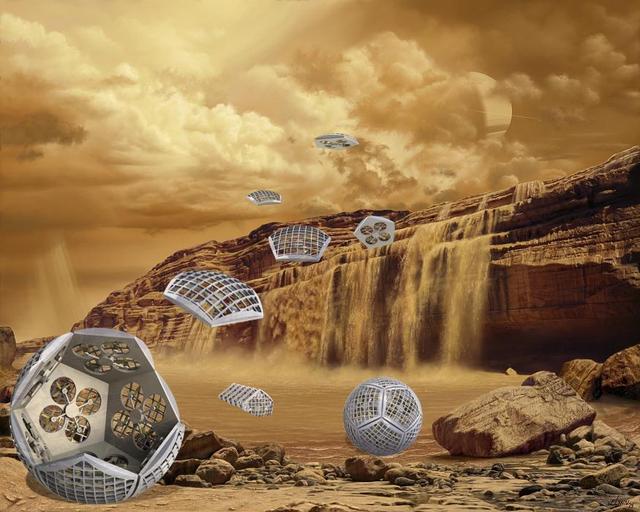
An illustration of an early concept of Shapeshifter imagines the robots on Saturn's moon Titan. In the picture, the Shapeshifter breaks into smaller pieces that can investigate a methane waterfall from the sky. Shapeshifter is a developing concept for a transformational vehicle to explore treacherous, distant worlds. The flying amphibious robot is part of the early-stage research program NASA Innovative Advanced Concepts (NIAC), which offers several phases of funding to visionary concepts, helping turn ideas that sound like science fiction into science fact. JPL Principle Investigator Ali Agha envisions Shapeshifter as a mission to Saturn's moon Titan, the only other world in the solar system known to have liquid in the form of methane lakes, rivers and seas on its surface. https://photojournal.jpl.nasa.gov/catalog/PIA23434
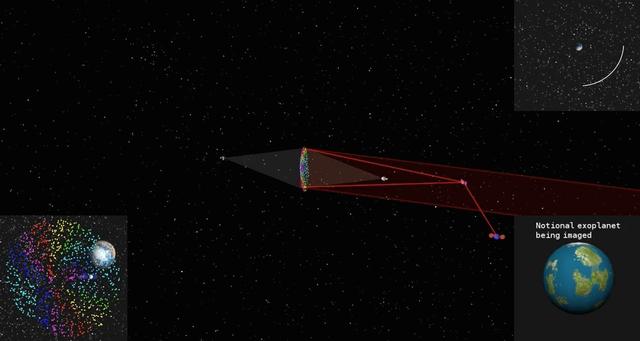
This simulated image shows how a cloud of glitter in geostationary orbit would be illuminated and controlled by two laser beams. As the cloud orbits Earth, grains scatter the sun's light at different angles like many tiny prisms, similar to how rainbows are produced from light being dispersed by water droplets. That is why the project concept is called "Orbiting Rainbows." The cloud functions like a reflective surface, allowing the exoplanet (displayed in the bottom right) to be imaged. The orbit path is shown in the top right. On the bottom left, Earth's image is seen behind the cloud. To image an exoplanet, the cloud would need to have a diameter of nearly 98 feet (30 meters). This simulation confines the cloud to a 3.3 x 3.3 x 3.3 foot volume (1 x 1 x 1 meter volume) to simplify the computations. The elements of the orbiting telescope are not to scale. Orbiting Rainbows is currently in Phase II development through the NASA Innovative Advanced Concepts (NIAC) Program. It was one of five technology proposals chosen for continued study in 2014. In the current phase, Orbiting Rainbows researchers are conducting small-scale ground experiments to demonstrate how granular materials can be manipulated using lasers and simulations of how the imaging system would behave in orbit. http://photojournal.jpl.nasa.gov/catalog/PIA19318