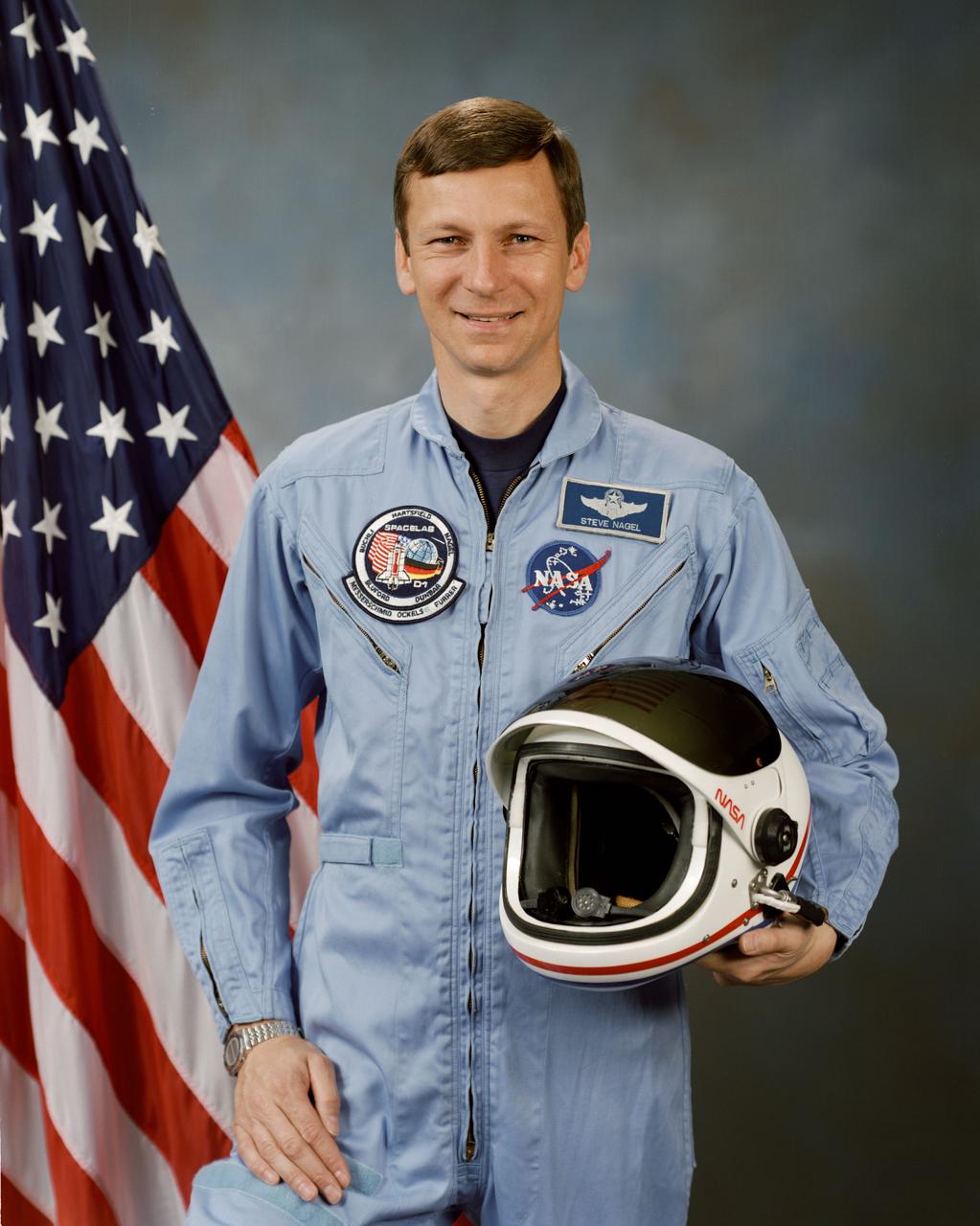
S86-29527 (February 1986) --- Astronaut Steven R. Nagel. Photo credit: NASA
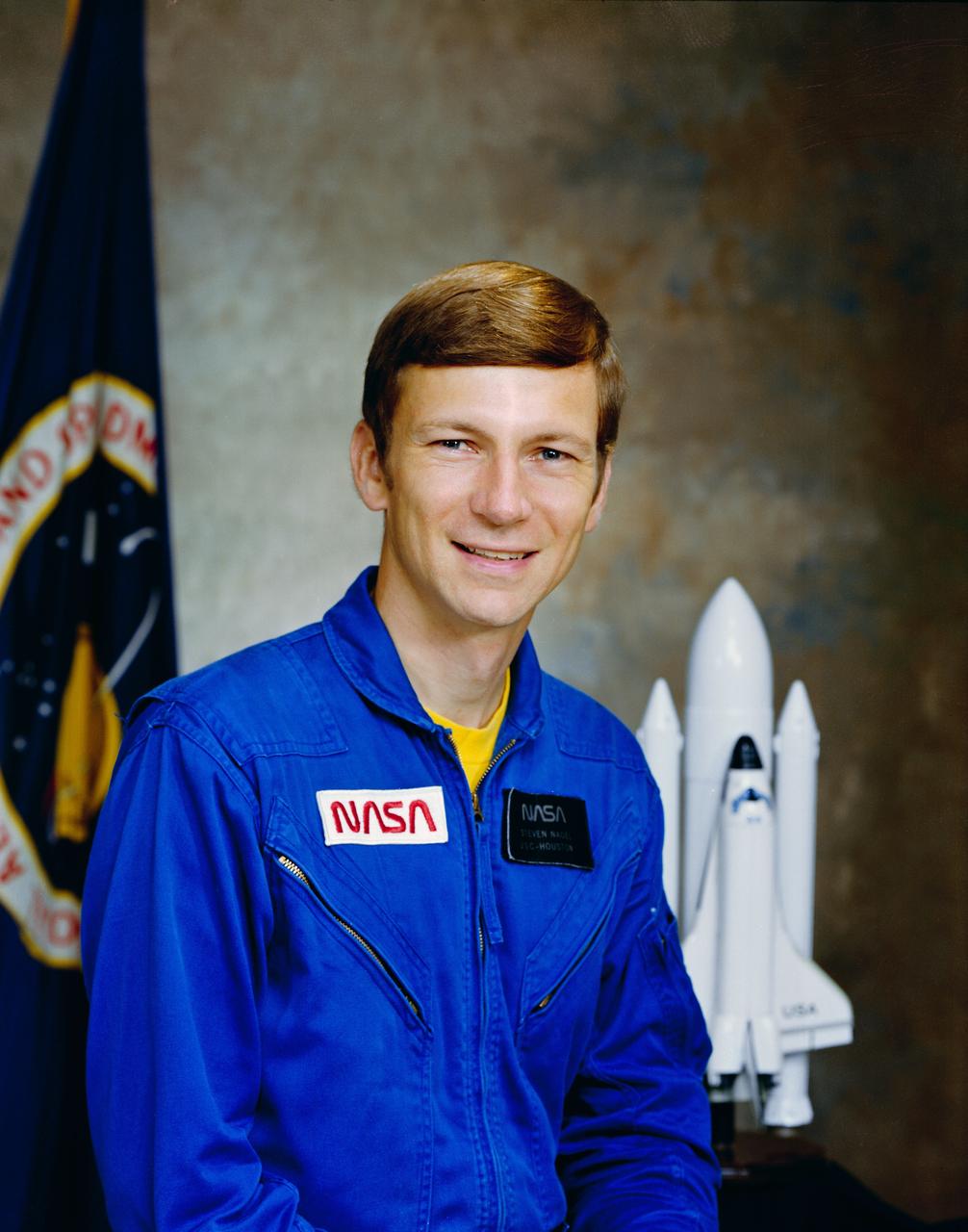
S78-35302 (31 Jan. 1978) --- Astronaut Steven R. Nagel. Photo credit: NASA
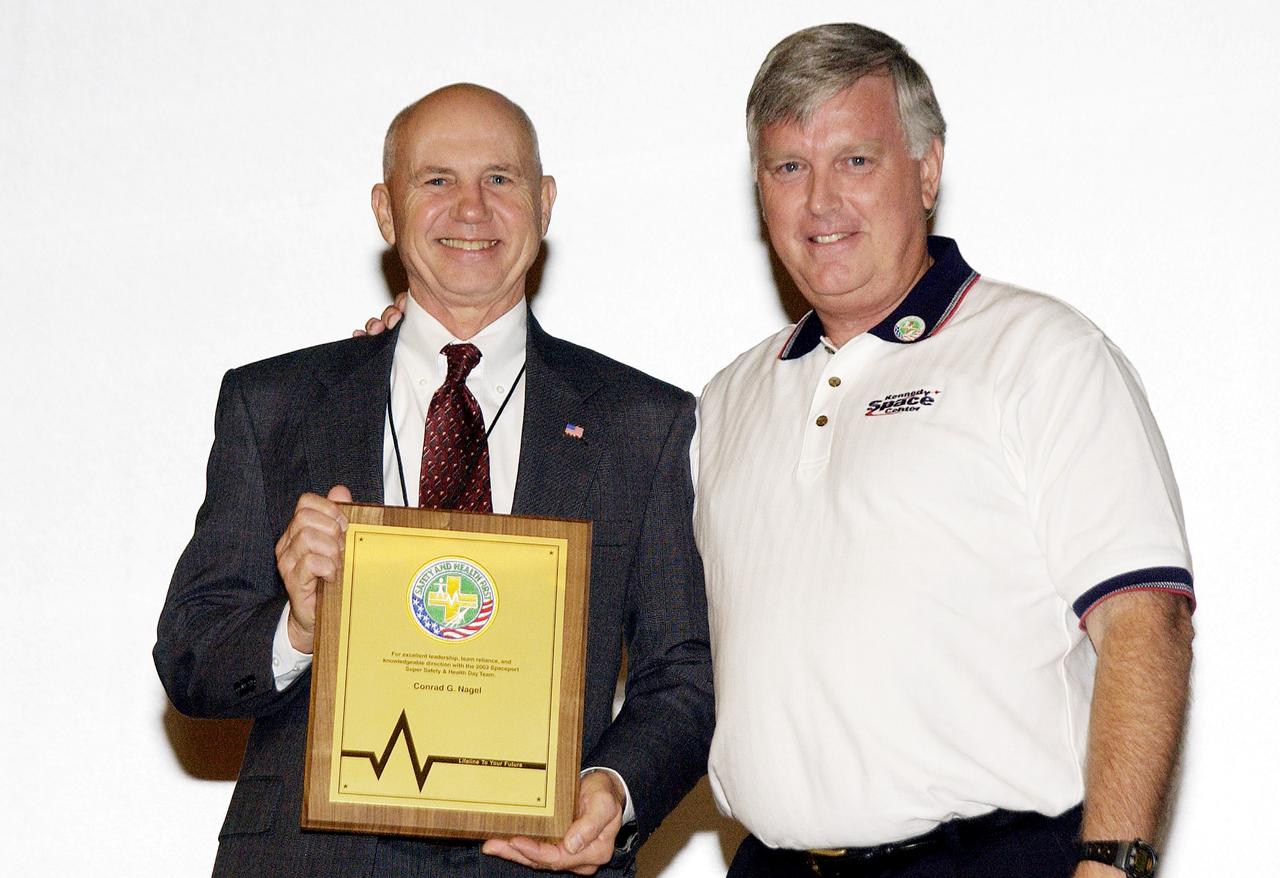
KENNEDY SPACE CENTER, FLA. - Center Director Jim Kennedy (right) presents a plaque to Conrad Nagel who organized the Spaceport Super Safety and Health Day at KSC, an annual event dedicated to reinforcing safe and healthful behaviors in the workforce. Nagel is chief of the Shuttle Project Office, Shuttle Processing.
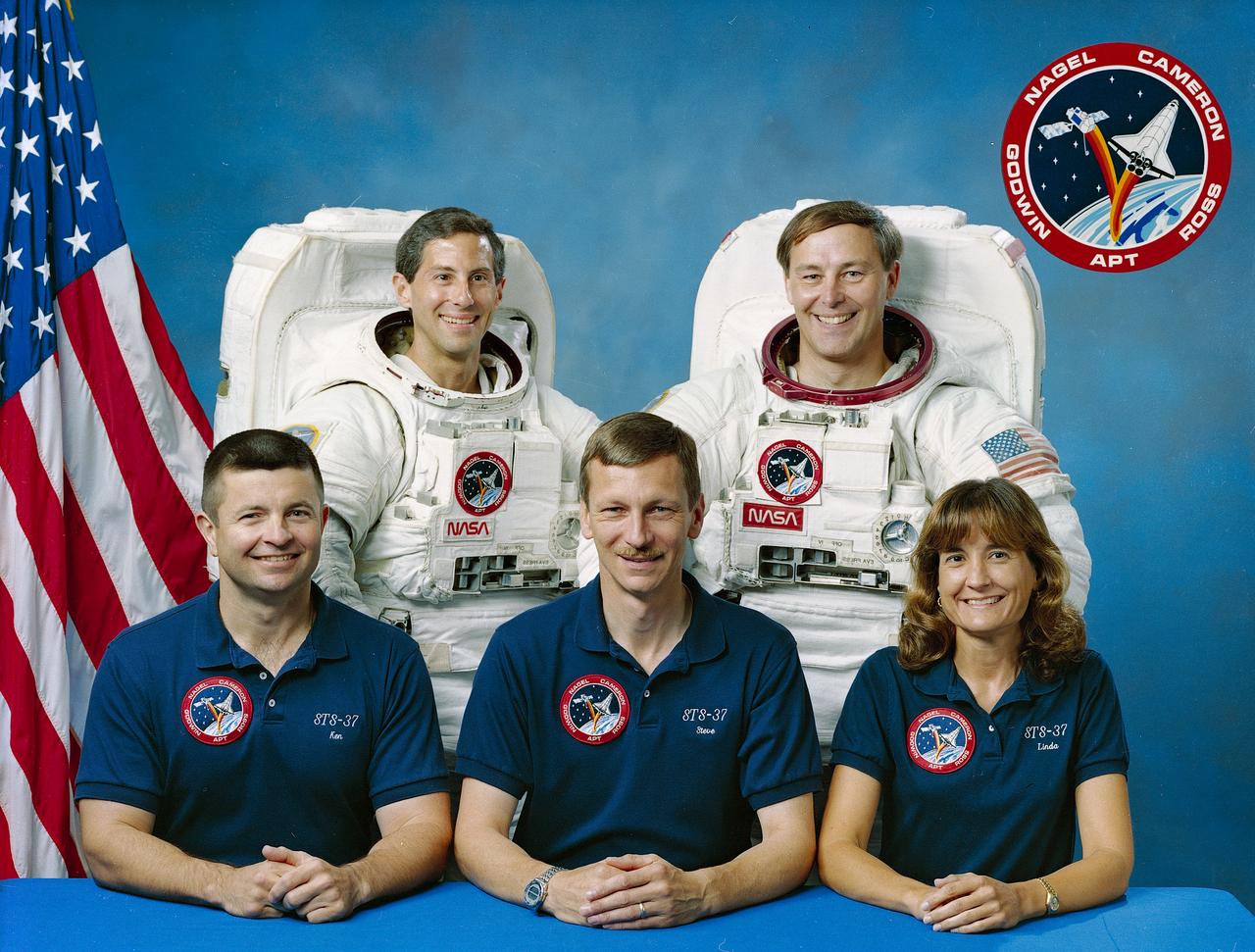
This is the STS-37 Crew portrait. Pictured from left to right are Kenneth D. (Ken) Cameron, pilot; Jay Apt, mission specialist; Steven R. Nagel, commander; and Jerry L. Ross and Linda M. Godwin, mission specialists. Launched aboard the Space Shuttle Atlantis on April 5, 1991 at 9:22:44am (EST), the crew’s major objective was the deployment of the Gamma Ray Observatory (GRO). Included in the observatory were the Burst and Transient Source Experiment (BATSE); the Imaging Compton Telescope (COMPTEL); the Energetic Gamma Ray Experiment Telescope (EGRET); and the Oriented Scintillation Spectrometer Telescope (OSSEE).
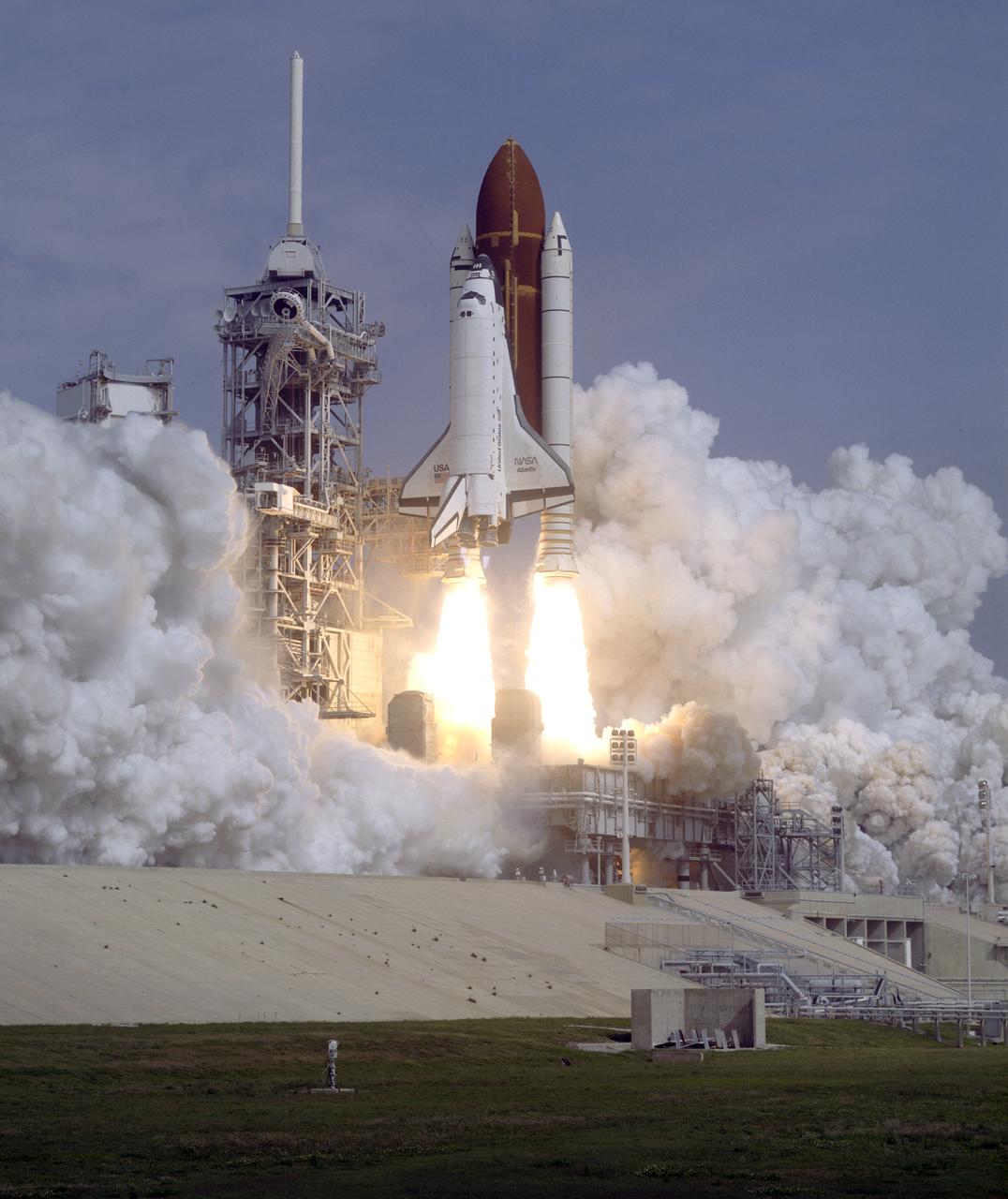
Aboard the Space Shuttle Atlantis, the STS-37 mission launched April 5, 1991 from launch pad 39B at the Kennedy Space Center in Florida, and landed back on Earth April 11, 1991. The 39th shuttle mission included crew members: Steven R. Nagel, commander; Kenneth D. Cameron, pilot; Jerry L,. Ross, mission specialist 1; Jay Apt, mission specialist 2; and Linda M. Godwin, mission specialist 3. The primary payload for the mission was the Gamma Ray Observatory (GRO). The GRO included the Burst and Transient Experiment (BATSE); the Imaging Compton Telescope (COMPTEL); the Energetic Gamma Ray Experiment Telescope (EGRET); and the Oriented Scintillation Spectrometer Experiment (OSSEE). Secondary payloads included Crew and Equipment Translation Aids (CETA); the Ascent Particle Monitor (APM); the Shuttle Amateur Radio Experiment II (SAREXII), the Protein Crystal Growth (PCG); the Bioserve Instrumentation Technology Associates Materials Dispersion Apparatus (BIMDA); Radiation Monitoring Equipment III (RMEIII); and Air Force Maui Optical Site (AMOS).
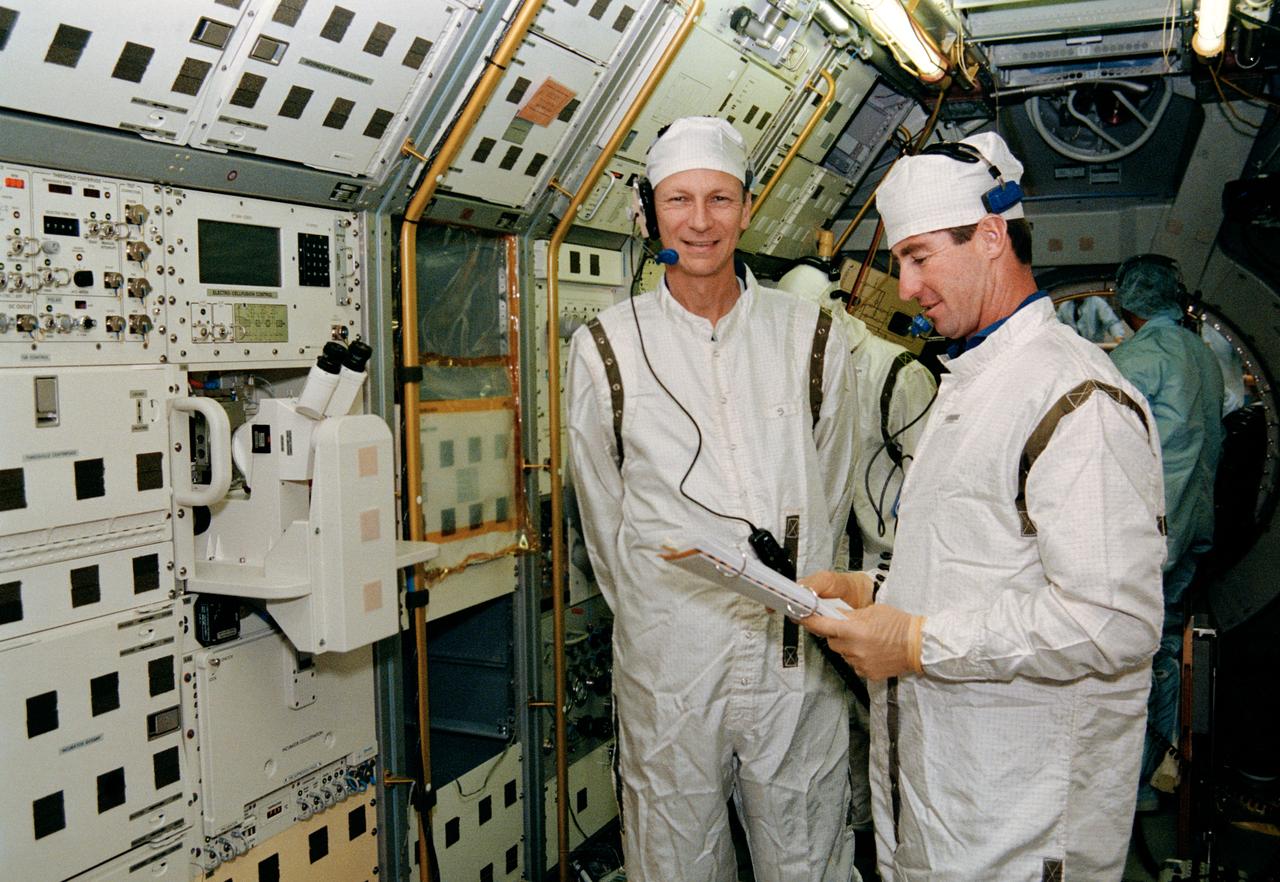
S93-29830 (4 Nov 1992) --- Inside the Spacelab D-2 module in the Operations and Checkout Building high bay, STS-55 Mission Commander Steven R. Nagel (left) and Pilot Terence T. Henricks are participating in a mission sequence test to check out experiment steps and procedures which will be conducted on-orbit. Spacelab D-2, the second German Spacelab, is scheduled to fly on space shuttle mission STS-55 in 1993.

The crew assigned to the STS-51G mission included (kneeling front left to right) Daniel C. Brandenstein, commander; and John O. Creighton, pilot. Standing, left to right, are mission specialists Shannon W. Lucid, Steven R. Nagel, and John M. Fabian; and payload specialists Sultan Salman Al-Saud, and Patrick Baudrey. Launched aboard the Space Shuttle Discovery on June 17, 1985 at 7:33:00 am (EDT), the STS-51G mission’s primary payloads were three communications satellites: MORELOS-A for Mexico; ARABSAT-A , for Arab Satellite communications; and TELSTAR-3D, for ATT.
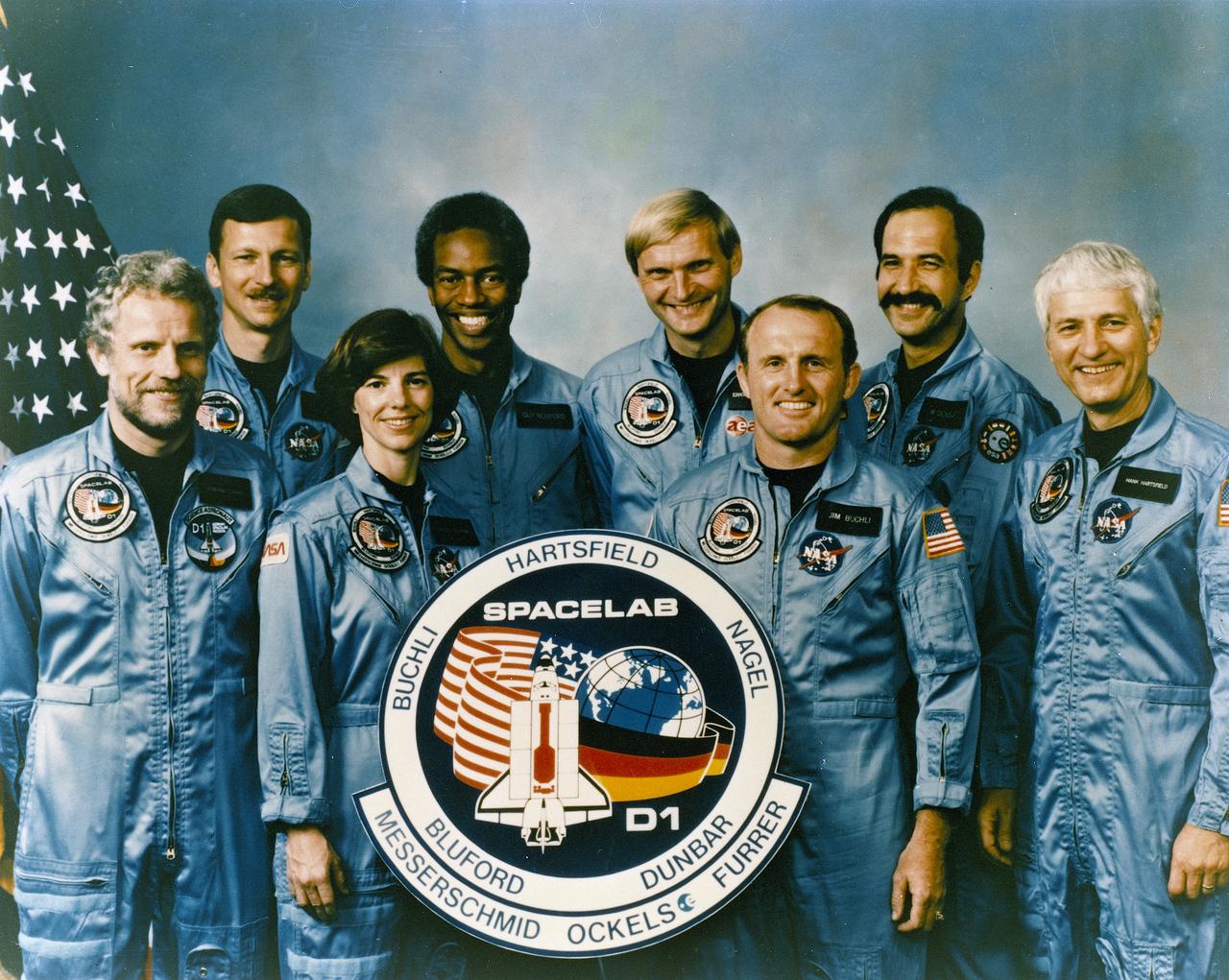
The crew assigned to the STS-61A mission included (front row left to right) Reinhard Furrer, German payload specialist; Bonnie J. Dunbar, mission specialist; and Henry W. Hartsfield, Jr. commander. On the back row, left to right, are Steven R. Nagel, pilot; Guion S. Bluford, mission specialist; Ernst Messerscmid, German payload specialist; and Wubbo J. Ockels, Dutch payload specialist. Launched aboard the Space Shuttle Challenger on October 30, 1985 at 12:00:00 noon (EST), the STS-61A mission’s primary payload was the Spacelab D-1 (German Spacelab mission).
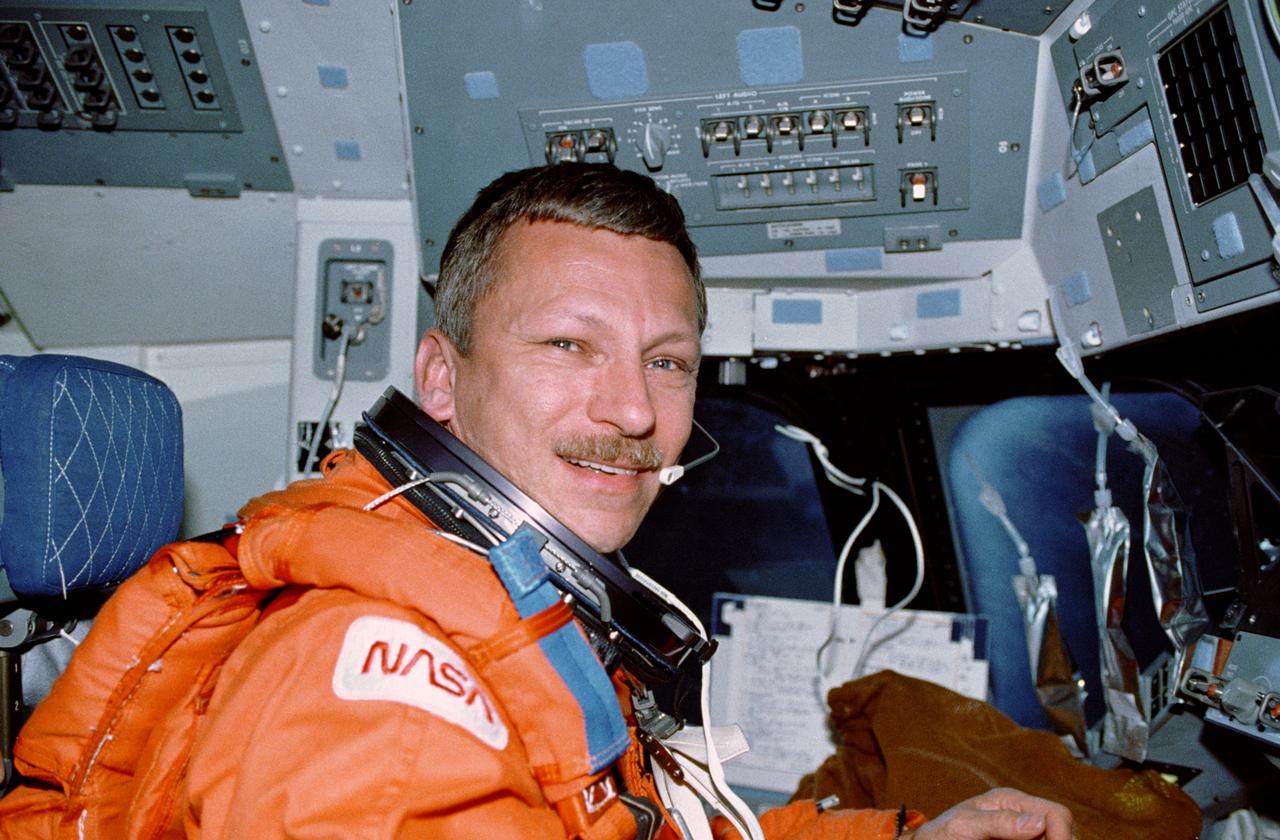
STS037-13-036 (5-11 April 1991) --- Astronaut Steven R. Nagel talks to ground controllers from the commander's station on the space shuttle Atlantis. He is wearing the special partial pressure suit used by space shuttle crew members for ascent and entry phases. Nagel, mission commander, and four other astronauts spent six days in space during which they readied the Gamma Ray Observatory (GRO) for deployment, released it into space, tested possible Space Station Freedom translation aid devices, conducted experiments, took photographs and performed other duties. This frame was taken with a 35mm camera. This was one of the visuals used by the crew members during their April 19 Post Flight Press Conference (PFPC) at the Johnson Space Center (JSC). Photo credit: NASA

STS055-203-034 (26 April-6 May 1993) --- Astronaut Steven R. Nagel, STS-55 mission commander, has found an isolated station in the D-2 science module from which to talk to students on Earth. Like many before it, the seven member crew participated in communications with students and licensed radio operators via the Shuttle Amateur Radio Experiment (SAREX). Photo credit: NASA
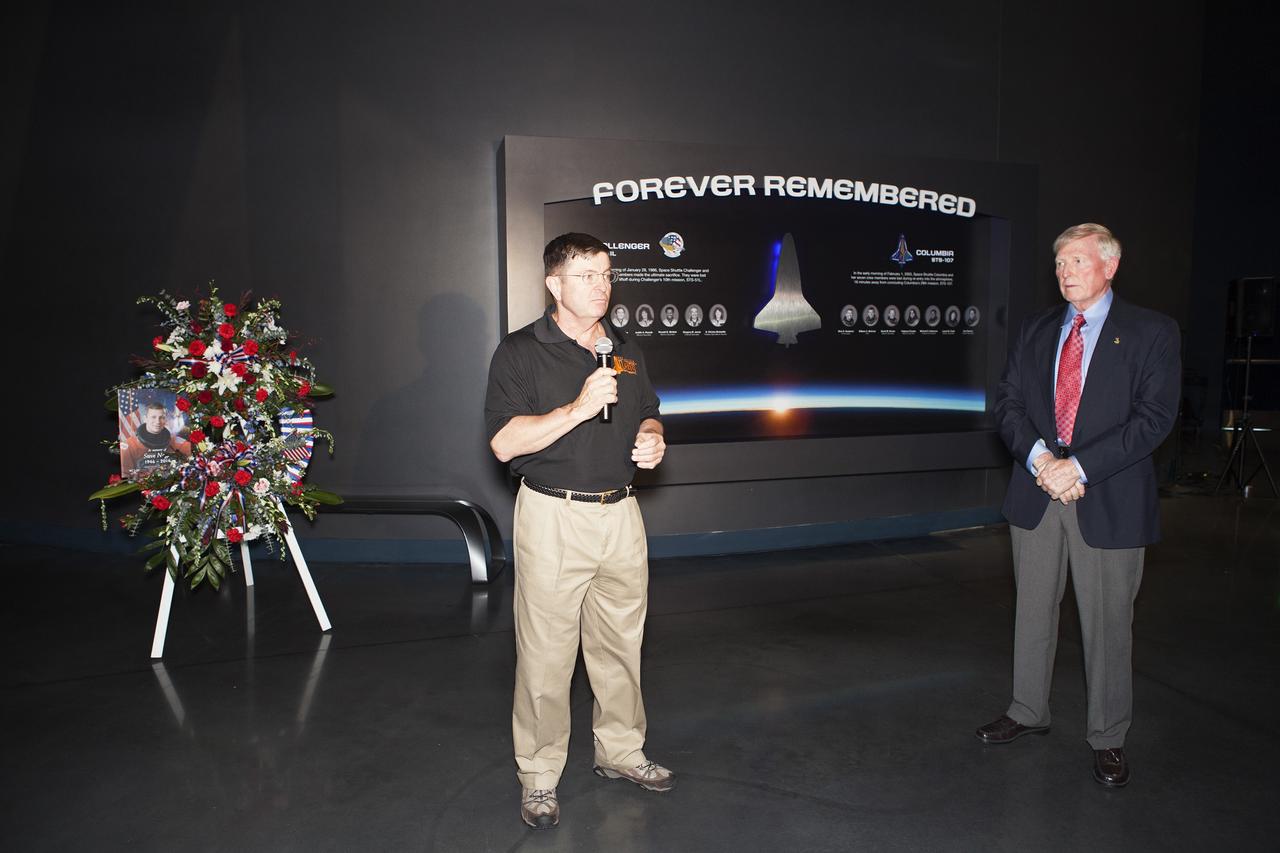
CAPE CANAVERAL, Fla. – Former NASA astronaut Jon McBride speaks at a wreath-laying ceremony honoring former NASA astronaut Steven R. Nagel at the Space Shuttle Atlantis exhibit at the Kennedy Space Center Visitor Complex in Florida. Nagel died Aug. 21 after a long illness. He was 67 years old. Nagel served as a mission specialist on his first space shuttle flight, STS-51G, in 1985. He was pilot on his second shuttle flight, STS-61A, also in 1985. He commanded his final two flights, STS-37 and STS-55, in 1991 and 1993, respectively. He logged a total of 723 hours in space. To learn more about Nagel's career, visit http://www.nasa.gov/press/2014/august/former-nasa-astronaut-steven-nagel-veteran-of-four-shuttle-flights-dies-at-67/. Photo credit: NASA/Dimitri Gerondidakis
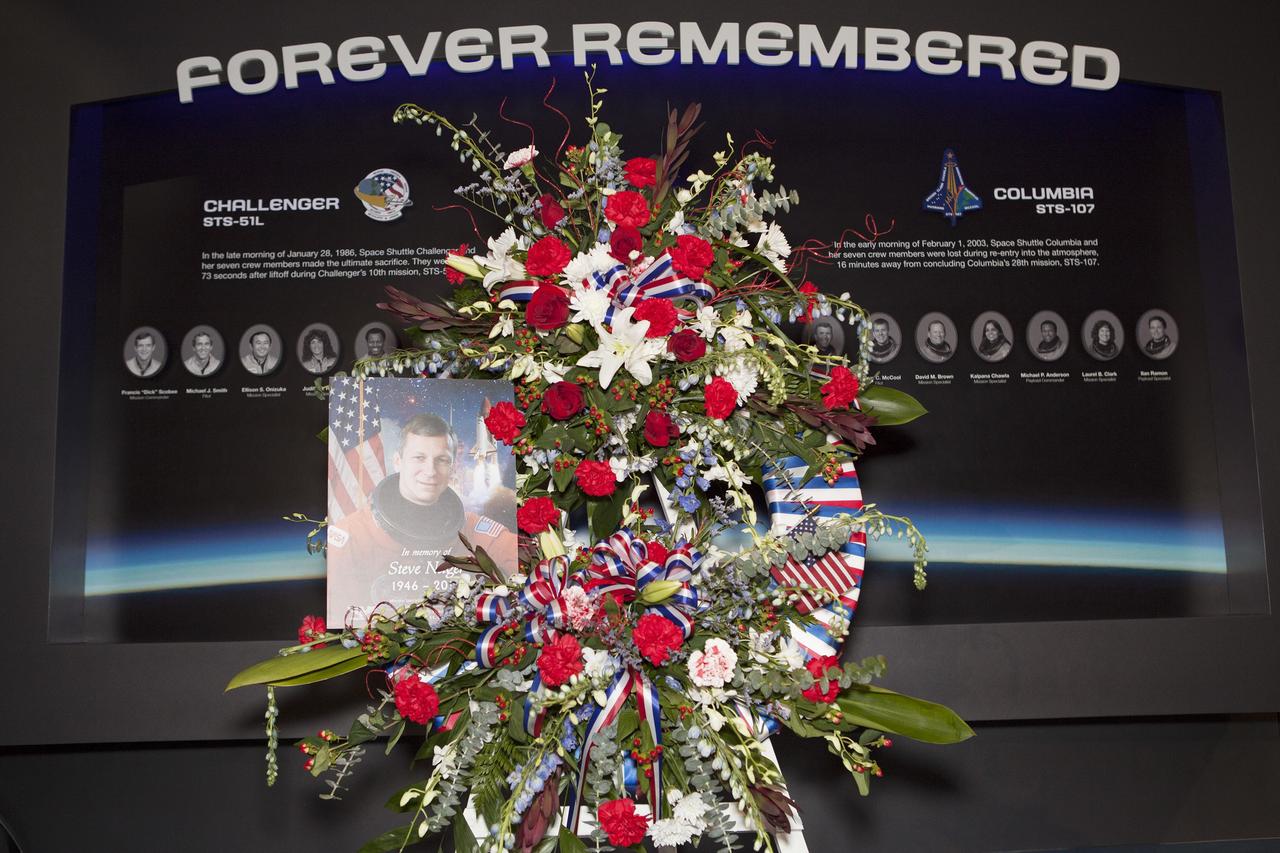
CAPE CANAVERAL, Fla. -- A wreath honoring former NASA astronaut Steven R. Nagel is displayed beside his photo at the Space Shuttle Atlantis exhibit at the Kennedy Space Center Visitor Complex in Florida. Nagel died Aug. 21 after a long illness. He was 67 years old. Nagel served as a mission specialist on his first space shuttle flight, STS-51G, in 1985. He was pilot on his second shuttle flight, STS-61A, also in 1985. He commanded his final two flights, STS-37 and STS-55, in 1991 and 1993, respectively. He logged a total of 723 hours in space. To learn more about Nagel's career, visit http://www.nasa.gov/press/2014/august/former-nasa-astronaut-steven-nagel-veteran-of-four-shuttle-flights-dies-at-67/. Photo credit: NASA/Dimitri Gerondidakis
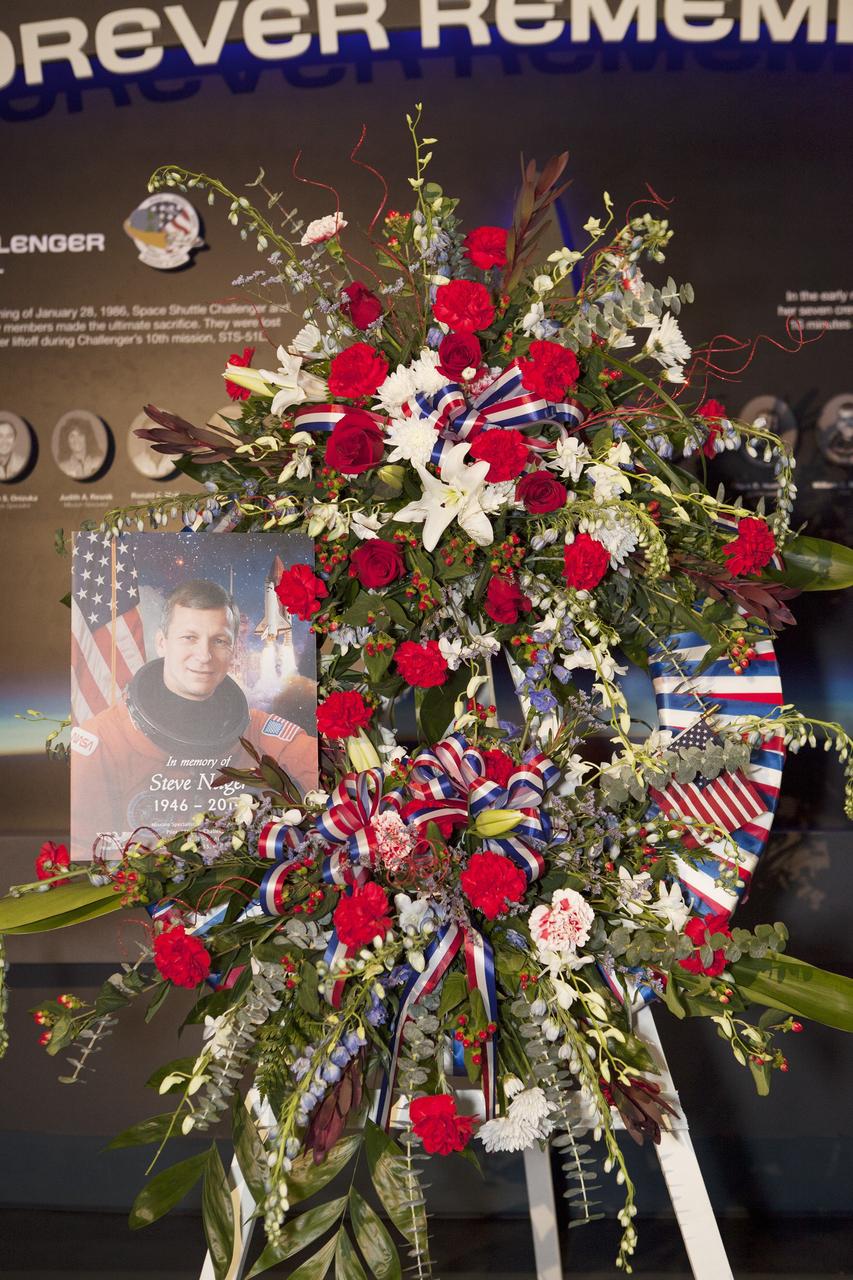
CAPE CANAVERAL, Fla. -- A wreath honoring former NASA astronaut Steven R. Nagel is displayed beside his photo at the Space Shuttle Atlantis exhibit at the Kennedy Space Center Visitor Complex in Florida. Nagel died Aug. 21 after a long illness. He was 67 years old. Nagel served as a mission specialist on his first space shuttle flight, STS-51G, in 1985. He was pilot on his second shuttle flight, STS-61A, also in 1985. He commanded his final two flights, STS-37 and STS-55, in 1991 and 1993, respectively. He logged a total of 723 hours in space. To learn more about Nagel's career, visit http://www.nasa.gov/press/2014/august/former-nasa-astronaut-steven-nagel-veteran-of-four-shuttle-flights-dies-at-67/. Photo credit: NASA/Dimitri Gerondidakis
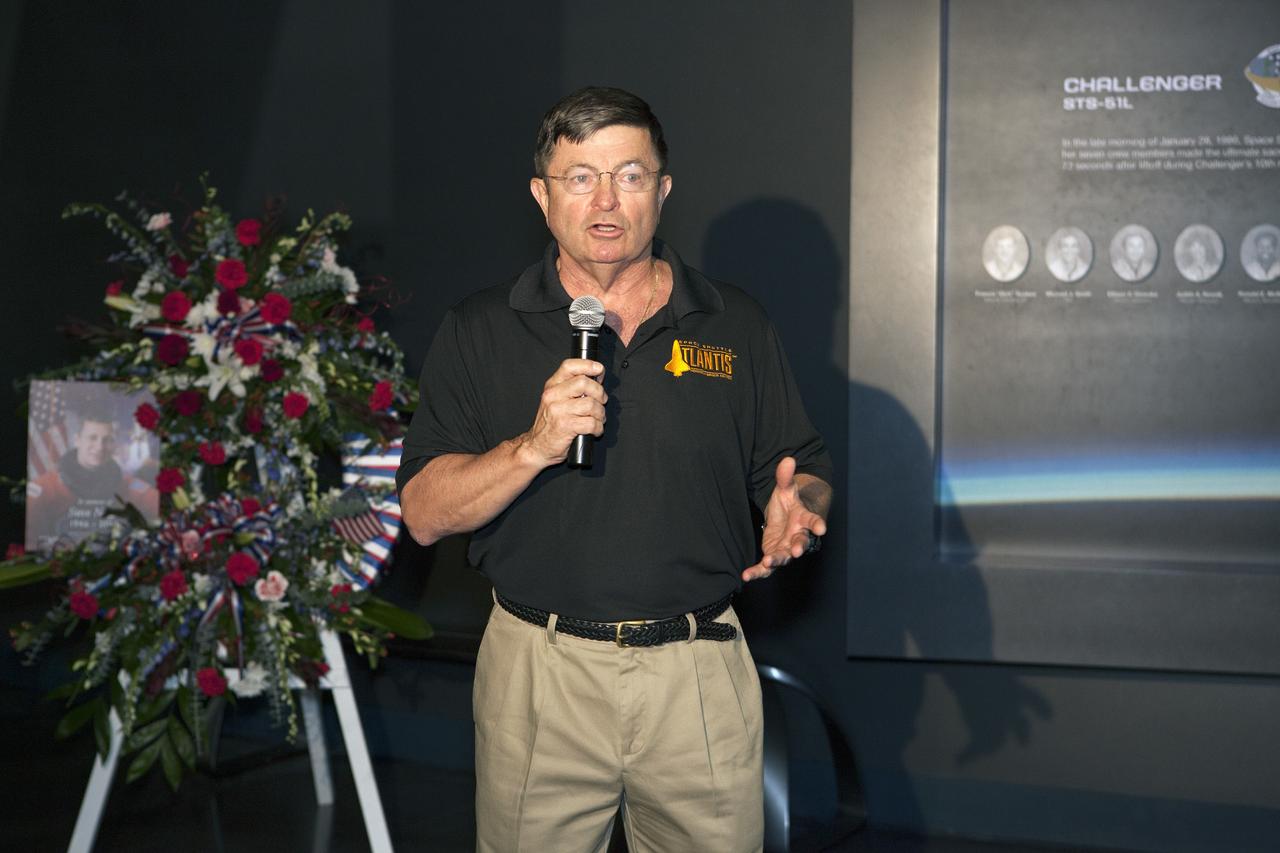
CAPE CANAVERAL, Fla. – Former NASA astronaut Kenneth Cameron speaks at a wreath-laying ceremony honoring former NASA astronaut Steven R. Nagel at the Space Shuttle Atlantis exhibit at the Kennedy Space Center Visitor Complex in Florida. Former NASA astronaut Jon McBride looks on, at right. Nagel died Aug. 21 after a long illness. He was 67 years old. Nagel served as a mission specialist on his first space shuttle flight, STS-51G, in 1985. He was pilot on his second shuttle flight, STS-61A, also in 1985. He commanded his final two flights, STS-37 and STS-55, in 1991 and 1993, respectively. He logged a total of 723 hours in space. To learn more about Nagel's career, visit http://www.nasa.gov/press/2014/august/former-nasa-astronaut-steven-nagel-veteran-of-four-shuttle-flights-dies-at-67/. Photo credit: NASA/Dimitri Gerondidakis
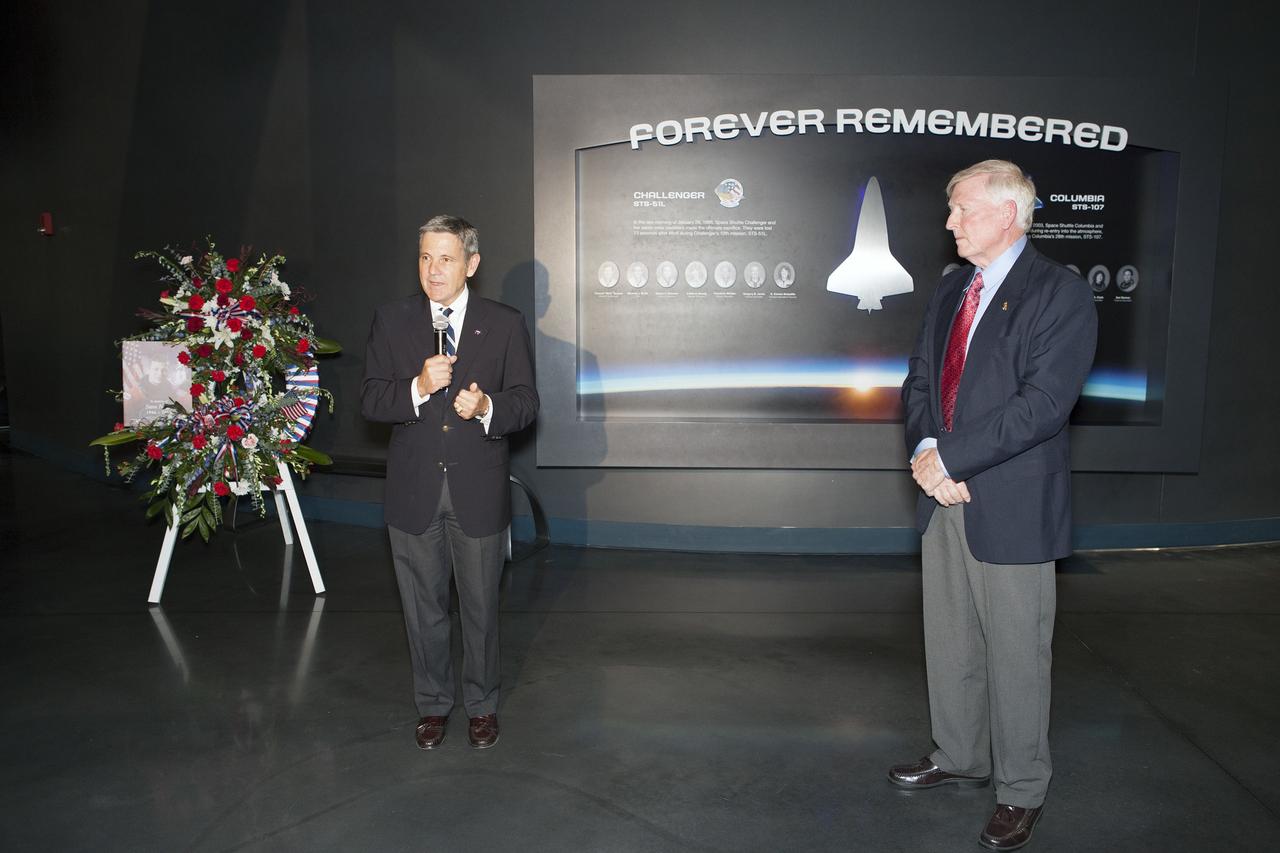
CAPE CANAVERAL, Fla. -- Kennedy Space Center Director Bob Cabana speaks at a wreath-laying ceremony honoring former NASA astronaut Steven R. Nagel at the Space Shuttle Atlantis exhibit at the Kennedy Space Center Visitor Complex in Florida. Former NASA astronaut Jon McBride looks on, at right. Nagel died Aug. 21 after a long illness. He was 67 years old. Nagel served as a mission specialist on his first space shuttle flight, STS-51G, in 1985. He was pilot on his second shuttle flight, STS-61A, also in 1985. He commanded his final two flights, STS-37 and STS-55, in 1991 and 1993, respectively. He logged a total of 723 hours in space. To learn more about Nagel's career, visit http://www.nasa.gov/press/2014/august/former-nasa-astronaut-steven-nagel-veteran-of-four-shuttle-flights-dies-at-67/. Photo credit: NASA/Dimitri Gerondidakis
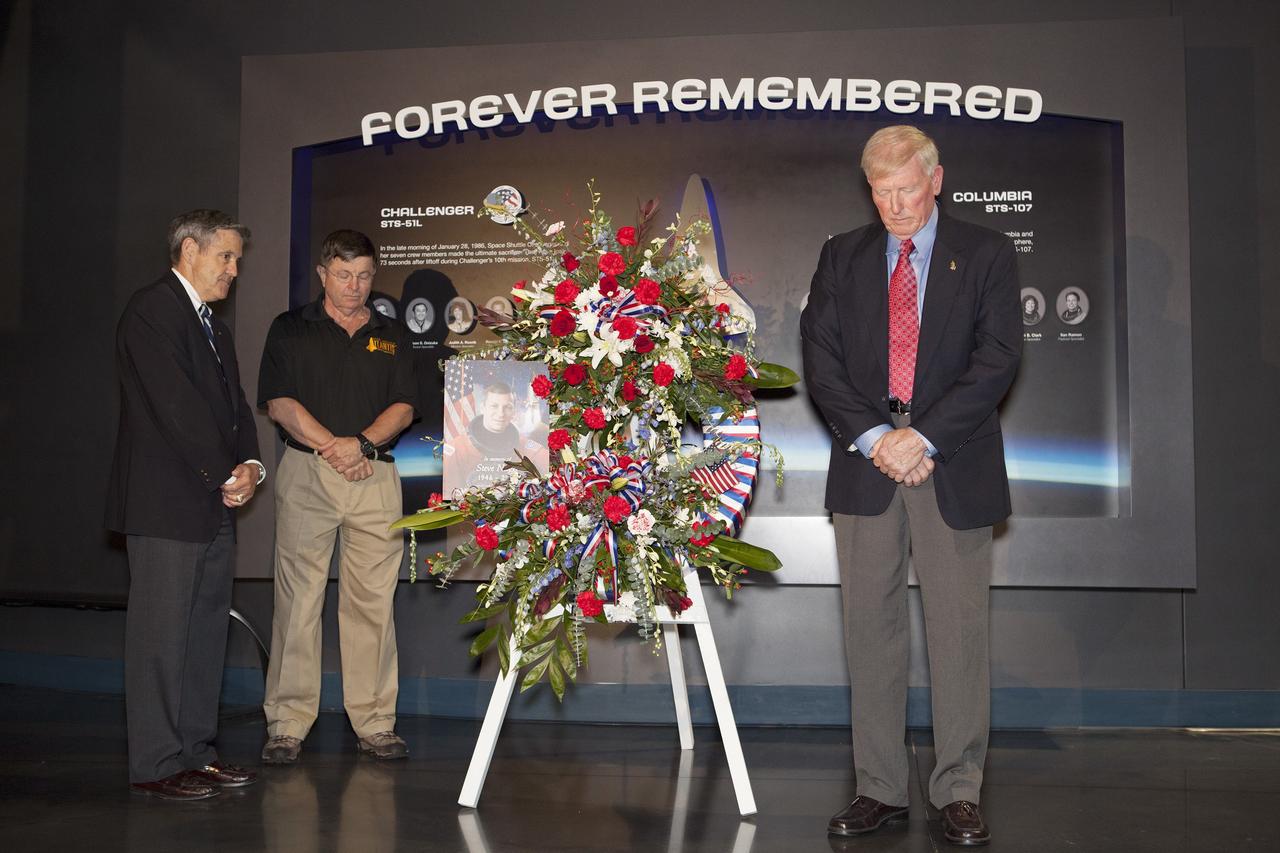
CAPE CANAVERAL, Fla. -- From left, Kennedy Space Center Director Bob Cabana, Kenneth Cameron, and Jon McBride, all former NASA astronauts, pause for reflection after placing a wreath honoring former NASA astronaut Steven R. Nagel at the Space Shuttle Atlantis exhibit at the Kennedy Space Center Visitor Complex in Florida. Nagel died Aug. 21 after a long illness. He was 67 years old. Nagel served as a mission specialist on his first space shuttle flight, STS-51G, in 1985. He was pilot on his second shuttle flight, STS-61A, also in 1985. He commanded his final two flights, STS-37 and STS-55, in 1991 and 1993, respectively. He logged a total of 723 hours in space. To learn more about Nagel's career, visit http://www.nasa.gov/press/2014/august/former-nasa-astronaut-steven-nagel-veteran-of-four-shuttle-flights-dies-at-67/. Photo credit: NASA/Dimitri Gerondidakis
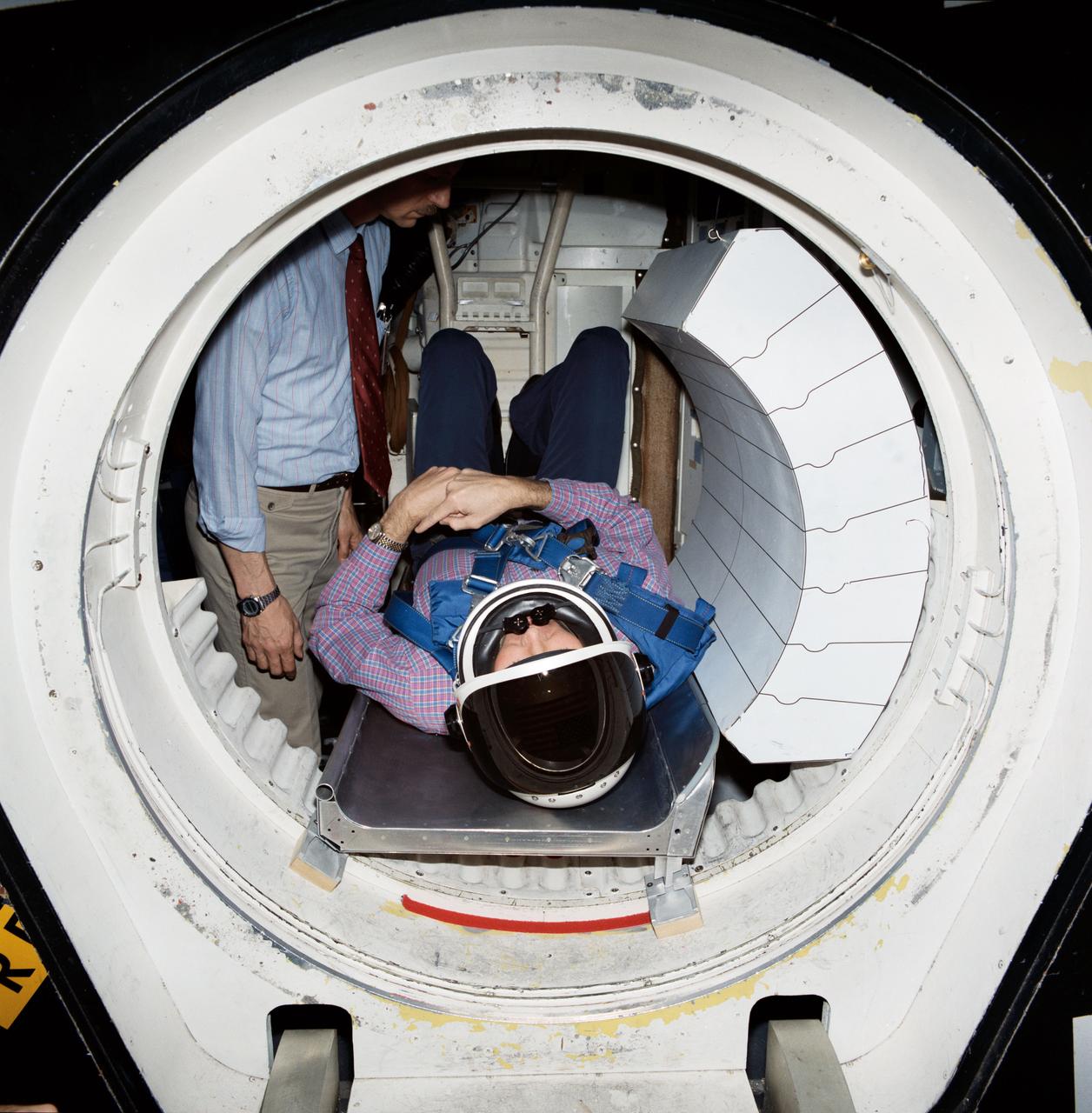
Shuttle crew escape systems test is conducted by astronauts Steven R. Nagel (left) and Manley L. (Sonny) Carter in JSC One Gravity Mockup and Training Facilities Bldg 9A crew compartment trainer (CCT). Nagel and Carter are evaluating methods for crew escape during Space Shuttle controlled gliding flight. JSC test was done in advance of tests scheduled for facilities in California and Utah. Here, Carter serves as test subject evaluating egress positioning for the tractor rocket escape method - one of the two systems currently being closely studied by NASA.
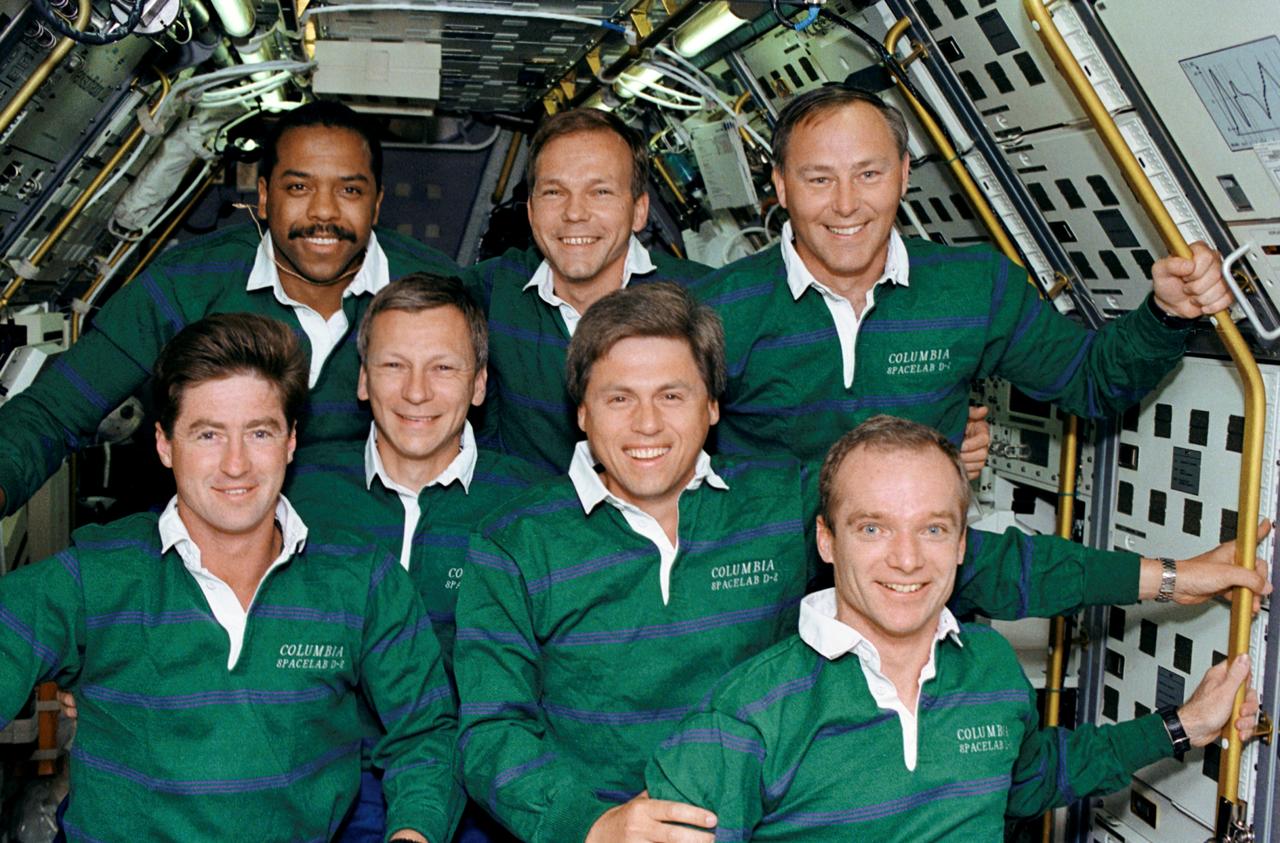
STS055-203-009 (26 April-6 May 1993) --- The seven crew members who spent 10 days aboard the space shuttle Columbia pose for the traditional in-flight portrait in the Spacelab D-2 Science Module. Front, left to right, are Terence T. (Tom) Henricks, Steven R. Nagel, Ulrich Walter and Charles J. Precourt. In the rear are (left to right) Bernard A. Harris Jr., Hans Schlegel and Jerry L. Ross. Nagel served as mission commander; Henricks was the pilot and Ross, the payload commander. Harris and Precourt were mission specialists and Schlegel and Walter were payload specialists representing the German Aerospace Research Establishment (DLR). Photo credit: NASA
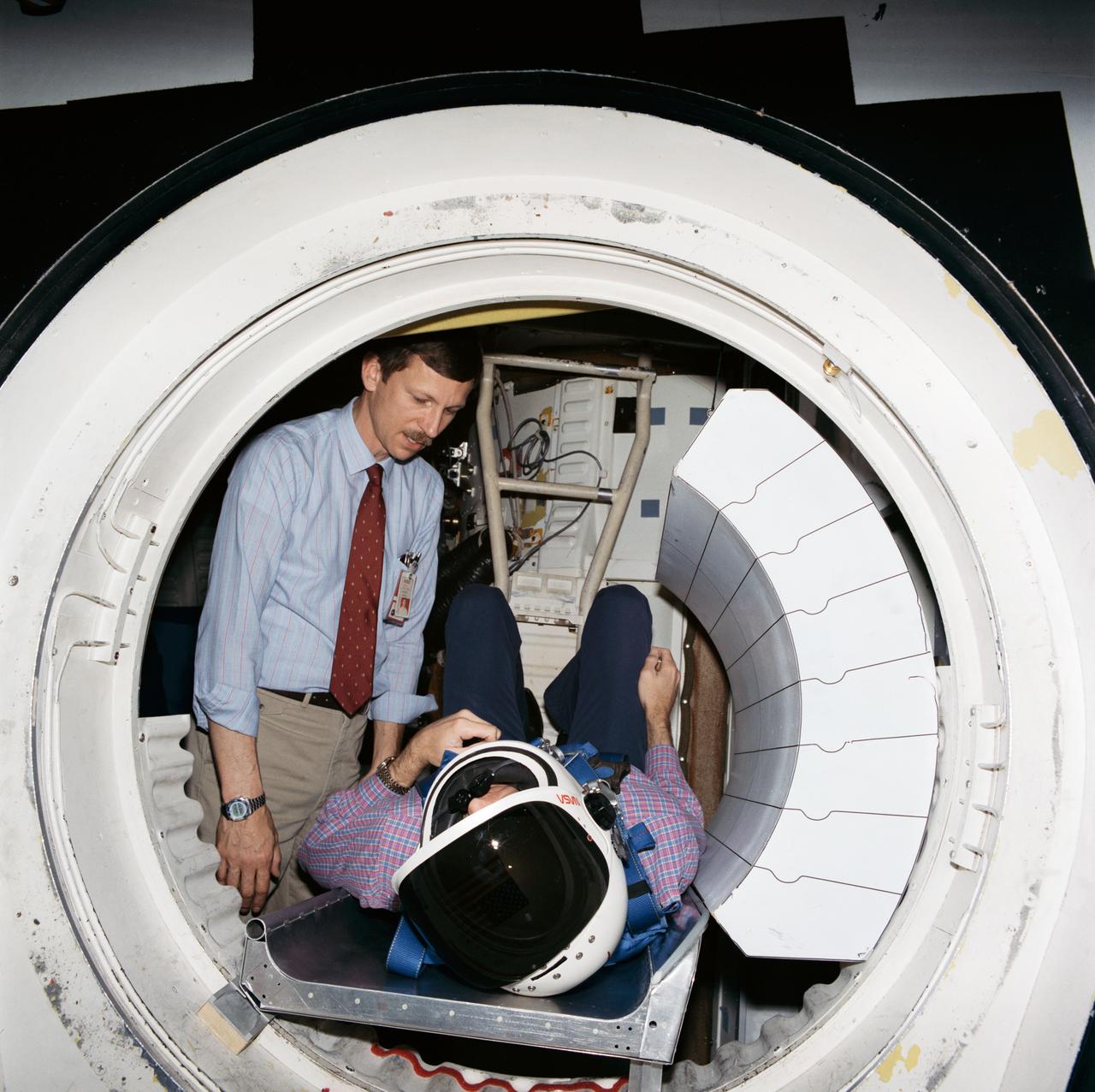
Shuttle crew escape systems test is conducted by astronauts Steven R. Nagel (left) and Manley L. (Sonny) Carter in JSC One Gravity Mockup and Training Facilities Bldg 9A crew compartment trainer (CCT). Nagel and Carter are evaluating methods for crew escape during Space Shuttle controlled gliding flight. JSC test was done in advance of tests scheduled for facilities in California and Utah. Here, Carter serves as test subject evaluating egress positioning for the tractor rocket escape method - one of the two systems currently being closely studied by NASA.

Shuttle crew escape systems test is conducted by astronauts Steven R. Nagel (left) and Manley L. (Sonny) Carter in JSC One Gravity Mockup and Training Facilities Bldg 9A crew compartment trainer (CCT). Nagel and Carter are evaluating methods for crew escape during Space Shuttle controlled gliding flight. JSC test was done in advance of tests scheduled for facilities in California and Utah. Here, Carter serves as test subject evaluating egress positioning for the tractor rocket escape method - one of the two systems currently being closely studied by NASA.

Four STS 51-G crewmembers huddle in a corner of the Discovery's middeck area. Daniel C. Brandenstein, mission commander, assists Steven R. Nagel with the treadmill device while John O. Creighton and Shannon W. Lucid look on.
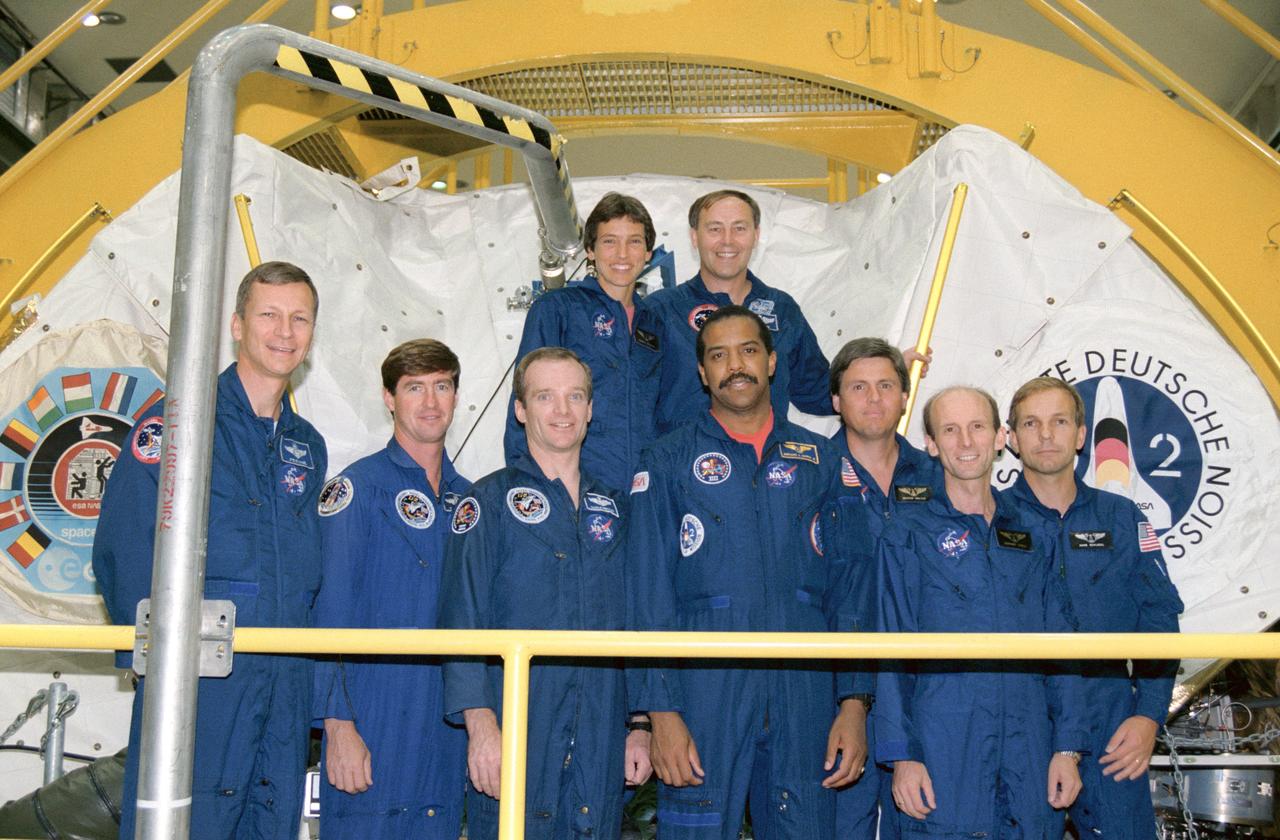
S92-49373 (8 Dec 1992) --- The seven prime flight crewmembers and two alternates assigned to support the STS-55\Spacelab D-2 mission pose with their science module. Left to right (front) are Steven R. Nagel, Terence T. (Tom) Henricks, Charles J. Precourt, Bernard A. Harris Jr., Ulrich Walter, Gerhard Thiele and Hans Schlegel; and (back) Renate Brummer and Jerry L. Ross. Nagel is mission commander; Henricks, pilot; and Ross, payload commander. Harris and Precourt will serve as mission specialists. Walter and Schlegel are scheduled to represent the DLR as payload specialists for the mission, while Brummer and Thiele will serve as alternates and fill supportive roles on the ground. The crew was photographed during a tour of the science module before its integration at Kennedy Space Center (KSC).
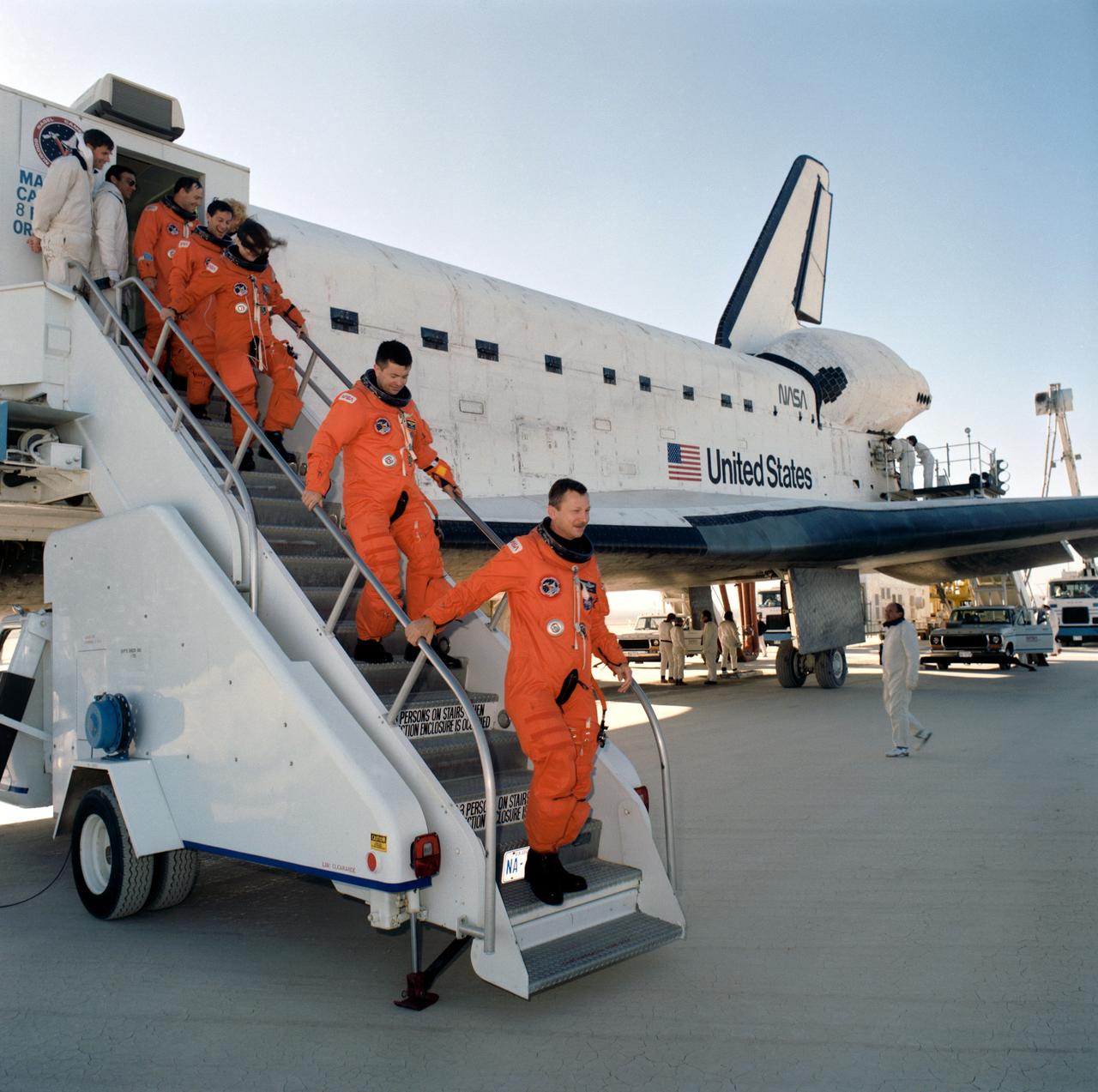
STS037-S-087 (11 April 1991) --- STS-37 crewmembers egress Atlantis via mobile stairway after landing on runway 33 dry lake bed at Edwards Air Force Base. Leading the crewmembers down the stairway is mission commander Steven R. Nagel. He is followed by pilot Kenneth D. Cameron, Mission Specialists Linda M. Godwin, Jerome Apt and Jerry L. Ross.
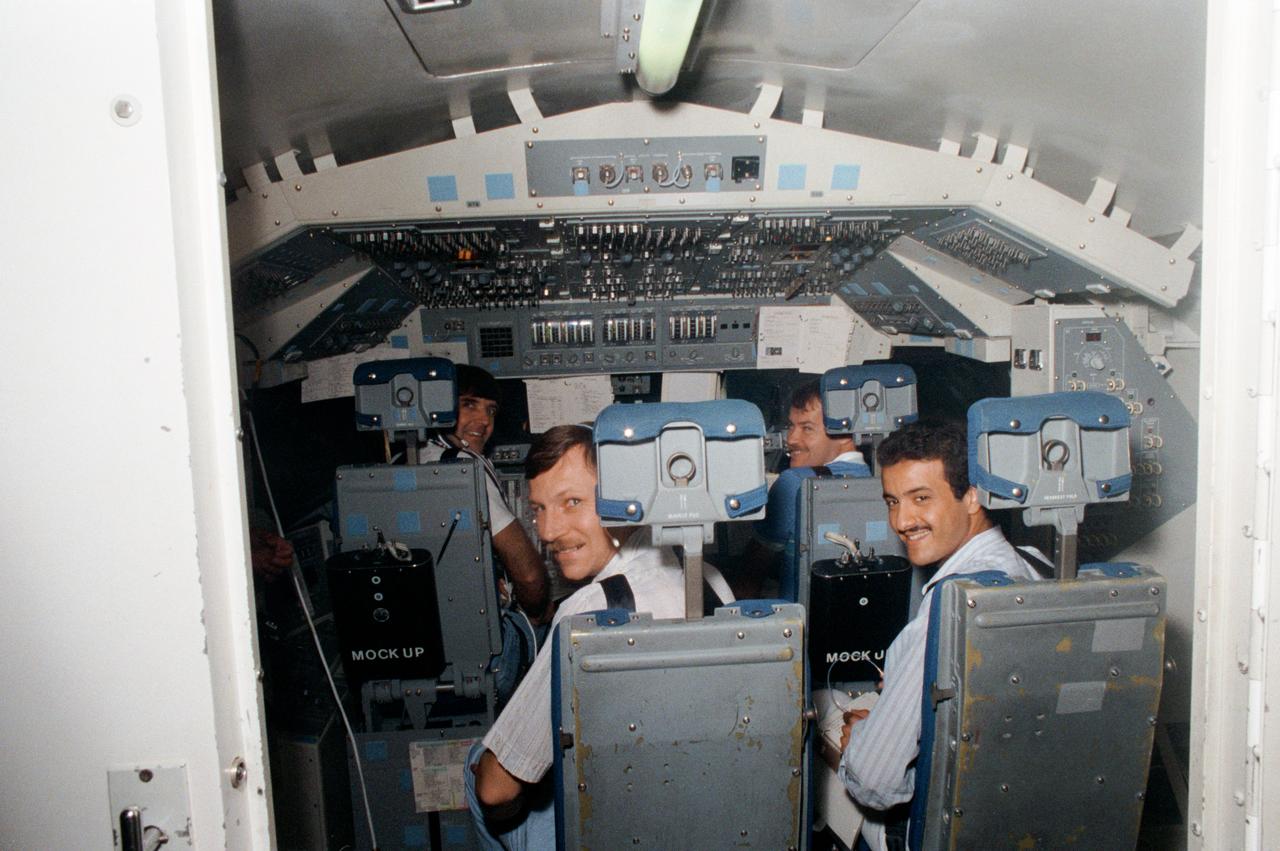
S85-31933 (17 May 1985) --- Four members of the STS 51-G crew participate in a training exercise in the shuttle mission simulation and training facility at the Johnson Space Center. Steven R. Nagel, left foreground, is a mission specialist for the flight, while Sultan Salman Abdelazize Al-Saud (right foreground) is a payload specialist. In the background are astronauts Daniel C. Brandenstein (left) in the commander's station and John O. Creighton in the pilot's position. Photo credit: NASA/ Otis Imboden of National Geographic
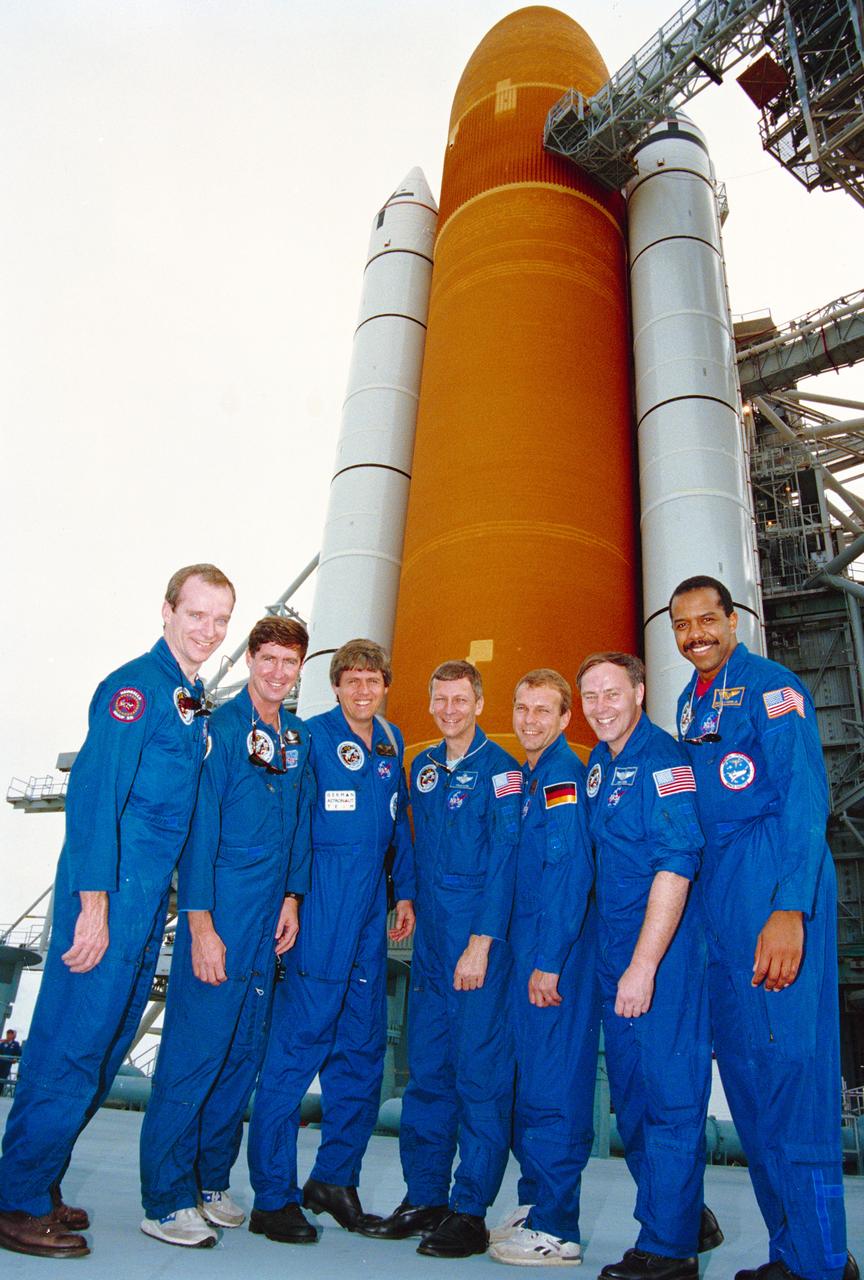
S93-29860 (11 Feb 1993) --- The STS-55 crew poses for a group portrait next to the Space Shuttle Columbia at Launch Pad 39A. From left are mission specialist Charles J. Precourt; pilot Terence T. Henricks; payload specialist Ulrich Walter, mission commander Steven R. Nagel; payload specialist Hans Schlegel; payload commander Jerry L. Ross; and mission specialist Bernard A. Harris Jr.. The crew is at KSC for the Terminal Countdown Demonstration Test (TCDT), a dress rehearsal for launch.
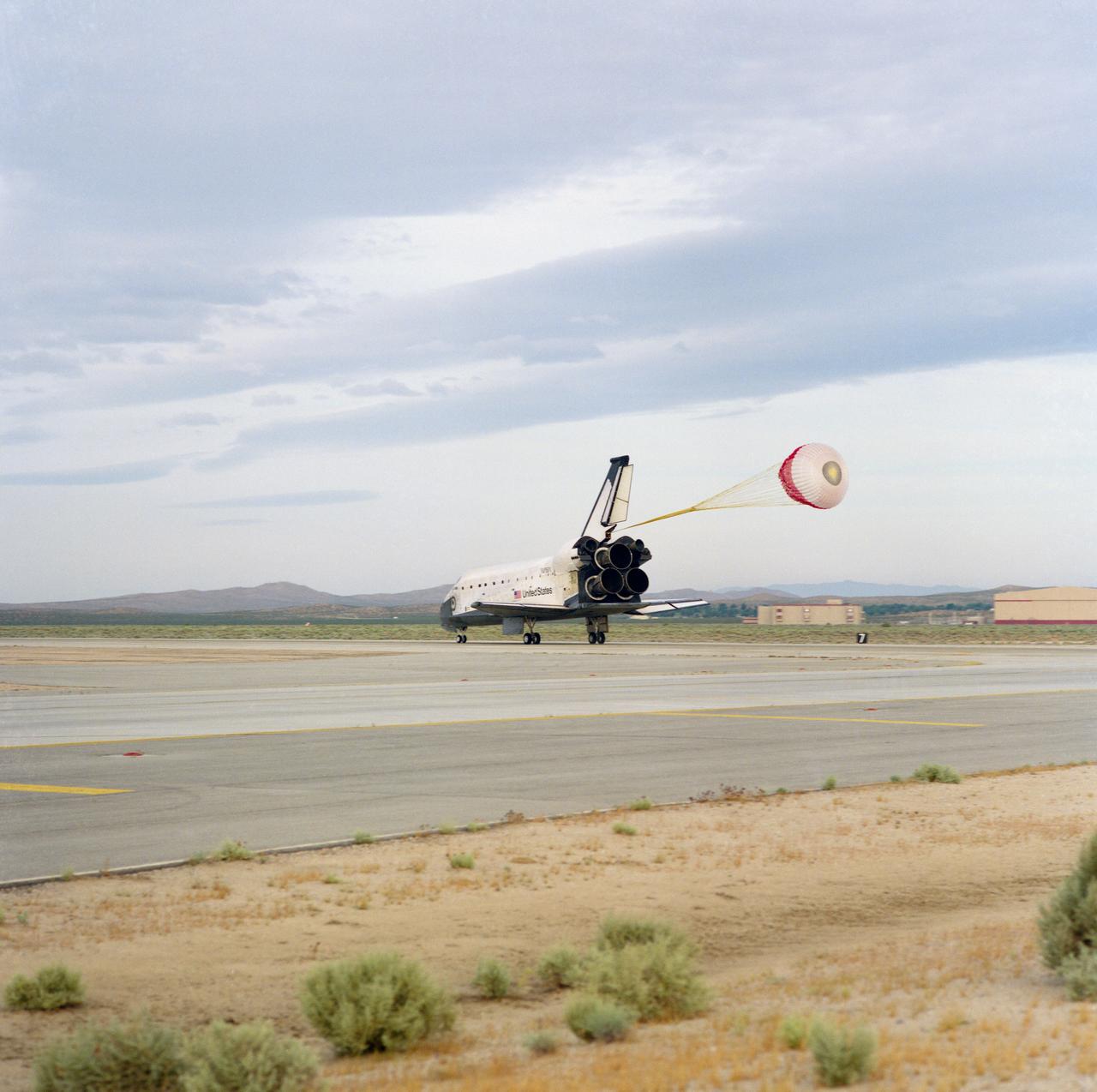
STS055-S-089 (6 May 1993) --- The main drag chute on the Space Shuttle Columbia is almost fully deployed in this three-quarter aft view of the vehicle's runway landing at Edwards Air Force Base in California. Landing occurred at 7:30 a.m. (PDT), May 6, 1993. Onboard the spacecraft were astronauts Steven R. Nagel, Terence T. (Tom) Henricks, Jerry L. Ross, Bernard Harris Jr. and Charles J. Precourt, along with German payload specialists Hans Schlegel and Ulrich Walter.

51G-21-011 (17-24 June 1985) --- Group portrait on flight deck of all seven STS-51G crew members. Left to right (front) are John O. Creighton, Shannon W. Lucid, Daniel C. Brandenstein; and (back row) are Sultan Salman Abdelazize Al-Saud, Steven R. Nagel, John M. Fabian and Patrick Baudry. Photo credit: NASA
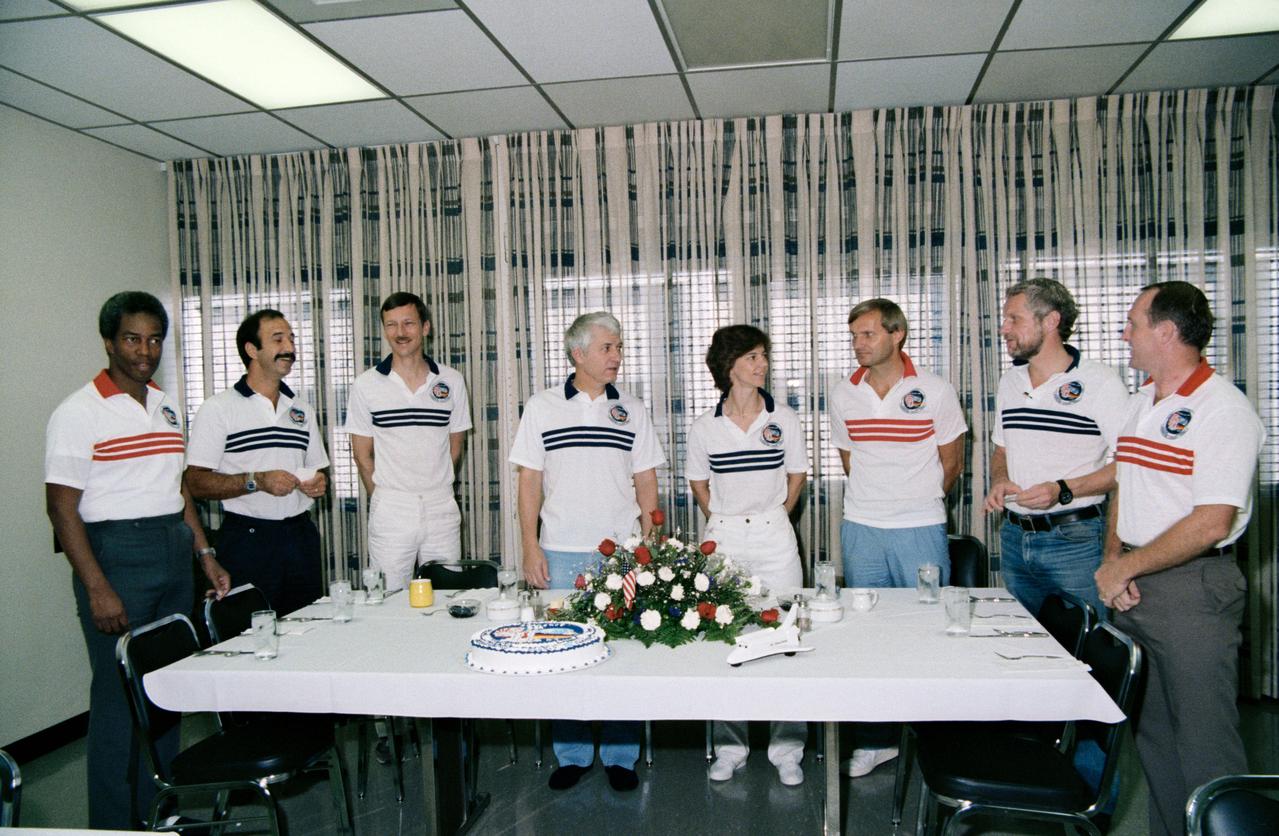
61A-S-016 (30 Oct 1985) --- Standing near their pre-flight breakfast table are the eight crewmembers for the STS 61-A/Spacelab D1 mission. L.-R., Guion S. Bluford, Wubbo J. Ockels, Steven R. Nagel, Henry W. Hartsfield, Bonnie J. Dunbar, Ernst Messerschmid, Reinhard Furrer and James F. Buchli, discuss their upcoming week in space.
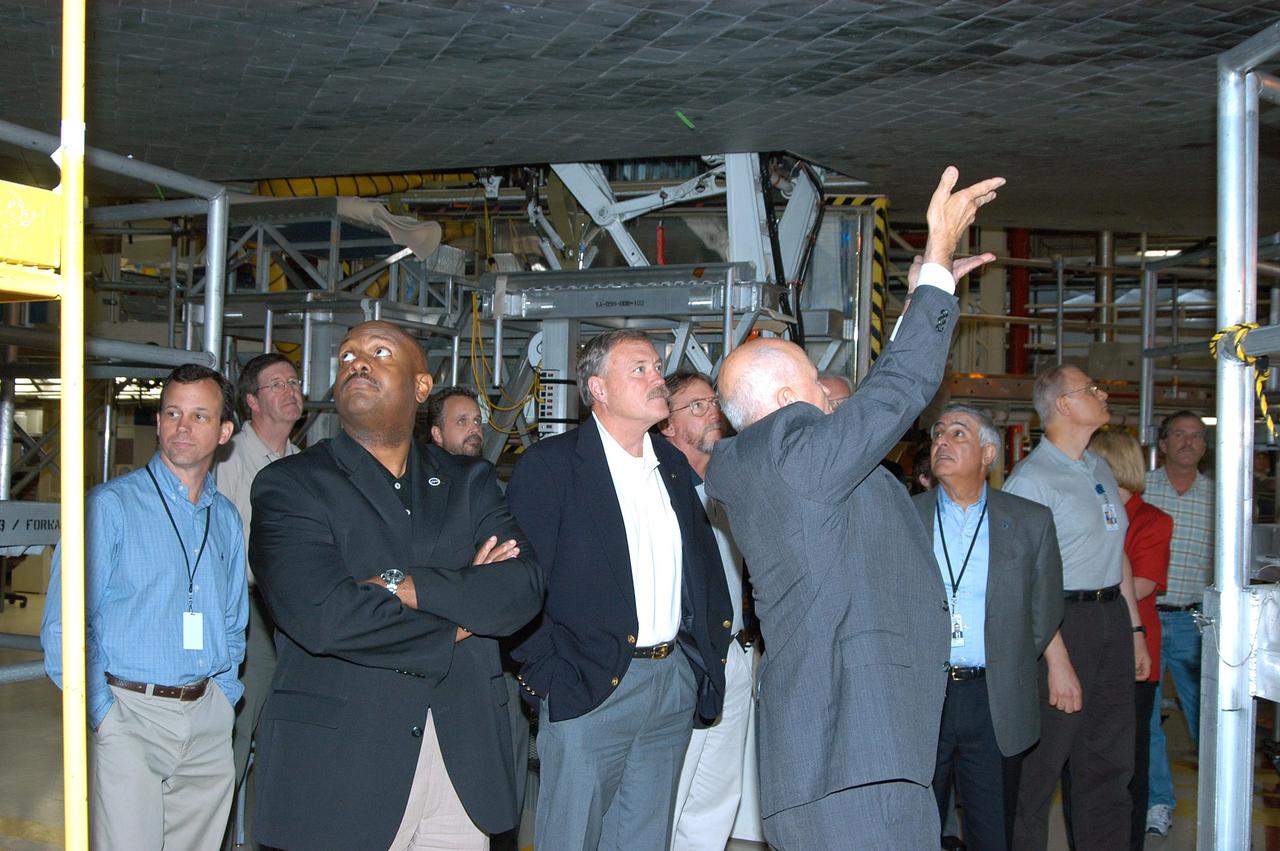
KENNEDY SPACE CENTER, FLA. -- Adm. Craig E. Steidle (center), NASA’s associate administrator, Office of Exploration Systems, tours the Orbiter Processing Facility on a visit to KSC. At right (hands up) is Conrad Nagel, chief of the Shuttle Project Office. They are standing under the orbiter Discovery. The Office of Exploration Systems was established to set priorities and direct the identification, development and validation of exploration systems and related technologies to support the future space vision for America. Steidle’s visit included a tour of KSC to review the facilities and capabilities to be used to support the vision.

51G-S-117 (17 June 1985) --- 51-G crewmembers depart the Kennedy Space Center's operations and checkout building on their way to the launch pad for the launch of the Discovery. Leading the seven are Daniel C. Brandenstein, commander; and John O. Creighton, pilot. Following are Payload specialist Sultan Salman Abdelazize Al-Saud; John M. Fabian, mission specialist; Patrick Baudry, payload specialist; Shannon Lucid and Steven R. Nagel, mission specialists.
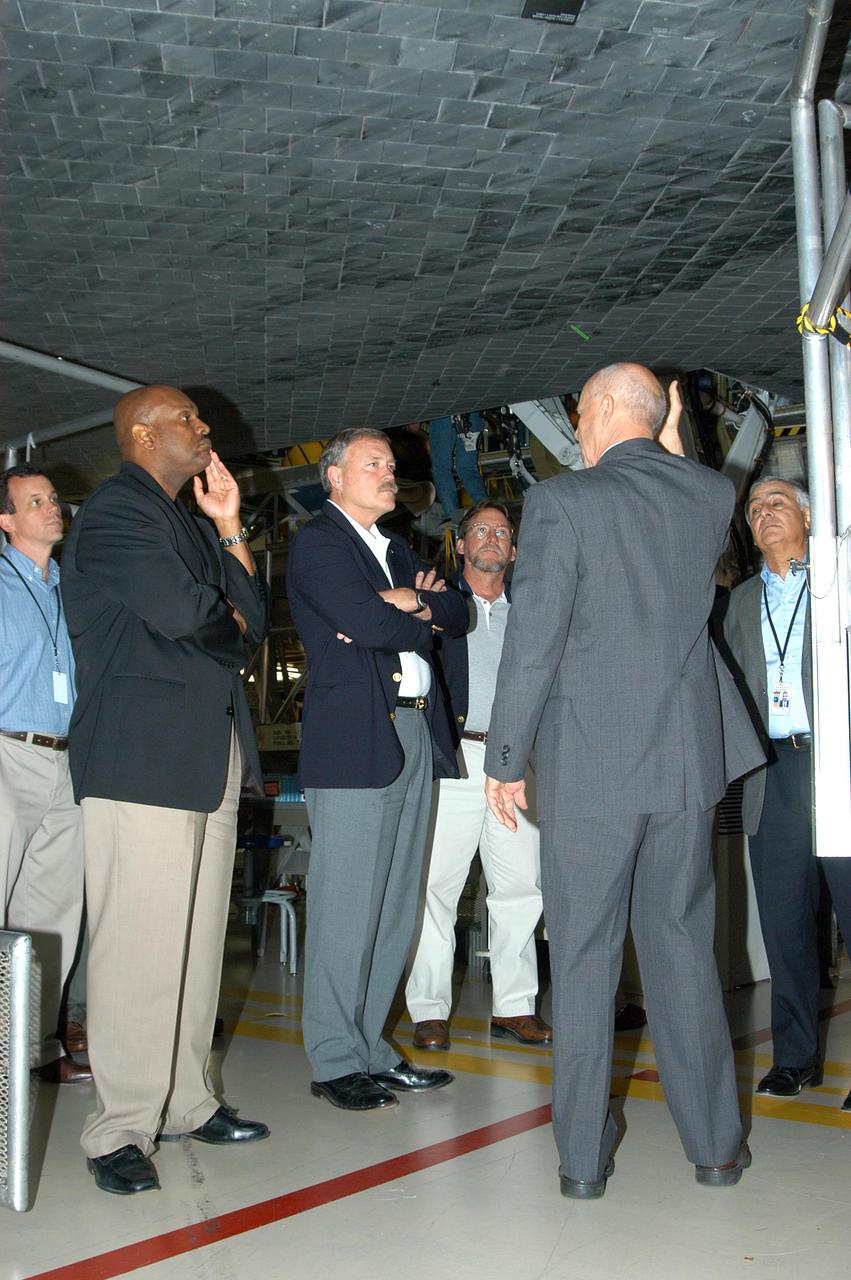
KENNEDY SPACE CENTER, FLA. -- Adm. Craig E. Steidle (center), NASA’s associate administrator, Office of Exploration Systems, listens to Conrad Nagel, chief of the Shuttle Project Office (right), during a tour of the Orbiter Processing Facility on a visit to KSC. They are standing under the orbiter Discovery. The Office of Exploration Systems was established to set priorities and direct the identification, development and validation of exploration systems and related technologies to support the future space vision for America. Steidle’s visit included a tour of KSC to review the facilities and capabilities to be used to support the vision.
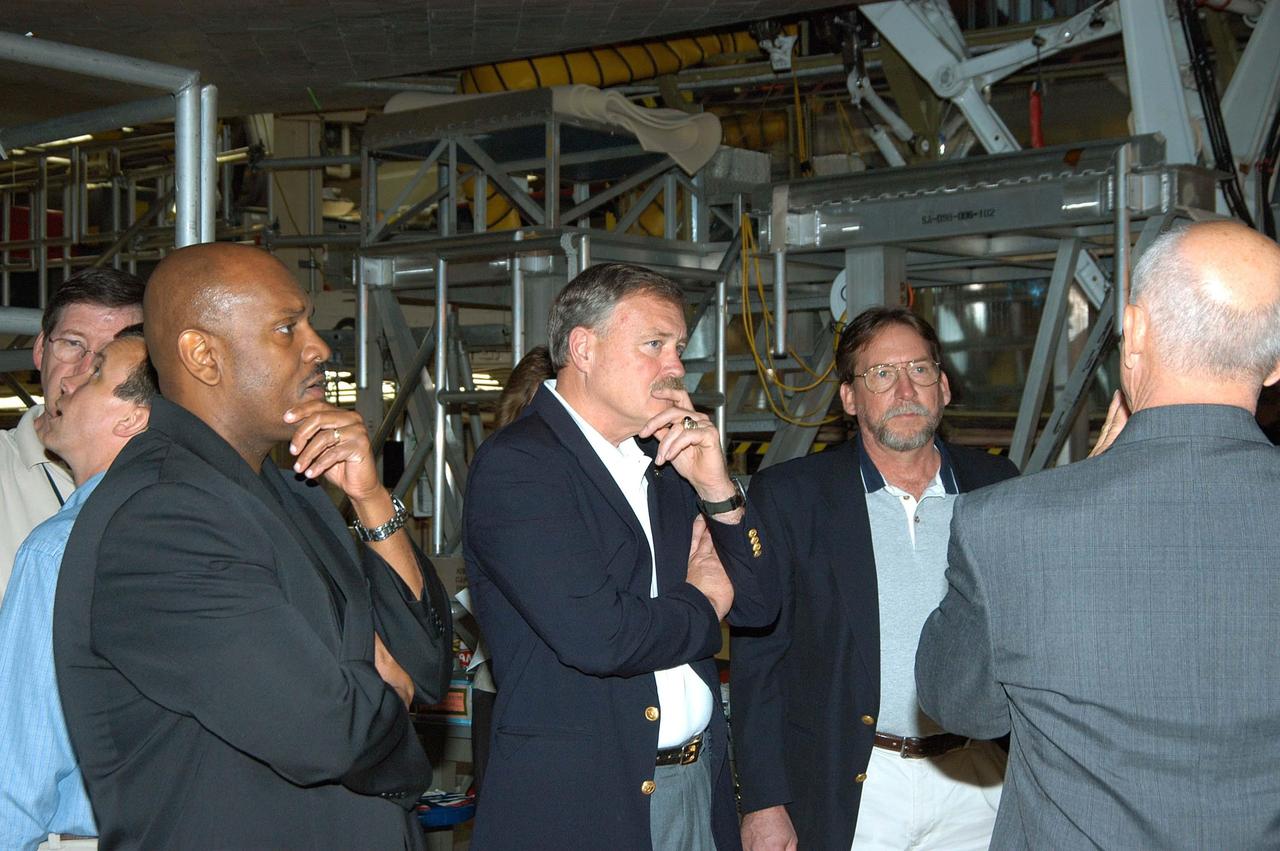
KENNEDY SPACE CENTER, FLA. -- Adm. Craig E. Steidle (center), NASA’s associate administrator, Office of Exploration Systems, listens to Conrad Nagel, chief of the Shuttle Project Office (right), during a tour of the Orbiter Processing Facility on a visit to KSC. They are standing under the orbiter Discovery. The Office of Exploration Systems was established to set priorities and direct the identification, development and validation of exploration systems and related technologies to support the future space vision for America. Steidle’s visit included a tour of KSC to review the facilities and capabilities to be used to support the vision.
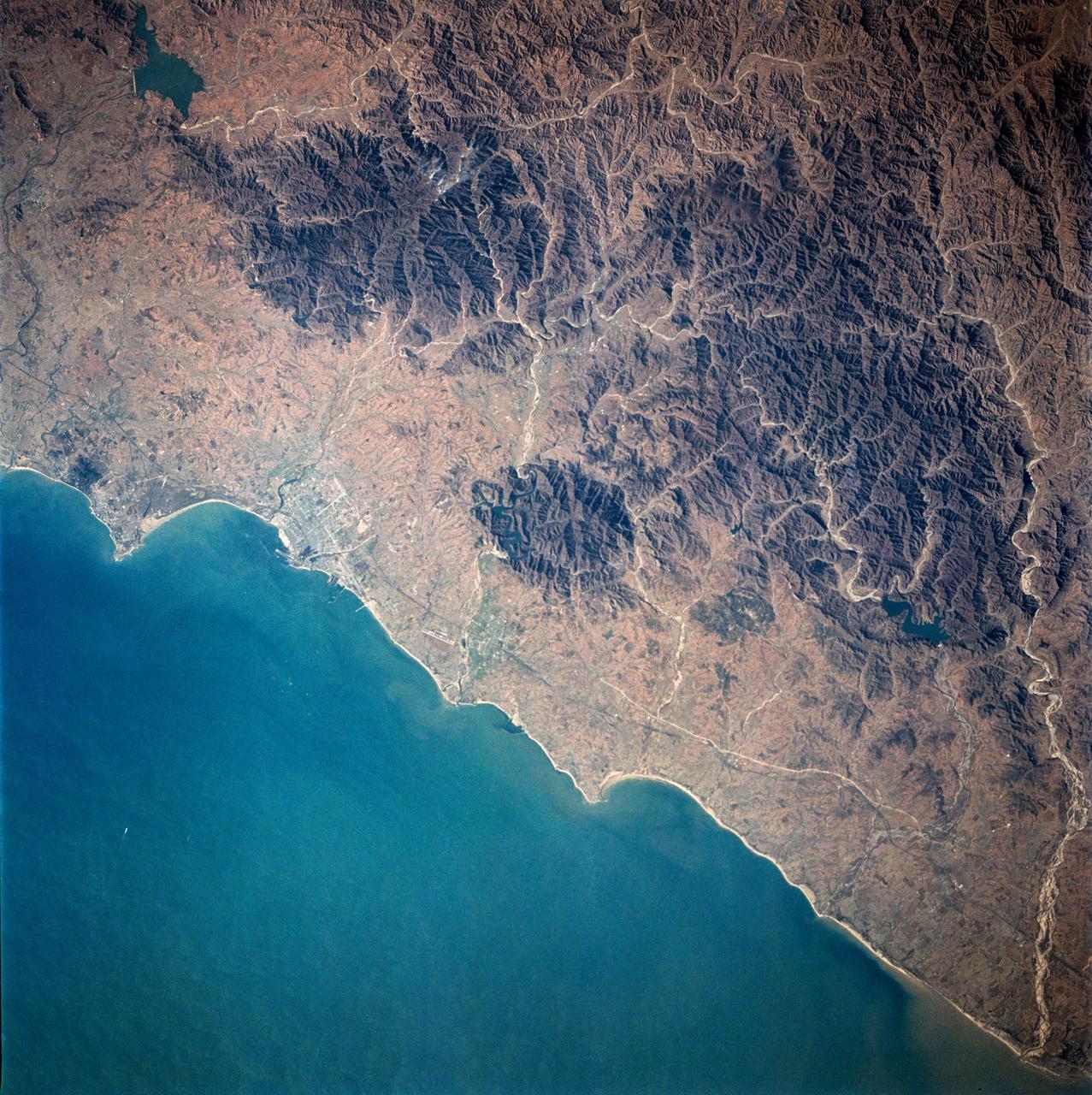
61A-39-052 (30 Oct-6 Nov 1985) --- This Earth view shows Quinhuangdao, China. The Great Wall of China can be seen in this photograph. The center coordinates are 40.0 north latitude and 120.0 east longitude. This photograph was taken from an altitude of 180 miles, on the 24th orbit of the Space Shuttle Challenger. The crew consists of astronauts Henry W. Hartsfield, Jr., commander; Steven R. Nagel, pilot; mission specialists James F. Buchli, Guion S. Bluford, Jr., Bonnie J. Dunbar; payload specialists Reinhard Furrer (DFVLR), Ernst Messerschmid (DFVLR), and Wubbo J. Ockels (ESA).
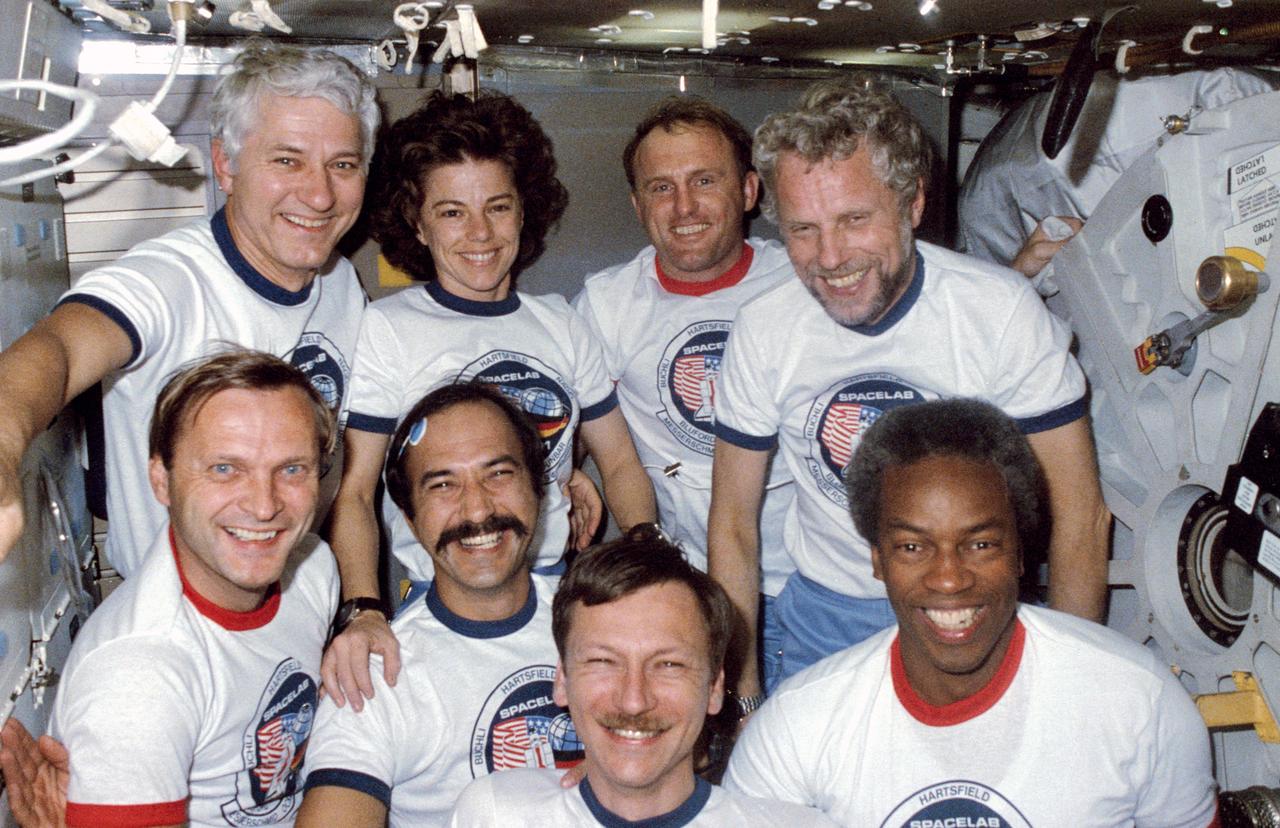
61A-117-019 (30 Oct.-6 Nov. 1985) --- Traditional in-flight portrait of all eight STS-61A crew members was made with an automatic exposure of a 35mm camera. Left to right, back row, Henry W. Hartsfield Jr., commander; Bonnie J. Dunbar, mission specialist; James F. Buchli, mission specialist; and Reinhard Furrer, payload specialist. Left to right, front row, Ernst Messerschmid, payload specialist; Wubbo J. Ockels, payload specialist representing the European Space Agency (ESA); Steven R. Nagel, pilot; and Guion S. Bluford Jr., mission specialist. Photo credit: NASA
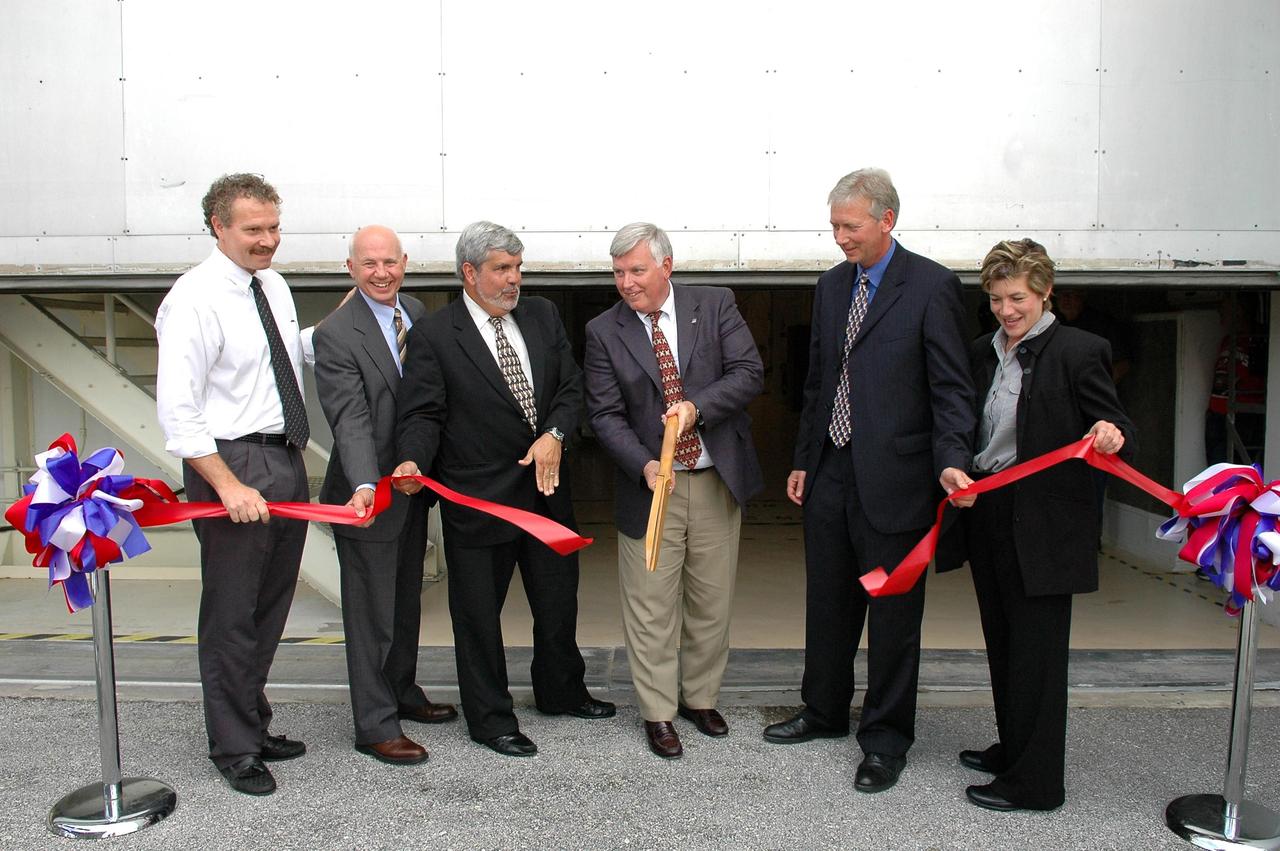
KENNEDY SPACE CENTER, FLA. - NASA officials cut the ribbon to officially reactivate the Operations and Checkout Building's west door as entry to the crew exploration vehicle (CEV) environment. From left are Russell Romanella, director of the ISS Payload and Processing Directorate; Conrad Nagel, consultant for Space Florida; Jim Kennedy, director of KSC; Adrian Lafitte, director of government relations for Lockheed Martin; Mark Jager, program manager of Checkout, Assembly, Payloads Processing Services with Boeing; and Lynda Weatherman, with the Economic Development Commission. During the rest of the decade, KSC will transition from launching space shuttles to launching new vehicles in NASA’s Vision For Space Exploration. Photo credit: NASA/Kim Shiflett
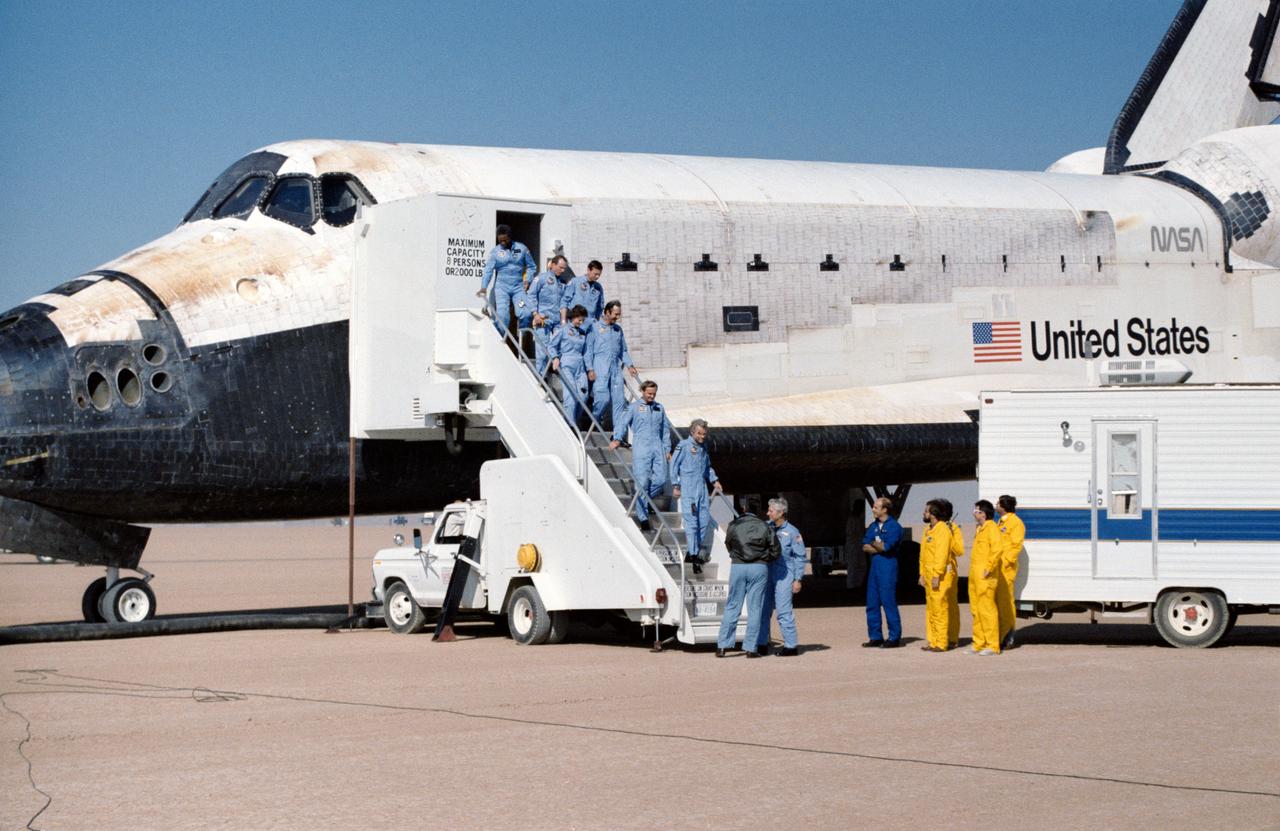
61A-S-140 (6 Nov 1985) --- The record-setting eight crewmembers for STS 61-A file from their "home" for the past week at the completion of a successful Spacelab D-1 mission. Astronaut Henry W. Hartsfield Jr., mission commander, shakes hands with George W. S. Abbey, director of flight crew operations at JSC. Other crewmembers, from left to right, are Astronauts Guion S. Bluford Jr., James F. Buchli, Steven R. Nagel and Bonnie J. Dunbar; and Payload Specialists Wubbo J. Ockels, Ernst Messerschmid and Reinhard Furrer. The Challenger came to a complete stop at 9:45:39 a.m. (PST).
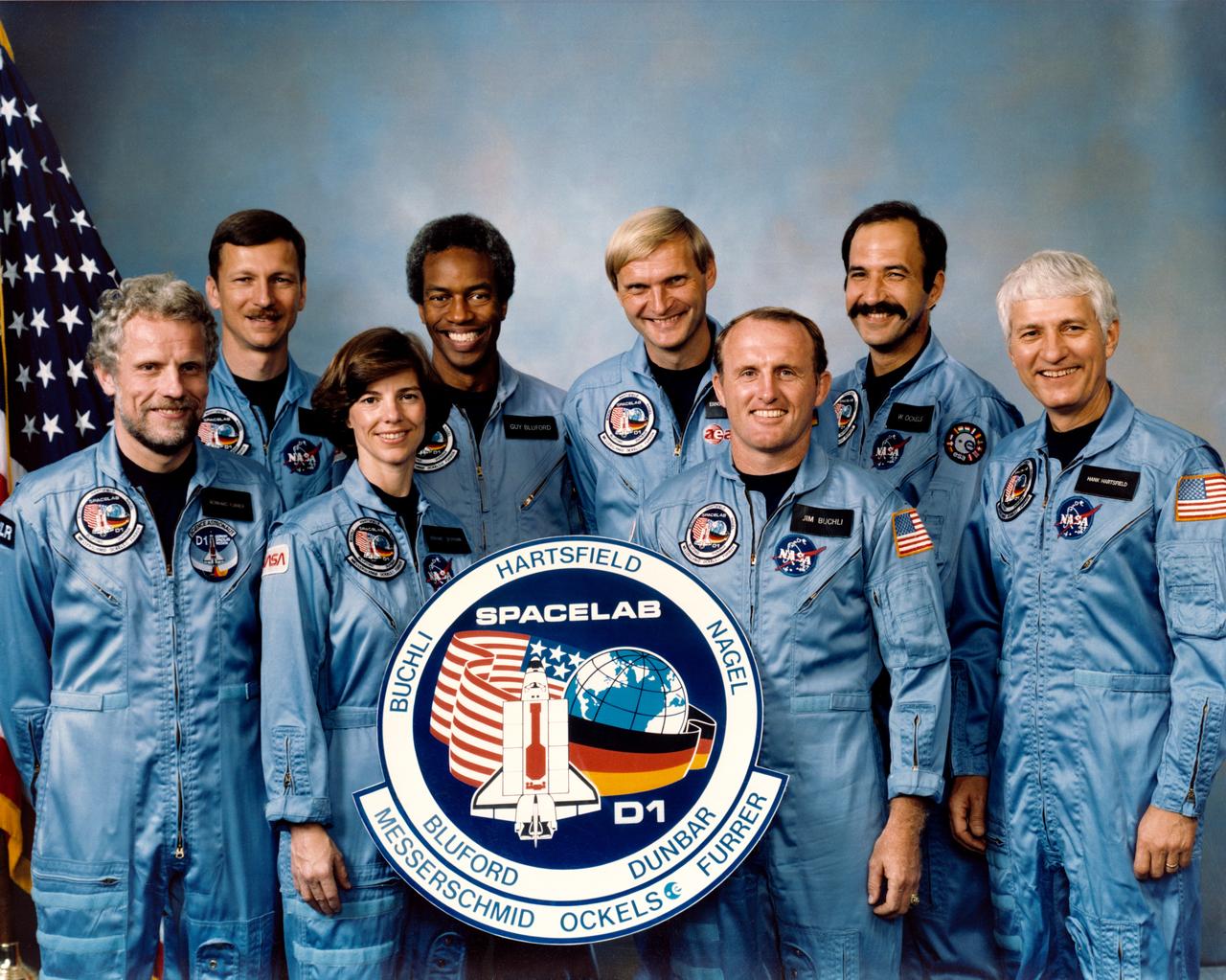
S85-40783 (27 Sept. 1985) --- This international crew expected to fly aboard the space shuttle Challenger when it launches next month represents the largest number (eight) of persons to occupy an orbiting spacecraft at the same time. Posing with the mission insignia are (front row, left to right) Reinhard Furrer, German payload specialist; Bonnie J. Dunbar, mission specialist; James F. Buchli, mission specialist; and Henry W. Hartsfield Jr., commander; and (back row, left to right) Steven R. Nagel, pilot; Guion S. Bluford, mission specialist; Ernst Messerschmid, German payload specialist; and Wubbo J. Ockels, Dutch payload specialist. Photo credit: NASA
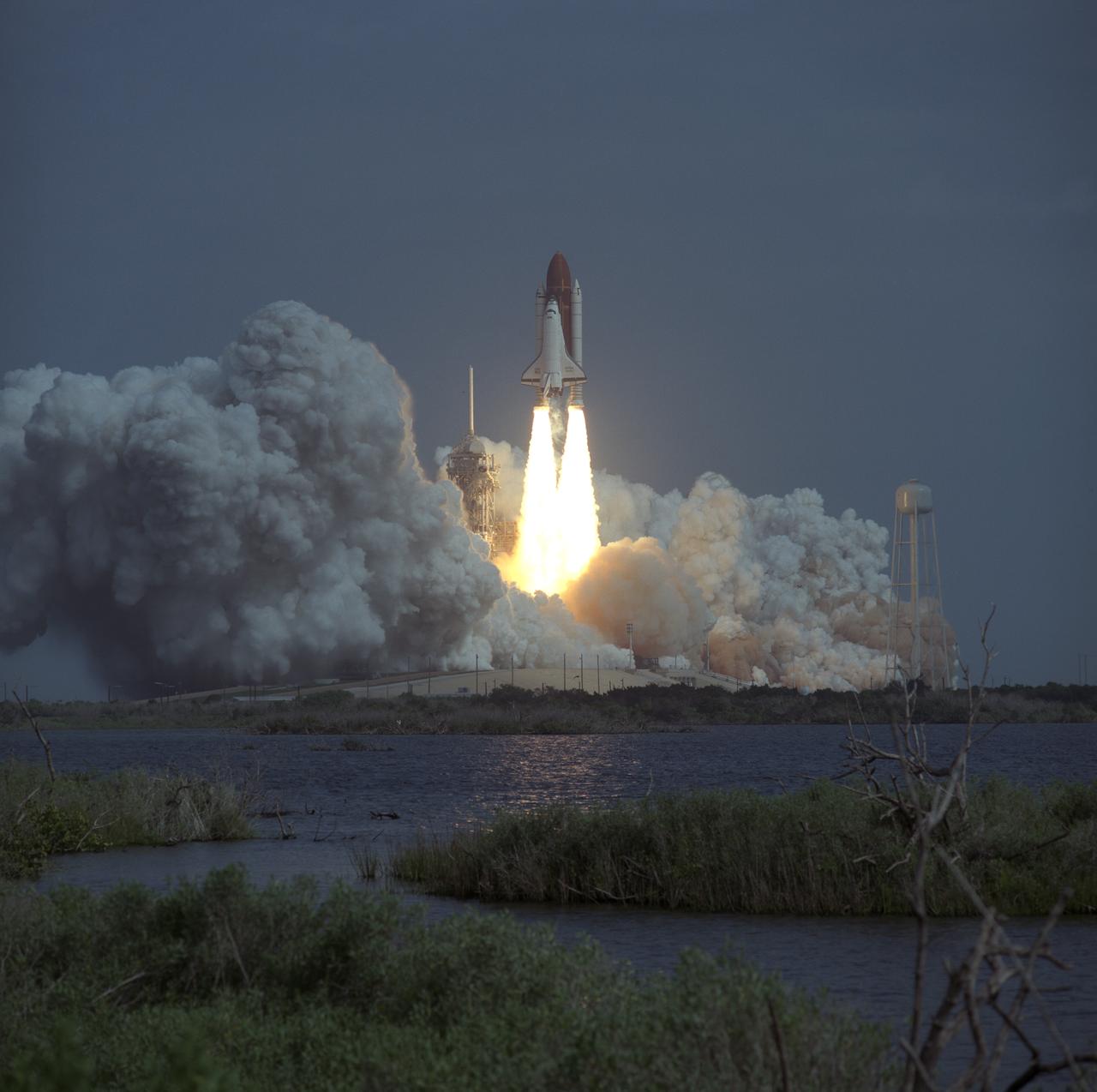
Launched aboard the Space Shuttle Atlantis on April 5, 1991 at 9:22:44am (EST), the STS-37 mission hurtles toward space. Her crew included Steven R. Nagel, commander; Kenneth D. (Ken) Cameron, pilot; and Jay Apt, Jerry L. Ross, and Linda M. Godwin, all mission specialists. The crew’s major objective was the deployment of the Gamma Ray Observatory (GRO). Included in the observatory were the Burst and Transient Source Experiment (BATSE); the Imaging Compton Telescope (COMPTEL); the Energetic Gamma Ray Experiment Telescope (EGRET); and the Oriented Scintillation Spectrometer Telescope (OSSEE).
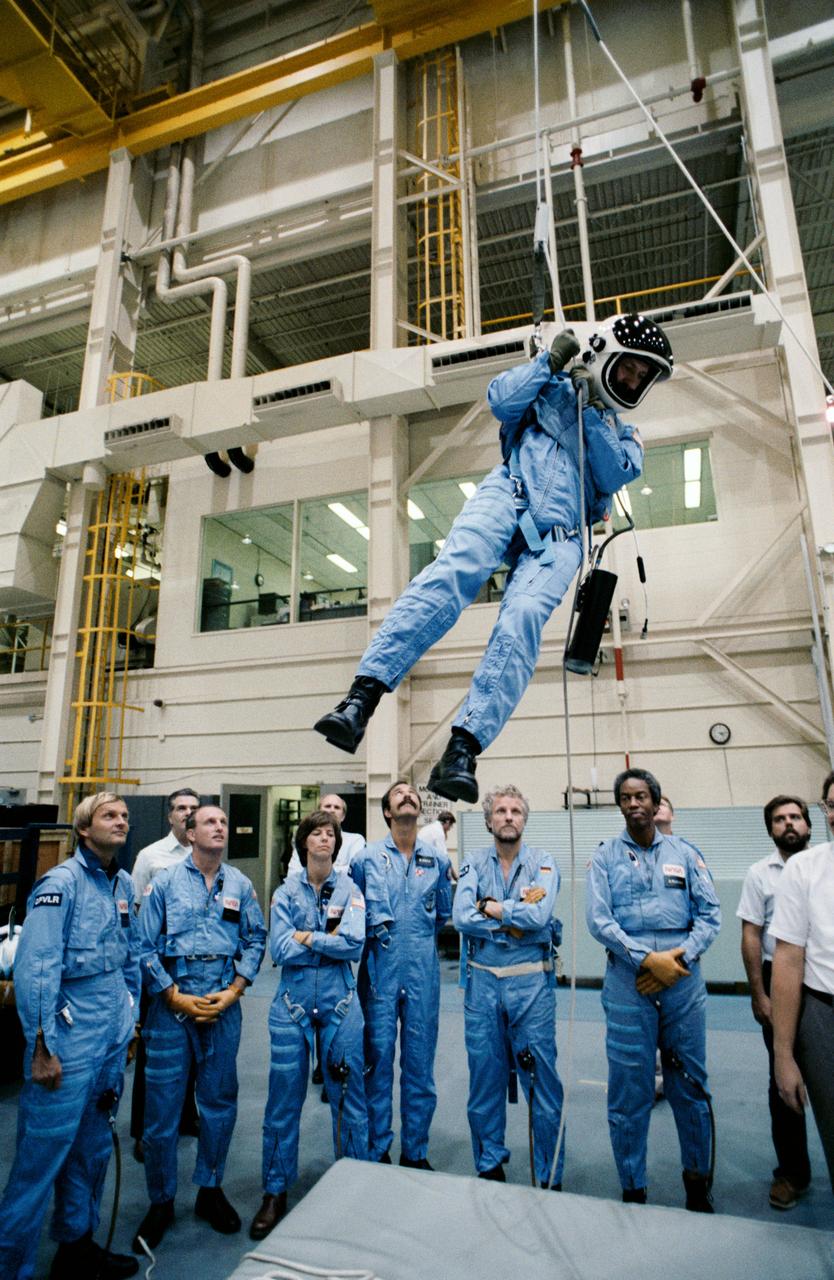
S85-41246 (26 Sept 1985) --- The STS 61-A/Spacelab D-1 crewmembers are seen in this training scene in the Johnson Space Center's Space Shuttle mockup and integration laboratory. Descending from a simulated Shuttle orbiter in distress, using a Sky-Genie device, is Astronaut Henry W. Hartsfield, Jr. mission commander. Watching in blue flight garments are other members of the crew. They are, left to right, Ernst Messerschmid, German payload specialist (PS1); James F. Buchli, NASA mission specialist (MS2); Bonnie J. Dunbar, NASA mission specialist (MS1); Wubbo J. Ockels, Dutch PS3. Not pictured is Steven R. Nagel, pilot. Photo was taken by Otis Imboden.
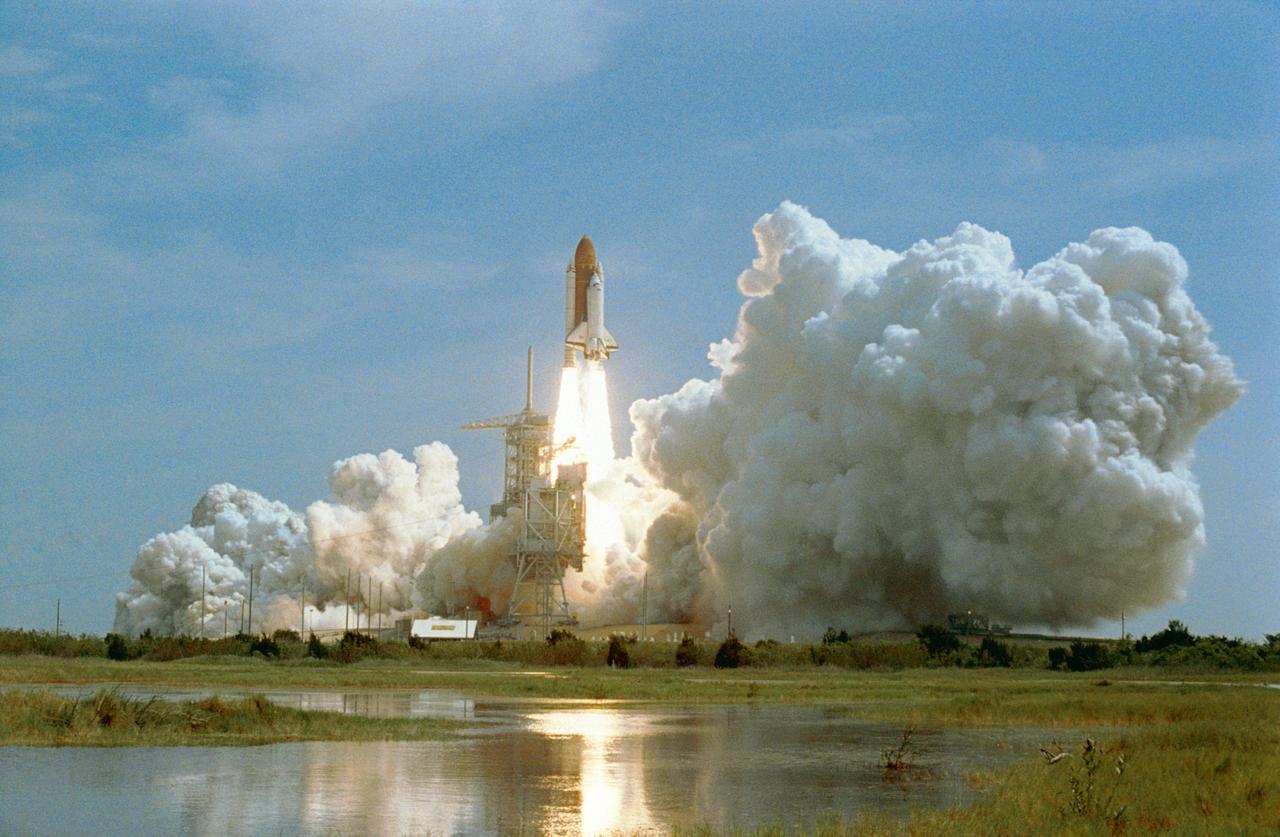
STS055-S-052 (26 April 1993) --- A wide shot shows the STS-55 launch at the Kennedy Space Center. Carrying an international crew of seven and a science laboratory, the Space Shuttle Columbia was on its way for a nine-day Earth-orbital mission in support of the Spacelab D-2 mission. Onboard were astronauts Steven R. Nagel, mission commander; Terence T. (Tom) Henricks, pilot; Jerry L. Ross, payload commander; Charles J. Precourt and Bernard A. Harris Jr., mission specialists; along with German payload specialists Hans Schlegel and Ulrich Walter. Liftoff occurred at 10:50 a.m. (EDT), April 26, 1993.
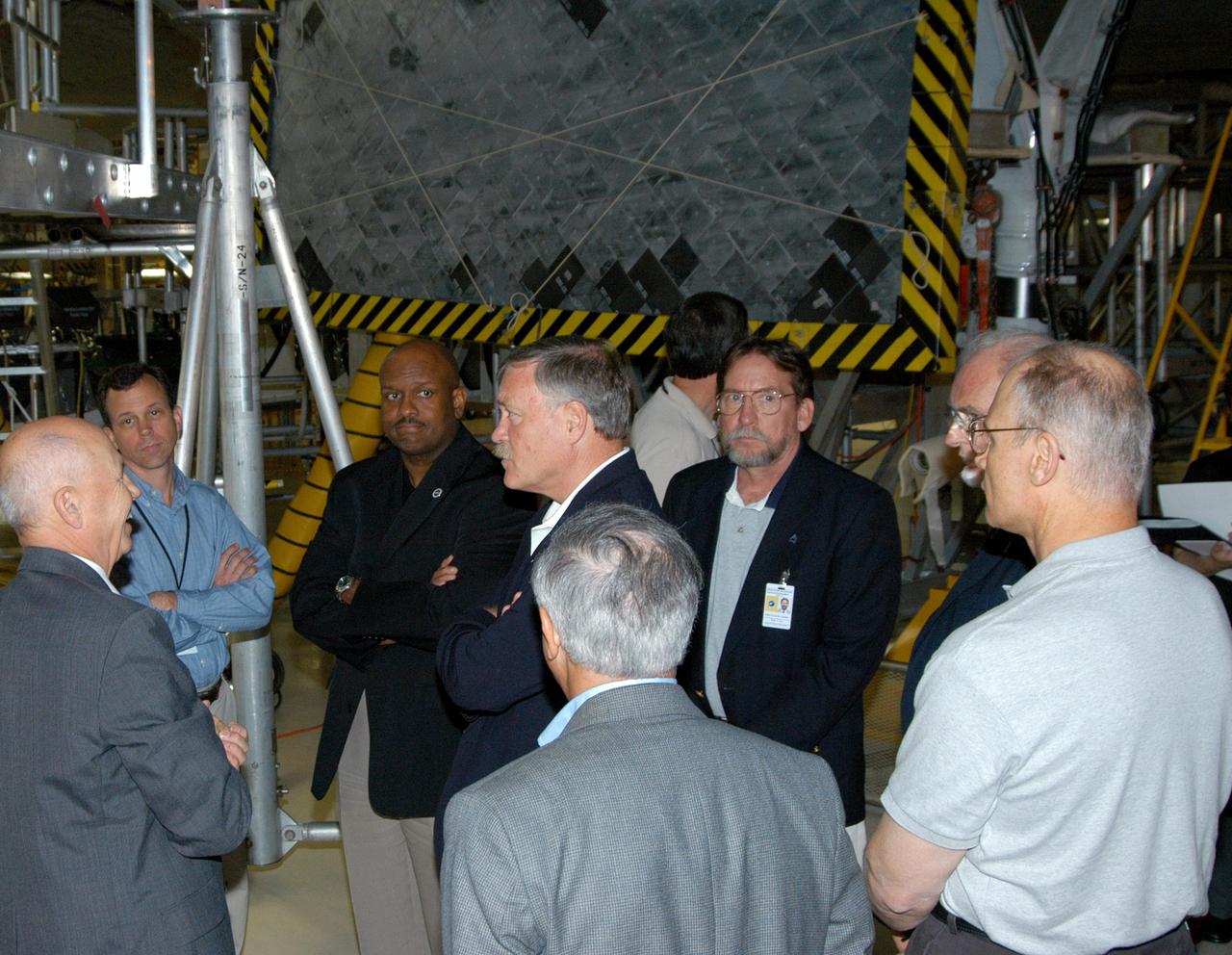
KENNEDY SPACE CENTER, FLA. -- Adm. Craig E. Steidle (center), NASA’s associate administrator, Office of Exploration Systems, tours the Orbiter Processing Facility on a visit to KSC. At left is Conrad Nagel, chief of the Shuttle Project Office. They are standing under the left wing and wheel well of the orbiter Discovery. The Office of Exploration Systems was established to set priorities and direct the identification, development and validation of exploration systems and related technologies to support the future space vision for America. Steidle’s visit included a tour of KSC to review the facilities and capabilities to be used to support the vision.
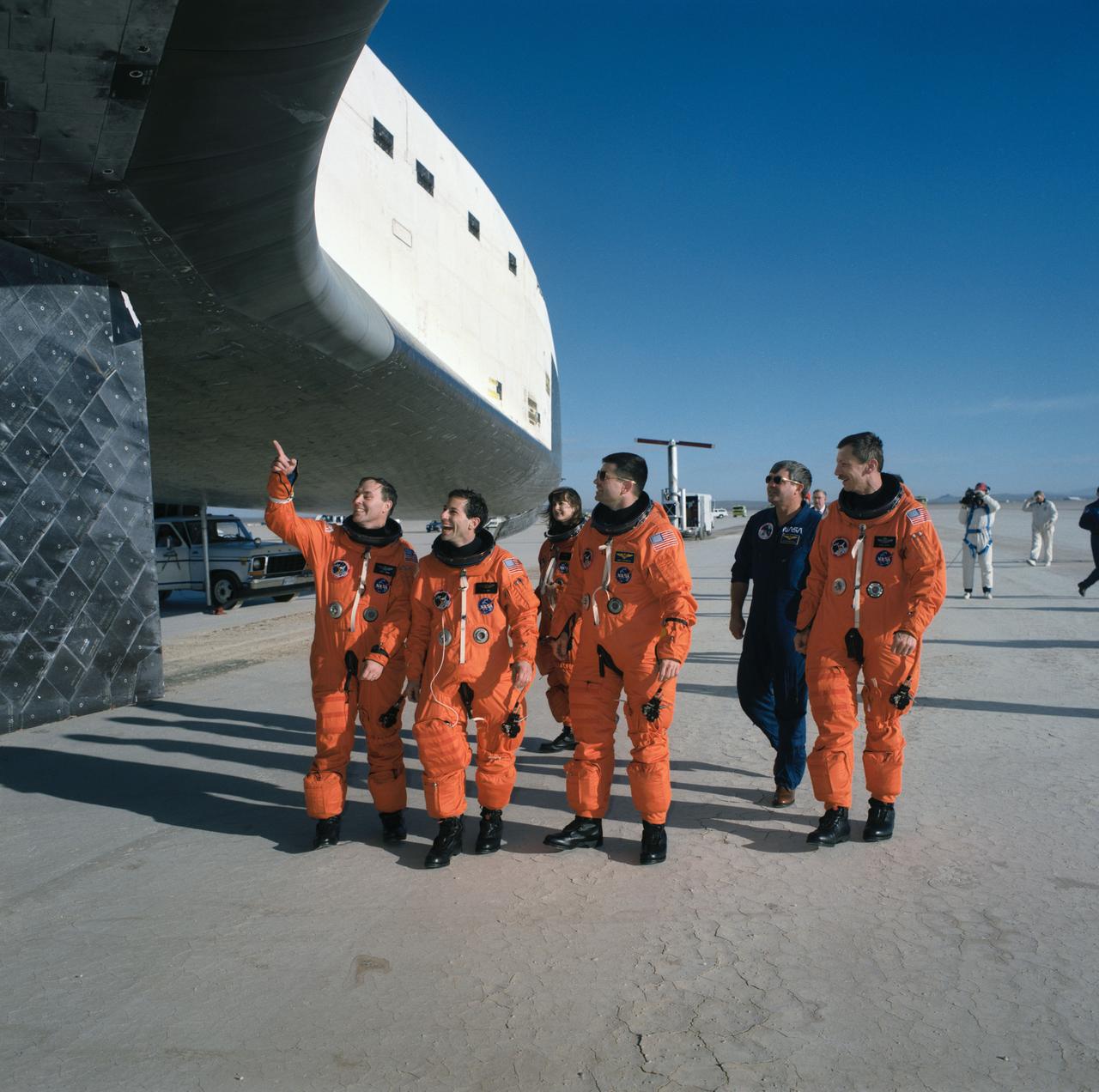
STS037-S-085 (11 April 1991) --- Following their egress from the Space Shuttle Atlantis at Edwards Air Force Base the STS-37 astronauts survey their "home" for the past six days. Pictured, left to right, are astronauts Jerry L. Ross, Jerome J. Apt, Linda M. Godwin, Kenneth D. Cameron, Daniel C. Brandenstein and Steven R. Nagel, mission commander. Brandenstein, chief of the Astronaut Office at JSC, flew the Shuttle training aircraft and took photographs during Atlantis's landing. Complete wheel stop occurred at 6:56:26 (PDT), April 11, 1991.
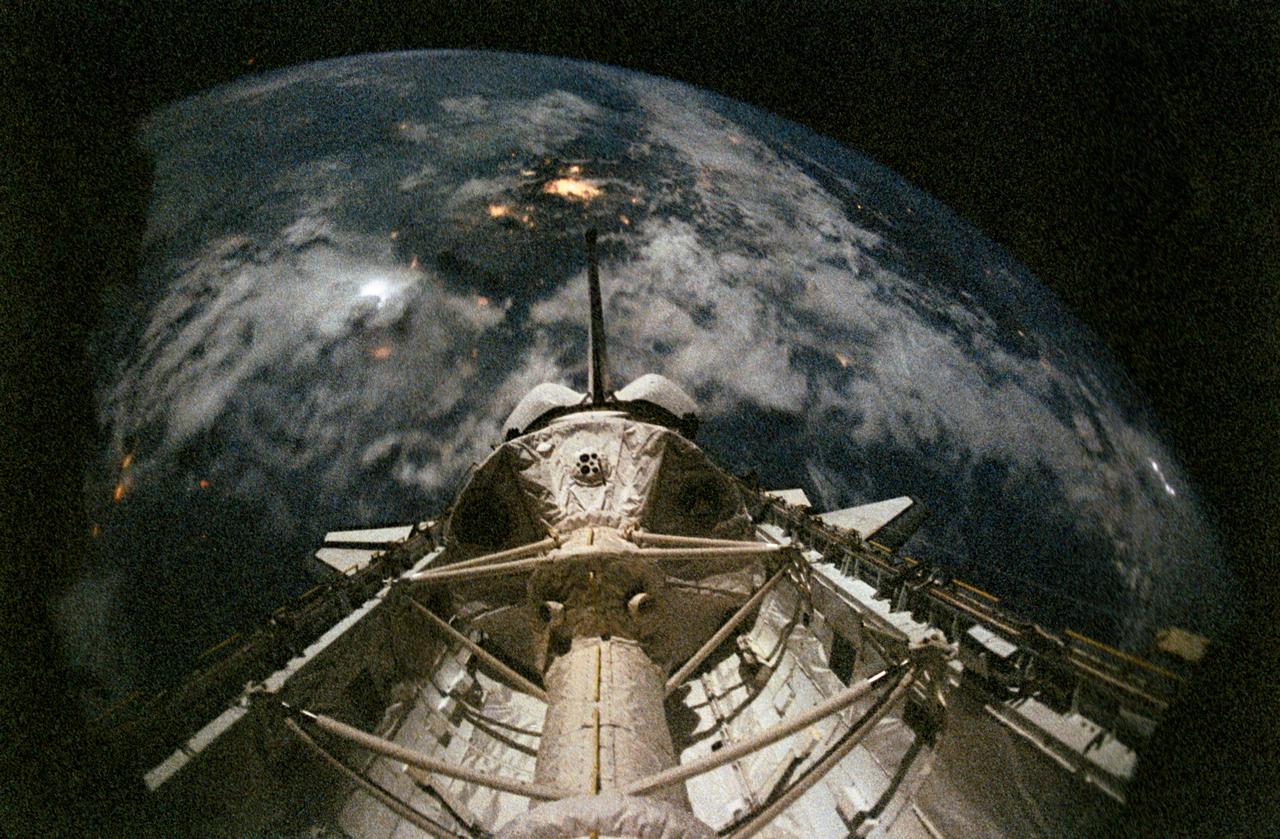
STS055-26-023 (26 April-6 May 1993) --- Lightning and man-made lights on Earth can be seen in this fast speed, 35mm frame photographed by a STS-55 crew member in the Space Shuttle Columbia's cabin. The cluster of lights near frame center is believed to be from Mexico City. Onboard the spacecraft were astronauts Steven R. Nagel, Terence T. (Tom) Henricks, Jerry L. Ross, Bernard A. Harris Jr. and Charles J. Precourt, along with German payload specialists Hans Schlegel and Ulrich Walter.
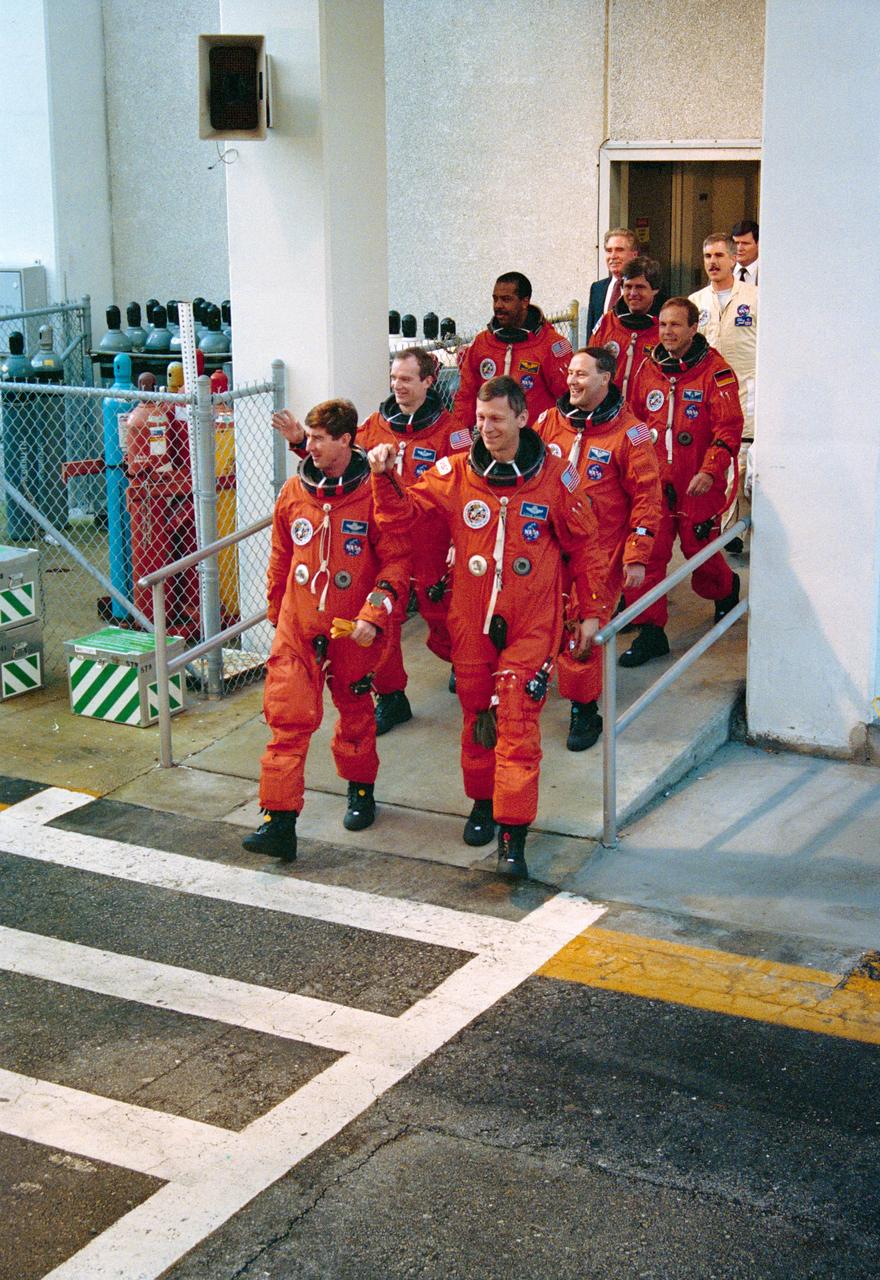
S93-29851 (12 Feb 1993) --- Clad in their bright orange launch/entry suits, the STS-55 flight crew departs the Operations and Checkout Building for the Space Shuttle Columbia at Launch Pad 39A. Leading the way are Pilot Terence T. Henricks (left) and Mission Commander Steven R. Nagel; behind them are, from left, Mission Specialists Charles J. Precourt and Bernard A. Harris Jr.; Payload Commander Jerry L. Ross; and Payload Specialists Ulrich Walter and Hans Schlegel. This is the final portion of the Terminal Countdown Demonstration Test, a dress rehearsal for launch which culminates with a simulated T -0.
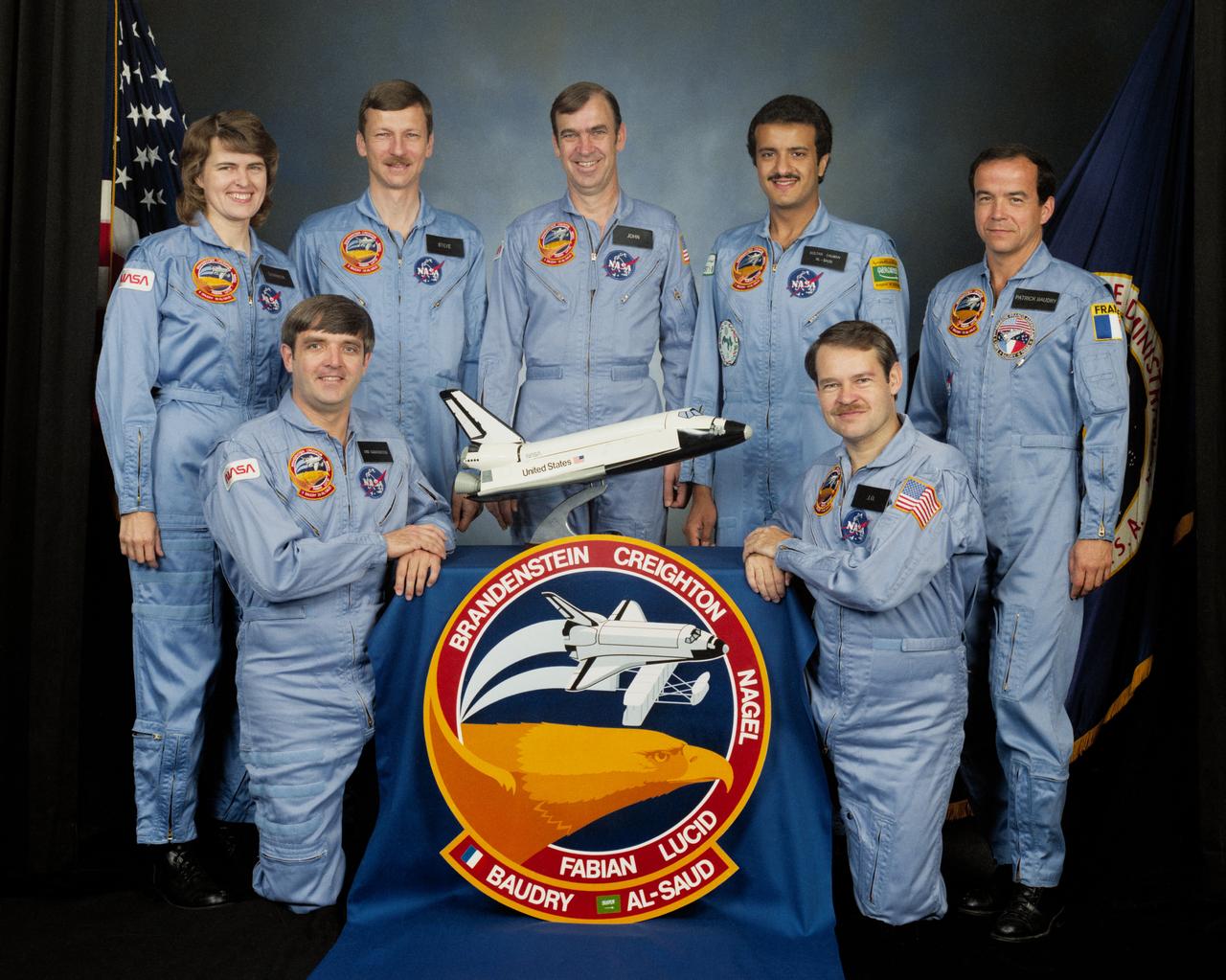
S85-32877 (20 May 1985) --- Seven 51-G crew members take a break from training and other preparations for their June flight aboard the Discovery to pose for a group photograph. Kneeling in front are astronauts Daniel C. Brandenstein (left) and John O. Creighton, commander and pilot, respectively. Astronauts Shannon W. Lucid, Steven R. Nagel and John M. Fabian, mission specialists (l.-r.) join Payload Specialists Sultan Salman Abdelazize Al-Saud (second right) and Patrick Baudry on the back row. Photo credit: NASA
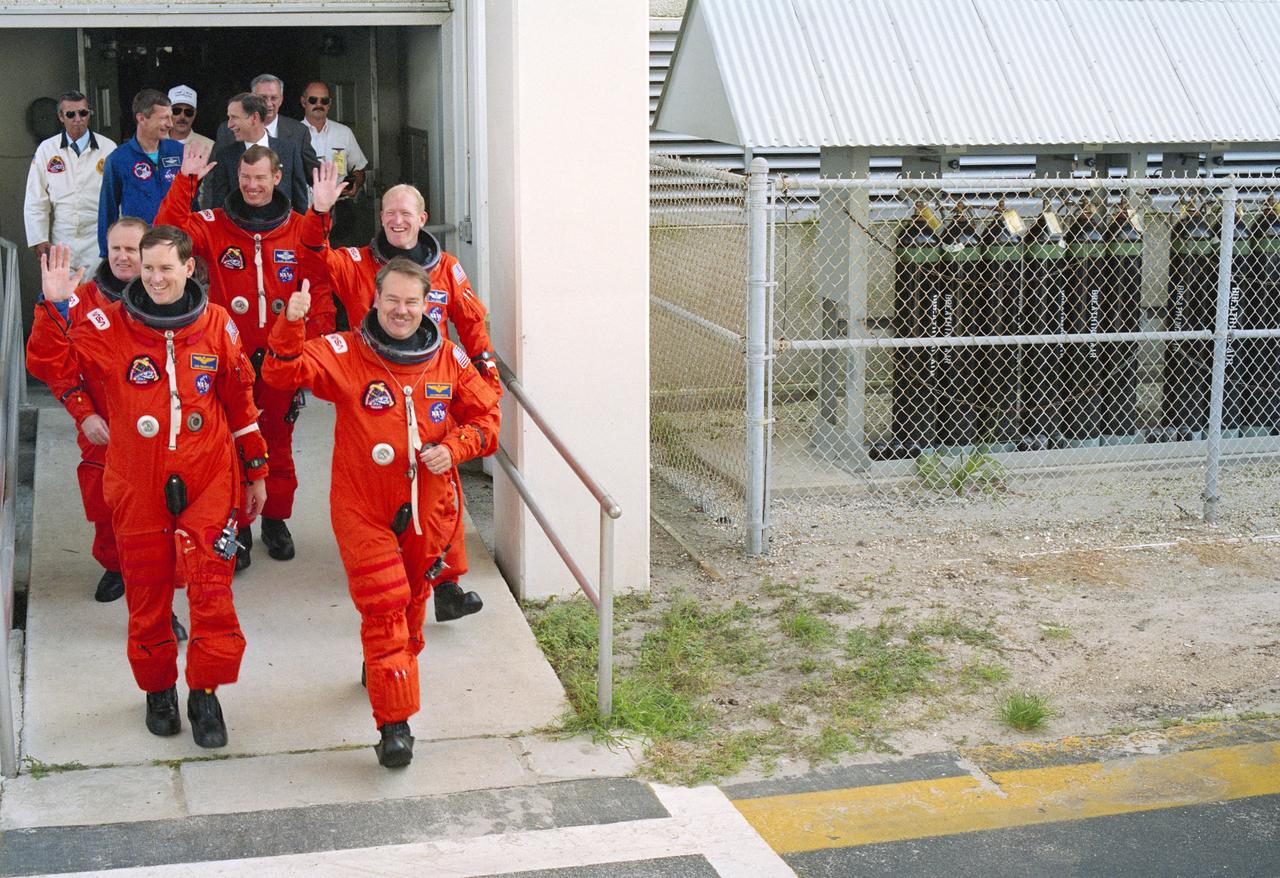
STS048-S-168 (18 Sept. 1991) --- The five astronaut crew members for NASA's STS-48 mission leave the operations and checkout building headed for a transfer van that will take them to the awaiting Discovery at Launch Complex 39. Astronaut John O. Creighton, right, mission commander, leads the group, with Kenneth S. Reightler, pilot, on his right. Mission specialists are, left to right, James F. Buchli, Mark N. Brown and Charles D. (Sam) Gemar. In the background are astronauts Steven R. Nagel and Richard O. Covey and Olan J. Bertrand, all from the Johnson Space Center (JSC). Discovery launched at 7:11:04 p.m. (EDT), Sept. 12, 1991. Photo credit: NASA
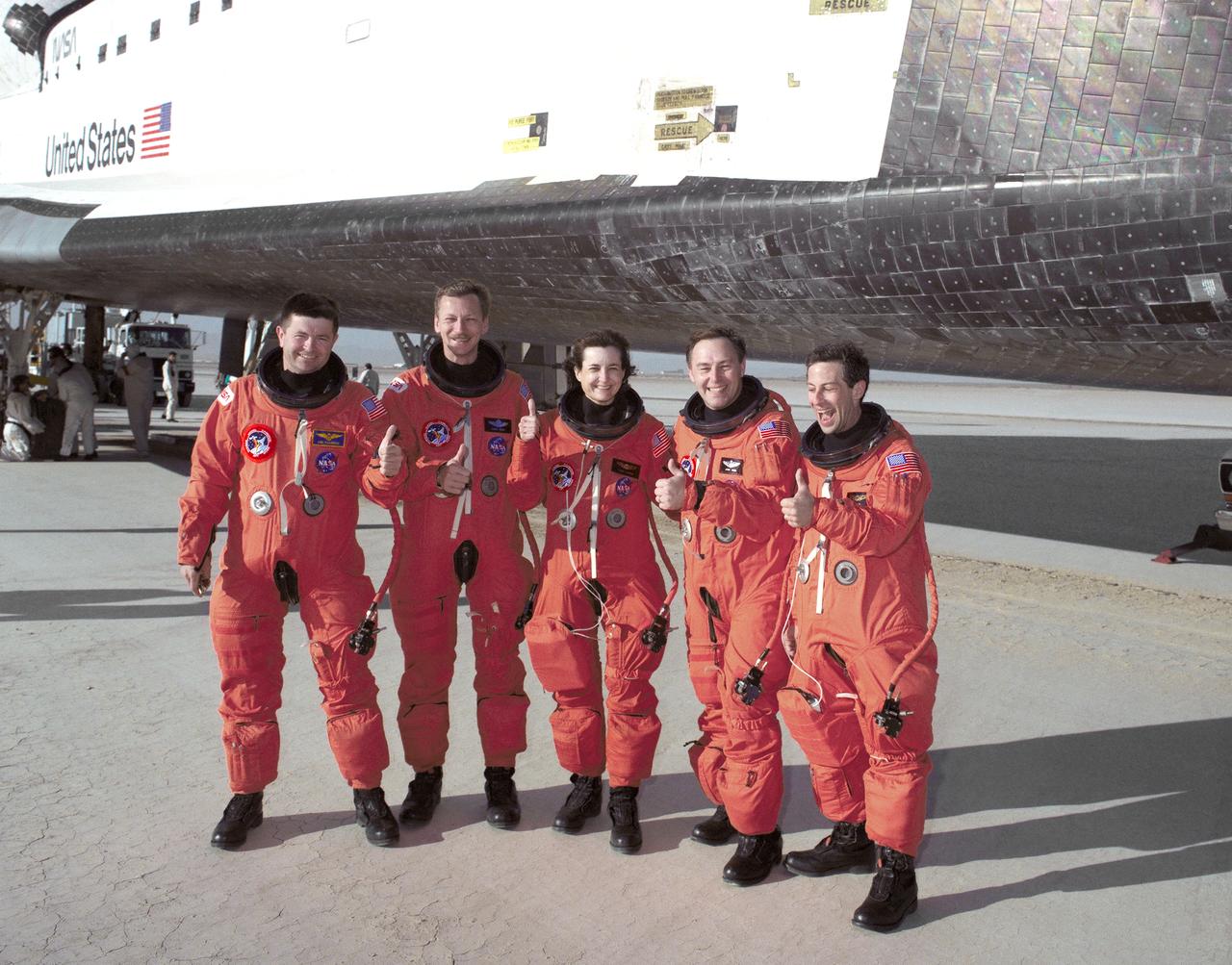
The crew of the Space Shuttle Atlantis gives the "all's well" thumb's-up sign after leaving the 100-ton orbiter following their landing at 6:55 a.m. (PDT), 11 April 1991, at NASA's Ames Dryden Flight Research Facility (later redesignated Dryden Flight Research Center), Edwards, California, to conclude mission STS-37. They are, from left, Kenneth D. Cameron, pilot; Steven R. Nagel, mission commander; and mission specialists Linda M. Godwin, Jerry L. Ross, and Jay Apt. During the mission,which began with launch April 5 at Kennedy Space Center, Florida, the crew deployed the Gamma Ray Observatory. Ross and Jay also carried out two spacewalks, one to deploy an antenna on the Gamma Ray Observatory and the other to test equipment and mobility techniques for the construction of the future Space Station. The planned five-day mission was extended one day because of high winds at Edwards.
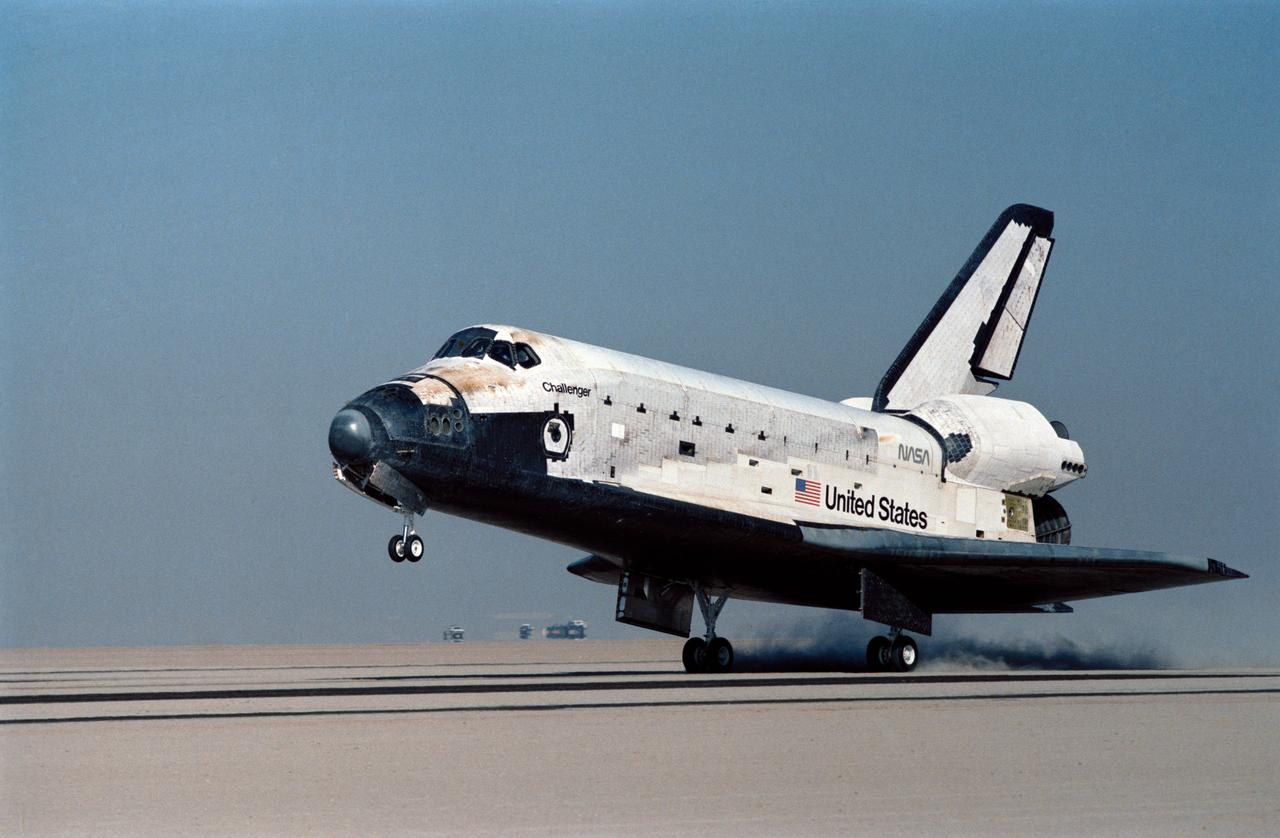
61A-S-139 (6 Nov 1985) --- Eight persons returning from space at one time is a record which was set at 9:45:39 a.m. (PST) today when the Space Shuttle Challenger's wheels came to a stop on the runway at Edwards Air Force Base. The main gear is seen touching down at 9:44:51 a.m. Inside the spacecraft are astronauts Henry W. Hartsfield Jr., Steven R. Nagel, Bonnie J. Dunbar, James F. Buchli, Guion S. Bluford Jr., Reinard Furrer, Ernst Messerschmid and Wubbo J. Ockels. A number of West German and other European experiments were performed during the week-long Spacelab D-1 mission.
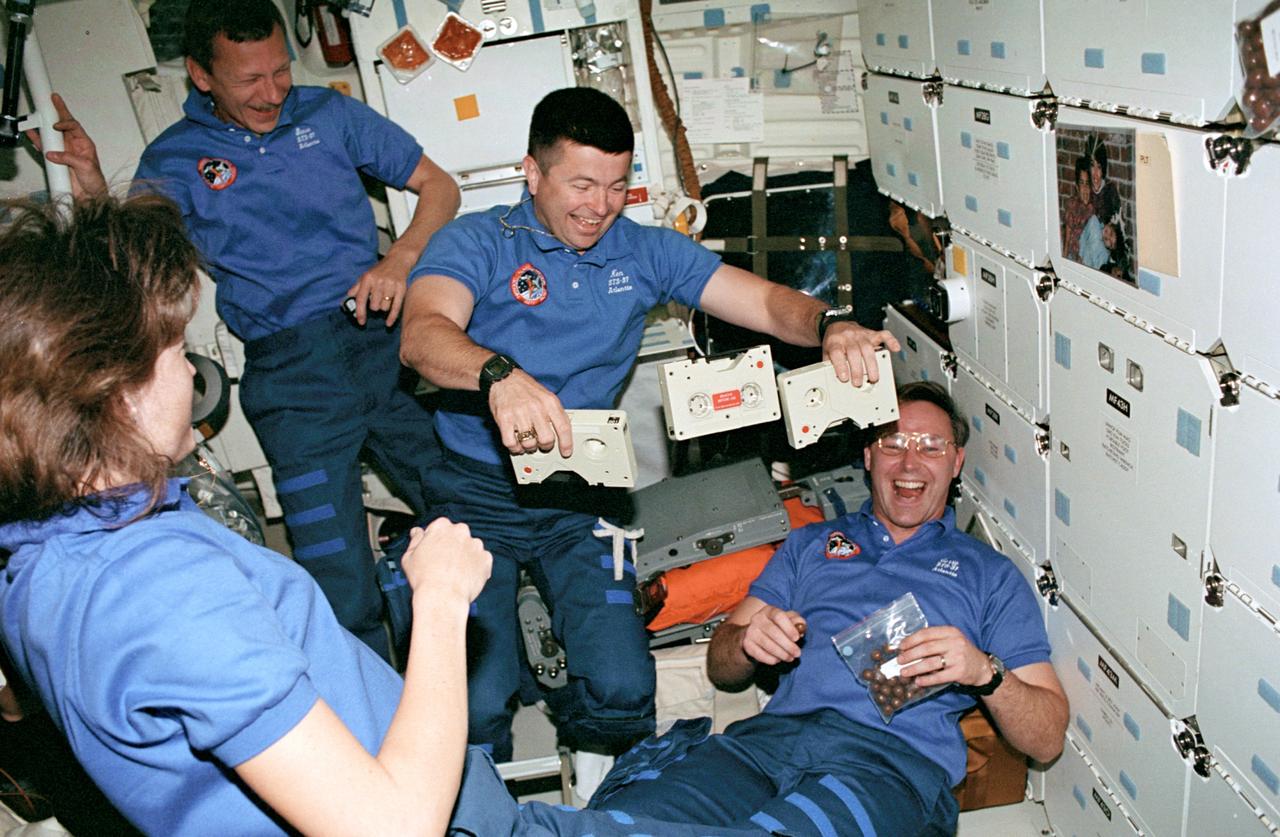
STS037-54-004 (5-11 April 1991) --- Four crew members have fun with weightlessness on the Space Shuttle Atlantis' middeck. Astronaut Kenneth D. Cameron, pilot, performs a "quick hands" feat with three tape cassettes -- obviously a feat much more difficult on Earth. Looking on, left to right, are astronauts Linda M. Godwin, mission specialist; Steven R. Nagel, mission commander; and Jerry L. Ross, mission specialist. Ross later used the microgravity environment to have some fun with the bag of malted milk balls in his hands. This 35mm frame was exposed by astronaut Jerome (Jay) Apt, mission specialist. This was one of the visuals used by the crew members during their April 19 Post Flight Press Conference (PFPC) at the Johnson Space Center (JSC).
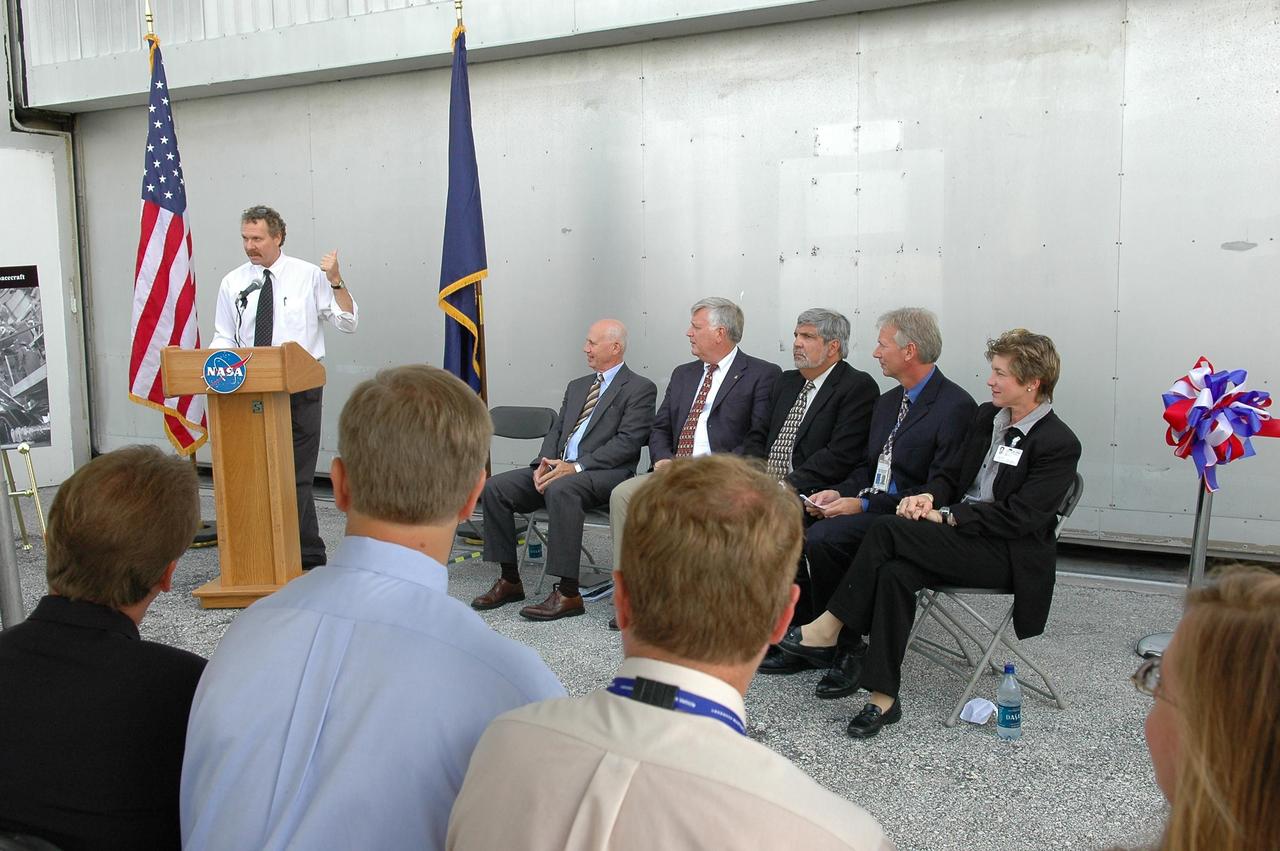
KENNEDY SPACE CENTER, FLA. - A ribbon-cutting at NASA's Kennedy Space Center officially reactivated the Operations and Checkout Building's west door as entry to the crew exploration vehicle environment. At the podium is Russell Romanella, who opened the ceremony. Romanella is director of the ISS Payload and Processing Directorate. Seated at right are Conrad Nagel, consultant for Space Florida; Jim Kennedy, director of KSC; Adrian Lafitte, director of government relations for Lockheed Martin; Mark Jager, program manager of Checkout, Assembly, Payloads Processing Services with Boeing; and Lynda Weatherman, with the Economic Development Commission. During the rest of the decade, KSC will transition from launching space shuttles to launching new vehicles in NASA’s Vision For Space Exploration. Photo credit: NASA/Kim Shiflett
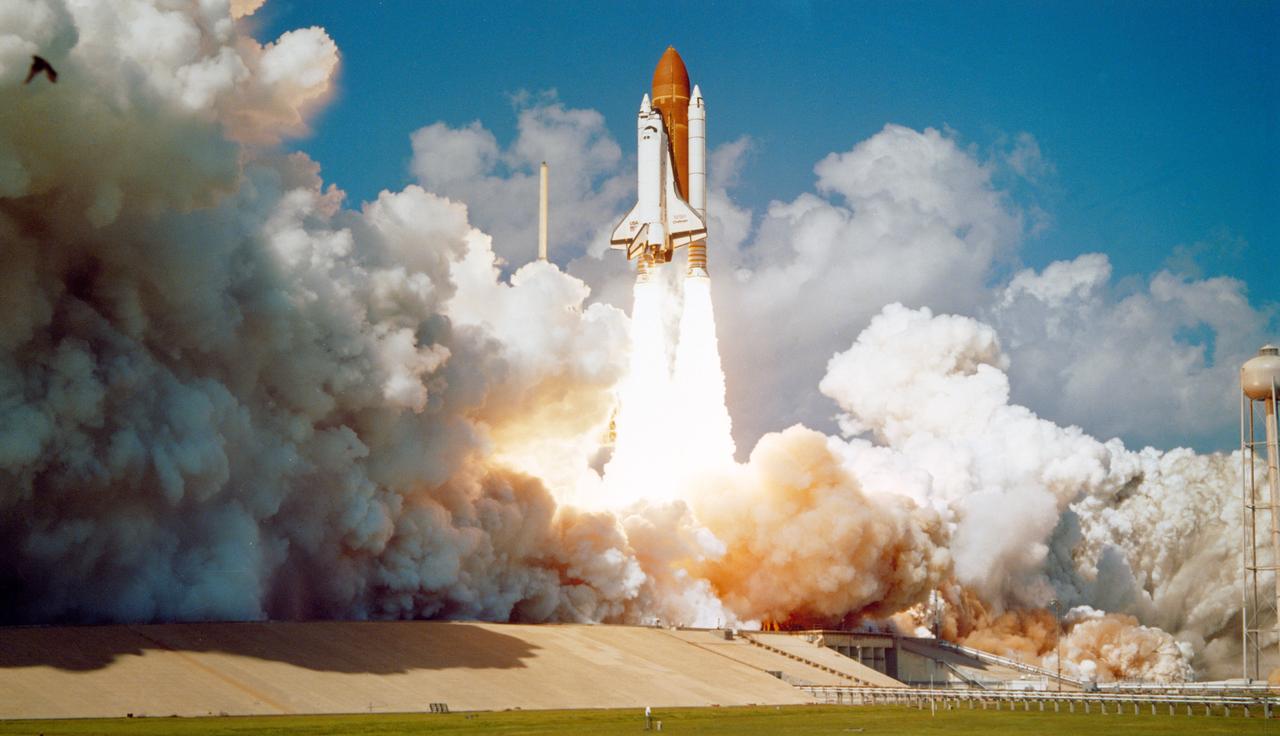
61A-S-018 (30 Oct 1985) --- A record-sized crew of eight persons is lifted toward Earth-orbit as the space shuttle Challenger blasts from the launch pad at Complex 39, Kennedy Space Center (KSC), Florida. Almost all the service structure/gantry is obscured by smoke resulting from the boosters' firing. Inside the spacecraft are astronauts Henry W. Hartsfield, Jr., Steven R. Nagel, Bonnie J. Dunbar, James F. Buchli, Guion S. Bluford, Jr., along with payload specialists Wubbo J. Ockels, Reinhard Furrer and Ernst Messerschmid. Within hours of this photo, the Spacelab D-1 Science Module was activated and crew members were busy performing experiments. Launch occurred at noon (EST), Oct. 30, 1985. Photo credit: NASA
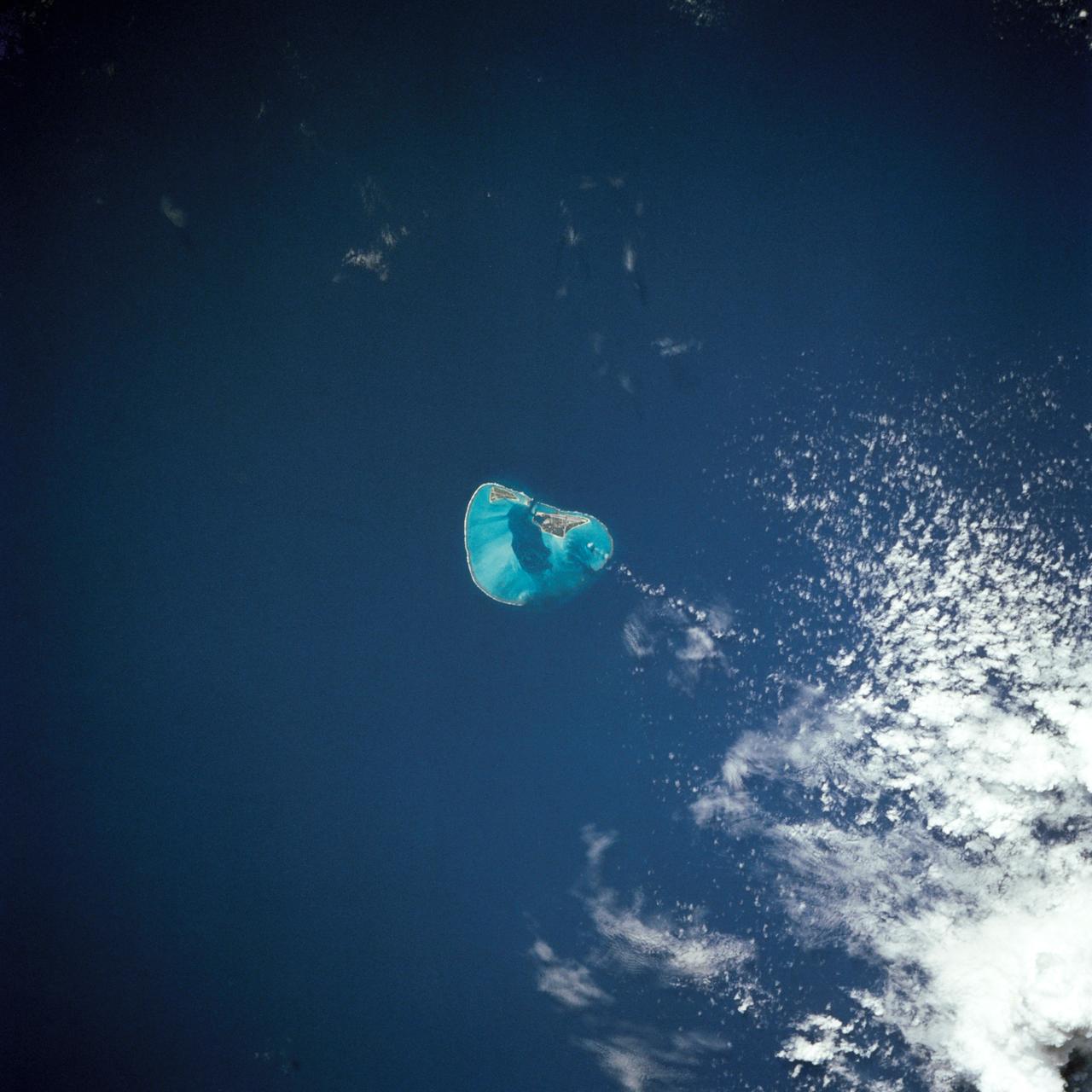
61A-40-38 (30 Oct-6 Nov 1985) --- The coral reef forming the atoll of Midway sits atop a volcanic seamount that has descended more than 3,000 feet (1000 meters) below the sea surface in this ancient region of the Hawaiian volcanic chain. This view was taken by the crew members onboard the Earth-orbiting Space Shuttle Challenger. The crew consisted of astronauts Henry W. Hartsfield, Jr., commander; Steven R. Nagel, pilot; James F. Buchli, Guion S. Bluford, Jr., and Bonnie J. Dunbar, all mission specialists; Reinhard Furrer, Ernst Messerschmid, and Wubbo J. Ockels, all payload specialists. Ockels represents the European Space Agency (ESA).

S78-26481 (January 1978) --- This is a montage of the individual portraits of the 35-member 1978 class of astronaut candidates. From left to right are Guion S. Bluford, Daniel C. Brandenstein, James F. Buchli, Michael L. Coats, Richard O. Covey, John O. Creighton, John M. Fabian, Anna L. Fisher, Dale A. Gardner, Robert L. Gibson, Frederick D. Gregory, S. David Griggs, Terry J. Hart, Frederick H. (Rick) Hauck, Steven A. Hawley, Jeffrey A. Hoffman, Shannon W. Lucid, Jon A. McBride, Ronald E. McNair, Richard M. (Mike) Mullane, Steven R. Nagel, George D. Nelson, Ellison S. Onizuka, Judith A. Resnik, Sally K. Ride, Francis R. (Dick) Scobee, Rhea Seddon, Brewster H. Shaw Jr., Loren J. Shriver, Robert L. Stewart, Kathryn D. Sullivan, Norman E. Thagard, James D. Van Hoften, David M. Walker and Donald E. Williams. Photo credit: NASA or National Aeronautics and Space Administration
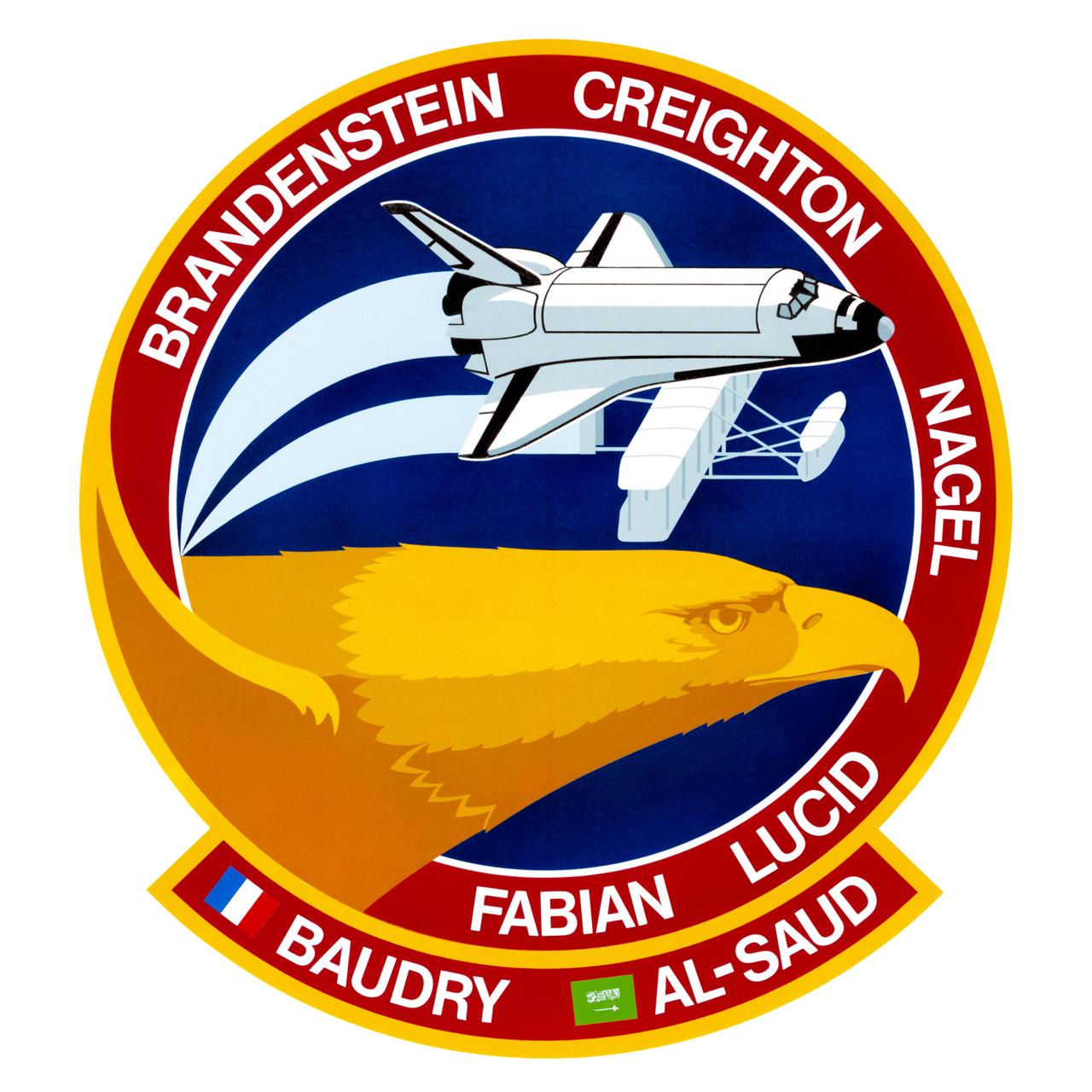
S85-31266 (May 1985) --- The STS-51G insignia illustrates the advances in aviation technology in the United States within a relatively short span of the twentieth century. The surnames of the crew members for the Discovery's mission appear near the center edge of the circular design. They are astronauts Daniel C. Brandenstein, mission commander; John O. Creighton, pilot; John M. Fabian, Steven R. Nagel and Shannon W. Lucid, mission specialists; Sultan Salman Abdelazize Al-Saud and Patrick Baudry, payload specialists. Al-Saud is flying as part of the reimbursable agreement with the Arab Satellite Communications Organization covering the launch of the Arabsat 1B communications satellite and Baudry represents France's Centre National d'Etudes Spatiales. The NASA insignia design for space shuttle flights is reserved for use by the astronauts and for other official use as the NASA Administrator may authorize. Public availability has been approved only in the forms of illustrations by the various news media. When and if there is any change in this policy, which is not anticipated, the change will be publicly announced. Photo credit: NASA

CAPE CANAVERAL, Fla. -- A group from the first graduating class of astronauts after the Apollo program gathers at the Banana River viewing site at NASA's Kennedy Space Center before the launch of space shuttle Discovery on its STS-124 mission. In 1978 a new group of 35 astronauts was selected after nine years without new astronauts. The pilots were Daniel Brandenstein, Michael Coats, Richard Covey, John Creighton, Robert Gibson, Frederick D. Gregory, Frederick Hauck, Jon McBride, Francis "Dick" Scobee, Brewster Shaw, Loren Shriver, David Walker and Donald Williams. The mission specialists were Guion Bluford, James Buchli, John Fabian, Anna Fisher, Dale Gardner, S. David Griggs, Terry Hart, Steven Hawley, Jeffrey Hoffman, Shannon Lucid, Ronald McNair, Richard Mullane, Steven Nagel, George Nelson, Ellison Onizuka, Judith Resnik, Sally Ride, Rhea Seddon, Robert Stewart, Kathryn D. Sullivan, Norman Thagard and James van Hoften. Since then, a new group has been selected roughly every two years. Photo credit: NASA/Jim Grossmann
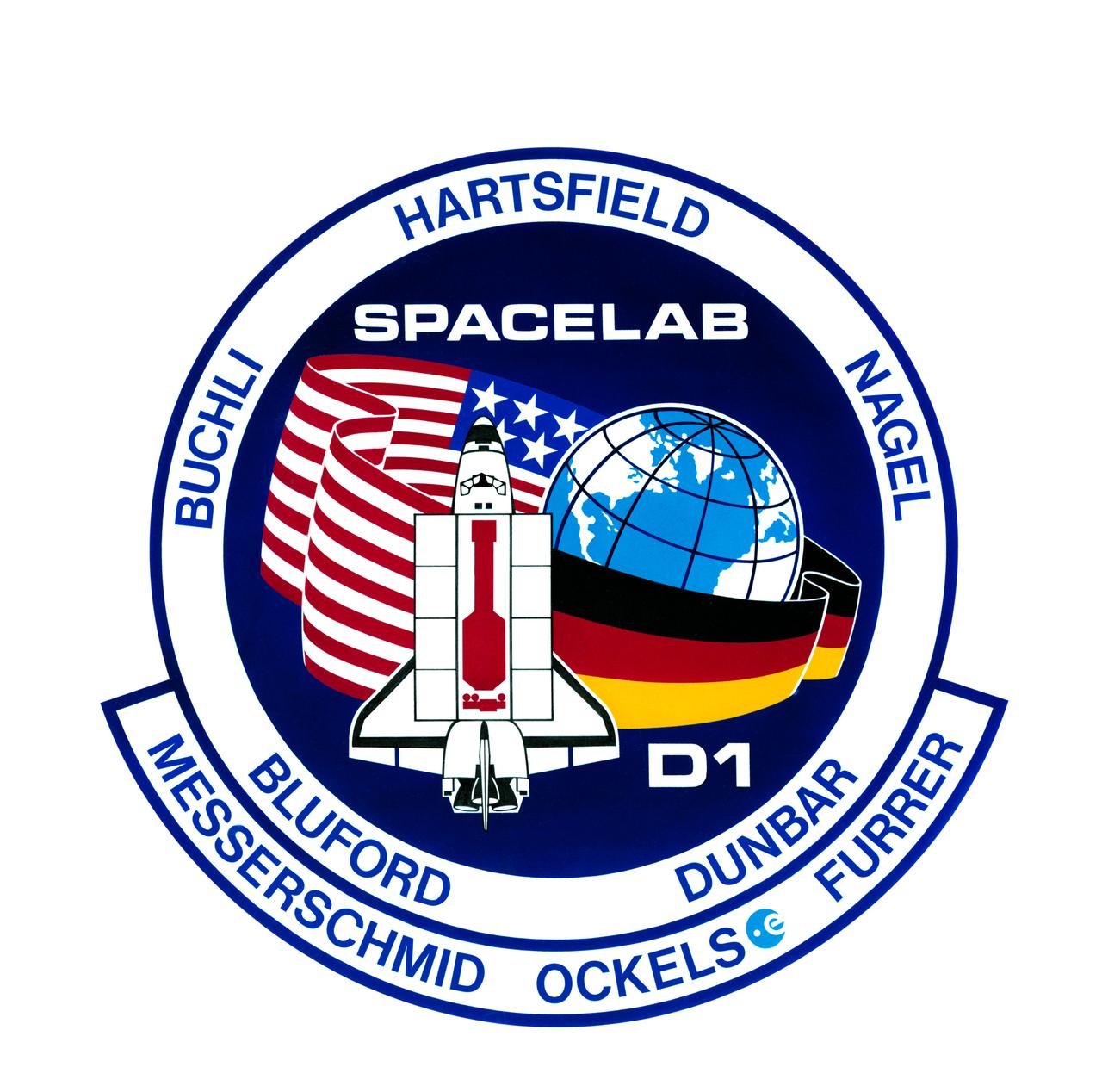
S85-38035 (August 1985) --- This insignia has been chosen by the eight members of the STS-61A/D1 Spacelab mission as the emblem they will wear on their spacesuits and which will represent the record-sized space shuttle crew on the scheduled autumn mission. Crew members' surnames surround the colorful patch scene depicting Challenger carrying a long science module and an international crew from Europe and the United States. Serving on the crew are Henry W. Hartsfield Jr., commander; Steven R. Nagel, pilot; Bonnie J. Dunbar, mission specialist; James F. Buchli, mission specialist; Guion S. Bluford Jr., mission specialist; Ernst Messerschmid, German payload specialist; Reinhard Furrer, German payload specialist; and Wubbo J. Ockels, Dutch payload specialist. The NASA insignia design for space shuttle flights is reserved for use by the astronauts and for other official use as the NASA Administrator may authorize. Public availability has been approved only in the forms of illustrations by the various news media. When and if there is any change in this policy, which is not anticipated, the change will be publicly announced. Photo credit: NASA
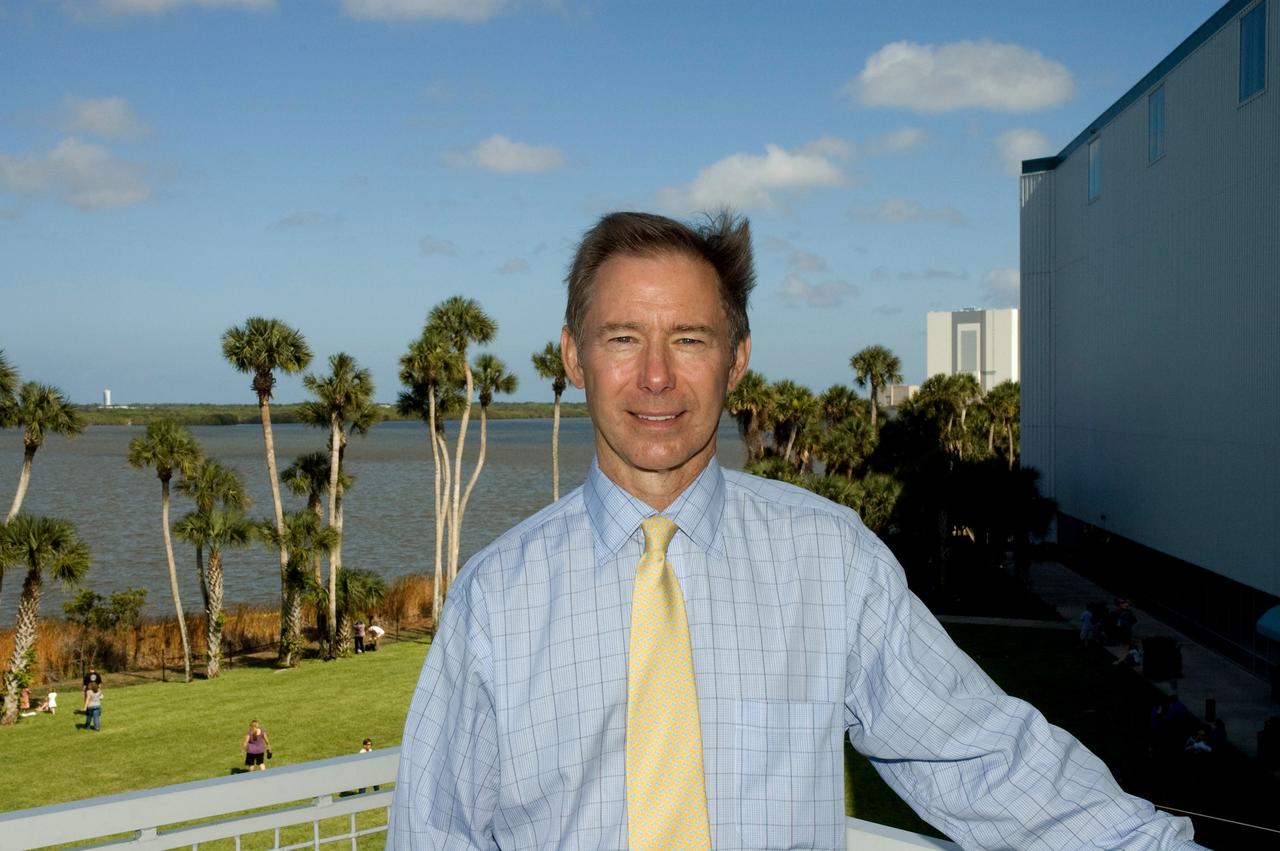
CAPE CANAVERAL, Fla. -- Brewster Shaw is a former astronaut from the first graduating class of astronauts after the Apollo program. He and others from the class were guests at NASA's Kennedy Space Center for the launch of space shuttle Discovery on its STS-124 mission. Shaw is Vice President and General Manager, Space Exploration, for Integrated Defense Systems, The Boeing Company. In 1978 a new group of 35 astronauts was selected after nine years without new astronauts. The pilots were Daniel Brandenstein, Michael Coats, Richard Covey, John Creighton, Robert Gibson, Frederick D. Gregory, Frederick Hauck, Jon McBride, Francis "Dick" Scobee, Brewster Shaw, Loren Shriver, David Walker and Donald Williams. The mission specialists were Guion Bluford, James Buchli, John Fabian, Anna Fisher, Dale Gardner, S. David Griggs, Terry Hart, Steven Hawley, Jeffrey Hoffman, Shannon Lucid, Ronald McNair, Richard Mullane, Steven Nagel, George Nelson, Ellison Onizuka, Judith Resnik, Sally Ride, Rhea Seddon, Robert Stewart, Kathryn D. Sullivan, Norman Thagard and James van Hoften. Since then, a new group has been selected roughly every two years. Photo credit: NASA/Jim Grossmann
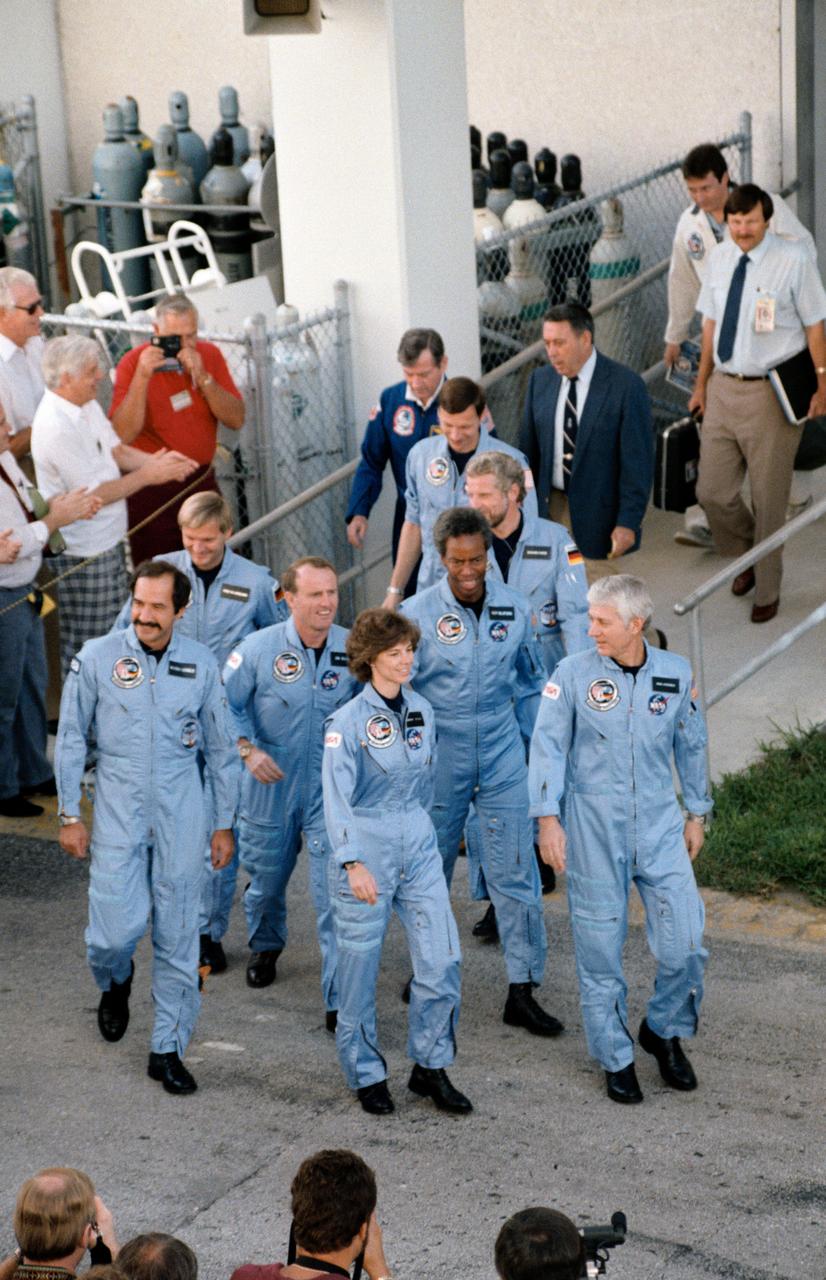
61A-S-015 (30 Oct 1985) --- A record number of crewmembers to serve on a Shuttle mission walks from the operations and checkout facility to a crew transfer van en route to Launch Pad 39A where the Challenger awaits the 61-A/Spacelab D-1launch. Leading the way is Henry W. Hartsfield Jr., mission commander, as Steven R. Nagel, pilot, trails the blue-suited team members. At center are James F. Buchli, Bonnie J. Dunbar and Guion S. Bluford Jr.--all mission specialists. They are flanked by Wubbo J. Ockels and Ernst Messerschmid on the left and Reinhard Furrer on the right. John W. Young, chief of the astronaut office at JSC and George W.S. Abbey, director of flight crew operations at JSC, follow the crew. Richard W. Nygren, assistant to the director, is in background. Messerschmid and Furrer are German scientists and Ockels is a Dutch scientist; and the three will be working with NASA's three mission specialists in the D-1 science module during the week-long flight.
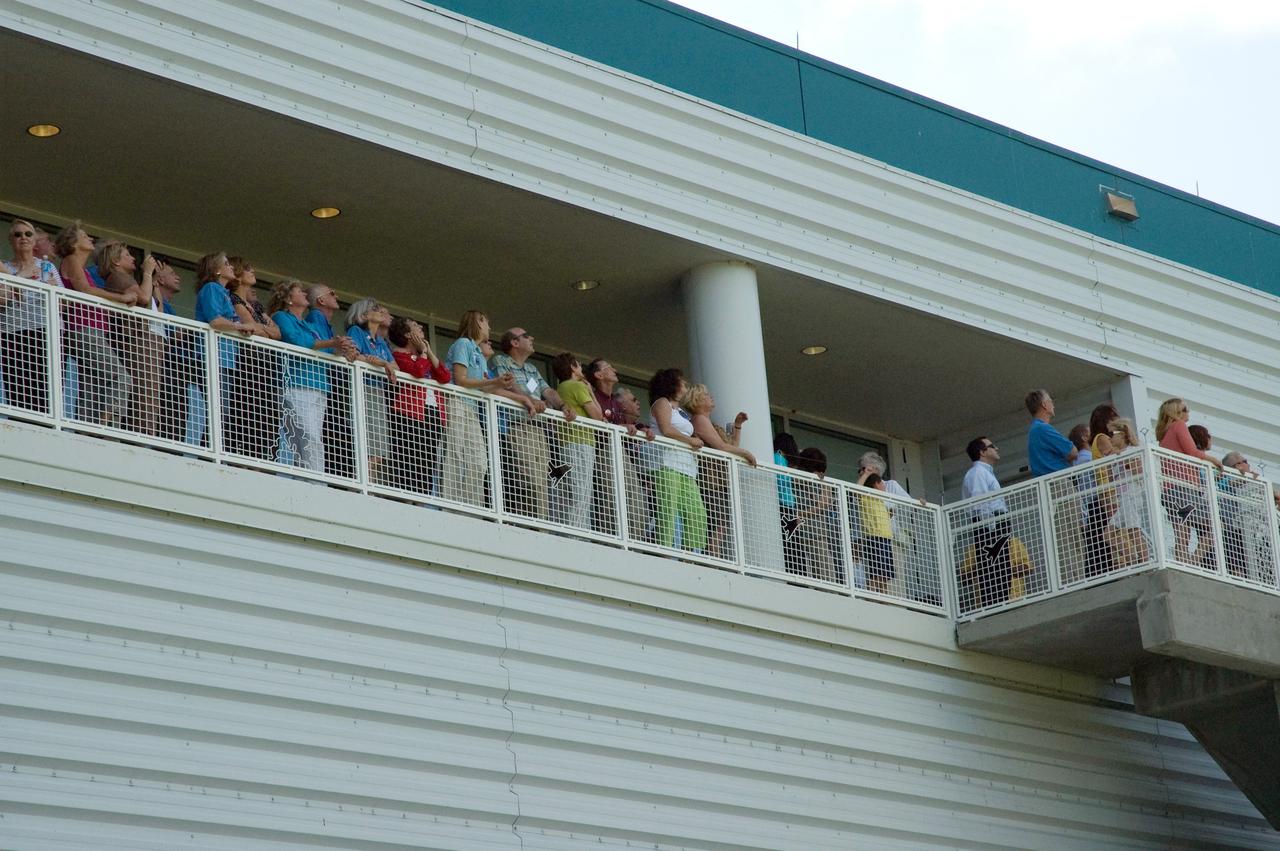
CAPE CANAVERAL, Fla. -- All eyes look skyward as space shuttle Discovery launches on its STS-124 mission. The group gathered here at the Banana River viewing site at NASA's Kennedy Space Center are members of the first graduating class of astronauts after the Apollo program. In 1978 a new group of 35 astronauts was selected after nine years without new astronauts. The pilots were Daniel Brandenstein, Michael Coats, Richard Covey, John Creighton, Robert Gibson, Frederick D. Gregory, Frederick Hauck, Jon McBride, Francis "Dick" Scobee, Brewster Shaw, Loren Shriver, David Walker and Donald Williams. The mission specialists were Guion Bluford, James Buchli, John Fabian, Anna Fisher, Dale Gardner, S. David Griggs, Terry Hart, Steven Hawley, Jeffrey Hoffman, Shannon Lucid, Ronald McNair, Richard Mullane, Steven Nagel, George Nelson, Ellison Onizuka, Judith Resnik, Sally Ride, Rhea Seddon, Robert Stewart, Kathryn D. Sullivan, Norman Thagard and James van Hoften. Since then, a new group has been selected roughly every two years. Photo credit: NASA/Jim Grossmann
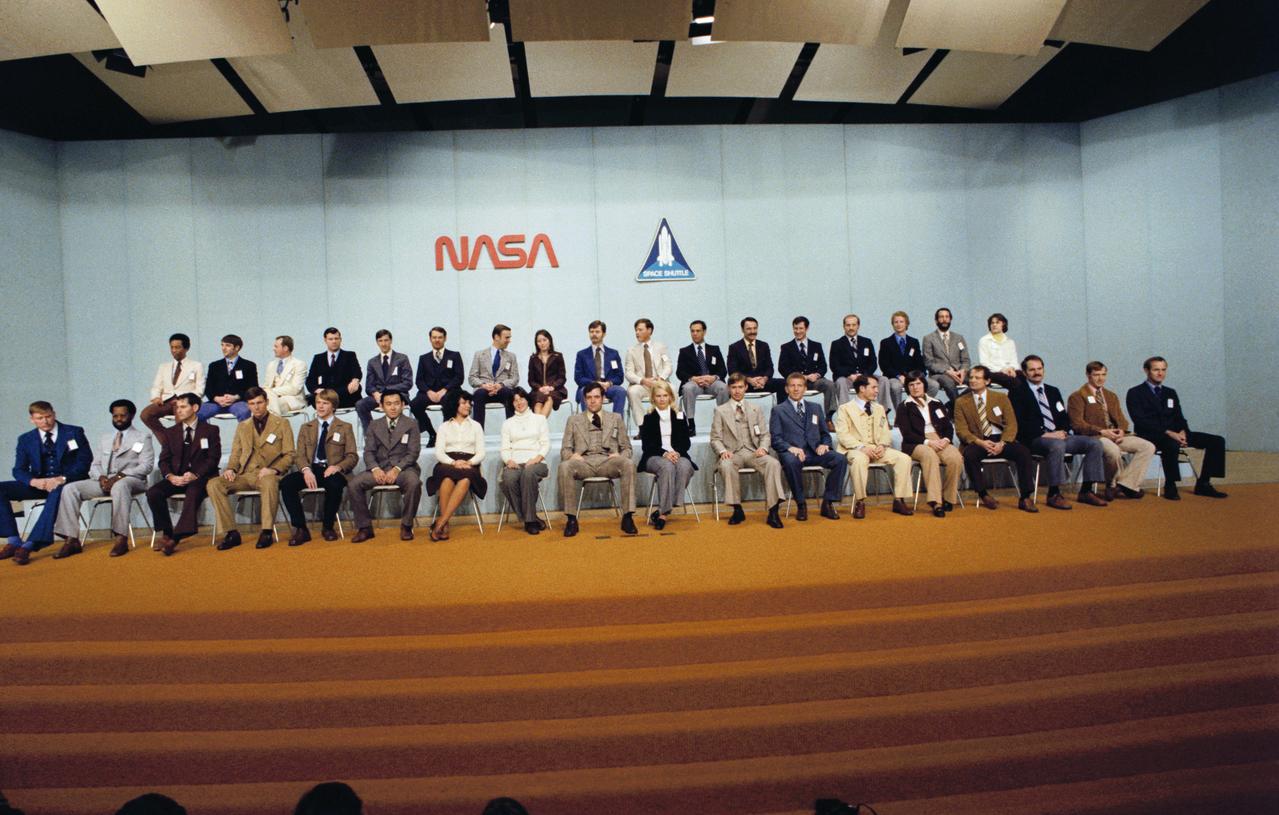
S78-26569 (31 Jan. 1978) --- The 35 new astronaut candidates, presented Jan. 31, 1978, in the Building 2 auditorium at NASA's Johnson Space Center, pose for photographers. They are arranged in alphabetical order with top left as beginning point and bottom right as stopping point. They are Guion S. Bluford, Daniel C. Brandenstein, James F. Buchli, Michael L. Coats, Richard O. Covey, John O. Creighton, John M. Fabian, Anna L. Fisher, Dale A. Gardner, Robert L. Gibson, Frederick D. Gregory, S. David Griggs, Terry J. Hart, Frederick H. (Rick) Hauck, Steven A. Hawley, Jeffrey A. Hoffman, Shannon W. Lucid, Jon A. McBride, Ronald E. McNair, Richard M. (Mike) Mullane, Steven R. Nagel, George D. Nelson, Ellison S. Onizuka, Judith A. Resnik, Sally K. Ride, Francis R. (Dick) Scobee, Rhea Seddon, Brewster H. Shaw Jr., Loren J. Shriver, Robert L. Stewart, Kathryn D. Sullivan, Norman E. Thagard, James D. van Hoften, David M. Walker and Donald E. Williams. Photo credit: NASA or National Aeronautics and Space Administration