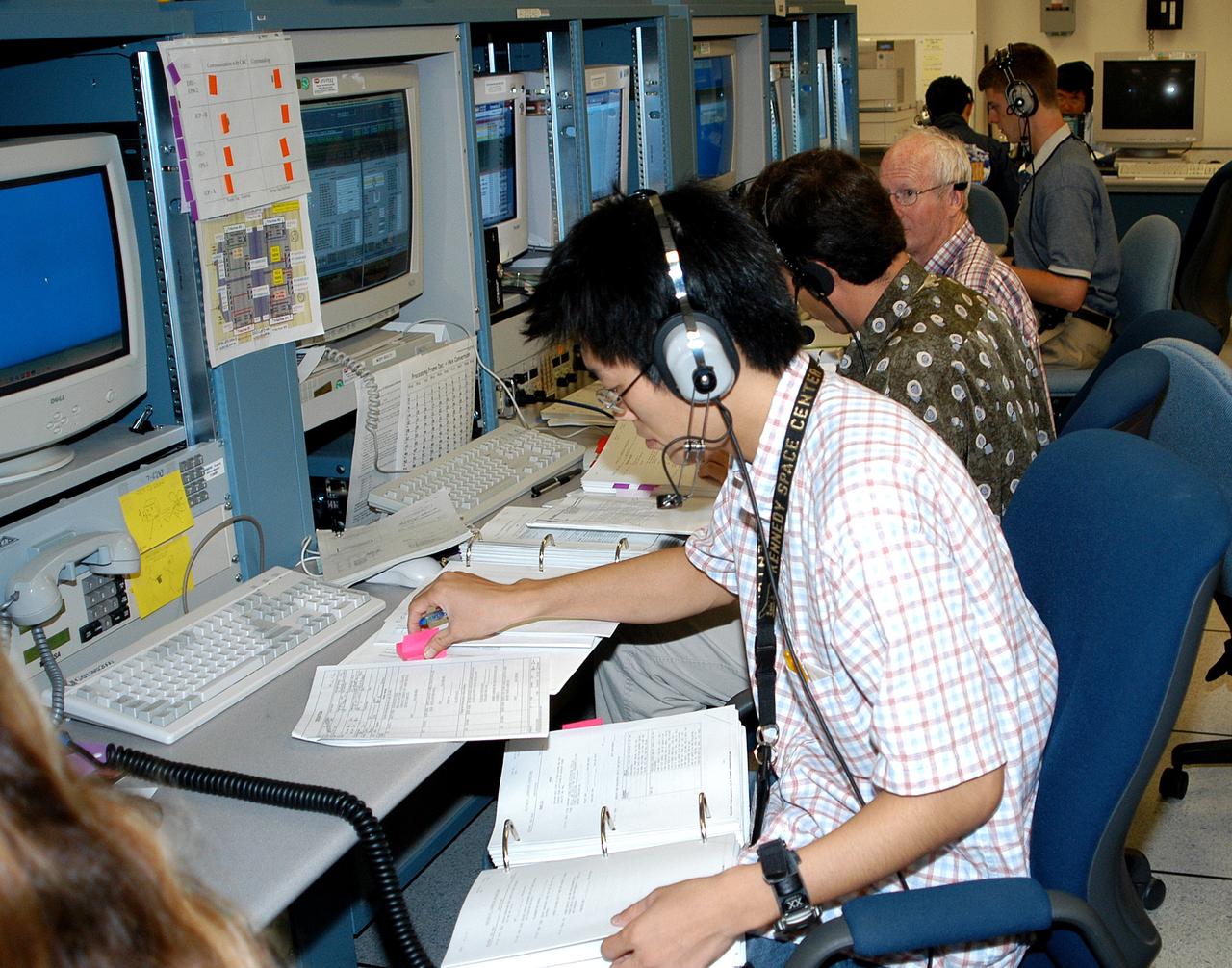
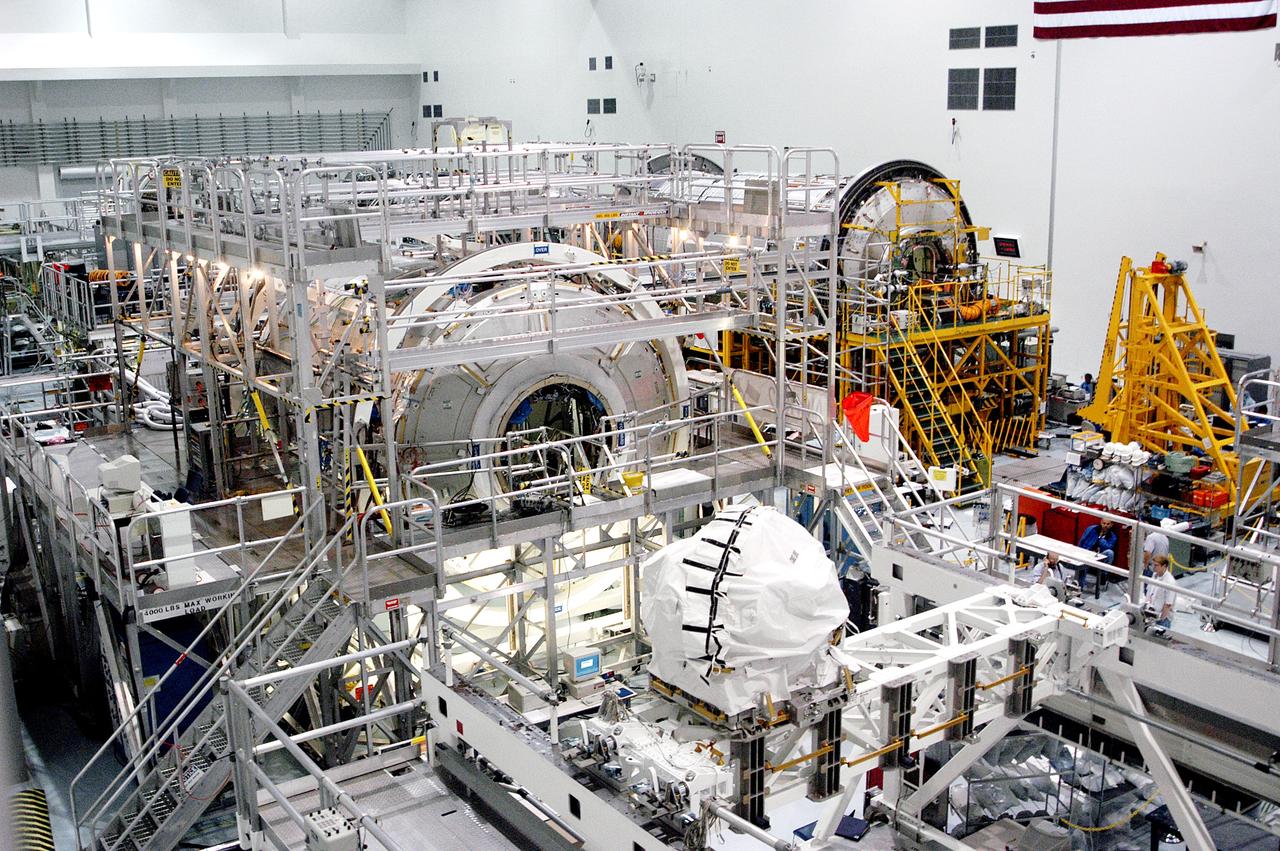
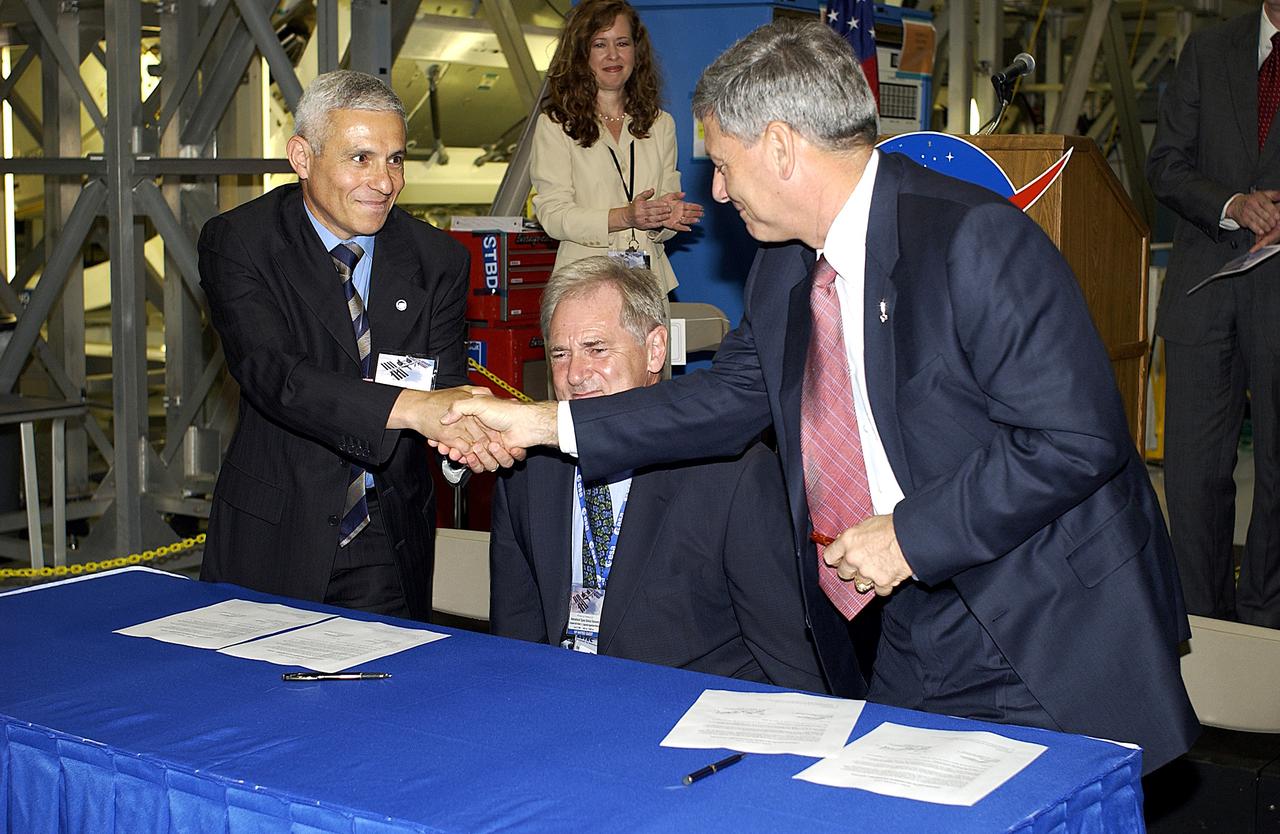
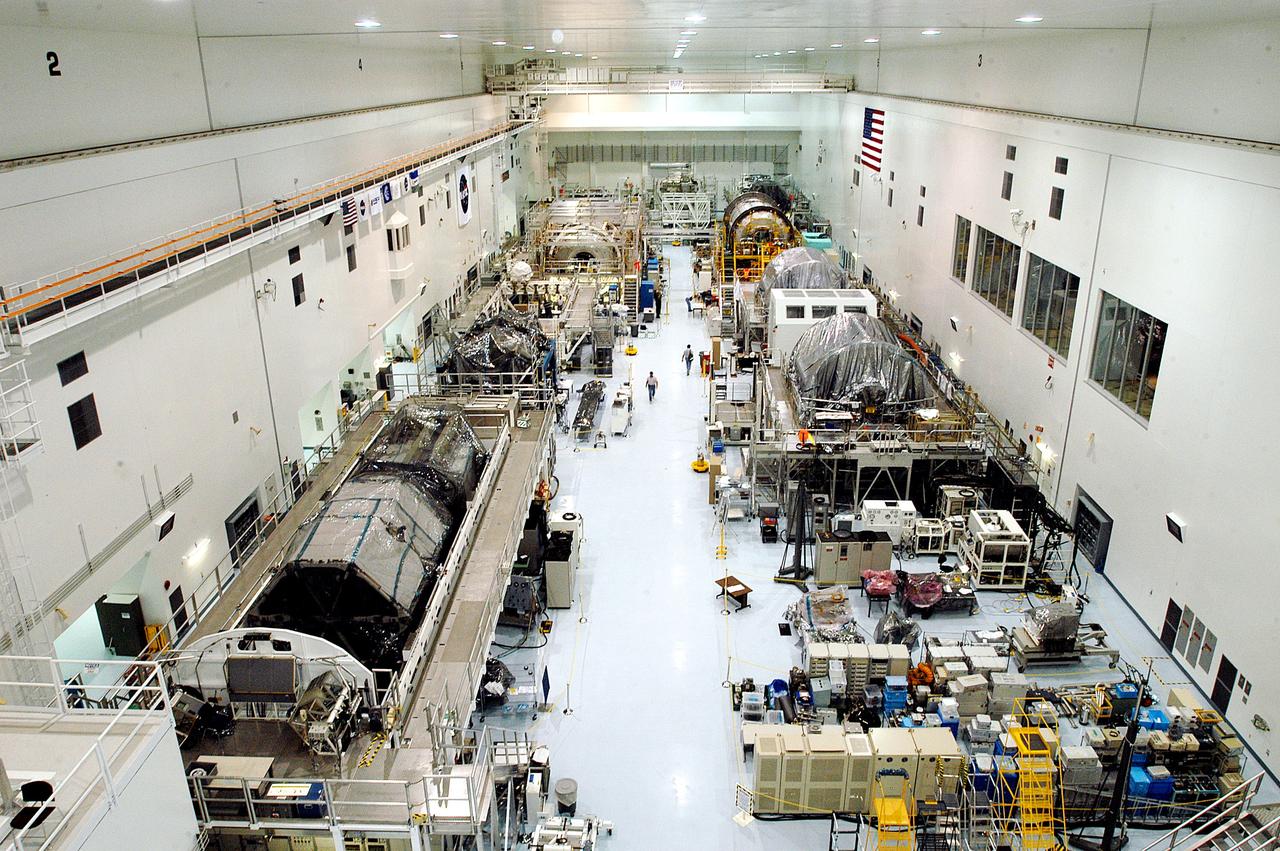
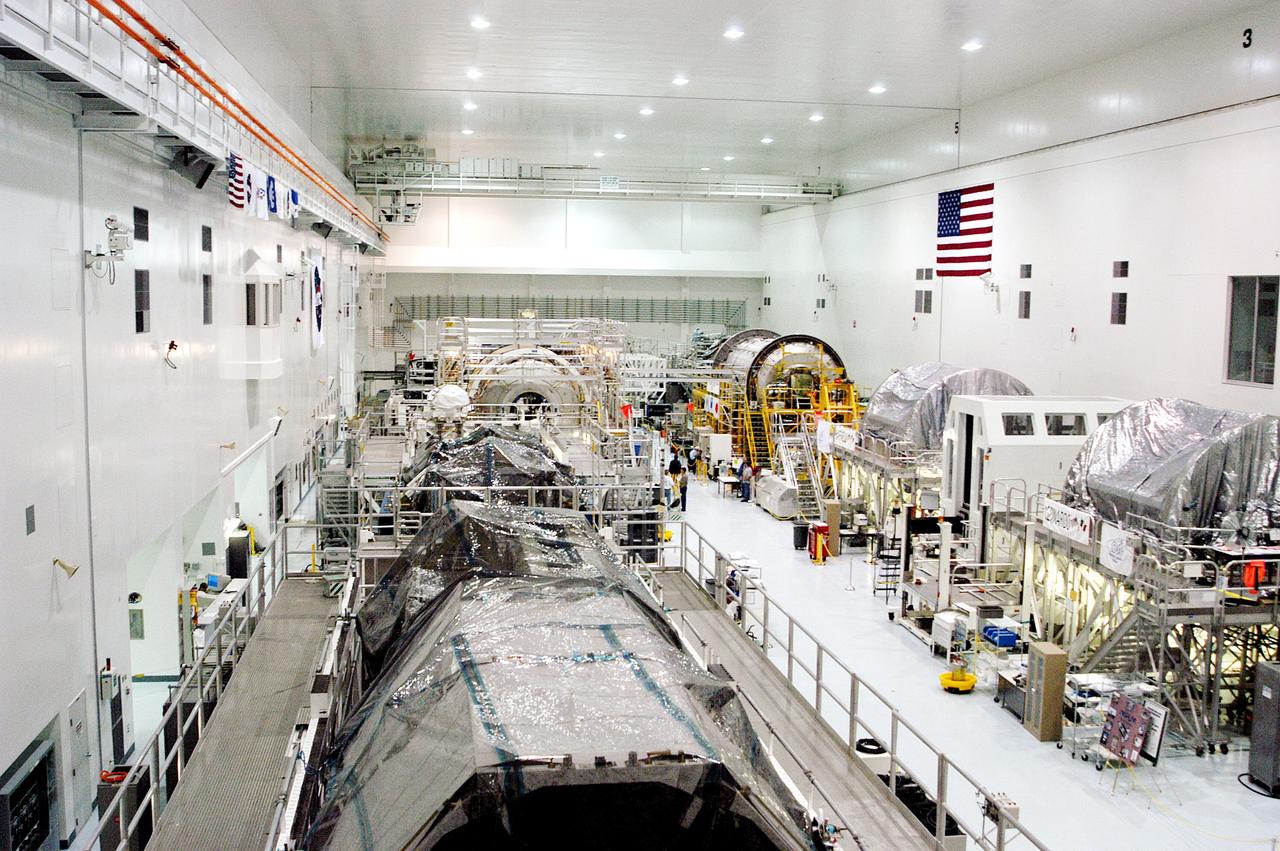
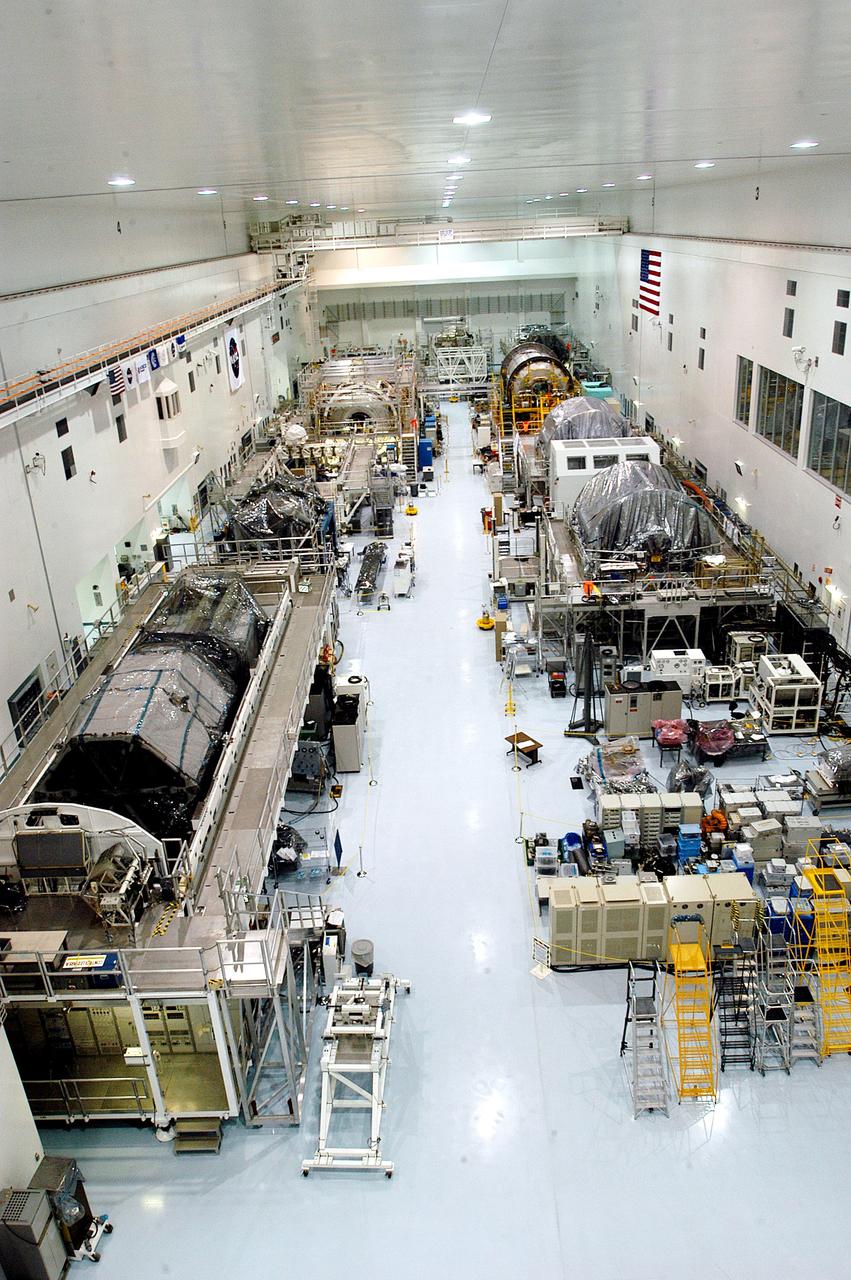
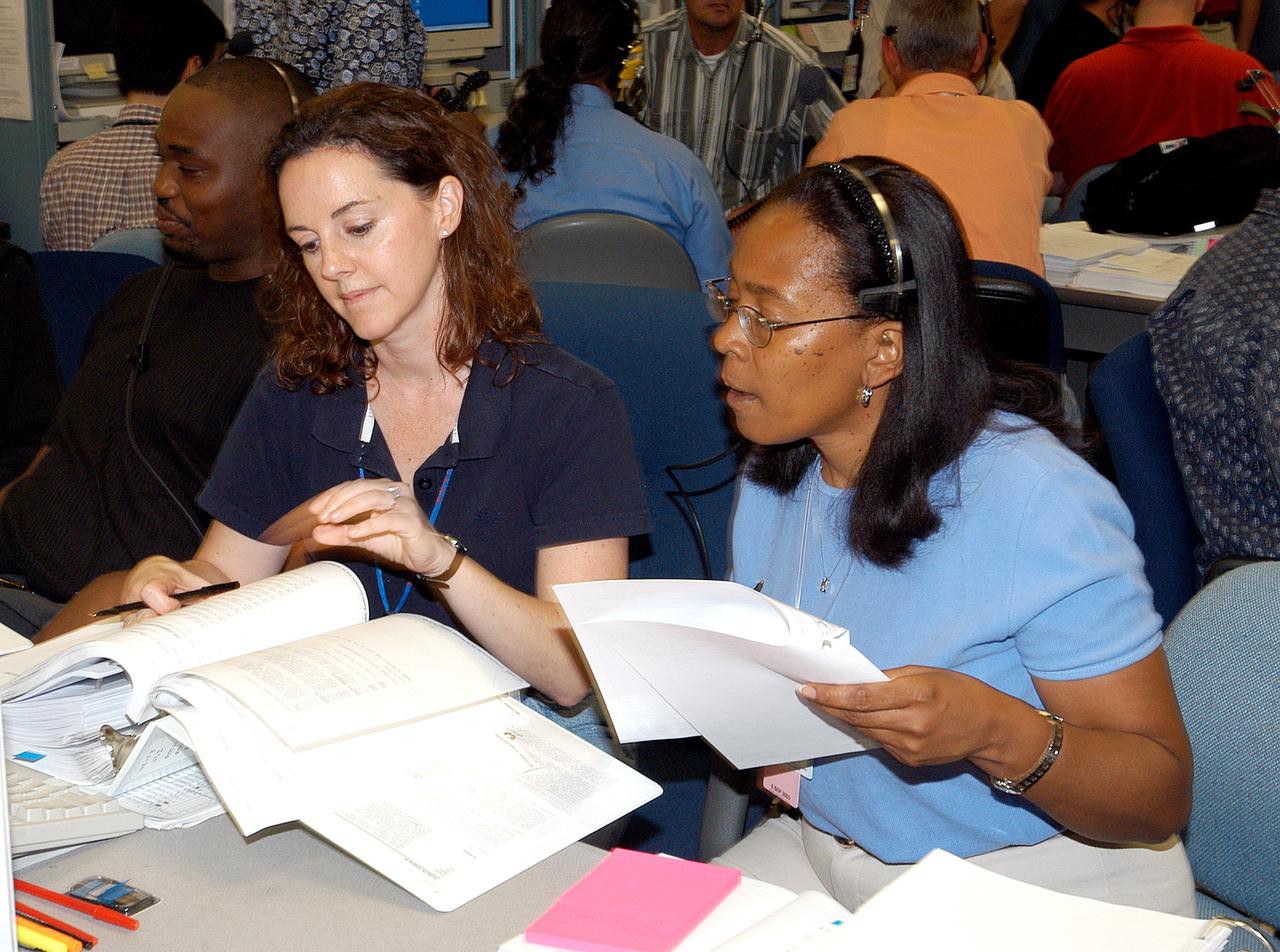
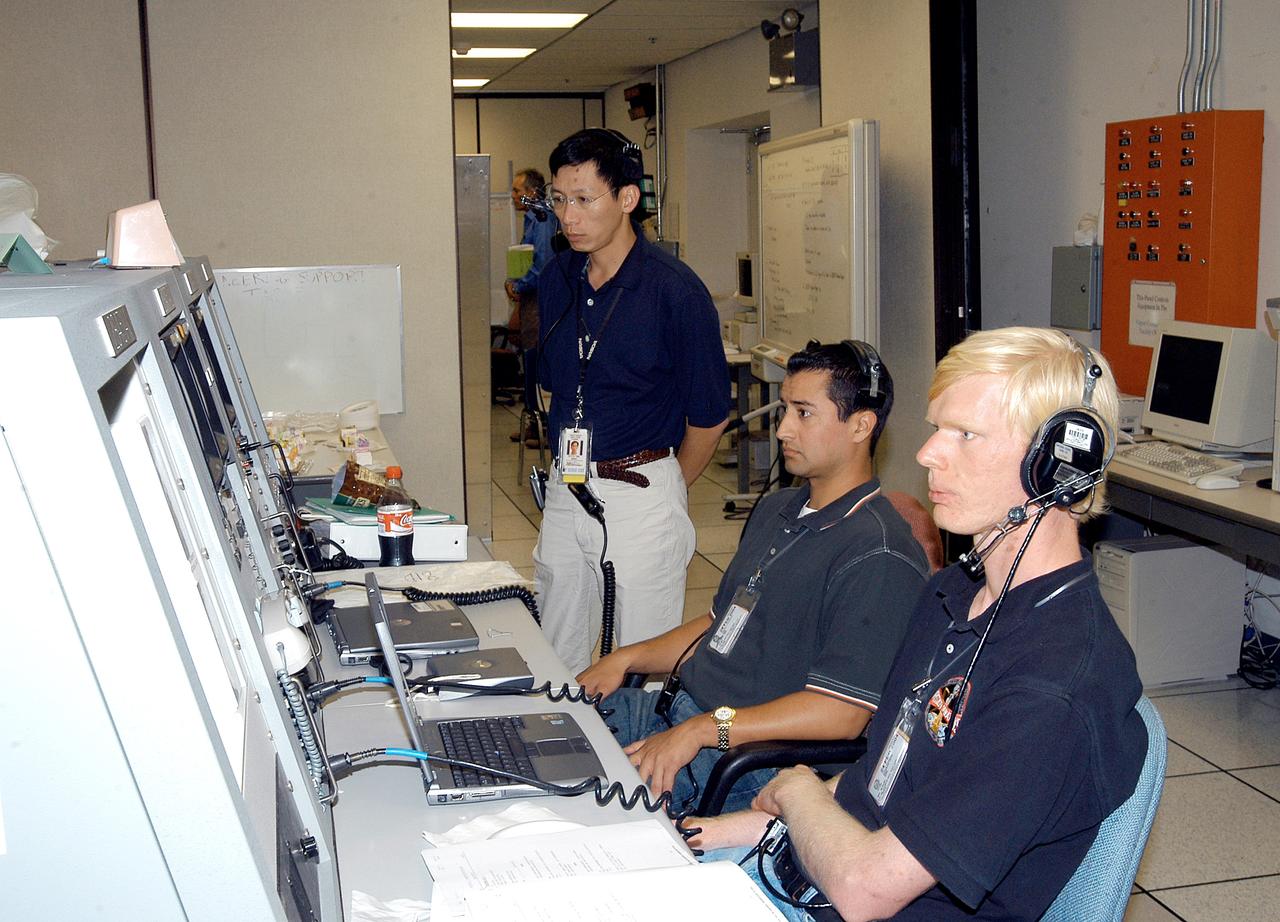
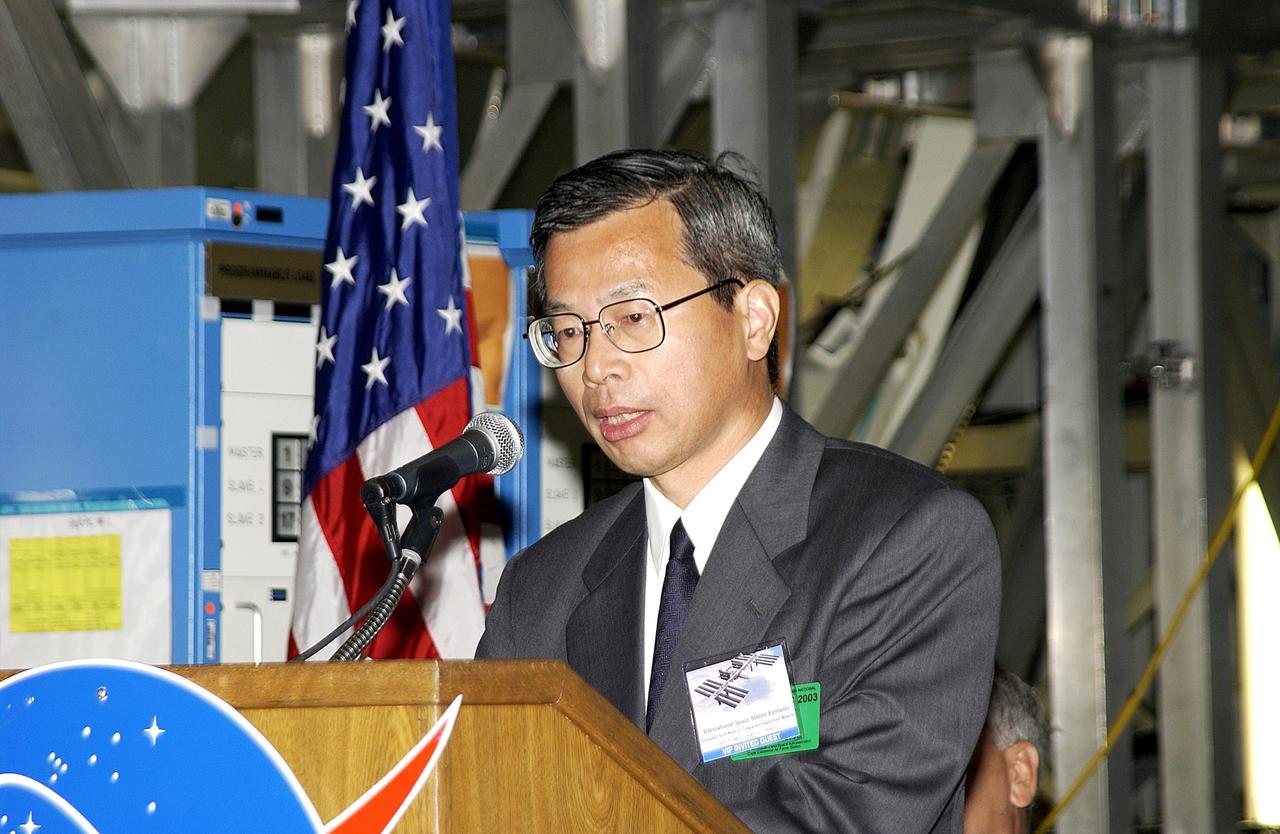
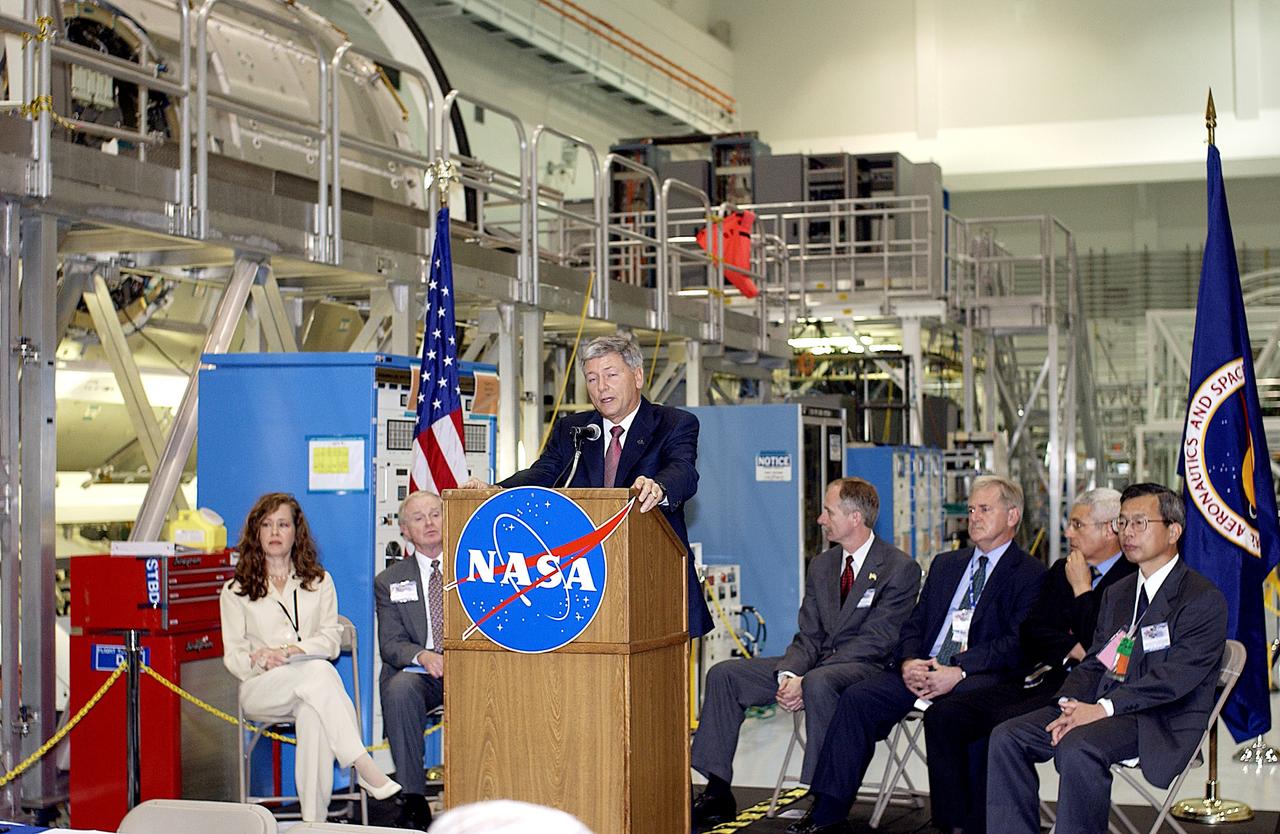
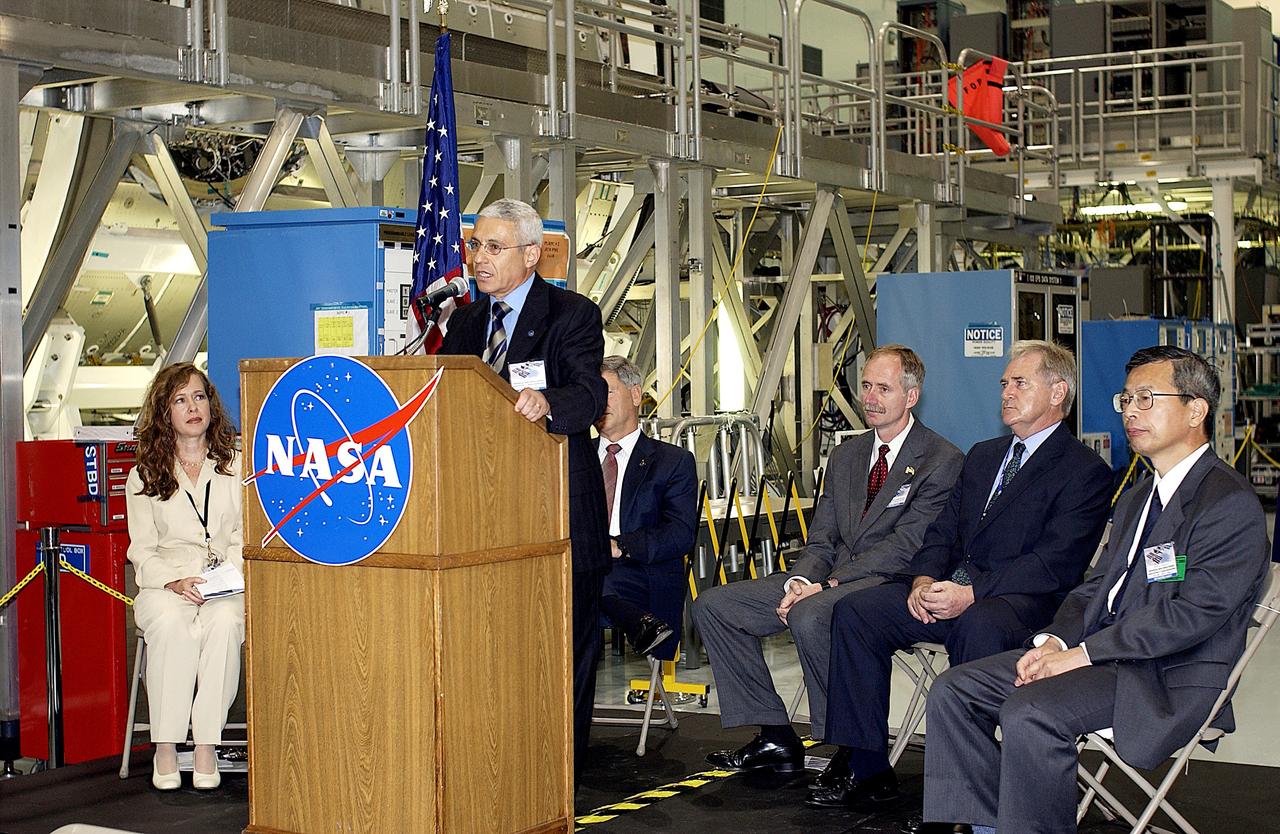
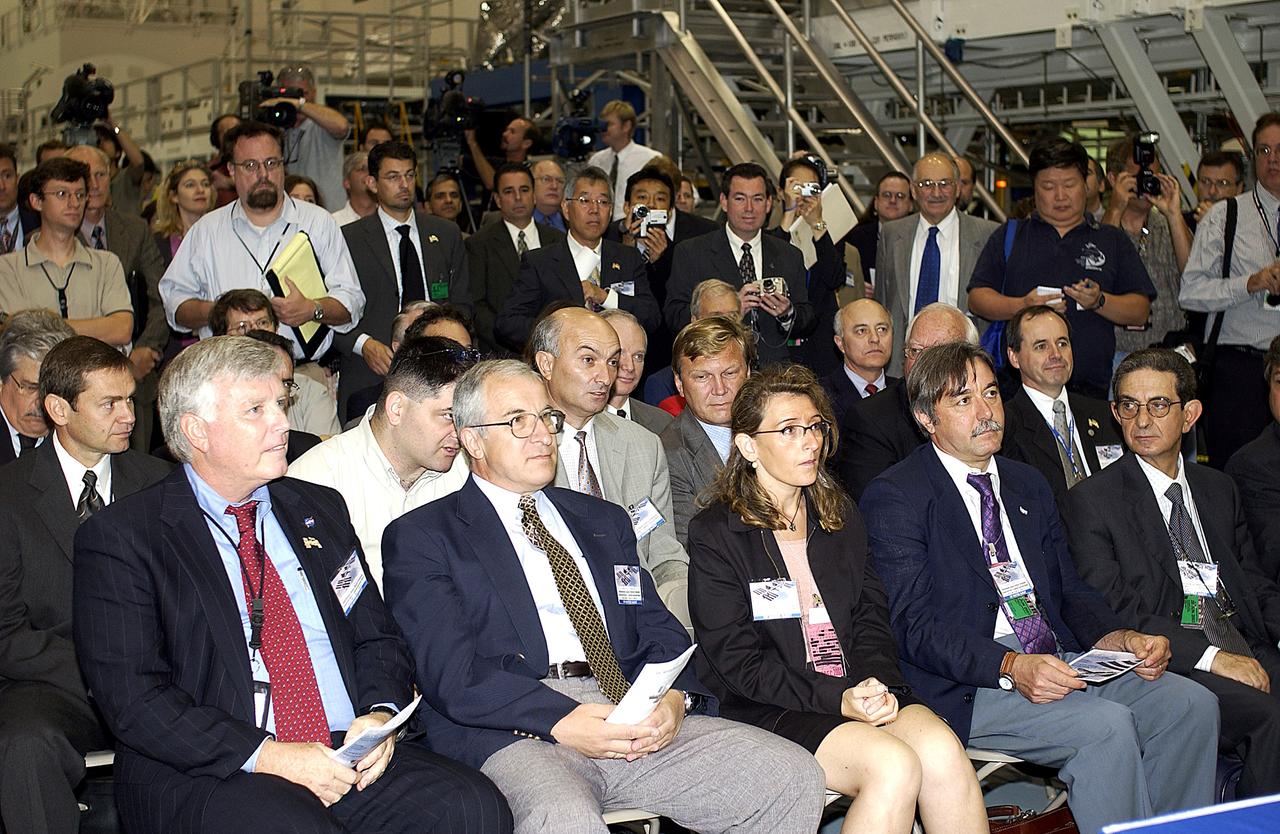
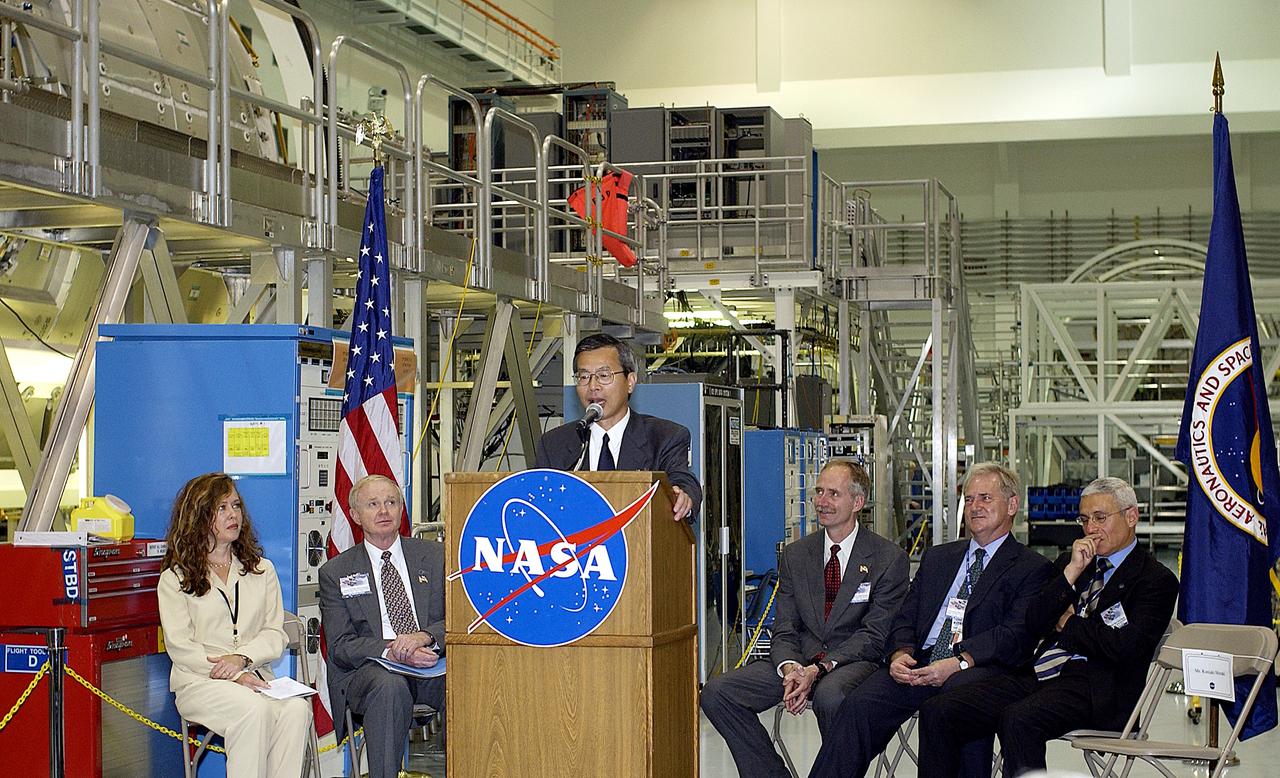
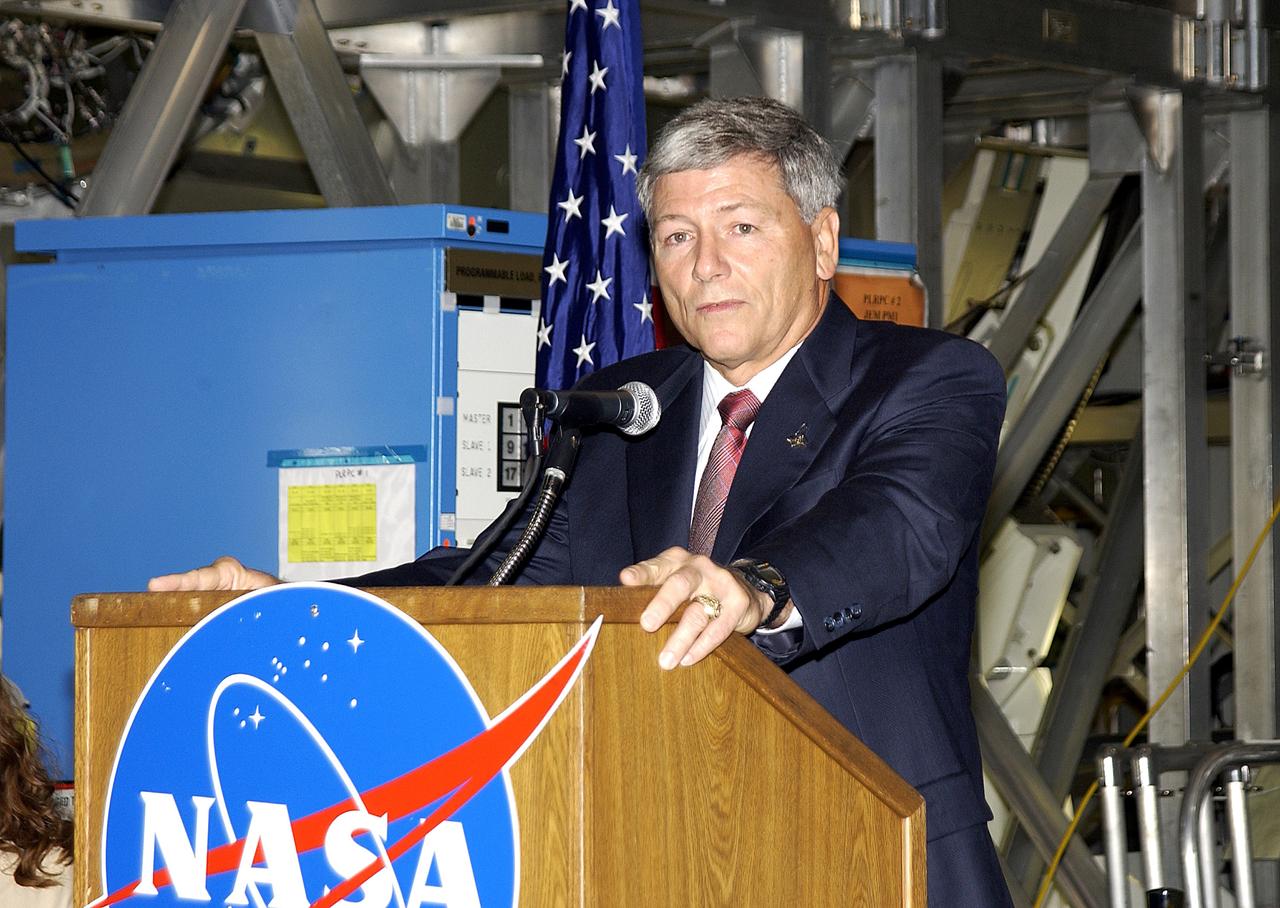
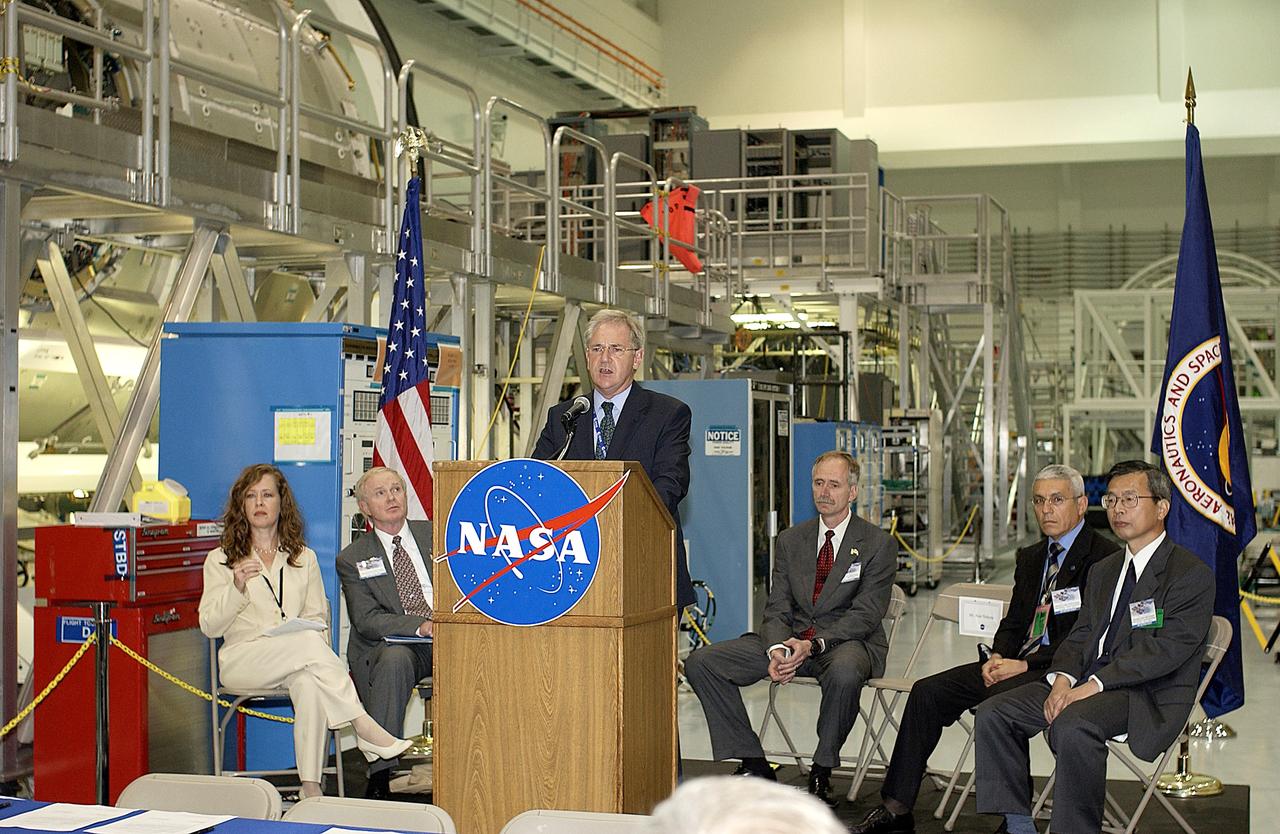
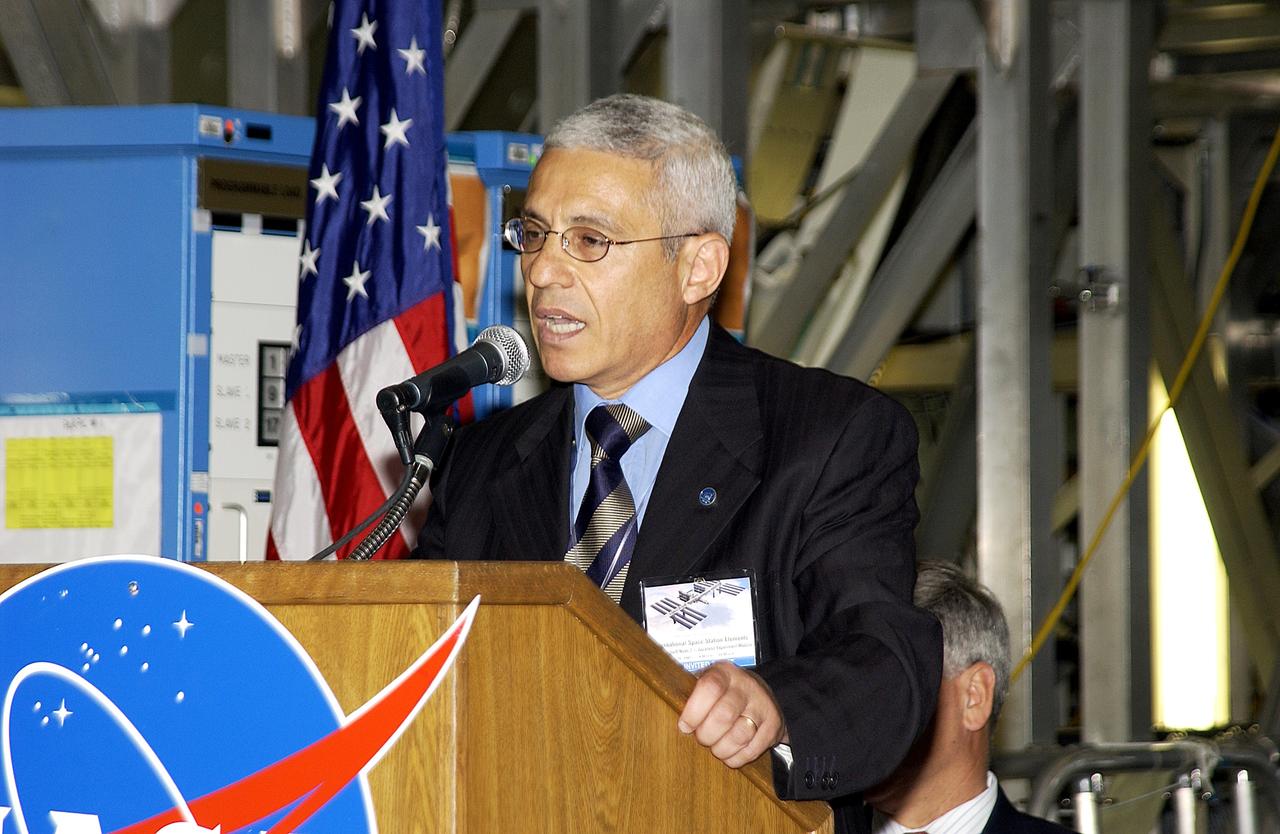
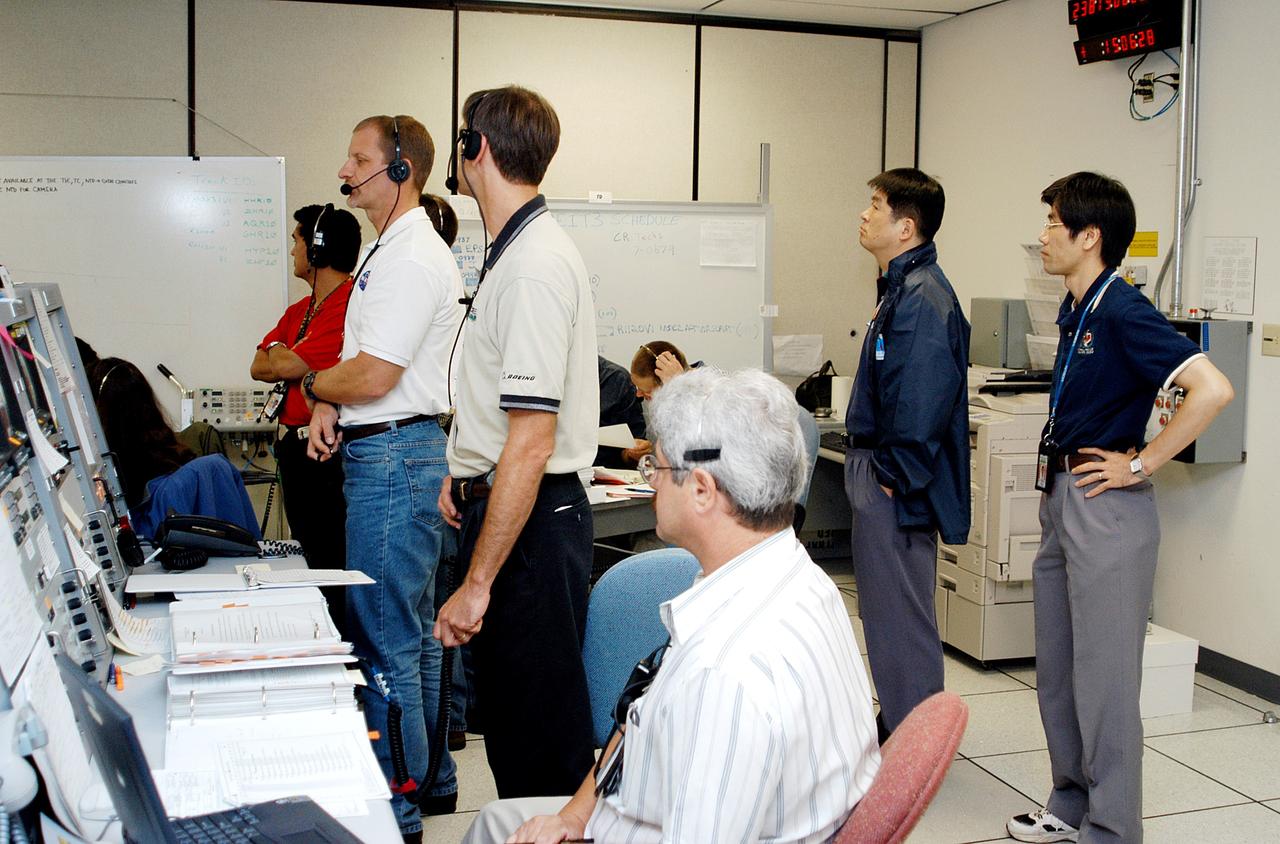
KENNEDY SPACE CENTER, FLA. -  In the Space Station Processing Facility, personnel observe sensors during a Multi-Equipment Interface Test (MEIT) on the Japanese Experiment Module (JEM).  The National Space Development Agency of Japan (NASDA) developed the laboratory at the Tsukuba Space Center near Tokyo. It is the first element, named "Kibo" (Hope), to be delivered to KSC. The JEM is Japan's primary contribution to the Station. It will enhance the unique research capabilities of the orbiting complex by providing an additional environment for astronauts to conduct science experiments.
KENNEDY SPACE CENTER, FLA. - In the Space Station Processing Facility, personnel observe sensors during a Multi-Equipment Interface Test (MEIT) on the Japanese Experiment Module (JEM). The National Space Development Agency of Japan (NASDA) developed the laboratory at the Tsukuba Space Center near Tokyo. It is the first element, named "Kibo" (Hope), to be delivered to KSC. The JEM is Japan's primary contribution to the Station. It will enhance the unique research capabilities of the orbiting complex by providing an additional environment for astronauts to conduct science experiments.
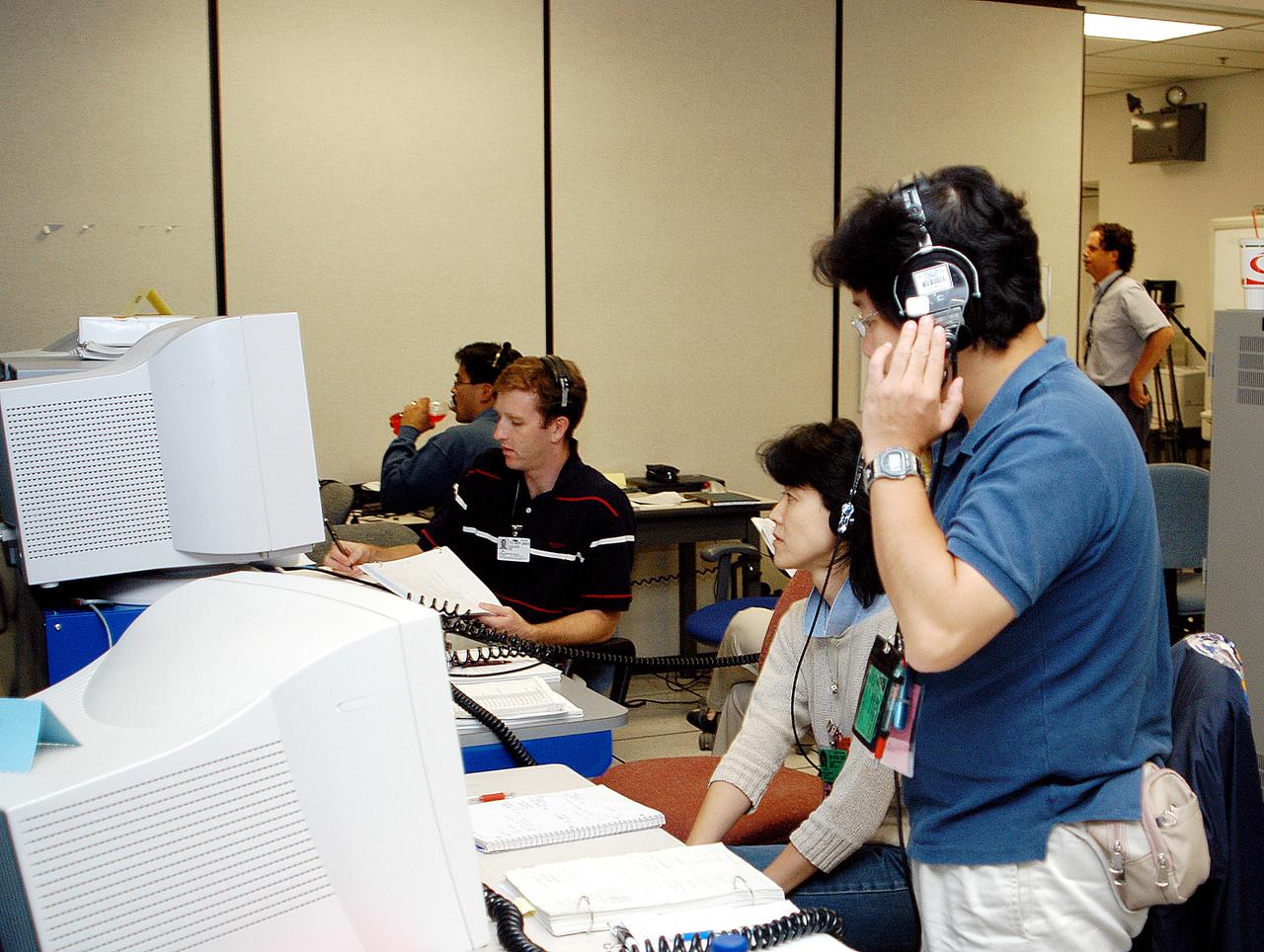
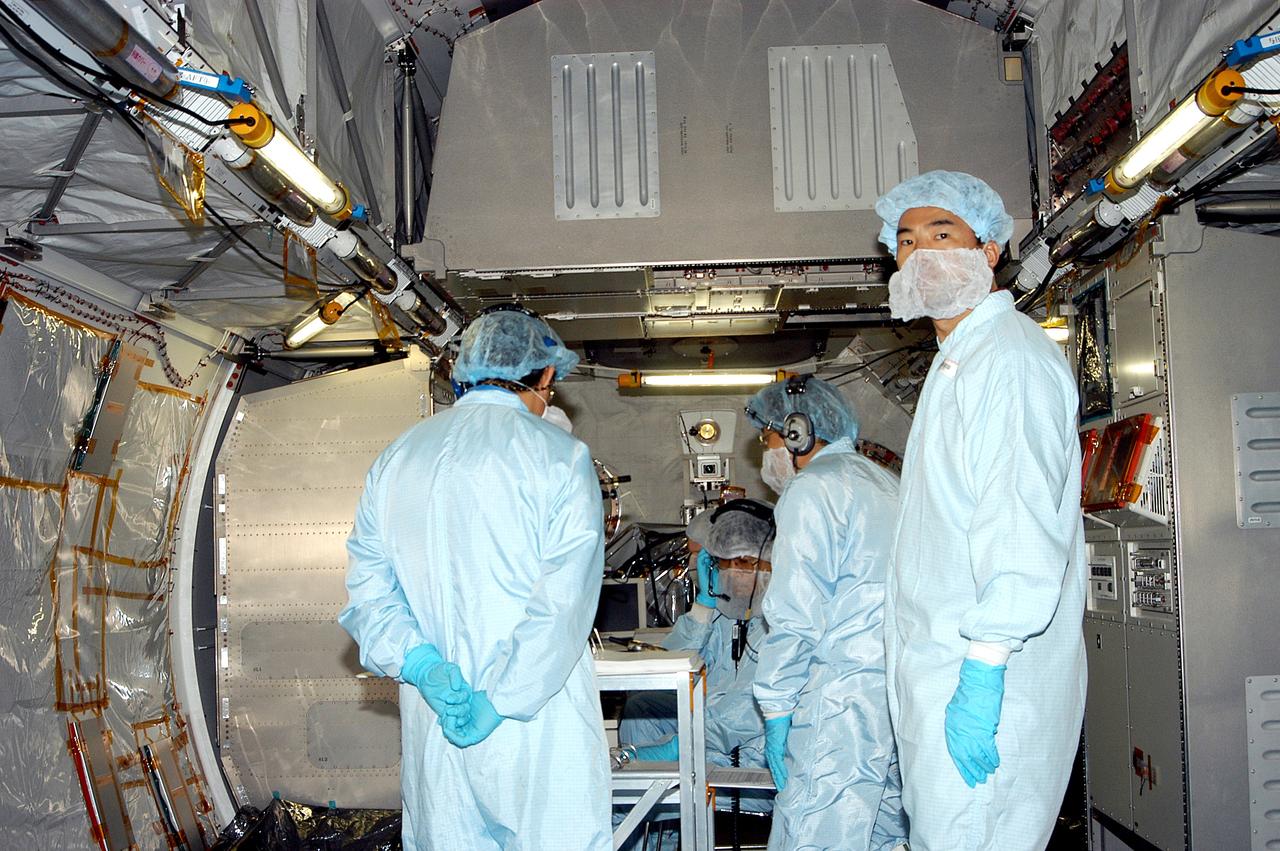
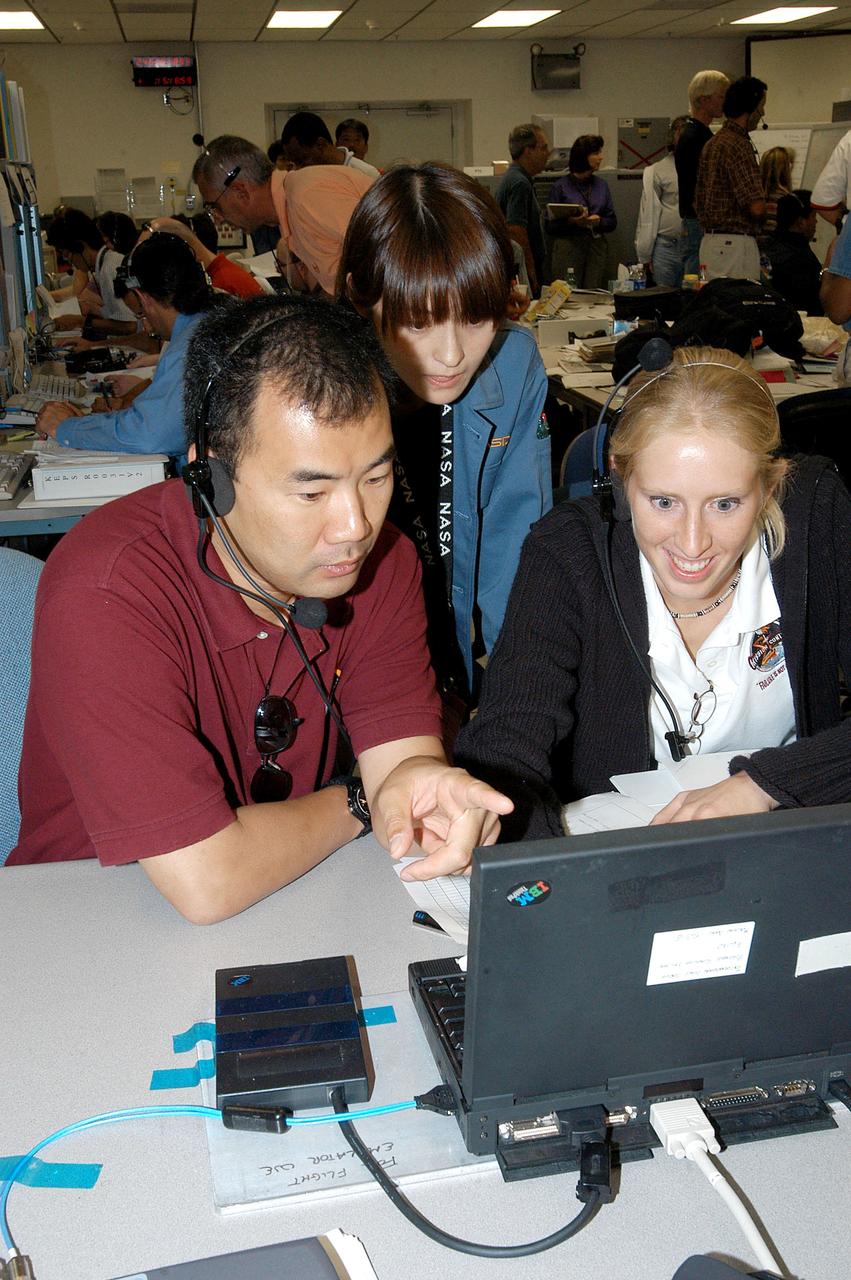
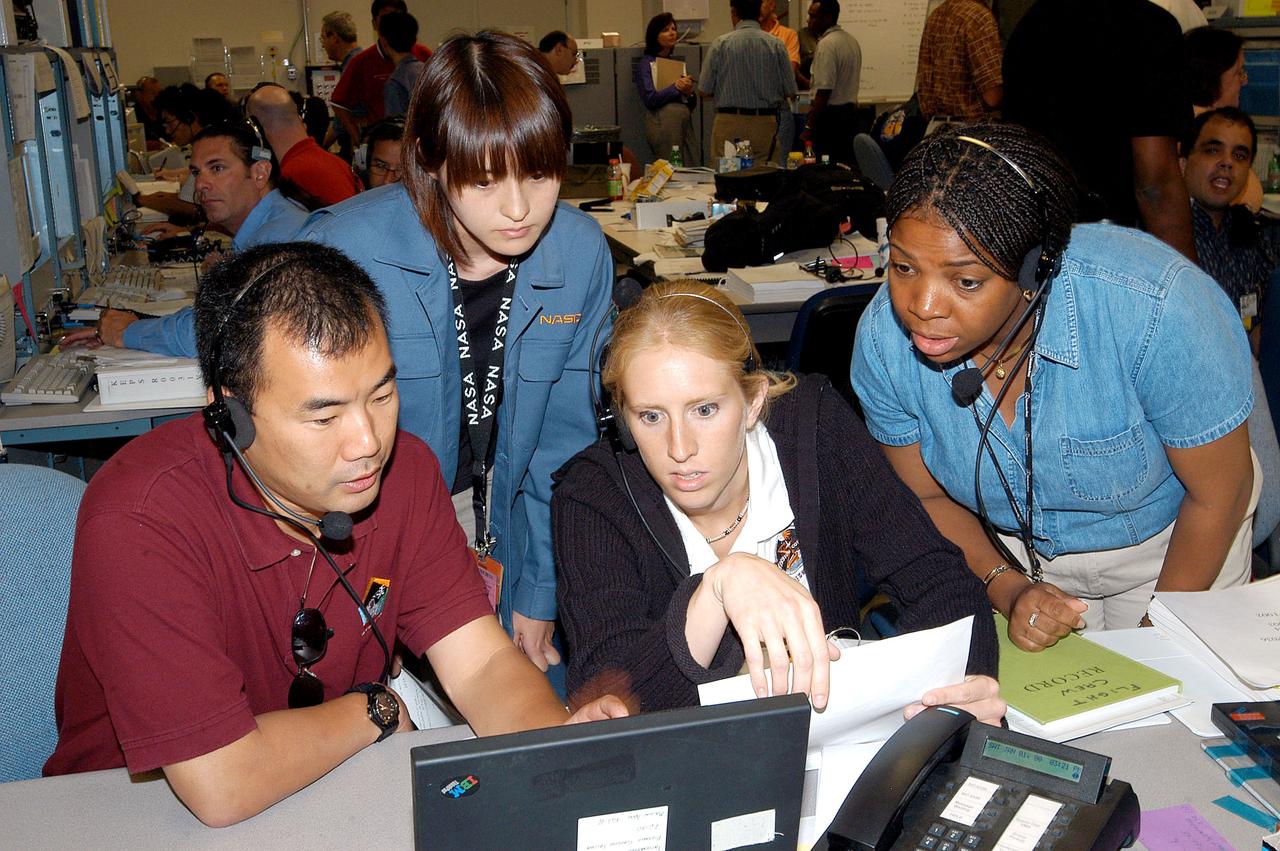
KENNEDY SPACE CENTER, FLA. - In the Space Station Processing Facility, Japanaese astronauts and personnel observe sensors during a Multi-Equipment Interface Test (MEIT) on the Japanese Experiment Module (JEM).  The National Space Development Agency of Japan (NASDA) developed the laboratory at the Tsukuba Space Center near Tokyo. It is the first element, named "Kibo" (Hope), to be delivered to KSC. The JEM is Japan's primary contribution to the Station. It will enhance the unique research capabilities of the orbiting complex by providing an additional environment for astronauts to conduct science experiments.
KENNEDY SPACE CENTER, FLA. - In the Space Station Processing Facility, Japanaese astronauts and personnel observe sensors during a Multi-Equipment Interface Test (MEIT) on the Japanese Experiment Module (JEM). The National Space Development Agency of Japan (NASDA) developed the laboratory at the Tsukuba Space Center near Tokyo. It is the first element, named "Kibo" (Hope), to be delivered to KSC. The JEM is Japan's primary contribution to the Station. It will enhance the unique research capabilities of the orbiting complex by providing an additional environment for astronauts to conduct science experiments.
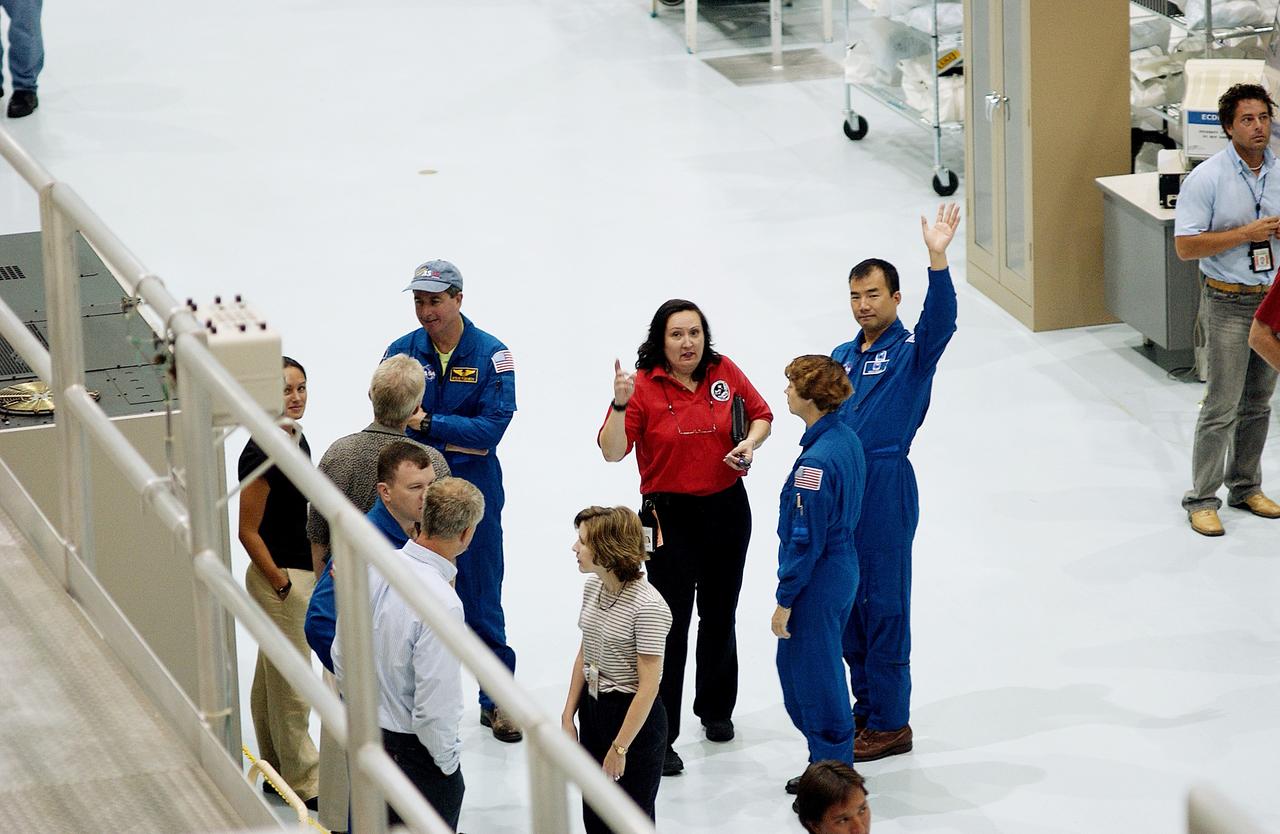
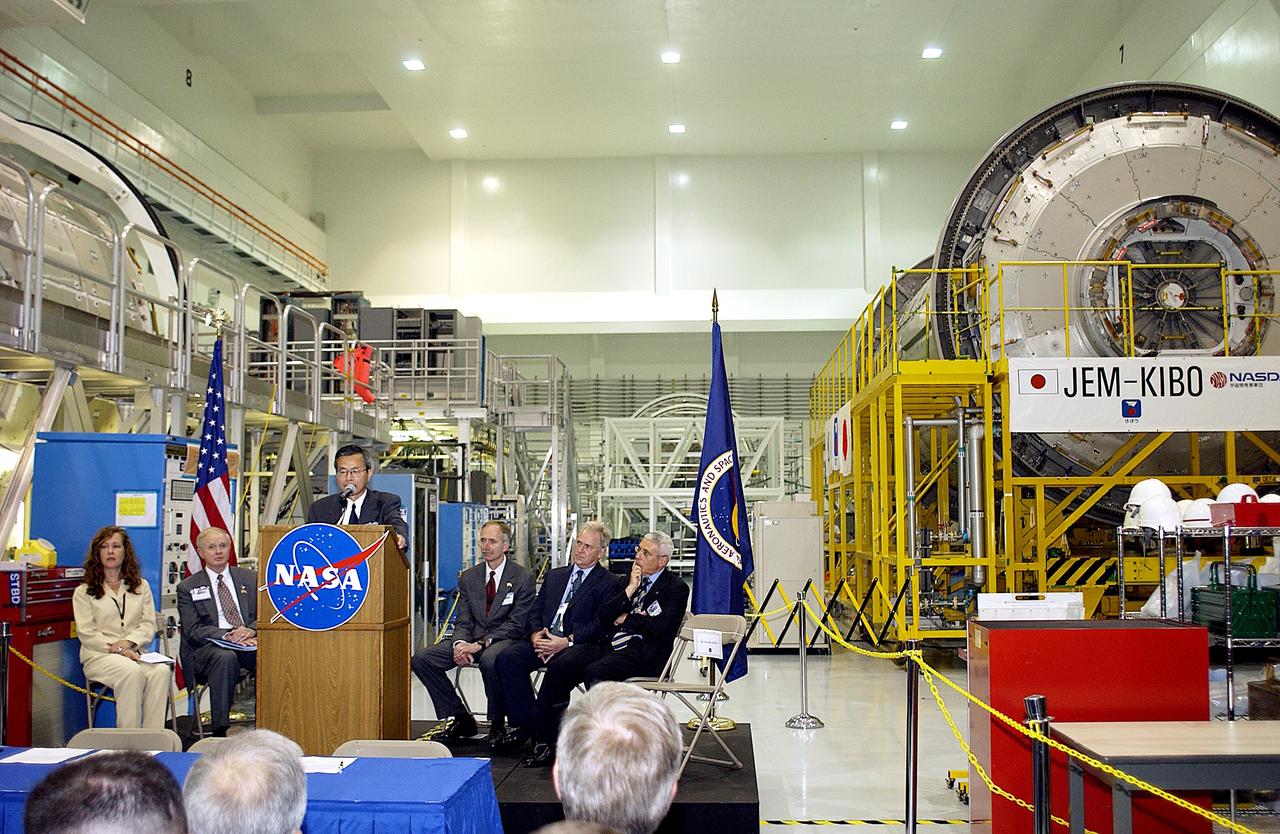
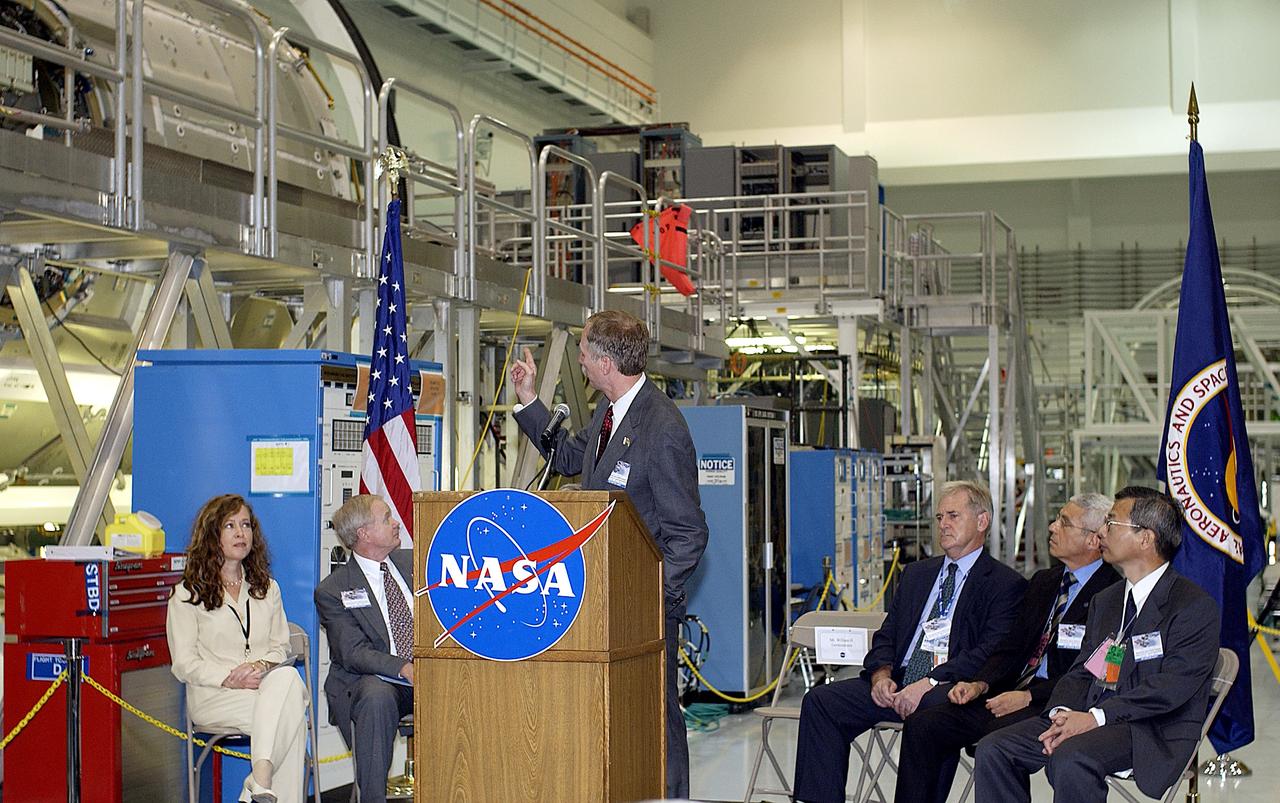
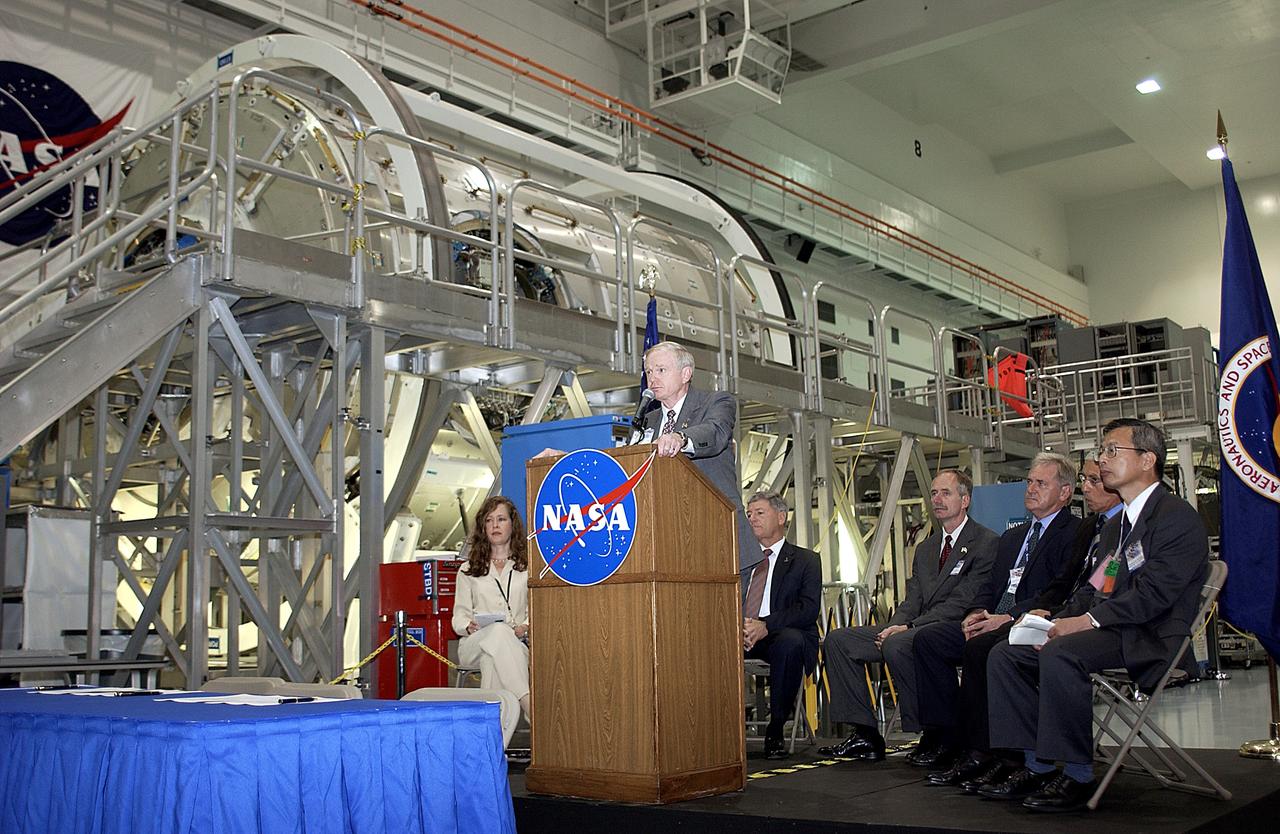
KENNEDY SPACE CENTER, FLA. -  Japanese astronauts and other personnel in the Space Station Processing Facility observe sensors during a Multi-Equipment Interface Test (MEIT) on the Japanese Experiment Module (JEM).  The National Space Development Agency of Japan (NASDA) developed the laboratory at the Tsukuba Space Center near Tokyo. It is the first element, named "Kibo" (Hope), to be delivered to KSC. The JEM is Japan's primary contribution to the Station. It will enhance the unique research capabilities of the orbiting complex by providing an additional environment for astronauts to conduct science experiments.
KENNEDY SPACE CENTER, FLA. - Japanese astronauts and other personnel in the Space Station Processing Facility observe sensors during a Multi-Equipment Interface Test (MEIT) on the Japanese Experiment Module (JEM). The National Space Development Agency of Japan (NASDA) developed the laboratory at the Tsukuba Space Center near Tokyo. It is the first element, named "Kibo" (Hope), to be delivered to KSC. The JEM is Japan's primary contribution to the Station. It will enhance the unique research capabilities of the orbiting complex by providing an additional environment for astronauts to conduct science experiments.
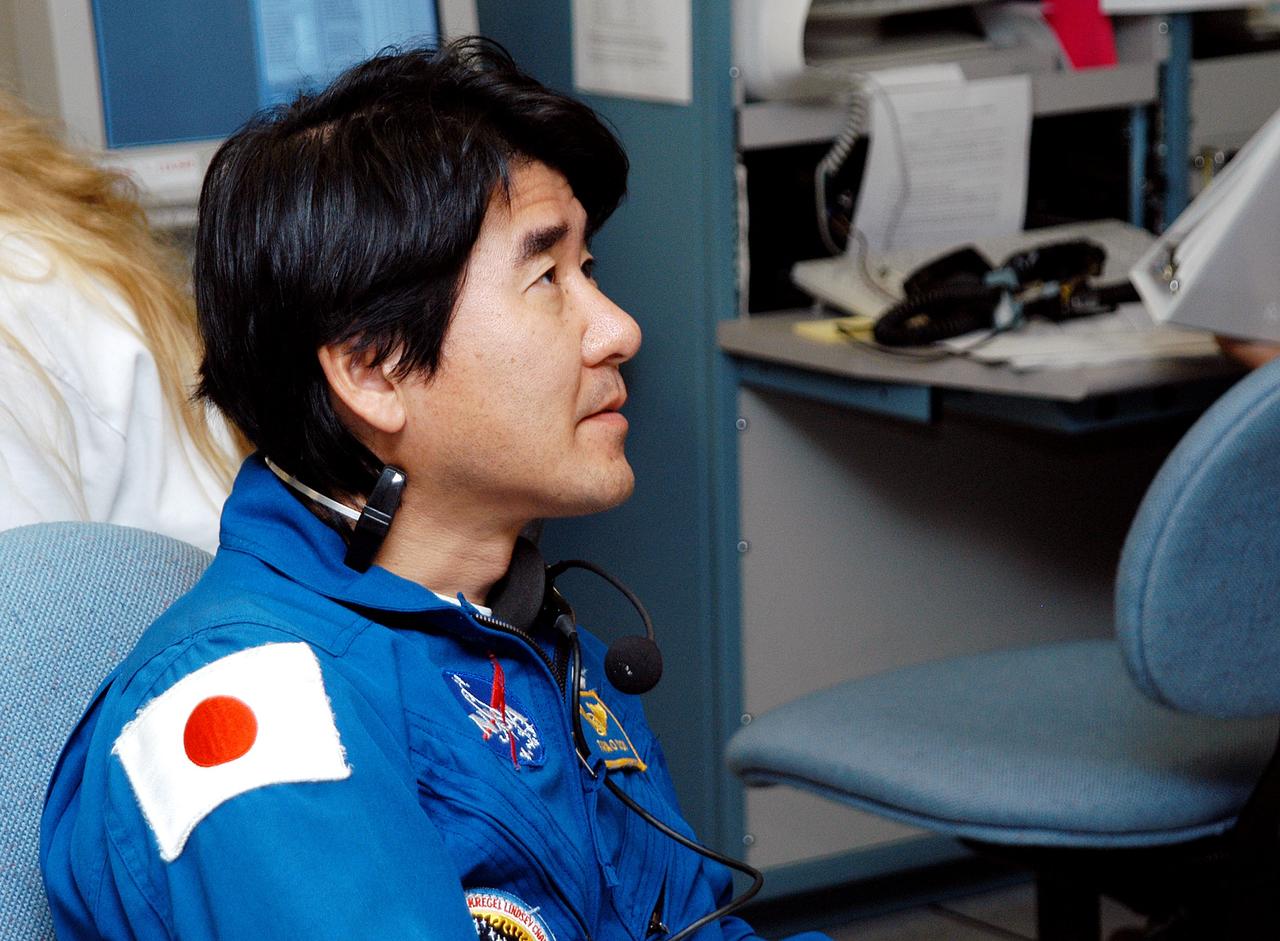
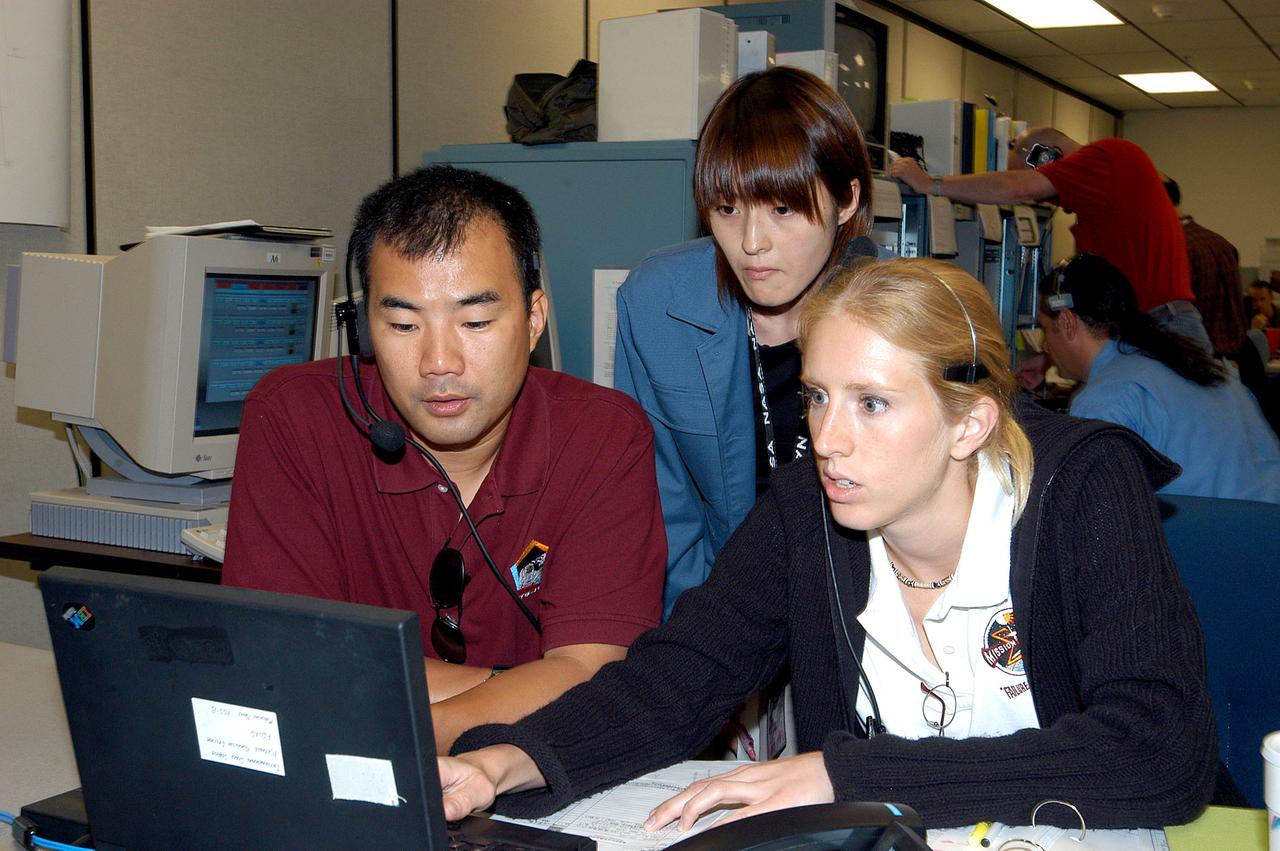
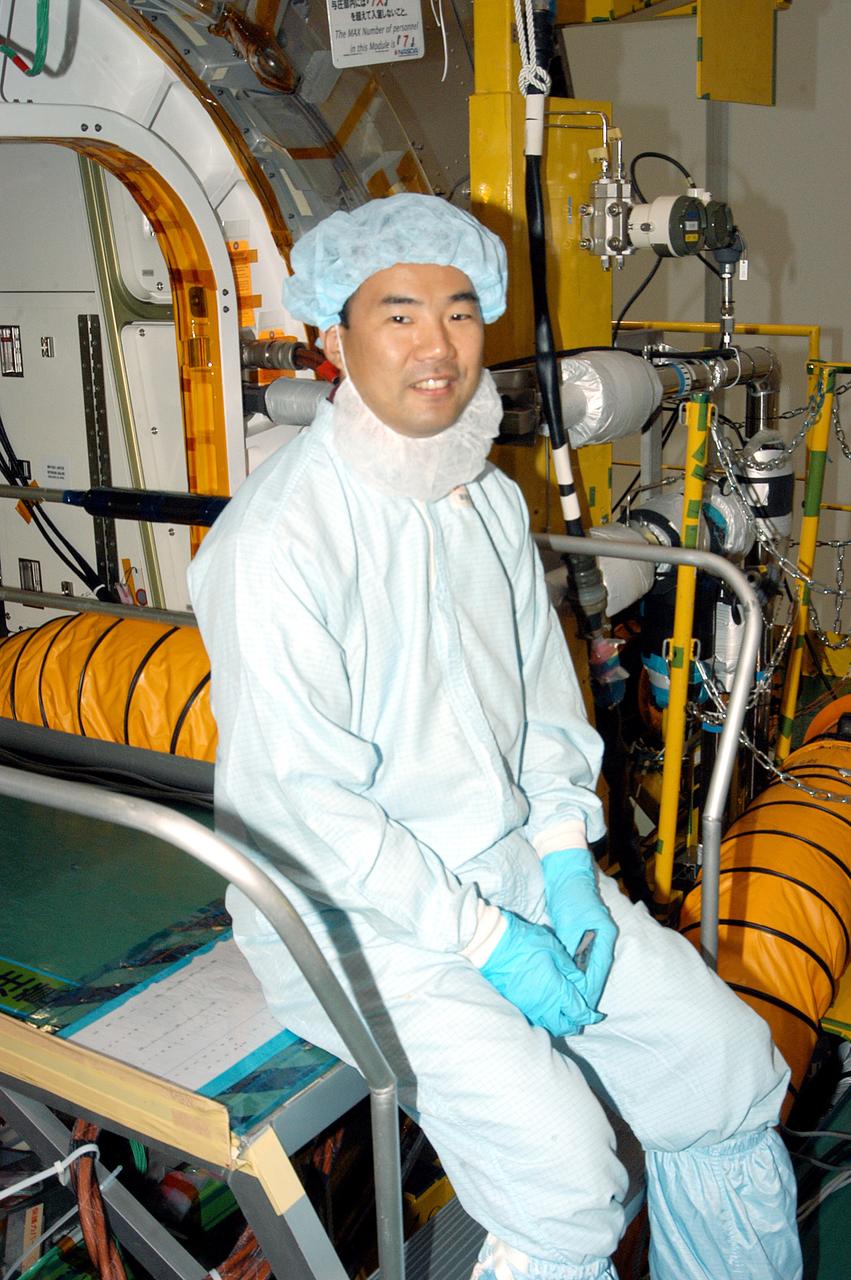
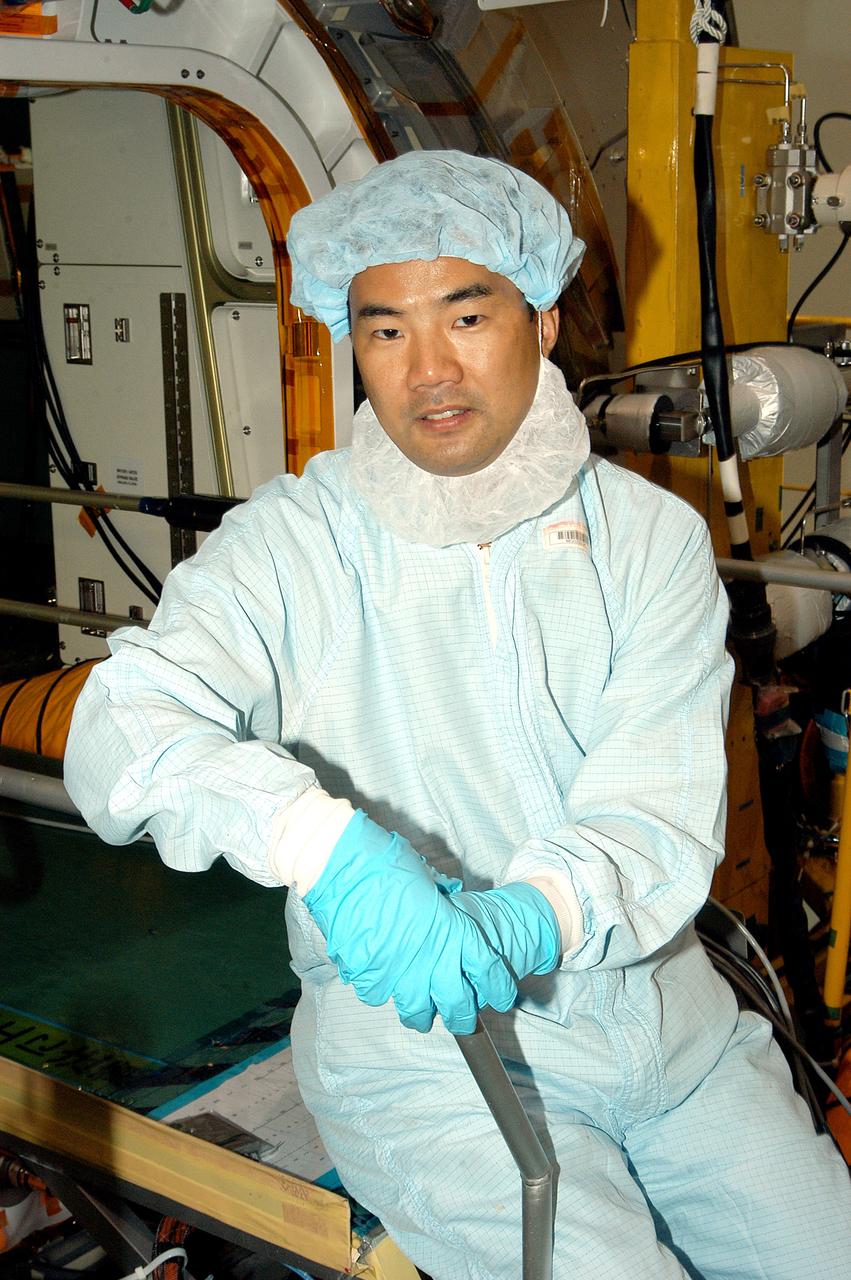
KENNEDY SPACE CENTER, FLA. -  Takao Doi, an astronaut with the National Space Development Agency of Japan (NASDA), watches the sensors  during a Multi-Equipment Interface Test (MEIT) on the Japanese Experiment Module (JEM).  NASDA  developed the laboratory at the Tsukuba Space Center near Tokyo. It is the first element, named "Kibo" (Hope), to be delivered to KSC. The JEM is Japan's primary contribution to the Station. It will enhance the unique research capabilities of the orbiting complex by providing an additional environment for astronauts to conduct science experiments.
KENNEDY SPACE CENTER, FLA. - Takao Doi, an astronaut with the National Space Development Agency of Japan (NASDA), watches the sensors during a Multi-Equipment Interface Test (MEIT) on the Japanese Experiment Module (JEM). NASDA developed the laboratory at the Tsukuba Space Center near Tokyo. It is the first element, named "Kibo" (Hope), to be delivered to KSC. The JEM is Japan's primary contribution to the Station. It will enhance the unique research capabilities of the orbiting complex by providing an additional environment for astronauts to conduct science experiments.
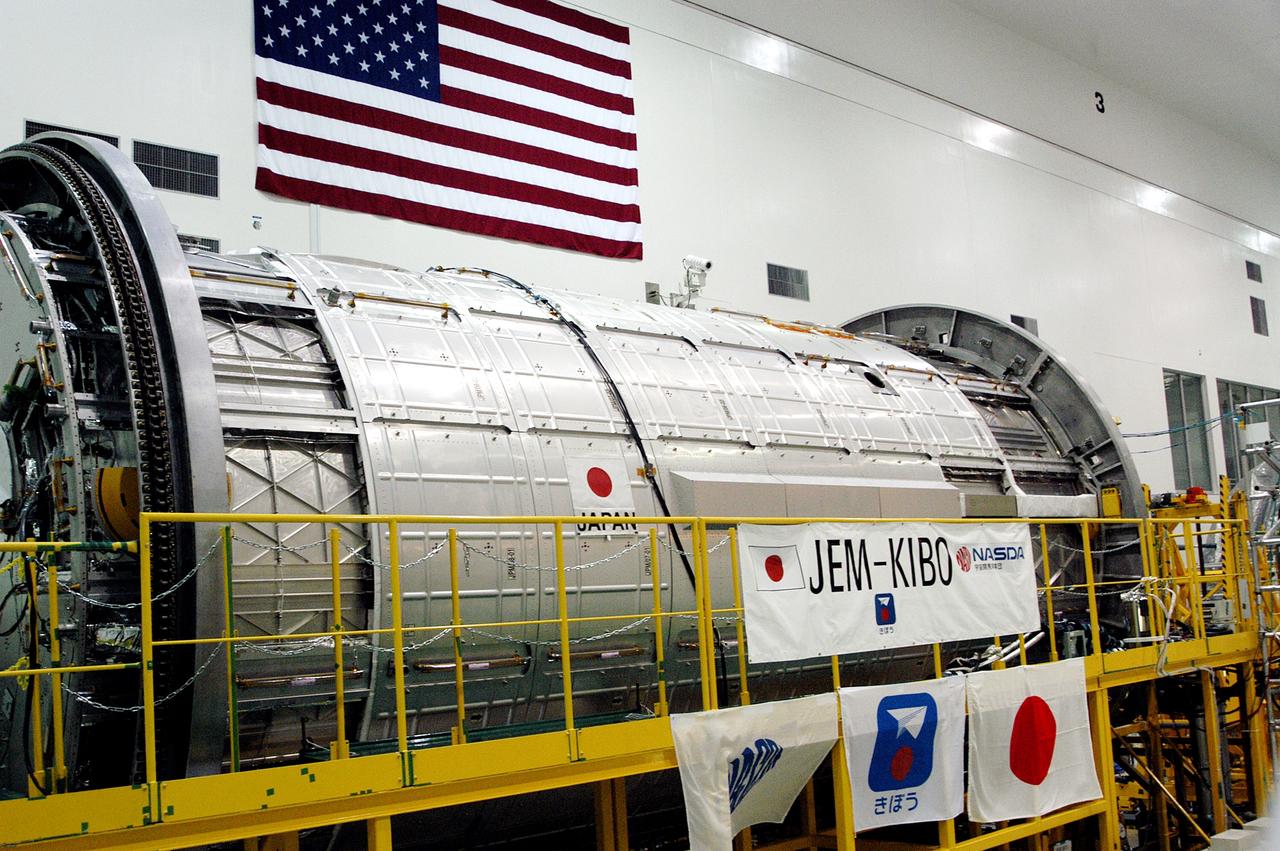
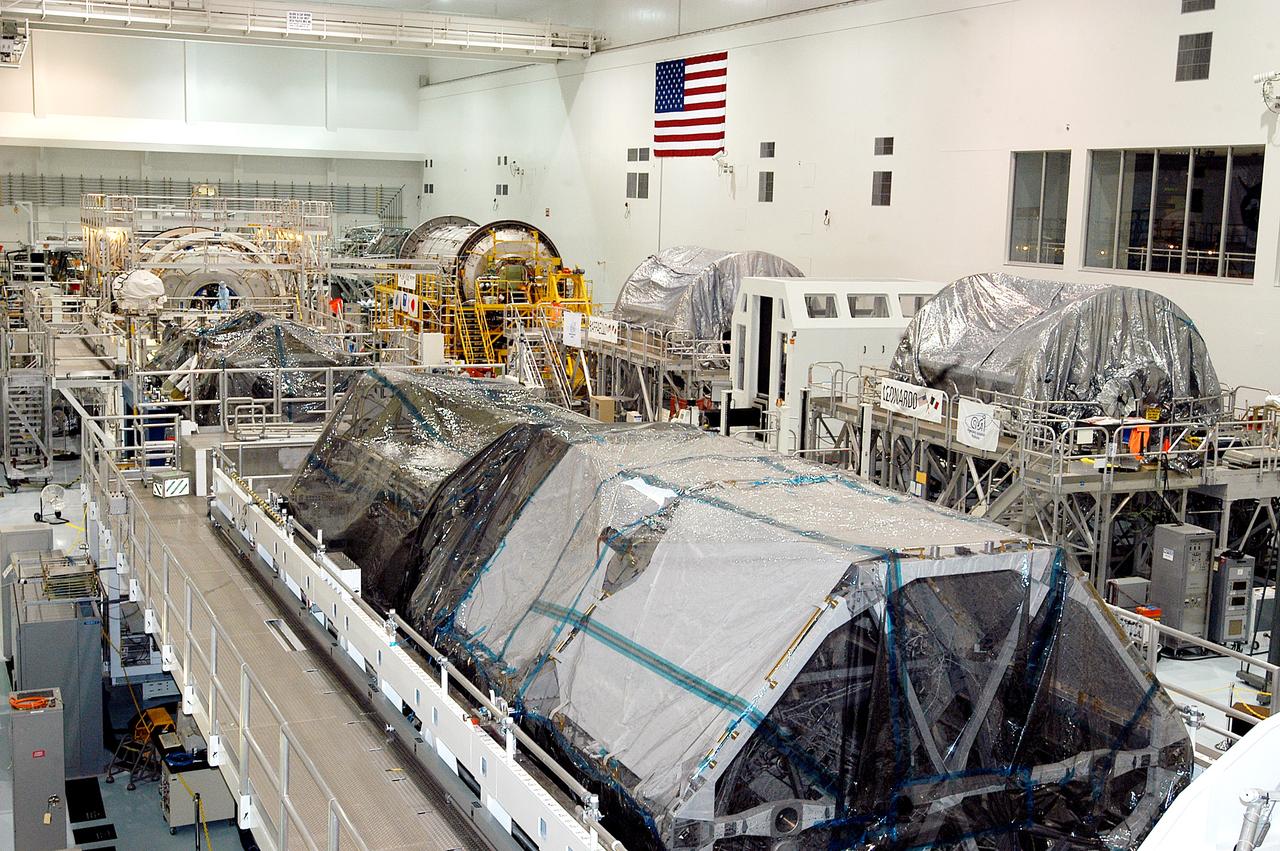
KENNEDY SPACE CENTER, FLA. - The Japanese Experiment Module (JEM), named Kibo (Hope), is undergoing a Multi-Element Integrated Test (MEIT) in the Space Station Processing Facility.  Developed by the National Space Development Agency of Japan (NASDA), the JEM is Japan's primary contribution to the Station. It will enhance the unique research capabilities of the orbiting complex by providing an additional environment for astronauts to conduct science experiments.
KENNEDY SPACE CENTER, FLA. - The Japanese Experiment Module (JEM), named Kibo (Hope), is undergoing a Multi-Element Integrated Test (MEIT) in the Space Station Processing Facility. Developed by the National Space Development Agency of Japan (NASDA), the JEM is Japan's primary contribution to the Station. It will enhance the unique research capabilities of the orbiting complex by providing an additional environment for astronauts to conduct science experiments.
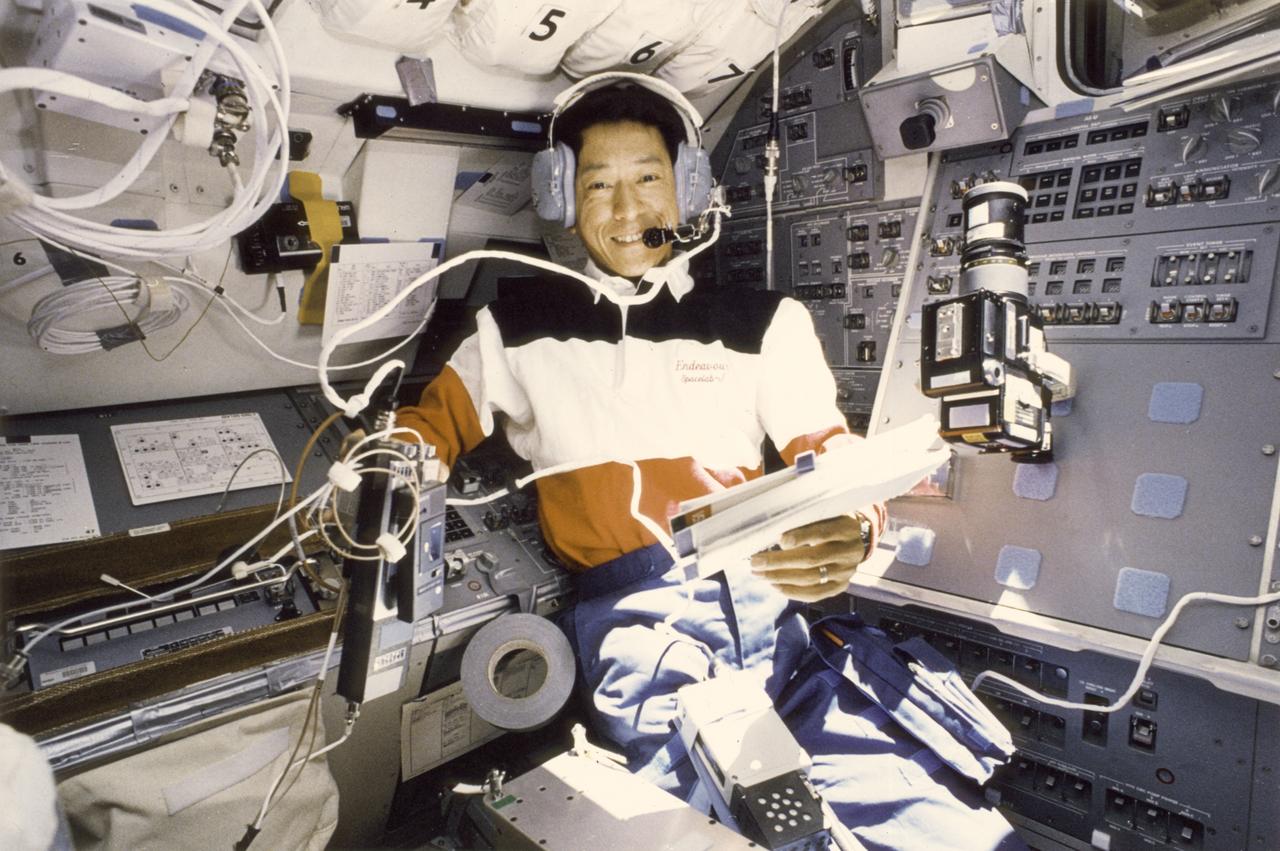
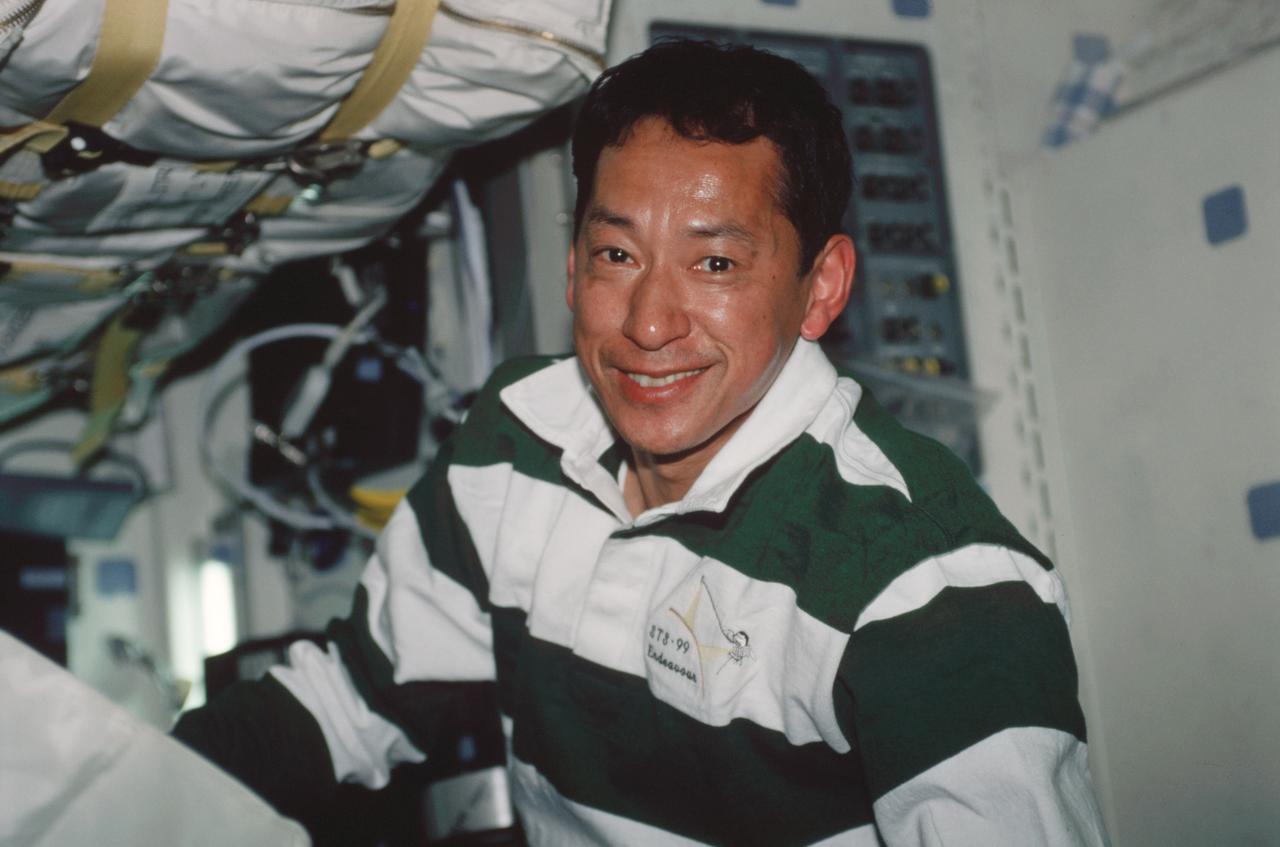
Japanese astronaut, Mamoru Mohri, talks to Japanese students from the aft flight deck of the Space Shuttle Orbiter Endeavour during the Spacelab-J (SL-J) mission. The SL-J mission was a joint venture between NASA and the National Space Development Agency of Japan (NASDA) utilizing a marned Spacelab module. The mission conducted 24 materials science and 20 life science experiments, of which 35 were sponsored by NASDA, 7 by NASA, and two collaborative efforts. Materials science investigations covered such fields as biotechnology, electronic materials, fluid dynamics and transport phenomena, glasses and ceramics, metals and alloys, and acceleration measurements. Life sciences included experiments on human health, cell separation and biology, developmental biology, animal and human physiology and behavior, space radiation, and biological rhythms. Test subjects included the crew, Japanese koi fish (carp), cultured animal and plant cells, chicken embryos, fruit flies, fungi and plant seeds, and frogs and frog eggs. Spacelab-J was launched aboard the Space Shuttle Orbiter Endeavour on September 12, 1992.
Spacelab
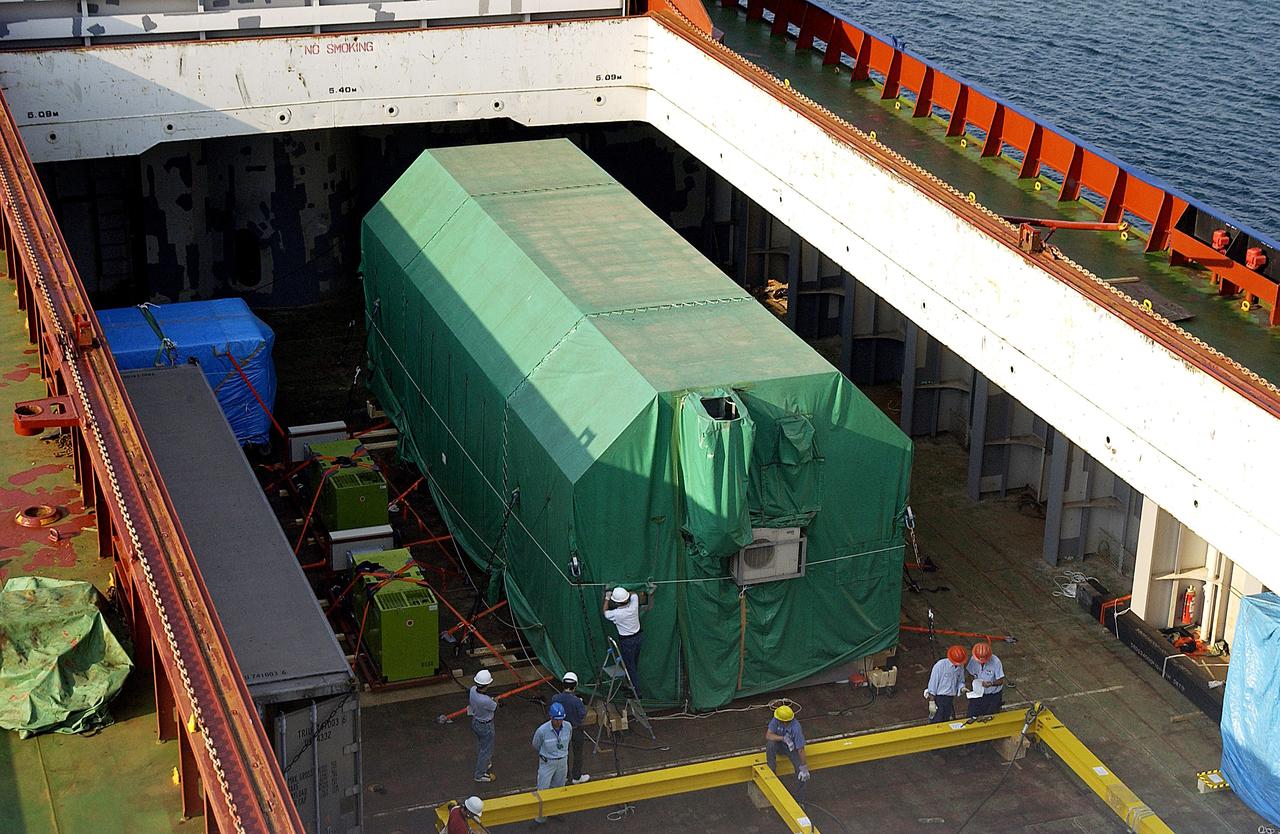
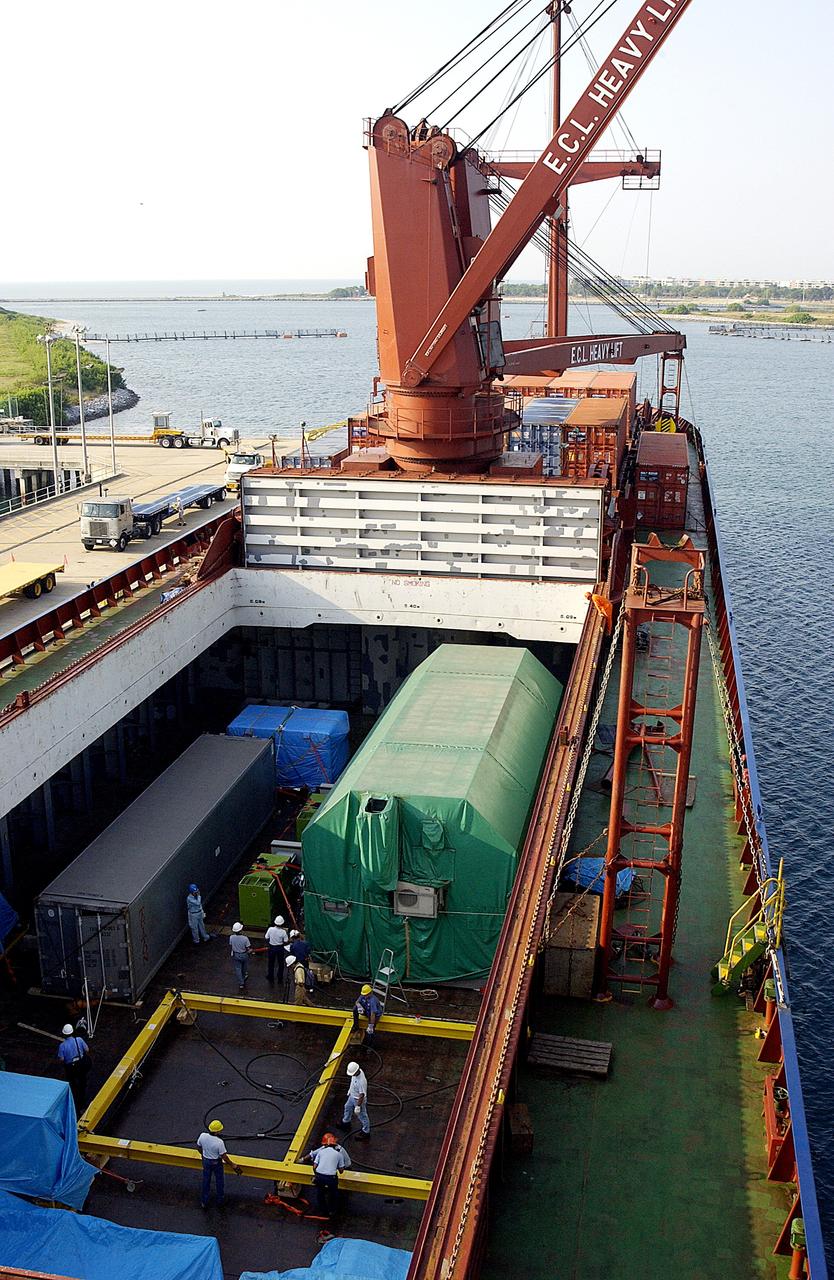
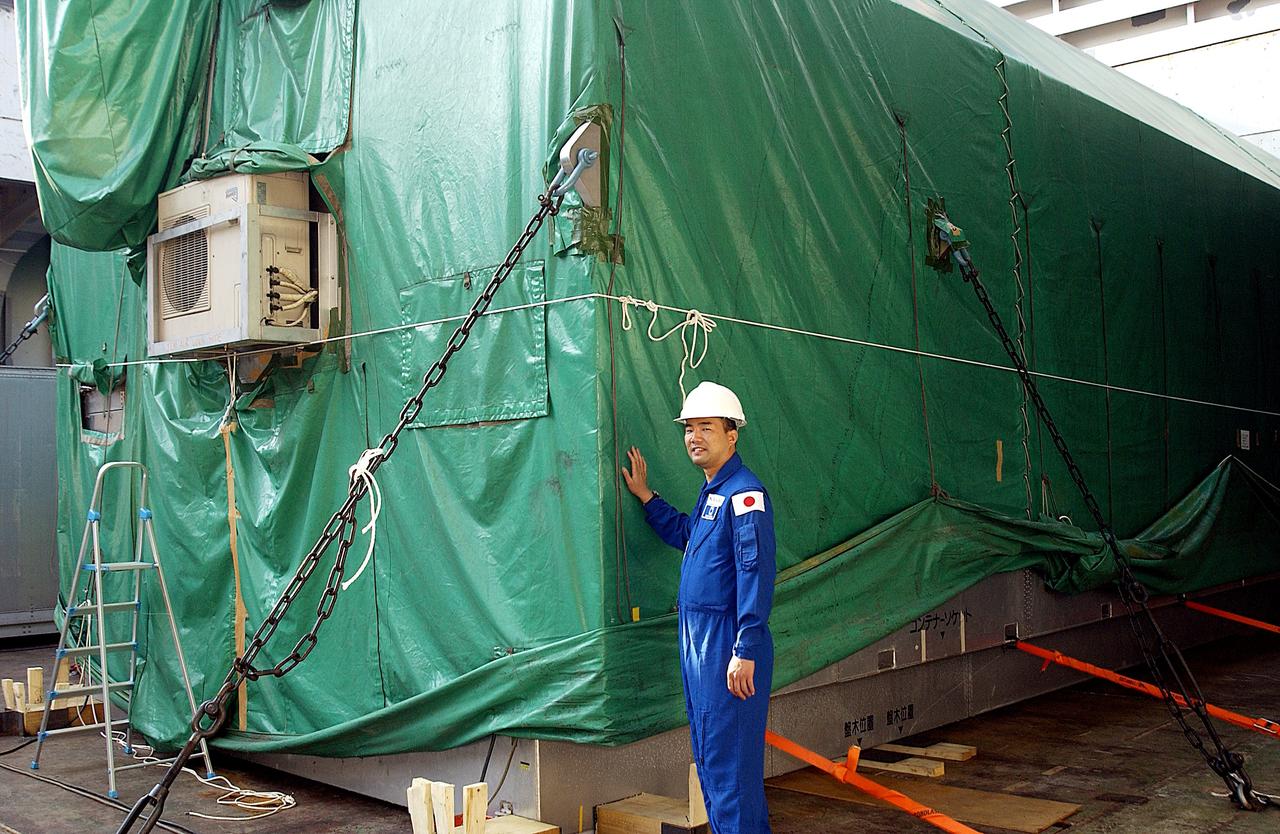
KENNEDY SPACE CENTER, FLA. - The JEM Pressurized Module is seen in the hold of the ship that carried it from Japan.  The National Space Development Agency of Japan (NASDA) built the laboratory at the Tsukuba Space Center near Tokyo.  The Pressurized Module is the first element of the JEM, Japan’s primary contribution to the space station, to be delivered to KSC. It will enhance the unique research capabilities of the orbiting complex by providing an additional shirt-sleeve environment for astronauts to conduct science experiments. The JEM also includes two logistics modules, an exposed pallet for space environment experiments and a robotic manipulator system that are still under construction in Japan. The various JEM components will be assembled in space over the course of three space shuttle missions.
KENNEDY SPACE CENTER, FLA. - The JEM Pressurized Module is seen in the hold of the ship that carried it from Japan. The National Space Development Agency of Japan (NASDA) built the laboratory at the Tsukuba Space Center near Tokyo. The Pressurized Module is the first element of the JEM, Japan’s primary contribution to the space station, to be delivered to KSC. It will enhance the unique research capabilities of the orbiting complex by providing an additional shirt-sleeve environment for astronauts to conduct science experiments. The JEM also includes two logistics modules, an exposed pallet for space environment experiments and a robotic manipulator system that are still under construction in Japan. The various JEM components will be assembled in space over the course of three space shuttle missions.
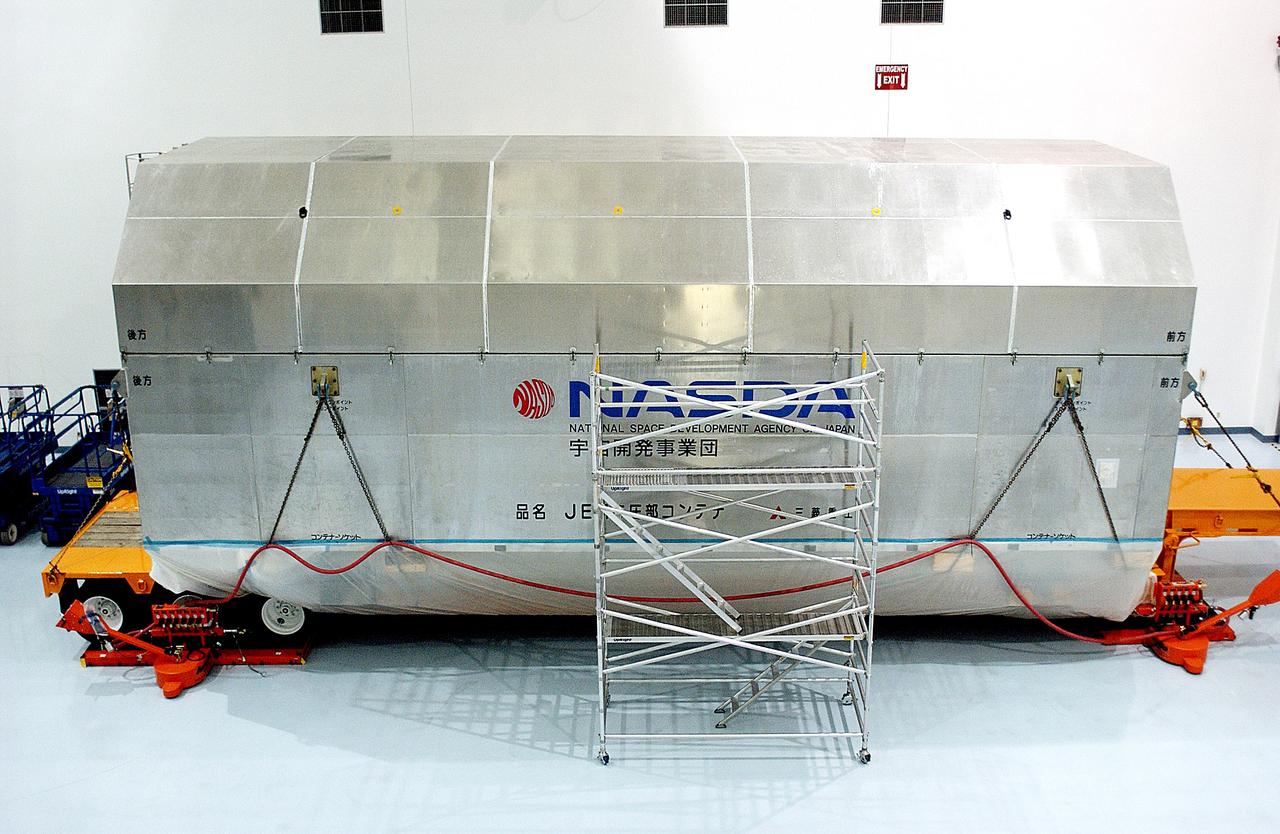
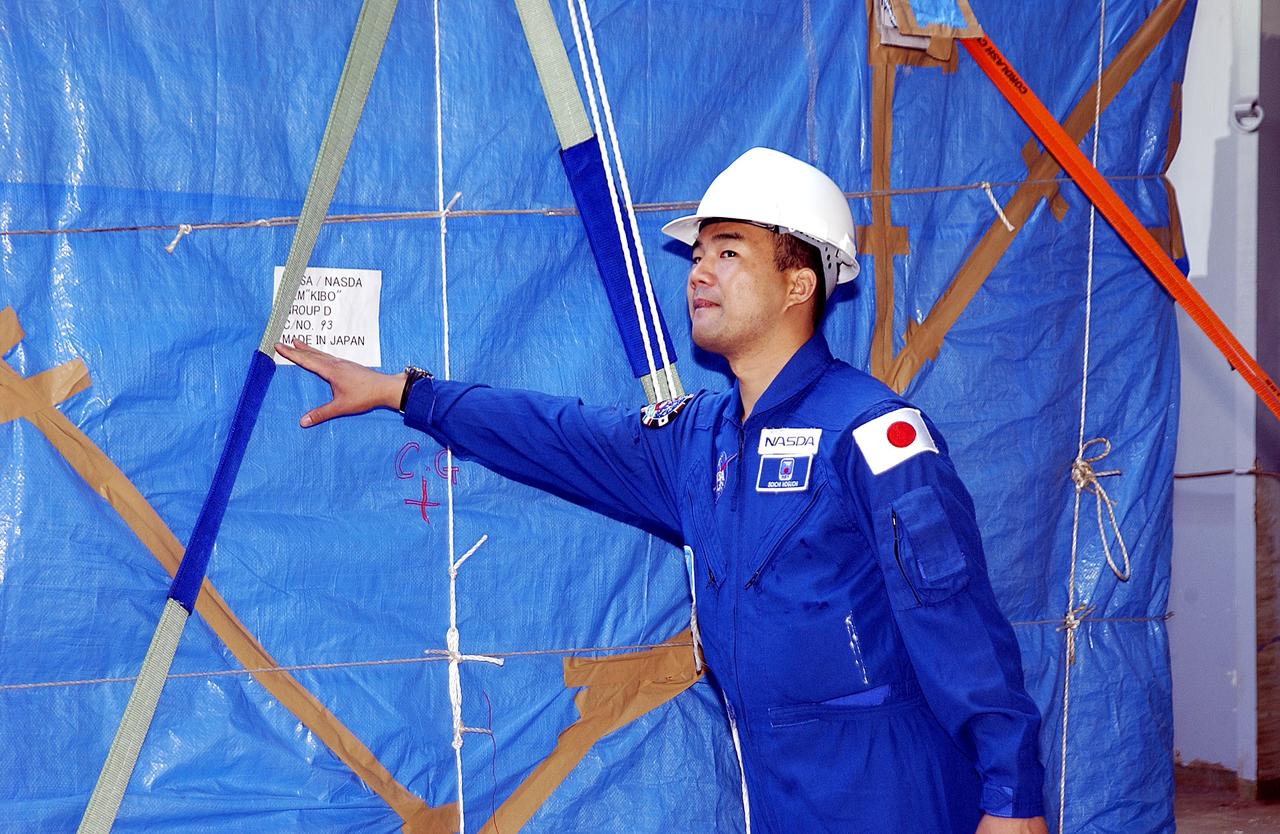
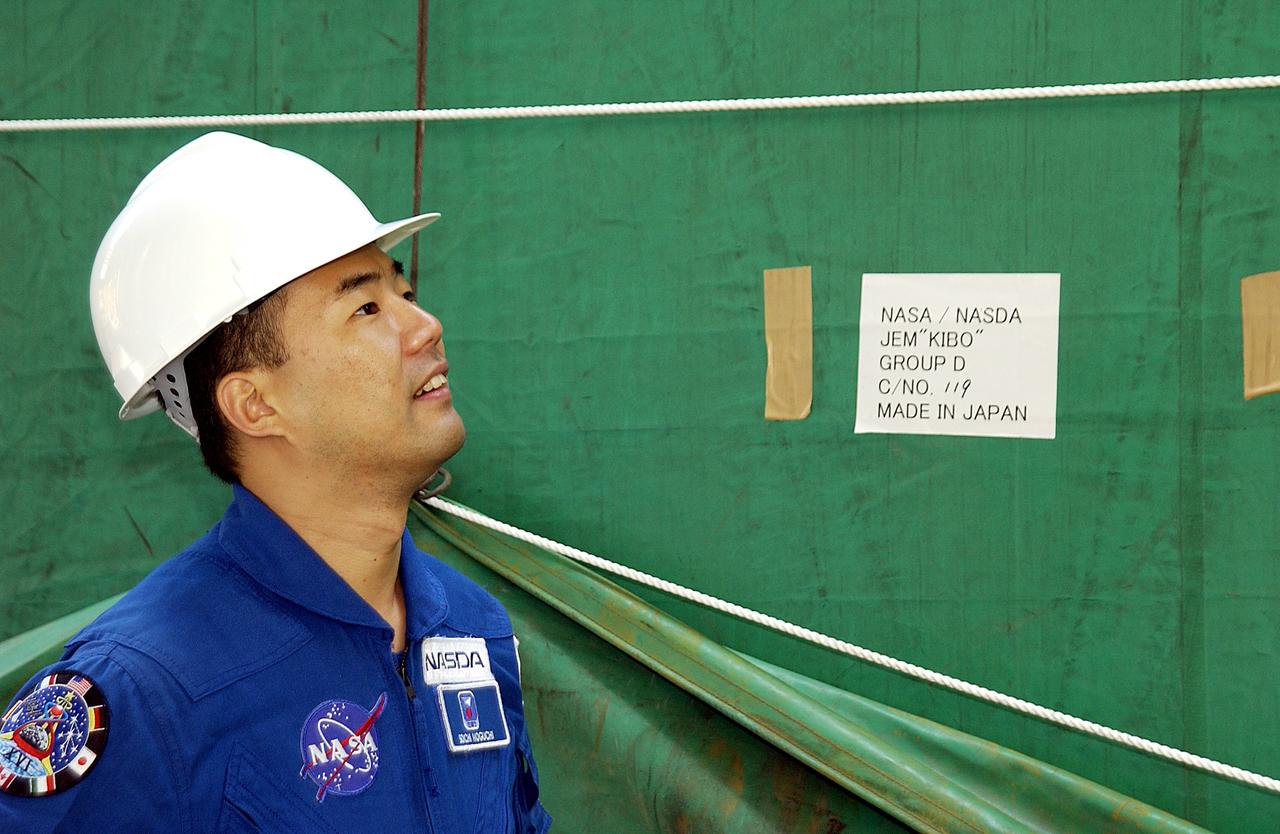
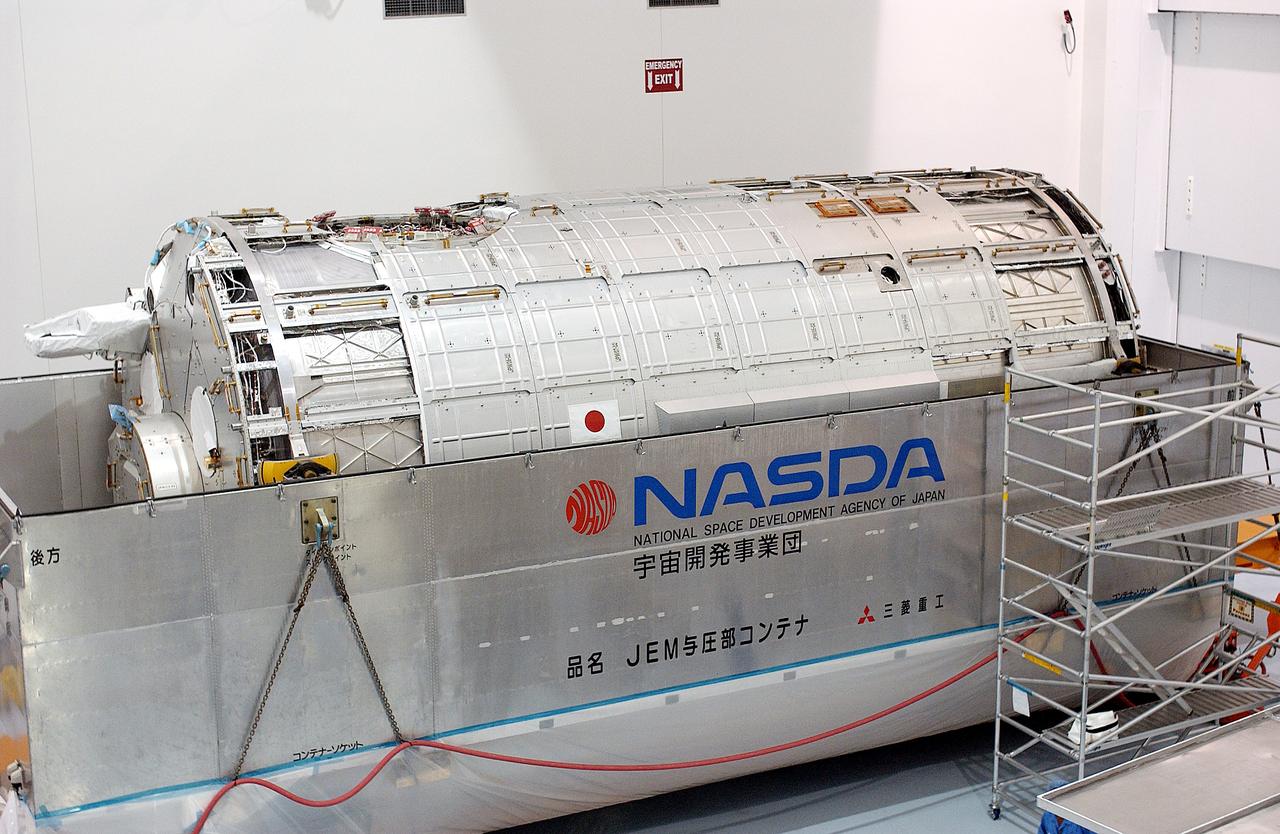
KENNEDY SPACE CENTER, FLA. - The container with the Japanese Experiment Module (JEM)’s pressurized module is inside the Space Station Processing Facility.  The National Space Development Agency of Japan (NASDA) developed the laboratory at the Tsukuba Space Center near Tokyo. The Pressurized Module is the first element of the JEM, named "Kibo" (Hope), to be delivered to KSC. The JEM is Japan's primary contribution to the Station. It will enhance the unique research capabilities of the orbiting complex by providing an additional environment for astronauts to conduct science experiments.  The JEM also includes an exposed facility (platform) for space environment experiments, a robotic manipulator system, and two logistics modules. The various JEM components will be  assembled in space over the course of three Shuttle missions.
KENNEDY SPACE CENTER, FLA. - The container with the Japanese Experiment Module (JEM)’s pressurized module is inside the Space Station Processing Facility. The National Space Development Agency of Japan (NASDA) developed the laboratory at the Tsukuba Space Center near Tokyo. The Pressurized Module is the first element of the JEM, named "Kibo" (Hope), to be delivered to KSC. The JEM is Japan's primary contribution to the Station. It will enhance the unique research capabilities of the orbiting complex by providing an additional environment for astronauts to conduct science experiments. The JEM also includes an exposed facility (platform) for space environment experiments, a robotic manipulator system, and two logistics modules. The various JEM components will be assembled in space over the course of three Shuttle missions.
KENNEDY SPACE CENTER, FLA. -    Members of the STS-114 crew take a look at the Japanese Experiment Module (JEM) pressure module in the Space Station Processing Facility.  A research laboratory, the pressurized module is the first element of the JEM, named "Kibo" (Hope), to be delivered to KSC.   The National Space Development Agency of Japan (NASDA) developed the laboratory at the Tsukuba Space Center near Tokyo and is Japan's primary contribution to the Station. The JEM also includes an exposed facility (platform) for space environment experiments, a robotic manipulator system, and two logistics modules. The various JEM components will be  assembled in space over the course of three Shuttle missions.
KENNEDY SPACE CENTER, FLA. - Members of the STS-114 crew take a look at the Japanese Experiment Module (JEM) pressure module in the Space Station Processing Facility. A research laboratory, the pressurized module is the first element of the JEM, named "Kibo" (Hope), to be delivered to KSC. The National Space Development Agency of Japan (NASDA) developed the laboratory at the Tsukuba Space Center near Tokyo and is Japan's primary contribution to the Station. The JEM also includes an exposed facility (platform) for space environment experiments, a robotic manipulator system, and two logistics modules. The various JEM components will be assembled in space over the course of three Shuttle missions.
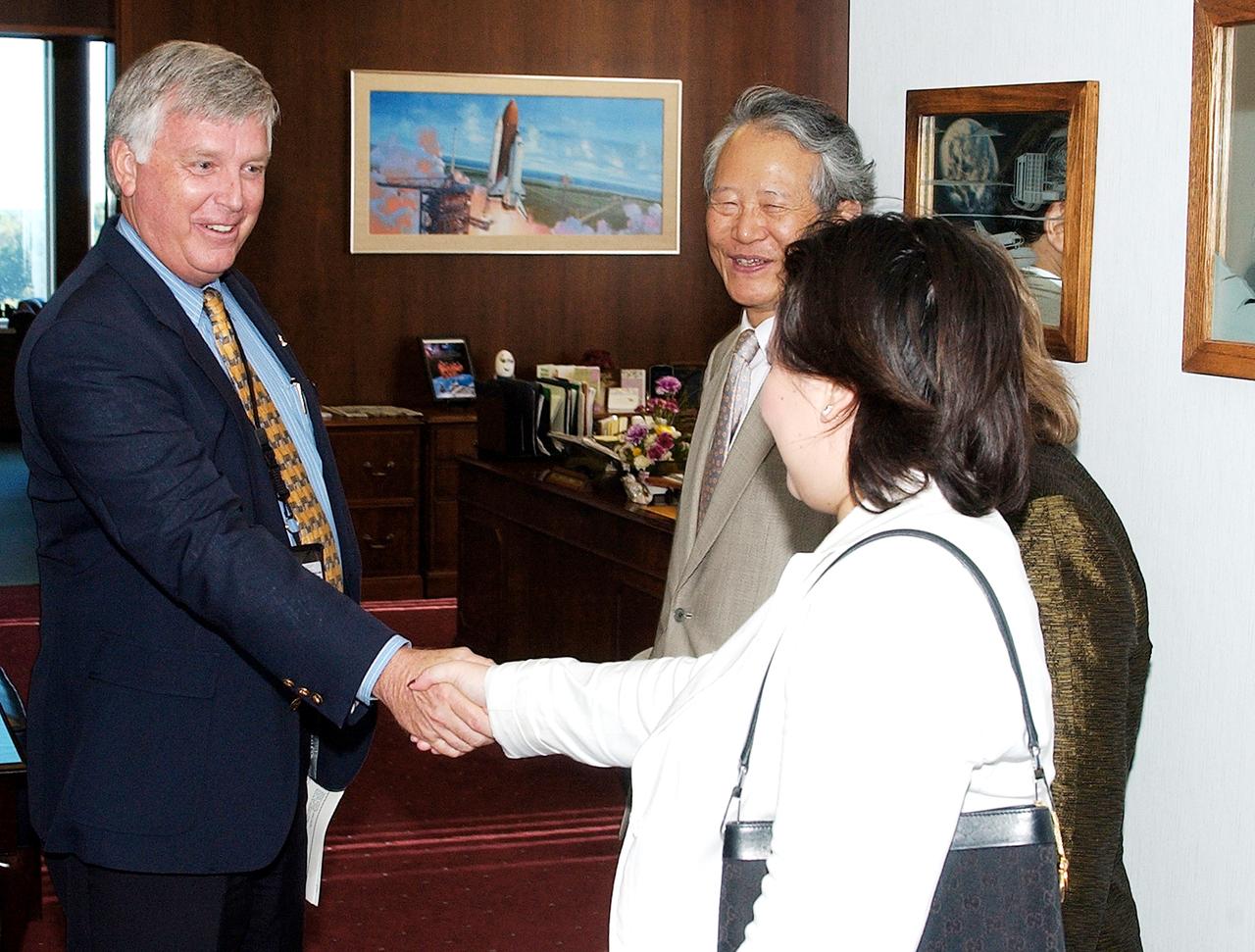
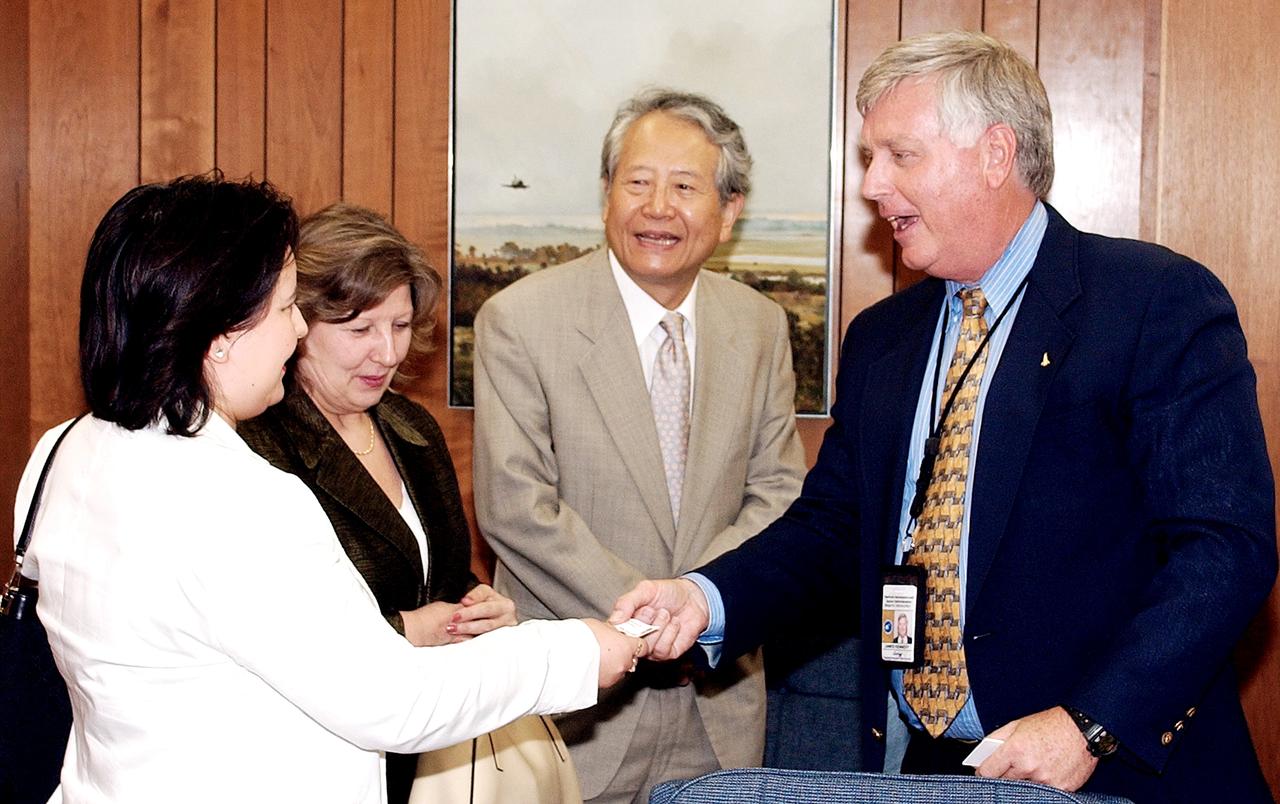
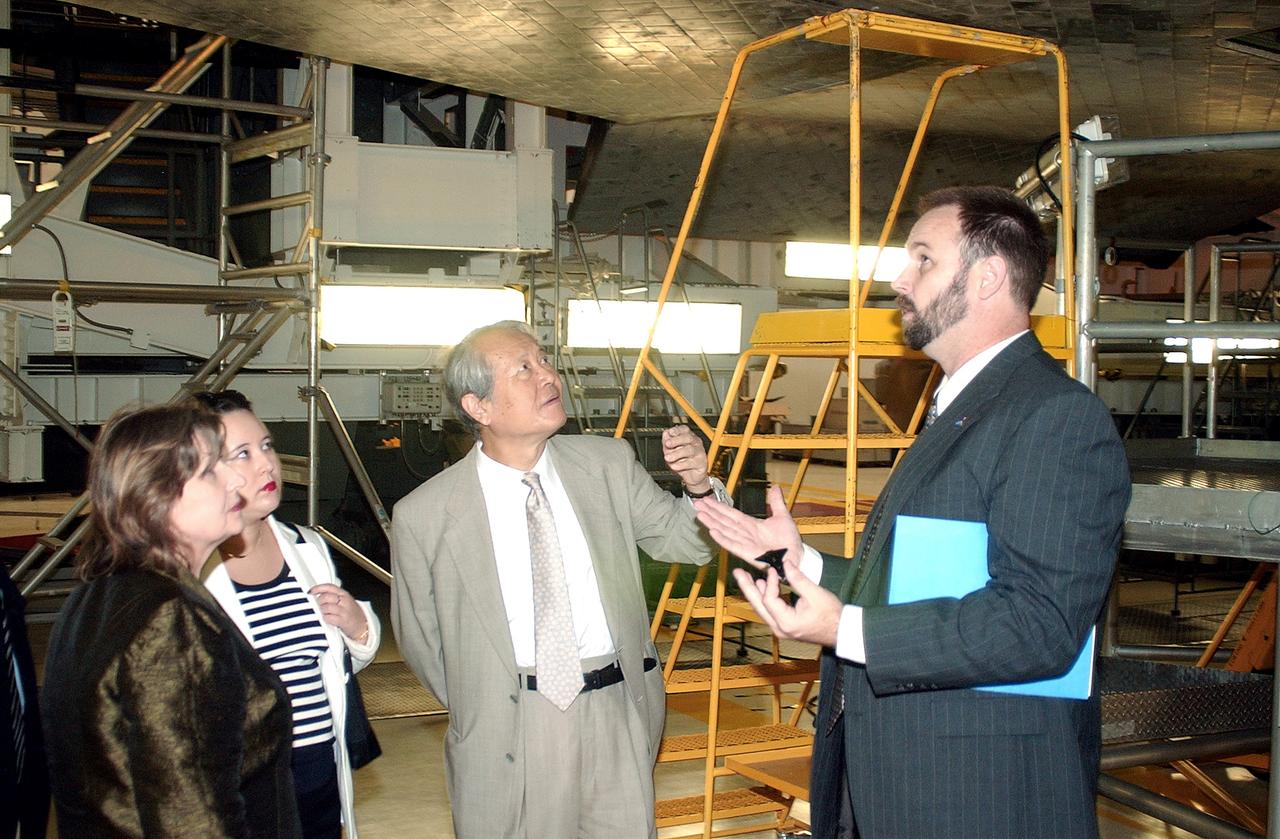
KENNEDY SPACE CENTER, FLA. - KSC Director James W. Kennedy receives Consul General of Japan Ko Kodaira and his family in his office in Headquarters Building during their visit to Kennedy Space Center (KSC).  From left are Kennedy, Kodaira, his wife Marie (partially hidden), and his daughter Reiko. Kodaira is touring the facilities at KSC at the invitation of the local office of the National Space Development Agency of Japan (NASDA) to acquaint him with KSC's unique processing capabilities.
KENNEDY SPACE CENTER, FLA. - KSC Director James W. Kennedy receives Consul General of Japan Ko Kodaira and his family in his office in Headquarters Building during their visit to Kennedy Space Center (KSC). From left are Kennedy, Kodaira, his wife Marie (partially hidden), and his daughter Reiko. Kodaira is touring the facilities at KSC at the invitation of the local office of the National Space Development Agency of Japan (NASDA) to acquaint him with KSC's unique processing capabilities.
KENNEDY SPACE CENTER, FLA. - KSC Director James W. Kennedy receives Consul General of Japan Ko Kodaira and his family in his office in Headquarters Building during their visit to Kennedy Space Center (KSC). From left are Kodaira's daughter Reiko, his wife Marie, Kodaira, and Kennedy. Kodaira is touring the facilities at KSC at the invitation of the local office of the National Space Development Agency of Japan (NASDA) to acquaint him with KSC's unique processing capabilities.
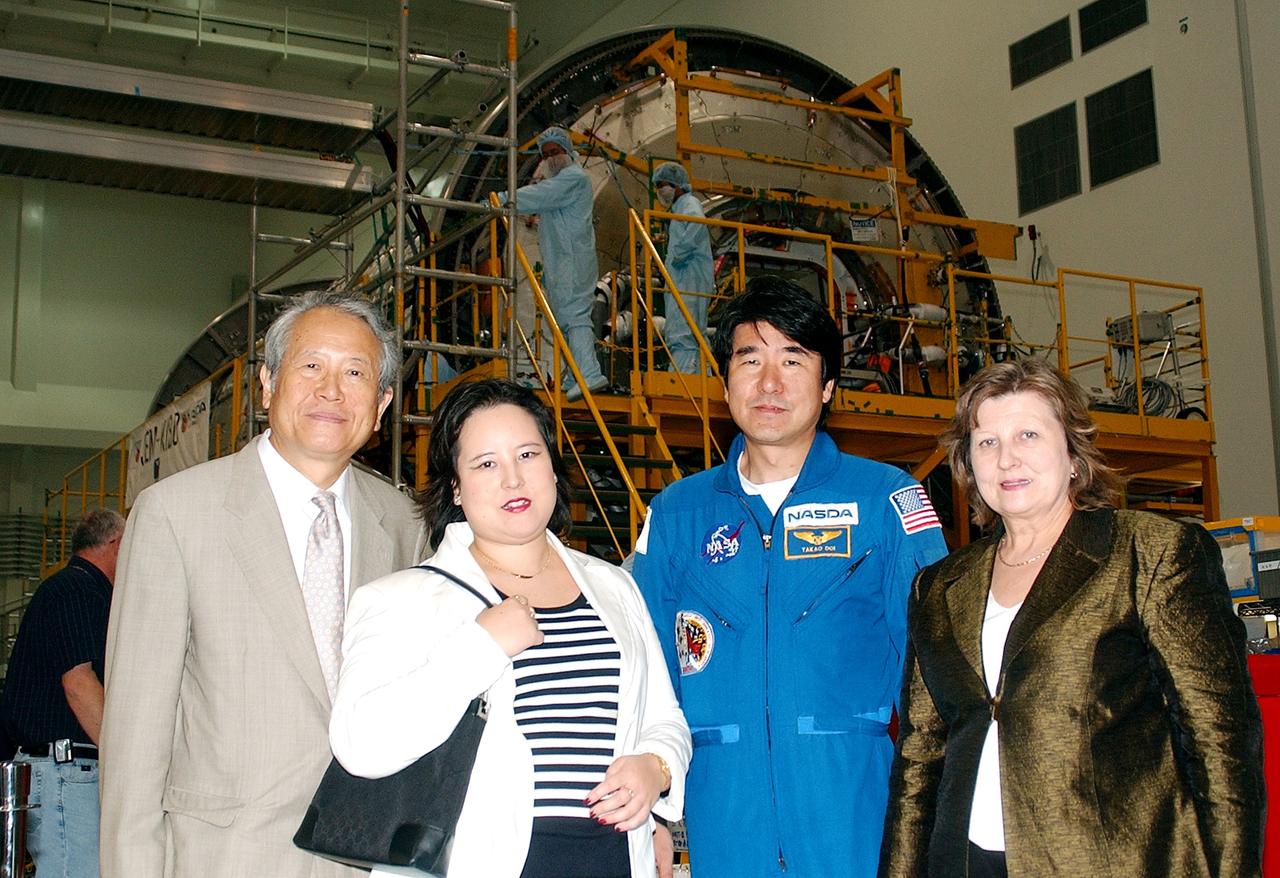
KENNEDY SPACE CENTER, FLA. - From left, the Consul General of Japan Ko Kodaira, his daughter Reiko, astronaut Dr. Takao Doi, and Kodaira's wife Marie pause for a photograph in the Space Station Processing Facility during their visit to Kennedy Space Center (KSC). Doi represented Japan on Space Shuttle mission STS-87, the fourth U.S Microgravity Payload flight.  Kodaira is touring the facilities at KSC at the invitation of the local office of the National Space Development Agency of Japan (NASDA) to acquaint him with KSC's unique processing capabilities.
KENNEDY SPACE CENTER, FLA. - From left, the Consul General of Japan Ko Kodaira, his daughter Reiko, astronaut Dr. Takao Doi, and Kodaira's wife Marie pause for a photograph in the Space Station Processing Facility during their visit to Kennedy Space Center (KSC). Doi represented Japan on Space Shuttle mission STS-87, the fourth U.S Microgravity Payload flight. Kodaira is touring the facilities at KSC at the invitation of the local office of the National Space Development Agency of Japan (NASDA) to acquaint him with KSC's unique processing capabilities.
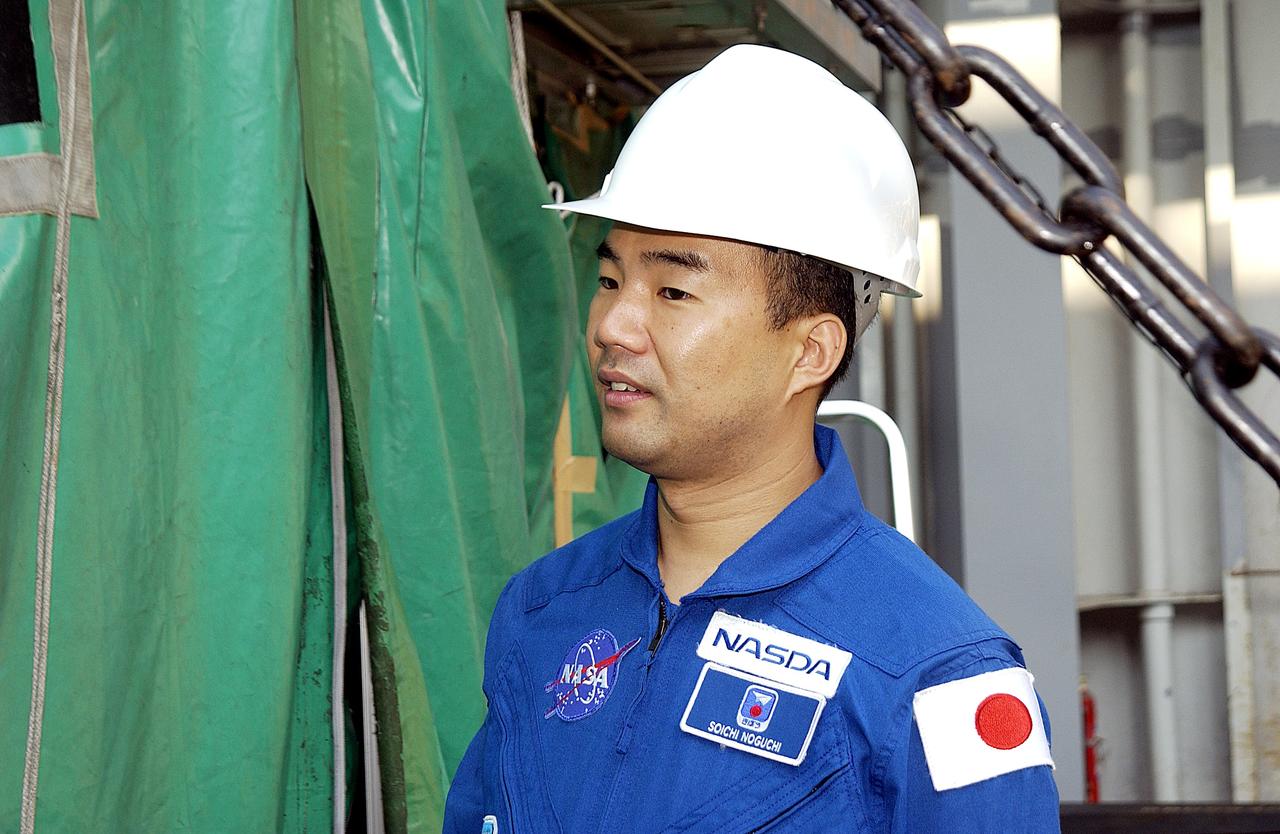
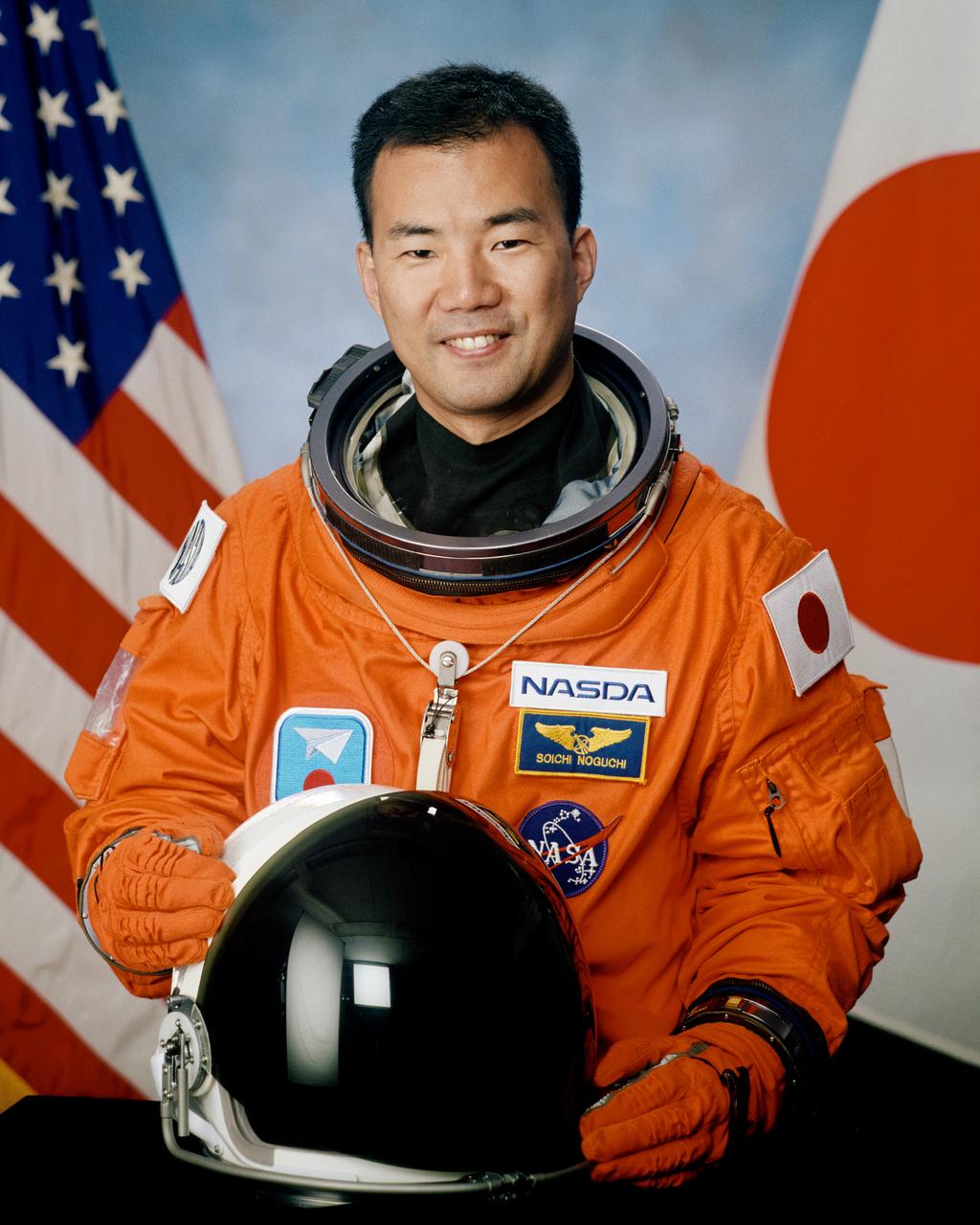
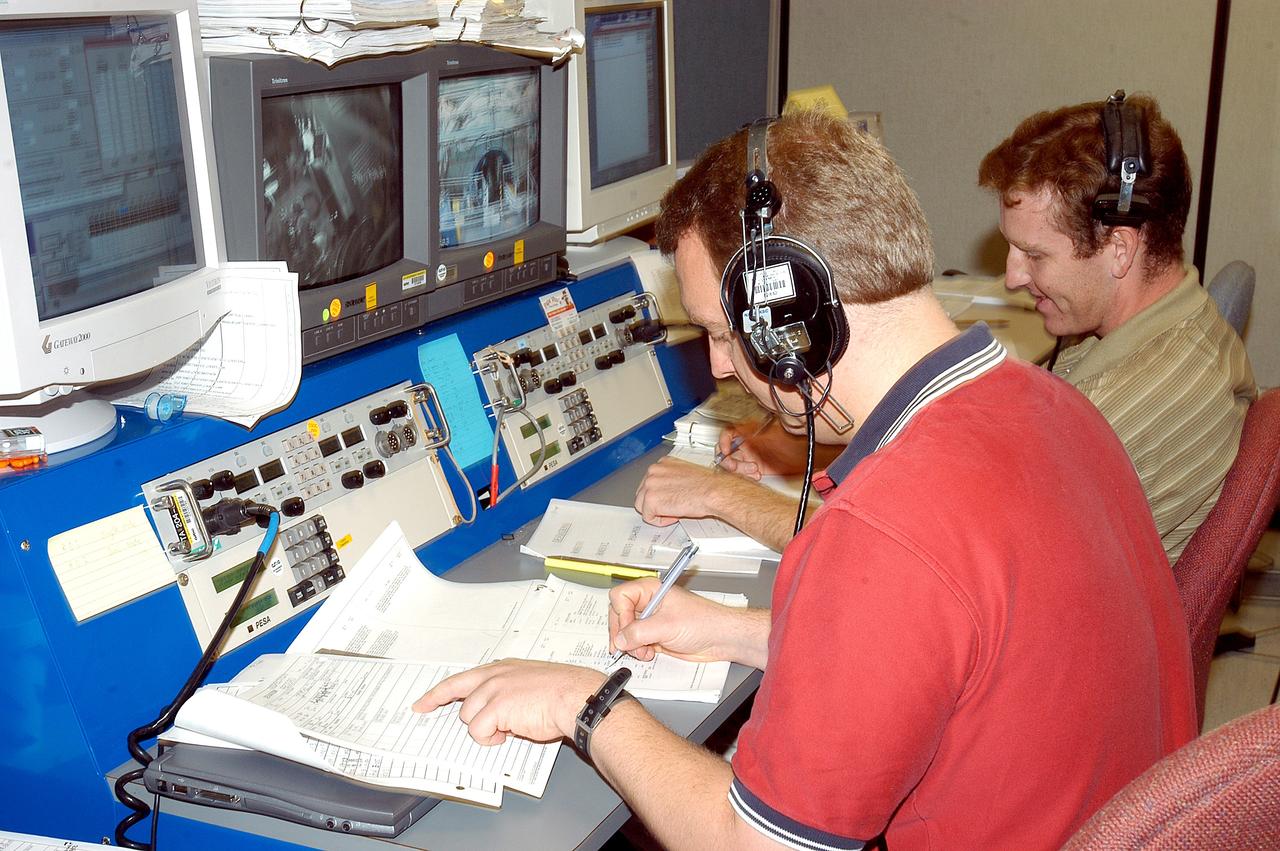
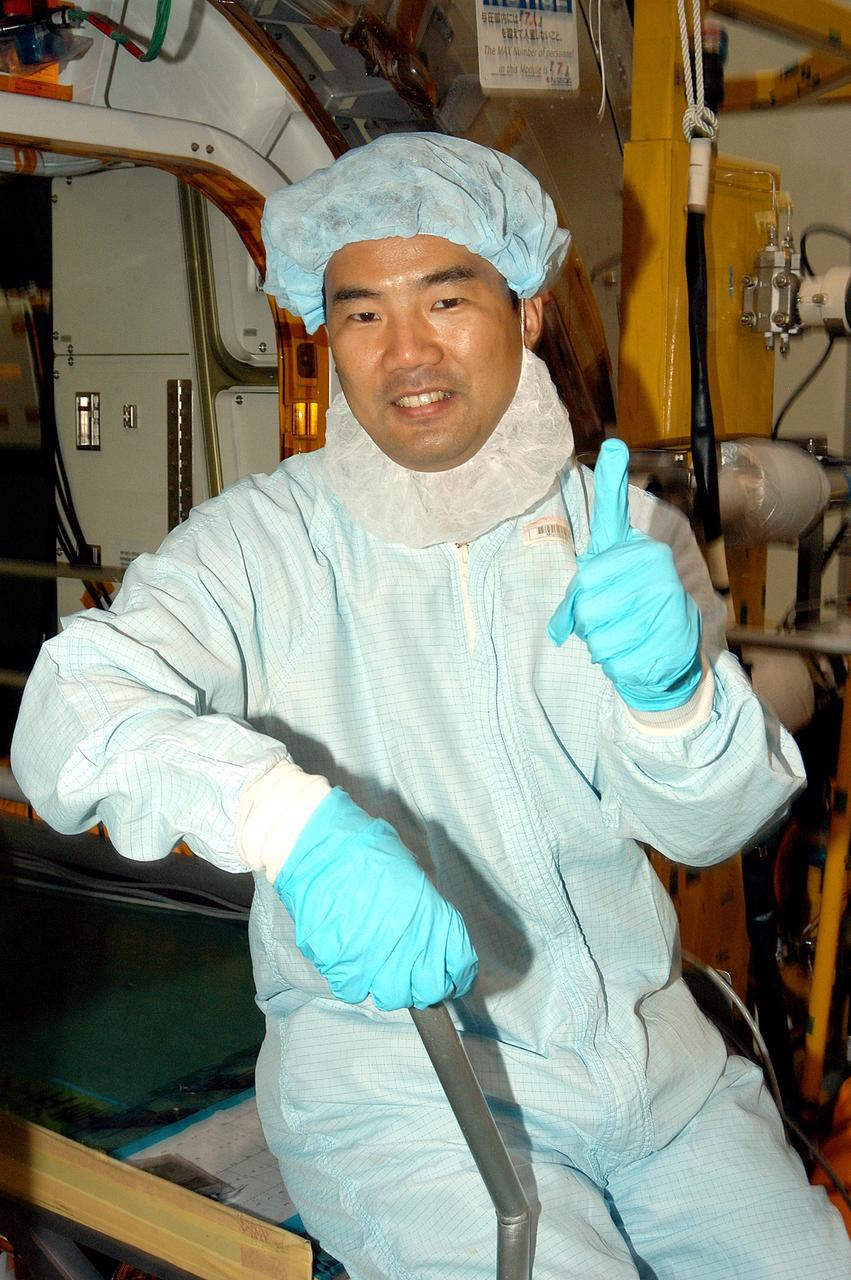
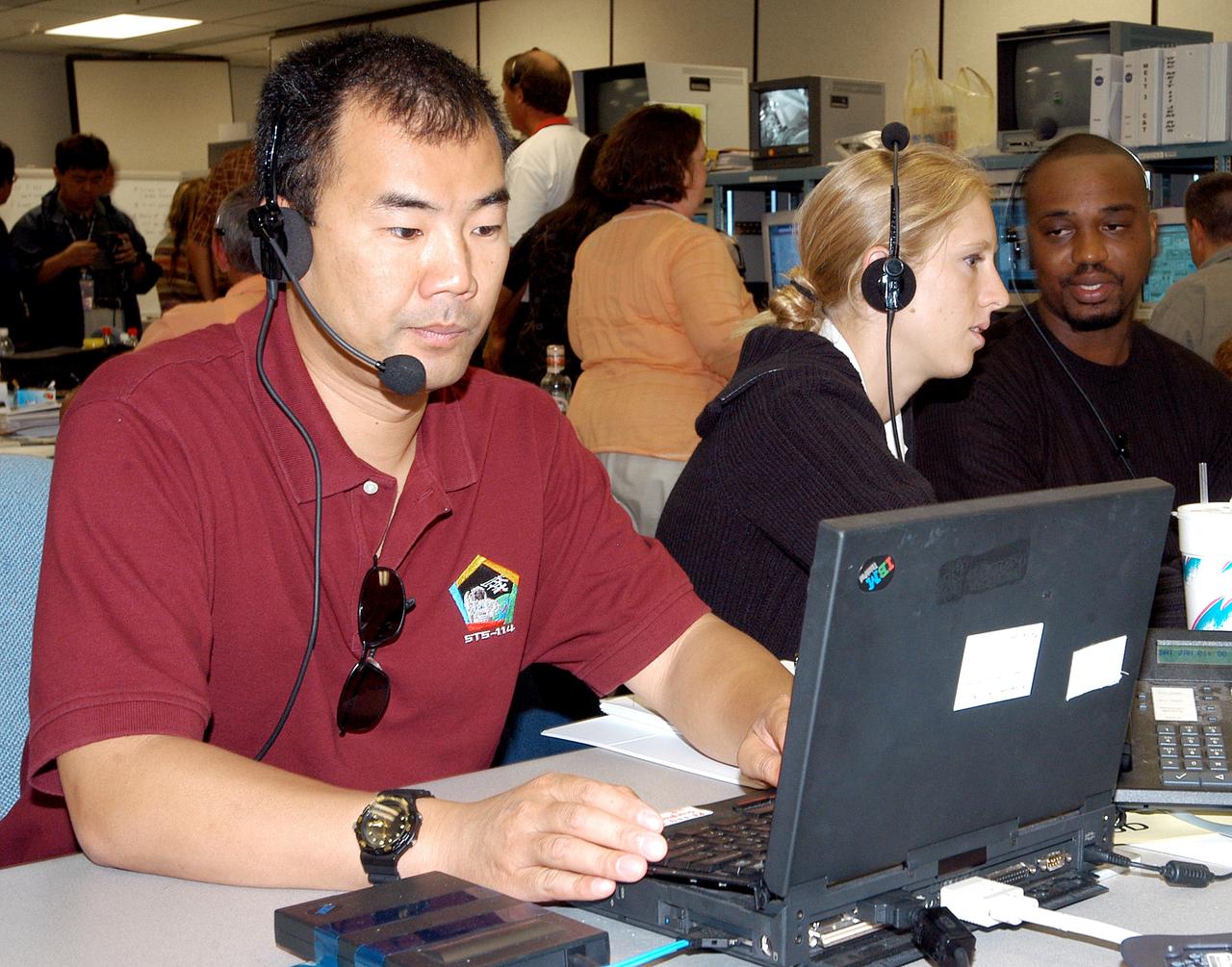
KENNEDY SPACE CENTER, FLA. -  Astronaut Soichi Noguchi (left), with the National Space Development Agency of Japan (NASDA), works at a console during a Multi-Element Integrated Test (MEIT) of the U.S. Node 2 and the Japanese Experiment Module (JEM) in the Space Station Processing Facility.  The JEM, developed by NASDA, is Japan's primary contribution to the Station. It will enhance the unique research capabilities of the orbiting complex by providing an additional environment for astronauts to conduct science experiments. Noguchi is assigned to mission STS-114 as a mission specialist.  Node 2 provides attach locations for the Japanese laboratory, as well as European laboratory, the Centrifuge Accommodation Module and, eventually, Multipurpose Logistics Modules.  Installation of the module will complete the U.S. Core of the ISS.
KENNEDY SPACE CENTER, FLA. - Astronaut Soichi Noguchi (left), with the National Space Development Agency of Japan (NASDA), works at a console during a Multi-Element Integrated Test (MEIT) of the U.S. Node 2 and the Japanese Experiment Module (JEM) in the Space Station Processing Facility. The JEM, developed by NASDA, is Japan's primary contribution to the Station. It will enhance the unique research capabilities of the orbiting complex by providing an additional environment for astronauts to conduct science experiments. Noguchi is assigned to mission STS-114 as a mission specialist. Node 2 provides attach locations for the Japanese laboratory, as well as European laboratory, the Centrifuge Accommodation Module and, eventually, Multipurpose Logistics Modules. Installation of the module will complete the U.S. Core of the ISS.
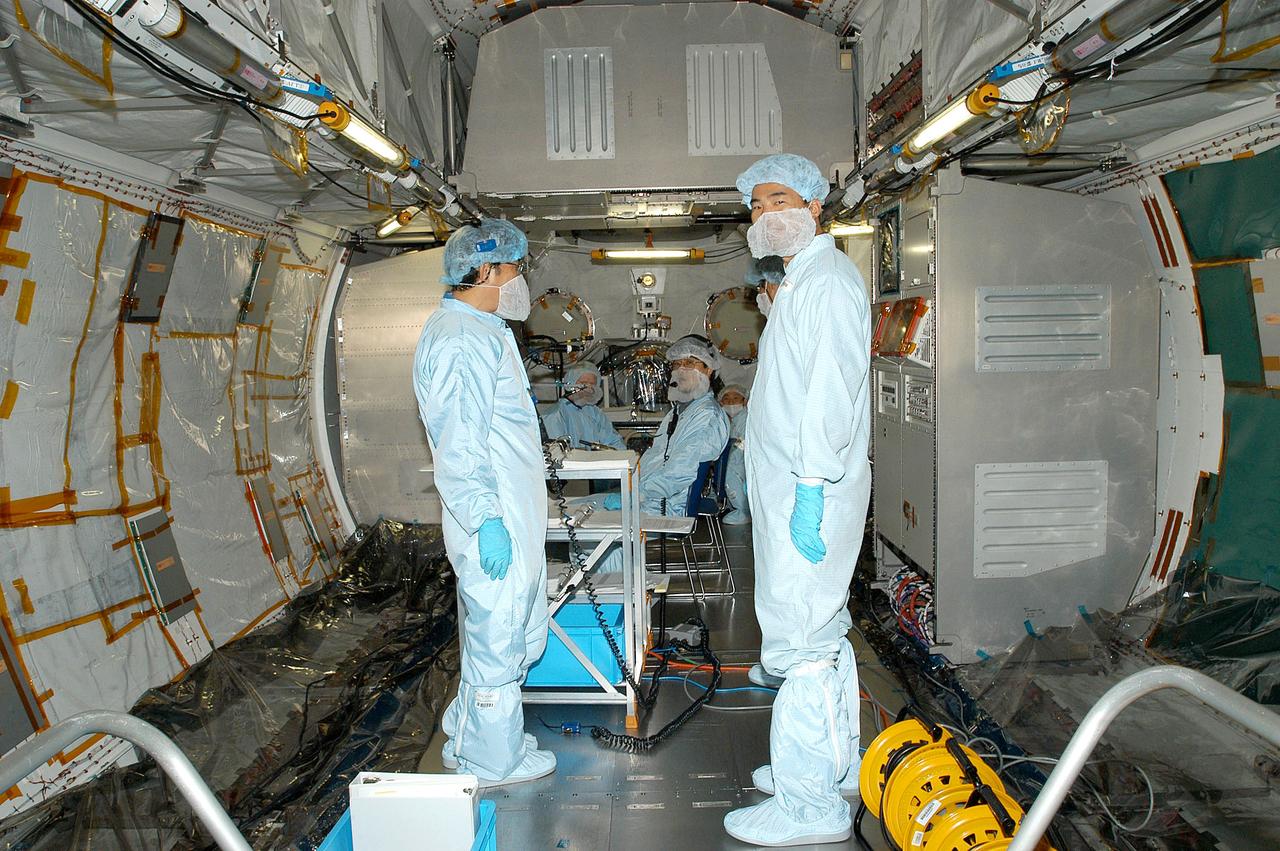
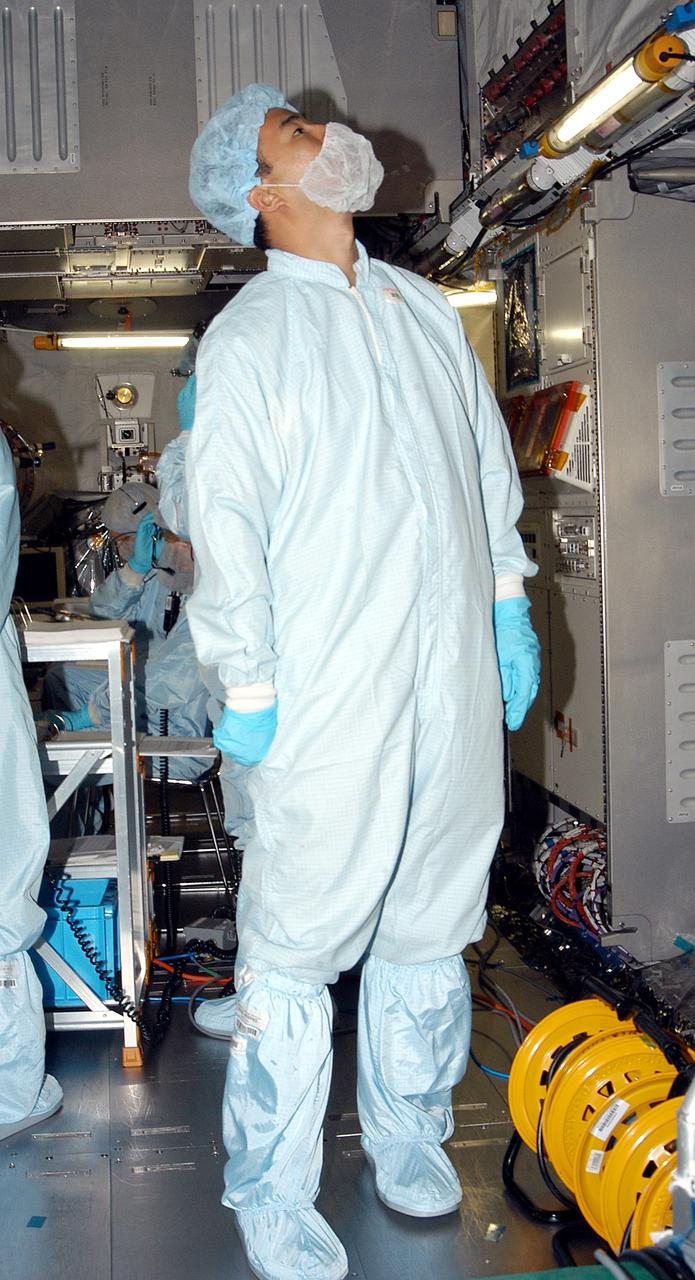
KENNEDY SPACE CENTER, FLA. -  In the Space Station Processing Facility, astronaut Soichi Noguchi (right), with the National Space Development Agency of Japan (NASDA), stands inside the Japanese Experiment Module (JEM) that is undergoing a Multi-Element Integrated Test (MEIT) with the U.S. Node 2.  The JEM, developed by NASDA, is Japan's primary contribution to the Station. It will enhance the unique research capabilities of the orbiting complex by providing an additional environment for astronauts to conduct science experiments. Noguchi is assigned to mission STS-114 as a mission specialist.  Node 2 provides attach locations for the Japanese laboratory, as well as European laboratory, the Centrifuge Accommodation Module and, eventually, Multipurpose Logistics Modules.  Installation of the module will complete the U.S. Core of the ISS.
KENNEDY SPACE CENTER, FLA. - In the Space Station Processing Facility, astronaut Soichi Noguchi (right), with the National Space Development Agency of Japan (NASDA), stands inside the Japanese Experiment Module (JEM) that is undergoing a Multi-Element Integrated Test (MEIT) with the U.S. Node 2. The JEM, developed by NASDA, is Japan's primary contribution to the Station. It will enhance the unique research capabilities of the orbiting complex by providing an additional environment for astronauts to conduct science experiments. Noguchi is assigned to mission STS-114 as a mission specialist. Node 2 provides attach locations for the Japanese laboratory, as well as European laboratory, the Centrifuge Accommodation Module and, eventually, Multipurpose Logistics Modules. Installation of the module will complete the U.S. Core of the ISS.
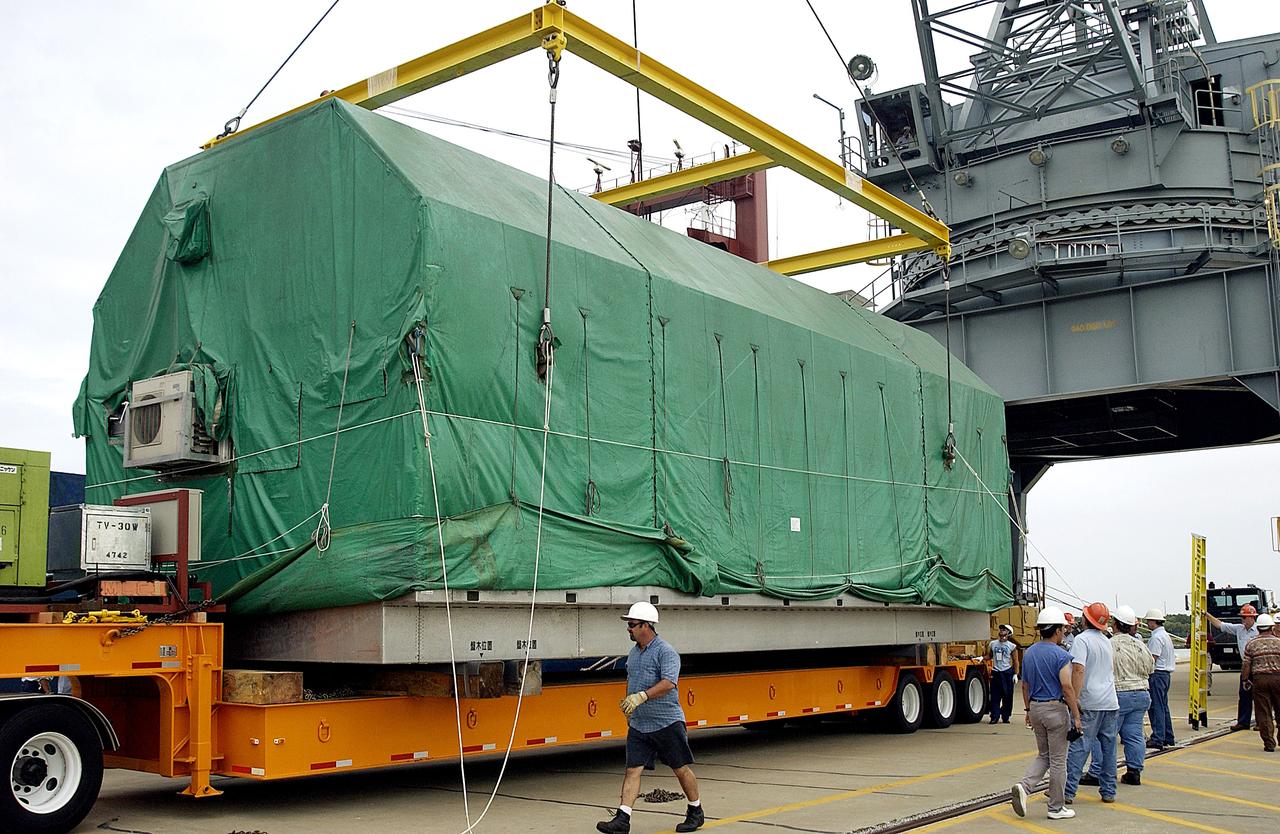
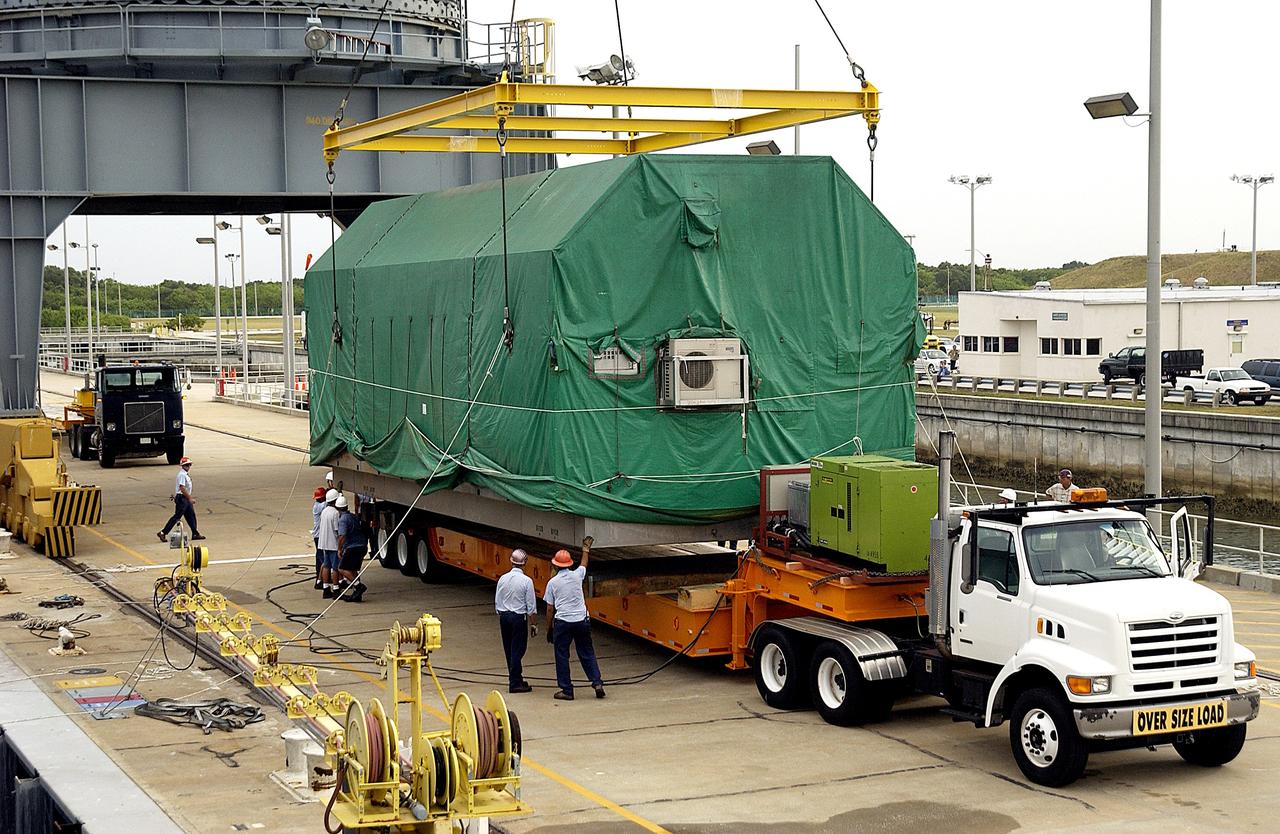
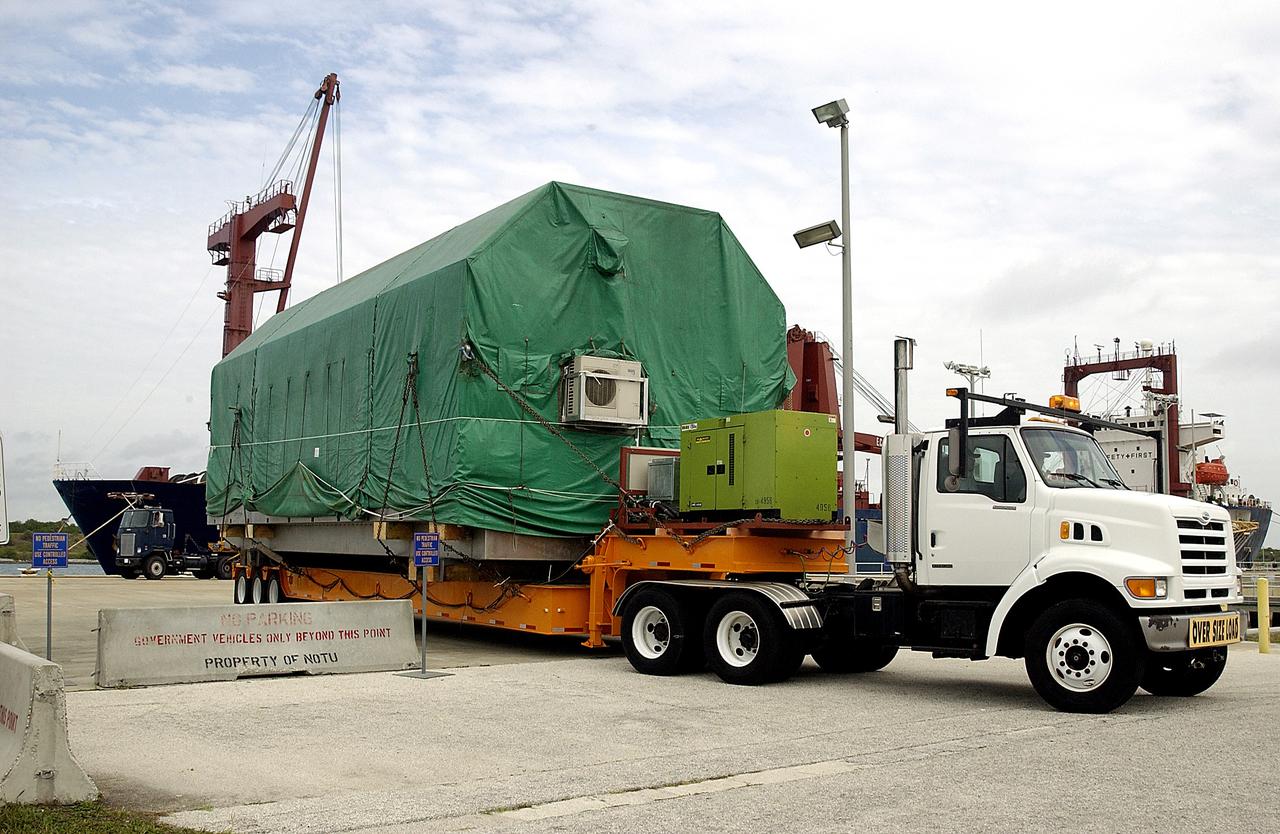
KENNEDY SPACE CENTER, FLA. - At Port Canaveral, the Pressurized Module of the Japanese Experiment Module (JEM) is lowered onto a truck bed for transfer to KSC’s Space Station Processing Facility.  The container transport ship carrying JEM departed May 2 from Yokohama Harbor in Japan for the voyage to the United States. The National Space Development Agency of Japan (NASDA) developed the laboratory at the Tsukuba Space Center near Tokyo. The Pressurized Module is the first element of the JEM, named "Kibo" (Hope), to be delivered to KSC. The JEM is Japan's primary contribution to the Station. It will enhance the unique research capabilities of the orbiting complex by providing an additional environment for astronauts to conduct science experiments.  The JEM also includes an exposed facility (platform) for space environment experiments, a robotic manipulator system, and two logistics modules. The various JEM components will be  assembled in space over the course of three Shuttle missions.
KENNEDY SPACE CENTER, FLA. - At Port Canaveral, the Pressurized Module of the Japanese Experiment Module (JEM) is lowered onto a truck bed for transfer to KSC’s Space Station Processing Facility. The container transport ship carrying JEM departed May 2 from Yokohama Harbor in Japan for the voyage to the United States. The National Space Development Agency of Japan (NASDA) developed the laboratory at the Tsukuba Space Center near Tokyo. The Pressurized Module is the first element of the JEM, named "Kibo" (Hope), to be delivered to KSC. The JEM is Japan's primary contribution to the Station. It will enhance the unique research capabilities of the orbiting complex by providing an additional environment for astronauts to conduct science experiments. The JEM also includes an exposed facility (platform) for space environment experiments, a robotic manipulator system, and two logistics modules. The various JEM components will be assembled in space over the course of three Shuttle missions.
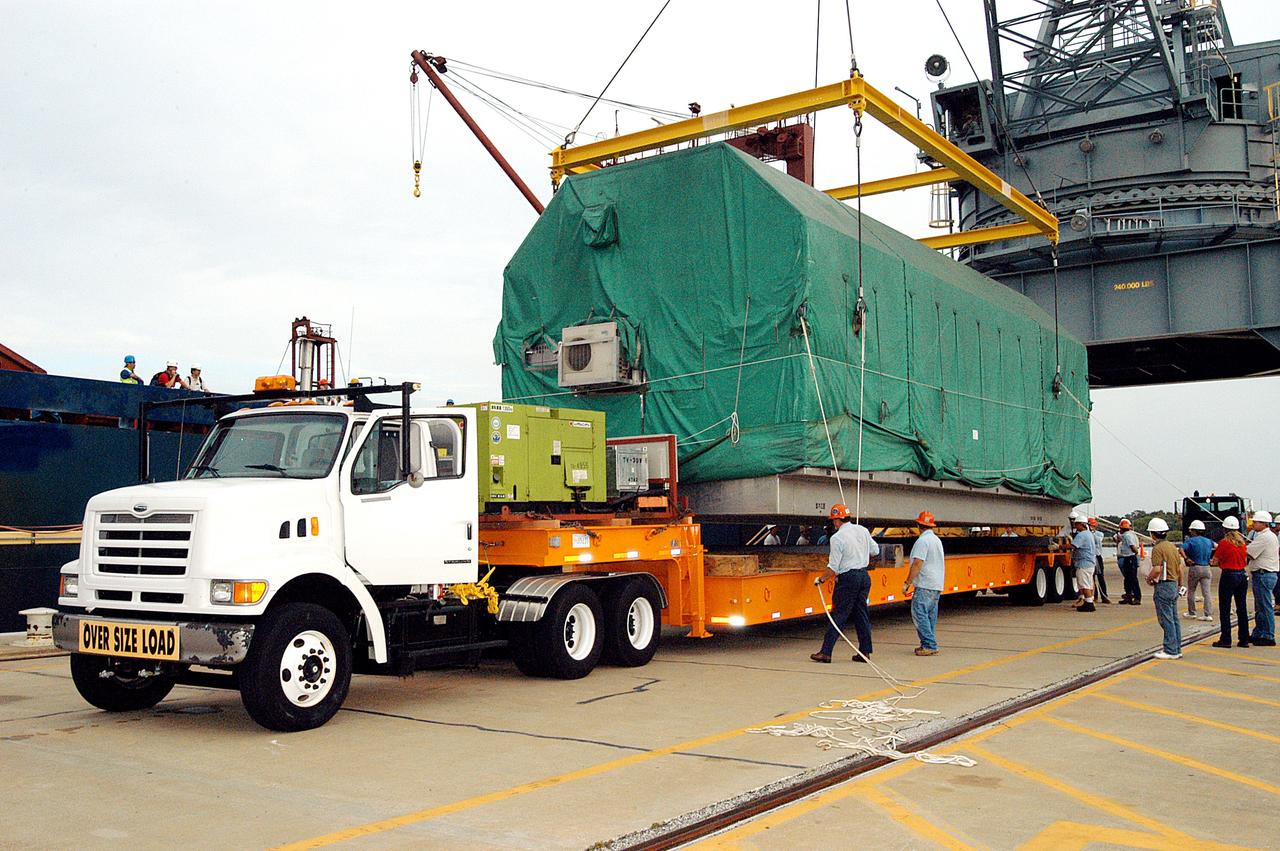
KENNEDY SPACE CENTER, FLA. - At Port Canaveral, workers release the overhead crane that lifted the Pressurized Module of the Japanese Experiment Module (JEM) from the ship onto the truck bed.  The container transport ship carrying JEM departed May 2 from Yokohama Harbor in Japan for the voyage to the United States. The National Space Development Agency of Japan (NASDA) developed the laboratory at the Tsukuba Space Center near Tokyo. The Pressurized Module is the first element of the JEM, named "Kibo" (Hope), to be delivered to KSC, and will be transferred to KSC’s Space Station Processing Facility.  The JEM is Japan's primary contribution to the Station. It will enhance the unique research capabilities of the orbiting complex by providing an additional environment for astronauts to conduct science experiments.  The JEM also includes an exposed facility (platform) for space environment experiments, a robotic manipulator system, and two logistics modules. The various JEM components will be  assembled in space over the course of three Shuttle missions.
KENNEDY SPACE CENTER, FLA. - At Port Canaveral, workers release the overhead crane that lifted the Pressurized Module of the Japanese Experiment Module (JEM) from the ship onto the truck bed. The container transport ship carrying JEM departed May 2 from Yokohama Harbor in Japan for the voyage to the United States. The National Space Development Agency of Japan (NASDA) developed the laboratory at the Tsukuba Space Center near Tokyo. The Pressurized Module is the first element of the JEM, named "Kibo" (Hope), to be delivered to KSC, and will be transferred to KSC’s Space Station Processing Facility. The JEM is Japan's primary contribution to the Station. It will enhance the unique research capabilities of the orbiting complex by providing an additional environment for astronauts to conduct science experiments. The JEM also includes an exposed facility (platform) for space environment experiments, a robotic manipulator system, and two logistics modules. The various JEM components will be assembled in space over the course of three Shuttle missions.
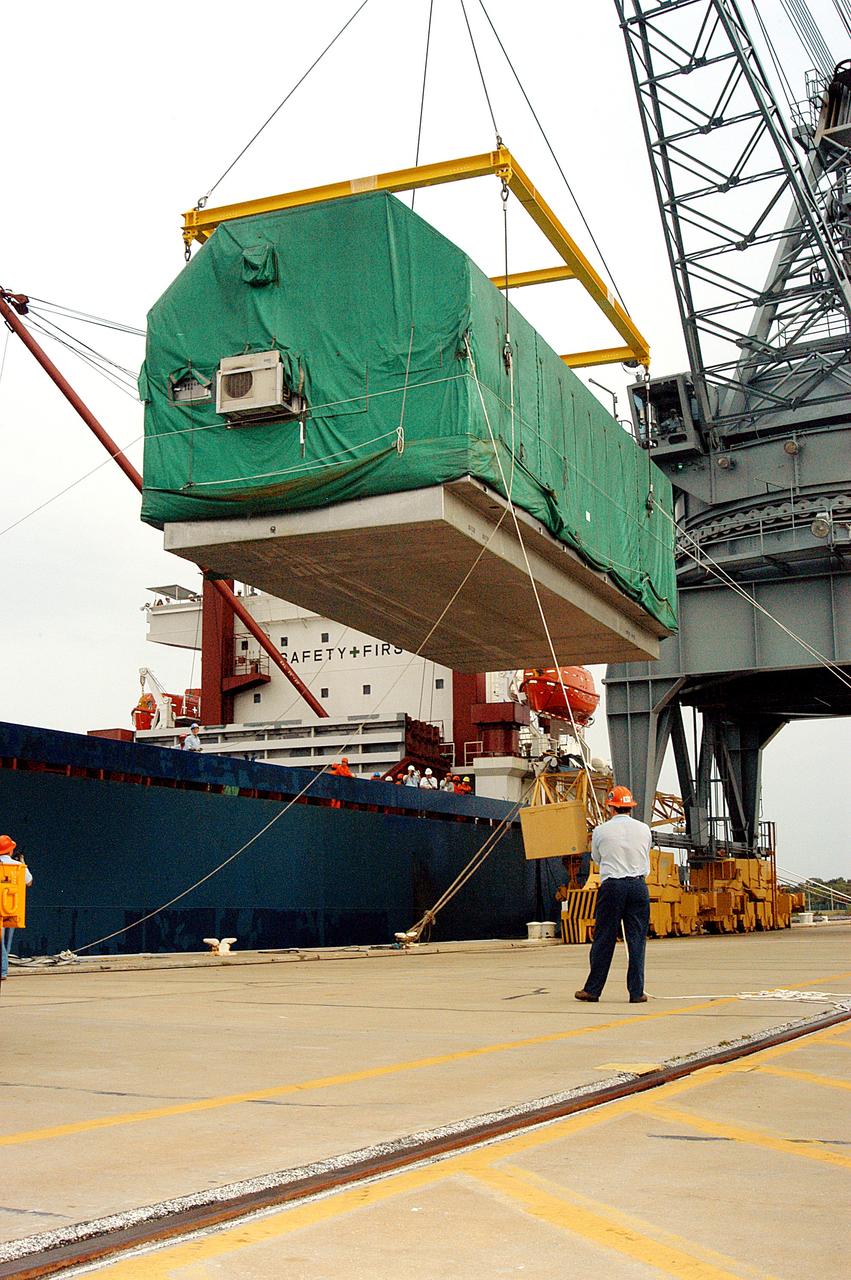
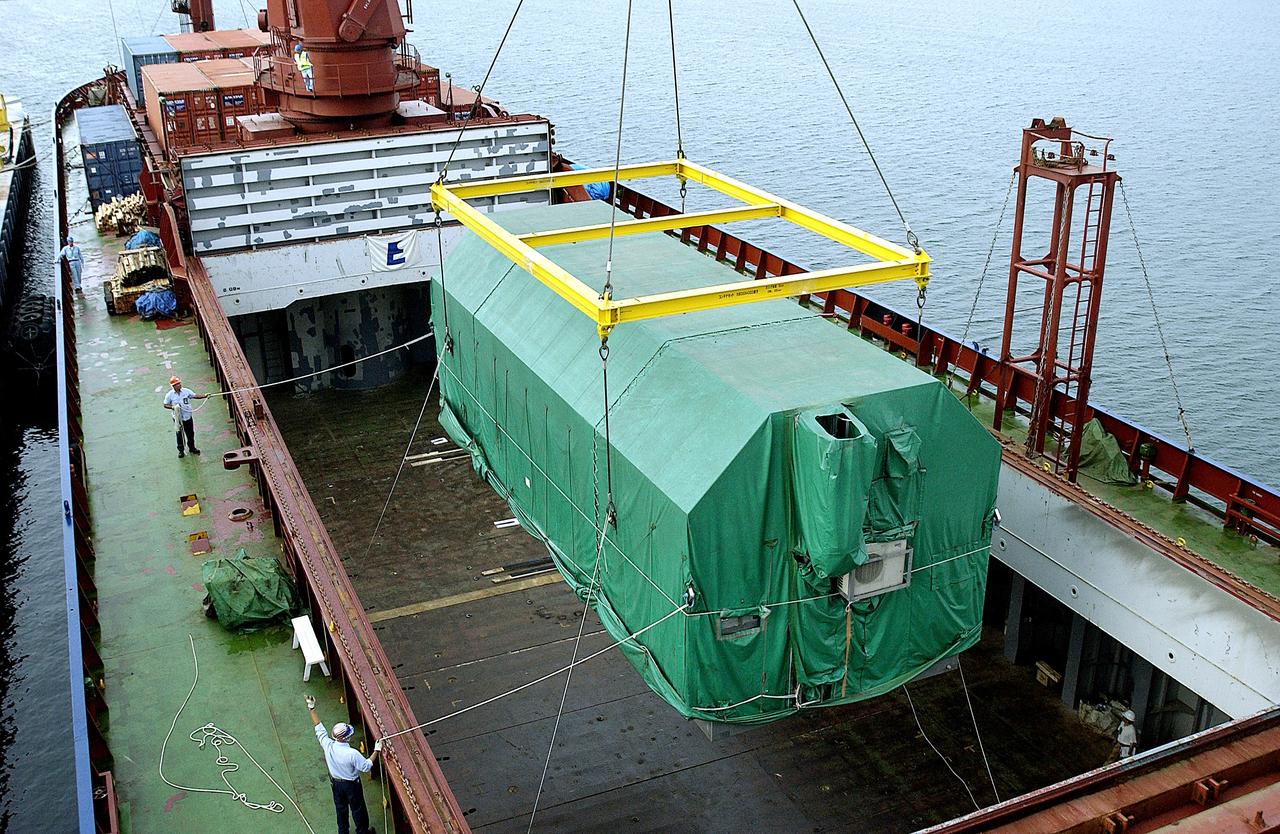
KENNEDY SPACE CENTER, FLA. - At Port Canaveral, the Pressurized Module of the Japanese Experiment Module (JEM) is lifted out of the ship’s cargo hold.  It will be loaded onto the truck bed in the background for transfer to KSC’s Space Station Processing Facility.  The container transport ship carrying JEM departed May 2 from Yokohama Harbor in Japan for the voyage to the United States. The National Space Development Agency of Japan (NASDA) developed the laboratory at the Tsukuba Space Center near Tokyo. The Pressurized Module is the first element of the JEM, named "Kibo" (Hope), to be delivered to KSC. The JEM is Japan's primary contribution to the Station. It will enhance the unique research capabilities of the orbiting complex by providing an additional environment for astronauts to conduct science experiments.  The JEM also includes an exposed facility (platform) for space environment experiments, a robotic manipulator system, and two logistics modules. The various JEM components will be  assembled in space over the course of three Shuttle missions.
KENNEDY SPACE CENTER, FLA. - At Port Canaveral, the Pressurized Module of the Japanese Experiment Module (JEM) is lifted out of the ship’s cargo hold. It will be loaded onto the truck bed in the background for transfer to KSC’s Space Station Processing Facility. The container transport ship carrying JEM departed May 2 from Yokohama Harbor in Japan for the voyage to the United States. The National Space Development Agency of Japan (NASDA) developed the laboratory at the Tsukuba Space Center near Tokyo. The Pressurized Module is the first element of the JEM, named "Kibo" (Hope), to be delivered to KSC. The JEM is Japan's primary contribution to the Station. It will enhance the unique research capabilities of the orbiting complex by providing an additional environment for astronauts to conduct science experiments. The JEM also includes an exposed facility (platform) for space environment experiments, a robotic manipulator system, and two logistics modules. The various JEM components will be assembled in space over the course of three Shuttle missions.
KENNEDY SPACE CENTER, FLA. - At Port Canaveral, the overhead crane that lifted the Pressurized Module of the Japanese Experiment Module (JEM) from the ship onto the truck bed is released.  The container transport ship carrying JEM departed May 2 from Yokohama Harbor in Japan for the voyage to the United States. The National Space Development Agency of Japan (NASDA) developed the laboratory at the Tsukuba Space Center near Tokyo. The Pressurized Module is the first element of the JEM, named "Kibo" (Hope), to be delivered to KSC, and will be transferred to KSC’s Space Station Processing Facility.  The JEM is Japan's primary contribution to the Station. It will enhance the unique research capabilities of the orbiting complex by providing an additional environment for astronauts to conduct science experiments.  The JEM also includes an exposed facility (platform) for space environment experiments, a robotic manipulator system, and two logistics modules. The various JEM components will be  assembled in space over the course of three Shuttle missions.
KENNEDY SPACE CENTER, FLA. - At Port Canaveral, the overhead crane that lifted the Pressurized Module of the Japanese Experiment Module (JEM) from the ship onto the truck bed is released. The container transport ship carrying JEM departed May 2 from Yokohama Harbor in Japan for the voyage to the United States. The National Space Development Agency of Japan (NASDA) developed the laboratory at the Tsukuba Space Center near Tokyo. The Pressurized Module is the first element of the JEM, named "Kibo" (Hope), to be delivered to KSC, and will be transferred to KSC’s Space Station Processing Facility. The JEM is Japan's primary contribution to the Station. It will enhance the unique research capabilities of the orbiting complex by providing an additional environment for astronauts to conduct science experiments. The JEM also includes an exposed facility (platform) for space environment experiments, a robotic manipulator system, and two logistics modules. The various JEM components will be assembled in space over the course of three Shuttle missions.
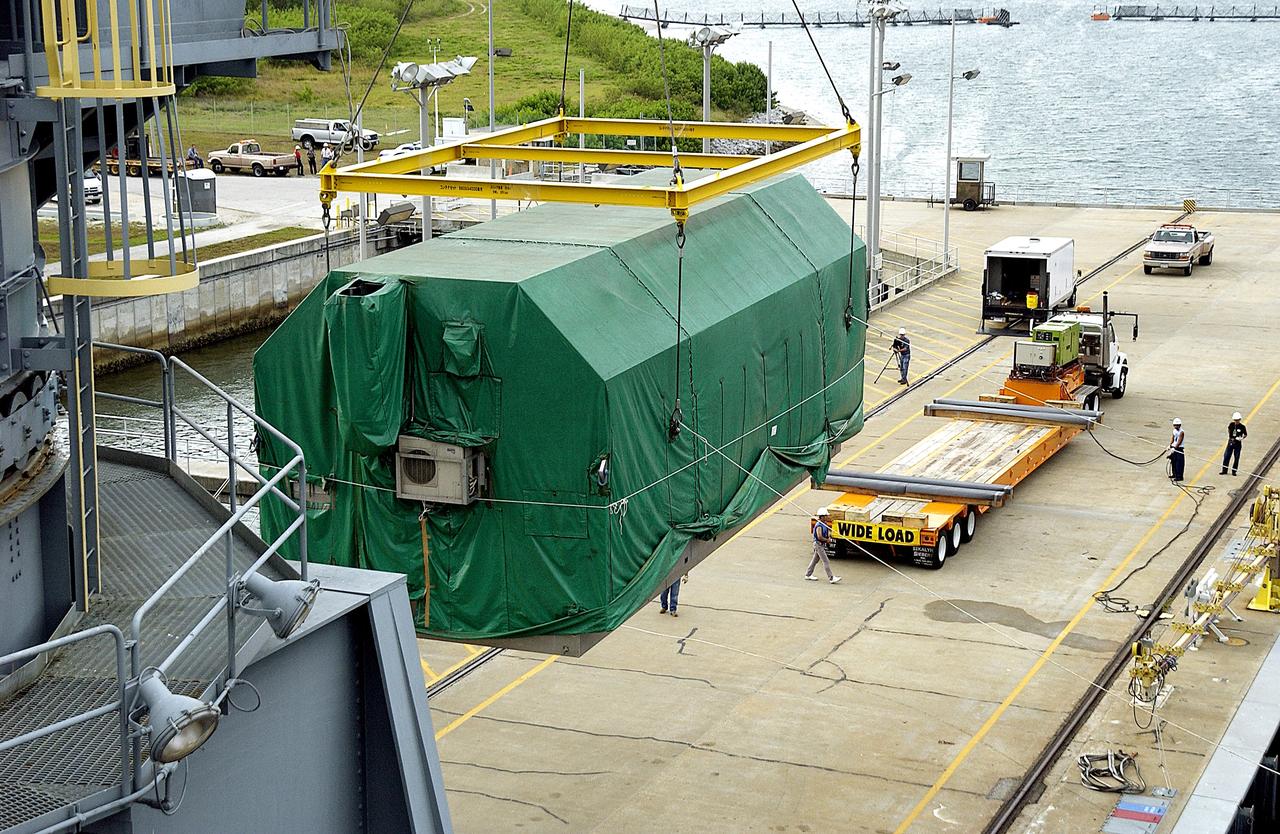
KENNEDY SPACE CENTER, FLA. - At Port Canaveral, the Pressurized Module of the Japanese Experiment Module (JEM) is suspended over the dock, waiting for a truck that will transfer it to KSC’s Space Station Processing Facility. The container transport ship carrying JEM departed May 2 from Yokohama Harbor in Japan for the voyage to the United States. The National Space Development Agency of Japan (NASDA) developed the laboratory at the Tsukuba Space Center near Tokyo.  The Pressurized Module is the first element of the JEM, named "Kibo" (Hope), to be delivered to KSC. The JEM is Japan's primary contribution to the Station. It will enhance the unique research capabilities of the orbiting complex by providing an additional environment for astronauts to conduct science experiments.  The JEM also includes an exposed facility (platform) for space environment experiments, a robotic manipulator system, and two logistics modules. The various JEM components will be  assembled in space over the course of three Shuttle missions.
KENNEDY SPACE CENTER, FLA. - At Port Canaveral, the Pressurized Module of the Japanese Experiment Module (JEM) is suspended over the dock, waiting for a truck that will transfer it to KSC’s Space Station Processing Facility. The container transport ship carrying JEM departed May 2 from Yokohama Harbor in Japan for the voyage to the United States. The National Space Development Agency of Japan (NASDA) developed the laboratory at the Tsukuba Space Center near Tokyo. The Pressurized Module is the first element of the JEM, named "Kibo" (Hope), to be delivered to KSC. The JEM is Japan's primary contribution to the Station. It will enhance the unique research capabilities of the orbiting complex by providing an additional environment for astronauts to conduct science experiments. The JEM also includes an exposed facility (platform) for space environment experiments, a robotic manipulator system, and two logistics modules. The various JEM components will be assembled in space over the course of three Shuttle missions.
KENNEDY SPACE CENTER, FLA. - At Port Canaveral, the Pressurized Module of the Japanese Experiment Module (JEM) is swung away from the ship. The container transport ship carrying JEM departed May 2 from Yokohama Harbor in Japan for the voyage to the United States. The National Space Development Agency of Japan (NASDA) developed the laboratory at the Tsukuba Space Center near Tokyo.  The module will be loaded onto a truck bed and transferred to KSC’s Space Station Processing Facility.  The Pressurized Module is the first element of the JEM, named "Kibo" (Hope), to be delivered to KSC. The JEM is Japan's primary contribution to the Station. It will enhance the unique research capabilities of the orbiting complex by providing an additional environment for astronauts to conduct science experiments.  The JEM also includes an exposed facility (platform) for space environment experiments, a robotic manipulator system, and two logistics modules. The various JEM components will be  assembled in space over the course of three Shuttle missions.
KENNEDY SPACE CENTER, FLA. - At Port Canaveral, the Pressurized Module of the Japanese Experiment Module (JEM) is swung away from the ship. The container transport ship carrying JEM departed May 2 from Yokohama Harbor in Japan for the voyage to the United States. The National Space Development Agency of Japan (NASDA) developed the laboratory at the Tsukuba Space Center near Tokyo. The module will be loaded onto a truck bed and transferred to KSC’s Space Station Processing Facility. The Pressurized Module is the first element of the JEM, named "Kibo" (Hope), to be delivered to KSC. The JEM is Japan's primary contribution to the Station. It will enhance the unique research capabilities of the orbiting complex by providing an additional environment for astronauts to conduct science experiments. The JEM also includes an exposed facility (platform) for space environment experiments, a robotic manipulator system, and two logistics modules. The various JEM components will be assembled in space over the course of three Shuttle missions.
KENNEDY SPACE CENTER, FLA. -  At Port Canaveral, the Pressurized Module of the Japanese Experiment Module (JEM) is lowered onto a truck bed.  The container transport ship carrying JEM departed May 2 from Yokohama Harbor in Japan for the voyage to the United States. The National Space Development Agency of Japan (NASDA) developed the laboratory at the Tsukuba Space Center near Tokyo. The Pressurized Module is the first element of the JEM, named "Kibo" (Hope), to be delivered to KSC and will be transferred to the Space Station Processing Facility. The JEM is Japan's primary contribution to the Station. It will enhance the unique research capabilities of the orbiting complex by providing an additional environment for astronauts to conduct science experiments.  The JEM also includes an exposed facility (platform) for space environment experiments, a robotic manipulator system, and two logistics modules. The various JEM components will be  assembled in space over the course of three Shuttle missions.
KENNEDY SPACE CENTER, FLA. - At Port Canaveral, the Pressurized Module of the Japanese Experiment Module (JEM) is lowered onto a truck bed. The container transport ship carrying JEM departed May 2 from Yokohama Harbor in Japan for the voyage to the United States. The National Space Development Agency of Japan (NASDA) developed the laboratory at the Tsukuba Space Center near Tokyo. The Pressurized Module is the first element of the JEM, named "Kibo" (Hope), to be delivered to KSC and will be transferred to the Space Station Processing Facility. The JEM is Japan's primary contribution to the Station. It will enhance the unique research capabilities of the orbiting complex by providing an additional environment for astronauts to conduct science experiments. The JEM also includes an exposed facility (platform) for space environment experiments, a robotic manipulator system, and two logistics modules. The various JEM components will be assembled in space over the course of three Shuttle missions.
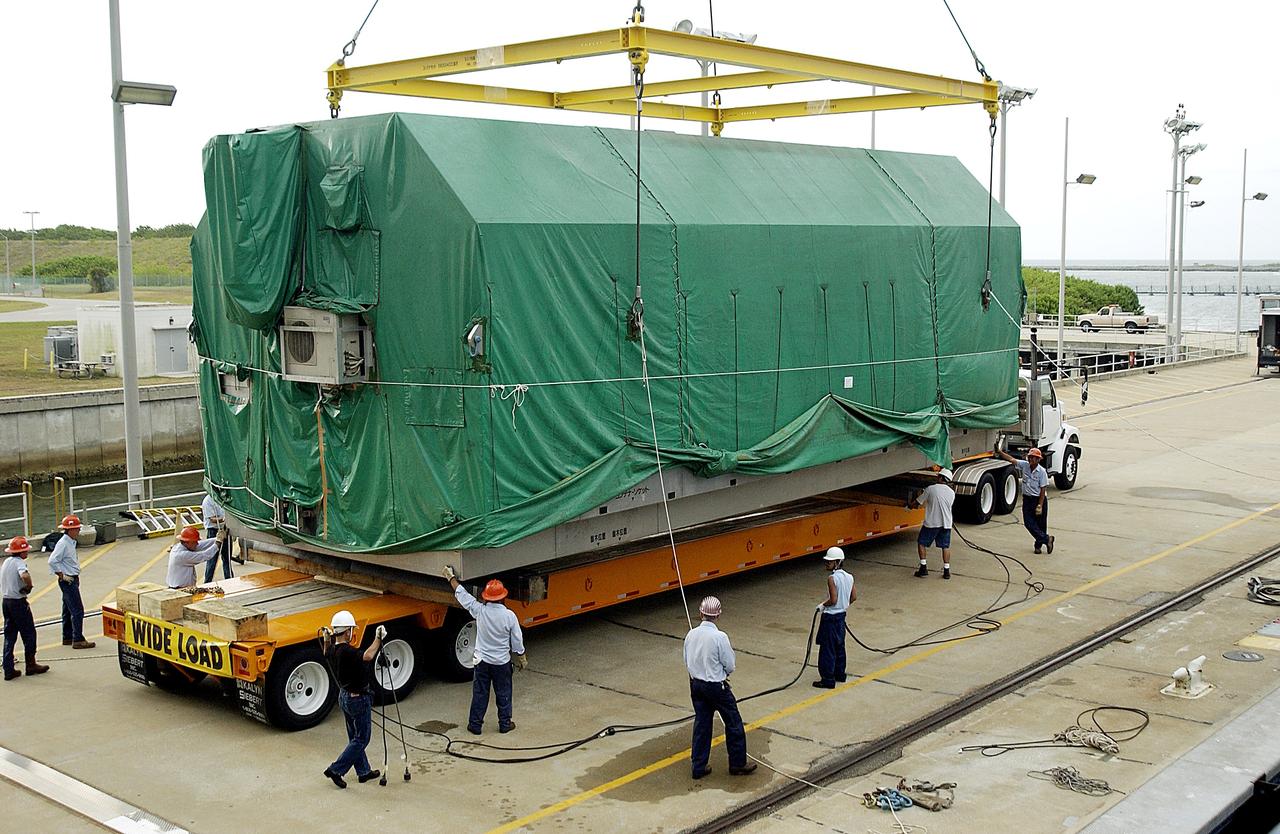
KENNEDY SPACE CENTER, FLA. - At Port Canaveral, the Pressurized Module of the Japanese Experiment Module (JEM) is settled on a truck bed for transfer to KSC’s Space Station Processing Facility.  The container transport ship carrying JEM departed May 2 from Yokohama Harbor in Japan for the voyage to the United States. The National Space Development Agency of Japan (NASDA) developed the laboratory at the Tsukuba Space Center near Tokyo. The Pressurized Module is the first element of the JEM, named "Kibo" (Hope), to be delivered to KSC. The JEM is Japan's primary contribution to the Station. It will enhance the unique research capabilities of the orbiting complex by providing an additional environment for astronauts to conduct science experiments.  The JEM also includes an exposed facility (platform) for space environment experiments, a robotic manipulator system, and two logistics modules. The various JEM components will be  assembled in space over the course of three Shuttle missions.
KENNEDY SPACE CENTER, FLA. - At Port Canaveral, the Pressurized Module of the Japanese Experiment Module (JEM) is settled on a truck bed for transfer to KSC’s Space Station Processing Facility. The container transport ship carrying JEM departed May 2 from Yokohama Harbor in Japan for the voyage to the United States. The National Space Development Agency of Japan (NASDA) developed the laboratory at the Tsukuba Space Center near Tokyo. The Pressurized Module is the first element of the JEM, named "Kibo" (Hope), to be delivered to KSC. The JEM is Japan's primary contribution to the Station. It will enhance the unique research capabilities of the orbiting complex by providing an additional environment for astronauts to conduct science experiments. The JEM also includes an exposed facility (platform) for space environment experiments, a robotic manipulator system, and two logistics modules. The various JEM components will be assembled in space over the course of three Shuttle missions.
KENNEDY SPACE CENTER, FLA. - At Port Canaveral, the Pressurized Module of the Japanese Experiment Module (JEM) is lifted out of the ship’s cargo hold.  The container transport ship carrying JEM departed May 2 from Yokohama Harbor in Japan for the voyage to the United States. The National Space Development Agency of Japan (NASDA) developed the laboratory at the Tsukuba Space Center near Tokyo. The Pressurized Module is the first element of the JEM, named "Kibo" (Hope), to be delivered to KSC. The JEM is Japan's primary contribution to the Station. It will enhance the unique research capabilities of the orbiting complex by providing an additional environment for astronauts to conduct science experiments.  The JEM also includes an exposed facility (platform) for space environment experiments, a robotic manipulator system, and two logistics modules. The various JEM components will be  assembled in space over the course of three Shuttle missions.
KENNEDY SPACE CENTER, FLA. - At Port Canaveral, the Pressurized Module of the Japanese Experiment Module (JEM) is lifted out of the ship’s cargo hold. The container transport ship carrying JEM departed May 2 from Yokohama Harbor in Japan for the voyage to the United States. The National Space Development Agency of Japan (NASDA) developed the laboratory at the Tsukuba Space Center near Tokyo. The Pressurized Module is the first element of the JEM, named "Kibo" (Hope), to be delivered to KSC. The JEM is Japan's primary contribution to the Station. It will enhance the unique research capabilities of the orbiting complex by providing an additional environment for astronauts to conduct science experiments. The JEM also includes an exposed facility (platform) for space environment experiments, a robotic manipulator system, and two logistics modules. The various JEM components will be assembled in space over the course of three Shuttle missions.
KENNEDY SPACE CENTER, FLA. - NASA Manager Steve Cain explains aspects of Space Shuttle processing to Consul General of Japan Ko Kodaira and his family in the Orbiter Processing Facility during their visit to Kennedy Space Center (KSC). From left are Kodaira's wife Marie, his daughter Reiko, Kodaira, and Cain, Senior Future International Space Station Element Manager. Kodaira is touring the facilities at KSC at the invitation of the local office of the National Space Development Agency of Japan (NASDA) to acquaint him with KSC's unique processing capabilities.
KENNEDY SPACE CENTER, FLA. -   Japanese girls from Urawa Daiichi Girls High School, Urawa, Japan, pose for a group photo during a visit to the Space Station Processing Facility. They were awarded the trip to Kennedy Space Center when their experiments were chosen to fly on mission STS-107. The girls are accompanied by American students from Melbourne and Jacksonville, Fla.  The National Space Development Agency of Japan (NASDA) and the KSC International Space Station/Payload Processing Directorate worked with the NASA KSC Education Programs and University Research Division to coordinate the students’ visit.
KENNEDY SPACE CENTER, FLA. - Japanese girls from Urawa Daiichi Girls High School, Urawa, Japan, pose for a group photo during a visit to the Space Station Processing Facility. They were awarded the trip to Kennedy Space Center when their experiments were chosen to fly on mission STS-107. The girls are accompanied by American students from Melbourne and Jacksonville, Fla. The National Space Development Agency of Japan (NASDA) and the KSC International Space Station/Payload Processing Directorate worked with the NASA KSC Education Programs and University Research Division to coordinate the students’ visit.
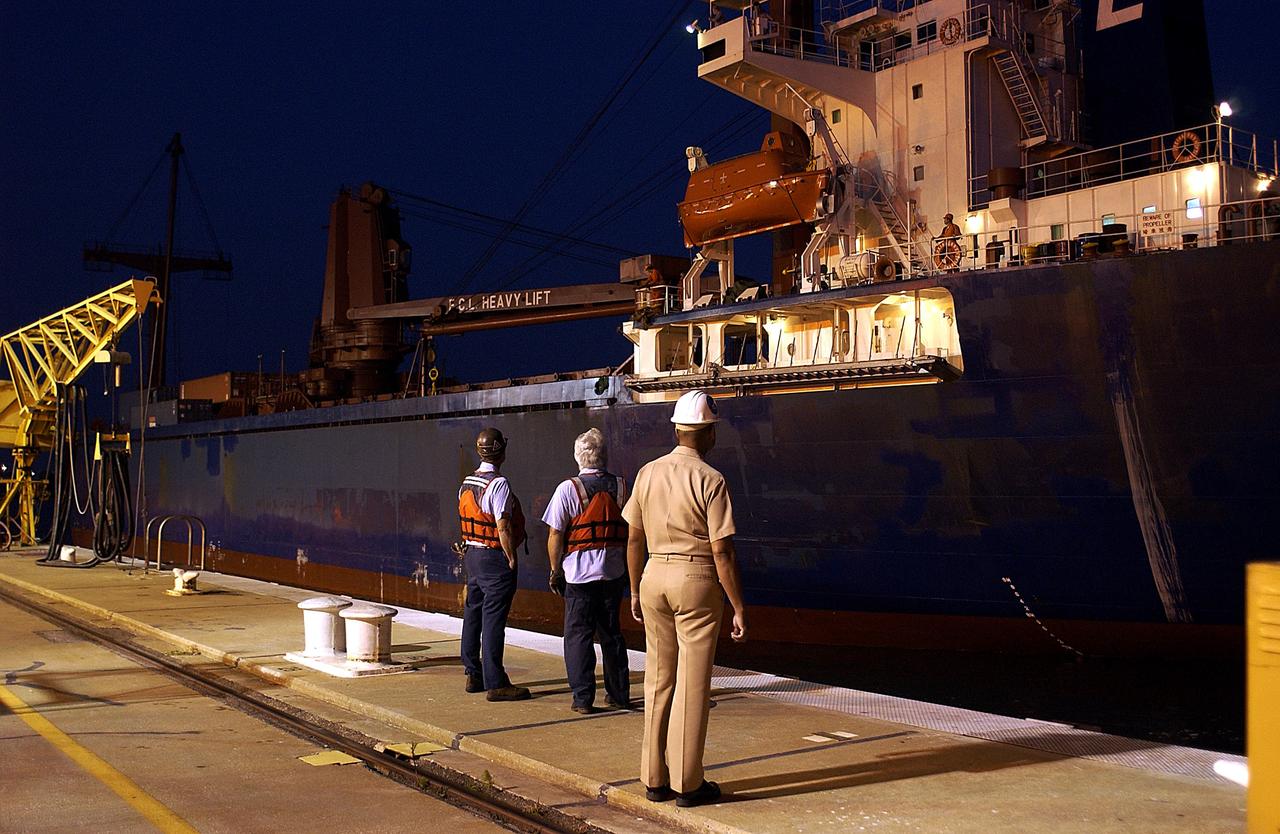
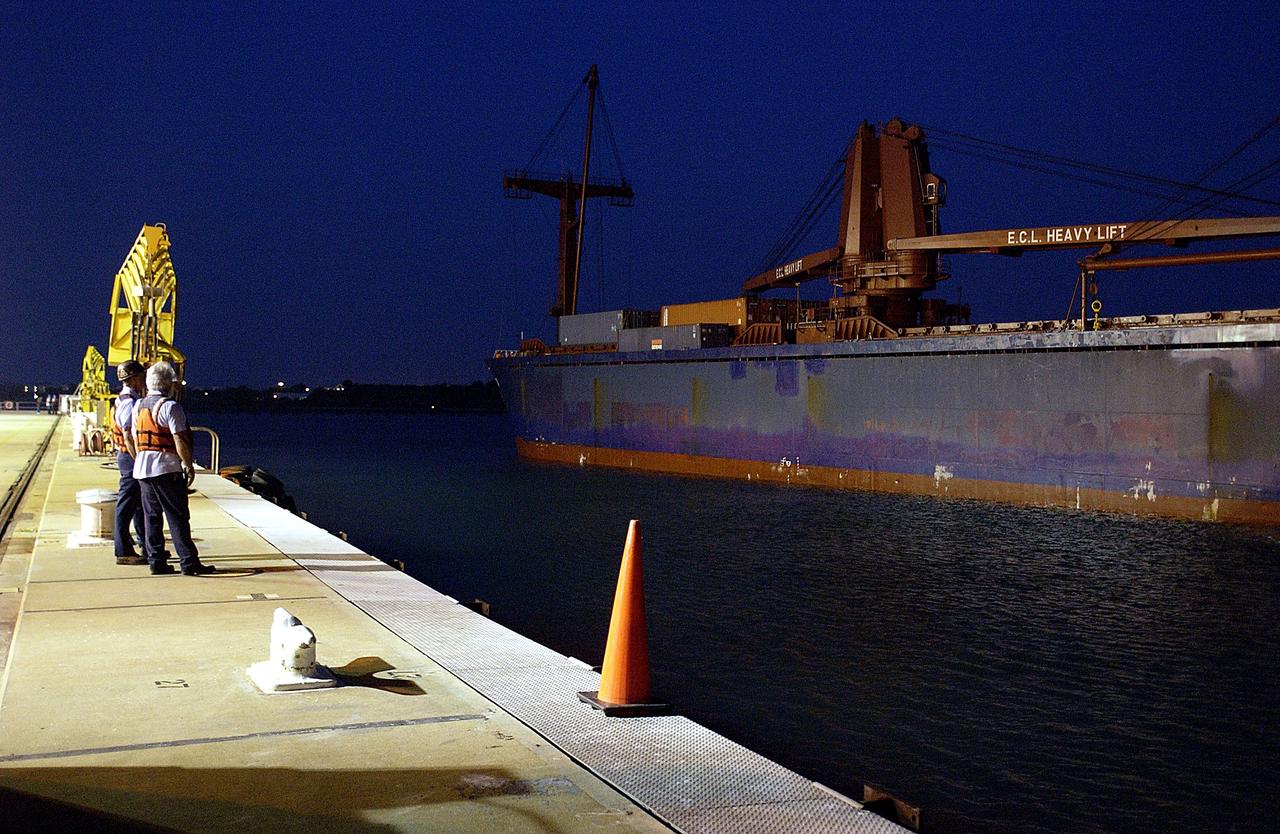
KENNEDY SPACE CENTER, FLA. - The Japanese Experiment Module (JEM) Pressurized Module is ready to be offloaded from the ship that carried it from Japan.  The National Space Development Agency of Japan (NASDA) built the laboratory at the Tsukuba Space Center near Tokyo.  The Pressurized Module is the first element of the JEM, Japan’s primary contribution to the space station, to be delivered to KSC. It will enhance the unique research capabilities of the orbiting complex by providing an additional shirt-sleeve environment for astronauts to conduct science experiments. The JEM also includes two logistics modules, an exposed pallet for space environment experiments and a robotic manipulator system that are still under construction in Japan. The various JEM components will be assembled in space over the course of three space shuttle missions.
KENNEDY SPACE CENTER, FLA. - The Japanese Experiment Module (JEM) Pressurized Module is ready to be offloaded from the ship that carried it from Japan. The National Space Development Agency of Japan (NASDA) built the laboratory at the Tsukuba Space Center near Tokyo. The Pressurized Module is the first element of the JEM, Japan’s primary contribution to the space station, to be delivered to KSC. It will enhance the unique research capabilities of the orbiting complex by providing an additional shirt-sleeve environment for astronauts to conduct science experiments. The JEM also includes two logistics modules, an exposed pallet for space environment experiments and a robotic manipulator system that are still under construction in Japan. The various JEM components will be assembled in space over the course of three space shuttle missions.
KENNEDY SPACE CENTER, FLA. -   Japanese girls from Urawa Daiichi Girls High School, Urawa, Japan, pose for a group photo during a visit to the Orbiter Processing Facility. They were awarded the trip to Kennedy Space Center when their experiments were chosen to fly on mission STS-107. The girls are accompanied by American students from Melbourne and Jacksonville, Fla.  The National Space Development Agency of Japan (NASDA) and the KSC International Space Station/Payload Processing Directorate worked with the NASA KSC Education Programs and University Research Division to coordinate the students’ visit.
KENNEDY SPACE CENTER, FLA. - Japanese girls from Urawa Daiichi Girls High School, Urawa, Japan, pose for a group photo during a visit to the Orbiter Processing Facility. They were awarded the trip to Kennedy Space Center when their experiments were chosen to fly on mission STS-107. The girls are accompanied by American students from Melbourne and Jacksonville, Fla. The National Space Development Agency of Japan (NASDA) and the KSC International Space Station/Payload Processing Directorate worked with the NASA KSC Education Programs and University Research Division to coordinate the students’ visit.
KENNEDY SPACE CENTER, FLA.  -     Japanese girls from Urawa Daiichi Girls High School, Urawa, Japan, carry a floral tribute to the crew of Columbia to place at the STS-107 memorial stone at the Spacehab facility, Cape Canaveral, Fla.   The group was  awarded the trip to Florida when their experiments were chosen to fly on mission STS-107.  The group was also meeting with American students from Melbourne and Jacksonville, Fla.   The National Space Development  Agency of Japan (NASDA) and the KSC International Space Station and Payloads Processing Directorate worked with the NASA KSC Education Programs and University Research Division to coordinate the students’ visit.
KENNEDY SPACE CENTER, FLA. - Japanese girls from Urawa Daiichi Girls High School, Urawa, Japan, carry a floral tribute to the crew of Columbia to place at the STS-107 memorial stone at the Spacehab facility, Cape Canaveral, Fla. The group was awarded the trip to Florida when their experiments were chosen to fly on mission STS-107. The group was also meeting with American students from Melbourne and Jacksonville, Fla. The National Space Development Agency of Japan (NASDA) and the KSC International Space Station and Payloads Processing Directorate worked with the NASA KSC Education Programs and University Research Division to coordinate the students’ visit.
KENNEDY SPACE CENTER, FLA.  -    Japanese girls from Urawa Daiichi Girls High School, Urawa, Japan, carry a floral tribute to the crew of Columbia to place at the STS-107 memorial stone at the Spacehab facility, Cape Canaveral, Fla.   The group was  awarded the trip to Florida when their experiments were chosen to fly on mission STS-107.  The group was also meeting with American students from Melbourne and Jacksonville, Fla.   The National Space Development  Agency of Japan (NASDA) and the KSC International Space Station and Payloads Processing Directorate worked with the NASA KSC Education Programs and University Research Division to coordinate the students’ visit.
KENNEDY SPACE CENTER, FLA. - Japanese girls from Urawa Daiichi Girls High School, Urawa, Japan, carry a floral tribute to the crew of Columbia to place at the STS-107 memorial stone at the Spacehab facility, Cape Canaveral, Fla. The group was awarded the trip to Florida when their experiments were chosen to fly on mission STS-107. The group was also meeting with American students from Melbourne and Jacksonville, Fla. The National Space Development Agency of Japan (NASDA) and the KSC International Space Station and Payloads Processing Directorate worked with the NASA KSC Education Programs and University Research Division to coordinate the students’ visit.
KENNEDY SPACE CENTER, FLA.  -   Japanese girls from Urawa Daiichi Girls High School, Urawa, Japan, pose for a group photo on their visit to the Spacehab facility in Cape Canaveral, Fla.  They were awarded the trip when their experiments were chosen to fly on mission STS-107.  The group was also meeting with American students from Melbourne and Jacksonville, Fla.  The girls planned a floral tribute at the STS-107 memorial stone at the facility.  The National Space Development  Agency of Japan (NASDA) and the KSC International Space Station and Payloads Processing Directorate worked with the NASA KSC Education Programs and University Research Division to coordinate the students’ visit.
KENNEDY SPACE CENTER, FLA. - Japanese girls from Urawa Daiichi Girls High School, Urawa, Japan, pose for a group photo on their visit to the Spacehab facility in Cape Canaveral, Fla. They were awarded the trip when their experiments were chosen to fly on mission STS-107. The group was also meeting with American students from Melbourne and Jacksonville, Fla. The girls planned a floral tribute at the STS-107 memorial stone at the facility. The National Space Development Agency of Japan (NASDA) and the KSC International Space Station and Payloads Processing Directorate worked with the NASA KSC Education Programs and University Research Division to coordinate the students’ visit.
KENNEDY SPACE CENTER, FLA.  -   Japanese girls from Urawa Daiichi Girls High School, Urawa, Japan, carry a floral tribute to the crew of Columbia to place at the STS-107 memorial stone at the Spacehab facility, Cape Canaveral, Fla.   The group was  awarded the trip to Florida when their experiments were chosen to fly on mission STS-107.  The group was also meeting with American students from Melbourne and Jacksonville, Fla.   The National Space Development  Agency of Japan (NASDA) and the KSC International Space Station and Payloads Processing Directorate worked with the NASA KSC Education Programs and University Research Division to coordinate the students’ visit.
KENNEDY SPACE CENTER, FLA. - Japanese girls from Urawa Daiichi Girls High School, Urawa, Japan, carry a floral tribute to the crew of Columbia to place at the STS-107 memorial stone at the Spacehab facility, Cape Canaveral, Fla. The group was awarded the trip to Florida when their experiments were chosen to fly on mission STS-107. The group was also meeting with American students from Melbourne and Jacksonville, Fla. The National Space Development Agency of Japan (NASDA) and the KSC International Space Station and Payloads Processing Directorate worked with the NASA KSC Education Programs and University Research Division to coordinate the students’ visit.
KENNEDY SPACE CENTER, FLA.  -   Japanese girls from Urawa Daiichi Girls High School, Urawa, Japan, place a floral tribute to the crew of Columbia at the STS-107 memorial stone at the Spacehab facility, Cape Canaveral, Fla.   The group was  awarded the trip to Florida when their experiments were chosen to fly on mission STS-107.  The group was also meeting with American students from Melbourne and Jacksonville, Fla.   The National Space Development  Agency of Japan (NASDA) and the KSC International Space Station and Payloads Processing Directorate worked with the NASA KSC Education Programs and University Research Division to coordinate the students’ visit.
KENNEDY SPACE CENTER, FLA. - Japanese girls from Urawa Daiichi Girls High School, Urawa, Japan, place a floral tribute to the crew of Columbia at the STS-107 memorial stone at the Spacehab facility, Cape Canaveral, Fla. The group was awarded the trip to Florida when their experiments were chosen to fly on mission STS-107. The group was also meeting with American students from Melbourne and Jacksonville, Fla. The National Space Development Agency of Japan (NASDA) and the KSC International Space Station and Payloads Processing Directorate worked with the NASA KSC Education Programs and University Research Division to coordinate the students’ visit.
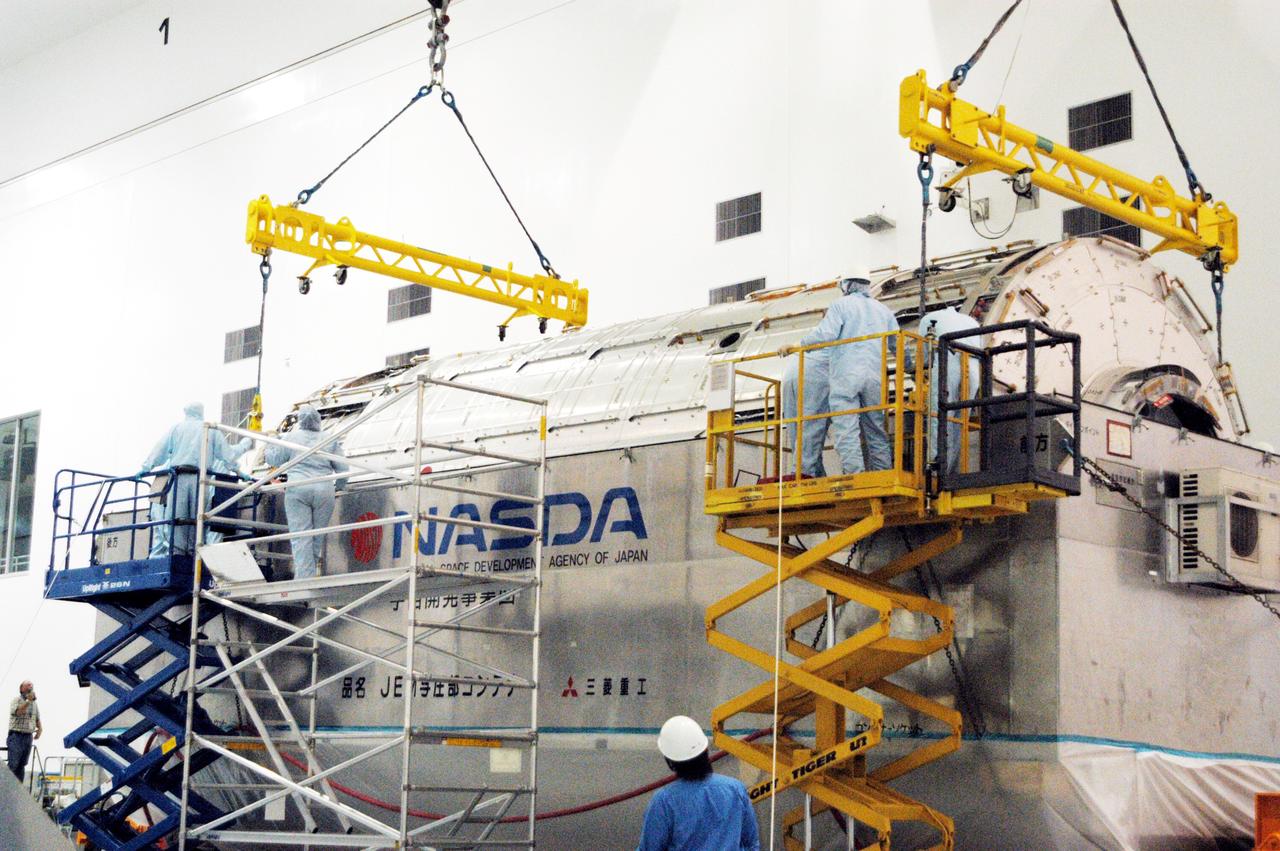
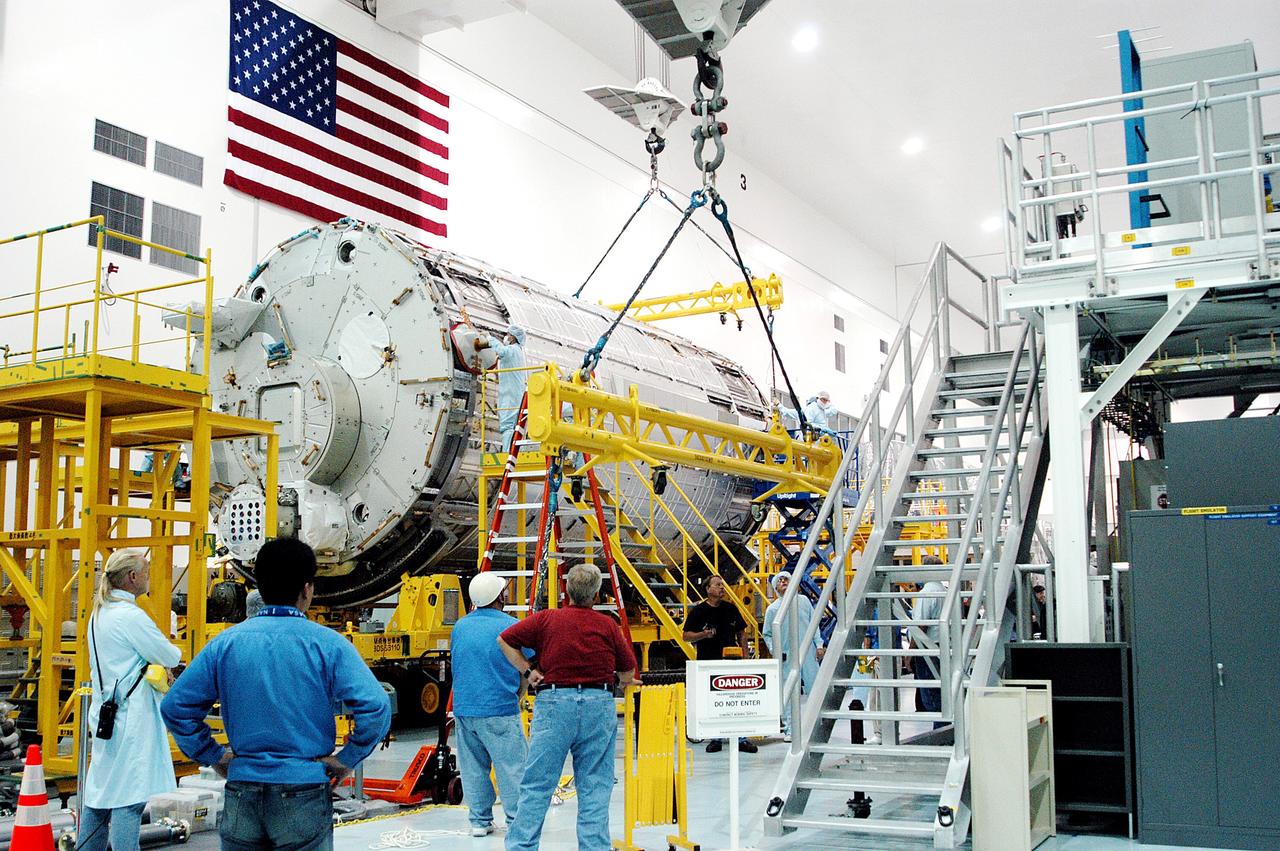
KENNEDY SPACE CENTER, FLA. -  Workers in the Space Station Processing Facility attach an overhead crane to the Japanese Experiment Module (JEM) pressure module inside its canister.  The module will be removed and transferred to a work stand in the Space Station Processing Facility.  A research laboratory, the pressurized module is the first element of the JEM, named "Kibo" (Hope), to be delivered to KSC.   The National Space Development Agency of Japan (NASDA) developed the laboratory at the Tsukuba Space Center near Tokyo and is Japan's primary contribution to the Station. It will enhance the unique research capabilities of the orbiting complex by providing an additional environment for astronauts to conduct science experiments.  The JEM also includes an exposed facility (platform) for space environment experiments, a robotic manipulator system, and two logistics modules. The various JEM components will be  assembled in space over the course of three Shuttle missions.
KENNEDY SPACE CENTER, FLA. - Workers in the Space Station Processing Facility attach an overhead crane to the Japanese Experiment Module (JEM) pressure module inside its canister. The module will be removed and transferred to a work stand in the Space Station Processing Facility. A research laboratory, the pressurized module is the first element of the JEM, named "Kibo" (Hope), to be delivered to KSC. The National Space Development Agency of Japan (NASDA) developed the laboratory at the Tsukuba Space Center near Tokyo and is Japan's primary contribution to the Station. It will enhance the unique research capabilities of the orbiting complex by providing an additional environment for astronauts to conduct science experiments. The JEM also includes an exposed facility (platform) for space environment experiments, a robotic manipulator system, and two logistics modules. The various JEM components will be assembled in space over the course of three Shuttle missions.
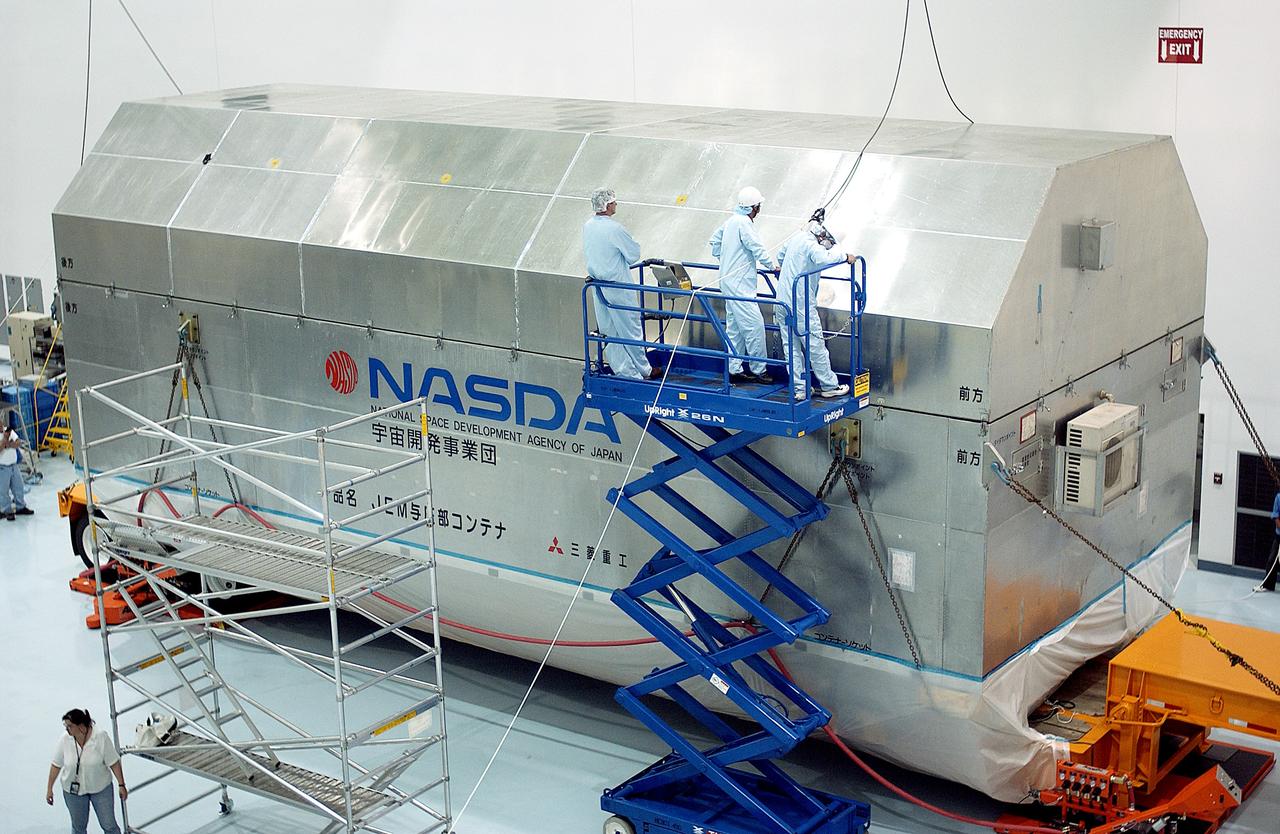
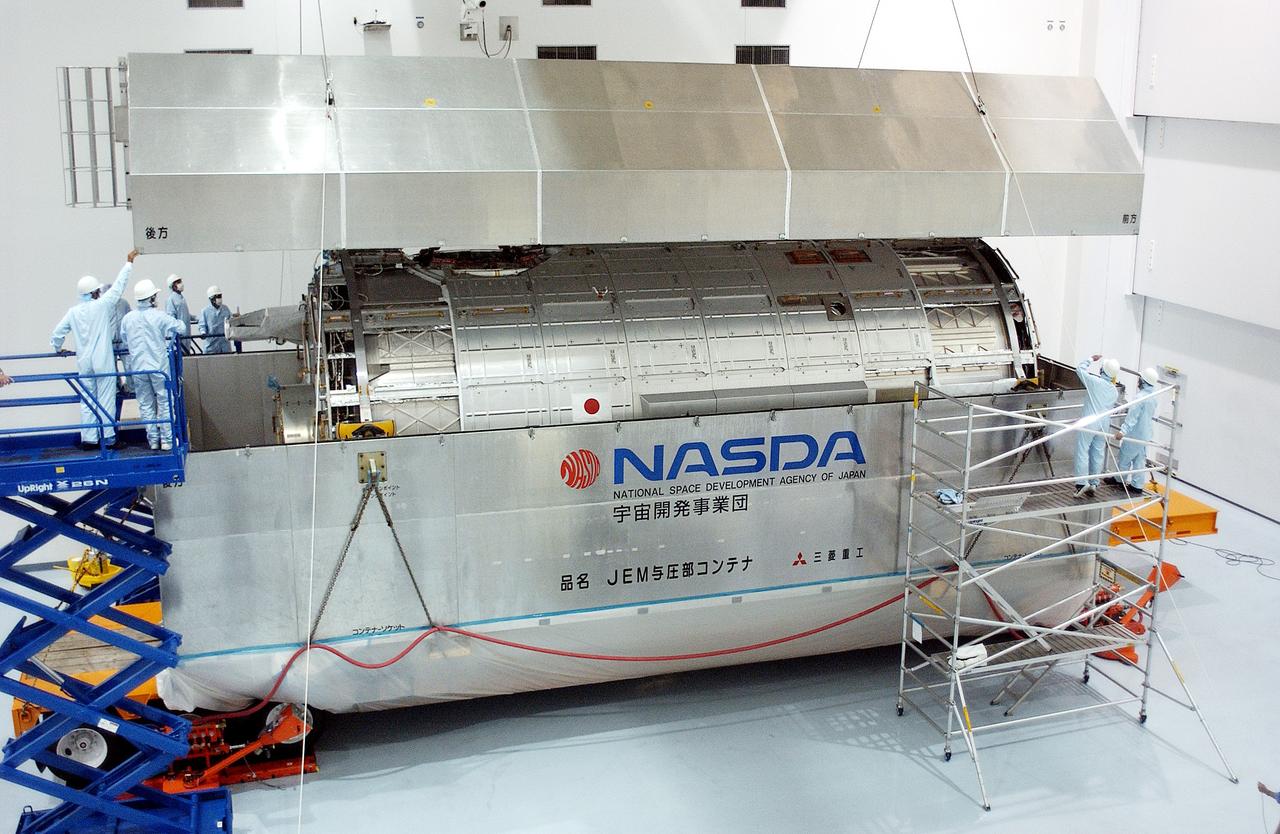
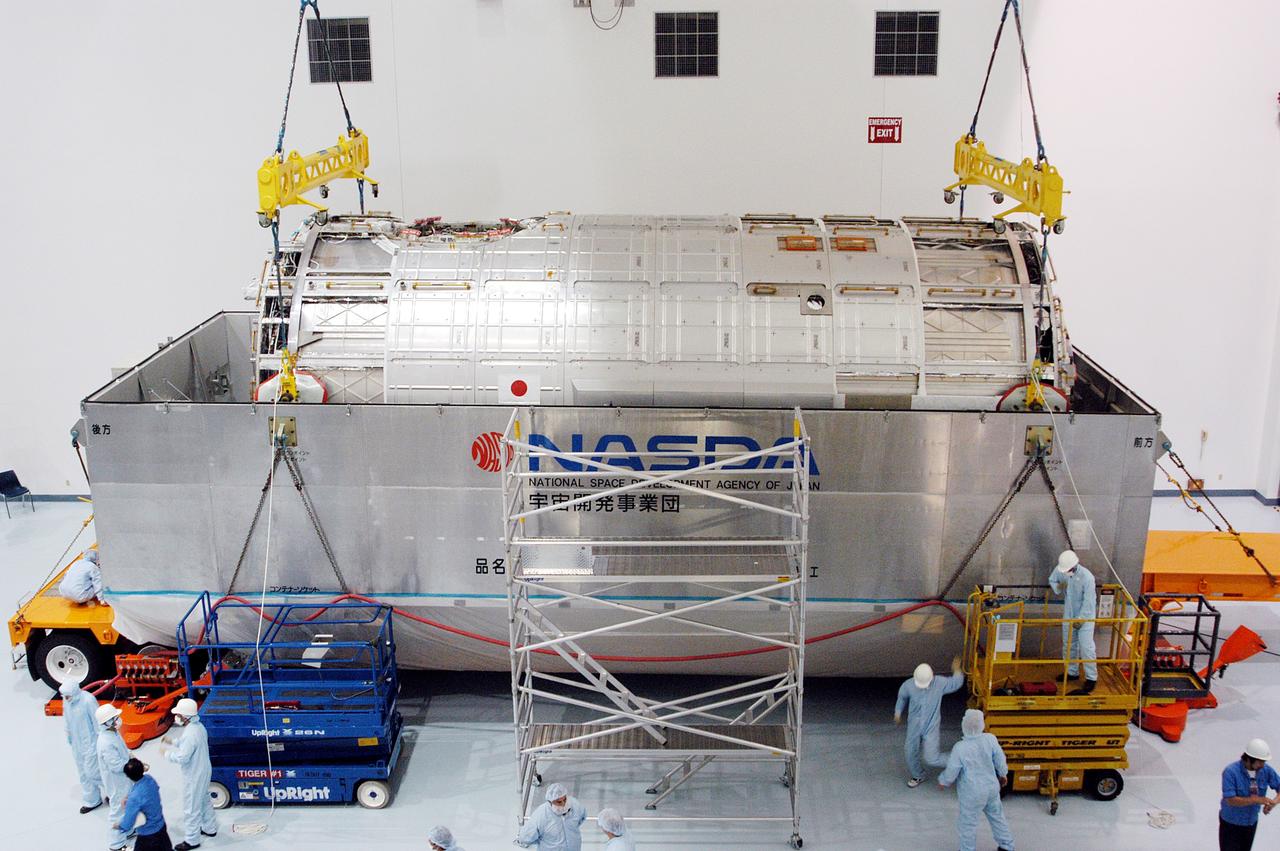
KENNEDY SPACE CENTER, FLA. -   In the Space Station Processing Facility, the lid is removed from the container with the Japanese Experiment Module (JEM) pressure module inside.  A research laboratory, the pressurized module is the first element of the JEM, named "Kibo" (Hope), to be delivered to KSC.   The National Space Development Agency of Japan (NASDA) developed the laboratory at the Tsukuba Space Center near Tokyo and is Japan's primary contribution to the Station. It will enhance the unique research capabilities of the orbiting complex by providing an additional environment for astronauts to conduct science experiments.  The JEM also includes an exposed facility (platform) for space environment experiments, a robotic manipulator system, and two logistics modules. The various JEM components will be  assembled in space over the course of three Shuttle missions.
KENNEDY SPACE CENTER, FLA. - In the Space Station Processing Facility, the lid is removed from the container with the Japanese Experiment Module (JEM) pressure module inside. A research laboratory, the pressurized module is the first element of the JEM, named "Kibo" (Hope), to be delivered to KSC. The National Space Development Agency of Japan (NASDA) developed the laboratory at the Tsukuba Space Center near Tokyo and is Japan's primary contribution to the Station. It will enhance the unique research capabilities of the orbiting complex by providing an additional environment for astronauts to conduct science experiments. The JEM also includes an exposed facility (platform) for space environment experiments, a robotic manipulator system, and two logistics modules. The various JEM components will be assembled in space over the course of three Shuttle missions.
KENNEDY SPACE CENTER, FLA. -  In the Space Station Processing Facility, the lid is removed from the container with the Japanese Experiment Module (JEM) pressure module inside.  A research laboratory, the pressurized module is the first element of the JEM, named "Kibo" (Hope), to be delivered to KSC.   The National Space Development Agency of Japan (NASDA) developed the laboratory at the Tsukuba Space Center near Tokyo and is Japan's primary contribution to the Station. It will enhance the unique research capabilities of the orbiting complex by providing an additional environment for astronauts to conduct science experiments.  The JEM also includes an exposed facility (platform) for space environment experiments, a robotic manipulator system, and two logistics modules. The various JEM components will be  assembled in space over the course of three Shuttle missions.
KENNEDY SPACE CENTER, FLA. - In the Space Station Processing Facility, the lid is removed from the container with the Japanese Experiment Module (JEM) pressure module inside. A research laboratory, the pressurized module is the first element of the JEM, named "Kibo" (Hope), to be delivered to KSC. The National Space Development Agency of Japan (NASDA) developed the laboratory at the Tsukuba Space Center near Tokyo and is Japan's primary contribution to the Station. It will enhance the unique research capabilities of the orbiting complex by providing an additional environment for astronauts to conduct science experiments. The JEM also includes an exposed facility (platform) for space environment experiments, a robotic manipulator system, and two logistics modules. The various JEM components will be assembled in space over the course of three Shuttle missions.
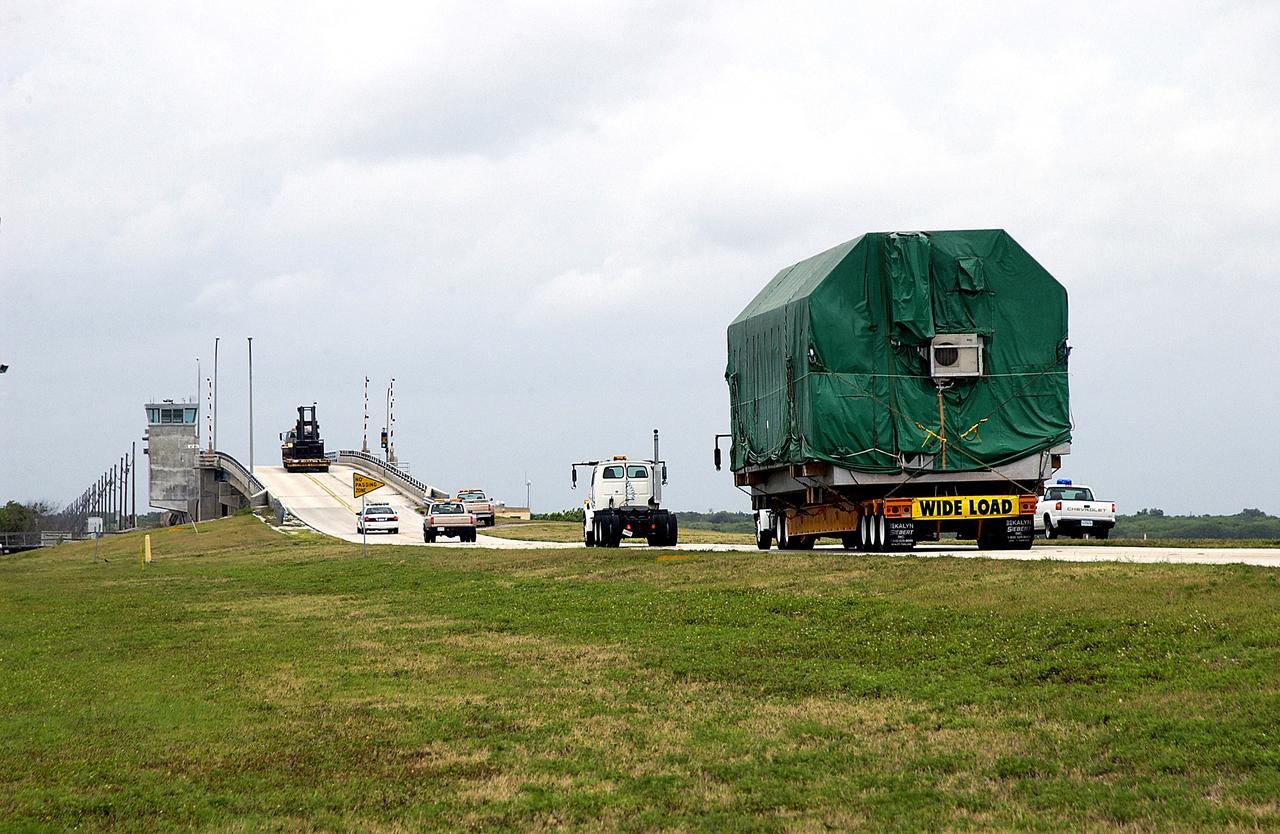
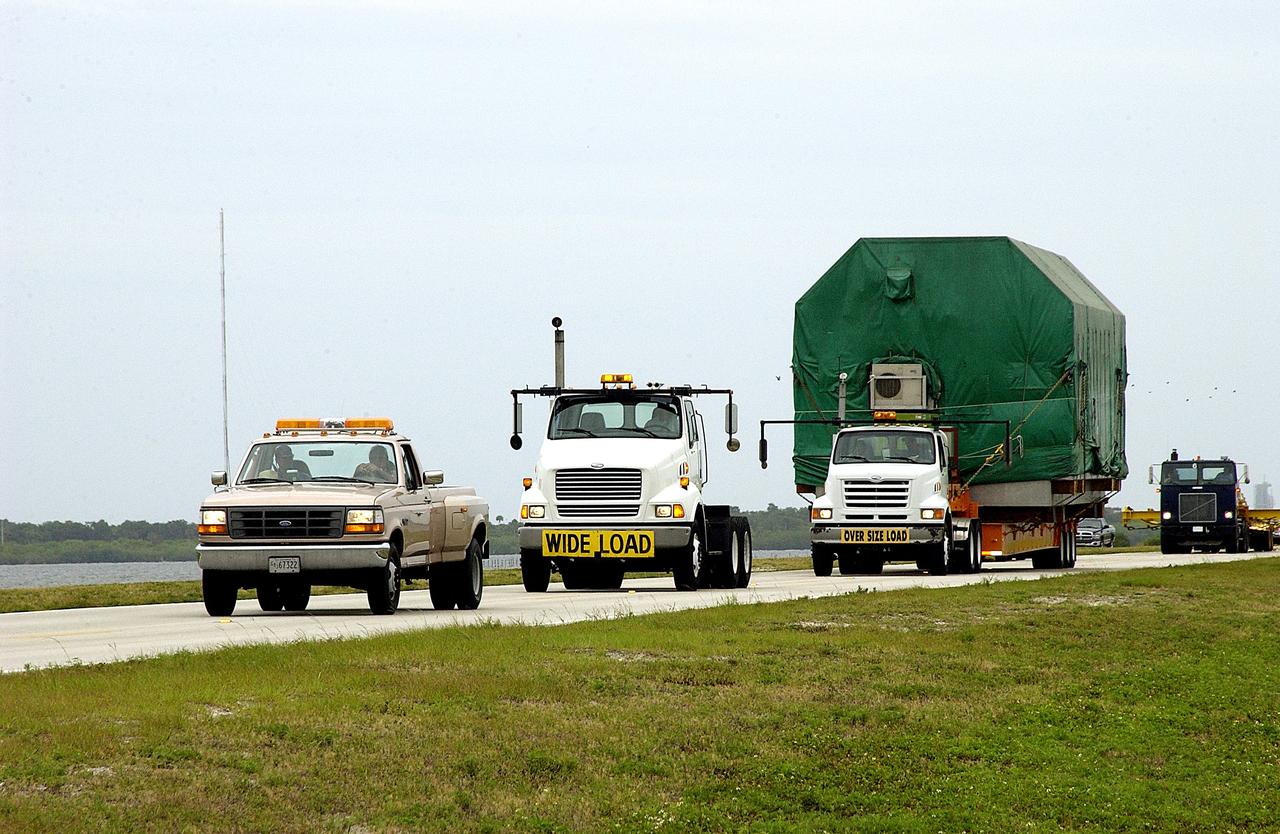
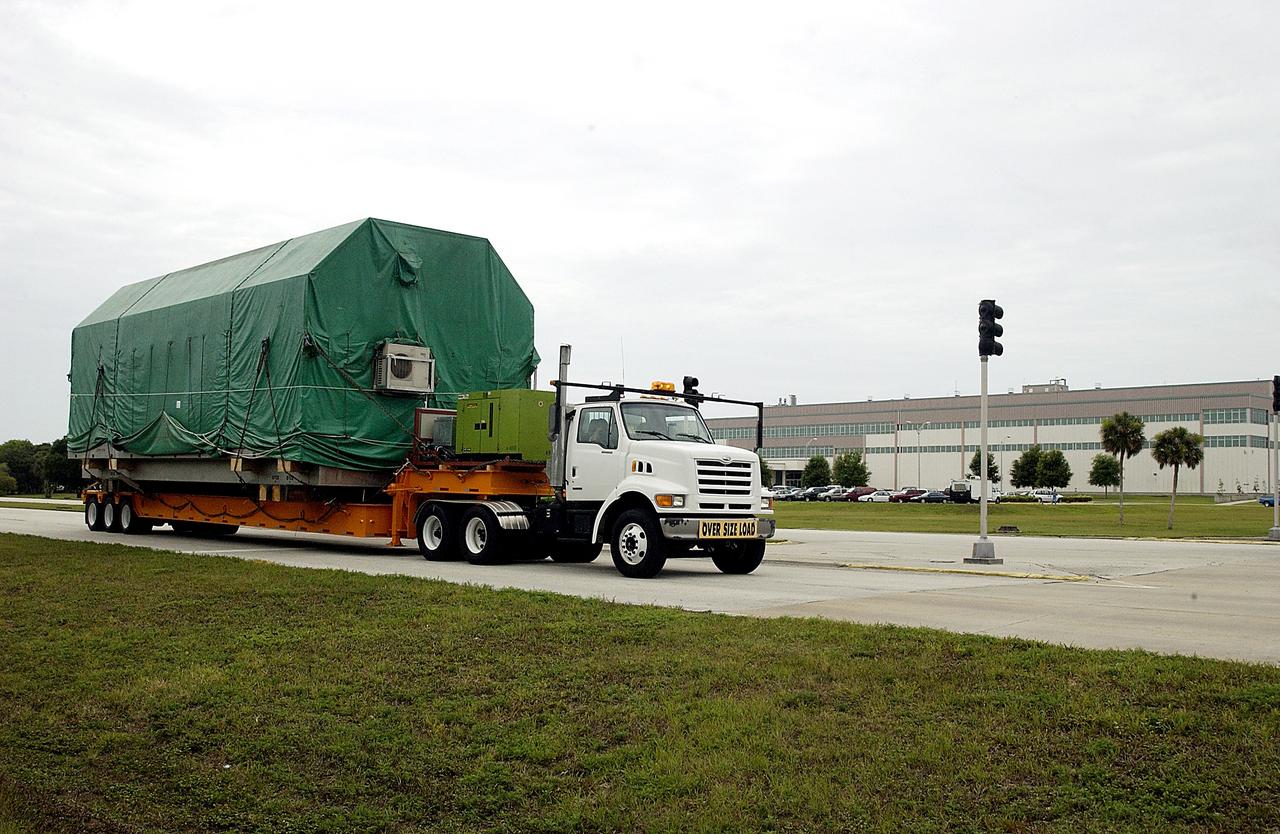
KENNEDY SPACE CENTER, FLA. -  A convoy accompanies the truck transporting the Pressurized Module of the Japanese Experiment Module (JEM) to KSC’s Space Station Processing Facility.  The National Space Development Agency of Japan (NASDA) developed the laboratory at the Tsukuba Space Center near Tokyo. The Pressurized Module is the first element of the JEM, named "Kibo" (Hope), to be delivered to KSC.  The JEM is Japan's primary contribution to the Station. It will enhance the unique research capabilities of the orbiting complex by providing an additional environment for astronauts to conduct science experiments.  The JEM also includes an exposed facility (platform) for space environment experiments, a robotic manipulator system, and two logistics modules. The various JEM components will be  assembled in space over the course of three Shuttle missions.
KENNEDY SPACE CENTER, FLA. - A convoy accompanies the truck transporting the Pressurized Module of the Japanese Experiment Module (JEM) to KSC’s Space Station Processing Facility. The National Space Development Agency of Japan (NASDA) developed the laboratory at the Tsukuba Space Center near Tokyo. The Pressurized Module is the first element of the JEM, named "Kibo" (Hope), to be delivered to KSC. The JEM is Japan's primary contribution to the Station. It will enhance the unique research capabilities of the orbiting complex by providing an additional environment for astronauts to conduct science experiments. The JEM also includes an exposed facility (platform) for space environment experiments, a robotic manipulator system, and two logistics modules. The various JEM components will be assembled in space over the course of three Shuttle missions.
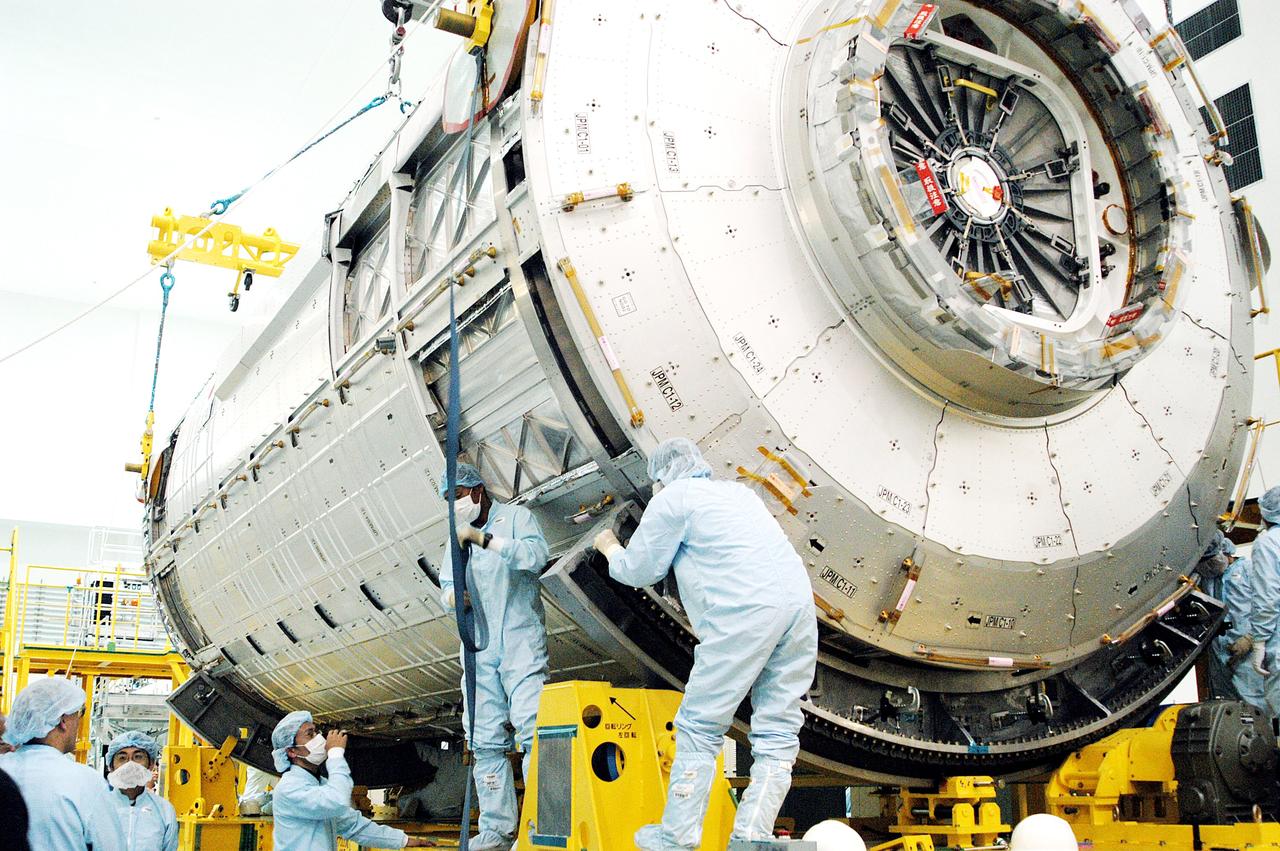
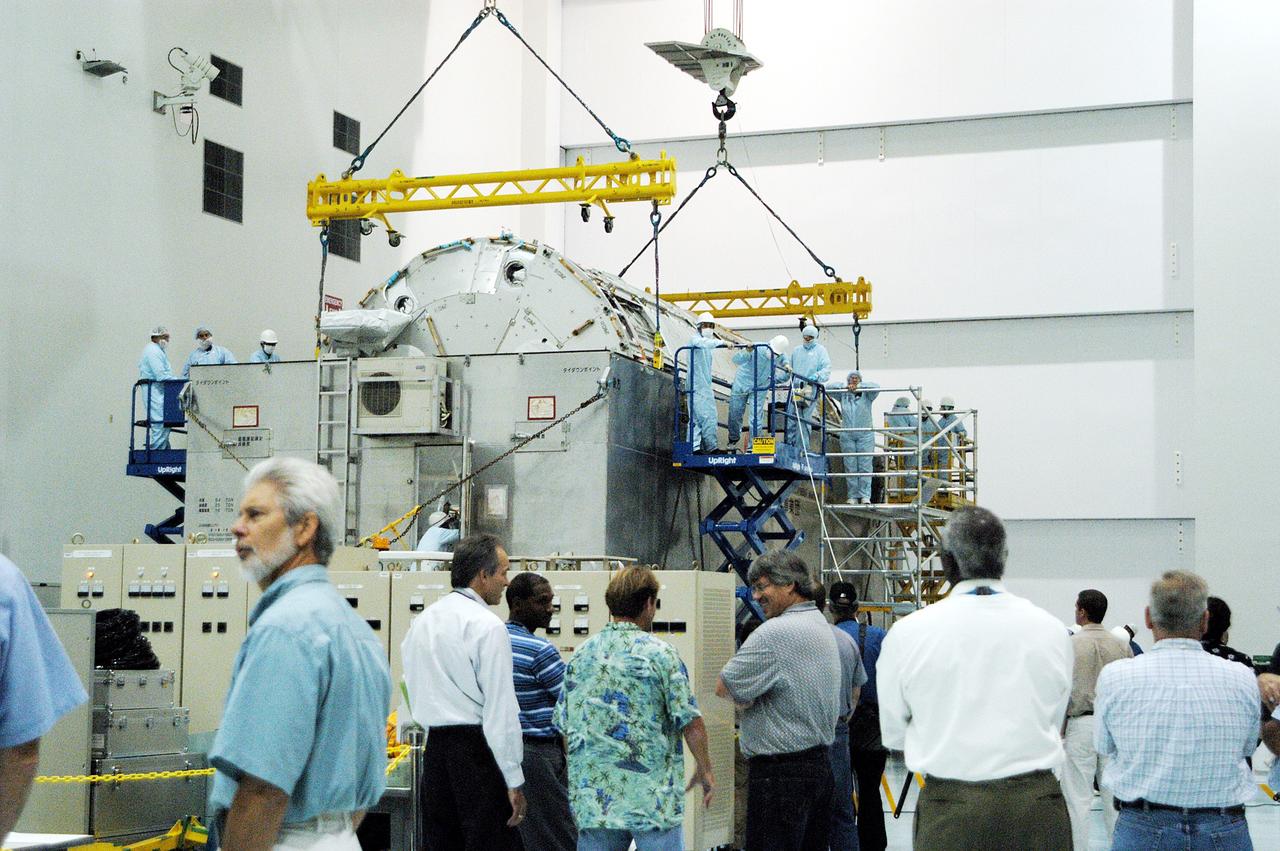
KENNEDY SPACE CENTER, FLA. -  In the Space Station Processing Facility, an overhead crane begins to lift the Japanese Experiment Module (JEM) pressure module out of the shipping canister to move it to a work stand.  A research laboratory, the pressurized module is the first element of the JEM, named "Kibo" (Hope), to be delivered to KSC.   The National Space Development Agency of Japan (NASDA) developed the laboratory at the Tsukuba Space Center near Tokyo and is Japan's primary contribution to the Station. It will enhance the unique research capabilities of the orbiting complex by providing an additional environment for astronauts to conduct science experiments.  The JEM also includes an exposed facility (platform) for space environment experiments, a robotic manipulator system, and two logistics modules. The various JEM components will be  assembled in space over the course of three Shuttle missions.
KENNEDY SPACE CENTER, FLA. - In the Space Station Processing Facility, an overhead crane begins to lift the Japanese Experiment Module (JEM) pressure module out of the shipping canister to move it to a work stand. A research laboratory, the pressurized module is the first element of the JEM, named "Kibo" (Hope), to be delivered to KSC. The National Space Development Agency of Japan (NASDA) developed the laboratory at the Tsukuba Space Center near Tokyo and is Japan's primary contribution to the Station. It will enhance the unique research capabilities of the orbiting complex by providing an additional environment for astronauts to conduct science experiments. The JEM also includes an exposed facility (platform) for space environment experiments, a robotic manipulator system, and two logistics modules. The various JEM components will be assembled in space over the course of three Shuttle missions.
KENNEDY SPACE CENTER, FLA. - The truck transporting the Pressurized Module of the Japanese Experiment Module (JEM) to KSC’s Space Station Processing Facility arrives on Center.  The National Space Development Agency of Japan (NASDA) developed the laboratory at the Tsukuba Space Center near Tokyo. The Pressurized Module is the first element of the JEM, named "Kibo" (Hope), to be delivered to KSC.  The JEM is Japan's primary contribution to the Station. It will enhance the unique research capabilities of the orbiting complex by providing an additional environment for astronauts to conduct science experiments.  The JEM also includes an exposed facility (platform) for space environment experiments, a robotic manipulator system, and two logistics modules. The various JEM components will be  assembled in space over the course of three Shuttle missions.
KENNEDY SPACE CENTER, FLA. - The truck transporting the Pressurized Module of the Japanese Experiment Module (JEM) to KSC’s Space Station Processing Facility arrives on Center. The National Space Development Agency of Japan (NASDA) developed the laboratory at the Tsukuba Space Center near Tokyo. The Pressurized Module is the first element of the JEM, named "Kibo" (Hope), to be delivered to KSC. The JEM is Japan's primary contribution to the Station. It will enhance the unique research capabilities of the orbiting complex by providing an additional environment for astronauts to conduct science experiments. The JEM also includes an exposed facility (platform) for space environment experiments, a robotic manipulator system, and two logistics modules. The various JEM components will be assembled in space over the course of three Shuttle missions.
KENNEDY SPACE CENTER, FLA. - In the Space Station Processing Facility, overhead cranes are removed from the Japanese Experiment Module (JEM) pressure module now on its work stand.  A research laboratory, the pressurized module is the first element of the JEM, named "Kibo" (Hope), to be delivered to KSC.   The National Space Development Agency of Japan (NASDA) developed the laboratory at the Tsukuba Space Center near Tokyo and is Japan's primary contribution to the Station. It will enhance the unique research capabilities of the orbiting complex by providing an additional environment for astronauts to conduct science experiments.  The JEM also includes an exposed facility (platform) for space environment experiments, a robotic manipulator system, and two logistics modules. The various JEM components will be  assembled in space over the course of three Shuttle missions.
KENNEDY SPACE CENTER, FLA. - In the Space Station Processing Facility, overhead cranes are removed from the Japanese Experiment Module (JEM) pressure module now on its work stand. A research laboratory, the pressurized module is the first element of the JEM, named "Kibo" (Hope), to be delivered to KSC. The National Space Development Agency of Japan (NASDA) developed the laboratory at the Tsukuba Space Center near Tokyo and is Japan's primary contribution to the Station. It will enhance the unique research capabilities of the orbiting complex by providing an additional environment for astronauts to conduct science experiments. The JEM also includes an exposed facility (platform) for space environment experiments, a robotic manipulator system, and two logistics modules. The various JEM components will be assembled in space over the course of three Shuttle missions.
KENNEDY SPACE CENTER, FLA. - In the Space Station Processing Facility, the Japanese Experiment Module (JEM) pressure module is lowered onto a work stand.  A research laboratory, the pressurized module is the first element of the JEM, named "Kibo" (Hope), to be delivered to KSC.   The National Space Development Agency of Japan (NASDA) developed the laboratory at the Tsukuba Space Center near Tokyo and is Japan's primary contribution to the Station. It will enhance the unique research capabilities of the orbiting complex by providing an additional environment for astronauts to conduct science experiments.  The JEM also includes an exposed facility (platform) for space environment experiments, a robotic manipulator system, and two logistics modules. The various JEM components will be  assembled in space over the course of three Shuttle missions.
KENNEDY SPACE CENTER, FLA. - In the Space Station Processing Facility, the Japanese Experiment Module (JEM) pressure module is lowered onto a work stand. A research laboratory, the pressurized module is the first element of the JEM, named "Kibo" (Hope), to be delivered to KSC. The National Space Development Agency of Japan (NASDA) developed the laboratory at the Tsukuba Space Center near Tokyo and is Japan's primary contribution to the Station. It will enhance the unique research capabilities of the orbiting complex by providing an additional environment for astronauts to conduct science experiments. The JEM also includes an exposed facility (platform) for space environment experiments, a robotic manipulator system, and two logistics modules. The various JEM components will be assembled in space over the course of three Shuttle missions.
KENNEDY SPACE CENTER, FLA. - A convoy accompanies the truck transporting the Pressurized Module of the Japanese Experiment Module (JEM) to KSC’s Space Station Processing Facility.  The National Space Development Agency of Japan (NASDA) developed the laboratory at the Tsukuba Space Center near Tokyo. The Pressurized Module is the first element of the JEM, named "Kibo" (Hope), to be delivered to KSC.  The JEM is Japan's primary contribution to the Station. It will enhance the unique research capabilities of the orbiting complex by providing an additional environment for astronauts to conduct science experiments.  The JEM also includes an exposed facility (platform) for space environment experiments, a robotic manipulator system, and two logistics modules. The various JEM components will be  assembled in space over the course of three Shuttle missions.
KENNEDY SPACE CENTER, FLA. - A convoy accompanies the truck transporting the Pressurized Module of the Japanese Experiment Module (JEM) to KSC’s Space Station Processing Facility. The National Space Development Agency of Japan (NASDA) developed the laboratory at the Tsukuba Space Center near Tokyo. The Pressurized Module is the first element of the JEM, named "Kibo" (Hope), to be delivered to KSC. The JEM is Japan's primary contribution to the Station. It will enhance the unique research capabilities of the orbiting complex by providing an additional environment for astronauts to conduct science experiments. The JEM also includes an exposed facility (platform) for space environment experiments, a robotic manipulator system, and two logistics modules. The various JEM components will be assembled in space over the course of three Shuttle missions.
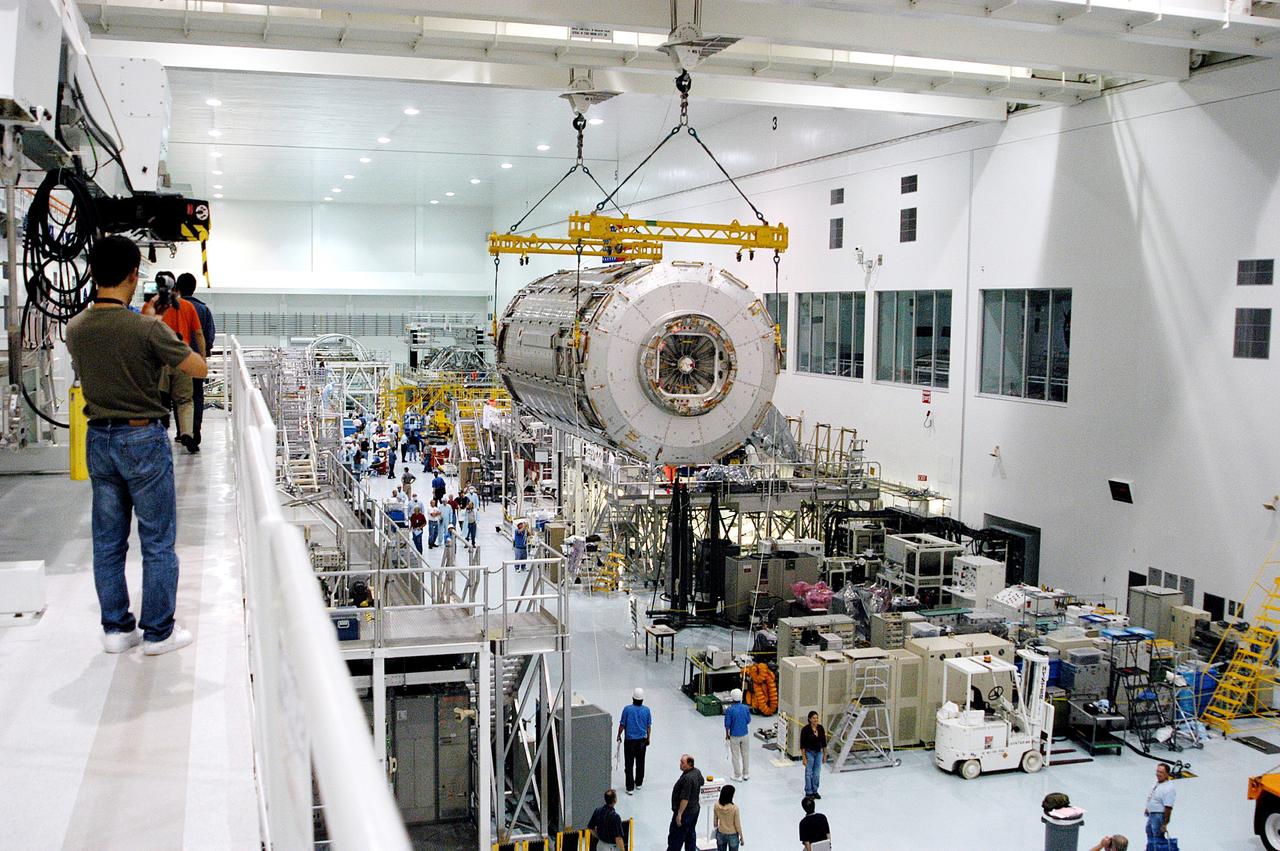
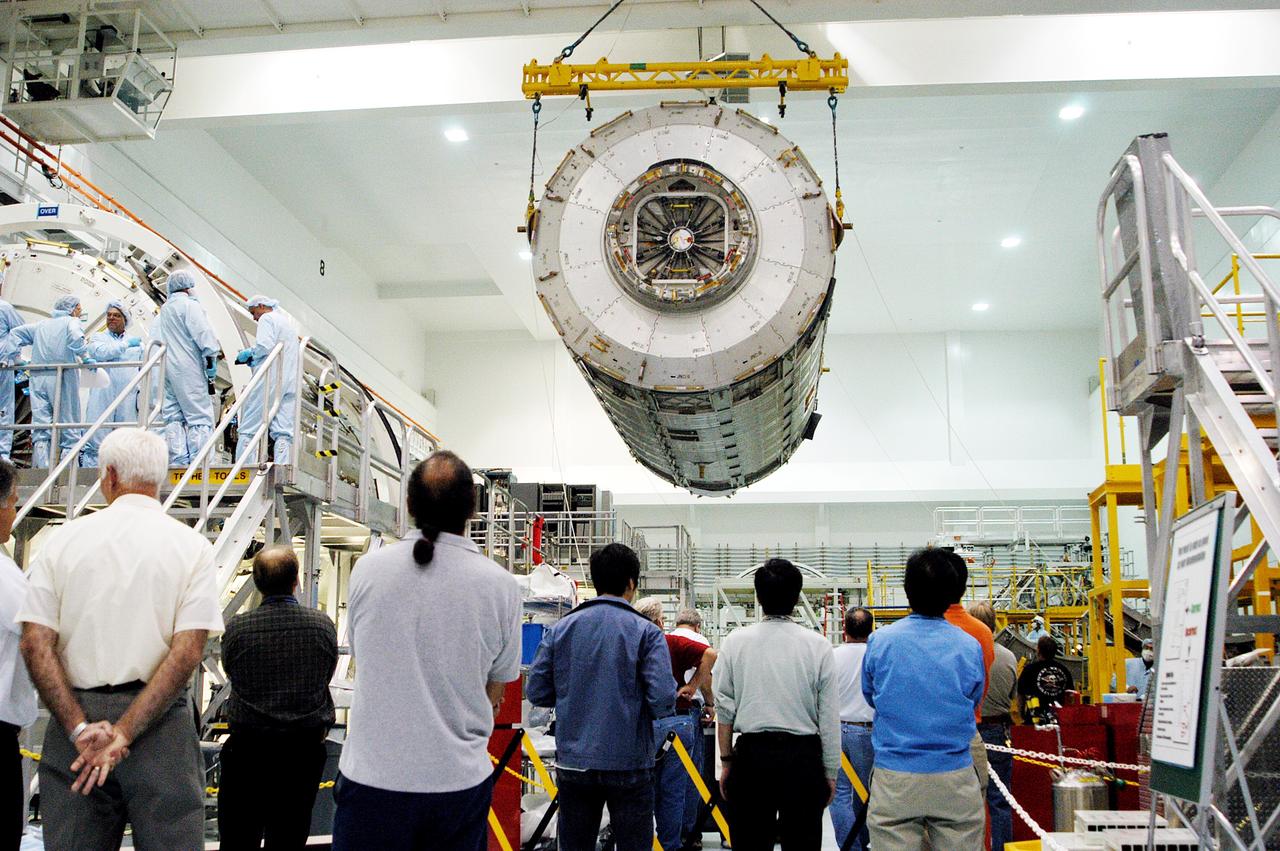
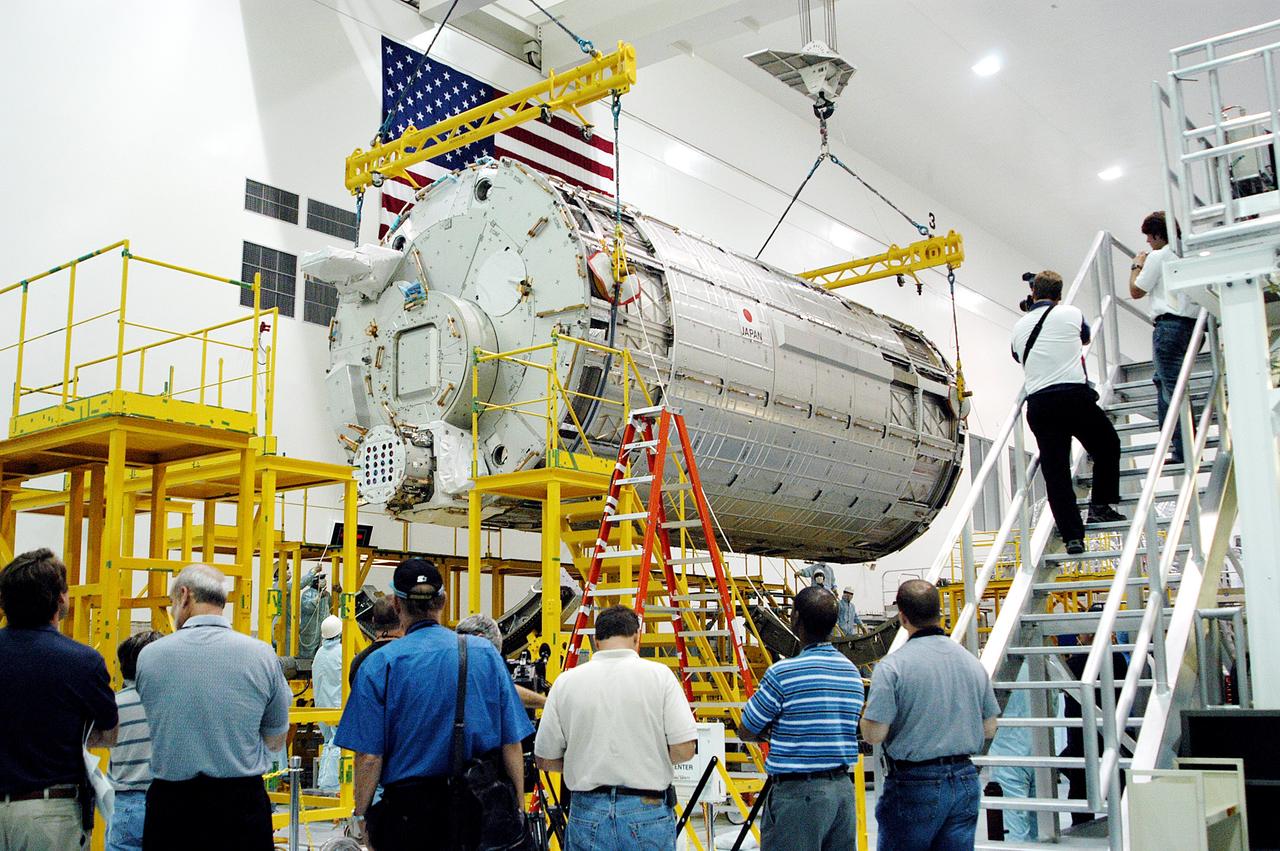
KENNEDY SPACE CENTER, FLA. -  In the Space Station Processing Facility, an overhead crane lifts the Japanese Experiment Module (JEM) pressure module out of the shipping canister to move it to a work stand.  A research laboratory, the pressurized module is the first element of the JEM, named "Kibo" (Hope), to be delivered to KSC.   The National Space Development Agency of Japan (NASDA) developed the laboratory at the Tsukuba Space Center near Tokyo and is Japan's primary contribution to the Station. It will enhance the unique research capabilities of the orbiting complex by providing an additional environment for astronauts to conduct science experiments.  The JEM also includes an exposed facility (platform) for space environment experiments, a robotic manipulator system, and two logistics modules. The various JEM components will be  assembled in space over the course of three Shuttle missions.
KENNEDY SPACE CENTER, FLA. - In the Space Station Processing Facility, an overhead crane lifts the Japanese Experiment Module (JEM) pressure module out of the shipping canister to move it to a work stand. A research laboratory, the pressurized module is the first element of the JEM, named "Kibo" (Hope), to be delivered to KSC. The National Space Development Agency of Japan (NASDA) developed the laboratory at the Tsukuba Space Center near Tokyo and is Japan's primary contribution to the Station. It will enhance the unique research capabilities of the orbiting complex by providing an additional environment for astronauts to conduct science experiments. The JEM also includes an exposed facility (platform) for space environment experiments, a robotic manipulator system, and two logistics modules. The various JEM components will be assembled in space over the course of three Shuttle missions.
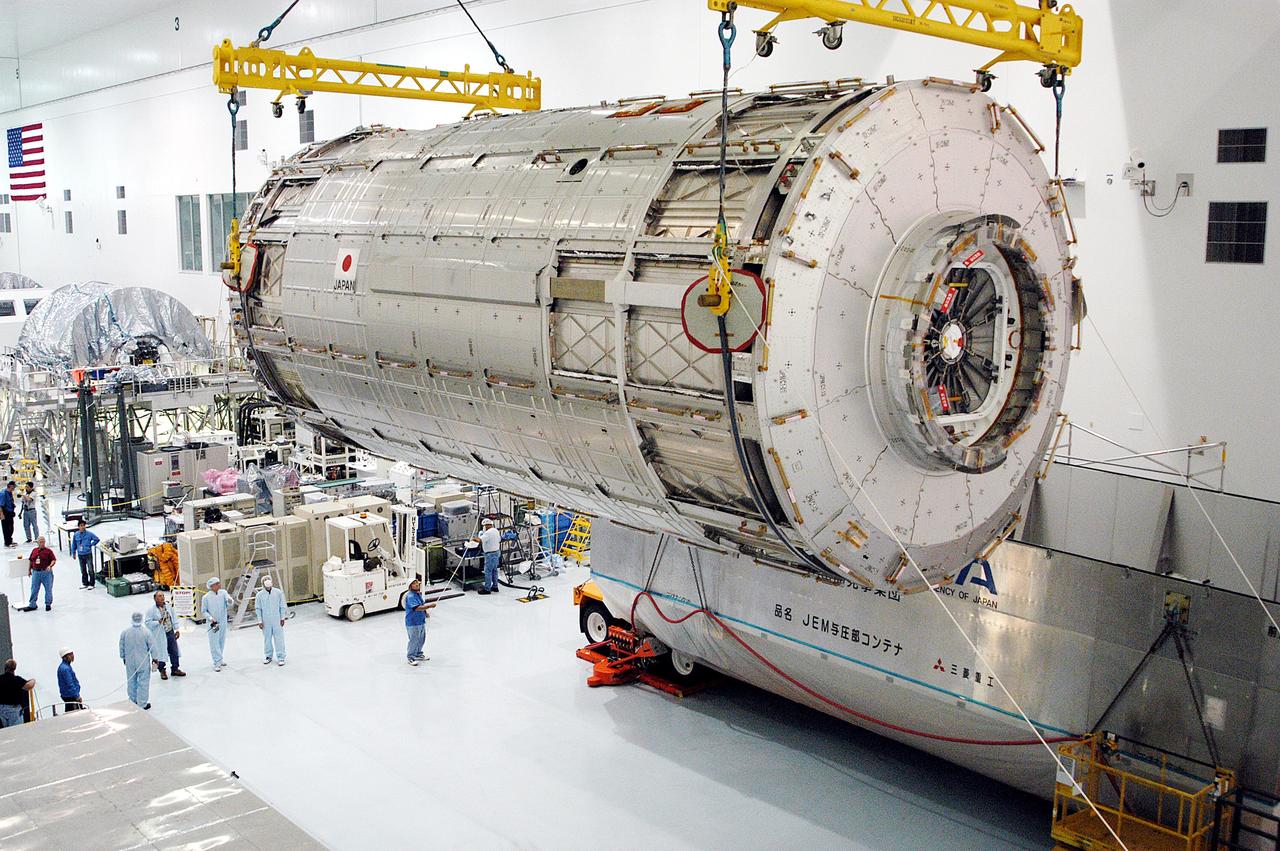
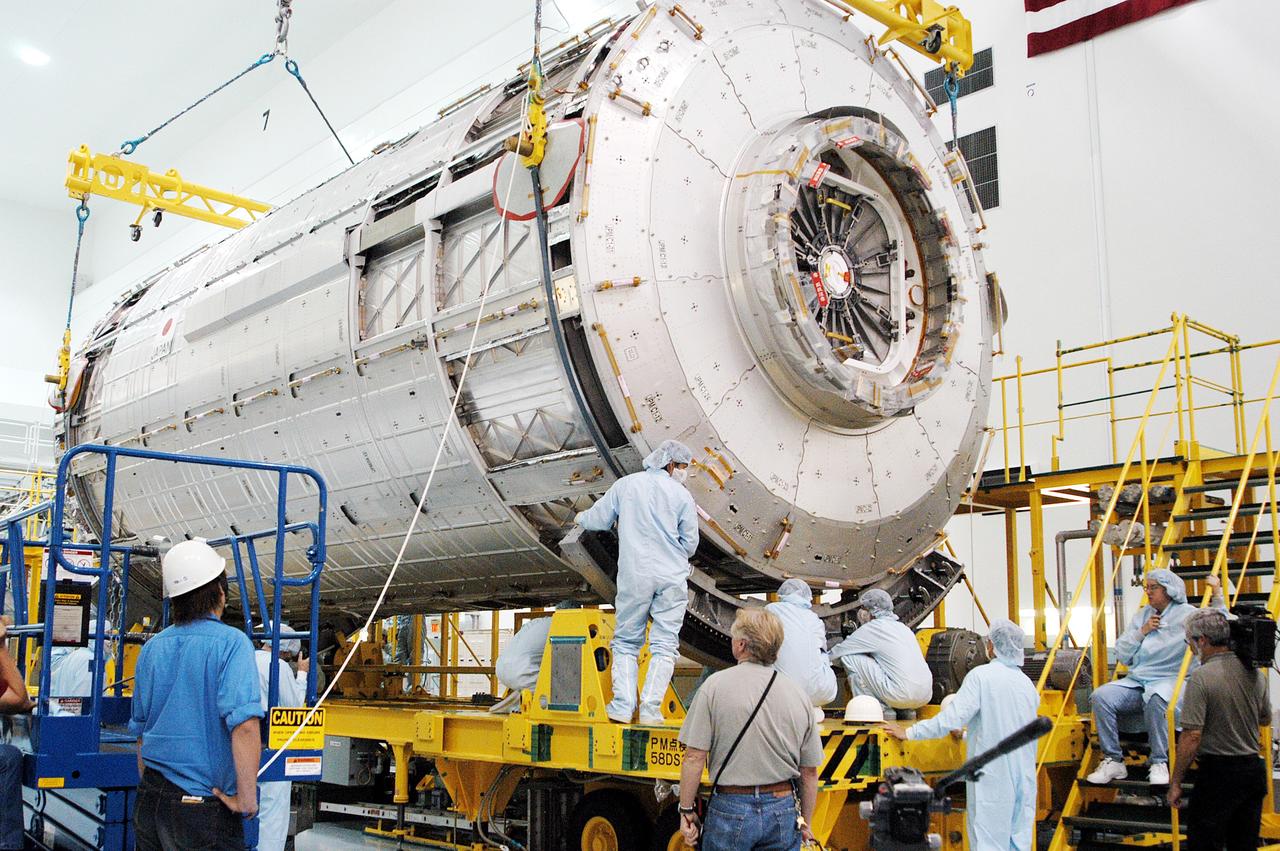
KENNEDY SPACE CENTER, FLA. -   Removed from its shipping canister (lower right), the Japanese Experiment Module (JEM) pressure module is moved across the floor of the Space Station Processing Facility to a work stand.  A research laboratory, the pressurized module is the first element of the JEM, named "Kibo" (Hope), to be delivered to KSC.   The National Space Development Agency of Japan (NASDA) developed the laboratory at the Tsukuba Space Center near Tokyo and is Japan's primary contribution to the Station. It will enhance the unique research capabilities of the orbiting complex by providing an additional environment for astronauts to conduct science experiments.  The JEM also includes an exposed facility (platform) for space environment experiments, a robotic manipulator system, and two logistics modules. The various JEM components will be  assembled in space over the course of three Shuttle missions.
KENNEDY SPACE CENTER, FLA. - Removed from its shipping canister (lower right), the Japanese Experiment Module (JEM) pressure module is moved across the floor of the Space Station Processing Facility to a work stand. A research laboratory, the pressurized module is the first element of the JEM, named "Kibo" (Hope), to be delivered to KSC. The National Space Development Agency of Japan (NASDA) developed the laboratory at the Tsukuba Space Center near Tokyo and is Japan's primary contribution to the Station. It will enhance the unique research capabilities of the orbiting complex by providing an additional environment for astronauts to conduct science experiments. The JEM also includes an exposed facility (platform) for space environment experiments, a robotic manipulator system, and two logistics modules. The various JEM components will be assembled in space over the course of three Shuttle missions.
KENNEDY SPACE CENTER, FLA. -  An overhead crane is attached to the Japanese Experiment Module (JEM) pressure module inside its canister.  The module will be removed and transferred to a work stand in the Space Station Processing Facility.  A research laboratory, the pressurized module is the first element of the JEM, named "Kibo" (Hope), to be delivered to KSC.   The National Space Development Agency of Japan (NASDA) developed the laboratory at the Tsukuba Space Center near Tokyo and is Japan's primary contribution to the Station. It will enhance the unique research capabilities of the orbiting complex by providing an additional environment for astronauts to conduct science experiments.  The JEM also includes an exposed facility (platform) for space environment experiments, a robotic manipulator system, and two logistics modules. The various JEM components will be  assembled in space over the course of three Shuttle missions.
KENNEDY SPACE CENTER, FLA. - An overhead crane is attached to the Japanese Experiment Module (JEM) pressure module inside its canister. The module will be removed and transferred to a work stand in the Space Station Processing Facility. A research laboratory, the pressurized module is the first element of the JEM, named "Kibo" (Hope), to be delivered to KSC. The National Space Development Agency of Japan (NASDA) developed the laboratory at the Tsukuba Space Center near Tokyo and is Japan's primary contribution to the Station. It will enhance the unique research capabilities of the orbiting complex by providing an additional environment for astronauts to conduct science experiments. The JEM also includes an exposed facility (platform) for space environment experiments, a robotic manipulator system, and two logistics modules. The various JEM components will be assembled in space over the course of three Shuttle missions.
KENNEDY SPACE CENTER, FLA. -   Workers in the Space Station Processing Facility prepare to remove the lid of the container with the Japanese Experiment Module (JEM) pressure module inside. A research laboratory, the pressurized module is the first element of the JEM, named "Kibo" (Hope), to be delivered to KSC.   The National Space Development Agency of Japan (NASDA) developed the laboratory at the Tsukuba Space Center near Tokyo and is Japan's primary contribution to the Station. It will enhance the unique research capabilities of the orbiting complex by providing an additional environment for astronauts to conduct science experiments.  The JEM also includes an exposed facility (platform) for space environment experiments, a robotic manipulator system, and two logistics modules. The various JEM components will be  assembled in space over the course of three Shuttle missions.
KENNEDY SPACE CENTER, FLA. - Workers in the Space Station Processing Facility prepare to remove the lid of the container with the Japanese Experiment Module (JEM) pressure module inside. A research laboratory, the pressurized module is the first element of the JEM, named "Kibo" (Hope), to be delivered to KSC. The National Space Development Agency of Japan (NASDA) developed the laboratory at the Tsukuba Space Center near Tokyo and is Japan's primary contribution to the Station. It will enhance the unique research capabilities of the orbiting complex by providing an additional environment for astronauts to conduct science experiments. The JEM also includes an exposed facility (platform) for space environment experiments, a robotic manipulator system, and two logistics modules. The various JEM components will be assembled in space over the course of three Shuttle missions.
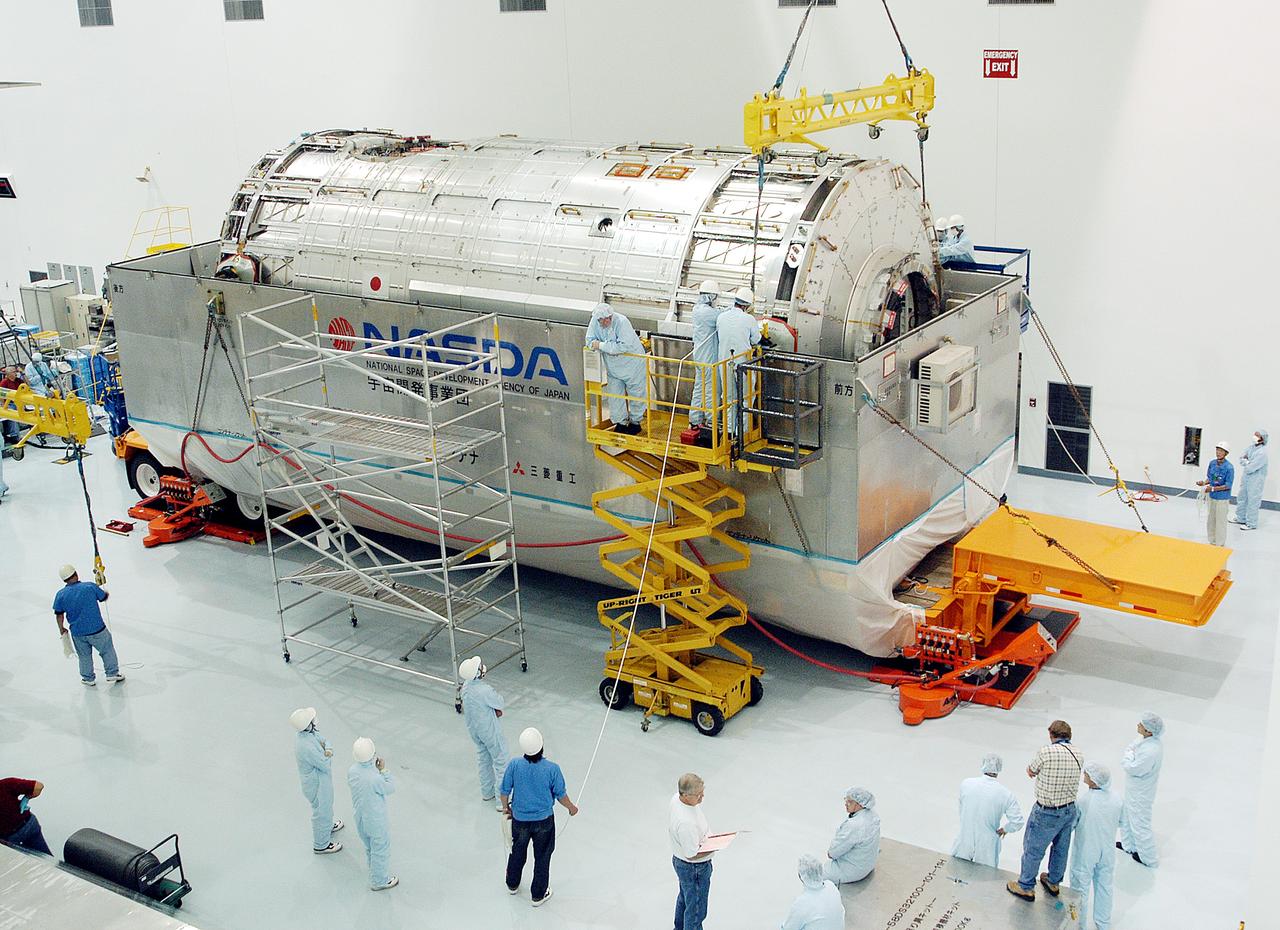
KENNEDY SPACE CENTER, FLA. -  In the Space Station Processing Facility, the Japanese Experiment Module (JEM) pressure module is ready to be lifted out of the shipping canister and transferred to a work stand.  A research laboratory, the pressurized module is the first element of the JEM, named "Kibo" (Hope), to be delivered to KSC.   The National Space Development Agency of Japan (NASDA) developed the laboratory at the Tsukuba Space Center near Tokyo and is Japan's primary contribution to the Station. It will enhance the unique research capabilities of the orbiting complex by providing an additional environment for astronauts to conduct science experiments.  The JEM also includes an exposed facility (platform) for space environment experiments, a robotic manipulator system, and two logistics modules. The various JEM components will be  assembled in space over the course of three Shuttle missions.
KENNEDY SPACE CENTER, FLA. - In the Space Station Processing Facility, the Japanese Experiment Module (JEM) pressure module is ready to be lifted out of the shipping canister and transferred to a work stand. A research laboratory, the pressurized module is the first element of the JEM, named "Kibo" (Hope), to be delivered to KSC. The National Space Development Agency of Japan (NASDA) developed the laboratory at the Tsukuba Space Center near Tokyo and is Japan's primary contribution to the Station. It will enhance the unique research capabilities of the orbiting complex by providing an additional environment for astronauts to conduct science experiments. The JEM also includes an exposed facility (platform) for space environment experiments, a robotic manipulator system, and two logistics modules. The various JEM components will be assembled in space over the course of three Shuttle missions.
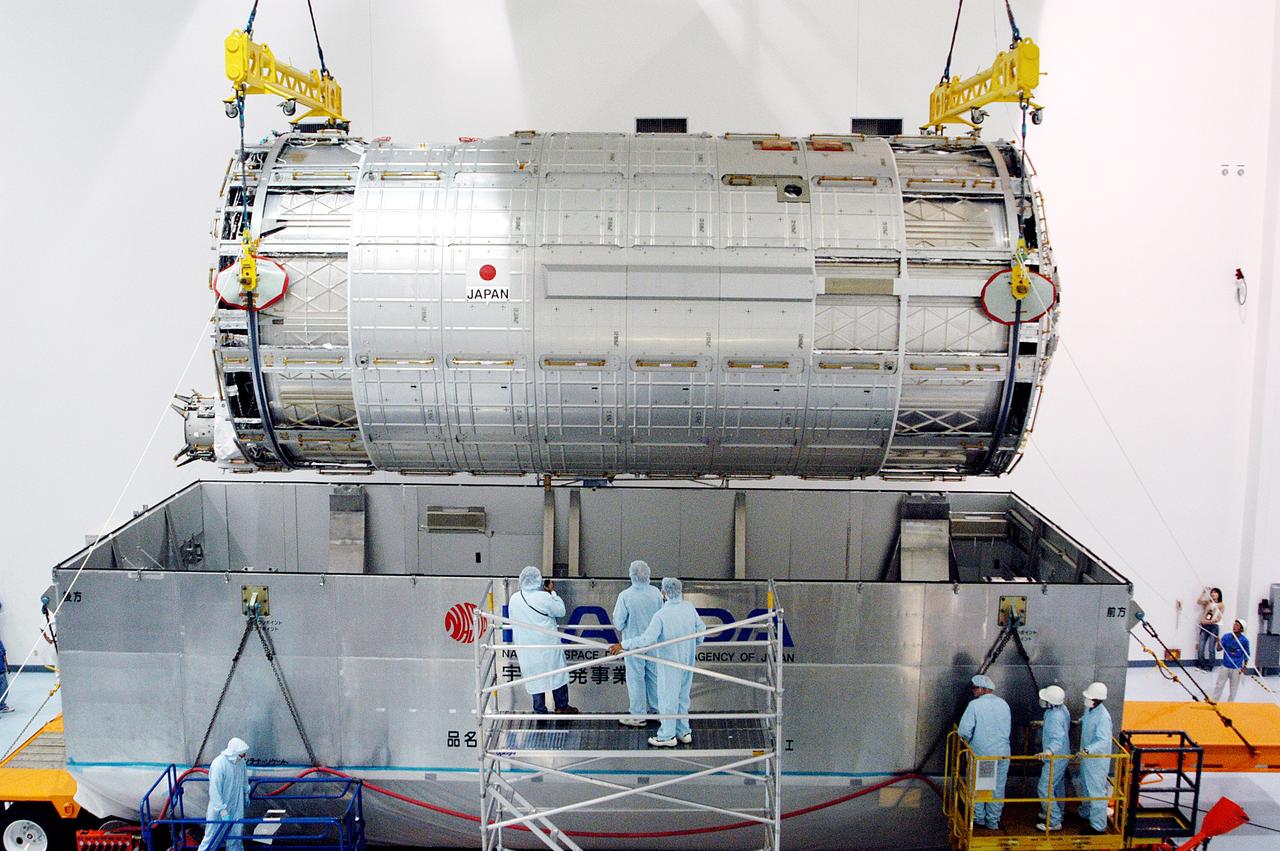
KENNEDY SPACE CENTER, FLA. -  In the Space Station Processing Facility, the Japanese Experiment Module (JEM) pressure module is exposed after removal of the lid of its shipping container.  A research laboratory, the pressurized module is the first element of the JEM, named "Kibo" (Hope), to be delivered to KSC.   The National Space Development Agency of Japan (NASDA) developed the laboratory at the Tsukuba Space Center near Tokyo and is Japan's primary contribution to the Station. It will enhance the unique research capabilities of the orbiting complex by providing an additional environment for astronauts to conduct science experiments.  The JEM also includes an exposed facility (platform) for space environment experiments, a robotic manipulator system, and two logistics modules. The various JEM components will be  assembled in space over the course of three Shuttle missions.
KENNEDY SPACE CENTER, FLA. - In the Space Station Processing Facility, the Japanese Experiment Module (JEM) pressure module is exposed after removal of the lid of its shipping container. A research laboratory, the pressurized module is the first element of the JEM, named "Kibo" (Hope), to be delivered to KSC. The National Space Development Agency of Japan (NASDA) developed the laboratory at the Tsukuba Space Center near Tokyo and is Japan's primary contribution to the Station. It will enhance the unique research capabilities of the orbiting complex by providing an additional environment for astronauts to conduct science experiments. The JEM also includes an exposed facility (platform) for space environment experiments, a robotic manipulator system, and two logistics modules. The various JEM components will be assembled in space over the course of three Shuttle missions.
KENNEDY SPACE CENTER, FLA. -  The transporter rolls out of Port Canaveral with the Pressurized Module of the Japanese Experiment Module (JEM) aboard.  The National Space Development Agency of Japan (NASDA) developed the laboratory at the Tsukuba Space Center near Tokyo. The Pressurized Module is the first element of the JEM, named "Kibo" (Hope), to be delivered to KSC, and will be transferred to KSC’s Space Station Processing Facility.  The JEM is Japan's primary contribution to the Station. It will enhance the unique research capabilities of the orbiting complex by providing an additional environment for astronauts to conduct science experiments.  The JEM also includes an exposed facility (platform) for space environment experiments, a robotic manipulator system, and two logistics modules. The various JEM components will be  assembled in space over the course of three Shuttle missions.
KENNEDY SPACE CENTER, FLA. - The transporter rolls out of Port Canaveral with the Pressurized Module of the Japanese Experiment Module (JEM) aboard. The National Space Development Agency of Japan (NASDA) developed the laboratory at the Tsukuba Space Center near Tokyo. The Pressurized Module is the first element of the JEM, named "Kibo" (Hope), to be delivered to KSC, and will be transferred to KSC’s Space Station Processing Facility. The JEM is Japan's primary contribution to the Station. It will enhance the unique research capabilities of the orbiting complex by providing an additional environment for astronauts to conduct science experiments. The JEM also includes an exposed facility (platform) for space environment experiments, a robotic manipulator system, and two logistics modules. The various JEM components will be assembled in space over the course of three Shuttle missions.
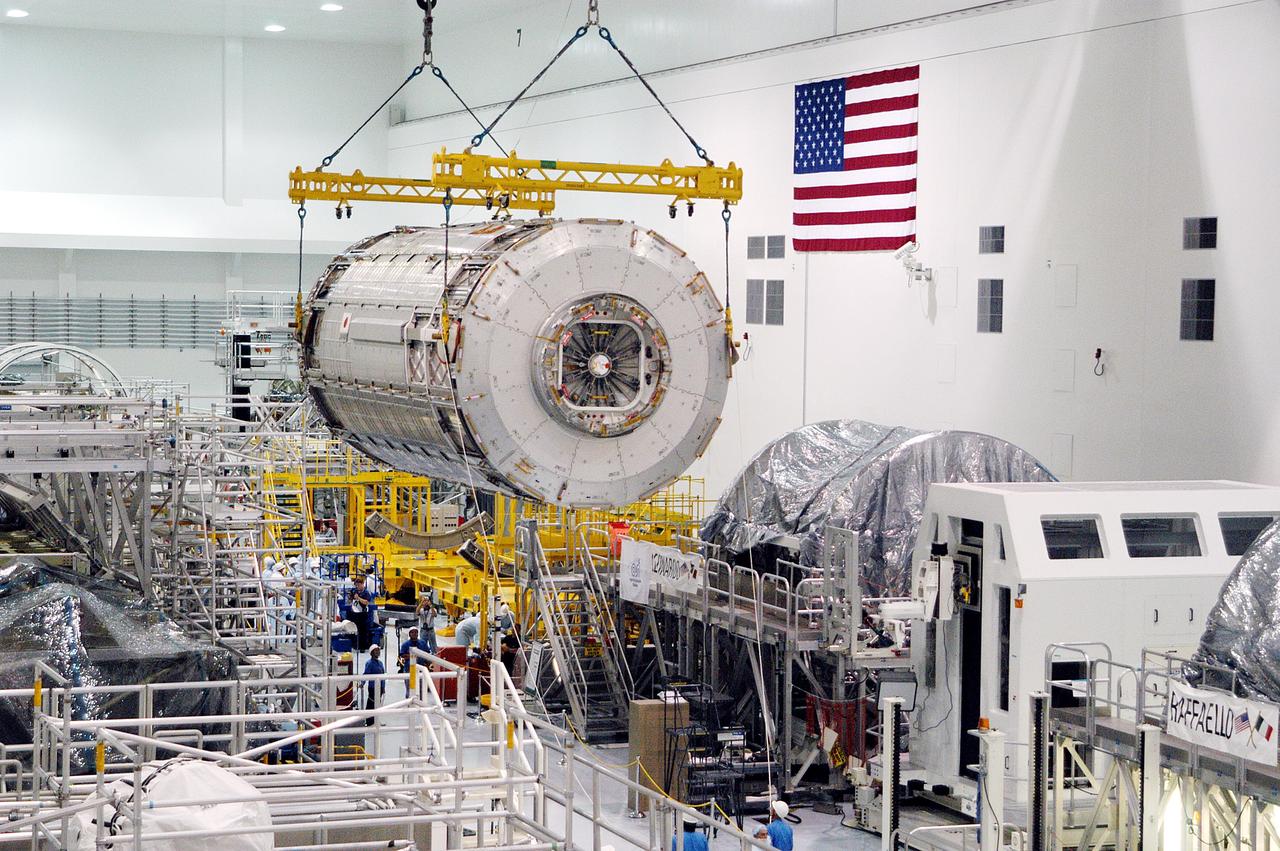
KENNEDY SPACE CENTER, FLA. -  In the Space Station Processing Facility, an overhead crane moves the Japanese Experiment Module (JEM) pressure module past other ISS elements to a work stand.  A research laboratory, the pressurized module is the first element of the JEM, named "Kibo" (Hope), to be delivered to KSC.   The National Space Development Agency of Japan (NASDA) developed the laboratory at the Tsukuba Space Center near Tokyo and is Japan's primary contribution to the Station. It will enhance the unique research capabilities of the orbiting complex by providing an additional environment for astronauts to conduct science experiments.  The JEM also includes an exposed facility (platform) for space environment experiments, a robotic manipulator system, and two logistics modules. The various JEM components will be  assembled in space over the course of three Shuttle missions.
KENNEDY SPACE CENTER, FLA. - In the Space Station Processing Facility, an overhead crane moves the Japanese Experiment Module (JEM) pressure module past other ISS elements to a work stand. A research laboratory, the pressurized module is the first element of the JEM, named "Kibo" (Hope), to be delivered to KSC. The National Space Development Agency of Japan (NASDA) developed the laboratory at the Tsukuba Space Center near Tokyo and is Japan's primary contribution to the Station. It will enhance the unique research capabilities of the orbiting complex by providing an additional environment for astronauts to conduct science experiments. The JEM also includes an exposed facility (platform) for space environment experiments, a robotic manipulator system, and two logistics modules. The various JEM components will be assembled in space over the course of three Shuttle missions.
KENNEDY SPACE CENTER, FLA. - In the Space Station Processing Facility, the Japanese Experiment Module (JEM) pressure module is moved toward a work stand.  A research laboratory, the pressurized module is the first element of the JEM, named "Kibo" (Hope), to be delivered to KSC.   The National Space Development Agency of Japan (NASDA) developed the laboratory at the Tsukuba Space Center near Tokyo and is Japan's primary contribution to the Station. It will enhance the unique research capabilities of the orbiting complex by providing an additional environment for astronauts to conduct science experiments.  The JEM also includes an exposed facility (platform) for space environment experiments, a robotic manipulator system, and two logistics modules. The various JEM components will be  assembled in space over the course of three Shuttle missions.
KENNEDY SPACE CENTER, FLA. - In the Space Station Processing Facility, the Japanese Experiment Module (JEM) pressure module is moved toward a work stand. A research laboratory, the pressurized module is the first element of the JEM, named "Kibo" (Hope), to be delivered to KSC. The National Space Development Agency of Japan (NASDA) developed the laboratory at the Tsukuba Space Center near Tokyo and is Japan's primary contribution to the Station. It will enhance the unique research capabilities of the orbiting complex by providing an additional environment for astronauts to conduct science experiments. The JEM also includes an exposed facility (platform) for space environment experiments, a robotic manipulator system, and two logistics modules. The various JEM components will be assembled in space over the course of three Shuttle missions.
KENNEDY SPACE CENTER, FLA. - In the Space Station Processing Facility, workers check the Japanese Experiment Module (JEM) pressure module on its work stand.  A research laboratory, the pressurized module is the first element of the JEM, named "Kibo" (Hope), to be delivered to KSC.   The National Space Development Agency of Japan (NASDA) developed the laboratory at the Tsukuba Space Center near Tokyo and is Japan's primary contribution to the Station. It will enhance the unique research capabilities of the orbiting complex by providing an additional environment for astronauts to conduct science experiments.  The JEM also includes an exposed facility (platform) for space environment experiments, a robotic manipulator system, and two logistics modules. The various JEM components will be  assembled in space over the course of three Shuttle missions.
KENNEDY SPACE CENTER, FLA. - In the Space Station Processing Facility, workers check the Japanese Experiment Module (JEM) pressure module on its work stand. A research laboratory, the pressurized module is the first element of the JEM, named "Kibo" (Hope), to be delivered to KSC. The National Space Development Agency of Japan (NASDA) developed the laboratory at the Tsukuba Space Center near Tokyo and is Japan's primary contribution to the Station. It will enhance the unique research capabilities of the orbiting complex by providing an additional environment for astronauts to conduct science experiments. The JEM also includes an exposed facility (platform) for space environment experiments, a robotic manipulator system, and two logistics modules. The various JEM components will be assembled in space over the course of three Shuttle missions.
KENNEDY SPACE CENTER, FLA. -  The Japanese Experiment Module (JEM) pressure module is moved past other ISS elements in the Space Station Processing Facility to a work stand.  A research laboratory, the pressurized module is the first element of the JEM, named "Kibo" (Hope), to be delivered to KSC.   The National Space Development Agency of Japan (NASDA) developed the laboratory at the Tsukuba Space Center near Tokyo and is Japan's primary contribution to the Station. It will enhance the unique research capabilities of the orbiting complex by providing an additional environment for astronauts to conduct science experiments.  The JEM also includes an exposed facility (platform) for space environment experiments, a robotic manipulator system, and two logistics modules. The various JEM components will be  assembled in space over the course of three Shuttle missions.
KENNEDY SPACE CENTER, FLA. - The Japanese Experiment Module (JEM) pressure module is moved past other ISS elements in the Space Station Processing Facility to a work stand. A research laboratory, the pressurized module is the first element of the JEM, named "Kibo" (Hope), to be delivered to KSC. The National Space Development Agency of Japan (NASDA) developed the laboratory at the Tsukuba Space Center near Tokyo and is Japan's primary contribution to the Station. It will enhance the unique research capabilities of the orbiting complex by providing an additional environment for astronauts to conduct science experiments. The JEM also includes an exposed facility (platform) for space environment experiments, a robotic manipulator system, and two logistics modules. The various JEM components will be assembled in space over the course of three Shuttle missions.
KENNEDY SPACE CENTER, FLA. -   Removed from its shipping canister, the Japanese Experiment Module (JEM) pressure module is moved across the floor of the Space Station Processing Facility to a work stand.  A research laboratory, the pressurized module is the first element of the JEM, named "Kibo" (Hope), to be delivered to KSC.   The National Space Development Agency of Japan (NASDA) developed the laboratory at the Tsukuba Space Center near Tokyo and is Japan's primary contribution to the Station. It will enhance the unique research capabilities of the orbiting complex by providing an additional environment for astronauts to conduct science experiments.  The JEM also includes an exposed facility (platform) for space environment experiments, a robotic manipulator system, and two logistics modules. The various JEM components will be  assembled in space over the course of three Shuttle missions.
KENNEDY SPACE CENTER, FLA. - Removed from its shipping canister, the Japanese Experiment Module (JEM) pressure module is moved across the floor of the Space Station Processing Facility to a work stand. A research laboratory, the pressurized module is the first element of the JEM, named "Kibo" (Hope), to be delivered to KSC. The National Space Development Agency of Japan (NASDA) developed the laboratory at the Tsukuba Space Center near Tokyo and is Japan's primary contribution to the Station. It will enhance the unique research capabilities of the orbiting complex by providing an additional environment for astronauts to conduct science experiments. The JEM also includes an exposed facility (platform) for space environment experiments, a robotic manipulator system, and two logistics modules. The various JEM components will be assembled in space over the course of three Shuttle missions.
KENNEDY SPACE CENTER, FLA. -  The container transport ship carrying the JEM Pressurized Module arrives at Port Canaveral, Fla.  The National Space Development Agency of Japan (NASDA) built the laboratory at the Tsukuba Space Center near Tokyo.  The Pressurized Module is the first element of the JEM, Japan’s primary contribution to the space station, to be delivered to KSC. It will enhance the unique research capabilities of the orbiting complex by providing an additional shirt-sleeve environment for astronauts to conduct science experiments. The JEM also includes two logistics modules, an exposed pallet for space environment experiments and a robotic manipulator system that are still under construction in Japan. The various JEM components will be assembled in space over the course of three space shuttle missions.
KENNEDY SPACE CENTER, FLA. - The container transport ship carrying the JEM Pressurized Module arrives at Port Canaveral, Fla. The National Space Development Agency of Japan (NASDA) built the laboratory at the Tsukuba Space Center near Tokyo. The Pressurized Module is the first element of the JEM, Japan’s primary contribution to the space station, to be delivered to KSC. It will enhance the unique research capabilities of the orbiting complex by providing an additional shirt-sleeve environment for astronauts to conduct science experiments. The JEM also includes two logistics modules, an exposed pallet for space environment experiments and a robotic manipulator system that are still under construction in Japan. The various JEM components will be assembled in space over the course of three space shuttle missions.
KENNEDY SPACE CENTER, FLA. - Astronaut Soichi Noguchi, with the National Space Development Agency of Japan (NASDA), looks at the Japanese Experiment Module after its arrival at Port Canaveral, Fla.   Built by the Tsukuba Space Center near Tokyo, the pressurized module is the first element of the JEM, Japan’s primary contribution to the space station, to be delivered to KSC. It will enhance the unique research capabilities of the orbiting complex by providing an additional shirt-sleeve environment for astronauts to conduct science experiments. The JEM also includes two logistics modules, an exposed pallet for space environment experiments and a robotic manipulator system that are still under construction in Japan. The various JEM components will be assembled in space over the course of three space shuttle missions. .
KENNEDY SPACE CENTER, FLA. - Astronaut Soichi Noguchi, with the National Space Development Agency of Japan (NASDA), looks at the Japanese Experiment Module after its arrival at Port Canaveral, Fla. Built by the Tsukuba Space Center near Tokyo, the pressurized module is the first element of the JEM, Japan’s primary contribution to the space station, to be delivered to KSC. It will enhance the unique research capabilities of the orbiting complex by providing an additional shirt-sleeve environment for astronauts to conduct science experiments. The JEM also includes two logistics modules, an exposed pallet for space environment experiments and a robotic manipulator system that are still under construction in Japan. The various JEM components will be assembled in space over the course of three space shuttle missions. .
KENNEDY SPACE CENTER, FLA. - Astronaut Soichi Noguchi, with the National Space Development Agency of Japan (NASDA), looks at the Japanese Experiment Module after its arrival at Port Canaveral, Fla.   Built by the Tsukuba Space Center near Tokyo, the pressurized module is the first element of the JEM, Japan’s primary contribution to the space station, to be delivered to KSC. It will enhance the unique research capabilities of the orbiting complex by providing an additional shirt-sleeve environment for astronauts to conduct science experiments. The JEM also includes two logistics modules, an exposed pallet for space environment experiments and a robotic manipulator system that are still under construction in Japan. The various JEM components will be assembled in space over the course of three space shuttle missions.
KENNEDY SPACE CENTER, FLA. - Astronaut Soichi Noguchi, with the National Space Development Agency of Japan (NASDA), looks at the Japanese Experiment Module after its arrival at Port Canaveral, Fla. Built by the Tsukuba Space Center near Tokyo, the pressurized module is the first element of the JEM, Japan’s primary contribution to the space station, to be delivered to KSC. It will enhance the unique research capabilities of the orbiting complex by providing an additional shirt-sleeve environment for astronauts to conduct science experiments. The JEM also includes two logistics modules, an exposed pallet for space environment experiments and a robotic manipulator system that are still under construction in Japan. The various JEM components will be assembled in space over the course of three space shuttle missions.
KENNEDY SPACE CENTER, FLA. - Astronaut Soichi Noguchi, with the National Space Development Agency of Japan (NASDA), stands next to the Japanese Experiment Module after its arrival at Port Canaveral, Fla.   Built by the Tsukuba Space Center near Tokyo, the pressurized module is the first element of the JEM, Japan’s primary contribution to the space station, to be delivered to KSC. It will enhance the unique research capabilities of the orbiting complex by providing an additional shirt-sleeve environment for astronauts to conduct science experiments. The JEM also includes two logistics modules, an exposed pallet for space environment experiments and a robotic manipulator system that are still under construction in Japan. The various JEM components will be assembled in space over the course of three space shuttle missions.
KENNEDY SPACE CENTER, FLA. - Astronaut Soichi Noguchi, with the National Space Development Agency of Japan (NASDA), stands next to the Japanese Experiment Module after its arrival at Port Canaveral, Fla. Built by the Tsukuba Space Center near Tokyo, the pressurized module is the first element of the JEM, Japan’s primary contribution to the space station, to be delivered to KSC. It will enhance the unique research capabilities of the orbiting complex by providing an additional shirt-sleeve environment for astronauts to conduct science experiments. The JEM also includes two logistics modules, an exposed pallet for space environment experiments and a robotic manipulator system that are still under construction in Japan. The various JEM components will be assembled in space over the course of three space shuttle missions.
KENNEDY SPACE CENTER, FLA. - The container transport ship carrying the JEM Pressurized Module arrives at Port Canaveral, Fla.  The National Space Development Agency of Japan (NASDA) built the laboratory at the Tsukuba Space Center near Tokyo.  The Pressurized Module is the first element of the JEM, Japan’s primary contribution to the space station, to be delivered to KSC. It will enhance the unique research capabilities of the orbiting complex by providing an additional shirt-sleeve environment for astronauts to conduct science experiments. The JEM also includes two logistics modules, an exposed pallet for space environment experiments and a robotic manipulator system that are still under construction in Japan. The various JEM components will be assembled in space over the course of three space shuttle missions.
KENNEDY SPACE CENTER, FLA. - The container transport ship carrying the JEM Pressurized Module arrives at Port Canaveral, Fla. The National Space Development Agency of Japan (NASDA) built the laboratory at the Tsukuba Space Center near Tokyo. The Pressurized Module is the first element of the JEM, Japan’s primary contribution to the space station, to be delivered to KSC. It will enhance the unique research capabilities of the orbiting complex by providing an additional shirt-sleeve environment for astronauts to conduct science experiments. The JEM also includes two logistics modules, an exposed pallet for space environment experiments and a robotic manipulator system that are still under construction in Japan. The various JEM components will be assembled in space over the course of three space shuttle missions.
KENNEDY SPACE CENTER, FLA. - Astronaut Soichi Noguchi, with the National Space Development Agency of Japan (NASDA), looks at the Japanese Experiment Module after its arrival at Port Canaveral, Fla.   Built by the Tsukuba Space Center near Tokyo, the pressurized module is the first element of the JEM, Japan’s primary contribution to the space station, to be delivered to KSC. It will enhance the unique research capabilities of the orbiting complex by providing an additional shirt-sleeve environment for astronauts to conduct science experiments. The JEM also includes two logistics modules, an exposed pallet for space environment experiments and a robotic manipulator system that are still under construction in Japan. The various JEM components will be assembled in space over the course of three space shuttle missions.
KENNEDY SPACE CENTER, FLA. - Astronaut Soichi Noguchi, with the National Space Development Agency of Japan (NASDA), looks at the Japanese Experiment Module after its arrival at Port Canaveral, Fla. Built by the Tsukuba Space Center near Tokyo, the pressurized module is the first element of the JEM, Japan’s primary contribution to the space station, to be delivered to KSC. It will enhance the unique research capabilities of the orbiting complex by providing an additional shirt-sleeve environment for astronauts to conduct science experiments. The JEM also includes two logistics modules, an exposed pallet for space environment experiments and a robotic manipulator system that are still under construction in Japan. The various JEM components will be assembled in space over the course of three space shuttle missions.
KENNEDY SPACE CENTER, FLA. -   Alan Thirkettle, International Space Station Program manager for Node 2, European Space Agency (ESA), speaks to guests and the media gathered in the Space Station Processing Facility at a ceremony highlighting the arrival of two major components of the International Space Station.  NASA's Node 2, built by the European Space Agency (ESA) in Italy, arrived at KSC on June 1. It will be the next pressurized module installed on the Station. The pressurized module of the Japanese Experiment Module (JEM), named "Kibo" (Hope), arrived at KSC on June 4. It is Japan's primary contribution to the Station. The ceremony held today included the official transfer of ownership signing of Node 2 between the ESA and NASA.. Emceed by Lisa Malone, deputy director of External Relations and Business Development at KSC, the ceremony also included these speakers: Center Director Roy Bridges Jr.; NASA’s Michael C. Kostelnik, deputy associate administrator for International Space Station and Shuttle Programs and William Gerstenmaier, International Space Station Program manager; Andrea Lorenzoni, International Space Station Program manager for Node 2, Italian Space Agency; and Kuniaki Shiraki, JEM Project manager, National Aerospace and Development Agency of Japan.
KENNEDY SPACE CENTER, FLA. - Alan Thirkettle, International Space Station Program manager for Node 2, European Space Agency (ESA), speaks to guests and the media gathered in the Space Station Processing Facility at a ceremony highlighting the arrival of two major components of the International Space Station. NASA's Node 2, built by the European Space Agency (ESA) in Italy, arrived at KSC on June 1. It will be the next pressurized module installed on the Station. The pressurized module of the Japanese Experiment Module (JEM), named "Kibo" (Hope), arrived at KSC on June 4. It is Japan's primary contribution to the Station. The ceremony held today included the official transfer of ownership signing of Node 2 between the ESA and NASA.. Emceed by Lisa Malone, deputy director of External Relations and Business Development at KSC, the ceremony also included these speakers: Center Director Roy Bridges Jr.; NASA’s Michael C. Kostelnik, deputy associate administrator for International Space Station and Shuttle Programs and William Gerstenmaier, International Space Station Program manager; Andrea Lorenzoni, International Space Station Program manager for Node 2, Italian Space Agency; and Kuniaki Shiraki, JEM Project manager, National Aerospace and Development Agency of Japan.
KENNEDY SPACE CENTER, FLA. - In the Space Station Processing Facility, the U.S. Node 2 (center) and the Japanese Experiment Module (JEM), background right, await a Multi-Element Integrated Test (MEIT). Node 2 attaches to the end of the U.S. Lab on the International Space Station and provides attach locations for the Japanese laboratory, European laboratory, the Centrifuge Accommodation Module and, eventually, Multipurpose Logistics Modules. It will provide the primary docking location for the Shuttle when a pressurized mating adapter is attached to Node 2.  Installation of the module will complete the U.S. Core of the ISS.  The National Space Development Agency of Japan (NASDA) developed their laboratory at the Tsukuba Space Center near Tokyo. It is the first element, named "Kibo" (Hope), to be delivered to KSC. The JEM is Japan's primary contribution to the Station. It will enhance the unique research capabilities of the orbiting complex by providing an additional environment for astronauts to conduct science experiments.
KENNEDY SPACE CENTER, FLA. - In the Space Station Processing Facility, the U.S. Node 2 (center) and the Japanese Experiment Module (JEM), background right, await a Multi-Element Integrated Test (MEIT). Node 2 attaches to the end of the U.S. Lab on the International Space Station and provides attach locations for the Japanese laboratory, European laboratory, the Centrifuge Accommodation Module and, eventually, Multipurpose Logistics Modules. It will provide the primary docking location for the Shuttle when a pressurized mating adapter is attached to Node 2. Installation of the module will complete the U.S. Core of the ISS. The National Space Development Agency of Japan (NASDA) developed their laboratory at the Tsukuba Space Center near Tokyo. It is the first element, named "Kibo" (Hope), to be delivered to KSC. The JEM is Japan's primary contribution to the Station. It will enhance the unique research capabilities of the orbiting complex by providing an additional environment for astronauts to conduct science experiments.
KENNEDY SPACE CENTER, FLA. - Andrea Lorenzoni, International Space Station Program manager for Node 2, Italian Space Agency; Alan Thirkettle, International Space Station Program manager for Node 2, European Space Agency (ESA); and NASA’s Michael C. Kostelnik, deputy associate administrator for International Space Station and Shuttle Programs, sign documents officially transferring ownership of Node 2 between the ESA and NASA. The signing was part of a  ceremony highlighting the arrival of two major components of the International Space Station.  NASA's Node 2, built by the European Space Agency (ESA) in Italy, arrived at KSC on June 1. It will be the next pressurized module installed on the Station. The pressurized module (above right) of the Japanese Experiment Module (JEM),  named "Kibo" (Hope), arrived at KSC on June 4. It is Japan's primary contribution to the Station. Emceed by Lisa Malone (far left), deputy director of External Relations and Business Development at KSC, the ceremony also included these speakers: Center Director Roy Bridges Jr.; NASA’s William Gerstenmaier, International Space Station Program manager; and Kuniaki Shiraki, JEM Project manager, National Aerospace and Development Agency of Japan.
KENNEDY SPACE CENTER, FLA. - Andrea Lorenzoni, International Space Station Program manager for Node 2, Italian Space Agency; Alan Thirkettle, International Space Station Program manager for Node 2, European Space Agency (ESA); and NASA’s Michael C. Kostelnik, deputy associate administrator for International Space Station and Shuttle Programs, sign documents officially transferring ownership of Node 2 between the ESA and NASA. The signing was part of a ceremony highlighting the arrival of two major components of the International Space Station. NASA's Node 2, built by the European Space Agency (ESA) in Italy, arrived at KSC on June 1. It will be the next pressurized module installed on the Station. The pressurized module (above right) of the Japanese Experiment Module (JEM), named "Kibo" (Hope), arrived at KSC on June 4. It is Japan's primary contribution to the Station. Emceed by Lisa Malone (far left), deputy director of External Relations and Business Development at KSC, the ceremony also included these speakers: Center Director Roy Bridges Jr.; NASA’s William Gerstenmaier, International Space Station Program manager; and Kuniaki Shiraki, JEM Project manager, National Aerospace and Development Agency of Japan.
KENNEDY SPACE CENTER, FLA. - At ceremony highlighting the arrival of two major components of the International Space Station, Node 2 and the Japanese Experiment Module (JEM), ownership of Node 2 was officially transferred between the European Space Agency and NASA.  Shaking hands after the signing are Andrea Lorenzoni, International Space Station Program manager for Node 2, Italian Space Agency; and Alan Thirkettle, International Space Station Program manager for Node 2, European Space Agency (ESA).  At right is NASA’s Michael C. Kostelnik, deputy associate administrator for International Space Station and Shuttle Programs.  NASA's Node 2, built by ESA in Italy, arrived at KSC on June 1. It will be the next pressurized module installed on the Station. The pressurized module of the Japanese Experiment Module (JEM),  named "Kibo" (Hope), arrived at KSC on June 4. It is Japan's primary contribution to the Station. Emceed by Lisa Malone, deputy director of External Relations and Business Development at KSC, the ceremony also included these speakers: Center Director Roy Bridges Jr.; NASA’s William Gerstenmaier, International Space Station Program manager; and Kuniaki Shiraki, JEM Project manager, National Aerospace and Development Agency of Japan.
KENNEDY SPACE CENTER, FLA. - At ceremony highlighting the arrival of two major components of the International Space Station, Node 2 and the Japanese Experiment Module (JEM), ownership of Node 2 was officially transferred between the European Space Agency and NASA. Shaking hands after the signing are Andrea Lorenzoni, International Space Station Program manager for Node 2, Italian Space Agency; and Alan Thirkettle, International Space Station Program manager for Node 2, European Space Agency (ESA). At right is NASA’s Michael C. Kostelnik, deputy associate administrator for International Space Station and Shuttle Programs. NASA's Node 2, built by ESA in Italy, arrived at KSC on June 1. It will be the next pressurized module installed on the Station. The pressurized module of the Japanese Experiment Module (JEM), named "Kibo" (Hope), arrived at KSC on June 4. It is Japan's primary contribution to the Station. Emceed by Lisa Malone, deputy director of External Relations and Business Development at KSC, the ceremony also included these speakers: Center Director Roy Bridges Jr.; NASA’s William Gerstenmaier, International Space Station Program manager; and Kuniaki Shiraki, JEM Project manager, National Aerospace and Development Agency of Japan.
KENNEDY SPACE CENTER, FLA. - At a ceremony highlighting the arrival of two major components of the International Space Station, Node 2 and the Japanese Experiment Module (JEM), ownership of Node 2 was officially transferred between the European Space Agency (ESA) and NASA.  Shaking hands after the signing are (left) Andrea Lorenzoni, International Space Station Program manager for Node 2, Italian Space Agency, and (right) NASA’s Michael C. Kostelnik (right), deputy associate administrator for International Space Station and Shuttle Programs.  Also part of the signing is (center) Alan Thirkettle (center), International Space Station Program manager for Node 2, European Space Agency.  NASA's Node 2, built by ESA in Italy, arrived at KSC on June 1. It will be the next pressurized module installed on the Station. The pressurized module of the Japanese Experiment Module (JEM),  named "Kibo" (Hope), arrived at KSC on June 4. It is Japan's primary contribution to the Station. Emceed by Lisa Malone (background, left),  deputy director of External Relations and Business Development at KSC, the ceremony also included these speakers: Center Director Roy Bridges Jr.; NASA’s William Gerstenmaier, International Space Station Program manager; and Kuniaki Shiraki, JEM Project manager, National Aerospace and Development Agency of Japan.
KENNEDY SPACE CENTER, FLA. - At a ceremony highlighting the arrival of two major components of the International Space Station, Node 2 and the Japanese Experiment Module (JEM), ownership of Node 2 was officially transferred between the European Space Agency (ESA) and NASA. Shaking hands after the signing are (left) Andrea Lorenzoni, International Space Station Program manager for Node 2, Italian Space Agency, and (right) NASA’s Michael C. Kostelnik (right), deputy associate administrator for International Space Station and Shuttle Programs. Also part of the signing is (center) Alan Thirkettle (center), International Space Station Program manager for Node 2, European Space Agency. NASA's Node 2, built by ESA in Italy, arrived at KSC on June 1. It will be the next pressurized module installed on the Station. The pressurized module of the Japanese Experiment Module (JEM), named "Kibo" (Hope), arrived at KSC on June 4. It is Japan's primary contribution to the Station. Emceed by Lisa Malone (background, left), deputy director of External Relations and Business Development at KSC, the ceremony also included these speakers: Center Director Roy Bridges Jr.; NASA’s William Gerstenmaier, International Space Station Program manager; and Kuniaki Shiraki, JEM Project manager, National Aerospace and Development Agency of Japan.
KENNEDY SPACE CENTER, FLA. -  Various elements intended for the International Space Station are lined up in the Space Station Processing Facility.  The newest to arrive at KSC are in the rear: at left, the U.S. Node 2, and next to it at right, the Japanese Experiment Module (JEM).  The two elements are undergoing a Multi-Element Integrated Test (MEIT).   Node 2 attaches to the end of the U.S. Lab on the ISS and provides attach locations for the Japanese laboratory, European laboratory, the Centrifuge Accommodation Module and, eventually, Multipurpose Logistics Modules. It will provide the primary docking location for the Shuttle when a pressurized mating adapter is attached to Node 2.  Installation of the module will complete the U.S. Core of the ISS.   Developed by the National Space Development Agency of Japan (NASDA), the JEM is Japan's primary contribution to the Station. It will enhance the unique research capabilities of the orbiting complex by providing an additional environment for astronauts to conduct science experiments.
KENNEDY SPACE CENTER, FLA. - Various elements intended for the International Space Station are lined up in the Space Station Processing Facility. The newest to arrive at KSC are in the rear: at left, the U.S. Node 2, and next to it at right, the Japanese Experiment Module (JEM). The two elements are undergoing a Multi-Element Integrated Test (MEIT). Node 2 attaches to the end of the U.S. Lab on the ISS and provides attach locations for the Japanese laboratory, European laboratory, the Centrifuge Accommodation Module and, eventually, Multipurpose Logistics Modules. It will provide the primary docking location for the Shuttle when a pressurized mating adapter is attached to Node 2. Installation of the module will complete the U.S. Core of the ISS. Developed by the National Space Development Agency of Japan (NASDA), the JEM is Japan's primary contribution to the Station. It will enhance the unique research capabilities of the orbiting complex by providing an additional environment for astronauts to conduct science experiments.
KENNEDY SPACE CENTER, FLA. -  Various elements intended for the International Space Station are lined up in the Space Station Processing Facility.  The newest to arrive at KSC are in the rear: at left, the U.S. Node 2, and next to it at right, the Japanese Experiment Module (JEM).  The two elements are undergoing a Multi-Element Integrated Test (MEIT).   Node 2 attaches to the end of the U.S. Lab on the ISS and provides attach locations for the Japanese laboratory, European laboratory, the Centrifuge Accommodation Module and, eventually, Multipurpose Logistics Modules. It will provide the primary docking location for the Shuttle when a pressurized mating adapter is attached to Node 2.  Installation of the module will complete the U.S. Core of the ISS.   Developed by the National Space Development Agency of Japan (NASDA), the JEM is Japan's primary contribution to the Station. It will enhance the unique research capabilities of the orbiting complex by providing an additional environment for astronauts to conduct science experiments.
KENNEDY SPACE CENTER, FLA. - Various elements intended for the International Space Station are lined up in the Space Station Processing Facility. The newest to arrive at KSC are in the rear: at left, the U.S. Node 2, and next to it at right, the Japanese Experiment Module (JEM). The two elements are undergoing a Multi-Element Integrated Test (MEIT). Node 2 attaches to the end of the U.S. Lab on the ISS and provides attach locations for the Japanese laboratory, European laboratory, the Centrifuge Accommodation Module and, eventually, Multipurpose Logistics Modules. It will provide the primary docking location for the Shuttle when a pressurized mating adapter is attached to Node 2. Installation of the module will complete the U.S. Core of the ISS. Developed by the National Space Development Agency of Japan (NASDA), the JEM is Japan's primary contribution to the Station. It will enhance the unique research capabilities of the orbiting complex by providing an additional environment for astronauts to conduct science experiments.
KENNEDY SPACE CENTER, FLA. -  Various elements intended for the International Space Station are lined up in the Space Station Processing Facility.  The newest to arrive at KSC are in the rear: at left, the U.S. Node 2, and at right, the Japanese Experiment Module (JEM).  The two elements are undergoing a Multi-Element Integrated Test (MEIT).   Node 2 attaches to the end of the U.S. Lab on the ISS and provides attach locations for the Japanese laboratory, European laboratory, the Centrifuge Accommodation Module and, eventually, Multipurpose Logistics Modules. It will provide the primary docking location for the Shuttle when a pressurized mating adapter is attached to Node 2.  Installation of the module will complete the U.S. Core of the ISS.   Developed by the National Space Development Agency of Japan (NASDA), the JEM is Japan's primary contribution to the Station. It will enhance the unique research capabilities of the orbiting complex by providing an additional environment for astronauts to conduct science experiments.
KENNEDY SPACE CENTER, FLA. - Various elements intended for the International Space Station are lined up in the Space Station Processing Facility. The newest to arrive at KSC are in the rear: at left, the U.S. Node 2, and at right, the Japanese Experiment Module (JEM). The two elements are undergoing a Multi-Element Integrated Test (MEIT). Node 2 attaches to the end of the U.S. Lab on the ISS and provides attach locations for the Japanese laboratory, European laboratory, the Centrifuge Accommodation Module and, eventually, Multipurpose Logistics Modules. It will provide the primary docking location for the Shuttle when a pressurized mating adapter is attached to Node 2. Installation of the module will complete the U.S. Core of the ISS. Developed by the National Space Development Agency of Japan (NASDA), the JEM is Japan's primary contribution to the Station. It will enhance the unique research capabilities of the orbiting complex by providing an additional environment for astronauts to conduct science experiments.
KENNEDY SPACE CENTER, FLA. -  Various elements intended for the International Space Station are lined up in the Space Station Processing Facility.  The newest to arrive at KSC are in the rear: at left, the U.S. Node 2, and next to it at right, the Japanese Experiment Module (JEM).  The two elements are undergoing a Multi-Element Integrated Test (MEIT).   Node 2 attaches to the end of the U.S. Lab on the ISS and provides attach locations for the Japanese laboratory, European laboratory, the Centrifuge Accommodation Module and, eventually, Multipurpose Logistics Modules. It will provide the primary docking location for the Shuttle when a pressurized mating adapter is attached to Node 2.  Installation of the module will complete the U.S. Core of the ISS.   Developed by the National Space Development Agency of Japan (NASDA), the JEM is Japan's primary contribution to the Station. It will enhance the unique research capabilities of the orbiting complex by providing an additional environment for astronauts to conduct science experiments.
KENNEDY SPACE CENTER, FLA. - Various elements intended for the International Space Station are lined up in the Space Station Processing Facility. The newest to arrive at KSC are in the rear: at left, the U.S. Node 2, and next to it at right, the Japanese Experiment Module (JEM). The two elements are undergoing a Multi-Element Integrated Test (MEIT). Node 2 attaches to the end of the U.S. Lab on the ISS and provides attach locations for the Japanese laboratory, European laboratory, the Centrifuge Accommodation Module and, eventually, Multipurpose Logistics Modules. It will provide the primary docking location for the Shuttle when a pressurized mating adapter is attached to Node 2. Installation of the module will complete the U.S. Core of the ISS. Developed by the National Space Development Agency of Japan (NASDA), the JEM is Japan's primary contribution to the Station. It will enhance the unique research capabilities of the orbiting complex by providing an additional environment for astronauts to conduct science experiments.
S92-44960 (9 Sept. 1992) --- Astronaut Koichi Wakata, mission specialist representing the National Space Development Agency (NASDA), Japan.
Official Portrait of Astronaut Candidate (ASCAN) Koichi Wakata in
JSC2001-01619 (4 June 2001) --- Astronaut Soichi Noguchi, mission specialist, representing Japan’s National Space Development Agency (NASDA)
Official photo for Soguchi Noguchi
KENNEDY SPACE CENTER, FLA. -  Astronaut Soichi Noguchi, with the National Space Development Agency of Japan (NASDA), rests inside the Japanese Experiment Module (JEM), undergoing a Multi-Element Integrated Test (MEIT)  in the Space Station Processing Facility.  Noguchi is assigned to mission STS-114 as a mission specialist.   Node 2 attaches to the end of the U.S. Lab on the ISS and provides attach locations for the Japanese laboratory, European laboratory, the Centrifuge Accommodation Module and, eventually, Multipurpose Logistics Modules. It will provide the primary docking location for the Shuttle when a pressurized mating adapter is attached to Node 2.  Installation of the module will complete the U.S. Core of the ISS.   The JEM, developed by NASDA,  is Japan's primary contribution to the Station. It will enhance the unique research capabilities of the orbiting complex by providing an additional environment for astronauts to conduct science experiments.
KENNEDY SPACE CENTER, FLA. - Astronaut Soichi Noguchi, with the National Space Development Agency of Japan (NASDA), rests inside the Japanese Experiment Module (JEM), undergoing a Multi-Element Integrated Test (MEIT) in the Space Station Processing Facility. Noguchi is assigned to mission STS-114 as a mission specialist. Node 2 attaches to the end of the U.S. Lab on the ISS and provides attach locations for the Japanese laboratory, European laboratory, the Centrifuge Accommodation Module and, eventually, Multipurpose Logistics Modules. It will provide the primary docking location for the Shuttle when a pressurized mating adapter is attached to Node 2. Installation of the module will complete the U.S. Core of the ISS. The JEM, developed by NASDA, is Japan's primary contribution to the Station. It will enhance the unique research capabilities of the orbiting complex by providing an additional environment for astronauts to conduct science experiments.
KENNEDY SPACE CENTER, FLA. -   Workers in the Space Station Processing Facility look over paperwork during a Multi-Element Integrated Test (MEIT) of the U.S. Node 2 and the Japanese Experiment Module (JEM).   Node 2 attaches to the end of the U.S. Lab on the ISS and provides attach locations for the Japanese laboratory, European laboratory, the Centrifuge Accommodation Module and, eventually, Multipurpose Logistics Modules. It will provide the primary docking location for the Shuttle when a pressurized mating adapter is attached to Node 2.  Installation of the module will complete the U.S. Core of the ISS.   The JEM, developed by the National Space Development Agency of Japan (NASDA), is Japan's primary contribution to the Station. It will enhance the unique research capabilities of the orbiting complex by providing an additional environment for astronauts to conduct science experiments.
KENNEDY SPACE CENTER, FLA. - Workers in the Space Station Processing Facility look over paperwork during a Multi-Element Integrated Test (MEIT) of the U.S. Node 2 and the Japanese Experiment Module (JEM). Node 2 attaches to the end of the U.S. Lab on the ISS and provides attach locations for the Japanese laboratory, European laboratory, the Centrifuge Accommodation Module and, eventually, Multipurpose Logistics Modules. It will provide the primary docking location for the Shuttle when a pressurized mating adapter is attached to Node 2. Installation of the module will complete the U.S. Core of the ISS. The JEM, developed by the National Space Development Agency of Japan (NASDA), is Japan's primary contribution to the Station. It will enhance the unique research capabilities of the orbiting complex by providing an additional environment for astronauts to conduct science experiments.
KENNEDY SPACE CENTER, FLA. -   Workers in the Space Station Processing Facility observe consoles during a Multi-Element Integrated Test (MEIT) of the U.S. Node 2 and the Japanese Experiment Module (JEM).   Node 2 attaches to the end of the U.S. Lab on the ISS and provides attach locations for the Japanese laboratory, European laboratory, the Centrifuge Accommodation Module and, eventually, Multipurpose Logistics Modules. It will provide the primary docking location for the Shuttle when a pressurized mating adapter is attached to Node 2.  Installation of the module will complete the U.S. Core of the ISS.   The JEM, developed by the National Space Development Agency of Japan (NASDA), is Japan's primary contribution to the Station. It will enhance the unique research capabilities of the orbiting complex by providing an additional environment for astronauts to conduct science experiments.
KENNEDY SPACE CENTER, FLA. - Workers in the Space Station Processing Facility observe consoles during a Multi-Element Integrated Test (MEIT) of the U.S. Node 2 and the Japanese Experiment Module (JEM). Node 2 attaches to the end of the U.S. Lab on the ISS and provides attach locations for the Japanese laboratory, European laboratory, the Centrifuge Accommodation Module and, eventually, Multipurpose Logistics Modules. It will provide the primary docking location for the Shuttle when a pressurized mating adapter is attached to Node 2. Installation of the module will complete the U.S. Core of the ISS. The JEM, developed by the National Space Development Agency of Japan (NASDA), is Japan's primary contribution to the Station. It will enhance the unique research capabilities of the orbiting complex by providing an additional environment for astronauts to conduct science experiments.
KENNEDY SPACE CENTER, FLA. -   Astronaut Soichi Noguchi, with the National Space Development Agency of Japan (NASDA), is inside the Japanese Experiment Module (JEM), undergoing a Multi-Element Integrated Test (MEIT)  in the Space Station Processing Facility.  Noguchi is assigned to mission STS-114 as a mission specialist.   Node 2 attaches to the end of the U.S. Lab on the ISS and provides attach locations for the Japanese laboratory, European laboratory, the Centrifuge Accommodation Module and, eventually, Multipurpose Logistics Modules. It will provide the primary docking location for the Shuttle when a pressurized mating adapter is attached to Node 2.  Installation of the module will complete the U.S. Core of the ISS.   The JEM, developed by NASDA,  is Japan's primary contribution to the Station. It will enhance the unique research capabilities of the orbiting complex by providing an additional environment for astronauts to conduct science experiments.
KENNEDY SPACE CENTER, FLA. - Astronaut Soichi Noguchi, with the National Space Development Agency of Japan (NASDA), is inside the Japanese Experiment Module (JEM), undergoing a Multi-Element Integrated Test (MEIT) in the Space Station Processing Facility. Noguchi is assigned to mission STS-114 as a mission specialist. Node 2 attaches to the end of the U.S. Lab on the ISS and provides attach locations for the Japanese laboratory, European laboratory, the Centrifuge Accommodation Module and, eventually, Multipurpose Logistics Modules. It will provide the primary docking location for the Shuttle when a pressurized mating adapter is attached to Node 2. Installation of the module will complete the U.S. Core of the ISS. The JEM, developed by NASDA, is Japan's primary contribution to the Station. It will enhance the unique research capabilities of the orbiting complex by providing an additional environment for astronauts to conduct science experiments.
KENNEDY SPACE CENTER, FLA. -  Astronaut Soichi Noguchi (left), with the National Space Development Agency of Japan (NASDA), points to data on the console during a Multi-Element Integrated Test (MEIT) of the U.S. Node 2 and the Japanese Experiment Module (JEM) in the Space Station Processing Facility.  The JEM, developed by NASDA, is Japan's primary contribution to the Station. It will enhance the unique research capabilities of the orbiting complex by providing an additional environment for astronauts to conduct science experiments. Noguchi is assigned to mission STS-114 as a mission specialist.  Node 2 provides attach locations for the Japanese laboratory, as well as European laboratory, the Centrifuge Accommodation Module and, eventually, Multipurpose Logistics Modules.  Installation of the module will complete the U.S. Core of the ISS.
KENNEDY SPACE CENTER, FLA. - Astronaut Soichi Noguchi (left), with the National Space Development Agency of Japan (NASDA), points to data on the console during a Multi-Element Integrated Test (MEIT) of the U.S. Node 2 and the Japanese Experiment Module (JEM) in the Space Station Processing Facility. The JEM, developed by NASDA, is Japan's primary contribution to the Station. It will enhance the unique research capabilities of the orbiting complex by providing an additional environment for astronauts to conduct science experiments. Noguchi is assigned to mission STS-114 as a mission specialist. Node 2 provides attach locations for the Japanese laboratory, as well as European laboratory, the Centrifuge Accommodation Module and, eventually, Multipurpose Logistics Modules. Installation of the module will complete the U.S. Core of the ISS.
KENNEDY SPACE CENTER, FLA. -  Astronaut Soichi Noguchi (left), with the National Space Development Agency of Japan (NASDA), points to data on the console during a Multi-Element Integrated Test (MEIT) of the U.S. Node 2 and the Japanese Experiment Module (JEM) in the Space Station Processing Facility.  The JEM, developed by NASDA, is Japan's primary contribution to the Station. It will enhance the unique research capabilities of the orbiting complex by providing an additional environment for astronauts to conduct science experiments. Noguchi is assigned to mission STS-114 as a mission specialist.  Node 2 provides attach locations for the Japanese laboratory, as well as European laboratory, the Centrifuge Accommodation Module and, eventually, Multipurpose Logistics Modules.  Installation of the module will complete the U.S. Core of the ISS.
KENNEDY SPACE CENTER, FLA. - Astronaut Soichi Noguchi (left), with the National Space Development Agency of Japan (NASDA), points to data on the console during a Multi-Element Integrated Test (MEIT) of the U.S. Node 2 and the Japanese Experiment Module (JEM) in the Space Station Processing Facility. The JEM, developed by NASDA, is Japan's primary contribution to the Station. It will enhance the unique research capabilities of the orbiting complex by providing an additional environment for astronauts to conduct science experiments. Noguchi is assigned to mission STS-114 as a mission specialist. Node 2 provides attach locations for the Japanese laboratory, as well as European laboratory, the Centrifuge Accommodation Module and, eventually, Multipurpose Logistics Modules. Installation of the module will complete the U.S. Core of the ISS.
KENNEDY SPACE CENTER, FLA. -  Astronaut Soichi Noguchi, with the National Space Development Agency of Japan (NASDA), signals success during a Multi-Element Integrated Test (MEIT ) of the Japanese Experiment Module (JEM) in the Space Station Processing Facility.  Noguchi is assigned to mission STS-114 as a mission specialist.   Node 2 attaches to the end of the U.S. Lab on the ISS and provides attach locations for the Japanese laboratory, European laboratory, the Centrifuge Accommodation Module and, eventually, Multipurpose Logistics Modules. It will provide the primary docking location for the Shuttle when a pressurized mating adapter is attached to Node 2.  Installation of the module will complete the U.S. Core of the ISS.   The JEM, developed by NASDA,  is Japan's primary contribution to the Station. It will enhance the unique research capabilities of the orbiting complex by providing an additional environment for astronauts to conduct science experiments.
KENNEDY SPACE CENTER, FLA. - Astronaut Soichi Noguchi, with the National Space Development Agency of Japan (NASDA), signals success during a Multi-Element Integrated Test (MEIT ) of the Japanese Experiment Module (JEM) in the Space Station Processing Facility. Noguchi is assigned to mission STS-114 as a mission specialist. Node 2 attaches to the end of the U.S. Lab on the ISS and provides attach locations for the Japanese laboratory, European laboratory, the Centrifuge Accommodation Module and, eventually, Multipurpose Logistics Modules. It will provide the primary docking location for the Shuttle when a pressurized mating adapter is attached to Node 2. Installation of the module will complete the U.S. Core of the ISS. The JEM, developed by NASDA, is Japan's primary contribution to the Station. It will enhance the unique research capabilities of the orbiting complex by providing an additional environment for astronauts to conduct science experiments.
KENNEDY SPACE CENTER, FLA. -   Astronaut Soichi Noguchi (right), with the National Space Development Agency of Japan (NASDA), is inside the Japanese Experiment Module (JEM), undergoing a Multi-Element Integrated Test (MEIT)  in the Space Station Processing Facility.  Noguchi is assigned to mission STS-114 as a mission specialist.   Node 2 attaches to the end of the U.S. Lab on the ISS and provides attach locations for the Japanese laboratory, European laboratory, the Centrifuge Accommodation Module and, eventually, Multipurpose Logistics Modules. It will provide the primary docking location for the Shuttle when a pressurized mating adapter is attached to Node 2.  Installation of the module will complete the U.S. Core of the ISS.   The JEM, developed by NASDA,  is Japan's primary contribution to the Station. It will enhance the unique research capabilities of the orbiting complex by providing an additional environment for astronauts to conduct science experiments.
KENNEDY SPACE CENTER, FLA. - Astronaut Soichi Noguchi (right), with the National Space Development Agency of Japan (NASDA), is inside the Japanese Experiment Module (JEM), undergoing a Multi-Element Integrated Test (MEIT) in the Space Station Processing Facility. Noguchi is assigned to mission STS-114 as a mission specialist. Node 2 attaches to the end of the U.S. Lab on the ISS and provides attach locations for the Japanese laboratory, European laboratory, the Centrifuge Accommodation Module and, eventually, Multipurpose Logistics Modules. It will provide the primary docking location for the Shuttle when a pressurized mating adapter is attached to Node 2. Installation of the module will complete the U.S. Core of the ISS. The JEM, developed by NASDA, is Japan's primary contribution to the Station. It will enhance the unique research capabilities of the orbiting complex by providing an additional environment for astronauts to conduct science experiments.
KENNEDY SPACE CENTER, FLA. -   Technicians in the Space Station Processing Facility work on a Multi-Element Integrated Test (MEIT) of the U.S. Node 2 and the Japanese Experiment Module (JEM).   Node 2 attaches to the end of the U.S. Lab on the ISS and provides attach locations for the Japanese laboratory, European laboratory, the Centrifuge Accommodation Module and, eventually, Multipurpose Logistics Modules. It will provide the primary docking location for the Shuttle when a pressurized mating adapter is attached to Node 2.  Installation of the module will complete the U.S. Core of the ISS.   The JEM, developed by the National Space Development Agency of Japan (NASDA), is Japan's primary contribution to the Station. It will enhance the unique research capabilities of the orbiting complex by providing an additional environment for astronauts to conduct science experiments.
KENNEDY SPACE CENTER, FLA. - Technicians in the Space Station Processing Facility work on a Multi-Element Integrated Test (MEIT) of the U.S. Node 2 and the Japanese Experiment Module (JEM). Node 2 attaches to the end of the U.S. Lab on the ISS and provides attach locations for the Japanese laboratory, European laboratory, the Centrifuge Accommodation Module and, eventually, Multipurpose Logistics Modules. It will provide the primary docking location for the Shuttle when a pressurized mating adapter is attached to Node 2. Installation of the module will complete the U.S. Core of the ISS. The JEM, developed by the National Space Development Agency of Japan (NASDA), is Japan's primary contribution to the Station. It will enhance the unique research capabilities of the orbiting complex by providing an additional environment for astronauts to conduct science experiments.
KENNEDY SPACE CENTER, FLA. -  Astronaut Soichi Noguchi, with the National Space Development Agency of Japan (NASDA), rests inside the Japanese Experiment Module (JEM), undergoing a Multi-Element Integrated Test (MEIT)  in the Space Station Processing Facility.  Noguchi is assigned to mission STS-114 as a mission specialist.   Node 2 attaches to the end of the U.S. Lab on the ISS and provides attach locations for the Japanese laboratory, European laboratory, the Centrifuge Accommodation Module and, eventually, Multipurpose Logistics Modules. It will provide the primary docking location for the Shuttle when a pressurized mating adapter is attached to Node 2.  Installation of the module will complete the U.S. Core of the ISS.   The JEM, developed by NASDA,  is Japan's primary contribution to the Station. It will enhance the unique research capabilities of the orbiting complex by providing an additional environment for astronauts to conduct science experiments.
KENNEDY SPACE CENTER, FLA. - Astronaut Soichi Noguchi, with the National Space Development Agency of Japan (NASDA), rests inside the Japanese Experiment Module (JEM), undergoing a Multi-Element Integrated Test (MEIT) in the Space Station Processing Facility. Noguchi is assigned to mission STS-114 as a mission specialist. Node 2 attaches to the end of the U.S. Lab on the ISS and provides attach locations for the Japanese laboratory, European laboratory, the Centrifuge Accommodation Module and, eventually, Multipurpose Logistics Modules. It will provide the primary docking location for the Shuttle when a pressurized mating adapter is attached to Node 2. Installation of the module will complete the U.S. Core of the ISS. The JEM, developed by NASDA, is Japan's primary contribution to the Station. It will enhance the unique research capabilities of the orbiting complex by providing an additional environment for astronauts to conduct science experiments.
KENNEDY SPACE CENTER, FLA. -   At a ceremony highlighting the arrival of two major components of the International Space Station, William Gerstenmaier, International Space Station Program manager, points to one of the components as he speaks to guests and the media gathered in the Space Station Processing Facility.  NASA's Node 2, built by the European Space Agency (ESA) in Italy, arrived at KSC on June 1. It will be the next pressurized module installed on the Station. The pressurized module of the Japanese Experiment Module (JEM), named "Kibo" (Hope), arrived at KSC on June 4. It is Japan's primary contribution to the Station. The ceremony held today included the official transfer of ownership signing of Node 2 between the ESA and NASA.. Emceed by Lisa Malone, deputy director of External Relations and Business Development at KSC, the ceremony also included these speakers: Center Director Roy Bridges Jr.; NASA’s Michael C. Kostelnik, deputy associate administrator for International Space Station and Shuttle Programs; Alan Thirkettle, International Space Station Program manager for Node 2, ESA; Andrea Lorenzoni, International Space Station Program manager for Node 2, Italian Space Agency; and Kuniaki Shiraki, JEM Project manager, National Aerospace and Development Agency of Japan.
KENNEDY SPACE CENTER, FLA. - At a ceremony highlighting the arrival of two major components of the International Space Station, William Gerstenmaier, International Space Station Program manager, points to one of the components as he speaks to guests and the media gathered in the Space Station Processing Facility. NASA's Node 2, built by the European Space Agency (ESA) in Italy, arrived at KSC on June 1. It will be the next pressurized module installed on the Station. The pressurized module of the Japanese Experiment Module (JEM), named "Kibo" (Hope), arrived at KSC on June 4. It is Japan's primary contribution to the Station. The ceremony held today included the official transfer of ownership signing of Node 2 between the ESA and NASA.. Emceed by Lisa Malone, deputy director of External Relations and Business Development at KSC, the ceremony also included these speakers: Center Director Roy Bridges Jr.; NASA’s Michael C. Kostelnik, deputy associate administrator for International Space Station and Shuttle Programs; Alan Thirkettle, International Space Station Program manager for Node 2, ESA; Andrea Lorenzoni, International Space Station Program manager for Node 2, Italian Space Agency; and Kuniaki Shiraki, JEM Project manager, National Aerospace and Development Agency of Japan.
KENNEDY SPACE CENTER, FLA. -  NASA's Michael C. Kostelnik, deputy associate administrator for International Space Station and Shuttle Programs, speaks to guests and the media gathered in the Space Station Processing Facility for a ceremony to highlight the arrival of two major components of the International Space Station.  NASA's Node 2, built by the European Space Agency (ESA) in Italy arrived at KSC on June 1. It will be the next pressurized module installed on the Station. The pressurized module of the Japanese Experiment Module (JEM), named "Kibo" (Hope) arrived at KSC on June 4. It is Japan's primary contribution to the Station. The ceremony held today included the official transfer of ownership signing of Node 2 between the ESA and NASA.. Emceed by Lisa Malone (far left),  deputy director of External Relations and Business Development at KSC, the ceremony also included these speakers: Center Director Roy Bridges Jr. (second from left); William Gerstenmaier, International Space Station Program manager; Alan Thirkettle, International Space Station Program manager for Node 2, ESA; Andrea Lorenzoni, International Space Station Program manager for Node 2, Italian Space Agency; and Kuniaki Shiraki, JEM Project manager, National Aerospace and Development Agency of Japan.
KENNEDY SPACE CENTER, FLA. - NASA's Michael C. Kostelnik, deputy associate administrator for International Space Station and Shuttle Programs, speaks to guests and the media gathered in the Space Station Processing Facility for a ceremony to highlight the arrival of two major components of the International Space Station. NASA's Node 2, built by the European Space Agency (ESA) in Italy arrived at KSC on June 1. It will be the next pressurized module installed on the Station. The pressurized module of the Japanese Experiment Module (JEM), named "Kibo" (Hope) arrived at KSC on June 4. It is Japan's primary contribution to the Station. The ceremony held today included the official transfer of ownership signing of Node 2 between the ESA and NASA.. Emceed by Lisa Malone (far left), deputy director of External Relations and Business Development at KSC, the ceremony also included these speakers: Center Director Roy Bridges Jr. (second from left); William Gerstenmaier, International Space Station Program manager; Alan Thirkettle, International Space Station Program manager for Node 2, ESA; Andrea Lorenzoni, International Space Station Program manager for Node 2, Italian Space Agency; and Kuniaki Shiraki, JEM Project manager, National Aerospace and Development Agency of Japan.
KENNEDY SPACE CENTER, FLA. -  Kuniaki Shiraki, JEM Project manager, National Aerospace and Development Agency of Japan,  speaks to guests and the media gathered in the Space Station Processing Facility at a ceremony highlighting the arrival of two major components of the International Space Station.  NASA's Node 2, built by the European Space Agency (ESA) in Italy, arrived at KSC on June 1. It will be the next pressurized module installed on the Station. The pressurized module of the Japanese Experiment Module (JEM), named "Kibo" (Hope), arrived at KSC on June 4. It is Japan's primary contribution to the Station. The ceremony held today included the official transfer of ownership signing of Node 2 between the ESA and NASA.. Emceed by Lisa Malone (far left), deputy director of External Relations and Business Development at KSC, the ceremony also included these speakers: Center Director Roy Bridges Jr. (second from left); NASA’s Michael C. Kostelnik, deputy associate administrator for International Space Station and Shuttle Programs and William Gerstenmaier, International Space Station Program manager; Alan Thirkettle, International Space Station Program manager for Node 2, ESA; and Andrea Lorenzoni, International Space Station Program manager for Node 2, Italian Space Agency.
KENNEDY SPACE CENTER, FLA. - Kuniaki Shiraki, JEM Project manager, National Aerospace and Development Agency of Japan, speaks to guests and the media gathered in the Space Station Processing Facility at a ceremony highlighting the arrival of two major components of the International Space Station. NASA's Node 2, built by the European Space Agency (ESA) in Italy, arrived at KSC on June 1. It will be the next pressurized module installed on the Station. The pressurized module of the Japanese Experiment Module (JEM), named "Kibo" (Hope), arrived at KSC on June 4. It is Japan's primary contribution to the Station. The ceremony held today included the official transfer of ownership signing of Node 2 between the ESA and NASA.. Emceed by Lisa Malone (far left), deputy director of External Relations and Business Development at KSC, the ceremony also included these speakers: Center Director Roy Bridges Jr. (second from left); NASA’s Michael C. Kostelnik, deputy associate administrator for International Space Station and Shuttle Programs and William Gerstenmaier, International Space Station Program manager; Alan Thirkettle, International Space Station Program manager for Node 2, ESA; and Andrea Lorenzoni, International Space Station Program manager for Node 2, Italian Space Agency.
KENNEDY SPACE CENTER, FLA. -   Lisa Malone, deputy director of External Relations and Business Development at KSC, emcees a ceremony in the Space Station Processing Facility to highlight the arrival of two major components of the International Space Station.  NASA's Node 2, built by the European Space Agency (ESA) in Italy arrived at KSC on June 1. It will be the next pressurized module installed on the Station. The pressurized module of the Japanese Experiment Module (JEM), named "Kibo" (Hope) arrived at KSC on June 4. It is Japan's primary contribution to the Station. The ceremony held today included the official transfer of ownership signing of Node 2 between the ESA and NASA..  Speakers at the ceremony included KSC Director Roy Bridges Jr.; NASA's Michael C. Kostelnik, deputy associate administrator for International Space Station and Shuttle Programs, and William Gerstenmaier, International Space Station Program manager; Alan Thirkettle, International Space Station Program manager for Node 2, ESA; Andrea Lorenzoni, International Space Station Program manager for Node 2, Italian Space Agency; Kuniaki Shiraki, JEM Project manager, National Aerospace and Development Agency of Japan.
KENNEDY SPACE CENTER, FLA. - Lisa Malone, deputy director of External Relations and Business Development at KSC, emcees a ceremony in the Space Station Processing Facility to highlight the arrival of two major components of the International Space Station. NASA's Node 2, built by the European Space Agency (ESA) in Italy arrived at KSC on June 1. It will be the next pressurized module installed on the Station. The pressurized module of the Japanese Experiment Module (JEM), named "Kibo" (Hope) arrived at KSC on June 4. It is Japan's primary contribution to the Station. The ceremony held today included the official transfer of ownership signing of Node 2 between the ESA and NASA.. Speakers at the ceremony included KSC Director Roy Bridges Jr.; NASA's Michael C. Kostelnik, deputy associate administrator for International Space Station and Shuttle Programs, and William Gerstenmaier, International Space Station Program manager; Alan Thirkettle, International Space Station Program manager for Node 2, ESA; Andrea Lorenzoni, International Space Station Program manager for Node 2, Italian Space Agency; Kuniaki Shiraki, JEM Project manager, National Aerospace and Development Agency of Japan.
KENNEDY SPACE CENTER, FLA. -  Center Director Roy Bridges Jr. speaks to the media and guests gathered in the Space Station Processing Facility for a ceremony to highlight the arrival of two major components of the International Space Station.  NASA's Node 2, built by the European Space Agency (ESA) in Italy arrived at KSC on June 1. It will be the next pressurized module installed on the Station. The pressurized module of the Japanese Experiment Module (JEM), named "Kibo" (Hope) arrived at KSC on June 4. It is Japan's primary contribution to the Station. The ceremony held today included the official transfer of ownership signing of Node 2 between the ESA and NASA.. Emceed by Lisa Malone (left),  deputy director of External Relations and Business Development at KSC, the ceremony also included these speakers: NASA's Michael C. Kostelnik, deputy associate administrator for International Space Station and Shuttle Programs, and William Gerstenmaier, International Space Station Program manager; Alan Thirkettle, International Space Station Program manager for Node 2, ESA; Andrea Lorenzoni, International Space Station Program manager for Node 2, Italian Space Agency; Kuniaki Shiraki, JEM Project manager, National Aerospace and Development Agency of Japan.
KENNEDY SPACE CENTER, FLA. - Center Director Roy Bridges Jr. speaks to the media and guests gathered in the Space Station Processing Facility for a ceremony to highlight the arrival of two major components of the International Space Station. NASA's Node 2, built by the European Space Agency (ESA) in Italy arrived at KSC on June 1. It will be the next pressurized module installed on the Station. The pressurized module of the Japanese Experiment Module (JEM), named "Kibo" (Hope) arrived at KSC on June 4. It is Japan's primary contribution to the Station. The ceremony held today included the official transfer of ownership signing of Node 2 between the ESA and NASA.. Emceed by Lisa Malone (left), deputy director of External Relations and Business Development at KSC, the ceremony also included these speakers: NASA's Michael C. Kostelnik, deputy associate administrator for International Space Station and Shuttle Programs, and William Gerstenmaier, International Space Station Program manager; Alan Thirkettle, International Space Station Program manager for Node 2, ESA; Andrea Lorenzoni, International Space Station Program manager for Node 2, Italian Space Agency; Kuniaki Shiraki, JEM Project manager, National Aerospace and Development Agency of Japan.
KENNEDY SPACE CENTER, FLA. -  Center Director Roy Bridges Jr. speaks to the media and guests gathered in the Space Station Processing Facility for a ceremony to highlight the arrival of two major components of the International Space Station.  NASA's Node 2, built by the European Space Agency (ESA) in Italy arrived at KSC on June 1. It will be the next pressurized module installed on the Station. The pressurized module of the Japanese Experiment Module (JEM), named "Kibo" (Hope) arrived at KSC on June 4. It is Japan's primary contribution to the Station. The ceremony held today included the official transfer of ownership signing of Node 2 between the ESA and NASA.. Emceed by Lisa Malone (left) ,  deputy director of External Relations and Business Development at KSC, the ceremony also included these speakers: NASA's Michael C. Kostelnik, deputy associate administrator for International Space Station and Shuttle Programs, and William Gerstenmaier, International Space Station Program manager; Alan Thirkettle, International Space Station Program manager for Node 2, ESA; Andrea Lorenzoni, International Space Station Program manager for Node 2, Italian Space Agency; Kuniaki Shiraki, JEM Project manager, National Aerospace and Development Agency of Japan.
KENNEDY SPACE CENTER, FLA. - Center Director Roy Bridges Jr. speaks to the media and guests gathered in the Space Station Processing Facility for a ceremony to highlight the arrival of two major components of the International Space Station. NASA's Node 2, built by the European Space Agency (ESA) in Italy arrived at KSC on June 1. It will be the next pressurized module installed on the Station. The pressurized module of the Japanese Experiment Module (JEM), named "Kibo" (Hope) arrived at KSC on June 4. It is Japan's primary contribution to the Station. The ceremony held today included the official transfer of ownership signing of Node 2 between the ESA and NASA.. Emceed by Lisa Malone (left) , deputy director of External Relations and Business Development at KSC, the ceremony also included these speakers: NASA's Michael C. Kostelnik, deputy associate administrator for International Space Station and Shuttle Programs, and William Gerstenmaier, International Space Station Program manager; Alan Thirkettle, International Space Station Program manager for Node 2, ESA; Andrea Lorenzoni, International Space Station Program manager for Node 2, Italian Space Agency; Kuniaki Shiraki, JEM Project manager, National Aerospace and Development Agency of Japan.
KENNEDY SPACE CENTER, FLA. -   NASA's Michael C. Kostelnik, deputy associate administrator for International Space Station and Shuttle Programs, speaks to guests and the media gathered in the Space Station Processing Facility for a ceremony to highlight the arrival of two major components of the International Space Station.  NASA's Node 2, built by the European Space Agency (ESA) in Italy arrived at KSC on June 1. It will be the next pressurized module installed on the Station. The pressurized module of the Japanese Experiment Module (JEM), named "Kibo" (Hope) arrived at KSC on June 4. It is Japan's primary contribution to the Station. The ceremony held today included the official transfer of ownership signing of Node 2 between the ESA and NASA.. Emceed by Lisa Malone (far left),  deputy director of External Relations and Business Development at KSC, the ceremony also included these speakers: Center Director Roy Bridges Jr. (second from left); William Gerstenmaier, International Space Station Program manager; Alan Thirkettle, International Space Station Program manager for Node 2, ESA; Andrea Lorenzoni, International Space Station Program manager for Node 2, Italian Space Agency; and Kuniaki Shiraki, JEM Project manager, National Aerospace and Development Agency of Japan.
KENNEDY SPACE CENTER, FLA. - NASA's Michael C. Kostelnik, deputy associate administrator for International Space Station and Shuttle Programs, speaks to guests and the media gathered in the Space Station Processing Facility for a ceremony to highlight the arrival of two major components of the International Space Station. NASA's Node 2, built by the European Space Agency (ESA) in Italy arrived at KSC on June 1. It will be the next pressurized module installed on the Station. The pressurized module of the Japanese Experiment Module (JEM), named "Kibo" (Hope) arrived at KSC on June 4. It is Japan's primary contribution to the Station. The ceremony held today included the official transfer of ownership signing of Node 2 between the ESA and NASA.. Emceed by Lisa Malone (far left), deputy director of External Relations and Business Development at KSC, the ceremony also included these speakers: Center Director Roy Bridges Jr. (second from left); William Gerstenmaier, International Space Station Program manager; Alan Thirkettle, International Space Station Program manager for Node 2, ESA; Andrea Lorenzoni, International Space Station Program manager for Node 2, Italian Space Agency; and Kuniaki Shiraki, JEM Project manager, National Aerospace and Development Agency of Japan.
KENNEDY SPACE CENTER, FLA. - Kuniaki Shiraki, JEM Project manager, National Aerospace and Development Agency of Japan,  speaks to guests and the media gathered in the Space Station Processing Facility at a ceremony highlighting the arrival of two major components of the International Space Station.  NASA's Node 2, built by the European Space Agency (ESA) in Italy, arrived at KSC on June 1. It will be the next pressurized module installed on the Station. The pressurized module (above right)  of the Japanese Experiment Module (JEM),  named "Kibo" (Hope), arrived at KSC on June 4. It is Japan's primary contribution to the Station. The ceremony held today included the official transfer of ownership signing of Node 2 between the ESA and NASA.. Emceed by Lisa Malone (far left), deputy director of External Relations and Business Development at KSC, the ceremony also included these speakers: Center Director Roy Bridges Jr. (second from left); NASA’s Michael C. Kostelnik, deputy associate administrator for International Space Station and Shuttle Programs and William Gerstenmaier, International Space Station Program manager ; Alan Thirkettle, International Space Station Program manager for Node 2, ESA; and Andrea Lorenzoni, International Space Station Program manager for Node 2, Italian Space Agency.
KENNEDY SPACE CENTER, FLA. - Kuniaki Shiraki, JEM Project manager, National Aerospace and Development Agency of Japan, speaks to guests and the media gathered in the Space Station Processing Facility at a ceremony highlighting the arrival of two major components of the International Space Station. NASA's Node 2, built by the European Space Agency (ESA) in Italy, arrived at KSC on June 1. It will be the next pressurized module installed on the Station. The pressurized module (above right) of the Japanese Experiment Module (JEM), named "Kibo" (Hope), arrived at KSC on June 4. It is Japan's primary contribution to the Station. The ceremony held today included the official transfer of ownership signing of Node 2 between the ESA and NASA.. Emceed by Lisa Malone (far left), deputy director of External Relations and Business Development at KSC, the ceremony also included these speakers: Center Director Roy Bridges Jr. (second from left); NASA’s Michael C. Kostelnik, deputy associate administrator for International Space Station and Shuttle Programs and William Gerstenmaier, International Space Station Program manager ; Alan Thirkettle, International Space Station Program manager for Node 2, ESA; and Andrea Lorenzoni, International Space Station Program manager for Node 2, Italian Space Agency.
KENNEDY SPACE CENTER, FLA. -  Kuniaki Shiraki, JEM Project manager, National Aerospace and Development Agency of Japan,  speaks to guests and the media gathered in the Space Station Processing Facility at a ceremony highlighting the arrival of two major components of the International Space Station.  NASA's Node 2, built by the European Space Agency (ESA) in Italy, arrived at KSC on June 1. It will be the next pressurized module installed on the Station. The pressurized module of the Japanese Experiment Module (JEM), named "Kibo" (Hope), arrived at KSC on June 4. It is Japan's primary contribution to the Station. The ceremony held today included the official transfer of ownership signing of Node 2 between the ESA and NASA.. Emceed by Lisa Malone, deputy director of External Relations and Business Development at KSC, the ceremony also included these speakers: Center Director Roy Bridges Jr.; NASA’s Michael C. Kostelnik, deputy associate administrator for International Space Station and Shuttle Programs and William Gerstenmaier, International Space Station Program manager ; Alan Thirkettle, International Space Station Program manager for Node 2, ESA; and Andrea Lorenzoni, International Space Station Program manager for Node 2, Italian Space Agency.
KENNEDY SPACE CENTER, FLA. - Kuniaki Shiraki, JEM Project manager, National Aerospace and Development Agency of Japan, speaks to guests and the media gathered in the Space Station Processing Facility at a ceremony highlighting the arrival of two major components of the International Space Station. NASA's Node 2, built by the European Space Agency (ESA) in Italy, arrived at KSC on June 1. It will be the next pressurized module installed on the Station. The pressurized module of the Japanese Experiment Module (JEM), named "Kibo" (Hope), arrived at KSC on June 4. It is Japan's primary contribution to the Station. The ceremony held today included the official transfer of ownership signing of Node 2 between the ESA and NASA.. Emceed by Lisa Malone, deputy director of External Relations and Business Development at KSC, the ceremony also included these speakers: Center Director Roy Bridges Jr.; NASA’s Michael C. Kostelnik, deputy associate administrator for International Space Station and Shuttle Programs and William Gerstenmaier, International Space Station Program manager ; Alan Thirkettle, International Space Station Program manager for Node 2, ESA; and Andrea Lorenzoni, International Space Station Program manager for Node 2, Italian Space Agency.
KENNEDY SPACE CENTER, FLA. -   Alan Thirkettle, International Space Station Program manager for Node 2, European Space Agency (ESA), speaks to guests and the media gathered in the Space Station Processing Facility at a ceremony highlighting the arrival of two major components of the International Space Station.  NASA's Node 2, built by ESA in Italy, arrived at KSC on June 1. It will be the next pressurized module installed on the Station. The pressurized module of the Japanese Experiment Module (JEM), named "Kibo" (Hope), arrived at KSC on June 4. It is Japan's primary contribution to the Station. The ceremony held today included the official transfer of ownership signing of Node 2 between the ESA and NASA.. Emceed by Lisa Malone, deputy director of External Relations and Business Development at KSC, the ceremony also included these speakers: Center Director Roy Bridges Jr.; NASA’s Michael C. Kostelnik, deputy associate administrator for International Space Station and Shuttle Programs and William Gerstenmaier, International Space Station Program manager; Andrea Lorenzoni, International Space Station Program manager for Node 2, Italian Space Agency; and Kuniaki Shiraki, JEM Project manager, National Aerospace and Development Agency of Japan.
KENNEDY SPACE CENTER, FLA. - Alan Thirkettle, International Space Station Program manager for Node 2, European Space Agency (ESA), speaks to guests and the media gathered in the Space Station Processing Facility at a ceremony highlighting the arrival of two major components of the International Space Station. NASA's Node 2, built by ESA in Italy, arrived at KSC on June 1. It will be the next pressurized module installed on the Station. The pressurized module of the Japanese Experiment Module (JEM), named "Kibo" (Hope), arrived at KSC on June 4. It is Japan's primary contribution to the Station. The ceremony held today included the official transfer of ownership signing of Node 2 between the ESA and NASA.. Emceed by Lisa Malone, deputy director of External Relations and Business Development at KSC, the ceremony also included these speakers: Center Director Roy Bridges Jr.; NASA’s Michael C. Kostelnik, deputy associate administrator for International Space Station and Shuttle Programs and William Gerstenmaier, International Space Station Program manager; Andrea Lorenzoni, International Space Station Program manager for Node 2, Italian Space Agency; and Kuniaki Shiraki, JEM Project manager, National Aerospace and Development Agency of Japan.
KENNEDY SPACE CENTER, FLA. -  Andrea Lorenzoni, International Space Station Program manager for Node 2, Italian Space Agency, speaks to guests and the media gathered in the Space Station Processing Facility at a ceremony highlighting the arrival of two major components of the International Space Station.  NASA's Node 2, built by the European Space Agency (ESA) in Italy, arrived at KSC on June 1. It will be the next pressurized module installed on the Station. The pressurized module of the Japanese Experiment Module (JEM), named "Kibo" (Hope), arrived at KSC on June 4. It is Japan's primary contribution to the Station. The ceremony held today included the official transfer of ownership signing of Node 2 between the ESA and NASA.. Emceed by Lisa Malone, deputy director of External Relations and Business Development at KSC, the ceremony also included these speakers: Center Director Roy Bridges Jr.; NASA’s Michael C. Kostelnik, deputy associate administrator for International Space Station and Shuttle Programs and William Gerstenmaier, International Space Station Program manager; Alan Thirkettle, International Space Station Program manager for Node 2, ESA; and Kuniaki Shiraki, JEM Project manager, National Aerospace and Development Agency of Japan.
KENNEDY SPACE CENTER, FLA. - Andrea Lorenzoni, International Space Station Program manager for Node 2, Italian Space Agency, speaks to guests and the media gathered in the Space Station Processing Facility at a ceremony highlighting the arrival of two major components of the International Space Station. NASA's Node 2, built by the European Space Agency (ESA) in Italy, arrived at KSC on June 1. It will be the next pressurized module installed on the Station. The pressurized module of the Japanese Experiment Module (JEM), named "Kibo" (Hope), arrived at KSC on June 4. It is Japan's primary contribution to the Station. The ceremony held today included the official transfer of ownership signing of Node 2 between the ESA and NASA.. Emceed by Lisa Malone, deputy director of External Relations and Business Development at KSC, the ceremony also included these speakers: Center Director Roy Bridges Jr.; NASA’s Michael C. Kostelnik, deputy associate administrator for International Space Station and Shuttle Programs and William Gerstenmaier, International Space Station Program manager; Alan Thirkettle, International Space Station Program manager for Node 2, ESA; and Kuniaki Shiraki, JEM Project manager, National Aerospace and Development Agency of Japan.
KENNEDY SPACE CENTER, FLA. -  Center Director Roy Bridges Jr. speaks to the media and guests gathered in the Space Station Processing Facility for a ceremony to highlight the arrival of two major components of the International Space Station.  NASA's Node 2, built by the European Space Agency (ESA) in Italy arrived at KSC on June 1. It will be the next pressurized module installed on the Station. The pressurized module of the Japanese Experiment Module (JEM), named "Kibo" (Hope) arrived at KSC on June 4. It is Japan's primary contribution to the Station. The ceremony held today included the official transfer of ownership signing of Node 2 between the ESA and NASA.. Emceed by Lisa Malone (far left),  deputy director of External Relations and Business Development at KSC, the ceremony also included these speakers: NASA's Michael C. Kostelnik, deputy associate administrator for International Space Station and Shuttle Programs, and William Gerstenmaier, International Space Station Program manager; Alan Thirkettle, International Space Station Program manager for Node 2, ESA; Andrea Lorenzoni, International Space Station Program manager for Node 2, Italian Space Agency; Kuniaki Shiraki, JEM Project manager, National Aerospace and Development Agency of Japan.
KENNEDY SPACE CENTER, FLA. - Center Director Roy Bridges Jr. speaks to the media and guests gathered in the Space Station Processing Facility for a ceremony to highlight the arrival of two major components of the International Space Station. NASA's Node 2, built by the European Space Agency (ESA) in Italy arrived at KSC on June 1. It will be the next pressurized module installed on the Station. The pressurized module of the Japanese Experiment Module (JEM), named "Kibo" (Hope) arrived at KSC on June 4. It is Japan's primary contribution to the Station. The ceremony held today included the official transfer of ownership signing of Node 2 between the ESA and NASA.. Emceed by Lisa Malone (far left), deputy director of External Relations and Business Development at KSC, the ceremony also included these speakers: NASA's Michael C. Kostelnik, deputy associate administrator for International Space Station and Shuttle Programs, and William Gerstenmaier, International Space Station Program manager; Alan Thirkettle, International Space Station Program manager for Node 2, ESA; Andrea Lorenzoni, International Space Station Program manager for Node 2, Italian Space Agency; Kuniaki Shiraki, JEM Project manager, National Aerospace and Development Agency of Japan.
KENNEDY SPACE CENTER, FLA. -   Andrea Lorenzoni, International Space Station Program manager for Node 2, Italian Space Agency, speaks to guests and the media gathered in the Space Station Processing Facility at a ceremony highlighting the arrival of two major components of the International Space Station.  NASA's Node 2, built by the European Space Agency (ESA) in Italy, arrived at KSC on June 1. It will be the next pressurized module installed on the Station. The pressurized module of the Japanese Experiment Module (JEM), named "Kibo" (Hope), arrived at KSC on June 4. It is Japan's primary contribution to the Station. The ceremony held today included the official transfer of ownership signing of Node 2 between the ESA and NASA.. Emceed by Lisa Malone (far left), deputy director of External Relations and Business Development at KSC, the ceremony also included these speakers: Center Director Roy Bridges Jr.; NASA’s Michael C. Kostelnik, deputy associate administrator for International Space Station and Shuttle Programs, and William Gerstenmaier, International Space Station Program manager ; Alan Thirkettle, International Space Station Program manager for Node 2, ESA; and Kuniaki Shiraki, JEM Project manager, National Aerospace and Development Agency of Japan.
KENNEDY SPACE CENTER, FLA. - Andrea Lorenzoni, International Space Station Program manager for Node 2, Italian Space Agency, speaks to guests and the media gathered in the Space Station Processing Facility at a ceremony highlighting the arrival of two major components of the International Space Station. NASA's Node 2, built by the European Space Agency (ESA) in Italy, arrived at KSC on June 1. It will be the next pressurized module installed on the Station. The pressurized module of the Japanese Experiment Module (JEM), named "Kibo" (Hope), arrived at KSC on June 4. It is Japan's primary contribution to the Station. The ceremony held today included the official transfer of ownership signing of Node 2 between the ESA and NASA.. Emceed by Lisa Malone (far left), deputy director of External Relations and Business Development at KSC, the ceremony also included these speakers: Center Director Roy Bridges Jr.; NASA’s Michael C. Kostelnik, deputy associate administrator for International Space Station and Shuttle Programs, and William Gerstenmaier, International Space Station Program manager ; Alan Thirkettle, International Space Station Program manager for Node 2, ESA; and Kuniaki Shiraki, JEM Project manager, National Aerospace and Development Agency of Japan.
KENNEDY SPACE CENTER, FLA. -   NASA’s Michael C. Kostelnik, deputy associate administrator for International Space Station and Shuttle Programs, speaks to guests and the media gathered in the Space Station Processing Facility for a ceremony to highlight the arrival of two major components of the International Space Station.  NASA's Node 2, built by the European Space Agency (ESA) in Italy arrived at KSC on June 1. It will be the next pressurized module installed on the Station. The pressurized module of the Japanese Experiment Module (JEM), named "Kibo" (Hope) arrived at KSC on June 4. It is Japan's primary contribution to the Station. The ceremony held today included the official transfer of ownership signing of Node 2 between the ESA and NASA.. Emceed by Lisa Malone, deputy director of External Relations and Business Development at KSC, the ceremony also included these speakers: Center Director Roy Bridges Jr.; William Gerstenmaier, International Space Station Program manager; Alan Thirkettle, International Space Station Program manager for Node 2, ESA; Andrea Lorenzoni, International Space Station Program manager for Node 2, Italian Space Agency; and Kuniaki Shiraki, JEM Project manager, National Aerospace and Development Agency of Japan.
KENNEDY SPACE CENTER, FLA. - NASA’s Michael C. Kostelnik, deputy associate administrator for International Space Station and Shuttle Programs, speaks to guests and the media gathered in the Space Station Processing Facility for a ceremony to highlight the arrival of two major components of the International Space Station. NASA's Node 2, built by the European Space Agency (ESA) in Italy arrived at KSC on June 1. It will be the next pressurized module installed on the Station. The pressurized module of the Japanese Experiment Module (JEM), named "Kibo" (Hope) arrived at KSC on June 4. It is Japan's primary contribution to the Station. The ceremony held today included the official transfer of ownership signing of Node 2 between the ESA and NASA.. Emceed by Lisa Malone, deputy director of External Relations and Business Development at KSC, the ceremony also included these speakers: Center Director Roy Bridges Jr.; William Gerstenmaier, International Space Station Program manager; Alan Thirkettle, International Space Station Program manager for Node 2, ESA; Andrea Lorenzoni, International Space Station Program manager for Node 2, Italian Space Agency; and Kuniaki Shiraki, JEM Project manager, National Aerospace and Development Agency of Japan.
KENNEDY SPACE CENTER, FLA. -  In the Space Station Processing Facility, media and guests listen intently to remarks during a ceremony to highlight the arrival of two major components of the International Space Station.  NASA's Node 2, built by the European Space Agency (ESA) in Italy arrived at KSC on June 1. It will be the next pressurized module installed on the Station. The pressurized module of the Japanese Experiment Module (JEM), named "Kibo" (Hope) arrived at KSC on June 4. It is Japan's primary contribution to the Station. The ceremony held today included the official transfer of ownership signing of Node 2 between the ESA and NASA.. Emceed by Lisa Malone,  deputy director of External Relations and Business Development at KSC, the ceremony included these speakers: KSC Director Roy Bridges Jr.; NASA's Michael C. Kostelnik, deputy associate administrator for International Space Station and Shuttle Programs, and William Gerstenmaier, International Space Station Program manager; Alan Thirkettle, International Space Station Program manager for Node 2, ESA; Andrea Lorenzoni, International Space Station Program manager for Node 2, Italian Space Agency; Kuniaki Shiraki, JEM Project manager, National Aerospace and Development Agency of Japan.
KENNEDY SPACE CENTER, FLA. - In the Space Station Processing Facility, media and guests listen intently to remarks during a ceremony to highlight the arrival of two major components of the International Space Station. NASA's Node 2, built by the European Space Agency (ESA) in Italy arrived at KSC on June 1. It will be the next pressurized module installed on the Station. The pressurized module of the Japanese Experiment Module (JEM), named "Kibo" (Hope) arrived at KSC on June 4. It is Japan's primary contribution to the Station. The ceremony held today included the official transfer of ownership signing of Node 2 between the ESA and NASA.. Emceed by Lisa Malone, deputy director of External Relations and Business Development at KSC, the ceremony included these speakers: KSC Director Roy Bridges Jr.; NASA's Michael C. Kostelnik, deputy associate administrator for International Space Station and Shuttle Programs, and William Gerstenmaier, International Space Station Program manager; Alan Thirkettle, International Space Station Program manager for Node 2, ESA; Andrea Lorenzoni, International Space Station Program manager for Node 2, Italian Space Agency; Kuniaki Shiraki, JEM Project manager, National Aerospace and Development Agency of Japan.
KENNEDY SPACE CENTER, FLA. - At a ceremony highlighting the arrival of two major components of the International Space Station, Node 2 and the Japanese Experiment Module (JEM), ownership of Node 2 was officially transferred between the European Space Agency (ESA) and NASA.  Shaking hands after the signing are Alan Thirkettle (center), International Space Station Program manager for Node 2, ESA; and NASA’s Michael C. Kostelnik (right), deputy associate administrator for International Space Station and Shuttle Programs.  At left, also part of the signing, is Andrea Lorenzoni (left), International Space Station Program manager for Node 2, Italian Space Agency.  NASA's Node 2, built by ESA in Italy, arrived at KSC on June 1. It will be the next pressurized module installed on the Station. The pressurized module of the Japanese Experiment Module (JEM),  named "Kibo" (Hope), arrived at KSC on June 4. It is Japan's primary contribution to the Station. Emceed by Lisa Malone, deputy director of External Relations and Business Development at KSC, the ceremony also included these speakers: Center Director Roy Bridges Jr.; NASA’s William Gerstenmaier, International Space Station Program manager; and Kuniaki Shiraki, JEM Project manager, National Aerospace and Development Agency of Japan.
KENNEDY SPACE CENTER, FLA. - At a ceremony highlighting the arrival of two major components of the International Space Station, Node 2 and the Japanese Experiment Module (JEM), ownership of Node 2 was officially transferred between the European Space Agency (ESA) and NASA. Shaking hands after the signing are Alan Thirkettle (center), International Space Station Program manager for Node 2, ESA; and NASA’s Michael C. Kostelnik (right), deputy associate administrator for International Space Station and Shuttle Programs. At left, also part of the signing, is Andrea Lorenzoni (left), International Space Station Program manager for Node 2, Italian Space Agency. NASA's Node 2, built by ESA in Italy, arrived at KSC on June 1. It will be the next pressurized module installed on the Station. The pressurized module of the Japanese Experiment Module (JEM), named "Kibo" (Hope), arrived at KSC on June 4. It is Japan's primary contribution to the Station. Emceed by Lisa Malone, deputy director of External Relations and Business Development at KSC, the ceremony also included these speakers: Center Director Roy Bridges Jr.; NASA’s William Gerstenmaier, International Space Station Program manager; and Kuniaki Shiraki, JEM Project manager, National Aerospace and Development Agency of Japan.
KENNEDY SPACE CENTER, FLA. -   Astronaut Soichi Noguchi, with the National Space Development Agency of Japan (NASDA), works at a console during a Multi-Element Integrated Test (MEIT) of the U.S. Node 2 and the Japanese Experiment Module (JEM).  Noguchi is assigned to mission STS-114 as a mission specialist.   Node 2 attaches to the end of the U.S. Lab on the ISS and provides attach locations for the Japanese laboratory, European laboratory, the Centrifuge Accommodation Module and, eventually, Multipurpose Logistics Modules. It will provide the primary docking location for the Shuttle when a pressurized mating adapter is attached to Node 2.  Installation of the module will complete the U.S. Core of the ISS.   The JEM, developed by NASDA,  is Japan's primary contribution to the Station. It will enhance the unique research capabilities of the orbiting complex by providing an additional environment for astronauts to conduct science experiments.
KENNEDY SPACE CENTER, FLA. - Astronaut Soichi Noguchi, with the National Space Development Agency of Japan (NASDA), works at a console during a Multi-Element Integrated Test (MEIT) of the U.S. Node 2 and the Japanese Experiment Module (JEM). Noguchi is assigned to mission STS-114 as a mission specialist. Node 2 attaches to the end of the U.S. Lab on the ISS and provides attach locations for the Japanese laboratory, European laboratory, the Centrifuge Accommodation Module and, eventually, Multipurpose Logistics Modules. It will provide the primary docking location for the Shuttle when a pressurized mating adapter is attached to Node 2. Installation of the module will complete the U.S. Core of the ISS. The JEM, developed by NASDA, is Japan's primary contribution to the Station. It will enhance the unique research capabilities of the orbiting complex by providing an additional environment for astronauts to conduct science experiments.
KENNEDY SPACE CENTER, FLA. - Alan Thirkettle (center), International Space Station Program manager for Node 2, European Space Agency (ESA); and NASA’s Michael C. Kostelnik (right), deputy associate administrator for International Space Station and Shuttle Programs, sign documents officially transferring ownership of Node 2 between the ESA and NASA.  At left, also part of the signing, is Andrea Lorenzoni (left), International Space Station Program manager for Node 2, Italian Space Agency.  NASA's Node 2, built by ESA in Italy, arrived at KSC on June 1. It will be the next pressurized module installed on the Station. The pressurized module of the Japanese Experiment Module (JEM),  named "Kibo" (Hope), arrived at KSC on June 4. It is Japan's primary contribution to the Station. Emceed by Lisa Malone, deputy director of External Relations and Business Development at KSC, the ceremony also included these speakers: Center Director Roy Bridges Jr.; NASA’s William Gerstenmaier, International Space Station Program manager; and Kuniaki Shiraki, JEM Project manager, National Aerospace and Development Agency of Japan.
KENNEDY SPACE CENTER, FLA. - Alan Thirkettle (center), International Space Station Program manager for Node 2, European Space Agency (ESA); and NASA’s Michael C. Kostelnik (right), deputy associate administrator for International Space Station and Shuttle Programs, sign documents officially transferring ownership of Node 2 between the ESA and NASA. At left, also part of the signing, is Andrea Lorenzoni (left), International Space Station Program manager for Node 2, Italian Space Agency. NASA's Node 2, built by ESA in Italy, arrived at KSC on June 1. It will be the next pressurized module installed on the Station. The pressurized module of the Japanese Experiment Module (JEM), named "Kibo" (Hope), arrived at KSC on June 4. It is Japan's primary contribution to the Station. Emceed by Lisa Malone, deputy director of External Relations and Business Development at KSC, the ceremony also included these speakers: Center Director Roy Bridges Jr.; NASA’s William Gerstenmaier, International Space Station Program manager; and Kuniaki Shiraki, JEM Project manager, National Aerospace and Development Agency of Japan.
S99-E-5478 (16 February 2000) --- Astronaut Mamoru Mohri totes a notebook  on Endeavour's mid deck.  The mission specialist represents Japan's National Space Development Agency (NASDA).
STS-99 MS Mohri works on OV-105's middeck
STS099-303-019 (11-22 February 2000) ---  Astronaut Mamoru Mohri, mission specialist, supports SRTM's Blue Team on  Endeavour's middeck. He is with Japan's National Space Development Agency (NASDA).
STS-99 MS Mohri poses for a photo on OV-105's middeck