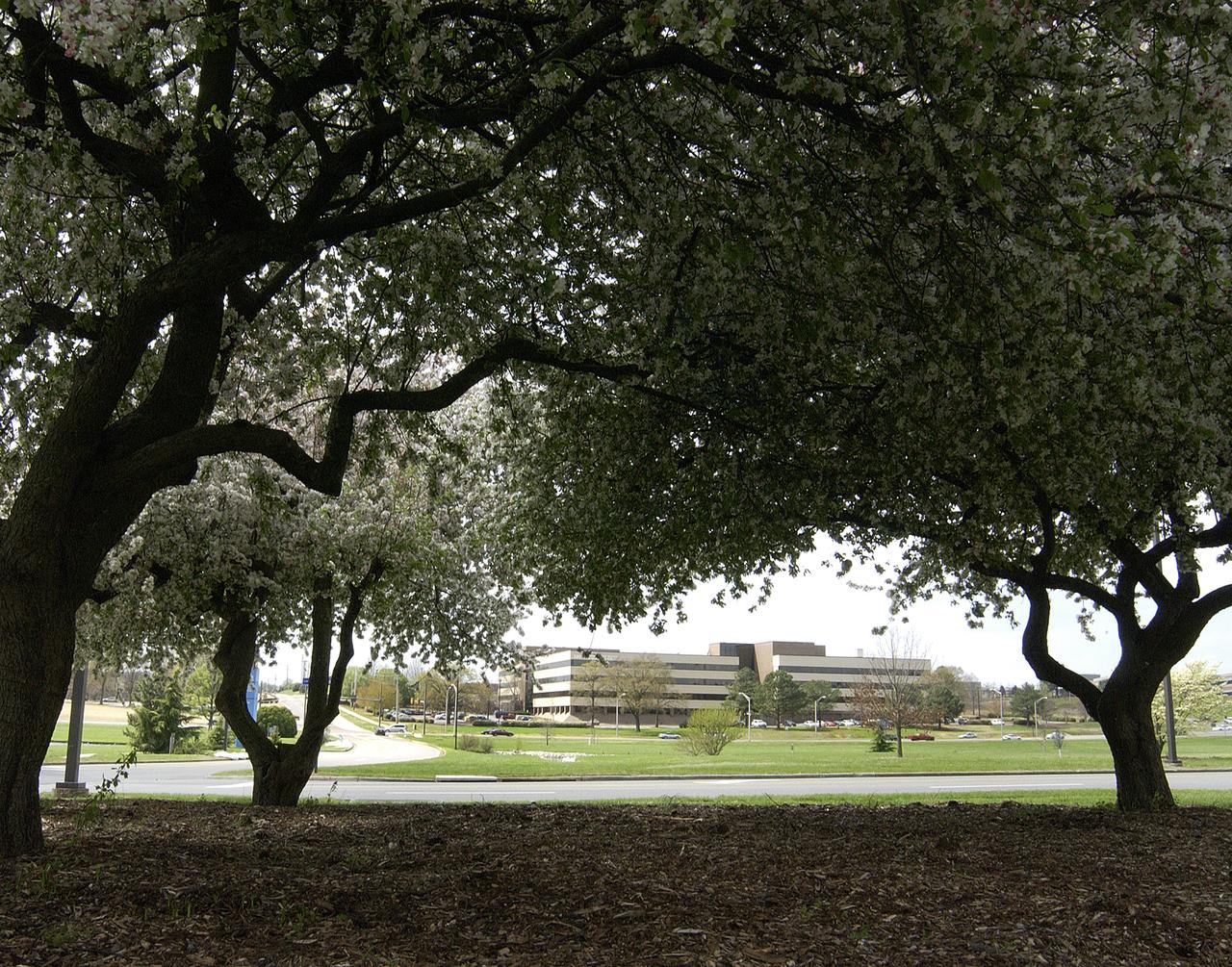
The National Space Science and Technology Center (NSSTC), located in Huntsville, Alabama, is a laboratory for cutting-edge research in selected scientific and engineering disciplines. The major objectives of the NSSTC are to provide multiple fields of expertise coming together to solve solutions to science and technology problems, and gaining recognition as a world-class science research organization. The center, opened in August 2000, focuses on space science, Earth sciences, information technology, optics and energy technology, biotechnology and materials science, and supports NASA's mission of advancing and communicating scientific knowledge using the environment of space for research. In addition to providing basic and applied research, NSSTC, with its student participation, also fosters the next generation of scientists and engineers. NSSTC is a collaborated effort between NASA and the state of Alabama through the Space Science and Technology alliance, a group of six universities including the Universities of Alabama in Huntsville (UAH),Tuscaloosa (UA), and Birmingham (UAB); the University of South Alabama in Mobile (USA);Alabama Agricultural and Mechanical University (AM) in Huntsville; and Auburn University (AU) in Auburn. Participating federal agencies include NASA, Marshall Space Flight Center, the National Oceanic and Atmospheric Administration, the Department of Defense, the National Science Foundation, and the Department of Energy. Industries involved include the Space Science Research Center, the Global Hydrology and Climate Center, the Information Technology Research Center, the Optics and Energy Technology Center, the Propulsion Research Center, the Biotechnology Research Center, and the Materials Science Research Center. This photo shows the completed center with the additional arnex (right of building) that added an additional 80,000 square feet (7,432 square meters) to the already existent NSSTC, nearly doubling the size of the core facility. At full capacity, the NSSTC tops 200,000 square feet (18,580 square meters) and houses approximately 550 employees.
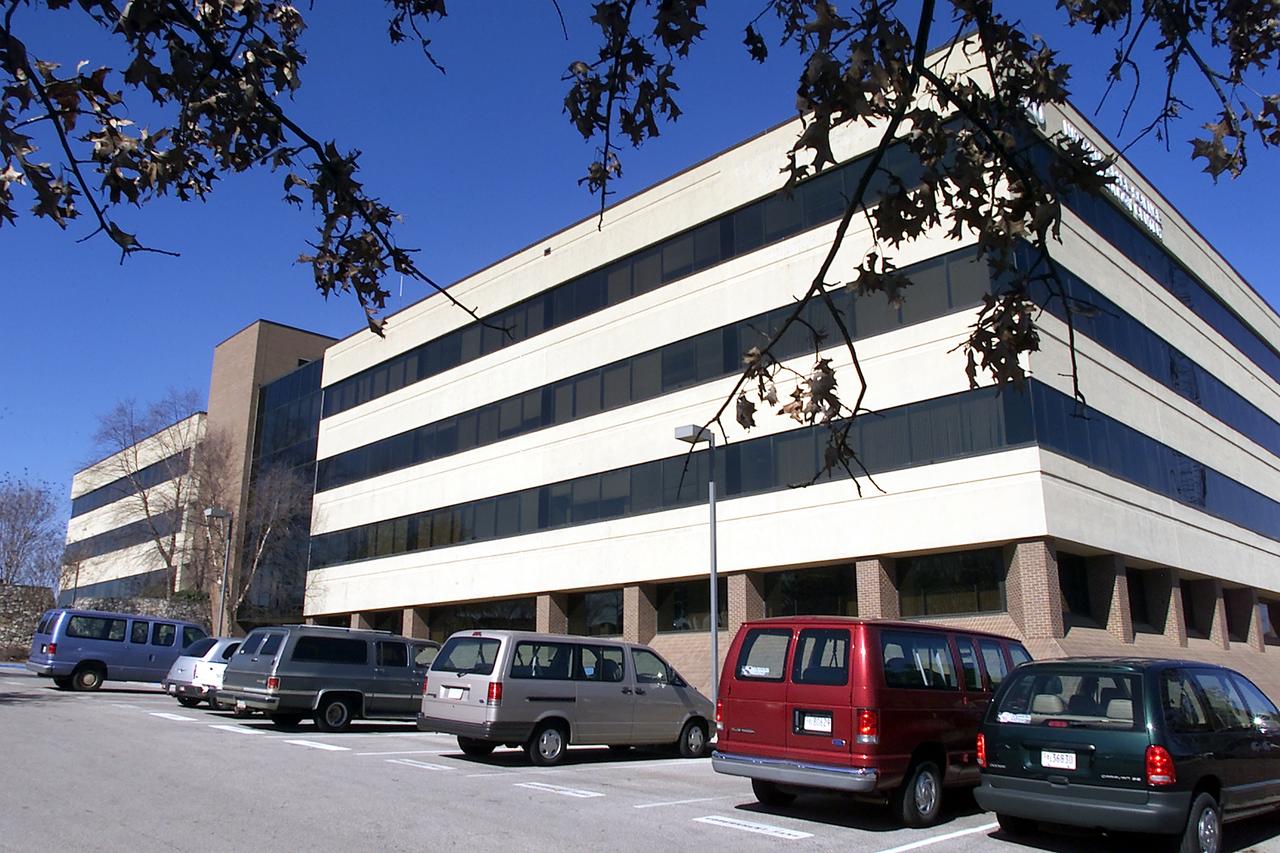
The National Space Science and Technology Center (NSSTC), located in Huntsville, Alabama, is a laboratory for cutting-edge research in selected scientific and engineering disciplines. The major objectives of the NSSTC are to provide multiple fields of expertise coming together to solve solutions to science and technology problems, and gaining recognition as a world-class science research organization. The center, opened in August 2000, focuses on space science, Earth sciences, information technology, optics and energy technology, biotechnology and materials science, and supports NASA's mission of advancing and communicating scientific knowledge using the environment of space for research. In addition to providing basic and applied research, NSSTC, with its student participation, also fosters the next generation of scientists and engineers. NSSTC is a collaborated effort between NASA and the state of Alabama through the Space Science and Technology alliance, a group of six universities including the Universities of Alabama in Huntsville (UAH),Tuscaloosa (UA), and Birmingham (UAB); the University of South Alabama in Mobile (USA); Alabama Agricultural and Mechanical University (AM) in Huntsville; and Auburn University (AU) in Auburn. Participating federal agencies include NASA, Marshall Space Flight Center, the National Oceanic and Atmospheric Administration, the Department of Defense, the National Science Foundation, and the Department of Energy. Industries involved include the Space Science Research Center, the Global Hydrology and Climate Center, the Information Technology Research Center, the Optics and Energy Technology Center, the Propulsion Research Center, the Biotechnology Research Center, and the Materials Science Research Center. An arnex, scheduled for completion by summer 2002, will add an additional 80,000 square feet (7,432 square meters) to NSSTC nearly doubling the size of the core facility. At full capacity, the completed NSSTC will top 200,000 square feet (18,580 square meters) and house approximately 550 employees.

Robert Wilson of the Solar/Solar terrestrial Studies team at the National Space Science and Technology Center, a joint research and collaborative think tank partnership of the University of Alabama in Huntsville (UAH) and the Marshall Space Flight Center, adjusts his telescope which is set up as a viewing opportunity for MSFC employees prior to the August 21, 2017 solar eclipse event. The Huntsville area experienced 97 percent occultation, nearly a complete blocking out of the sun by the orbit of Earth's moon. The next opportunity to view a solar eclipse in the eastern and central United States will occur in April 2024.
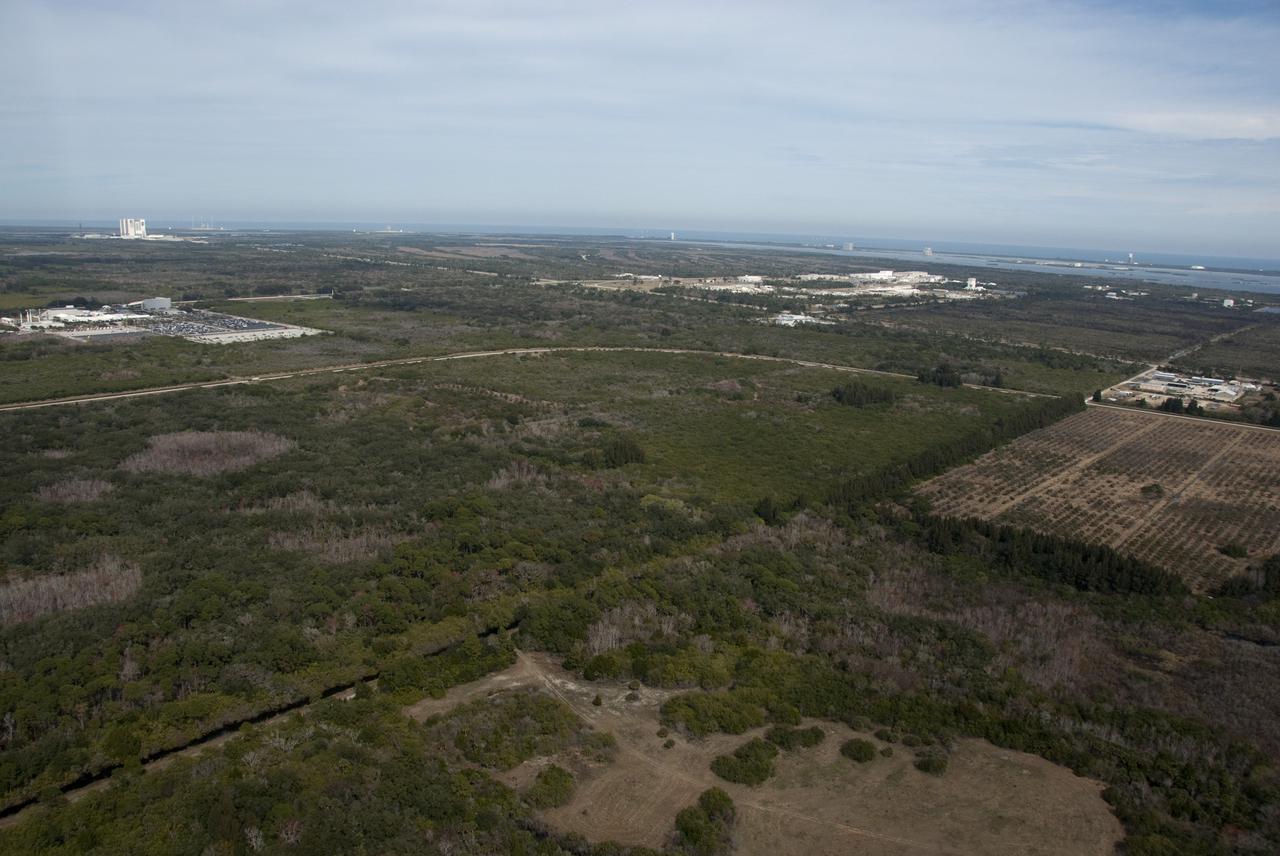
CAPE CANAVERAL, Fla. - Land located south of NASA's Kennedy Space Center Visitor Complex in Florida and adjacent to the Space Life Sciences Laboratory is the proposed site for Exploration Park. Kennedy and Space Florida, an independent special district of the State of Florida, have partnered to enable the development of a mixed-use technology and commerce park. Exploration Park will become home to diverse private sector technology and innovation enterprises offering opportunities to grow and deploy commercial space capabilities and will respond to national priorities in science and technology. The park is expected to attract tenants engaged in space technology, space commerce and space education. In addition, NASA and Space Florida plan to incorporate the existing 100,000 square foot Space Life Sciences Laboratory into the park, broadening the lab's accessibility and use beyond NASA. For more information, visit www.explorationpark.com. Photo credit: NASA_Kim Shiflett

National Weather Service Director Louis Uccellini and deputy director Mary Erickson hear from Short-term Prediction Research and Transition (SPoRT) team members during a visit Sept. 11 to the National Space Science and Technology Center. Managed by NASA’s Marshall Space Flight Center, SPoRT is a project to transition unique Earth observations and research capabilities to the operational weather community to improve short-term forecasts on a regional scale.

National Weather Service Director Louis Uccellini and deputy director Mary Erickson hear from Short-term Prediction Research and Transition (SPoRT) team members during a visit Sept. 11 to the National Space Science and Technology Center. Managed by NASA’s Marshall Space Flight Center, SPoRT is a project to transition unique Earth observations and research capabilities to the operational weather community to improve short-term forecasts on a regional scale.

National Weather Service Director Louis Uccellini and deputy director Mary Erickson hear from Short-term Prediction Research and Transition (SPoRT) team members during a visit Sept. 11 to the National Space Science and Technology Center. Managed by NASA’s Marshall Space Flight Center, SPoRT is a project to transition unique Earth observations and research capabilities to the operational weather community to improve short-term forecasts on a regional scale.
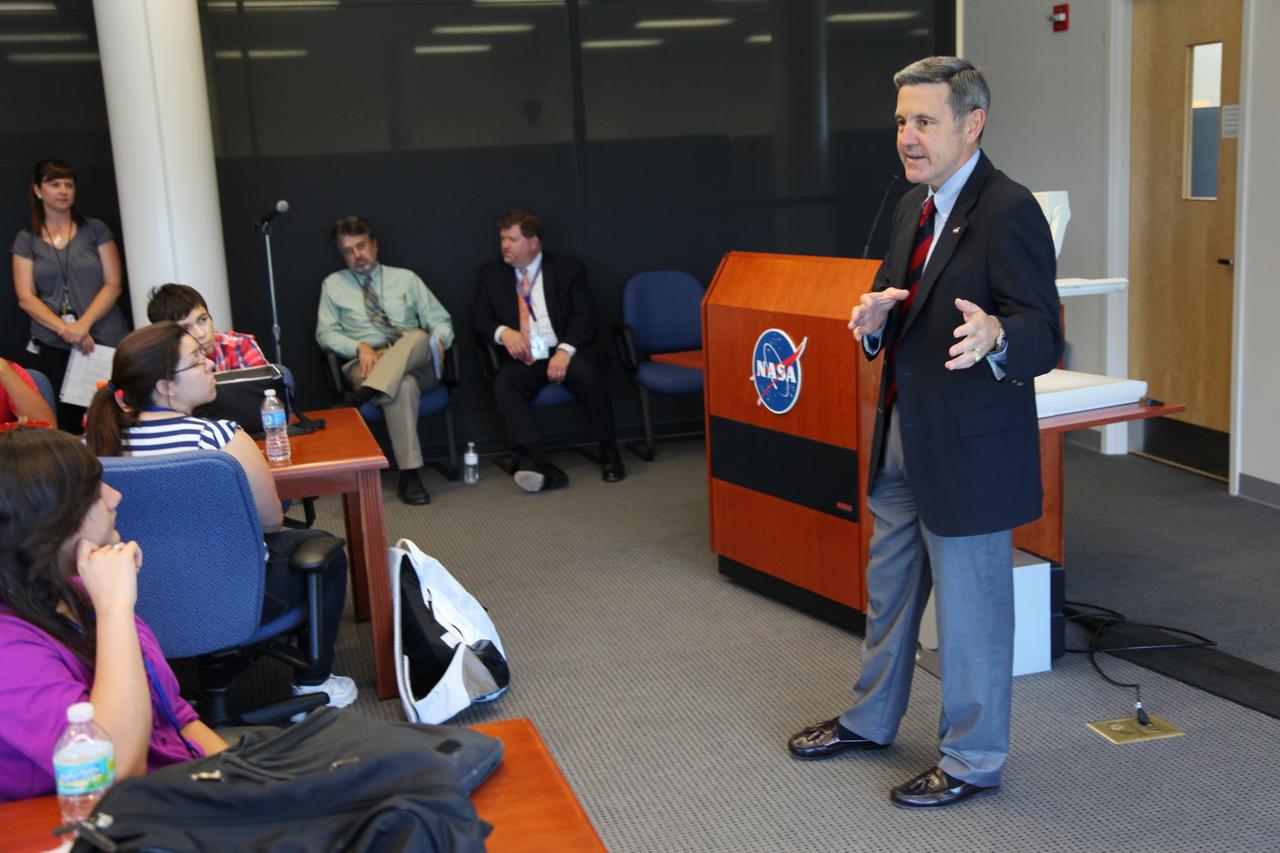
Cape Canaveral, Fla. -- Kennedy Center Director Bob Cabana speaks to the students after they participated in hands-on projects in Kennedy’s Space Life Sciences Laboratory (SLSL). High-school students from two Orlando, Fla., schools travelled to NASA’s Kennedy Space Center in Florida to participate in National Lab Day activities. During the event, about 80 students, toured various facilities and engaged in educational hands-on activities. National Lab Day is a partnership between federal agencies, foundations, professional societies and organizations devoted to promoting science, technology, engineering and math, or STEM, hands-on discovery-based laboratory experiences for students. Photo Credit: NASA/Frankie Martin
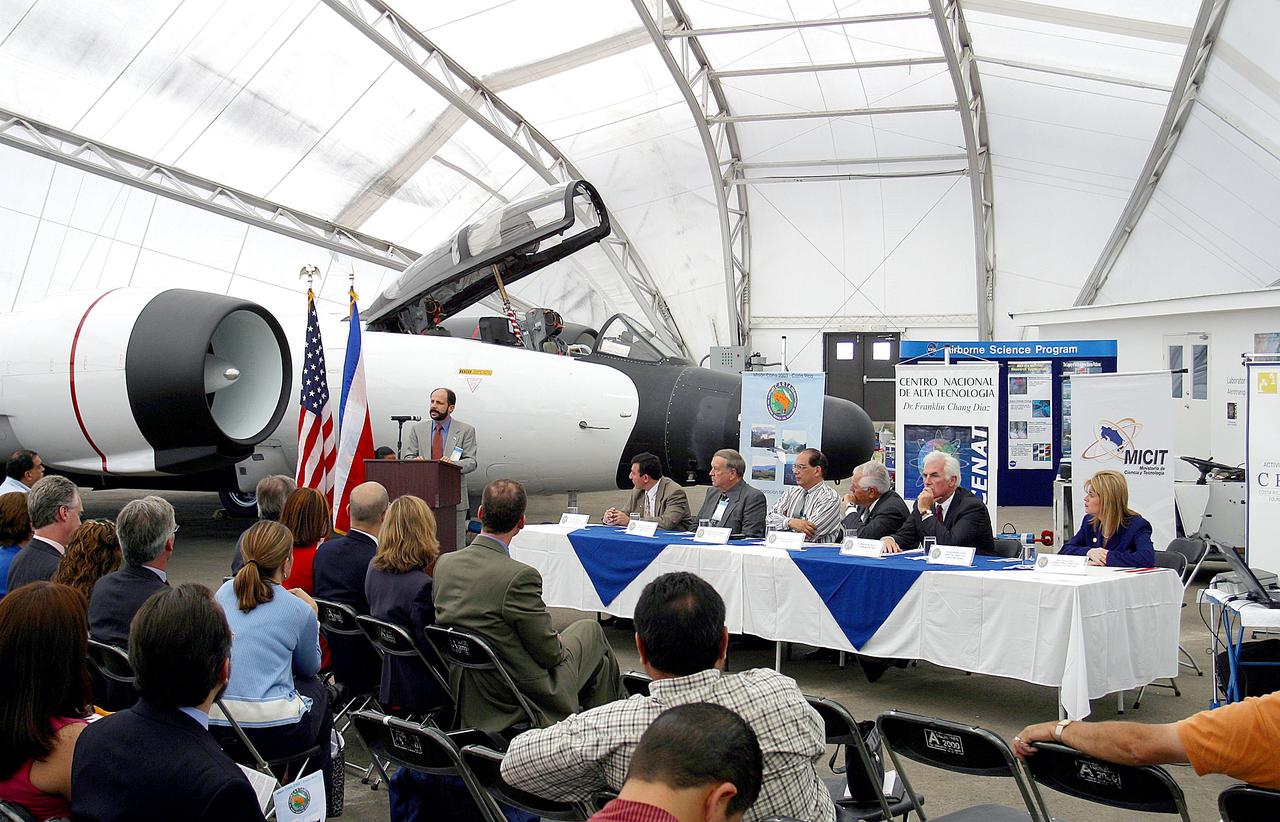
KENNEDY SPACE CENTER, FLA. - At the airport in San Jose, Costa Rica, the NASA hangar is dedicated. The speaker is Hermann Faith, executive director, Costa Rica-USA (CRUSA) Foundation. At the table are (from left) Dr. Jorge Andres Diaz, head scientiest CARTA mission; Gary Shelton, NASA deployment manager; Dr. Pedro Leon, general director, National Center for Advanced Technology (CENAT); Dr. Rogelio Pardo, minister of science and tchnology; John Danilovioch, U.S. ambassador to Costa Rica; and Lic. Vilma Lopez, subdirector, Civil Aviation (DGAC). NASA KSC has been testing its Aircraft-based Volcanic Emission Mass Spectrometer (AVEMS) in flights over the Turrialba volcano and in the crater, sampling and analyzing fresh volcanic gases in their natural chemical state. The AVEMS system has been developed for use in the Space Shuttle program, to detect toxic gas leaks and emissions in the Shuttle’s aft compartment and the crew compartment.
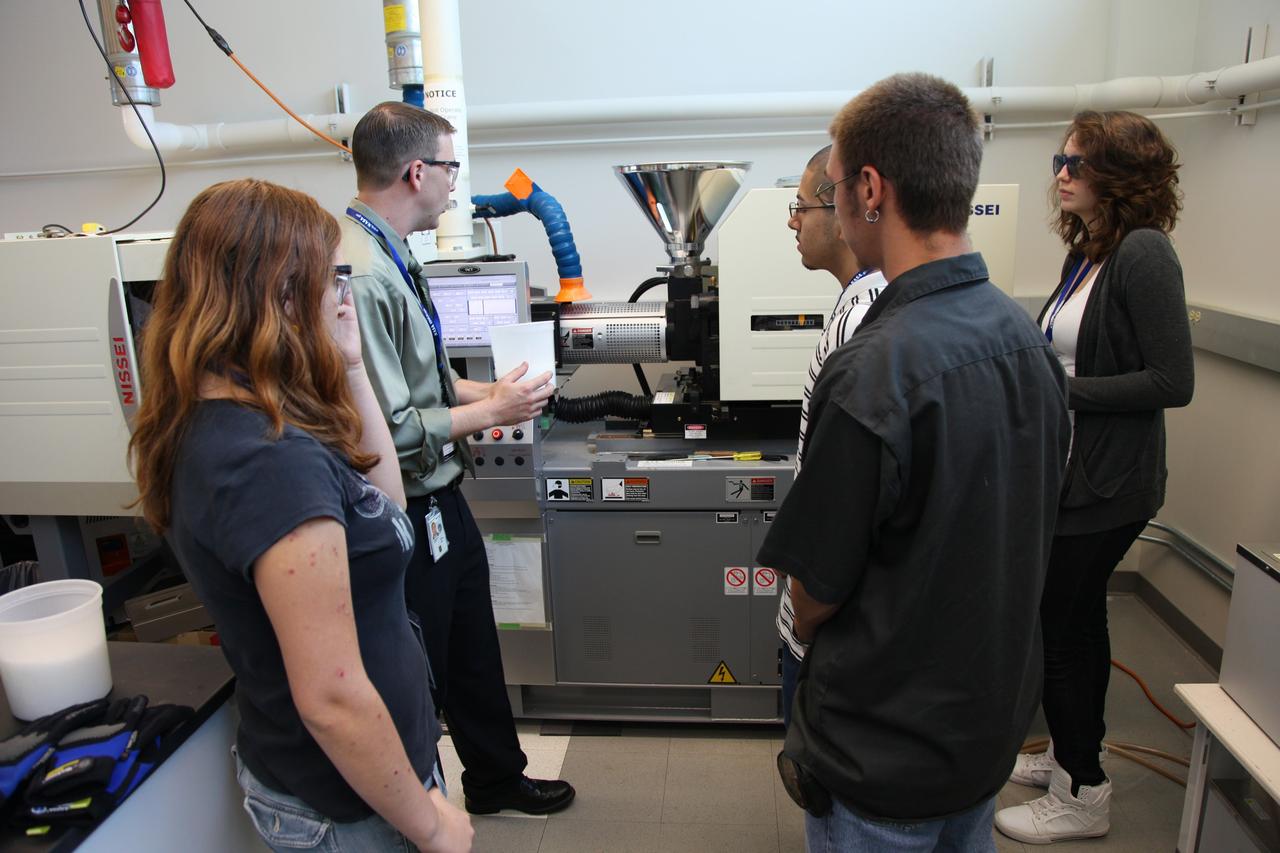
Cape Canaveral, Fla. -- Students listen intently as a laboratory technician describes the experiment being conducted in Kennedy’s Space Life Sciences Laboratory (SLSL). High-school students from two Orlando, Fla., schools travelled to NASA’s Kennedy Space Center in Florida to participate in National Lab Day activities. During the event, about 80 students, toured various facilities and engaged in educational hands-on activities. National Lab Day is a partnership between federal agencies, foundations, professional societies and organizations devoted to promoting science, technology, engineering and math, or STEM, hands-on discovery-based laboratory experiences for students. Photo Credit: NASA/Frankie Martin

Cape Canaveral, Fla. -- Students listen intently as a laboratory technician describes a project that's being researched in Kennedy’s Space Life Sciences Laboratory (SLSL). High-school students from two Orlando, Fla., schools travelled to NASA’s Kennedy Space Center in Florida to participate in National Lab Day activities. During the event, about 80 students, toured various facilities and engaged in educational hands-on activities. National Lab Day is a partnership between federal agencies, foundations, professional societies and organizations devoted to promoting science, technology, engineering and math, or STEM, hands-on discovery-based laboratory experiences for students. Photo Credit: NASA/Frankie Martin
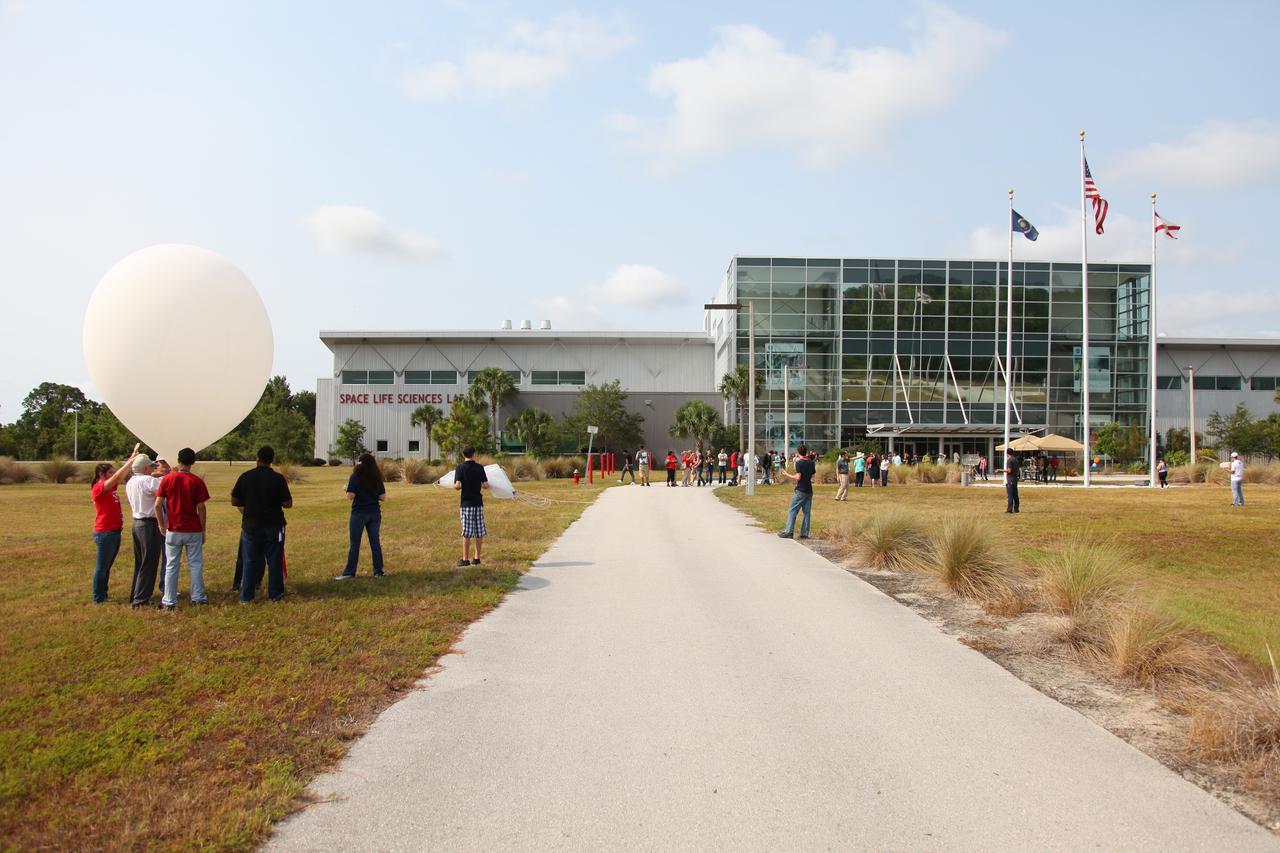
Cape Canaveral, Fla. -- Students participate in a high-altitude balloon experiment that's being conducted on the grounds of Kennedy’s Space Life Sciences Laboratory (SLSL). High-school students from two Orlando, Fla., schools travelled to NASA’s Kennedy Space Center in Florida to participate in National Lab Day activities. During the event, about 80 students, toured various facilities and engaged in educational hands-on activities. National Lab Day is a partnership between federal agencies, foundations, professional societies and organizations devoted to promoting science, technology, engineering and math, or STEM, hands-on discovery-based laboratory experiences for students. Photo Credit: NASA/Frankie Martin
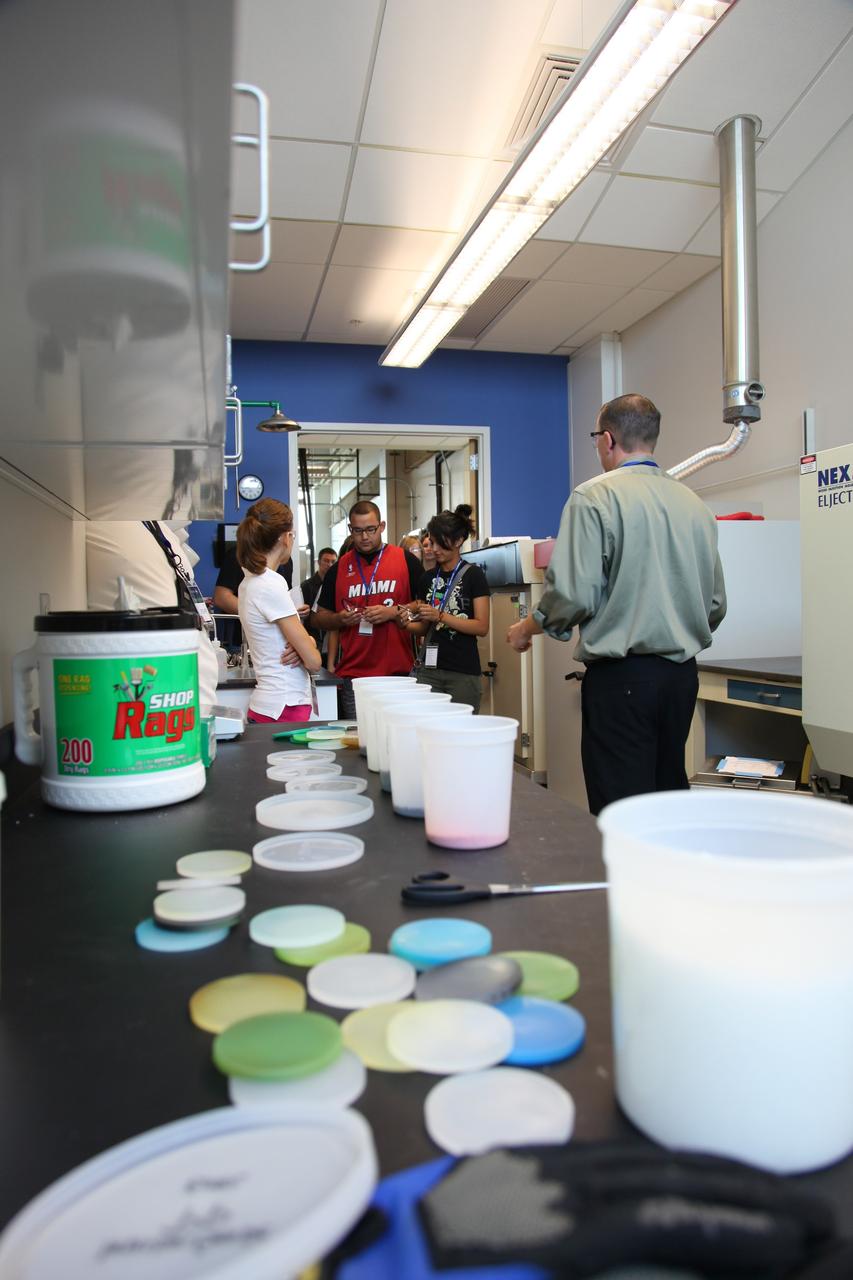
Cape Canaveral, Fla. -- Students participate in a hands-on activity as a laboratory technician looks on in Kennedy’s Space Life Sciences Laboratory (SLSL). High-school students from two Orlando, Fla., schools travelled to NASA’s Kennedy Space Center in Florida to participate in National Lab Day activities. During the event, about 80 students, toured various facilities and engaged in educational hands-on activities. National Lab Day is a partnership between federal agencies, foundations, professional societies and organizations devoted to promoting science, technology, engineering and math, or STEM, hands-on discovery-based laboratory experiences for students. Photo Credit: NASA/Frankie Martin
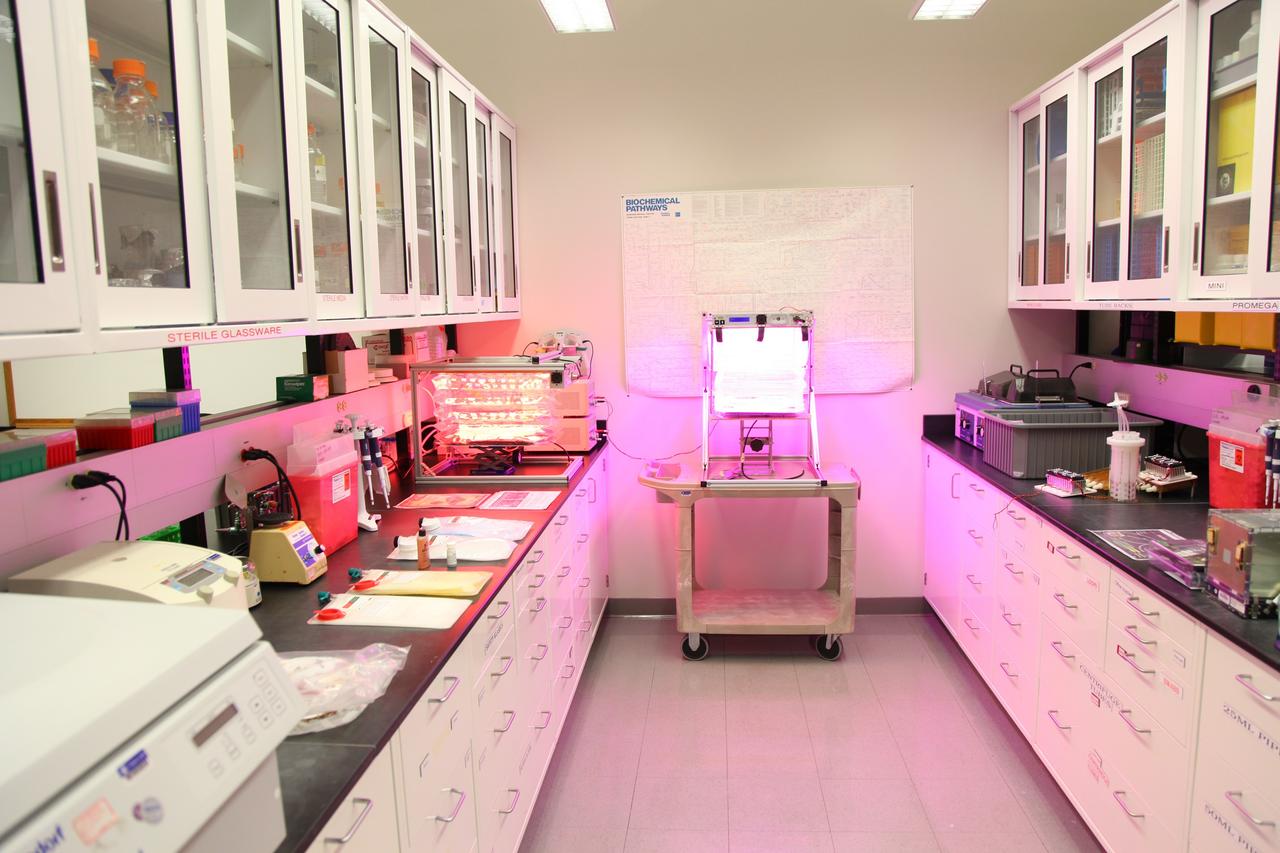
Cape Canaveral, Fla. -- A research laboratory is prepared for students to perform hands-on activities in Kennedy’s Space Life Sciences Laboratory (SLSL). High-school students from two Orlando, Fla., schools travelled to NASA’s Kennedy Space Center in Florida to participate in National Lab Day activities. During the event, about 80 students, toured various facilities and engaged in educational hands-on activities. National Lab Day is a partnership between federal agencies, foundations, professional societies and organizations devoted to promoting science, technology, engineering and math, or STEM, hands-on discovery-based laboratory experiences for students. Photo Credit: NASA/Frankie Martin
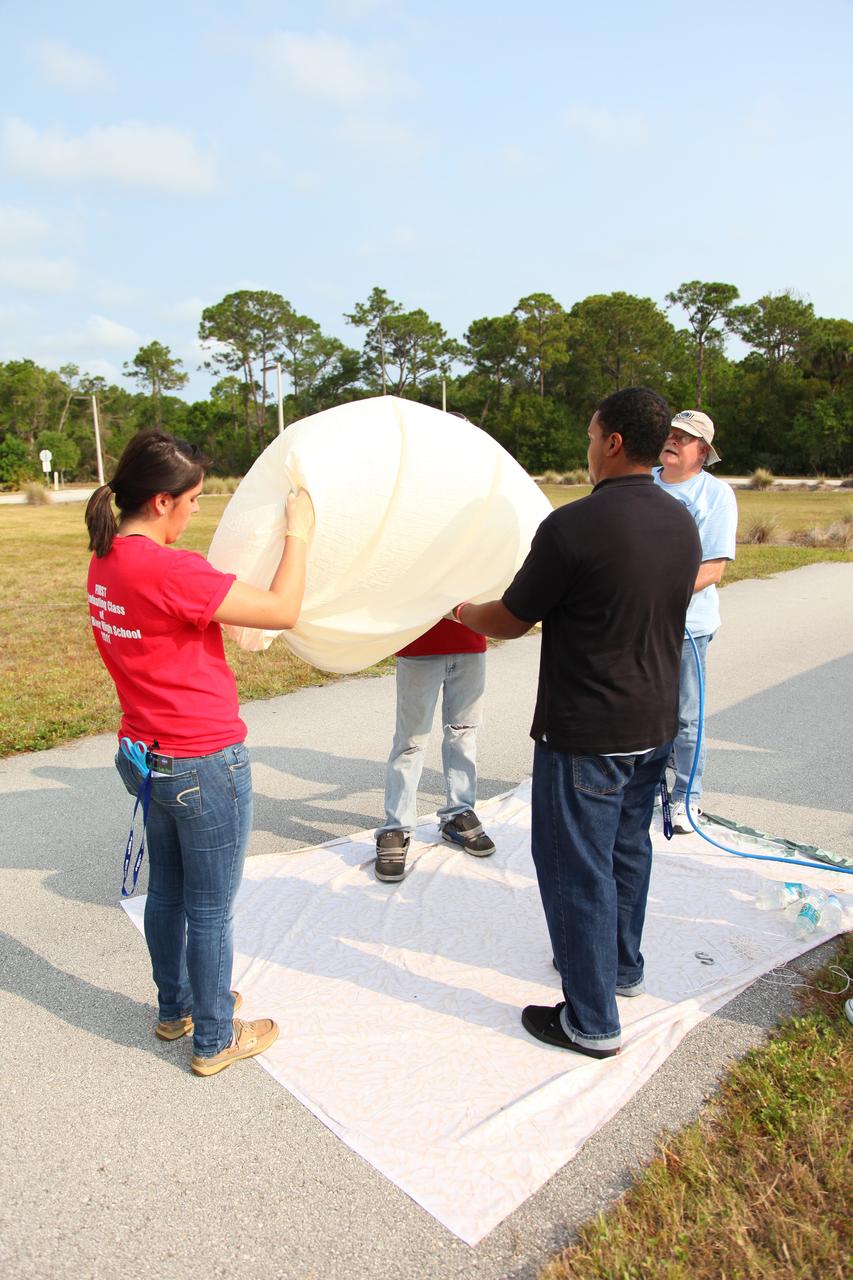
Cape Canaveral, Fla. -- Students participate in a high-altitude balloon experiment that's being conducted on the grounds of Kennedy’s Space Life Sciences Laboratory (SLSL). High-school students from two Orlando, Fla., schools travelled to NASA’s Kennedy Space Center in Florida to participate in National Lab Day activities. During the event, about 80 students, toured various facilities and engaged in educational hands-on activities. National Lab Day is a partnership between federal agencies, foundations, professional societies and organizations devoted to promoting science, technology, engineering and math, or STEM, hands-on discovery-based laboratory experiences for students. Photo Credit: NASA/Frankie Martin
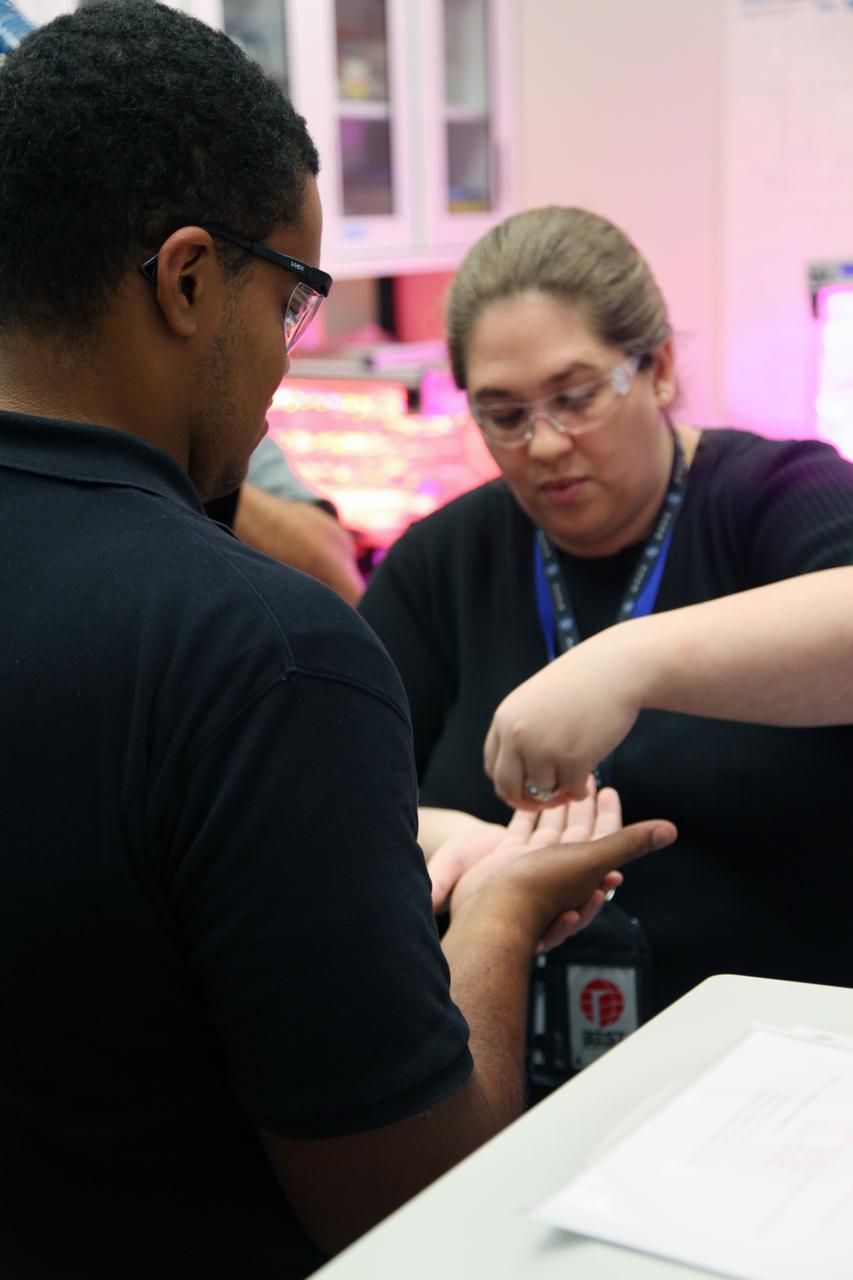
Cape Canaveral, Fla. -- A student participates in a hands-on activity as a laboratory technician assists in Kennedy’s Space Life Sciences Laboratory (SLSL). High-school students from two Orlando, Fla., schools travelled to NASA’s Kennedy Space Center in Florida to participate in National Lab Day activities. During the event, about 80 students, toured various facilities and engaged in educational hands-on activities. National Lab Day is a partnership between federal agencies, foundations, professional societies and organizations devoted to promoting science, technology, engineering and math, or STEM, hands-on discovery-based laboratory experiences for students. Photo Credit: NASA/Frankie Martin

Cape Canaveral, Fla. -- Students participate in a high-altitude balloon experiment that's being conducted on the grounds of Kennedy’s Space Life Sciences Laboratory (SLSL). High-school students from two Orlando, Fla., schools travelled to NASA’s Kennedy Space Center in Florida to participate in National Lab Day activities. During the event, about 80 students, toured various facilities and engaged in educational hands-on activities. National Lab Day is a partnership between federal agencies, foundations, professional societies and organizations devoted to promoting science, technology, engineering and math, or STEM, hands-on discovery-based laboratory experiences for students. Photo Credit: NASA/Frankie Martin
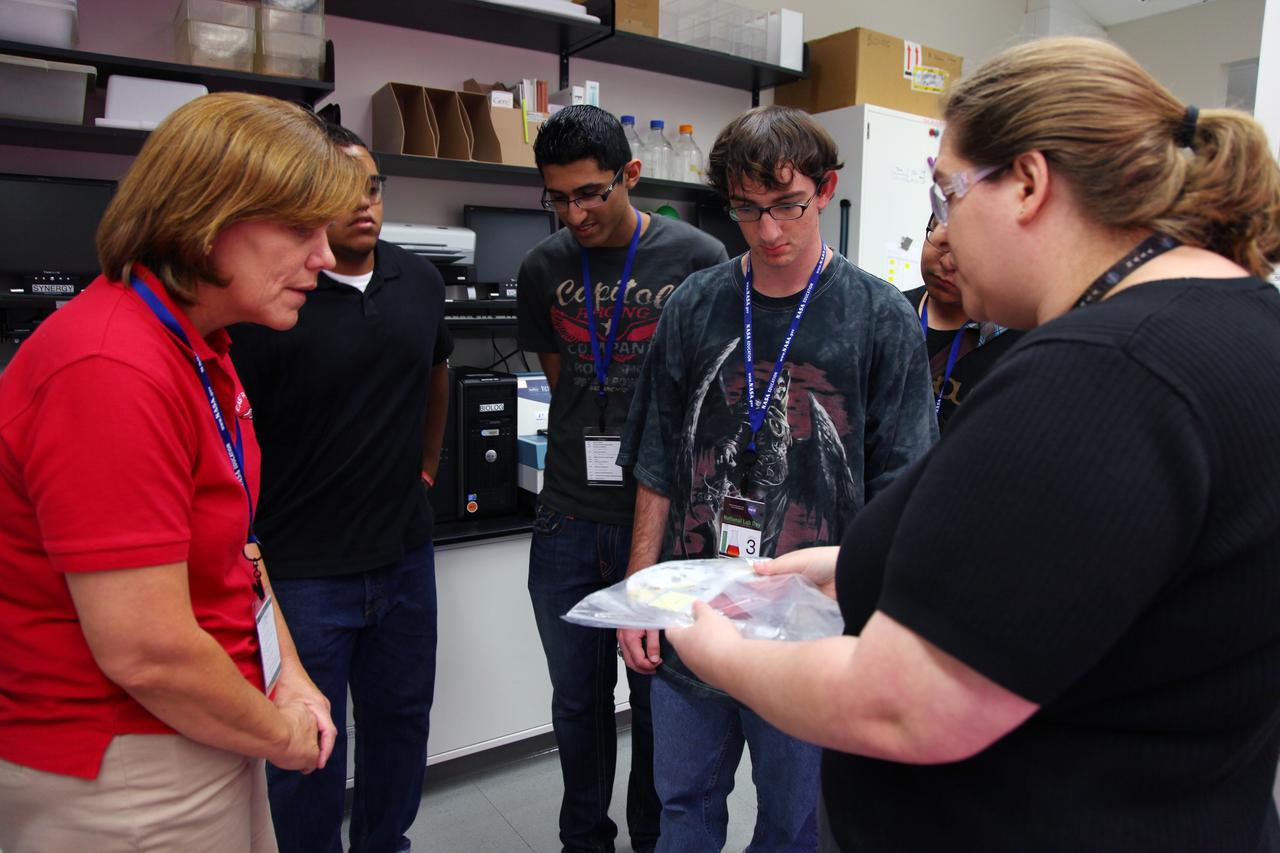
Cape Canaveral, Fla. -- Students listen intently as a laboratory technician describes a project that's being researched in Kennedy’s Space Life Sciences Laboratory (SLSL). High-school students from two Orlando, Fla., schools travelled to NASA’s Kennedy Space Center in Florida to participate in National Lab Day activities. During the event, about 80 students, toured various facilities and engaged in educational hands-on activities. National Lab Day is a partnership between federal agencies, foundations, professional societies and organizations devoted to promoting science, technology, engineering and math, or STEM, hands-on discovery-based laboratory experiences for students. Photo Credit: NASA/Frankie Martin
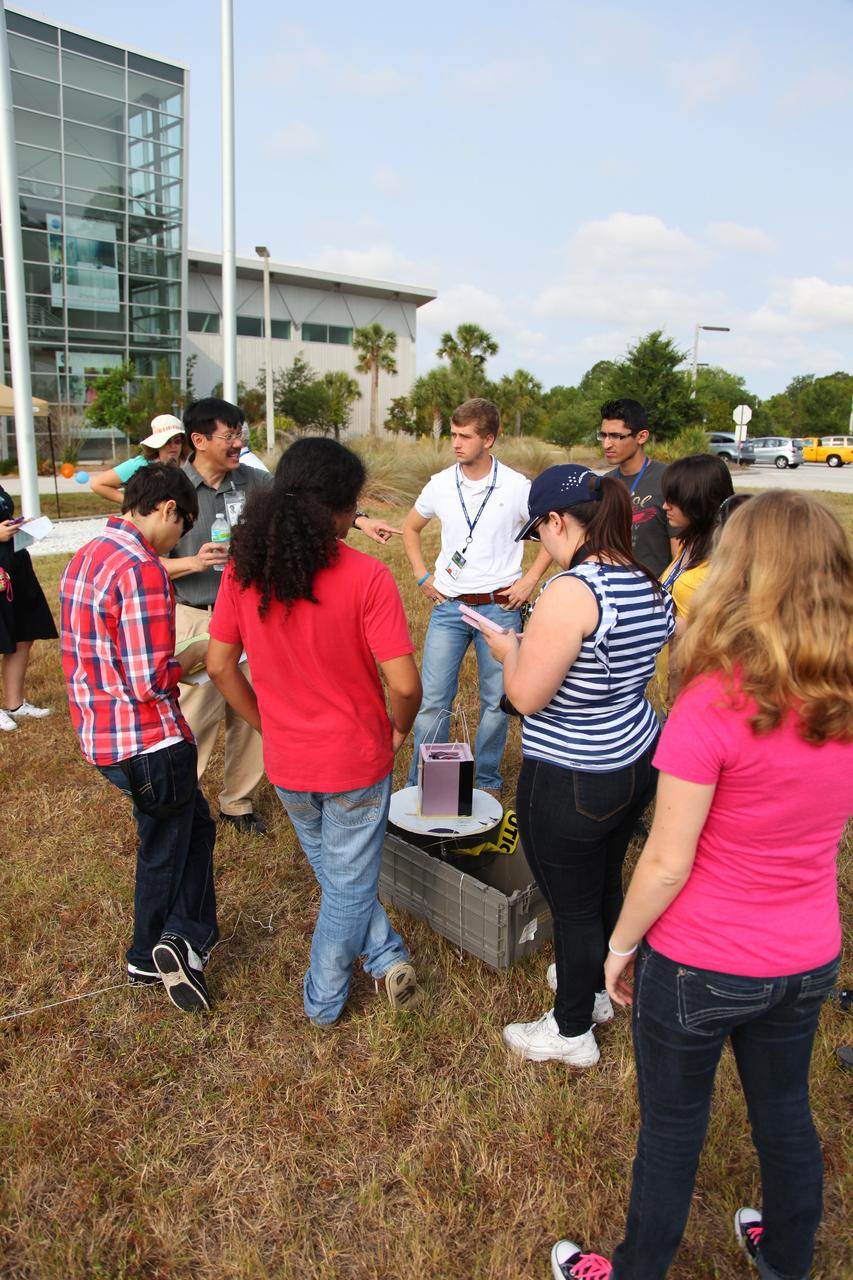
Cape Canaveral, Fla. -- Students listen intently as a laboratory technician describes the high-altitude balloon experiment that's being conducted on the grounds of Kennedy’s Space Life Sciences Laboratory (SLSL). High-school students from two Orlando, Fla., schools travelled to NASA’s Kennedy Space Center in Florida to participate in National Lab Day activities. During the event, about 80 students, toured various facilities and engaged in educational hands-on activities. National Lab Day is a partnership between federal agencies, foundations, professional societies and organizations devoted to promoting science, technology, engineering and math, or STEM, hands-on discovery-based laboratory experiences for students. Photo Credit: NASA/Frankie Martin
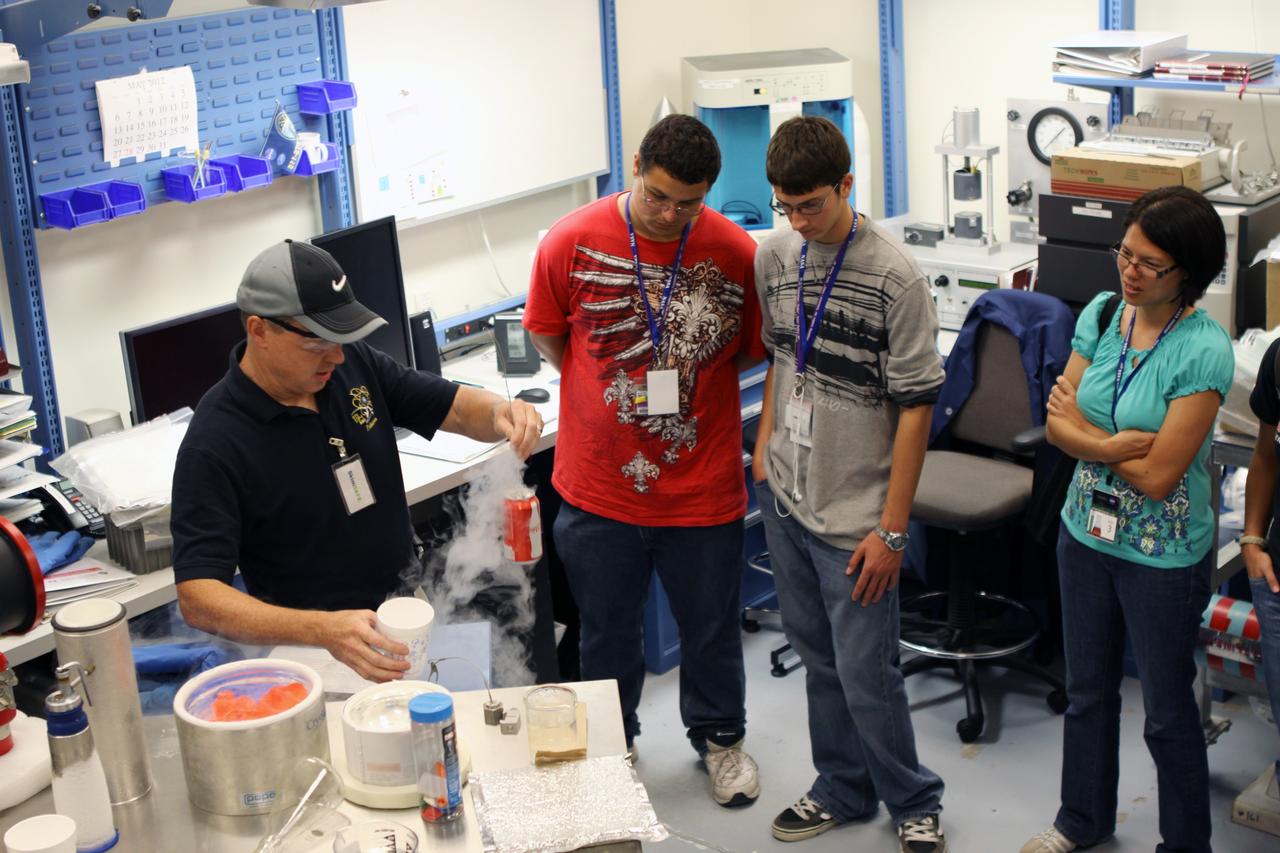
CAPE CANAVERAL, Fla. – Students view a demonstration by Dr. James Fesmire inside the cryogenics lab in the Operations and Checkout Building. The 26 honor students in chemistry and biology and their teachers got a chance to visit a number of high-tech labs at Kennedy Space Center as part of an effort to encourage students in the areas of science, technology, engineering and math. The tenth and eleventh grade students from Terry Parker High School in Jacksonville, Fla., visited a number of vastly different labs during their one-day tour. The group's visit to Kennedy was hosted by the Education Office as part of a nationwide effort by the National Lab Network to help introduce the nation's students to science careers. Photo credit: NASA/Jim Grossmann

KENNEDY SPACE CENTER, FLA. - From left, Carl Benoit, senior national science consultant, Pearson Scott Foresman; Paul McFall, president, Pearson Scott Foresman; Dr. Adena Williams Loston, NASA chief education officer; and James Lippe, science product manager, Pearson Scott Foresman, participate in the unveiling of 'The Science in Space Challenge' at the Doubletree Hotel in Orlando, Fla. The national challenge program is sponsored by NASA and Pearson Scott Foresman, publisher of pre-K through grade six educational books. To participate in the challenge, teachers may submit proposals, on behalf of their students, for a science and technology investigation. Astronauts will conduct the winning projects on a Space Shuttle mission or on the International Space Station, while teachers and students follow along via television or the Web. For more information about the announcement, see the news release at http:__www.nasa.gov_home_hqnews_2004_oct_HQ_04341_publication.html.
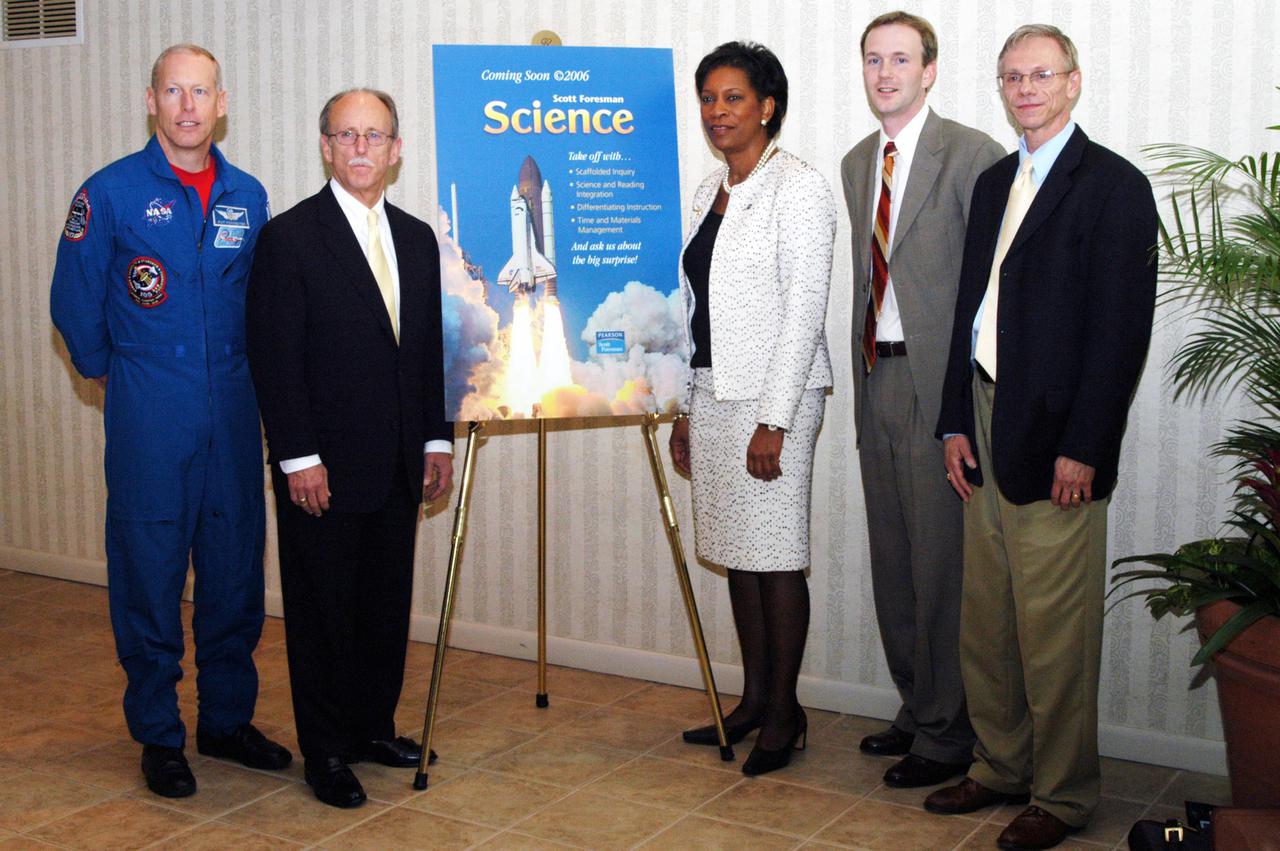
KENNEDY SPACE CENTER, FLA. - From left, NASA astronaut Patrick Forrester; Paul McFall, president, Pearson Scott Foresman; Dr. Adena Williams Loston, NASA chief education officer; James Lippe, science product manager, Pearson Scott Foresman; and Carl Benoit, senior national science consultant, Pearson Scott Foresman, participate in the unveiling of 'The Science in Space Challenge' at the Doubletree Hotel in Orlando, Fla. The national challenge program is sponsored by NASA and Pearson Scott Foresman, publisher of pre-K through grade six educational books. To participate in the challenge, teachers may submit proposals, on behalf of their students, for a science and technology investigation. Astronauts will conduct the winning projects on a Space Shuttle mission or on the International Space Station, while teachers and students follow along via television or the Web. For more information about the announcement, see the news release at http:__www.nasa.gov_home_hqnews_2004_oct_HQ_04341_publication.html.
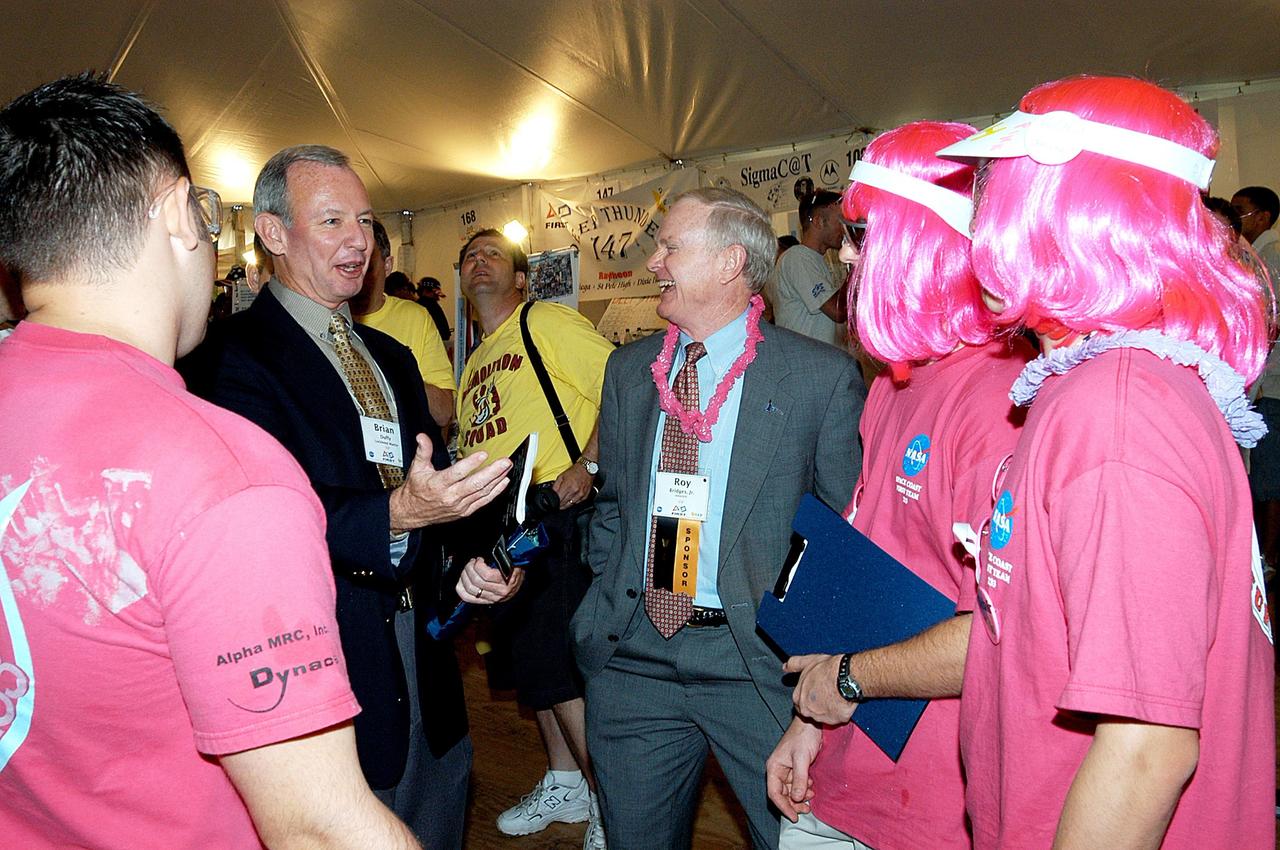
KENNEDY SPACE CENTER, FLA. - Lockheed Martin Vice President/Associate Program Manager Brian Duffy (second from left) and NASA/Kennedy Space Center Director Roy Bridges (center) share a laugh with student participants in the 2003 Southeastern Regional FIRST Robotic Competition. The competition is being held at the University of Central Florida (UCF) in Orlando, March 20-23. Forty student teams from around the country are participating in the event that pits team-built gladiator robots against each other in an athletic-style competition. The teams are sponsored by NASA/Kennedy Space Center, The Boeing Company/Brevard Community College, and Lockheed Martin Space Operations/Mission Systems for the nonprofit organization For Inspiration and Recognition of Science and Technology, known as FIRST. The vision of FIRST is to inspire in the youth of our nation an appreciation of science and technology and an understanding that mastering these disciplines can enrich the lives of all mankind.
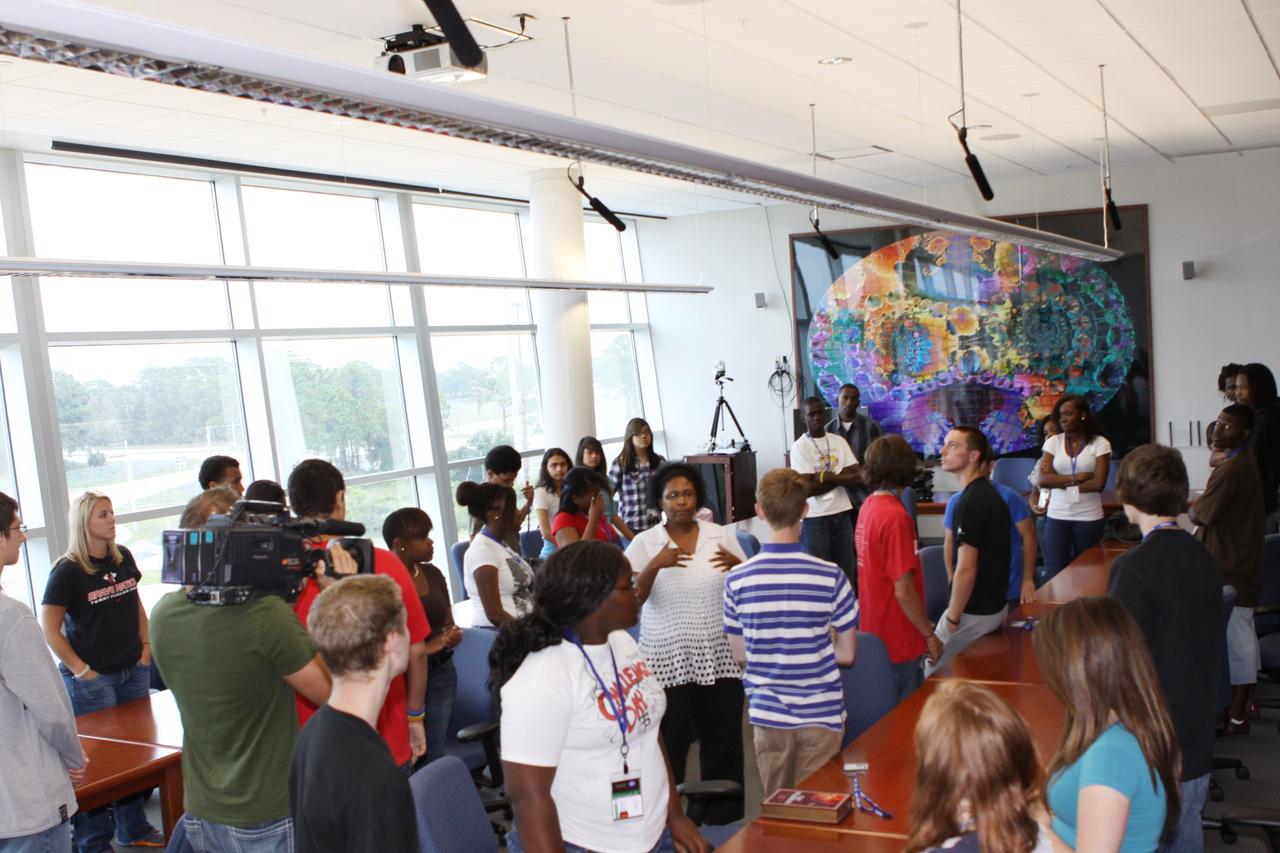
CAPE CANAVERAL, Fla. – Dr. LaNetra C. Tate, center, materials engineer at Kennedy Space Center, is surrounded by students as she welcomes them for their tour of the Space Life Sciences Lab facilities. The 26 honor students in chemistry and biology and their teachers got a chance to visit a number of high-tech labs at Kennedy as part of an effort to encourage students in the areas of science, technology, engineering and math. The tenth and eleventh grade students from Terry Parker High School in Jacksonville, Fla., visited a number of vastly different labs during their one-day tour. The group's visit to Kennedy was hosted by the Education Office as part of a nationwide effort by the National Lab Network to help introduce the nation's students to science careers. Photo credit: NASA/Jim Grossmann
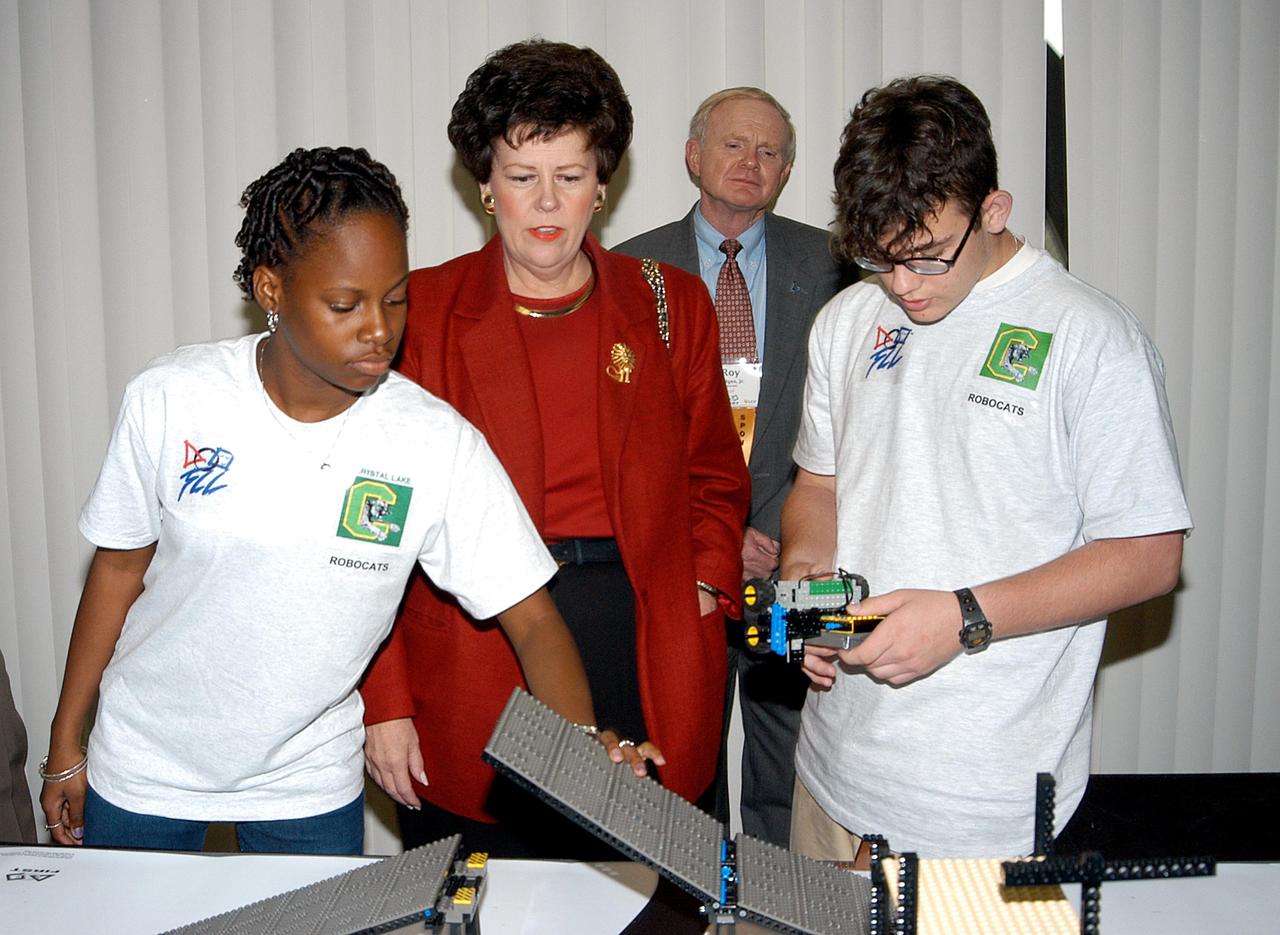
KENNEDY SPACE CENTER, FLA. - NASA/Kennedy Space Center Director Roy Bridges (background) observes as Florida Lt. Gov. Toni Jennings interacts with students at a display of space structures built from Lego blocks at the 2003 Southeastern Regional FIRST Robotic Competition. The competition is being held at the University of Central Florida (UCF) in Orlando, March 20-23. Forty student teams from around the country are participating in the event that pits team-built gladiator robots against each other in an athletic-style competition. The teams are sponsored by NASA/Kennedy Space Center, The Boeing Company/Brevard Community College, and Lockheed Martin Space Operations/Mission Systems for the nonprofit organization For Inspiration and Recognition of Science and Technology, known as FIRST. The vision of FIRST is to inspire in the youth of our nation an appreciation of science and technology and an understanding that mastering these disciplines can enrich the lives of all mankind.
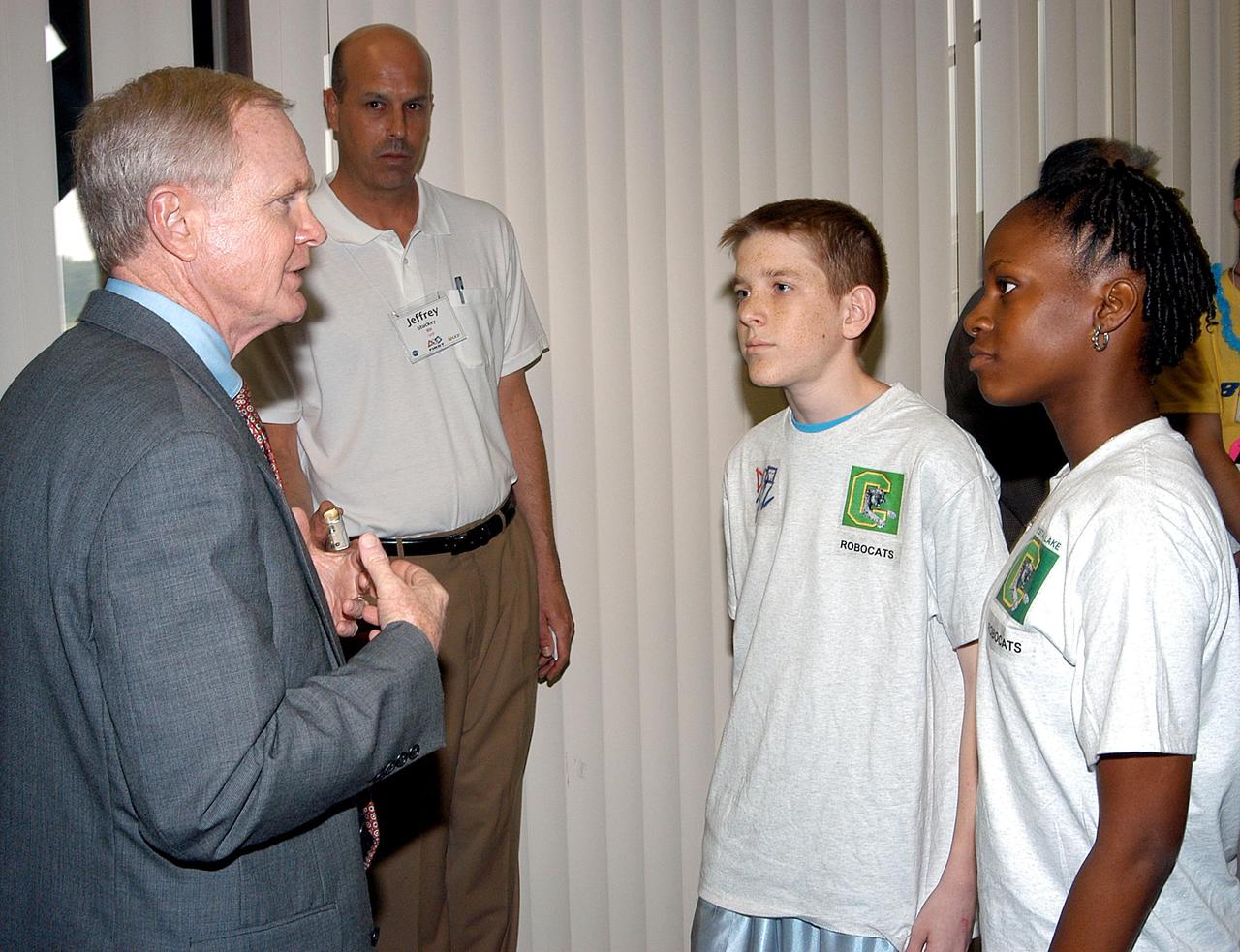
KENNEDY SPACE CENTER, FLA. - NASA Kennedy Space Center Director Roy Bridges (left) talks with some of the students involved in the 2003 Southeastern Regional FIRST Robotic Competition. The competition is being held at the University of Central Florida (UCF) in Orlando, March 20-23. Forty student teams from around the country are participating in the event that pits team-built gladiator robots against each other in an athletic-style competition. The teams are sponsored by NASA/Kennedy Space Center, The Boeing Company/Brevard Community College, and Lockheed Martin Space Operations/Mission Systems for the nonprofit organization For Inspiration and Recognition of Science and Technology, known as FIRST. The vision of FIRST is to inspire in the youth of our nation an appreciation of science and technology and an understanding that mastering these disciplines can enrich the lives of all mankind.
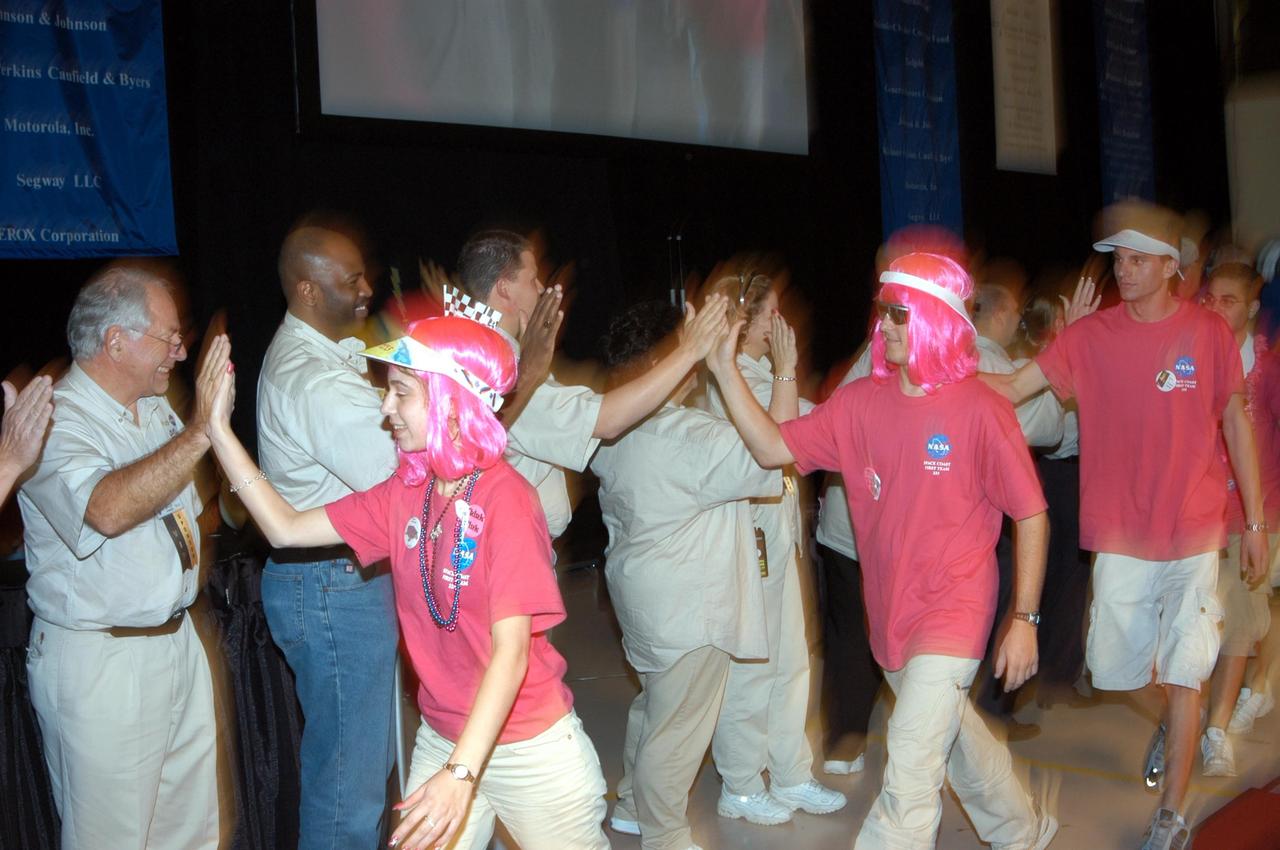
KENNEDY SPACE CENTER, FLA. - The NASA/Kennedy Space Center-sponsored student team (in pink wigs) is congratulated by the mentors and support staff of the 2003 Southeastern Regional FIRST Robotic Competition. The competition is being held at the University of Central Florida (UCF) in Orlando, March 20-23. The team won awards for Regional Finalist 2, GM Industrial Design and the Imagery Award. Forty student teams from around the country are participating in the event that pits team-built gladiator robots against each other in an athletic-style competition. The teams are sponsored by NASA/Kennedy Space Center, The Boeing Company/Brevard Community College, and Lockheed Martin Space Operations/Mission Systems for the nonprofit organization For Inspiration and Recognition of Science and Technology, known as FIRST. The vision of FIRST is to inspire in the youth of our nation an appreciation of science and technology and an understanding that mastering these disciplines can enrich the lives of all mankind.
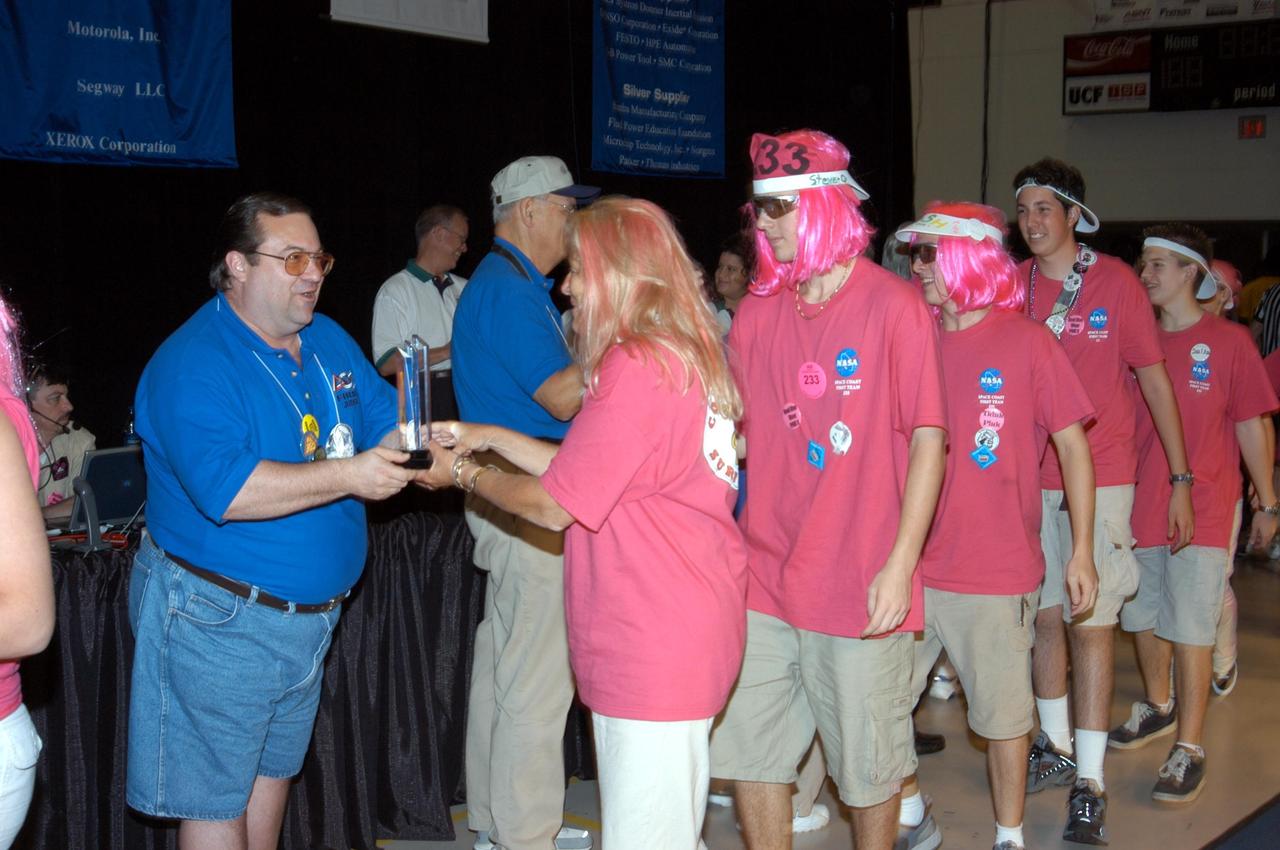
KENNEDY SPACE CENTER, FLA. - The NASA/Kennedy Space Center-sponsored student team (in pink wigs) is congratulated by the judges of the 2003 Southeastern Regional FIRST Robotic Competition. The competition is being held at the University of Central Florida (UCF) in Orlando, March 20-23. The team won awards for Regional Finalist 2, GM Industrial Design and the Imagery Award. Forty student teams from around the country are participating in the event that pits team-built gladiator robots against each other in an athletic-style competition. The teams are sponsored by NASA/Kennedy Space Center, The Boeing Company/Brevard Community College, and Lockheed Martin Space Operations/Mission Systems for the nonprofit organization For Inspiration and Recognition of Science and Technology, known as FIRST. The vision of FIRST is to inspire in the youth of our nation an appreciation of science and technology and an understanding that mastering these disciplines can enrich the lives of all mankind.
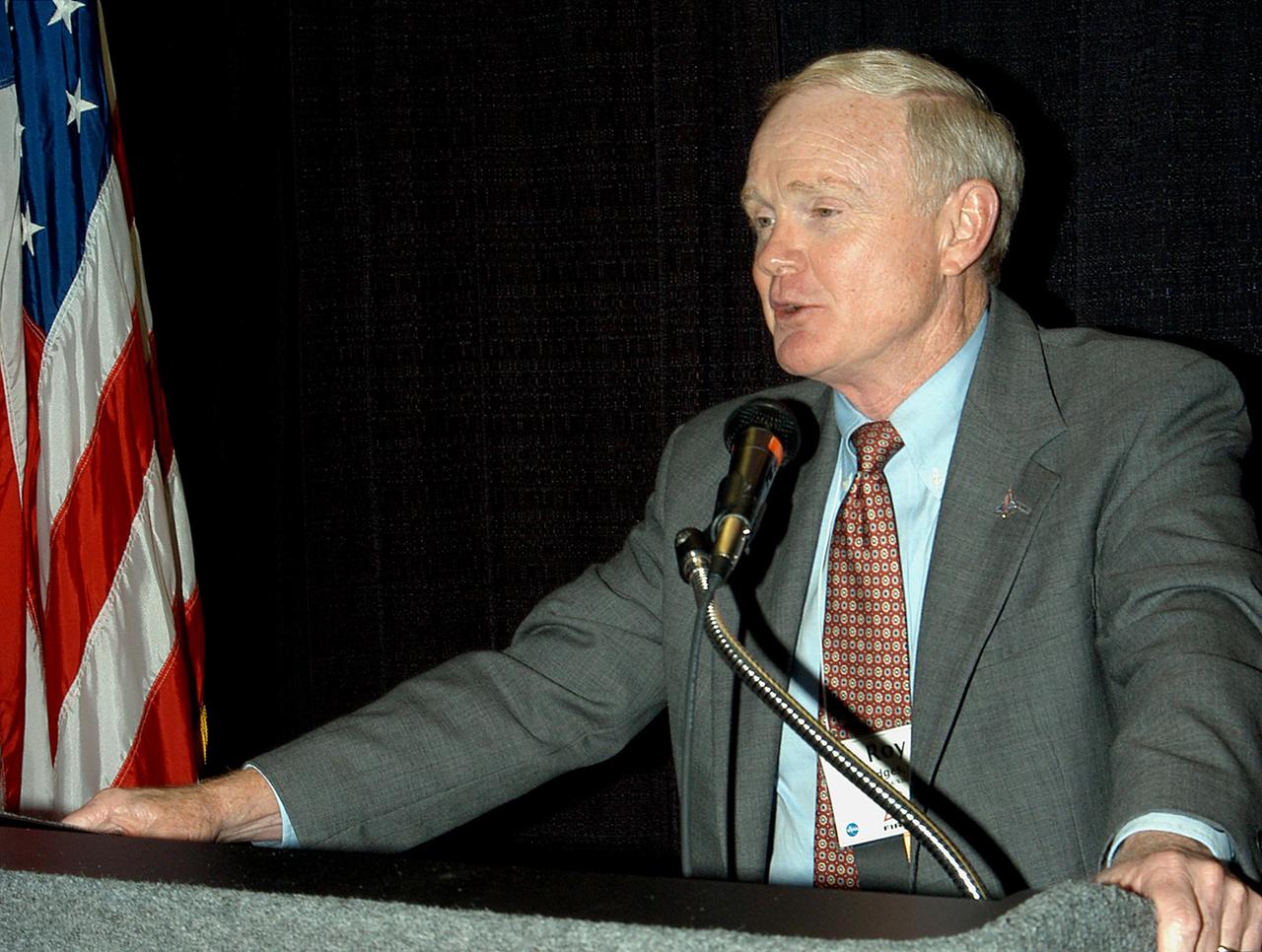
KENNEDY SPACE CENTER, FLA. - NASA/Kennedy Space Center Director Roy Bridges speaks to the attendees of an invitation-only luncheon held during the 2003 Southeastern Regional FIRST Robotic Competition. The competition is being held at the University of Central Florida (UCF) in Orlando, March 20-23. Forty student teams from around the country are participating in the event that pits team-built gladiator robots against each other in an athletic-style competition. The teams are sponsored by NASA/Kennedy Space Center, The Boeing Company/Brevard Community College, and Lockheed Martin Space Operations/Mission Systems for the nonprofit organization For Inspiration and Recognition of Science and Technology, known as FIRST. The vision of FIRST is to inspire in the youth of our nation an appreciation of science and technology and an understanding that mastering these disciplines can enrich the lives of all mankind.
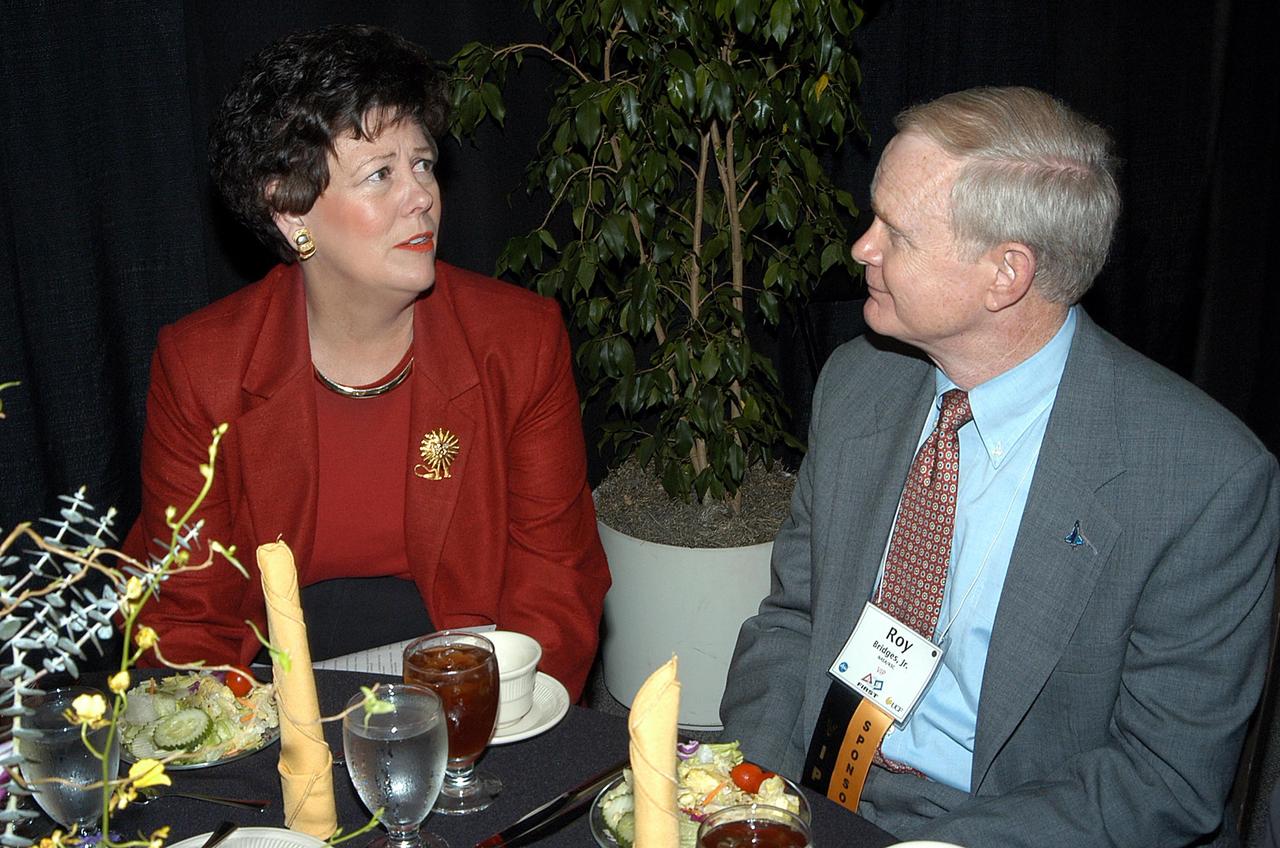
KENNEDY SPACE CENTER, FLA. - NASA/Kennedy Space Center Director Roy Bridges (right) talks with Florida Lt. Gov. Toni Jennings at an invitation-only luncheon held during the 2003 Southeastern Regional FIRST Robotic Competition. The competition is being held at the University of Central Florida (UCF) in Orlando, March 20-23. Forty student teams from around the country are participating in the event that pits team-built gladiator robots against each other in an athletic-style competition. The teams are sponsored by NASA/Kennedy Space Center, The Boeing Company/Brevard Community College, and Lockheed Martin Space Operations/Mission Systems for the nonprofit organization For Inspiration and Recognition of Science and Technology, known as FIRST. The vision of FIRST is to inspire in the youth of our nation an appreciation of science and technology and an understanding that mastering these disciplines can enrich the lives of all mankind.

KENNEDY SPACE CENTER, FLA. - NASA/Kennedy Space Center-sponsored students, participating in the 2003 Southeastern Regional FIRST Robotic Competition, pose with their team-built robot. The competition is being held at the University of Central Florida (UCF) in Orlando, March 20-23. Forty teams from around the country are participating in the event that pits team-built gladiator robots against each other in an athletic-style competition. The teams are sponsored by NASA-Kennedy Space Center, The Boeing Company/Brevard Community College, and Lockheed Martin Space Operations/Mission Systems for the nonprofit organization For Inspiration and Recognition of Science and Technology, known as FIRST. The vision of FIRST is to inspire in the youth of our nation an appreciation of science and technology and an understanding that mastering these disciplines can enrich the lives of all mankind.
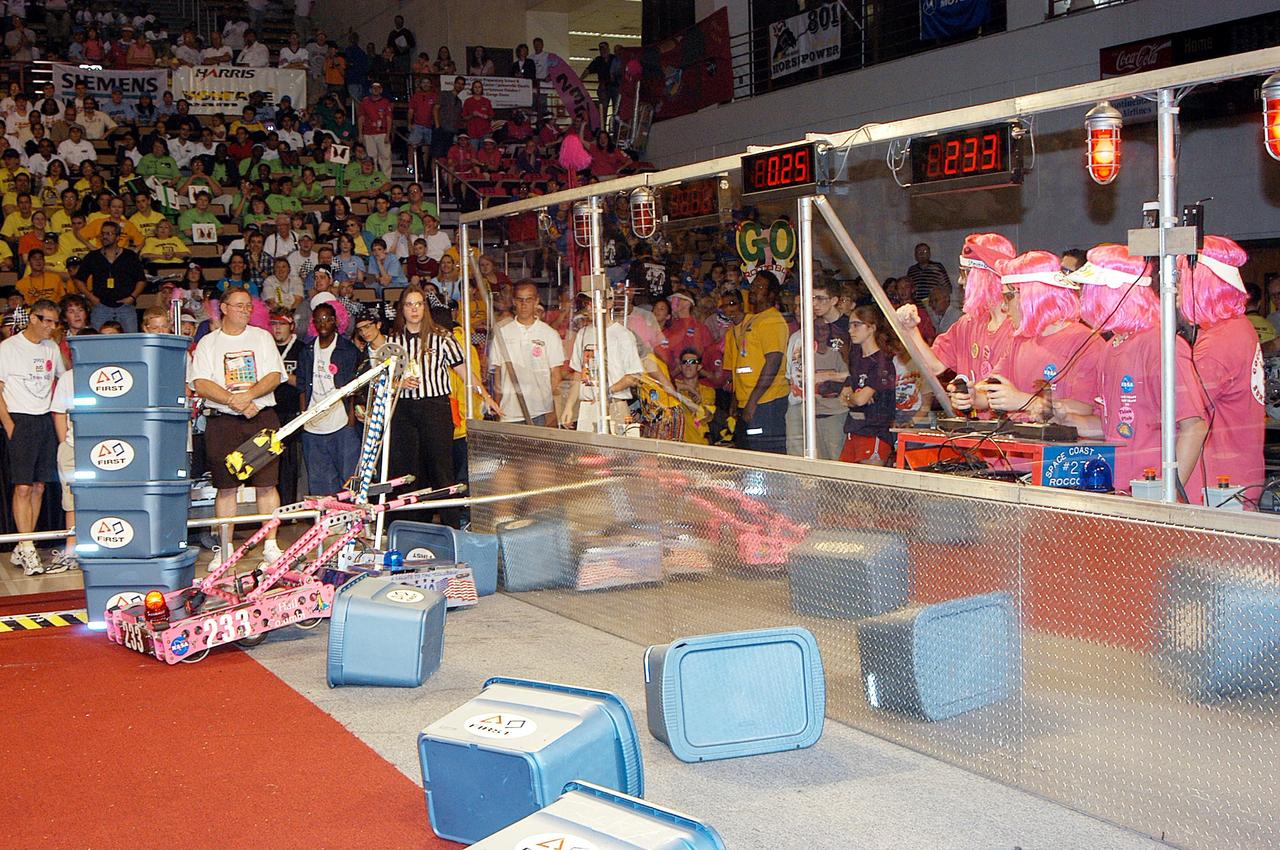
KENNEDY SPACE CENTER, FLA. - The NASA/Kennedy Space Center-sponsored student team (in pink wigs, right) demonstrates their robot's abilities during the 2003 Southeastern Regional FIRST Robotic Competition. The competition is being held at the University of Central Florida (UCF) in Orlando, March 20-23. Forty student teams from around the country are participating in the event that pits team-built gladiator robots against each other in an athletic-style competition. The teams are sponsored by NASA/Kennedy Space Center, The Boeing Company/Brevard Community College, and Lockheed Martin Space Operations/Mission Systems for the nonprofit organization For Inspiration and Recognition of Science and Technology, known as FIRST. The vision of FIRST is to inspire in the youth of our nation an appreciation of science and technology and an understanding that mastering these disciplines can enrich the lives of all mankind.
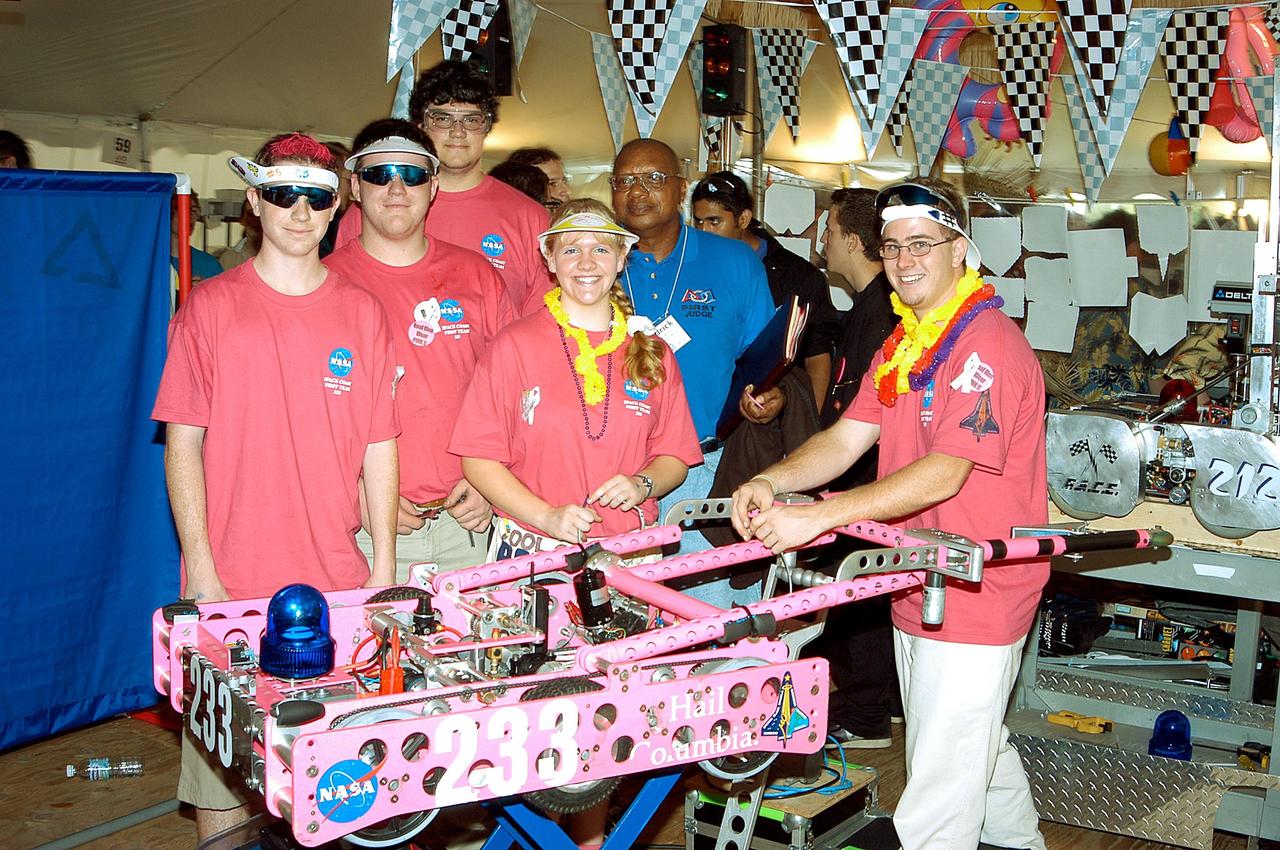
KENNEDY SPACE CENTER, FLA. - NASA/Kennedy Space Center-sponsored students, participating in the 2003 Southeastern Regional FIRST Robotic Competition, pose with their team-built robot. The competition is being held at the University of Central Florida (UCF) in Orlando, March 20-23. Forty student teams from around the country are participating in the event that pits team-built gladiator robots against each other in an athletic-style competition. The teams are sponsored by NASA/Kennedy Space Center, The Boeing Company/Brevard Community College, and Lockheed Martin Space Operations/Mission Systems for the nonprofit organization For Inspiration and Recognition of Science and Technology, known as FIRST. The vision of FIRST is to inspire in the youth of our nation an appreciation of science and technology and an understanding that mastering these disciplines can enrich the lives of all mankind.
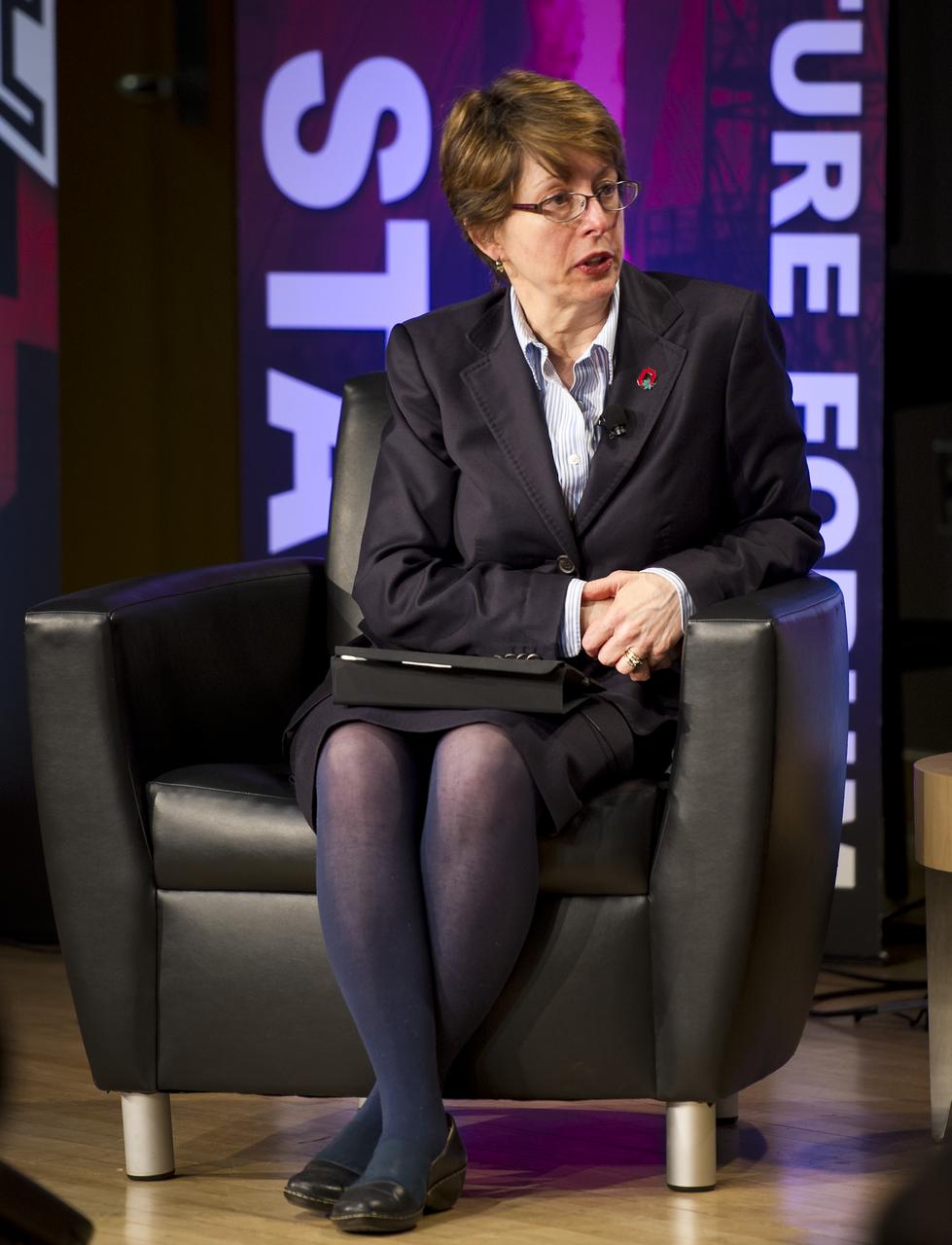
Dr. Caroline Wagner, associate professor, Ambassador Milton A. and Roslyn Z. Wolf Chair in International Affairs, and Director, Battelle Center for Science and Technology Policy, The Ohio State University moderates the NASA Future Forum panel titled "Shifting Roles for Public, Private, and International Players in Space" at The Ohio State University on Tuesday, Feb. 21, 2012 in Columbus, Ohio. The NASA Future Forum features panel discussions on the importance of education to our nation's future in space, the benefit of commercialized space technology to our economy and lives here on Earth, and the shifting roles for the public, commercial and international communities in space. Photo Credit: (NASA/Bill Ingalls)
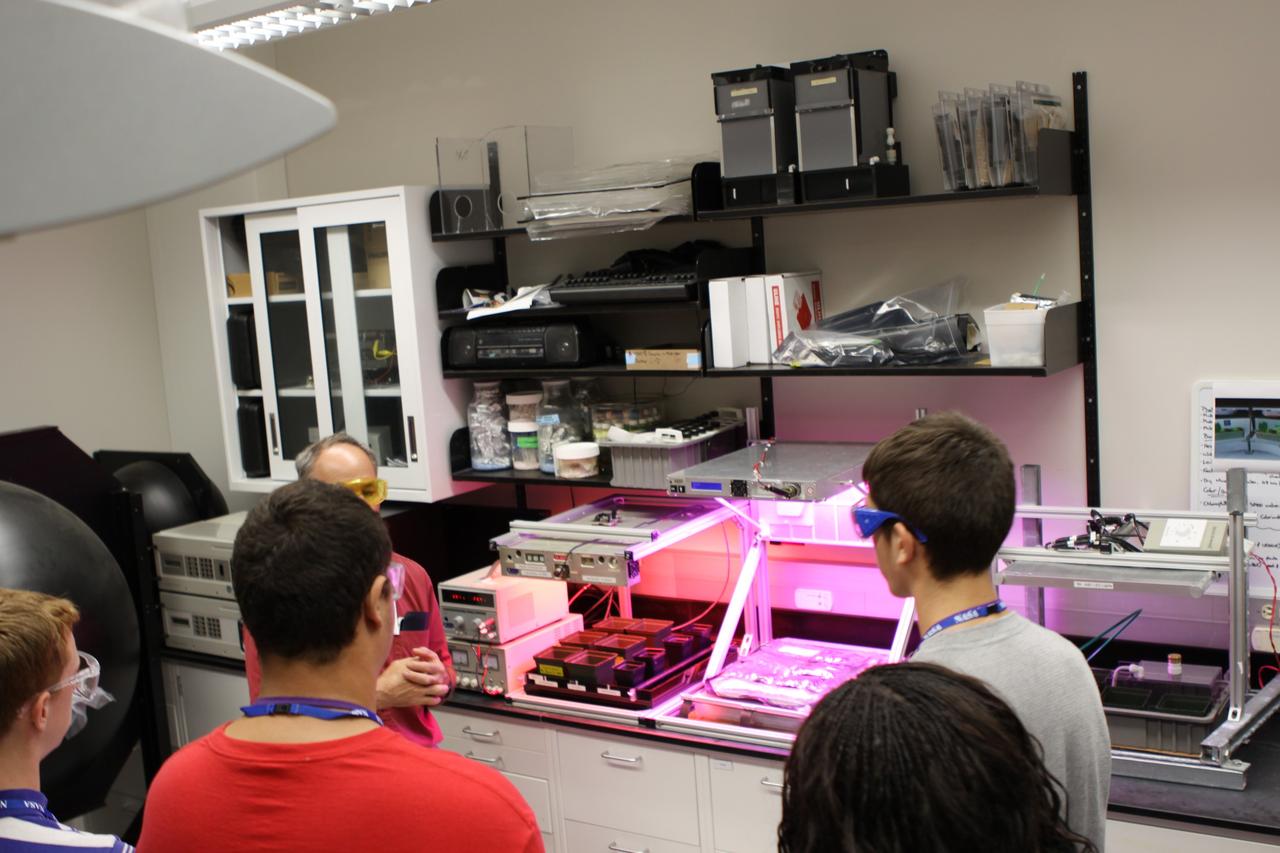
CAPE CANAVERAL, Fla. – Dr. Ray Wheeler explains a system for growing salad crops in space to students in the Life Support and Habitation Systems Lab at the Space Life Sciences Lab facility. The 26 honor students in chemistry and biology and their teachers got a chance to visit a number of high-tech labs at Kennedy Space Center as part of an effort to encourage students in the areas of science, technology, engineering and math. The tenth and eleventh grade students from Terry Parker High School in Jacksonville, Fla., visited a number of vastly different labs during their one-day tour. The group's visit to Kennedy was hosted by the Education Office as part of a nationwide effort by the National Lab Network to help introduce the nation's students to science careers. Photo credit: NASA/Jim Grossmann
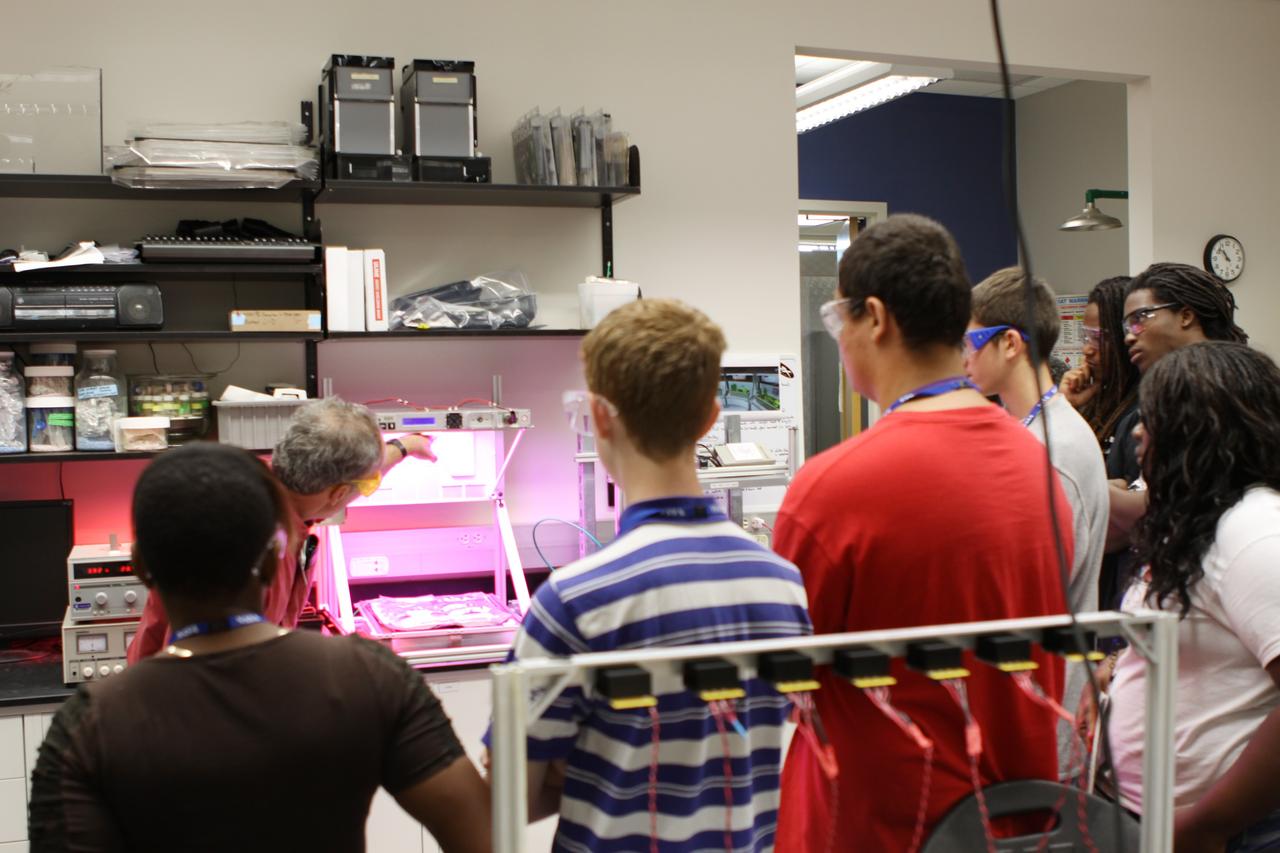
CAPE CANAVERAL, Fla. – Dr. Ray Wheeler explains a system for growing salad crops in space to students in the Life Support and Habitation Systems Lab at the Space Life Sciences Lab facility. The 26 honor students in chemistry and biology and their teachers got a chance to visit a number of high-tech labs at Kennedy Space Center as part of an effort to encourage students in the areas of science, technology, engineering and math. The tenth and eleventh grade students from Terry Parker High School in Jacksonville, Fla., visited a number of vastly different labs during their one-day tour. The group's visit to Kennedy was hosted by the Education Office as part of a nationwide effort by the National Lab Network to help introduce the nation's students to science careers. Photo credit: NASA/Jim Grossmann
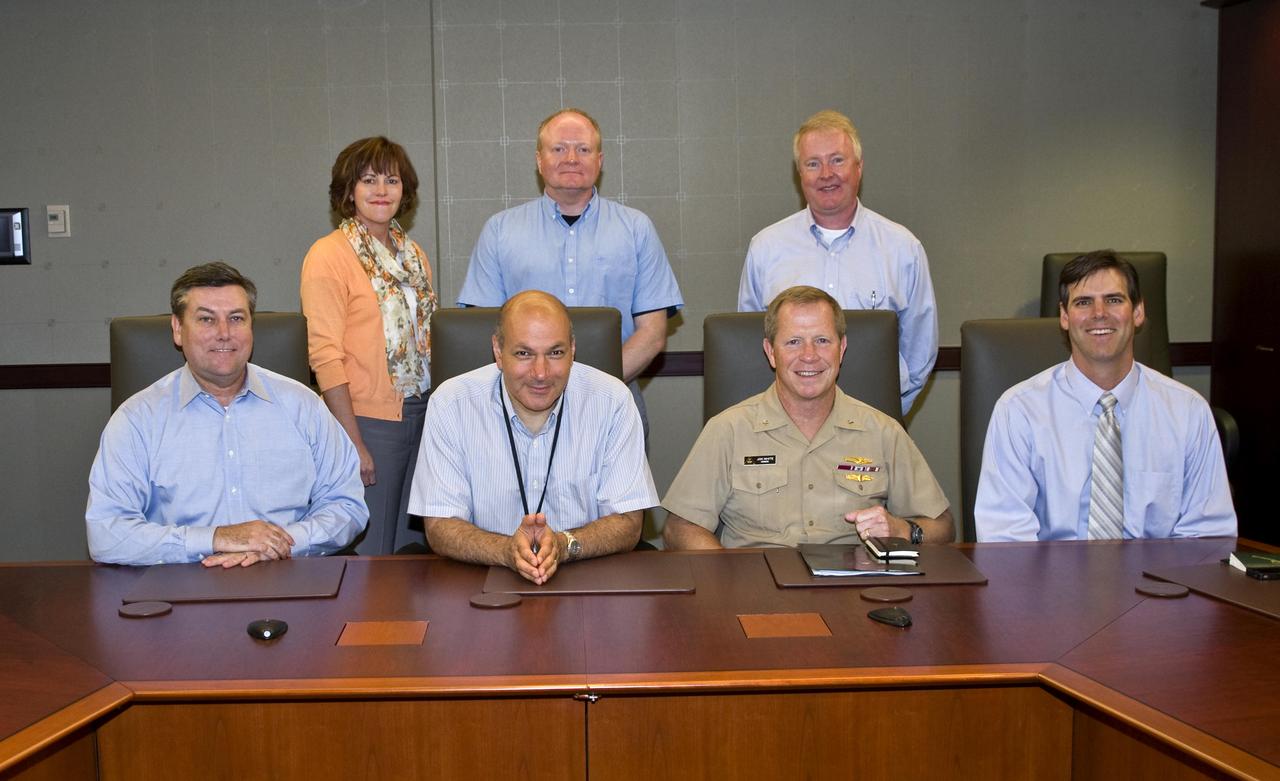
NASA Chief Scientist Dr. Waleed Abdalati visited Stennis Space Center on July 19, to learn about the extensive science capabilities onsite. Shown at right are: (seated, l to r), Stennis Center Director Patrick Scheuermann; Dr. Abdalati; U.S. Navy Rear Adm. Jonathan White; NOAA National Data Buoy Center Program Manager Shannon McArthur; (standing, l to r) Stennis Project Directorate Assistant Director Anne Peek; Stennis Applied Science & Technology Project Office Chief Duane Armstrong; and Stennis Project Directorate Director Keith Brock.
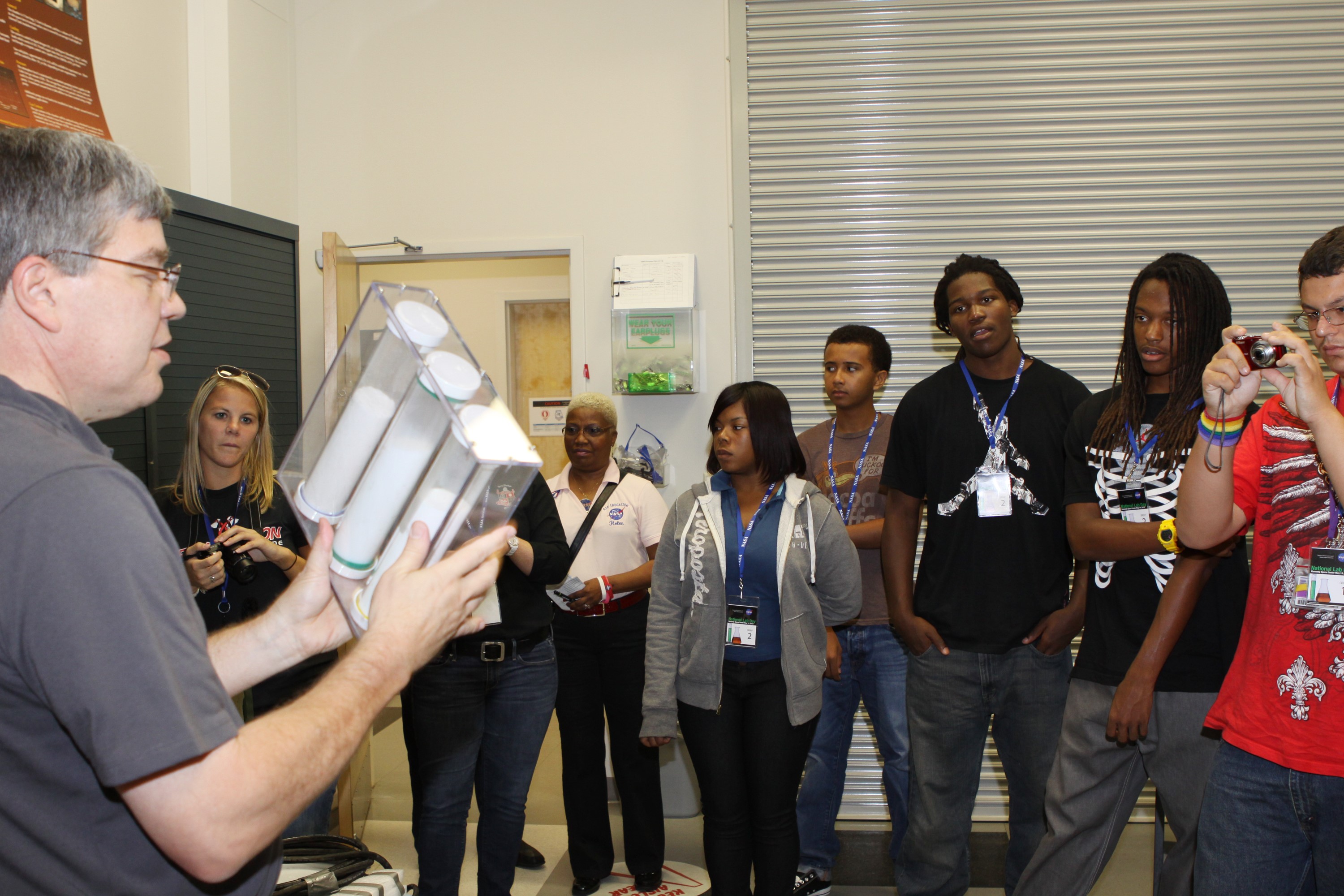
CAPE CANAVERAL, Fla. – Dr. Phil Metzger demonstrates an experiment to study the physics of granular materials to students in the Granular Physics and Regolith Operations Lab at the Space Life Sciences Lab facility. The 26 honor students in chemistry and biology and their teachers got a chance to visit a number of high-tech labs at Kennedy Space Center as part of an effort to encourage students in the areas of science, technology, engineering and math. The tenth and eleventh grade students from Terry Parker High School in Jacksonville, Fla., visited a number of vastly different labs during their one-day tour. The group's visit to Kennedy was hosted by the Education Office as part of a nationwide effort by the National Lab Network to help introduce the nation's students to science careers. Photo credit: NASA/Jim Grossmann
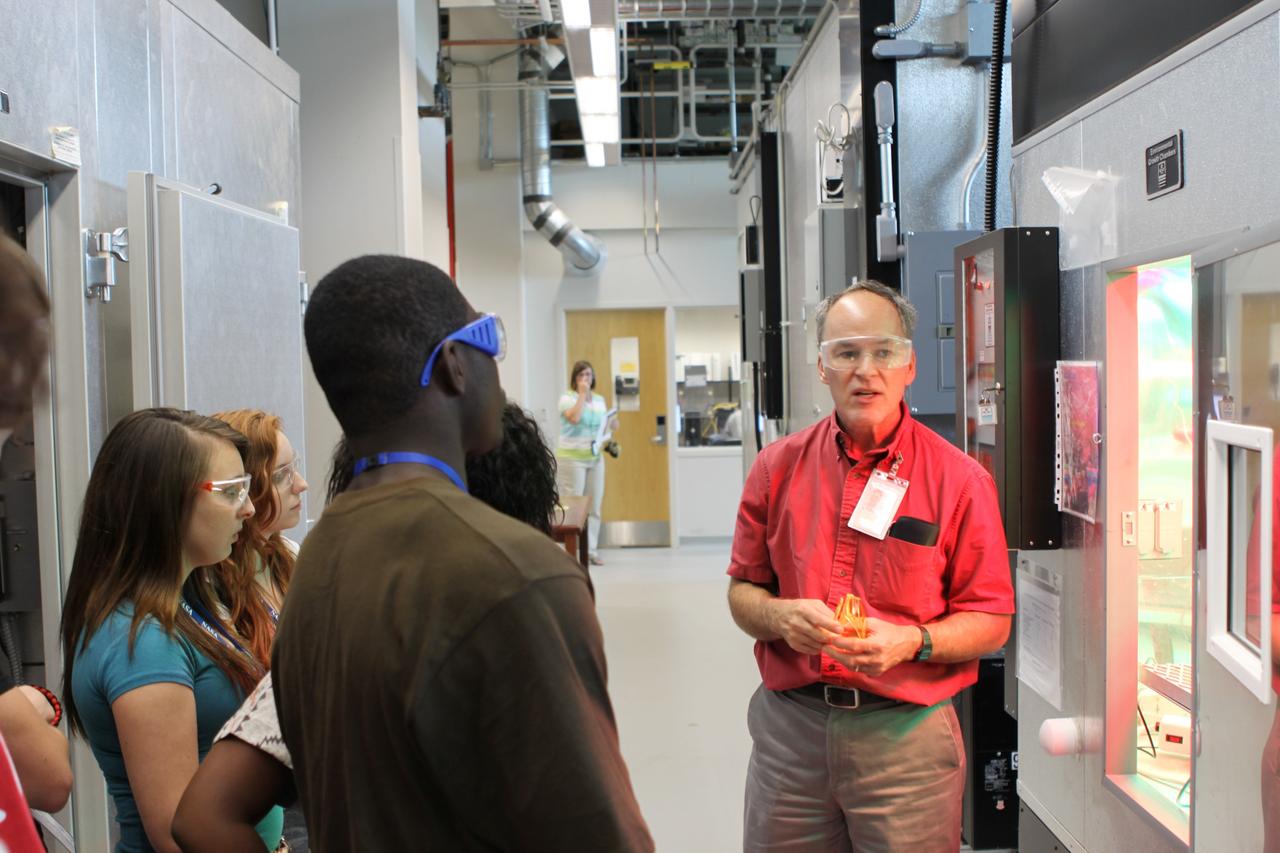
CAPE CANAVERAL, Fla. – Dr. Ray Wheeler explains a plant growth chamber to students in the Life Support and Habitation Systems Lab at the Space Life Sciences Lab facility. The 26 honor students in chemistry and biology and their teachers got a chance to visit a number of high-tech labs at Kennedy Space Center as part of an effort to encourage students in the areas of science, technology, engineering and math. The tenth and eleventh grade students from Terry Parker High School in Jacksonville, Fla., visited a number of vastly different labs during their one-day tour. The group's visit to Kennedy was hosted by the Education Office as part of a nationwide effort by the National Lab Network to help introduce the nation's students to science careers. Photo credit: NASA/Jim Grossmann
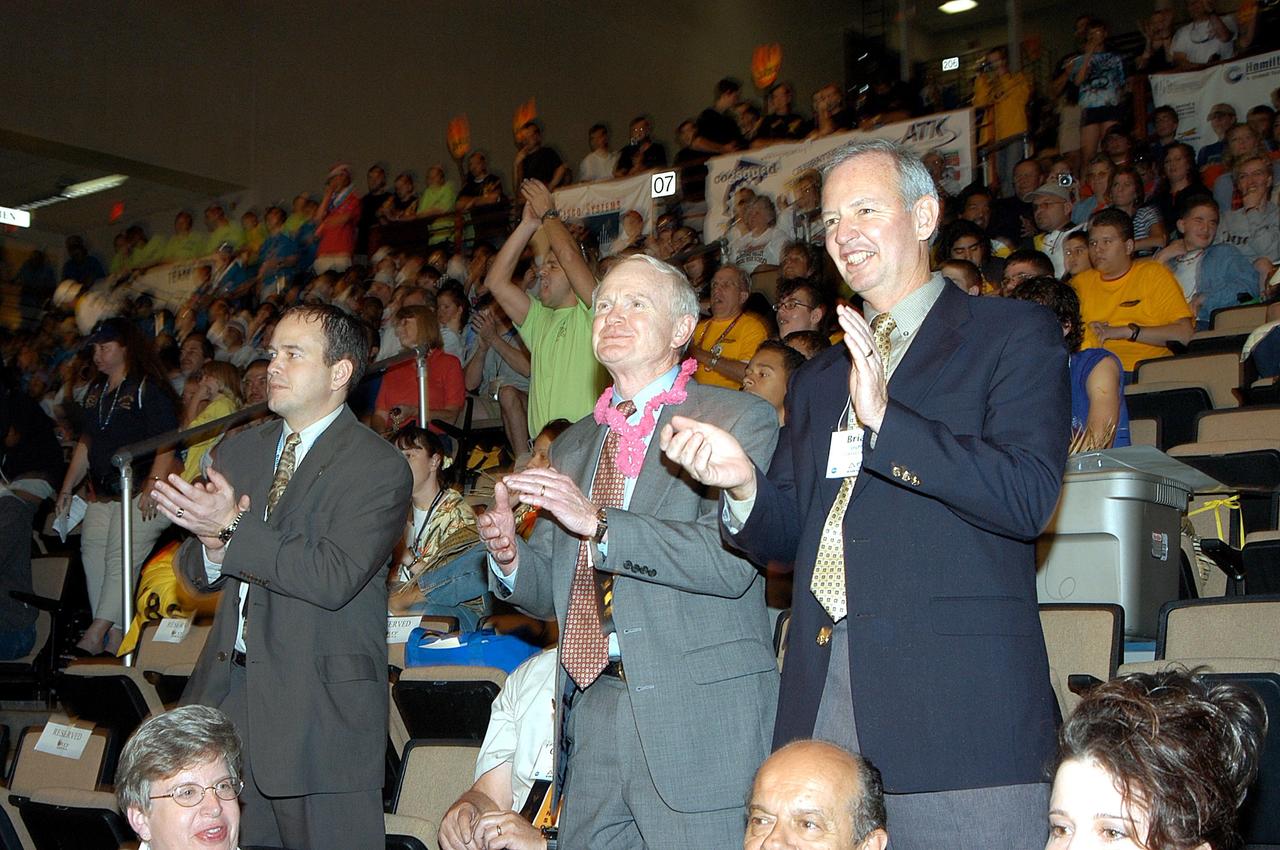
KENNEDY SPACE CENTER, FLA. - On their feet, applauding the student participants of the 2003 Southeastern Regional FIRST Robotic Competition are, from left, David Culp, executive intern to the director of KSC; Roy Bridges, KSC director; and Brian Duffy, Lockheed Martin vice president/associate program manager. The competition is being held at the University of Central Florida (UCF) in Orlando, March 20-23. Forty student teams from around the country are participating in the event that pits team-built gladiator robots against each other in an athletic-style competition. The teams are sponsored by NASA/Kennedy Space Center, The Boeing Company/Brevard Community College, and Lockheed Martin Space Operations/Mission Systems for the nonprofit organization For Inspiration and Recognition of Science and Technology, known as FIRST. The vision of FIRST is to inspire in the youth of our nation an appreciation of science and technology and an understanding that mastering these disciplines can enrich the lives of all mankind.
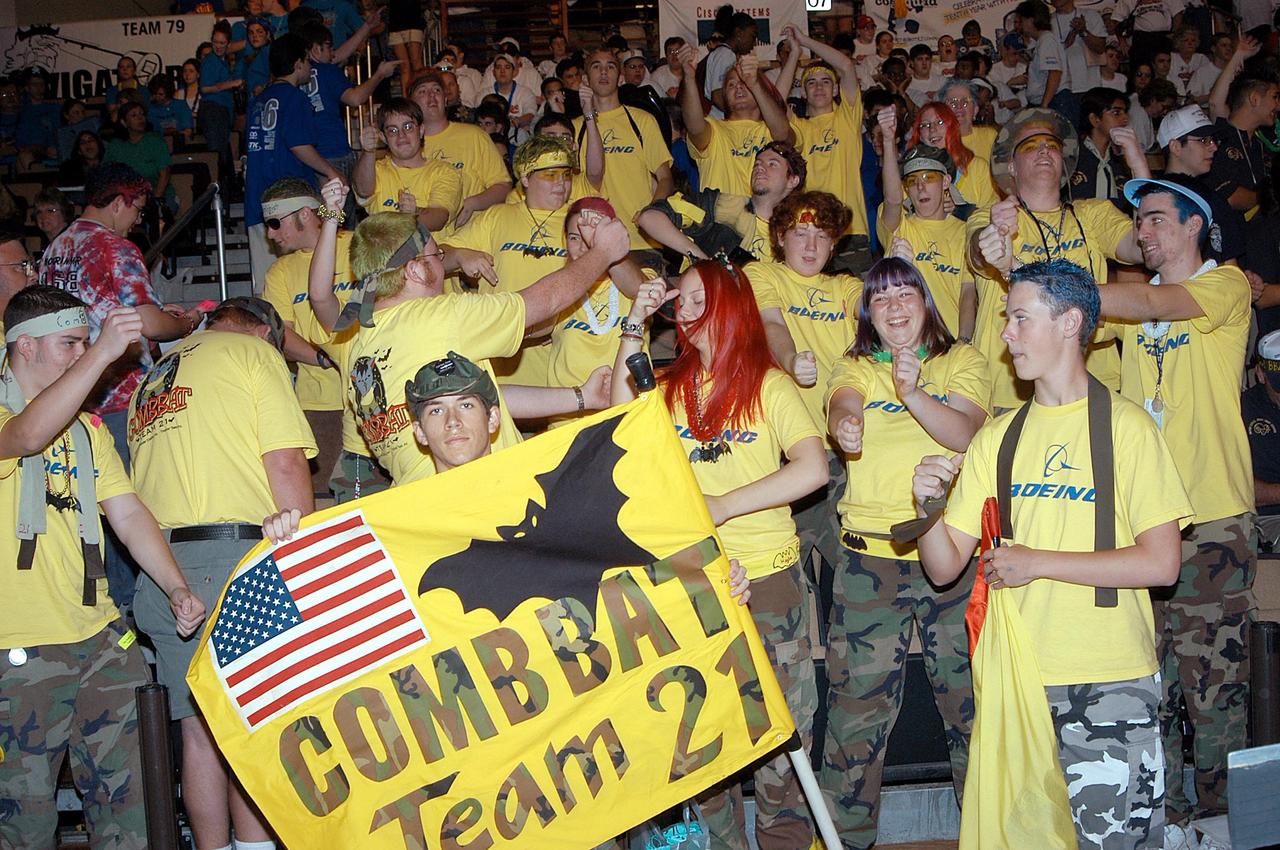
KENNEDY SPACE CENTER, FLA. - The Boeing Company/Brevard Community College-sponsored students, participating in the 2003 Southeastern Regional FIRST Robotic Competition, demonstrate their team spirit. The competition is being held at the University of Central Florida (UCF) in Orlando, March 20-23. The team won the DaimlerChrysler Team Spirit Award and the Johnson & Johnson Sportsmanship Award. Forty teams from around the country are participating in the event that pits team-built gladiator robots against each other in an athletic-style competition. The teams are sponsored by NASA-Kennedy Space Center, The Boeing Company/Brevard Community College, and Lockheed Martin Space Operations/Mission Systems for the nonprofit organization For Inspiration and Recognition of Science and Technology, known as FIRST. The vision of FIRST is to inspire in the youth of our nation an appreciation of science and technology and an understanding that mastering these disciplines can enrich the lives of all mankind.
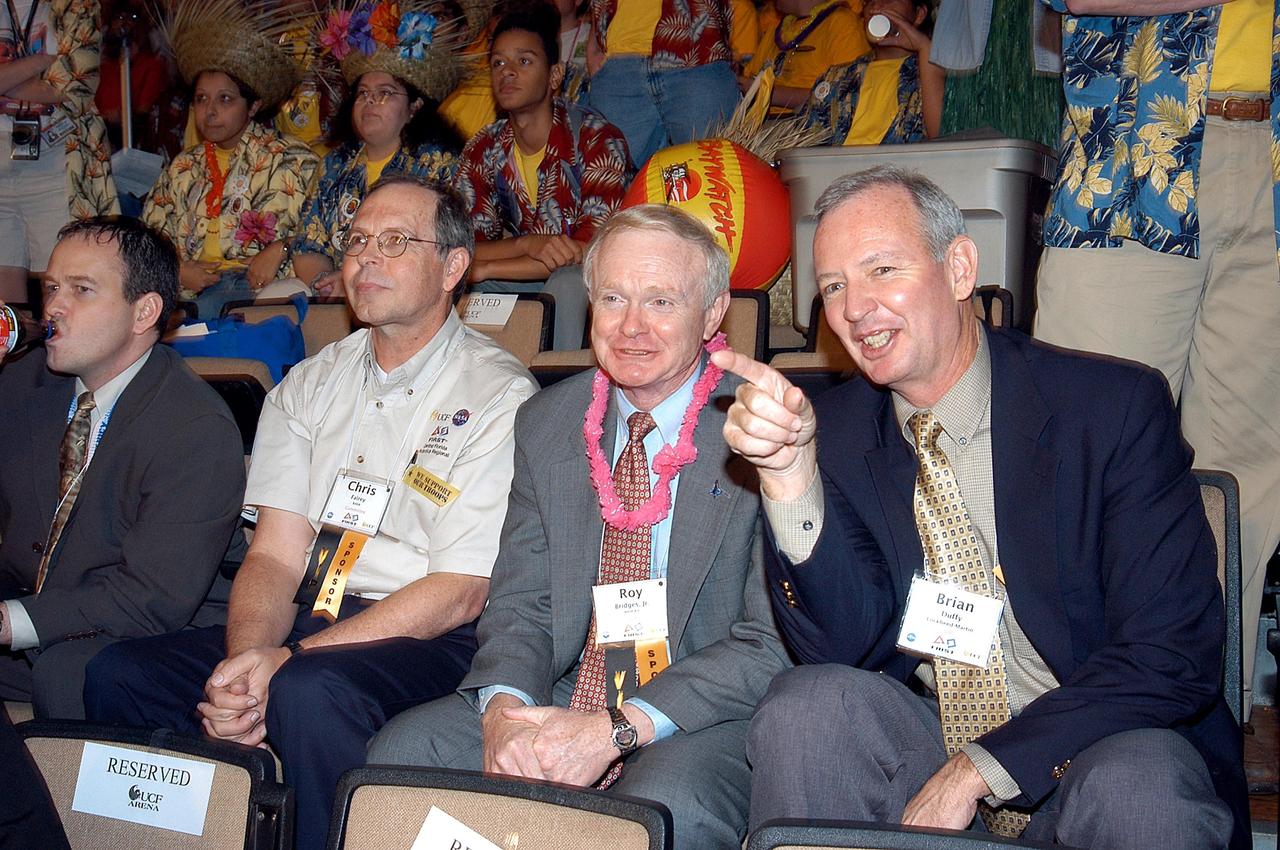
KENNEDY SPACE CENTER, FLA. - Observing the festivities at the 2003 Southeastern Regional FIRST Robotic Competition are, from left, David Culp, executive intern to the director of KSC; Chris Fairey, former director of Spaceport Services at KSC; Roy Bridges, KSC director; and Brian Duffy, Lockheed Martin vice president/associate program manager. The competition is being held at the University of Central Florida (UCF) in Orlando, March 20-23. Forty student teams from around the country are participating in the event that pits team-built gladiator robots against each other in an athletic-style competition. The teams are sponsored by NASA/Kennedy Space Center, The Boeing Company/Brevard Community College, and Lockheed Martin Space Operations/Mission Systems for the nonprofit organization For Inspiration and Recognition of Science and Technology, known as FIRST. The vision of FIRST is to inspire in the youth of our nation an appreciation of science and technology and an understanding that mastering these disciplines can enrich the lives of all mankind.
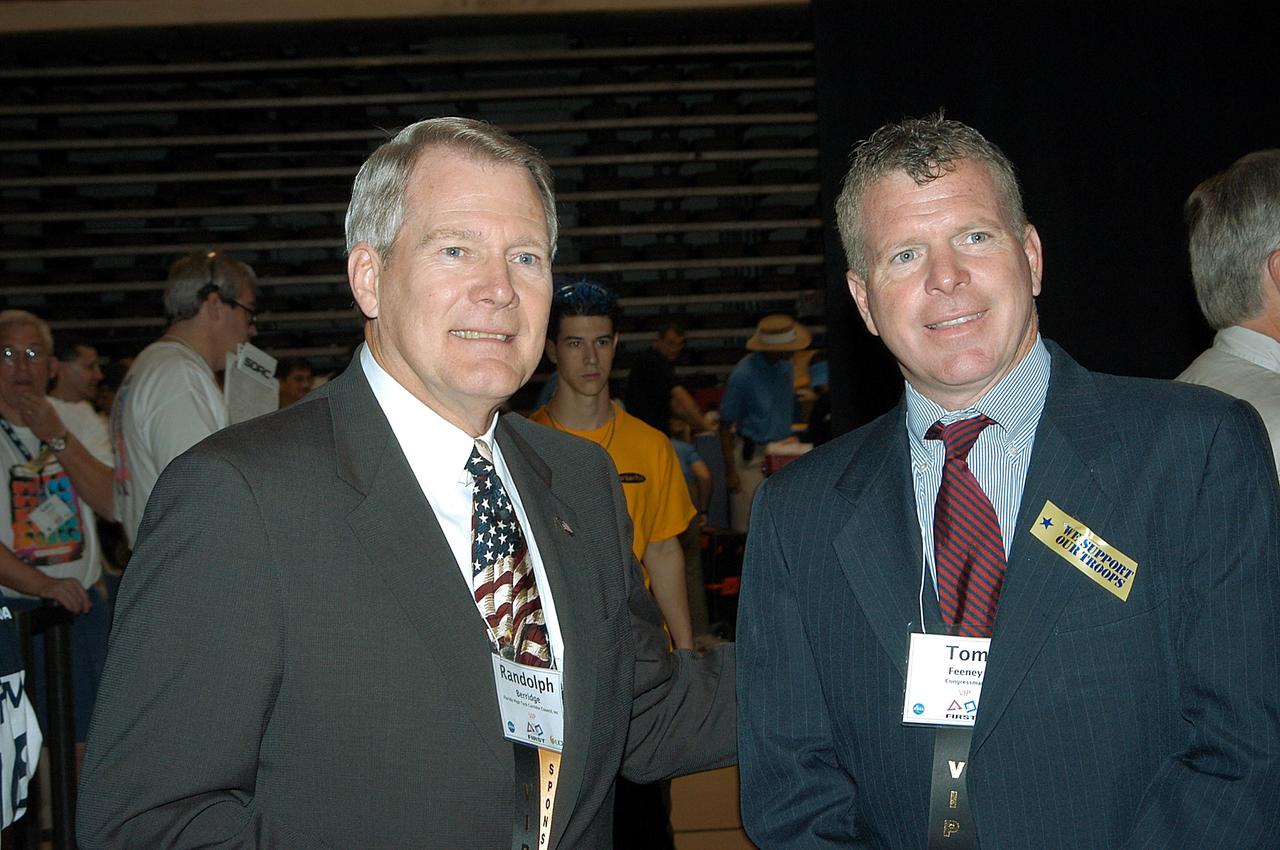
KENNEDY SPACE CENTER, FLA. - Randolph E. Berridge, president of the Florida High Tech Corridor Council, and Tom Feeney, Florida Representative from the 24th District, attend the 2003 Southeastern Regional FIRST Robotic Competition. The competition is being held at the University of Central Florida (UCF) in Orlando, March 20-23. Forty student teams from around the country are participating in the event that pits team-built gladiator robots against each other in an athletic-style competition. The teams are sponsored by NASA/Kennedy Space Center, The Boeing Company/Brevard Community College, and Lockheed Martin Space Operations/Mission Systems for the nonprofit organization For Inspiration and Recognition of Science and Technology, known as FIRST. The vision of FIRST is to inspire in the youth of our nation an appreciation of science and technology and an understanding that mastering these disciplines can enrich the lives of all mankind.
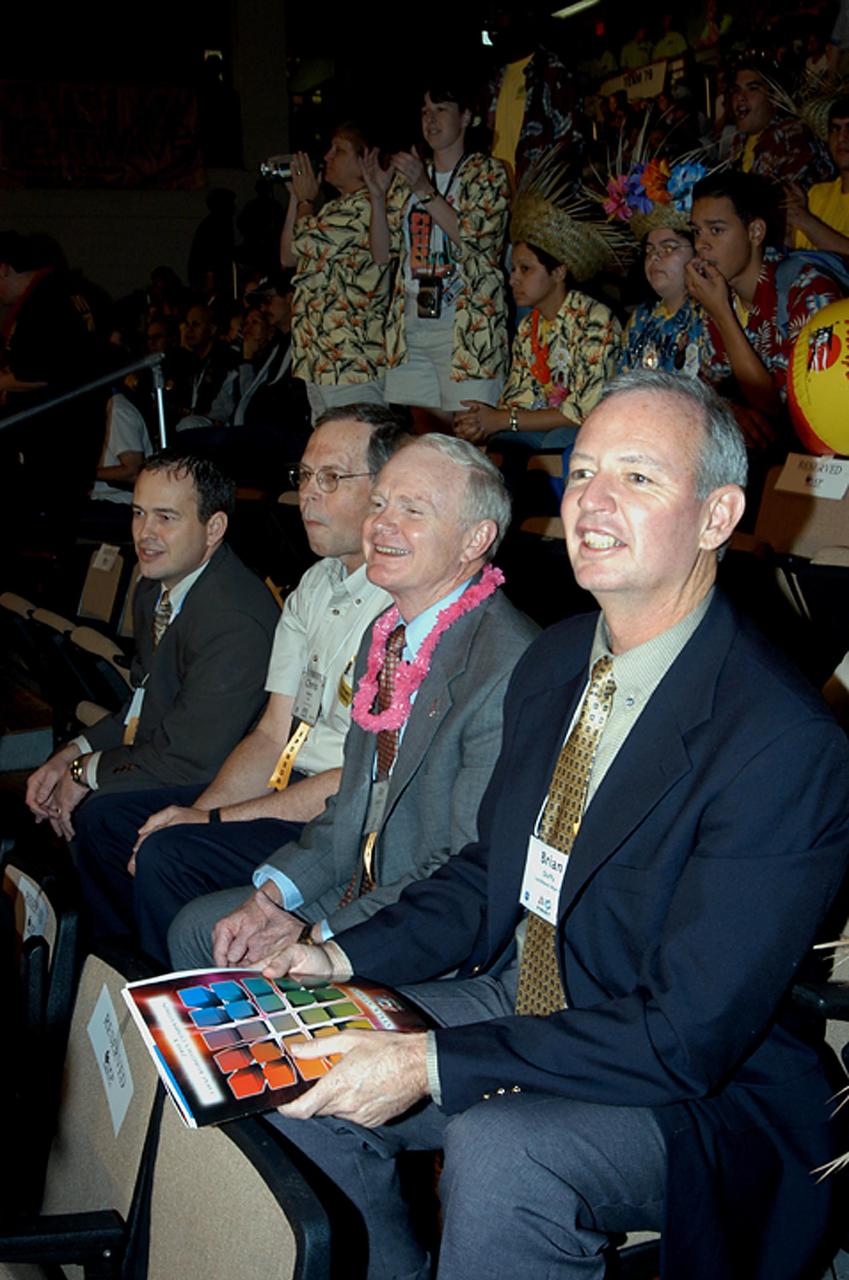
KENNEDY SPACE CENTER, FLA. - Observing the festivities at the 2003 Southeastern Regional FIRST Robotic Competition are, from left, David Culp, executive intern to the director of KSC; Chris Fairey, former director of Spaceport Services at KSC; Roy Bridges, KSC director; and Brian Duffy, Lockheed Martin vice president/associate program manager. The competition is being held at the University of Central Florida (UCF) in Orlando, March 20-23. Forty student teams from around the country are participating in the event that pits team-built gladiator robots against each other in an athletic-style competition. The teams are sponsored by NASA/Kennedy Space Center, The Boeing Company/Brevard Community College, and Lockheed Martin Space Operations/Mission Systems for the nonprofit organization For Inspiration and Recognition of Science and Technology, known as FIRST. The vision of FIRST is to inspire in the youth of our nation an appreciation of science and technology and an understanding that mastering these disciplines can enrich the lives of all mankind.
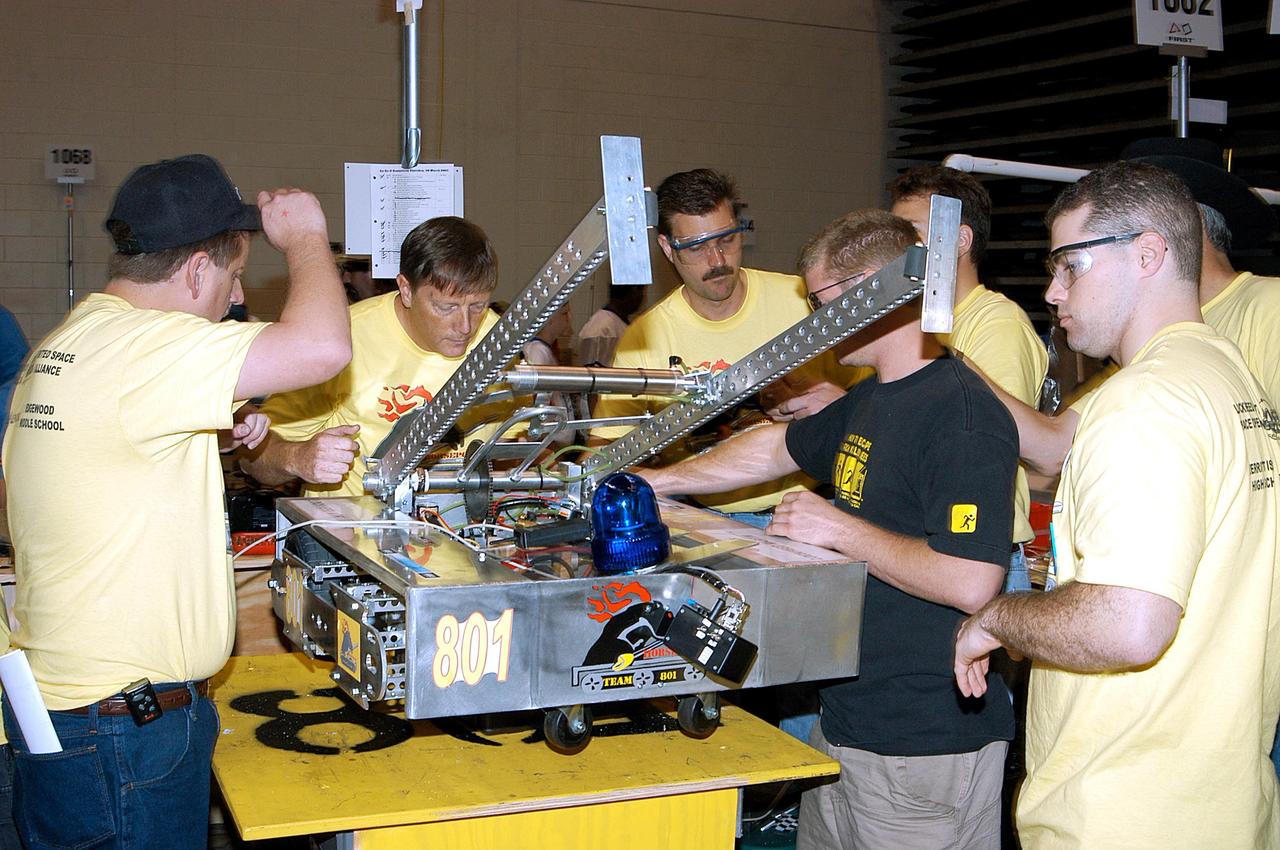
KENNEDY SPACE CENTER, FLA. - Members of the Merritt Island and Edgewood Middle School students/Lockheed Martin team look over their robot. They are participating in the 2003 Southeastern Regional FIRST Robotic Competition being held at the University of Central Florida (UCF) in Orlando, March 20-23. Forty teams from around the country are participating in the event that pits team-built gladiator robots against each other in an athletic-style competition. The teams are sponsored by NASA-Kennedy Space Center, The Boeing Company/Brevard Community College, and Lockheed Martin Space Operations/Mission Systems for the nonprofit organization For Inspiration and Recognition of Science and Technology, known as FIRST. The vision of FIRST is to inspire in the youth of our nation an appreciation of science and technology and an understanding that mastering these disciplines can enrich the lives of all mankind.
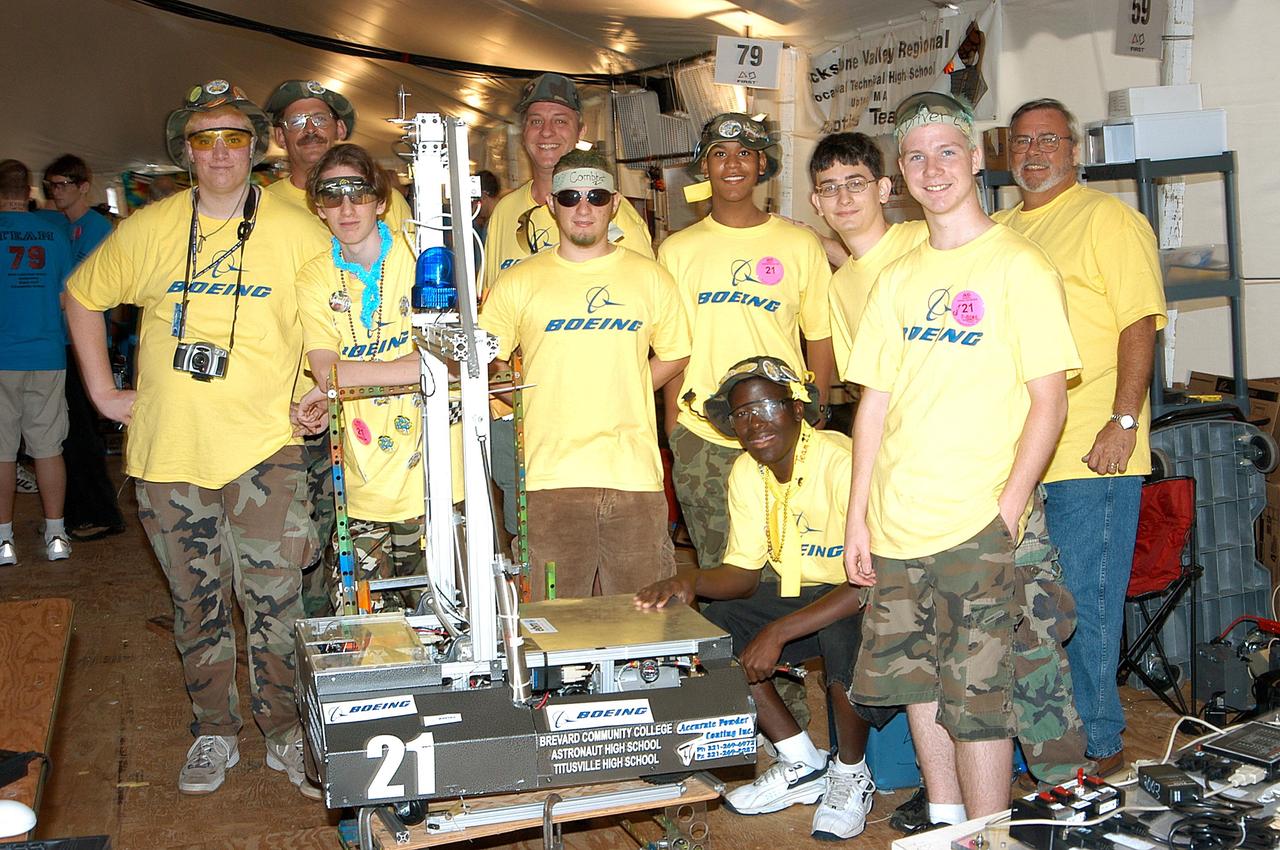
KENNEDY SPACE CENTER, FLA. - The Boeing Company/Brevard Community College-sponsored students, participating in the 2003 Southeastern Regional FIRST Robotic Competition, pose with their team-built robot. The competition is being held at the University of Central Florida (UCF) in Orlando, March 20-23. Forty teams from around the country are participating in the event that pits team-built gladiator robots against each other in an athletic-style competition. The teams are sponsored by NASA/Kennedy Space Center, The Boeing Company/Brevard Community College, and Lockheed Martin Space Operations/Mission Systems for the nonprofit organization For Inspiration and Recognition of Science and Technology, known as FIRST. The vision of FIRST is to inspire in the youth of our nation an appreciation of science and technology and an understanding that mastering these disciplines can enrich the lives of all mankind.
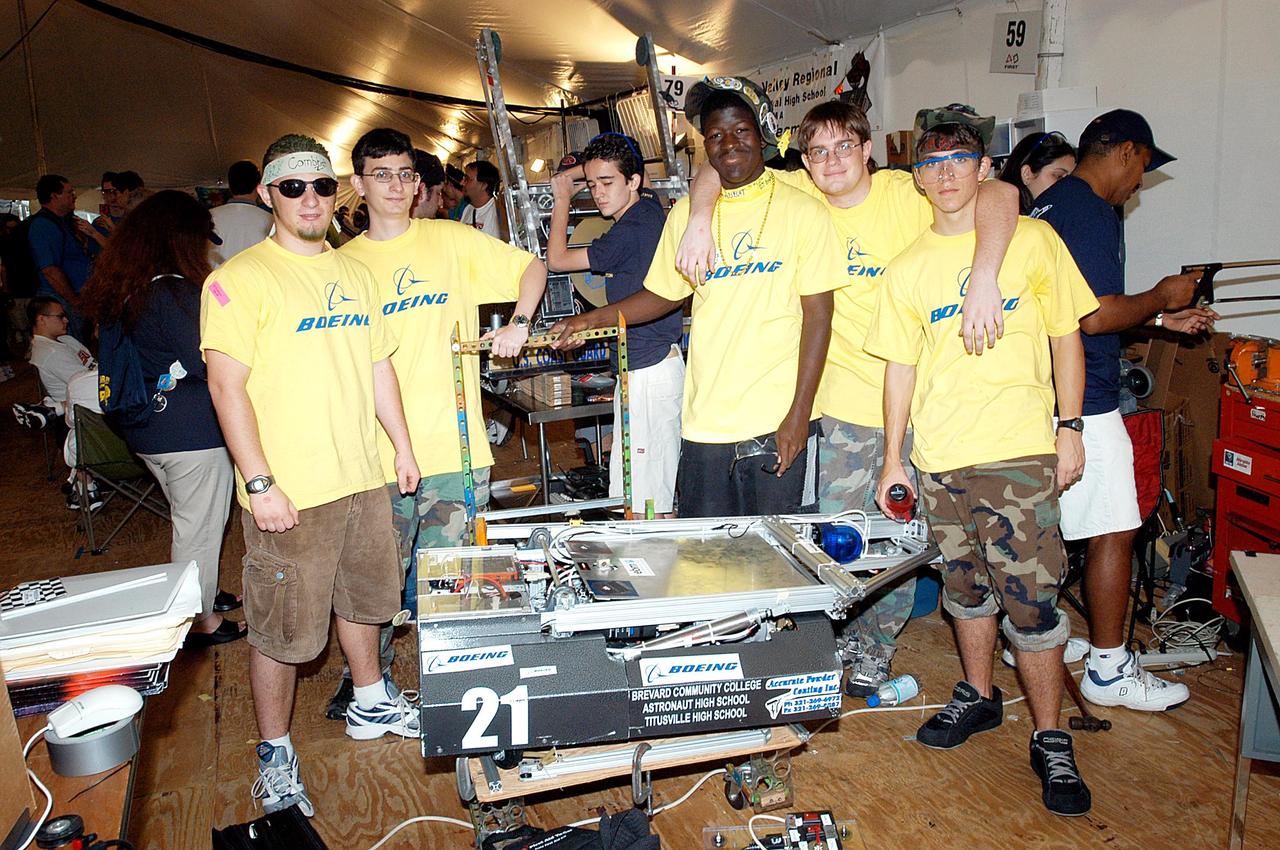
KENNEDY SPACE CENTER, FLA. - The Boeing Company/Brevard Community College-sponsored students, participating in the 2003 Southeastern Regional FIRST Robotic Competition, pose with their team-built robot. The competition is being held at the University of Central Florida (UCF) in Orlando, March 20-23. Forty teams from around the country are participating in the event that pits team-built gladiator robots against each other in an athletic-style competition. The teams are sponsored by NASA-Kennedy Space Center, The Boeing Company/Brevard Community College, and Lockheed Martin Space Operations/Mission Systems for the nonprofit organization For Inspiration and Recognition of Science and Technology, known as FIRST. The vision of FIRST is to inspire in the youth of our nation an appreciation of science and technology and an understanding that mastering these disciplines can enrich the lives of all mankind.
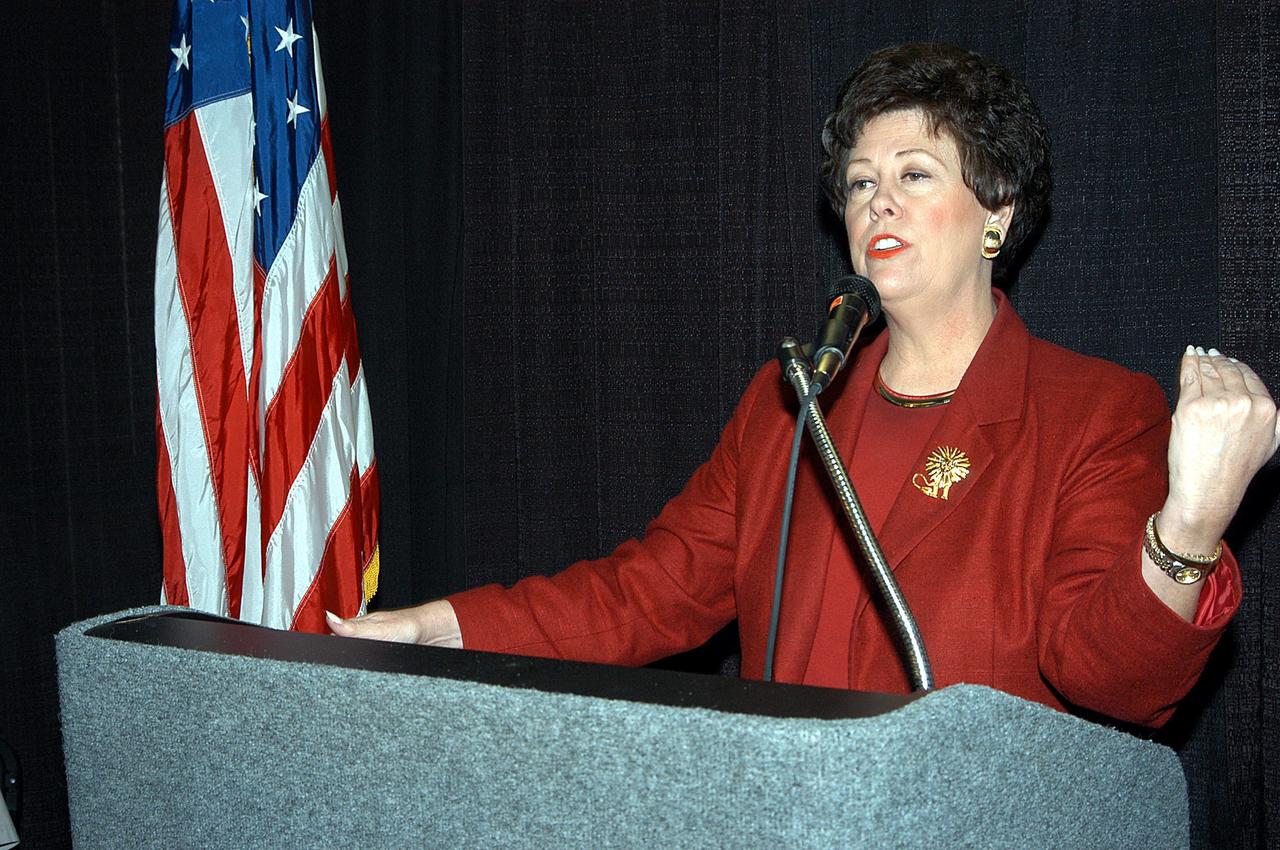
KENNEDY SPACE CENTER, FLA. - Florida Lt. Gov. Toni Jennings speaks to the attendees of an invitation-only luncheon held during the 2003 Southeastern Regional FIRST Robotic Competition. The competition is being held at the University of Central Florida (UCF) in Orlando, March 20-23. Forty student teams from around the country are participating in the event that pits team-built gladiator robots against each other in an athletic-style competition. The teams are sponsored by NASA/Kennedy Space Center, The Boeing Company/Brevard Community College, and Lockheed Martin Space Operations/Mission Systems for the nonprofit organization For Inspiration and Recognition of Science and Technology, known as FIRST. The vision of FIRST is to inspire in the youth of our nation an appreciation of science and technology and an understanding that mastering these disciplines can enrich the lives of all mankind.
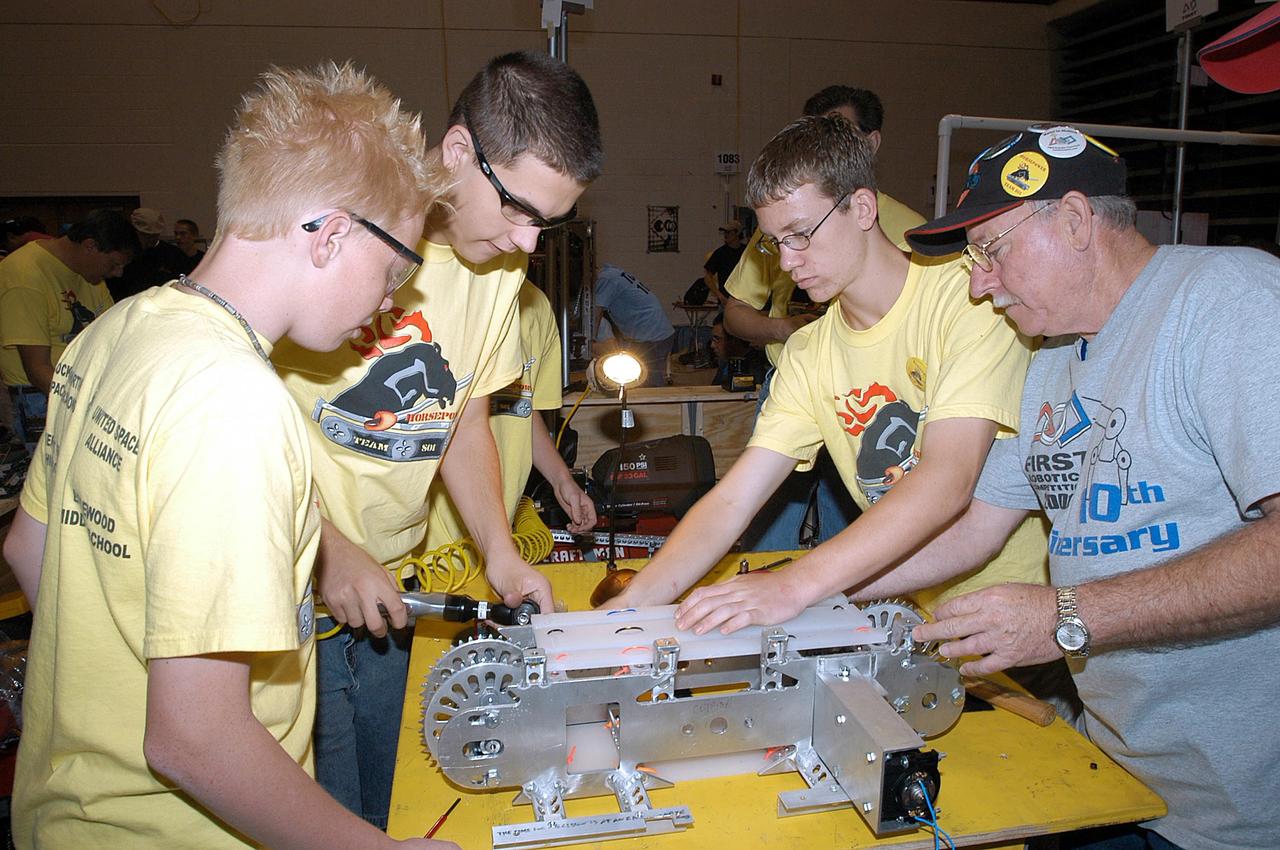
KENNEDY SPACE CENTER, FLA. -- The Merritt Island and Edgewood Middle School students/Lockheed Martin team, participating in the 2003 Southeastern Regional FIRST Robotic Competition, work on their team-built robot. The competition is being held at the University of Central Florida (UCF) in Orlando, March 20-23. Forty teams from around the country are participating in the event that pits team-built gladiator robots against each other in an athletic-style competition. The teams are sponsored by NASA-Kennedy Space Center, The Boeing Company/Brevard Community College, and Lockheed Martin Space Operations/Mission Systems for the nonprofit organization For Inspiration and Recognition of Science and Technology, known as FIRST. The vision of FIRST is to inspire in the youth of our nation an appreciation of science and technology and an understanding that mastering these disciplines can enrich the lives of all mankind.
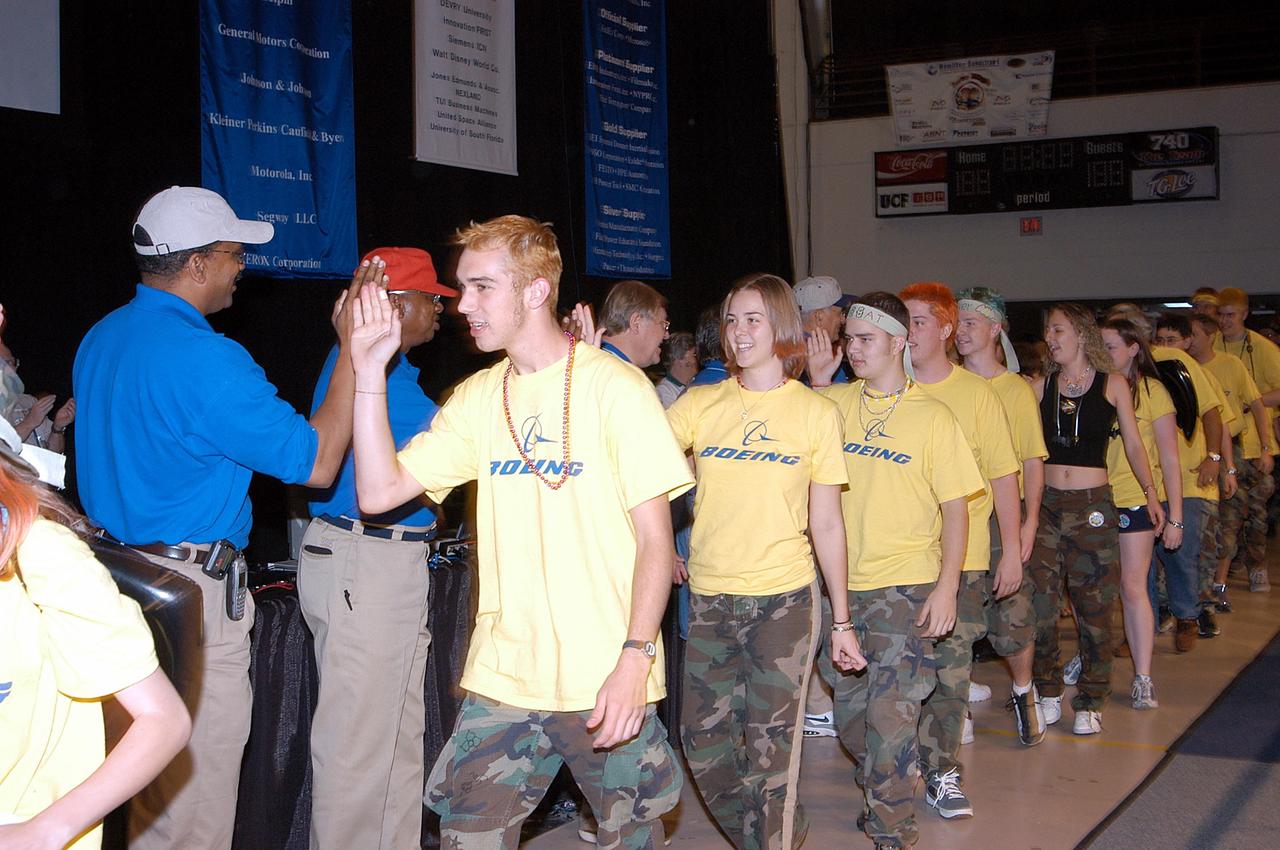
KENNEDY SPACE CENTER, FLA. - The Boeing Company/Brevard Community College-sponsored student team (in yellow shirts) is congratulated by the judges and support staff of the 2003 Southeastern Regional FIRST Robotic Competition. The competition is being held at the University of Central Florida (UCF) in Orlando, March 20-23. The team won the DaimlerChrysler Team Spirit Award and the Johnson & Johnson Sportsmanship Award. Forty student teams from around the country are participating in the event that pits team-built gladiator robots against each other in an athletic-style competition. The teams are sponsored by NASA/Kennedy Space Center, The Boeing Company/Brevard Community College, and Lockheed Martin Space Operations/Mission Systems for the nonprofit organization For Inspiration and Recognition of Science and Technology, known as FIRST. The vision of FIRST is to inspire in the youth of our nation an appreciation of science and technology and an understanding that mastering these disciplines can enrich the lives of all mankind.
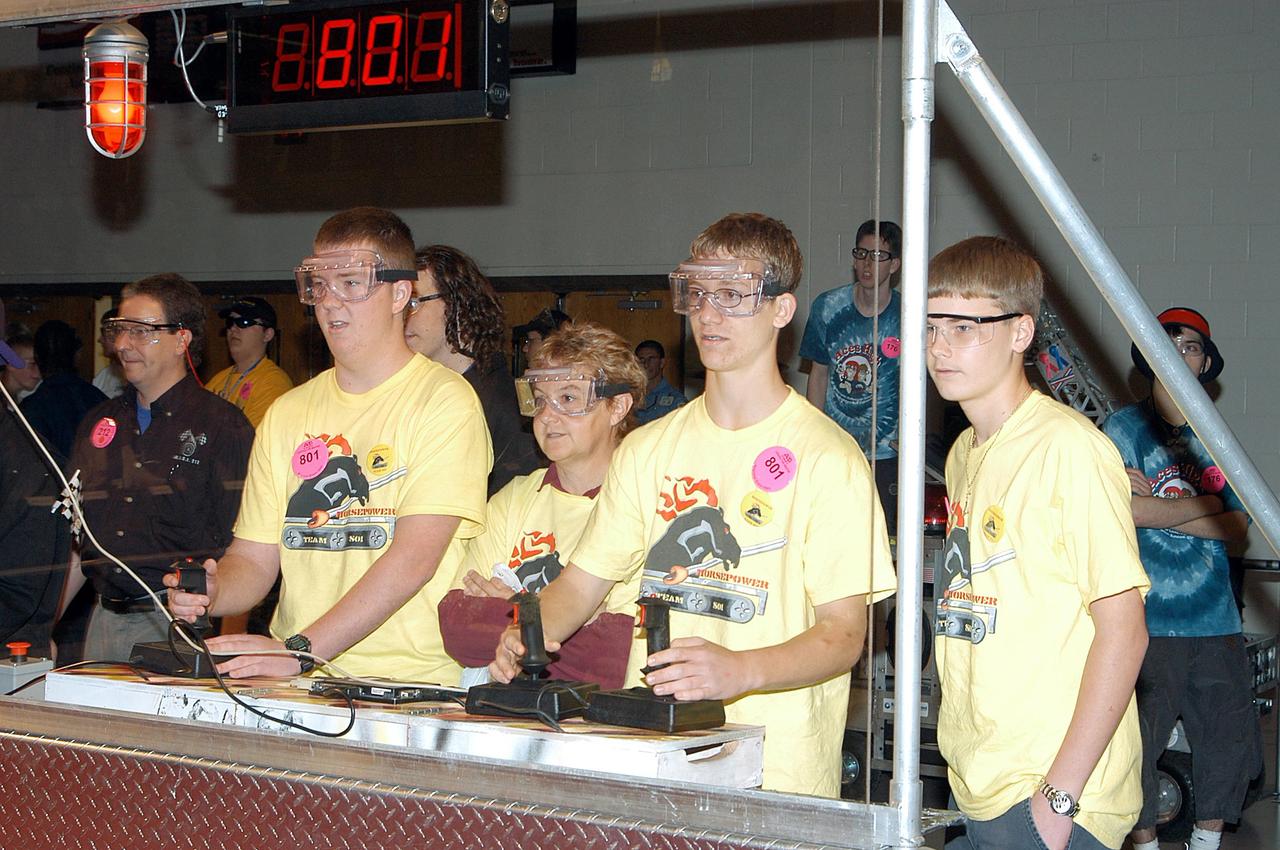
KENNEDY SPACE CENTER, FLA. - Members of the Merritt Island and Edgewood Middle School students/Lockheed Martin team maneuver their robot during competition. They are participating in the 2003 Southeastern Regional FIRST Robotic Competition being held at the University of Central Florida (UCF) in Orlando, March 20-23. Forty teams from around the country are participating in the event that pits team-built gladiator robots against each other in an athletic-style competition. The teams are sponsored by NASA-Kennedy Space Center, The Boeing Company/Brevard Community College, and Lockheed Martin Space Operations/Mission Systems for the nonprofit organization For Inspiration and Recognition of Science and Technology, known as FIRST. The vision of FIRST is to inspire in the youth of our nation an appreciation of science and technology and an understanding that mastering these disciplines can enrich the lives of all mankind.
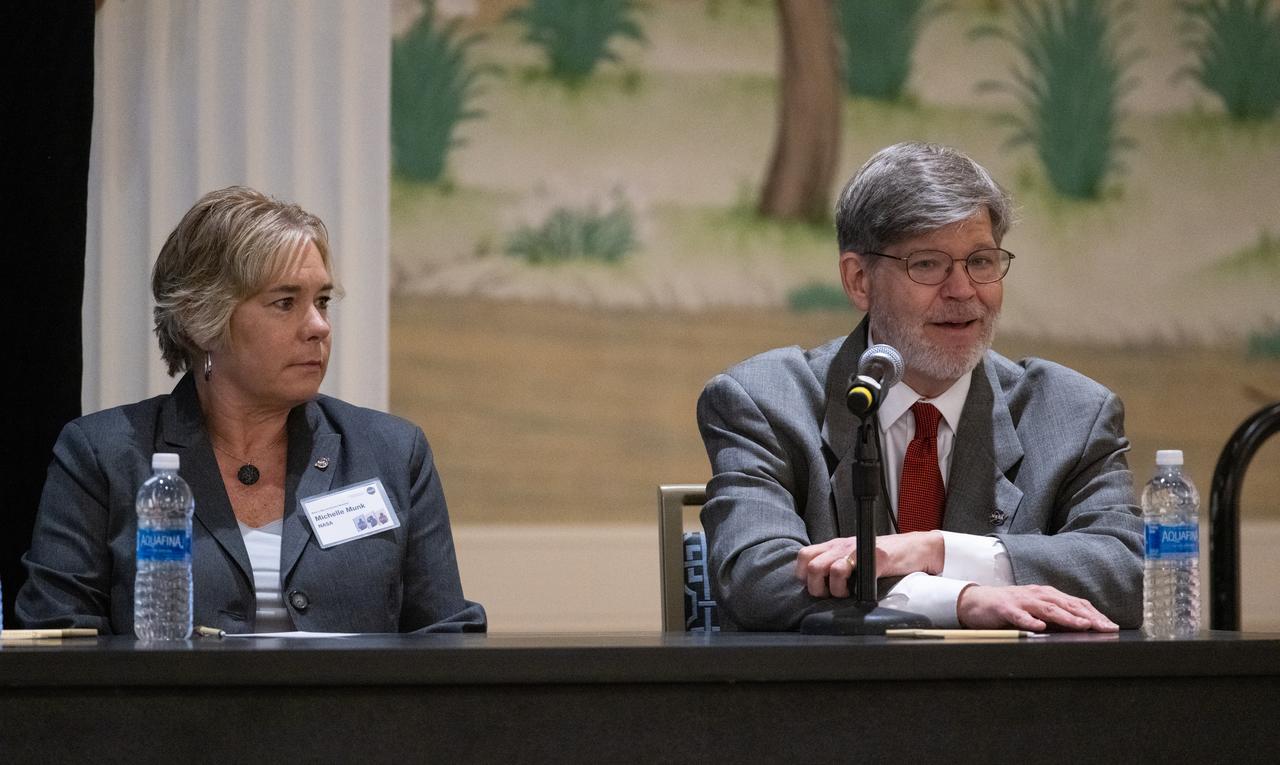
Michelle Munk, chief architect for NASA’s Space Technology Mission Directorate, left, and Joel Kearns, deputy associate administrator for Exploration in NASA's Science Mission Directorate, are seen during NASA’s Moon to Mars Architecture Workshop, Tuesday, June 27, 2023, at the Gaylord National Resort and Convention Center in National Harbor, Md. Following the release of the 2022 Architecture Concept Review, NASA is conducting the workshop to engage the broader space community and collect feedback from U.S. industry and academia to inform the Moon to Mars mission architecture and operational delivery. Photo Credit: (NASA/Joel Kowsky)
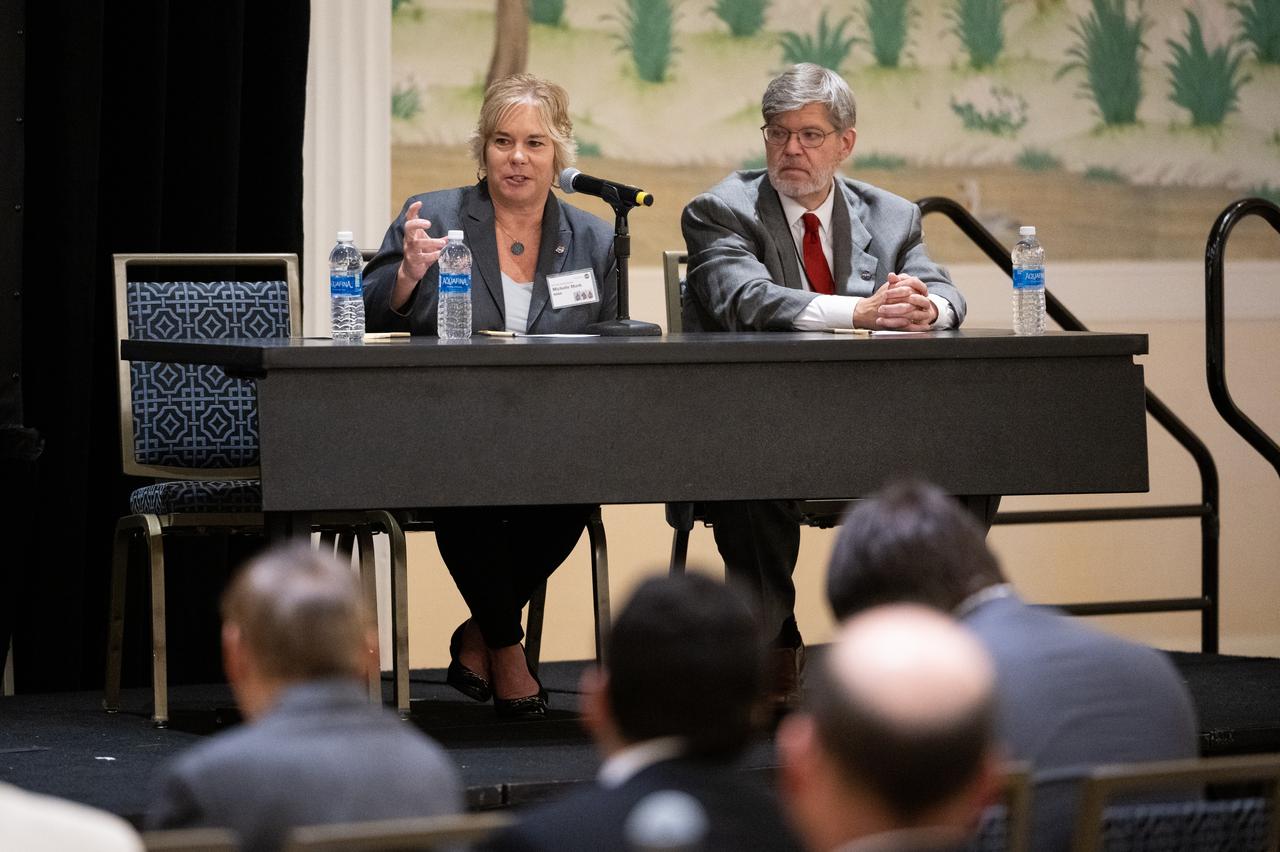
Michelle Munk, chief architect for NASA’s Space Technology Mission Directorate, left, answers a question alongside Joel Kearns, deputy associate administrator for Exploration in NASA's Science Mission Directorate, during NASA’s Moon to Mars Architecture Workshop, Tuesday, June 27, 2023, at the Gaylord National Resort and Convention Center in National Harbor, Md. Following the release of the 2022 Architecture Concept Review, NASA is conducting the workshop to engage the broader space community and collect feedback from U.S. industry and academia to inform the Moon to Mars mission architecture and operational delivery. Photo Credit: (NASA/Joel Kowsky)
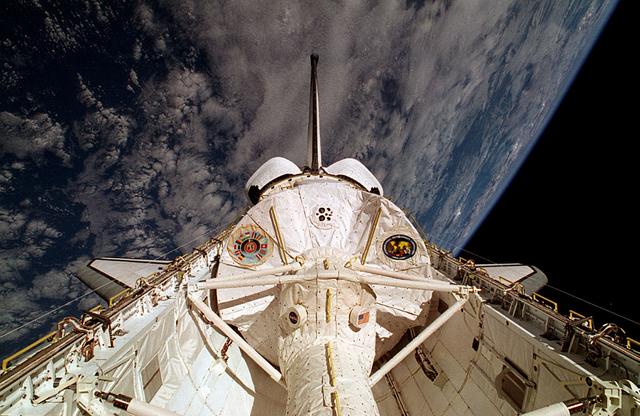
This is a Space Shuttle Columbia (STS-65) onboard photo of the second International Microgravity Laboratory (IML-2) in the cargo bay with Earth in the background. Mission objectives of IML-2 were to conduct science and technology investigations that required the low-gravity environment of space, with emphasis on experiments that studied the effects of microgravity on materials processes and living organisms. Materials science and life sciences are two of the most exciting areas of microgravity research because discoveries in these fields could greatly enhance the quality of life on Earth. If the structure of certain proteins can be determined by examining high-quality protein crystals grown in microgravity, advances can be made to improve the treatment of many human diseases. Electronic materials research in space may help us refine processes and make better products, such as computers, lasers, and other high-tech devices. The 14-nation European Space Agency (ESA), the Canadian Space Agency (SCA), the French National Center for Space Studies (CNES), the German Space Agency and the German Aerospace Research Establishment (DARA/DLR), and the National Space Development Agency of Japan (NASDA) participated in developing hardware and experiments for the IML missions. The missions were managed by NASA's Marshall Space Flight Center. The Orbiter Columbia was launched from the Kennedy Space Center on July 8, 1994 for the IML-2 mission.
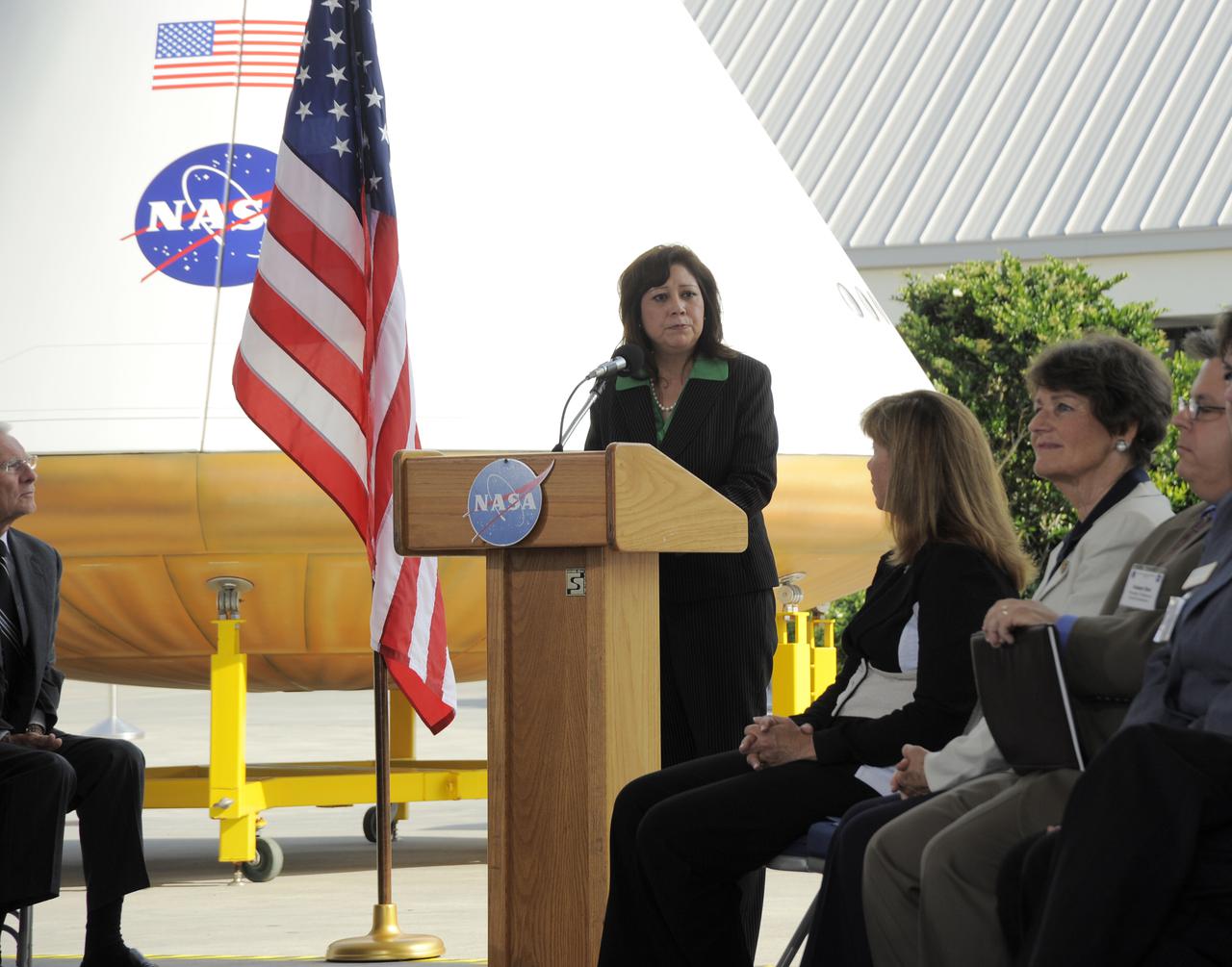
CAPE CANAVERAL, Fla. – At NASA's Kennedy Space Center Visitor Complex, Secretary of Labor Hilda Solis talks to the media and community leaders about the $15 million Florida will receive from the Labor Department’s National Emergency Grant Program to assist workers after the retirement of NASA's Space Shuttle Program. The grant money, which was awarded to the Brevard Workforce Development Board, will be used for job recruiting, screening, education and training, as well as incentives for new growth in science, technology and research. Photo credit: NASA_Kim Shiflett

NASA image release April 22, 2010 Object Names: Carina Nebula, NGC 3372 Image Type: Astronomical Credit: NASA/N. Smith (University of California, Berkeley) and NOAO/AURA/NSF To read learn more about this image go to: <a href="http://www.nasa.gov/mission_pages/hubble/science/hubble20th-img.html" rel="nofollow">www.nasa.gov/mission_pages/hubble/science/hubble20th-img....</a> <b><a href="http://www.nasa.gov/centers/goddard/home/index.html" rel="nofollow">NASA Goddard Space Flight Center</a></b> is home to the nation's largest organization of combined scientists, engineers and technologists that build spacecraft, instruments and new technology to study the Earth, the sun, our solar system, and the universe.
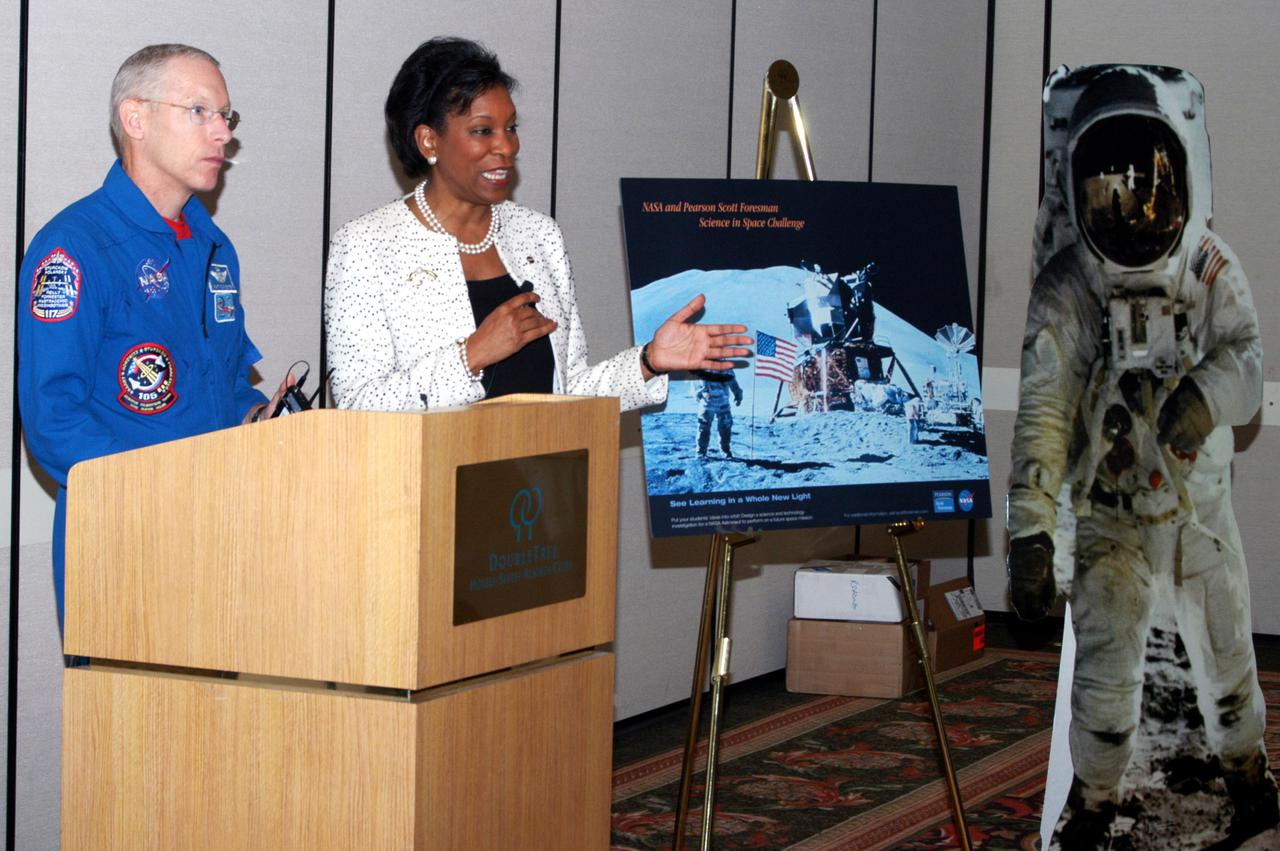
KENNEDY SPACE CENTER, FLA. - NASA astronaut Patrick Forrester (left) and Dr. Adena Williams Loston, NASA chief education officer, address a group of educators assembled for the kickoff of 'The Science in Space Challenge' at the Doubletree Hotel in Orlando, Fla. The national challenge program is sponsored by NASA and Pearson Scott Foresman, publisher of pre-K through grade six educational books. To participate in the challenge, teachers may submit proposals, on behalf of their students, for a science and technology investigation. Astronauts will conduct the winning projects on a Space Shuttle mission or on the International Space Station, while teachers and students follow along via television or the Web. For more information about the announcement, see the news release at http:__www.nasa.gov_home_hqnews_2004_oct_HQ_04341_publication.html.
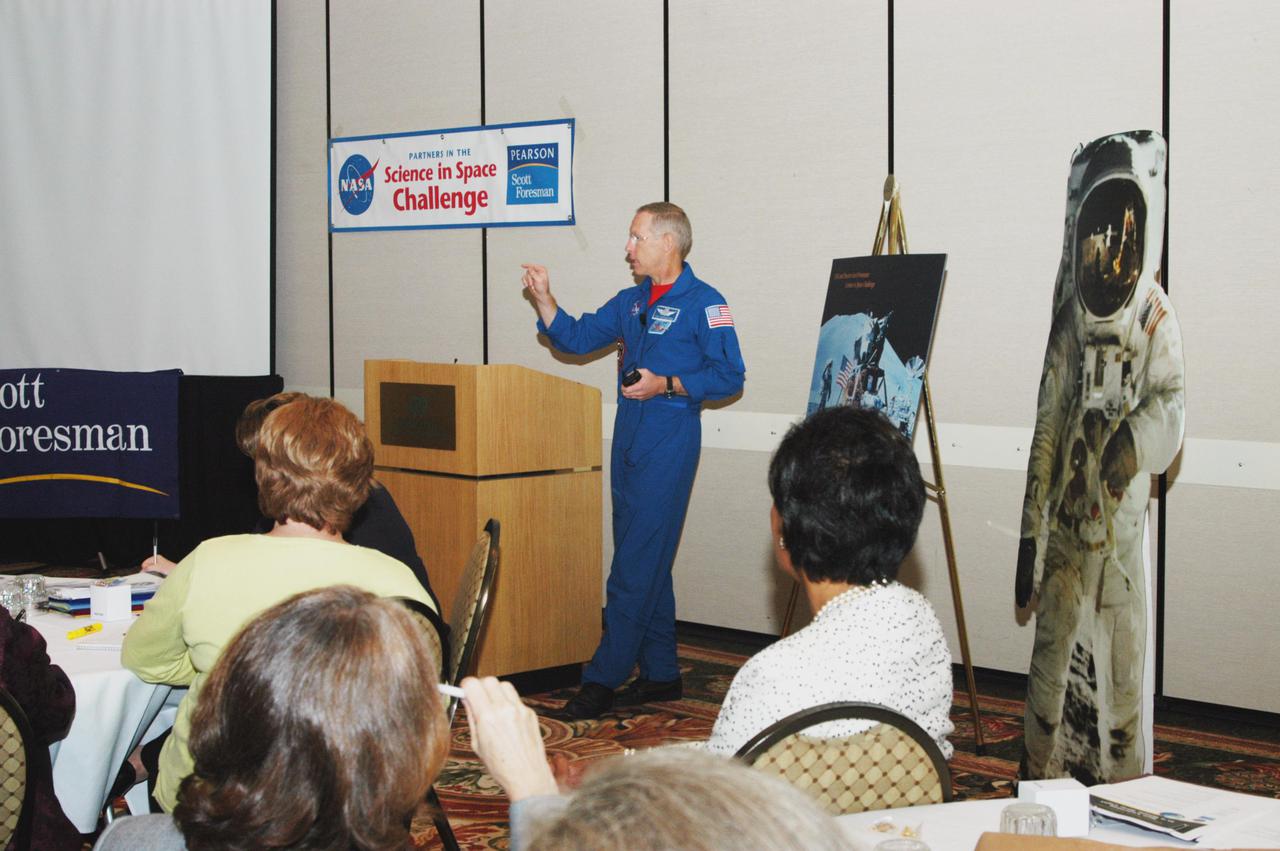
KENNEDY SPACE CENTER, FLA. - NASA astronaut Patrick Forrester addresses a group of educators assembled for the kickoff of 'The Science in Space Challenge' at the Doubletree Hotel in Orlando, Fla. The national challenge program is sponsored by NASA and Pearson Scott Foresman, publisher of pre-K through grade six educational books. To participate in the challenge, teachers may submit proposals, on behalf of their students, for a science and technology investigation. Astronauts will conduct the winning projects on a Space Shuttle mission or on the International Space Station, while teachers and students follow along via television or the Web. For more information about the announcement, see the news release at http:__www.nasa.gov_home_hqnews_2004_oct_HQ_04341_publication.html.
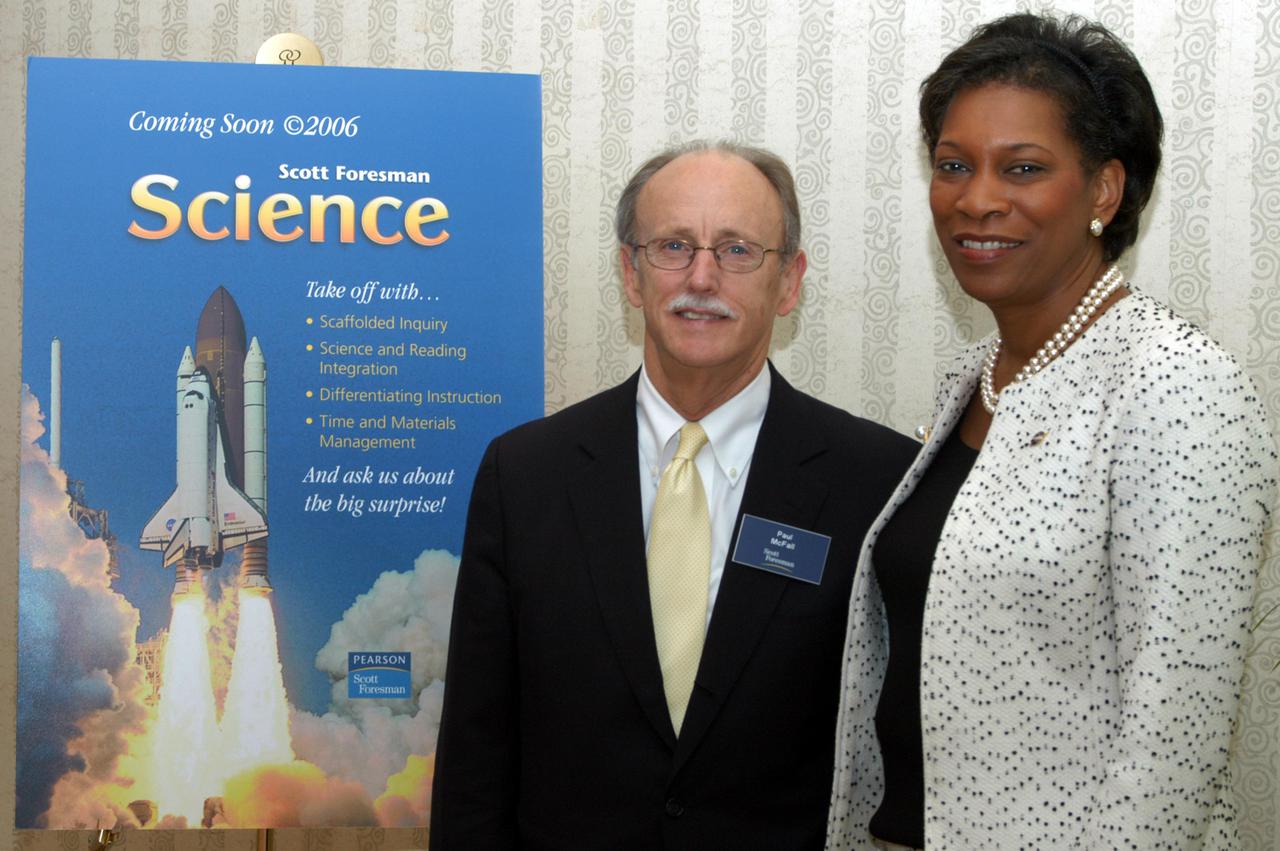
KENNEDY SPACE CENTER, FLA. - Paul McFall (left), president, Pearson Scott Foresman, and Dr. Adena Williams Loston, NASA chief education officer, attend the kickoff of 'The Science in Space Challenge' at the Doubletree Hotel in Orlando, Fla. The national challenge program is sponsored by NASA and Pearson Scott Foresman, publisher of pre-K through grade six educational books. To participate in the challenge, teachers may submit proposals, on behalf of their students, for a science and technology investigation. Astronauts will conduct the winning projects on a Space Shuttle mission or on the International Space Station, while teachers and students follow along via television or the Web. For more information about the announcement, see the news release at http:__www.nasa.gov_home_hqnews_2004_oct_HQ_04341_publication.html.
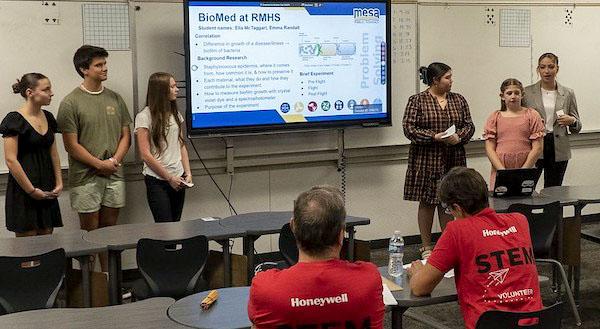
jsc2024e066518 (11/1/2023) --- Mesa Publc School students work together presenting their critical design review to their industry partners Honeywell Aerospace Technologies in their successful bid to be a finalist for the Nanoracks-National Center for Earth and Space Science Education-Surveyor-Student Spaceflight Experiments Program Mission 18 to ISS (Nanoracks-NCESSE-Surveyor-SSEP). Their experiment is The Growth and Mutation of Staphylococcus epidermidis Biofilm in Microgravity.
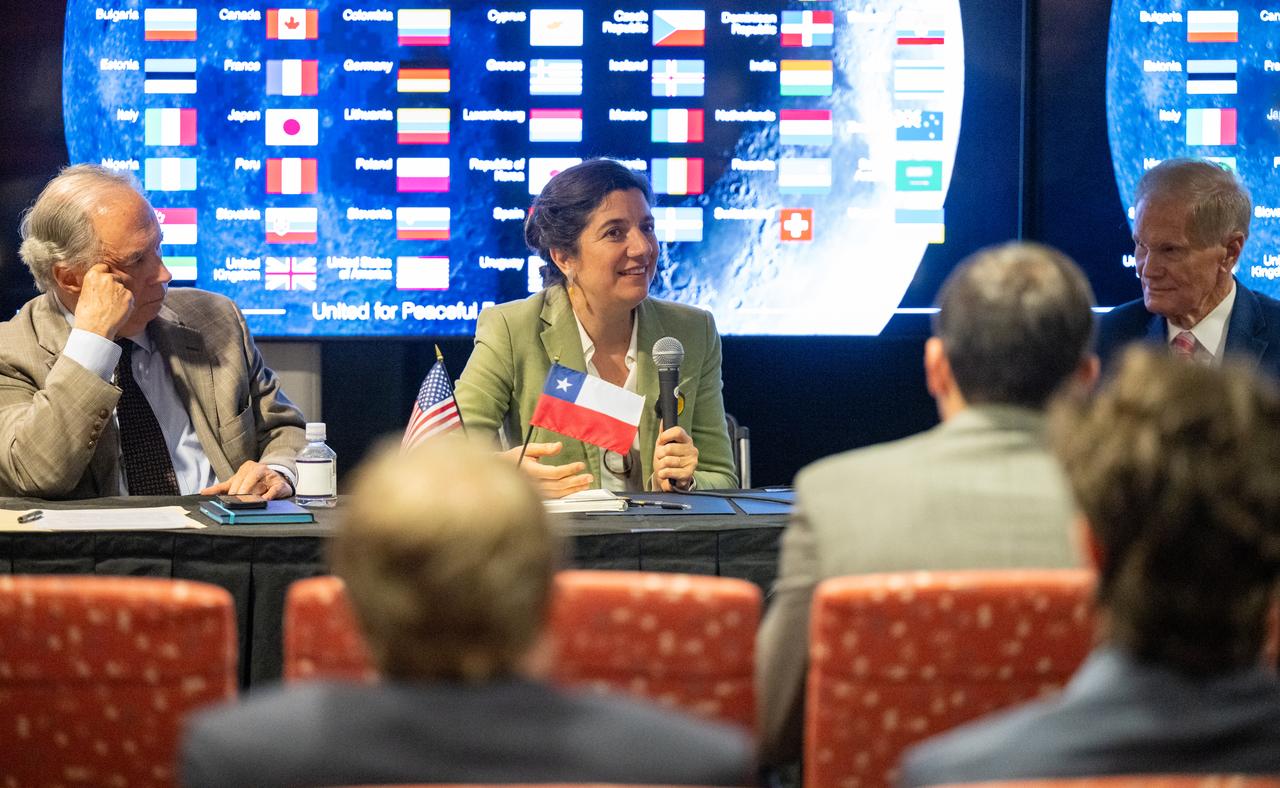
Chilean Minister of Science, Technology, Knowledge, and Innovation Aisén Etcheverry Escudero, center, delivers remarks during an Artemis Accords signing ceremony Friday, Oct. 25, 2024, at the Mary W. Jackson NASA Headquarters building in Washington. The Republic of Chile is the 47th country to sign the Artemis Accords, which establish a practical set of principles to guide space exploration cooperation among nations participating in NASA’s Artemis program. Photo Credit: (NASA/Keegan Barber)
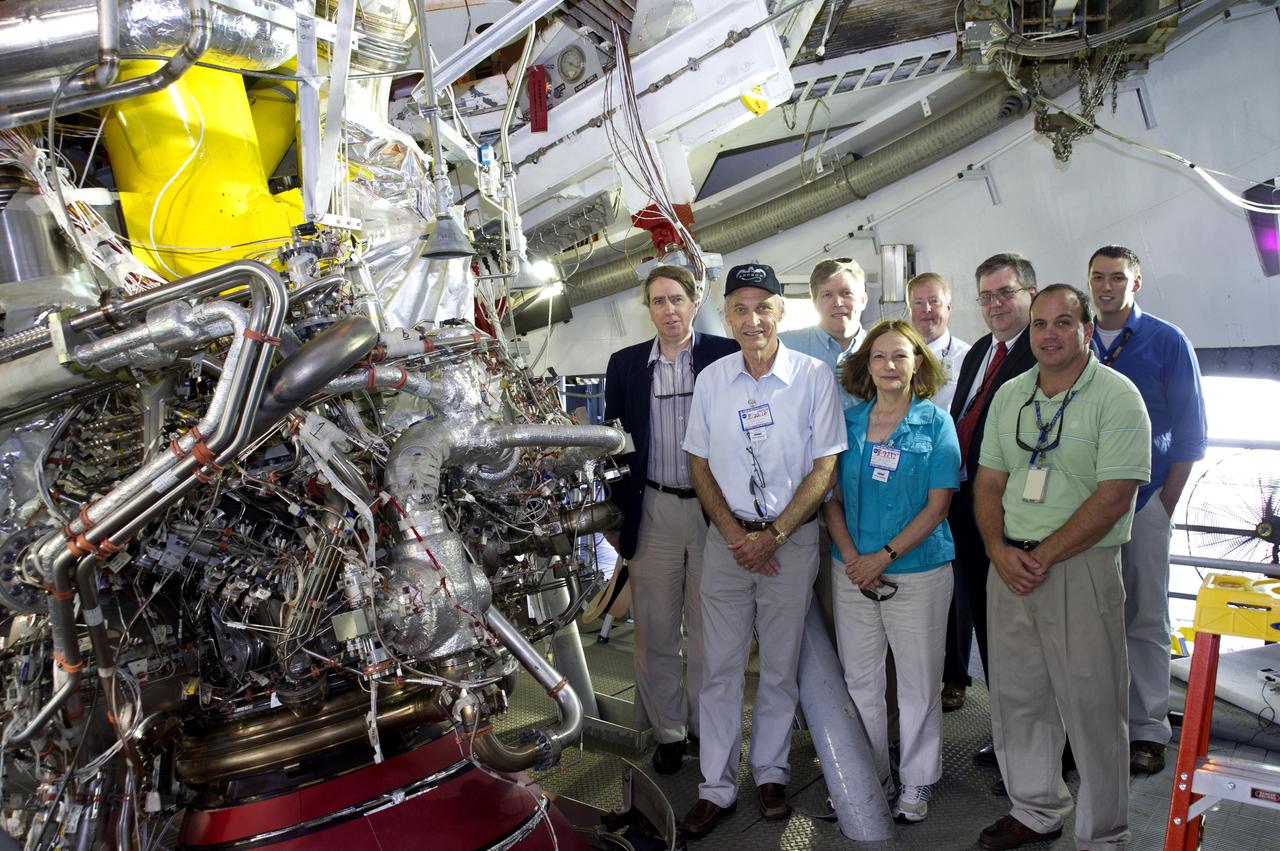
Four members of the National Research Council visited Stennis Space Center on Aug. 22, touring test stands and facilities, and holding roundtable discussions with Stennis leaders. The NRC mission is to improve government decision making and public policy, increase public understanding, and promote the acquisition and dissemination of knowledge in matters involving science, engineering, technology and health.
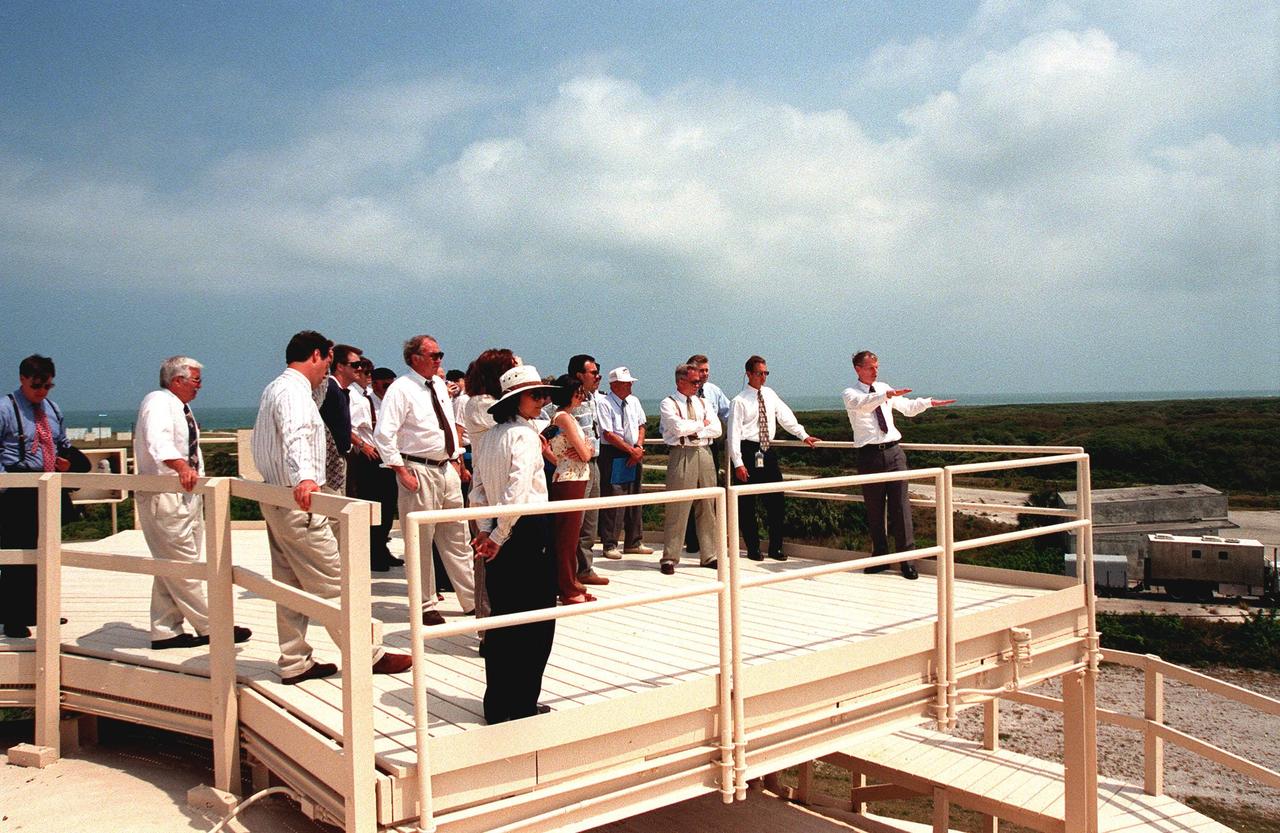
Key participants in the signing of a Memorandum of Agreement, formalizing cooperative efforts of NASA, the U.S. Air Force, and federal agencies in ground-water cleanup initiatives, gather on top of the block house at Launch Complex 34. Motioning at right is Skip Chamberlain, program manager, Office of Science and Technology, U.S. Department of Energy. Others on the tour include Timothy Oppelt, director, National Risk Management Research Laboratory, U.S. Environmental Protection Agency; Tom Heenan, assistant manager of environmental management, Savannah River Site, U.S. Department of Energy; Col. James Heald, Vice Commander, Air Force Research Laboratory, U.S. Air Force; Gerald Boyd, acting deputy assistant secretary, Office of Science and Technology, U.S. Department of Energy; James Fiore, acting deputy assistant secretary, Office of Environmental Restoration, Department of Energy; Brig. Gen. Randall R. Starbuck, Commander 45th Space Wing, U.S. Air Force; Roy Bridges Jr., director of John F. Kennedy Space Center; Walter Kovalick Jr., Ph.D., director, Technology Innovation Office, U.S. Environmental Protection Agency. NASA, the U.S. Air Force and the agencies have formed a consortium and are participating in a comparative study of three innovative techniques to be used in cleaning a contaminated area of Launch Complex 34. The study will be used to help improve groundwater cleanup processes nationally

NASA's Dryden Flight Research Center marked its 60th anniversary as the aerospace agency's lead center for atmospheric flight research and operations in 2006. In connection with that milestone, hundreds of the center's staff and retirees gathered in nearby Lancaster, Calif., in November 2006 to reflect on the center's challenges and celebrate its accomplishments over its six decades of advancing the state-of-the-art in aerospace technology. The center had its beginning in 1946 when a few engineers from the National Advisory Committee for Aeronautics' Langley Memorial Aeronautical Laboratory were detailed to Muroc Army Air Base (now Edwards Air Force Base) in Southern California's high desert to support the joint Army Air Force / NACA / Bell Aircraft XS-1 research airplane program. Since that inauspicious beginning, the center has been at the forefront of many of the advances in aerospace technology by validating advanced concepts through actual in-flight research and testing. Dryden is uniquely situated to take advantage of the excellent year-round flying weather, remote area, and visibility to test some of the nation�s most exciting aerospace vehicles. Today, NASA Dryden is NASA's premier flight research and test organization, continuing to push the envelope in the validation of high-risk aerospace technology and space exploration concepts, and in conducting airborne environmental and space science missions in the 21st century.
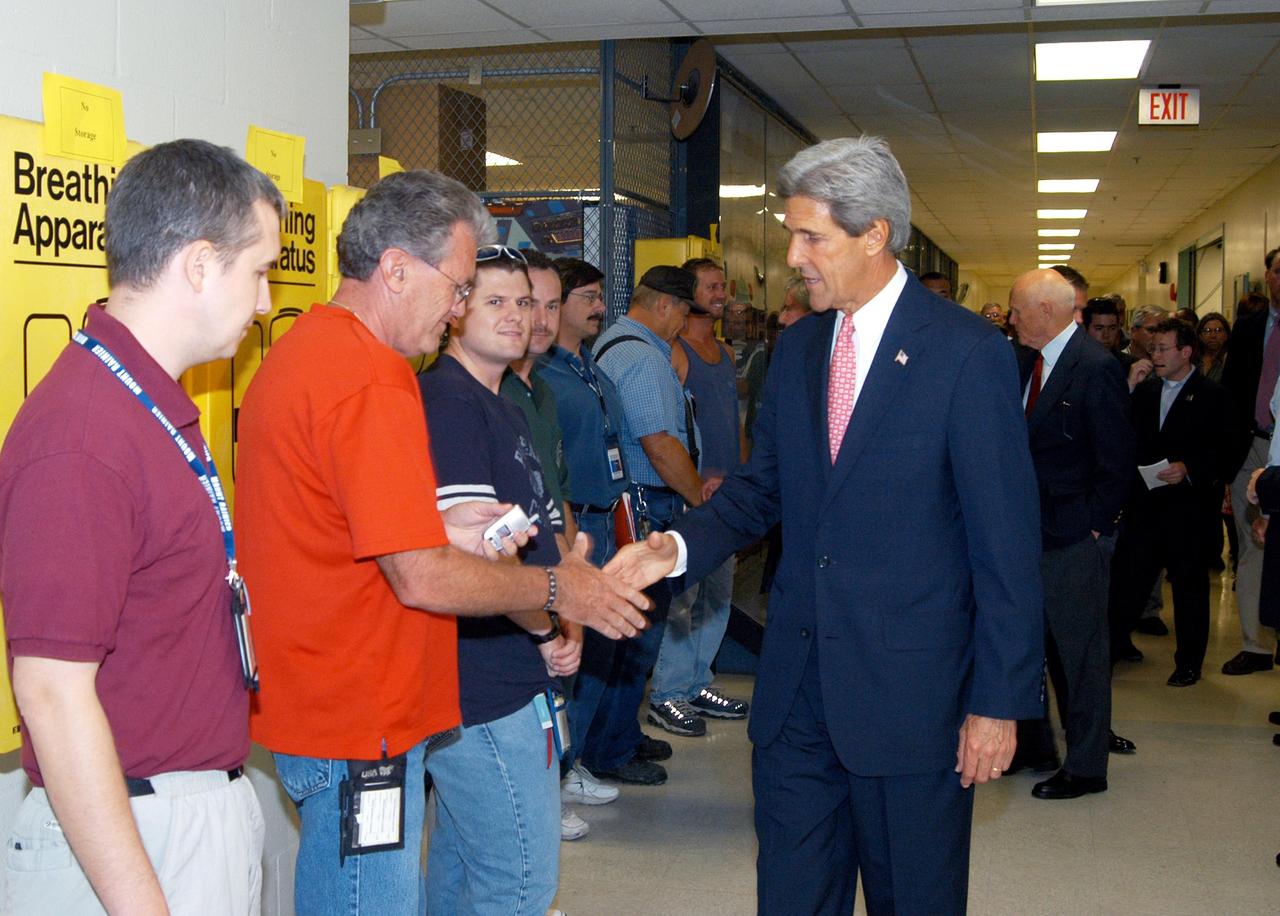
KENNEDY SPACE CENTER, FLA. - Sen. John F. Kerry, D-Mass., greets Kennedy Space Center employees during a tour of the Orbiter Processing Facility (OPF). The orbiter Discovery is being prepared for flight in the OPF on the next Space Shuttle mission. The tour follows a public meeting Kerry held at the Dr. Kurt H. Debus Conference Facility at the Kennedy Space Center Visitor Complex. He said he chose to speak at KSC because it symbolizes America’s commitment to science, innovation and technology. He and Sen. John Edwards, D-N.C., are on a speaking tour prior to their appearance at the Democratic National Convention in Boston.
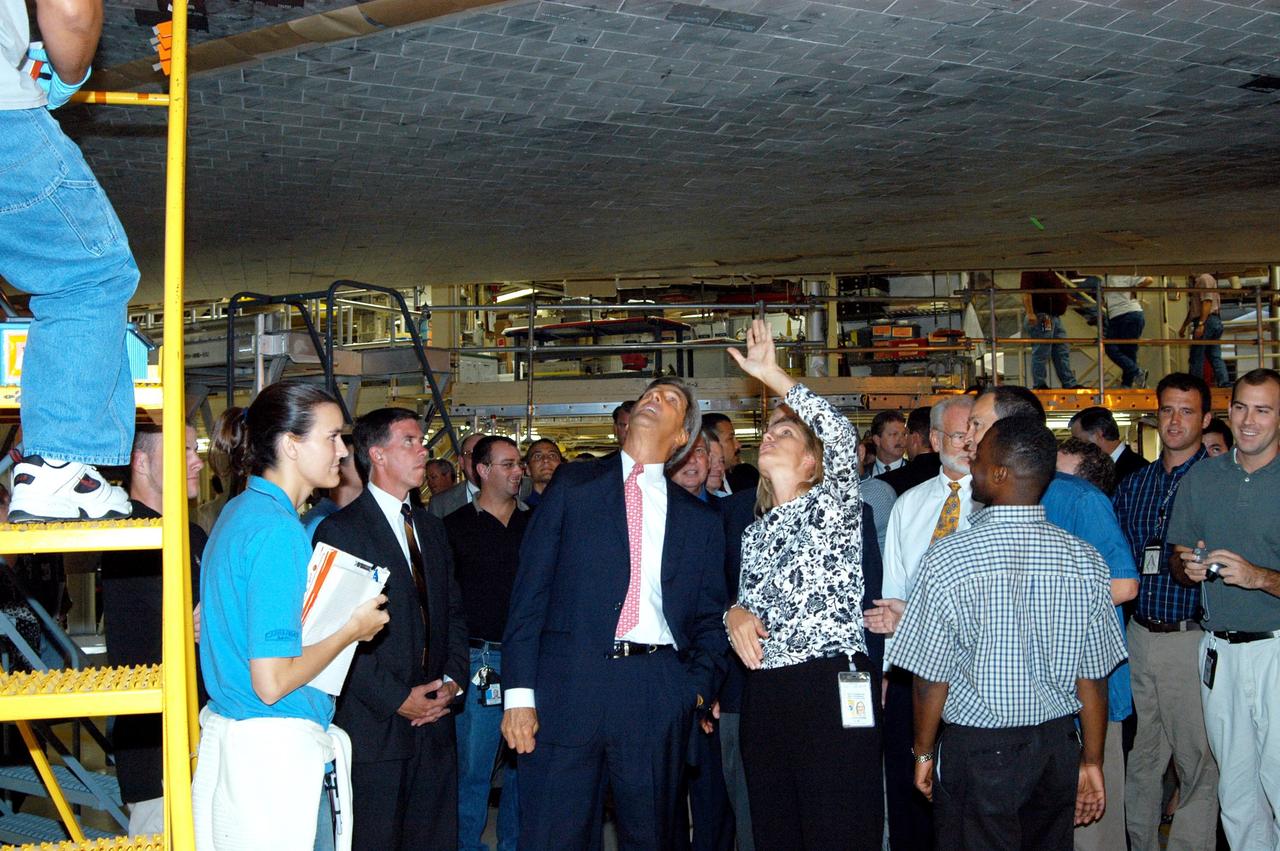
KENNEDY SPACE CENTER, FLA. - Sen. John F. Kerry (center), D-Mass., discusses Space Shuttle processing with NASA Vehicle Manager Stephanie Stilson during a tour of the Orbiter Processing Facility (OPF). They are standing under the orbiter Discovery, which is being prepared for flight on the next Space Shuttle mission. The tour follows a public meeting Kerry held at the Dr. Kurt H. Debus Conference Facility at the Kennedy Space Center Visitor Complex. He said he chose to speak at KSC because it symbolizes America’s commitment to science, innovation and technology. He and Sen. John Edwards, D-N.C., are on a speaking tour prior to their appearance at the Democratic National Convention in Boston.

NASA climatologist Gary Jedlovec, a member of the Earth Science team in Marshall Space Flight Center’s Science and Technology Office, discusses the satellite technology and ground-based tools used to record and trend regional and global climate changes over the past century and to provide forecast models looking 100 years into the future. Jedlovec and his team, which partners with National Oceanic and Atmospheric Association researchers and their colleagues around the world, spoke to the Marshall “Green Team” -- environmental engineers and support personnel who help guide Marshall’s focus on safer, more cost-efficient energy use. The Green Team, led by Marshall Sustainability Engineer Donna Leach of the Environmental Engineering & Occupational Health Office, currently is preparing activities and outreach for Earth Day 2020, set for next April.
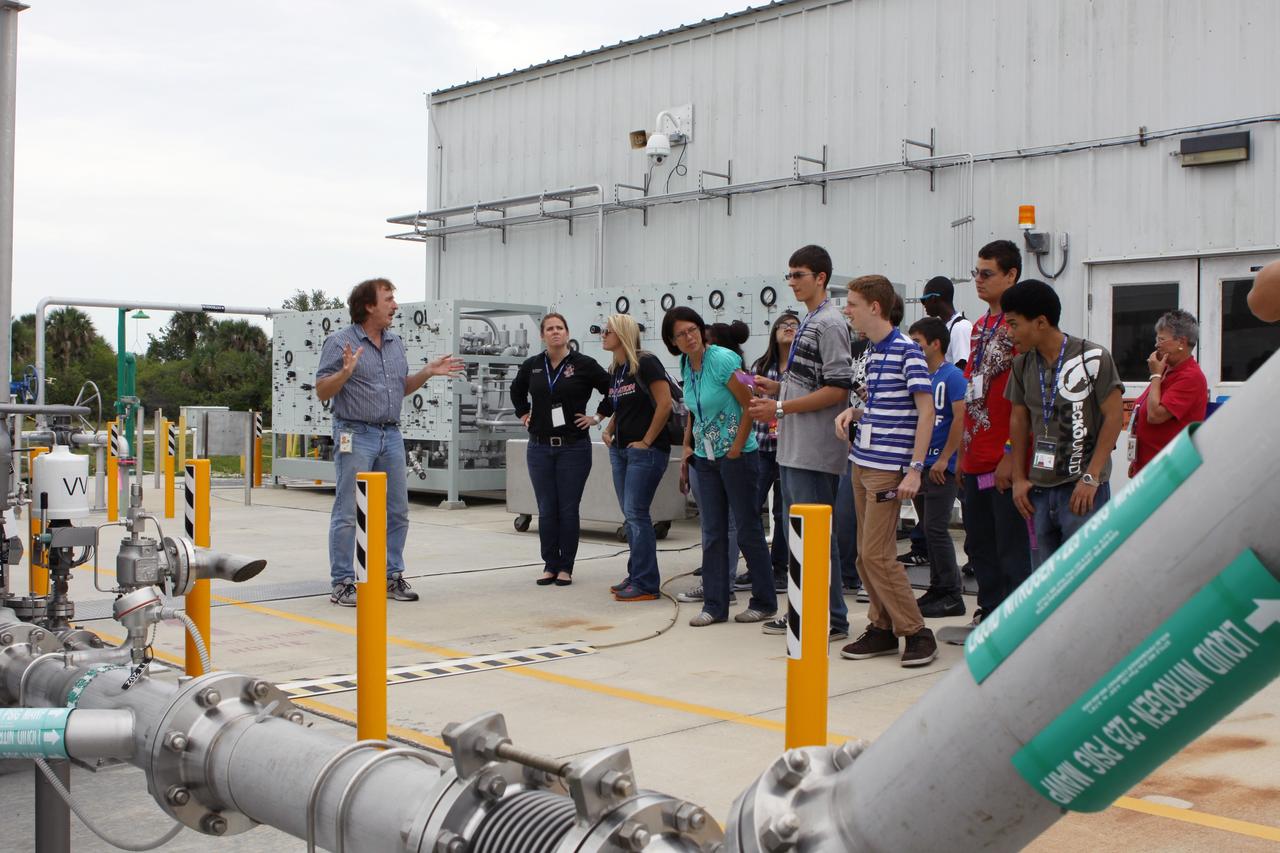
CAPE CANAVERAL, Fla. – Outside the Operations and Checkout Building, Rudy Werlink gives students a first-hand look at the workings of the cryogenics lab. The 26 honor students in chemistry and biology and their teachers got a chance to visit a number of high-tech labs at Kennedy Space Center as part of an effort to encourage students in the areas of science, technology, engineering and math. The tenth and eleventh grade students from Terry Parker High School in Jacksonville, Fla., visited a number of vastly different labs during their one-day tour. The group's visit to Kennedy was hosted by the Education Office as part of a nationwide effort by the National Lab Network to help introduce the nation's students to science careers. Photo credit: NASA/Jim Grossmann
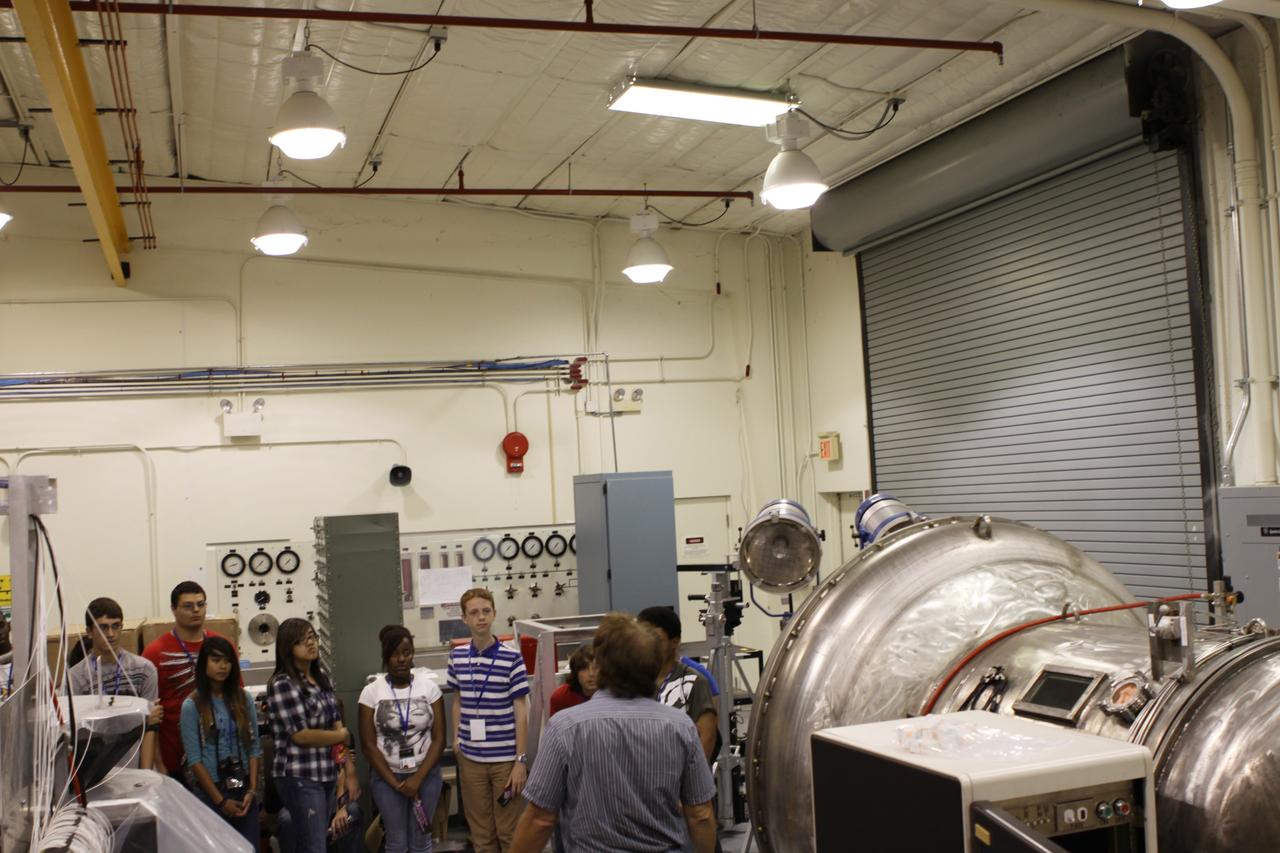
CAPE CANAVERAL, Fla. – Inside the Operations and Checkout Building, Rudy Werlink gives students a first-hand look at the workings of the sound testing area of cryogenics lab. The 26 honor students in chemistry and biology and their teachers got a chance to visit a number of high-tech labs at Kennedy Space Center as part of an effort to encourage students in the areas of science, technology, engineering and math. The tenth and eleventh grade students from Terry Parker High School in Jacksonville, Fla., visited a number of vastly different labs during their one-day tour. The group's visit to Kennedy was hosted by the Education Office as part of a nationwide effort by the National Lab Network to help introduce the nation's students to science careers. Photo credit: NASA/Jim Grossmann

CAPE CANAVERAL, Fla. – Inside the Operations and Checkout Building, Rudy Werlink gives students a first-hand look at the workings of the sound testing area of cryogenics lab. The 26 honor students in chemistry and biology and their teachers got a chance to visit a number of high-tech labs at Kennedy Space Center as part of an effort to encourage students in the areas of science, technology, engineering and math. The tenth and eleventh grade students from Terry Parker High School in Jacksonville, Fla., visited a number of vastly different labs during their one-day tour. The group's visit to Kennedy was hosted by the Education Office as part of a nationwide effort by the National Lab Network to help introduce the nation's students to science careers. Photo credit: NASA/Jim Grossmann
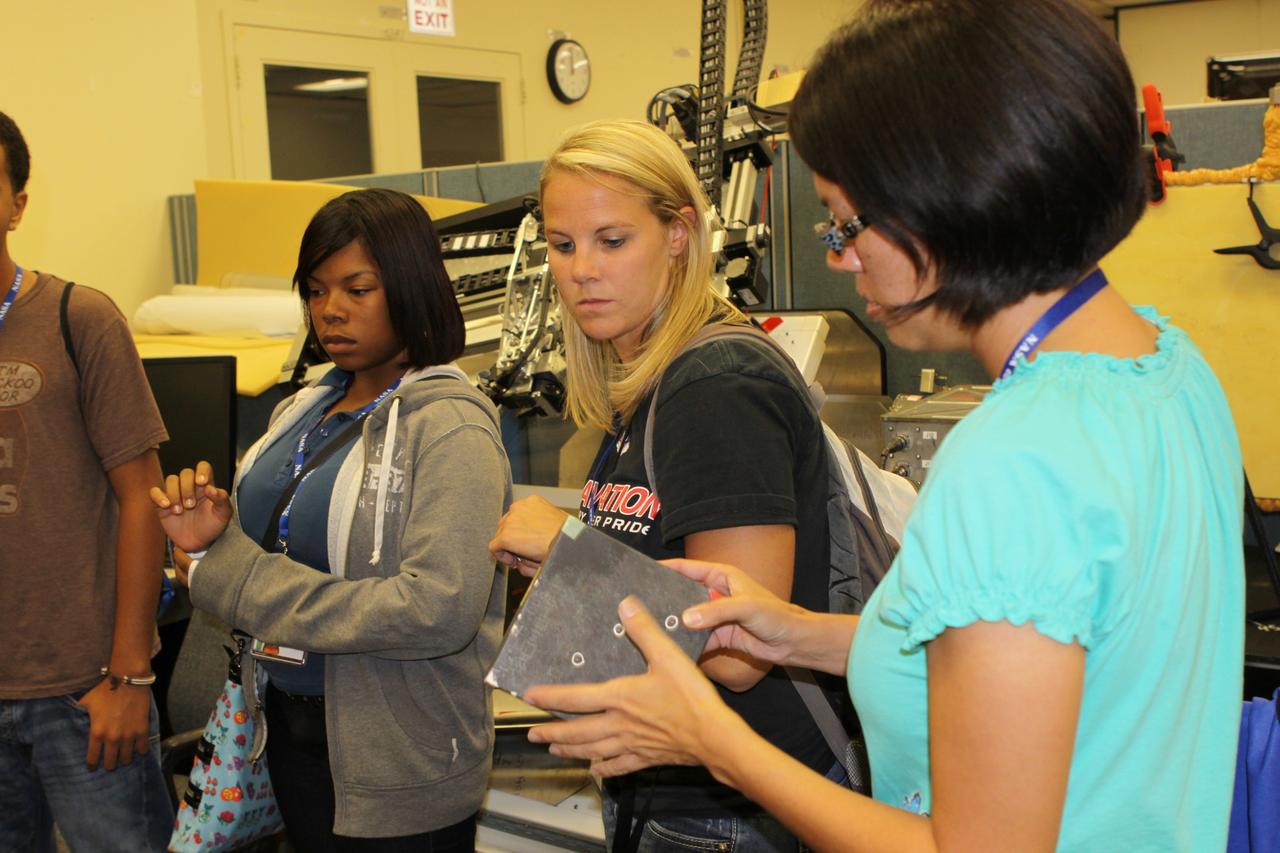
CAPE CANAVERAL, Fla. – Students and their teachers get some hands-on experience inside the applied physics lab in the Operations and Checkout Building. The 26 honor students in chemistry and biology and their teachers got a chance to visit a number of high-tech labs at Kennedy Space Center as part of an effort to encourage students in the areas of science, technology, engineering and math. The tenth and eleventh grade students from Terry Parker High School in Jacksonville, Fla., visited a number of vastly different labs during their one-day tour. The group's visit to Kennedy was hosted by the Education Office as part of a nationwide effort by the National Lab Network to help introduce the nation's students to science careers. Photo credit: NASA/Jim Grossmann
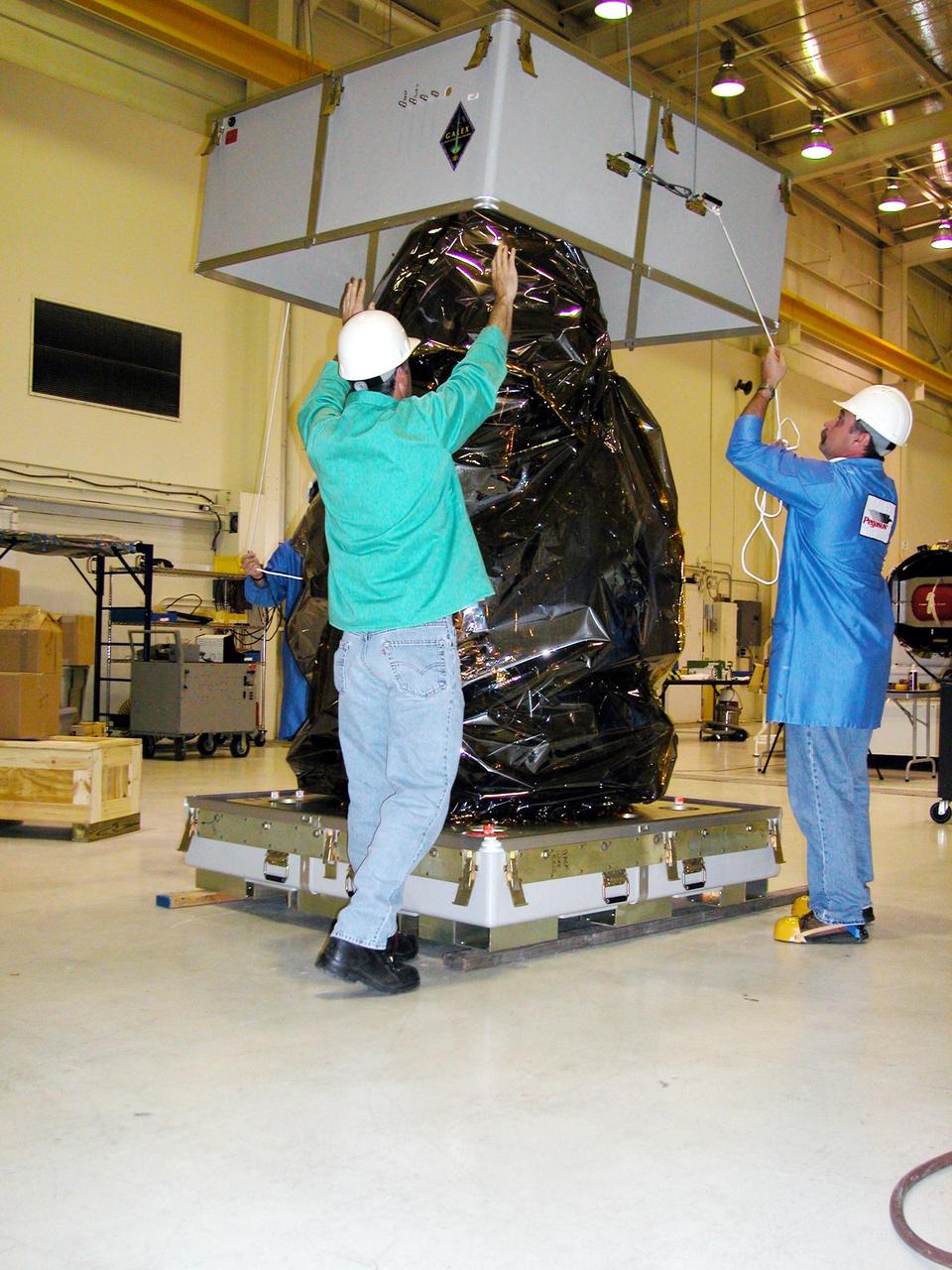
KENNEDY SPACE CENTER, FLA. - At Vandenberg Air Force Base in California, Orbital Sciences workers remove the canister from the DART (Demonstration for Autonomous Rendezvous Technology) flight demonstrator, a spacecraft developed to prove technologies for locating and maneuvering near an orbiting satellite. Future applications of technologies developed by the DART project will benefit the nation in future space-vehicle systems development requiring in-space assembly, services or other autonomous rendezvous operations. Designed and developed for NASA by Orbital Sciences Corporation in Dulles, Va., the DART spacecraft will be launched on a Pegasus launch vehicle. At about 40,000 feet over the Pacific Ocean, the Pegasus will be released from Orbital’s Stargazer L-1011 aircraft, fire its rocket motors and boost DART into a polar orbit approximately 472 miles by 479 miles. Once in orbit, DART will rendezvous with a target satellite, the Multiple Paths, Beyond-Line-of-Site Communications satellite, also built by Orbital Sciences. DART will then perform several close proximity operations, such as moving toward and away from the satellite using navigation data provided by onboard sensors. DART is scheduled for launch no earlier than Oct. 18.
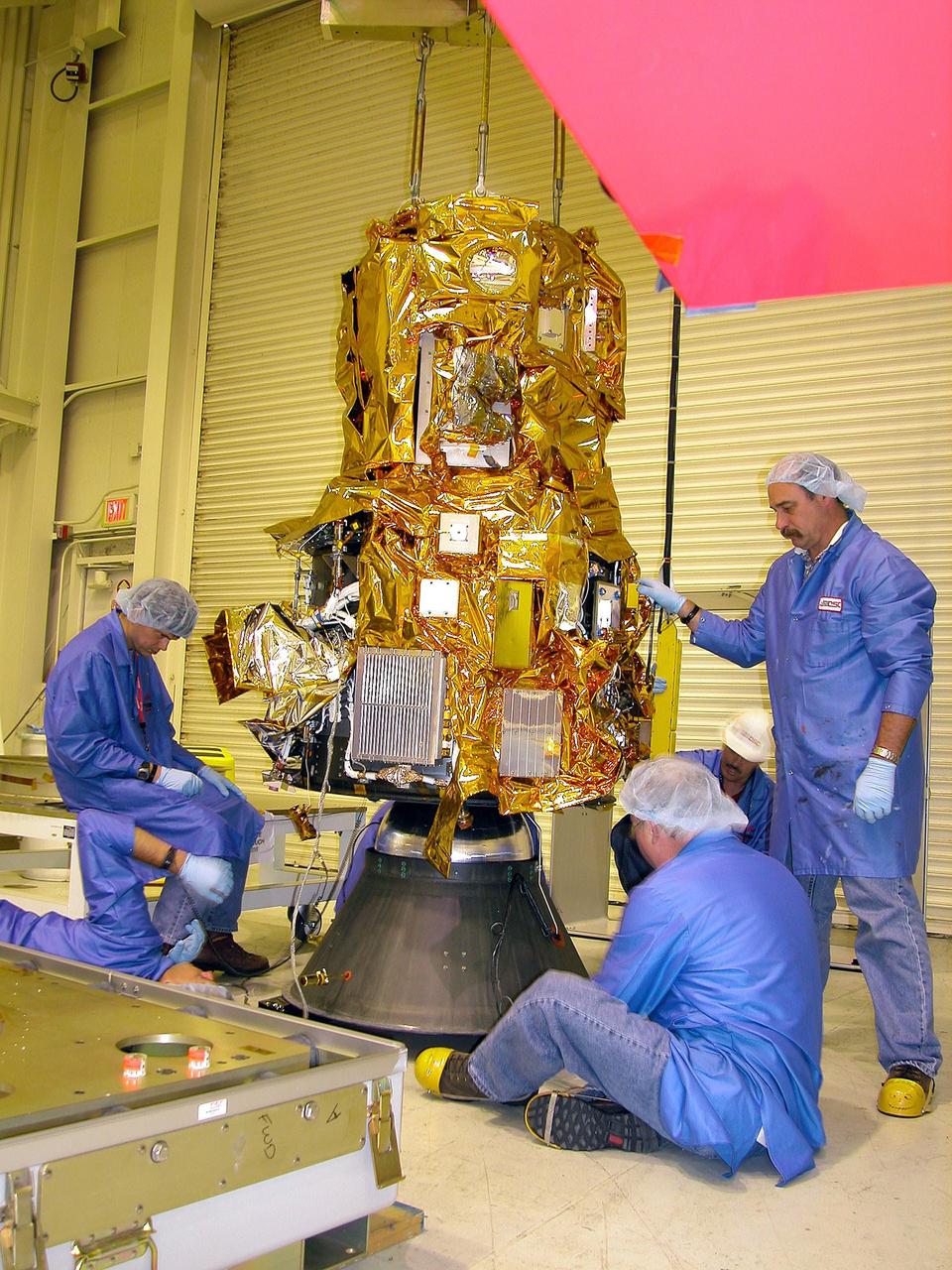
KENNEDY SPACE CENTER, FLA. - At Vandenberg Air Force Base in California, Orbital Sciences technicians observe closely the movement of the DART (Demonstration for Autonomous Rendezvous Technology) flight demonstrator as it is lowered onto a stand. The spacecraft was developed to prove technologies for locating and maneuvering near an orbiting satellite. Future applications of technologies developed by the DART project will benefit the nation in future space-vehicle systems development requiring in-space assembly, services or other autonomous rendezvous operations. Designed and developed for NASA by Orbital Sciences Corporation in Dulles, Va., the DART spacecraft will be launched on a Pegasus launch vehicle. At about 40,000 feet over the Pacific Ocean, the Pegasus will be released from Orbital’s Stargazer L-1011 aircraft, fire its rocket motors and boost DART into a polar orbit approximately 472 miles by 479 miles. Once in orbit, DART will rendezvous with a target satellite, the Multiple Paths, Beyond-Line-of-Site Communications satellite, also built by Orbital Sciences. DART will then perform several close proximity operations, such as moving toward and away from the satellite using navigation data provided by onboard sensors. DART is scheduled for launch no earlier than Oct. 18.
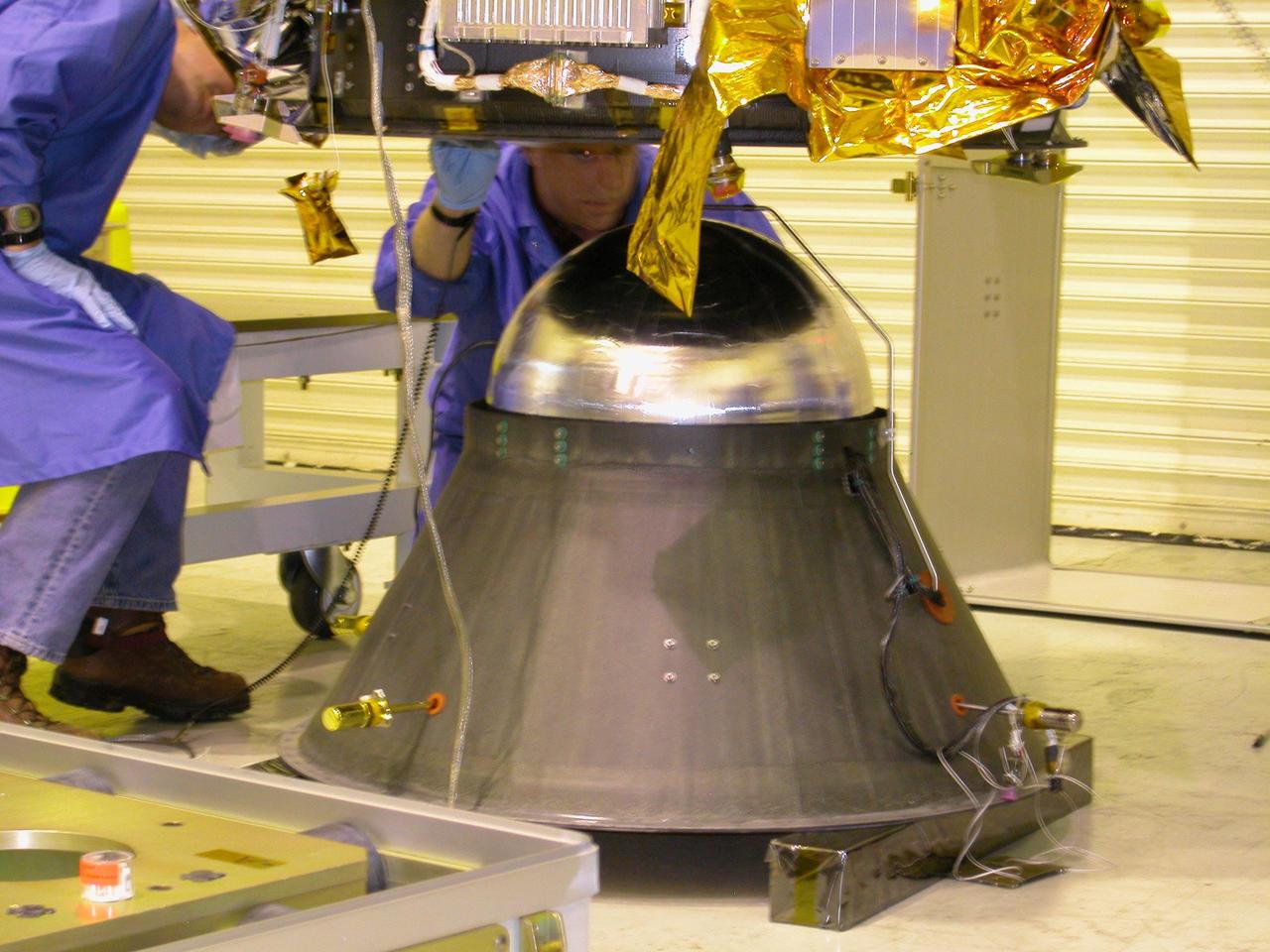
KENNEDY SPACE CENTER, FLA. - At Vandenberg Air Force Base in California, Orbital Sciences technicians watch closely as the DART (Demonstration for Autonomous Rendezvous Technology) flight demonstrator is lowered onto a stand. The spacecraft was developed to prove technologies for locating and maneuvering near an orbiting satellite. Future applications of technologies developed by the DART project will benefit the nation in future space-vehicle systems development requiring in-space assembly, services or other autonomous rendezvous operations. Designed and developed for NASA by Orbital Sciences Corporation in Dulles, Va., the DART spacecraft will be launched on a Pegasus launch vehicle. At about 40,000 feet over the Pacific Ocean, the Pegasus will be released from Orbital’s Stargazer L-1011 aircraft, fire its rocket motors and boost DART into a polar orbit approximately 472 miles by 479 miles. Once in orbit, DART will rendezvous with a target satellite, the Multiple Paths, Beyond-Line-of-Site Communications satellite, also built by Orbital Sciences. DART will then perform several close proximity operations, such as moving toward and away from the satellite using navigation data provided by onboard sensors. DART is scheduled for launch no earlier than Oct. 18.
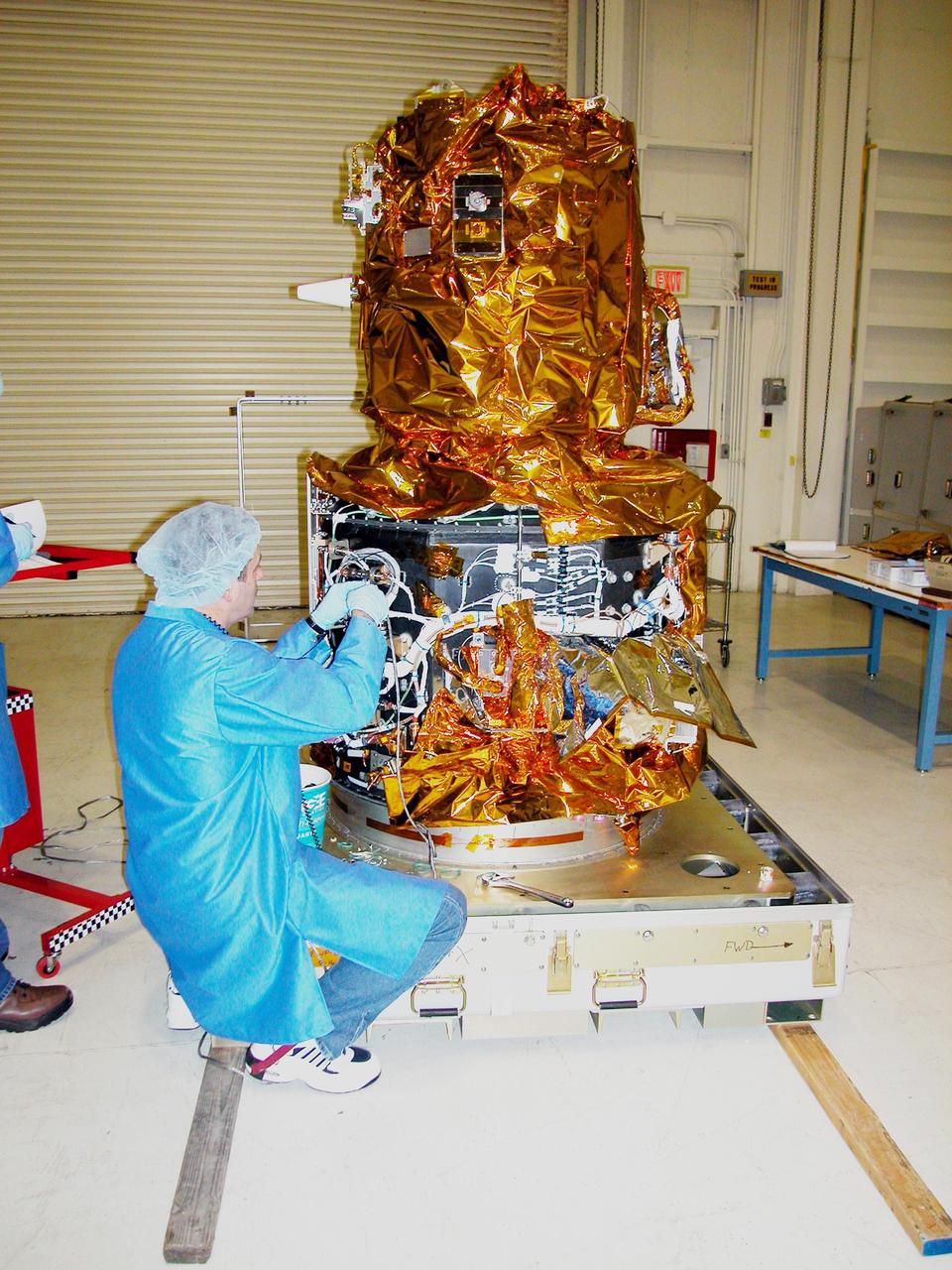
KENNEDY SPACE CENTER, FLA. - At Vandenberg Air Force Base in California, an Orbital Sciences technician works with wiring on the DART (Demonstration for Autonomous Rendezvous Technology) flight demonstrator, a spacecraft developed to prove technologies for locating and maneuvering near an orbiting satellite. Future applications of technologies developed by the DART project will benefit the nation in future space-vehicle systems development requiring in-space assembly, services or other autonomous rendezvous operations. Designed and developed for NASA by Orbital Sciences Corporation in Dulles, Va., the DART spacecraft will be launched on a Pegasus launch vehicle. At about 40,000 feet over the Pacific Ocean, the Pegasus will be released from Orbital’s Stargazer L-1011 aircraft, fire its rocket motors and boost DART into a polar orbit approximately 472 miles by 479 miles. Once in orbit, DART will rendezvous with a target satellite, the Multiple Paths, Beyond-Line-of-Site Communications satellite, also built by Orbital Sciences. DART will then perform several close proximity operations, such as moving toward and away from the satellite using navigation data provided by onboard sensors. DART is scheduled for launch no earlier than Oct. 18.
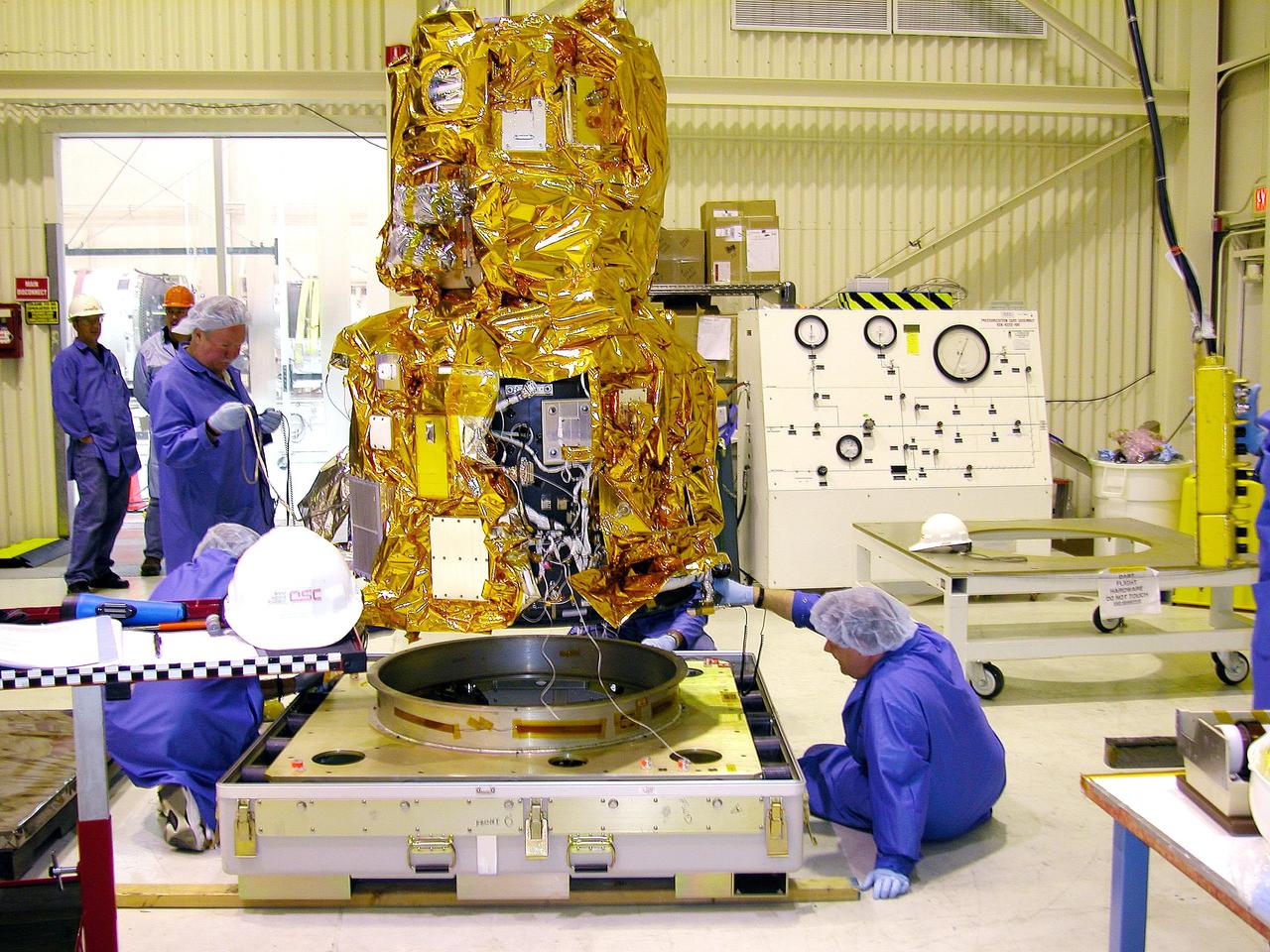
KENNEDY SPACE CENTER, FLA. - At Vandenberg Air Force Base in California, Orbital Sciences technicians check the bottom of the DART (Demonstration for Autonomous Rendezvous Technology) flight demonstrator as it is raised of its platform. The spacecraft was developed to prove technologies for locating and maneuvering near an orbiting satellite. Future applications of technologies developed by the DART project will benefit the nation in future space-vehicle systems development requiring in-space assembly, services or other autonomous rendezvous operations. Designed and developed for NASA by Orbital Sciences Corporation in Dulles, Va., the DART spacecraft will be launched on a Pegasus launch vehicle. At about 40,000 feet over the Pacific Ocean, the Pegasus will be released from Orbital’s Stargazer L-1011 aircraft, fire its rocket motors and boost DART into a polar orbit approximately 472 miles by 479 miles. Once in orbit, DART will rendezvous with a target satellite, the Multiple Paths, Beyond-Line-of-Site Communications satellite, also built by Orbital Sciences. DART will then perform several close proximity operations, such as moving toward and away from the satellite using navigation data provided by onboard sensors. DART is scheduled for launch no earlier than Oct. 18.

KENNEDY SPACE CENTER, FLA. - At Vandenberg Air Force Base in California, Orbital Sciences technicians check the bottom of the DART (Demonstration for Autonomous Rendezvous Technology) flight demonstrator as it is raised off its platform. The spacecraft was developed to prove technologies for locating and maneuvering near an orbiting satellite. Future applications of technologies developed by the DART project will benefit the nation in future space-vehicle systems development requiring in-space assembly, services or other autonomous rendezvous operations. Designed and developed for NASA by Orbital Sciences Corporation in Dulles, Va., the DART spacecraft will be launched on a Pegasus launch vehicle. At about 40,000 feet over the Pacific Ocean, the Pegasus will be released from Orbital’s Stargazer L-1011 aircraft, fire its rocket motors and boost DART into a polar orbit approximately 472 miles by 479 miles. Once in orbit, DART will rendezvous with a target satellite, the Multiple Paths, Beyond-Line-of-Site Communications satellite, also built by Orbital Sciences. DART will then perform several close proximity operations, such as moving toward and away from the satellite using navigation data provided by onboard sensors. DART is scheduled for launch no earlier than Oct. 18.

KENNEDY SPACE CENTER, FLA. - Sponsor representatives of the 2003 Southeastern Regional FIRST Robotic Competition take a moment to compare notes between events. From left are Wayne Weinberg, director of development for the University of Central Florida College of Engineering and Computer Science; Erik Halleus, chair of the FIRST Regional Advisory Committee and a vice president at Siemens Enterprise Networks; and Roy D. Bridges, Jr., director of the NASA/Kennedy Space Center. The competition is being held at the University of Central Florida (UCF) in Orlando, March 20-23. Forty student teams from around the country are participating in the event that pits team-built gladiator robots against each other in an athletic-style competition. The teams are sponsored by NASA/Kennedy Space Center, The Boeing Company/Brevard Community College, and Lockheed Martin Space Operations/Mission Systems for the nonprofit organization For Inspiration and Recognition of Science and Technology, known as FIRST. The vision of FIRST is to inspire in the youth of our nation an appreciation of science and technology and an understanding that mastering these disciplines can enrich the lives of all mankind.
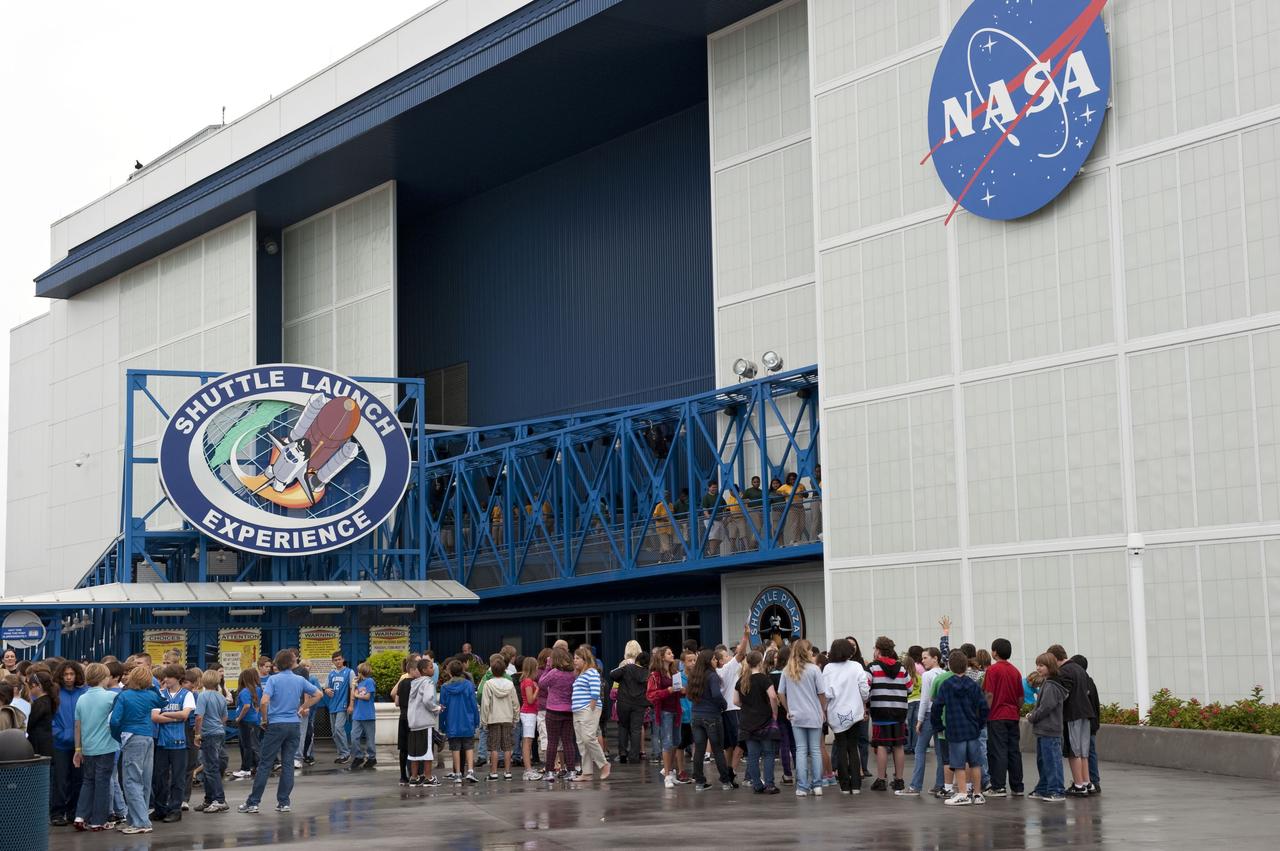
CAPE CANAVERAL, Fla. -- Brevard County sixth-graders participate in the eighth annual Space Week at the Kennedy Space Center Visitor Complex in Florida. Here, the students wait to take a ride on the Shuttle Launch Experience, which mimics the sights, sounds and sensations of a real space shuttle launch. About 5,000 students will participate throughout the 11-day event, which contains fun space exploration activities designed to emphasize the importance of science, technology, engineering and math (STEM). Space Week is sponsored by NASA Education, Brevard Public Schools, Delaware North Companies Parks and Resorts, and the Florida Chapter of the National Space Club. Photo Credit: NASA/Kim Shiflett
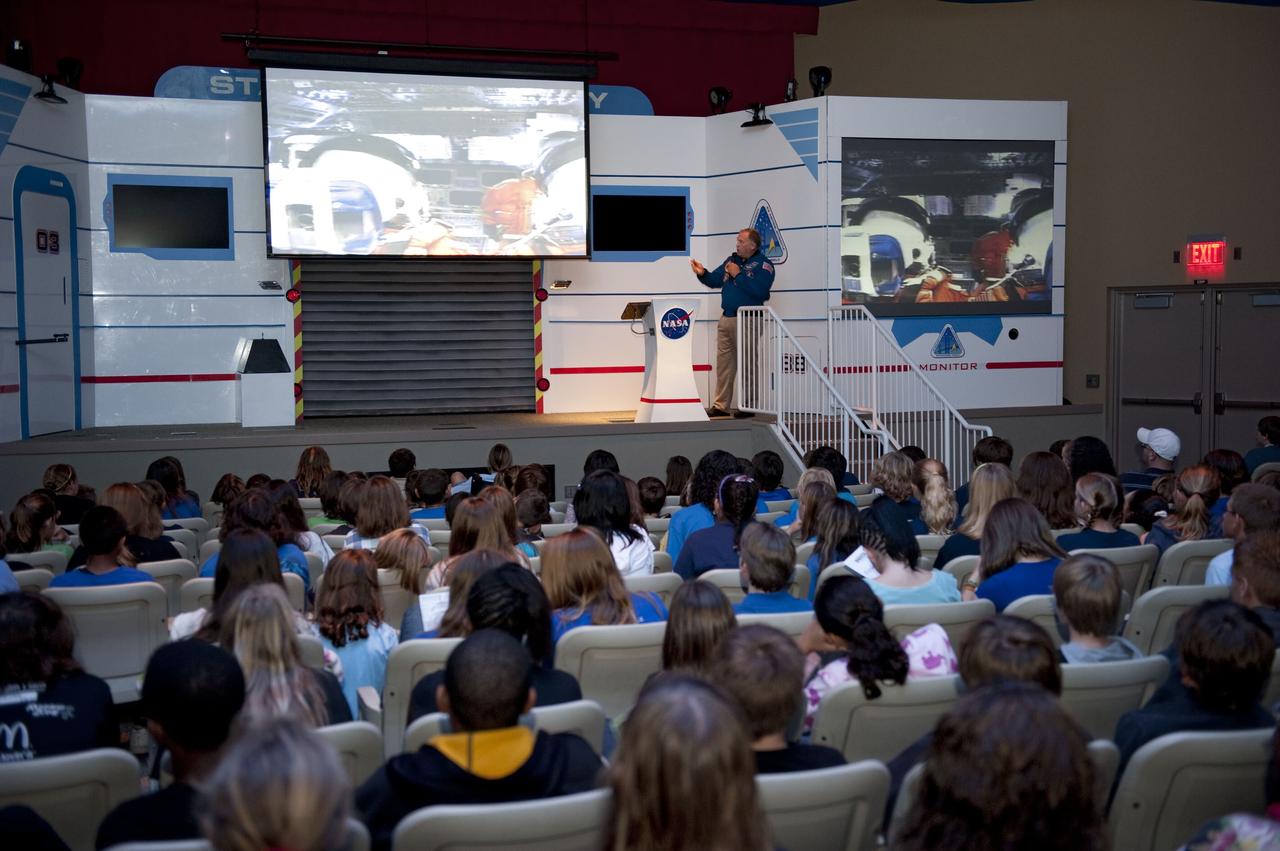
CAPE CANAVERAL, Fla. -- Brevard County sixth-graders participate in the eighth annual Space Week at the Kennedy Space Center Visitor Complex in Florida. Here, the students learn about launching to Earth's orbit from former NASA astronaut Mark Lee, a veteran of four space shuttle missions. About 5,000 students will participate throughout the 11-day event, which contains fun space exploration activities designed to emphasize the importance of science, technology, engineering and math (STEM). Space Week is sponsored by NASA Education, Brevard Public Schools, Delaware North Companies Parks and Resorts, and the Florida Chapter of the National Space Club. Photo Credit: NASA/Kim Shiflett
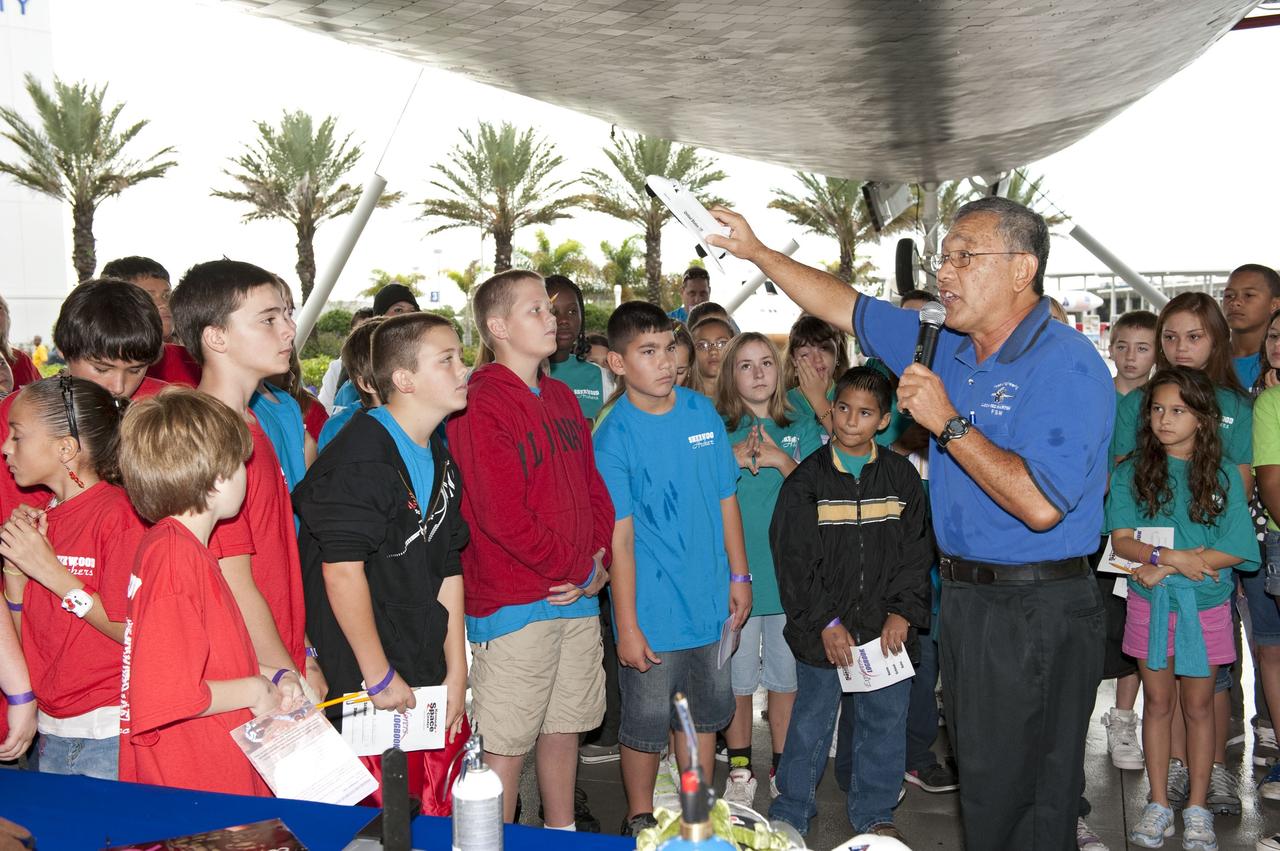
CAPE CANAVERAL, Fla. -- Brevard County sixth-graders participate in the eighth annual Space Week at the Kennedy Space Center Visitor Complex in Florida. Here, Herbert Yamada, an engineer with Lockheed Martin, teaches students about NASA's space shuttle. About 5,000 students will participate throughout the 11-day event, which contains fun space exploration activities designed to emphasize the importance of science, technology, engineering and math (STEM). Space Week is sponsored by NASA Education, Brevard Public Schools, Delaware North Companies Parks and Resorts, and the Florida Chapter of the National Space Club. Photo Credit: NASA/Kim Shiflett
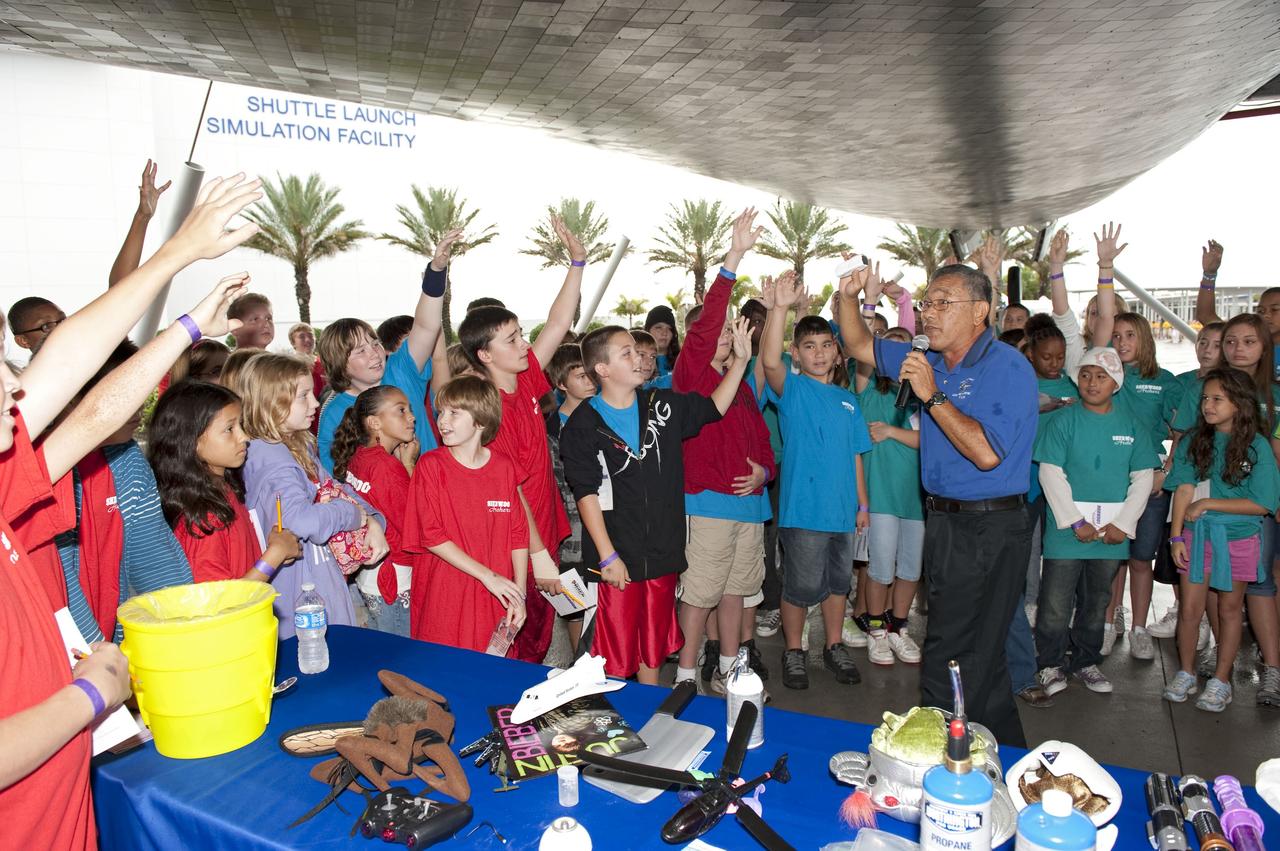
CAPE CANAVERAL, Fla. -- Brevard County sixth-graders participate in the eighth annual Space Week at the Kennedy Space Center Visitor Complex in Florida. Here, Herbert Yamada, an engineer with Lockheed Martin, uses fun props to teach students about NASA. About 5,000 students will participate throughout the 11-day event, which contains fun space exploration activities designed to emphasize the importance of science, technology, engineering and math (STEM). Space Week is sponsored by NASA Education, Brevard Public Schools, Delaware North Companies Parks and Resorts, and the Florida Chapter of the National Space Club. Photo Credit: NASA/Kim Shiflett
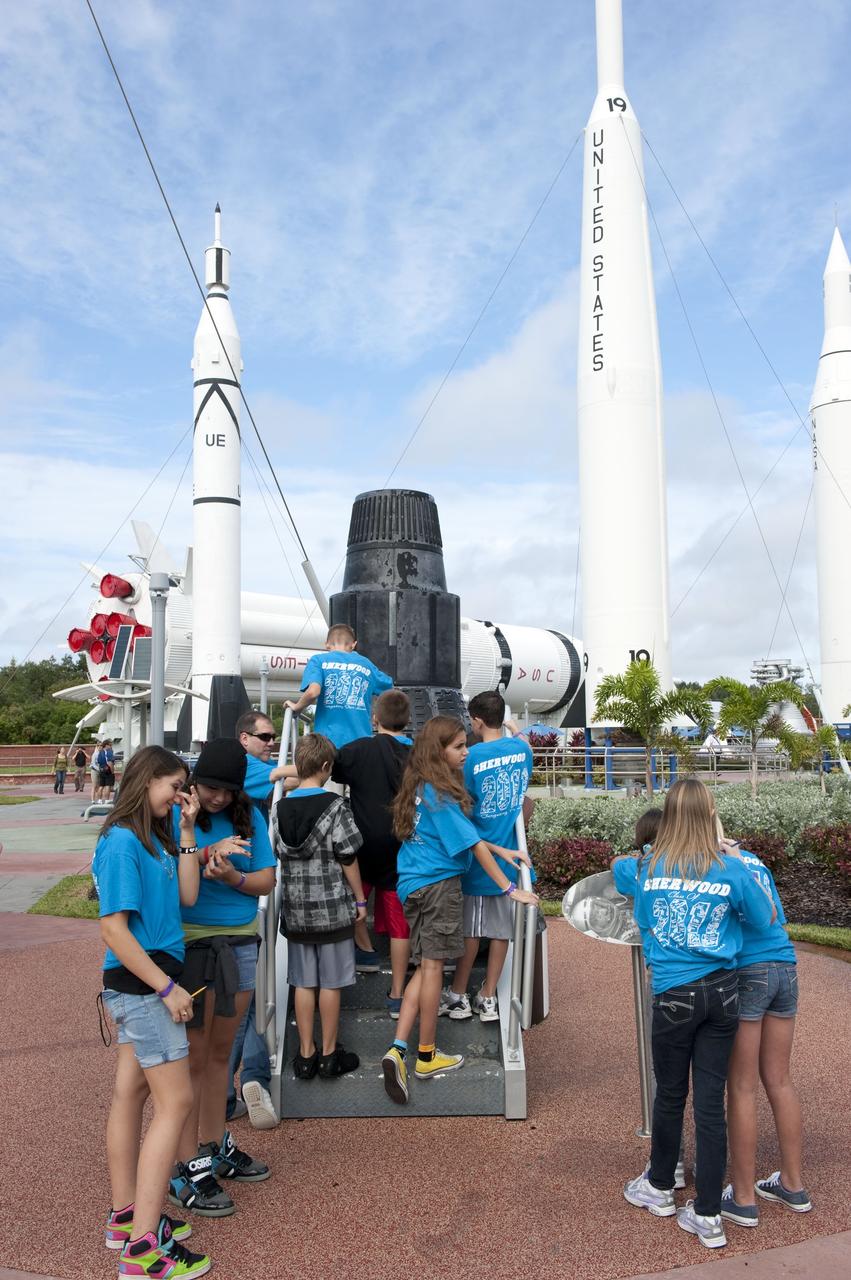
CAPE CANAVERAL, Fla. -- Brevard County sixth-graders participate in the eighth annual Space Week at the Kennedy Space Center Visitor Complex in Florida. Here, the students climb into a Mercury capsule in the complex's Rocket Garden. About 5,000 students will participate throughout the 11-day event, which contains fun space exploration activities designed to emphasize the importance of science, technology, engineering and math (STEM). Space Week is sponsored by NASA Education, Brevard Public Schools, Delaware North Companies Parks and Resorts, and the Florida Chapter of the National Space Club. Photo Credit: NASA/Kim Shiflett
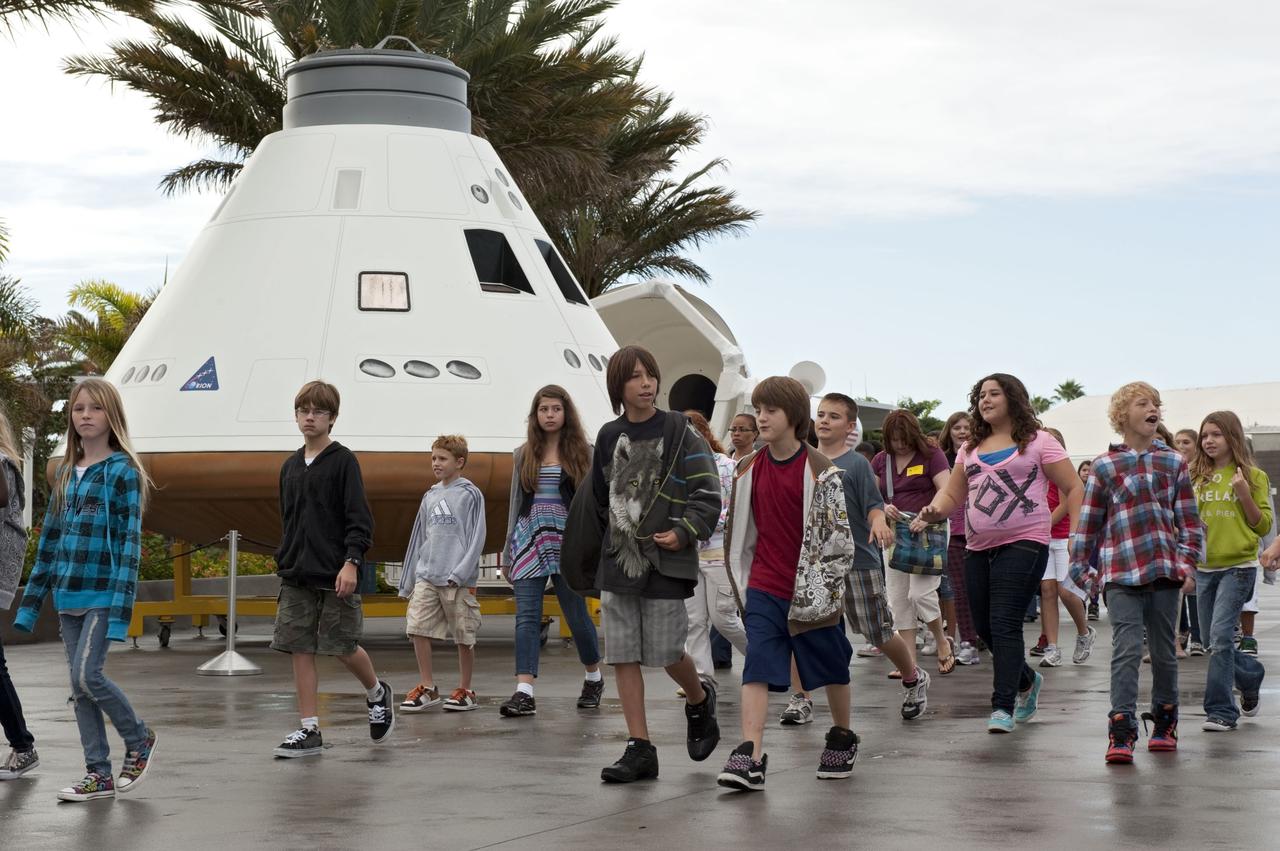
CAPE CANAVERAL, Fla. -- Brevard County sixth-graders participate in the eighth annual Space Week at the Kennedy Space Center Visitor Complex in Florida. Seen behind the students is a mock-up of NASA's Orion crew exploration vehicle, which was built by Guard-Lee Inc. of Apopka, Fla. About 5,000 students will participate throughout the 11-day event, which contains fun space exploration activities designed to emphasize the importance of science, technology, engineering and math (STEM). Space Week is sponsored by NASA Education, Brevard Public Schools, Delaware North Companies Parks and Resorts, and the Florida Chapter of the National Space Club. Photo Credit: NASA/Kim Shiflett
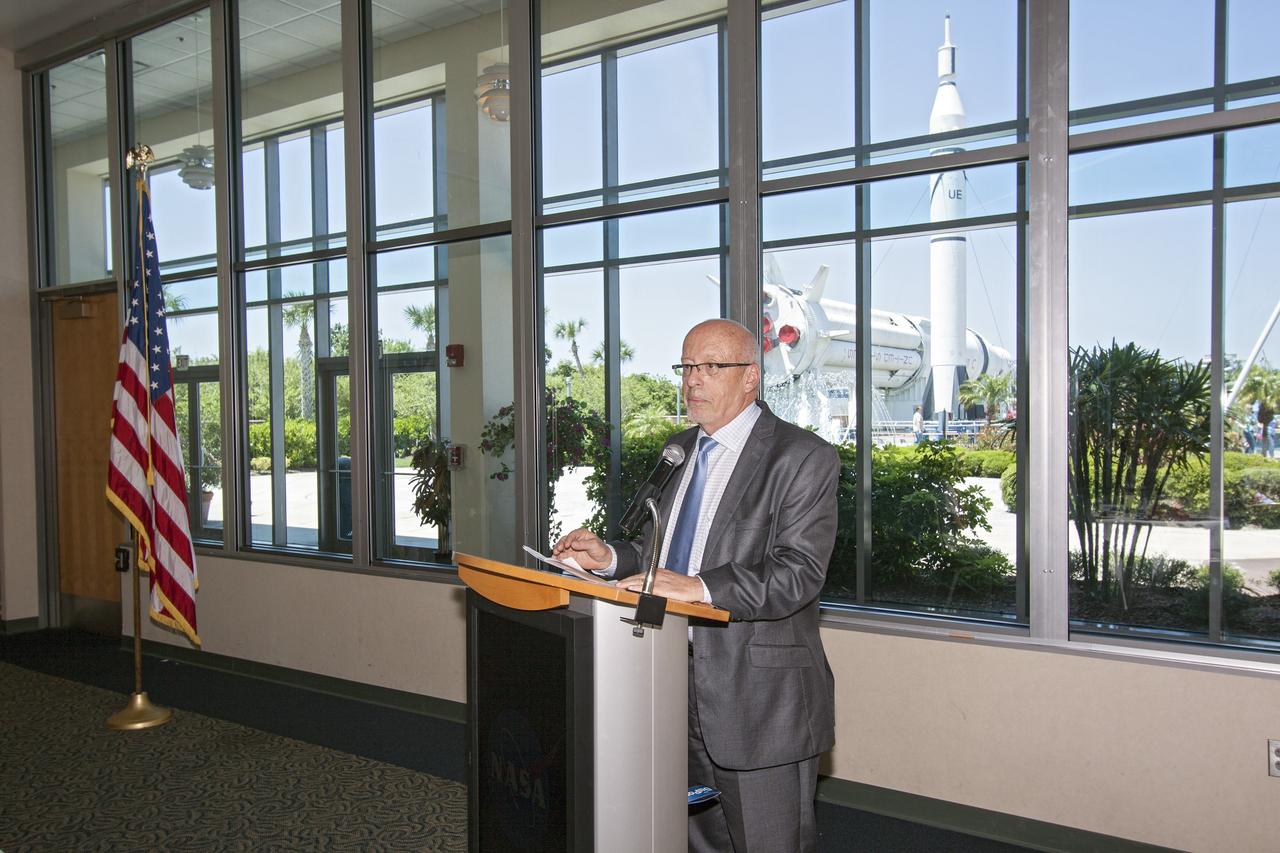
CAPE CANAVERAL, Fla. – At the Kennedy Space Center Visitor Complex in Florida, William Badders, resident-elect of the National Science Teachers Association, addresses students, teachers, parents and VIPs during the 2013 DuPont Challenge Science Essay Competition awards ceremony. The challenge, now in its 27th year, reaches out to students from grades seven through 12 from all 50 states and Canada. More than 200,000 students entered the competition. The DuPont Challenge aims to inspire students to excel and achieve in scientific writing and pursue careers in science, technology, engineering and mathematics STEM. The challenge honors space shuttle Challenger's STS-51L crew members who gave their lives while furthering the cause of exploration and discovery. For more information on the challenge, go to http://thechallenge.dupont.com/sponsors/nasa.php.

Acting NASA Associate Administrator for Human Exploration and Operations, Ken Bowersox, left, Cristina Chaplain, director, Contracting and National Security Acquisitions, U.S. Government Accountability Office (GAO), center, and Doug Cooke, owner, Cooke Concepts and Solutions, right, testify during a Space and Aeronautics Subcommittee of the House Science, Space, and Technology Committee hearing titled, “Developing Core Capabilities for Deep Space Exploration: An Update on NASA's SLS, Orion, and Exploration Ground Systems," Wednesday, September 18, 2019 at the Rayburn House Office Building in Washington. Photo Credit: (NASA/Aubrey Gemignani)
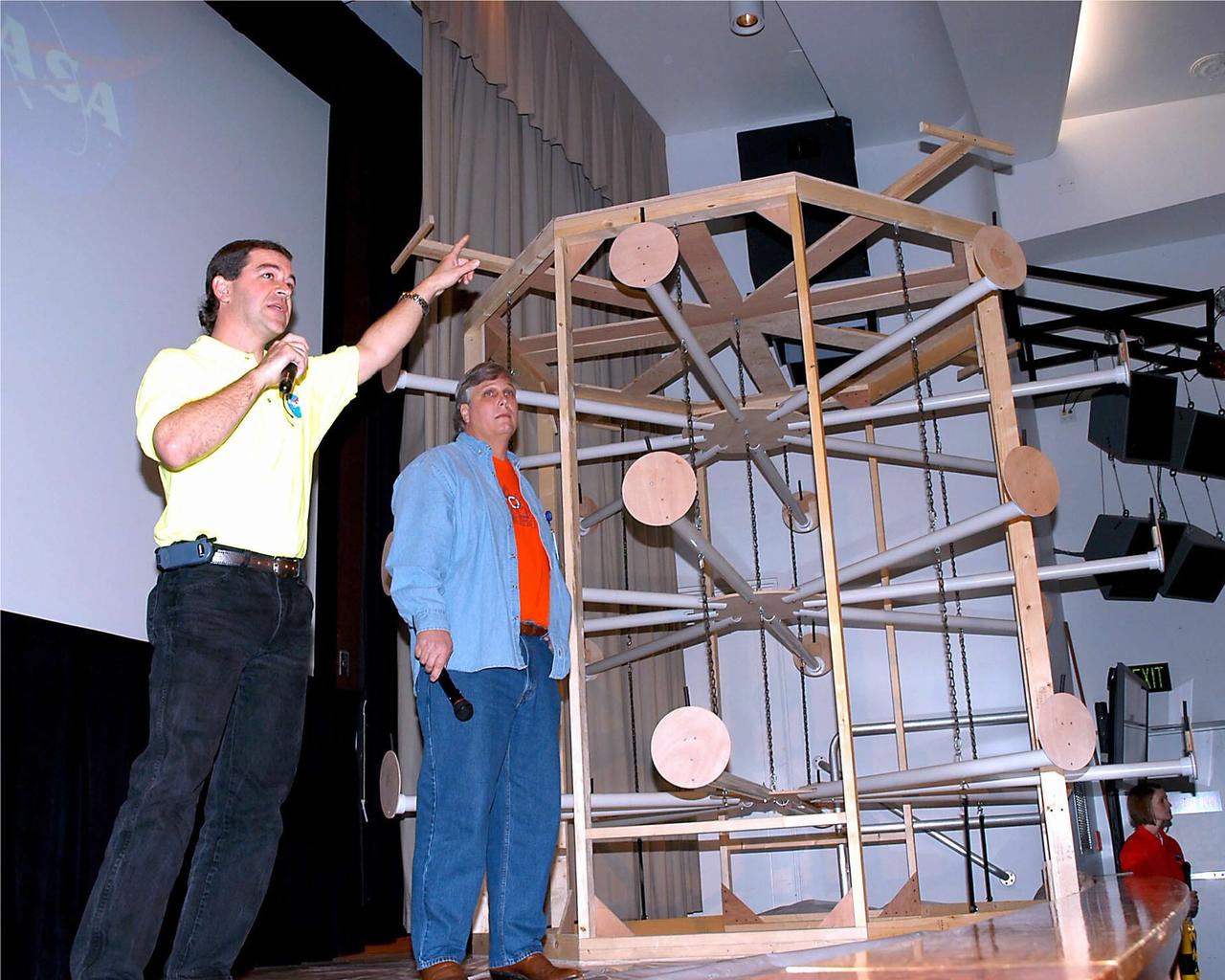
NASA engineers Scott Olive (left) and Bo Clarke answer questions during the 2007 FIRST (For Inspiration and Recognition of Science and Technology) Robotics Competition regional kickoff event held Saturday, Jan. 6, 2007, at StenniSphere, the visitor center at NASA Stennis Space Center near Bay St. Louis, Miss. The SSC employees and FIRST Robotics volunteer mentors are standing near a mock-up of the playing field for the FIRST Robotics' 2007 `Rack n' Roll' challenge. Roughly 300 students and adult volunteers - representing 29 high schools from four states - attended the kickoff to hear the rules of `Rack n' Roll.' The teams will spend the next six weeks building and programming robots from parts kits they received Saturday, then battle their creations at regional spring competitions in New Orleans, Houston, Atlanta and other cities around the nation. FIRST aims to inspire students in the pursuit of engineering and technology studies and careers.
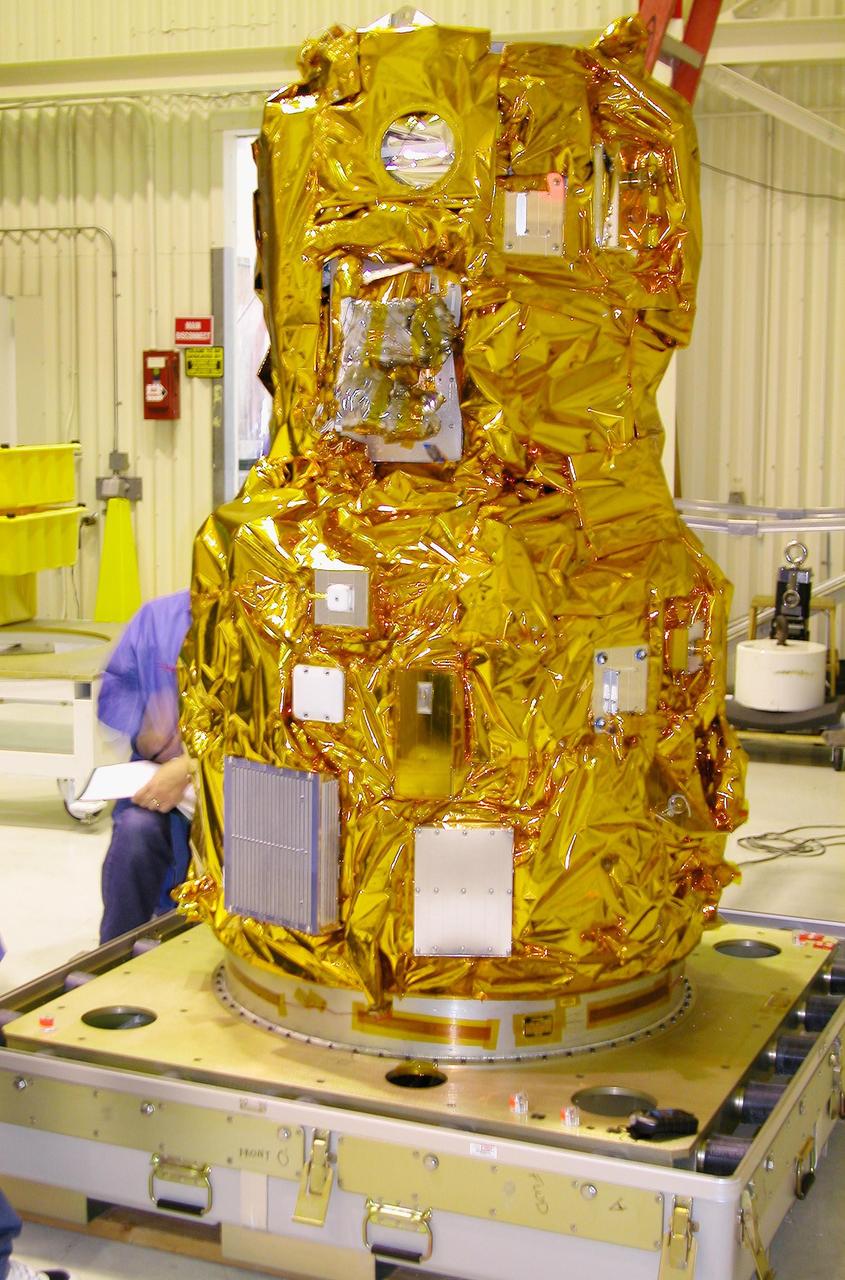
KENNEDY SPACE CENTER, FLA. - At Vandenberg Air Force Base in California, the DART (Demonstration for Autonomous Rendezvous Technology) flight demonstrator is revealed after its protective cover has been removed. The spacecraft was developed to prove technologies for locating and maneuvering near an orbiting satellite. Future applications of technologies developed by the DART project will benefit the nation in future space-vehicle systems development requiring in-space assembly, services or other autonomous rendezvous operations. Designed and developed for NASA by Orbital Sciences Corporation in Dulles, Va., the DART spacecraft will be launched on a Pegasus launch vehicle. At about 40,000 feet over the Pacific Ocean, the Pegasus will be released from Orbital’s Stargazer L-1011 aircraft, fire its rocket motors and boost DART into a polar orbit approximately 472 miles by 479 miles. Once in orbit, DART will rendezvous with a target satellite, the Multiple Paths, Beyond-Line-of-Site Communications satellite, also built by Orbital Sciences. DART will then perform several close proximity operations, such as moving toward and away from the satellite using navigation data provided by onboard sensors. DART is scheduled for launch no earlier than Oct. 18.
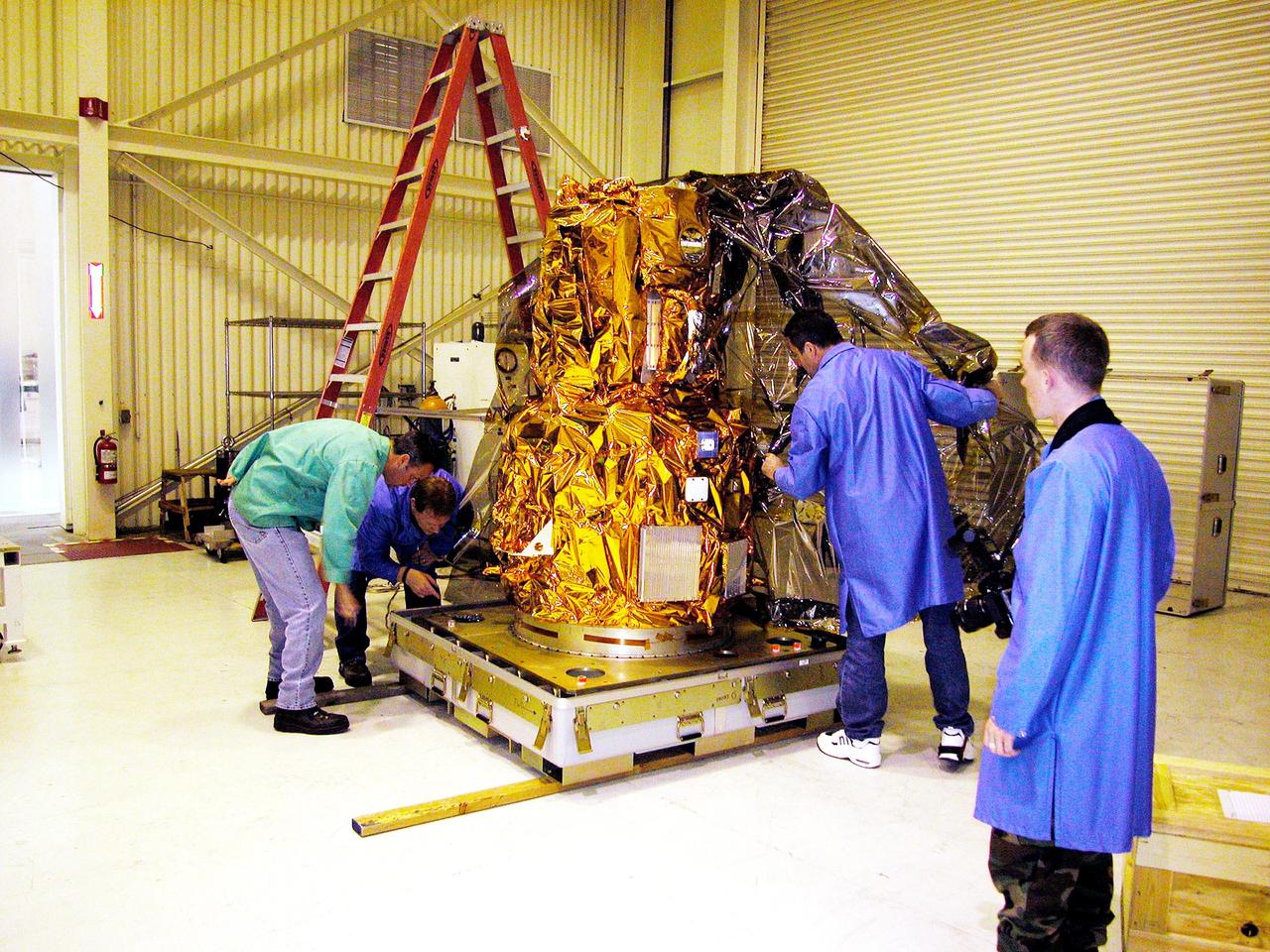
KENNEDY SPACE CENTER, FLA. - At Vandenberg Air Force Base in California, the DART (Demonstration for Autonomous Rendezvous Technology) flight demonstrator is revealed after its protective cover has been removed. The spacecraft was developed to prove technologies for locating and maneuvering near an orbiting satellite. Future applications of technologies developed by the DART project will benefit the nation in future space-vehicle systems development requiring in-space assembly, services or other autonomous rendezvous operations. Designed and developed for NASA by Orbital Sciences Corporation in Dulles, Va., the DART spacecraft will be launched on a Pegasus launch vehicle. At about 40,000 feet over the Pacific Ocean, the Pegasus will be released from Orbital’s Stargazer L-1011 aircraft, fire its rocket motors and boost DART into a polar orbit approximately 472 miles by 479 miles. Once in orbit, DART will rendezvous with a target satellite, the Multiple Paths, Beyond-Line-of-Site Communications satellite, also built by Orbital Sciences. DART will then perform several close proximity operations, such as moving toward and away from the satellite using navigation data provided by onboard sensors. DART is scheduled for launch no earlier than Oct. 18.

Release Date March 30, 2010 The raised arcs, lines, dots, and other markings in this 17-by-11-inch Hubble Space Telescope image of the Carina Nebula highlight important features in the giant gas cloud, allowing visually impaired people to feel what they cannot see and form a picture of the nebula in their minds. To read more abou this image go to: <a href="http://www.nasa.gov/mission_pages/hubble/science/carina-touch.html" rel="nofollow">www.nasa.gov/mission_pages/hubble/science/carina-touch.html</a> Credit: NASA, ESA, and M. Mutchler (STScI/AURA) and N. Grice (You Can Do Astronomy LLC) <b><a href="http://www.nasa.gov/centers/goddard/home/index.html" rel="nofollow">NASA Goddard Space Flight Center</a></b> is home to the nation's largest organization of combined scientists, engineers and technologists that build spacecraft, instruments and new technology to study the Earth, the sun, our solar system, and the universe.
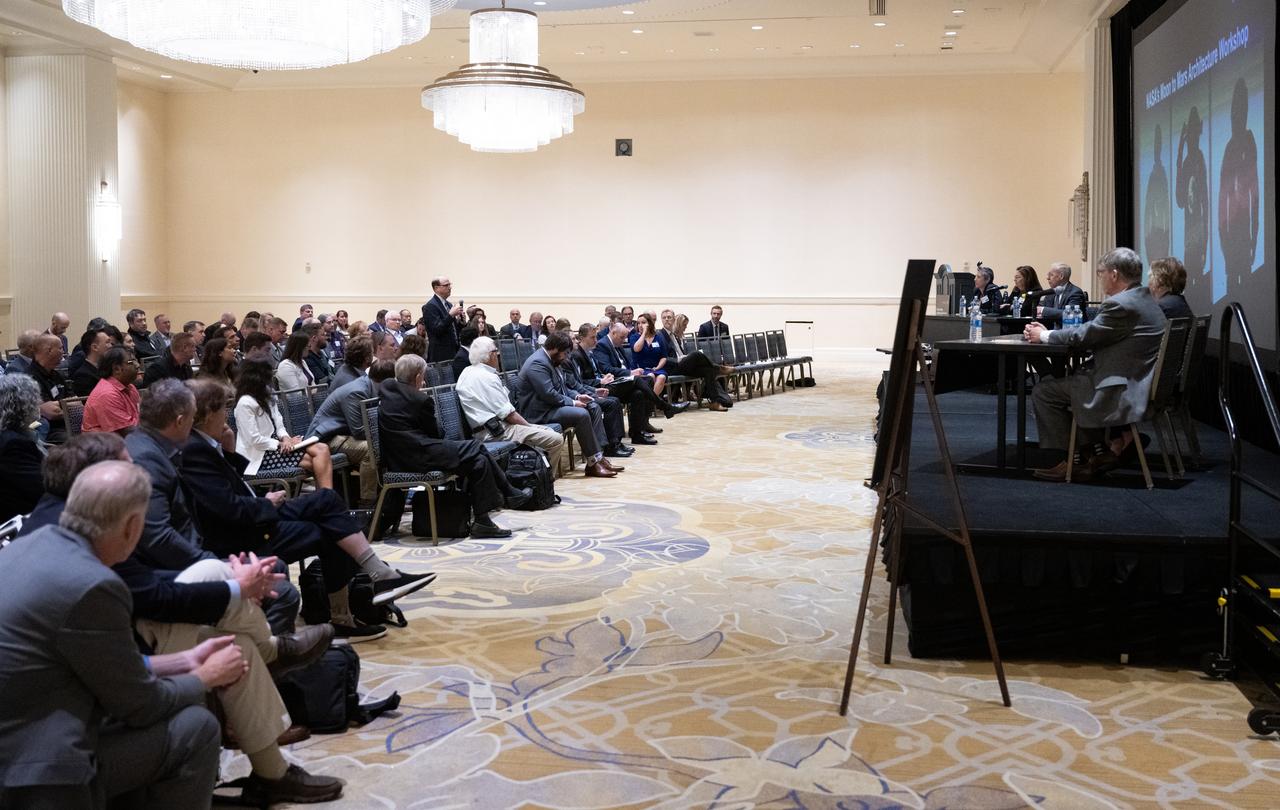
Nujoud Merancy, architecture lead for NASA's Exploration Systems Development Mission Directorate, Catherine Koerner, deputy associate administrator for NASA's Exploration Systems Development Mission Directorate, Patrick Forrester, special advisor in NASA's Space Operations Mission Directorate, Michelle Munk, chief architect for NASA’s Space Technology Mission Directorate, and Joel Kearns, deputy associate administrator for Exploration in NASA's Science Mission Directorate, listen to a question during NASA’s Moon to Mars Architecture Workshop, Tuesday, June 27, 2023, at the Gaylord National Resort and Convention Center in National Harbor, Md. Following the release of the 2022 Architecture Concept Review, NASA is conducting the workshop to engage the broader space community and collect feedback from U.S. industry and academia to inform the Moon to Mars mission architecture and operational delivery. Photo Credit: (NASA/Joel Kowsky)
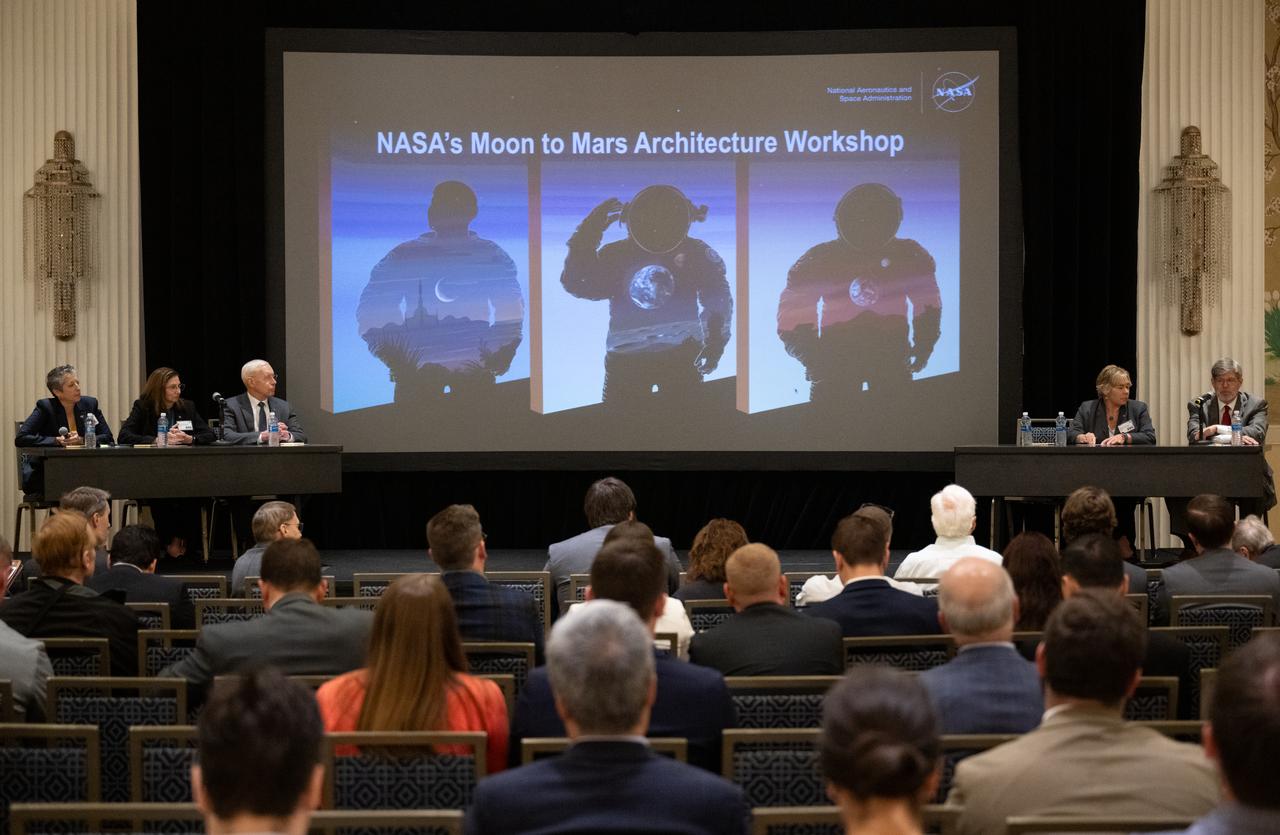
Nujoud Merancy, architecture lead for NASA's Exploration Systems Development Mission Directorate, Catherine Koerner, deputy associate administrator for NASA's Exploration Systems Development Mission Directorate, Patrick Forrester, special advisor in NASA's Space Operations Mission Directorate, Michelle Munk, chief architect for NASA’s Space Technology Mission Directorate, and Joel Kearns, deputy associate administrator for Exploration in NASA's Science Mission Directorate, are seen on stage during NASA’s Moon to Mars Architecture Workshop, Tuesday, June 27, 2023, at the Gaylord National Resort and Convention Center in National Harbor, Md. Following the release of the 2022 Architecture Concept Review, NASA is conducting the workshop to engage the broader space community and collect feedback from U.S. industry and academia to inform the Moon to Mars mission architecture and operational delivery. Photo Credit: (NASA/Joel Kowsky)
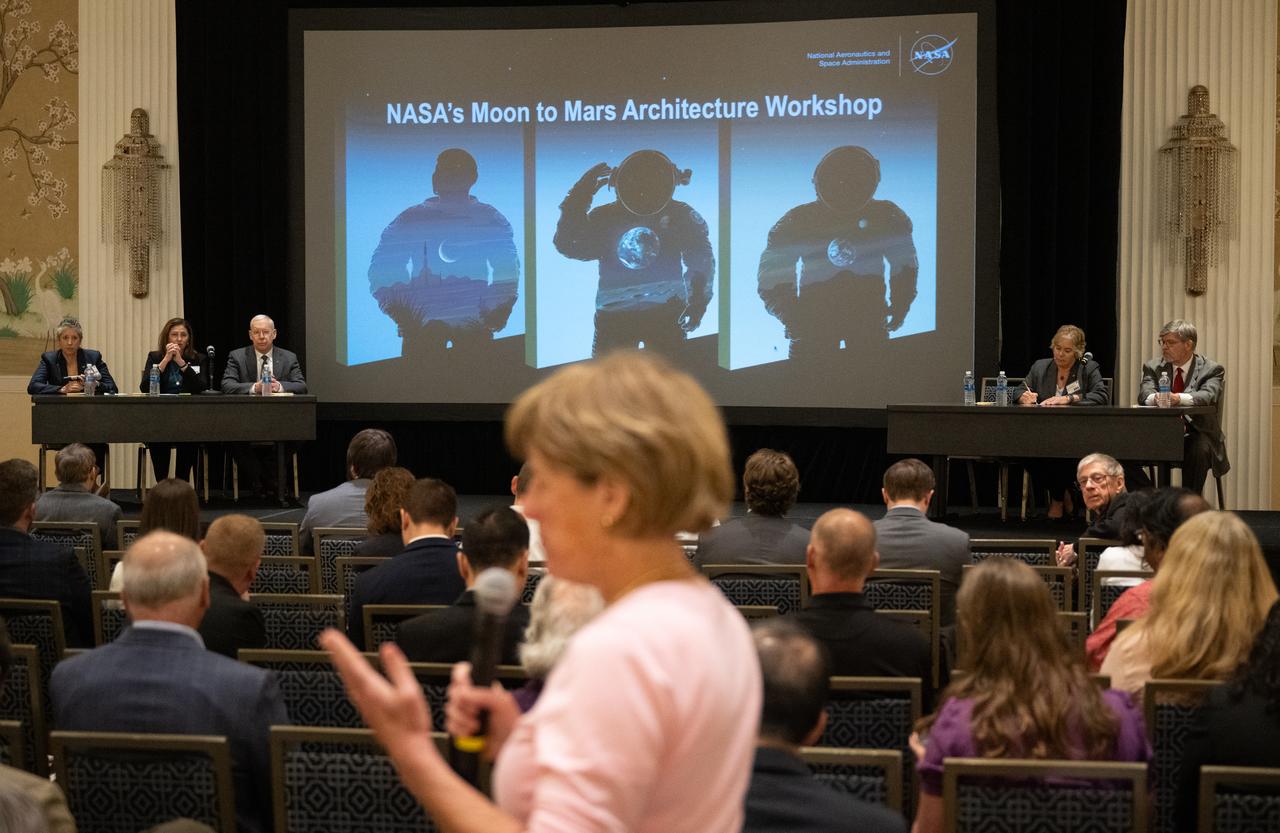
Nujoud Merancy, architecture lead for NASA's Exploration Systems Development Mission Directorate, Catherine Koerner, deputy associate administrator for NASA's Exploration Systems Development Mission Directorate, Patrick Forrester, special advisor in NASA's Space Operations Mission Directorate, Michelle Munk, chief architect for NASA’s Space Technology Mission Directorate, and Joel Kearns, deputy associate administrator for Exploration in NASA's Science Mission Directorate, listen to a question during NASA’s Moon to Mars Architecture Workshop, Tuesday, June 27, 2023, at the Gaylord National Resort and Convention Center in National Harbor, Md. Following the release of the 2022 Architecture Concept Review, NASA is conducting the workshop to engage the broader space community and collect feedback from U.S. industry and academia to inform the Moon to Mars mission architecture and operational delivery. Photo Credit: (NASA/Joel Kowsky)
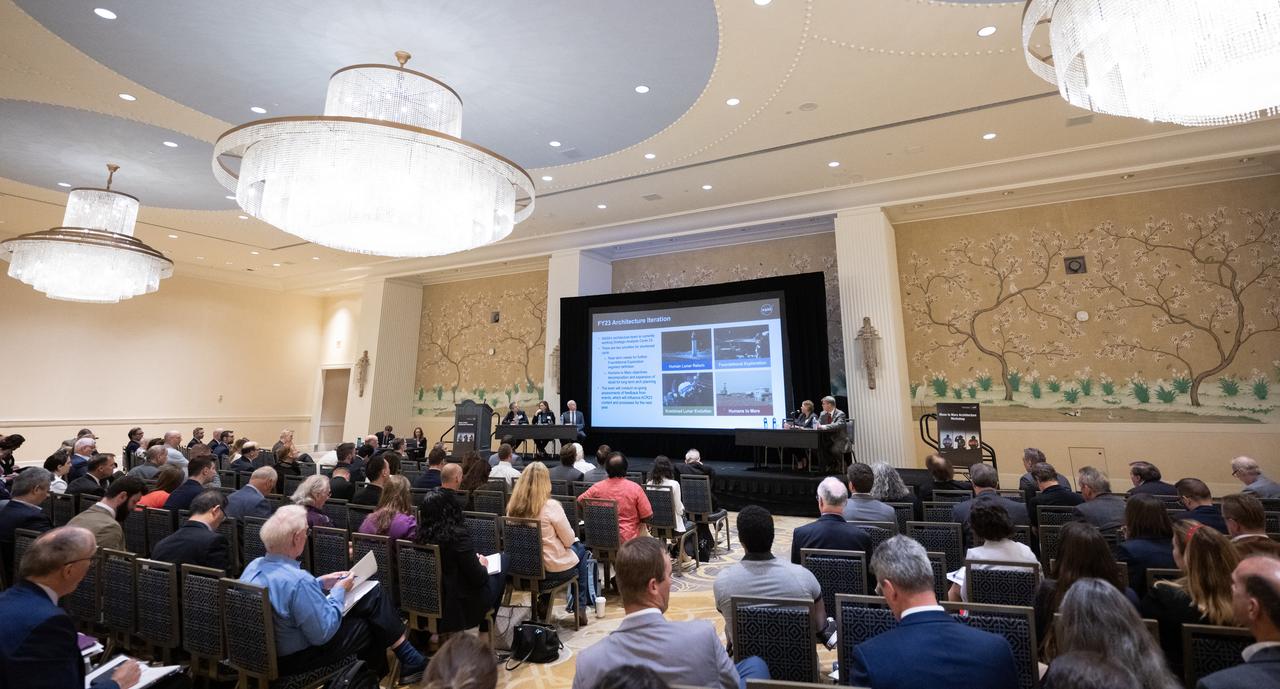
Nujoud Merancy, architecture lead for NASA's Exploration Systems Development Mission Directorate, Catherine Koerner, deputy associate administrator for NASA's Exploration Systems Development Mission Directorate, Patrick Forrester, special advisor in NASA's Space Operations Mission Directorate, Michelle Munk, chief architect for NASA’s Space Technology Mission Directorate, and Joel Kearns, deputy associate administrator for Exploration in NASA's Science Mission Directorate, are seen on stage during NASA’s Moon to Mars Architecture Workshop, Tuesday, June 27, 2023, at the Gaylord National Resort and Convention Center in National Harbor, Md. Following the release of the 2022 Architecture Concept Review, NASA is conducting the workshop to engage the broader space community and collect feedback from U.S. industry and academia to inform the Moon to Mars mission architecture and operational delivery. Photo Credit: (NASA/Joel Kowsky)
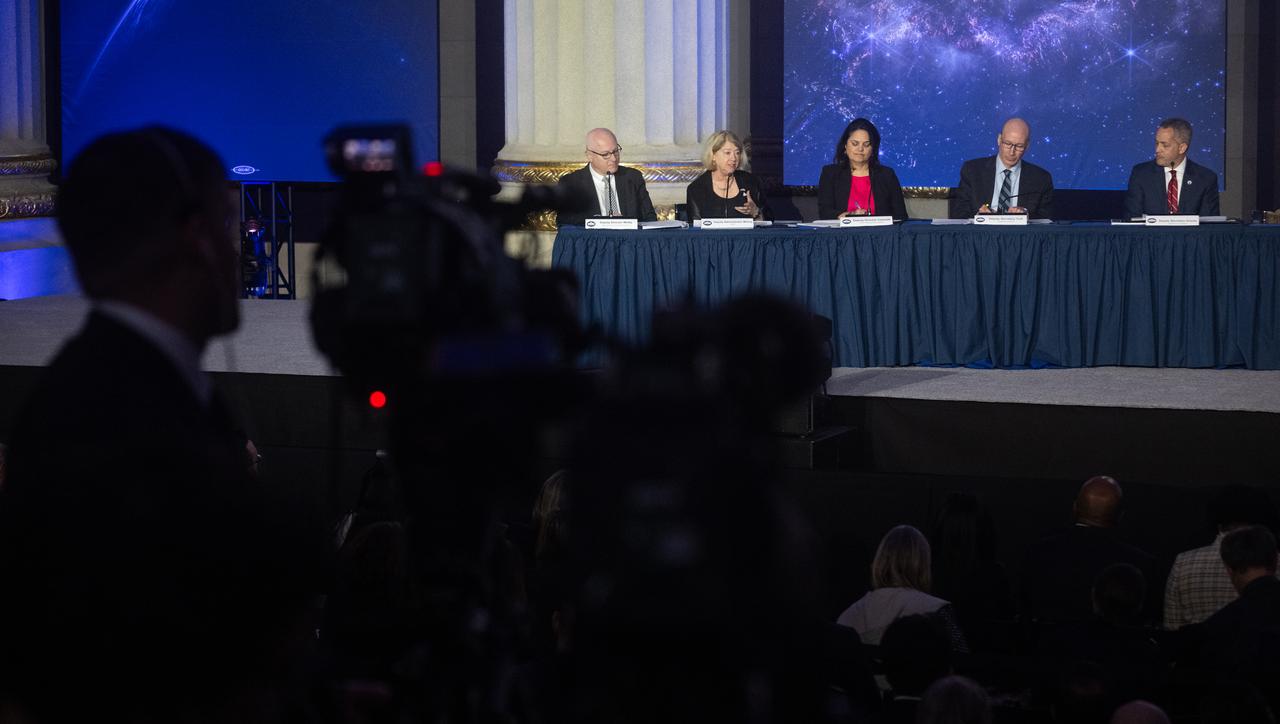
NASA Deputy Administrator Pam Melroy, second from left, speaks during the third meeting of the National Space Council along side Deputy Director of the Office of Science and Technology Policy Steve Welby, left, Deputy Director of the Office of Management and Budget Nani Coloretti, center, Deputy Secretary of Energy David Turk, second from right, and Deputy Secretary of Commerce Don Graves, right, Wednesday, Dec. 20, 2023, at the Andrew W. Mellon Auditorium in Washington. Chaired by Vice President Kamala Harris, the council's role is to advise the President regarding national space policy and strategy, and ensuring the United States capitalizes on the opportunities presented by the country’s space activities. Photo Credit: (NASA/Joel Kowsky)
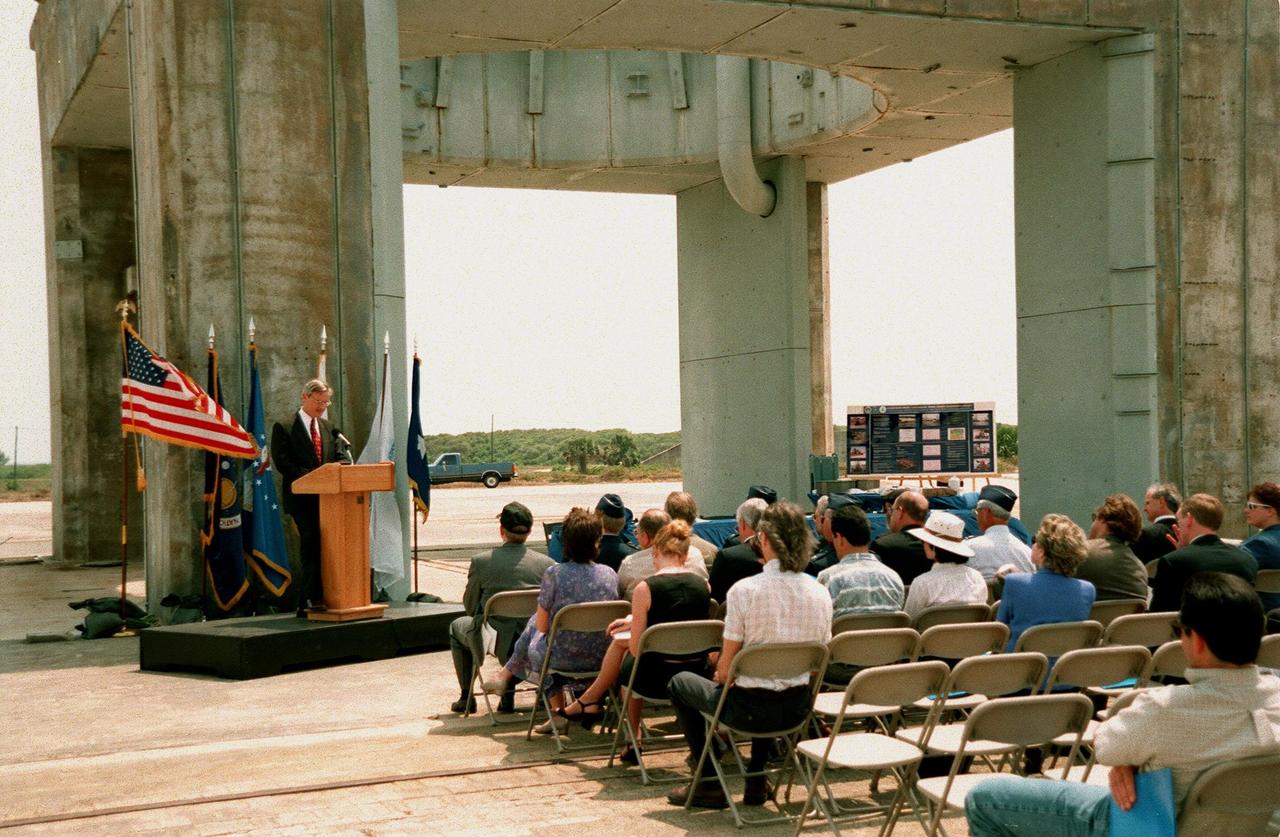
Walter W. Kovalick Jr., Ph.D., director of Technology Innovation Office for the U.S. Environmental Protection Agency, addresses representatives from Kennedy Space Center, the 45th Space Wing, and various federal environmental agencies gathered to attend a Memorandum of Agreement (MOA) signing, taking place at the site of Launch Complex 34. The MOA formalizes the cooperative efforts of the federal agencies in ground-water cleanup initiatives. NASA, the U.S. Air Force and the agencies have formed a consortium and are participating in a comparative study of three innovative techniques to be used in cleaning a contaminated area of Launch Complex 34. The study will be used to help improve groundwater cleanup processes nationally. Other attendees included Timothy Oppelt, director, National Risk Management Research Laboratory, U.S. Environmental Protection Agency; Tom Heenan, assistant manager of environmental management, Savannah River Site, U.S. Department of Energy; Col. James Heald, Vice Commander, Air Force Research Laboratory, U.S. Air Force; Gerald Boyd, acting deputy assistant secretary, Office of Science and Technology, U.S. Department of Energy; James Fiore, acting deputy assistant secretary, Office of Environmental Restoration, Department of Energy; Brig. Gen. Randall R. Starbuck, Commander 45th Space Wing, U.S. Air Force; and Roy Bridges Jr., director of John F. Kennedy Space Center
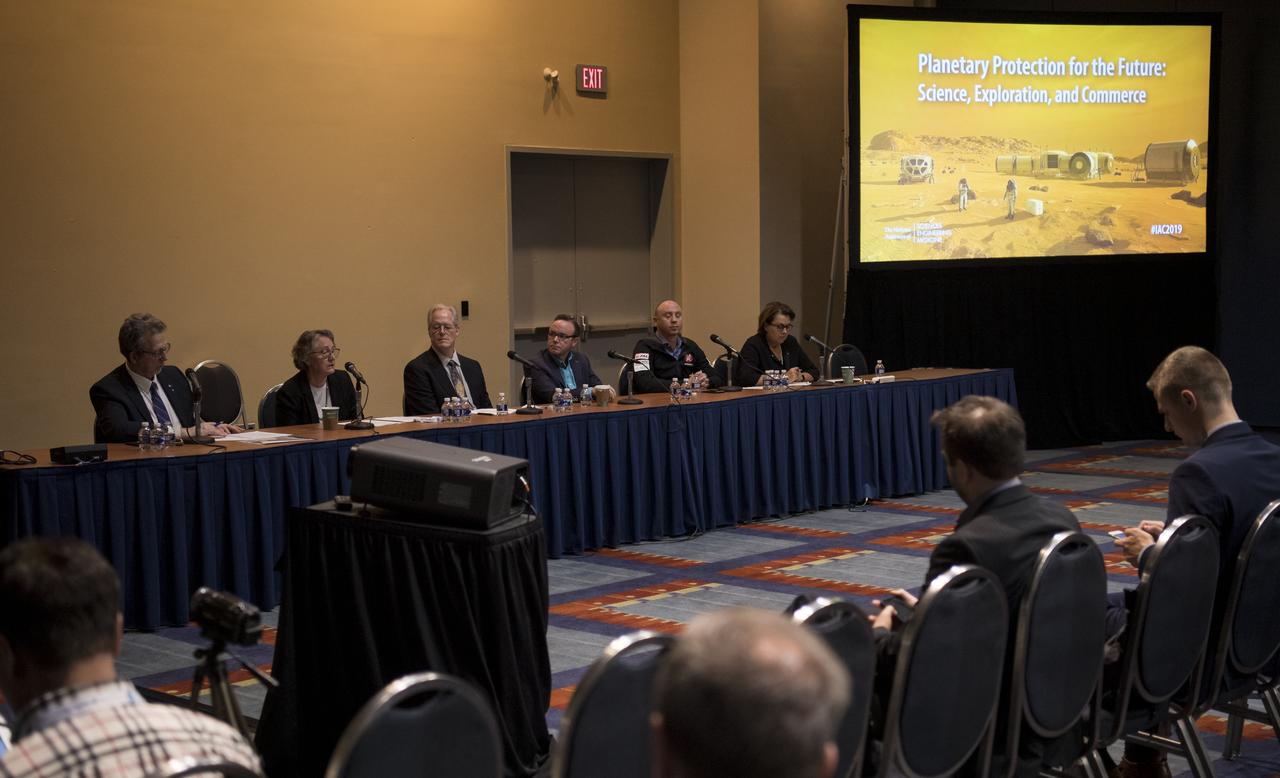
NASA Chief Scientist Jim Green, left, Lisa Pratt, NASA's Planetary Protection Officer, Michael Meyer, Lead Scientist for NASA's Mars Exploration Program, Dan Hendrickson, Vice President of Business Development at Astrobotic Technology, Kyle Acierno, Vice President of Global Sales and Strategy at ispace, and Simonetta Di Pippo, Director of the United Nations Office for Outer Space Affairs, right, are seen during a special session titled “Planetary Protection for the Future: Science, Exploration, and Commerce” at the 70th International Astronautical Congress, Thursday, Oct. 24, 2019, at the Walter E. Washington Convention Center in Washington. Photo Credit: (NASA/Joel Kowsky)
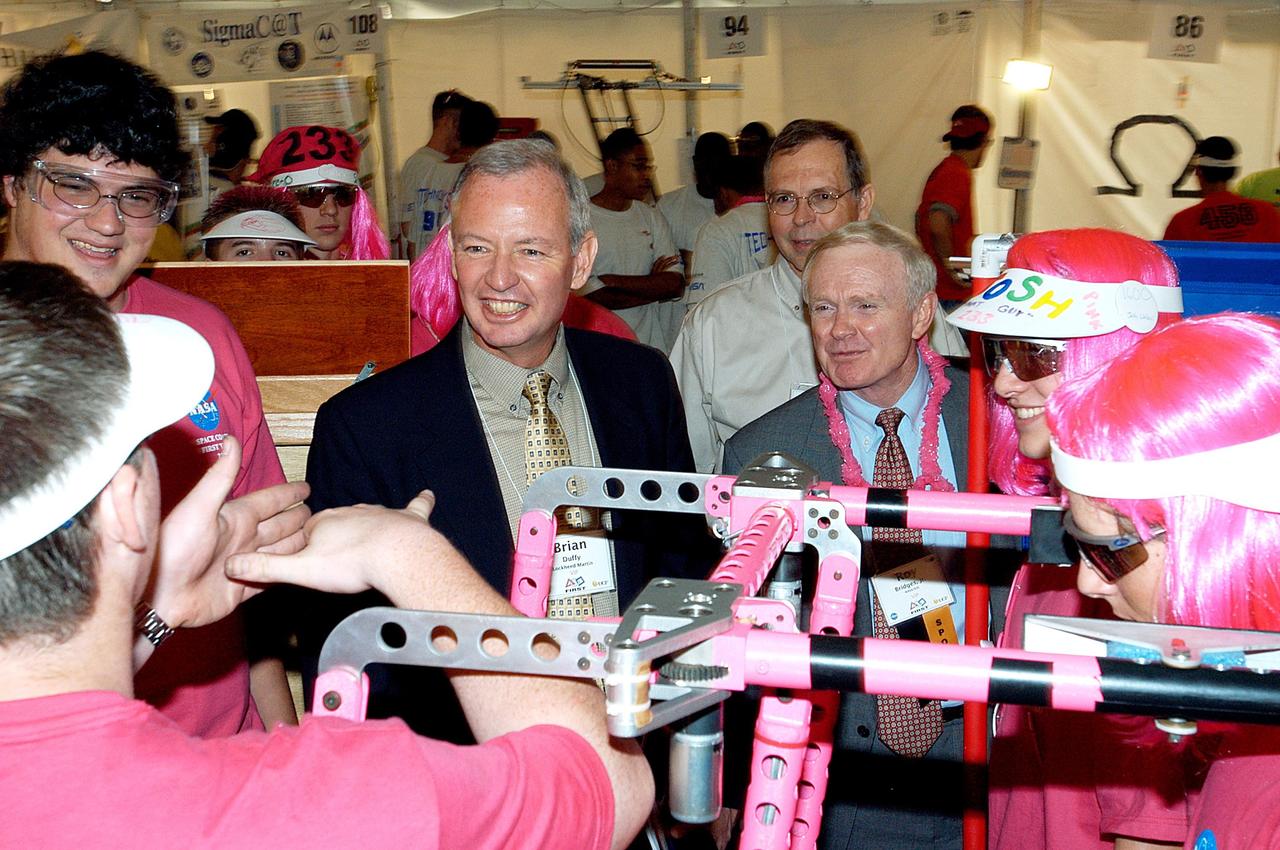
KENNEDY SPACE CENTER, FLA. - Lockheed Martin Vice President/Associate Program Manager Brian Duffy (second from left) and NASA Kennedy Space Center Director Roy Bridges (next to Duffy) talk with student participants in the 2003 Southeastern Regional FIRST Robotic Competition. Chris Fairey, the former director of Spaceport Services at KSC, looks on in the background. The competition is being held at the University of Central Florida (UCF) in Orlando, March 20-23. Forty student teams from around the country are participating in the event that pits team-built gladiator robots against each other in an athletic-style competition. The teams are sponsored by NASA/Kennedy Space Center, The Boeing Company/Brevard Community College, and Lockheed Martin Space Operations/Mission Systems for the nonprofit organization For Inspiration and Recognition of Science and Technology, known as FIRST. The vision of FIRST is to inspire in the youth of our nation an appreciation of science and technology and an understanding that mastering these disciplines can enrich the lives of all mankind.

CAPE CANAVERAL, Fla. – Student investigator Emily Soice is interviewed by the media in the NASA Newsroom at Kennedy Space Center in Florida during prelaunch activities for the SpaceX demonstration test flight. Soice is an eighth-grade student at Johnston Middle School in Houston, Texas. Her experiment, “Hepatocyte Development in Bioscaffolds Infused with TGFB3 in Microgravity,” is one of 15 in the Student Spaceflight Experiments Program, or SSEP, being ferried to the International Space Station inside the Dragon capsule. The launch will be the second demonstration test flight for SpaceX for NASA's Commercial Orbital Transportation Services program, or COTS. SSEP, which began operation in June 2010 through a partnership of the National Center for Earth and Space Science Education with NanoRacks LLC, is a U.S. national science, technology, engineering and mathematics STEM education initiative that gives students across a community the opportunity to propose and design real experiments to fly in low Earth orbit. SSEP experiments flew on space shuttle missions STS-134 and STS-135 in 2011, the final flights of space shuttles Endeavour and Atlantis. For more information on SSEP, visit http://www.nasa.gov/audience/foreducators/station-here-we-come.html. Photo credit: NASA/Gianni Woods
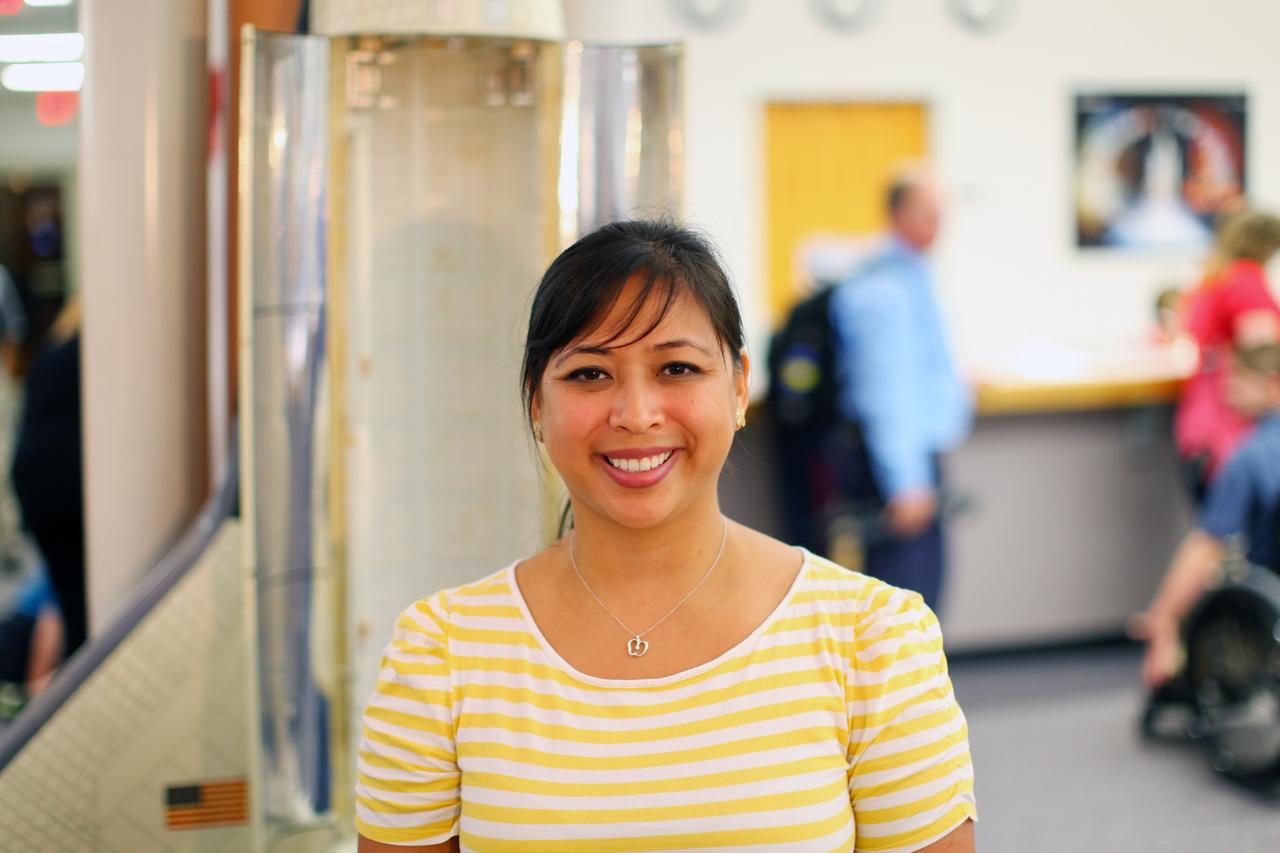
CAPE CANAVERAL, Fla. – Teacher Anthonette Pena is interviewed by the media in the NASA Newsroom at Kennedy Space Center in Florida during prelaunch activities for the SpaceX demonstration test flight. Pena is the facilitator for the student experiment developed by a team of eighth-graders at the Capitol Hill Cluster School in Washington, D.C. The experiment, “Does Hay Bacillus Break Down Human Waste Represented by Brown Egg in Microgravity as Well as in Earth Gravity?” is one of 15 in the Student Spaceflight Experiments Program, or SSEP, being ferried to the International Space Station inside the Dragon capsule. The launch will be the second demonstration test flight for SpaceX for NASA's Commercial Orbital Transportation Services program, or COTS. SSEP, which began operation in June 2010 through a partnership of the National Center for Earth and Space Science Education with NanoRacks LLC, is a U.S. national science, technology, engineering and mathematics STEM education initiative that gives students across a community the opportunity to propose and design real experiments to fly in low Earth orbit. SSEP experiments flew on space shuttle missions STS-134 and STS-135 in 2011, the final flights of space shuttles Endeavour and Atlantis. For more information on SSEP, visit http://www.nasa.gov/audience/foreducators/station-here-we-come.html. Photo credit: NASA/Gianni Woods