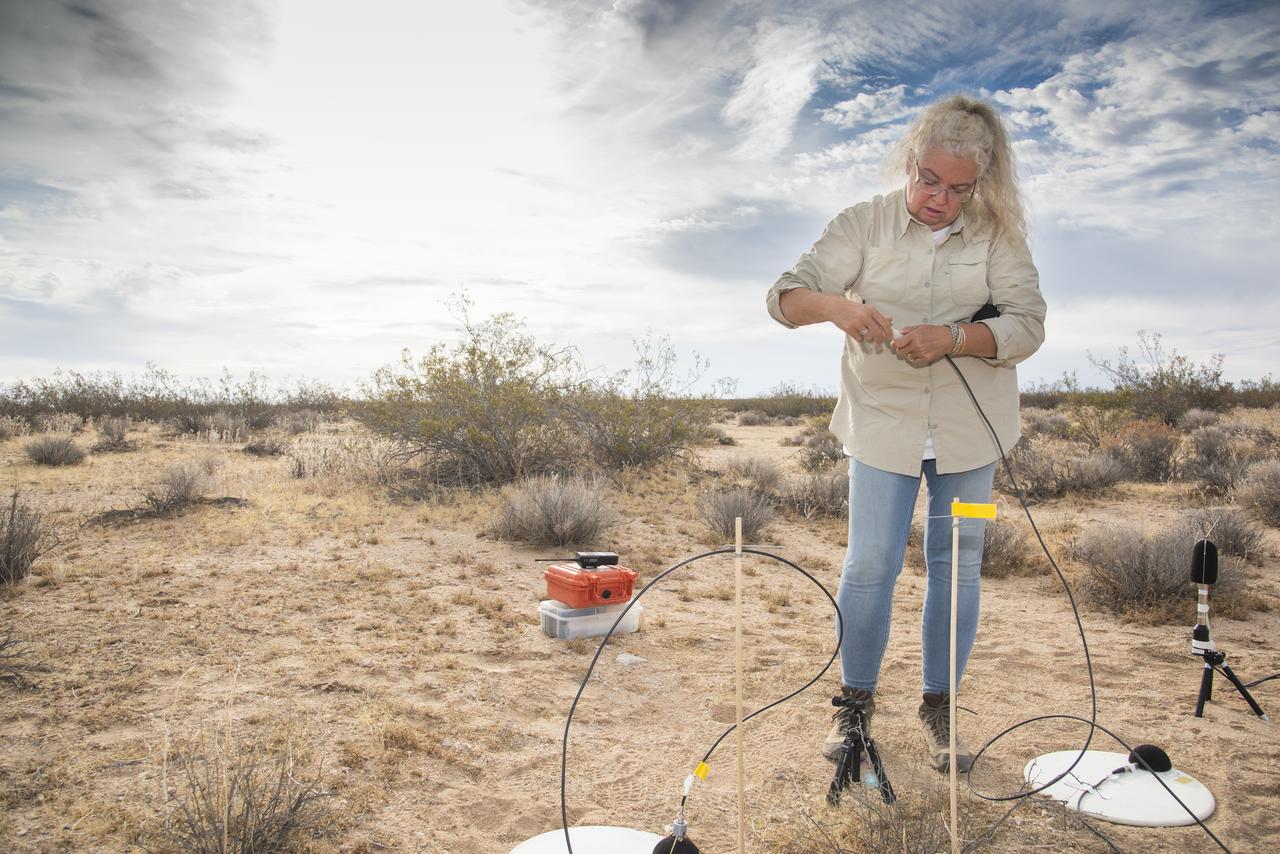
Juliet Page, a physical scientist with the Volpe National Transportation Systems Center, calibrates a microphone station during the CarpetDIEM flight series. The array featured high-fidelity microphones arranged in several configurations, giving researchers the ability to obtain accurate sound data and assess the loudness of the sonic booms, just as they will measure the quiet sonic thumps from the X-59.
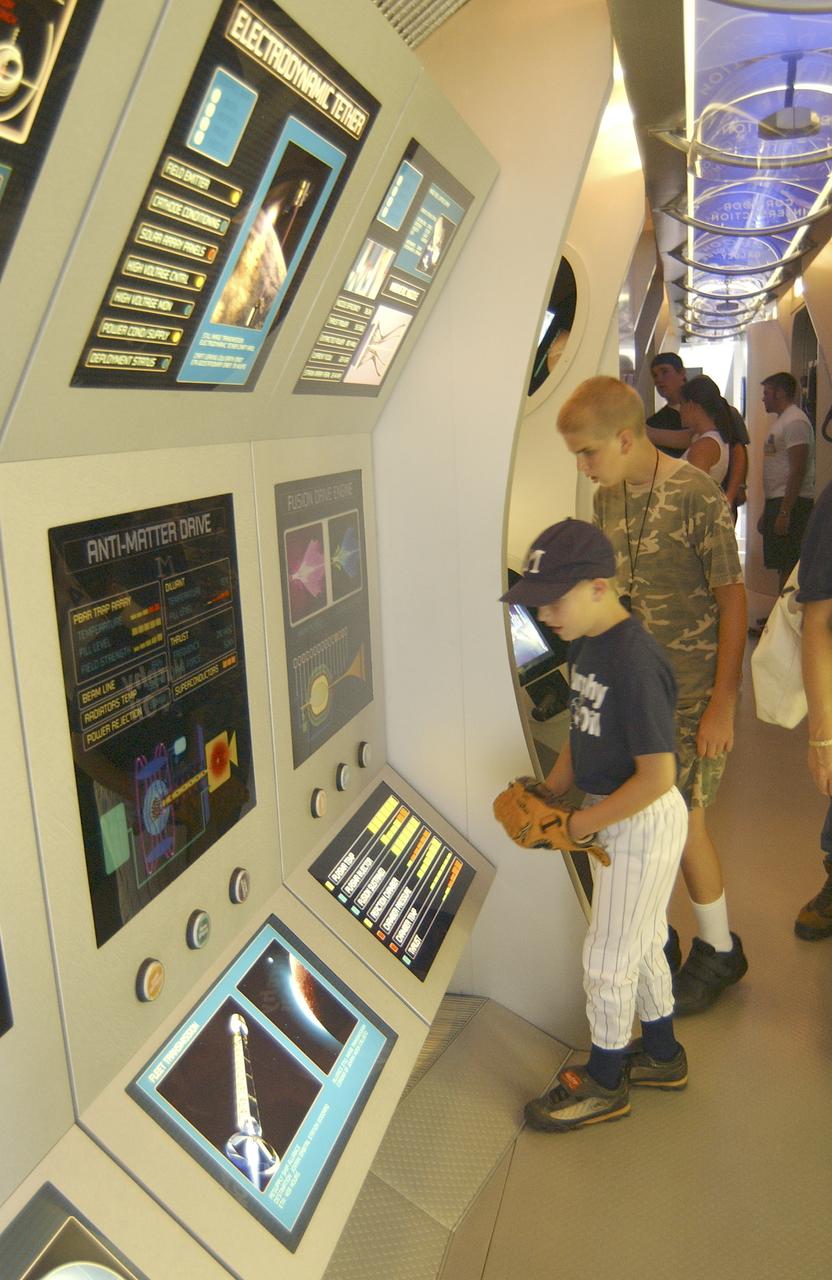
This photograph shows onlookers viewing displays within the Starship 2040 exhibit on display at Joe Davis Stadium in Huntsville, Alabama. Developed by the Space Transportation Directorate at Marshall Space Flight Center (MSFC), the Starship 2040 exhibit is housed in a 48-ft (14.6-m) tractor and trailer rig, permitting it to travel around the Nation, demonstrating NASA's vision of what commercial spaceflight might be like 40 years from now. All the irnovations suggested aboard the exhibit (automated vehicle health monitoring systems, high-energy propulsion drive, navigational aids, and emergency and safety systems) are based on concepts and technologies now being studied at NASA Centers and partner institutions around the Nation. NASA is the Nation's premier agency for development of the space transportation system, including future-generation reusable launch vehicles. Such systems, the keys to a "real" Starship 2040, require revolutionary advances in critical aerospace technologies, from thermal, magnetic, chemical, and propellantless propulsion systems to new energy sources such as space solar power or antimatter propulsion. These and other advances are now being studied, developed, and tested at NASA field centers and partner institutions all over the Nation.
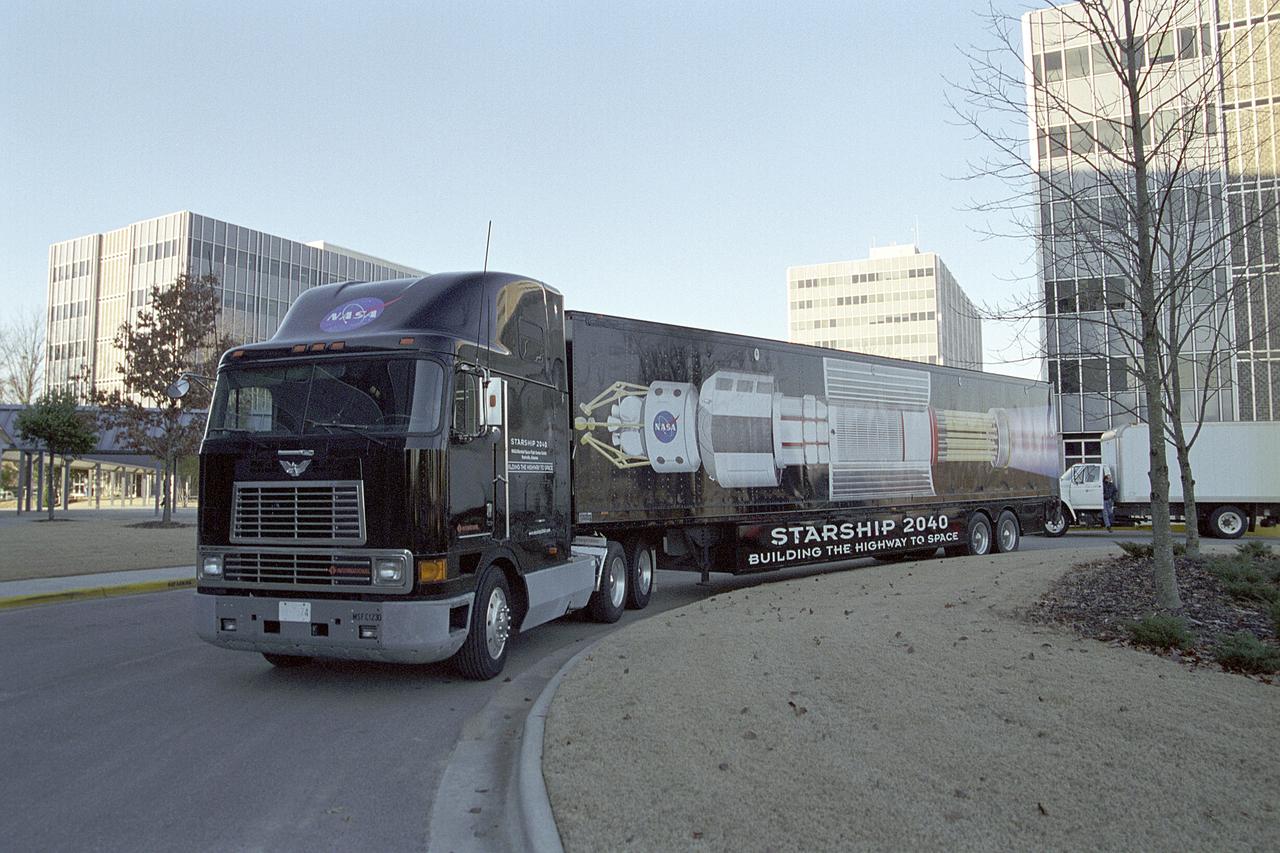
This photograph shows the Starship 2040 leaving the Marshall Space Flight Center (MSFC) for the exhibit site. Developed by the Space Transportation Directorate at MSFC, the Starship 2040 exhibit is housed in a 48-ft (14.6-m) tractor and trailer rig, permitting it to travel around the Nation, demonstrating NASA's vision of what commercial spaceflight might be like 40 years from now. All the irnovations suggested aboard the exhibit, automated vehicle health monitoring systems, high-energy propulsion drive, navigational aids and emergency and safety systems, are based on concepts and technologies now being studied at NASA Centers and partner institutions around the Nation. NASA is the nation's premier agency for development of the space transportation system, including future-generation reusable launch vehicles. Such systems, the keys to a "real" Starship 2040, require revolutionary advances in critical aerospace technologies, from thermal, magnetic, chemical, and propellantless propulsion systems to new energy sources such as space solar power or antimatter propulsion. These and other advances are now being studied, developed, and tested at NASA field centers and partner institutions all over the Nation.
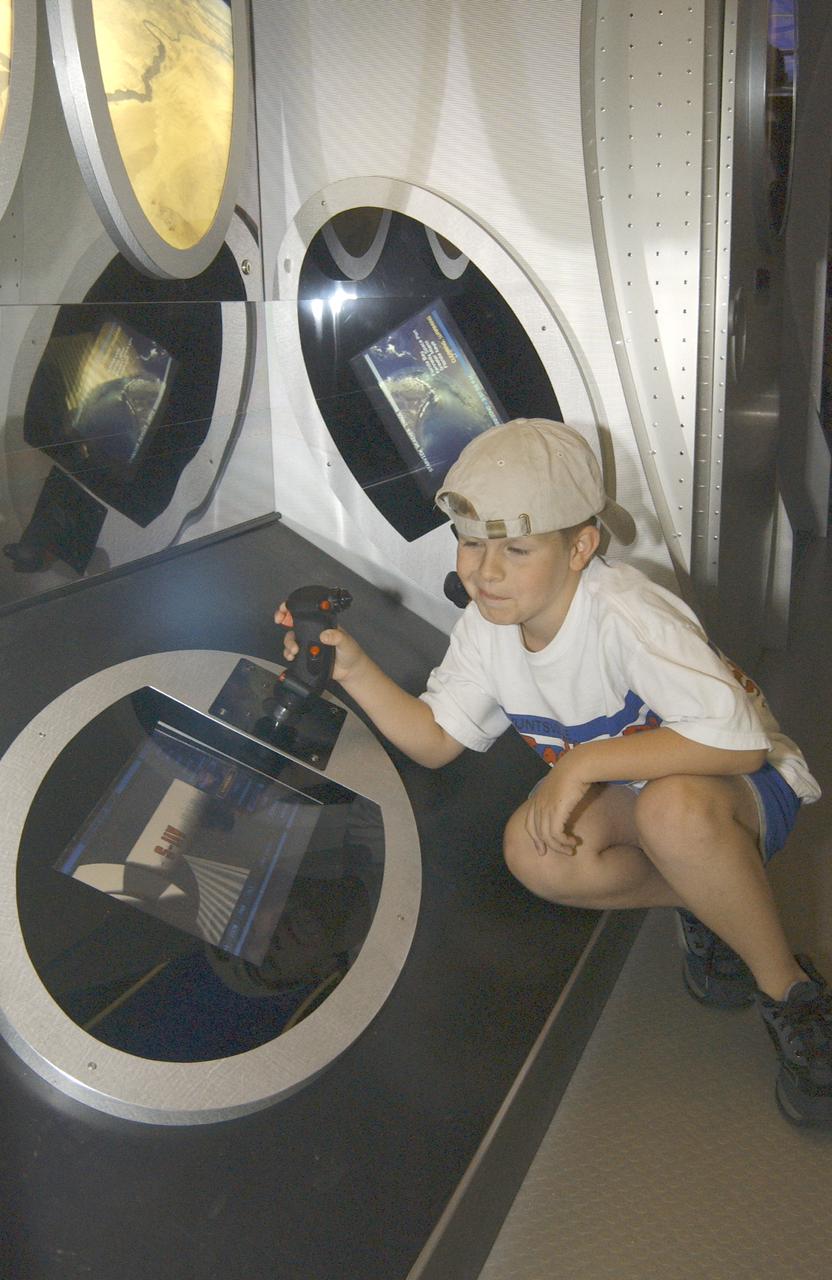
This photograph shows Justin Varnadore, son of a Marshall TV employee, at the controls of one of the many displays within the Starship 2040 exhibit on display at Joe Davis Stadium in Huntsville, Alabama. Developed by the Space Transportation Directorate at Marshall Space Flight Center (MSFC), the Starship 2040 exhibit is housed in a 48-ft (14.6-m) tractor and trailer rig, permitting it to travel around the Nation, demonstrating NASA's vision of what commercial spaceflight might be like 40 years from now. All the irnovations suggested aboard the exhibit (automated vehicle health monitoring systems, high-energy propulsion drive, navigational aids, and emergency and safety systems) are based on concepts and technologies now being studied at NASA Centers and partner institutions around the Nation. NASA is the Nation's premier agency for development of the space transportation system, including future-generation reusable launch vehicles. Such systems, the keys to a "real" Starship 2040, require revolutionary advances in critical aerospace technologies, from thermal, magnetic, chemical, and propellantless propulsion systems to new energy sources such as space solar power or antimatter propulsion. These and other advances are now being studied, developed, and tested at NASA field centers and partner institutions all over the Nation.
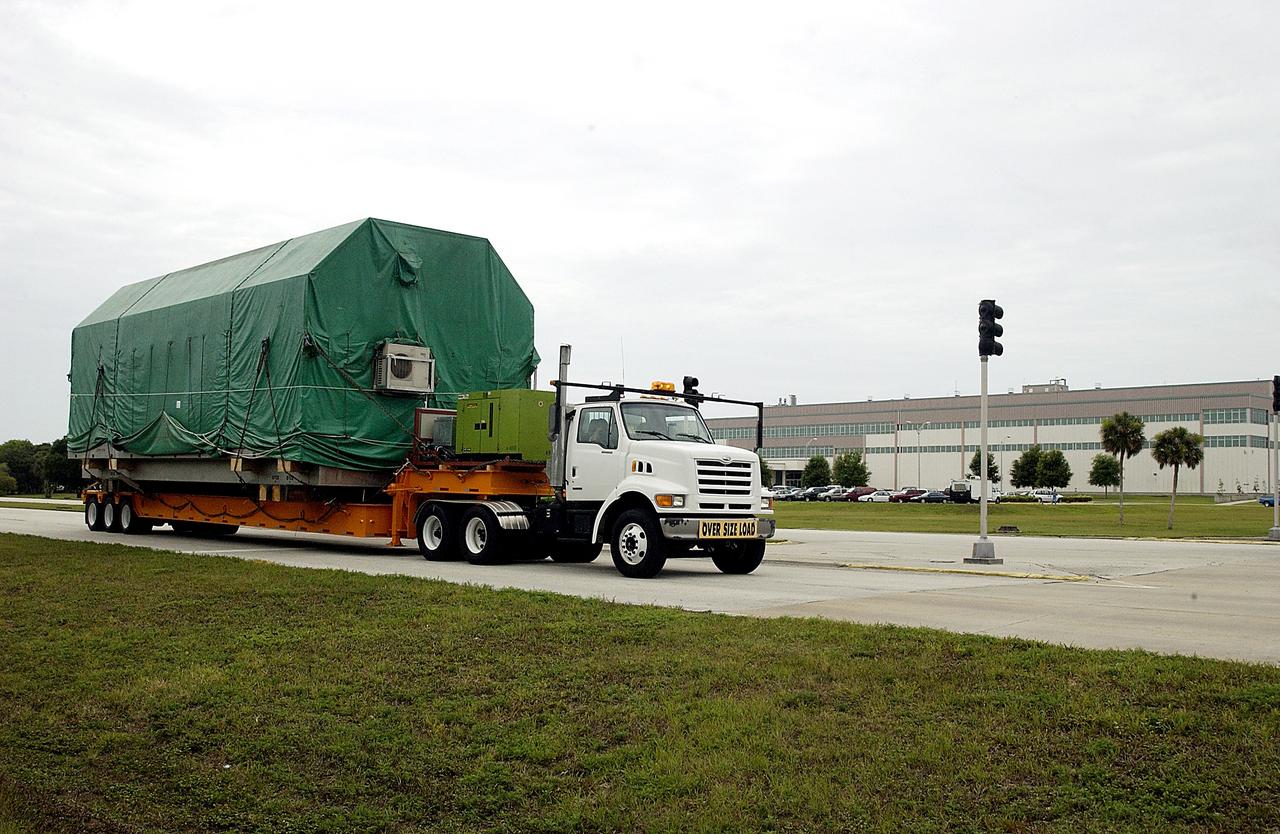
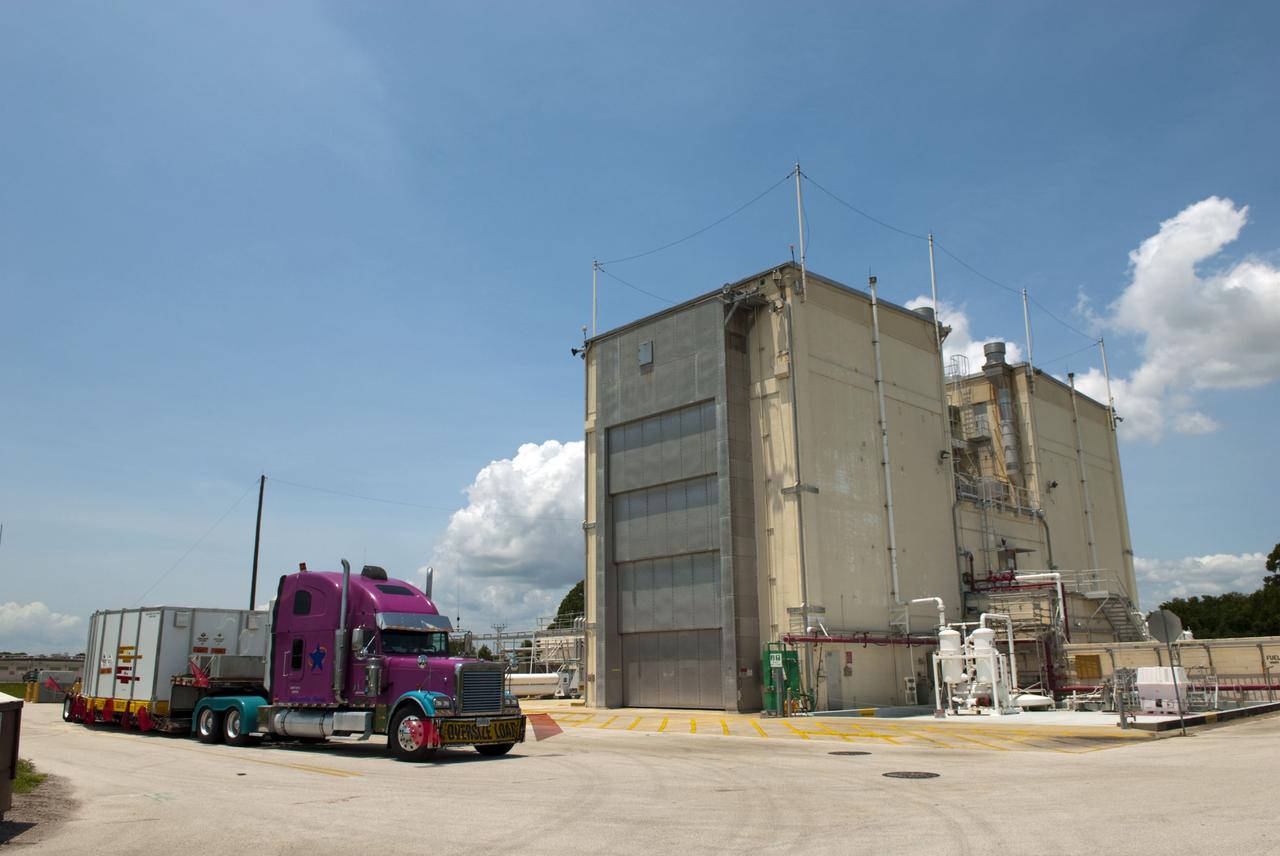
KENNEDY SPACE CENTER, FLA. - The truck transporting the Pressurized Module of the Japanese Experiment Module (JEM) to KSC’s Space Station Processing Facility arrives on Center. The National Space Development Agency of Japan (NASDA) developed the laboratory at the Tsukuba Space Center near Tokyo. The Pressurized Module is the first element of the JEM, named "Kibo" (Hope), to be delivered to KSC. The JEM is Japan's primary contribution to the Station. It will enhance the unique research capabilities of the orbiting complex by providing an additional environment for astronauts to conduct science experiments. The JEM also includes an exposed facility (platform) for space environment experiments, a robotic manipulator system, and two logistics modules. The various JEM components will be assembled in space over the course of three Shuttle missions.
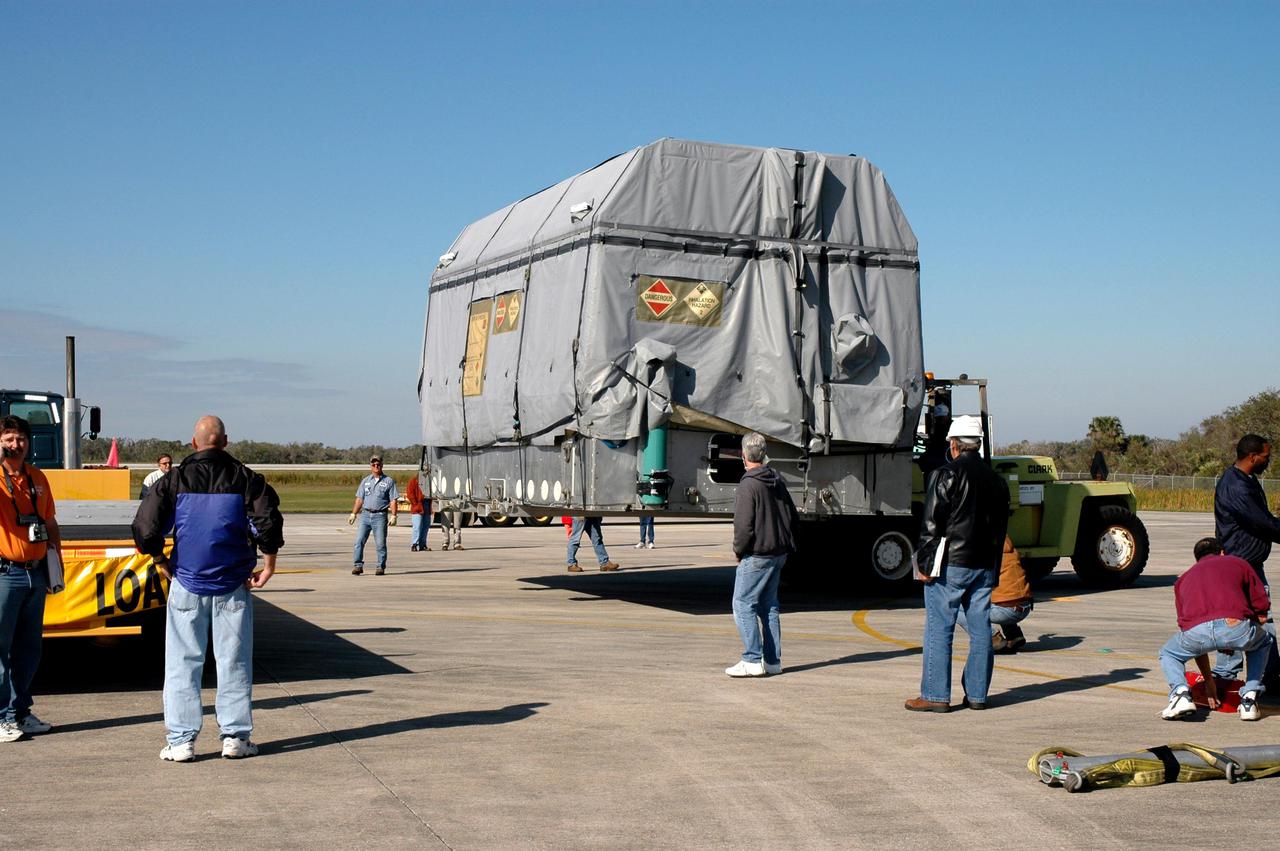
KENNEDY SPACE CENTER, FLA. - At KSC’s Shuttle Landing Facility, the latest Geostationary Operational Environmental Satellite (GOES) developed by NASA for the National Oceanic and Atmospheric Administration (NOAA) is lifted so it can be placed on a transporter. The satellite is being transported to Astrotech in Titusville, Fla., where final testing of the imaging system, instrumentation, communications and power systems will be performed over the next two months by Boeing Satellite Systems. Called GOES-N, the satellite is targeted to launch May 4 onboard a Boeing expendable launch vehicle Delta IV (4,2). Once in orbit GOES-N will be designated GOES-13 and will complete checkout and be placed in on-orbit storage as a replacement for an older GOES satellite.
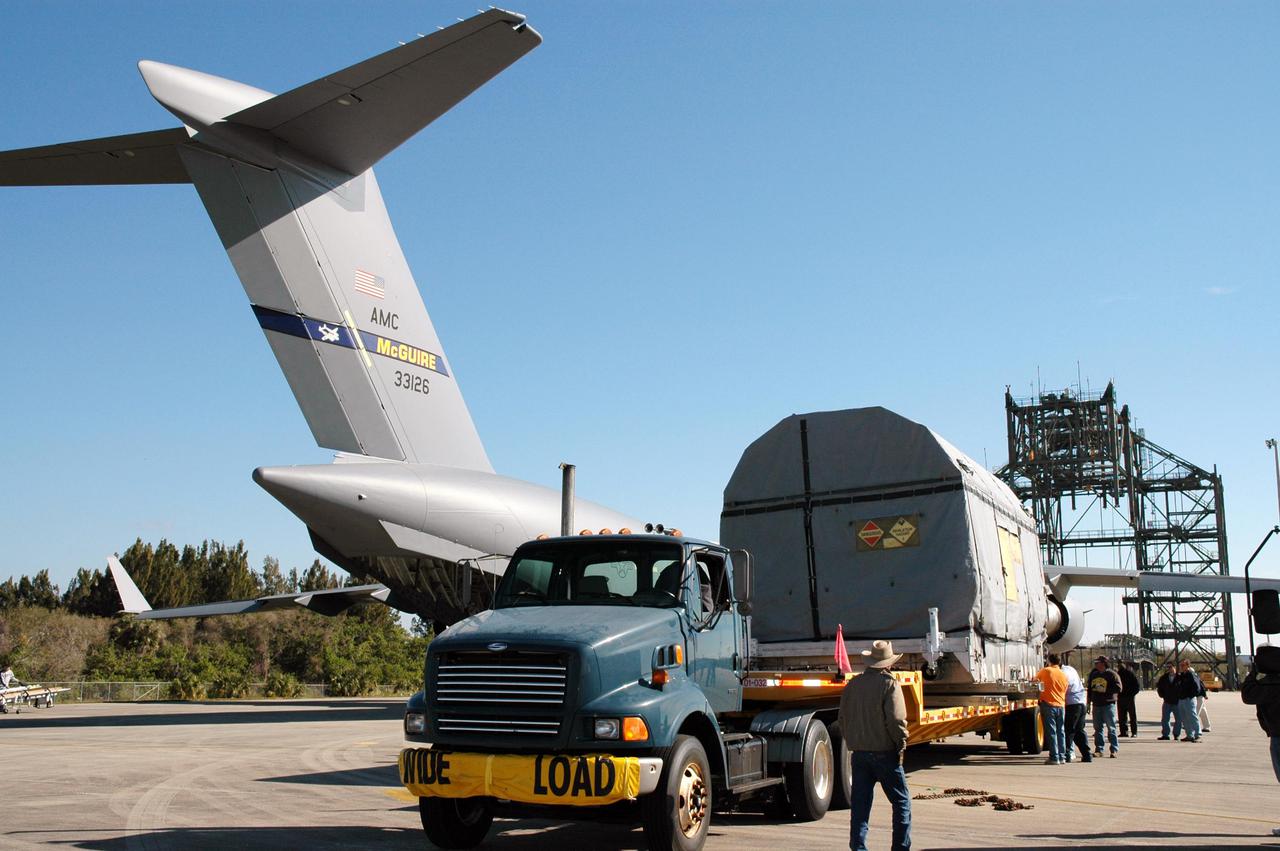
KENNEDY SPACE CENTER, FLA. - At KSC’s Shuttle Landing Facility, the latest Geostationary Operational Environmental Satellite (GOES) developed by NASA for the National Oceanic and Atmospheric Administration (NOAA) is secured on a transporter. The satellite is being transported to Astrotech in Titusville, Fla., where final testing of the imaging system, instrumentation, communications and power systems will be performed over the next two months by Boeing Satellite Systems. Called GOES-N, the satellite is targeted to launch May 4 onboard a Boeing expendable launch vehicle Delta IV (4,2). Once in orbit GOES-N will be designated GOES-13 and will complete checkout and be placed in on-orbit storage as a replacement for an older GOES satellite.
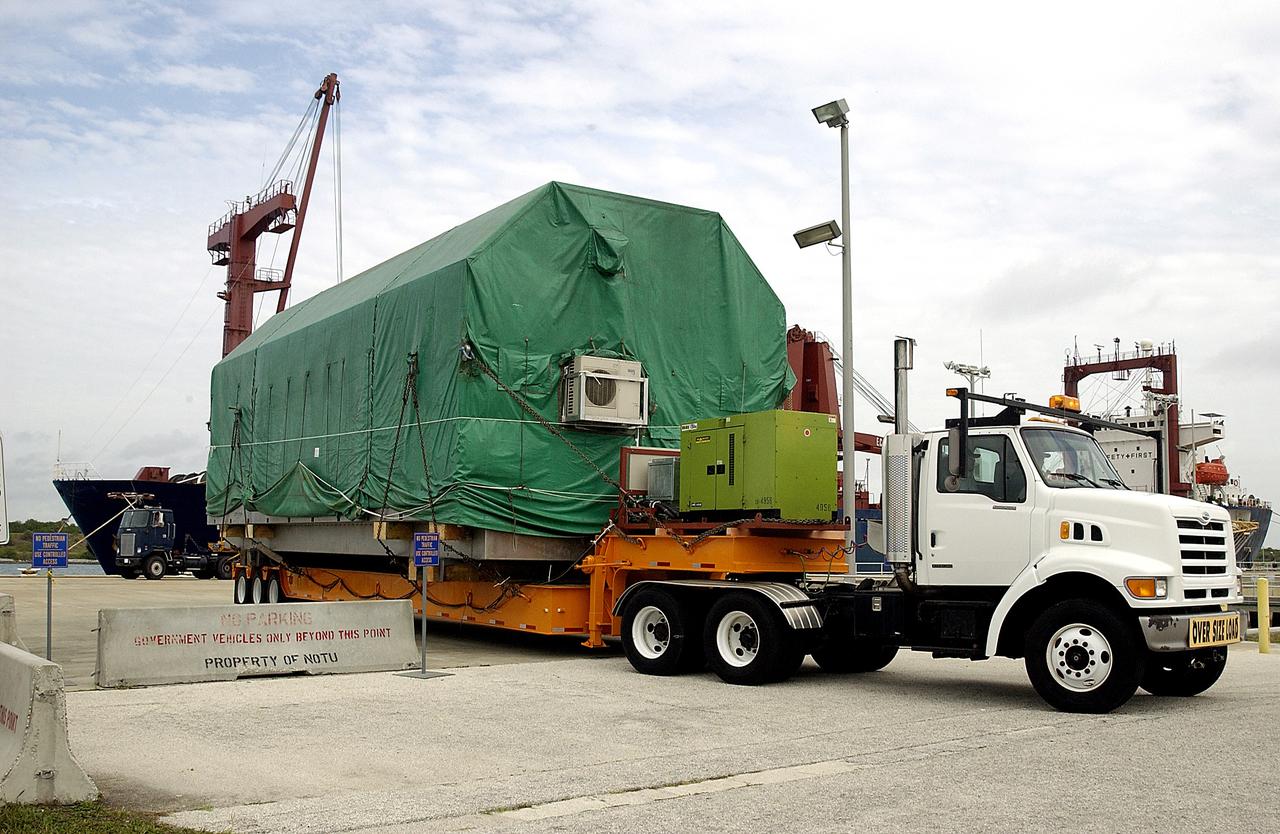
KENNEDY SPACE CENTER, FLA. - The transporter rolls out of Port Canaveral with the Pressurized Module of the Japanese Experiment Module (JEM) aboard. The National Space Development Agency of Japan (NASDA) developed the laboratory at the Tsukuba Space Center near Tokyo. The Pressurized Module is the first element of the JEM, named "Kibo" (Hope), to be delivered to KSC, and will be transferred to KSC’s Space Station Processing Facility. The JEM is Japan's primary contribution to the Station. It will enhance the unique research capabilities of the orbiting complex by providing an additional environment for astronauts to conduct science experiments. The JEM also includes an exposed facility (platform) for space environment experiments, a robotic manipulator system, and two logistics modules. The various JEM components will be assembled in space over the course of three Shuttle missions.
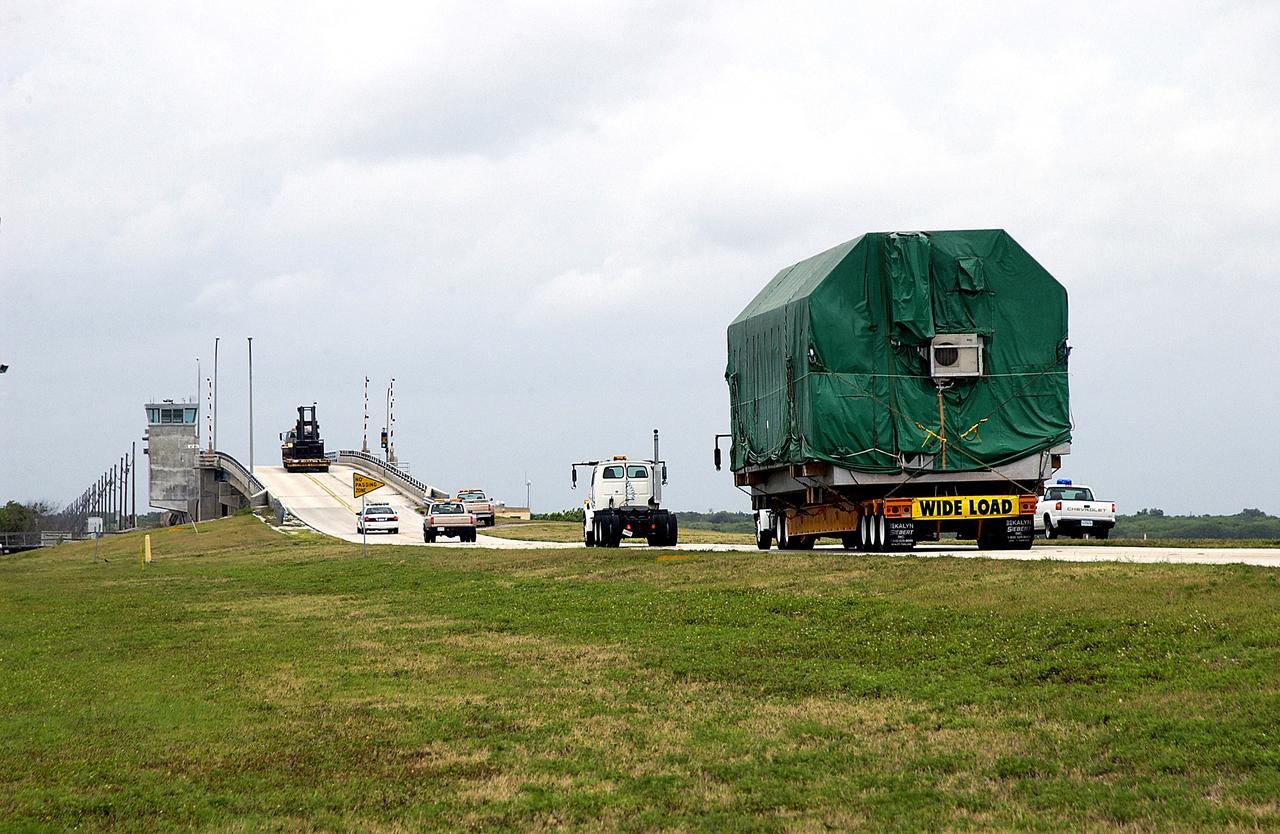
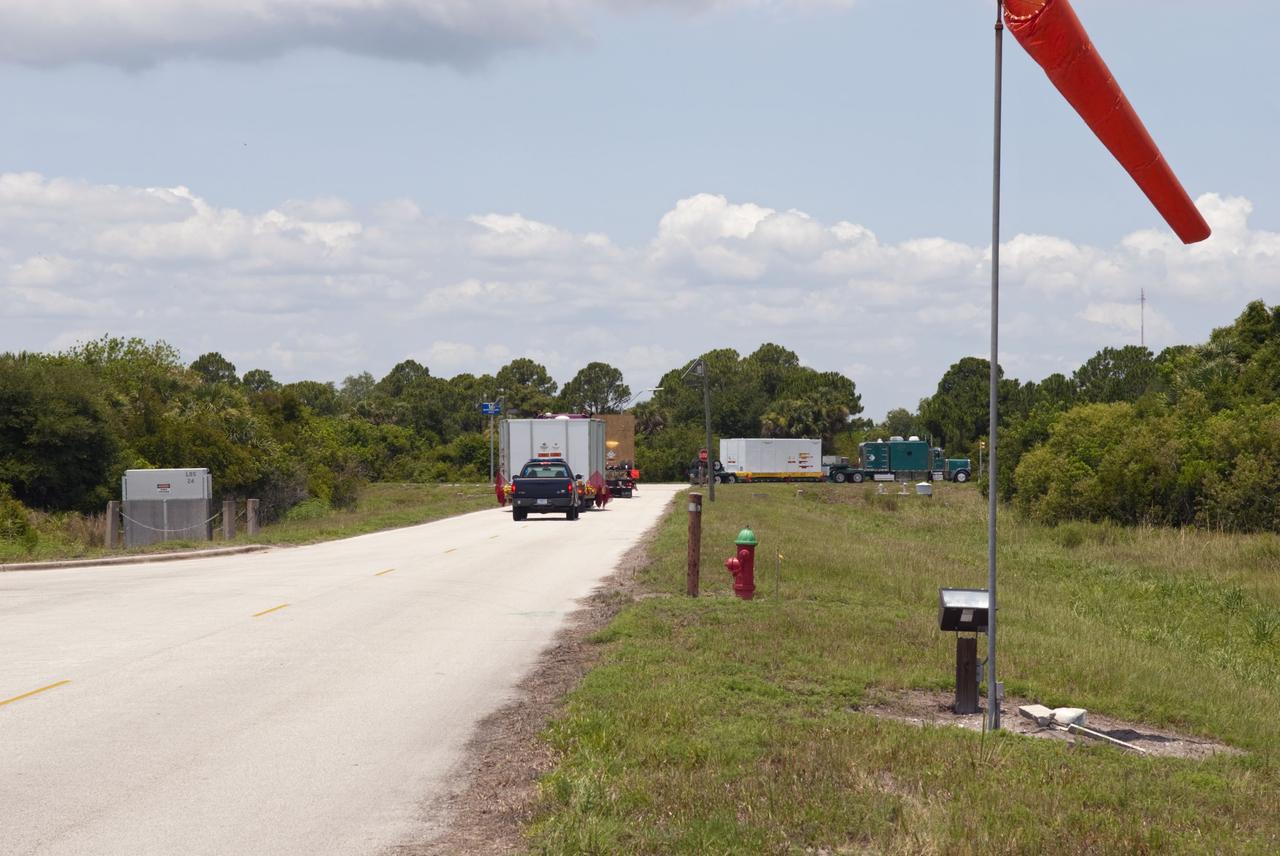
KENNEDY SPACE CENTER, FLA. - A convoy accompanies the truck transporting the Pressurized Module of the Japanese Experiment Module (JEM) to KSC’s Space Station Processing Facility. The National Space Development Agency of Japan (NASDA) developed the laboratory at the Tsukuba Space Center near Tokyo. The Pressurized Module is the first element of the JEM, named "Kibo" (Hope), to be delivered to KSC. The JEM is Japan's primary contribution to the Station. It will enhance the unique research capabilities of the orbiting complex by providing an additional environment for astronauts to conduct science experiments. The JEM also includes an exposed facility (platform) for space environment experiments, a robotic manipulator system, and two logistics modules. The various JEM components will be assembled in space over the course of three Shuttle missions.
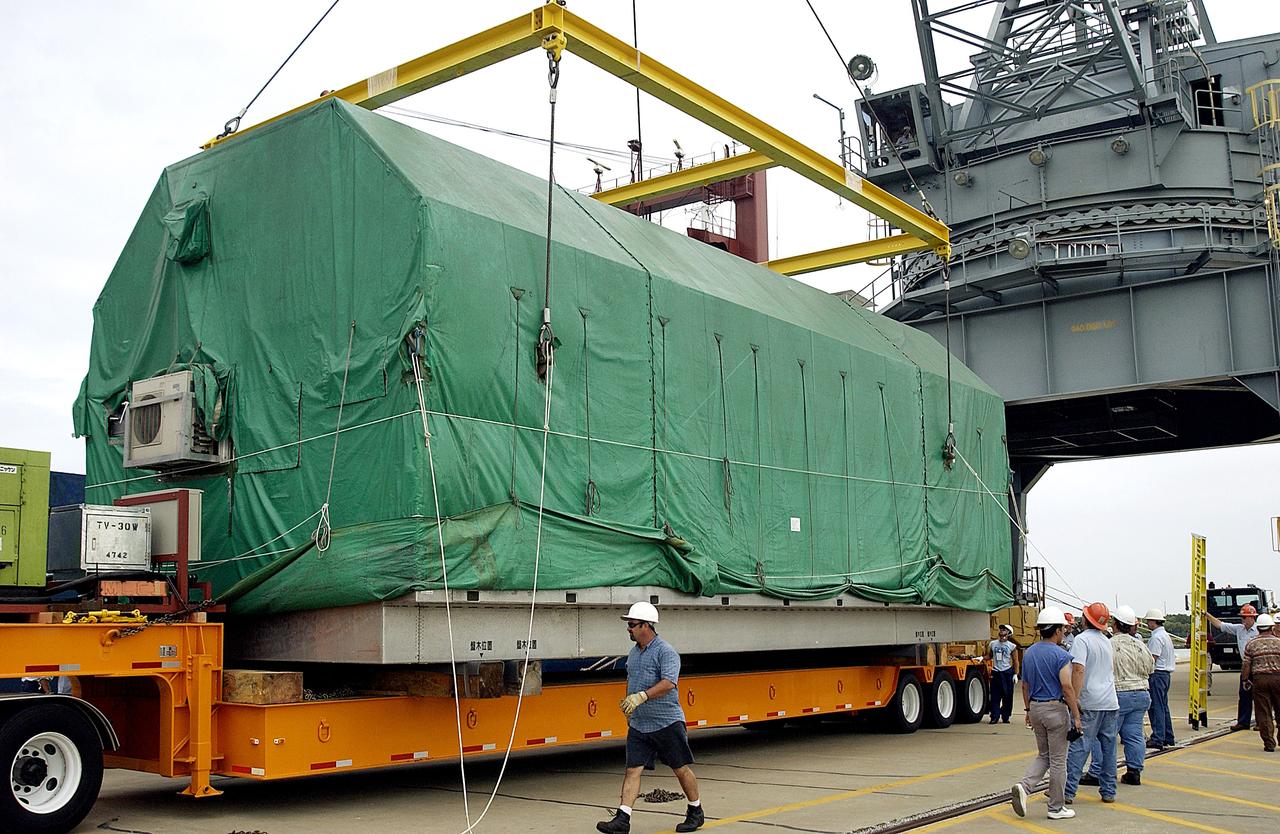
KENNEDY SPACE CENTER, FLA. - At Port Canaveral, the overhead crane that lifted the Pressurized Module of the Japanese Experiment Module (JEM) from the ship onto the truck bed is released. The container transport ship carrying JEM departed May 2 from Yokohama Harbor in Japan for the voyage to the United States. The National Space Development Agency of Japan (NASDA) developed the laboratory at the Tsukuba Space Center near Tokyo. The Pressurized Module is the first element of the JEM, named "Kibo" (Hope), to be delivered to KSC, and will be transferred to KSC’s Space Station Processing Facility. The JEM is Japan's primary contribution to the Station. It will enhance the unique research capabilities of the orbiting complex by providing an additional environment for astronauts to conduct science experiments. The JEM also includes an exposed facility (platform) for space environment experiments, a robotic manipulator system, and two logistics modules. The various JEM components will be assembled in space over the course of three Shuttle missions.
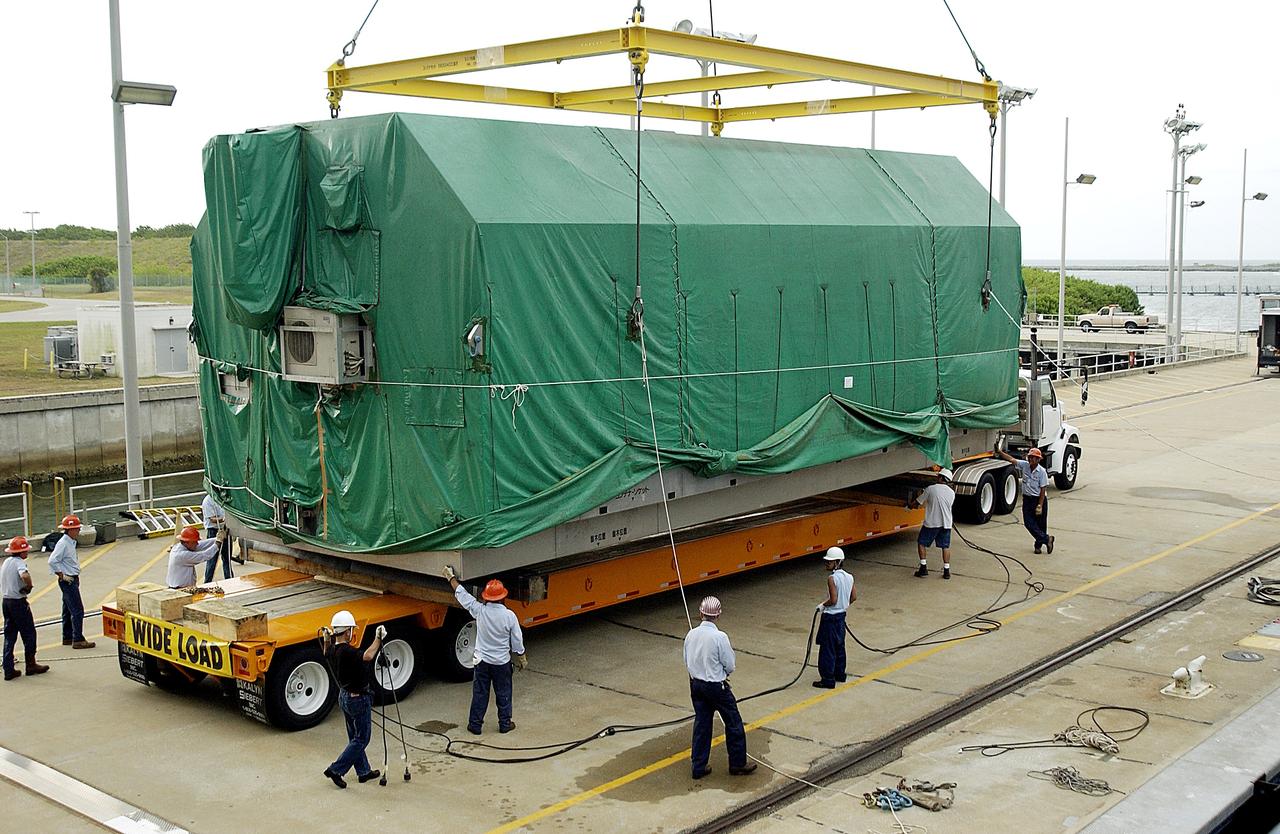
KENNEDY SPACE CENTER, FLA. - At Port Canaveral, the Pressurized Module of the Japanese Experiment Module (JEM) is lowered onto a truck bed for transfer to KSC’s Space Station Processing Facility. The container transport ship carrying JEM departed May 2 from Yokohama Harbor in Japan for the voyage to the United States. The National Space Development Agency of Japan (NASDA) developed the laboratory at the Tsukuba Space Center near Tokyo. The Pressurized Module is the first element of the JEM, named "Kibo" (Hope), to be delivered to KSC. The JEM is Japan's primary contribution to the Station. It will enhance the unique research capabilities of the orbiting complex by providing an additional environment for astronauts to conduct science experiments. The JEM also includes an exposed facility (platform) for space environment experiments, a robotic manipulator system, and two logistics modules. The various JEM components will be assembled in space over the course of three Shuttle missions.
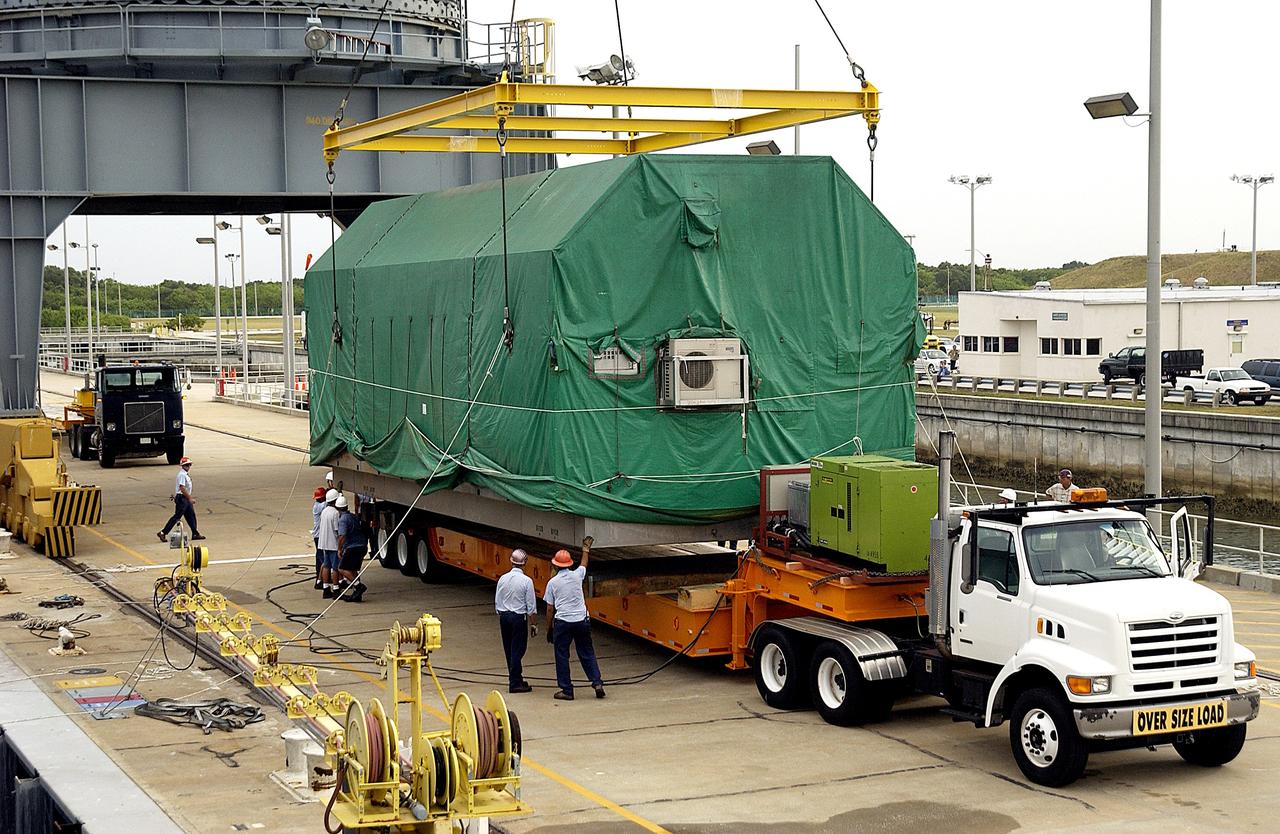
KENNEDY SPACE CENTER, FLA. - At Port Canaveral, the Pressurized Module of the Japanese Experiment Module (JEM) is settled on a truck bed for transfer to KSC’s Space Station Processing Facility. The container transport ship carrying JEM departed May 2 from Yokohama Harbor in Japan for the voyage to the United States. The National Space Development Agency of Japan (NASDA) developed the laboratory at the Tsukuba Space Center near Tokyo. The Pressurized Module is the first element of the JEM, named "Kibo" (Hope), to be delivered to KSC. The JEM is Japan's primary contribution to the Station. It will enhance the unique research capabilities of the orbiting complex by providing an additional environment for astronauts to conduct science experiments. The JEM also includes an exposed facility (platform) for space environment experiments, a robotic manipulator system, and two logistics modules. The various JEM components will be assembled in space over the course of three Shuttle missions.
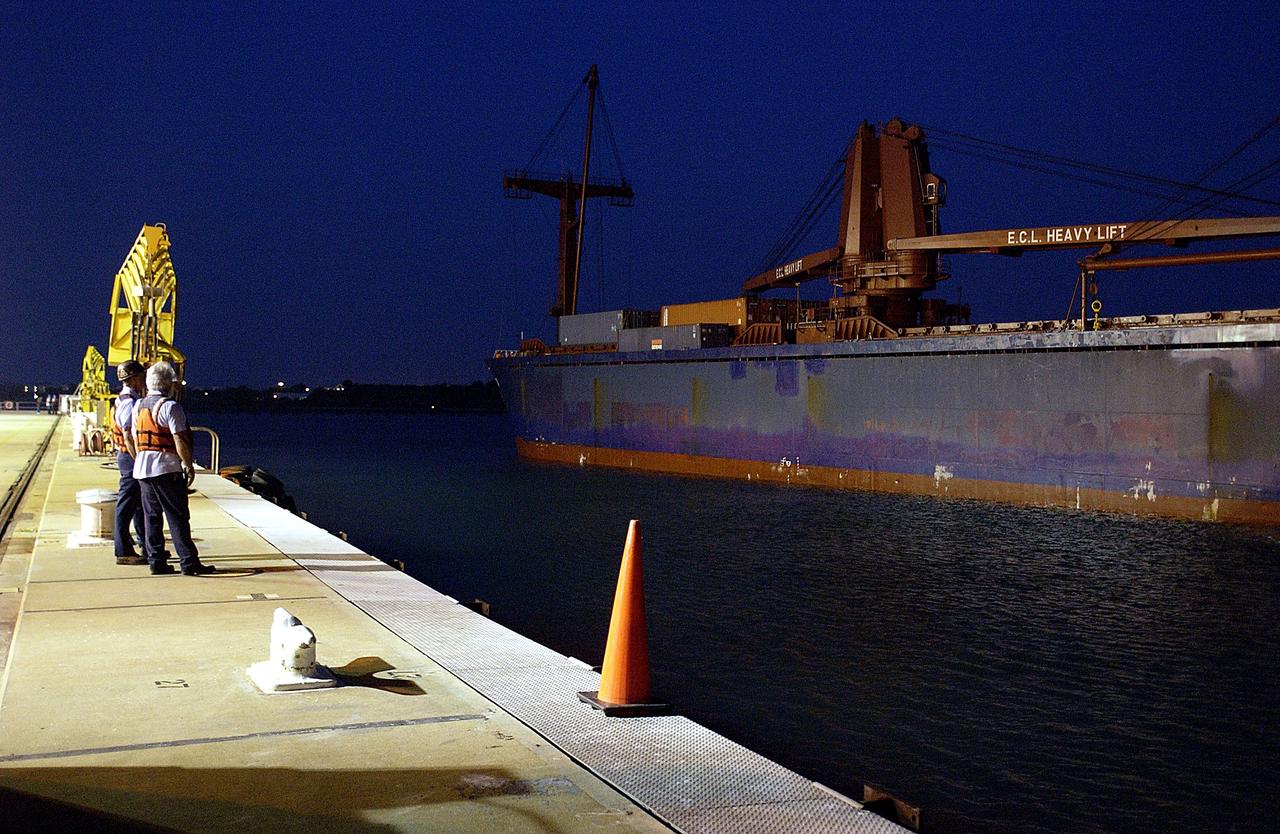
KENNEDY SPACE CENTER, FLA. - The container transport ship carrying the JEM Pressurized Module arrives at Port Canaveral, Fla. The National Space Development Agency of Japan (NASDA) built the laboratory at the Tsukuba Space Center near Tokyo. The Pressurized Module is the first element of the JEM, Japan’s primary contribution to the space station, to be delivered to KSC. It will enhance the unique research capabilities of the orbiting complex by providing an additional shirt-sleeve environment for astronauts to conduct science experiments. The JEM also includes two logistics modules, an exposed pallet for space environment experiments and a robotic manipulator system that are still under construction in Japan. The various JEM components will be assembled in space over the course of three space shuttle missions.
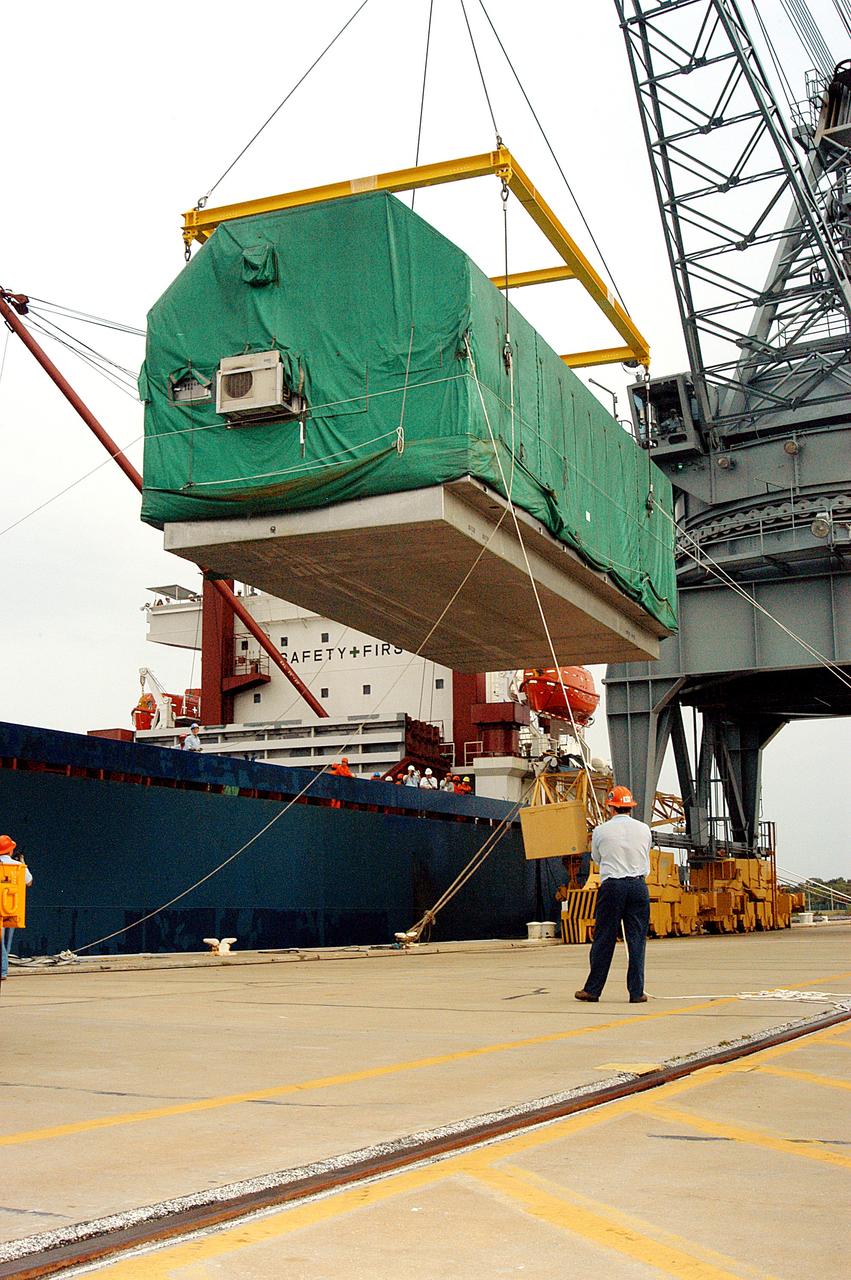
KENNEDY SPACE CENTER, FLA. - At Port Canaveral, the Pressurized Module of the Japanese Experiment Module (JEM) is suspended over the dock, waiting for a truck that will transfer it to KSC’s Space Station Processing Facility. The container transport ship carrying JEM departed May 2 from Yokohama Harbor in Japan for the voyage to the United States. The National Space Development Agency of Japan (NASDA) developed the laboratory at the Tsukuba Space Center near Tokyo. The Pressurized Module is the first element of the JEM, named "Kibo" (Hope), to be delivered to KSC. The JEM is Japan's primary contribution to the Station. It will enhance the unique research capabilities of the orbiting complex by providing an additional environment for astronauts to conduct science experiments. The JEM also includes an exposed facility (platform) for space environment experiments, a robotic manipulator system, and two logistics modules. The various JEM components will be assembled in space over the course of three Shuttle missions.
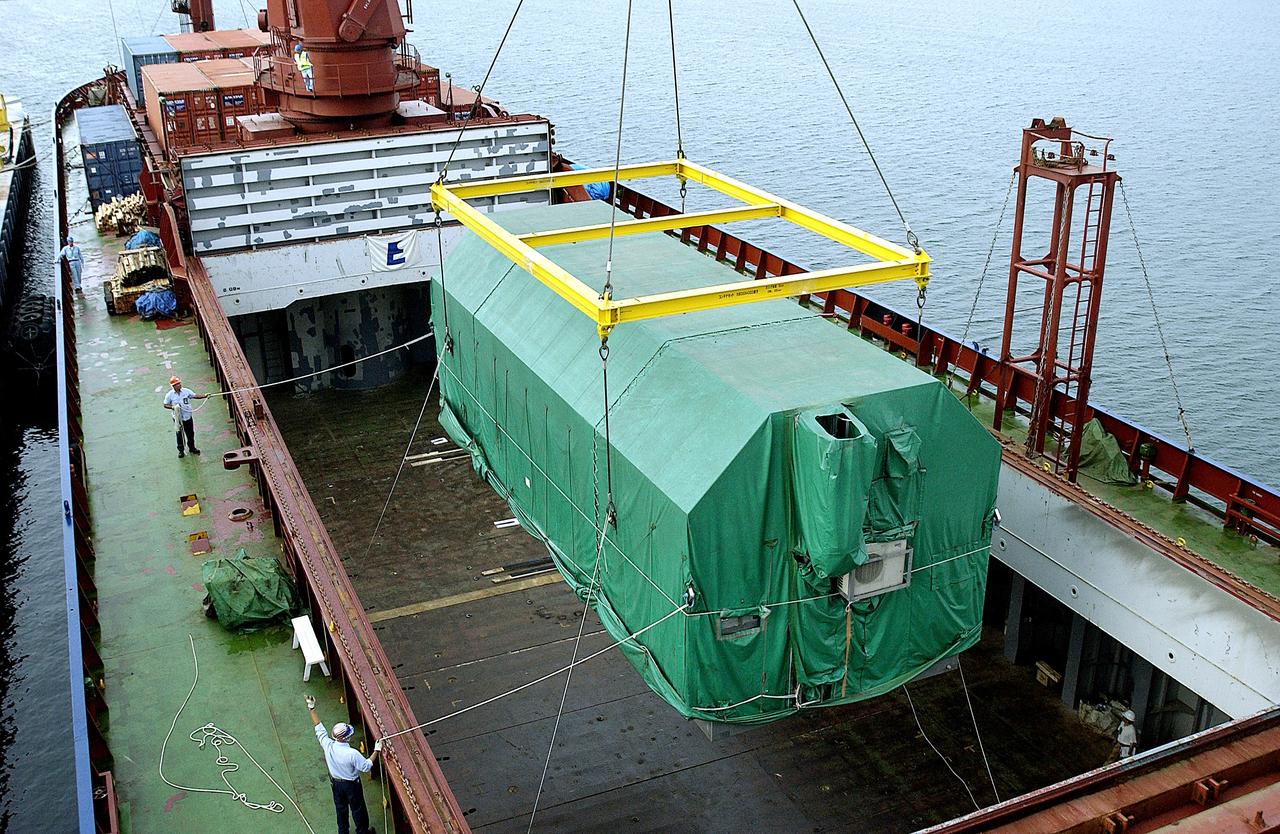
KENNEDY SPACE CENTER, FLA. - At Port Canaveral, the Pressurized Module of the Japanese Experiment Module (JEM) is lifted out of the ship’s cargo hold. The container transport ship carrying JEM departed May 2 from Yokohama Harbor in Japan for the voyage to the United States. The National Space Development Agency of Japan (NASDA) developed the laboratory at the Tsukuba Space Center near Tokyo. The Pressurized Module is the first element of the JEM, named "Kibo" (Hope), to be delivered to KSC. The JEM is Japan's primary contribution to the Station. It will enhance the unique research capabilities of the orbiting complex by providing an additional environment for astronauts to conduct science experiments. The JEM also includes an exposed facility (platform) for space environment experiments, a robotic manipulator system, and two logistics modules. The various JEM components will be assembled in space over the course of three Shuttle missions.
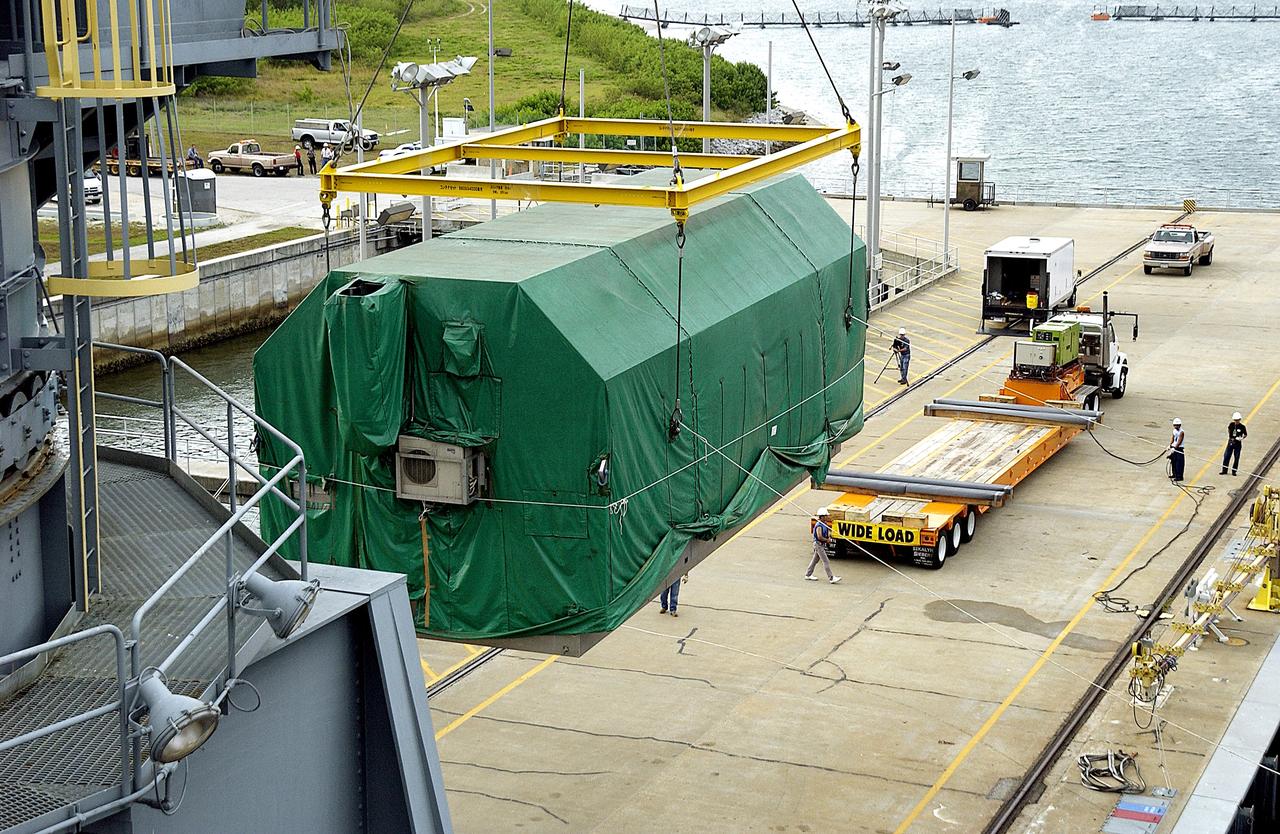
KENNEDY SPACE CENTER, FLA. - At Port Canaveral, the Pressurized Module of the Japanese Experiment Module (JEM) is lifted out of the ship’s cargo hold. It will be loaded onto the truck bed in the background for transfer to KSC’s Space Station Processing Facility. The container transport ship carrying JEM departed May 2 from Yokohama Harbor in Japan for the voyage to the United States. The National Space Development Agency of Japan (NASDA) developed the laboratory at the Tsukuba Space Center near Tokyo. The Pressurized Module is the first element of the JEM, named "Kibo" (Hope), to be delivered to KSC. The JEM is Japan's primary contribution to the Station. It will enhance the unique research capabilities of the orbiting complex by providing an additional environment for astronauts to conduct science experiments. The JEM also includes an exposed facility (platform) for space environment experiments, a robotic manipulator system, and two logistics modules. The various JEM components will be assembled in space over the course of three Shuttle missions.
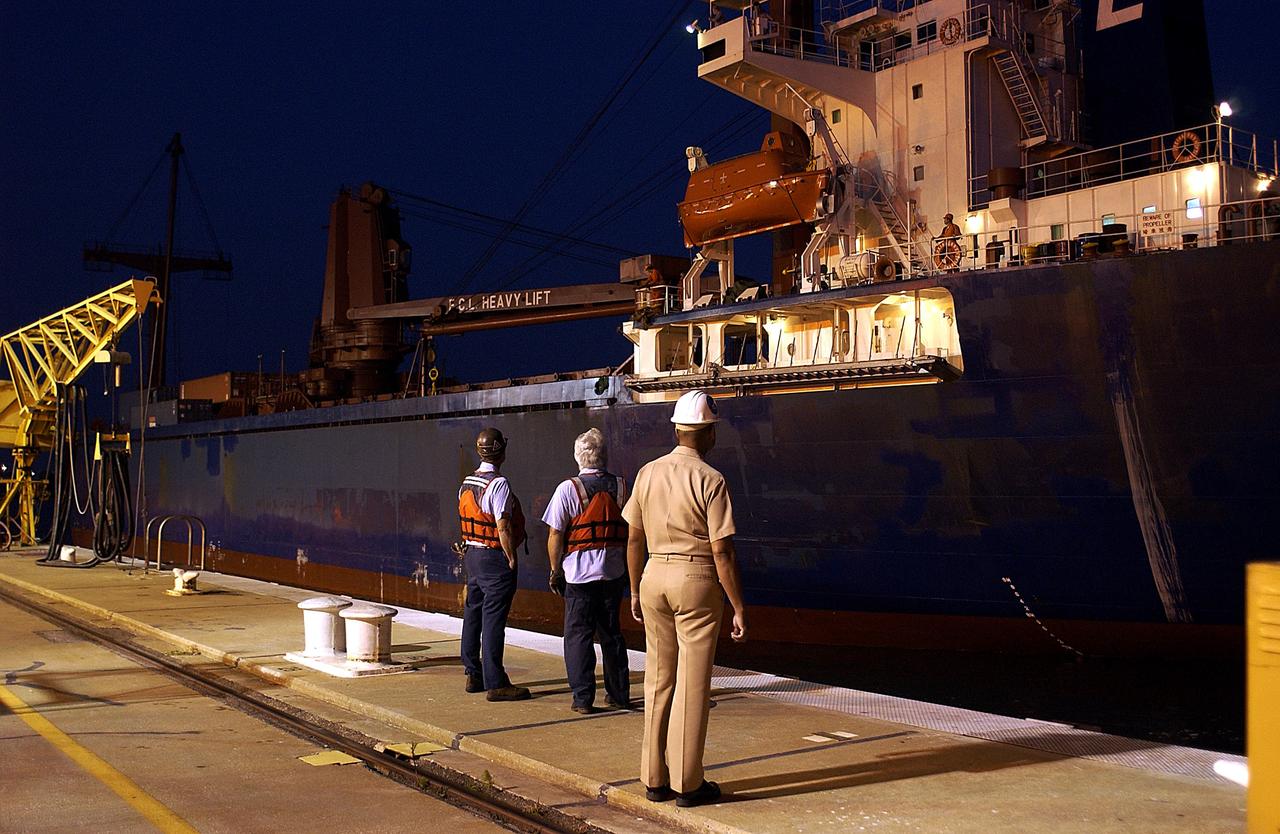
KENNEDY SPACE CENTER, FLA. - The container transport ship carrying the JEM Pressurized Module arrives at Port Canaveral, Fla. The National Space Development Agency of Japan (NASDA) built the laboratory at the Tsukuba Space Center near Tokyo. The Pressurized Module is the first element of the JEM, Japan’s primary contribution to the space station, to be delivered to KSC. It will enhance the unique research capabilities of the orbiting complex by providing an additional shirt-sleeve environment for astronauts to conduct science experiments. The JEM also includes two logistics modules, an exposed pallet for space environment experiments and a robotic manipulator system that are still under construction in Japan. The various JEM components will be assembled in space over the course of three space shuttle missions.

KENNEDY SPACE CENTER, FLA. - At Port Canaveral, the Pressurized Module of the Japanese Experiment Module (JEM) is swung away from the ship. The container transport ship carrying JEM departed May 2 from Yokohama Harbor in Japan for the voyage to the United States. The National Space Development Agency of Japan (NASDA) developed the laboratory at the Tsukuba Space Center near Tokyo. The module will be loaded onto a truck bed and transferred to KSC’s Space Station Processing Facility. The Pressurized Module is the first element of the JEM, named "Kibo" (Hope), to be delivered to KSC. The JEM is Japan's primary contribution to the Station. It will enhance the unique research capabilities of the orbiting complex by providing an additional environment for astronauts to conduct science experiments. The JEM also includes an exposed facility (platform) for space environment experiments, a robotic manipulator system, and two logistics modules. The various JEM components will be assembled in space over the course of three Shuttle missions.

KENNEDY SPACE CENTER, FLA. - At Port Canaveral, the Pressurized Module of the Japanese Experiment Module (JEM) is lowered onto a truck bed. The container transport ship carrying JEM departed May 2 from Yokohama Harbor in Japan for the voyage to the United States. The National Space Development Agency of Japan (NASDA) developed the laboratory at the Tsukuba Space Center near Tokyo. The Pressurized Module is the first element of the JEM, named "Kibo" (Hope), to be delivered to KSC and will be transferred to the Space Station Processing Facility. The JEM is Japan's primary contribution to the Station. It will enhance the unique research capabilities of the orbiting complex by providing an additional environment for astronauts to conduct science experiments. The JEM also includes an exposed facility (platform) for space environment experiments, a robotic manipulator system, and two logistics modules. The various JEM components will be assembled in space over the course of three Shuttle missions.
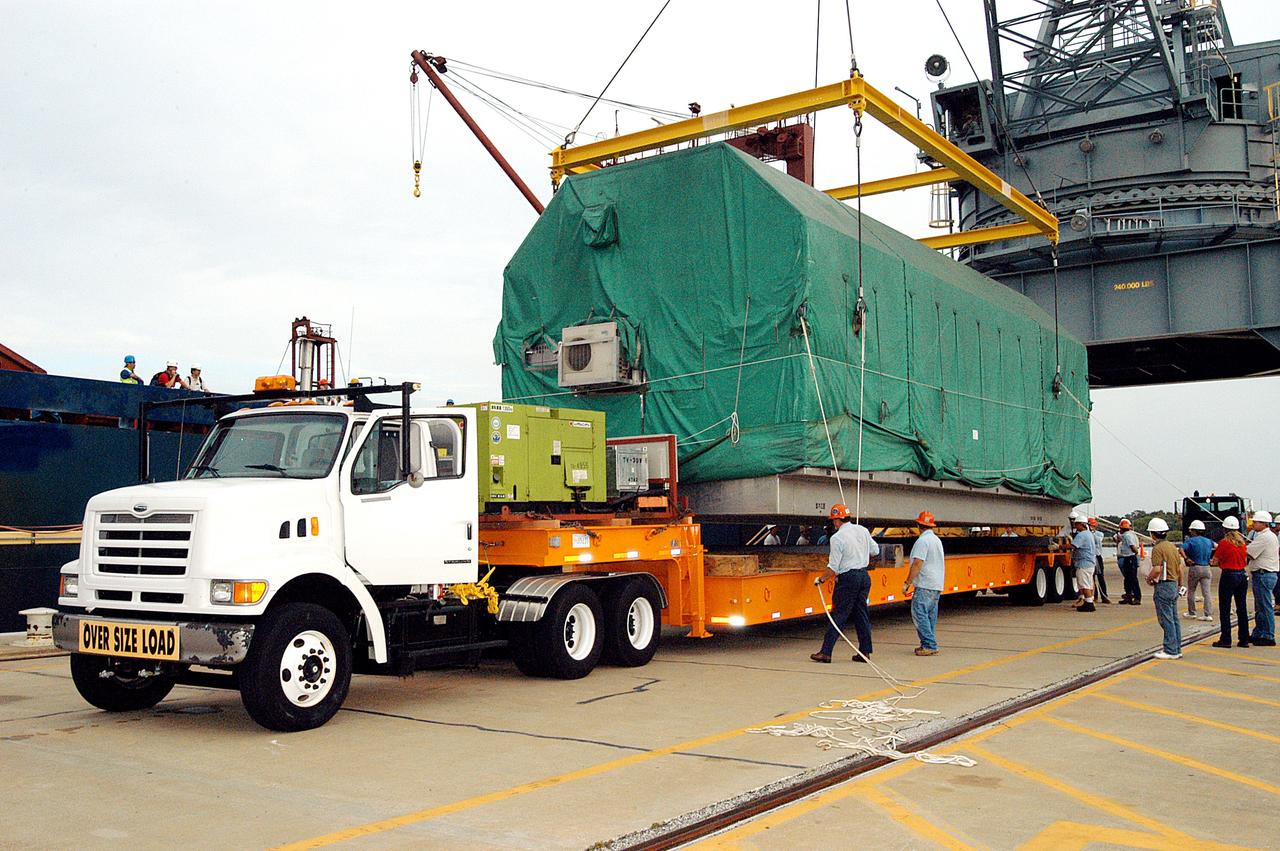
KENNEDY SPACE CENTER, FLA. - At Port Canaveral, workers release the overhead crane that lifted the Pressurized Module of the Japanese Experiment Module (JEM) from the ship onto the truck bed. The container transport ship carrying JEM departed May 2 from Yokohama Harbor in Japan for the voyage to the United States. The National Space Development Agency of Japan (NASDA) developed the laboratory at the Tsukuba Space Center near Tokyo. The Pressurized Module is the first element of the JEM, named "Kibo" (Hope), to be delivered to KSC, and will be transferred to KSC’s Space Station Processing Facility. The JEM is Japan's primary contribution to the Station. It will enhance the unique research capabilities of the orbiting complex by providing an additional environment for astronauts to conduct science experiments. The JEM also includes an exposed facility (platform) for space environment experiments, a robotic manipulator system, and two logistics modules. The various JEM components will be assembled in space over the course of three Shuttle missions.
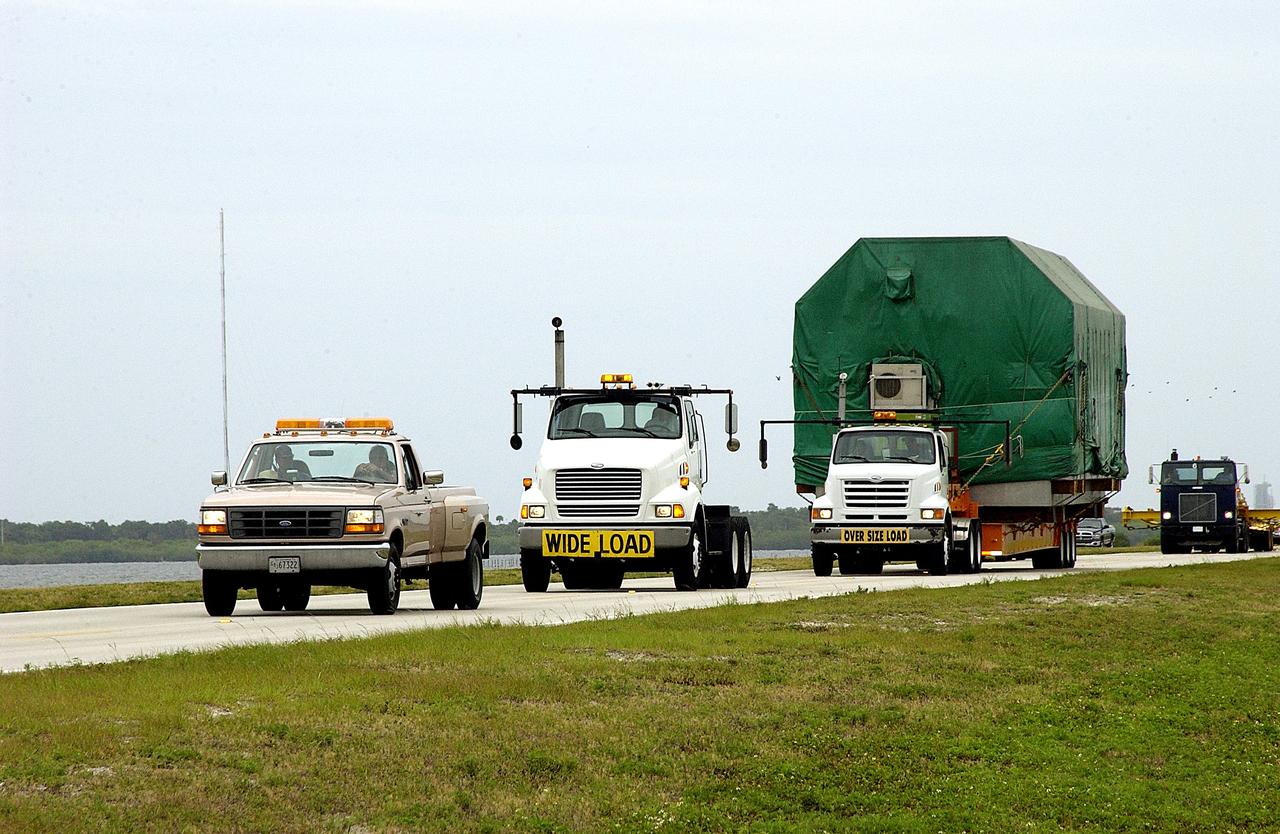
KENNEDY SPACE CENTER, FLA. - A convoy accompanies the truck transporting the Pressurized Module of the Japanese Experiment Module (JEM) to KSC’s Space Station Processing Facility. The National Space Development Agency of Japan (NASDA) developed the laboratory at the Tsukuba Space Center near Tokyo. The Pressurized Module is the first element of the JEM, named "Kibo" (Hope), to be delivered to KSC. The JEM is Japan's primary contribution to the Station. It will enhance the unique research capabilities of the orbiting complex by providing an additional environment for astronauts to conduct science experiments. The JEM also includes an exposed facility (platform) for space environment experiments, a robotic manipulator system, and two logistics modules. The various JEM components will be assembled in space over the course of three Shuttle missions.
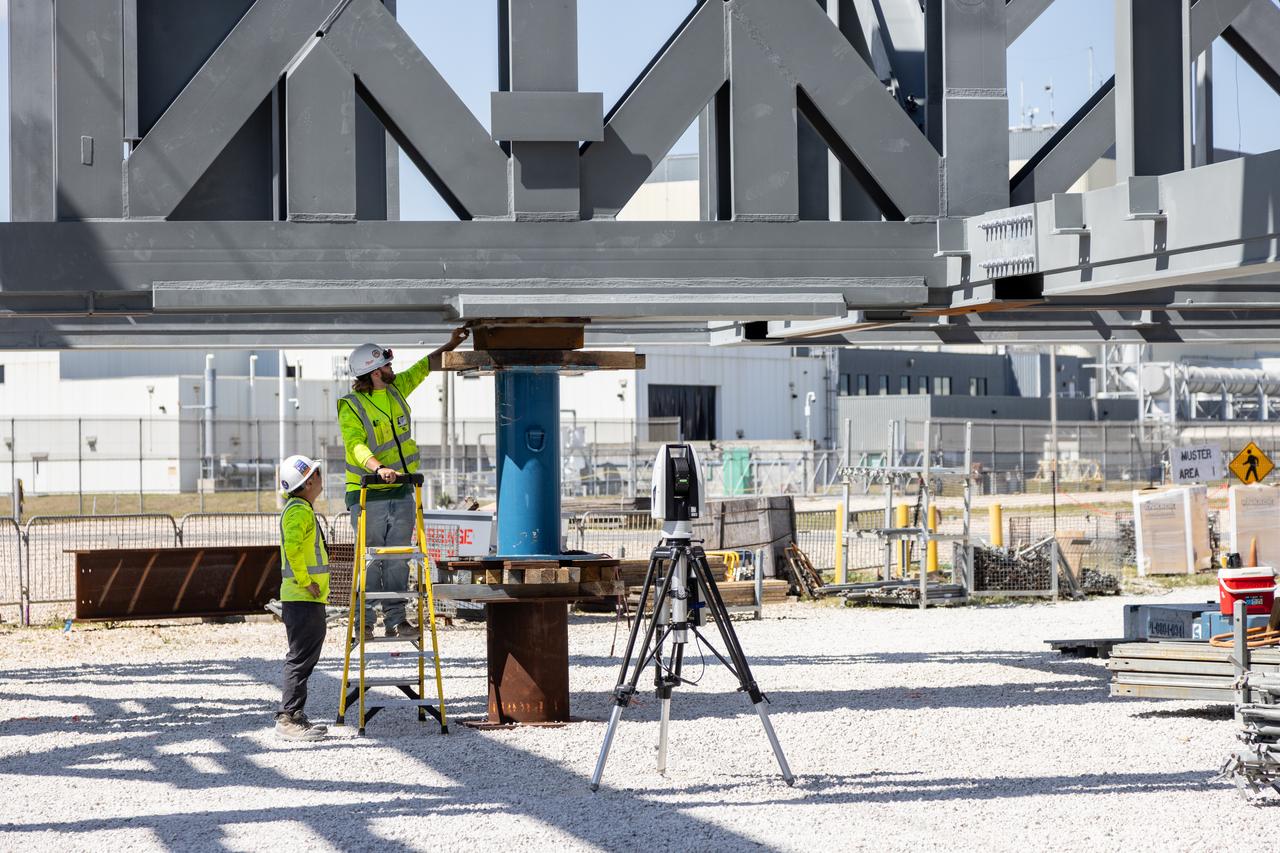
Teams with NASA’s Exploration Ground Systems Program and Bechtel National, Inc., the prime contractor for NASA’s mobile launcher 2, continue construction on the new mobile launcher at the agency’s Kennedy Space Center in Florida on Wednesday, April 24, 2024. Once completed and able to be carried atop the crawler-transporter, the 355-foot-tall mobile launcher 2 will be used during assembly, processing, and launch of the SLS (Space Launch System) rocket and Orion spacecraft on NASA’s upcoming Artemis missions to the Moon beginning with Artemis IV.
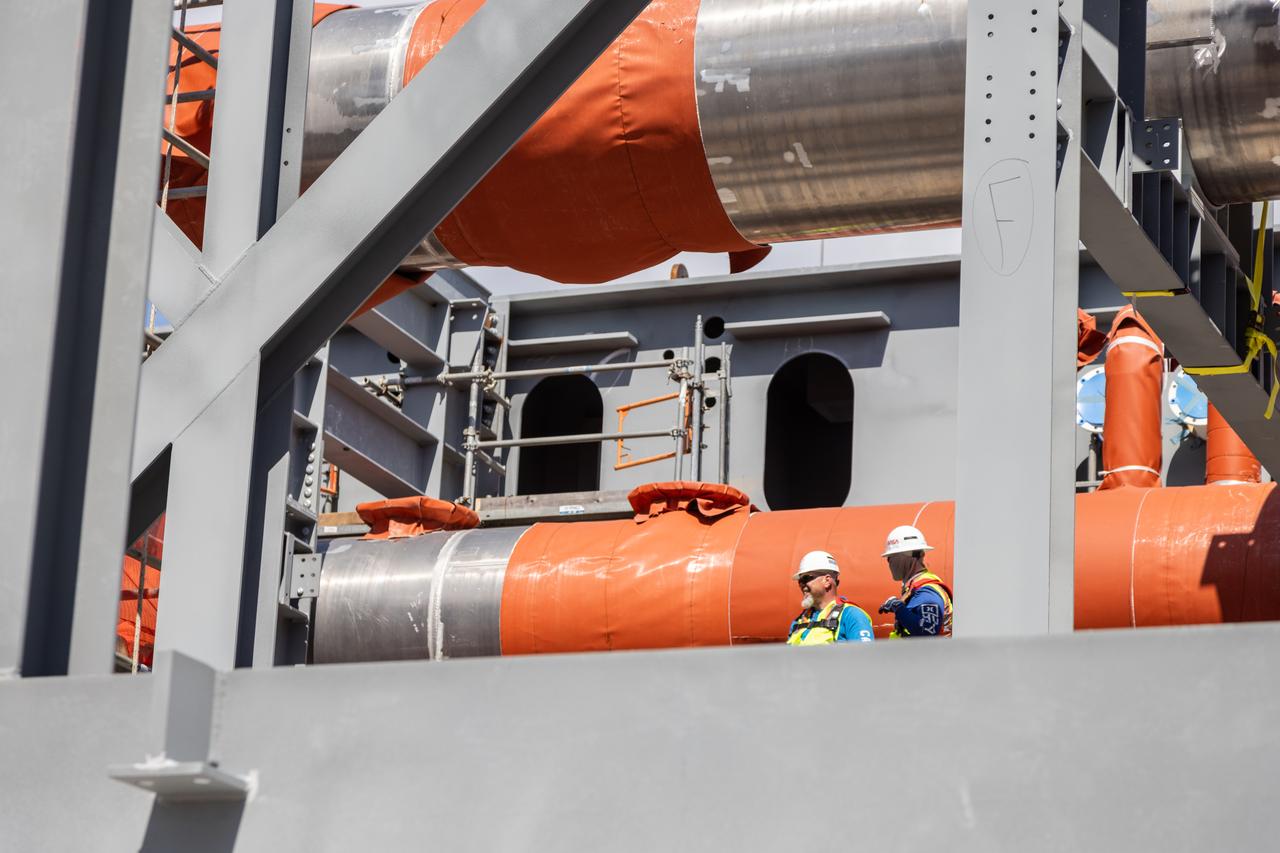
Teams with NASA’s Exploration Ground Systems Program and Bechtel National, Inc., the prime contractor for NASA’s mobile launcher 2, continue construction on the new mobile launcher at the agency’s Kennedy Space Center in Florida on Wednesday, April 24, 2024. Once completed and able to be carried atop the crawler-transporter, the 355-foot-tall mobile launcher 2 will be used during assembly, processing, and launch of the SLS (Space Launch System) rocket and Orion spacecraft on NASA’s upcoming Artemis missions to the Moon beginning with Artemis IV.
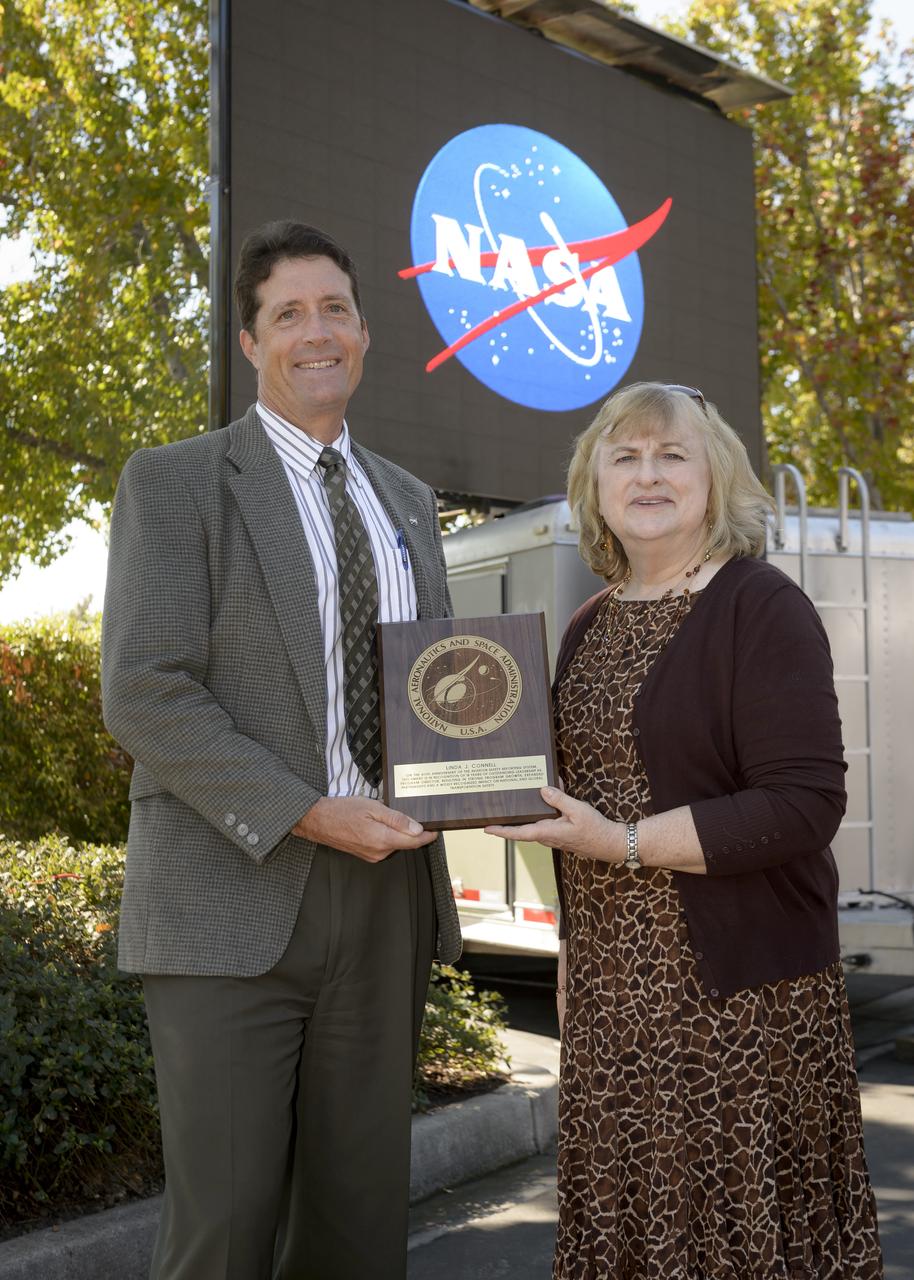
Avation Safety Reporting System (ASRS) 40th Anniversary lunch and open house at the Sunnyvale office. Thomas A Edwards, Deputy Center Director NASA Ames (Left), presents a plaque On the anniversary of the aviation safety reporting system, this award is in recognition of 18 years of outstanding leadership as Program Director, resulting in strong program growth, expanded partnership and a widely recognized impact on National and Global transportation safety. Presented to Linda J. Connell, ASRS Program Director (Right)
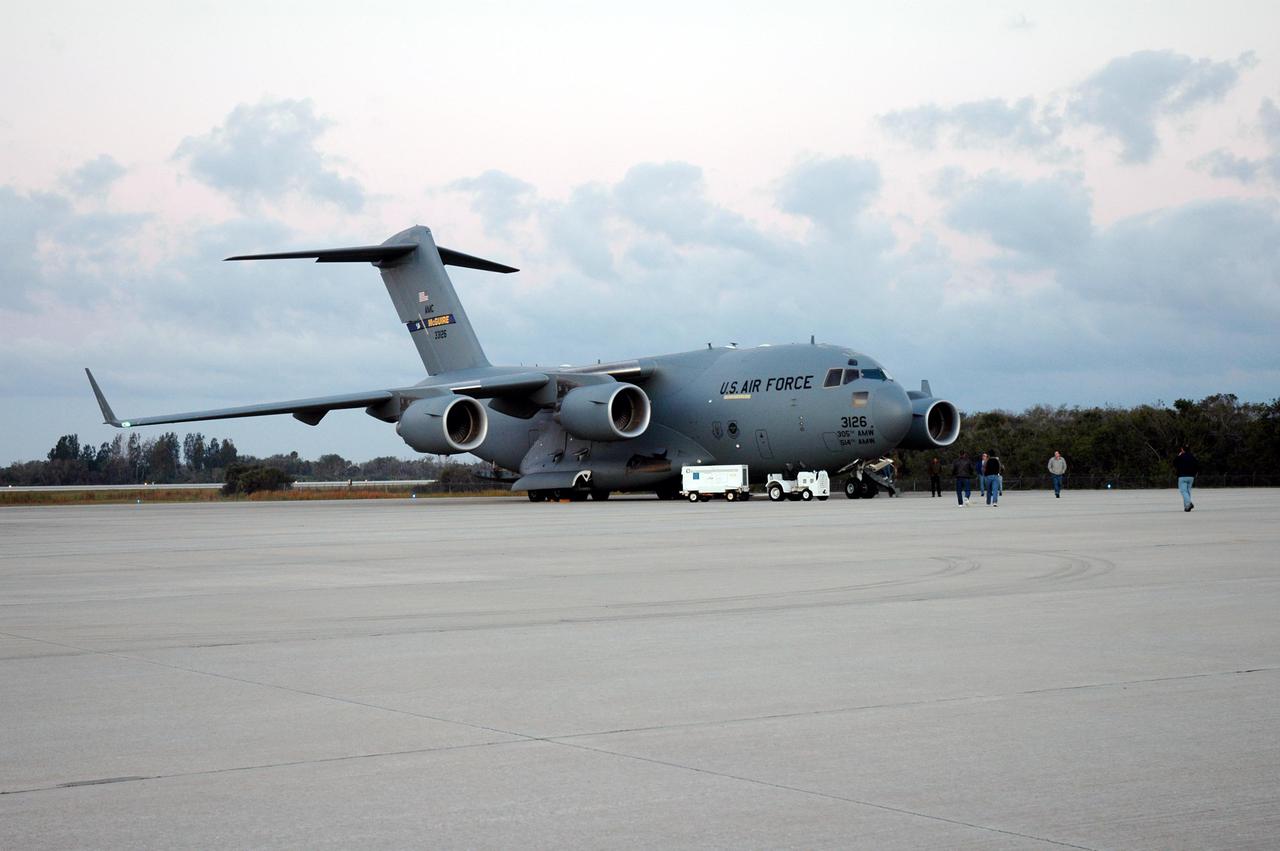
KENNEDY SPACE CENTER, FLA. - A C17 military cargo aircraft at KSC’s Shuttle Landing Facility delivers the latest Geostationary Operational Environmental Satellite (GOES) developed by NASA for the National Oceanic and Atmospheric Administration (NOAA). Called GOES-N, the satellite is targeted to launch May 4 onboard a Boeing expendable launch vehicle Delta IV (4,2). Once in orbit GOES-N will be designated GOES-13 and will complete checkout and be placed in on-orbit storage as a replacement for an older GOES satellite. After arriving, the satellite was transported to Astrotech in Titusville, Fla., where final testing of the imaging system, instrumentation, communications and power systems will be performed over the next two months by Boeing Satellite Systems.
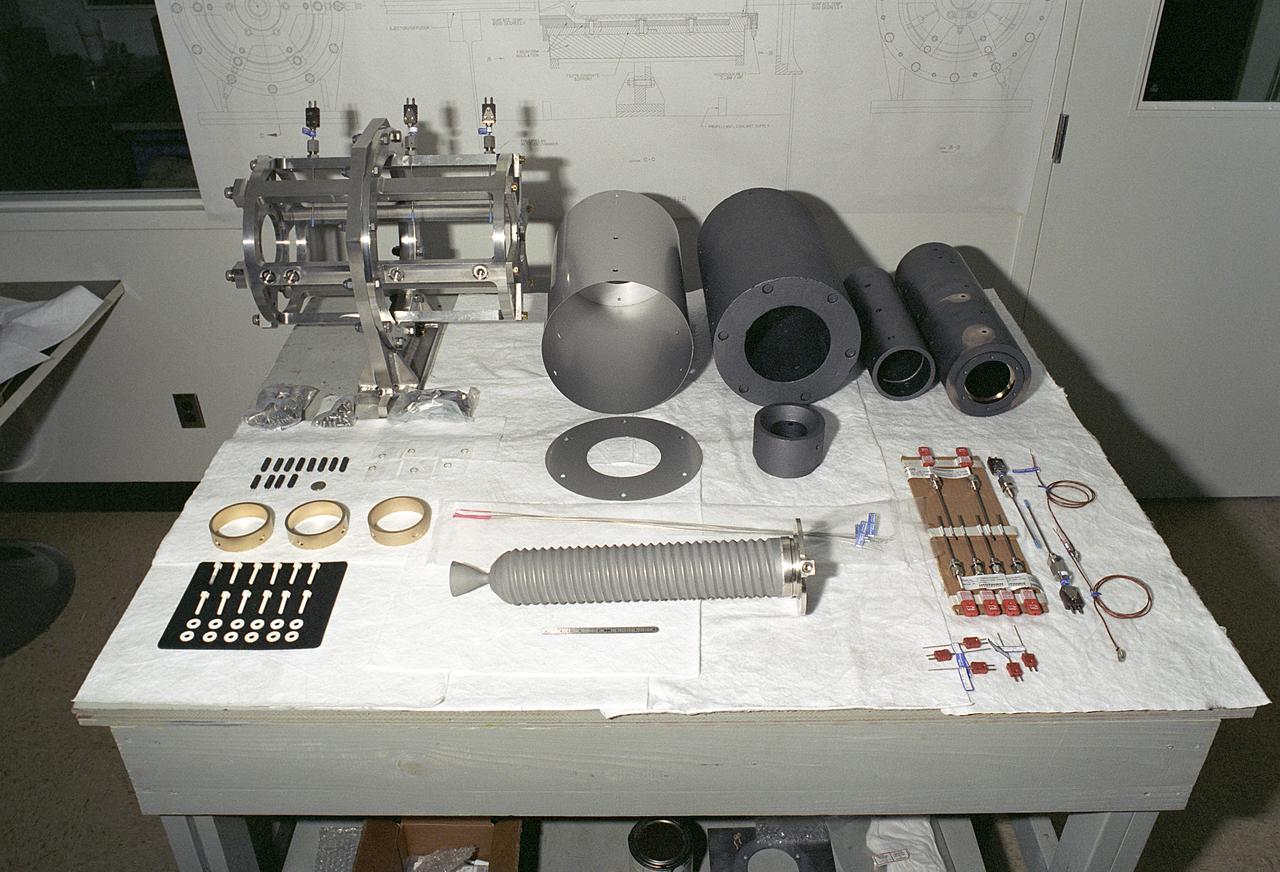
Researchers at the Marshall Space Flight Center (MSFC) have designed, fabricated, and tested the first solar thermal engine, a non-chemical rocket engine that produces lower thrust but has better thrust efficiency than a chemical combustion engine. This photograph shows components for the thermal propulsion engine being laid out prior to assembly. MSFC turned to solar thermal propulsion in the early 1990s due to its simplicity, safety, low cost, and commonality with other propulsion systems. As part of MSFC's Space Transportation Directorate, the Propulsion Research Center serves as a national resource for research of advanced, revolutionary propulsion technologies. The mission is to move the Nation's capabilities beyond the confines of conventional chemical propulsion into an era of aircraft-like access to Earth-orbit, rapid travel throughout the solar system, and exploration of interstellar space.
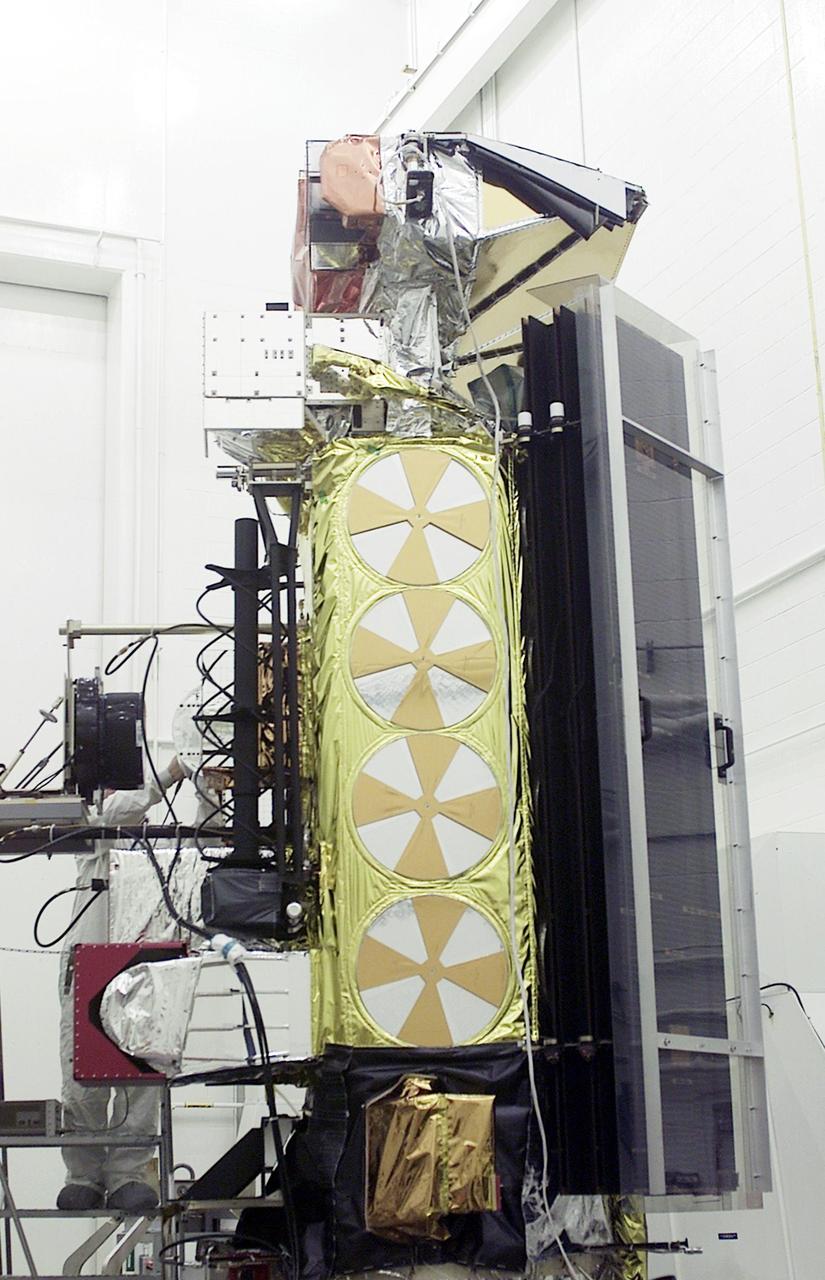
KENNEDY SPACE CENTER, FLA. - The National Oceanic and Atmospheric Administration (NOAA-M) spacecraft undergoes end-to-end testing in checkout hangar 1610 on North Vandenberg Air Force Base. The spacecraft is nearing process completion for transportation to Launch Complex 4W. NOAA-M is another in a series of polar-orbiting Earth environmental observation satellites that provide global data to NOAA's short- and long-range weather forecasting systems. Launch aboard a Titan II rocket is scheduled for June 25, 2002
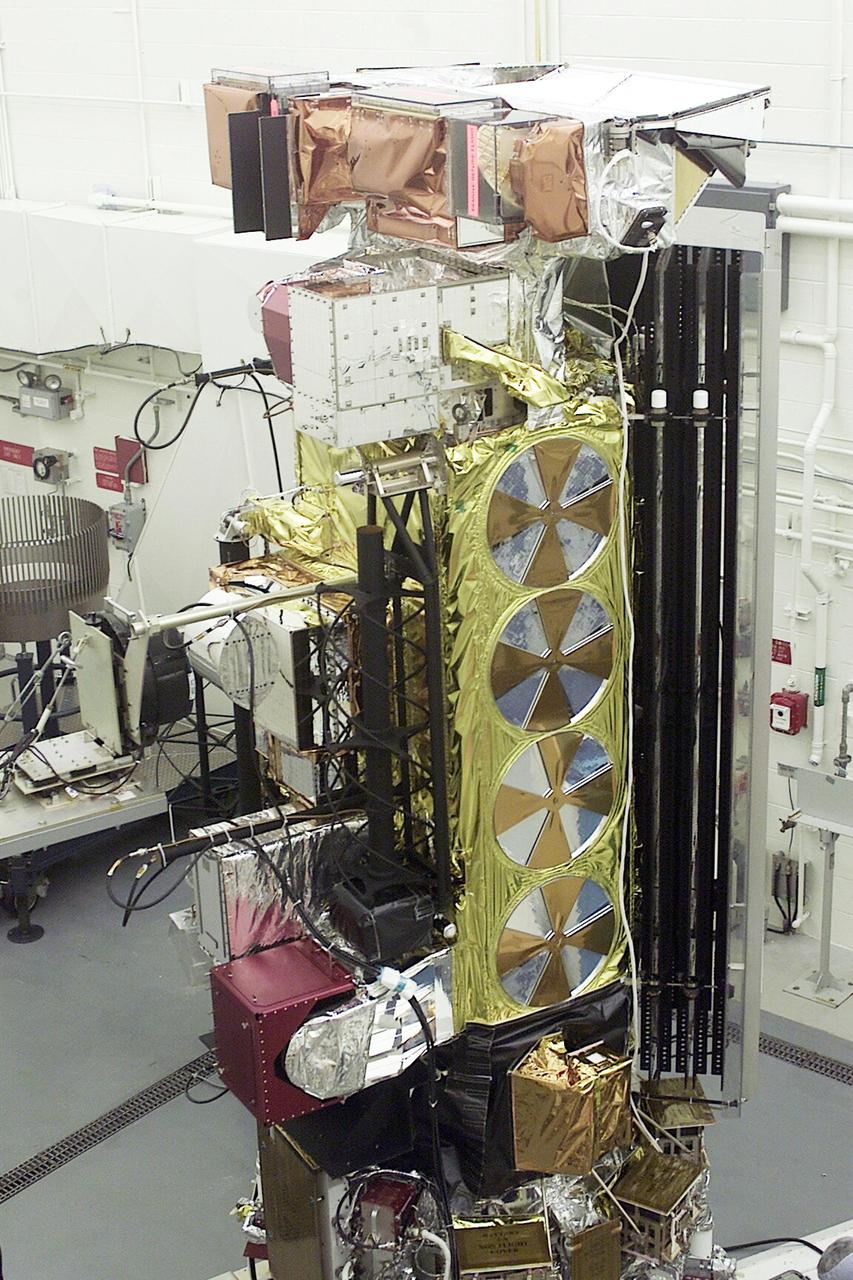
KENNEDY SPACE CENTER, FLA. -- The National Oceanic and Atmospheric Administration (NOAA-M) spacecraft undergoes end-to-end testing in checkout hangar 1610 on North Vandenberg Air Force Base. The spacecraft is nearing process completion for transportation to Launch Complex 4W. NOAA-M is another in a series of polar-orbiting Earth environmental observation satellites that provide global data to NOAA's short- and long-range weather forecasting systems. Launch aboard a Titan II rocket is scheduled for June 25, 2002
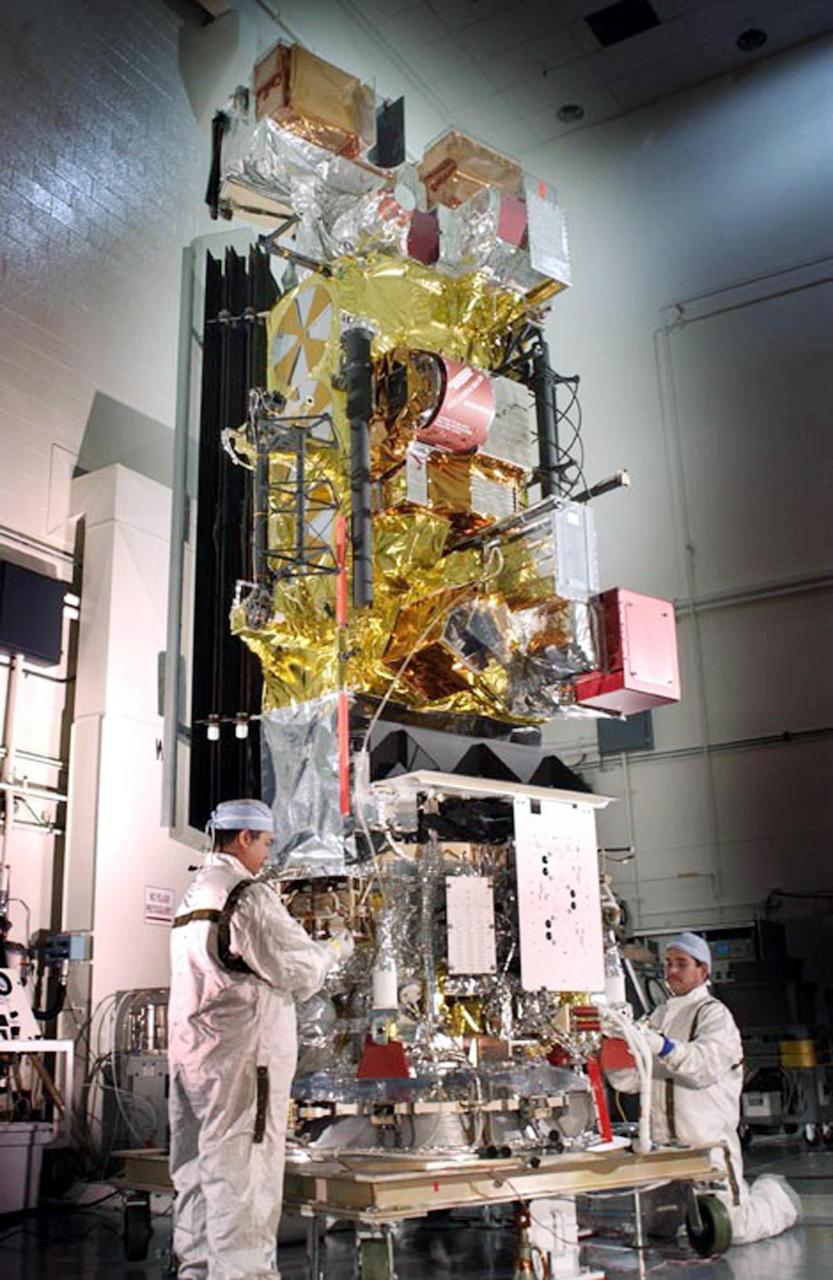
KENNEDY SPACE CENTER, FLA. -- Workers in checkout hangar 1610 on North Vandenberg Air Force Base complete final processing on the National Oceanic and Atmospheric Administration (NOAA-M) spacecraft before transportation to Launch Complex 4W. NOAA-M is another in a series of polar-orbiting Earth environmental observation satellites that provide global data to NOAA's short- and long-range weather forecasting systems. Launch aboard a Titan II rocket is scheduled for June 25, 2002
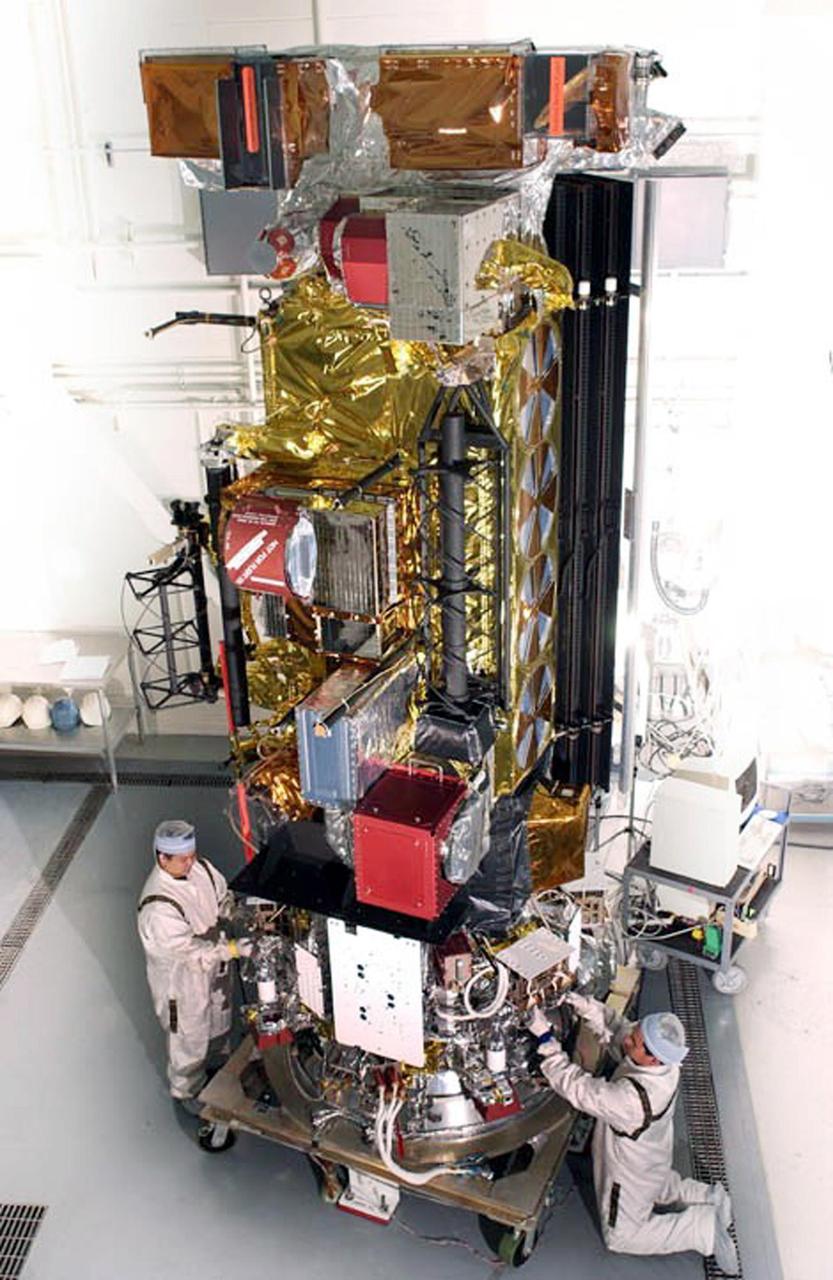
KENNEDY SPACE CENTER, FLA. -- Workers in checkout hangar 1610 on North Vandenberg Air Force Base complete final processing on the National Oceanic and Atmospheric Administration (NOAA-M) spacecraft before transportation to Launch Complex 4W. NOAA-M is another in a series of polar-orbiting Earth environmental observation satellites that provide global data to NOAA's short- and long-range weather forecasting systems. Launch aboard a Titan II rocket is scheduled for June 25, 2002
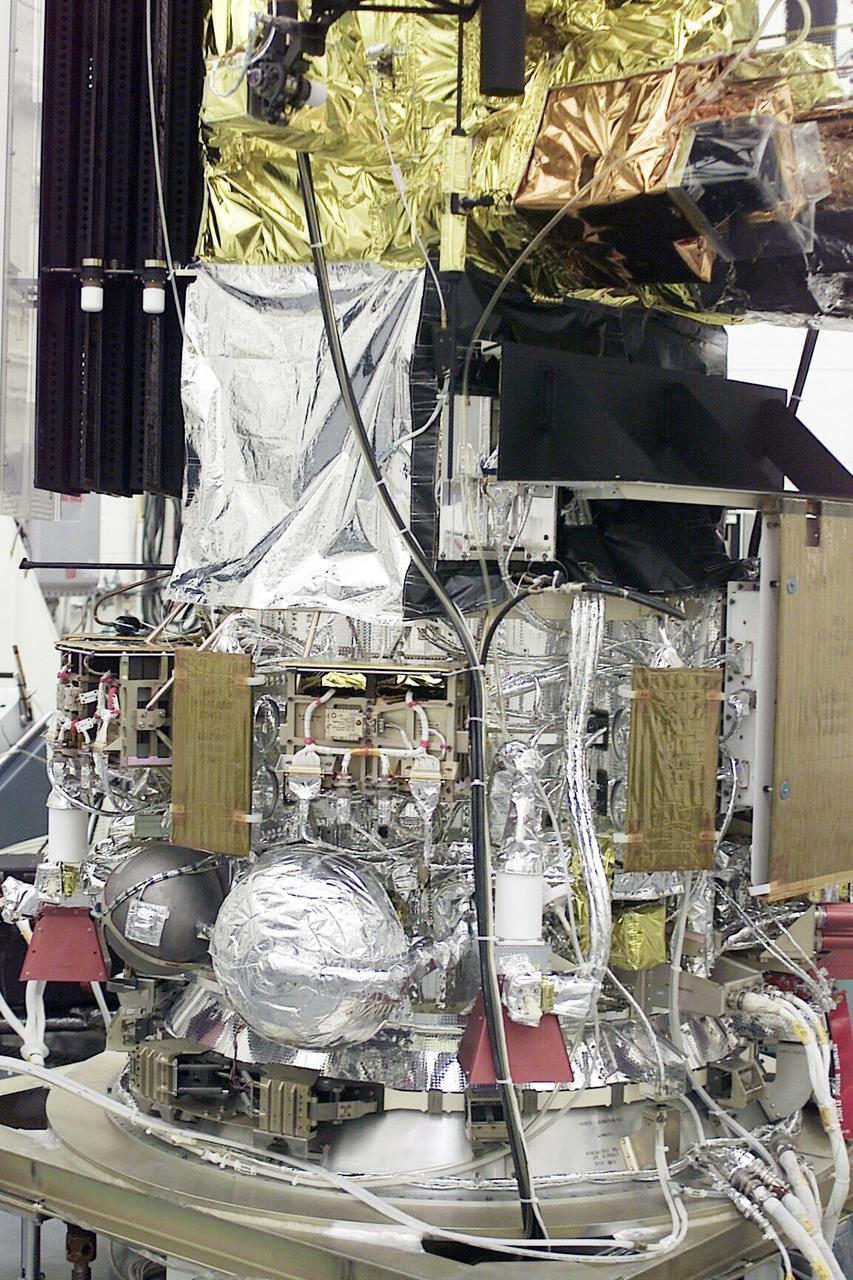
KENNEDY SPACE CENTER, FLA. -- The National Oceanic and Atmospheric Administration (NOAA-M) spacecraft undergoes end-to-end testing in checkout hangar 1610 on North Vandenberg Air Force Base. The spacecraft is nearing process completion for transportation to Launch Complex 4W. NOAA-M is another in a series of polar-orbiting Earth environmental observation satellites that provide global data to NOAA's short- and long-range weather forecasting systems. Launch aboard a Titan II rocket is scheduled for June 25, 2002
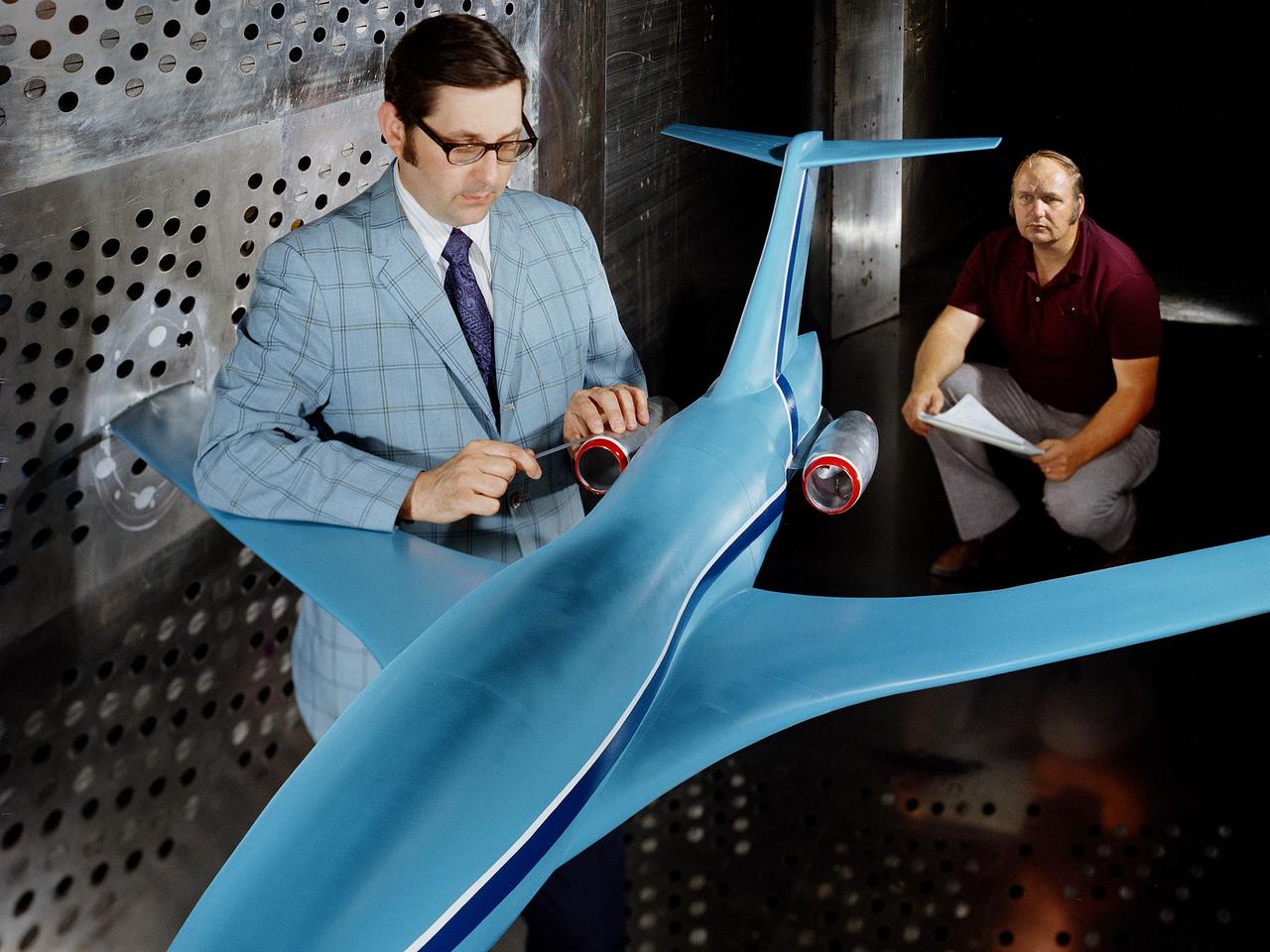
A researcher examines an Advanced Technology Transport model installed in the 8- by 6-Foot Supersonic Wind Tunnel at the National Aeronautics and Space Administration (NASA) Lewis Research Center. The Advanced Technology Transport concept was a 200-person supersonic transport aircraft that could cruise at Mach 0.9 to 0.98 with low noise and pollution outputs. General Electric and Pratt and Whitney responded to NASA Lewis’ call to design a propulsion system for the aircraft. The integration of the propulsion system with the airframe was one of the greatest challenges facing the designers of supersonic aircraft. The aircraft’s flow patterns and engine nacelles could significantly affect the performance of the engines. NASA Lewis researchers undertook a study of this 0.30-scale model of the Advanced Technology Transport in the 8- by 6-foot tunnel. The flow-through nacelles were located near the rear of the fuselage during the initial tests, seen here, and then moved under the wings for ensuing runs. Different engine cowl shapes were also analyzed. The researchers determined that nacelles mounted at the rear of the aircraft produced more efficient airflow patterns during cruising conditions at the desired velocities. The concept of the Advanced Technology Transport, nor any other US supersonic transport, has ever come to fruition. The energy crisis, environmental concerns, and inadequate turbofan technology of the 1970s were among the most significant reasons.

With NASA’s iconic Vehicle Assembly Building in the background, teams with the agency’s Exploration Ground Systems Program and primary contractor, Bechtel National, Inc. continue construction on the base of the platform for the new mobile launcher at Kennedy Space Center in Florida on Wednesday, April 24, 2024. Once completed and able to be carried atop the crawler-transporter, the 355-foot-tall mobile launcher 2 will be used during assembly, processing, and launch of the SLS (Space Launch System) rocket and Orion spacecraft on NASA’s upcoming Artemis missions to the Moon beginning with Artemis IV.
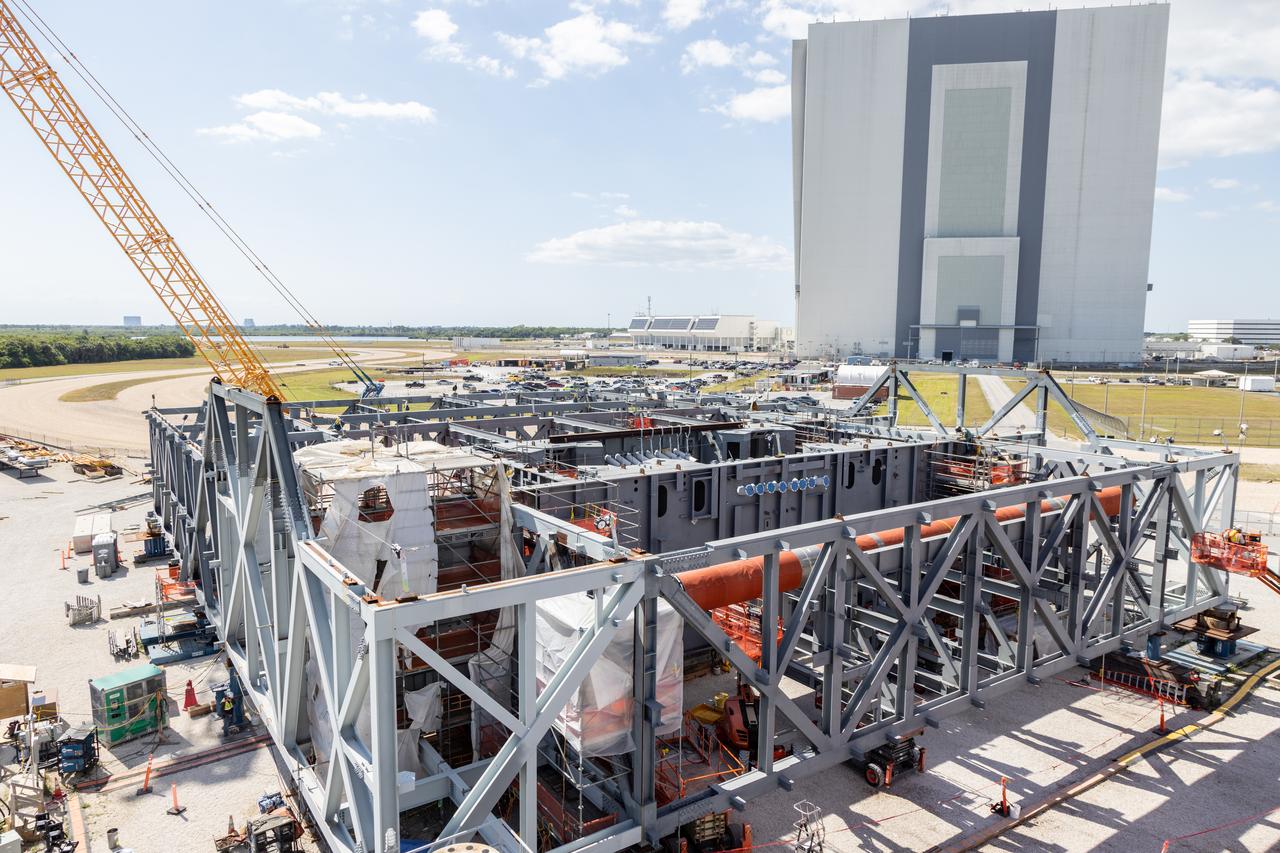
With NASA’s iconic Vehicle Assembly Building in the background, teams with the agency’s Exploration Ground Systems Program and primary contractor, Bechtel National, Inc. continue construction on the base of the platform for the new mobile launcher at Kennedy Space Center in Florida on Wednesday, April 24, 2024. Once completed and able to be carried atop the crawler-transporter, the 355-foot-tall mobile launcher 2 will be used during assembly, processing, and launch of the SLS (Space Launch System) rocket and Orion spacecraft on NASA’s upcoming Artemis missions to the Moon beginning with Artemis IV.
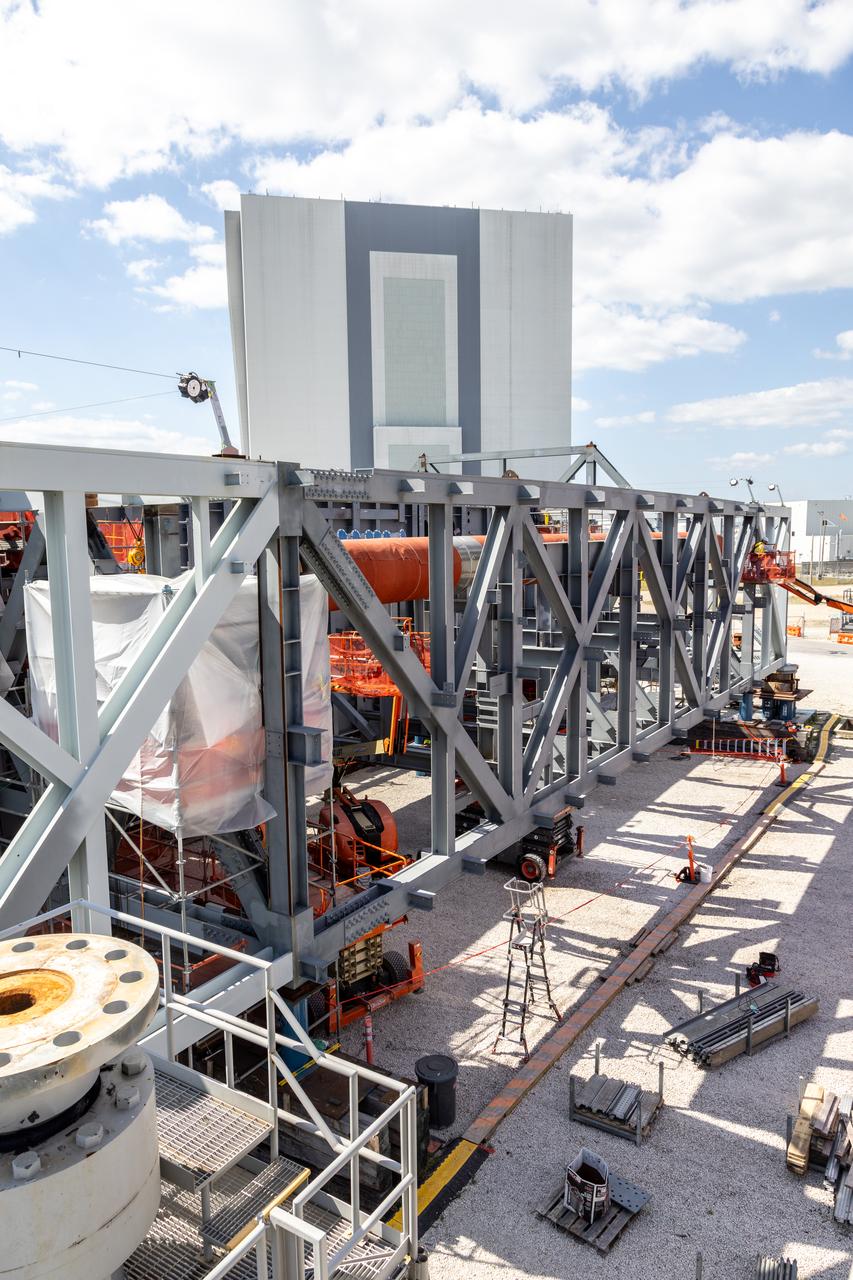
With NASA’s iconic Vehicle Assembly Building in the background, teams with the agency’s Exploration Ground Systems Program and primary contractor, Bechtel National, Inc. continue construction on the base of the platform for the new mobile launcher at Kennedy Space Center in Florida on Wednesday, April 24, 2024. Once completed and able to be carried atop the crawler-transporter, the 355-foot-tall mobile launcher 2 will be used during assembly, processing, and launch of the SLS (Space Launch System) rocket and Orion spacecraft on NASA’s upcoming Artemis missions to the Moon beginning with Artemis IV.

CAPE CANAVERAL, Fla. -- Florida's Lt. Gov. Jennifer Carroll, left, and NASA Commercial Crew Program Manager Ed Mango shake hands at the National Space Club Florida Committee's August luncheon at the Radisson Resort at the Port in Cape Canaveral, Fla. Mango was the event's guest speaker, discussing the innovative steps the agency is taking with industry partners to develop the next U.S. space transportation capability to and from low Earth orbit, which will eventually be available for use by the U.S. government and other commercial customers. To learn more about the Commercial Crew Program, visit www.nasa.gov/commercialcrew. Photo credit: Kim Shiflett NASA's Ground Systems Development and Operations Program is leading the 20-year life-extension project for the crawler. A pair of behemoth machines called crawler-transporters has carried the load of taking rockets and spacecraft to the launch pad for more than 40 years at NASA’s Kennedy Space Center in Florida. Each weighing six and a half million pounds and larger in size than a professional baseball infield, the crawler-transporters are powered by locomotive and large electrical power generator engines. The crawler-transporters will stand ready to keep up the work for the next generation of launch vehicles to lift astronauts into space. For more information, visit http://www.nasa.gov/exploration/systems/ground/index.html Photo credit: NASA/Jim Grossmann
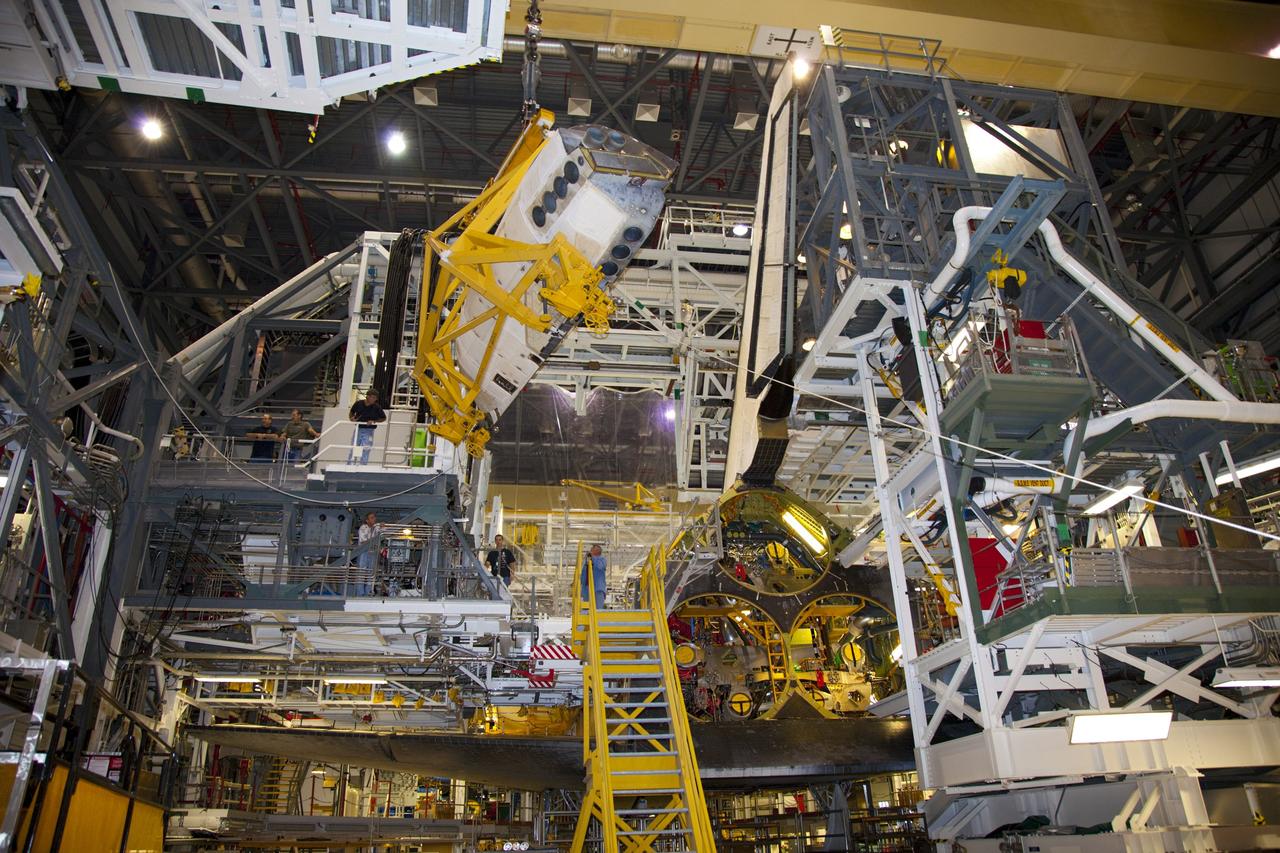
CAPE CANAVERAL, Fla. – In Orbiter Processing Facility-1 at NASA’s Kennedy Space Center in Florida, a crane transports an orbital maneuvering system (OMS) pod closer to space shuttle Discovery. The OMS pod will be installed on Discovery. The OMS pod was returned from White Sands Space Harbor in New Mexico where it underwent a complete deservicing and cleaning. The work is part of the Space Shuttle Program’s transition and retirement processing of space shuttle Discovery. The shuttle will go to the Smithsonian’s National Air and Space Museum, Steven F. Udvar-Hazy Center in Chantilly, Va., in April 2012. For more information, visit http://www.nasa.gov/shuttle. Photo credit: NASA/Frankie Martin
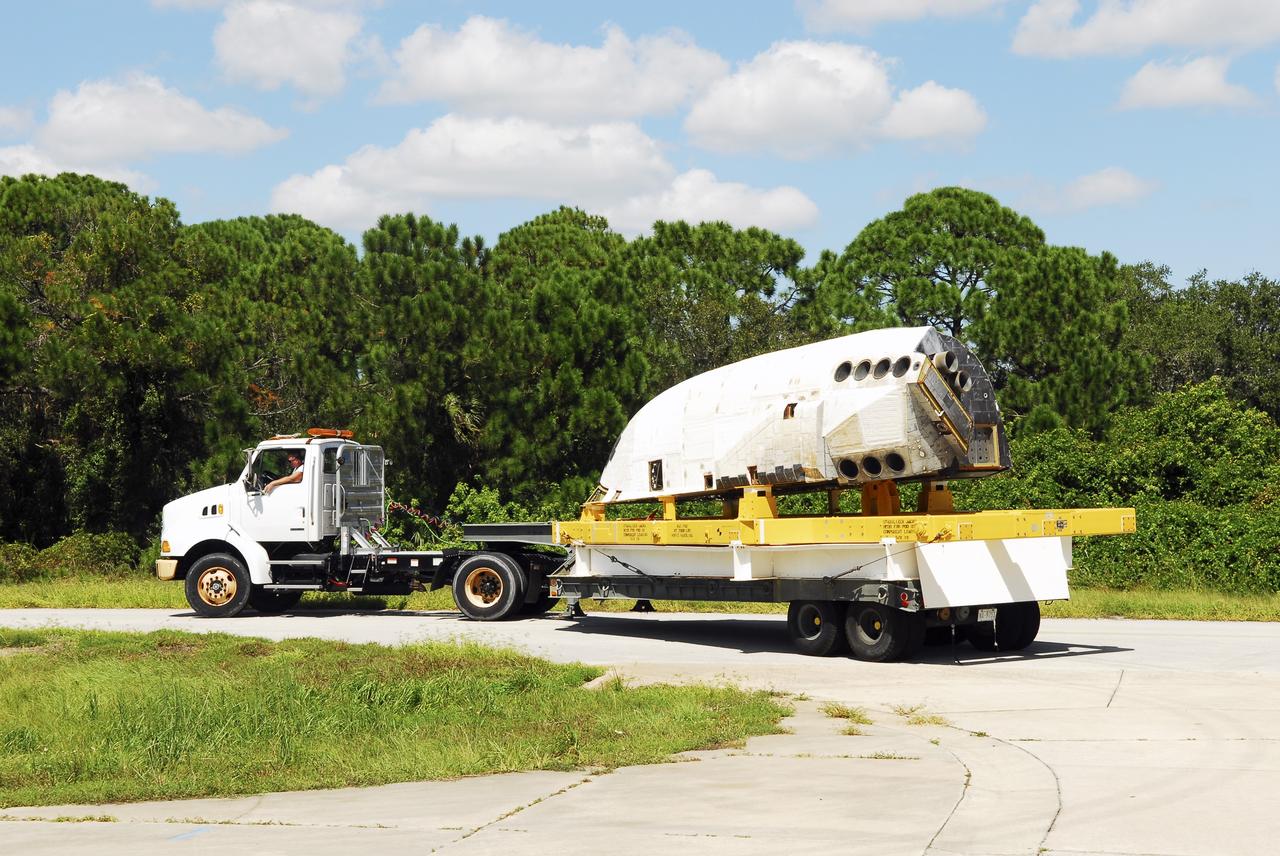
CAPE CANAVERAL, Fla. – At NASA’s Kennedy Space Center in Florida, a truck transports space shuttle Discovery's orbital maneuvering system (OMS) pod from the Hypergol Maintenance Facility to the Orbiter Processing Facility (OPF). The OMS has been returned from White Sands Space Harbor in New Mexico where it underwent a complete deservicing and cleaning. The work is part of the Space Shuttle Program’s transition and retirement processing of space shuttle Discovery. The shuttle will go to the Smithsonian's National Air and Space Museum, Steven F. Udvar-Hazy Center in Chantilly, Va. For more information, visit http://www.nasa.gov/shuttle. Photo credit: NASA/Jim Grossmann
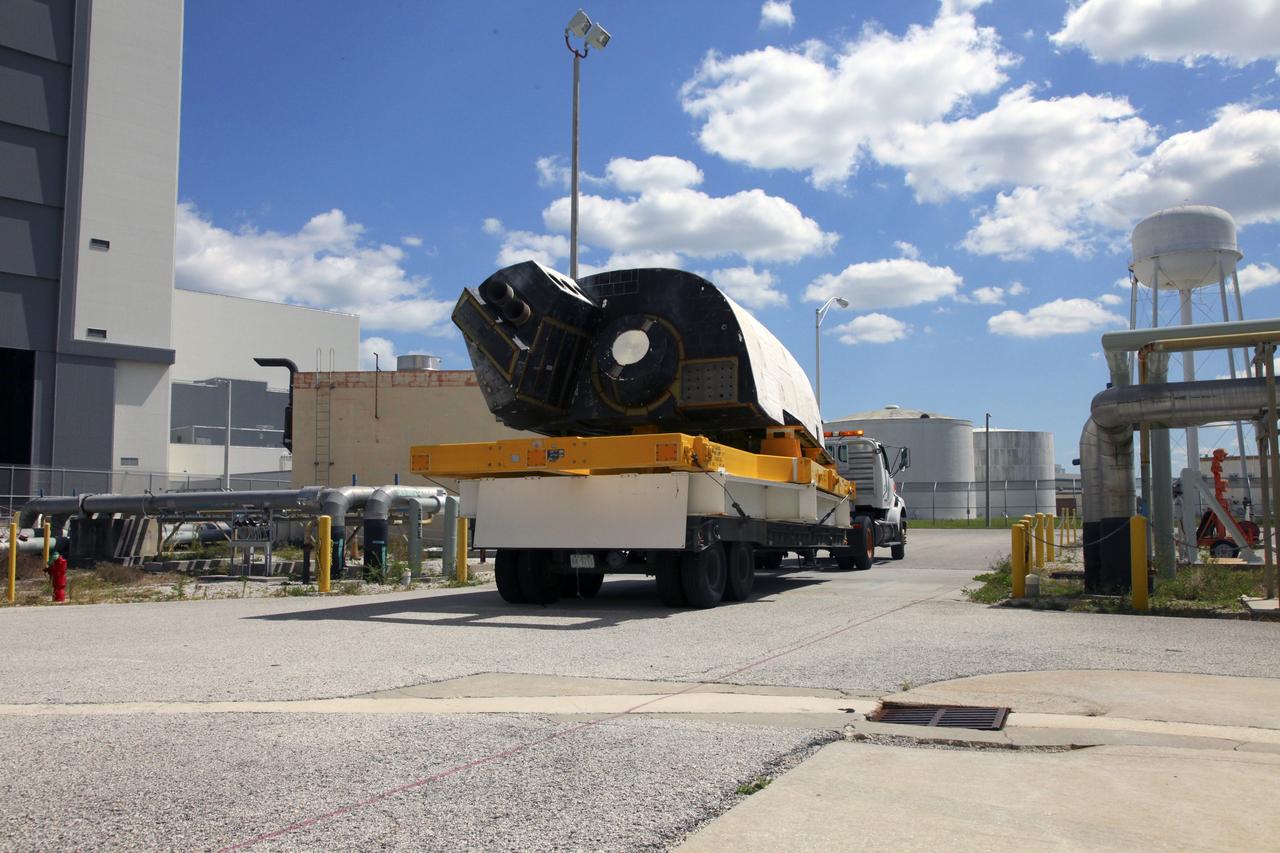
CAPE CANAVERAL, Fla. – At NASA’s Kennedy Space Center in Florida, a truck transports space shuttle Discovery's orbital maneuvering system (OMS) pod to the Orbiter Processing Facility (OPF). The OMS has been returned from White Sands Space Harbor in New Mexico where it underwent a complete deservicing and cleaning. The work is part of the Space Shuttle Program’s transition and retirement processing of space shuttle Discovery. The shuttle will go to the Smithsonian's National Air and Space Museum, Steven F. Udvar-Hazy Center in Chantilly, Va. For more information, visit http://www.nasa.gov/shuttle. Photo credit: NASA/Frankie Martin
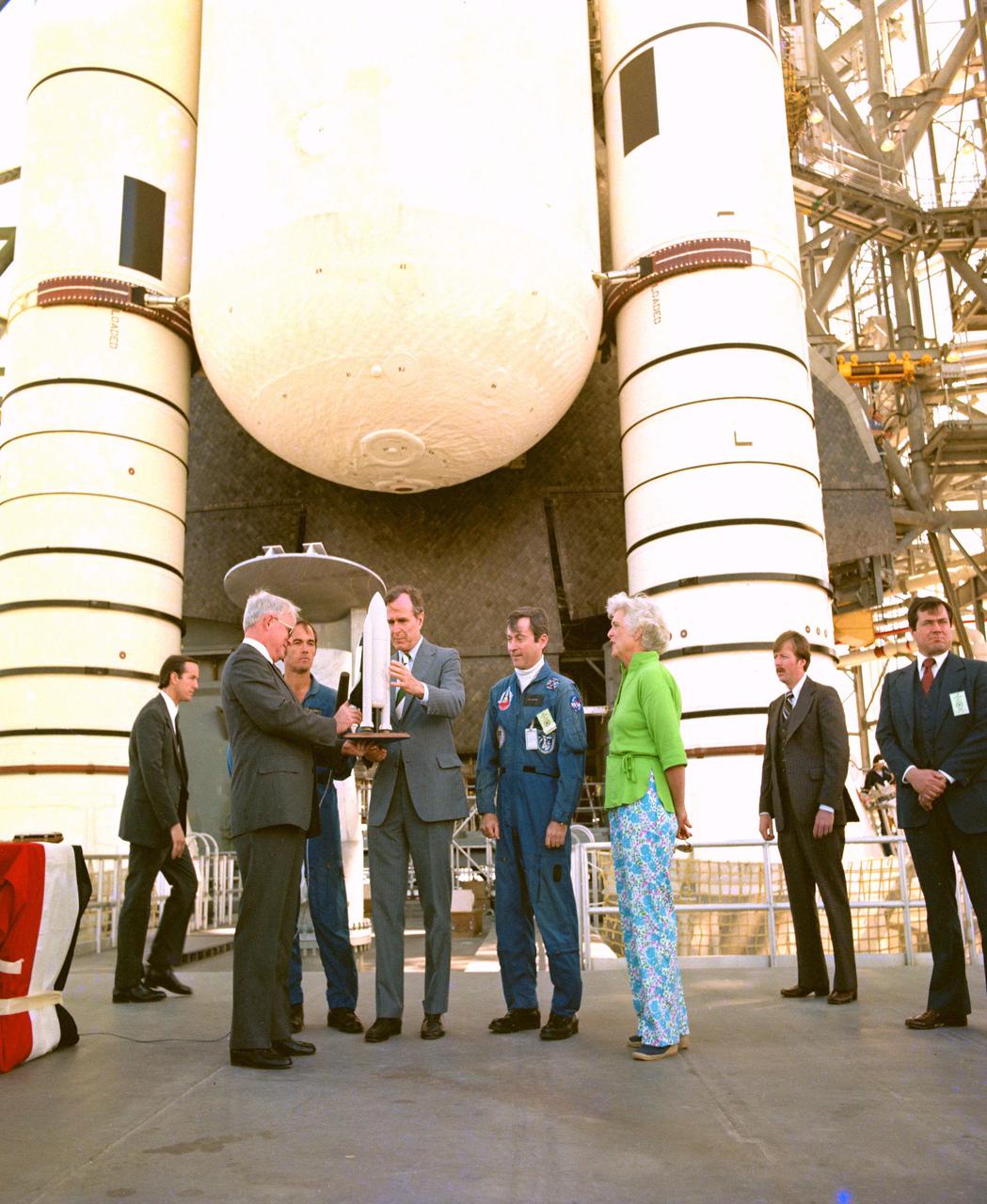
KENNEDY SPACE CENTER, FLA. -- Vice President George H. W. Bush, center, flanked by astronauts Robert L. Crippen on his right and John W. Young on his left, receives a model of the Space Shuttle from Dr. Alan M. Lovelace, acting administrator of the National Aeronautics and Space Administration. At far right is Mrs. Bush, who accompanied the vice president on his whirlwind tour of the Shuttle vehicle and launch facilities. In the background are the aft portions of the orbiter, external tank and solid rocket boosters. The Shuttle, America's first reusable space transportation system, is scheduled to make its maiden voyage into space no sooner than the week of April 7.
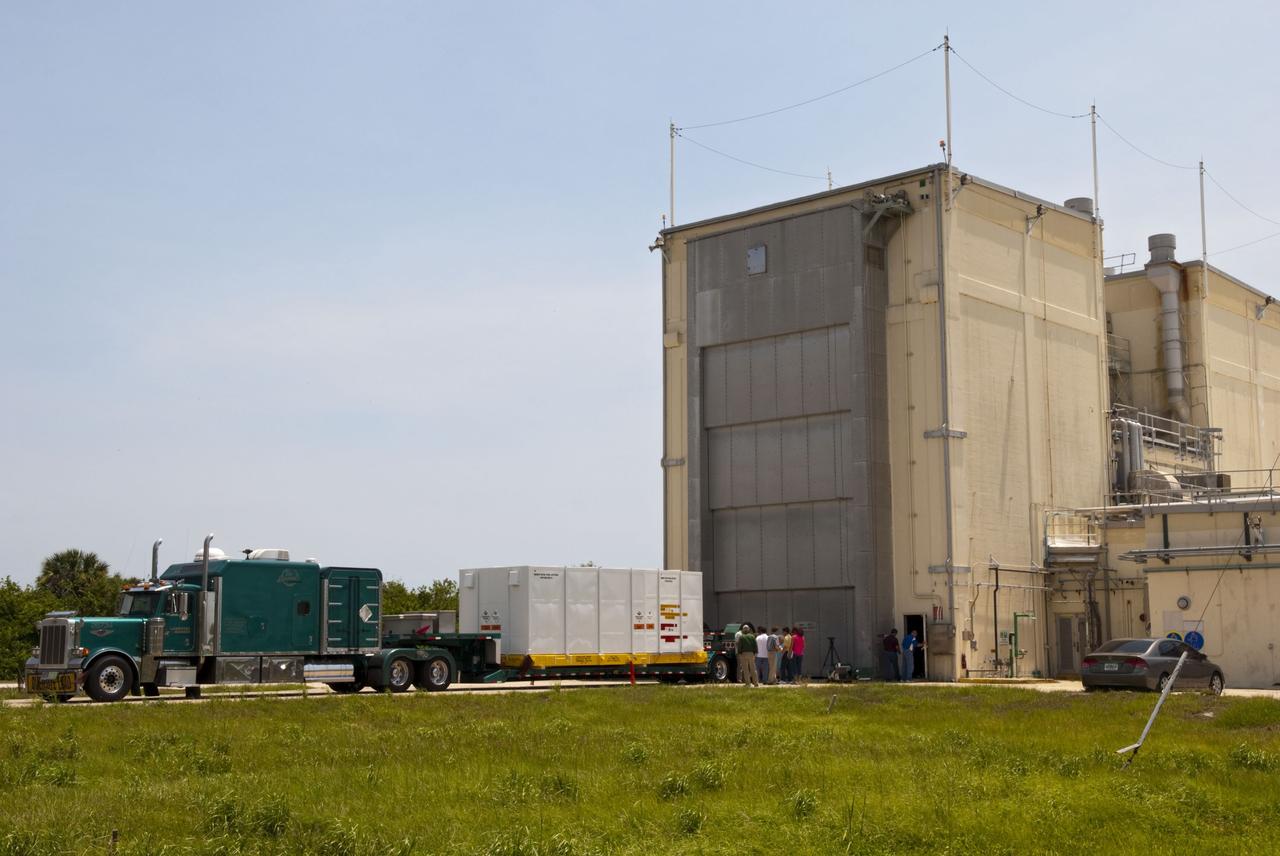
CAPE CANAVERAL, Fla. - Space shuttle Discovery's orbital maneuvering system pods and forward reaction control system have been loaded into a container and are being transported from NASA's Kennedy Space Center in Florida to White Sands Space Harbor in New Mexico. There, they will undergo a complete deservicing and cleaning. The removal is part of Discovery's transition and retirement processing. Shuttle Discovery will go to the Smithsonian's National Air and Space Museum, Steven F. Udvar-Hazy Center in Chantilly, Va., Endeavour will go to the California Science Center in Los Angeles and Enterprise will be moved from the Smithsonian to the Intrepid Sea, Air and Space Museum in New York. Shuttle Atlantis will go to the Kennedy Space Center Visitor Complex. Photo credit: NASA/Jim Grossmann
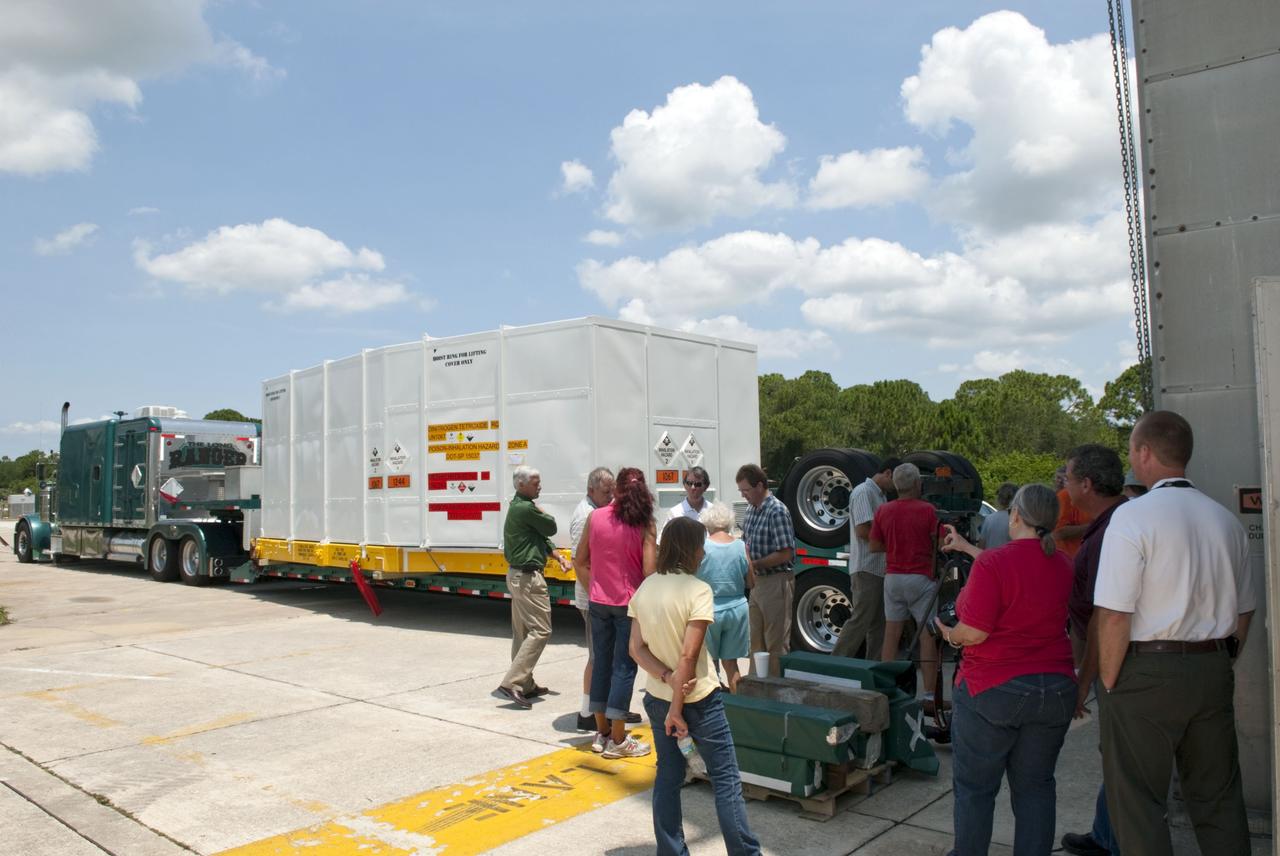
CAPE CANAVERAL, Fla. - Space shuttle Discovery's orbital maneuvering system pods and forward reaction control system have been loaded into a container and are being transported from NASA's Kennedy Space Center in Florida to White Sands Space Harbor in New Mexico. There, they will undergo a complete deservicing and cleaning. The removal is part of Discovery's transition and retirement processing. Shuttle Discovery will go to the Smithsonian's National Air and Space Museum, Steven F. Udvar-Hazy Center in Chantilly, Va., Endeavour will go to the California Science Center in Los Angeles and Enterprise will be moved from the Smithsonian to the Intrepid Sea, Air and Space Museum in New York. Shuttle Atlantis will go to the Kennedy Space Center Visitor Complex. Photo credit: NASA/Jim Grossmann
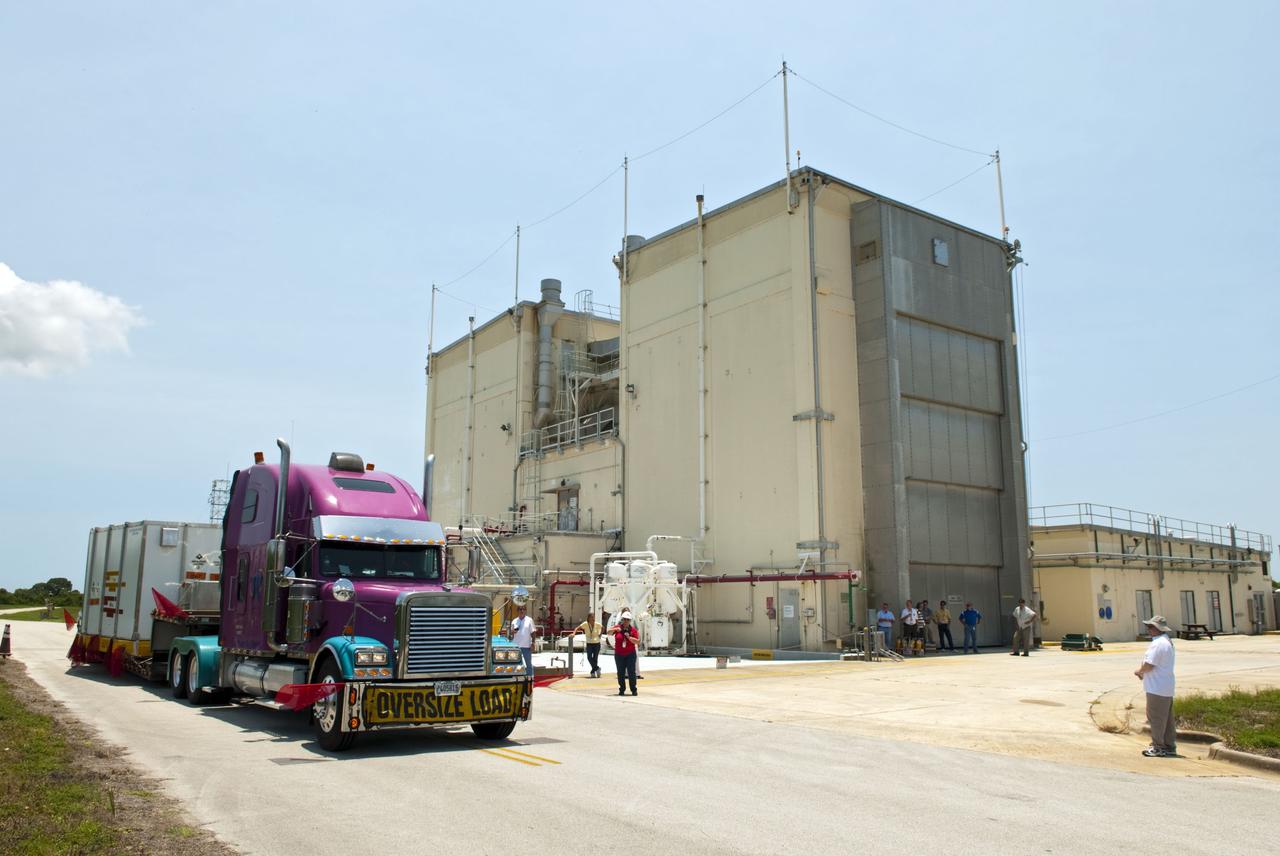
CAPE CANAVERAL, Fla. - Space shuttle Discovery's orbital maneuvering system pods and forward reaction control system have been loaded into a container and are being transported from NASA's Kennedy Space Center in Florida to White Sands Space Harbor in New Mexico. There, they will undergo a complete deservicing and cleaning. The removal is part of Discovery's transition and retirement processing. Shuttle Discovery will go to the Smithsonian's National Air and Space Museum, Steven F. Udvar-Hazy Center in Chantilly, Va., Endeavour will go to the California Science Center in Los Angeles and Enterprise will be moved from the Smithsonian to the Intrepid Sea, Air and Space Museum in New York. Shuttle Atlantis will go to the Kennedy Space Center Visitor Complex. Photo credit: NASA/Jim Grossmann
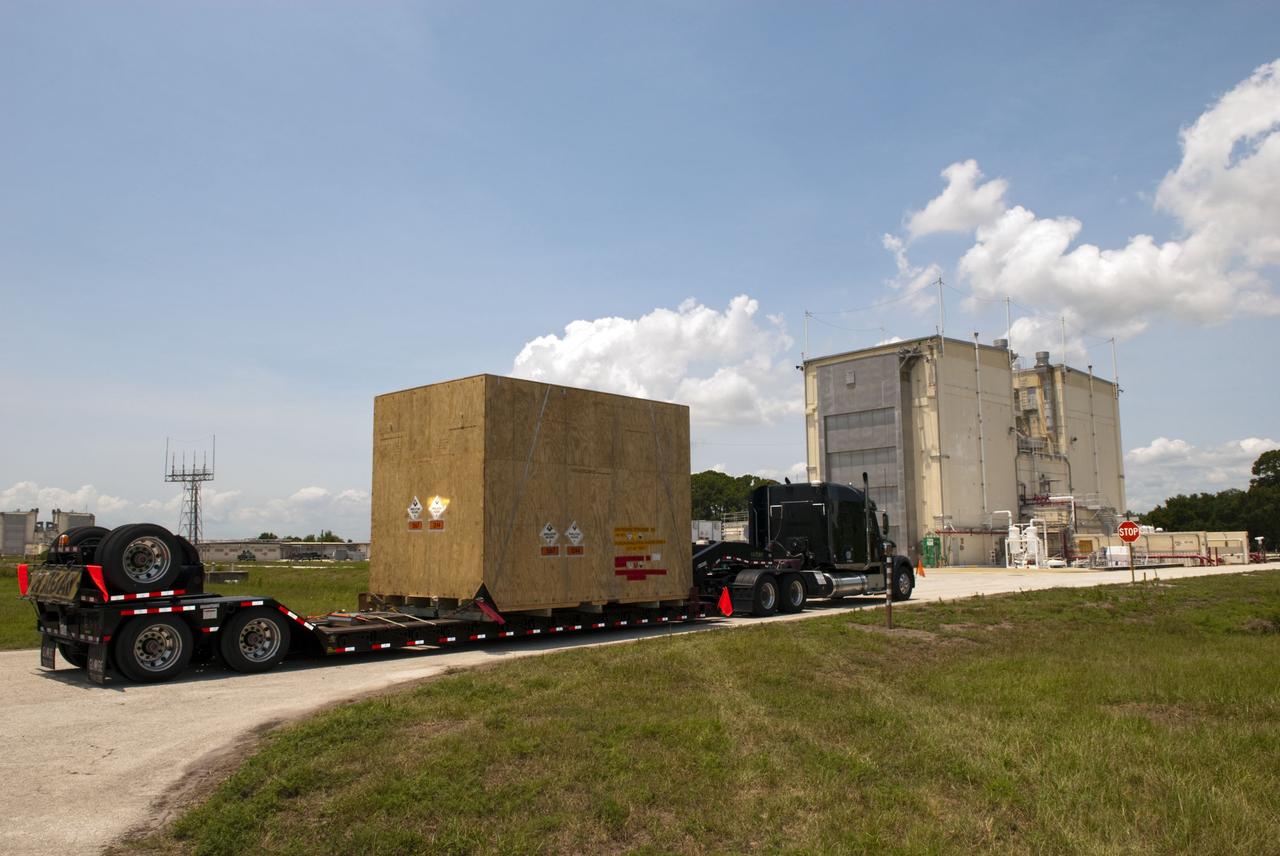
CAPE CANAVERAL, Fla. - Space shuttle Discovery's orbital maneuvering system pods and forward reaction control system have been loaded into a container and are being transported from NASA's Kennedy Space Center in Florida to White Sands Space Harbor in New Mexico. There, they will undergo a complete deservicing and cleaning. The removal is part of Discovery's transition and retirement processing. Shuttle Discovery will go to the Smithsonian's National Air and Space Museum, Steven F. Udvar-Hazy Center in Chantilly, Va., Endeavour will go to the California Science Center in Los Angeles and Enterprise will be moved from the Smithsonian to the Intrepid Sea, Air and Space Museum in New York. Shuttle Atlantis will go to the Kennedy Space Center Visitor Complex. Photo credit: NASA/Jim Grossmann
CAPE CANAVERAL, Fla. - Space shuttle Discovery's orbital maneuvering system pods and forward reaction control system have been loaded into a container and are being transported from NASA's Kennedy Space Center in Florida to White Sands Space Harbor in New Mexico. There, they will undergo a complete deservicing and cleaning. The removal is part of Discovery's transition and retirement processing. Shuttle Discovery will go to the Smithsonian's National Air and Space Museum, Steven F. Udvar-Hazy Center in Chantilly, Va., Endeavour will go to the California Science Center in Los Angeles and Enterprise will be moved from the Smithsonian to the Intrepid Sea, Air and Space Museum in New York. Shuttle Atlantis will go to the Kennedy Space Center Visitor Complex. Photo credit: NASA/Jim Grossmann
CAPE CANAVERAL, Fla. - Space shuttle Discovery's orbital maneuvering system pods and forward reaction control system have been loaded into a container and are being transported from NASA's Kennedy Space Center in Florida to White Sands Space Harbor in New Mexico. There, they will undergo a complete deservicing and cleaning. The removal is part of Discovery's transition and retirement processing. Shuttle Discovery will go to the Smithsonian's National Air and Space Museum, Steven F. Udvar-Hazy Center in Chantilly, Va., Endeavour will go to the California Science Center in Los Angeles and Enterprise will be moved from the Smithsonian to the Intrepid Sea, Air and Space Museum in New York. Shuttle Atlantis will go to the Kennedy Space Center Visitor Complex. Photo credit: NASA/Jim Grossmann
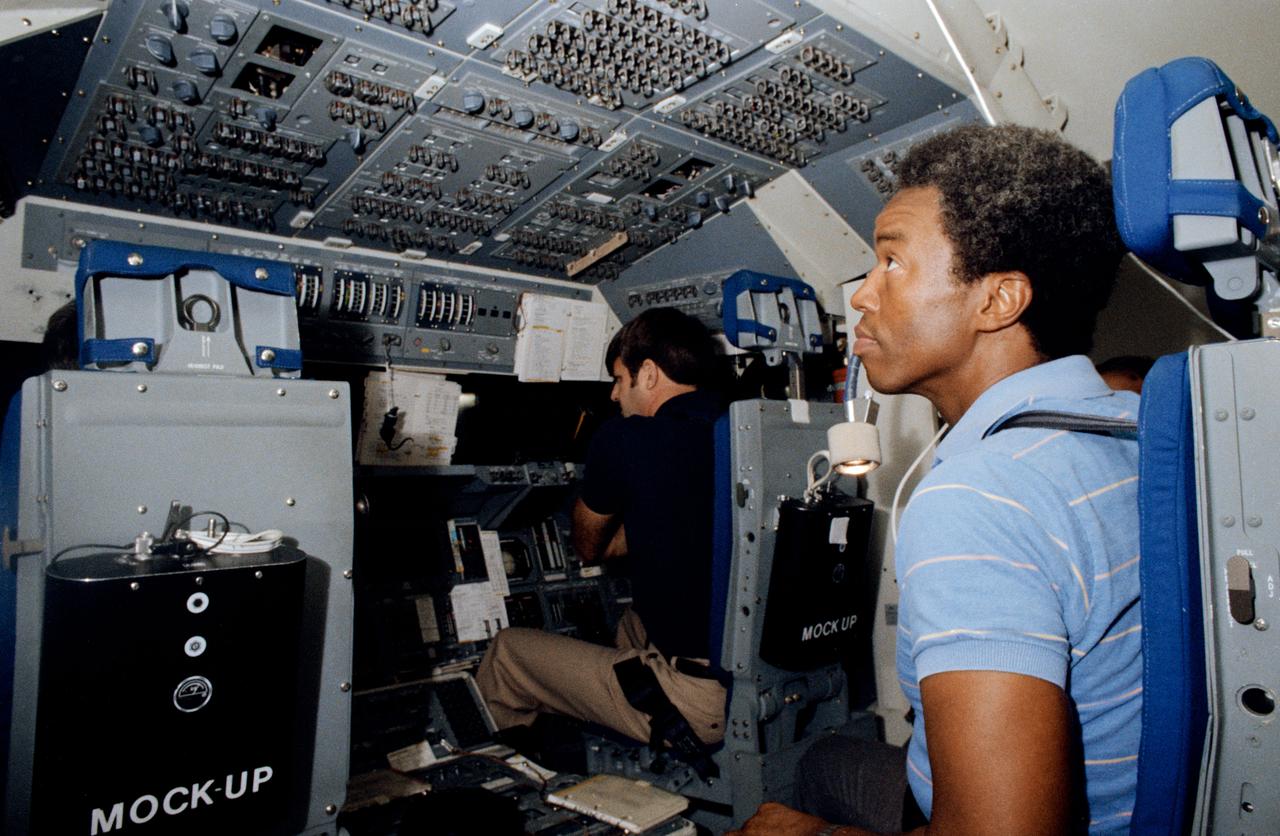
S83-33032 (23 May 1983) --- Astronauts Guion S. Bluford, right, and Daniel C. Brandenstein man their respective Challenger entry and ascent stations in the Shuttle Mission Simulator (SMS) at NASA's Johnson Space Center (JSC) during a training session for the STS-8 mission. Brandenstein is in the pilot's station, while Bluford, a mission specialist, occupies one of the two aft flight deck seats. Both are wearing civilian clothes for this training exercise. This motion based simulator represents the scene of a great deal of training and simulation activity, leading up to crew preparedness for Space Transportation System (STS) mission. Photo credt: NASA/Otis Imboden, National Geographic
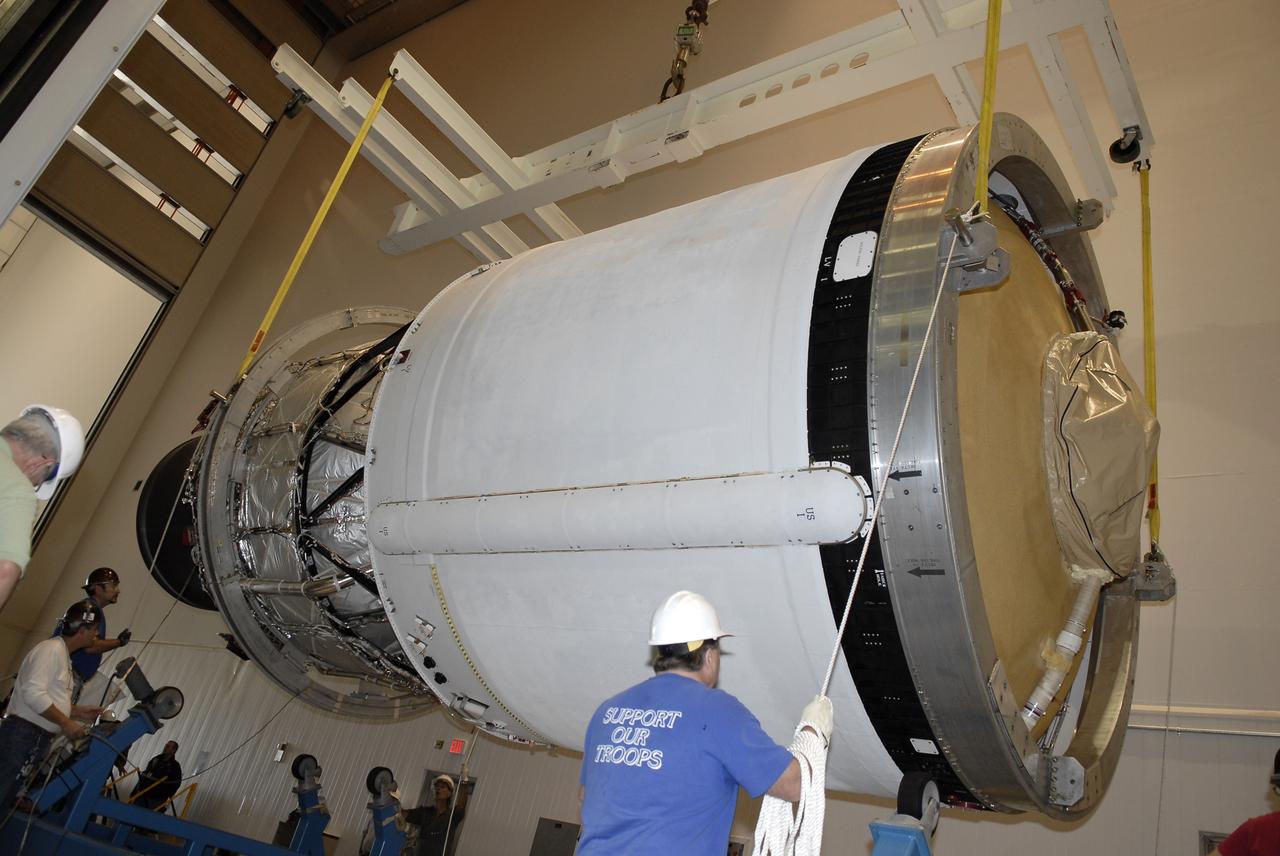
CAPE CANAVERAL, Fla. – In the hangar of the Delta Operations Center at Cape Canaveral Air Force Station in Florida, workers lower the second stage of a Delta IV rocket onto a transporter following the completion of nozzle extension deployment system testing in the hangar's test cell. The United Launch Alliance Delta IV rocket is slated to launch GOES-P, the latest Geostationary Operational Environmental Satellite developed by NASA for the National Oceanic and Atmospheric Administration, or NOAA. Next, the second stage will be transported to the Horizontal Integration Facility where it will be inspected and prepared for mating with the Delta IV rocket's first stage. GOES-P, a meteorological satellite, is designed to watch for storm development and observed current weather conditions on Earth. Launch of GOES-P is scheduled for no earlier than Feb. 25, 2010, from Launch Complex 37. For information on GOES-P, visit http://goespoes.gsfc.nasa.gov/goes/spacecraft/n_p_spacecraft.html. Photo credit: NASA/Glenn Benson
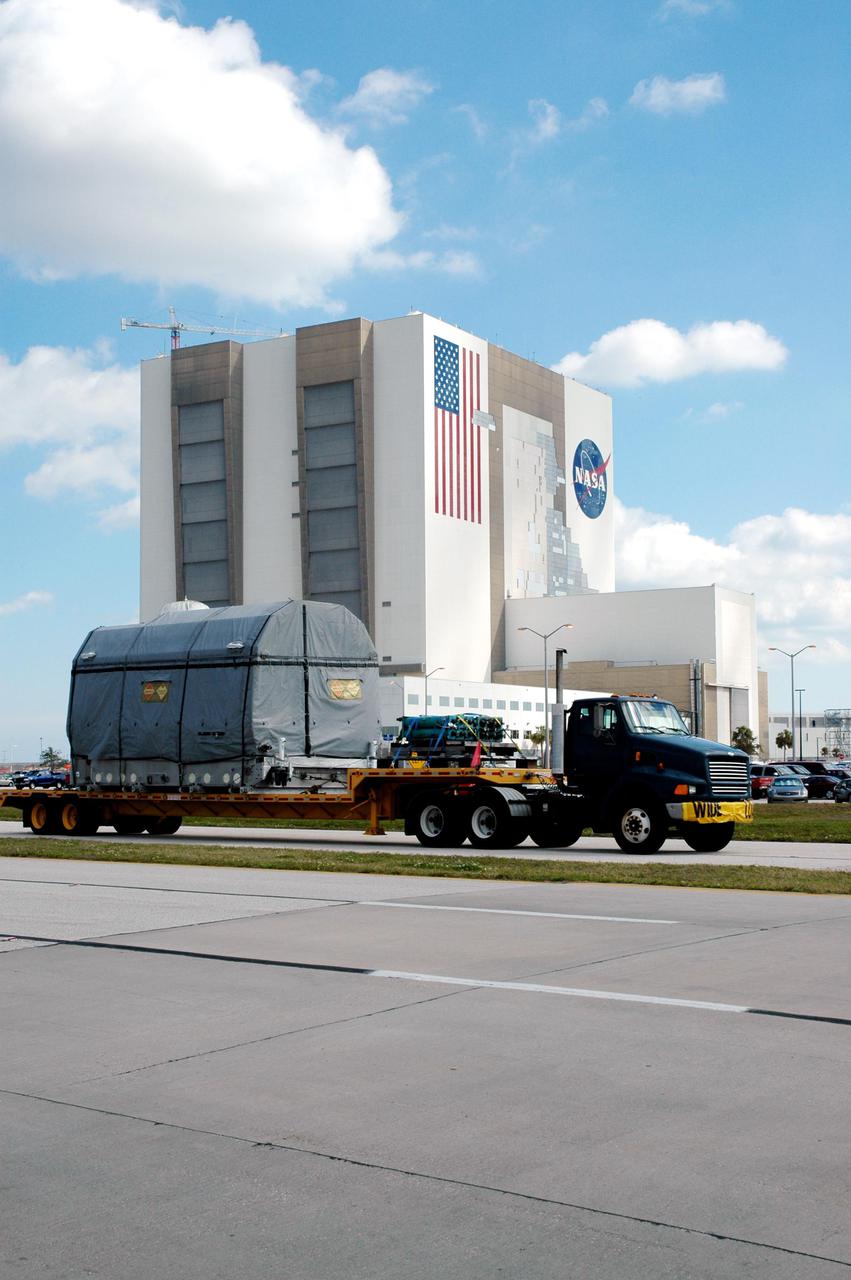
KENNEDY SPACE CENTER, FLA. - The latest Geostationary Operational Environmental Satellite (GOES) developed by NASA for the National Oceanic and Atmospheric Administration (NOAA) travels past the Vehicle Assembly Building at KSC. The satellite is being transported to Astrotech in Titusville, Fla., where final testing of the imaging system, instrumentation, communications and power systems will be performed over the next two months by Boeing Satellite Systems. The satellite arrived earlier at KSC’s Shuttle Landing Facility aboard a C17 military cargo aircraft. Called GOES-N, the satellite is targeted to launch May 4 onboard a Boeing expendable launch vehicle Delta IV (4,2). Once in orbit GOES-N will be designated GOES-13 and will complete checkout and be placed in on-orbit storage as a replacement for an older GOES satellite.
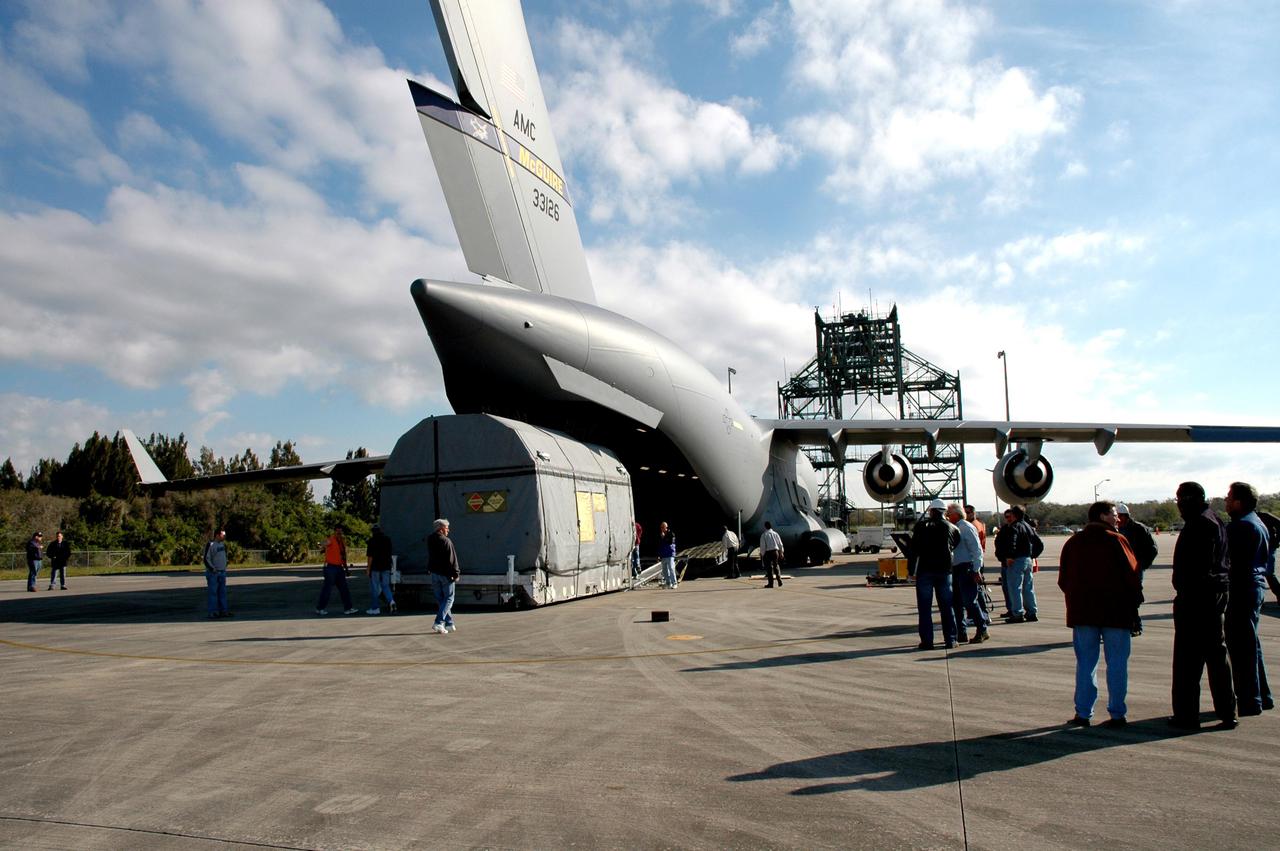
KENNEDY SPACE CENTER, FLA. - At KSC’s Shuttle Landing Facility, the latest Geostationary Operational Environmental Satellite (GOES) developed by NASA for the National Oceanic and Atmospheric Administration (NOAA) is backed away from the C17 military cargo aircraft that delivered it. Called GOES-N, the satellite is targeted to launch May 4 onboard a Boeing expendable launch vehicle Delta IV (4,2). Once in orbit GOES-N will be designated GOES-13 and will complete checkout and be placed in on-orbit storage as a replacement for an older GOES satellite. After arriving, the satellite was transported to Astrotech in Titusville, Fla., where final testing of the imaging system, instrumentation, communications and power systems will be performed over the next two months by Boeing Satellite Systems.
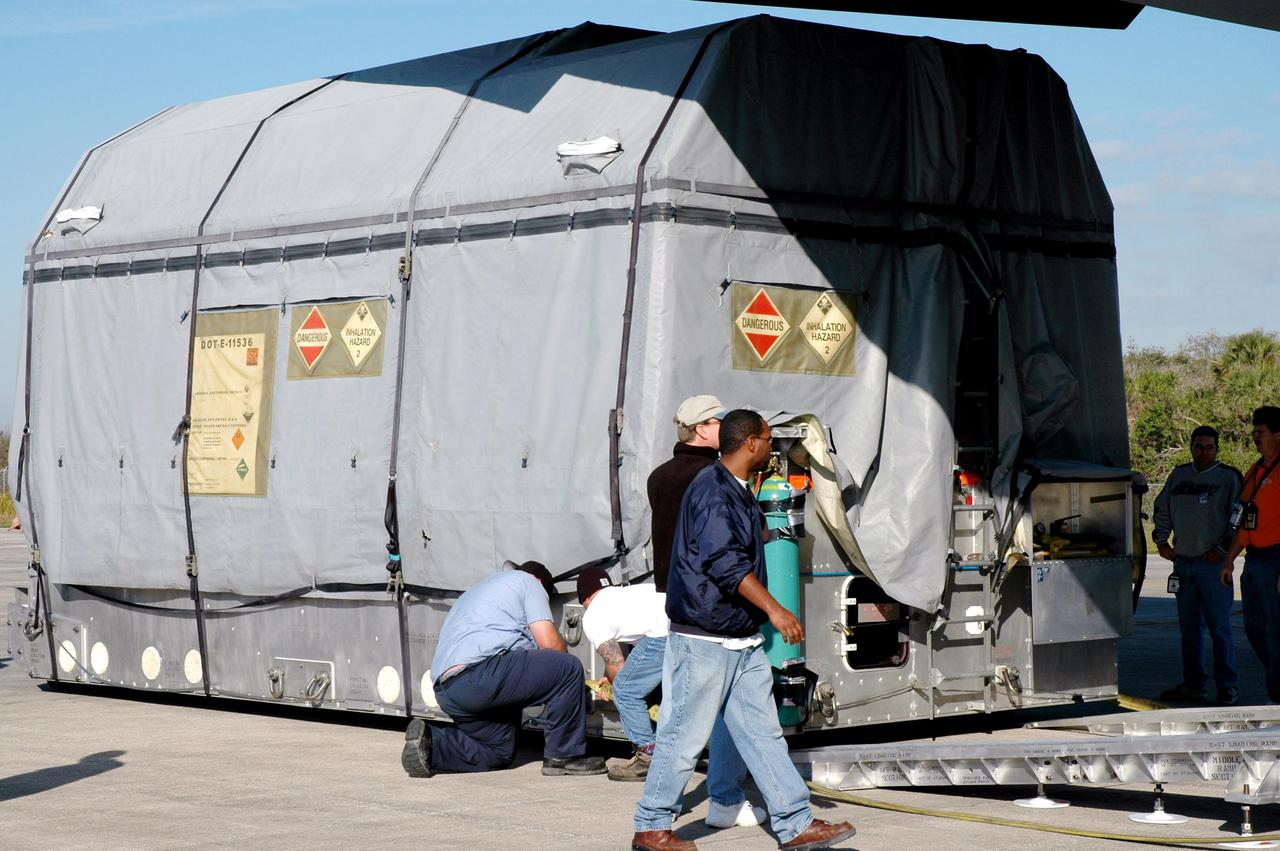
KENNEDY SPACE CENTER, FLA. - At KSC’s Shuttle Landing Facility, workers offload the latest Geostationary Operational Environmental Satellite (GOES) developed by NASA for the National Oceanic and Atmospheric Administration (NOAA) from the C17 military cargo aircraft that delivered it. Called GOES-N, the satellite is targeted to launch May 4 onboard a Boeing expendable launch vehicle Delta IV (4,2). Once in orbit GOES-N will be designated GOES-13 and will complete checkout and be placed in on-orbit storage as a replacement for an older GOES satellite. After arriving, the satellite was transported to Astrotech in Titusville, Fla., where final testing of the imaging system, instrumentation, communications and power systems will be performed over the next two months by Boeing Satellite Systems.
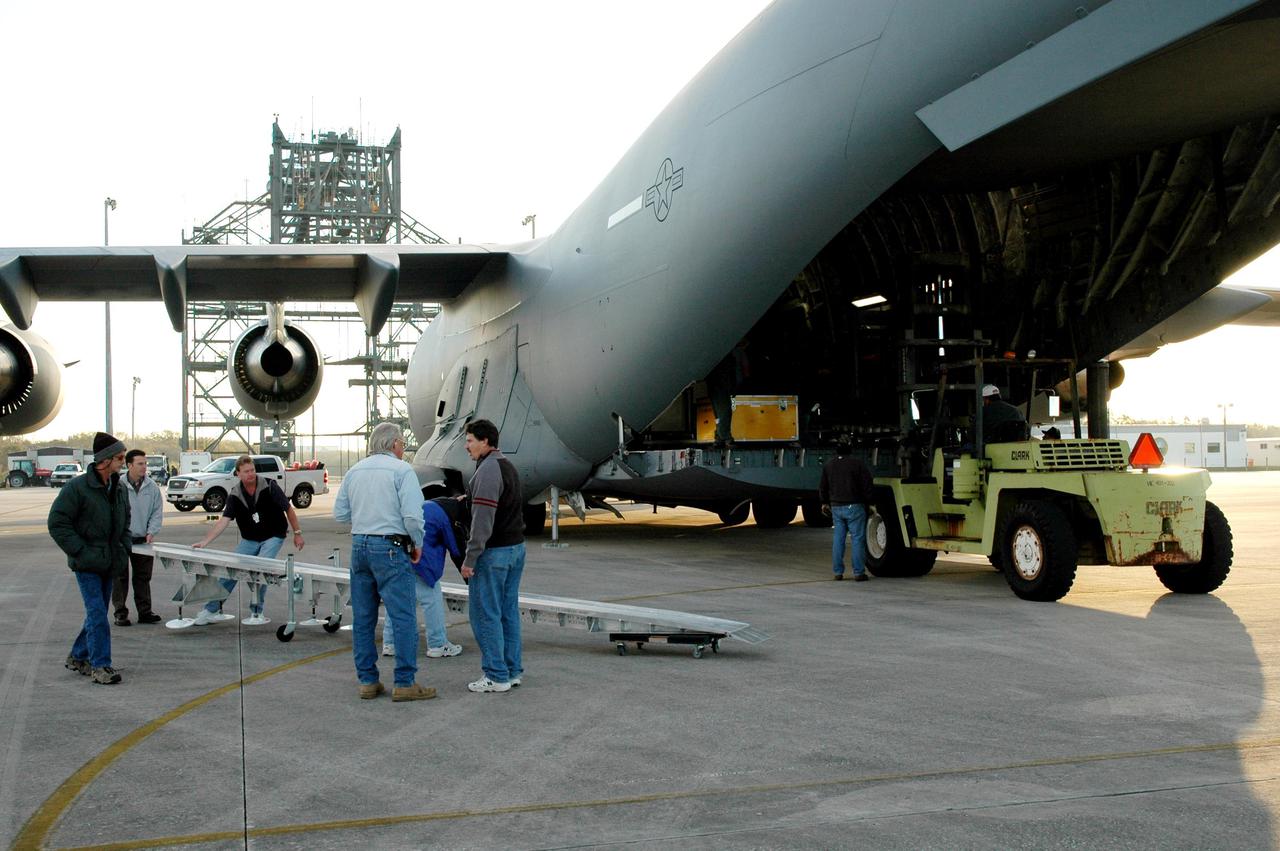
KENNEDY SPACE CENTER, FLA. - At KSC’s Shuttle Landing Facility, workers get ready to offload the latest Geostationary Operational Environmental Satellite (GOES) developed by NASA for the National Oceanic and Atmospheric Administration (NOAA) from a C17 military cargo aircraft. Called GOES-N, the satellite is targeted to launch May 4 onboard a Boeing expendable launch vehicle Delta IV (4,2). Once in orbit GOES-N will be designated GOES-13 and will complete checkout and be placed in on-orbit storage as a replacement for an older GOES satellite. After arriving, the satellite was transported to Astrotech in Titusville, Fla., where final testing of the imaging system, instrumentation, communications and power systems will be performed over the next two months by Boeing Satellite Systems.
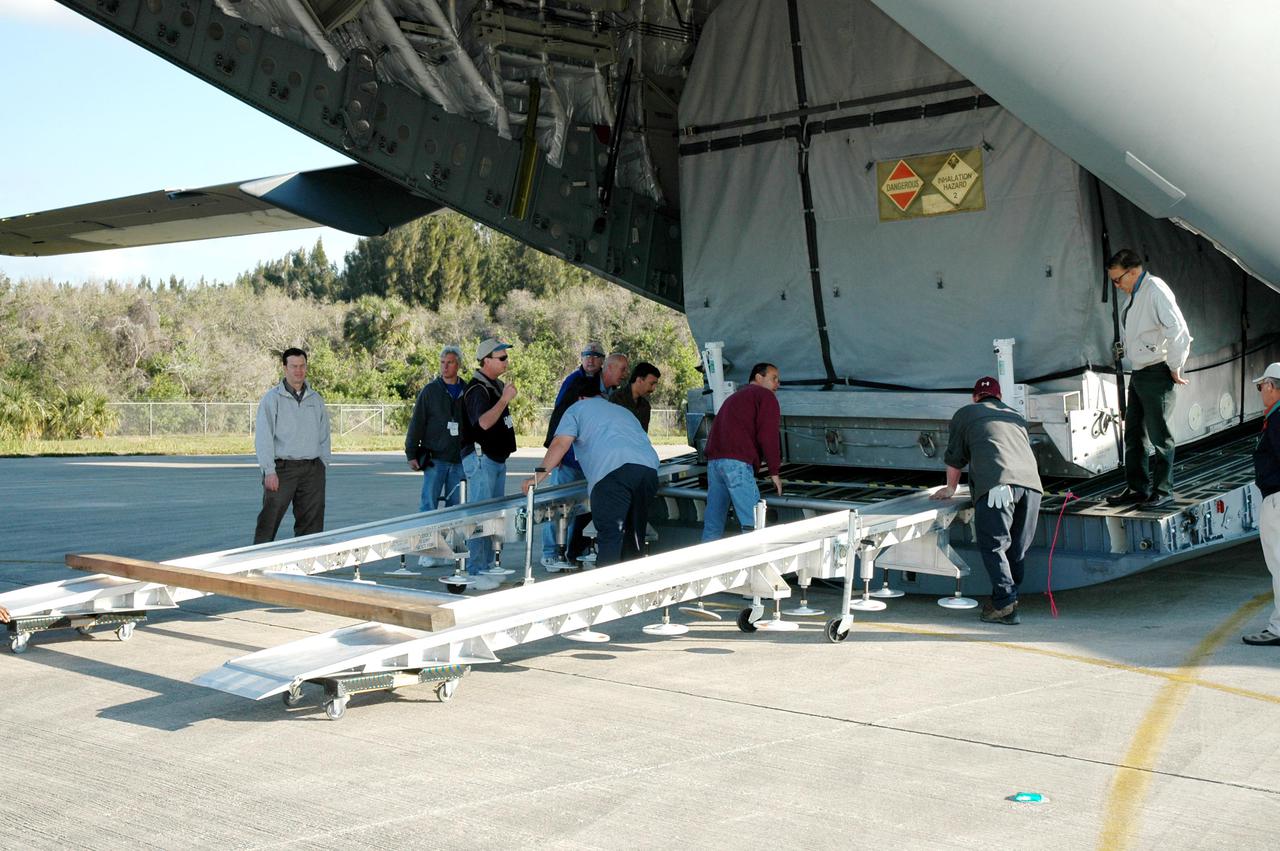
KENNEDY SPACE CENTER, FLA. - At KSC’s Shuttle Landing Facility, workers offload the latest Geostationary Operational Environmental Satellite (GOES) developed by NASA for the National Oceanic and Atmospheric Administration (NOAA) from the C17 military cargo aircraft that delivered it. Called GOES-N, the satellite is targeted to launch May 4 onboard a Boeing expendable launch vehicle Delta IV (4,2). Once in orbit GOES-N will be designated GOES-13 and will complete checkout and be placed in on-orbit storage as a replacement for an older GOES satellite. After arriving, the satellite was transported to Astrotech in Titusville, Fla., where final testing of the imaging system, instrumentation, communications and power systems will be performed over the next two months by Boeing Satellite Systems.
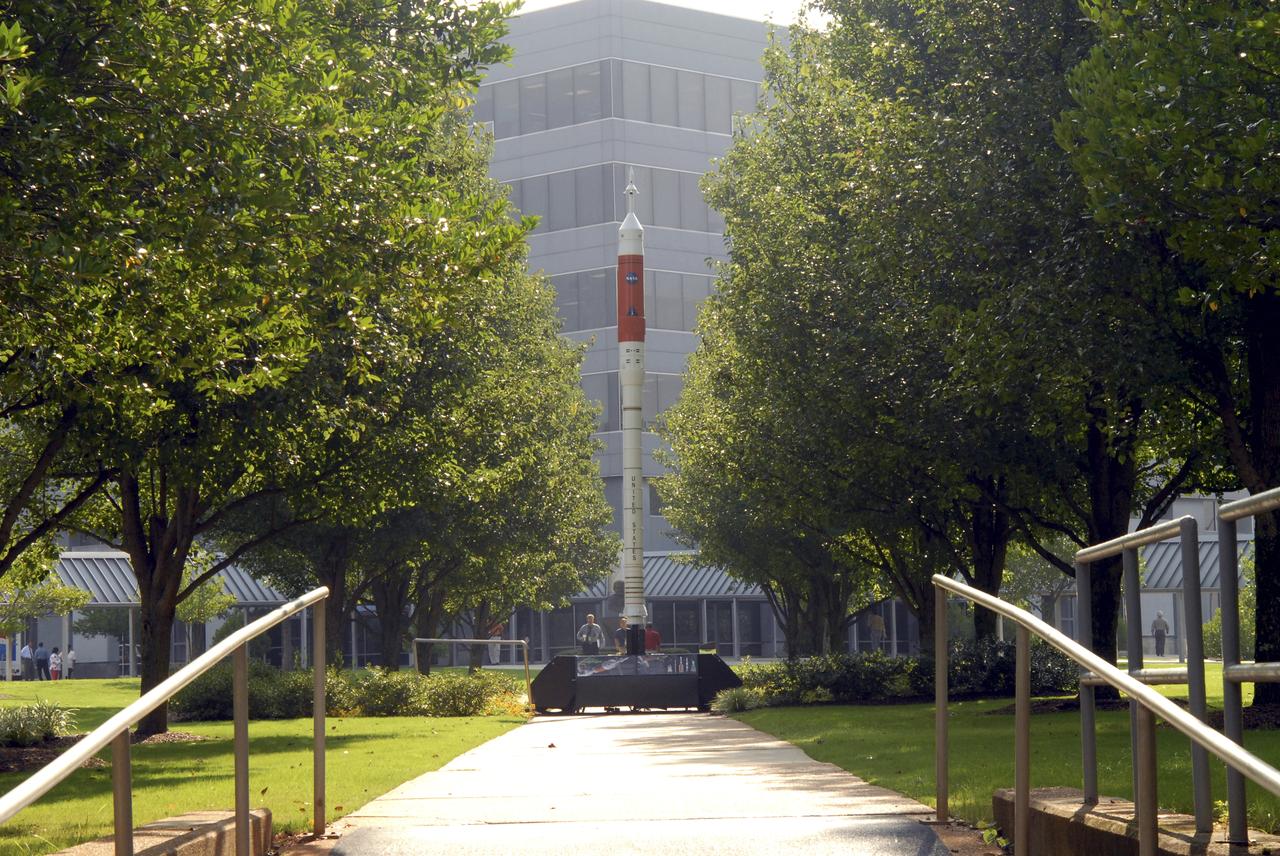
A model of the new Aries I crew launch vehicle, for which NASA is designing, testing and evaluating hardware and related systems, is seen here on display at the Marshall Space Fight Center (MSFC), in Huntsville, Alabama. The Ares I crew launch vehicle is the rocket that will carry a new generation of space explorers into orbit. Under the goals of the Vision for Space Exploration, Ares I is a chief component of the cost-effective space transportation infrastructure being developed by NASA’s Constellation Program. These transportation systems will safely and reliably carry human explorers back to the moon, and then onward to Mars and other destinations in the solar system. The Ares I effort includes multiple project element teams at NASA centers and contract organizations around the nation, and is led by the Exploration Launch Projects Office at NASA’s MFSC. Together, these teams are developing vehicle hardware, evolving proven technologies, and testing components and systems. Their work builds on powerful, reliable space shuttle propulsion elements and nearly a half-century of NASA space flight experience and technological advances. Ares I is an inline, two-stage rocket configuration topped by the Crew Exploration Vehicle, its service module and a launch abort system. The launch vehicle’s first stage is a single, five-segment reusable solid rocket booster derived from the Space Shuttle Program’s reusable solid rocket motor that burns a specially formulated and shaped solid propellant called polybutadiene acrylonitrile (PBAN). The second or upper stage will be propelled by a J-2X main engine fueled with liquid oxygen and liquid hydrogen. In addition to its primary mission of carrying crews of four to six astronauts to Earth orbit, the launch vehicle’s 25-ton payload capacity might be used for delivering cargo to space, bringing resources and supplies to the International Space Station or dropping payloads off in orbit for retrieval and transport to exploration teams on the moon. Crew transportation to the space station is planned to begin no later than 2014. The first lunar excursion is scheduled for the 2020 timeframe.
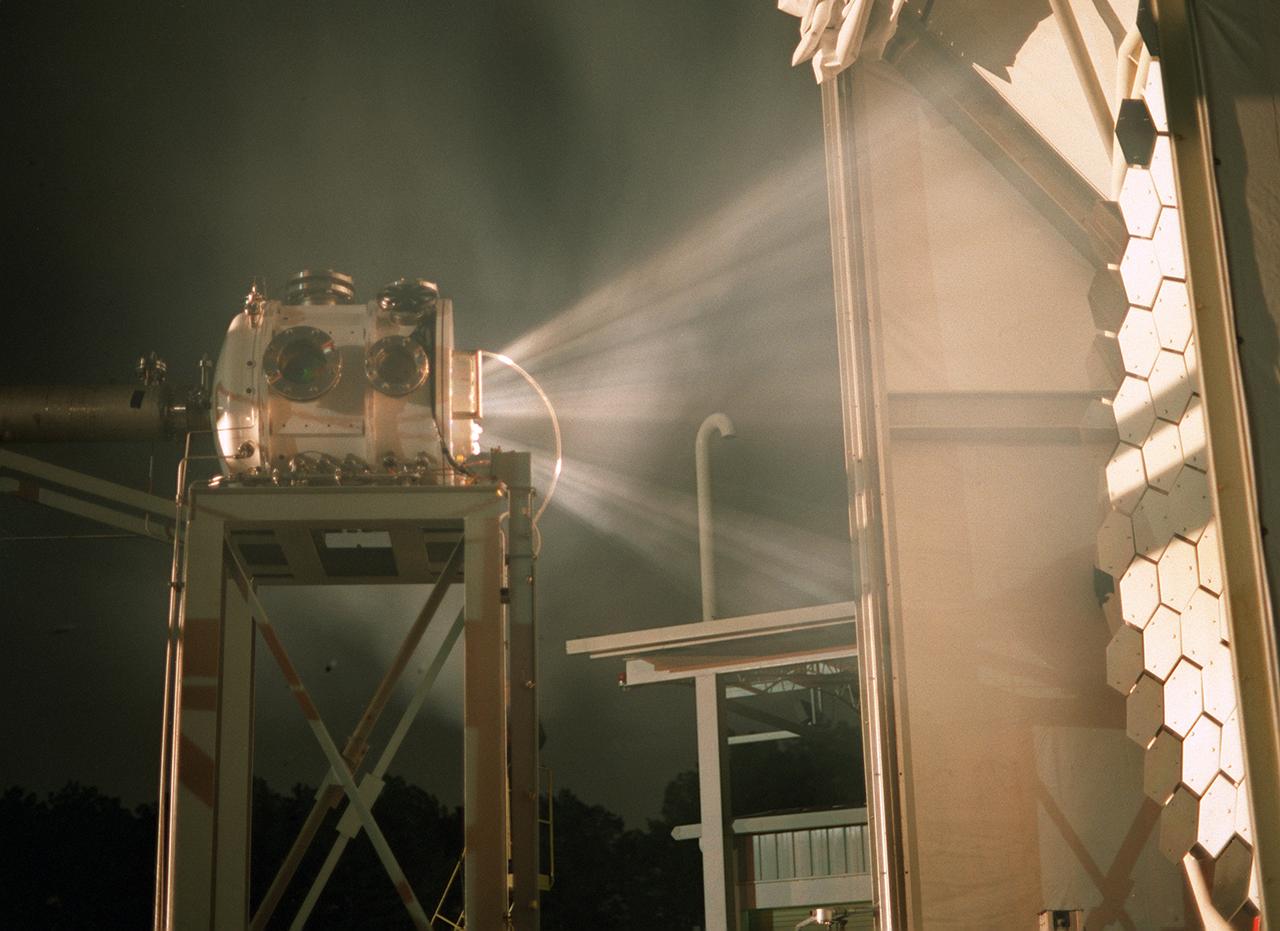
Researchers at the Marshall Space Flight Center (MSFC) have designed, fabricated, and tested the first solar thermal engine, a non-chemical rocket engine that produces lower thrust but has better thrust efficiency than a chemical combustion engine. MSFC turned to solar thermal propulsion in the early 1990s due to its simplicity, safety, low cost, and commonality with other propulsion systems. Solar thermal propulsion works by acquiring and redirecting solar energy to heat a propellant. The 20- by 24-ft heliostat mirror (not shown in this photograph) has a dual-axis control that keeps a reflection of the sunlight on the 18-ft diameter concentrator mirror, which then focuses the sunlight to a 4-in focal point inside the vacuum chamber. The focal point has 10 kilowatts of intense solar power. This image, taken during the test, depicts the light being concentrated into the focal point inside the vacuum chamber. As part of MSFC's Space Transportation Directorate, the Propulsion Research Center serves as a national resource for research of advanced, revolutionary propulsion technologies. The mission is to move the Nation's capabilities beyond the confines of conventional chemical propulsion into an era of aircraft-like access to Earth orbit, rapid travel throughout the solar system, and exploration of interstellar space.
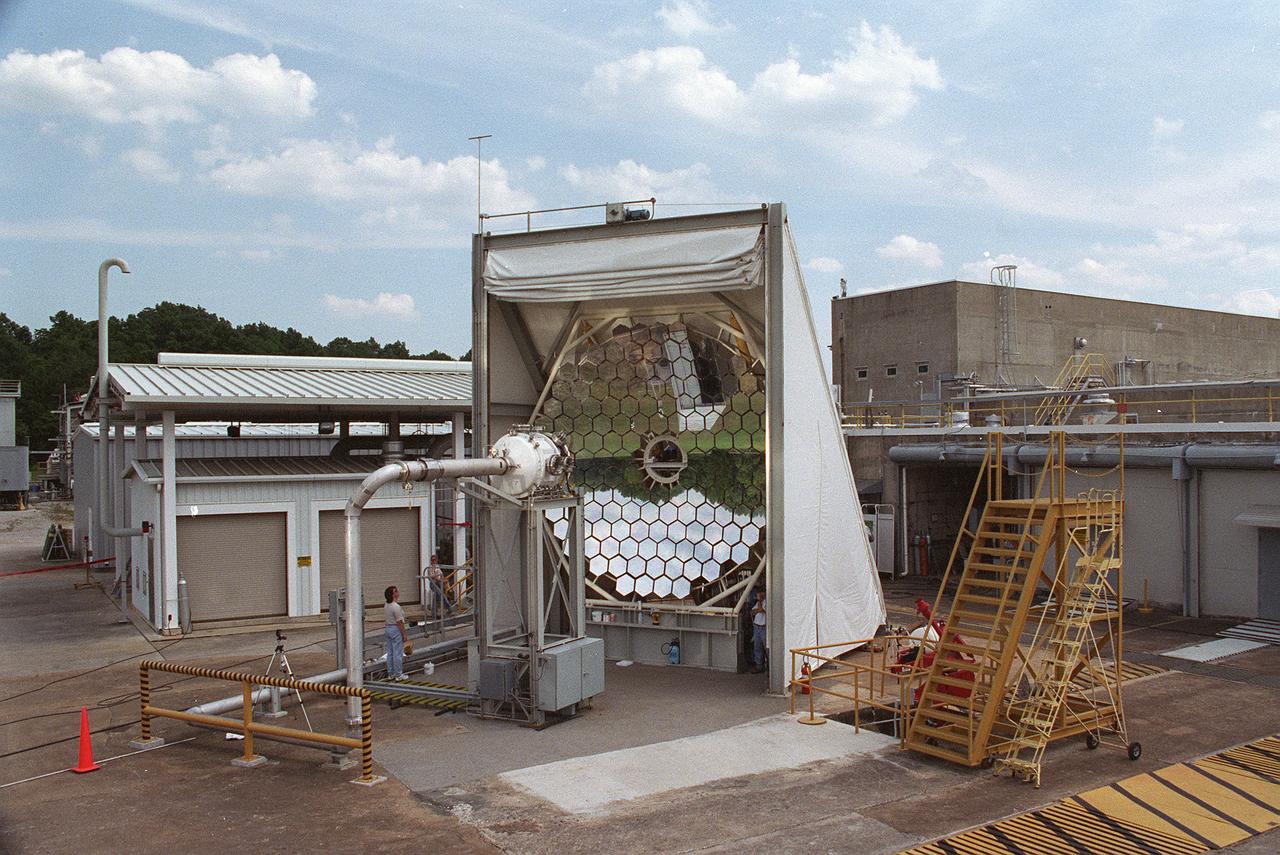
Researchers at the Marshall Space Flight Center (MSFC) have designed, fabricated and tested the first solar thermal engine, a non-chemical rocket engine that produces lower thrust but has better thrust efficiency than a chemical combustion engine. MSFC turned to solar thermal propulsion in the early 1990s due to its simplicity, safety, low cost, and commonality with other propulsion systems. Solar thermal propulsion works by acquiring and redirecting solar energy to heat a propellant. This photograph, taken at MSFC's Solar Thermal Propulsion Test Facility, shows a concentrator mirror, a combination of 144 mirrors forming this 18-ft diameter concentrator, and a vacuum chamber that houses the focal point. The 20- by 24-ft heliostat mirror (not shown in this photograph) has a dual-axis control that keeps a reflection of the sunlight on the 18-foot diameter concentrator mirror, which then focuses the sunlight to a 4-in focal point inside the vacuum chamber. The focal point has 10 kilowatts of intense solar power. As part of MSFC's Space Transportation Directorate, the Propulsion Research Center serves as a national resource for research of advanced, revolutionary propulsion technologies. The mission is to move the Nation's capabilities beyond the confines of conventional chemical propulsion into an era of aircraft-like access to Earth-orbit, rapid travel throughout the solar system, and exploration of interstellar space.
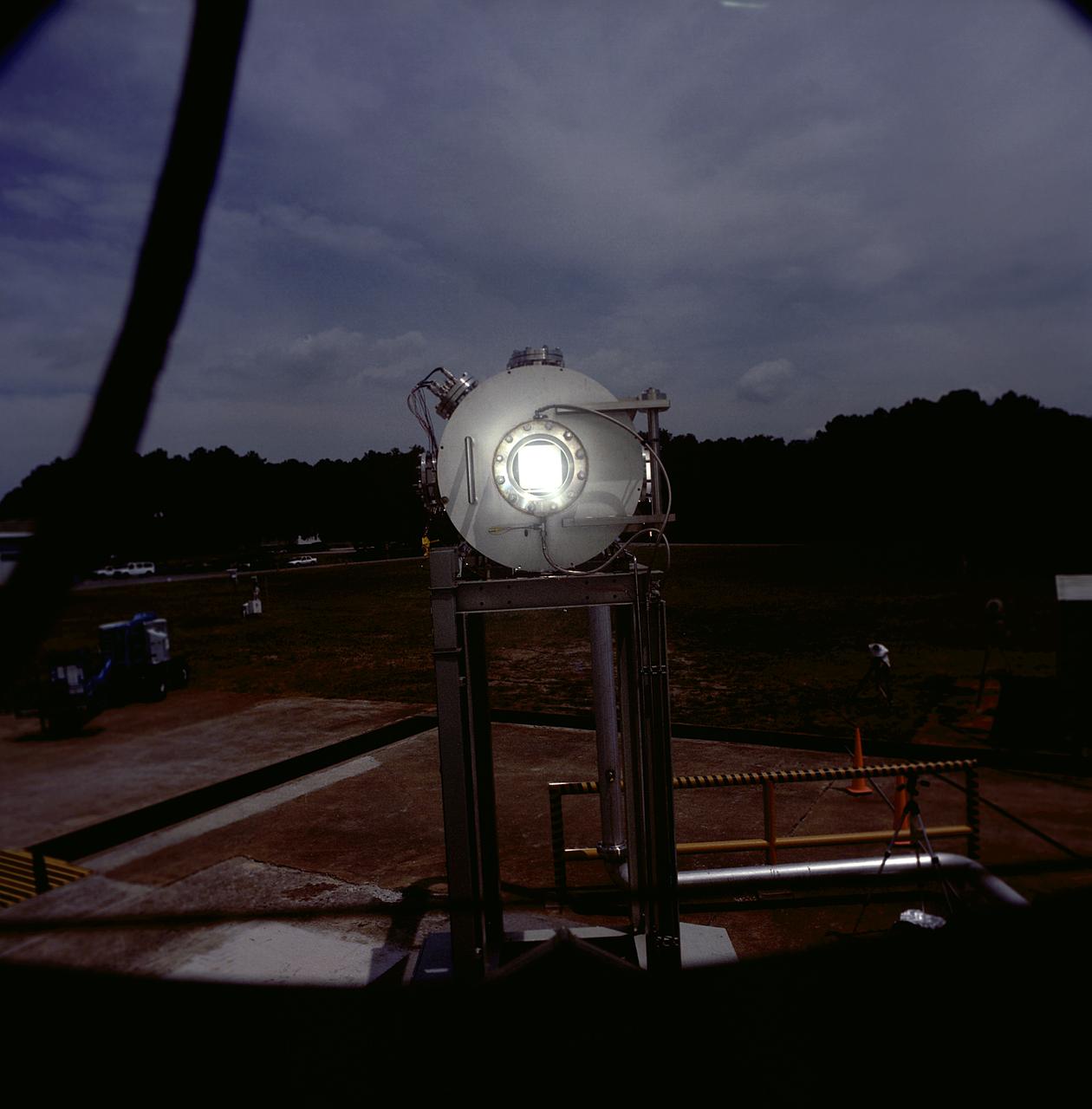
Researchers at the Marshall Space Flight Center (MSFC) have designed, fabricated, and tested the first solar thermal engine, a non-chemical rocket engine that produces lower thrust but has better thrust efficiency than a chemical combustion engine. MSFC turned to solar thermal propulsion in the early 1990s due to its simplicity, safety, low cost, and commonality with other propulsion systems. Solar thermal propulsion works by acquiring and redirecting solar energy to heat a propellant. The 20- by 24-ft heliostat mirror (not shown in this photograph) has dual-axis control that keeps a reflection of the sunlight on an 18-ft diameter concentrator mirror, which then focuses the sunlight to a 4-in focal point inside the vacuum chamber. The focal point has 10 kilowatts of intense solar power. This photograph is a close-up view of a 4-in focal point inside the vacuum chamber at the MSFC Solar Thermal Propulsion Test facility. As part of MSFC's Space Transportation Directorate, the Propulsion Research Center serves as a national resource for research of advanced, revolutionary propulsion technologies. The mission is to move the Nation's capabilities beyond the confines of conventional chemical propulsion into an era of aircraft-like access to Earth orbit, rapid travel throughout the solar system, and exploration of interstellar space.
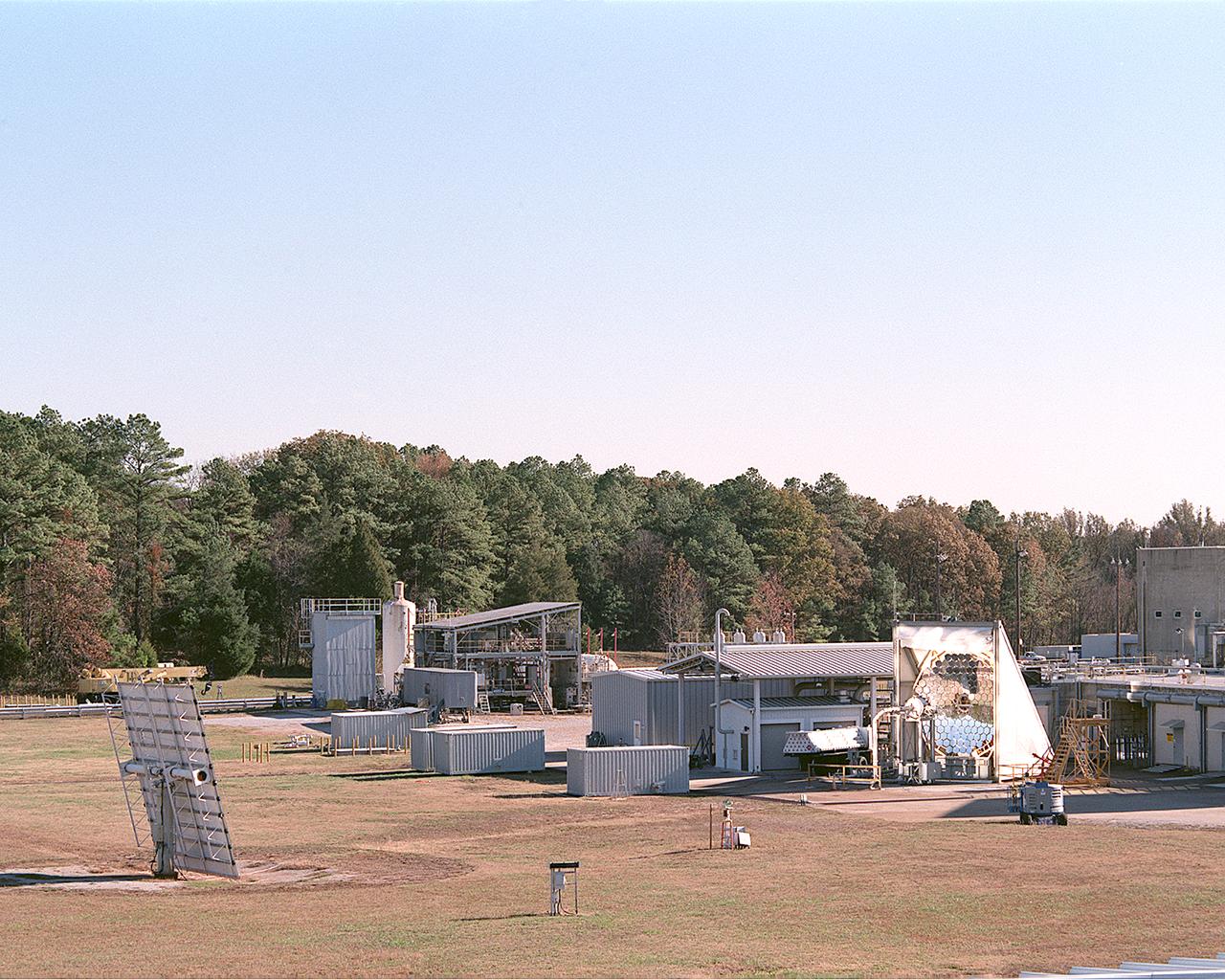
This photograph shows an overall view of the Solar Thermal Propulsion Test Facility at the Marshall Space Flight Center (MSFC). The 20-by 24-ft heliostat mirror, shown at the left, has dual-axis control that keeps a reflection of the sunlight on an 18-ft diameter concentrator mirror (right). The concentrator mirror then focuses the sunlight to a 4-in focal point inside the vacuum chamber, shown at the front of concentrator mirror. Researchers at MSFC have designed, fabricated, and tested the first solar thermal engine, a non-chemical rocket engine that produces lower thrust but has better thrust efficiency than chemical a combustion engine. MSFC turned to solar thermal propulsion in the early 1990s due to its simplicity, safety, low cost, and commonality with other propulsion systems. Solar thermal propulsion works by acquiring and redirecting solar energy to heat a propell nt. As part of MSFC's Space Transportation Directorate, the Propulsion Research Center serves as a national resource for research of advanced, revolutionary propulsion technologies. The mission is to move the Nation's capabilities beyond the confines of conventional chemical propulsion into an era of aircraft-like access to Earth-orbit, rapid travel throughout the solar system, and exploration of interstellar space.
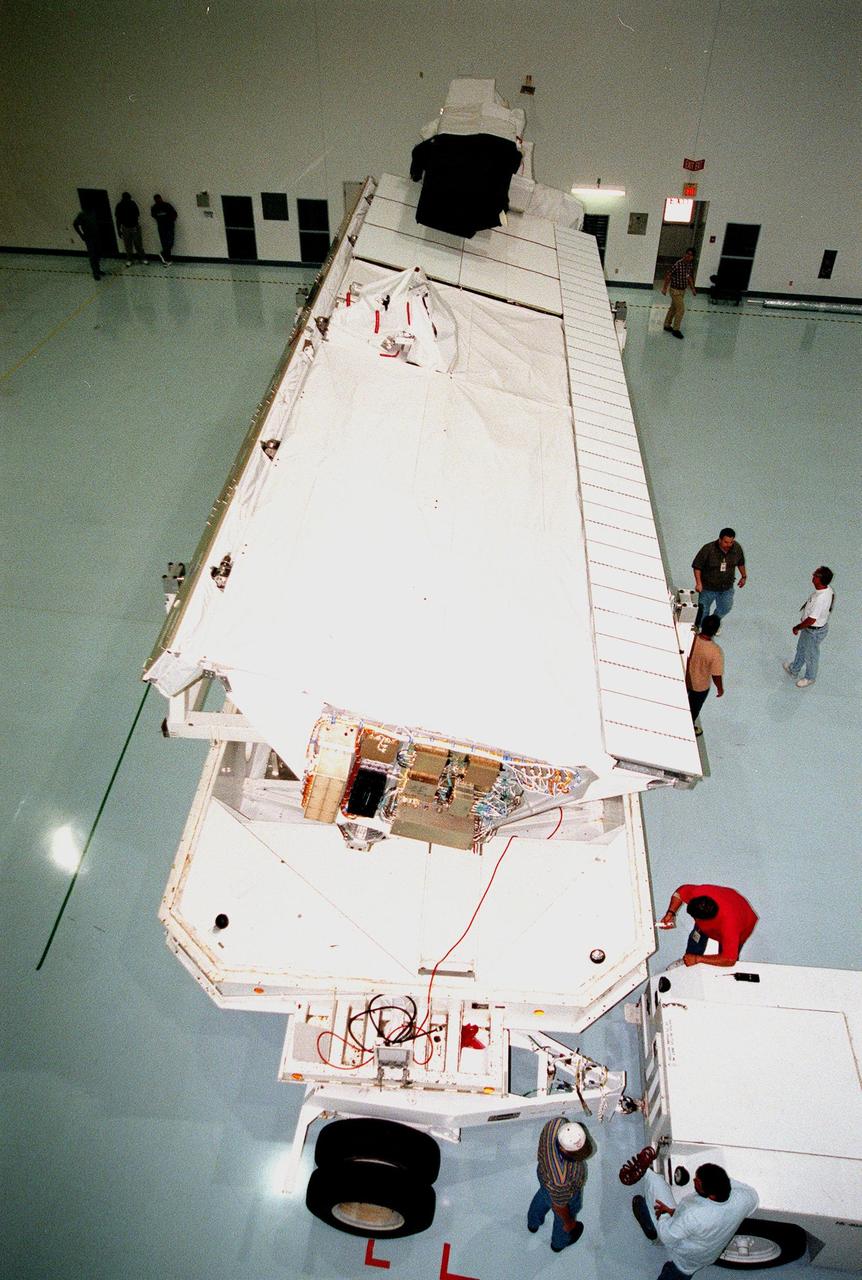
In the Space Station Processing Facility (SSPF), workers (lower right) disconnect the transport vehicle from the Shuttle Radar Topography Mission (SRTM) after moving it into the building for pre-launch preparations. The primary payload on mission STS-99, the SRTM consists of a specially modified radar system that will fly onboard the Space Shuttle during the 11-day mission targeted for launch in September 1999. This radar system will gather data that will result in the most accurate and complete topographic map of the Earth's surface that has ever been assembled. SRTM is an international project spearheaded by the National Imagery and Mapping Agency and NASA, with participation of the German Aerospace Center DLR. Its objective is to obtain the most complete high-resolution digital topographic database of the Earth
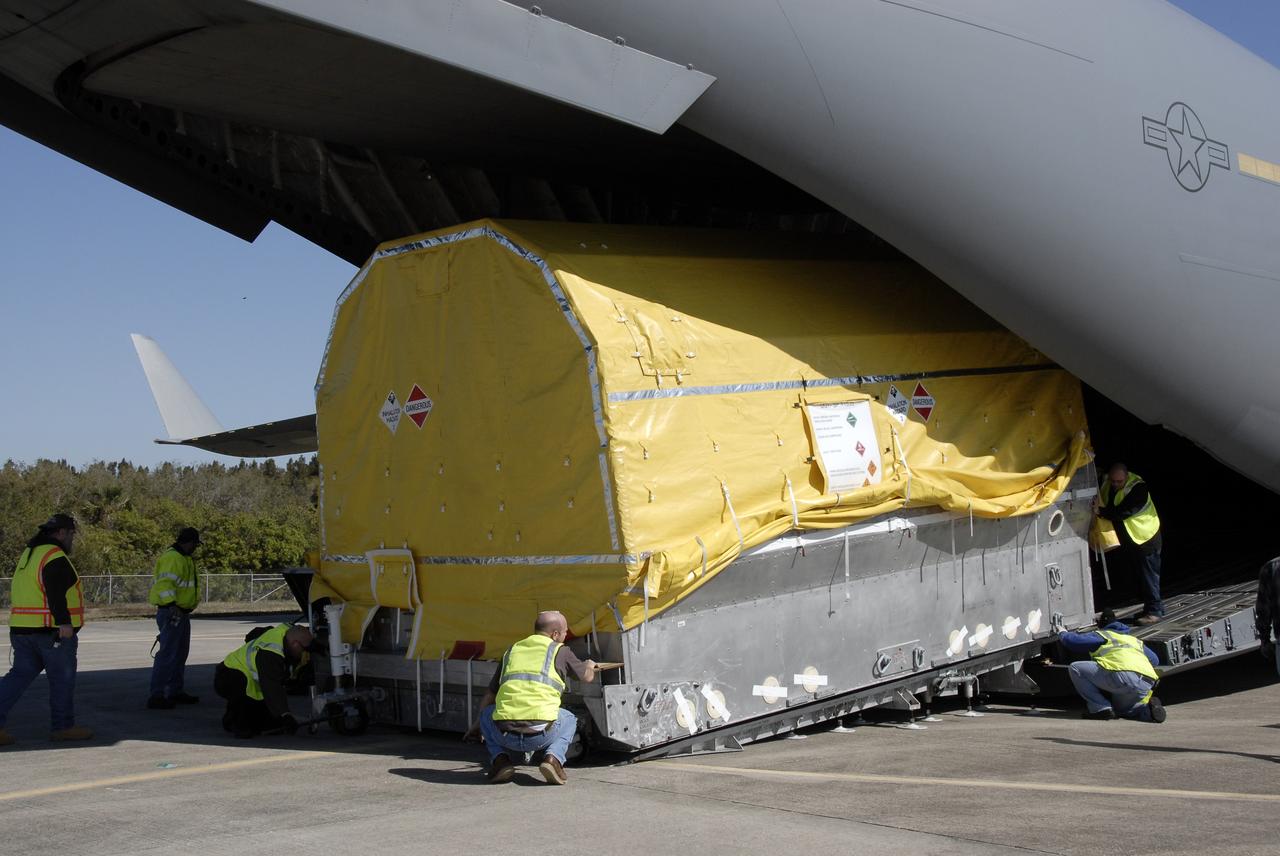
CAPE CANAVERAL, Fla. – At the Shuttle Landing Facility at NASA's Kennedy Space Center in Florida, workers check the latest Geostationary Operational Environmental Satellite, or GOES, as it moves out of the C-17 military cargo aircraft. Developed by NASA for the National Oceanic and Atmospheric Administration, or NOAA, the GOES-O satellite is targeted to launch April 28 onboard a United Launch Alliance Delta IV expendable launch vehicle. Once in orbit, GOES-O will be designated GOES-14, and NASA will provide on-orbit checkout and then transfer operational responsibility to NOAA. GOES-O will be placed in on-orbit storage as a replacement for an older GOES satellite. After arriving, the satellite was transported to Astrotech in Titusville, Fla., where final testing of the imaging system, instrumentation, communications and power systems will be performed. Photo credit: NASA/Kim Shiflett
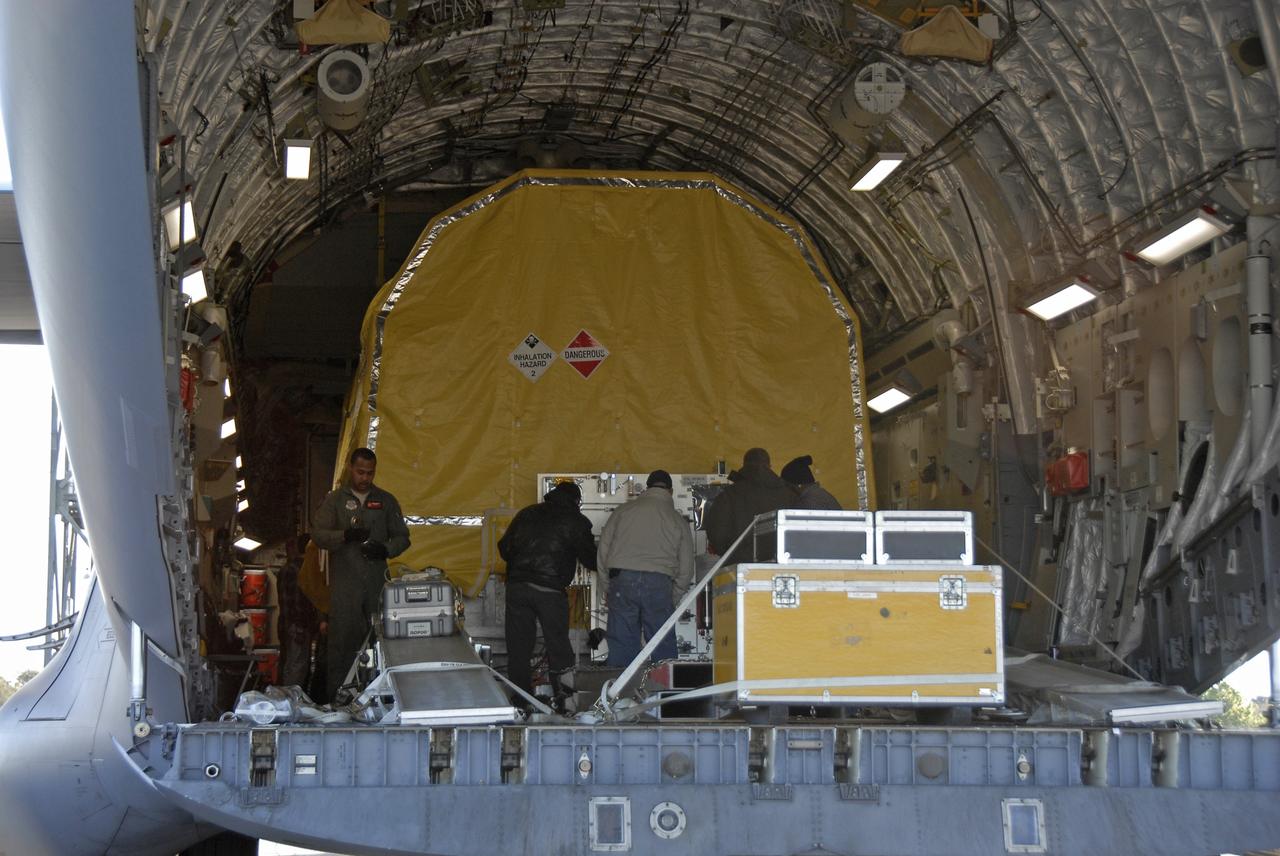
CAPE CANAVERAL, Fla. – The latest Geostationary Operational Environmental Satellite, or GOES, is prepared for offloading from the C-17 military cargo aircraft at the Shuttle Landing Facility at NASA's Kennedy Space Center in Florida. Developed by NASA for the National Oceanic and Atmospheric Administration, or NOAA, the GOES-O satellite is targeted to launch April 28 onboard a United Launch Alliance Delta IV expendable launch vehicle. Once in orbit, GOES-O will be designated GOES-14, and NASA will provide on-orbit checkout and then transfer operational responsibility to NOAA. GOES-O will be placed in on-orbit storage as a replacement for an older GOES satellite. After arriving, the satellite was transported to Astrotech in Titusville, Fla., where final testing of the imaging system, instrumentation, communications and power systems will be performed. Photo credit: NASA/Kim Shiflett
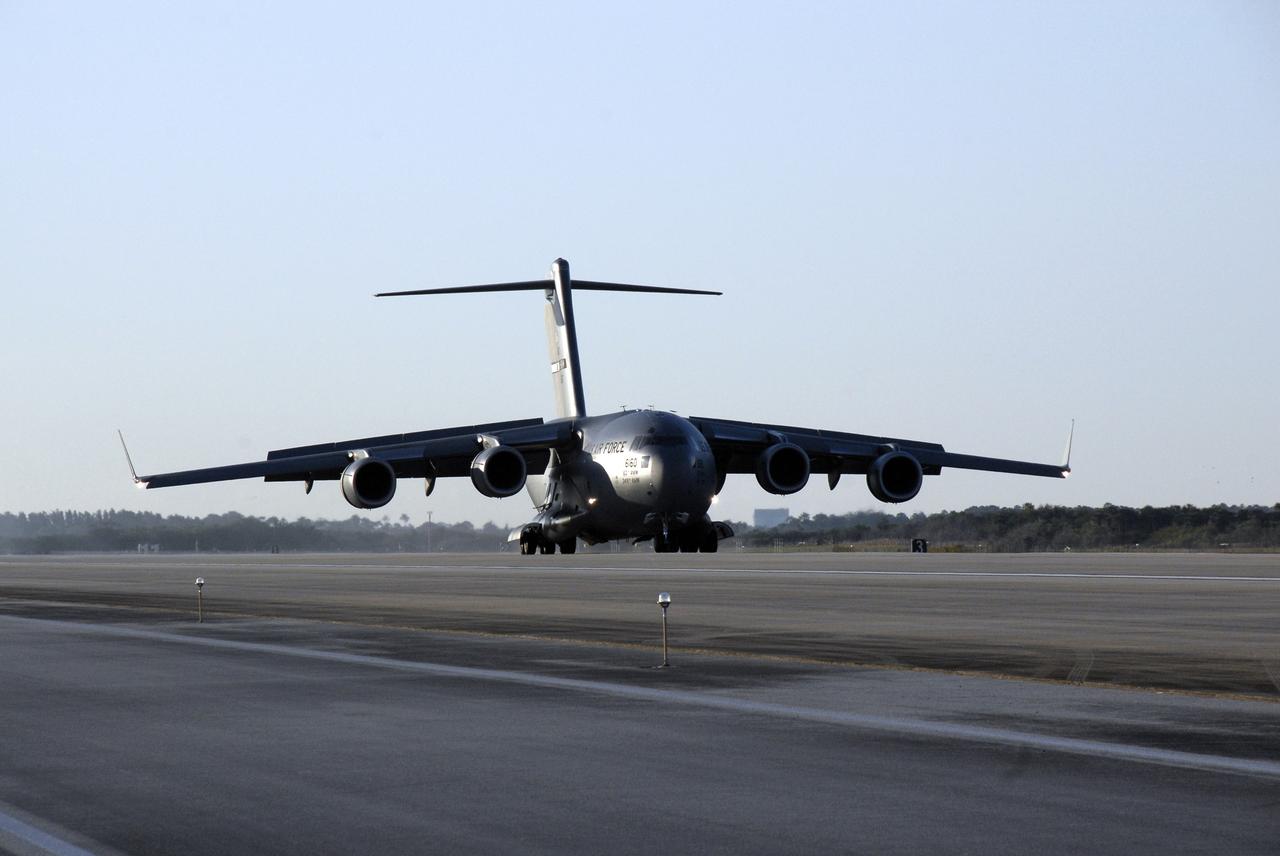
CAPE CANAVERAL, Fla. – The latest Geostationary Operational Environmental Satellite, or GOES, arrives on a C-17 military cargo aircraft at the Shuttle Landing Facility at NASA's Kennedy Space Center in Florida from its manufacturing plant in El Segundo, Calif. Developed by NASA for the National Oceanic and Atmospheric Administration, or NOAA, the GOES-O satellite is targeted to launch April 28 onboard a United Launch Alliance Delta IV expendable launch vehicle. Once in orbit, GOES-O will be designated GOES-14, and NASA will provide on-orbit checkout and then transfer operational responsibility to NOAA. GOES-O will be placed in on-orbit storage as a replacement for an older GOES satellite. After arriving, the satellite was transported to Astrotech in Titusville, Fla., where final testing of the imaging system, instrumentation, communications and power systems will be performed. Photo credit: NASA/Kim Shiflett
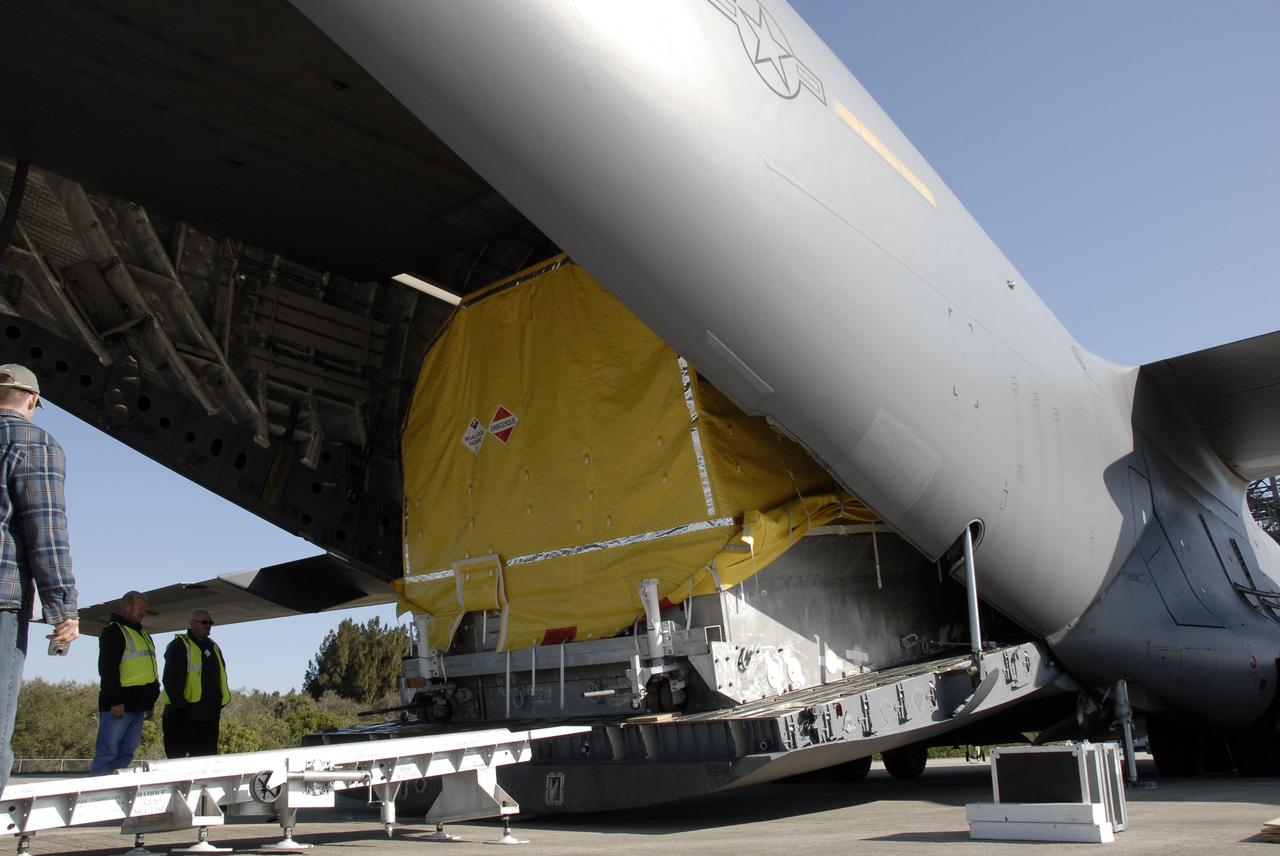
CAPE CANAVERAL, Fla. – The latest Geostationary Operational Environmental Satellite, or GOES, moves out of the C-17 military cargo aircraft at the Shuttle Landing Facility at NASA's Kennedy Space Center in Florida. Developed by NASA for the National Oceanic and Atmospheric Administration, or NOAA, the GOES-O satellite is targeted to launch April 28 onboard a United Launch Alliance Delta IV expendable launch vehicle. Once in orbit, GOES-O will be designated GOES-14, and NASA will provide on-orbit checkout and then transfer operational responsibility to NOAA. GOES-O will be placed in on-orbit storage as a replacement for an older GOES satellite. After arriving, the satellite was transported to Astrotech in Titusville, Fla., where final testing of the imaging system, instrumentation, communications and power systems will be performed. Photo credit: NASA/Kim Shiflett
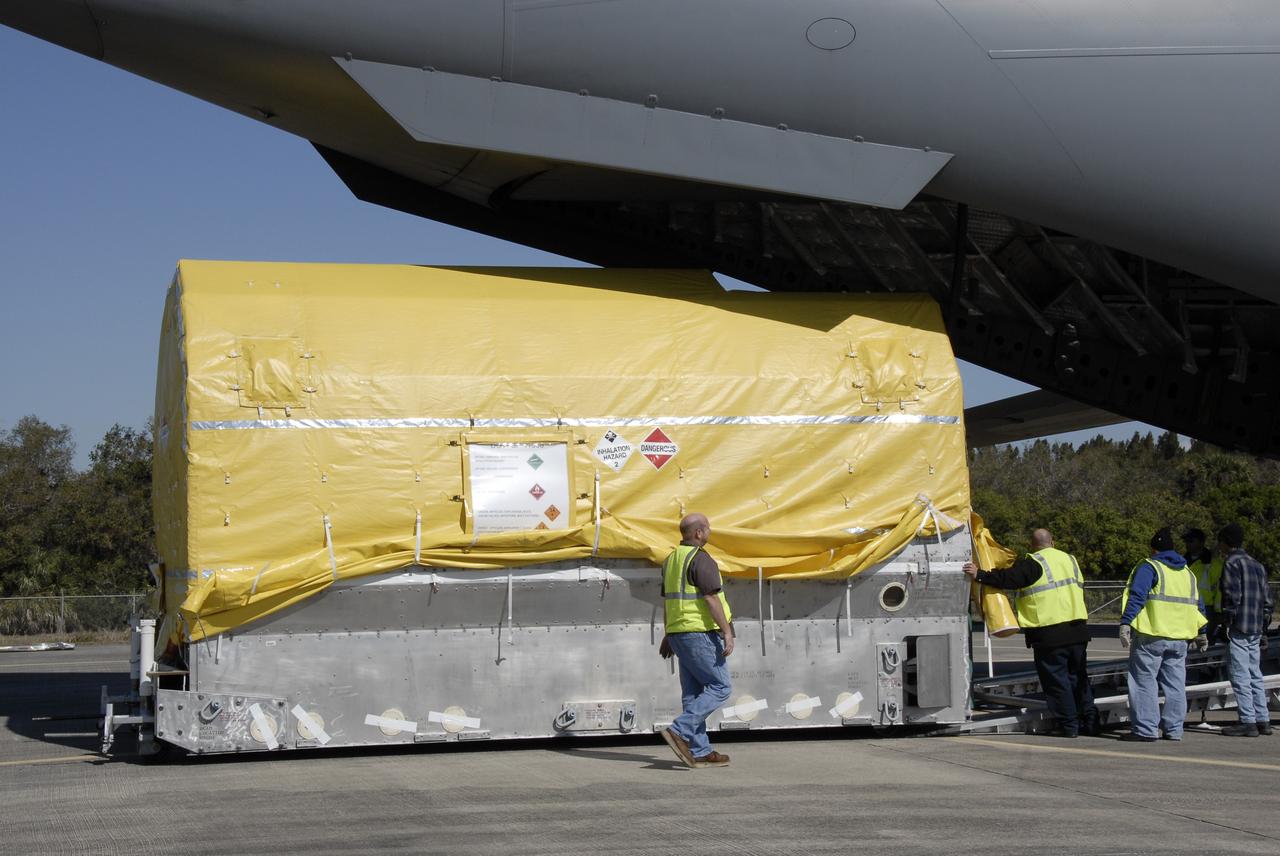
CAPE CANAVERAL, Fla. – At the Shuttle Landing Facility at NASA's Kennedy Space Center in Florida, workers check the latest Geostationary Operational Environmental Satellite, or GOES, as it moves out of the C-17 military cargo aircraft. Developed by NASA for the National Oceanic and Atmospheric Administration, or NOAA, the GOES-O satellite is targeted to launch April 28 onboard a United Launch Alliance Delta IV expendable launch vehicle. Once in orbit, GOES-O will be designated GOES-14, and NASA will provide on-orbit checkout and then transfer operational responsibility to NOAA. GOES-O will be placed in on-orbit storage as a replacement for an older GOES satellite. After arriving, the satellite was transported to Astrotech in Titusville, Fla., where final testing of the imaging system, instrumentation, communications and power systems will be performed. Photo credit: NASA/Kim Shiflett
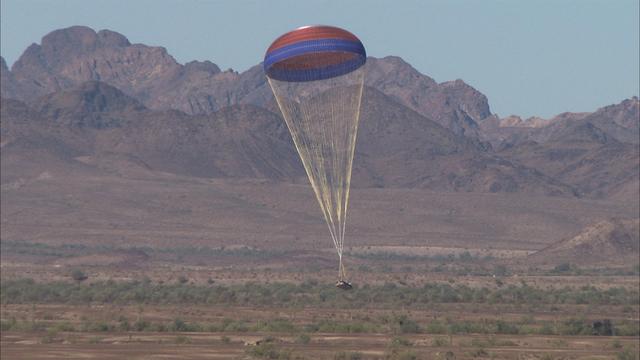
Under the goals of the Vision for Space Exploration, Ares I is a chief component of the cost-effective space transportation infrastructure being developed by NASA's Constellation Program. This transportation system will safely and reliably carry human explorers back to the moon, and then onward to Mars and other destinations in the solar system. The Ares I effort includes multiple project element teams at NASA centers and contract organizations around the nation, and is managed by the Exploration Launch Projects Office at NASA's Marshall Space Flight Center (MFSC). ATK Launch Systems near Brigham City, Utah, is the prime contractor for the first stage booster. ATK's subcontractor, United Space Alliance of Houston, is designing, developing and testing the parachutes at its facilities at NASA's Kennedy Space Center in Florida. NASA's Johnson Space Center in Houston hosts the Constellation Program and Orion Crew Capsule Project Office and provides test instrumentation and support personnel. Together, these teams are developing vehicle hardware, evolving proven technologies, and testing components and systems. Their work builds on powerful, reliable space shuttle propulsion elements and nearly a half-century of NASA space flight experience and technological advances. Ares I is an inline, two-stage rocket configuration topped by the Crew Exploration Vehicle, its service module, and a launch abort system. In this HD video image, the first stage reentry parachute drop test is conducted at the Yuma, Arizona proving ground. The parachute tests demonstrated a three-stage deployment sequence that included the use of an Orbiter drag chute to properly stage the unfurling of the main chute. The parachute recovery system for Orion will be similar to the system used for Apollo command module landings and include two drogue, three pilot, and three main parachutes. (Highest resolution available)
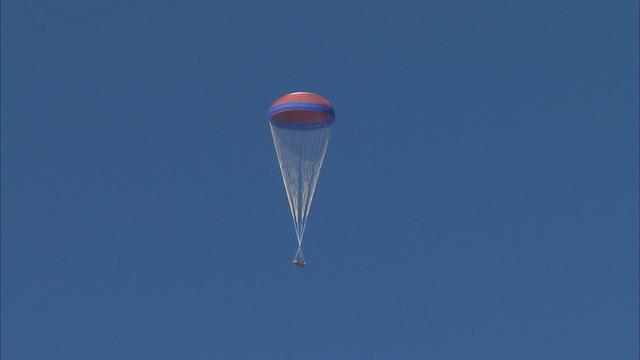
Under the goals of the Vision for Space Exploration, Ares I is a chief component of the cost-effective space transportation infrastructure being developed by NASA's Constellation Program. This transportation system will safely and reliably carry human explorers back to the moon, and then onward to Mars and other destinations in the solar system. The Ares I effort includes multiple project element teams at NASA centers and contract organizations around the nation, and is managed by the Exploration Launch Projects Office at NASA's Marshall Space Flight Center (MFSC). ATK Launch Systems near Brigham City, Utah, is the prime contractor for the first stage booster. ATK's subcontractor, United Space Alliance of Houston, is designing, developing and testing the parachutes at its facilities at NASA's Kennedy Space Center in Florida. NASA's Johnson Space Center in Houston hosts the Constellation Program and Orion Crew Capsule Project Office and provides test instrumentation and support personnel. Together, these teams are developing vehicle hardware, evolving proven technologies, and testing components and systems. Their work builds on powerful, reliable space shuttle propulsion elements and nearly a half-century of NASA space flight experience and technological advances. Ares I is an inline, two-stage rocket configuration topped by the Crew Exploration Vehicle, its service module, and a launch abort system. In this HD video image, the first stage reentry parachute drop test is conducted at the Yuma, Arizona proving ground. The parachute tests demonstrated a three-stage deployment sequence that included the use of an Orbiter drag chute to properly stage the unfurling of the main chute. The parachute recovery system for Orion will be similar to the system used for Apollo command module landings and include two drogue, three pilot, and three main parachutes. (Highest resolution available)
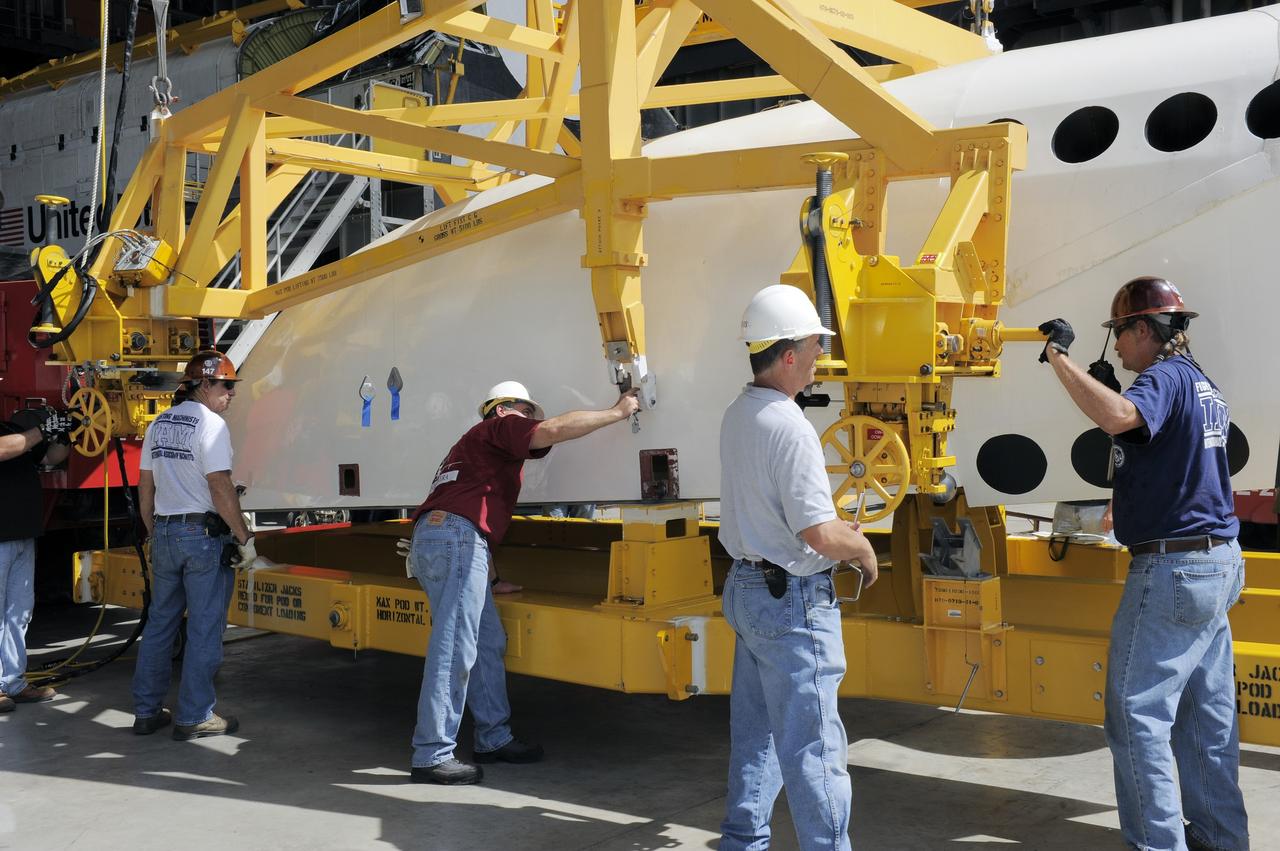
CAPE CANAVERAL, Fla. – In the Vehicle Assembly Building at NASA's Kennedy Space Center in Florida, workers, using overhead cranes, lower a cage over an Approach and Landing Test Assembly (ALTA) pod. The ALTA pod will be lifted for attachment to space shuttle Endeavour on the site once housing the orbital maneuvering system (OMS) pod. The demonstration test is being conducted to ensure the center’s equipment will fit into the hangar at the National Air and Space Museum when installing an ALTA pod on shuttle Enterprise. The pod must be reinstalled on a shuttle for transport on a 747 carrier aircraft. The simulation also tests procedures and timelines necessary to carry out the process. The work is part of the Space Shuttle Program’s transition and retirement processing. Enterprise, which was not equipped for space flight, was built as a test vehicle to demonstrate that the orbiter could fly in the atmosphere and land like an airplane. In 1985, Enterprise was ferried from the Kennedy Space Center to Dulles Airport, Washington, D.C., and became the property of the Smithsonian Institute. Enterprise will be moved from the Smithsonian Institution National Air and Space Museum's Steven F. Udvar-Hazy Center in Chantilly, Va., to the Intrepid Sea, Air and Space Museum in New York. For more information, visit http://www.nasa.gov/shuttle. Photo credit: NASA/Ken Shiflett
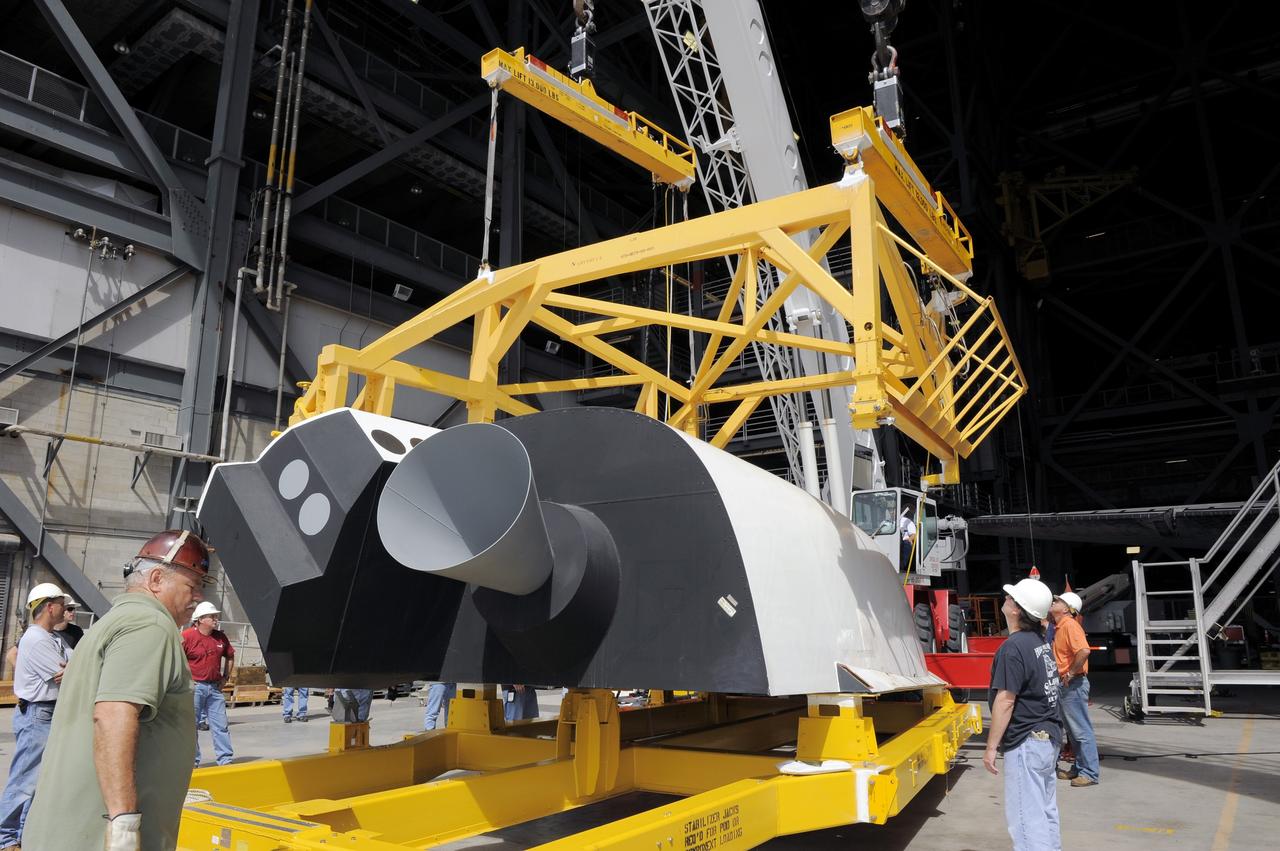
CAPE CANAVERAL, Fla. – In the Vehicle Assembly Building at NASA's Kennedy Space Center in Florida, workers, using overhead cranes, raise a cage over an Approach and Landing Test Assembly (ALTA) pod. The ALTA pod will be lifted for attachment to space shuttle Endeavour on the site once housing the orbital maneuvering system (OMS) pod. The demonstration test is being conducted to ensure the center’s equipment will fit into the hangar at the National Air and Space Museum when installing an ALTA pod on shuttle Enterprise. The pod must be reinstalled on a shuttle for transport on a 747 carrier aircraft. The simulation also tests procedures and timelines necessary to carry out the process. The work is part of the Space Shuttle Program’s transition and retirement processing. Enterprise, which was not equipped for space flight, was built as a test vehicle to demonstrate that the orbiter could fly in the atmosphere and land like an airplane. In 1985, Enterprise was ferried from the Kennedy Space Center to Dulles Airport, Washington, D.C., and became the property of the Smithsonian Institute. Enterprise will be moved from the Smithsonian Institution National Air and Space Museum's Steven F. Udvar-Hazy Center in Chantilly, Va., to the Intrepid Sea, Air and Space Museum in New York. For more information, visit http://www.nasa.gov/shuttle. Photo credit: NASA/Ken Shiflett
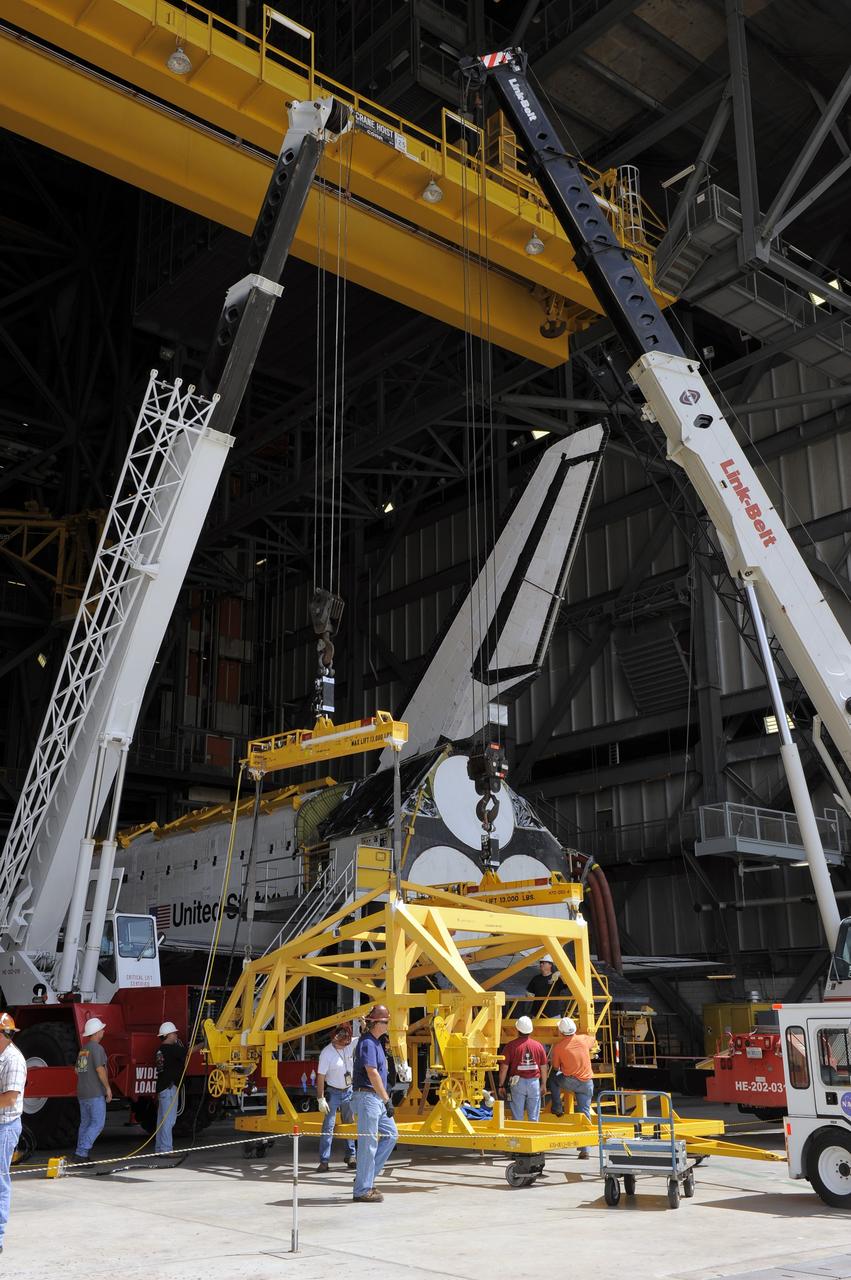
CAPE CANAVERAL, Fla. – In the Vehicle Assembly Building at NASA's Kennedy Space Center in Florida, workers, using overhead cranes, begin to raise a cage which will be placed over an Approach and Landing Test Assembly (ALTA) pod. The ALTA pod will be lifted for attachment to space shuttle Endeavour on the site once housing the orbital maneuvering system (OMS) pod. The demonstration test is being conducted to ensure the center’s equipment will fit into the hangar at the National Air and Space Museum when installing an ALTA pod on shuttle Enterprise. The pod must be reinstalled on a shuttle for transport on a 747 carrier aircraft. The simulation also tests procedures and timelines necessary to carry out the process. The work is part of the Space Shuttle Program’s transition and retirement processing. Enterprise, which was not equipped for space flight, was built as a test vehicle to demonstrate that the orbiter could fly in the atmosphere and land like an airplane. In 1985, Enterprise was ferried from the Kennedy Space Center to Dulles Airport, Washington, D.C., and became the property of the Smithsonian Institute. Enterprise will be moved from the Smithsonian Institution National Air and Space Museum's Steven F. Udvar-Hazy Center in Chantilly, Va., to the Intrepid Sea, Air and Space Museum in New York. For more information, visit http://www.nasa.gov/shuttle. Photo credit: NASA/Ken Shiflett
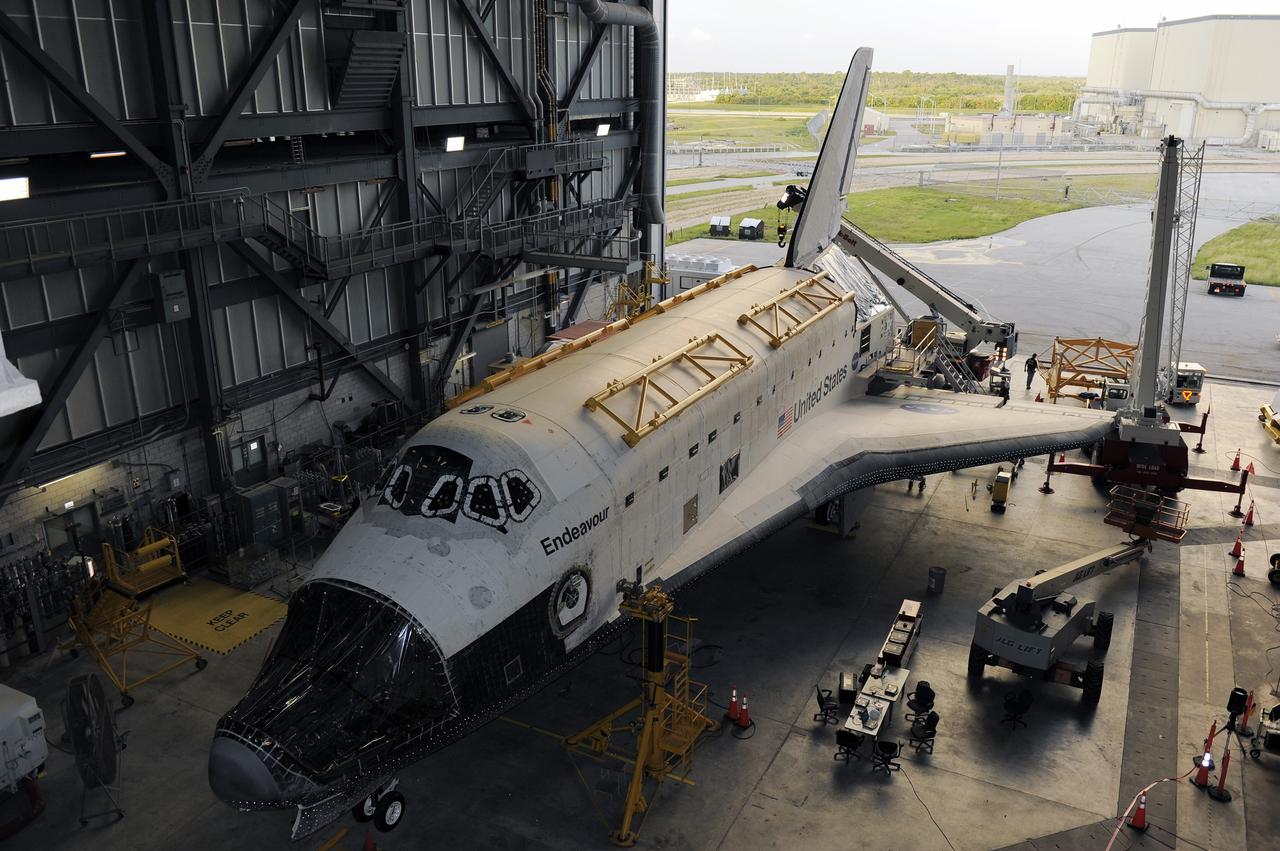
CAPE CANAVERAL, Fla. – In the Vehicle Assembly Building at NASA's Kennedy Space Center in Florida, space shuttle Endeavour sits surrounded by cranes and lifts. Workers are preparing to raise an Approach and Landing Test Assembly (ALTA) pod to the rear of the shuttle for attachment over the site once housing the orbital maneuvering system (OMS) pod. The demonstration test is being conducted to ensure the center’s equipment will fit into the hangar at the National Air and Space Museum when installing an ALTA pod on shuttle Enterprise. The pod must be reinstalled on a shuttle for transport on a 747 carrier aircraft. The simulation also tests procedures and timelines necessary to carry out the process. The work is part of the Space Shuttle Program’s transition and retirement processing. Enterprise, which was not equipped for space flight, was built as a test vehicle to demonstrate that the orbiter could fly in the atmosphere and land like an airplane. In 1985, Enterprise was ferried from the Kennedy Space Center to Dulles Airport, Washington, D.C., and became the property of the Smithsonian Institute. Enterprise will be moved from the Smithsonian Institution National Air and Space Museum's Steven F. Udvar-Hazy Center in Chantilly, Va., to the Intrepid Sea, Air and Space Museum in New York. For more information, visit http://www.nasa.gov/shuttle. Photo credit: NASA/Ken Shiflett
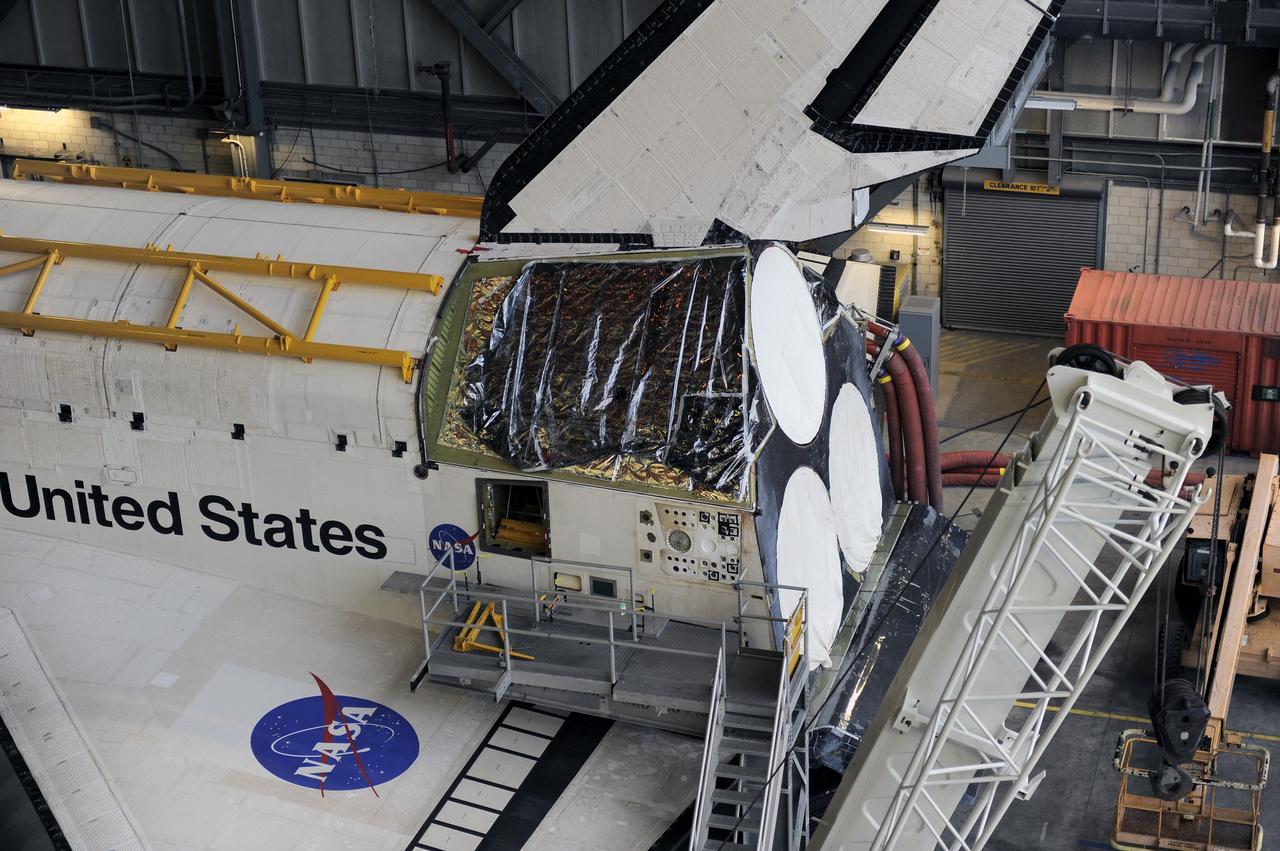
CAPE CANAVERAL, Fla. – In the Vehicle Assembly Building at NASA's Kennedy Space Center in Florida, a rear view of space shuttle Endeavour shows a protective plastic covering the area once housing the orbital maneuvering system (OMS) pod. An aerial lift will raise an Approach and Landing Test Assembly (ALTA) pod to fit over the OMS site. The demonstration test is being conducted to ensure the center’s equipment will fit into the hangar at the National Air and Space Museum when installing an ALTA pod on shuttle Enterprise. The pod must be reinstalled on a shuttle for transport on a 747 carrier aircraft. The simulation also tests procedures and timelines necessary to carry out the process. The work is part of the Space Shuttle Program’s transition and retirement processing. Enterprise, which was not equipped for space flight, was built as a test vehicle to demonstrate that the orbiter could fly in the atmosphere and land like an airplane. In 1985, Enterprise was ferried from the Kennedy Space Center to Dulles Airport, Washington, D.C., and became the property of the Smithsonian Institute. Enterprise will be moved from the Smithsonian Institution National Air and Space Museum's Steven F. Udvar-Hazy Center in Chantilly, Va., to the Intrepid Sea, Air and Space Museum in New York. For more information, visit http://www.nasa.gov/shuttle. Photo credit: NASA/Ken Shiflett
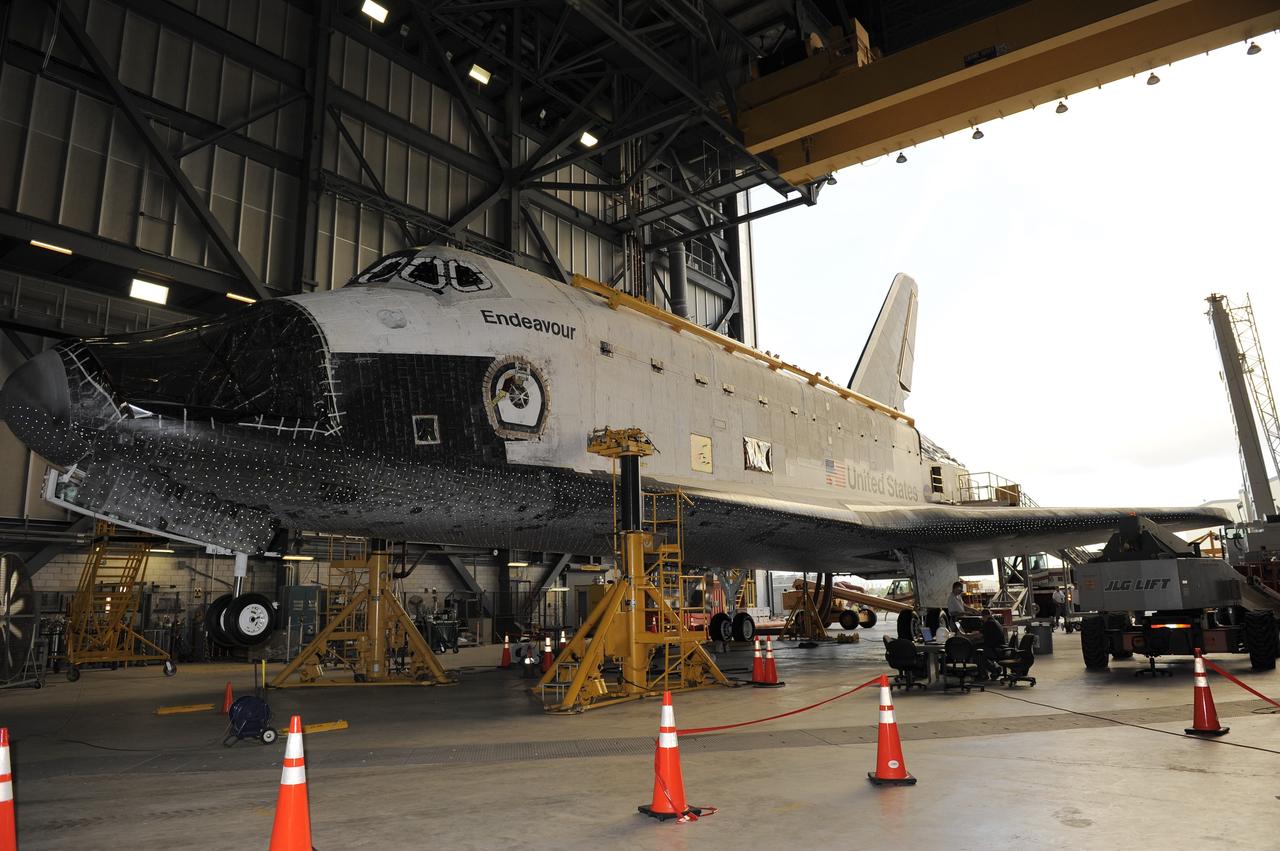
CAPE CANAVERAL, Fla. – In the Vehicle Assembly Building at NASA's Kennedy Space Center in Florida, the front end of space shuttle Endeavour is raised off the floor of the VAB by lifts, as workers prepare to attach an Approach and Landing Test Assembly (ALTA) pod to the back of the shuttle. The ALTA pod will be fitted over the area once housing the orbital maneuvering system (OMS) pod. The demonstration test is being conducted to ensure the center’s equipment will fit into the hangar at the National Air and Space Museum when installing an ALTA pod on shuttle Enterprise. The pod must be reinstalled on a shuttle for transport on a 747 carrier aircraft. The simulation also will test procedures and timelines necessary to carry out the process. The work is part of the Space Shuttle Program’s transition and retirement processing. Enterprise, which was not equipped for space flight, was built as a test vehicle to demonstrate that the orbiter could fly in the atmosphere and land like an airplane. In 1985, Enterprise was ferried from the Kennedy Space Center to Dulles Airport, Washington, D.C., and became the property of the Smithsonian Institute. Enterprise will be moved from the Smithsonian Institution National Air and Space Museum's Steven F. Udvar-Hazy Center in Chantilly, Va., to the Intrepid Sea, Air and Space Museum in New York. For more information, visit http://www.nasa.gov/shuttle. Photo credit: NASA/Ken Shiflett
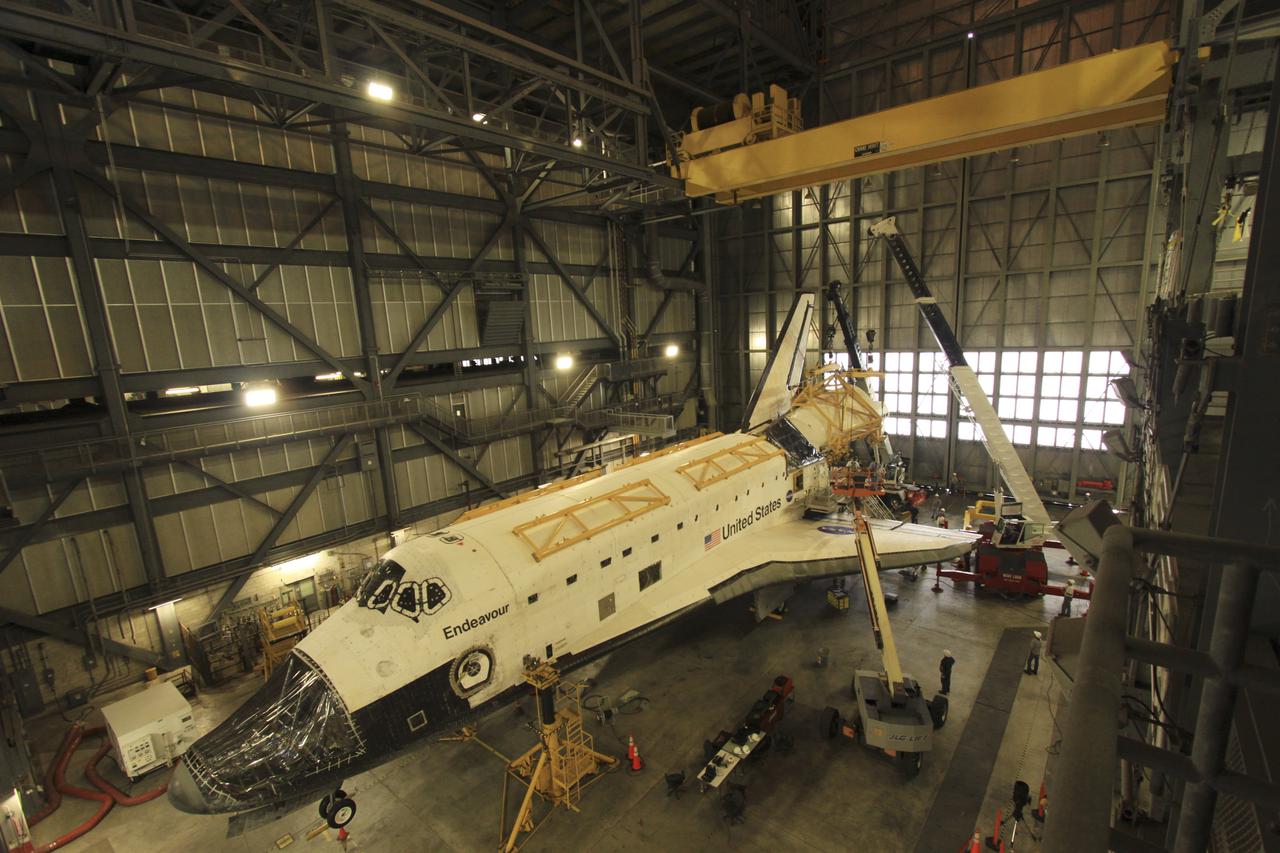
CAPE CANAVERAL, Fla. – In the Vehicle Assembly Building at NASA's Kennedy Space Center in Florida, workers lower the cage containing an Approach and Landing Test Assembly (ALTA) pod over the rear of space shuttle Endeavour. The ALTA pod is being attached to the site once housing the orbital maneuvering system (OMS) pod. The demonstration test is being conducted to ensure the center’s equipment will fit into the hangar at the National Air and Space Museum when installing an ALTA pod on shuttle Enterprise. The pod must be reinstalled on a shuttle for transport on a 747 carrier aircraft. The simulation also tests procedures and timelines necessary to carry out the process. The work is part of the Space Shuttle Program’s transition and retirement processing. Enterprise, which was not equipped for space flight, was built as a test vehicle to demonstrate that the orbiter could fly in the atmosphere and land like an airplane. In 1985, Enterprise was ferried from the Kennedy Space Center to Dulles Airport, Washington, D.C., and became the property of the Smithsonian Institute. Enterprise will be moved from the Smithsonian Institution National Air and Space Museum's Steven F. Udvar-Hazy Center in Chantilly, Va. to the Intrepid Sea, Air and Space Museum in New York. For more information, visit http:__www.nasa.gov_shuttle. Photo credit: NASA_Jim Grossmann
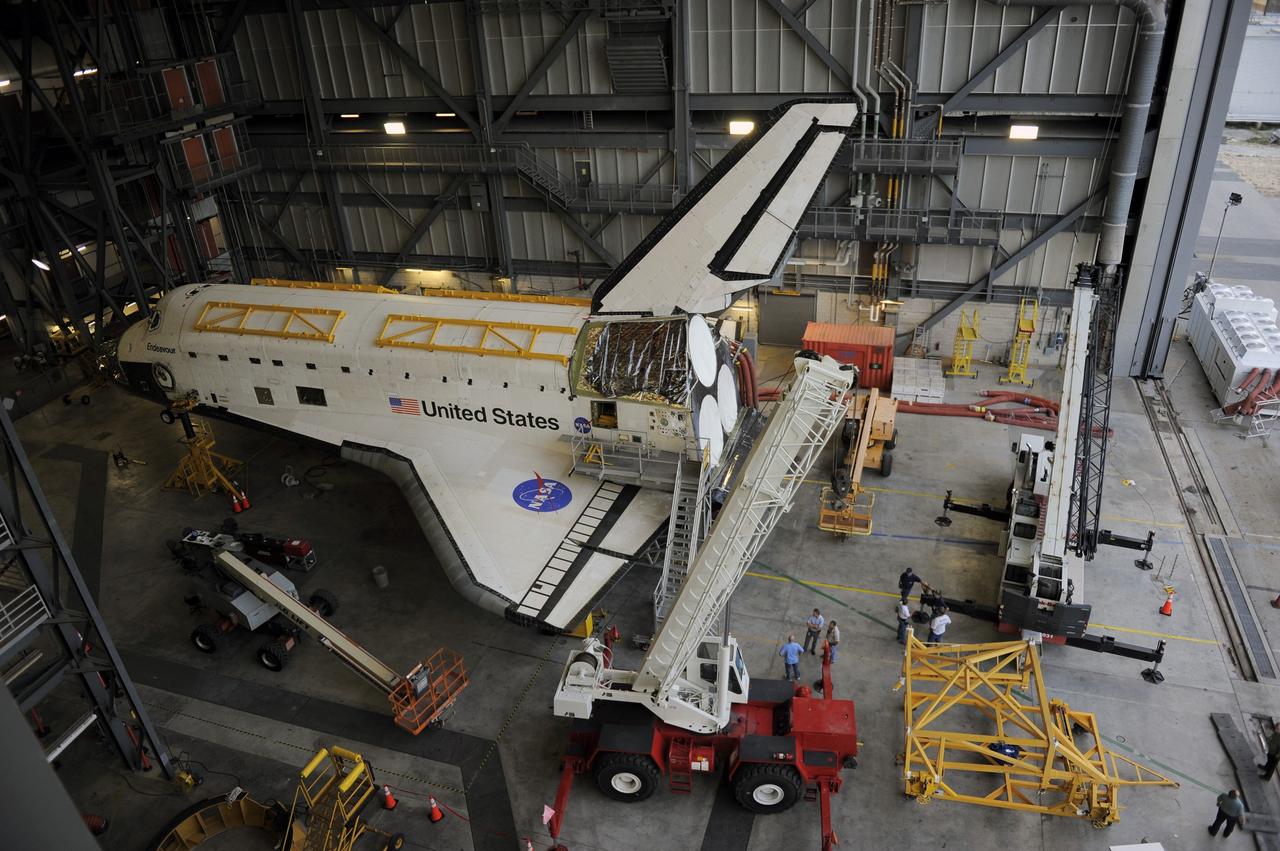
CAPE CANAVERAL, Fla. – In the Vehicle Assembly Building at NASA's Kennedy Space Center in Florida, space shuttle Endeavour sits surrounded by cranes and lifts. Workers are preparing to raise an Approach and Landing Test Assembly (ALTA) pod for attachment to the shuttle at the site once housing the orbital maneuvering system (OMS) pod. The demonstration test is being conducted to ensure the center’s equipment will fit into the hangar at the National Air and Space Museum when installing an ALTA pod on shuttle Enterprise. The pod must be reinstalled on a shuttle for transport on a 747 carrier aircraft. The simulation also tests procedures and timelines necessary to carry out the process. The work is part of the Space Shuttle Program’s transition and retirement processing. Enterprise, which was not equipped for space flight, was built as a test vehicle to demonstrate that the orbiter could fly in the atmosphere and land like an airplane. In 1985, Enterprise was ferried from the Kennedy Space Center to Dulles Airport, Washington, D.C., and became the property of the Smithsonian Institute. Enterprise will be moved from the Smithsonian Institution National Air and Space Museum's Steven F. Udvar-Hazy Center in Chantilly, Va., to the Intrepid Sea, Air and Space Museum in New York. For more information, visit http://www.nasa.gov/shuttle. Photo credit: NASA/Ken Shiflett
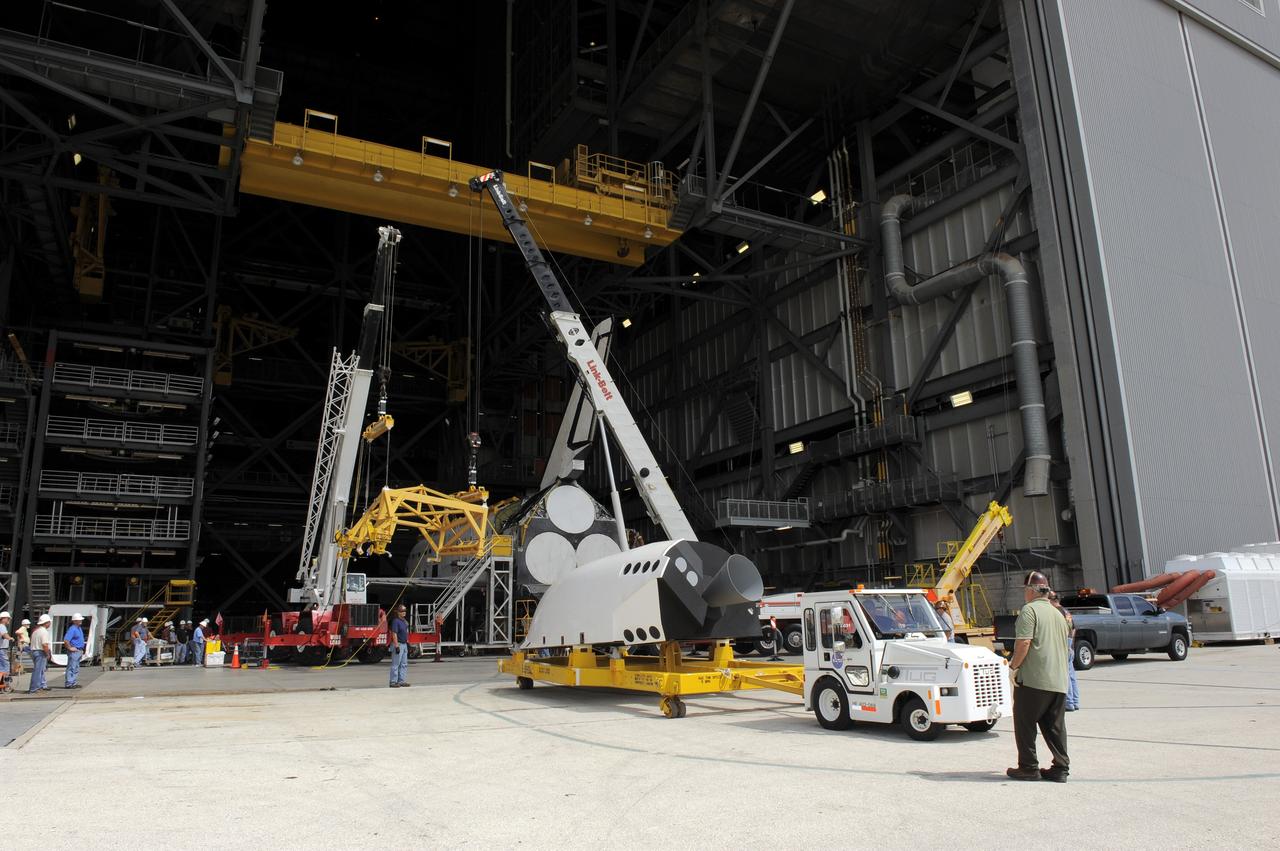
CAPE CANAVERAL, Fla. – In the Vehicle Assembly Building at NASA's Kennedy Space Center in Florida, workers, using overhead cranes, raise a cage which will be placed over an Approach and Landing Test Assembly (ALTA) pod (in the foreground). The ALTA pod will be lifted for attachment to space shuttle Endeavour on the site once housing the orbital maneuvering system (OMS) pod. The demonstration test is being conducted to ensure the center’s equipment will fit into the hangar at the National Air and Space Museum when installing an ALTA pod on shuttle Enterprise. The pod must be reinstalled on a shuttle for transport on a 747 carrier aircraft. The simulation also tests procedures and timelines necessary to carry out the process. The work is part of the Space Shuttle Program’s transition and retirement processing. Enterprise, which was not equipped for space flight, was built as a test vehicle to demonstrate that the orbiter could fly in the atmosphere and land like an airplane. In 1985, Enterprise was ferried from the Kennedy Space Center to Dulles Airport, Washington, D.C., and became the property of the Smithsonian Institute. Enterprise will be moved from the Smithsonian Institution National Air and Space Museum's Steven F. Udvar-Hazy Center in Chantilly, Va., to the Intrepid Sea, Air and Space Museum in New York. For more information, visit http://www.nasa.gov/shuttle. Photo credit: NASA/Ken Shiflett
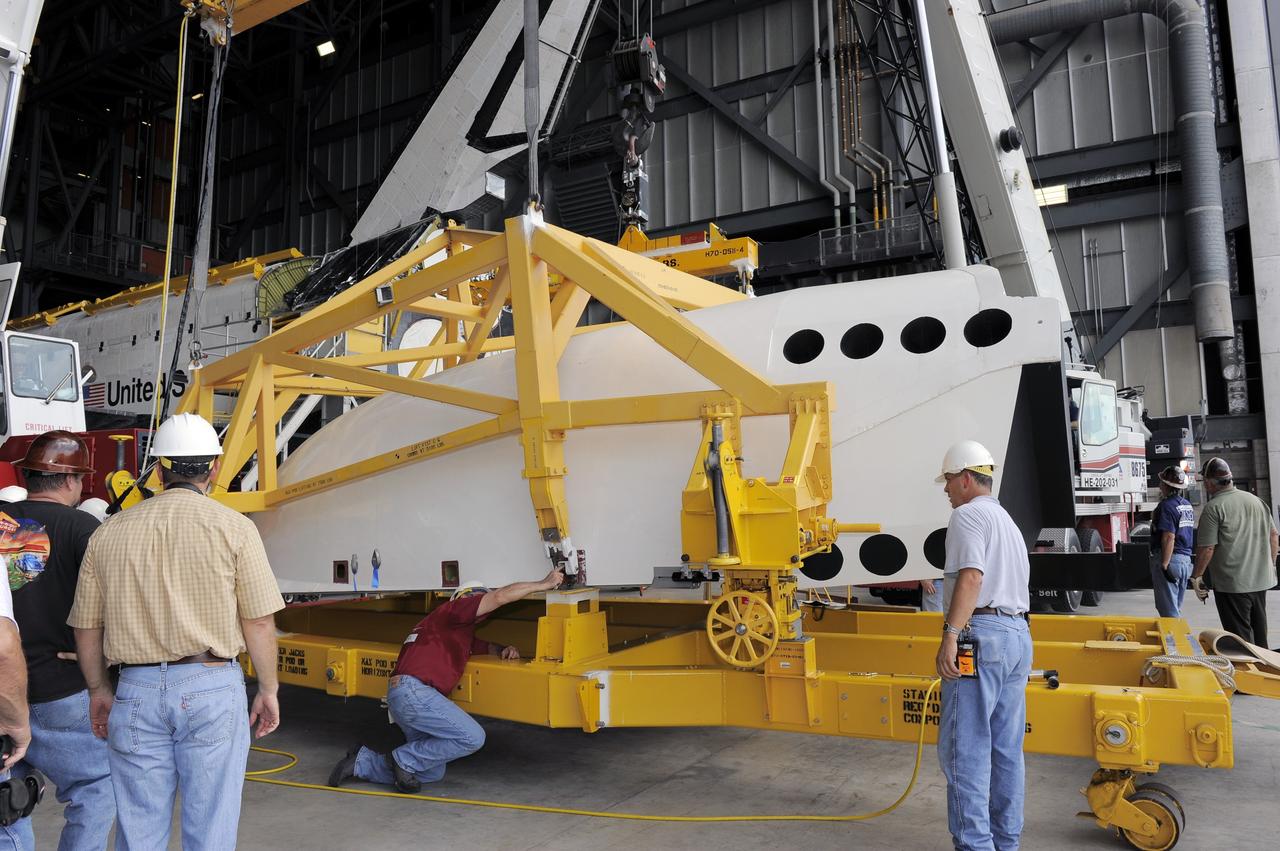
CAPE CANAVERAL, Fla. – In the Vehicle Assembly Building at NASA's Kennedy Space Center in Florida, workers affix a cage over an Approach and Landing Test Assembly (ALTA) pod. The ALTA pod will be lifted for attachment to space shuttle Endeavour on the site once housing the orbital maneuvering system (OMS) pod. The demonstration test is being conducted to ensure the center’s equipment will fit into the hangar at the National Air and Space Museum when installing an ALTA pod on shuttle Enterprise. The pod must be reinstalled on a shuttle for transport on a 747 carrier aircraft. The simulation also tests procedures and timelines necessary to carry out the process. The work is part of the Space Shuttle Program’s transition and retirement processing. Enterprise, which was not equipped for space flight, was built as a test vehicle to demonstrate that the orbiter could fly in the atmosphere and land like an airplane. In 1985, Enterprise was ferried from the Kennedy Space Center to Dulles Airport, Washington, D.C., and became the property of the Smithsonian Institute. Enterprise will be moved from the Smithsonian Institution National Air and Space Museum's Steven F. Udvar-Hazy Center in Chantilly, Va., to the Intrepid Sea, Air and Space Museum in New York. For more information, visit http://www.nasa.gov/shuttle. Photo credit: NASA/Ken Shiflett
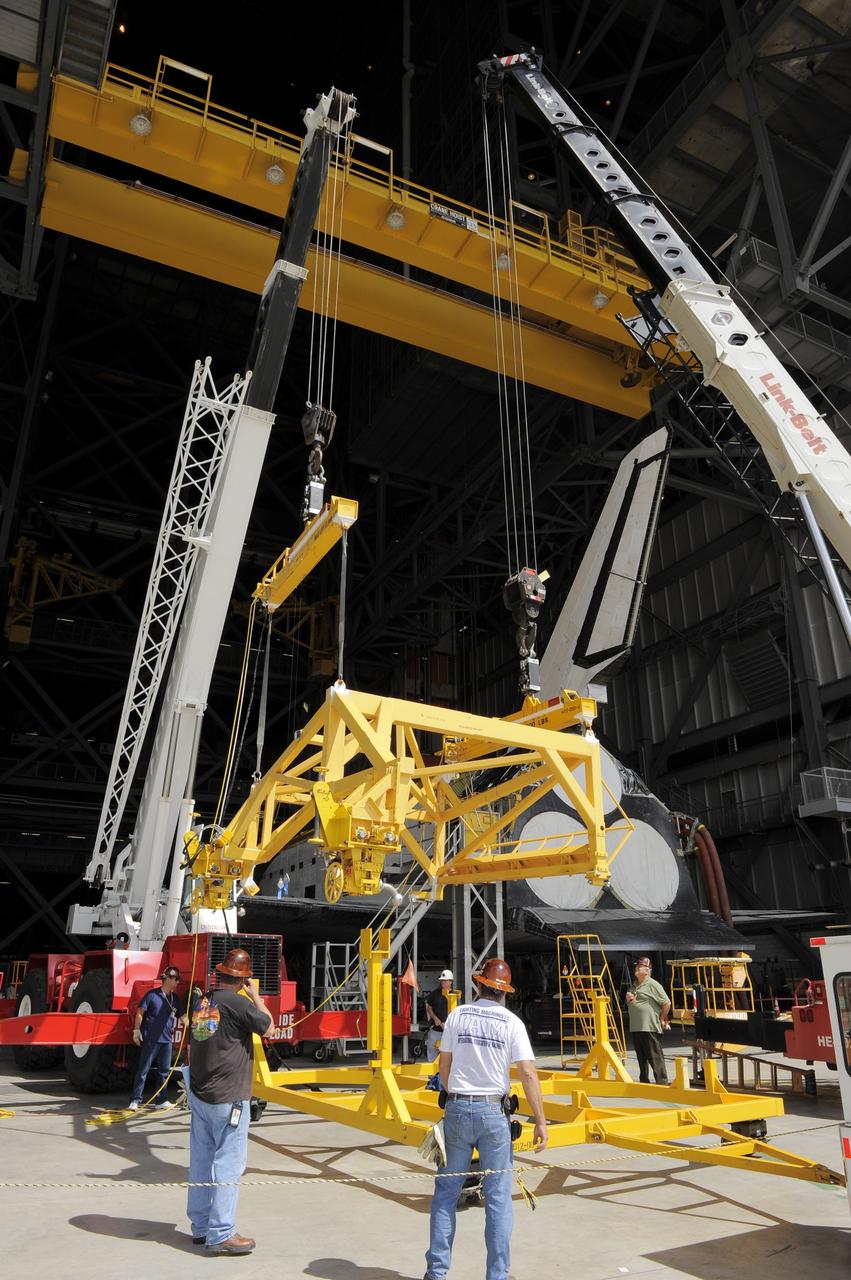
CAPE CANAVERAL, Fla. – In the Vehicle Assembly Building at NASA's Kennedy Space Center in Florida, workers, using overhead cranes, raise a cage which will be placed over an Approach and Landing Test Assembly (ALTA) pod. The ALTA pod will be lifted for attachment to space shuttle Endeavour on the site once housing the orbital maneuvering system (OMS) pod. The demonstration test is being conducted to ensure the center’s equipment will fit into the hangar at the National Air and Space Museum when installing an ALTA pod on shuttle Enterprise. The pod must be reinstalled on a shuttle for transport on a 747 carrier aircraft. The simulation also tests procedures and timelines necessary to carry out the process. The work is part of the Space Shuttle Program’s transition and retirement processing. Enterprise, which was not equipped for space flight, was built as a test vehicle to demonstrate that the orbiter could fly in the atmosphere and land like an airplane. In 1985, Enterprise was ferried from the Kennedy Space Center to Dulles Airport, Washington, D.C., and became the property of the Smithsonian Institute. Enterprise will be moved from the Smithsonian Institution National Air and Space Museum's Steven F. Udvar-Hazy Center in Chantilly, Va., to the Intrepid Sea, Air and Space Museum in New York. For more information, visit http://www.nasa.gov/shuttle. Photo credit: NASA/Ken Shiflett
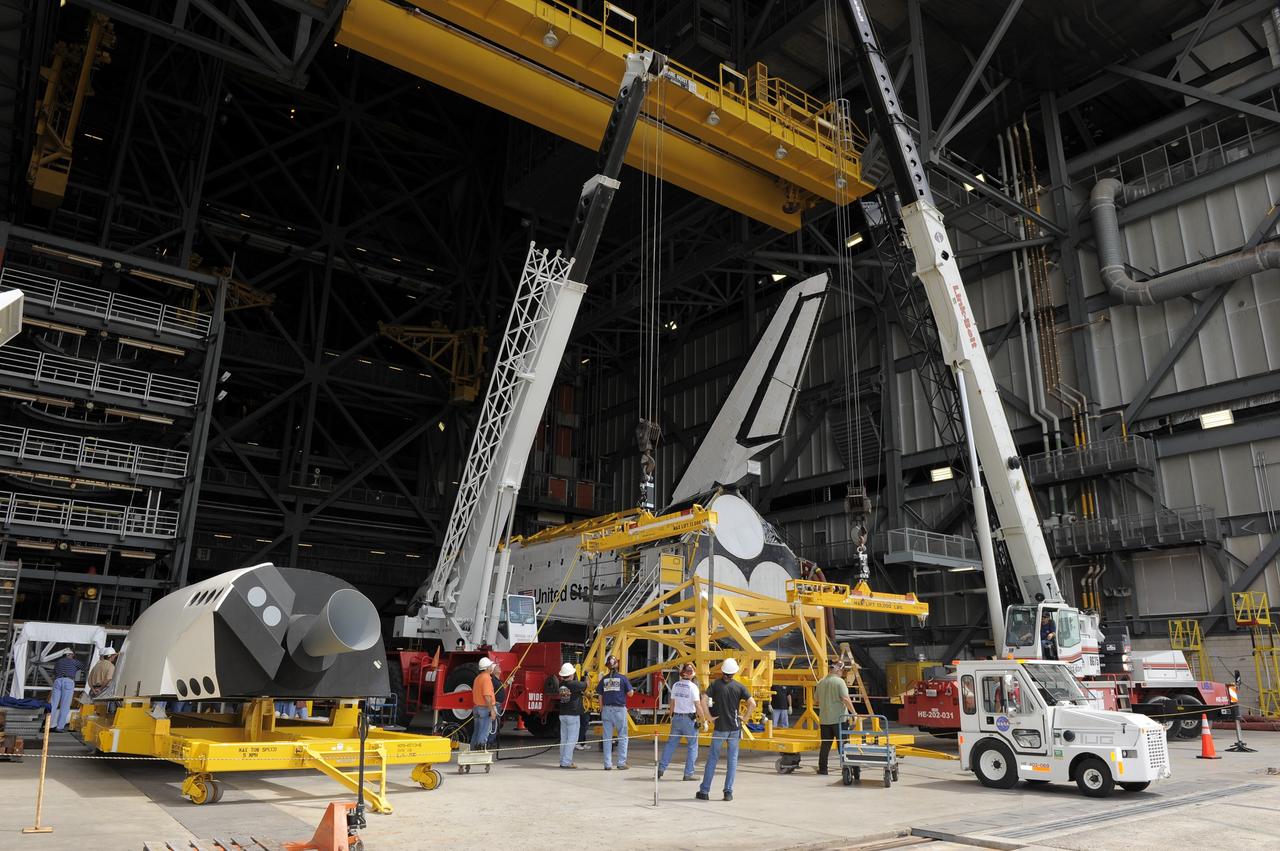
CAPE CANAVERAL, Fla. – In the Vehicle Assembly Building at NASA's Kennedy Space Center in Florida, workers, using overhead cranes, prepare to raise a cage over an Approach and Landing Test Assembly (ALTA) pod (to the left of the photo). The ALTA pod will be lifted for attachment to space shuttle Endeavour on the site once housing the orbital maneuvering system (OMS) pod. The demonstration test is being conducted to ensure the center’s equipment will fit into the hangar at the National Air and Space Museum when installing an ALTA pod on shuttle Enterprise. The pod must be reinstalled on a shuttle for transport on a 747 carrier aircraft. The simulation also tests procedures and timelines necessary to carry out the process. The work is part of the Space Shuttle Program’s transition and retirement processing. Enterprise, which was not equipped for space flight, was built as a test vehicle to demonstrate that the orbiter could fly in the atmosphere and land like an airplane. In 1985, Enterprise was ferried from the Kennedy Space Center to Dulles Airport, Washington, D.C., and became the property of the Smithsonian Institute. Enterprise will be moved from the Smithsonian Institution National Air and Space Museum's Steven F. Udvar-Hazy Center in Chantilly, Va., to the Intrepid Sea, Air and Space Museum in New York. For more information, visit http://www.nasa.gov/shuttle. Photo credit: NASA/Ken Shiflett
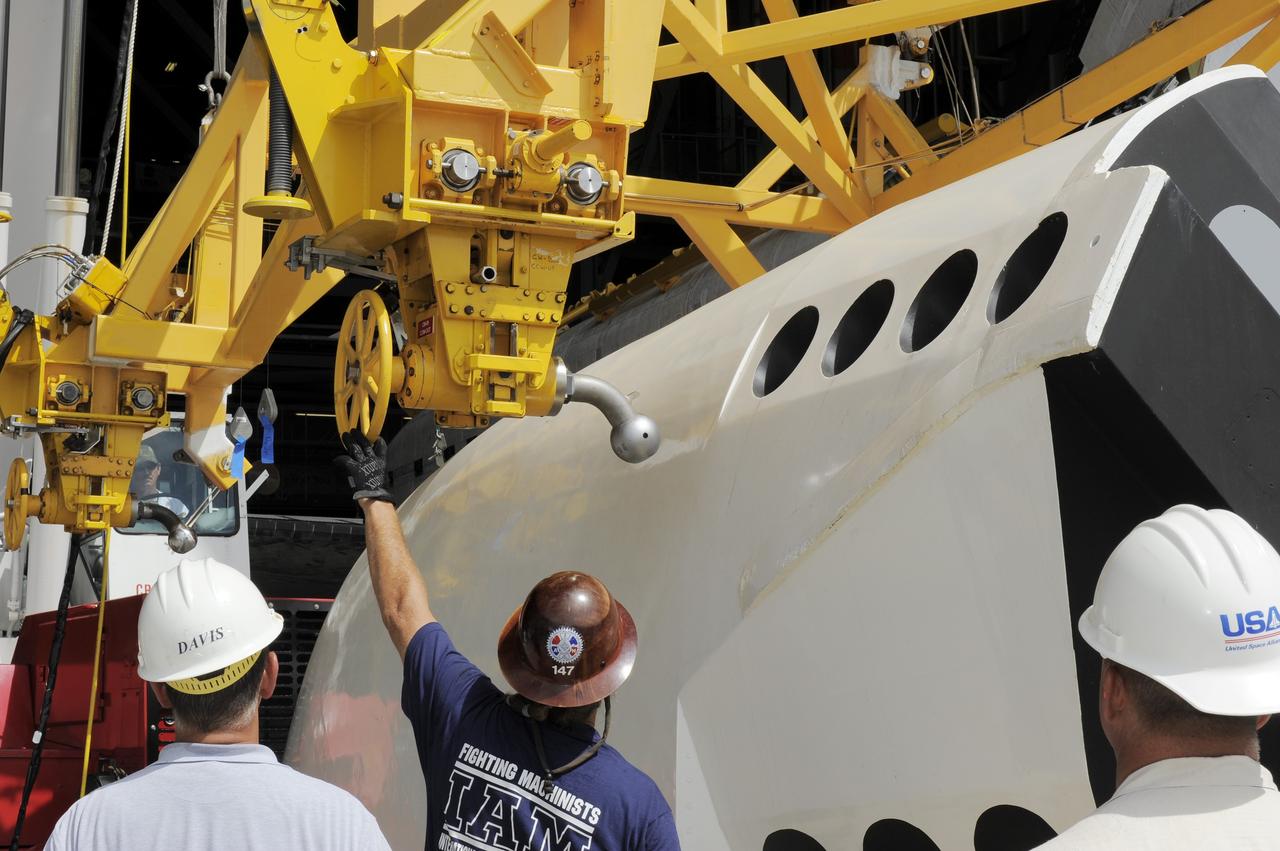
CAPE CANAVERAL, Fla. – In the Vehicle Assembly Building at NASA's Kennedy Space Center in Florida, workers, using overhead cranes, raise a cage over an Approach and Landing Test Assembly (ALTA) pod. The ALTA pod will be lifted for attachment to space shuttle Endeavour on the site once housing the orbital maneuvering system (OMS) pod. The demonstration test is being conducted to ensure the center’s equipment will fit into the hangar at the National Air and Space Museum when installing an ALTA pod on shuttle Enterprise. The pod must be reinstalled on a shuttle for transport on a 747 carrier aircraft. The simulation also tests procedures and timelines necessary to carry out the process. The work is part of the Space Shuttle Program’s transition and retirement processing. Enterprise, which was not equipped for space flight, was built as a test vehicle to demonstrate that the orbiter could fly in the atmosphere and land like an airplane. In 1985, Enterprise was ferried from the Kennedy Space Center to Dulles Airport, Washington, D.C., and became the property of the Smithsonian Institute. Enterprise will be moved from the Smithsonian Institution National Air and Space Museum's Steven F. Udvar-Hazy Center in Chantilly, Va., to the Intrepid Sea, Air and Space Museum in New York. For more information, visit http://www.nasa.gov/shuttle. Photo credit: NASA/Ken Shiflett
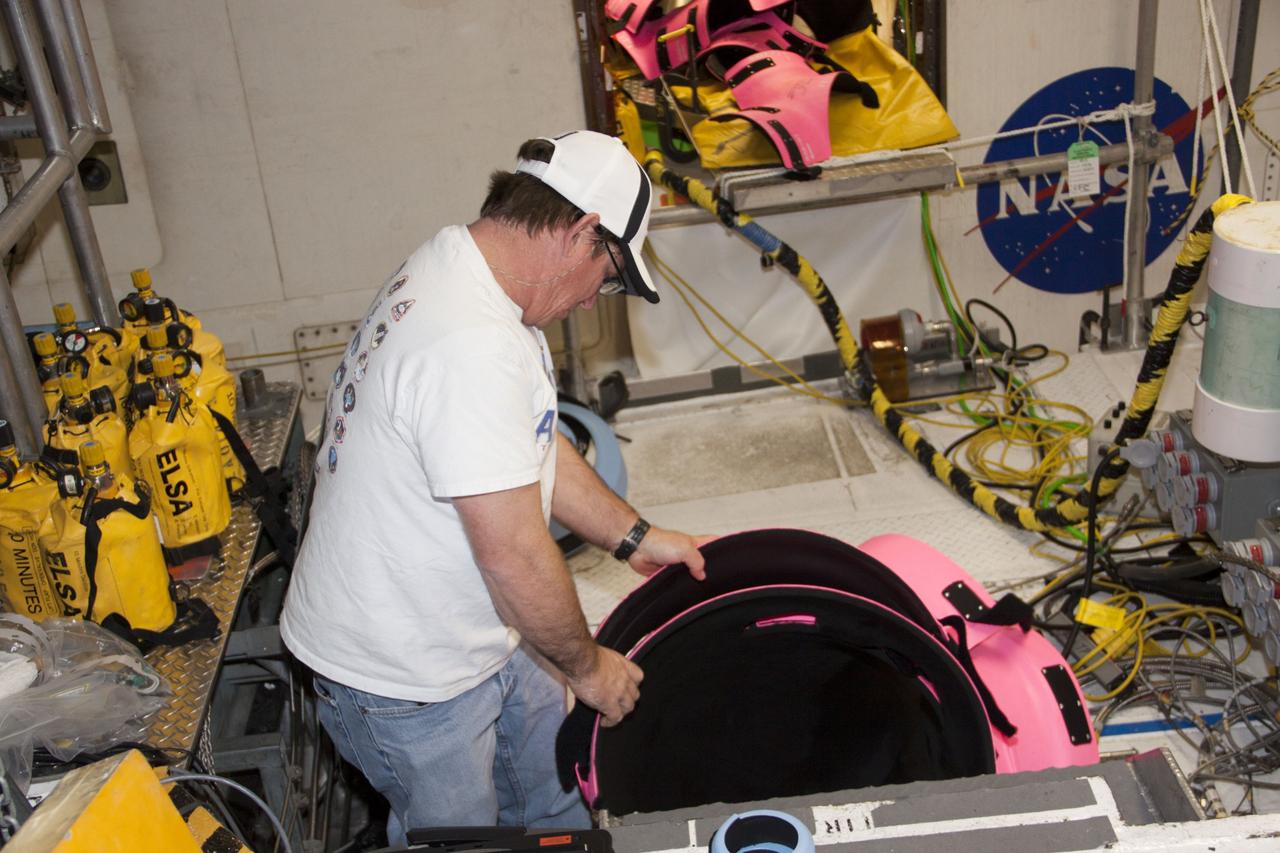
CAPE CANAVERAL, Fla. – Inside Orbiter Processing Facility-1 at NASA’s Kennedy Space Center in Florida, technicians prepare to remove space shuttle Discovery’s main propulsion system protective covers. The work is part of the Space Shuttle Program’s transition and retirement processing of shuttle Discovery, which is being prepared for display at Smithsonian’s National Air and Space Museum, Steven F. Udvar-Hazy Center in Chantilly, Va. Discovery is scheduled to be transported atop a NASA Shuttle Carrier Aircraft modified 747 jet to Dulles International Airport in Virginia on April 17 and then moved to the Smithsonian for permanent public display on April 19. For more information, visit http://www.nasa.gov/shuttle. Photo credit: NASA/Jim Grossmann
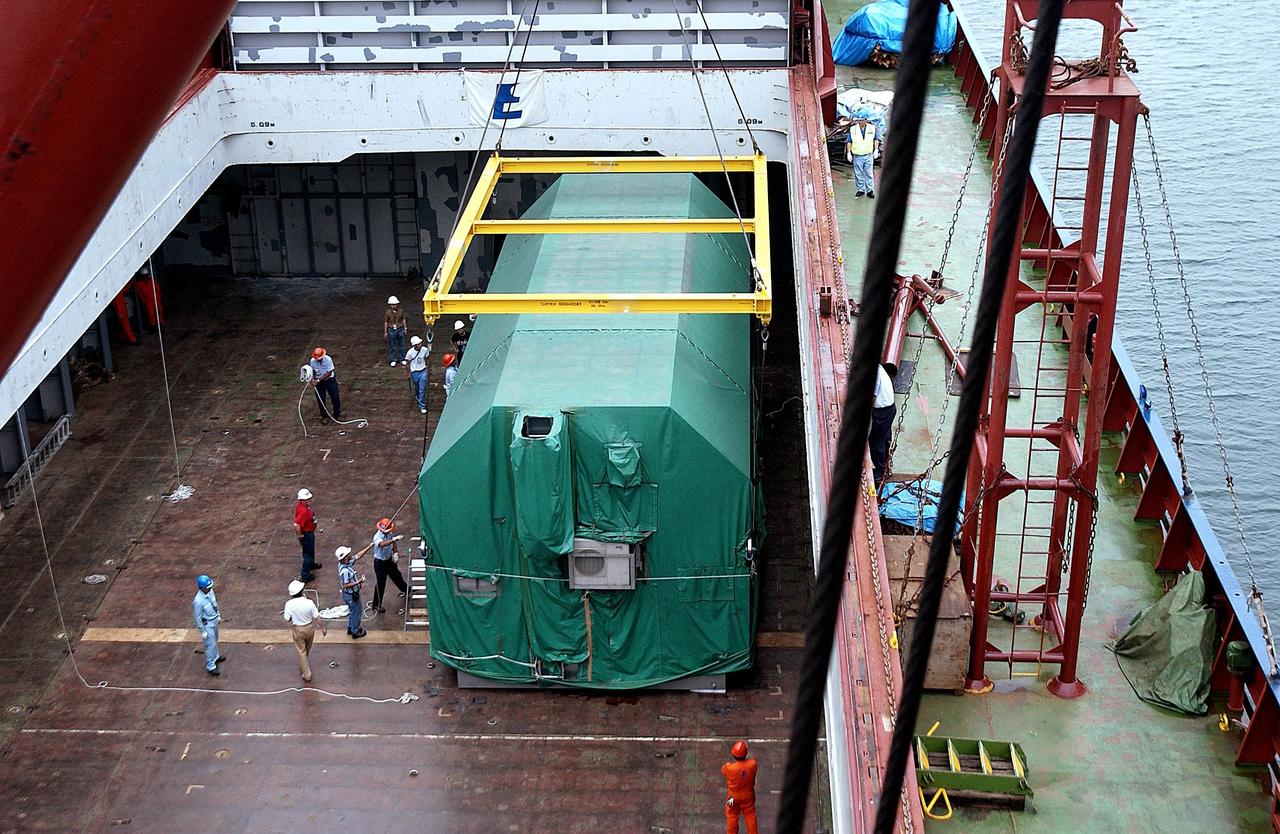
KENNEDY SPACE CENTER, FLA. -- At Port Canaveral, the Pressurized Module of the Japanese Experiment Module (JEM) is lifted out of the ship's cargo hold. The container transport ship carrying JEM departed May 2 from Yokohama Harbor in Japan for the voyage to the United States. The National Space Development Agency of Japan (NASDA) developed the laboratory at the Tsukuba Space Center near Tokyo. The Pressurized Module is the first element of the JEM, named "Kibo" (Hope), to be delivered to KSC. The JEM is Japan's primary contribution to the Station. It will enhance the unique research capabilities of the orbiting complex by providing an additional environment for astronauts to conduct science experiments. The JEM also includes an exposed facility (platform) for space environment experiments, a robotic manipulator system, and two logistics modules. The various JEM components will be assembled in space over the course of three Shuttle missions.
The National Aeronautics and Space Administration (NASA) Lewis Research Center tested 16 commercially-manufactured electric vehicles, including these, during the mid-1970s. Lewis and the Energy Research and Development Administration (ERDA) engaged in several energy-related programs in the mid-1970s, including the Electric Vehicle Project. NASA and ERDA undertook the program in 1976 to determine the state of the current electric vehicle technology. The tests were primarily conducted on a 7.5-mile track at the Transportation Research Center located approximately 160 miles southwest of Cleveland, Ohio. Some of the vehicles had analog data recording systems to measure the battery during operation and sensors to determine speed and distance. The tests analyzed the vehicle’s range, acceleration, coast-down, braking, and energy consumption. From left to right: RIPP-Electric, EVA Contactor, Otis P-500, C.H. Waterman DAF, Zagato Elcar, unknown, Sebring-Vanguard Citicar, and Hattronic Minivan
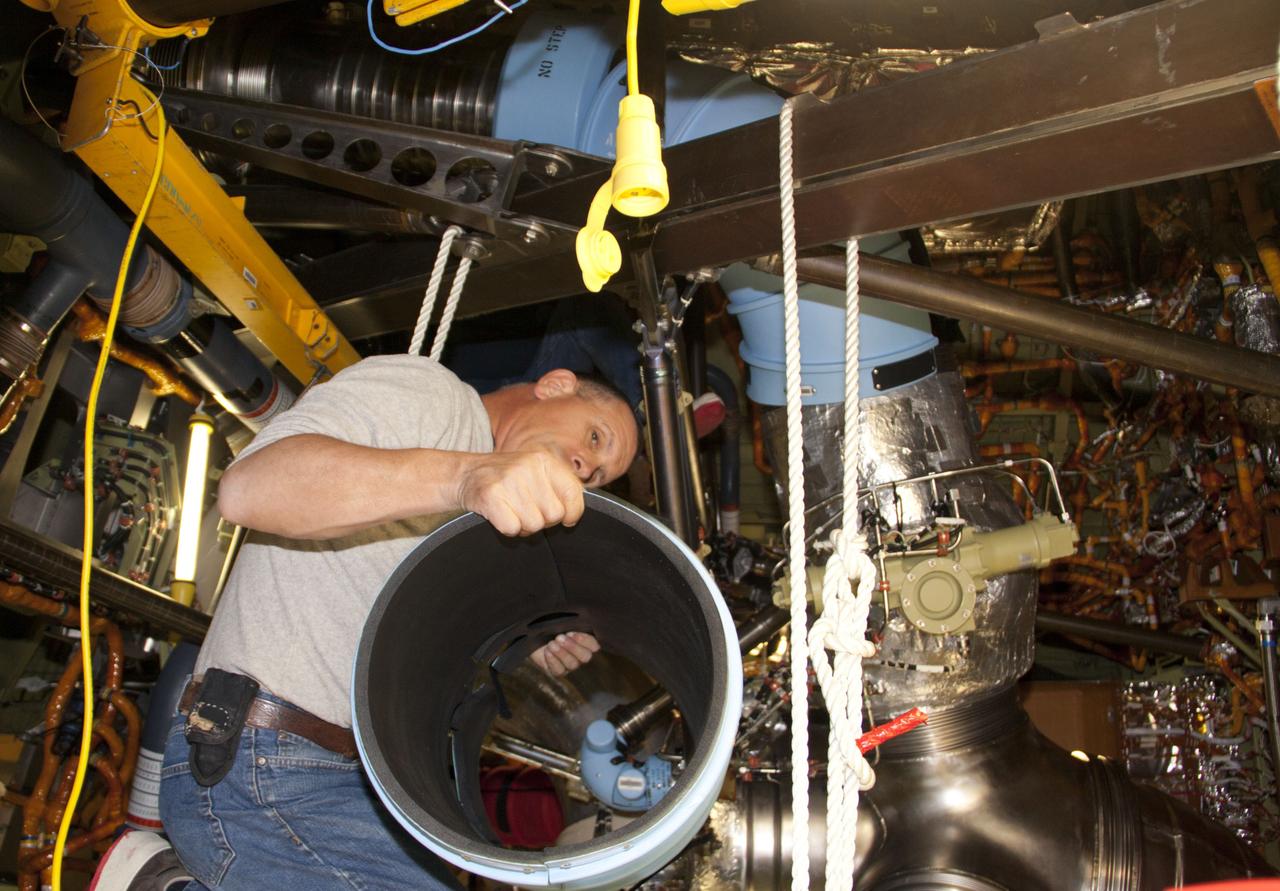
CAPE CANAVERAL, Fla. – Inside Orbiter Processing Facility-1 at NASA’s Kennedy Space Center in Florida, technicians prepare to remove space shuttle Discovery’s main propulsion system protective covers. The work is part of the Space Shuttle Program’s transition and retirement processing of shuttle Discovery, which is being prepared for display at Smithsonian’s National Air and Space Museum, Steven F. Udvar-Hazy Center in Chantilly, Va. Discovery is scheduled to be transported atop a NASA Shuttle Carrier Aircraft modified 747 jet to Dulles International Airport in Virginia on April 17 and then moved to the Smithsonian for permanent public display on April 19. For more information, visit http://www.nasa.gov/shuttle. Photo credit: NASA/Jim Grossmann
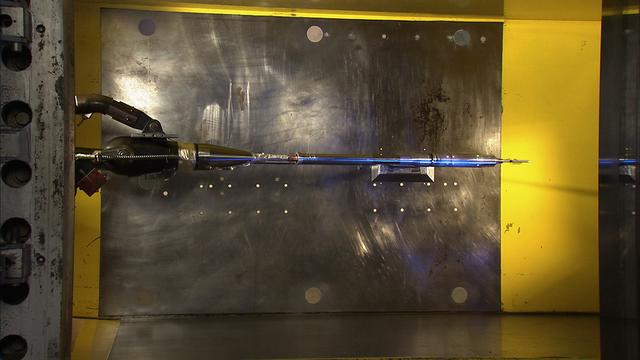
Under the goals of the Vision for Space Exploration, Ares I is a chief component of the cost-effective space transportation infrastructure being developed by NASA's Constellation Program. This transportation system will safely and reliably carry human explorers back to the moon, and then onward to Mars and other destinations in the solar system. The Ares I effort includes multiple project element teams at NASA centers and contract organizations around the nation, and is managed by the Exploration Launch Projects Office at NASA's Marshall Space Flight Center (MFSC). ATK Launch Systems near Brigham City, Utah, is the prime contractor for the first stage booster. ATK's subcontractor, United Space Alliance of Houston, is designing, developing and testing the parachutes at its facilities at NASA's Kennedy Space Center in Florida. NASA's Johnson Space Center in Houston hosts the Constellation Program and Orion Crew Capsule Project Office and provides test instrumentation and support personnel. Together, these teams are developing vehicle hardware, evolving proven technologies, and testing components and systems. Their work builds on powerful, reliable space shuttle propulsion elements and nearly a half-century of NASA space flight experience and technological advances. Ares I is an inline, two-stage rocket configuration topped by the Crew Exploration Vehicle, its service module, and a launch abort system. In this HD video image, an Ares I x-test involves the upper stage separating from the first stage. This particular test was conducted at the NASA Langley Research Center in July 2007. (Highest resolution available)
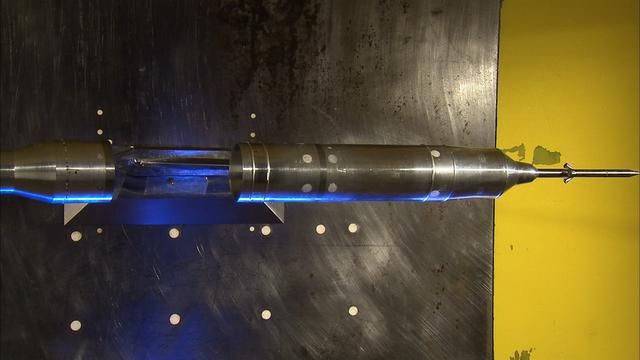
Under the goals of the Vision for Space Exploration, Ares I is a chief component of the cost-effective space transportation infrastructure being developed by NASA's Constellation Program. This transportation system will safely and reliably carry human explorers back to the moon, and then onward to Mars and other destinations in the solar system. The Ares I effort includes multiple project element teams at NASA centers and contract organizations around the nation, and is managed by the Exploration Launch Projects Office at NASA's Marshall Space Flight Center (MFSC). ATK Launch Systems near Brigham City, Utah, is the prime contractor for the first stage booster. ATK's subcontractor, United Space Alliance of Houston, is designing, developing and testing the parachutes at its facilities at NASA's Kennedy Space Center in Florida. NASA's Johnson Space Center in Houston hosts the Constellation Program and Orion Crew Capsule Project Office and provides test instrumentation and support personnel. Together, these teams are developing vehicle hardware, evolving proven technologies, and testing components and systems. Their work builds on powerful, reliable space shuttle propulsion elements and nearly a half-century of NASA space flight experience and technological advances. Ares I is an inline, two-stage rocket configuration topped by the Crew Exploration Vehicle, its service module, and a launch abort system. In this HD video image, an Ares I x-test involves the upper stage separating from the first stage. This particular test was conducted at the NASA Langley Research Center in July 2007. (Highest resolution available)
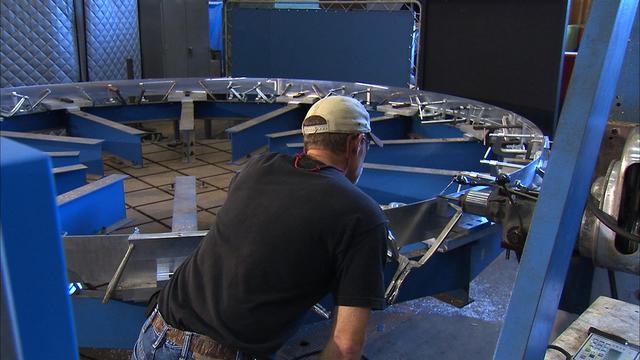
Under the goals of the Vision for Space Exploration, Ares I is a chief component of the cost-effective space transportation infrastructure being developed by NASA's Constellation Program. This transportation system will safely and reliably carry human explorers back to the moon, and then onward to Mars and other destinations in the solar system. The Ares I effort includes multiple project element teams at NASA centers and contract organizations around the nation, and is managed by the Exploration Launch Projects Office at NASA's Marshall Space Flight Center (MFSC). ATK Launch Systems near Brigham City, Utah, is the prime contractor for the first stage booster. ATK's subcontractor, United Space Alliance of Houston, is designing, developing and testing the parachutes at its facilities at NASA's Kennedy Space Center in Florida. NASA's Johnson Space Center in Houston hosts the Constellation Program and Orion Crew Capsule Project Office and provides test instrumentation and support personnel. Together, these teams are developing vehicle hardware, evolving proven technologies, and testing components and systems. Their work builds on powerful, reliable space shuttle propulsion elements and nearly a half-century of NASA space flight experience and technological advances. Ares I is an inline, two-stage rocket configuration topped by the Crew Exploration Vehicle, its service module, and a launch abort system. This HD video image depicts the preparation and placement of a confidence ring for friction stir welding used in manufacturing aluminum panels that will fabricate the Ares I upper stage barrel. The aluminum panels are manufactured and subjected to confidence tests during which the bent aluminum is stressed to breaking point and thoroughly examined. The panels are manufactured by AMRO Manufacturing located in El Monte, California. (Highest resolution available)
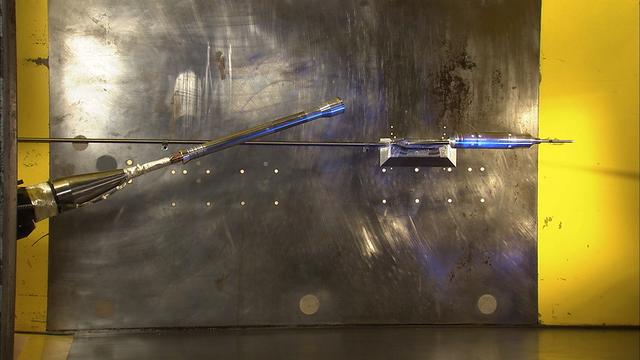
Under the goals of the Vision for Space Exploration, Ares I is a chief component of the cost-effective space transportation infrastructure being developed by NASA's Constellation Program. This transportation system will safely and reliably carry human explorers back to the moon, and then onward to Mars and other destinations in the solar system. The Ares I effort includes multiple project element teams at NASA centers and contract organizations around the nation, and is managed by the Exploration Launch Projects Office at NASA's Marshall Space Flight Center (MFSC). ATK Launch Systems near Brigham City, Utah, is the prime contractor for the first stage booster. ATK's subcontractor, United Space Alliance of Houston, is designing, developing and testing the parachutes at its facilities at NASA's Kennedy Space Center in Florida. NASA's Johnson Space Center in Houston hosts the Constellation Program and Orion Crew Capsule Project Office and provides test instrumentation and support personnel. Together, these teams are developing vehicle hardware, evolving proven technologies, and testing components and systems. Their work builds on powerful, reliable space shuttle propulsion elements and nearly a half-century of NASA space flight experience and technological advances. Ares I is an inline, two-stage rocket configuration topped by the Crew Exploration Vehicle, its service module, and a launch abort system. In this HD video image, the first stage reentry 1/2% model is undergoing pressure measurements inside the wind tunnel testing facility at MSFC. (Highest resolution available)
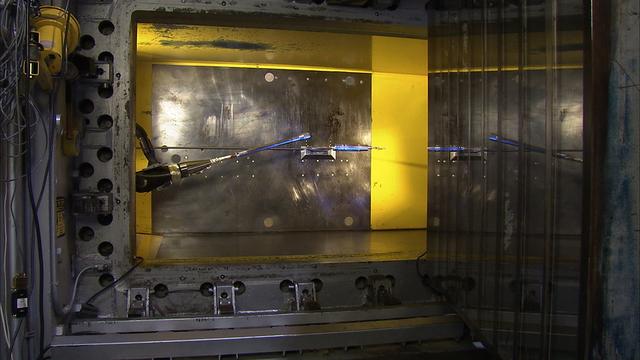
Under the goals of the Vision for Space Exploration, Ares I is a chief component of the cost-effective space transportation infrastructure being developed by NASA's Constellation Program. This transportation system will safely and reliably carry human explorers back to the moon, and then onward to Mars and other destinations in the solar system. The Ares I effort includes multiple project element teams at NASA centers and contract organizations around the nation, and is managed by the Exploration Launch Projects Office at NASA's Marshall Space Flight Center (MFSC). ATK Launch Systems near Brigham City, Utah, is the prime contractor for the first stage booster. ATK's subcontractor, United Space Alliance of Houston, is designing, developing and testing the parachutes at its facilities at NASA's Kennedy Space Center in Florida. NASA's Johnson Space Center in Houston hosts the Constellation Program and Orion Crew Capsule Project Office and provides test instrumentation and support personnel. Together, these teams are developing vehicle hardware, evolving proven technologies, and testing components and systems. Their work builds on powerful, reliable space shuttle propulsion elements and nearly a half-century of NASA space flight experience and technological advances. Ares I is an inline, two-stage rocket configuration topped by the Crew Exploration Vehicle, its service module, and a launch abort system. In this HD video image, the first stage reentry 1/2% model is undergoing pressure measurements inside the wind tunnel testing facility at MSFC. (Highest resolution available)
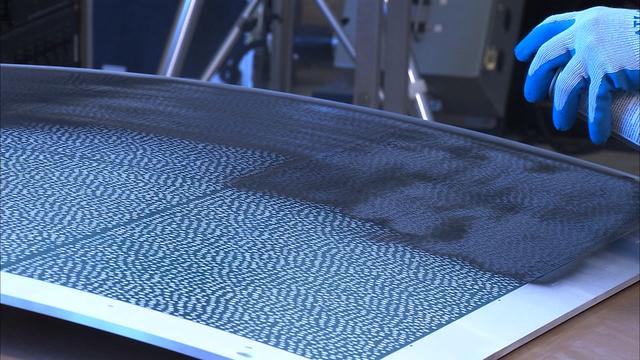
Under the goals of the Vision for Space Exploration, Ares I is a chief component of the cost-effective space transportation infrastructure being developed by NASA's Constellation Program. This transportation system will safely and reliably carry human explorers back to the moon, and then onward to Mars and other destinations in the solar system. The Ares I effort includes multiple project element teams at NASA centers and contract organizations around the nation, and is managed by the Exploration Launch Projects Office at NASA's Marshall Space Flight Center (MFSC). ATK Launch Systems near Brigham City, Utah, is the prime contractor for the first stage booster. ATK's subcontractor, United Space Alliance of Houston, is designing, developing and testing the parachutes at its facilities at NASA's Kennedy Space Center in Florida. NASA's Johnson Space Center in Houston hosts the Constellation Program and Orion Crew Capsule Project Office and provides test instrumentation and support personnel. Together, these teams are developing vehicle hardware, evolving proven technologies, and testing components and systems. Their work builds on powerful, reliable space shuttle propulsion elements and nearly a half-century of NASA space flight experience and technological advances. Ares I is an inline, two-stage rocket configuration topped by the Crew Exploration Vehicle, its service module, and a launch abort system. This HD video image depicts a manufactured aluminum panel, that will fabricate the Ares I upper stage barrel, undergoing a confidence panel test. In this test, the bent aluminum is stressed to breaking point and thoroughly examined. The panels are manufactured by AMRO Manufacturing located in El Monte, California. (Highest resolution available)
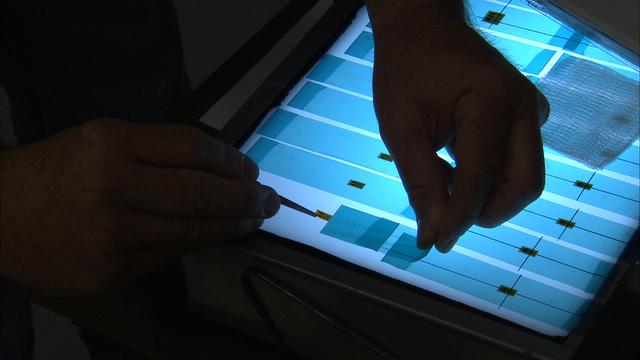
Under the goals of the Vision for Space Exploration, Ares I is a chief component of the cost-effective space transportation infrastructure being developed by NASA's Constellation Program. This transportation system will safely and reliably carry human explorers back to the moon, and then onward to Mars and other destinations in the solar system. The Ares I effort includes multiple project element teams at NASA centers and contract organizations around the nation, and is managed by the Exploration Launch Projects Office at NASA's Marshall Space Flight Center (MFSC). ATK Launch Systems near Brigham City, Utah, is the prime contractor for the first stage booster. ATK's subcontractor, United Space Alliance of Houston, is designing, developing and testing the parachutes at its facilities at NASA's Kennedy Space Center in Florida. NASA's Johnson Space Center in Houston hosts the Constellation Program and Orion Crew Capsule Project Office and provides test instrumentation and support personnel. Together, these teams are developing vehicle hardware, evolving proven technologies, and testing components and systems. Their work builds on powerful, reliable space shuttle propulsion elements and nearly a half-century of NASA space flight experience and technological advances. Ares I is an inline, two-stage rocket configuration topped by the Crew Exploration Vehicle, its service module, and a launch abort system. This HD video image depicts a manufactured aluminum panel, that will fabricate the Ares I upper stage barrel, undergoing a confidence panel test. In this test, bent aluminum is stressed to breaking point and thoroughly examined. The panels are manufactured by AMRO Manufacturing located in El Monte, California. (Highest resolution available)
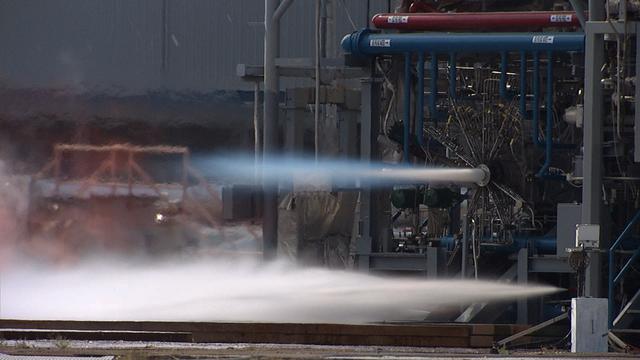
Under the goals of the Vision for Space Exploration, Ares I is a chief component of the cost-effective space transportation infrastructure being developed by NASA's Constellation Program. This transportation system will safely and reliably carry human explorers back to the moon, and then onward to Mars and other destinations in the solar system. The Ares I effort includes multiple project element teams at NASA centers and contract organizations around the nation, and is managed by the Exploration Launch Projects Office at NASA's Marshall Space Flight Center (MFSC). ATK Launch Systems near Brigham City, Utah, is the prime contractor for the first stage booster. ATK's subcontractor, United Space Alliance of Houston, is designing, developing and testing the parachutes at its facilities at NASA's Kennedy Space Center in Florida. NASA's Johnson Space Center in Houston hosts the Constellation Program and Orion Crew Capsule Project Office and provides test instrumentation and support personnel. Together, these teams are developing vehicle hardware, evolving proven technologies, and testing components and systems. Their work builds on powerful, reliable space shuttle propulsion elements and nearly a half-century of NASA space flight experience and technological advances. Ares I is an inline, two-stage rocket configuration topped by the Crew Exploration Vehicle, its service module, and a launch abort system. The launch vehicle's first stage is a single, five-segment reusable solid rocket booster derived from the Space Shuttle Program's reusable solid rocket motor that burns a specially formulated and shaped solid propellant called polybutadiene acrylonitrile (PBAN). The second or upper stage will be propelled by a J-2X main engine fueled with liquid oxygen and liquid hydrogen. This HD video image depicts a test firing of a 40k subscale J2X injector at MSFC's test stand 115. (Highest resolution available)
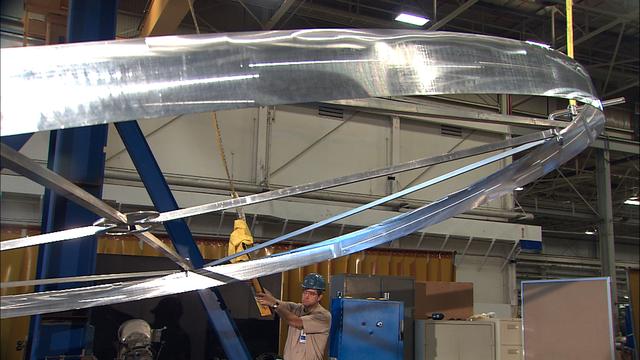
Under the goals of the Vision for Space Exploration, Ares I is a chief component of the cost-effective space transportation infrastructure being developed by NASA's Constellation Program. This transportation system will safely and reliably carry human explorers back to the moon, and then onward to Mars and other destinations in the solar system. The Ares I effort includes multiple project element teams at NASA centers and contract organizations around the nation, and is managed by the Exploration Launch Projects Office at NASA's Marshall Space Flight Center (MFSC). ATK Launch Systems near Brigham City, Utah, is the prime contractor for the first stage booster. ATK's subcontractor, United Space Alliance of Houston, is designing, developing and testing the parachutes at its facilities at NASA's Kennedy Space Center in Florida. NASA's Johnson Space Center in Houston hosts the Constellation Program and Orion Crew Capsule Project Office and provides test instrumentation and support personnel. Together, these teams are developing vehicle hardware, evolving proven technologies, and testing components and systems. Their work builds on powerful, reliable space shuttle propulsion elements and nearly a half-century of NASA space flight experience and technological advances. Ares I is an inline, two-stage rocket configuration topped by the Crew Exploration Vehicle, its service module, and a launch abort system. This HD video image depicts friction stir welding used in manufacturing aluminum panels that will fabricate the Ares I upper stage barrel. The aluminum panels are subjected to confidence panel tests during which the bent aluminum is stressed to breaking point and thoroughly examined. The panels are manufactured by AMRO Manufacturing located in El Monte, California. (Highest resolution available)
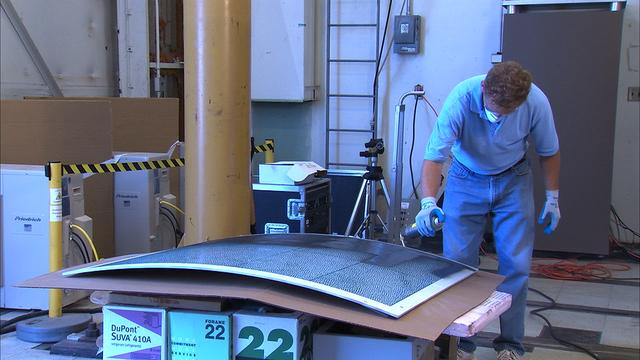
Under the goals of the Vision for Space Exploration, Ares I is a chief component of the cost-effective space transportation infrastructure being developed by NASA's Constellation Program. This transportation system will safely and reliably carry human explorers back to the moon, and then onward to Mars and other destinations in the solar system. The Ares I effort includes multiple project element teams at NASA centers and contract organizations around the nation, and is managed by the Exploration Launch Projects Office at NASA's Marshall Space Flight Center (MFSC). ATK Launch Systems near Brigham City, Utah, is the prime contractor for the first stage booster. ATK's subcontractor, United Space Alliance of Houston, is designing, developing and testing the parachutes at its facilities at NASA's Kennedy Space Center in Florida. NASA's Johnson Space Center in Houston hosts the Constellation Program and Orion Crew Capsule Project Office and provides test instrumentation and support personnel. Together, these teams are developing vehicle hardware, evolving proven technologies, and testing components and systems. Their work builds on powerful, reliable space shuttle propulsion elements and nearly a half-century of NASA space flight experience and technological advances. Ares I is an inline, two-stage rocket configuration topped by the Crew Exploration Vehicle, its service module, and a launch abort system. This HD video image depicts a manufactured aluminum panel that will be used to fabricate the Ares I upper stage barrel, undergoing a confidence panel test. In this test, the bent aluminum is stressed to breaking point and thoroughly examined. The panels are manufactured by AMRO Manufacturing located in El Monte, California.
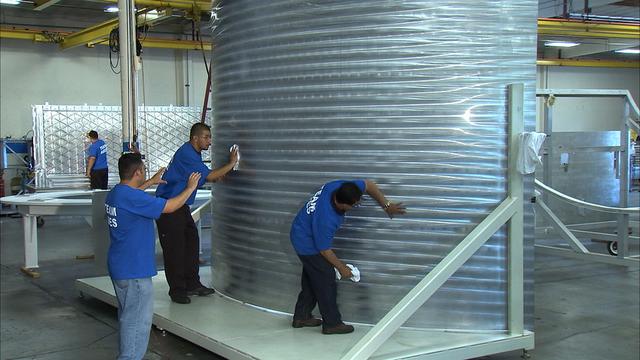
Under the goals of the Vision for Space Exploration, Ares I is a chief component of the cost-effective space transportation infrastructure being developed by NASA's Constellation Program. This transportation system will safely and reliably carry human explorers back to the moon, and then onward to Mars and other destinations in the solar system. The Ares I effort includes multiple project element teams at NASA centers and contract organizations around the nation, and is managed by the Exploration Launch Projects Office at NASA's Marshall Space Flight Center (MFSC). ATK Launch Systems near Brigham City, Utah, is the prime contractor for the first stage booster. ATK's subcontractor, United Space Alliance of Houston, is designing, developing and testing the parachutes at its facilities at NASA's Kennedy Space Center in Florida. NASA's Johnson Space Center in Houston hosts the Constellation Program and Orion Crew Capsule Project Office and provides test instrumentation and support personnel. Together, these teams are developing vehicle hardware, evolving proven technologies, and testing components and systems. Their work builds on powerful, reliable space shuttle propulsion elements and nearly a half-century of NASA space flight experience and technological advances. Ares I is an inline, two-stage rocket configuration topped by the Crew Exploration Vehicle, its service module, and a launch abort system. This HD video image depicts the manufacturing of aluminum panels that will be used to form the Ares I barrel. The panels are manufacturing process demonstration articles that will undergo testing until perfected. The panels are built by AMRO Manufacturing located in El Monte, California. (Highest resolution available)
Under the goals of the Vision for Space Exploration, Ares I is a chief component of the cost-effective space transportation infrastructure being developed by NASA's Constellation Program. This transportation system will safely and reliably carry human explorers back to the moon, and then onward to Mars and other destinations in the solar system. The Ares I effort includes multiple project element teams at NASA centers and contract organizations around the nation, and is managed by the Exploration Launch Projects Office at NASA's Marshall Space Flight Center (MFSC). ATK Launch Systems near Brigham City, Utah, is the prime contractor for the first stage booster. ATK's subcontractor, United Space Alliance of Houston, is designing, developing and testing the parachutes at its facilities at NASA's Kennedy Space Center in Florida. NASA's Johnson Space Center in Houston hosts the Constellation Program and Orion Crew Capsule Project Office and provides test instrumentation and support personnel. Together, these teams are developing vehicle hardware, evolving proven technologies, and testing components and systems. Their work builds on powerful, reliable space shuttle propulsion elements and nearly a half-century of NASA space flight experience and technological advances. Ares I is an inline, two-stage rocket configuration topped by the Crew Exploration Vehicle, its service module, and a launch abort system. This HD video image depicts confidence testing of a manufactured aluminum panel that will fabricate the Ares I upper stage barrel. In this test, bent aluminum is stressed to breaking point and thoroughly examined. The panels are manufactured by AMRO Manufacturing located in El Monte, California. (Highest resolution available)
Under the goals of the Vision for Space Exploration, Ares I is a chief component of the cost-effective space transportation infrastructure being developed by NASA's Constellation Program. This transportation system will safely and reliably carry human explorers back to the moon, and then onward to Mars and other destinations in the solar system. The Ares I effort includes multiple project element teams at NASA centers and contract organizations around the nation, and is managed by the Exploration Launch Projects Office at NASA's Marshall Space Flight Center (MFSC). ATK Launch Systems near Brigham City, Utah, is the prime contractor for the first stage booster. ATK's subcontractor, United Space Alliance of Houston, is designing, developing and testing the parachutes at its facilities at NASA's Kennedy Space Center in Florida. NASA's Johnson Space Center in Houston hosts the Constellation Program and Orion Crew Capsule Project Office and provides test instrumentation and support personnel. Together, these teams are developing vehicle hardware, evolving proven technologies, and testing components and systems. Their work builds on powerful, reliable space shuttle propulsion elements and nearly a half-century of NASA space flight experience and technological advances. Ares I is an inline, two-stage rocket configuration topped by the Crew Exploration Vehicle, its service module, and a launch abort system. This HD video image depicts friction stir welding used in manufacturing aluminum panels that will fabricate the Ares I upper stage barrel. The panels are subjected to confidence tests in which the bent aluminum is stressed to breaking point and thoroughly examined. The panels are manufactured by AMRO Manufacturing located in El Monte, California. (Highest resolution available)
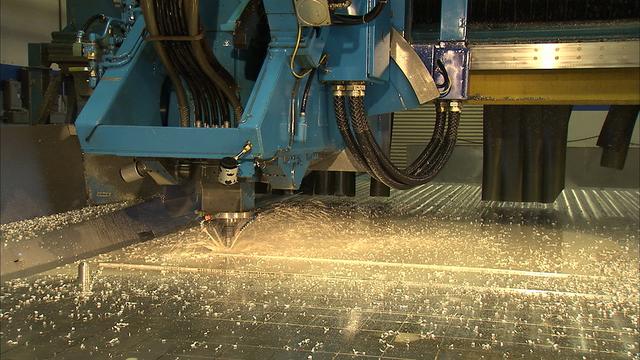
Under the goals of the Vision for Space Exploration, Ares I is a chief component of the cost-effective space transportation infrastructure being developed by NASA's Constellation Program. This transportation system will safely and reliably carry human explorers back to the moon, and then onward to Mars and other destinations in the solar system. The Ares I effort includes multiple project element teams at NASA centers and contract organizations around the nation, and is managed by the Exploration Launch Projects Office at NASA's Marshall Space Flight Center (MFSC). ATK Launch Systems near Brigham City, Utah, is the prime contractor for the first stage booster. ATK's subcontractor, United Space Alliance of Houston, is designing, developing and testing the parachutes at its facilities at NASA's Kennedy Space Center in Florida. NASA's Johnson Space Center in Houston hosts the Constellation Program and Orion Crew Capsule Project Office and provides test instrumentation and support personnel. Together, these teams are developing vehicle hardware, evolving proven technologies, and testing components and systems. Their work builds on powerful, reliable space shuttle propulsion elements and nearly a half-century of NASA space flight experience and technological advances. Ares I is an inline, two-stage rocket configuration topped by the Crew Exploration Vehicle, its service module, and a launch abort system. In this HD video image, processes for upper stage barrel fabrication are talking place. Aluminum panels are manufacturing process demonstration articles that will undergo testing until perfected. The panels are built by AMRO Manufacturing located in El Monte, California. (Largest resolution available)
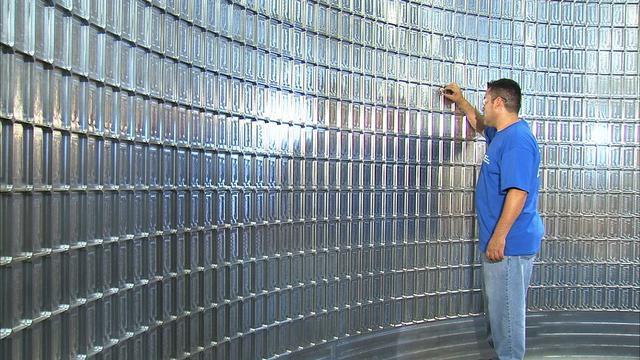
Under the goals of the Vision for Space Exploration, Ares I is a chief component of the cost-effective space transportation infrastructure being developed by NASA's Constellation Program. This transportation system will safely and reliably carry human explorers back to the moon, and then onward to Mars and other destinations in the solar system. The Ares I effort includes multiple project element teams at NASA centers and contract organizations around the nation, and is managed by the Exploration Launch Projects Office at NASA's Marshall Space Flight Center (MFSC). ATK Launch Systems near Brigham City, Utah, is the prime contractor for the first stage booster. ATK's subcontractor, United Space Alliance of Houston, is designing, developing and testing the parachutes at its facilities at NASA's Kennedy Space Center in Florida. NASA's Johnson Space Center in Houston hosts the Constellation Program and Orion Crew Capsule Project Office and provides test instrumentation and support personnel. Together, these teams are developing vehicle hardware, evolving proven technologies, and testing components and systems. Their work builds on powerful, reliable space shuttle propulsion elements and nearly a half-century of NASA space flight experience and technological advances. Ares I is an inline, two-stage rocket configuration topped by the Crew Exploration Vehicle, its service module, and a launch abort system. This HD video image depicts a manufactured panel that will be used for the Ares I upper stage barrel fabrication. The aluminum panels are manufacturing process demonstration articles that will undergo testing until perfected. The panels are built by AMRO Manufacturing located in El Monte, California. (Highest resolution available)
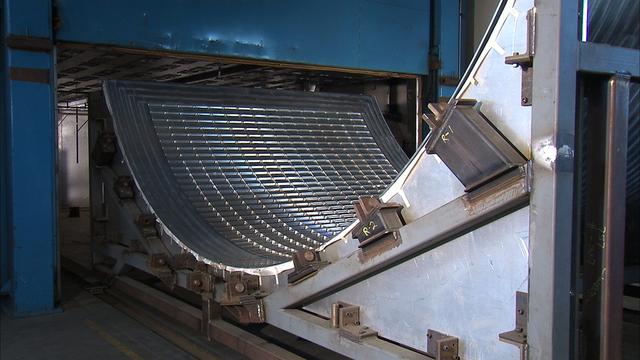
Under the goals of the Vision for Space Exploration, Ares I is a chief component of the cost-effective space transportation infrastructure being developed by NASA's Constellation Program. This transportation system will safely and reliably carry human explorers back to the moon, and then onward to Mars and other destinations in the solar system. The Ares I effort includes multiple project element teams at NASA centers and contract organizations around the nation, and is managed by the Exploration Launch Projects Office at NASA's Marshall Space Flight Center (MFSC). ATK Launch Systems near Brigham City, Utah, is the prime contractor for the first stage booster. ATK's subcontractor, United Space Alliance of Houston, is designing, developing and testing the parachutes at its facilities at NASA's Kennedy Space Center in Florida. NASA's Johnson Space Center in Houston hosts the Constellation Program and Orion Crew Capsule Project Office and provides test instrumentation and support personnel. Together, these teams are developing vehicle hardware, evolving proven technologies, and testing components and systems. Their work builds on powerful, reliable space shuttle propulsion elements and nearly a half-century of NASA space flight experience and technological advances. Ares I is an inline, two-stage rocket configuration topped by the Crew Exploration Vehicle, its service module, and a launch abort system. This HD video image depicts a manufactured aluminum panel that will be used to fabricate the Ares I upper stage barrel, undergoing a confidence panel test. In this test, the bent aluminum is stressed to breaking point and thoroughly examined. The panels are manufactured by AMRO Manufacturing located in El Monte, California. (Highest resolution available)
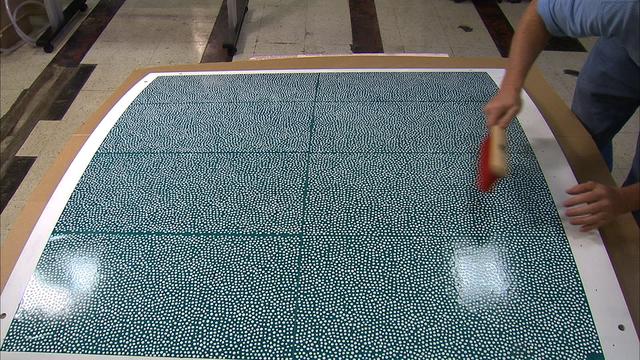
Under the goals of the Vision for Space Exploration, Ares I is a chief component of the cost-effective space transportation infrastructure being developed by NASA's Constellation Program. This transportation system will safely and reliably carry human explorers back to the moon, and then onward to Mars and other destinations in the solar system. The Ares I effort includes multiple project element teams at NASA centers and contract organizations around the nation, and is managed by the Exploration Launch Projects Office at NASA's Marshall Space Flight Center (MFSC). ATK Launch Systems near Brigham City, Utah, is the prime contractor for the first stage booster. ATK's subcontractor, United Space Alliance of Houston, is designing, developing and testing the parachutes at its facilities at NASA's Kennedy Space Center in Florida. NASA's Johnson Space Center in Houston hosts the Constellation Program and Orion Crew Capsule Project Office and provides test instrumentation and support personnel. Together, these teams are developing vehicle hardware, evolving proven technologies, and testing components and systems. Their work builds on powerful, reliable space shuttle propulsion elements and nearly a half-century of NASA space flight experience and technological advances. Ares I is an inline, two-stage rocket configuration topped by the Crew Exploration Vehicle, its service module, and a launch abort system. This HD video image, depicts a manufactured aluminum panel, that will be used to fabricate the Ares I upper stage barrel, undergoing a confidence panel test. In this test, the bent aluminum is stressed to breaking point and thoroughly examined. The panels are manufactured by AMRO Manufacturing located in El Monte, California. (Highest resolution available)