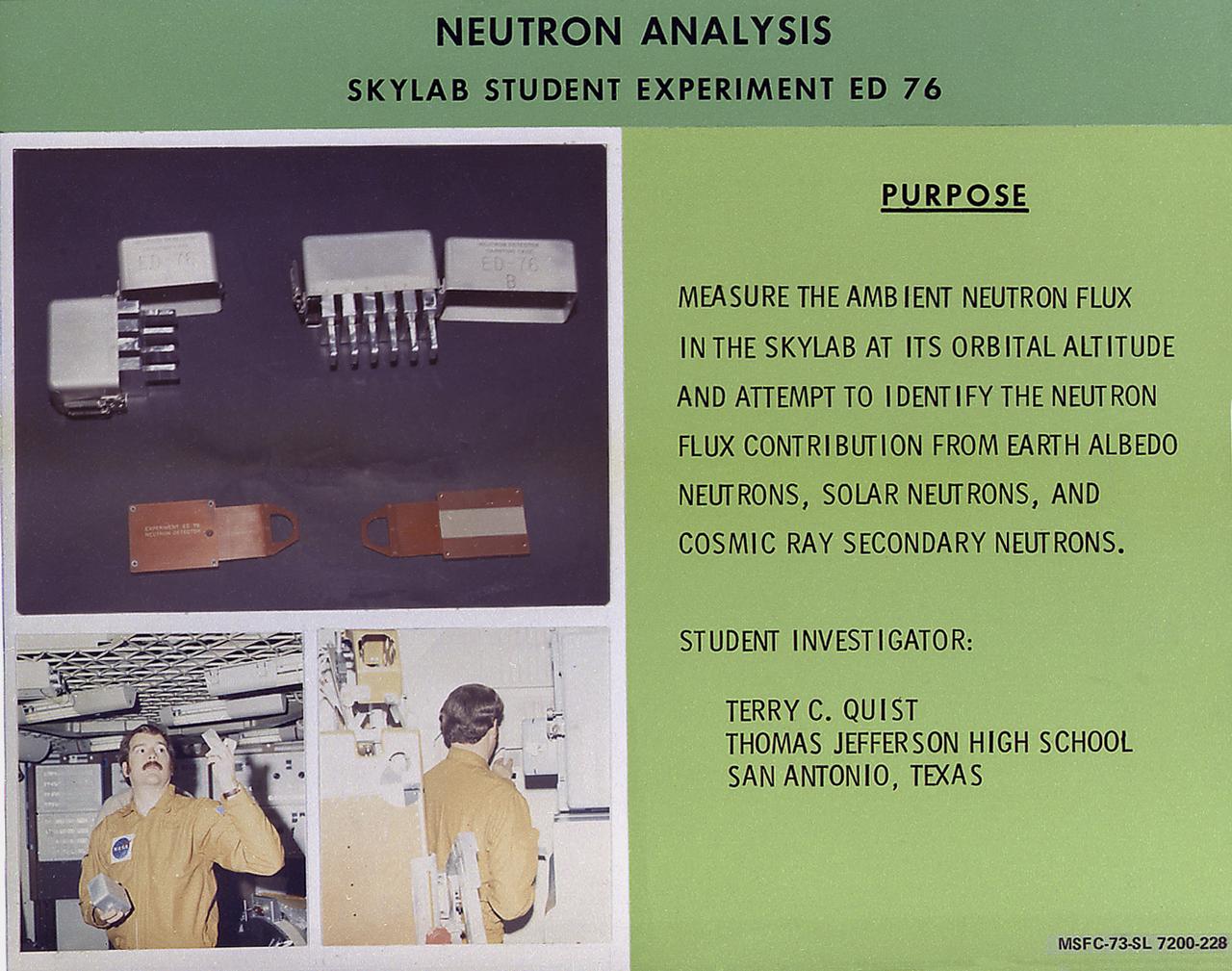
The rate of neutron flow is commonly referred to as a flux. The measurement of neutron fluxes in Skylab was the subject of a proposal by Terry Quist of San Antonio, Texas. This chart describes Quist's experiment, Neutron Analysis, Skylab student experiment ED-76. These measurements were considered important not only by NASA but also by the scientific community for four reasons. High energy neutrons can be harmful to human tissue if they are present in significant quantities. Fluxes of neutrons can damage film and other sensitive experimental equipment in a marner similar to those produced by x-rays or other radiation. Furthermore, neutron fluxes can be used as a calibration source for other space-oriented particle physics experiments. Finally, neutron fluxes can affect sensitive x-ray and gamma-ray astronomy observations. Quist's objectives were to measure the neutron fluxes present in Skylab and, with the assistance of NASA and other physicists, to attempt determination of their origin as well as their energy range or spectrum. This experiment had stimulated interest in further studies of neutron phenomena in space. In March 1972, NASA and the National Science Teachers Association selected 25 experiment proposals for flight on Skylab. Science advisors from the Marshall Space Flight Center aided and assisted the students in developing the proposals for flight on Skylab.
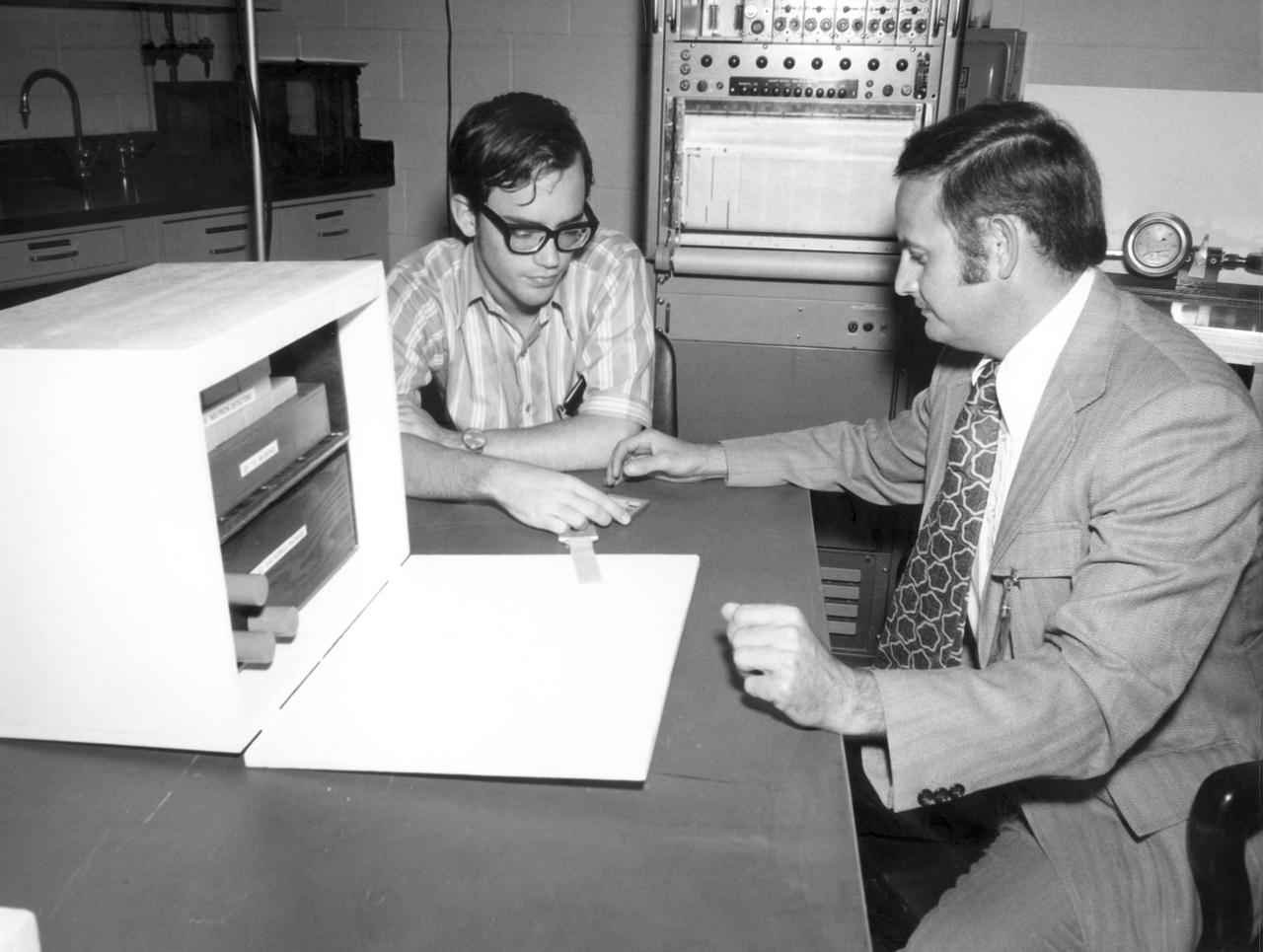
San Antonio, Texas high school student, Terry C. Quist (left), and Dr. Raymond Gause of the Marshall Space Flight Center (MSFC), discuss the student’s experiment to be performed aboard the Skylab the following year. His experiment, “Earth Orbital Neutron Analysis” required detectors such as the one he is examining in this photo. The detector was to be attached to a water tank in Skylab. Neutrons striking the detectors left traces that were brought out by a chemical etching process after the Skylab mission. Quist’s experiment seeked to record neutron hits, count them, and determine their direction. This information was to help determine the source of neutrons in the solar system. Quist was among 25 winners of a contest in which some 3,500 high school students proposed experiments for the following year’s Skylab mission. The nationwide scientific competition was sponsored by the National Science Teachers Association and the National Aeronautics and Space Administration (NASA). The winning students, along with their parents and sponsor teachers, visited MSFC two months earlier where they met with scientists and engineers, participated in design reviews for their experiments, and toured MSFC facilities. Of the 25 students, 6 did not see their experiments conducted on Skylab because the experiments were not compatible with Skylab hardware and timelines. Of the 19 remaining, 11 experiments required the manufacture of additional equipment. The equipment for the experiments was manufactured at MSFC.
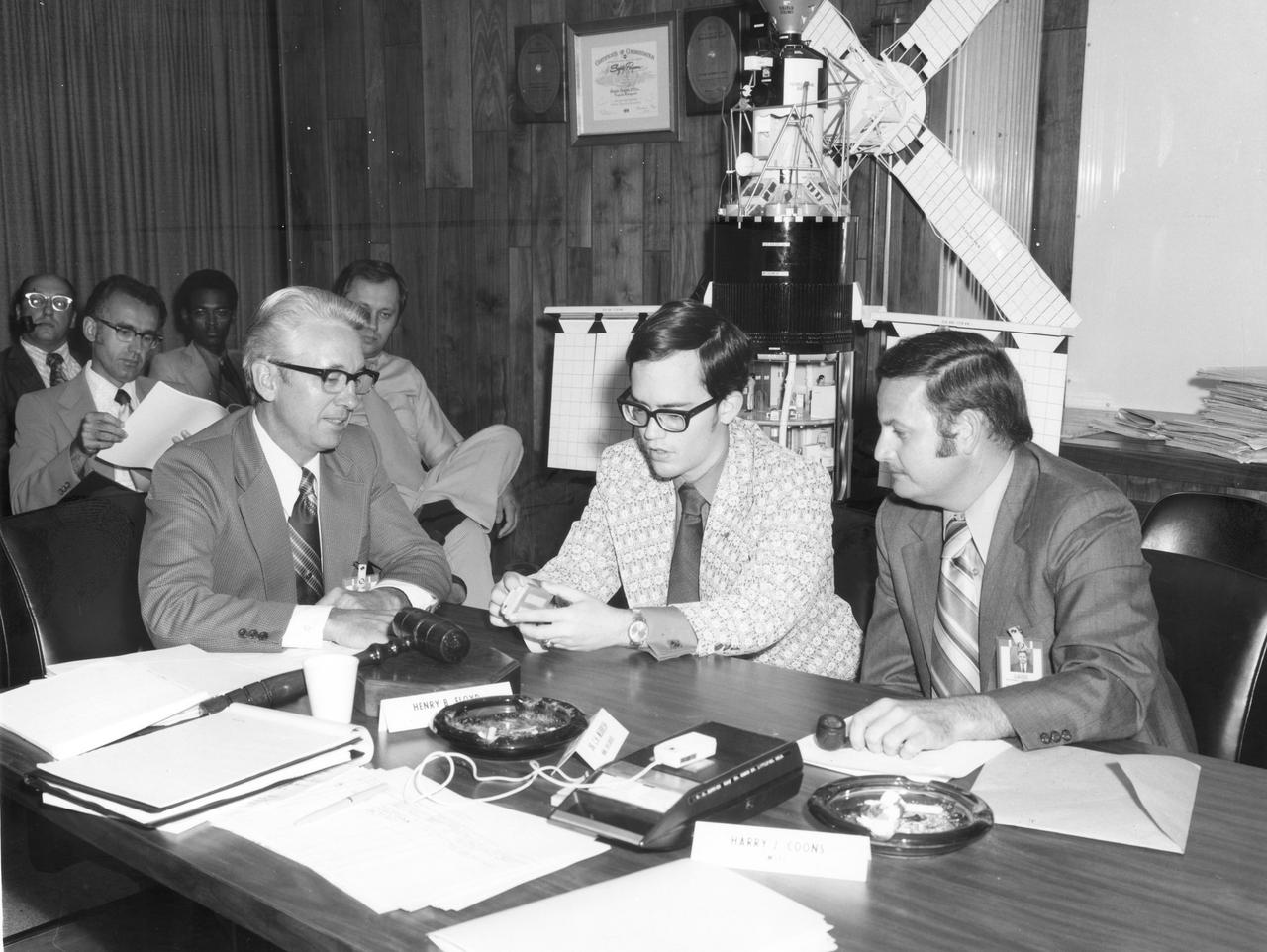
Terry C. Quist (center), high school student from San Antonio, Texas, discusses his proposed Skylab experiment with Marshall Space Flight Center’s (MSFC) Henry Floyd (left), coordinator of the Skylab Student Experiment Project, and DR. Raymond Gause, scientific advisor to Quist. The student’s experiment, “Earth Orbital Neutron Analysis”, was aimed at learning more about the source of neutrons in the solar system by seeking the number and direction from which each comes. Quist was among the 25 winners of a contest in which some 3,500 high school students proposed experiments for the following year’s Skylab mission. Of the 25 students, 6 did not see their experiments conducted on Skylab because the experiments were not compatible with Skylab hardware and timelines. Of the 19 remaining, 11 experiments required the manufacture of equipment, such as Quist’s experiment, which required detector hardware.
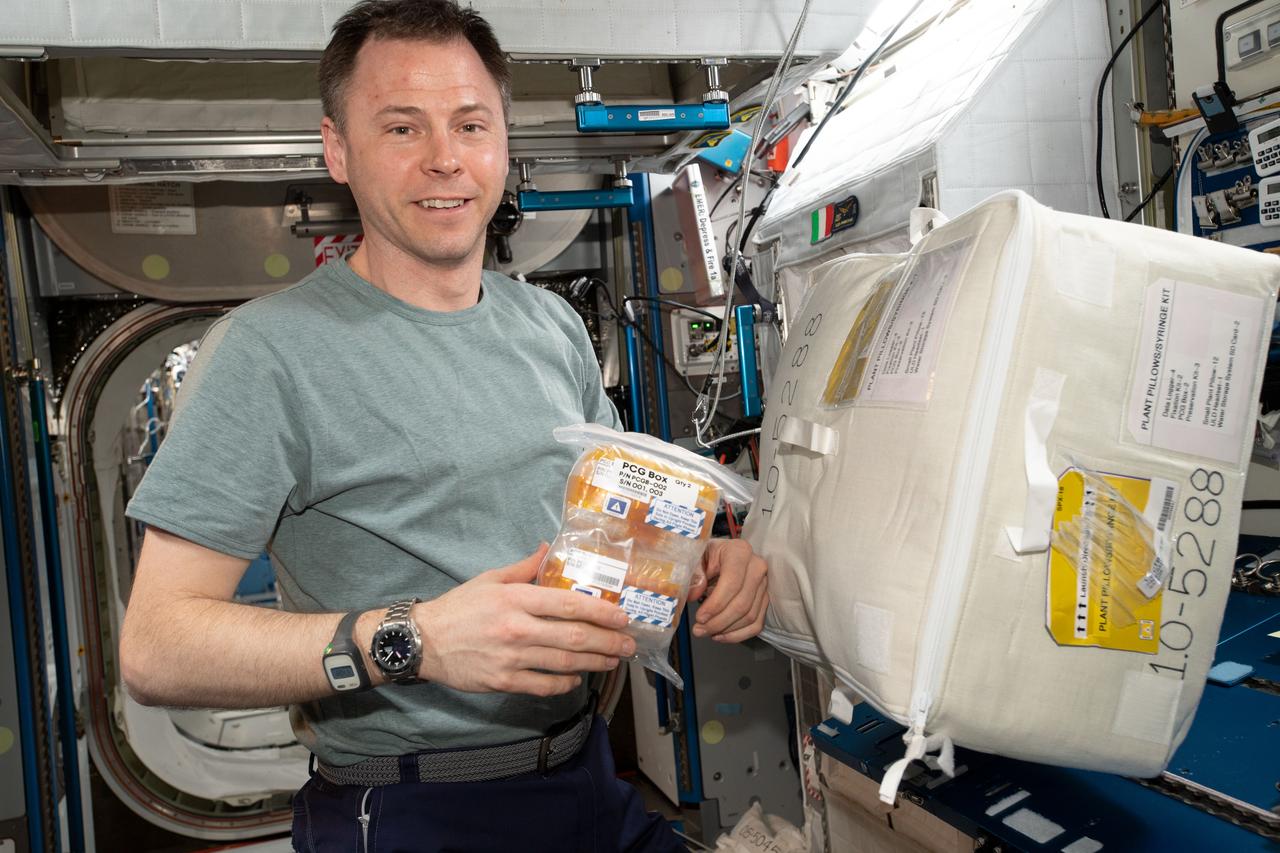
iss060e015014 (7/28/2019) — NASA astronaut Nick Hague is shown holding the CASIS Protein Crystal Growth 15 (CASIS PCG 15) investigation samples aboard the International Space Station (ISS). Microgravity Crystal Growth for Improvement in Neutron Diffraction and the Analysis of Protein Complexes (CASIS PCG 15) seeks a better understanding of enzyme catalysis by examining crystals from two model Pyridoxal phosphate (PLP) dependent enzymes and from a bacteriophage transient deoxyribonucleic acid (DNA) repair complex. Analysis of the crystals may reveal catalyst mechanisms and structures and visualize the interaction between the repair proteins. Results could contribute to identification of biomarkers for diagnosis of disease and to development of better antimicrobials.
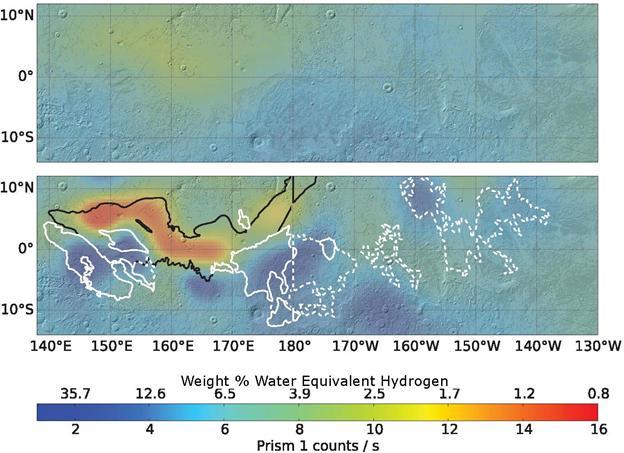
Re-analysis of 2002-2009 data from a hydrogen-finding instrument on NASA's Mars Odyssey orbiter increased the resolution of maps of hydrogen abundance. The reprocessed data (lower map) shows more "water-equivalent hydrogen" (darker blue) in some parts of this equatorial region of Mars. Puzzingly, this suggests the possible presence of water ice just beneath the surface near the equator, though it would not be thermodynamically stable there. The upper map uses raw data from Odyssey's neutron spectrometer instrument, which senses the energy state of neutrons coming from Mars, providing an indication of how much hydrogen is present in the top 3 feet (1 meter) of the surface. Hydrogen detected by Odyssey at high latitudes of Mars in 2002 was confirmed to be in the form of water ice by the follow-up NASA Phoenix Mars Lander mission in 2008. A 2017 reprocessing of the older data applied image-reconstruction techniques often used to reduce blurring from medical imaging data. The results are shown here for an area straddling the equator for about one-fourth the circumference of the planet, centered at 175 degrees west longitude. The white contours outline lobes of a formation called Medusae Fossae, coinciding with some areas of higher hydrogen abundance in the enhanced-resolution analysis. The black line indicates the limit of a relatively young lava plain, coinciding with areas of lower hydrogen abundance in the enhanced-resolution analysis. The color-coding key for hydrogen abundance in both maps is indicated by the horizontal bar, in units expressed as how much water would be present in the ground if the hydrogen is all in the form of water. Units of the equivalent water weight, as a percentage of the material in the ground, are correlated with counts recorded by the spectrometer, ranging from less than 1 weight-percent water equivalent (red) to more than 30 percent (dark blue). https://photojournal.jpl.nasa.gov/catalog/PIA21848