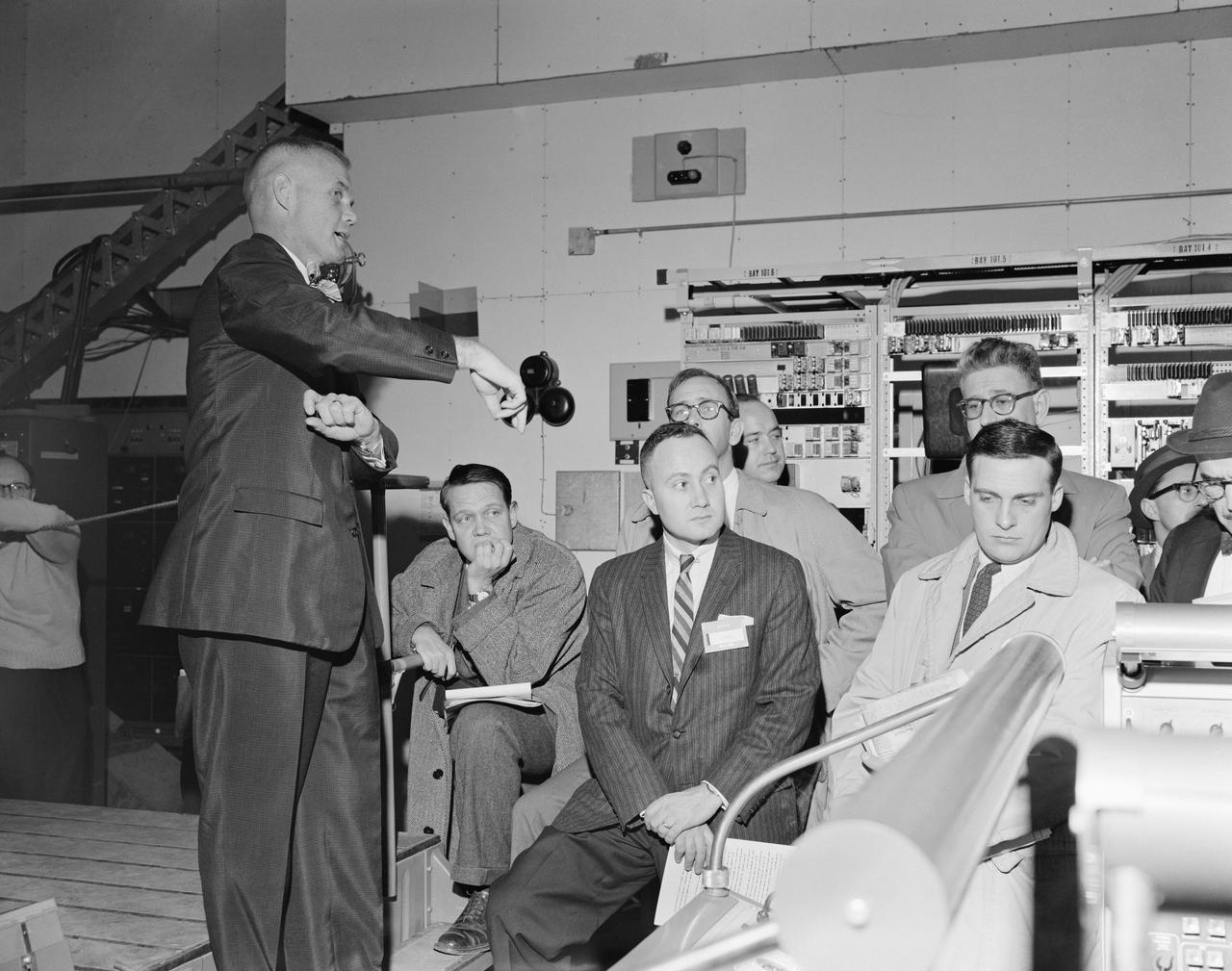
M61-00041 (January 1961) --- Astronaut John Glenn and news media representatives are pictured during a press conference and spacecraft familiarization tour of Cape Canaveral, Florida. Photo credit: NASA

Blue Origin’s New Glenn rocket carrying NASA’s twin ESCAPADE (Escape and Plasma Acceleration and Dynamics Explorers) spacecraft launches at 3:55 p.m. EST, Thursday, Nov. 13, 2025, from Launch Complex 36 at Cape Canaveral Space Force Station in Florida. The ESCAPADE mission, built by Rocket Lab, will study how solar wind and plasma interact with Mars’ magnetosphere and how this interaction drives the planet’s atmospheric escape to prepare for future human missions on Mars.
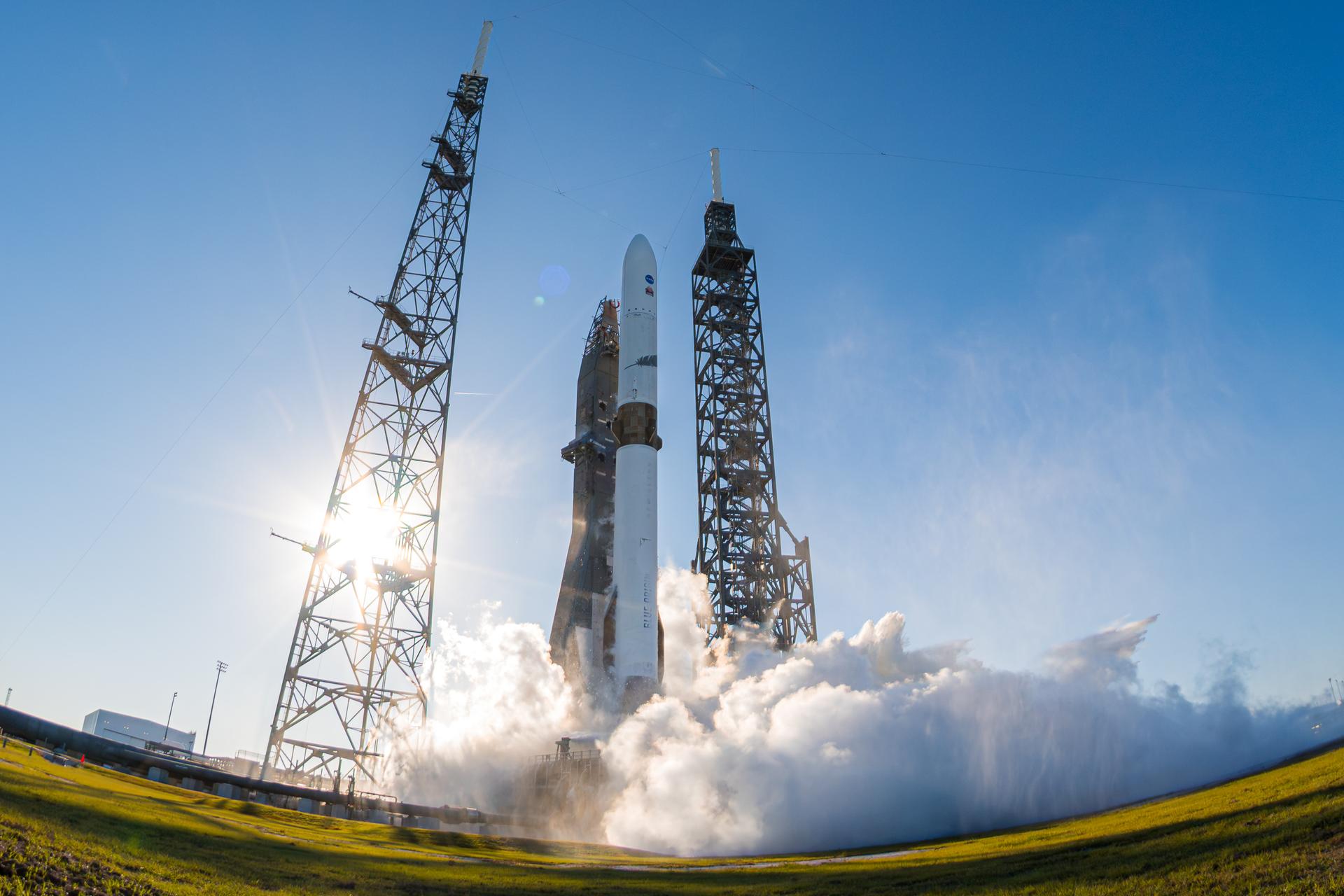
Blue Origin’s New Glenn rocket carrying NASA’s twin ESCAPADE (Escape and Plasma Acceleration and Dynamics Explorers) spacecraft launches at 3:55 p.m. EST, Thursday, Nov. 13, 2025, from Launch Complex 36 at Cape Canaveral Space Force Station in Florida. The ESCAPADE mission, built by Rocket Lab, will study how solar wind and plasma interact with Mars’ magnetosphere and how this interaction drives the planet’s atmospheric escape to prepare for future human missions on Mars.
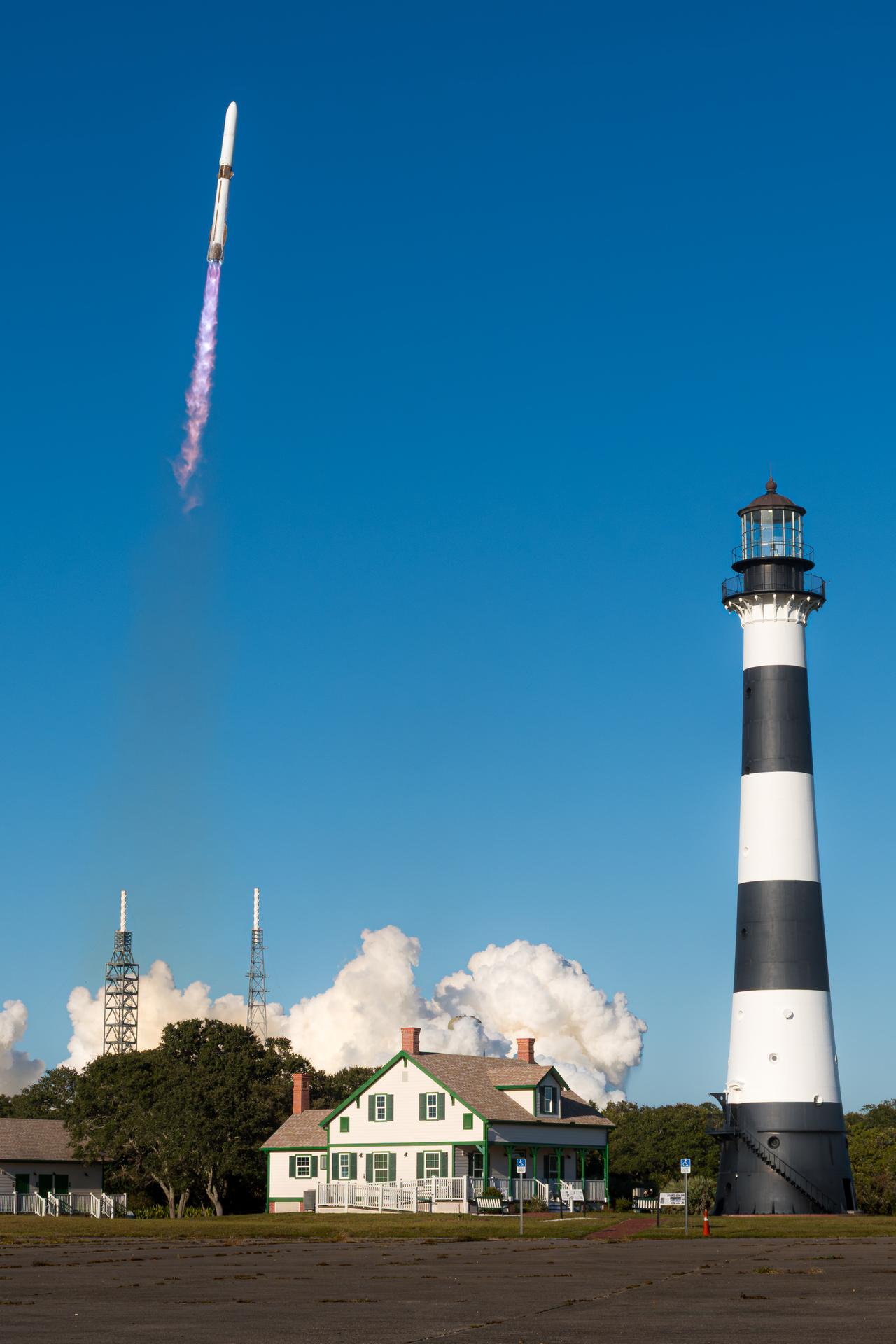
Near Cape Canaveral Lighthouse, Blue Origin’s New Glenn rocket carrying NASA’s twin ESCAPADE (Escape and Plasma Acceleration and Dynamics Explorers) spacecraft launches at 3:55 p.m. EST, Thursday, Nov. 13, 2025, from Launch Complex 36 at Cape Canaveral Space Force Station in Florida. The ESCAPADE mission, built by Rocket Lab, will study how solar wind and plasma interact with Mars’ magnetosphere and how this interaction drives the planet’s atmospheric escape to prepare for future human missions on Mars.
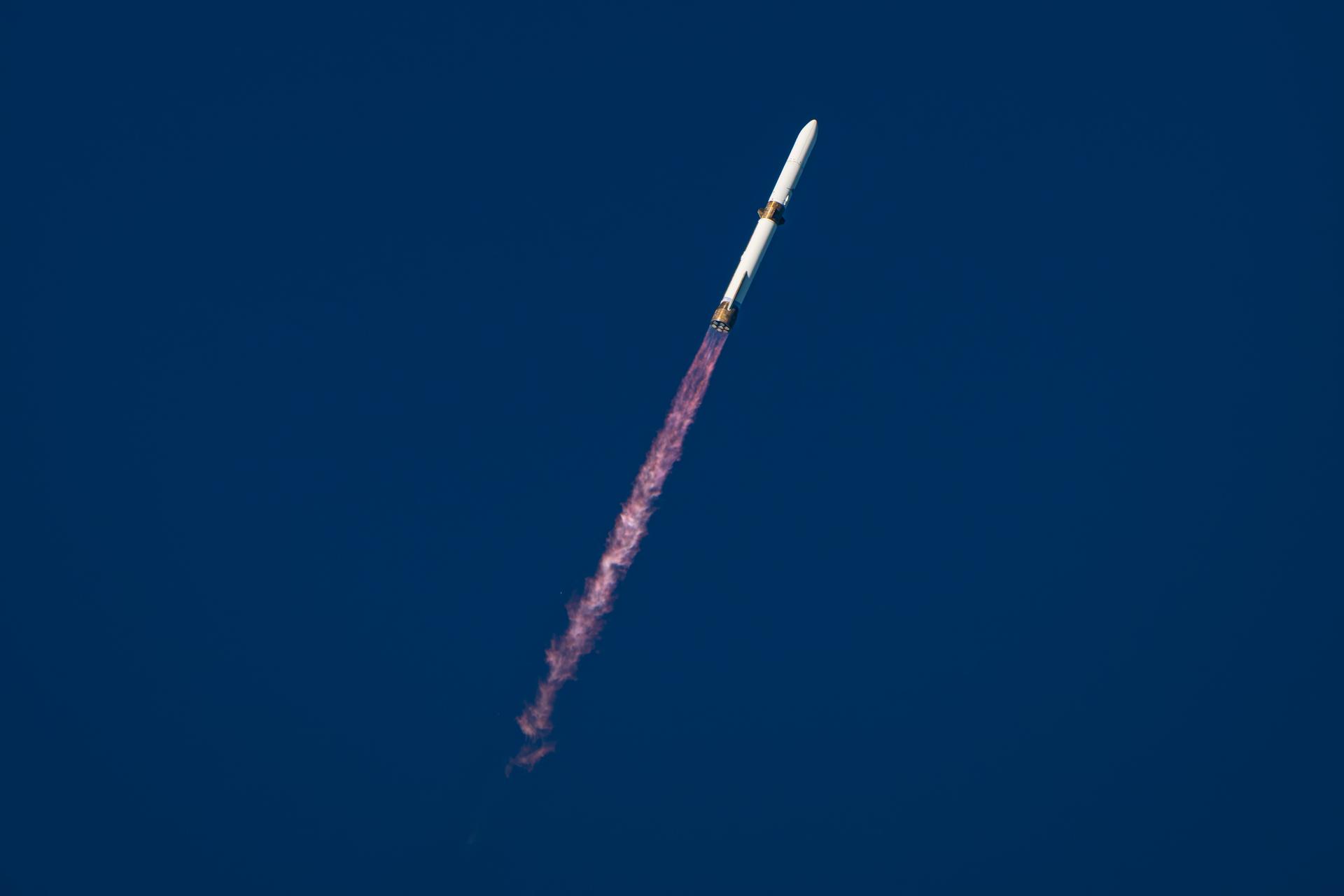
Blue Origin’s New Glenn rocket carrying NASA’s twin ESCAPADE (Escape and Plasma Acceleration and Dynamics Explorers) spacecraft launches at 3:55 p.m. EST, Thursday, Nov. 13, 2025, from Launch Complex 36 at Cape Canaveral Space Force Station in Florida. The ESCAPADE mission, built by Rocket Lab, will study how solar wind and plasma interact with Mars’ magnetosphere and how this interaction drives the planet’s atmospheric escape to prepare for future human missions on Mars.
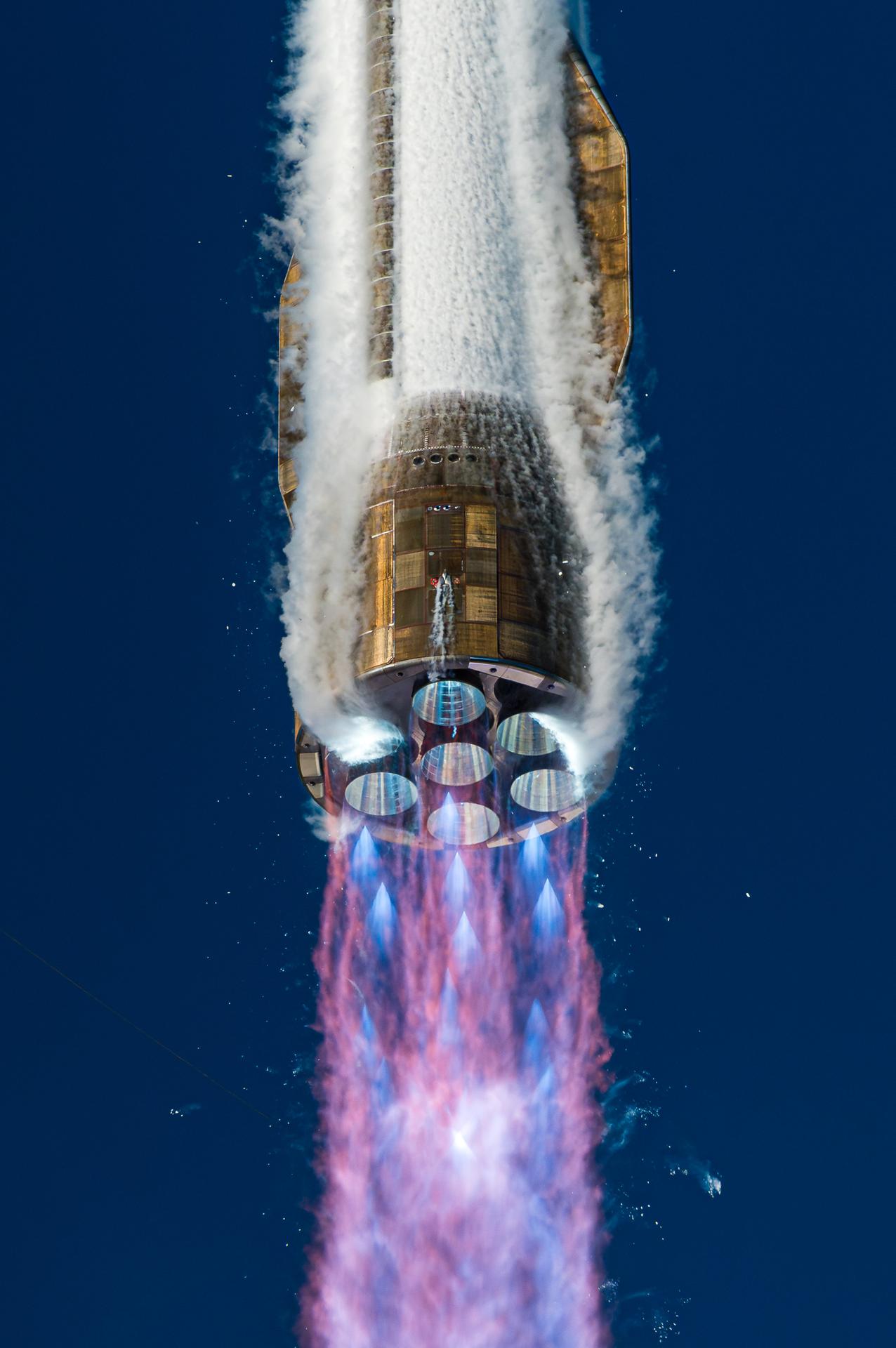
Blue Origin’s New Glenn rocket carrying NASA’s twin ESCAPADE (Escape and Plasma Acceleration and Dynamics Explorers) spacecraft launches at 3:55 p.m. EST, Thursday, Nov. 13, 2025, from Launch Complex 36 at Cape Canaveral Space Force Station in Florida. The ESCAPADE mission, built by Rocket Lab, will study how solar wind and plasma interact with Mars’ magnetosphere and how this interaction drives the planet’s atmospheric escape to prepare for future human missions on Mars.
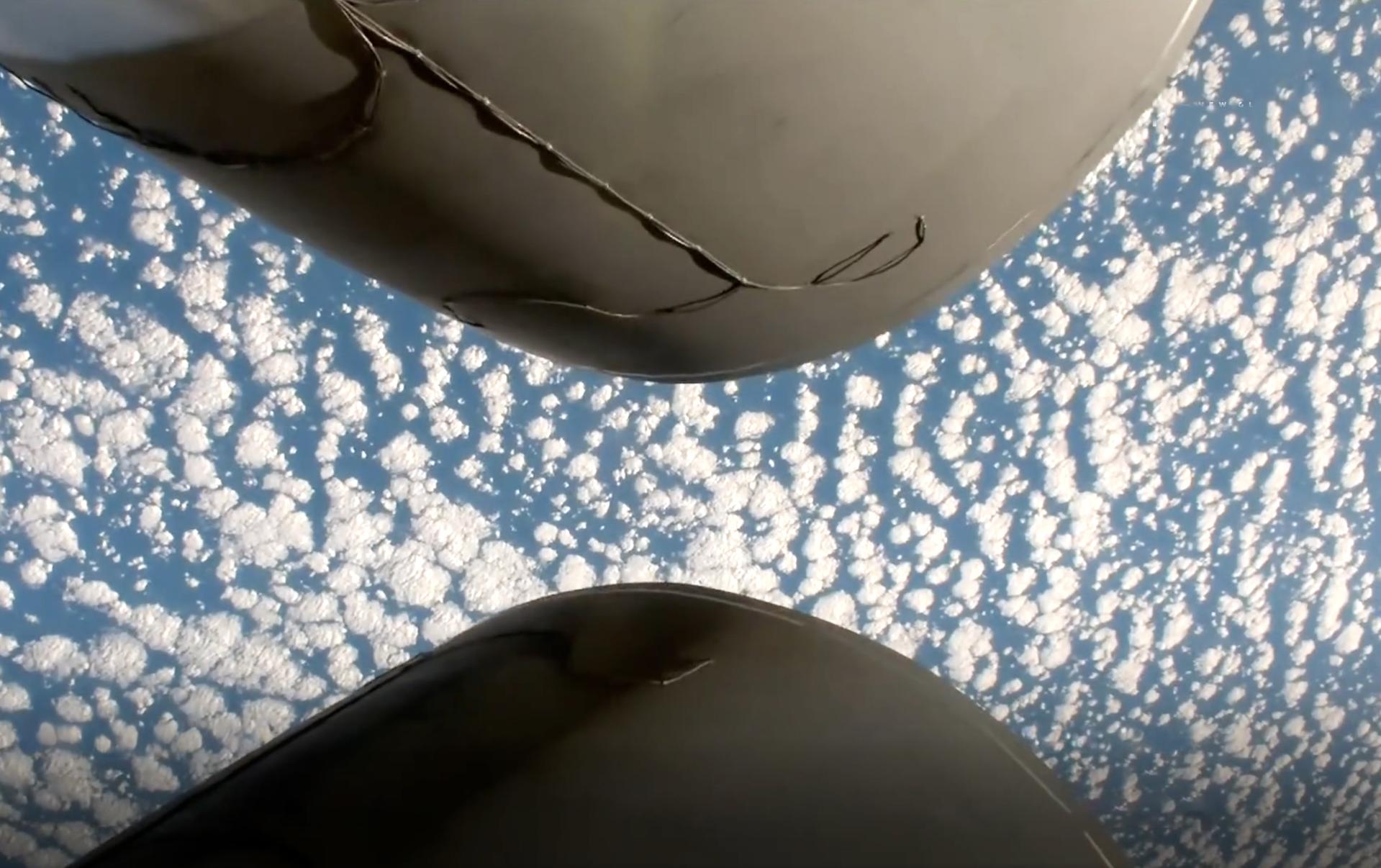
Blue Origin’s New Glenn rocket carrying NASA’s twin ESCAPADE (Escape and Plasma Acceleration and Dynamics Explorers) spacecraft launches at 3:55 p.m. EST, Thursday, Nov. 13, 2025, from Launch Complex 36 at Cape Canaveral Space Force Station in Florida. The ESCAPADE mission, built by Rocket Lab, will study how solar wind and plasma interact with Mars’ magnetosphere and how this interaction drives the planet’s atmospheric escape to prepare for future human missions on Mars.
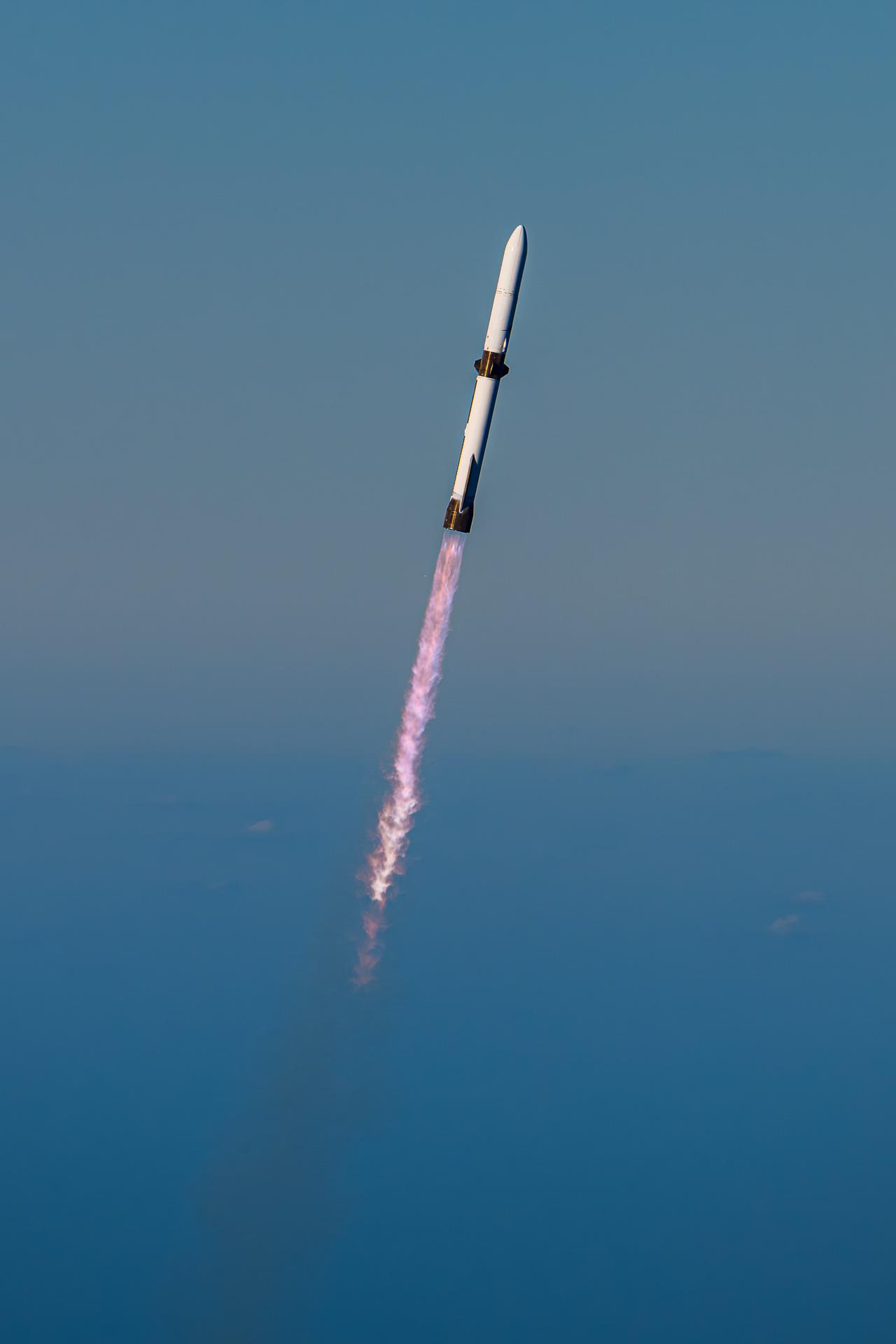
Blue Origin’s New Glenn rocket carrying NASA’s twin ESCAPADE (Escape and Plasma Acceleration and Dynamics Explorers) spacecraft launches at 3:55 p.m. EST, Thursday, Nov. 13, 2025, from Launch Complex 36 at Cape Canaveral Space Force Station in Florida. The ESCAPADE mission, built by Rocket Lab, will study how solar wind and plasma interact with Mars’ magnetosphere and how this interaction drives the planet’s atmospheric escape to prepare for future human missions on Mars.
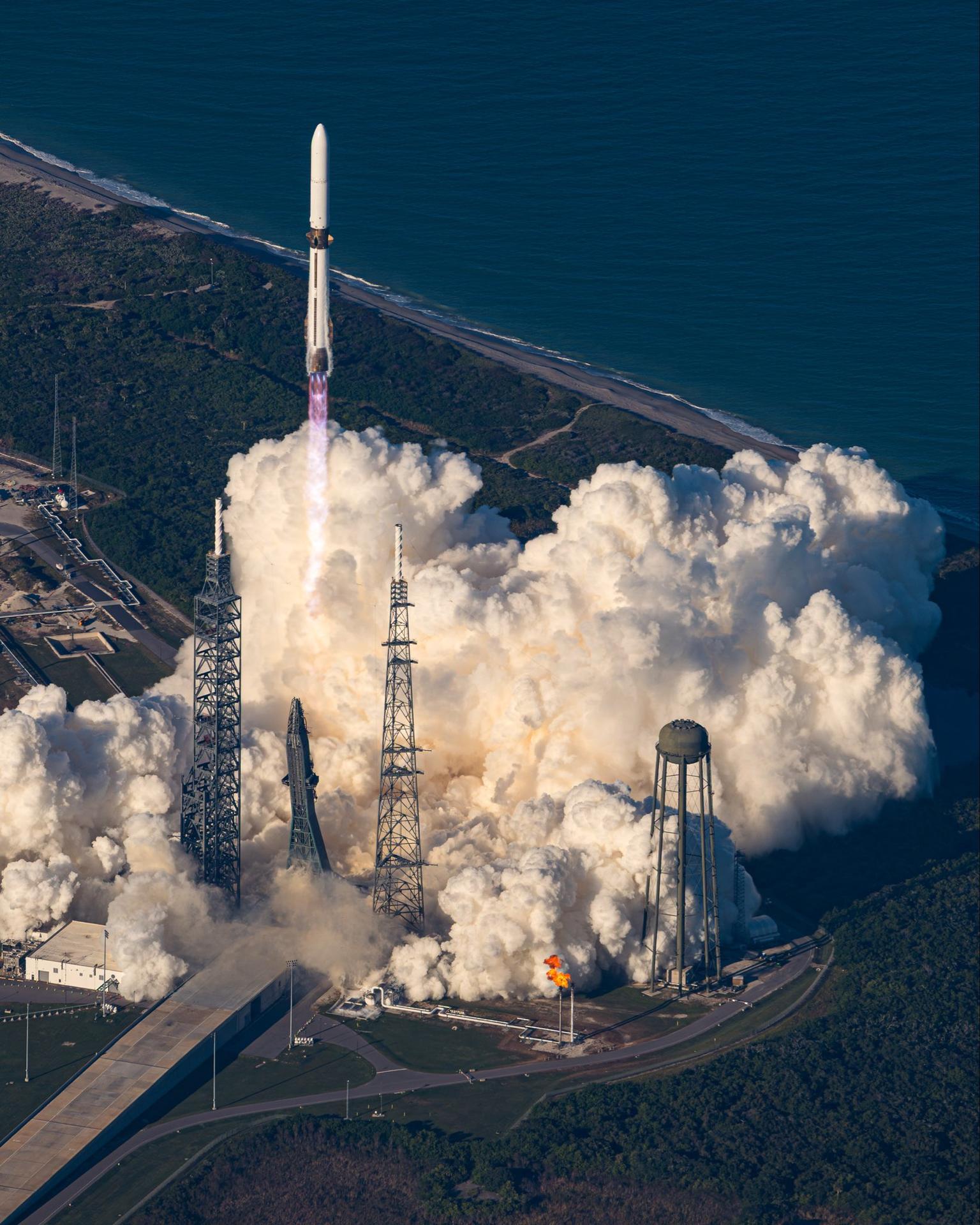
Blue Origin’s New Glenn rocket carrying NASA’s twin ESCAPADE (Escape and Plasma Acceleration and Dynamics Explorers) spacecraft launches at 3:55 p.m. EST, Thursday, Nov. 13, 2025, from Launch Complex 36 at Cape Canaveral Space Force Station in Florida. The ESCAPADE mission, built by Rocket Lab, will study how solar wind and plasma interact with Mars’ magnetosphere and how this interaction drives the planet’s atmospheric escape to prepare for future human missions on Mars.
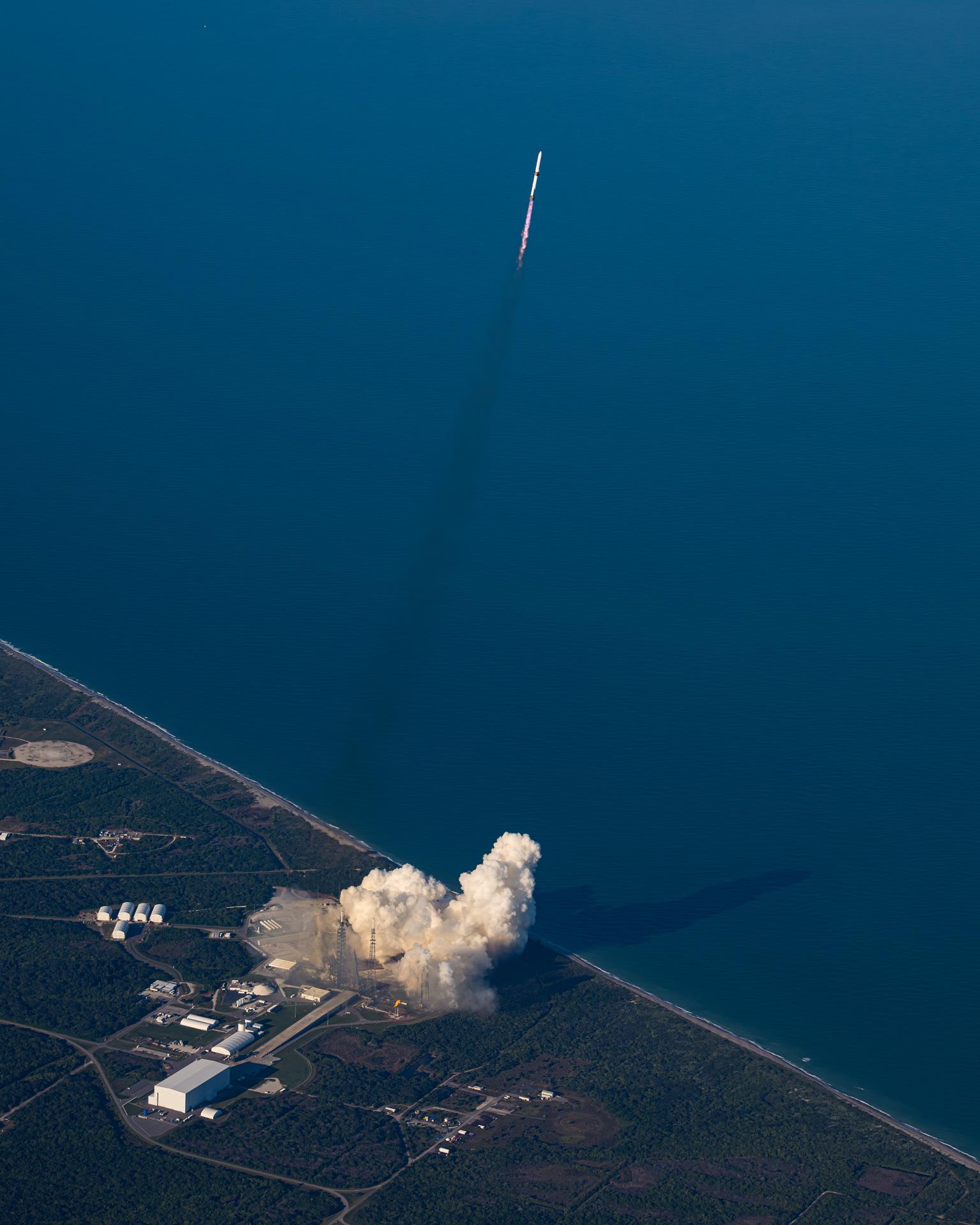
Blue Origin’s New Glenn rocket carrying NASA’s twin ESCAPADE (Escape and Plasma Acceleration and Dynamics Explorers) spacecraft launches at 3:55 p.m. EST, Thursday, Nov. 13, 2025, from Launch Complex 36 at Cape Canaveral Space Force Station in Florida. The ESCAPADE mission, built by Rocket Lab, will study how solar wind and plasma interact with Mars’ magnetosphere and how this interaction drives the planet’s atmospheric escape to prepare for future human missions on Mars.

Blue Origin’s New Glenn first stage rocket successfully lands for the first time on a drone ship in the Atlantic Ocean following the launching of NASA’s twin ESCAPADE (Escape and Plasma Acceleration and Dynamics Explorers) spacecraft at 3:55 p.m. EST, Thursday, Nov. 13, 2025, from Launch Complex 36 at Cape Canaveral Space Force Station in Florida. The ESCAPADE mission, built by Rocket Lab, will study how solar wind and plasma interact with Mars’ magnetosphere and how this interaction drives the planet’s atmospheric escape to prepare for future human missions on Mars.

Two small spacecrafts satellites that make up NASA’s ESCAPADE (Escape and Plasma Acceleration and Dynamics Explorers) mission to Mars arrived at Astrotech Space Operations in Titusville, near NASA’s Kennedy Space Center in Florida on Sunday, Aug. 19, 2024. Set to launch from Blue Origin’s New Glenn rocket, the Rocket Lab spacecraft will study the solar wind and how the solar wind interacts with Mars’ magnetic environment and how this interaction drives the planet’s atmospheric escape.

Two small spacecrafts satellites that make up NASA’s ESCAPADE (Escape and Plasma Acceleration and Dynamics Explorers) mission to Mars arrived at Astrotech Space Operations in Titusville, near NASA’s Kennedy Space Center in Florida on Sunday, Aug. 19, 2024. Set to launch from Blue Origin’s New Glenn rocket, the Rocket Lab spacecraft will study the solar wind and how the solar wind interacts with Mars’ magnetic environment and how this interaction drives the planet’s atmospheric escape.

Two small spacecrafts satellites that make up NASA’s ESCAPADE (Escape and Plasma Acceleration and Dynamics Explorers) mission to Mars arrived at Astrotech Space Operations in Titusville, near NASA’s Kennedy Space Center in Florida on Sunday, Aug. 19, 2024. Set to launch from Blue Origin’s New Glenn rocket, the Rocket Lab spacecraft will study the solar wind and how the solar wind interacts with Mars’ magnetic environment and how this interaction drives the planet’s atmospheric escape.
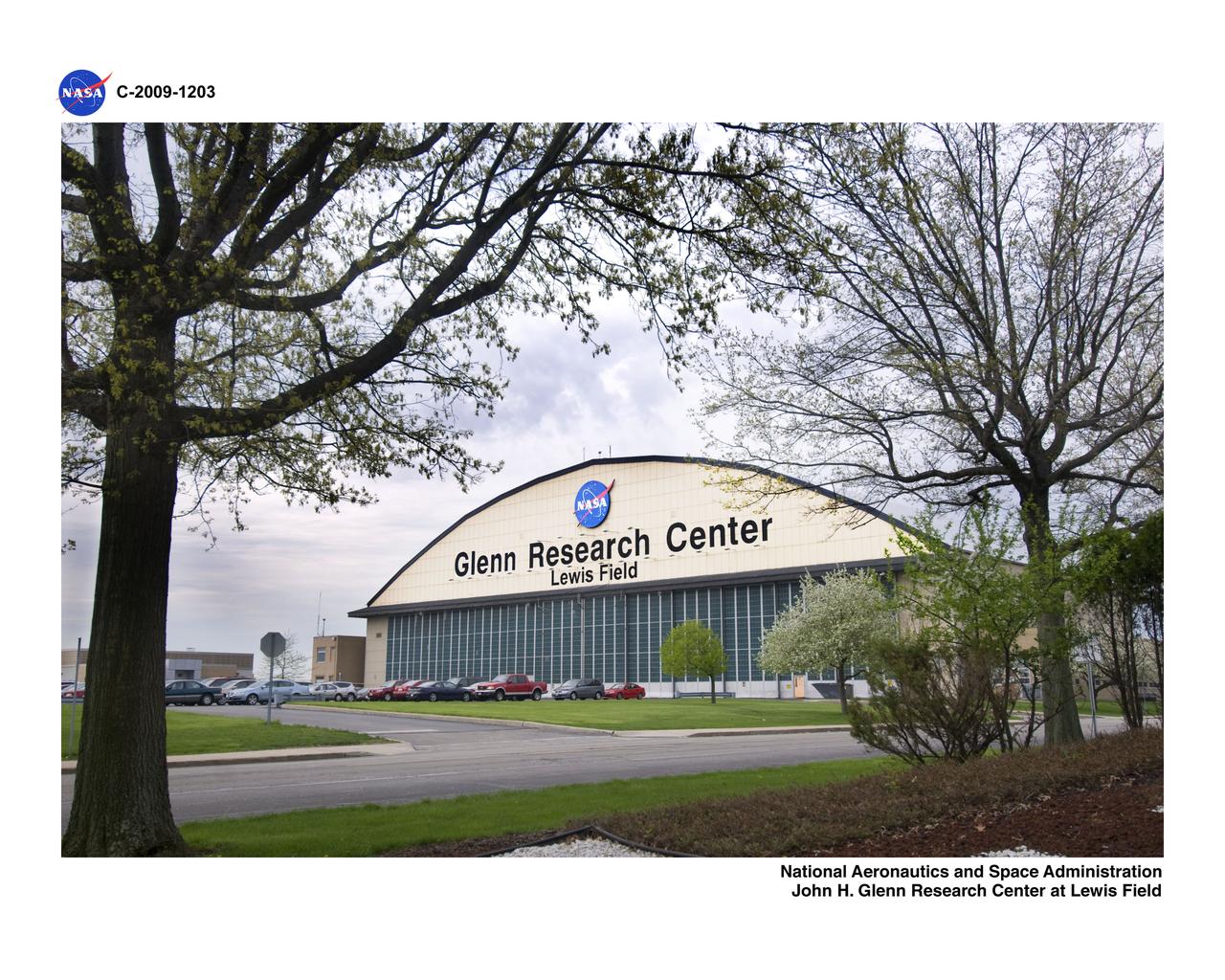
New Spring shots of the NASA Glenn Research Center Hangar
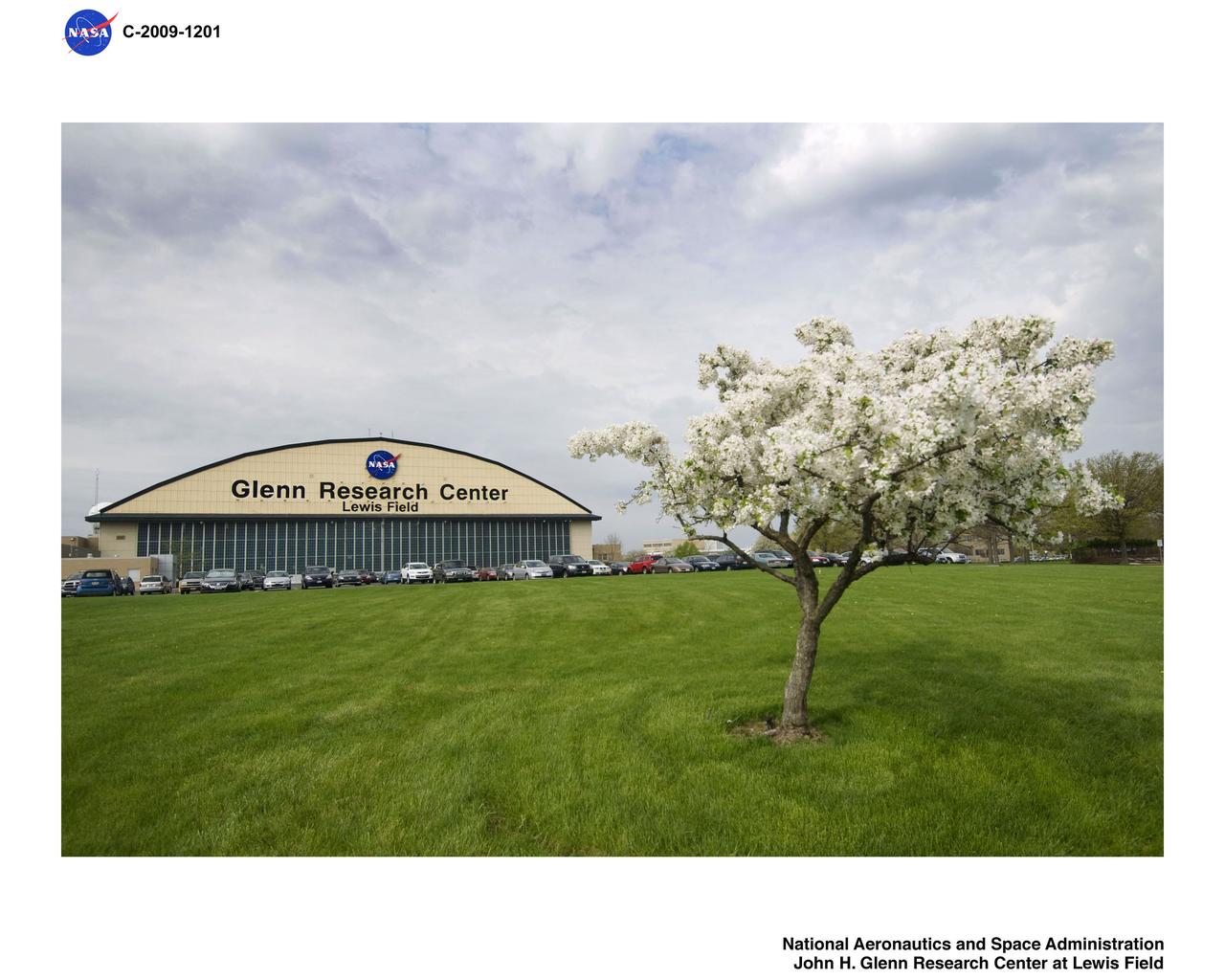
New Spring shots of the NASA Glenn Research Center Hangar
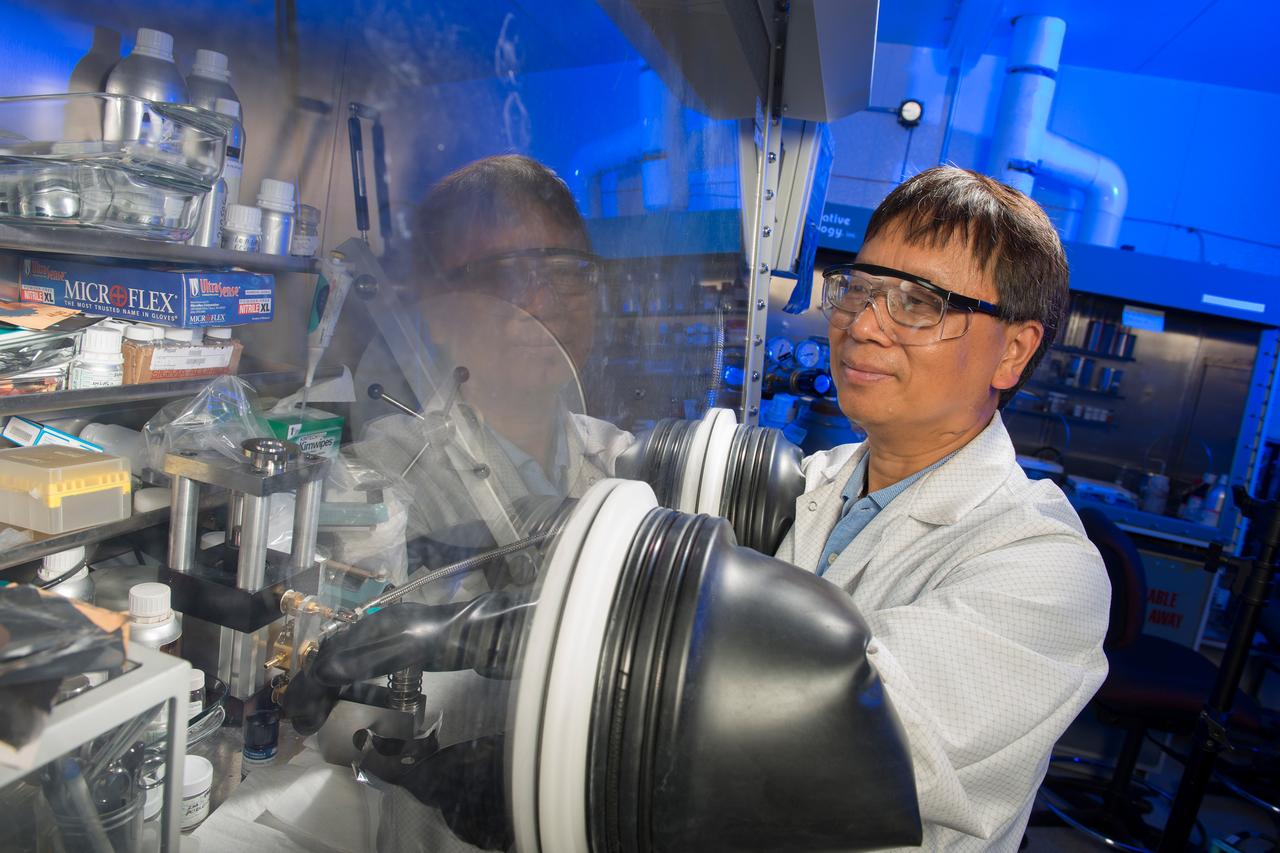
NASA Glenn Researcher James Wu assembles a lithium-metal based battery lab cell incorporating a new solid polymer nanocomposite electrolyte developed at the center.
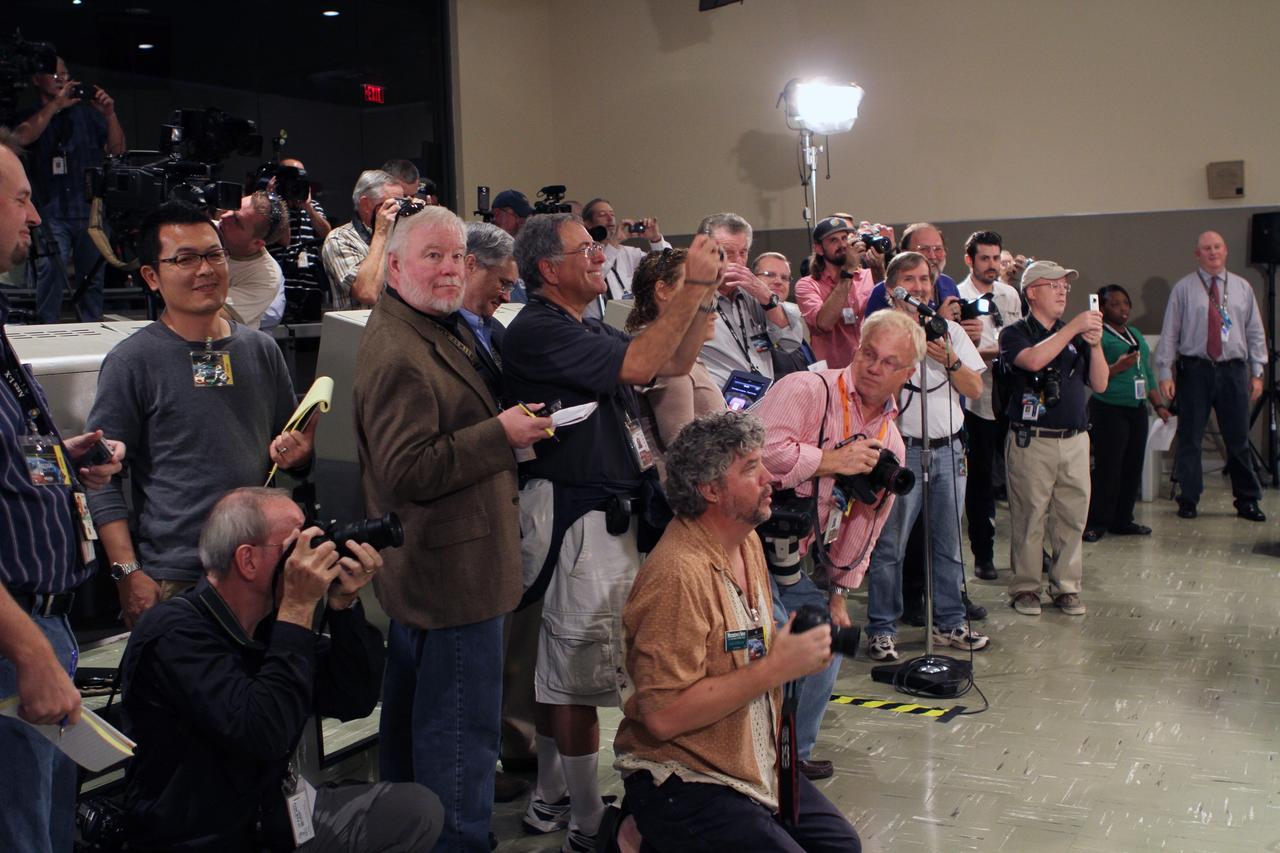
CAPE CANAVERAL, Fla. -- The international news media takes part in a question-and-answer session with Mercury astronauts John Glenn and Scott Carpenter at the Kennedy Space Center Visitor Complex in Florida. The astronauts, part of the original class of seven astronauts chosen by NASA, were taking part in events celebrating 50 years of Americans in orbit, an era which began with John Glenn's Mercury mission MA-6, on Feb. 20, 1962. Glenn's launch aboard an Atlas rocket took with it the hopes of an entire nation and ushered in a new era of space travel that eventually led to Americans walking on the moon by the end of the 1960s. Glenn soon was followed into orbit by Carpenter, Walter Schirra and Gordon Cooper. Their fellow Mercury astronauts Alan Shepard and Virgil "Gus" Grissom flew earlier suborbital flights. Deke Slayton was grounded by a medical condition until the Apollo-Soyuz Test Project in 1975. Photo credit: NASA/Kim Shiflett
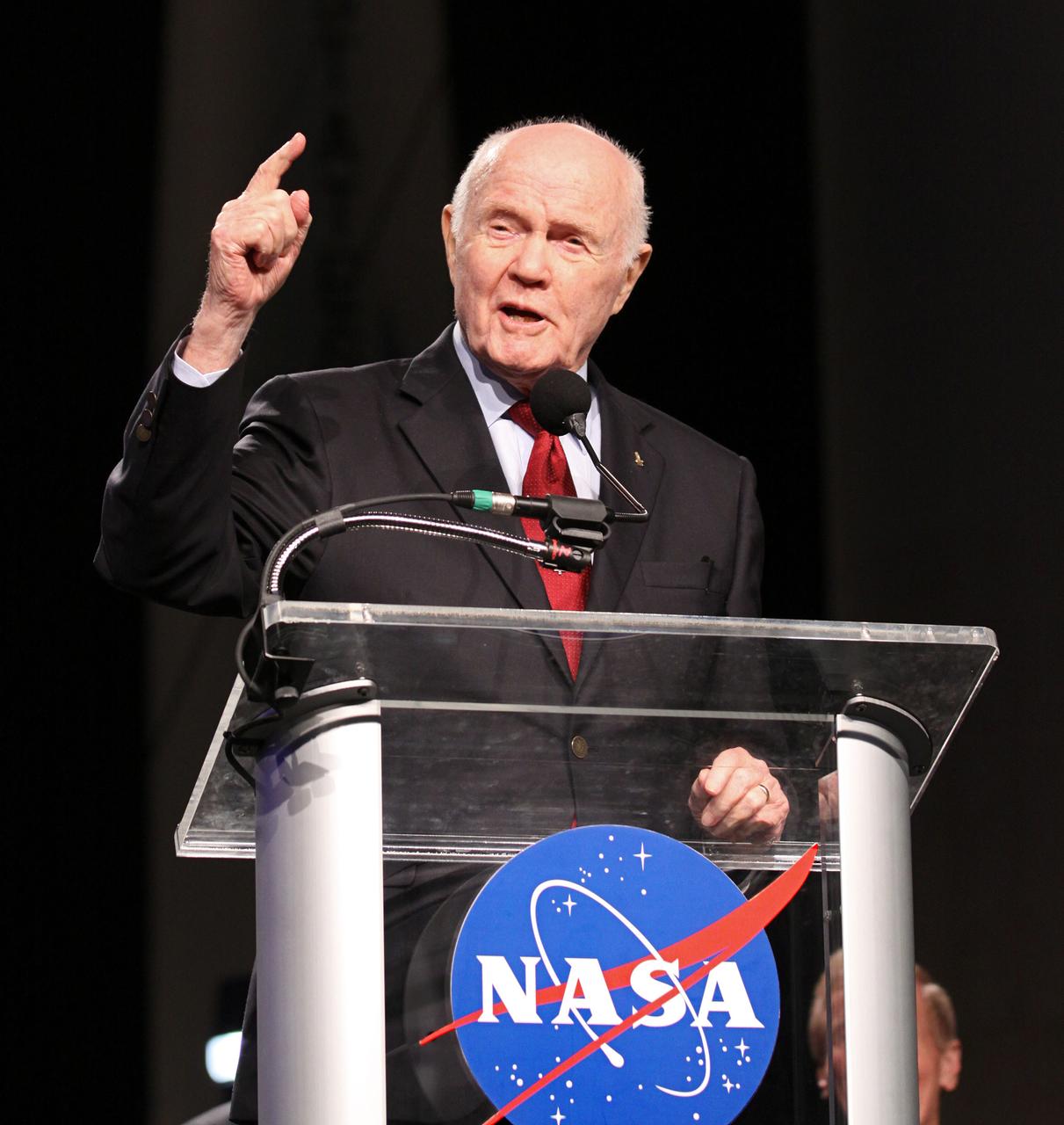
Mercury astronaut John Glenn speaks during the "On Shoulders of Giants" program celebrating 50 years of Americans in orbit, an era which began with Glenn's MA-6 mission on Feb. 20, 1962. The event was conducted in the Rocket Garden at the Kennedy Space Center Visitor Complex in Florida a few miles from the launch pad where Glenn and Scott Carpenter took flight in Mercury spacecraft. Glenn's launch aboard an Atlas rocket took with it the hopes of an entire nation and ushered in a new era of space travel that eventually led to Americans walking on the moon by the end of the 1960s. Glenn soon was followed into orbit by Scott Carpenter, Walter Schirra and Gordon Cooper. Their fellow Mercury astronauts Alan Shepard and Virgil "Gus" Grissom flew earlier suborbital flights. Deke Slayton, a member of NASA's original Mercury 7 astronauts, was grounded by a medical condition until the Apollo-Soyuz Test Project in 1975.
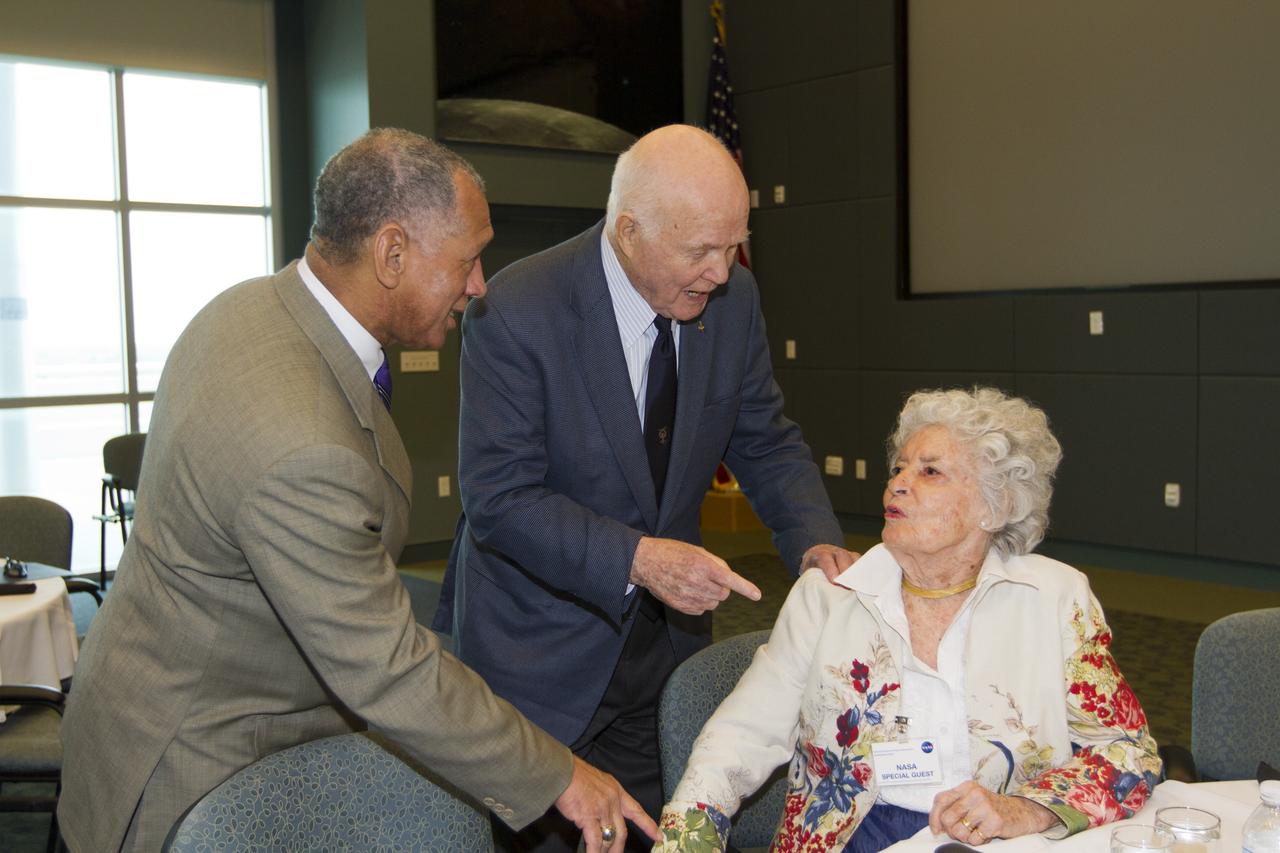
CAPE CANAVERAL, Fla. - NASA Administrator Charles Bolden, left, talks with astronaut John Glenn and his wife, Annie Glenn, before a luncheon Feb. 17, 2012, celebrating 50 years of Americans in orbit, an era which began with Glenn's Mercury mission MA-6, on Feb. 20, 1962. Glenn's launch aboard an Atlas rocket took with it the hopes of an entire nation and ushered in a new era of space travel that eventually led to Americans walking on the moon by the end of the 1960s. Glenn soon was followed into orbit by Scott Carpenter, Walter Schirra and Gordon Cooper. Their fellow Mercury astronauts Alan Shepard and Virgil "Gus" Grissom flew earlier suborbital flights. Deke Slayton, a member of NASA's original Mercury 7 astronauts, was grounded by a medical condition until the Apollo-Soyuz Test Project in 1975. Photo credit: NASA/Kim Shiflett
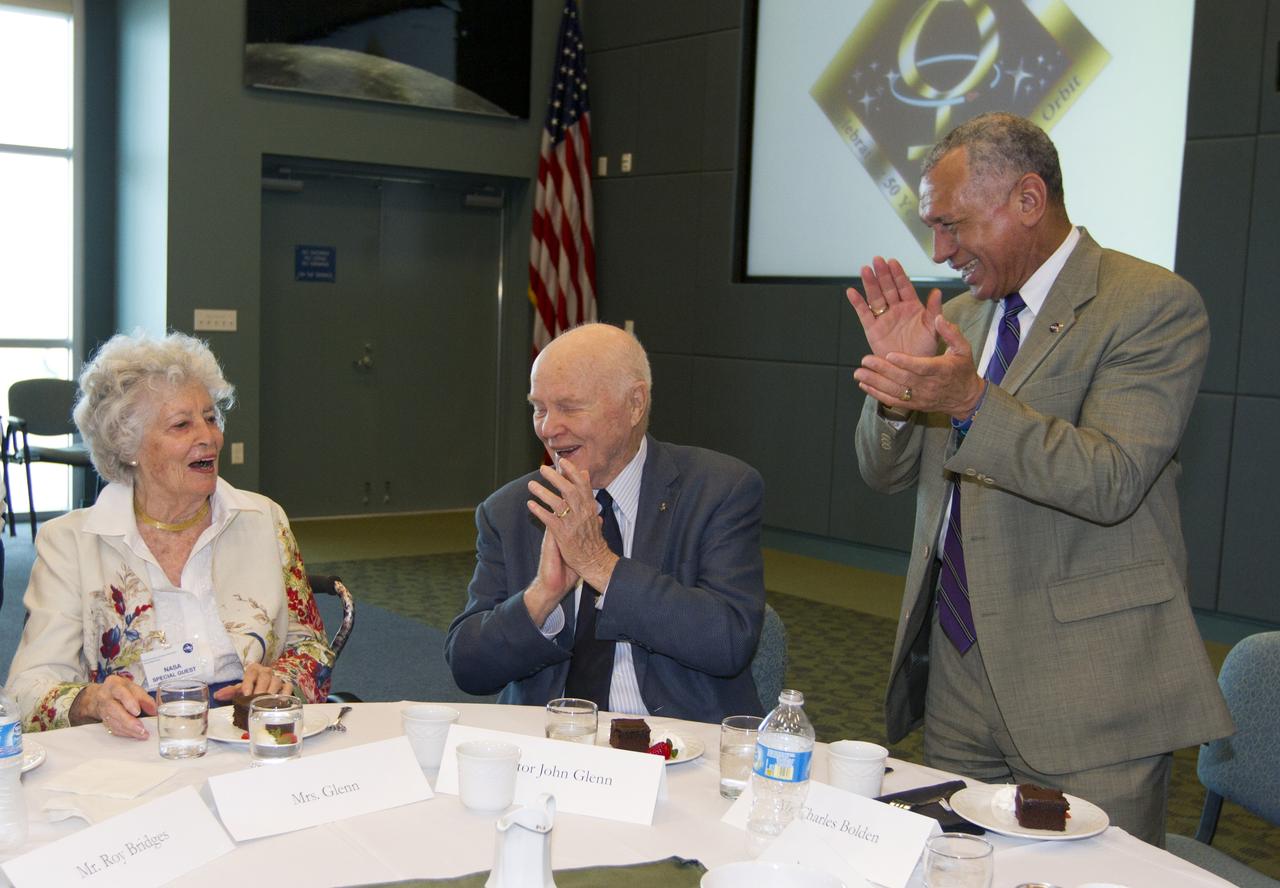
CAPE CANAVERAL, Fla. -Annie Glenn, left, astronaut John Glenn and NASA Administrator Charles Bolden take part in a luncheon Feb. 17, 2012, celebrating 50 years of Americans in orbit, an era which began with Glenn's Mercury mission MA-6, on Feb. 20, 1962. Glenn's launch aboard an Atlas rocket took with it the hopes of an entire nation and ushered in a new era of space travel that eventually led to Americans walking on the moon by the end of the 1960s. Glenn soon was followed into orbit by Scott Carpenter, Walter Schirra and Gordon Cooper. Their fellow Mercury astronauts Alan Shepard and Virgil "Gus" Grissom flew earlier suborbital flights. Deke Slayton, a member of NASA's original Mercury 7 astronauts, was grounded by a medical condition until the Apollo-Soyuz Test Project in 1975. Photo credit: NASA/Kim Shiflett
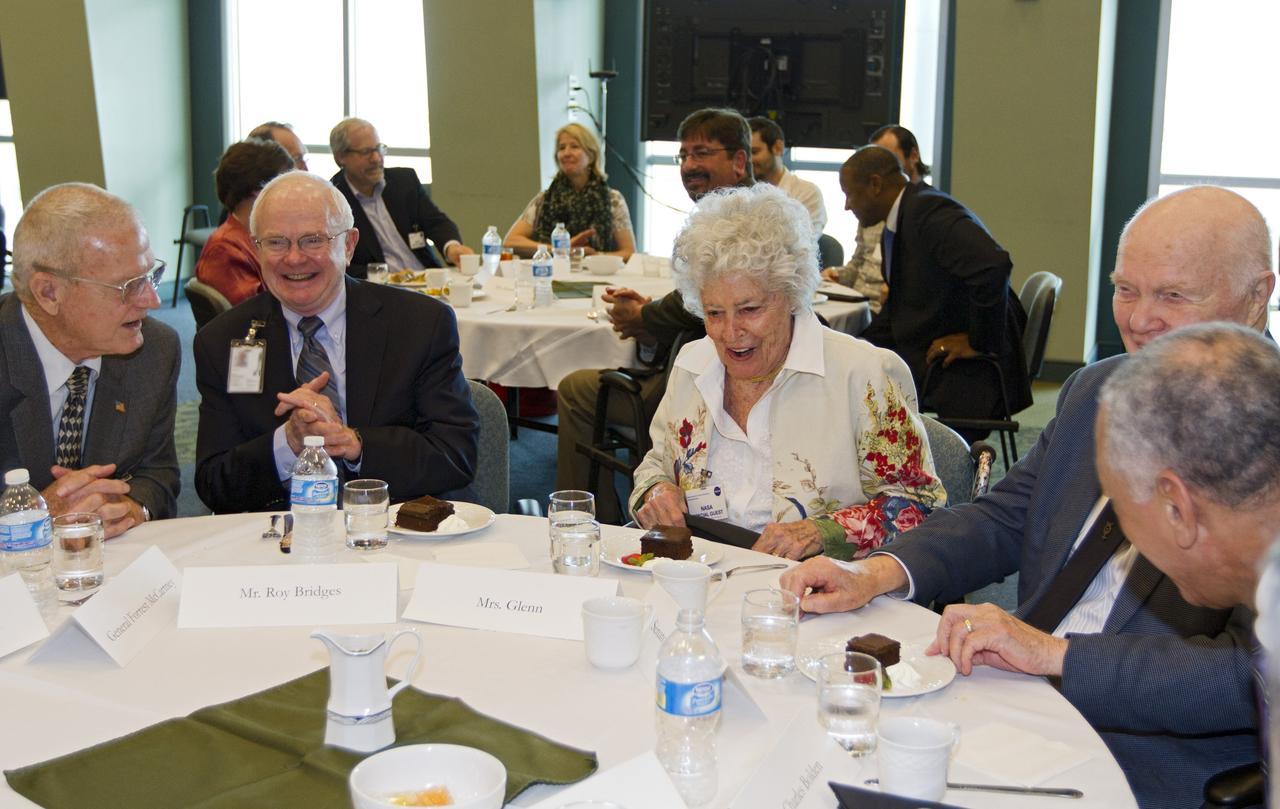
CAPE CANAVERAL, Fla. - Former Kennedy Space Center directors Forrest McCartney and Roy Bridges join Annie Glenn, astronaut John Glenn and NASA Administrator Charles Bolden during a luncheon Feb. 17, 2012, celebrating 50 years of Americans in orbit, an era which began with Glenn's Mercury mission MA-6, on Feb. 20, 1962. Glenn's launch aboard an Atlas rocket took with it the hopes of an entire nation and ushered in a new era of space travel that eventually led to Americans walking on the moon by the end of the 1960s. Glenn soon was followed into orbit by Scott Carpenter, Walter Schirra and Gordon Cooper. Their fellow Mercury astronauts Alan Shepard and Virgil "Gus" Grissom flew earlier suborbital flights. Deke Slayton, a member of NASA's original Mercury 7 astronauts, was grounded by a medical condition until the Apollo-Soyuz Test Project in 1975. Photo credit: NASA/Kim Shiflett
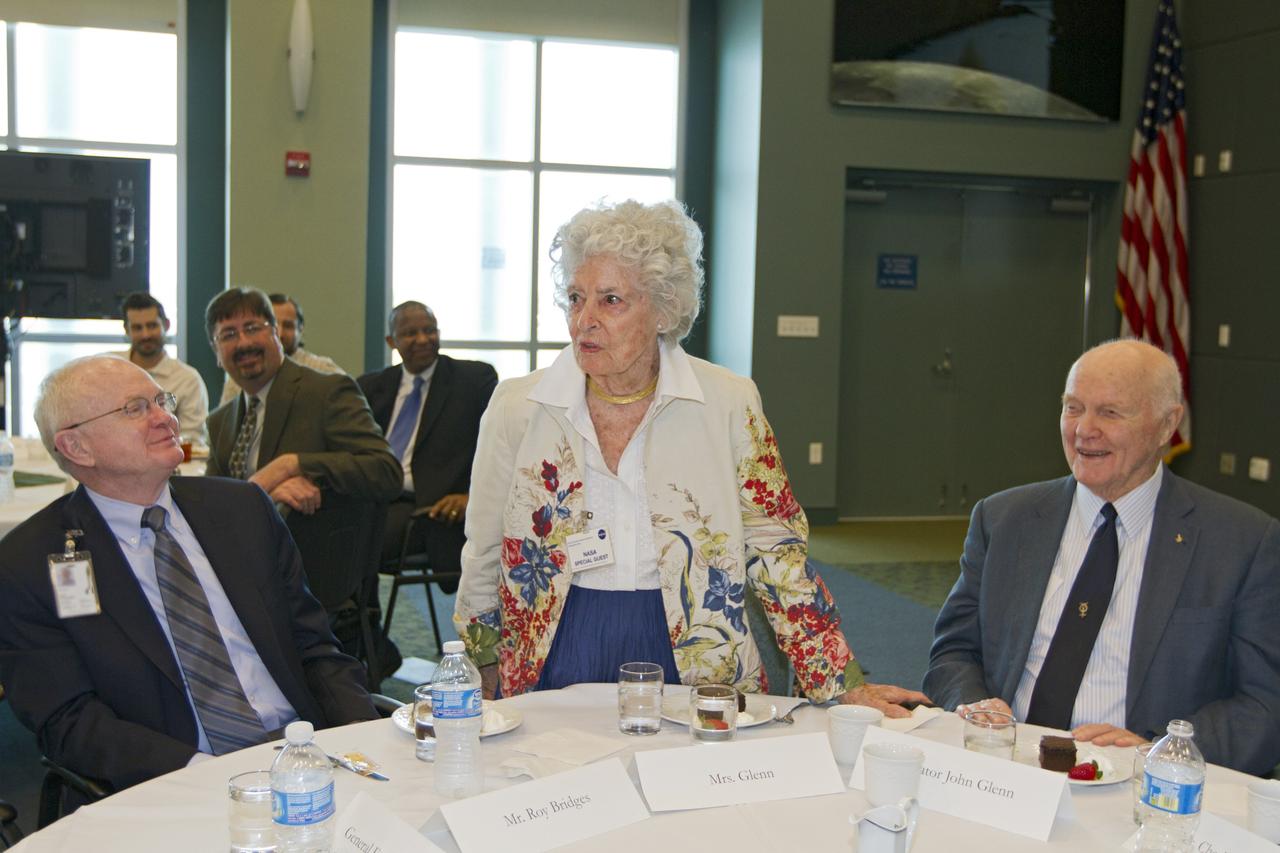
CAPE CANAVERAL, Fla. - Annie Glenn, center, speaks as former Kennedy Space Center director Roy Bridges, left, and astronaut John Glenn look on during a luncheon Feb. 17, 2012, celebrating 50 years of Americans in orbit, an era which began with Glenn's Mercury mission MA-6, on Feb. 20, 1962. Glenn's launch aboard an Atlas rocket took with it the hopes of an entire nation and ushered in a new era of space travel that eventually led to Americans walking on the moon by the end of the 1960s. Glenn soon was followed into orbit by Scott Carpenter, Walter Schirra and Gordon Cooper. Their fellow Mercury astronauts Alan Shepard and Virgil "Gus" Grissom flew earlier suborbital flights. Deke Slayton, a member of NASA's original Mercury 7 astronauts, was grounded by a medical condition until the Apollo-Soyuz Test Project in 1975. Photo credit: NASA/Kim Shiflett
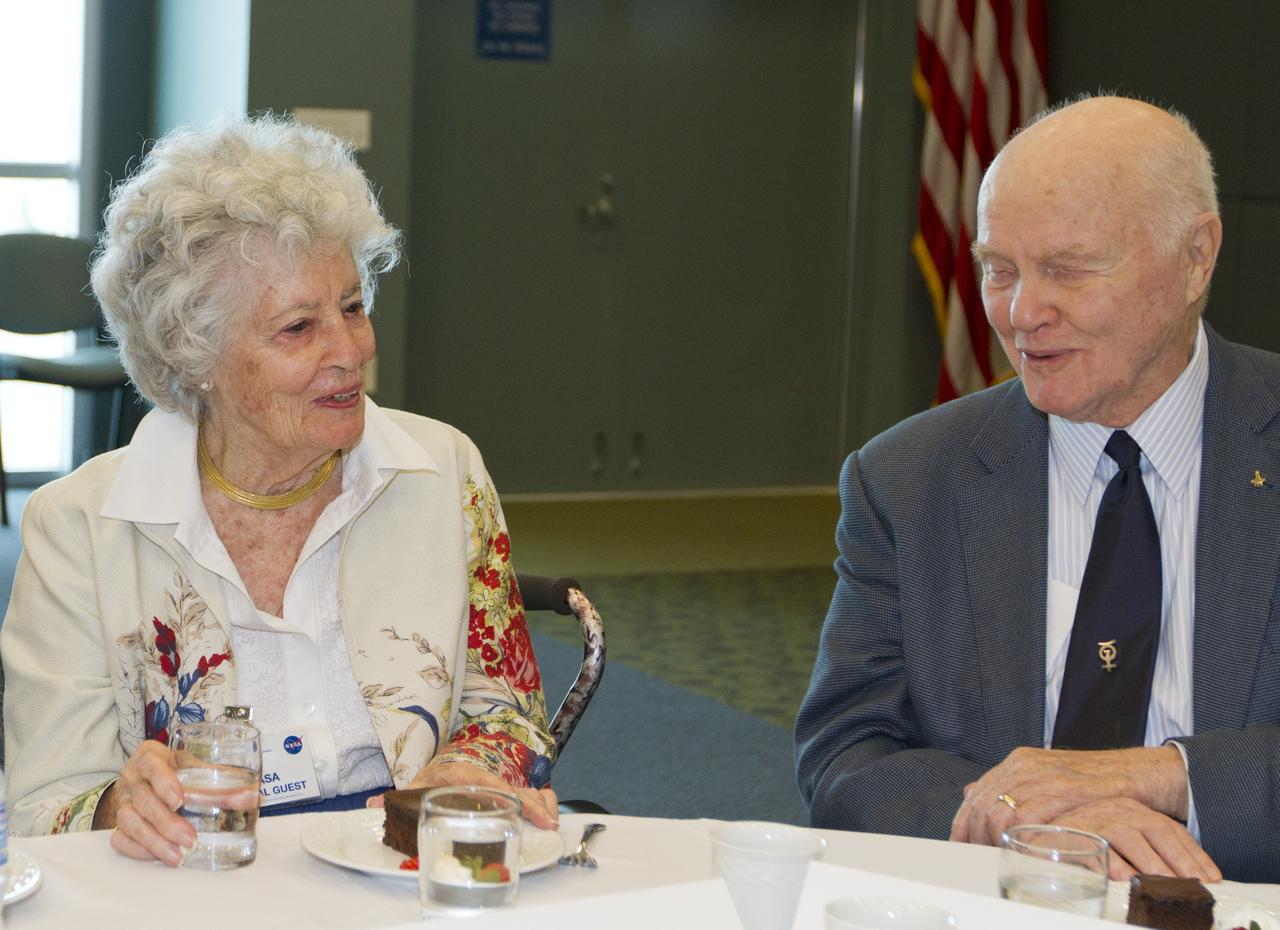
CAPE CANAVERAL, Fla. -Annie Glenn and astronaut John Glenn listen during a luncheon Feb. 17, 2012, celebrating 50 years of Americans in orbit, an era which began with Glenn's Mercury mission MA-6, on Feb. 20, 1962. Glenn's launch aboard an Atlas rocket took with it the hopes of an entire nation and ushered in a new era of space travel that eventually led to Americans walking on the moon by the end of the 1960s. Glenn soon was followed into orbit by Scott Carpenter, Walter Schirra and Gordon Cooper. Their fellow Mercury astronauts Alan Shepard and Virgil "Gus" Grissom flew earlier suborbital flights. Deke Slayton, a member of NASA's original Mercury 7 astronauts, was grounded by a medical condition until the Apollo-Soyuz Test Project in 1975. Photo credit: NASA/Kim Shiflett
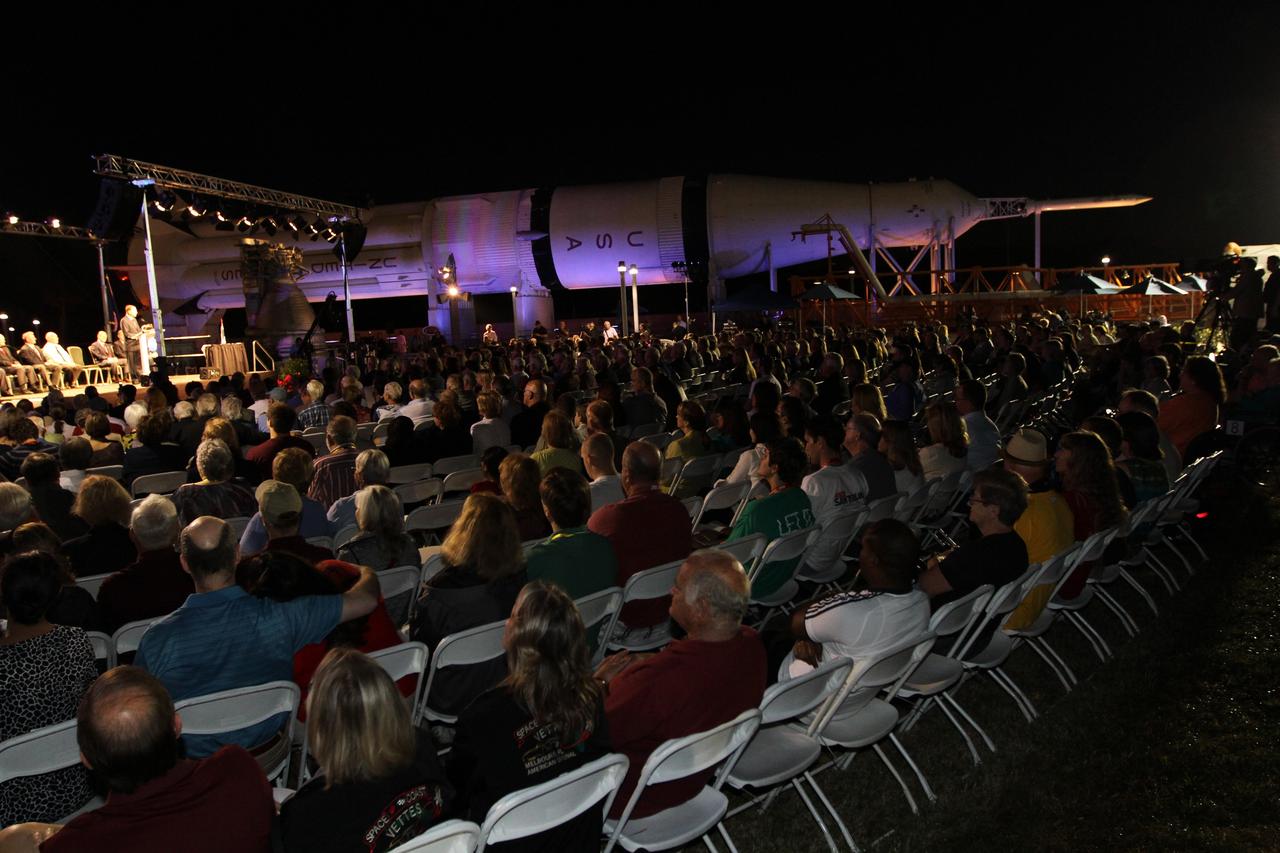
CAPE CANAVERAL, Fla. -- A crowd looks on during the "On Shoulders of Giants" program celebrating 50 years of Americans in orbit, an era which began with John Glenn's MA-6 mission on Feb. 20, 1962. The event was conducted in the Rocket Garden at the Kennedy Space Center Visitor Complex in Florida a few miles from the launch pad where Glenn and Scott Carpenter took flight in Mercury spacecraft. Glenn's launch aboard an Atlas rocket took with it the hopes of an entire nation and ushered in a new era of space travel that eventually led to Americans walking on the moon by the end of the 1960s. Glenn soon was followed into orbit by Scott Carpenter, Walter Schirra and Gordon Cooper. Their fellow Mercury astronauts Alan Shepard and Virgil "Gus" Grissom flew earlier suborbital flights. Deke Slayton, a member of NASA's original Mercury 7 astronauts, was grounded by a medical condition until the Apollo-Soyuz Test Project in 1975. Photo credit: Kim Shiflett
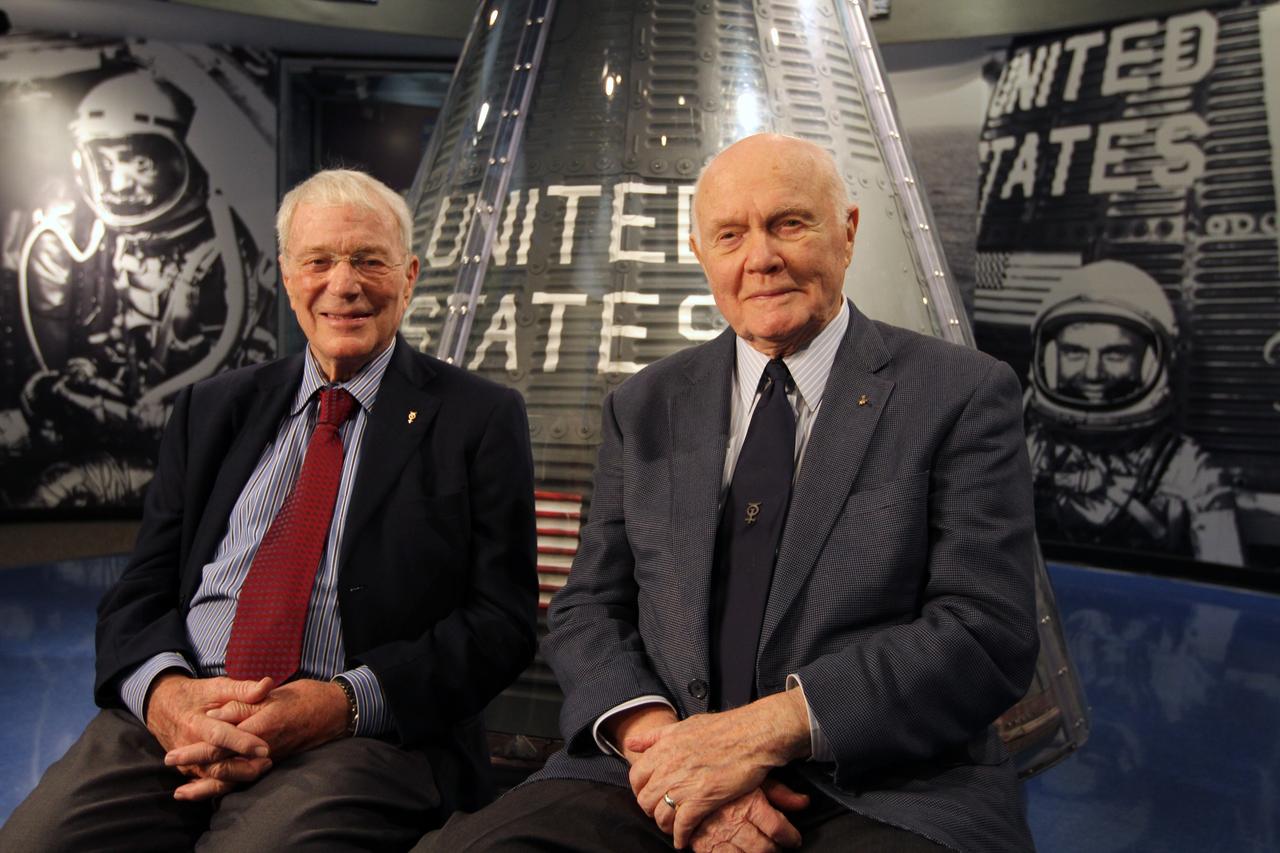
CAPE CANAVERAL, Fla. -- Mercury astronauts Scott Carpenter, left, and John Glenn sit in front of a capsule from the Mercury program on display at the Kennedy Space Center Visitor Complex in Florida. The two astronauts, part of the original class of seven astronauts chosen by NASA, were taking part in events celebrating 50 years of Americans in orbit, an era which began with Glenn's Mercury mission MA-6, on Feb. 20, 1962. Glenn's launch aboard an Atlas rocket took with it the hopes of an entire nation and ushered in a new era of space travel that eventually led to Americans walking on the moon by the end of the 1960s. Glenn soon was followed into orbit by Carpenter, Walter Schirra and Gordon Cooper. Their fellow Mercury astronauts Alan Shepard and Virgil "Gus" Grissom flew earlier suborbital flights. Deke Slayton was grounded by a medical condition until the Apollo-Soyuz Test Project in 1975. Photo credit: NASA/Kim Shiflett
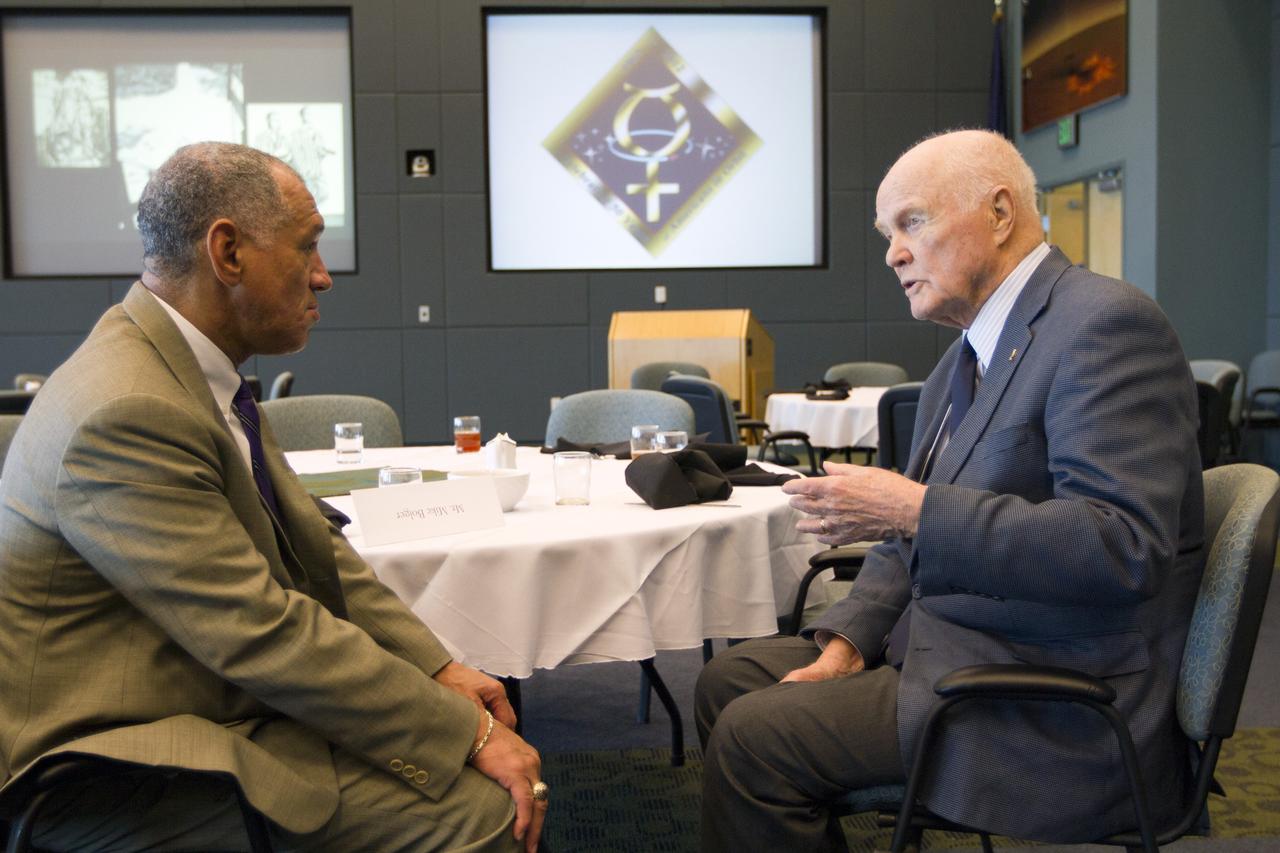
CAPE CANAVERAL, Fla. -NASA Administrator Charles Bolden, left, talks with astronaut John Glenn following a luncheon Feb. 17, 2012, celebrating 50 years of Americans in orbit, an era which began with Glenn's Mercury mission MA-6, on Feb. 20, 1962. Glenn's launch aboard an Atlas rocket took with it the hopes of an entire nation and ushered in a new era of space travel that eventually led to Americans walking on the moon by the end of the 1960s. Glenn soon was followed into orbit by Scott Carpenter, Walter Schirra and Gordon Cooper. Their fellow Mercury astronauts Alan Shepard and Virgil "Gus" Grissom flew earlier suborbital flights. Deke Slayton, a member of NASA's original Mercury 7 astronauts, was grounded by a medical condition until the Apollo-Soyuz Test Project in 1975. Photo credit: NASA/Kim Shiflett
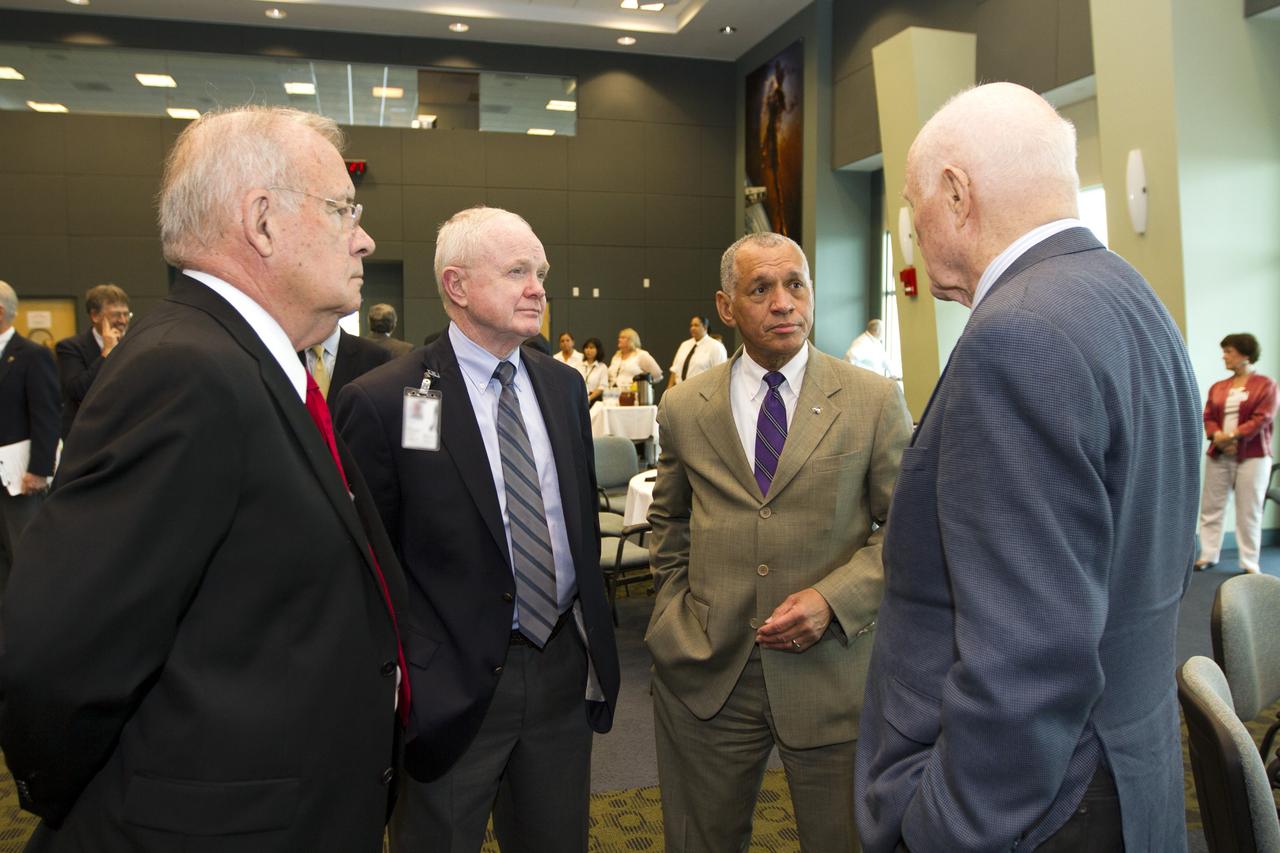
CAPE CANAVERAL, Fla. - Former Kennedy Space Center directors Jay Honeycutt, left, Roy Bridges and NASA Administrator Charles Bolden talk with astronaut John Glenn before a luncheon Feb. 17, 2012 celebrating 50 years of Americans in orbit, an era which began with Glenn's Mercury mission MA-6, on Feb. 20, 1962. Glenn's launch aboard an Atlas rocket took with it the hopes of an entire nation and ushered in a new era of space travel that eventually led to Americans walking on the moon by the end of the 1960s. Glenn soon was followed into orbit by Scott Carpenter, Walter Schirra and Gordon Cooper. Their fellow Mercury astronauts Alan Shepard and Virgil "Gus" Grissom flew earlier suborbital flights. Deke Slayton, a member of NASA's original Mercury 7 astronauts, was grounded by a medical condition until the Apollo-Soyuz Test Project in 1975. Photo credit: NASA/Kim Shiflett
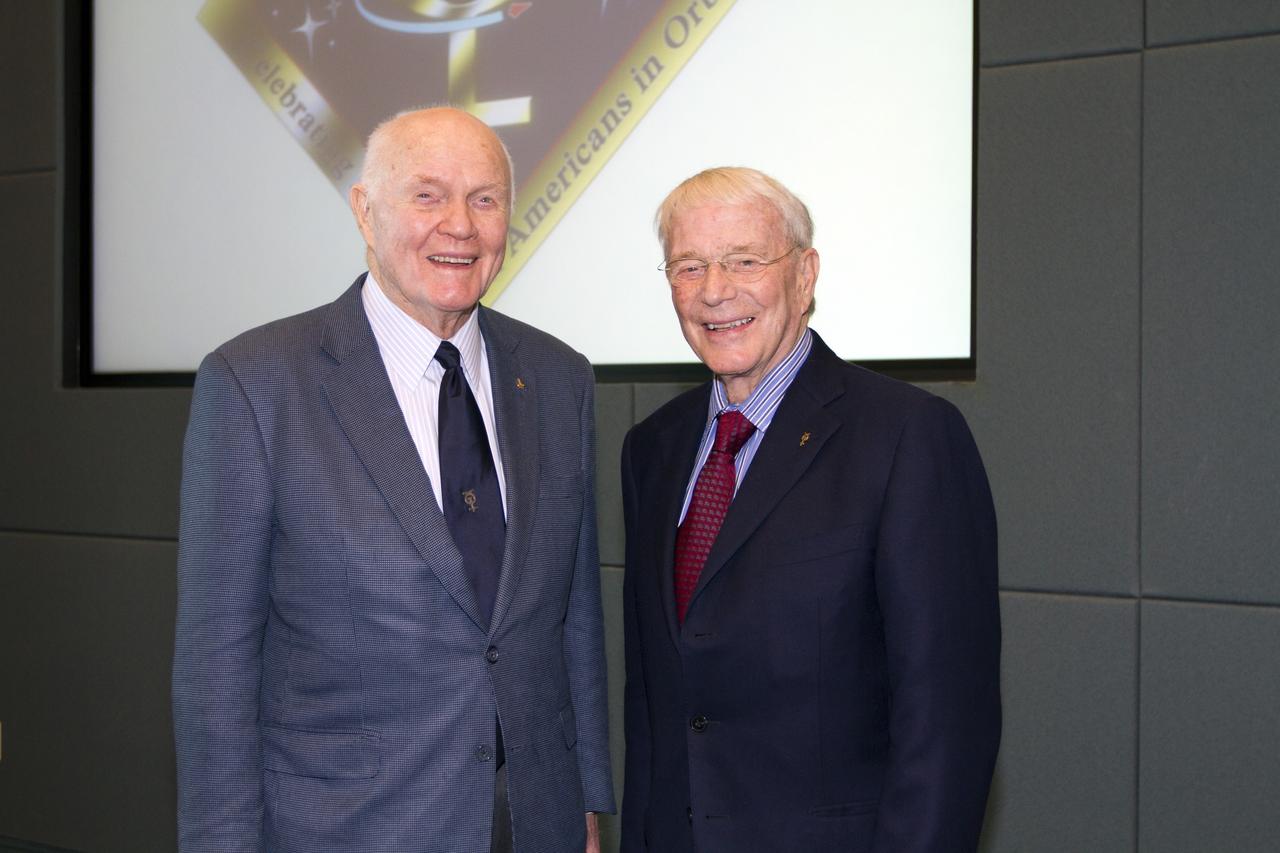
CAPE CANAVERAL, Fla. - Mercury astronauts John Glenn, left, and Scott Carpenter pose during a luncheon Feb. 17, 2012, celebrating 50 years of Americans in orbit, an era which began with Glenn's Mercury mission MA-6, on Feb. 20, 1962. Glenn's launch aboard an Atlas rocket took with it the hopes of an entire nation and ushered in a new era of space travel that eventually led to Americans walking on the moon by the end of the 1960s. Glenn soon was followed into orbit by Scott Carpenter, Walter Schirra and Gordon Cooper. Their fellow Mercury astronauts Alan Shepard and Virgil "Gus" Grissom flew earlier suborbital flights. Deke Slayton, a member of NASA's original Mercury 7 astronauts, was grounded by a medical condition until the Apollo-Soyuz Test Project in 1975. Photo credit: NASA/Kim Shiflett
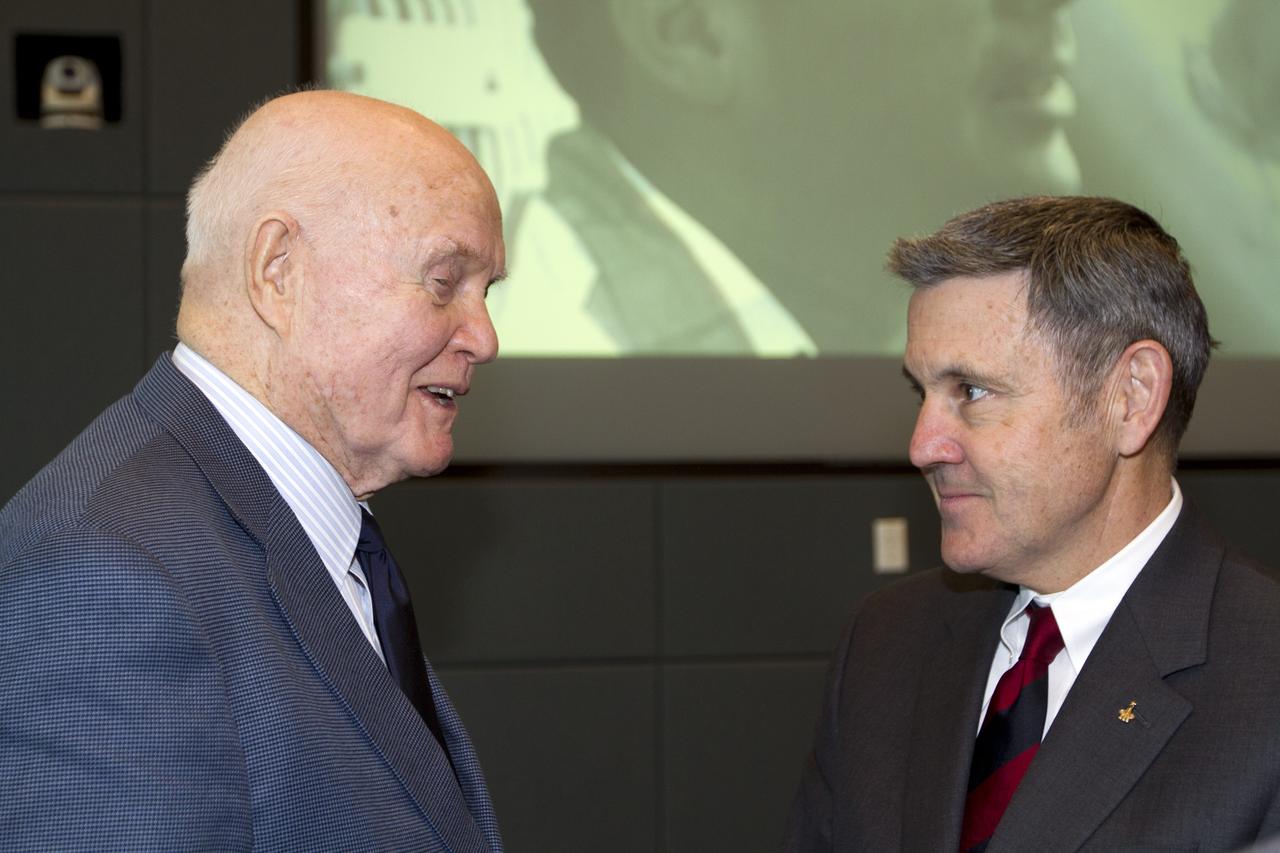
CAPE CANAVERAL, Fla. - Mercury astronaut John Glenn, left, talks with Kennedy Space Center Director Bob Cabana during a luncheon Feb. 17, 2012, celebrating 50 years of Americans in orbit, an era which began with Glenn's Mercury mission MA-6, on Feb. 20, 1962. Glenn's launch aboard an Atlas rocket took with it the hopes of an entire nation and ushered in a new era of space travel that eventually led to Americans walking on the moon by the end of the 1960s. Glenn soon was followed into orbit by Scott Carpenter, Walter Schirra and Gordon Cooper. Their fellow Mercury astronauts Alan Shepard and Virgil "Gus" Grissom flew earlier suborbital flights. Deke Slayton, a member of NASA's original Mercury 7 astronauts, was grounded by a medical condition until the Apollo-Soyuz Test Project in 1975. Photo credit: NASA/Kim Shiflett
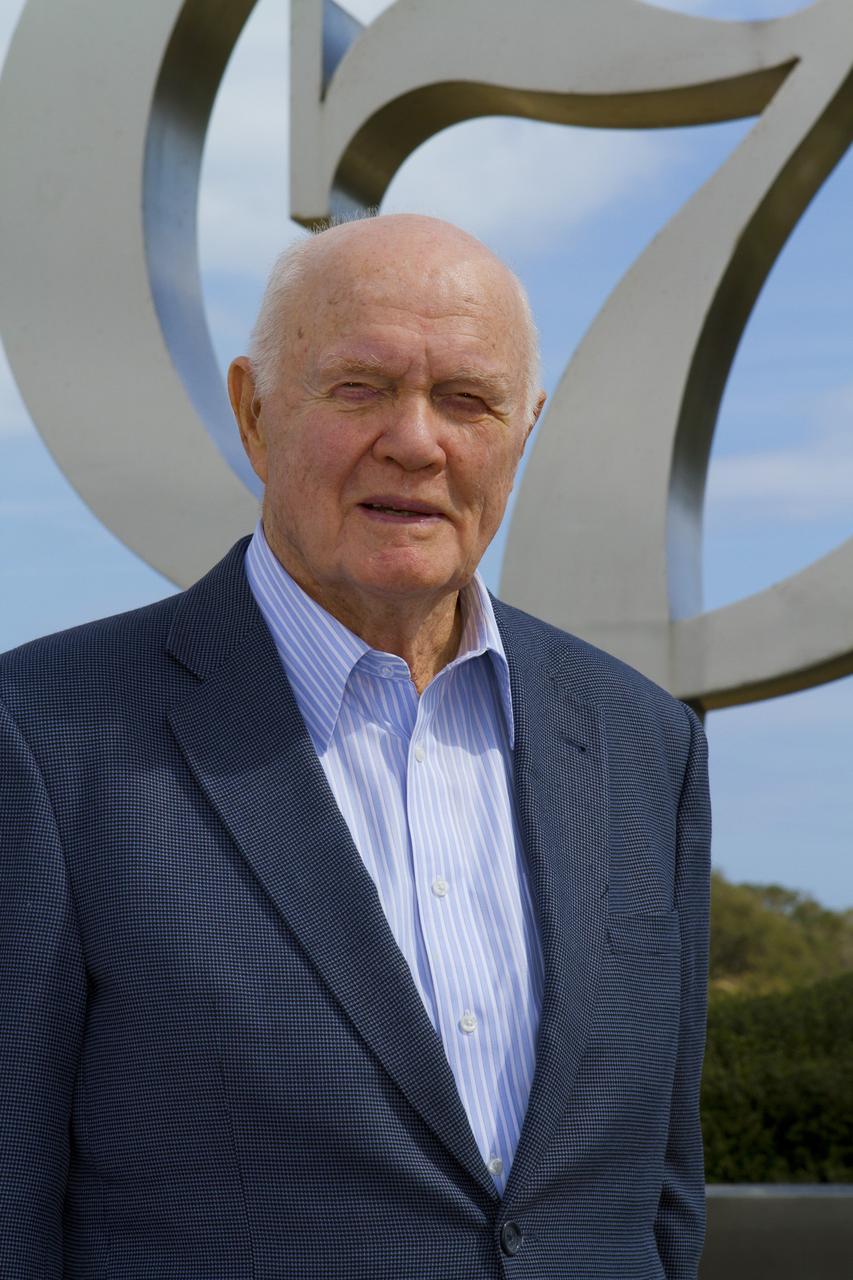
CAPE CANAVERAL, Fla. -- Mercury astronaut John Glenn poses for a photo in front of the Project Mercury monument at Launch Complex-14 LC-14 at Cape Canaveral Air Force Station in Florida. During events at the Cape and NASA's Kennedy Space Center, Glenn is marking the 50th anniversary of being the first American astronaut to orbit the Earth inside the Friendship 7 capsule on Feb. 20, 1962. Glenn's launch aboard an Atlas rocket took with it the hopes of an entire nation and ushered in a new era of space travel that eventually led to Americans walking on the moon by the end of the 1960s. Glenn soon was followed into orbit by Scott Carpenter, Walter Schirra and Gordon Cooper. Their fellow Mercury astronauts Alan Shepard and Virgil "Gus" Grissom flew earlier suborbital flights. Deke Slayton, a member of NASA's original Mercury 7 astronauts, was grounded by a medical condition until the Apollo-Soyuz Test Project in 1975. Photo credit: Kim Shiflett
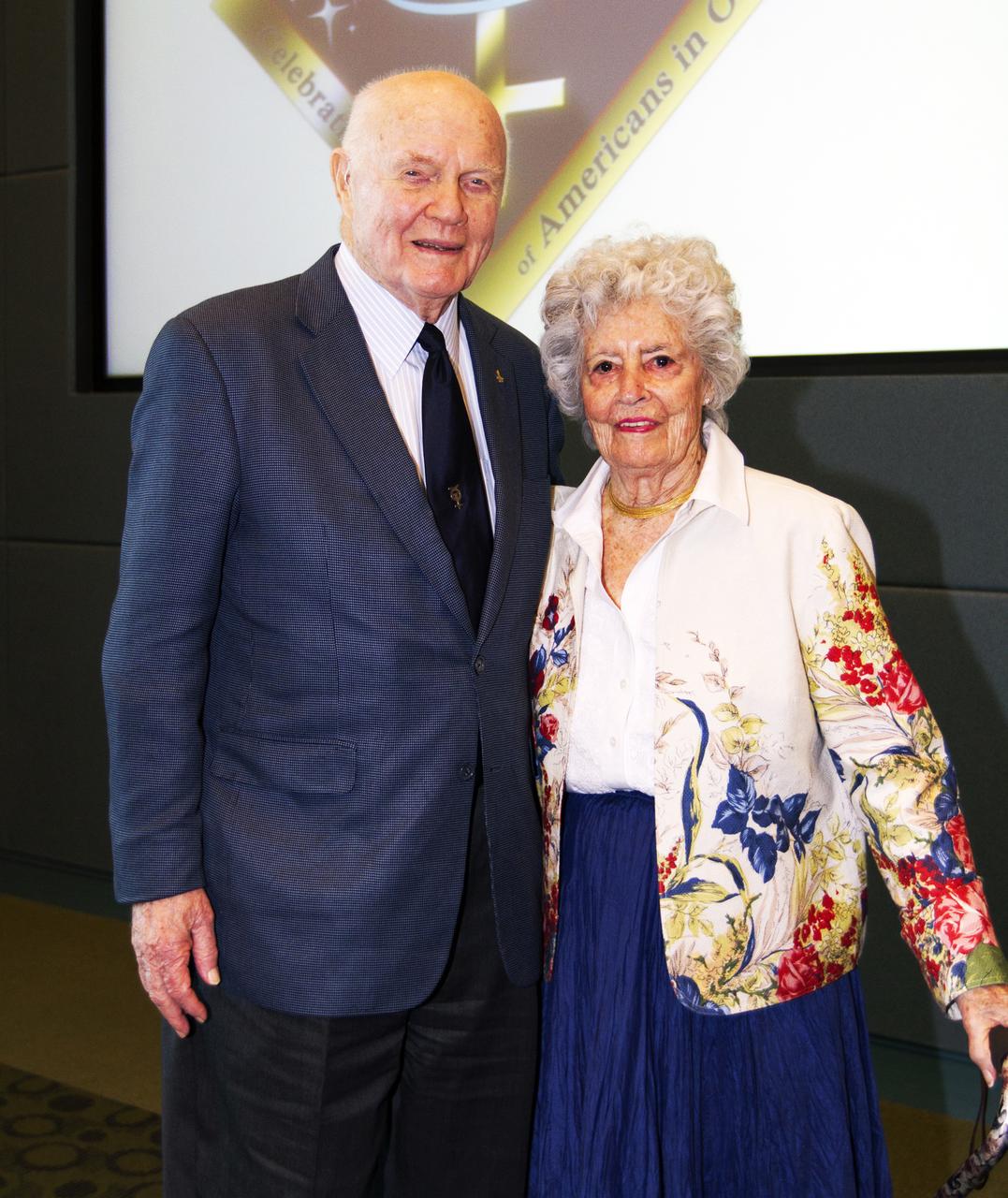
Mercury astronaut John Glenn and his wife, Annie, pose during a luncheon Feb. 17, 2012, celebrating 50 years of Americans in orbit, an era which began with Glenn's Mercury mission MA-6, on Feb. 20, 1962. Glenn's launch aboard an Atlas rocket took with it the hopes of an entire nation and ushered in a new era of space travel that eventually led to Americans walking on the moon by the end of the 1960s. Glenn soon was followed into orbit by Scott Carpenter, Walter Schirra and Gordon Cooper. Their fellow Mercury astronauts Alan Shepard and Virgil "Gus" Grissom flew earlier suborbital flights. Deke Slayton, a member of NASA's original Mercury 7 astronauts, was grounded by a medical condition until the Apollo-Soyuz Test Project in 1975.
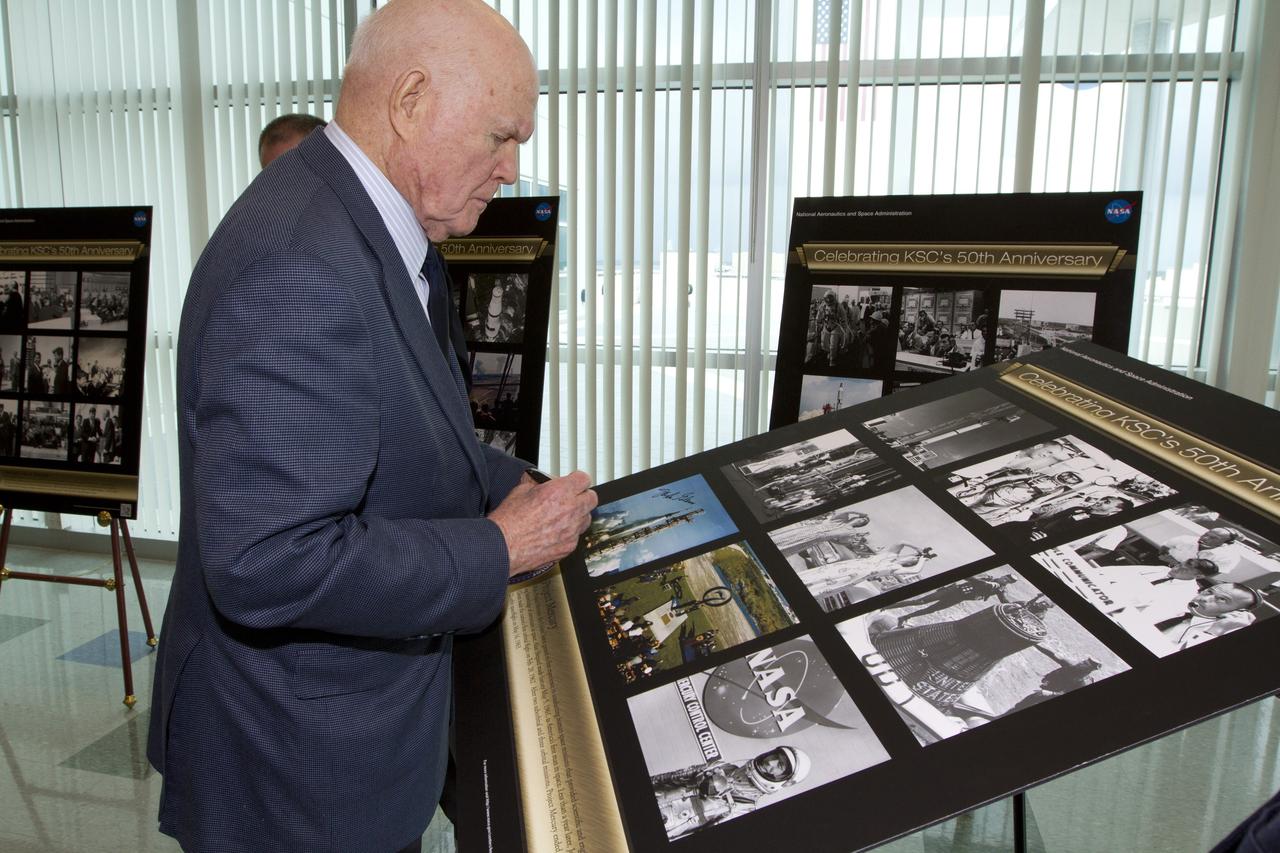
CAPE CANAVERAL, Fla. - Mercury astronaut John Glenn signs a poster celebrating 50 years of Americans in orbit, an era which began with Glenn's Mercury mission MA-6, on Feb. 20, 1962. Glenn's launch aboard an Atlas rocket took with it the hopes of an entire nation and ushered in a new era of space travel that eventually led to Americans walking on the moon by the end of the 1960s. Glenn soon was followed into orbit by Scott Carpenter, Walter Schirra and Gordon Cooper. Their fellow Mercury astronauts Alan Shepard and Virgil "Gus" Grissom flew earlier suborbital flights. Deke Slayton, a member of NASA's original Mercury 7 astronauts, was grounded by a medical condition until the Apollo-Soyuz Test Project in 1975. Photo credit: NASA/Kim Shiflett
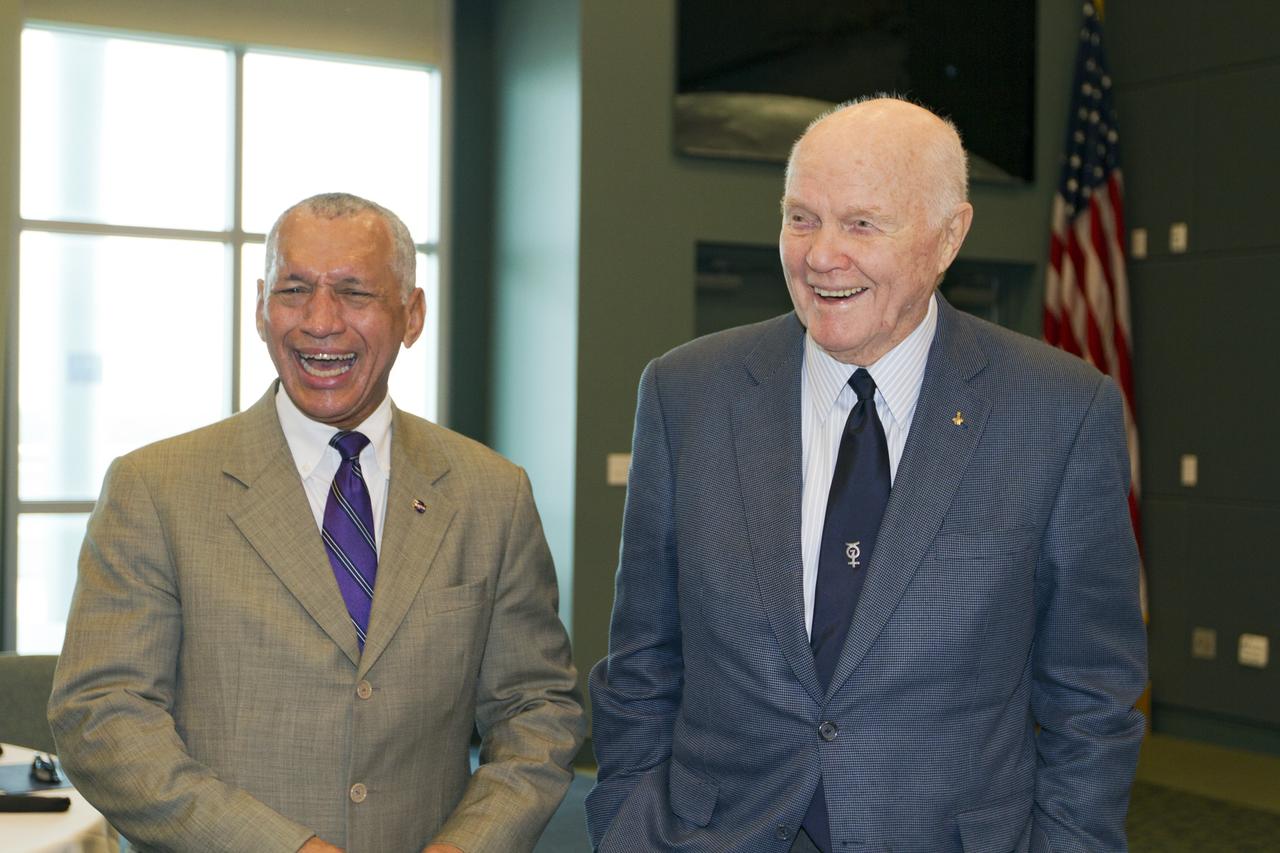
CAPE CANAVERAL, Fla. - NASA Administrator Charles Bolden, left, shares a laugh with astronaut John Glenn before a luncheon Feb. 17, 2012, celebrating 50 years of Americans in orbit, an era which began with Glenn's Mercury mission MA-6, on Feb. 20, 1962. Glenn's launch aboard an Atlas rocket took with it the hopes of an entire nation and ushered in a new era of space travel that eventually led to Americans walking on the moon by the end of the 1960s. Glenn soon was followed into orbit by Scott Carpenter, Walter Schirra and Gordon Cooper. Their fellow Mercury astronauts Alan Shepard and Virgil "Gus" Grissom flew earlier suborbital flights. Deke Slayton, a member of NASA's original Mercury 7 astronauts, was grounded by a medical condition until the Apollo-Soyuz Test Project in 1975. Photo credit: NASA/Kim Shiflett
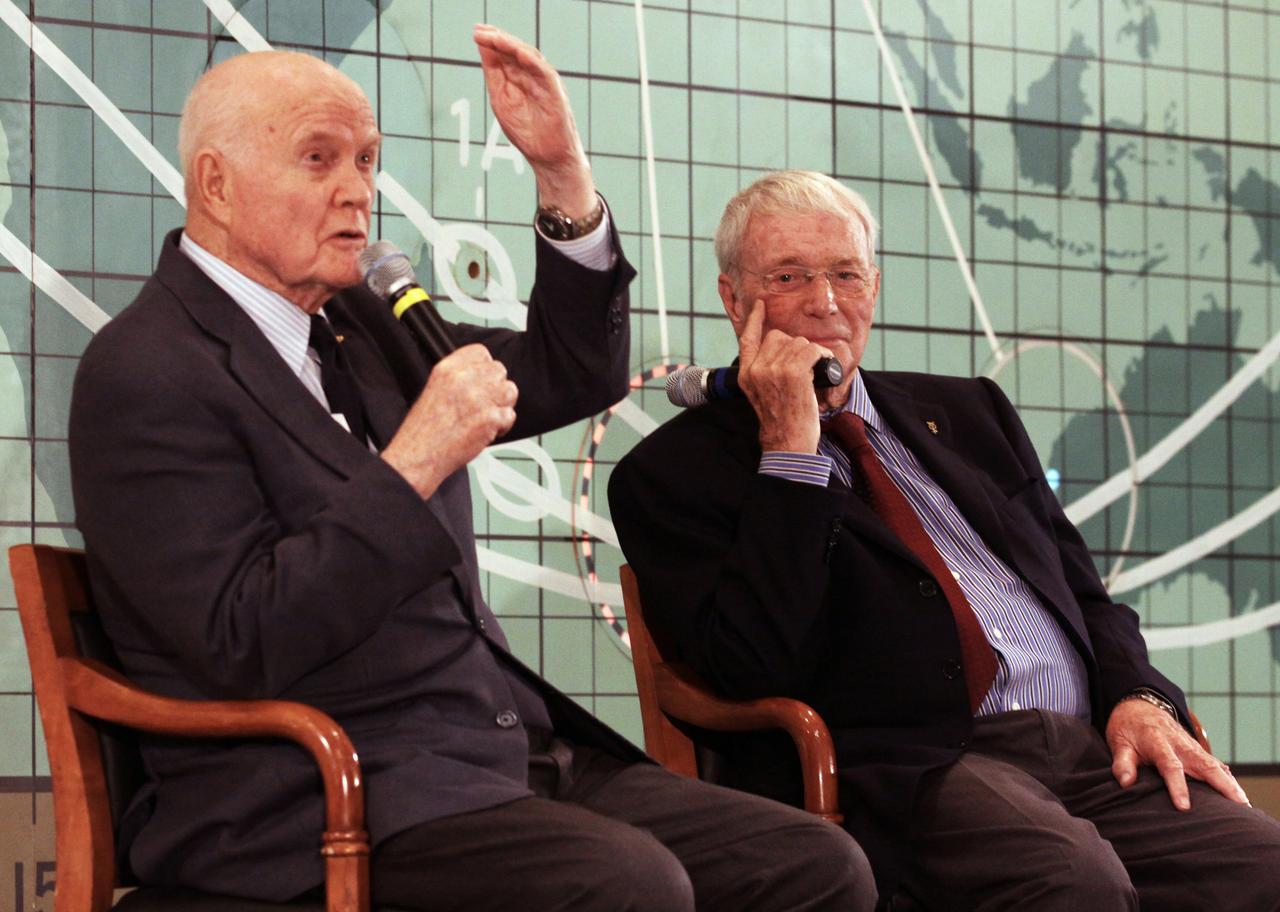
Mercury astronauts John Glenn, left, and Scott Carpenter sit in front of the plot board from the Mercury control center on display at the Kennedy Space Center Visitor Complex. The astronauts, part of the original class of seven astronauts chosen by NASA, were taking part in a question-and-answer session with the media as part of events celebrating 50 years of Americans in orbit, an era which began with John Glenn's Mercury mission MA-6, on Feb. 20, 1962. Glenn's launch aboard an Atlas rocket took with it the hopes of an entire nation and ushered in a new era of space travel that eventually led to Americans walking on the moon by the end of the 1960s. Glenn soon was followed into orbit by Carpenter, Walter Schirra and Gordon Cooper. Their fellow Mercury astronauts Alan Shepard and Virgil "Gus" Grissom flew earlier suborbital flights. Deke Slayton was grounded by a medical condition until the Apollo-Soyuz Test Project in 1975.
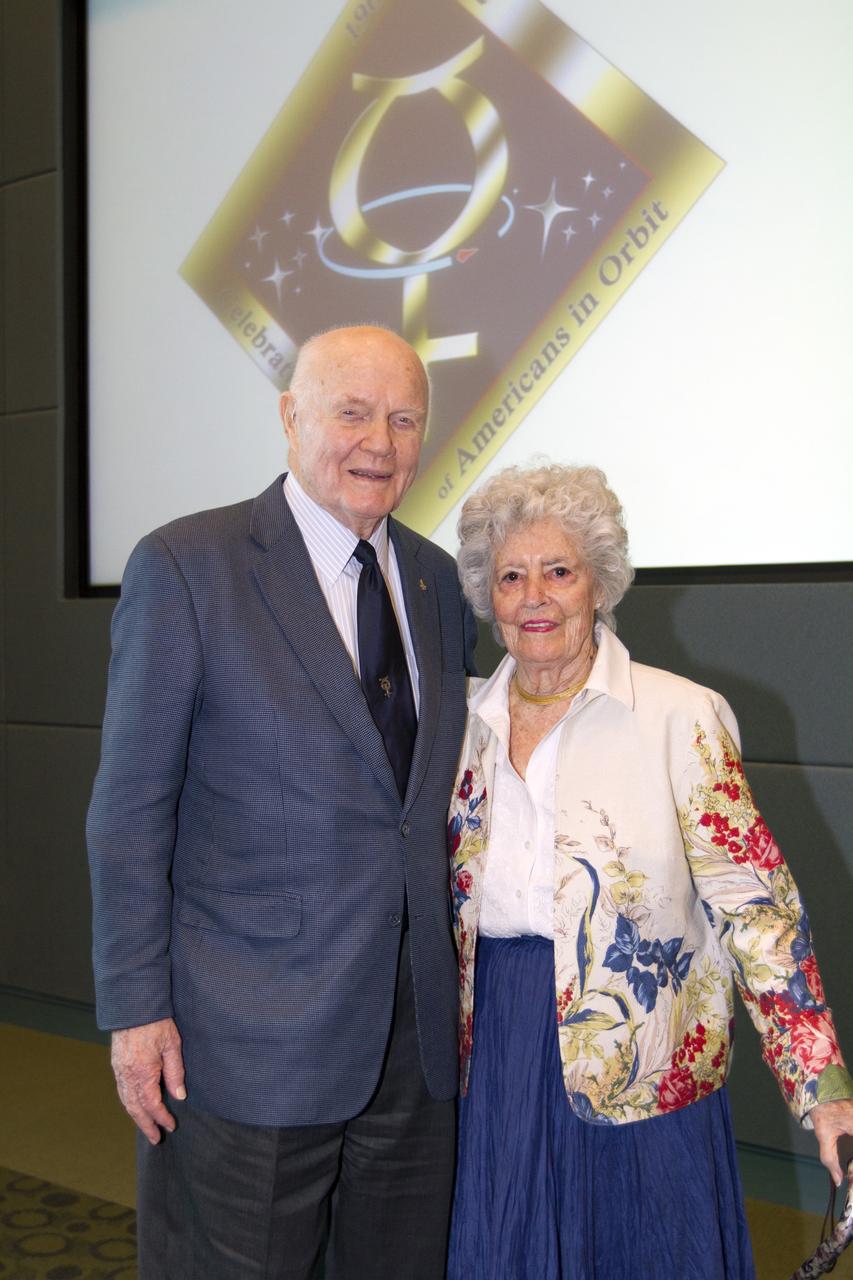
CAPE CANAVERAL, Fla. - Mercury astronaut John Glenn and his wife, Annie, pose during a luncheon Feb. 17, 2012, celebrating 50 years of Americans in orbit, an era which began with Glenn's Mercury mission MA-6, on Feb. 20, 1962. Glenn's launch aboard an Atlas rocket took with it the hopes of an entire nation and ushered in a new era of space travel that eventually led to Americans walking on the moon by the end of the 1960s. Glenn soon was followed into orbit by Scott Carpenter, Walter Schirra and Gordon Cooper. Their fellow Mercury astronauts Alan Shepard and Virgil "Gus" Grissom flew earlier suborbital flights. Deke Slayton, a member of NASA's original Mercury 7 astronauts, was grounded by a medical condition until the Apollo-Soyuz Test Project in 1975. Photo credit: NASA/Kim Shiflett
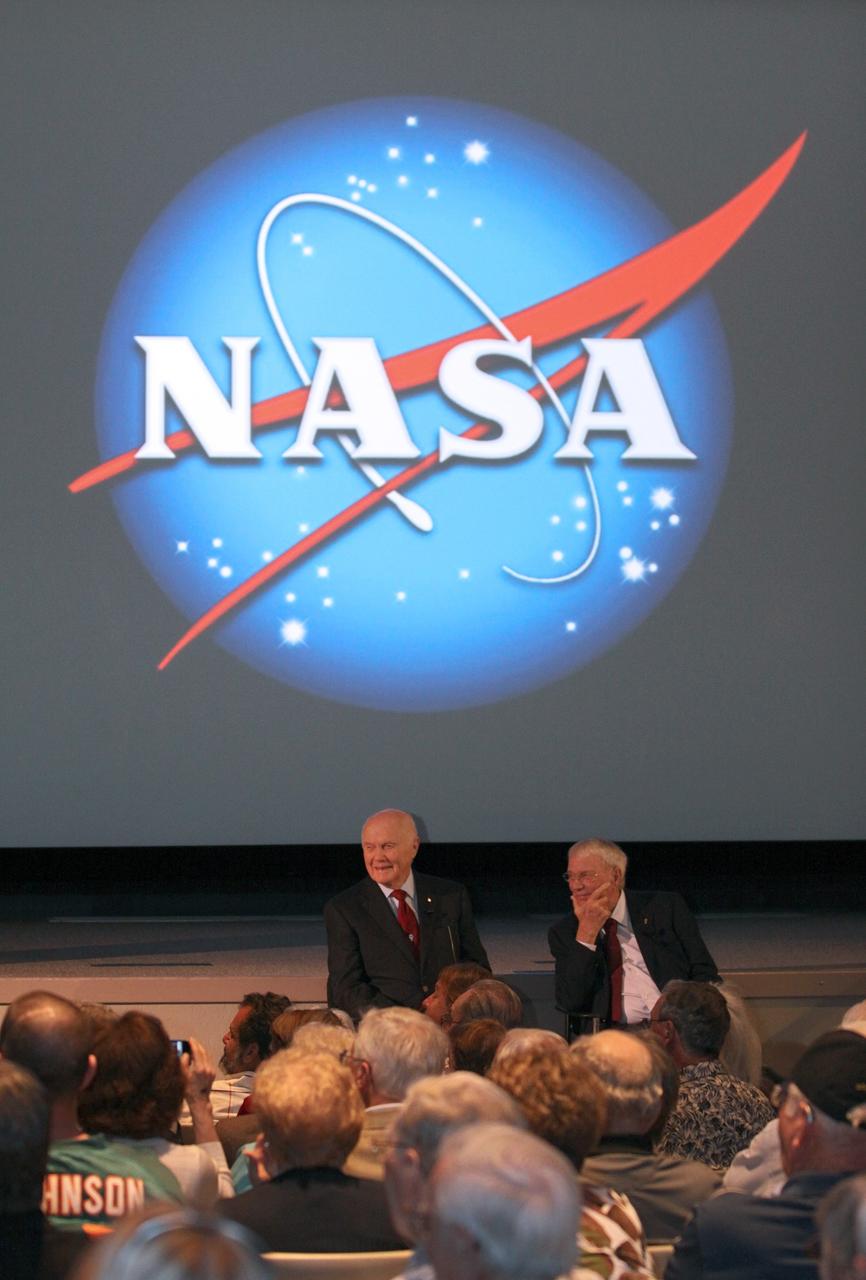
CAPE CANAVERAL, Fla. -- Mercury astronauts, John Glenn, left, and Scott Carpenter, talk to Mercury Project workers and other guests in the Astronaut Encounter Theater at the Kennedy Space Center Visitor Complex in Florida. The pair participated in 50th anniversary events at the launch site of Glenn's first orbital flight aboard NASA's Friendship 7 capsule, which launched Feb. 20, 1962, aboard an Atlas rocket. Glenn's launch aboard an Atlas rocket took with it the hopes of an entire nation and ushered in a new era of space travel that eventually led to Americans walking on the moon by the end of the 1960s. Glenn soon was followed into orbit by Carpenter, Walter Schirra and Gordon Cooper. Their fellow Mercury astronauts Alan Shepard and Virgil "Gus" Grissom flew earlier suborbital flights. Deke Slayton, a member of NASA's original Mercury 7 astronauts, was grounded by a medical condition until the Apollo-Soyuz Test Project in 1975. Photo credit: Kim Shiflett

CAPE CANAVERAL, Fla. - Former Kennedy Space Center directors Forrest McCartney, left, and Roy Bridges, center, listen with Annie Glenn during a luncheon Feb. 17, 2012, celebrating 50 years of Americans in orbit, an era which began with Glenn's Mercury mission MA-6, on Feb. 20, 1962. Glenn's launch aboard an Atlas rocket took with it the hopes of an entire nation and ushered in a new era of space travel that eventually led to Americans walking on the moon by the end of the 1960s. Glenn soon was followed into orbit by Scott Carpenter, Walter Schirra and Gordon Cooper. Their fellow Mercury astronauts Alan Shepard and Virgil "Gus" Grissom flew earlier suborbital flights. Deke Slayton, a member of NASA's original Mercury 7 astronauts, was grounded by a medical condition until the Apollo-Soyuz Test Project in 1975. Photo credit: NASA/Kim Shiflett
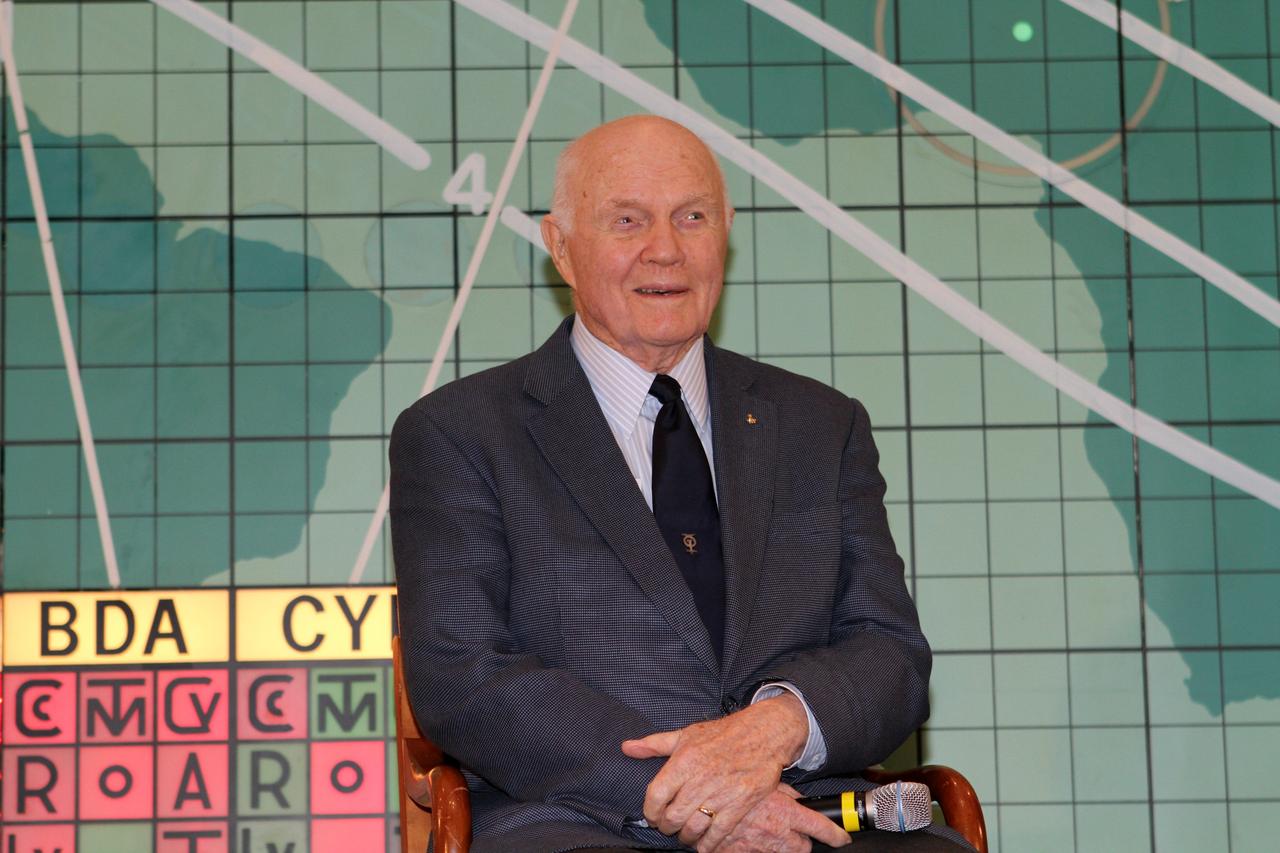
CAPE CANAVERAL, Fla. -- Mercury astronaut John Glenn sits in front of the plot board from the Mercury control center on display at the Kennedy Space Center Visitor Complex in Florida. The astronaut, part of the original class of seven astronauts chosen by NASA, was taking part in a question-and-answer session with the media as part of events celebrating 50 years of Americans in orbit, an era which began with Glenn's Mercury mission MA-6, on Feb. 20, 1962. Glenn's launch aboard an Atlas rocket took with it the hopes of an entire nation and ushered in a new era of space travel that eventually led to Americans walking on the moon by the end of the 1960s. Glenn soon was followed into orbit by Carpenter, Walter Schirra and Gordon Cooper. Their fellow Mercury astronauts Alan Shepard and Virgil "Gus" Grissom flew earlier suborbital flights. Deke Slayton was grounded by a medical condition until the Apollo-Soyuz Test Project in 1975. Photo credit: NASA/Kim Shiflett
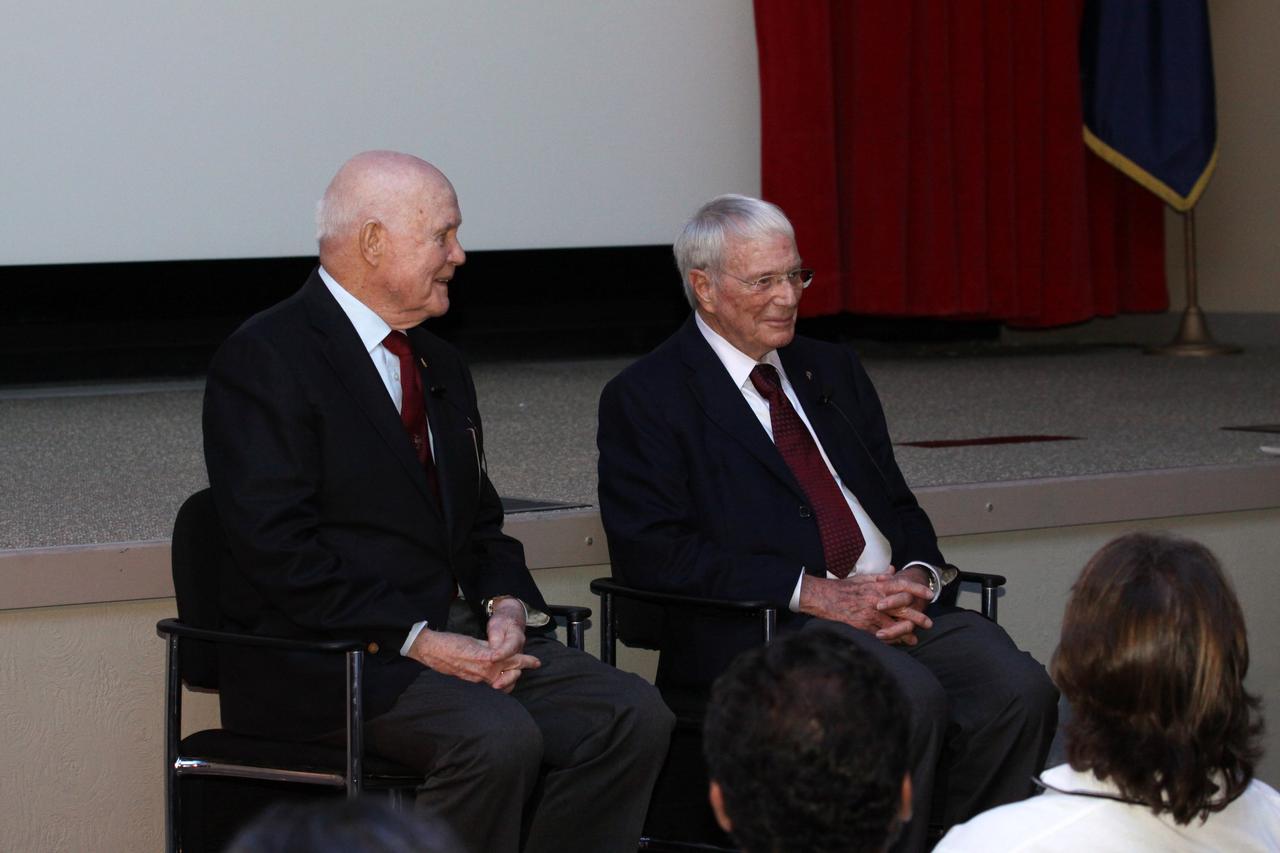
CAPE CANAVERAL, Fla. -- Mercury astronauts, John Glenn, left, and Scott Carpenter, talk to Mercury Project workers and other guests in the Astronaut Encounter Theater at the Kennedy Space Center Visitor Complex in Florida. The pair participated in 50th anniversary events at the launch site of Glenn's first orbital flight aboard NASA's Friendship 7 capsule, which launched Feb. 20, 1962, aboard an Atlas rocket. Glenn's launch aboard an Atlas rocket took with it the hopes of an entire nation and ushered in a new era of space travel that eventually led to Americans walking on the moon by the end of the 1960s. Glenn soon was followed into orbit by Carpenter, Walter Schirra and Gordon Cooper. Their fellow Mercury astronauts Alan Shepard and Virgil "Gus" Grissom flew earlier suborbital flights. Deke Slayton, a member of NASA's original Mercury 7 astronauts, was grounded by a medical condition until the Apollo-Soyuz Test Project in 1975. Photo credit: Kim Shiflett
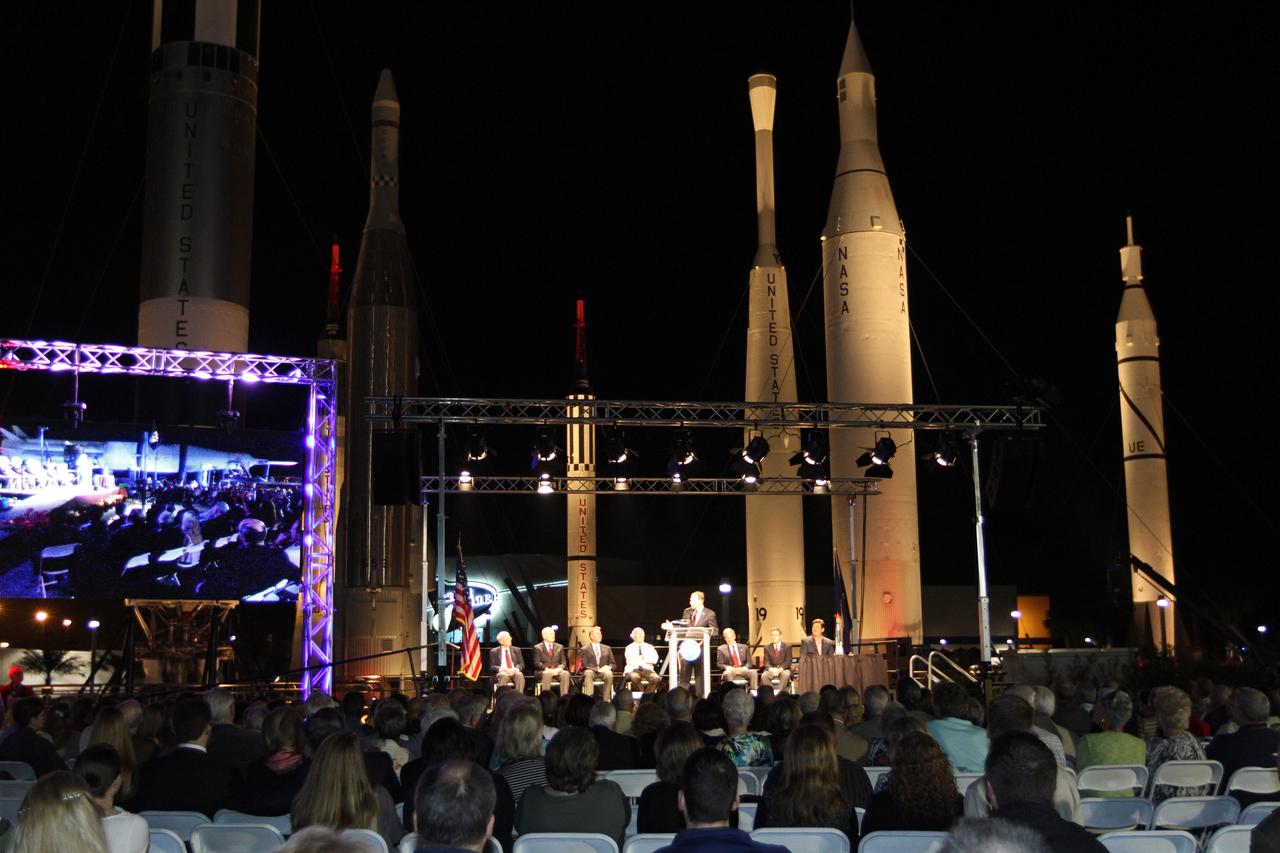
CAPE CANAVERAL, Fla. --A crowd looks on during the "On Shoulders of Giants" program celebrating 50 years of Americans in orbit, an era which began with John Glenn's MA-6 mission on Feb. 20, 1962. The event was conducted in the Rocket Garden at the Kennedy Space Center Visitor Complex in Florida a few miles from the launch pad where Glenn and Scott Carpenter took flight in Mercury spacecraft. Glenn's launch aboard an Atlas rocket took with it the hopes of an entire nation and ushered in a new era of space travel that eventually led to Americans walking on the moon by the end of the 1960s. Glenn soon was followed into orbit by Scott Carpenter, Walter Schirra and Gordon Cooper. Their fellow Mercury astronauts Alan Shepard and Virgil "Gus" Grissom flew earlier suborbital flights. Deke Slayton, a member of NASA's original Mercury 7 astronauts, was grounded by a medical condition until the Apollo-Soyuz Test Project in 1975. Photo credit: Kim Shiflett
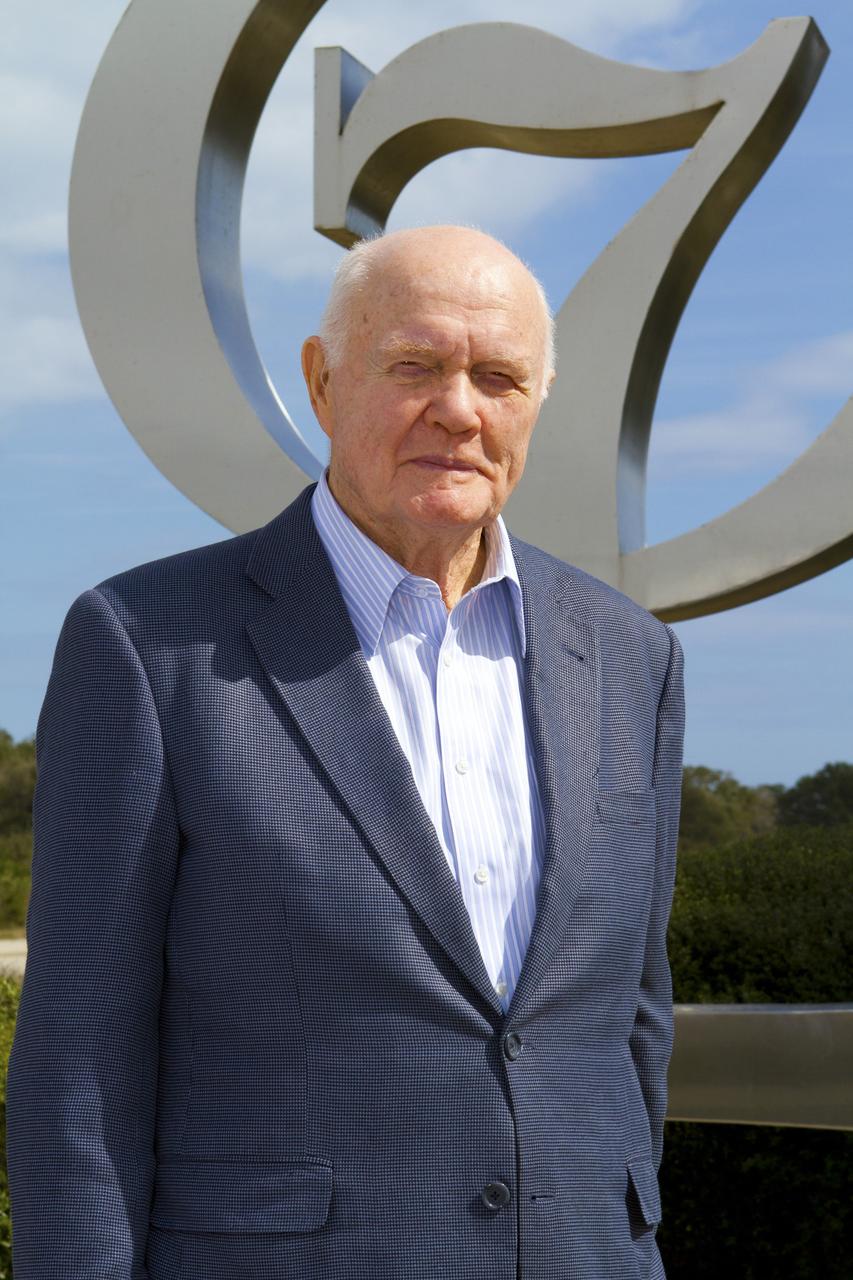
CAPE CANAVERAL, Fla. -- Mercury astronaut John Glenn poses for a photo in front of the Project Mercury monument at Launch Complex-14 LC-14 at Cape Canaveral Air Force Station in Florida. During events at the Cape and NASA's Kennedy Space Center, Glenn is marking the 50th anniversary of being the first American astronaut to orbit the Earth inside the Friendship 7 capsule on Feb. 20, 1962. Glenn's launch aboard an Atlas rocket took with it the hopes of an entire nation and ushered in a new era of space travel that eventually led to Americans walking on the moon by the end of the 1960s. Glenn soon was followed into orbit by Scott Carpenter, Walter Schirra and Gordon Cooper. Their fellow Mercury astronauts Alan Shepard and Virgil "Gus" Grissom flew earlier suborbital flights. Deke Slayton, a member of NASA's original Mercury 7 astronauts, was grounded by a medical condition until the Apollo-Soyuz Test Project in 1975. Photo credit: Kim Shiflett
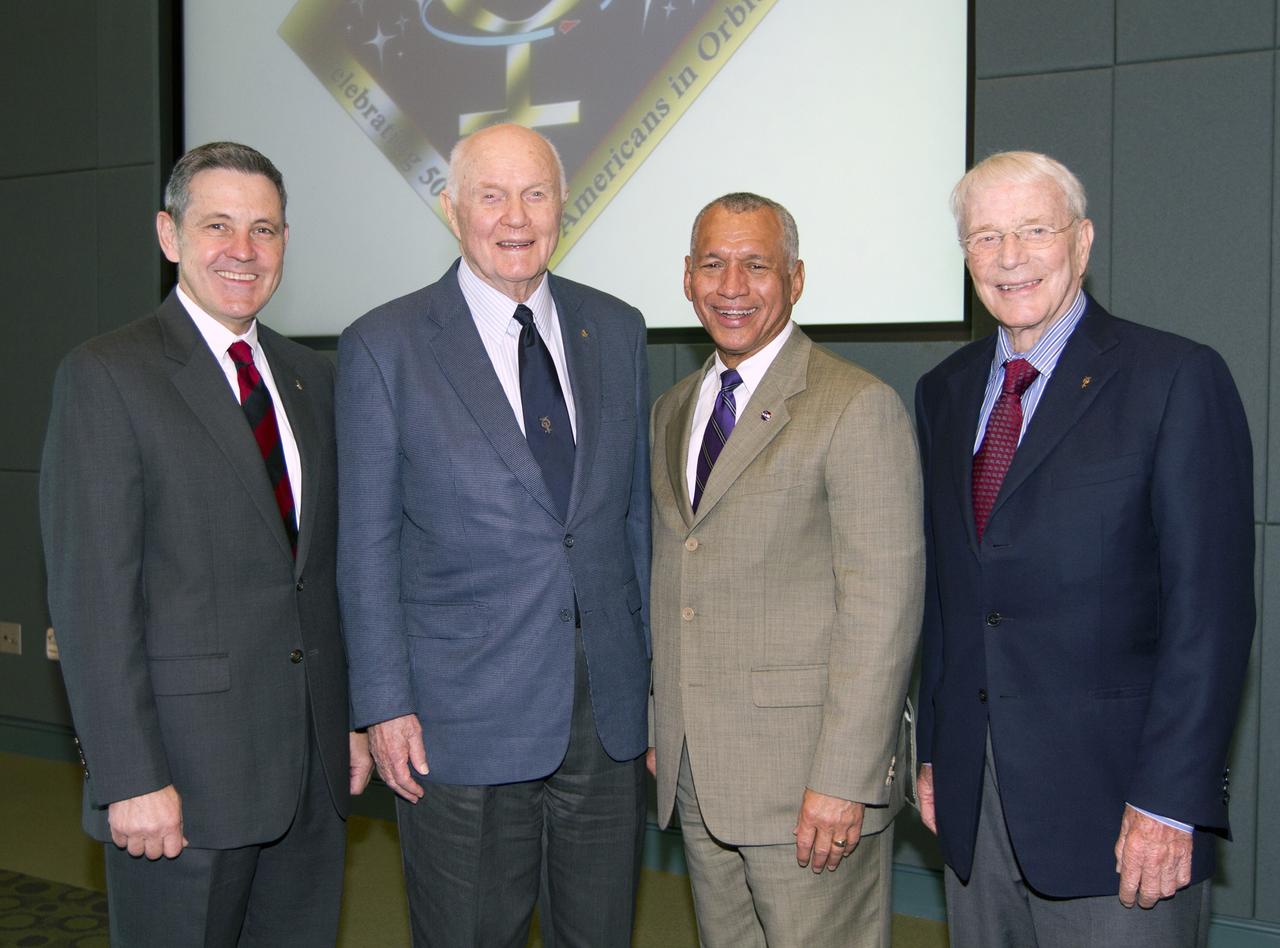
CAPE CANAVERAL, Fla. - Kennedy Space Center Director Bob Cabana, from left, Mercury astronaut John Glenn, NASA Administrator Charles Bolden and Mercury astronaut Scott Carpenter pose during a luncheon Feb. 17, 2012, celebrating 50 years of Americans in orbit, an era which began with Glenn's Mercury mission MA-6, on Feb. 20, 1962. Glenn's launch aboard an Atlas rocket took with it the hopes of an entire nation and ushered in a new era of space travel that eventually led to Americans walking on the moon by the end of the 1960s. Glenn soon was followed into orbit by Scott Carpenter, Walter Schirra and Gordon Cooper. Their fellow Mercury astronauts Alan Shepard and Virgil "Gus" Grissom flew earlier suborbital flights. Deke Slayton, a member of NASA's original Mercury 7 astronauts, was grounded by a medical condition until the Apollo-Soyuz Test Project in 1975. Photo credit: NASA/Kim Shiflett
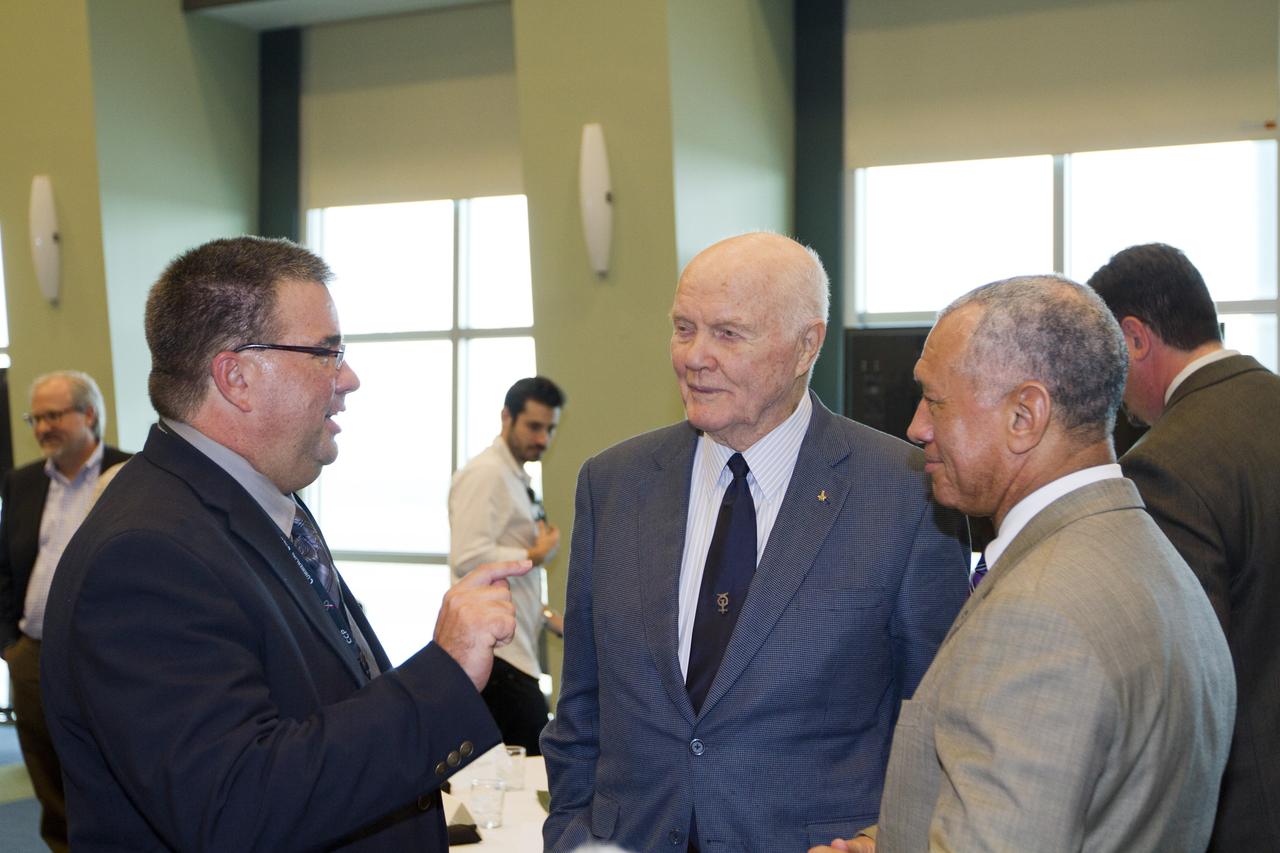
CAPE CANAVERAL, Fla. - Ed Mango, program manager of NASA's Commercial Crew Program, left, talks with astronaut John Glenn, center and NASA Administrator Charles Bolden before a luncheon Feb. 17, 2012, celebrating 50 years of Americans in orbit, an era which began with Glenn's Mercury mission MA-6, on Feb. 20, 1962. Glenn's launch aboard an Atlas rocket took with it the hopes of an entire nation and ushered in a new era of space travel that eventually led to Americans walking on the moon by the end of the 1960s. Glenn soon was followed into orbit by Scott Carpenter, Walter Schirra and Gordon Cooper. Their fellow Mercury astronauts Alan Shepard and Virgil "Gus" Grissom flew earlier suborbital flights. Deke Slayton, a member of NASA's original Mercury 7 astronauts, was grounded by a medical condition until the Apollo-Soyuz Test Project in 1975. Photo credit: NASA/Kim Shiflett
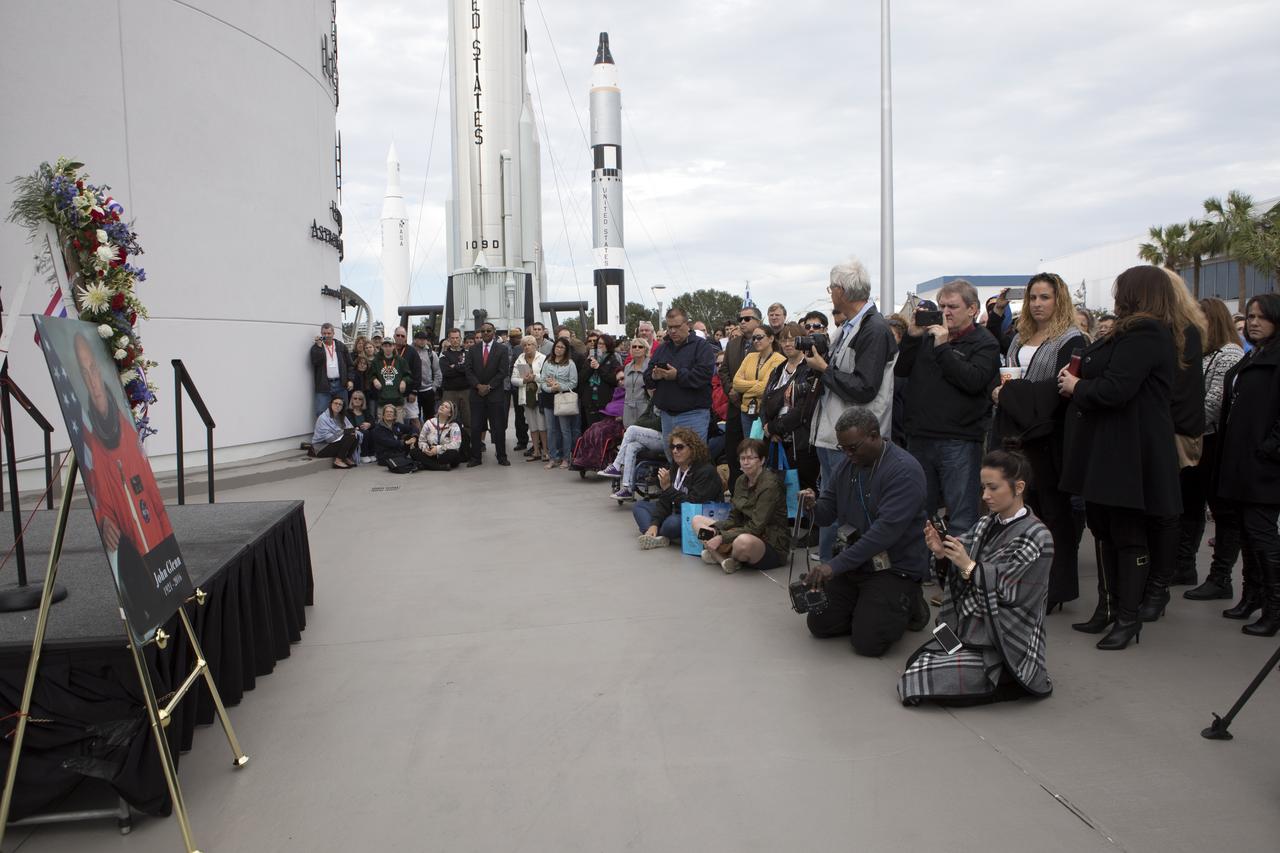
News media members and visitors gather at the Heroes and Legends exhibit hall at the Kennedy Space Center Visitor Complex during a ceremony remembering astronaut Sen. John Glenn who passed away Dec. 8, 2016 at age 95. Glenn, one of the first seven astronauts NASA chose to fly the first missions of the Space Age, gained worldwide acclaim during his Mercury mission that made him the first American to orbit the Earth. He flew again in 1998 aboard space shuttle Discovery at age 77.
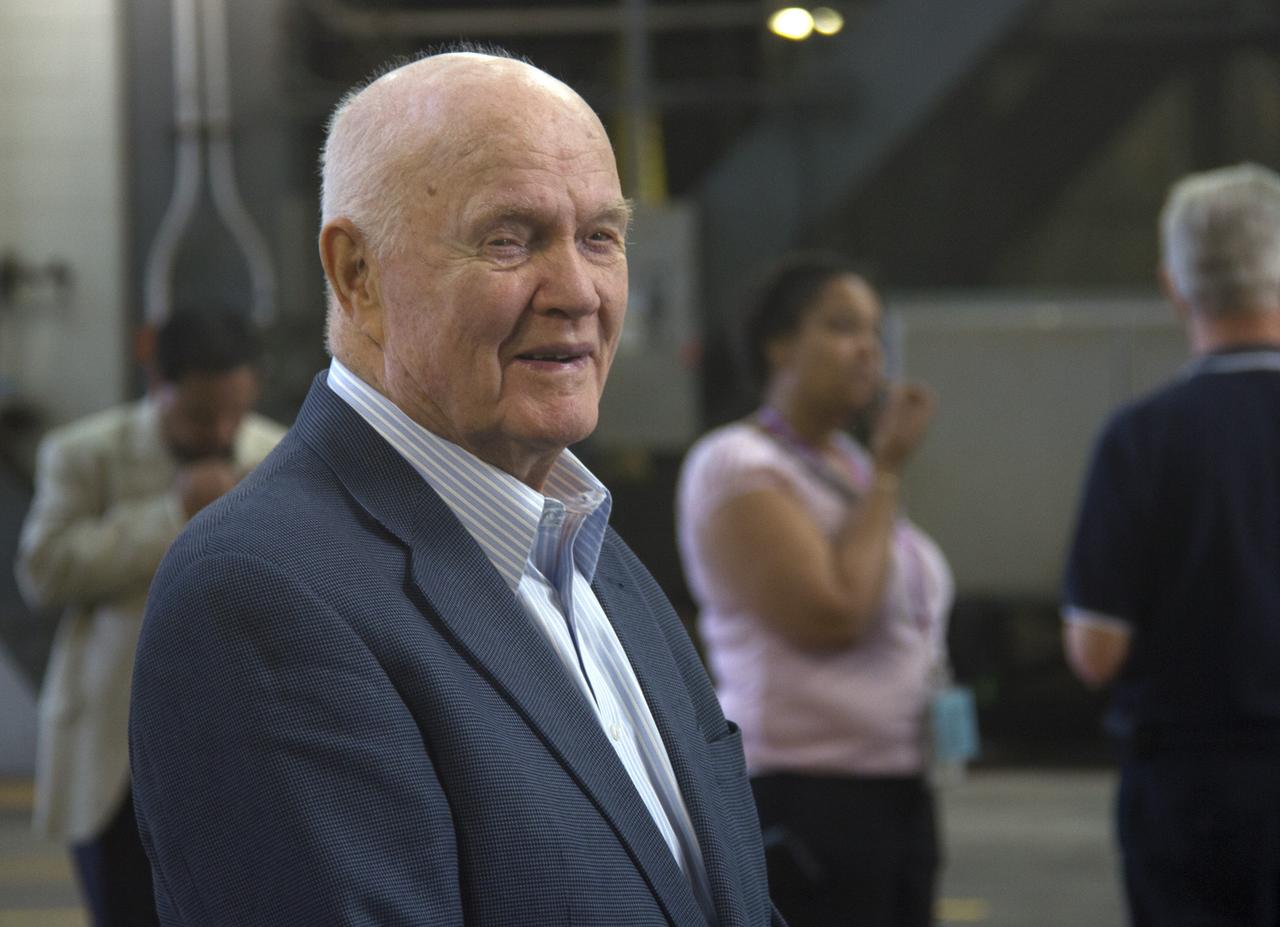
CAPE CANAVERAL, Fla. -- John Glenn tours the Vehicle Assembly Building at NASA's Kennedy Space Center in Florida. Glenn is at the space center to mark the 50th anniversary of being the first American astronaut to orbit the Earth inside the NASA Mercury Project's Friendship 7 capsule on Feb. 20, 1962. Glenn later returned to space in October 1998 as a payload specialist aboard space shuttle Discovery's STS-95 mission. Glenn's launch aboard an Atlas rocket took with it the hopes of an entire nation and ushered in a new era of space travel that eventually led to Americans walking on the moon by the end of the 1960s. Glenn soon was followed into orbit by Scott Carpenter, Walter Schirra and Gordon Cooper. Their fellow Mercury astronauts Alan Shepard and Virgil "Gus" Grissom flew earlier suborbital flights. Deke Slayton, a member of NASA's original Mercury 7 astronauts, was grounded by a medical condition until the Apollo-Soyuz Test Project in 1975. Photo credit: Cory Huston
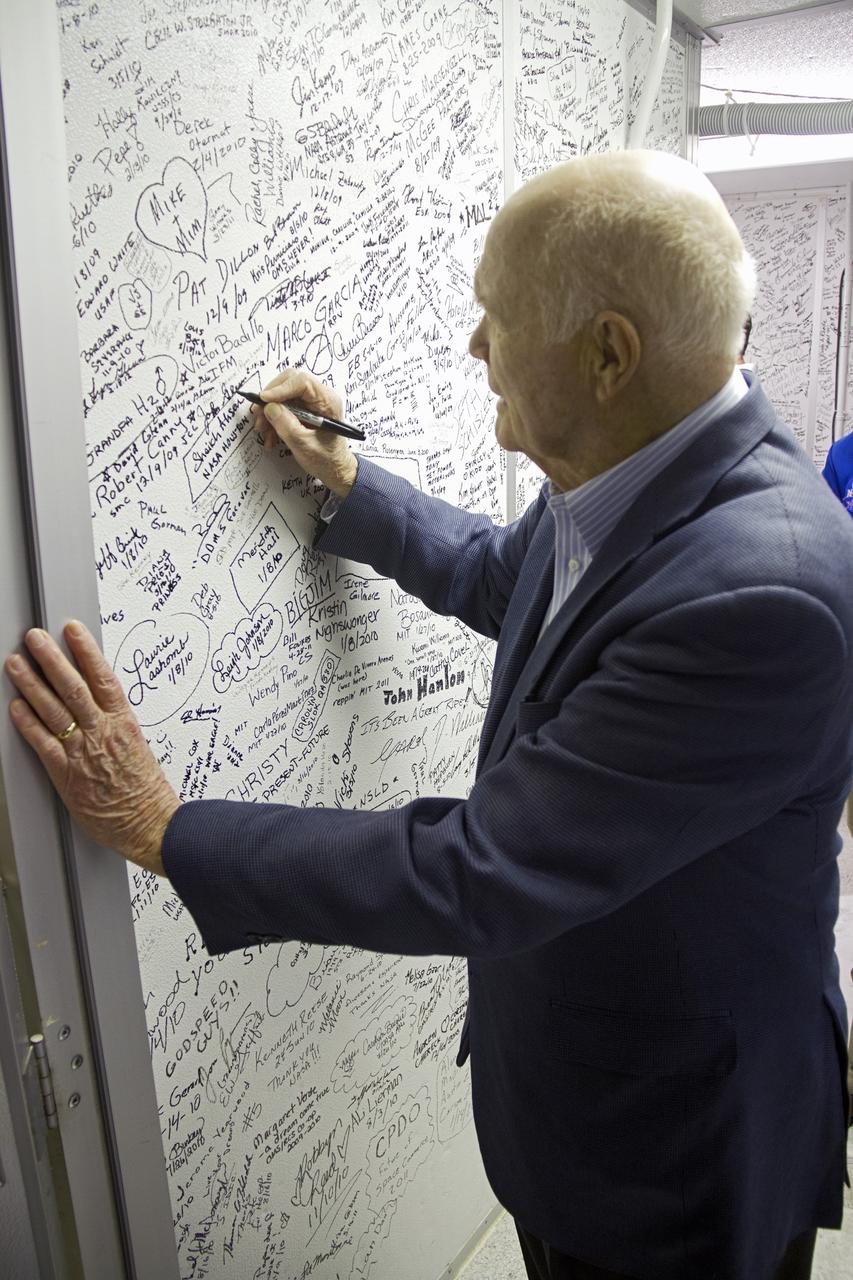
CAPE CANAVERAL, Fla. -- John Glenn signs the wall of the clean room leading into space shuttle Discovery in Orbiter Processing Facility-1 OPF-1 at NASA's Kennedy Space Center in Florida. Glenn is at the space center to mark the 50th anniversary of being the first American astronaut to orbit the Earth inside the NASA Mercury Project's Friendship 7 capsule on Feb. 20, 1962. Glenn later returned to space in October 1998 as a payload specialist aboard Discovery's STS-95 mission. Glenn's launch aboard an Atlas rocket took with it the hopes of an entire nation and ushered in a new era of space travel that eventually led to Americans walking on the moon by the end of the 1960s. Glenn soon was followed into orbit by Scott Carpenter, Walter Schirra and Gordon Cooper. Their fellow Mercury astronauts Alan Shepard and Virgil "Gus" Grissom flew earlier suborbital flights. Deke Slayton, a member of NASA's original Mercury 7 astronauts, was grounded by a medical condition until the Apollo-Soyuz Test Project in 1975. Shuttle Discovery currently is being prepared for display at Smithsonian’s National Air and Space Museum, Steven F. Udvar-Hazy Center in Chantilly, Va. Photo credit: Cory Huston

CAPE CANAVERAL, Fla. -- Mercury astronauts Scott Carpenter, left, and John Glenn and astronaut Steve Robinson of STS-95 listen to remarks during the "On Shoulders of Giants" program celebrating 50 years of Americans in orbit, an era which began with Glenn's MA-6 mission on Feb. 20, 1962. The event was conducted in the Rocket Garden at the Kennedy Space Center Visitor Complex in Florida a few miles from the launch pad where Glenn and Carpenter took flight in Mercury spacecraft. Glenn's launch aboard an Atlas rocket took with it the hopes of an entire nation and ushered in a new era of space travel that eventually led to Americans walking on the moon by the end of the 1960s. Glenn soon was followed into orbit by Carpenter, Walter Schirra and Gordon Cooper. Their fellow Mercury astronauts Alan Shepard and Virgil "Gus" Grissom flew earlier suborbital flights. Deke Slayton, a member of NASA's original Mercury 7 astronauts, was grounded by a medical condition until the Apollo-Soyuz Test Project in 1975. Photo credit: Kim Shiflett
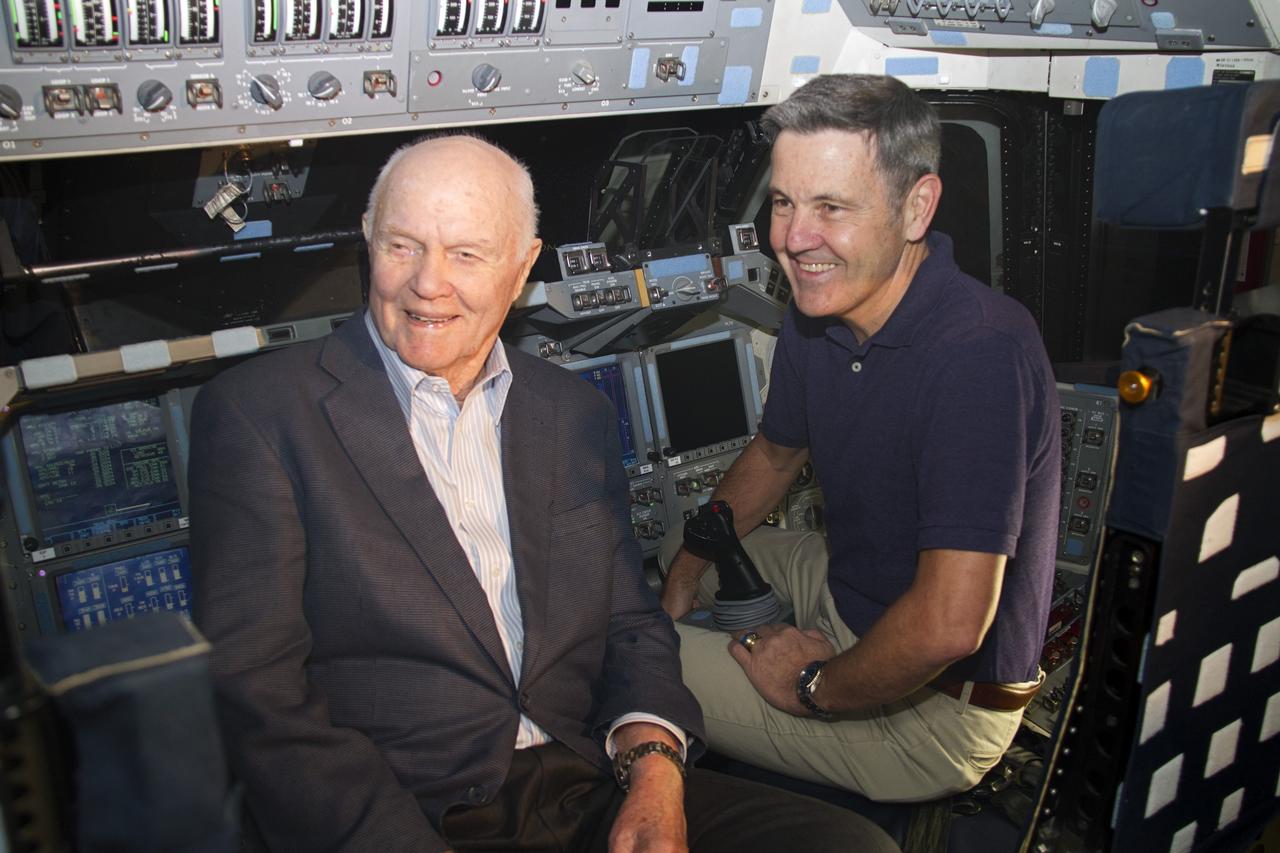
CAPE CANAVERAL, Fla. -- John Glenn and NASA Kennedy Space Center Director Bob Cabana sit in the flight deck of space shuttle Discovery in Orbiter Processing Facility-1 OPF-1. Glenn is at the space center to mark the 50th anniversary of being the first American astronaut to orbit the Earth inside the NASA Mercury Project's Friendship 7 capsule on Feb. 20, 1962. Glenn later returned to space in October 1998 as a payload specialist aboard Discovery's STS-95 mission. Glenn's launch aboard an Atlas rocket took with it the hopes of an entire nation and ushered in a new era of space travel that eventually led to Americans walking on the moon by the end of the 1960s. Glenn soon was followed into orbit by Scott Carpenter, Walter Schirra and Gordon Cooper. Their fellow Mercury astronauts Alan Shepard and Virgil "Gus" Grissom flew earlier suborbital flights. Deke Slayton, a member of NASA's original Mercury 7 astronauts, was grounded by a medical condition until the Apollo-Soyuz Test Project in 1975. Shuttle Discovery currently is being prepared for display at Smithsonian’s National Air and Space Museum, Steven F. Udvar-Hazy Center in Chantilly, Va. Photo credit: Cory Huston
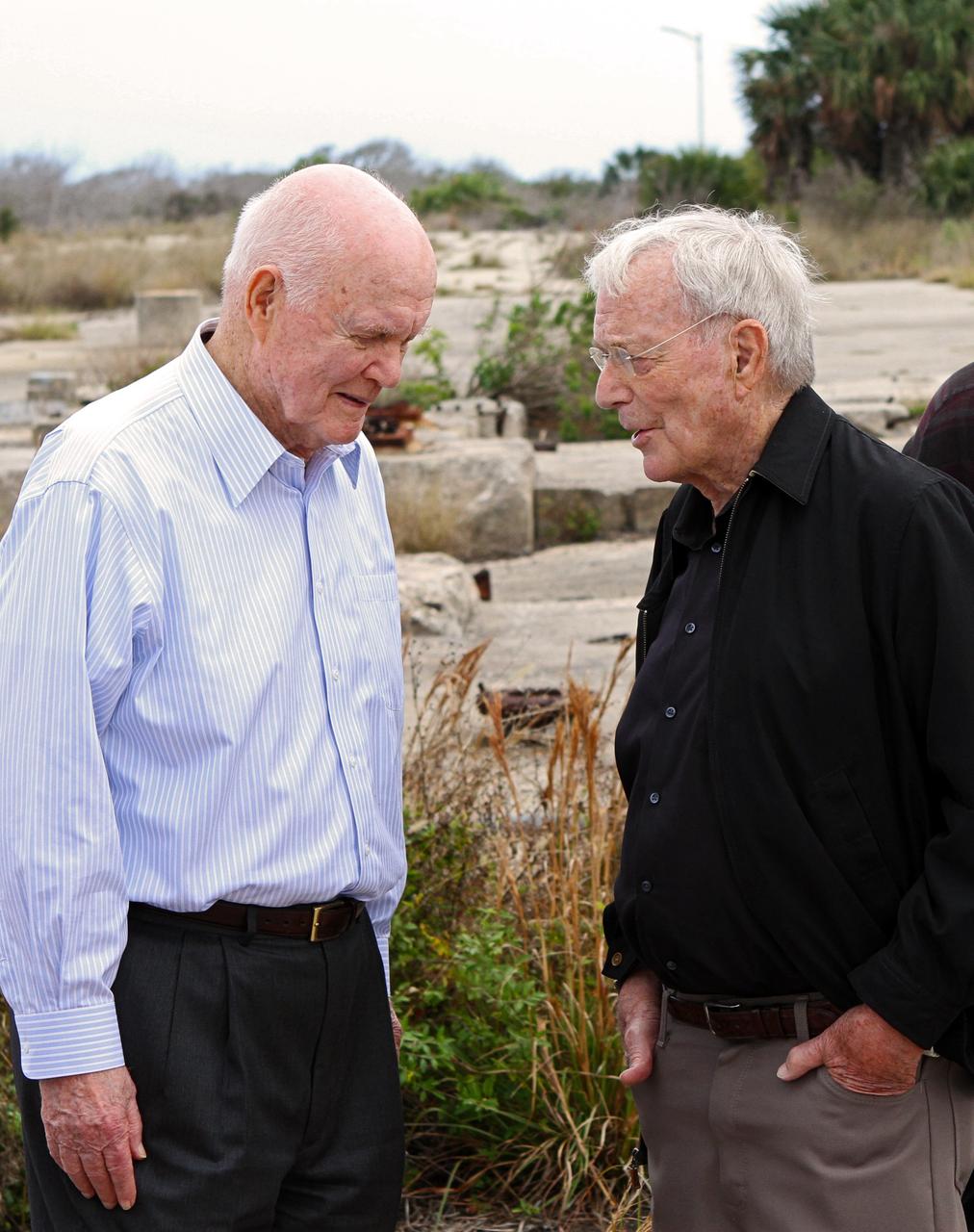
CAPE CANAVERAL, Fla. -- Mercury astronauts John Glenn, left and Scott Carpenter look around at the dismantled Complex 14 at Cape Canaveral Air Force Station in Florida. Glenn and Carpenter launched from the pad on Atlas rockets inside Mercury capsules in 1962. The two astronauts, part of the original class of seven astronauts chosen by NASA, were taking part in events celebrating 50 years of Americans in orbit, an era which began with Glenn's Mercury mission MA-6, on Feb. 20, 1962. Glenn's launch aboard an Atlas rocket took with it the hopes of an entire nation and ushered in a new era of space travel that eventually led to Americans walking on the moon by the end of the 1960s. Glenn soon was followed into orbit by Carpenter, Walter Schirra and Gordon Cooper. Their fellow Mercury astronauts Alan Shepard and Virgil "Gus" Grissom flew earlier suborbital flights. Deke Slayton was grounded by a medical condition until the Apollo-Soyuz Test Project in 1975. Photo credit: NASA/Cory Huston
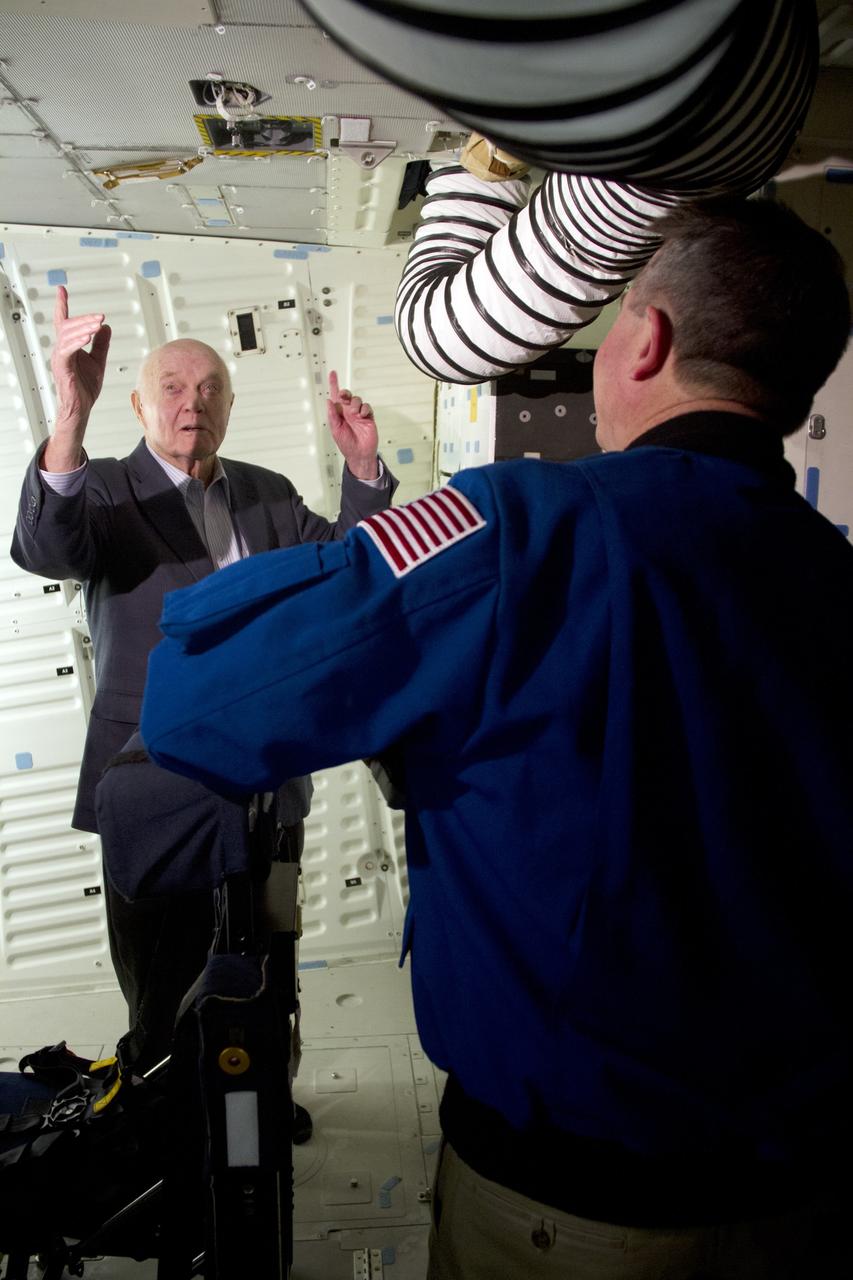
CAPE CANAVERAL, Fla. -- John Glenn and NASA astronaut Stephen Robinson stand in the middeck of space shuttle Discovery in Orbiter Processing Facility-1 OPF-1 at NASA's Kennedy Space Center in Florida. Glenn is at the space center to mark the 50th anniversary of being the first American astronaut to orbit the Earth inside the NASA Mercury Project's Friendship 7 capsule on Feb. 20, 1962. Glenn later returned to space in October 1998 as a payload specialist aboard Discovery's STS-95 mission. Robinson was the payload commander of STS-95. Glenn's launch aboard an Atlas rocket took with it the hopes of an entire nation and ushered in a new era of space travel that eventually led to Americans walking on the moon by the end of the 1960s. Glenn soon was followed into orbit by Scott Carpenter, Walter Schirra and Gordon Cooper. Their fellow Mercury astronauts Alan Shepard and Virgil "Gus" Grissom flew earlier suborbital flights. Deke Slayton, a member of NASA's original Mercury 7 astronauts, was grounded by a medical condition until the Apollo-Soyuz Test Project in 1975. Shuttle Discovery currently is being prepared for display at Smithsonian’s National Air and Space Museum, Steven F. Udvar-Hazy Center in Chantilly, Va. Photo credit: Cory Huston
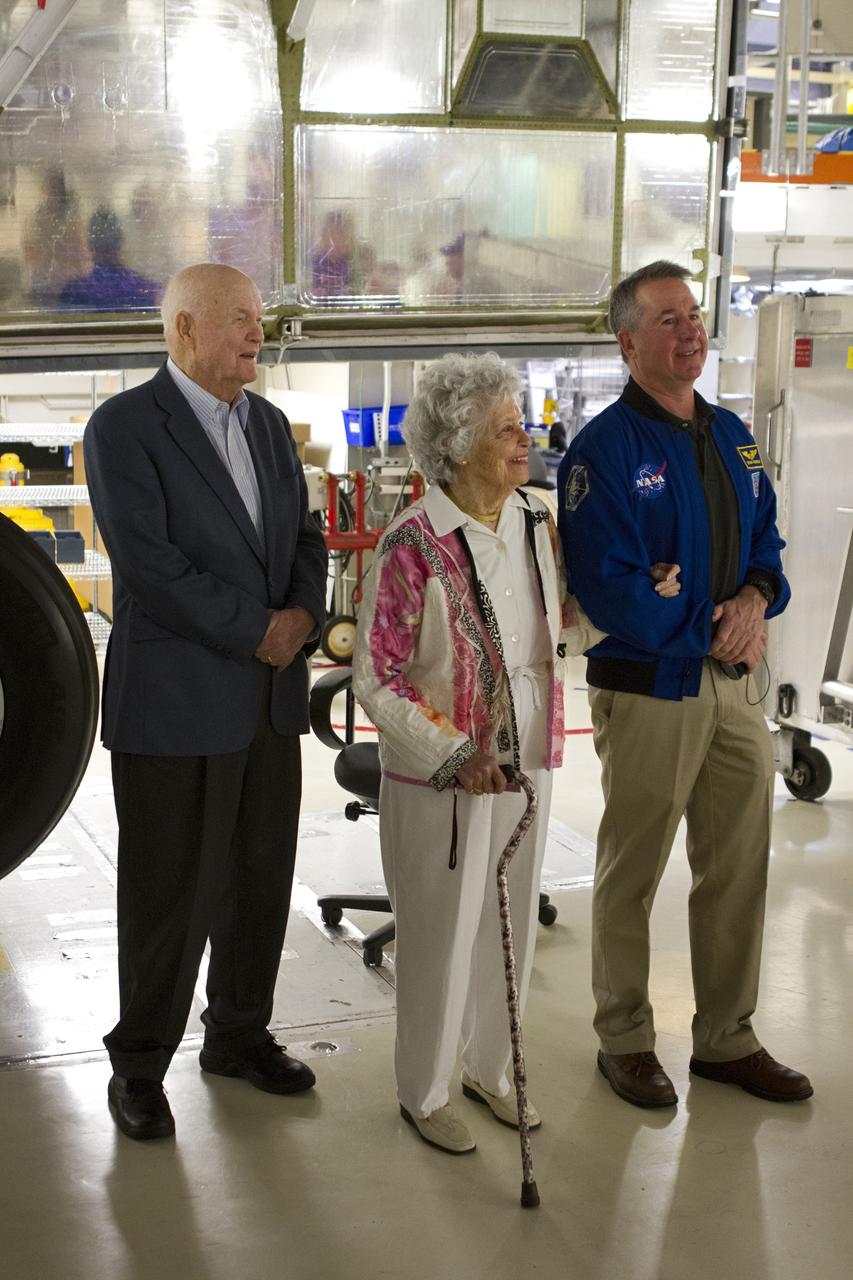
CAPE CANAVERAL, Fla. -- John Glenn and his wife, Annie, and NASA astronaut Stephen Robinson stand beside the wheel of space shuttle Discovery in Orbiter Processing Facility-1 OPF-1 at NASA's Kennedy Space Center in Florida. Glenn is at the space center to mark the 50th anniversary of being the first American astronaut to orbit the Earth inside the NASA Mercury Project's Friendship 7 capsule on Feb. 20, 1962. Glenn later returned to space in October 1998 as a payload specialist aboard Discovery's STS-95 mission. Robinson was the payload commander of STS-95. Glenn's launch aboard an Atlas rocket took with it the hopes of an entire nation and ushered in a new era of space travel that eventually led to Americans walking on the moon by the end of the 1960s. Glenn soon was followed into orbit by Scott Carpenter, Walter Schirra and Gordon Cooper. Their fellow Mercury astronauts Alan Shepard and Virgil "Gus" Grissom flew earlier suborbital flights. Deke Slayton, a member of NASA's original Mercury 7 astronauts, was grounded by a medical condition until the Apollo-Soyuz Test Project in 1975. Shuttle Discovery currently is being prepared for display at Smithsonian’s National Air and Space Museum, Steven F. Udvar-Hazy Center in Chantilly, Va. Photo credit: Cory Huston
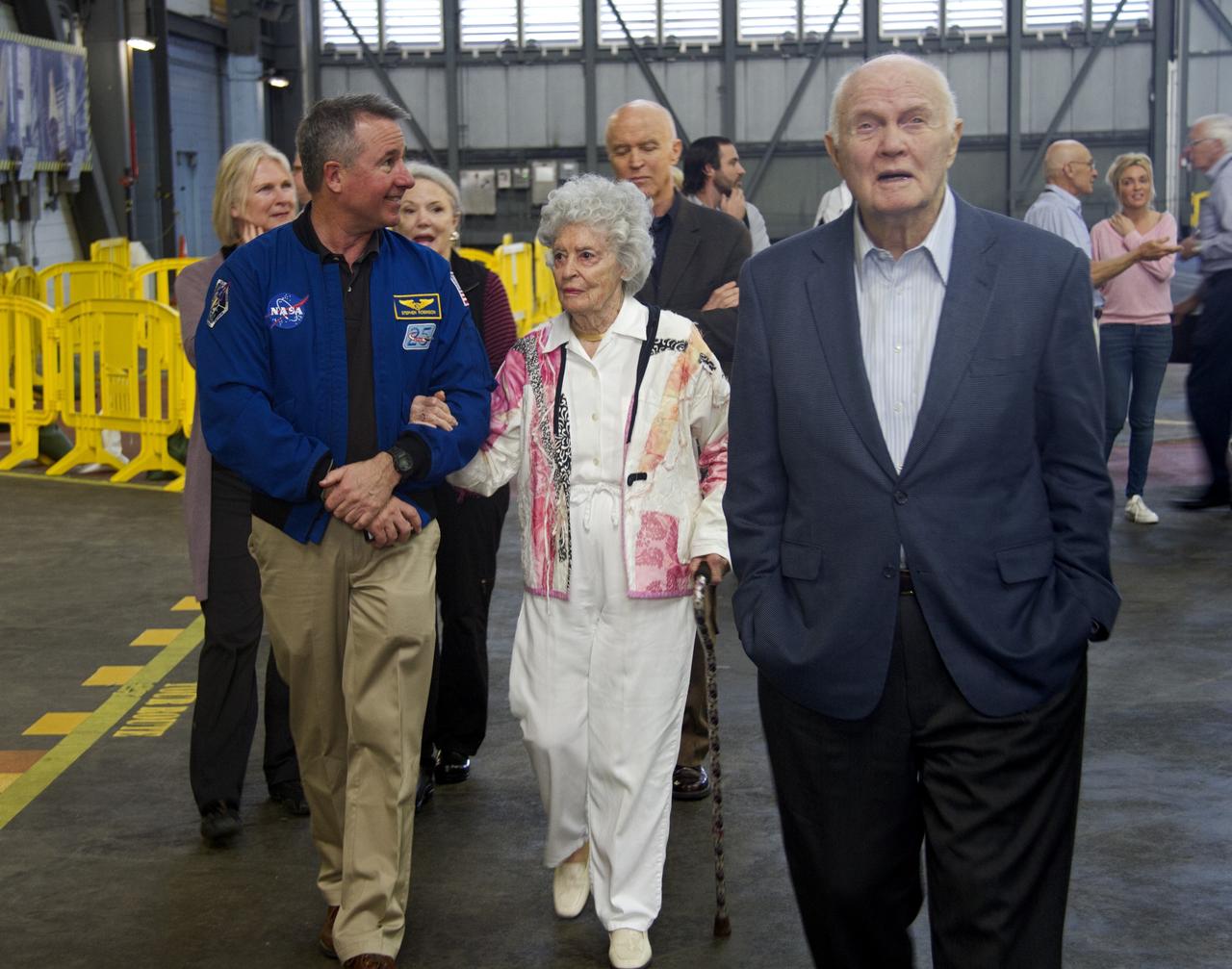
CAPE CANAVERAL, Fla. -- John Glenn and his wife, Annie, and NASA astronaut Stephen Robinson tour the Vehicle Assembly Building at NASA's Kennedy Space Center in Florida. Glenn is at the space center to mark the 50th anniversary of being the first American astronaut to orbit the Earth inside the NASA Mercury Project's Friendship 7 capsule on Feb. 20, 1962. Glenn later returned to space in October 1998 as a payload specialist aboard space shuttle Discovery's STS-95 mission. Robinson was the payload commander of STS-95. Glenn's launch aboard an Atlas rocket took with it the hopes of an entire nation and ushered in a new era of space travel that eventually led to Americans walking on the moon by the end of the 1960s. Glenn soon was followed into orbit by Scott Carpenter, Walter Schirra and Gordon Cooper. Their fellow Mercury astronauts Alan Shepard and Virgil "Gus" Grissom flew earlier suborbital flights. Deke Slayton, a member of NASA's original Mercury 7 astronauts, was grounded by a medical condition until the Apollo-Soyuz Test Project in 1975. Photo credit: Cory Huston
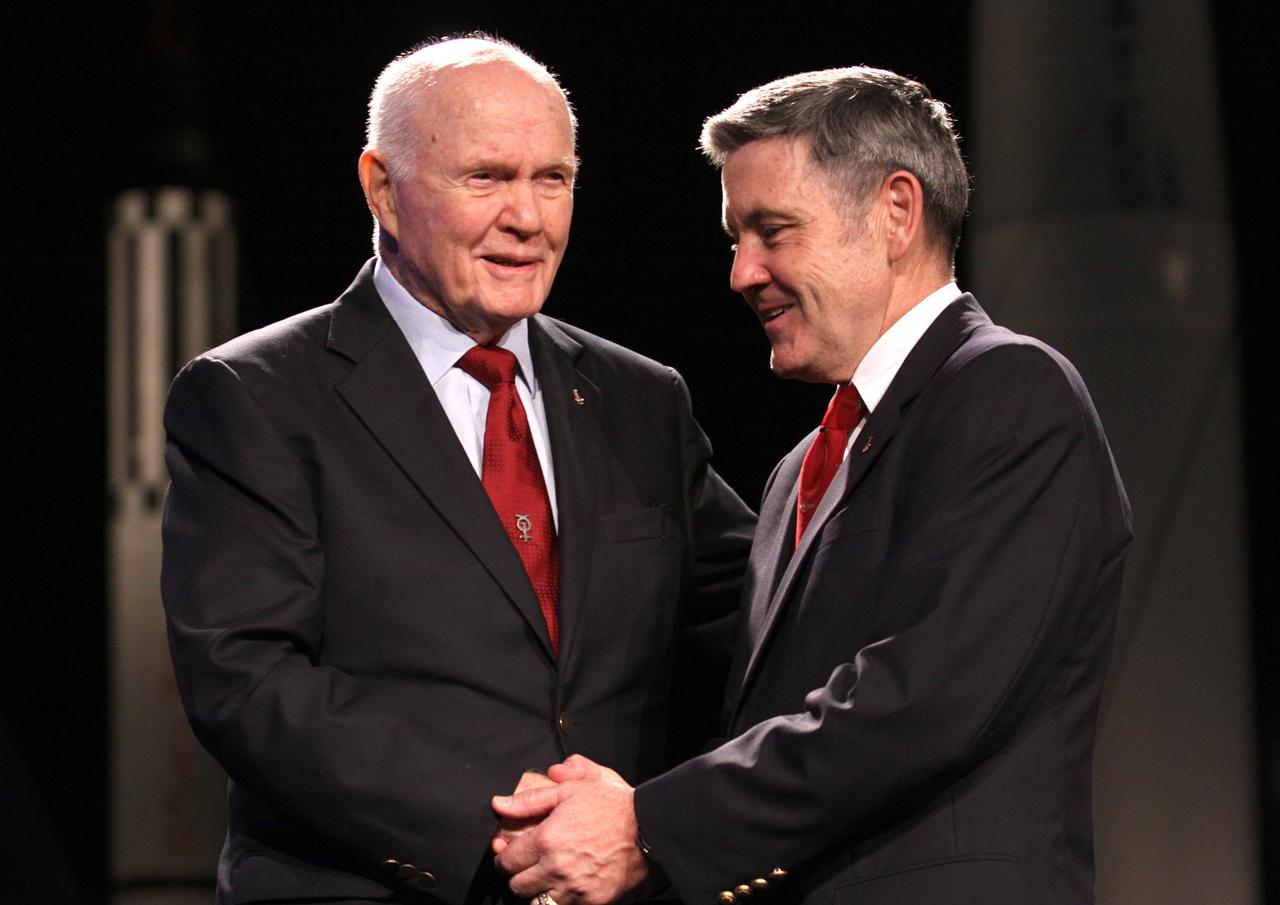
CAPE CANAVERAL, Fla. -- Mercury astronaut John Glenn, left, and Kennedy Space Center Director Bob Cabana shake hands following the "On Shoulders of Giants" program celebrating 50 years of Americans in orbit, an era which began with Glenn's MA-6 mission on Feb. 20, 1962. The event was conducted in the Rocket Garden at the Kennedy Space Center Visitor Complex in Florida a few miles from the launch pad where Glenn and Scott Carpenter took flight in Mercury spacecraft. Glenn's launch aboard an Atlas rocket took with it the hopes of an entire nation and ushered in a new era of space travel that eventually led to Americans walking on the moon by the end of the 1960s. Glenn soon was followed into orbit by Scott Carpenter, Walter Schirra and Gordon Cooper. Their fellow Mercury astronauts Alan Shepard and Virgil "Gus" Grissom flew earlier suborbital flights. Deke Slayton, a member of NASA's original Mercury 7 astronauts, was grounded by a medical condition until the Apollo-Soyuz Test Project in 1975. Photo credit: Kim Shiflett
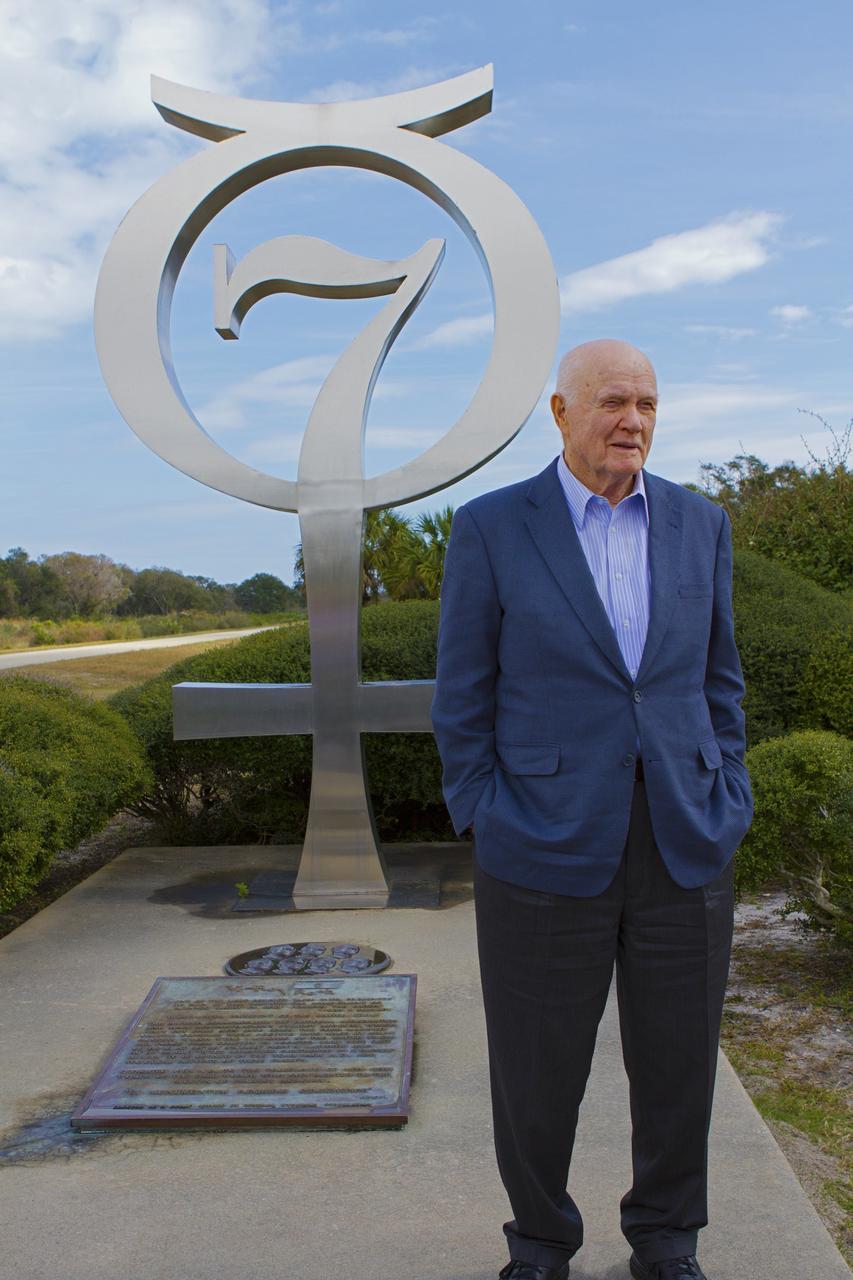
CAPE CANAVERAL, Fla. -- Mercury astronaut John Glenn poses in front of the Mercury 7 memorial near Complex 14 at Cape Canaveral Air Force Station in Florida. Glenn and Carpenter launched from the pad on Atlas rockets inside Mercury capsules in 1962. The two astronauts, part of the original class of seven astronauts chosen by NASA, were taking part in events celebrating 50 years of Americans in orbit, an era which began with Glenn's Mercury mission MA-6, on Feb. 20, 1962. Glenn's launch aboard an Atlas rocket took with it the hopes of an entire nation and ushered in a new era of space travel that eventually led to Americans walking on the moon by the end of the 1960s. Glenn soon was followed into orbit by Carpenter, Walter Schirra and Gordon Cooper. Their fellow Mercury astronauts Alan Shepard and Virgil "Gus" Grissom flew earlier suborbital flights. Deke Slayton was grounded by a medical condition until the Apollo-Soyuz Test Project in 1975. Photo credit: NASA/ Cory Huston
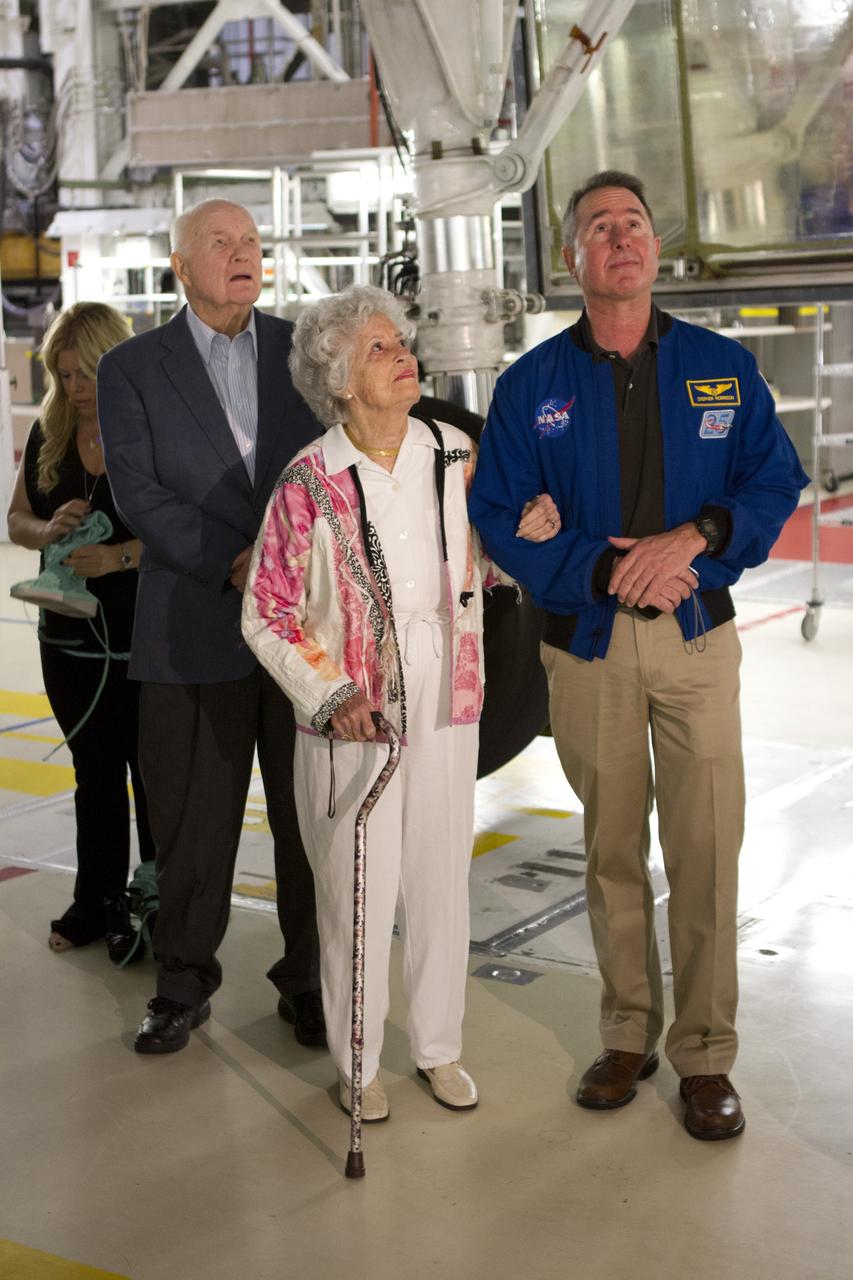
CAPE CANAVERAL, Fla. -- John Glenn and his wife, Annie, and NASA astronaut Stephen Robinson stand under space shuttle Discovery in Orbiter Processing Facility-1 OPF-1 at NASA's Kennedy Space Center in Florida. Glenn is at the space center to mark the 50th anniversary of being the first American astronaut to orbit the Earth inside the NASA Mercury Project's Friendship 7 capsule on Feb. 20, 1962. Glenn later returned to space in October 1998 as a payload specialist aboard Discovery's STS-95 mission. Robinson was the payload commander of STS-95. Glenn's launch aboard an Atlas rocket took with it the hopes of an entire nation and ushered in a new era of space travel that eventually led to Americans walking on the moon by the end of the 1960s. Glenn soon was followed into orbit by Scott Carpenter, Walter Schirra and Gordon Cooper. Their fellow Mercury astronauts Alan Shepard and Virgil "Gus" Grissom flew earlier suborbital flights. Deke Slayton, a member of NASA's original Mercury 7 astronauts, was grounded by a medical condition until the Apollo-Soyuz Test Project in 1975. Shuttle Discovery currently is being prepared for display at Smithsonian’s National Air and Space Museum, Steven F. Udvar-Hazy Center in Chantilly, Va. Photo credit: Cory Huston
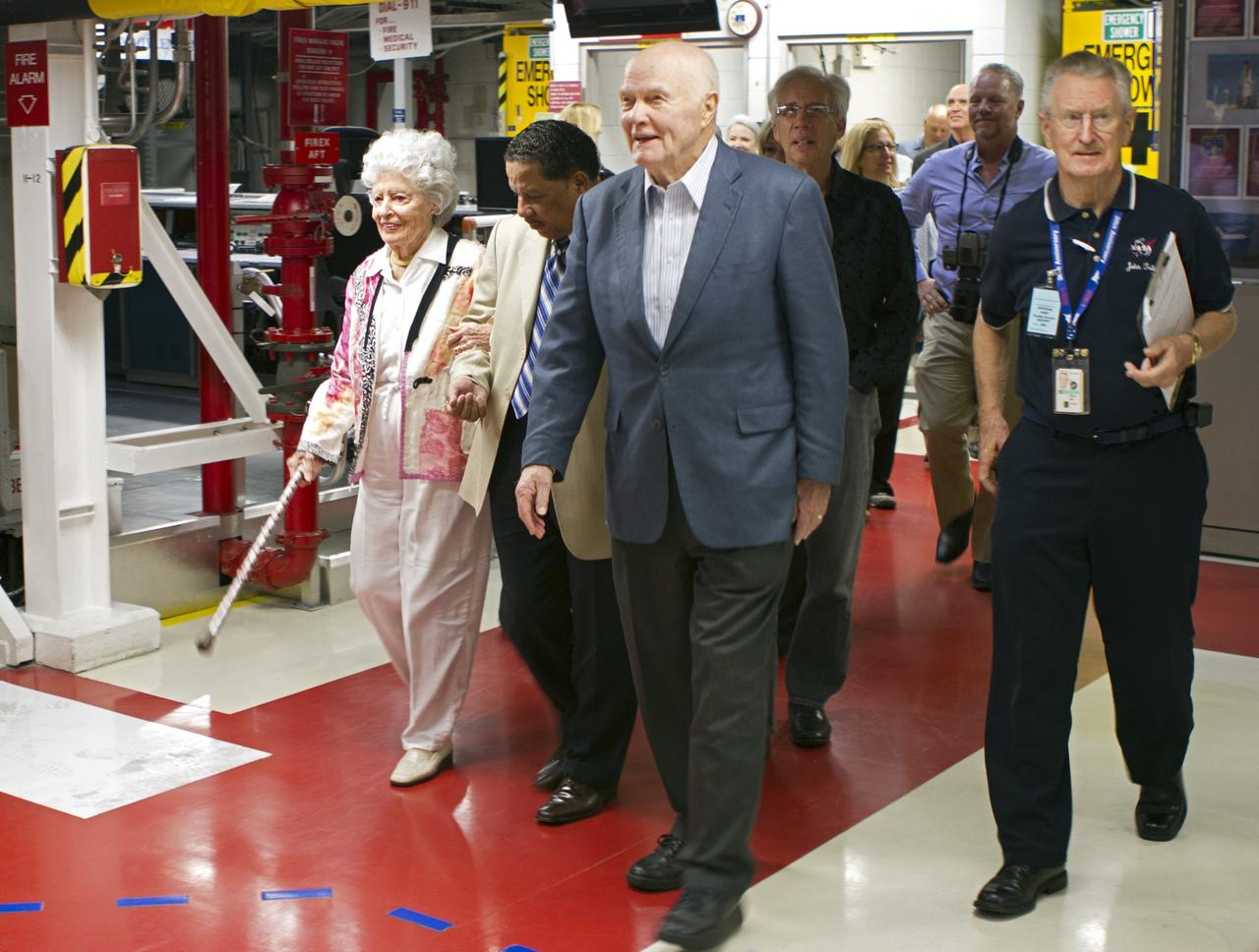
CAPE CANAVERAL, Fla. -- John Glenn and his wife, Annie, left, enter Orbiter Processing Facility-1 OPF-1 at NASA's Kennedy Space Center in Florida where space shuttle Discovery is being prepared for public display. Glenn is at the space center to mark the 50th anniversary of being the first American astronaut to orbit the Earth inside the NASA Mercury Project's Friendship 7 capsule on Feb. 20, 1962. Glenn later returned to space in October 1998 as a payload specialist aboard Discovery's STS-95 mission. Glenn's launch aboard an Atlas rocket took with it the hopes of an entire nation and ushered in a new era of space travel that eventually led to Americans walking on the moon by the end of the 1960s. Glenn soon was followed into orbit by Scott Carpenter, Walter Schirra and Gordon Cooper. Their fellow Mercury astronauts Alan Shepard and Virgil "Gus" Grissom flew earlier suborbital flights. Deke Slayton, a member of NASA's original Mercury 7 astronauts, was grounded by a medical condition until the Apollo-Soyuz Test Project in 1975. Shuttle Discovery currently is being prepared for display at Smithsonian’s National Air and Space Museum, Steven F. Udvar-Hazy Center in Chantilly, Va. Photo credit: Cory Huston
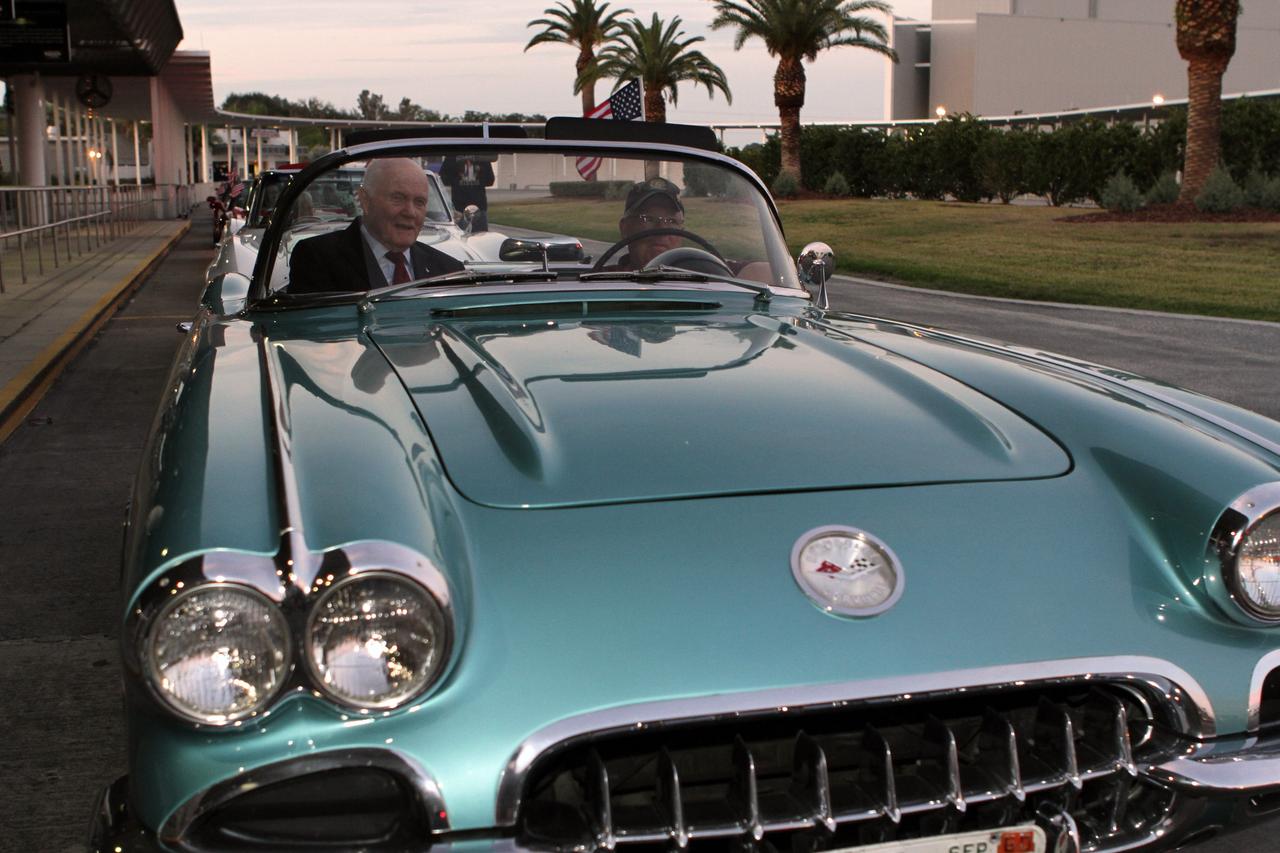
CAPE CANAVERAL, Fla. -- Mercury astronaut John Glenn, left, prepares to ride in the Corvette parade following the "On Shoulders of Giants" program celebrating 50 years of Americans in orbit, an era which began with Glenn's MA-6 mission on Feb. 20, 1962. The event was conducted in the Rocket Garden at the Kennedy Space Center Visitor Complex in Florida a few miles from the launch pad where Glenn and Scott Carpenter took flight in Mercury spacecraft. Glenn's launch aboard an Atlas rocket took with it the hopes of an entire nation and ushered in a new era of space travel that eventually led to Americans walking on the moon by the end of the 1960s. Glenn soon was followed into orbit by Scott Carpenter, Walter Schirra and Gordon Cooper. Their fellow Mercury astronauts Alan Shepard and Virgil "Gus" Grissom flew earlier suborbital flights. Deke Slayton, a member of NASA's original Mercury 7 astronauts, was grounded by a medical condition until the Apollo-Soyuz Test Project in 1975. Photo credit: Kim Shiflett
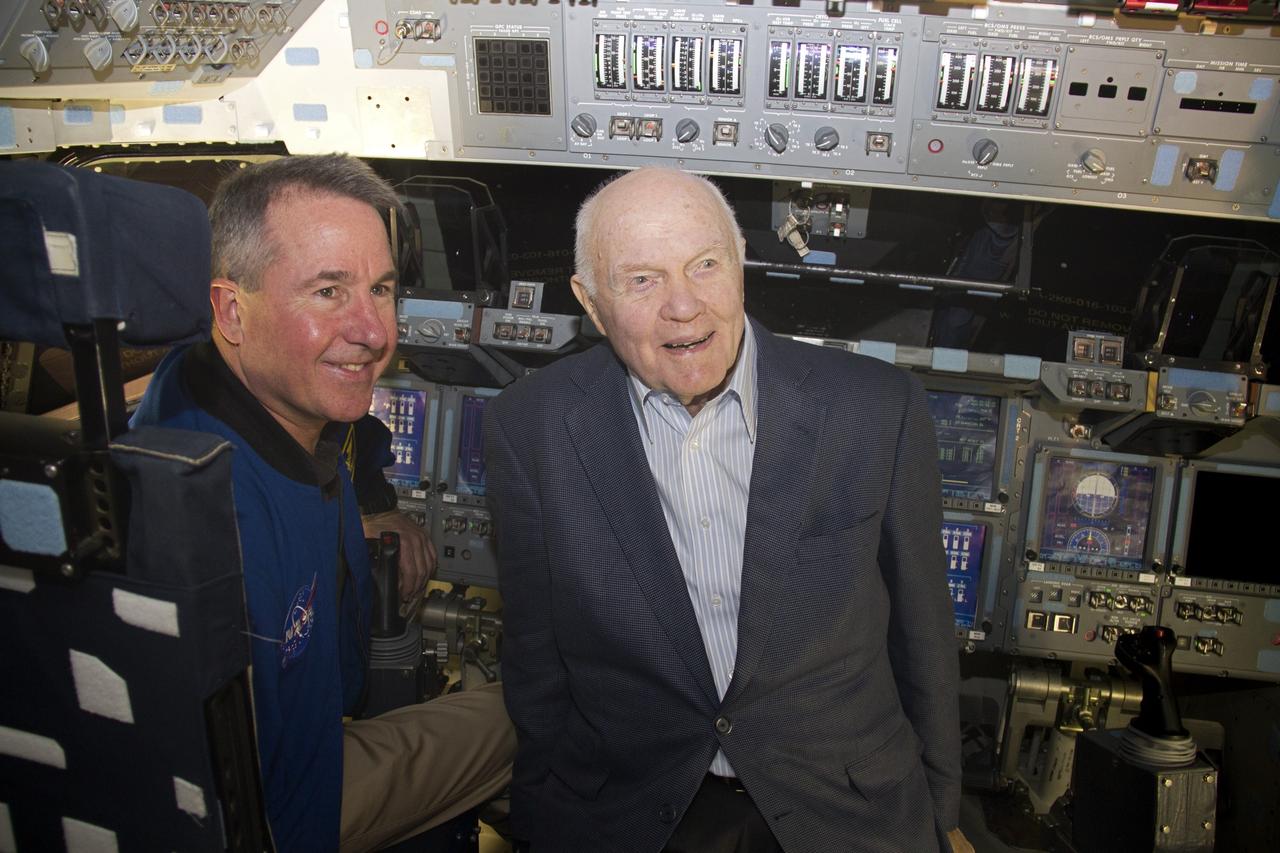
CAPE CANAVERAL, Fla. -- John Glenn and NASA astronaut Stephen Robinson sit in the flight deck of space shuttle Discovery in Orbiter Processing Facility-1 OPF-1 at NASA's Kennedy Space Center in Florida. Glenn is at the space center to mark the 50th anniversary of being the first American astronaut to orbit the Earth inside the NASA Mercury Project's Friendship 7 capsule on Feb. 20, 1962. Glenn later returned to space in October 1998 as a payload specialist aboard Discovery's STS-95 mission. Robinson was the payload commander of STS-95. Glenn's launch aboard an Atlas rocket took with it the hopes of an entire nation and ushered in a new era of space travel that eventually led to Americans walking on the moon by the end of the 1960s. Glenn soon was followed into orbit by Scott Carpenter, Walter Schirra and Gordon Cooper. Their fellow Mercury astronauts Alan Shepard and Virgil "Gus" Grissom flew earlier suborbital flights. Deke Slayton, a member of NASA's original Mercury 7 astronauts, was grounded by a medical condition until the Apollo-Soyuz Test Project in 1975. Shuttle Discovery currently is being prepared for display at Smithsonian’s National Air and Space Museum, Steven F. Udvar-Hazy Center in Chantilly, Va. Photo credit: Cory Huston
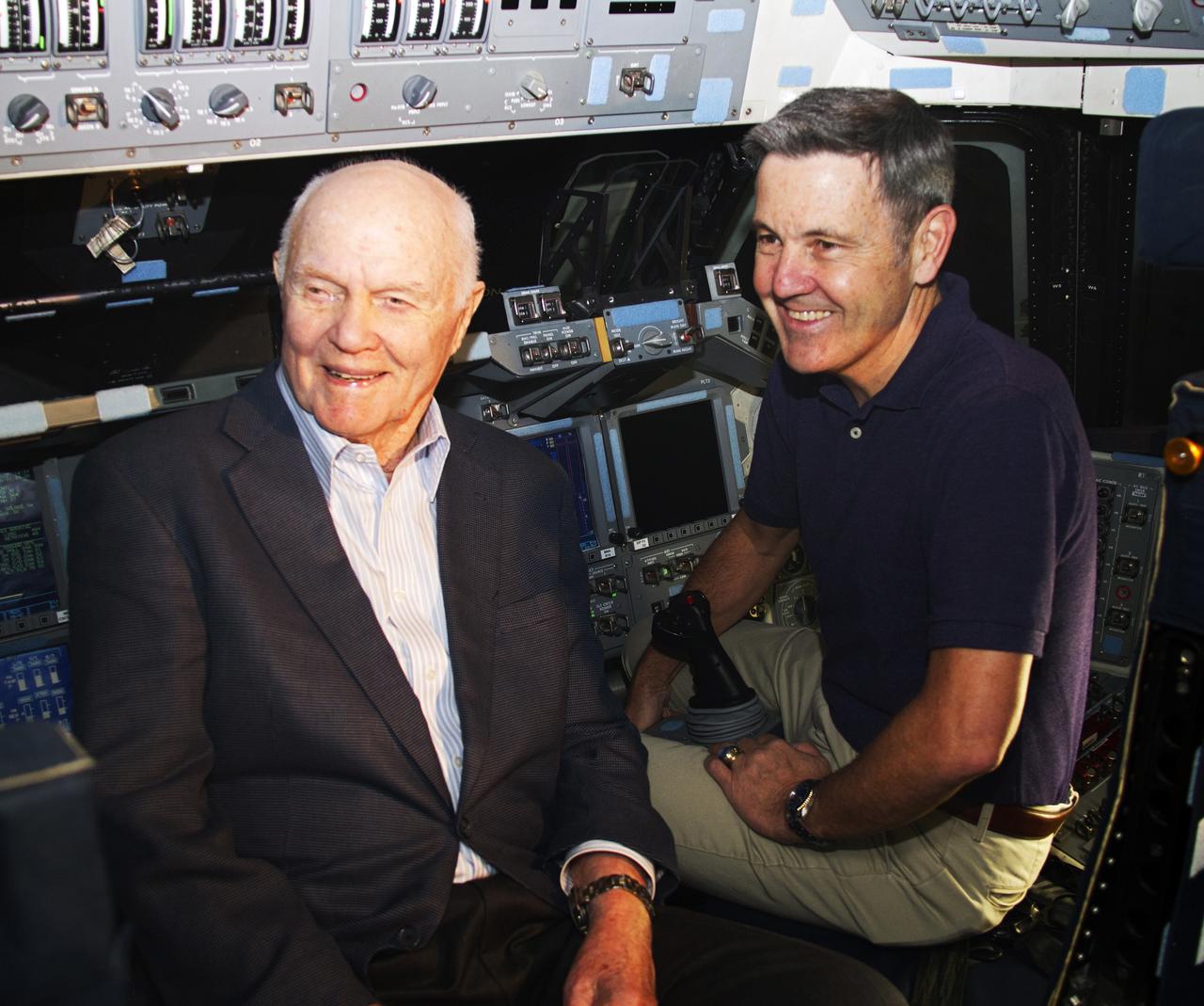
John Glenn and NASA Kennedy Space Center Director Bob Cabana sit in the flight deck of space shuttle Discovery in Bay 1 of the Orbiter Processing Facility at NASA's Kennedy Space Center in Florida. Glenn is at the space center to mark the 50th anniversary of being the first American astronaut to orbit the Earth inside the NASA Mercury Project's Friendship 7 capsule on Feb. 20, 1962. Glenn later returned to space in October 1998 as a payload specialist aboard Discovery's STS-95 mission. Glenn's launch aboard an Atlas rocket took with it the hopes of an entire nation and ushered in a new era of space travel that eventually led to Americans walking on the moon by the end of the 1960s. Glenn soon was followed into orbit by Scott Carpenter, Walter Schirra and Gordon Cooper. Their fellow Mercury astronauts Alan Shepard and Virgil "Gus" Grissom flew earlier suborbital flights. Deke Slayton, a member of NASA's original Mercury 7 astronauts, was grounded by a medical condition until the Apollo-Soyuz Test Project in 1975. Shuttle Discovery currently is being prepared for display at Smithsonian’s National Air and Space Museum, Steven F. Udvar-Hazy Center in Chantilly, Virginia.
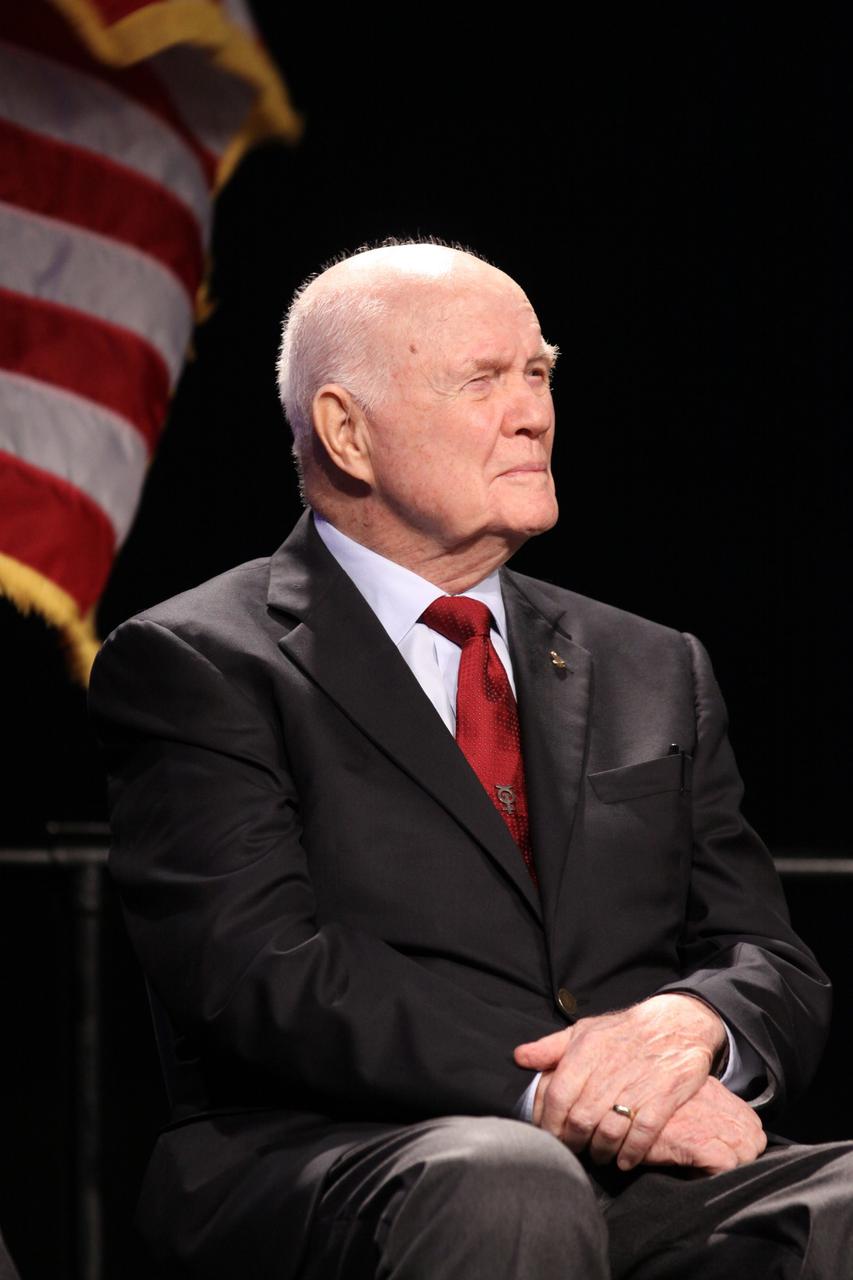
CAPE CANAVERAL, Fla. -- Mercury astronaut John Glenn listens to remarks during the "On Shoulders of Giants" program celebrating 50 years of Americans in orbit, an era which began with Glenn's MA-6 mission on Feb. 20, 1962. The event was conducted in the Rocket Garden at the Kennedy Space Center Visitor Complex in Florida a few miles from the launch pad where Glenn and Scott Carpenter took flight in Mercury spacecraft. Glenn's launch aboard an Atlas rocket took with it the hopes of an entire nation and ushered in a new era of space travel that eventually led to Americans walking on the moon by the end of the 1960s. Glenn soon was followed into orbit by Scott Carpenter, Walter Schirra and Gordon Cooper. Their fellow Mercury astronauts Alan Shepard and Virgil "Gus" Grissom flew earlier suborbital flights. Deke Slayton, a member of NASA's original Mercury 7 astronauts, was grounded by a medical condition until the Apollo-Soyuz Test Project in 1975. Photo credit: Kim Shiflett
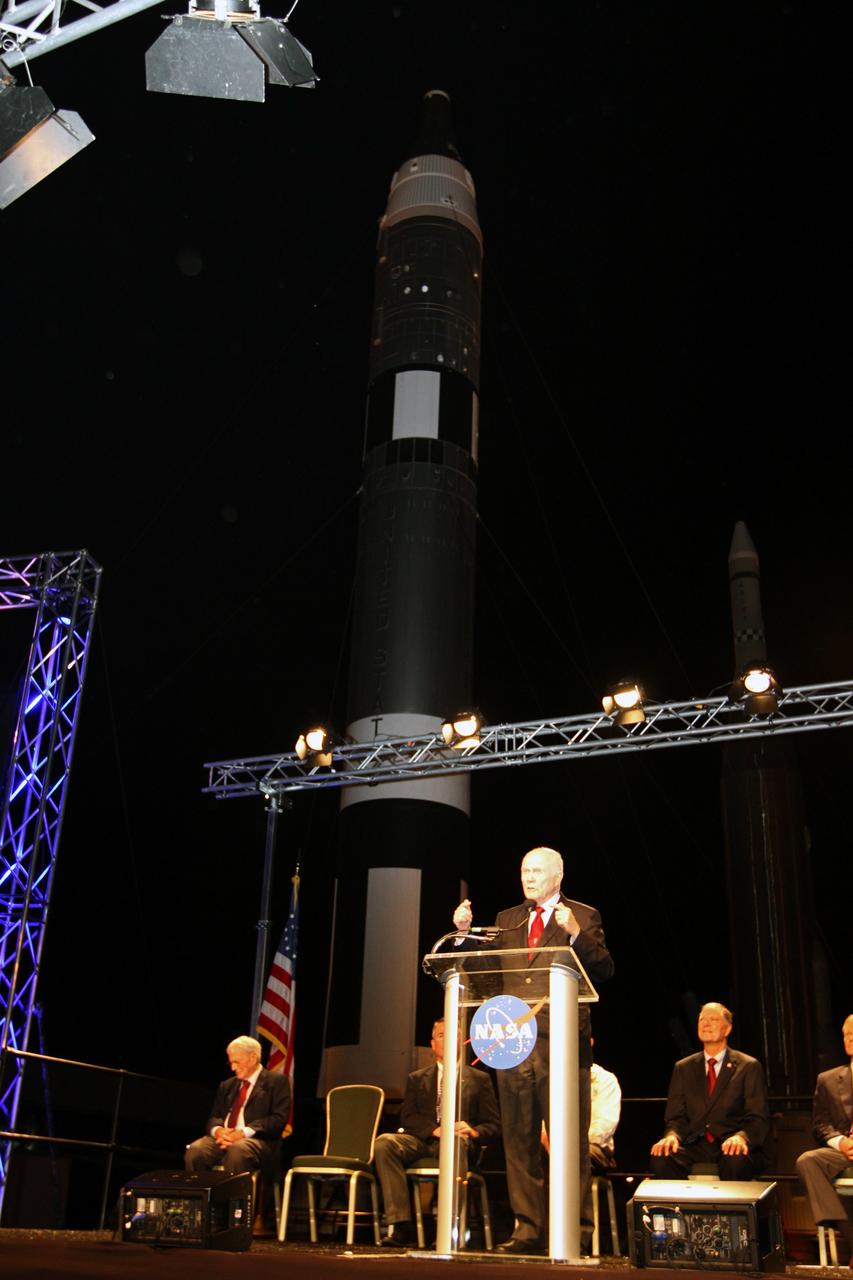
CAPE CANAVERAL, Fla. -- Mercury astronaut John Glenn speaks during the "On Shoulders of Giants" program celebrating 50 years of Americans in orbit, an era which began with Glenn's MA-6 mission on Feb. 20, 1962. The event was conducted in the Rocket Garden at the Kennedy Space Center Visitor Complex in Florida a few miles from the launch pad where Glenn and Scott Carpenter took flight in Mercury spacecraft. Glenn's launch aboard an Atlas rocket took with it the hopes of an entire nation and ushered in a new era of space travel that eventually led to Americans walking on the moon by the end of the 1960s. Glenn soon was followed into orbit by Scott Carpenter, Walter Schirra and Gordon Cooper. Their fellow Mercury astronauts Alan Shepard and Virgil "Gus" Grissom flew earlier suborbital flights. Deke Slayton, a member of NASA's original Mercury 7 astronauts, was grounded by a medical condition until the Apollo-Soyuz Test Project in 1975. Photo credit: Kim Shiflett
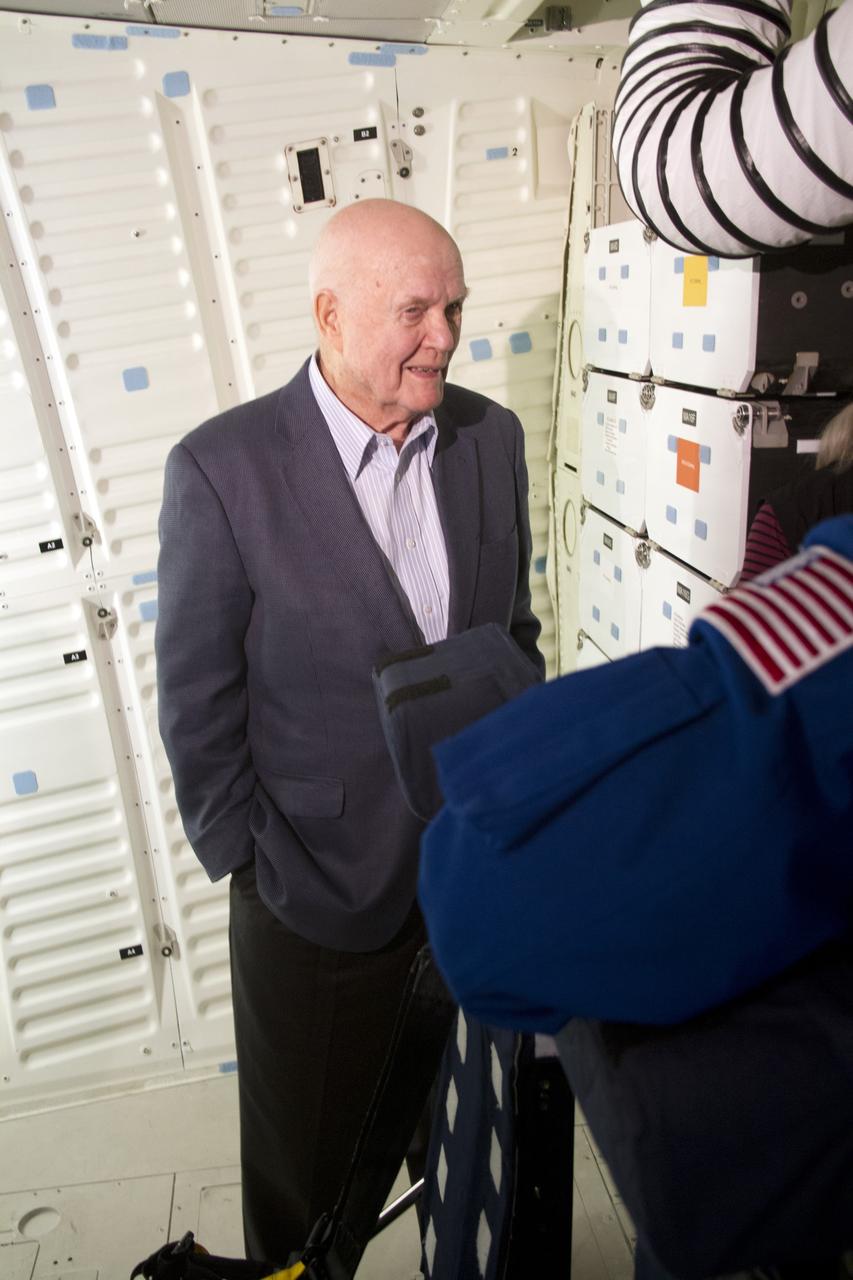
CAPE CANAVERAL, Fla. -- John Glenn stands in the middeck of space shuttle Discovery in Orbiter Processing Facility-1 OPF-1 at NASA's Kennedy Space Center in Florida. Glenn is at the space center to mark the 50th anniversary of being the first American astronaut to orbit the Earth inside the NASA Mercury Project's Friendship 7 capsule on Feb. 20, 1962. Glenn later returned to space in October 1998 as a payload specialist aboard Discovery's STS-95 mission. Glenn's launch aboard an Atlas rocket took with it the hopes of an entire nation and ushered in a new era of space travel that eventually led to Americans walking on the moon by the end of the 1960s. Glenn soon was followed into orbit by Scott Carpenter, Walter Schirra and Gordon Cooper. Their fellow Mercury astronauts Alan Shepard and Virgil "Gus" Grissom flew earlier suborbital flights. Deke Slayton, a member of NASA's original Mercury 7 astronauts, was grounded by a medical condition until the Apollo-Soyuz Test Project in 1975. Shuttle Discovery currently is being prepared for display at Smithsonian’s National Air and Space Museum, Steven F. Udvar-Hazy Center in Chantilly, Va. Photo credit: Cory Huston
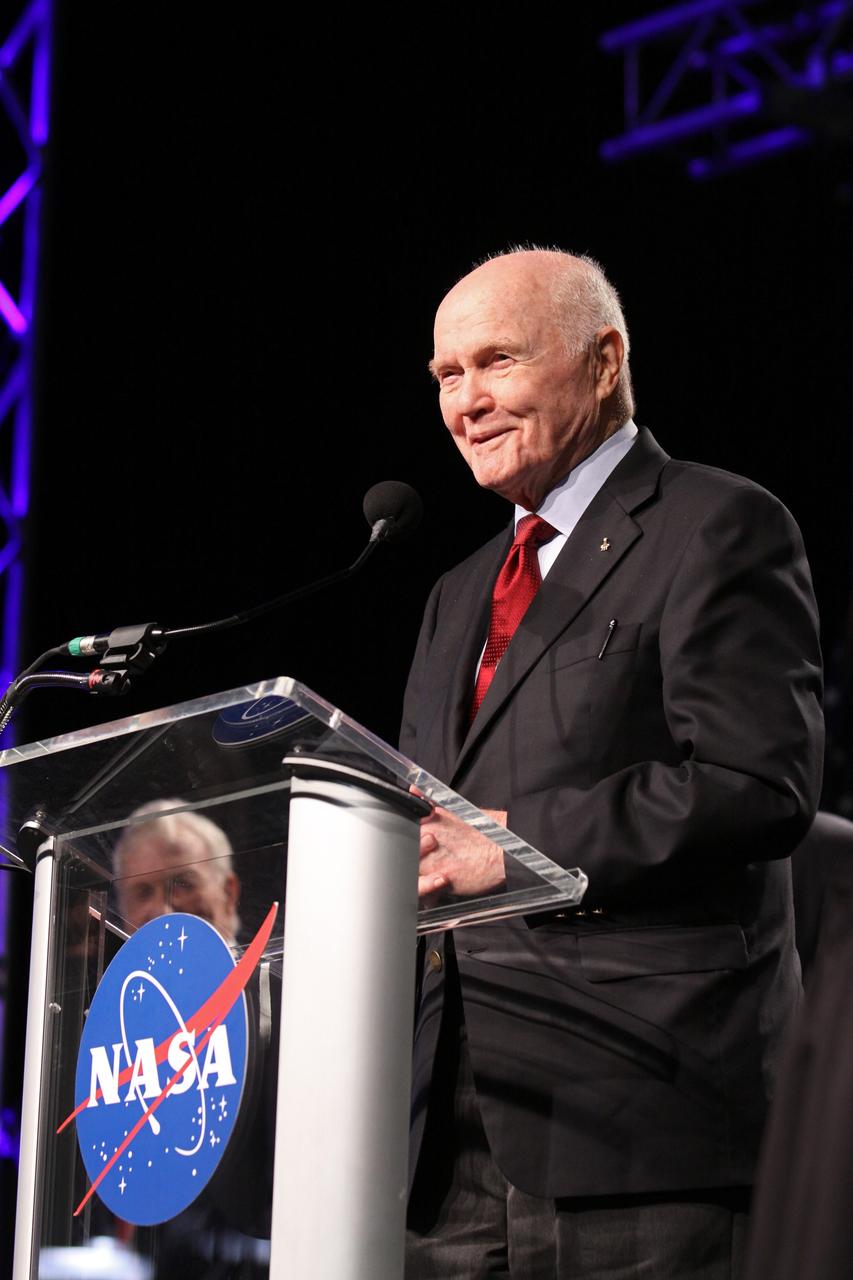
CAPE CANAVERAL, Fla. -- Mercury astronaut John Glenn speaks during the "On Shoulders of Giants" program celebrating 50 years of Americans in orbit, an era which began with Glenn's MA-6 mission on Feb. 20, 1962. The event was conducted in the Rocket Garden at the Kennedy Space Center Visitor Complex in Florida a few miles from the launch pad where Glenn and Scott Carpenter took flight in Mercury spacecraft. Glenn's launch aboard an Atlas rocket took with it the hopes of an entire nation and ushered in a new era of space travel that eventually led to Americans walking on the moon by the end of the 1960s. Glenn soon was followed into orbit by Scott Carpenter, Walter Schirra and Gordon Cooper. Their fellow Mercury astronauts Alan Shepard and Virgil "Gus" Grissom flew earlier suborbital flights. Deke Slayton, a member of NASA's original Mercury 7 astronauts, was grounded by a medical condition until the Apollo-Soyuz Test Project in 1975. Photo credit: Kim Shiflett
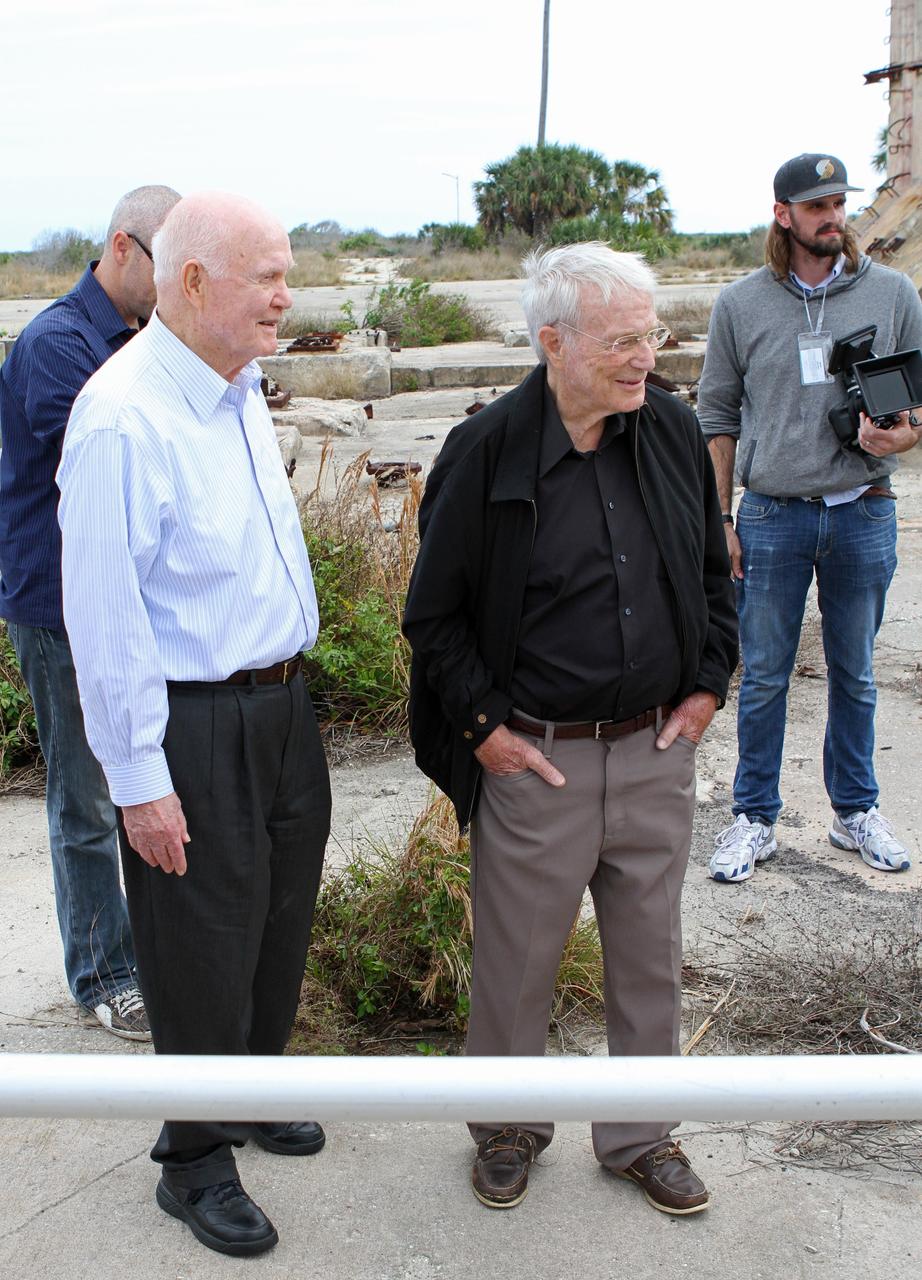
CAPE CANAVERAL, Fla. -- Mercury astronauts John Glenn, second from left and Scott Carpenter look around at the dismantled Complex 14 at Cape Canaveral Air Force Station in Florida. Glenn and Carpenter launched from the pad on Atlas rockets inside Mercury capsules in 1962. The two astronauts, part of the original class of seven astronauts chosen by NASA, were taking part in events celebrating 50 years of Americans in orbit, an era which began with Glenn's Mercury mission MA-6, on Feb. 20, 1962. Glenn's launch aboard an Atlas rocket took with it the hopes of an entire nation and ushered in a new era of space travel that eventually led to Americans walking on the moon by the end of the 1960s. Glenn soon was followed into orbit by Carpenter, Walter Schirra and Gordon Cooper. Their fellow Mercury astronauts Alan Shepard and Virgil "Gus" Grissom flew earlier suborbital flights. Deke Slayton was grounded by a medical condition until the Apollo-Soyuz Test Project in 1975. Photo credit: NASA/ Cory Huston
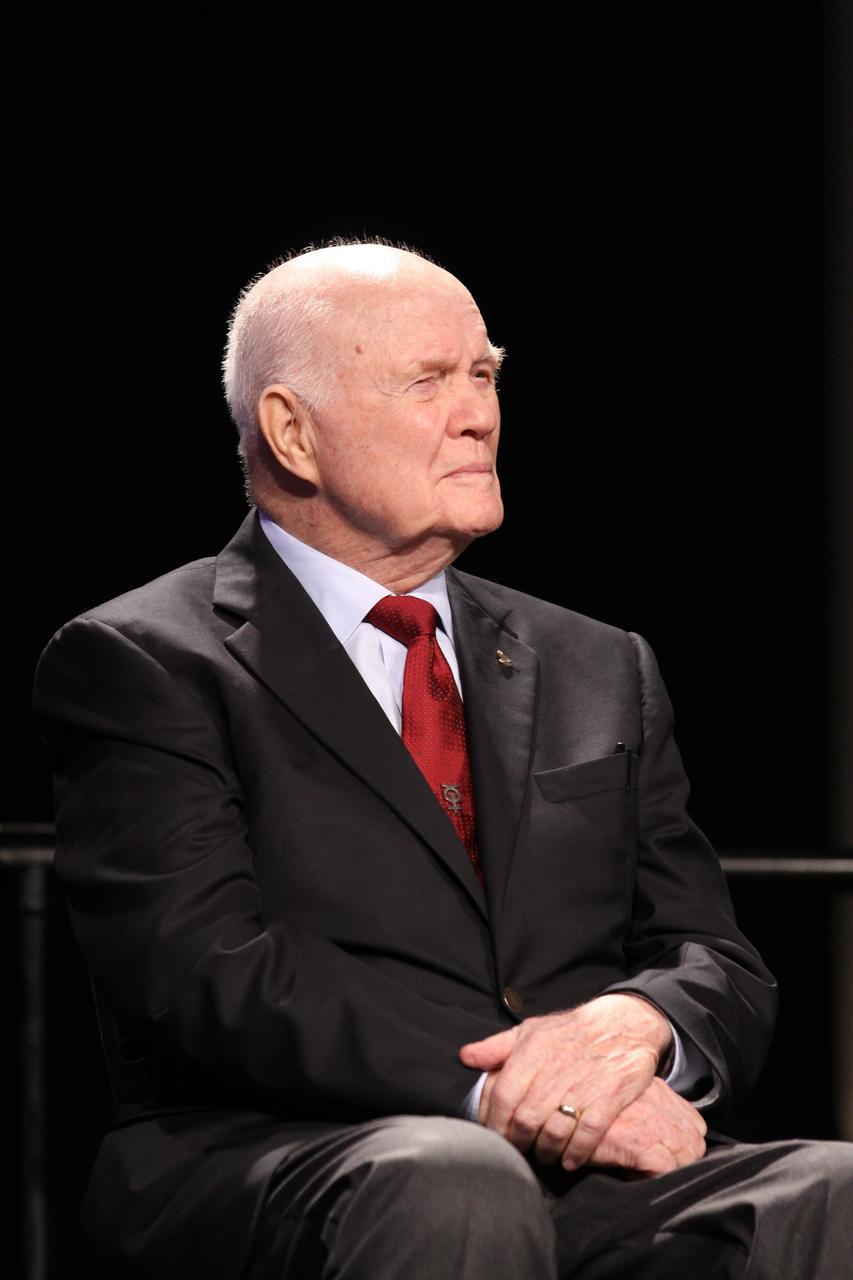
CAPE CANAVERAL, Fla. --Mercury astronaut John Glenn listens to remarks during the "On Shoulders of Giants" program celebrating 50 years of Americans in orbit, an era which began with Glenn's MA-6 mission on Feb. 20, 1962. The event was conducted in the Rocket Garden at the Kennedy Space Center Visitor Complex in Florida a few miles from the launch pad where Glenn and Scott Carpenter took flight in Mercury spacecraft. Glenn's launch aboard an Atlas rocket took with it the hopes of an entire nation and ushered in a new era of space travel that eventually led to Americans walking on the moon by the end of the 1960s. Glenn soon was followed into orbit by Scott Carpenter, Walter Schirra and Gordon Cooper. Their fellow Mercury astronauts Alan Shepard and Virgil "Gus" Grissom flew earlier suborbital flights. Deke Slayton, a member of NASA's original Mercury 7 astronauts, was grounded by a medical condition until the Apollo-Soyuz Test Project in 1975. Photo credit: Kim Shiflett
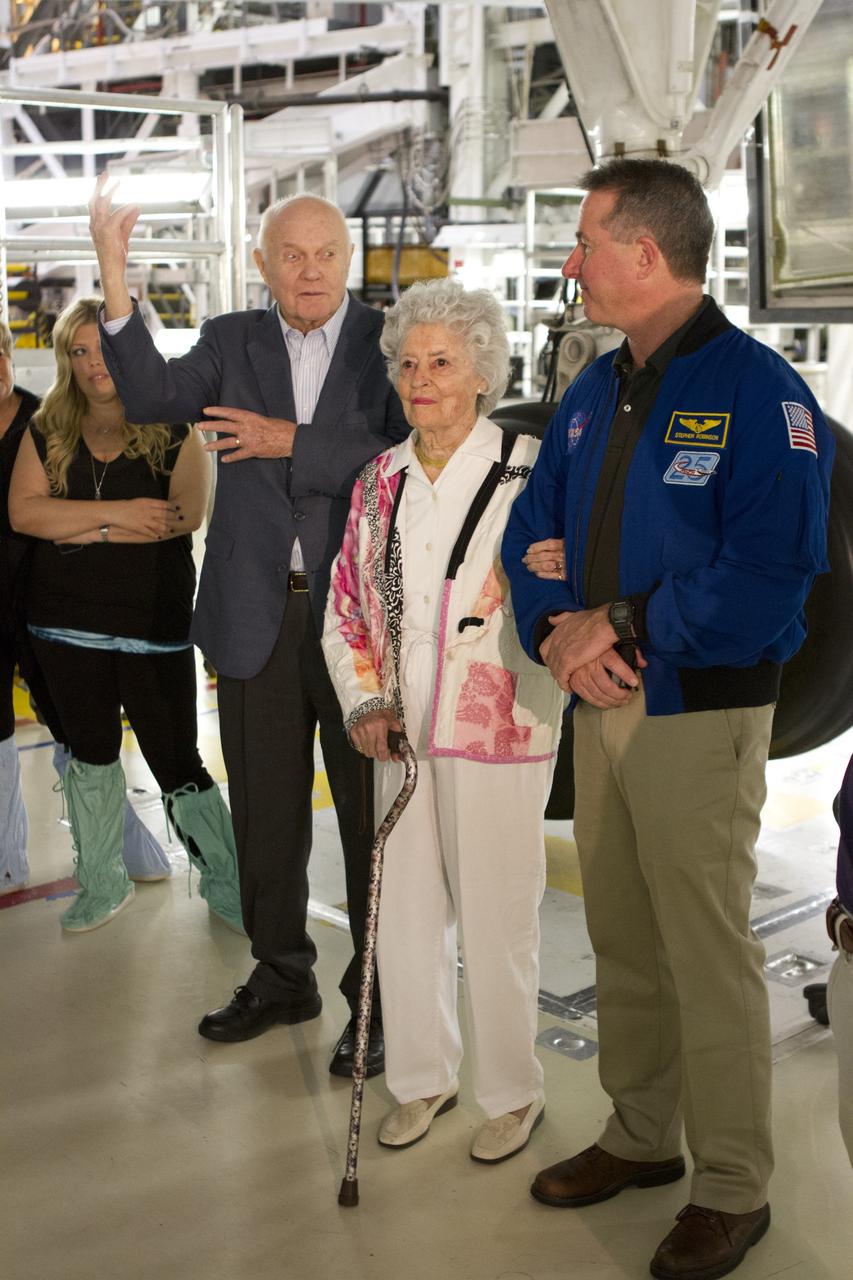
CAPE CANAVERAL, Fla. -- John Glenn and his wife, Annie, and NASA astronaut Stephen Robinson stand under space shuttle Discovery in Orbiter Processing Facility-1 OPF-1 at NASA's Kennedy Space Center in Florida. Glenn is at the space center to mark the 50th anniversary of being the first American astronaut to orbit the Earth inside the NASA Mercury Project's Friendship 7 capsule on Feb. 20, 1962. Glenn later returned to space in October 1998 as a payload specialist aboard Discovery's STS-95 mission. Robinson was the payload commander of STS-95. Glenn's launch aboard an Atlas rocket took with it the hopes of an entire nation and ushered in a new era of space travel that eventually led to Americans walking on the moon by the end of the 1960s. Glenn soon was followed into orbit by Scott Carpenter, Walter Schirra and Gordon Cooper. Their fellow Mercury astronauts Alan Shepard and Virgil "Gus" Grissom flew earlier suborbital flights. Deke Slayton, a member of NASA's original Mercury 7 astronauts, was grounded by a medical condition until the Apollo-Soyuz Test Project in 1975. Shuttle Discovery currently is being prepared for display at Smithsonian’s National Air and Space Museum, Steven F. Udvar-Hazy Center in Chantilly, Va. Photo credit: Cory Huston
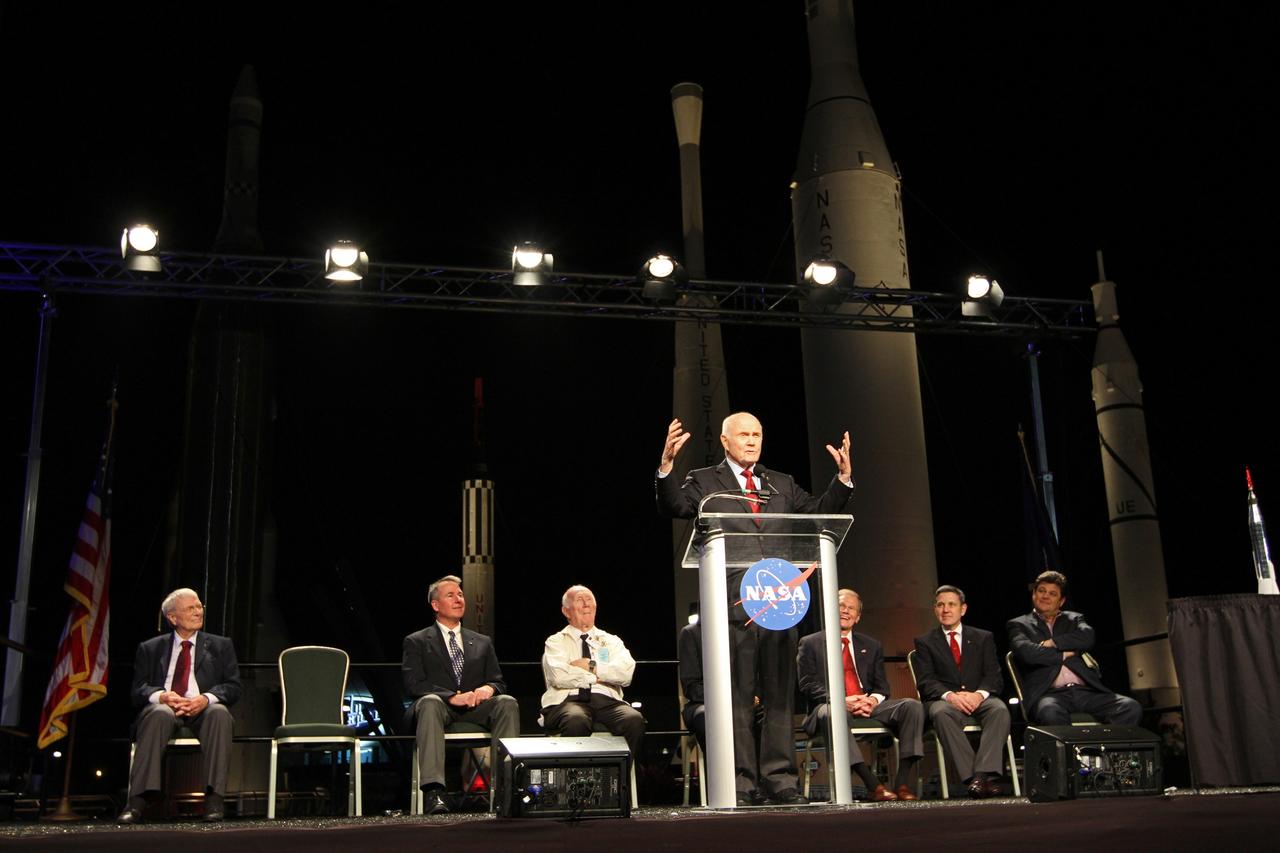
CAPE CANAVERAL, Fla. --Mercury astronaut John Glenn speaks during the "On Shoulders of Giants" program celebrating 50 years of Americans in orbit, an era which began with Glenn's MA-6 mission on Feb. 20, 1962. The event was conducted in the Rocket Garden at the Kennedy Space Center Visitor Complex in Florida a few miles from the launch pad where Glenn and Scott Carpenter took flight in Mercury spacecraft. Glenn's launch aboard an Atlas rocket took with it the hopes of an entire nation and ushered in a new era of space travel that eventually led to Americans walking on the moon by the end of the 1960s. Glenn soon was followed into orbit by Scott Carpenter, Walter Schirra and Gordon Cooper. Their fellow Mercury astronauts Alan Shepard and Virgil "Gus" Grissom flew earlier suborbital flights. Deke Slayton, a member of NASA's original Mercury 7 astronauts, was grounded by a medical condition until the Apollo-Soyuz Test Project in 1975. Photo credit: Kim Shiflett
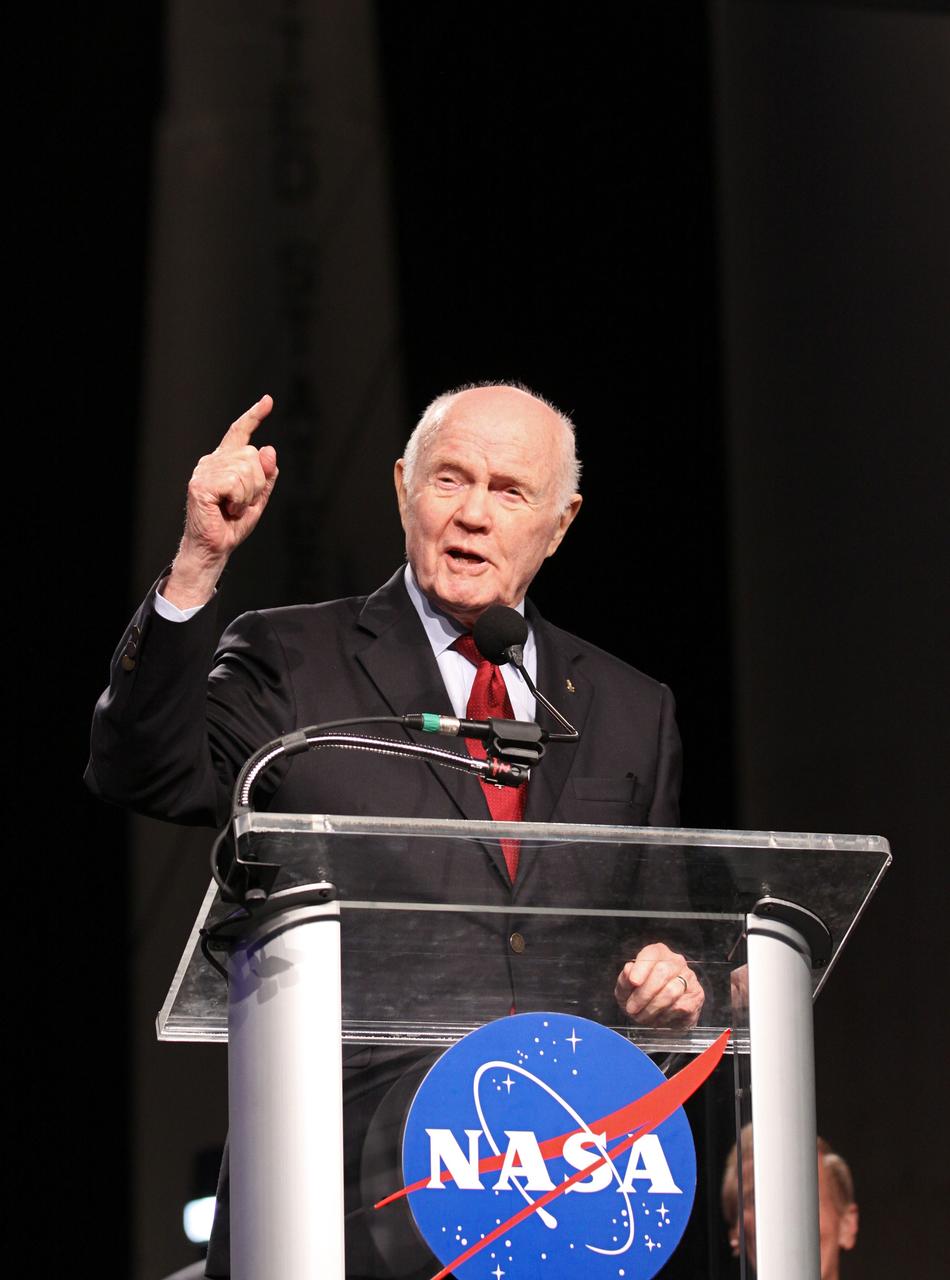
CAPE CANAVERAL, Fla. --Mercury astronaut John Glenn speaks during the "On Shoulders of Giants" program celebrating 50 years of Americans in orbit, an era which began with Glenn's MA-6 mission on Feb. 20, 1962. The event was conducted in the Rocket Garden at the Kennedy Space Center Visitor Complex in Florida a few miles from the launch pad where Glenn and Scott Carpenter took flight in Mercury spacecraft. Glenn's launch aboard an Atlas rocket took with it the hopes of an entire nation and ushered in a new era of space travel that eventually led to Americans walking on the moon by the end of the 1960s. Glenn soon was followed into orbit by Scott Carpenter, Walter Schirra and Gordon Cooper. Their fellow Mercury astronauts Alan Shepard and Virgil "Gus" Grissom flew earlier suborbital flights. Deke Slayton, a member of NASA's original Mercury 7 astronauts, was grounded by a medical condition until the Apollo-Soyuz Test Project in 1975. Photo credit: Cory Huston
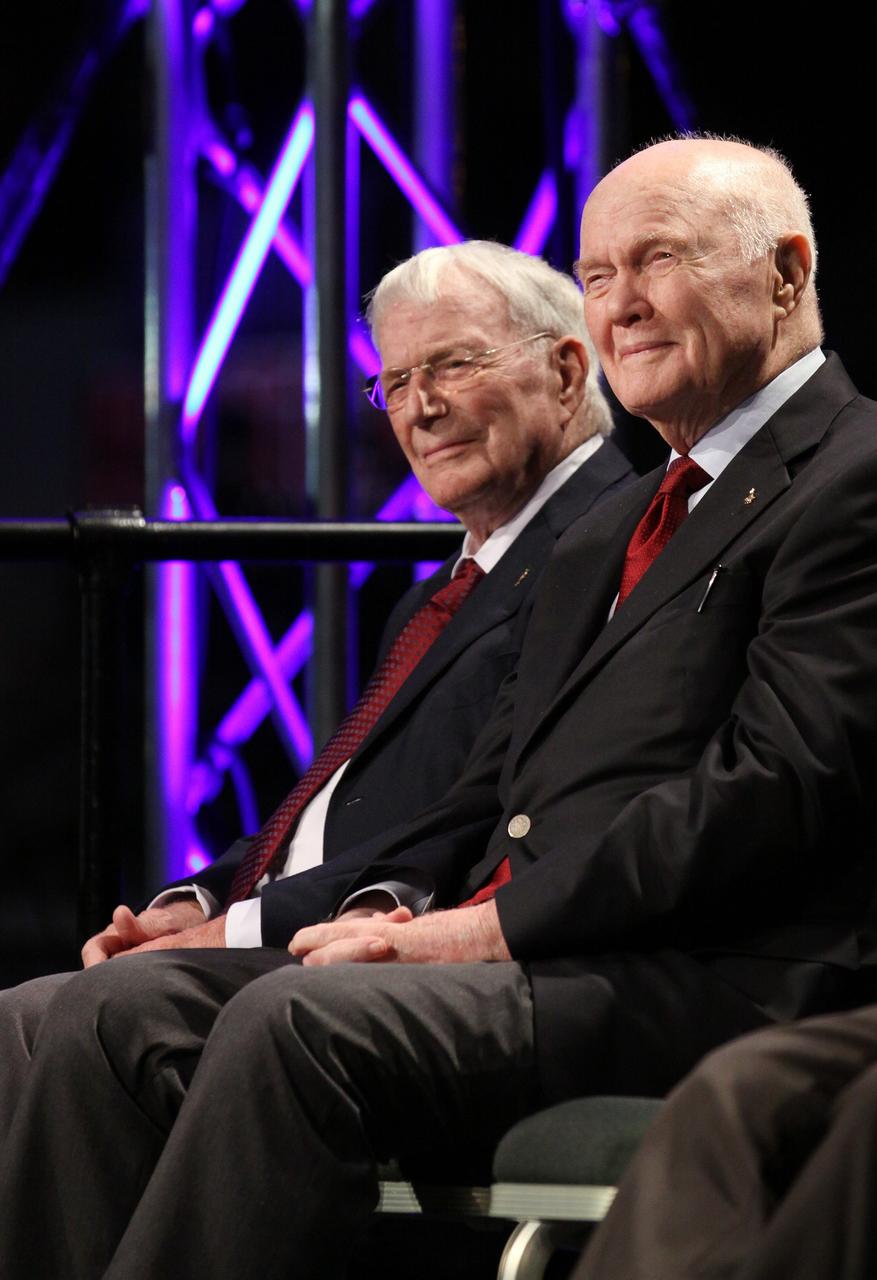
CAPE CANAVERAL, Fla. -- Mercury astronauts Scott Carpenter, left, and John Glenn listen to remarks during the "On Shoulders of Giants" program celebrating 50 years of Americans in orbit, an era which began with Glenn's MA-6 mission on Feb. 20, 1962. The event was conducted in the Rocket Garden at the Kennedy Space Center Visitor Complex in Florida a few miles from the launch pad where Glenn and Carpenter took flight in Mercury spacecraft. Glenn's launch aboard an Atlas rocket took with it the hopes of an entire nation and ushered in a new era of space travel that eventually led to Americans walking on the moon by the end of the 1960s. Glenn soon was followed into orbit by Carpenter, Walter Schirra and Gordon Cooper. Their fellow Mercury astronauts Alan Shepard and Virgil "Gus" Grissom flew earlier suborbital flights. Deke Slayton, a member of NASA's original Mercury 7 astronauts, was grounded by a medical condition until the Apollo-Soyuz Test Project in 1975. Photo credit: Kim Shiflett
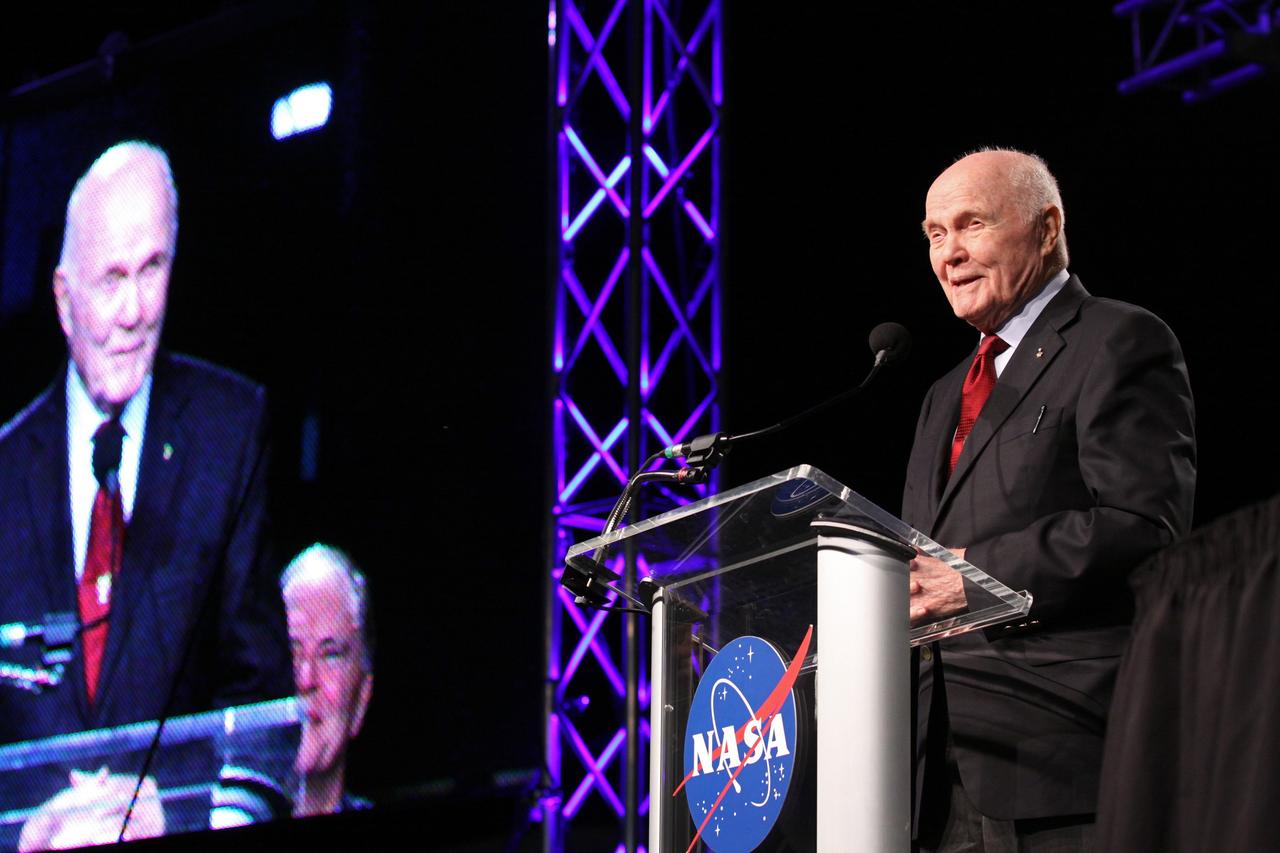
CAPE CANAVERAL, Fla. -- Mercury astronaut John Glenn speaks during the "On Shoulders of Giants" program celebrating 50 years of Americans in orbit, an era which began with Glenn's MA-6 mission on Feb. 20, 1962. The event was conducted in the Rocket Garden at the Kennedy Space Center Visitor Complex in Florida a few miles from the launch pad where Glenn and Scott Carpenter took flight in Mercury spacecraft. Glenn's launch aboard an Atlas rocket took with it the hopes of an entire nation and ushered in a new era of space travel that eventually led to Americans walking on the moon by the end of the 1960s. Glenn soon was followed into orbit by Scott Carpenter, Walter Schirra and Gordon Cooper. Their fellow Mercury astronauts Alan Shepard and Virgil "Gus" Grissom flew earlier suborbital flights. Deke Slayton, a member of NASA's original Mercury 7 astronauts, was grounded by a medical condition until the Apollo-Soyuz Test Project in 1975. Photo credit: Kim Shiflett
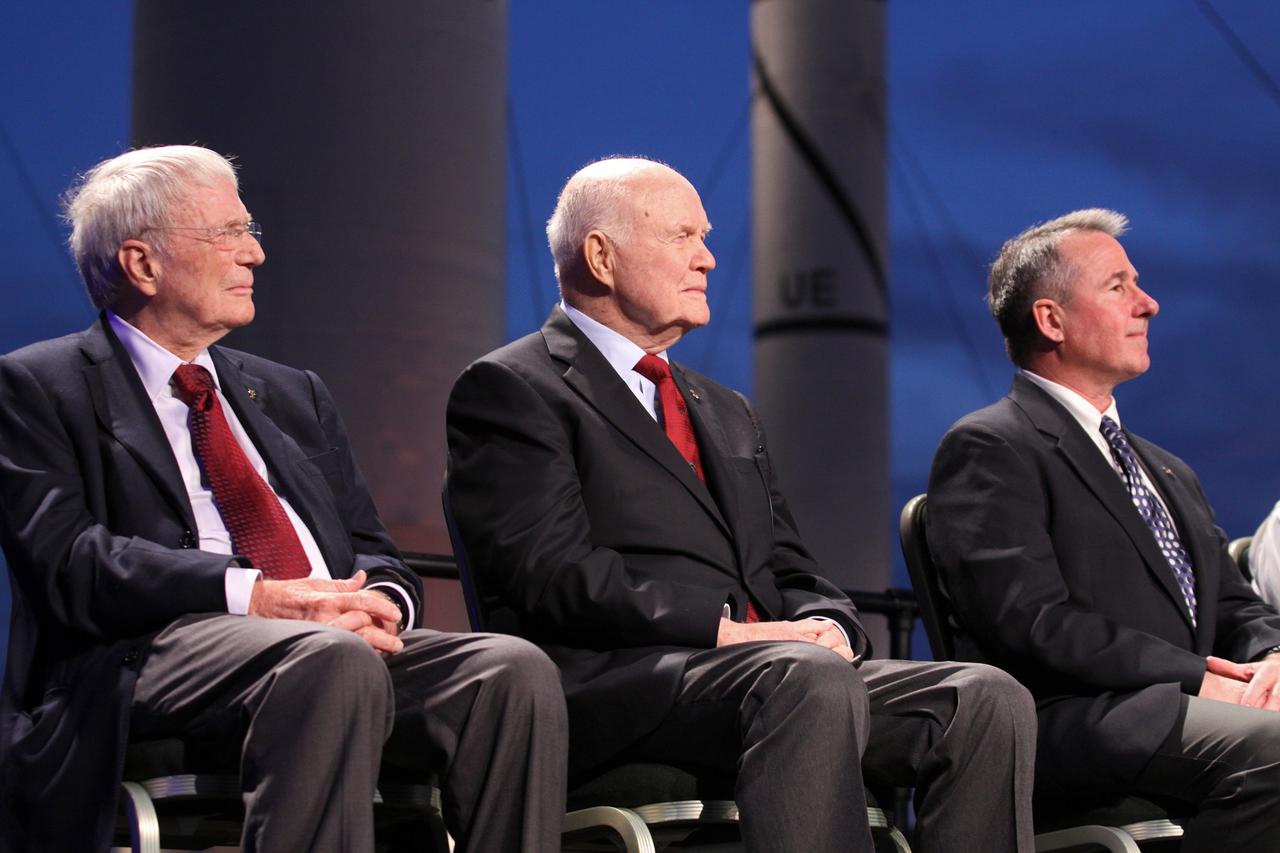
CAPE CANAVERAL, Fla. -- Mercury astronauts Scott Carpenter, left, and John Glenn and astronaut Steve Robinson of STS-95 listen to remarks during the "On Shoulders of Giants" program celebrating 50 years of Americans in orbit, an era which began with Glenn's MA-6 mission on Feb. 20, 1962. The event was conducted in the Rocket Garden at the Kennedy Space Center Visitor Complex in Florida a few miles from the launch pad where Glenn and Carpenter took flight in Mercury spacecraft. Glenn's launch aboard an Atlas rocket took with it the hopes of an entire nation and ushered in a new era of space travel that eventually led to Americans walking on the moon by the end of the 1960s. Glenn soon was followed into orbit by Carpenter, Walter Schirra and Gordon Cooper. Their fellow Mercury astronauts Alan Shepard and Virgil "Gus" Grissom flew earlier suborbital flights. Deke Slayton, a member of NASA's original Mercury 7 astronauts, was grounded by a medical condition until the Apollo-Soyuz Test Project in 1975. Photo credit: Kim Shiflett
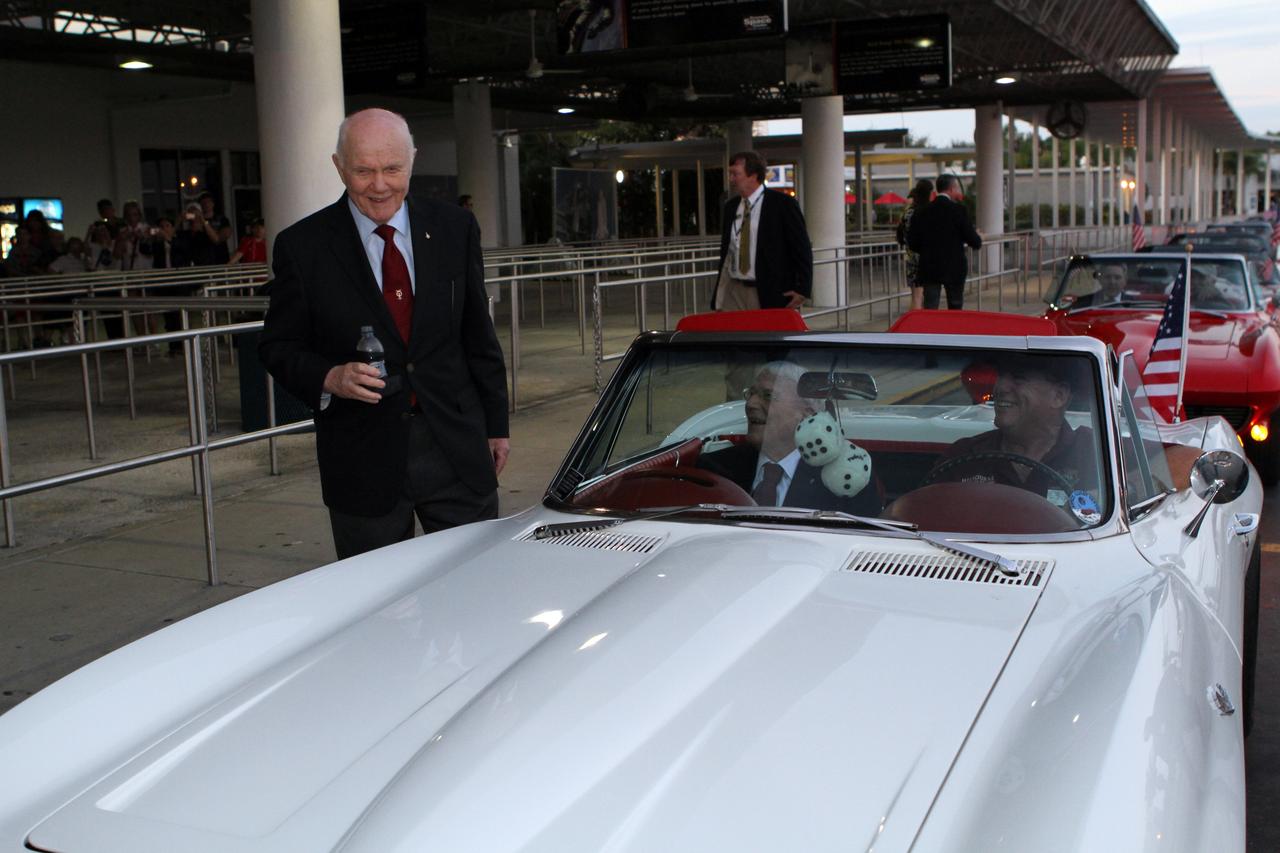
CAPE CANAVERAL, Fla. -- Mercury astronaut John Glenn, left, talks with fellow Mercury astronaut Scott Carpenter before they ride in the Corvette parade following the "On Shoulders of Giants" program celebrating 50 years of Americans in orbit, an era which began with Glenn's MA-6 mission on Feb. 20, 1962. The event was conducted in the Rocket Garden at the Kennedy Space Center Visitor Complex in Florida a few miles from the launch pad where Glenn and Carpenter took flight in Mercury spacecraft. Glenn's launch aboard an Atlas rocket took with it the hopes of an entire nation and ushered in a new era of space travel that eventually led to Americans walking on the moon by the end of the 1960s. Glenn soon was followed into orbit by Scott Carpenter, Walter Schirra and Gordon Cooper. Their fellow Mercury astronauts Alan Shepard and Virgil "Gus" Grissom flew earlier suborbital flights. Deke Slayton, a member of NASA's original Mercury 7 astronauts, was grounded by a medical condition until the Apollo-Soyuz Test Project in 1975. Photo credit: Kim Shiflett
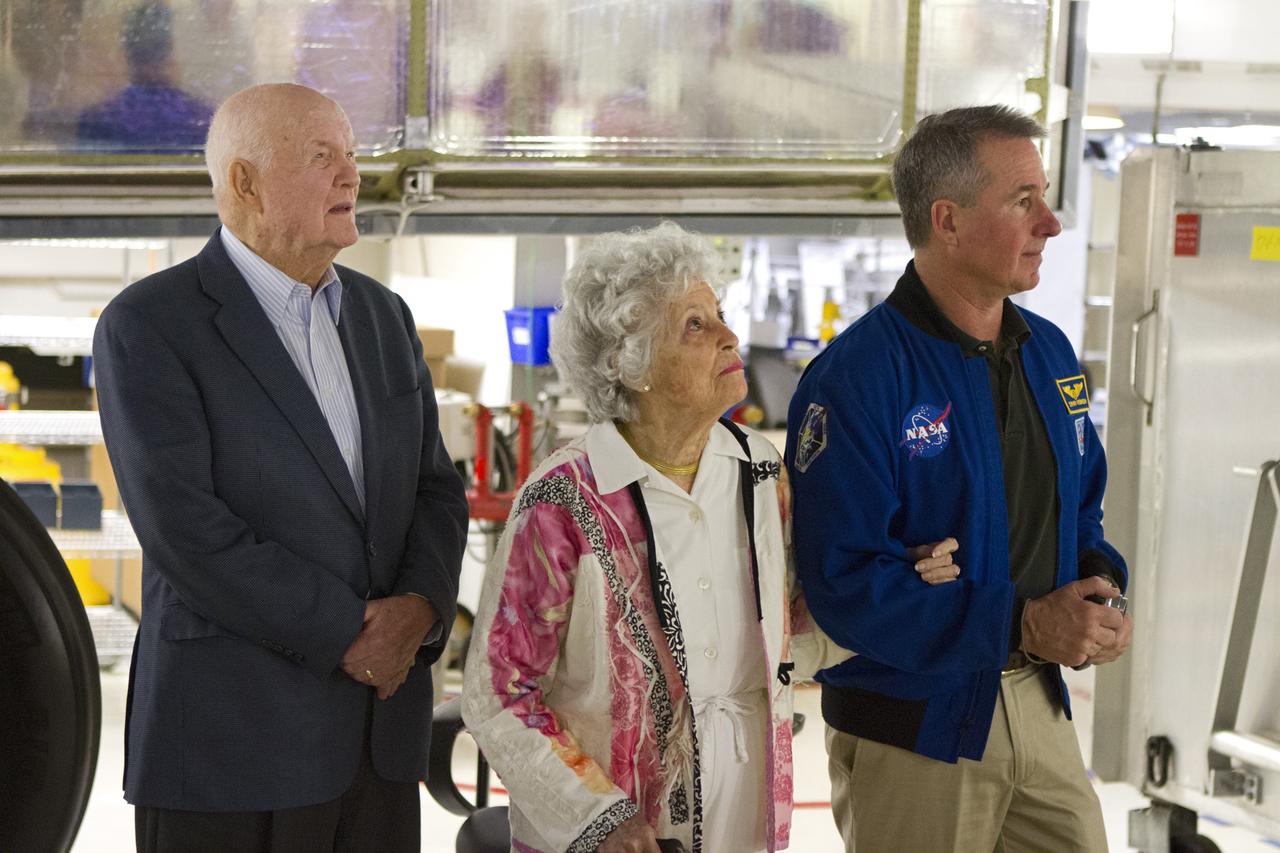
CAPE CANAVERAL, Fla. -- John Glenn and his wife, Annie, and NASA astronaut Stephen Robinson stand under space shuttle Discovery in Orbiter Processing Facility-1 OPF-1 at NASA's Kennedy Space Center in Florida. Glenn is at the space center to mark the 50th anniversary of being the first American astronaut to orbit the Earth inside the NASA Mercury Project's Friendship 7 capsule on Feb. 20, 1962. Glenn later returned to space in October 1998 as a payload specialist aboard Discovery's STS-95 mission. Robinson was the payload commander of STS-95. Glenn's launch aboard an Atlas rocket took with it the hopes of an entire nation and ushered in a new era of space travel that eventually led to Americans walking on the moon by the end of the 1960s. Glenn soon was followed into orbit by Scott Carpenter, Walter Schirra and Gordon Cooper. Their fellow Mercury astronauts Alan Shepard and Virgil "Gus" Grissom flew earlier suborbital flights. Deke Slayton, a member of NASA's original Mercury 7 astronauts, was grounded by a medical condition until the Apollo-Soyuz Test Project in 1975. Shuttle Discovery currently is being prepared for display at Smithsonian’s National Air and Space Museum, Steven F. Udvar-Hazy Center in Chantilly, Va. Photo credit: Cory Huston
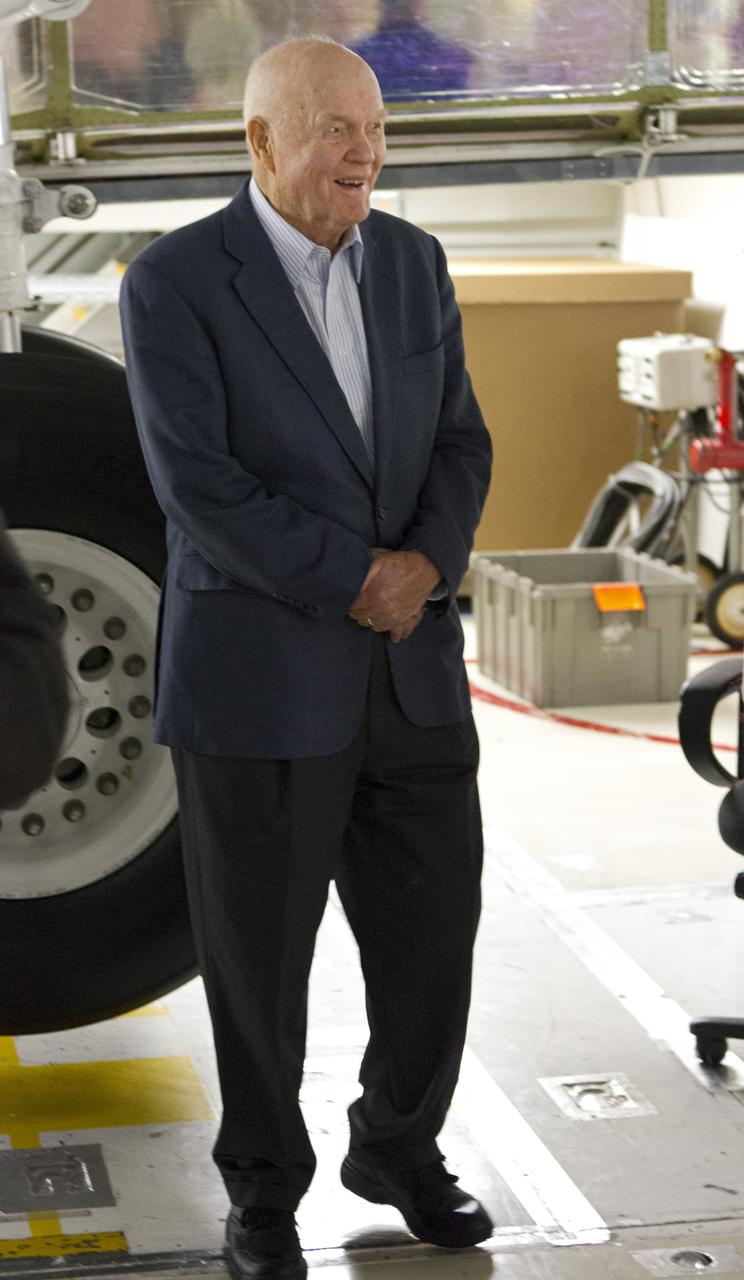
CAPE CANAVERAL, Fla. -- John Glenn stands beside the wheel of space shuttle Discovery in Orbiter Processing Facility-1 OPF-1 at NASA's Kennedy Space Center in Florida. Glenn is at the space center to mark the 50th anniversary of being the first American astronaut to orbit the Earth inside the NASA Mercury Project's Friendship 7 capsule on Feb. 20, 1962. Glenn later returned to space in October 1998 as a payload specialist aboard Discovery's STS-95 mission. Glenn's launch aboard an Atlas rocket took with it the hopes of an entire nation and ushered in a new era of space travel that eventually led to Americans walking on the moon by the end of the 1960s. Glenn soon was followed into orbit by Scott Carpenter, Walter Schirra and Gordon Cooper. Their fellow Mercury astronauts Alan Shepard and Virgil "Gus" Grissom flew earlier suborbital flights. Deke Slayton, a member of NASA's original Mercury 7 astronauts, was grounded by a medical condition until the Apollo-Soyuz Test Project in 1975. Shuttle Discovery currently is being prepared for display at Smithsonian’s National Air and Space Museum, Steven F. Udvar-Hazy Center in Chantilly, Va. Photo credit: Cory Huston
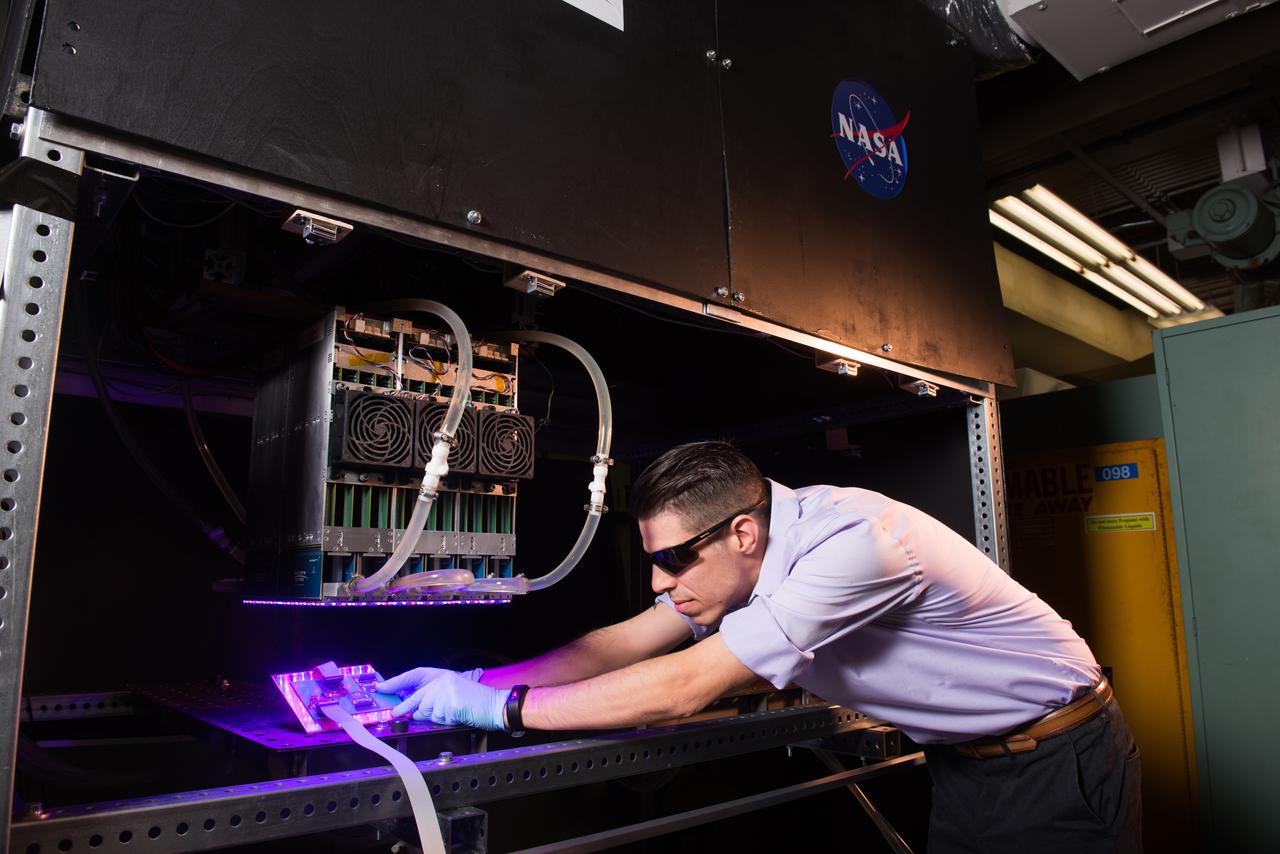
NASA Glenn researcher Tim Peshek shows off a new type of ultrathin solar cell, known as a ‘perovskite’ because of its structure. These solar cells show promise for space applications because of their high efficiency and radiation tolerance and open the door to extremely low cost and large solar arrays for spacecraft or lunar surface habitats.
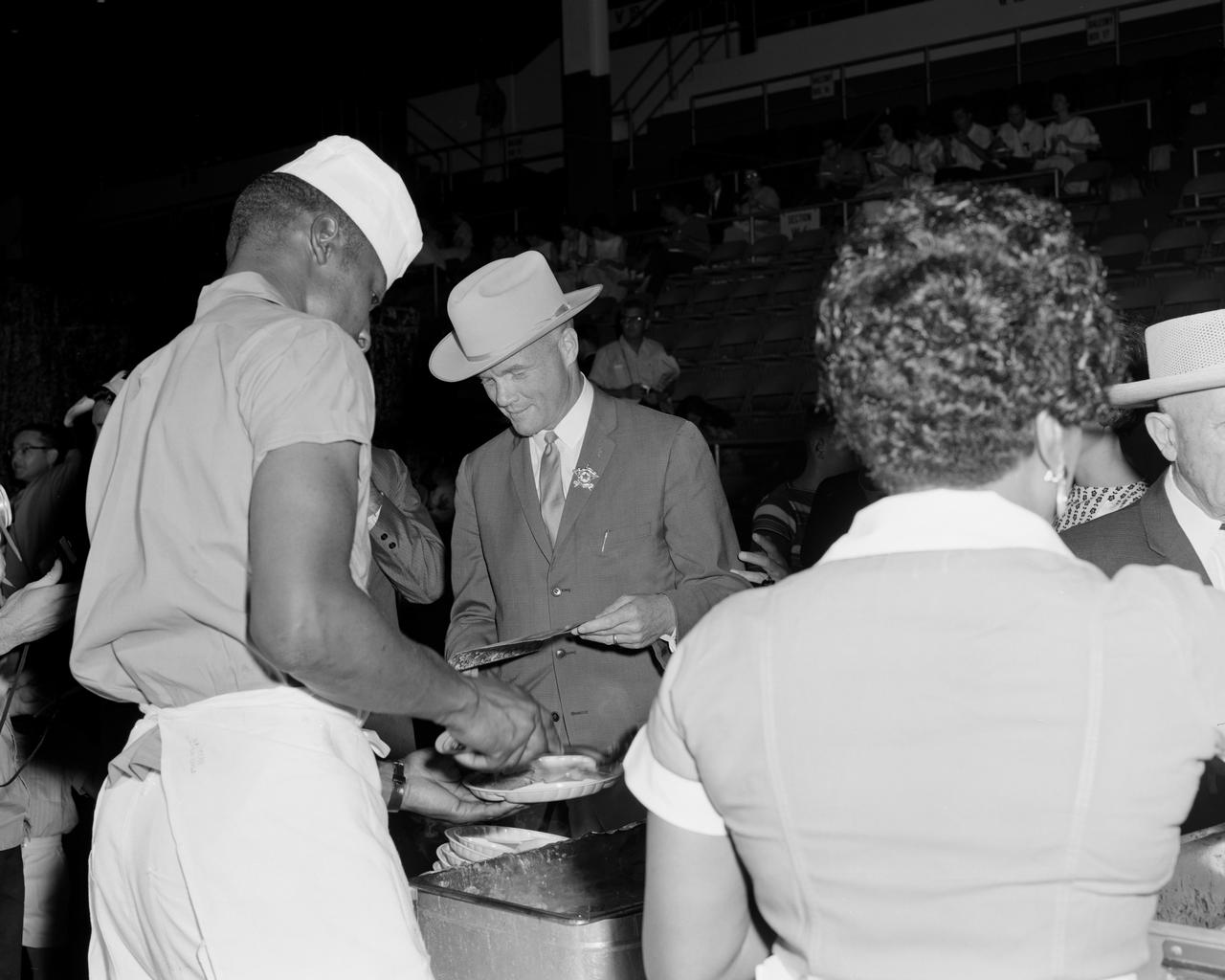
S62-03725 (4 July 1962) --- Mercury astronaut John H. Glenn Jr., wearing a new cowboy hat and a badge in the shape of a star, leafs through his program as he is served his food at the Sam Houston Coliseum. A large crowd was on hand to welcome the Mercury astronauts to Houston, Texas. Photo credit: NASA
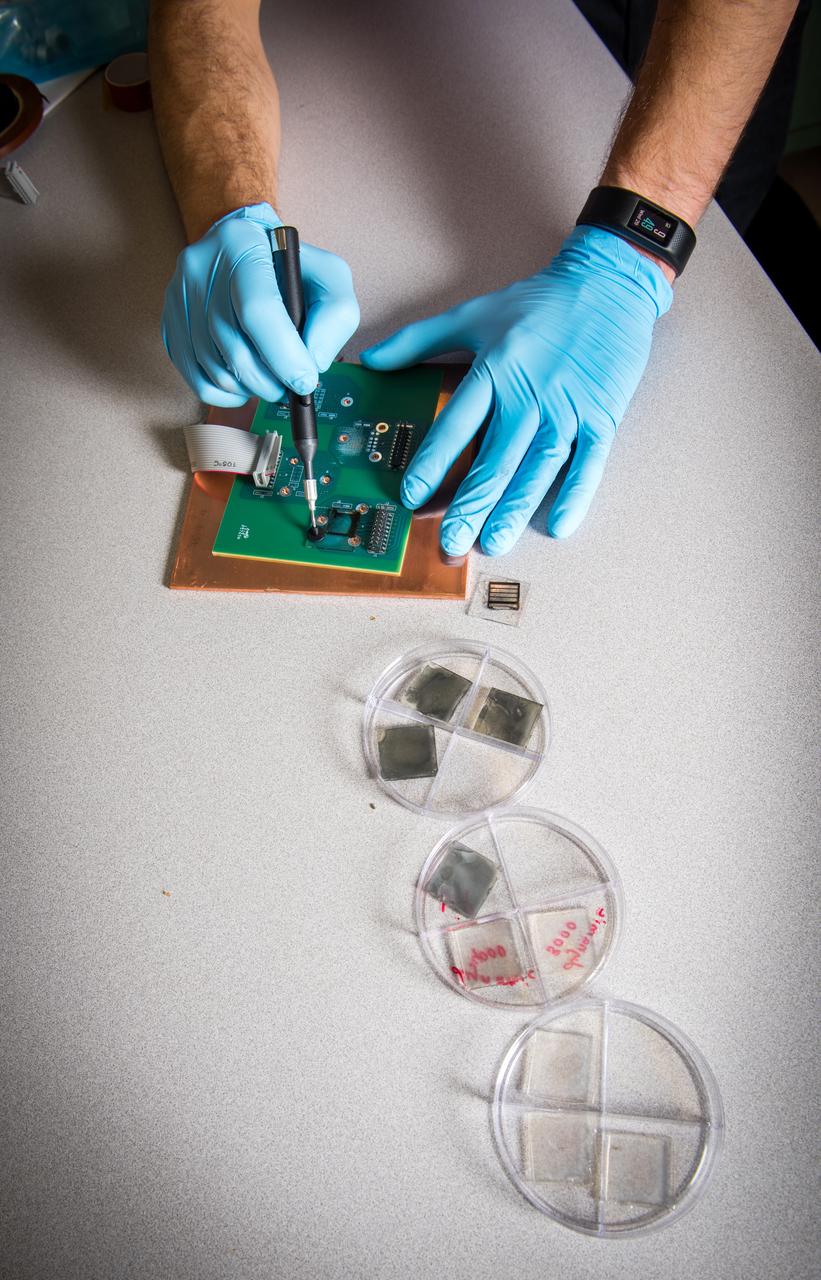
NASA Glenn researcher Tim Peshek shows off a new type of ultrathin solar cell, known as a ‘perovskite’ because of its structure. These solar cells show promise for space applications because of their high efficiency and radiation tolerance and open the door to extremely low cost and large solar arrays for spacecraft or lunar surface habitats.
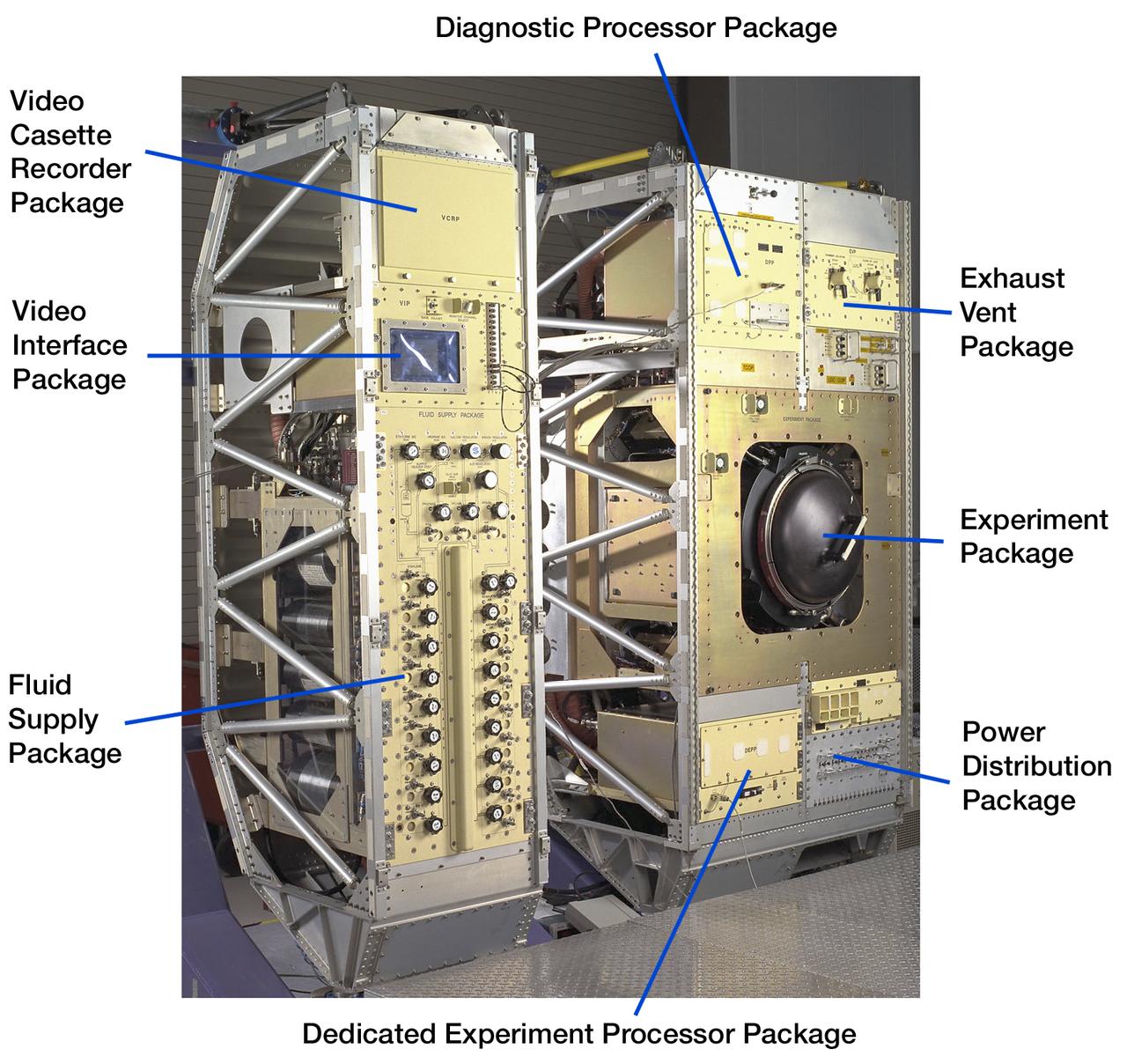
Exterior view of Combustion Module-2 with callouts to identify key sections. The original CM flew on the Microgravity Sciences Lab-1 and 1R in 1997. It has been refurbished and placed in new racks for flight on the STS-107 Research 1 mission in 2001. Glenn Research in Cleveland, OH, manages the project.
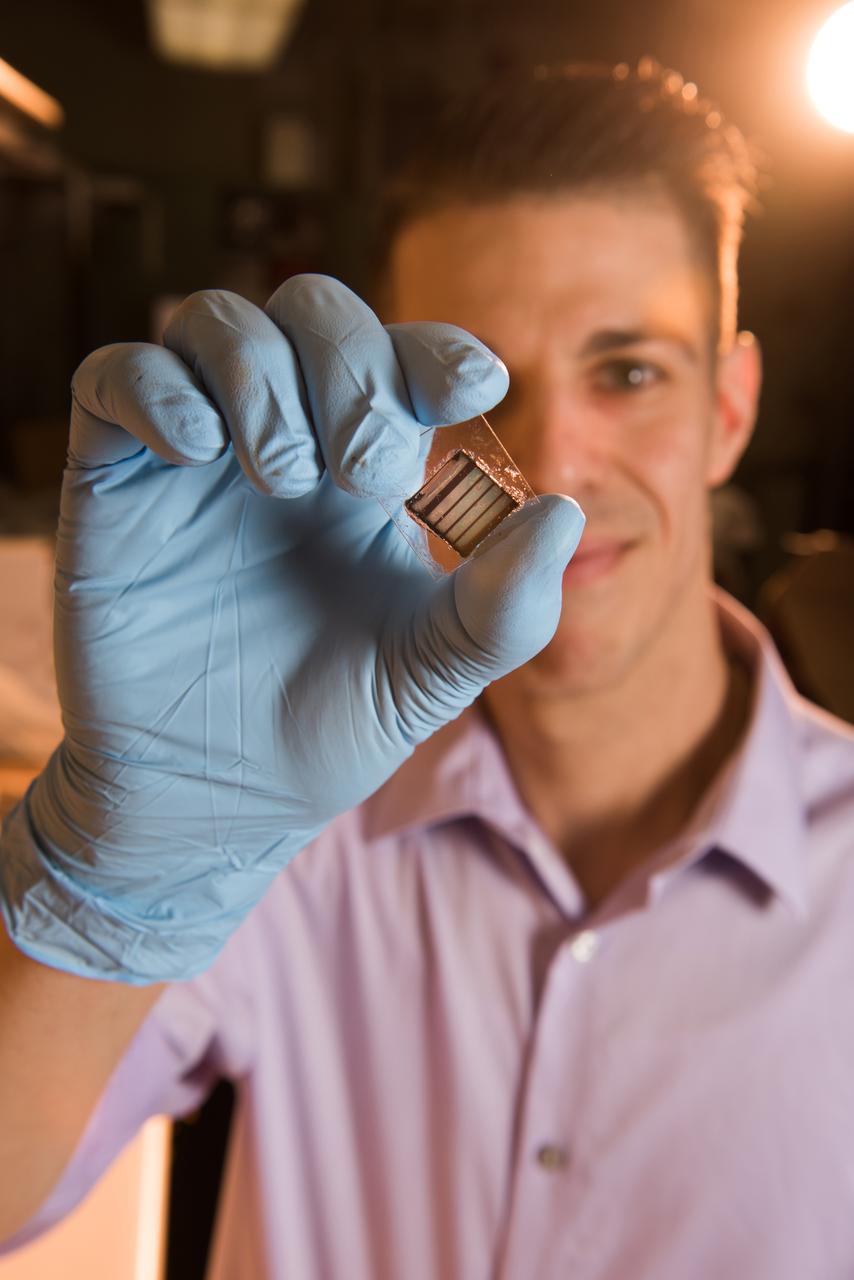
NASA Glenn researcher Tim Peshek shows off a new type of ultrathin solar cell, known as a ‘perovskite’ because of its structure. These solar cells show promise for space applications because of their high efficiency and radiation tolerance and open the door to extremely low cost and large solar arrays for spacecraft or lunar surface habitats.
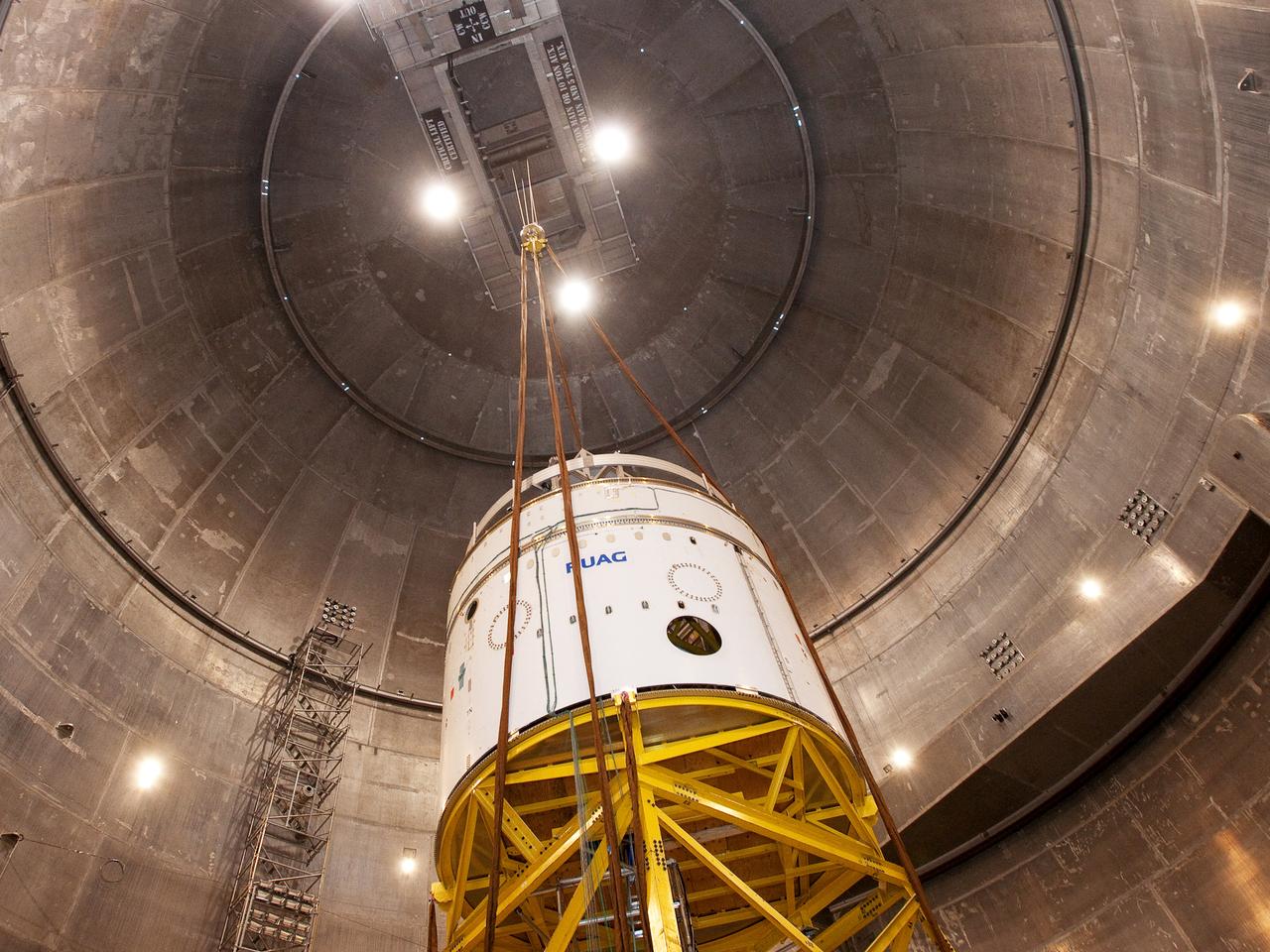
NASA Glenn conducted a test on the Ariane 5 Payload Fairing at Plum Brook’s Space Power Facility (SPF). The test was to qualify a new horizontal pyrotechnic separation system, which blew the two fairing halves apart and away from the payload during flight.

NASA Administrator Jared Isaacman is seen during a helicopter flight, Friday, May 29, 2026, at Cape Canaveral Space Force Station in Florida. The flight surveyed Launch Complex 36 following a New Glenn hotfire test anomaly on May 28. Photo Credit: (NASA/John Kraus)
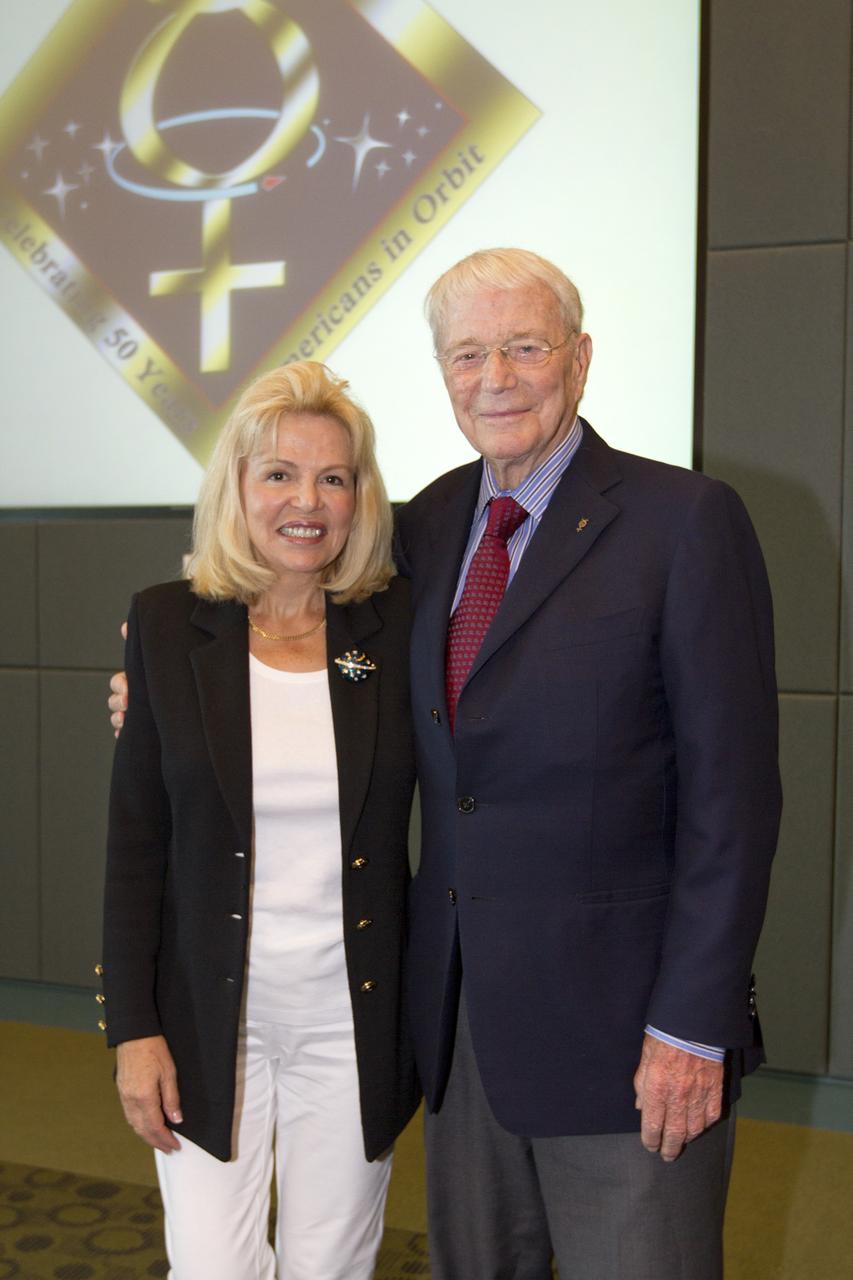
CAPE CANAVERAL, Fla. - Mercury astronaut Scott Carpenter and his wife, Patricia, pose during a luncheon Feb. 17, 2012, celebrating 50 years of Americans in orbit, an era which began with John Glenn's Mercury mission MA-6, on Feb. 20, 1962. Glenn's launch aboard an Atlas rocket took with it the hopes of an entire nation and ushered in a new era of space travel that eventually led to Americans walking on the moon by the end of the 1960s. Glenn soon was followed into orbit by Carpenter, Walter Schirra and Gordon Cooper. Their fellow Mercury astronauts Alan Shepard and Virgil "Gus" Grissom flew earlier suborbital flights. Deke Slayton, a member of NASA's original Mercury 7 astronauts, was grounded by a medical condition until the Apollo-Soyuz Test Project in 1975. Photo credit: NASA/Kim Shiflett
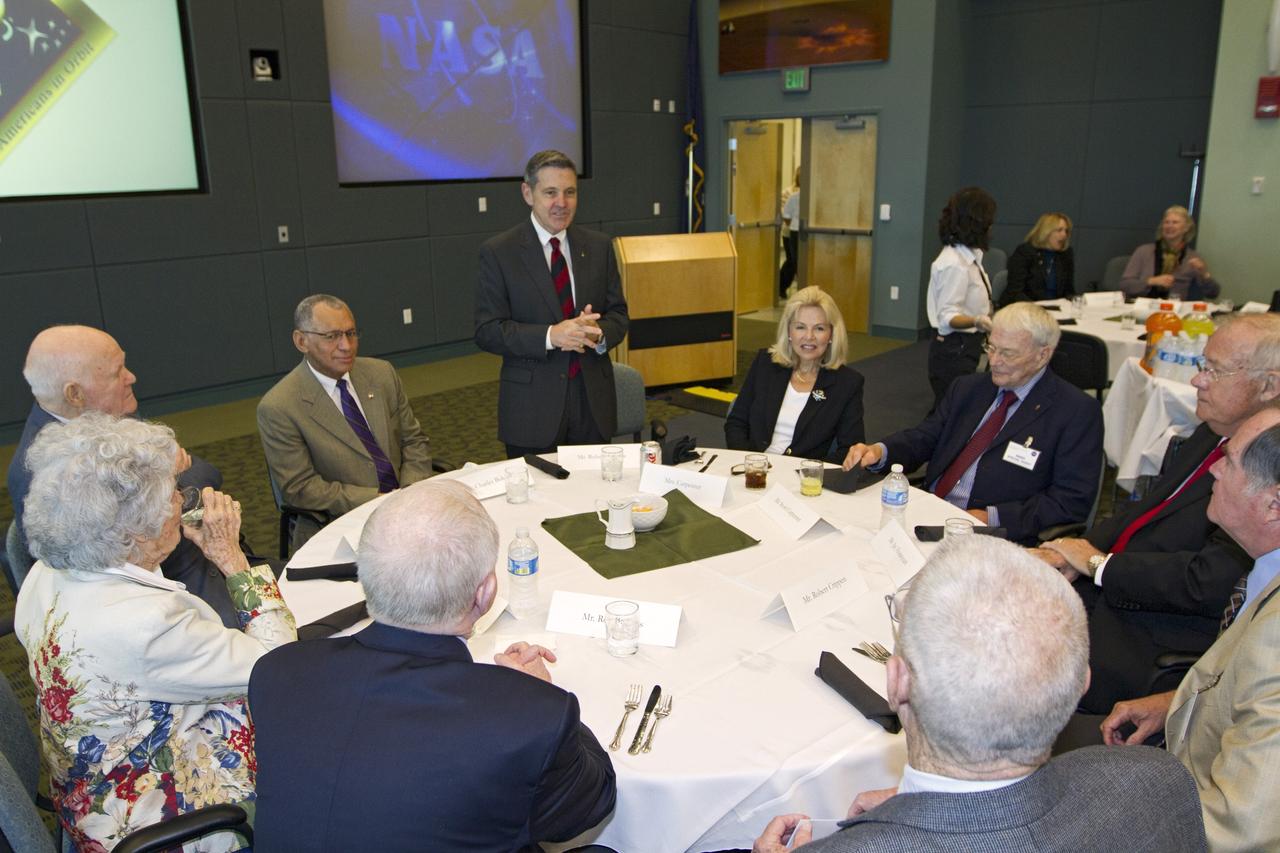
CAPE CANAVERAL, Fla. - Kennedy Space Center Director Bob Cabana, standing, speaks during a luncheon Feb. 17, 2012, celebrating 50 years of Americans in orbit, an era which began with Glenn's Mercury mission MA-6, on Feb. 20, 1962. Glenn's launch aboard an Atlas rocket took with it the hopes of an entire nation and ushered in a new era of space travel that eventually led to Americans walking on the moon by the end of the 1960s. Glenn soon was followed into orbit by Scott Carpenter, Walter Schirra and Gordon Cooper. Their fellow Mercury astronauts Alan Shepard and Virgil "Gus" Grissom flew earlier suborbital flights. Deke Slayton, a member of NASA's original Mercury 7 astronauts, was grounded by a medical condition until the Apollo-Soyuz Test Project in 1975. Photo credit: NASA/Kim Shiflett
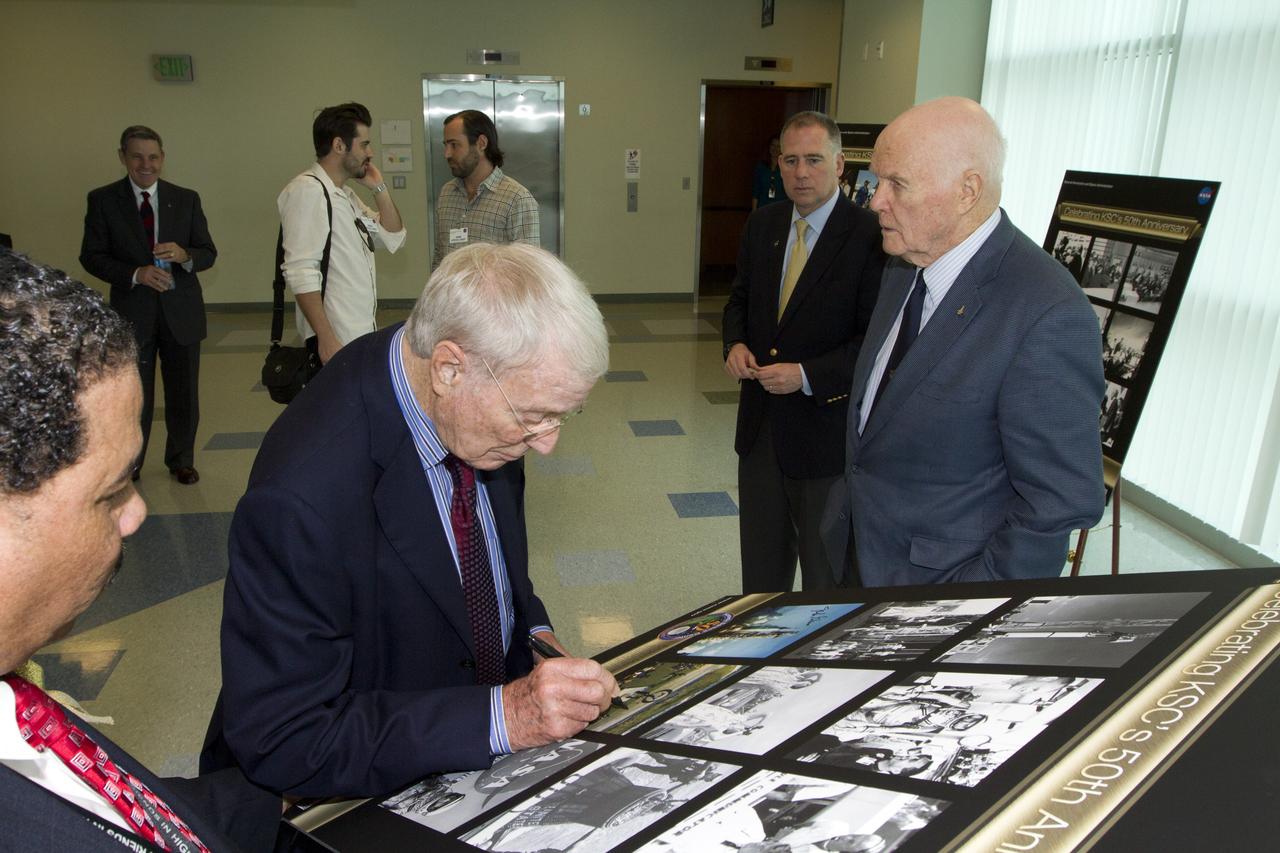
CAPE CANAVERAL, Fla. - Mercury astronaut Scott Carpenter signs a poster celebrating 50 years of Americans in orbit, an era which began with Glenn's Mercury mission MA-6, on Feb. 20, 1962. Glenn's launch aboard an Atlas rocket took with it the hopes of an entire nation and ushered in a new era of space travel that eventually led to Americans walking on the moon by the end of the 1960s. Glenn soon was followed into orbit by Scott Carpenter, Walter Schirra and Gordon Cooper. Their fellow Mercury astronauts Alan Shepard and Virgil "Gus" Grissom flew earlier suborbital flights. Deke Slayton, a member of NASA's original Mercury 7 astronauts, was grounded by a medical condition until the Apollo-Soyuz Test Project in 1975. Photo credit: NASA/Kim Shiflett
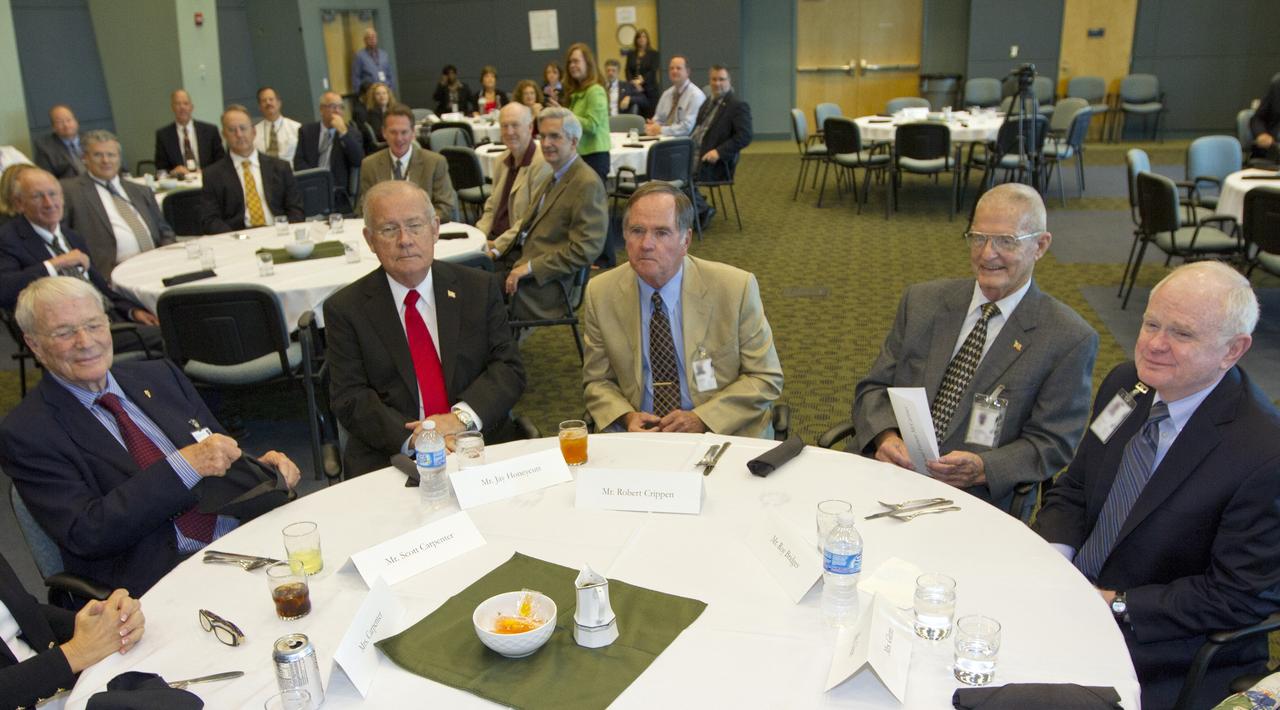
CAPE CANAVERAL, Fla. - Former Mercury astronaut Scott Carpenter, left, and former Kennedy Space Center directors Jay Honeycutt, Bob Crippen, Forrest McCartney and Roy Bridges listen during a luncheon Feb. 17, 2012, celebrating 50 years of Americans in orbit, an era which began with Glenn's Mercury mission MA-6, on Feb. 20, 1962. Glenn's launch aboard an Atlas rocket took with it the hopes of an entire nation and ushered in a new era of space travel that eventually led to Americans walking on the moon by the end of the 1960s. Glenn soon was followed into orbit by Scott Carpenter, Walter Schirra and Gordon Cooper. Their fellow Mercury astronauts Alan Shepard and Virgil "Gus" Grissom flew earlier suborbital flights. Deke Slayton, a member of NASA's original Mercury 7 astronauts, was grounded by a medical condition until the Apollo-Soyuz Test Project in 1975. Photo credit: NASA/Kim Shiflett
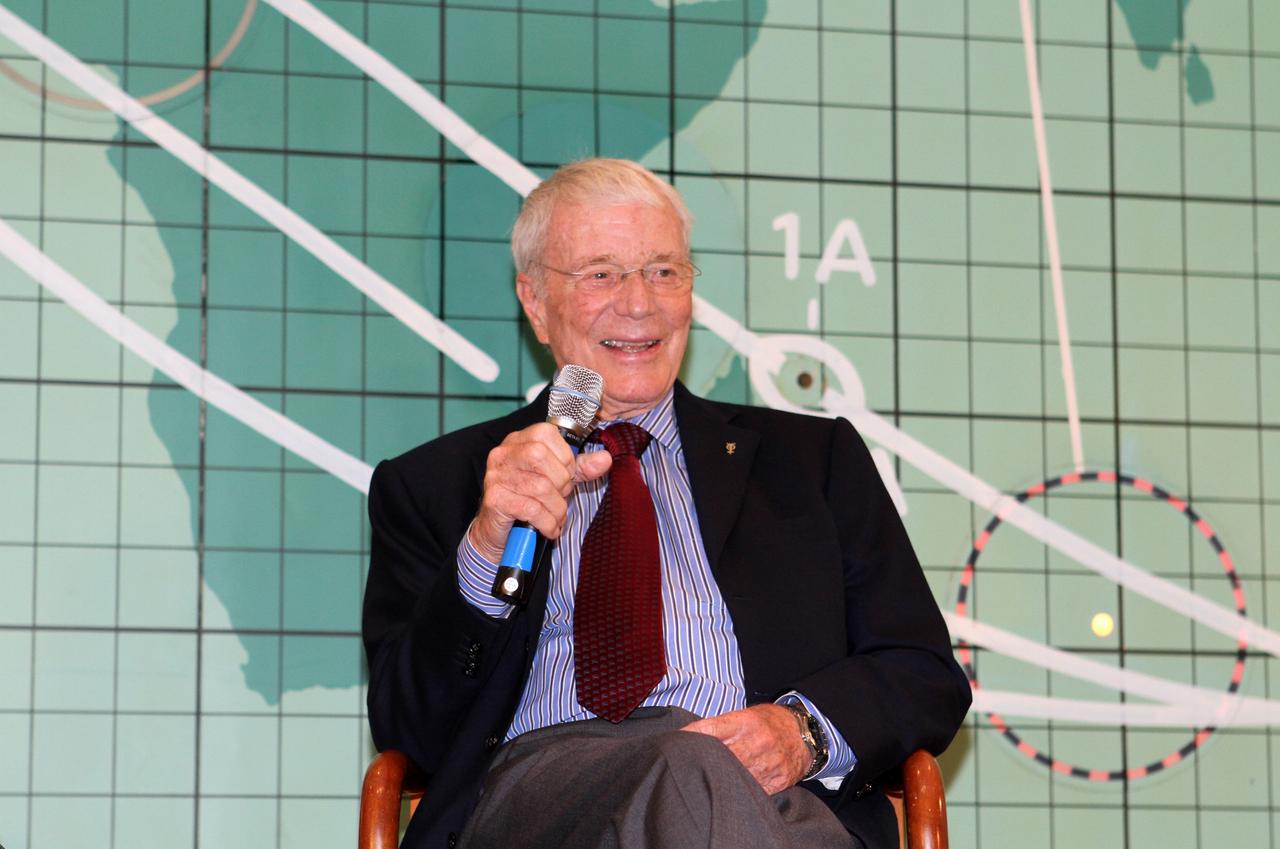
CAPE CANAVERAL, Fla. -- Mercury astronaut Scott Carpenter sits in front of the plot board from the Mercury control center on display at the Kennedy Space Center Visitor Complex in Florida. The astronaut, part of the original class of seven astronauts chosen by NASA, was taking part in a question-and-answer session with the media as part of events celebrating 50 years of Americans in orbit, an era which began with John Glenn's Mercury mission MA-6, on Feb. 20, 1962. Glenn's launch aboard an Atlas rocket took with it the hopes of an entire nation and ushered in a new era of space travel that eventually led to Americans walking on the moon by the end of the 1960s. Glenn soon was followed into orbit by Carpenter, Walter Schirra and Gordon Cooper. Their fellow Mercury astronauts Alan Shepard and Virgil "Gus" Grissom flew earlier suborbital flights. Deke Slayton was grounded by a medical condition until the Apollo-Soyuz Test Project in 1975. Photo credit: NASA/Kim Shiflett
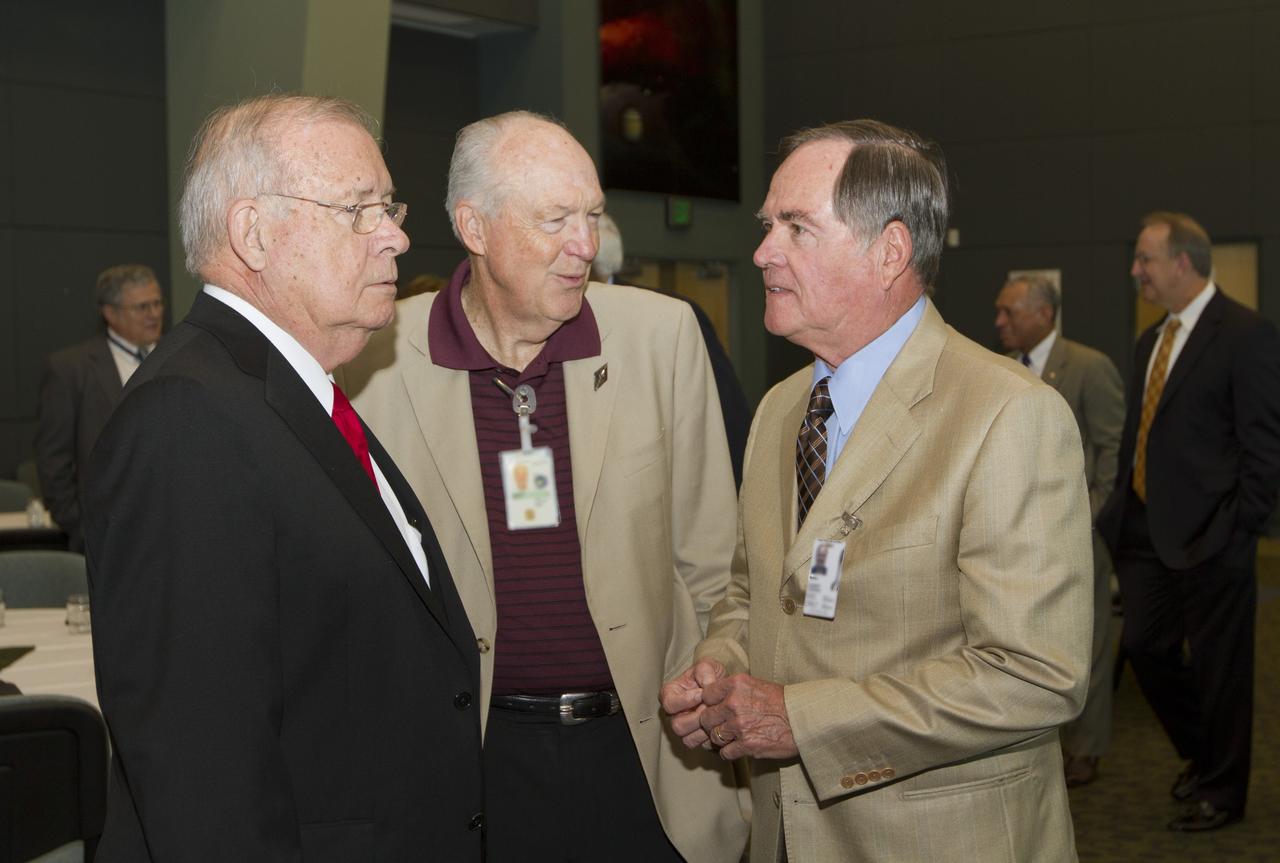
CAPE CANAVERAL, Fla. - Former Kennedy Space Center directors Jay Honeycutt, left, and Bob Crippen, right, talk during a luncheon Feb. 17, 2012, celebrating 50 years of Americans in orbit, an era which began with Glenn's Mercury mission MA-6, on Feb. 20, 1962. Glenn's launch aboard an Atlas rocket took with it the hopes of an entire nation and ushered in a new era of space travel that eventually led to Americans walking on the moon by the end of the 1960s. Glenn soon was followed into orbit by Scott Carpenter, Walter Schirra and Gordon Cooper. Their fellow Mercury astronauts Alan Shepard and Virgil "Gus" Grissom flew earlier suborbital flights. Deke Slayton, a member of NASA's original Mercury 7 astronauts, was grounded by a medical condition until the Apollo-Soyuz Test Project in 1975. Photo credit: NASA/Kim Shiflett
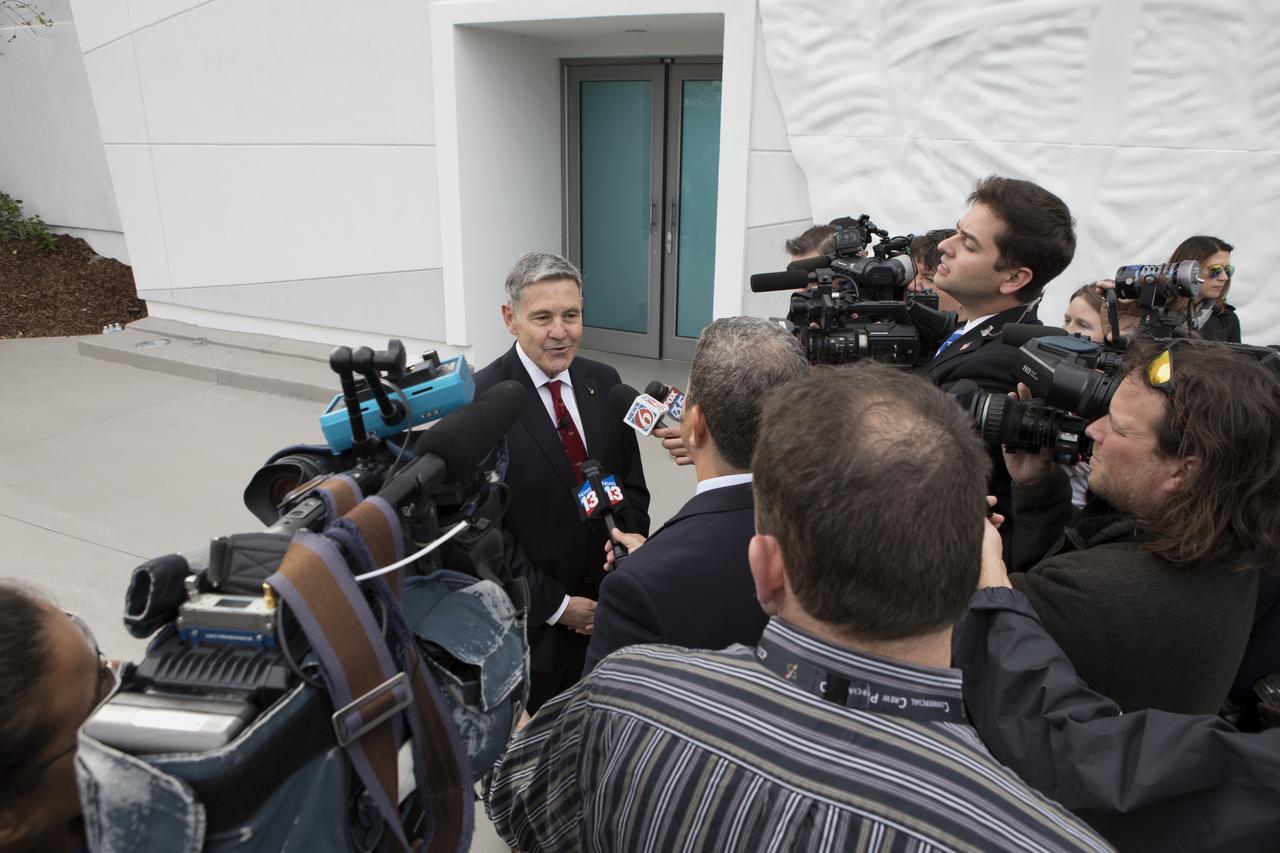
Former astronaut Bob Cabana, director of NASA's Kennedy Space Center in Florida, speaks with news media members at the Heroes and Legends exhibit hall at the Kennedy Space Center Visitor Complex following a ceremony remembering astronaut Sen. John Glenn, who passed away Dec. 8, 2016 at age 95. Glenn, one of the first seven astronauts NASA chose to fly the first missions of the Space Age, gained worldwide acclaim during his Mercury mission that made him the first American to orbit the Earth. He flew again in 1998 aboard space shuttle Discovery at age 77.
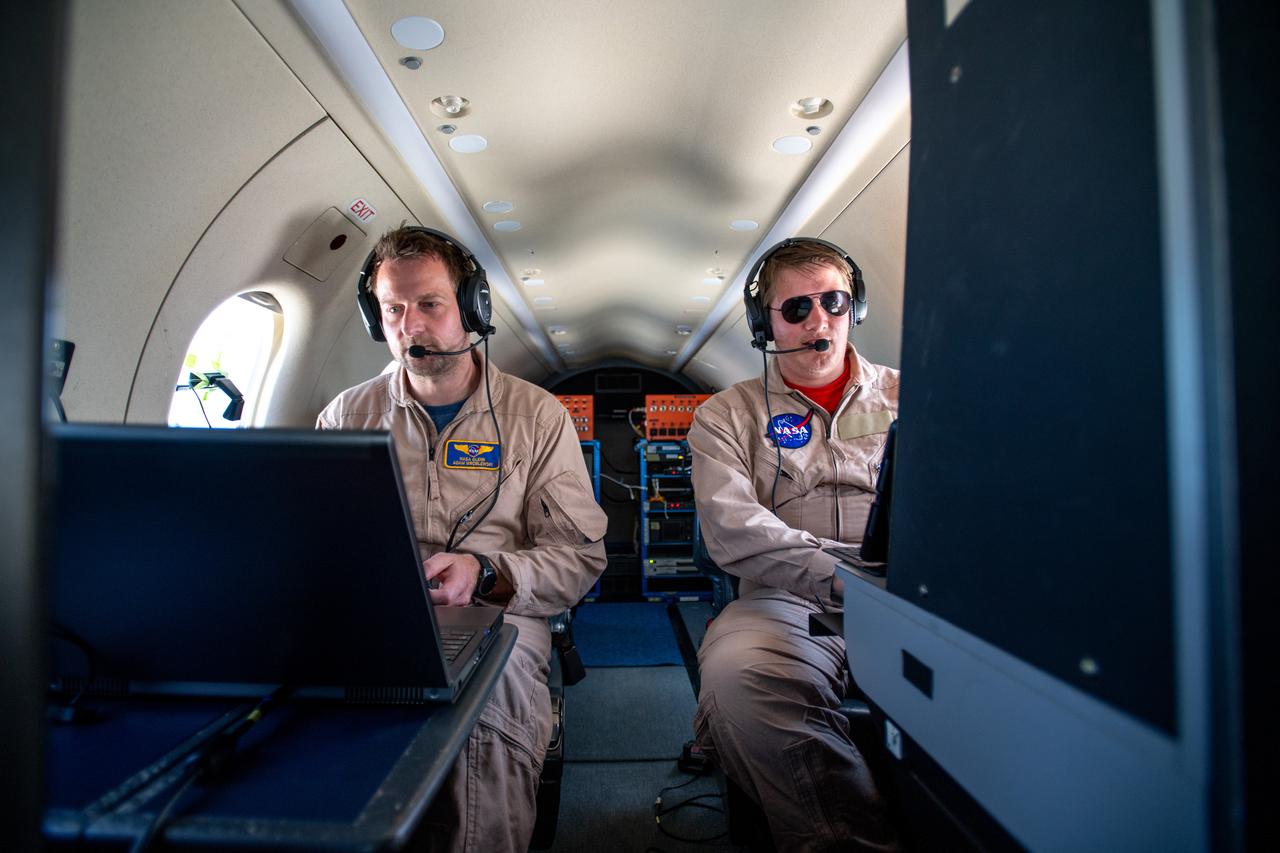
A team at NASA’s Glenn Research Center in Cleveland streamed 4K video footage from an aircraft to the International Space Station and back for the first time using optical, or laser, communications. The feat was part of a series of tests on new technology that could provide live video coverage of astronauts on the Moon during the Artemis missions. Working with the Air Force Research Laboratory and NASA’s Small Business Innovation Research program, Glenn engineers temporarily installed a portable laser terminal on the belly of a Pilatus PC-12 aircraft. They then flew over Lake Erie sending data from the aircraft to an optical ground station in Cleveland. From there, it was sent over an Earth-based network to NASA’s White Sands Test Facility in Las Cruces, New Mexico, where scientists used infrared light signals to send the data. Photo Credit: (NASA/Sara Lowthian-Hanna)
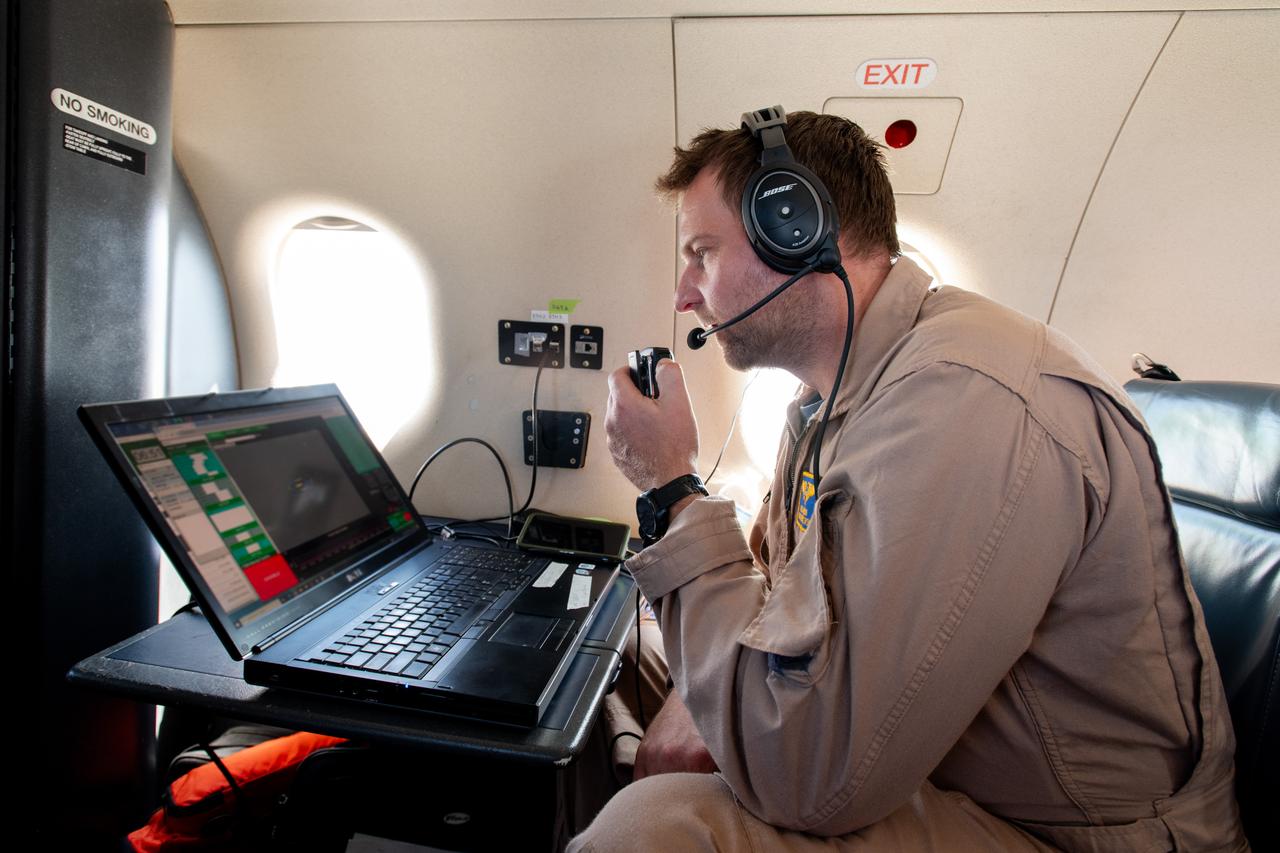
A team at NASA’s Glenn Research Center in Cleveland streamed 4K video footage from an aircraft to the International Space Station and back for the first time using optical, or laser, communications. The feat was part of a series of tests on new technology that could provide live video coverage of astronauts on the Moon during the Artemis missions. Working with the Air Force Research Laboratory and NASA’s Small Business Innovation Research program, Glenn engineers temporarily installed a portable laser terminal on the belly of a Pilatus PC-12 aircraft. They then flew over Lake Erie sending data from the aircraft to an optical ground station in Cleveland. From there, it was sent over an Earth-based network to NASA’s White Sands Test Facility in Las Cruces, New Mexico, where scientists used infrared light signals to send the data.
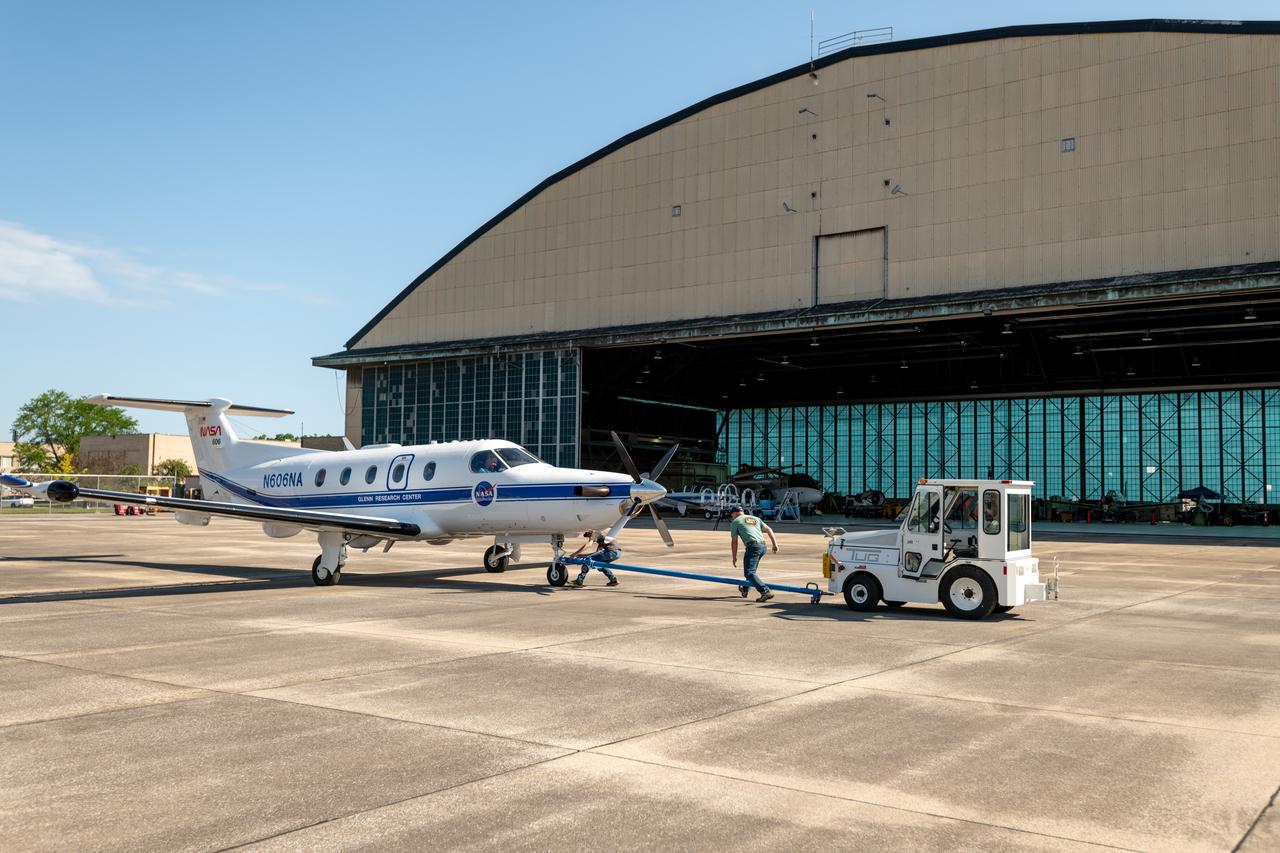
A team at NASA’s Glenn Research Center in Cleveland streamed 4K video footage from an aircraft to the International Space Station and back for the first time using optical, or laser, communications. The feat was part of a series of tests on new technology that could provide live video coverage of astronauts on the Moon during the Artemis missions. Working with the Air Force Research Laboratory and NASA’s Small Business Innovation Research program, Glenn engineers temporarily installed a portable laser terminal on the belly of a Pilatus PC-12 aircraft. They then flew over Lake Erie sending data from the aircraft to an optical ground station in Cleveland. From there, it was sent over an Earth-based network to NASA’s White Sands Test Facility in Las Cruces, New Mexico, where scientists used infrared light signals to send the data.
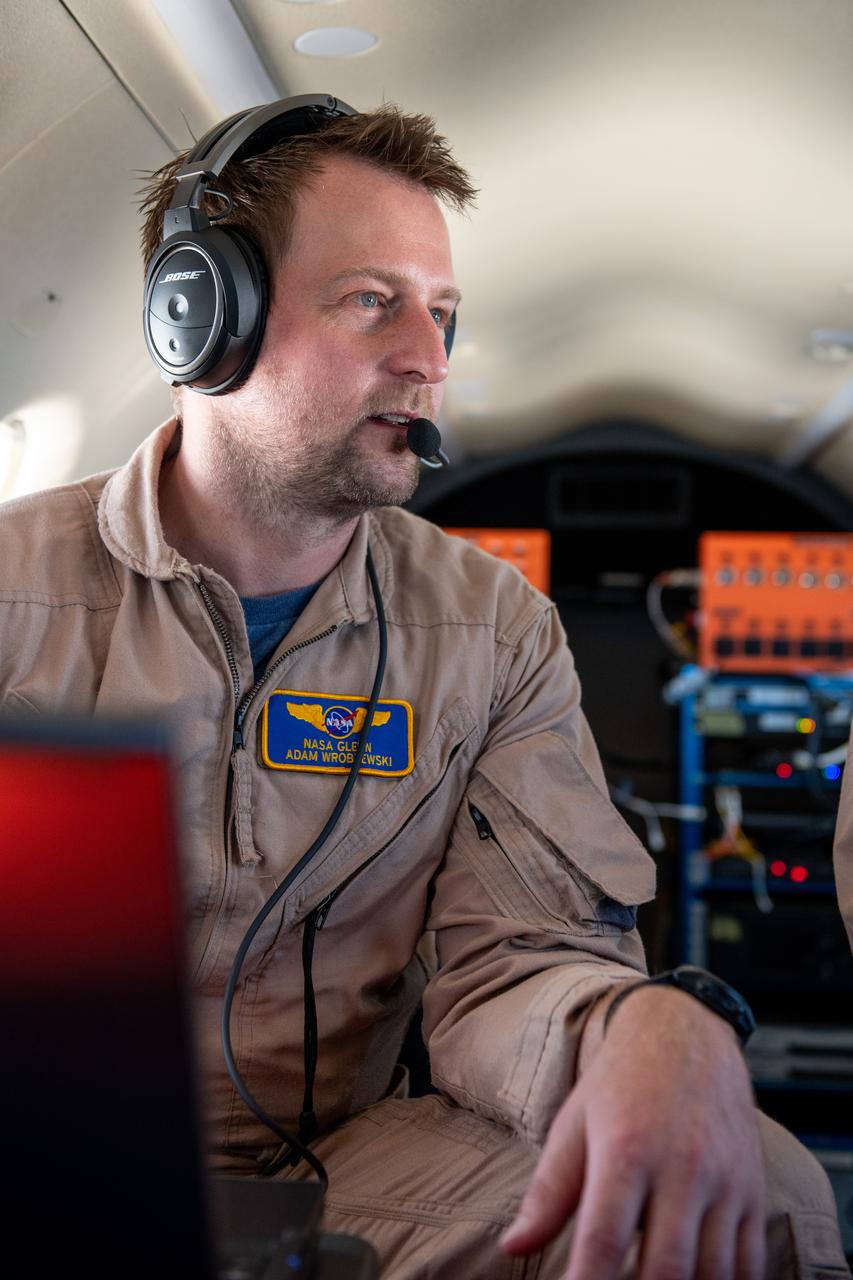
Adam Wroblewski p A team at NASA’s Glenn Research Center in Cleveland streamed 4K video footage from an aircraft to the International Space Station and back for the first time using optical, or laser, communications. The feat was part of a series of tests on new technology that could provide live video coverage of astronauts on the Moon during the Artemis missions. Working with the Air Force Research Laboratory and NASA’s Small Business Innovation Research program, Glenn engineers temporarily installed a portable laser terminal on the belly of a Pilatus PC-12 aircraft. Adam Wroblewski in the PC-12 over Lake Erie on June 13, 2024 sending data from the aircraft to an optical ground station in Cleveland. From there, it was sent over an Earth-based network to NASA’s White Sands Test Facility in Las Cruces, New Mexico, where scientists used infrared light signals to send the data. Photo Credit: (NASA/Sara Lowthian-Hanna)

A team at NASA’s Glenn Research Center in Cleveland streamed 4K video footage from an aircraft to the International Space Station and back for the first time using optical, or laser, communications. The feat was part of a series of tests on new technology that could provide live video coverage of astronauts on the Moon during the Artemis missions. Working with the Air Force Research Laboratory and NASA’s Small Business Innovation Research program, Glenn engineers temporarily installed a portable laser terminal on the belly of a Pilatus PC-12 aircraft. They then flew over Lake Erie sending data from the aircraft to an optical ground station in Cleveland. From there, it was sent over an Earth-based network to NASA’s White Sands Test Facility in Las Cruces, New Mexico, where scientists used infrared light signals to send the data. Photo Credit: (NASA/Sara Lowthian-Hanna)

A team at NASA’s Glenn Research Center in Cleveland streamed 4K video footage from an aircraft to the International Space Station and back for the first time using optical, or laser, communications. The feat was part of a series of tests on new technology that could provide live video coverage of astronauts on the Moon during the Artemis missions. Pictured from Left to Right: James Demers, Adam Wroblewski, Shaun McKeehan, Kurt Blankenship. Working with the Air Force Research Laboratory and NASA’s Small Business Innovation Research program, Glenn engineers temporarily installed a portable laser terminal on the belly of a Pilatus PC-12 aircraft. They then flew over Lake Erie sending data from the aircraft to an optical ground station in Cleveland. From there, it was sent over an Earth-based network to NASA’s White Sands Test Facility in Las Cruces, New Mexico, where scientists used infrared light signals to send the data.
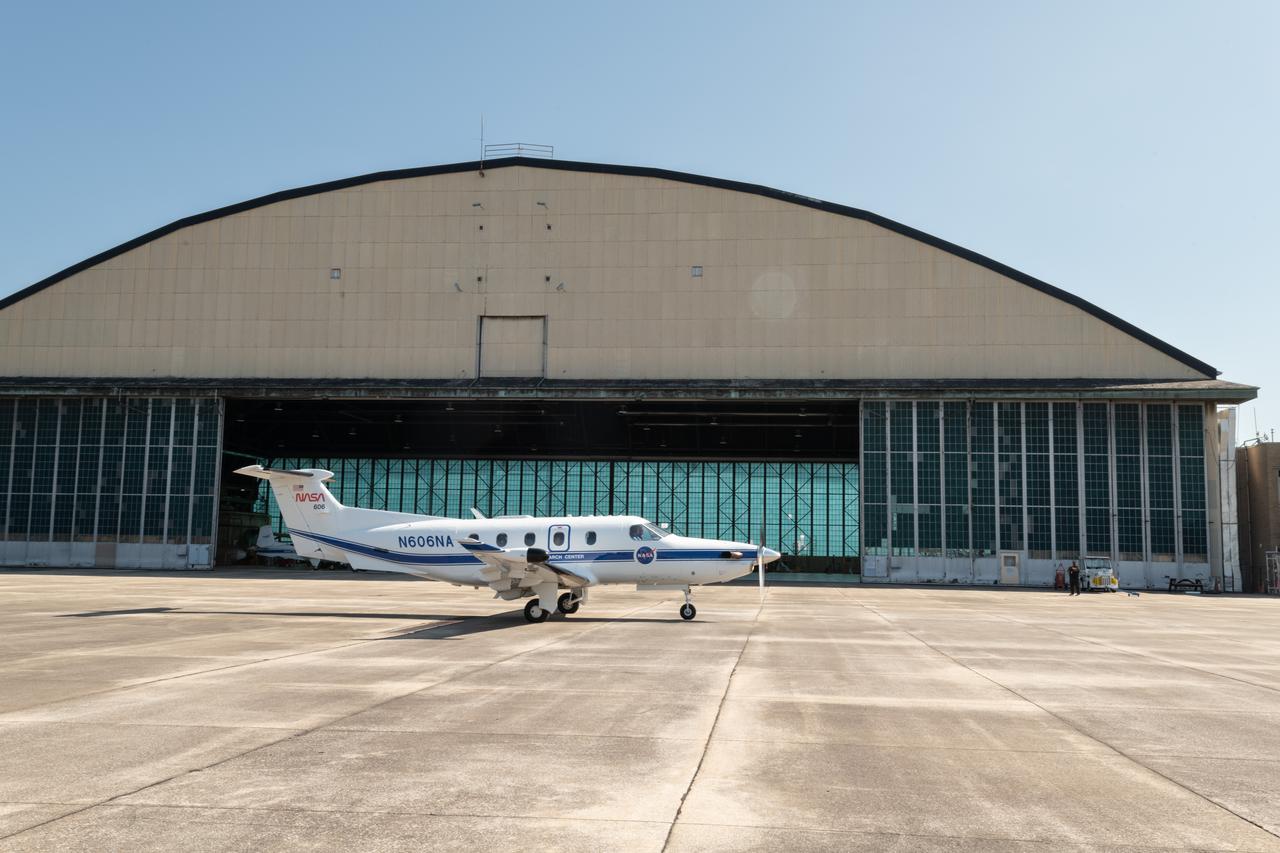
A team at NASA’s Glenn Research Center in Cleveland streamed 4K video footage from an aircraft to the International Space Station and back for the first time using optical, or laser, communications. The feat was part of a series of tests on new technology that could provide live video coverage of astronauts on the Moon during the Artemis missions. Working with the Air Force Research Laboratory and NASA’s Small Business Innovation Research program, Glenn engineers temporarily installed a portable laser terminal on the belly of a Pilatus PC-12 aircraft. They then flew over Lake Erie sending data from the aircraft to an optical ground station in Cleveland. From there, it was sent over an Earth-based network to NASA’s White Sands Test Facility in Las Cruces, New Mexico, where scientists used infrared light signals to send the data.
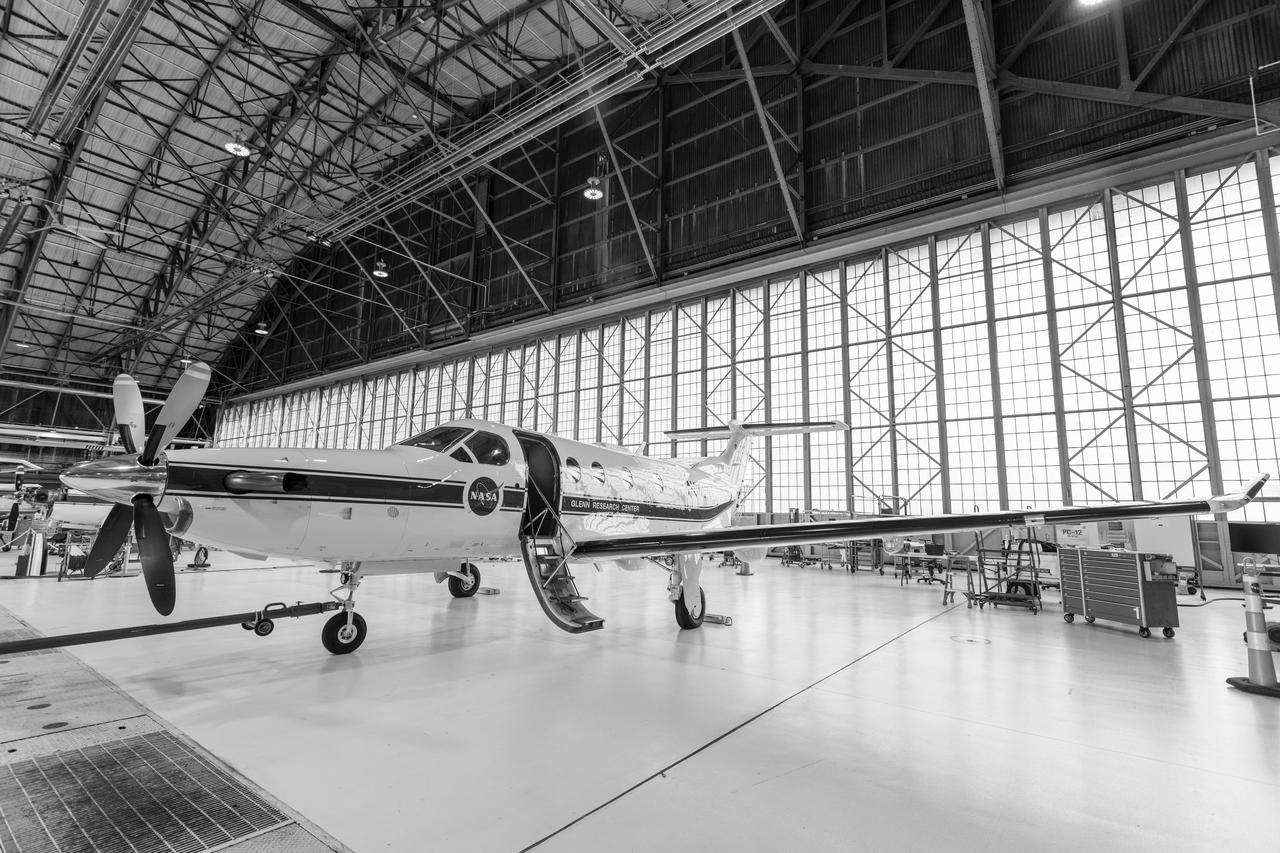
A team at NASA’s Glenn Research Center in Cleveland streamed 4K video footage from an aircraft to the International Space Station and back for the first time using optical, or laser, communications. The feat was part of a series of tests on new technology that could provide live video coverage of astronauts on the Moon during the Artemis missions. Working with the Air Force Research Laboratory and NASA’s Small Business Innovation Research program, Glenn engineers temporarily installed a portable laser terminal on the belly of a Pilatus PC-12 aircraft. They then flew over Lake Erie sending data from the aircraft to an optical ground station in Cleveland. From there, it was sent over an Earth-based network to NASA’s White Sands Test Facility in Las Cruces, New Mexico, where scientists used infrared light signals to send the data.
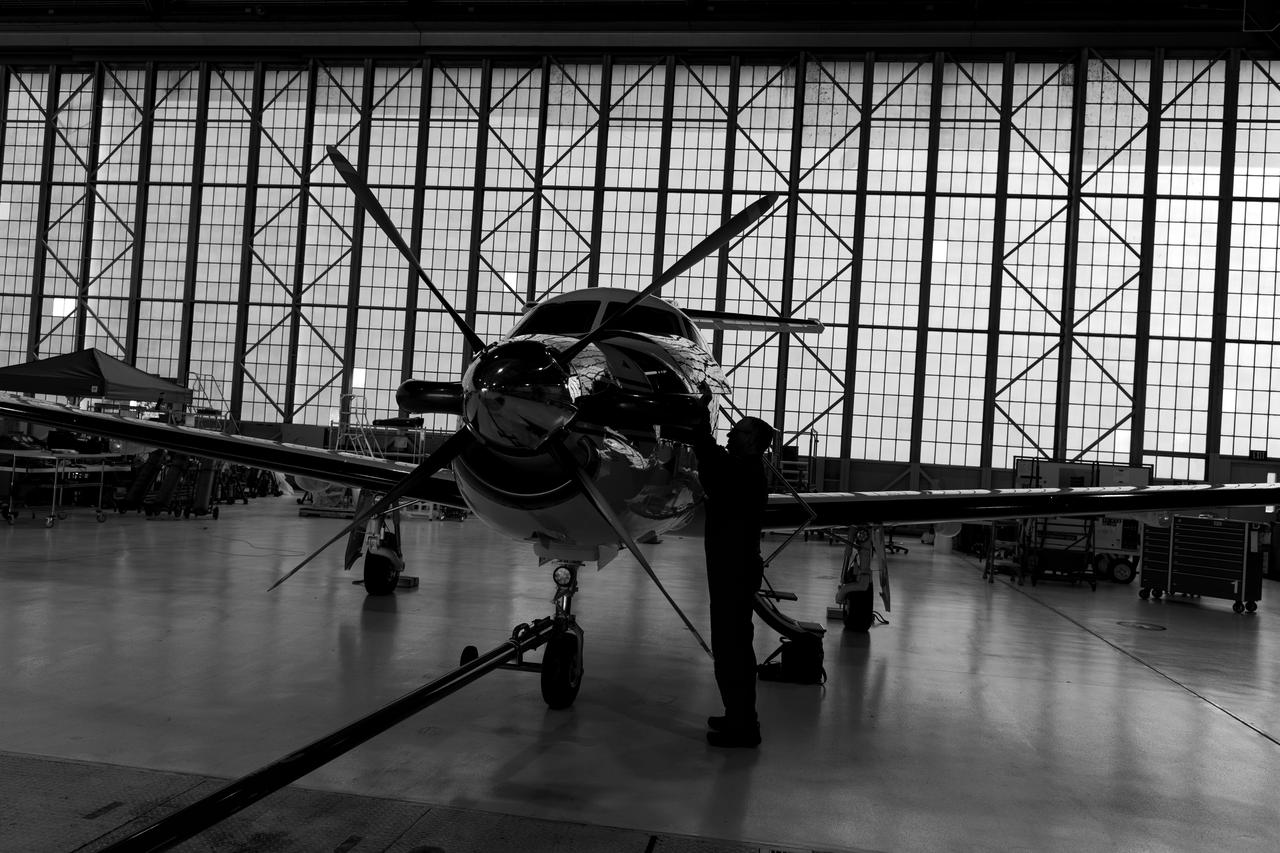
Pilatus PC-12 Aircraft Being Prepped for Takeoff on June 12, 2024. A team at NASA’s Glenn Research Center in Cleveland streamed 4K video footage from an aircraft to the International Space Station and back for the first time using optical, or laser, communications. The feat was part of a series of tests on new technology that could provide live video coverage of astronauts on the Moon during the Artemis missions. Working with the Air Force Research Laboratory and NASA’s Small Business Innovation Research program, Glenn engineers temporarily installed a portable laser terminal on the belly of a Pilatus PC-12 aircraft. They then flew over Lake Erie sending data from the aircraft to an optical ground station in Cleveland. From there, it was sent over an Earth-based network to NASA’s White Sands Test Facility in Las Cruces, New Mexico, where scientists used infrared light signals to send the data. Photo Credit: (NASA/Sara Lowthian-Hanna)

A team at NASA’s Glenn Research Center in Cleveland streamed 4K video footage from an aircraft to the International Space Station and back for the first time using optical, or laser, communications. The feat was part of a series of tests on new technology that could provide live video coverage of astronauts on the Moon during the Artemis missions. Working with the Air Force Research Laboratory and NASA’s Small Business Innovation Research program, Glenn engineers temporarily installed a portable laser terminal on the belly of a Pilatus PC-12 aircraft. They then flew over Lake Erie sending data from the aircraft to an optical ground station in Cleveland. From there, it was sent over an Earth-based network to NASA’s White Sands Test Facility in Las Cruces, New Mexico, where scientists used infrared light signals to send the data.
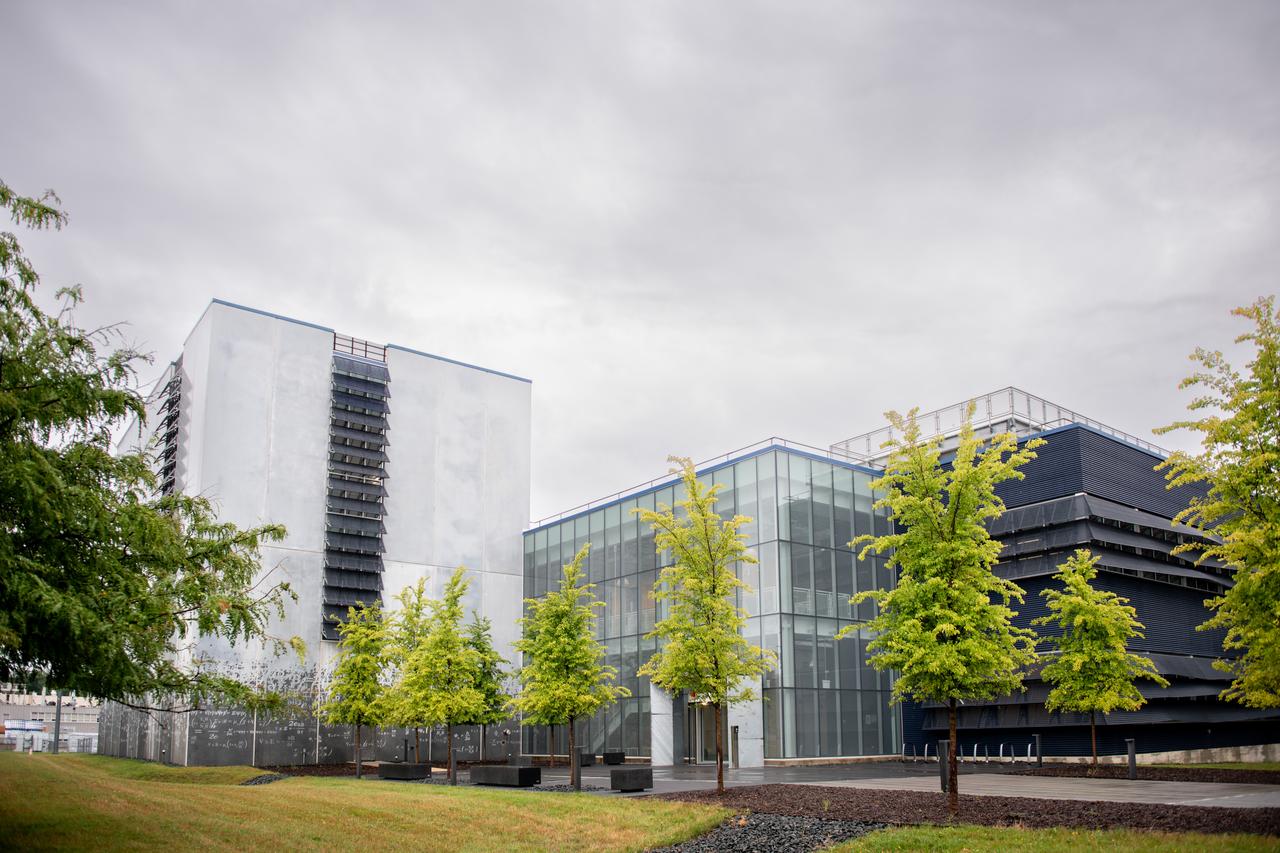
NASA’s Glenn Research Center opened the doors to a brand-new mission-focused facility that will support the agency’s Artemis and Advanced Air Mobility missions. On Aug. 30, NASA management and local officials cut the ribbon to the Aerospace Communications Facility (ACF), a new building designed for advanced radio frequency (RF) and optical communication technology research and development. Photo Credit: (NASA/Sara Lowthian-Hanna)