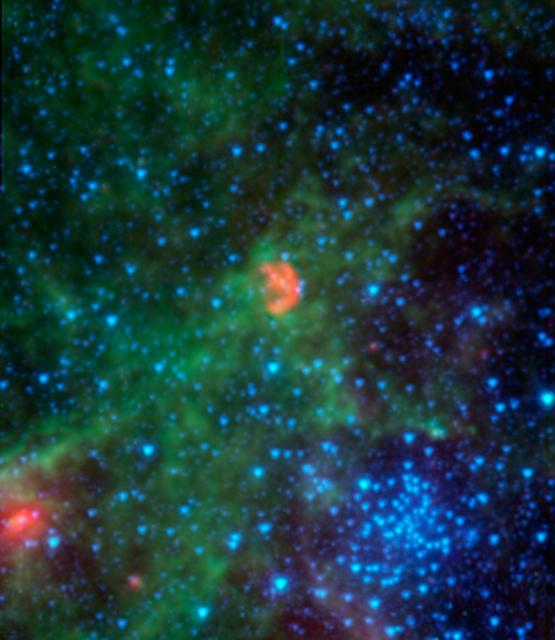
Supernovas are often thought of as the tremendous explosions that mark the ends of massive stars' lives. While this is true, not all supernovas occur in this fashion. A common supernova class, called Type Ia, involves the detonation of white dwarfs -- small, dense stars that are already dead. New results from NASA's Spitzer Space Telescope have revealed a rare example of Type Ia explosion, in which a dead star "fed" off an aging star like a cosmic zombie, triggering a blast. The results help researchers piece together how these powerful and diverse events occur. "It's kind of like being a detective," said Brian Williams of NASA's Goddard Space Flight Center in Greenbelt, Maryland, lead author of a study submitted to the Astrophysical Journal. "We look for clues in the remains to try to figure out what happened, even though we weren't there to see it." Read more: <a href="http://1.usa.gov/1i0PAaa" rel="nofollow">1.usa.gov/1i0PAaa</a> <b><a href="http://www.nasa.gov/audience/formedia/features/MP_Photo_Guidelines.html" rel="nofollow">NASA image use policy.</a></b> <b><a href="http://www.nasa.gov/centers/goddard/home/index.html" rel="nofollow">NASA Goddard Space Flight Center</a></b> enables NASA’s mission through four scientific endeavors: Earth Science, Heliophysics, Solar System Exploration, and Astrophysics. Goddard plays a leading role in NASA’s accomplishments by contributing compelling scientific knowledge to advance the Agency’s mission. <b>Follow us on <a href="http://twitter.com/NASAGoddardPix" rel="nofollow">Twitter</a></b> <b>Like us on <a href="http://www.facebook.com/pages/Greenbelt-MD/NASA-Goddard/395013845897?ref=tsd" rel="nofollow">Facebook</a></b> <b>Find us on <a href="http://instagram.com/nasagoddard?vm=grid" rel="nofollow">Instagram</a></b>