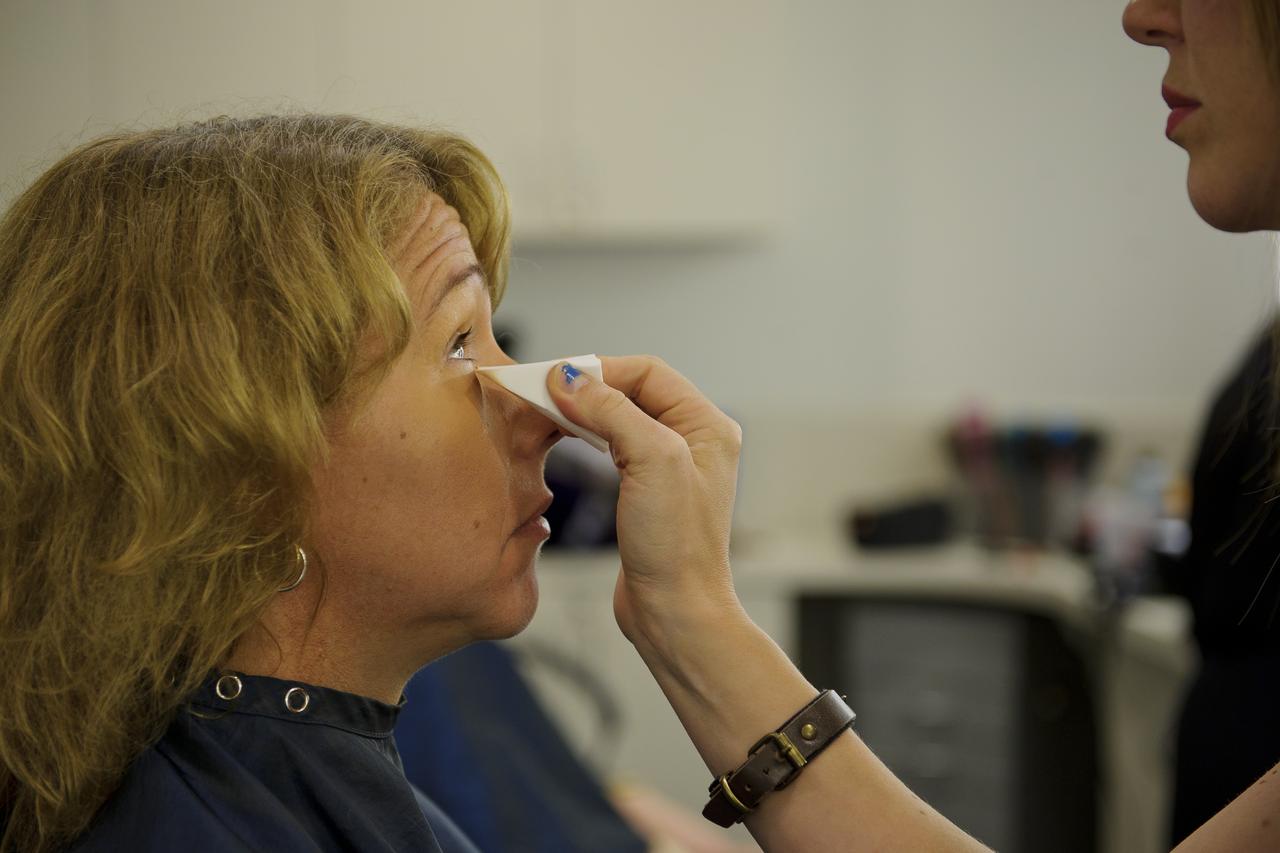
STS-135 mission specialist Sandra Magnus, has some make up applied prior to her appearance on CNN American Morning, Tuesday, Aug. 16, 2011, in New York City. The crew from space shuttle Atlantis (STS-135) is in New York City for a three-day visit. Photo Credit: (NASA/Paul E. Alers)
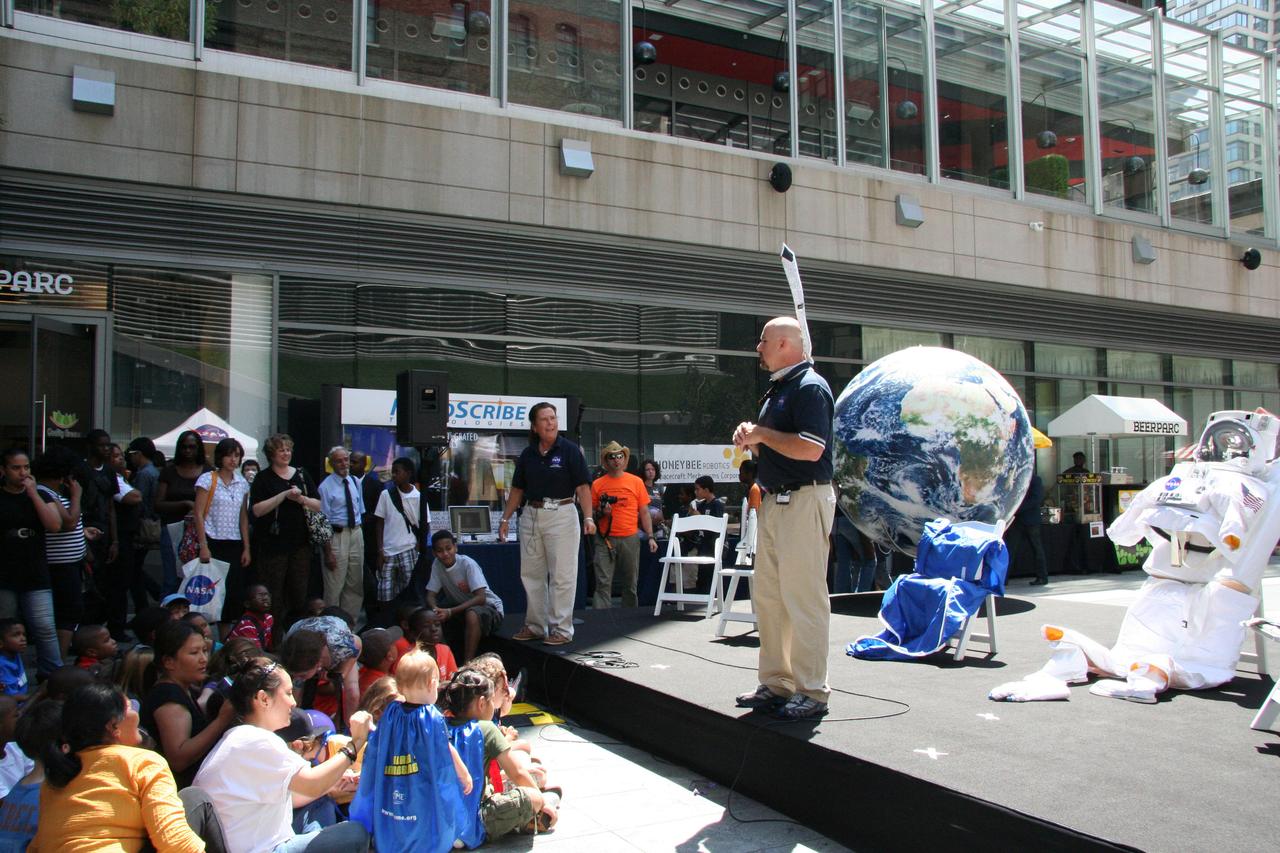
Chris Copelan (right), education program specialist at Stennis Space Center, and Maria Lott, Stennis Astro Camp director, talk about living and working in space with visitors gathered for the 'What's Your Favorite Space?' event in New York City on Aug. 17. Stennis educators teamed with peers from three other NASA centers to present a variety of hands-on activities and informational presentations during the event.
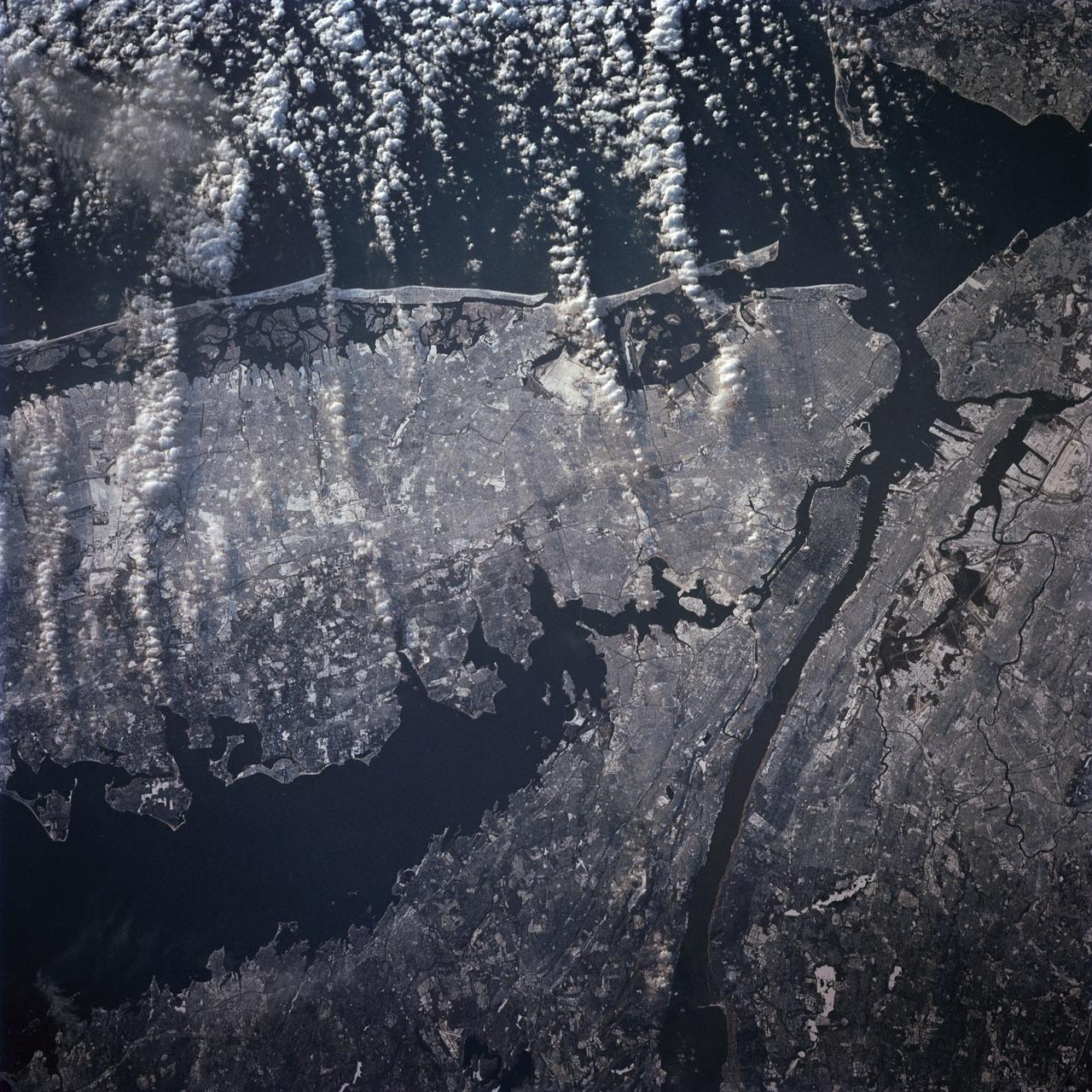
STS-42 Earth observation taken aboard Discovery, Orbiter Vehicle (OV) 103, is of New York City (NYC), New York (41.0N, 74.0W). Snow cover highlights the large areas of development and the many reservoirs in this wintertime scene of the metropolitan NYC area. Features such as Central Park in Manhattan, the George Washington Bridge connecting Manhattan with New Jersey, street patterns in most of the boroughs, La Guardia and JFK airports in Queens, and the extensive harbor system are easily identified.
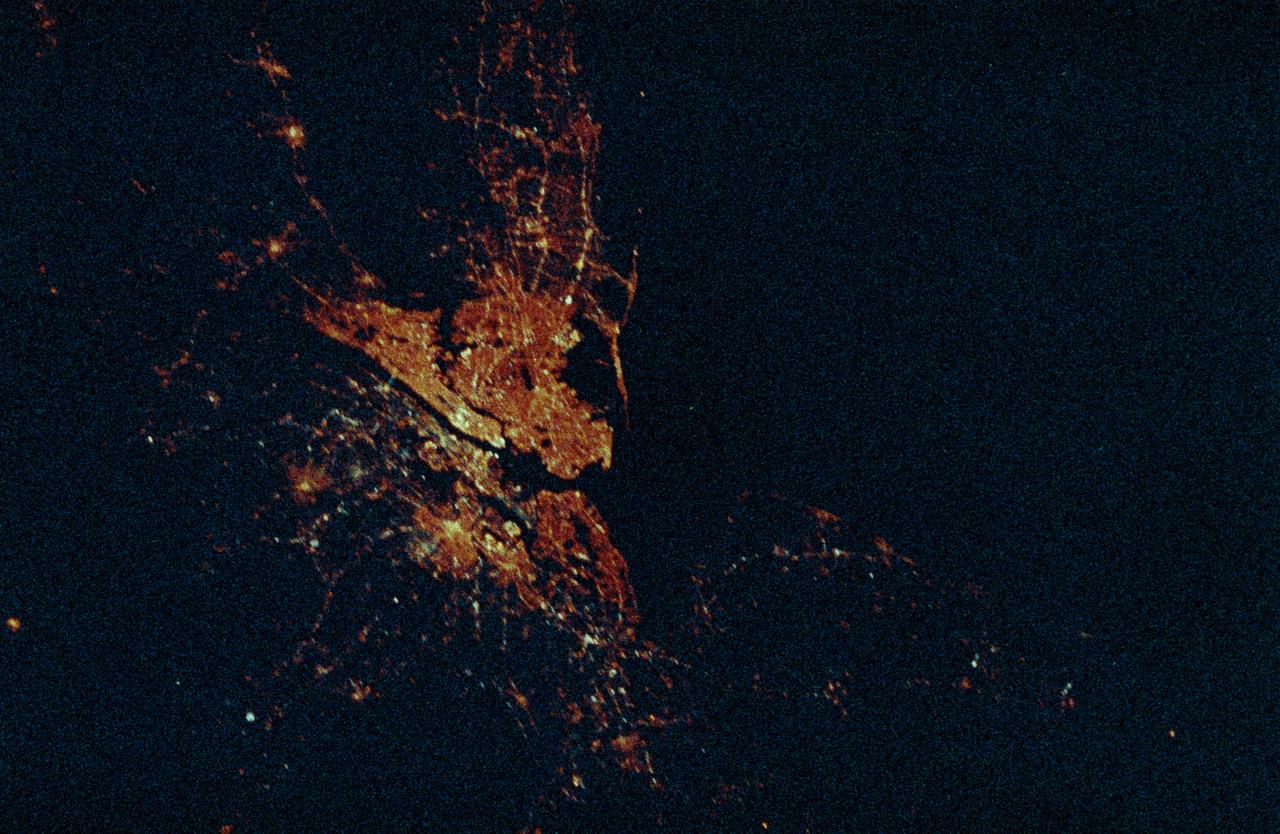
STS-36 Earth observation shows New York City, New York at night lit up along the Eastern seaboard of the United States and the Atlantic Ocean. The city lights designate the densely populated central city and the major highways surrounding it.

STS039-88-054 (28 April-6 May 1991) --- The dense urban development of the New York City metropolitan area in downstate New York, Long Island and New Jersey shows up as gray and white on this color Infrared photograph. The scene was taken on a remarkably clear spring day. Almost all the major man-made structures of the area are obvious, including ship traffic in and out of New York Harbor, the piers, all of the bridges spanning the area rivers and connecting Manhattan Island with New Jersey, the Bronx, Brooklyn and Queens, the three major airports (Newark, La Guardia and JFK), the New York State thruway, as well as Shea Stadium and Yankee Stadium. The reds and pinks are vegetated areas. Central Park clearly shows up on Manhattan, as do the string of parks along the cliffs (formed by the Palisades sill) along the west side of the Hudson north of the George Washington Bridge.

Artist Geraluz talks to a member of the media in front of the mural “To the Moon, and Back” by the New York-based artist team Geraluz and WERC that was created as part of the reimagined NASA Art Program, Tuesday, September 24, 2024, in New York City’s Hudson Square neighborhood. For the inaugural project of the reestablished NASA Art Program the agency collaborated with the Hudson Square Business Improvement District on an open call for New York-based artists to design and install a large-scale mural inspired by NASA’s work and missions. Photo Credit: (NASA/Joel Kowsky)

Samara Karasyk, President and CEO of the Hudson Square Business Improvement District talks to a member of the media in front of the mural “To the Moon, and Back” by the New York-based artist team Geraluz and WERC that was created as part of the reimagined NASA Art Program, Tuesday, September 24, 2024, in New York City’s Hudson Square neighborhood. For the inaugural project of the reestablished NASA Art Program the agency collaborated with the Hudson Square Business Improvement District on an open call for New York-based artists to design and install a large-scale mural inspired by NASA’s work and missions. Photo Credit: (NASA/Joel Kowsky)
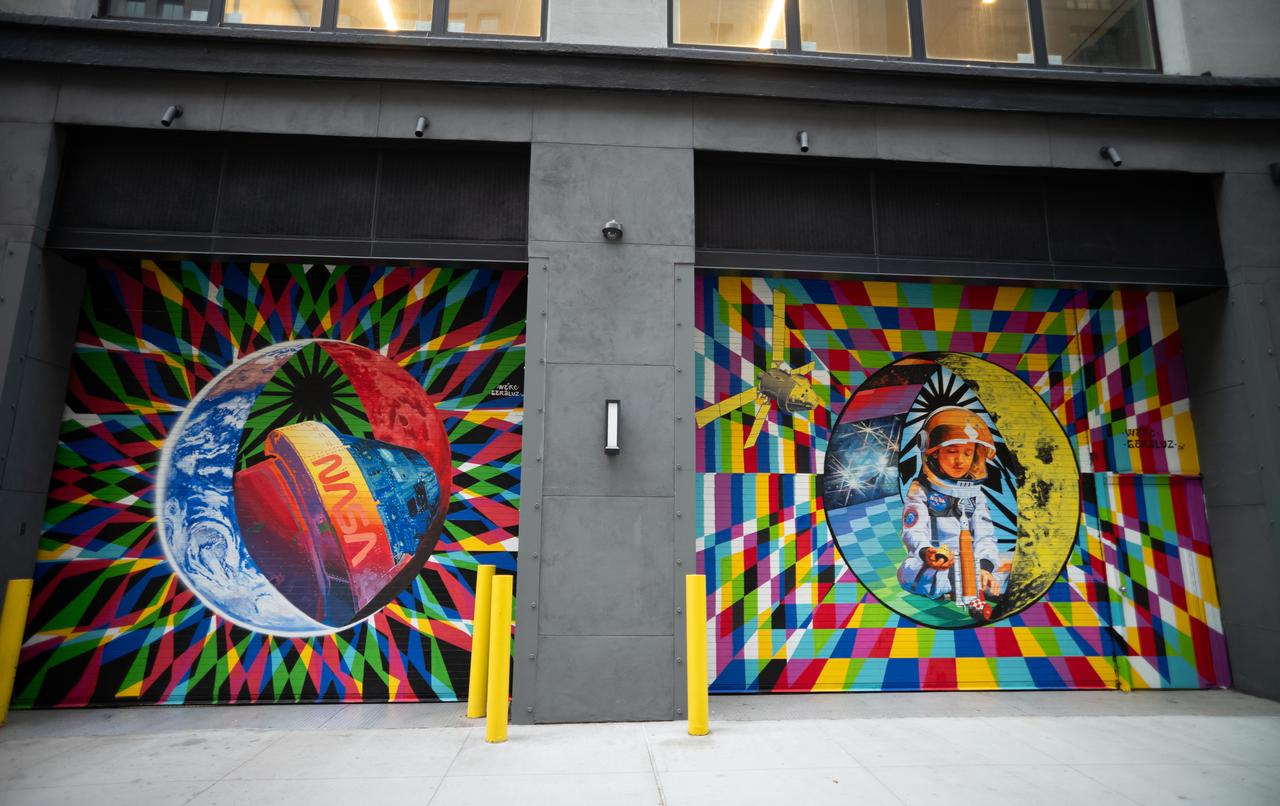
The inaugural murals for the relaunched NASA Art Program appear side-by-side at 350 Hudson Street, Monday, Sept. 23, 2024, in New York City. The murals, titled “To the Moon, and Back,” were created by New York-based artist team Geraluz and WERC and use geometrical patterns to invite deeper reflection on the exploration, creativity, and connection with the cosmos. Photo Credit: (NASA/Joel Kowsky)
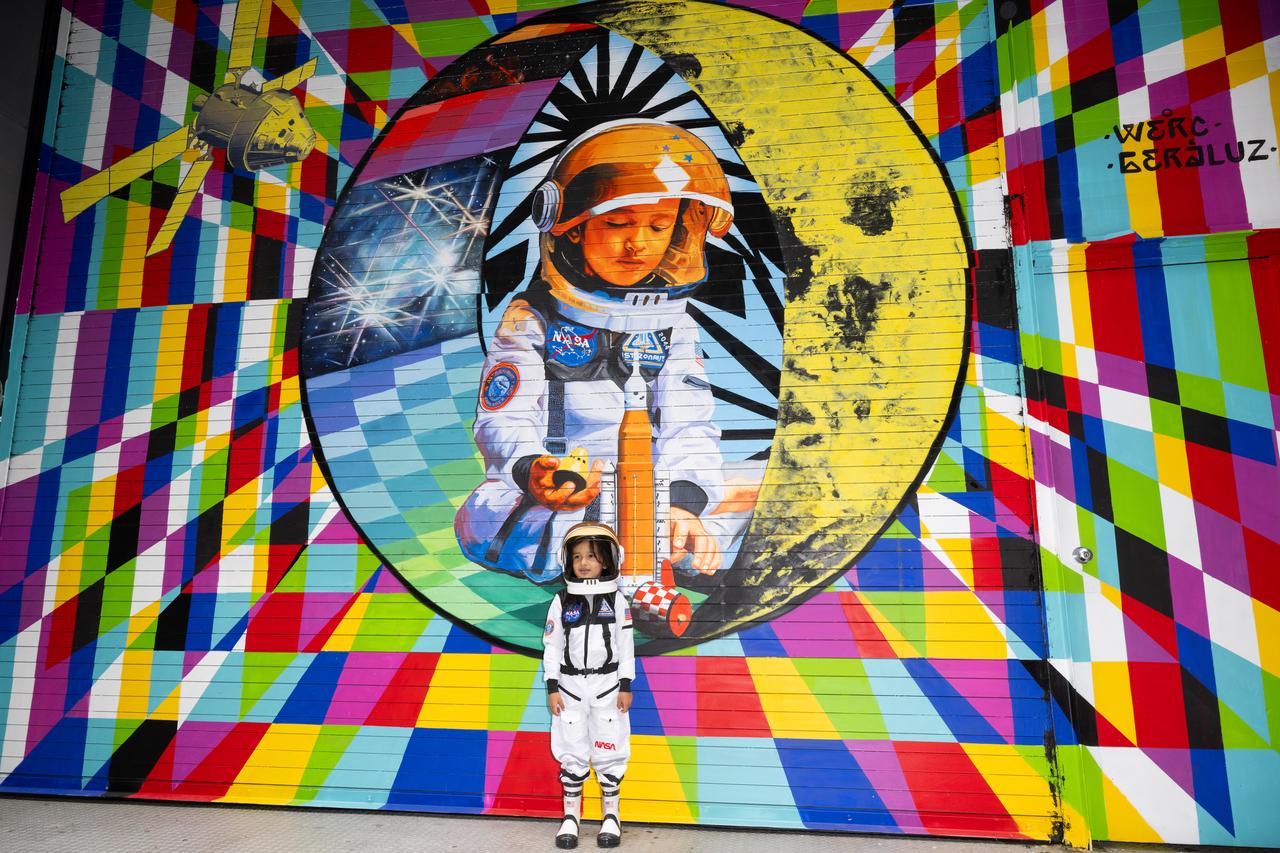
Amaru Alvarez, 5, the son of the artist team Geraluz and WERC and model for the mural, poses for picture with the mural “To the Moon, and Back” by the New York-based artist team that was created as part of the reimagined NASA Art Program, Tuesday, September 24, 2024, at 350 Hudson Street in New York City. The murals use geometrical patterns to invite deeper reflection on the exploration, creativity, and connection with the cosmos. Photo Credit: (NASA/Joel Kowsky)
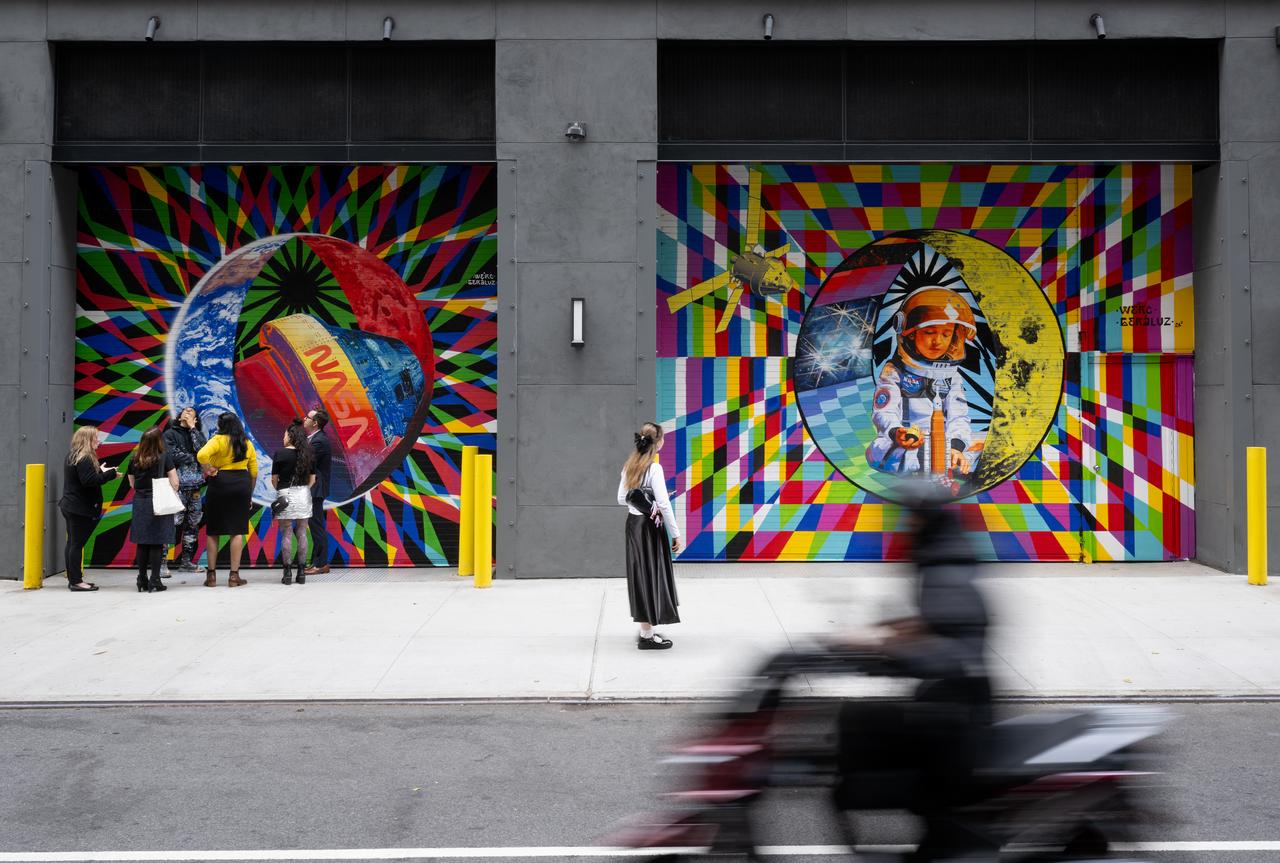
The inaugural murals for the relaunched NASA Art Program appear side-by-side at 350 Hudson Street, Tuesday, Sept. 24, 2024, in New York City. The murals, titled “To the Moon, and Back,” were created by New York-based artist team Geraluz and WERC and use geometrical patterns to invite deeper reflection on the exploration, creativity, and connection with the cosmos. Photo Credit: (NASA/Joel Kowsky)
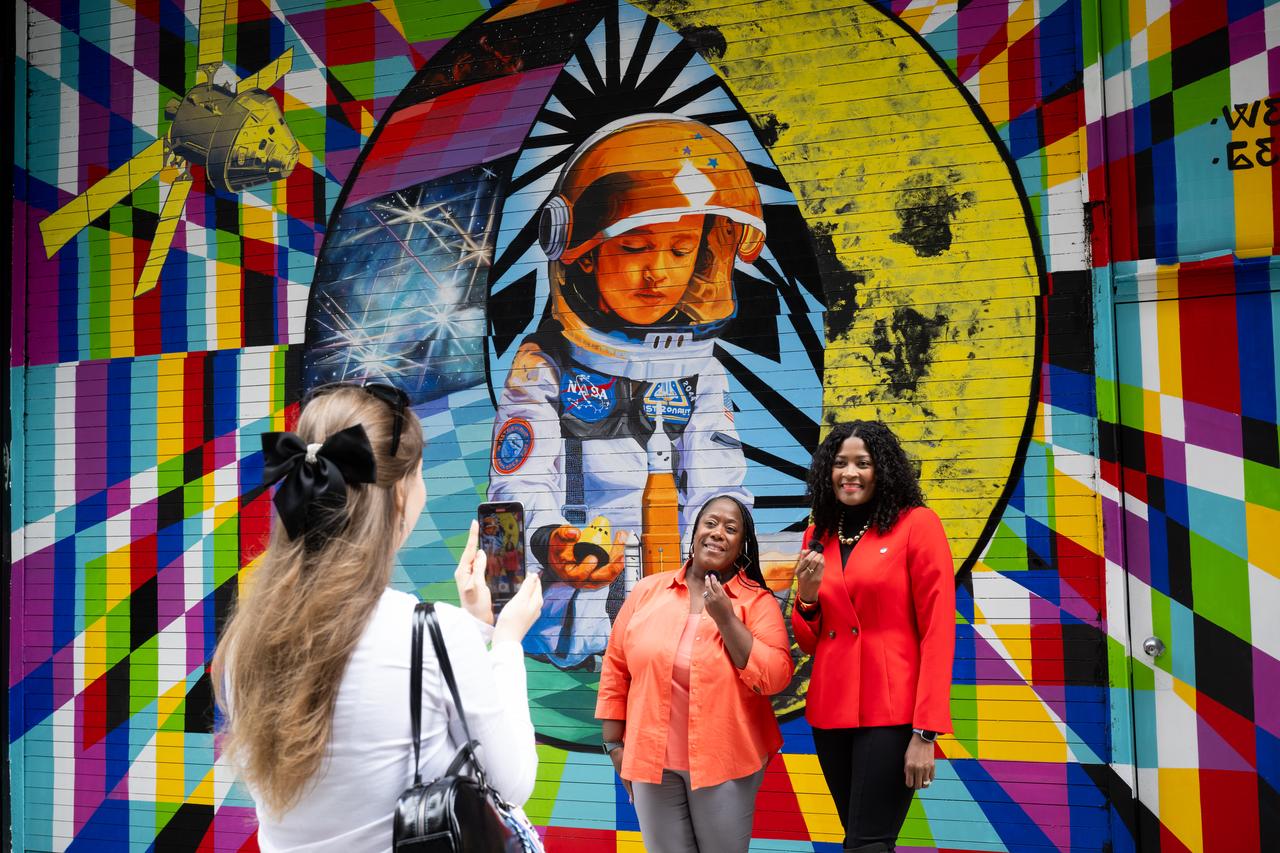
Michelle Jones, NASA’s deputy associate administrator for communications, left, and Aya Collins, director of the engagement division of NASA’s Office of Communications, record a video for social media in front of the mural “To the Moon, and Back” by the New York-based artist team Geraluz and WERC that was created as part of the reimagined NASA Art Program, Tuesday, September 24, 2024, in New York City’s Hudson Square neighborhood. For the inaugural project of the reestablished NASA Art Program the agency collaborated with the Hudson Square Business Improvement District on an open call for New York-based artists to design and install a large-scale mural inspired by NASA’s work and missions. Photo Credit: (NASA/Joel Kowsky)
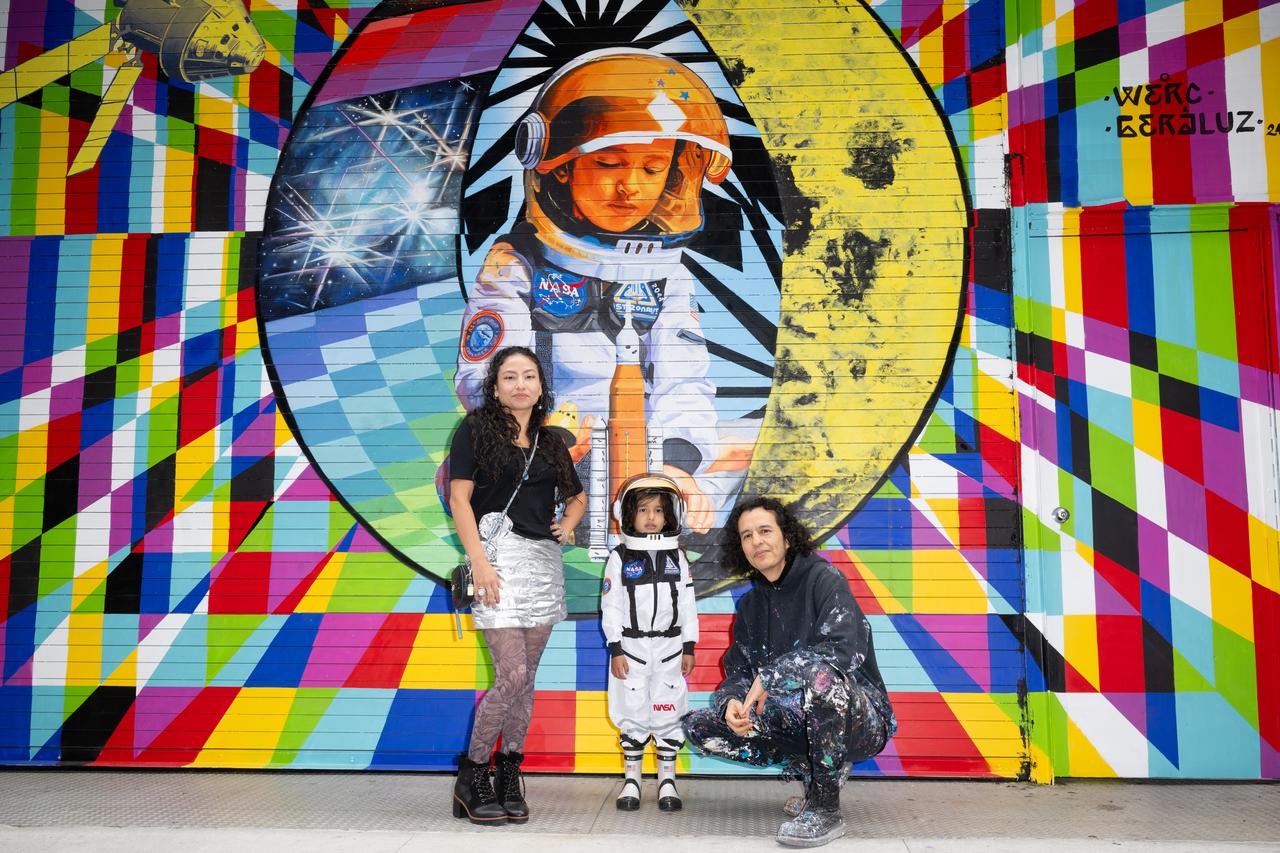
The New York-based artist team Geraluz, left, and WERC, right, and their son Amaru Alvarez, 5, pose for picture with the mural “To the Moon, and Back” by the artist team that was created as part of the reimagined NASA Art Program, Tuesday, September 24, 2024, at 350 Hudson Street in New York City. The murals use geometrical patterns to invite deeper reflection on the exploration, creativity, and connection with the cosmos. Photo Credit: (NASA/Joel Kowsky)
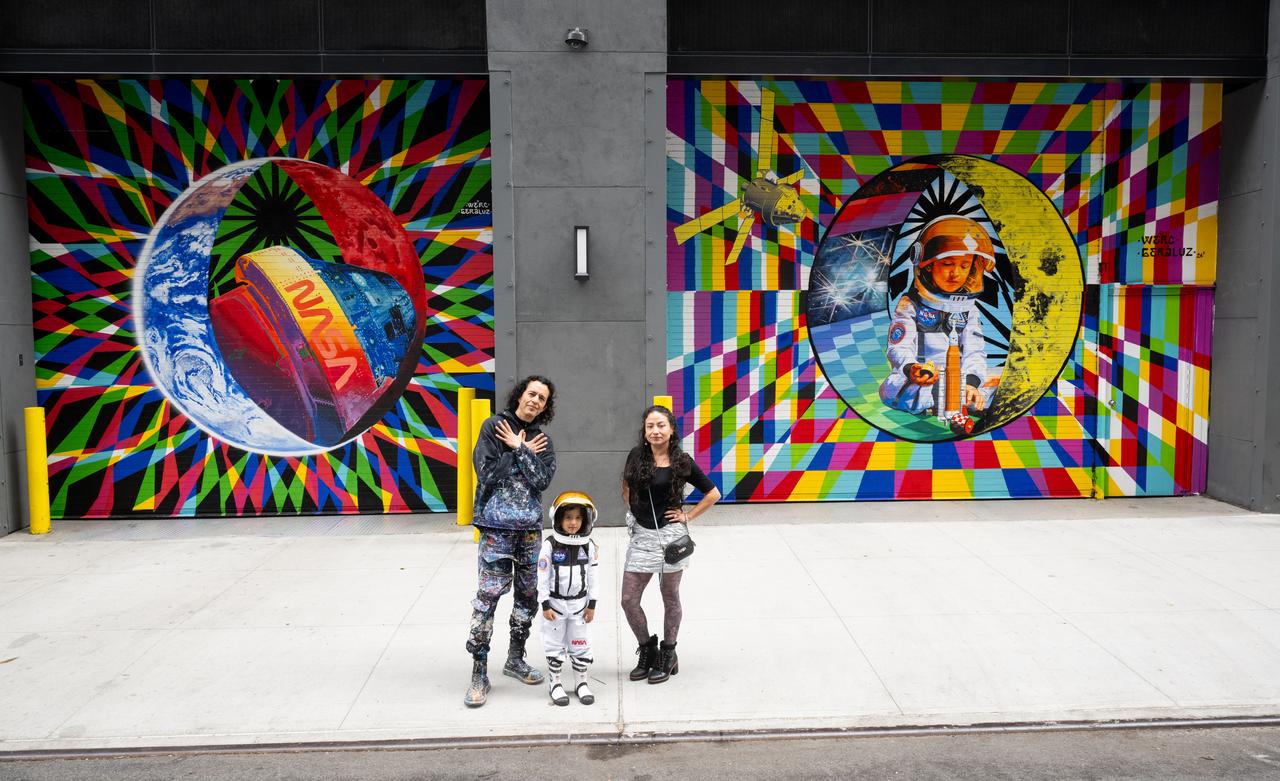
The New York-based artist team Geraluz, left, and WERC, right, and their son Amaru Alvarez, 5, pose for picture with the mural “To the Moon, and Back” by the artist team that was created as part of the reimagined NASA Art Program, Tuesday, September 24, 2024, at 350 Hudson Street in New York City. The murals use geometrical patterns to invite deeper reflection on the exploration, creativity, and connection with the cosmos. Photo Credit: (NASA/Joel Kowsky)

This radar image of the New York city metropolitan area. The island of Manhattan appears in the center of the image. The green-colored rectangle on Manhattan is Central Park.

STS059-50-003 (9-20 April 1994) --- This 35mm night image of the New York City metropolitan area was captured by the crew of the STS-59 crew during the Space Radar Laboratory (SRL) mission. Scientists studying film from the Space Shuttle Endeavour feel this is the best nocturnal view of this region from the manned space program.
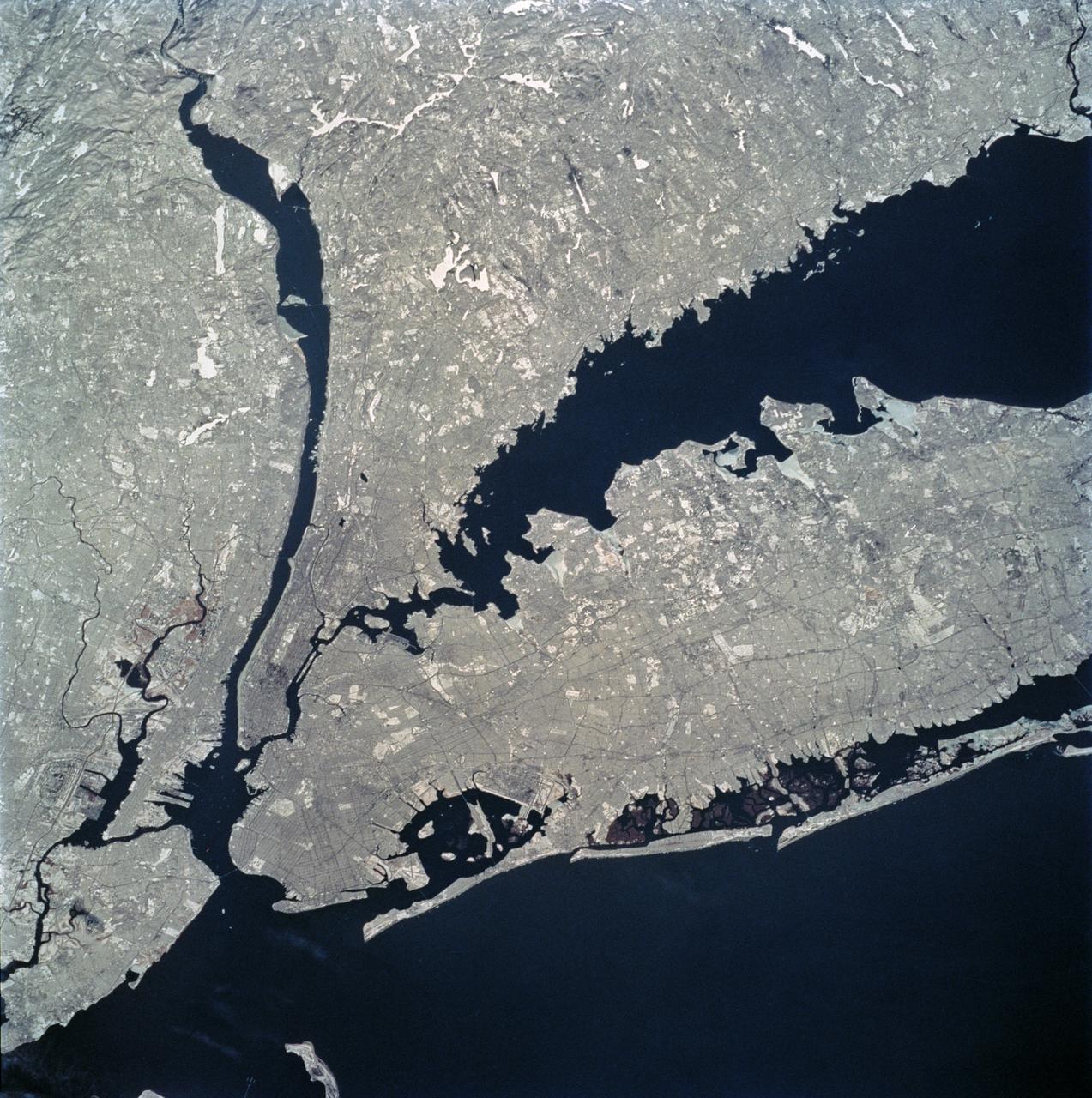
STS062-81-010 (4-18 March 1994) --- The recent heavy snowfalls help to accentuate the major transportation networks, (railroads, highways and airports), throughout the New York City metropolitan area. This particular scene also highlights the land-water boundaries and the lighter open spaces, such as parks, cemeteries and recreational areas. The snows have produced a white blanket effect on these areas. Even some of the snow-covered lakes can be discerned. The boroughs of Staten Island, Brooklyn, Queens, The Bronx and Manhattan are also recognizable on the photograph.
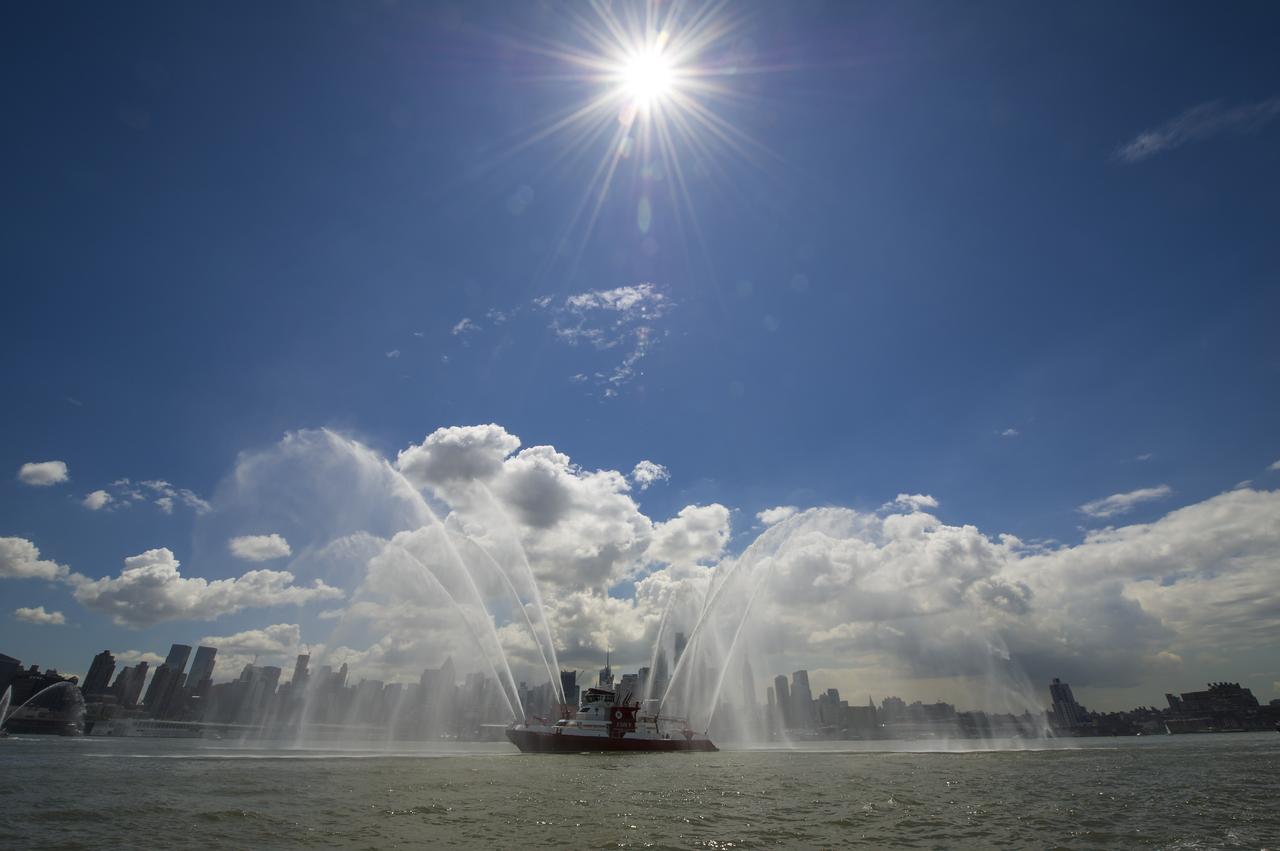
An FDNY fireboat is one of the lead boats for the space shuttle Enterprise as Enterprise is towed by barge up the Hudson River on it's way to the Intrepid Sea, Air and Space Museum where it will be permanently displayed, Wednesday, June 6, 2012 in New York City. Photo Credit: (NASA/Bill Ingalls)
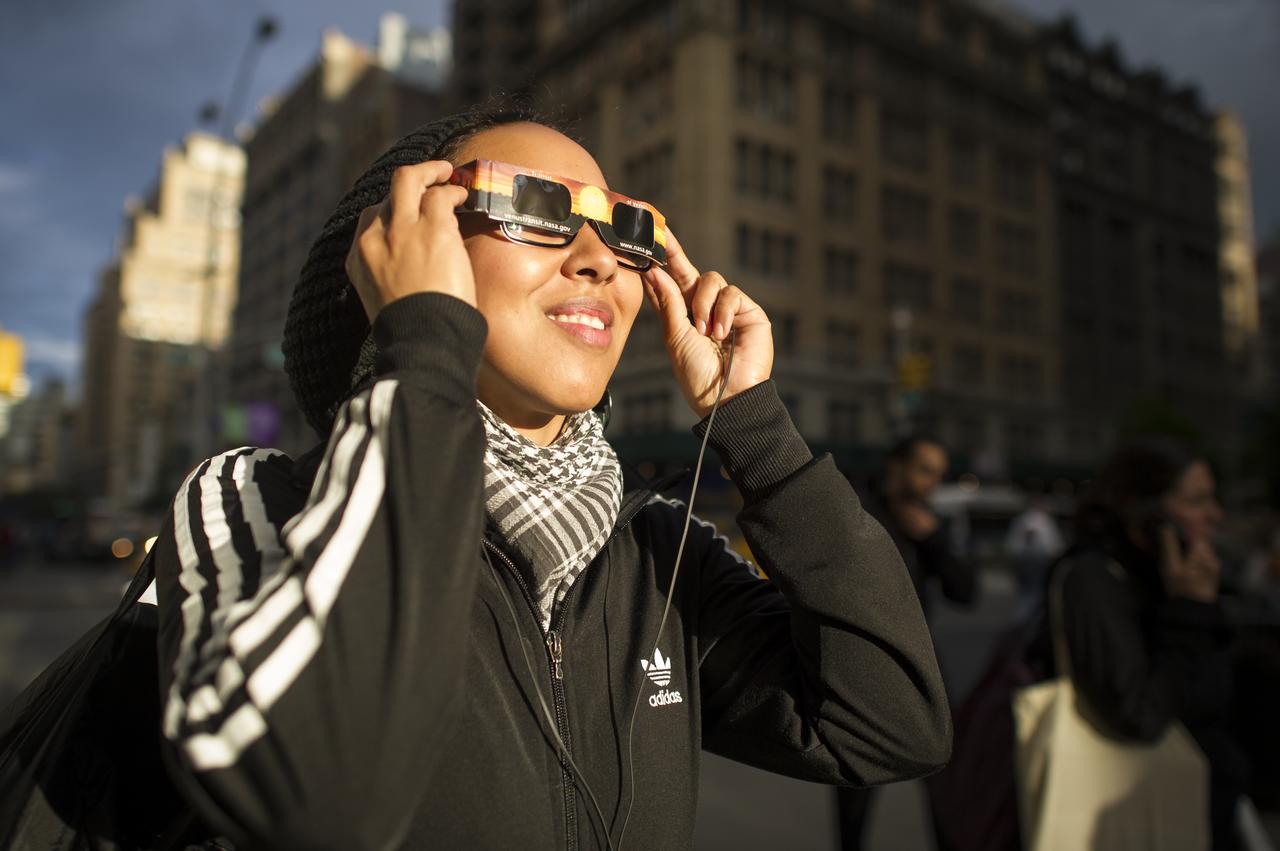
It appeared that New Yorkers were not going to be able to see the transit of the planet Venus across the Sun, but just before the transit was over the sun broke through the clouds and Yvette Lee Kang was able to catch a glimpse of the transit on Tuesday, June 5, 2012 in New York. A transit of Venus occurs when the planet passes directly between the sun and earth. This alignment is rare, coming in pairs that are eight years apart but separated by over a century. The next Venus transit will be in December 2117. Photo Credit: (NASA/Bill Ingalls)
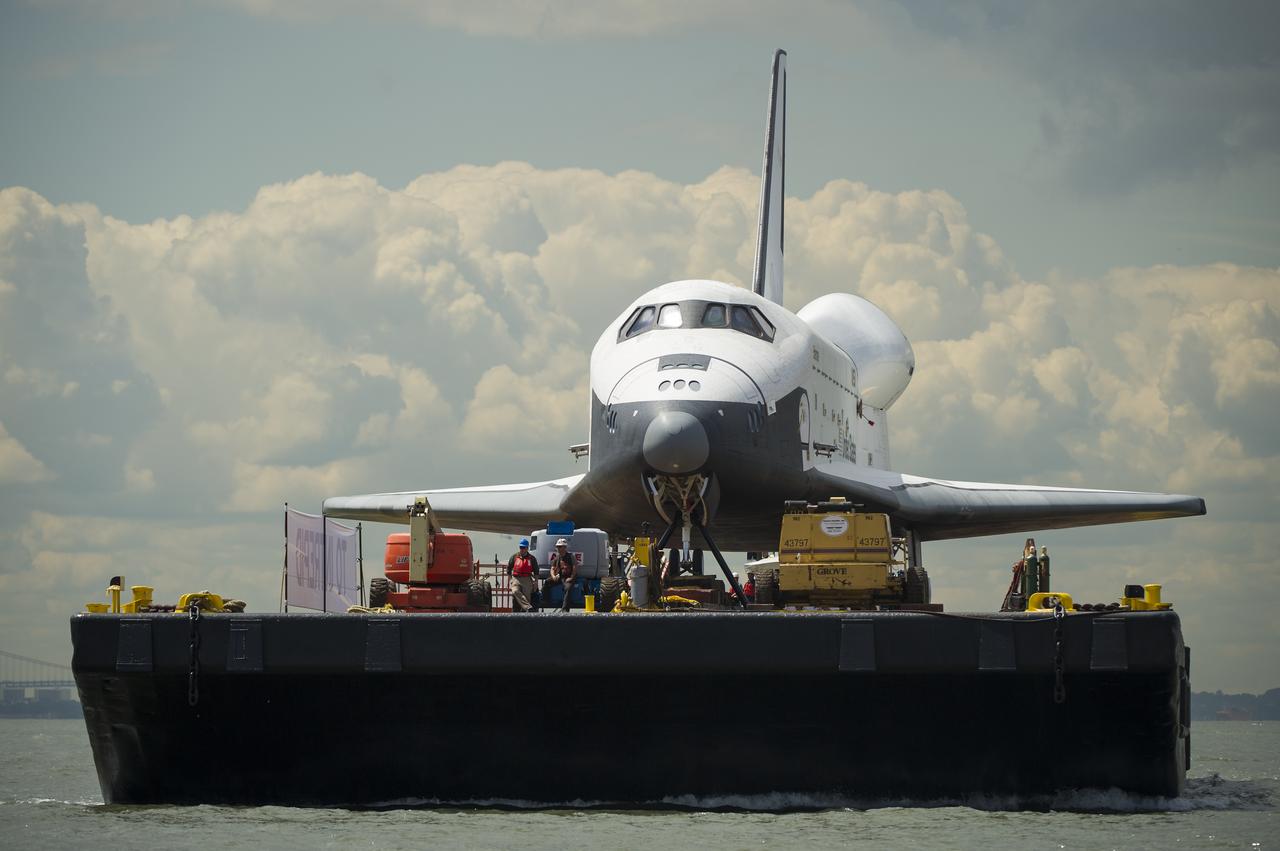
The space shuttle Enterprise is towed by barge up the Hudson River on it's way to the Intrepid Sea, Air and Space Museum where it will be permanently displayed, Wednesday, June 6, 2012 in New York City. Photo Credit: (NASA/Bill Ingalls)
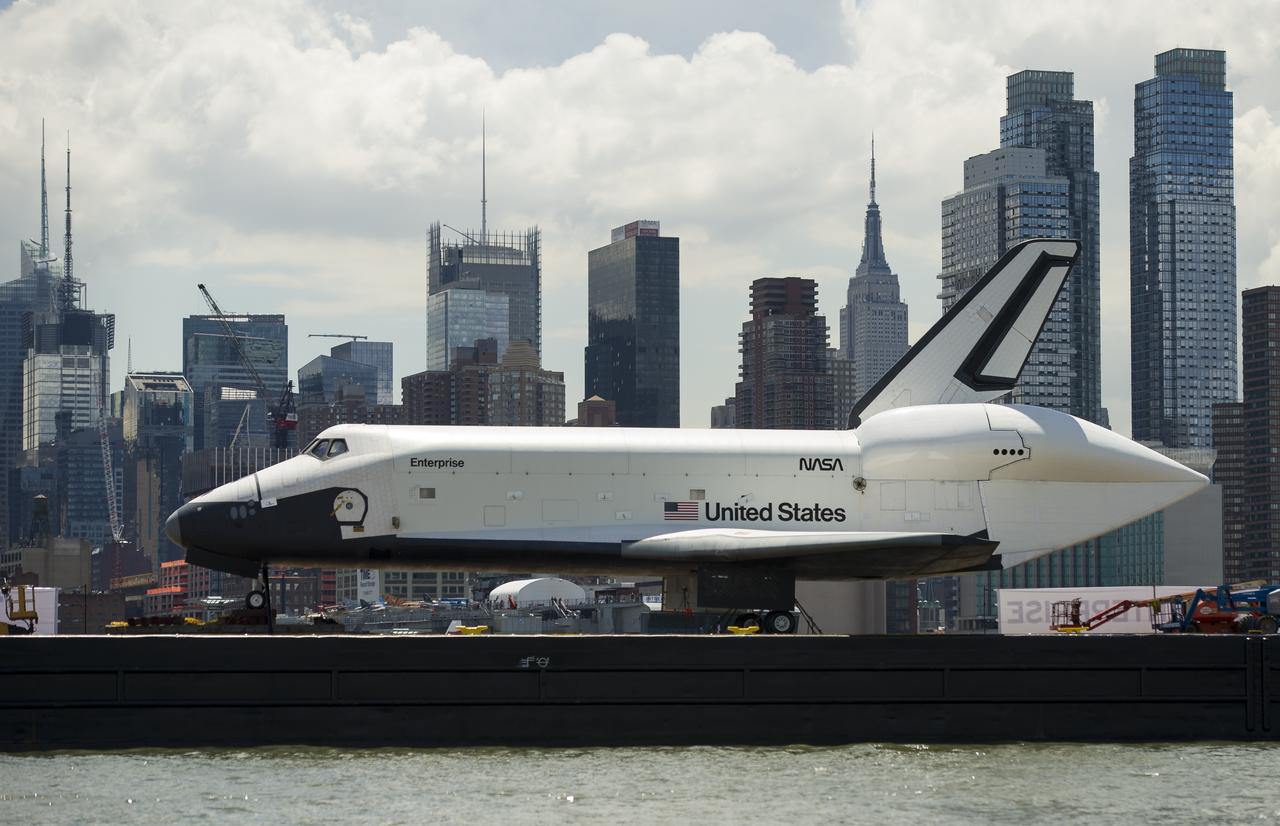
The space shuttle Enterprise is towed by barge up the Hudson River in New York with the New York City Skyline, including the Empire State Building, in the background while on it's way to the Intrepid Sea, Air and Space Museum where it will be permanently displayed, Wednesday, June 6, 2012. Photo Credit: (NASA/Bill Ingalls)
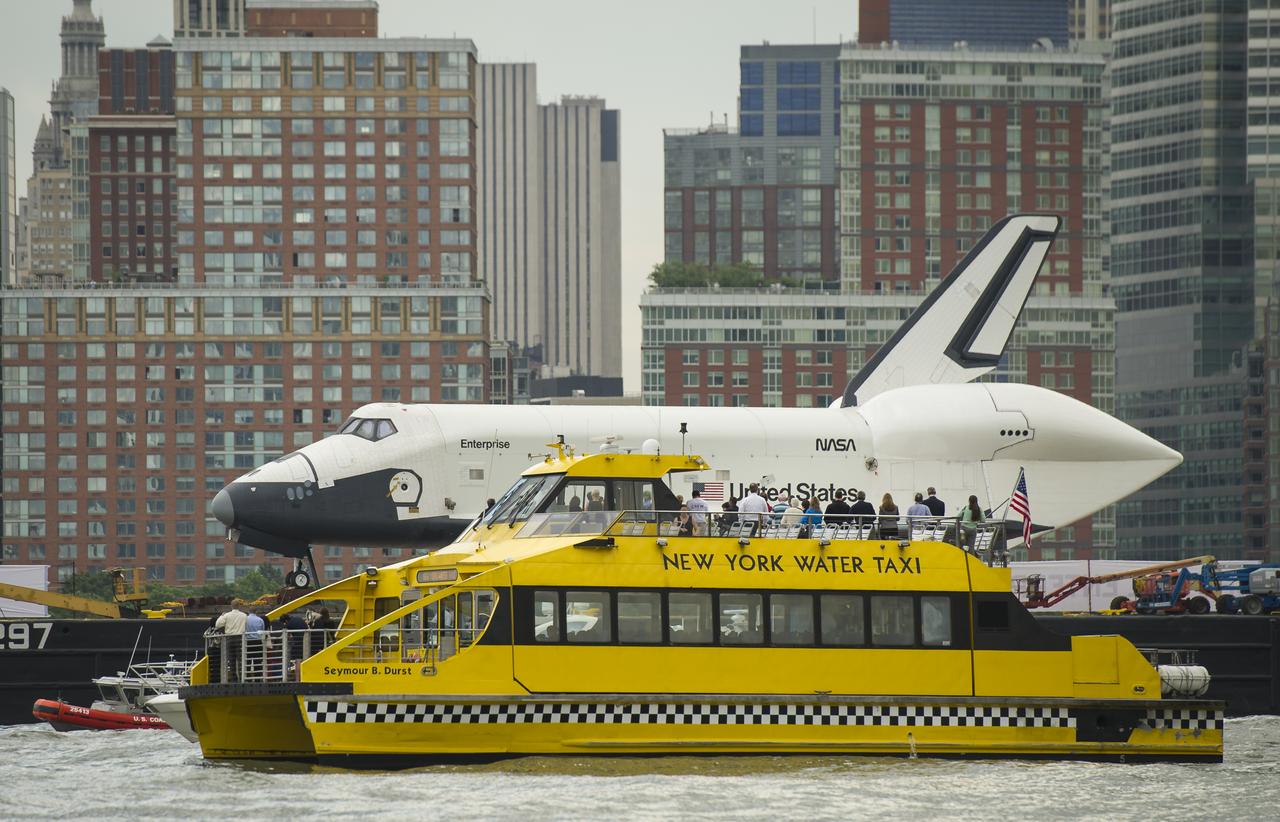
Riders onboard a New York Water Taxi get a close-up view of the space shuttle Enterprise as it is towed by barge up the Hudson River on it's way to the Intrepid Sea, Air and Space Museum where it will be permanently displayed, Wednesday, June 6, 2012 in New York City. Photo Credit: (NASA/Bill Ingalls)
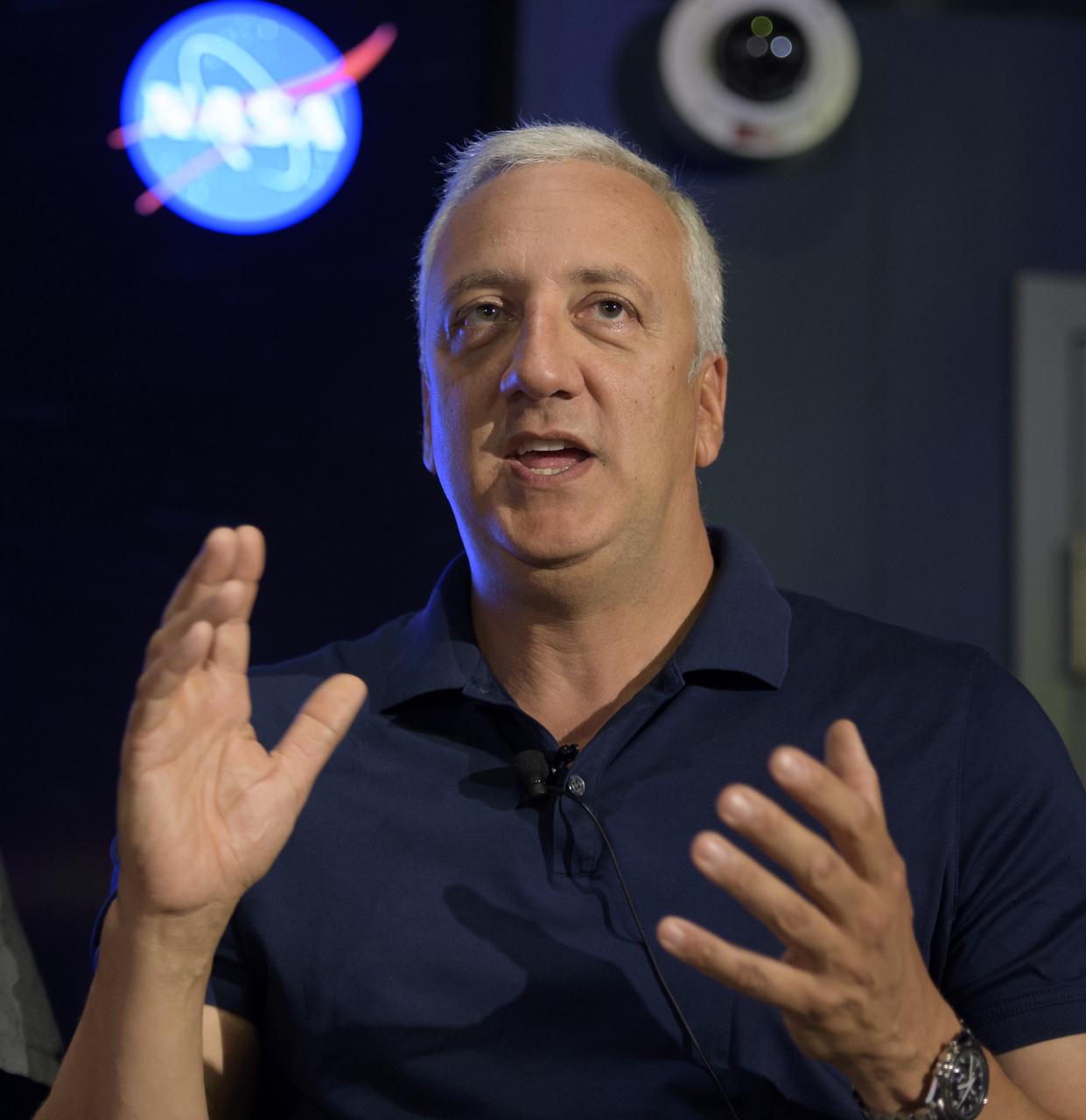
Former NASA astronaut Mike Massimino participates in a panel discussion titled "The Big Picture", Saturday, Aug. 5, 2017 at the Intrepid Sea, Air & Space Museum in New York City. Photo Credit: (NASA/Bill Ingalls)

Former NASA astronaut Mike Massimino participates in a panel discussion titled "The Big Picture", Saturday, Aug. 5, 2017 at the Intrepid Sea, Air & Space Museum in New York City. Photo Credit: (NASA/Bill Ingalls)

iss073e0982136 (Oct. 25, 2025) --- Upper Bay (center) leads to New York City's Statue of Liberty, then splits into the Hudson River and East River, which shape the island borough of Manhattan. Surrounding this iconic borough are New York City's four other boroughs—Staten Island, Brooklyn, Queens, and the Bronx—as well as the neighboring state of New Jersey. The New York City metropolitan area has a population of approximately 19.9 million, making it the 10th most populous region in the world. This photograph was taken from the International Space Station as it orbited 262 miles above the Empire State at approximately 2:23 a.m. local time.
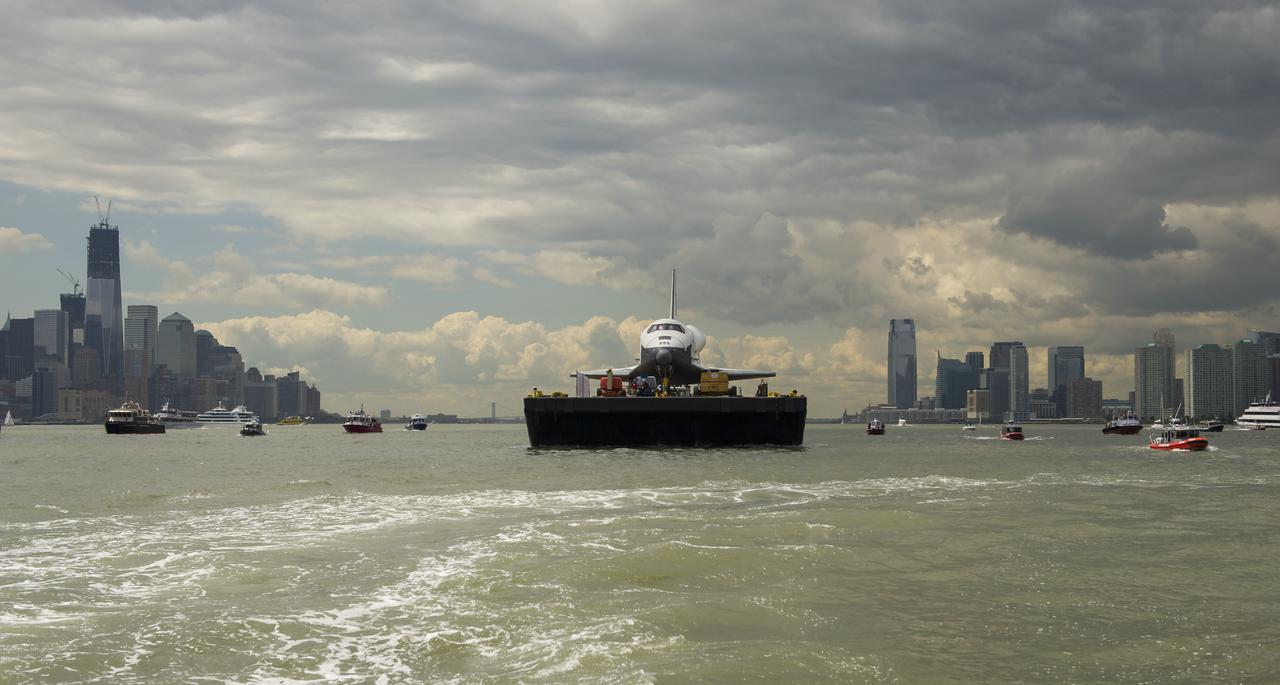
The space shuttle Enterprise is towed by barge up the Hudson River with the New York skyline seen on the left and the Jersey City skyline on the right while on it's way to the Intrepid Sea, Air and Space Museum where it will be permanently displayed, Wednesday, June 6, 2012. Photo Credit: (NASA/Bill Ingalls)

It appeared that New Yorkers were not going to be able to see the transit of the planet Venus across the Sun, but just before the transit was over the sun broke through the clouds and Liz Heller and Andriel Mesznik were able to catch a glimpse of the transit on Tuesday, June 5, 2012 in New York. A transit of Venus occurs when the planet passes directly between the sun and earth. This alignment is rare, coming in pairs that are eight years apart but separated by over a century. The next Venus transit will be in December 2117. Photo Credit: (NASA/Bill Ingalls)

New York Mayor Michael Bloomberg, center, talks about the construction around the site where the World Trade Center once stood to NASA Deputy Administrator Lori Garver, right, and members of the STS-135 crew including commander Chris Ferguson, left, mission specialist Rex Walheim, second right, and pilot Doug Hurley, rear, as they tour the area, Wednesday evening, Aug. 18, 2011, in New York. Photo Credit: (NASA/Paul E. Alers)
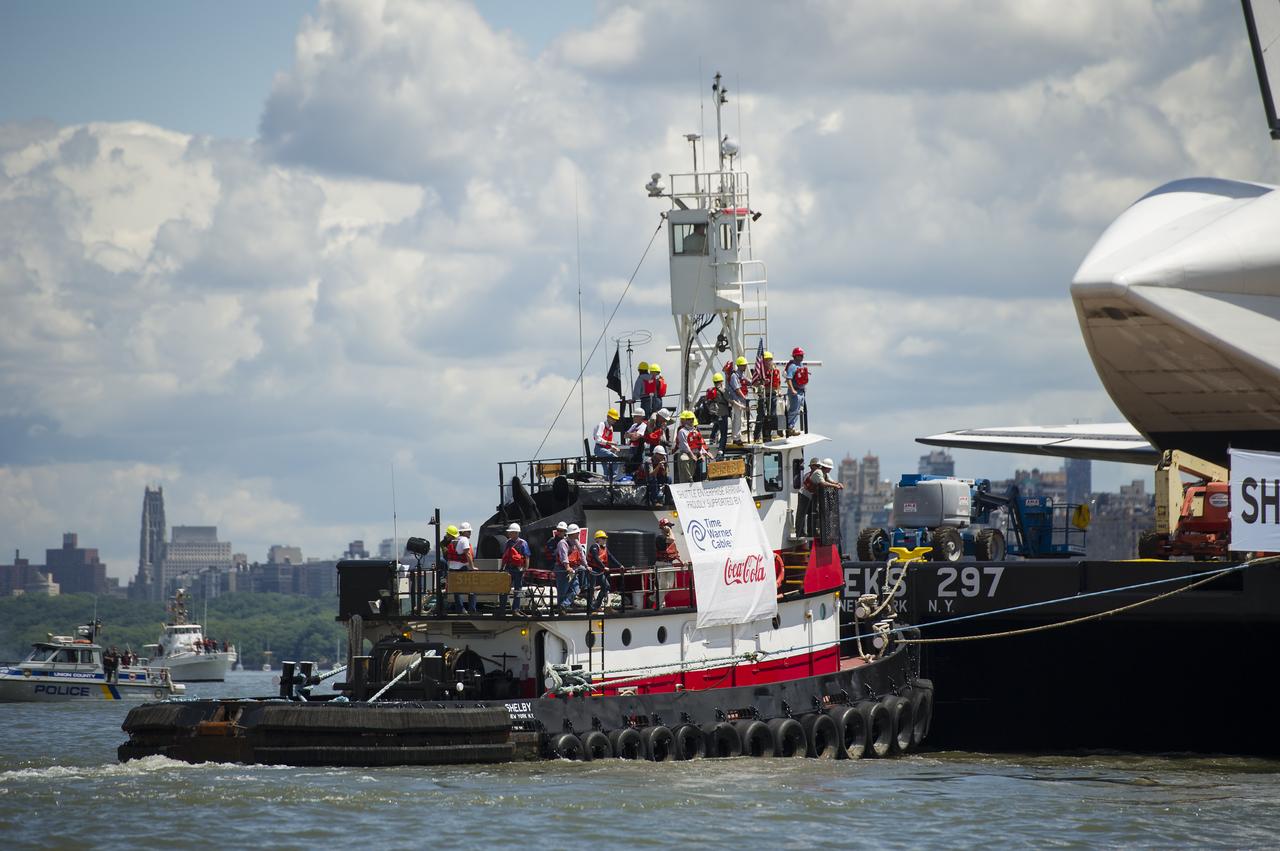
The tugboat Shelby helps tow the space shuttle Enterprise on a barge up the Hudson River to the Intrepid Sea, Air and Space Museum where it will be permanently displayed, Wednesday, June 6, 2012 in New York City. Photo Credit: (NASA/Bill Ingalls)
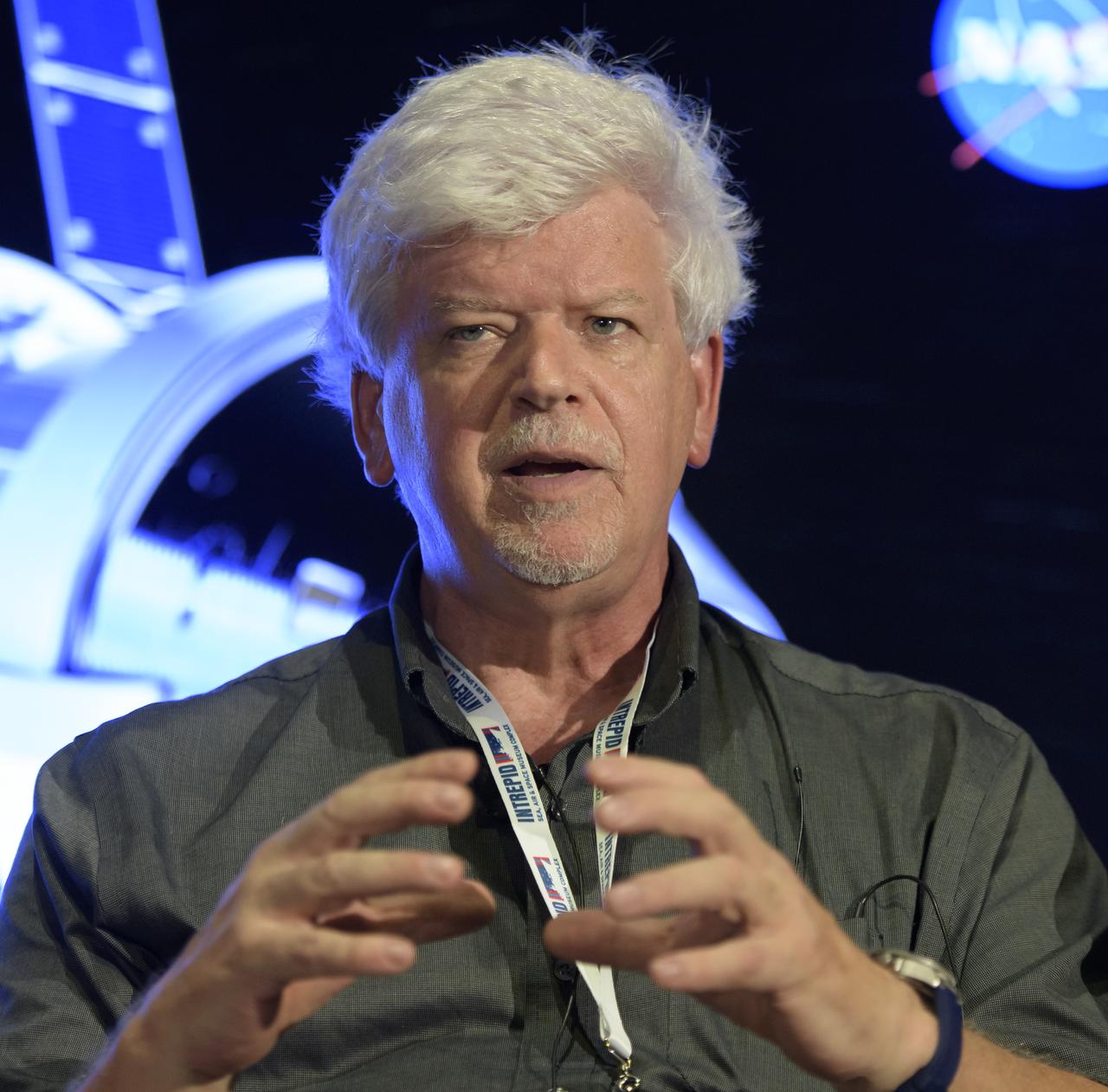
Honeybee Robotics co-founder and chairman Stephen Gorevan participates in a panel discussion titled "The Big Picture", Saturday, Aug. 5, 2017 at the Intrepid Sea, Air & Space Museum in New York City. Photo Credit: (NASA/Bill Ingalls)

NASA James Webb Space Telescope systems engineer Mike Menzel, participates in a panel discussion titled "The Big Picture", Saturday, Aug. 5, 2017 at the Intrepid Sea, Air & Space Museum in New York City. Photo Credit: (NASA/Bill Ingalls)
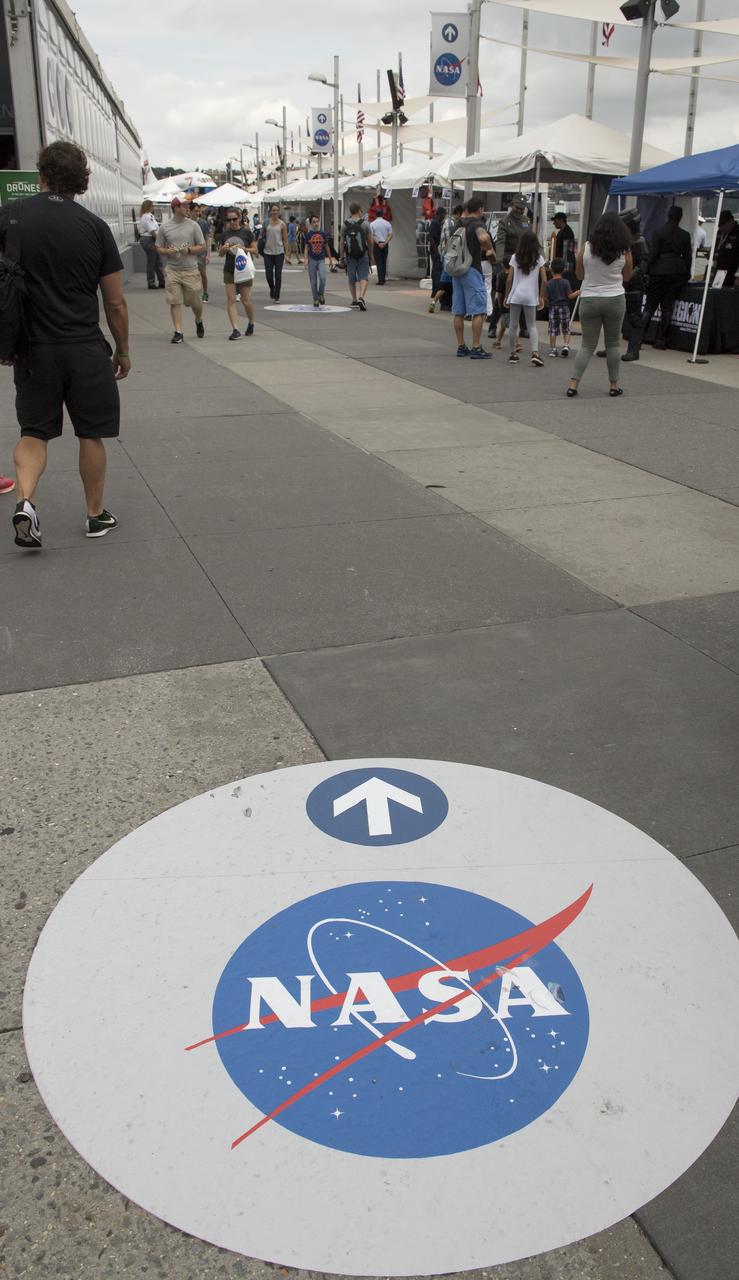
Signage points the way to NASA exhibits at the Intrepid Space & Science Festival, Saturday, Aug. 5, 2017 held at the Intrepid Sea, Air & Space Museum in New York City. The week-long festival featured talks, films and cutting-edge displays showcasing NASA technology. Photo Credit: (NASA/Bill Ingalls)
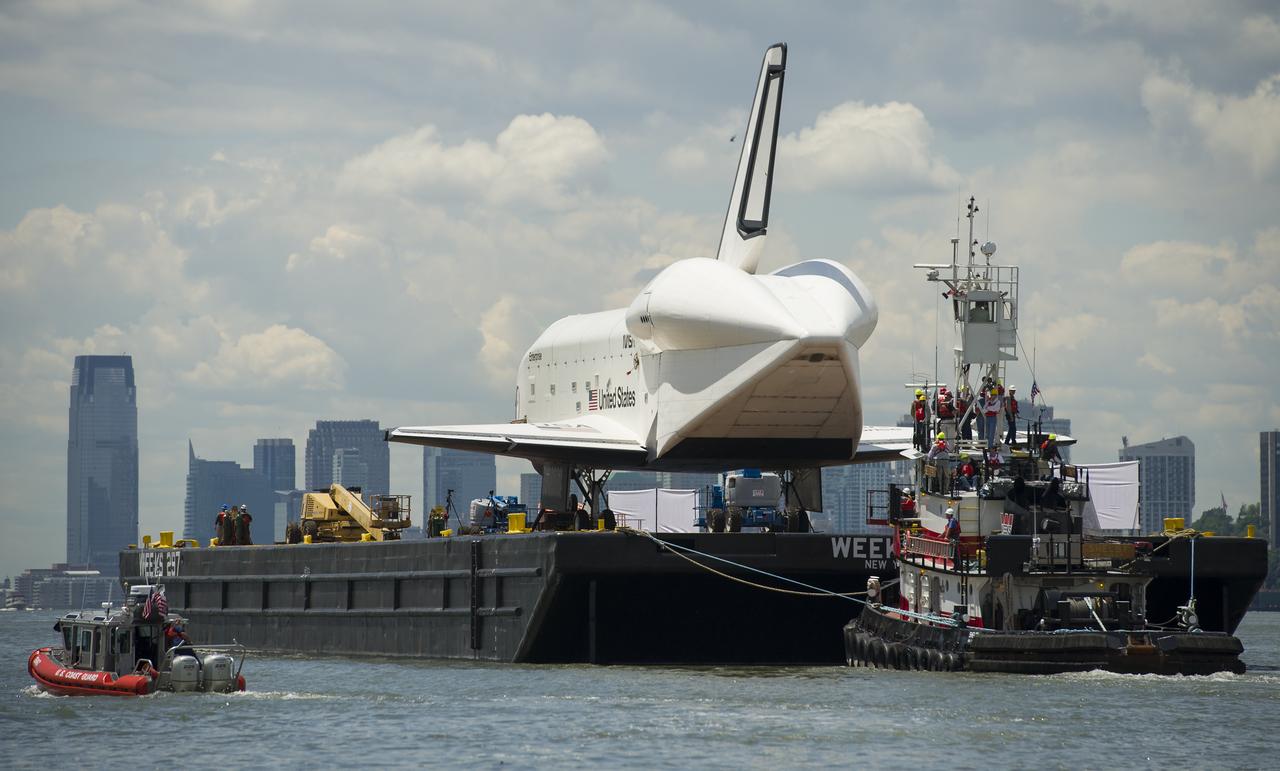
The tugboat Shelby tows the space shuttle Enterprise on a barge on the Hudson River to the Intrepid Sea, Air and Space Museum where it will be permanently displayed, Wednesday, June 6, 2012 in New York City. Photo Credit: (NASA/Bill Ingalls)

SpaceX Director of space operations and former NASA astronaut Garret Reisman participates in a panel discussion titled "The Big Picture", Saturday, Aug. 5, 2017 at the Intrepid Sea, Air & Space Museum in New York City. Photo Credit: (NASA/Bill Ingalls)
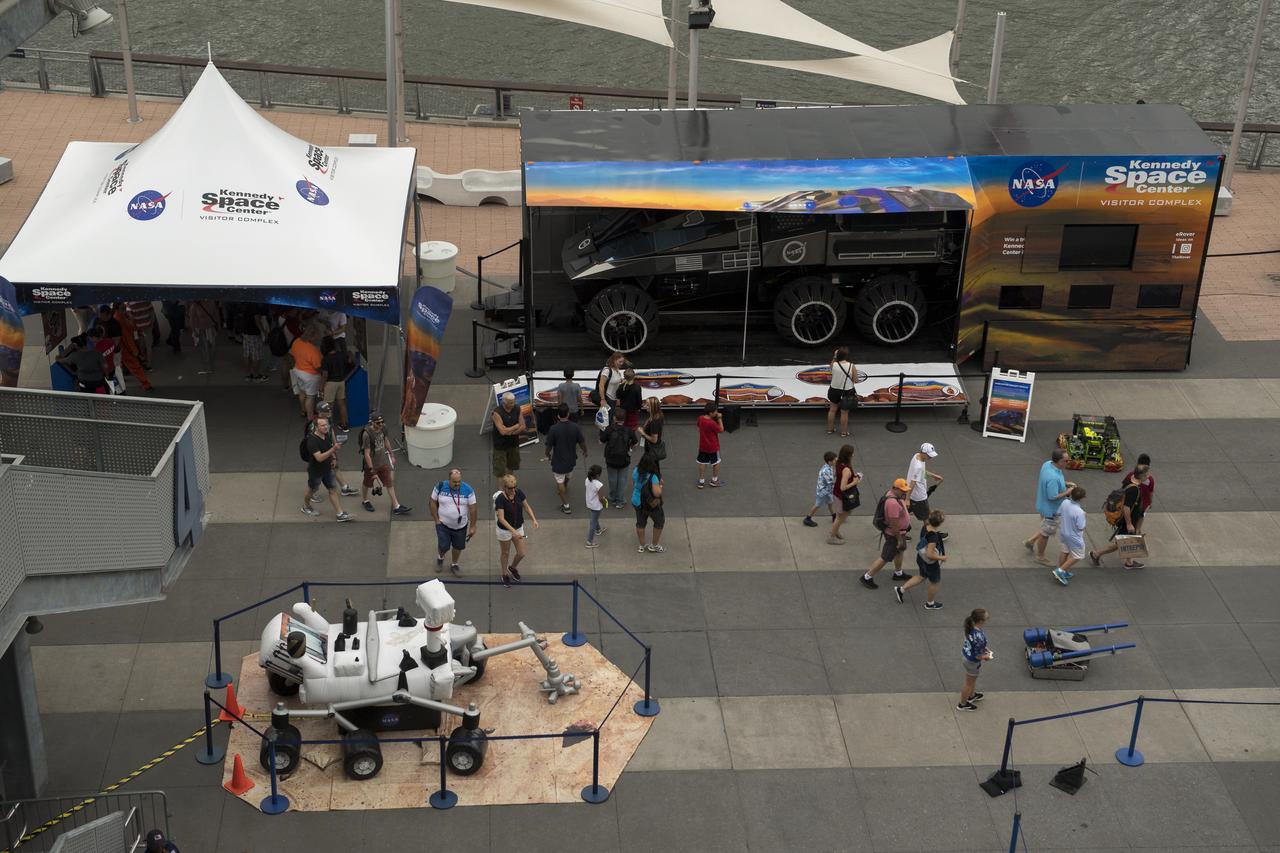
NASA exhibits line Pier 86 during the Intrepid Space & Science Festival, Saturday, Aug. 5, 2017 held at the Intrepid Sea, Air & Space Museum in New York City. The week-long festival featured talks, films and cutting-edge displays showcasing NASA technology. Photo Credit: (NASA/Bill Ingalls)
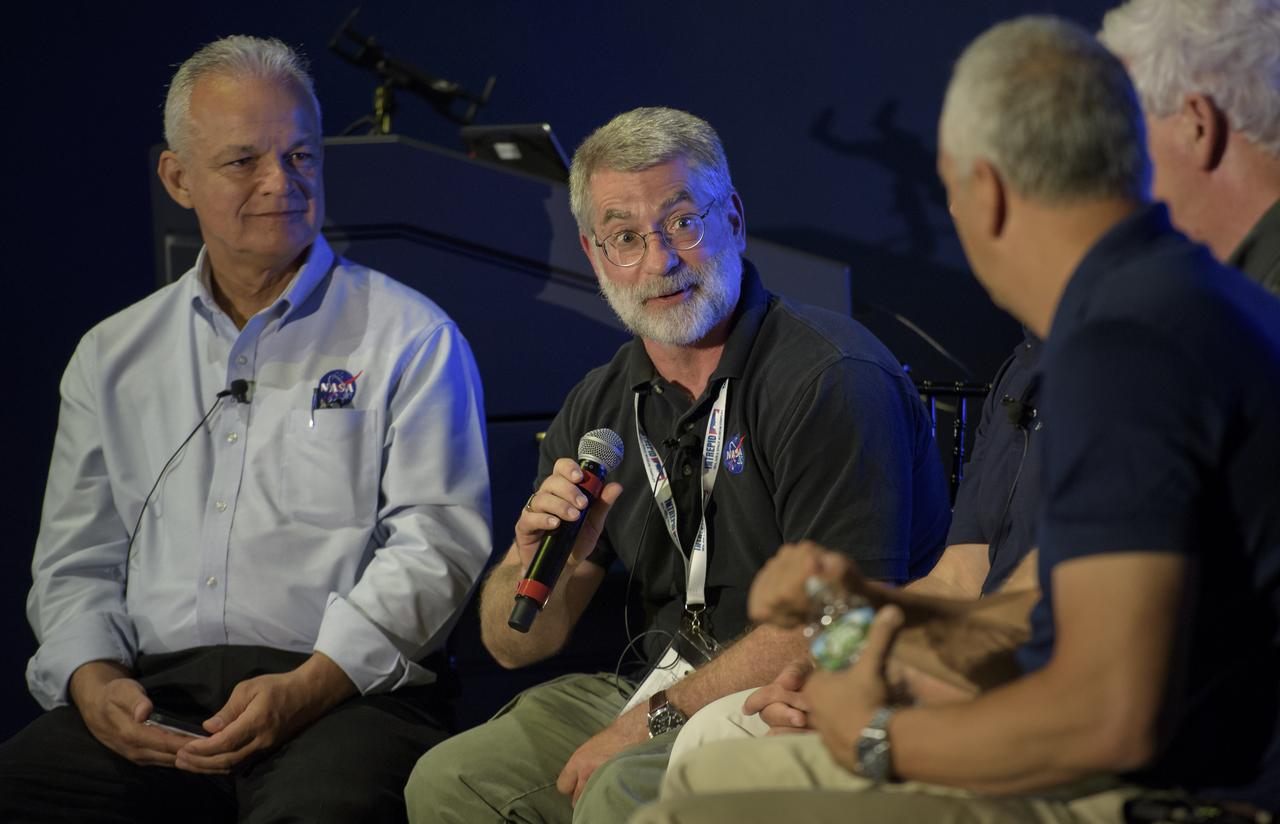
NASA James Webb Space Telescope systems engineer Mike Menzel, center, participates in a panel discussion titled "The Big Picture", Saturday, Aug. 5, 2017 at the Intrepid Sea, Air & Space Museum in New York City. Photo Credit: (NASA/Bill Ingalls)
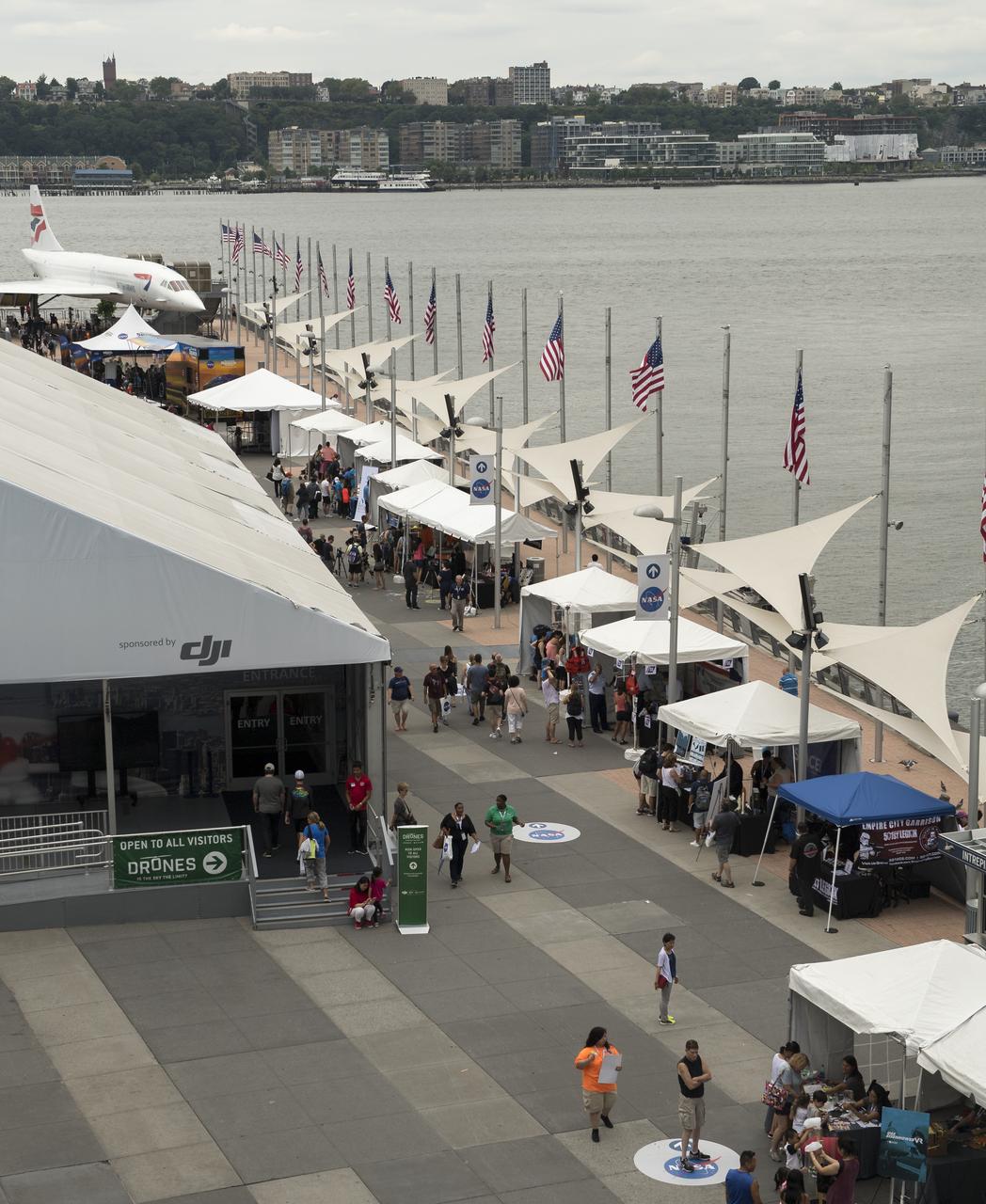
NASA exhibits line Pier 86 during the Intrepid Space & Science Festival, Saturday, Aug. 5, 2017 held at the Intrepid Sea, Air & Space Museum in New York City. The week-long festival featured talks, films and cutting-edge displays showcasing NASA technology. Photo Credit: (NASA/Bill Ingalls)

iss072e402101 (Dec. 22, 2024) --- The city lghts of the New York/New Jersey metropolitan area at approximately 3:30 a.m. EST (local time) contrast with the Atlantic coast and the Hudson River in this photograph taken from the International Space Station as it orbited 259 miles above Newfoundland.
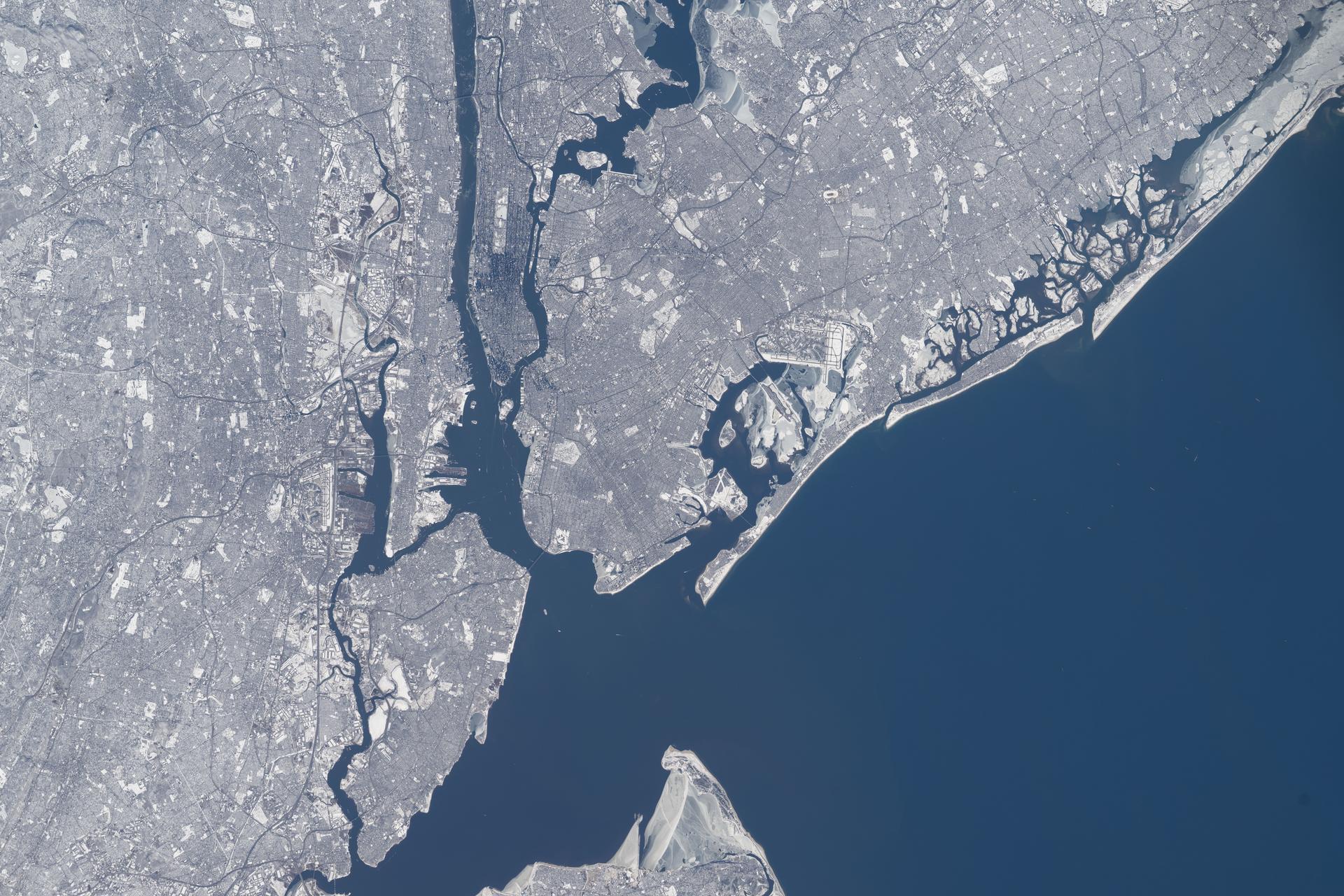
iss074e0315625 (Feb. 13, 2026) --- All five of New York City’s boroughs—Staten Island, Manhattan, Brooklyn, Queens, and the Bronx—are captured in this photograph of the wintry New York–Newark–Jersey City metropolitan area, which has a population of approximately 19.8 million. Near the center right is John F. Kennedy International Airport—America’s sixth-busiest airport, handling over 62 million passengers annually. Credit: NASA/Chris Williams

iss074e0003055 (Dec. 20, 2025) --- The New York–Newark–Jersey City Metropolitan Statistical Area, which spans 23 counties across New York, New Jersey, and Connecticut and has a population of about 19.9 million, is pictured at approximately 3:29 a.m. local time from the International Space Station as it orbited 262 miles above the Atlantic coast.

STS060-06-037 (3-11 Feb 1994) --- The city lights of Buffalo and Toronto outline the shores of the east end of Lake Erie and the west end of Lake Ontario in this night scene of western New York and southern Ontario. Between the two major cities are the cities of Niagara Falls, New York and Niagara Falls, Canada, which straddle the Niagara River just north of the actual falls. This photograph was taken with a special ASA-1600 film that is normally used for night-time photography of aurora, noctilucent clouds, biomass burning, and city lights.
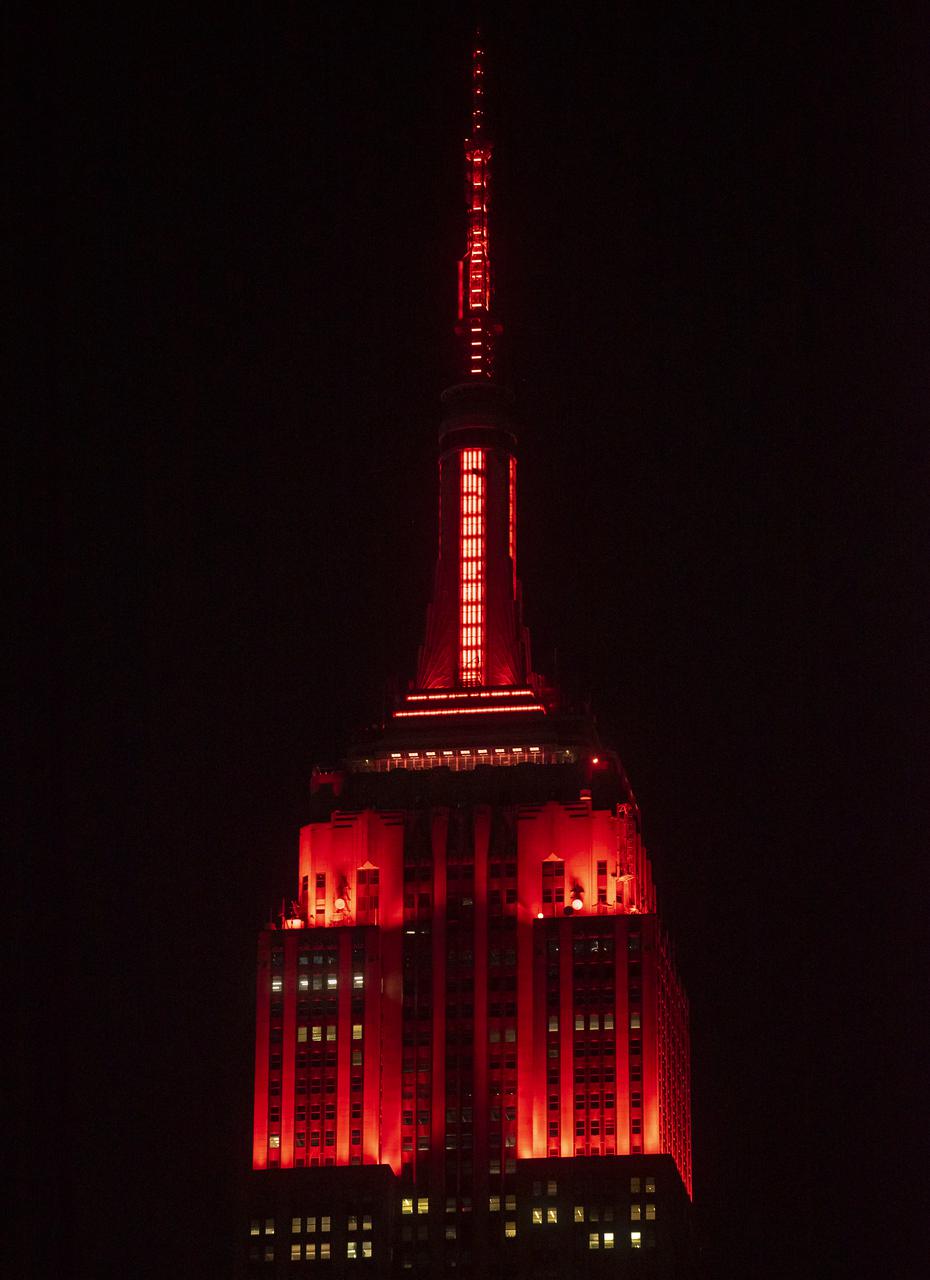
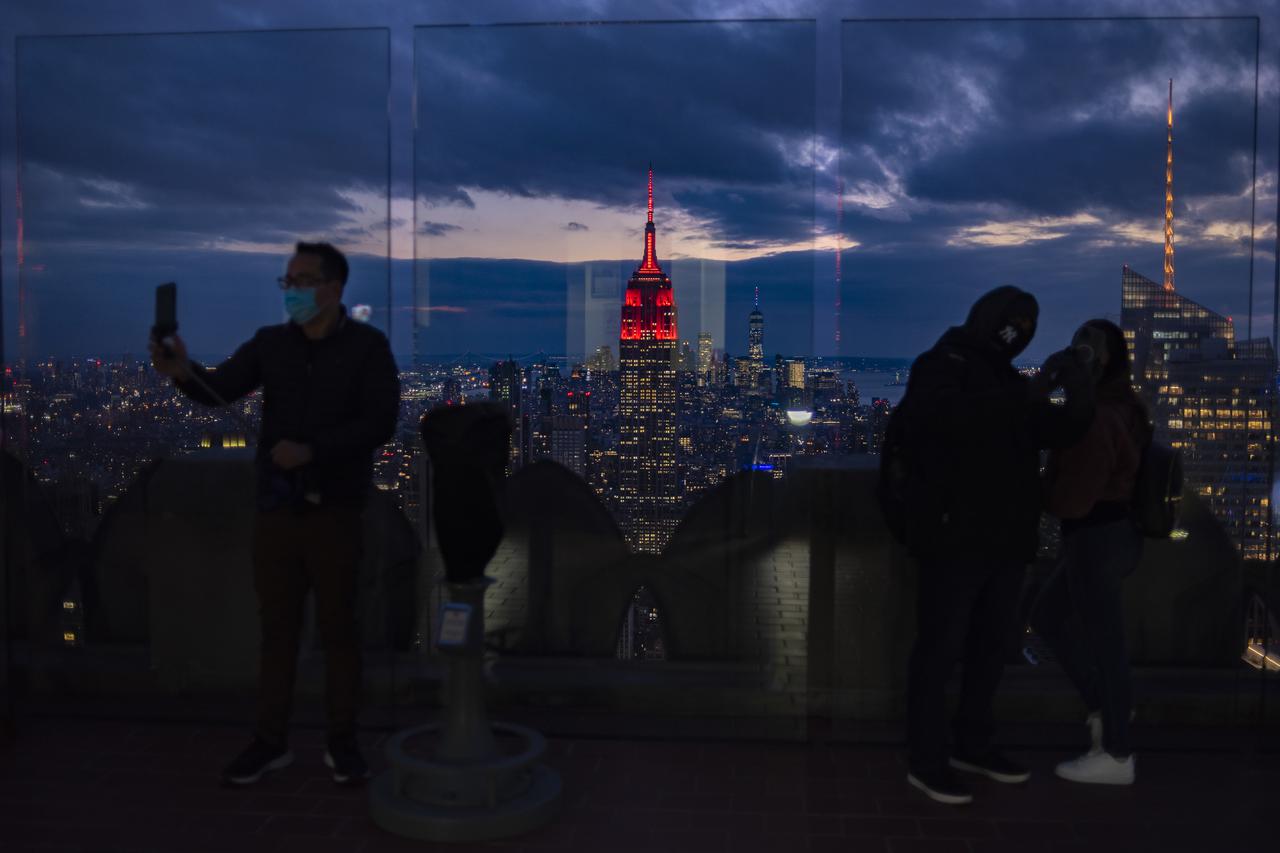
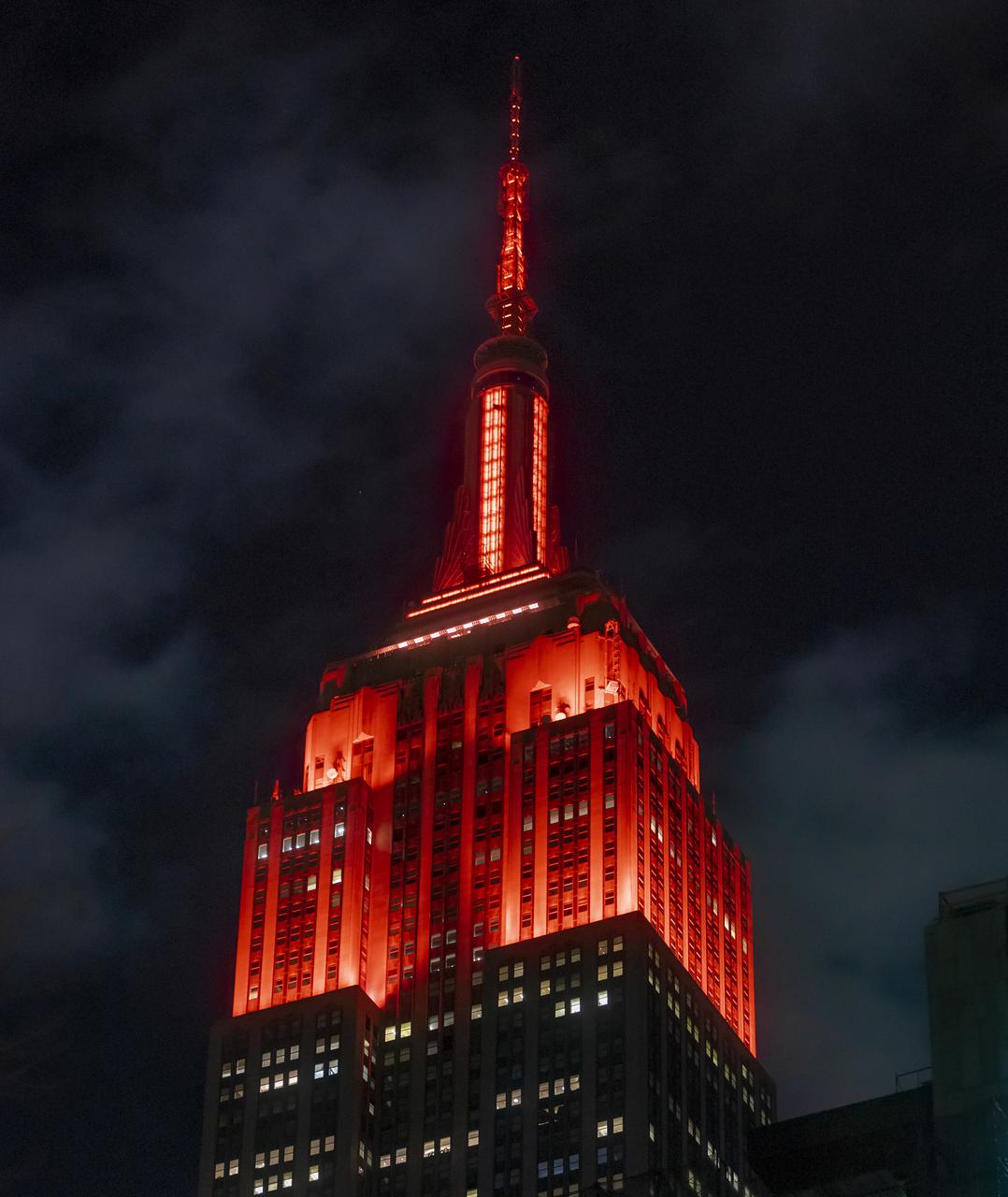
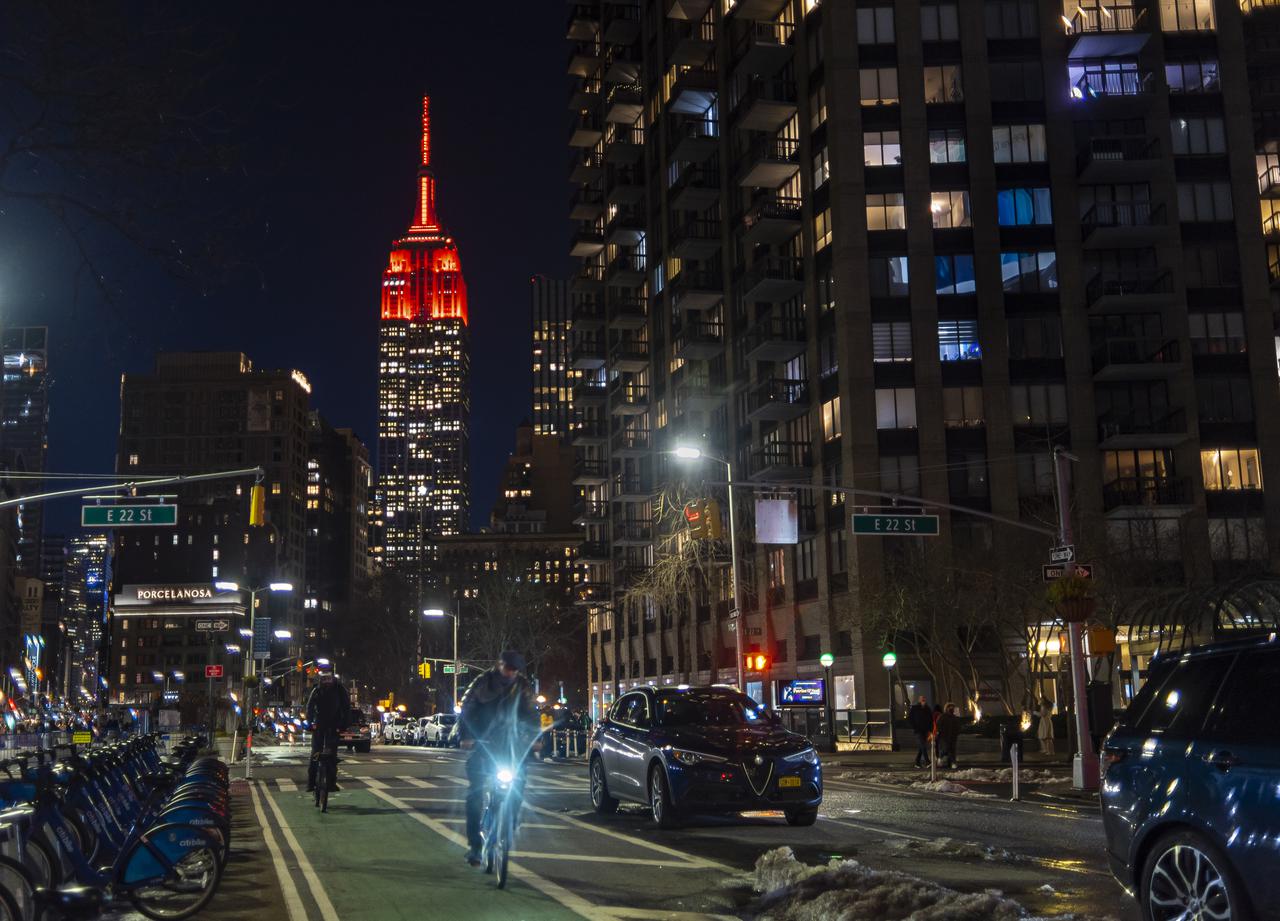
The Empire State Building is illuminated in red to celebrate this Thursday's scheduled landing on Mars of NASA's Perseverance rover, Tuesday, Feb. 16, 2021 in New York City. A key objective for Perseverance’s mission on Mars is astrobiology, including the search for signs of ancient microbial life. The rover will characterize the planet’s geology and past climate, pave the way for human exploration of the Red Planet, and be the first mission to collect and cache Martian rock and regolith. Photo Credit: (NASA/Emma Howells)
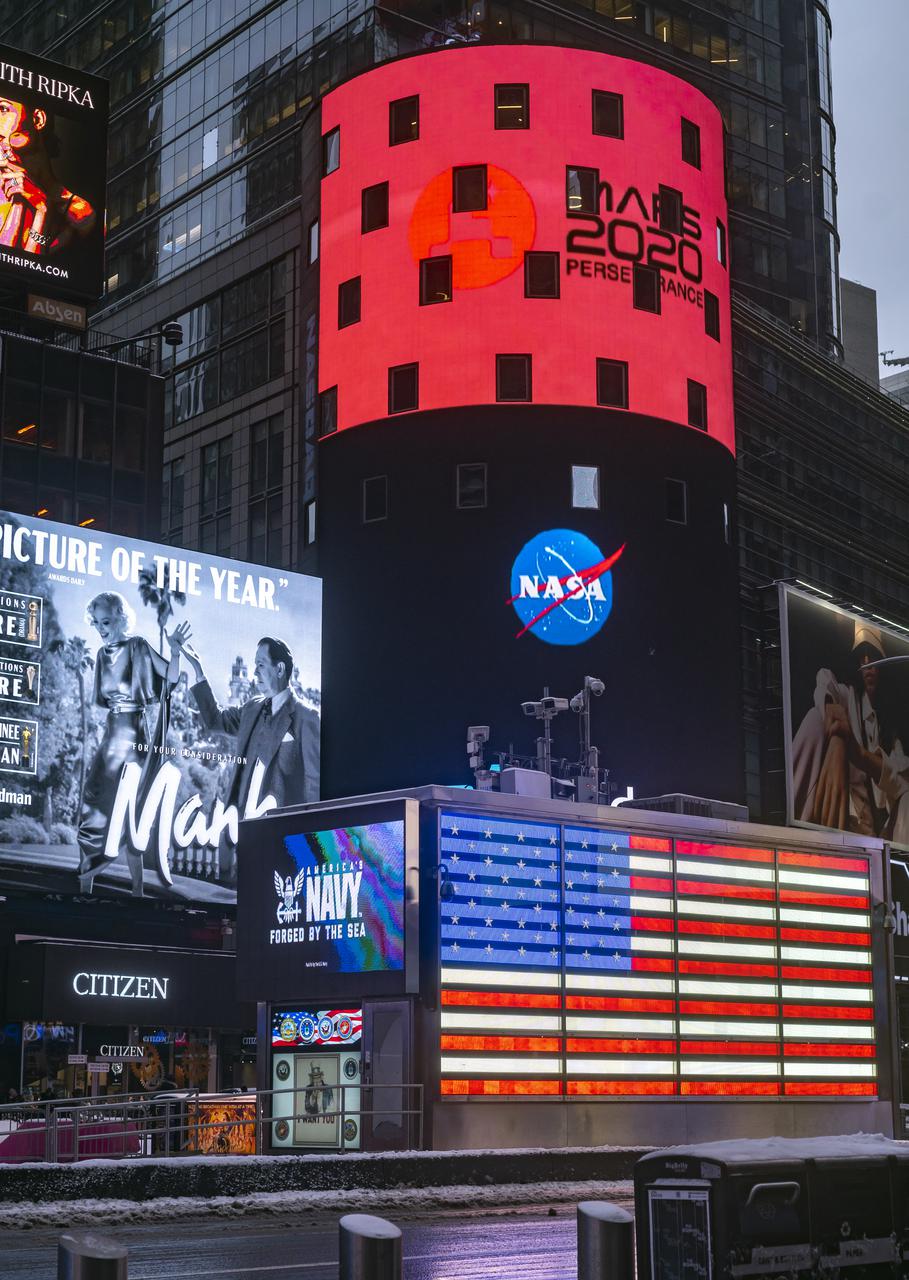
A Mars 2020 message is seen on the video board of the Nasdaq MarketSite after NASA's Perseverance rover landed on the surface of Mars, Thursday, Feb. 18, 2021 in New York City. A key objective for Perseverance’s mission on Mars is astrobiology, including the search for signs of ancient microbial life. The rover will characterize the planet’s geology and past climate, pave the way for human exploration of the Red Planet, and be the first mission to collect and cache Martian rock and regolith. Photo Credit: (NASA/Emma Howells)
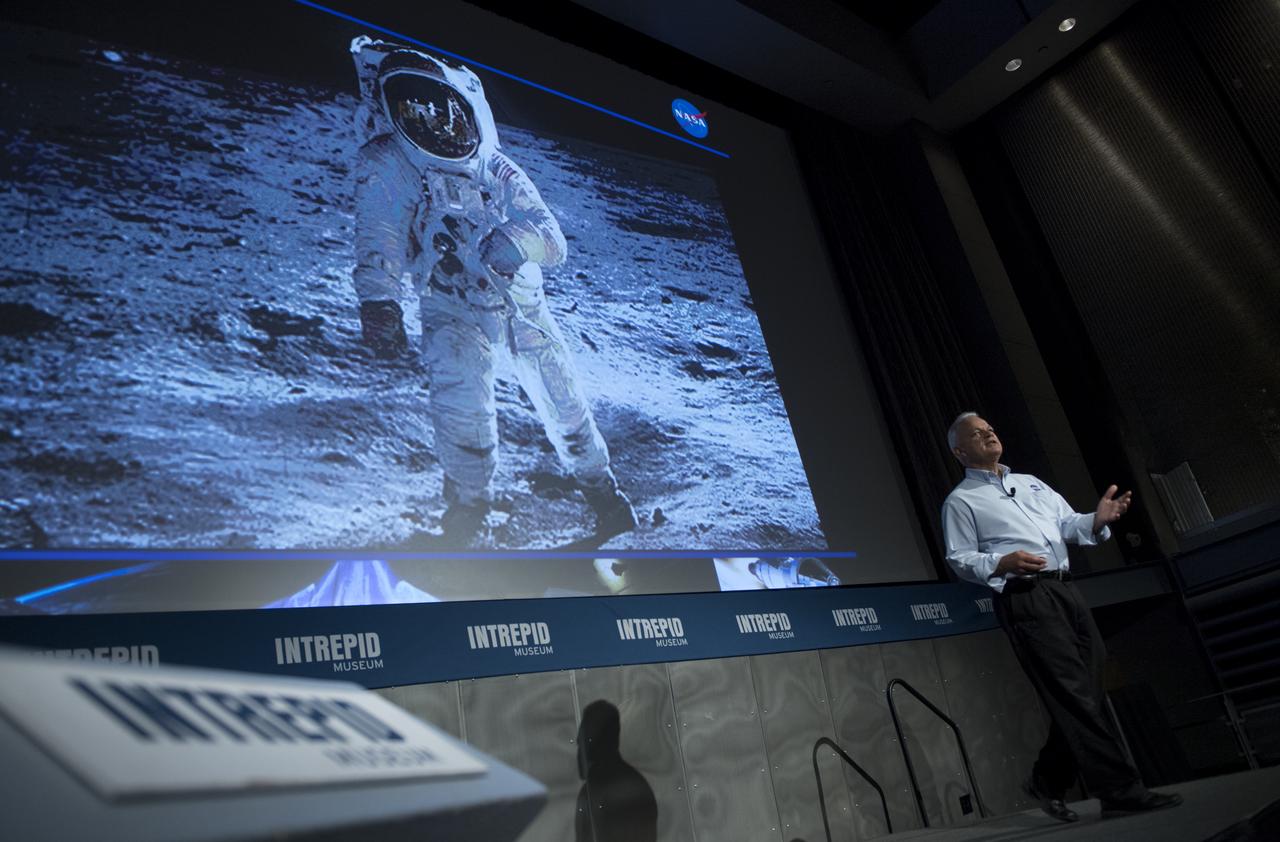
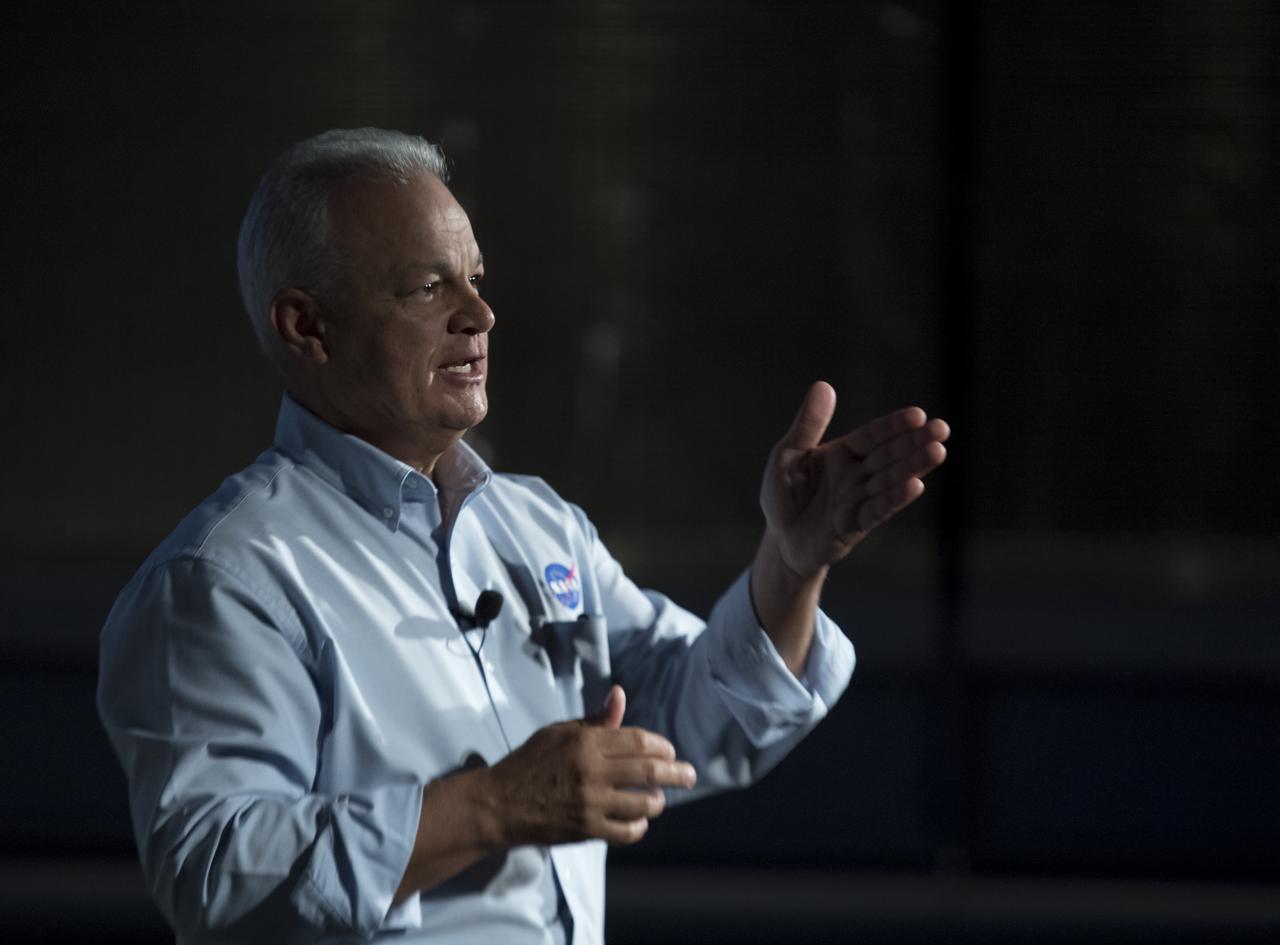
NASA Acting Chief Technologist Douglas Terrier gives a talk to teachers attending a professional development workshop held in tandem with the Intrepid Space & Science Festival, Saturday, Aug. 5, 2017 at the Intrepid Sea, Air & Space Museum in New York City. The week-long festival featured talks, films and cutting-edge displays showcasing NASA technology. Photo Credit: (NASA/Bill Ingalls)
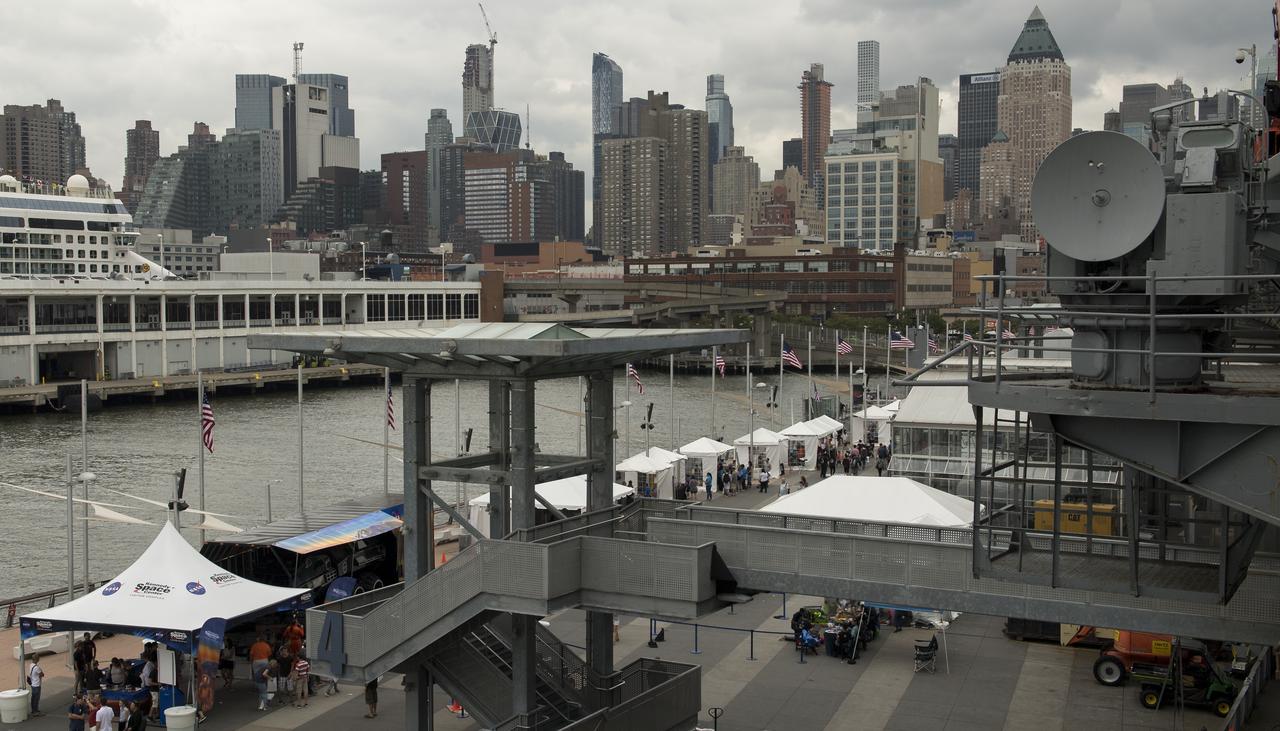
NASA exhibits under white tents line Pier 86 during the Intrepid Space & Science Festival, Saturday, Aug. 5, 2017 held at the Intrepid Sea, Air & Space Museum in New York City. The week-long festival featured talks, films and cutting-edge displays showcasing NASA technology. Photo Credit: (NASA/Bill Ingalls)
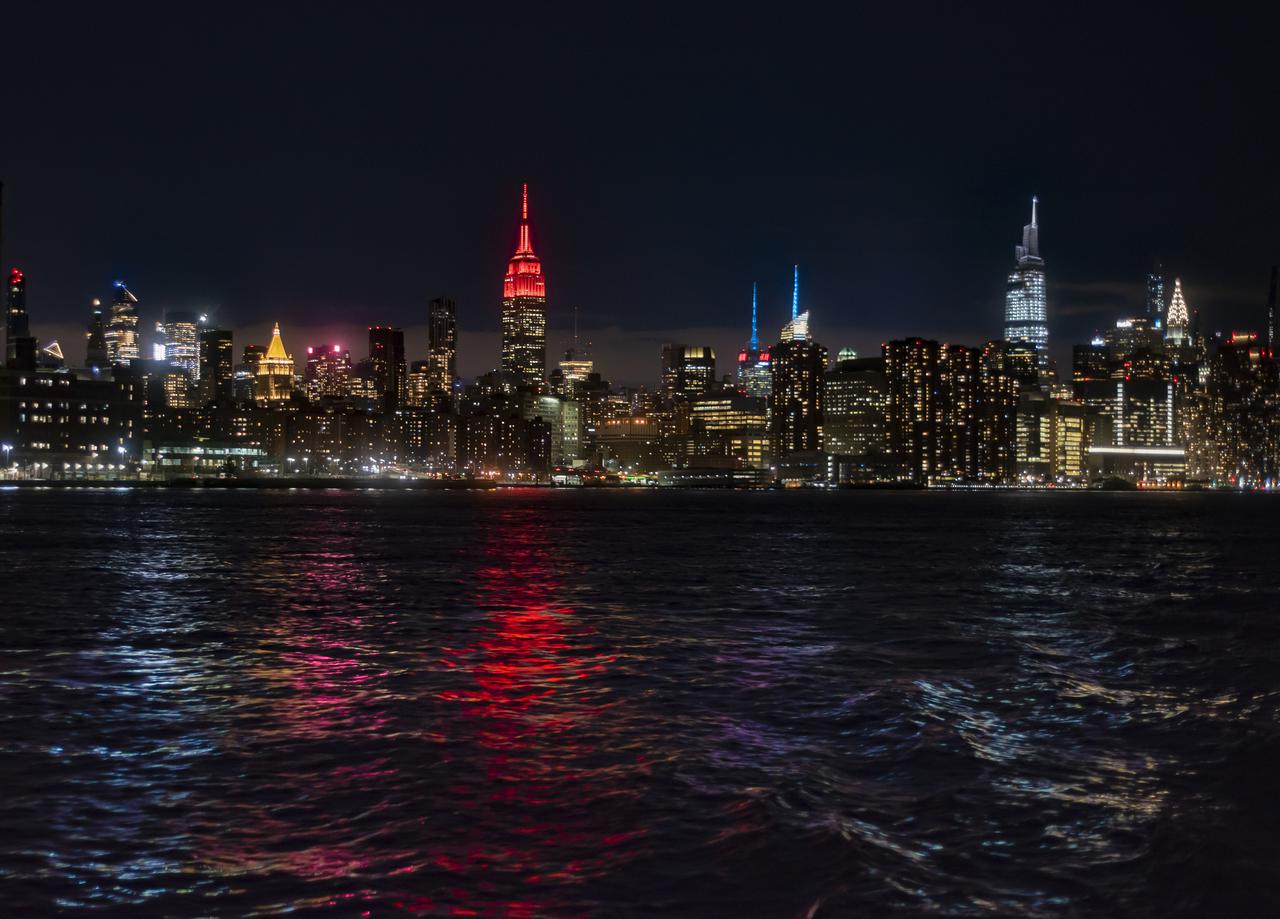
The Empire State Building is illuminated in red to celebrate this Thursday's scheduled landing on Mars of NASA's Perseverance rover, Tuesday, Feb. 16, 2021 in New York City. A key objective for Perseverance’s mission on Mars is astrobiology, including the search for signs of ancient microbial life. The rover will characterize the planet’s geology and past climate, pave the way for human exploration of the Red Planet, and be the first mission to collect and cache Martian rock and regolith. Photo Credit: (NASA/Emma Howells)
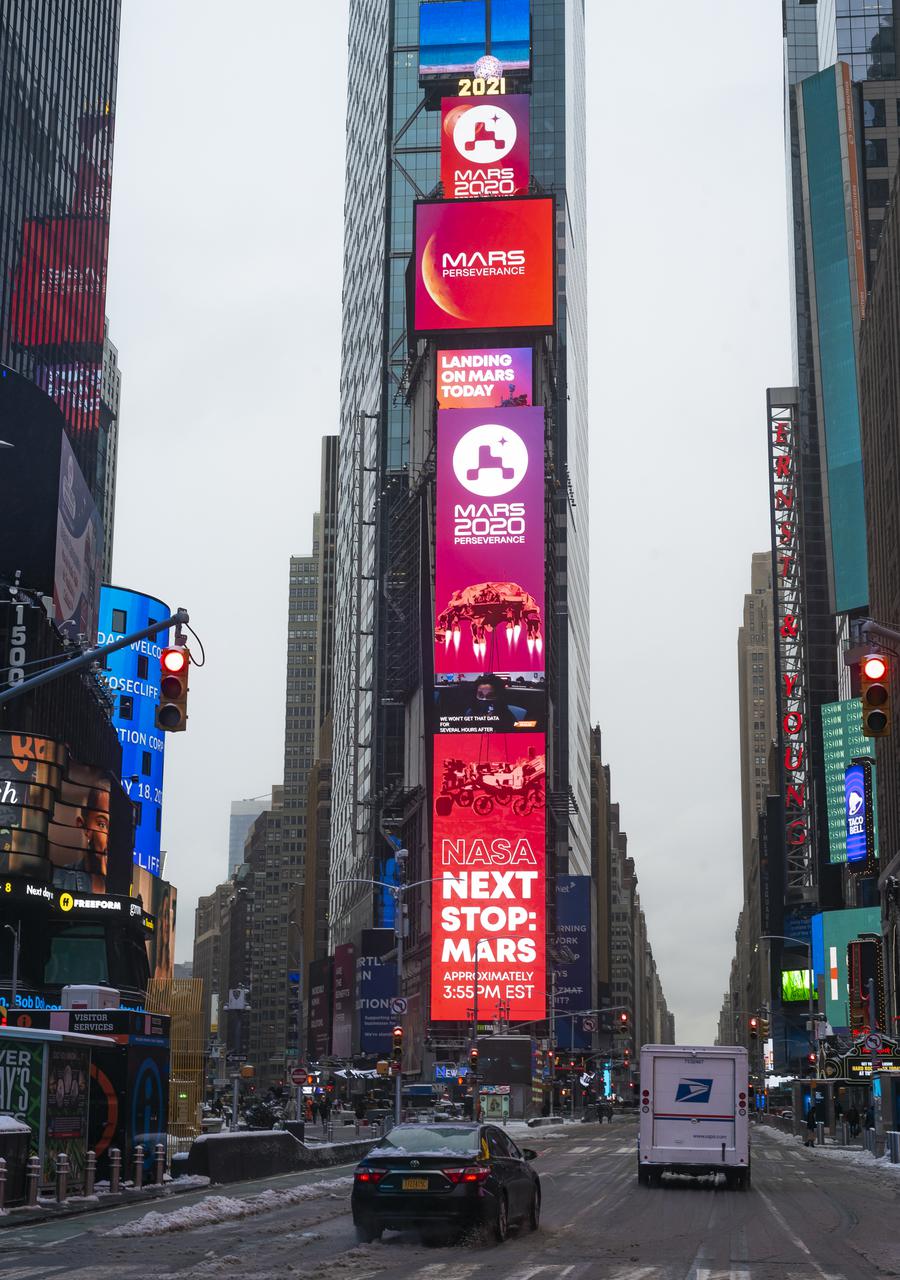
A NASA Mars Rover Landing banner is seen on the One Times Square video board as NASA's Perseverance rover begins its descent towards the surface of Mars, Thursday, Feb. 18, 2021 in New York City. A key objective for Perseverance’s mission on Mars is astrobiology, including the search for signs of ancient microbial life. The rover will characterize the planet’s geology and past climate, pave the way for human exploration of the Red Planet, and be the first mission to collect and cache Martian rock and regolith. Photo Credit: (NASA/Emma Howells)
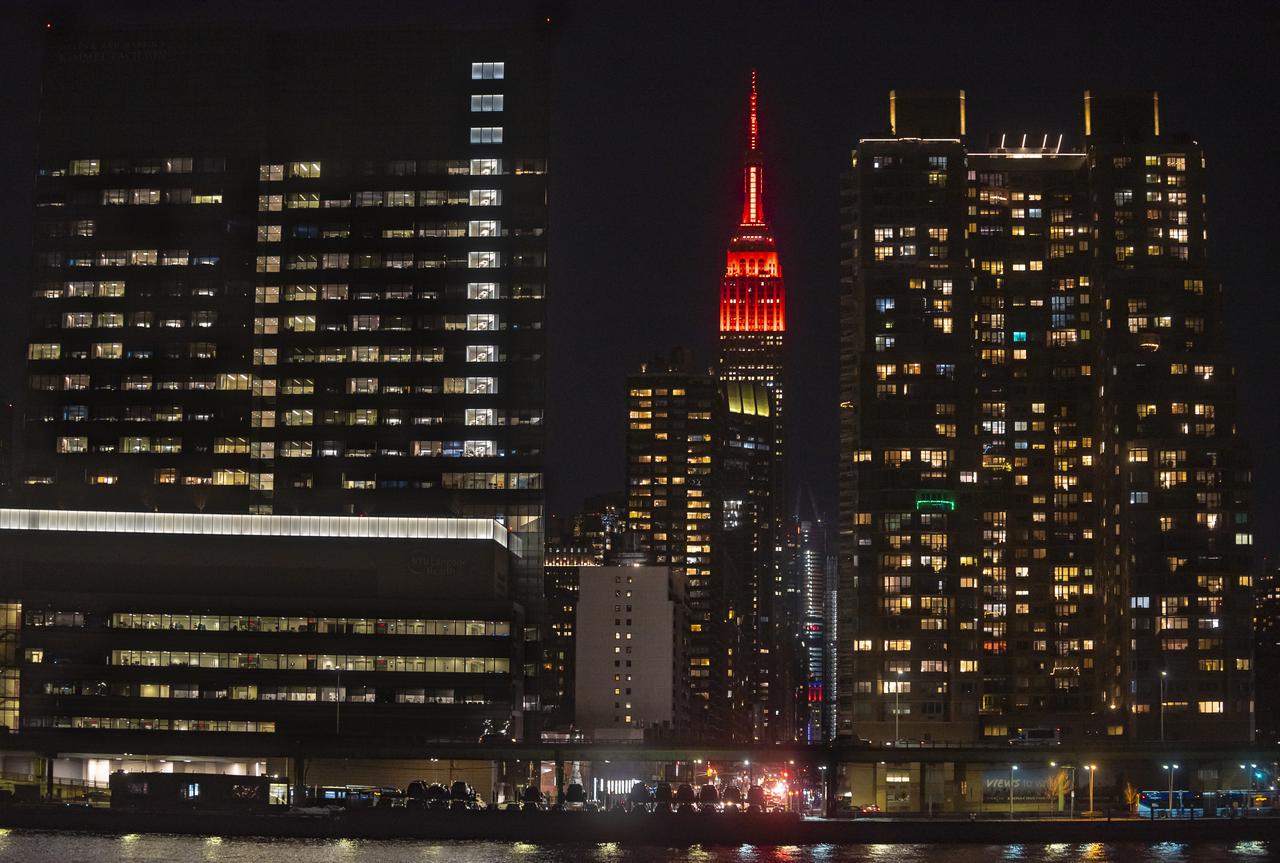
The Empire State Building is illuminated in red to celebrate this Thursday's scheduled landing on Mars of NASA's Perseverance rover, Tuesday, Feb. 16, 2021 in New York City. A key objective for Perseverance’s mission on Mars is astrobiology, including the search for signs of ancient microbial life. The rover will characterize the planet’s geology and past climate, pave the way for human exploration of the Red Planet, and be the first mission to collect and cache Martian rock and regolith. Photo Credit: (NASA/Emma Howells)

NASA Acting Chief Technologist Douglas Terrier gives a talk to teachers attending a professional development workshop held in tandem with the Intrepid Space & Science Festival, Saturday, Aug. 5, 2017 at the Intrepid Sea, Air & Space Museum in New York City. The week-long festival featured talks, films and cutting-edge displays showcasing NASA technology. Photo Credit: (NASA/Bill Ingalls)
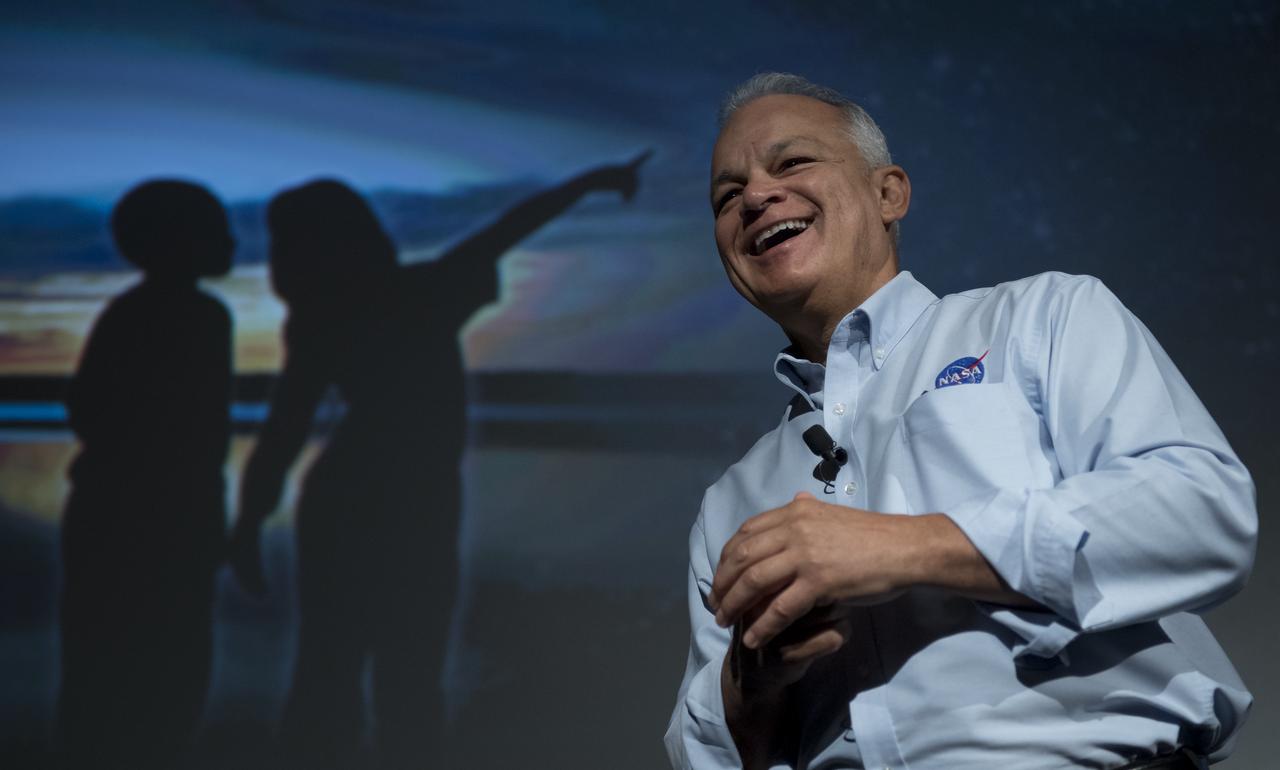
NASA Acting Chief Technologist Douglas Terrier gives a talk to teachers attending a professional development workshop held in tandem with the Intrepid Space & Science Festival, Saturday, Aug. 5, 2017 at the Intrepid Sea, Air & Space Museum in New York City. The week-long festival featured talks, films and cutting-edge displays showcasing NASA technology. Photo Credit: (NASA/Bill Ingalls)

A NASA Mars Rover Landing banner is seen on the Morgan Stanley video board as NASA's Perseverance rover begins its descent towards the surface of Mars, Thursday, Feb. 18, 2021 in New York City. A key objective for Perseverance’s mission on Mars is astrobiology, including the search for signs of ancient microbial life. The rover will characterize the planet’s geology and past climate, pave the way for human exploration of the Red Planet, and be the first mission to collect and cache Martian rock and regolith. Photo Credit: (NASA/Emma Howells)
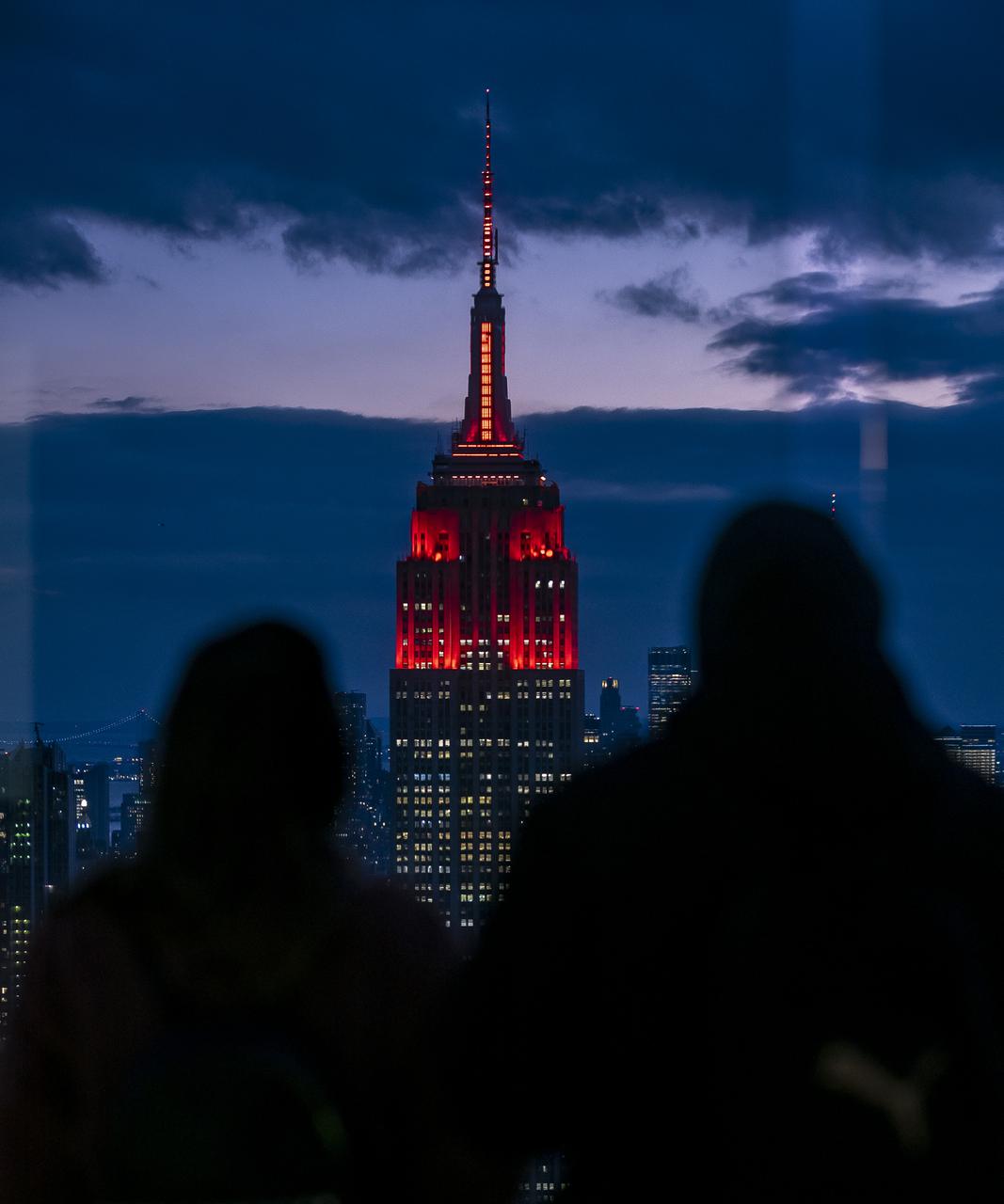
The Empire State Building is illuminated in red to celebrate this Thursday's scheduled landing on Mars of NASA's Perseverance rover, Tuesday, Feb. 16, 2021 in New York City. A key objective for Perseverance’s mission on Mars is astrobiology, including the search for signs of ancient microbial life. The rover will characterize the planet’s geology and past climate, pave the way for human exploration of the Red Planet, and be the first mission to collect and cache Martian rock and regolith. Photo Credit: (NASA/Emma Howells)
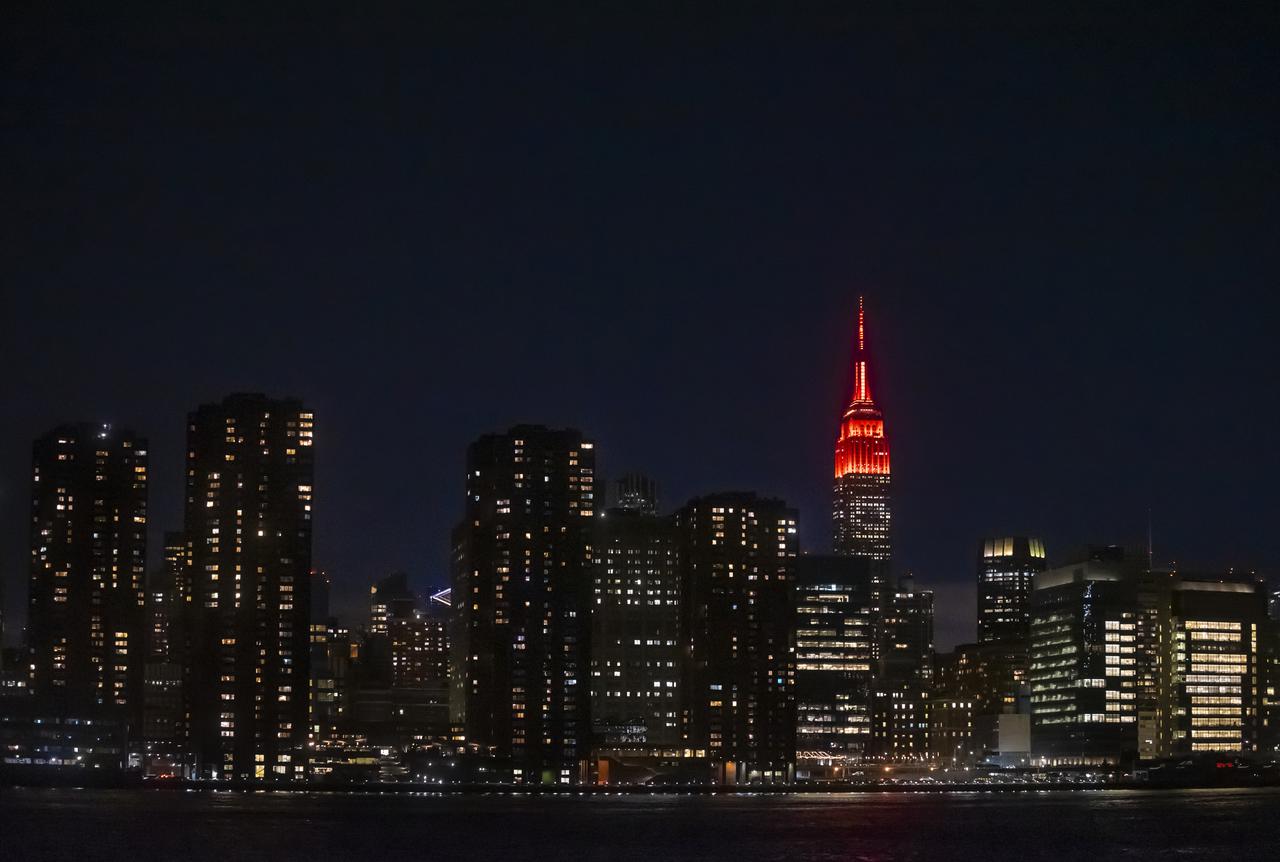
The Empire State Building is illuminated in red to celebrate this Thursday's scheduled landing on Mars of NASA's Perseverance rover, Tuesday, Feb. 16, 2021 in New York City. A key objective for Perseverance’s mission on Mars is astrobiology, including the search for signs of ancient microbial life. The rover will characterize the planet’s geology and past climate, pave the way for human exploration of the Red Planet, and be the first mission to collect and cache Martian rock and regolith. Photo Credit: (NASA/Emma Howells)

A Mars 2020 message is seen on the video board of the Nasdaq MarketSite after NASA's Perseverance rover landed on the surface of Mars, Thursday, Feb. 18, 2021 in New York City. A key objective for Perseverance’s mission on Mars is astrobiology, including the search for signs of ancient microbial life. The rover will characterize the planet’s geology and past climate, pave the way for human exploration of the Red Planet, and be the first mission to collect and cache Martian rock and regolith. Photo Credit: (NASA/Emma Howells)

A NASA Mars Rover Landing banner is seen on the One Times Square video board as NASA's Perseverance rover continues its descent towards the surface of Mars, Thursday, Feb. 18, 2021 in New York City. A key objective for Perseverance’s mission on Mars is astrobiology, including the search for signs of ancient microbial life. The rover will characterize the planet’s geology and past climate, pave the way for human exploration of the Red Planet, and be the first mission to collect and cache Martian rock and regolith. Photo Credit: (NASA/Emma Howells)

A Mars 2020 message is seen on the video board of the Nasdaq MarketSite after NASA's Perseverance rover landed on the surface of Mars, Thursday, Feb. 18, 2021 in New York City. A key objective for Perseverance’s mission on Mars is astrobiology, including the search for signs of ancient microbial life. The rover will characterize the planet’s geology and past climate, pave the way for human exploration of the Red Planet, and be the first mission to collect and cache Martian rock and regolith. Photo Credit: (NASA/Emma Howells)
The Empire State Building is illuminated in red to celebrate this Thursday's scheduled landing on Mars of NASA's Perseverance rover, Tuesday, Feb. 16, 2021 in New York City. A key objective for Perseverance’s mission on Mars is astrobiology, including the search for signs of ancient microbial life. The rover will characterize the planet’s geology and past climate, pave the way for human exploration of the Red Planet, and be the first mission to collect and cache Martian rock and regolith. Photo Credit: (NASA/Emma Howells)
NASA Acting Chief Technologist Douglas Terrier gives a talk to teachers attending a professional development workshop held in tandem with the Intrepid Space & Science Festival, Saturday, Aug. 5, 2017 at the Intrepid Sea, Air & Space Museum in New York City. The week-long festival featured talks, films and cutting-edge displays showcasing NASA technology. Photo Credit: (NASA/Bill Ingalls)
The Empire State Building is illuminated in red to celebrate this Thursday's scheduled landing on Mars of NASA's Perseverance rover, Tuesday, Feb. 16, 2021 in New York City. A key objective for Perseverance’s mission on Mars is astrobiology, including the search for signs of ancient microbial life. The rover will characterize the planet’s geology and past climate, pave the way for human exploration of the Red Planet, and be the first mission to collect and cache Martian rock and regolith. Photo Credit: (NASA/Emma Howells)

A NASA Mars Rover Landing banner is seen on the One Times Square video board as NASA's Perseverance rover begins its descent towards the surface of Mars, Thursday, Feb. 18, 2021 in New York City. A key objective for Perseverance’s mission on Mars is astrobiology, including the search for signs of ancient microbial life. The rover will characterize the planet’s geology and past climate, pave the way for human exploration of the Red Planet, and be the first mission to collect and cache Martian rock and regolith. Photo Credit: (NASA/Emma Howells)
The Empire State Building is illuminated in red to celebrate this Thursday's scheduled landing on Mars of NASA's Perseverance rover, Tuesday, Feb. 16, 2021 in New York City. A key objective for Perseverance’s mission on Mars is astrobiology, including the search for signs of ancient microbial life. The rover will characterize the planet’s geology and past climate, pave the way for human exploration of the Red Planet, and be the first mission to collect and cache Martian rock and regolith. Photo Credit: (NASA/Emma Howells)
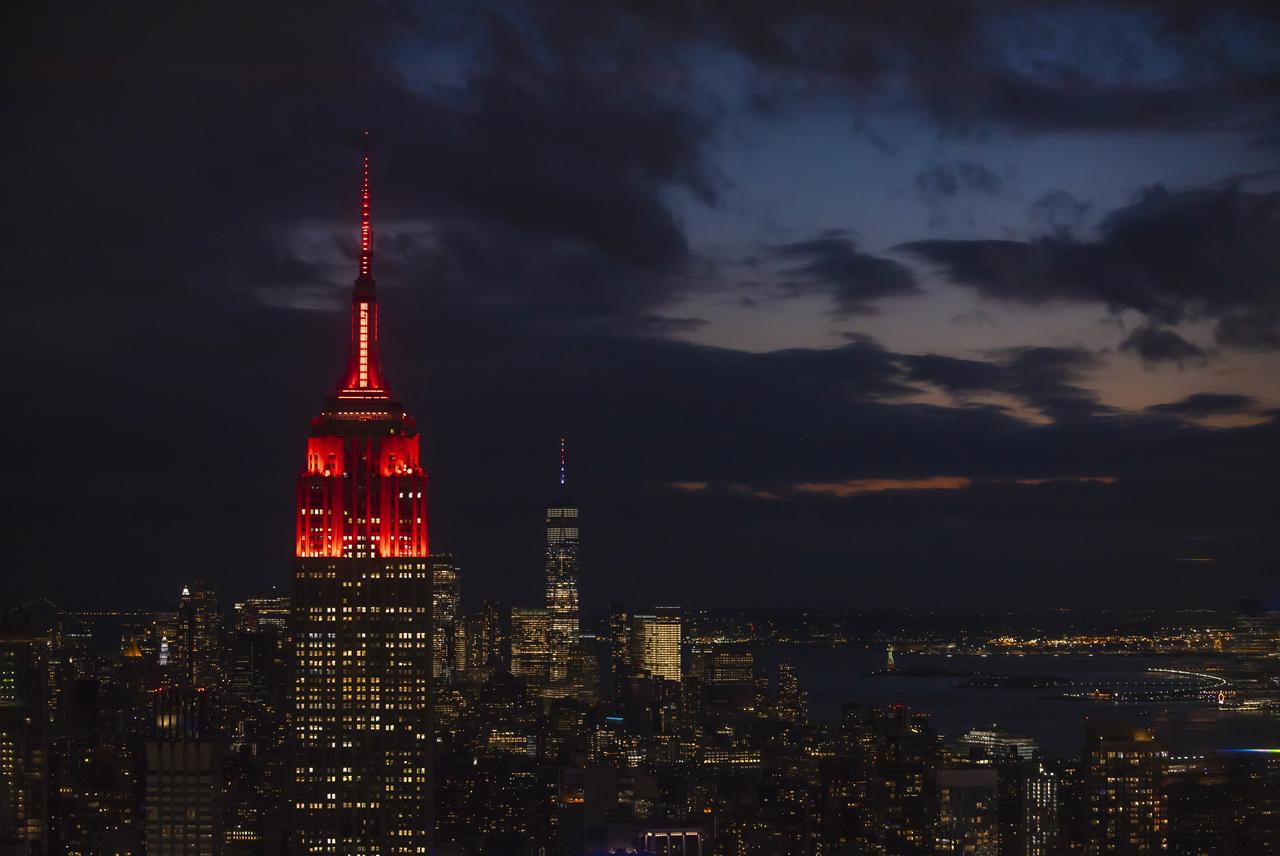
The Empire State Building is illuminated in red to celebrate this Thursday's scheduled landing on Mars of NASA's Perseverance rover, Tuesday, Feb. 16, 2021 in New York City. A key objective for Perseverance’s mission on Mars is astrobiology, including the search for signs of ancient microbial life. The rover will characterize the planet’s geology and past climate, pave the way for human exploration of the Red Planet, and be the first mission to collect and cache Martian rock and regolith. Photo Credit: (NASA/Emma Howells)
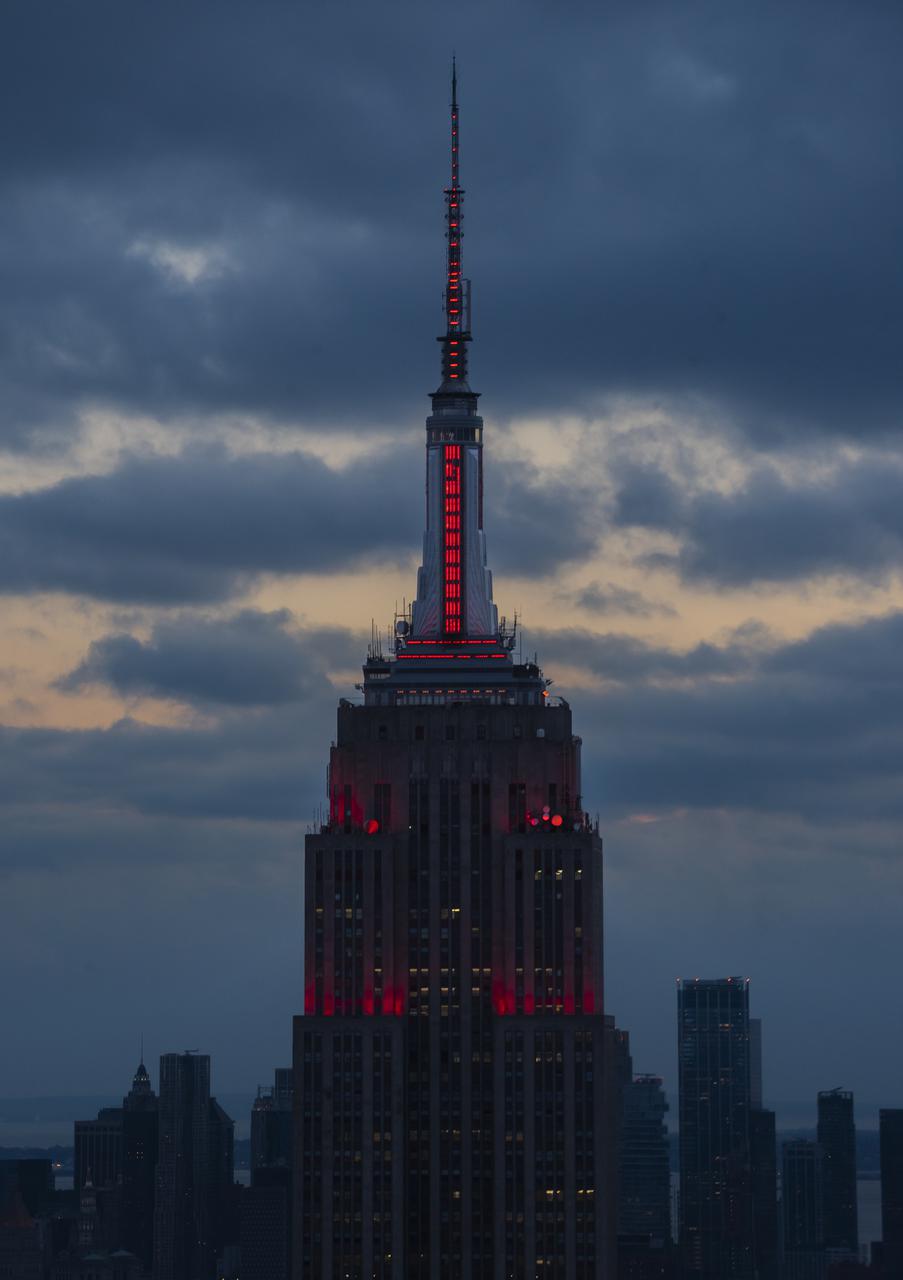
The Empire State Building is illuminated in red to celebrate this Thursday's scheduled landing on Mars of NASA's Perseverance rover, Tuesday, Feb. 16, 2021 in New York City. A key objective for Perseverance’s mission on Mars is astrobiology, including the search for signs of ancient microbial life. The rover will characterize the planet’s geology and past climate, pave the way for human exploration of the Red Planet, and be the first mission to collect and cache Martian rock and regolith. Photo Credit: (NASA/Emma Howells)
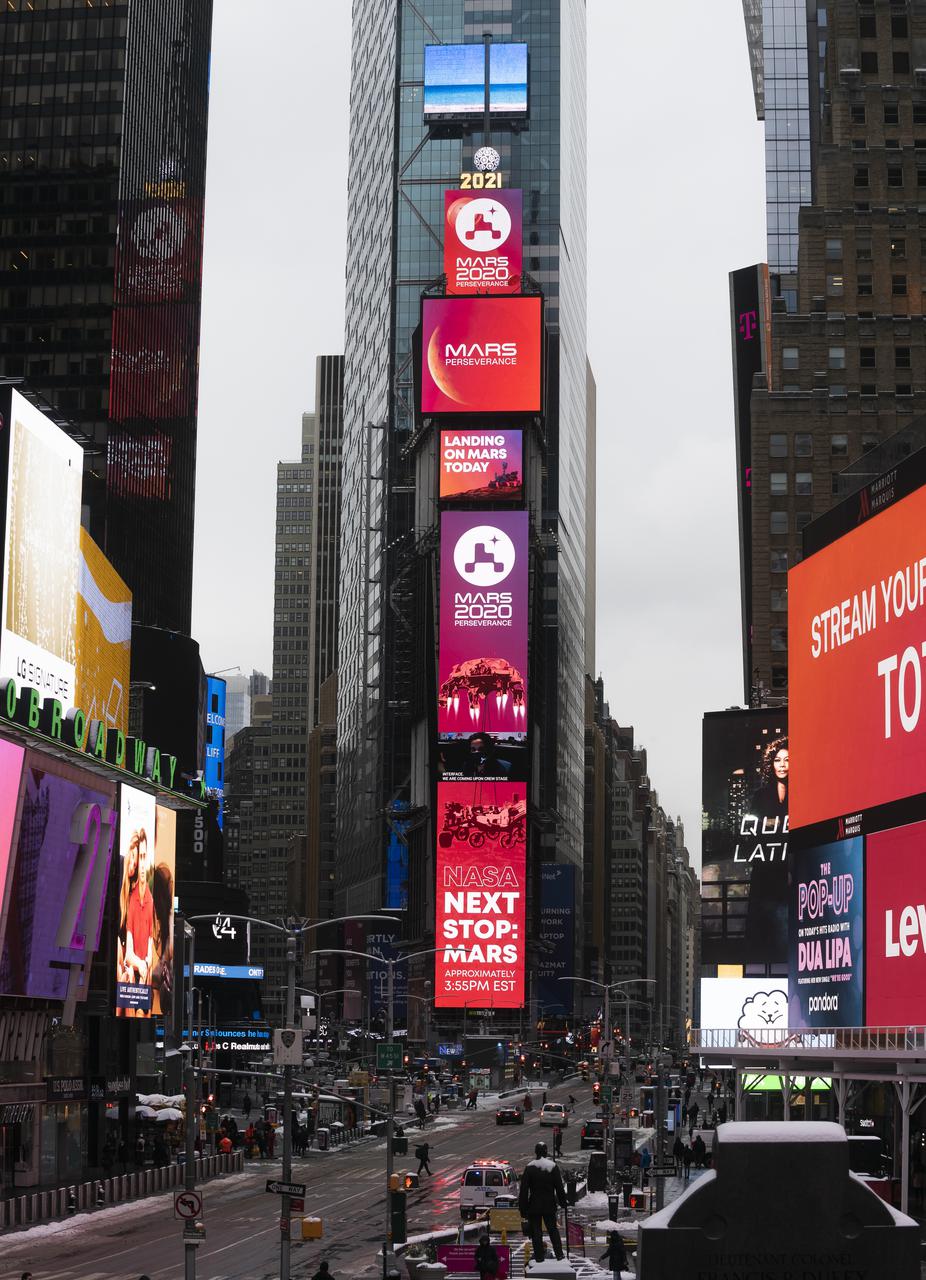
A NASA Mars Rover Landing banner is seen on the One Times Square video board as NASA's Perseverance rover begins its descent towards the surface of Mars, Thursday, Feb. 18, 2021 in New York City. A key objective for Perseverance’s mission on Mars is astrobiology, including the search for signs of ancient microbial life. The rover will characterize the planet’s geology and past climate, pave the way for human exploration of the Red Planet, and be the first mission to collect and cache Martian rock and regolith. Photo Credit: (NASA/Emma Howells)
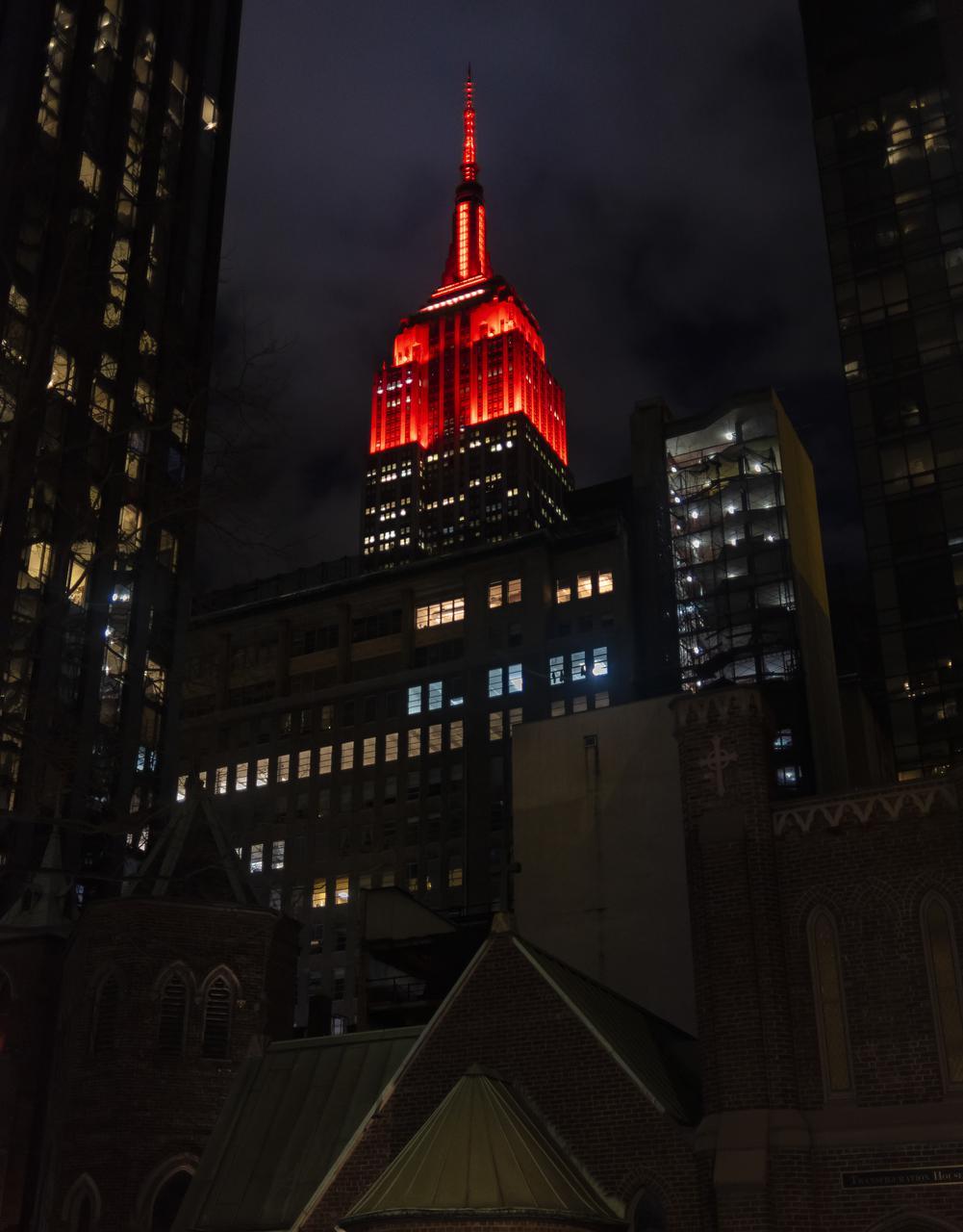
The Empire State Building is illuminated in red to celebrate this Thursday's scheduled landing on Mars of NASA's Perseverance rover, Tuesday, Feb. 16, 2021 in New York City. A key objective for Perseverance’s mission on Mars is astrobiology, including the search for signs of ancient microbial life. The rover will characterize the planet’s geology and past climate, pave the way for human exploration of the Red Planet, and be the first mission to collect and cache Martian rock and regolith. Photo Credit: (NASA/Emma Howells)
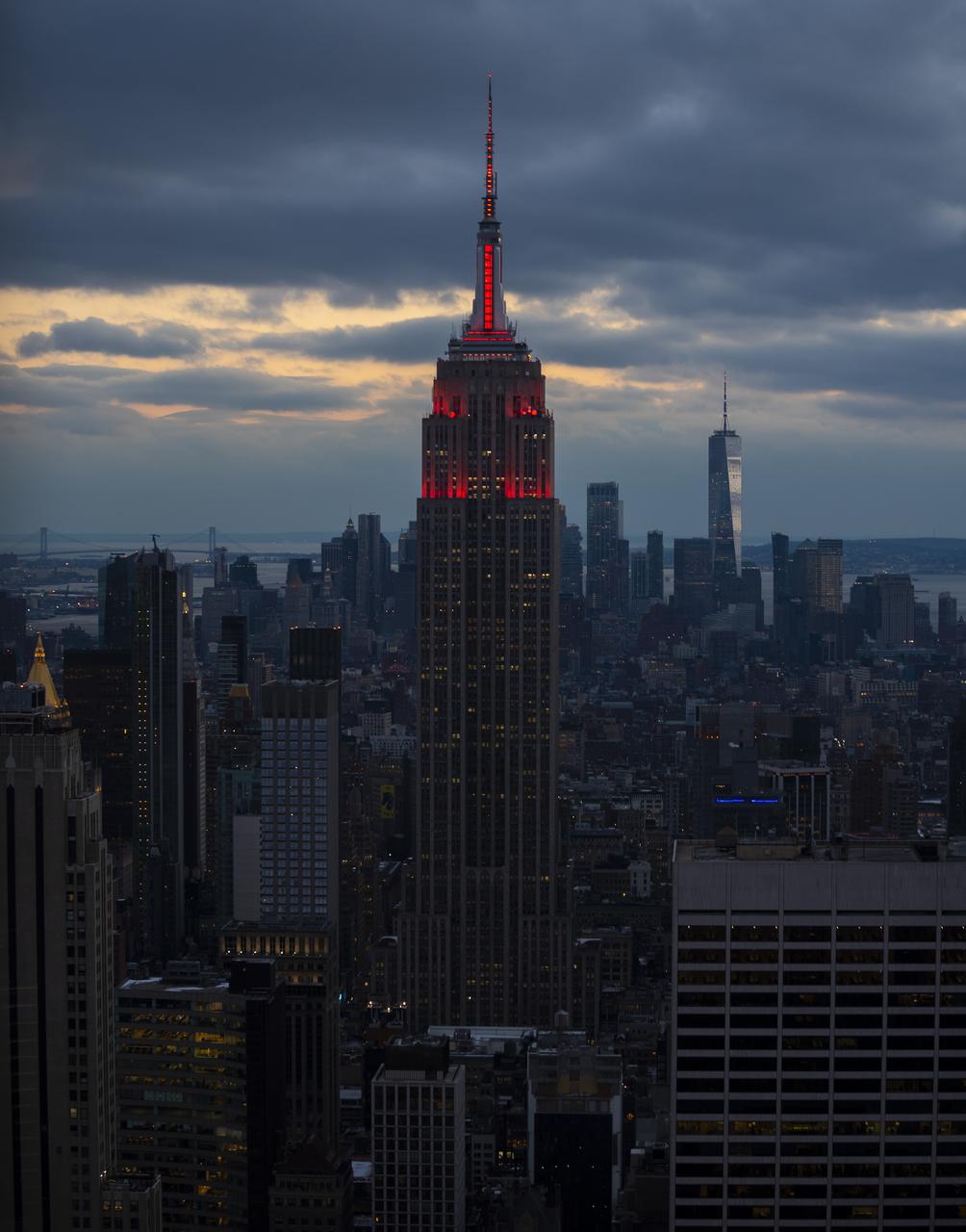
The Empire State Building is illuminated in red to celebrate this Thursday's scheduled landing on Mars of NASA's Perseverance rover, Tuesday, Feb. 16, 2021 in New York City. A key objective for Perseverance’s mission on Mars is astrobiology, including the search for signs of ancient microbial life. The rover will characterize the planet’s geology and past climate, pave the way for human exploration of the Red Planet, and be the first mission to collect and cache Martian rock and regolith. Photo Credit: (NASA/Emma Howells)
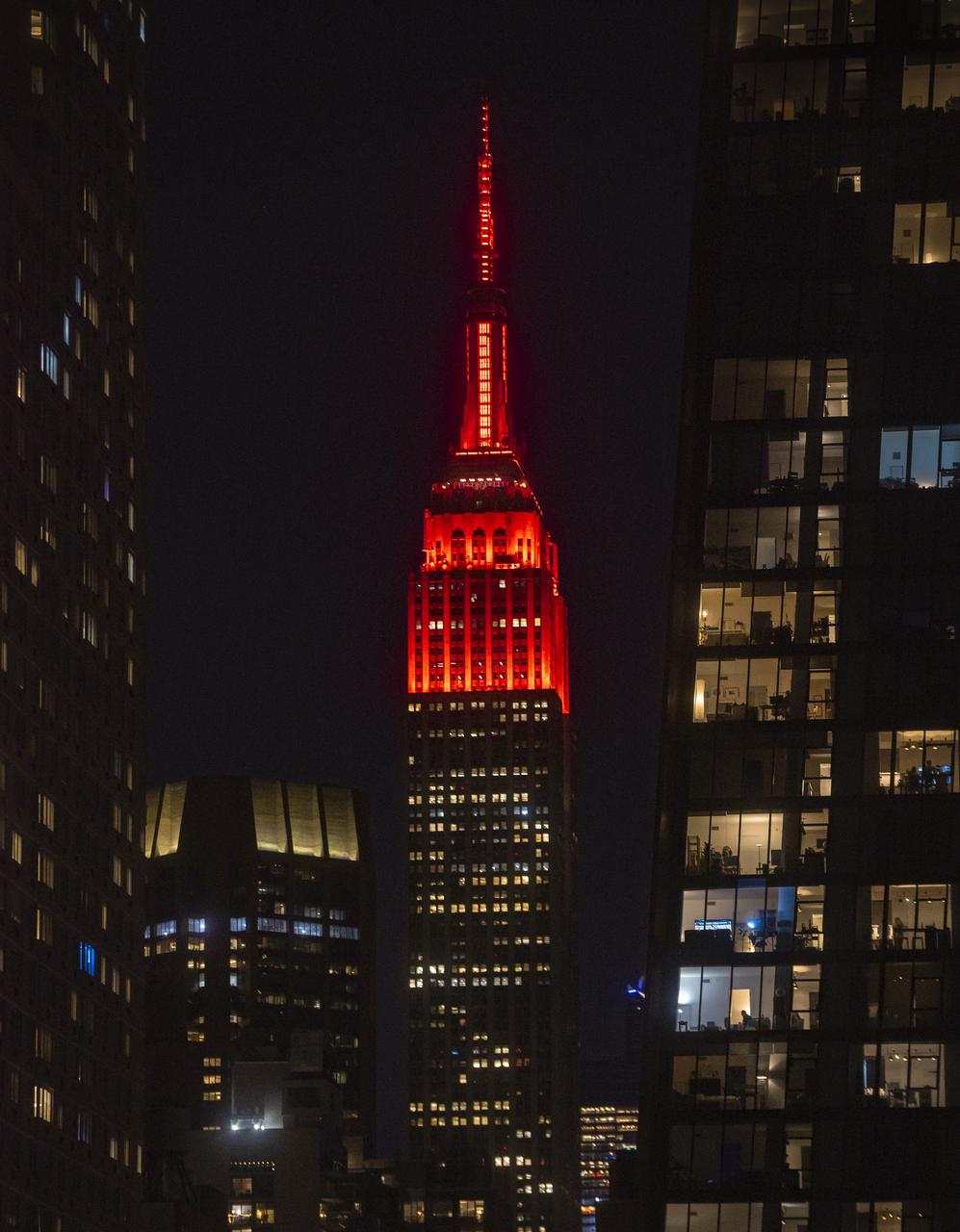
The Empire State Building is illuminated in red to celebrate this Thursday's scheduled landing on Mars of NASA's Perseverance rover, Tuesday, Feb. 16, 2021 in New York City. A key objective for Perseverance’s mission on Mars is astrobiology, including the search for signs of ancient microbial life. The rover will characterize the planet’s geology and past climate, pave the way for human exploration of the Red Planet, and be the first mission to collect and cache Martian rock and regolith. Photo Credit: (NASA/Emma Howells)
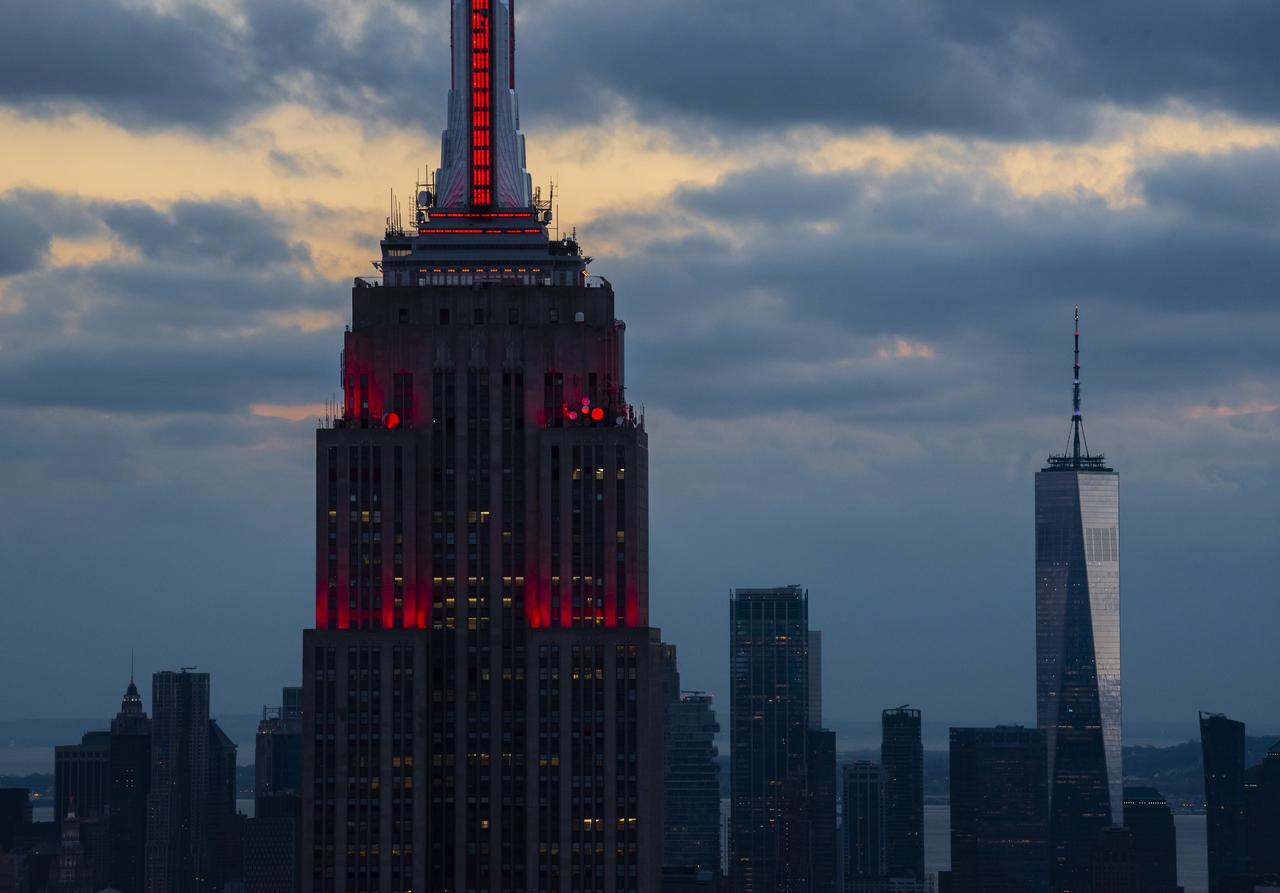
The Empire State Building is illuminated in red to celebrate this Thursday's scheduled landing on Mars of NASA's Perseverance rover, Tuesday, Feb. 16, 2021 in New York City. A key objective for Perseverance’s mission on Mars is astrobiology, including the search for signs of ancient microbial life. The rover will characterize the planet’s geology and past climate, pave the way for human exploration of the Red Planet, and be the first mission to collect and cache Martian rock and regolith. Photo Credit: (NASA/Emma Howells)
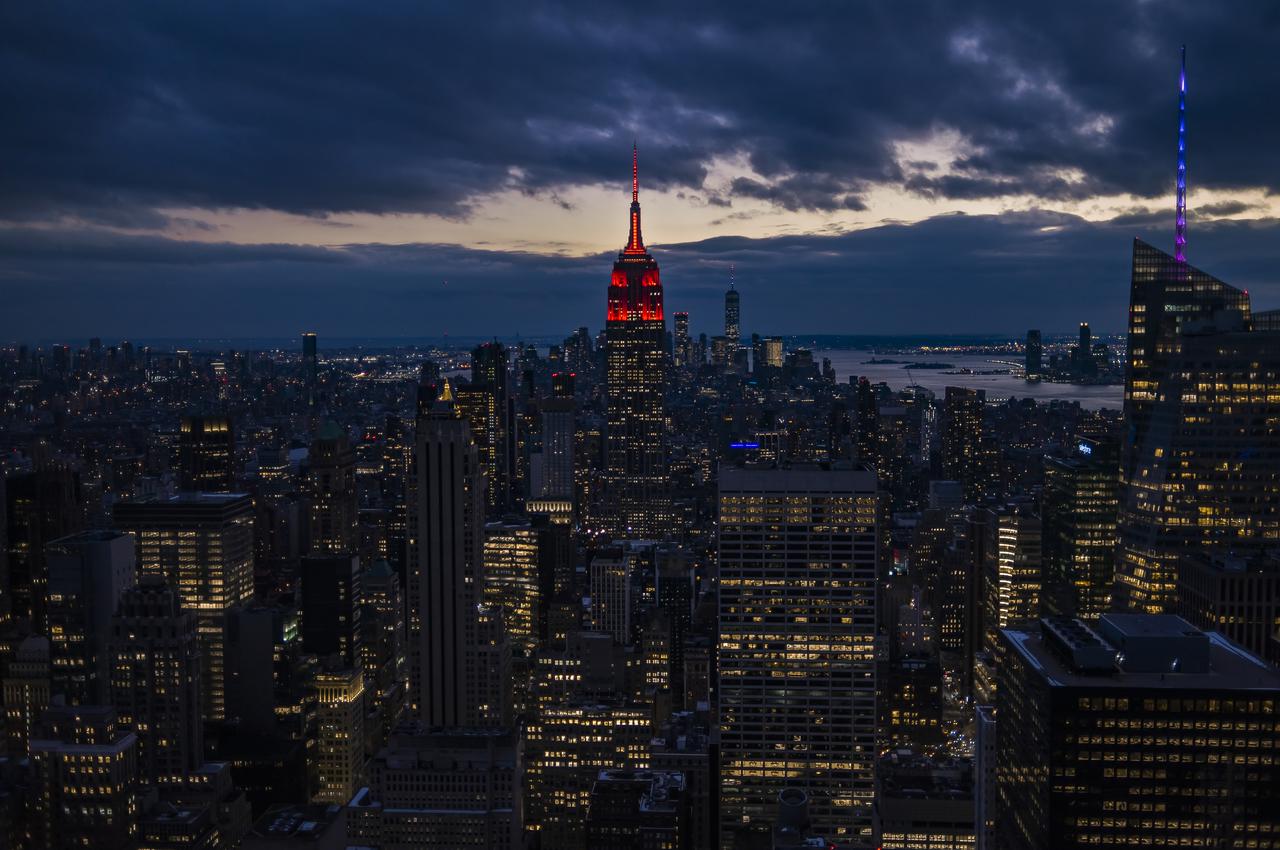
The Empire State Building is illuminated in red to celebrate this Thursday's scheduled landing on Mars of NASA's Perseverance rover, Tuesday, Feb. 16, 2021 in New York City. A key objective for Perseverance’s mission on Mars is astrobiology, including the search for signs of ancient microbial life. The rover will characterize the planet’s geology and past climate, pave the way for human exploration of the Red Planet, and be the first mission to collect and cache Martian rock and regolith. Photo Credit: (NASA/Emma Howells)

The Krispy Kreme Mars doughnut is seen in New York City, as NASA's Perseverance rover begins its descent towards the surface of Mars, Thursday, Feb. 18, 2021. A key objective for Perseverance’s mission on Mars is astrobiology, including the search for signs of ancient microbial life. The rover will characterize the planet’s geology and past climate, pave the way for human exploration of the Red Planet, and be the first mission to collect and cache Martian rock and regolith. Photo Credit: (NASA/Emma Howells)
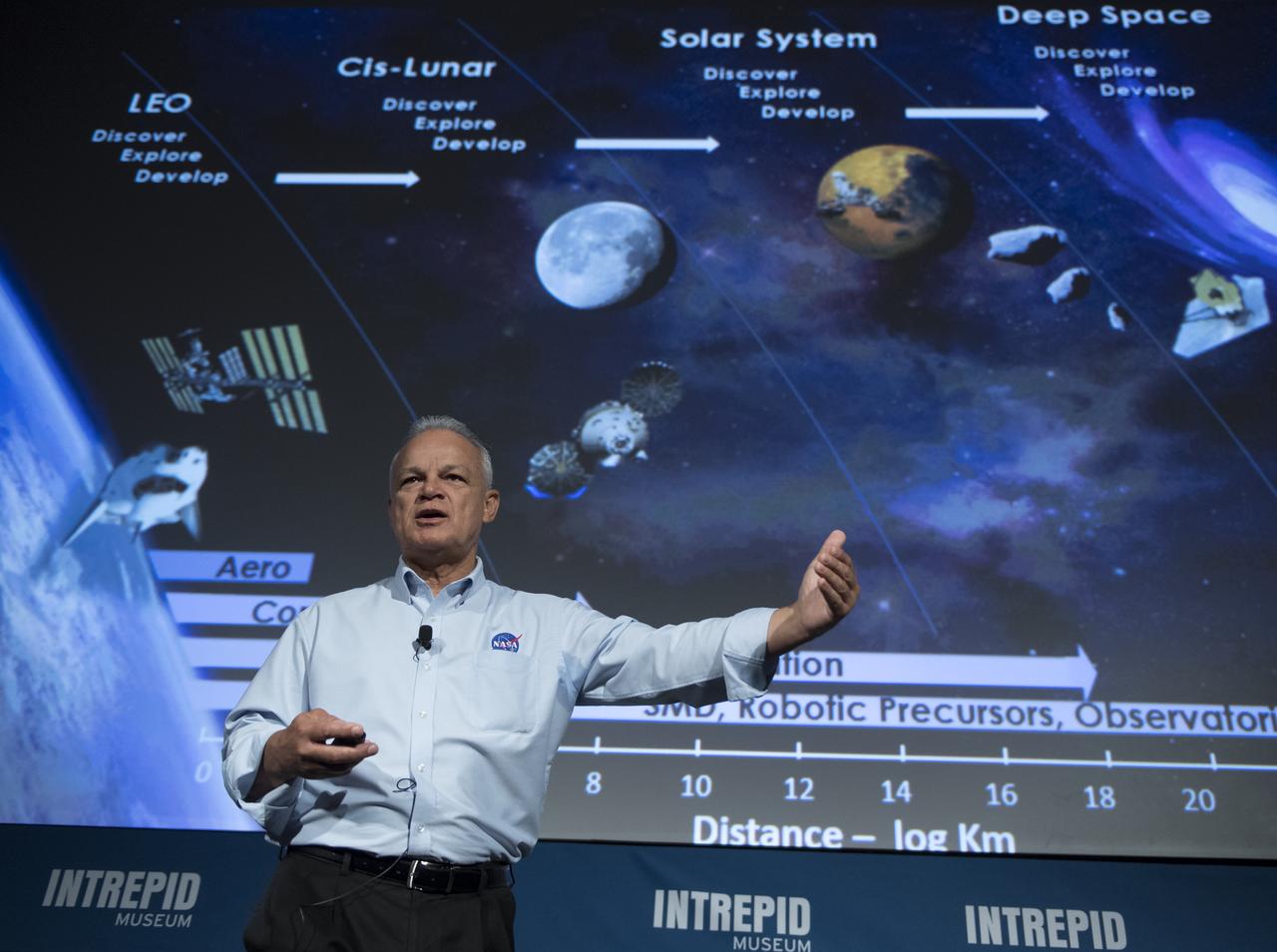
NASA Acting Chief Technologist Douglas Terrier gives a talk to teachers attending a professional development workshop held in tandem with the Intrepid Space & Science Festival, Saturday, Aug. 5, 2017 at the Intrepid Sea, Air & Space Museum in New York City. The week-long festival featured talks, films and cutting-edge displays showcasing NASA technology. Photo Credit: (NASA/Bill Ingalls)
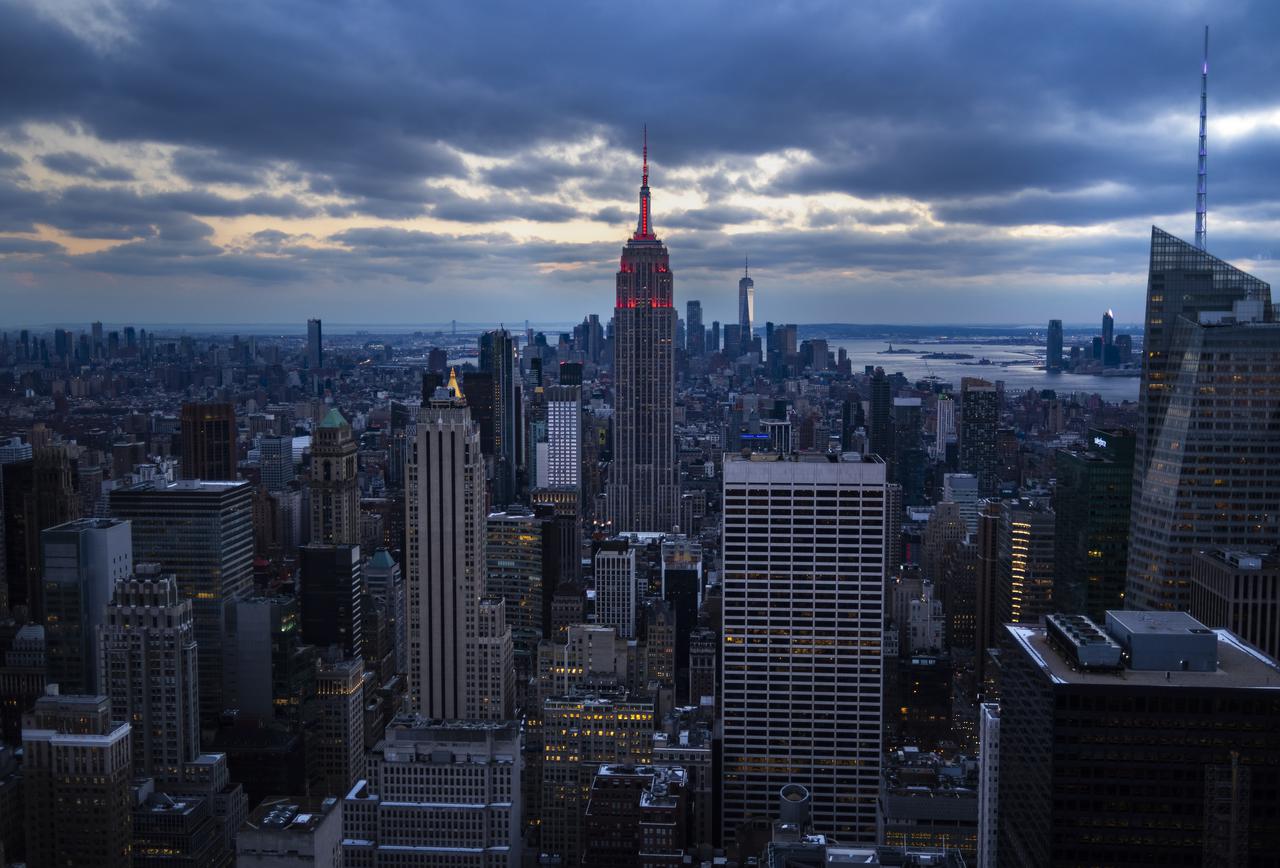
The Empire State Building is illuminated in red to celebrate this Thursday's scheduled landing on Mars of NASA's Perseverance rover, Tuesday, Feb. 16, 2021 in New York City. A key objective for Perseverance’s mission on Mars is astrobiology, including the search for signs of ancient microbial life. The rover will characterize the planet’s geology and past climate, pave the way for human exploration of the Red Planet, and be the first mission to collect and cache Martian rock and regolith. Photo Credit: (NASA/Emma Howells)

A NASA Mars Rover Landing banner is seen confirming the mission is complete on the One Times Square video board after NASA's Perseverance rover landed on the surface of Mars, Thursday, Feb. 18, 2021 in New York City. A key objective for Perseverance’s mission on Mars is astrobiology, including the search for signs of ancient microbial life. The rover will characterize the planet’s geology and past climate, pave the way for human exploration of the Red Planet, and be the first mission to collect and cache Martian rock and regolith. Photo Credit: (NASA/Emma Howells)
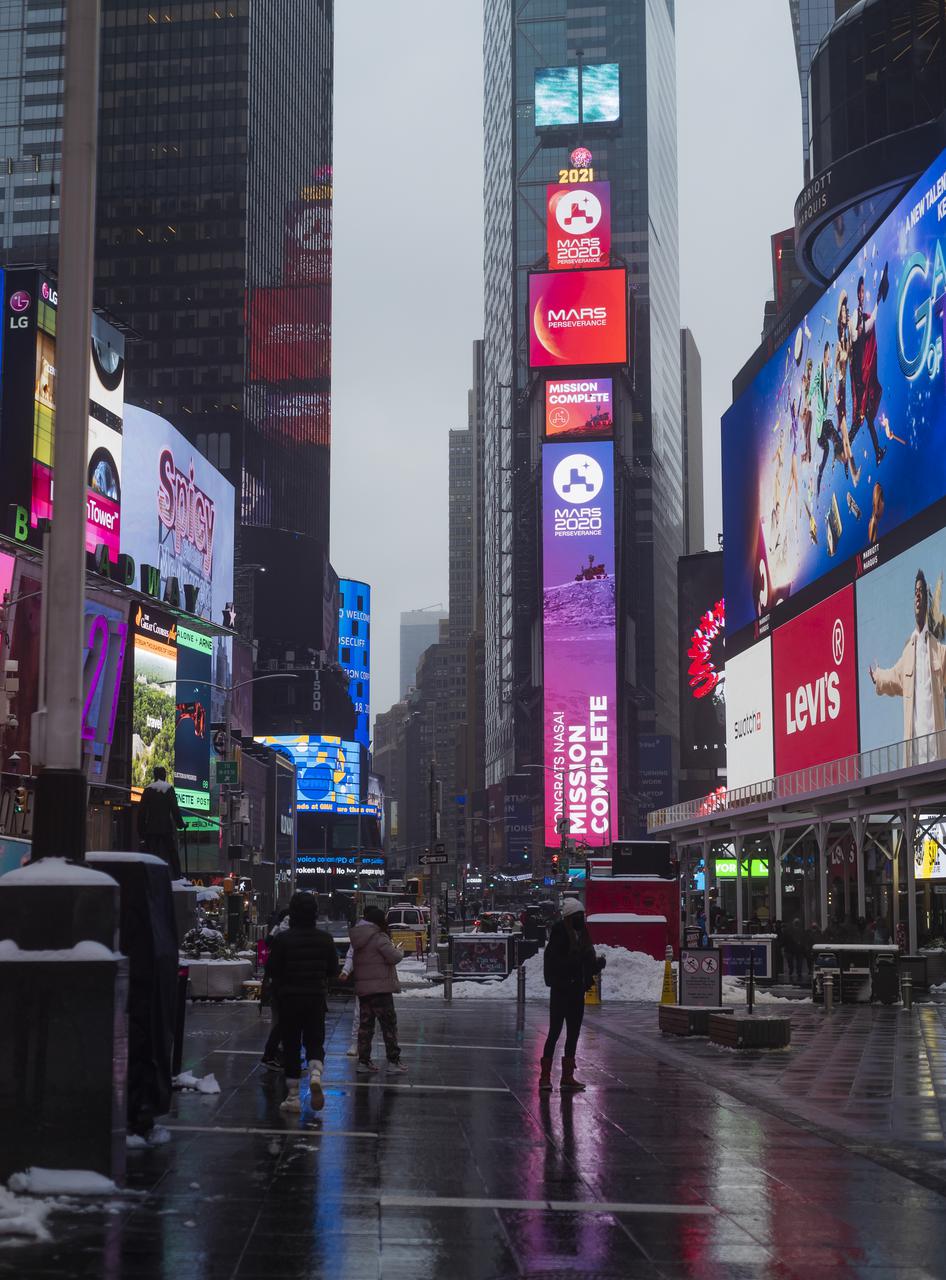
A NASA Mars Rover Landing banner is seen confirming the mission is complete on the One Times Square video board after NASA's Perseverance rover landed on the surface of Mars, Thursday, Feb. 18, 2021 in New York City. A key objective for Perseverance’s mission on Mars is astrobiology, including the search for signs of ancient microbial life. The rover will characterize the planet’s geology and past climate, pave the way for human exploration of the Red Planet, and be the first mission to collect and cache Martian rock and regolith. Photo Credit: (NASA/Emma Howells)

A NASA Mars Rover Landing banner is seen on the Morgan Stanley video board as NASA's Perseverance rover completes its descent towards the surface of Mars, Thursday, Feb. 18, 2021 in New York City. A key objective for Perseverance’s mission on Mars is astrobiology, including the search for signs of ancient microbial life. The rover will characterize the planet’s geology and past climate, pave the way for human exploration of the Red Planet, and be the first mission to collect and cache Martian rock and regolith. Photo Credit: (NASA/Emma Howells)
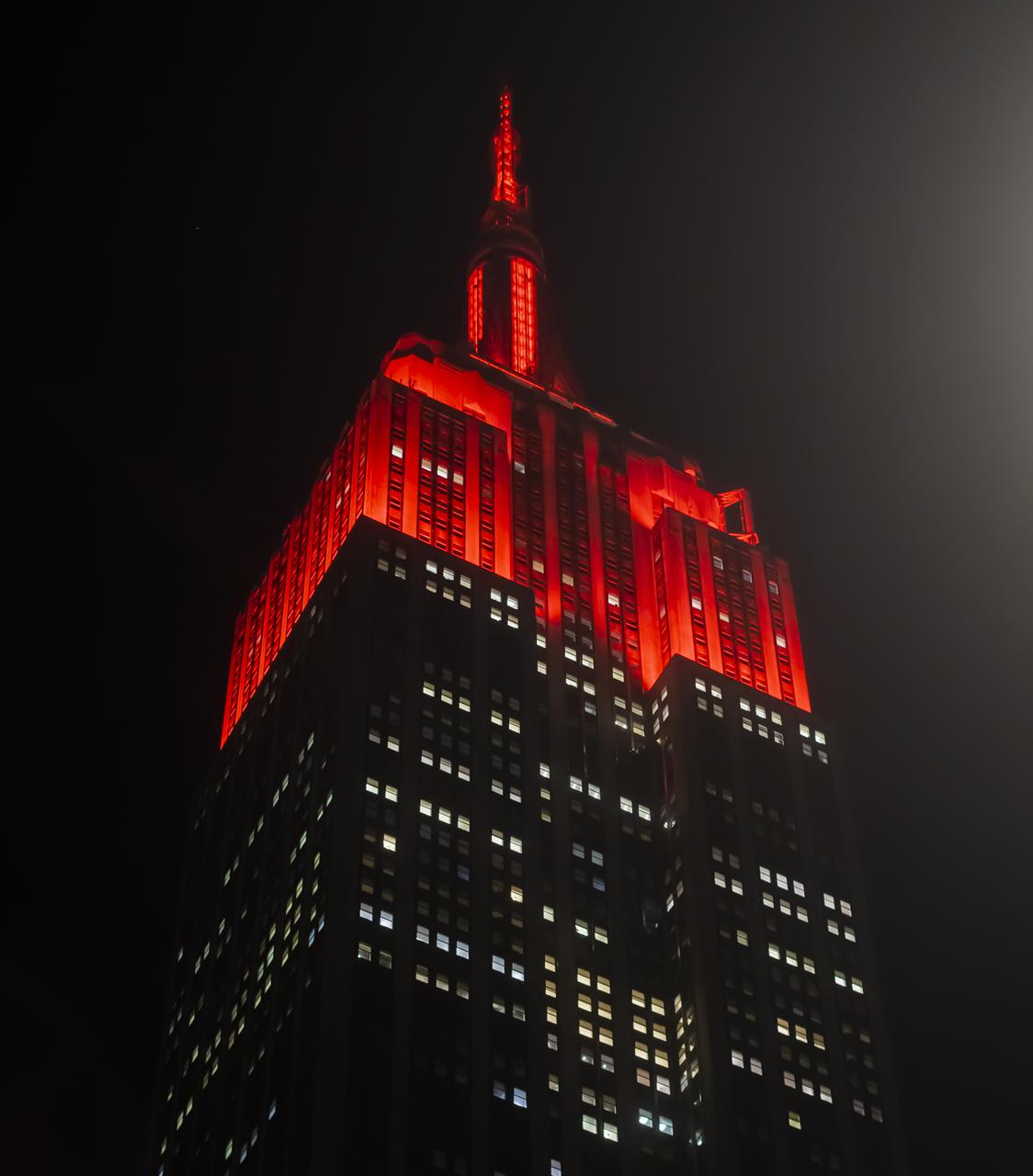
The Empire State Building is illuminated in red to celebrate this Thursday's scheduled landing on Mars of NASA's Perseverance rover, Tuesday, Feb. 16, 2021 in New York City. A key objective for Perseverance’s mission on Mars is astrobiology, including the search for signs of ancient microbial life. The rover will characterize the planet’s geology and past climate, pave the way for human exploration of the Red Planet, and be the first mission to collect and cache Martian rock and regolith. Photo Credit: (NASA/Emma Howells)
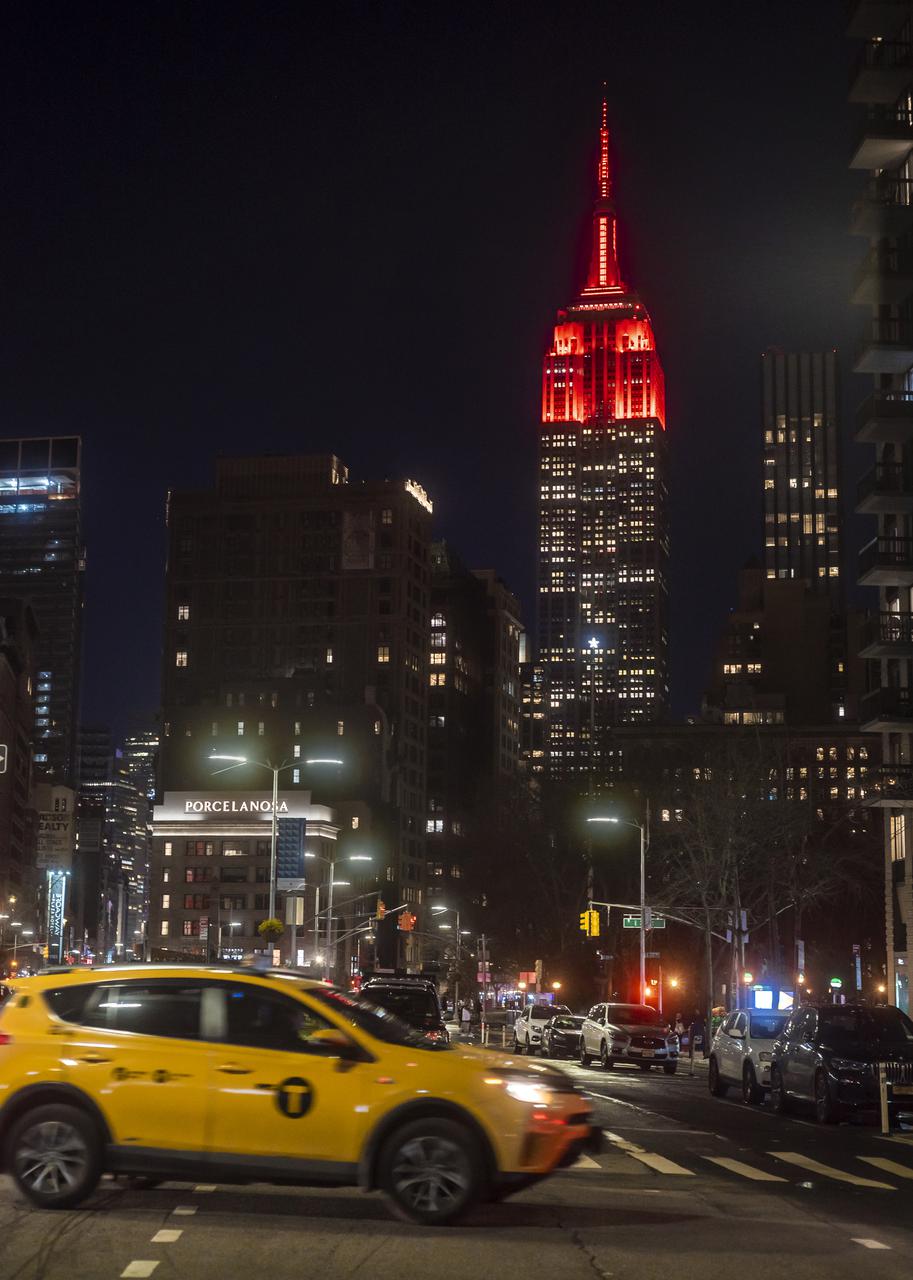
The Empire State Building is illuminated in red to celebrate this Thursday's scheduled landing on Mars of NASA's Perseverance rover, Tuesday, Feb. 16, 2021 in New York City. A key objective for Perseverance’s mission on Mars is astrobiology, including the search for signs of ancient microbial life. The rover will characterize the planet’s geology and past climate, pave the way for human exploration of the Red Planet, and be the first mission to collect and cache Martian rock and regolith. Photo Credit: (NASA/Emma Howells)
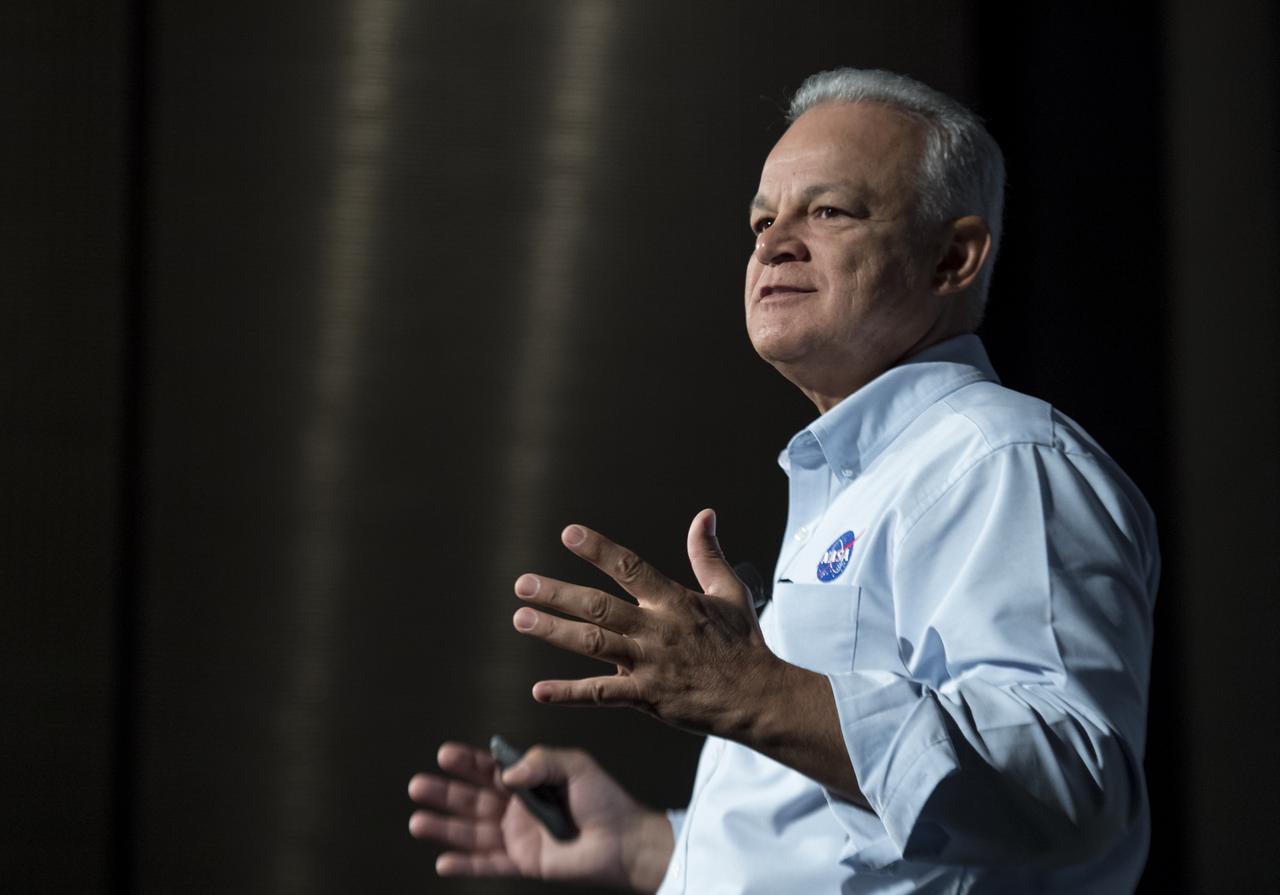
NASA Acting Chief Technologist Douglas Terrier gives a talk to teachers attending a professional development workshop held in tandem with the Intrepid Space & Science Festival, Saturday, Aug. 5, 2017 at the Intrepid Sea, Air & Space Museum in New York City. The week-long festival featured talks, films and cutting-edge displays showcasing NASA technology. Photo Credit: (NASA/Bill Ingalls)
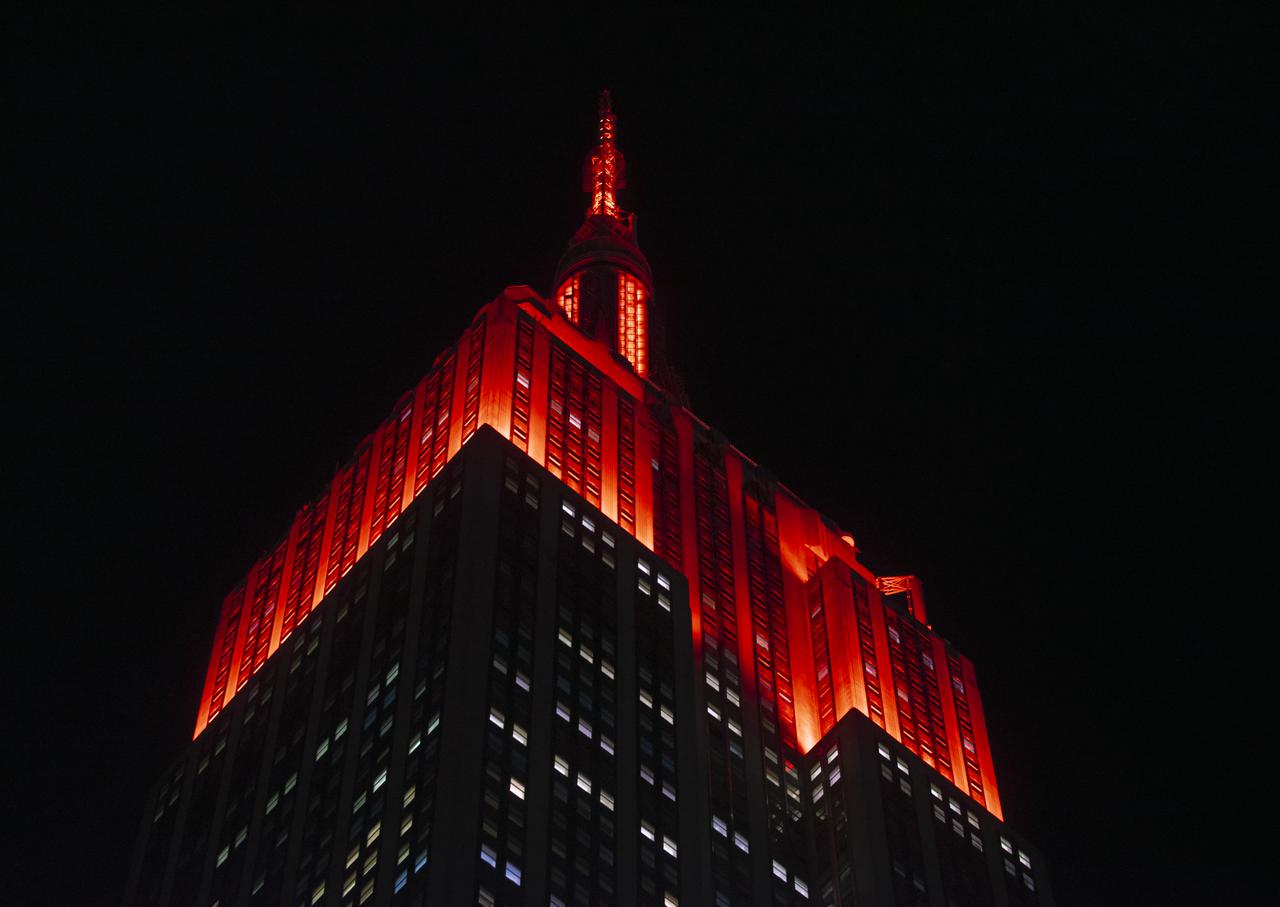
The Empire State Building is illuminated in red to celebrate this Thursday's scheduled landing on Mars of NASA's Perseverance rover, Tuesday, Feb. 16, 2021 in New York City. A key objective for Perseverance’s mission on Mars is astrobiology, including the search for signs of ancient microbial life. The rover will characterize the planet’s geology and past climate, pave the way for human exploration of the Red Planet, and be the first mission to collect and cache Martian rock and regolith. Photo Credit: (NASA/Emma Howells)

NASA Acting Chief Technologist Douglas Terrier gives a talk to teachers attending a professional development workshop held in tandem with the Intrepid Space & Science Festival, Saturday, Aug. 5, 2017 at the Intrepid Sea, Air & Space Museum in New York City. The week-long festival featured talks, films and cutting-edge displays showcasing NASA technology. Photo Credit: (NASA/Bill Ingalls)

NASA Acting Chief Technologist Douglas Terrier, moderates a panel discussion titled "The Big Picture" with NASA James Webb Space Telescope systems engineer Mike Menzel, SpaceX Director of space operations and former NASA astronaut Garret Reisman, Honeybee Robotics co-founder and chairman Stephen Gorevan, and former NASA astronaut Mike Massimino, Saturday, Aug. 5, 2017 at the Intrepid Sea, Air & Space Museum in New York City. Photo Credit: (NASA/Bill Ingalls)

iss074e0209281 (Jan. 28, 2026) --- The wintry landscape of New Jersey, New York, and Connecticut is seen from the International Space Station as it orbited 259 miles above the Atlantic coast of the United States. Temperatures in New York City ranged from a low of about 14 degrees Fahrenheit to a high of around 23 degrees when this photograph was taken.
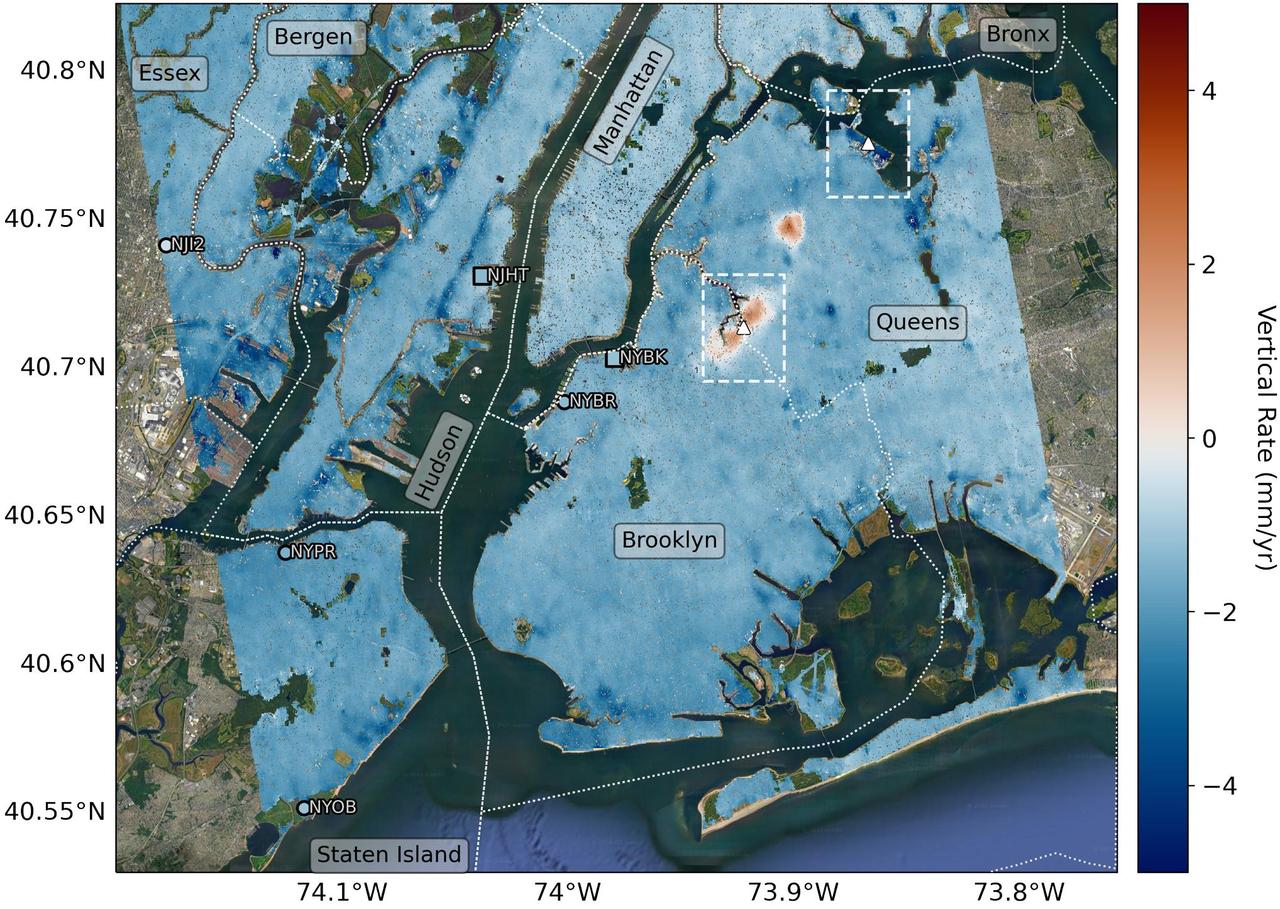
Researchers from NASA's Jet Propulsion Laboratory in Southern California and Rutgers University in New Jersey produced this map in their analysis of upward and downward vertical land motion – also known as uplift and subsidence – across the New York City metropolitan area from 2016 to 2023. Most of the study region was found to be gradually subsiding (indicated here in blue), while isolated locations of uplift (in red) were also observed. The white dotted lines indicate county/borough borders. The researchers found that on average the metropolitan area subsided by about 0.06 inches (1.6 millimeters) per year – about the same amount that a toenail grows in a month. They mapped the motion in detail and pinpointed neighborhoods and landmarks that were subsiding more rapidly than the average. Causes for the observed motion include natural geologic adjustments that have been unfolding since the most recent ice age, as well as human land-use practices such as the construction of landfills, which make the ground looser and more compressible beneath buildings. A few locations in Queens and Brooklyn were observed to rise due to activities that may include pollution remediation efforts and groundwater injection. To create this map, the researchers employed a remote sensing technique called interferometric synthetic aperture radar (InSAR), which combines two or more three-dimensional observations of the same region to reveal surface motion down to fractions of inches. They used the radars on the ESA (European Space Agency) Sentinel-1 satellites, along with advanced data processing methods. https://photojournal.jpl.nasa.gov/catalog/PIA25527

The live NASA TV broadcast from inside the Mission Support Area of NASA's Jet Propulsion Laboratory is seen on the Morgan Stanley video board as NASA's Perseverance rover begins its descent towards the surface of Mars, Thursday, Feb. 18, 2021 in New York City. A key objective for Perseverance’s mission on Mars is astrobiology, including the search for signs of ancient microbial life. The rover will characterize the planet’s geology and past climate, pave the way for human exploration of the Red Planet, and be the first mission to collect and cache Martian rock and regolith. Photo Credit: (NASA/Emma Howells)
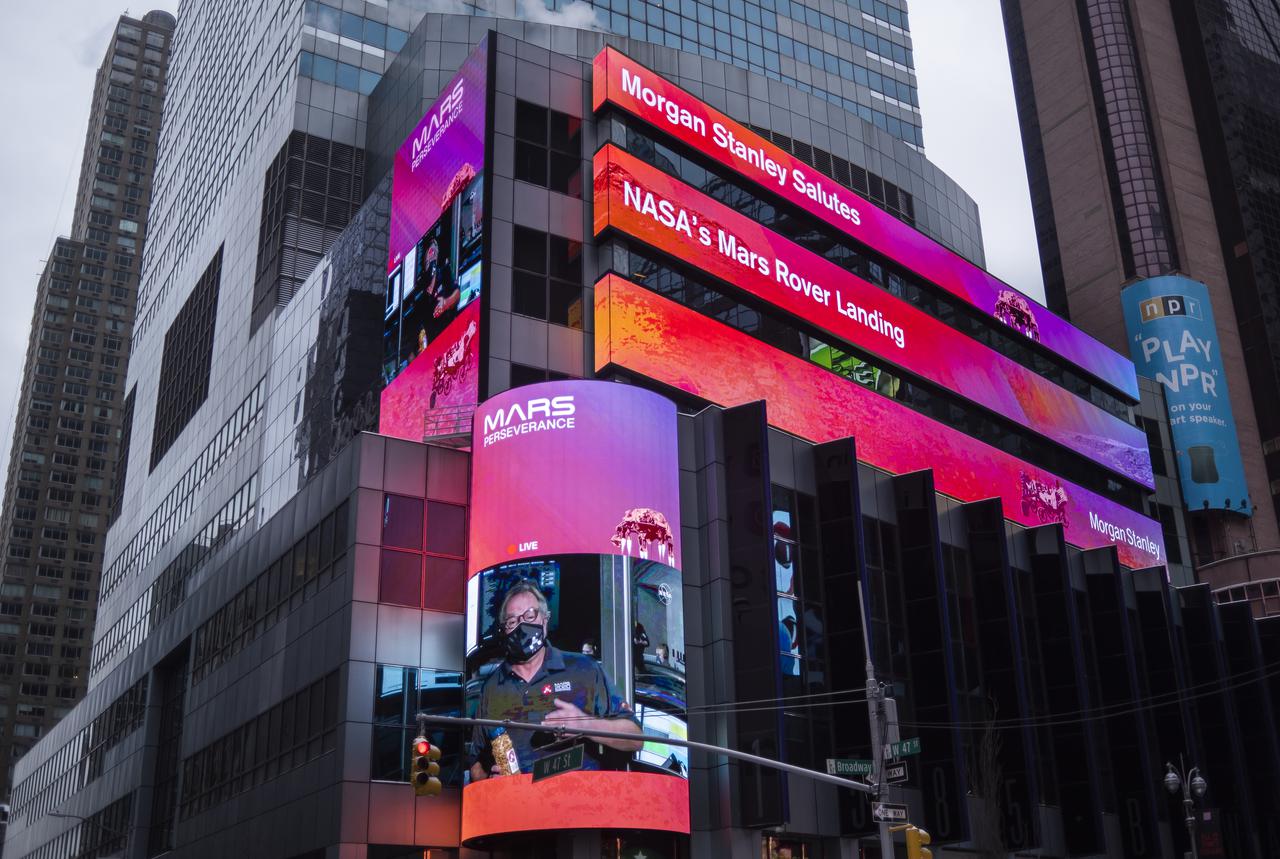
The live NASA TV broadcast from inside the Mission Support Area of NASA's Jet Propulsion Laboratory is seen on the Morgan Stanley video board as NASA's Perseverance rover begins its descent towards the surface of Mars, Thursday, Feb. 18, 2021 in New York City. A key objective for Perseverance’s mission on Mars is astrobiology, including the search for signs of ancient microbial life. The rover will characterize the planet’s geology and past climate, pave the way for human exploration of the Red Planet, and be the first mission to collect and cache Martian rock and regolith. Photo Credit: (NASA/Emma Howells)
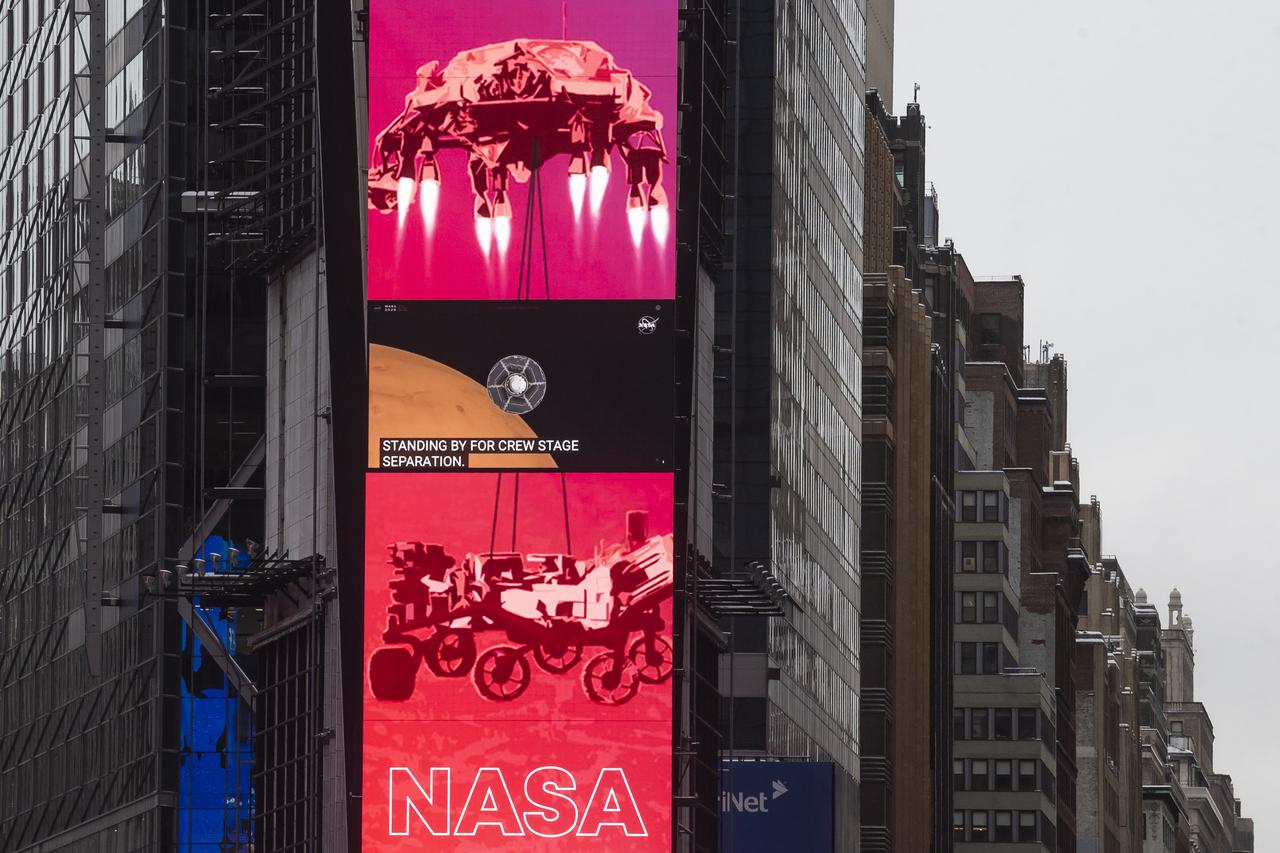
The live NASA TV broadcast from inside the Mission Support Area of NASA's Jet Propulsion Laboratory is seen on the One Times Square video board as NASA's Perseverance rover begins its descent towards the surface of Mars, Thursday, Feb. 18, 2021 in New York City. A key objective for Perseverance’s mission on Mars is astrobiology, including the search for signs of ancient microbial life. The rover will characterize the planet’s geology and past climate, pave the way for human exploration of the Red Planet, and be the first mission to collect and cache Martian rock and regolith. Photo Credit: (NASA/Emma Howells)

The live NASA TV broadcast from inside the Mission Support Area of NASA's Jet Propulsion Laboratory is seen on the One Times Square video board as NASA's Perseverance rover continues its descent towards the surface of Mars, Thursday, Feb. 18, 2021 in New York City. A key objective for Perseverance’s mission on Mars is astrobiology, including the search for signs of ancient microbial life. The rover will characterize the planet’s geology and past climate, pave the way for human exploration of the Red Planet, and be the first mission to collect and cache Martian rock and regolith. Photo Credit: (NASA/Emma Howells)
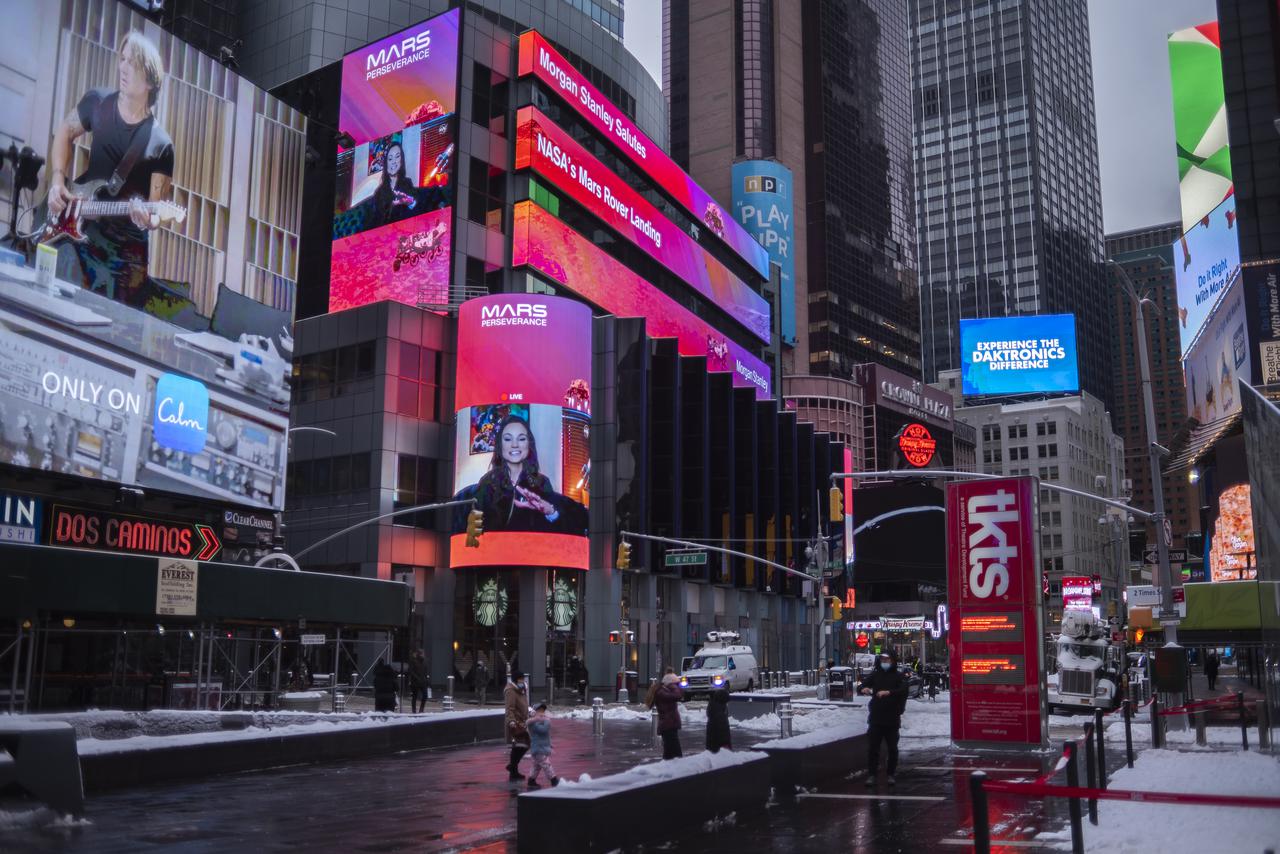
The live NASA TV broadcast from inside the Mission Support Area of NASA's Jet Propulsion Laboratory is seen on the Morgan Stanley video board as NASA's Perseverance rover begins its descent towards the surface of Mars, Thursday, Feb. 18, 2021 in New York City. A key objective for Perseverance’s mission on Mars is astrobiology, including the search for signs of ancient microbial life. The rover will characterize the planet’s geology and past climate, pave the way for human exploration of the Red Planet, and be the first mission to collect and cache Martian rock and regolith. Photo Credit: (NASA/Emma Howells)
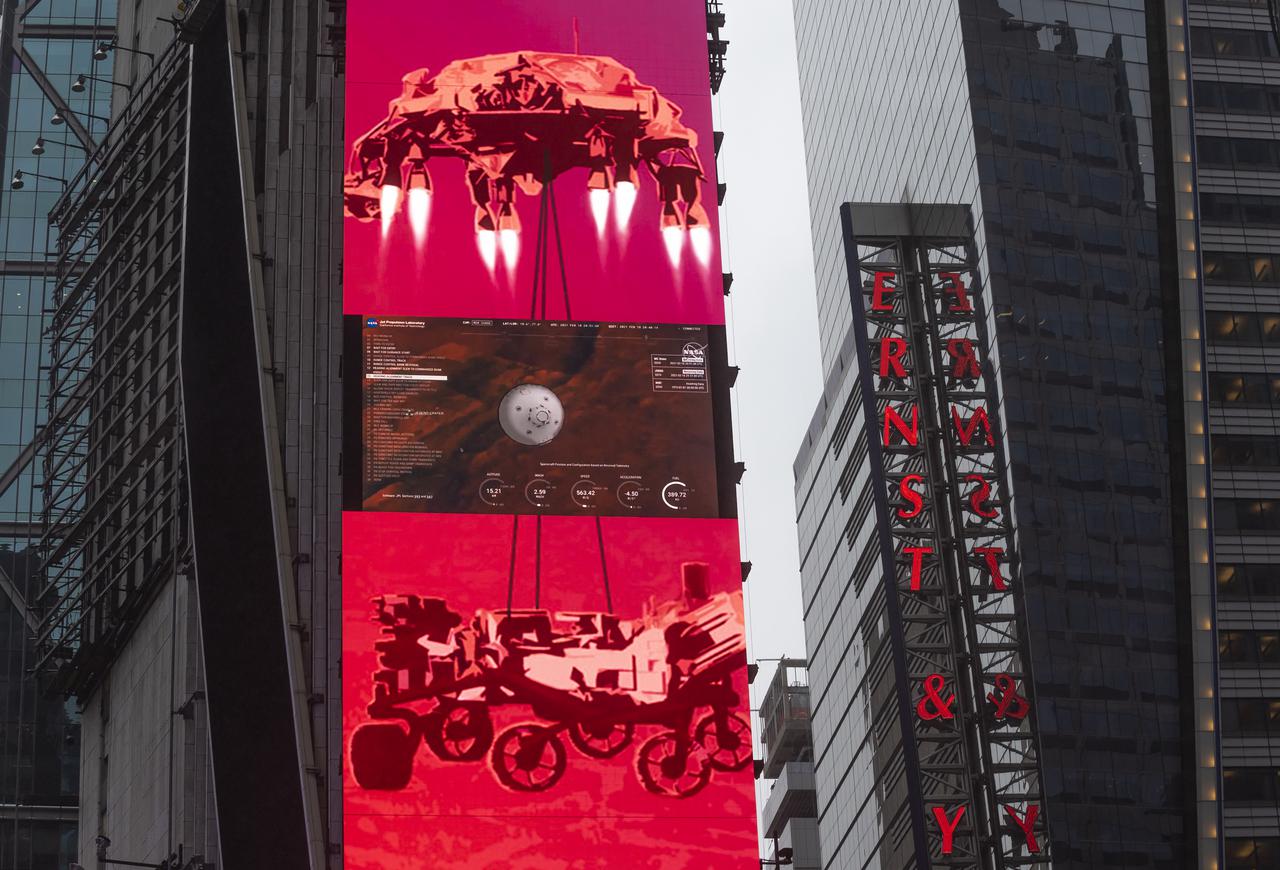
The live NASA TV broadcast from inside the Mission Support Area of NASA's Jet Propulsion Laboratory is seen on the One Times Square video board as NASA's Perseverance rover continues its descent towards the surface of Mars, Thursday, Feb. 18, 2021 in New York City. A key objective for Perseverance’s mission on Mars is astrobiology, including the search for signs of ancient microbial life. The rover will characterize the planet’s geology and past climate, pave the way for human exploration of the Red Planet, and be the first mission to collect and cache Martian rock and regolith. Photo Credit: (NASA/Emma Howells)

The live NASA TV broadcast from inside the Mission Support Area of NASA's Jet Propulsion Laboratory is seen on the One Times Square video board as NASA's Perseverance rover completes its descent towards the surface of Mars, Thursday, Feb. 18, 2021 in New York City. A key objective for Perseverance’s mission on Mars is astrobiology, including the search for signs of ancient microbial life. The rover will characterize the planet’s geology and past climate, pave the way for human exploration of the Red Planet, and be the first mission to collect and cache Martian rock and regolith. Photo Credit: (NASA/Emma Howells)
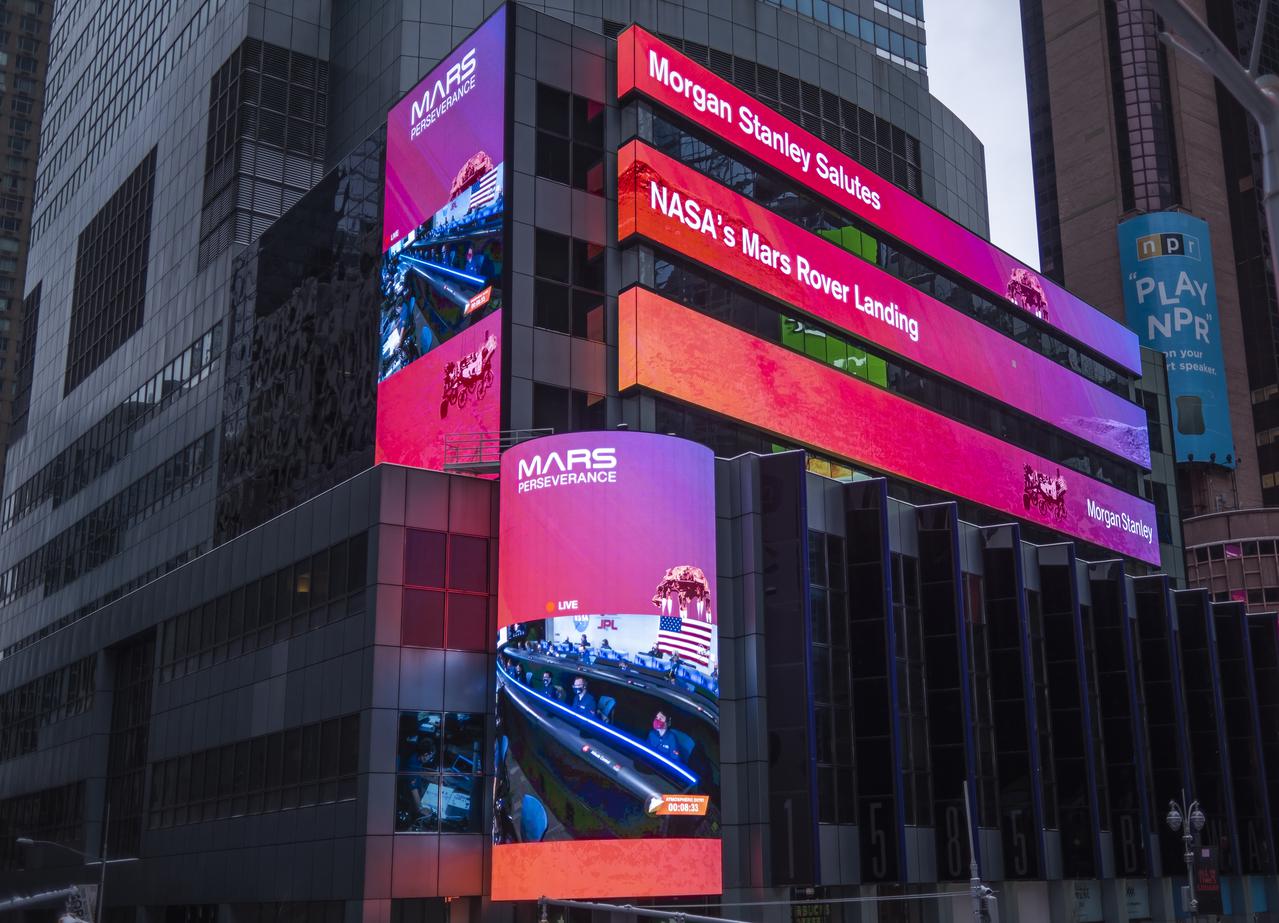
The live NASA TV broadcast from inside the Mission Support Area of NASA's Jet Propulsion Laboratory is seen on the Morgan Stanley video board as NASA's Perseverance rover begins its descent towards the surface of Mars, Thursday, Feb. 18, 2021 in New York City. A key objective for Perseverance’s mission on Mars is astrobiology, including the search for signs of ancient microbial life. The rover will characterize the planet’s geology and past climate, pave the way for human exploration of the Red Planet, and be the first mission to collect and cache Martian rock and regolith. Photo Credit: (NASA/Emma Howells)

An inflatable scale model of the SLS rocket is seen on Pier 86 during the Intrepid Space & Science Festival, Saturday, Aug. 5, 2017 held at the Intrepid Sea, Air & Space Museum in New York City. The week-long festival featured talks, films and cutting-edge displays showcasing NASA technology. Photo Credit: (NASA/Bill Ingalls)

Audience members, seated under the wing of the space shuttle Enterprise, listen as NASA Acting Chief Technologist Douglas Terrier, moderates a panel discussion titled "The Big Picture" with NASA James Webb Space Telescope systems engineer Mike Menzel, SpaceX Director of space operations and former NASA astronaut Garret Reisman, Honeybee Robotics co-founder and chairman Stephen Gorevan, and former NASA astronaut Mike Massimino, Saturday, Aug. 5, 2017 at the Intrepid Sea, Air & Space Museum in New York City. Photo Credit: (NASA/Bill Ingalls)
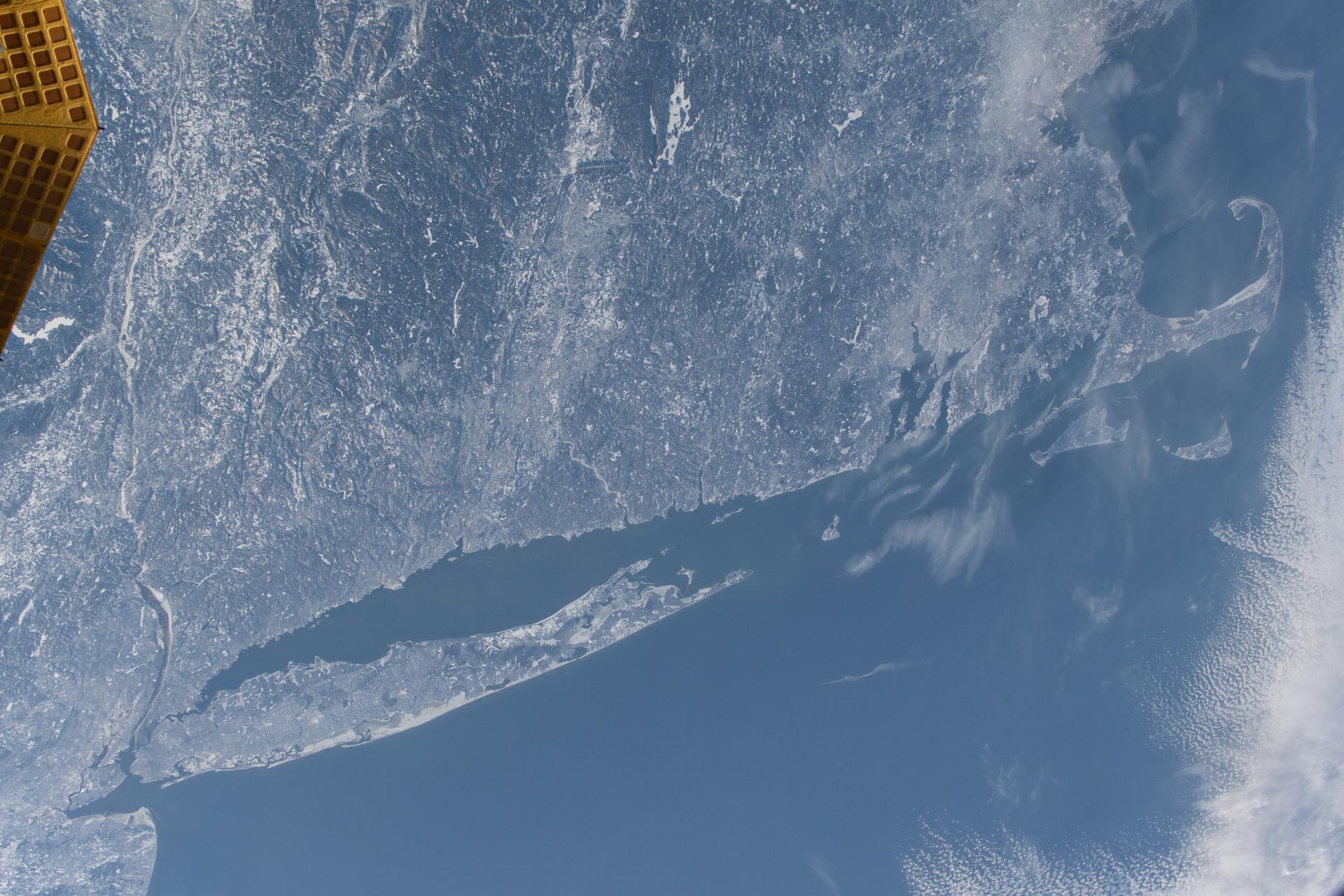
iss074e0300237 (Feb. 2, 2026) --- The wintry landscape from New Jersey to Massachusetts is seen from the International Space Station as it orbited 262 miles above the northeastern United States. Temperatures in New York City (lower left) ranged from a low of about 18 degrees Fahrenheit to a high of around 30 degrees when this photograph was taken.

Large groups of spectators waited all day with their cameras in order to see the space shuttle Enterprise arrival on a barge and lift onto the Intrepid Sea, Air and Space Museum where it will be permanently displayed, Wednesday, June 6, 2012 in New York. Photo Credit: (NASA/Bill Ingalls)
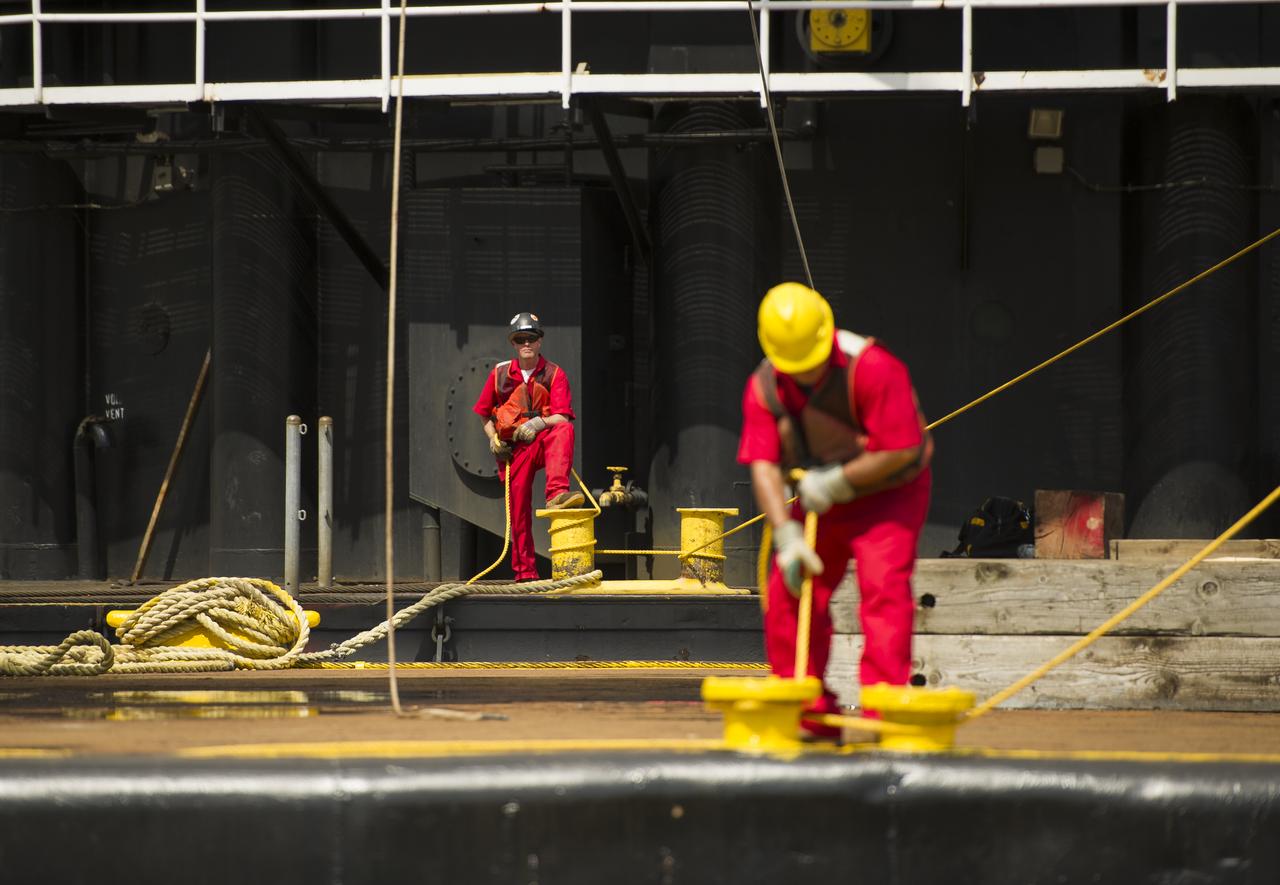
Workers control support ropes from the space shuttle Enterprise in preparation to lift it off of a barge and onto the Intrepid Sea, Air and Space Museum where it will be permanently displayed, Wednesday, June 6, 2012 in New York. Photo Credit: (NASA/Bill Ingalls)
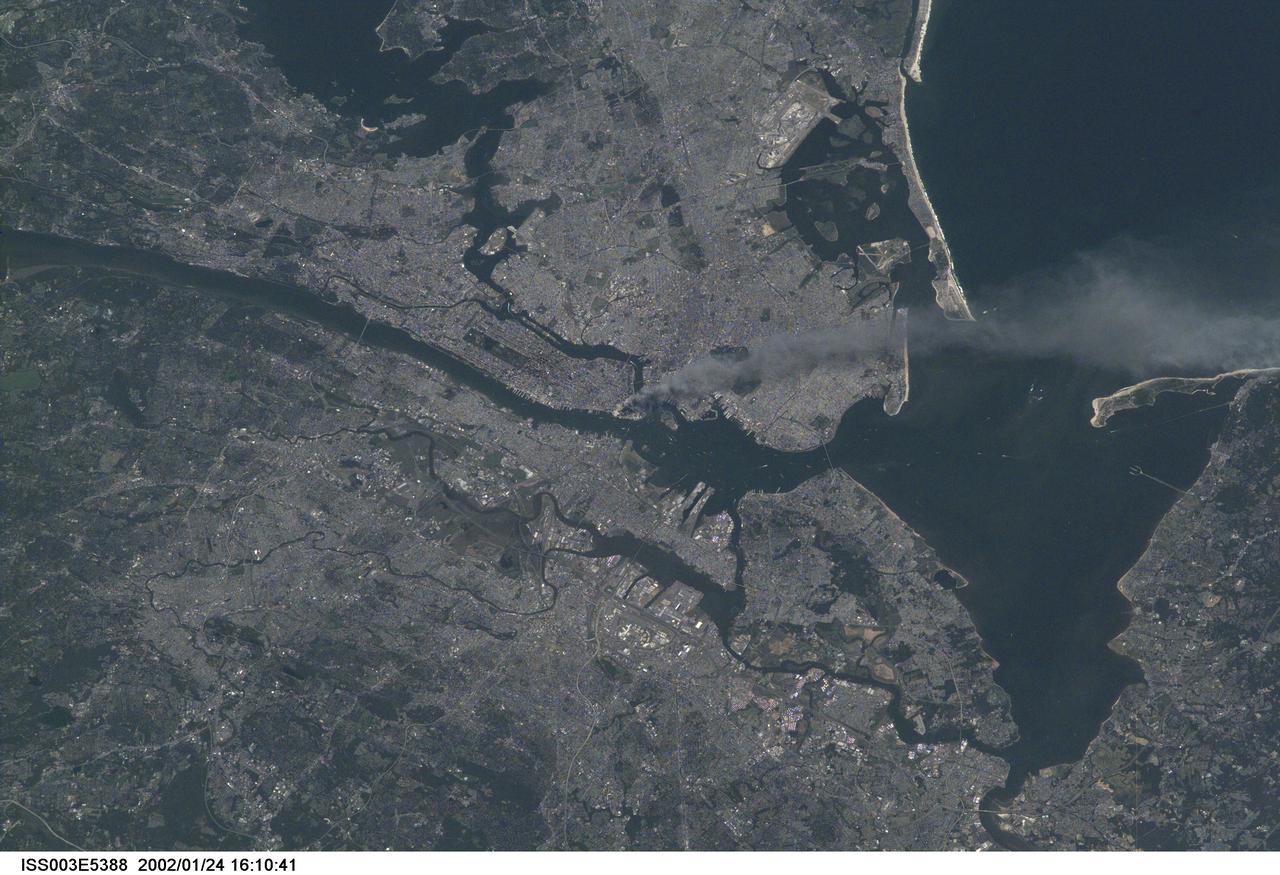
ISS003-E-5388 (11 September 2001) --- One of a series of pictures taken of metropolitan New York City (and other parts of New York as well as New Jersey) by one of the Expedition Three crew members onboard the International Space Station (ISS) at various times during the day of September 11, 2001. The image shows a smoke plume rising from the Manhattan area. The orbital outpost was flying at an altitude of approximately 250 miles. The image was recorded with a digital still camera. Please note: The date identifiers on some frames (other than those that indicate Sept. 11, 2001) are not accurate due to a technical problem with one of the Expedition Three cameras.

ISS003-E-5387 (11 September 2001) --- One of a series of pictures taken of metropolitan New York City (and other parts of New York as well as New Jersey) by one of the Expedition Three crew members onboard the International Space Station (ISS) at various times during the day of September 11, 2001. The image shows a smoke plume rising from the Manhattan area. The orbital outpost was flying at an altitude of approximately 250 miles. The image was recorded with a digital still camera. Please note: The date identifiers on some frames (other than those that indicate Sept. 11, 2001) are not accurate due to a technical problem with one of the Expedition Three cameras.

NASA Acting Chief Technologist Douglas Terrier, left, moderates a panel discussion titled "The Big Picture" with NASA James Webb Space Telescope systems engineer Mike Menzel, SpaceX Director of space operations and former NASA astronaut Garret Reisman, Honeybee Robotics co-founder and chairman Stephen Gorevan, and former NASA astronaut Mike Massimino, Saturday, Aug. 5, 2017 at the Intrepid Sea, Air & Space Museum in New York City. Photo Credit: (NASA/Bill Ingalls)

NASA Administrator Charlie Bolden and Intrepid Sea, Air & Space Museum President Susan Marenoff-Zausner cut a ribbon at the museum marking the opening of the new Space Shuttle Pavilion which exhibits the space shuttle Enterprise while NASA Astronaut and Enterprise Commander Fred Haise, left, NASA Astronaut and Enterprise Commander Joe Engle, background, and Marie Fullerton, wife of NASA Astronaut and Enterprise Pilot Gordon Fullerton, right, look on, Thursday, July 19, 2012 in New York City. Photo Credit: (NASA/Bill Ingalls)

NASA Deputy Associate Administrator Melanie Saunders and former NASA astronaut Mike Massimino ring the closing bell of the Nasdaq after the NASA's InSight lander successfully touched down on the surface of Mars, Monday, Nov. 26, 2018 at the Nasdaq MarketSite in New York City. The lander sent a signal affirming a completed landing sequence at approximately 3 p.m. EST (noon PST) after touching down on the western side of a flat, smooth expanse of lava called Elysium Planitila. InSight, short for Interior Exploration using Seismic Investigations, Geodesy and Heat Transport, is a Mars lander designed to study the "inner space" of Mars: its crust, mantle, and core. Photo Credit: (NASA/Joel Kowsky)