
Astronauts Victor Glover and Jeanette Epps presented Silver Snoopy Awards at Stennis Space Center on June 27, including to NASA engineer Katie Carr Kopeso, who accepted the award with her ever-expanding family
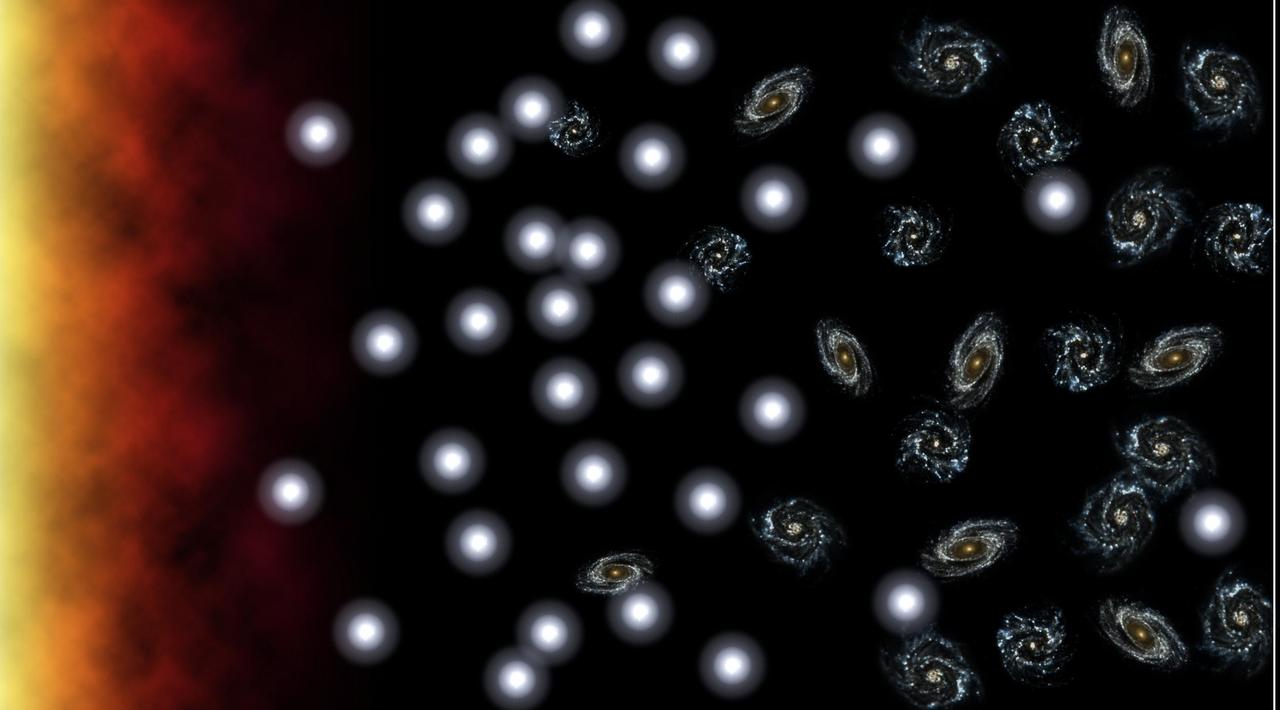
This artist's conception illustrates the decline in our universe's "birth-rate" over time. When the universe was young, massive galaxies were forming regularly, like baby bees in a bustling hive. In time, the universe bore fewer and fewer "offspring," and newborn galaxies (white circles) matured into older ones more like our own Milky Way (spirals). Previously, astronomers thought that the universe had ceased to give rise to massive, young galaxies, but findings from NASA's Galaxy Evolution Explorer suggest that may not be the case. Surveying thousands of nearby galaxies with its highly sensitive ultraviolet eyes, the telescope spotted three dozen that greatly resemble youthful galaxies from billions of years ago. In this illustration, those galaxies are represented as white circles on the right, or "today" side of the timeline. The discovery not only suggests that our universe may still be alive with youth, but also offers astronomers their first close-up look at what appear to be baby galaxies. Prior to the new result, astronomers had to peer about 11 billion light-years into the distant universe to see newborn galaxies. The newfound galaxies are only about 2 to 4 billion light-years away. http://photojournal.jpl.nasa.gov/catalog/PIA07142
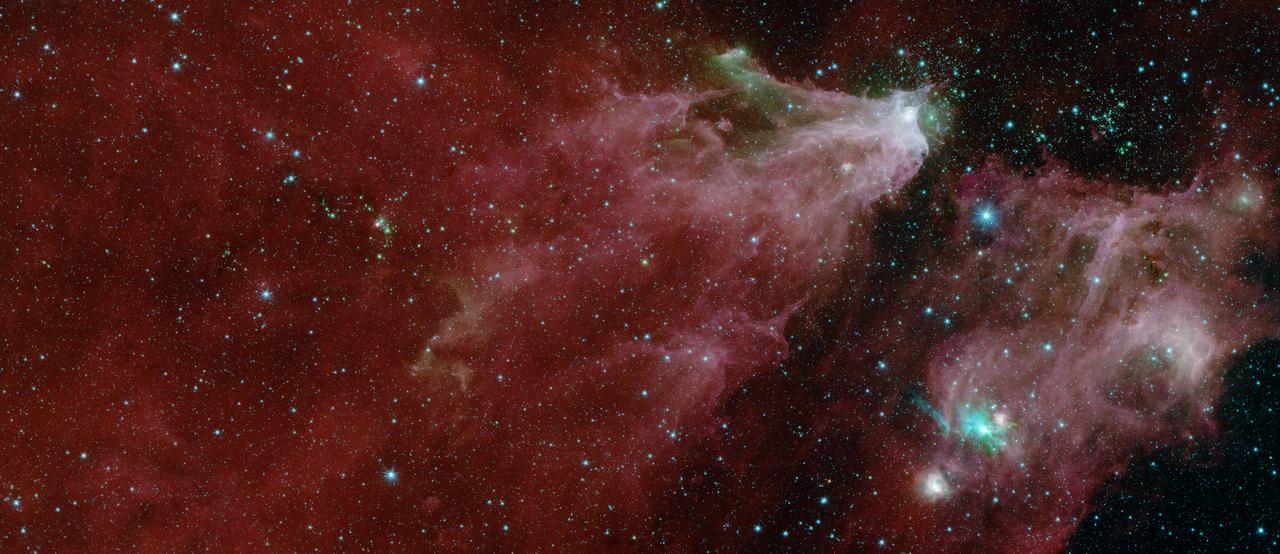
This image shows data from NASA's Spitzer Space Telescope, from the IRAC instrument, with colors corresponding to wavelengths of 3.6, 4.5, 5.8 and 8.0 µm (shown as blue, green, orange and red). The grand red delta filling most of the image is a far-away nebula, or a cloud of gas and dust. A second nebula is located in the lower right portion of the image. Within the first nebula, on the left side of this image, a dark filament runs horizontally through the green cloud. A smattering of baby stars (the red and yellow dots) appear inside it. Known as Cepheus C, the area is a particularly dense concentration of gas and dust where infant stars form. This region is called Cepheus C because it lies in the constellation Cepheus, which can be found near the constellation Cassiopeia. Cepheus-C is about 6 light years long, and lies about 40 light-years from the bright spot at the tip of the nebula. Two features identified in the annotated image are visible only in the multi-instrument version of the image, found here. The first is V374 Ceph in the larger nebula. The second is the "runaway star" in the smaller nebula. A second star cluster is located just above the second large nebula on the right side of the image. Known as Cepheus B, the cluster sits within a few thousand light-years of our Sun. A study of this region using Spitzer found that the dramatic collection is about 4 million to 5 million years old — slightly older than those in Cepheus C. Also found in the second nebula is a small cluster of newborn stars that illuminates the dense cloud of gas and dust where they formed. It appears as a bright teal splash. https://photojournal.jpl.nasa.gov/catalog/PIA23127
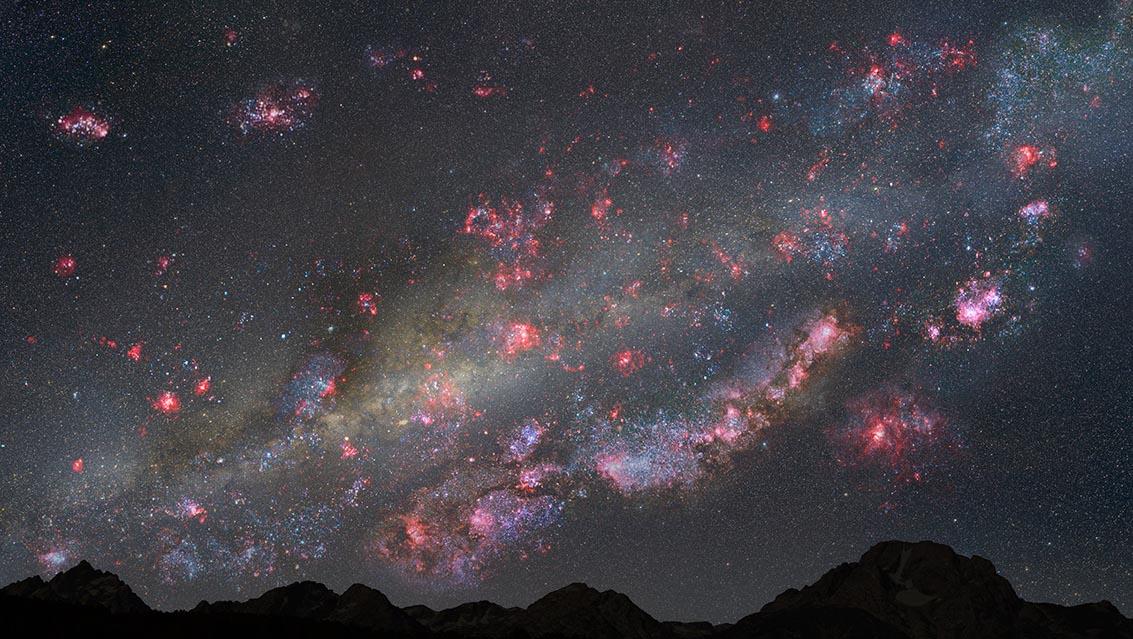
Caption: Artist's view of night sky from a hypothetical planet within a young Milky Way-like galaxy 10 billion years ago, the sky are ablaze with star birth. Pink clouds of gas harbor newborn stars, and bluish-white, young star clusters litter the landscape. Image Credit: NASA/ESA/Z. Levay (STScI) More info: In one of the most comprehensive multi-observatory galaxy surveys yet, astronomers find that galaxies like our Milky Way underwent a stellar “baby boom,” churning out stars at a prodigious rate, about 30 times faster than today. Our sun, however, is a late “boomer.” The Milky Way’s star-birthing frenzy peaked 10 billion years ago, but our sun was late for the party, not forming until roughly 5 billion years ago. By that time the star formation rate in our galaxy had plunged to a trickle. Missing the party, however, may not have been so bad. The sun’s late appearance may actually have fostered the growth of our solar system’s planets. Elements heavier than hydrogen and helium were more abundant later in the star-forming boom as more massive stars ended their lives early and enriched the galaxy with material that served as the building blocks of planets and even life on Earth. Astronomers don’t have baby pictures of our Milky Way’s formative years to trace the history of stellar growth so they studied galaxies similar in mass to our Milky Way, found in deep surveys of the universe. The farther into the universe astronomers look, the further back in time they are seeing, because starlight from long ago is just arriving at Earth now. From those surveys, stretching back in time more than 10 billion years, researchers assembled an album of images containing nearly 2,000 snapshots of Milky Way-like galaxies. The new census provides the most complete picture yet of how galaxies like the Milky Way grew over the past 10 billion years into today’s majestic spiral galaxies. The multi-wavelength study spans ultraviolet to far-infrared light, combining observations from NASA’s Hubble and Spitzer space telescopes, the European Space Agency’s Herschel Space Observatory, and ground-based telescopes, including the Magellan Baade Telescope at the Las Campanas Observatory in Chile. Read more: <a href="http://www.nasa.gov/content/goddard/our-sun-came-late-to-the-milky-way-s-star-birth-party/" rel="nofollow">www.nasa.gov/content/goddard/our-sun-came-late-to-the-mil...</a> <b><a href="http://www.nasa.gov/audience/formedia/features/MP_Photo_Guidelines.html" rel="nofollow">NASA image use policy.</a></b> <b><a href="http://www.nasa.gov/centers/goddard/home/index.html" rel="nofollow">NASA Goddard Space Flight Center</a></b> enables NASA’s mission through four scientific endeavors: Earth Science, Heliophysics, Solar System Exploration, and Astrophysics. Goddard plays a leading role in NASA’s accomplishments by contributing compelling scientific knowledge to advance the Agency’s mission. <b>Follow us on <a href="http://twitter.com/NASAGoddardPix" rel="nofollow">Twitter</a></b> <b>Like us on <a href="http://www.facebook.com/pages/Greenbelt-MD/NASA-Goddard/395013845897?ref=tsd" rel="nofollow">Facebook</a></b> <b>Find us on <a href="http://instagrid.me/nasagoddard/?vm=grid" rel="nofollow">Instagram</a></b>