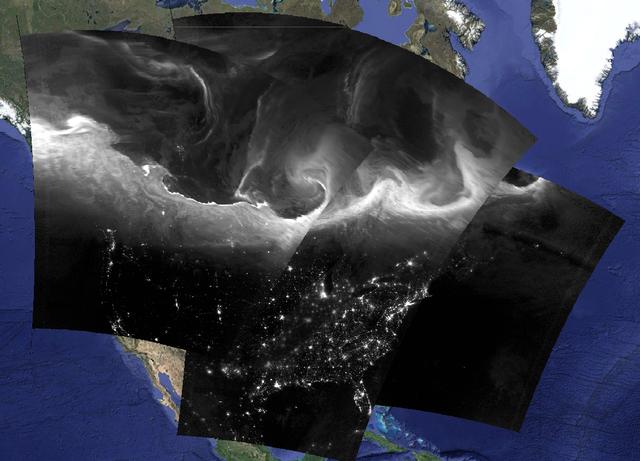
This is a composite image of Suomi NPP VIIRS Day/Night Band images show the bright and complex signature of the aurora borealis across southern Canada and the northern United States during the nighttime hours of September 8, 2015. Credit: NASA/Goddard/Suomi NPP/VIIRS/SSEC-RealEarth <b><a href="http://www.nasa.gov/audience/formedia/features/MP_Photo_Guidelines.html" rel="nofollow">NASA image use policy.</a></b> <b><a href="http://www.nasa.gov/centers/goddard/home/index.html" rel="nofollow">NASA Goddard Space Flight Center</a></b> enables NASA’s mission through four scientific endeavors: Earth Science, Heliophysics, Solar System Exploration, and Astrophysics. Goddard plays a leading role in NASA’s accomplishments by contributing compelling scientific knowledge to advance the Agency’s mission. <b>Follow us on <a href="http://twitter.com/NASAGoddardPix" rel="nofollow">Twitter</a></b> <b>Like us on <a href="http://www.facebook.com/pages/Greenbelt-MD/NASA-Goddard/395013845897?ref=tsd" rel="nofollow">Facebook</a></b> <b>Find us on <a href="http://instagrid.me/nasagoddard/?vm=grid" rel="nofollow">Instagram</a></b>
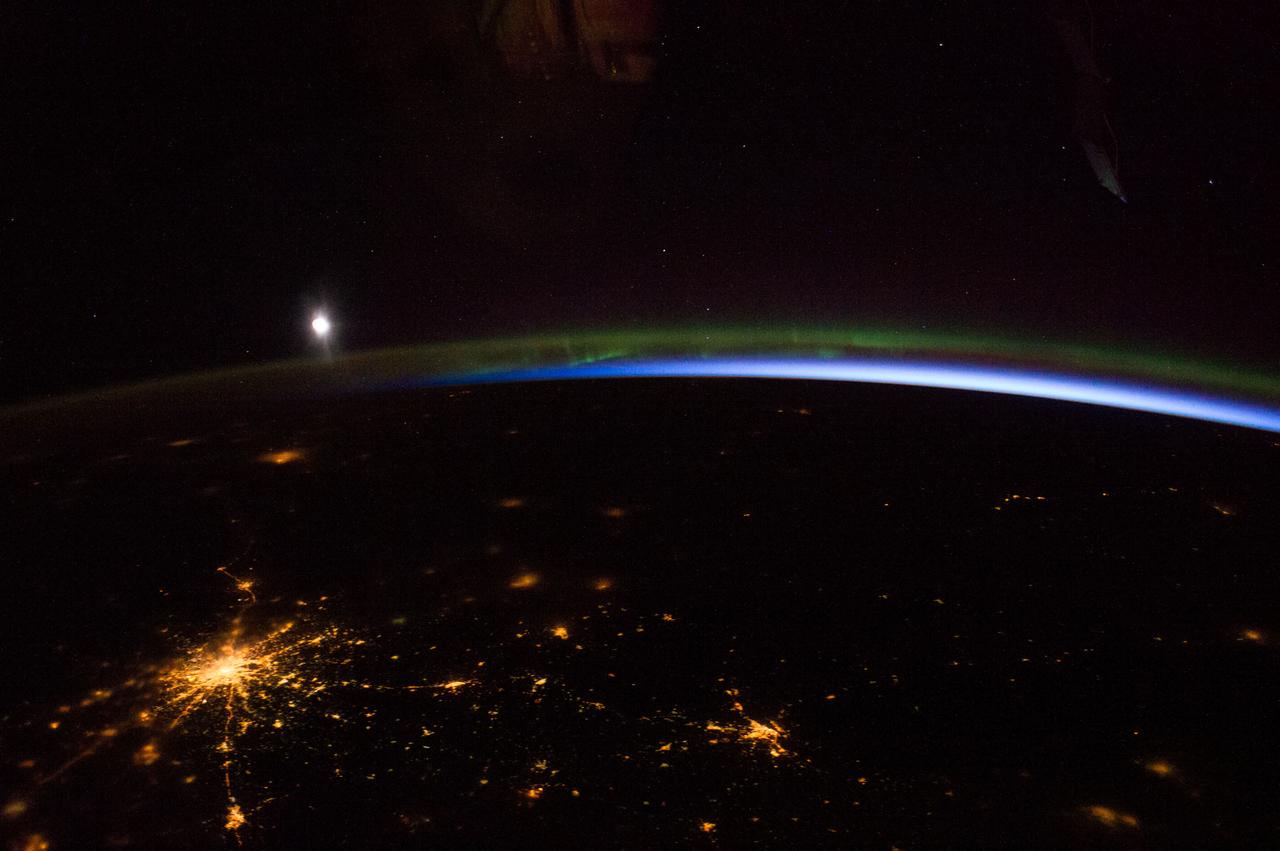
ISS039-E-009160 (2 April 2014) --- This nighttime view featuring the aurora borealis, the moon and Moscow was photographed by an Expedition 39 crew member on the International Space Station. A thin green line of the aurora borealis crosses the top of this image. The moon appears as a white disc just above the aurora. Airglow appears as a blue-white cusp on Earth's limb. Russia's capital city Moscow makes a splash of yellow (lower left), with its easily recognized radial pattern of highways. Other cities are Nizhni Novgorod (lower center) 400 kilometers from Moscow, St. Petersburg (left) 625 kilometers from Moscow, and Finland?s capital city Helsinki.

ISS030-E-177670 (28 March 2012) --- One of the Expedition 30 crew members photographed this nighttime scene while the International Space Station was flying at an altitude approximately 240 miles over the eastern North Atlantic. The view looks northeastward. Center point coordinates are 46.8 degrees north latitude and 14.3 degrees west longitude. The night lights of the cities of Ireland, in the foreground, and the United Kingdom, in the back and to the right, are contrasted by the bright sunrise in the background. The greens and purples of the Aurora Borealis are seen along the rest of the horizon.
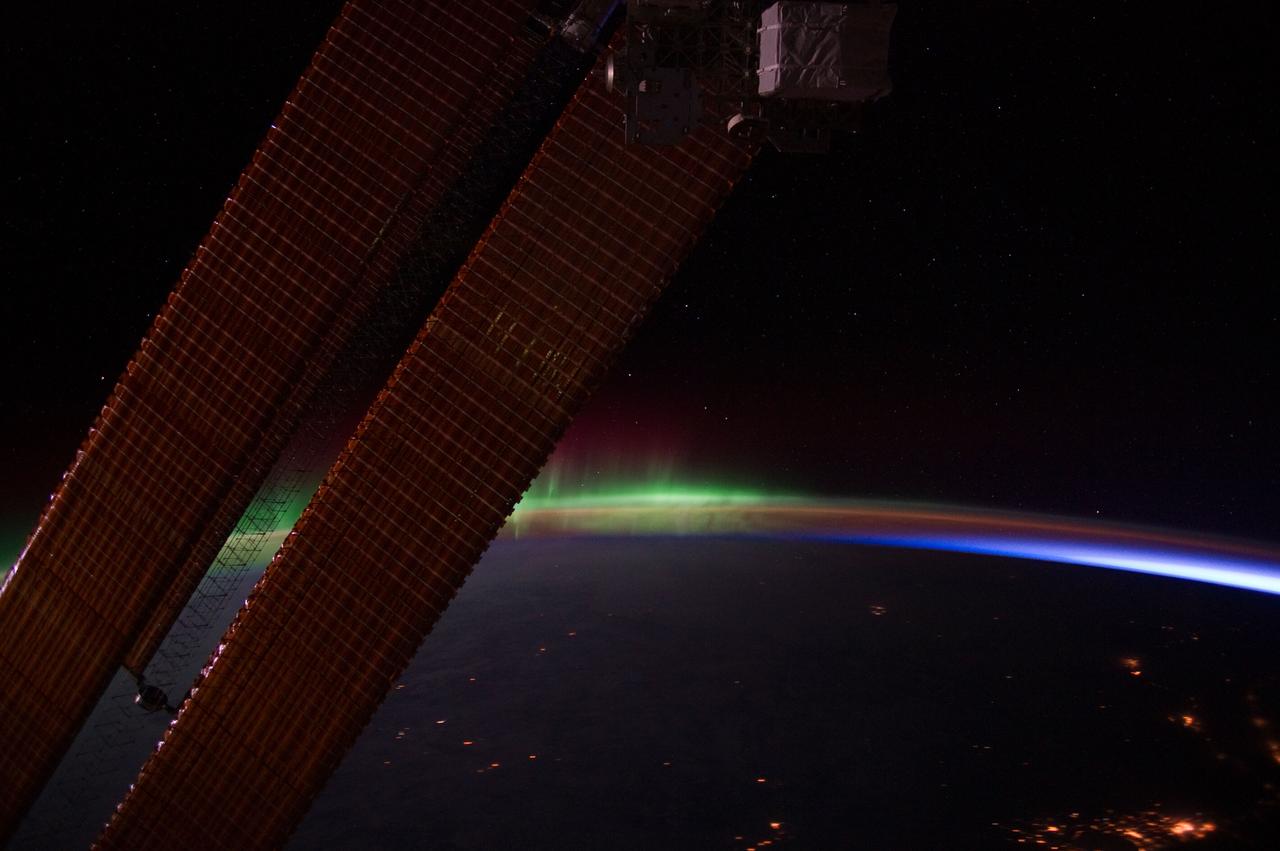
ISS030-E-075182 (4 Feb. 2012) --- This nighttime view of Earth's horizon and scattered city lights was photographed by one of the Expedition 30 crew members aboard the International Space Station. Activity of Aurora Borealis appears from behind one of the orbital outpost's solar array panels, then fades into an area where Earth's limb is visible and finally a small "slice" of daybreak appears at right.
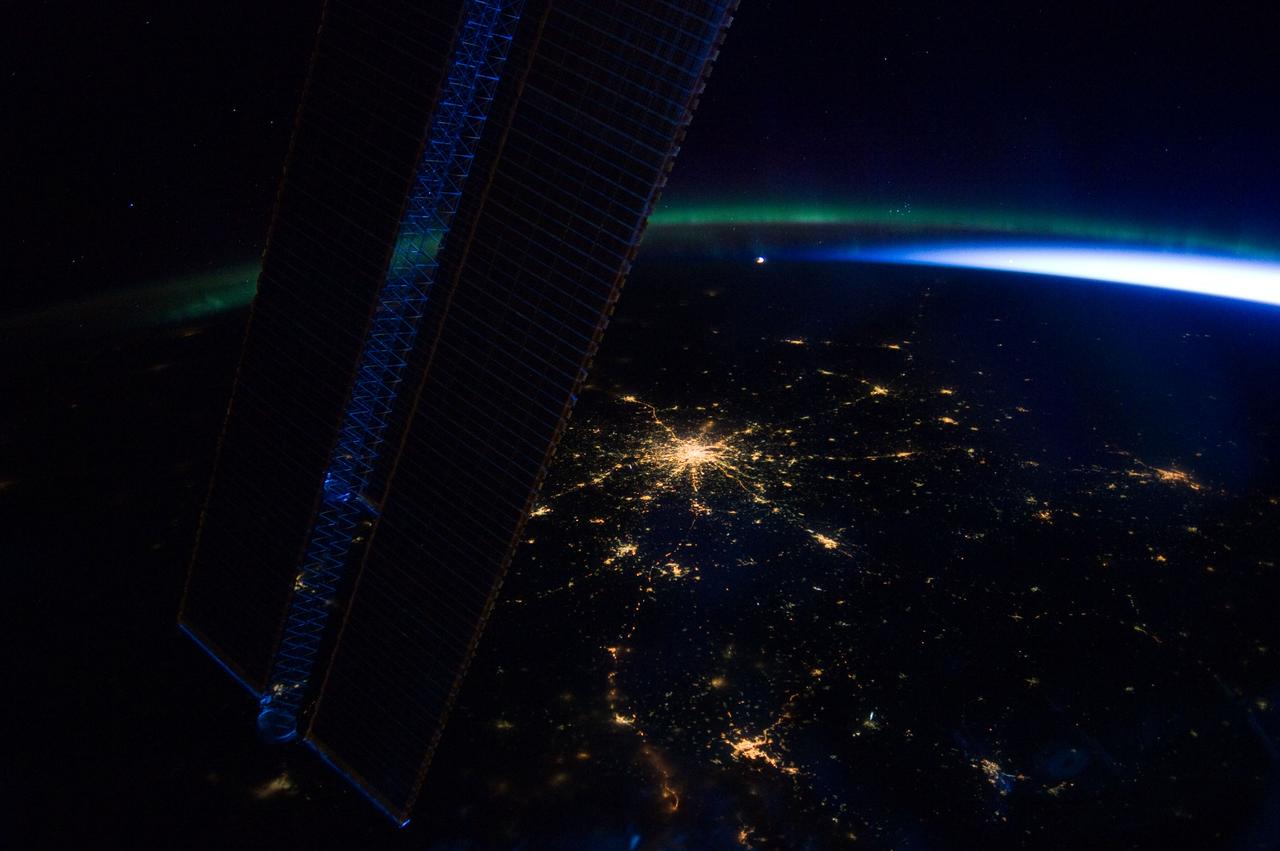
ISS030-E-185327 (28 March 2012) --- Moscow, Russia appears at the center of this nighttime image photographed by one of the Expedition 30 crew members aboard the International Space Station, flying at an altitude of approximately 240 miles. A solar array panel for the space station is on the left side of the frame. The view is to the north-northwest from a nadir of approximately 49.4 degrees north latitude and 42.1 degrees east longitude, about 100 miles west-northwest of Volgograd. On the horizon in the background can be seen a small sample of Aurora Borealis, airglow and daybreak.
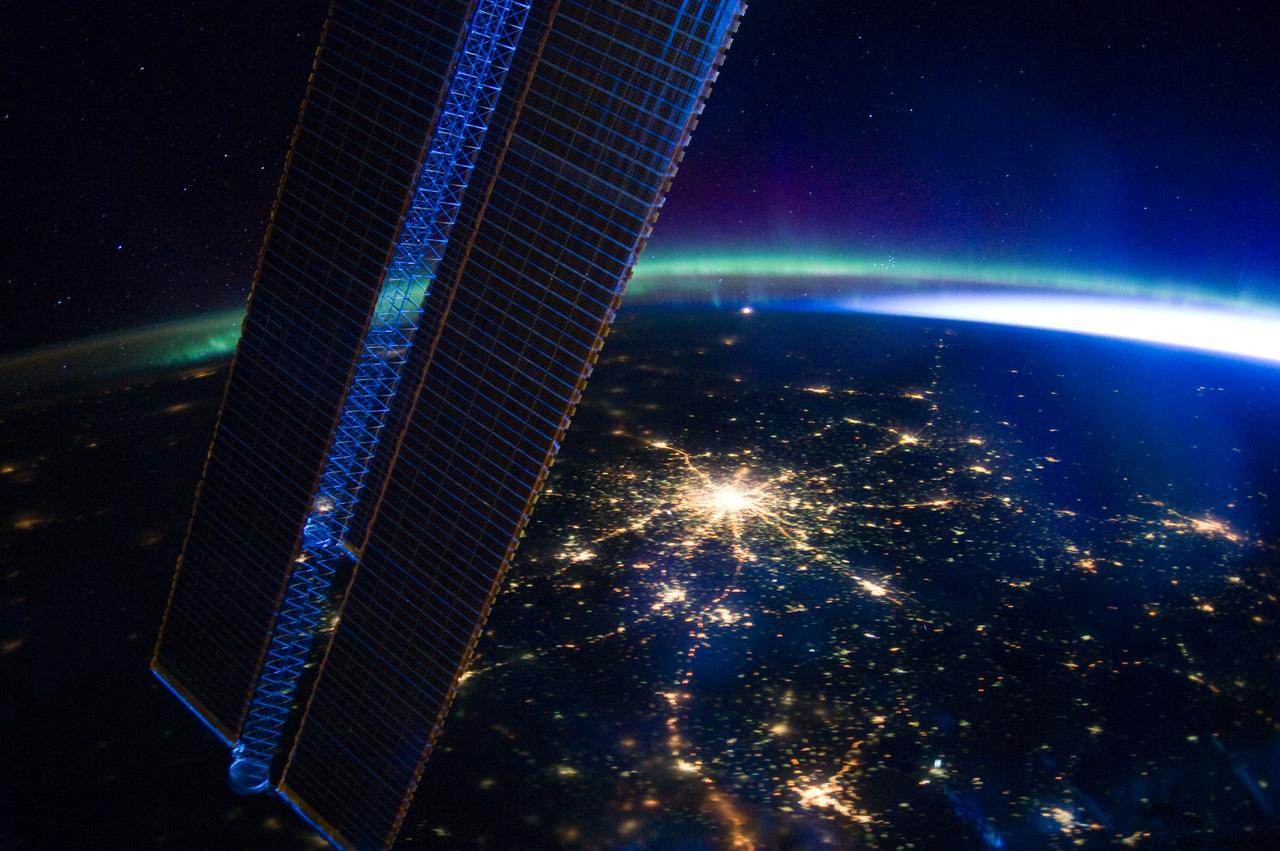
ISS030-E-185321 (28 March 2012) --- Moscow, Russia appears at the center of this nighttime image photographed by one of the Expedition 30 crew members aboard the International Space Station, flying at an altitude of approximately 240 miles. A solar array panel for the space station is on the left side of the frame. The view is to the north-northwest from a nadir of approximately 49.4 degrees north latitude and 42.1 degrees east longitude, about 100 miles west-northwest of Volgograd. On the horizon in the background can be seen a small sample of Aurora Borealis, airglow and daybreak.