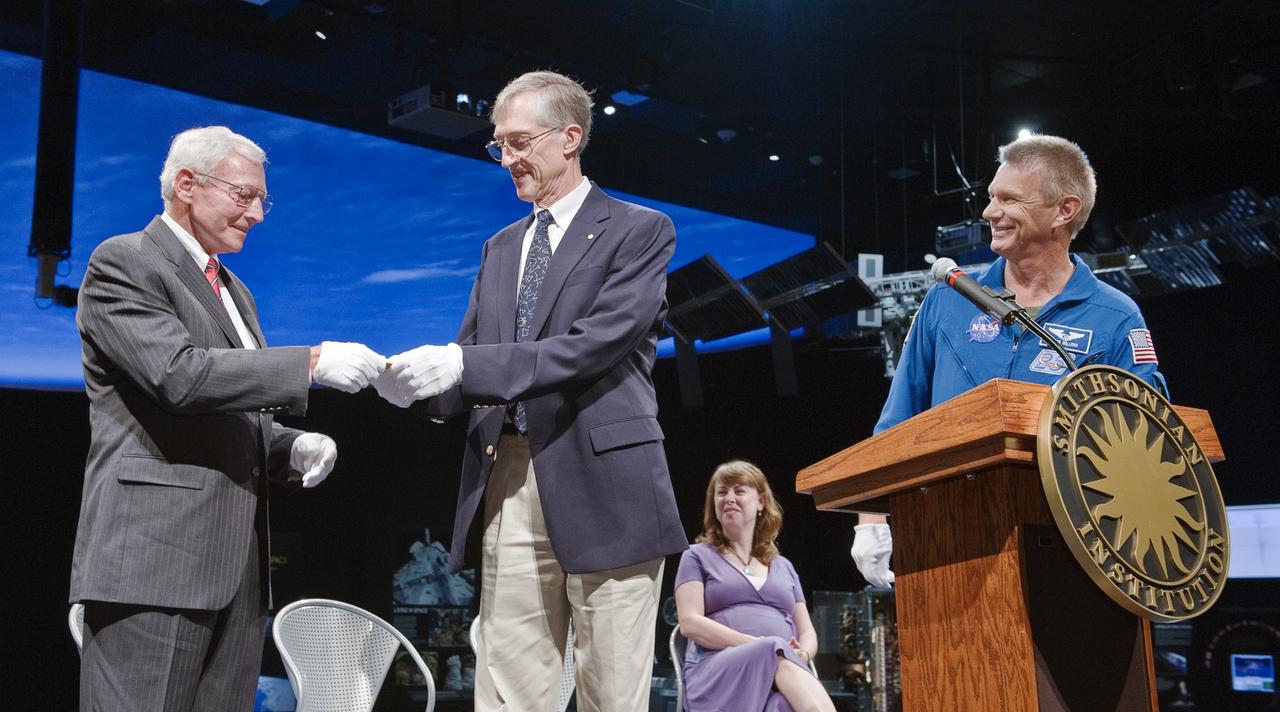
Dr. John Mather, NASA Goddard Space Flight Center scientist and Nobel Laureate, center, presents Gen. John R. “Jack” Dailey, director of the Smithsonian National Air and Space Museum, left, with a a replica of Mather’s Nobel Prize medal that flew in space aboard STS-132, as astronaut Piers Sellers looks on, during a ceremony at the museum, Tuesday, July 27, 2010, in Washington. Photo Credit: (NASA/Paul E. Alers)
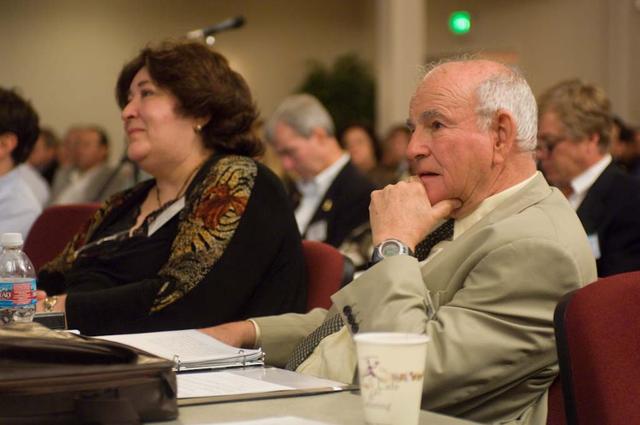
International Space Station (ISS) National Laboratory Workshop L-R Lynn Harper, Ames and Baruch Blumberg, Nobel Laureate, Fox Chase Cancer Center during talk on Science on the international Space Station, Past and Future.
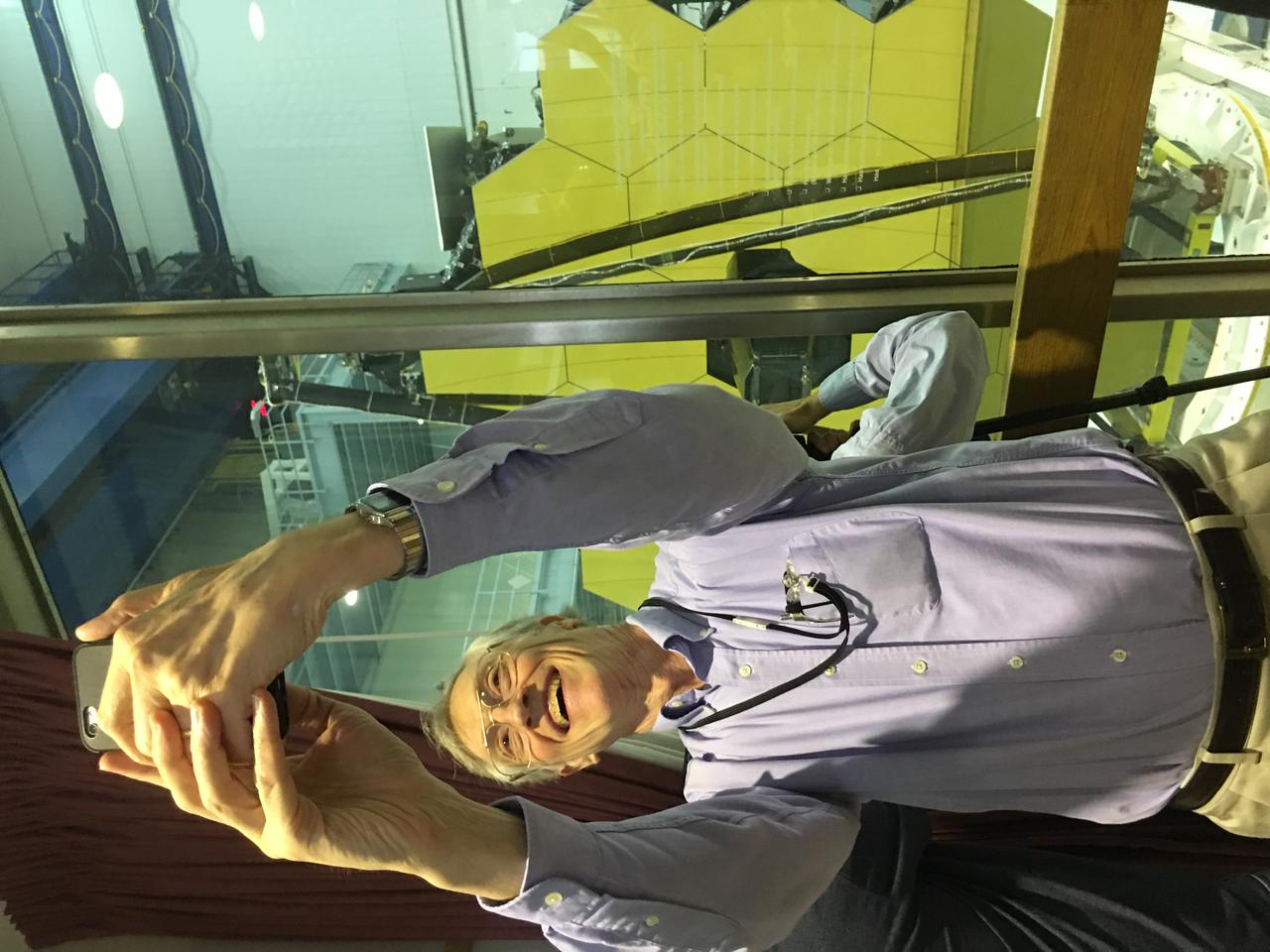
Nobel Laureate and James Webb Space Telescope project scientist Dr. John Mather takes a selfie with the telescope. May 4, 2016 was a rare day for JWST, as it briefly faced the cleanroom observation window. The telescope was eventually rotated face-down in prep for the installation of the flight instruments. Credit: Meredith Gibb
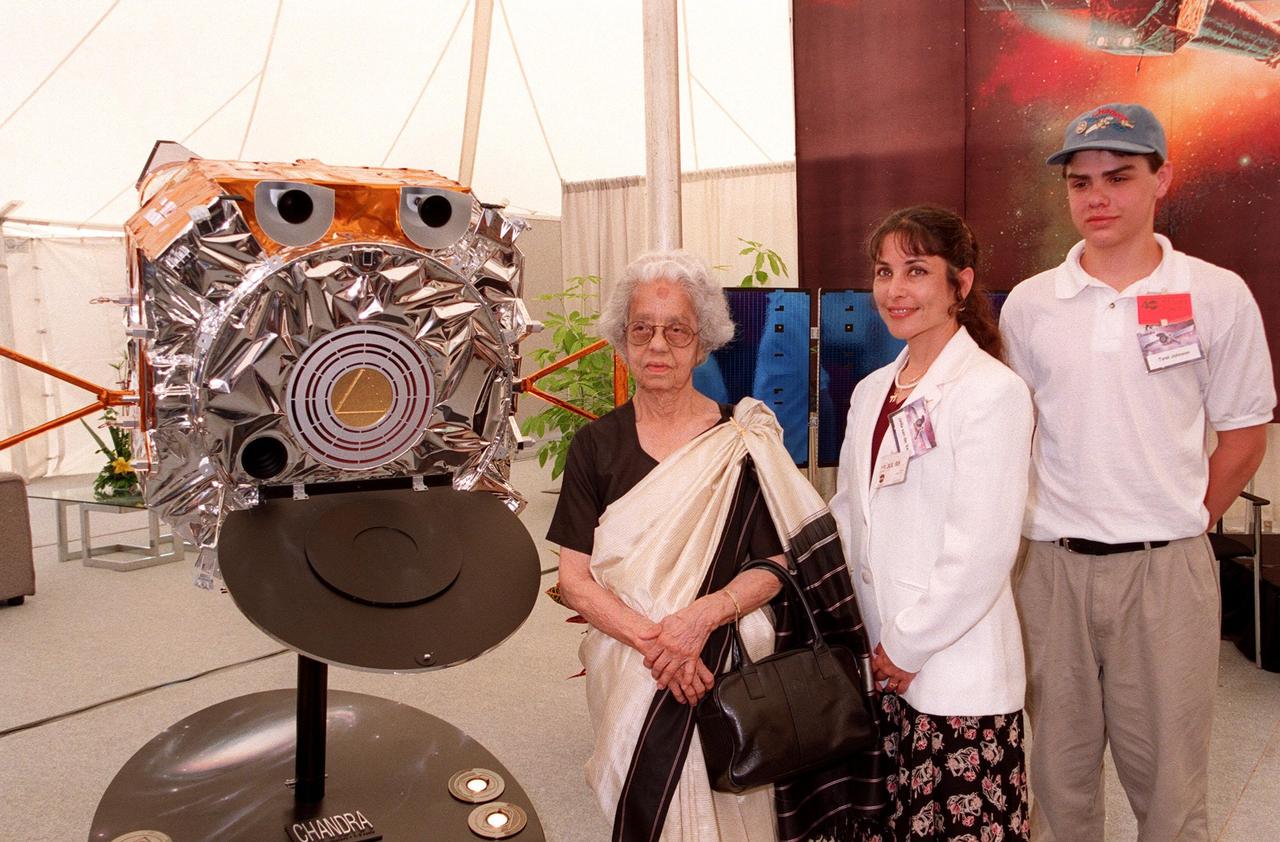
KENNEDY SPACE CENTER, FLA. -- Mrs. Lalitha Chandrasekhar (left), wife of the late Indian-American Nobel Laureate Subrahmanyan Chandrasekhar, poses with a model of the Chandra X-ray Observatory and the winners of the contest to rename the telescope in the TRW Media Hospitality Tent at the NASA Press Site at KSC. The winners of the contest are Jatila van der Veen (center), academic coordinator and lecturer, Physics Dept., University of Santa Barbara, Calif., and Tyrel Johnson (right), high school student, Laclede, Idaho. The name "Chandra," a shortened version of Chandrasekhar's name which he preferred among friends and colleagues, was chosen to honor the Nobel Laureate. "Chandra" also means "Moon" or "luminous" in Sanskrit. The observatory is scheduled to be launched aboard Columbia on Space Shuttle mission STS-93
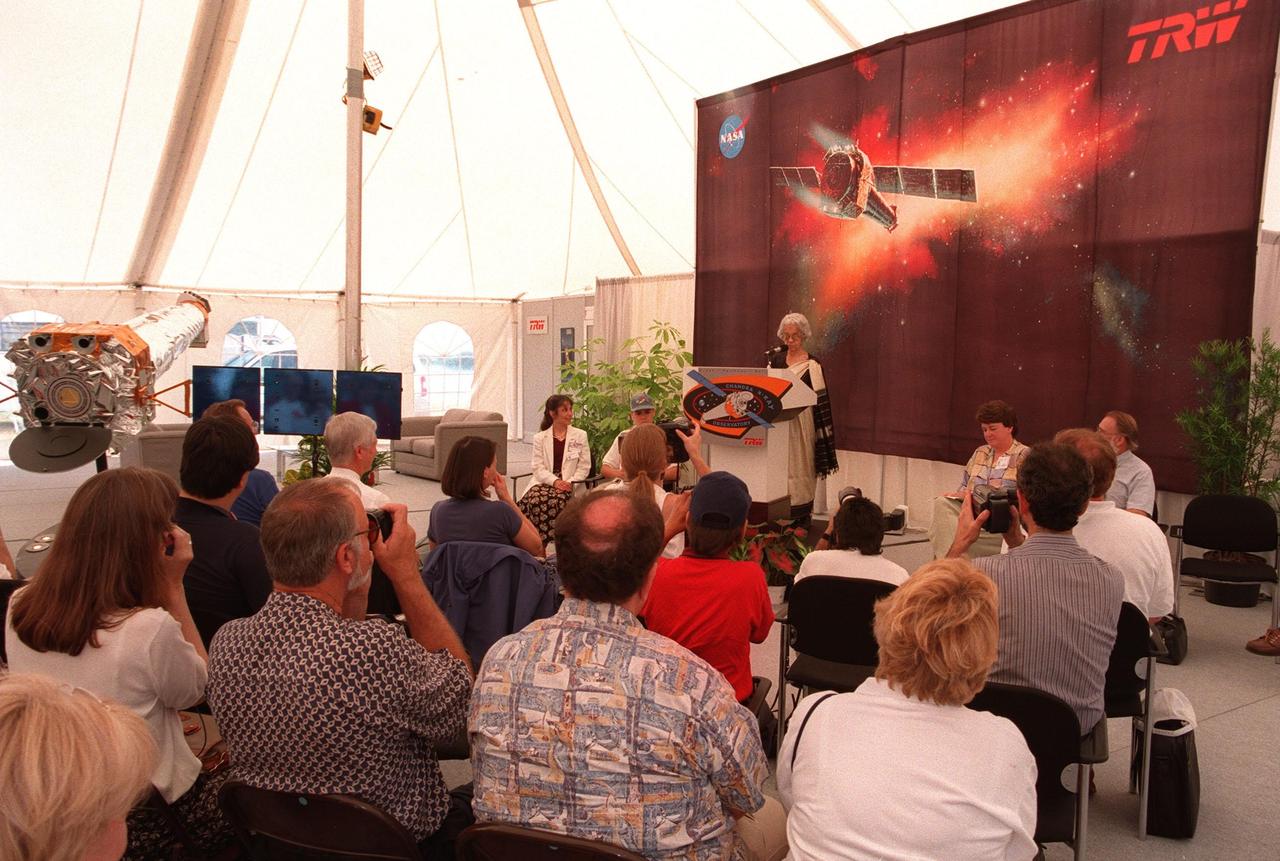
Mrs. Lalitha Chandrasekhar (at podium), wife of the late Indian-American Nobel Laureate Subrahmanyan Chandrasekhar, addresses the media and other invited guests in the TRW Media Hospitality Tent at the NASA Press Site at KSC. Other participants in the program (seated facing the audience, left to right) are the winners of the contest to rename the telescope, Jatila van der Veen, academic coordinator and lecturer, Physics Dept., University of Santa Barbara, Calif., and Tyrel Johnson, high school student, Laclede, Idaho; Joanne Maguire, vice-president and general manager, TRW Space & Laser Programs Division; and Dr. Alan Bunner, Science Program Director, Structure and Evolution of the Universe, Office of Space Science, NASA Headquarters, Washington, D.C. The name "Chandra," a shortened version of Chandrasekhar, was the name the Nobel Laureate preferred among friends and colleagues. "Chandra" also means "Moon" or "luminous" in Sanskrit. The observatory is scheduled to be launched aboard Columbia on Space Shuttle mission STS-93
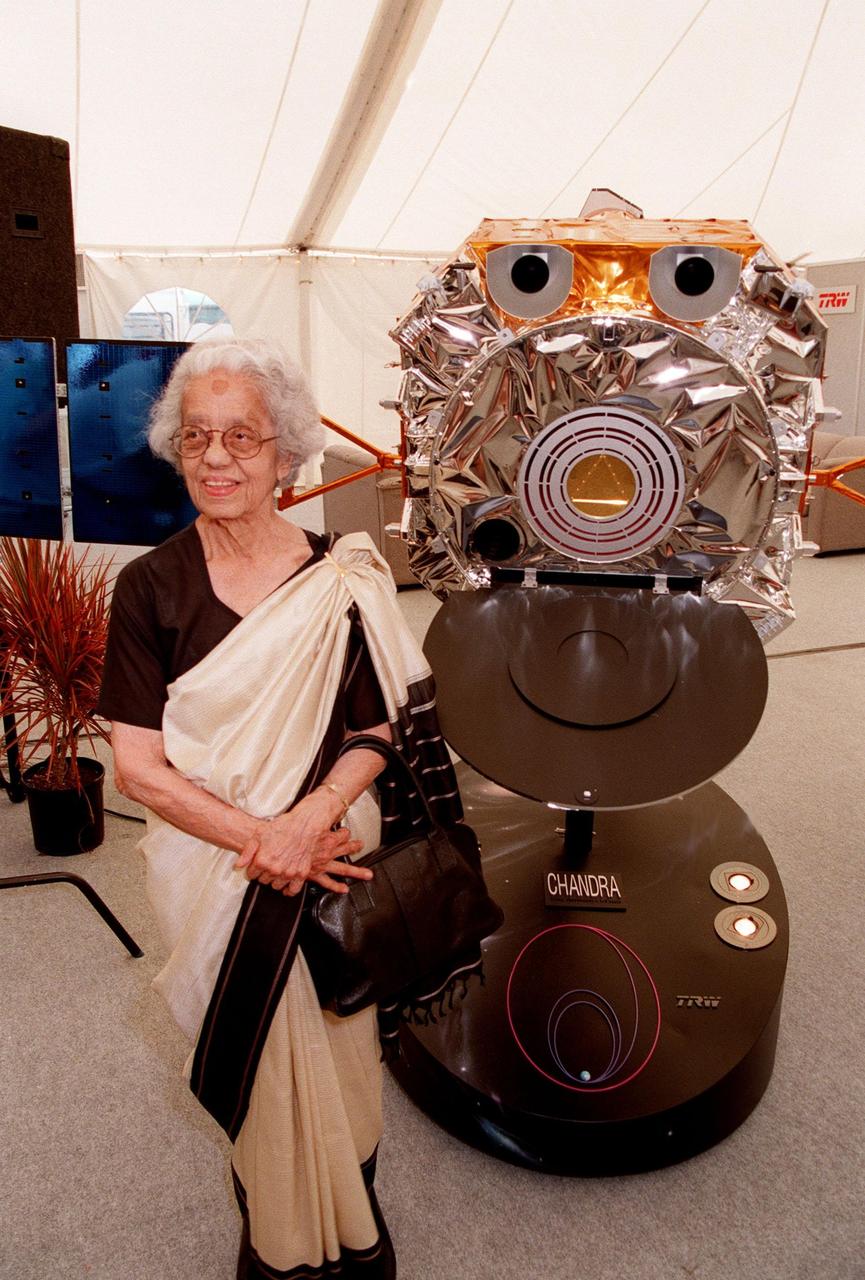
KENNEDY SPACE CENTER, FLA. -- Mrs. Lalitha Chandrasekhar, wife of the late Indian-American Nobel Laureate Subrahmanyan Chandrasekhar, poses with a model of the Chandra X-ray Observatory in the TRW Media Hospitality Tent at the NASA Press Site at KSC. The name "Chandra," a shortened version of Chandrasekhar's name which he preferred among friends and colleagues, was chosen in a contest to rename the telescope. "Chandra" also means "Moon" or "luminous" in Sanskrit. The observatory is scheduled to be launched aboard Columbia on Space Shuttle mission STS-93
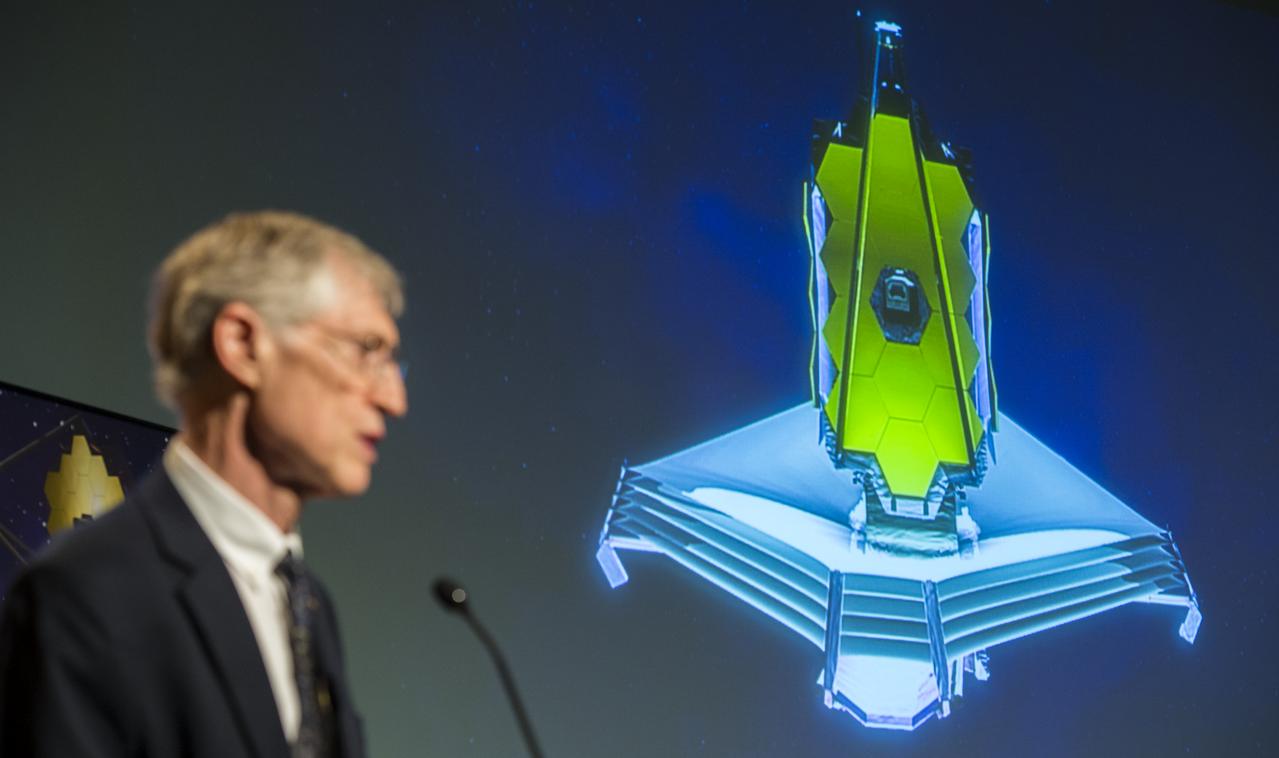
An animation of the James Webb Space Telescope (JWST) is projected as John Mather, Nobel Laureate and Project Scientist for the JWST speaks during a panel discussion on the search for life beyond Earth in the James E. Webb Auditorium at NASA Headquarters on Monday, July 14, 2014 in Washington, DC. The panel discussed how NASA's space-based observatories are making new discoveries and how the agency's new telescope, the James Webb Space Telescope, will continue this path of discovery after its schedule launch in 2018. Photo Credit: (NASA/Joel Kowsky)
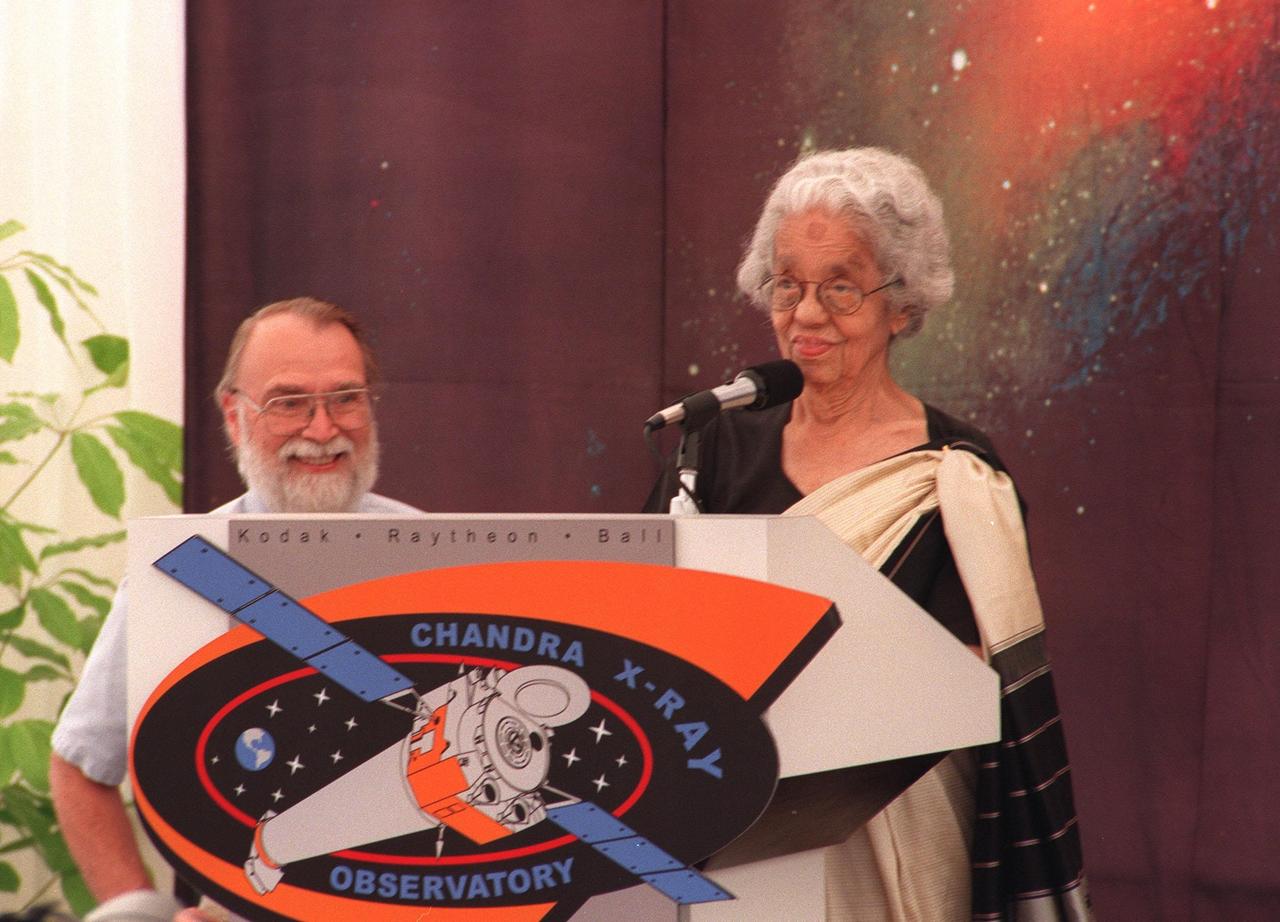
KENNEDY SPACE CENTER, FLA. -- Mrs. Lalitha Chandrasekhar (right), wife of the late Indian-American Nobel Laureate Subrahmanyan Chandrasekhar, addresses the media and other invited guests in the TRW Media Hospitality Tent at the NASA Press Site at KSC as Dr. Alan Bunner, Science Program Director, Structure and Evolution of the Universe, Office of Space Science, NASA Headquarters, Washington, D.C., looks on. The name "Chandra," a shortened version of her husband's name which he preferred among friends and colleagues, was chosen in a contest to rename the Advanced X-ray Astrophysics Facility. "Chandra" also means "Moon" or "luminous" in Sanskrit. The observatory is scheduled to be launched aboard Columbia on Space Shuttle mission STS-93
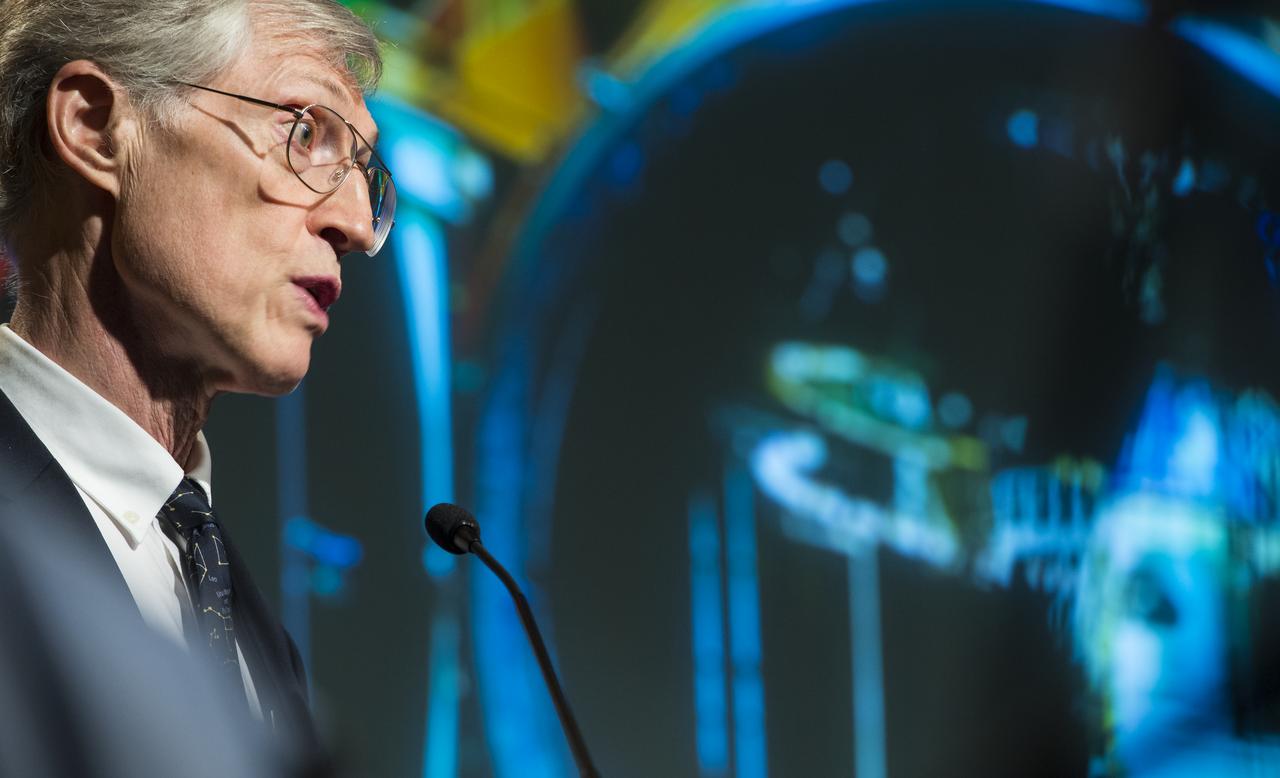
John Mather, Nobel Laureate and Project Scientist for the James Webb Space Telescope at NASA's Goddard Space Flight Center, speaks during a panel discussion on the search for life beyond Earth in the James E. Webb Auditorium at NASA Headquarters on Monday, July 14, 2014 in Washington, DC. The panel discussed how NASA's space-based observatories are making new discoveries and how the agency's new telescope, the James Webb Space Telescope, will continue this path of discovery after its schedule launch in 2018. Photo Credit: (NASA/Joel Kowsky)
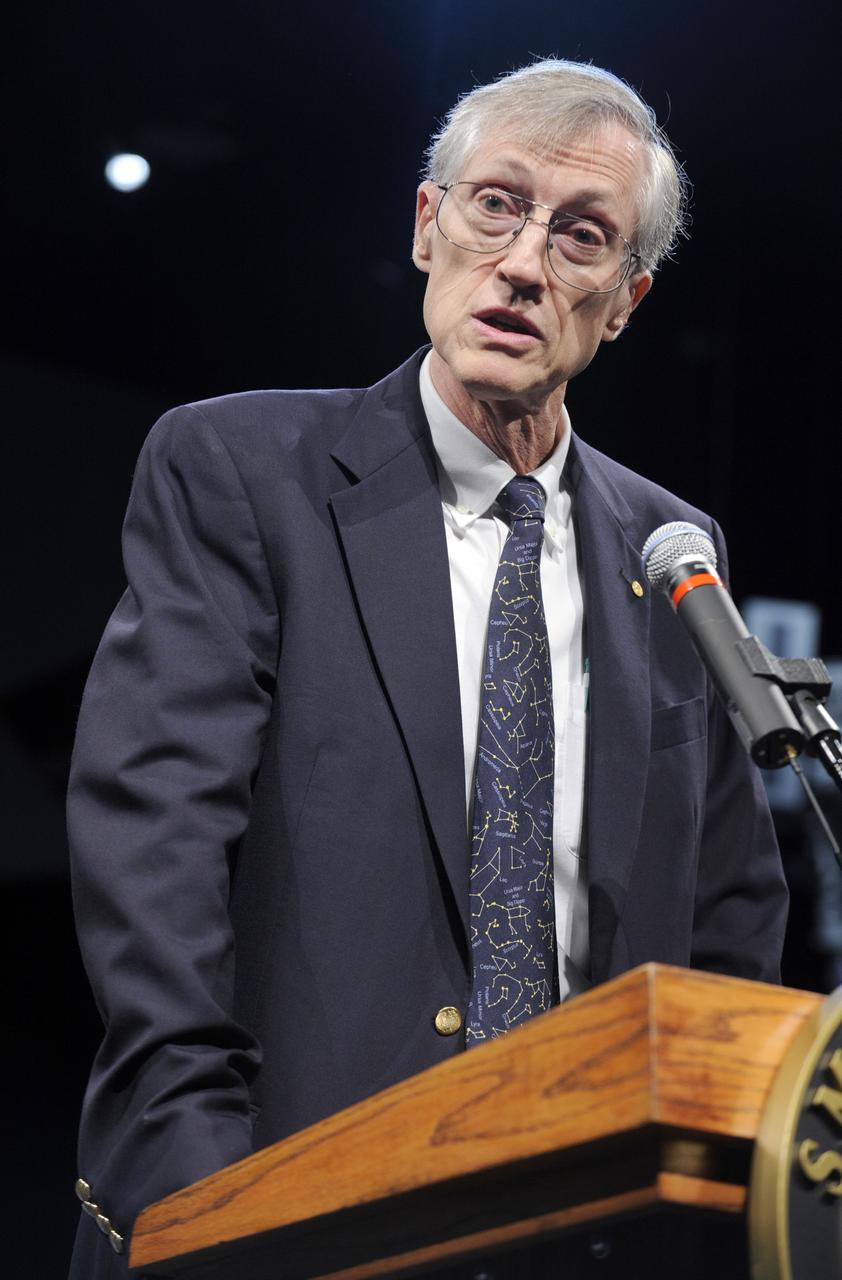
NASA Astrophycist Dr. John Mather speaks, Tuesday, July 27, 2010, at the Smithsonian National Air and Space Museum in Washington. Mather was speaking as part of a ceremony with STS-132 astronaut Piers Sellers who returned a replica of the Nobel Prize that is in the museum's collection and was flown aboard STS-132 Atlantis. The prize was won by Mather and University of California, Berkeley researcher George Smoot in 2006 for their work using the Cosmic Background Explorer Satellite to understand the big-bang theory of the universe.Photo Credit: (NASA/Paul E. Alers)

STS-132 astronaut Piers Sellers, left, and Dr. John Mather are seen with a replica of Mather's Nobel Prize, Tuesday, July 27, 2010, at the Smithsonian National Air and Space Museum in Washington. Sellers returned the replica that is in the museum's collection and was flown aboard STS-132 Atlantis. The prize was won by Mather and University of California, Berkeley researcher George Smoot in 2006 for their work using the Cosmic Background Explorer Satellite to understand the big-bang theory of the universe. Photo Credit: (NASA/Paul E. Alers)
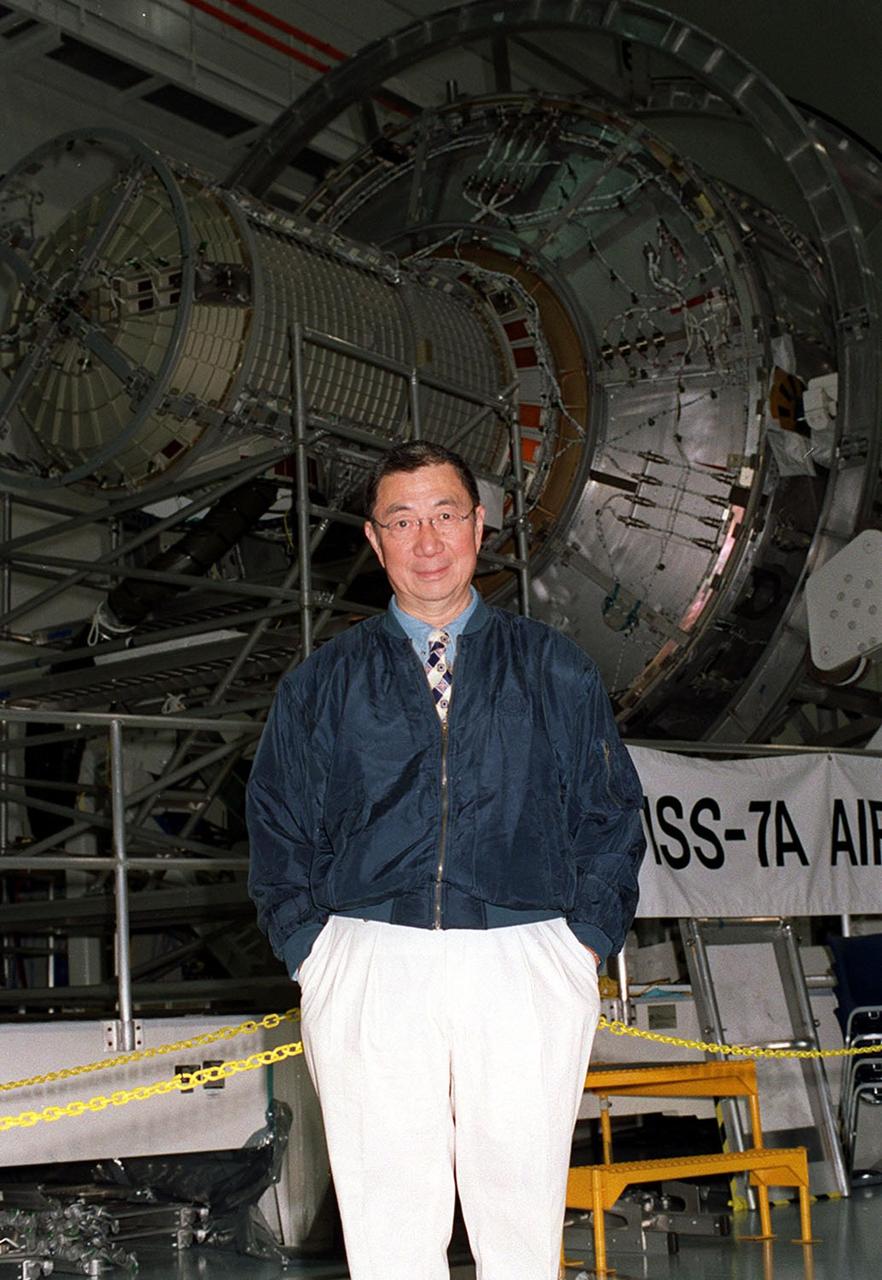
Nobel laureate Professor Samuel C. C. Ting of the Massachusetts Institute of Technology pauses for a photo in the Space Station Processing Facility. Dr. Ting is directing an experiment, an international collaboration of some 37 universities and laboratories, using a state-of-the-art particle physics detector called the Alpha Magnetic Spectrometer (AMS), which will fly on a future launch to the International Space Station. Using the unique environment of space, the AMS will study the properties and origin of cosmic particles and nuclei including antimatter and dark matter. AMS flew initially as a Space Shuttle payload on the June 1998 mission STS-91 that provided the investigating team with data on background sources and verified the detector’s performance under actual space flight conditions. The detector’s second space flight is scheduled to be launched on mission UF-4 October 2003 for installation on the Space Station as an attached payload. Current plans call for operating the detector for three years before it is returned to Earth on the Shuttle. Using the Space Station offers the science team the opportunity to conduct the long-duration research above the Earth’s atmosphere necessary to collect sufficient data required to accomplish the science objectives
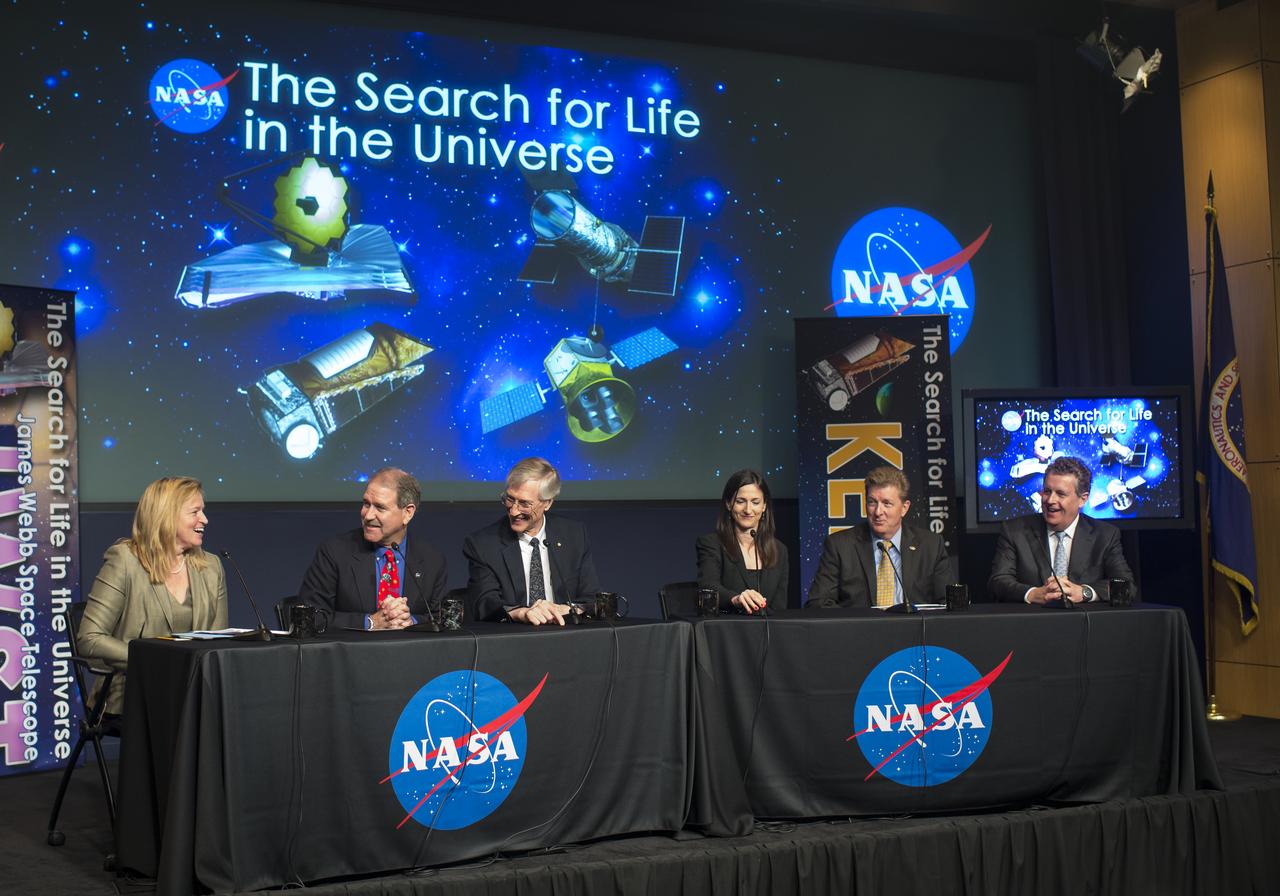
Panelists (from left) Ellen Stofan, NASA Chief Scientist, left; John Grunsfeld, Associate Administrator for NASA's Science Mission DIrectorate, second from left; John Mather, Nobel Laureate and Senior Project Scientist for the James Webb Space Telescope (JWST) at NASA's Goddard Space Flight Center, third from left; Sara Seager, MacArthur Fellow and Professor of Planetary Science and Physics at the Massachusetts Institute of Technology, third from right; Dave Gallagher, Director for Astronomy and Physics at NASA's Jet Propulsion Laboratory, second from right; and Matt Mountain, Director of the Space Telescope Science Institute and Telescope Scientist for the JWST, right; are seen during a panel discussion on the search for life beyond Earth in the James E. Webb Auditorium at NASA Headquarters on Monday, July 14, 2014 in Washington, DC. The panel discussed how NASA's space-based observatories are making new discoveries and how the agency's new telescope, the James Webb Space Telescope, will continue this path of discovery after its schedule launch in 2018. Photo Credit: (NASA/Joel Kowsky)
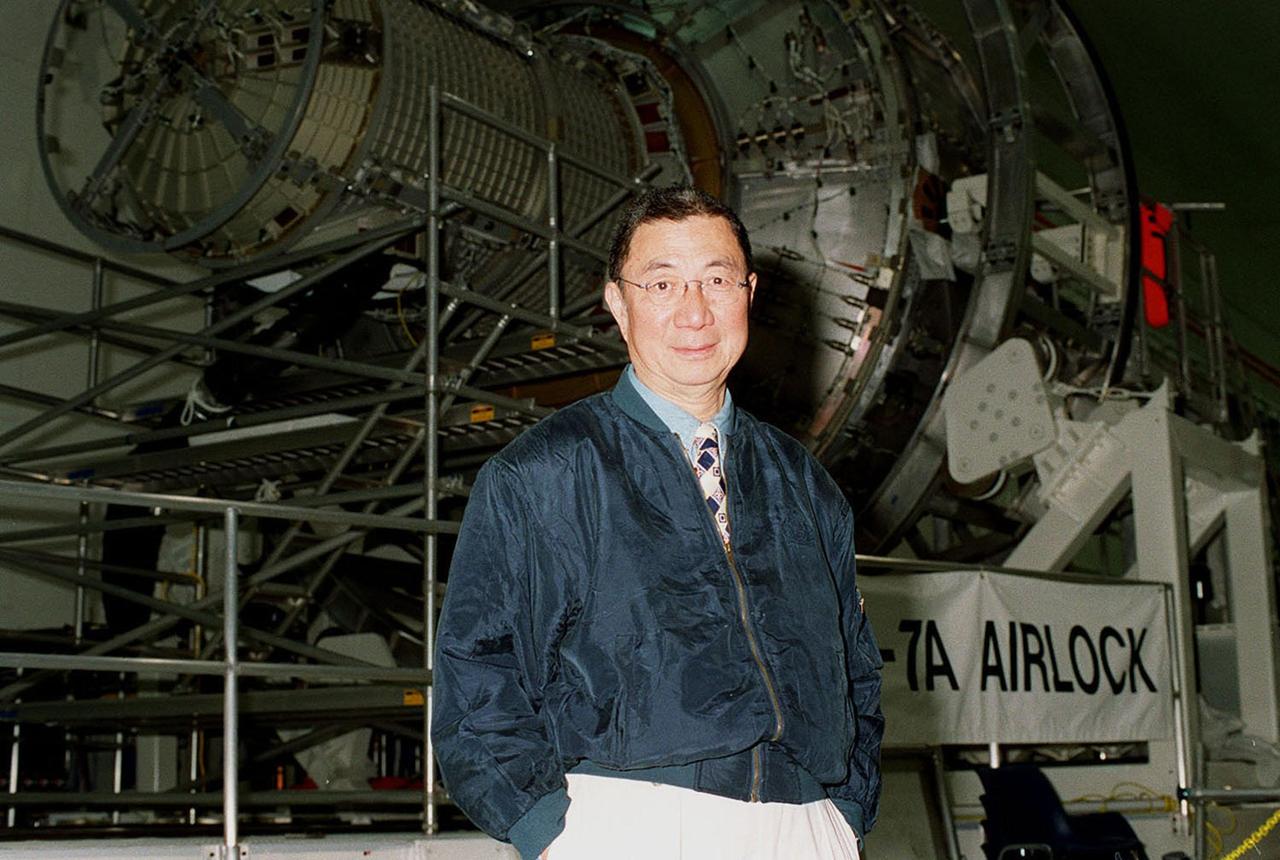
Nobel laureate Professor Samuel C. C. Ting of the Massachusetts Institute of Technology pauses for a photo in the Space Station Processing Facility. Dr. Ting is directing an experiment, an international collaboration of some 37 universities and laboratories, using a state-of-the-art particle physics detector called the Alpha Magnetic Spectrometer (AMS), which will fly on a future launch to the International Space Station. Using the unique environment of space, the AMS will study the properties and origin of cosmic particles and nuclei including antimatter and dark matter. AMS flew initially as a Space Shuttle payload on the June 1998 mission STS-91 that provided the investigating team with data on background sources and verified the detector’s performance under actual space flight conditions. The detector’s second space flight is scheduled to be launched on mission UF-4 October 2003 for installation on the Space Station as an attached payload. Current plans call for operating the detector for three years before it is returned to Earth on the Shuttle. Using the Space Station offers the science team the opportunity to conduct the long-duration research above the Earth’s atmosphere necessary to collect sufficient data required to accomplish the science objectives
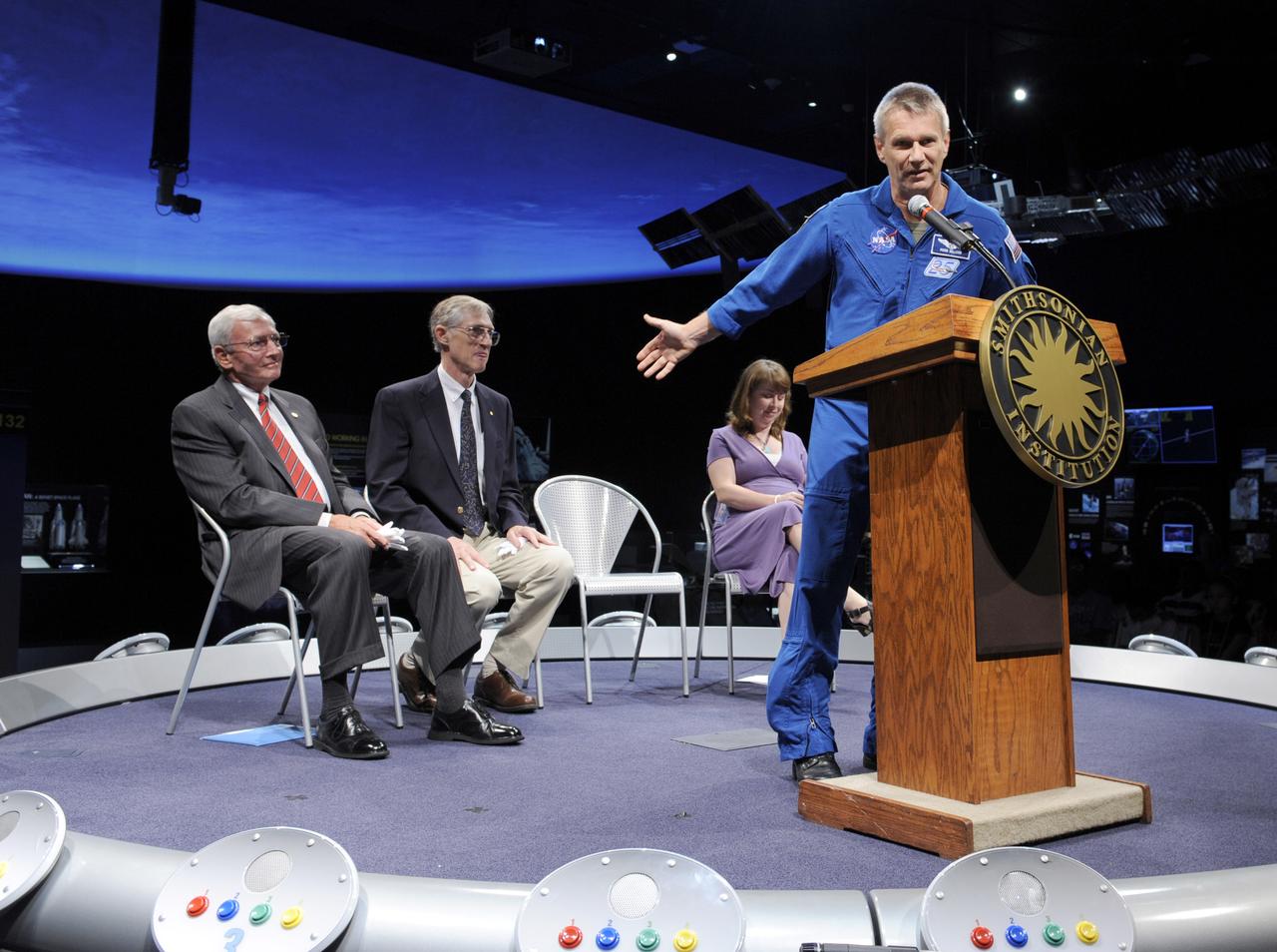
STS-132 astronaut Piers Sellers, at podium, acknowleges museum director Ret. Gen. John R. "Jack" Dailey, seated left, and NASA astrophycisist Dr. John Mather, center, during a presentation, Tuesday, July 27, 2010, at the Smithsonian National Air and Space Museum in Washington. Sellers returned a replica of the Nobel Prize that is in the museum's collection and was flown aboard STS-132 Atlantis. The prize was won by Mather and University of California, Berkeley researcher George Smoot in 2006 for their work using the Cosmic Background Explorer Satellite to understand the big-bang theory of the universe.Photo Credit: (NASA/Paul E. Alers)

Last week researchers from around the world gathered at the Accademia dei Lincei in Rome for the Science with the Hubble Space Telescope IV conference. The event celebrated the history of Hubble’s extraordinary achievements, and looked to the future at what might yet be achieved and how the James Webb Space Telescope will build on our knowledge of the Universe. As part of this celebration artist Tim Otto Roth revealed a new artwork, Heaven’s Carousel, inspired by Hubble’s work on the accelerating expansion of the Universe. This installation, named Heaven’s Carousel, links together the fields of art, music and astronomy. Conceptualised and designed by German artist and composer Tim Otto Roth, the work is inspired by novel work on the accelerating expansion of the Universe by Nobel laureate Adam Riess (STScl), Greek cosmology and Renaissance astronomers. Read more here: <a href="http://www.spacetelescope.org/news/heic1407/" rel="nofollow">www.spacetelescope.org/news/heic1407/</a> Credit: NASA, ESA, and Pam Jeffries (STScI) <b><a href="http://www.nasa.gov/audience/formedia/features/MP_Photo_Guidelines.html" rel="nofollow">NASA image use policy.</a></b> <b><a href="http://www.nasa.gov/centers/goddard/home/index.html" rel="nofollow">NASA Goddard Space Flight Center</a></b> enables NASA’s mission through four scientific endeavors: Earth Science, Heliophysics, Solar System Exploration, and Astrophysics. Goddard plays a leading role in NASA’s accomplishments by contributing compelling scientific knowledge to advance the Agency’s mission. <b>Follow us on <a href="http://twitter.com/NASAGoddardPix" rel="nofollow">Twitter</a></b> <b>Like us on <a href="http://www.facebook.com/pages/Greenbelt-MD/NASA-Goddard/395013845897?ref=tsd" rel="nofollow">Facebook</a></b> <b>Find us on <a href="http://instagram.com/nasagoddard?vm=grid" rel="nofollow">Instagram</a></b>
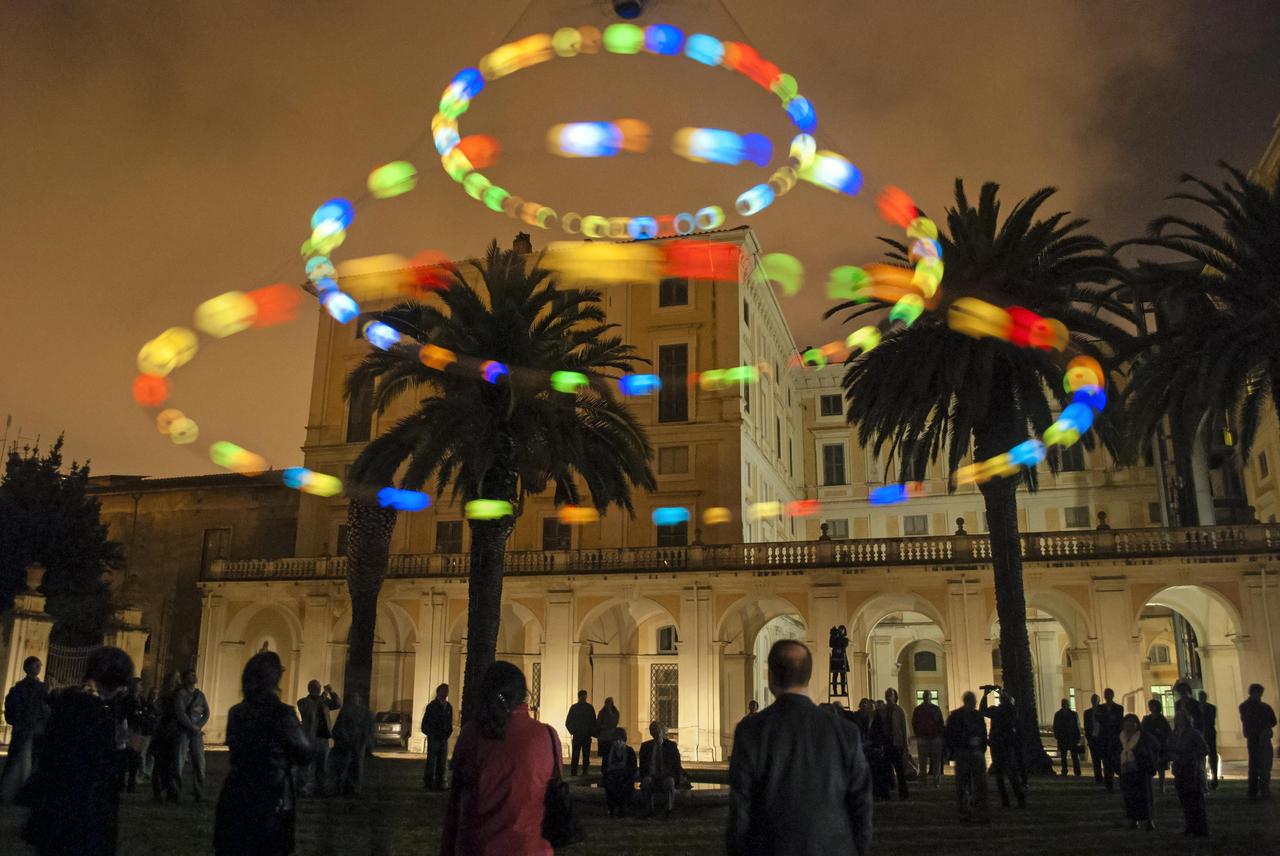
Last week researchers from around the world gathered at the Accademia dei Lincei in Rome for the Science with the Hubble Space Telescope IV conference. The event celebrated the history of Hubble’s extraordinary achievements, and looked to the future at what might yet be achieved and how the James Webb Space Telescope will build on our knowledge of the Universe. As part of this celebration artist Tim Otto Roth revealed a new artwork, Heaven’s Carousel, inspired by Hubble’s work on the accelerating expansion of the Universe. This image shows audiences taking in the new astronomy-inspired art installation premiered in Rome at the Science with the Hubble Space Telescope IV conference. The installation, named Heaven’s Carousel, links together the fields of art, music and astronomy. Conceptualised and designed by German artist and composer Tim Otto Roth, the work is inspired by novel work on the accelerating expansion of the Universe by Nobel laureate Adam Riess (STScl), Greek cosmology and Renaissance astronomers. Read more here: <a href="http://www.spacetelescope.org/news/heic1407/" rel="nofollow">www.spacetelescope.org/news/heic1407/</a> Credit: NASA, ESA, and Pam Jeffries (STScI) <b><a href="http://www.nasa.gov/audience/formedia/features/MP_Photo_Guidelines.html" rel="nofollow">NASA image use policy.</a></b> <b><a href="http://www.nasa.gov/centers/goddard/home/index.html" rel="nofollow">NASA Goddard Space Flight Center</a></b> enables NASA’s mission through four scientific endeavors: Earth Science, Heliophysics, Solar System Exploration, and Astrophysics. Goddard plays a leading role in NASA’s accomplishments by contributing compelling scientific knowledge to advance the Agency’s mission. <b>Follow us on <a href="http://twitter.com/NASAGoddardPix" rel="nofollow">Twitter</a></b> <b>Like us on <a href="http://www.facebook.com/pages/Greenbelt-MD/NASA-Goddard/395013845897?ref=tsd" rel="nofollow">Facebook</a></b> <b>Find us on <a href="http://instagram.com/nasagoddard?vm=grid" rel="nofollow">Instagram</a></b>