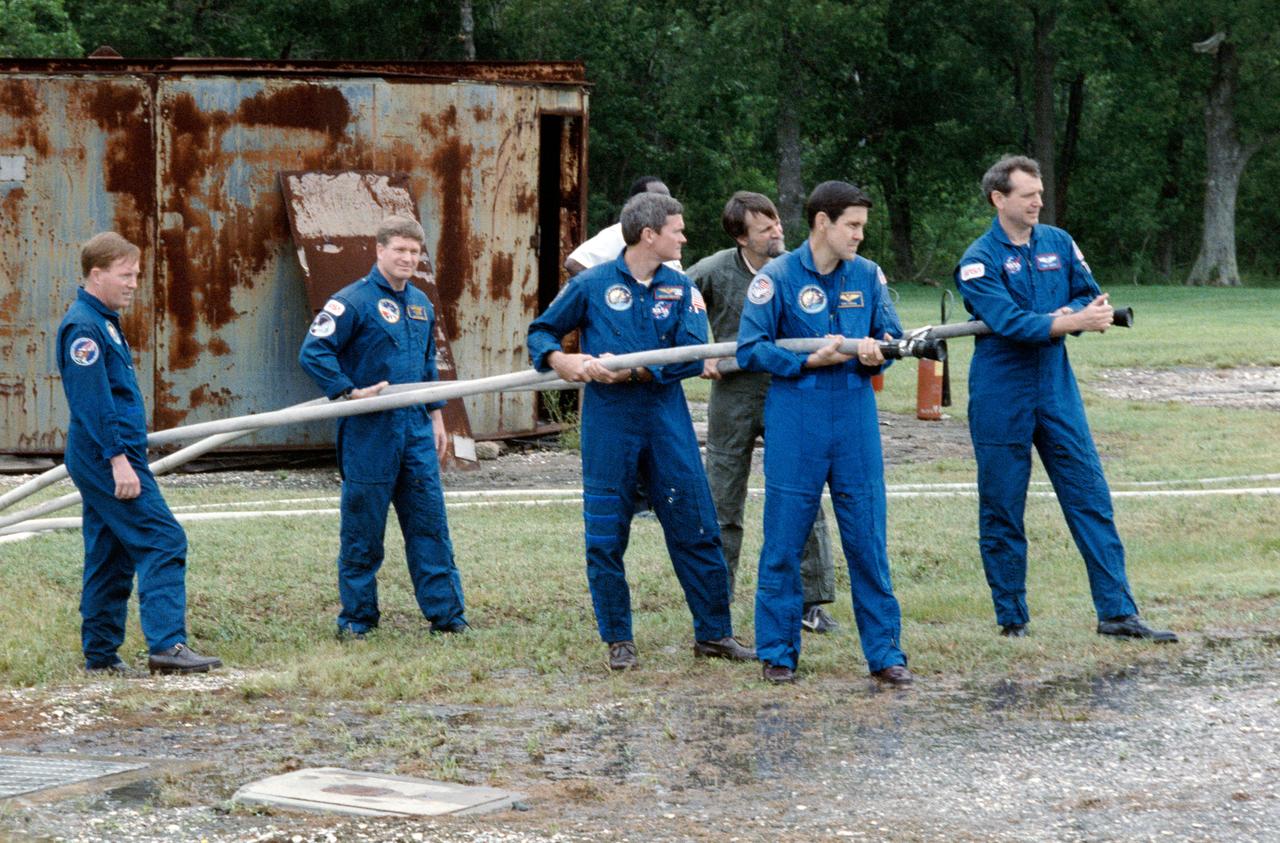
S90-38926 (4 May 1990) --- The STS-41 astronaut crew and a STS-35 backup payload specialist participate in fire control training exercises at the Johnson Space Center (JSC). Left to right are Richard N. Richards, William M. Shepherd, Bruce E. Melnick, Kenneth Nordsieck, Robert D. Cabana and Thomas D. Akers. Nordsieck is Astro-1 backup payload specialist in training for STS-35. This type training is provided all crewmembers assigned to seats aboard Space Shuttle.
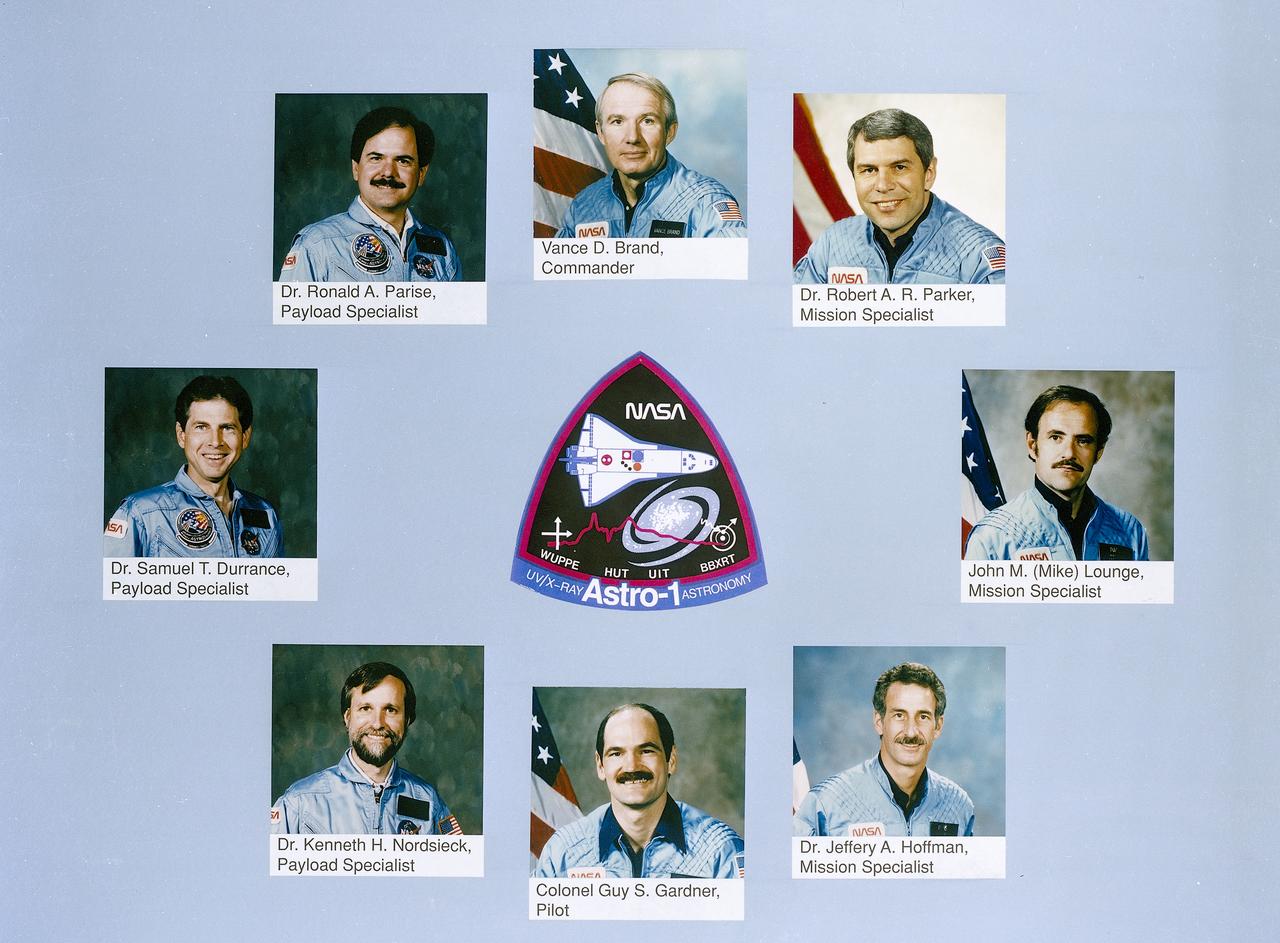
This montage consists of 8 individual STS-35 crew member portraits surrounding the mission’s insignia. Starting from top center, clockwise, are Vance D. Brand, commander; mission specialists Dr. Robert A. R. Parker, John M. (Mike) Lounge, and Dr. Jeffery A. Hoffman; Colonel Guy S. Gardner, pilot; and payload specialists Dr. Kenneth H. Nordsieck, Dr. Samual T. Durrance, and Dr. Ronald A. Parise. The crew of 8 launched aboard the Space Shuttle Orbiter Columbia on December 2, 1990 at 1:19:01am (EST). The primary objective of the mission was round the clock observation of the celestial sphere in ultrviolet and X-Ray astronomy with the Astro-1 observatory which consisted of four telescopes: the Hopkins Ultraviolet Telescope (HUT); the Wisconsin Ultraviolet Photo-Polarimeter Experiment (WUPPE); the Ultraviolet Imaging Telescope (UIT); and the Broad Band X-Ray Telescope (BBXRT). Due to loss of data used for pointing and operating the ultraviolet telescopes, Marshall Space Flight Center ground teams were forced to aim the telescopes with fine tuning by the flight crew.
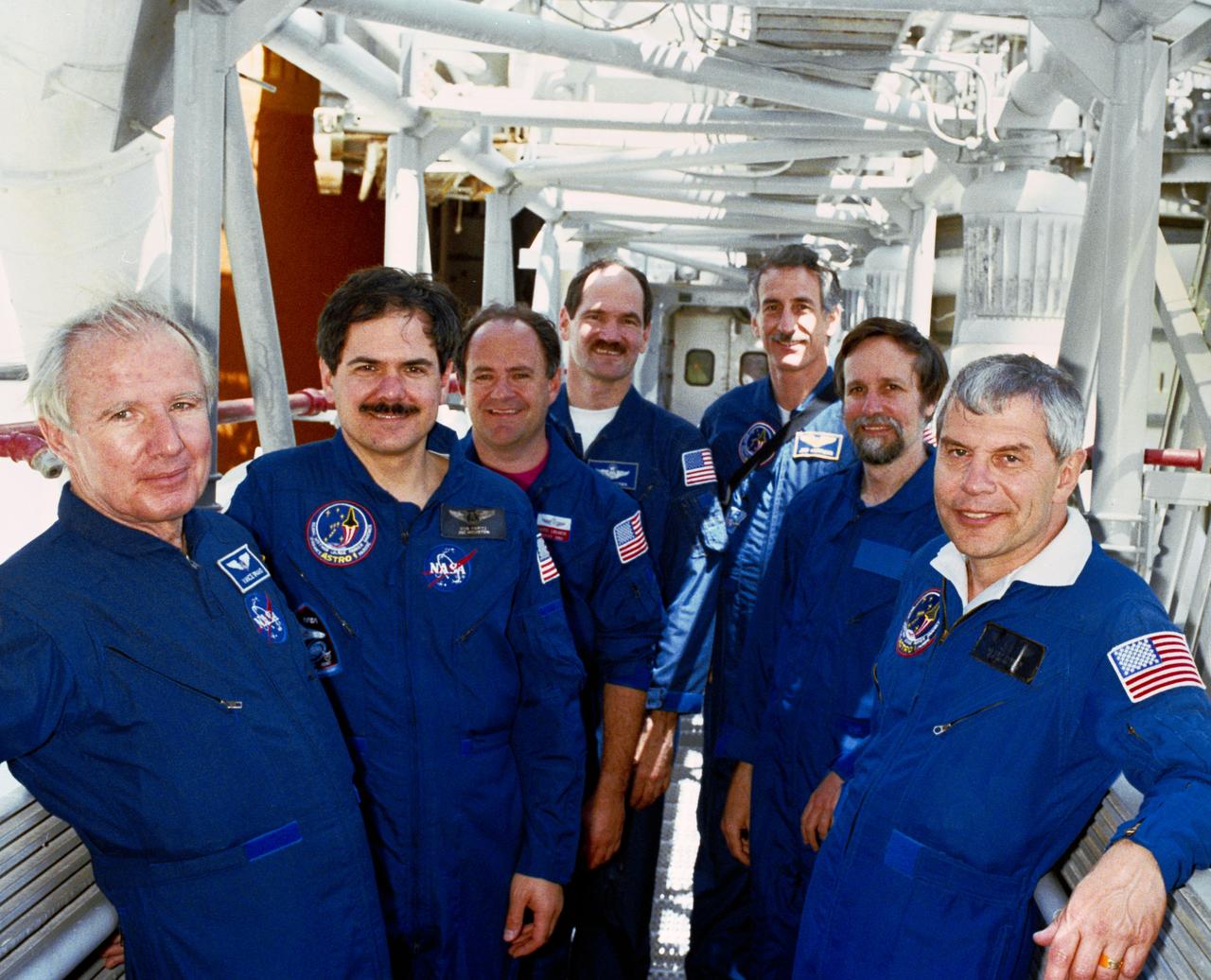
S90-38029 (21 May 1990) --- STS-35 Columbia, Orbiter Vehicle (OV) 102, crewmembers commander Vance D. Brand, pilot Guy S. Gardner, mission specialists Jeffrey A. Hoffman, John M. Lounge, Robert A. R. Parker, payload specialists Samuel T. Durrance and Ronald A. Parise and backup payload specialist Kenneth Nordsieck take a break from training activities and pose on the 195-Floor Level on Launch Pad 39A at the Kennedy Space Center (KSC). On left from front to back are Brand, Parise, Lounge and Gardner and on right from front to back are Parker, Nordsieck, and Hoffman. View provided by KSC with alternate number KSC-90PC-670.
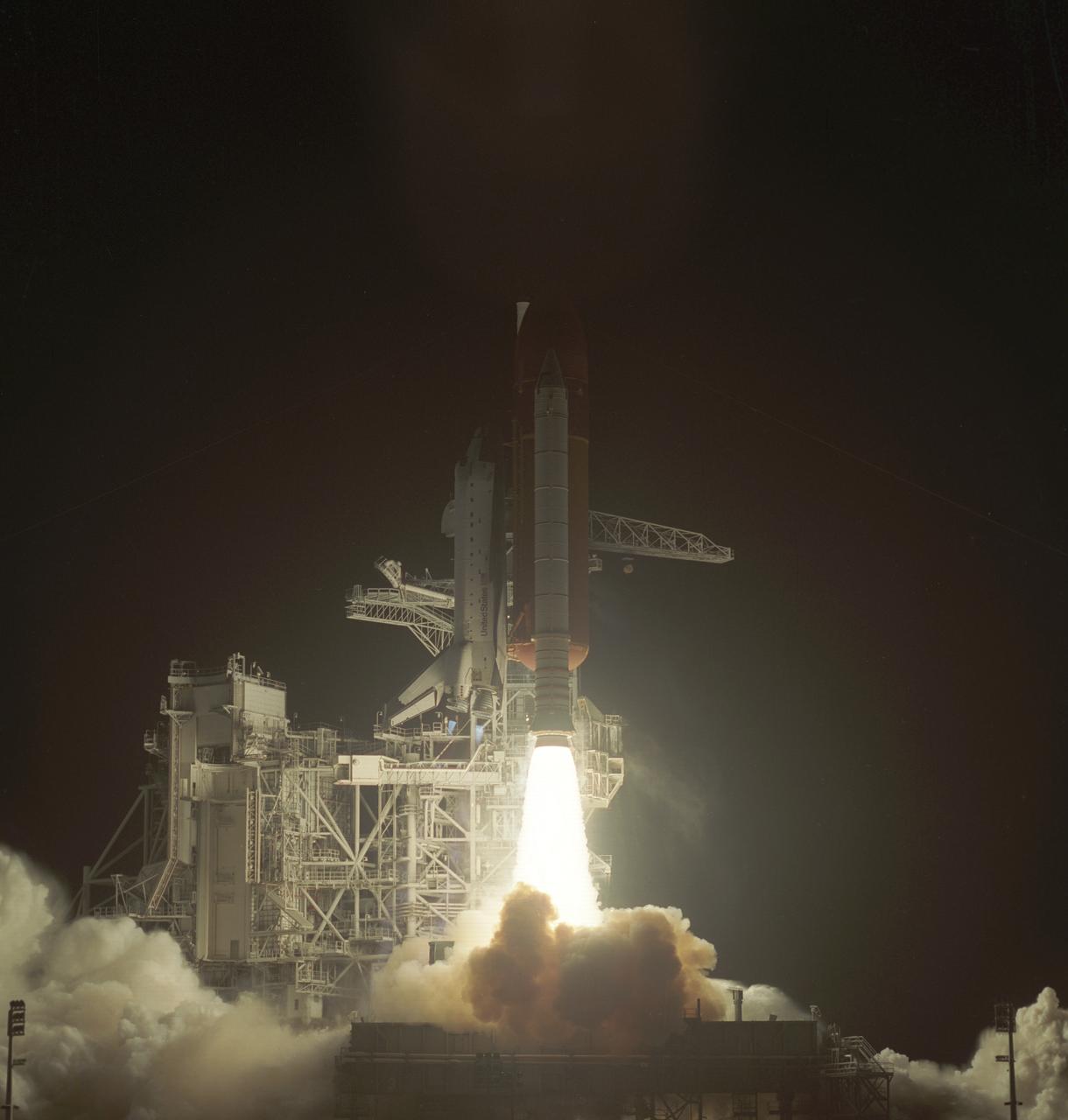
STS-35 lifted off December 2, 1990, at 1:19 am EST, aboard the Space Shuttle Orbiter Columbia. Her crew of eight included: Vance D. Brand, commander; Colonel Guy S. Gardner, pilot; mission specialists Dr. Robert A. R. Parker, John M. (Mike) Lounge, and Dr. Jeffery A. Hoffman; and payload specialists Dr. Kenneth H. Nordsieck, Dr. Samual T. Durrance, and Dr. Ronald A. Parise. The primary objective of the mission was round the clock observation of the celestial sphere in ultraviolet and X-Ray astronomy with the Astro-1 Observatory which consisted of four telescopes: the Hopkins Ultraviolet Telescope (HUT); the Wisconsin Ultraviolet Photo-Polarimeter Experiment (WUPPE); the Ultraviolet Imaging Telescope (UIT); and the Broad Band X-Ray Telescope (BBXRT). Due to loss of data used for pointing and operating the ultraviolet telescopes, Marshall Space Flight Center ground teams were forced to aim the telescopes with fine tuning by the flight crew.