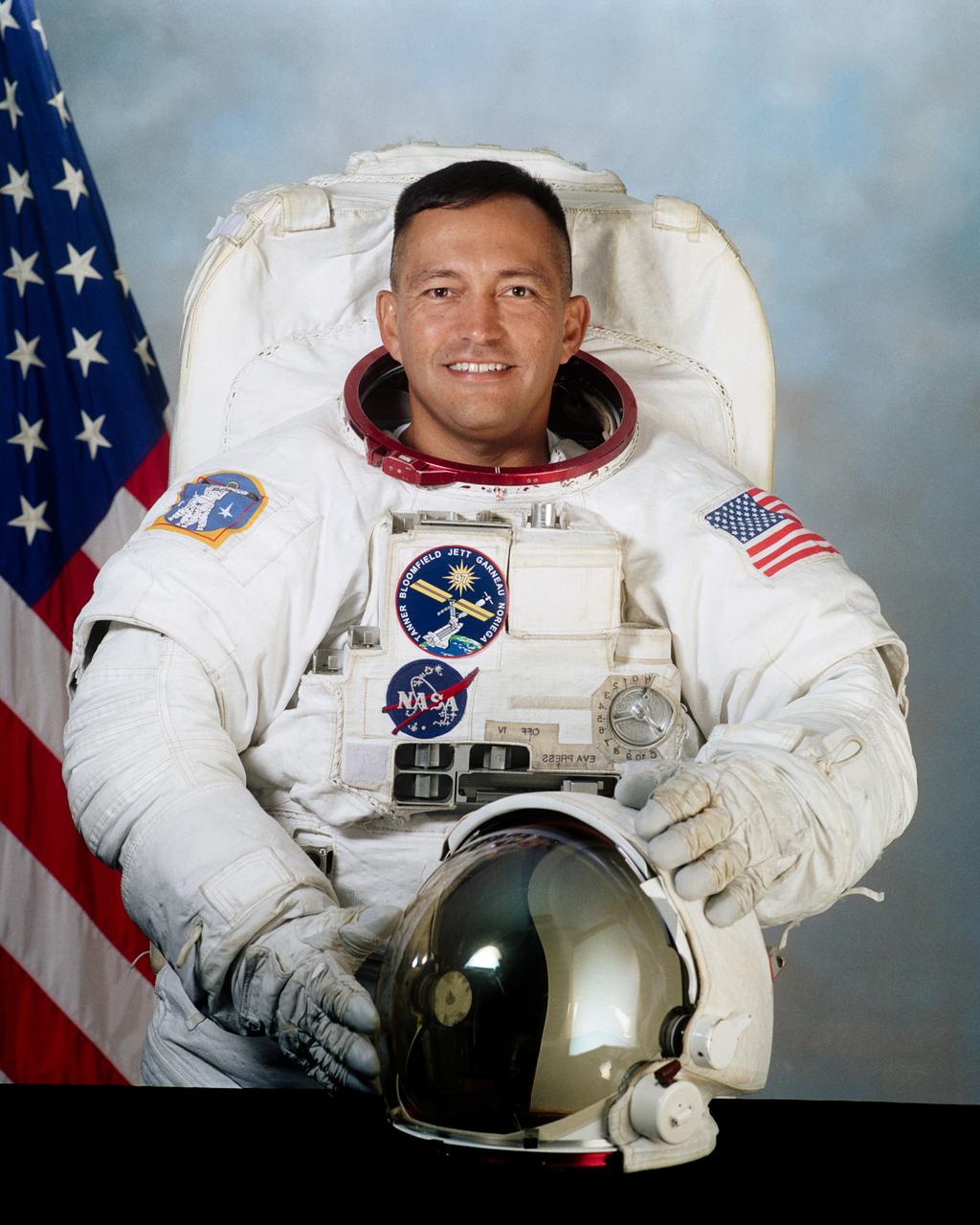
S99-13424 (Nov 1999) --- Astronaut Carlos I. Noriega.
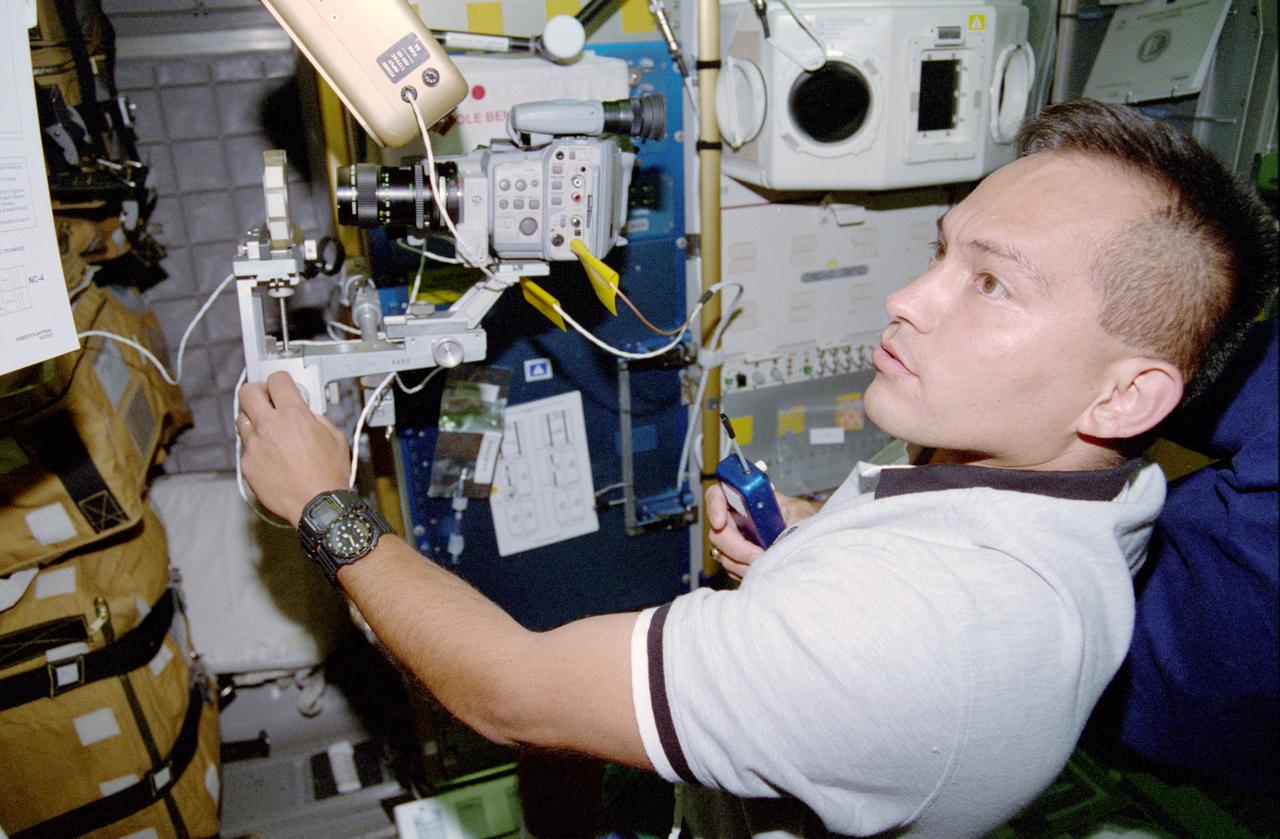
STS084-311-016 (15-24 May 1997) --- Astronaut Carlos I. Noriega, STS-84 mission specialist, videotapes a spore sample for the Real-Time Radiation Measurement Experiment (RRMD), an intravehicular radiation environment measurement experiment. Noriega is onboard the Spacehab Double Module (DM) located in the cargo bay of the Earth-orbiting Space Shuttle Atlantis.
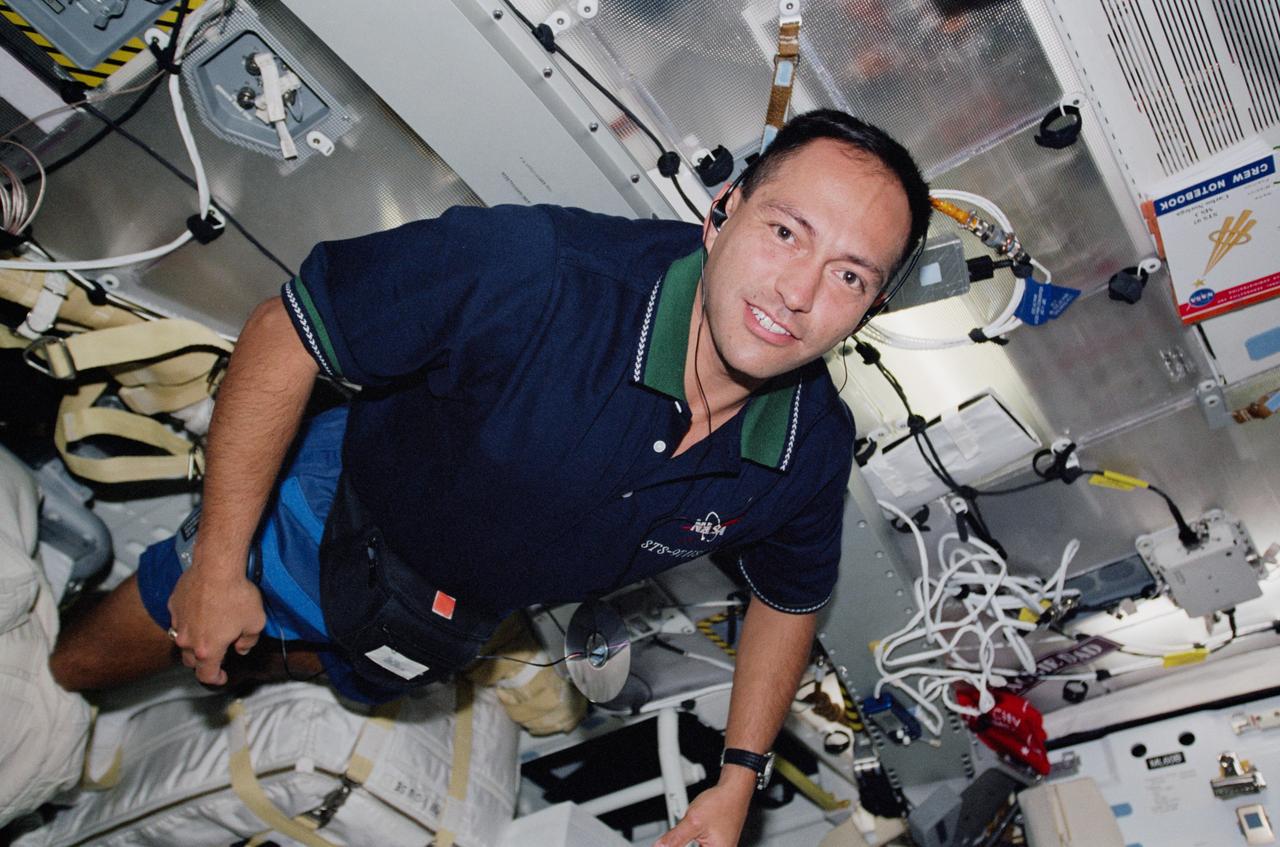
STS097-327-021 (30 Nov. - 11 Dec. 2000) --- Astronaut Carlos I. Noriega moves some gear around on the middeck of the Earth-orbiting Space Shuttle Endeavour.
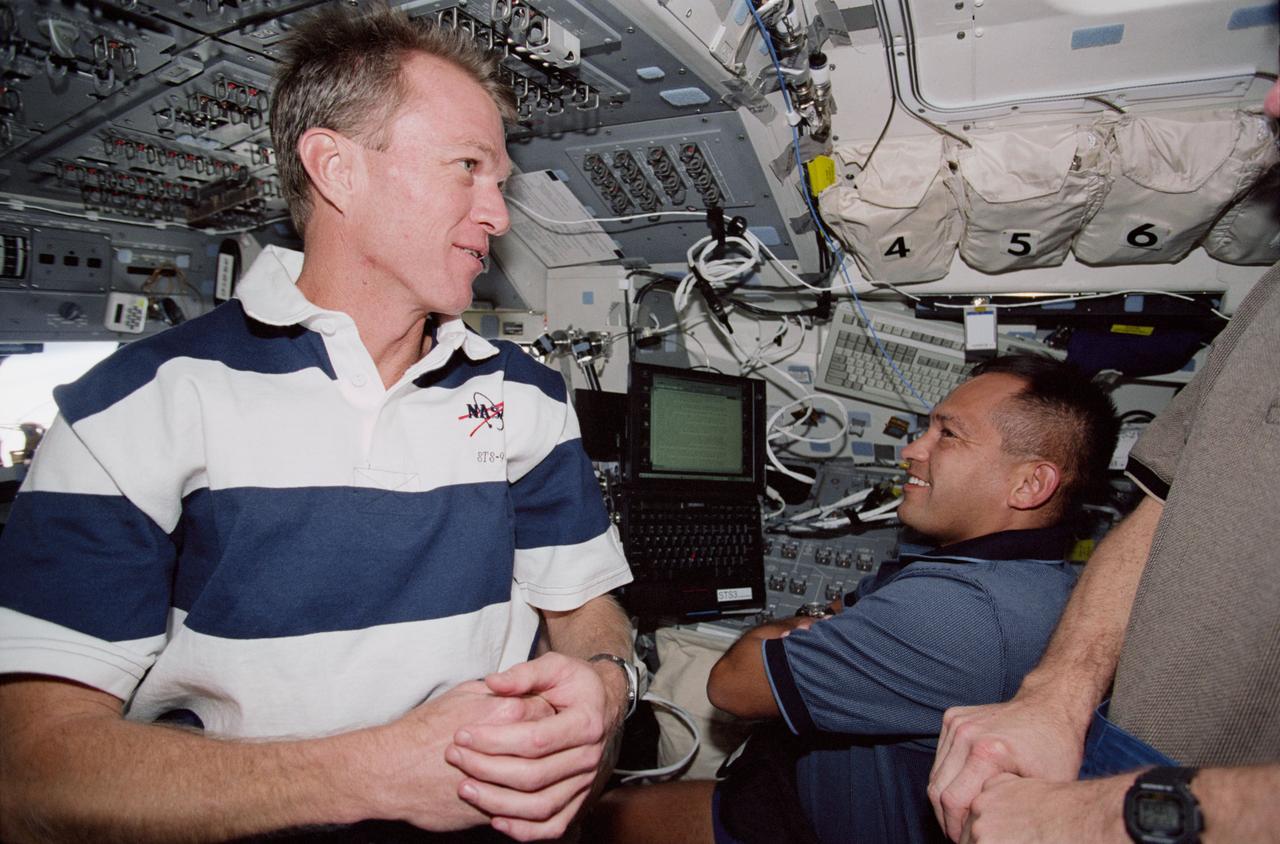
STS097-330-030 (30 Nov.-11 Dec. 2000) --- Astronauts Brent W. Jett (left), mission commander, and Carlos I. Noriega and Joseph R. Tanner (partially out of frame), both mission specialists, discuss mission procedures on the aft flight deck of the Space Shuttle Endeavour.
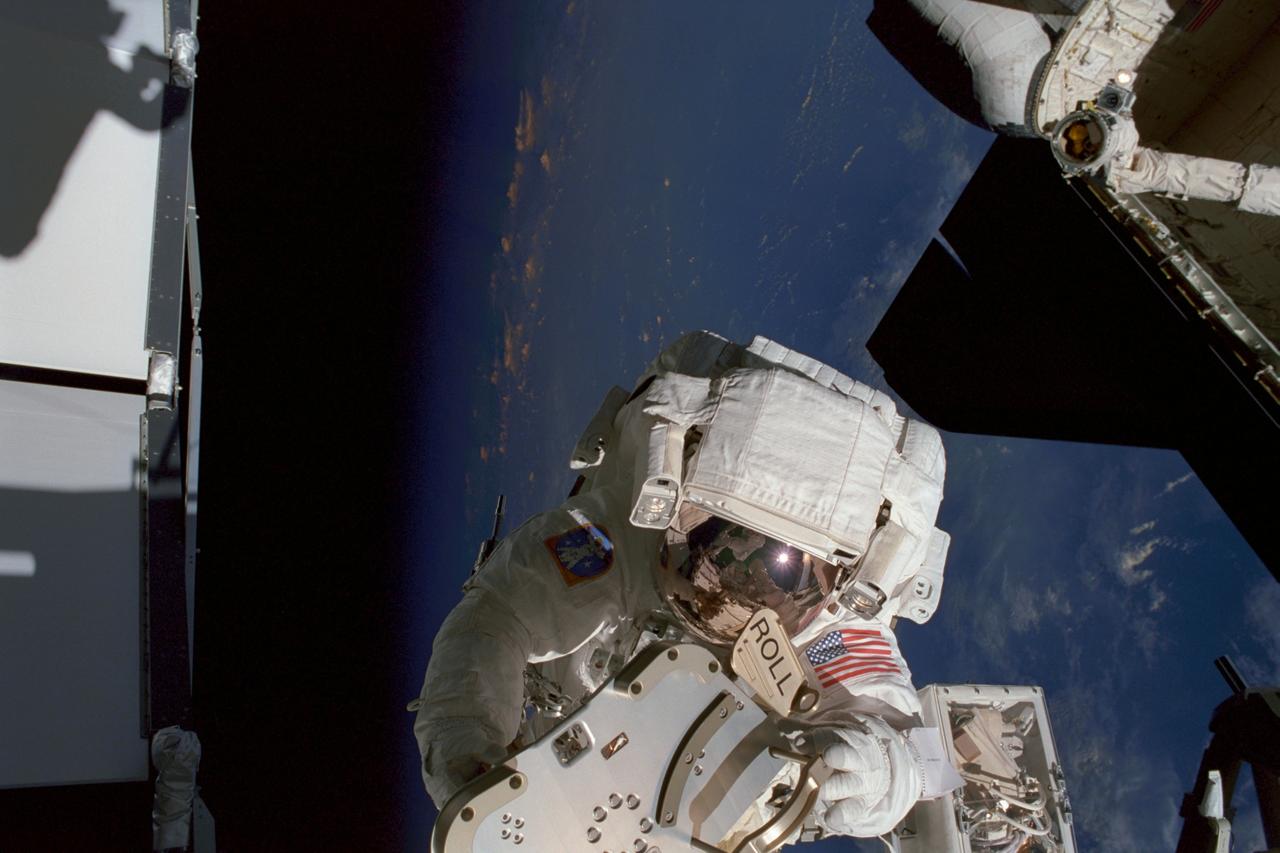
STS097-376-003 (7 December 2000) --- Astronaut Carlo I. Noriega, mission specialist, is pictured during the third of three STS-97 space walks to perform work on the International Space Station (ISS). The photo was taken by astronaut Joseph R. Tanner, mission specialist.
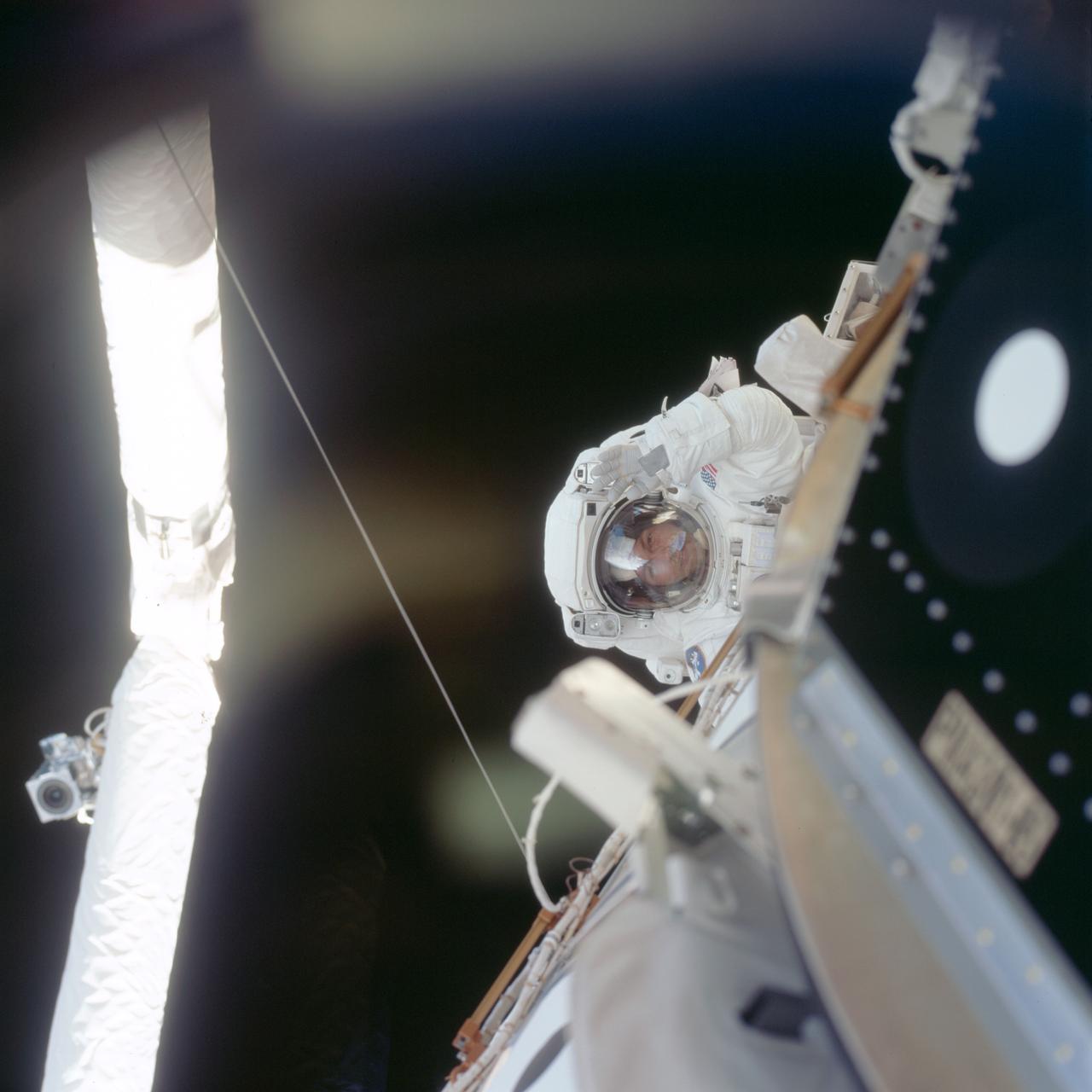
STS097-703-014 (7 December 2000) --- Astronaut Carlos I. Noriega, one of two space walking STS-97 mission specialists, waves at a crew member inside Endeavour's cabin during the mission's final session of extravehicular activity (EVA).
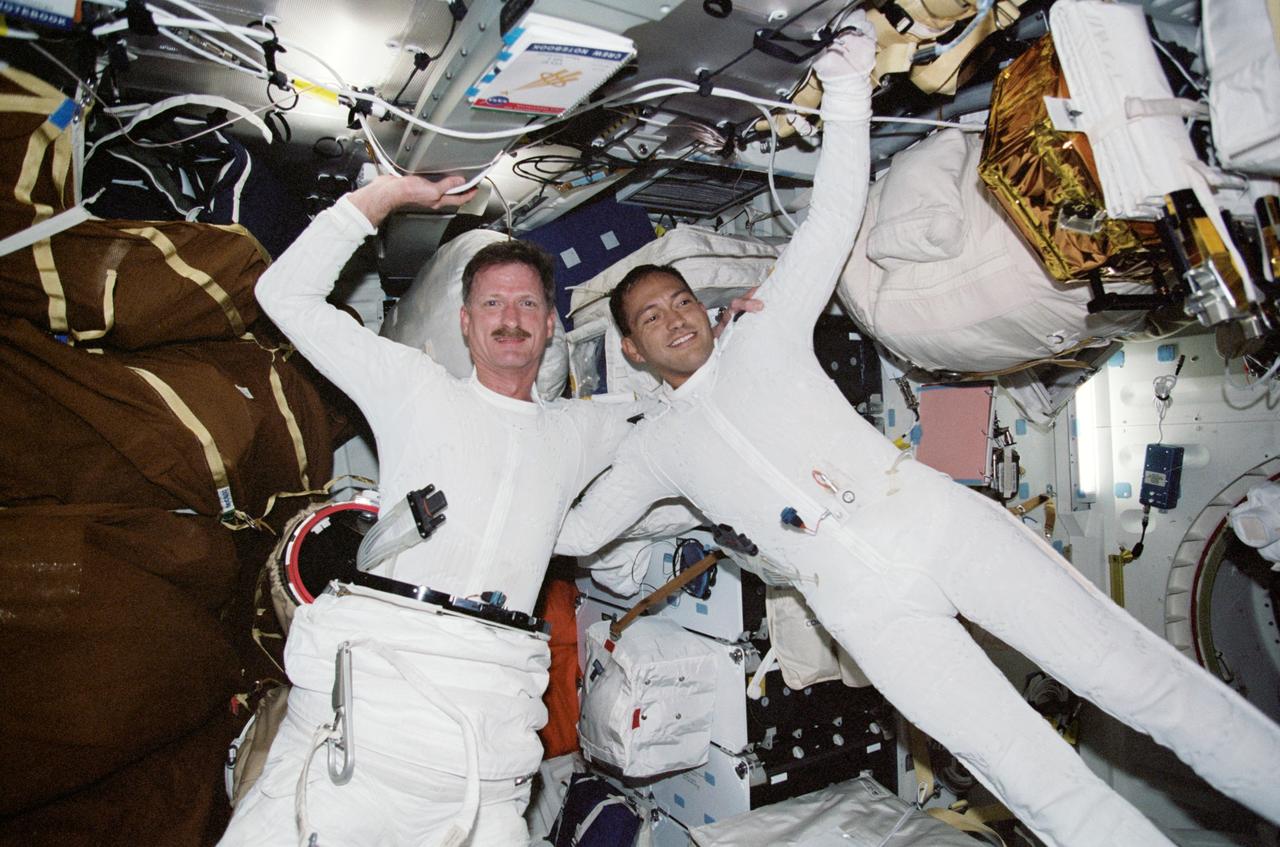
STS097-327-033 (30 Nov.-11 Dec. 2000) --- Astronauts Joseph R. Tanner (left) and Carlos I. Noriega, both mission specialists, who participated in three STS-97 space walks, don their extravehicular mobility unit (EMU) space suits for one of the walks. Tanner and Noriega are wearing the liquid cooling and ventilation garment that complements the EMU.
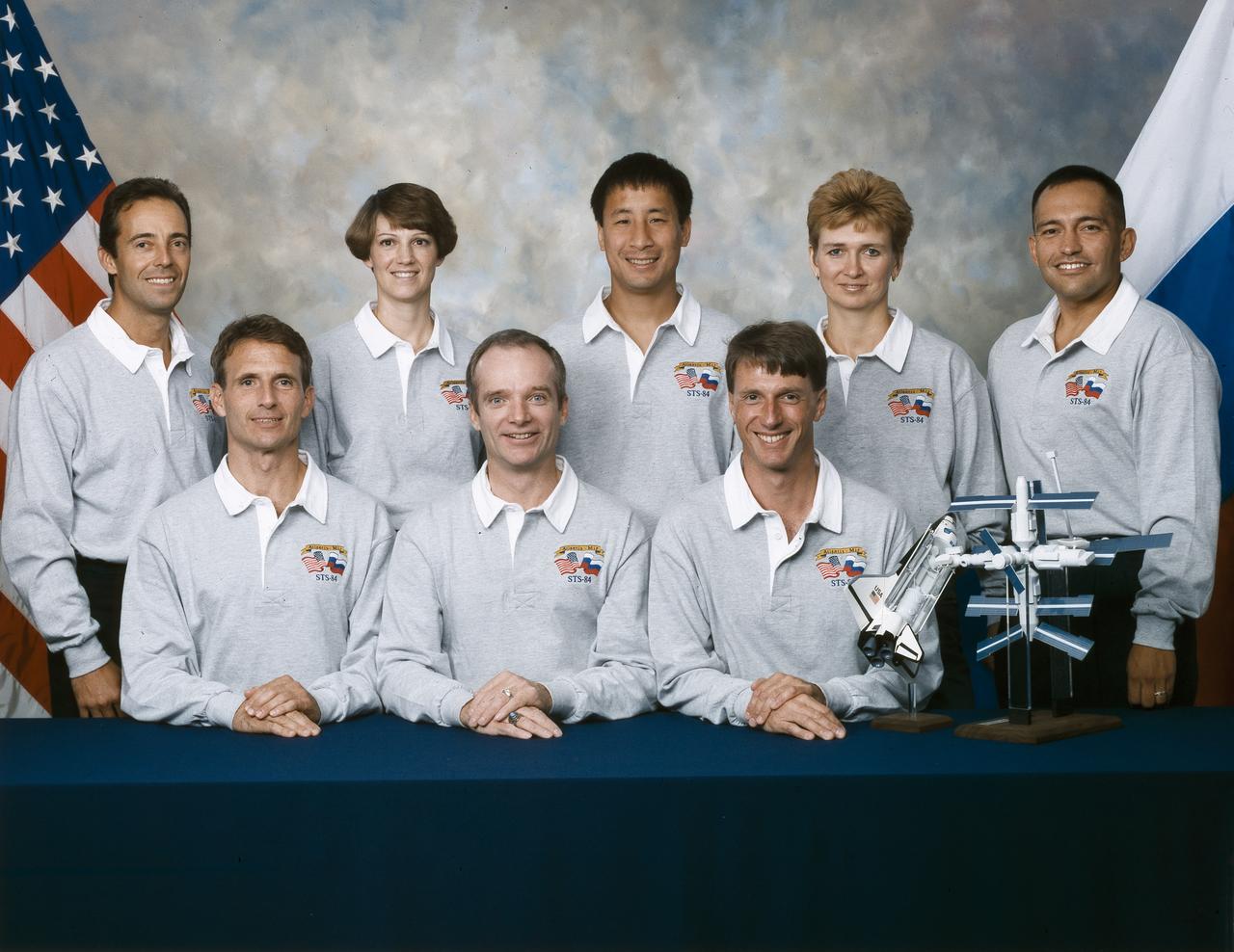
The crew assigned to the STS-84 mission included (seated front left to right) Jerry M Linenger, mission specialist; Charles J. Precourt, commander; and C. Michael Foale, mission specialist. On the back row (left to right) are Jean-Francois Clervoy (ESA), mission specialist; Eileen M. Collins, pilot; Edward T. Lu, mission specialist; Elena V. Kondakova (RSA), mission specialist; and Carlos I. Noriega, mission specialist. Launched aboard the Space Shuttle Atlantis on May 15, 1997 at 4:07:48 am (EDT), the STS-84 mission served as the sixth U.S. Space Shuttle-Russian Space Station Mir docking.
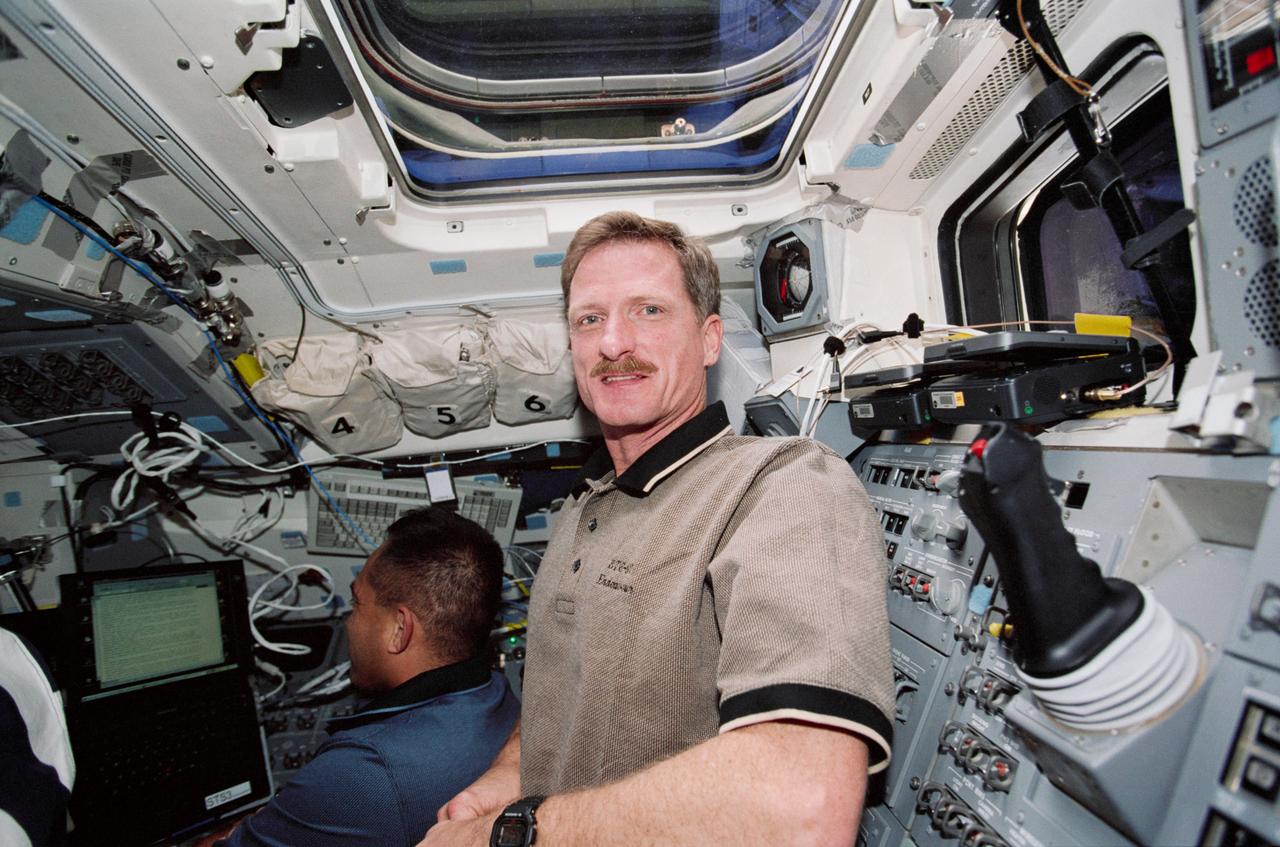
STS097-330-029 (30 Nov.-11 Dec. 2000) --- Astronauts Carlos I. Noriega (left) and Joseph R. Tanner, both mission specialists, are photographed on the aft flight deck of the Space Shuttle Endeavour.
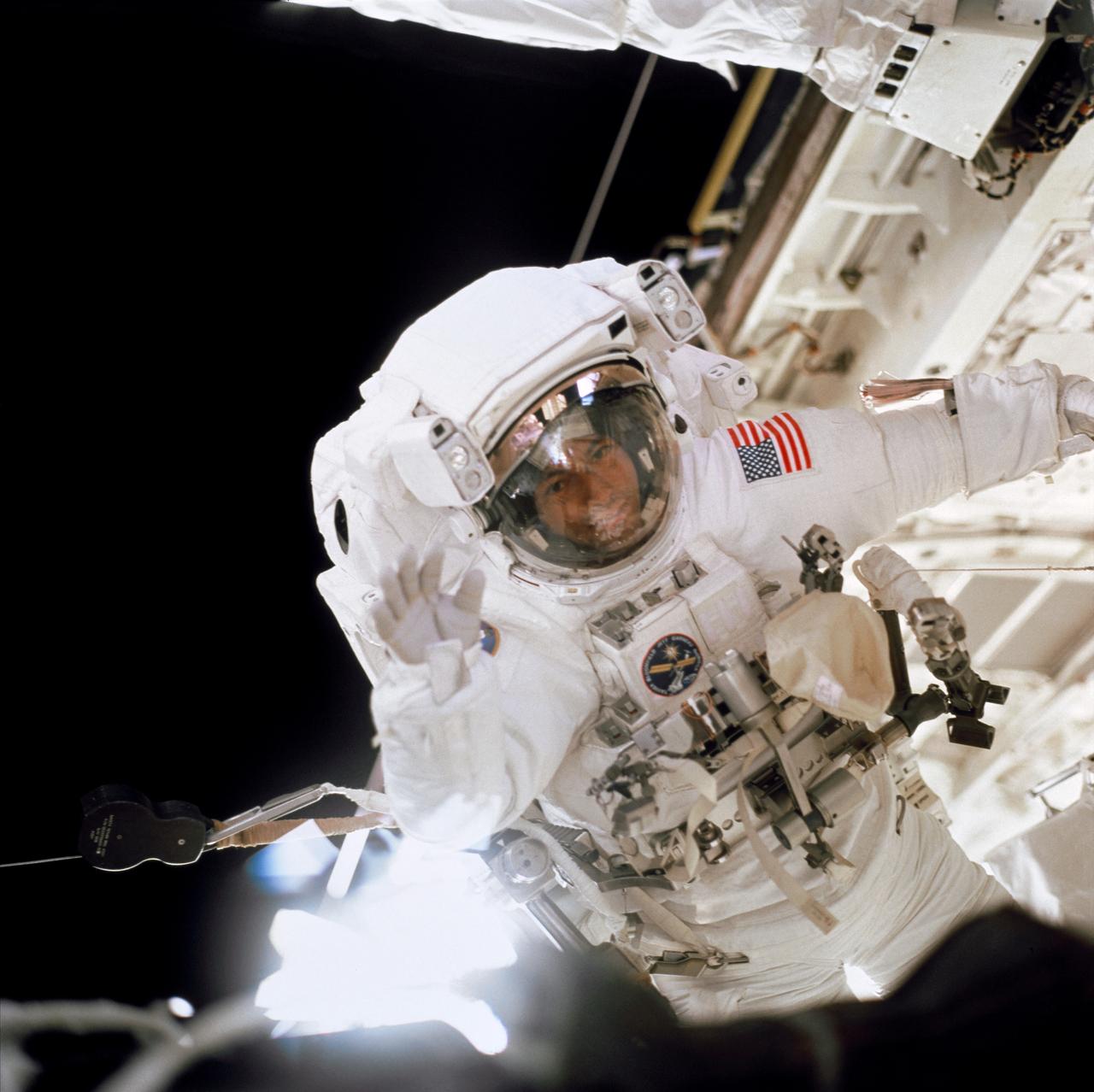
STS097-703-021 (30 Nov.-11 Dec. 2000) --- Astronaut Carlos I. Noriega, mission specialist, is photographed during one of the three space walks scheduled for the STS-97 mission to the International Space Station (ISS). The photo was taken through an aft flight deck window on the Space Shuttle Endeavour by a crew mate using a 70mm camera.
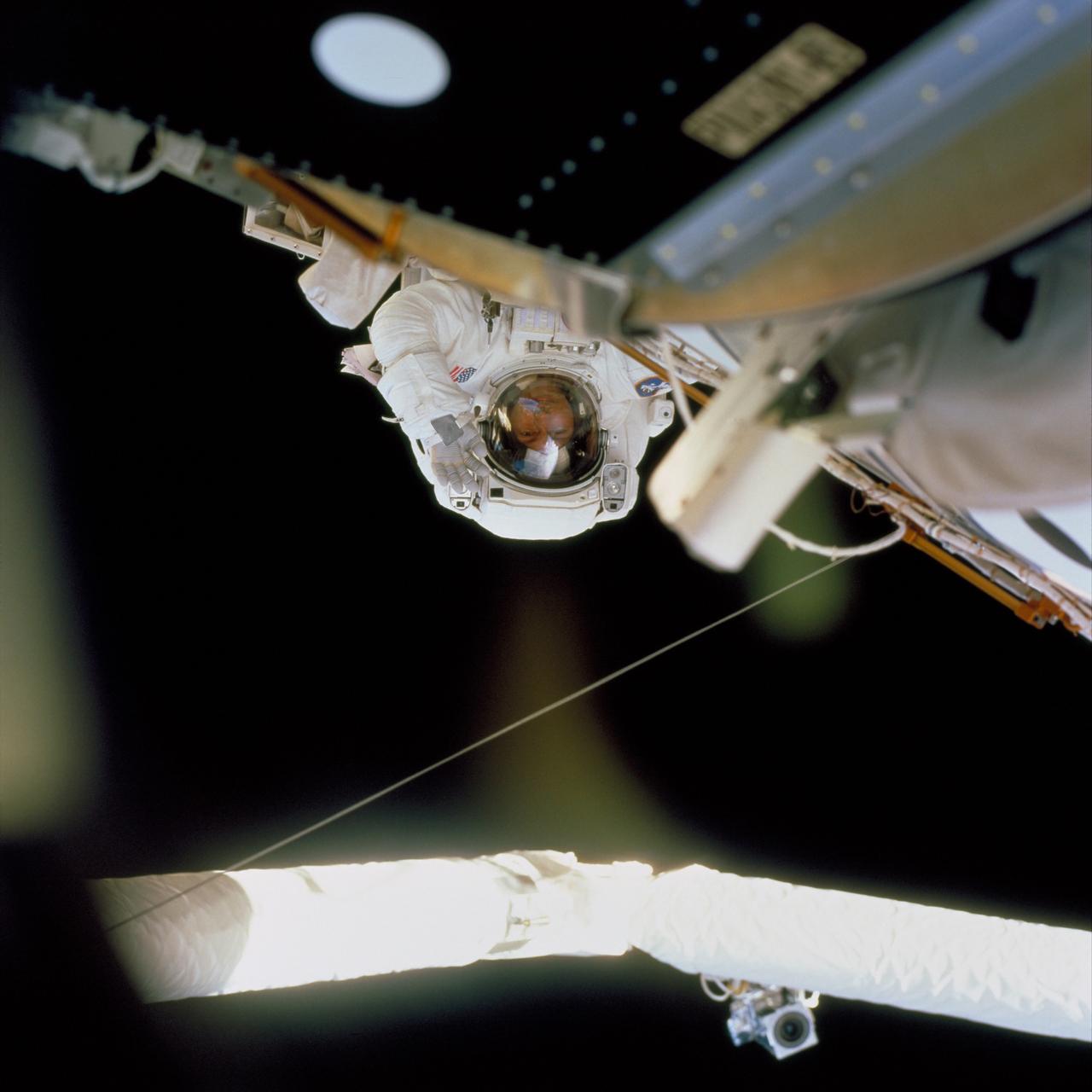
In this image, STS-97 astronaut and mission specialist Carlos I. Noriega waves at a crew member inside Endeavor's cabin during the mission's final session of Extravehicular Activity (EVA). Launched aboard the Space Shuttle Orbiter Endeavor on November 30, 2000, the STS-97 mission's primary objective was the delivery, assembly, and activation of the U.S. electrical power system onboard the International Space Station (ISS). The electrical power system, which is built into a 73-meter (240-foot) long solar array structure consists of solar arrays, radiators, batteries, and electronics. The entire 15.4-metric ton (17-ton) package is called the P6 Integrated Truss Segment, and is the heaviest and largest element yet delivered to the station aboard a space shuttle. The electrical system will eventually provide the power necessary for the first ISS crews to live and work in the U.S. segment.
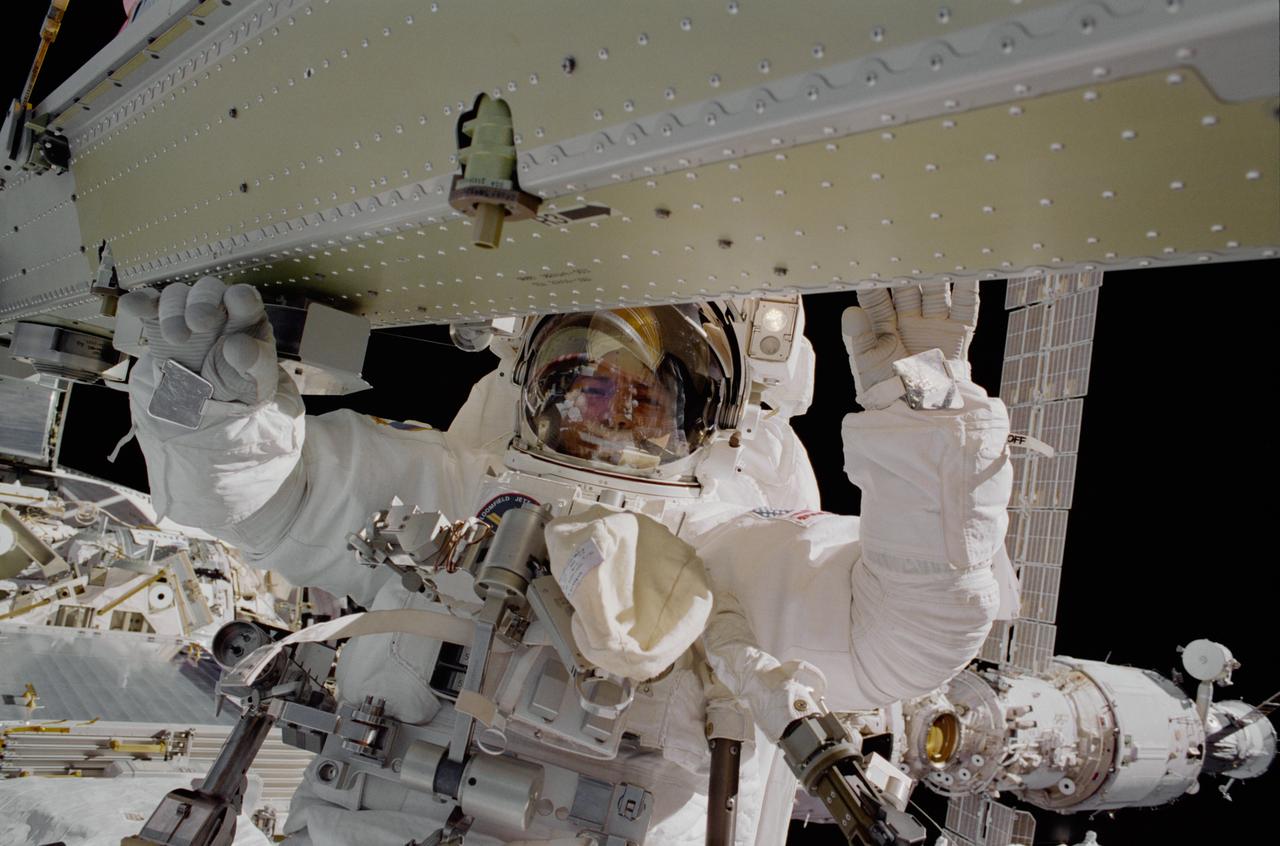
STS097-376-018 (7 December 2000) --- Astronaut Carlos I. Noriega, mission specialist, is photographed during the final of the three space walks scheduled for the STS-97 mission to the International Space Station (ISS). Astronaut Joseph R. Tanner, mission specialist, was nearby when he exposed the 35mm frame.
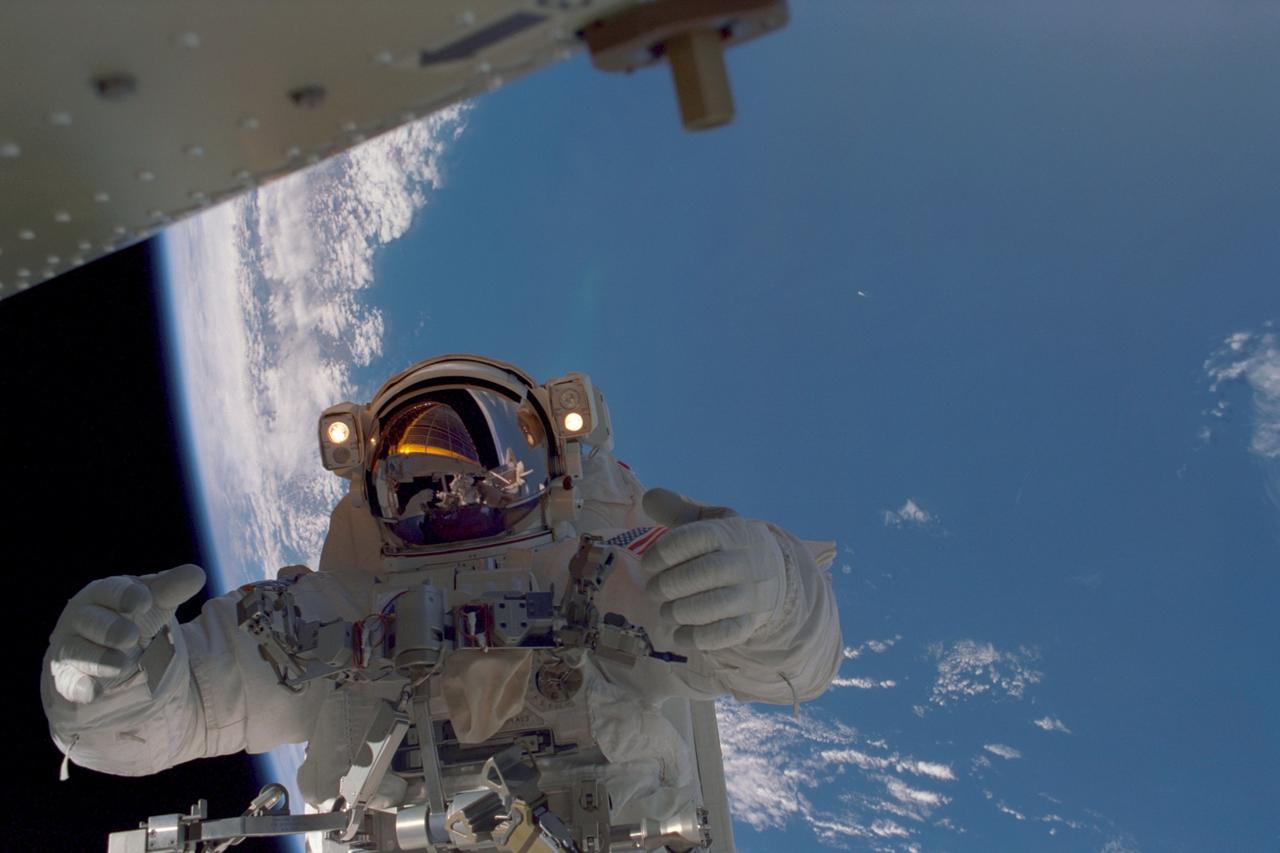
STS097-376-013 (7 December 2000) --- Planet Earth, some 235 statute miles away, forms the backdrop for this 35mm photo of astronaut Joseph R. Tanner, mission specialist, taken during the third of three STS-97 space walks to perform work on the International Space Station (ISS). The photo was taken by astronaut Carlos I. Noriega, mission specialist, whose reflection can be seen in Tanner's helmet visor.
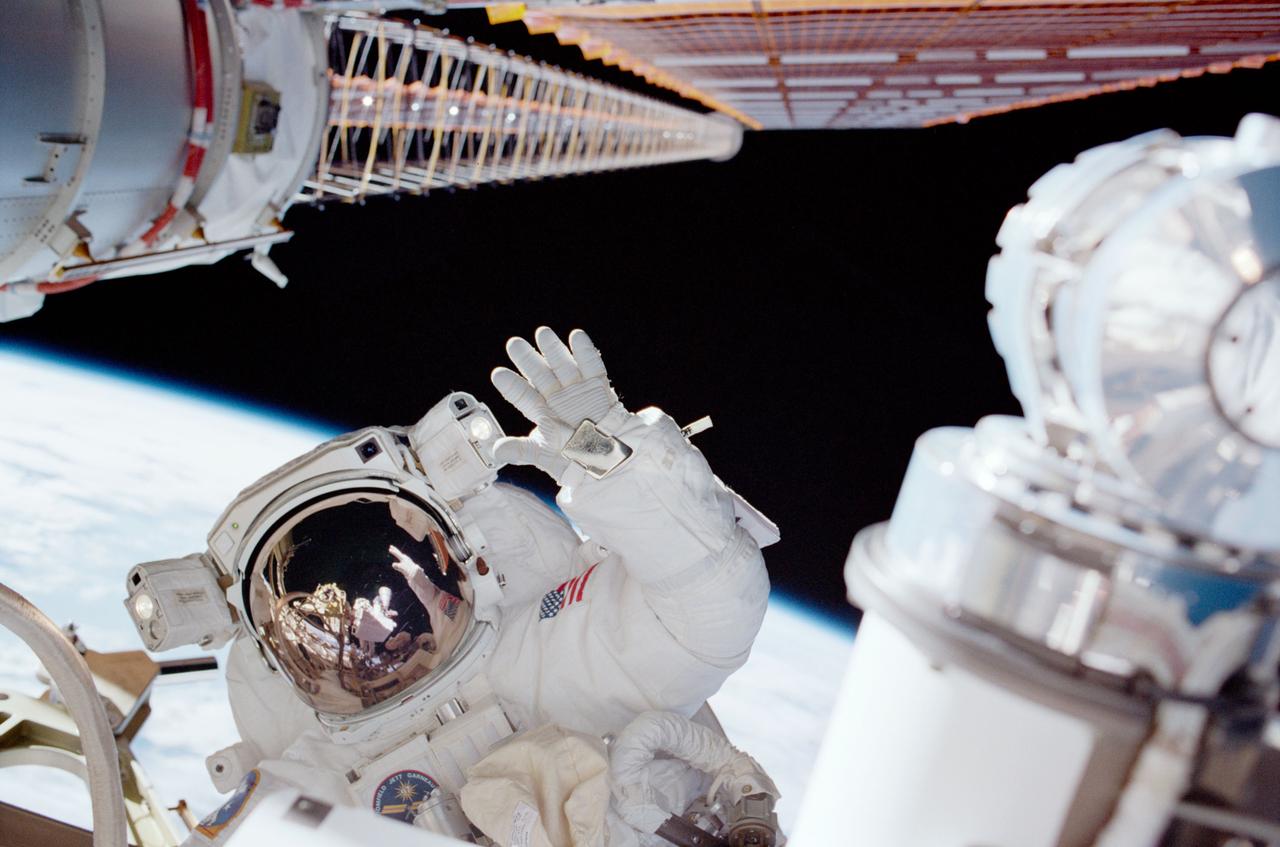
STS097-375-012 (5 December 2000) --- Astronaut Carlos I. Noriega, mission specialist, waves toward his space walk partner, astronaut Joseph R. Tanner, as Tanner snaps a 35mm frame during the second of three STS-97 sessions of extravehicular activity (EVA). Part of the newly-deployed solar array structure is at the top of the frame.
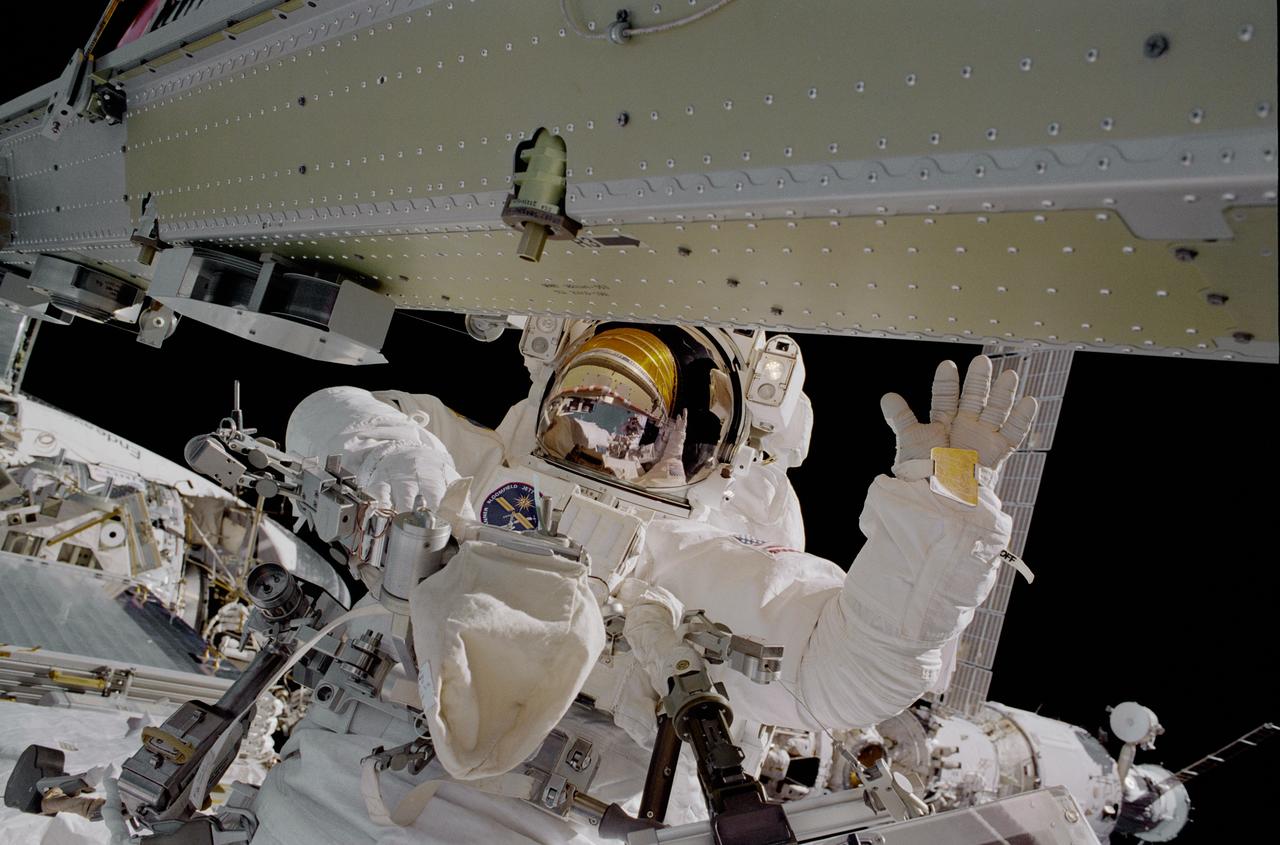
STS097-376-009 (7 December 2000) --- Astronaut Carlos I. Noriega, mission specialist, during the final of the three space walks scheduled for the STS-97 mission to the International Space Station (ISS), waves to his fellow space walker, astronaut Joseph R. Tanner, mission specialist. A small reflection of Tanner can be seen in the helmet as he captures this 35mm image.
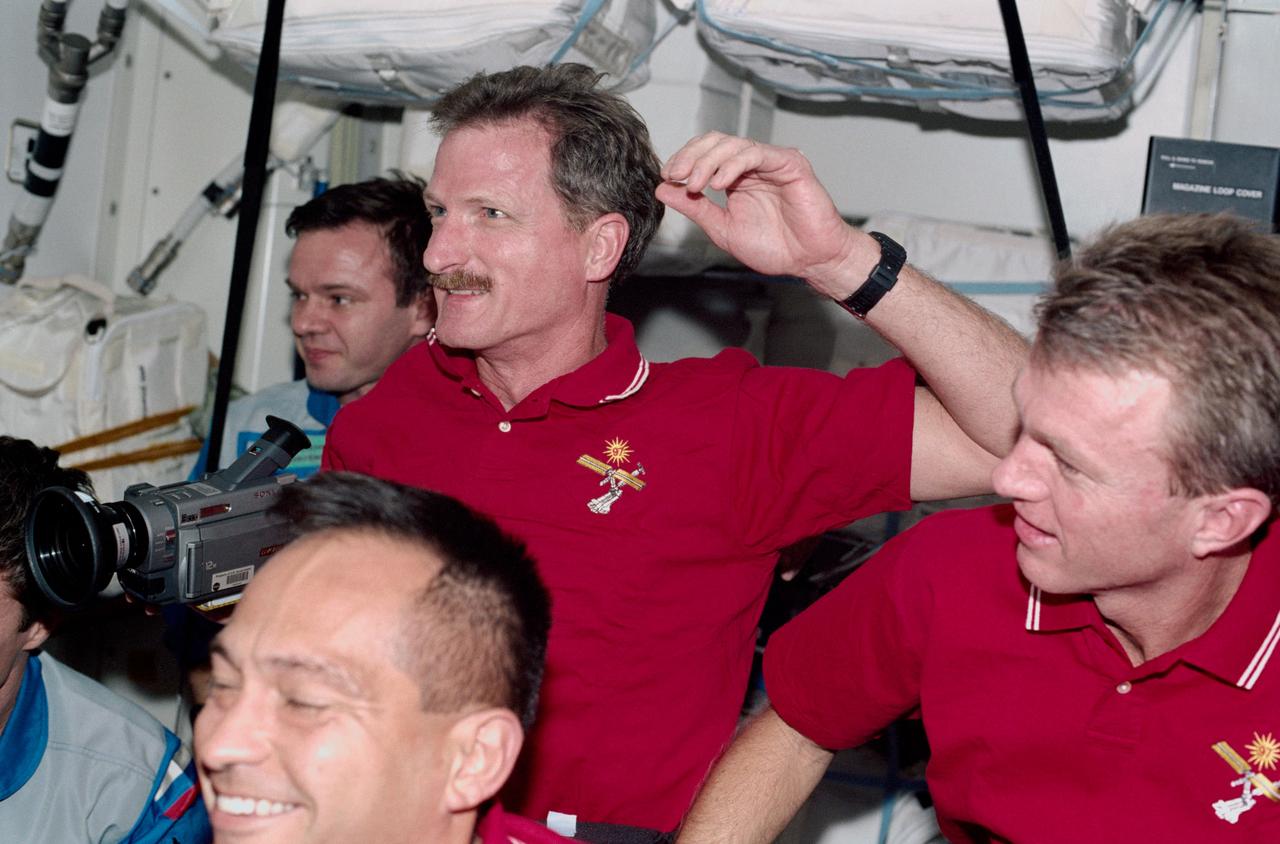
STS097-315-004 (30 Nov. - 11 Dec. 2000) Three STS-97 astronauts reunite with Expedition One crew members in the appropriately-named Unity node aboard the International Space Station (ISS), temporarily docked to the Space Shuttle Endeavour. Dressed in blue flight suits on left side of the frame are cosmonauts Sergei Krikalev (partially out of frame), Expedition One flight engineer; and Yuri P. Gidzenko, Soyuz commander for Expedition One. The visitors are (from left) astronauts Carlos I. Noriega and Joseph R. Tanner, both STS-97 mission specialists, along with Brent W. Jett, Jr., mission commander.
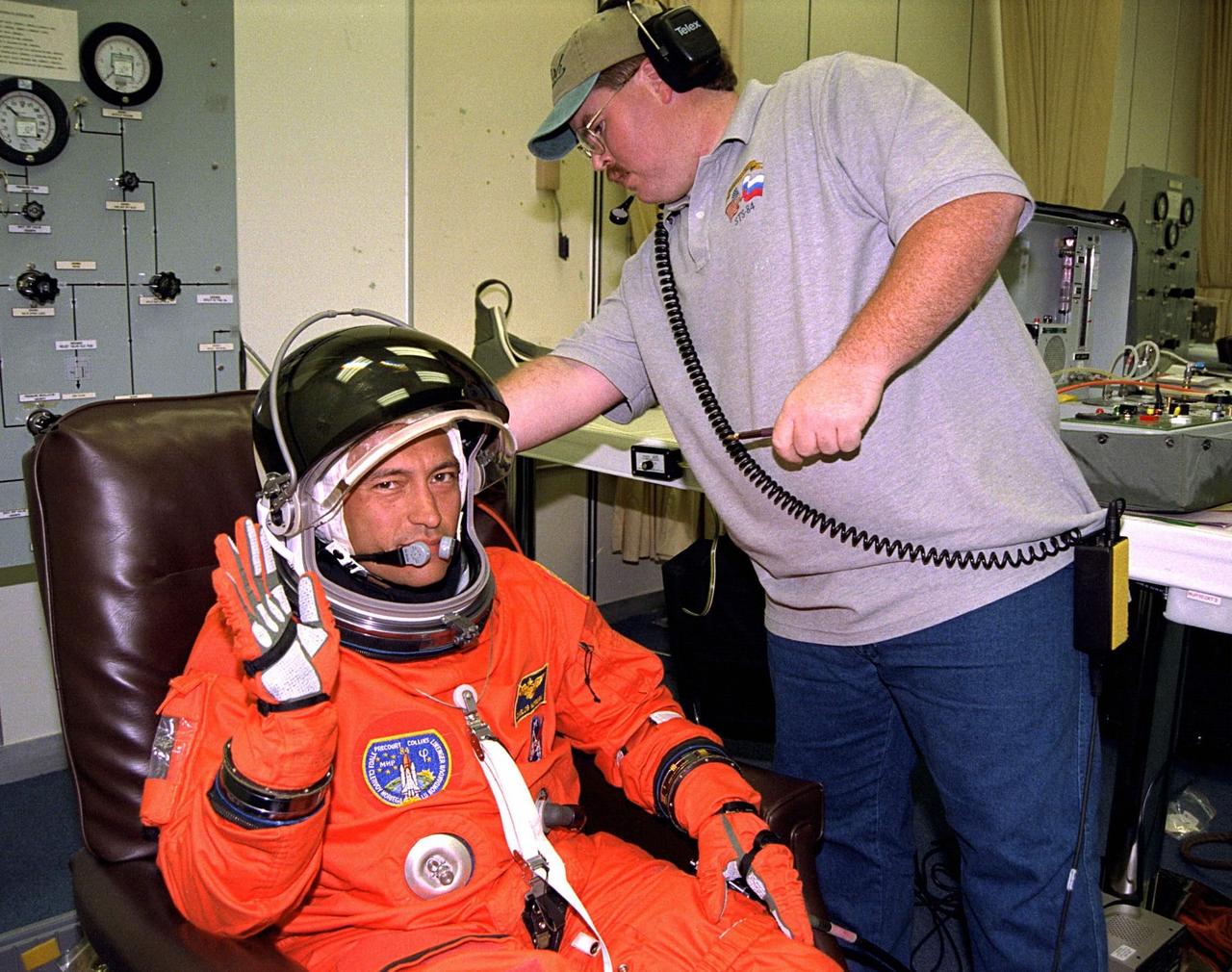
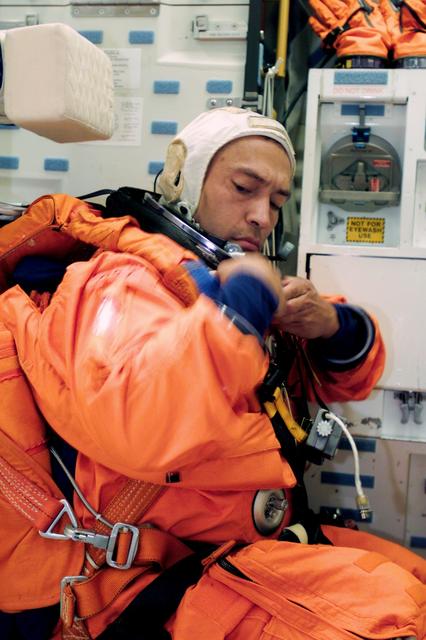
STS-84 Mission Specialist Carlos I. Noriega gets assistance from a suit technician as he dons his launch and entry suit during final prelaunch preparations in the Operations and Checkout Building. This will be Noriega’s first space flight. Noriega and six other crew members will depart shortly for Launch Pad 39A, where the Space Shuttle Atlantis awaits liftoff on a mission to dock with the Russian Space Station Mir
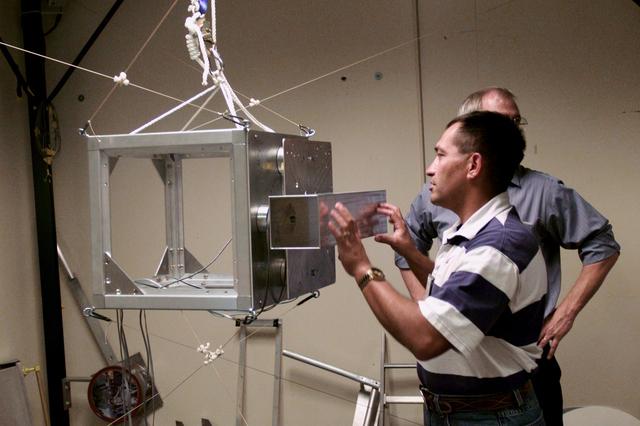
JSC2000-E-26591 (October 2000) --- Astronaut Carlos I. Noriega, one of two STS-97 astronauts assigned to extravehicular activity (EVA) duty, participates in training for the upcoming mission. Noriega and four other astronauts will visit the International Space Station (ISS) via the Space Shuttle Endeavour.
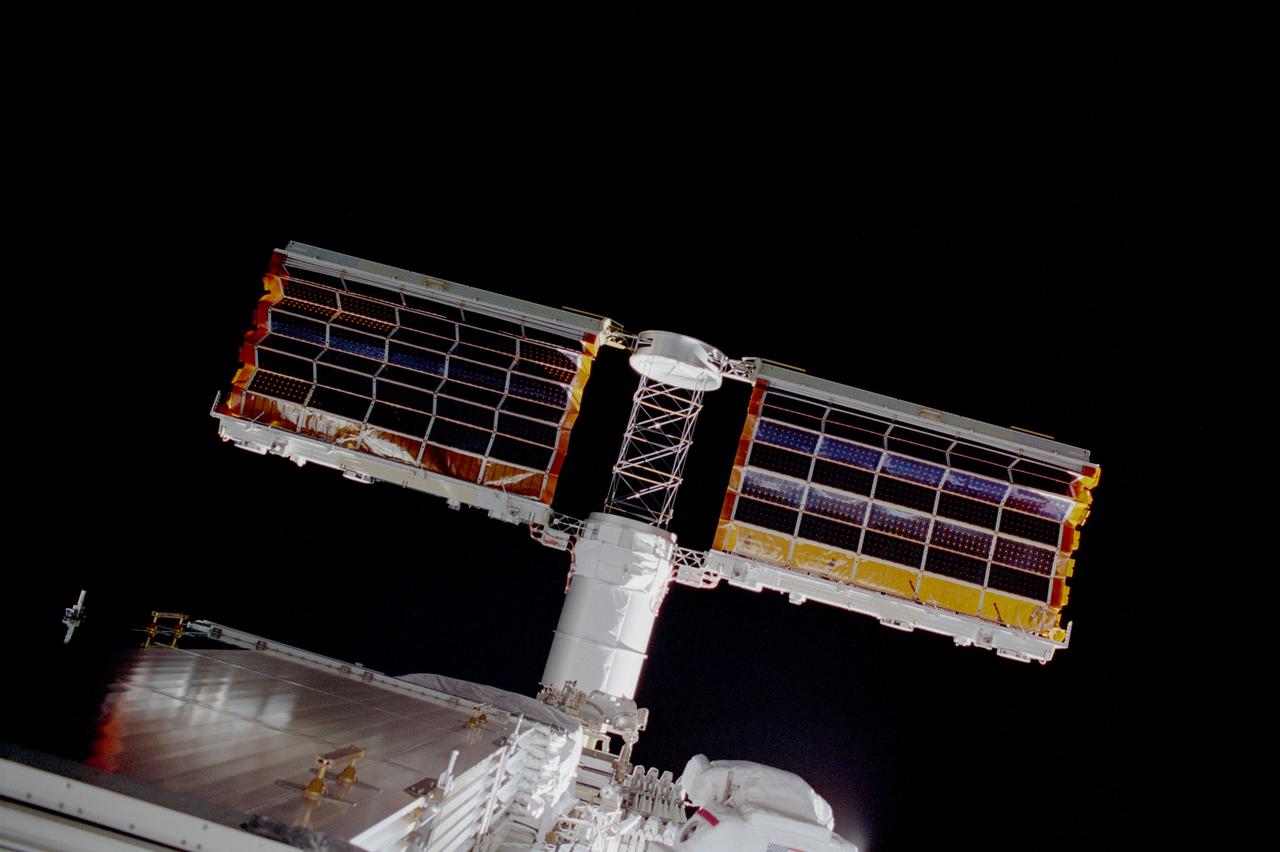
STS097-373-005 (3 December 2000) --- Backdropped against the blackness of space, the deployment of International Space Station (ISS) solar array was photographed with a 35mm camera by astronaut Carlos I. Noriega, mission specialist. Part of the extravehicular mobility unit (EMU) attached to astronaut Joseph R. Tanner, mission specialist, is visible at bottom center. Tanner and Noriega went on to participate together in three separate space walks.
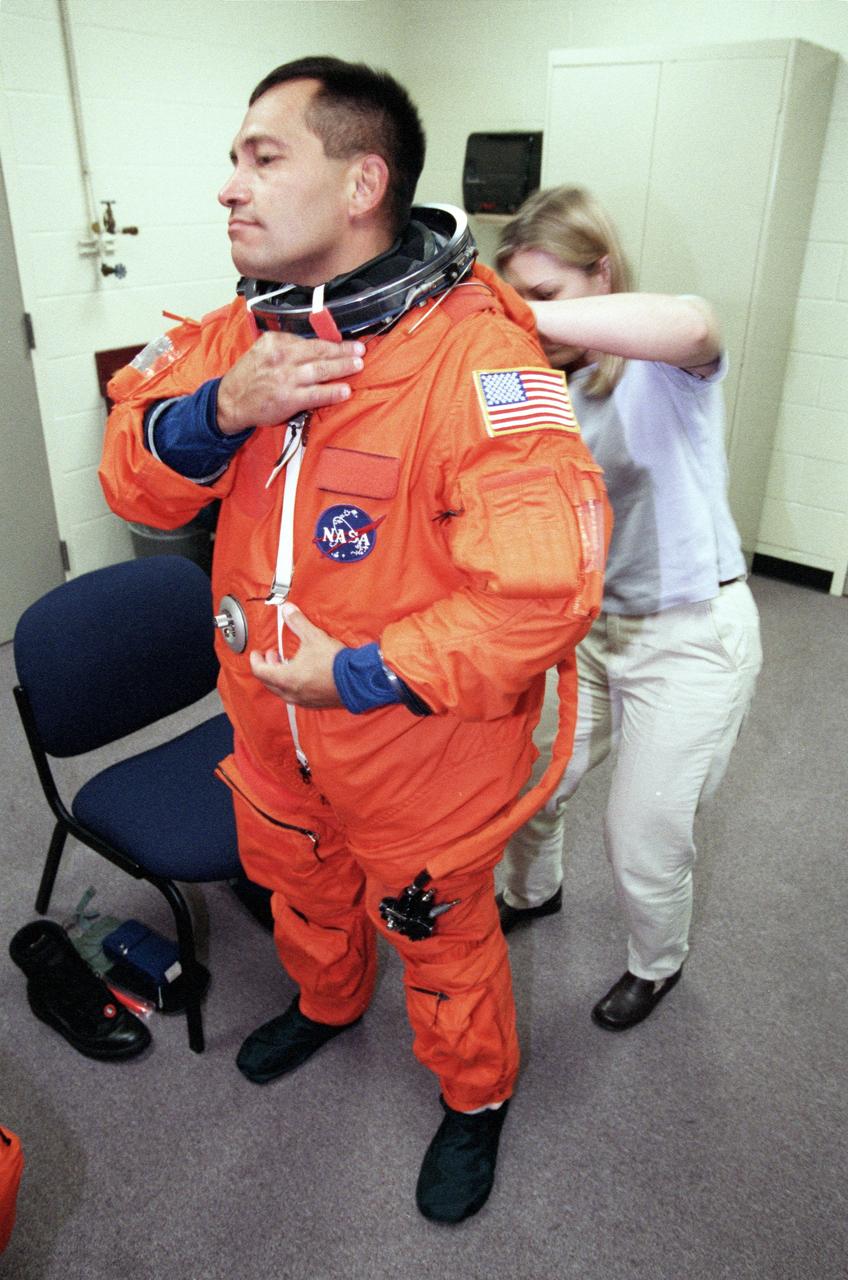
Photographic documentation showing the STS-97 crew training in the Crew Compartment Trainer II (CCT II) in bldg. 9. Views include: STS-97 pilot Michael J. Bloomfield wearing a Launch and Entry Suit (LES) with no helmet (04749); STS-97 Mission Specialist (MS) Carlos I. Noriega with personnel helping him with his LES 904750); Left to right in a locker room, with all wearing LES: STS-97 mission commaner Brett W. Jett, Bloomfield, MS Joseph R. Tanner and MS Marc Garneau (04751); Noriega, wearing LES and helmet, strapped down in CCT II (04752); personnel help Bloomfield with his LES (04753). CCTII mockup. Crew includes: Brent Jett, Michael Bloomfield, Joseph Tanner, Carlos Noriega, Marc Garneau
Photographic documentation of the STS-97 preflight training which occurred in Building 9 Crew Compartment Trainer II (CCTII). Views include: Astronaut Brent W. Jett (center), STS-97 mission commander, shares a light moment with two of the mission specialists on his crew, astronauts Joseph R. Tanner (left) and Carlos I. Noriega. The three are about to don training versions of the orange Launch and entry suit (LES) prior to a dry run of countdown procedures (23524). Astronaut Joseph R. Tanner (left), mission specialist, helps astronaut Michael J. Bloomfield, pilot, with final touches on his suit-donning process as USA suit technicians Bill Todd (standing) and Brad Milling look on (23525). Astronaut Carlos I. Noriega, attired in a blue thermal undergarment, and USA suit technician Mike Birkenseher help astronaut Brent W. Jett, STS-97 mission commander, with final touches of suit donning (23526). Astronaut Marc Garneau, mission specialist representing the Canadian Space Agency (CSA), looks on as two crew mates assist him with final touches of suit-donning prior to a training session in the Johnson Space Center's Systems Integration Facility. Helping out are astronauts Carlos I. Noriega (left) and Joseph R. Tanner, mission specialists (23527). Astronaut Michael J. Bloomfield, left, discusses his launch and entry suit with USA technician Bill Todd prior to a training session (23528). Astronaut Joseph R. Tanner lends a helping hand to astronaut Carlos I. Noriega as the two STS-97 mission specialists prepare for a dry run going over launch procedures in a nearby simulator (23529). Astronaut Joseph R. Tanner receives a helping hand from astronaut Carlos I. Noriega as the two STS-97 mission specialists don training versions of their pressure ascent and entry garments (23530). Noriega adjusts his LES while in the CCTII middeck mock-up (23531).
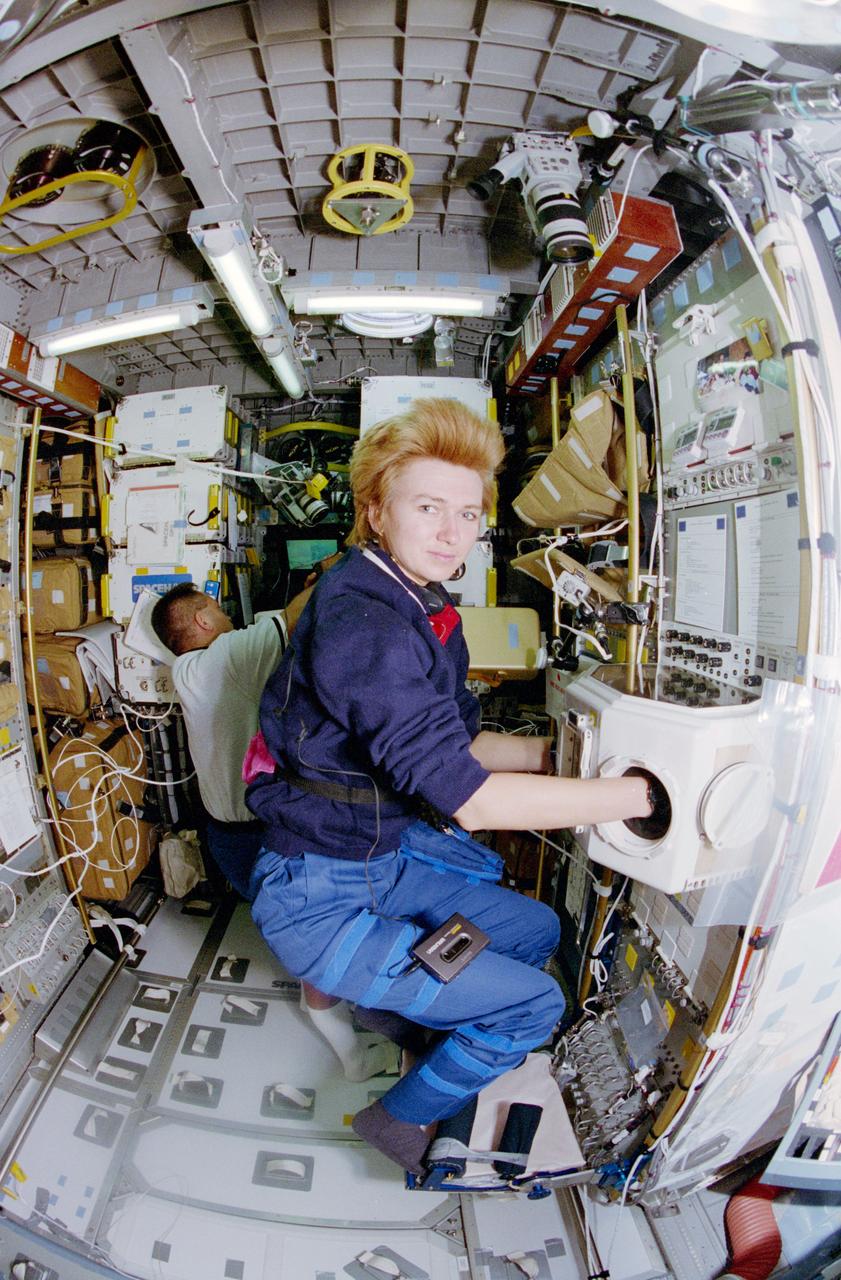
STS084-317-020 (15-24 May 1997) --- Elena V. Kondakova works in the Spacehab glovebox, aboard the Space Shuttle Atlantis, as Carlos I. Noriega, a fellow mission specialist, checks on an experiment in the background.
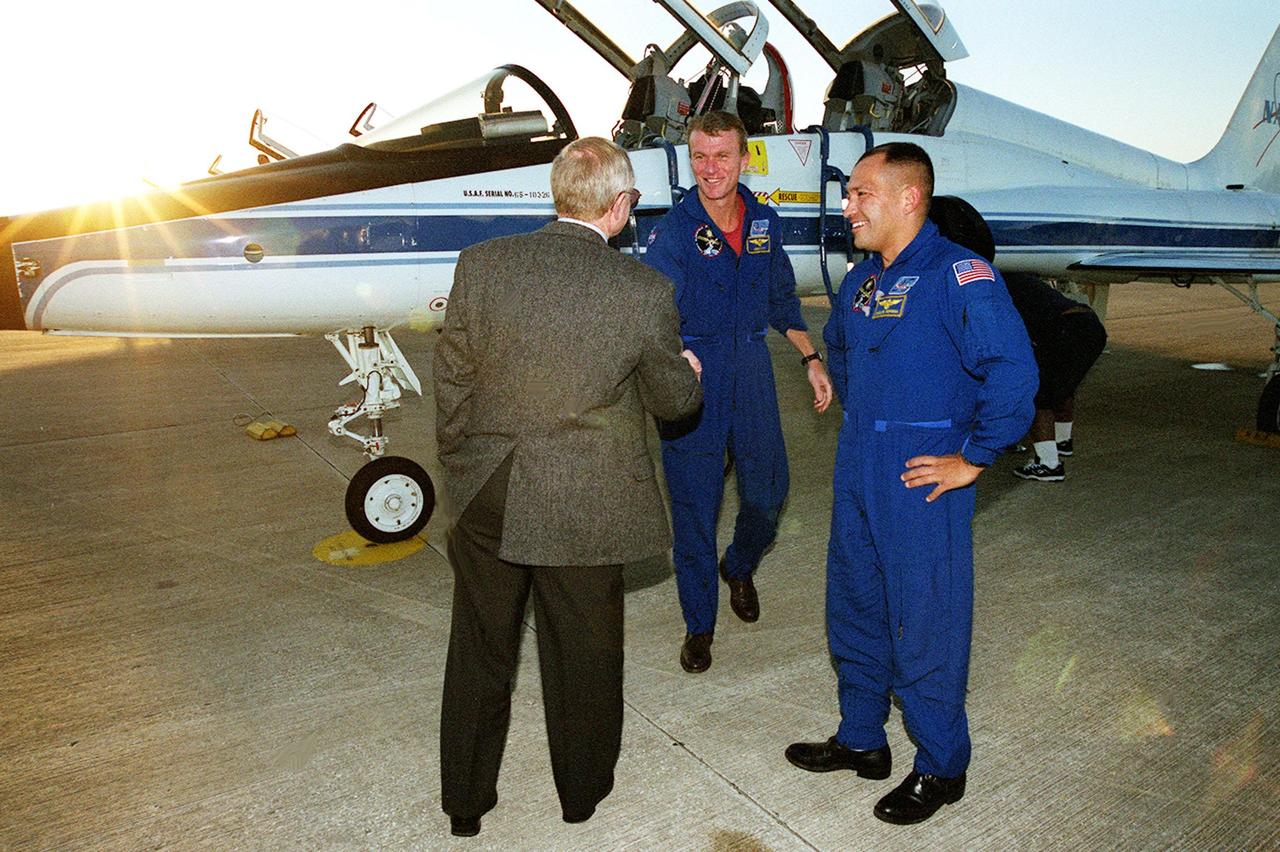
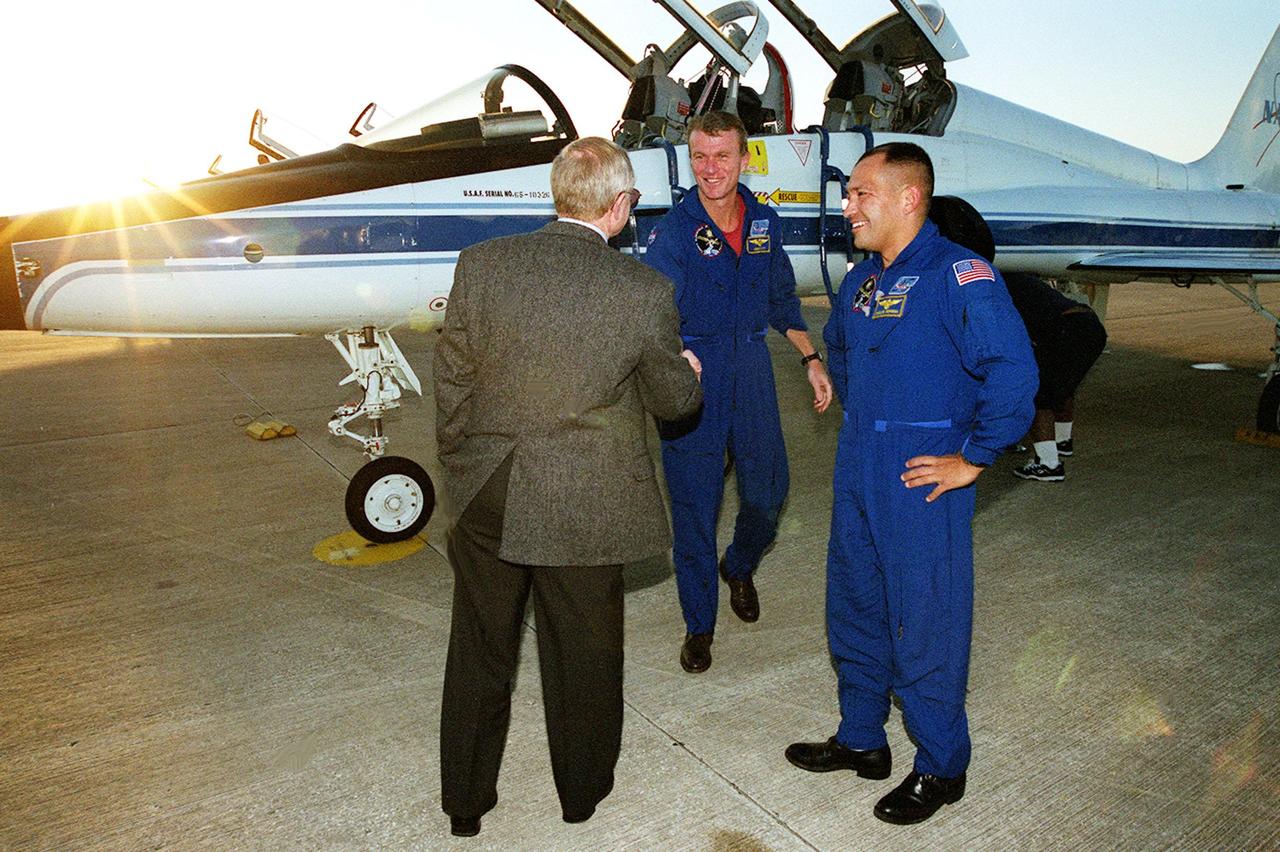
At the Shuttle Landing Facility, Center Director Roy Bridges (left) greets STS-97 Commander Brent Jett on his arrival at KSC for the mission launch. At right is Mission Specialist Carlos Noriega. Jett and Noriega traveled from Johnson Space Center, Houston, Texas, in the T-38 jet aircraft behind them. Mission STS-97is the sixth construction flight to the International Space Station. Its payload includes the P6 Integrated Truss Structure and a photovoltaic (PV) module, with giant solar arrays that will provide power to the Station. The mission includes two spacewalks to complete the solar array connections. STS-97 is scheduled to launch Nov. 30 at about 10:06 p.m. EST
At the Shuttle Landing Facility, Center Director Roy Bridges (left) greets STS-97 Commander Brent Jett on his arrival at KSC for the mission launch. At right is Mission Specialist Carlos Noriega. Jett and Noriega traveled from Johnson Space Center, Houston, Texas, in the T-38 jet aircraft behind them. Mission STS-97is the sixth construction flight to the International Space Station. Its payload includes the P6 Integrated Truss Structure and a photovoltaic (PV) module, with giant solar arrays that will provide power to the Station. The mission includes two spacewalks to complete the solar array connections. STS-97 is scheduled to launch Nov. 30 at about 10:06 p.m. EST
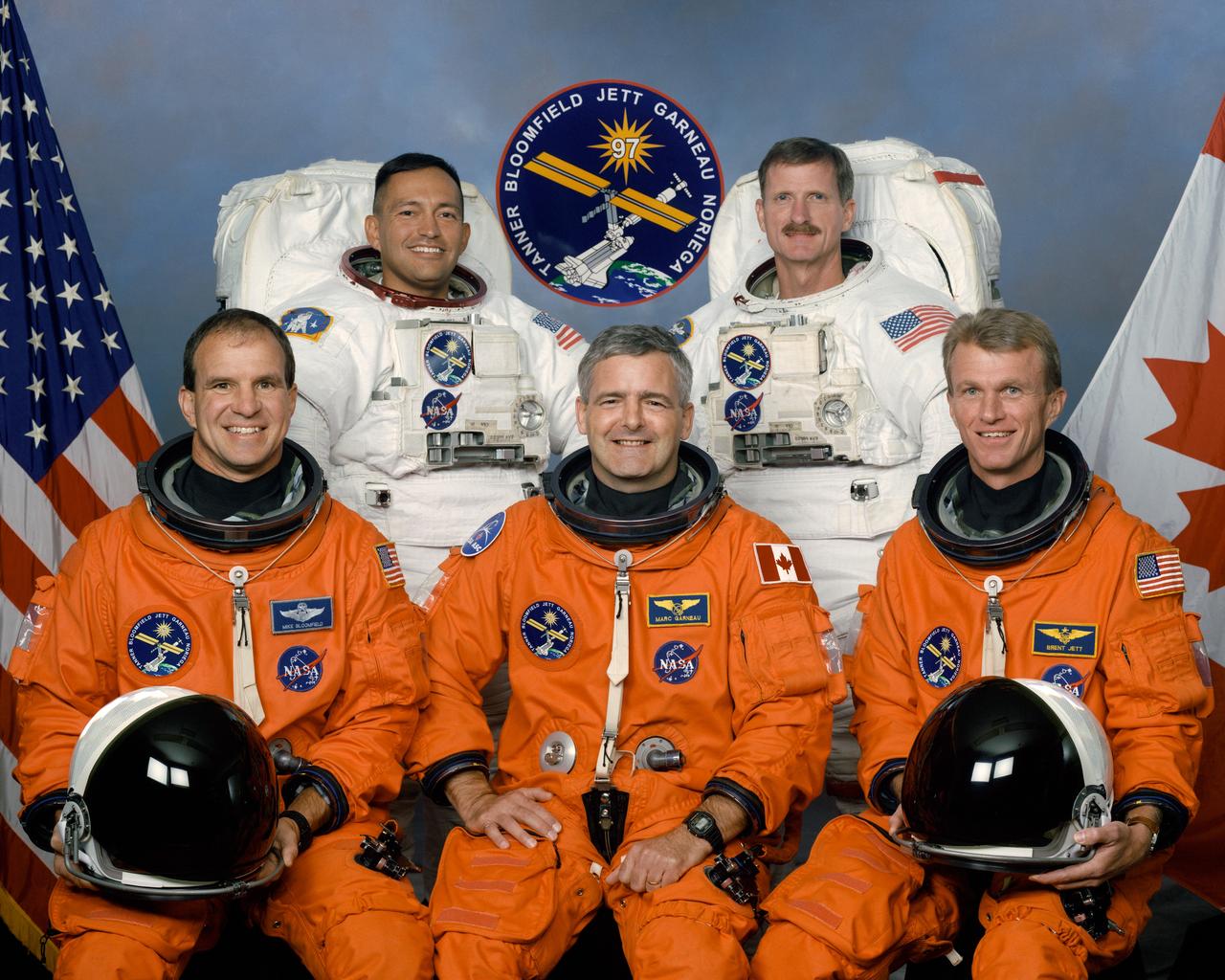
STS097-S-002 (November 1999) --- These five astronauts are in training for the STS-97 mission, scheduled to be launched next year aboard the Space Shuttle Endeavour for a working visit to the International Space Station (ISS). Astronauts Brent W. Jett (front right) and Michael J. Bloomfield (front left) are commander and pilot, respectively. Flanked by those two is astronaut Marc Garneau, mission specialist representing the Canadian Space Agency (CSA). In the rear are astronauts Carlos I. Noriega (left) and Joseph R. Tanner, both mission specialists. Noriega and Tanner are wearing training versions of the extravehicular mobility unit (EMU) spacesuits they'll be wearing for spacewalking chores during the flight.
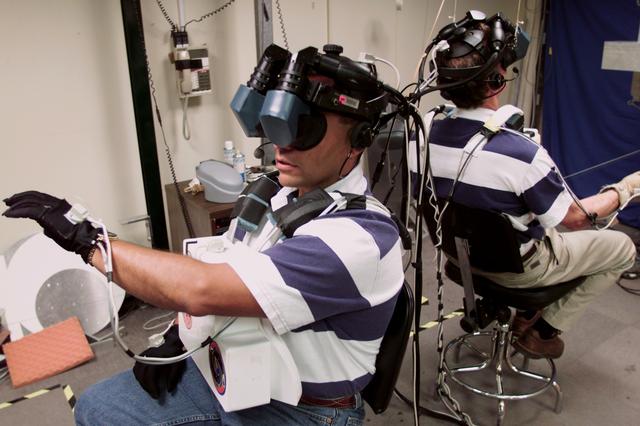
JSC2000-E-26587 (October 2000) --- The two assigned space-walking astronauts for the STS-97 mission train for their scheduled extravehicular activity (EVA) in the virtual reality laboratory at the Johnson Space Center (JSC). They are astronauts Carlos I. Noriega (left) and Joseph R. Tanner, both mission specialists.
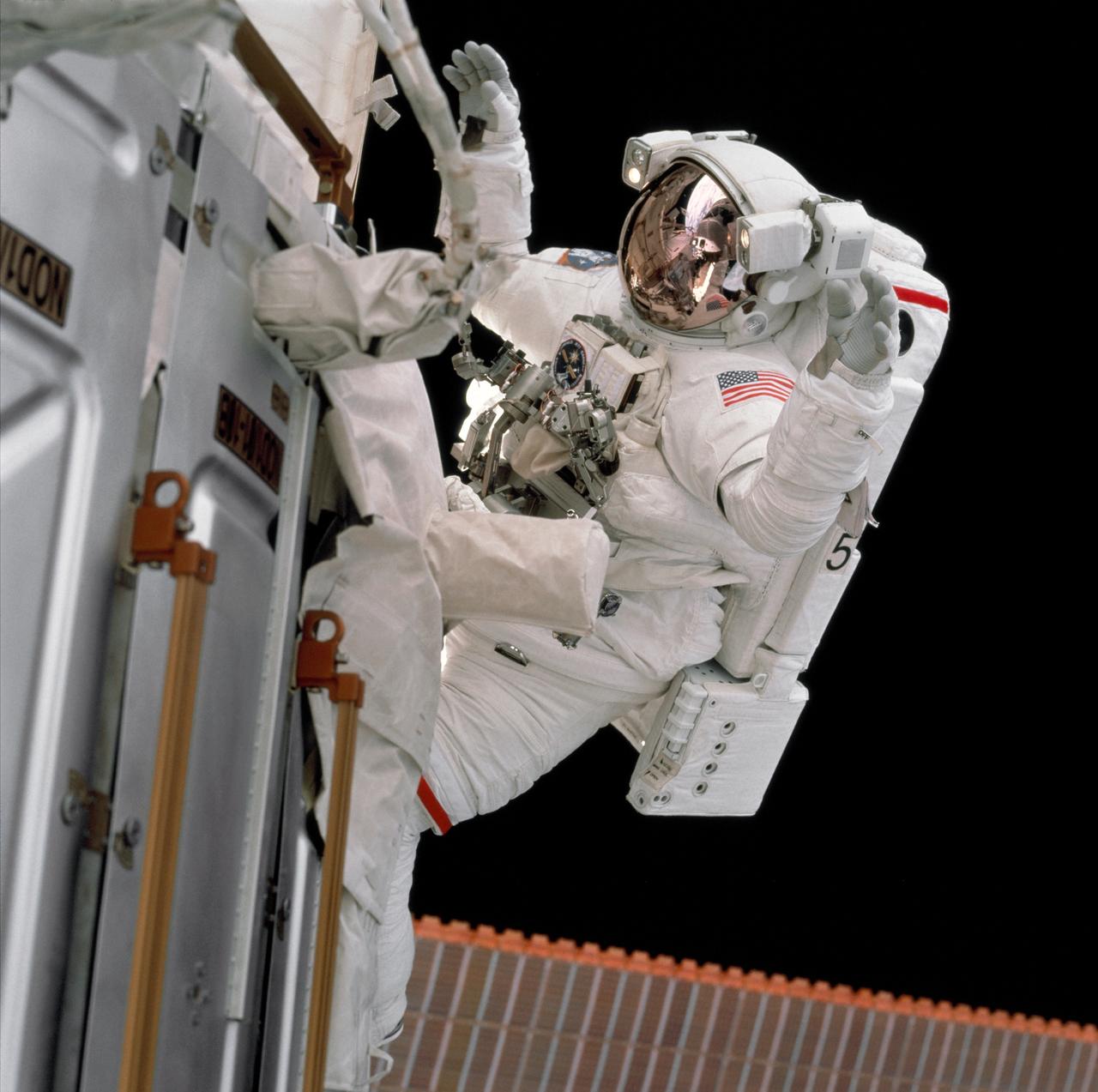
STS097-703-001 (7 December 2000) --- Astronaut Joseph R. Tanner participates in the December 7 extravehicular activity (EVA), one of three space walks involving him and astronaut Carlos I. Noriega. The photograph was taken by one of the non-EVA STS-97 crew members, using a 70mm camera.
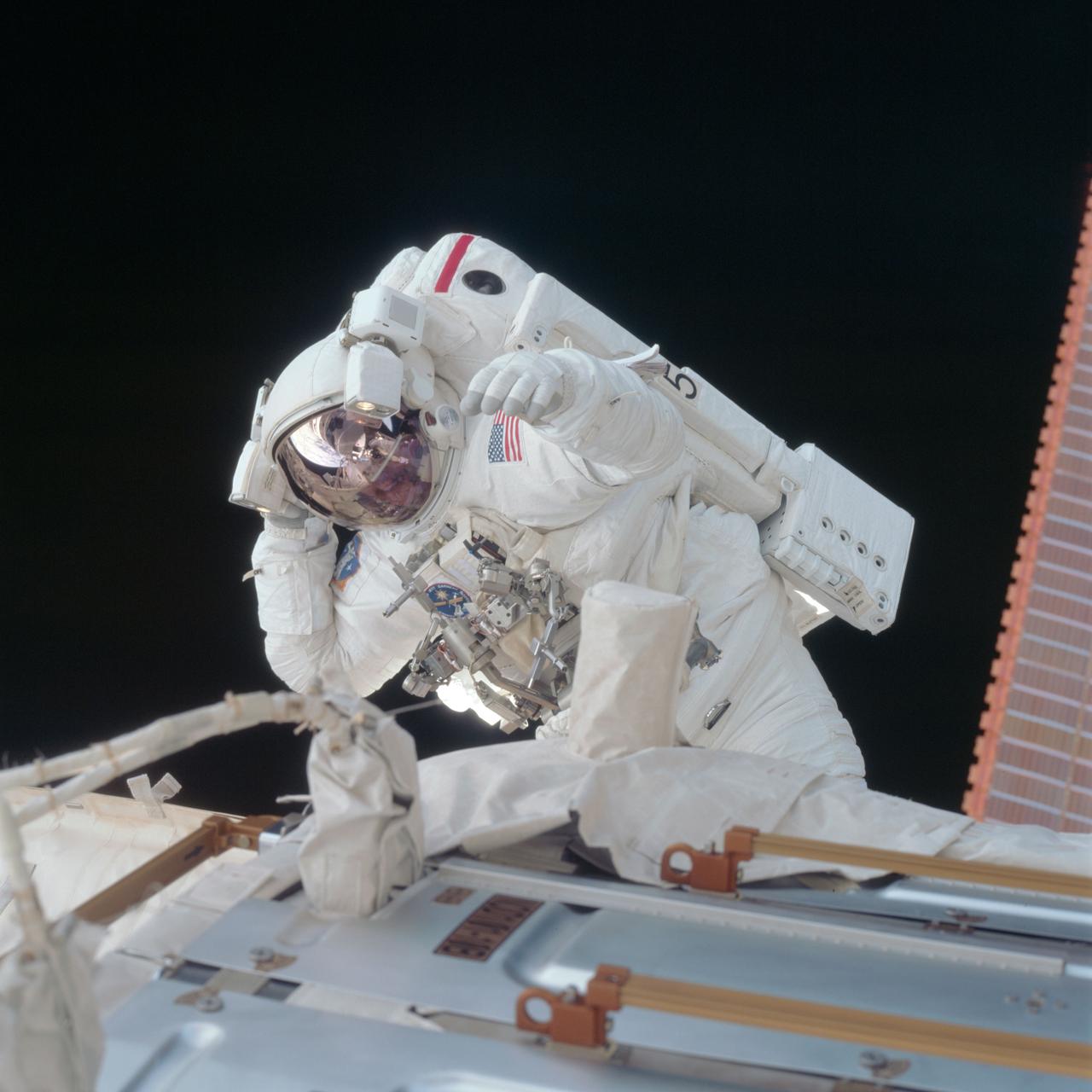
STS097-703-004 (7 December 2000) --- Astronaut Joseph R. Tanner participates in the December 7 extravehicular activity (EVA), one of three space walks involving him and astronaut Carlos I. Noriega. The photograph was taken by one of the non-EVA STS-97 crew members, using a 70mm camera.
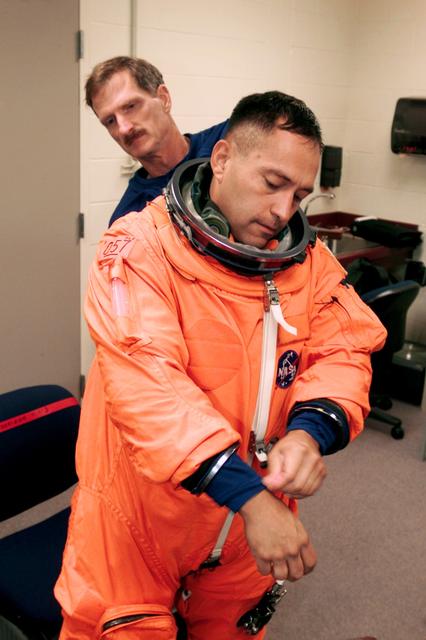
JSC2000-E-23529 (October 2000) --- Astronaut Joseph R. Tanner lends a helping hand to astronaut Carlos I. Noriega as the two STS-97 mission specialists prepare for a "dry run" going over launch procedures in a nearby simulator, in the Johnson Space Center's Systems Integration Facility.
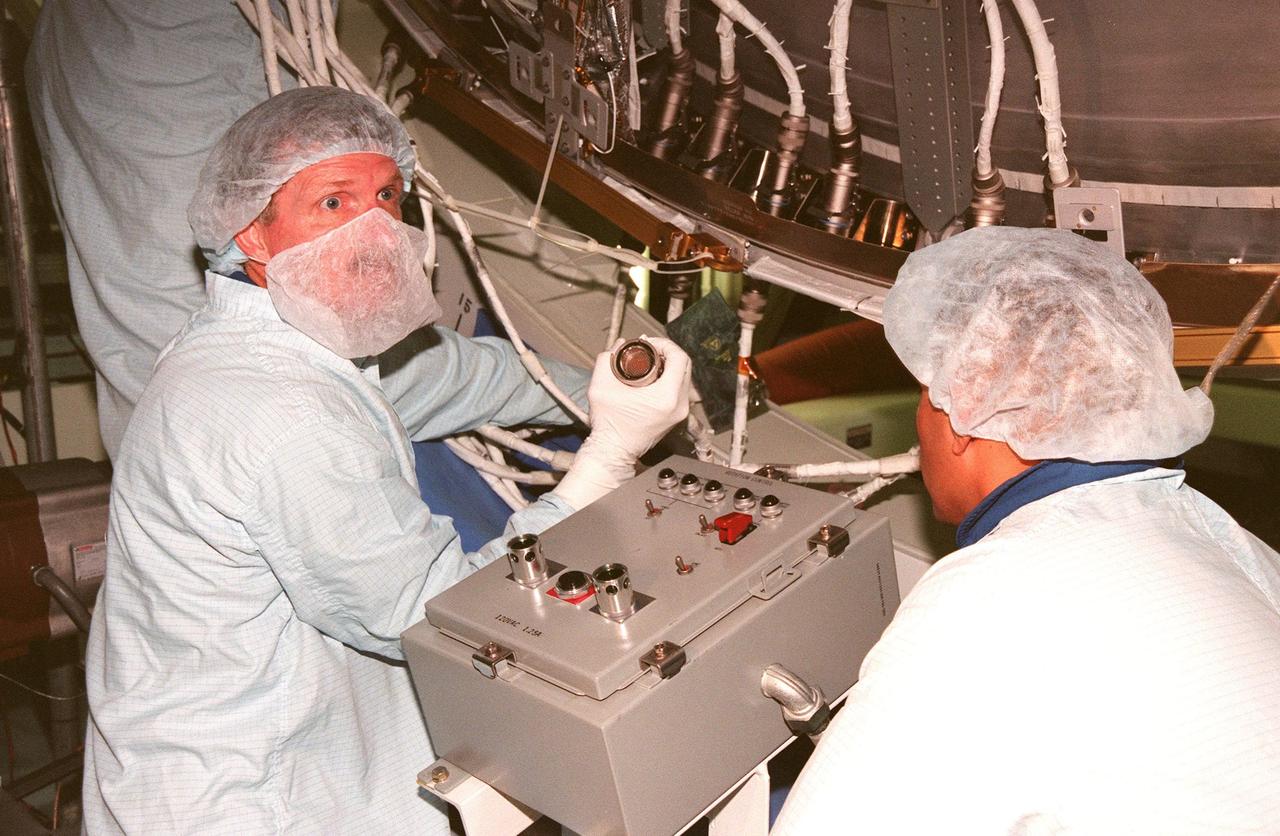
STS-97 Mission Specialists Joseph R. Tanner and Carlos I. Noriega check equipment of the International Space Station inside the Space Station Processing Facility. STS-97, targeted to launch on Aug. 5, 1999, is scheduled to carry integrated truss structure P6, photovoltaic module and radiators
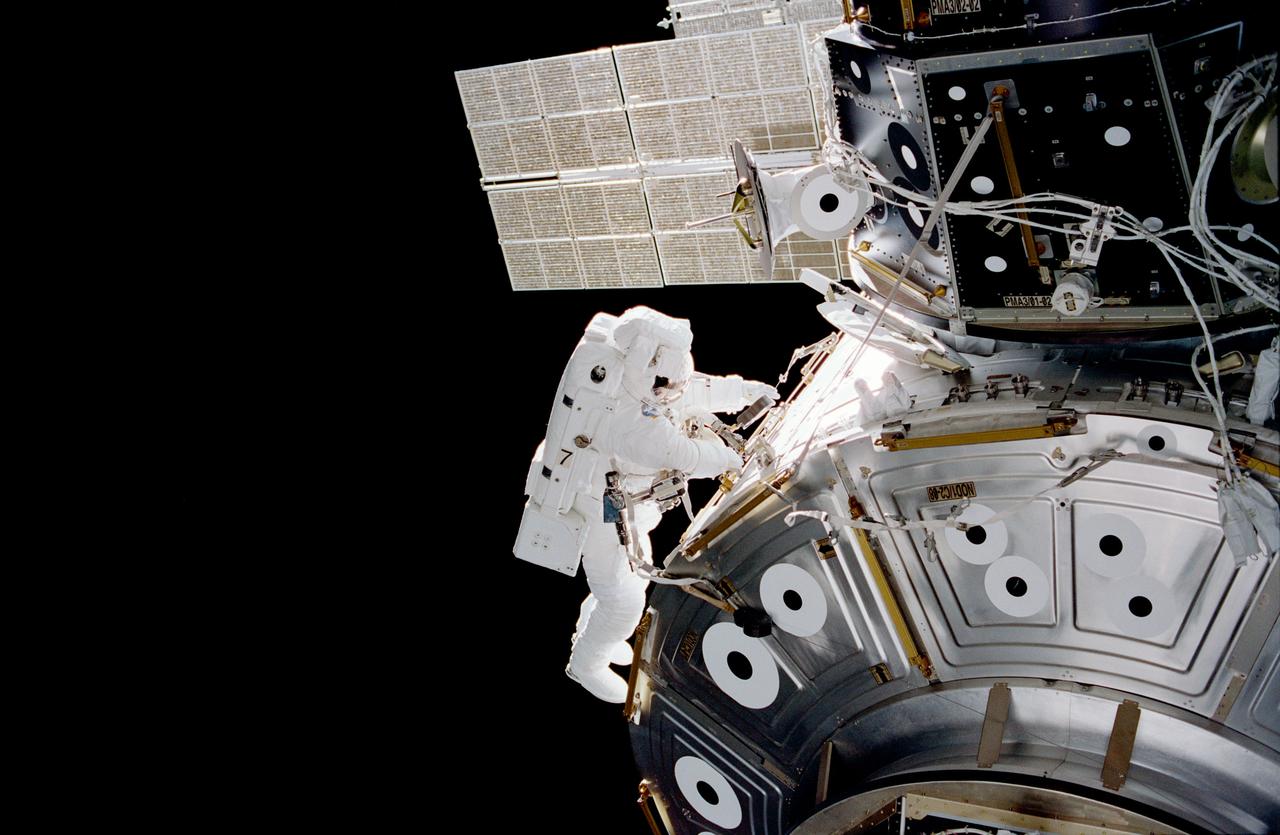
STS097-375-029 (5 December 2000) --- Astronaut Carlos I. Noriega, STS-97 mission specialist, works on the U.S.-built Unity node during the second of the flight’s three space walks on the International Space Station (ISS).
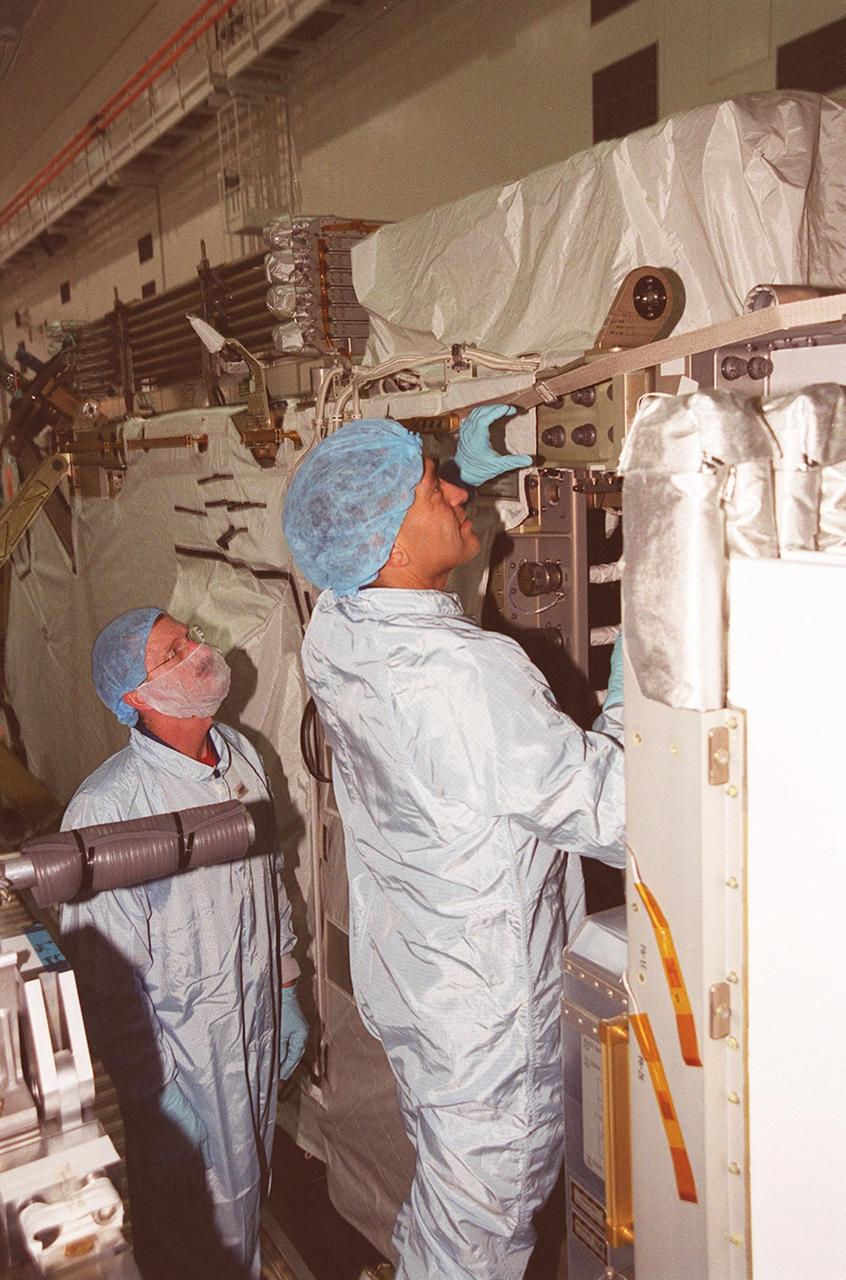
In the Space Station Processing Facility, STS-97 Mission Specialists Carlos Noriega (left) and Joe Tanner check out the mission payload, the P6 integrated truss segment. Mission STS-97 is the sixth construction flight to the International Space Station. The P6 comprises Solar Array Wing-3 and the Integrated Electronic Assembly, to be installed on the International Space Station. The Station’s electrical power system will use eight photovoltaic solar arrays, each 112 feet long by 39 feet wide, to convert sunlight to electricity. The solar arrays are mounted on a “blanket” that can be folded like an accordion for delivery. Once in orbit, astronauts will deploy the blankets to their full size. Gimbals will be used to rotate the arrays so that they will face the Sun to provide maximum power to the Space Station. The mission includes two spacewalks by Noriega and Tanner to complete the solar array connections. STS-97 is scheduled to launch Nov. 30 at about 10:06 p.m. EST
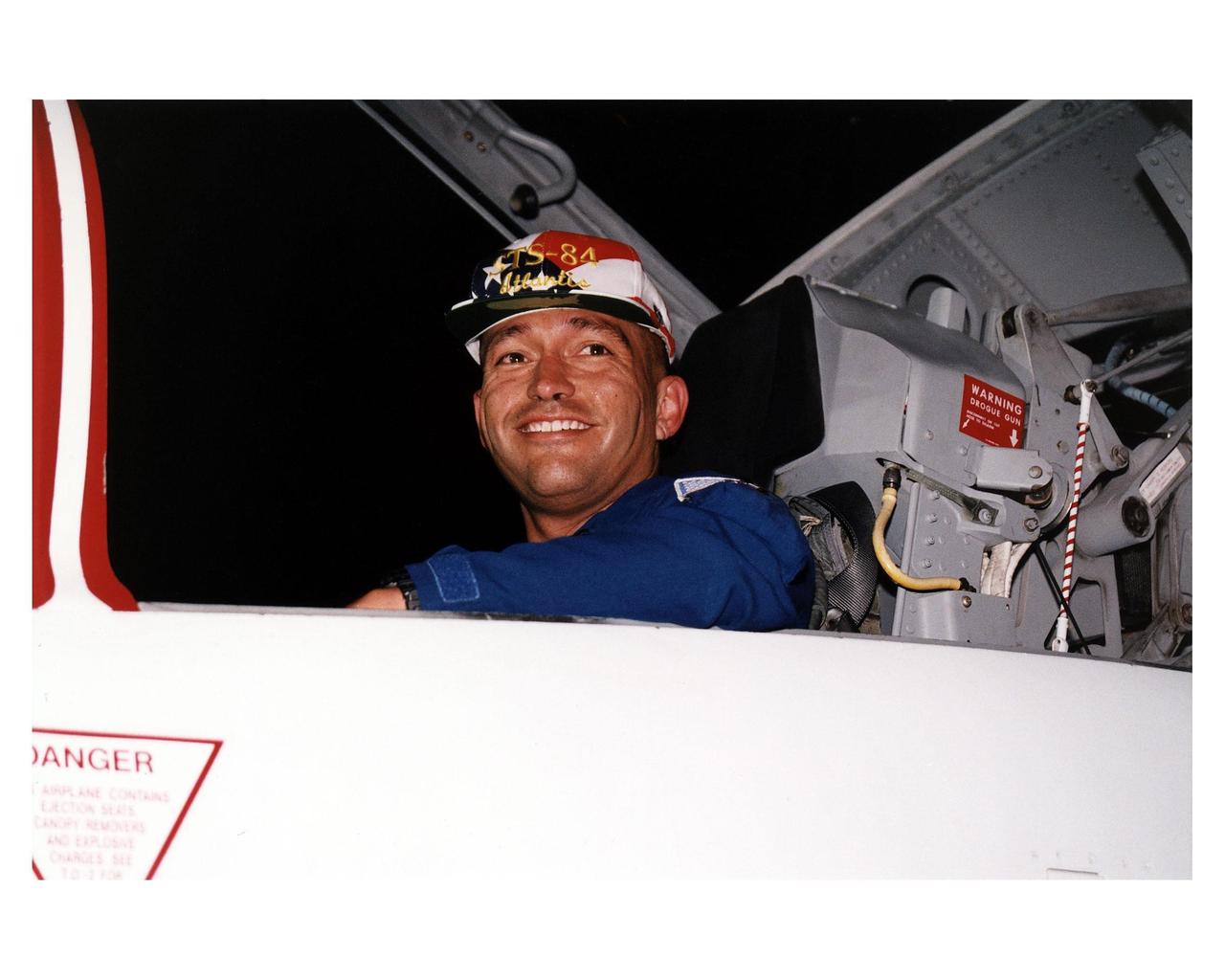
STS-84 Mission Specialist Carlos I. Noriega arrives in a T-38 jet at KSC’s Shuttle Landing Facility. The pilot of the plane is astronaut Frank Culbertson, who is the NASA director of the Phase One Program of the International Space Station. STS-84 will be Noriega’s first space flight. The nine-day mission will be the sixth docking of the Space Shuttle with the Russian Space Station Mir. During the docking, STS-84 Mission Specialist C. Michael Foale will transfer to the Russian space station to become a member of the Mir 23 crew, replacing U.S. astronaut Jerry M. Linenger, who will return to Earth on Atlantis. Foale is scheduled to remain on Mir about four months until his replacement arrives on STS-86 in September
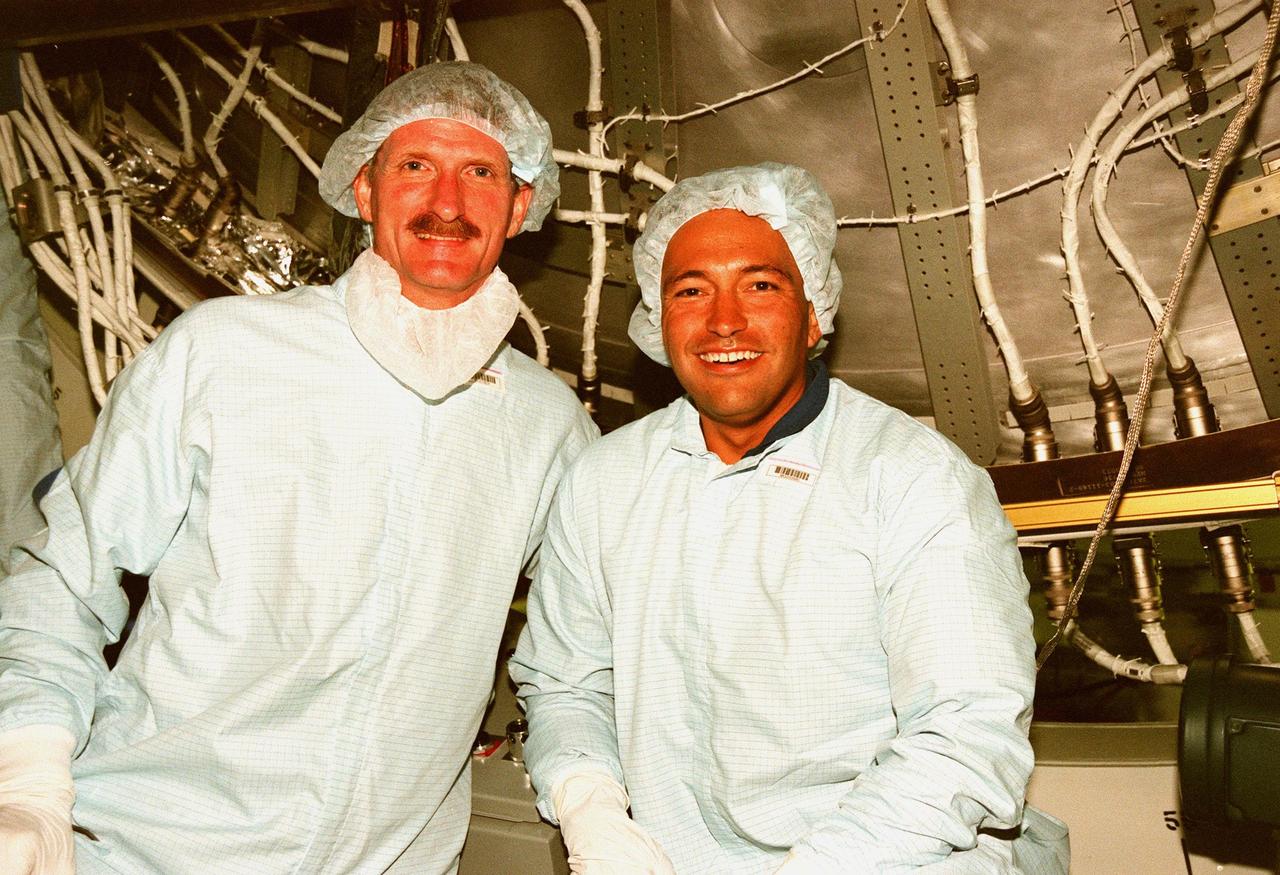
Inside the Space Station Processing Facility, STS-97 Mission Specialists Joseph R. Tanner and Carlos I. Noriega take a break from equipment check for the International Space Station . STS-97, the fourth ISS flight, is targeted to launch on Aug. 5, 1999. It is scheduled to carry integrated truss structure P6, photovoltaic module and radiators
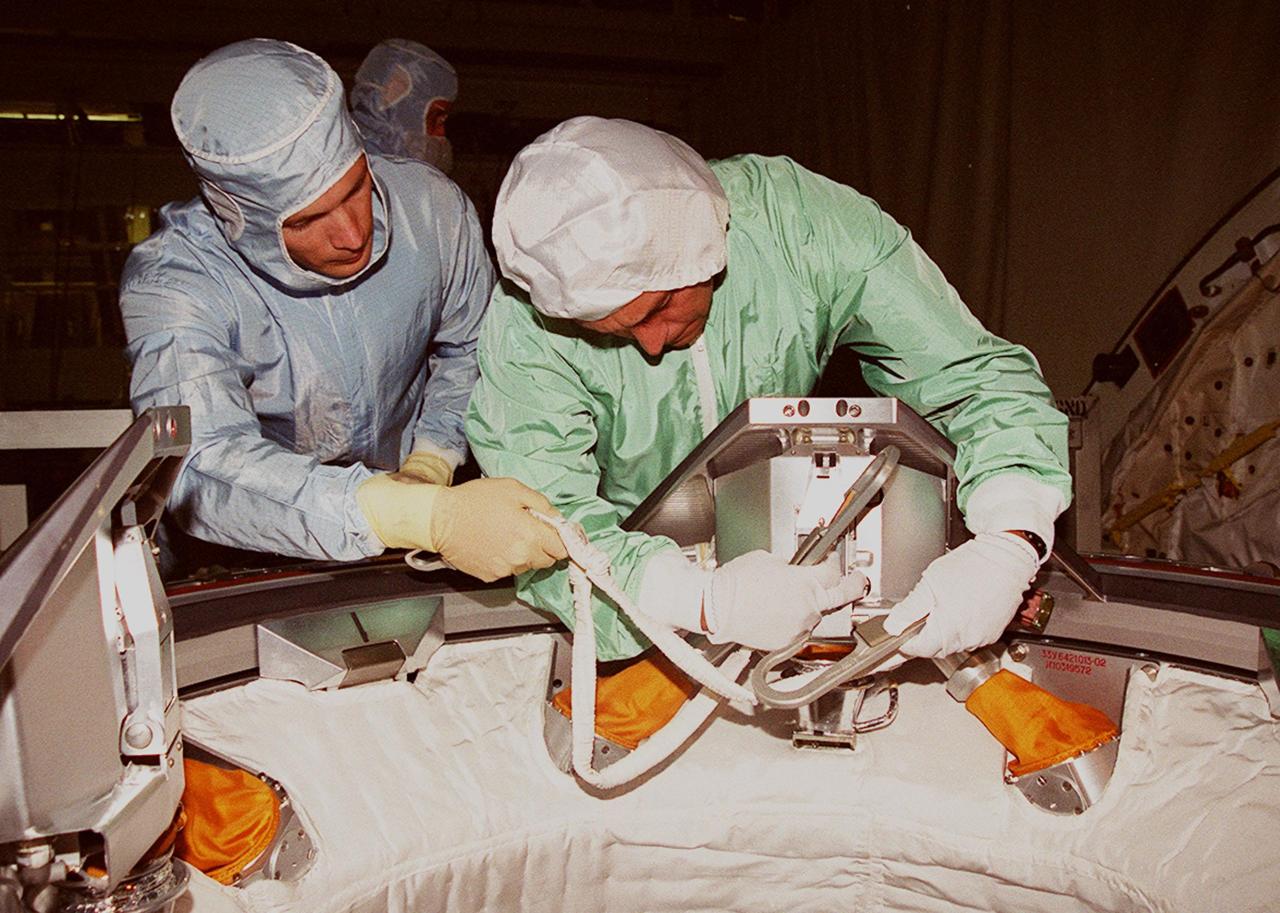
During the STS-97 Crew Equipment Interface Test (CEIT), Mission Specialist Carlos Noriega (right) gets hands-on experience with parts of the Orbital Docking System in Endeavour’s payload bay. The CEIT provides an opportunity for crew members to check equipment and facilities that will be on board the orbiter during their mission. The STS-97 mission will be the sixth construction flight to the International Space Station. The payload includes a photovoltaic (PV) module, providing solar power to the Station. STS-97 is scheduled to launch Nov. 30 from KSC for the 10-day mission
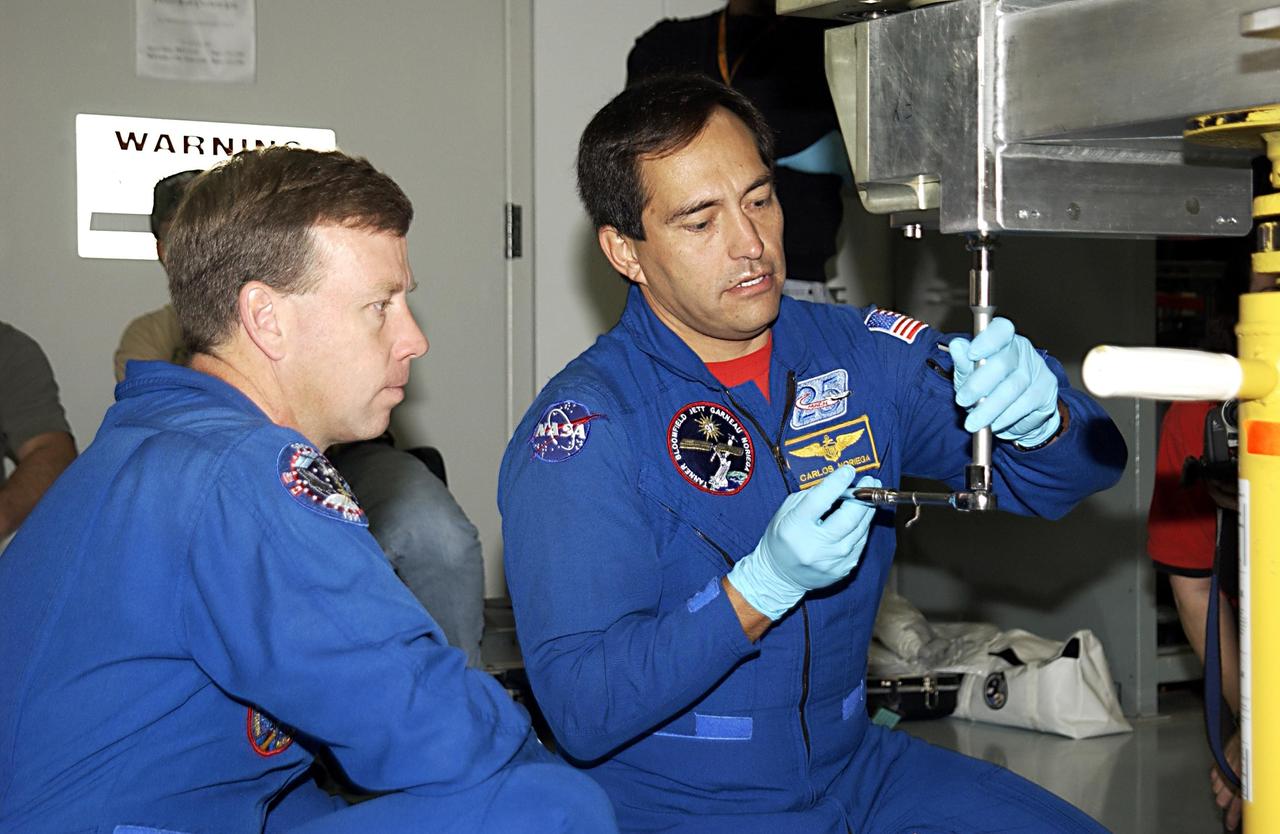
KENNEDY SPACE CENTER, FLA. - During a Crew Equipment Interface Test activity, STS-119 Commander Steven Lindsey watches as Mission Specialist Carlos Noriega works with a tool on the equipment that will be part of the mission. Scheduled to launch in January 2004, the mission will deliver the fourth and final set of U.S. solar arrays along with the fourth starboard truss segment, the S6 truss.
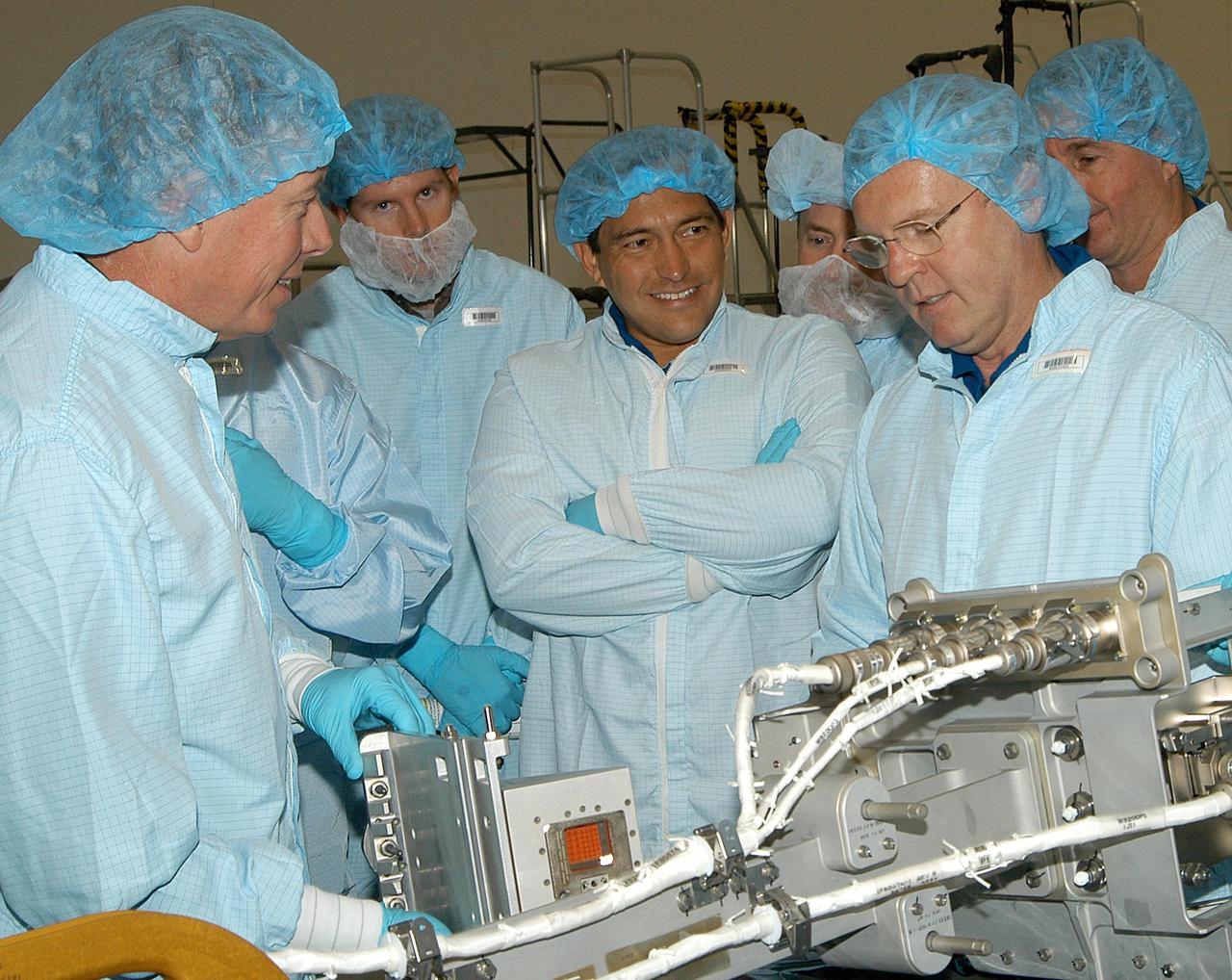
KENNEDY SPACE CENTER, FLA. - In the Space Station Processing Facility, members of several Space Shuttle mission crews get a close look at the Video Stanchion Support Assembly (VSSA) that will fly on STS-114 (Logistics Flight 1). At left is STS-116 Mission Specialist Christer Fuglesang (European Space Agency), at center is STS-121 Mission Specialist Carlos Noriega, and at right is STS-114 Mission Specialist Andrew Thomas. The crews are at KSC for equipment familiarization.
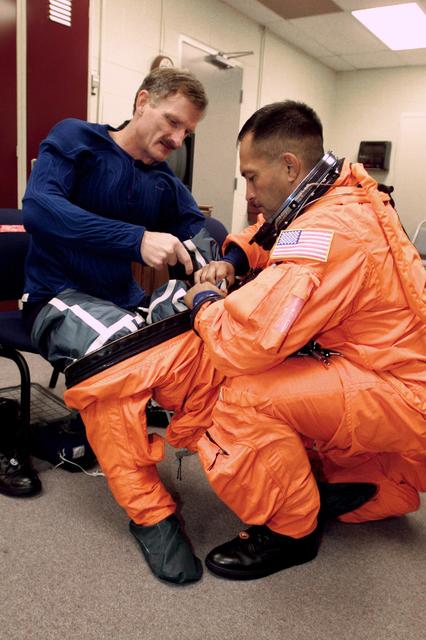
JSC2000-E-23530 (October 2000) --- Astronaut Joseph R. Tanner receives a helping hand from astronaut Carlos I. Noriega as the two STS-97 mission specialists don training versions of their pressure ascent and entry garments. The two were about to participate in a simulation of various parts of their scheduled November mission aboard the Space Shuttle Endeavour.
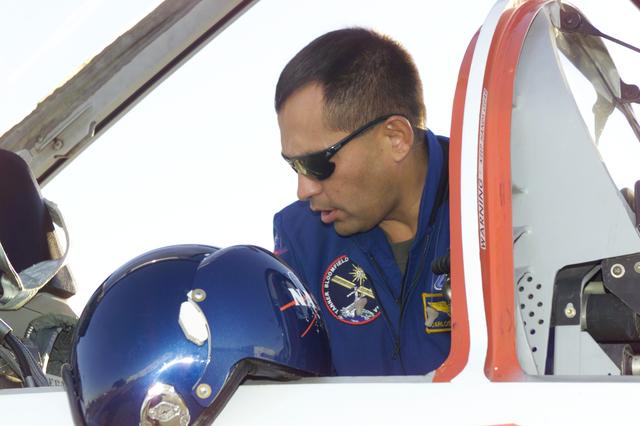
JSC2000-E-29120 (27 November 2000) --- Astronaut Carlos I. Noriega, STS-97 mission specialist, climbs into the cockpit of a NASA T-38 jet trainer at Ellington Field. The five-member crew was minutes away from departure to Florida, where it will continue preparations for launch later this week aboard the Space Shuttle Endeavour.
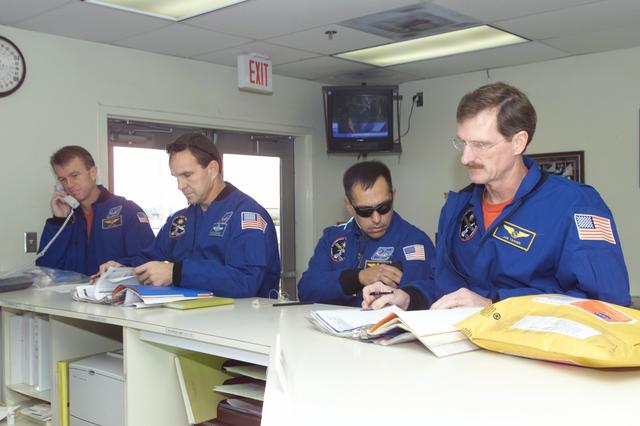
JSC2000-E-29119 (27 November 2000) --- Performing final tasks prior to leaving Ellington Field for Florida are four members of the STS-97 crew. From the left are astronauts Brent W. Jett, Jr., Michael J. Bloomfield, Carlos I. Noriega and Joseph R. Tanner. Marc Garneau, who represents the Canadian Space Agency (CSA), is not pictured. Launch from Florida's Kennedy Space Center (KSC) is scheduled for November 30.
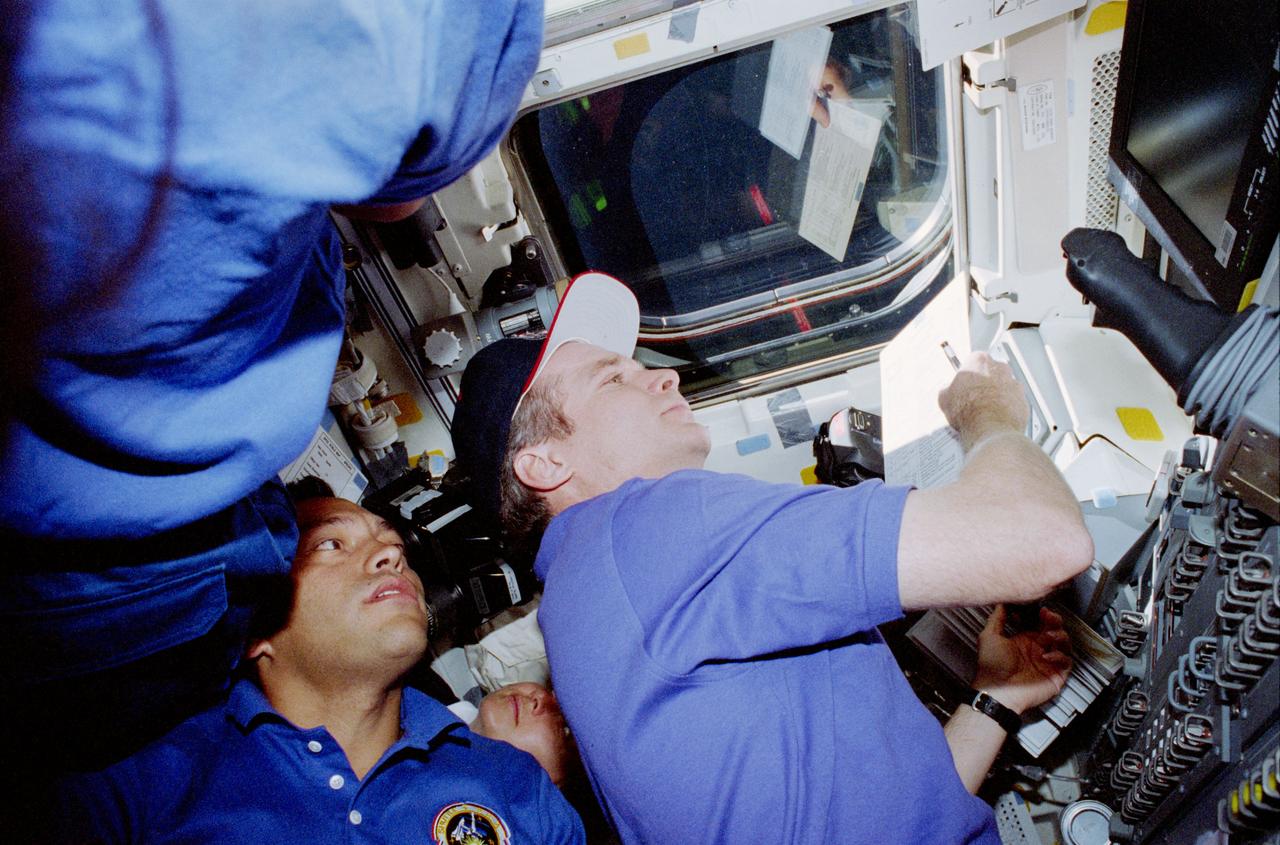
STS084-357-015 (15-24 May 1997) --- Astronaut Charles J. Precourt (right), STS-84 commander, controls the rate of the Space Shuttle Atlantis' approach to Russia's Mir Space Station during rendezvous operations. Carlos I. Noriega (left), Elena V. Kondakova (bottom center) and an unidentified crew member (far left) crowd into the scene -- typical of the busy rendezvous in-cabin scenarios on all Mir-Atlantis missions.
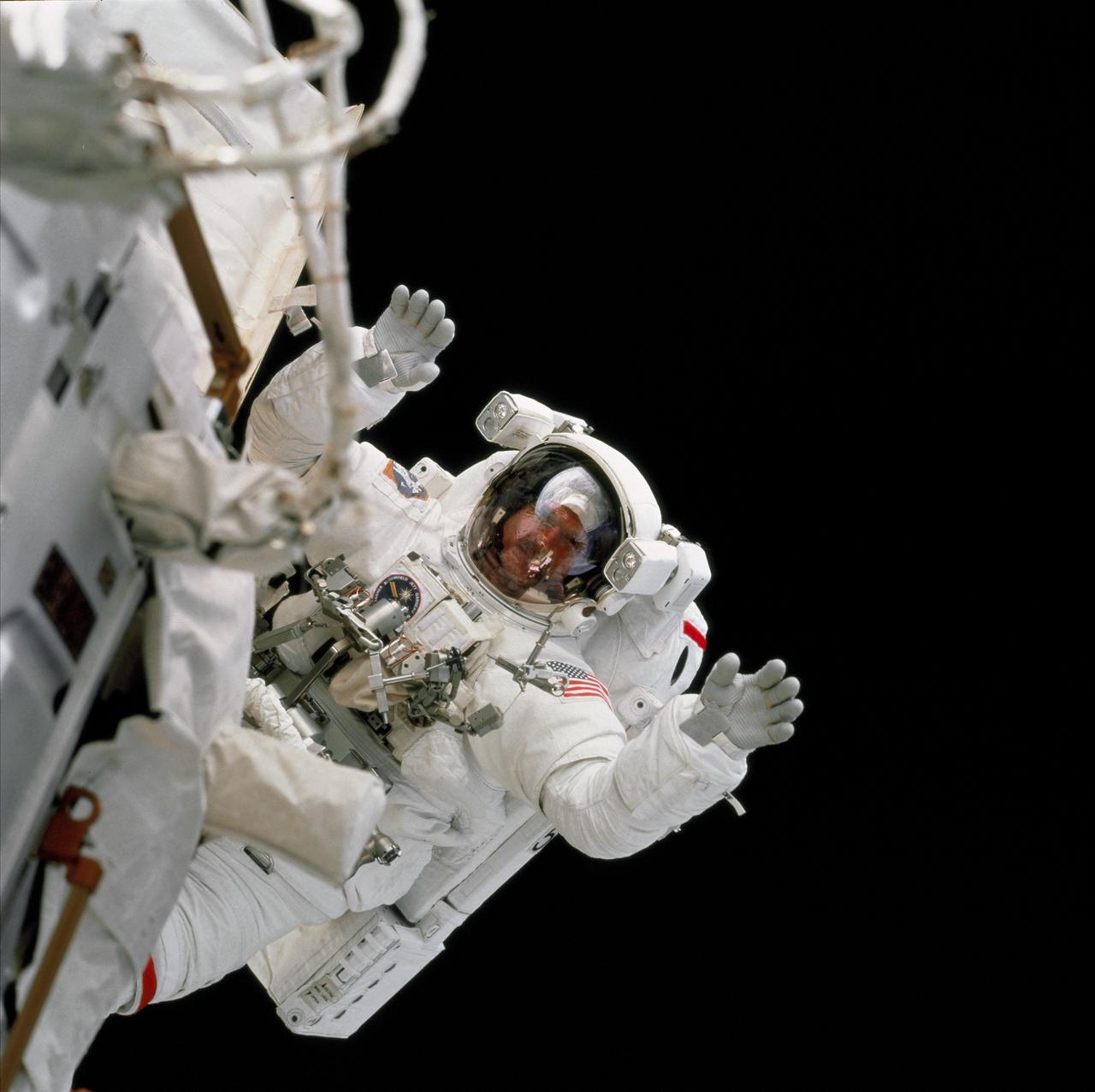
STS097-703-011 (7 December 2000) --- Astronaut Joseph R. Tanner waves to his cabin-bound crewmates during the December 7 extravehicular activity (EVA), one of three space walks involving him and astronaut Carlos I. Noriega. The photograph was taken by one of the non-EVA STS-97 crew members, using a 70mm camera.
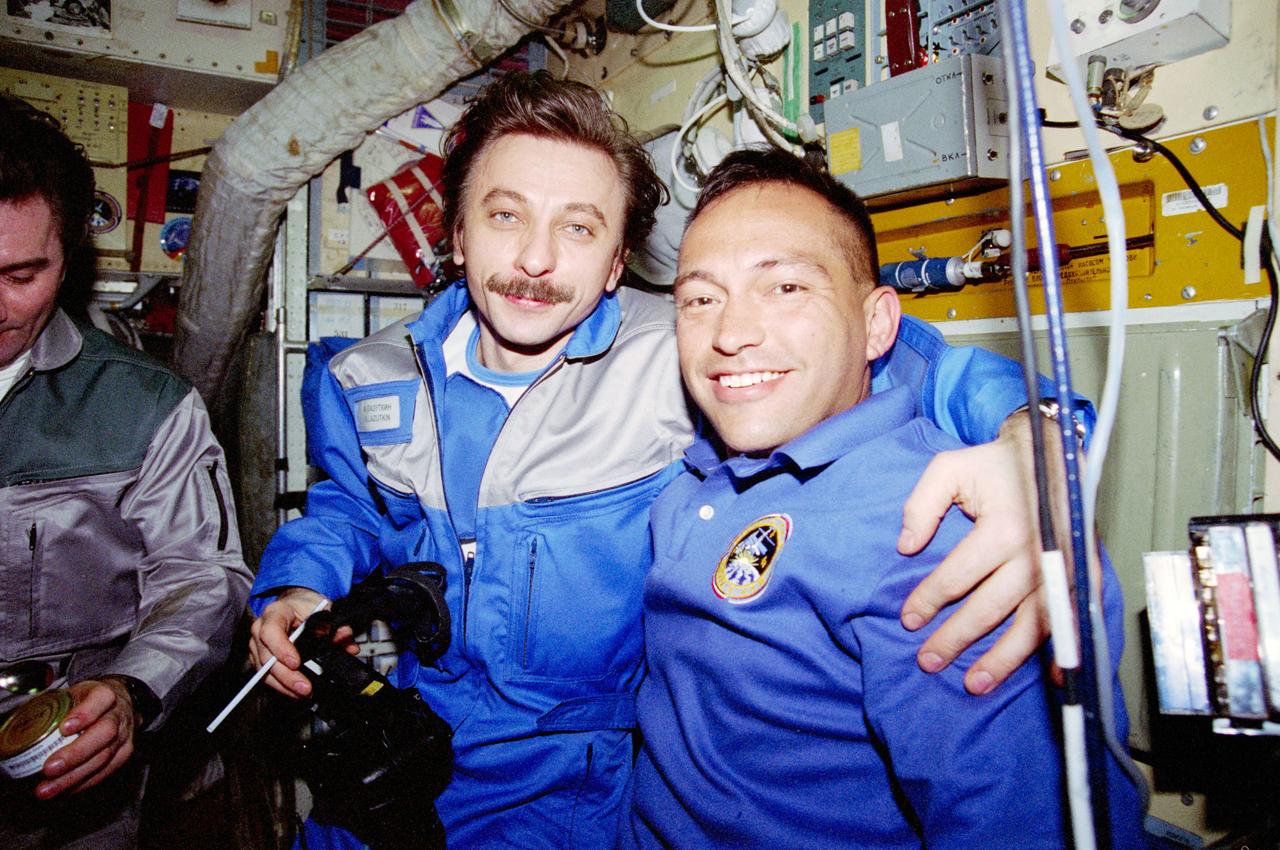
STS084-360-010 (15-24 May 1997) --- On Russia's Mir Space Station's Base Block, Mir-23 flight engineer Aleksandr I. Lazutkin greets his STS-84 counterpart, Carlos I. Noriega, soon after hatch opening. Partially visible at left is Vasili V. Tsibliyev, Mir-23 commander.
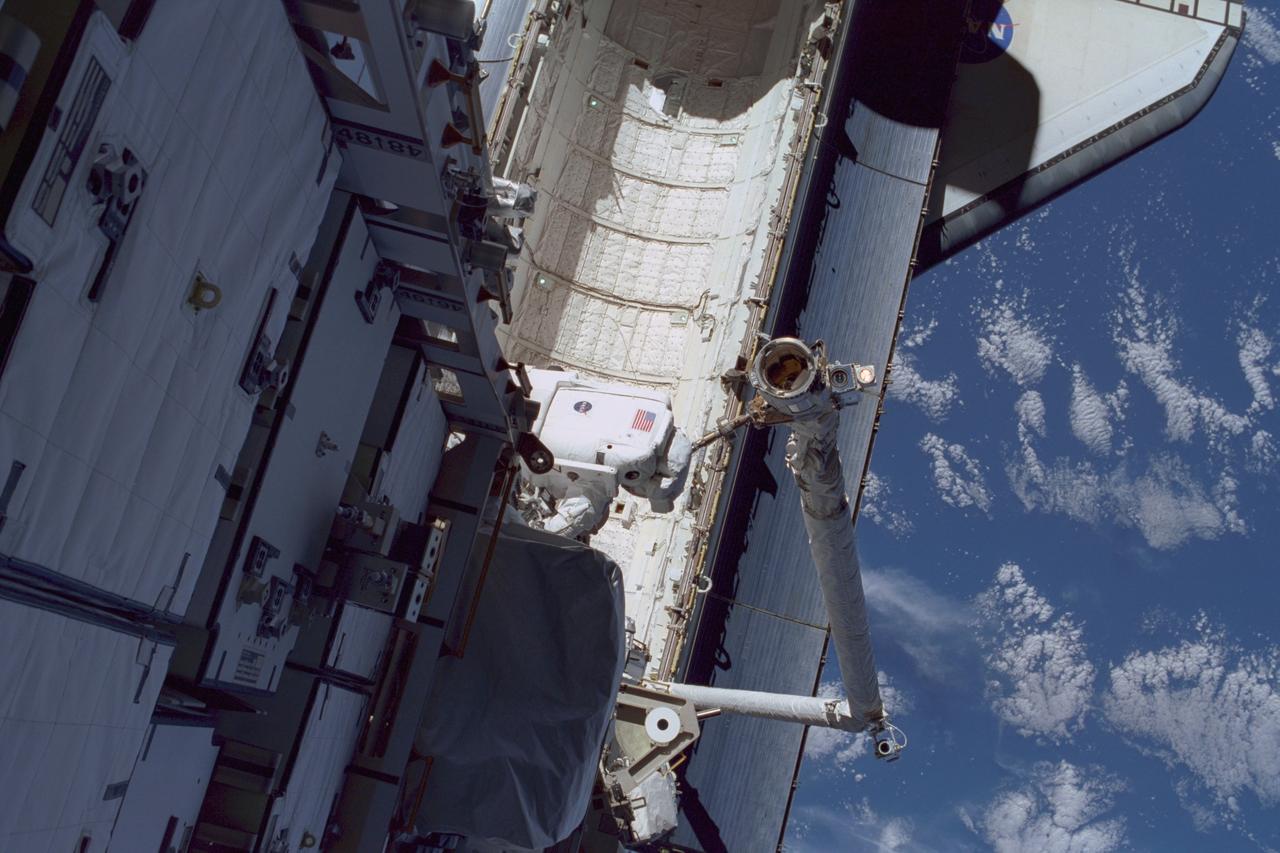
STS097-374-020 (3 December 2000) --- This high angle view shows astronaut Carlos I. Noriega, STS-97 mission specialist, traversing over Endeavour's cargo bay during the flight's first space walk on Dec. 3, 2000. Astronaut Joseph R. Tanner, mission specialist, was near the top of the P6 truss structure when he exposed the 35mm frame. The Canadian-built Remote Manipulator System (RMS) arm can be seen at bottom right.
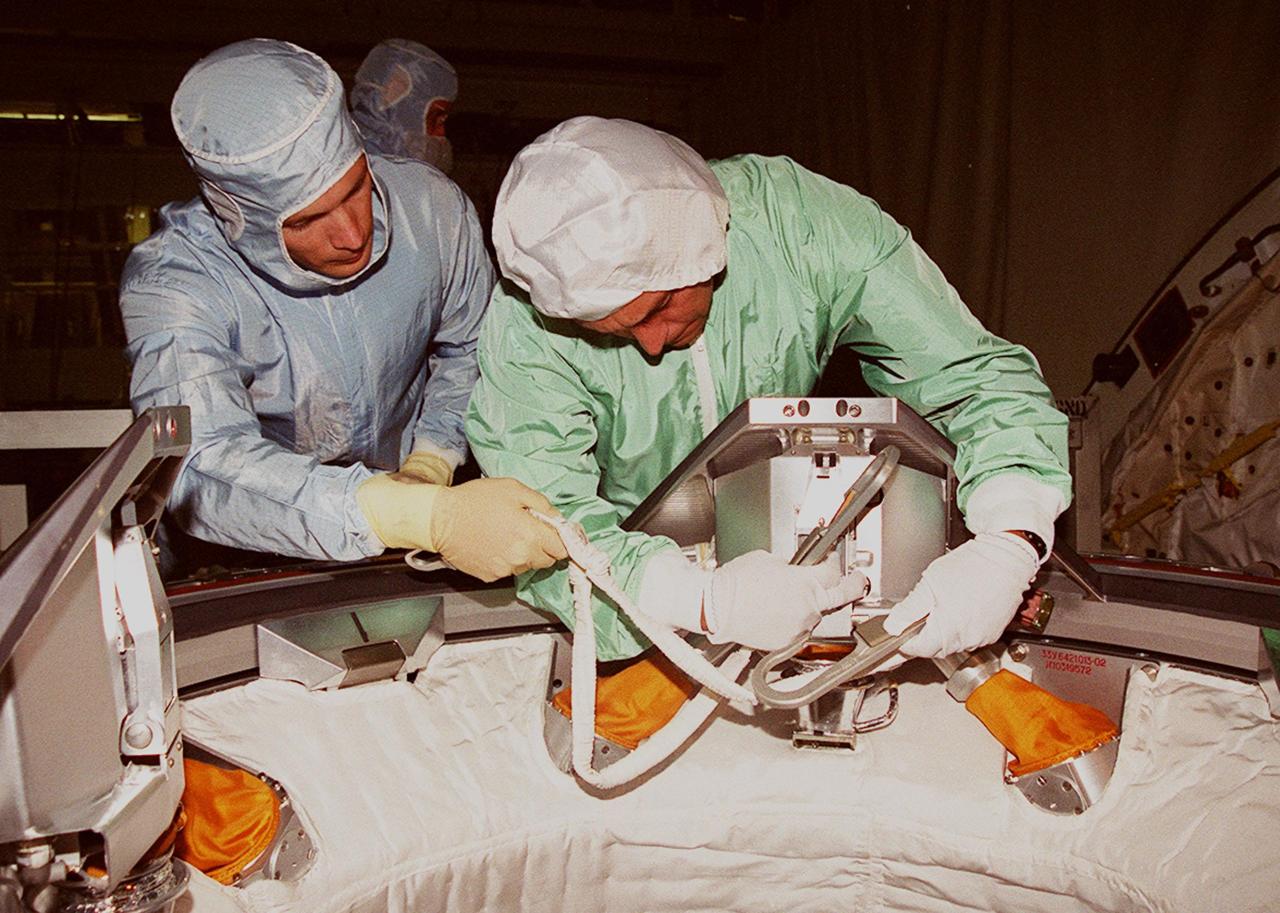
During the STS-97 Crew Equipment Interface Test (CEIT), Mission Specialist Carlos Noriega (right) gets hands-on experience with parts of the Orbital Docking System in Endeavour’s payload bay. The CEIT provides an opportunity for crew members to check equipment and facilities that will be on board the orbiter during their mission. The STS-97 mission will be the sixth construction flight to the International Space Station. The payload includes a photovoltaic (PV) module, providing solar power to the Station. STS-97 is scheduled to launch Nov. 30 from KSC for the 10-day mission
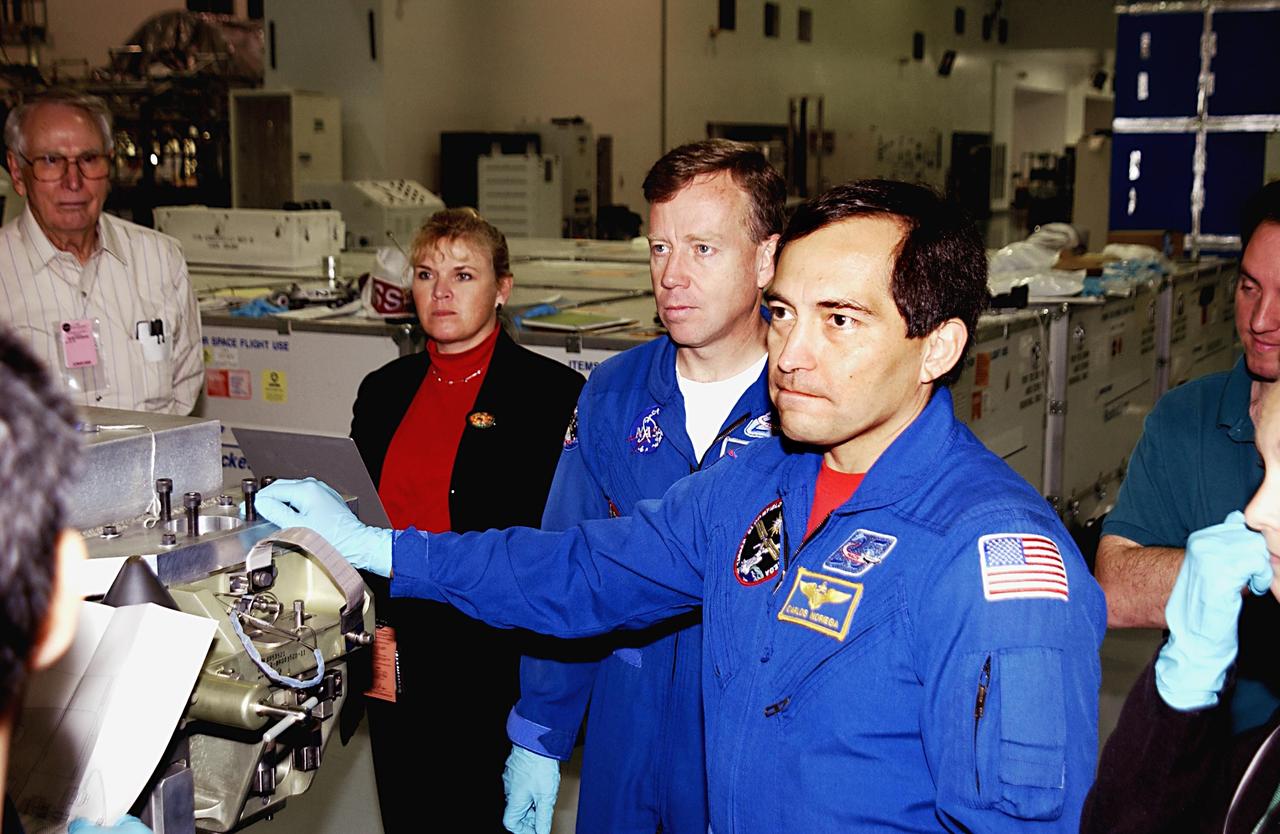
KENNEDY SPACE CENTER, FLA. - During a Crew Equipment Interface Test activity, STS-119 Commander Steven Lindsey (center) and Mission Specialist Carlos Noriega (right) listen to instructions on the equipment that will be part of the mission. Scheduled to launch in January 2004, the mission will deliver the fourth and final set of U.S. solar arrays along with the fourth starboard truss segment, the S6 truss.
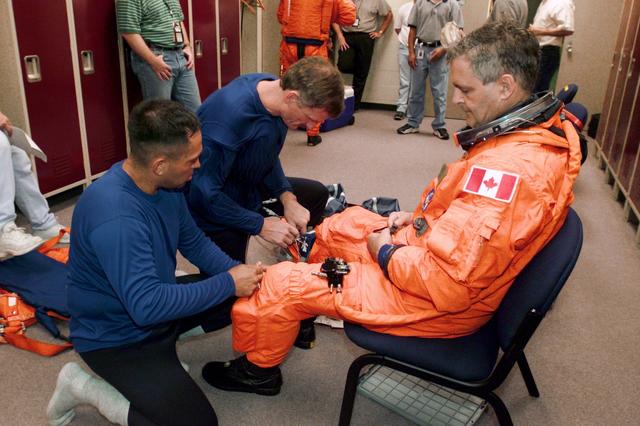
JSC2000-E-23527 (October 2000) --- Astronaut Marc Garneau, mission specialist representing the Canadian Space Agency (CSA), looks on as two crew mates assist him with final touches of suit-donning prior to a training session in the Johnson Space Center's Systems Integration Facility. Helping out are astronauts Carlos I. Noriega (left) and Joseph R. Tanner, mission specialists.
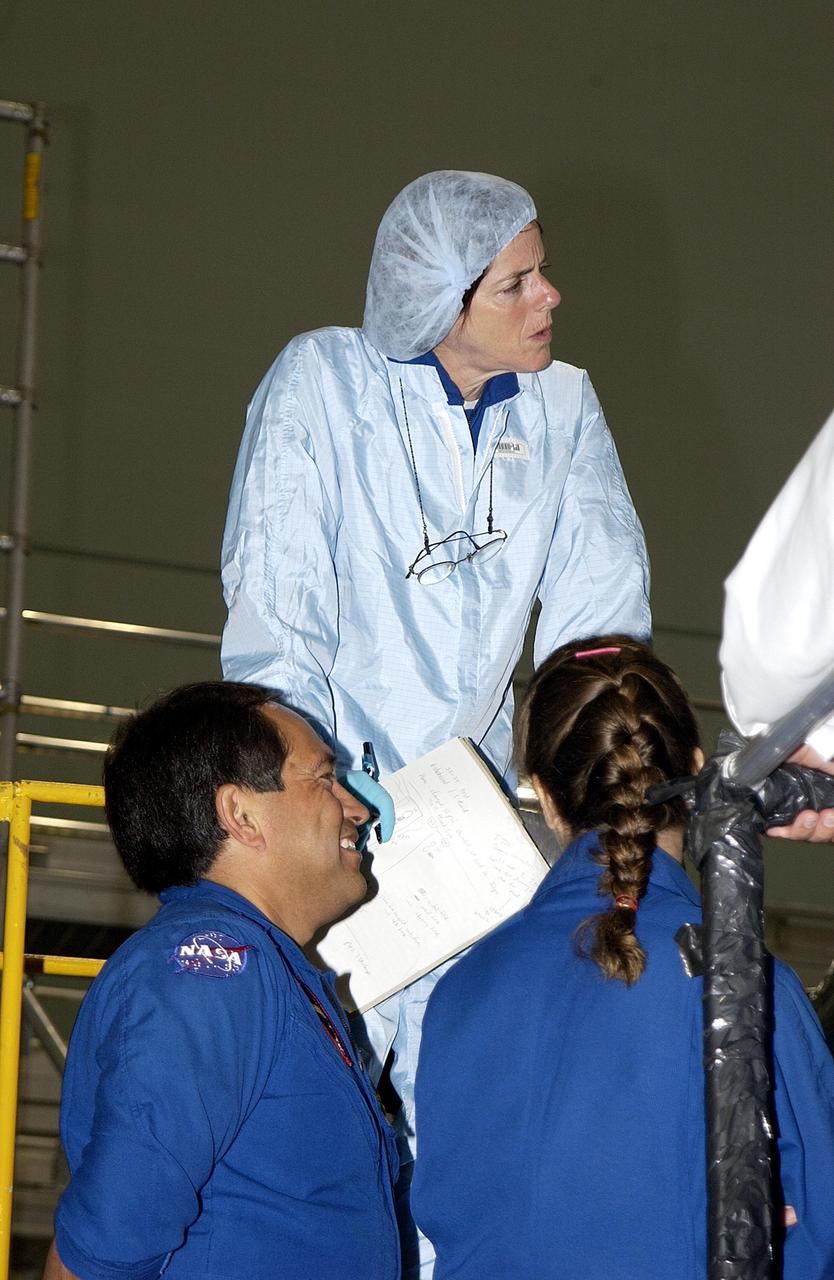
KENNEDY SPACE CENTER, FLA. - In the Space Station Processing Facility, the STS-118 crew take part in training on equipment for their mission. Mission Specialist Barbara Morgan (above) looks at equipment. Below are STS-119 Mission Specialist Carlos Noriega (left) and STS-118 Mission Specialist Lisa Nowak. The STS-118 mission will be delivering the third starboard truss segment, the ITS S5, to the International Space Station, and a SPACEHAB Single Cargo Module with supplies and equipment. Launch date is under review.
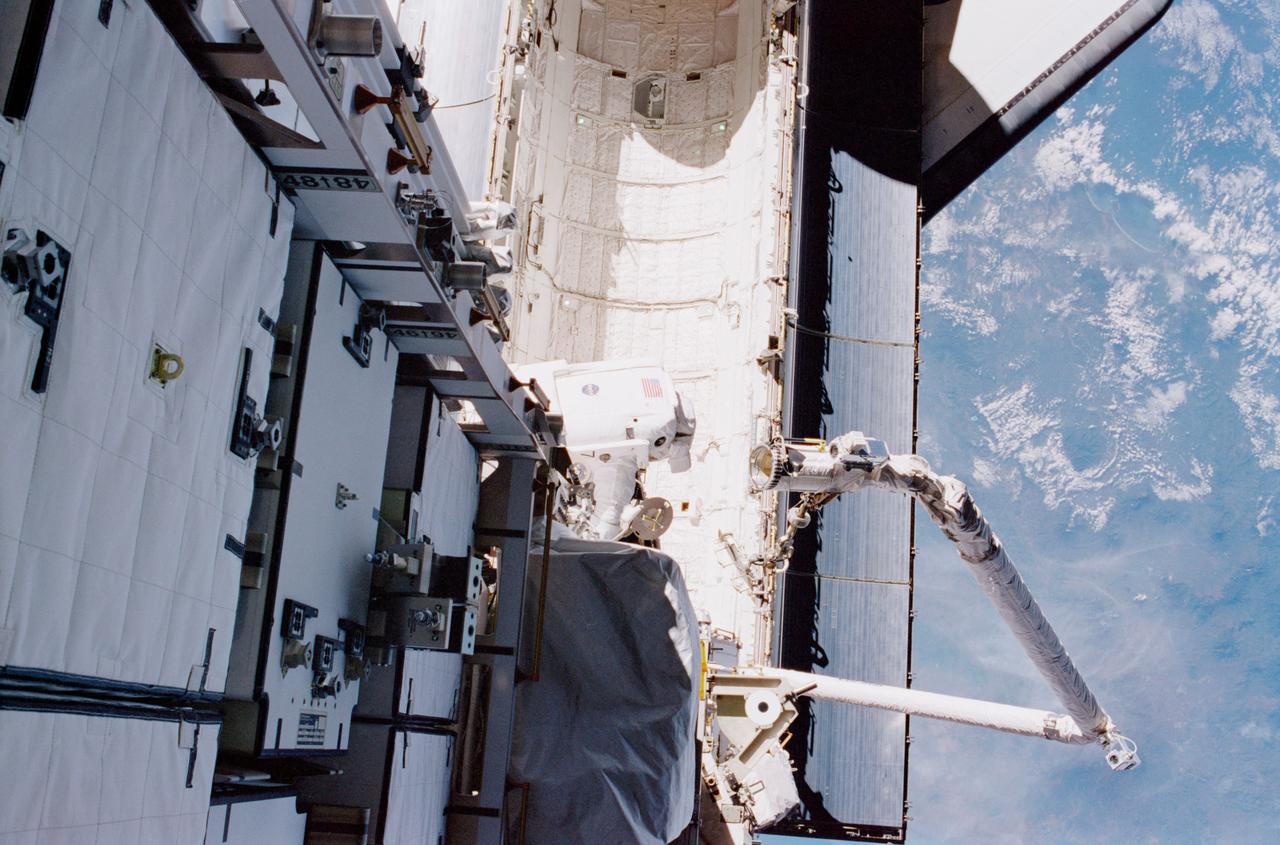
STS097-374-015 (5 December 2000) --- This high angle view shows astronaut Carlos I. Noriega, STS-97 mission specialist, traversing over Endeavour's cargo bay during the flight's first space walk on Dec. 5, 2000. Astronaut Joseph R. Tanner, mission specialist, was near the top of the P6 truss structure when he exposed the 35mm frame. The Canadian-built Remote Manipulator System (RMS) arm, instrumental in the current operations, can be seen at bottom right.
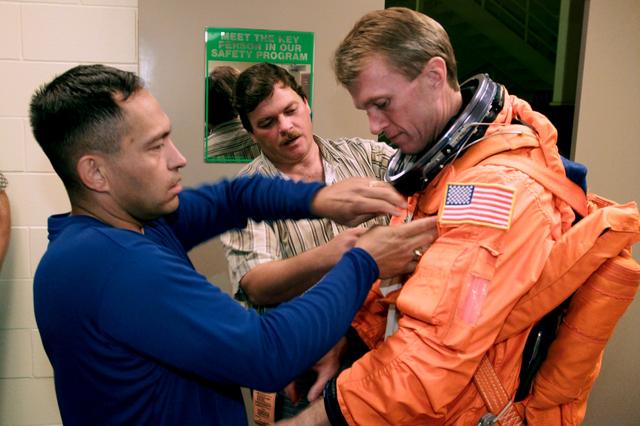
JSC2000-E-23526 (October 2000) --- Astronaut Carlos I. Noriega, attired in a blue thermal undergarment, and USA suit technician Mike Birkenseher help astronaut Brent W. Jett, STS-97 mission commander, with final touches of suit donning. The five STS-97 crew members were participating in a training session for their scheduled November launch aboard the Space Shuttle Endeavour.
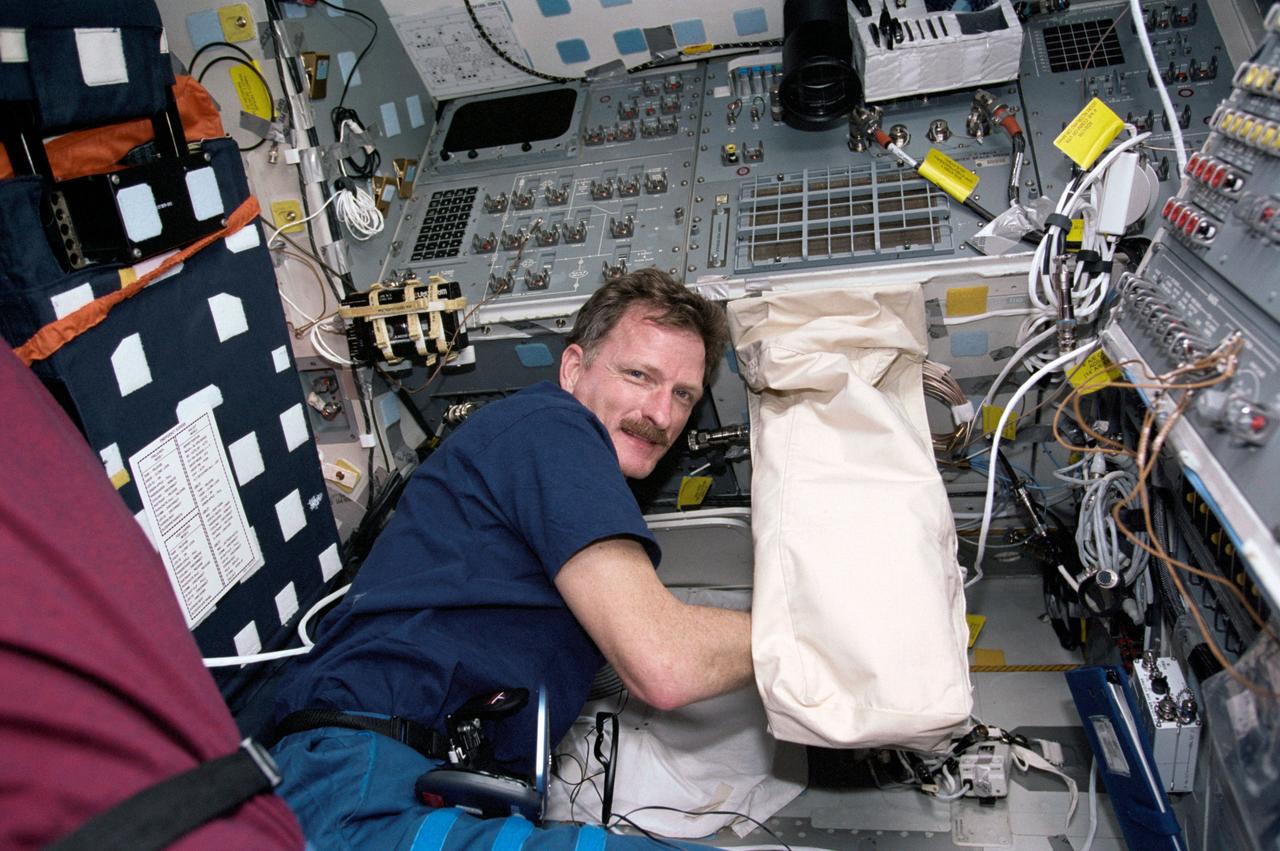
STS097-321-010 (30 Nov.-11 Dec. 2000) --- Astronaut Joseph R. Tanner is pictured on the aft flight deck of the Space Shuttle Endeavour during the STS-97 mission. In addition to a great deal of intravehicular work, astronauts Tanner and Carlos I. Noriega participated in three space walks during the flight to perform work on the International Space Station (ISS).
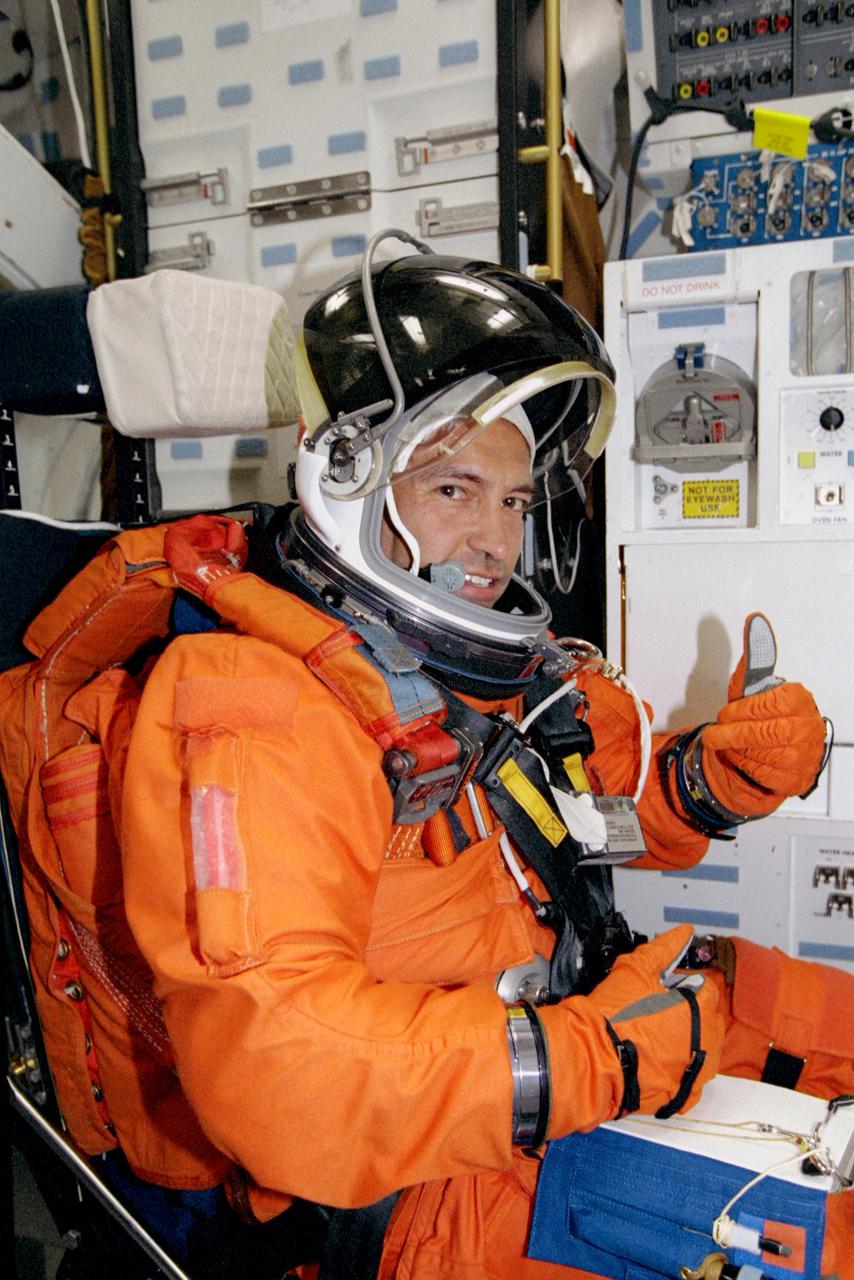
JSC2000-04752 (15 June 2000) --- Positioned in a removable seat on a simulated mid deck, astronaut Carlos I. Noriega, mission specialist, gives the thumbs-up signal during a "dry run" for launch and entry procedures. The training took place in the Crew Compartment Trainer (CCT-2) in the Johnson Space Center's Systems Integrtion Facility.
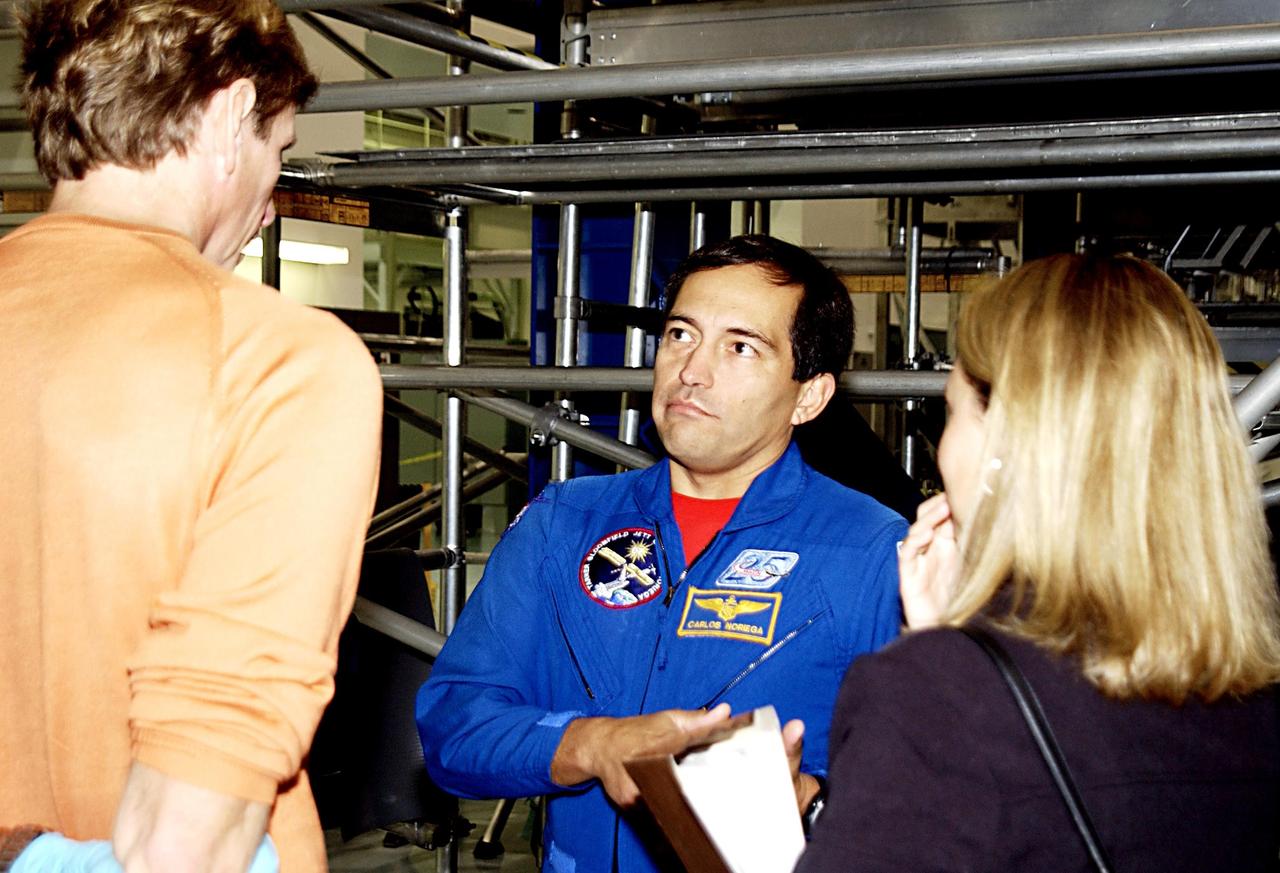
KENNEDY SPACE CENTER, FLA. - STS-119 Mission Specialists Carlos Noriega (center) and Michael Gernhardt (left) discuss mission information during a Crew Equipment Interface Test activity. The mission will deliver the fourth and final set of U.S. solar arrays along with the fourth starboard truss segment, the S6 truss. Mission STS-119 is scheduled to launch in January 2004.
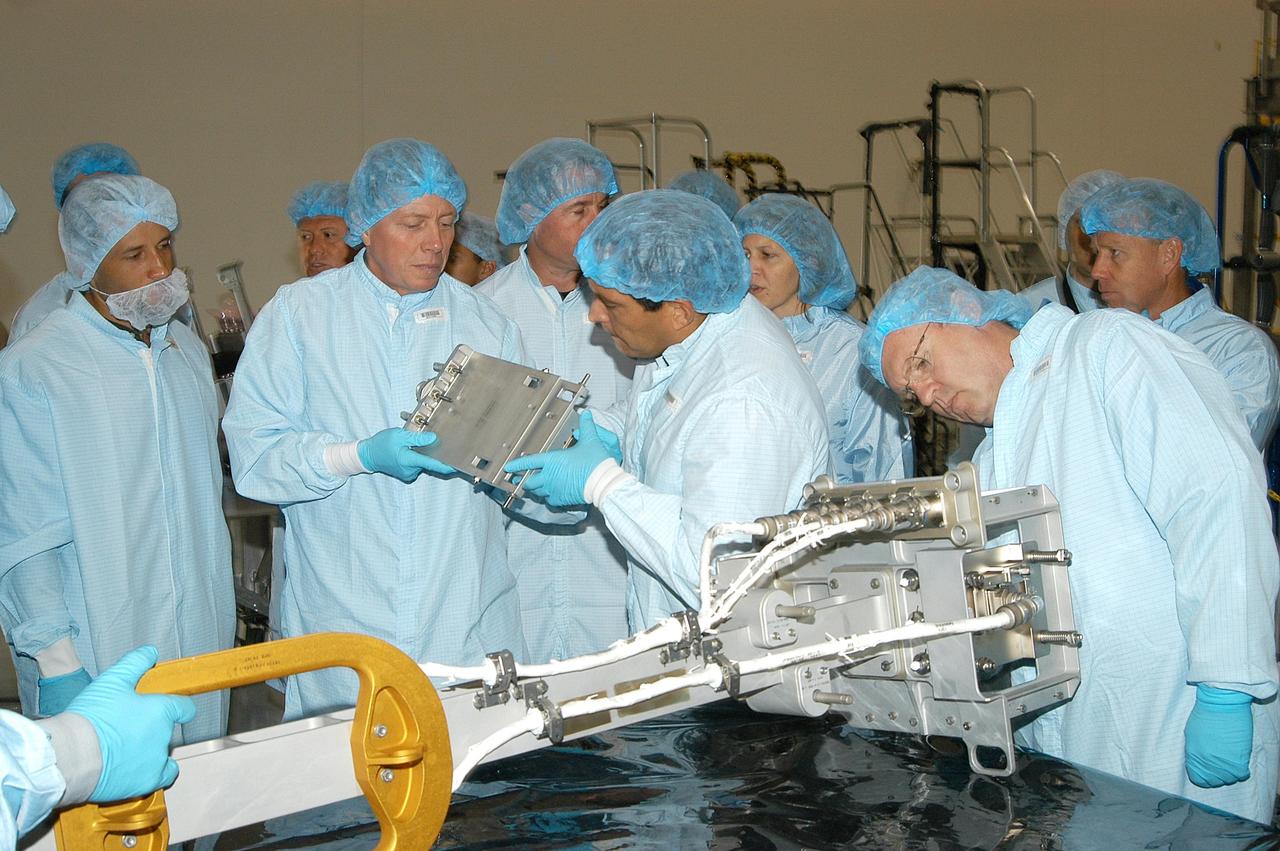
KENNEDY SPACE CENTER, FLA. - In the Space Station Processing Facility, members of several Space Shuttle mission crews get a close look at the Video Stanchion Support Assembly (VSSA) that will fly on STS-114 (Logistics Flight 1). Holding one piece at left are STS-116 Mission Specialist Christer Fuglesang (European Space Agency) and STS-121 Mission Specialist Carlos Noriega. Looking at the VSSA on the table is STS-114 Mission Specialist Andrew Thomas. The crews are at KSC for equipment familiarization.

KENNEDY SPACE CENTER, FLA. - The mission STS-119 crew talk about the mission during a Crew Equipment Interface Test activity. From the left are Mission Specialist Michael Gernhardt, Commander Steven Lindsey, Pilot Mark Kelly and Mission Carlos Noriega. The mission will deliver the fourth and final set of U.S. solar arrays along with the fourth starboard truss segment, the S6 truss. Mission STS-119 is scheduled to launch in January 2004.
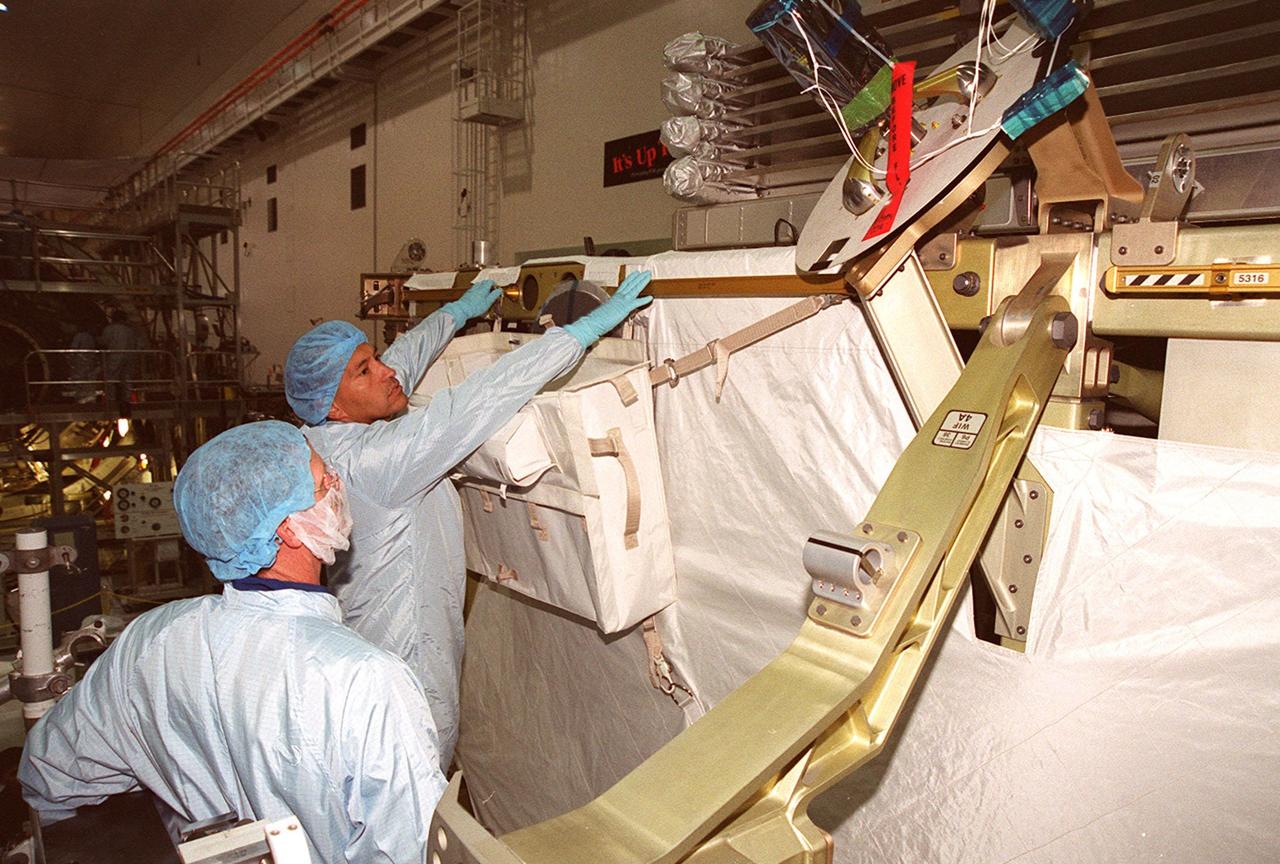
KENNEDY SPACE CENTER, FLA. -- In the Space Station Processing Facility, STS-97 Mission Specialist Carlos Noriega checks out the mission payload, the P6 integrated truss segment, while Mission Specialist Joe Tanner looks on. Mission STS-97 is the sixth construction flight to the International Space Station. The P6 comprises Solar Array Wing-3 and the Integrated Electronic Assembly, to be installed on the International Space Station. The Station’s electrical power system will use eight photovoltaic solar arrays, each 112 feet long by 39 feet wide, to convert sunlight to electricity. The solar arrays are mounted on a “blanket” that can be folded like an accordion for delivery. Once in orbit, astronauts will deploy the blankets to their full size. Gimbals will be used to rotate the arrays so that they will face the Sun to provide maximum power to the Space Station. The mission includes two spacewalks by Noriega and Tanner to complete the solar array connections. STS-97 is scheduled to launch Nov. 30 at about 10:06 p.m. EST
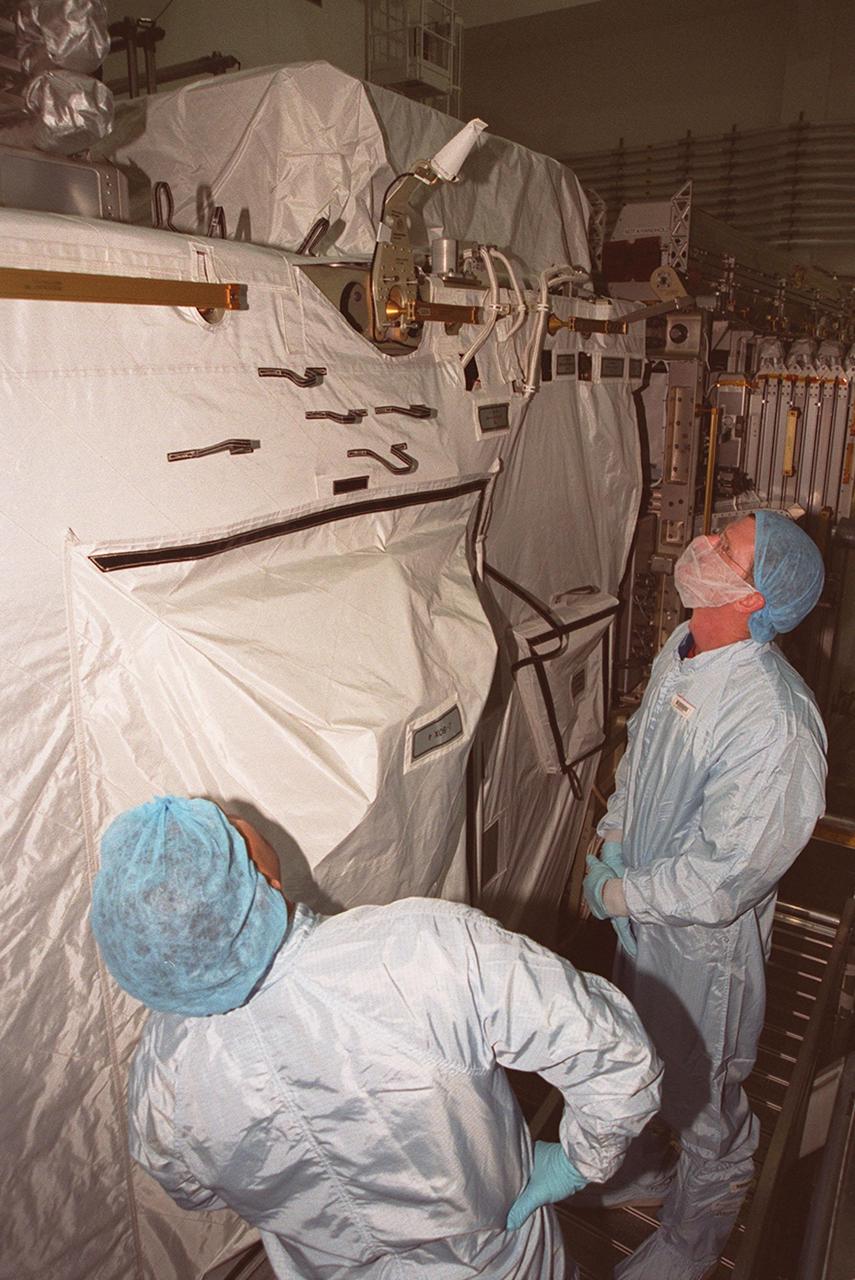
KENNEDY SPACE CENTER, FLA. -- In the Space Station Processing Facility, STS-97 Mission Specialists Carlos Noriega (left) and Joe Tanner check out the mission payload, the P6 integrated truss segment. Mission STS-97 is the sixth construction flight to the International Space Station. The P6 comprises Solar Array Wing-3 and the Integrated Electronic Assembly, to be installed on the International Space Station. The Station’s electrical power system will use eight photovoltaic solar arrays, each 112 feet long by 39 feet wide, to convert sunlight to electricity. The solar arrays are mounted on a “blanket” that can be folded like an accordion for delivery. Once in orbit, astronauts will deploy the blankets to their full size. Gimbals will be used to rotate the arrays so that they will face the Sun to provide maximum power to the Space Station. The mission includes two spacewalks by Noriega and Tanner to complete the solar array connections. STS-97 is scheduled to launch Nov. 30 at about 10:06 p.m. EST
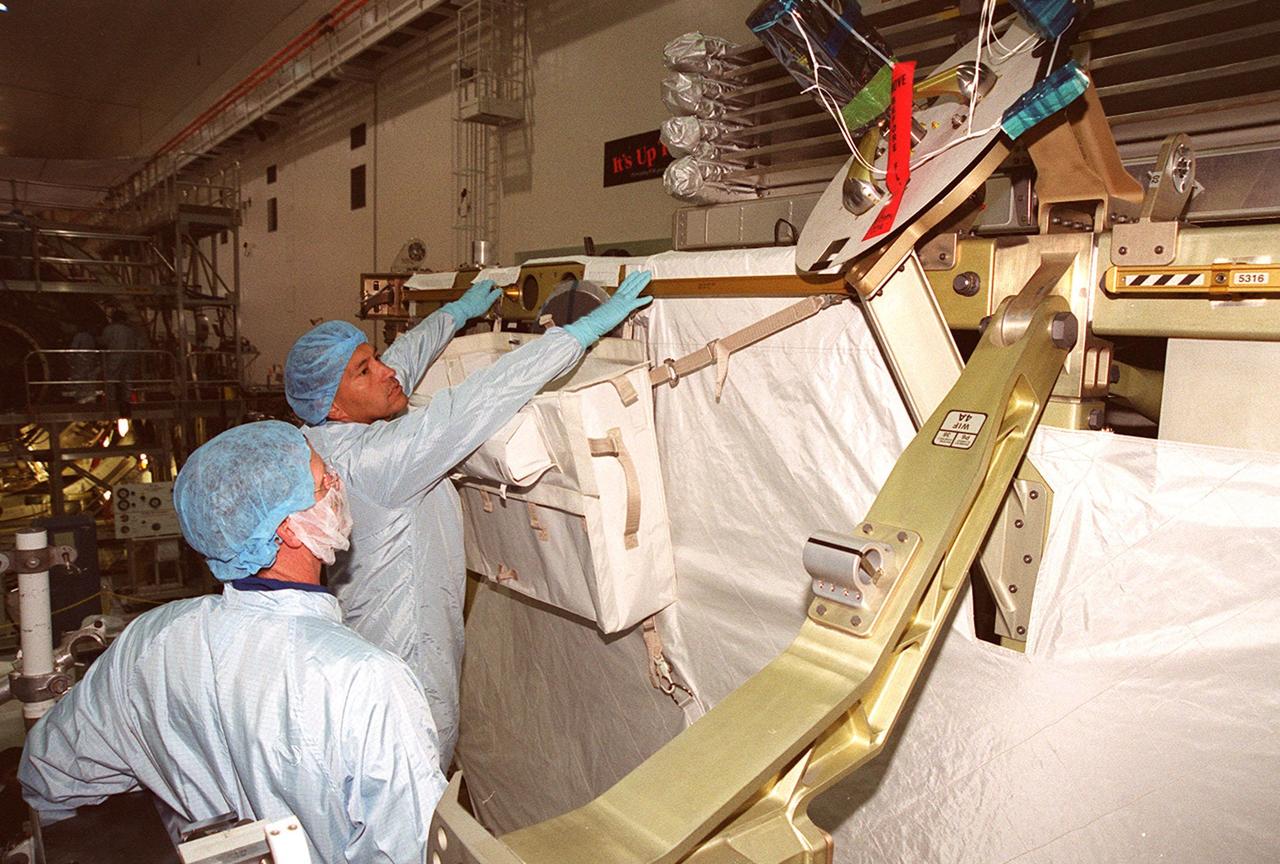
KENNEDY SPACE CENTER, FLA. -- In the Space Station Processing Facility, STS-97 Mission Specialist Carlos Noriega checks out the mission payload, the P6 integrated truss segment, while Mission Specialist Joe Tanner looks on. Mission STS-97 is the sixth construction flight to the International Space Station. The P6 comprises Solar Array Wing-3 and the Integrated Electronic Assembly, to be installed on the International Space Station. The Station’s electrical power system will use eight photovoltaic solar arrays, each 112 feet long by 39 feet wide, to convert sunlight to electricity. The solar arrays are mounted on a “blanket” that can be folded like an accordion for delivery. Once in orbit, astronauts will deploy the blankets to their full size. Gimbals will be used to rotate the arrays so that they will face the Sun to provide maximum power to the Space Station. The mission includes two spacewalks by Noriega and Tanner to complete the solar array connections. STS-97 is scheduled to launch Nov. 30 at about 10:06 p.m. EST
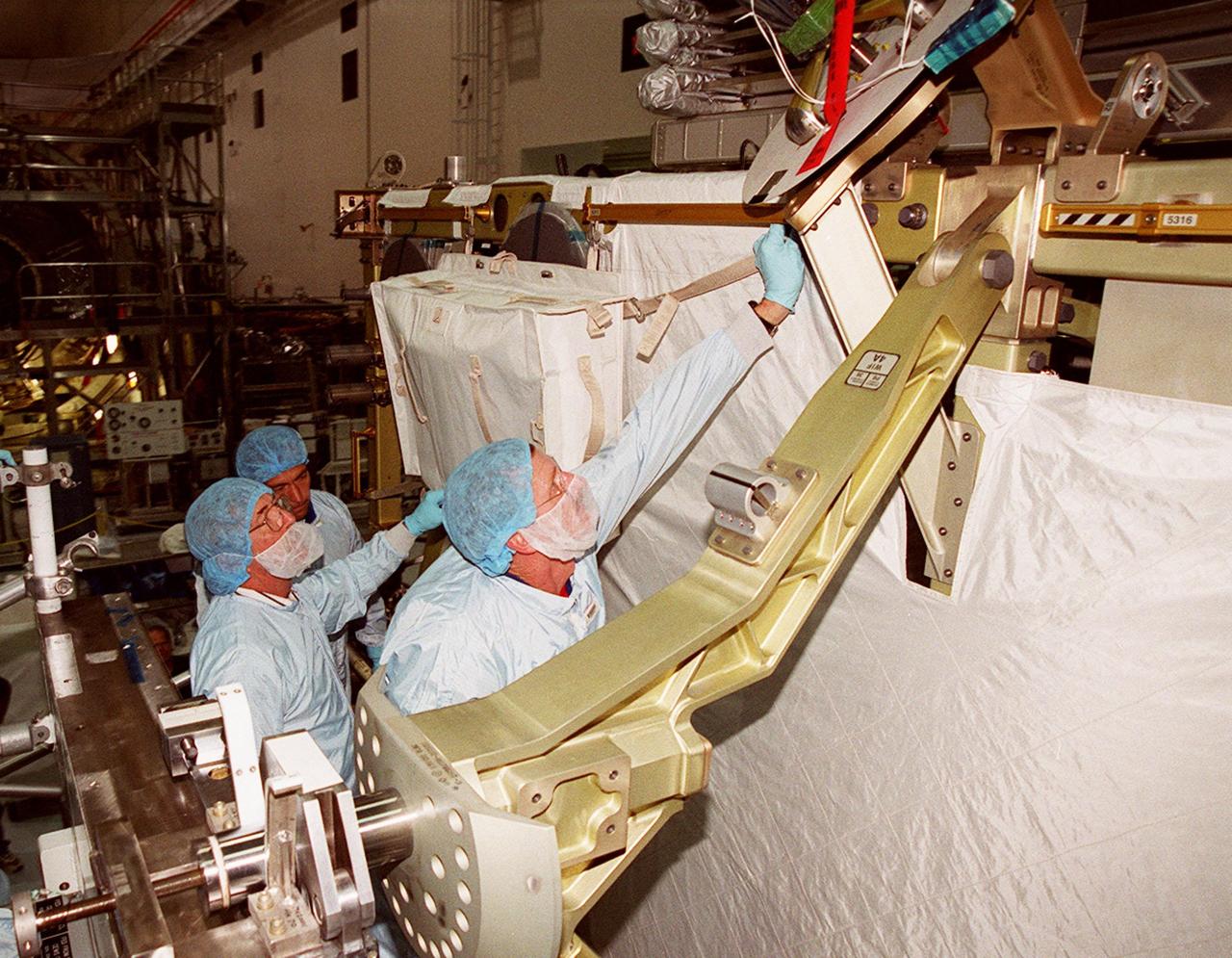
KENNEDY SPACE CENTER, FLA. -- In the Space Station Processing Facility, STS-97 Mission Specialists Carlos Noriega (far left) and Joe Tanner (right) check out the mission payload, the P6 integrated truss segment. Mission STS-97 is the sixth construction flight to the International Space Station. The P6 comprises Solar Array Wing-3 and the Integrated Electronic Assembly, to be installed on the International Space Station. The Station’s electrical power system will use eight photovoltaic solar arrays, each 112 feet long by 39 feet wide, to convert sunlight to electricity. The solar arrays are mounted on a “blanket” that can be folded like an accordion for delivery. Once in orbit, astronauts will deploy the blankets to their full size. Gimbals will be used to rotate the arrays so that they will face the Sun to provide maximum power to the Space Station. The mission includes two spacewalks by Noriega and Tanner to complete the solar array connections. STS-97 is scheduled to launch Nov. 30 at about 10:06 p.m. EST
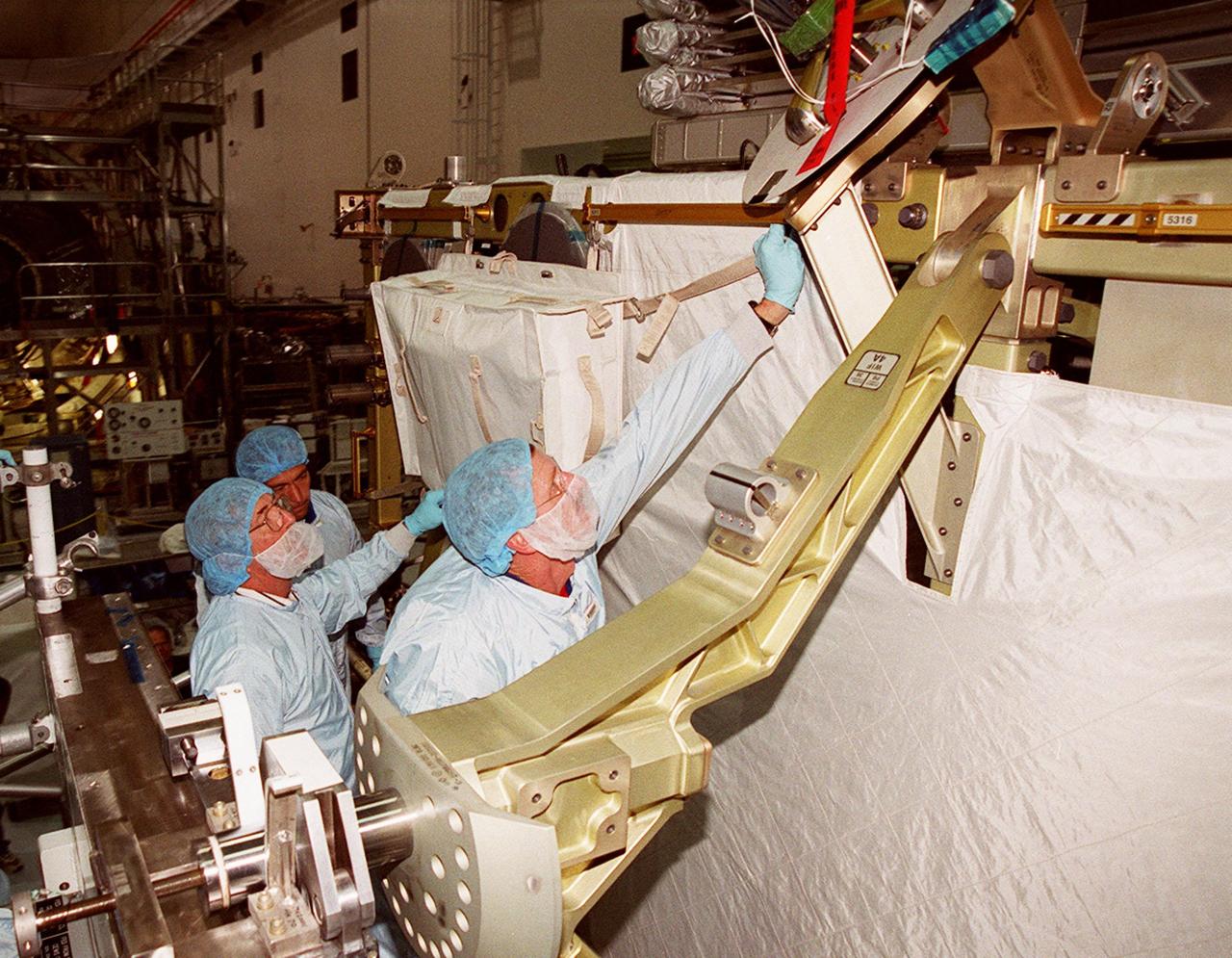
KENNEDY SPACE CENTER, FLA. -- In the Space Station Processing Facility, STS-97 Mission Specialists Carlos Noriega (far left) and Joe Tanner (right) check out the mission payload, the P6 integrated truss segment. Mission STS-97 is the sixth construction flight to the International Space Station. The P6 comprises Solar Array Wing-3 and the Integrated Electronic Assembly, to be installed on the International Space Station. The Station’s electrical power system will use eight photovoltaic solar arrays, each 112 feet long by 39 feet wide, to convert sunlight to electricity. The solar arrays are mounted on a “blanket” that can be folded like an accordion for delivery. Once in orbit, astronauts will deploy the blankets to their full size. Gimbals will be used to rotate the arrays so that they will face the Sun to provide maximum power to the Space Station. The mission includes two spacewalks by Noriega and Tanner to complete the solar array connections. STS-97 is scheduled to launch Nov. 30 at about 10:06 p.m. EST
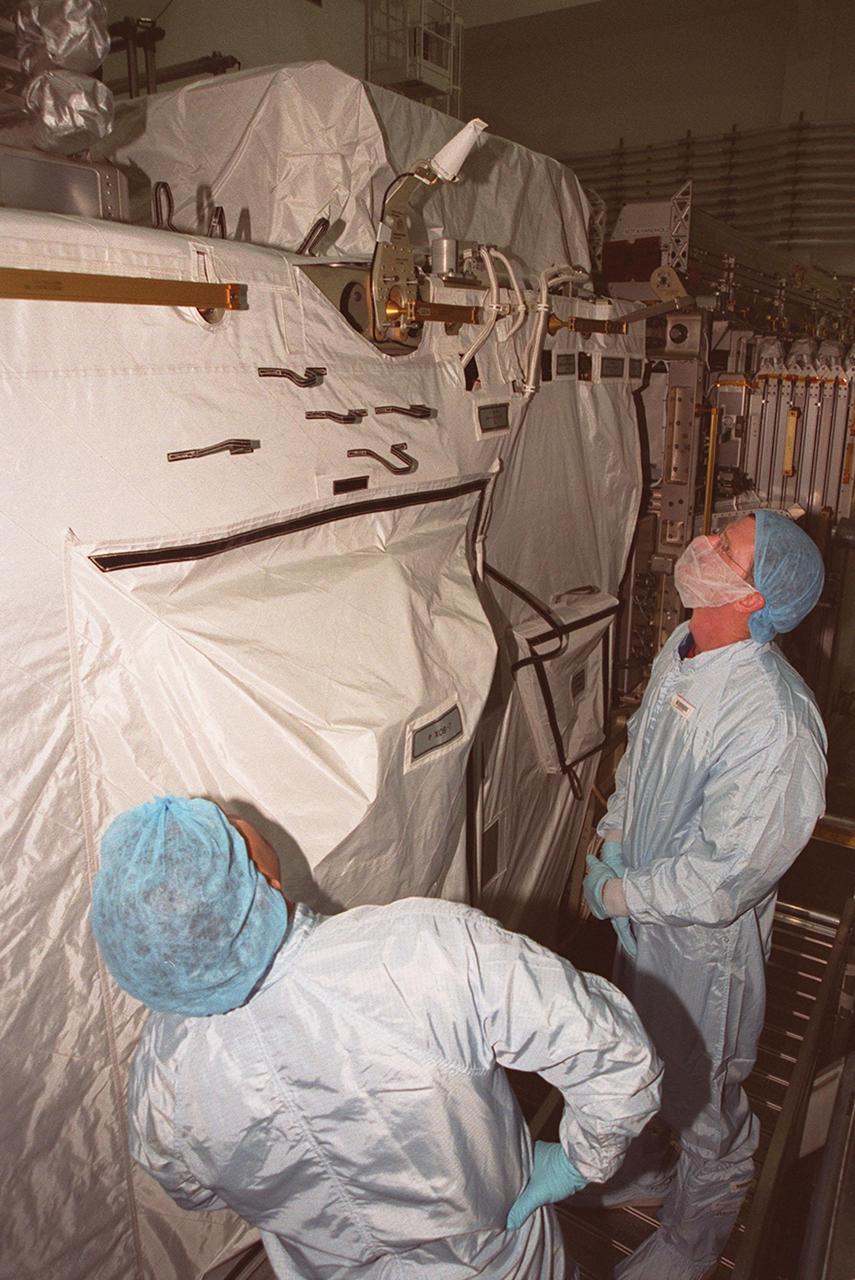
KENNEDY SPACE CENTER, FLA. -- In the Space Station Processing Facility, STS-97 Mission Specialists Carlos Noriega (left) and Joe Tanner check out the mission payload, the P6 integrated truss segment. Mission STS-97 is the sixth construction flight to the International Space Station. The P6 comprises Solar Array Wing-3 and the Integrated Electronic Assembly, to be installed on the International Space Station. The Station’s electrical power system will use eight photovoltaic solar arrays, each 112 feet long by 39 feet wide, to convert sunlight to electricity. The solar arrays are mounted on a “blanket” that can be folded like an accordion for delivery. Once in orbit, astronauts will deploy the blankets to their full size. Gimbals will be used to rotate the arrays so that they will face the Sun to provide maximum power to the Space Station. The mission includes two spacewalks by Noriega and Tanner to complete the solar array connections. STS-97 is scheduled to launch Nov. 30 at about 10:06 p.m. EST
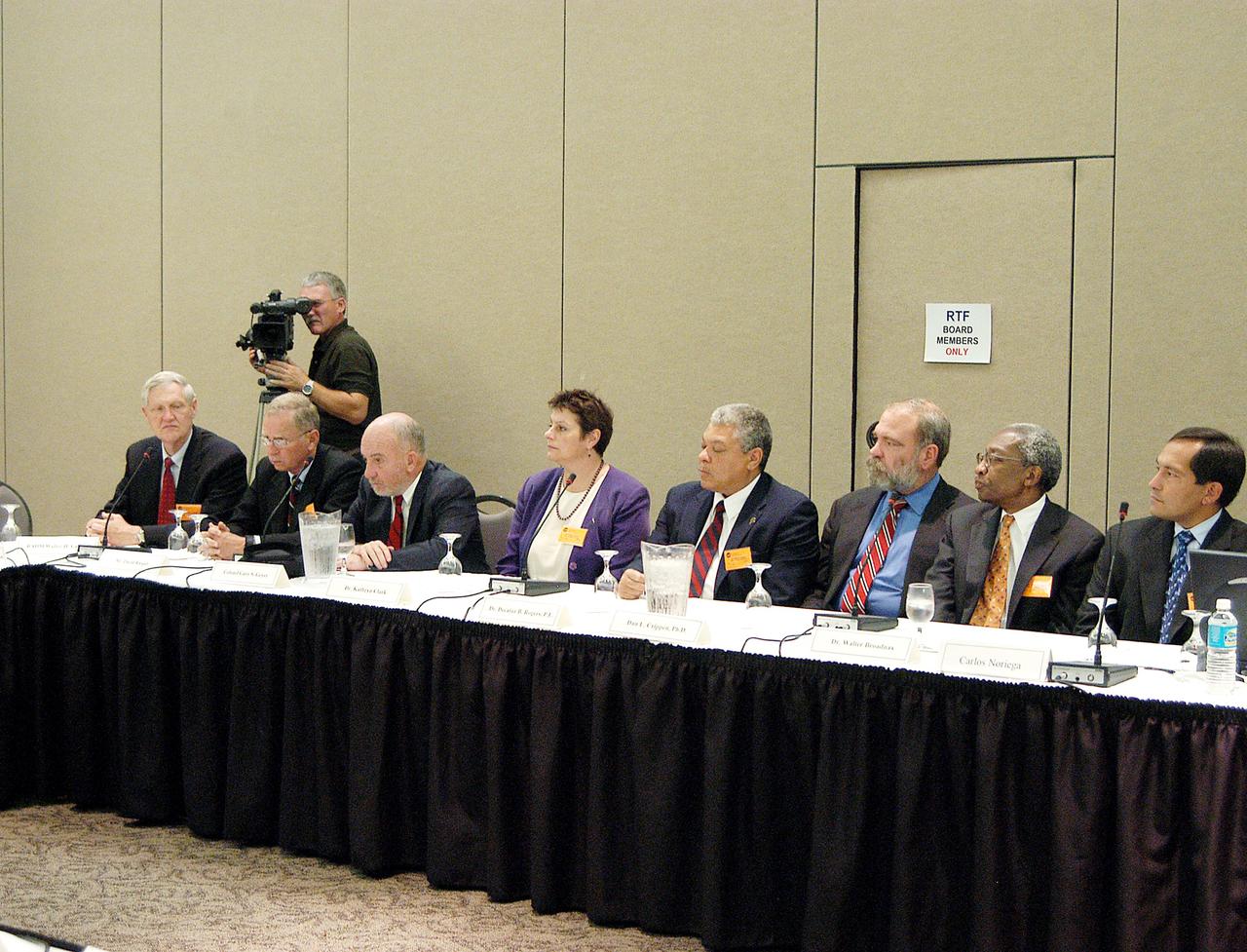
KENNEDY SPACE CENTER, FLA. - The Return To Flight Task Group (RTFTG) holds the first public meeting at the Debus Center, KSC Visitor Complex. Members and staff at the table, from left, are retired Navy Rear Adm. Walter H. Cantrell, David Raspet, retired Air Force Col. Gary S. Geyer, Dr. Kathryn Clark, Dr. Decatur B. Rogers, Dr. Dan L. Crippen, Dr. Walter Broadnax and astronaut Carlos Noriega. The RTFTG was at KSC to conduct organizational activities, tour Space Shuttle facilities and receive briefings on Shuttle-related topics. The task group was chartered by NASA Administrator Sean O’Keefe to perform an independent assessment of NASA’s implementation of the final recommendations of the Columbia Accident Investigation Board. The group is co-chaired by former Shuttle commander Richard O. Covey and retired Air Force Lt. Gen. Thomas P. Stafford, who was an Apollo commander.
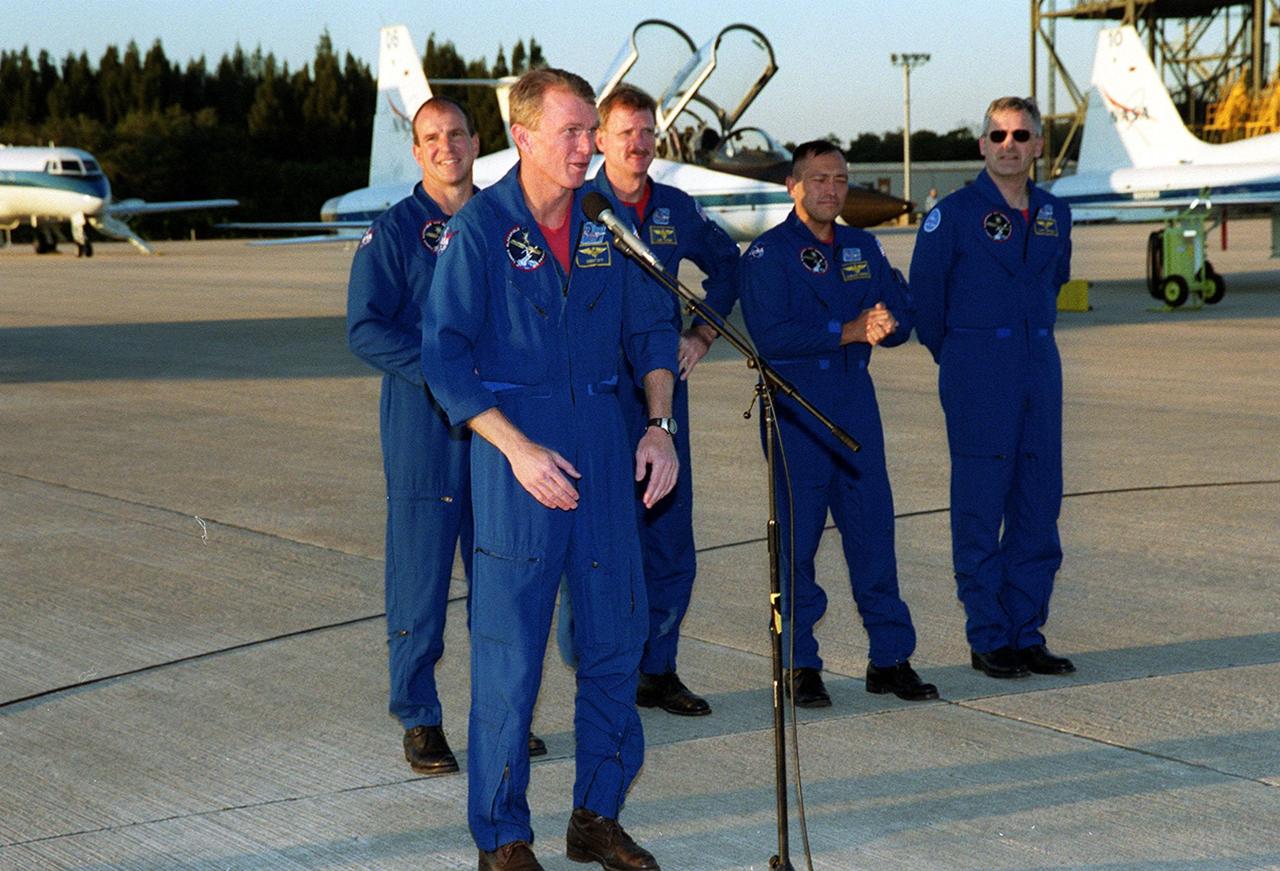
After arriving at the Shuttle Landing Facility, the STS-97 crew gather to address the media. At the microphone, Commander Brent Jett praises the efforts of the KSC workers to get ready for the launch. Behind Jett are Pilot Michael Bloomfield and Mission Specialists Joseph Tanner, Carlos Noriega and Marc Garneau, who is with the Canadian Space Agency. Mission STS-97 is the sixth construction flight to the International Space Station. Its payload includes the P6 Integrated Truss Structure and a photovoltaic (PV) module, with giant solar arrays that will provide power to the Station. The mission includes two spacewalks to complete the solar array connections. STS-97 is scheduled to launch Nov. 30 at about 10:06 p.m. EST
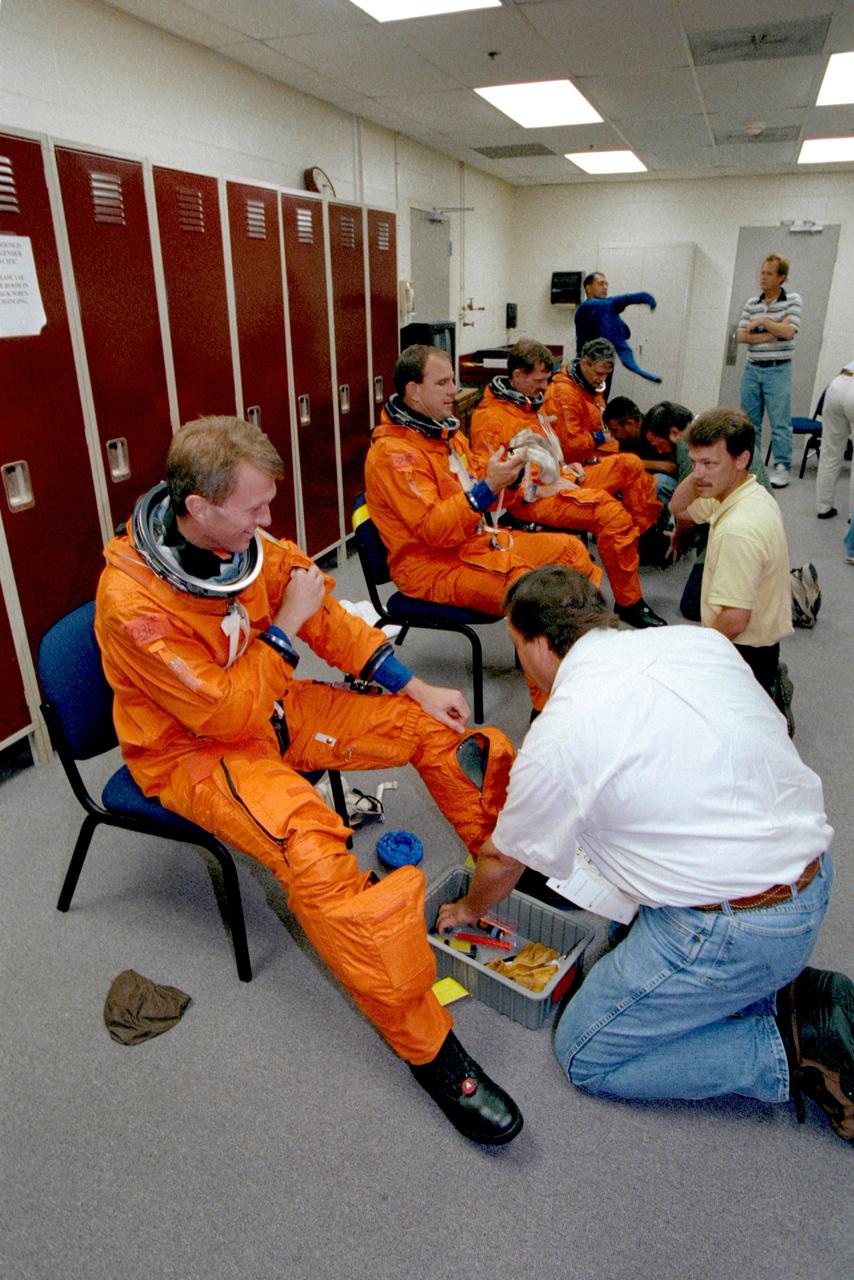
JSC2000-04751 (15 June 2000) --- Members of the STS-97 crew don training versions of the ascent and entry suits for a training session in the Johnson Space Center's Systems Integration Facility. Wearing the burnt-orange pressure suits, from the left, are astronauts Brent W. Jett, mission commander; Michael J. Bloomfield, pilot; and Joseph R. Tanner and Marc Garneau, both mission specialists. Garneau represents the Canadian Space Agency (CSA). Suit technicians assisting are Mike Birkenseher, Brad Milling, Steve Clendenin and Rudy Molina. In the background Carlos I. Noriega, mission specialist, prepares to put on his suit with the assistance of suit tech John Hazelhurt.
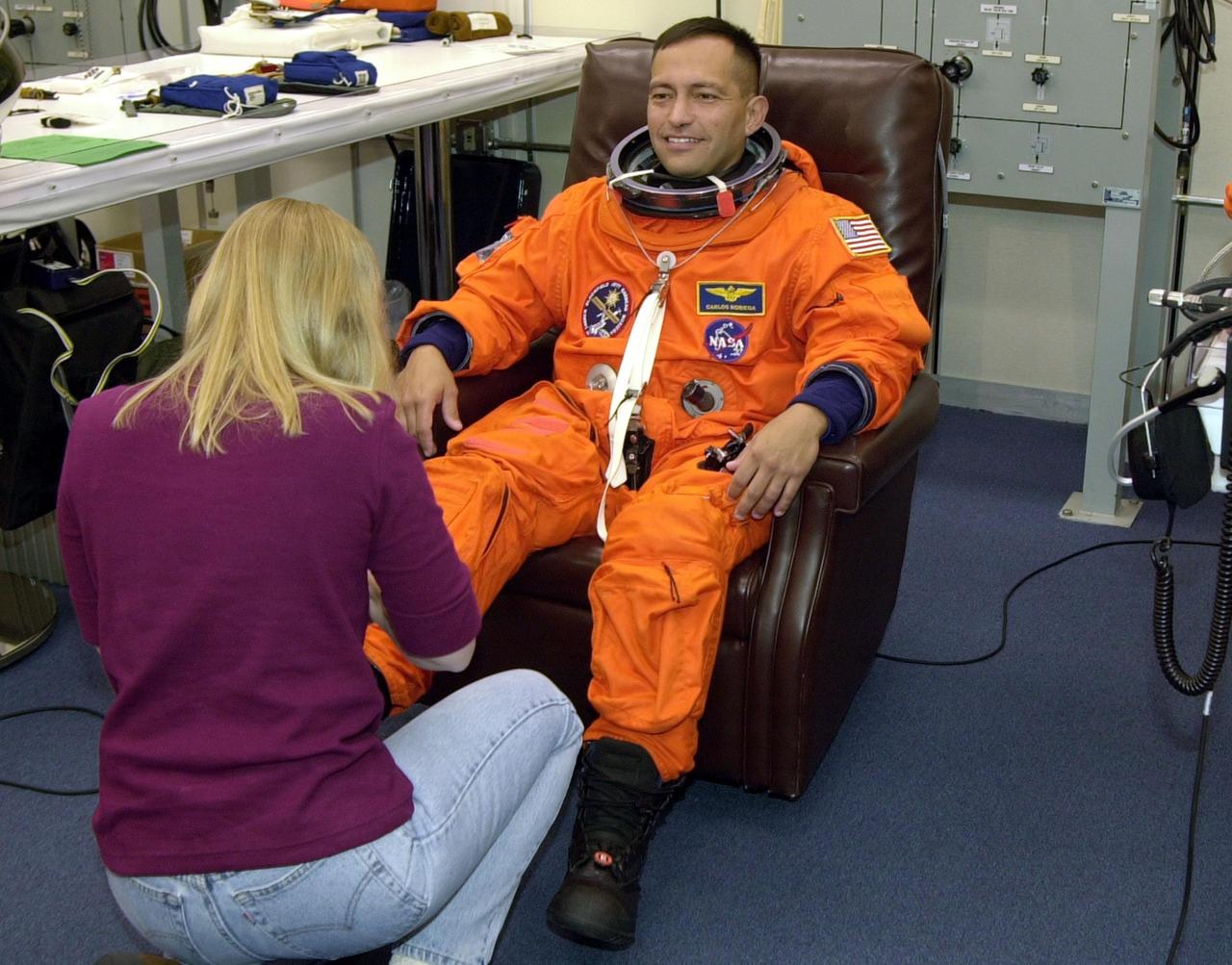
STS-97 Mission Specialist Carlos Noriega gets help with his boots from suit technician Shelly Grick-Agrella during pre-pack and fit check. Mission STS-97 is the sixth construction flight to the International Space Station. Its payload includes the P6 Integrated Truss Structure and a photovoltaic (PV) module, with giant solar arrays that will provide power to the Station. The mission includes two spacewalks to complete the solar array connections. STS-97 is scheduled to launch Nov. 30 at about 10:06 p.m. EST
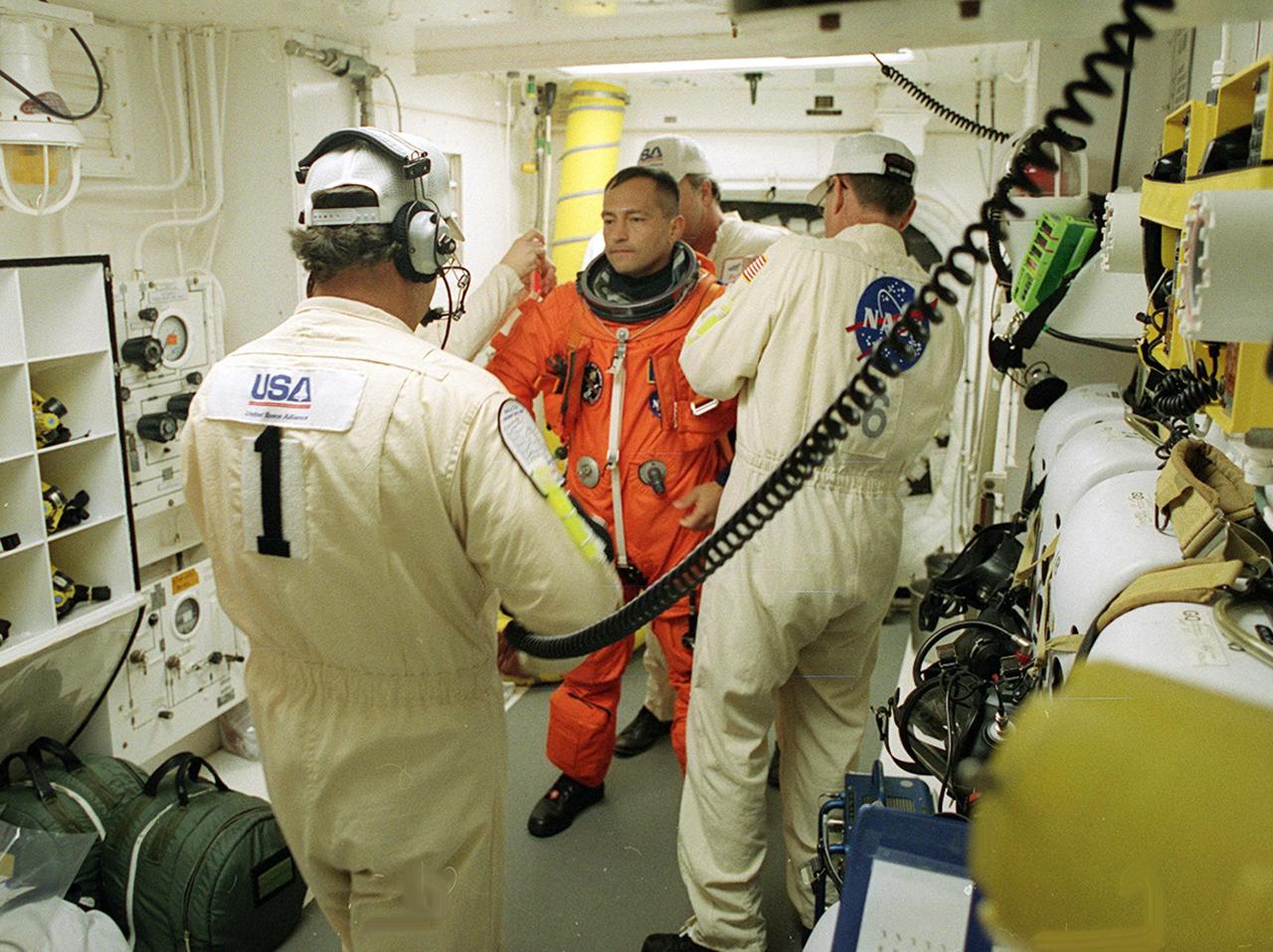
In the White Room, STS-97 Mission Specialist Carlos Noriega Tanner prepares for entry into Space Shuttle Endeavour with the help of the Closeout Crew, Travis Thompson (left) and Jack Burritt (right). Space Shuttle Endeavour is targeted to launch Nov. 30 at 10:06 p.m. EST for the six construction flight to the International Space Station. Endeavour is transporting the P6 Integrated Truss Structure that comprises Solar Array Wing-3 and the Integrated Electronic Assembly, to provide power to the Space Station. After the 11-day mission, which includes three spacewalks, it is expected to land at KSC Dec. 11 at 6:19 p.m. EST
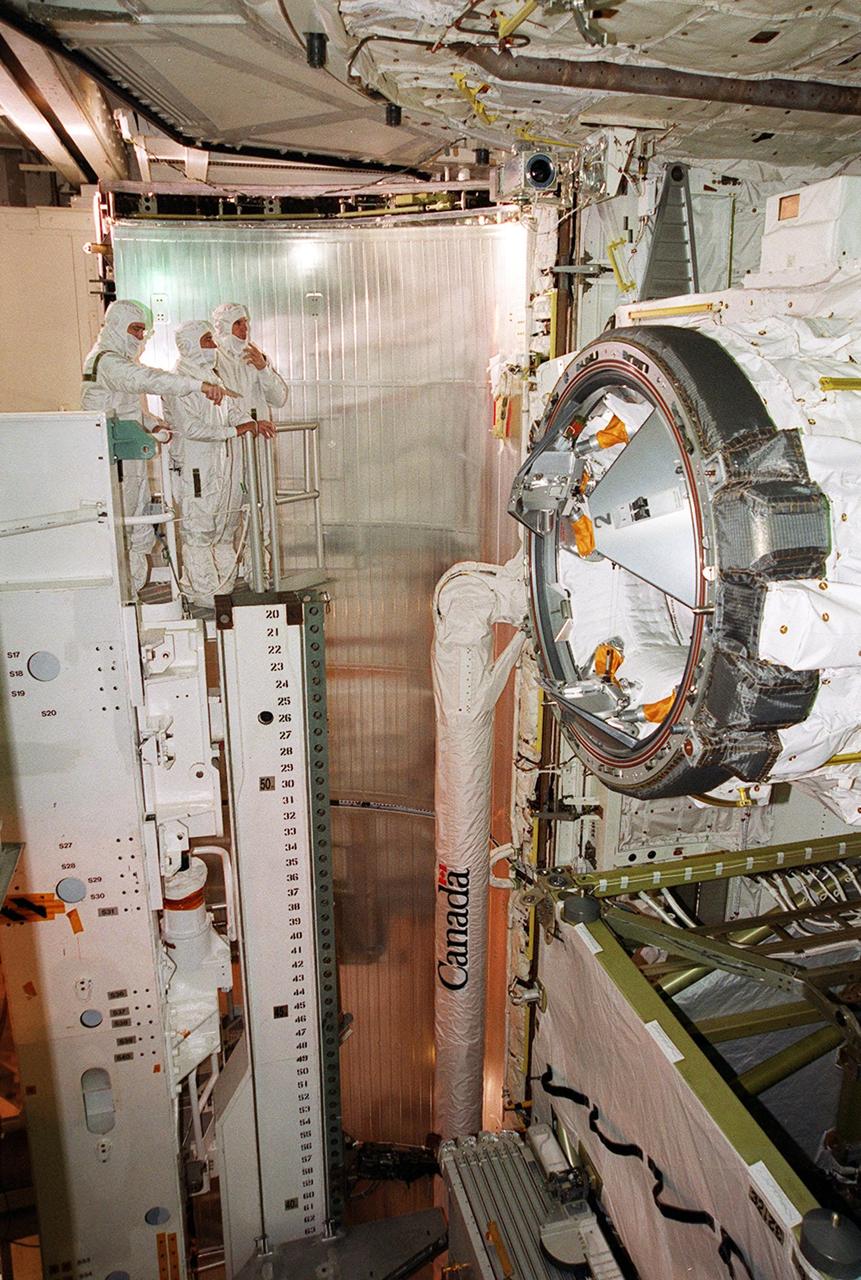
Members of the STS-97 crew look into Endeavour’s payload bay at some of the equipment that will be carried on the mission. On the left, pointing, is Mission Specialist Marc Garneau. Next to him (left to right) are Mission Specialist Carlos Noriega and Pilot Michael Bloomfield. At right center of the photo is the orbiter docking system (ODS). At left and below the ODS is the Canadian robotic arm that will be used during spacewalks on the mission to install solar arrays. Each more than 100 feet long, the arrays will capture energy from the sun and convert it to power for the Station. STS-97 is scheduled to launch Nov. 30 at about 10:06 p.m. EST
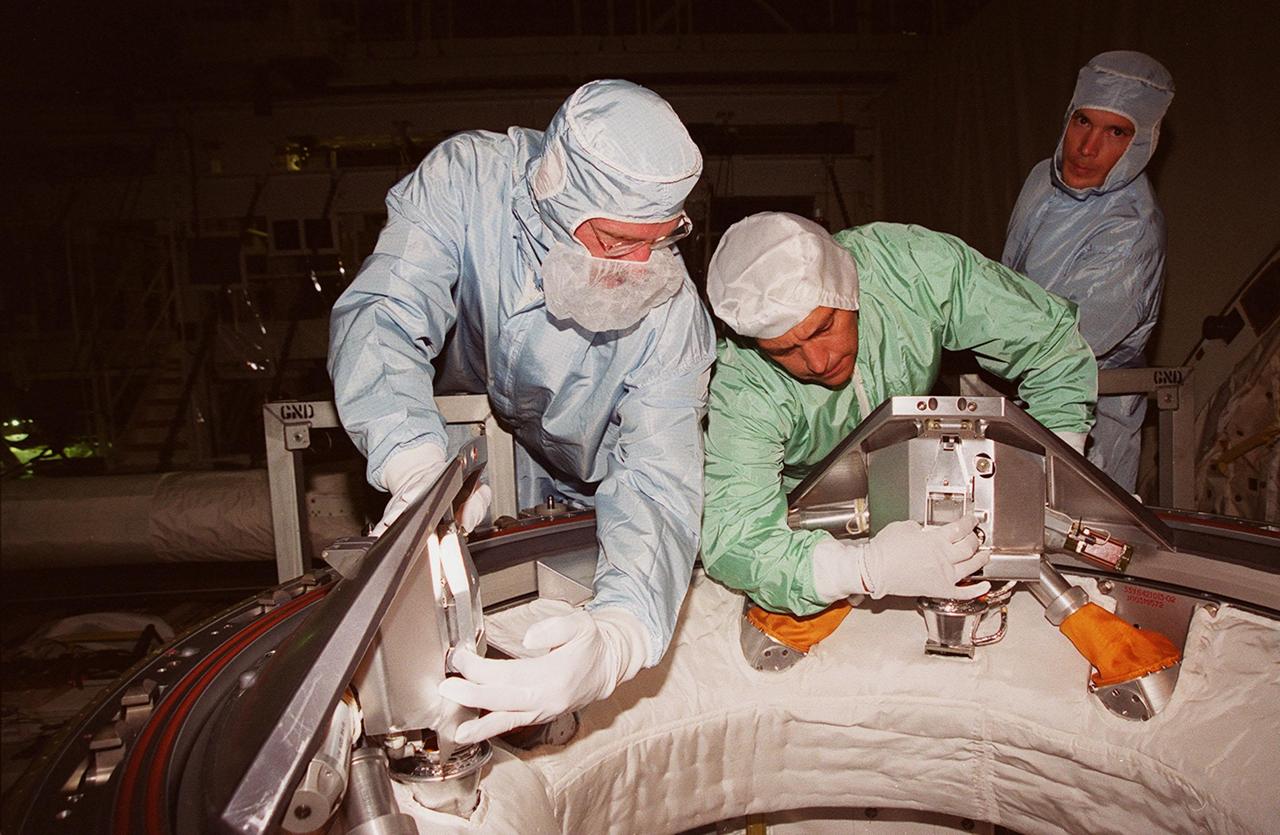
KENNEDY SPACE CENTER, FLA. -- In Orbiter Processing Facility (OPF) bay 2 during Crew Equipment Interface Test (CEIT), Mission Specialists Joe Tanner (left) and Carlos Noriega (right) practice working parts of the Orbital Docking System (ODS) in Endeavour’s payload bay. The CEIT provides an opportunity for crew members to check equipment and facilities that will be on board the orbiter during their mission. The STS-97 mission will be the sixth construction flight to the International Space Station. The payload includes a photovoltaic (PV) module, providing solar power to the Station. STS-97 is scheduled to launch Nov. 30 from KSC for the 10-day mission
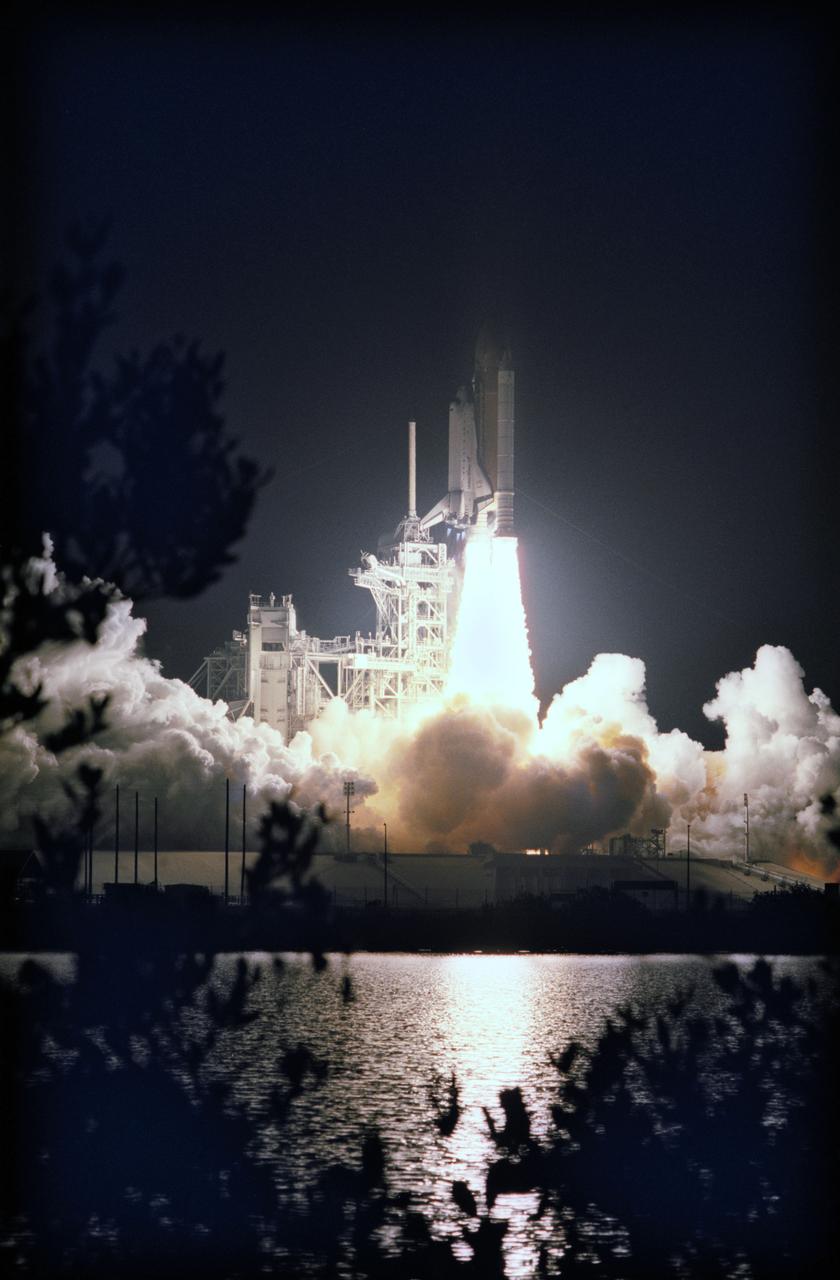
STS084-S-009 (15 May 1997) --- The Space Shuttle Atlantis brightens up the early morning sky at Kennedy Space Center's (KSC) Launch Complex 39 as it lifts off from Pad A at 4:07:48 a.m. (EDT), May 15, 1997. Onboard were astronauts Charles J. Precourt, Eileen M. Collins, Jean-Fran?ois Clervoy, C. Michael Foale, Carlos I. Noriega, Edward T. Lu and cosmonaut Elena V. Kondakova. Clervoy represents the European Space Agency (ESA) and Kondakova is with the Russian Space Agency (RSA).
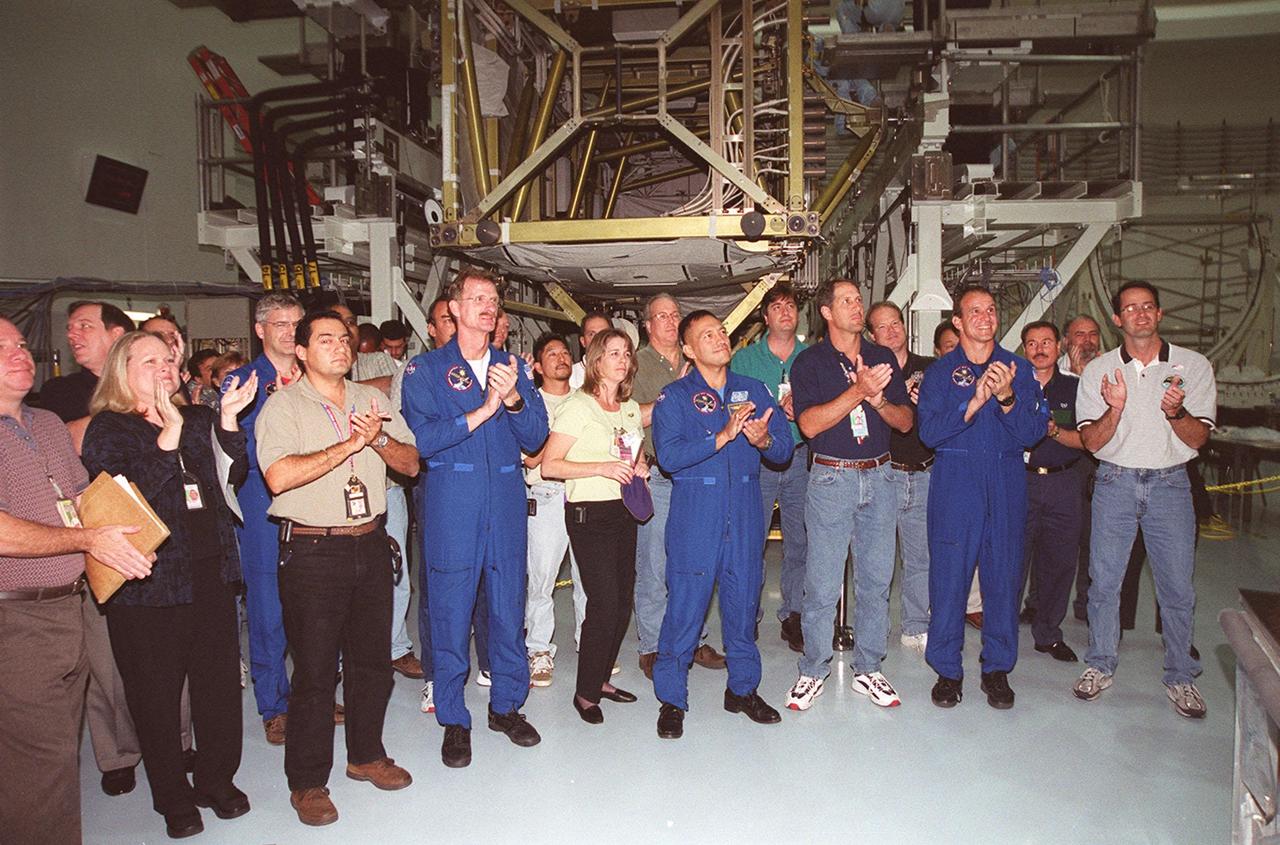
In the Space Station Processing Facility, workers applaud the turnover of the P6 Integrated Truss Structure by International Space Station ground operations to the NASA shuttle integration team in a special ceremony. Standing in front are STS-97 Mission Specialists Joe Tanner and Carlos Noriega plus Pilot Mike Broomfield. Behind and left of Tanner is Mission Specialist Marc Garneau. Mission STS-97is the sixth construction flight to the International Space Station. Its payload includes a photovoltaic (PV) module, with giant solar arrays that will provide power to the Station. The mission involves two spacewalks to complete the solar array connections. STS-97 is scheduled to launch Nov. 30 at 10:05 p.m. EST
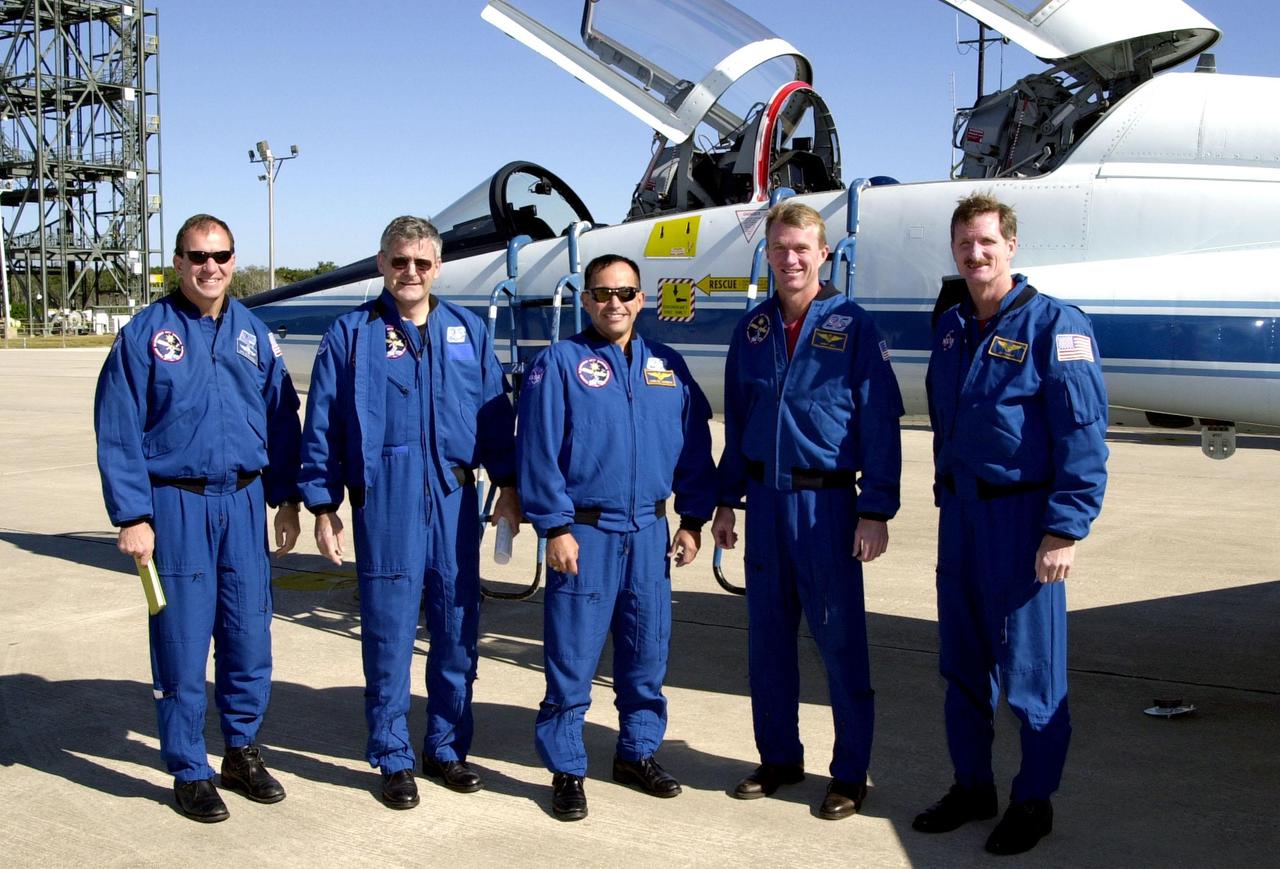
The STS-97 crew poses for a photo after landing at KSC’s Shuttle Landing Facility. Standing, left to right, are Pilot Mike Bloomfield, Mission Specialists Marc Garneau and Carlos Noriega, Commander Brent Jett and Mission Specialist Joe Tanner. They are at KSC for a mini-CEIT (Crew Equipment Interface Test). STS-97 is scheduled to launch Nov. 30 at 10:06 p.m. EST from Launch Pad 39B. The sixth flight to the International Space Station, the mission is expected to last 11 days, with a planned KSC landing at about 5:58 p.m. Dec. 11
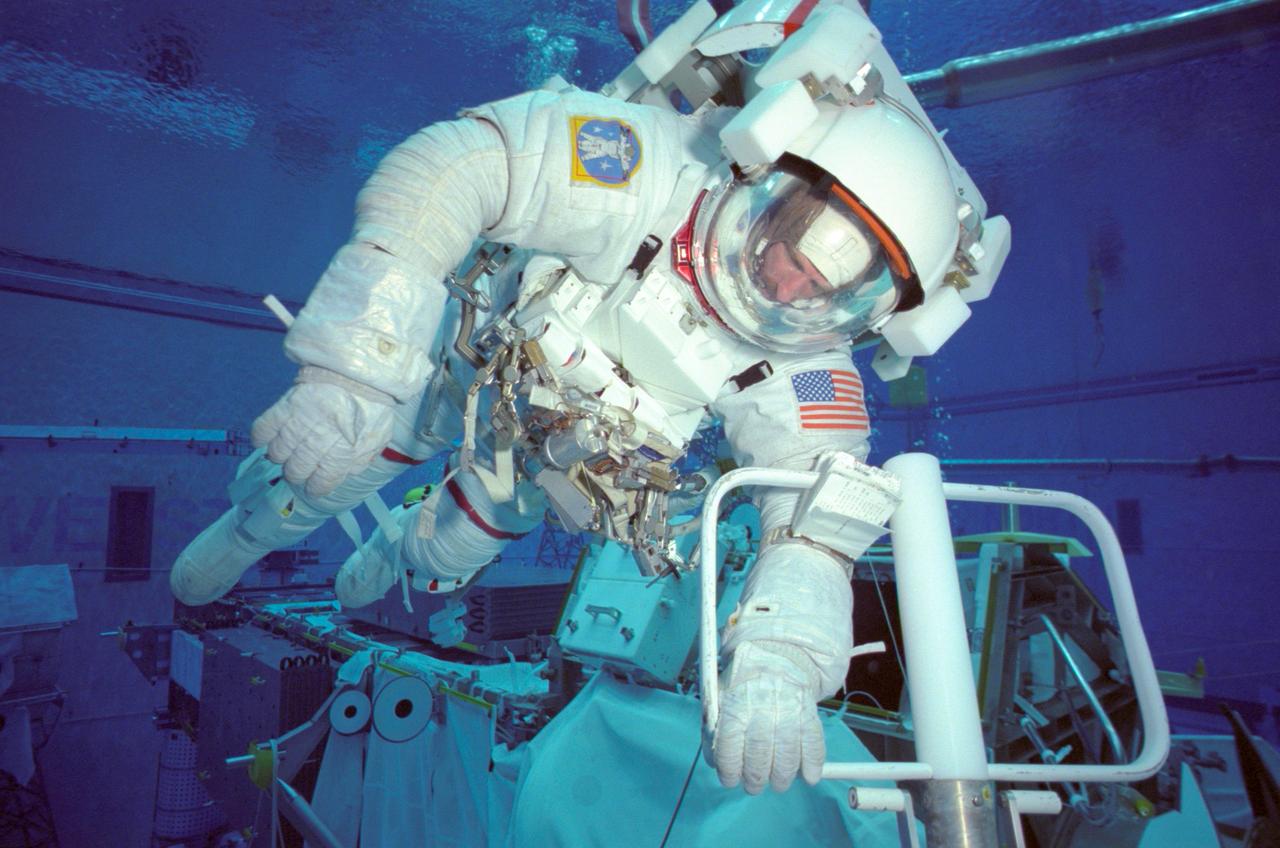
JSC2000-07082 (October 2000)--- Wearing a training version of the shuttle extravehicular mobility unit (EMU) space suit, astronaut Joseph R. Tanner, STS-97 mission specialist, simulates a space walk underwater in the giant Neutral Buoyancy Laboratory (NBL). Tanner was there, along with astronaut Carlos I. Noriega, to rehearse one of three scheduled space walks to make additions to the International Space Station (ISS). The five-man crew in early December will deliver the P6 Integrated Truss Segment, which includes the first US Solar arrays and a power distribution system.
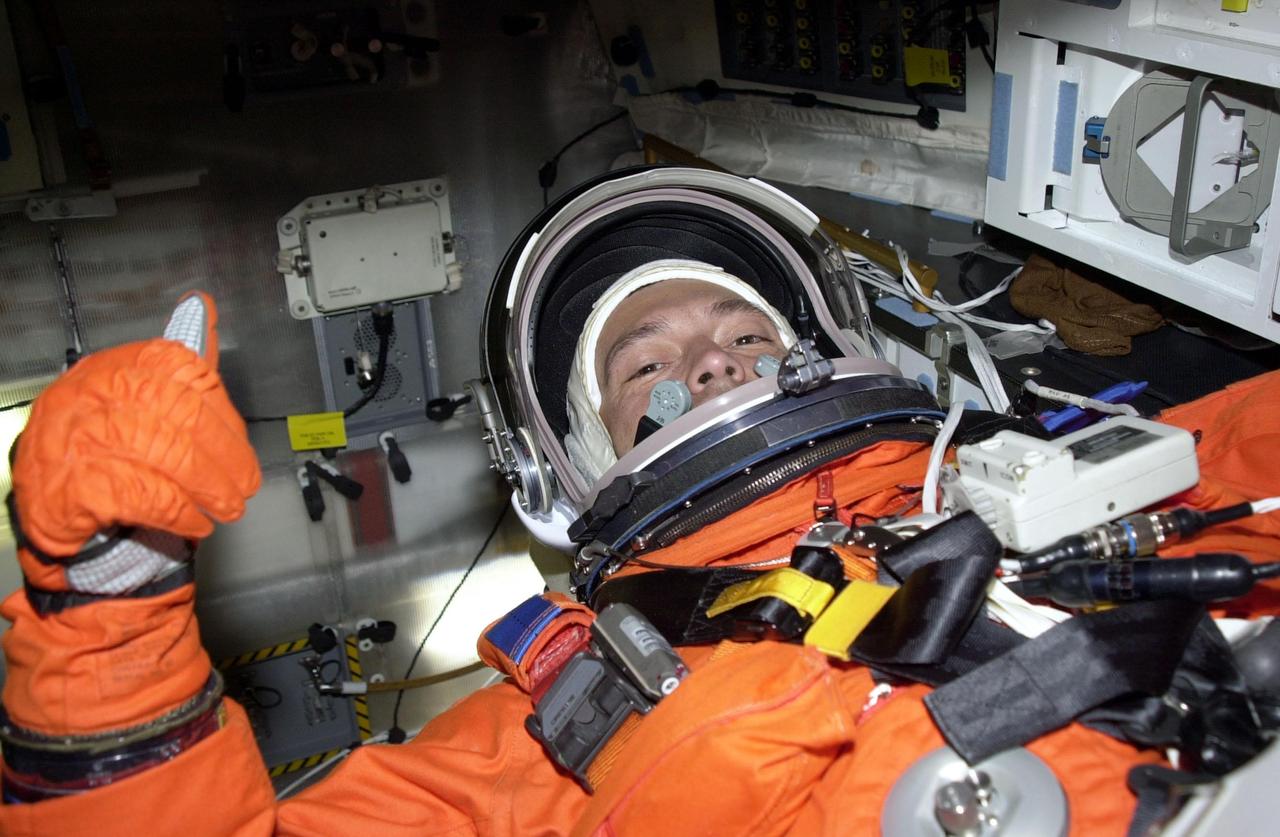
STS-97 Mission Specialist Carlos Noriega settles into his seat in Space Shuttle Endeavour on Launch Pad 39B. He and the rest of the crew are taking part in a simulated launch countdown, part of Terminal Countdown Demonstration Test activities that also include emergency egress training and familiarization with the payload. Mission STS-97 is the sixth construction flight to the International Space Station. Its payload includes the P6 Integrated Truss Structure and a photovoltaic (PV) module, with giant solar arrays that will provide power to the Station. The mission includes two spacewalks to complete the solar array connections. STS-97 is scheduled to launch Nov. 30 at about 10:05 p.m. EST
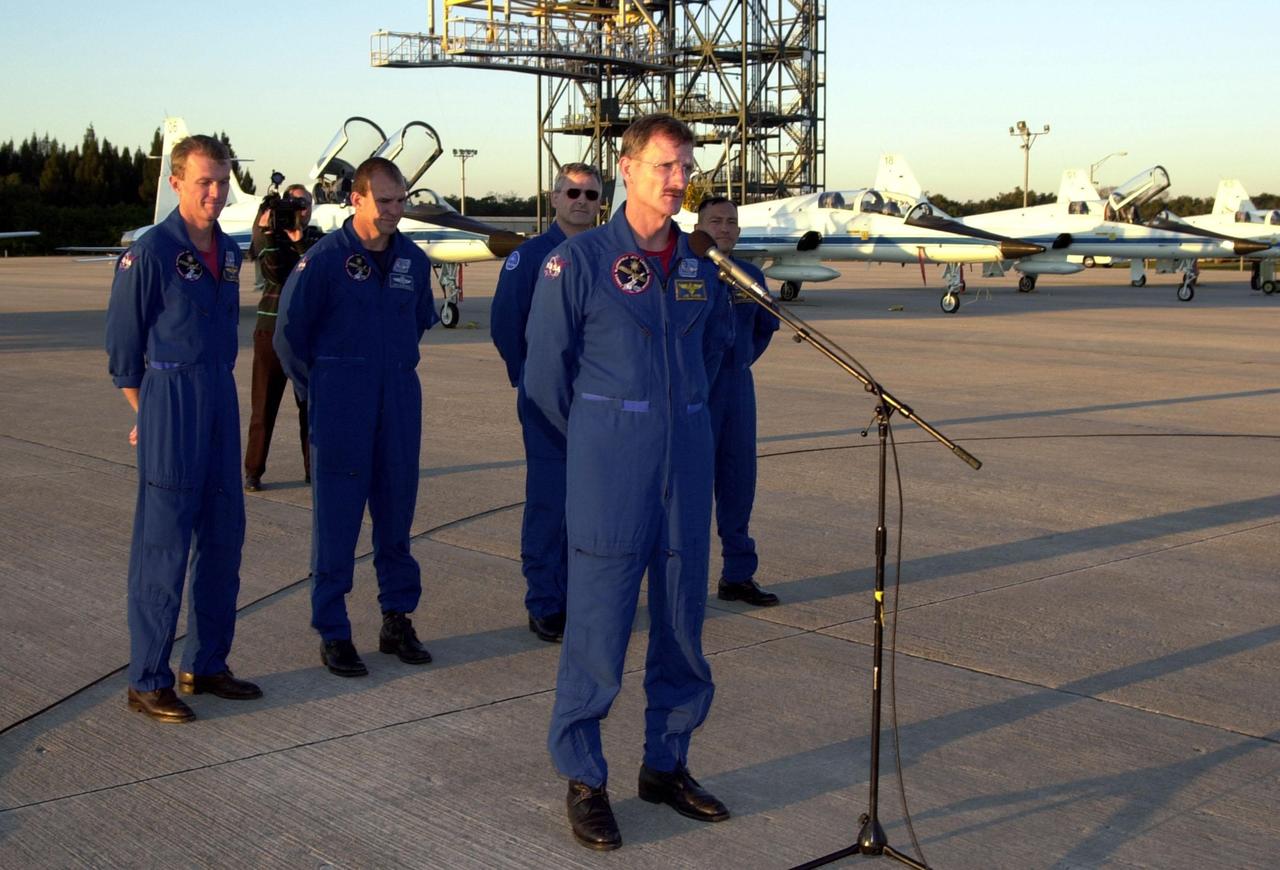
After their arrival at the Shuttle Landing Facility, the STS-97 crew gather to address the media. At the microphone is Mission Specialist Joseph Tanner. Behind him stand Commander Brent Jett, Pilot Michael Bloomfield and Mission Specialists Marc Garneau, who is with the Canadian Space Agency, and Carlos Noriega. Mission STS-97is the sixth construction flight to the International Space Station. Its payload includes the P6 Integrated Truss Structure and a photovoltaic (PV) module, with giant solar arrays that will provide power to the Station. The mission includes two spacewalks to complete the solar array connections. STS-97 is scheduled to launch Nov. 30 at about 10:06 p.m. EST
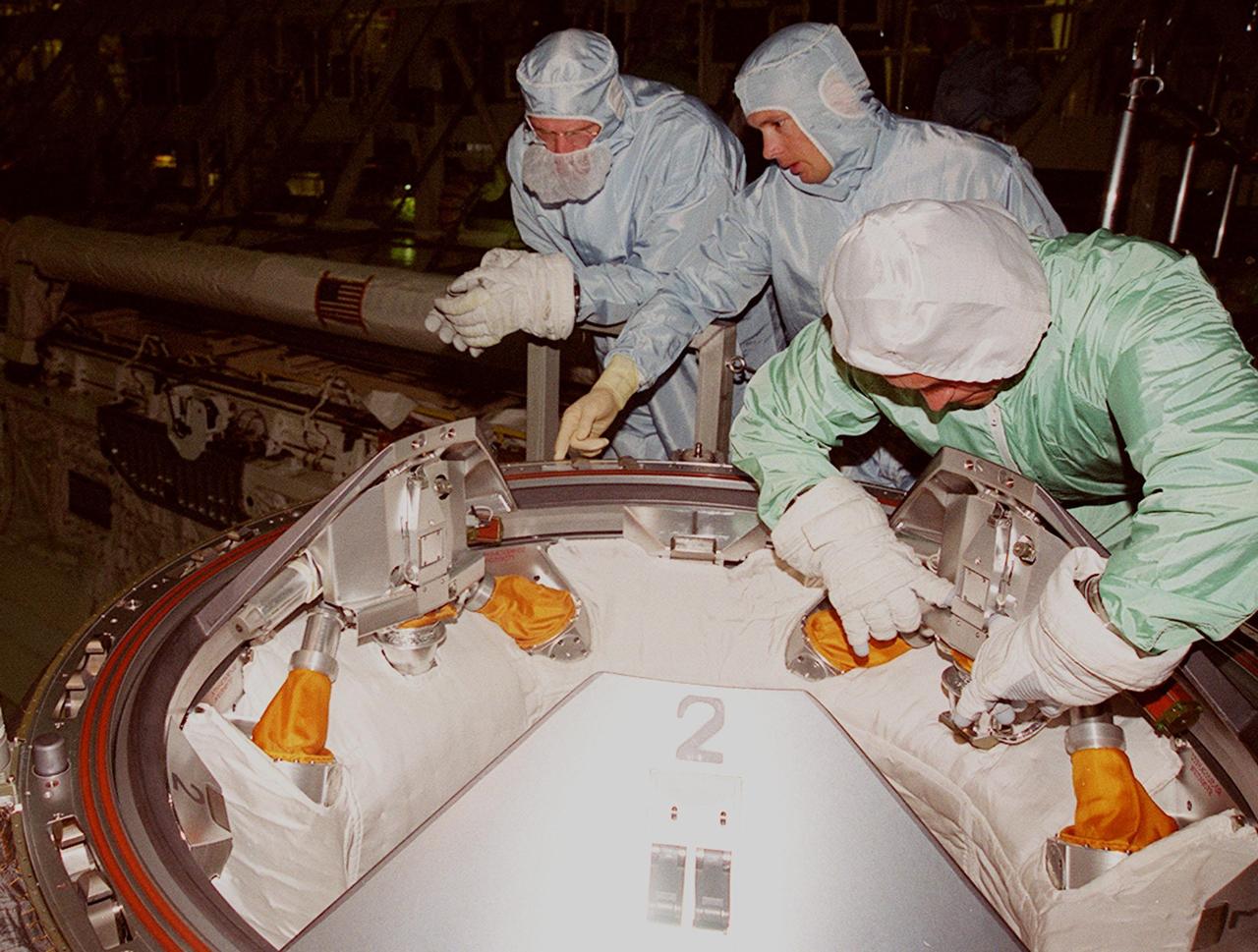
KENNEDY SPACE CENTER, FLA. -- In Orbiter Processing Facility (OPF) bay 2 during Crew Equipment Interface Test (CEIT), Mission Specialist Joe Tanner (left) gets instruction from a worker while Mission Specialist Carlos Noriega (right) practices working latches on the Orbital Docking System in Endeavour’s payload bay. The CEIT provides an opportunity for crew members to check equipment and facilities that will be on board the orbiter during their mission. The STS-97 mission will be the sixth construction flight to the International Space Station. The payload includes a photovoltaic (PV) module, providing solar power to the Station. STS-97 is scheduled to launch Nov. 30 from KSC for the 10-day mission
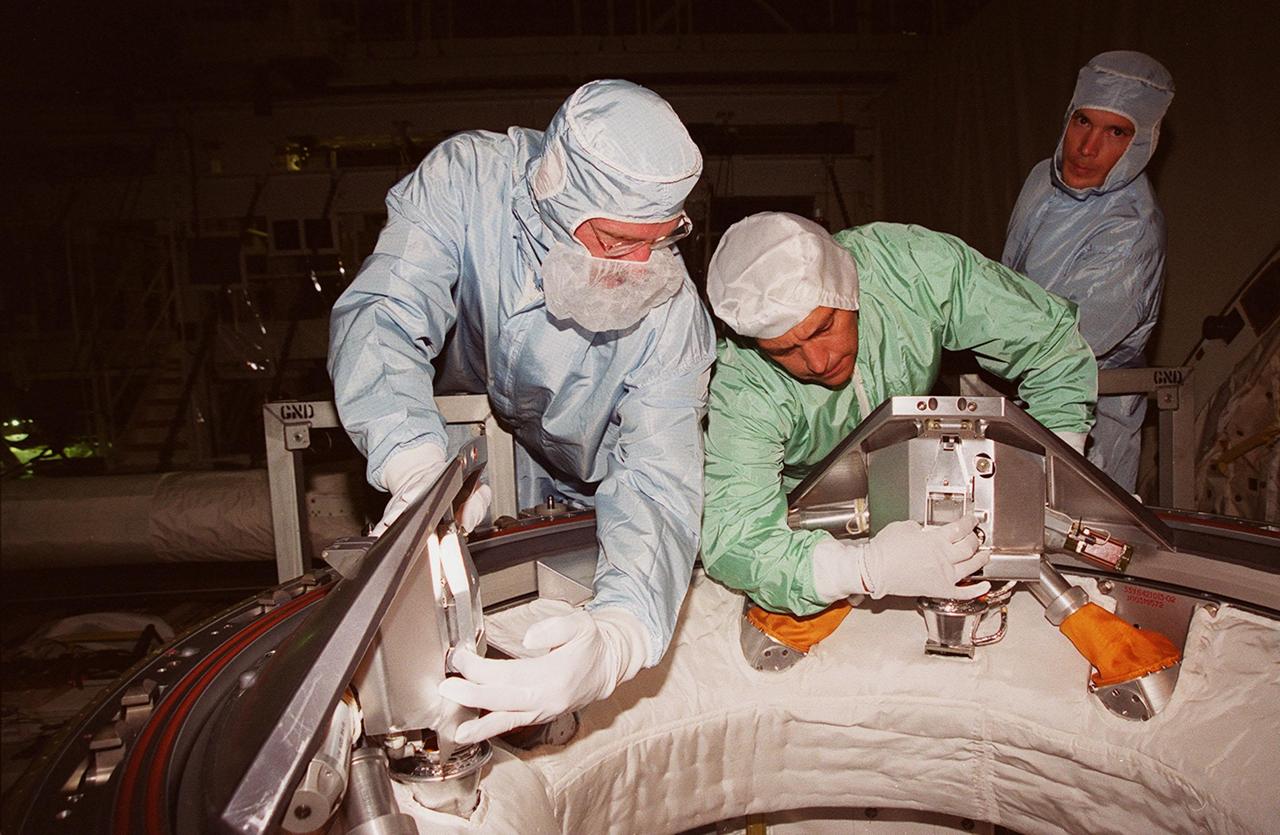
KENNEDY SPACE CENTER, FLA. -- In Orbiter Processing Facility (OPF) bay 2 during Crew Equipment Interface Test (CEIT), Mission Specialists Joe Tanner (left) and Carlos Noriega (right) practice working parts of the Orbital Docking System (ODS) in Endeavour’s payload bay. The CEIT provides an opportunity for crew members to check equipment and facilities that will be on board the orbiter during their mission. The STS-97 mission will be the sixth construction flight to the International Space Station. The payload includes a photovoltaic (PV) module, providing solar power to the Station. STS-97 is scheduled to launch Nov. 30 from KSC for the 10-day mission
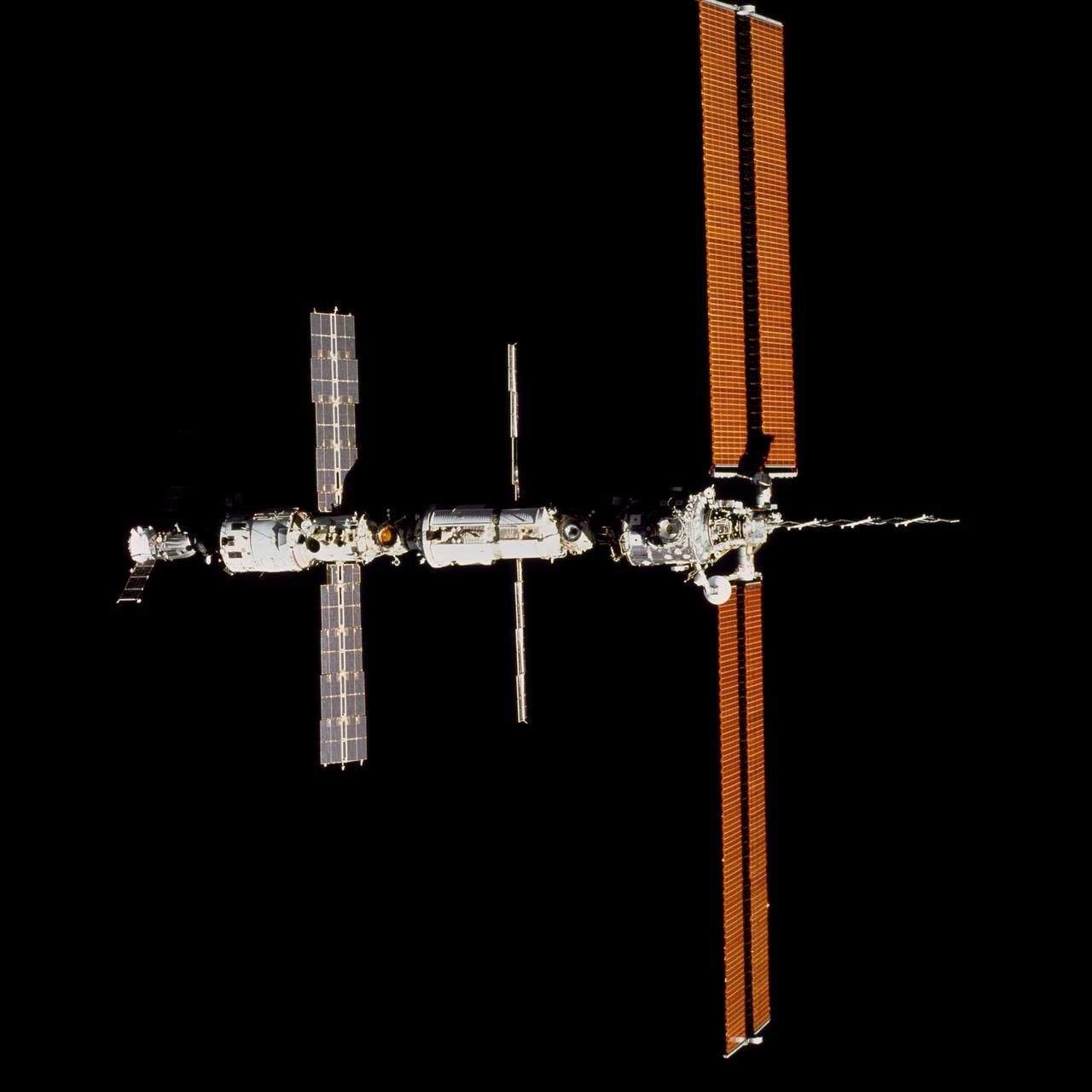
STS097-703-030 (30 Nov.-11 Dec. 2000) --- The International Space Station (ISS) is photographed during a fly-around by the Space Shuttle Endeavour. The 240-foot-long, 38-foot-wide solar array (top) is the newest part and one of the most prominent components of the station. Onboard ISS for about 40 days at the time of this photo were astronaut William M. Shepherd and cosmonauts Yuri P. Gidzenko and Sergei K. Krikalev. Onboard the shuttle were STS-97 astronauts – commander Brent W. Jett, Jr., pilot Mike Bloomfield and mission specialists Marc Garneau of the Canadian Space Agency (CSA), Carlos I. Noriega and Joseph R. Tanner.
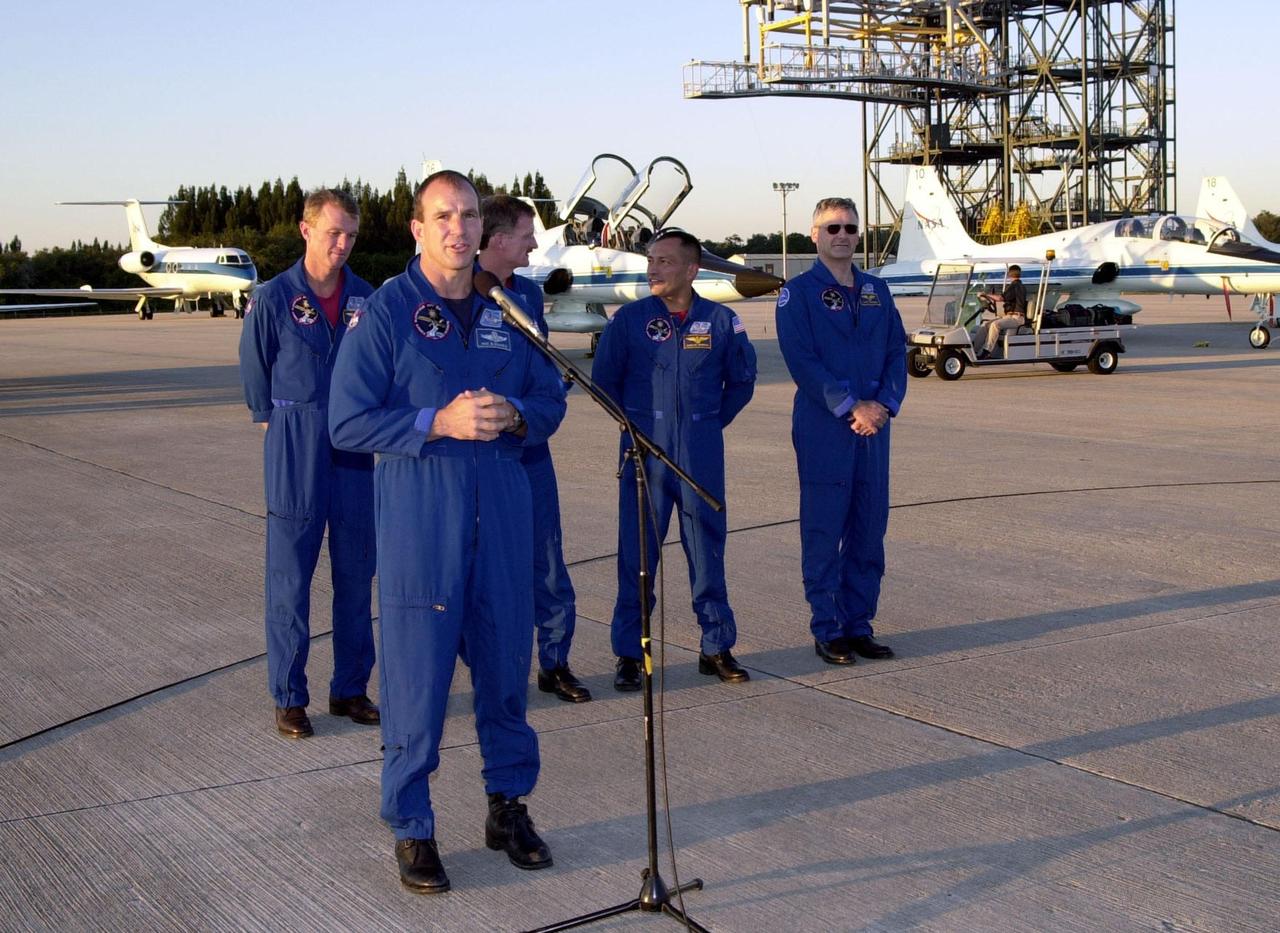
After their arrival at the Shuttle Landing Facility, the STS-97 crew gather to address the media. At the microphone is Pilot Michael Bloomfield. Behind him stand Commander Brent Jett and Mission Specialists Joseph Tanner, Carolos Noriega and Marc Garneau, who is with the Canadian Space Agency. Mission STS-97is the sixth construction flight to the International Space Station. Its payload includes the P6 Integrated Truss Structure and a photovoltaic (PV) module, with giant solar arrays that will provide power to the Station. The mission includes two spacewalks to complete the solar array connections. STS-97 is scheduled to launch Nov. 30 at about 10:06 p.m. EST
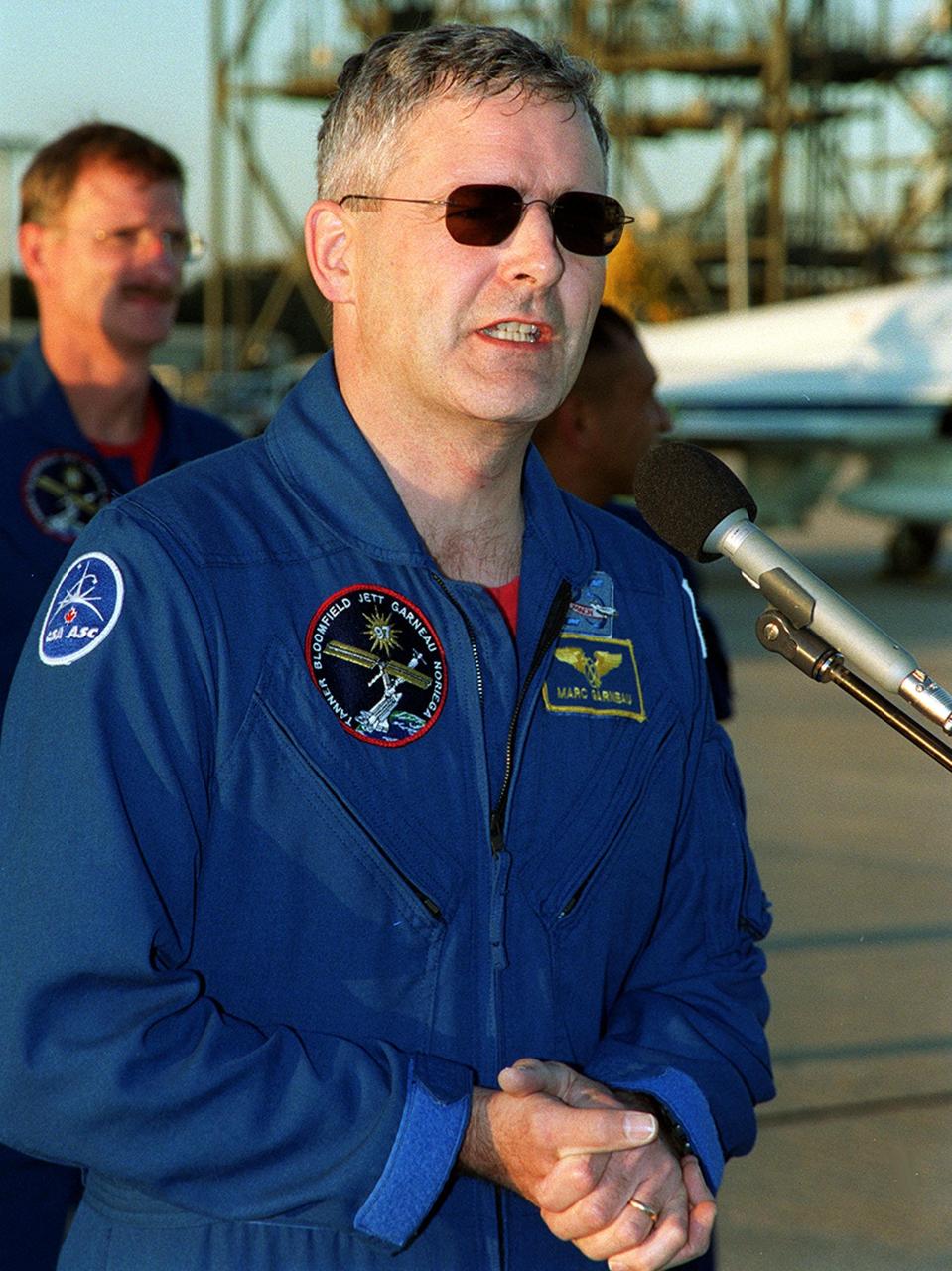
After arriving at the Shuttle Landing Facility, the STS-97 crew gather to address the media. At the microphone is Mission Specialist Marc Garneau, who is with the Canadian Space Agency. Behind him can be seen Mission Specialists Joseph Tanner (left) and Carlos Noriega. Mission STS-97 is the sixth construction flight to the International Space Station. Its payload includes the P6 Integrated Truss Structure and a photovoltaic (PV) module, with giant solar arrays that will provide power to the Station. The mission includes two spacewalks to complete the solar array connections. STS-97 is scheduled to launch Nov. 30 at about 10:06 p.m. EST
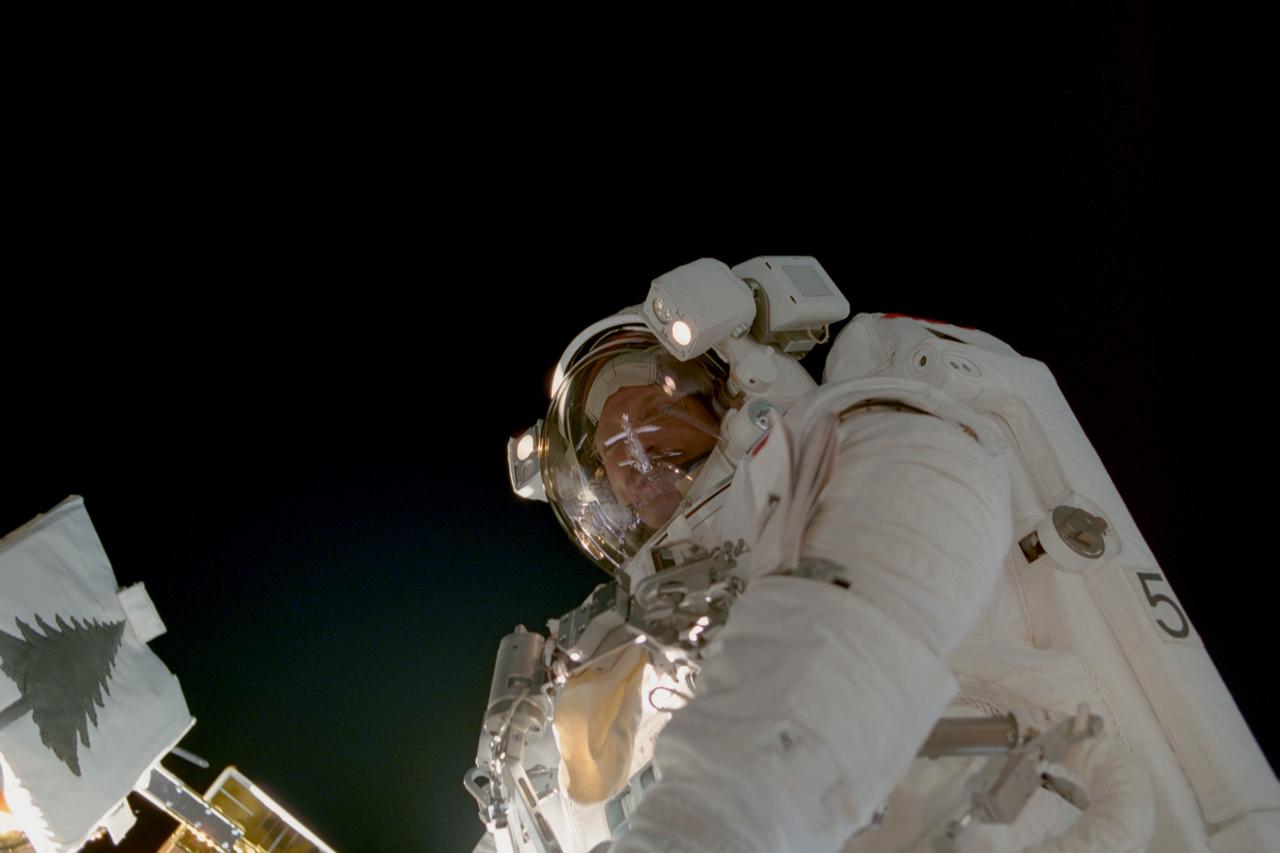
STS097-377-006 (7 December 2000) --- --- Space walking Endeavour astronauts topped off their scheduled space walk activities with an image of an evergreen tree (left) placed atop the P6 solar array structure, the highest point in their construction project. Astronaut Joseph R. Tanner, mission specialist, then posed for this photo with the "tree" before returning to the shirt-sleeve environment of the Space Shuttle Endeavour. Astronaut Carlos I. Noriega, mission specialist who shared three STS-97 space walks with Tanner, took the photo with a 35mm camera.
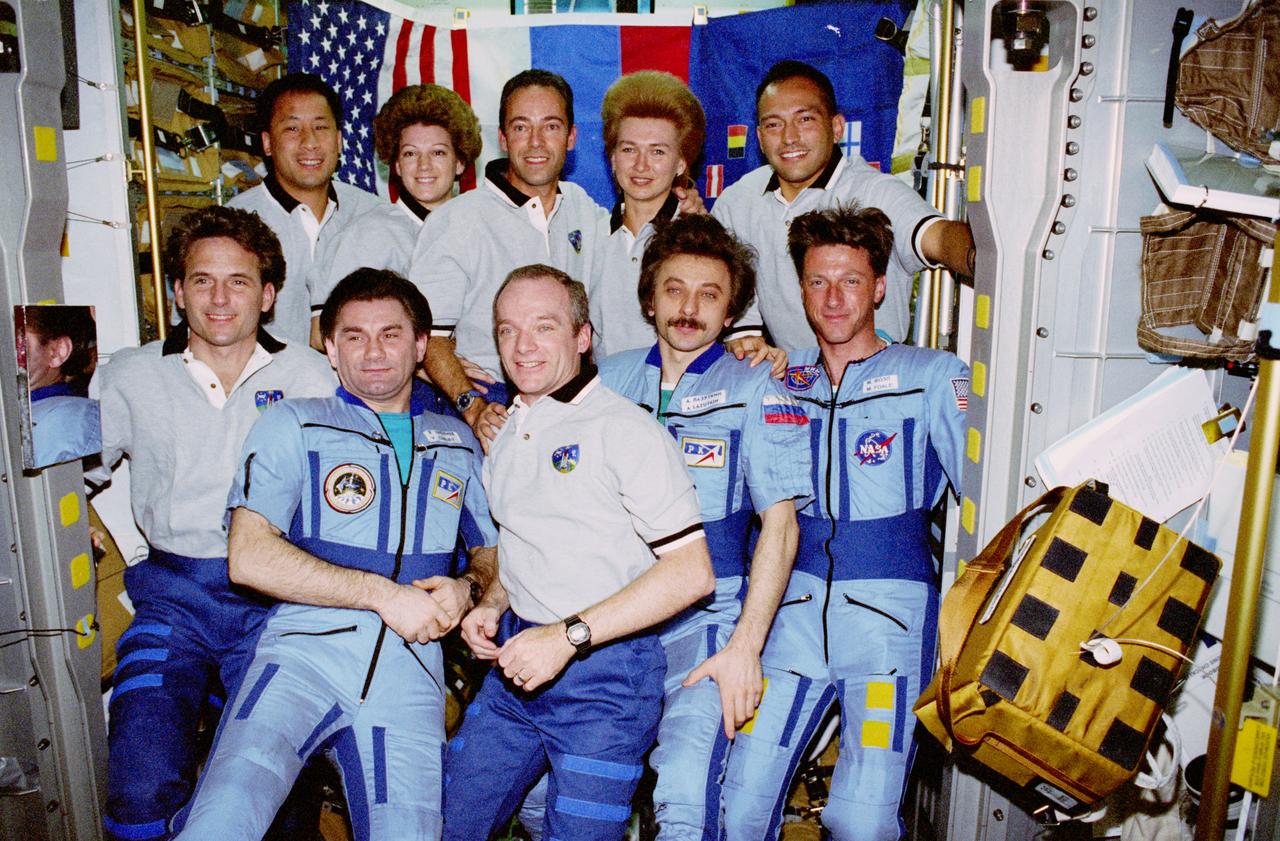
STS084-366-015 (15-24 May 1997) --- Crewmembers from Mir-23 and STS-84 assemble for a group portrait onboard the Spacehab Double Module, as they tie a record (ten) for number of persons aboard a single orbiting spacecraft at one time. They are (from the left, front) Jerry M. Linenger, Vasili V. Tsibliyev, Charles J. Precourt, Aleksandr I. Lazutkin and C. Michael Foale. On the back row, from the left, are Edward T. Lu, Eileen M. Collins, Jean-Francois Clervoy, Elena V. Kondakova and Carlos I. Noriega.
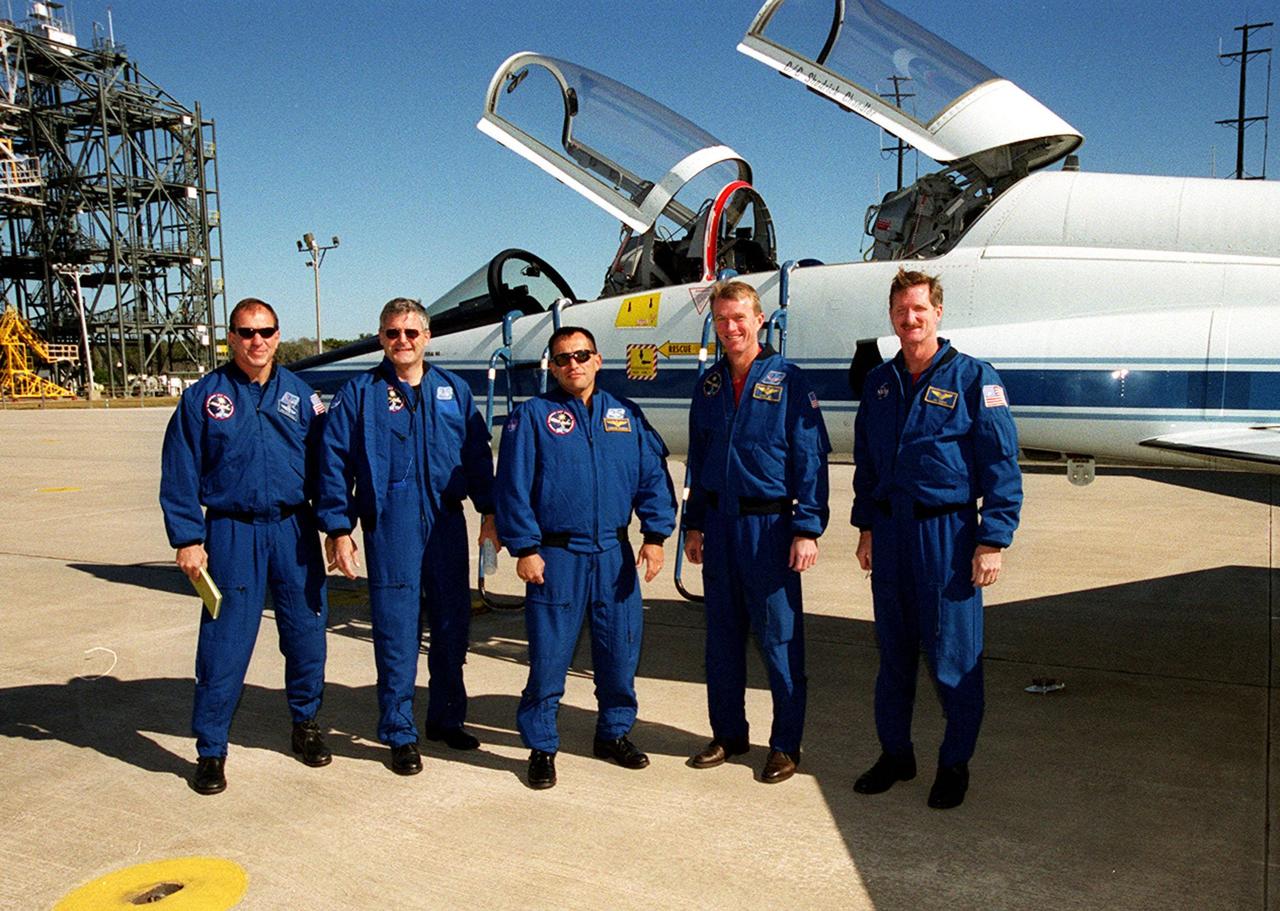
The STS-97 crew poses for a photo at the Shuttle Landing Facility after their arrival. Standing left to right are Pilot Michael Bloomfield, Mission Specialists Marc Garneau and Carlos Noriega, Commander Brent Jett and Mission Specialist Joseph Tanner. They are at KSC for a final payload walkdown before launch, scheduled for Nov. 30 at 10:06 p.m. EST from Launch Pad 39B. The sixth flight to the International Space Station, the mission is expected to last 11 days, with a planned KSC landing at about 5:58 p.m. Dec. 11
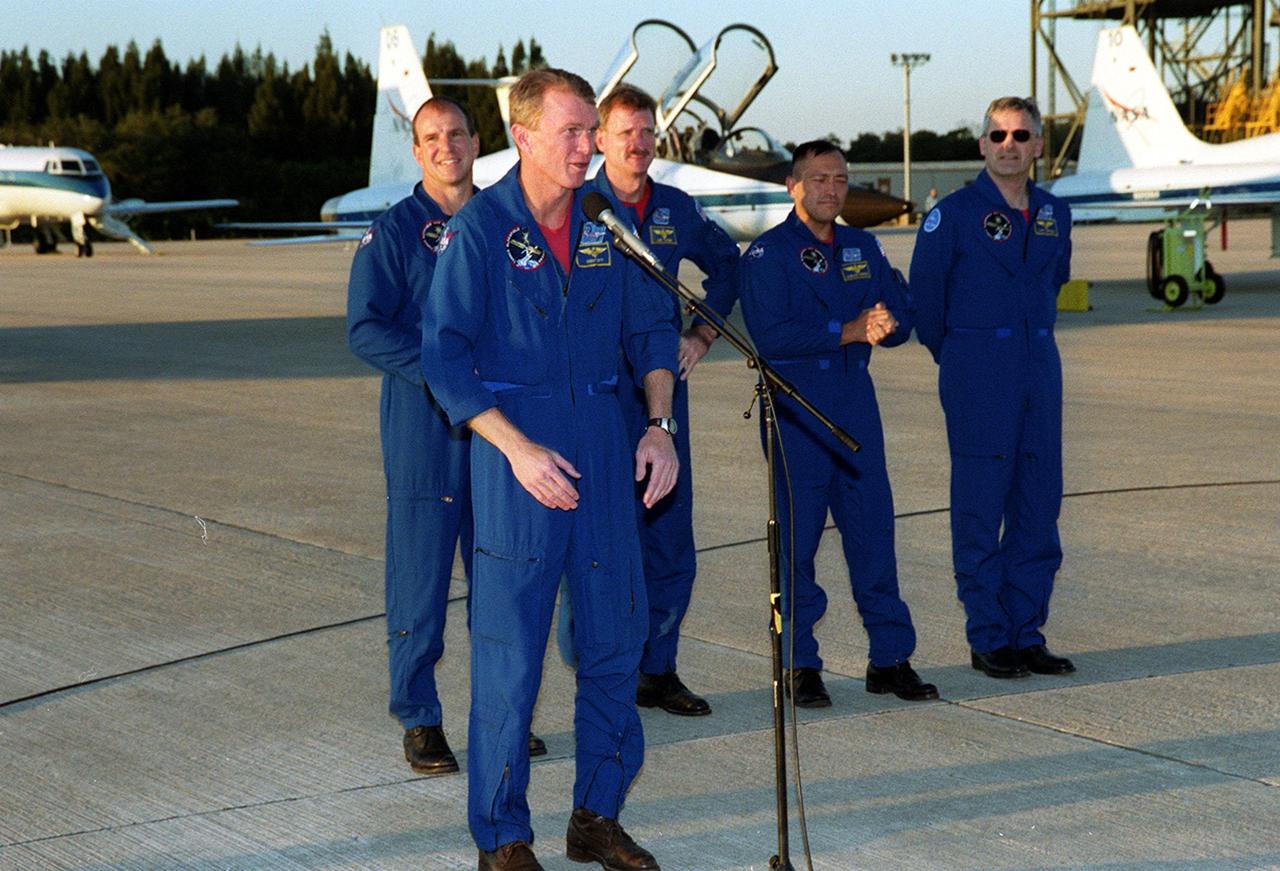
After arriving at the Shuttle Landing Facility, the STS-97 crew gather to address the media. At the microphone, Commander Brent Jett praises the efforts of the KSC workers to get ready for the launch. Behind Jett are Pilot Michael Bloomfield and Mission Specialists Joseph Tanner, Carlos Noriega and Marc Garneau, who is with the Canadian Space Agency. Mission STS-97 is the sixth construction flight to the International Space Station. Its payload includes the P6 Integrated Truss Structure and a photovoltaic (PV) module, with giant solar arrays that will provide power to the Station. The mission includes two spacewalks to complete the solar array connections. STS-97 is scheduled to launch Nov. 30 at about 10:06 p.m. EST
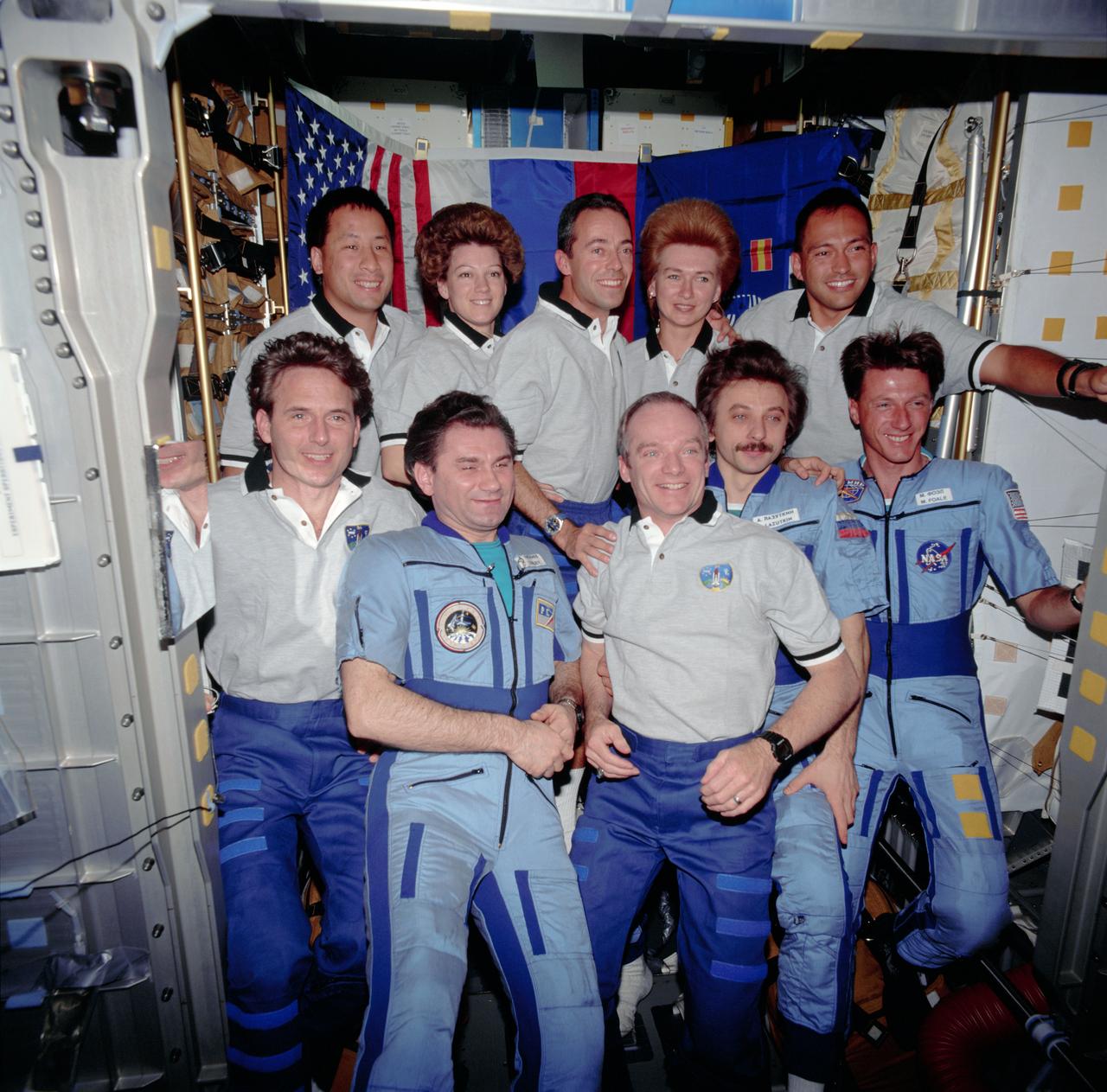
STS084-704-015 (15-24 May 1997) --- Crewmembers from Mir-23 and STS-84 assemble for a group portrait onboard the Spacehab Double Module, as they tie a record (ten) for number of persons aboard a single orbiting spacecraft at one time. They are (from the left, front) Jerry M. Linenger, Vasili V. Tsibliyev, Charles J. Precourt, Aleksandr I. Lazutkin and C. Michael Foale. On the back row, from the left, are Edward T. Lu, Eileen M. Collins, Jean-Francois Clervoy, Elena V. Kondakova and Carlos I. Noriega.
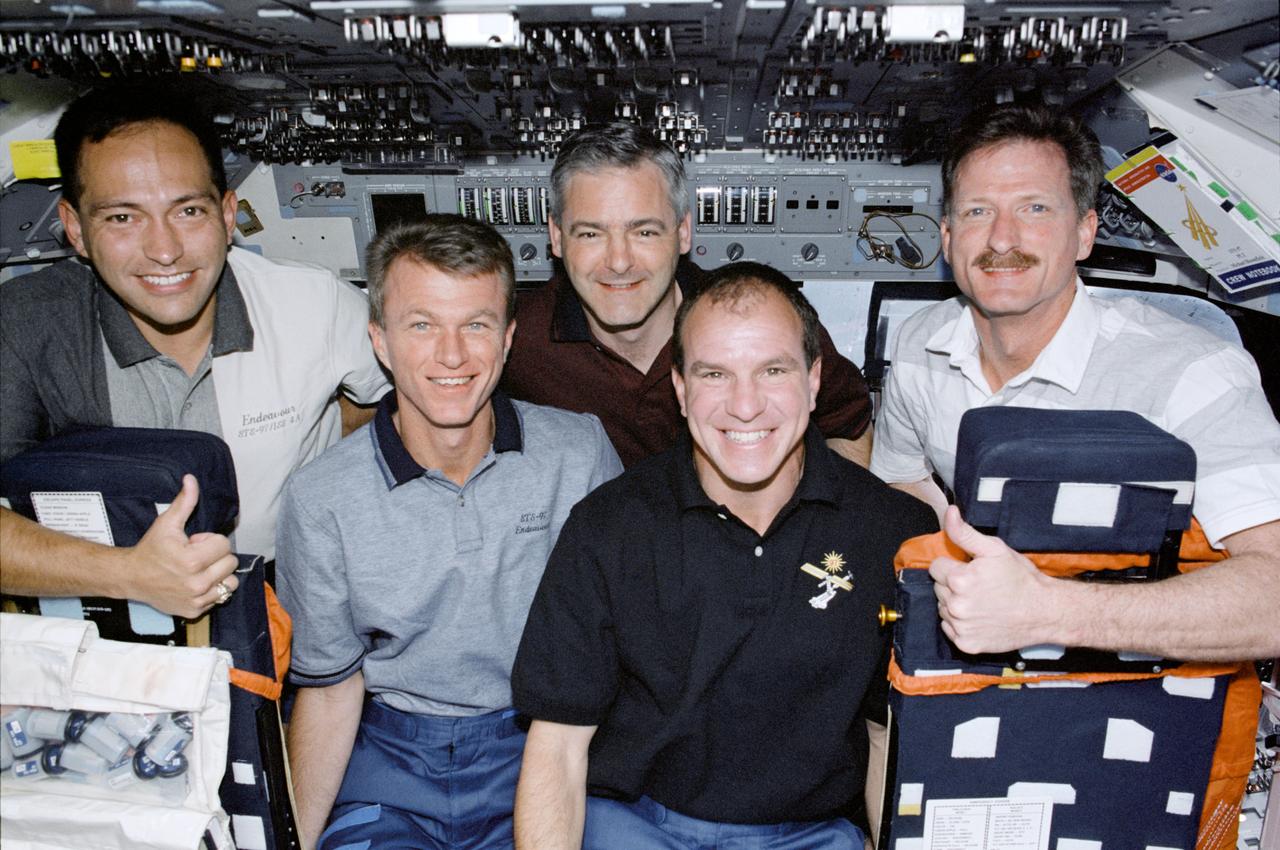
STS097-321-024 (30 Nov. - 11 Dec. 2000) --- The five astronauts comprising the STS-97 crew pause for a brief moment for an in-flight crew portrait during the busy ISS 4a mission in December 2000. They are, from the left, astronauts Carlos I. Noriega, mission specialist; Brent W. Jett, Jr., mission commander; Marc Garneau, mission specialist representing the Canadian Space Agency (ESA); Michael J. Bloomfield, pilot; and Joseph R. Tanner, mission specialist. They are on the forward flight deck of the Earth-orbiting Space Shuttle Endeavour.
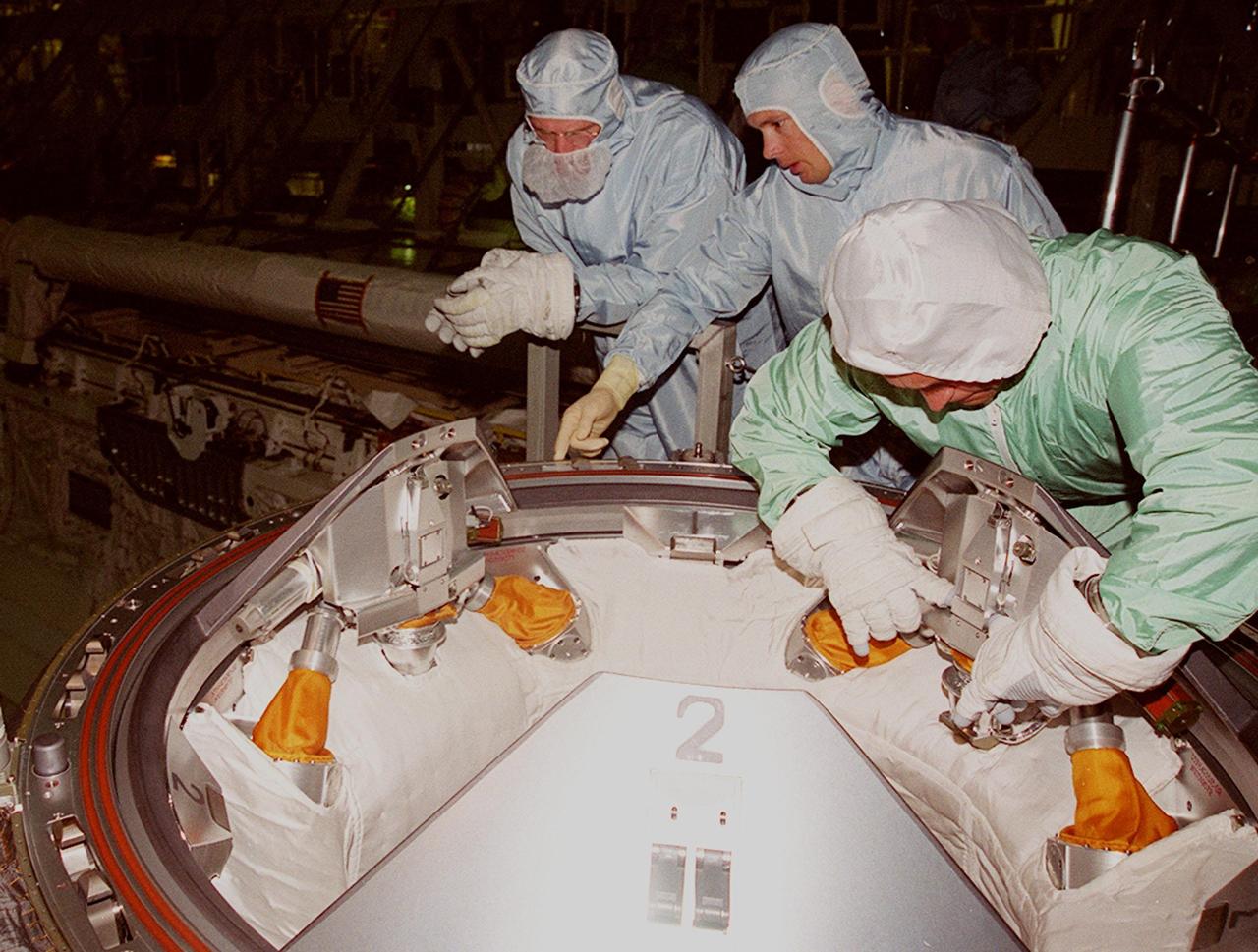
KENNEDY SPACE CENTER, FLA. -- In Orbiter Processing Facility (OPF) bay 2 during Crew Equipment Interface Test (CEIT), Mission Specialist Joe Tanner (left) gets instruction from a worker while Mission Specialist Carlos Noriega (right) practices working latches on the Orbital Docking System in Endeavour’s payload bay. The CEIT provides an opportunity for crew members to check equipment and facilities that will be on board the orbiter during their mission. The STS-97 mission will be the sixth construction flight to the International Space Station. The payload includes a photovoltaic (PV) module, providing solar power to the Station. STS-97 is scheduled to launch Nov. 30 from KSC for the 10-day mission
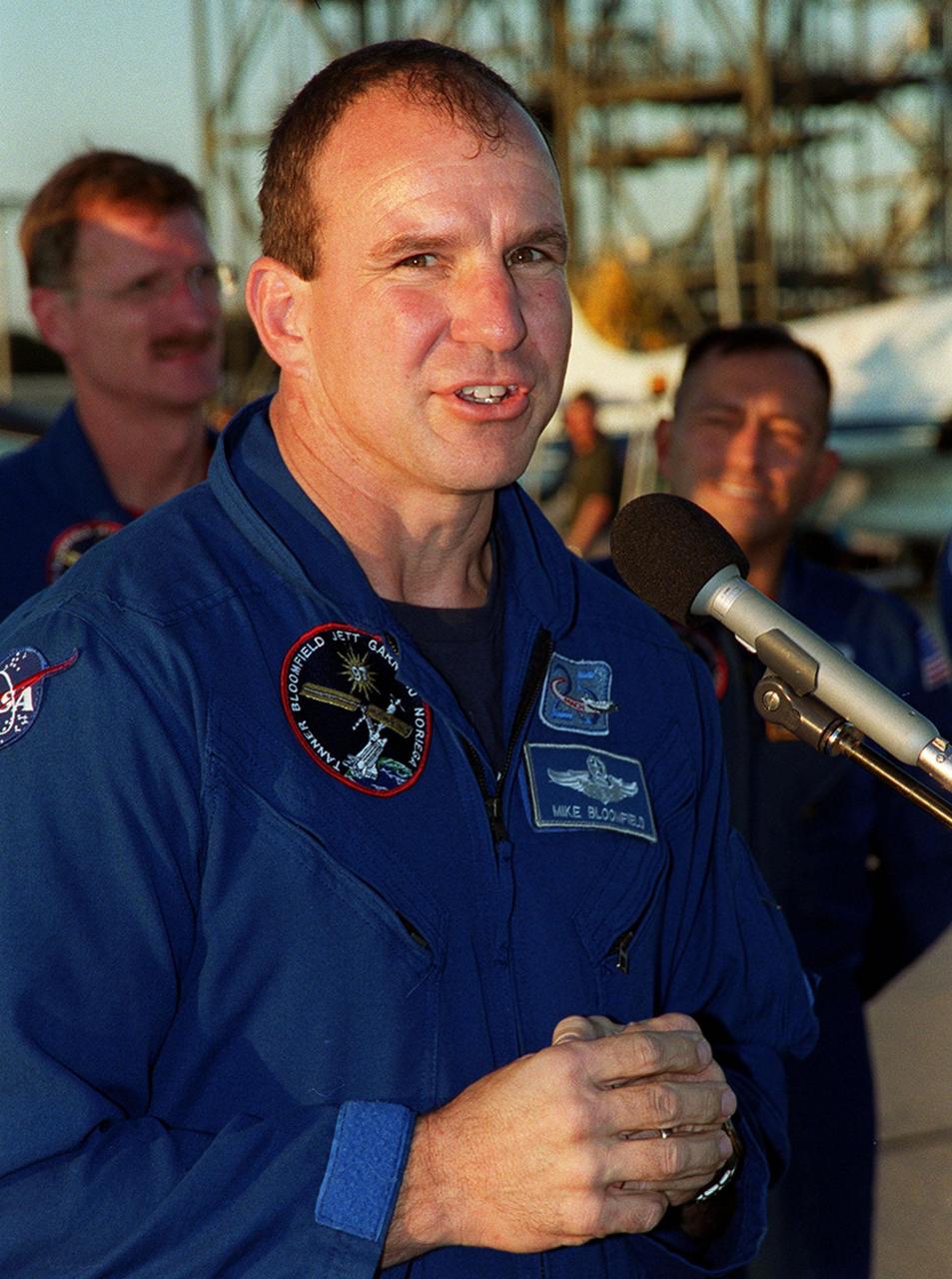
After arriving at the Shuttle Landing Facility, the STS-97 crew gather to address the media. At the microphone is Pilot Michael Bloomfield. Behind him can be seen Mission Specialists Joseph Tanner and Carlos Noriega. Mission STS-97 is the sixth construction flight to the International Space Station. Its payload includes the P6 Integrated Truss Structure and a photovoltaic (PV) module, with giant solar arrays that will provide power to the Station. The mission includes two spacewalks to complete the solar array connections. STS-97 is scheduled to launch Nov. 30 at about 10:06 p.m. EST
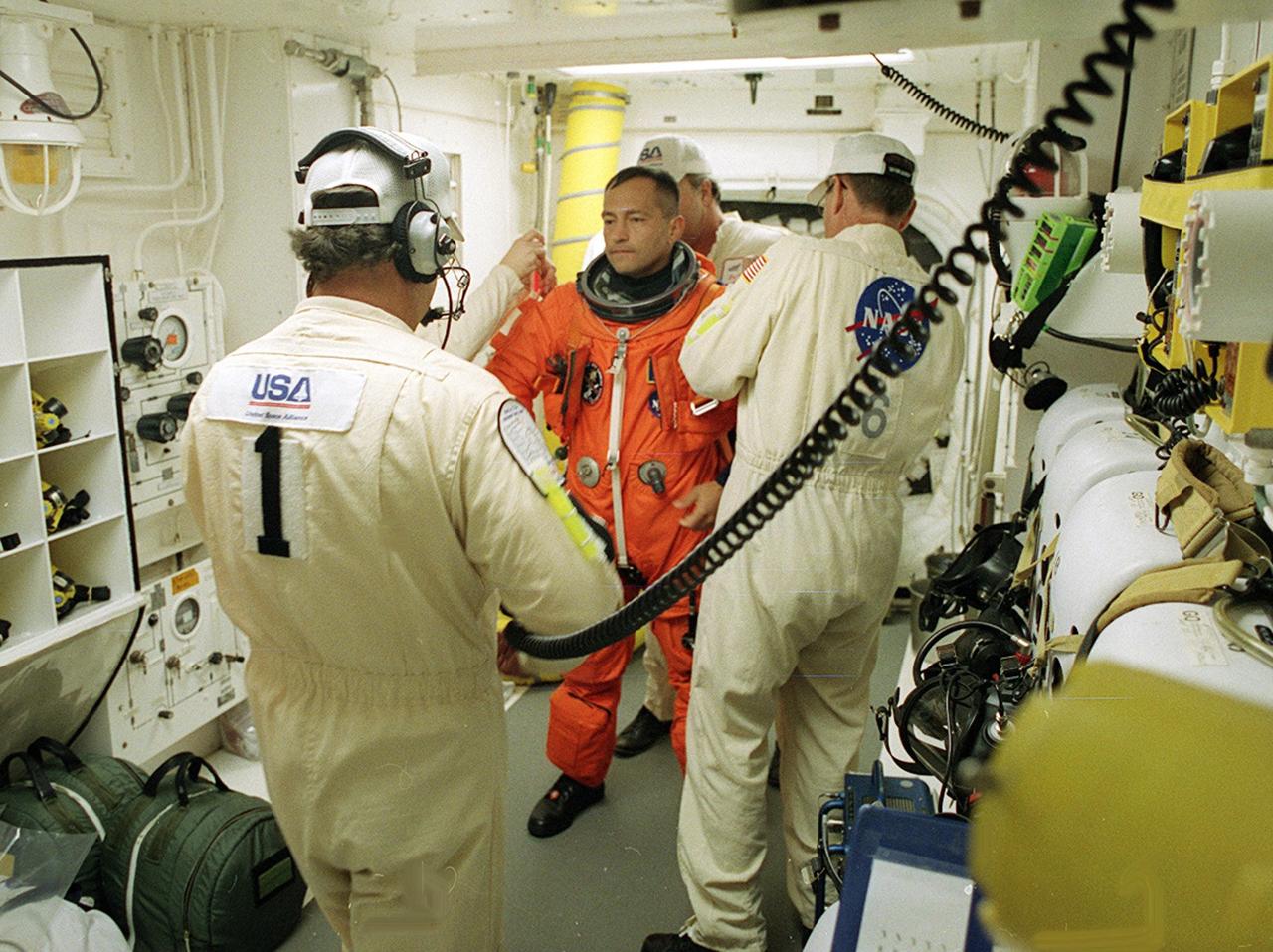
In the White Room, STS-97 Mission Specialist Carlos Noriega Tanner prepares for entry into Space Shuttle Endeavour with the help of the Closeout Crew, Travis Thompson (left) and Jack Burritt (right). Space Shuttle Endeavour is targeted to launch Nov. 30 at 10:06 p.m. EST for the six construction flight to the International Space Station. Endeavour is transporting the P6 Integrated Truss Structure that comprises Solar Array Wing-3 and the Integrated Electronic Assembly, to provide power to the Space Station. After the 11-day mission, which includes three spacewalks, it is expected to land at KSC Dec. 11 at 6:19 p.m. EST
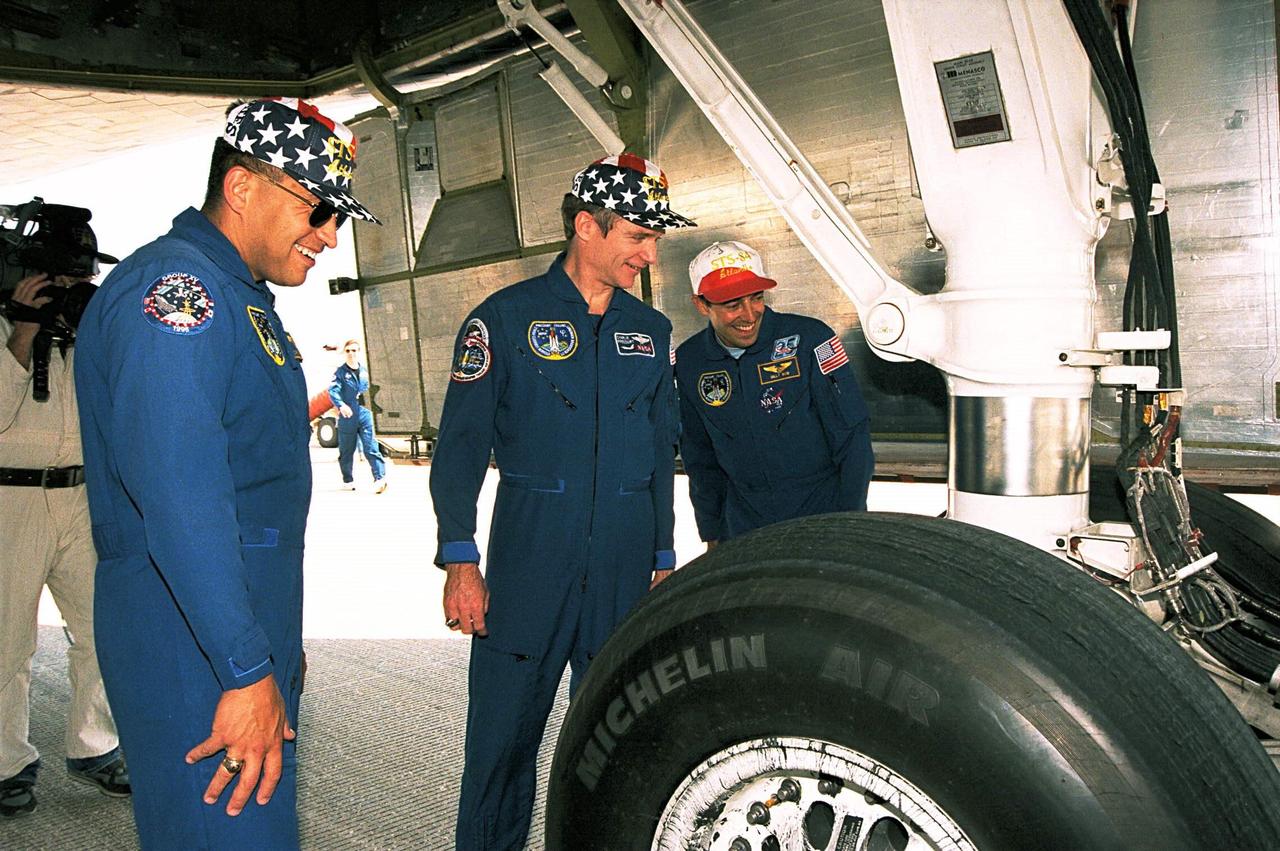
STS-84 crew members, from left, Mission Specialist Carlos I. Noriega, Commander Charles J. Precourt and Mission Specialist Jean-Francois Clervoy examine the tires of the Space Shuttle Atlantis after landing. Atlantis traveled about 3.6 million miles during the nine-day mission, which was the sixth of nine planned dockings of the Space Shuttle with the Russian Space Station Mir. The mission also included the exchange of STS-84 Mission Specialist C. Michael Foale for astronaut and Mir 23 crew member, Jerry M. Linenger, who spent the last four months on the Russian space station
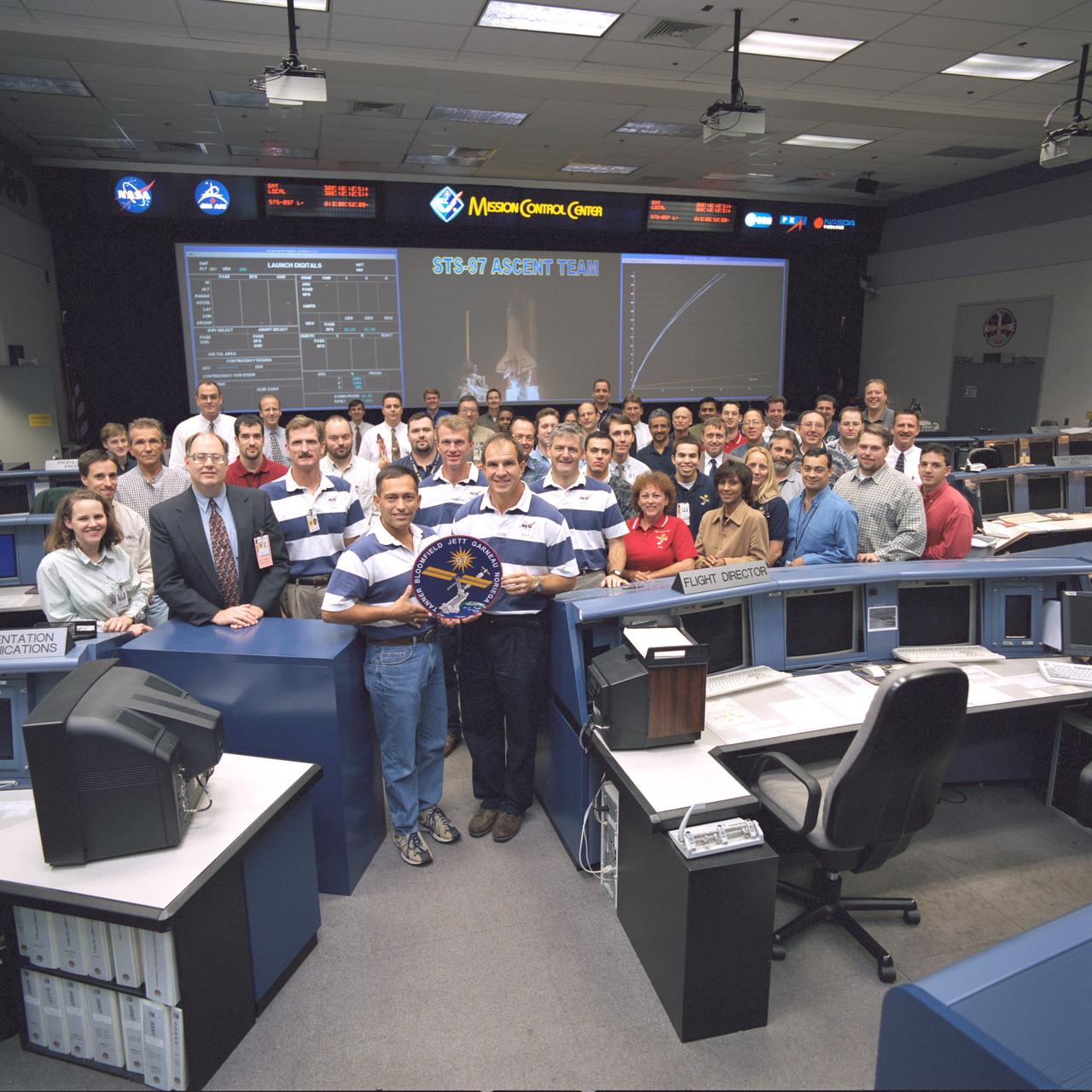
JSC2000-07294 (20 November 2000) --- The 40-odd flight controllers assigned to the STS-97 ascent team and some special guests pose for a group portrait in the shuttle flight control room in Houston's Mission Control Center (JSC). The five guests attired in the blue and white shirts are the flight crew members for the STS-97 crew, scheduled to be launched from Florida on the last day of this month. The astronauts are, from the left, Joseph R. Tanner, Carlos I. Noriega, Brent W. Jett, Jr., Michael J. Bloomfield and Marc Garneau, who represents the Canadian Space Agency (CSA). Ascent shift flight director Wayne Hale stands next to Tanner.
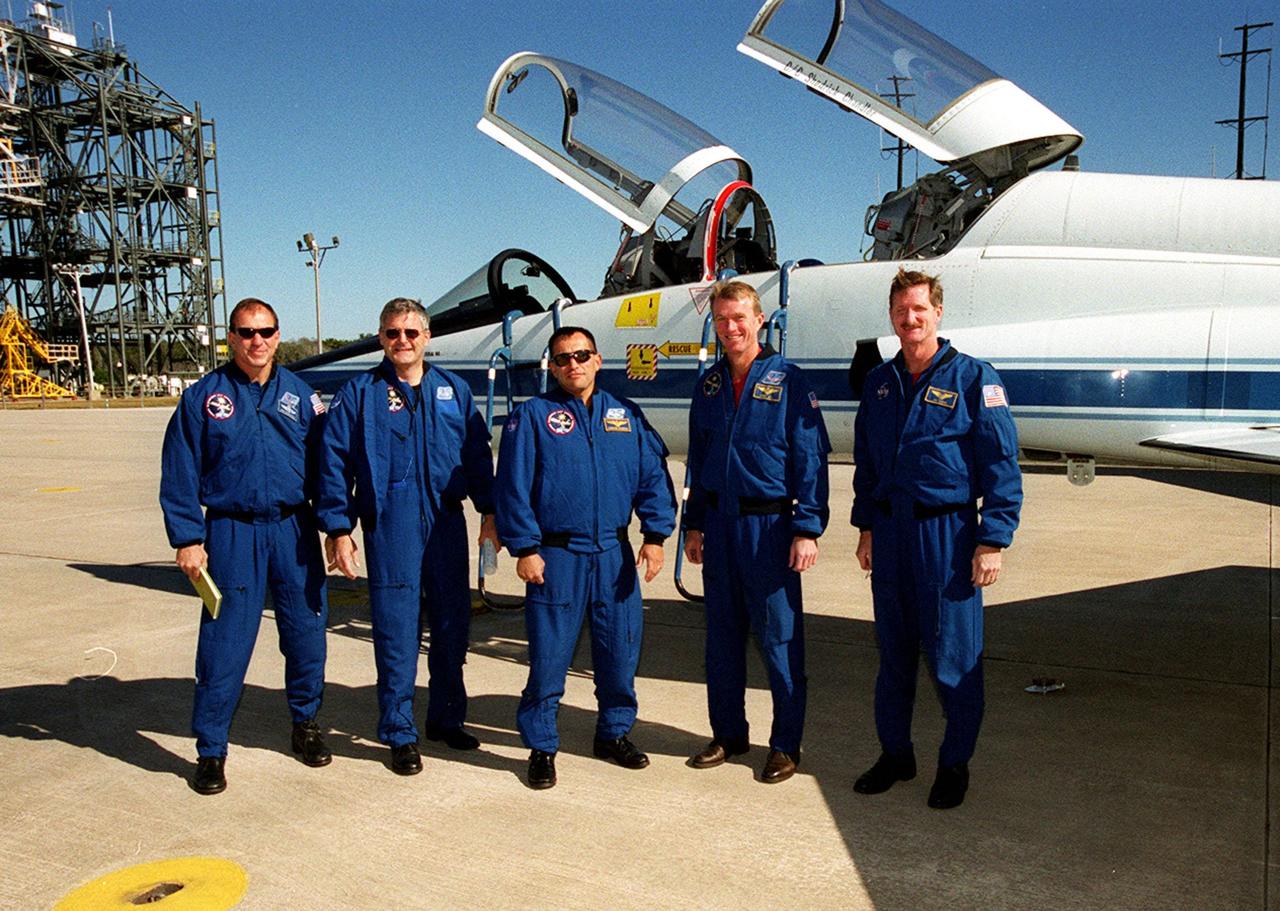
The STS-97 crew poses for a photo at the Shuttle Landing Facility after their arrival. Standing left to right are Pilot Michael Bloomfield, Mission Specialists Marc Garneau and Carlos Noriega, Commander Brent Jett and Mission Specialist Joseph Tanner. They are at KSC for a final payload walkdown before launch, scheduled for Nov. 30 at 10:06 p.m. EST from Launch Pad 39B. The sixth flight to the International Space Station, the mission is expected to last 11 days, with a planned KSC landing at about 5:58 p.m. Dec. 11
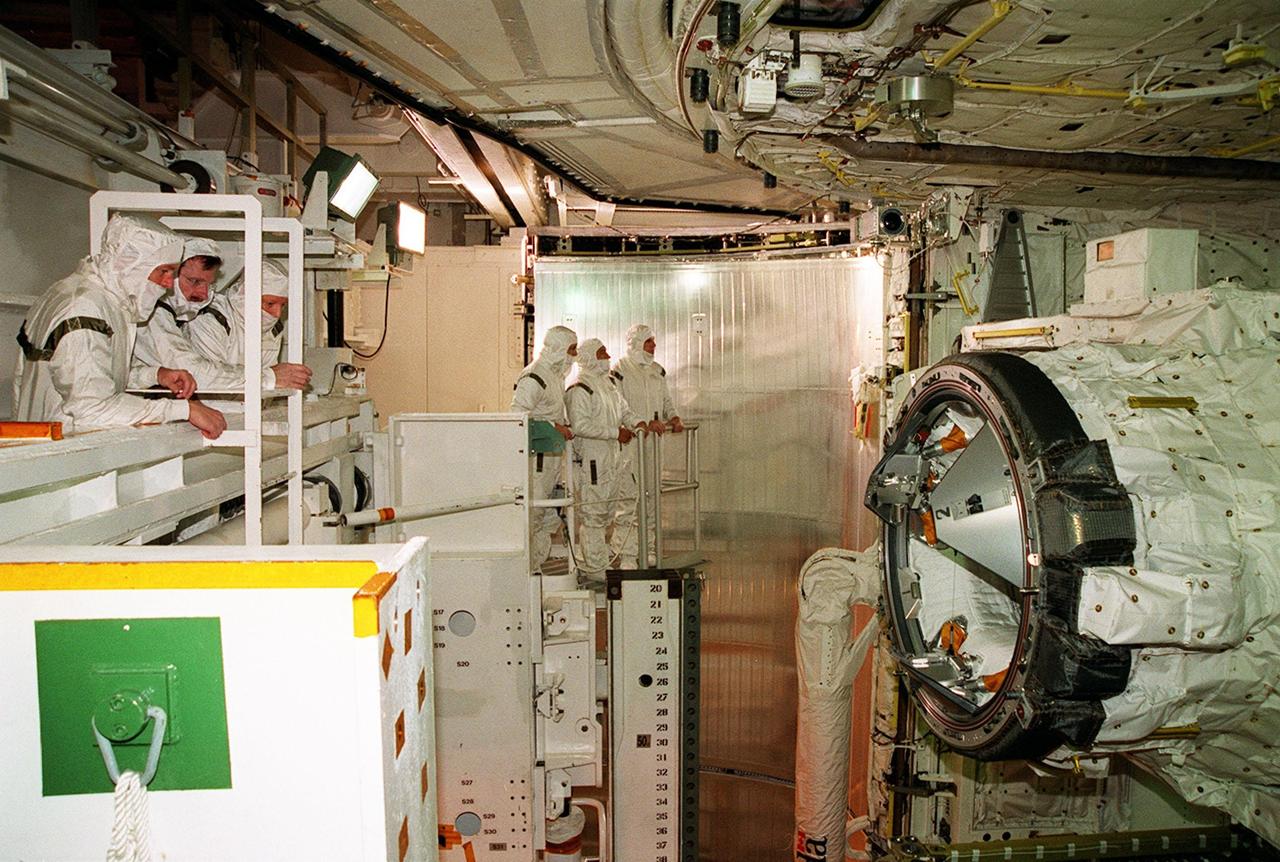
Members of the STS-97 crew look into Endeavour’s payload bay at some of the equipment that will be carried on the mission. At far left are (left to right) Commander Brent Jett and Mission Specialist Joseph Tanner, with a technician. At center are Mission Specialists Marc Garneau and Carlos Noriega, plus Pilot Michael Bloomfield. The equipment visible at right are the orbiter docking system (ODS) (center) and Canadian robotic arm (left and below the ODS). The arm will be used during spacewalks on the mission to install solar arrays. Each more than 100 feet long, the arrays will capture energy from the sun and convert it to power for the Station. STS-97 is scheduled to launch Nov. 30 at about 10:06 p.m. EST
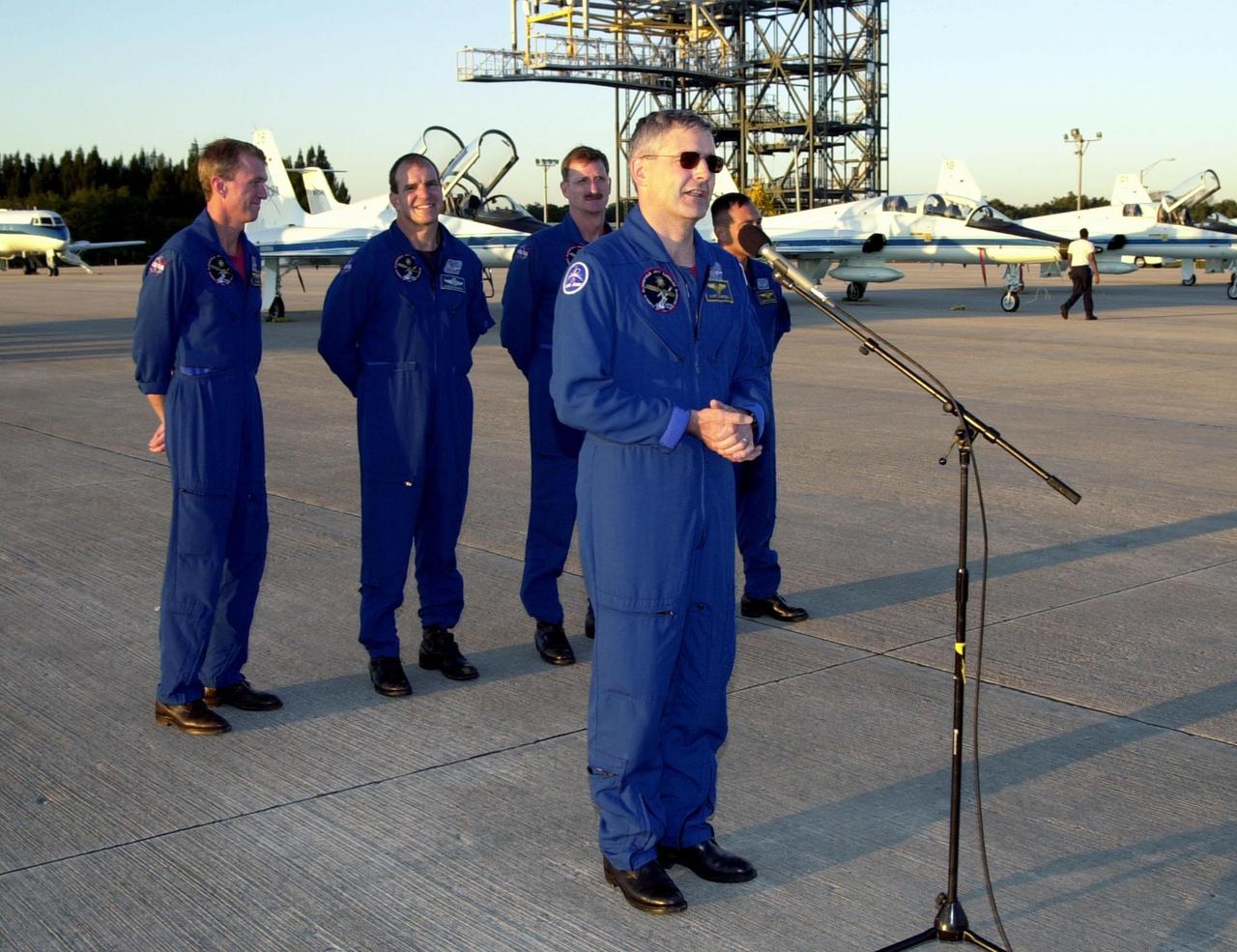
After their arrival at the Shuttle Landing Facility, the STS-97 crew gather to address the media. At the microphone is Mission Specialist Marc Garneau, who is with the Canadian Space Agency. Behind him stand Commander Brent Jett, Pilot Michael Bloomfield and Mission Specialists Joseph Tanner and Carlos Noriega. Mission STS-97is the sixth construction flight to the International Space Station. Its payload includes the P6 Integrated Truss Structure and a photovoltaic (PV) module, with giant solar arrays that will provide power to the Station. The mission includes two spacewalks to complete the solar array connections. STS-97 is scheduled to launch Nov. 30 at about 10:06 p.m. EST
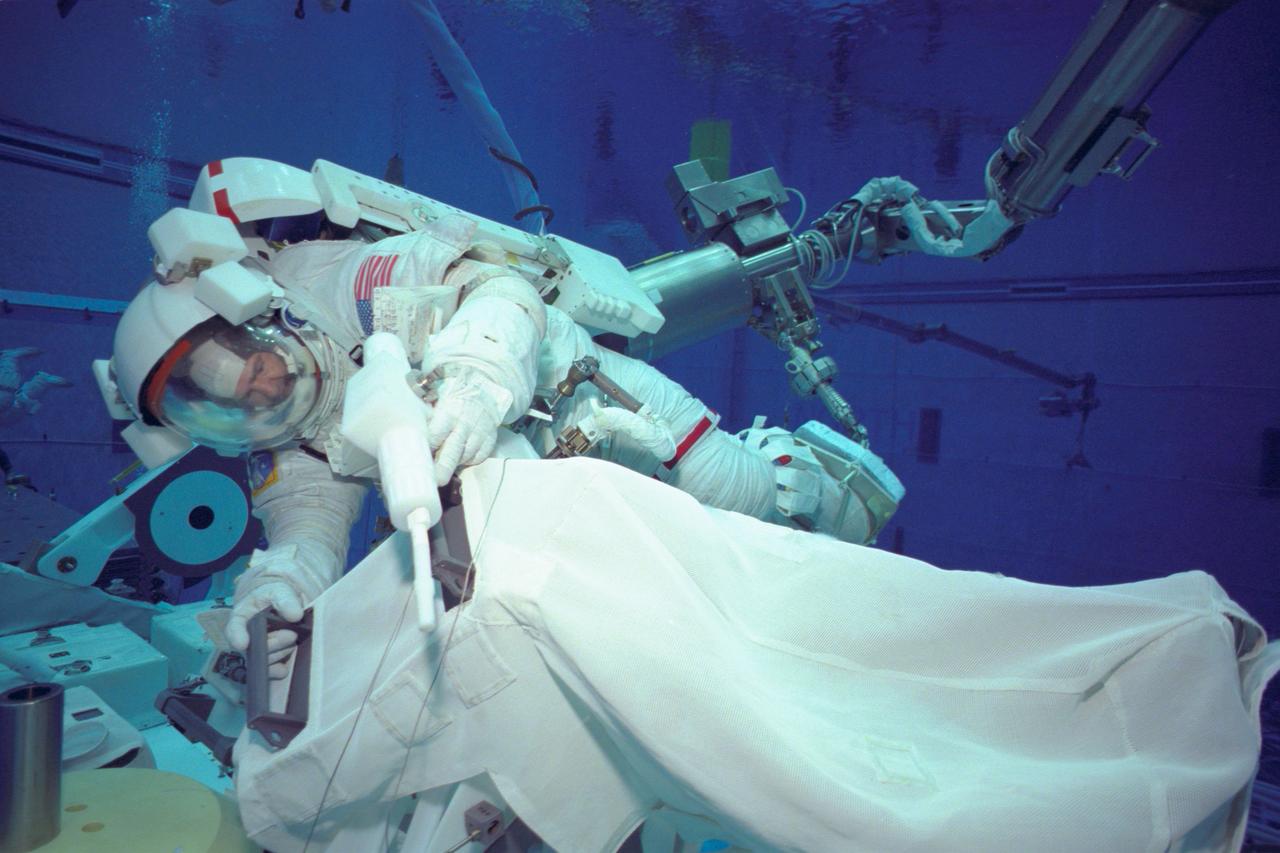
JSC2000-07072 (23 October 2000) --- Equipped with mockup tools and attached to a training version of the shuttle's remote manipulator system (RMS)robotic arm, astronaut Marc Garneau simulates a space walk task in the Neutral Buoyancy Laboratory (NBL). Garneau, an STS-97 mission specialist representing the Canadian Space Agency (CSA), has been assigned an alternate's role for extravehicular activity (EVA) on the ISS 4a mission. The prime EVA crew is composed of astronauts Joseph R. Tanner and Carlos I. Noriega, who are expected to share three different days of space walks during the December mission.

S97-E-5144 (8 December 2000) --- The STS-97 astronauts and the Expedition 1 crew members pose for an historic portrait onboard the International Space Station (ISS) shortly after hatches were opened between the Space Shuttle Endeavour and the station. In front, from the left, are Sergei K. Krikalev, Brent W. Jett, Jr., William M. Shepherd and Joseph R. Tanner. In back, from the left, are Marc Garneau, Carlos I. Noriega, Yuri P. Gidzenko and Michael J. Bloomfield. A pre-set digital still camera was used to record the scene.

After their arrival at the Shuttle Landing Facility, the STS-97 crew gather to address the media. At the microphone is Mission Specialist Carlos Noriega. Behind him stand Commander Brent Jett, Pilot Michael Bloomfield and Mission Specialists Joseph Tanner and Marc Garneau, who is with the Canadian Space Agency. Mission STS-97is the sixth construction flight to the International Space Station. Its payload includes the P6 Integrated Truss Structure and a photovoltaic (PV) module, with giant solar arrays that will provide power to the Station. The mission includes two spacewalks to complete the solar array connections. STS-97 is scheduled to launch Nov. 30 at about 10:06 p.m. EST
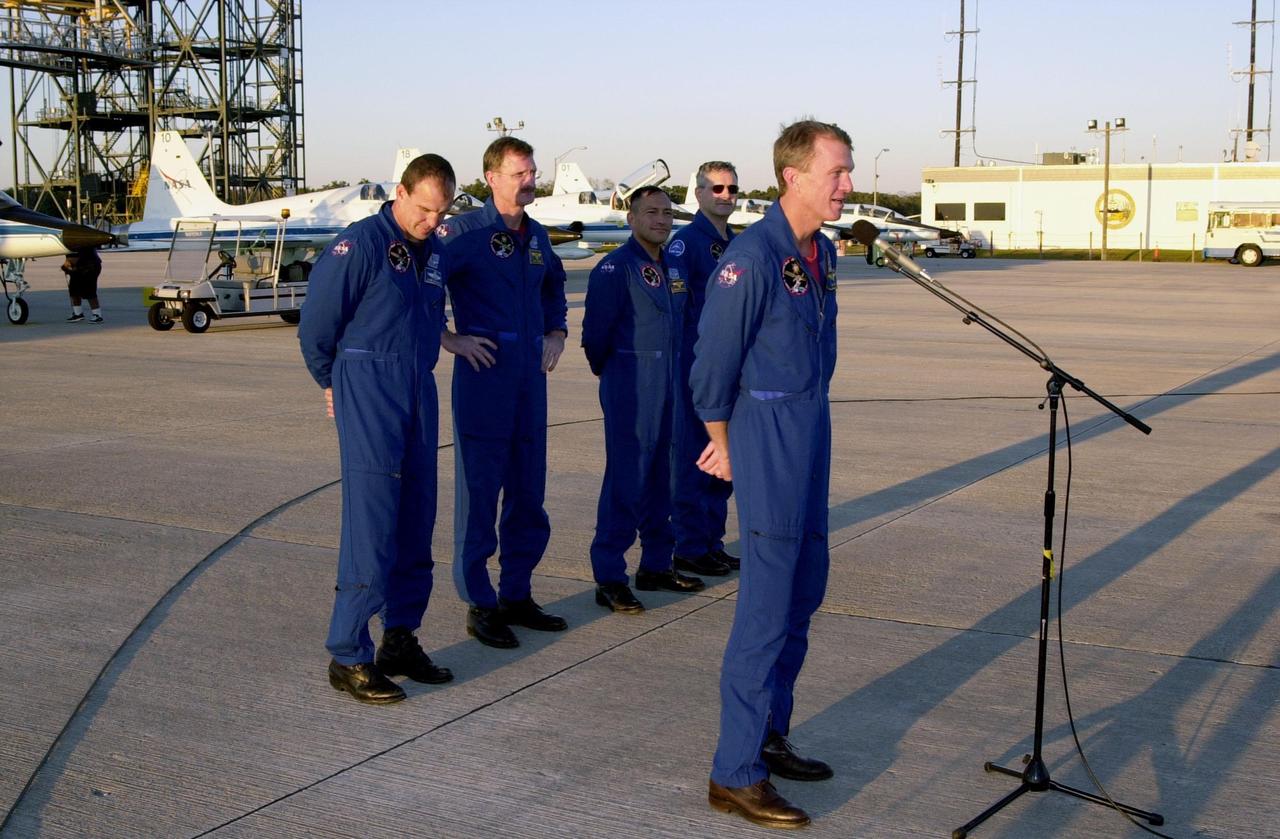
After their arrival at the Shuttle Landing Facility, the STS-97 crew gather to address the media. At the microphone, Commander Brent Jett praises the efforts of the KSC workers to get ready for the launch. Behind Jett are Pilot Michael Bloomfield and Mission Specialists Joseph Tanner, Carolos Noriega and Marc Garneau, who is with the Canadian Space Agency. Mission STS-97is the sixth construction flight to the International Space Station. Its payload includes the P6 Integrated Truss Structure and a photovoltaic (PV) module, with giant solar arrays that will provide power to the Station. The mission includes two spacewalks to complete the solar array connections. STS-97 is scheduled to launch Nov. 30 at about 10:06 p.m. EST
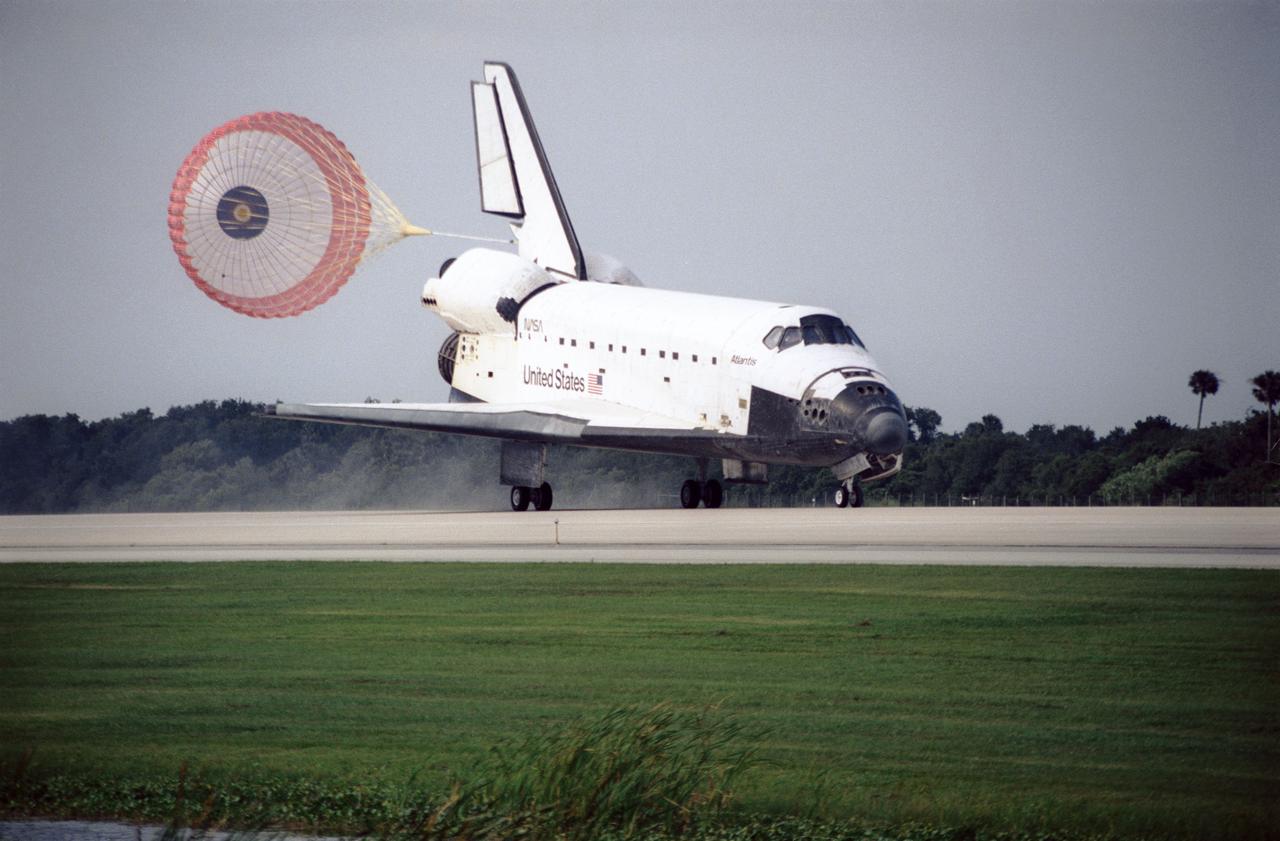
STS084-S-010 (24 May 1997) --- The drag chute on the Space Shuttle Atlantis is deployed as the Space Shuttle touches down on Runway 33 of the Kennedy Space Center (KSC) Shuttle Landing Facility (SLF). The landing, at 9:27:44 a.m. (EDT), May 24, 1997, brought to a completion the nine-day mission. This touchdown marked the 37th landing at KSC in the 16-year history of the Space Transportation System (STS) and it also marked the return of astronaut Jerry M. Linenger to Earth following almost four months aboard Russia's Mir Space Station. Onboard for the landing were astronauts Charles J. Precourt, Eileen M. Collins, Jean-Fran?ois Clervoy, Carlos I. Noriega, Edward T. Lu, Linenger and Elena V. Kondakova. Clervoy is with the European Space Agency (ESA) and Kondakova represents the Russian Space Agency (RSA).

KENNEDY SPACE CENTER, Fla. -- After a 4.4-million-mile mission, Endeavour nears Runway 15 at the Shuttle Landing Facility to complete the successful 10-day, 19-hour and 58-minute-long STS-97 mission. At the controls is Commander Brent Jett. Other crew members on board are Pilot Michael Bloomfield and Mission Specialists Joseph Tanner, Carlos Noriega and Marc Garneau of Canada. On the mission, Endeavour carried the P6 Integrated Truss Structure with solar arrays to power the International Space Station. The arrays and other equipment were installed during three EVAs that totaled 19 hours, 20 minutes. Endeavour was docked with the Space Station for 6 days, 23 hours, 13 minutes. This is the 16th nighttime landing for a Space Shuttle and the 53rd at Kennedy Space Center

STS-97 Commander Brent Jett arrives at the Shuttle Landing Facility aboard a T-38 jet aircraft. He and the rest of the crew are at KSC to take part in Terminal Countdown Demonstration Test activities that include emergency egress training, familiarization with the payload, and a simulated launch countdown. The other crew members are Pilot Mike Bloomfield and Mission Specialists Joe Tanner, Carlos Noriega and Marc Garneau, who is with the Canadian Space Agency. Mission STS-97is the sixth construction flight to the International Space Station. Its payload includes the P6 Integrated Truss Structure and a photovoltaic (PV) module, with giant solar arrays that will provide power to the Station. The mission includes two spacewalks to complete the solar array connections. STS-97 is scheduled to launch Nov. 30 at 10:05 p.m. EST