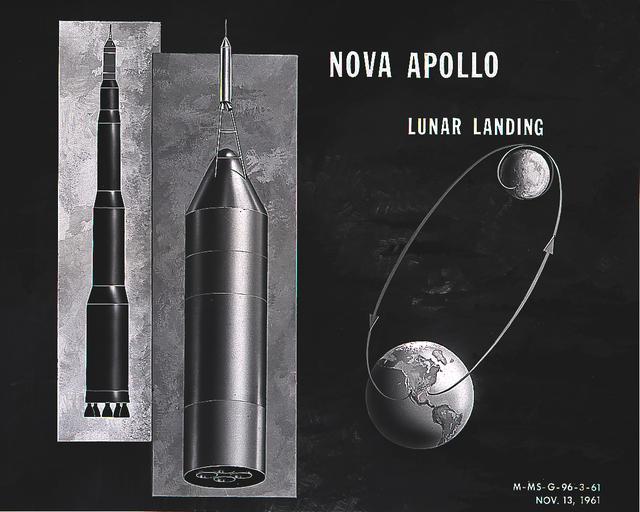
This artist's concept illustrates the Module Nova concept - Solid C-3 Basis. From 1960 to 1962, the Marshall Space Flight Center considered the Nova launch vehicle as a means to achieve a marned lunar landing with a direct flight to the Moon. Various configurations of the vehicle were examined. The latest configuration was a five-stage vehicle using eight F-1 engines in the first stage. Although the program was canceled after NASA planners selected the lunar/orbital rendezvous mode, the proposed F-1 engine would eventually be used in the Apollo Program to propel the first stage of the Saturn V launch vehicle.
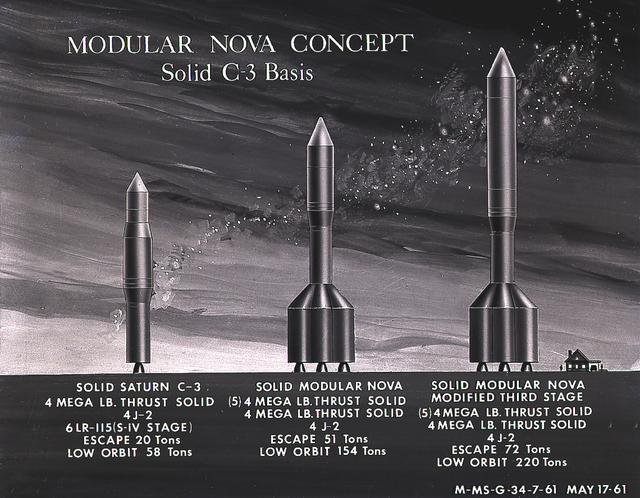
This artist's concept illustrates the Module Nova concept - Solid C-3 Basis. From 1960 to 1962, the Marshall Space Flight Center considered the Nova launch vehicle as a means to achieve a marned lunar landing with a direct flight to the Moon. Various configurations of the vehicle were examined. The latest configuration was a five-stage vehicle using eight F-1 engines in the first stage. Although the program was canceled after NASA planners selected the lunar/orbital rendezvous mode, the proposed F-1 engine would eventually be used in the Apollo Program to propel the first stage of the Saturn V launch vehicle.
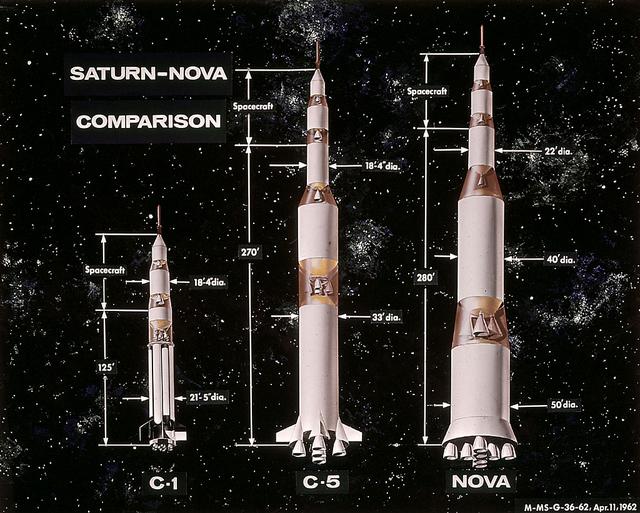
In this 1962 artist's concept , a proposed Nova rocket, shown at right, is compared to a Saturn C-1, left, and a Saturn C-5, center. The Marshall Space Flight Center directed studies of Nova configuration from 1960 to 1962 as a means of achieving a marned lunar landing with a direct flight to the Moon. Various configurations of the vehicle were examined, the largest being a five-stage vehicle using eight F-1 engines in the first stage. Although the program was effectively cancelled in 1962 when NASA planners selected the lunar-orbital rendezvous mode, the proposed F-1 engine was eventually used to propel the first stage of the Saturn V launch vehicle in the Apollo Program.
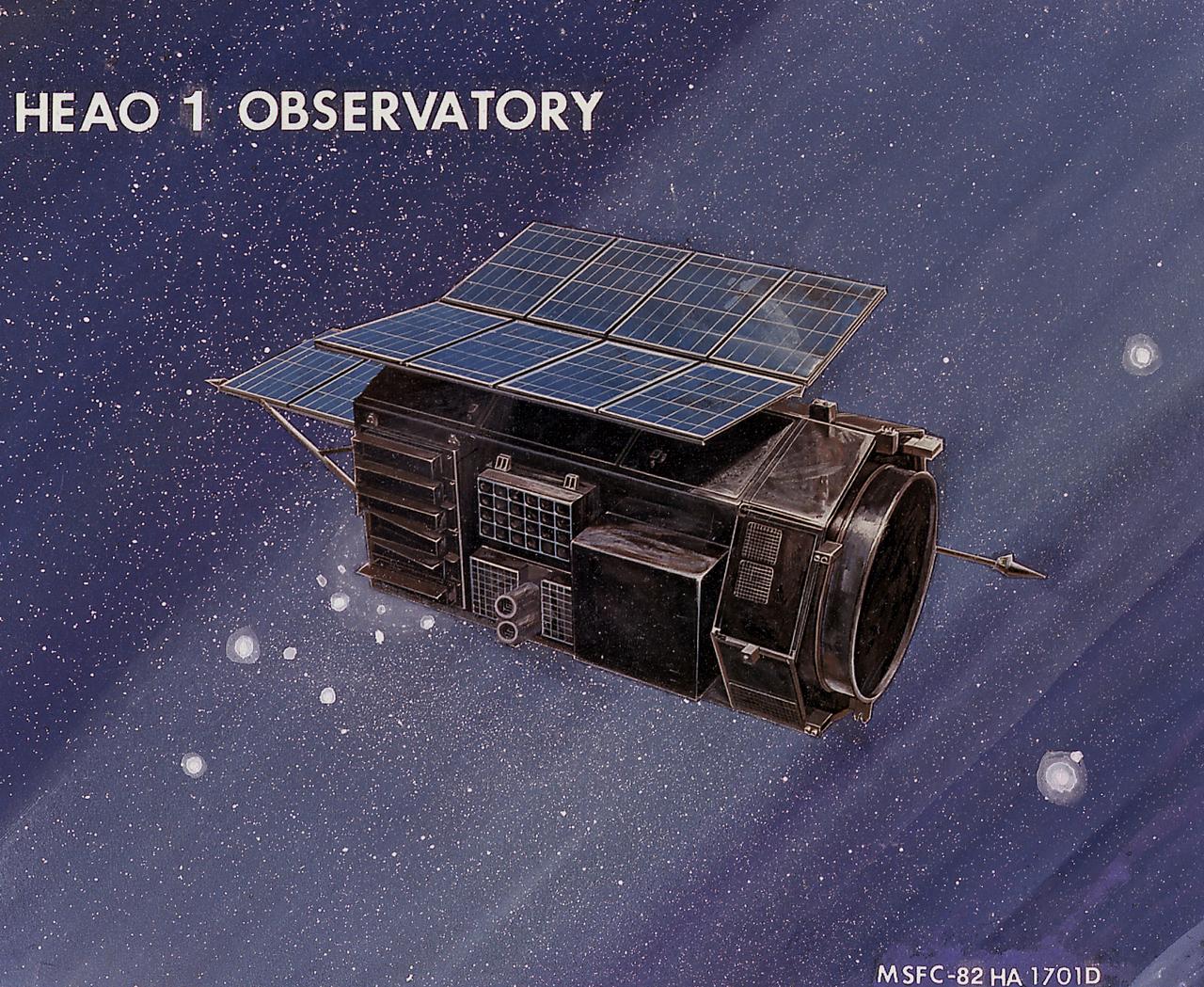
This artist's conception depicts the High Energy Astronomy Observatory (HEAO)-1 in orbit. The first observatory, designated HEAO-1, was launched on August 12, 1977 aboard an Atlas/Centaur launch vehicle and was designed to survey the sky for additional x-ray and gamma-ray sources as well as pinpointing their positions. The HEAO-1 was originally identified as HEAO-A but the designation was changed once the spacecraft achieved orbit. The HEAO project involved the launching of three unmarned scientific observatories into low Earth orbit between 1977 and 1979 to study some of the most intriguing mysteries of the universe; pulsars, black holes, neutron stars, and super nova. Hardware support for the imaging instruments was provided by American Science and Engineeing. The HEAO spacecraft were built by TRW, Inc. under project management of the Marshall Space Flight Center.