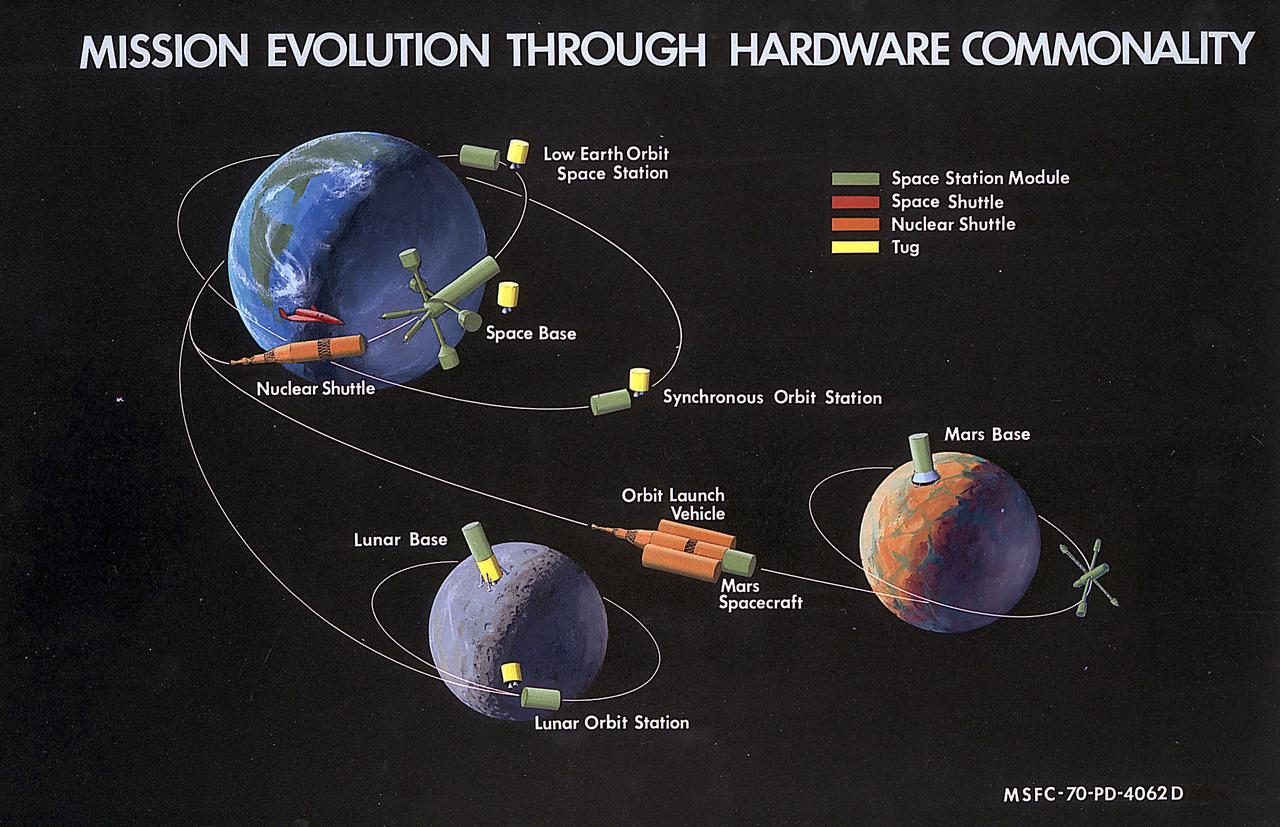
In this artist's concept from 1970, propulsion concepts such as the Nuclear Shuttle and Space Tug are shown in conjunction with other proposed spacecraft. As a result of the recommendations from President Nixon's Space Task Group for more commonality and integration in the American space program, Marshall Space Flight engineers studied many of the spacecraft depicted here.
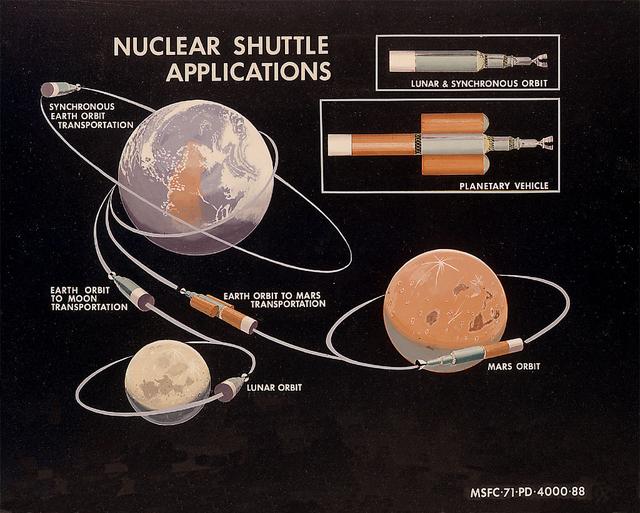
In this 1971 artist's concept, the Nuclear Shuttle is shown in various space-based applications. As envisioned by Marshall Space Flight Center Program Development persornel, the Nuclear Shuttle would deliver payloads to geosychronous Earth orbits or lunar orbits then return to low Earth orbit for refueling. A cluster of Nuclear Shuttle units could form the basis for planetary missions.
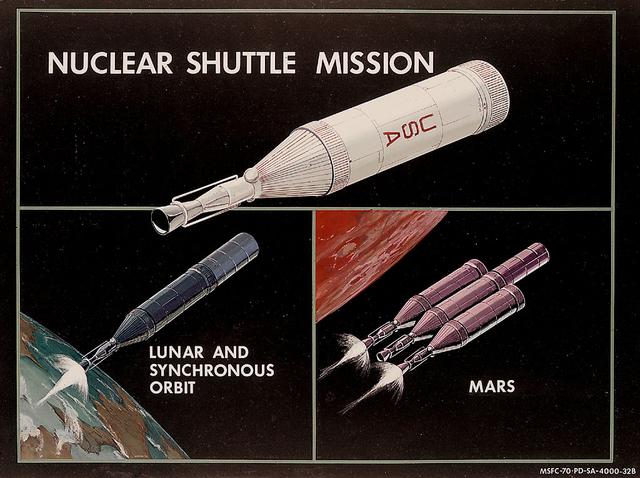
In this 1970 artist's concept, the Nuclear Shuttle is shown in its lunar and geosynchronous orbit configuration and in its planetary mission configuration. As envisioned by Marshall Space Flight Center Program Development plarners, the Nuclear Shuttle would deliver payloads to lunar orbit or other destinations then return to Earth orbit for refueling. A cluster of Nuclear Shuttle units could form the basis for planetary missions.
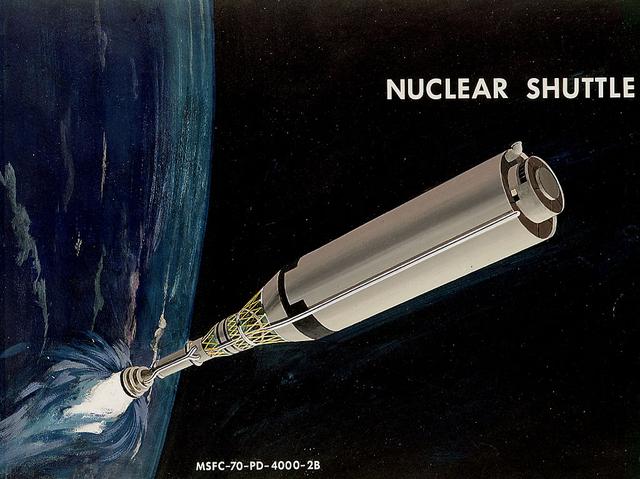
This 1970 artist's concept shows a Nuclear Shuttle in flight. As envisioned by Marshall Space Flight Center Program Development engineers, the Nuclear Shuttle would deliver payloads to lunar orbit or other destinations then return to Earth orbit for refueling and additional missions.
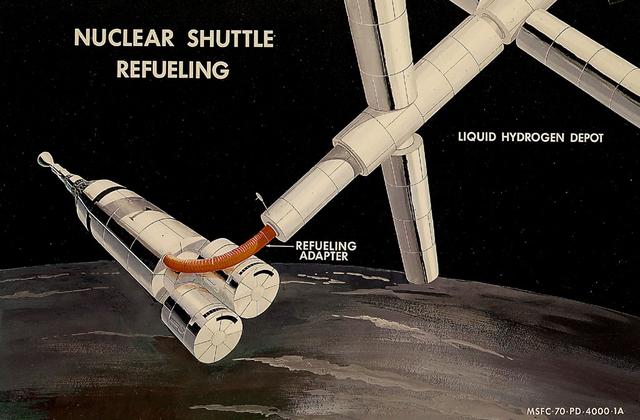
This artist's concept from 1970 shows a Nuclear Shuttle taking on fuel from an orbiting Liquid Hydrogen Depot. As envisioned by Marshall Space Flight Center Program Development persornel, the Nuclear Shuttle would deliver payloads to lunar orbit or other destinations then return to Earth orbit for refueling and additional missions.
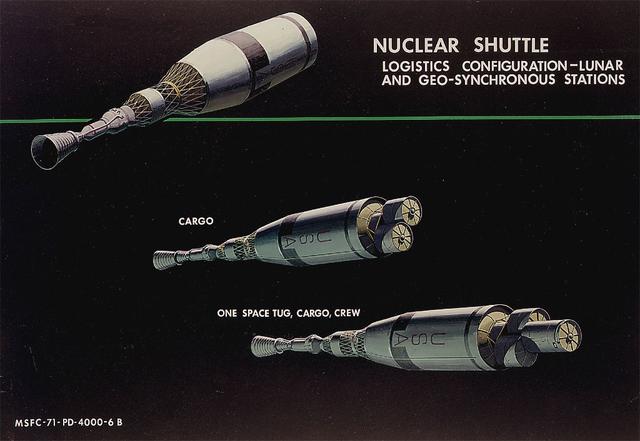
This 1971 artist's concept shows the Nuclear Shuttle in both its lunar logistics configuraton and geosynchronous station configuration. As envisioned by Marshall Space Flight Center Program Development persornel, the Nuclear Shuttle would deliver payloads to lunar orbits or other destinations then return to Earth orbit for refueling and additional missions.
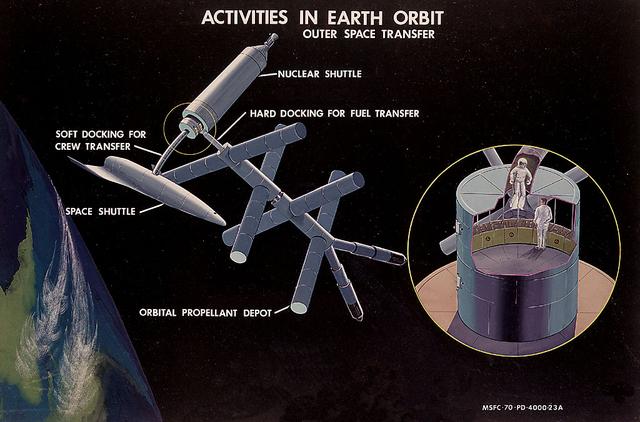
This artist's concept from 1970 shows a Nuclear Shuttle docked to an Orbital Propellant Depot and an early Space Shuttle. As envisioned by Marshall Space Flight Center Program Development plarners, the Nuclear Shuttle, in either manned or unmanned mode, would deliver payloads to lunar orbit or other destinations then return to Earth orbit for refueling and additonal missions.
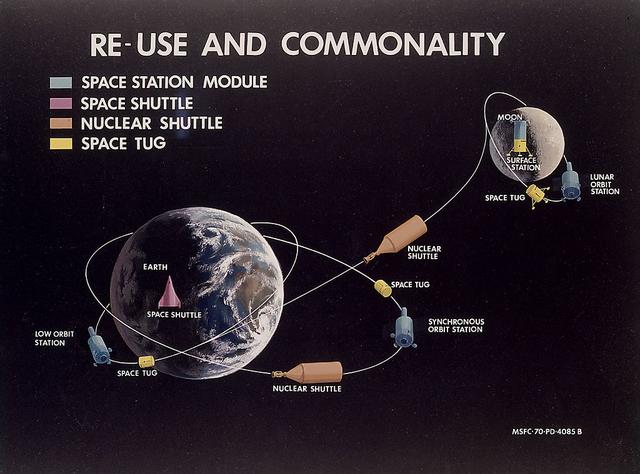
This 1970 artist's concept illustrates the use of the Space Shuttle, Nuclear Shuttle, and Space Tug in NASA's Integrated Program. As a result of the Space Task Group's recommendations for more commonality and integration in the American space program, Marshall Space Flight Center engineers studied many of the spacecraft depicted here.
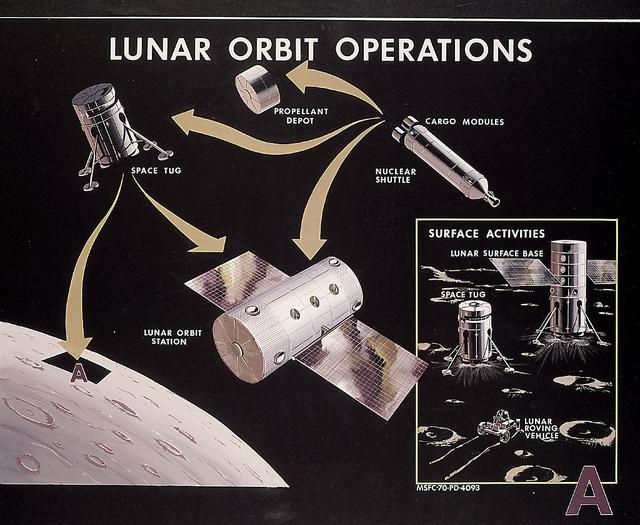
This 1970 artist's concept shows the Nuclear Shuttle and Space Tug operating in conjunction with other spacecraft to support lunar exploration. Marshall Space Flight Center plans during the late 1960s for lunar orbital and surface bases required extensive logistics operations in lunar orbit.
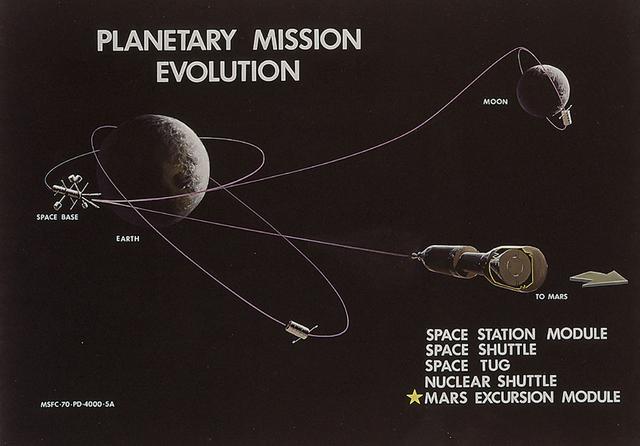
As part of the Space Task Group's recommendations for more commonality and integration in America's space program, Marshall Space Flight Center engineers proposed the use of a Nuclear Shuttle in conjunction with a space station module, illustrated in this 1970 artist's concept, as the basis for a Mars excursion module.
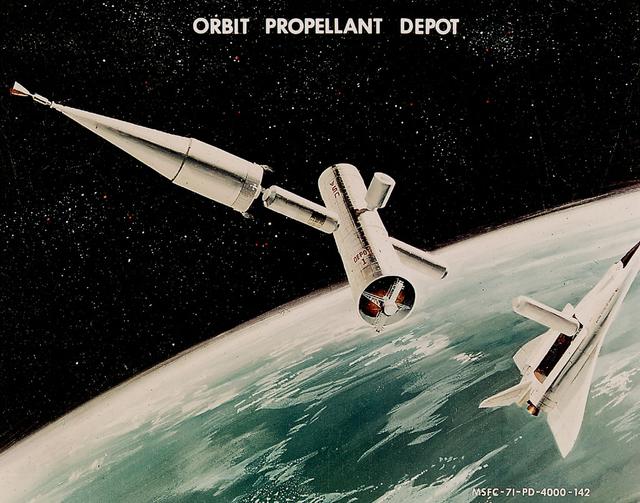
This 1971 artist's concept shows a Nuclear Shuttle and an early Space Shuttle docked with an Orbital Propellant Depot. As envisioned by Marshall Space Flight Center Program Development persornel, an orbital modular propellant storage depot, supplied periodically by the Space Shuttle or Earth-to-orbit fuel tankers, would be critical in making available large amounts of fuel to various orbital vehicles and spacecraft.
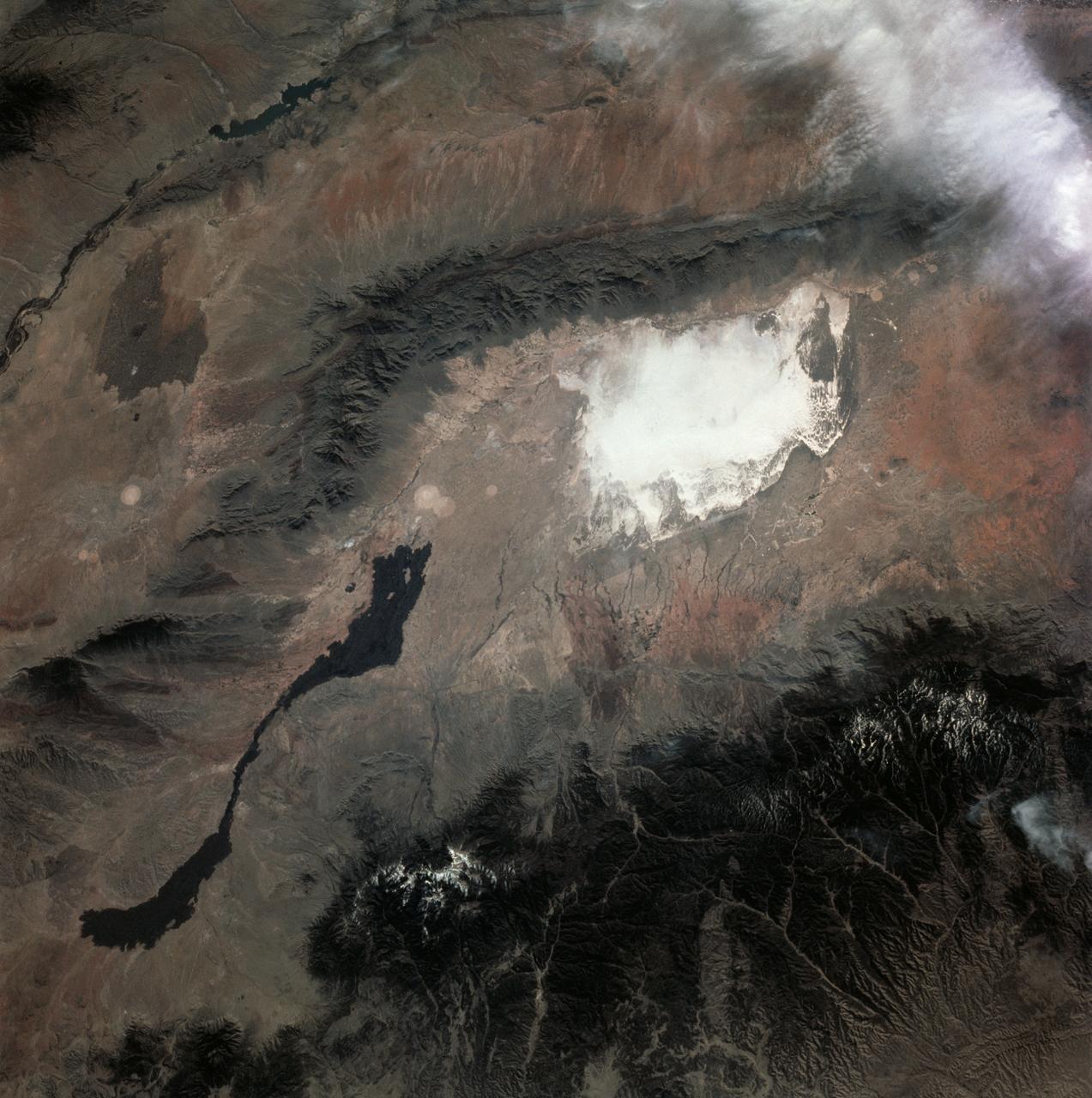
STS003-10-613 (22-30 March 1982) --- A truly remarkable view of White Sands and the nearby Carrizozo Lava Beds in southeast NM (33.5N, 106.5W). White Sands, site of the WW II atomic bomb development and testing facility and later post war nuclear weapons testing that can still be seen in the cleared circular patterns on the ground. Space shuttle Columbia (STS-3), this mission, landed at the White Sands alternate landing site because of bad weather at Edwards AFB, CA. Photo credit: NASA

STS003-010-613 (22-30 March 1982) --- A truly remarkable view of White Sands and the nearby Carrizozo Lava Beds in southeast NM (33.5N, 106.5W). White Sands, site of the WW II atomic bomb development and testing facility and later post war nuclear weapons testing that can still be seen in the cleared circular patterns on the ground. Space shuttle Columbia (STS-3), this mission, landed at the White Sands alternate landing site because of bad weather at Edwards AFB, CA. Photo credit: NASA
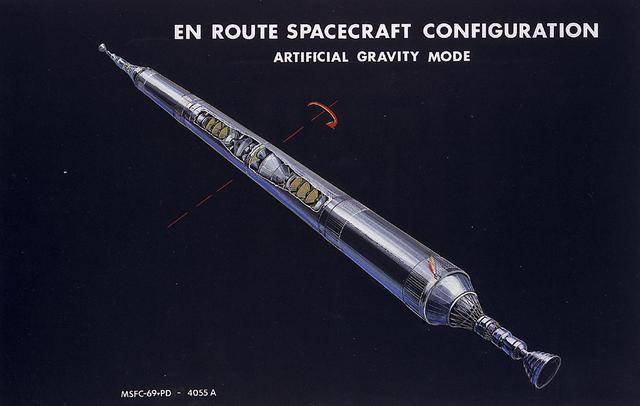
As a result of the recommendations from President Nixon's Space Task Group, Marshall Space Flight Center engineers studied various ways to enhance commonality and integration in the American space program. This artist's concept from 1969 shows a possible spacecraft configuration for a marned Mars mission. In this mode, two planetary vehicles, each powered by a Nuclear Shuttle, are joined together during the flight and rotated to provide artificial gravity for crew members.
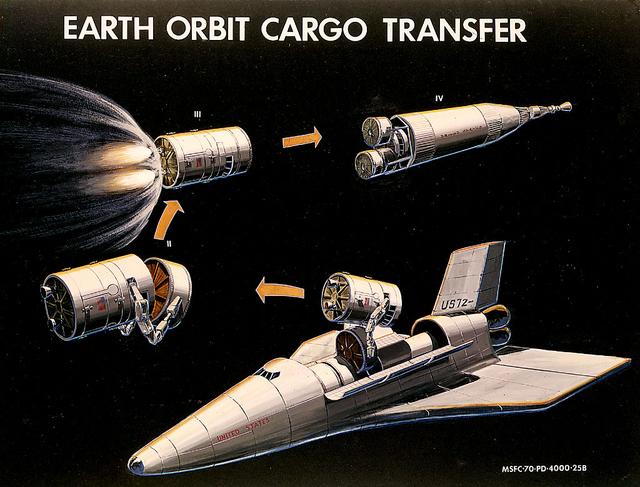
This 1969 artist's concept illustrates the use of three major elements of NASA's Integrated program, as proposed by President Nixon's Space Task Group. In Phases I and II, a Space Tug with a manipulator-equipped crew module removes a cargo module from an early Space Shuttle Orbiter and docks with it. In Phases III and IV, the Space Tug with attached cargo module flys toward a Nuclear Shuttle. As a result of the Space Task Group's recommendations for more commonality and integration in the American space program, Marshall Space Flight Center engineers studied many of the spacecraft depicted here.
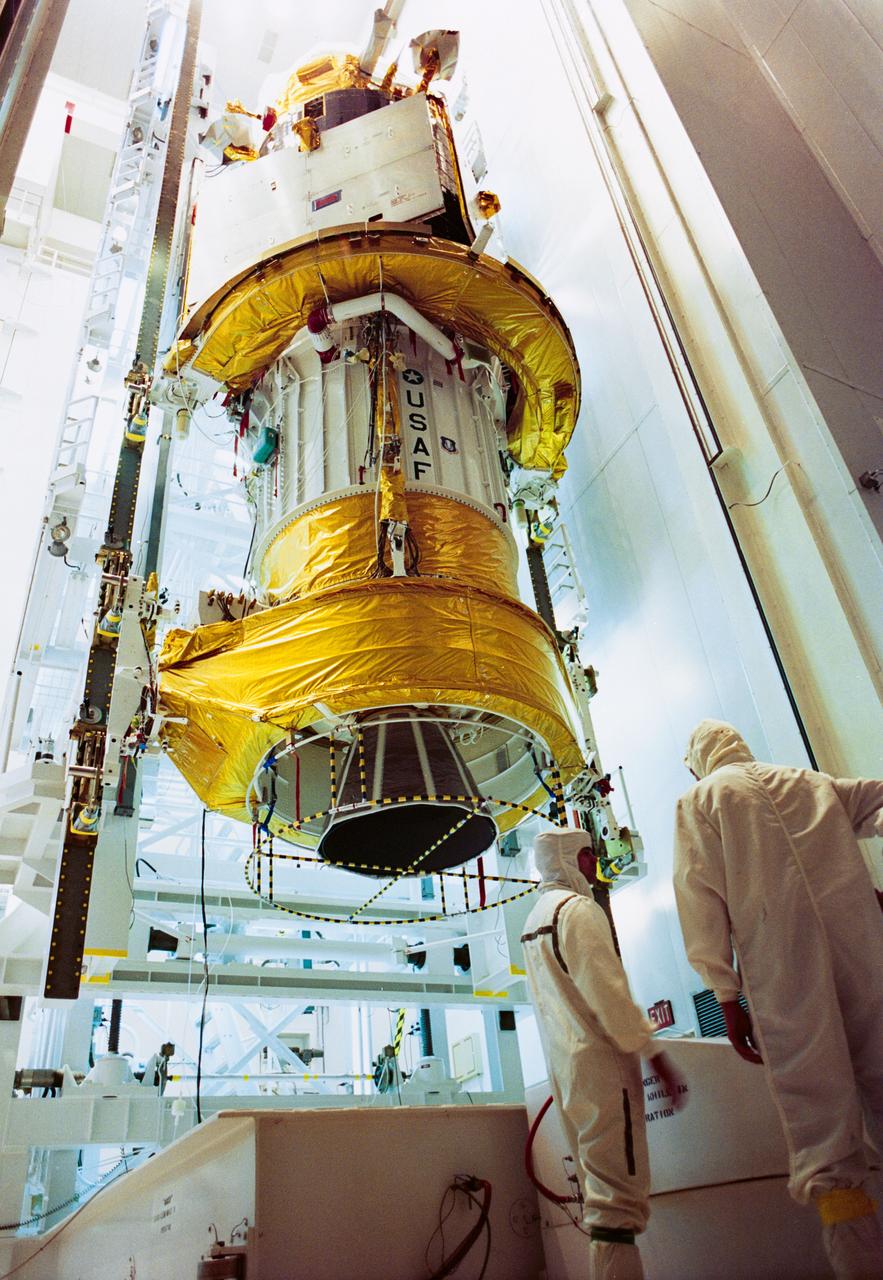
S91-50773 (19 Oct 1991) --- At a processing facility on Cape Canaveral Air Force Station, the Defense Support Program (DSP) satellite is being transferred into the payload canister transporter for shipment to Launch Pad 39A at KSC. The DSP will be deployed during Space Shuttle Mission STS-44 later this year. It is a surveillance satellite, developed for the Department of Defense, which can detect missile and space launches, as well as nuclear detonations. The Inertial Upper Stage which will boost the DSP satellite to its proper orbital position is the lower portion of the payload. DSP satellites have comprised the spaceborne segment of NORAD's (North American Air Defense Command) Tactical Warning and Attack Assessment System since 1970. STS- 44, carrying a crew of six, will be a ten-day flight.
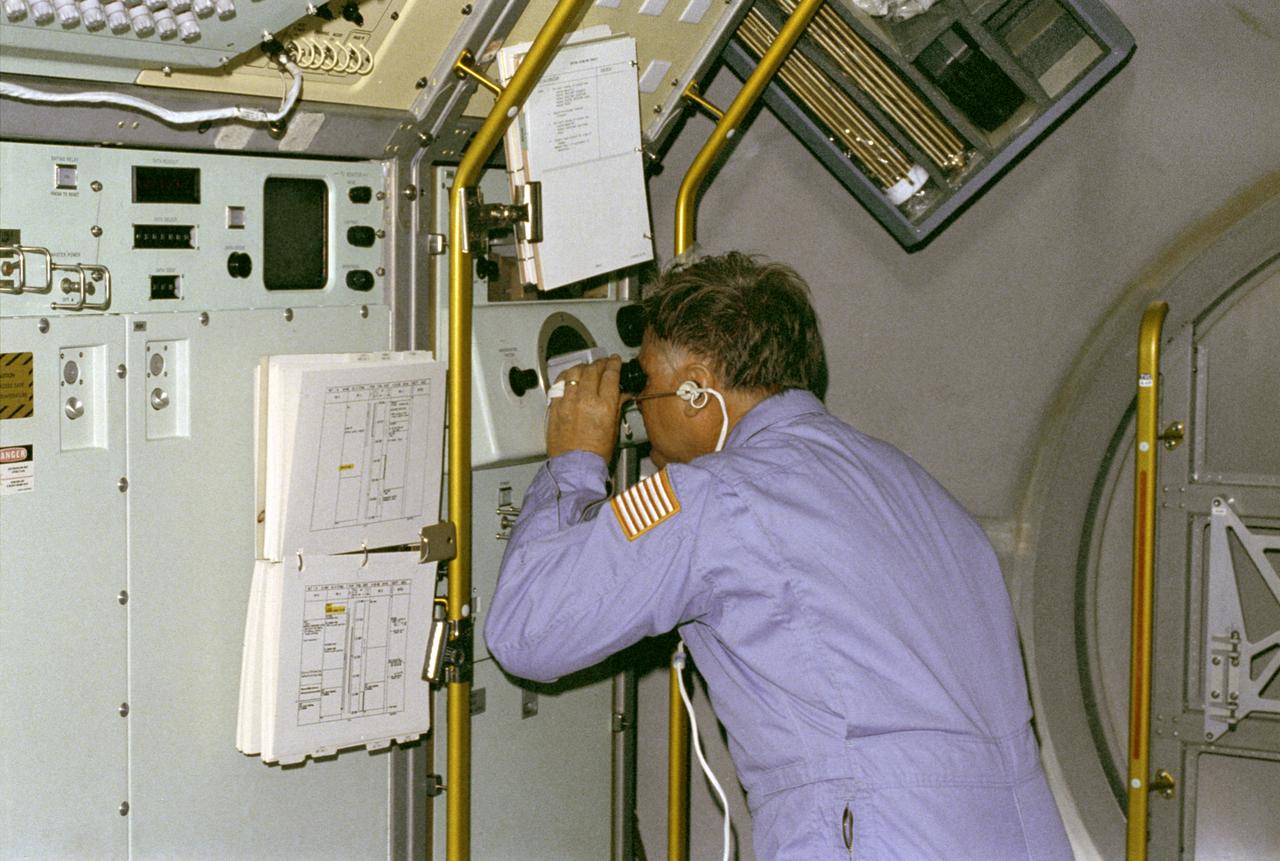
The primary purpose of the Spacelab-3 mission was to conduct materials science experiments in a stable low-gravity environment. In addition, the crew performed research in life sciences, fluid mechanics, atmospheric science, and astronomy. Spacelab-3 was equipped with several new minilabs, special facilities that would be used repeatedly on future flights. Two elaborate crystal growth furnaces, a life support and housing facility for small animals, and two types of apparatus for the study of fluids were evaluated on their inaugural flight. In this photograph, astronaut Don Lind observes the mercuric iodide growth experiment through a microscope at the vapor crystal growth furnace. The goals of this investigation were to grow near-perfect single crystals of mercuric iodide and to gain improved understanding of crystal growth by a vapor process. Mercuric iodide crystals have practical use as sensitive x-ray and gamma-ray detectors, and in portable detector devices for nuclear power plant monitoring, natural resource prospecting, biomedical applications in diagnosis and therapy, and in astronomical instruments. Managed by the Marshall Space Flight Center, Spacelab-3 (STS-51B) was launched aboard the Space Shuttle Orbiter Challenger on April 29, 1985.
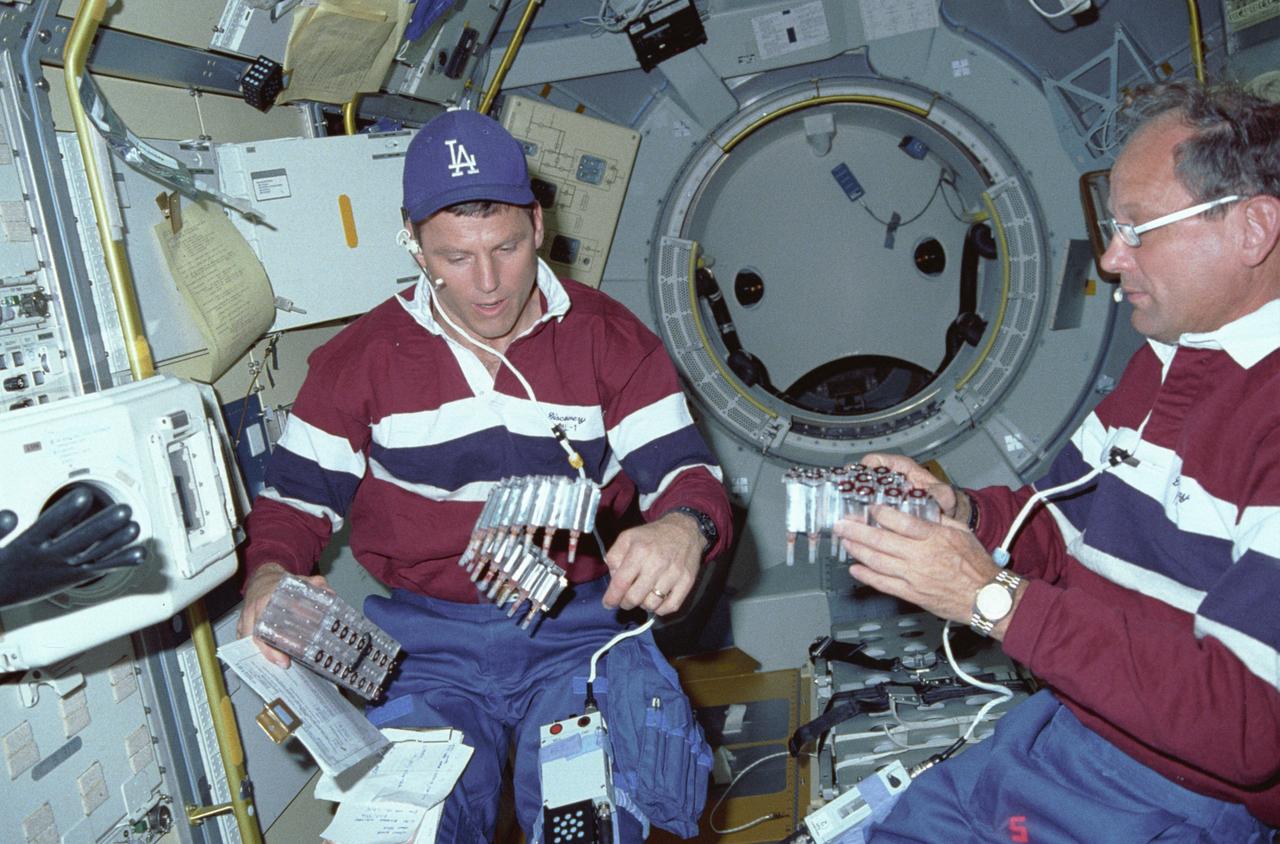
International Microgravity Laboratory-1 (IML-1) was the first in a series of Shuttle flights dedicated to fundamental materials and life sciences research with the international partners. The participating space agencies included: NASA, the 14-nation European Space Agency (ESA), the Canadian Space Agency (CSA), the French National Center of Space Studies (CNES), the German Space Agency and the German Aerospace Research Establishment (DAR/DLR), and the National Space Development Agency of Japan (NASDA). Dedicated to the study of life and materials sciences in microgravity, the IML missions explored how life forms adapt to weightlessness and investigated how materials behave when processed in space. Both life and materials sciences benefited from the extended periods of microgravity available inside the Spacelab science module in the cargo bay of the Space Shuttle Orbiter. In this photograph, Astronauts Stephen S. Oswald and Norman E. Thagard handle ampoules used in the Mercuric Iodide Crystal Growth (MICG) experiment. Mercury Iodide crystals have practical uses as sensitive x-ray and gamma-ray detectors. In addition to their exceptional electronic properties, these crystals can operate at room temperature rather than at the extremely low temperatures usually required by other materials. Because a bulky cooling system is urnecessary, these crystals could be useful in portable detector devices for nuclear power plant monitoring, natural resource prospecting, biomedical applications in diagnosis and therapy, and astronomical observation. Managed by the Marshall Space Flight Center, IML-1 was launched on January 22, 1992 aboard the Space Shuttle Orbiter Discovery (STS-42 mission).