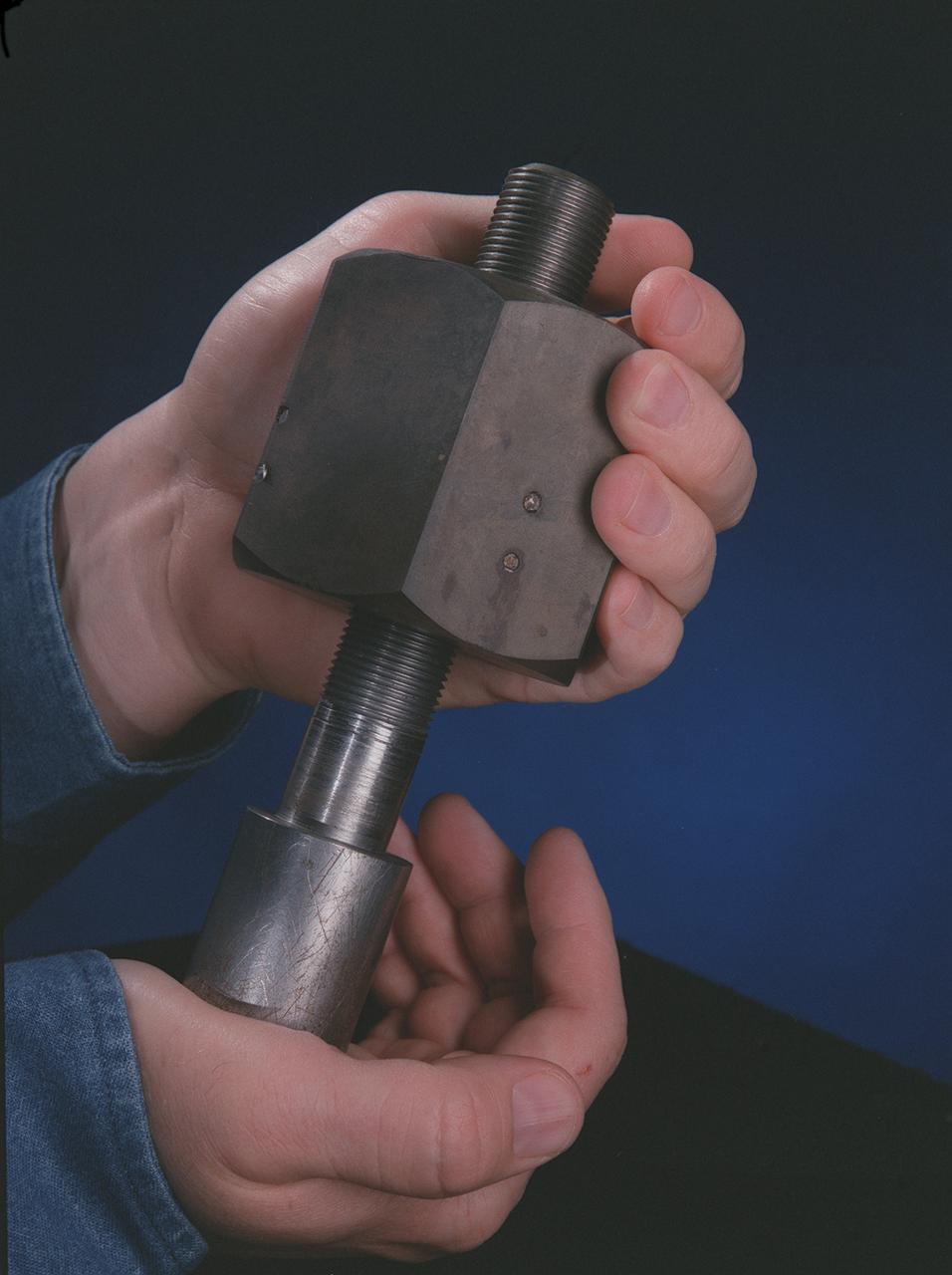
Marshall Space Flight Center (MSFC) has developed a specially-designed nut, called the Quick-Connect Nut, for quick and easy assembly of components in the harsh environment of space, as in assembly of International Space Station. The design permits nuts to be installed simply by pushing them onto standard bolts, then giving a quick twist. To remove, they are unscrewed like conventional nuts. Possible applications include the mining industry for erecting support barriers, assembling underwater oil drilling platforms, fire-fighting equipment, scaffolding, assembly-line machinery, industrial cranes, and even changing lug nuts on race cars. The speed of assembly can make the difference between life and death in different aspects of life on Earth.
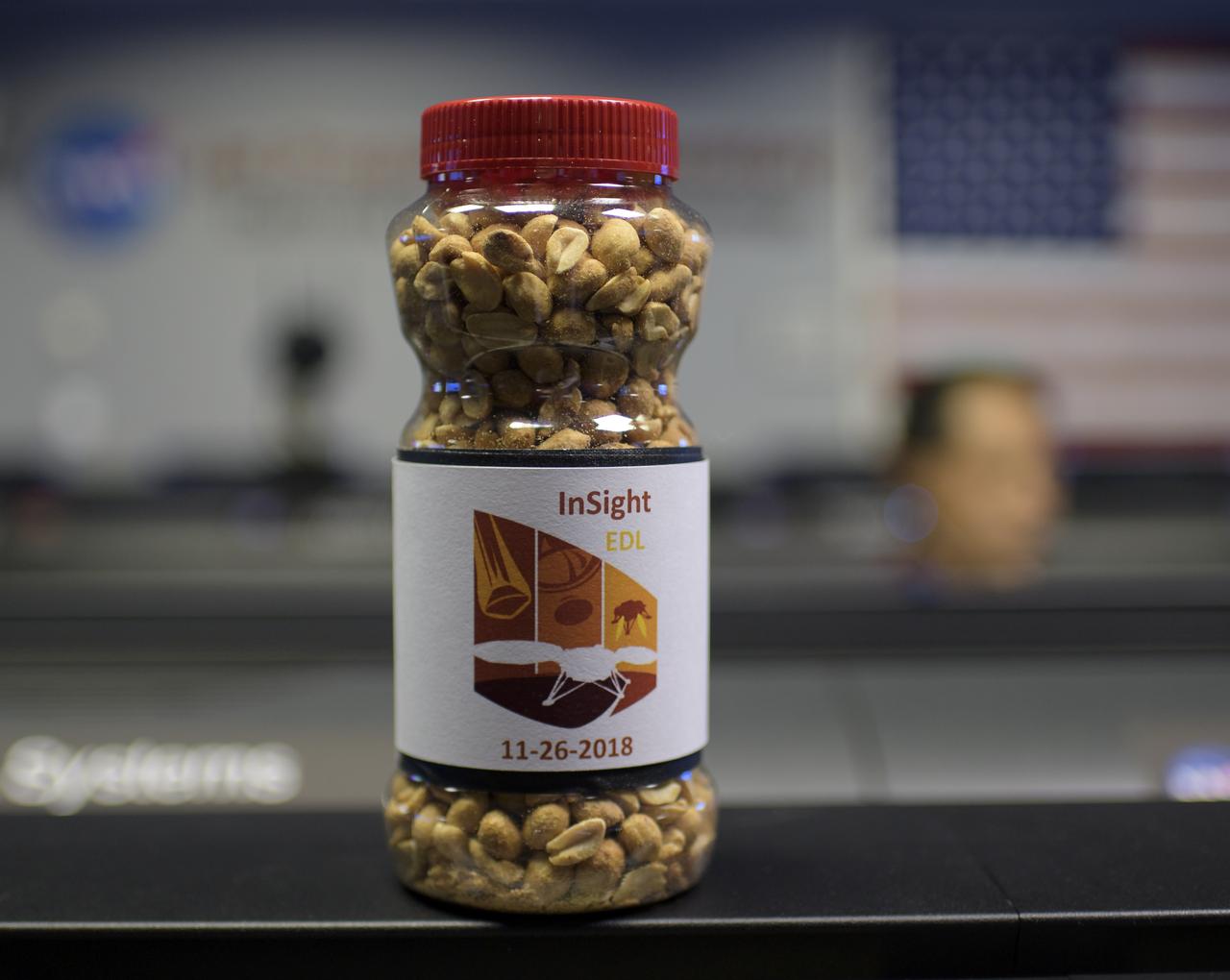
A jar of nuts is seen inside the Mission Control Area (MSA) where teams are starting to gather for the Mars InSight landing, Monday, Nov. 26, 2018 inside the Mission Support Area at NASA's Jet Propulsion Laboratory in Pasadena, California. Good-luck peanuts made their first appearance at the Jet Propulsion Laboratory's Space Flight Operations Facility in 1964 during the Ranger 7 mission. InSight, short for Interior Exploration using Seismic Investigations, Geodesy and Heat Transport, is a Mars lander designed to study the "inner space" of Mars: its crust, mantle, and core. Photo Credit: (NASA/Bill Ingalls)
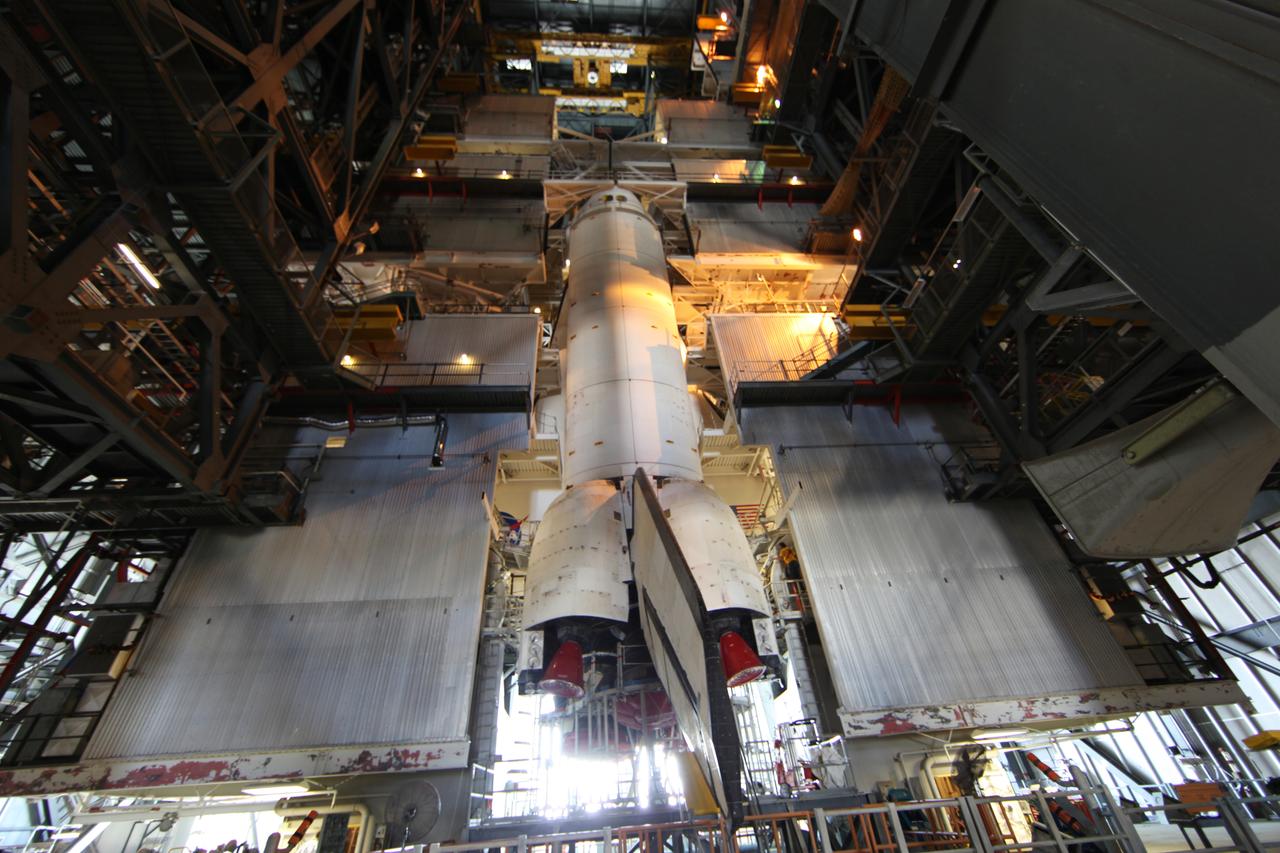
STS-133 Discovery after Fixed Mounting Nut During Lift & mate
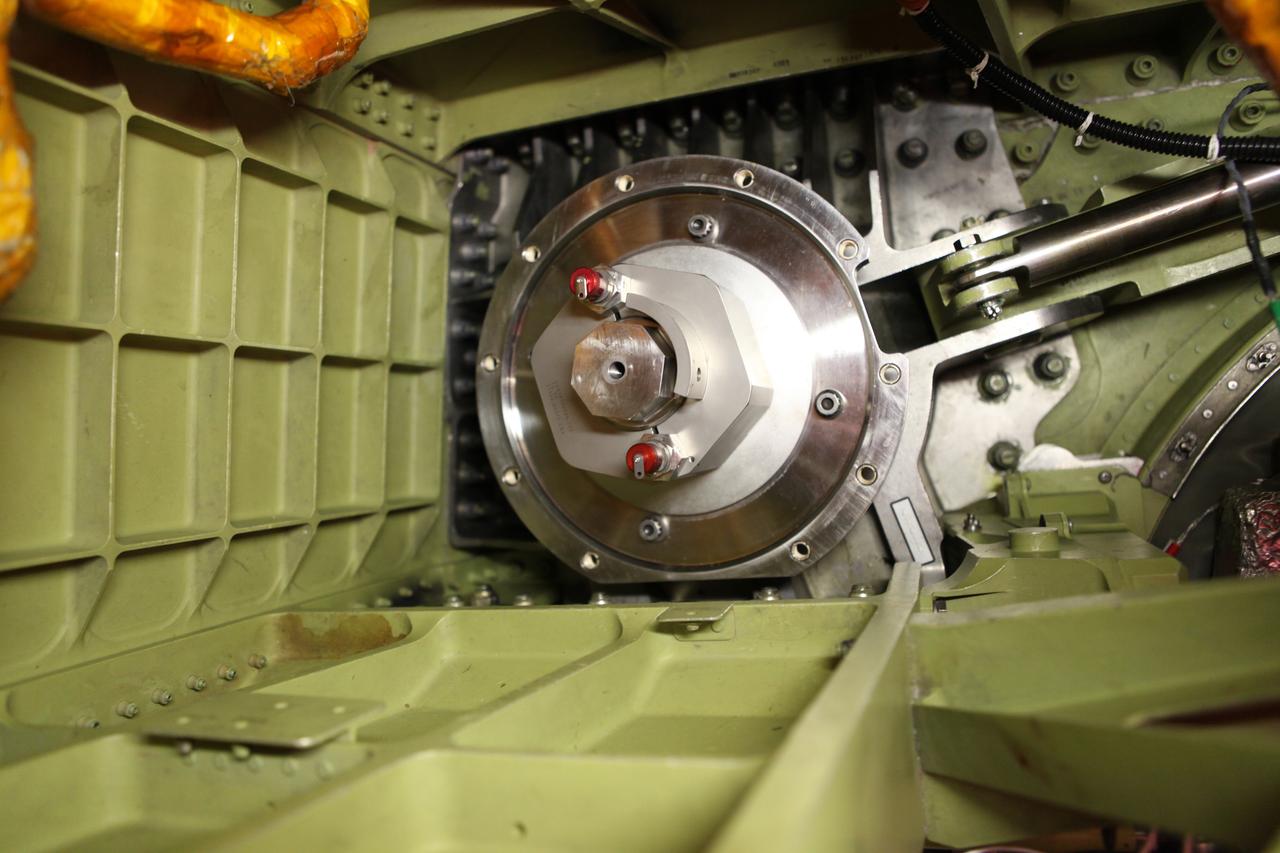
STS-133 Discovery after Fixed Mounting Nut During Lift & mate
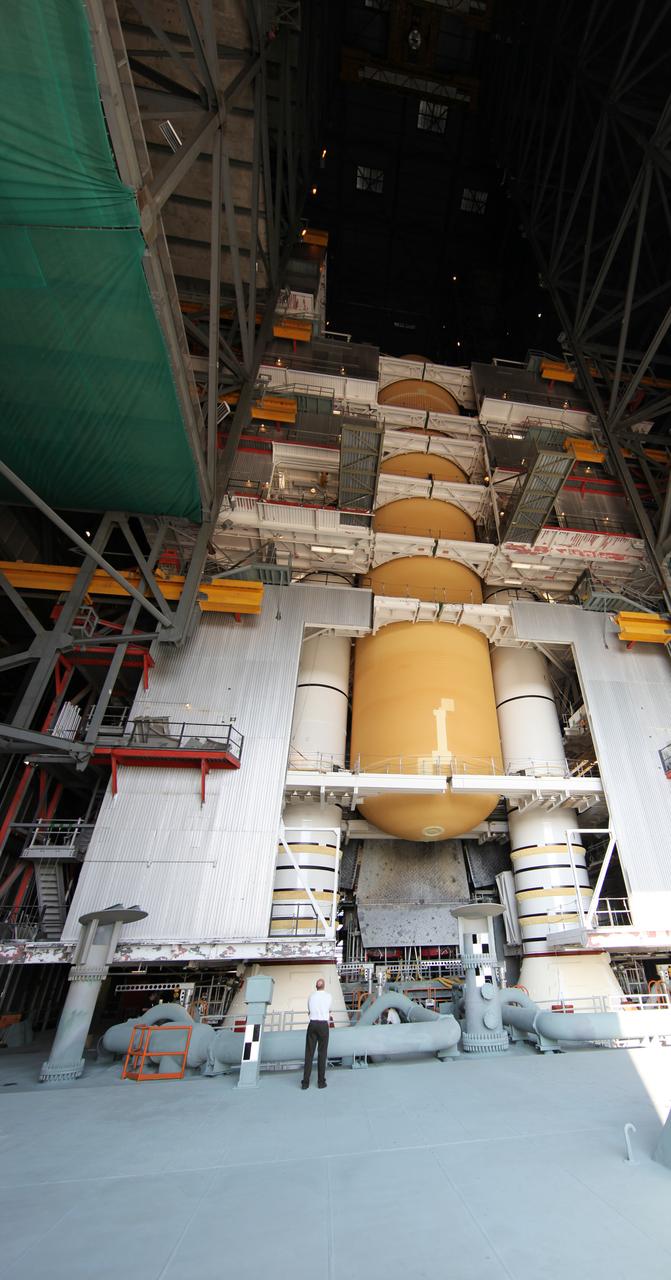
STS-133 Discovery after Fixed Mounting Nut During Lift & mate
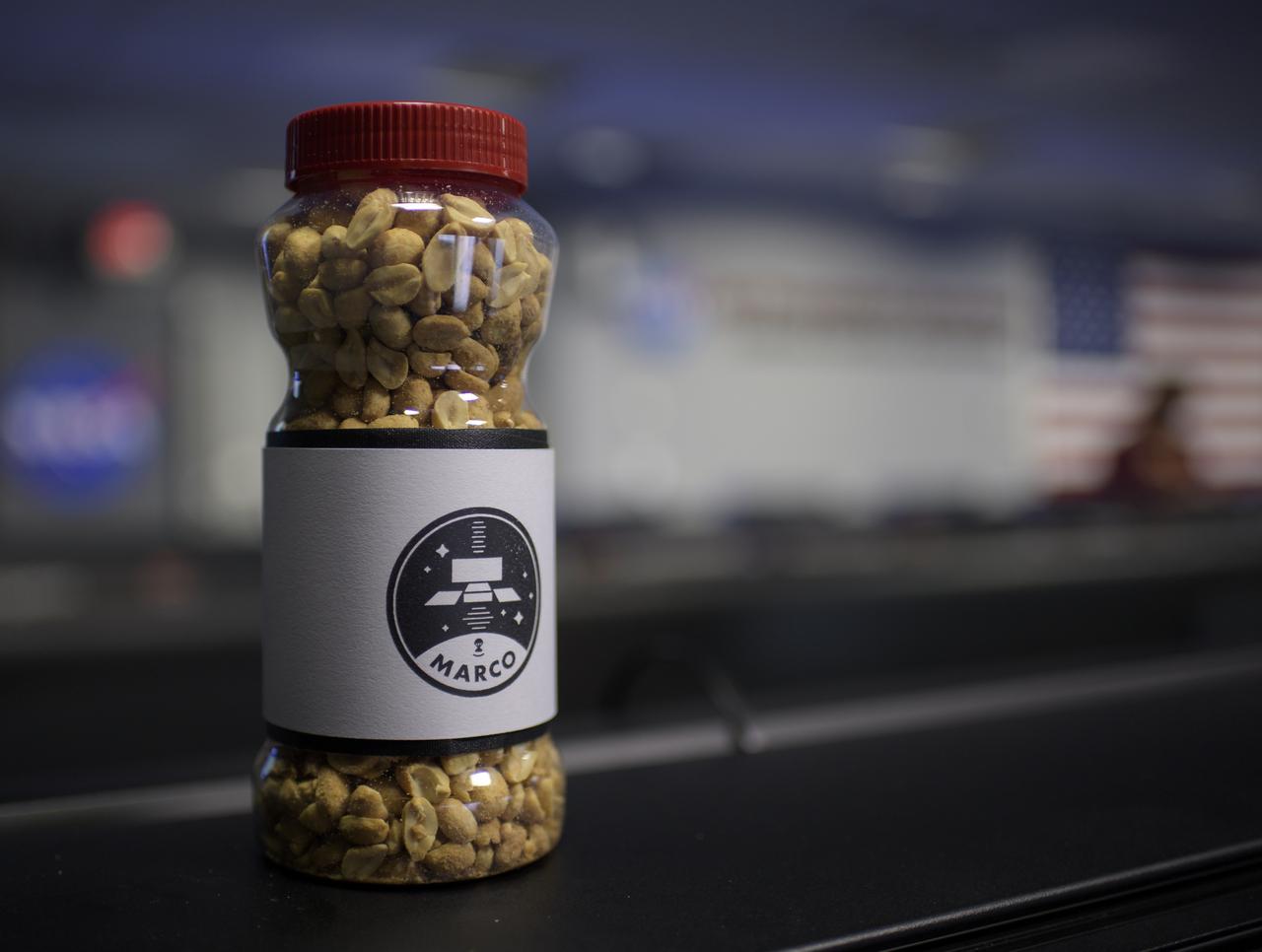
A jar of nuts with the Mars Cube One (MarCO) logo is seen inside the Mission Control Area (MSA) where teams are starting to gather for the Mars InSight landing, Monday, Nov. 26, 2018 inside the Mission Support Area at NASA's Jet Propulsion Laboratory in Pasadena, California. Good-luck peanuts made their first appearance at the Jet Propulsion Laboratory's Space Flight Operations Facility in 1964 during the Ranger 7 mission. InSight, short for Interior Exploration using Seismic Investigations, Geodesy and Heat Transport, is a Mars lander designed to study the "inner space" of Mars: its crust, mantle, and core. Photo Credit: (NASA/Bill Ingalls)
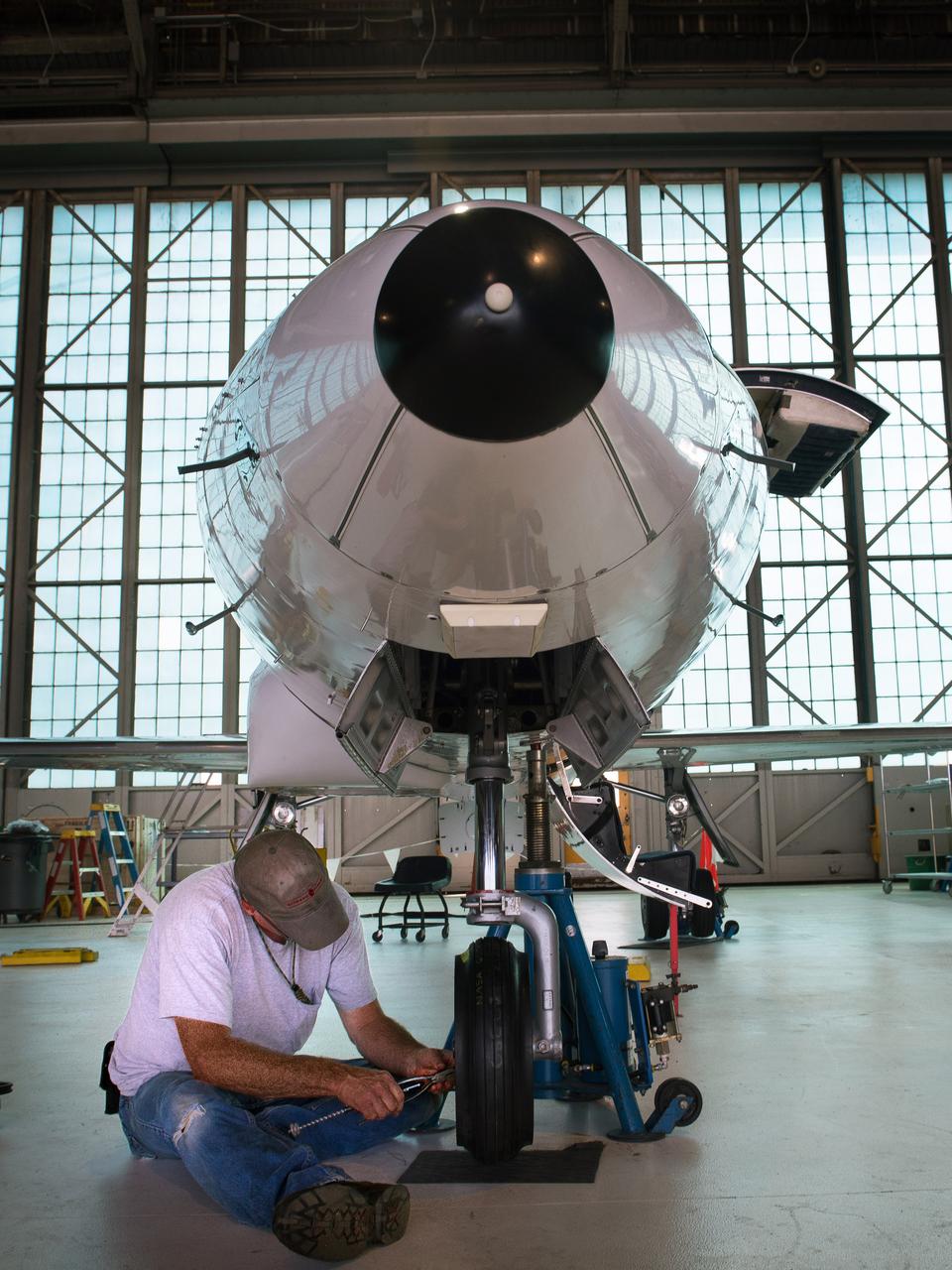
NASA Glenn Mechanic Thomas Thompson checks the nose wheel axle nut on NASA Glenn’s Learjet 25 research aircraft.
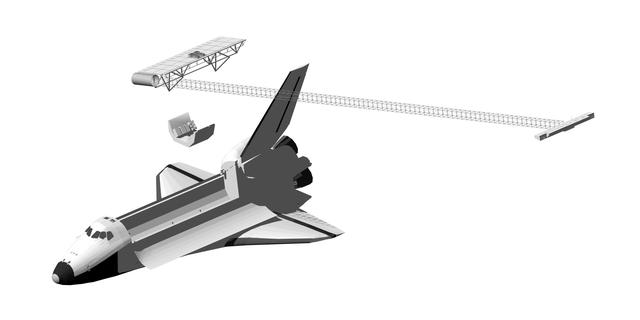
JSC2000E01551 (January 2000) --- An "exploded" drawing depicts the Space Shuttle Endeavour and the Shuttle Radar Topography Mission (SRTM) mast, along with the pallet for SRTM and supportive antennae. The mast will be deployed and retracted by a motor-driven nut within the mast canister. This nut will pull the mast from its stowed configuration and allow it to unfold like an accordion. A crew member inside the shuttle will initiate the mast deployment, a chore which will take about 20 minutes. The mast also can be deployed manually during a contingency extravehicular activity (EVA) using a hand-held motor. The mast is 200 feet (60 meters) long.

CAPE CANAVERAL, Fla. -- At NASA's Kennedy Space Center in Florida, a left-side main separation bolt attaches the bottom of space shuttle Discovery to its external fuel tank in the Vehicle Assembly Building. As technicians were attaching the bolt Sept. 10, a bolt nut slipped back into Discovery's aft compartment. To retrieve it, technicians entered Discovery’s aft section through an access door. They then moved the nut back into position to finish attaching the bolt, which is used to separate Discovery from the external tank once the shuttle is in orbit. Discovery is scheduled to roll out to Launch Pad 39A later this month for its STS-133 launch to the International Space Station. Targeted to lift off Nov. 1, Discovery will take the Permanent Multipurpose Module (PMM) packed with supplies and critical spare parts, as well as Robonaut 2 (R2) to the station. Photo credit: NASA/Dimitri Gerondidakis
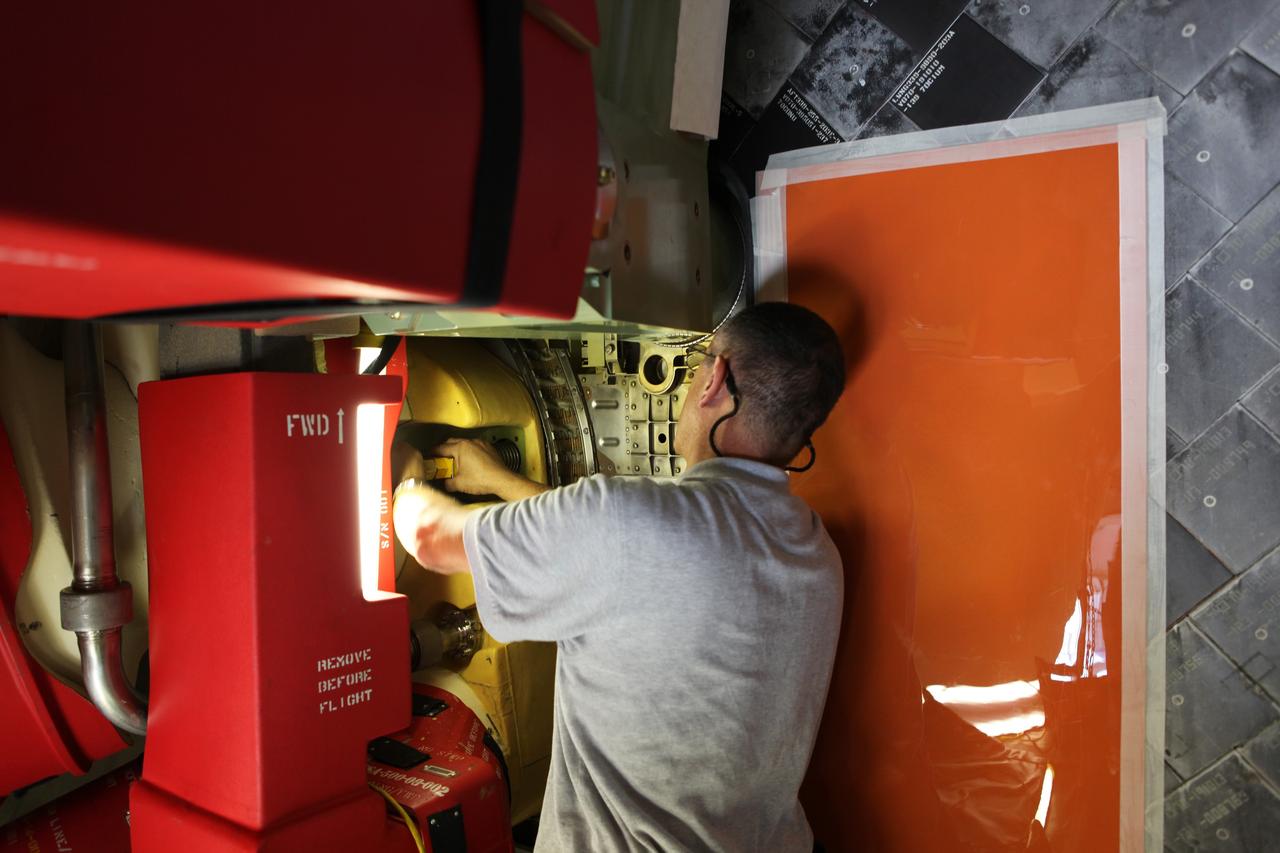
CAPE CANAVERAL, Fla. -- At NASA's Kennedy Space Center in Florida, a Vehicle Assembly Building technician adjusts a left-side main separation bolt that attaches the bottom of space shuttle Discovery to its external fuel tank. As technicians were attaching the bolt Sept. 10, a bolt nut slipped back into Discovery's aft compartment. To retrieve it, technicians entered Discovery’s aft section through an access door. They then moved the nut back into position to finish attaching the bolt, which is used to separate Discovery from the external tank once the shuttle is in orbit. Discovery is scheduled to roll out to Launch Pad 39A later this month for its STS-133 launch to the International Space Station. Targeted to lift off Nov. 1, Discovery will take the Permanent Multipurpose Module (PMM) packed with supplies and critical spare parts, as well as Robonaut 2 (R2) to the station. Photo credit: NASA/Dimitri Gerondidakis
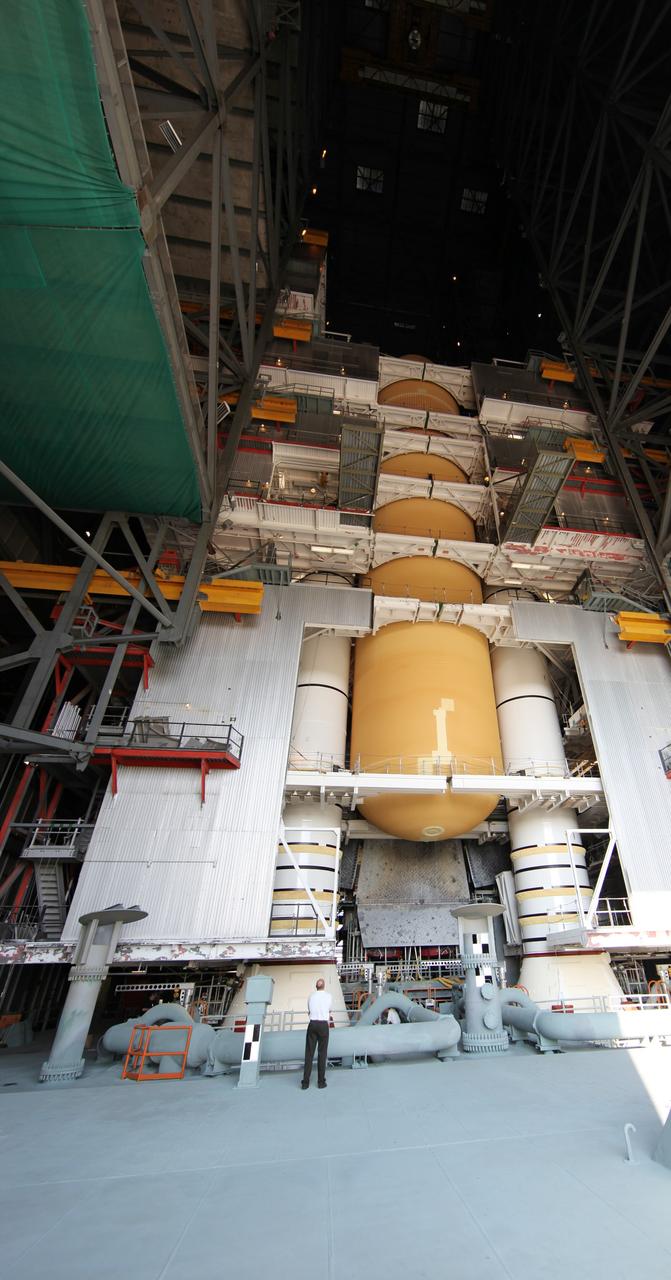
CAPE CANAVERAL, Fla. -- At NASA's Kennedy Space Center in Florida, space shuttle Discovery is attached to its external fuel tank and solid rocket boosters in the Vehicle Assembly Building. As technicians were attaching the left-side main separation bolt on the bottom of the shuttle to the external tank Sept. 10 a bolt nut slipped back into Discovery's aft compartment. To retrieve it, technicians entered Discovery’s aft section through an access door. They then moved the nut back into position to finish attaching the bolt, which is used to separate Discovery from the external tank once the shuttle is in orbit. Discovery is scheduled to roll out to Launch Pad 39A later this month for its STS-133 launch to the International Space Station. Targeted to lift off Nov. 1, Discovery will take the Permanent Multipurpose Module (PMM) packed with supplies and critical spare parts, as well as Robonaut 2 (R2) to the station. Photo credit: NASA/Dimitri Gerondidakis

CAPE CANAVERAL, Fla. -- At NASA's Kennedy Space Center in Florida, technicians in the Vehicle Assembly Building inspect space shuttle Discovery, its external fuel tank and solid rocket boosters. As technicians were attaching the left-side main separation bolt on the bottom of the shuttle to the external tank Sept. 10 a bolt nut slipped back into Discovery's aft compartment. To retrieve it, technicians entered Discovery’s aft section through an access door. They then moved the nut back into position to finish attaching the bolt, which is used to separate Discovery from the external tank once the shuttle is in orbit. Discovery is scheduled to roll out to Launch Pad 39A later this month for its STS-133 launch to the International Space Station. Targeted to lift off Nov. 1, Discovery will take the Permanent Multipurpose Module (PMM) packed with supplies and critical spare parts, as well as Robonaut 2 (R2) to the station. Photo credit: NASA/Dimitri Gerondidakis
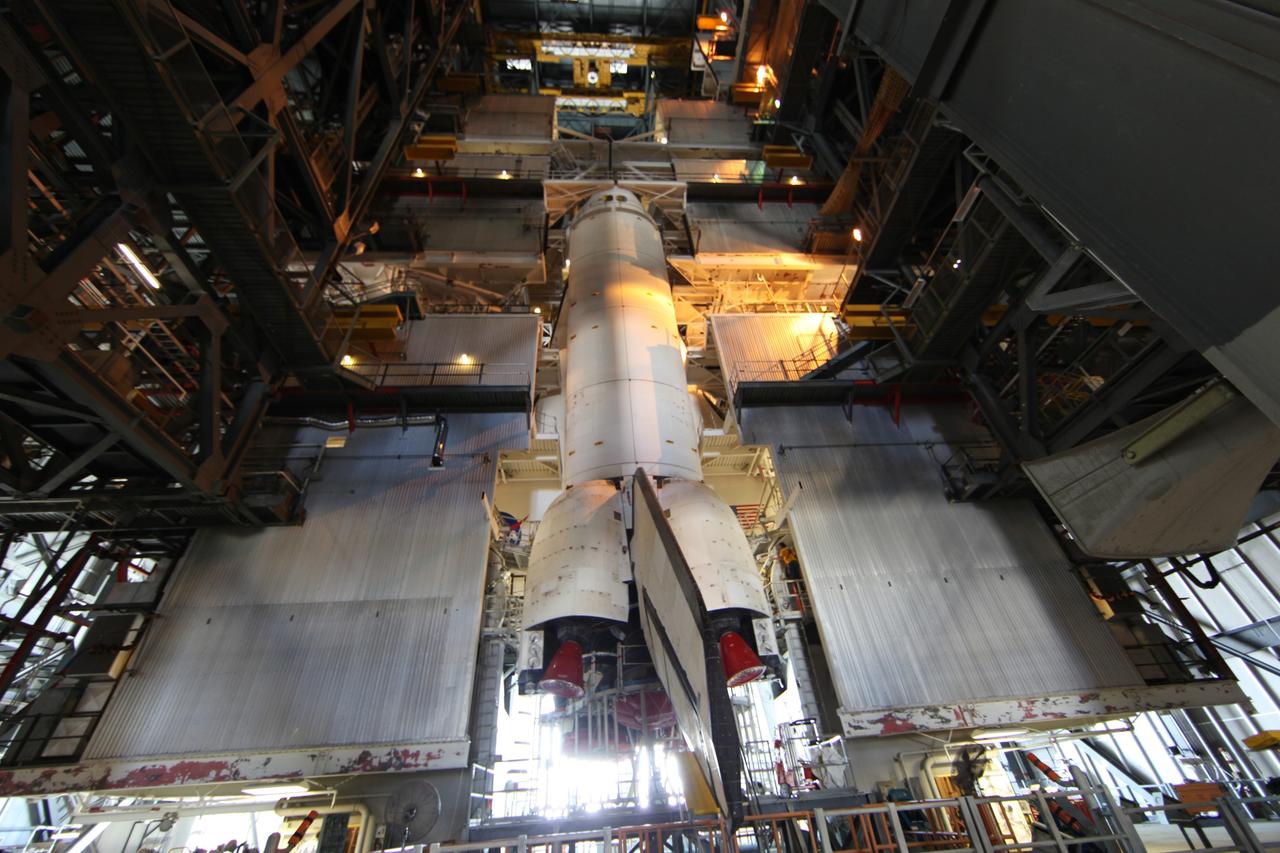
CAPE CANAVERAL, Fla. -- At NASA's Kennedy Space Center in Florida, space shuttle Discovery is attached to its external fuel tank and solid rocket boosters in the Vehicle Assembly Building. As technicians were attaching the left-side main separation bolt on the bottom of the shuttle to the external tank Sept. 10 a bolt nut slipped back into Discovery's aft compartment. To retrieve it, technicians entered Discovery’s aft section through an access door. They then moved the nut back into position to finish attaching the bolt, which is used to separate Discovery from the external tank once the shuttle is in orbit. Discovery is scheduled to roll out to Launch Pad 39A later this month for its STS-133 launch to the International Space Station. Targeted to lift off Nov. 1, Discovery will take the Permanent Multipurpose Module (PMM) packed with supplies and critical spare parts, as well as Robonaut 2 (R2) to the station. Photo credit: NASA/Dimitri Gerondidakis

jsc2024e050834 (7/26/2024) --- Screaming Balloon hex nuts, pennies and balloons in their individual ziplock stowage bags prior to hardware handover. Developed through NASA’s Office of STEM Engagement Next Gen STEM Project, STEMonstrations are short educational videos demonstrating science, technology, engineering, and mathematics (STEM) topics in microgravity for grades K through 12. STEMonstrations: Screaming Balloon examines centripetal force, whirling a penny and a hexnut inside of inflated balloons and comparing the sounds they make.
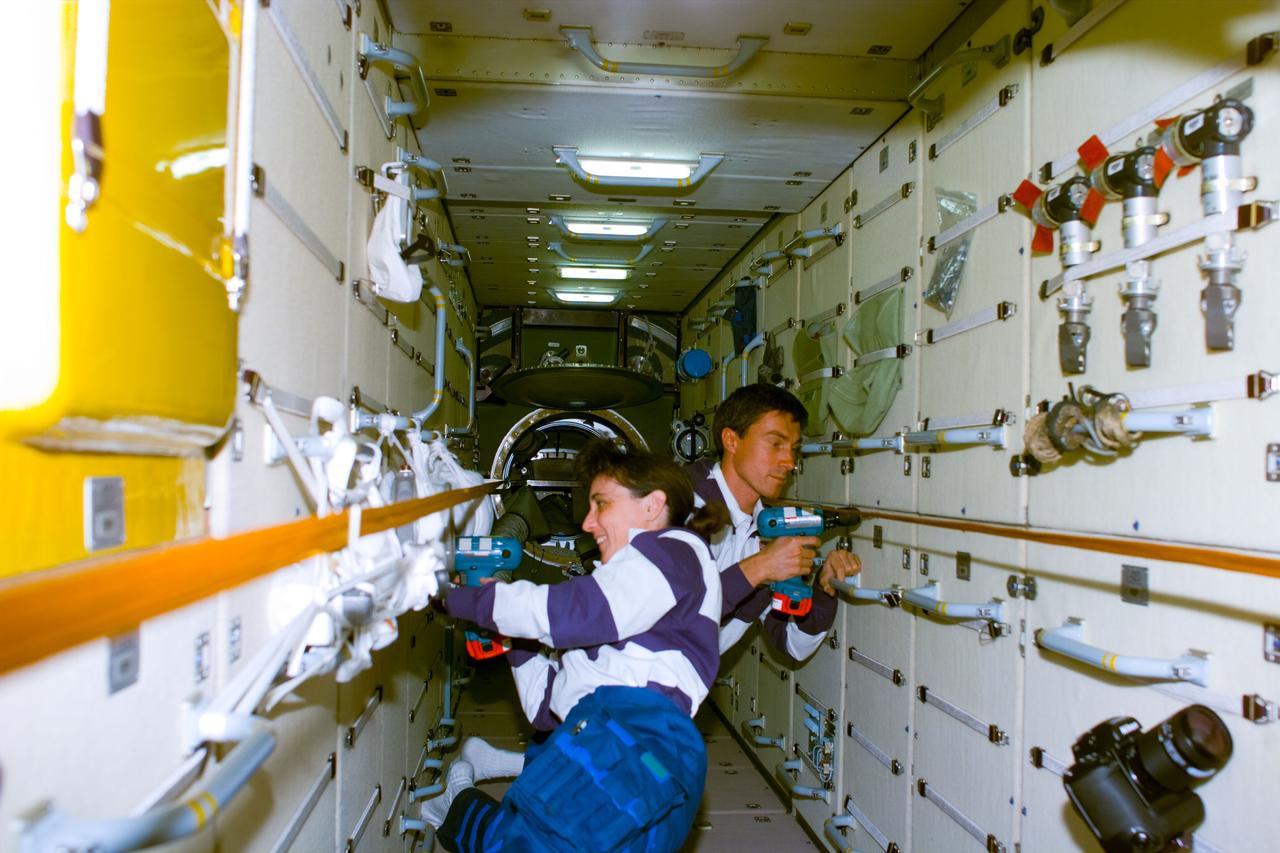
S88-E-5085 (12-11-98) --- Nancy J. Currie and Sergei Krikalev use rechargeable power tools to tighten and loosen nuts onboard the Russian-built Zarya module which they entered on Flight Day 8. The two are mission specialists, with Krikalev representing the Russian Space Agency (RSA). The photo was taken with an electronic still camera (ESC) at 05:28:53 GMT, Dec. 11.
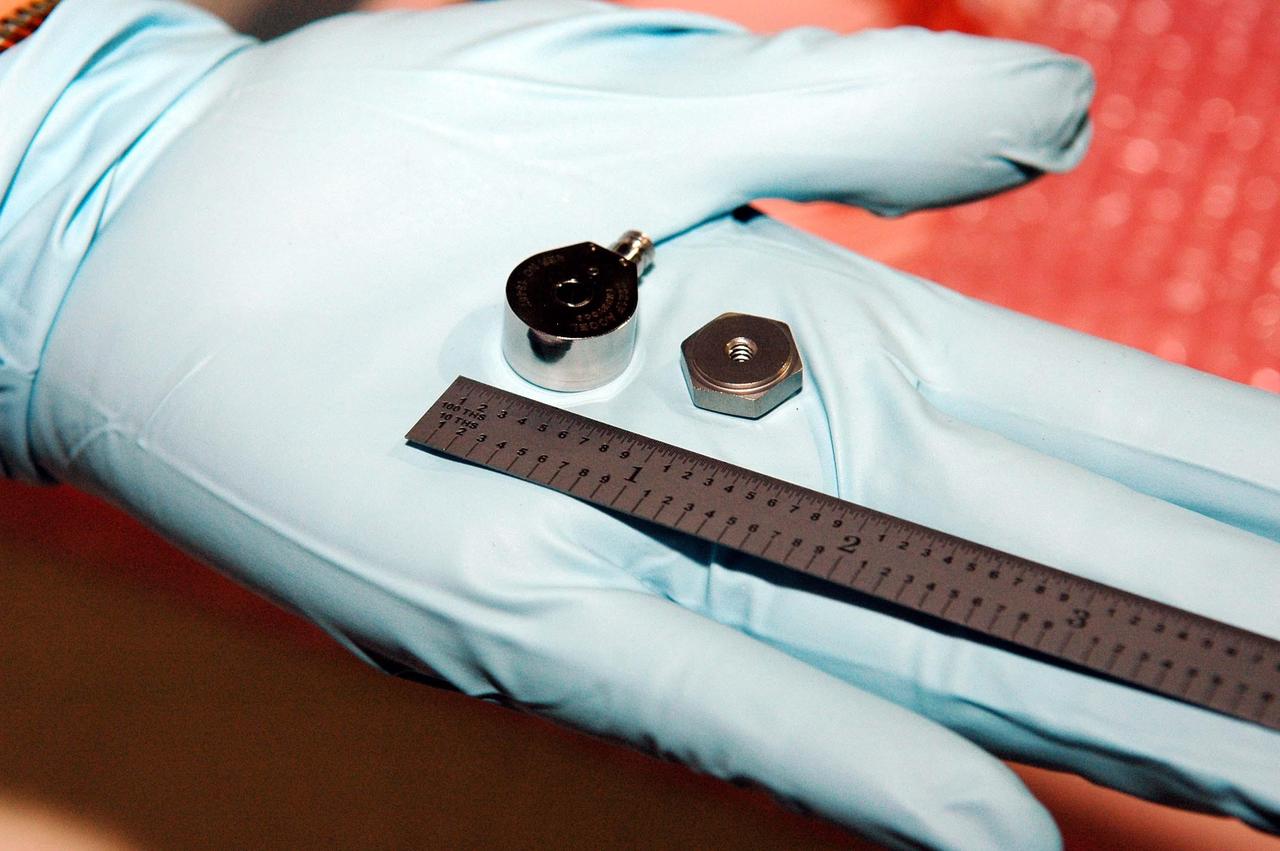
KENNEDY SPACE CENTER, FLA. - This photo shows the size of the sensors being placed on the wing leading edge of orbiter Discovery. In her hand, United Space Alliance technician Lisa Campbell holds an accelerometer (left), which will eventually be installed on a mounting nut. The sensors are part of the Wing Leading Edge Impact Detection System, a new safety measure added for all future Space Shuttle missions. The system also includes accelerometers that monitor the orbiter's wings for debris impacts during launch and while in orbit. There are 22 temperature sensors and 66 accelerometers on each wing. Sensor data will flow from the wing to the crew compartment, where it will be transmitted to Earth.
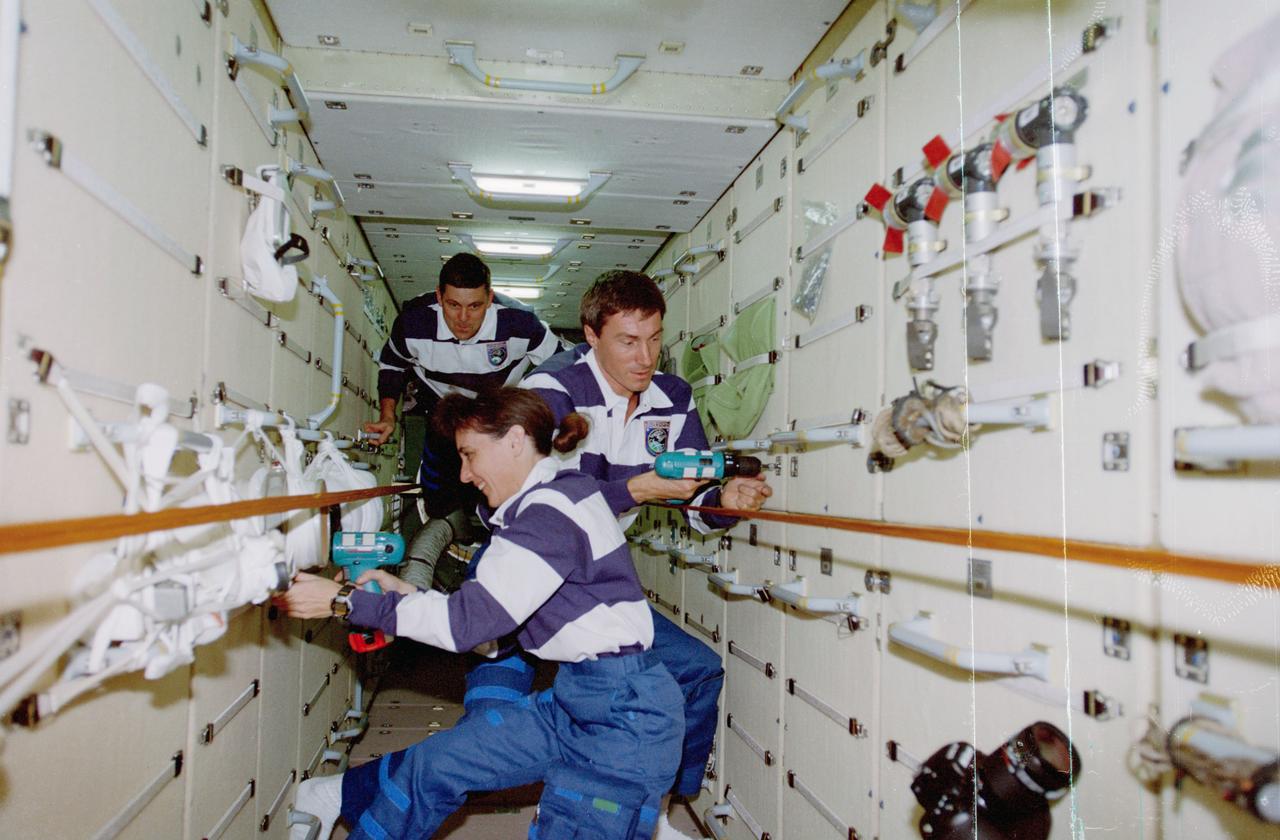
STS088-359-037 (4-15 Dec. 1998) --- Astronaut Nancy J. Currie and cosmonaut Sergei K. Krikalev, both mission specialists, use rechargeable power tools to manipulate nuts and bolts on the Russian-built Zarya module. Astronaut Robert D. Cabana, mission commander, translates along the rail network in the background. The six STS-88 crew members had earlier entered the module through the U.S.-built Unity connecting module. Rails, straps and tools indicate the crewmembers had been working awhile when this photo was taken. Krikalev, representing the Russian Space Agency (RSA), has been assigned as a member of the three-man initial International Space Station (ISS) crew.

KENNEDY SPACE CENTER, FLA. -- An Eastern gray squirrel pauses in its daily search for food in the Merritt Island National Wildlife Refuge, which shares a boundary with Kennedy Space Center. The Eastern gray squirrel is found in wooded, suburban, and urban areas statewide. It nests in tree hollows or leaf nests in treetops. It forages during the day, mainly early morning and late afternoon, both on the ground and in trees, living on a diet of acorns, nuts, fruits, berries, insects, and bird eggs. Food plants include cypress, buckeyes, elms, grapes, tulip trees, mulberries, and tupelo. It breeds in late winter or early spring and again in late spring or summer, bearing two to six young. The eastern gray squirrel chatters when disturbed. The 92,000-acre wildlife refuge is a habitat for more than 310 species of birds, 25 mammals, 117 fishes and 65 amphibians and reptiles
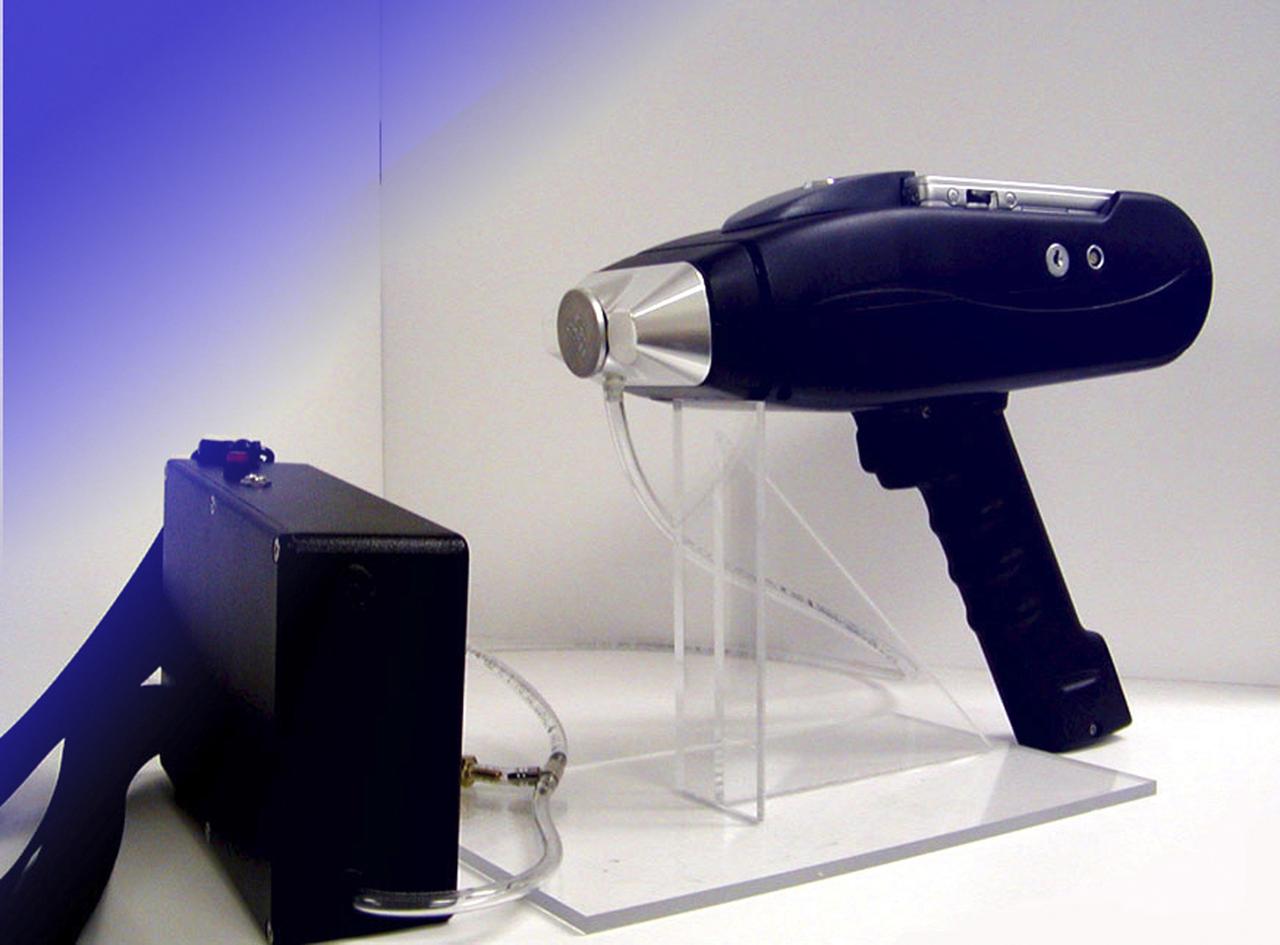
Marshall Space Flight Center engineers have teamed with KeyMaster Technologies, Kennewick, Washington, to develop a portable vacuum analyzer that performs on-the-spot chemical analyses under field conditions, a task previously only possible in a chemical laboratory. The new capability is important not only to the aerospace industry, but holds potential for broad applications in any industry that depends on materials analysis, such as the automotive and pharmaceutical industries. Weighing in at a mere 4 pounds, the newly developed handheld vacuum X-ray fluorescent analyzer can identify and characterize a wide range of elements, and is capable of detecting chemical elements with low atomic numbers, such as sodium, aluminum and silicon. It is the only handheld product on the market with that capability. Aluminum alloy verification is of particular interest to NASA because vast amounts of high-strength aluminum alloys are used in the Space Shuttle propulsion system such as the External Tank, Main Engine, and Solid Rocket Boosters. This capability promises to be a boom to the aerospace community because of unique requirements, for instance, the need to analyze Space Shuttle propulsion systems on the launch pad. Those systems provide the awe-inspiring rocket power that propels the Space Shuttle from Earth into orbit in mere minutes. The scanner development also marks a major improvement in the quality assurance field, because screws, nuts, bolts, fasteners, and other items can now be evaluated upon receipt and rejected if found to be substandard. The same holds true for aluminum weld rods. The ability to validate the integrity of raw materials and partially finished products before adding value to them in the manufacturing process will be of benefit not only to businesses, but also to the consumer, who will have access to a higher value product at a cheaper price. Three vacuum X-ray scanners are already being used in the Space Shuttle Program. The External Tank Project Office is using one for aluminum alloy analysis, while a Marshall contractor is evaluating alloys with another unit purchased for the Space Shuttle Main Engine Office. The Reusable Solid Rocket Motor Project Office has obtained a scanner that is being used to test hardware and analyze materials.

Low clouds filled California’s Central Valley in late January, 2015. Such winter fog is considered a common phenomenon, and can be so dense that it snarls traffic, causes fender-benders, and can make symptoms worse in those with respiratory disease. At the same time, the moist winter fog helps keep temperatures low in the rich agricultural region by reflecting sunlight and keeping the ground from warming, which helps keep the abundant fruit and nut trees dormant, allowing for bountiful harvests. Scientific studies have reported that winter fogs (also called Thule fogs) are occurring less frequently in the Central Valley. One study, by Dennis Baldocchi and Eric Waller, was published in May, 2014. It finds that since 1981 the number of fog days between November and February has decreased by 46 percent. The severe drought that California has experienced in recent years may also have decreased the number of fog events even more since 2012. The Moderate Resolution Imaging Spectroradiometer (MODIS) aboard NASA’s Terra satellite captured this true-color image on January 24, 2015. Credit: NASA/GSFC/Jeff Schmaltz/MODIS Land Rapid Response Team <b><a href="http://www.nasa.gov/audience/formedia/features/MP_Photo_Guidelines.html" rel="nofollow">NASA image use policy.</a></b> <b><a href="http://www.nasa.gov/centers/goddard/home/index.html" rel="nofollow">NASA Goddard Space Flight Center</a></b> enables NASA’s mission through four scientific endeavors: Earth Science, Heliophysics, Solar System Exploration, and Astrophysics. Goddard plays a leading role in NASA’s accomplishments by contributing compelling scientific knowledge to advance the Agency’s mission. <b>Follow us on <a href="http://twitter.com/NASAGoddardPix" rel="nofollow">Twitter</a></b> <b>Like us on <a href="http://www.facebook.com/pages/Greenbelt-MD/NASA-Goddard/395013845897?ref=tsd" rel="nofollow">Facebook</a></b> <b>Find us on <a href="http://instagram.com/nasagoddard?vm=grid" rel="nofollow">Instagram</a></b>
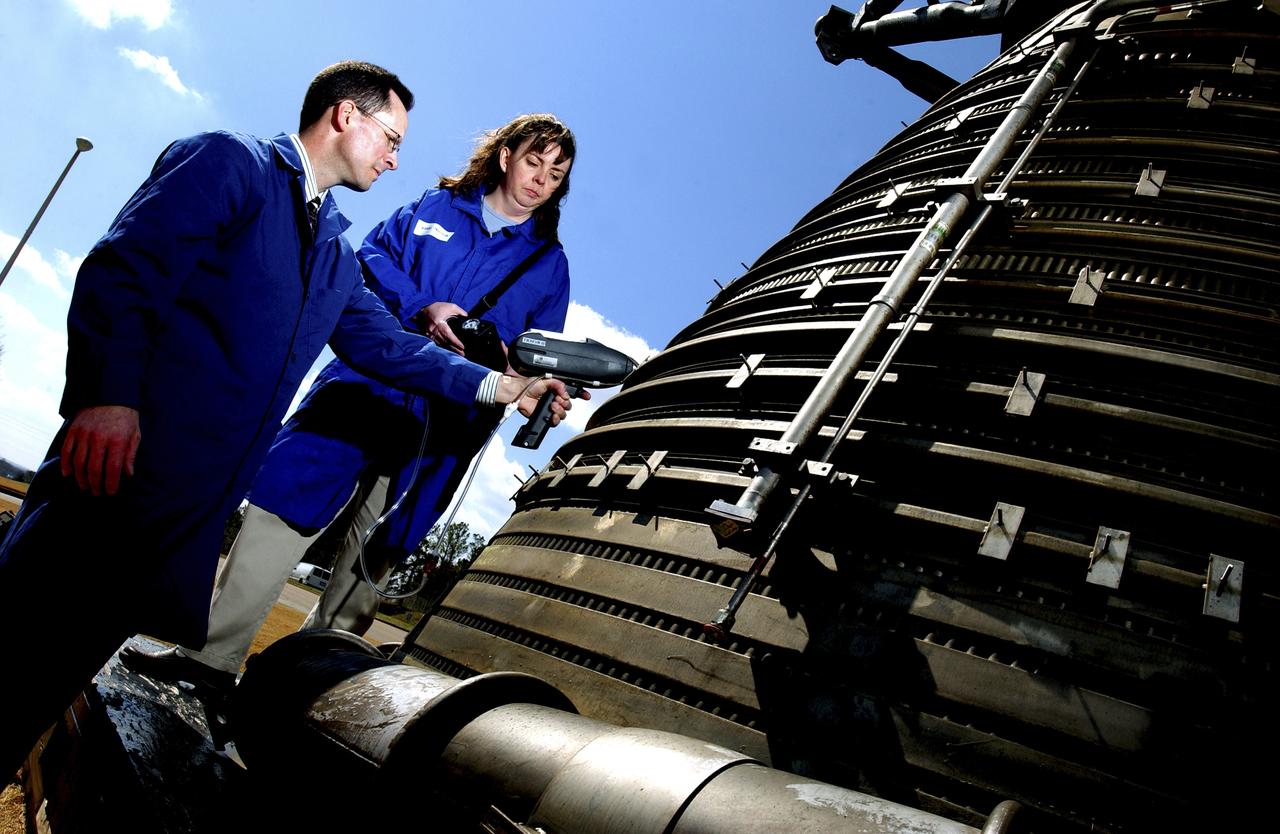
Teamed with KeyMaster Technologies, Kennewick, Washington, the Marshall Space Flight Center engineers have developed a portable vacuum analyzer that performs on-the-spot chemical analyses under field conditions— a task previously only possible in a chemical laboratory. The new capability is important not only to the aerospace industry, but holds potential for broad applications in any industry that depends on materials analysis, such as the automotive and pharmaceutical industries. Weighing in at a mere 4 pounds, the newly developed handheld vacuum X-ray fluorescent analyzer can identify and characterize a wide range of elements, and is capable of detecting chemical elements with low atomic numbers, such as sodium, aluminum and silicon. It is the only handheld product on the market with that capability. Aluminum alloy verification is of particular interest to NASA because vast amounts of high-strength aluminum alloys are used in the Space Shuttle propulsion system such as the External Tank, Main Engine, and Solid Rocket Boosters. This capability promises to be a boom to the aerospace community because of unique requirements, for instance, the need to analyze Space Shuttle propulsion systems on the launch pad. Those systems provide the awe-inspiring rocket power that propels the Space Shuttle from Earth into orbit in mere minutes. The scanner development also marks a major improvement in the quality assurance field, because screws, nuts, bolts, fasteners, and other items can now be evaluated upon receipt and rejected if found to be substandard. The same holds true for aluminum weld rods. The ability to validate the integrity of raw materials and partially finished products before adding value to them in the manufacturing process will be of benefit not only to businesses, but also to the consumer, who will have access to a higher value product at a cheaper price. Three vacuum X-ray scanners are already being used in the Space Shuttle Program. The External Tank Project Office is using one for aluminum alloy analysis, while a Marshall contractor is evaluating alloys with another unit purchased for the Space Shuttle Main Engine Office. The Reusable Solid Rocket Motor Project Office has obtained a scanner that is being used to test hardware and analyze materials. In this photograph, Richard Booth, Marshall Engineering Directorate, and Wanda Hudson, ATK Thiokol, use an enhanced vacuum X-ray fluorescent scanner to analyze materials in an F-1 engine, which was used to boost the Saturn V rocket from Earth’s orbit that carried astronauts to the moon in the 1960s.
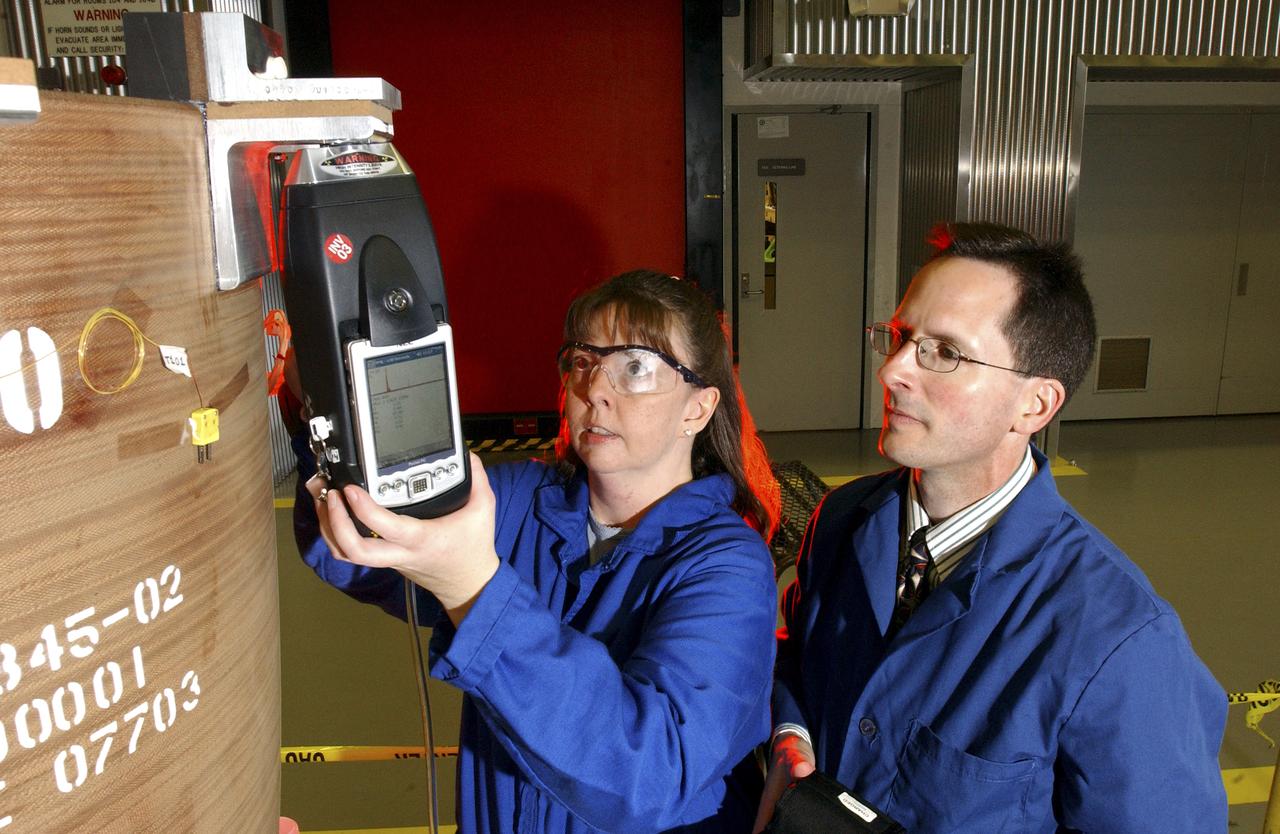
Teamed with KeyMaster Technologies, Kennewick, Washington, the Marshall Space Flight Center engineers have developed a portable vacuum analyzer that performs on-the-spot chemical analyses under field conditions— a task previously only possible in a chemical laboratory. The new capability is important not only to the aerospace industry, but holds potential for broad applications in any industry that depends on materials analysis, such as the automotive and pharmaceutical industries. Weighing in at a mere 4 pounds, the newly developed handheld vacuum X-ray fluorescent analyzer can identify and characterize a wide range of elements, and is capable of detecting chemical elements with low atomic numbers, such as sodium, aluminum and silicon. It is the only handheld product on the market with that capability. Aluminum alloy verification is of particular interest to NASA because vast amounts of high-strength aluminum alloys are used in the Space Shuttle propulsion system such as the External Tank, Main Engine, and Solid Rocket Boosters. This capability promises to be a boom to the aerospace community because of unique requirements, for instance, the need to analyze Space Shuttle propulsion systems on the launch pad. Those systems provide the awe-inspiring rocket power that propels the Space Shuttle from Earth into orbit in mere minutes. The scanner development also marks a major improvement in the quality assurance field, because screws, nuts, bolts, fasteners, and other items can now be evaluated upon receipt and rejected if found to be substandard. The same holds true for aluminum weld rods. The ability to validate the integrity of raw materials and partially finished products before adding value to them in the manufacturing process will be of benefit not only to businesses, but also to the consumer, who will have access to a higher value product at a cheaper price. Three vacuum X-ray scanners are already being used in the Space Shuttle Program. The External Tank Project Office is using one for aluminum alloy analysis, while a Marshall contractor is evaluating alloys with another unit purchased for the Space Shuttle Main Engine Office. The Reusable Solid Rocket Motor Project Office has obtained a scanner that is being used to test hardware and analyze materials. In this photograph, Wanda Hudson, left, ATK Thiokol, and Richard Booth, Marshall Engineering Directorate, use an enhanced vacuum X-ray fluorescent scanner to evaluate Reusable Solid Rocket Motor hardware.