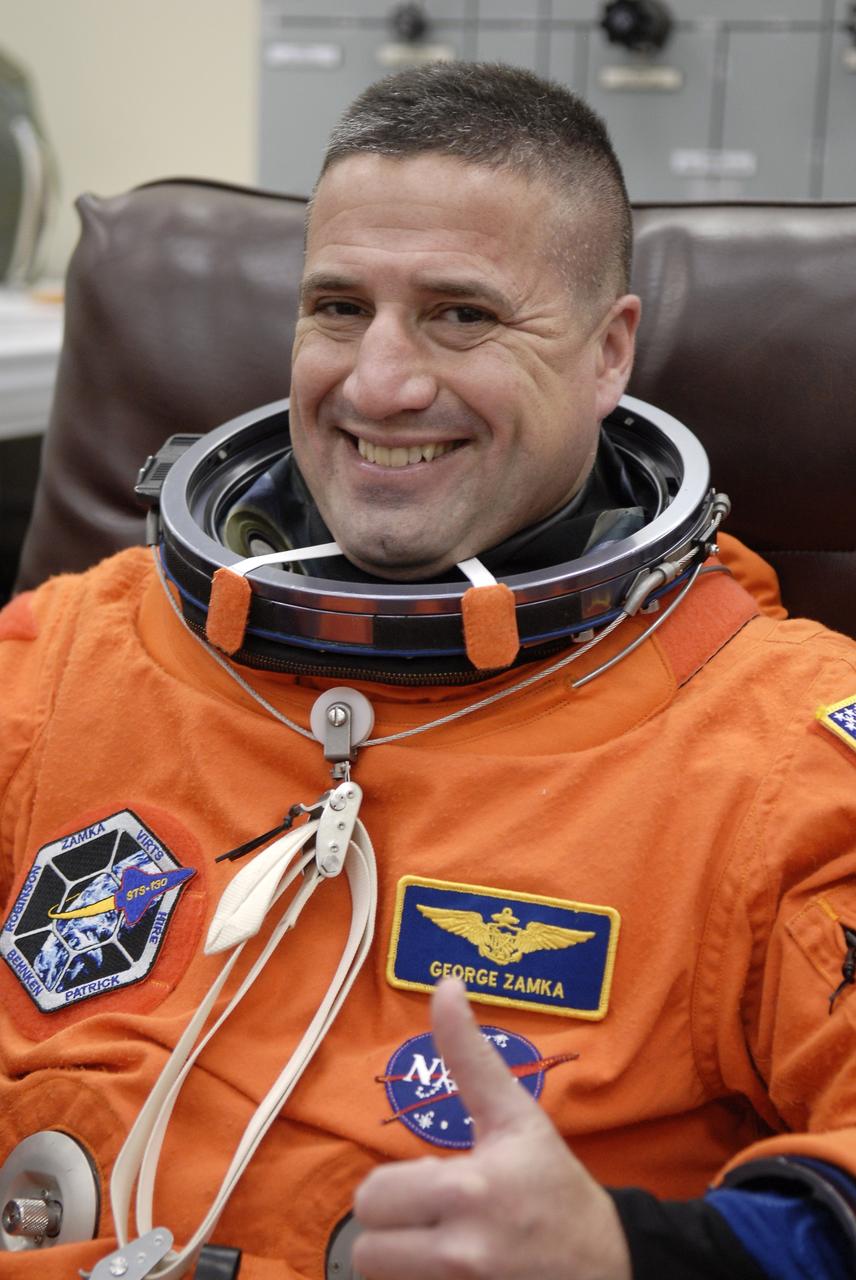
CAPE CANAVERAL, Fla. - In the Operations and Checkout Building at NASA's Kennedy Space Center in Florida, members of space shuttle Endeavour's STS-130 crew put on their launch-and-entry suits before heading to the Astrovan for the ride to Launch Pad 39A. The crew is participating in a dress rehearsal for their upcoming launch, known as the Terminal Countdown Demonstration Test. Making his second spaceflight on STS-130 is Commander George Zamka, seen here. The primary payload for the STS-130 mission is the International Space Station's Tranquility node, a pressurized module that will provide room for many of the station's life support systems. Attached to one end of Tranquility is a cupola, a unique work area with six windows on its sides and one on top. The cupola resembles a circular bay window and will provide a vastly improved view of the station's exterior. The multi-directional view will allow the crew to monitor spacewalks and docking operations, as well as provide a spectacular view of Earth and other celestial objects. The module was built in Turin, Italy, by Thales Alenia Space for the European Space Agency. Launch of STS-130 is targeted for Feb. 7. For information on the STS-130 mission and crew, visit http://www.nasa.gov/mission_pages/shuttle/shuttlemissions/sts130/index.html. Photo credit: NASA/Kim Shiflett
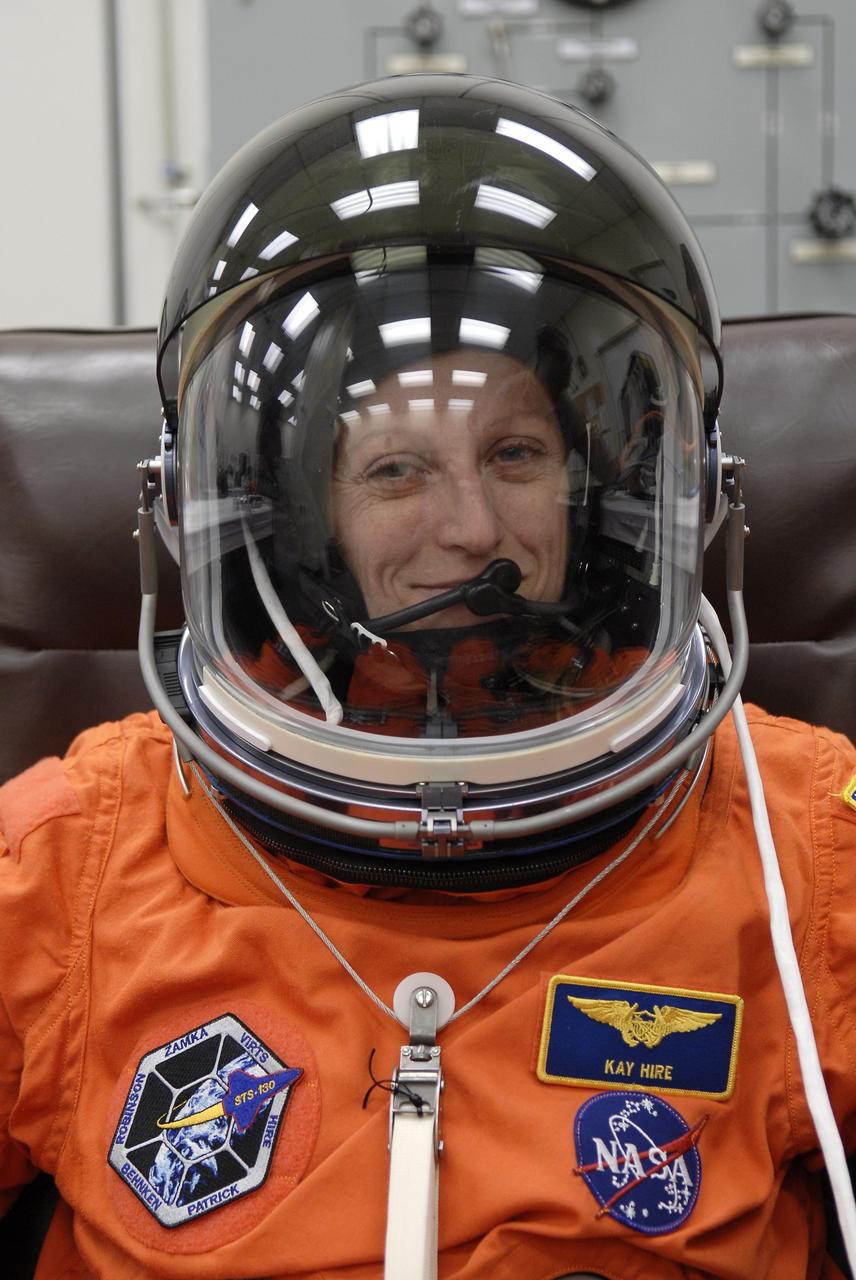
CAPE CANAVERAL, Fla. - In the Operations and Checkout Building at NASA's Kennedy Space Center in Florida, members of space shuttle Endeavour's STS-130 crew put on their launch-and-entry suits before heading to the Astrovan for the ride to Launch Pad 39A. The crew is participating in a dress rehearsal for their upcoming launch, known as the Terminal Countdown Demonstration Test. Making her second spaceflight on STS-130 is Mission Specialist Kathryn Hire, seen here in her helmet. The primary payload for the STS-130 mission is the International Space Station's Tranquility node, a pressurized module that will provide room for many of the station's life support systems. Attached to one end of Tranquility is a cupola, a unique work area with six windows on its sides and one on top. The cupola resembles a circular bay window and will provide a vastly improved view of the station's exterior. The multi-directional view will allow the crew to monitor spacewalks and docking operations, as well as provide a spectacular view of Earth and other celestial objects. The module was built in Turin, Italy, by Thales Alenia Space for the European Space Agency. Launch of STS-130 is targeted for Feb. 7. For information on the STS-130 mission and crew, visit http://www.nasa.gov/mission_pages/shuttle/shuttlemissions/sts130/index.html. Photo credit: NASA/Kim Shiflett

CAPE CANAVERAL, Fla. - In the Operations and Checkout Building at NASA's Kennedy Space Center in Florida, members of space shuttle Endeavour's STS-130 crew put on their launch-and-entry suits before heading to the Astrovan for the ride to Launch Pad 39A. The crew is participating in a dress rehearsal for their upcoming launch, known as the Terminal Countdown Demonstration Test. Making his second spaceflight on STS-130 is Mission Specialist Robert Behnken, seen here in his helmet. The primary payload for the STS-130 mission is the International Space Station's Tranquility node, a pressurized module that will provide room for many of the station's life support systems. Attached to one end of Tranquility is a cupola, a unique work area with six windows on its sides and one on top. The cupola resembles a circular bay window and will provide a vastly improved view of the station's exterior. The multi-directional view will allow the crew to monitor spacewalks and docking operations, as well as provide a spectacular view of Earth and other celestial objects. The module was built in Turin, Italy, by Thales Alenia Space for the European Space Agency. Launch of STS-130 is targeted for Feb. 7. For information on the STS-130 mission and crew, visit http://www.nasa.gov/mission_pages/shuttle/shuttlemissions/sts130/index.html. Photo credit: NASA/Kim Shiflett
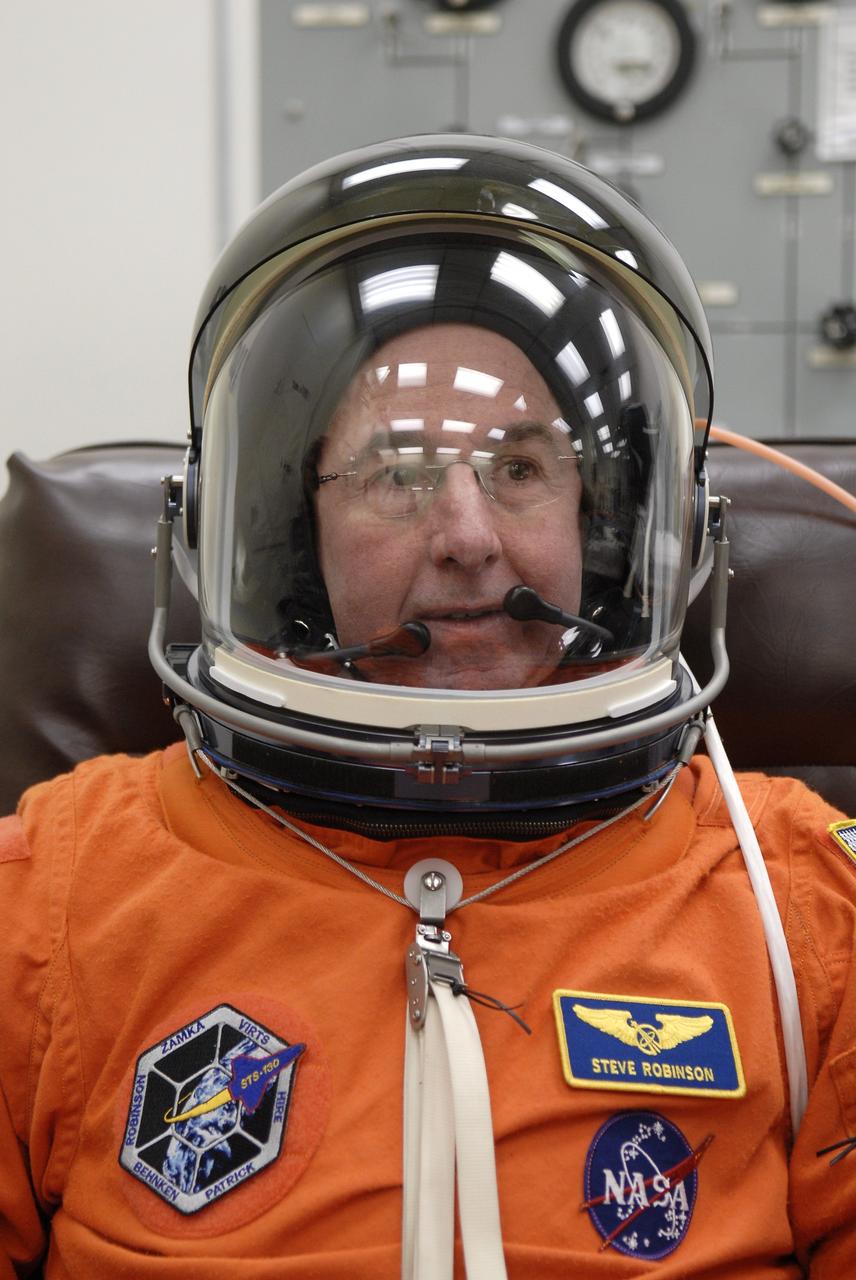
CAPE CANAVERAL, Fla. - In the Operations and Checkout Building at NASA's Kennedy Space Center in Florida, members of space shuttle Endeavour's STS-130 crew put on their launch-and-entry suits before heading to the Astrovan for the ride to Launch Pad 39A. The crew is participating in a dress rehearsal for their upcoming launch, known as the Terminal Countdown Demonstration Test. Making his fourth spaceflight on STS-130 is Mission Specialist Stephen Robinson, seen here in his helmet. The primary payload for the STS-130 mission is the International Space Station's Tranquility node, a pressurized module that will provide room for many of the station's life support systems. Attached to one end of Tranquility is a cupola, a unique work area with six windows on its sides and one on top. The cupola resembles a circular bay window and will provide a vastly improved view of the station's exterior. The multi-directional view will allow the crew to monitor spacewalks and docking operations, as well as provide a spectacular view of Earth and other celestial objects. The module was built in Turin, Italy, by Thales Alenia Space for the European Space Agency. Launch of STS-130 is targeted for Feb. 7. For information on the STS-130 mission and crew, visit http://www.nasa.gov/mission_pages/shuttle/shuttlemissions/sts130/index.html. Photo credit: NASA/Kim Shiflett
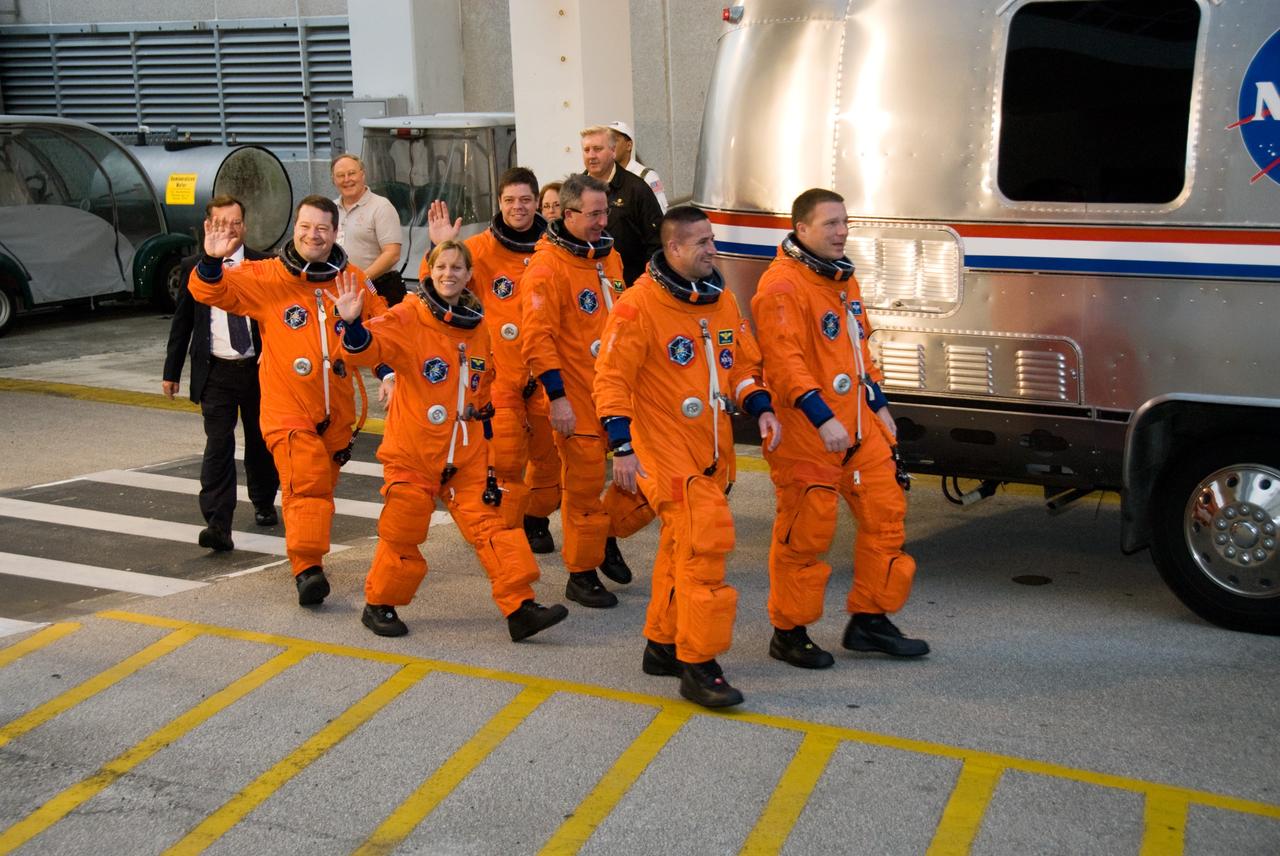
CAPE CANAVERAL, Fla. - At the Operations and Checkout Building at NASA's Kennedy Space Center in Florida, members of space shuttle Endeavour's STS-130 crew head for the Astrovan in their launch-and-entry suits for the ride to Launch Pad 39A. The crew is participating in a dress rehearsal for their upcoming launch, known as the Terminal Countdown Demonstration Test. From left are Mission Specialists Nicholas Patrick, Kathryn Hire, Robert Behnken and Stephen Robinson; Commander George Zamka; and Pilot Terry Virts. The primary payload for the STS-130 mission is the International Space Station's Tranquility node, a pressurized module that will provide room for many of the station's life support systems. Attached to one end of Tranquility is a cupola, a unique work area with six windows on its sides and one on top. The cupola resembles a circular bay window and will provide a vastly improved view of the station's exterior. The multi-directional view will allow the crew to monitor spacewalks and docking operations, as well as provide a spectacular view of Earth and other celestial objects. The module was built in Turin, Italy, by Thales Alenia Space for the European Space Agency. Launch of STS-130 is targeted for Feb. 7. For information on the STS-130 mission and crew, visit http://www.nasa.gov/mission_pages/shuttle/shuttlemissions/sts130/index.html. Photo credit: NASA/Kim Shiflett
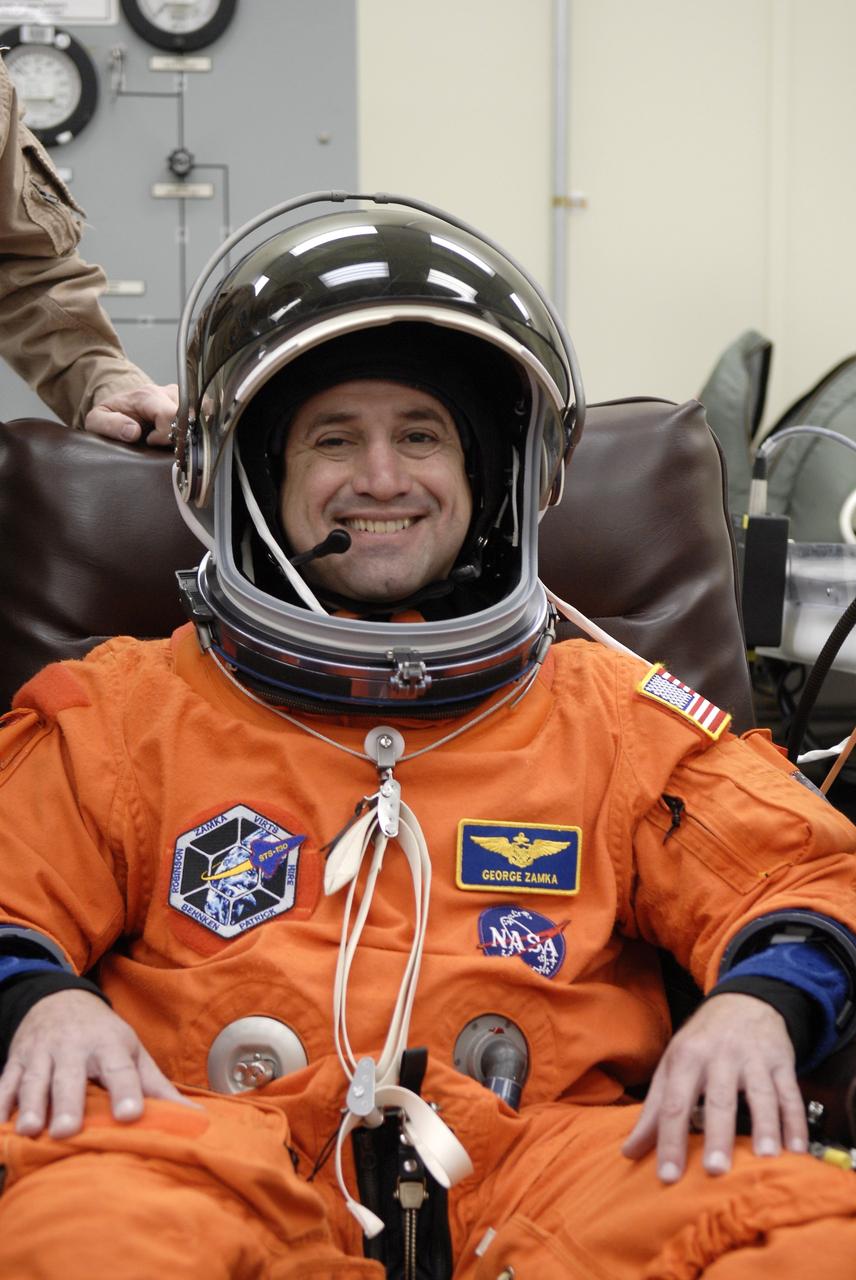
CAPE CANAVERAL, Fla. - In the Operations and Checkout Building at NASA's Kennedy Space Center in Florida, members of space shuttle Endeavour's STS-130 crew put on their launch-and-entry suits before heading to the Astrovan for the ride to Launch Pad 39A. The crew is participating in a dress rehearsal for their upcoming launch, known as the Terminal Countdown Demonstration Test. Making his second spaceflight on STS-130 is Commander George Zamka, seen here in his helmet. The primary payload for the STS-130 mission is the International Space Station's Tranquility node, a pressurized module that will provide room for many of the station's life support systems. Attached to one end of Tranquility is a cupola, a unique work area with six windows on its sides and one on top. The cupola resembles a circular bay window and will provide a vastly improved view of the station's exterior. The multi-directional view will allow the crew to monitor spacewalks and docking operations, as well as provide a spectacular view of Earth and other celestial objects. The module was built in Turin, Italy, by Thales Alenia Space for the European Space Agency. Launch of STS-130 is targeted for Feb. 7. For information on the STS-130 mission and crew, visit http://www.nasa.gov/mission_pages/shuttle/shuttlemissions/sts130/index.html. Photo credit: NASA/Kim Shiflett
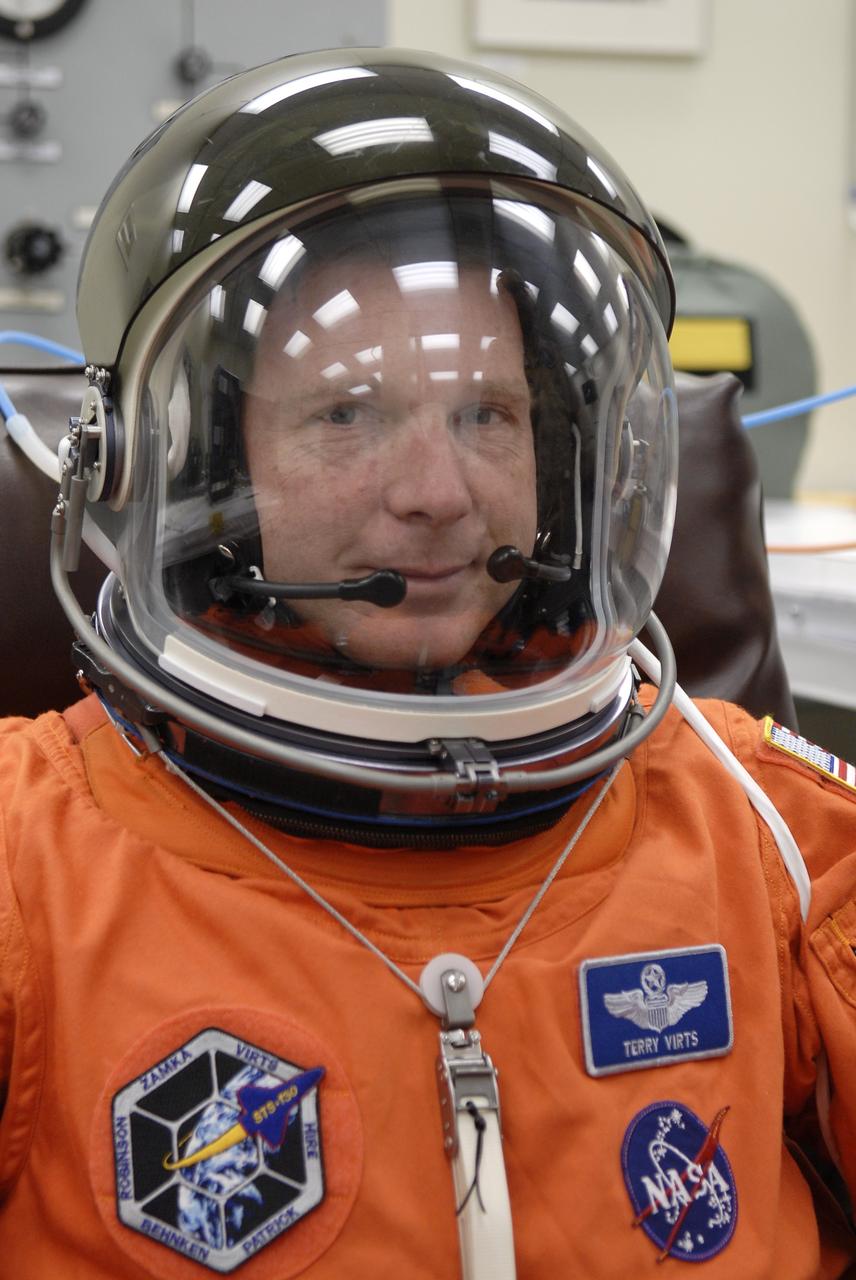
CAPE CANAVERAL, Fla. - In the Operations and Checkout Building at NASA's Kennedy Space Center in Florida, members of space shuttle Endeavour's STS-130 crew put on their launch-and-entry suits before heading to the Astrovan for the ride to Launch Pad 39A. The crew is participating in a dress rehearsal for their upcoming launch, known as the Terminal Countdown Demonstration Test. Making his first spaceflight on STS-130 is Pilot Terry Virts, seen here in his helmet. The primary payload for the STS-130 mission is the International Space Station's Tranquility node, a pressurized module that will provide room for many of the station's life support systems. Attached to one end of Tranquility is a cupola, a unique work area with six windows on its sides and one on top. The cupola resembles a circular bay window and will provide a vastly improved view of the station's exterior. The multi-directional view will allow the crew to monitor spacewalks and docking operations, as well as provide a spectacular view of Earth and other celestial objects. The module was built in Turin, Italy, by Thales Alenia Space for the European Space Agency. Launch of STS-130 is targeted for Feb. 7. For information on the STS-130 mission and crew, visit http://www.nasa.gov/mission_pages/shuttle/shuttlemissions/sts130/index.html. Photo credit: NASA/Kim Shiflett
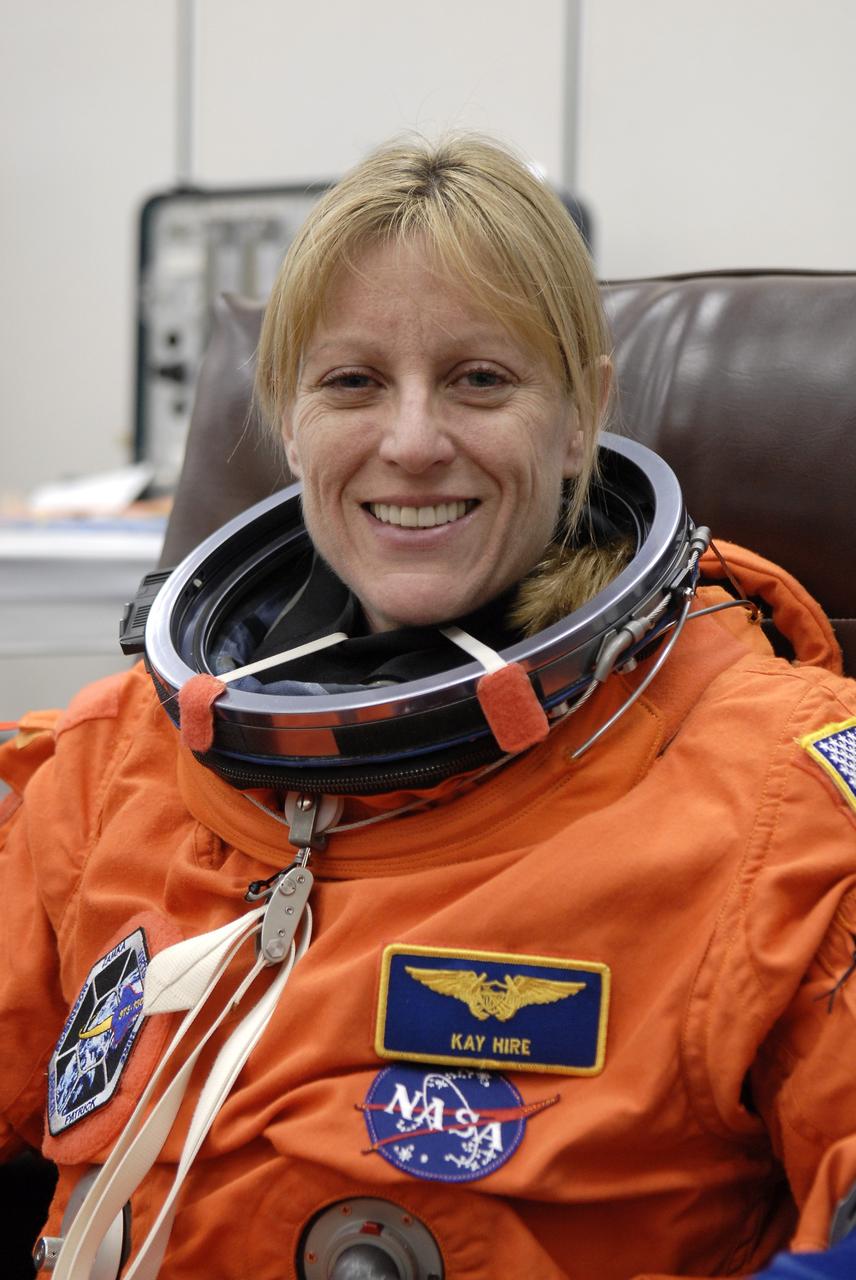
CAPE CANAVERAL, Fla. - In the Operations and Checkout Building at NASA's Kennedy Space Center in Florida, members of space shuttle Endeavour's STS-130 crew put on their launch-and-entry suits before heading to the Astrovan for the ride to Launch Pad 39A. The crew is participating in a dress rehearsal for their upcoming launch, known as the Terminal Countdown Demonstration Test. Making her second spaceflight on STS-130 is Mission Specialist Kathryn Hire, seen here. The primary payload for the STS-130 mission is the International Space Station's Tranquility node, a pressurized module that will provide room for many of the station's life support systems. Attached to one end of Tranquility is a cupola, a unique work area with six windows on its sides and one on top. The cupola resembles a circular bay window and will provide a vastly improved view of the station's exterior. The multi-directional view will allow the crew to monitor spacewalks and docking operations, as well as provide a spectacular view of Earth and other celestial objects. The module was built in Turin, Italy, by Thales Alenia Space for the European Space Agency. Launch of STS-130 is targeted for Feb. 7. For information on the STS-130 mission and crew, visit http://www.nasa.gov/mission_pages/shuttle/shuttlemissions/sts130/index.html. Photo credit: NASA/Kim Shiflett
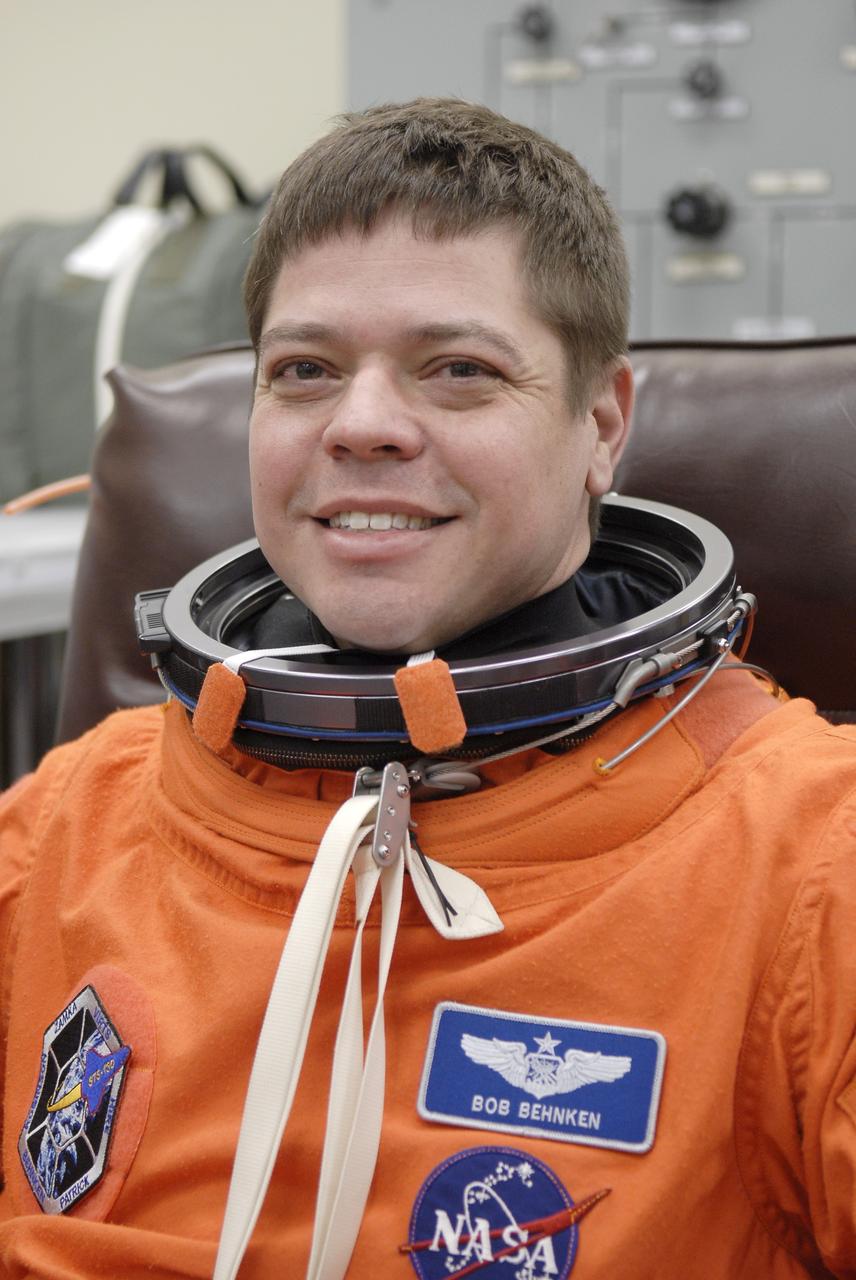
CAPE CANAVERAL, Fla. - In the Operations and Checkout Building at NASA's Kennedy Space Center in Florida, members of space shuttle Endeavour's STS-130 crew put on their launch-and-entry suits before heading to the Astrovan for the ride to Launch Pad 39A. The crew is participating in a dress rehearsal for their upcoming launch, known as the Terminal Countdown Demonstration Test. Making his second spaceflight on STS-130 is Mission Specialist Robert Behnken, seen here. The primary payload for the STS-130 mission is the International Space Station's Tranquility node, a pressurized module that will provide room for many of the station's life support systems. Attached to one end of Tranquility is a cupola, a unique work area with six windows on its sides and one on top. The cupola resembles a circular bay window and will provide a vastly improved view of the station's exterior. The multi-directional view will allow the crew to monitor spacewalks and docking operations, as well as provide a spectacular view of Earth and other celestial objects. The module was built in Turin, Italy, by Thales Alenia Space for the European Space Agency. Launch of STS-130 is targeted for Feb. 7. For information on the STS-130 mission and crew, visit http://www.nasa.gov/mission_pages/shuttle/shuttlemissions/sts130/index.html. Photo credit: NASA/Kim Shiflett
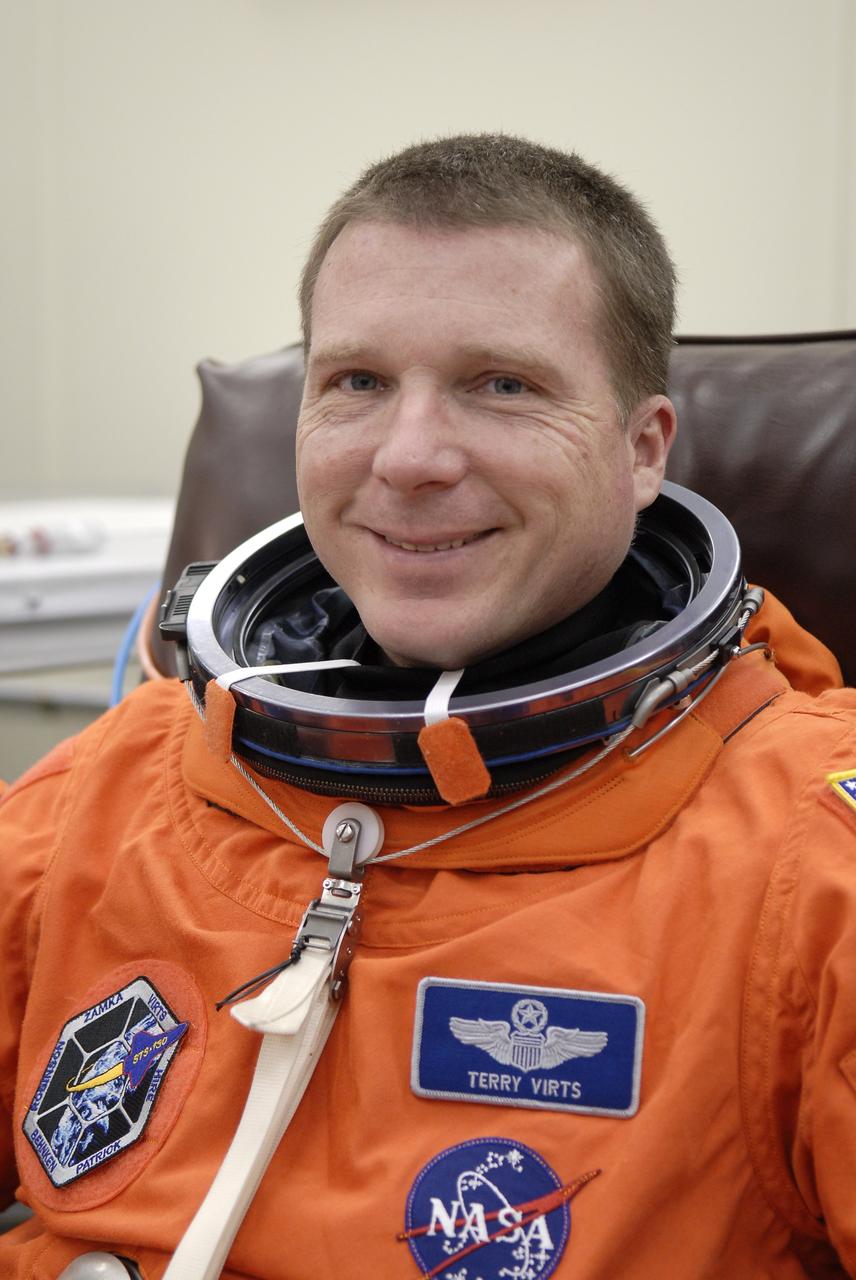
CAPE CANAVERAL, Fla. - In the Operations and Checkout Building at NASA's Kennedy Space Center in Florida, members of space shuttle Endeavour's STS-130 crew put on their launch-and-entry suits before heading to the Astrovan for the ride to Launch Pad 39A. The crew is participating in a dress rehearsal for their upcoming launch, known as the Terminal Countdown Demonstration Test. Making his first spaceflight on STS-130 is Pilot Terry Virts, seen here. The primary payload for the STS-130 mission is the International Space Station's Tranquility node, a pressurized module that will provide room for many of the station's life support systems. Attached to one end of Tranquility is a cupola, a unique work area with six windows on its sides and one on top. The cupola resembles a circular bay window and will provide a vastly improved view of the station's exterior. The multi-directional view will allow the crew to monitor spacewalks and docking operations, as well as provide a spectacular view of Earth and other celestial objects. The module was built in Turin, Italy, by Thales Alenia Space for the European Space Agency. Launch of STS-130 is targeted for Feb. 7. For information on the STS-130 mission and crew, visit http://www.nasa.gov/mission_pages/shuttle/shuttlemissions/sts130/index.html. Photo credit: NASA/Kim Shiflett
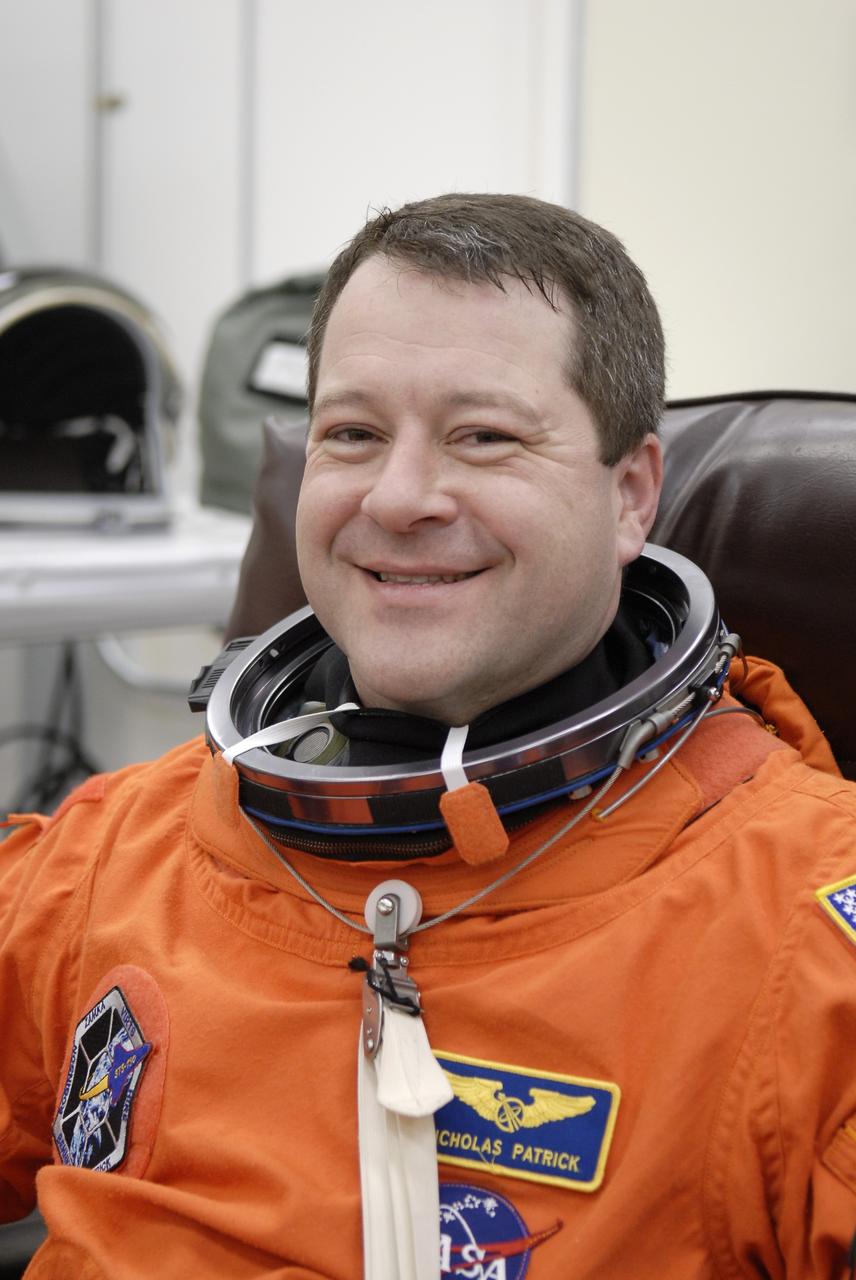
CAPE CANAVERAL, Fla. - In the Operations and Checkout Building at NASA's Kennedy Space Center in Florida, members of space shuttle Endeavour's STS-130 crew put on their launch-and-entry suits before heading to the Astrovan for the ride to Launch Pad 39A. The crew is participating in a dress rehearsal for their upcoming launch, known as the Terminal Countdown Demonstration Test. Making his second spaceflight on STS-130 is Mission Specialist Nicholas Patrick, seen here. The primary payload for the STS-130 mission is the International Space Station's Tranquility node, a pressurized module that will provide room for many of the station's life support systems. Attached to one end of Tranquility is a cupola, a unique work area with six windows on its sides and one on top. The cupola resembles a circular bay window and will provide a vastly improved view of the station's exterior. The multi-directional view will allow the crew to monitor spacewalks and docking operations, as well as provide a spectacular view of Earth and other celestial objects. The module was built in Turin, Italy, by Thales Alenia Space for the European Space Agency. Launch of STS-130 is targeted for Feb. 7. For information on the STS-130 mission and crew, visit http://www.nasa.gov/mission_pages/shuttle/shuttlemissions/sts130/index.html. Photo credit: NASA/Kim Shiflett
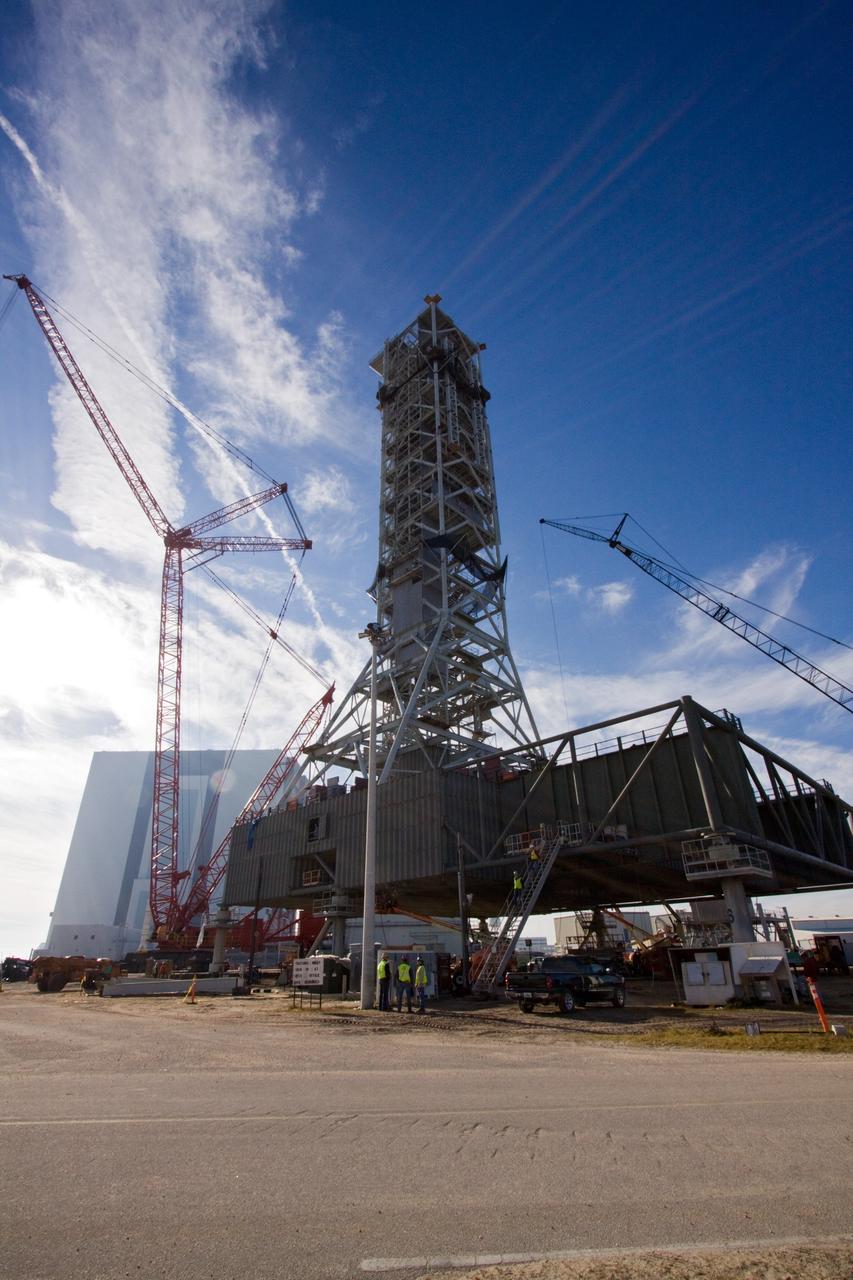
CAPE CANAVERAL, Fla. – At NASA's Kennedy Space Center in Florida, preparations are under way to install the ninth tower segment of a new mobile launcher, or ML, being constructed to support the Constellation Program, on the top of the growing tower. When completed, the tower will be approximately 345 feet tall and have multiple platforms for personnel access. Its base is being made lighter than space shuttle mobile launcher platforms so the crawler-transporter can pick up the heavier load of the tower and a taller rocket. For information on the Constellation Program, visit http://www.nasa.gov/constellation. Photo credit: NASA/Jack Pfaller

CAPE CANAVERAL, Fla. - In the Operations and Checkout Building at NASA's Kennedy Space Center in Florida, members of space shuttle Endeavour's STS-130 crew put on their launch-and-entry suits before heading to the Astrovan for the ride to Launch Pad 39A. The crew is participating in a dress rehearsal for their upcoming launch, known as the Terminal Countdown Demonstration Test. Making his fourth spaceflight on STS-130 is Mission Specialist Stephen Robinson, seen here. The primary payload for the STS-130 mission is the International Space Station's Tranquility node, a pressurized module that will provide room for many of the station's life support systems. Attached to one end of Tranquility is a cupola, a unique work area with six windows on its sides and one on top. The cupola resembles a circular bay window and will provide a vastly improved view of the station's exterior. The multi-directional view will allow the crew to monitor spacewalks and docking operations, as well as provide a spectacular view of Earth and other celestial objects. The module was built in Turin, Italy, by Thales Alenia Space for the European Space Agency. Launch of STS-130 is targeted for Feb. 7. For information on the STS-130 mission and crew, visit http://www.nasa.gov/mission_pages/shuttle/shuttlemissions/sts130/index.html. Photo credit: NASA/Kim Shiflett
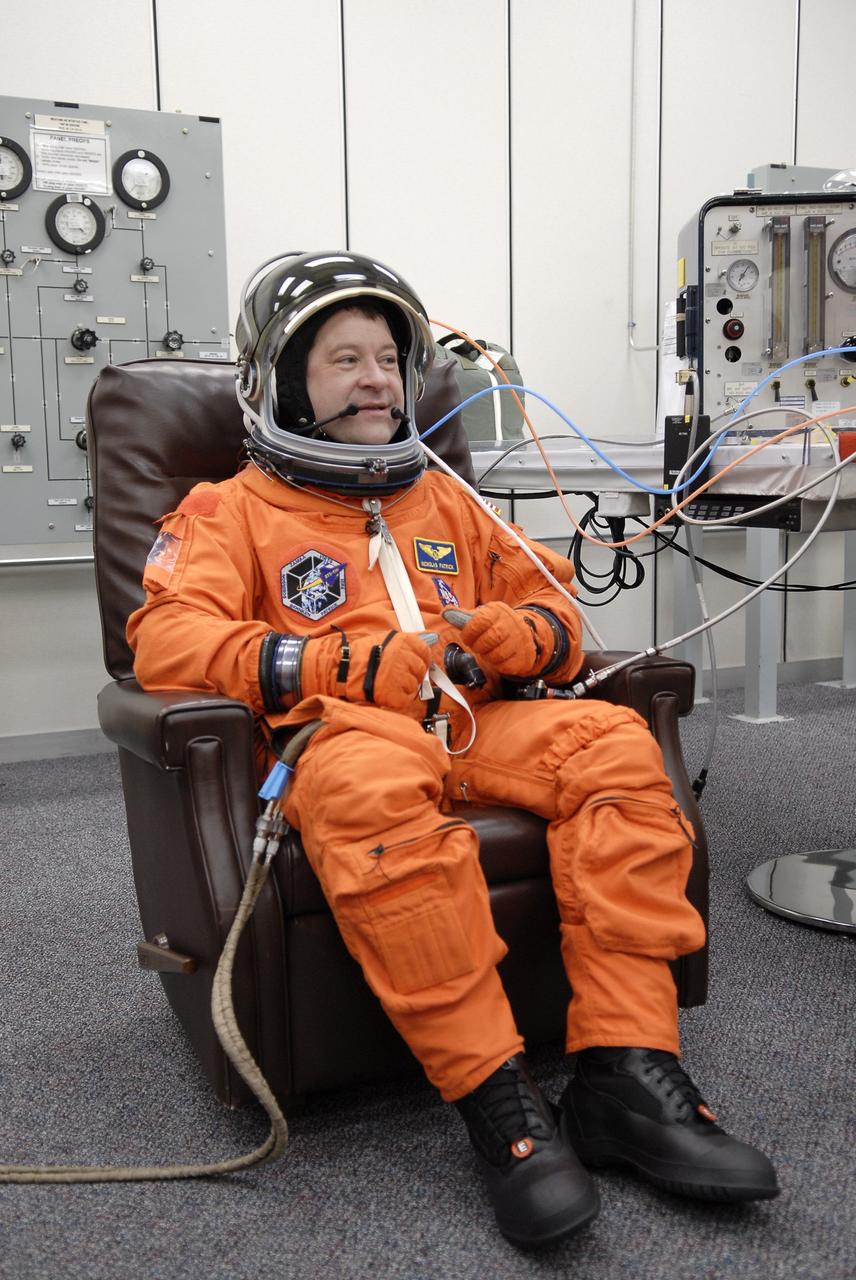
CAPE CANAVERAL, Fla. - In the Operations and Checkout Building at NASA's Kennedy Space Center in Florida, members of space shuttle Endeavour's STS-130 crew put on their launch-and-entry suits before heading to the Astrovan for the ride to Launch Pad 39A. The crew is participating in a dress rehearsal for their upcoming launch, known as the Terminal Countdown Demonstration Test. Making his second spaceflight on STS-130 is Mission Specialist Nicholas Patrick, seen here in his helmet. The primary payload for the STS-130 mission is the International Space Station's Tranquility node, a pressurized module that will provide room for many of the station's life support systems. Attached to one end of Tranquility is a cupola, a unique work area with six windows on its sides and one on top. The cupola resembles a circular bay window and will provide a vastly improved view of the station's exterior. The multi-directional view will allow the crew to monitor spacewalks and docking operations, as well as provide a spectacular view of Earth and other celestial objects. The module was built in Turin, Italy, by Thales Alenia Space for the European Space Agency. Launch of STS-130 is targeted for Feb. 7. For information on the STS-130 mission and crew, visit http://www.nasa.gov/mission_pages/shuttle/shuttlemissions/sts130/index.html. Photo credit: NASA/Kim Shiflett
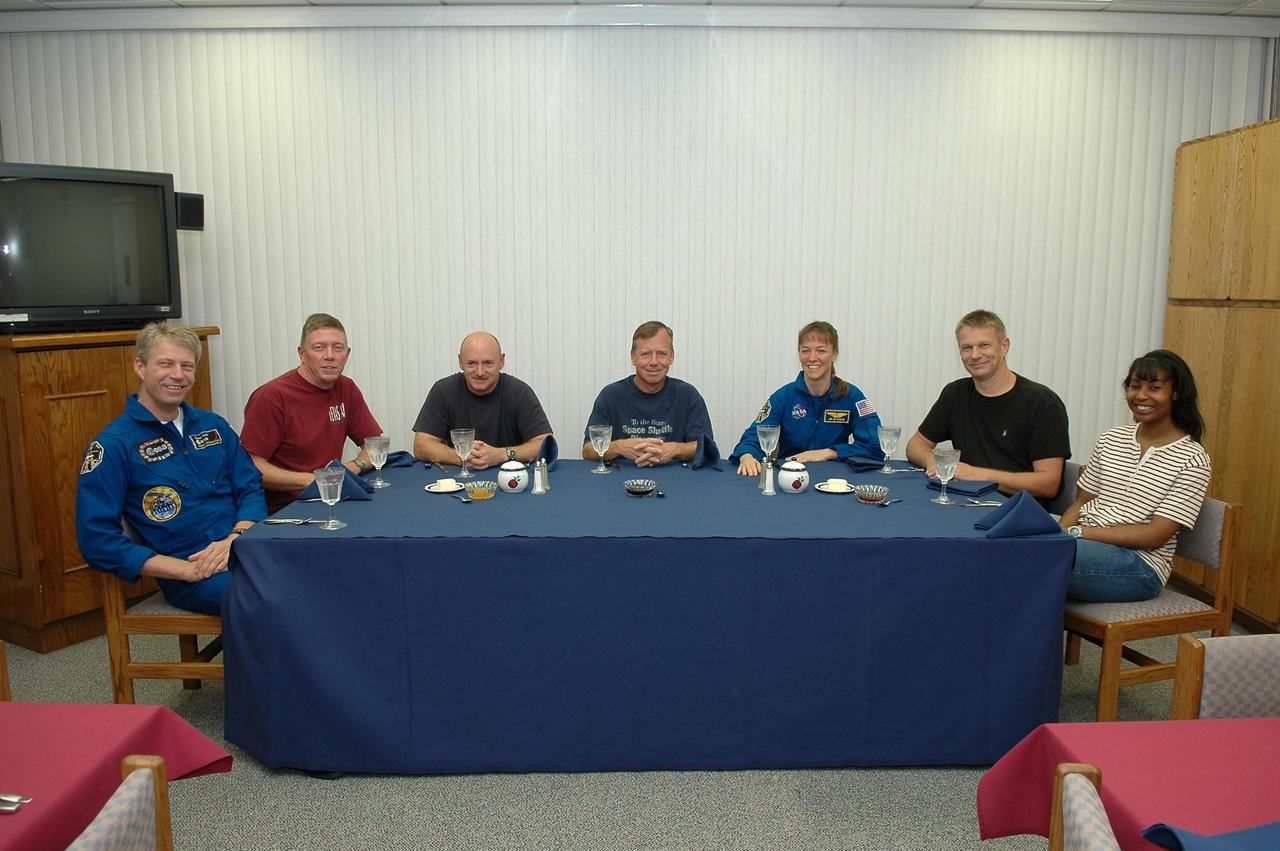
KENNEDY SPACE CENTER, FLA. - The STS-121 crew have breakfast in the Operations and Checkout Building at NASA's Kennedy Space Center before suiting up for the simulated countdown at the launch pad. Seated left to right are Mission Specialists Thomas Reiter of Germany and Michael Fossum, Pilot Mark Kelly, Commander Steven Lindsey, and Mission Specialists Lisa Nowak, Piers Sellers and Stephanie Wilson. Reiter represents the European Space Agency. The crew is taking part in Terminal Countdown Demonstration Test activities, including the dress rehearsal for launch. Mission STS-121 is scheduled to be launched July 1. Photo credit: NASA/Kim Shiflett
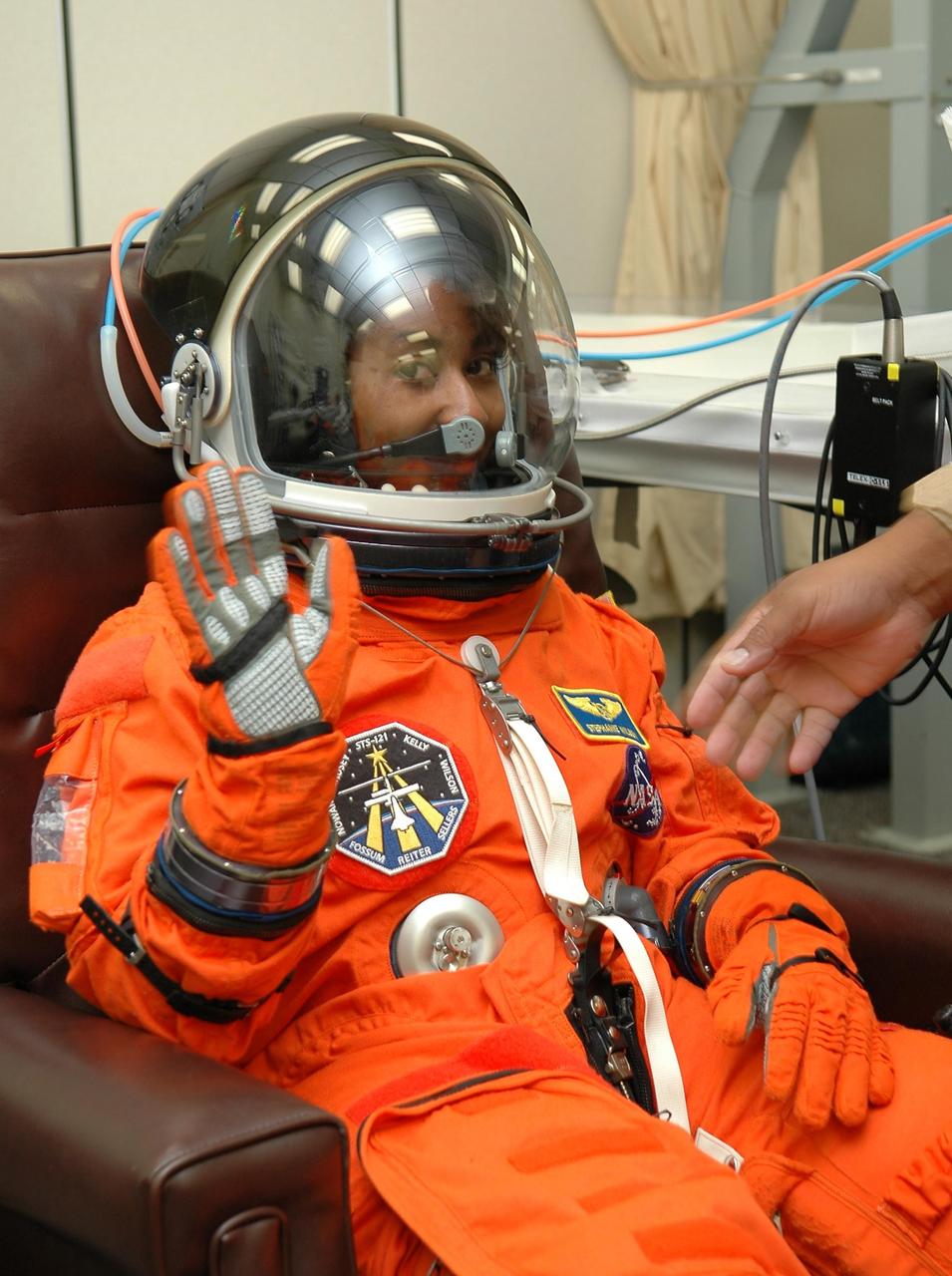
KENNEDY SPACE CENTER, FLA. - STS-121 Mission Specialist Stephanie Wilson signals all is well after donning her launch and entry suit in preparation for the simulated countdown she and other crew members will undertake. The crew is taking part in Terminal Countdown Demonstration Test activities, including the dress rehearsal for launch. Mission STS-121 is scheduled to be launched July 1. Photo credit: NASA/Kim Shiflett
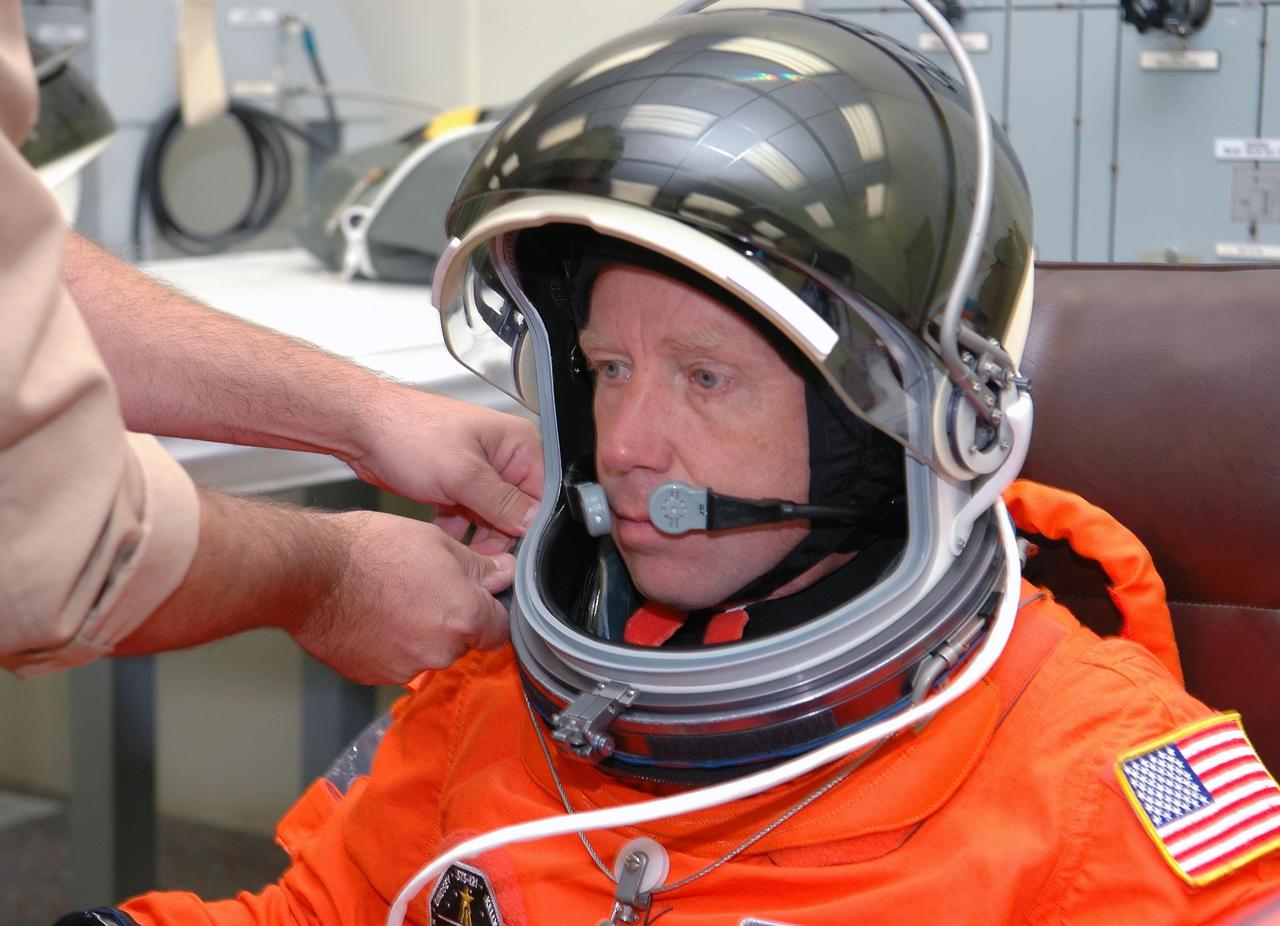
KENNEDY SPACE CENTER, FLA. - STS-121 Commander Steven Lindsey has his helmet secured to his launch and entry suit in preparation for the simulated countdown he and other crew members will undertake. The crew is taking part in Terminal Countdown Demonstration Test activities, including the dress rehearsal for launch. Mission STS-121 is scheduled to be launched July 1. Photo credit: NASA/Kim Shiflett
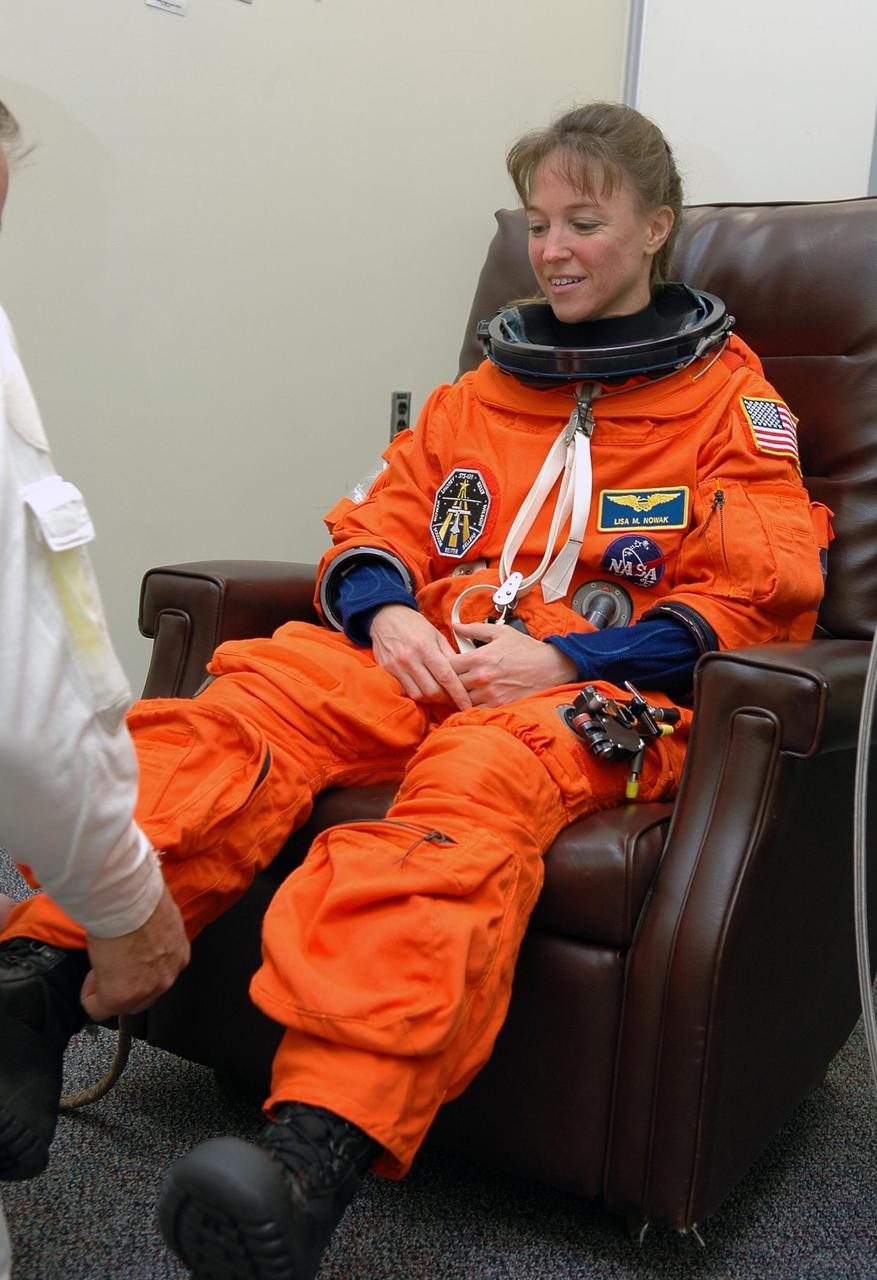
KENNEDY SPACE CENTER, FLA. - STS-121 Mission Specialist Lisa Nowak is helped with her boot after donning her launch and entry suit in preparation for the simulated countdown she and other crew members will undertake. The crew is taking part in Terminal Countdown Demonstration Test activities, including the dress rehearsal for launch. Mission STS-121 is scheduled to be launched July 1. Photo credit: NASA/Kim Shiflett
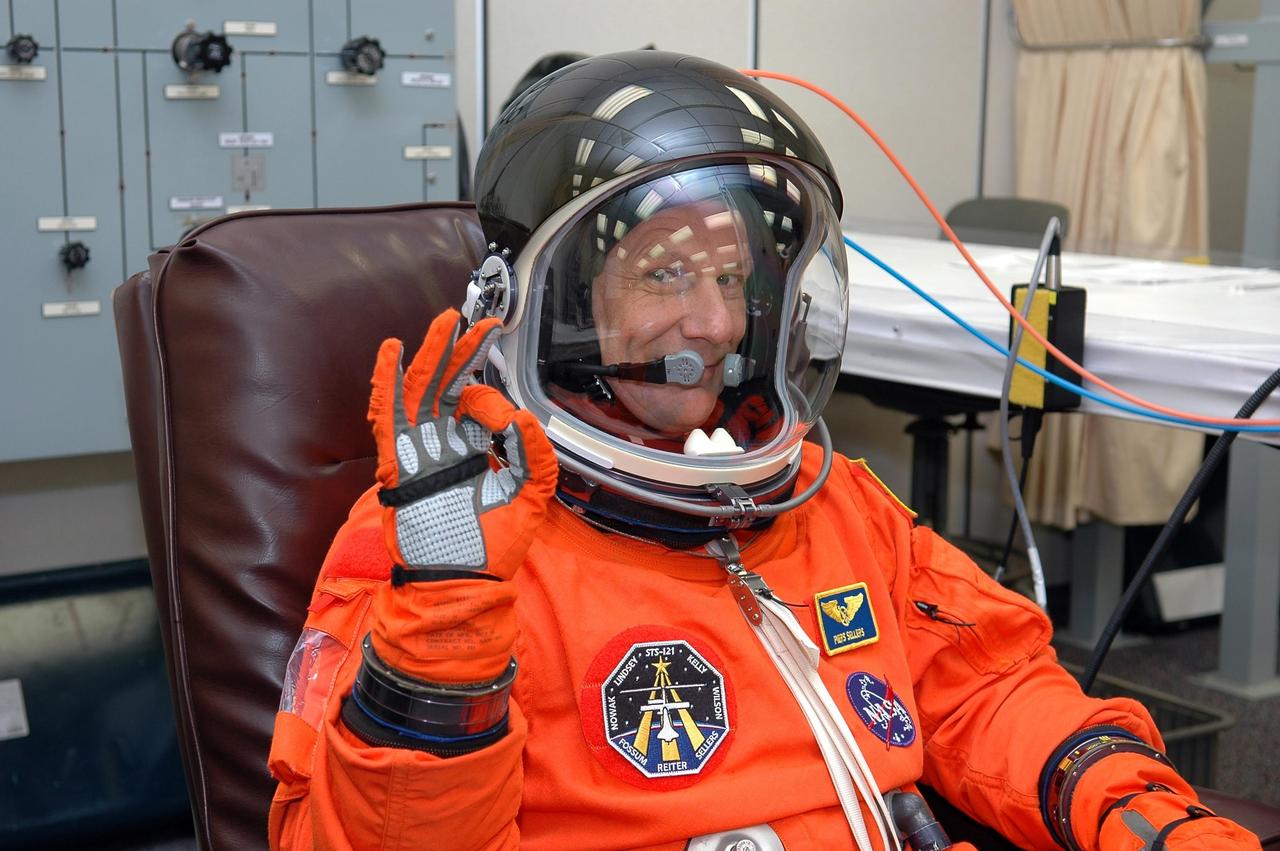
KENNEDY SPACE CENTER, FLA. - STS-121 Mission Specialist Piers Sellers signals okay after donning his launch and entry suit in preparation for the simulated countdown he and other crew members will undertake. The crew is taking part in Terminal Countdown Demonstration Test activities, including the dress rehearsal for launch. Mission STS-121 is scheduled to be launched July 1. Photo credit: NASA/Kim Shiflett
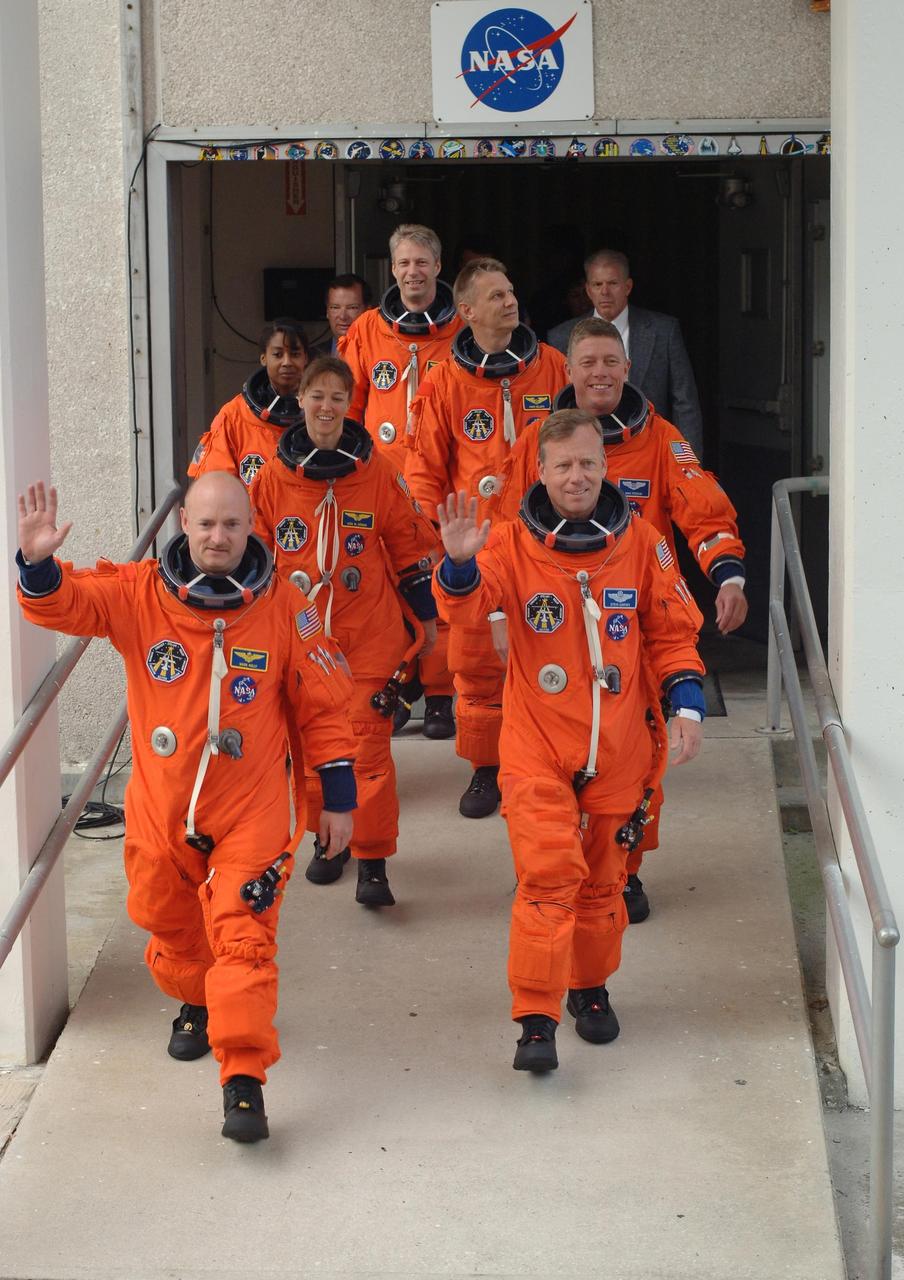
KENNEDY SPACE CENTER, FLA. - The suited STS-121 crew members stride out of the Operations and Checkout Building on their way to Launch Pad 39B for a simulated countdown. Leading the way are Pilot Mark Kelly (left) and Commander Steven Lindsey. Behind Kelly are Mission Specialists Lisa Nowak, Stephanie Wilson and Thomas Reiter of Germany, who represents the European Space Agency. Behind Lindsey are Mission Specialists Michael Fossum and Piers Sellers. The crew is taking part in Terminal Countdown Demonstration Test activities, including the dress rehearsal for launch. Mission STS-121 is scheduled to be launched July 1. Photo credit: NASA/Kim Shiflett
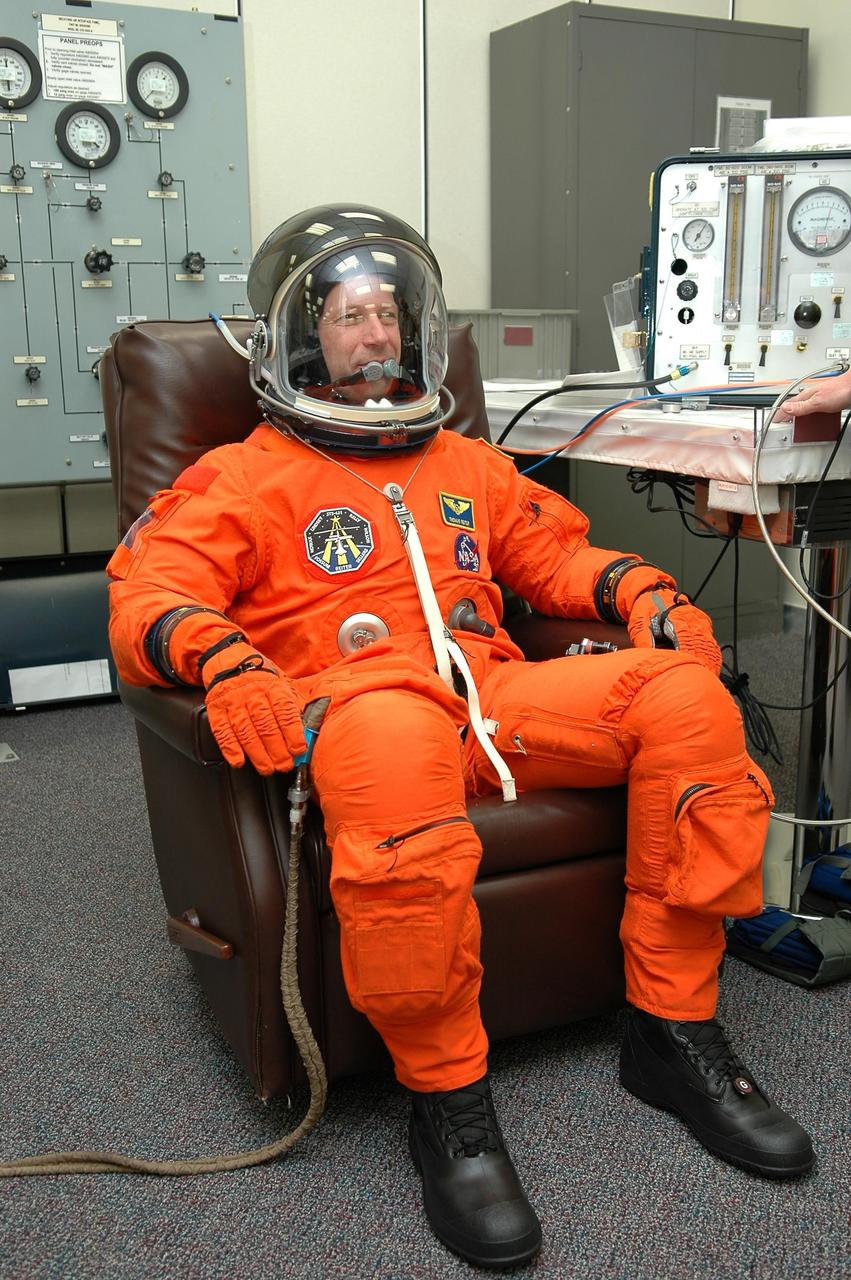
KENNEDY SPACE CENTER, FLA. - STS-121 Mission Specialist Thomas Reiter wears his launch and entry suit in preparation for the simulated countdown he and other crew members will undertake. Reiter is from Germany and represents the European Space Agency. The crew is taking part in Terminal Countdown Demonstration Test activities, including the dress rehearsal for launch. Mission STS-121 is scheduled to be launched July 1. Photo credit: NASA/Kim Shiflett
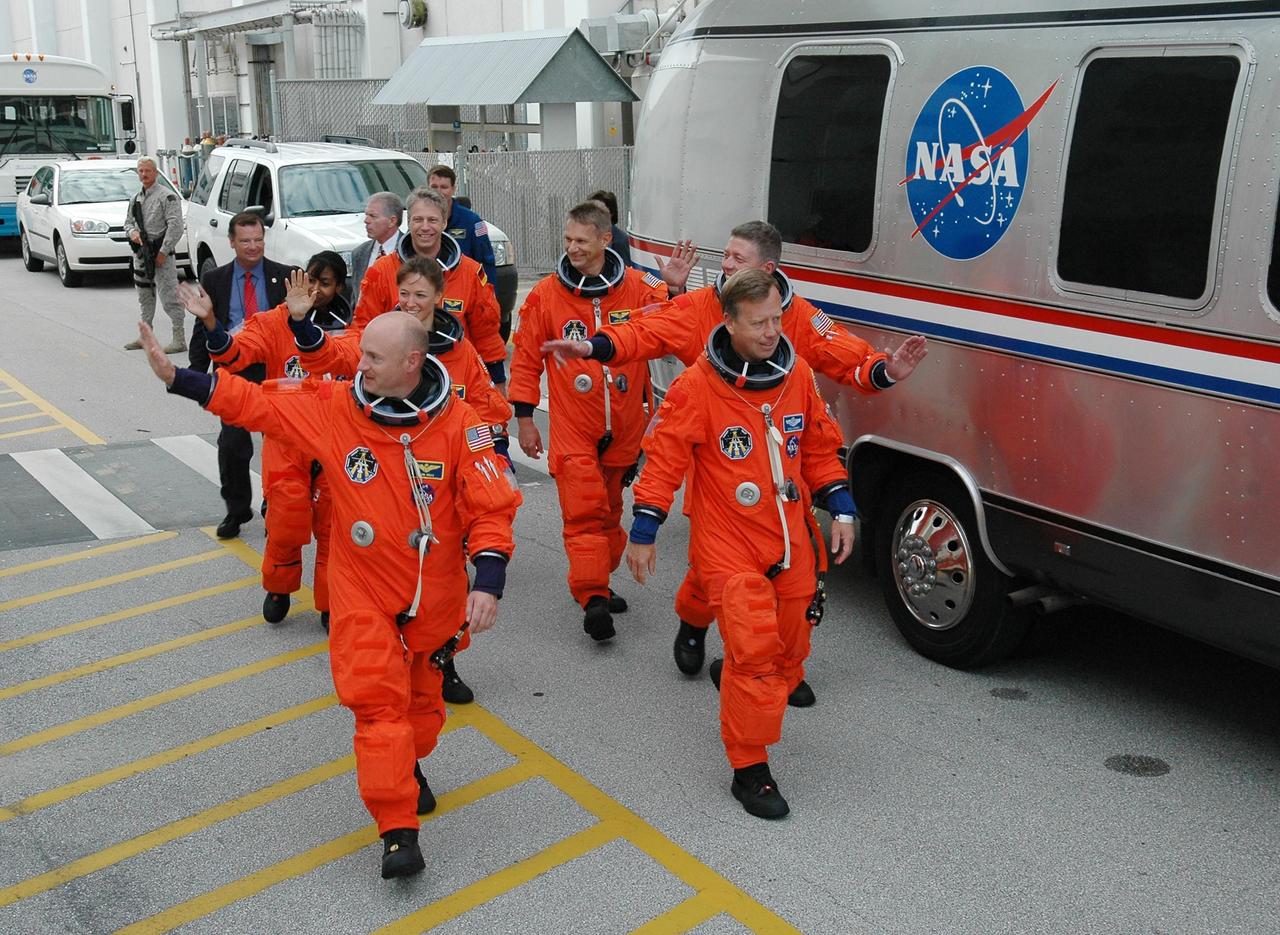
KENNEDY SPACE CENTER, FLA. - The suited STS-121 crew members walk to the bus that will take them to Launch Pad 39B for a simulated countdown. On the left, back to front, are Mission Specialists Stephanie Wilson and Lisa Nowak, and Pilot Mark Kelly. On the right, back to front, are Mission Specialists Thomas Reiter of Germany, Piers Sellers and Michael Fossum, and Commander Steven Lindsey. Reiter represents the European Space Agency. The crew is taking part in Terminal Countdown Demonstration Test activities, including the dress rehearsal for launch. Mission STS-121 is scheduled to be launched July 1. Photo credit: NASA/Kim Shiflett
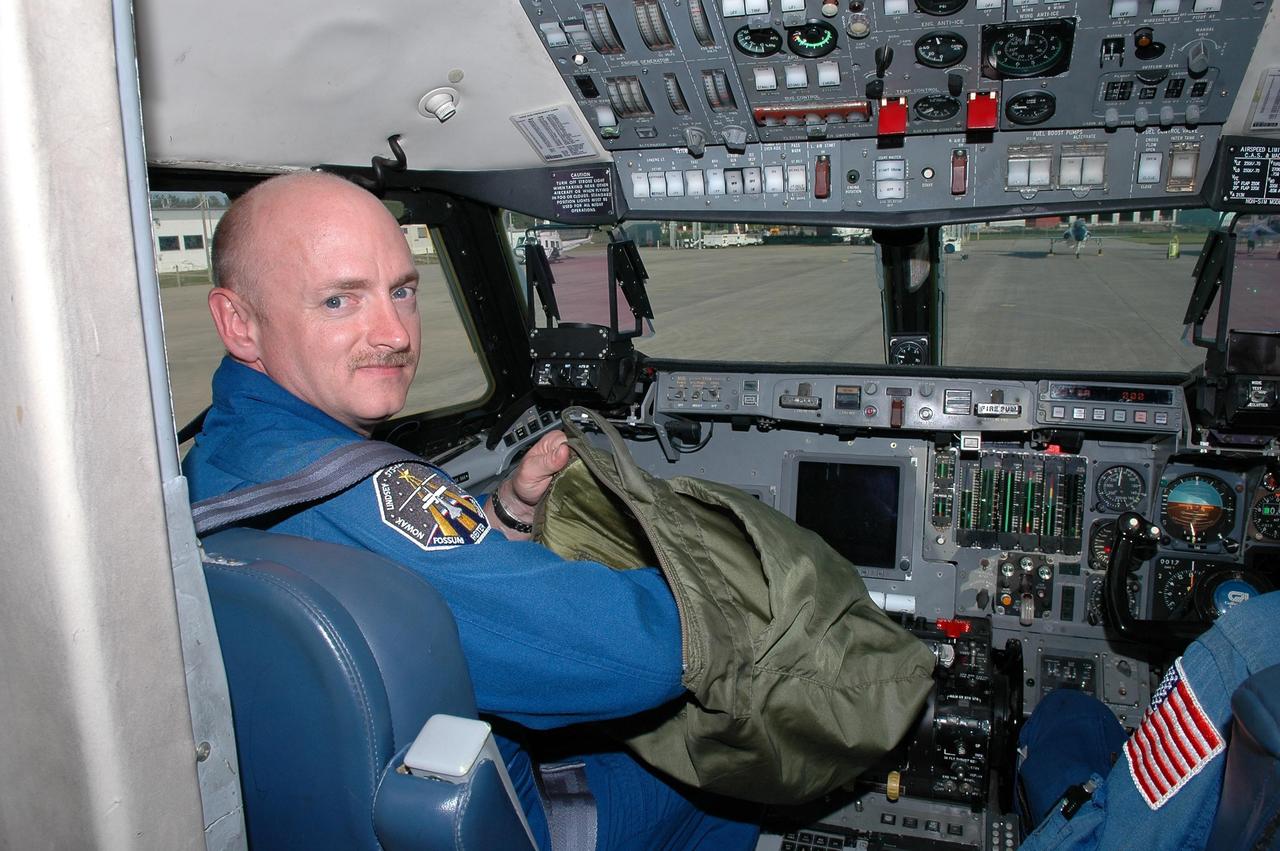
KENNEDY SPACE CENTER, FLA. - At the Shuttle Landing Facility, STS-121 Pilot Mark Kelly gets ready for a training flight in a Shuttle Training Aircraft (STA). He will be practicing landing the orbiter using the STA, which is a modified Grumman American Aviation-built Gulf Stream II jet that was modified to simulate an orbiter’s cockpit, motion and visual cues, and handling qualities. In flight, the STA duplicates the orbiter’s atmospheric descent trajectory from approximately 35,000 feet altitude to landing on a runway. Because the orbiter is unpowered during re-entry and landing, its high-speed glide must be perfectly executed the first time. Space Shuttle Discovery is scheduled to launch July 1 on mission STS-121. Photo credit: NASA/Kim Shiflett
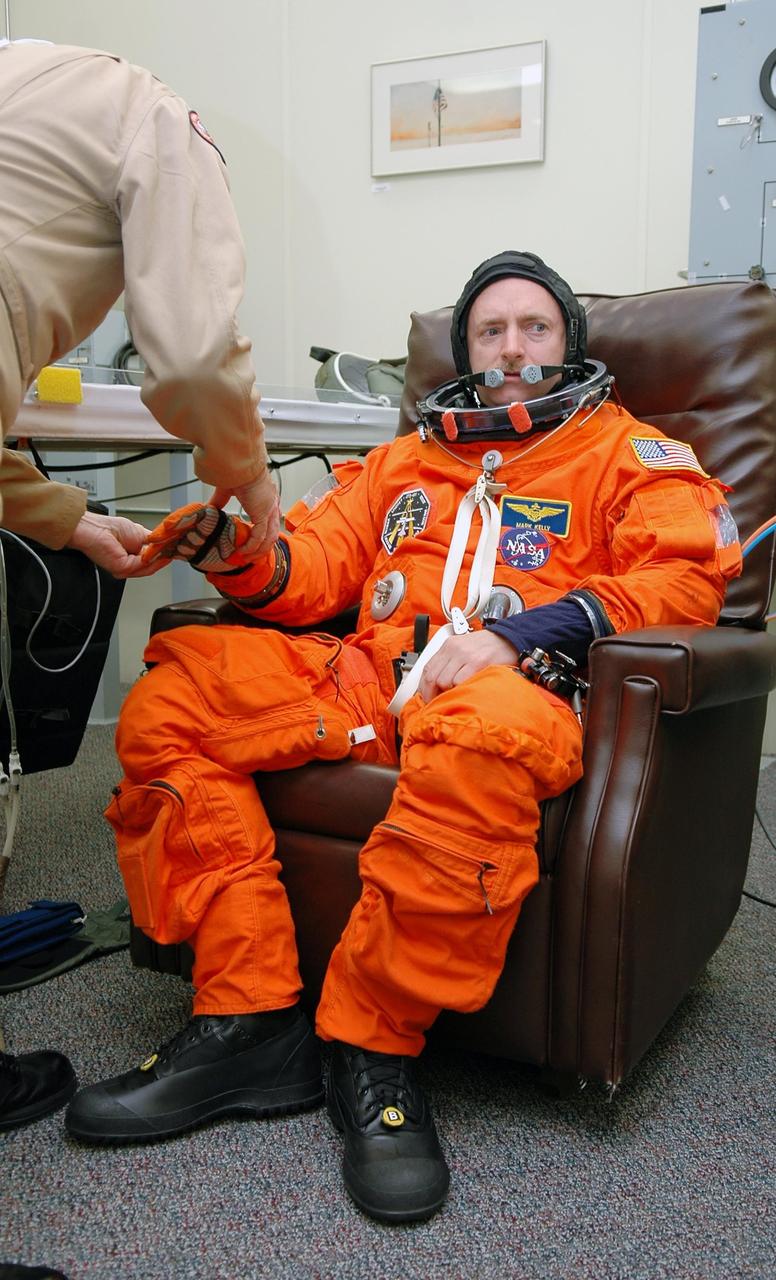
KENNEDY SPACE CENTER, FLA. - STS-121 Pilot Mark Kelly is helped with his glove after donning his launch and entry suit in preparation for the simulated countdown he and other crew members will undertake. The crew is taking part in Terminal Countdown Demonstration Test activities, including the dress rehearsal for launch. Mission STS-121 is scheduled to be launched July 1. Photo credit: NASA/Kim Shiflett
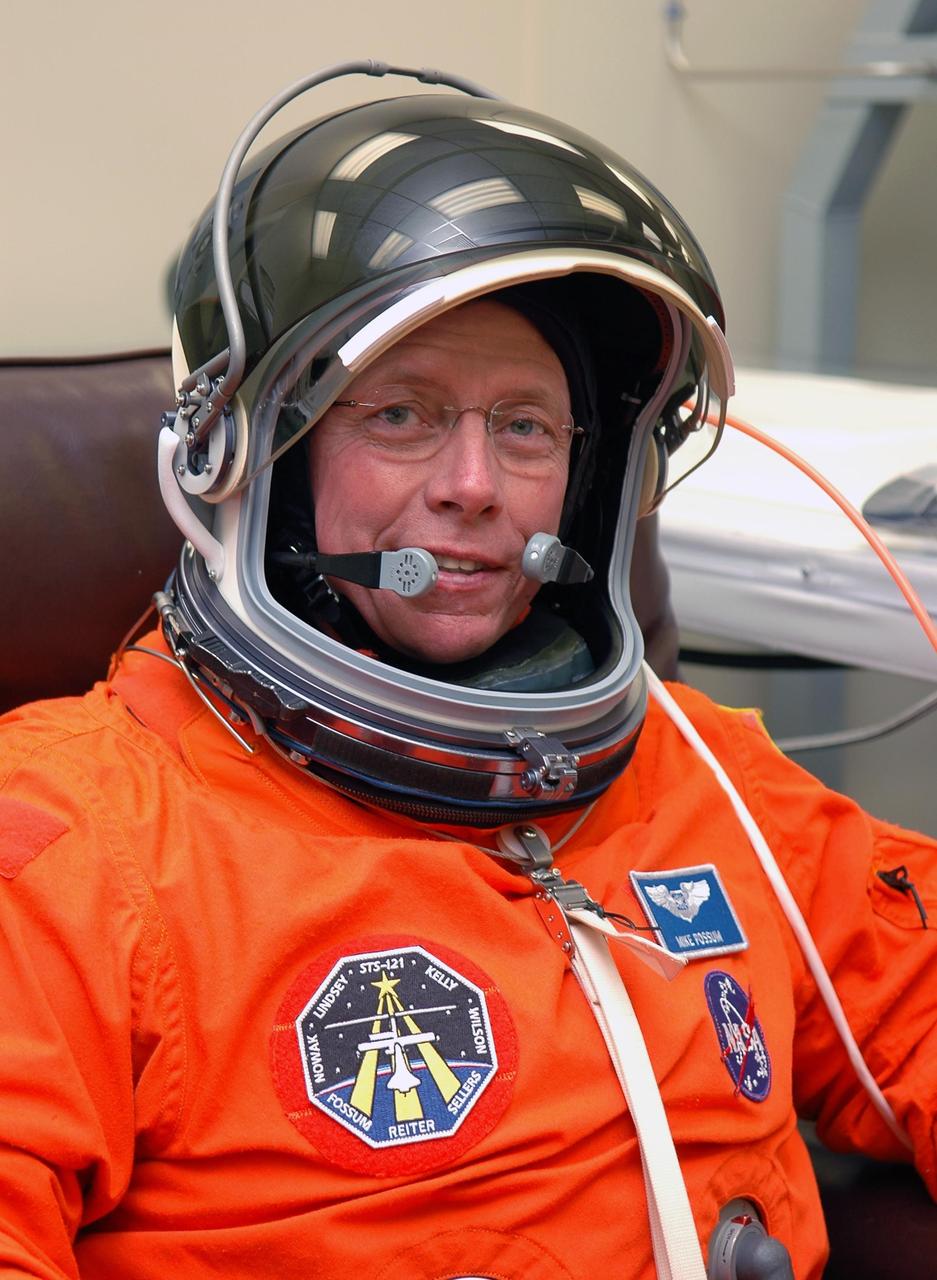
KENNEDY SPACE CENTER, FLA. - STS-121 Mission Specialist Michael Fossum has donned his launch and entry suit in preparation for the simulated countdown he and other crew members will undertake. The crew is taking part in Terminal Countdown Demonstration Test activities, including the dress rehearsal for launch. Mission STS-121 is scheduled to be launched July 1. Photo credit: NASA/Kim Shiflett
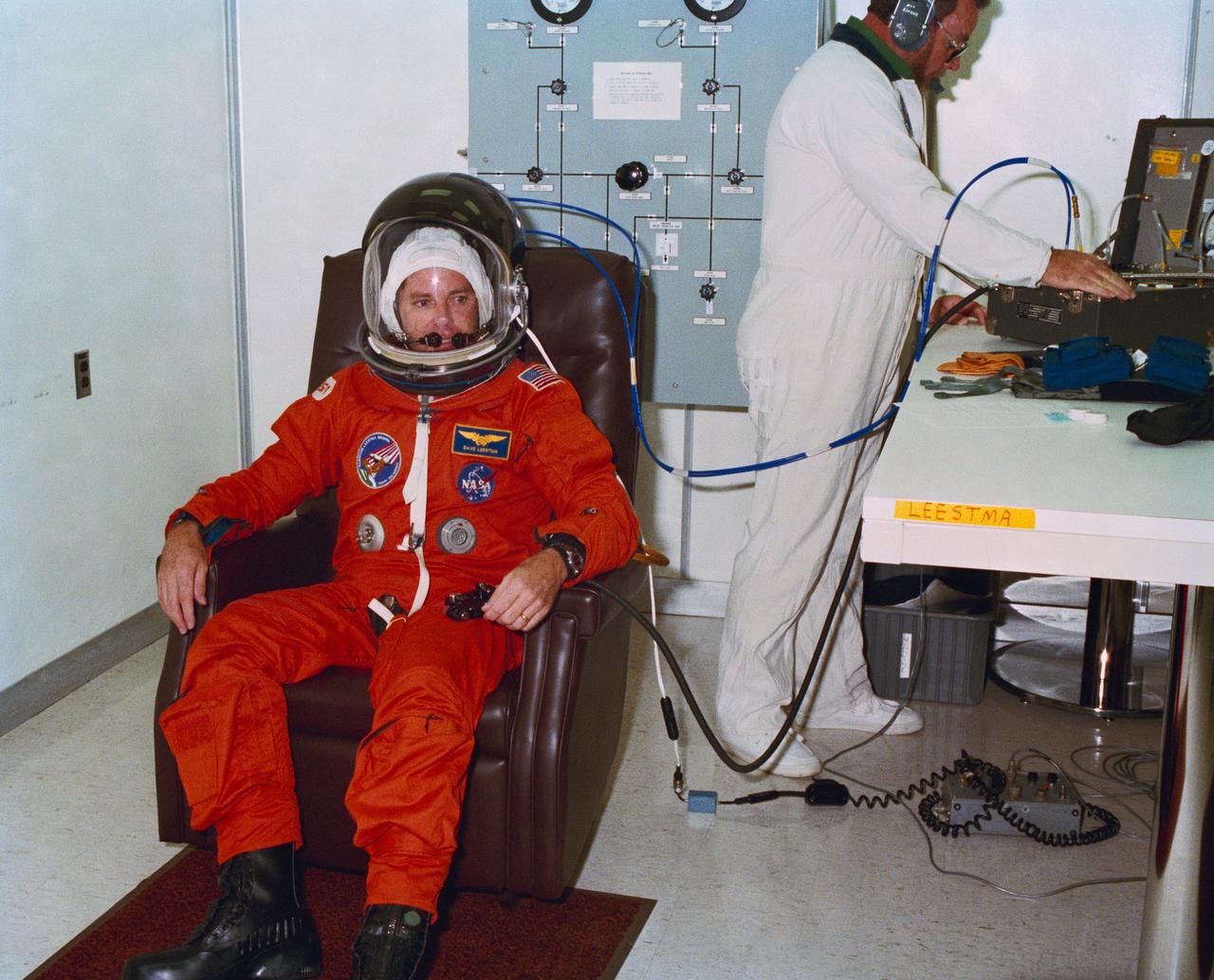
S89-41093 (9 Aug 1989) --- STS-28 Columbia, Orbiter Vehicle (OV) 102, mission specialist David C. Leestma relaxes in chair after donning launch and entry suit (LES) and launch and entry helmet (LEH). Technician in the background monitors LES systems. Leestma, along with fellow crewmembers, is participating in the terminal countdown demonstration test (TCDT) at the Kennedy Space Center (KSC) Operations and Checkout (O&C) Building. View provided by KSC with alternate number KSC-89PC-673.
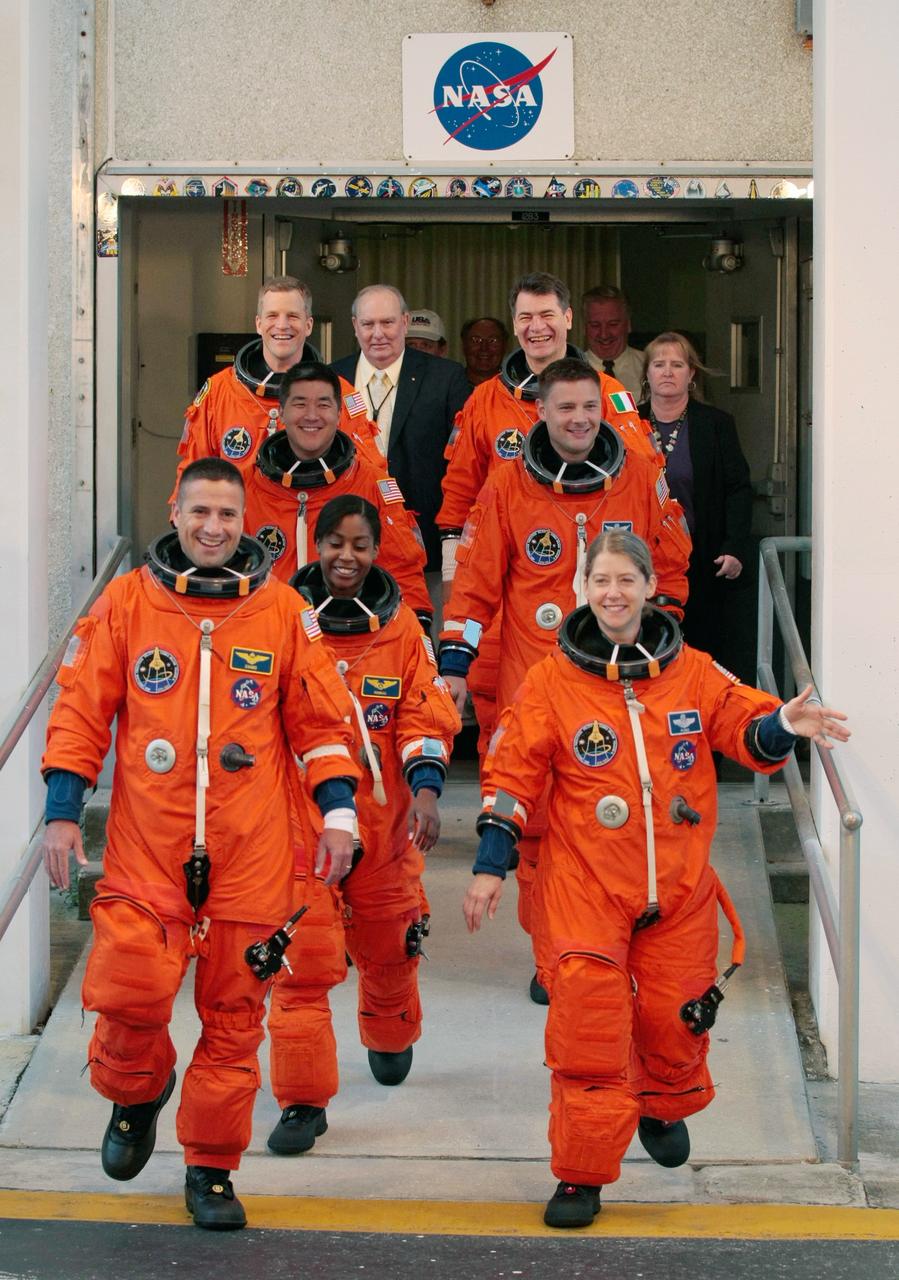
Crew members of space shuttle mission STS-120 prepare to board the bus that will transport them to Launch Pad 39A.
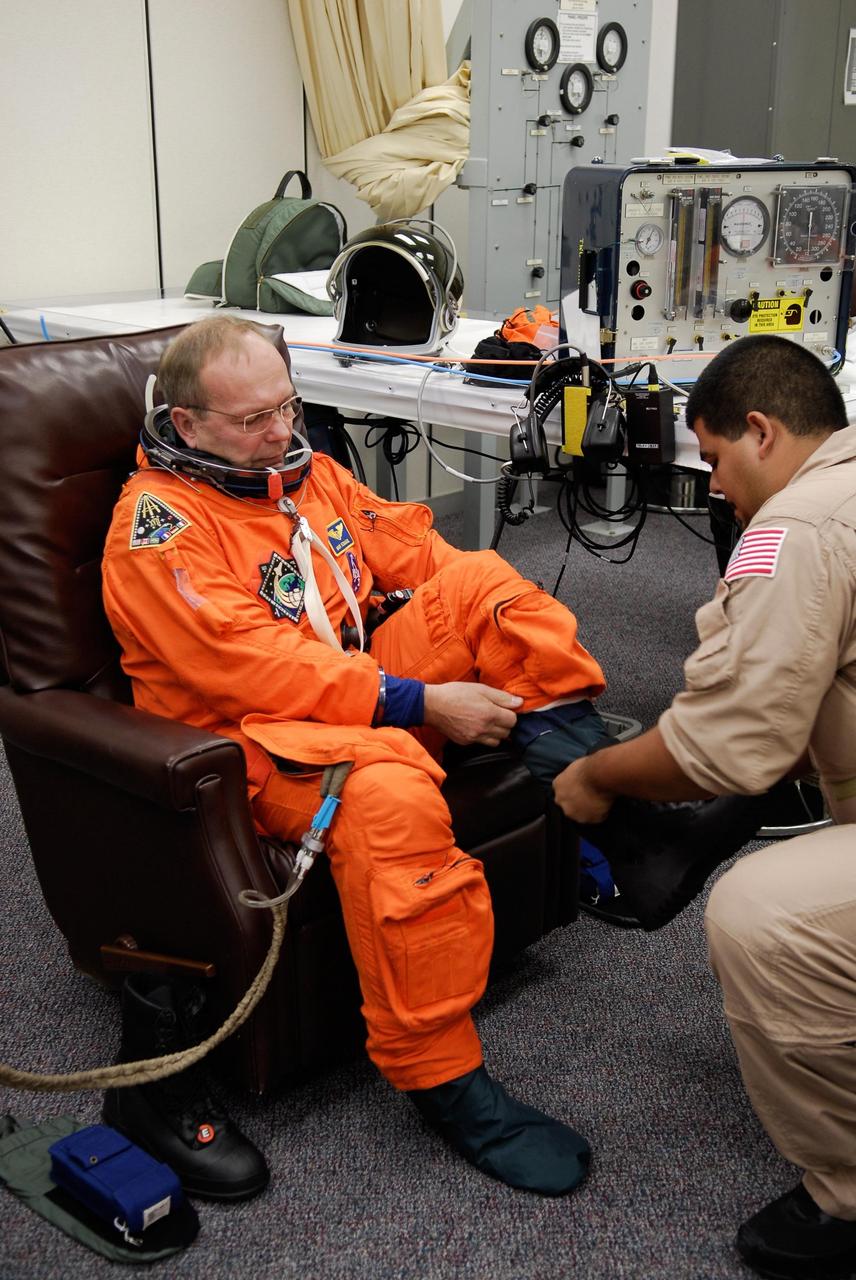
KENNEDY SPACE CENTER, FLA. -- A suit technician helps space shuttle Atlantis STS-122 Mission Specialist Hans Schlegel put on his launch and entry suit, in astronaut crew quarters. Schlegel is with the European Space Agency. The STS-122 crew is preparing for a simulated launch countdown aboard Atlantis, part of terminal countdown demonstration test, or TCDT, activities at NASA's Kennedy Space Center. The TCDT is a dress rehearsal for launch and also provides astronauts and ground crews with equipment familiarization and emergency egress training. On mission STS-122, Atlantis will deliver the Columbus module to the International Space Station. The European Space Agency's largest single contribution to the station, Columbus is a multifunctional, pressurized laboratory that will be permanently attached to U.S. Node 2, called Harmony. The laboratory will expand the research facilities aboard the station, providing crew members and scientists from around the world the ability to conduct a variety of experiments in the physical, materials and life sciences. Launch is targeted for Dec. 6. Photo credit: NASA/Kim Shiflett
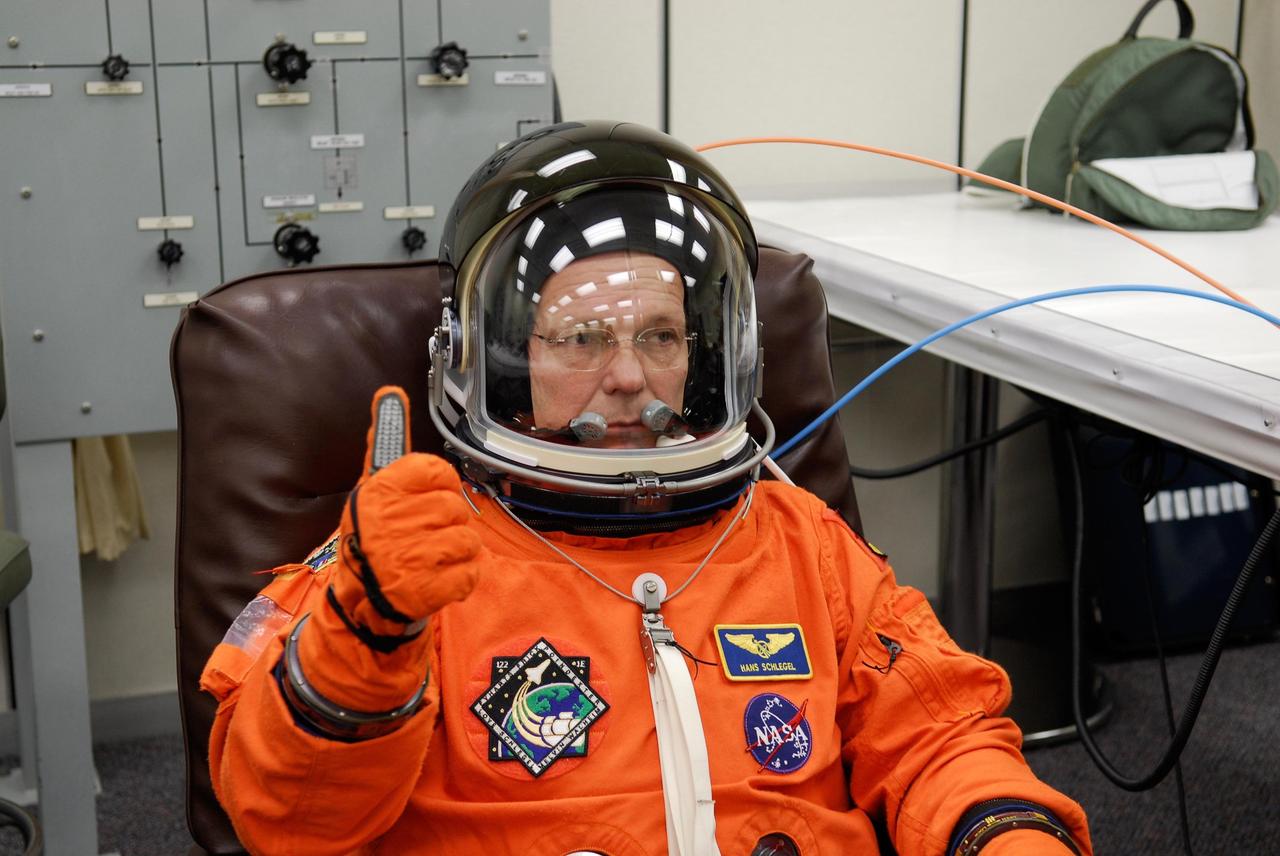
KENNEDY SPACE CENTER, FLA. -- In astronaut crew quarters, space shuttle Atlantis STS-122 Mission Specialist Hans Schlegel, with the European Space Agency, signals that his launch and entry suit is functioning properly. The STS-122 crew is preparing for a simulated launch countdown aboard Atlantis, part of terminal countdown demonstration test, or TCDT, activities at NASA's Kennedy Space Center. The TCDT is a dress rehearsal for launch and also provides astronauts and ground crews with equipment familiarization and emergency egress training. On mission STS-122, Atlantis will deliver the Columbus module to the International Space Station. The European Space Agency's largest single contribution to the station, Columbus is a multifunctional, pressurized laboratory that will be permanently attached to U.S. Node 2, called Harmony. The laboratory will expand the research facilities aboard the station, providing crew members and scientists from around the world the ability to conduct a variety of experiments in the physical, materials and life sciences. Launch is targeted for Dec. 6. Photo credit: NASA/Kim Shiflett
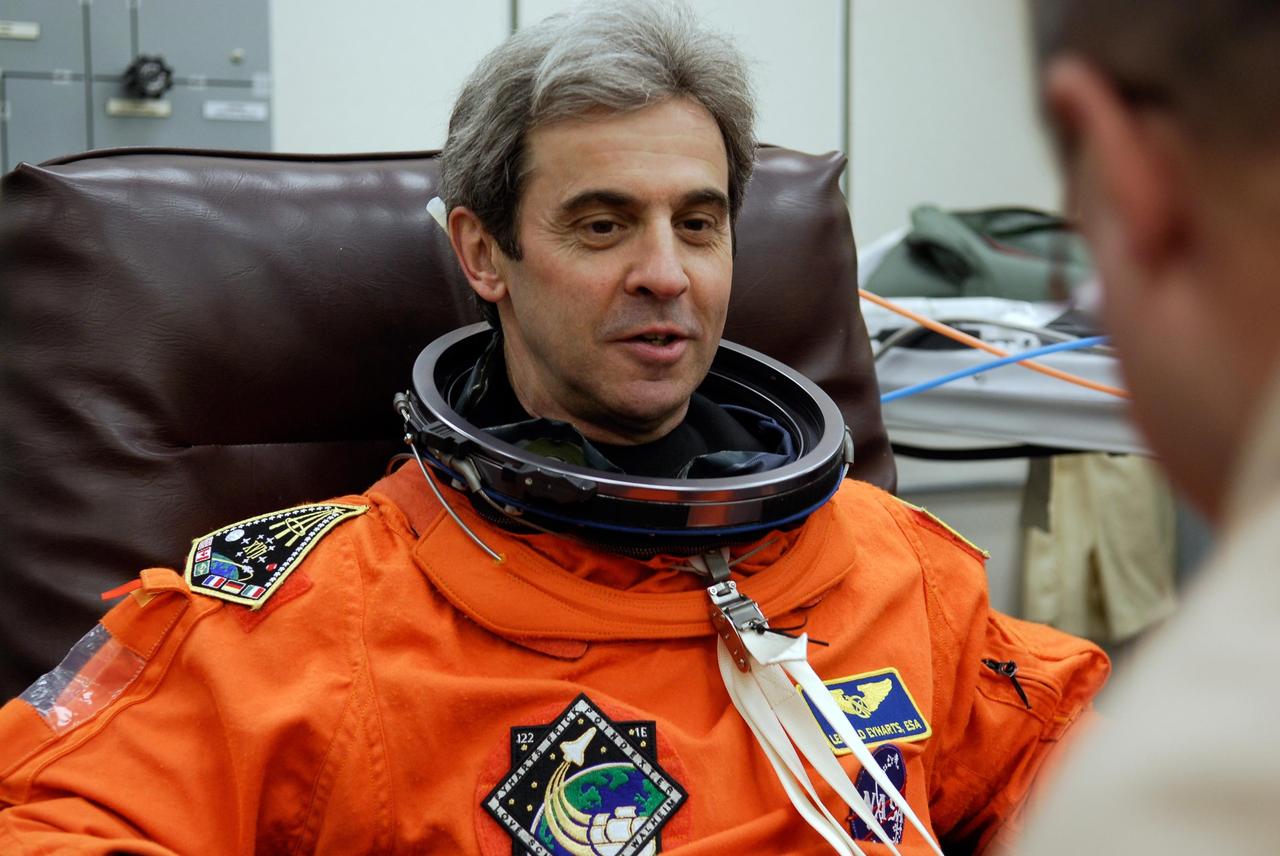
KENNEDY SPACE CENTER, FLA. -- Space shuttle Atlantis STS-122 Mission Specialist Leopold Eyharts talks to the suit technician helping him put on his launch and entry suit, in astronaut crew quarters. A European Space Agency astronaut, Eyharts will remain on the International Space Station as a flight engineer for Expedition 16 following the STS-122 mission. The STS-122 crew is preparing for a simulated launch countdown aboard Atlantis, part of terminal countdown demonstration test, or TCDT, activities at NASA's Kennedy Space Center. The TCDT is a dress rehearsal for launch and also provides astronauts and ground crews with equipment familiarization and emergency egress training. On mission STS-122, Atlantis will deliver the Columbus module to the International Space Station. The European Space Agency's largest single contribution to the station, Columbus is a multifunctional, pressurized laboratory that will be permanently attached to U.S. Node 2, called Harmony. The laboratory will expand the research facilities aboard the station, providing crew members and scientists from around the world the ability to conduct a variety of experiments in the physical, materials and life sciences. Launch is targeted for Dec. 6. Photo credit: NASA/Kim Shiflett
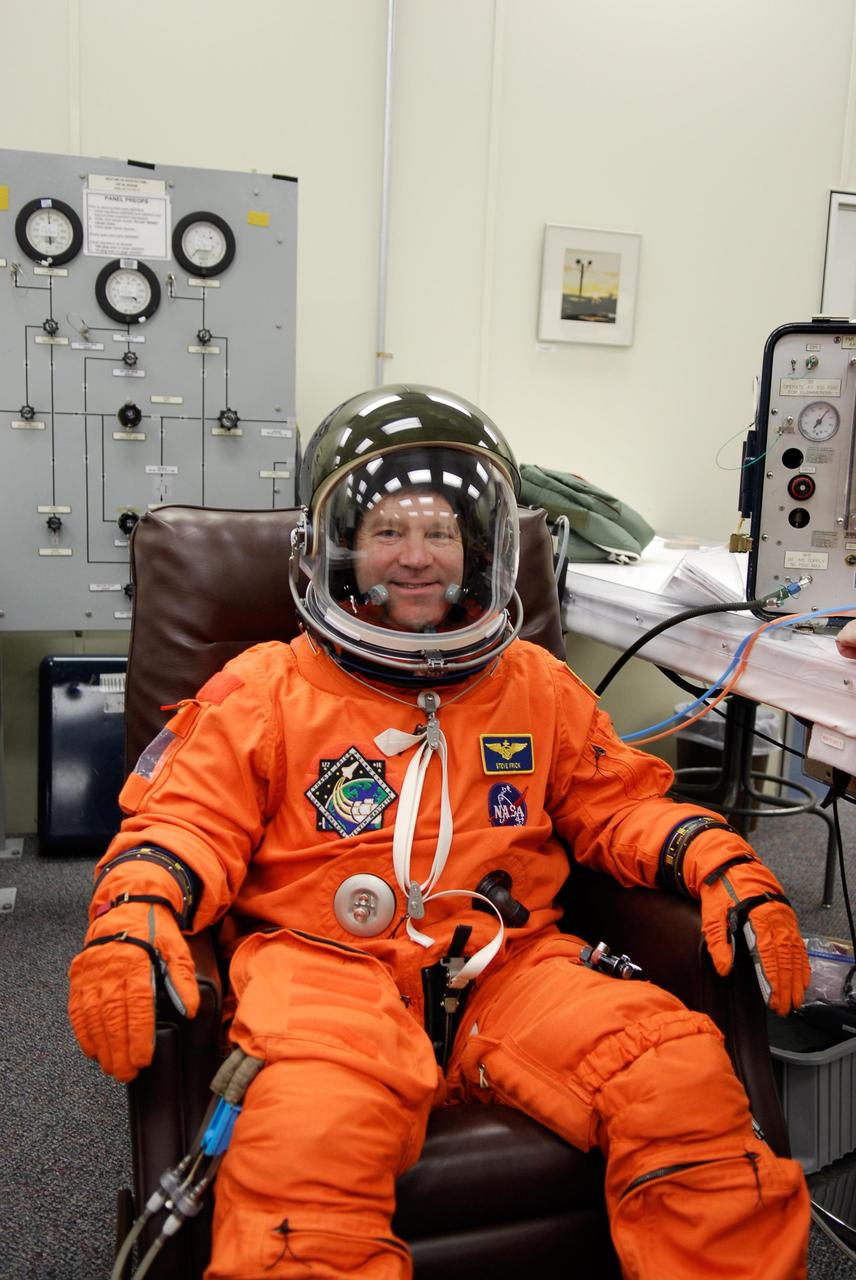
KENNEDY SPACE CENTER, FLA. -- Space shuttle Atlantis STS-122 Commander Steve Frick is fully attired in his launch and entry suit, in astronaut crew quarters. The STS-122 crew is preparing for a simulated launch countdown aboard Atlantis, part of terminal countdown demonstration test, or TCDT, activities at NASA's Kennedy Space Center. The TCDT is a dress rehearsal for launch and also provides astronauts and ground crews with equipment familiarization and emergency egress training. On mission STS-122, Atlantis will deliver the Columbus module to the International Space Station. The European Space Agency's largest single contribution to the station, Columbus is a multifunctional, pressurized laboratory that will be permanently attached to U.S. Node 2, called Harmony. The laboratory will expand the research facilities aboard the station, providing crew members and scientists from around the world the ability to conduct a variety of experiments in the physical, materials and life sciences. Launch is targeted for Dec. 6. Photo credit: NASA/Kim Shiflett

KENNEDY SPACE CENTER, FLA. -- Space shuttle Atlantis STS-122 Mission Specialist Hans Schlegel puts on his helmet, part of his launch and entry suit, in astronaut crew quarters. Schlegel is with the European Space Agency. The STS-122 crew is preparing for a simulated launch countdown aboard Atlantis, part of terminal countdown demonstration test, or TCDT, activities at NASA's Kennedy Space Center. The TCDT is a dress rehearsal for launch and also provides astronauts and ground crews with equipment familiarization and emergency egress training. On mission STS-122, Atlantis will deliver the Columbus module to the International Space Station. The European Space Agency's largest single contribution to the station, Columbus is a multifunctional, pressurized laboratory that will be permanently attached to U.S. Node 2, called Harmony. The laboratory will expand the research facilities aboard the station, providing crew members and scientists from around the world the ability to conduct a variety of experiments in the physical, materials and life sciences. Launch is targeted for Dec. 6. Photo credit: NASA/Kim Shiflett
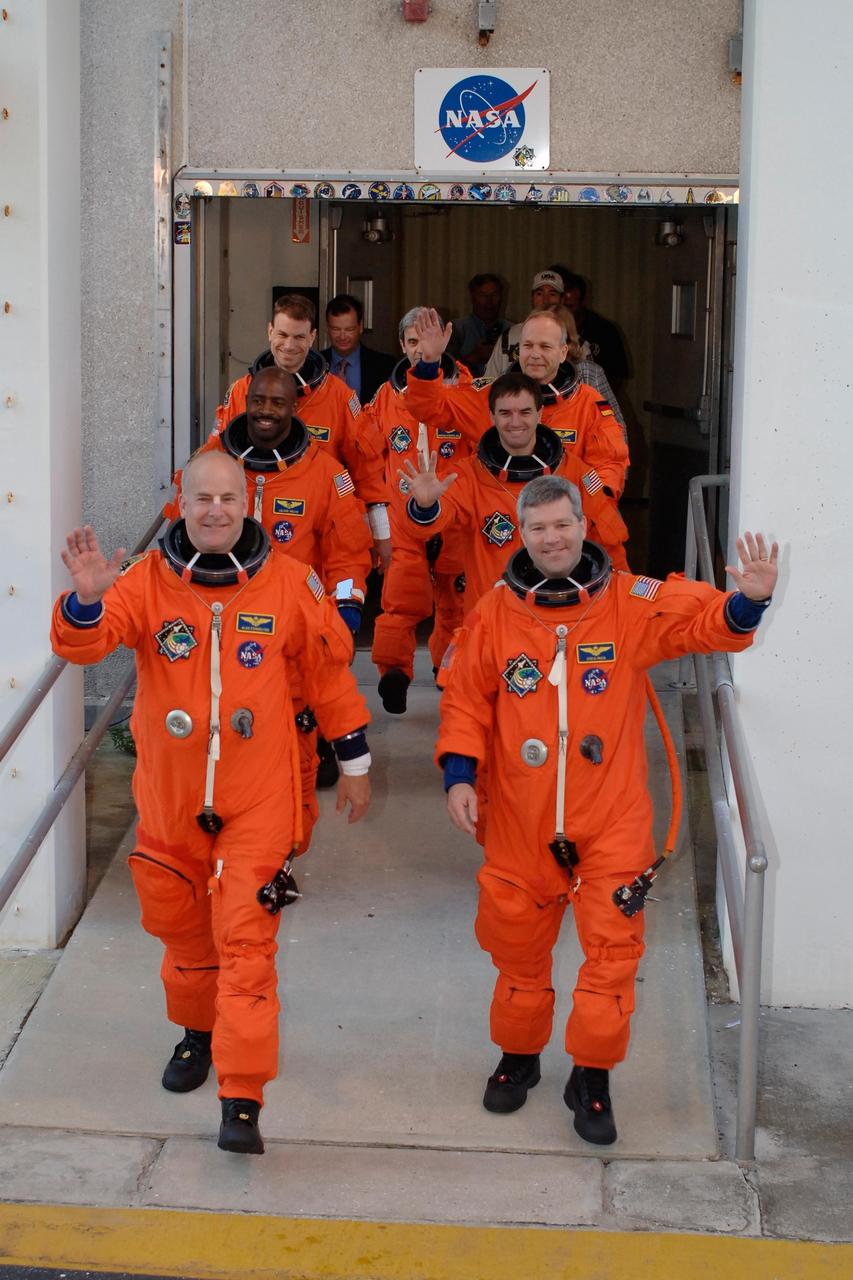
KENNEDY SPACE CENTER, FLA. -- Dressed in their launch and entry suits, the space shuttle Atlantis STS-122 crew greet the media and employees on hand to cheer them on as the leave the Operations and Checkout Building for Launch Pad 39A. Clockwise, from left front, are Pilot Alan Poindexter; Mission Specialists Leland Melvin, Stanley Love, Leopold Eyharts, Hans Schlegel, and Rex Walheim; and Commander Steve Frick. Eyharts and Schlegel are with the European Space Agency. Eyharts will remain on the International Space Station as a flight engineer for Expedition 16 following the STS-122 mission. The STS-122 crew is preparing for a simulated launch countdown aboard Atlantis, part of terminal countdown demonstration test, or TCDT, activities at NASA's Kennedy Space Center. The TCDT is a dress rehearsal for launch and also provides astronauts and ground crews with equipment familiarization and emergency egress training. On mission STS-122, Atlantis will deliver the Columbus module to the International Space Station. The European Space Agency's largest single contribution to the station, Columbus is a multifunctional, pressurized laboratory that will be permanently attached to U.S. Node 2, called Harmony. The laboratory will expand the research facilities aboard the station, providing crew members and scientists from around the world the ability to conduct a variety of experiments in the physical, materials and life sciences. Launch is targeted for Dec. 6. Photo credit: NASA/Kim Shiflett
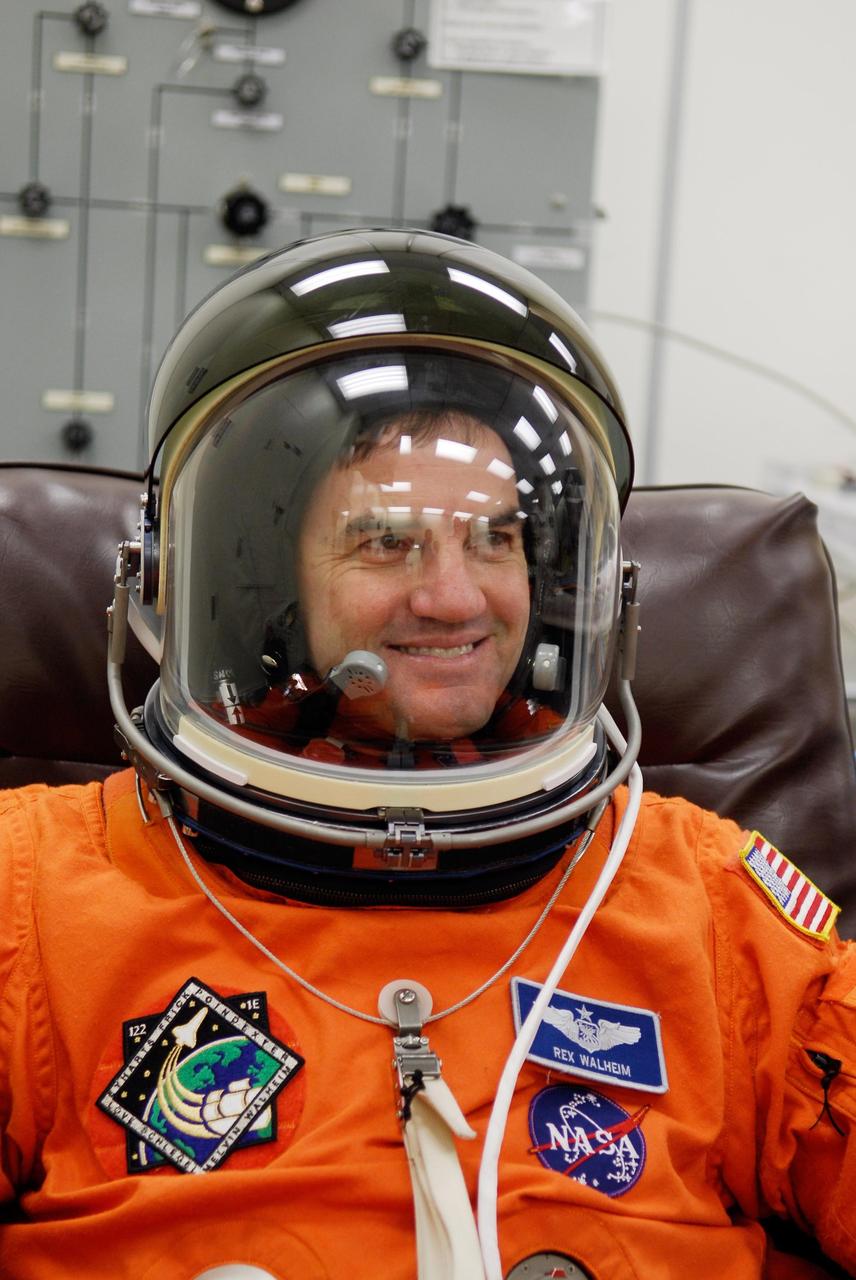
KENNEDY SPACE CENTER, FLA. -- Space shuttle Atlantis STS-122 Mission Specialist Rex Walheim is fully attired in his launch and entry suit, in astronaut crew quarters. The STS-122 crew is preparing for a simulated launch countdown aboard Atlantis, part of terminal countdown demonstration test, or TCDT, activities at NASA's Kennedy Space Center. The TCDT is a dress rehearsal for launch and also provides astronauts and ground crews with equipment familiarization and emergency egress training. On mission STS-122, Atlantis will deliver the Columbus module to the International Space Station. The European Space Agency's largest single contribution to the station, Columbus is a multifunctional, pressurized laboratory that will be permanently attached to U.S. Node 2, called Harmony. The laboratory will expand the research facilities aboard the station, providing crew members and scientists from around the world the ability to conduct a variety of experiments in the physical, materials and life sciences. Launch is targeted for Dec. 6. Photo credit: NASA/Kim Shiflett

KENNEDY SPACE CENTER, FLA. -- Space shuttle Atlantis STS-122 Mission Specialist Leopold Eyharts awaits adjustments to his helmet, part of his launch and entry suit, in astronaut crew quarters. A European Space Agency astronaut, Eyharts will remain on the International Space Station as a flight engineer for Expedition 16 following the STS-122 mission. The STS-122 crew is preparing for a simulated launch countdown aboard Atlantis, part of terminal countdown demonstration test, or TCDT, activities at NASA's Kennedy Space Center. The TCDT is a dress rehearsal for launch and also provides astronauts and ground crews with equipment familiarization and emergency egress training. On mission STS-122, Atlantis will deliver the Columbus module to the International Space Station. The European Space Agency's largest single contribution to the station, Columbus is a multifunctional, pressurized laboratory that will be permanently attached to U.S. Node 2, called Harmony. The laboratory will expand the research facilities aboard the station, providing crew members and scientists from around the world the ability to conduct a variety of experiments in the physical, materials and life sciences. Launch is targeted for Dec. 6. Photo credit: NASA/Kim Shiflett

KENNEDY SPACE CENTER, FLA. -- Dressed in their launch and entry suits, the space shuttle Atlantis STS-122 crew exits the Operations and Checkout Building for their ride to Launch Pad 39A. Clockwise, from left front, are Pilot Alan Poindexter; Mission Specialists Leland Melvin, Stanley Love, Leopold Eyharts, Hans Schlegel, and Rex Walheim; and Commander Steve Frick. Eyharts and Schlegel are with the European Space Agency. Eyharts will remain on the International Space Station as a flight engineer for Expedition 16 following the STS-122 mission. The STS-122 crew is preparing for a simulated launch countdown aboard Atlantis, part of terminal countdown demonstration test, or TCDT, activities at NASA's Kennedy Space Center. The TCDT is a dress rehearsal for launch and also provides astronauts and ground crews with equipment familiarization and emergency egress training. On mission STS-122, Atlantis will deliver the Columbus module to the International Space Station. The European Space Agency's largest single contribution to the station, Columbus is a multifunctional, pressurized laboratory that will be permanently attached to U.S. Node 2, called Harmony. The laboratory will expand the research facilities aboard the station, providing crew members and scientists from around the world the ability to conduct a variety of experiments in the physical, materials and life sciences. Launch is targeted for Dec. 6. Photo credit: NASA/Kim Shiflett

KENNEDY SPACE CENTER, FLA. -- Space shuttle Atlantis STS-122 Mission Specialist Rex Walheim puts on his launch and entry suit, in astronaut crew quarters. The STS-122 crew is preparing for a simulated launch countdown aboard Atlantis, part of terminal countdown demonstration test, or TCDT, activities at NASA's Kennedy Space Center. The TCDT is a dress rehearsal for launch and also provides astronauts and ground crews with equipment familiarization and emergency egress training. On mission STS-122, Atlantis will deliver the Columbus module to the International Space Station. The European Space Agency's largest single contribution to the station, Columbus is a multifunctional, pressurized laboratory that will be permanently attached to U.S. Node 2, called Harmony. The laboratory will expand the research facilities aboard the station, providing crew members and scientists from around the world the ability to conduct a variety of experiments in the physical, materials and life sciences. Launch is targeted for Dec. 6. Photo credit: NASA/Kim Shiflett
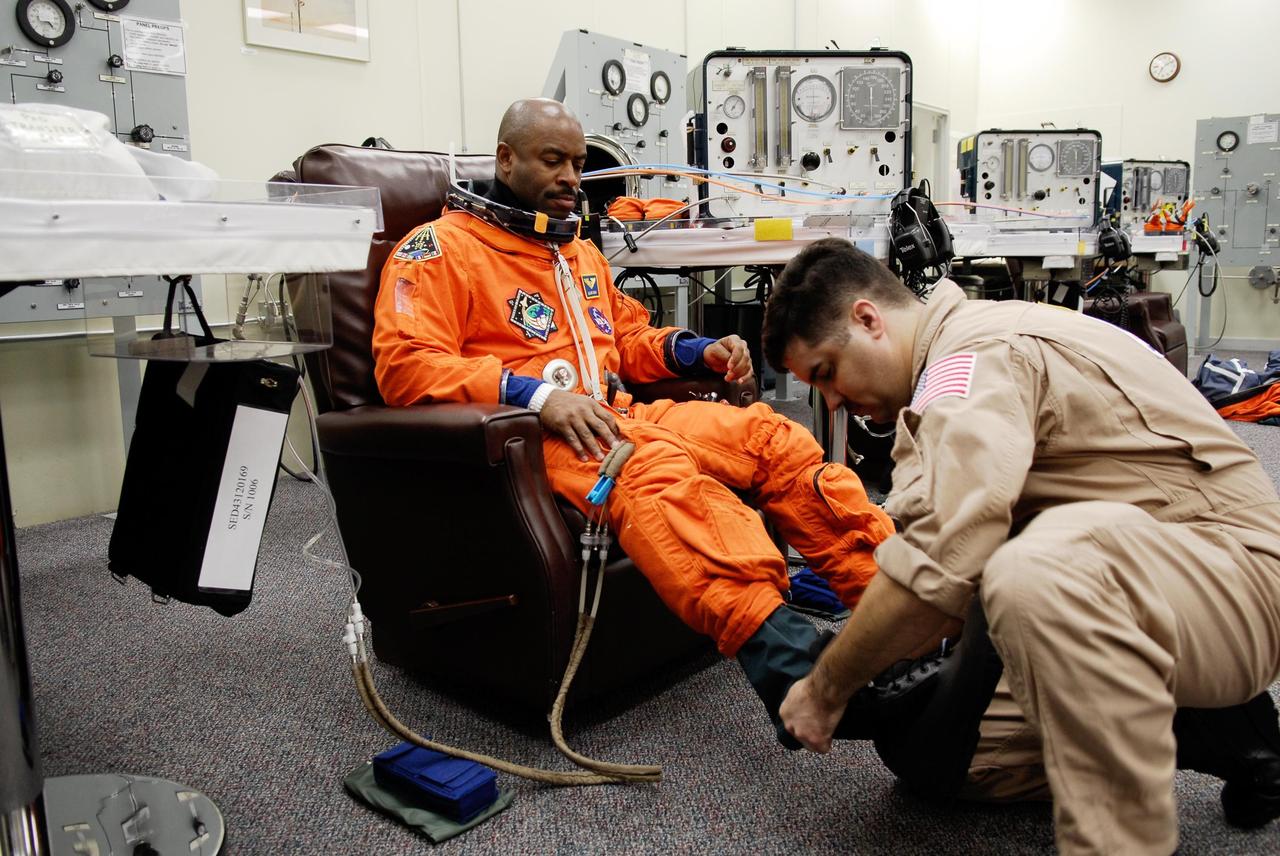
KENNEDY SPACE CENTER, FLA. -- A suit technician helps space shuttle Atlantis STS-122 Mission Specialist Leland Melvin put on his boots, part of his launch and entry suit, in astronaut crew quarters. The STS-122 crew is preparing for a simulated launch countdown aboard Atlantis, part of terminal countdown demonstration test, or TCDT, activities at NASA's Kennedy Space Center. The TCDT is a dress rehearsal for launch and also provides astronauts and ground crews with equipment familiarization and emergency egress training. On mission STS-122, Atlantis will deliver the Columbus module to the International Space Station. The European Space Agency's largest single contribution to the station, Columbus is a multifunctional, pressurized laboratory that will be permanently attached to U.S. Node 2, called Harmony. The laboratory will expand the research facilities aboard the station, providing crew members and scientists from around the world the ability to conduct a variety of experiments in the physical, materials and life sciences. Launch is targeted for Dec. 6. Photo credit: NASA/Kim Shiflett
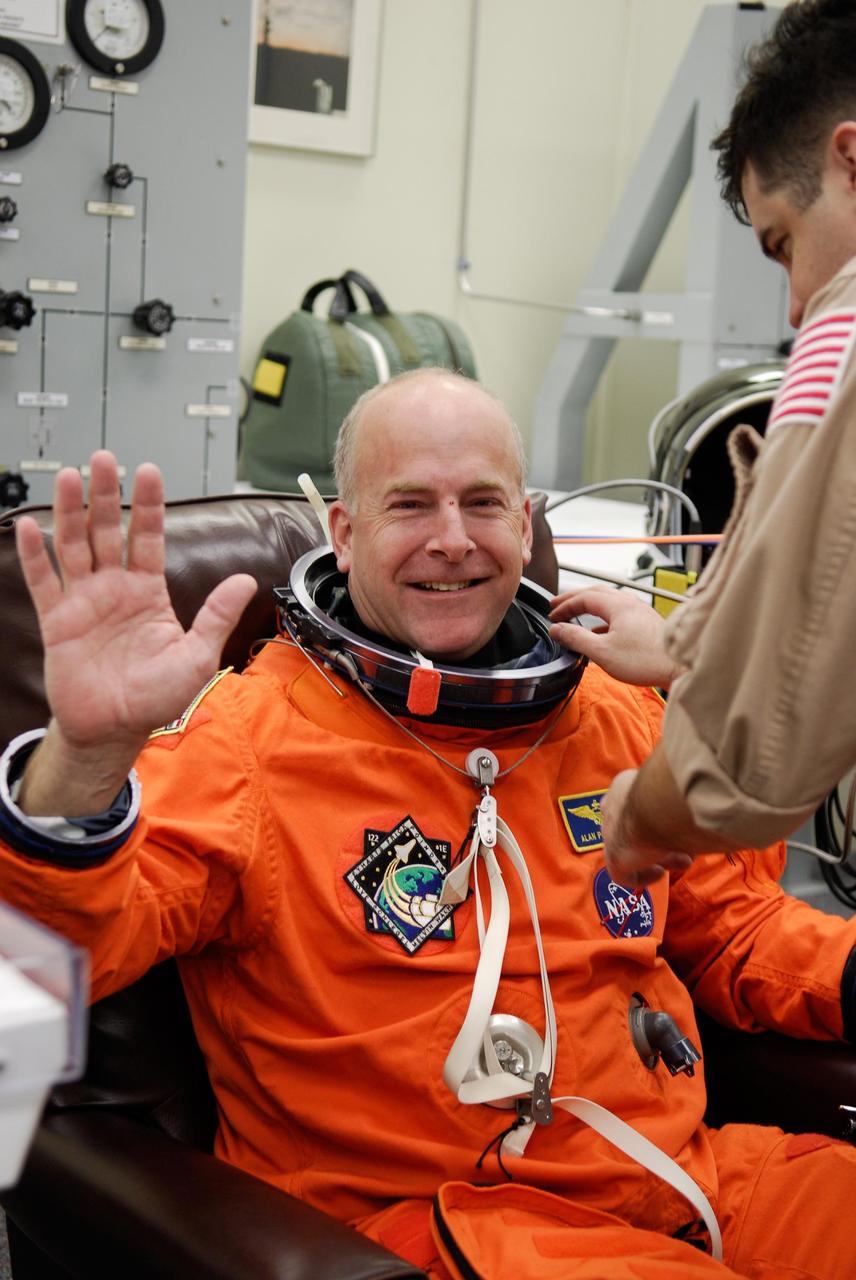
KENNEDY SPACE CENTER, FLA. -- A suit technician helps space shuttle Atlantis STS-122 Pilot Alan Poindexter put on his launch and entry suit, in astronaut crew quarters. The STS-122 crew is preparing for a simulated launch countdown aboard Atlantis, part of terminal countdown demonstration test, or TCDT, activities at NASA's Kennedy Space Center. The TCDT is a dress rehearsal for launch and also provides astronauts and ground crews with equipment familiarization and emergency egress training. On mission STS-122, Atlantis will deliver the Columbus module to the International Space Station. The European Space Agency's largest single contribution to the station, Columbus is a multifunctional, pressurized laboratory that will be permanently attached to U.S. Node 2, called Harmony. The laboratory will expand the research facilities aboard the station, providing crew members and scientists from around the world the ability to conduct a variety of experiments in the physical, materials and life sciences. Launch is targeted for Dec. 6. Photo credit: NASA/Kim Shiflett
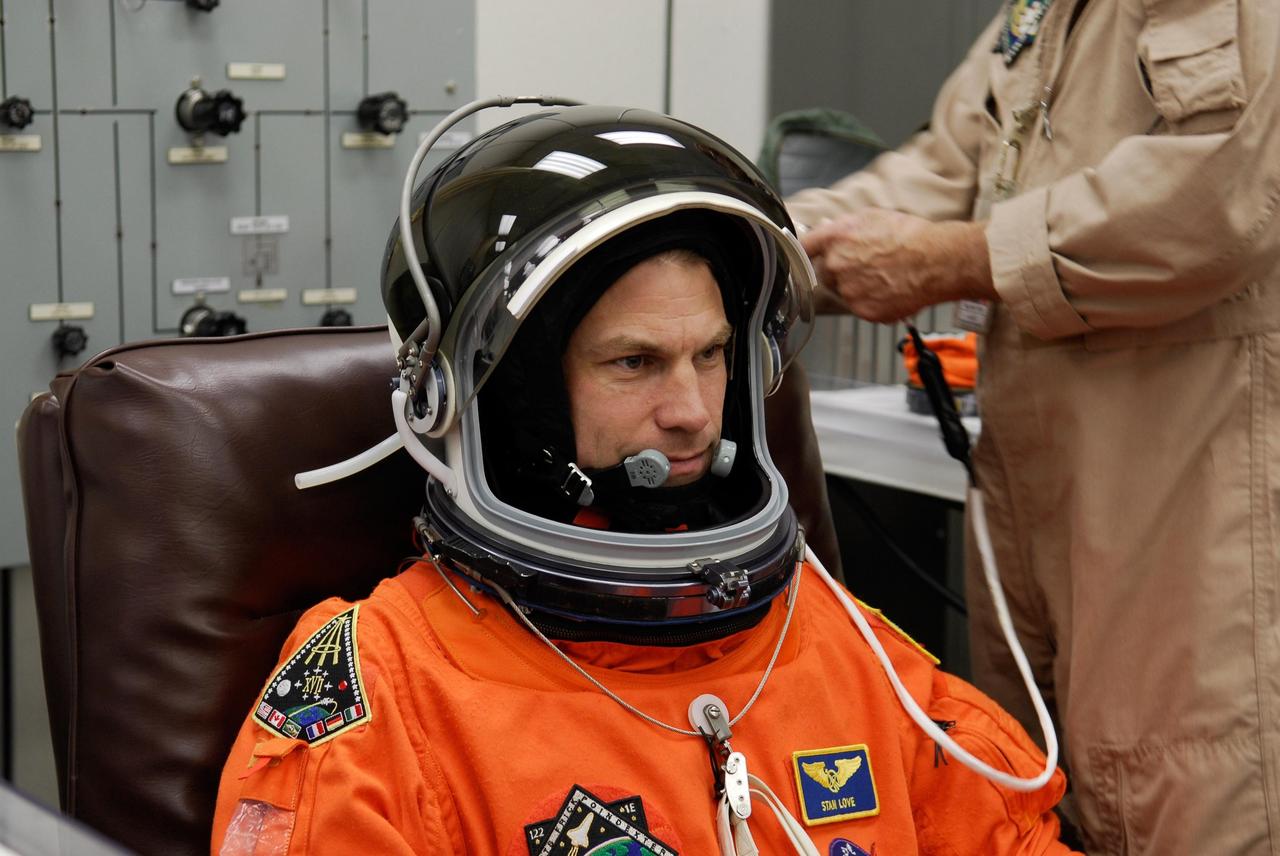
KENNEDY SPACE CENTER, FLA. -- A suit technician makes adjustments to space shuttle Atlantis STS-122 Mission Specialist Stanley Love's helmet, part of his launch and entry suit, in astronaut crew quarters. The STS-122 crew is preparing for a simulated launch countdown aboard Atlantis, part of terminal countdown demonstration test, or TCDT, activities at NASA's Kennedy Space Center. The TCDT is a dress rehearsal for launch and also provides astronauts and ground crews with equipment familiarization and emergency egress training. On mission STS-122, Atlantis will deliver the Columbus module to the International Space Station. The European Space Agency's largest single contribution to the station, Columbus is a multifunctional, pressurized laboratory that will be permanently attached to U.S. Node 2, called Harmony. The laboratory will expand the research facilities aboard the station, providing crew members and scientists from around the world the ability to conduct a variety of experiments in the physical, materials and life sciences. Launch is targeted for Dec. 6. Photo credit: NASA/Kim Shiflett
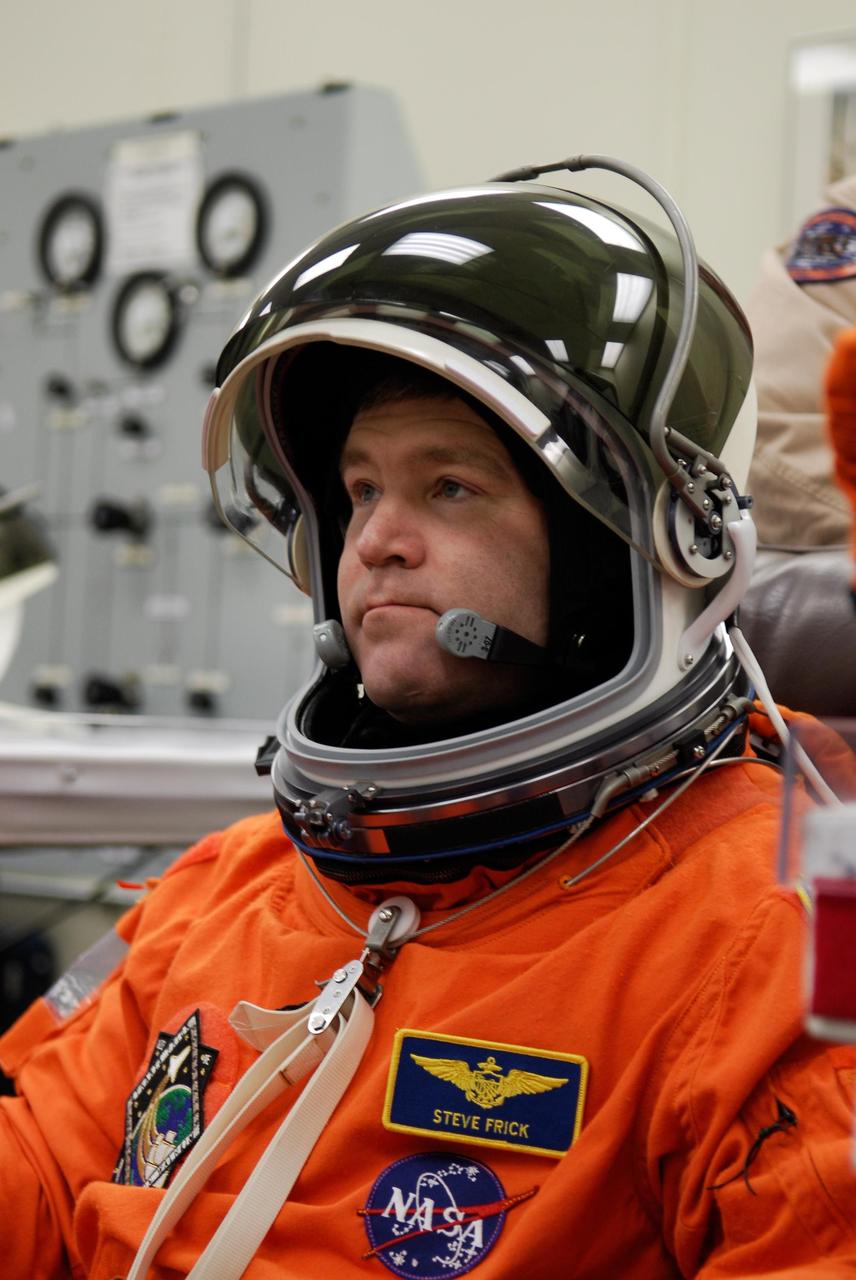
KENNEDY SPACE CENTER, FLA. -- Space shuttle Atlantis STS-122 Commander Steve Frick puts on his helmet, part of his launch and entry suit, in astronaut crew quarters. The STS-122 crew is preparing for a simulated launch countdown aboard Atlantis, part of terminal countdown demonstration test, or TCDT, activities at NASA's Kennedy Space Center. The TCDT is a dress rehearsal for launch and also provides astronauts and ground crews with equipment familiarization and emergency egress training. On mission STS-122, Atlantis will deliver the Columbus module to the International Space Station. The European Space Agency's largest single contribution to the station, Columbus is a multifunctional, pressurized laboratory that will be permanently attached to U.S. Node 2, called Harmony. The laboratory will expand the research facilities aboard the station, providing crew members and scientists from around the world the ability to conduct a variety of experiments in the physical, materials and life sciences. Launch is targeted for Dec. 6. Photo credit: NASA/Kim Shiflett

KENNEDY SPACE CENTER, FLA. -- Space shuttle Atlantis STS-122 Mission Specialist Stanley Love awaits the final adjustments on his launch and entry suit, in astronaut crew quarters. The STS-122 crew is preparing for a simulated launch countdown aboard Atlantis, part of terminal countdown demonstration test, or TCDT, activities at NASA's Kennedy Space Center. The TCDT is a dress rehearsal for launch and also provides astronauts and ground crews with equipment familiarization and emergency egress training. On mission STS-122, Atlantis will deliver the Columbus module to the International Space Station. The European Space Agency's largest single contribution to the station, Columbus is a multifunctional, pressurized laboratory that will be permanently attached to U.S. Node 2, called Harmony. The laboratory will expand the research facilities aboard the station, providing crew members and scientists from around the world the ability to conduct a variety of experiments in the physical, materials and life sciences. Launch is targeted for Dec. 6. Photo credit: NASA/Kim Shiflett
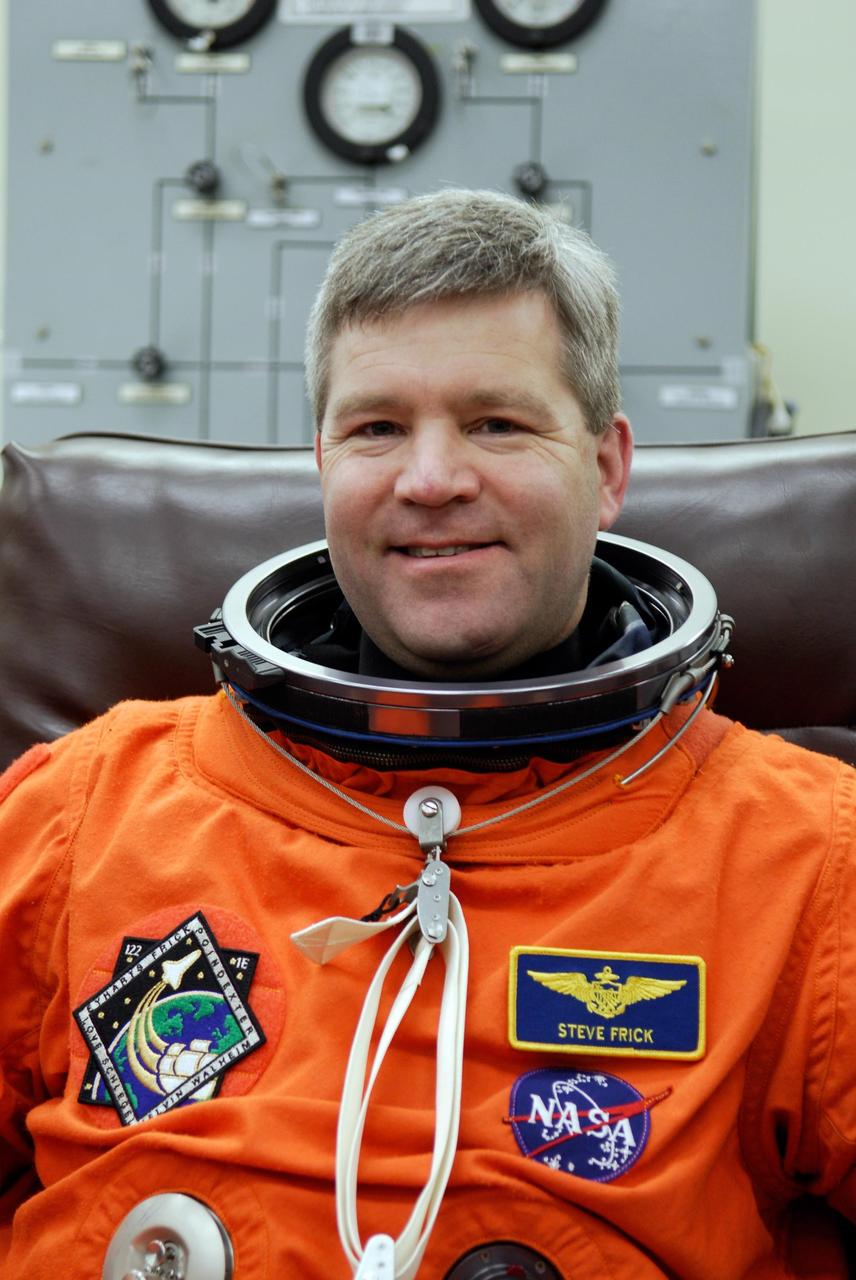
KENNEDY SPACE CENTER, FLA. -- Space shuttle Atlantis STS-122 Commander Steve Frick dons his launch and entry suit, in astronaut crew quarters. The STS-122 crew is preparing for a simulated launch countdown aboard Atlantis, part of terminal countdown demonstration test, or TCDT, activities at NASA's Kennedy Space Center. The TCDT is a dress rehearsal for launch and also provides astronauts and ground crews with equipment familiarization and emergency egress training. On mission STS-122, Atlantis will deliver the Columbus module to the International Space Station. The European Space Agency's largest single contribution to the station, Columbus is a multifunctional, pressurized laboratory that will be permanently attached to U.S. Node 2, called Harmony. The laboratory will expand the research facilities aboard the station, providing crew members and scientists from around the world the ability to conduct a variety of experiments in the physical, materials and life sciences. Launch is targeted for Dec. 6. Photo credit: NASA/Kim Shiflett
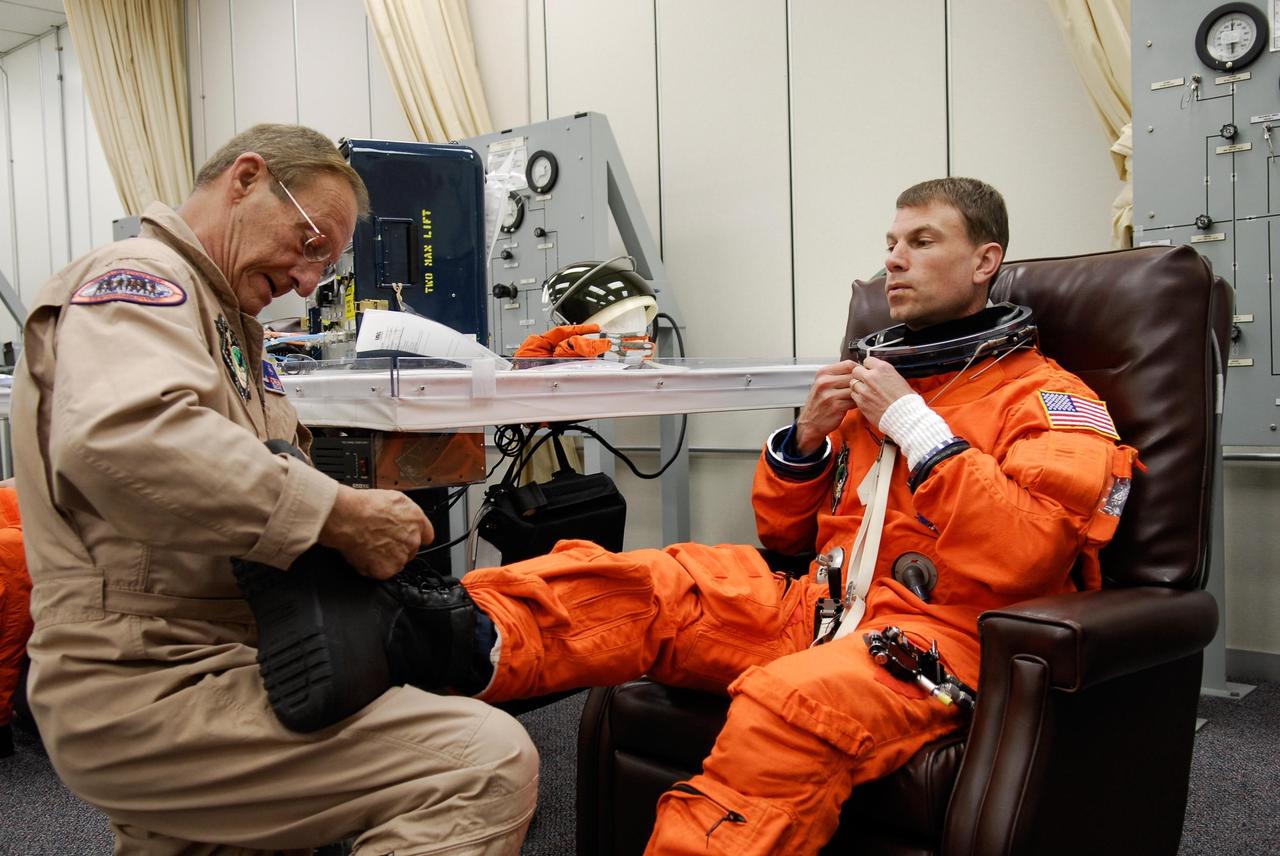
KENNEDY SPACE CENTER, FLA. -- A suit technician helps space shuttle Atlantis STS-122 Mission Specialist Stanley Love lace his boots, part of his launch and entry suit, in astronaut crew quarters. The STS-122 crew is preparing for a simulated launch countdown aboard Atlantis, part of terminal countdown demonstration test, or TCDT, activities at NASA's Kennedy Space Center. The TCDT is a dress rehearsal for launch and also provides astronauts and ground crews with equipment familiarization and emergency egress training. On mission STS-122, Atlantis will deliver the Columbus module to the International Space Station. The European Space Agency's largest single contribution to the station, Columbus is a multifunctional, pressurized laboratory that will be permanently attached to U.S. Node 2, called Harmony. The laboratory will expand the research facilities aboard the station, providing crew members and scientists from around the world the ability to conduct a variety of experiments in the physical, materials and life sciences. Launch is targeted for Dec. 6. Photo credit: NASA/Kim Shiflett

KENNEDY SPACE CENTER, FLA. -- Dressed in their launch and entry suits, the space shuttle Atlantis STS-122 crew poses for a group portrait in front of the astronaut van as they leave the Operations and Checkout Building for Launch Pad 39A. From left are Mission Specialists Leopold Eyharts, Stanley Love, Hans Schlegel, Rex Walheim, and Leland Melvin; Pilot Alan Poindexter; and Commander Steve Frick. Eyharts and Schlegel are with the European Space Agency. Eyharts will remain on the International Space Station as a flight engineer for Expedition 16 following the STS-122 mission. The STS-122 crew is preparing for a simulated launch countdown aboard Atlantis, part of terminal countdown demonstration test, or TCDT, activities at NASA's Kennedy Space Center. The TCDT is a dress rehearsal for launch and also provides astronauts and ground crews with equipment familiarization and emergency egress training. On mission STS-122, Atlantis will deliver the Columbus module to the International Space Station. The European Space Agency's largest single contribution to the station, Columbus is a multifunctional, pressurized laboratory that will be permanently attached to U.S. Node 2, called Harmony. The laboratory will expand the research facilities aboard the station, providing crew members and scientists from around the world the ability to conduct a variety of experiments in the physical, materials and life sciences. Launch is targeted for Dec. 6. Photo credit: NASA/Kim Shiflett
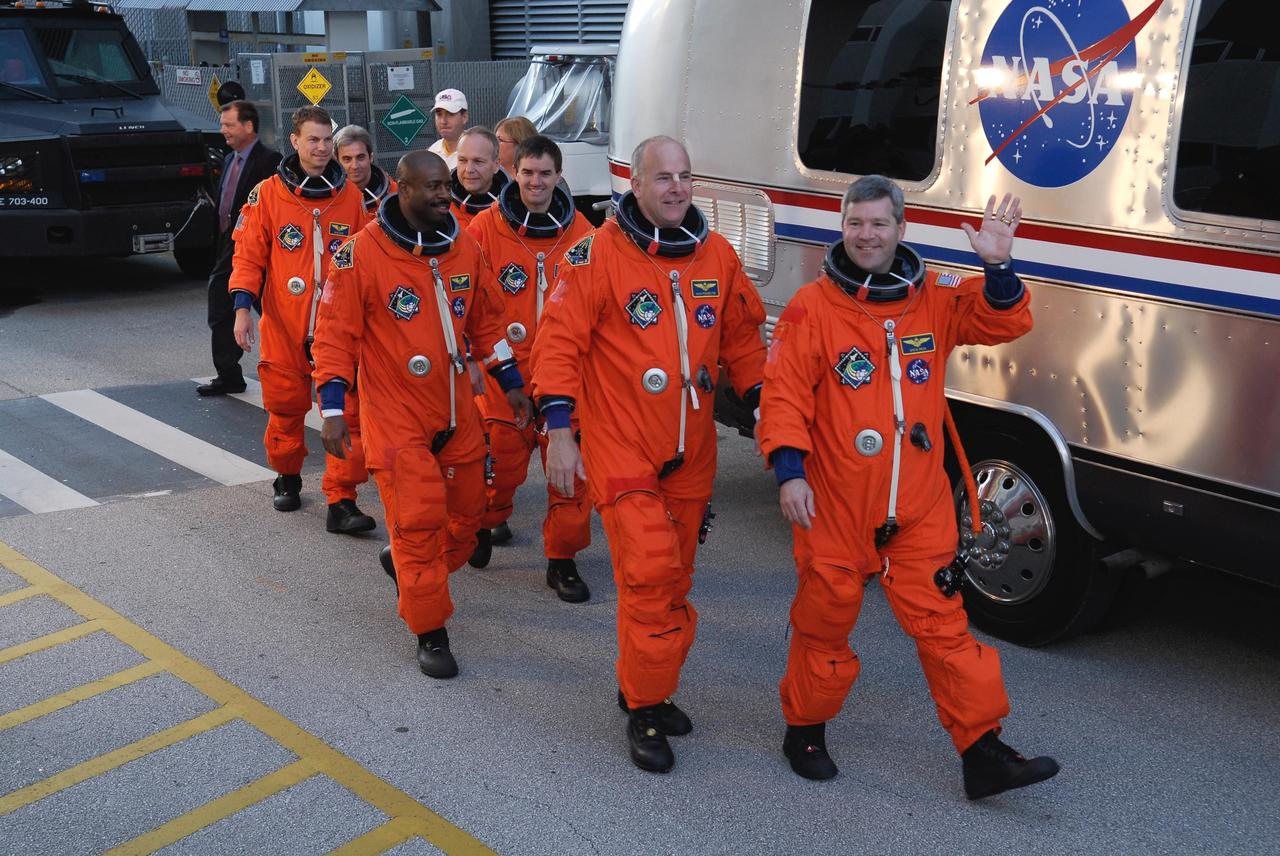
KENNEDY SPACE CENTER, FLA. -- Dressed in their launch and entry suits, the space shuttle Atlantis STS-122 crew leaves the Operations and Checkout Building for their trip to Launch Pad 39A aboard the astronaut van. From left are Mission Specialists Stanley Love, Leopold Eyharts, Leland Melvin, Hans Schlegel, and Rex Walheim; Pilot Alan Poindexter; and Commander Steve Frick. Eyharts and Schlegel are with the European Space Agency. Eyharts will remain on the International Space Station as a flight engineer for Expedition 16 following the STS-122 mission. The STS-122 crew is preparing for a simulated launch countdown aboard Atlantis, part of terminal countdown demonstration test, or TCDT, activities at NASA's Kennedy Space Center. The TCDT is a dress rehearsal for launch and also provides astronauts and ground crews with equipment familiarization and emergency egress training. On mission STS-122, Atlantis will deliver the Columbus module to the International Space Station. The European Space Agency's largest single contribution to the station, Columbus is a multifunctional, pressurized laboratory that will be permanently attached to U.S. Node 2, called Harmony. The laboratory will expand the research facilities aboard the station, providing crew members and scientists from around the world the ability to conduct a variety of experiments in the physical, materials and life sciences. Launch is targeted for Dec. 6. Photo credit: NASA/Kim Shiflett
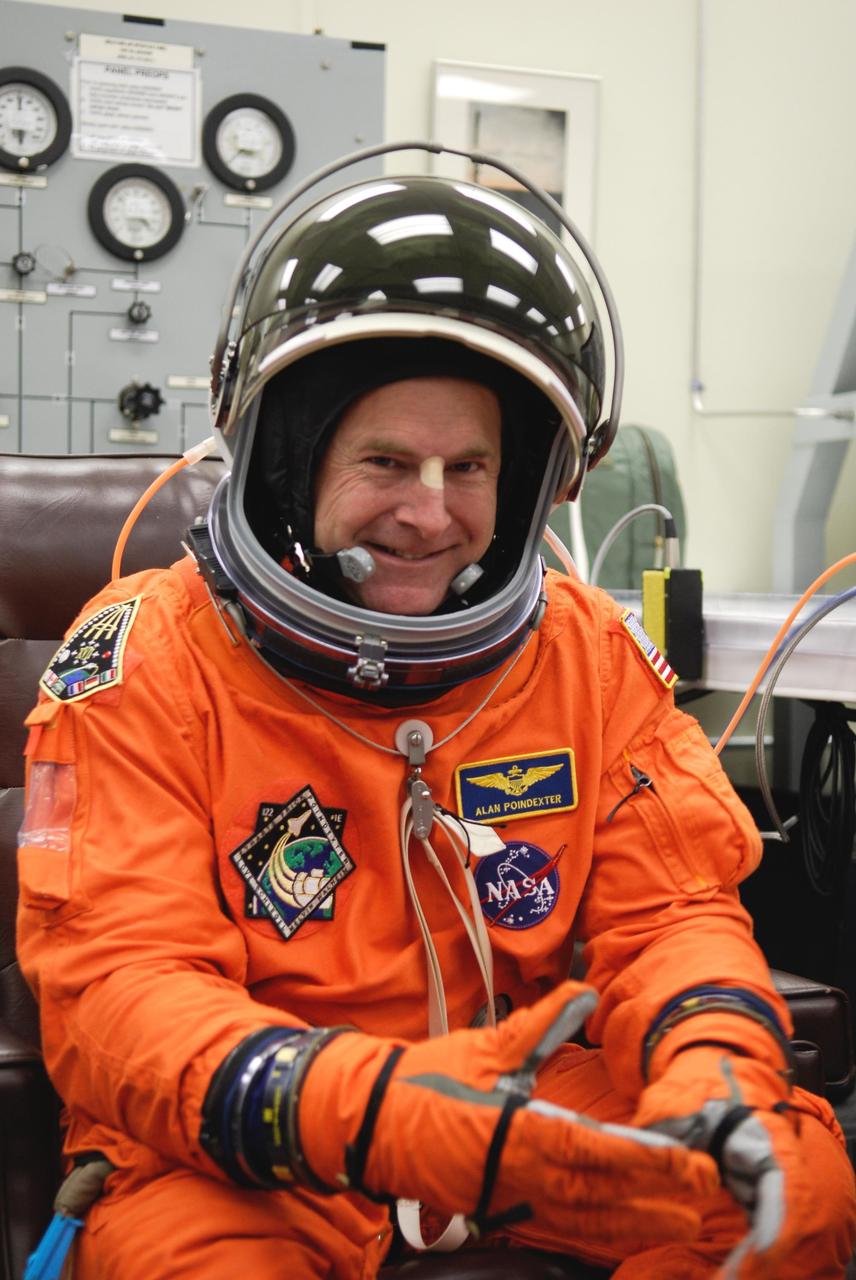
KENNEDY SPACE CENTER, FLA. -- Space shuttle Atlantis STS-122 Pilot Alan Poindexter awaits the final adjustments to his launch and entry suit, in astronaut crew quarters. The STS-122 crew is preparing for a simulated launch countdown aboard Atlantis, part of terminal countdown demonstration test, or TCDT, activities at NASA's Kennedy Space Center. The TCDT is a dress rehearsal for launch and also provides astronauts and ground crews with equipment familiarization and emergency egress training. On mission STS-122, Atlantis will deliver the Columbus module to the International Space Station. The European Space Agency's largest single contribution to the station, Columbus is a multifunctional, pressurized laboratory that will be permanently attached to U.S. Node 2, called Harmony. The laboratory will expand the research facilities aboard the station, providing crew members and scientists from around the world the ability to conduct a variety of experiments in the physical, materials and life sciences. Launch is targeted for Dec. 6. Photo credit: NASA/Kim Shiflett
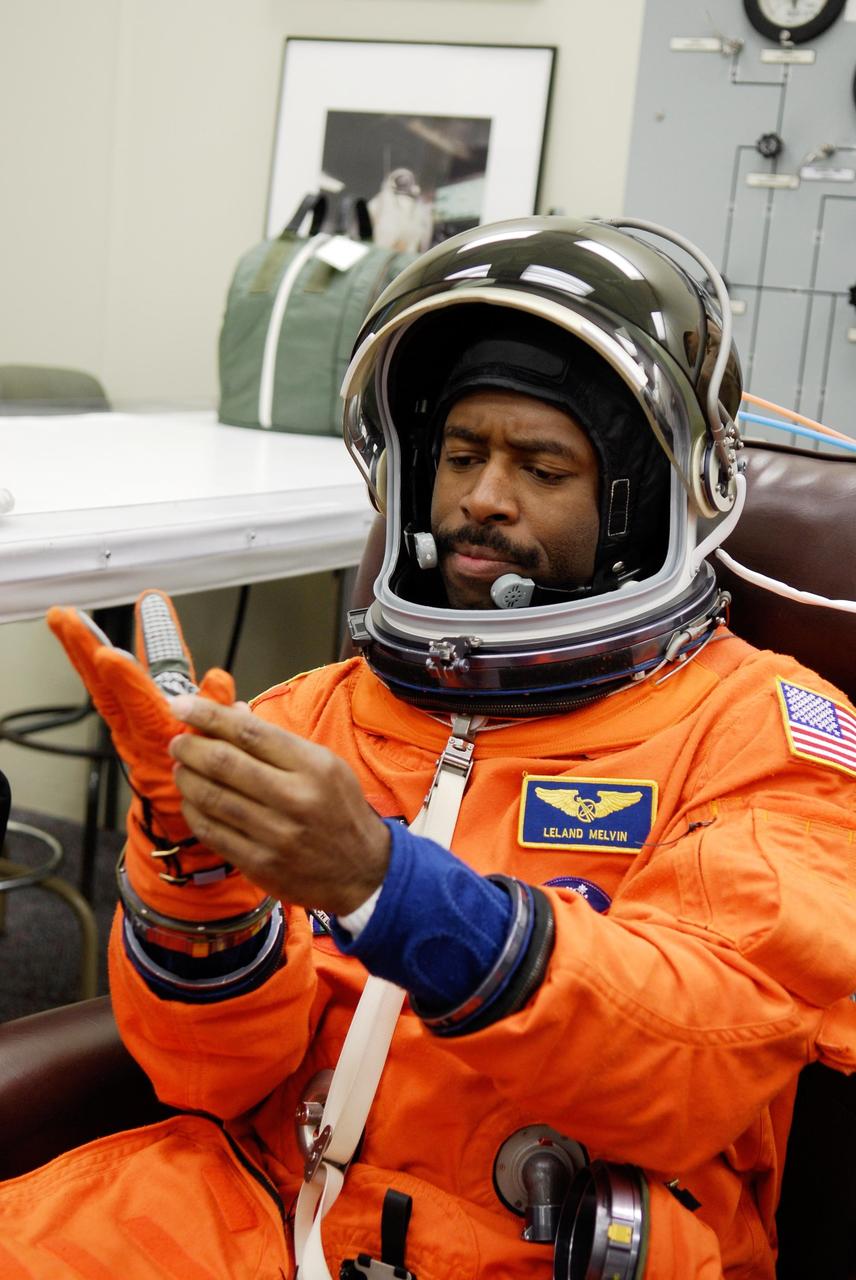
KENNEDY SPACE CENTER, FLA. -- Space shuttle Atlantis STS-122 Mission Specialist Leland Melvin puts on his gloves, part of his launch and entry suit, in astronaut crew quarters. The STS-122 crew is preparing for a simulated launch countdown aboard Atlantis, part of terminal countdown demonstration test, or TCDT, activities at NASA's Kennedy Space Center. The TCDT is a dress rehearsal for launch and also provides astronauts and ground crews with equipment familiarization and emergency egress training. On mission STS-122, Atlantis will deliver the Columbus module to the International Space Station. The European Space Agency's largest single contribution to the station, Columbus is a multifunctional, pressurized laboratory that will be permanently attached to U.S. Node 2, called Harmony. The laboratory will expand the research facilities aboard the station, providing crew members and scientists from around the world the ability to conduct a variety of experiments in the physical, materials and life sciences. Launch is targeted for Dec. 6. Photo credit: NASA/Kim Shiflett
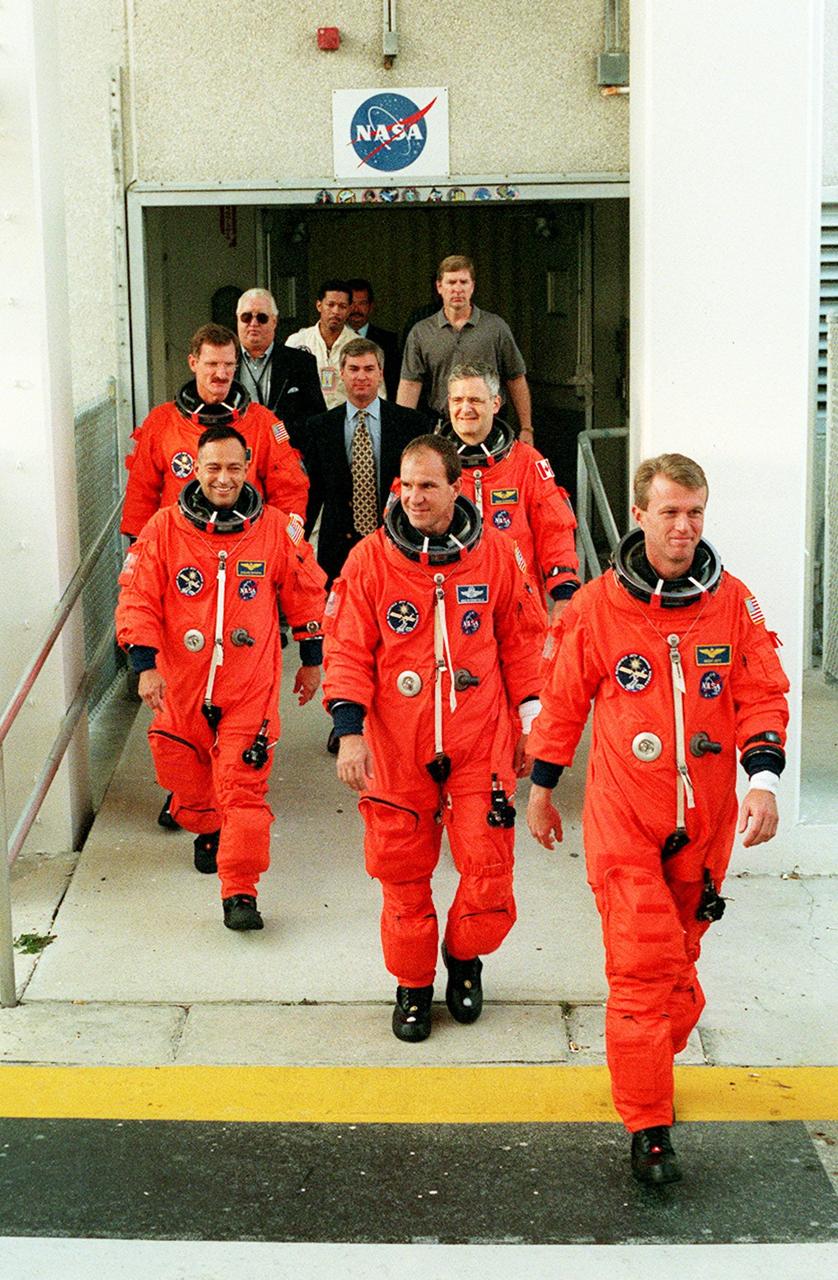
The STS-97 crew get a taste of the excitement of launch day as they exit the O&C Building to head for Launch Pad 39B. They are taking part in Terminal Countdown Demonstration Test (TCDT) activities that include emergency egress training and a simulated launch countdown. On the left (front to back) are Mission Specialists Carlos Noriega and Joe Tanner; on the right (front to back) are Commander Brent Jett, Pilot Mike Bloomfield and Mission Specialist Marc Garneau, who is a Canadian astronaut. Mission STS-97is the sixth construction flight to the International Space Station. Its payload includes the P6 Integrated Truss Structure and a photovoltaic (PV) module, with giant solar arrays that will provide power to the Station. The mission includes two spacewalks to complete the solar array connections. STS-97 is scheduled to launch Nov. 30 at 10:05 p.m. EST
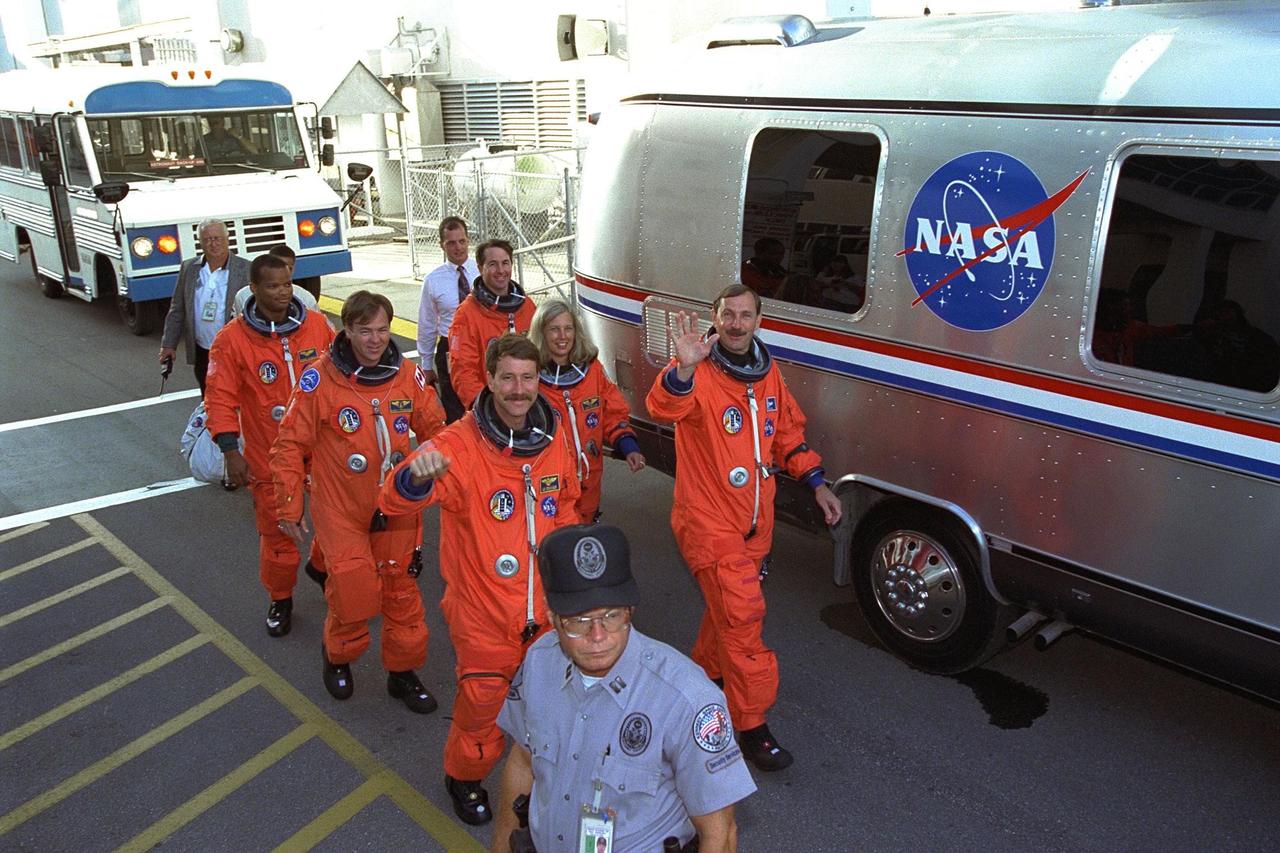
The STS-85 flight crew walks out of the Operations and Checkout (O&C) Building during Terminal Countdown Demonstration Test (TCDT) activities for that mission to board the Astrovan for the ride to the Space Shuttle Discovery on Launch Pad 39A. Waving to the crowd is Commander Curtis L. Brown, Jr. (right). Directly behind him are Payload Commander N. Jan Davis and Mission Specialist Stephen K. Robinson. Pilot Kent V. Rominger (to Brown’s right) is leading the second row, followed by Payload Specialist Bjarni V. Tryggvason and Mission Specialist Robert L. Curbeam, Jr. The primary payload aboard the Space Shuttle orbiter Discovery is the Cryogenic Infrared Spectrometers and Telescopes for the Atmosphere-2 (CRISTA-SPAS-2). Other payloads on the 11-day mission include the Manipulator Flight Demonstration (MFD), and Technology Applications and Science-1 (TAS-1) and International Extreme Ultraviolet Hitchhiker-2 (IEH-2) experiments
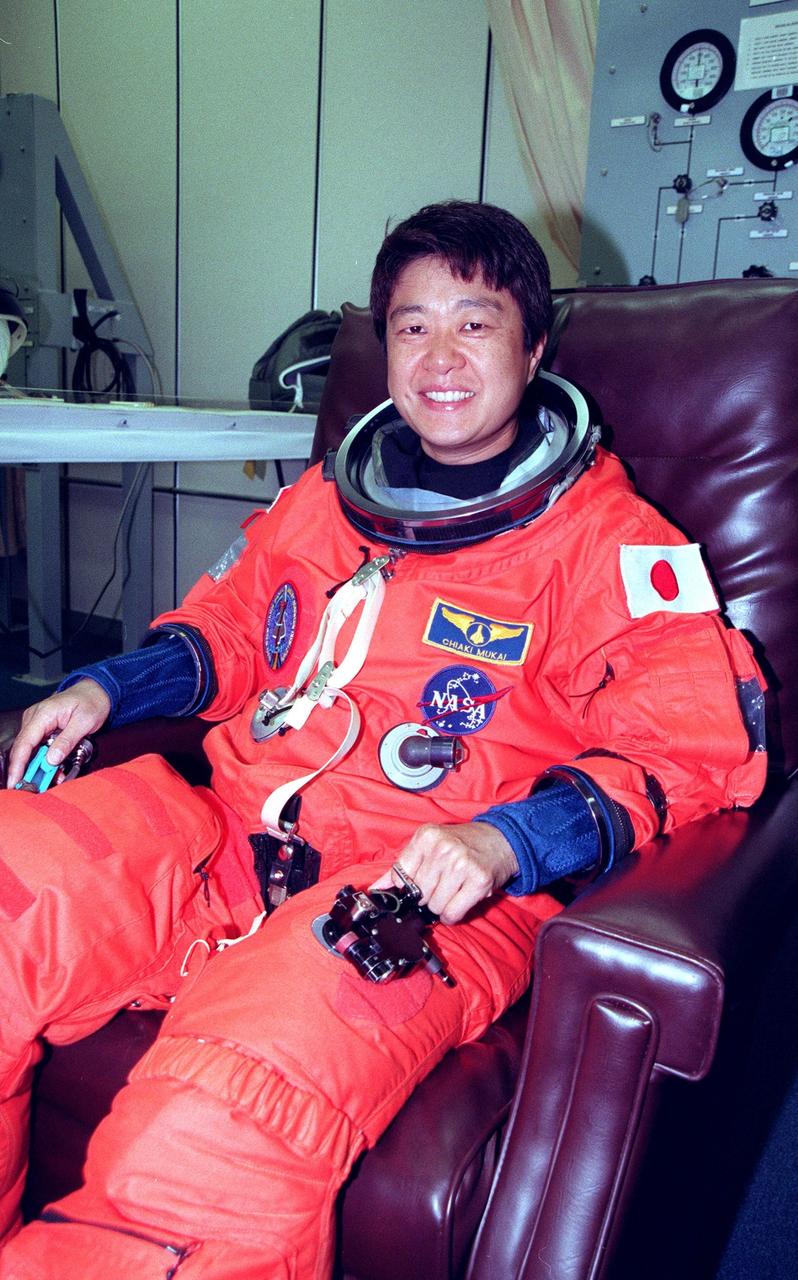
STS-95 Payload Specialist Chiaki Mukai (M.D., Ph.D.), representing the National Space Development Agency of Japan (NASDA), suits up in the Operations and Checkout (O&C) Building prior to her trip to Launch Pad 39-B. Mukai and the rest of the STS-95 crew are at KSC to participate in the Terminal Countdown Demonstration Test (TCDT) which includes mission familiarization activities, emergency egress training, and a simulated main engine cutoff. The other crew members are Pilot Steven W. Lindsey, Mission Specialist Scott E. Parazynski, Mission Specialist Stephen K. Robinson, Mission Specialist Pedro Duque of Spain, representing the European Space Agency (ESA), Payload Specialist John H. Glenn Jr., senator from Ohio, and Mission Commander Curtis L. Brown. The STS-95 mission, targeted for liftoff on Oct. 29, includes research payloads such as the Spartan solar-observing deployable spacecraft, the Hubble Space Telescope Orbital Systems Test Platform, the International Extreme Ultraviolet Hitchhiker, as well as the SPACEHAB single module with experiments on space flight and the aging process. Following the TCDT, the crew will be returning to Houston for final flight preparations
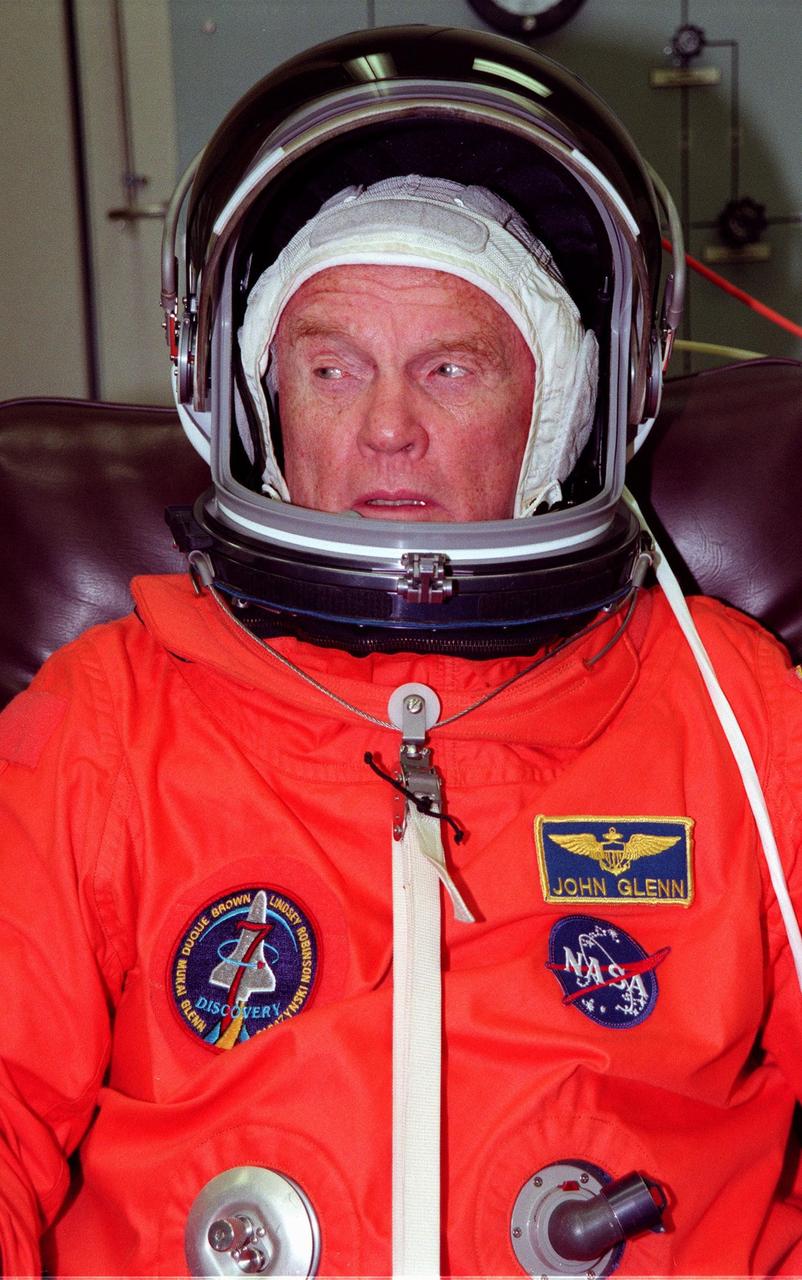
STS-95 Payload Specialist John H. Glenn Jr., a senator from Ohio and one of the original seven Project Mercury astronauts, suits up in the Operations and Checkout (O&C) Building prior to his trip to Launch Pad 39-B. Glenn and the rest of the STS-95 crew are at KSC to participate in the Terminal Countdown Demonstration Test (TCDT) which includes mission familiarization activities, emergency egress training, and a simulated main engine cutoff. The other crew members are Payload Specialist Chiaki Mukai (M.D., Ph.D.), representing the National Space Development Agency of Japan (NASDA), Pilot Steven W. Lindsey, Mission Specialist Scott E. Parazynski, Mission Specialist Stephen K. Robinson, Mission Specialist Pedro Duque of Spain, representing the European Space Agency (ESA), and Mission Commander Curtis L. Brown. The STS-95 mission, targeted for liftoff on Oct. 29, includes research payloads such as the Spartan solar-observing deployable spacecraft, the Hubble Space Telescope Orbital Systems Test Platform, the International Extreme Ultraviolet Hitchhiker, as well as the SPACEHAB single module with experiments on space flight and the aging process. Following the TCDT, the crew will be returning to Houston for final flight preparations
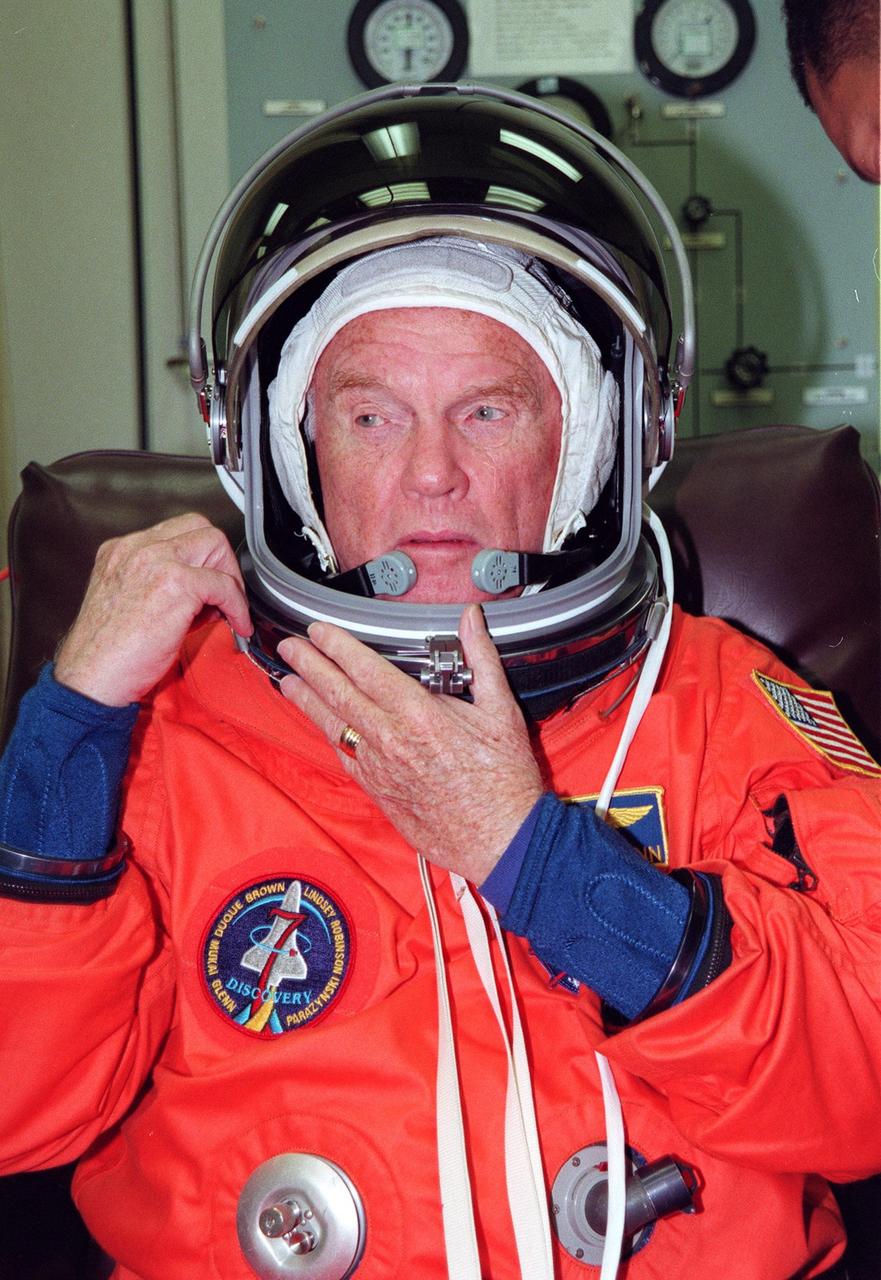
STS-95 Payload Specialist John H. Glenn Jr., a senator from Ohio and one of the original seven Project Mercury astronauts, suits up in the Operations and Checkout (O&C) Building prior to his trip to Launch Pad 39-B. Glenn and the rest of the STS-95 crew are at KSC to participate in the Terminal Countdown Demonstration Test (TCDT) which includes mission familiarization activities, emergency egress training, and a simulated main engine cutoff. The other crew members are Payload Specialist Chiaki Mukai (M.D., Ph.D.), representing the National Space Development Agency of Japan (NASDA), Pilot Steven W. Lindsey, Mission Specialist Scott E. Parazynski, Mission Specialist Stephen K. Robinson, Mission Specialist Pedro Duque of Spain, representing the European Space Agency (ESA), and Mission Commander Curtis L. Brown. The STS-95 mission, targeted for liftoff on Oct. 29, includes research payloads such as the Spartan solar-observing deployable spacecraft, the Hubble Space Telescope Orbital Systems Test Platform, the International Extreme Ultraviolet Hitchhiker, as well as the SPACEHAB single module with experiments on space flight and the aging process. Following the TCDT, the crew will be returning to Houston for final flight preparations
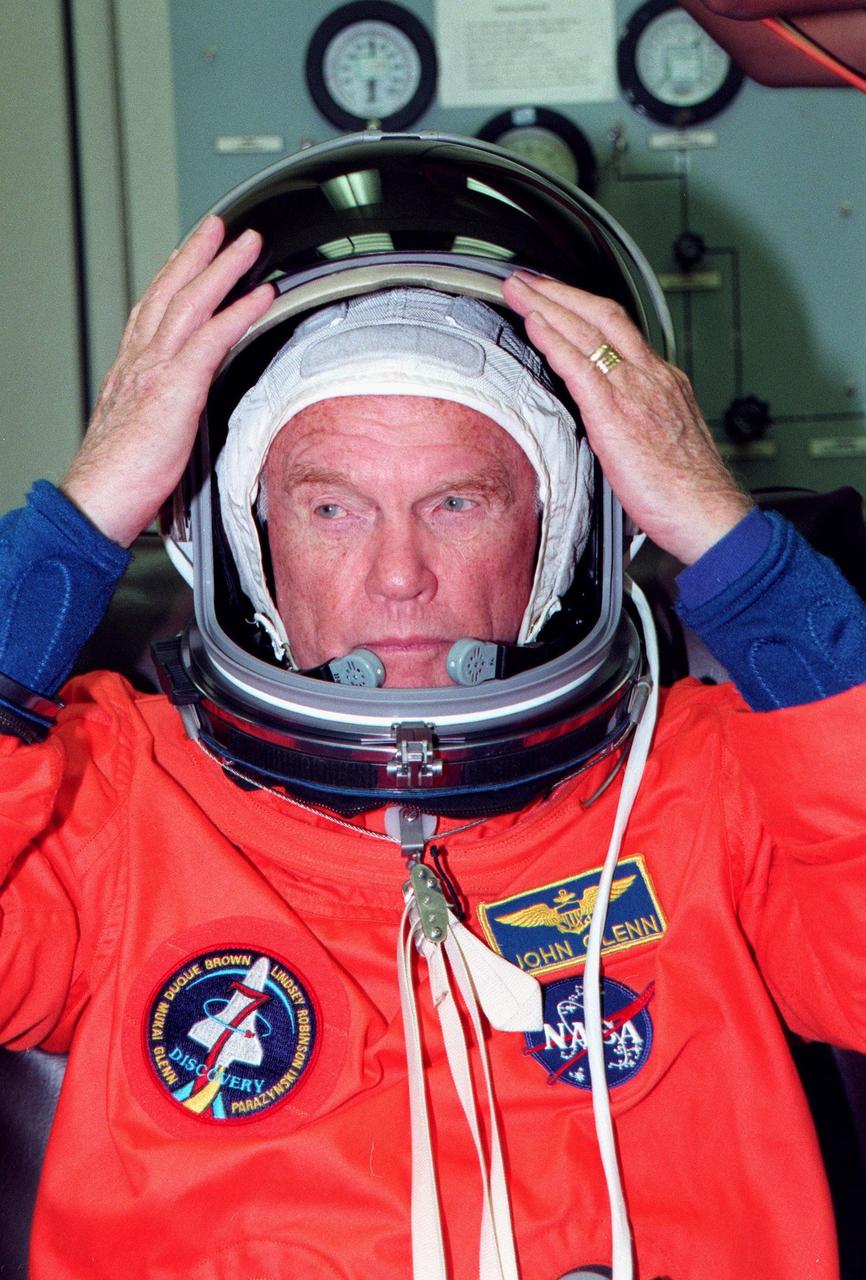
STS-95 Payload Specialist John H. Glenn Jr., a senator from Ohio and one of the original seven Project Mercury astronauts, adjusts his helmet during suitup in the Operations and Checkout (O&C) Building prior to his trip to Launch Pad 39-B. Glenn and the rest of the STS-95 crew are at KSC to participate in the Terminal Countdown Demonstration Test (TCDT) which includes mission familiarization activities, emergency egress training, and a simulated main engine cutoff. The other crew members are Payload Specialist Chiaki Mukai (M.D., Ph.D.), representing the National Space Development Agency of Japan (NASDA), Pilot Steven W. Lindsey, Mission Specialist Scott E. Parazynski, Mission Specialist Stephen K. Robinson, Mission Specialist Pedro Duque of Spain, representing the European Space Agency (ESA), and Mission Commander Curtis L. Brown. The STS-95 mission, targeted for liftoff on Oct. 29, includes research payloads such as the Spartan solar-observing deployable spacecraft, the Hubble Space Telescope Orbital Systems Test Platform, the International Extreme Ultraviolet Hitchhiker, as well as the SPACEHAB single module with experiments on space flight and the aging process. Following the TCDT, the crew will be returning to Houston for final flight preparations
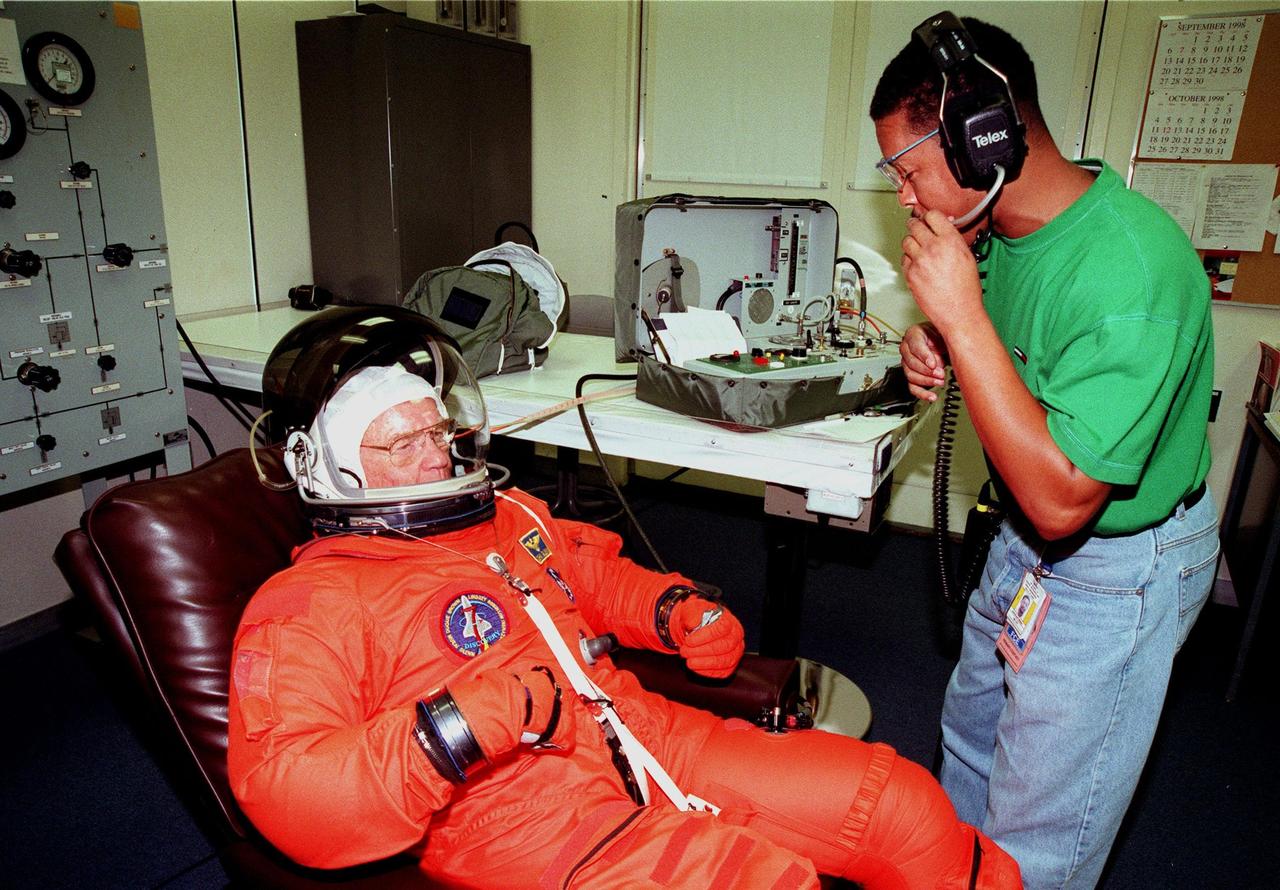
STS-95 Payload Specialist John H. Glenn Jr., a senator from Ohio and one of the original seven Project Mercury astronauts, suits up with the help of George Brittingham, of United Space Alliance, in the Operations and Checkout (O&C)Building prior to his trip to Launch Pad 39-B. Glenn and the rest of the STS-95 crew are at KSC to participate in the Terminal Countdown Demonstration Test (TCDT) which includes mission familiarization activities, emergency egress training, and a simulated main engine cutoff. The other crew members are Payload Specialist Chiaki Mukai (M.D., Ph.D.), representing the National Space Development Agency of Japan (NASDA), Pilot Steven W. Lindsey, Mission Specialist Scott E. Parazynski, Mission Specialist Stephen K. Robinson, Mission Specialist Pedro Duque of Spain, representing the European Space Agency (ESA), and Mission Commander Curtis L. Brown. The STS-95 mission, targeted for liftoff on Oct. 29, includes research payloads such as the Spartan solar-observing deployable spacecraft, the Hubble Space Telescope Orbital Systems Test Platform, the International Extreme Ultraviolet Hitchhiker, as well as the SPACEHAB single module with experiments on space flight and the aging process. Following the TCDT, the crew will be returning to Houston for final flight preparations
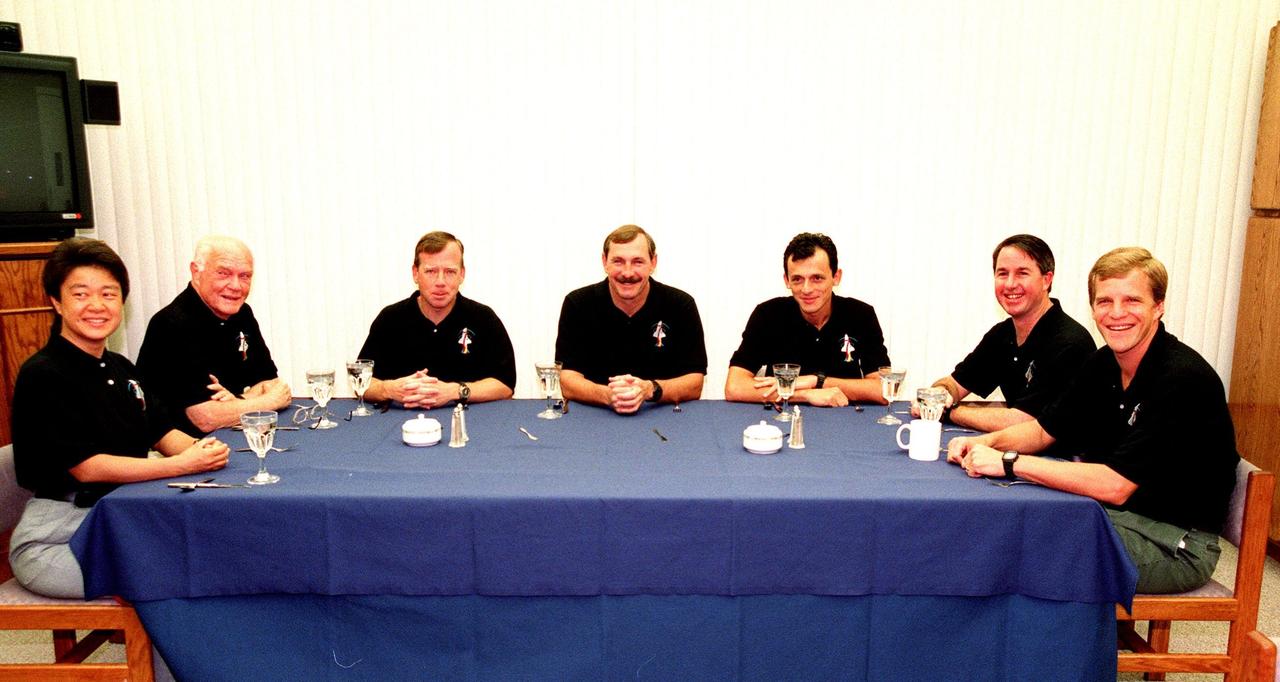
The STS-95 crew partakes in the traditional breakfast in the crew quarters at the Operations and Checkout (O&C) Building prior to their suitup for their trip to Launch Pad 39-B. Seated (left to right) are Payload Specialist Chiaki Mukai (M.D., Ph.D.), representing the National Space Development Agency of Japan (NASDA), Payload Specialist John H. Glenn Jr., senator from Ohio, Pilot Steven W. Lindsey, Mission Commander Curtis L. Brown, Mission Specialist Pedro Duque of Spain, representing the European Space Agency (ESA), Mission Specialist Stephen K. Robinson, and Mission Specialist Scott E. Parazynski. The STS-95 crew are at KSC to participate in the Terminal Countdown Demonstration Test (TCDT) which includes mission familiarization activities, emergency egress training, and a simulated main engine cutoff. The STS-95 mission, targeted for liftoff on Oct. 29, includes research payloads such as the Spartan solar-observing deployable spacecraft, the Hubble Space Telescope Orbital Systems Test Platform, the International Extreme Ultraviolet Hitchhiker, as well as the SPACEHAB single module with experiments on space flight and the aging process. Following the TCDT, the crew will be returning to Houston for final flight preparations