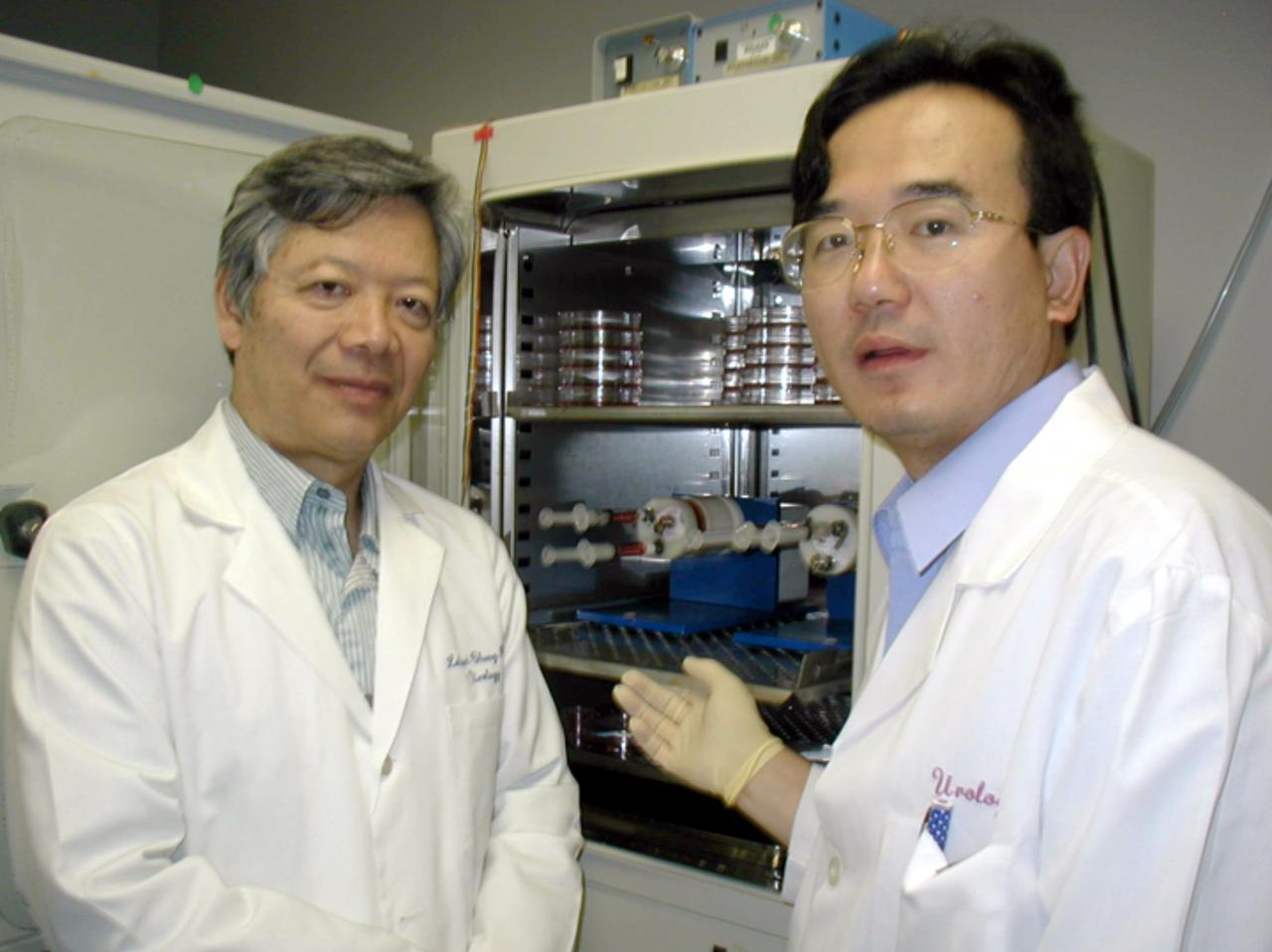
Leland W. K. Chung (left), Director, Molecular Urology Therapeutics Program at the Winship Cancer Institute at Emory University, is principal investigator for the NASA bioreactor demonstration system (BDS-05). With him is Dr. Jun Shu, an assistant professor of Orthopedics Surgery from Kuming Medical University China. The NASA Bioreactor provides a low turbulence culture environment which promotes the formation of large, three-dimensional cell clusters. Due to their high level of cellular organization and specialization, samples constructed in the bioreactor more closely resemble the original tumor or tissue found in the body. The Bioreactor is rotated to provide gentle mixing of fresh and spent nutrient without inducing shear forces that would damage the cells. The work is sponsored by NASA's Office of Biological and Physical Research. The bioreactor is managed by the Biotechnology Cell Science Program at NASA's Johnson Space Center (JSC). NASA-sponsored bioreactor research has been instrumental in helping scientists to better understand normal and cancerous tissue development. In cooperation with the medical community, the bioreactor design is being used to prepare better models of human colon, prostate, breast and ovarian tumors. Cartilage, bone marrow, heart muscle, skeletal muscle, pancreatic islet cells, liver and kidney are just a few of the normal tissues being cultured in rotating bioreactors by investigators. Credit: Emory University.

Mary Kicza, NASA Associate Administrator for Biological and Physical Research.
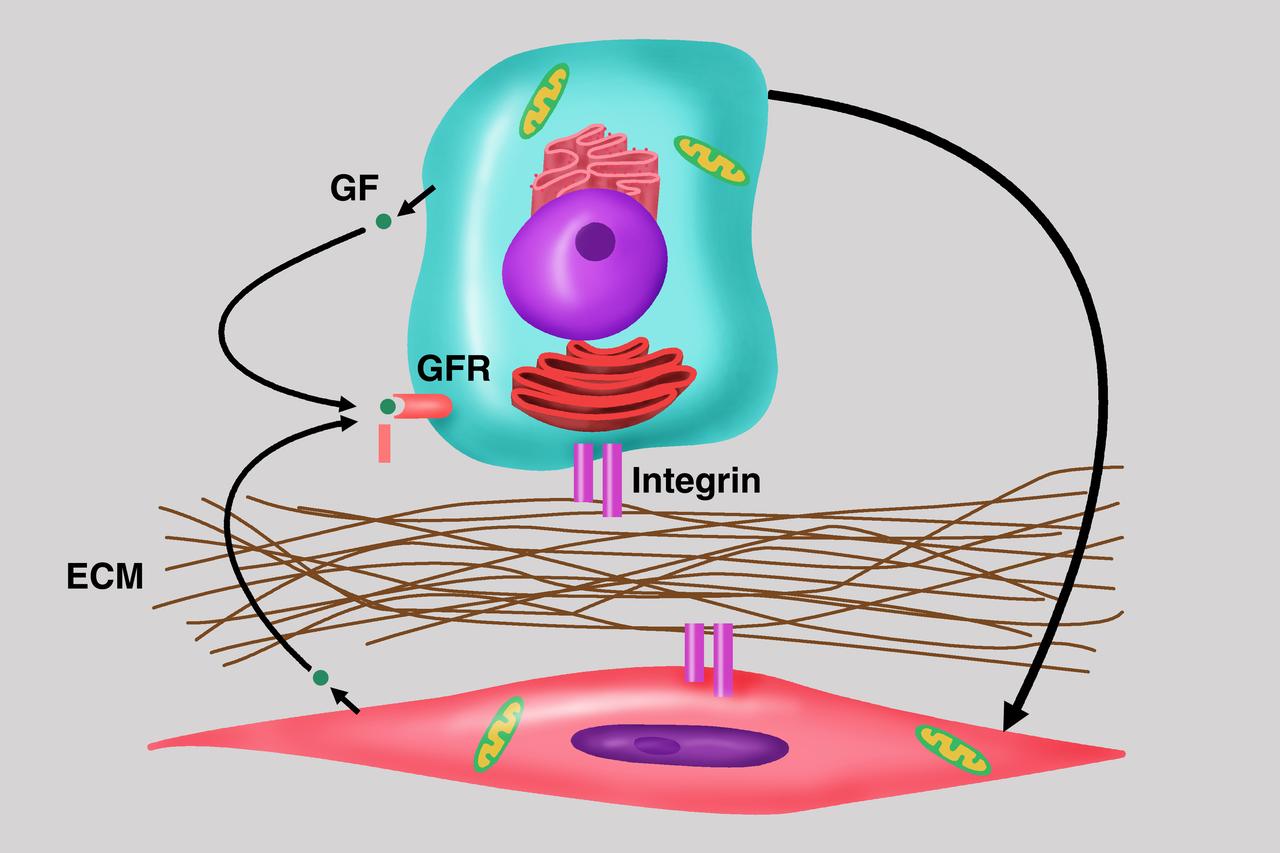
Diagram depicts the importance of cell-cell communication as central to the understanding of cancer growth and progression, the focus of the NASA bioreactor demonstration system (BDS-05) investigation. Microgravity studies will allow us to unravel the signaling and communication between these cells with the host and potential development of therapies for the treatment of cancer metastasis. The NASA Bioreactor provides a low turbulence culture environment which promotes the formation of large, three-dimensional cell clusters. Due to their high level of cellular organization and specialization, samples constructed in the bioreactor more closely resemble the original tumor or tissue found in the body. The Bioreactor is rotated to provide gentle mixing of fresh and spent nutrient without inducing shear forces that would damage the cells. The work is sponsored by NASA's Office of Biological and Physical Research. The bioreactor is managed by the Biotechnology Cell Science Program at NASA's Johnson Space Center (JSC). NASA-sponsored bioreactor research has been instrumental in helping scientists to better understand normal and cancerous tissue development. In cooperation with the medical community, the bioreactor design is being used to prepare better models of human colon, prostate, breast and ovarian tumors. Cartilage, bone marrow, heart muscle, skeletal muscle, pancreatic islet cells, liver and kidney are just a few of the normal tissues being cultured in rotating bioreactors by investigators. Credit: Emory University.
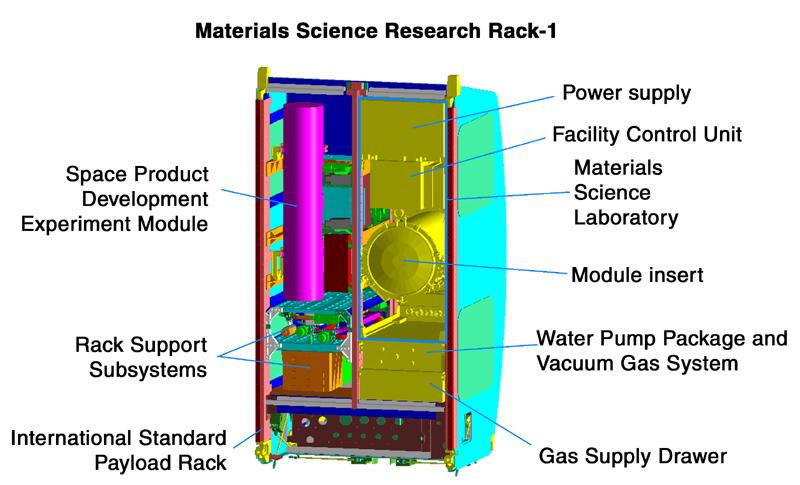
This computer-generated image depicts the Materials Science Research Rack-1 (MSRR-1) being developed by NASA's Marshall Space Flight Center and the European Space Agency (ESA) for placement in the Destiny laboratory module aboard the International Space Station. The rack is part of the plarned Materials Science Research Facility (MSRF) and is expected to include two furnace module inserts, a Quench Module Insert (being developed by NASA's Marshall Space Flight Center) to study directional solidification in rapidly cooled alloys and a Diffusion Module Insert (being developed by the European Space Agency) to study crystal growth, and a transparent furnace (being developed by NASA's Space Product Development program). Multi-user equipment in the rack is being developed under the auspices of NASA's Office of Biological and Physical Research (OBPR) and ESA. A larger image is available without labels (No. 0101755).
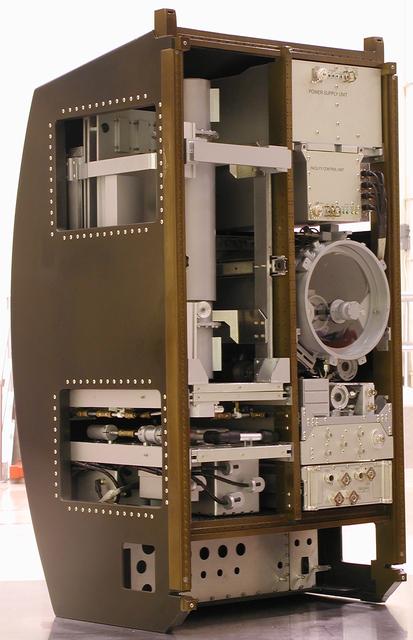
This scale model depicts the Materials Science Research Rack-1 (MSRR-1) being developed by NASA's Marshall Space Flight Center and the European Space Agency (ESA) for placement in the Destiny laboratory module aboard the International Space Station. The rack is part of the plarned Materials Science Research Facility (MSRF) and is expected to include two furnace module inserts, a Quench Module Insert (being developed by NASA's Marshall Space Flight Center) to study directional solidification in rapidly cooled alloys and a Diffusion Module Insert (being developed by the European Space Agency) to study crystal growth, and a transparent furnace (being developed by NASA's Space Product Development program). Multi-user equipment in the rack is being developed under the auspices of NASA's Office of Biological and Physical Research (OBPR) and ESA. Key elements are labeled in other images (0101754, 0101829, 0101830, and TBD). This image is from a digital still camera; higher resolution is not available.
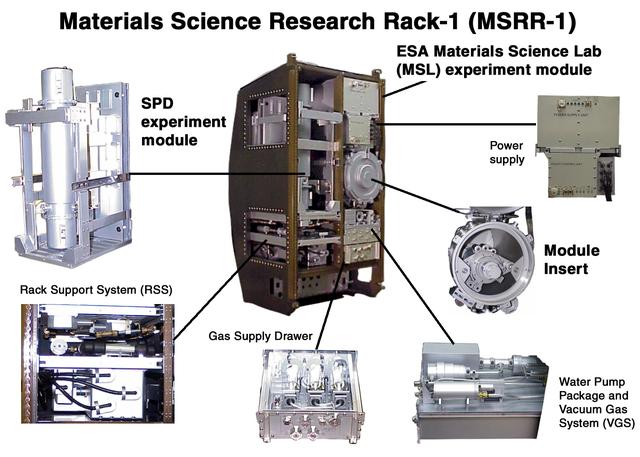
This scale model depicts the Materials Science Research Rack-1 (MSRR-1) being developed by NASA's Marshall Space Flight Center and the European Space Agency (ESA) for placement in the Destiny laboratory module aboard the International Space Station. The rack is part of the plarned Materials Science Research Facility (MSRF) and is expected to include two furnace module inserts, a Quench Module Insert (being developed by NASA's Marshall Space Flight Center) to study directional solidification in rapidly cooled alloys and a Diffusion Module Insert (being developed by the European Space Agency) to study crystal growth, and a transparent furnace (being developed by NASA's Space Product Development program). Multi-user equipment in the rack is being developed under the auspices of NASA's Office of Biological and Physical Research (OBPR) and ESA. Key elements are labeled in other images (0101754, 0101829, and TBD). This composite is from a digital still camera; higher resolution is not available.
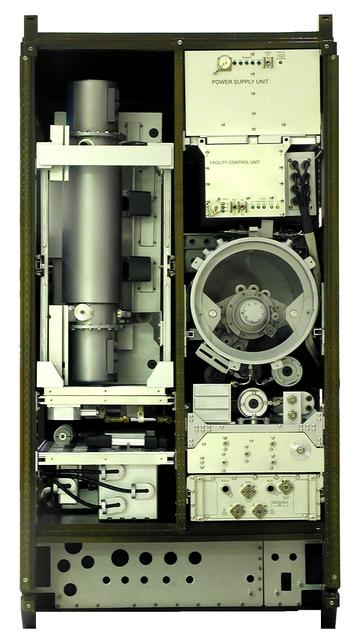
This scale model depicts the Materials Science Research Rack-1 (MSRR-1) being developed by NASA's Marshall Space Flight Center and the European Space Agency (ESA) for placement in the Destiny laboratory module aboard the International Space Station. The rack is part of the plarned Materials Science Research Facility (MSRF) and is expected to include two furnace module inserts, a Quench Module Insert (being developed by NASA's Marshall Space Flight Center) to study directional solidification in rapidly cooled alloys and a Diffusion Module Insert (being developed by the European Space Agency) to study crystal growth, and a transparent furnace (being developed by NASA's Space Product Development program). Multi-user equipment in the rack is being developed under the auspices of NASA's Office of Biological and Physical Research (OBPR) and ESA. Key elements are labeled in other images (0101754, 0101829, 0101830, and TBD).
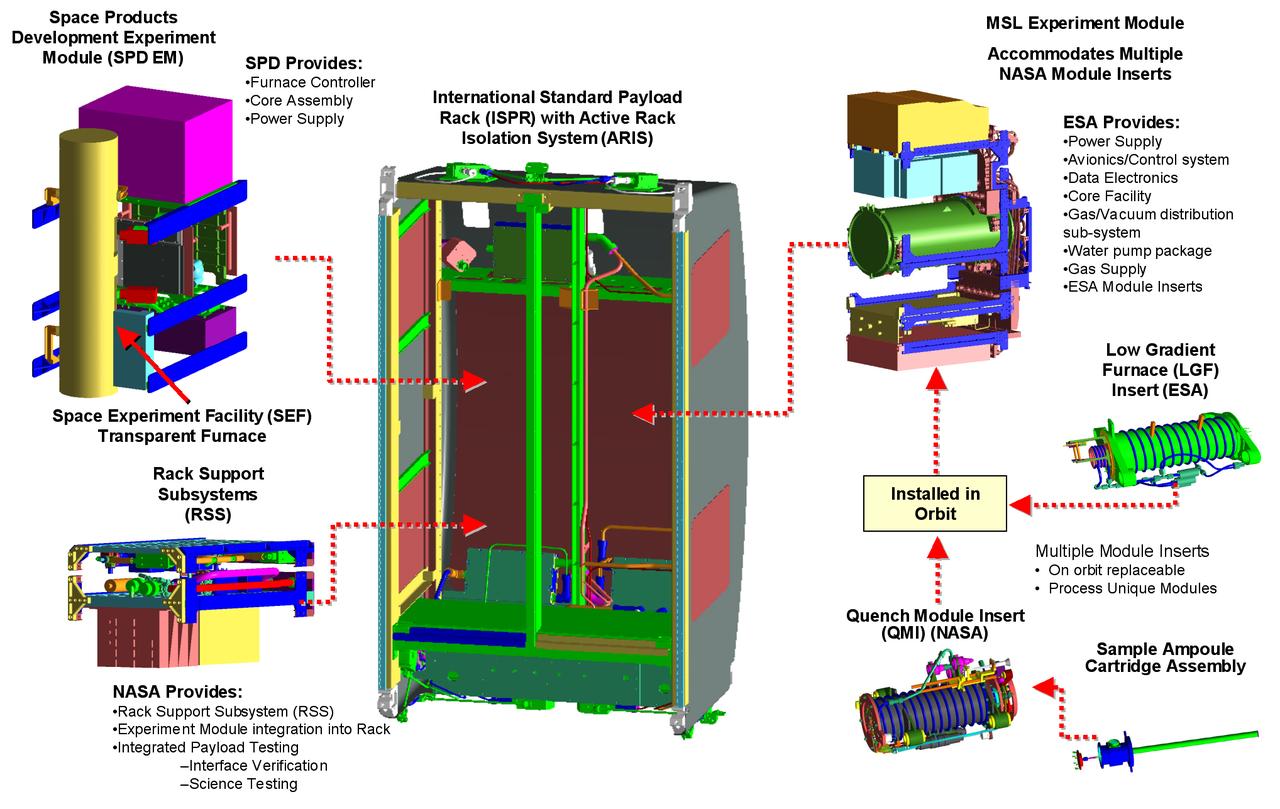
This computer-generated image depicts the Materials Science Research Rack-1 (MSRR-1) being developed by NASA's Marshall Space Flight Center and the European Space Agency (ESA) for placement in the Destiny laboratory module aboard the International Space Station. The rack is part of the plarned Materials Science Research Facility (MSRF) and is expected to include two furnace module inserts, a Quench Module Insert (being developed by NASA's Marshall Space Flight Center) to study directional solidification in rapidly cooled alloys and a Diffusion Module Insert (being developed by the European Space Agency) to study crystal growth, and a transparent furnace (being developed by NASA's Space Product Development program). Multi-user equipment in the rack is being developed under the auspices of NASA's Office of Biological and Physical Research (OBPR) and ESA. Key elements are labeled in other images (0101754, 0101830, and TBD).
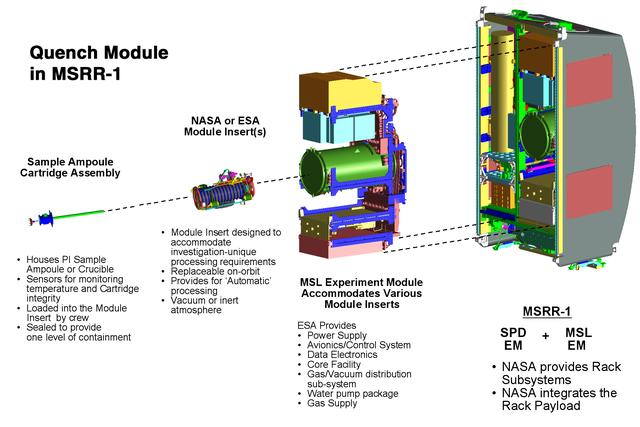
This computer-generated image depicts the Materials Science Research Rack-1 (MSRR-1) being developed by NASA's Marshall Space Flight Center and the European Space Agency (ESA) for placement in the Destiny laboratory module aboard the International Space Station. The rack is part of the plarned Materials Science Research Facility (MSRF) and is expected to include two furnace module inserts, a Quench Module Insert (being developed by NASA's Marshall Space Flight Center) to study directional solidification in rapidly cooled alloys and a Diffusion Module Insert (being developed by the European Space Agency) to study crystal growth, and a transparent furnace (being developed by NASA's Space Product Development program). Multi-user equipment in the rack is being developed under the auspices of NASA's Office of Biological and Physical Research (OBPR) and ESA. Key elements are labeled in other images (0101754, 0101829, 0101830).
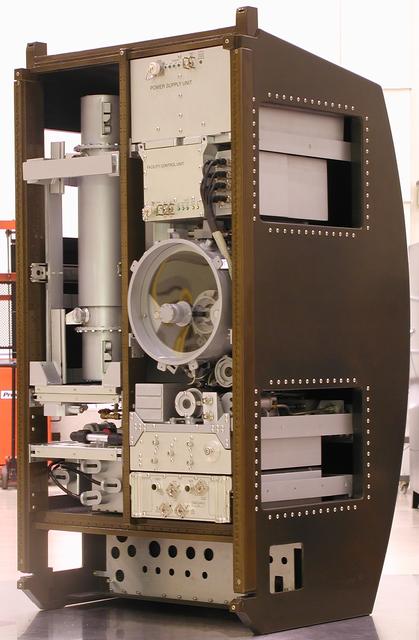
This scale model depicts the Materials Science Research Rack-1 (MSRR-1) being developed by NASA's Marshall Space Flight Center and the European Space Agency (ESA) for placement in the Destiny laboratory module aboard the International Space Station. The rack is part of the plarned Materials Science Research Facility (MSRF) and is expected to include two furnace module inserts, a Quench Module Insert (being developed by NASA's Marshall Space Flight Center) to study directional solidification in rapidly cooled alloys and a Diffusion Module Insert (being developed by the European Space Agency) to study crystal growth, and a transparent furnace (being developed by NASA's Space Product Development program). Multi-user equipment in the rack is being developed under the auspices of NASA's Office of Biological and Physical Research (OBPR) and ESA. Key elements are labeled in other images (0101754, 0101829, 0101830, and TBD). This image is from a digital still camera; higher resolution is not available.
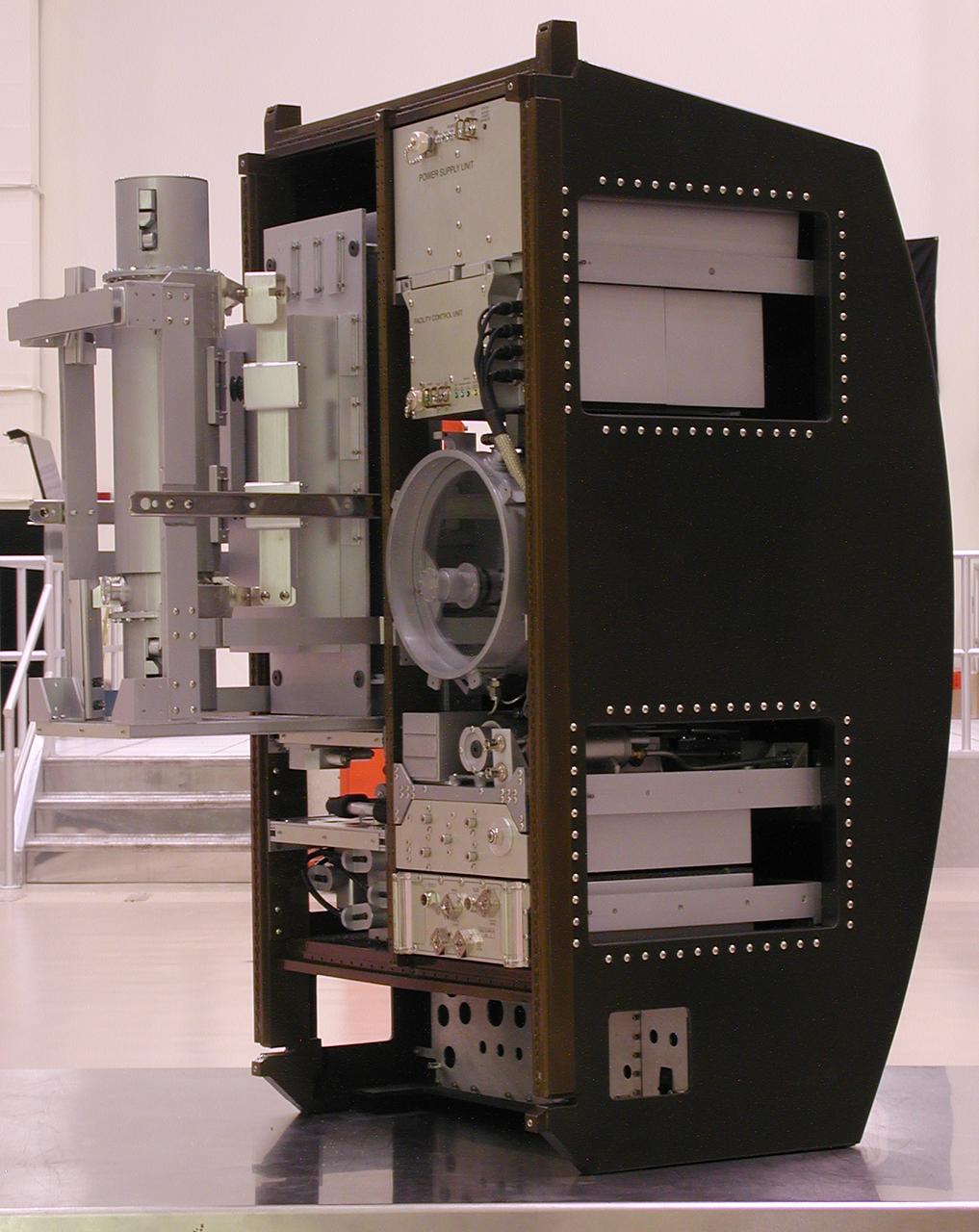
This scale model depicts the Materials Science Research Rack-1 (MSRR-1) being developed by NASA's Marshall Space Flight Center and the European Space Agency (ESA) for placement in the Destiny laboratory module aboard the International Space Station. The rack is part of the plarned Materials Science Research Facility (MSRF) and is expected to include two furnace module inserts, a Quench Module Insert (being developed by NASA's Marshall Space Flight Center) to study directional solidification in rapidly cooled alloys and a Diffusion Module Insert (being developed by the European Space Agency) to study crystal growth, and a transparent furnace (being developed by NASA's Space Product Development program). Multi-user equipment in the rack is being developed under the auspices of NASA's Office of Biological and Physical Research (OBPR) and ESA. Here the transparent furnace is extracted for servicing. Key elements are labeled in other images (0101754, 0101829, 0101830, and TBD).