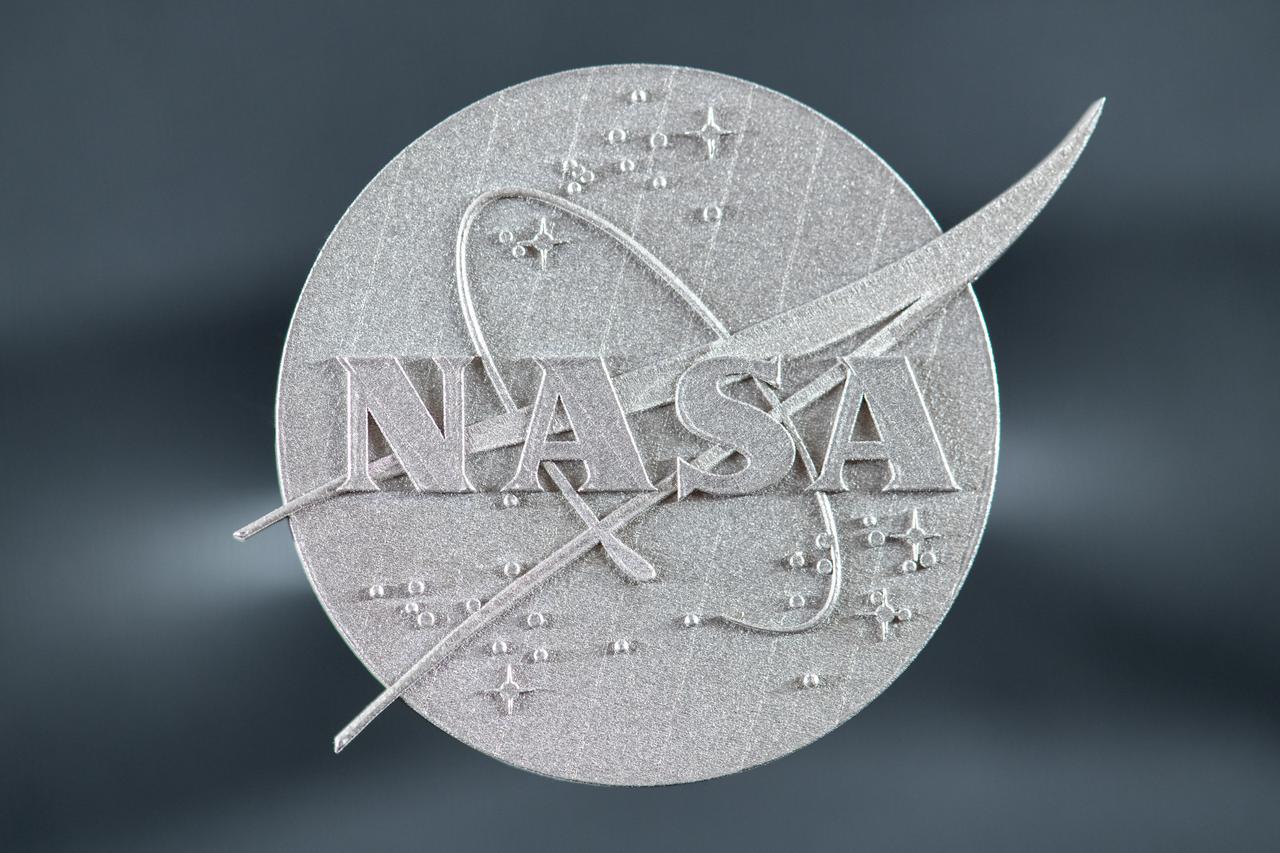
Macro Photographs of 3D Print of NASA Meatball - Made out of GRX-810, an Oxide Dispersion Strengthened (ODS) High Temperature Alloy
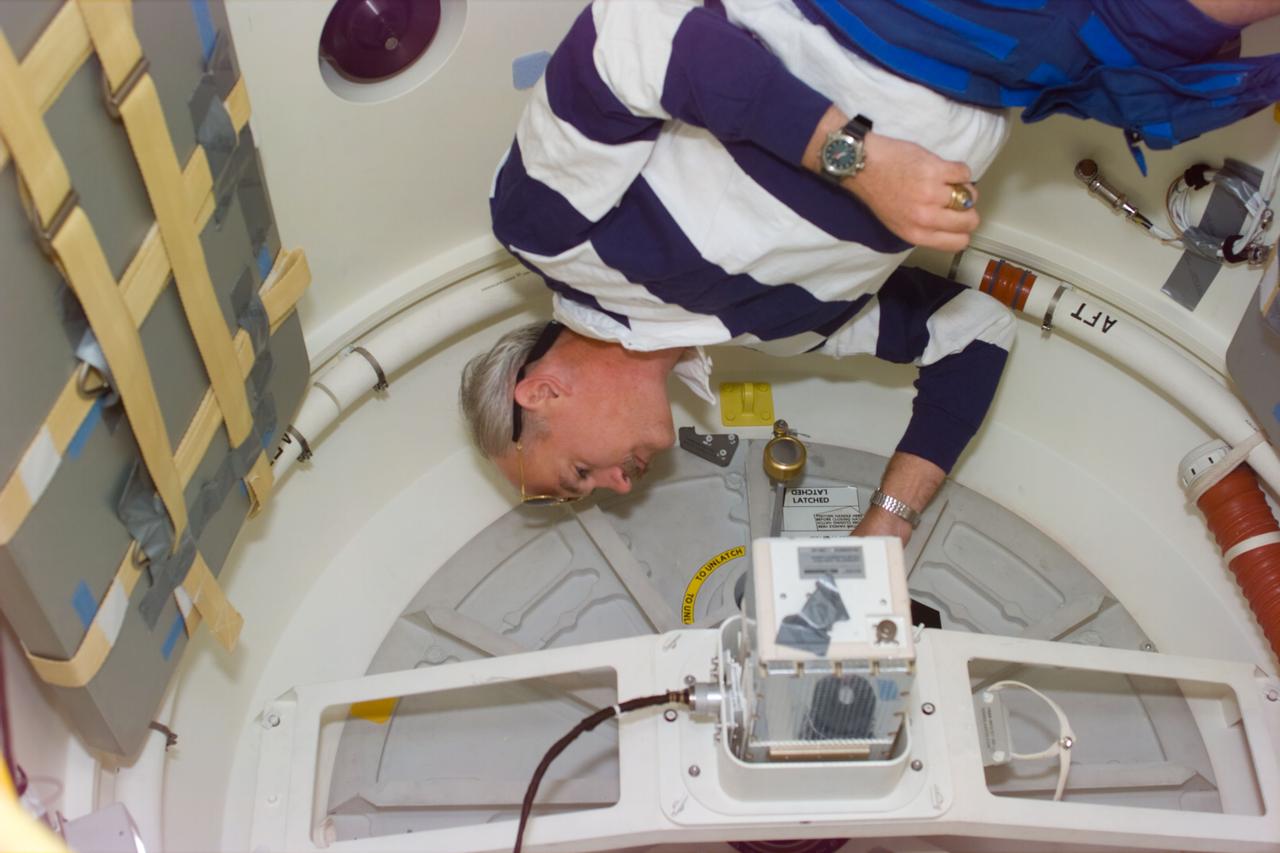
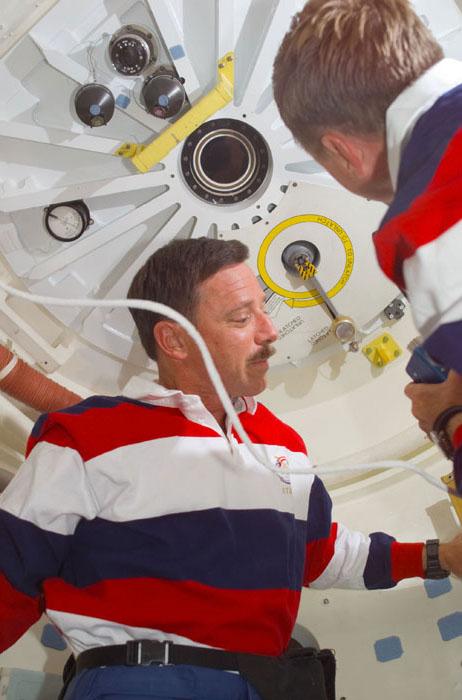
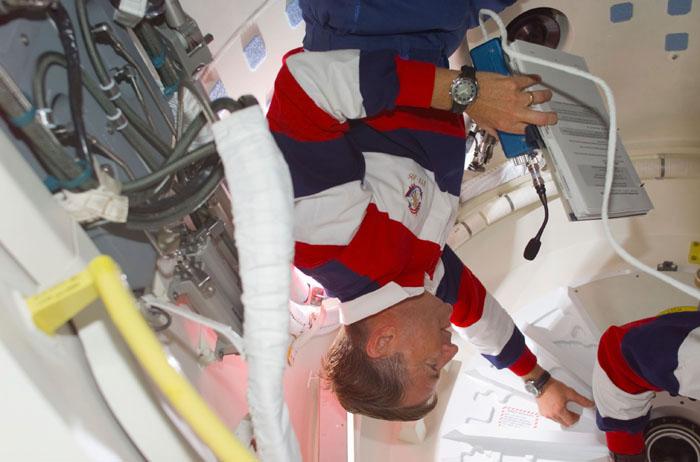
STS-79 mission commander William F. Readdy checks the center-line docking camera in the orbiter docking system (ODS) during flight day 3. The camera will be used on flight day 4 to line up the Atlantis for its docking with the Mir space station.
Mission commander Readdy checks center-line camera in ODS
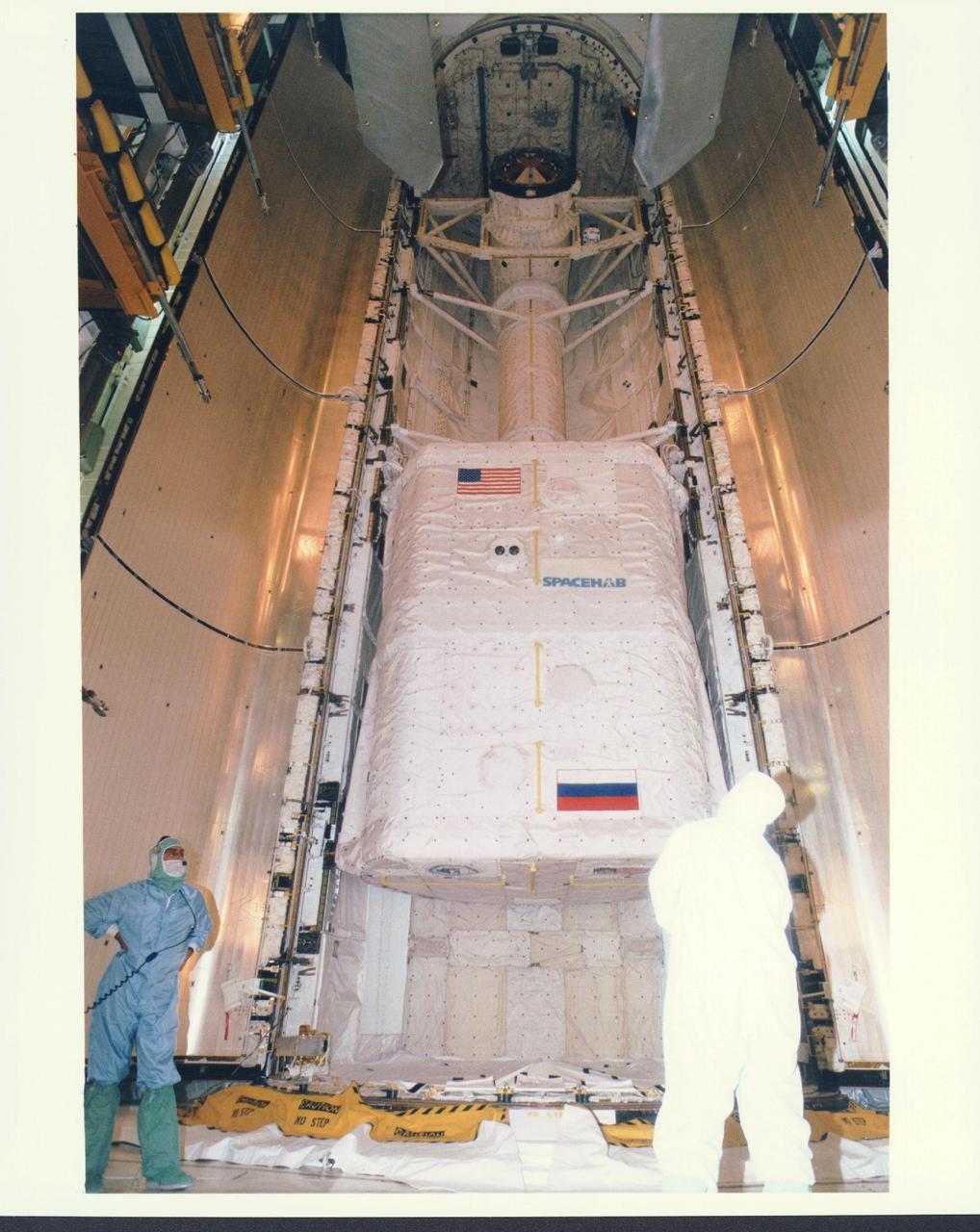
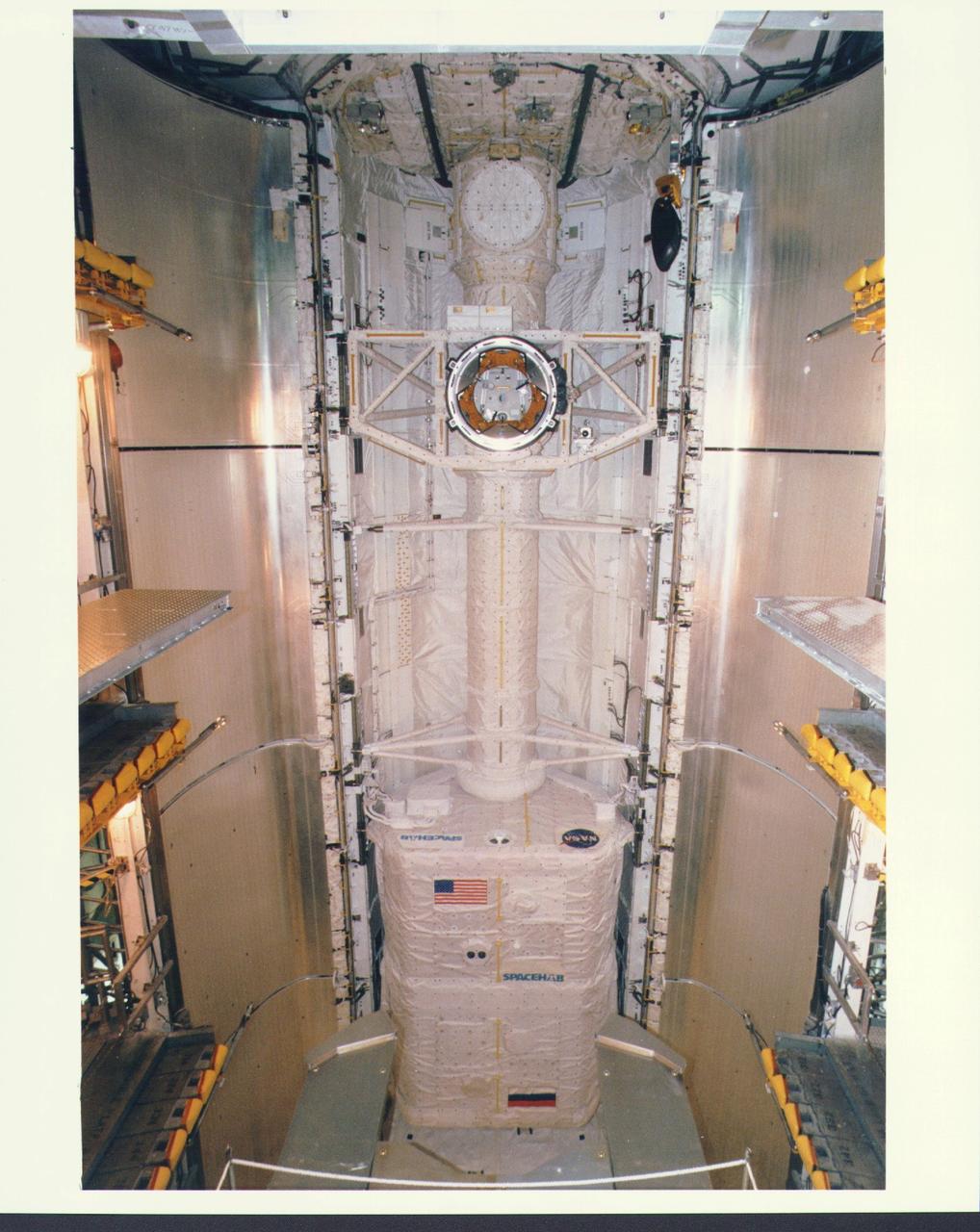
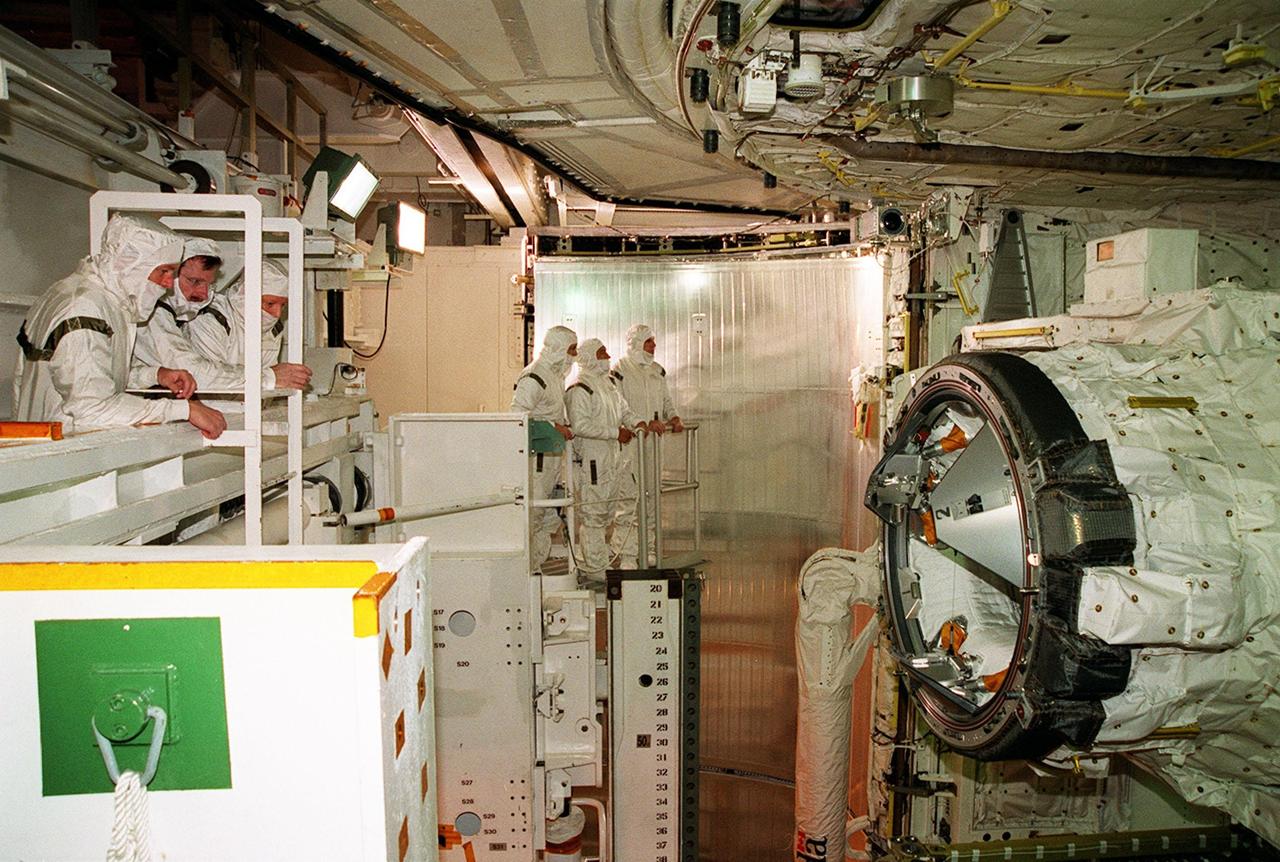
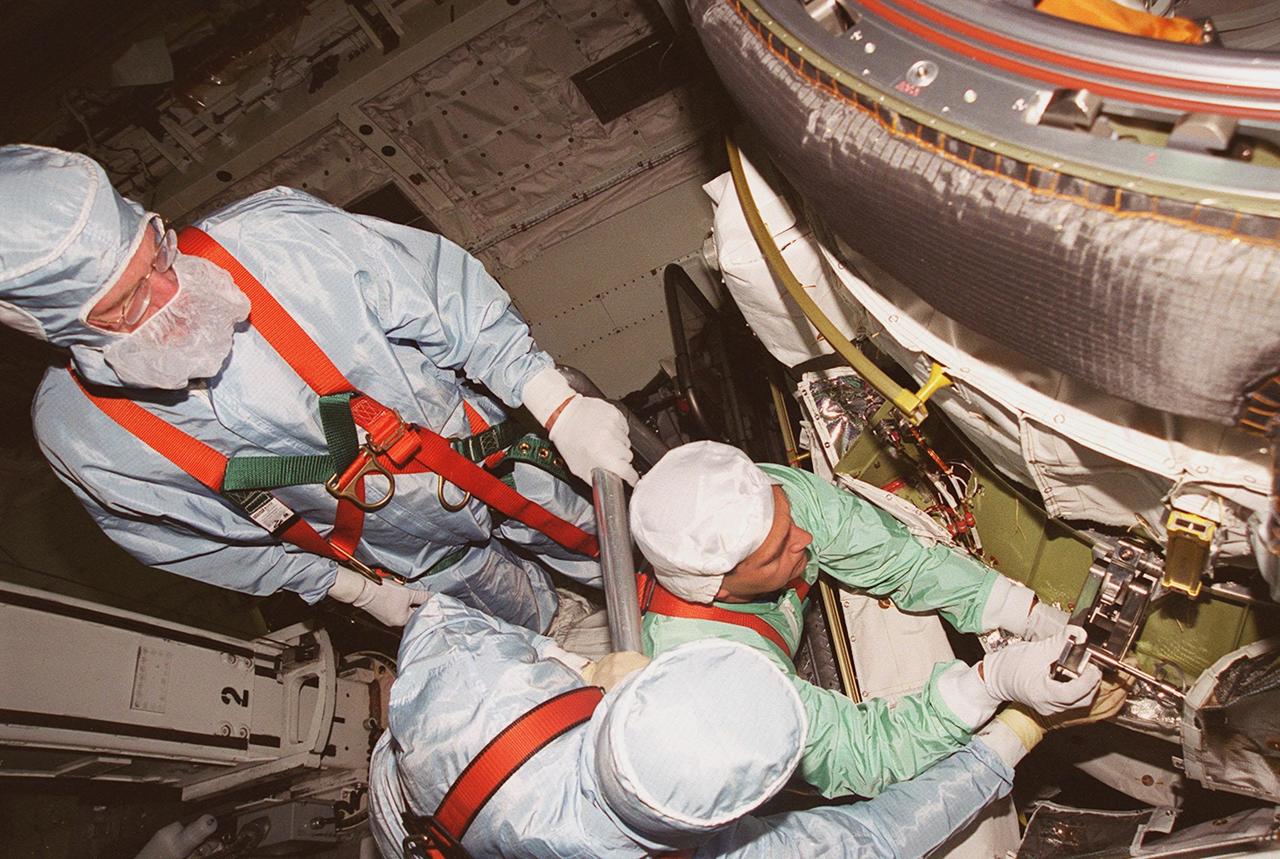
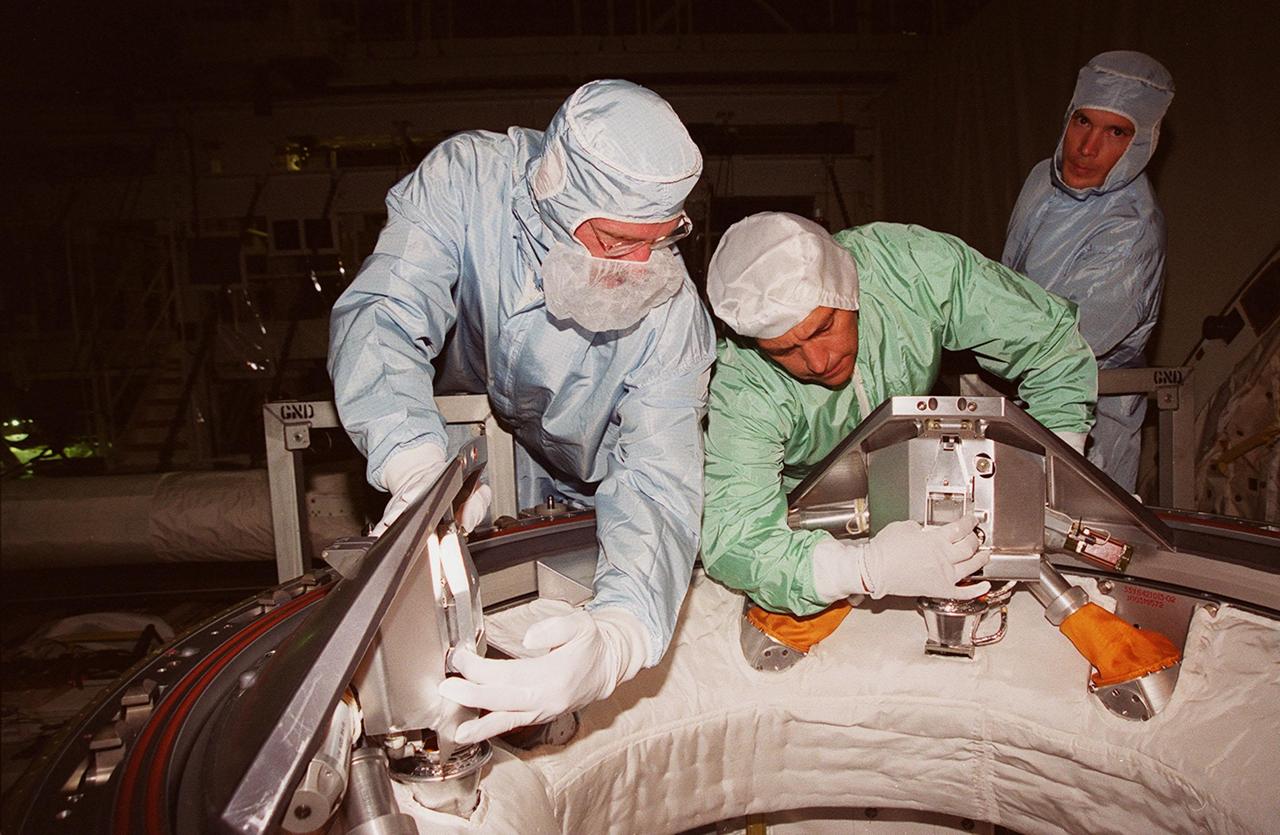
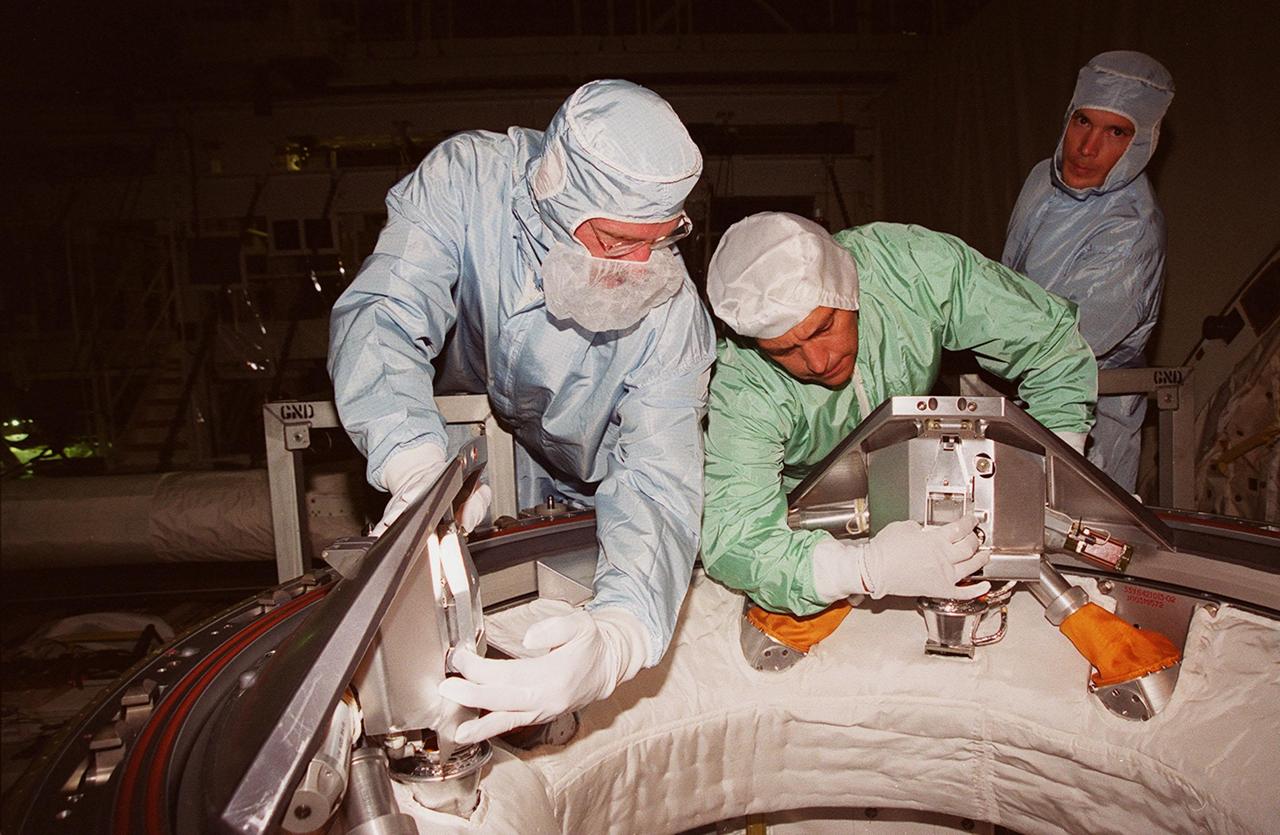
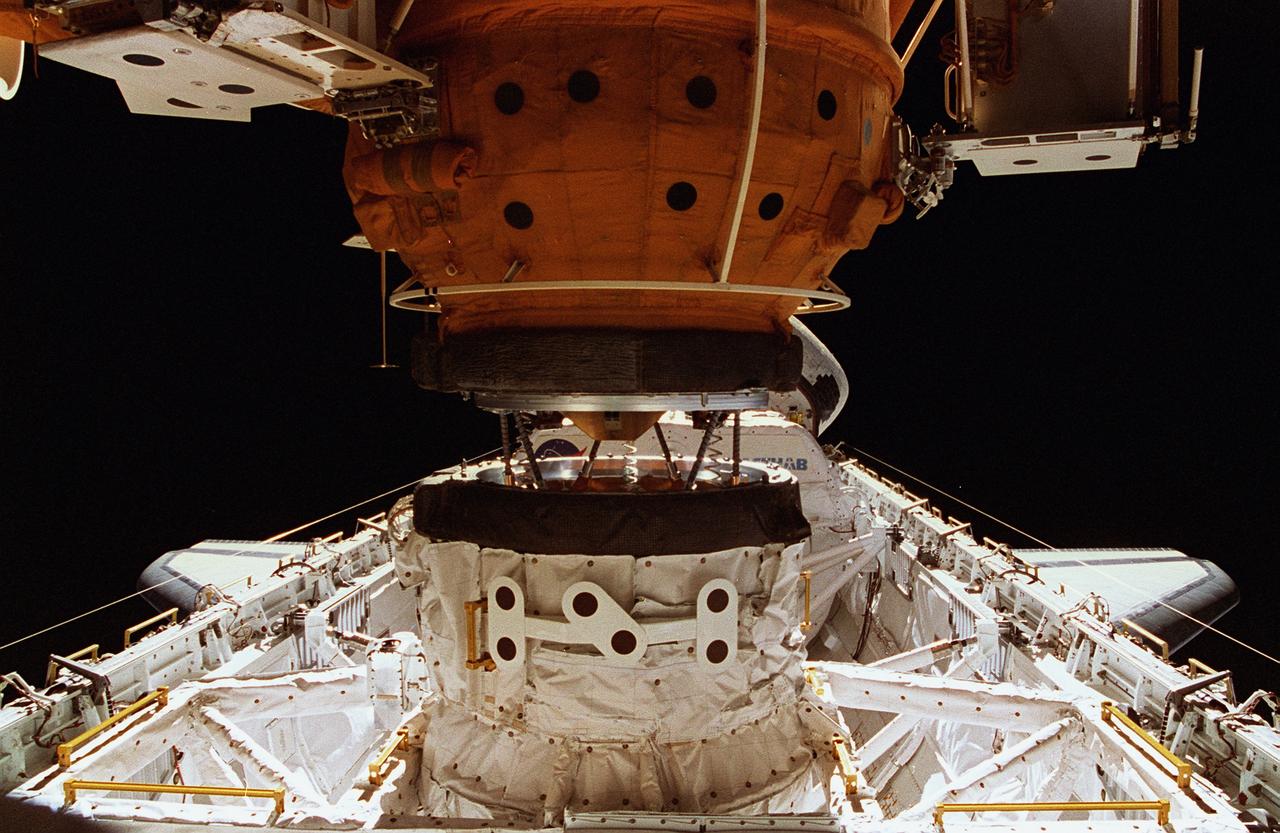
KENNEDY SPACE CENTER, FLA. -   Workers in the Payload Changeout Room (PCR) at Launch Pad 39A are preparing to close the payload doors for flight on the Space Shuttle Atlantis, targeted for liftoff on Mission STS-79 around Sept. 12.  The SPACEHAB Double Module located in the aft area of the payload bay is filled with supplies and other items slated for transfer to the Russian Space Station Mir. STS-79 marks the second flight of a SPACEHAB in support of the Shuttle-Mir dockings, and the first flight of the double-module configuration.  The SPACEHAB is connected by tunnel to the Orbiter Docking System (ODS), with the Androgynous Peripheral Docking System (APDS) clearly visible on top of the ODS. The APDS provides the docking interface for the linkup with Mir, while the ODS provides a passageway from the orbiter to the Russian space station and the SPACEHAB.
KENNEDY SPACE CENTER, FLA. - Workers in the Payload Changeout Room (PCR) at Launch Pad 39A are preparing to close the payload doors for flight on the Space Shuttle Atlantis, targeted for liftoff on Mission STS-79 around Sept. 12. The SPACEHAB Double Module located in the aft area of the payload bay is filled with supplies and other items slated for transfer to the Russian Space Station Mir. STS-79 marks the second flight of a SPACEHAB in support of the Shuttle-Mir dockings, and the first flight of the double-module configuration. The SPACEHAB is connected by tunnel to the Orbiter Docking System (ODS), with the Androgynous Peripheral Docking System (APDS) clearly visible on top of the ODS. The APDS provides the docking interface for the linkup with Mir, while the ODS provides a passageway from the orbiter to the Russian space station and the SPACEHAB.
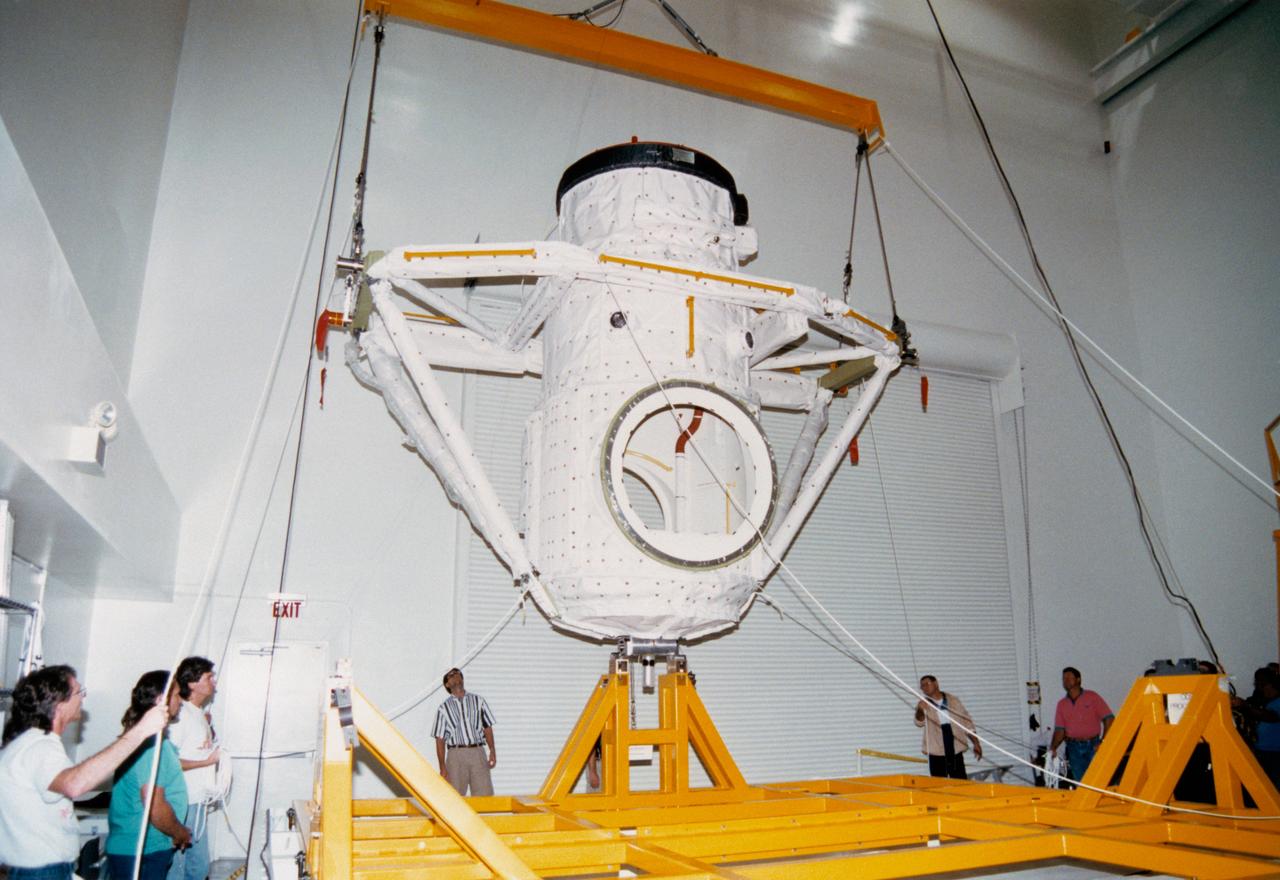
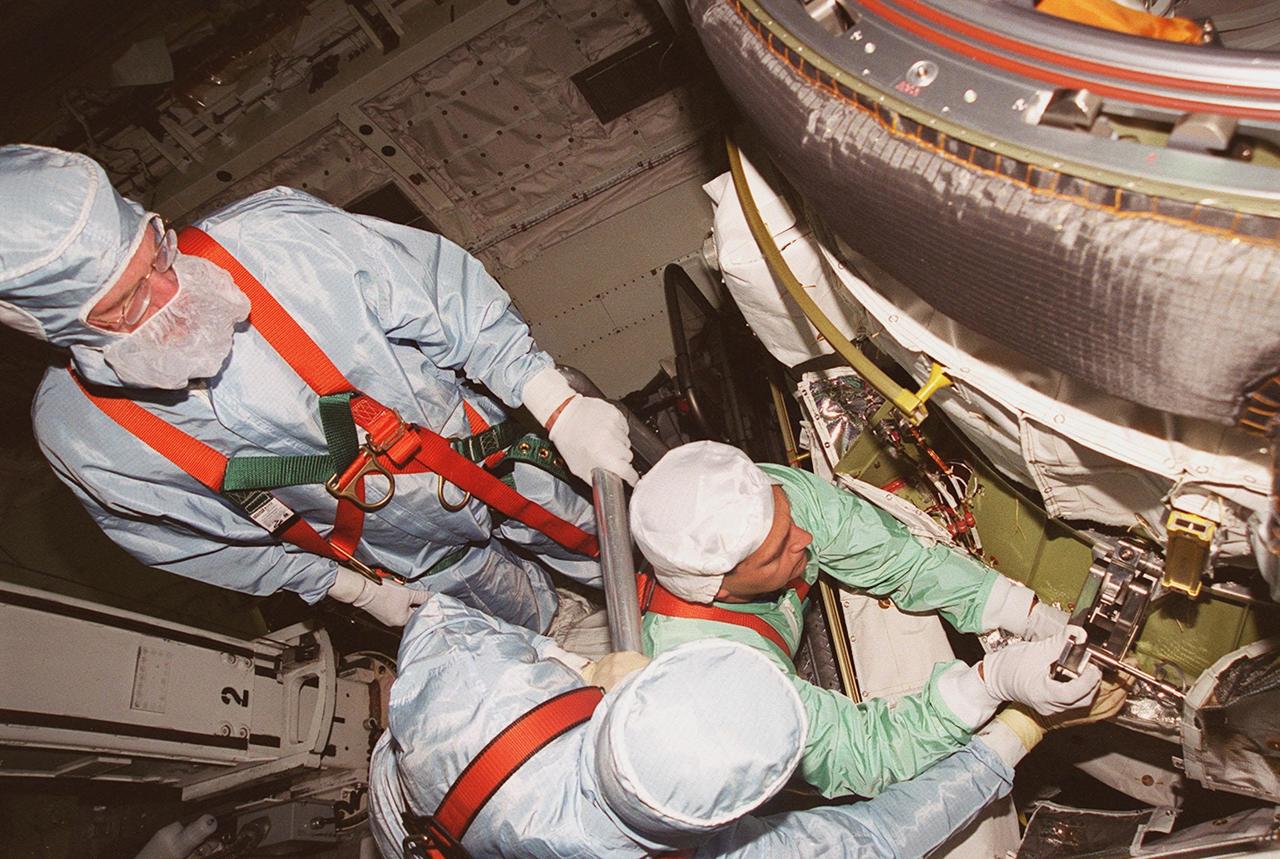
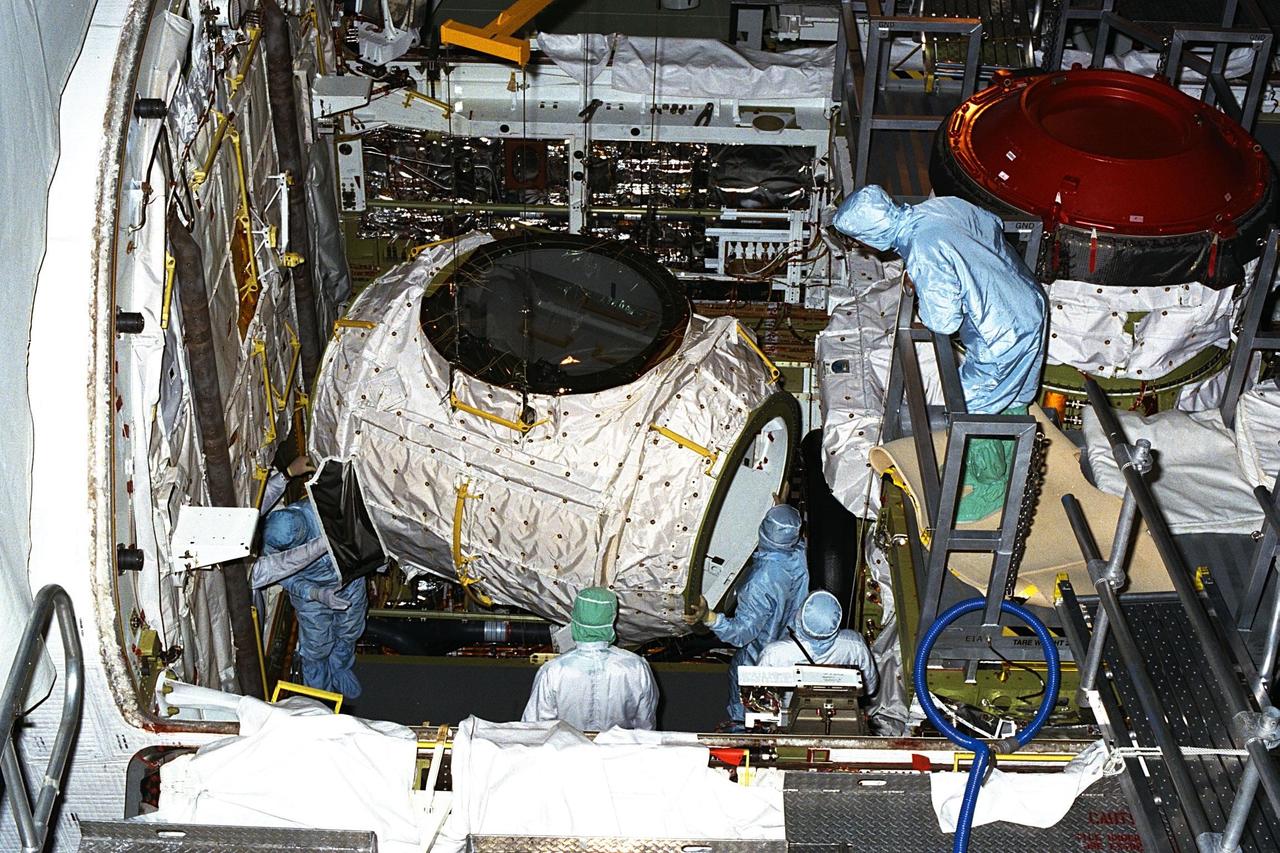
S94-47810 (2 Dec. 1994) --- Lockheed Space Operations Company workers in the Extended Duration Orbiter (EDO) Facility, located inside the Vehicle Assembly Building (VAB), carefully hoist the Orbiter Docking System (ODS) from its shipping container into a test stand. The ODS was shipped in a horizontal position to the Kennedy Space Center (KSC) from contractor Rockwell Aerospace's Downey plant.  Once the ODS is upright, work can continue to prepare the hardware for the first docking of the United States Space Shuttle and Russian Space Station MIR in 1995. The ODS contains both United States-made and Russian-made hardware. The black band is Russian-made thermal insulation protecting part of the docking mechanism, also Russian-made, called the Androgynous Peripheral Docking System (APDS). A red protective cap covers the APDS itself. Other elements of the ODS, most of it protected by white United States-made thermal insulation, were developed by Rockwell, which also integrated and checked out the assembled Russian-United States system.
STS-71 hardware assembly view
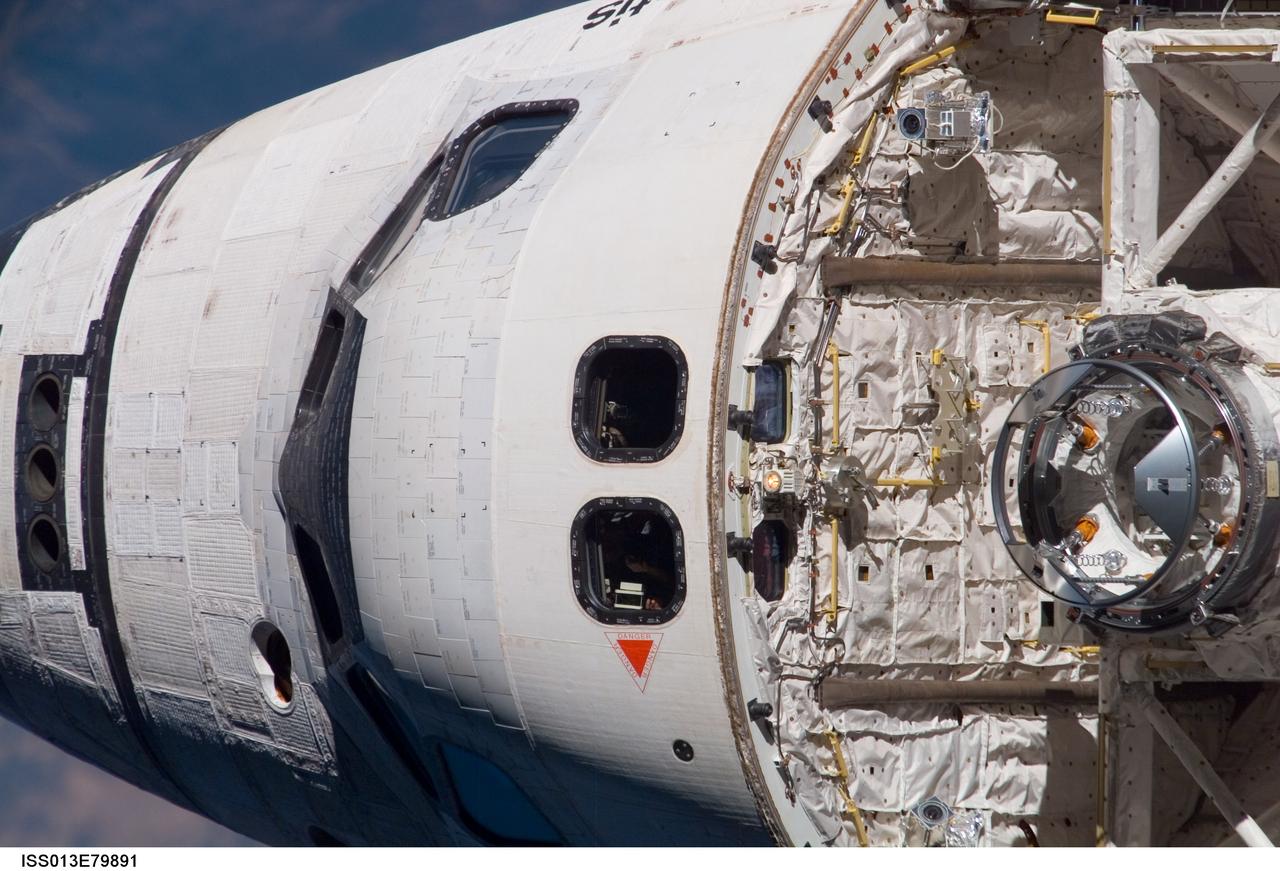
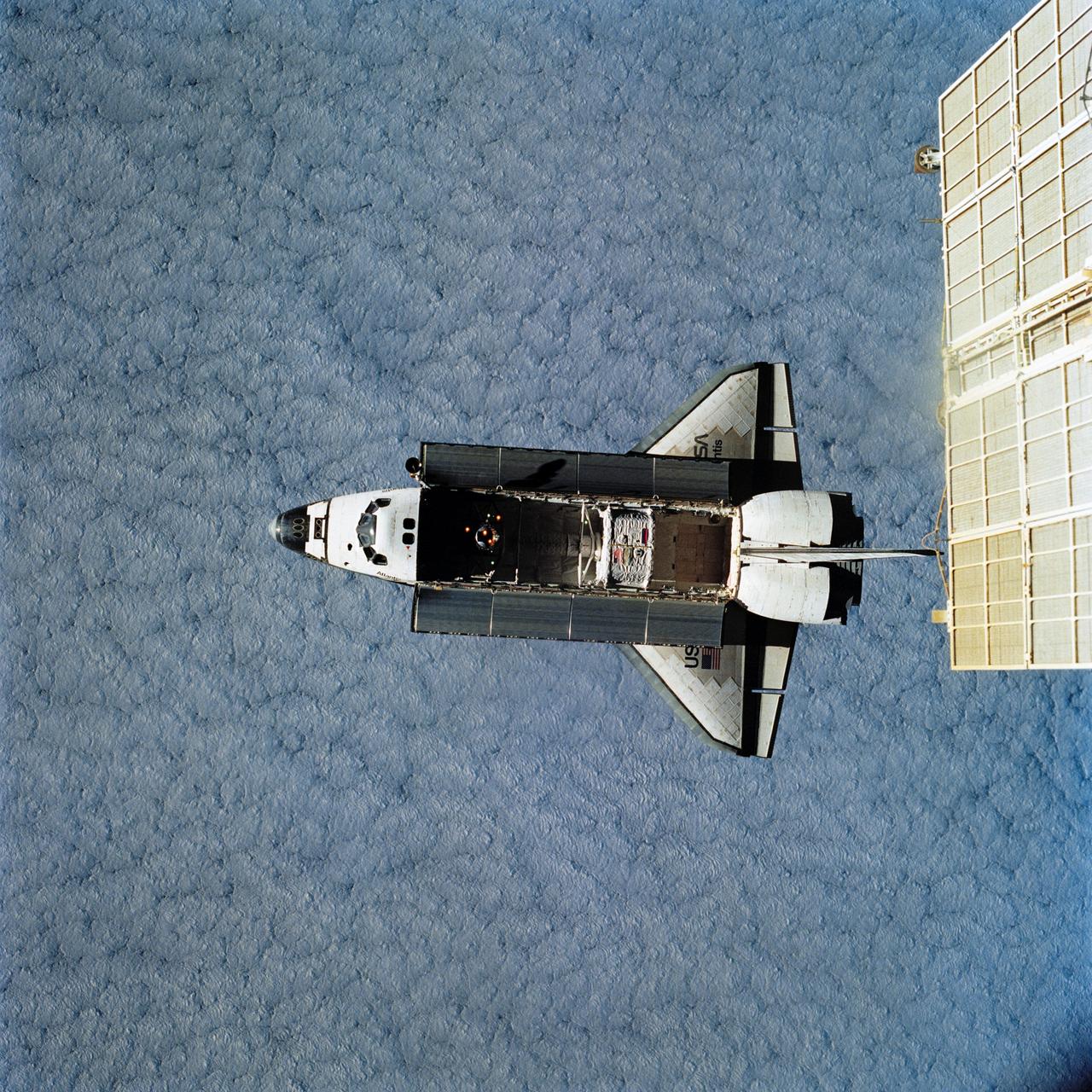
ISS013-E-79891 (11 Sept. 2006) --- This overhead image of the Space Shuttle Atlantis, recorded by a crewmember onboard the International Space Station, gives an excellent view of the top of the crew cabin and the orbiter docking system (ODS, right edge of frame). The ODS was instrumental a short while later in enabling the two spacecraft to link up for several days of joint activities for the respective crews, including the resumption of the construction of the space station.
Mapping sequence performed during the STS-115 R-Bar Pitch Maneuver
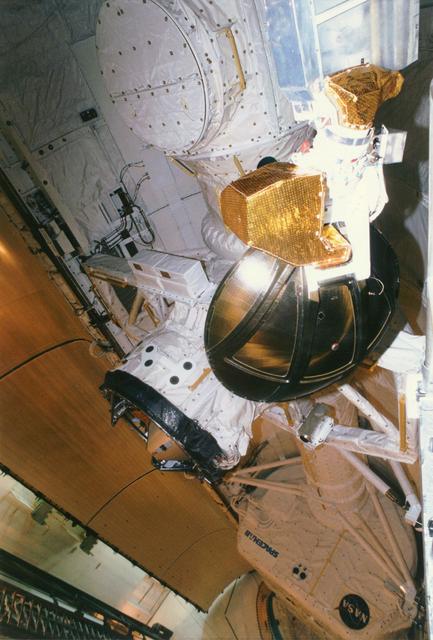
KENNEDY SPACE CENTER, FLA. -  The orbiter Ku-band antenna looms large in this view of the Space Shuttle Atlantis' payload bay.  Visible just past the antenna system - stowed on the starboard side of the payload bay wall - is the Orbiter Docking System (ODS), and connected to the ODS via a tunnel is the Spacehab Double Module in the aft area of the payload bay.  This photograph was taken from the starboard wing platform on the fifth level of the Payload Changeout Room (PCR) at Launch Pad 39A.  Work is under way in the PCR to close Atlantis' payload bay doors for flight.  Atlantis currently is being targeted for liftoff on Mission STS-79, the fourth docking of the U.S. Shuttle to the Russian Space Station Mir, around Sept. 12.
KENNEDY SPACE CENTER, FLA. - The orbiter Ku-band antenna looms large in this view of the Space Shuttle Atlantis' payload bay. Visible just past the antenna system - stowed on the starboard side of the payload bay wall - is the Orbiter Docking System (ODS), and connected to the ODS via a tunnel is the Spacehab Double Module in the aft area of the payload bay. This photograph was taken from the starboard wing platform on the fifth level of the Payload Changeout Room (PCR) at Launch Pad 39A. Work is under way in the PCR to close Atlantis' payload bay doors for flight. Atlantis currently is being targeted for liftoff on Mission STS-79, the fourth docking of the U.S. Shuttle to the Russian Space Station Mir, around Sept. 12.
KENNEDY SPACE CENTER, FLA. -   Workers in the Payload Changeout Room (PCR) at Launch Pad 39A are preparing to close the payload doors for flight on the Space Shuttle Atlantis, targeted for liftoff on Mission STS-79 around Sept. 12.  The payloads in Atlantis' cargo bay will play key roles during the upcoming spaceflight, which will be highlighted by the fourth docking between the U.S. Shuttle and Russian Space Station Mir.  Located in the aft (lowermost) area of the payload bay is the SPACEHAB Double Module, filled with supplies and other items slated for transfer to the Russian Space Station Mir as well as research equipment.  The SPACEHAB is connected by tunnel to the Orbiter Docking System (ODS).  This view looks directly at the top of the ODS and shows clearly the Androgynous Peripheral Docking System (APDS) that interfaces with the Docking Module on Mir to achieve a linkup.
KENNEDY SPACE CENTER, FLA. - Workers in the Payload Changeout Room (PCR) at Launch Pad 39A are preparing to close the payload doors for flight on the Space Shuttle Atlantis, targeted for liftoff on Mission STS-79 around Sept. 12. The payloads in Atlantis' cargo bay will play key roles during the upcoming spaceflight, which will be highlighted by the fourth docking between the U.S. Shuttle and Russian Space Station Mir. Located in the aft (lowermost) area of the payload bay is the SPACEHAB Double Module, filled with supplies and other items slated for transfer to the Russian Space Station Mir as well as research equipment. The SPACEHAB is connected by tunnel to the Orbiter Docking System (ODS). This view looks directly at the top of the ODS and shows clearly the Androgynous Peripheral Docking System (APDS) that interfaces with the Docking Module on Mir to achieve a linkup.
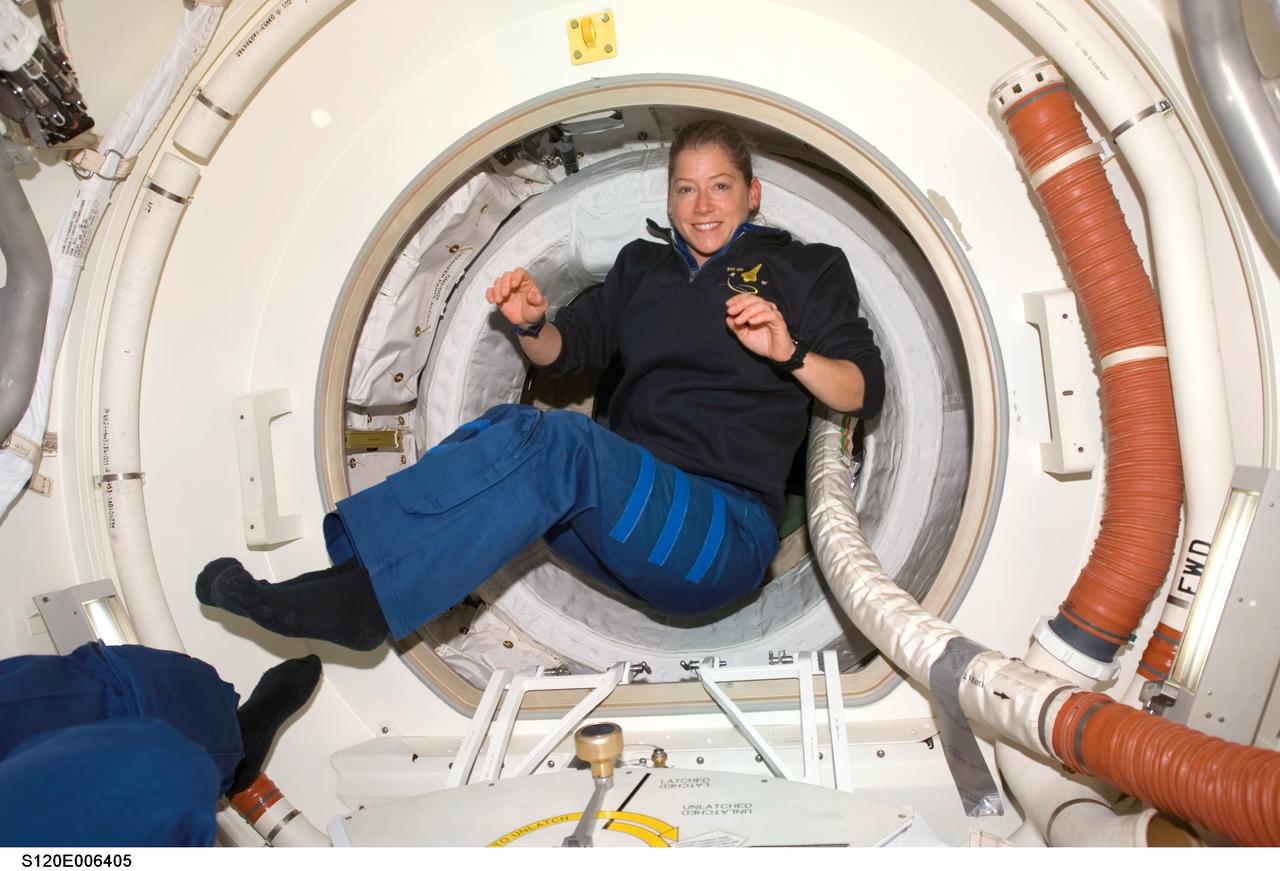
S120-E-006405 (25 Oct. 2007) --- Astronaut Pam Melroy, STS-120 commander, floats in the Orbiter Docking Compartment (ODS) after hatch opening between the International Space Station and Space Shuttle Discovery.
Melroy in the Orbiter Docking Compartment (ODC)
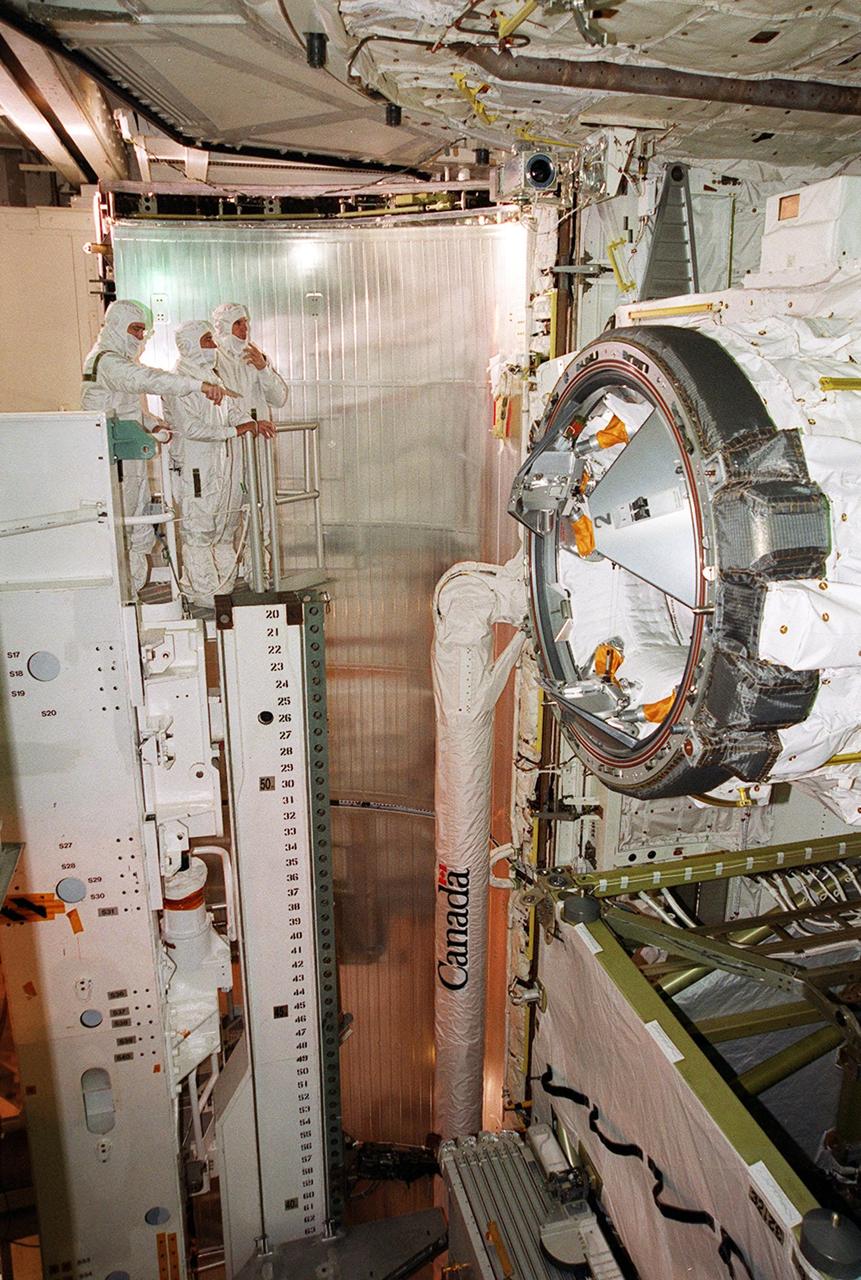
Members of the STS-97 crew look into Endeavour’s payload bay at some of the equipment that will be carried on the mission. On the left, pointing, is Mission Specialist Marc Garneau. Next to him (left to right) are Mission Specialist Carlos Noriega and Pilot Michael Bloomfield. At right center of the photo is the orbiter docking system (ODS). At left and below the ODS is the Canadian robotic arm that will be used during spacewalks on the mission to install solar arrays. Each more than 100 feet long, the arrays will capture energy from the sun and convert it to power for the Station. STS-97 is scheduled to launch Nov. 30 at about 10:06 p.m. EST
KSC-00pp1749
Members of the STS-97 crew look into Endeavour’s payload bay at some of the equipment that will be carried on the mission. At far left are (left to right) Commander Brent Jett and Mission Specialist Joseph Tanner, with a technician. At center are Mission Specialists Marc Garneau and Carlos Noriega, plus Pilot Michael Bloomfield. The equipment visible at right are the orbiter docking system (ODS) (center) and Canadian robotic arm (left and below the ODS). The arm will be used during spacewalks on the mission to install solar arrays. Each more than 100 feet long, the arrays will capture energy from the sun and convert it to power for the Station. STS-97 is scheduled to launch Nov. 30 at about 10:06 p.m. EST
KSC-00pp1750
From the payload changeout room on Launch Pad 39B, STS-97 Mission Specialists Joseph Tanner and Marc Garneau (pointing) look over the payload in Endeavour’s payload bay. At right center of the photo is the orbiter docking system (ODS). At left and below the ODS is the Canadian robotic arm that will be used during spacewalks on the mission to install solar arrays. Each more than 100 feet long, the arrays will capture energy from the sun and convert it to power for the Station. STS-97 is scheduled to launch Nov. 30 at about 10:06 p.m. EST
KSC-00pp1752
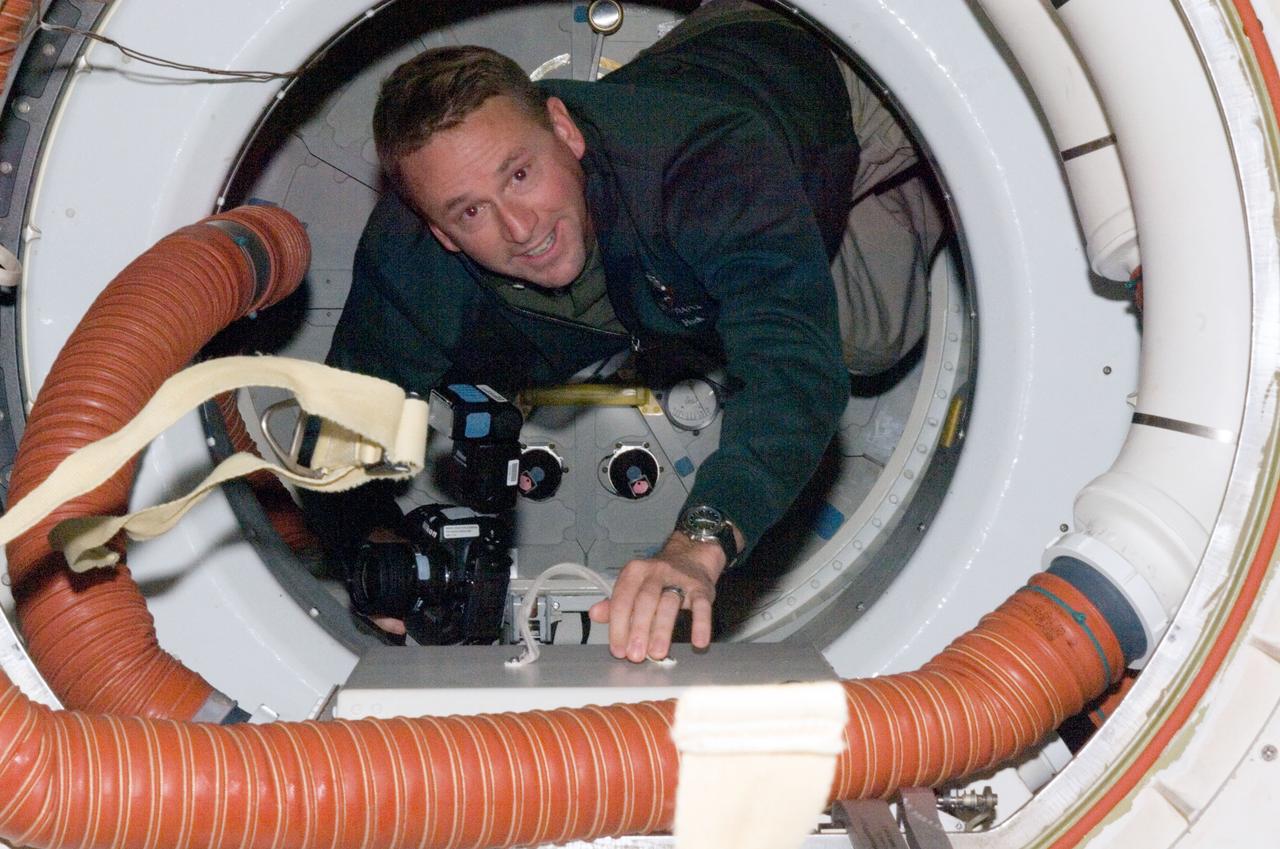
S124-E-007747 (9 June 2008) --- Astronaut Ken Ham, STS-124 pilot, holds a still camera as he moves through Space Shuttle Discovery's orbiter docking system while docked with the International Space Station.
Ham in ODS
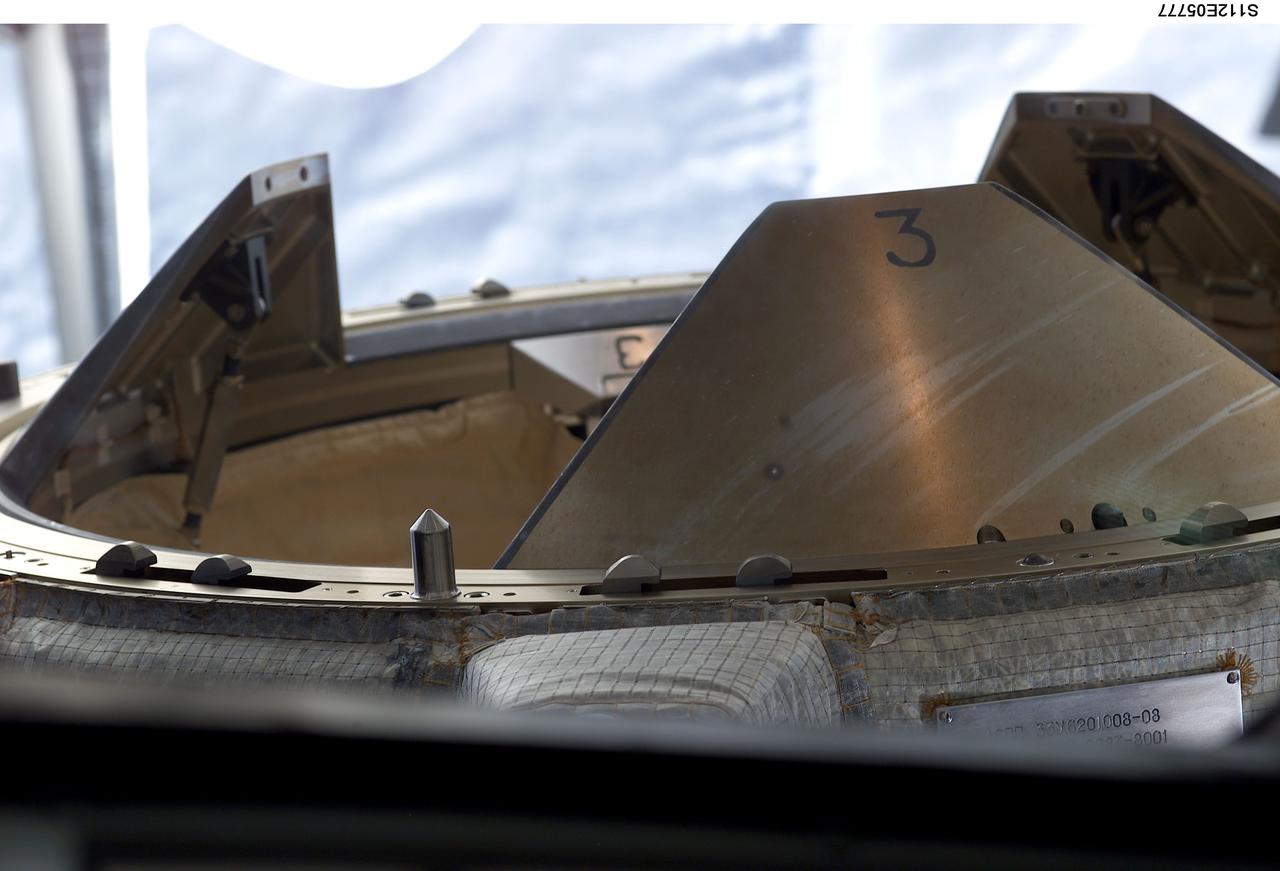
STS112-E-05777 (16 Oct. 2002) --- Close-up view of the Orbiter Docking System (ODS) Androgynous Peripheral Attachment System (APAS) petals extended in the STS-112 orbiter Atlantis payload bay after undocking with the International Space Station.
APAS with petals extended after undocking
KENNEDY SPACE CENTER, FLA. -- In Orbiter Processing Facility (OPF) bay 2 during Crew Equipment Interface Test (CEIT), members of the STS-97 crew look over the Orbital Docking System (ODS) in Endeavour’s payload bay. At left, standing, is Mission Specialist Joe Tanner. At right is Mission Specialist Carlos Noriega, with his hands on the ODS. The others are workers in the OPF. The CEIT provides an opportunity for crew members to check equipment and facilities that will be on board the orbiter during their mission. The STS-97 mission will be the sixth construction flight to the International Space Station. The payload includes a photovoltaic (PV) module, providing solar power to the Station. STS-97 is scheduled to launch Nov. 30 from KSC for the 10-day mission
KSC-00pp1424
KENNEDY SPACE CENTER, FLA. -- In Orbiter Processing Facility (OPF) bay 2 during Crew Equipment Interface Test (CEIT), members of the STS-97 crew look over the Orbital Docking System (ODS) in Endeavour’s payload bay. At left, standing, is Mission Specialist Joe Tanner. At right is Mission Specialist Carlos Noriega, with his hands on the ODS. The others are workers in the OPF. The CEIT provides an opportunity for crew members to check equipment and facilities that will be on board the orbiter during their mission. The STS-97 mission will be the sixth construction flight to the International Space Station. The payload includes a photovoltaic (PV) module, providing solar power to the Station. STS-97 is scheduled to launch Nov. 30 from KSC for the 10-day mission
KSC00pp1424
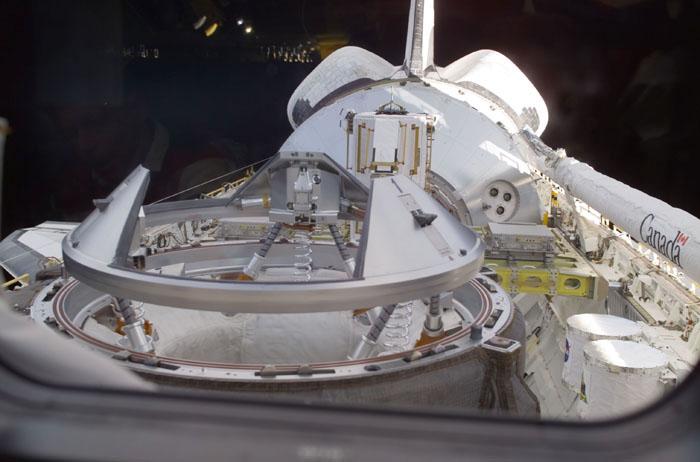
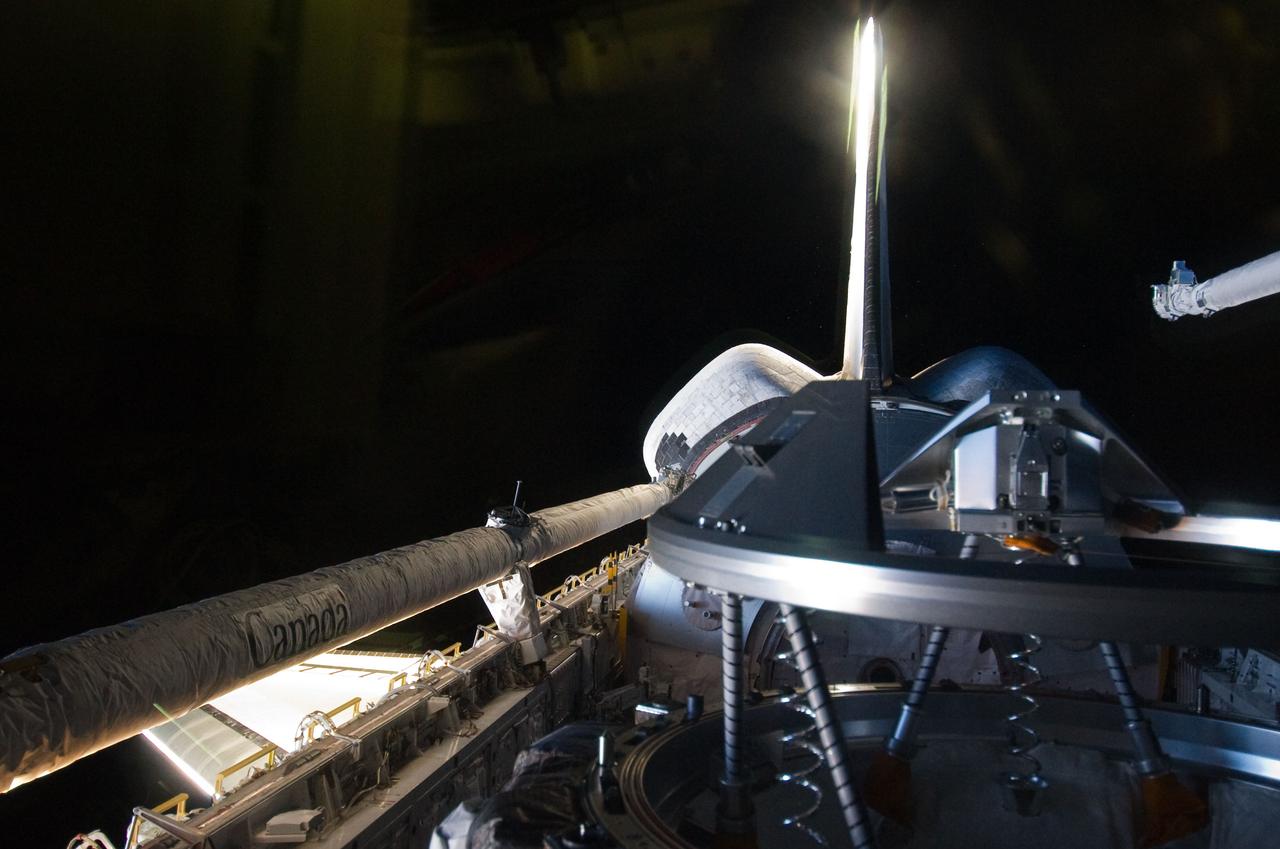
S135-E-007101 (10 July 2011) --- This picture of Atlantis' payload bay, focusing on the docking mechanism, was photographed by one of four STS-135 crewmembers inside the crew cabin.  The orbiter boom sensor system and a portion of the remote manipulator system's robot arm are visible in the frame, exposed during a busy third day in space for the astronauts. The photo was made shortly before the shuttle docked with the International Space Station.  Photo credit: NASA
Atlantis ODS and Payload Bay
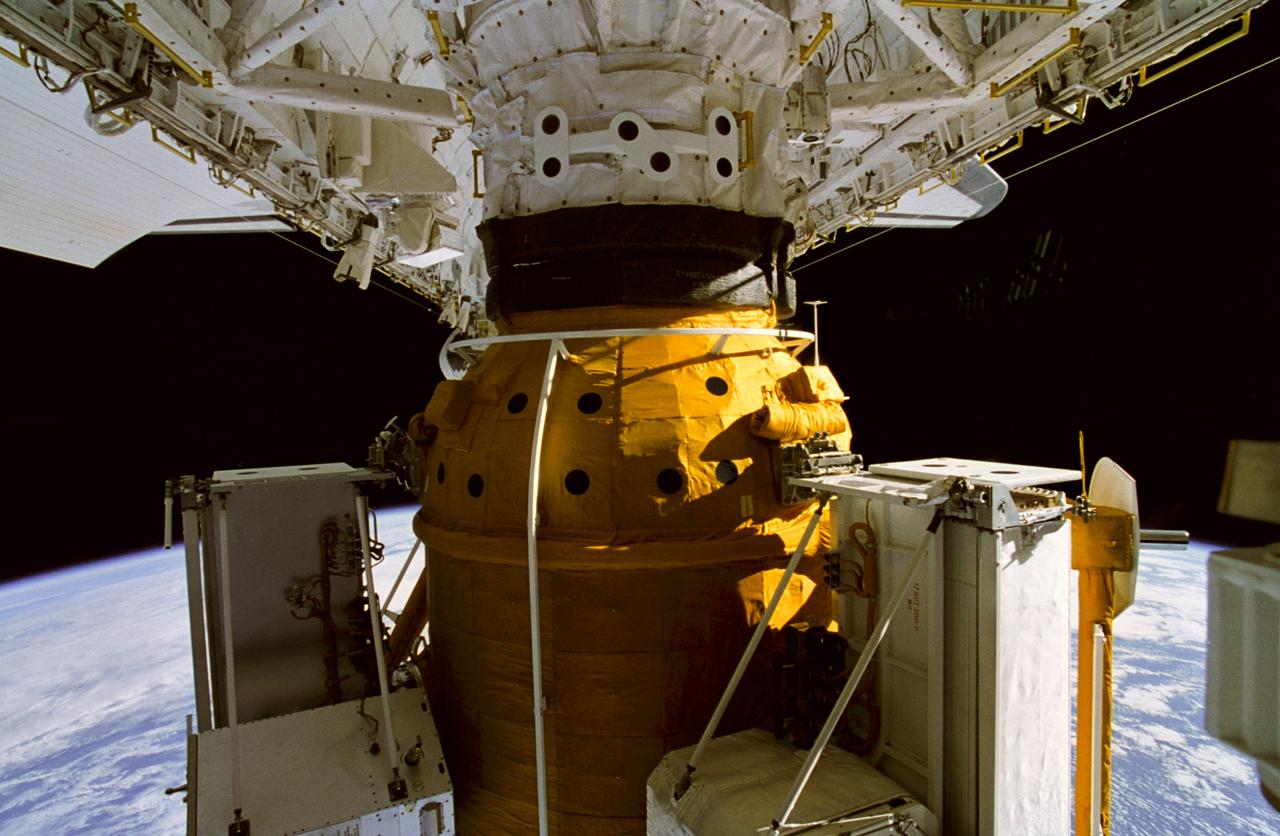
S88-E-5037 (12-05-98)--- Clouds over Asia form the backdrop for this scene of Unity following its successful mating to Endeavour's docking system.  The photo was taken at 23:53:02 GMT, Dec. 5.
Node 1 installed on the ODS
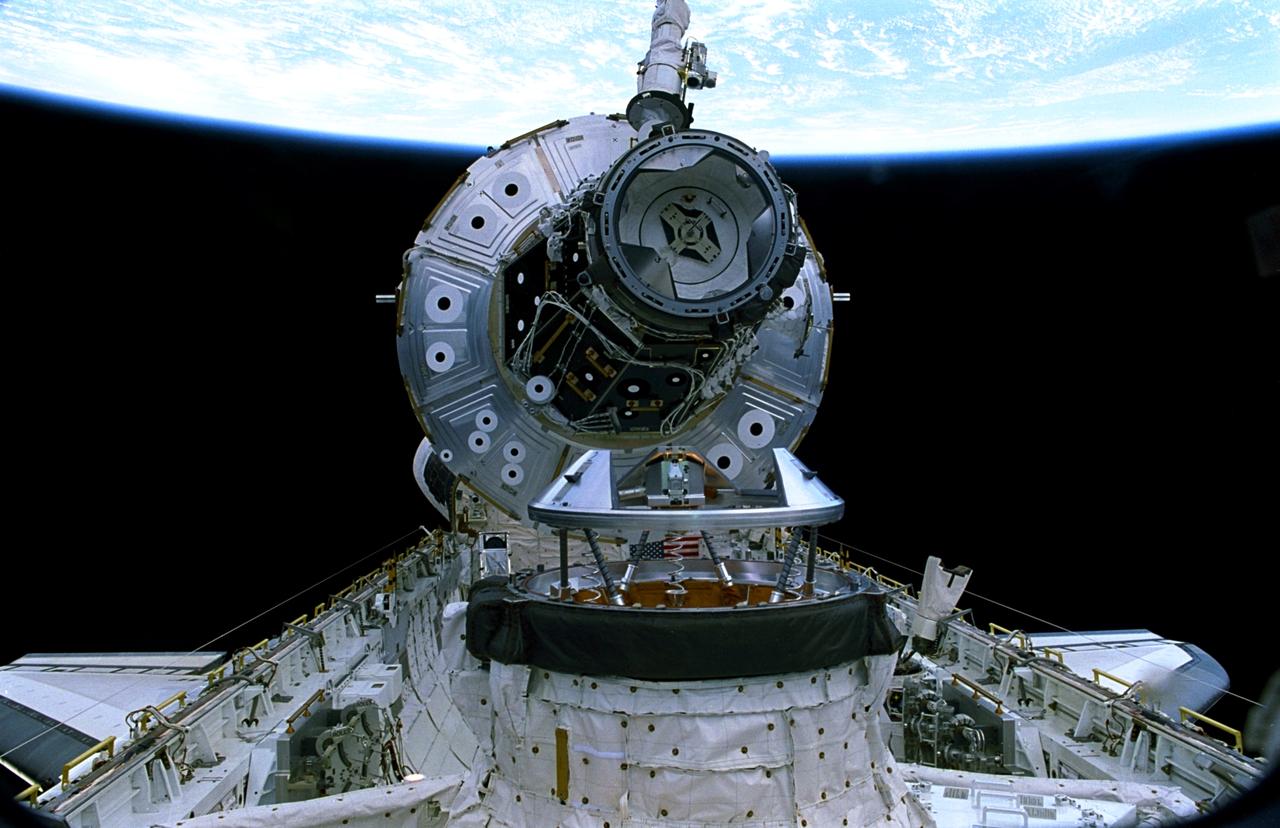
S88-E-5018 (12-05-98) ---  This medium closeup electronic still camera (ESC) photograph shows Endeavour's docking system in the cargo bay. Though partially obscured, Unity can be seen in its stowed position in aft payload pay. The arm of the remote manipulator system (RMS) is seen in its berthed  position on the right. The photo was taken prior to astronaut Nancy Currie's moving of the 12.8-ton Unity connecting module to link it with Endeavour's docking system.  The photo was taken at 09:35:57 GMT, Dec. 5, and downlinked later to flight controllers in Houston.
ODS docking ring extension
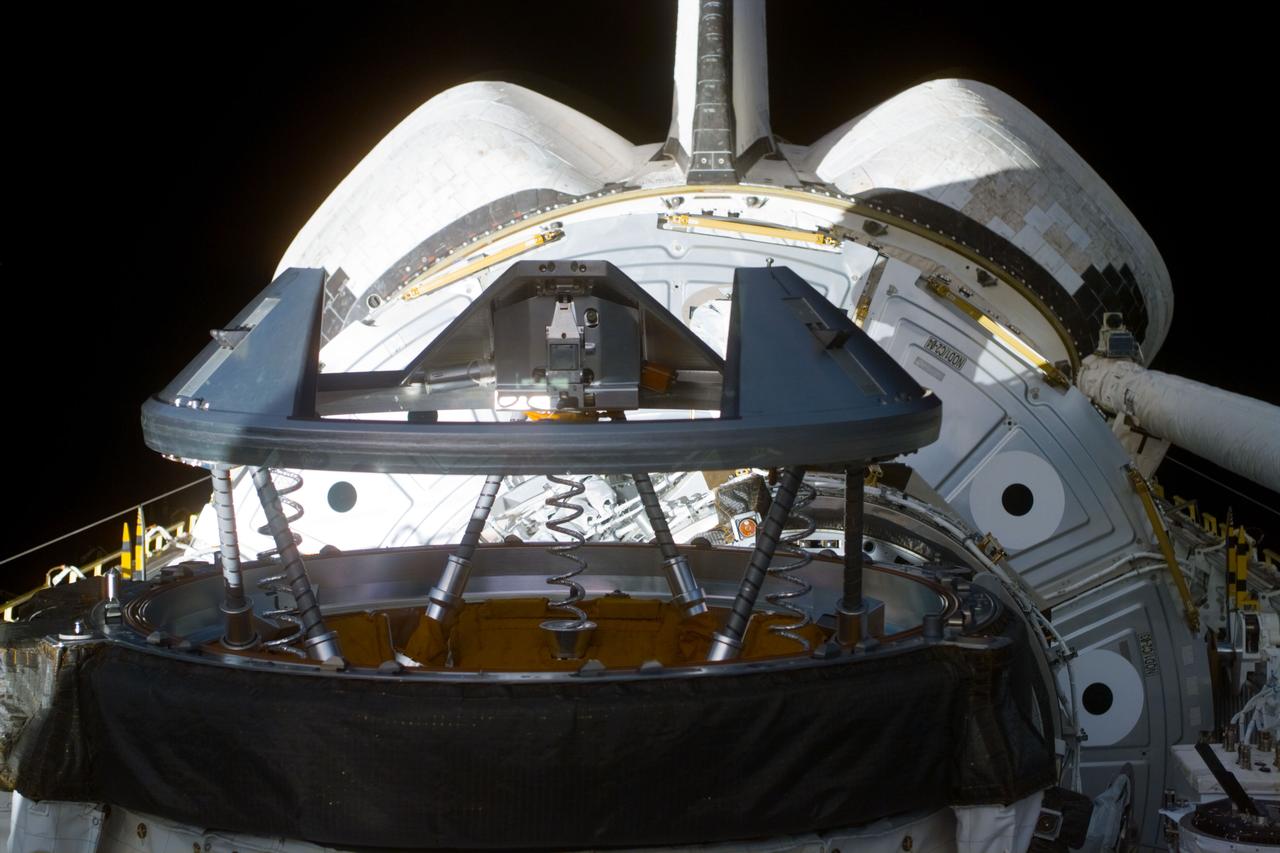
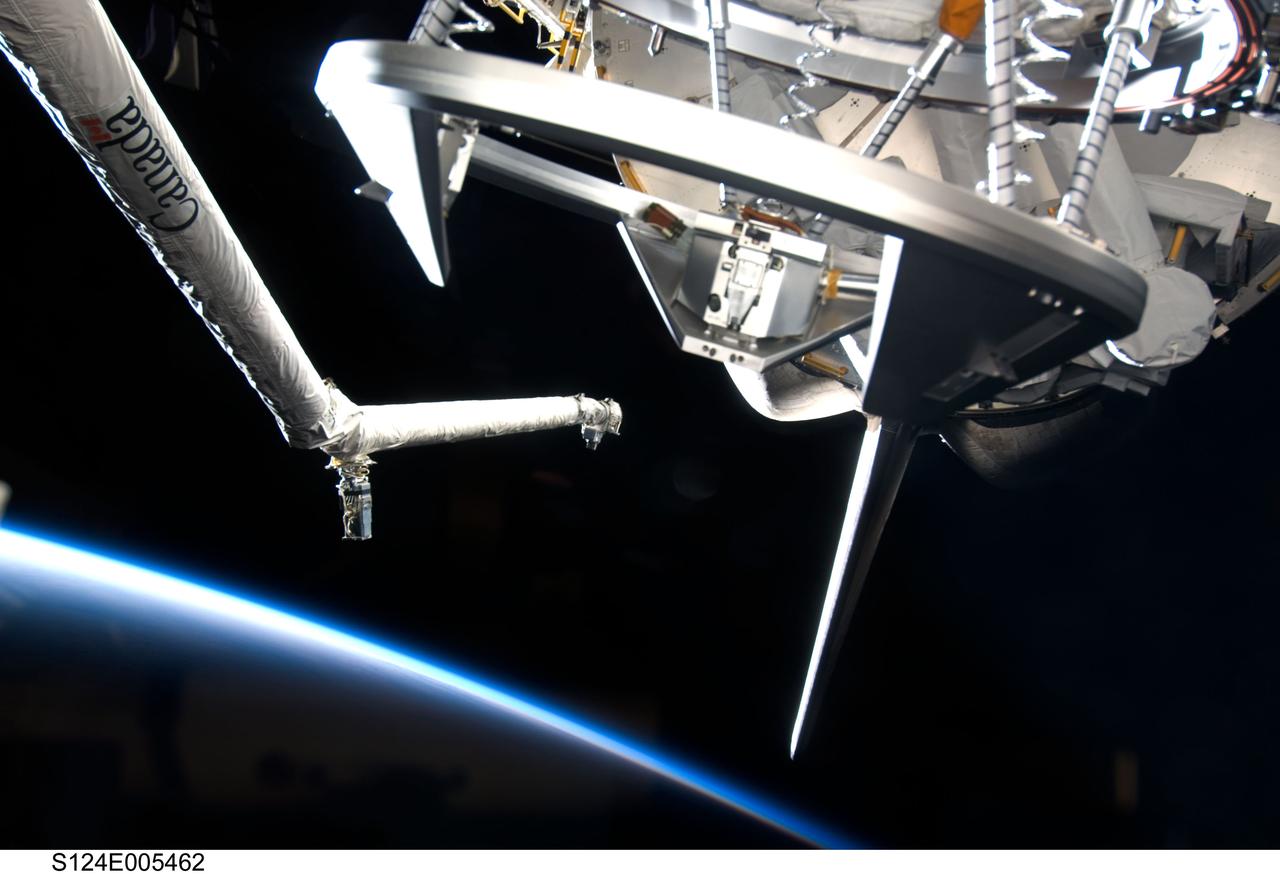
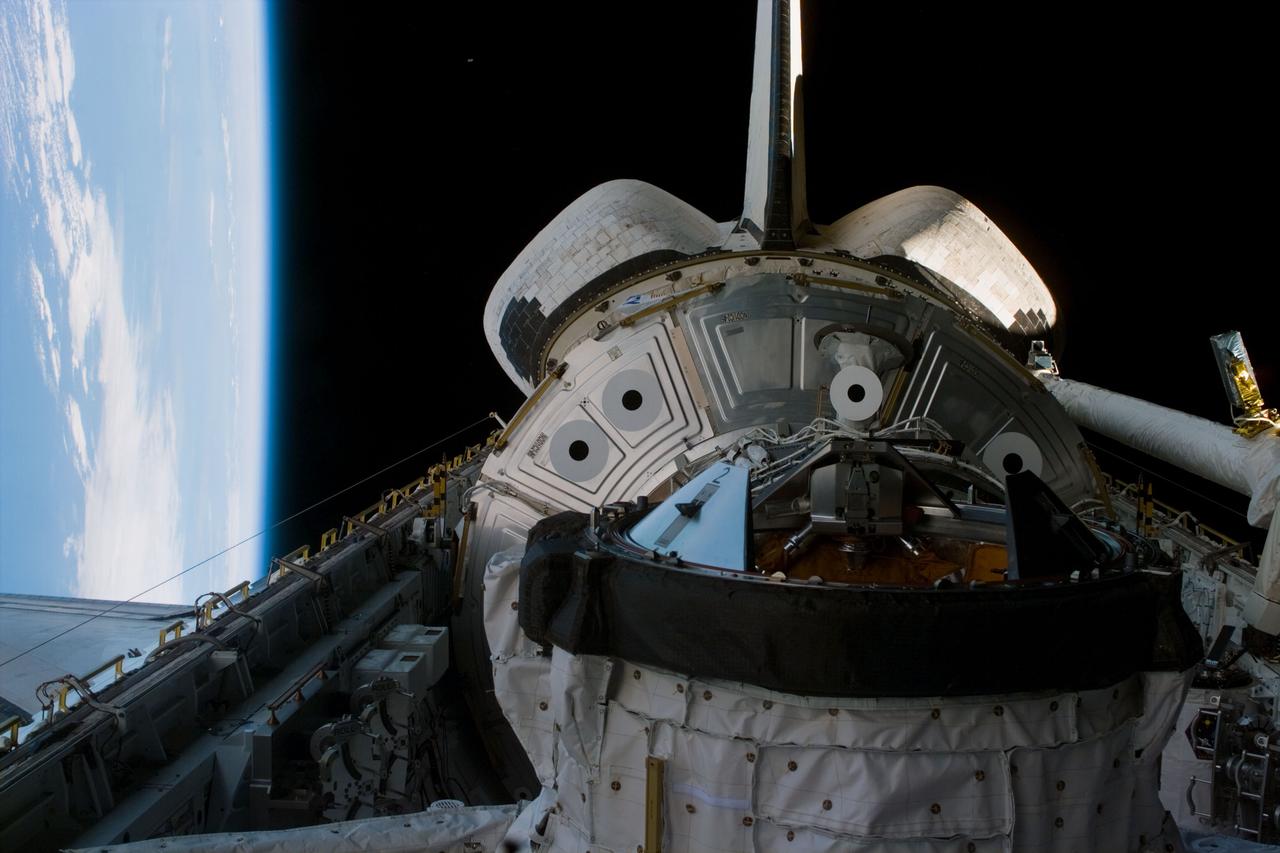
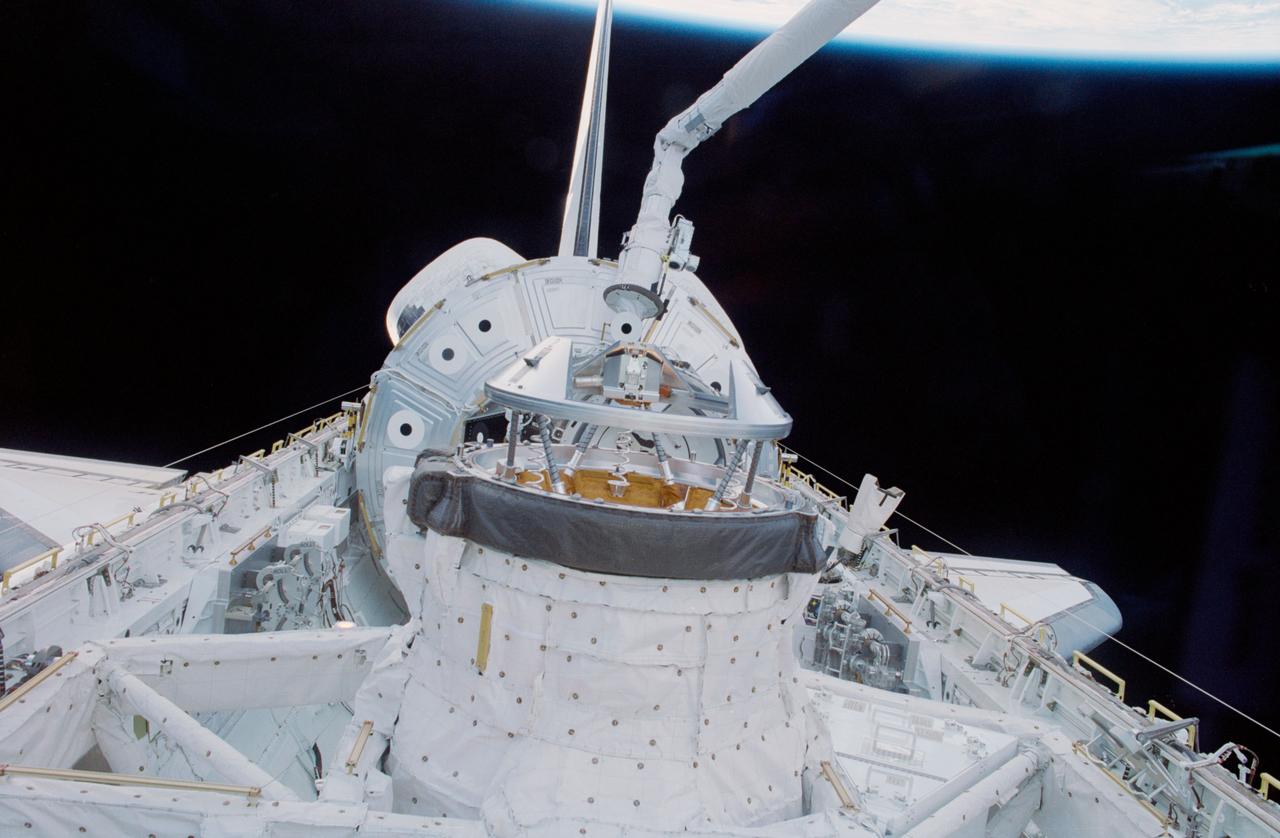
S124-E-005462 (1 June 2008) --- Space Shuttle Discovery's Remote Manipulator System (RMS), docking mechanism, vertical stabilizer and orbital maneuvering system (OMS) pods are featured in this image photographed by a STS-124 crewmember during flight day two activities. The blackness of space and Earth's horizon provide the backdrop for the scene.
ODS in payload bay
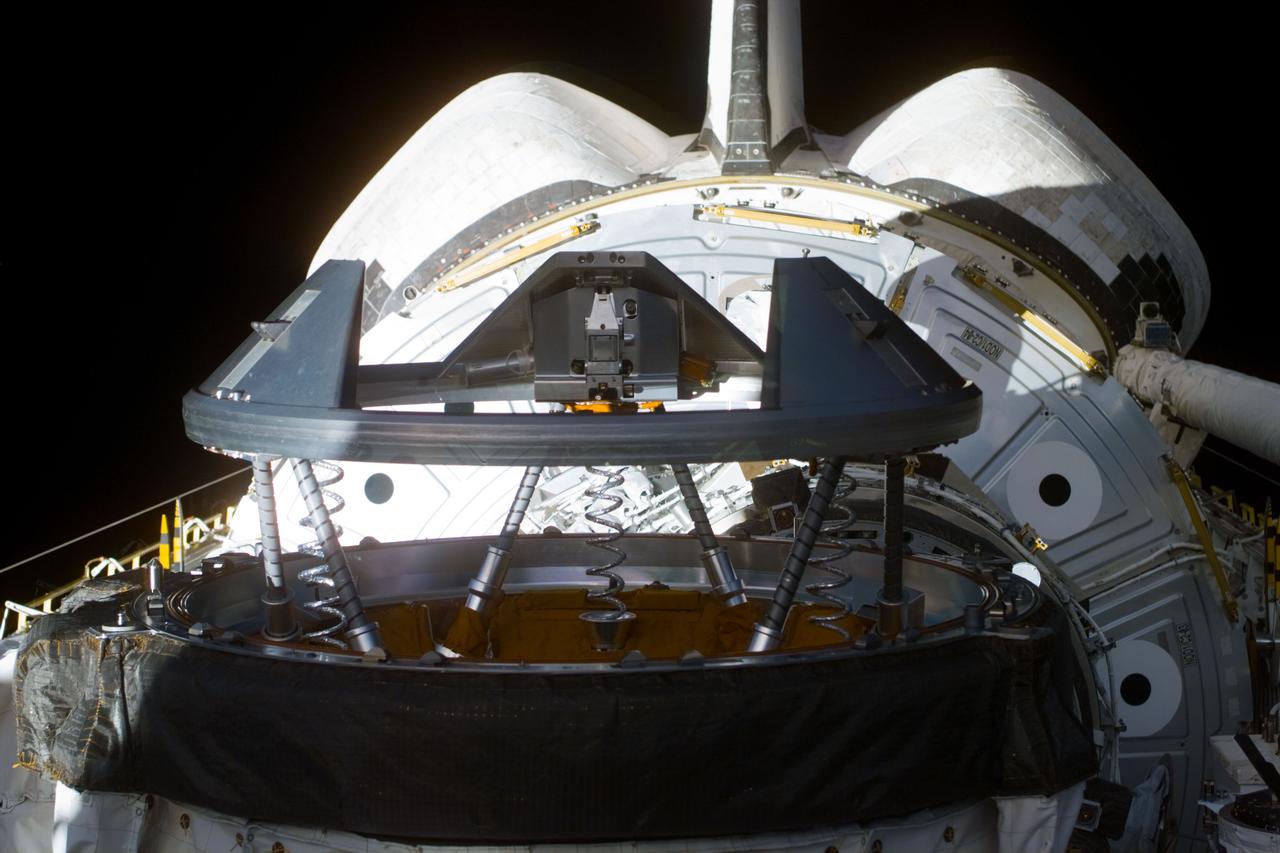
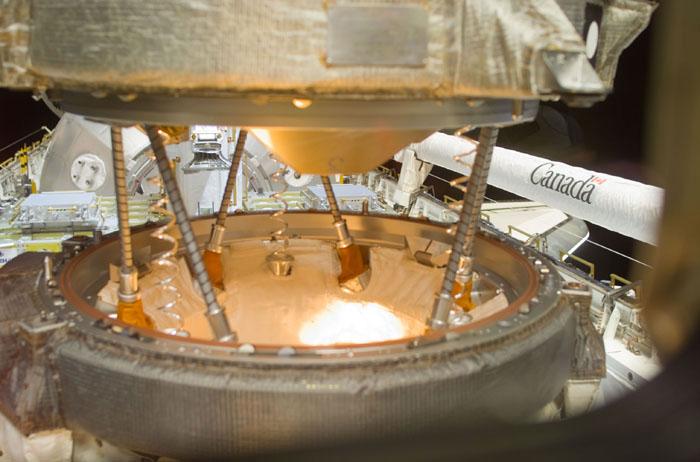
STS105-E-5018 (11 August 2001) --- One of the STS-105 crew members on the flight deck of the Earth-orbiting Space Shuttle Discovery used a digital still camera to record this image of the Orbiter Docking System's docking mechanism in the cargo bay. The shuttle's Canadarm or Remote Manipulator System (RMS) arm is in its stowed position on the port side.
ODS in the payload bay
S88-E-5019 (12-05-98) ---  This medium closeup electronic still camera (ESC) photograph shows Endeavour's docking system in the cargo bay. Though partially obscured, Unity can be seen in its stowed position in aft payload pay. The arm of the remote manipulator system (RMS) is seen in its berthed position on the right. The photo was taken prior to astronaut Nancy Currie's moving of the 12.8-ton Unity connecting module to link it with Endeavour's docking system.  The photo was taken at 09:36:33 GMT, Dec. 5, and downlinked later to flight controllers in Houston.
ODS docking ring extension
The tunnel adapter (left) which will be flown on the STS-89 mission is being installed in the Space Shuttle orbiter Endeavour's payload bay in Orbiter Processing Facility bay 1. To the right is the Orbiter Docking System (ODS), with its distinctive red Russian-built Androgynous Peripheral Docking System (APDS). STS-89 will be the eighth U.S. docking mission with the Russian Mir space station. The nine-day space flight is scheduled for launch in mid-January 1998
KSC-97PC1464
The tunnel adapter (left) which will be flown on the STS-89 mission is being installed in the Space Shuttle orbiter Endeavour's payload bay in Orbiter Processing Facility bay 1. To the right is the Orbiter Docking System (ODS), with its distinctive red Russian-built Androgynous Peripheral Docking System (APDS). STS-89 will be the eighth U.S. docking mission with the Russian Mir space station. The nine-day space flight is scheduled for launch in mid-January 1998
KSC-97PC1463
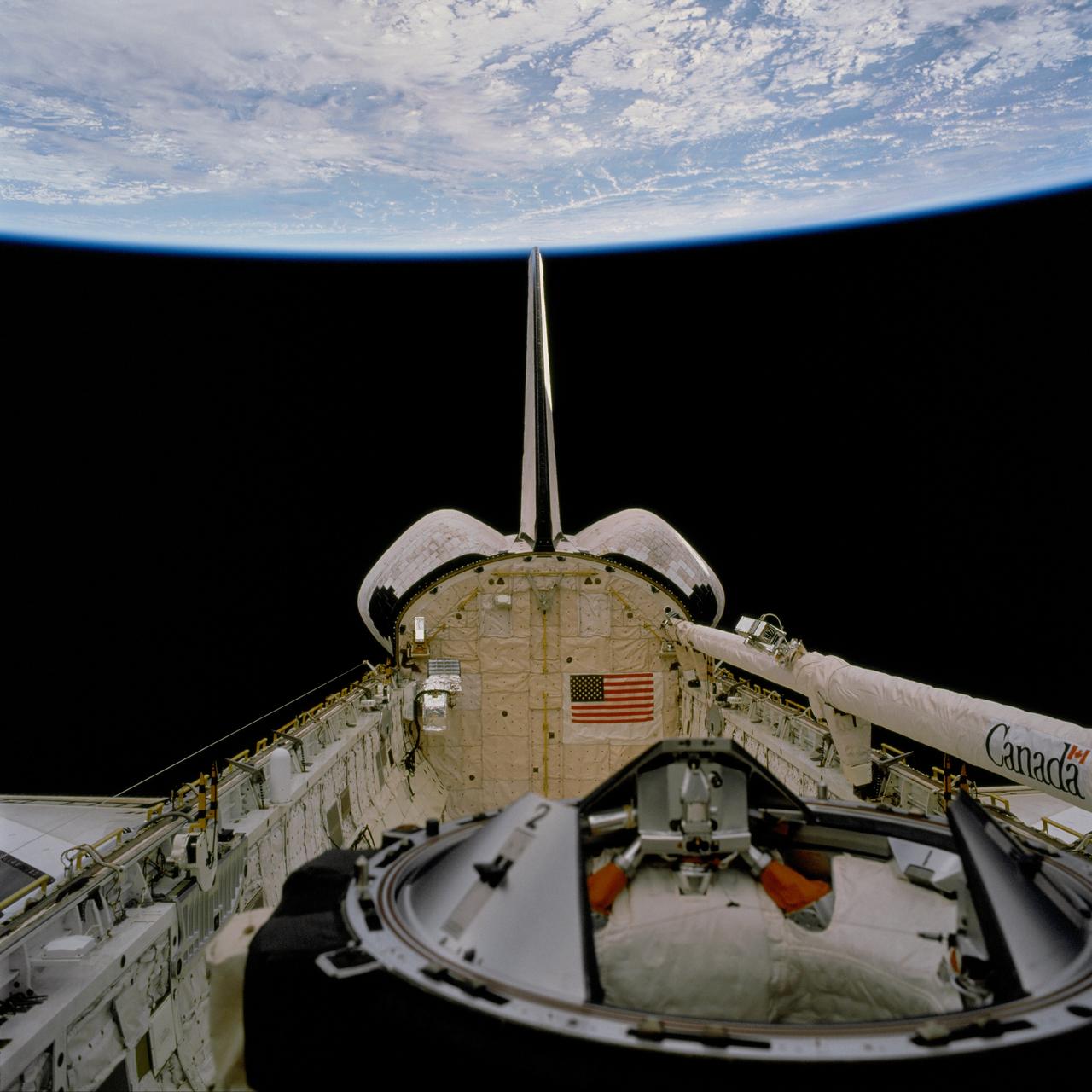
STS097-715-090 (30 Nov.-11 Dec. 2000) --- The horizon of a blue and white Earth and the blackness of space form the backdrop for this view of the cargo bay of the Space Shuttle Endeavour, as seen through windows on the aft flight deck during the STS-97 mission. Pictured in the cargo bay is the Orbital Docking System (ODS) in the foreground. In its stowed position at right center of the frame is the Canadian-built Remote Manipulator System (RMS) arm.
Views of the empty payload bay near the end of the STS-97 mission
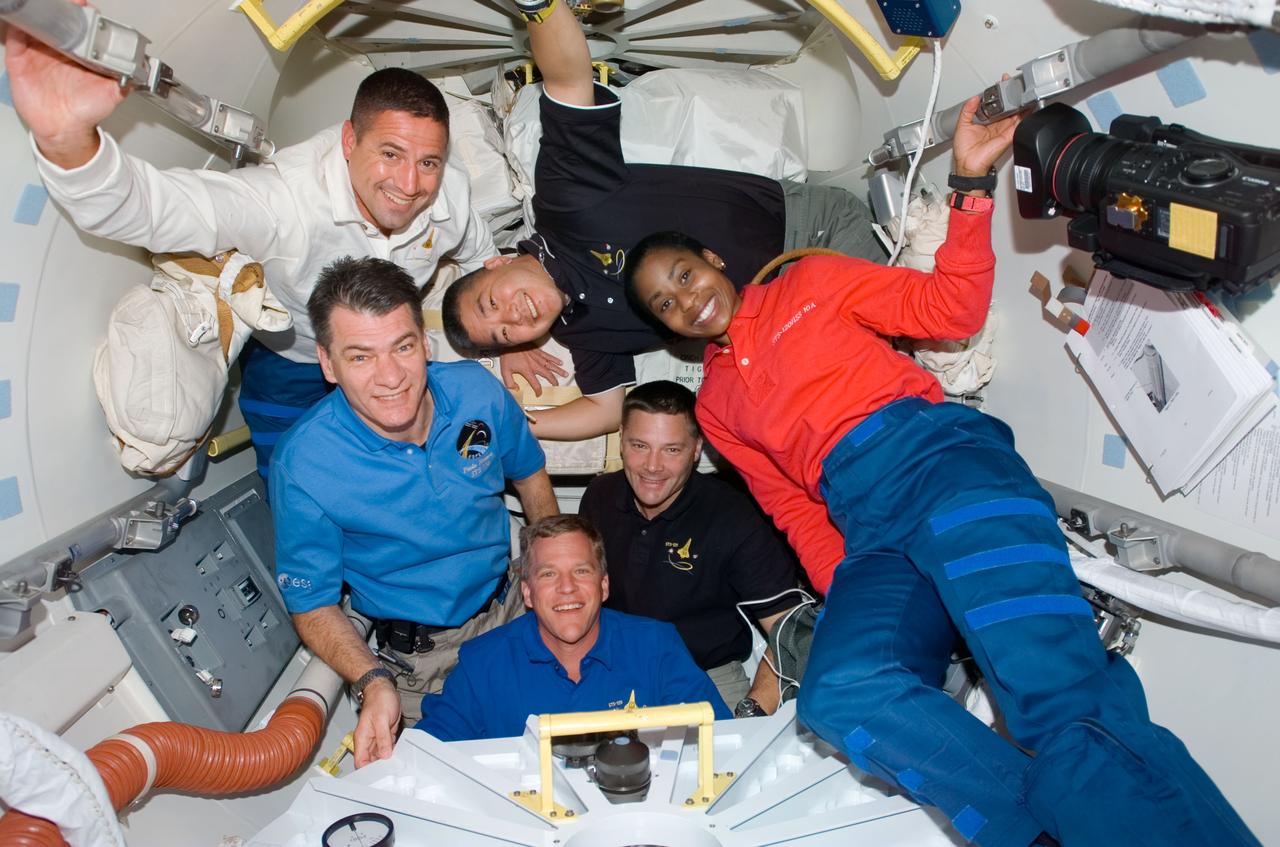
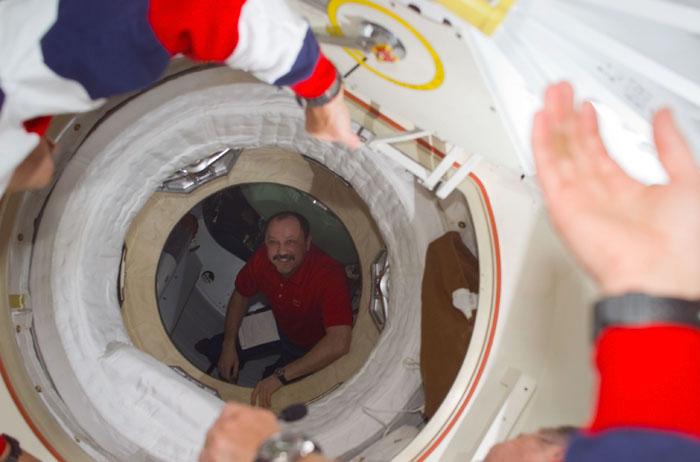
S120-E-006402 (25 Oct. 2007) --- STS-120 crewmembers gather in the Orbiter Docking Compartment (ODS) after hatch opening between the International Space Station and Space Shuttle Discovery. Pictured (clockwise) are astronauts George Zamka (white shirt), pilot; Daniel Tani, Stephanie Wilson, Doug Wheelock, Scott Parazynski and European Space Agency's (ESA) Paolo Nespoli, all mission specialists. Astronaut Pam Melroy, commander, is out of frame.
STS-120 crew in the Orbiter Docking Compartment (ODC)
STS105-E-5094 (12 August 2001) --- Yury V. Usachev of Rosaviakosmos, Expedition Two mission commander, can be seen through the recently opened airlock hatch of Space Shuttle Discovery as he welcomes the STS-105 and Expedition Three crews.  This image was taken with a digital still camera.
Usachev is visible in the open ODS hatch
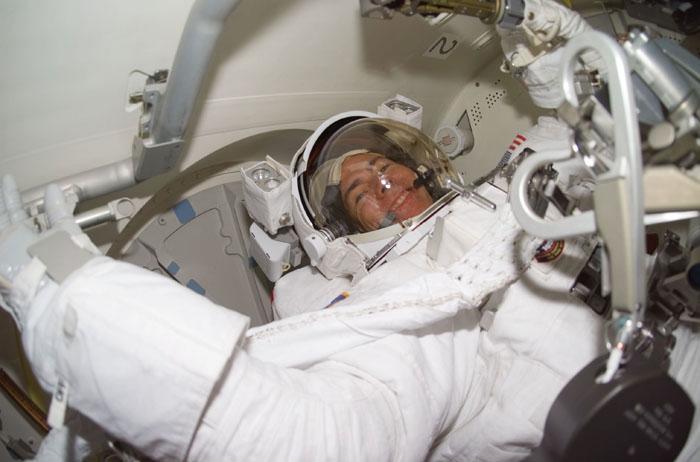
STS105-E-5224 (16 August 2001) --- Astronaut Daniel T. Barry is just about ready to egress the airlock  onboard the Space Shuttle Discovery to begin a lengthy space walk to perform work on the International Space Station (ISS).  The image was recorded with a digital still camera.
EVA preparations inside the ODS airlock
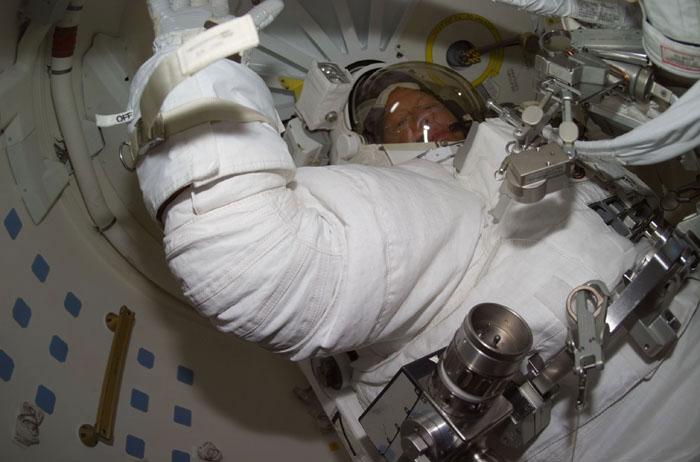
STS105-E-5222 (16 August 2001) --- Astronaut Patrick G. Forrester is just about ready to egress the airlock  onboard the Space Shuttle Discovery to  begin a lengthy space walk to perform work on the International Space Station (ISS).  The image was recorded with a digital still camera.
EVA preparations inside the ODS airlock
STS076-344-003 (24 March 1996) --- The Space Shuttle Atlantis Orbiter Docking System (ODS) and the Docking Module (DM) on Russia's Mir Space Station appear near the center of this frame, as the Atlantis and Mir link in Earth-orbit, at about 160 nautical miles altitude.  The STS-76 crew later diminished by one and the Mir-21 crew grew by one, as astronaut Shannon W. Lucid, mission specialist, went aboard the Mir Space Station and became a cosmonaut guest researcher.  She is scheduled to return to Earth in about 140 days.
View of APAS during docking with Mir Space Station
KENNEDY SPACE CENTER, FLA. -- In Orbiter Processing Facility (OPF) bay 2 during Crew Equipment Interface Test (CEIT), Mission Specialists Joe Tanner (left) and Carlos Noriega (right) practice working parts of the Orbital Docking System (ODS) in Endeavour’s payload bay. The CEIT provides an opportunity for crew members to check equipment and facilities that will be on board the orbiter during their mission. The STS-97 mission will be the sixth construction flight to the International Space Station. The payload includes a photovoltaic (PV) module, providing solar power to the Station. STS-97 is scheduled to launch Nov. 30 from KSC for the 10-day mission
KSC-00pp1425
NM21-724-042 (23 March 1996) --- Backdropped against a "floor" of clouds, this view of the Space Shuttle Atlantis was taken by the two Mir-21 cosmonaut crew members onboard Russia's Mir Space Station, during rendezvous and docking operations on March 23, 1996.  Part of a solar array panel connected to the Mir is seen in the foreground.  The Orbiter Docking System (ODS), the connective tunnel and the Spacehab Module can be seen in Atlantis' cargo bay.  With the subsequent delivery of astronaut Shannon W. Lucid to the Mir, the Mir-21 crew grew to three, as the mission specialist quickly becomes a cosmonaut guest researcher.  She will spend approximately 140 days on Mir before returning to Earth.
View of Space Shuttle Atlantis during approach and docking to Mir Space Station
NM21-396-024 (23 March 1996) --- Backdropped against the blackness of space the Space Shuttle Atlantis was taken by the two Mir-21 cosmonaut crew members onboard Russia’s Mir Space Station, during rendezvous and docking operations on March 23, 1996. The Orbiter Docking System (ODS), the connective tunnel and the Spacehab Module can be seen in Atlantis’ cargo bay. With the subsequent delivery of astronaut Shannon W. Lucid to the Mir, the Mir-21 crew grew to three, as the mission specialist quickly becomes a cosmonaut guest researcher. She will spend approximately 140 days on Mir before returning to Earth.
Departure of the STS-76 shuttle Atlantis
NM21-727-030 (23 March 1996) --- This view of the Space Shuttle Atlantis was taken by the two Mir-21 cosmonaut crew members onboard Russia's Mir Space Station, during rendezvous and docking operations on March 23, 1996. The Orbiter Docking System (ODS), the connective tunnel and the Spacehab Module can be seen in Atlantis' cargo bay. With the subsequent delivery of astronaut Shannon W. Lucid to the Mir, the Mir-21 crew grew to three, as the mission specialist quickly become a cosmonaut guest researcher. She will spend approximately 140 days on Mir before returning to Earth.
View of Space Shuttle Atlantis during approach and docking to Mir Space Station
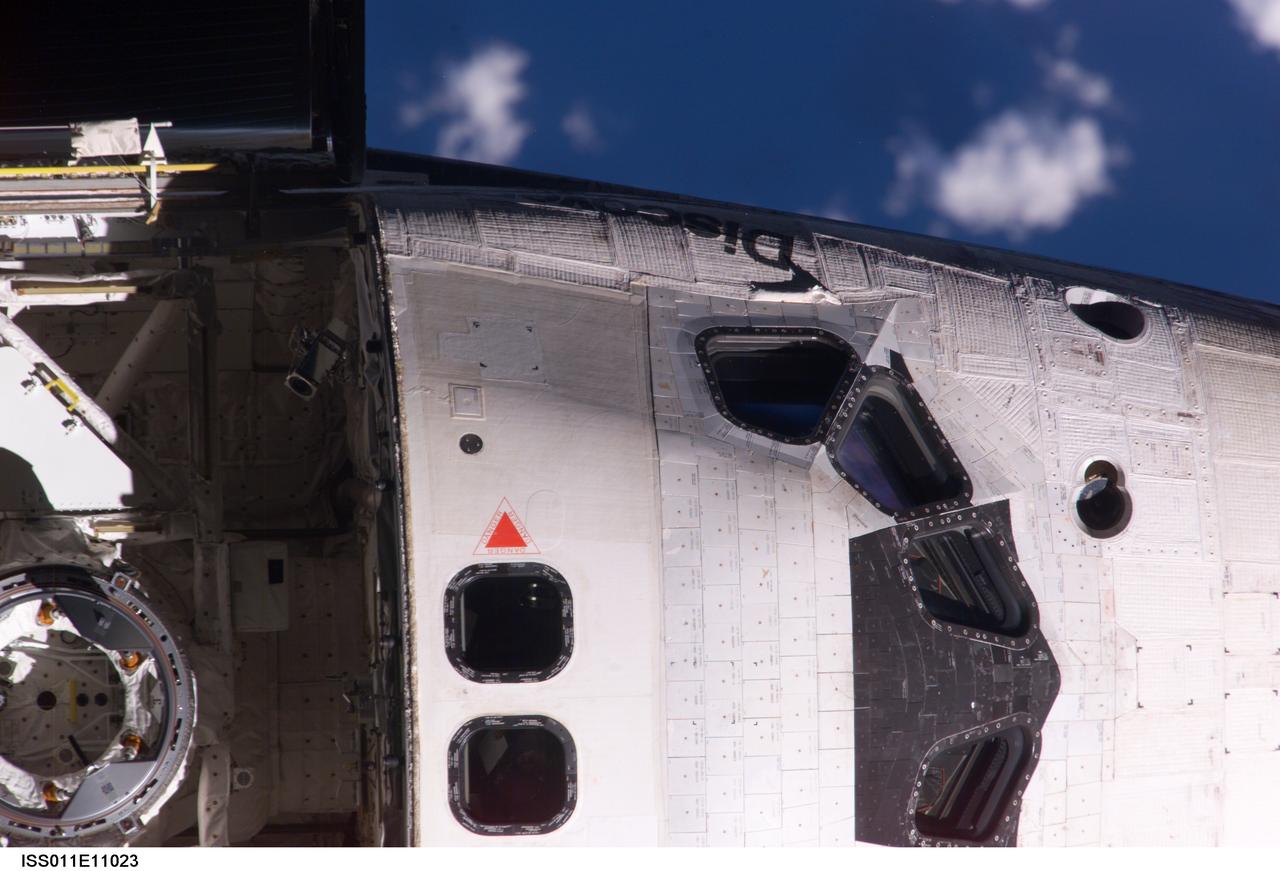
ISS011-E-11023 (28 July 2005) --- View of the Space Shuttle Discovery's crew cabin and the Orbiter Docking System (ODS), photographed as part of  the survey sequence performed by the Expedition 11 crew during the STS-114 R-Bar Pitch Maneuver on Flight Day 3.  This picture was used by Steve M. Poulos, Jr.  Manager, Space Shuttle Vehicle Engineering Office, as one of his visual aids in a July 28, 2005 press conference in the Teague Auditorium at the Johnson Space Center. Poulos pointed out a raised area of thermal blanket material just below a window on the commander's (port) side of the cabin.
Mapping sequence performed during the STS-114 R-Bar Pitch Maneuver.
KENNEDY SPACE CENTER, FLA. -- In Orbiter Processing Facility (OPF) bay 2 during Crew Equipment Interface Test (CEIT), Mission Specialists Joe Tanner (left) and Carlos Noriega (right) practice working parts of the Orbital Docking System (ODS) in Endeavour’s payload bay. The CEIT provides an opportunity for crew members to check equipment and facilities that will be on board the orbiter during their mission. The STS-97 mission will be the sixth construction flight to the International Space Station. The payload includes a photovoltaic (PV) module, providing solar power to the Station. STS-97 is scheduled to launch Nov. 30 from KSC for the 10-day mission
KSC00pp1425
STS105-E-5091 (12 August 2001) --- Frank L. Culbertson, Jr., Expedition Three mission commander, assists Scott J. Horowitz (out of frame to the right), STS-105 commander, in opening Space Shuttle Discovery's airlock hatch leading to the International Space Station (ISS).  Culbertson and cosmonauts Mikhail Tyurin and Vladimir N. Dezhurov will be replacing the Expedition Two crew as residents aboard the ISS.  This image was taken with a digital still camera.
Culbertson prepares to open the ODS hatch into the ISS
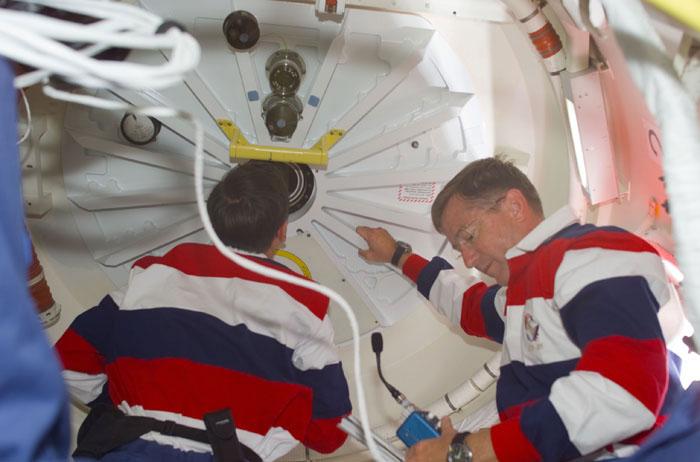
STS105-E-5092 (12 August 2001) --- Scott J. Horowitz (bottom), STS-105 commander, and Frank L. Culbertson, Jr., Expedition Three mission commander, prepare to open Space Shuttle Discovery's airlock hatch leading to the International Space Station (ISS).  Culbertson and cosmonauts Mikhail Tyurin and Vladimir N. Dezhurov will be replacing the Expedition Two crew as residents aboard the ISS.  This image was taken with a digital still camera.
Horowitz and Culbertson prepare to open the ODS hatch into the ISS
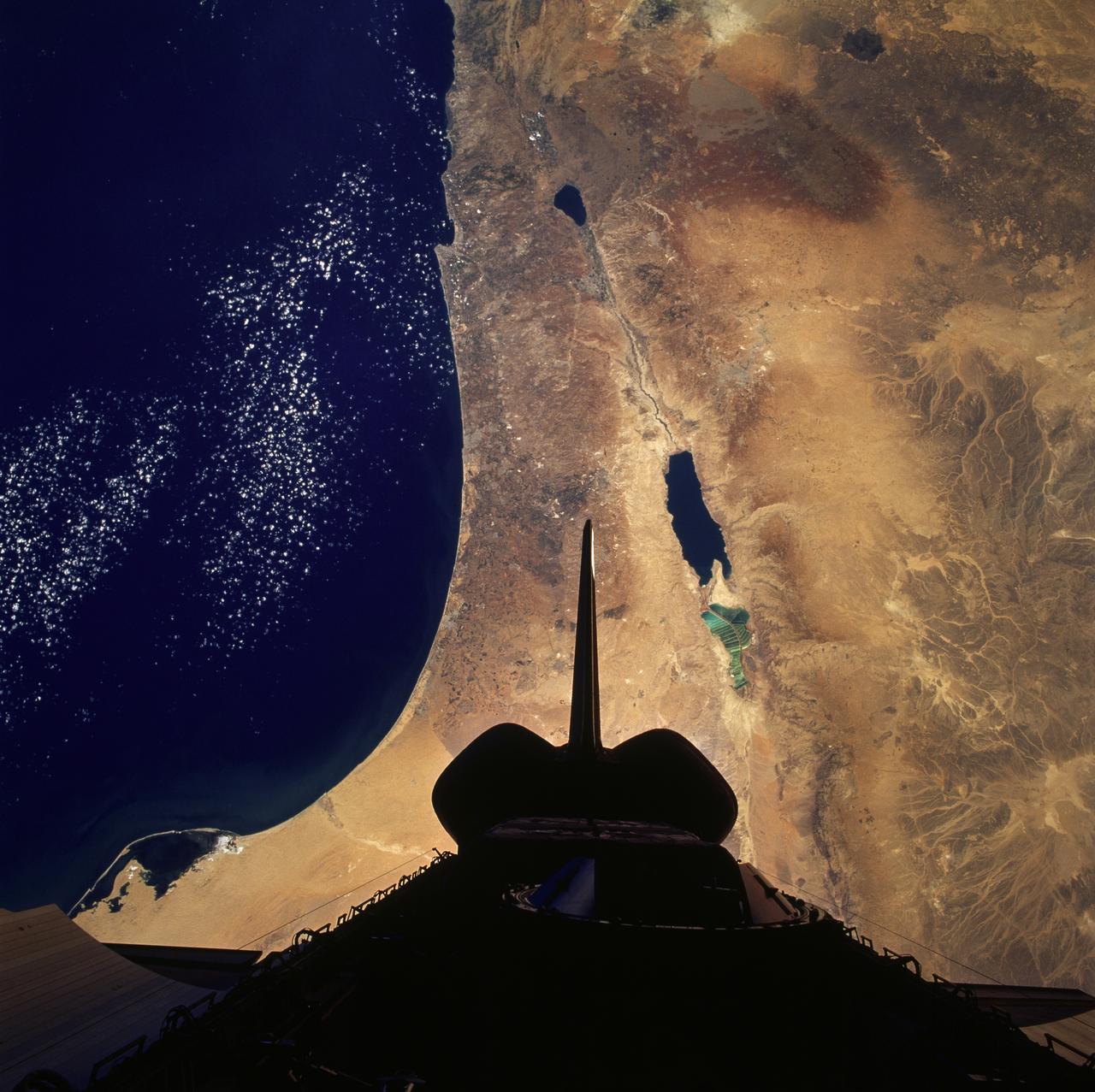
STS079-824-081 (16-26 Sept. 1996) --- In this 70mm frame from the space shuttle Atlantis, the Jordan River Valley can be traced as it separates Lebanon, Palestine and Israel on the west, from Syria and Jordan on the east. The river flows along the Dead Sea rift; the east side of the fault zone (Syria, Jordan, Saudi Arabia) has moved north about 100 kilometers relative to the west side (Lebanon, Israel, Egypt) during the past 24 million years. The Dead Sea and Sea of Galilee are in depressions formed where faults of the zone diverge or step over.  The Dead Sea once covered the area of salt evaporation pans (the bright blue water). The lagoon, barrier islands and evaporite deposits (bright white) along the Mediterranean coast of the Sinai Peninsula (lower left of frame) are just east of Port Said.
View of the ODS in the Atlantis payload bay prior to docking
STS105-E-5089 (12 August 2001) --- Scott J. Horowitz (left), STS-105 commander, and Frank L. Culbertson, Jr., Expedition Three mission commander, prepare to open Space Shuttle Discovery's airlock hatch leading to the International Space Station (ISS).  Culbertson and cosmonauts Mikhail Tyurin and Vladimir N. Dezhurov will be replacing the Expedition Two crew as residents aboard the ISS.  This image was taken with a digital still camera.
Culbertson and Horowitz prepare to open the ODS hatch into the ISS
STS105-E-5067 (12 August 2001) --- One of the STS-105 crew members on the aft flight deck of the Space Shuttle Discovery used a digital still camera to record this close-up view of the docking process between the shuttle and the International Space Station (ISS). The shuttle’s Canadarm or Remote Manipulator System (RMS) arm is in its stowed position at right.
ODS alignment ring at soft-dock with ISS
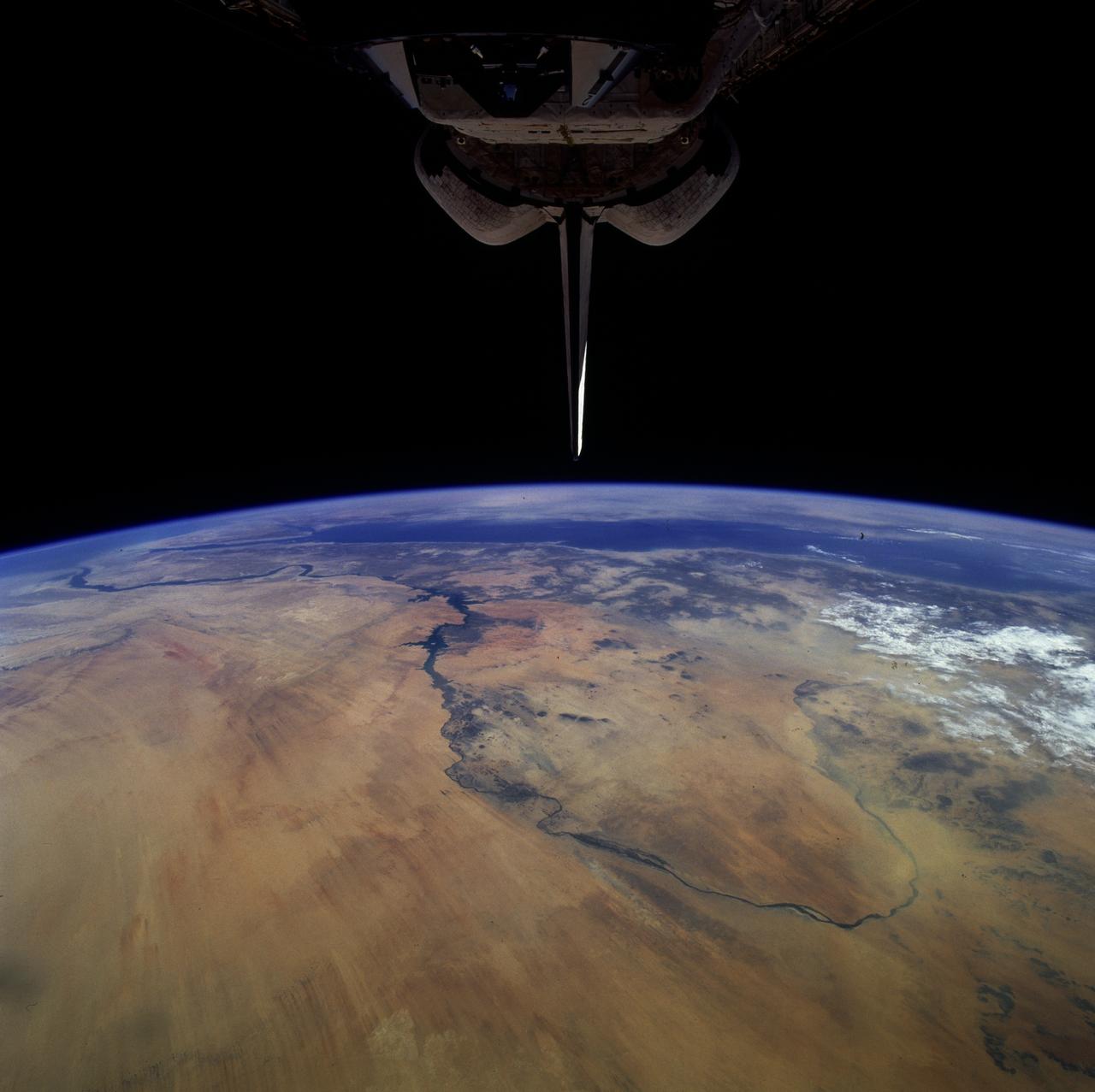
STS079-808-008 (16-26 Sept. 1996) --- In this 70mm frame from the space shuttle Atlantis, the Nile River wanders through the eastern Sahara Desert of Sudan and Egypt.  In the foreground is a great bend of the Nile from north to south past the Fourth Cataract at Merowe (an ancient Sudanese dynastic capitol), then north past Dongola and the Third Cararact, to Lake Nasser in Egypt.  Prominent sand streaks display a north-south alignment.  North of the first great bend a thick dust storm completely obscures the land surface, near Merowe thinner dust creates a hazy look.  In the distance the Red Sea stretches from Suez to southern Arabia.
Payload bay and ODS after undocking with Mir
S88-E-5009 (12-04-98) ---  This medium closeup electronic still camera (ESC) photograph shows Endeavour's docking system in the cargo bay. Though partially obscured, Unity can be seen in its stowed position in aft payload pay. The photo was taken prior to astronaut Nancy Currie's moving of the 12.8-ton Unity connecting module to link it with Endeavour's docking system.  The photo was taken at 21:28:19 GMT, Dec. 4, and downlinked later to flight controllers in Houston.
View of the STS-88 Endeavour's payload bay, ODS and Node 1
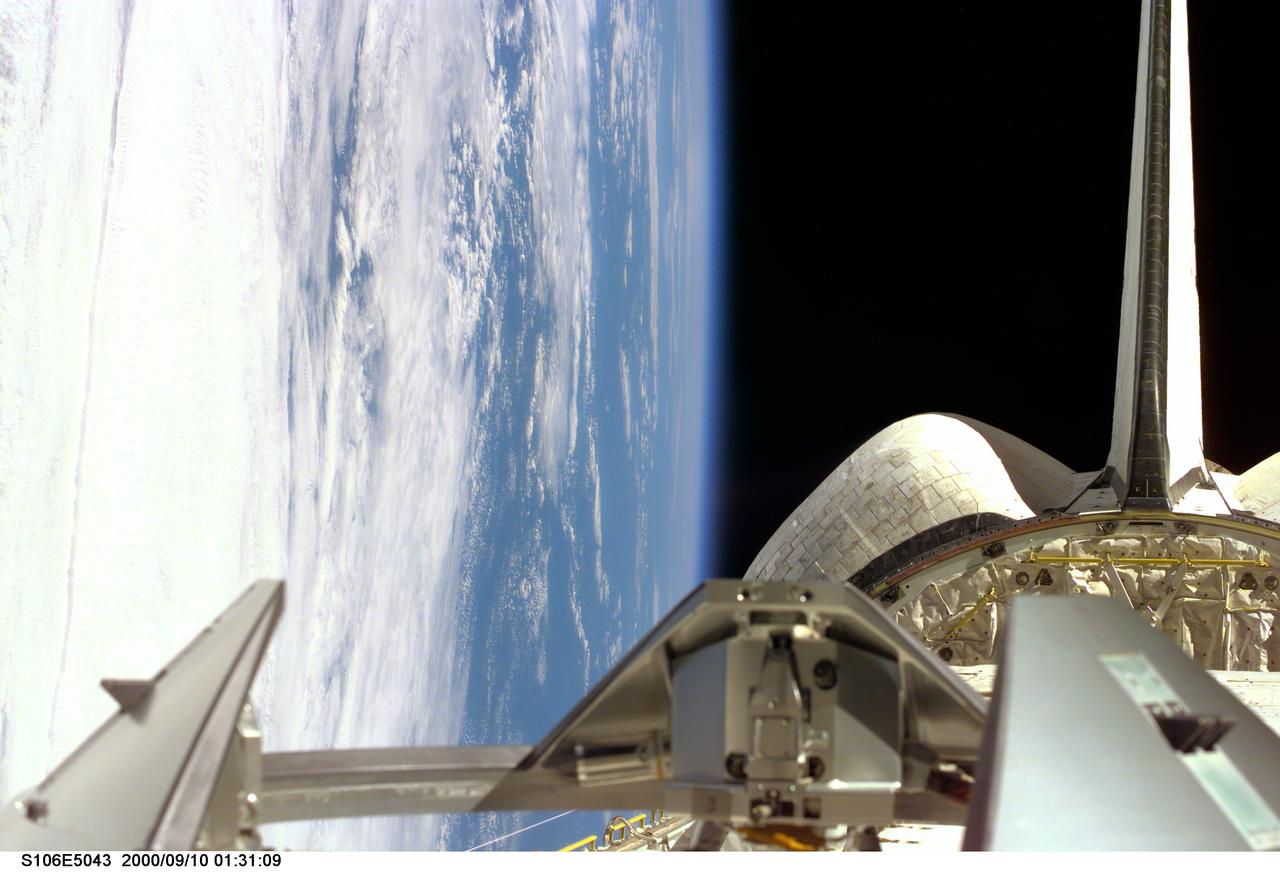
S106-E-5043 (10 September 2000) ---  An electronic still camera (ESC), aimed through the aft flight deck windows of the Space Shuttle Atlantis crew cabin ,  recorded this image of the cargo bay backdropped against clouds and water on Earth. The docking mechanism in the foreground awaits the upcoming rendezvous with the International Space Station (ISS) a little later in the 11-day mission.
View of the ODS in Atlantis payload bay during STS-106
STS088-361-021 (4-15 Dec. 1998) --- The Canadian-built Remote Manipulator System (RMS) arm is about to grapple the Node 1 or Unity Module for mating to the Space Shuttle Endeavour.  The move marked the first of many steps that allowed the United States-built Unity Module to be docked with the Russian-built FGB or Zarya Module later in the mission.
ODS and RMS arm in position to grapple Node 1/Unity module
STS110-E-5148 (10 April 2002) --- Astronaut Jerry L. Ross, STS-110 mission specialist, navigates one of the many hatches on the International Space Station (ISS). The image was taken with a digital still camera.
Ross drifts through the ODS hatch to the ISS during STS-110
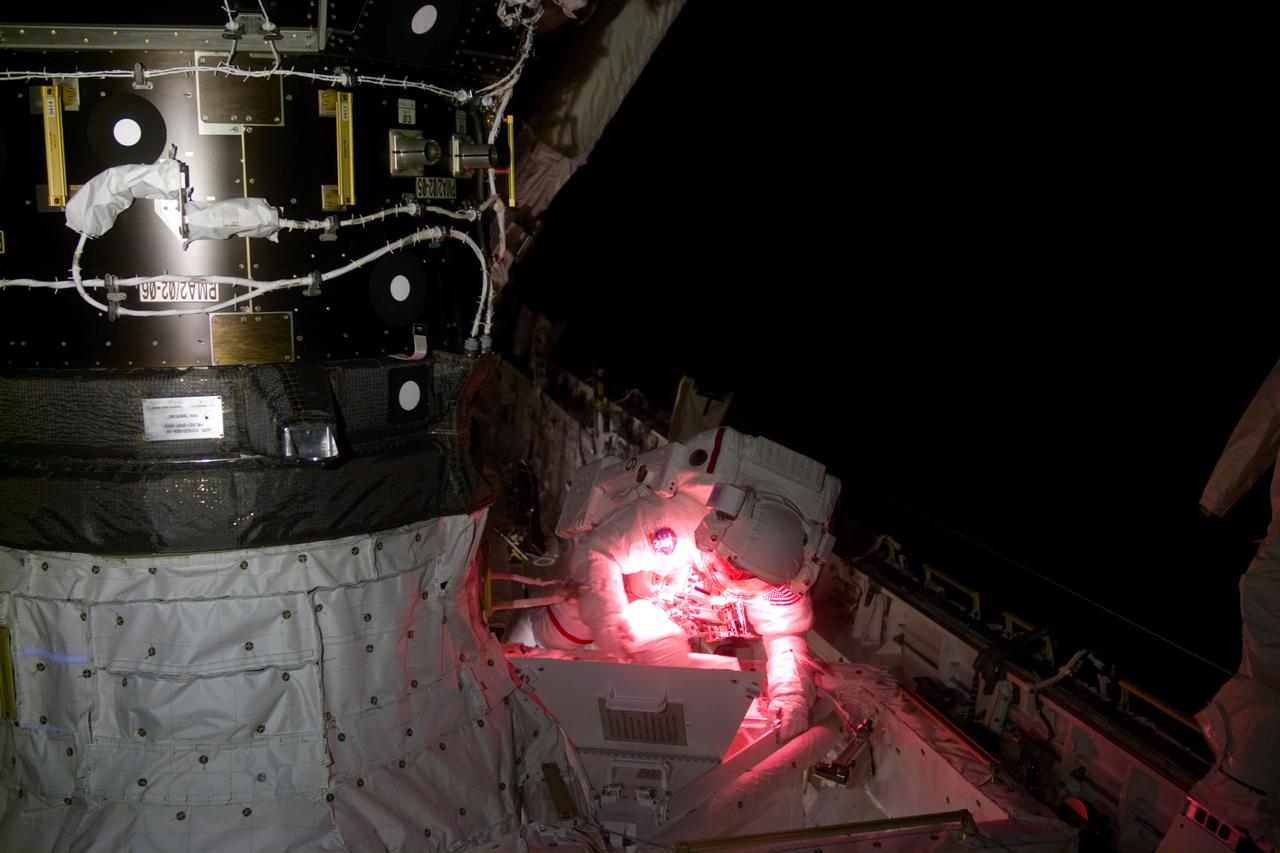
S88-E-5104 (12-10-98) With the Shuttle in a "night side" position, astronaut Jerry L. Ross, mission specialist, uses artificial light during the second STS-88 space walk. Ross is near a pressurized module adapter (PMA) on Endeavour's port side. The photo was taken with an electronic still camera (ESC) at 03:10:00 GMT, Dec.  10.
Ross opens Tool Stowage Assembly on ODS support structure
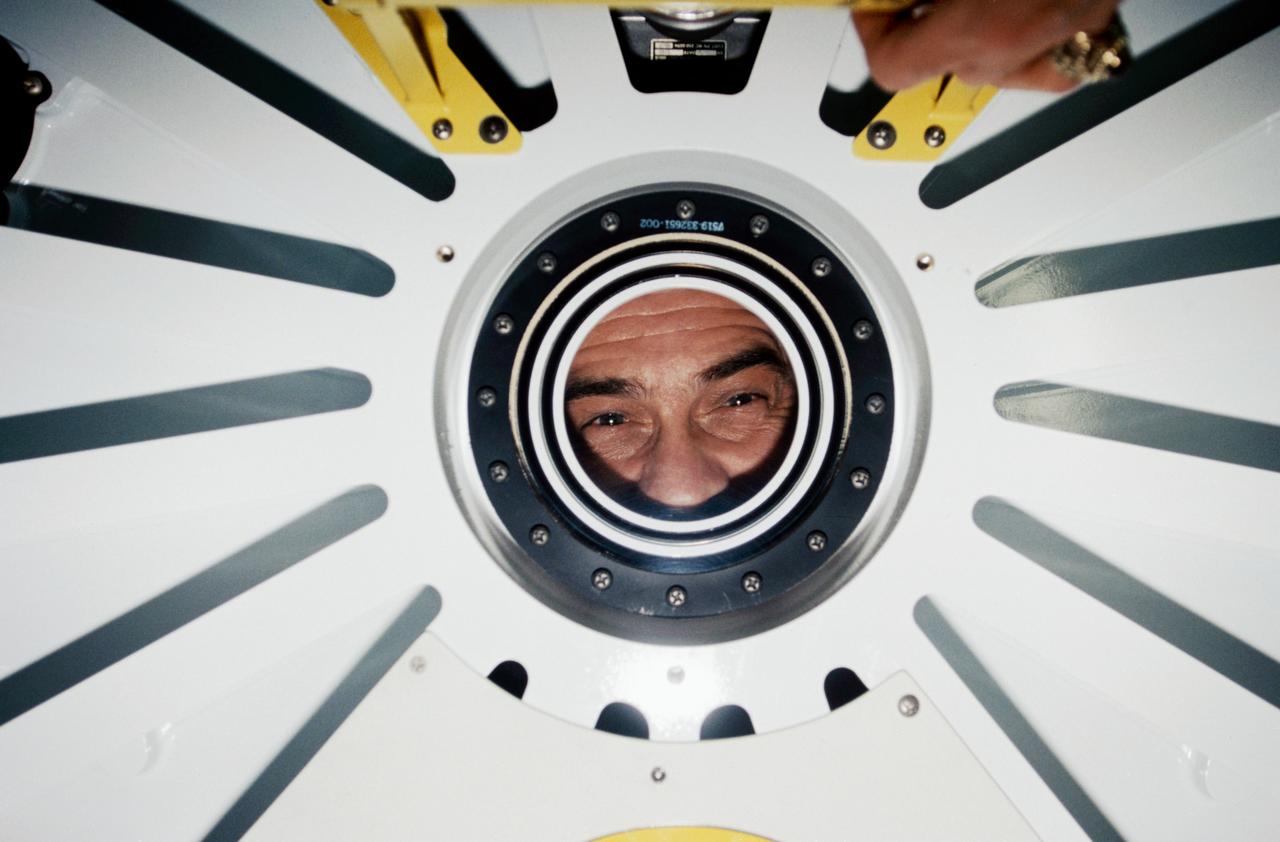
STS089-349-021 (22-31 Jan 1998) --- Cosmonaut Pavel Vinogradov, flight engineer for the Mir-24 crew, peers through the hatch, from the inside of the Russia?s Mir Space Station, at arriving Space Shuttle Endeavour members of the STS-89 crew prior to hatch opening.  STS-89/Mir-24 marked the eighth of nine Shuttle/Mir dockings.
ODS/Mir hatch opening during STS-89 mission
STS074-302-033 (14 Nov 1995) --- A 35mm camera aimed through the Space Shuttle Atlantis? aft windows captured the deployment of the Docking Module (DM), which was later delivered to Russia?s Mir Space Station in Earth-orbit.  The Orbiter Docking System (ODS) is partially visible at bottom center.  The flight began with a November 12, 1995, launch from Kennedy Space Center (KSC) and ended with landing there on November 20, 1995.  The STS-74 crew members were astronauts Kenneth D. Cameron, mission commander; James D. Halsell, pilot; William S. McArthur, Jr., Jerry L. Ross and Canadian astronaut Chris A. Hadfield, all mission specialists.  The Mir-20 crew is composed of cosmonauts Yuriy P. Gidzenko, commander; and Sergei V. Avdeyev, engineer; along with the European Space Agency?s (ESA) Thomas Reiter, cosmonaut researcher.  Joint activities on the Mir and the Atlantis ended on November 18, 1995, when the two spacecraft separated.
Rendezvous and docking between Atlantis and Mir space station
STS088-335-017 (5 Dec. 1998) --- One of the STS-88 astronauts aimed a 35mm camera through Endeavour's aft flight deck windows to record this Dec. 5 image of the Unity connecting module as it was being unberthed in the cargo bay. The berthing and mating process constituted the first link in a long chain of events that led up to the eventual deployment in Earth orbit of the connected Unity and Zarya modules later in the 11-day mission. Photo credit: NASA
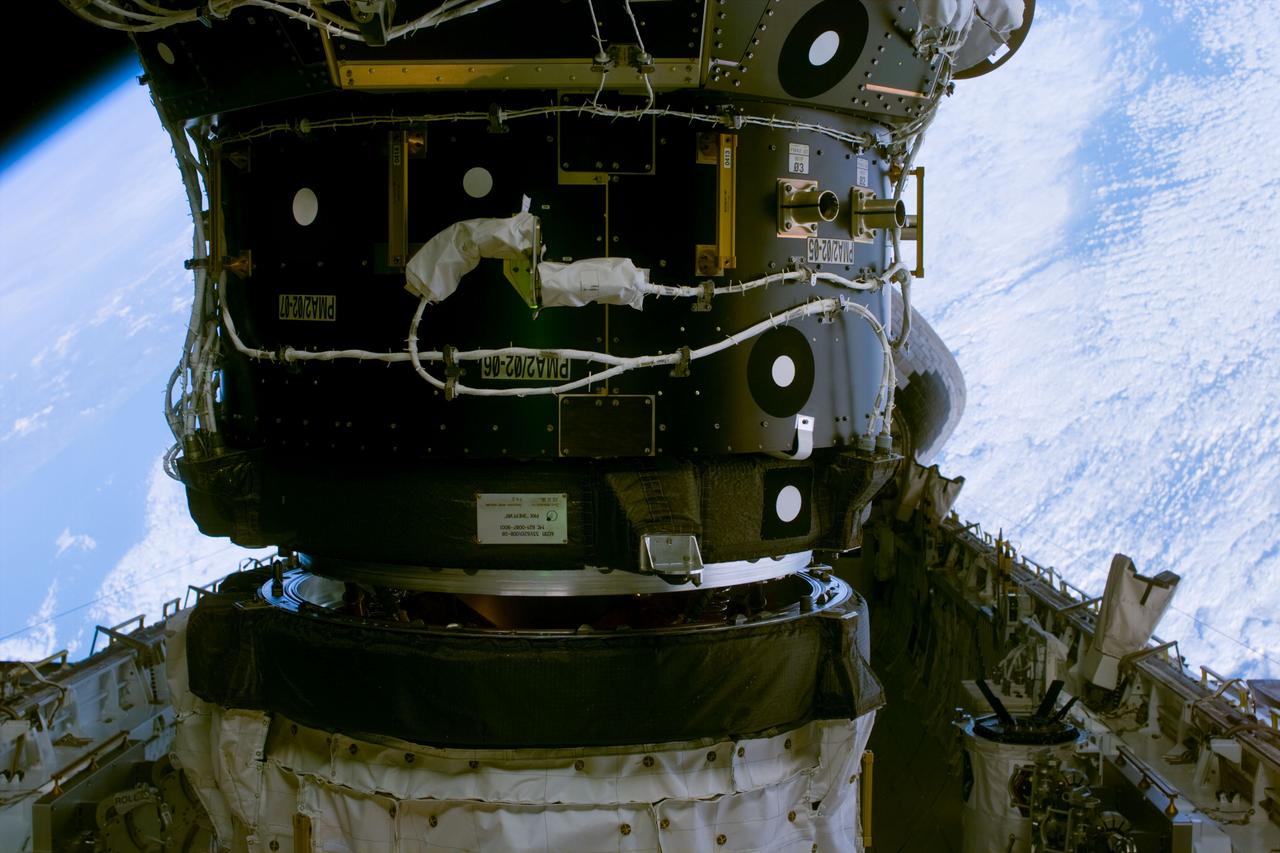
Forward end (+XA side) of the PMA-2 prior to mating to the Orbiter Docking System (ODS).
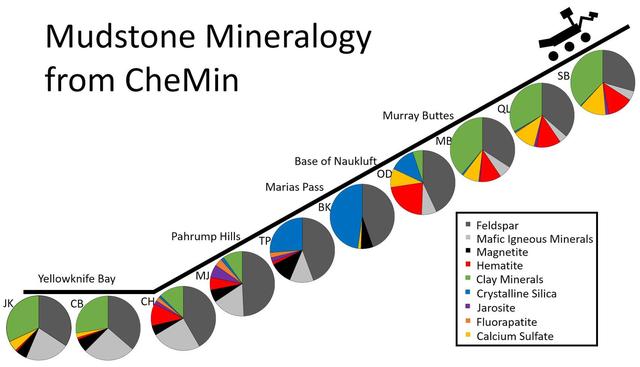
This series of pie charts shows similarities and differences in the mineral compositions of mudstones at 10 sites where NASA's Curiosity Mars rover collected rock-powder samples and analyzed them with the rover's Chemistry and Mineralogy (CheMin) instrument.  The charts are arrayed in chronological order, with an indication of relative elevation as the rover first sampled two sites on the floor of Gale Crater in 2013 and later began climbing the crater's central mound, Mount Sharp. The pie chart farthest to the right and uphill shows composition at the "Sebina" target, sampled in October 2016. Five non-mudstone rock targets that the rover drilled and analyzed within this time frame are not included.  The mineralogical variations in these mudstones may be due to differences in any or all of these factors: the source materials deposited by water that entered lakes, the processes of sedimentation and rock forming, and how the rocks were later altered.  One trend that stands out is that the mineral jarosite -- shown in purple -- was more prominent in the "Pahrump Hills" area of lower Mount Sharp than at sites examined either earlier or later. Jarosite is an indicator of acidic water. Mudstone layers uphill from Pahrump Hills have barely detectable amounts of jarosite, indicating a shift away from acidic conditions in these overlying -- thus younger -- layers. Clay minerals, shown as green, declined in abundance at sites midway through this series, then came back as the rover climbed higher.  Each drilled-and-analyzed target is identified with a two-letter abbreviation: JK for "John Klein," CB for "Cumberland." CH for "Confidence Hills," MJ for "Mojave," TP for "Telegraph Peak," BK for "Buckskin," OD for "Oudam," MB for "Marimba," QL for "Quela," and SB for Sebina.  http://photojournal.jpl.nasa.gov/catalog/PIA21146
Mudstone Mineralogy from Curiosity CheMin, 2013 to 2016