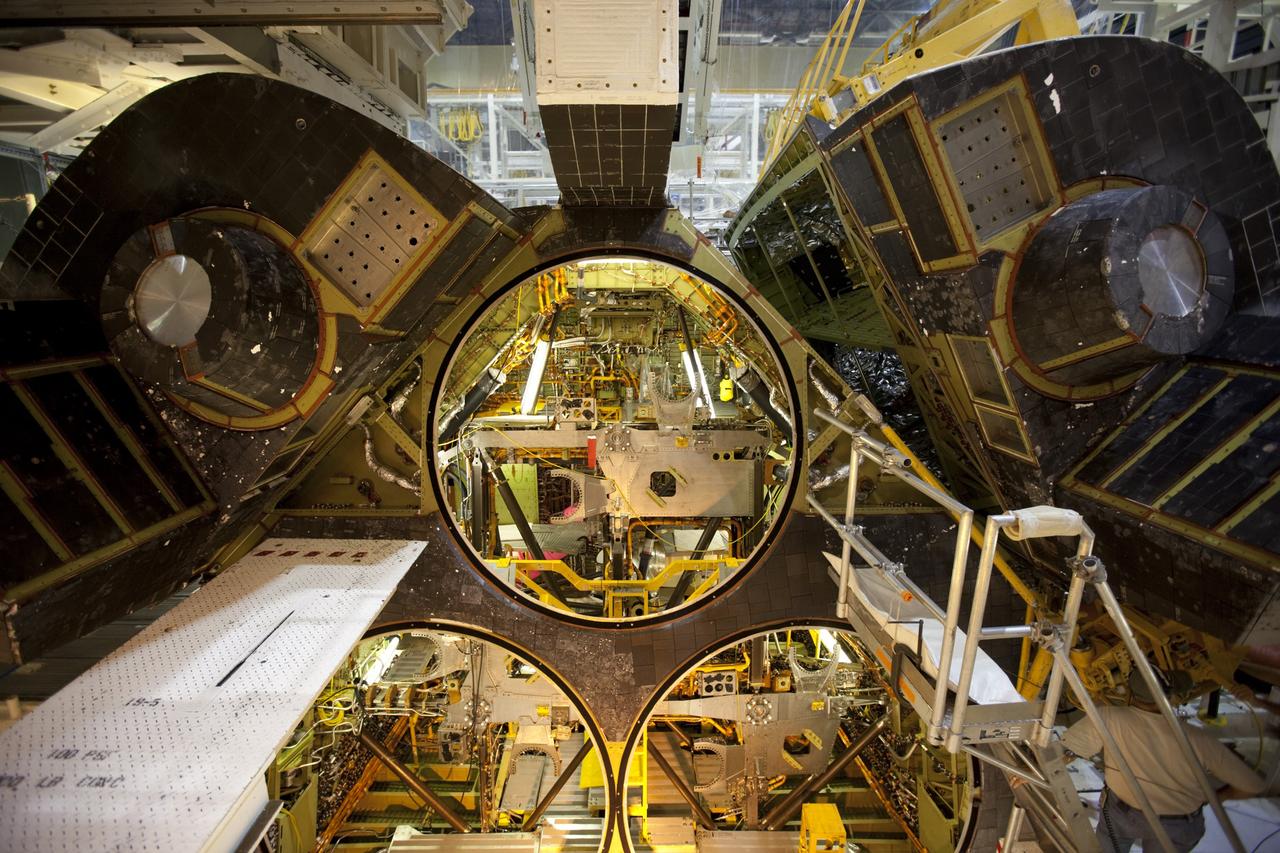
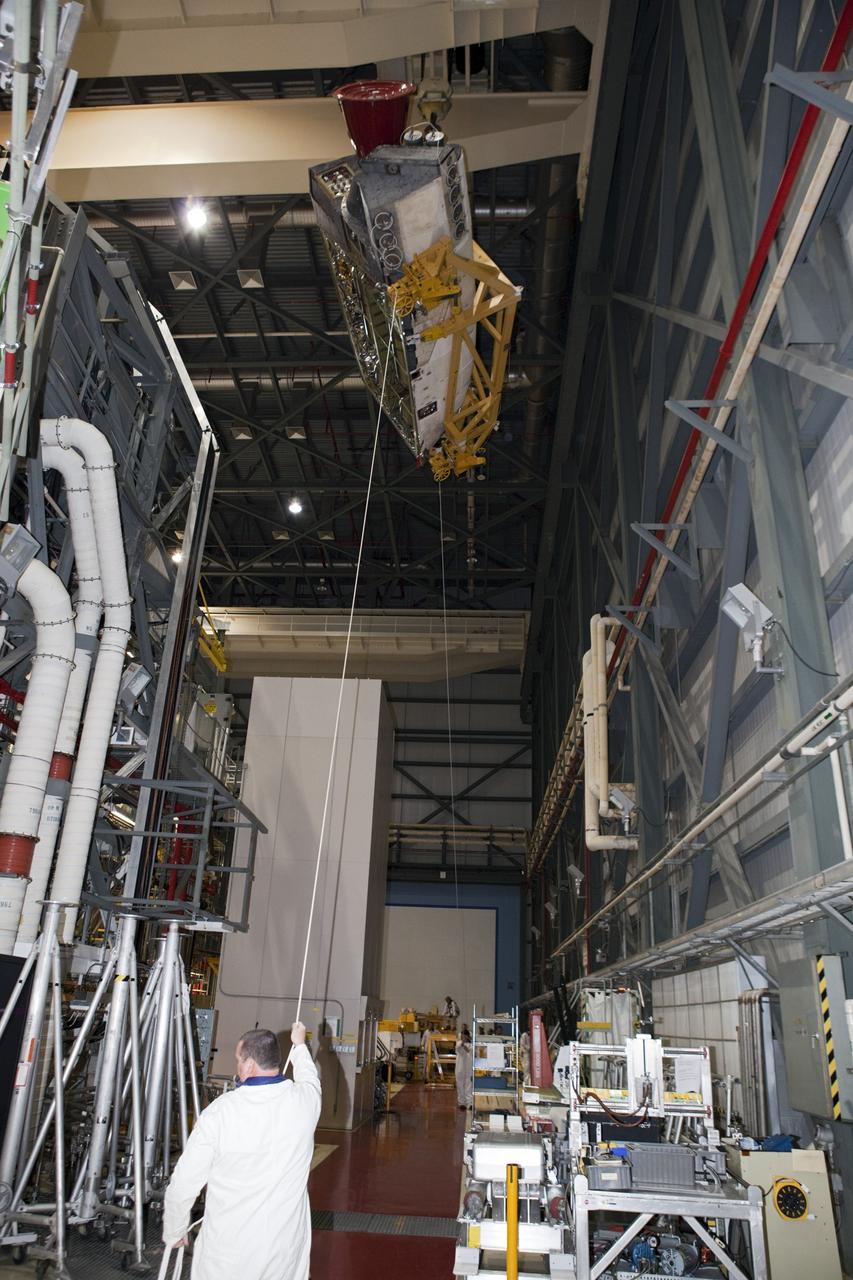
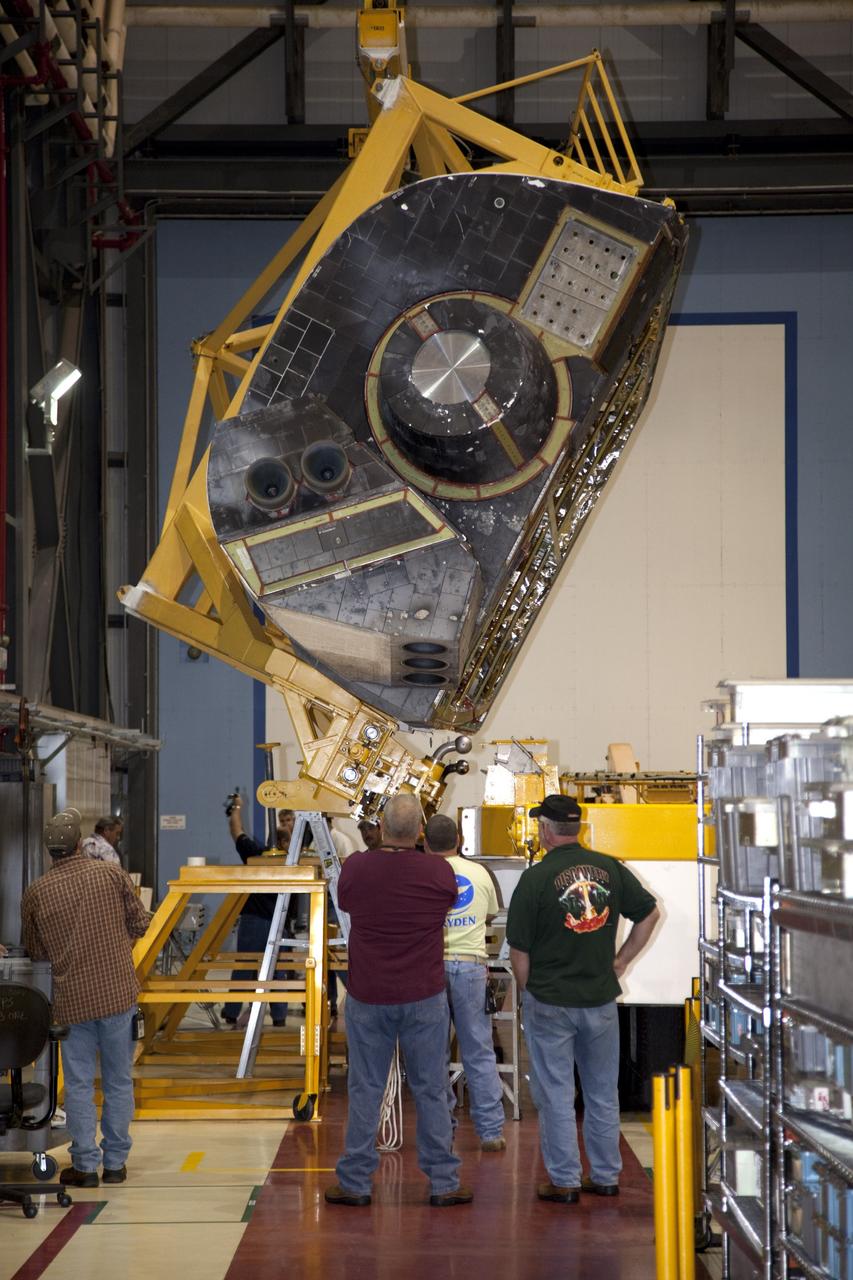
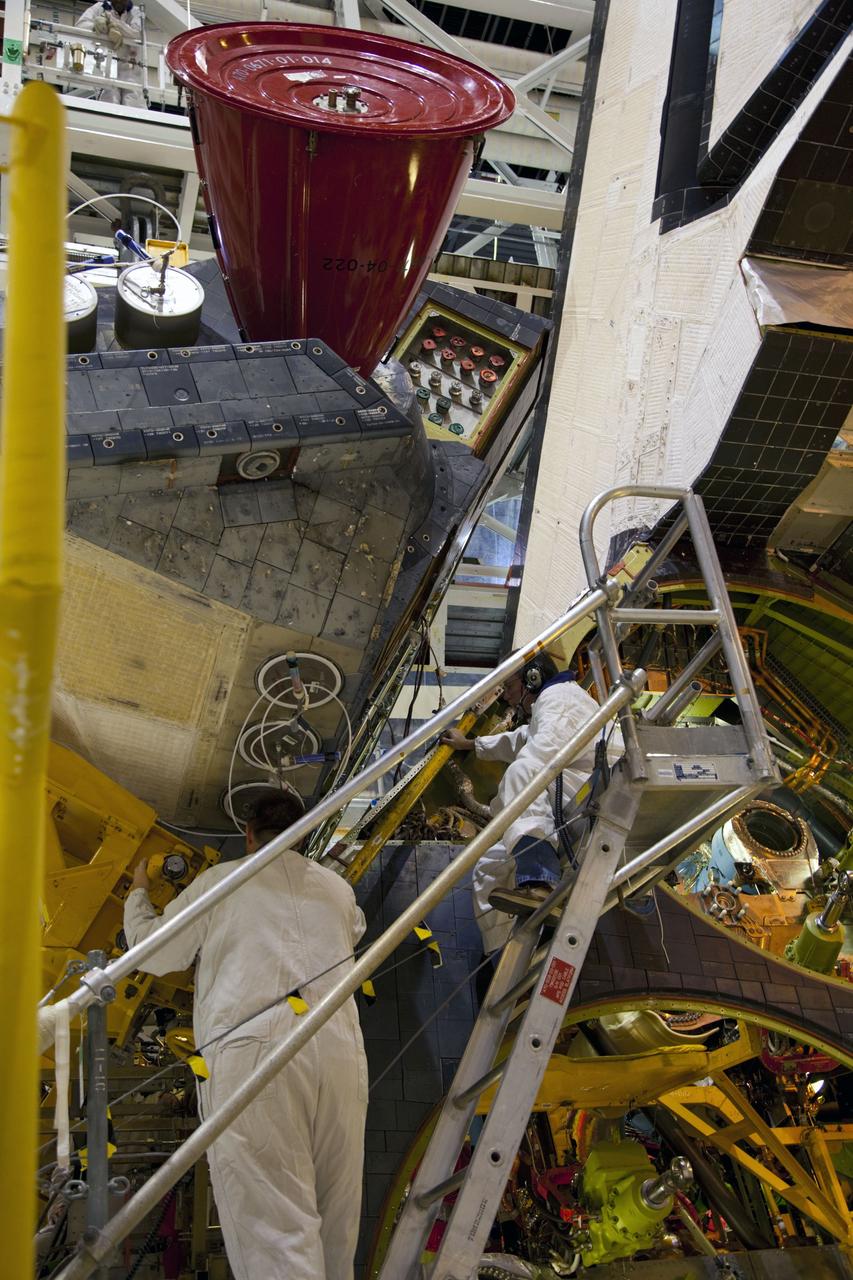
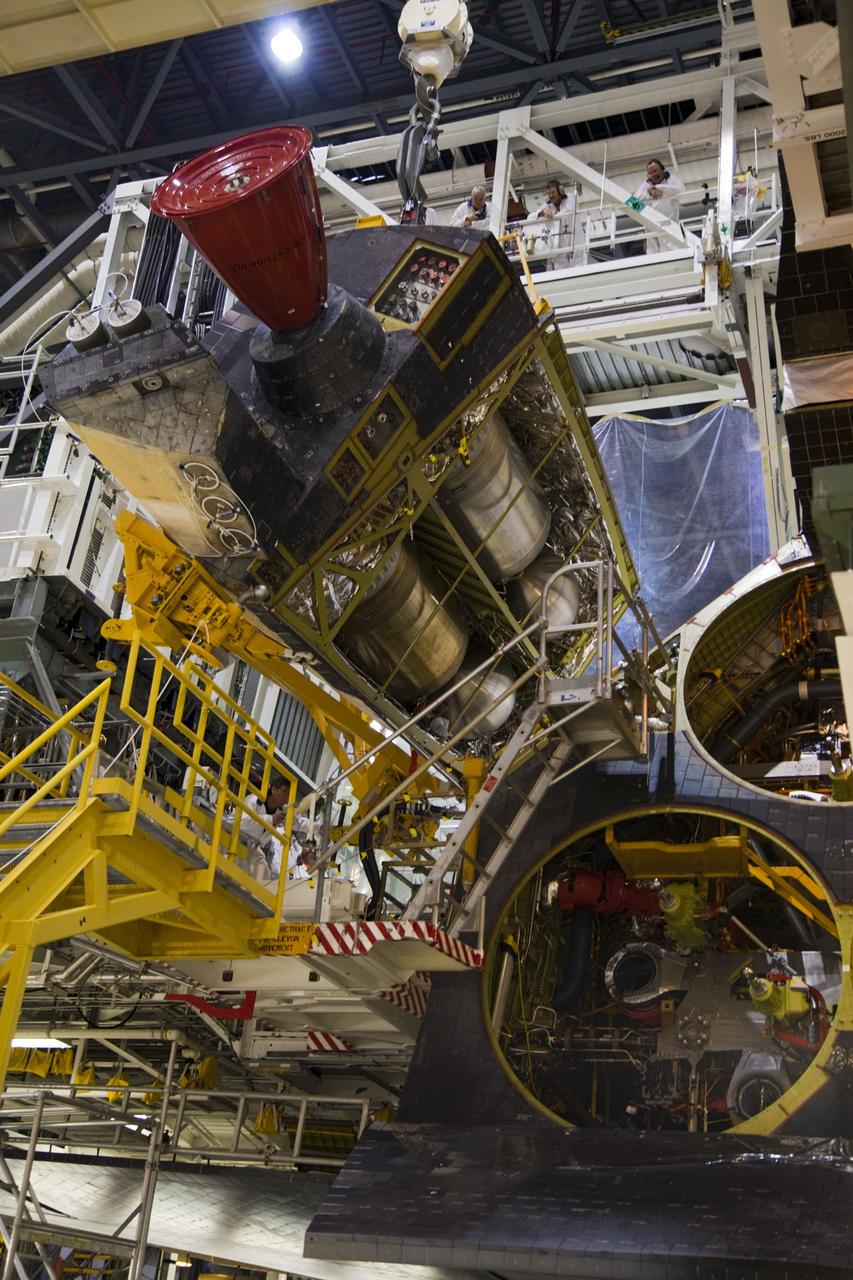
CAPE CANAVERAL, Fla. –Inside Orbiter Processing Facility-1 at NASA’s Kennedy Space Center in Florida, a unique close-up view shows a large crane lowering the right orbital maneuvering system, or OMS, pod closer to space shuttle Atlantis and the left OMS pod already installed. It is the last time an OMS pod will be installed on Atlantis. The OMS provided the shuttle with thrust for orbit insertion, rendezvous and deorbit, and could provide up to 1,000 pounds of propellant to the aft reaction control system. The OMS is housed in two independent pods located on each side of the shuttle’s aft fuselage. Each pod contains one OMS engine and the hardware needed to pressurize, store and distribute the propellants to perform the velocity maneuvers. Atlantis’ OMS pods were removed and sent to the test facility at White Sands Space Harbor in New Mexico to be cleaned of residual toxic propellant. The work is part of the Space Shuttle Program’s transition and retirement processing of the space shuttle fleet. A groundbreaking was held Jan. 18 for Atlantis’ future home, a 65,000-square-foot exhibit hall in Shuttle Plaza at the Kennedy Space Center Visitor Complex. Atlantis is scheduled to roll over to the visitor complex in November in preparation for the exhibit’s grand opening in July 2013. For more information, visit http://www.nasa.gov/transition. Photo credit: NASA/Dimitri Gerondidakis
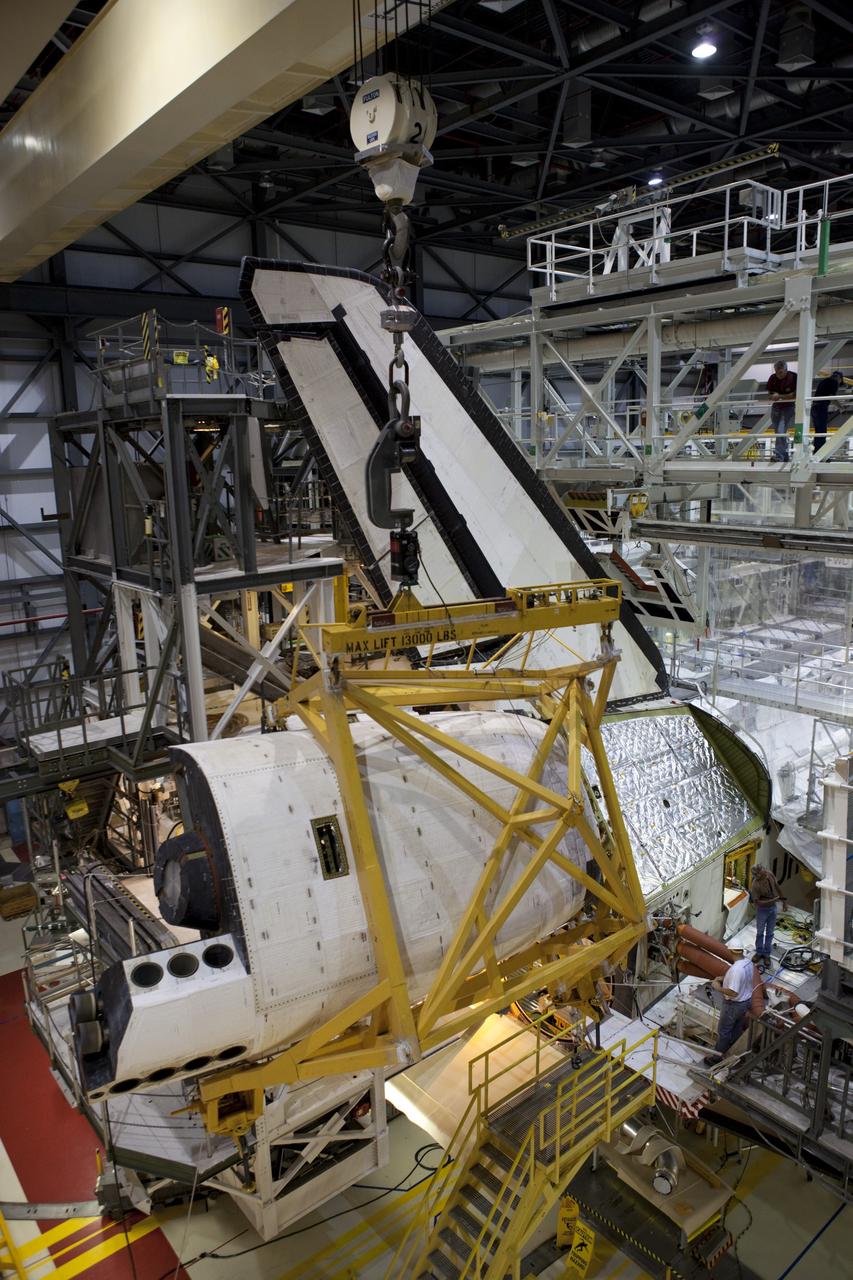
CAPE CANAVERAL, Fla. – Inside Orbiter Processing Facility-1 at NASA’s Kennedy Space Center in Florida, a large crane moves the right orbital maneuvering system, or OMS, pod closer to space shuttle Atlantis. It is the last time an OMS pod will be installed on Atlantis. The OMS provided the shuttle with thrust for orbit insertion, rendezvous and deorbit, and could provide up to 1,000 pounds of propellant to the aft reaction control system. The OMS is housed in two independent pods located on each side of the shuttle’s aft fuselage. Each pod contains one OMS engine and the hardware needed to pressurize, store and distribute the propellants to perform the velocity maneuvers. Atlantis’ OMS pods were removed and sent to the test facility at White Sands Space Harbor in New Mexico to be cleaned of residual toxic propellant. The work is part of the Space Shuttle Program’s transition and retirement processing of the space shuttle fleet. A groundbreaking was held Jan. 18 for Atlantis’ future home, a 65,000-square-foot exhibit hall in Shuttle Plaza at the Kennedy Space Center Visitor Complex. Atlantis is scheduled to roll over to the visitor complex in November in preparation for the exhibit’s grand opening in July 2013. For more information, visit http://www.nasa.gov/transition. Photo credit: NASA/Dimitri Gerondidakis
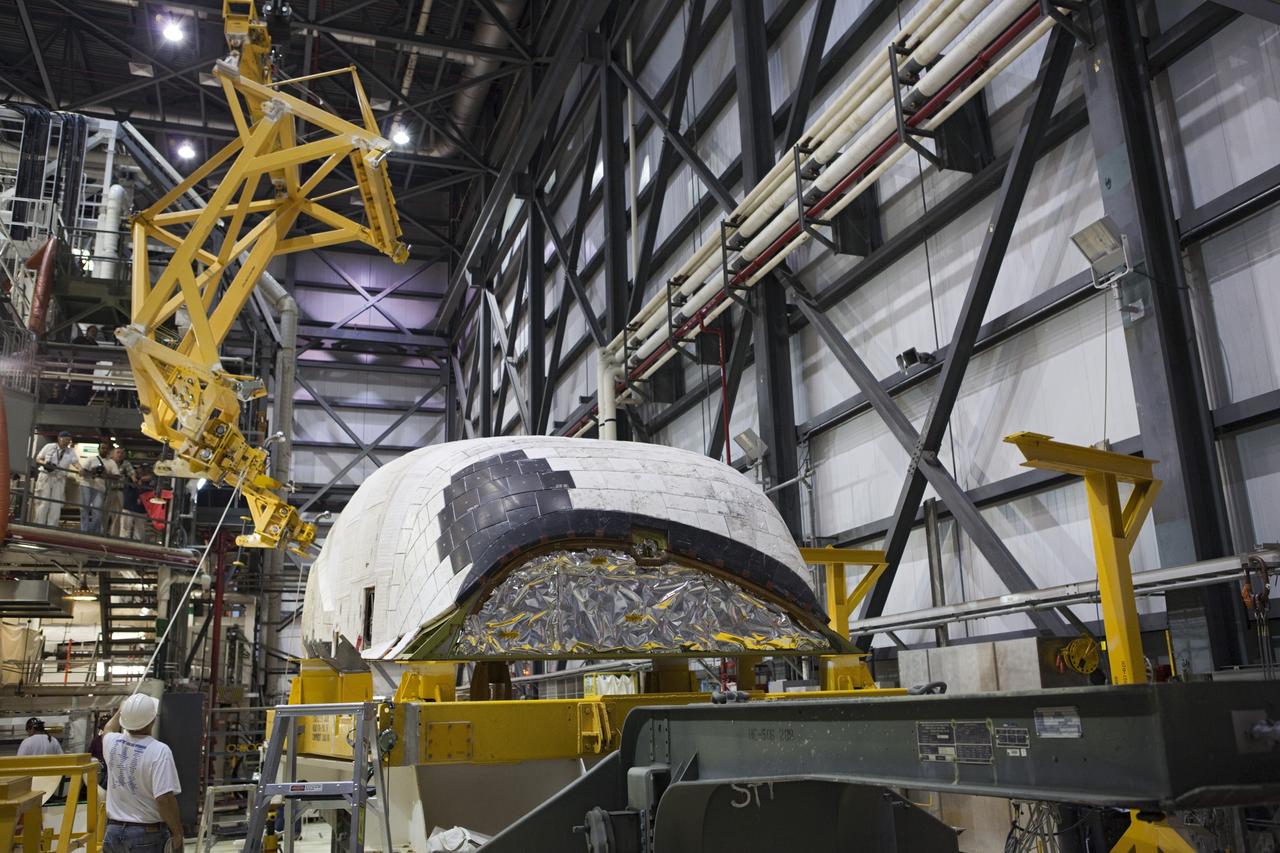
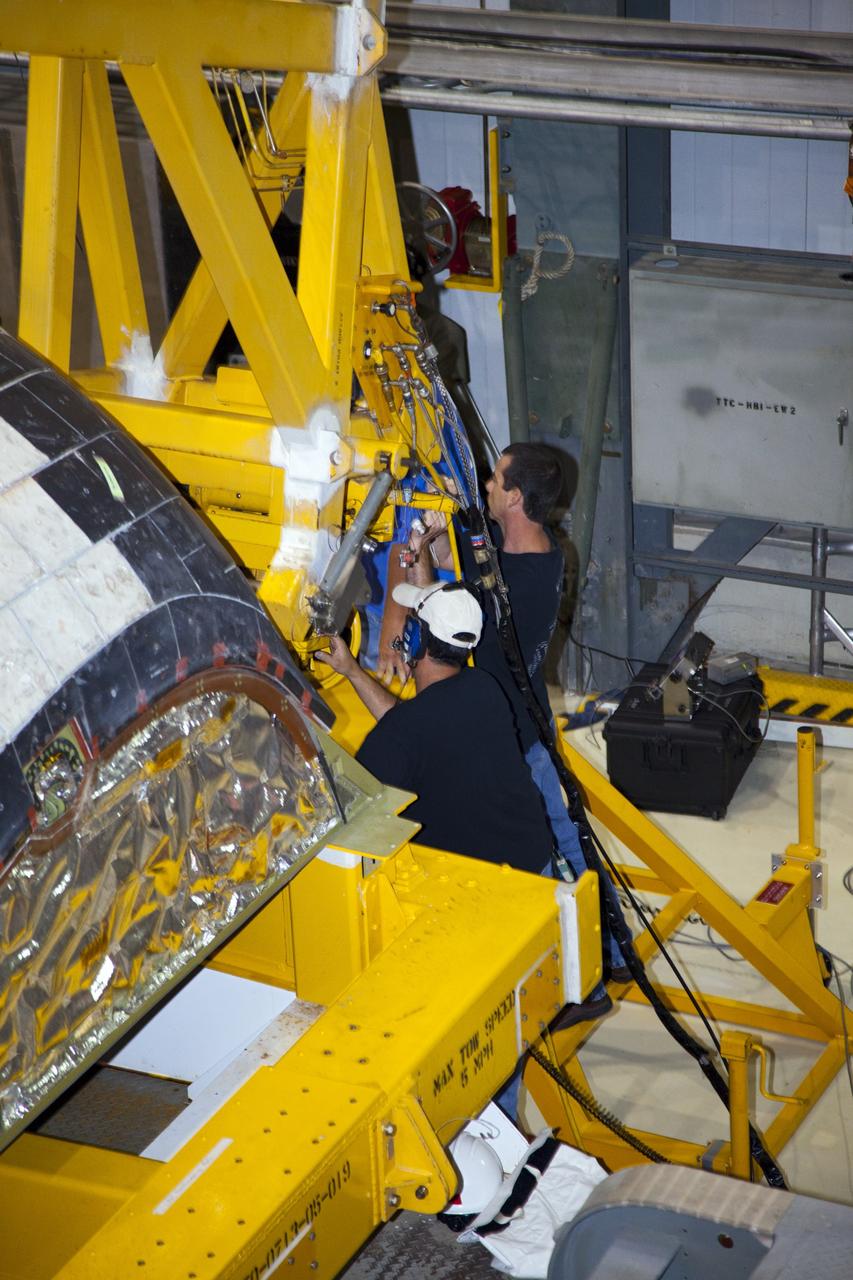
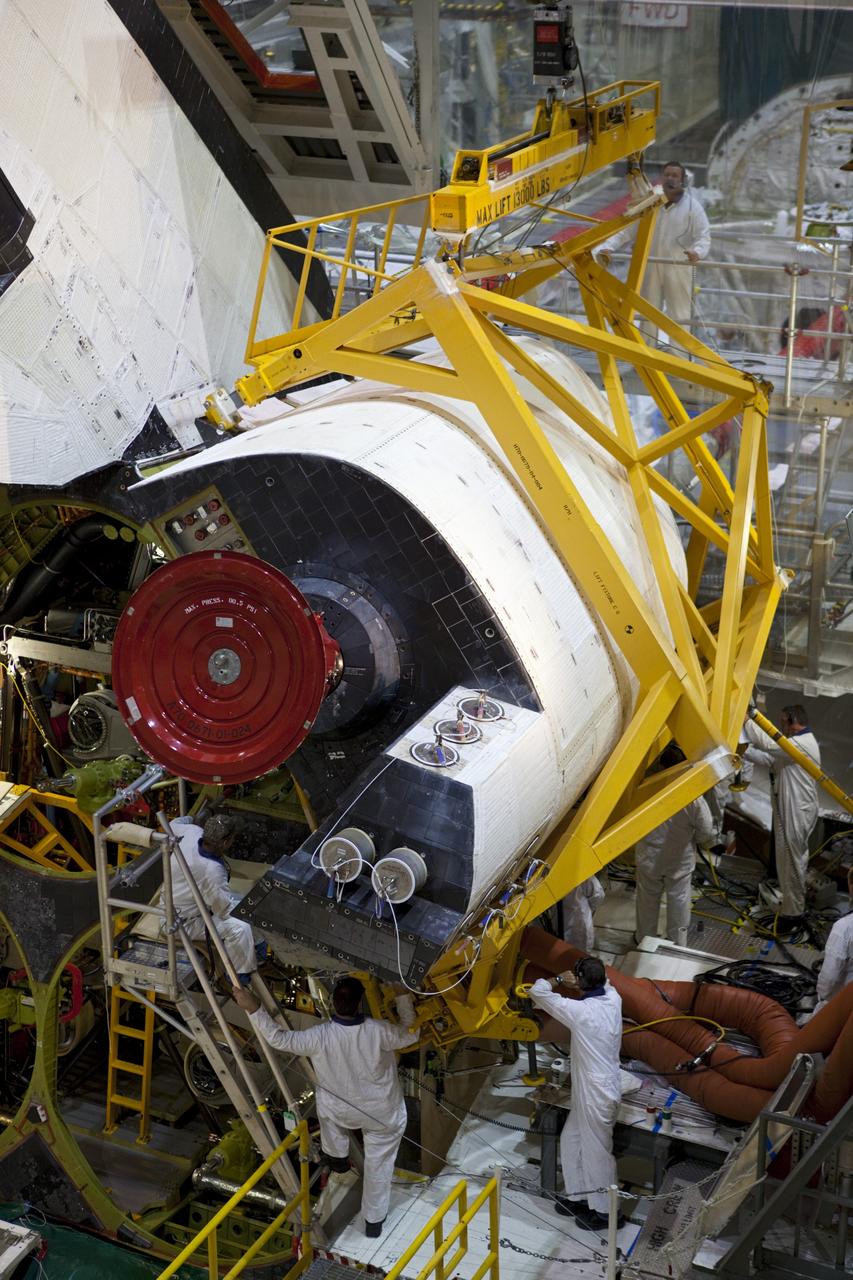
CAPE CANAVERAL, Fla. – Inside Orbiter Processing Facility-1 at NASA’s Kennedy Space Center in Florida, United Space Alliance technicians monitor the progress as a large crane is lowered toward the right orbital maneuvering system, or OMS, pod for space shuttle Atlantis. It will be the last time an OMS pod is installed on Atlantis. The OMS provided the shuttle with thrust for orbit insertion, rendezvous and deorbit, and could provide up to 1,000 pounds of propellant to the aft reaction control system. The OMS is housed in two independent pods located on each side of the shuttle’s aft fuselage. Each pod contains one OMS engine and the hardware needed to pressurize, store and distribute the propellants to perform the velocity maneuvers. Atlantis’ OMS pods were removed and sent to the test facility at White Sands Space Harbor in New Mexico to be cleaned of residual toxic propellant. The work is part of the Space Shuttle Program’s transition and retirement processing of the space shuttle fleet. A groundbreaking was held Jan. 18 for Atlantis’ future home, a 65,000-square-foot exhibit hall in Shuttle Plaza at the Kennedy Space Center Visitor Complex. Atlantis is scheduled to roll over to the visitor complex in November in preparation for the exhibit’s grand opening in July 2013. For more information, visit http://www.nasa.gov/transition. Photo credit: NASA/Dimitri Gerondidakis
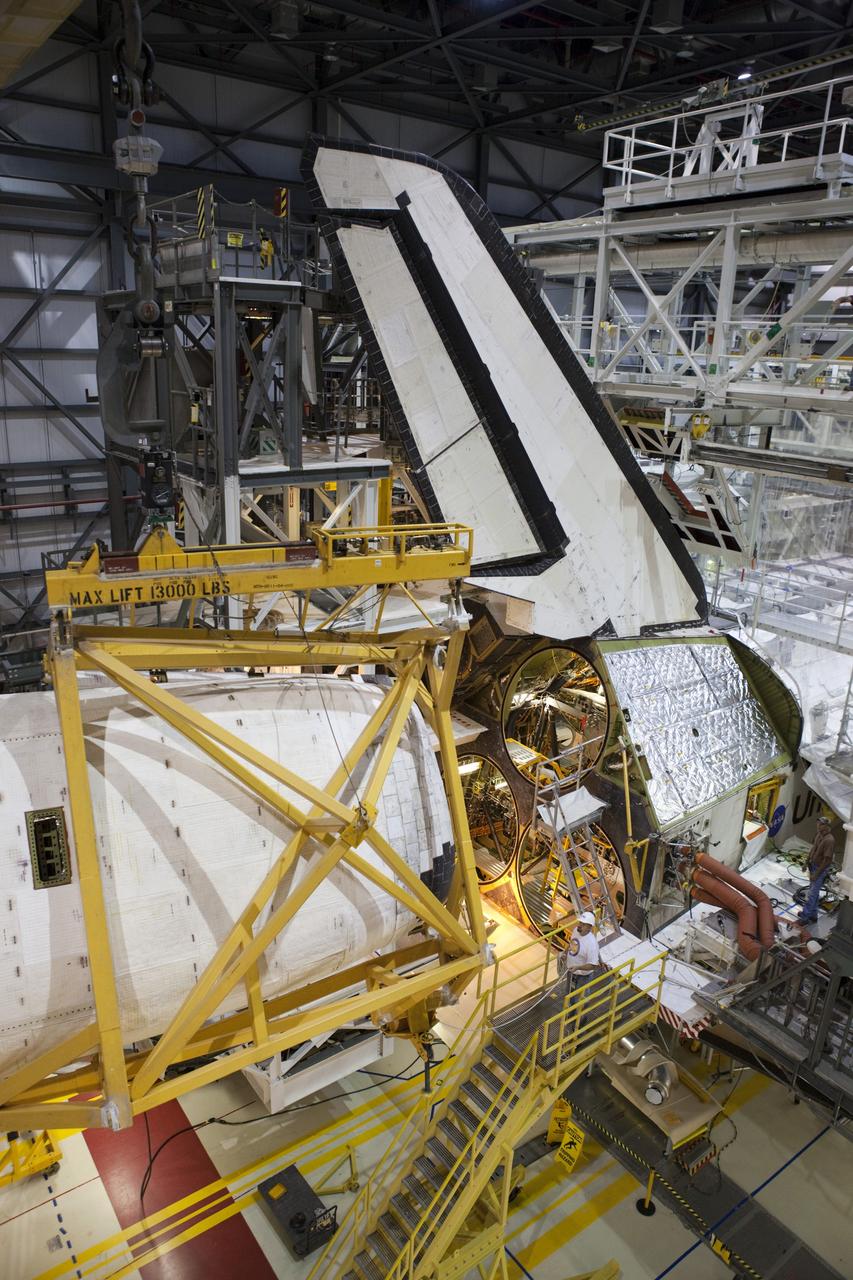
CAPE CANAVERAL, Fla. – Inside Orbiter Processing Facility-1 at NASA’s Kennedy Space Center in Florida, a large crane moves the right orbital maneuvering system, or OMS, pod closer to space shuttle Atlantis. It is the last time an OMS pod will be installed on Atlantis. The OMS provided the shuttle with thrust for orbit insertion, rendezvous and deorbit, and could provide up to 1,000 pounds of propellant to the aft reaction control system. The OMS is housed in two independent pods located on each side of the shuttle’s aft fuselage. Each pod contains one OMS engine and the hardware needed to pressurize, store and distribute the propellants to perform the velocity maneuvers. Atlantis’ OMS pods were removed and sent to the test facility at White Sands Space Harbor in New Mexico to be cleaned of residual toxic propellant. The work is part of the Space Shuttle Program’s transition and retirement processing of the space shuttle fleet. A groundbreaking was held Jan. 18 for Atlantis’ future home, a 65,000-square-foot exhibit hall in Shuttle Plaza at the Kennedy Space Center Visitor Complex. Atlantis is scheduled to roll over to the visitor complex in November in preparation for the exhibit’s grand opening in July 2013. For more information, visit http://www.nasa.gov/transition. Photo credit: NASA/Dimitri Gerondidakis
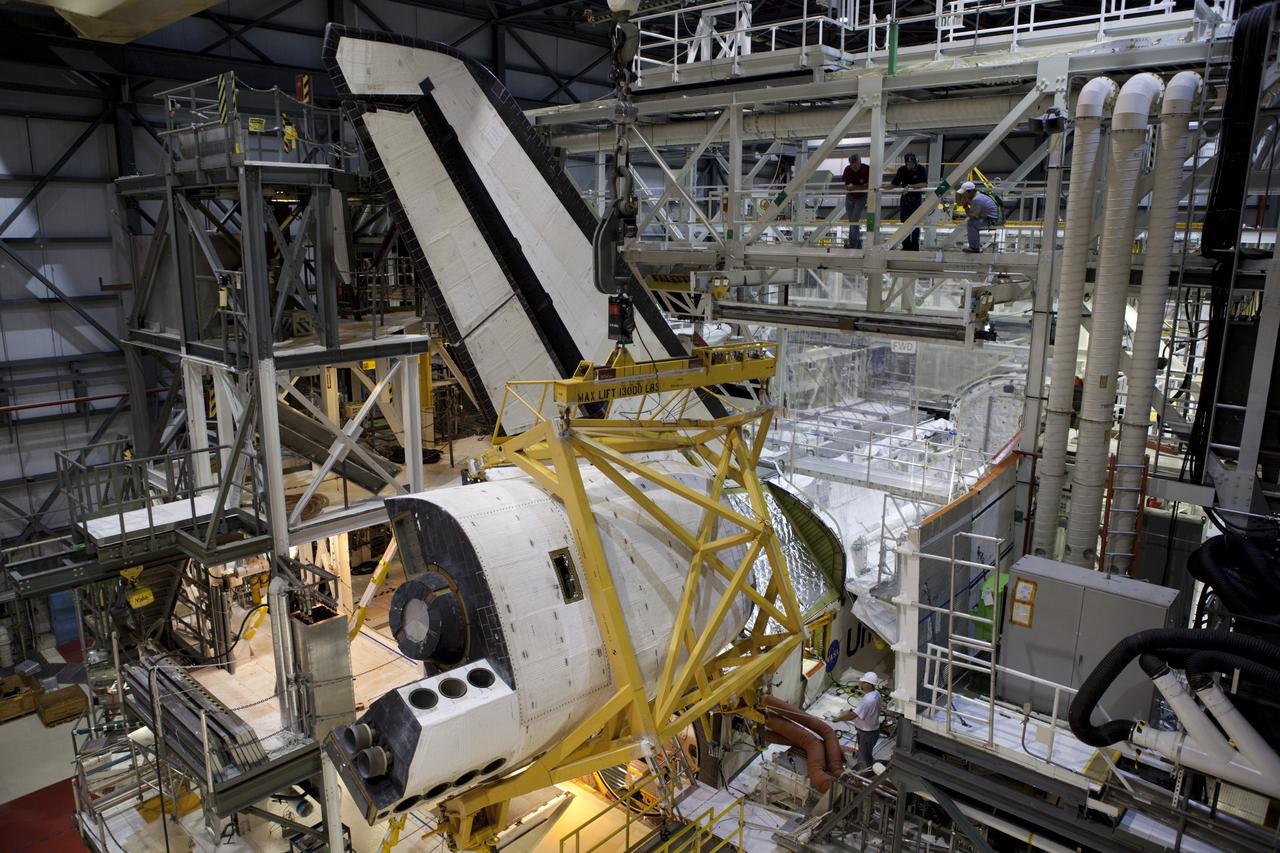
CAPE CANAVERAL, Fla. – Inside Orbiter Processing Facility-1 at NASA’s Kennedy Space Center in Florida, United Space Alliance technicians monitor the progress as a large crane moves the right orbital maneuvering system, or OMS, pod closer to space shuttle Atlantis. It is the last time an OMS pod will be installed on Atlantis. The OMS provided the shuttle with thrust for orbit insertion, rendezvous and deorbit, and could provide up to 1,000 pounds of propellant to the aft reaction control system. The OMS is housed in two independent pods located on each side of the shuttle’s aft fuselage. Each pod contains one OMS engine and the hardware needed to pressurize, store and distribute the propellants to perform the velocity maneuvers. Atlantis’ OMS pods were removed and sent to the test facility at White Sands Space Harbor in New Mexico to be cleaned of residual toxic propellant. The work is part of the Space Shuttle Program’s transition and retirement processing of the space shuttle fleet. A groundbreaking was held Jan. 18 for Atlantis’ future home, a 65,000-square-foot exhibit hall in Shuttle Plaza at the Kennedy Space Center Visitor Complex. Atlantis is scheduled to roll over to the visitor complex in November in preparation for the exhibit’s grand opening in July 2013. For more information, visit http://www.nasa.gov/transition. Photo credit: NASA/Dimitri Gerondidakis
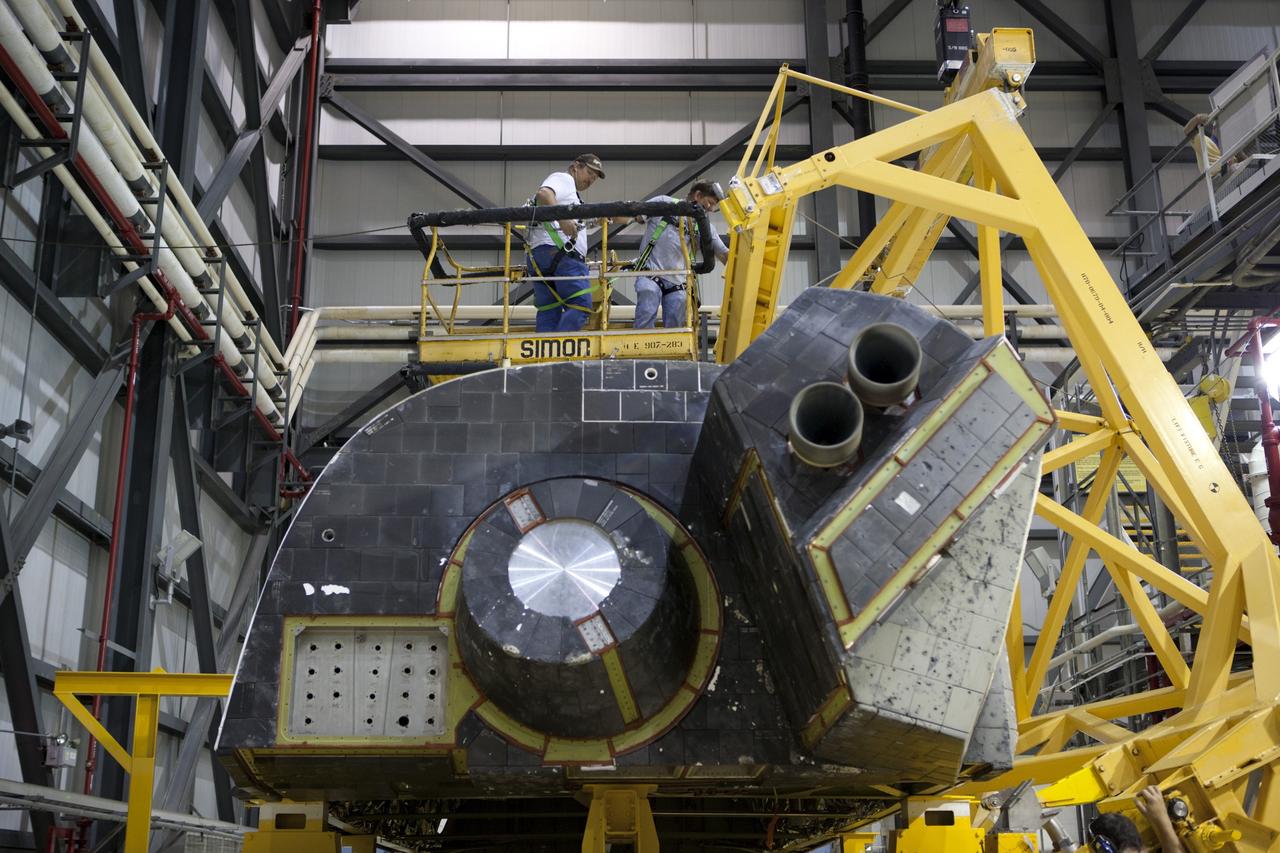
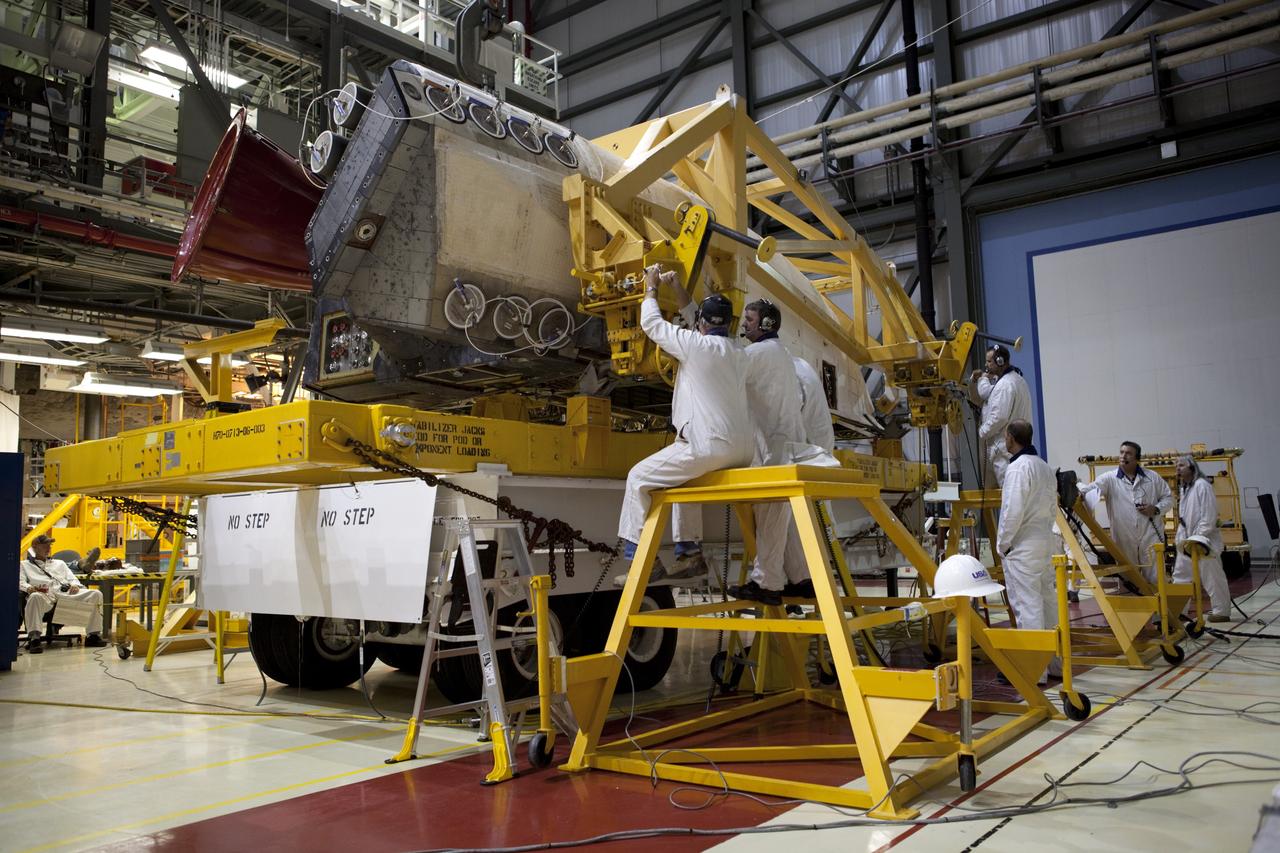
CAPE CANAVERAL, Fla. – Inside Orbiter Processing Facility-1 at NASA’s Kennedy Space Center in Florida, United Launch Alliance technicians monitor the progress as a large crane moves the right orbital maneuvering system, or OMS, pod for installation on space shuttle Atlantis. It will be the last time an OMS pod is installed on Atlantis. The OMS provided the shuttle with thrust for orbit insertion, rendezvous and deorbit, and could provide up to 1,000 pounds of propellant to the aft reaction control system. The OMS is housed in two independent pods located on each side of the shuttle’s aft fuselage. Each pod contains one OMS engine and the hardware needed to pressurize, store and distribute the propellants to perform the velocity maneuvers. Atlantis’ OMS pods were removed and sent to the test facility at White Sands Space Harbor in New Mexico to be cleaned of residual toxic propellant. The work is part of the Space Shuttle Program’s transition and retirement processing of the space shuttle fleet. A groundbreaking was held Jan. 18 for Atlantis’ future home, a 65,000-square-foot exhibit hall in Shuttle Plaza at the Kennedy Space Center Visitor Complex. Atlantis is scheduled to roll over to the visitor complex in November in preparation for the exhibit’s grand opening in July 2013. For more information, visit http://www.nasa.gov/transition. Photo credit: NASA/Dimitri Gerondidakis
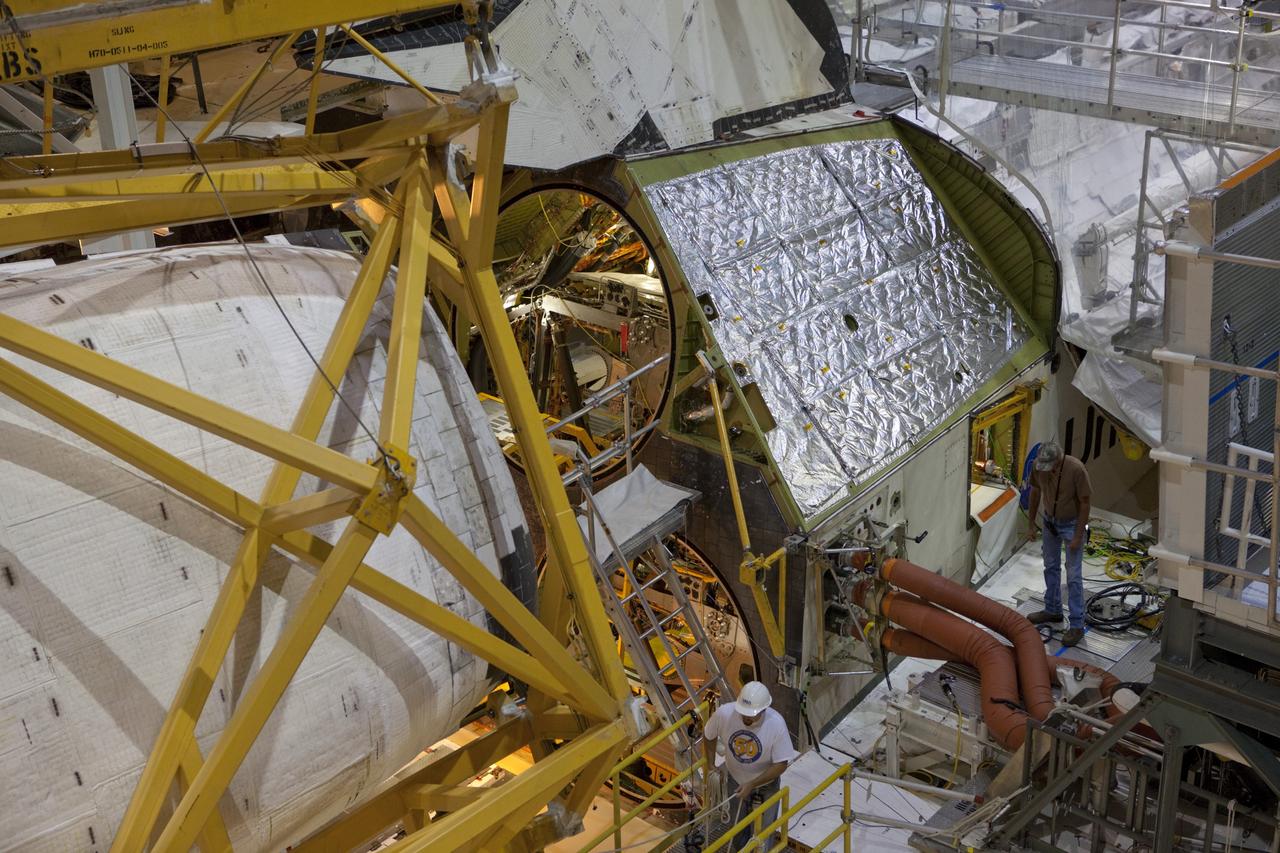
CAPE CANAVERAL, Fla. – Inside Orbiter Processing Facility-1 at NASA’s Kennedy Space Center in Florida, United Space Alliance technicians monitor the progress as a large crane moves the right orbital maneuvering system, or OMS, pod closer to space shuttle Atlantis. It is the last time an OMS pod will be installed on Atlantis. The OMS provided the shuttle with thrust for orbit insertion, rendezvous and deorbit, and could provide up to 1,000 pounds of propellant to the aft reaction control system. The OMS is housed in two independent pods located on each side of the shuttle’s aft fuselage. Each pod contains one OMS engine and the hardware needed to pressurize, store and distribute the propellants to perform the velocity maneuvers. Atlantis’ OMS pods were removed and sent to the test facility at White Sands Space Harbor in New Mexico to be cleaned of residual toxic propellant. The work is part of the Space Shuttle Program’s transition and retirement processing of the space shuttle fleet. A groundbreaking was held Jan. 18 for Atlantis’ future home, a 65,000-square-foot exhibit hall in Shuttle Plaza at the Kennedy Space Center Visitor Complex. Atlantis is scheduled to roll over to the visitor complex in November in preparation for the exhibit’s grand opening in July 2013. For more information, visit http://www.nasa.gov/transition. Photo credit: NASA/Dimitri Gerondidakis
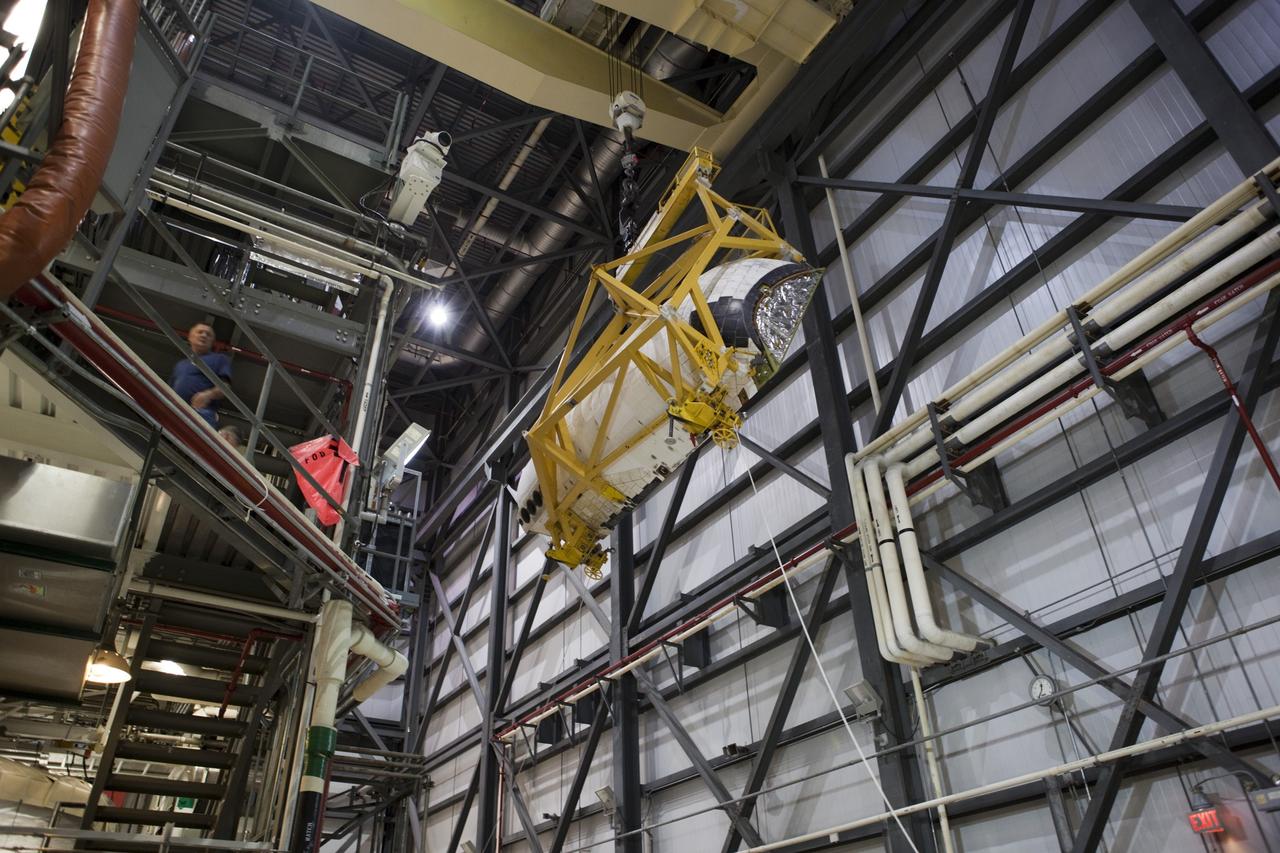
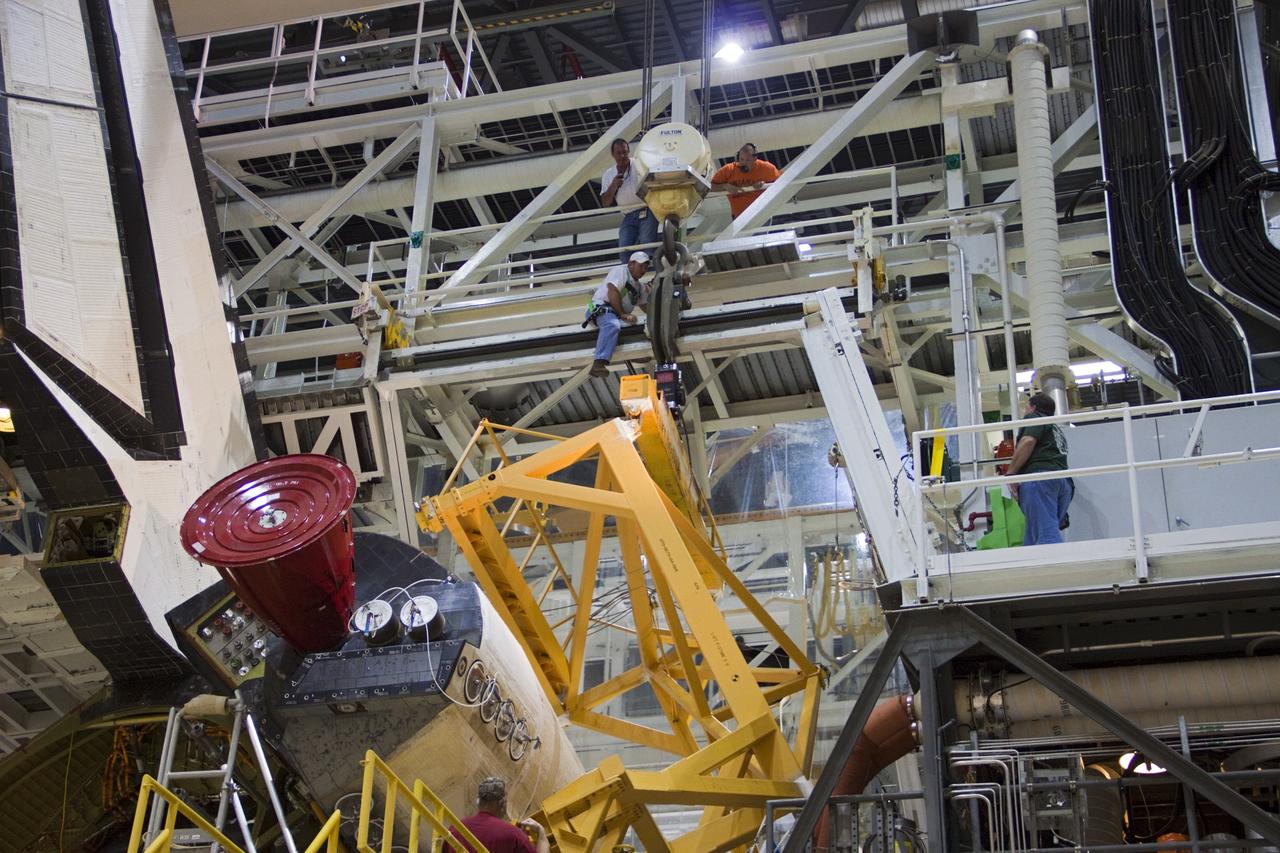
CAPE CANAVERAL, Fla. – Inside Orbiter Processing Facility-1 at NASA’s Kennedy Space Center in Florida, a United Space Alliance technician monitors the progress as a large crane lifts the right orbital maneuvering system, or OMS, pod for installation on space shuttle Atlantis. It is the last time an OMS pod will be installed on Atlantis. The OMS provided the shuttle with thrust for orbit insertion, rendezvous and deorbit, and could provide up to 1,000 pounds of propellant to the aft reaction control system. The OMS is housed in two independent pods located on each side of the shuttle’s aft fuselage. Each pod contains one OMS engine and the hardware needed to pressurize, store and distribute the propellants to perform the velocity maneuvers. Atlantis’ OMS pods were removed and sent to the test facility at White Sands Space Harbor in New Mexico to be cleaned of residual toxic propellant. The work is part of the Space Shuttle Program’s transition and retirement processing of the space shuttle fleet. A groundbreaking was held Jan. 18 for Atlantis’ future home, a 65,000-square-foot exhibit hall in Shuttle Plaza at the Kennedy Space Center Visitor Complex. Atlantis is scheduled to roll over to the visitor complex in November in preparation for the exhibit’s grand opening in July 2013. For more information, visit http://www.nasa.gov/transition. Photo credit: NASA/Dimitri Gerondidakis
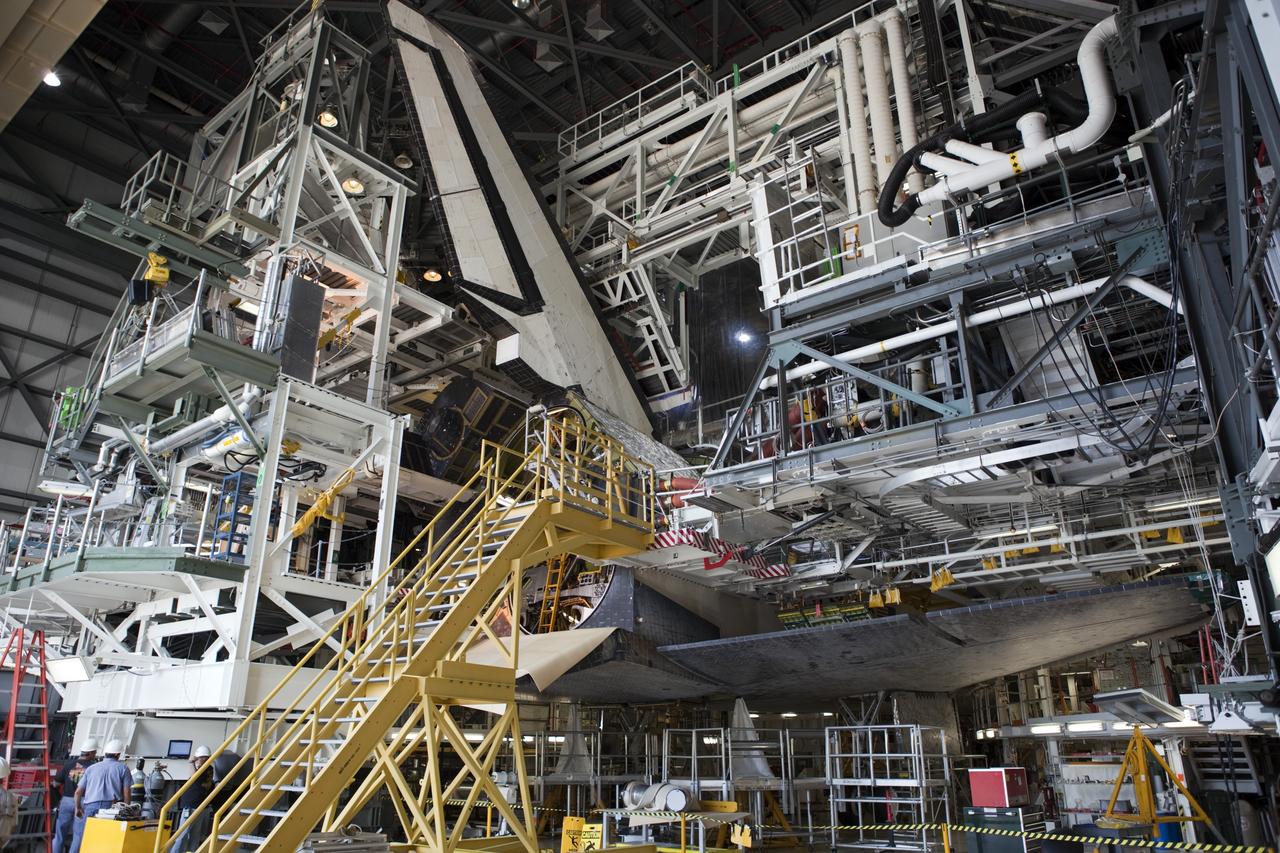
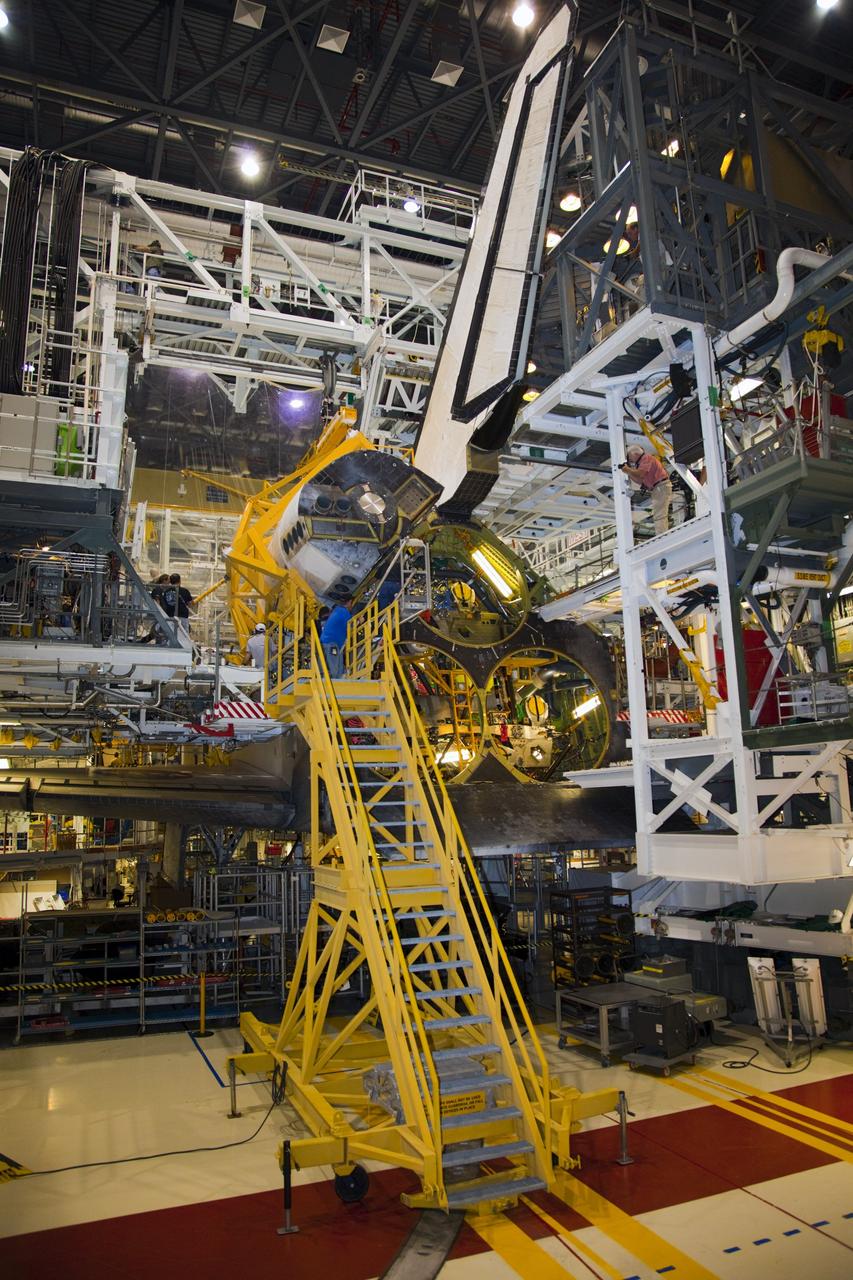
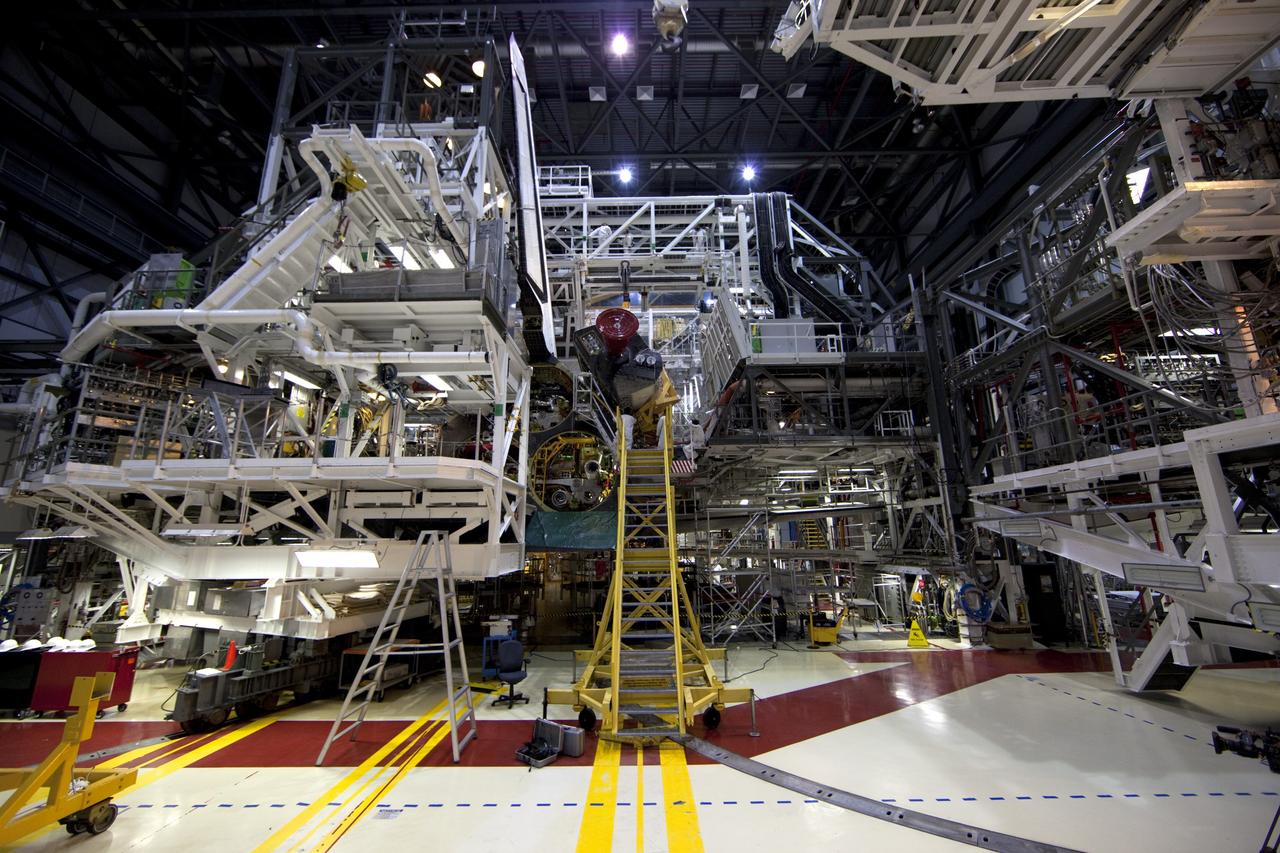
CAPE CANAVERAL, Fla. – Inside Orbiter Processing Facility-1 at NASA’s Kennedy Space Center in Florida, preparations are underway to install the right orbital maneuvering system, or OMS, pod on space shuttle Atlantis. It will be the last time an OMS pod is installed on Atlantis. The OMS provided the shuttle with thrust for orbit insertion, rendezvous and deorbit, and could provide up to 1,000 pounds of propellant to the aft reaction control system. The OMS is housed in two independent pods located on each side of the shuttle’s aft fuselage. Each pod contains one OMS engine and the hardware needed to pressurize, store and distribute the propellants to perform the velocity maneuvers. Atlantis’ OMS pods were removed and sent to the test facility at White Sands Space Harbor in New Mexico to be cleaned of residual toxic propellant. The work is part of the Space Shuttle Program’s transition and retirement processing of the space shuttle fleet. A groundbreaking was held Jan. 18 for Atlantis’ future home, a 65,000-square-foot exhibit hall in Shuttle Plaza at the Kennedy Space Center Visitor Complex. Atlantis is scheduled to roll over to the visitor complex in November in preparation for the exhibit’s grand opening in July 2013. For more information, visit http://www.nasa.gov/transition. Photo credit: NASA/Dimitri Gerondidakis
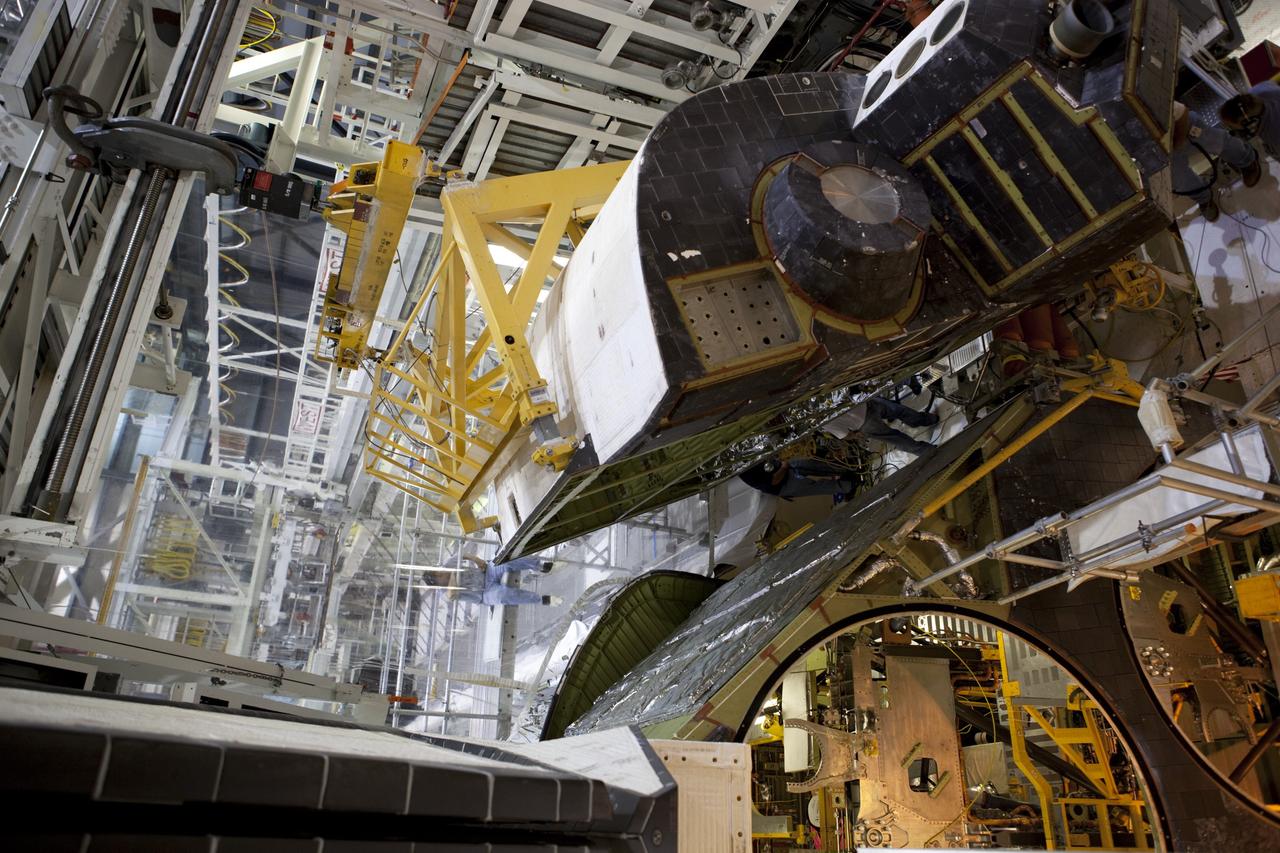
CAPE CANAVERAL, Fla. – Inside Orbiter Processing Facility-1 at NASA’s Kennedy Space Center in Florida, a unique close-up view shows a large crane lowering the right orbital maneuvering system, or OMS, pod closer to space shuttle Atlantis. It is the last time an OMS pod will be installed on Atlantis. The OMS provided the shuttle with thrust for orbit insertion, rendezvous and deorbit, and could provide up to 1,000 pounds of propellant to the aft reaction control system. The OMS is housed in two independent pods located on each side of the shuttle’s aft fuselage. Each pod contains one OMS engine and the hardware needed to pressurize, store and distribute the propellants to perform the velocity maneuvers. Atlantis’ OMS pods were removed and sent to the test facility at White Sands Space Harbor in New Mexico to be cleaned of residual toxic propellant. The work is part of the Space Shuttle Program’s transition and retirement processing of the space shuttle fleet. A groundbreaking was held Jan. 18 for Atlantis’ future home, a 65,000-square-foot exhibit hall in Shuttle Plaza at the Kennedy Space Center Visitor Complex. Atlantis is scheduled to roll over to the visitor complex in November in preparation for the exhibit’s grand opening in July 2013. For more information, visit http://www.nasa.gov/transition. Photo credit: NASA/Dimitri Gerondidakis
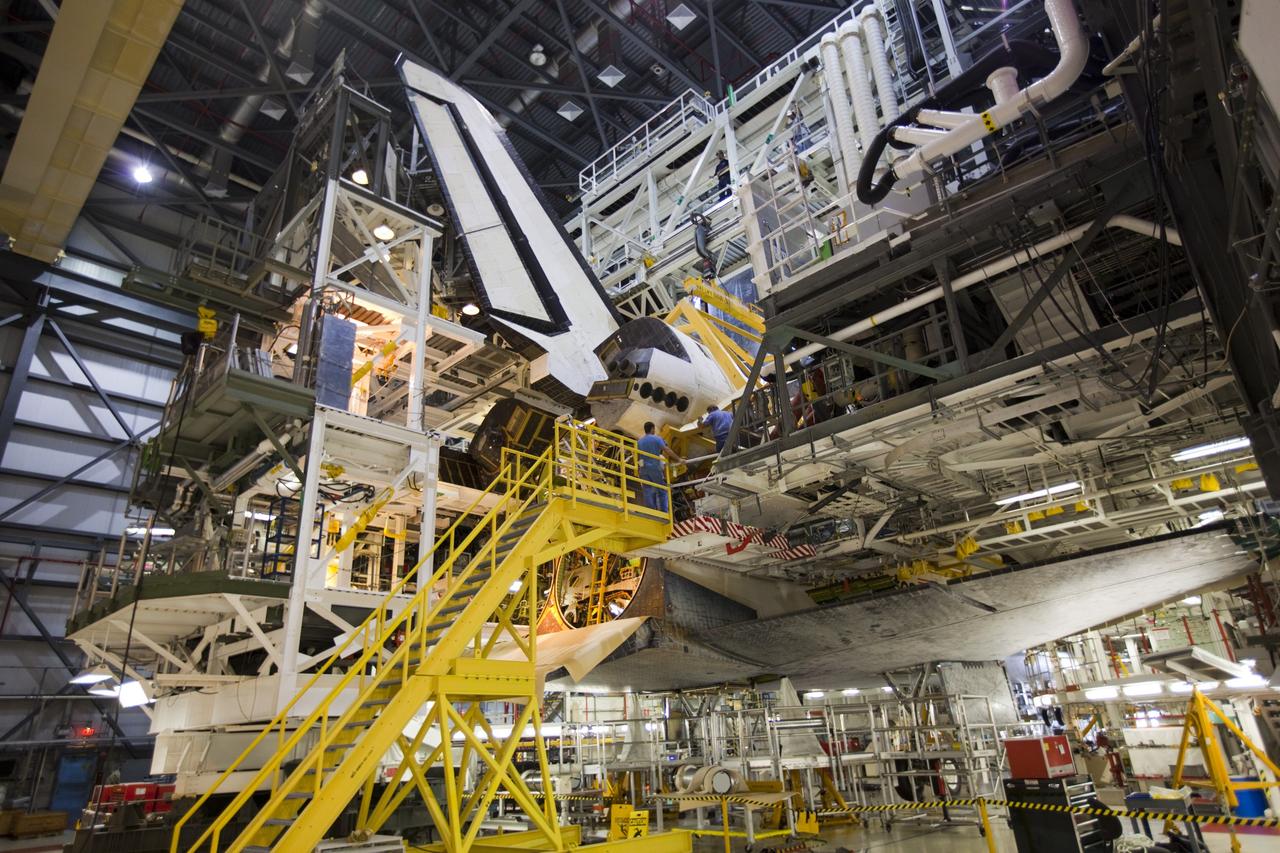
CAPE CANAVERAL, Fla. – Inside Orbiter Processing Facility-1 at NASA’s Kennedy Space Center in Florida, a large crane lowers the right orbital maneuvering system, or OMS, pod onto space shuttle Atlantis. It is the last time an OMS pod will be installed on Atlantis. The OMS provided the shuttle with thrust for orbit insertion, rendezvous and deorbit, and could provide up to 1,000 pounds of propellant to the aft reaction control system. The OMS is housed in two independent pods located on each side of the shuttle’s aft fuselage. Each pod contains one OMS engine and the hardware needed to pressurize, store and distribute the propellants to perform the velocity maneuvers. Atlantis’ OMS pods were removed and sent to the test facility at White Sands Space Harbor in New Mexico to be cleaned of residual toxic propellant. The work is part of the Space Shuttle Program’s transition and retirement processing of the space shuttle fleet. A groundbreaking was held Jan. 18 for Atlantis’ future home, a 65,000-square-foot exhibit hall in Shuttle Plaza at the Kennedy Space Center Visitor Complex. Atlantis is scheduled to roll over to the visitor complex in November in preparation for the exhibit’s grand opening in July 2013. For more information, visit http://www.nasa.gov/transition. Photo credit: NASA/Dimitri Gerondidakis
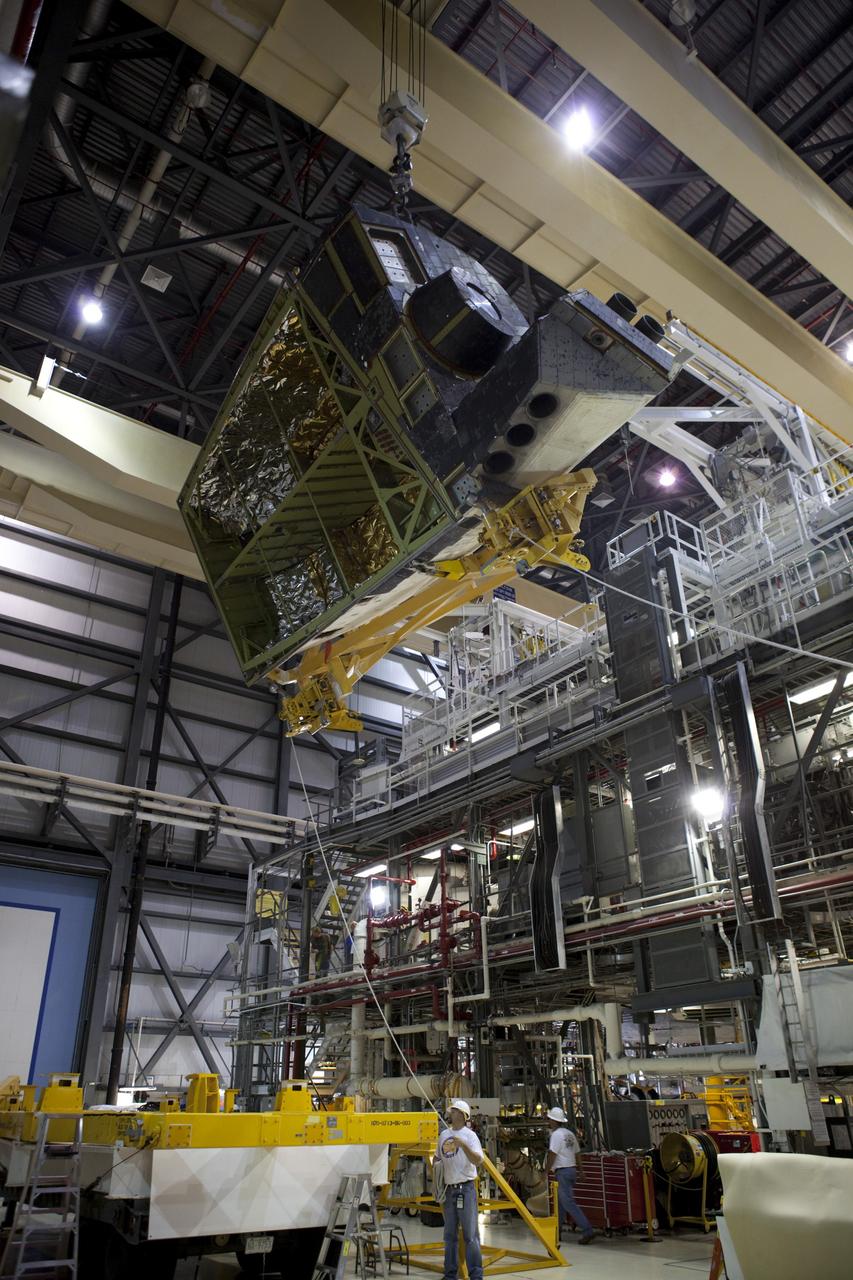
CAPE CANAVERAL, Fla. – Inside Orbiter Processing Facility-1 at NASA’s Kennedy Space Center in Florida, United Space Alliance technicians monitor the progress as a large crane lifts the right orbital maneuvering system, or OMS, pod for installation on space shuttle Atlantis. It is the last time an OMS pod will be installed on Atlantis. The OMS provided the shuttle with thrust for orbit insertion, rendezvous and deorbit, and could provide up to 1,000 pounds of propellant to the aft reaction control system. The OMS is housed in two independent pods located on each side of the shuttle’s aft fuselage. Each pod contains one OMS engine and the hardware needed to pressurize, store and distribute the propellants to perform the velocity maneuvers. Atlantis’ OMS pods were removed and sent to the test facility at White Sands Space Harbor in New Mexico to be cleaned of residual toxic propellant. The work is part of the Space Shuttle Program’s transition and retirement processing of the space shuttle fleet. A groundbreaking was held Jan. 18 for Atlantis’ future home, a 65,000-square-foot exhibit hall in Shuttle Plaza at the Kennedy Space Center Visitor Complex. Atlantis is scheduled to roll over to the visitor complex in November in preparation for the exhibit’s grand opening in July 2013. For more information, visit http://www.nasa.gov/transition. Photo credit: NASA/Dimitri Gerondidakis
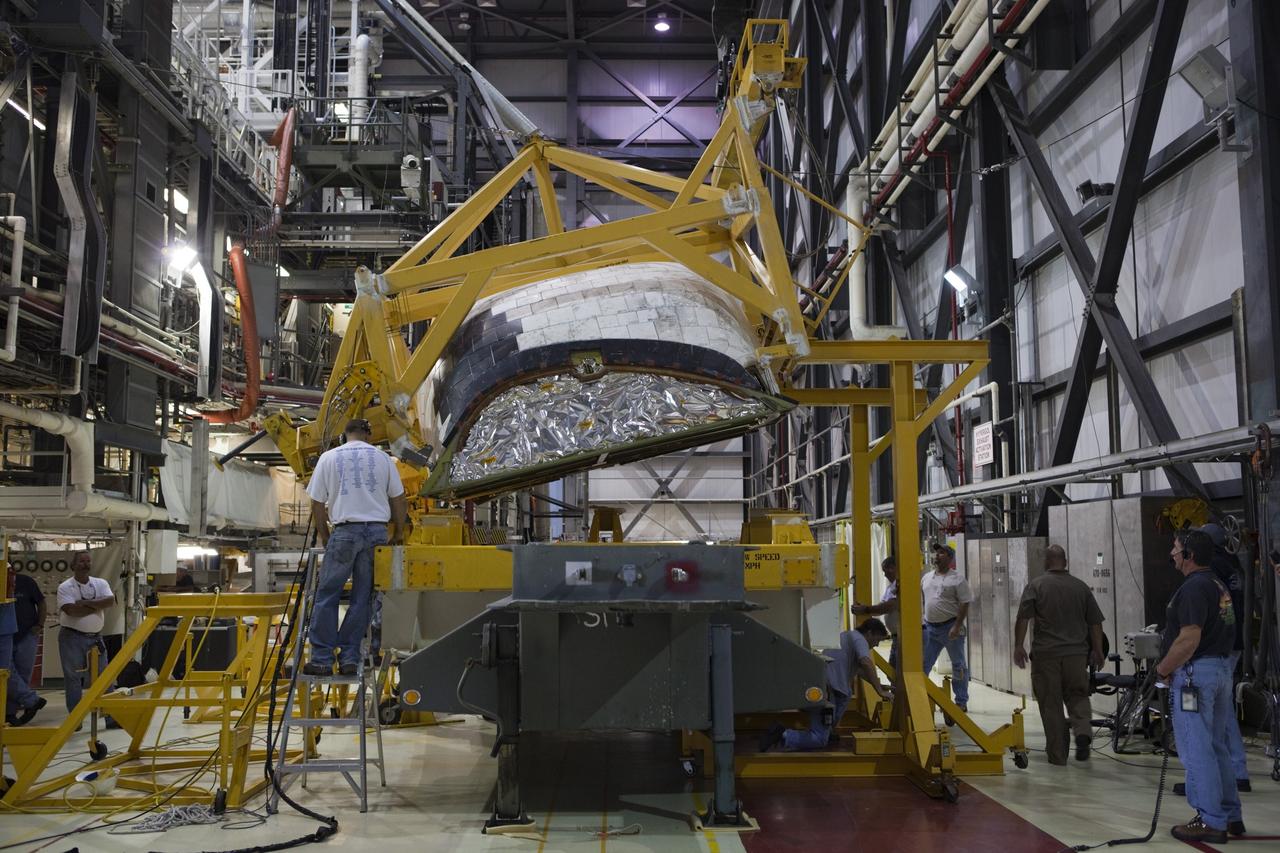
CAPE CANAVERAL, Fla. – Inside Orbiter Processing Facility-1 at NASA’s Kennedy Space Center in Florida, United Space Alliance technicians monitor the progress as a large crane begins to lift the right orbital maneuvering system, or OMS, pod for installation on space shuttle Atlantis. It is the last time an OMS pod will be installed on Atlantis. The OMS provided the shuttle with thrust for orbit insertion, rendezvous and deorbit, and could provide up to 1,000 pounds of propellant to the aft reaction control system. The OMS is housed in two independent pods located on each side of the shuttle’s aft fuselage. Each pod contains one OMS engine and the hardware needed to pressurize, store and distribute the propellants to perform the velocity maneuvers. Atlantis’ OMS pods were removed and sent to the test facility at White Sands Space Harbor in New Mexico to be cleaned of residual toxic propellant. The work is part of the Space Shuttle Program’s transition and retirement processing of the space shuttle fleet. A groundbreaking was held Jan. 18 for Atlantis’ future home, a 65,000-square-foot exhibit hall in Shuttle Plaza at the Kennedy Space Center Visitor Complex. Atlantis is scheduled to roll over to the visitor complex in November in preparation for the exhibit’s grand opening in July 2013. For more information, visit http://www.nasa.gov/transition. Photo credit: NASA/Dimitri Gerondidakis
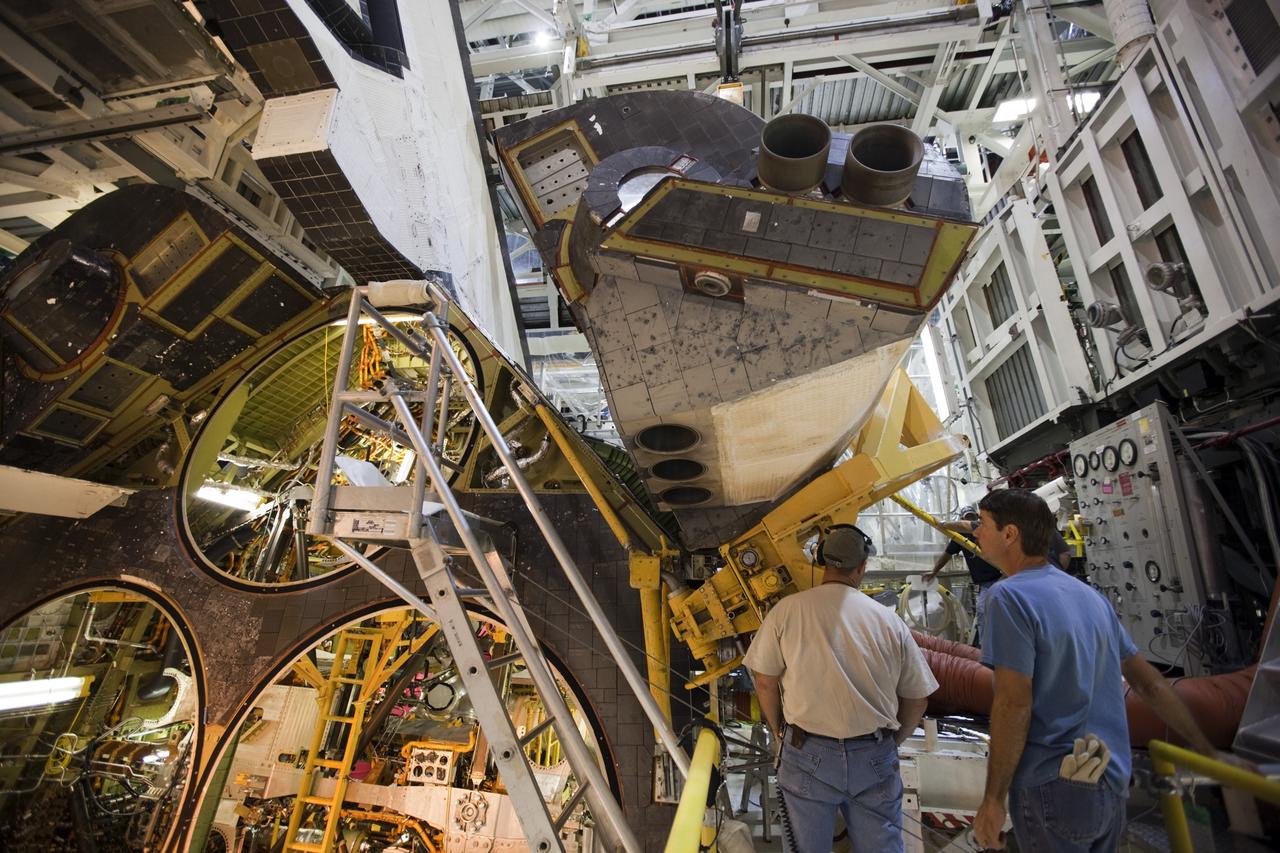
CAPE CANAVERAL, Fla. – Inside Orbiter Processing Facility-1 at NASA’s Kennedy Space Center in Florida, United Space Alliance technicians monitor the progress as a large crane lowers the right orbital maneuvering system, or OMS, pod onto space shuttle Atlantis. It is the last time an OMS pod will be installed on Atlantis. The OMS provided the shuttle with thrust for orbit insertion, rendezvous and deorbit, and could provide up to 1,000 pounds of propellant to the aft reaction control system. The OMS is housed in two independent pods located on each side of the shuttle’s aft fuselage. Each pod contains one OMS engine and the hardware needed to pressurize, store and distribute the propellants to perform the velocity maneuvers. Atlantis’ OMS pods were removed and sent to the test facility at White Sands Space Harbor in New Mexico to be cleaned of residual toxic propellant. The work is part of the Space Shuttle Program’s transition and retirement processing of the space shuttle fleet. A groundbreaking was held Jan. 18 for Atlantis’ future home, a 65,000-square-foot exhibit hall in Shuttle Plaza at the Kennedy Space Center Visitor Complex. Atlantis is scheduled to roll over to the visitor complex in November in preparation for the exhibit’s grand opening in July 2013. For more information, visit http://www.nasa.gov/transition. Photo credit: NASA/Dimitri Gerondidakis
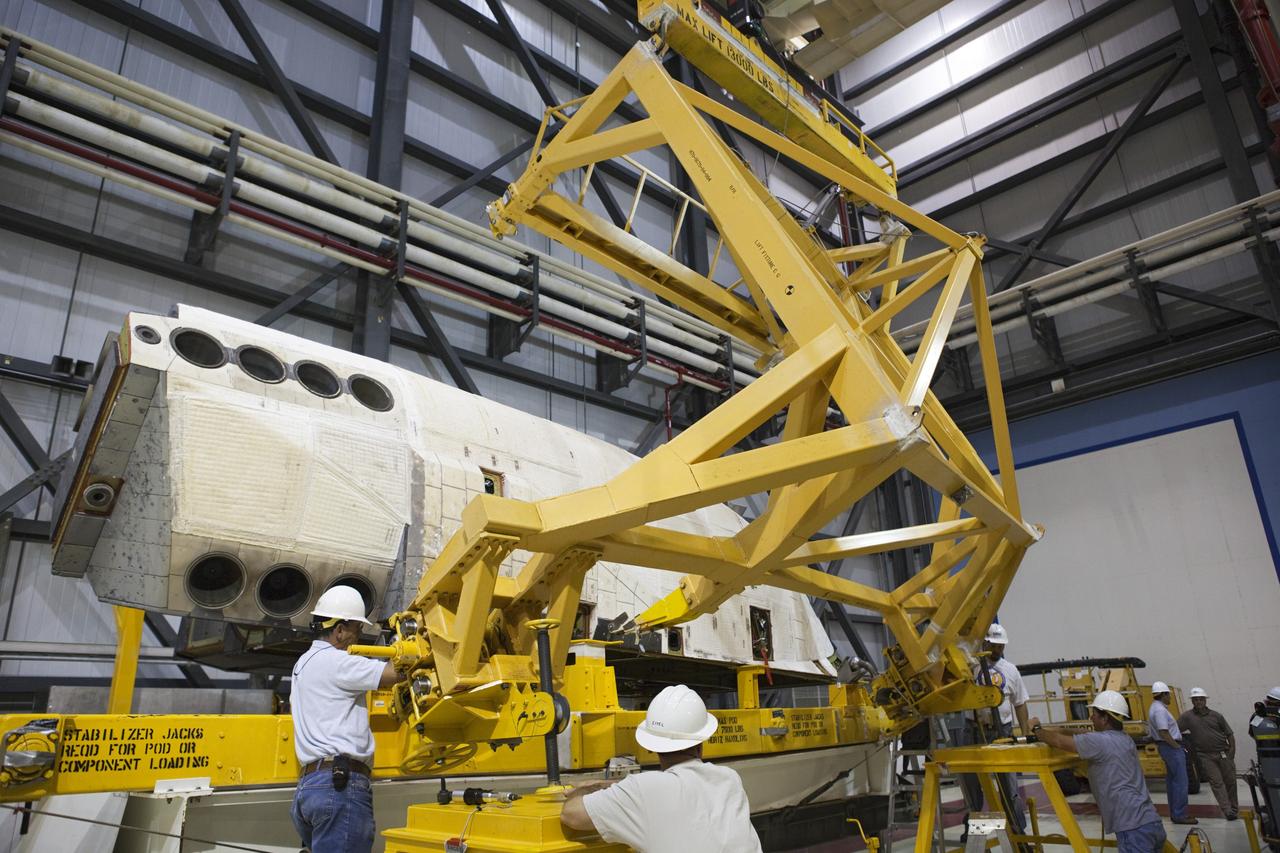
CAPE CANAVERAL, Fla. – Inside Orbiter Processing Facility-1 at NASA’s Kennedy Space Center in Florida, United Launch Alliance technicians provide assistance as a large crane is lowered toward the right orbital maneuvering system, or OMS, pod for space shuttle Atlantis. It will be the last time an OMS pod is installed on Atlantis. The OMS provided the shuttle with thrust for orbit insertion, rendezvous and deorbit, and could provide up to 1,000 pounds of propellant to the aft reaction control system. The OMS is housed in two independent pods located on each side of the shuttle’s aft fuselage. Each pod contains one OMS engine and the hardware needed to pressurize, store and distribute the propellants to perform the velocity maneuvers. Atlantis’ OMS pods were removed and sent to the test facility at White Sands Space Harbor in New Mexico to be cleaned of residual toxic propellant. The work is part of the Space Shuttle Program’s transition and retirement processing of the space shuttle fleet. A groundbreaking was held Jan. 18 for Atlantis’ future home, a 65,000-square-foot exhibit hall in Shuttle Plaza at the Kennedy Space Center Visitor Complex. Atlantis is scheduled to roll over to the visitor complex in November in preparation for the exhibit’s grand opening in July 2013. For more information, visit http://www.nasa.gov/transition. Photo credit: NASA/Dimitri Gerondidakis
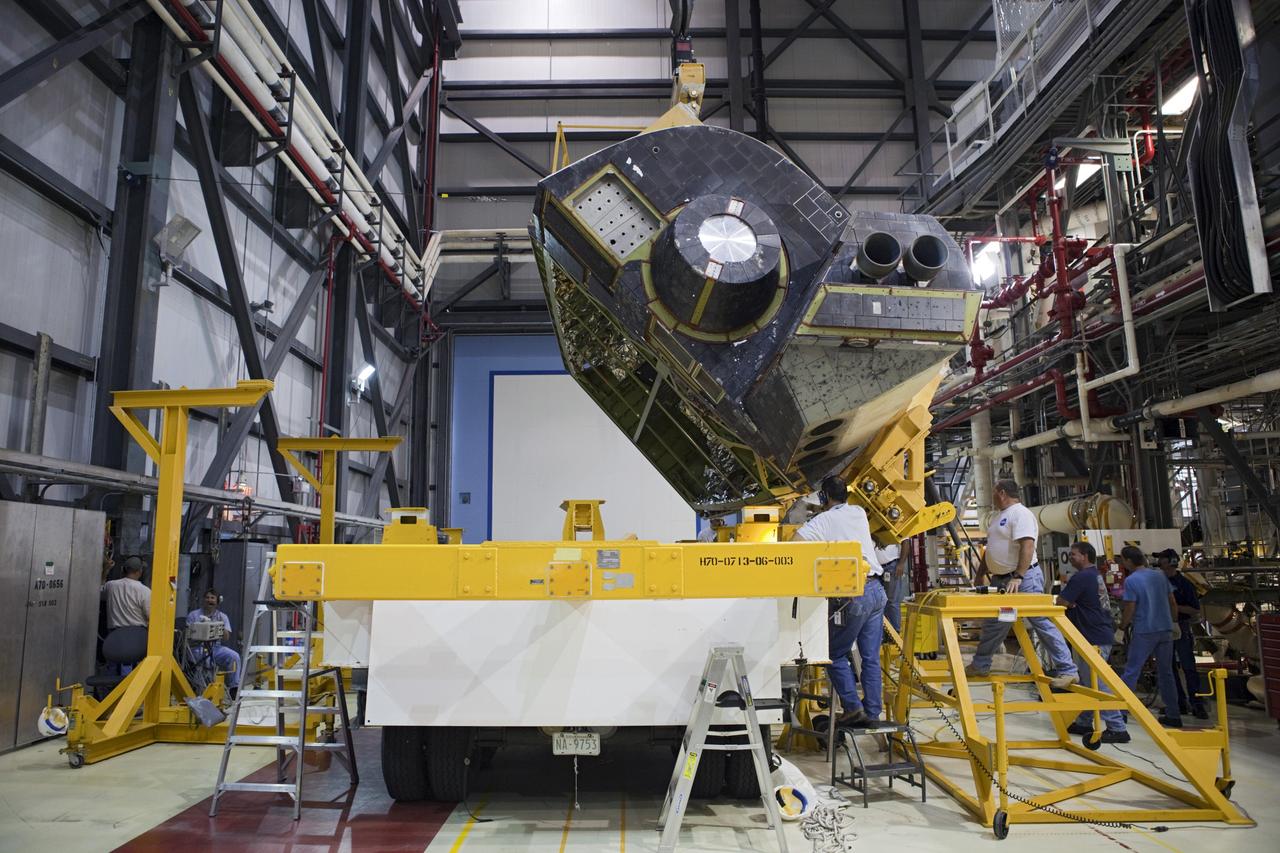
CAPE CANAVERAL, Fla. – Inside Orbiter Processing Facility-1 at NASA’s Kennedy Space Center in Florida, United Space Alliance technicians monitor the progress as a large crane begins to lift the right orbital maneuvering system, or OMS, pod for installation on space shuttle Atlantis. It is the last time an OMS pod will be installed on Atlantis. The OMS provided the shuttle with thrust for orbit insertion, rendezvous and deorbit, and could provide up to 1,000 pounds of propellant to the aft reaction control system. The OMS is housed in two independent pods located on each side of the shuttle’s aft fuselage. Each pod contains one OMS engine and the hardware needed to pressurize, store and distribute the propellants to perform the velocity maneuvers. Atlantis’ OMS pods were removed and sent to the test facility at White Sands Space Harbor in New Mexico to be cleaned of residual toxic propellant. The work is part of the Space Shuttle Program’s transition and retirement processing of the space shuttle fleet. A groundbreaking was held Jan. 18 for Atlantis’ future home, a 65,000-square-foot exhibit hall in Shuttle Plaza at the Kennedy Space Center Visitor Complex. Atlantis is scheduled to roll over to the visitor complex in November in preparation for the exhibit’s grand opening in July 2013. For more information, visit http://www.nasa.gov/transition. Photo credit: NASA/Dimitri Gerondidakis
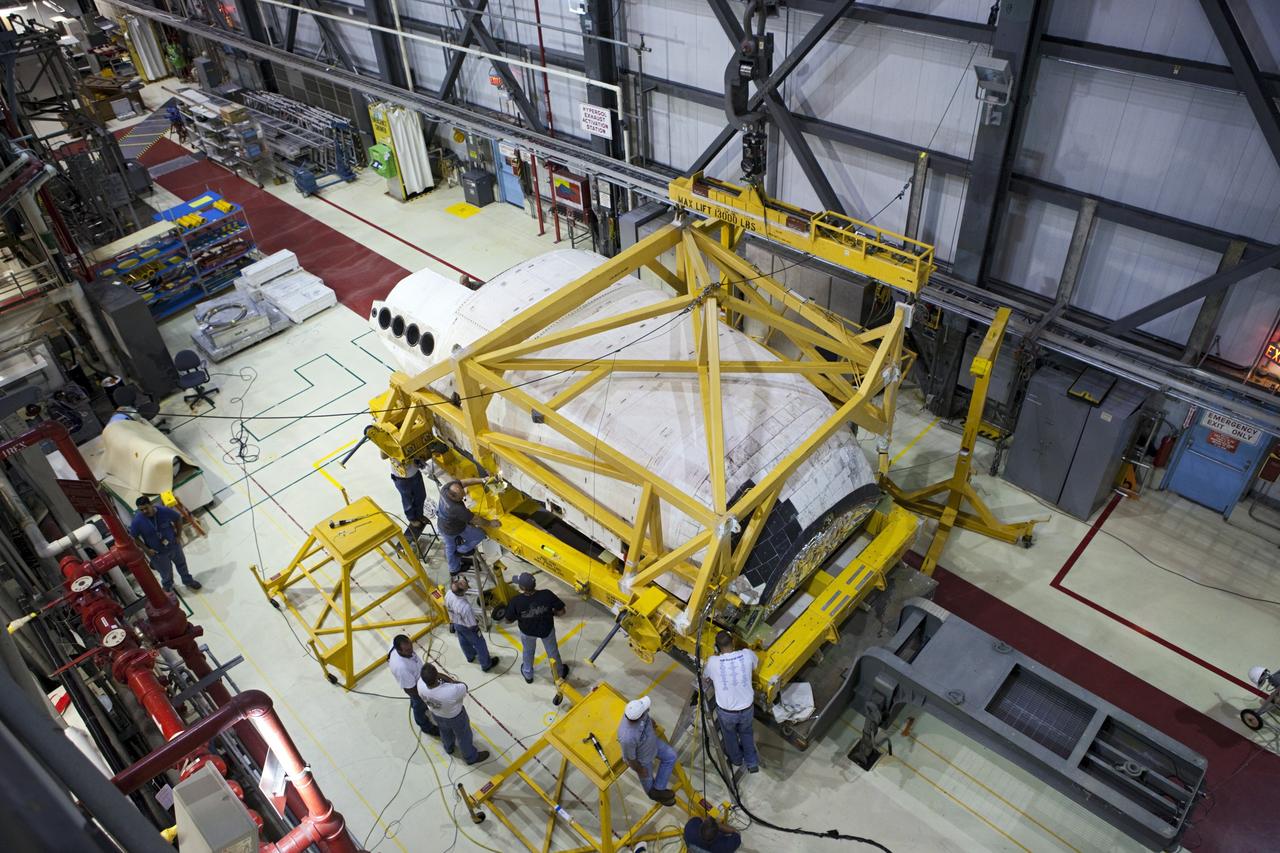
CAPE CANAVERAL, Fla. – In a view from above inside Orbiter Processing Facility-1 at NASA’s Kennedy Space Center in Florida, United Space Alliance technicians monitor the progress as a crane is attached to the right orbital maneuvering system, or OMS, pod for space shuttle Atlantis. It is the last time an OMS pod will be installed on Atlantis. The OMS provided the shuttle with thrust for orbit insertion, rendezvous and deorbit, and could provide up to 1,000 pounds of propellant to the aft reaction control system. The OMS is housed in two independent pods located on each side of the shuttle’s aft fuselage. Each pod contains one OMS engine and the hardware needed to pressurize, store and distribute the propellants to perform the velocity maneuvers. Atlantis’ OMS pods were removed and sent to the test facility at White Sands Space Harbor in New Mexico to be cleaned of residual toxic propellant. The work is part of the Space Shuttle Program’s transition and retirement processing of the space shuttle fleet. A groundbreaking was held Jan. 18 for Atlantis’ future home, a 65,000-square-foot exhibit hall in Shuttle Plaza at the Kennedy Space Center Visitor Complex. Atlantis is scheduled to roll over to the visitor complex in November in preparation for the exhibit’s grand opening in July 2013. For more information, visit http://www.nasa.gov/transition. Photo credit: NASA/Dimitri Gerondidakis
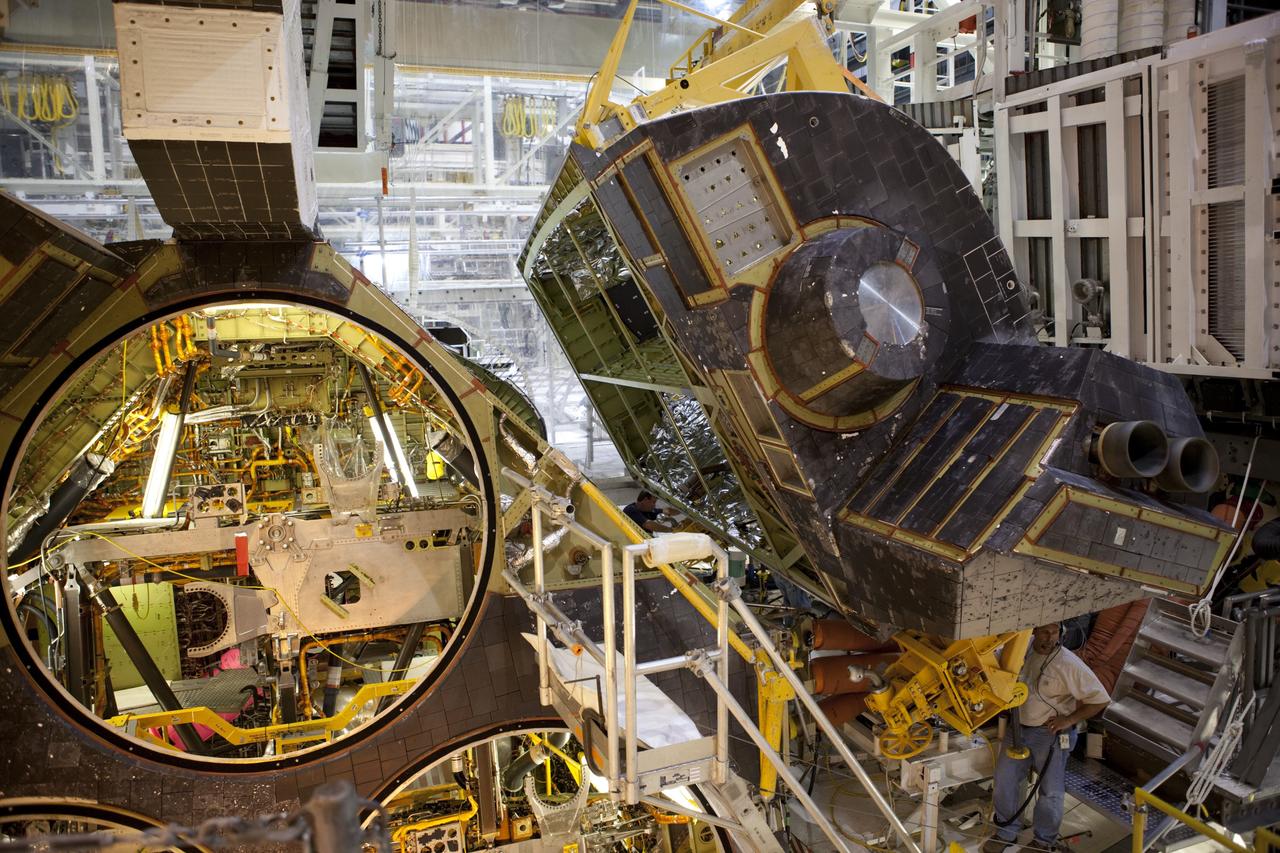
CAPE CANAVERAL, Fla. – Inside Orbiter Processing Facility-1 at NASA’s Kennedy Space Center in Florida, a unique close-up view shows a large crane lowering the right orbital maneuvering system, or OMS, pod closer to space shuttle Atlantis. It is the last time an OMS pod will be installed on Atlantis. The OMS provided the shuttle with thrust for orbit insertion, rendezvous and deorbit, and could provide up to 1,000 pounds of propellant to the aft reaction control system. The OMS is housed in two independent pods located on each side of the shuttle’s aft fuselage. Each pod contains one OMS engine and the hardware needed to pressurize, store and distribute the propellants to perform the velocity maneuvers. Atlantis’ OMS pods were removed and sent to the test facility at White Sands Space Harbor in New Mexico to be cleaned of residual toxic propellant. The work is part of the Space Shuttle Program’s transition and retirement processing of the space shuttle fleet. A groundbreaking was held Jan. 18 for Atlantis’ future home, a 65,000-square-foot exhibit hall in Shuttle Plaza at the Kennedy Space Center Visitor Complex. Atlantis is scheduled to roll over to the visitor complex in November in preparation for the exhibit’s grand opening in July 2013. For more information, visit http://www.nasa.gov/transition. Photo credit: NASA/Dimitri Gerondidakis

CAPE CANAVERAL, Fla. – Inside Orbiter Processing Facility-1 at NASA’s Kennedy Space Center in Florida, a large crane lowers the right orbital maneuvering system, or OMS, pod closer to space shuttle Atlantis. It is the last time an OMS pod will be installed on Atlantis. The OMS provided the shuttle with thrust for orbit insertion, rendezvous and deorbit, and could provide up to 1,000 pounds of propellant to the aft reaction control system. The OMS is housed in two independent pods located on each side of the shuttle’s aft fuselage. Each pod contains one OMS engine and the hardware needed to pressurize, store and distribute the propellants to perform the velocity maneuvers. Atlantis’ OMS pods were removed and sent to the test facility at White Sands Space Harbor in New Mexico to be cleaned of residual toxic propellant. The work is part of the Space Shuttle Program’s transition and retirement processing of the space shuttle fleet. A groundbreaking was held Jan. 18 for Atlantis’ future home, a 65,000-square-foot exhibit hall in Shuttle Plaza at the Kennedy Space Center Visitor Complex. Atlantis is scheduled to roll over to the visitor complex in November in preparation for the exhibit’s grand opening in July 2013. For more information, visit http://www.nasa.gov/transition. Photo credit: NASA/Dimitri Gerondidakis
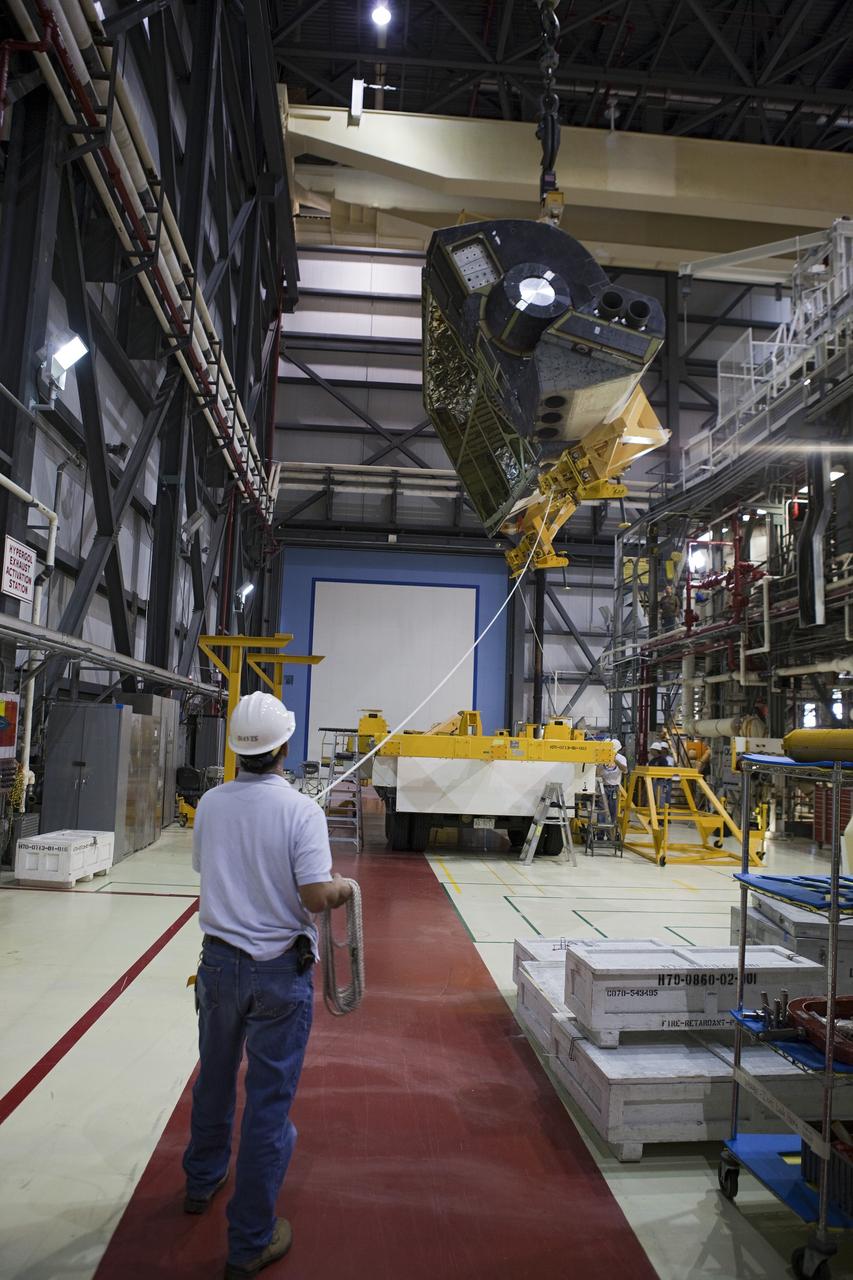
CAPE CANAVERAL, Fla. – Inside Orbiter Processing Facility-1 at NASA’s Kennedy Space Center in Florida, a United Space Alliance technician monitors the progress as a large crane lifts the right orbital maneuvering system, or OMS, pod for installation on space shuttle Atlantis. It is the last time an OMS pod will be installed on Atlantis. The OMS provided the shuttle with thrust for orbit insertion, rendezvous and deorbit, and could provide up to 1,000 pounds of propellant to the aft reaction control system. The OMS is housed in two independent pods located on each side of the shuttle’s aft fuselage. Each pod contains one OMS engine and the hardware needed to pressurize, store and distribute the propellants to perform the velocity maneuvers. Atlantis’ OMS pods were removed and sent to the test facility at White Sands Space Harbor in New Mexico to be cleaned of residual toxic propellant. The work is part of the Space Shuttle Program’s transition and retirement processing of the space shuttle fleet. A groundbreaking was held Jan. 18 for Atlantis’ future home, a 65,000-square-foot exhibit hall in Shuttle Plaza at the Kennedy Space Center Visitor Complex. Atlantis is scheduled to roll over to the visitor complex in November in preparation for the exhibit’s grand opening in July 2013. For more information, visit http://www.nasa.gov/transition. Photo credit: NASA/Dimitri Gerondidakis
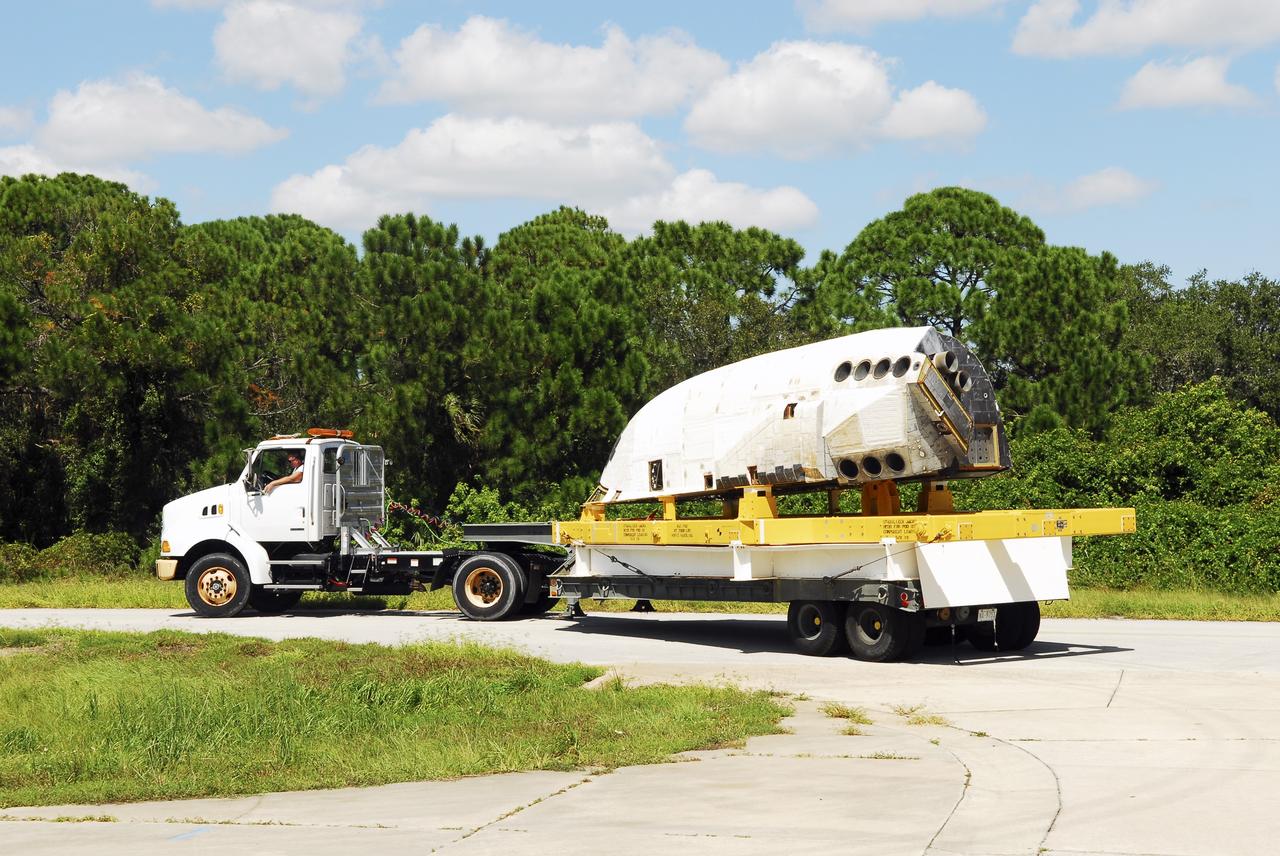
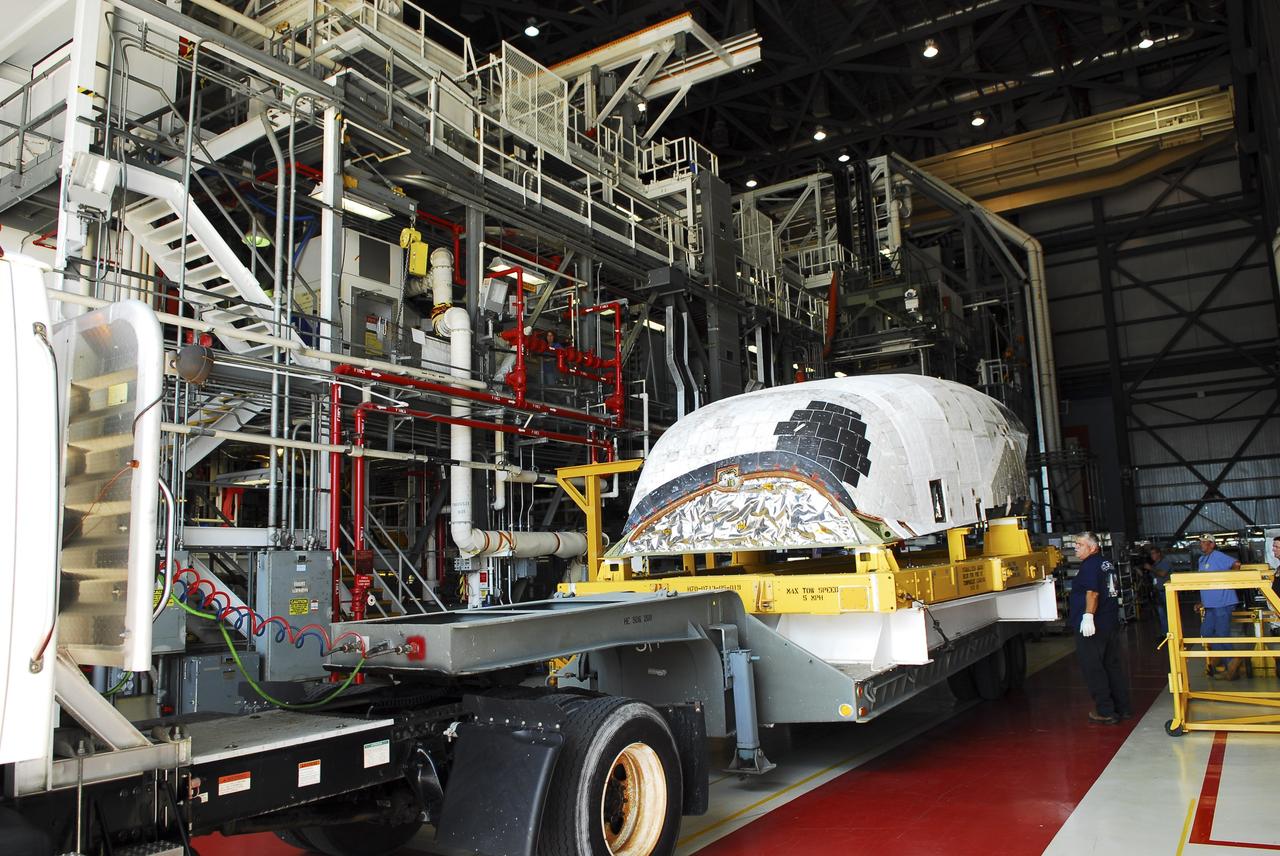
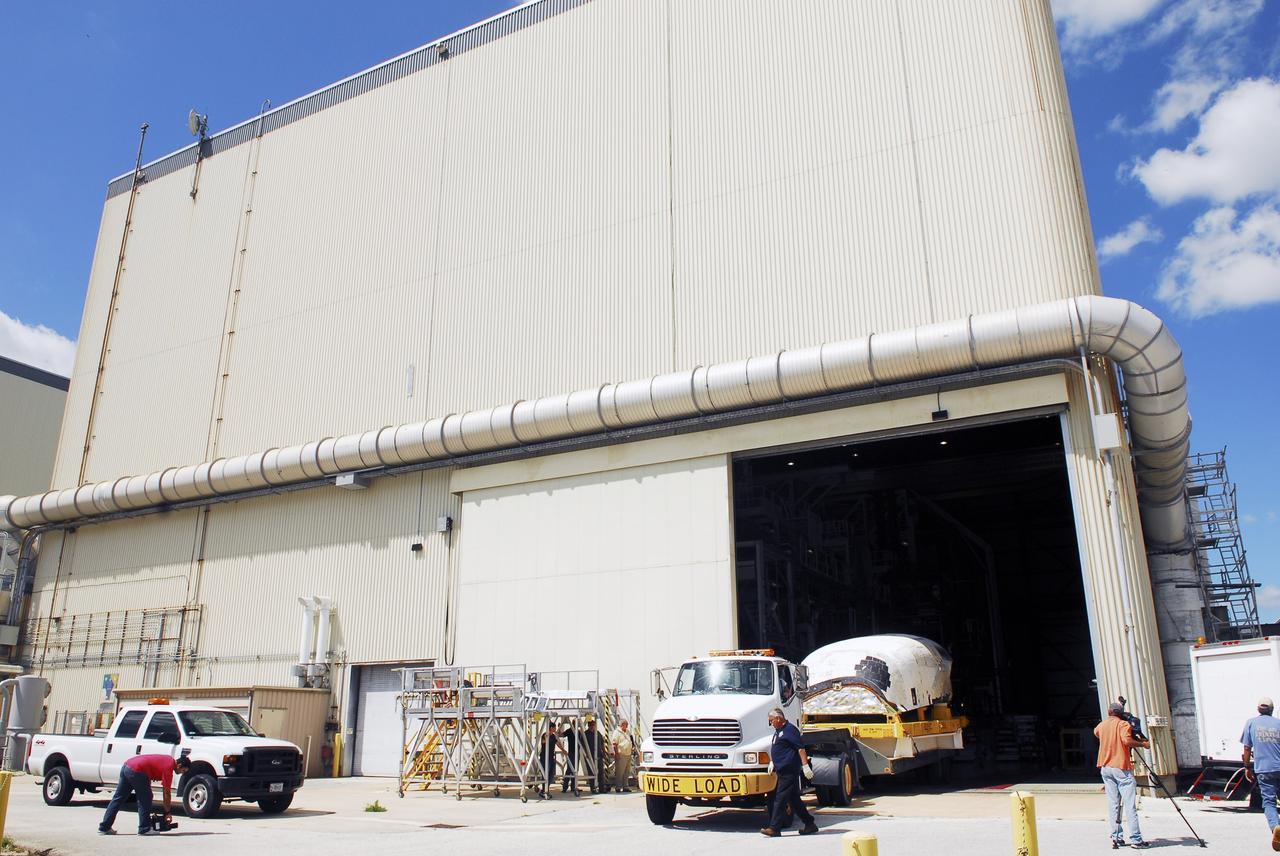
CAPE CANAVERAL, Fla. – At NASA’s Kennedy Space Center in Florida, a truck transports space shuttle Discovery's orbital maneuvering system (OMS) pod from the Hypergol Maintenance Facility to the Orbiter Processing Facility (OPF). The OMS has been returned from White Sands Space Harbor in New Mexico where it underwent a complete deservicing and cleaning. The work is part of the Space Shuttle Program’s transition and retirement processing of space shuttle Discovery. The shuttle will go to the Smithsonian's National Air and Space Museum, Steven F. Udvar-Hazy Center in Chantilly, Va. For more information, visit http://www.nasa.gov/shuttle. Photo credit: NASA/Jim Grossmann
CAPE CANAVERAL, Fla. – At NASA’s Kennedy Space Center in Florida, a truck positions space shuttle Discovery's orbital maneuvering system (OMS) pod into Orbiter Processing Facility-1 (OPF). The OMS has been returned from White Sands Space Harbor in New Mexico where it underwent a complete deservicing and cleaning. The work is part of the Space Shuttle Program’s transition and retirement processing of space shuttle Discovery. The shuttle will go to the Smithsonian's National Air and Space Museum, Steven F. Udvar-Hazy Center in Chantilly, Va. For more information, visit http://www.nasa.gov/shuttle. Photo credit: NASA/Jim Grossmann
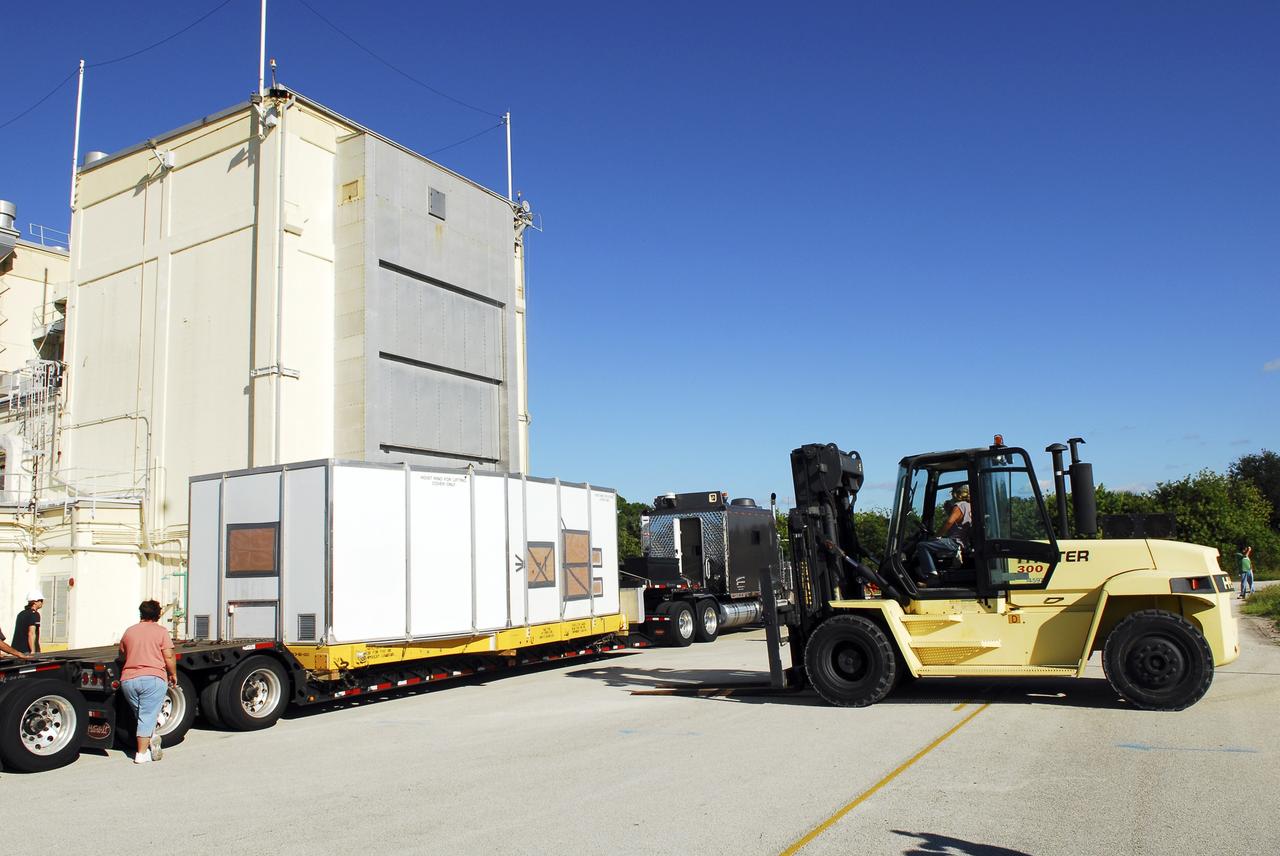
CAPE CANAVERAL, Fla. – Workers outside the Hypergol Maintenance Facility at NASA’s Kennedy Space Center in Florida use a forklift to elevate a shipping crate, containing space shuttle Discovery's orbital maneuvering system (OMS) pod, off a flatbed truck. The OMS has been returned from White Sands Space Harbor in New Mexico where it underwent a complete deservicing and cleaning. The work is part of the Space Shuttle Program’s transition and retirement processing of space shuttle Discovery. The shuttle will go to the Smithsonian's National Air and Space Museum, Steven F. Udvar-Hazy Center in Chantilly, Va. For more information, visit http://www.nasa.gov/shuttle. Photo credit: NASA/Jim Grossmann
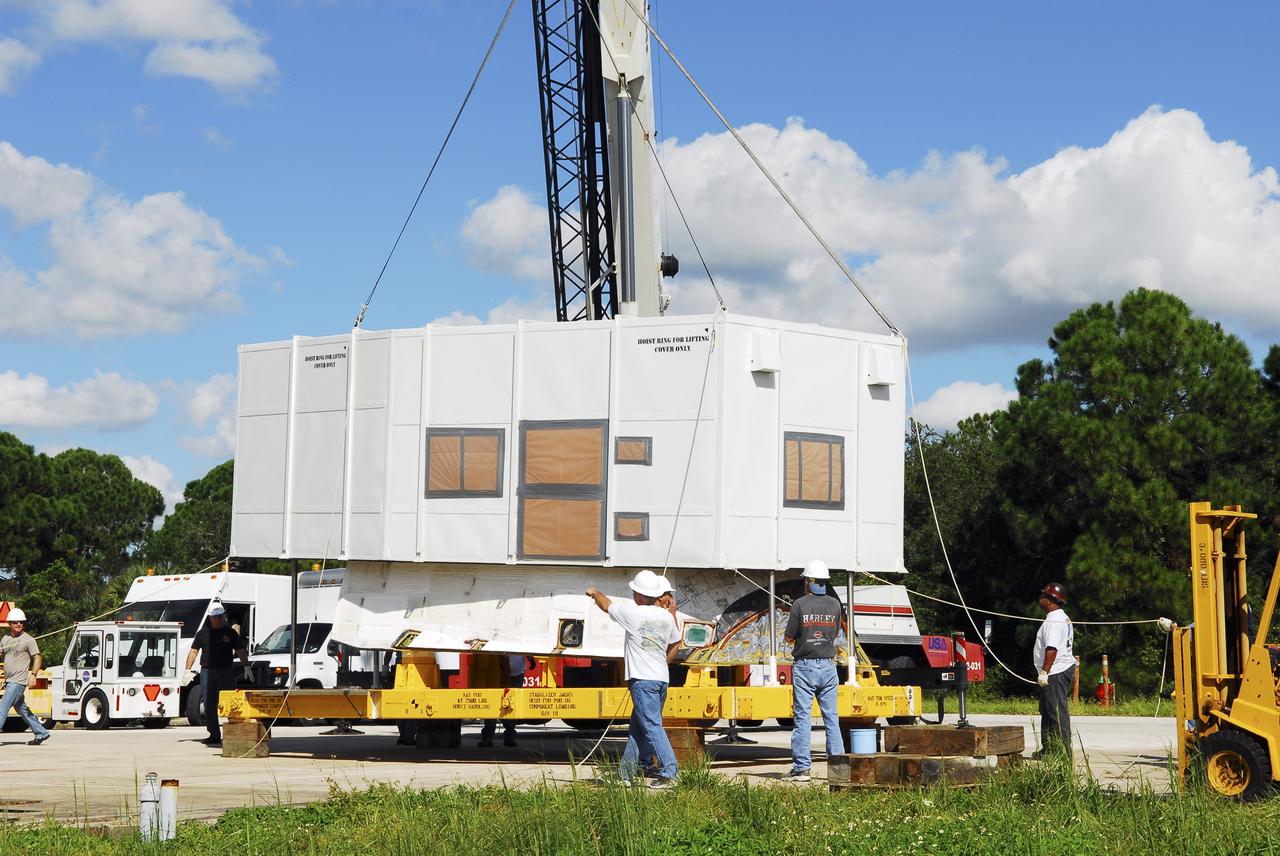
CAPE CANAVERAL, Fla. – Workers outside the Hypergol Maintenance Facility at NASA’s Kennedy Space Center in Florida use a crane to lift the shipping container off of space shuttle Discovery's orbital maneuvering system (OMS) pod. The OMS has been returned from White Sands Space Harbor in New Mexico where it underwent a complete deservicing and cleaning. The work is part of the Space Shuttle Program’s transition and retirement processing of space shuttle Discovery. The shuttle will go to the Smithsonian's National Air and Space Museum, Steven F. Udvar-Hazy Center in Chantilly, Va. For more information, visit http://www.nasa.gov/shuttle. Photo credit: NASA/Jim Grossmann
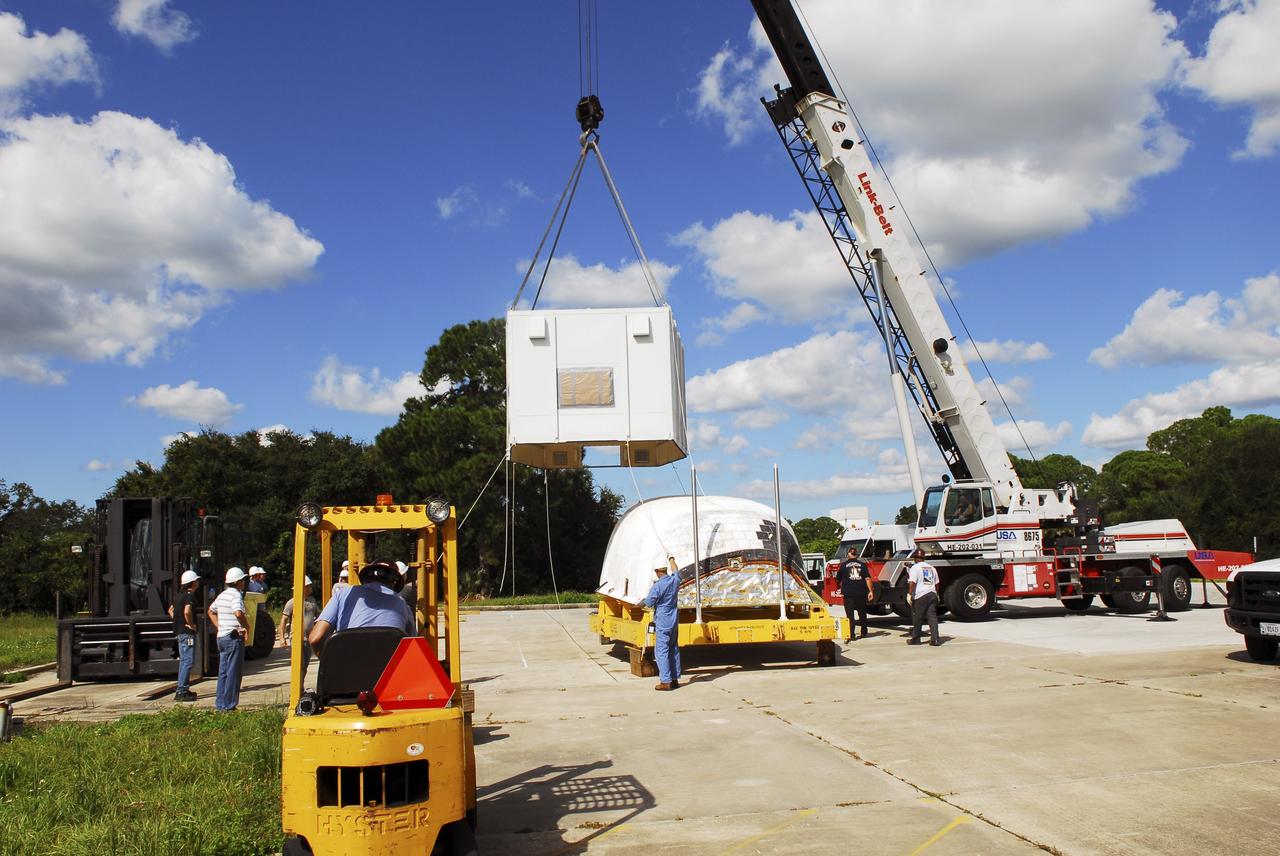
CAPE CANAVERAL, Fla. – Workers outside the Hypergol Maintenance Facility at NASA’s Kennedy Space Center in Florida use a crane to lift the shipping container off of space shuttle Discovery's orbital maneuvering system (OMS) pod. The OMS has been returned from White Sands Space Harbor in New Mexico where it underwent a complete deservicing and cleaning. The work is part of the Space Shuttle Program’s transition and retirement processing of space shuttle Discovery. The shuttle will go to the Smithsonian's National Air and Space Museum, Steven F. Udvar-Hazy Center in Chantilly, Va. For more information, visit http://www.nasa.gov/shuttle. Photo credit: NASA/Jim Grossmann
CAPE CANAVERAL, Fla. – At NASA’s Kennedy Space Center in Florida, a truck backs space shuttle Discovery's orbital maneuvering system (OMS) pod into Orbiter Processing Facility-1 (OPF). The OMS has been returned from White Sands Space Harbor in New Mexico where it underwent a complete deservicing and cleaning. The work is part of the Space Shuttle Program’s transition and retirement processing of space shuttle Discovery. The shuttle will go to the Smithsonian's National Air and Space Museum, Steven F. Udvar-Hazy Center in Chantilly, Va. For more information, visit http://www.nasa.gov/shuttle. Photo credit: NASA/Jim Grossmann
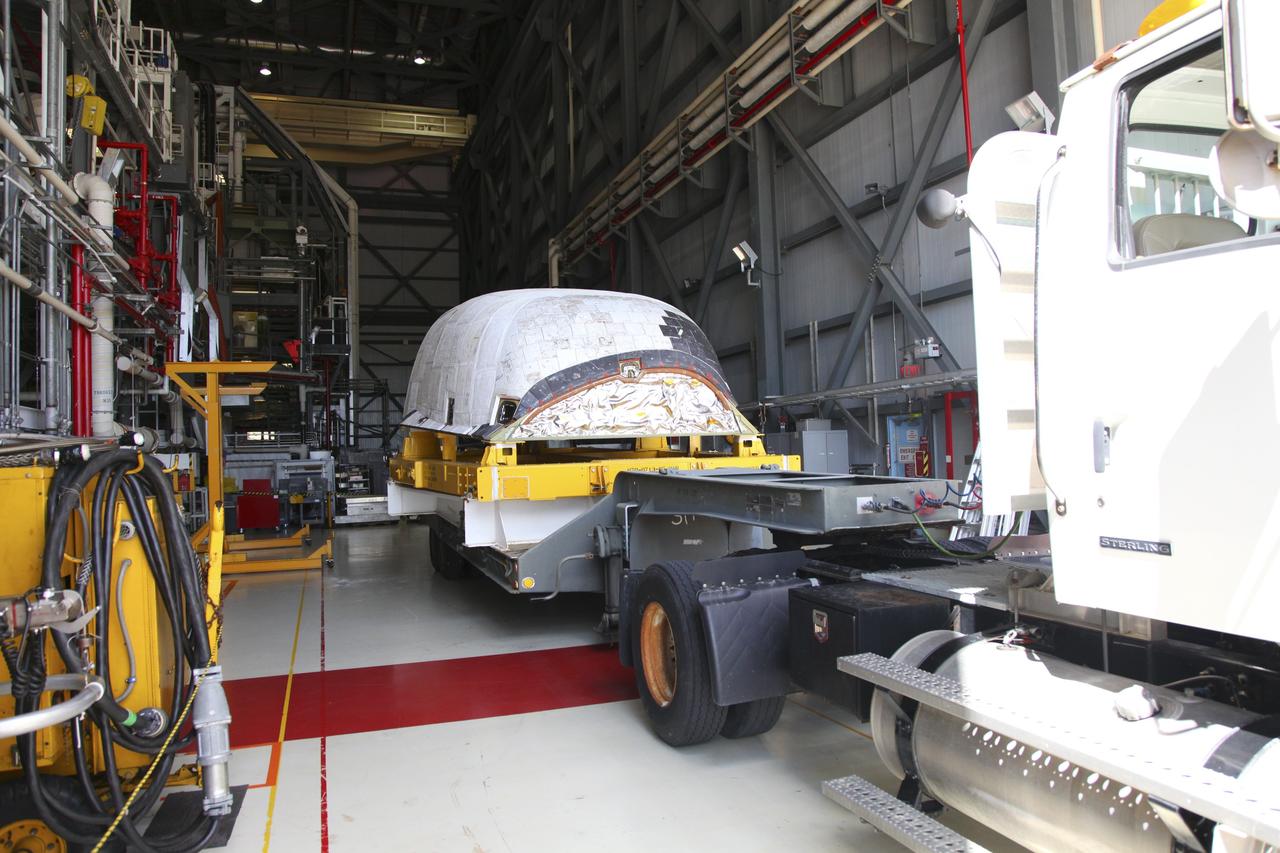
CAPE CANAVERAL, Fla. – At NASA’s Kennedy Space Center in Florida, a truck backs space shuttle Discovery's orbital maneuvering system (OMS) pod into Orbiter Processing Facility-1 (OPF). The OMS has been returned from White Sands Space Harbor in New Mexico where it underwent a complete deservicing and cleaning. The work is part of the Space Shuttle Program’s transition and retirement processing of space shuttle Discovery. The shuttle will go to the Smithsonian's National Air and Space Museum, Steven F. Udvar-Hazy Center in Chantilly, Va. For more information, visit http://www.nasa.gov/shuttle. Photo credit: NASA/Frankie Martin
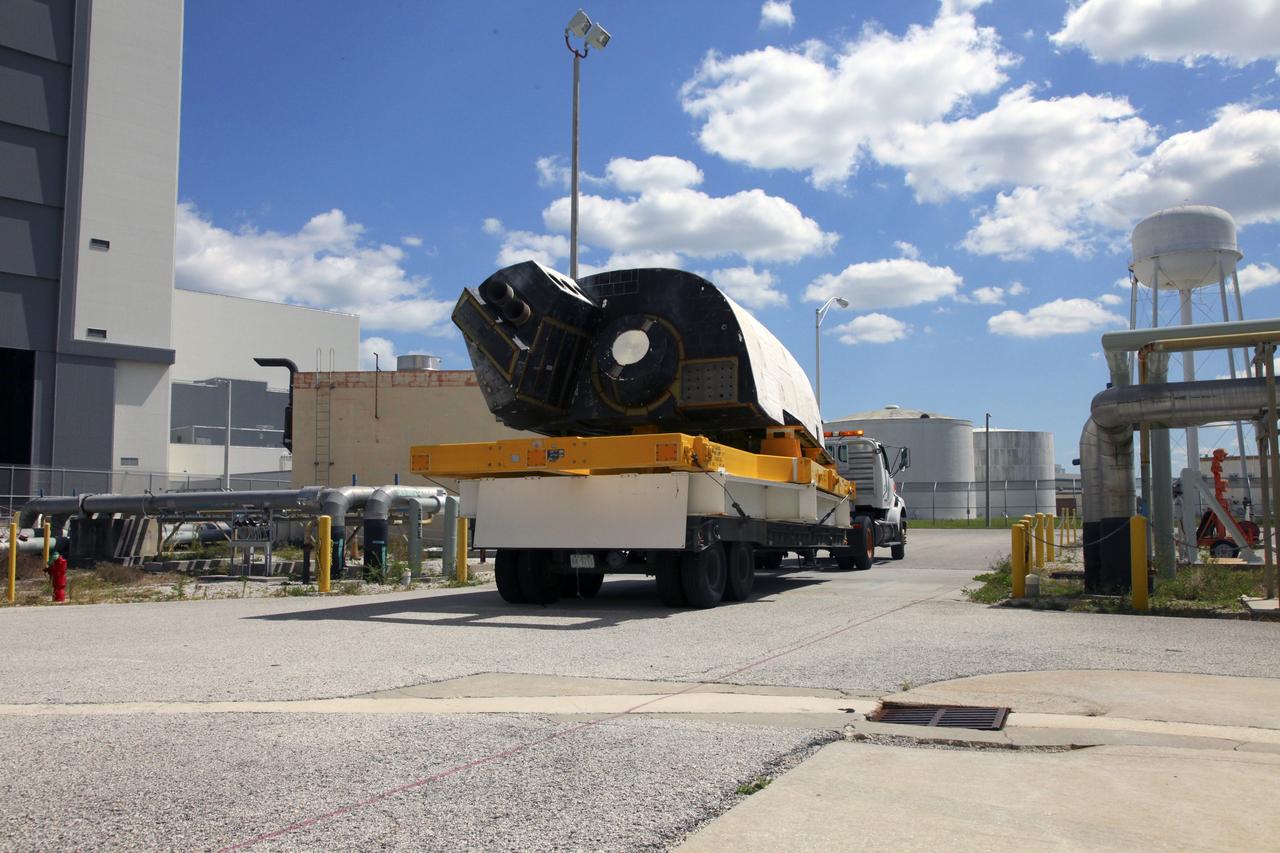
CAPE CANAVERAL, Fla. – At NASA’s Kennedy Space Center in Florida, a truck transports space shuttle Discovery's orbital maneuvering system (OMS) pod to the Orbiter Processing Facility (OPF). The OMS has been returned from White Sands Space Harbor in New Mexico where it underwent a complete deservicing and cleaning. The work is part of the Space Shuttle Program’s transition and retirement processing of space shuttle Discovery. The shuttle will go to the Smithsonian's National Air and Space Museum, Steven F. Udvar-Hazy Center in Chantilly, Va. For more information, visit http://www.nasa.gov/shuttle. Photo credit: NASA/Frankie Martin
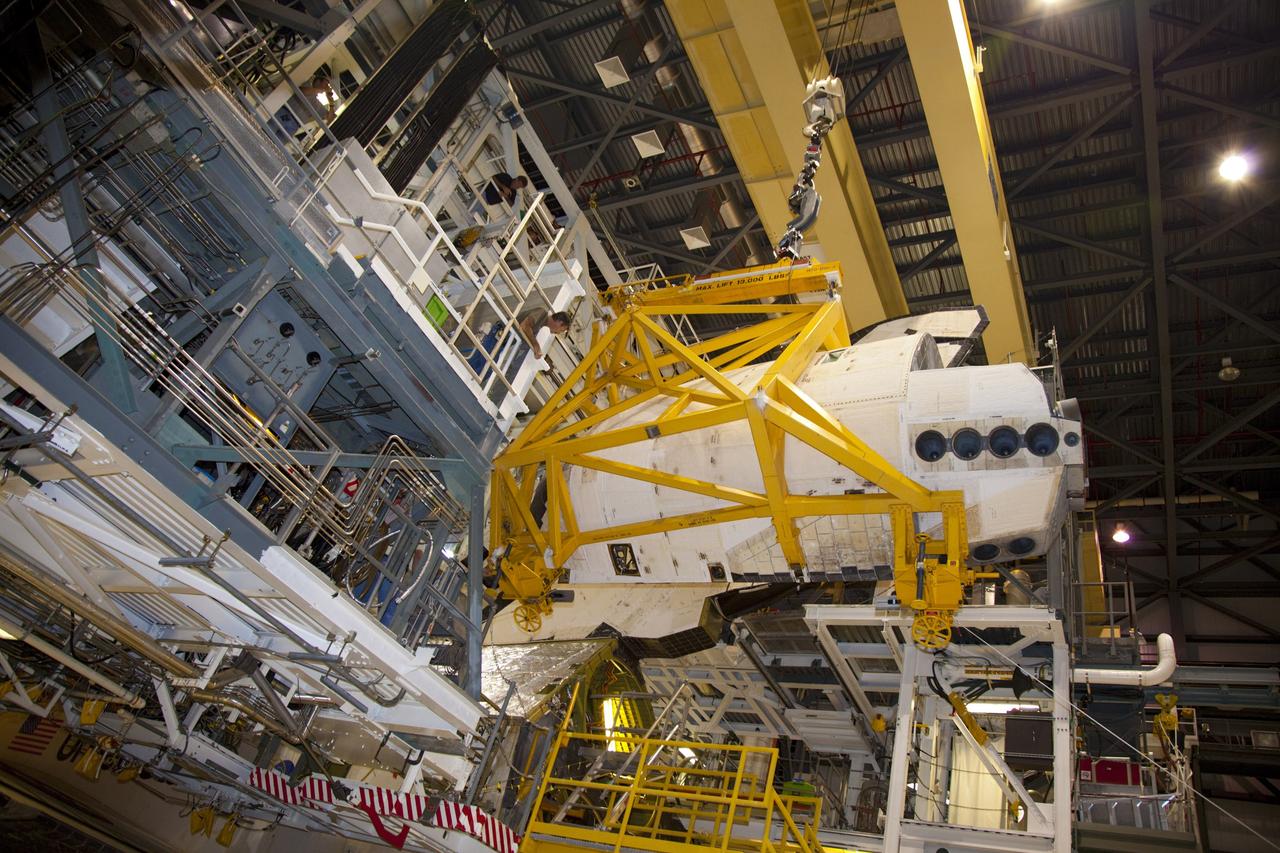
CAPE CANAVERAL, Fla. – In Orbiter Processing Facility-1 at NASA’s Kennedy Space Center in Florida, a crane carries an orbital maneuvering system (OMS) pod closer to space shuttle Discovery. The OMS pod will be installed on Discovery. The OMS pod was returned from White Sands Space Harbor in New Mexico where it underwent a complete deservicing and cleaning. The work is part of the Space Shuttle Program’s transition and retirement processing of space shuttle Discovery. The shuttle will go to the Smithsonian’s National Air and Space Museum, Steven F. Udvar-Hazy Center in Chantilly, Va., in April 2012. For more information, visit http://www.nasa.gov/shuttle. Photo credit: NASA/Frankie Martin
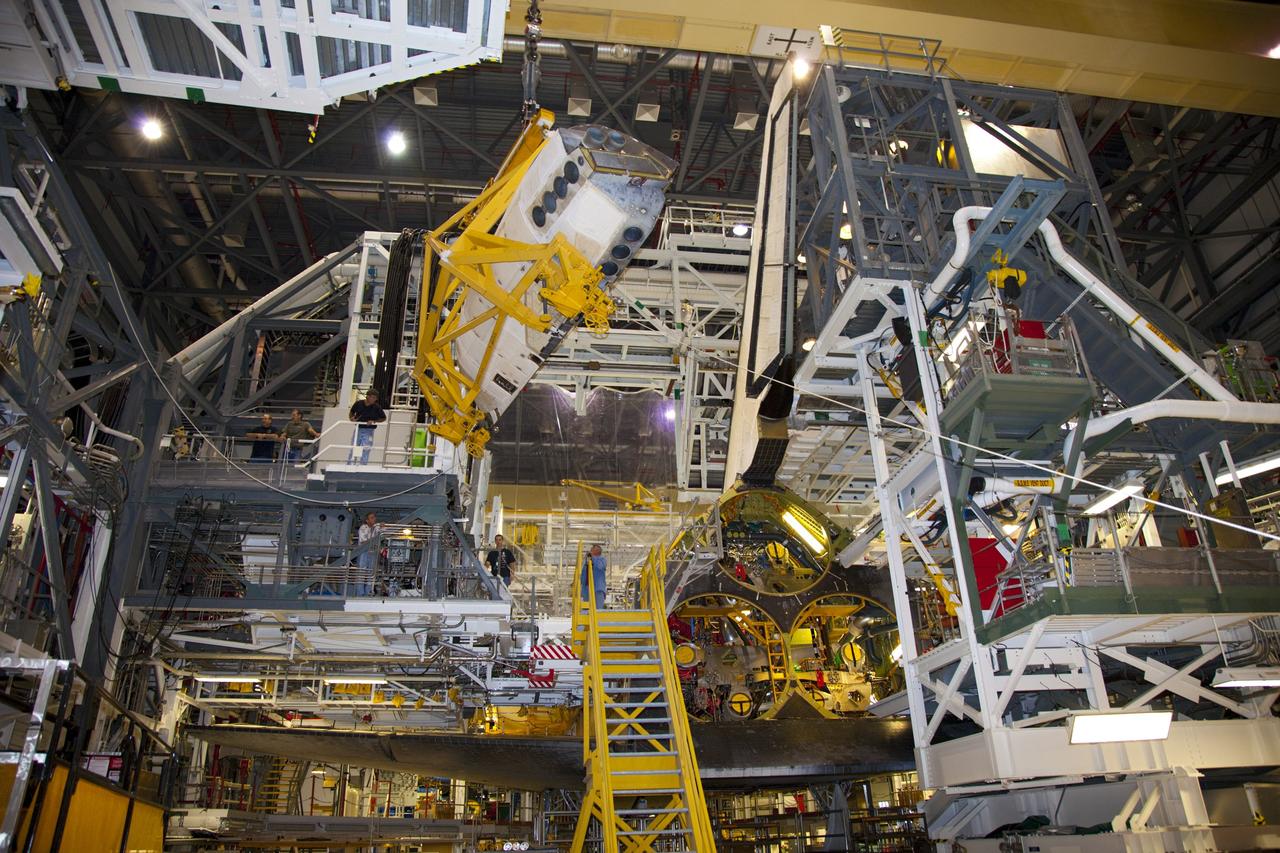
CAPE CANAVERAL, Fla. – In Orbiter Processing Facility-1 at NASA’s Kennedy Space Center in Florida, a crane transports an orbital maneuvering system (OMS) pod closer to space shuttle Discovery. The OMS pod will be installed on Discovery. The OMS pod was returned from White Sands Space Harbor in New Mexico where it underwent a complete deservicing and cleaning. The work is part of the Space Shuttle Program’s transition and retirement processing of space shuttle Discovery. The shuttle will go to the Smithsonian’s National Air and Space Museum, Steven F. Udvar-Hazy Center in Chantilly, Va., in April 2012. For more information, visit http://www.nasa.gov/shuttle. Photo credit: NASA/Frankie Martin
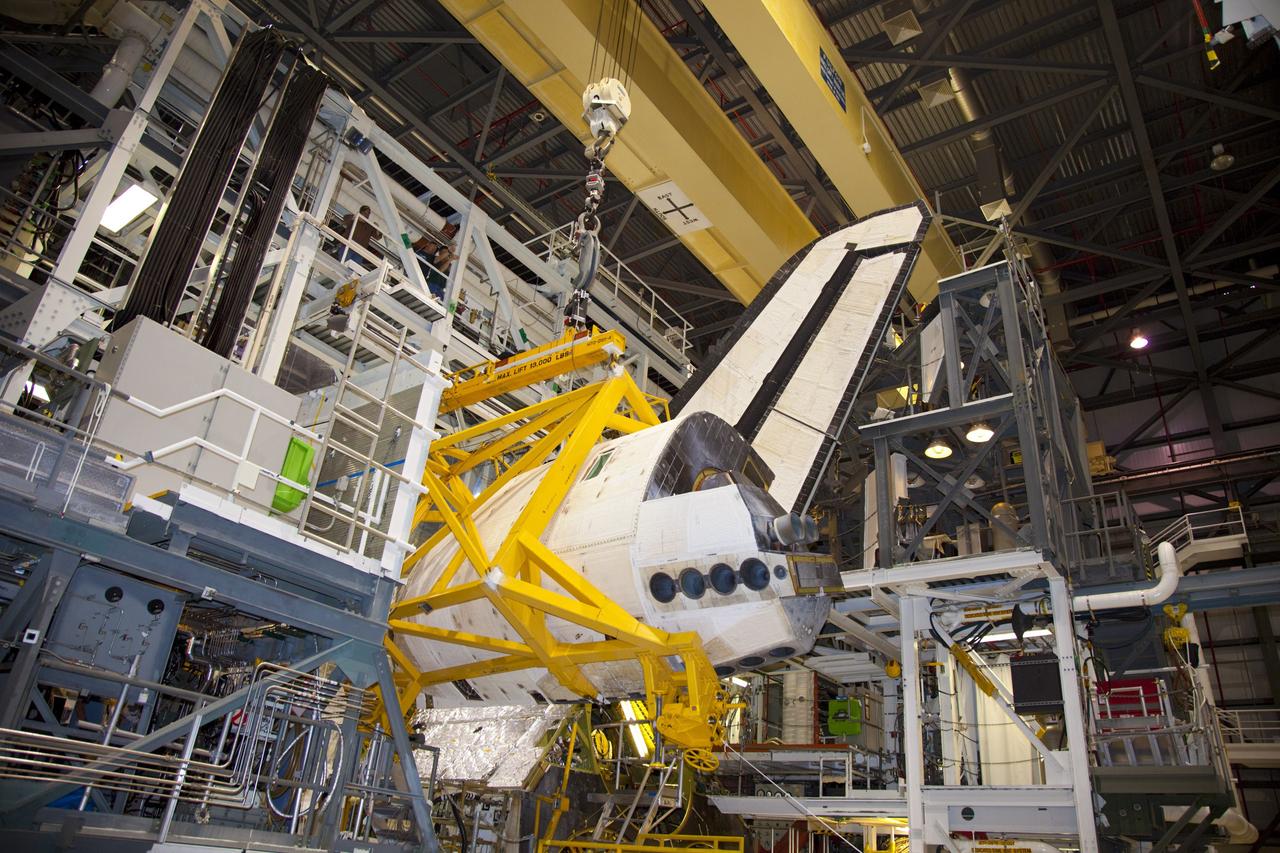
CAPE CANAVERAL, Fla. – In Orbiter Processing Facility-1 at NASA’s Kennedy Space Center in Florida, a crane carries an orbital maneuvering system (OMS) pod closer to space shuttle Discovery. The OMS pod will be installed on Discovery. The OMS pod was returned from White Sands Space Harbor in New Mexico where it underwent a complete deservicing and cleaning. The work is part of the Space Shuttle Program’s transition and retirement processing of space shuttle Discovery. The shuttle will go to the Smithsonian’s National Air and Space Museum, Steven F. Udvar-Hazy Center in Chantilly, Va., in April 2012. For more information, visit http://www.nasa.gov/shuttle. Photo credit: NASA/Frankie Martin
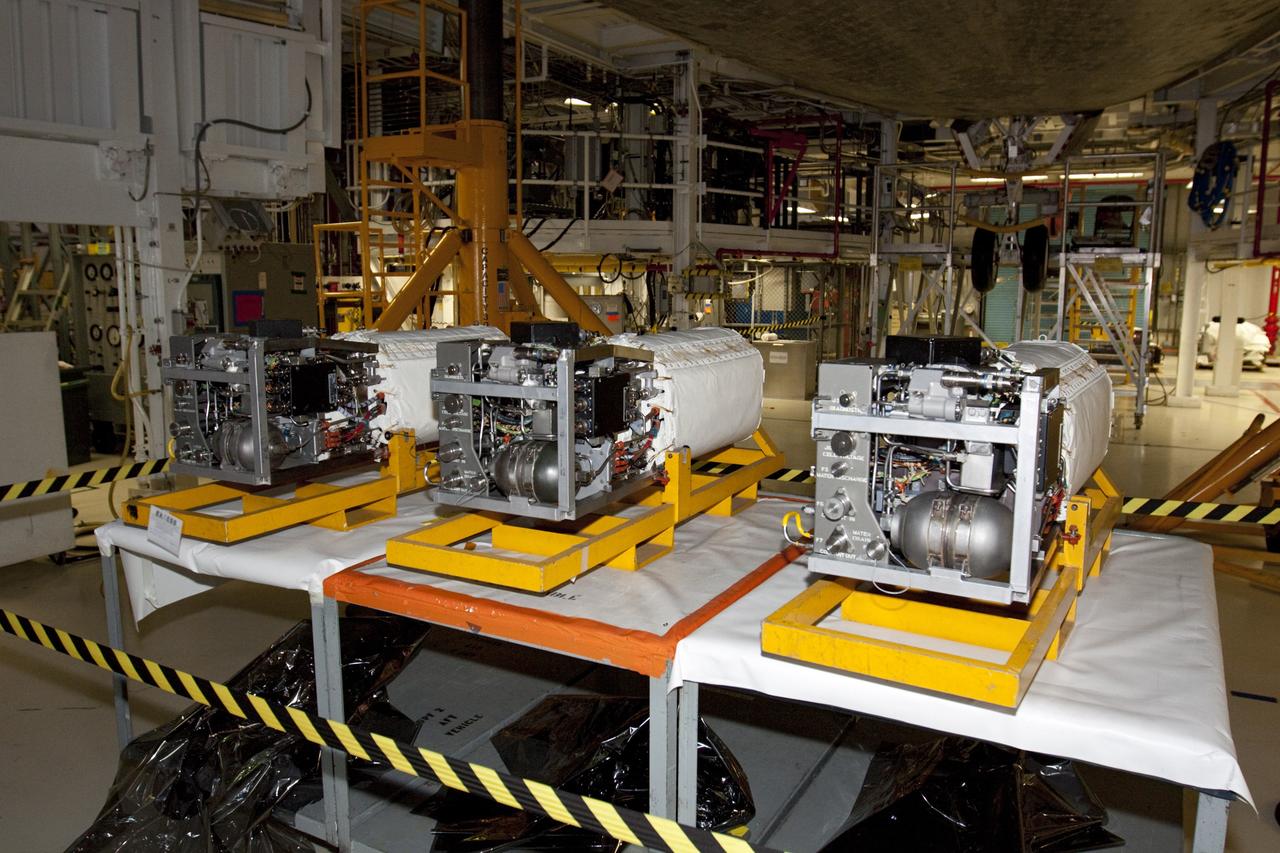
CAPE CANAVERAL, Fla. – Inside Orbiter Processing Facility-1 at NASA’s Kennedy Space Center in Florida, three excessed fuel cells are on a work bench beneath space shuttle Atlantis. The left orbital maneuvering system, or OMS, pod has been installed onto Atlantis. The OMS provided the shuttle with thrust for orbit insertion, rendezvous and deorbit, and could provide up to 1,000 pounds of propellant to the aft reaction control system. The OMS is housed in two independent pods located on each side of the shuttle’s aft fuselage. Each pod contains one OMS engine and the hardware needed to pressurize, store and distribute the propellants to perform the velocity maneuvers. Atlantis’ OMS pods were removed and sent to White Sands Test Facility in New Mexico to be cleaned of residual toxic propellant. The work is part of the Space Shuttle Program’s transition and retirement processing of the space shuttle fleet. A groundbreaking was held Jan. 18 for Atlantis’ future home, a 65,000-square-foot exhibit hall in Shuttle Plaza at the Kennedy Space Center Visitor Complex. Atlantis is scheduled to roll over to the visitor complex in November in preparation for the exhibit’s grand opening in July 2013. For more information, visit http://www.nasa.gov/transition. Photo credit: NASA/Ben Smegelsky
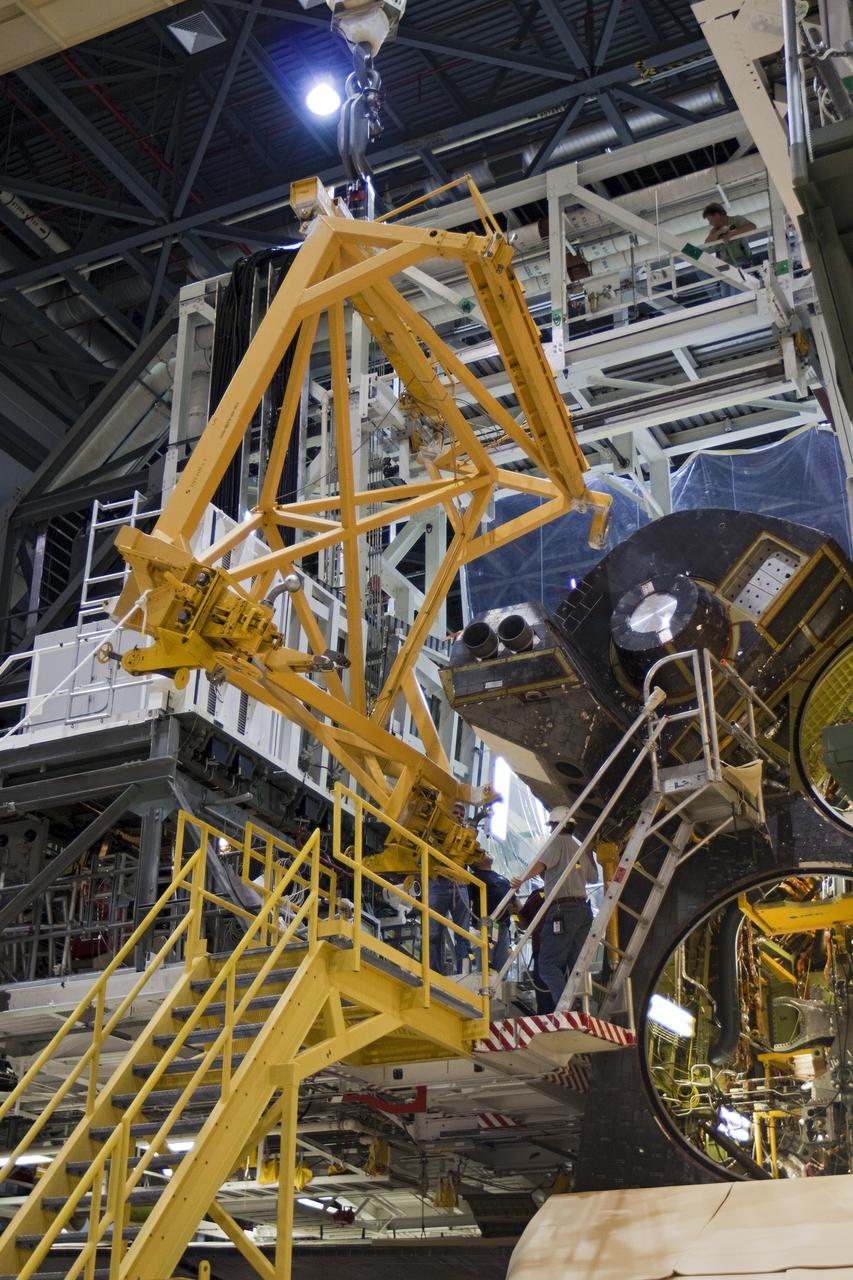
CAPE CANAVERAL, Fla. – Inside Orbiter Processing Facility-1 at NASA’s Kennedy Space Center in Florida, a large crane was used to lower the left orbital maneuvering system, or OMS, pod onto space shuttle Atlantis. The OMS provided the shuttle with thrust for orbit insertion, rendezvous and deorbit, and could provide up to 1,000 pounds of propellant to the aft reaction control system. The OMS is housed in two independent pods located on each side of the shuttle’s aft fuselage. Each pod contains one OMS engine and the hardware needed to pressurize, store and distribute the propellants to perform the velocity maneuvers. Atlantis’ OMS pods were removed and sent to White Sands Test Facility in New Mexico to be cleaned of residual toxic propellant. The work is part of the Space Shuttle Program’s transition and retirement processing of the space shuttle fleet. A groundbreaking was held Jan. 18 for Atlantis’ future home, a 65,000-square-foot exhibit hall in Shuttle Plaza at the Kennedy Space Center Visitor Complex. Atlantis is scheduled to roll over to the visitor complex in November in preparation for the exhibit’s grand opening in July 2013. For more information, visit http://www.nasa.gov/transition. Photo credit: NASA/Ben Smegelsky
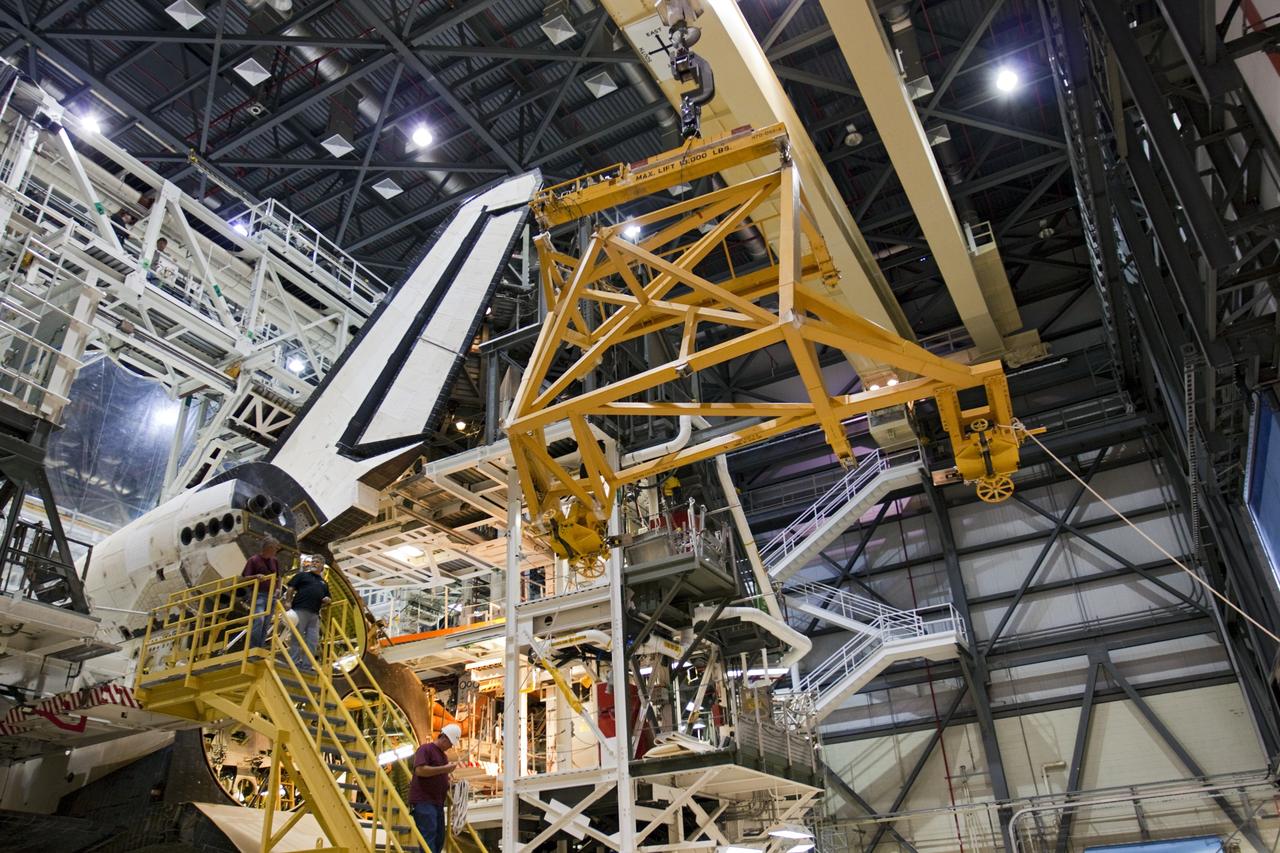
CAPE CANAVERAL, Fla. –Inside Orbiter Processing Facility-1 at NASA’s Kennedy Space Center in Florida, a large crane is moved away after it lowered the left orbital maneuvering system, or OMS, pod onto space shuttle Atlantis. The OMS provided the shuttle with thrust for orbit insertion, rendezvous and deorbit, and could provide up to 1,000 pounds of propellant to the aft reaction control system. The OMS is housed in two independent pods located on each side of the shuttle’s aft fuselage. Each pod contains one OMS engine and the hardware needed to pressurize, store and distribute the propellants to perform the velocity maneuvers. Atlantis’ OMS pods were removed and sent to White Sands Test Facility in New Mexico to be cleaned of residual toxic propellant. The work is part of the Space Shuttle Program’s transition and retirement processing of the space shuttle fleet. A groundbreaking was held Jan. 18 for Atlantis’ future home, a 65,000-square-foot exhibit hall in Shuttle Plaza at the Kennedy Space Center Visitor Complex. Atlantis is scheduled to roll over to the visitor complex in November in preparation for the exhibit’s grand opening in July 2013. For more information, visit http://www.nasa.gov/transition. Photo credit: NASA/Ben Smegelsky
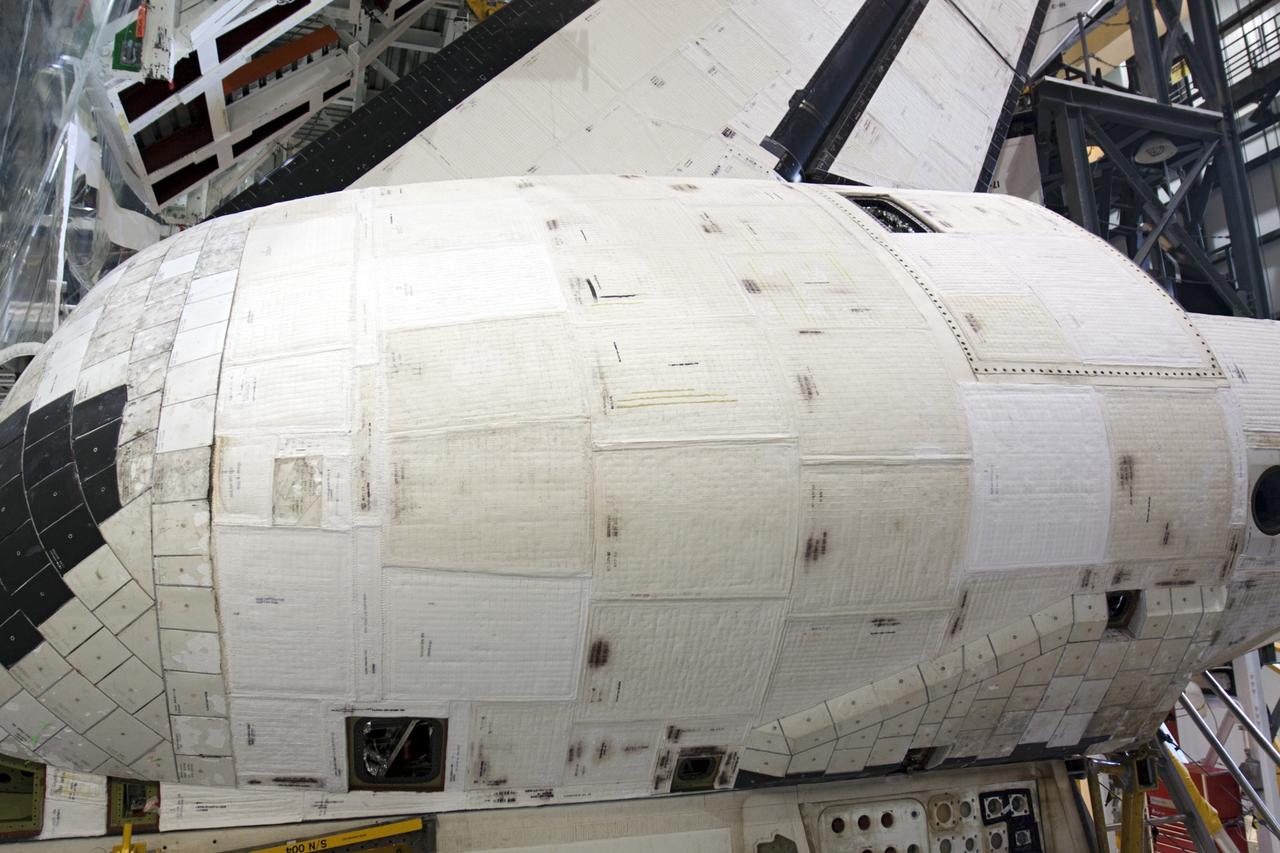
CAPE CANAVERAL, Fla. – Inside Orbiter Processing Facility-1 at NASA’s Kennedy Space Center in Florida, the left orbital maneuvering system, or OMS, pod has been installed onto space shuttle Atlantis. The OMS provided the shuttle with thrust for orbit insertion, rendezvous and deorbit, and could provide up to 1,000 pounds of propellant to the aft reaction control system. The OMS is housed in two independent pods located on each side of the shuttle’s aft fuselage. Each pod contains one OMS engine and the hardware needed to pressurize, store and distribute the propellants to perform the velocity maneuvers. Atlantis’ OMS pods were removed and sent to White Sands Test Facility in New Mexico to be cleaned of residual toxic propellant. The work is part of the Space Shuttle Program’s transition and retirement processing of the space shuttle fleet. A groundbreaking was held Jan. 18 for Atlantis’ future home, a 65,000-square-foot exhibit hall in Shuttle Plaza at the Kennedy Space Center Visitor Complex. Atlantis is scheduled to roll over to the visitor complex in November in preparation for the exhibit’s grand opening in July 2013. For more information, visit http://www.nasa.gov/transition. Photo credit: NASA/Ben Smegelsky
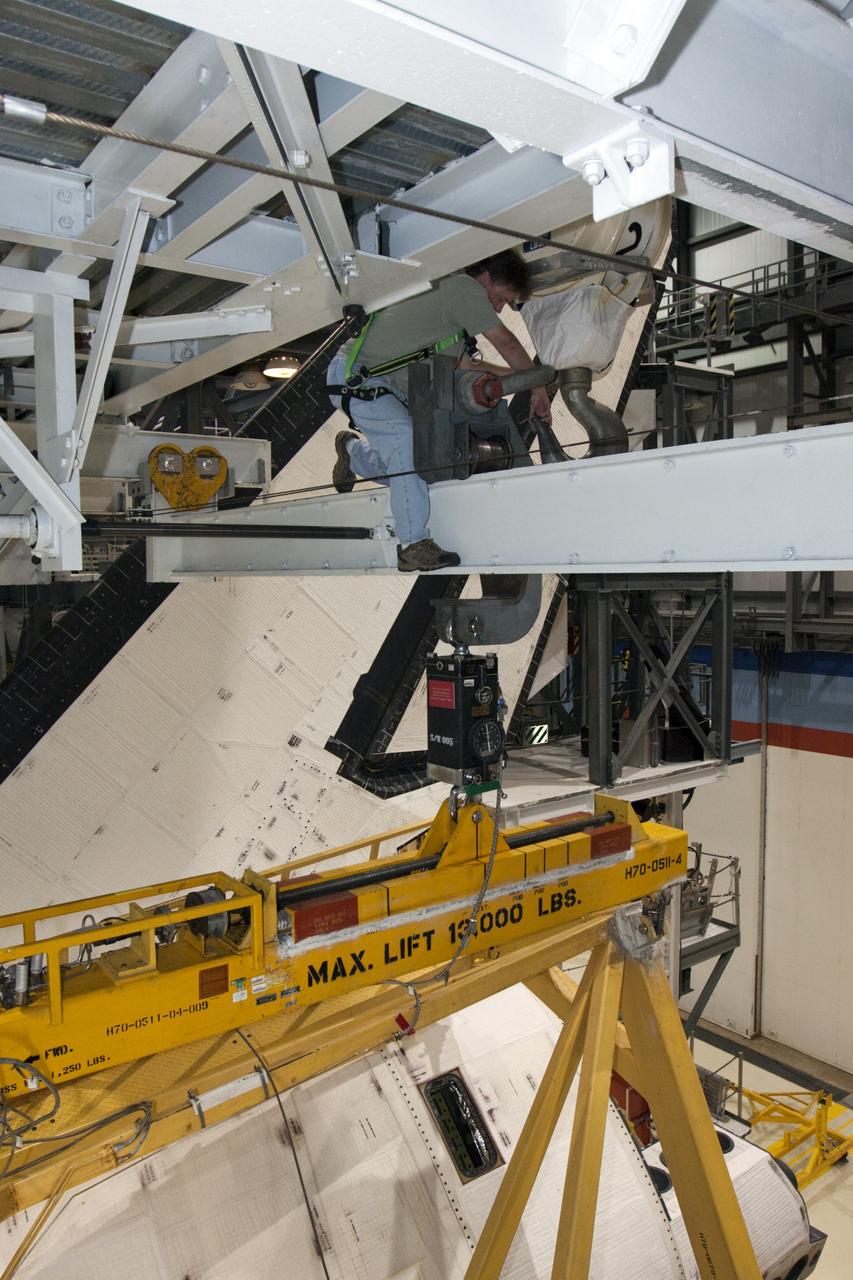
CAPE CANAVERAL, Fla. – Inside Orbiter Processing Facility-1 at NASA’s Kennedy Space Center in Florida, a United Space Alliance technician assists as a large crane lowers the left orbital maneuvering system, or OMS, pod toward space shuttle Atlantis. The OMS provided the shuttle with thrust for orbit insertion, rendezvous and deorbit, and could provide up to 1,000 pounds of propellant to the aft reaction control system. The OMS is housed in two independent pods located on each side of the shuttle’s aft fuselage. Each pod contains one OMS engine and the hardware needed to pressurize, store and distribute the propellants to perform the velocity maneuvers. Atlantis’ OMS pods were removed and sent to White Sands Test Facility in New Mexico to be cleaned of residual toxic propellant. The work is part of the Space Shuttle Program’s transition and retirement processing of the space shuttle fleet. A groundbreaking was held Jan. 18 for Atlantis’ future home, a 65,000-square-foot exhibit hall in Shuttle Plaza at the Kennedy Space Center Visitor Complex. Atlantis is scheduled to roll over to the visitor complex in November in preparation for the exhibit’s grand opening in July 2013. For more information, visit http://www.nasa.gov/transition. Photo credit: NASA/Ben Smegelsky
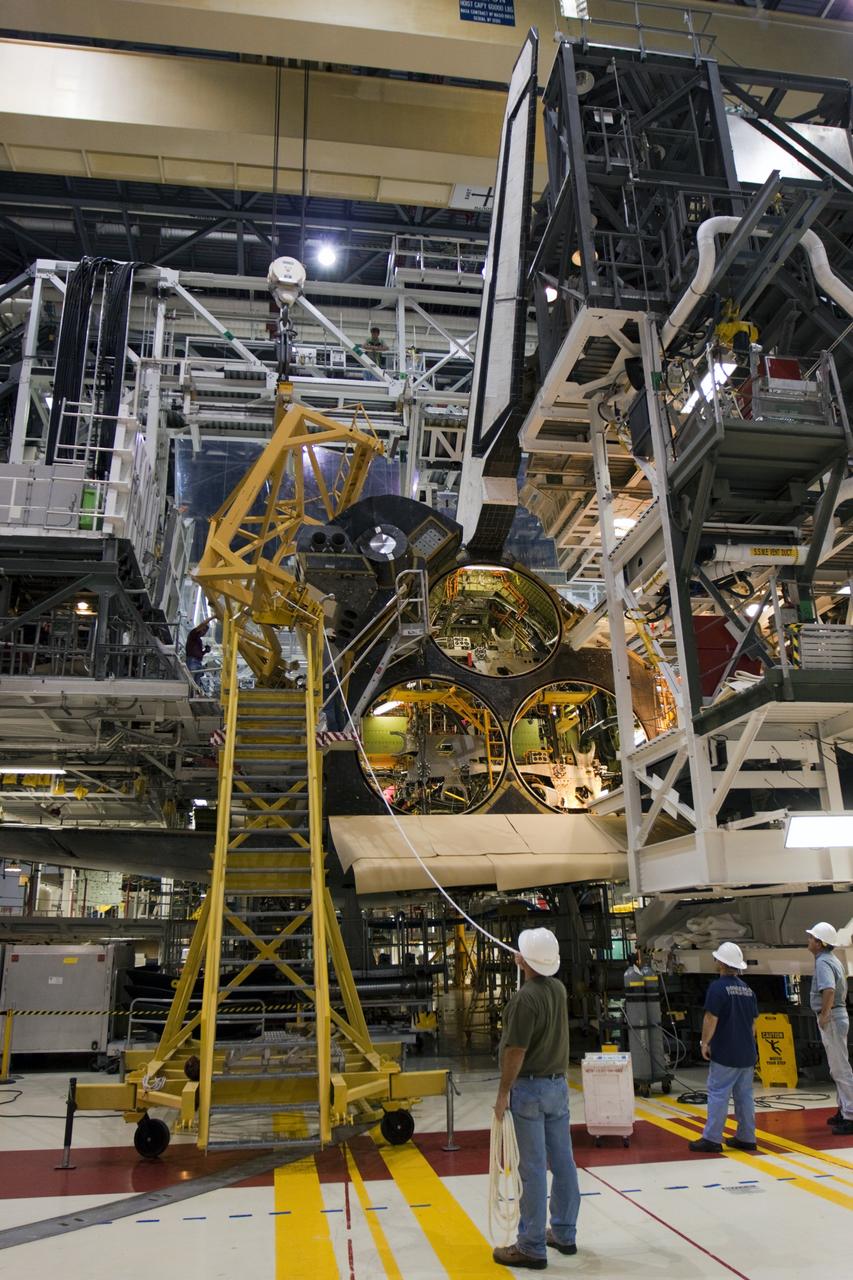
CAPE CANAVERAL, Fla. – Inside Orbiter Processing Facility-1 at NASA’s Kennedy Space Center in Florida, United Space Alliance technicians monitor the progress after a large crane lowers the left orbital maneuvering system, or OMS, pod onto space shuttle Atlantis. The OMS provided the shuttle with thrust for orbit insertion, rendezvous and deorbit, and could provide up to 1,000 pounds of propellant to the aft reaction control system. The OMS is housed in two independent pods located on each side of the shuttle’s aft fuselage. Each pod contains one OMS engine and the hardware needed to pressurize, store and distribute the propellants to perform the velocity maneuvers. Atlantis’ OMS pods were removed and sent to White Sands Test Facility in New Mexico to be cleaned of residual toxic propellant. The work is part of the Space Shuttle Program’s transition and retirement processing of the space shuttle fleet. A groundbreaking was held Jan. 18 for Atlantis’ future home, a 65,000-square-foot exhibit hall in Shuttle Plaza at the Kennedy Space Center Visitor Complex. Atlantis is scheduled to roll over to the visitor complex in November in preparation for the exhibit’s grand opening in July 2013. For more information, visit http://www.nasa.gov/transition. Photo credit: NASA/Ben Smegelsky
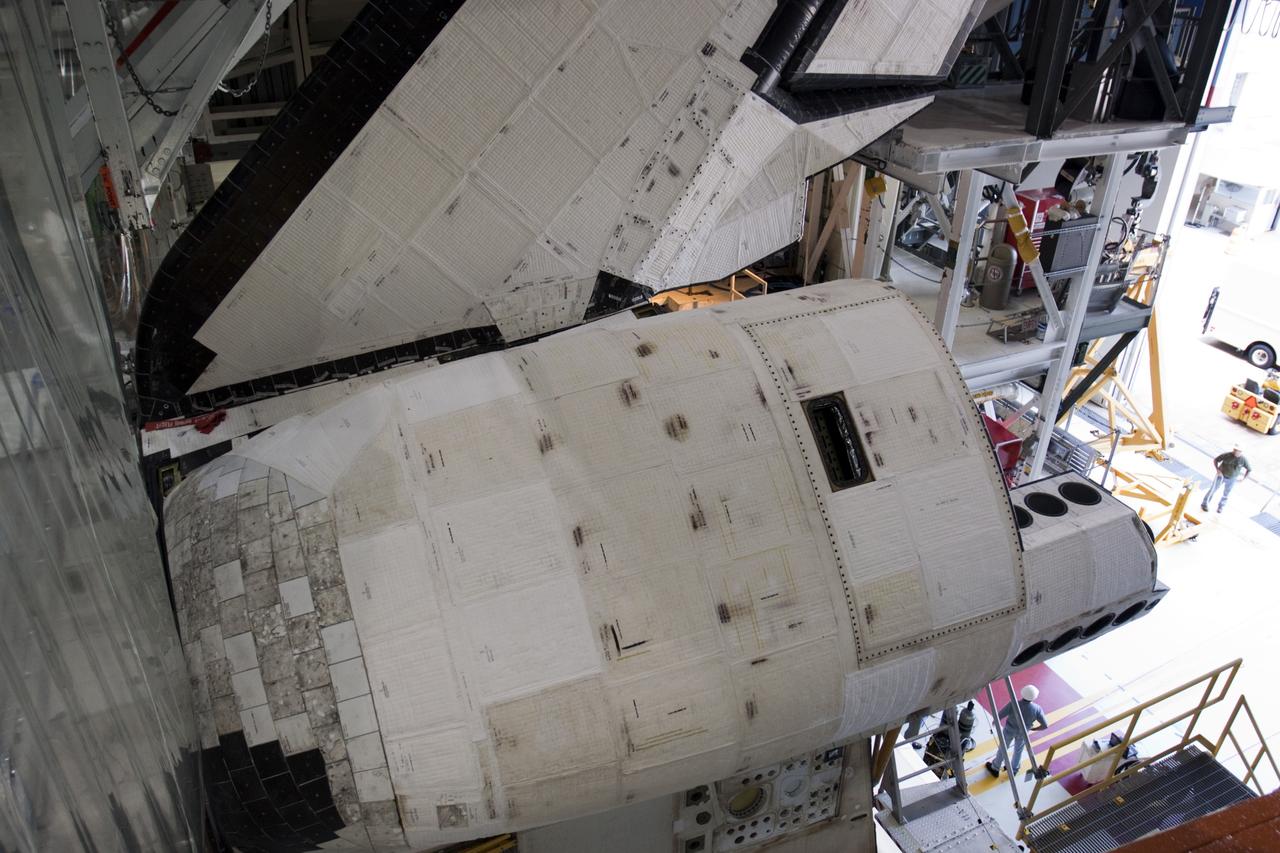
CAPE CANAVERAL, Fla. – Inside Orbiter Processing Facility-1 at NASA’s Kennedy Space Center in Florida, the left orbital maneuvering system, or OMS, pod has been installed onto space shuttle Atlantis. The OMS provided the shuttle with thrust for orbit insertion, rendezvous and deorbit, and could provide up to 1,000 pounds of propellant to the aft reaction control system. The OMS is housed in two independent pods located on each side of the shuttle’s aft fuselage. Each pod contains one OMS engine and the hardware needed to pressurize, store and distribute the propellants to perform the velocity maneuvers. Atlantis’ OMS pods were removed and sent to White Sands Test Facility in New Mexico to be cleaned of residual toxic propellant. The work is part of the Space Shuttle Program’s transition and retirement processing of the space shuttle fleet. A groundbreaking was held Jan. 18 for Atlantis’ future home, a 65,000-square-foot exhibit hall in Shuttle Plaza at the Kennedy Space Center Visitor Complex. Atlantis is scheduled to roll over to the visitor complex in November in preparation for the exhibit’s grand opening in July 2013. For more information, visit http://www.nasa.gov/transition. Photo credit: NASA/Ben Smegelsky
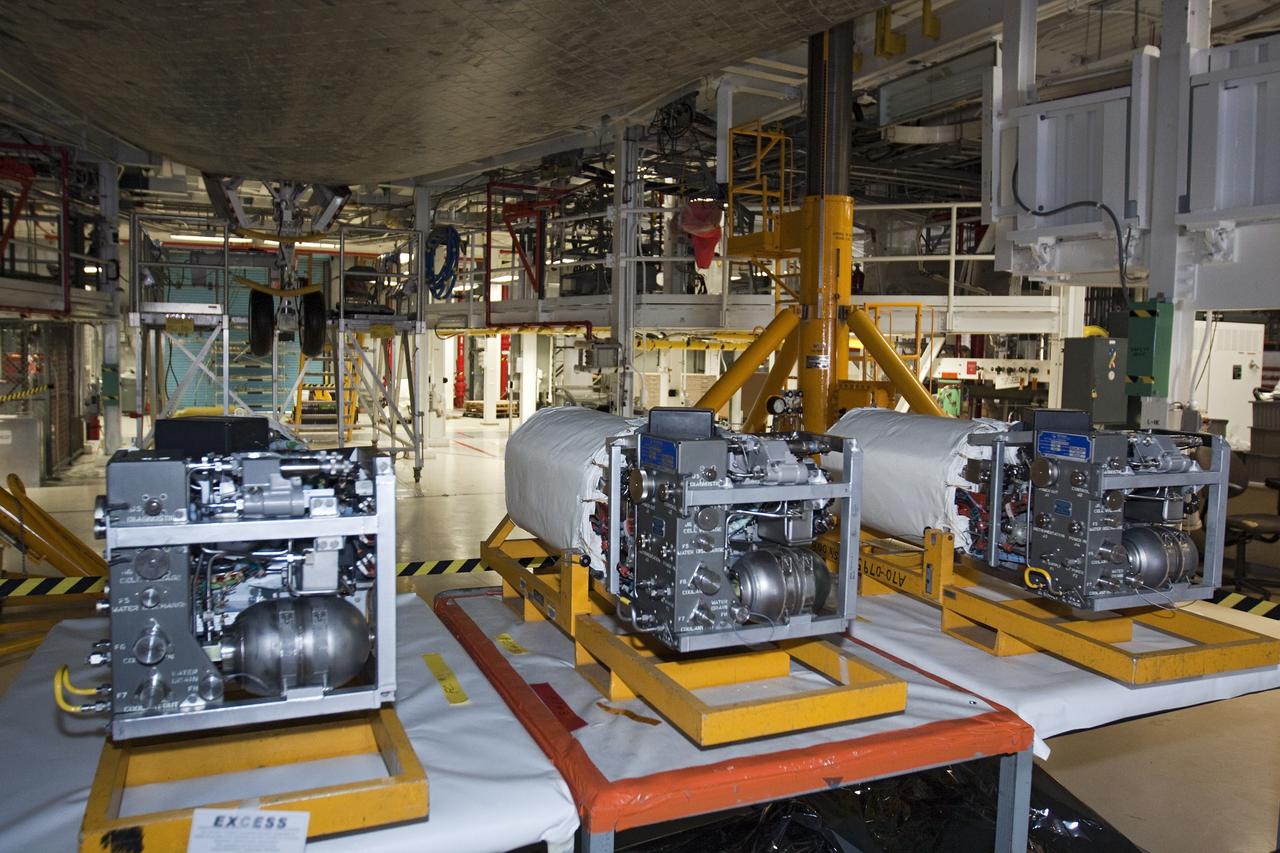
CAPE CANAVERAL, Fla. – Inside Orbiter Processing Facility-1 at NASA’s Kennedy Space Center in Florida, three excessed fuel cells are on a work bench beneath space shuttle Atlantis. The left orbital maneuvering system, or OMS, pod has been installed onto Atlantis. The OMS provided the shuttle with thrust for orbit insertion, rendezvous and deorbit, and could provide up to 1,000 pounds of propellant to the aft reaction control system. The OMS is housed in two independent pods located on each side of the shuttle’s aft fuselage. Each pod contains one OMS engine and the hardware needed to pressurize, store and distribute the propellants to perform the velocity maneuvers. Atlantis’ OMS pods were removed and sent to White Sands Test Facility in New Mexico to be cleaned of residual toxic propellant. The work is part of the Space Shuttle Program’s transition and retirement processing of the space shuttle fleet. A groundbreaking was held Jan. 18 for Atlantis’ future home, a 65,000-square-foot exhibit hall in Shuttle Plaza at the Kennedy Space Center Visitor Complex. Atlantis is scheduled to roll over to the visitor complex in November in preparation for the exhibit’s grand opening in July 2013. For more information, visit http://www.nasa.gov/transition. Photo credit: NASA/Ben Smegelsky
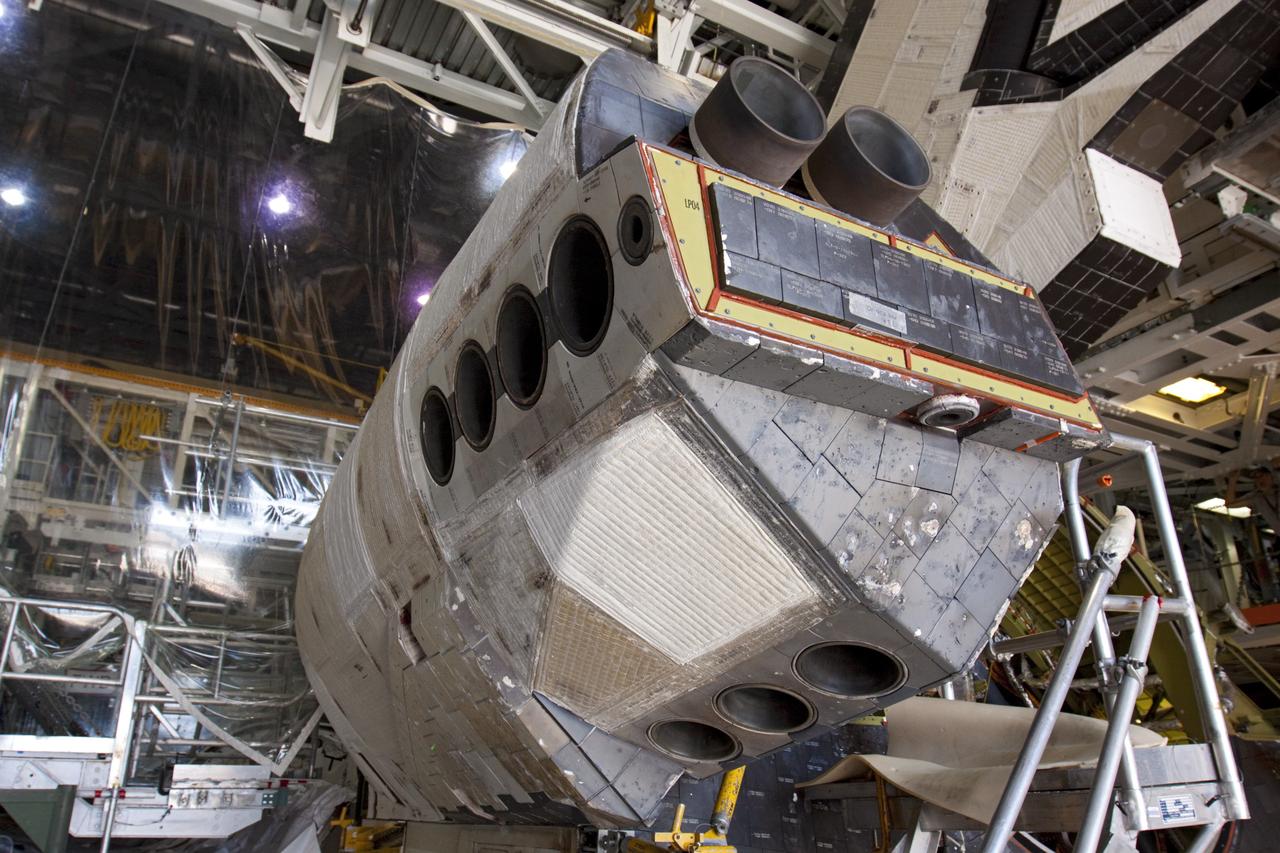
CAPE CANAVERAL, Fla. – Inside Orbiter Processing Facility-1 at NASA’s Kennedy Space Center in Florida, the left orbital maneuvering system, or OMS, pod has been installed onto space shuttle Atlantis. The OMS provided the shuttle with thrust for orbit insertion, rendezvous and deorbit, and could provide up to 1,000 pounds of propellant to the aft reaction control system. The OMS is housed in two independent pods located on each side of the shuttle’s aft fuselage. Each pod contains one OMS engine and the hardware needed to pressurize, store and distribute the propellants to perform the velocity maneuvers. Atlantis’ OMS pods were removed and sent to White Sands Test Facility in New Mexico to be cleaned of residual toxic propellant. The work is part of the Space Shuttle Program’s transition and retirement processing of the space shuttle fleet. A groundbreaking was held Jan. 18 for Atlantis’ future home, a 65,000-square-foot exhibit hall in Shuttle Plaza at the Kennedy Space Center Visitor Complex. Atlantis is scheduled to roll over to the visitor complex in November in preparation for the exhibit’s grand opening in July 2013. For more information, visit http://www.nasa.gov/transition. Photo credit: NASA/Ben Smegelsky
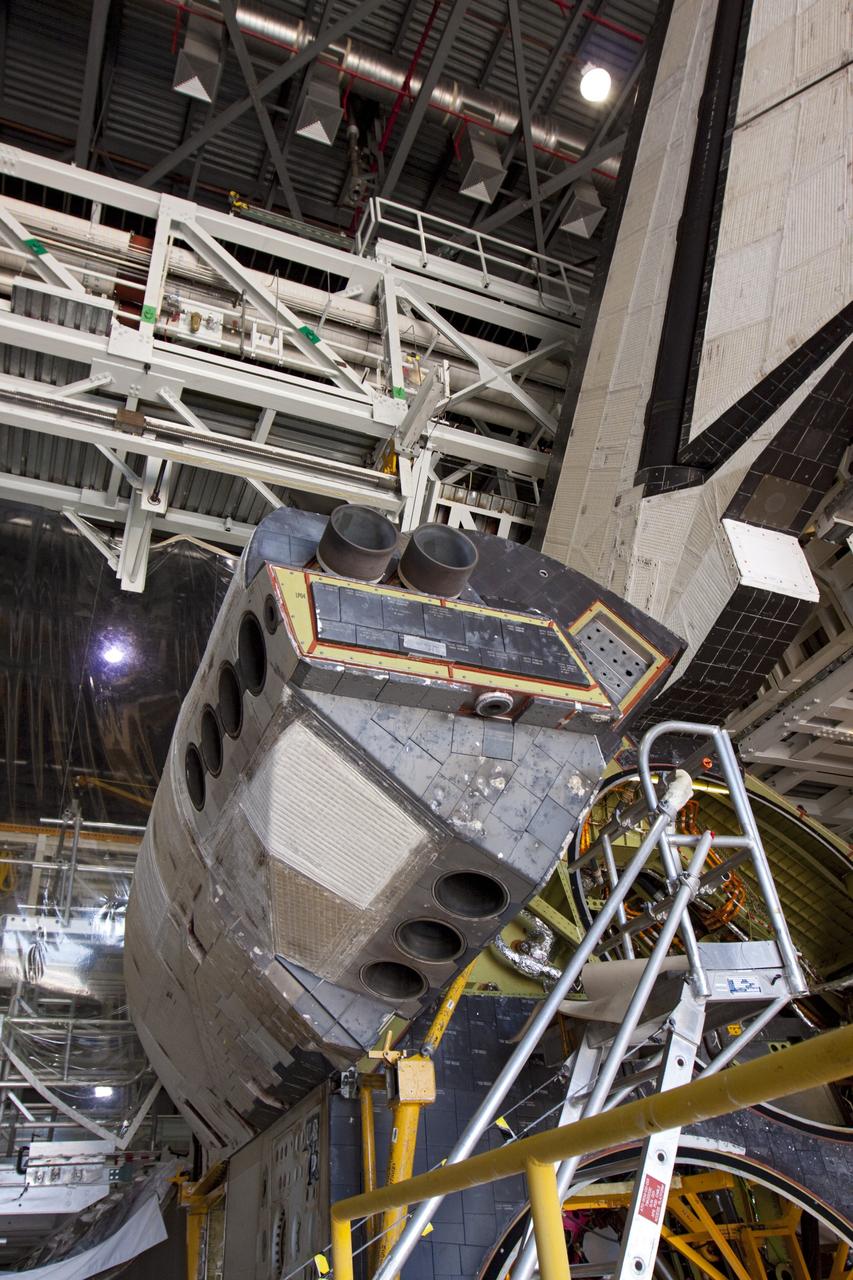
CAPE CANAVERAL, Fla. – Inside Orbiter Processing Facility-1 at NASA’s Kennedy Space Center in Florida, the left orbital maneuvering system, or OMS, pod has been installed onto space shuttle Atlantis. The OMS provided the shuttle with thrust for orbit insertion, rendezvous and deorbit, and could provide up to 1,000 pounds of propellant to the aft reaction control system. The OMS is housed in two independent pods located on each side of the shuttle’s aft fuselage. Each pod contains one OMS engine and the hardware needed to pressurize, store and distribute the propellants to perform the velocity maneuvers. Atlantis’ OMS pods were removed and sent to White Sands Test Facility in New Mexico to be cleaned of residual toxic propellant. The work is part of the Space Shuttle Program’s transition and retirement processing of the space shuttle fleet. A groundbreaking was held Jan. 18 for Atlantis’ future home, a 65,000-square-foot exhibit hall in Shuttle Plaza at the Kennedy Space Center Visitor Complex. Atlantis is scheduled to roll over to the visitor complex in November in preparation for the exhibit’s grand opening in July 2013. For more information, visit http://www.nasa.gov/transition. Photo credit: NASA/Ben Smegelsky
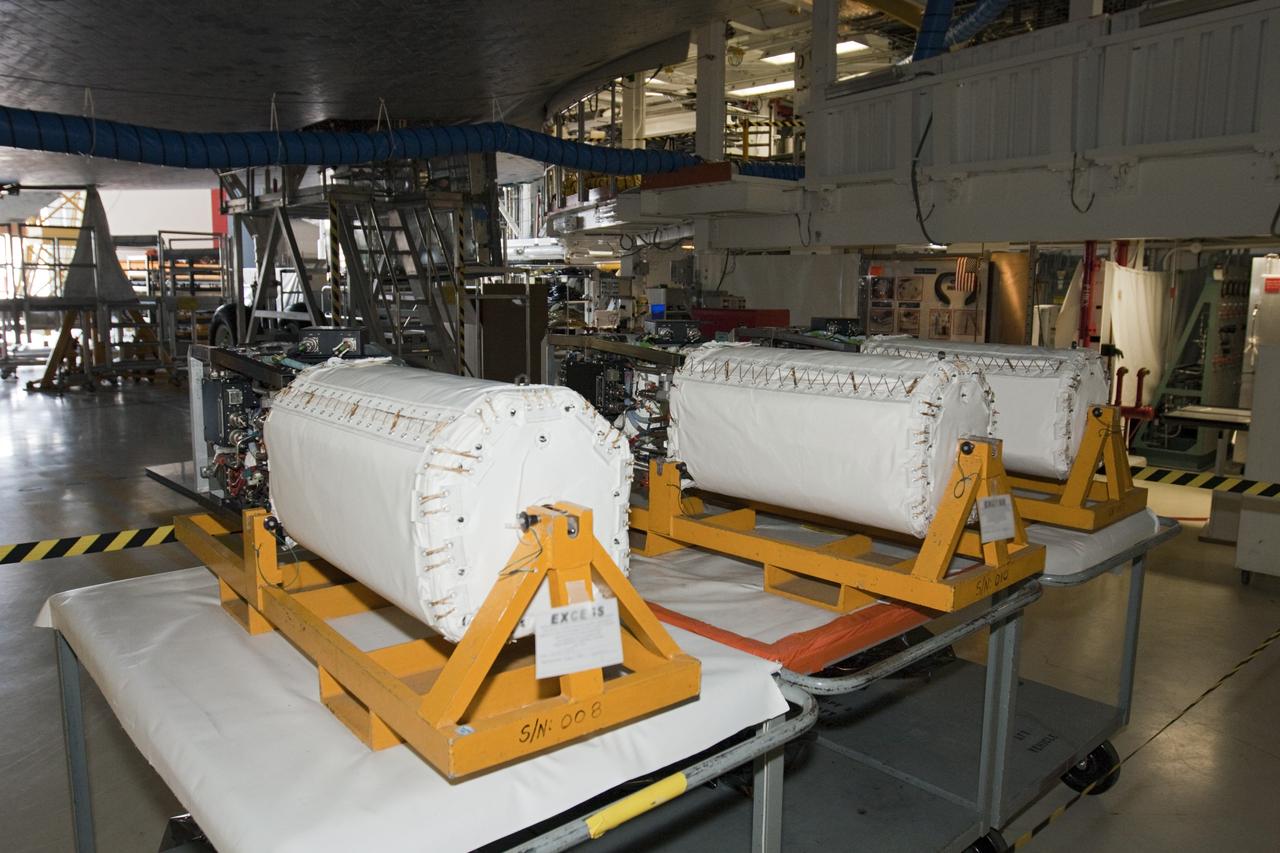
CAPE CANAVERAL, Fla. – Inside Orbiter Processing Facility-1 at NASA’s Kennedy Space Center in Florida, three excessed fuel cells are on a work bench beneath space shuttle Atlantis. The left orbital maneuvering system, or OMS, pod has been installed onto Atlantis. The OMS provided the shuttle with thrust for orbit insertion, rendezvous and deorbit, and could provide up to 1,000 pounds of propellant to the aft reaction control system. The OMS is housed in two independent pods located on each side of the shuttle’s aft fuselage. Each pod contains one OMS engine and the hardware needed to pressurize, store and distribute the propellants to perform the velocity maneuvers. Atlantis’ OMS pods were removed and sent to White Sands Test Facility in New Mexico to be cleaned of residual toxic propellant. The work is part of the Space Shuttle Program’s transition and retirement processing of the space shuttle fleet. A groundbreaking was held Jan. 18 for Atlantis’ future home, a 65,000-square-foot exhibit hall in Shuttle Plaza at the Kennedy Space Center Visitor Complex. Atlantis is scheduled to roll over to the visitor complex in November in preparation for the exhibit’s grand opening in July 2013. For more information, visit http://www.nasa.gov/transition. Photo credit: NASA/Ben Smegelsky

STS084-357-008 (15-24 May 1997) --- Photographed through the aft flight deck windows of the Earth-orbiting Space Shuttle Atlantis, this 35mm frame captures a firing of the Orbital Maneuvering System (OMS) engines to perform a necessary maneuver. The vertical stabilizer, flanked by the two OMS pods, is illuminated in the scene.
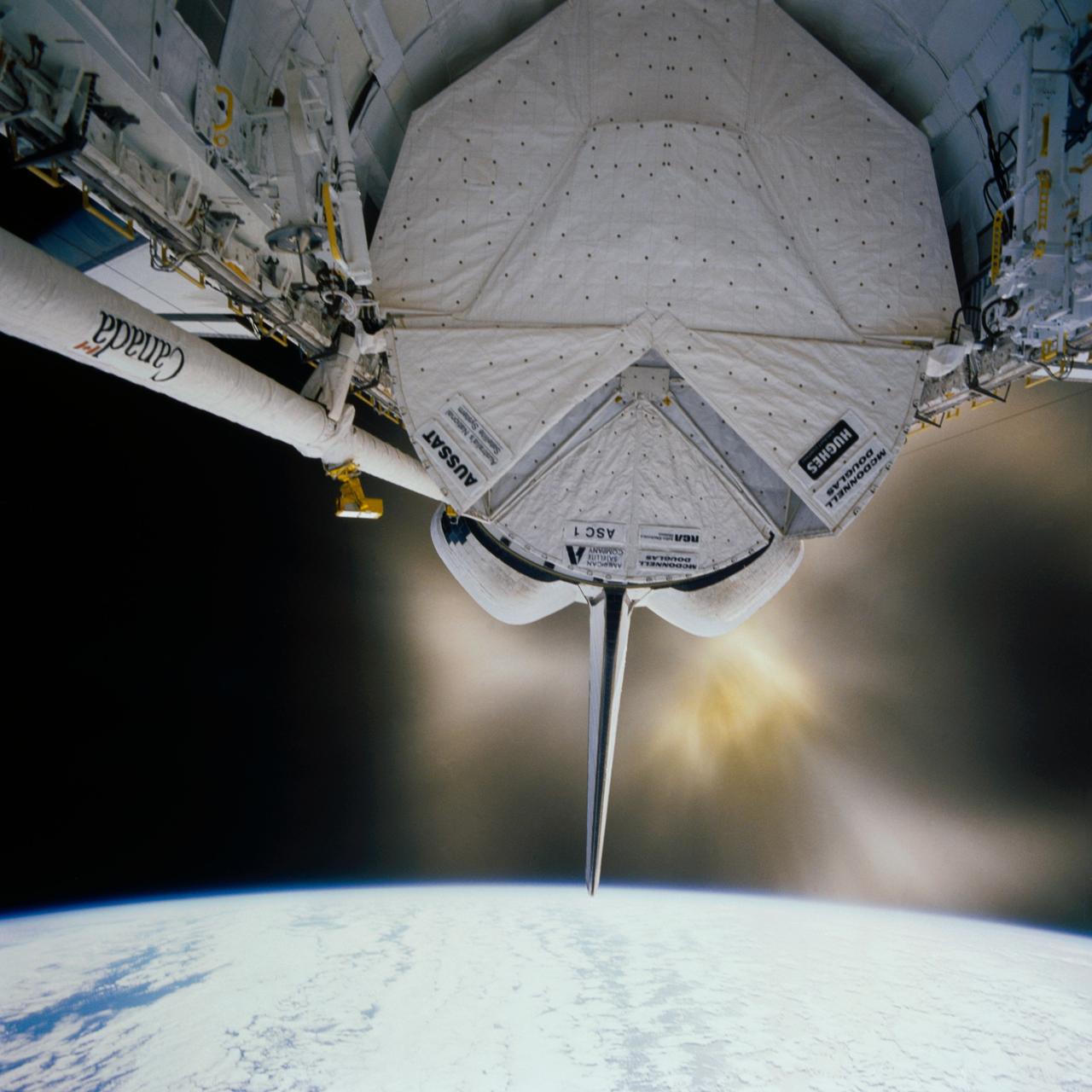
View of a single engine orbital maneuvering system (OMS) firing on the Discovery. The payload bay is open and the protective canisters for the AUSSAT communications satellite (open) and the ASC-1 are visible. A cloudy Earth's horizon can be seen above the orbiter.

CAPE CANAVERAL, Fla. – In Orbiter Processing Facility-1 at NASA’s Kennedy Space Center in Florida, a crane lowers an orbital maneuvering system (OMS) pod closer for installation on space shuttle Discovery. The OMS pod was returned from White Sands Space Harbor in New Mexico where it underwent a complete deservicing and cleaning. The work is part of the Space Shuttle Program’s transition and retirement processing of space shuttle Discovery. The shuttle will go to the Smithsonian’s National Air and Space Museum, Steven F. Udvar-Hazy Center in Chantilly, Va., in April 2012. For more information, visit http://www.nasa.gov/shuttle. Photo credit: NASA/Frankie Martin
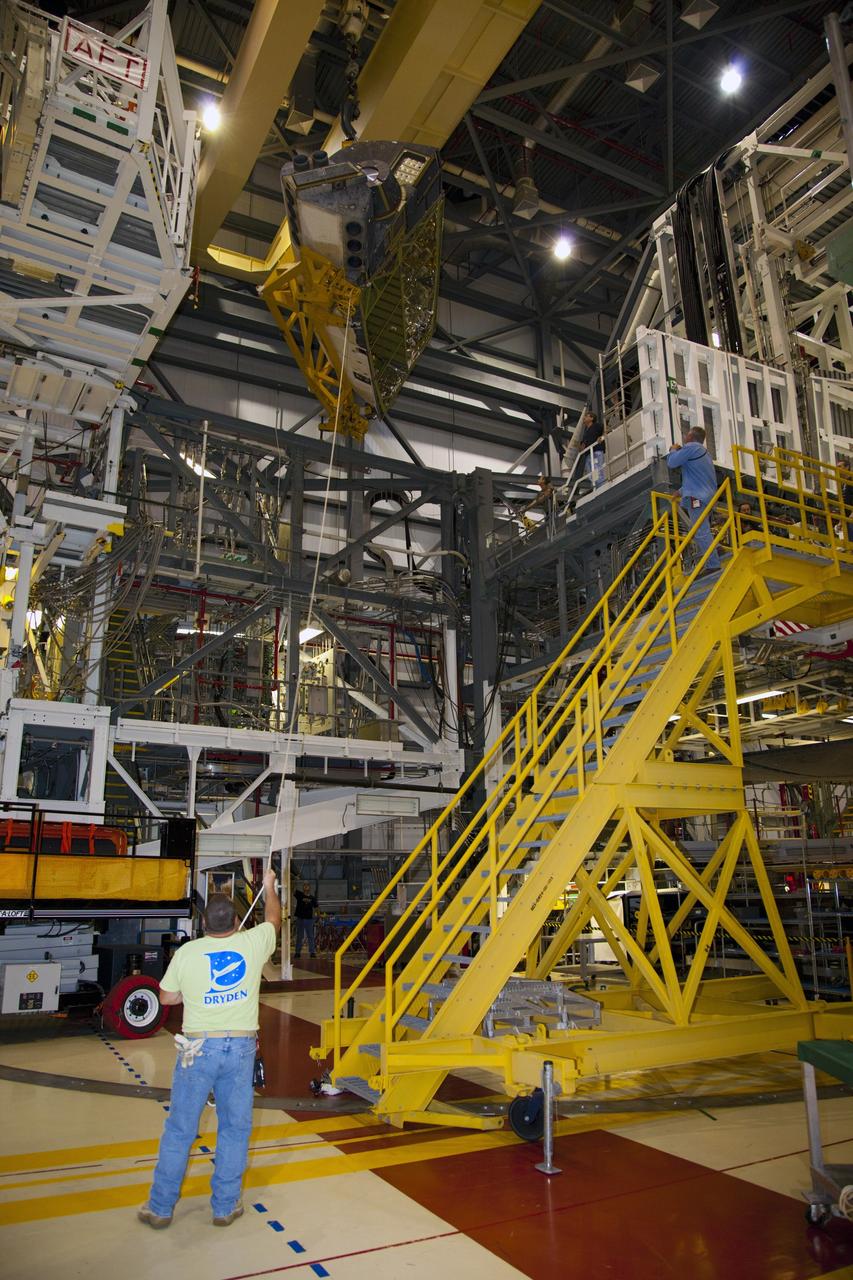
CAPE CANAVERAL, Fla. – In Orbiter Processing Facility-1 at NASA’s Kennedy Space Center in Florida, a technician monitors the progress as a crane is used to carry an orbital maneuvering system (OMS) pod that will be installed on space shuttle Discovery. The OMS pod was returned from White Sands Space Harbor in New Mexico where it underwent a complete deservicing and cleaning. The work is part of the Space Shuttle Program’s transition and retirement processing of space shuttle Discovery. The shuttle will go to the Smithsonian’s National Air and Space Museum, Steven F. Udvar-Hazy Center in Chantilly, Va., in April 2012. For more information, visit http://www.nasa.gov/shuttle. Photo credit: NASA/Frankie Martin
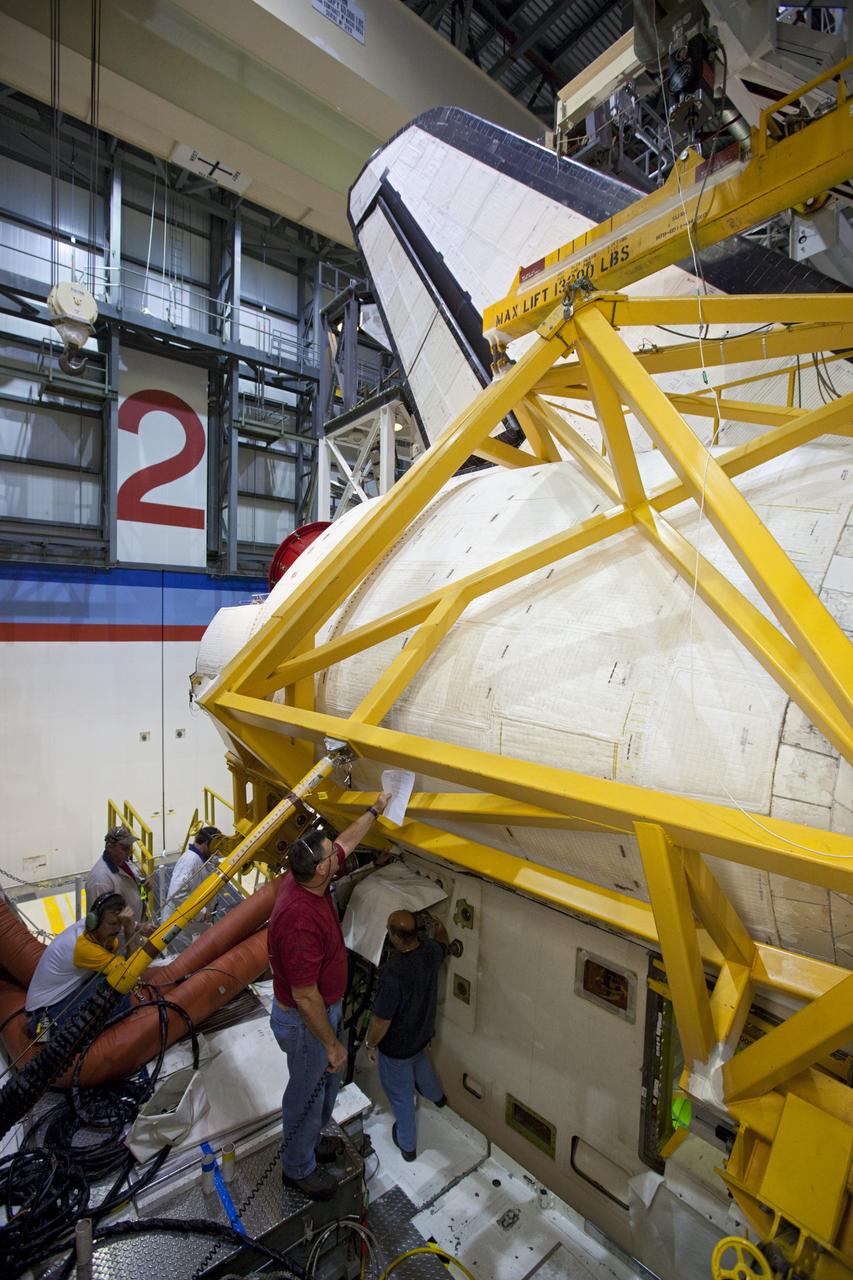
CAPE CANAVERAL, Fla. -- Inside Orbiter Processing Facility-2 at NASA’s Kennedy Space Center in Florida, technicians help secure a sling around space shuttle Atlantis’ right orbital maneuvering system (OMS) pod. The work is part of the Space Shuttle Program’s transition and retirement processing of shuttle Atlantis. The OMS pod will be removed and sent to White Sands Space Harbor in New Mexico where it will undergo a complete deservicing and cleaning and then be returned to Kennedy for reinstallation on Atlantis. Atlantis is being prepared for display at the Kennedy Space Center Visitor Complex. Photo credit: NASA/Dimitri Gerondidakis
CAPE CANAVERAL, Fla. – Inside Orbiter Processing Facility-2 at NASA’s Kennedy Space Center in Florida, a large crane is being used to move the right orbital maneuvering system (OMS) pod away from space shuttle Atlantis. The work is part of the Space Shuttle Program’s transition and retirement processing of shuttle Atlantis. Both OMS pods will be removed and sent to White Sands Space Harbor in New Mexico where they will undergo a complete deservicing and cleaning and then be returned to Kennedy for reinstallation on Atlantis. Atlantis is being prepared for display at the Kennedy Space Center Visitor Complex. Photo credit: NASA/Dimitri Gerondidakis
CAPE CANAVERAL, Fla. – In Orbiter Processing Facility-1 at NASA’s Kennedy Space Center in Florida, technicians assist as a crane is lowered toward an orbital maneuvering system (OMS) pod that will be installed on space shuttle Discovery. The OMS pod was returned from White Sands Space Harbor in New Mexico where it underwent a complete deservicing and cleaning. The work is part of the Space Shuttle Program’s transition and retirement processing of space shuttle Discovery. The shuttle will go to the Smithsonian’s National Air and Space Museum, Steven F. Udvar-Hazy Center in Chantilly, Va., in April 2012. For more information, visit http://www.nasa.gov/shuttle. Photo credit: NASA/Frankie Martin
CAPE CANAVERAL, Fla. – Inside Orbiter Processing Facility-2 at NASA’s Kennedy Space Center in Florida, technicians help secure space shuttle Atlantis’ right orbital maneuvering system (OMS) pod onto a pallet. The work is part of the Space Shuttle Program’s transition and retirement processing of shuttle Atlantis. Both OMS pods will be removed and sent to White Sands Space Harbor in New Mexico where they will undergo a complete deservicing and cleaning and then be returned to Kennedy for reinstallation on Atlantis. Atlantis is being prepared for display at the Kennedy Space Center Visitor Complex. Photo credit: NASA/Dimitri Gerondidakis
CAPE CANAVERAL, Fla. – In Orbiter Processing Facility-1 at NASA’s Kennedy Space Center in Florida, technicians assist as a crane lowers an orbital maneuvering system (OMS) pod for installation on space shuttle Discovery. The OMS pod was returned from White Sands Space Harbor in New Mexico where it underwent a complete deservicing and cleaning. The work is part of the Space Shuttle Program’s transition and retirement processing of space shuttle Discovery. The shuttle will go to the Smithsonian’s National Air and Space Museum, Steven F. Udvar-Hazy Center in Chantilly, Va., in April 2012. For more information, visit http://www.nasa.gov/shuttle. Photo credit: NASA/Frankie Martin
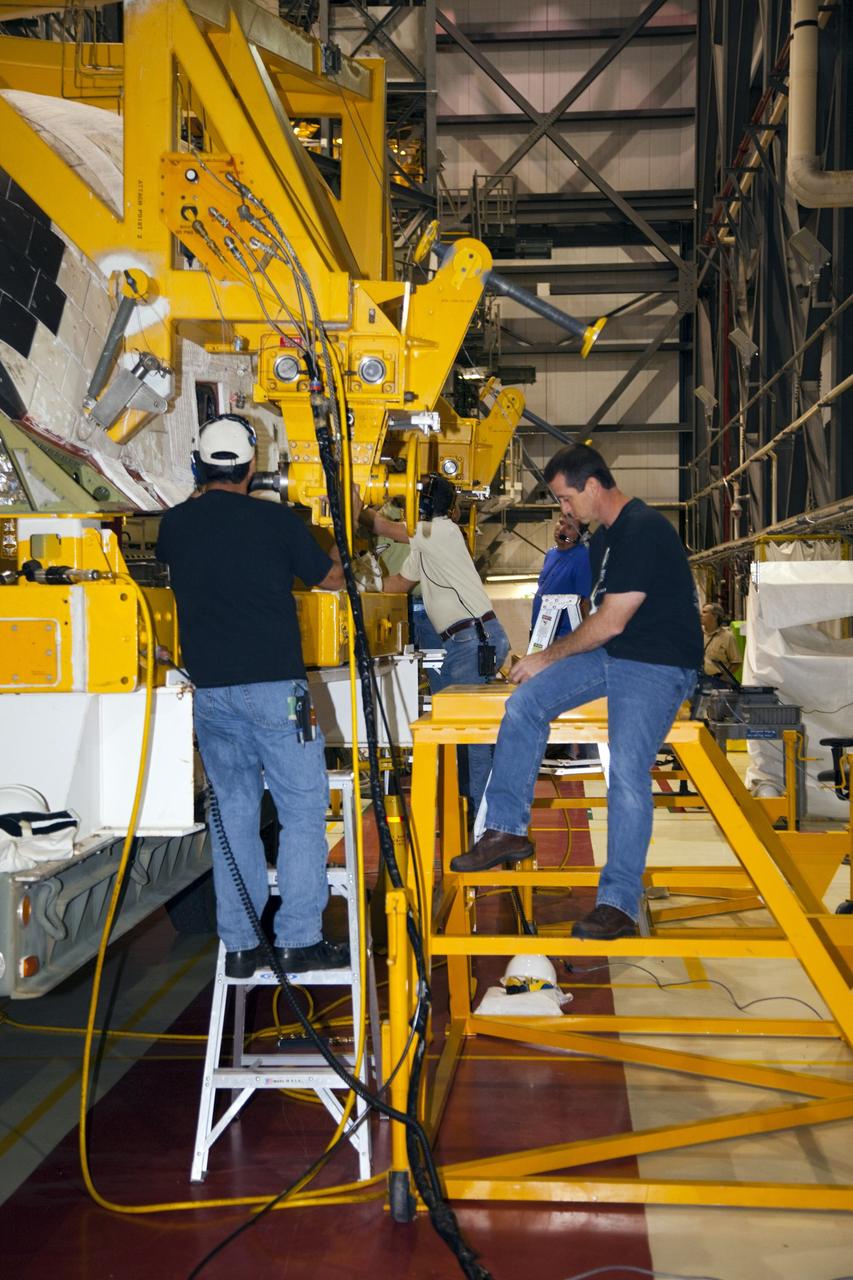
CAPE CANAVERAL, Fla. – In Orbiter Processing Facility-1 at NASA’s Kennedy Space Center in Florida, technicians assist as a crane is secured around an orbital maneuvering system (OMS) pod that will be installed on space shuttle Discovery. The OMS pod was returned from White Sands Space Harbor in New Mexico where it underwent a complete deservicing and cleaning. The work is part of the Space Shuttle Program’s transition and retirement processing of space shuttle Discovery. The shuttle will go to the Smithsonian’s National Air and Space Museum, Steven F. Udvar-Hazy Center in Chantilly, Va., in April 2012. For more information, visit http://www.nasa.gov/shuttle. Photo credit: NASA/Frankie Martin
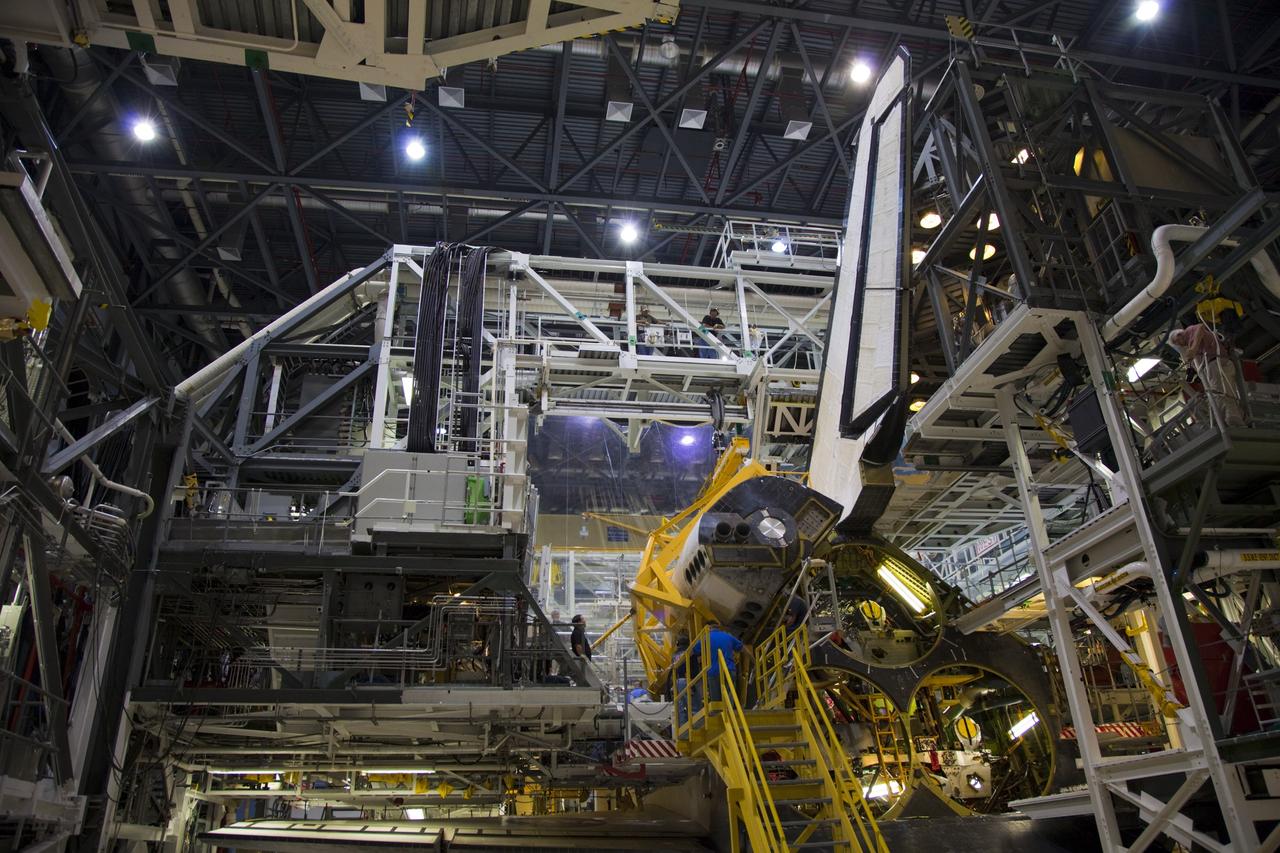
CAPE CANAVERAL, Fla. – In Orbiter Processing Facility-1 at NASA’s Kennedy Space Center in Florida, technicians assist as a crane lowers an orbital maneuvering system (OMS) pod for installation on space shuttle Discovery. The OMS pod was returned from White Sands Space Harbor in New Mexico where it underwent a complete deservicing and cleaning. The work is part of the Space Shuttle Program’s transition and retirement processing of space shuttle Discovery. The shuttle will go to the Smithsonian’s National Air and Space Museum, Steven F. Udvar-Hazy Center in Chantilly, Va., in April 2012. For more information, visit http://www.nasa.gov/shuttle. Photo credit: NASA/Frankie Martin
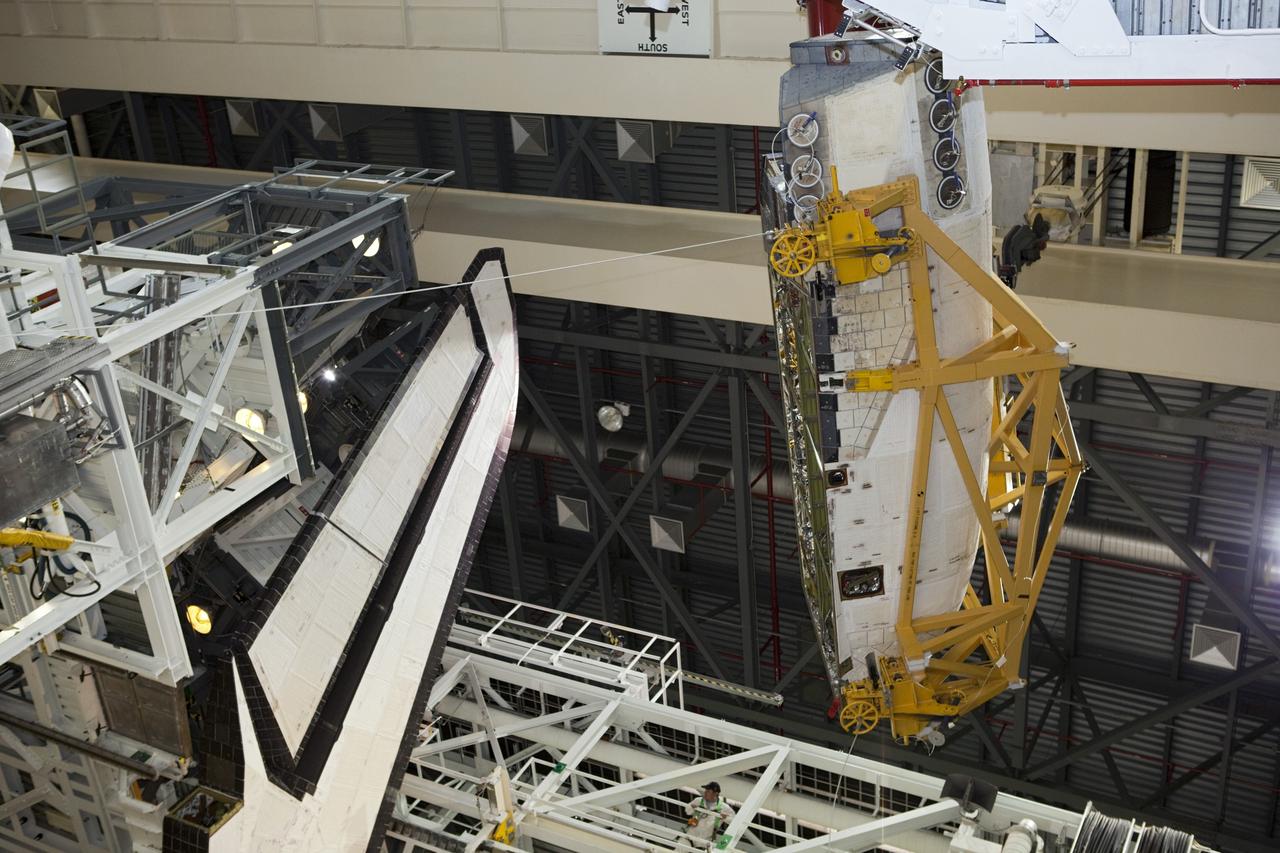
CAPE CANAVERAL, Fla. – Inside Orbiter Processing Facility-2 at NASA’s Kennedy Space Center in Florida, a large crane is being used to move the right orbital maneuvering system (OMS) pod away from space shuttle Atlantis. The work is part of the Space Shuttle Program’s transition and retirement processing of shuttle Atlantis. Both OMS pods will be removed and sent to White Sands Space Harbor in New Mexico where they will undergo a complete deservicing and cleaning and then be returned to Kennedy for reinstallation on Atlantis. Atlantis is being prepared for display at the Kennedy Space Center Visitor Complex. Photo credit: NASA/Dimitri Gerondidakis
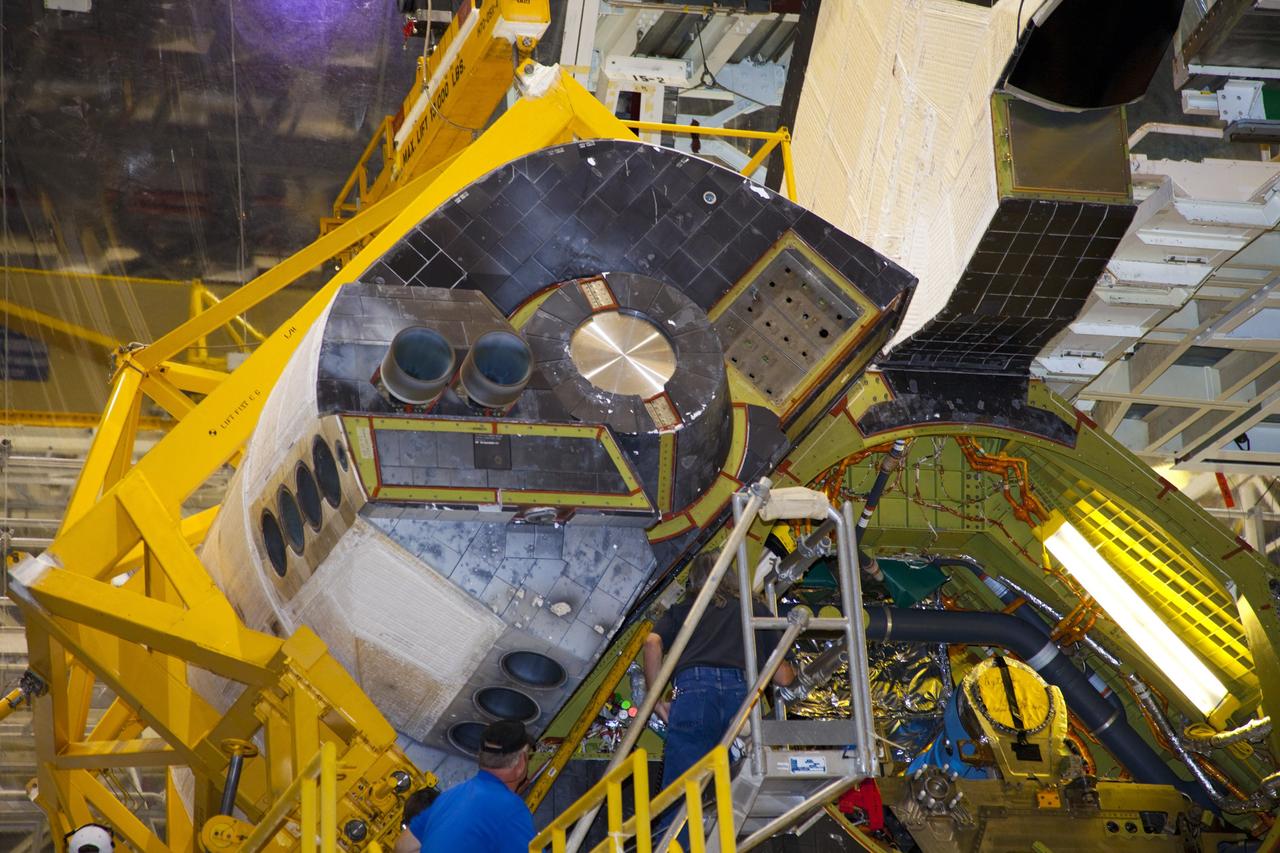
CAPE CANAVERAL, Fla. – In Orbiter Processing Facility-1 at NASA’s Kennedy Space Center in Florida, technicians assist as a crane lowers an orbital maneuvering system (OMS) pod for installation on space shuttle Discovery. The OMS pod was returned from White Sands Space Harbor in New Mexico where it underwent a complete deservicing and cleaning. The work is part of the Space Shuttle Program’s transition and retirement processing of space shuttle Discovery. The shuttle will go to the Smithsonian’s National Air and Space Museum, Steven F. Udvar-Hazy Center in Chantilly, Va., in April 2012. For more information, visit http://www.nasa.gov/shuttle. Photo credit: NASA/Frankie Martin
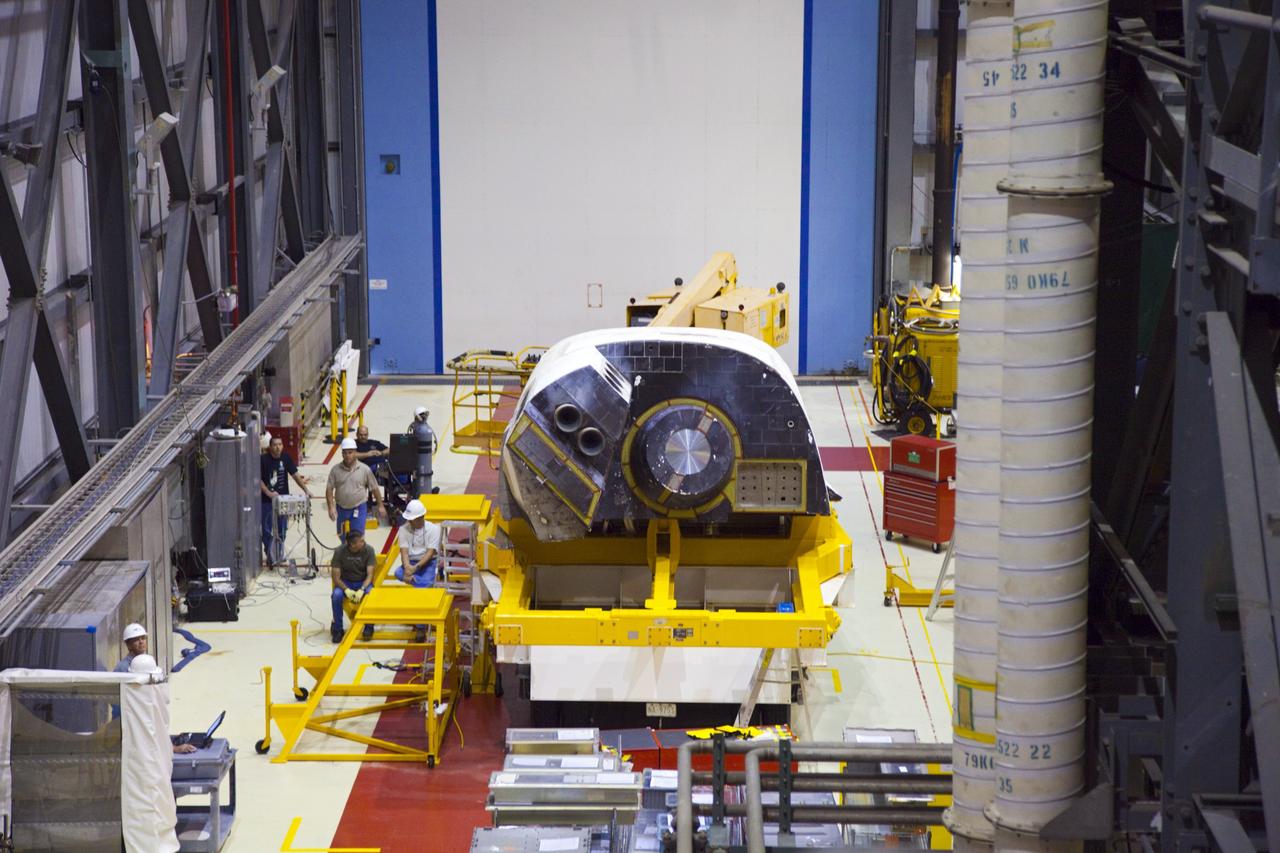
CAPE CANAVERAL, Fla. – At NASA’s Kennedy Space Center in Florida, an orbital maneuvering system (OMS) pod awaits installation on space shuttle Discovery in Orbiter Processing Facility-1. The OMS pod was returned from White Sands Space Harbor in New Mexico where it underwent a complete deservicing and cleaning. The work is part of the Space Shuttle Program’s transition and retirement processing of space shuttle Discovery. The shuttle will go to the Smithsonian’s National Air and Space Museum, Steven F. Udvar-Hazy Center in Chantilly, Va., in April 2012. For more information, visit http://www.nasa.gov/shuttle. Photo credit: NASA/Frankie Martin
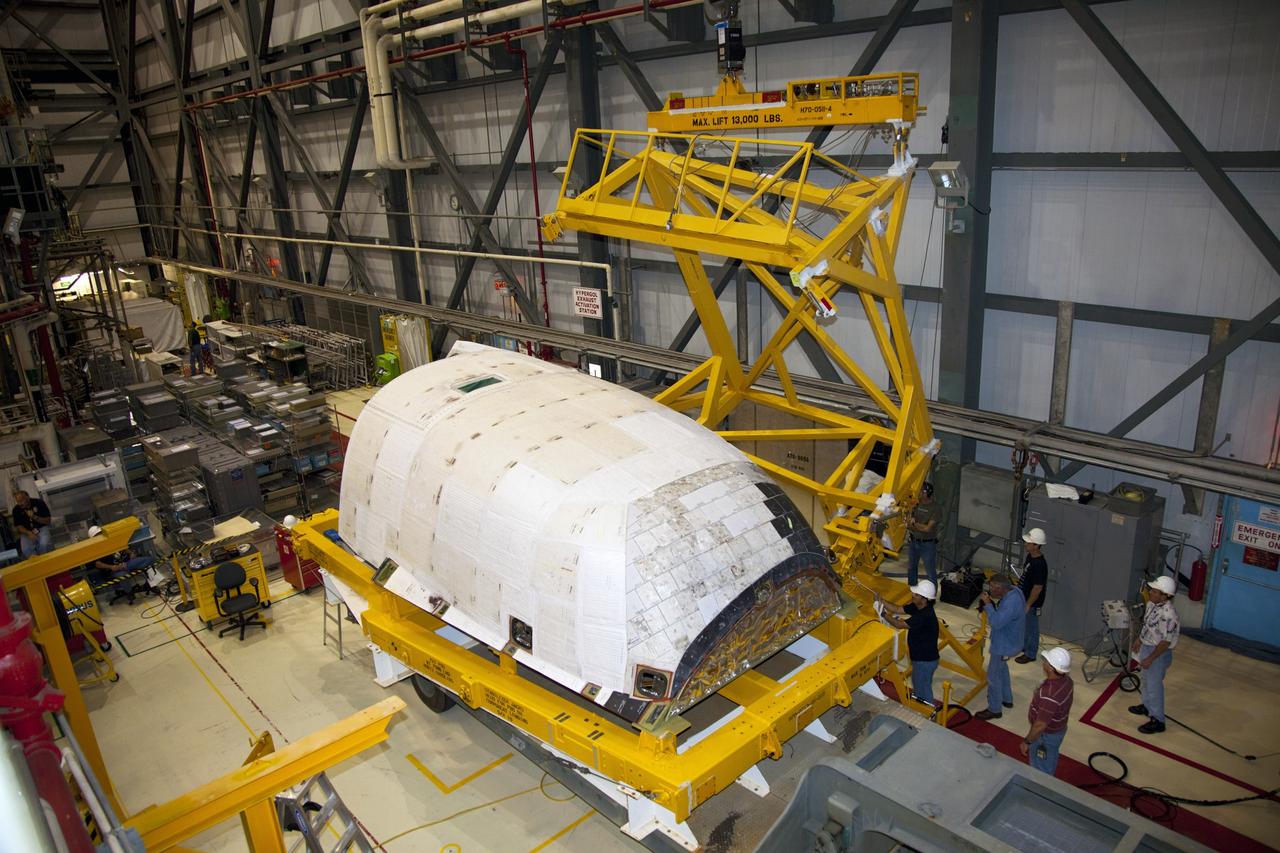
CAPE CANAVERAL, Fla. – At NASA’s Kennedy Space Center in Florida, a crane is lowered toward an orbital maneuvering system (OMS) pod that awaits installation on space shuttle Discovery in Orbiter Processing Facility-1. The OMS pod was returned from White Sands Space Harbor in New Mexico where it underwent a complete deservicing and cleaning. The work is part of the Space Shuttle Program’s transition and retirement processing of space shuttle Discovery. The shuttle will go to the Smithsonian’s National Air and Space Museum, Steven F. Udvar-Hazy Center in Chantilly, Va., in April 2012. For more information, visit http://www.nasa.gov/shuttle. Photo credit: NASA/Frankie Martin
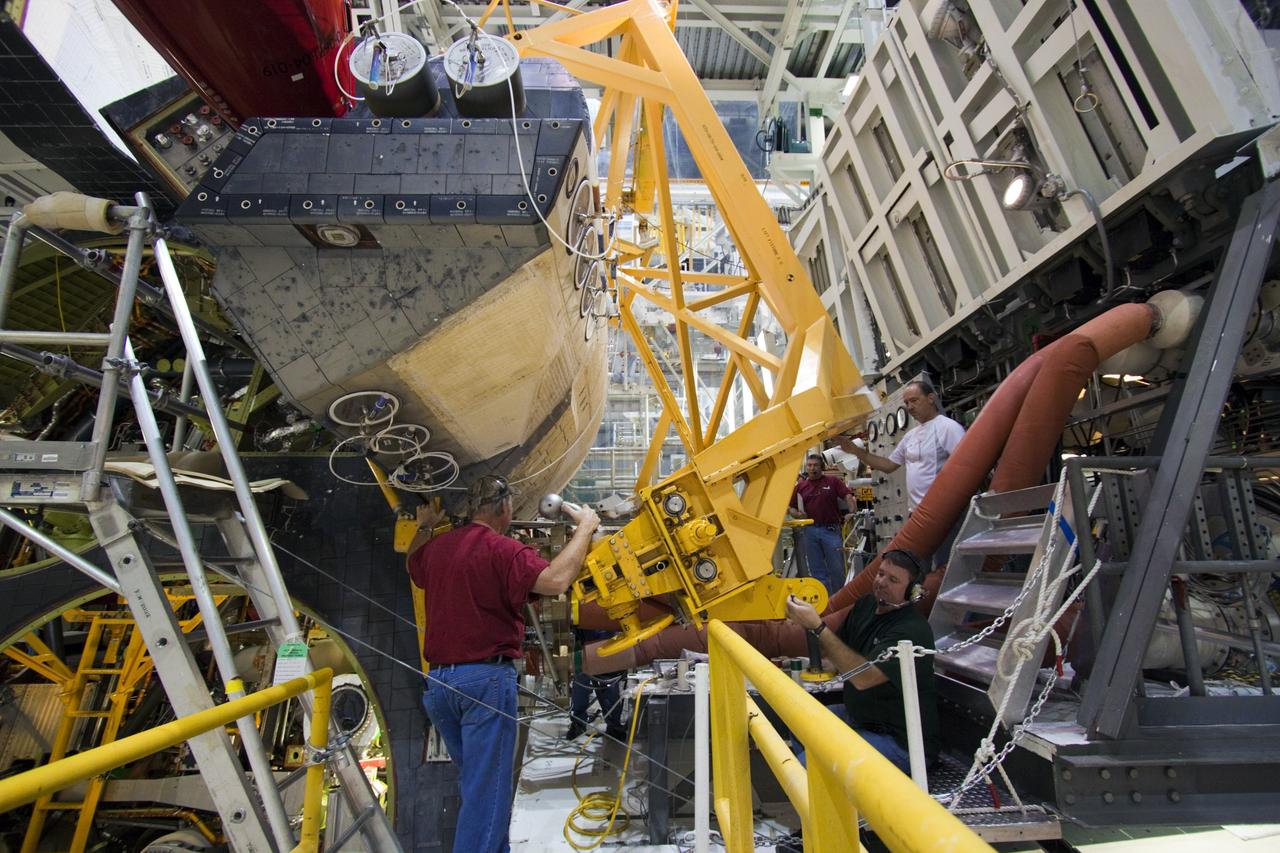
CAPE CANAVERAL, Fla. -- Inside Orbiter Processing Facility-2 at NASA’s Kennedy Space Center in Florida, technicians monitor the progress as a large crane lowers a sling that will be secured around space shuttle Atlantis’ right orbital maneuvering system (OMS) pod. The work is part of the Space Shuttle Program’s transition and retirement processing of shuttle Atlantis. The OMS pod will be removed and sent to White Sands Space Harbor in New Mexico where it will undergo a complete deservicing and cleaning and then be returned to Kennedy for reinstallation on Atlantis. Atlantis is being prepared for display at the Kennedy Space Center Visitor Complex. Photo credit: NASA/Jim Grossmann

CAPE CANAVERAL, Fla. – Inside Orbiter Processing Facility-2 at NASA’s Kennedy Space Center in Florida, technicians monitor the progress as a large crane lowers space shuttle Atlantis’ right orbital maneuvering system (OMS) pod onto a pallet. The work is part of the Space Shuttle Program’s transition and retirement processing of shuttle Atlantis. Both OMS pods will be removed and sent to White Sands Space Harbor in New Mexico where they will undergo a complete deservicing and cleaning and then be returned to Kennedy for reinstallation on Atlantis. Atlantis is being prepared for display at the Kennedy Space Center Visitor Complex. Photo credit: NASA/Dimitri Gerondidakis
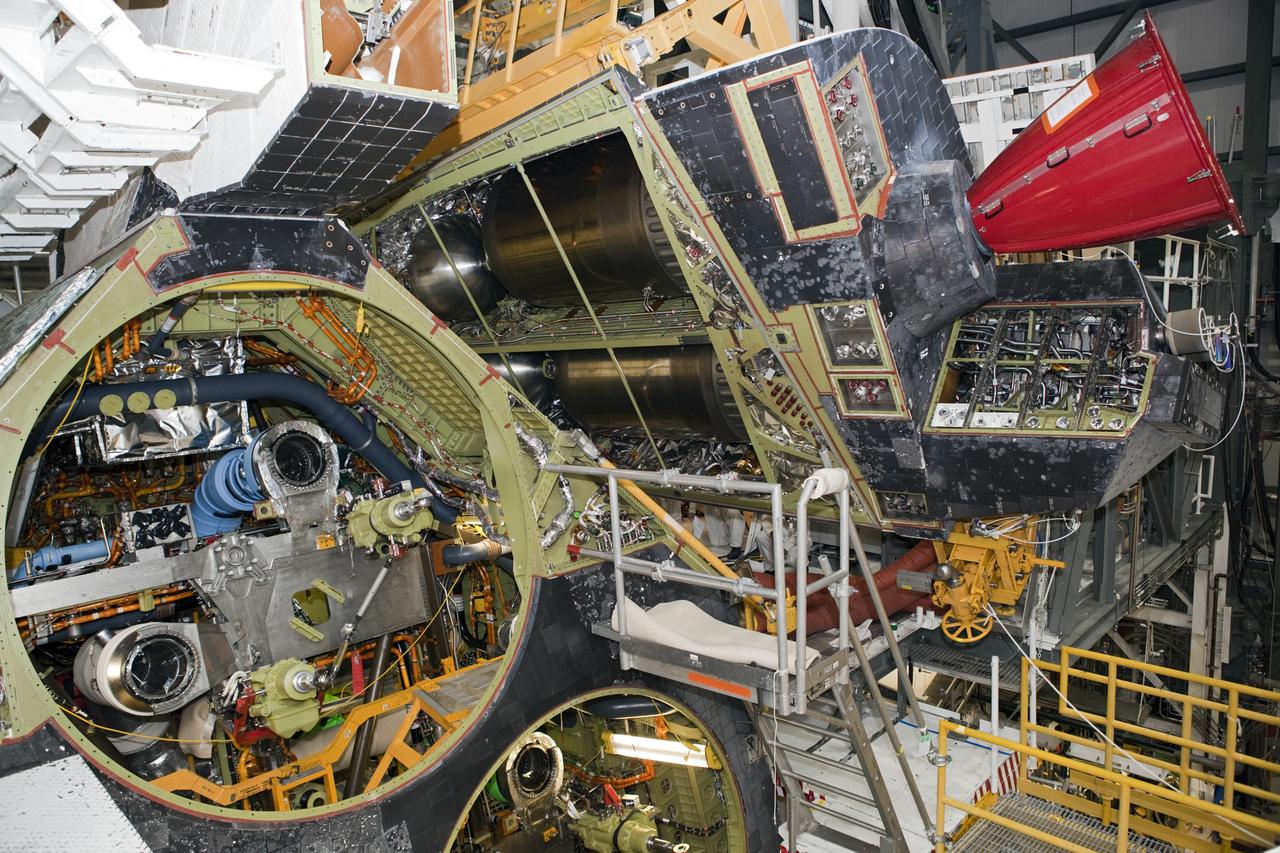
CAPE CANAVERAL, Fla. – Inside Orbiter Processing Facility-2 at NASA’s Kennedy Space Center in Florida, a large crane is being used to remove the right orbital maneuvering system (OMS) pod from space shuttle Atlantis. The work is part of the Space Shuttle Program’s transition and retirement processing of shuttle Atlantis. Both OMS pods will be removed and sent to White Sands Space Harbor in New Mexico where they will undergo a complete deservicing and cleaning and then be returned to Kennedy for reinstallation on Atlantis. Atlantis is being prepared for display at the Kennedy Space Center Visitor Complex. Photo credit: NASA/Dimitri Gerondidakis
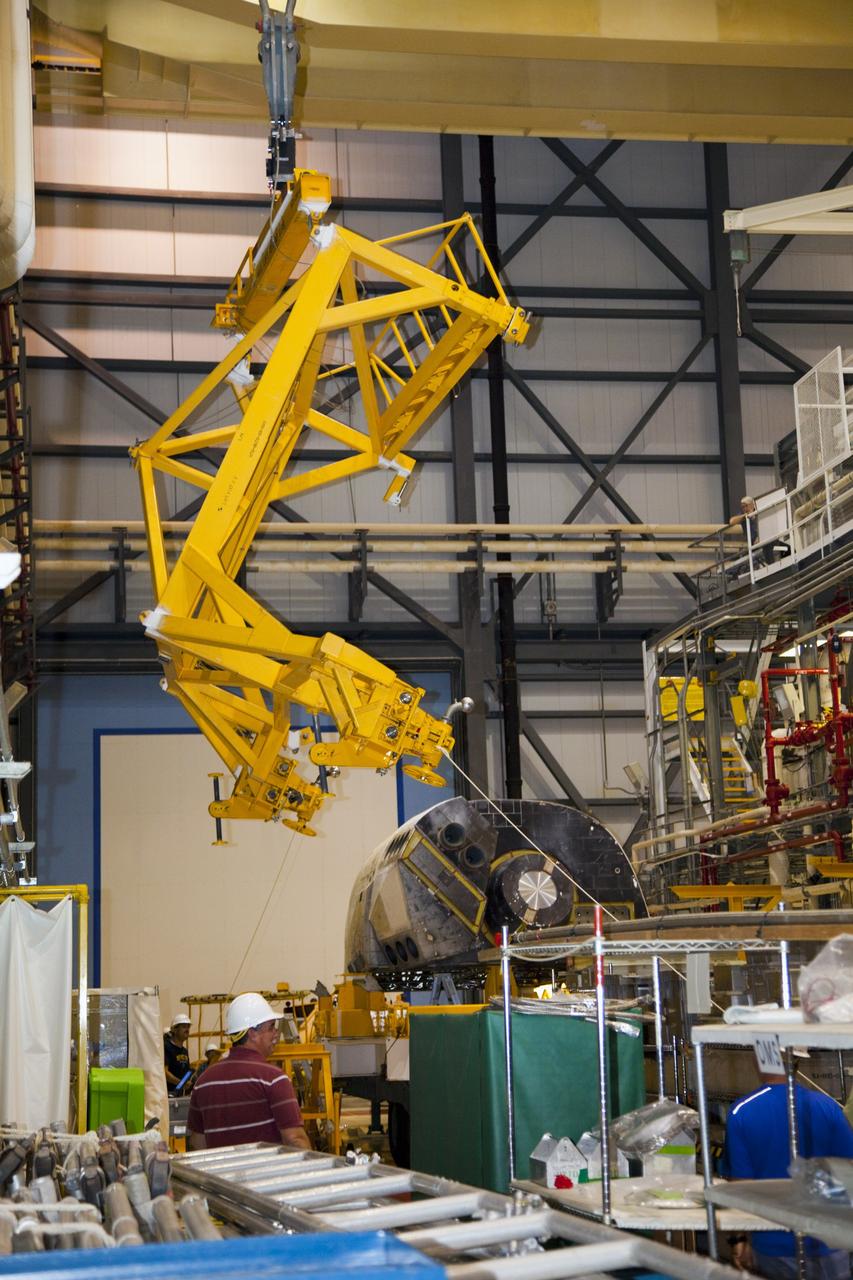
CAPE CANAVERAL, Fla. – At NASA’s Kennedy Space Center in Florida, a crane is lowered toward an orbital maneuvering system (OMS) pod that awaits installation on space shuttle Discovery in Orbiter Processing Facility-1. The OMS pod was returned from White Sands Space Harbor in New Mexico where it underwent a complete deservicing and cleaning. The work is part of the Space Shuttle Program’s transition and retirement processing of space shuttle Discovery. The shuttle will go to the Smithsonian’s National Air and Space Museum, Steven F. Udvar-Hazy Center in Chantilly, Va., in April 2012. For more information, visit http://www.nasa.gov/shuttle. Photo credit: NASA/Frankie Martin
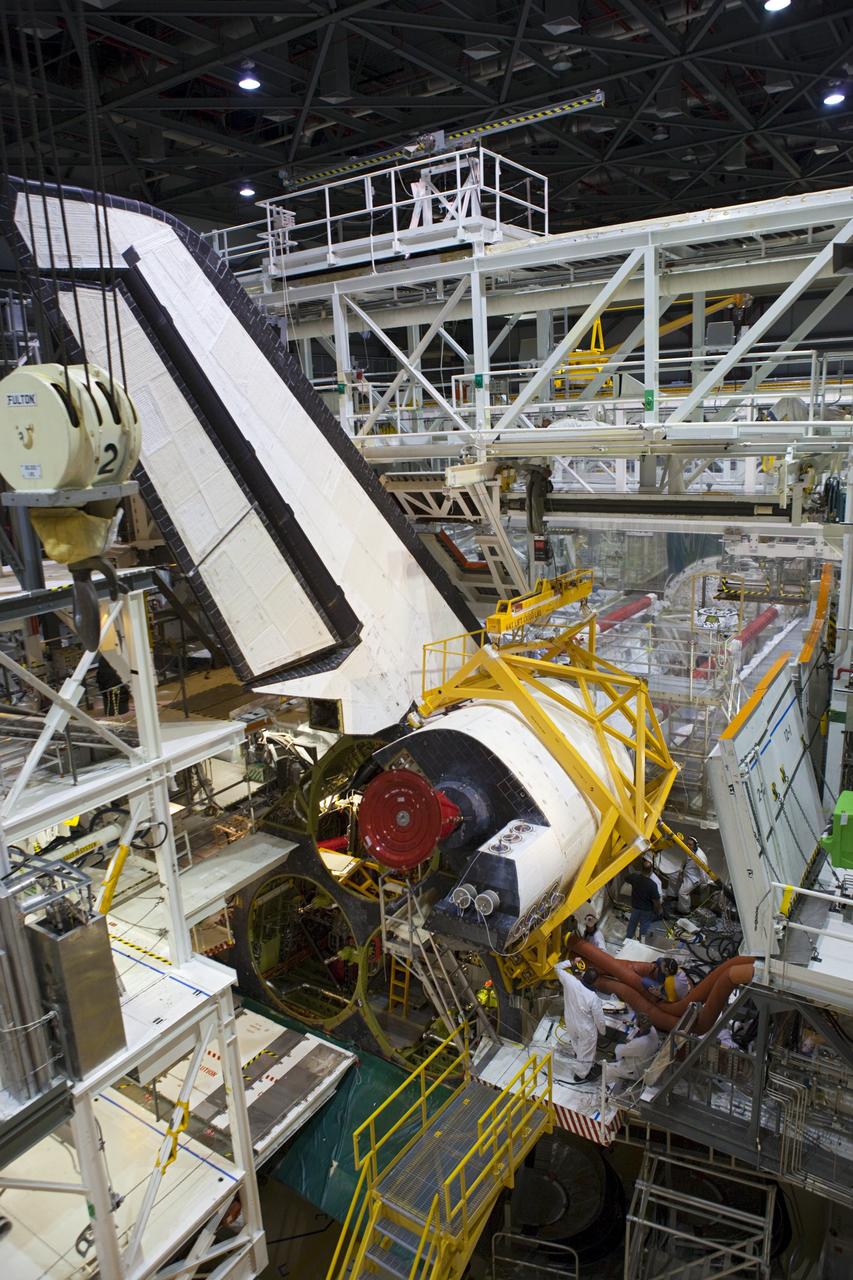
CAPE CANAVERAL, Fla. -- Inside Orbiter Processing Facility-2 at NASA’s Kennedy Space Center in Florida, technicians help secure a sling around space shuttle Atlantis’ right orbital maneuvering system (OMS) pod and prepare it for removal. The work is part of the Space Shuttle Program’s transition and retirement processing of shuttle Atlantis. The OMS pod will be removed and sent to White Sands Space Harbor in New Mexico where it will undergo a complete deservicing and cleaning and then be returned to Kennedy for reinstallation on Atlantis. Atlantis is being prepared for display at the Kennedy Space Center Visitor Complex. Photo credit: NASA/Dimitri Gerondidakis
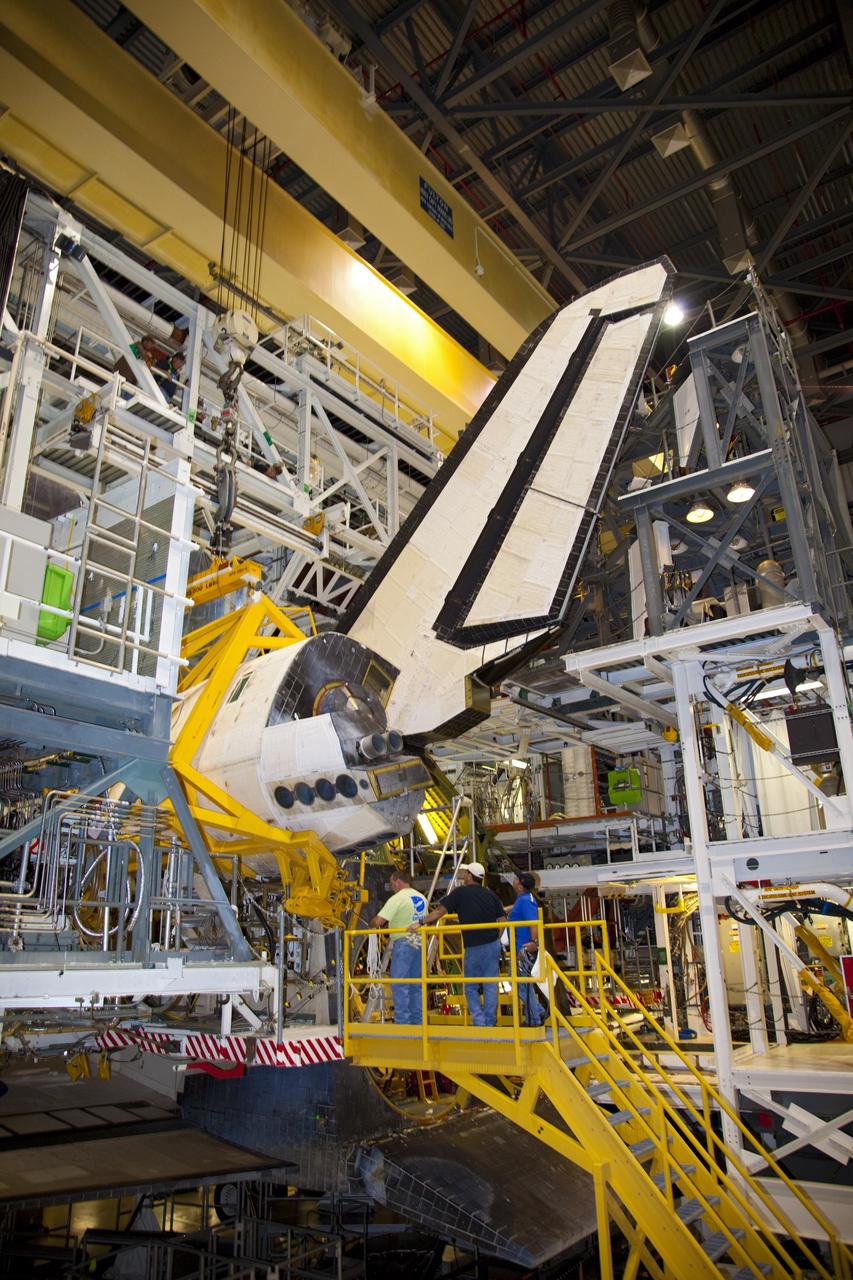
CAPE CANAVERAL, Fla. – In Orbiter Processing Facility-1 at NASA’s Kennedy Space Center in Florida, technicians monitor the progress as a crane lowers an orbital maneuvering system (OMS) pod closer for installation on space shuttle Discovery. The OMS pod was returned from White Sands Space Harbor in New Mexico where it underwent a complete deservicing and cleaning. The work is part of the Space Shuttle Program’s transition and retirement processing of space shuttle Discovery. The shuttle will go to the Smithsonian’s National Air and Space Museum, Steven F. Udvar-Hazy Center in Chantilly, Va., in April 2012. For more information, visit http://www.nasa.gov/shuttle. Photo credit: NASA/Frankie Martin
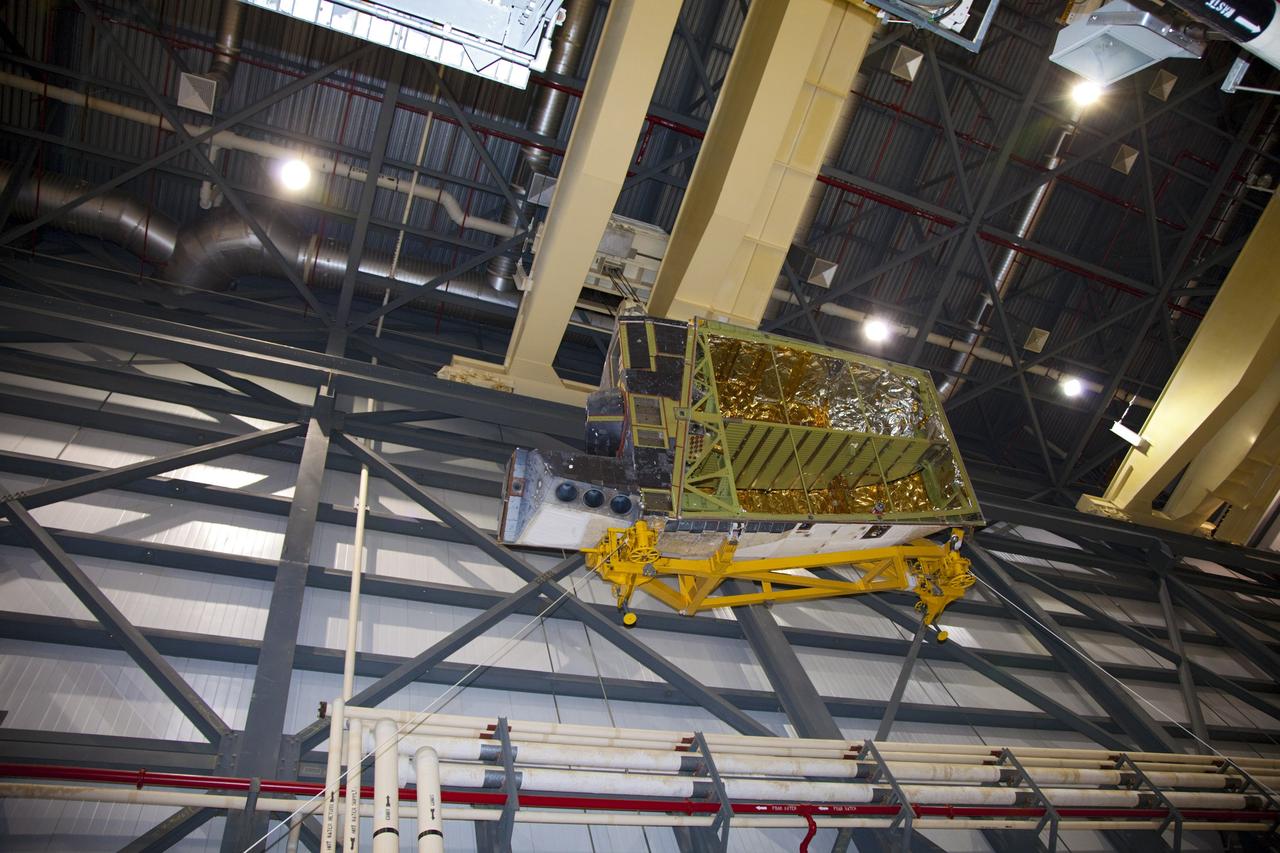
CAPE CANAVERAL, Fla. – In Orbiter Processing Facility-1 at NASA’s Kennedy Space Center in Florida, a crane carries an orbital maneuvering system (OMS) pod that will be installed on space shuttle Discovery. The OMS pod was returned from White Sands Space Harbor in New Mexico where it underwent a complete deservicing and cleaning. The work is part of the Space Shuttle Program’s transition and retirement processing of space shuttle Discovery. The shuttle will go to the Smithsonian’s National Air and Space Museum, Steven F. Udvar-Hazy Center in Chantilly, Va., in April 2012. For more information, visit http://www.nasa.gov/shuttle. Photo credit: NASA/Frankie Martin
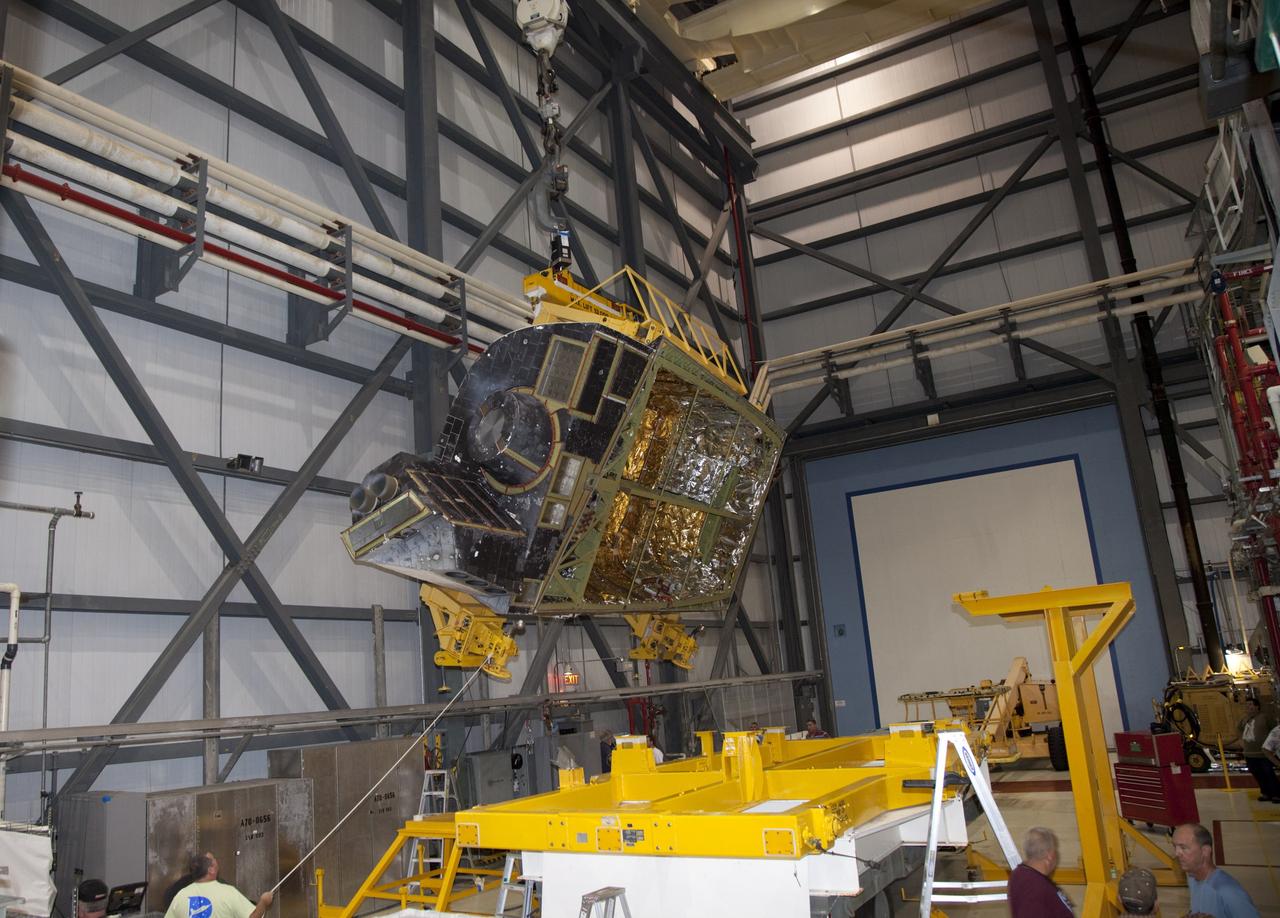
CAPE CANAVERAL, Fla. – In Orbiter Processing Facility-1 at NASA’s Kennedy Space Center in Florida, technicians monitor the progress as a crane is used to carry an orbital maneuvering system (OMS) pod that will be installed on space shuttle Discovery. The OMS pod was returned from White Sands Space Harbor in New Mexico where it underwent a complete deservicing and cleaning. The work is part of the Space Shuttle Program’s transition and retirement processing of space shuttle Discovery. The shuttle will go to the Smithsonian’s National Air and Space Museum, Steven F. Udvar-Hazy Center in Chantilly, Va., in April 2012. For more information, visit http://www.nasa.gov/shuttle. Photo credit: NASA/Frankie Martin
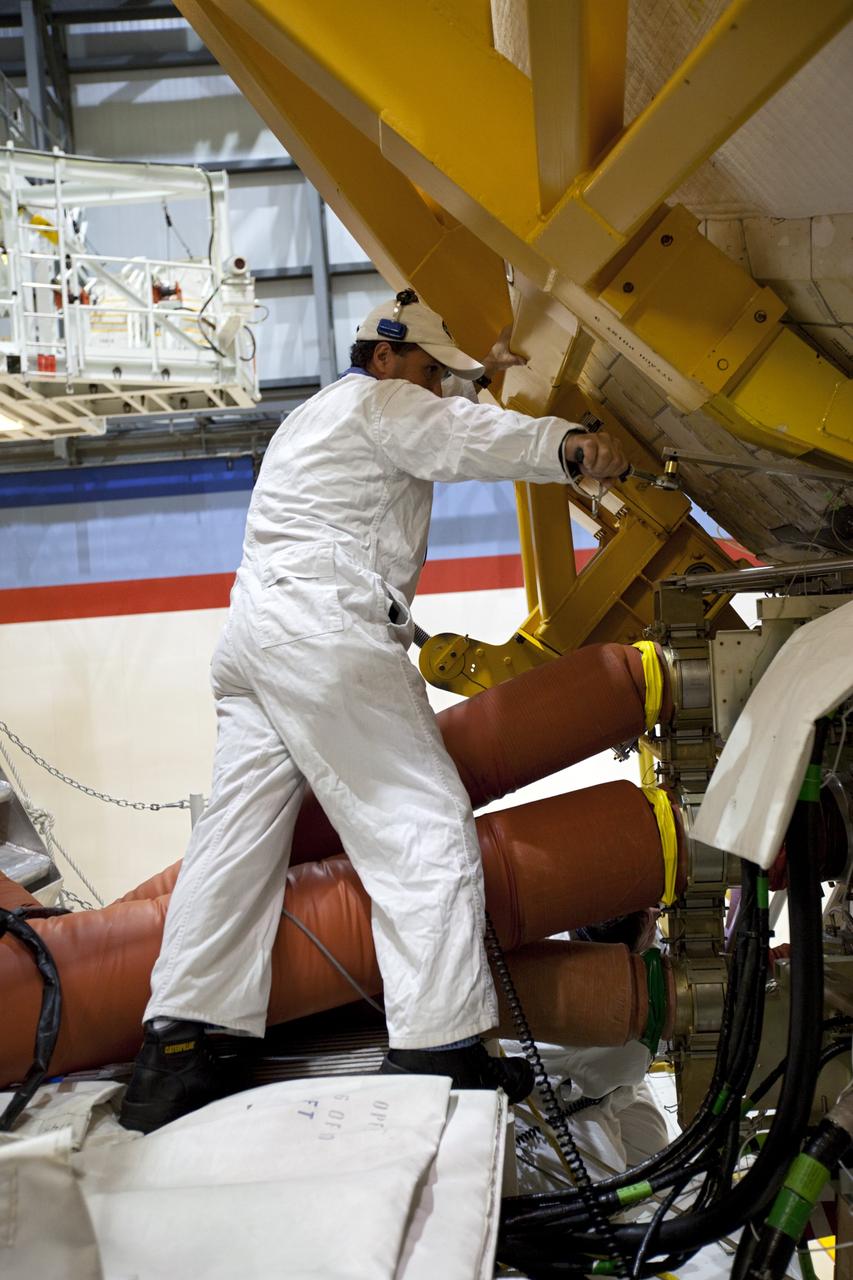
CAPE CANAVERAL, Fla. --Inside Orbiter Processing Facility-2 at NASA’s Kennedy Space Center in Florida, technicians help secure a sling around space shuttle Atlantis’ right orbital maneuvering system (OMS) pod. The work is part of the Space Shuttle Program’s transition and retirement processing of shuttle Atlantis. The OMS pod will be removed and sent to White Sands Space Harbor in New Mexico where it will undergo a complete deservicing and cleaning and then be returned to Kennedy for reinstallation on Atlantis. Atlantis is being prepared for display at the Kennedy Space Center Visitor Complex. Photo credit: NASA/Dimitri Gerondidakis
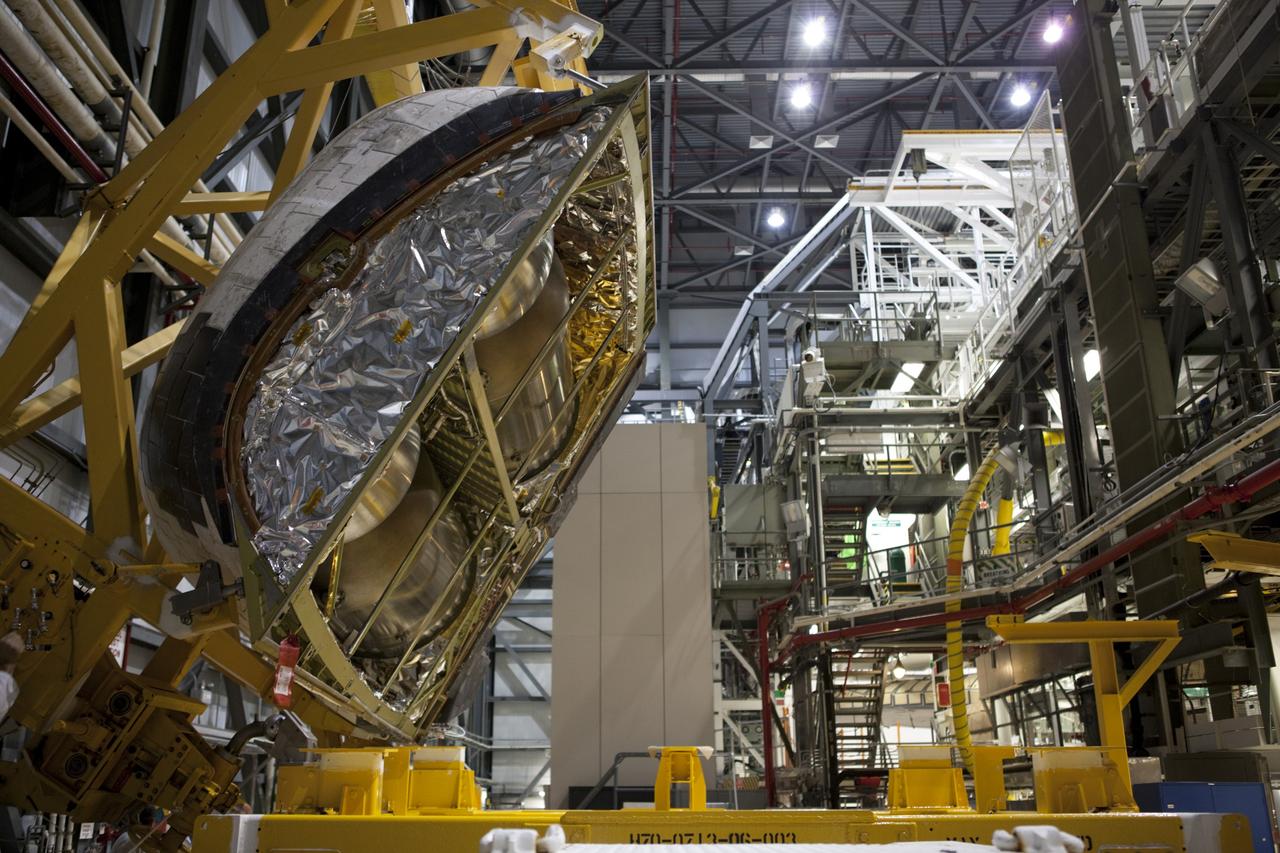
CAPE CANAVERAL, Fla. – Inside Orbiter Processing Facility-2 at NASA’s Kennedy Space Center in Florida, technicians monitor the progress as a large crane lowers space shuttle Atlantis’ right orbital maneuvering system (OMS) pod onto a pallet. The work is part of the Space Shuttle Program’s transition and retirement processing of shuttle Atlantis. Both OMS pods will be removed and sent to White Sands Space Harbor in New Mexico where they will undergo a complete deservicing and cleaning and then be returned to Kennedy for reinstallation on Atlantis. Atlantis is being prepared for display at the Kennedy Space Center Visitor Complex. Photo credit: NASA/Dimitri Gerondidakis
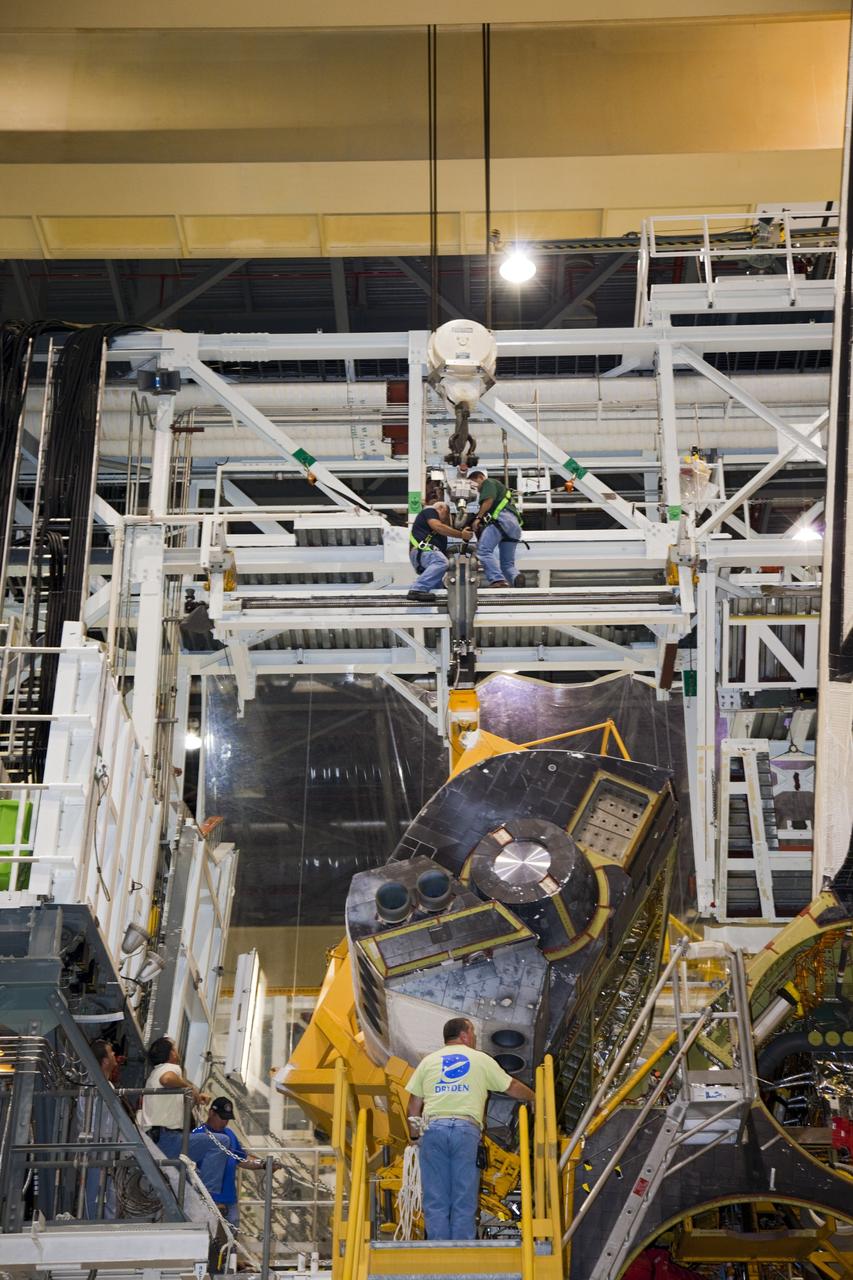
CAPE CANAVERAL, Fla. – In Orbiter Processing Facility-1 at NASA’s Kennedy Space Center in Florida, technicians assist as a crane lowers an orbital maneuvering system (OMS) pod for installation on space shuttle Discovery. The OMS pod was returned from White Sands Space Harbor in New Mexico where it underwent a complete deservicing and cleaning. The work is part of the Space Shuttle Program’s transition and retirement processing of space shuttle Discovery. The shuttle will go to the Smithsonian’s National Air and Space Museum, Steven F. Udvar-Hazy Center in Chantilly, Va., in April 2012. For more information, visit http://www.nasa.gov/shuttle. Photo credit: NASA/Frankie Martin
CAPE CANAVERAL, Fla. -- Inside Orbiter Processing Facility-2 at NASA’s Kennedy Space Center in Florida, technicians help secure a sling around space shuttle Atlantis’ right orbital maneuvering system (OMS) pod and prepare it for removal. The work is part of the Space Shuttle Program’s transition and retirement processing of shuttle Atlantis. The OMS pod will be removed and sent to White Sands Space Harbor in New Mexico where it will undergo a complete deservicing and cleaning and then be returned to Kennedy for reinstallation on Atlantis. Atlantis is being prepared for display at the Kennedy Space Center Visitor Complex. Photo credit: NASA/Dimitri Gerondidakis
CAPE CANAVERAL, Fla. – In Orbiter Processing Facility-1 at NASA’s Kennedy Space Center in Florida, technicians monitor the progress as a crane is used to carry an orbital maneuvering system (OMS) pod that will be installed on space shuttle Discovery. The OMS pod was returned from White Sands Space Harbor in New Mexico where it underwent a complete deservicing and cleaning. The work is part of the Space Shuttle Program’s transition and retirement processing of space shuttle Discovery. The shuttle will go to the Smithsonian’s National Air and Space Museum, Steven F. Udvar-Hazy Center in Chantilly, Va., in April 2012. For more information, visit http://www.nasa.gov/shuttle. Photo credit: NASA/Frankie Martin
CAPE CANAVERAL, Fla. – Inside Orbiter Processing Facility-2 at NASA’s Kennedy Space Center in Florida, technicians monitor the progress as a large crane lifts the right orbital maneuvering system (OMS) pod from space shuttle Atlantis. The work is part of the Space Shuttle Program’s transition and retirement processing of shuttle Atlantis. Both OMS pods will be removed and sent to White Sands Space Harbor in New Mexico where they will undergo a complete deservicing and cleaning and then be returned to Kennedy for reinstallation on Atlantis. Atlantis is being prepared for display at the Kennedy Space Center Visitor Complex. Photo credit: NASA/Dimitri Gerondidakis
CAPE CANAVERAL, Fla. -- Inside Orbiter Processing Facility-2 at NASA’s Kennedy Space Center in Florida, technicians monitor the progress as a large crane lowers a sling toward space shuttle Atlantis’ right orbital maneuvering system (OMS) pod. The work is part of the Space Shuttle Program’s transition and retirement processing of shuttle Atlantis. The OMS pod will be removed and sent to White Sands Space Harbor in New Mexico where it will undergo a complete deservicing and cleaning and then be returned to Kennedy for reinstallation on Atlantis. Atlantis is being prepared for display at the Kennedy Space Center Visitor Complex. Photo credit: NASA/Jim Grossmann
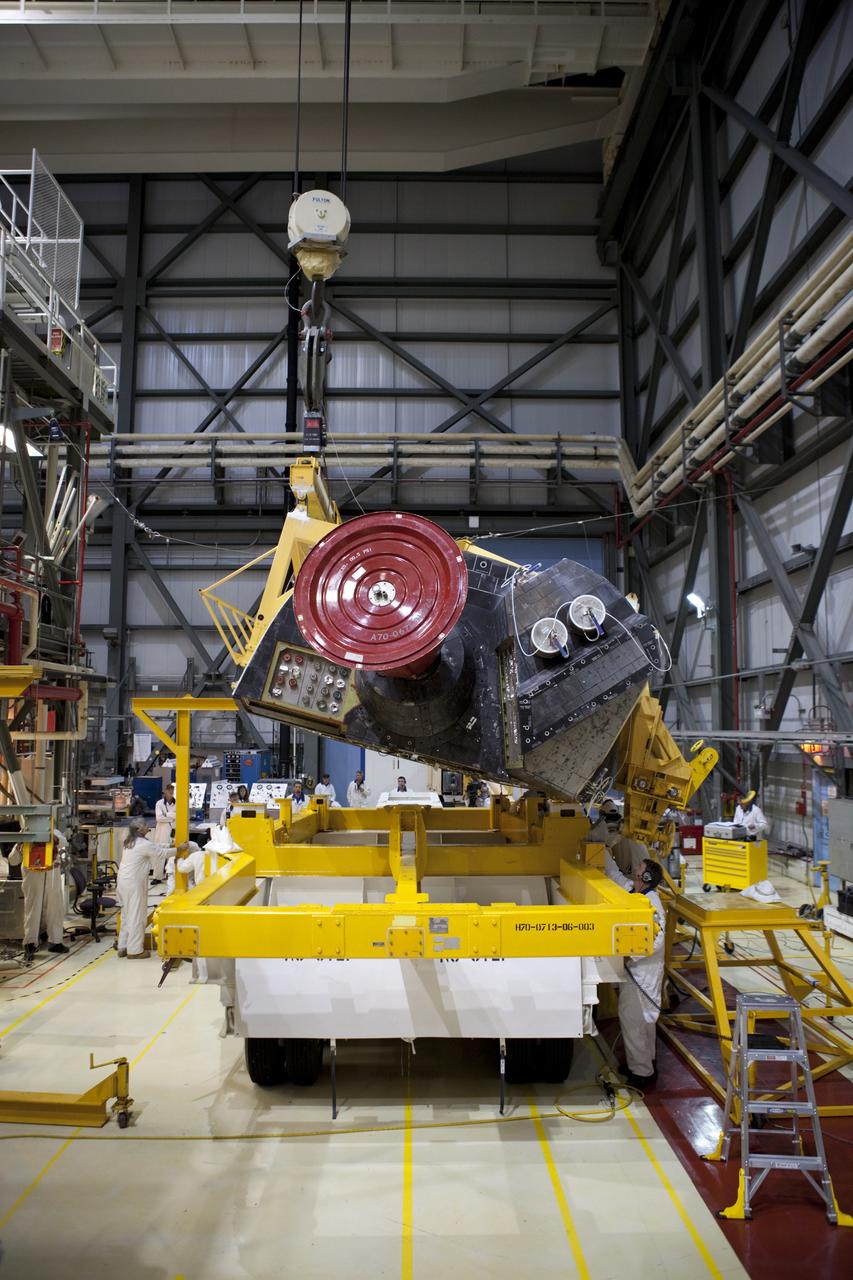
CAPE CANAVERAL, Fla. – Inside Orbiter Processing Facility-2 at NASA’s Kennedy Space Center in Florida, technicians monitor the progress as a large crane lowers space shuttle Atlantis’ right orbital maneuvering system (OMS) pod onto a pallet. The work is part of the Space Shuttle Program’s transition and retirement processing of shuttle Atlantis. Both OMS pods will be removed and sent to White Sands Space Harbor in New Mexico where they will undergo a complete deservicing and cleaning and then be returned to Kennedy for reinstallation on Atlantis. Atlantis is being prepared for display at the Kennedy Space Center Visitor Complex. Photo credit: NASA/Dimitri Gerondidakis
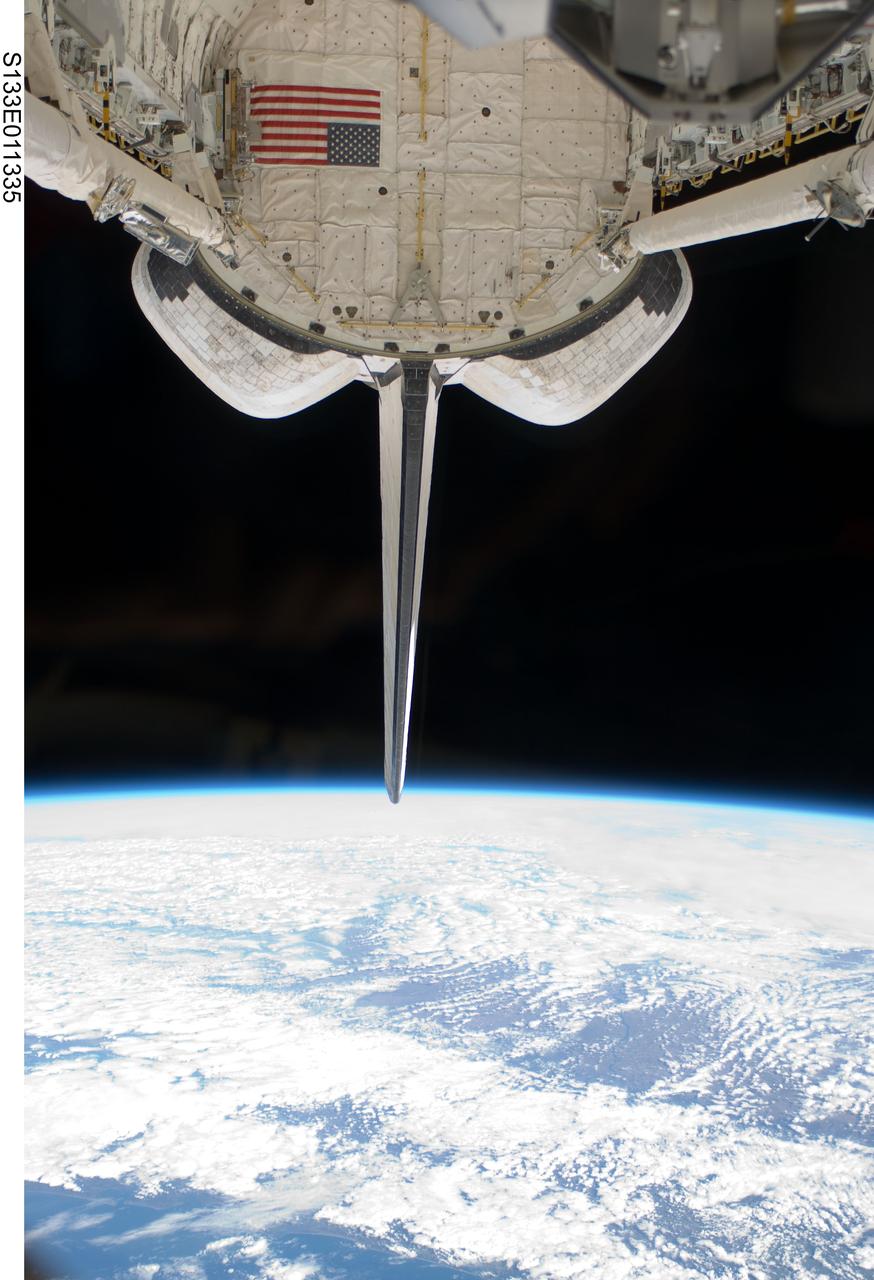
S133-E-011335 (7 March 2011) --- Space shuttle Discovery’s vertical stabilizer, orbital maneuvering system (OMS) pods, remote manipulator system/orbiter boom sensor system (RMS/OBSS) and payload bay are featured in this image photographed by an STS-133 crew member on the shuttle during flight day 12 activities. Earth's horizon and the blackness of space provide the backdrop for the scene. Photo credit: NASA or National Aeronautics and Space Administration

S83-35782 (18 June 1983) --- An Orbital Maneuvering System (OMS) engine firing caused this bright glow at the aft end of the Earth-orbiting space shuttle Challenger on June 18, 1983. Also visible in the 70mm exposure are parts of the Shuttle Pallet Satellite (SPAS-01). The experiment package for NASA's Office of Space and Terrestrial Applications (OSTA-2), the protective cradles for the Indonesian Palapa-B and Telesat Canada Anik C2 satellites, some getaway special (GAS) canisters and the Canadian-built Remote Manipulator System (RMS). The firing took place less than an hour after deployment of Anik. Photo credit: NASA
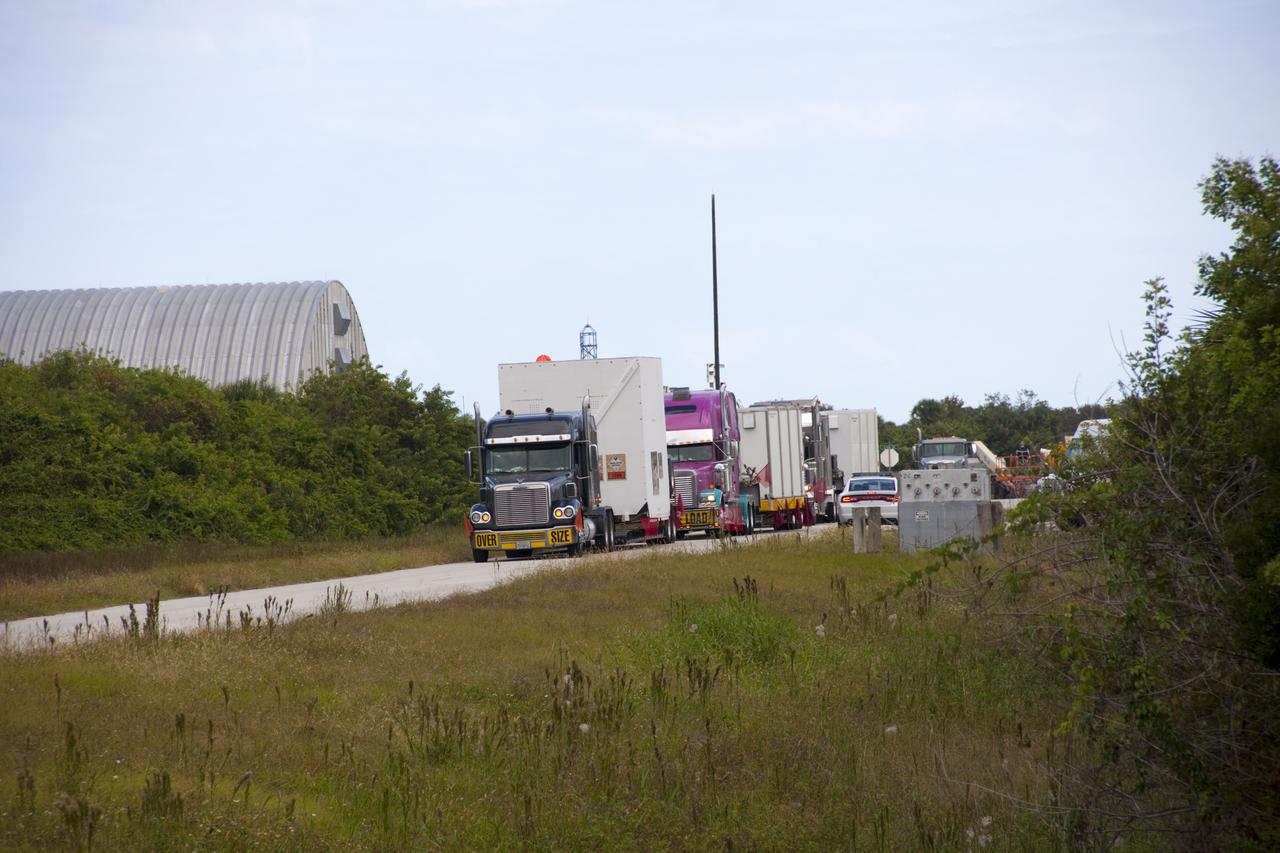
CAPE CANAVERAL, Fla. – Outside the Hazardous Maintenance Facility at NASA's Kennedy Space Center in Florida, space shuttle Endeavour’s left and right orbital maneuvering system (OMS) pods and forward reaction control system (FRCS) are secured in several containers and ready for transport to White Sands Space Harbor in New Mexico. The work is part of the Space Shuttle Program’s transition and retirement processing of shuttle Endeavour. At White Sands the OMS pods and FRCS will undergo a complete deservicing and cleaning and then be returned to Kennedy for reinstallation on Endeavour. Endeavour is being prepared for display at the California Science Center in Los Angeles. Photo credit: NASA/Jim Grossmann
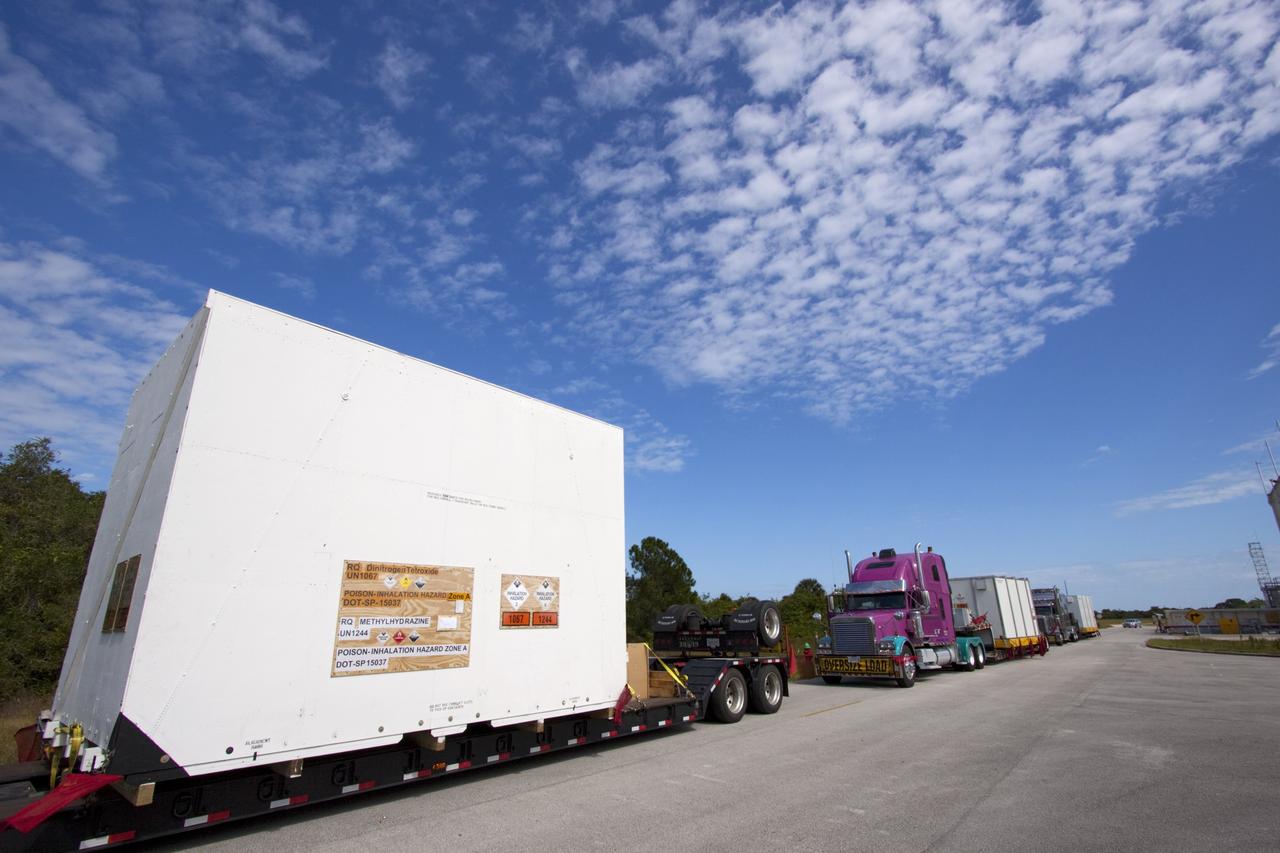
CAPE CANAVERAL, Fla. – Outside the Hazardous Maintenance Facility at NASA's Kennedy Space Center in Florida, space shuttle Endeavour’s left and right orbital maneuvering system (OMS) pods and forward reaction control system (FRCS) are secured in several containers and ready for transport to White Sands Space Harbor in New Mexico. The work is part of the Space Shuttle Program’s transition and retirement processing of shuttle Endeavour. At White Sands the OMS pods and FRCS will undergo a complete deservicing and cleaning and then be returned to Kennedy for reinstallation on Endeavour. Endeavour is being prepared for display at the California Science Center in Los Angeles. Photo credit: NASA/Jim Grossmann
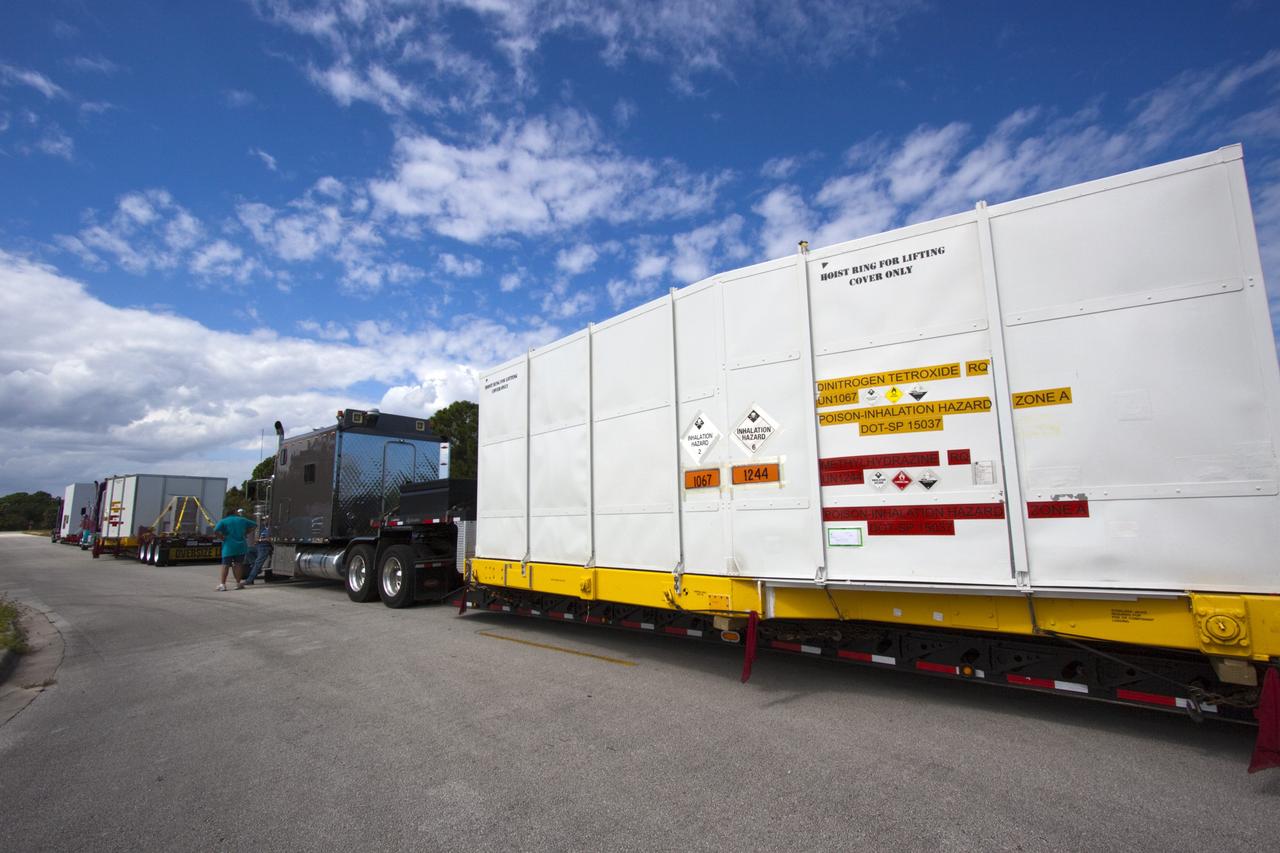
CAPE CANAVERAL, Fla. – Outside the Hazardous Maintenance Facility at NASA's Kennedy Space Center in Florida, space shuttle Endeavour’s left and right orbital maneuvering system (OMS) pods and forward reaction control system (FRCS) are secured in several containers and ready for transport to White Sands Space Harbor in New Mexico. The work is part of the Space Shuttle Program’s transition and retirement processing of shuttle Endeavour. At White Sands the OMS pods and FRCS will undergo a complete deservicing and cleaning and then be returned to Kennedy for reinstallation on Endeavour. Endeavour is being prepared for display at the California Science Center in Los Angeles. Photo credit: NASA/Jim Grossmann
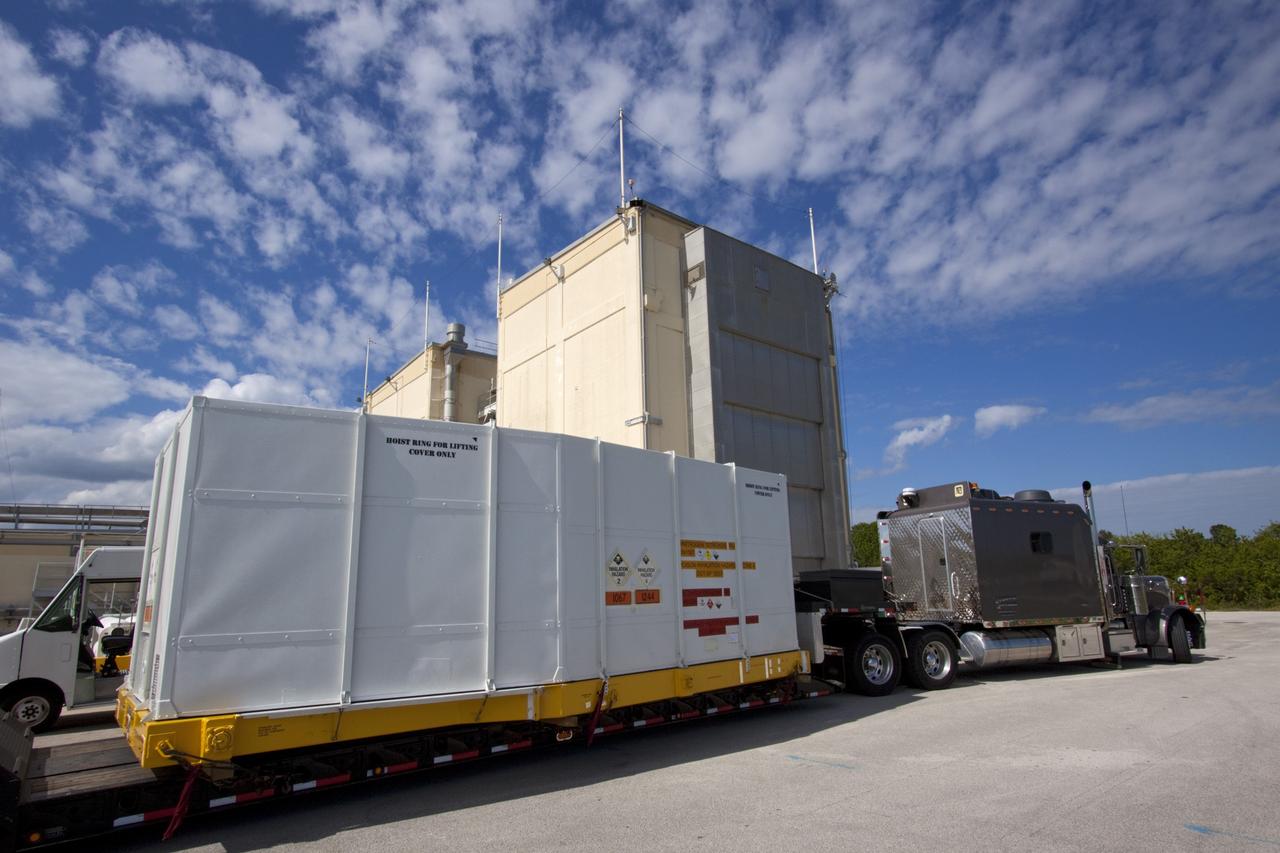
CAPE CANAVERAL, Fla. – Outside the Hazardous Maintenance Facility at NASA's Kennedy Space Center in Florida, space shuttle Endeavour’s left and right orbital maneuvering system (OMS) pods and forward reaction control system (FRCS) are secured in several containers and ready for transport to White Sands Space Harbor in New Mexico. The work is part of the Space Shuttle Program’s transition and retirement processing of shuttle Endeavour. At White Sands the OMS pods and FRCS will undergo a complete deservicing and cleaning and then be returned to Kennedy for reinstallation on Endeavour. Endeavour is being prepared for display at the California Science Center in Los Angeles. Photo credit: NASA/Jim Grossmann
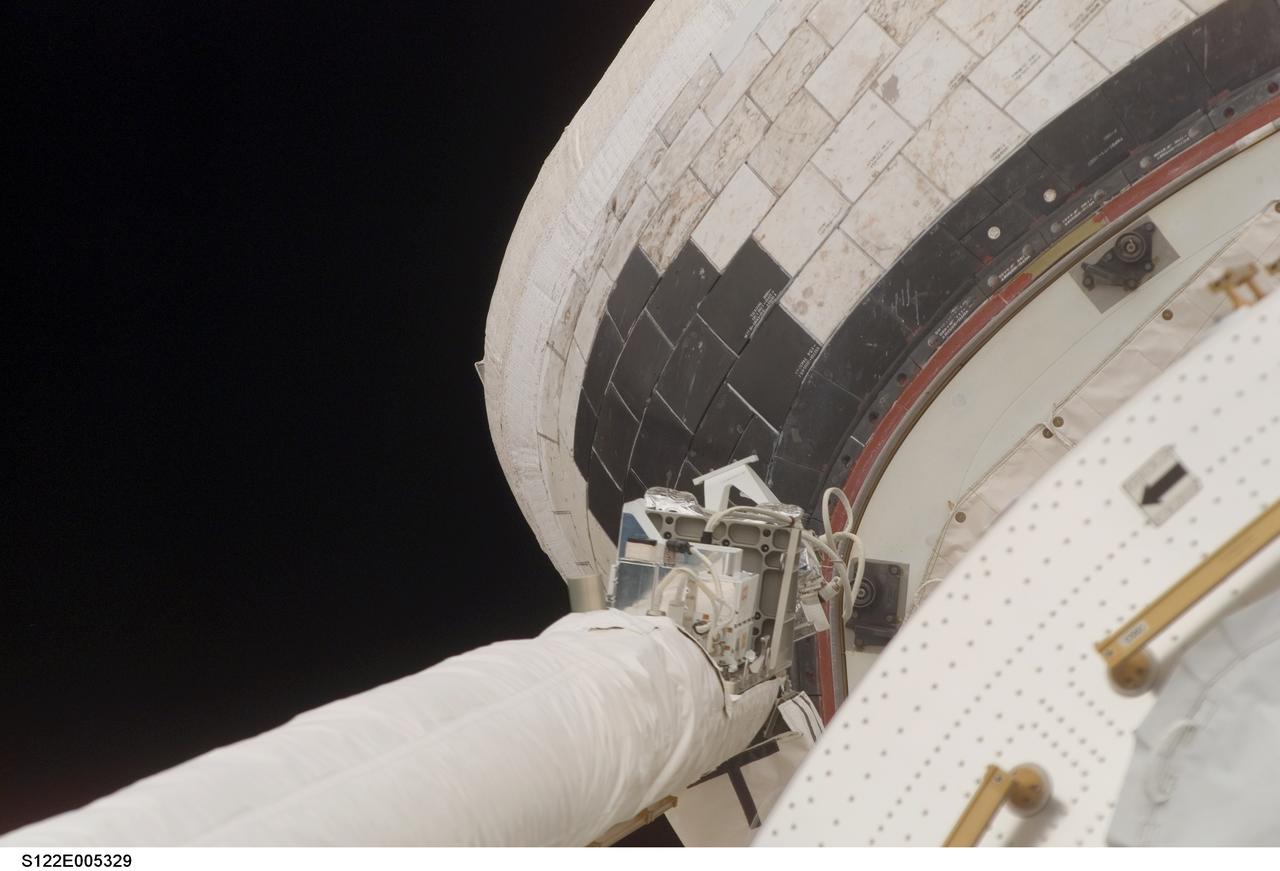
S122-E-005329 (8 Feb. 2008) --- This image, showing a slight protrusion of a thermal blanket on the starboard Orbital Maneuvering System (OMS) pod of Space Shuttle Atlantis, was photographed during a standard arm checkout and payload bay survey on Feb. 8, 2008.
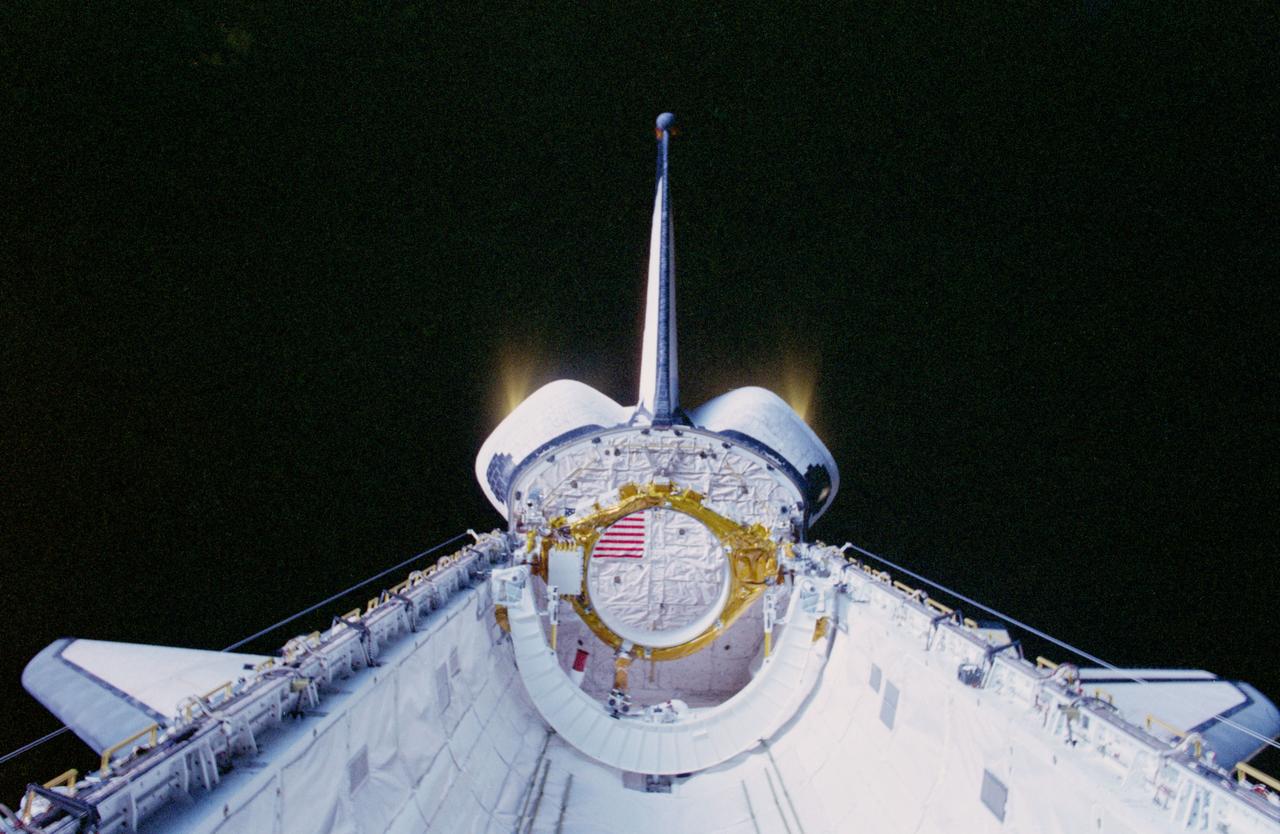
STS093-347-031 (22-27 July 1999) --- Black space forms the backdrop for this scene of the Orbital Maneuvering System (OMS) engine pods during a thruster burn photographed by one of the astronauts on the aft flight deck of the Space Shuttle Columbia.
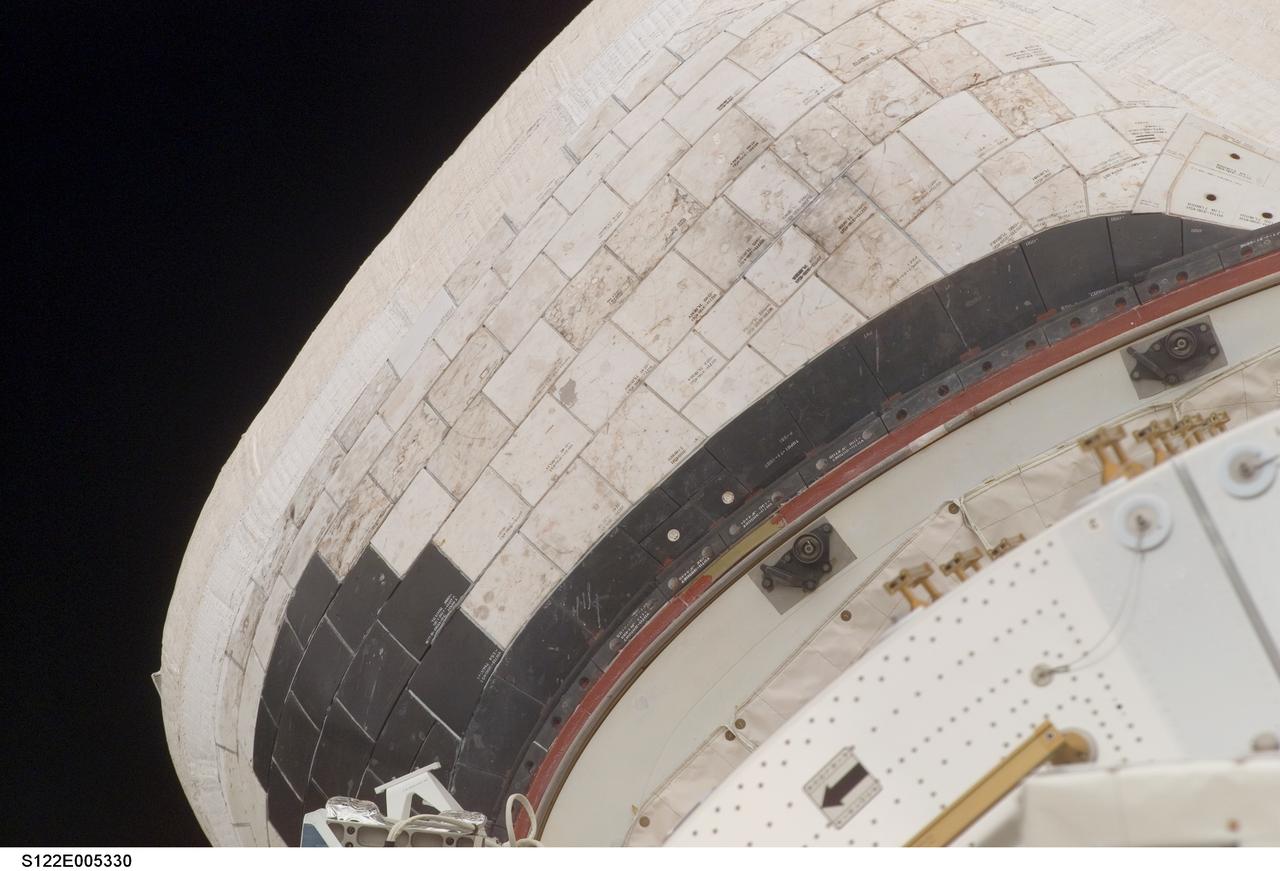
S122-E-005330 (8 Feb. 2008) --- This image, showing a slight protrusion of a thermal blanket on the starboard Orbital Maneuvering System (OMS) pod of Space Shuttle Atlantis, was photographed during a standard arm checkout and payload bay survey on Feb. 8, 2008.
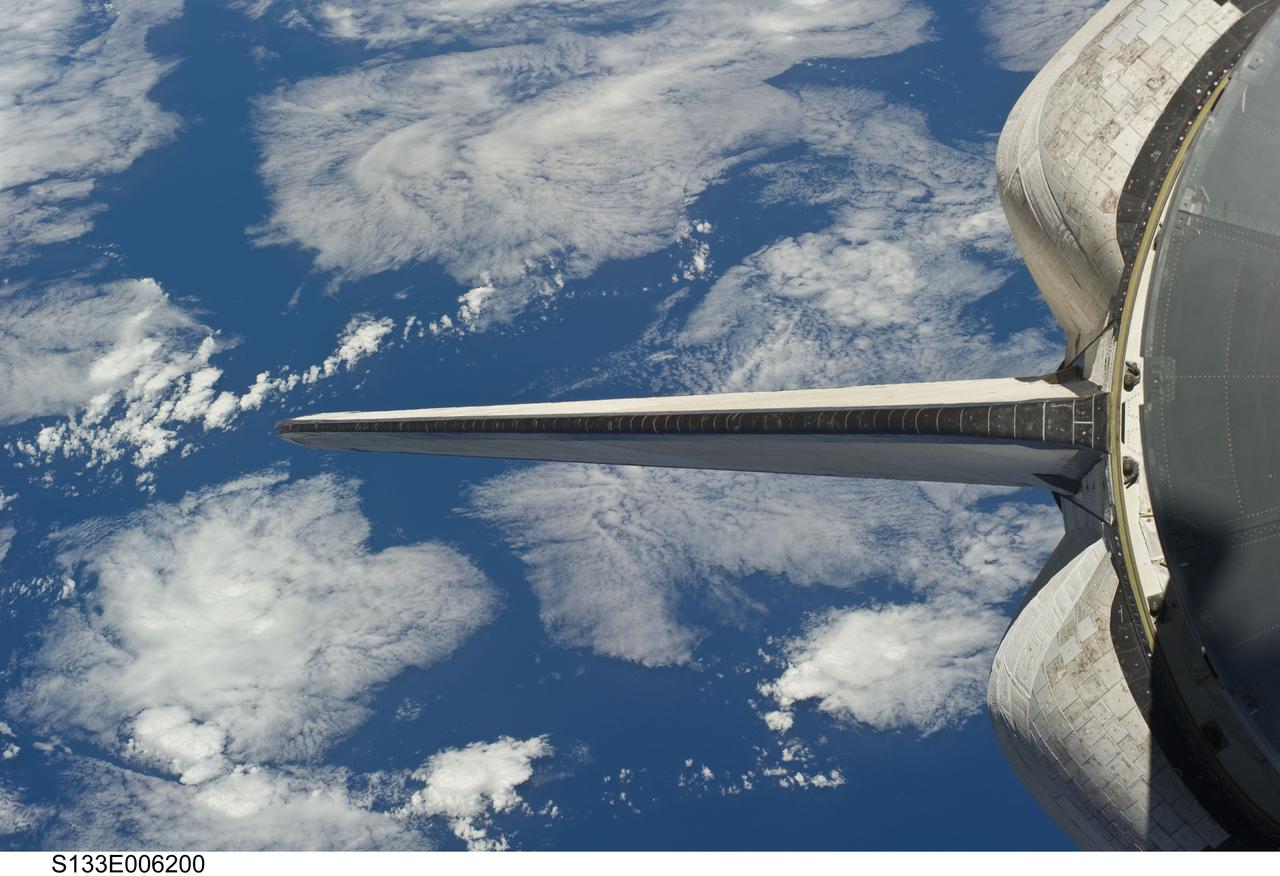
S133-E-006200 (25 Feb. 2011) --- Backdropped by a blue and white part of Earth, space shuttle Discovery’s vertical stabilizer and orbital maneuvering system (OMS) pods are featured in this image photographed by an STS-133 crew member during flight day two activities. Photo credit: NASA or National Aeronautics and Space Administration
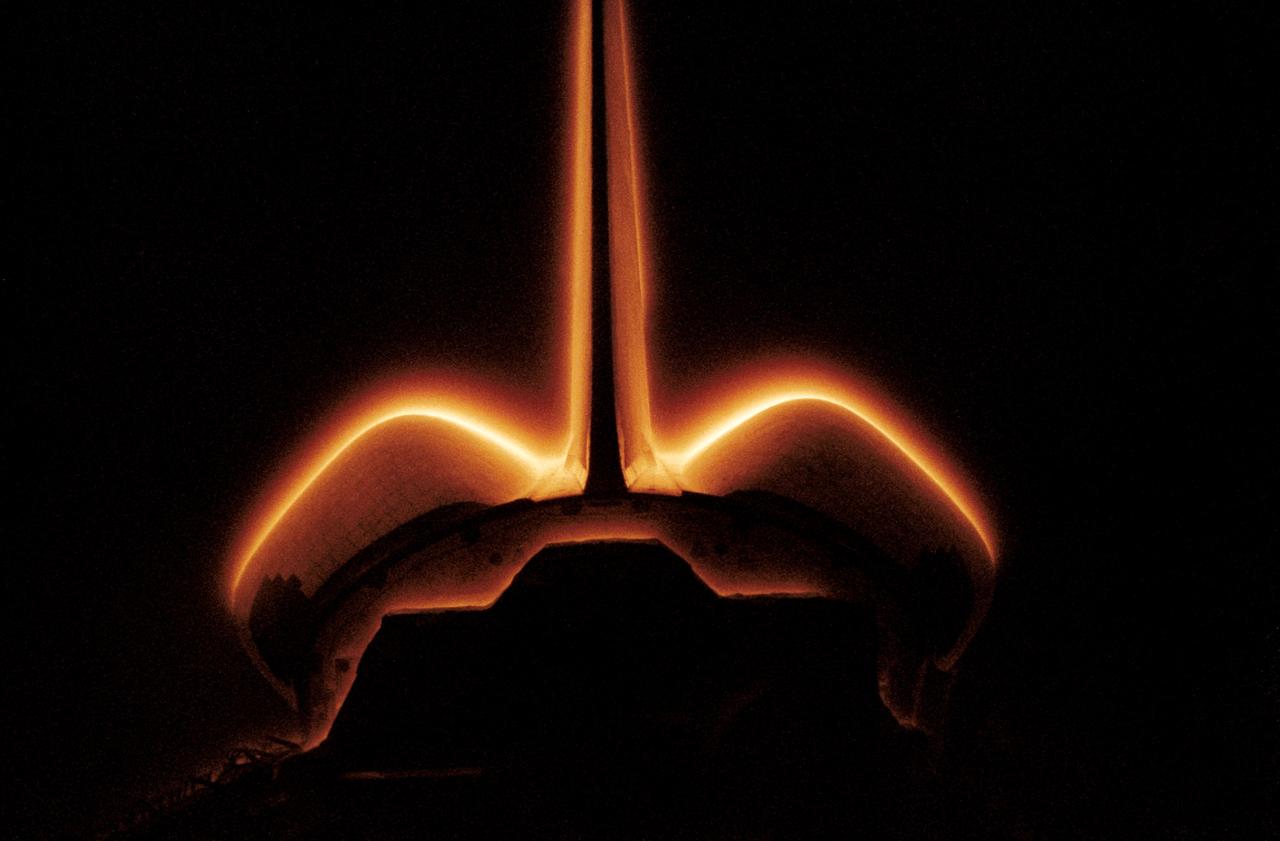
STS062-42-026 (4-18 March 1994) --- This 35mm frame, photographed as the Space Shuttle Columbia was orbiting Earth during a "night" pass, documents the glow phenomenon surrounding the vertical stabilizer and the Orbital Maneuvering System (OMS) pods of the spacecraft.

STS006-44-582 (5 April 1983) --- A 70mm camera through the aft windows of the Earth-orbiting space shuttle Challenger’s cabin centered on the starboard orbital maneuvering system (OMS) pod of the reusable spacecraft. Two pieces of thermal protection system tile appear to have loosened. The view also shows one of the cargo bay television cameras, part of the EVA slide wire system, three handrails and other features on the aft bulkhead. Part of the airborne support equipment (ASE) for the now vacated inertial upper stage (IUS)/tracking and data relay satellite (TDRS) tandem is in lower right foreground. Photo credit: NASA
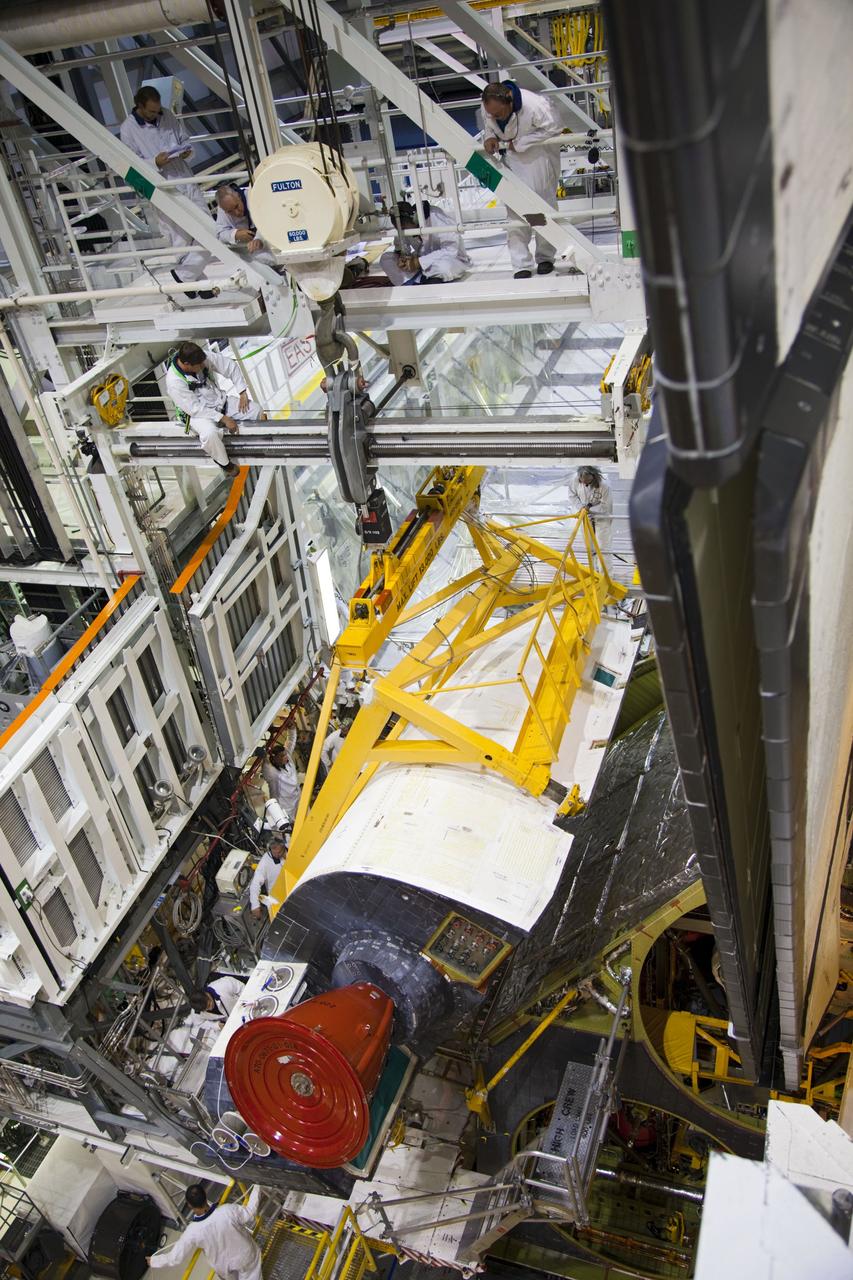
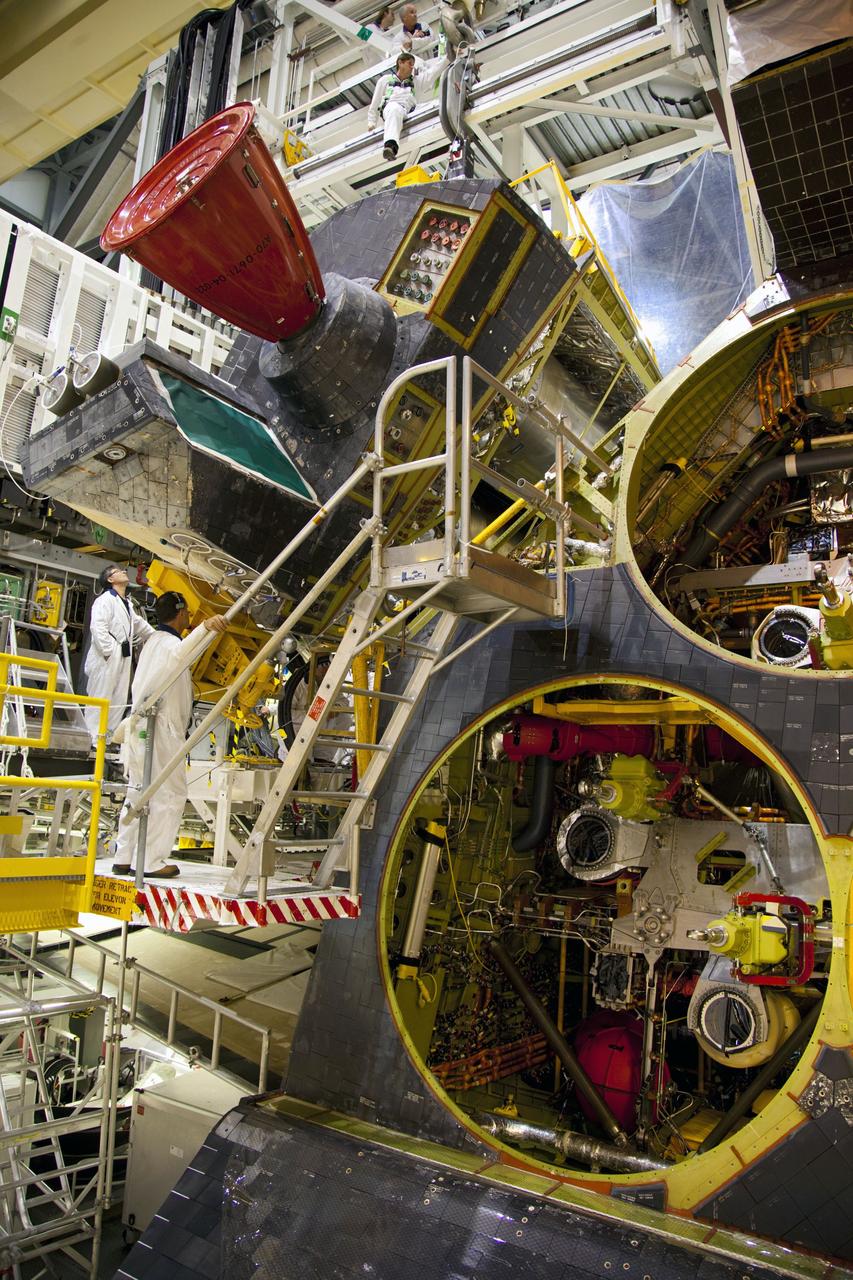
CAPE CANAVERAL, Fla. -- In Orbiter Processing Facility-1 at NASA’s Kennedy Space Center in Florida, an overhead crane is used to remove shuttle Endeavour’s left-hand orbital maneuvering system, or OMS, pod. The work is part of Endeavour’s transition and retirement processing. The spacecraft is being prepared for public display at the California Science Center in Los Angeles. Endeavour flew 25 missions, spent 299 days in space, orbited Earth 4,671 times and traveled 122, 883, 151 miles over the course of its 19-year career. Endeavour’s STS-134 and final mission was completed after landing on June 1, 2011. Photo credit: Frank Michaux
CAPE CANAVERAL, Fla. -- In Orbiter Processing Facility-1 at NASA’s Kennedy Space Center in Florida, technicians monitor the progress as an overhead crane removes shuttle Endeavour’s left-hand orbital maneuvering system, or OMS, pod. The work is part of Endeavour’s transition and retirement processing. The spacecraft is being prepared for public display at the California Science Center in Los Angeles. Endeavour flew 25 missions, spent 299 days in space, orbited Earth 4,671 times and traveled 122, 883, 151 miles over the course of its 19-year career. Endeavour’s STS-134 and final mission was completed after landing on June 1, 2011. Photo credit: Frank Michaux
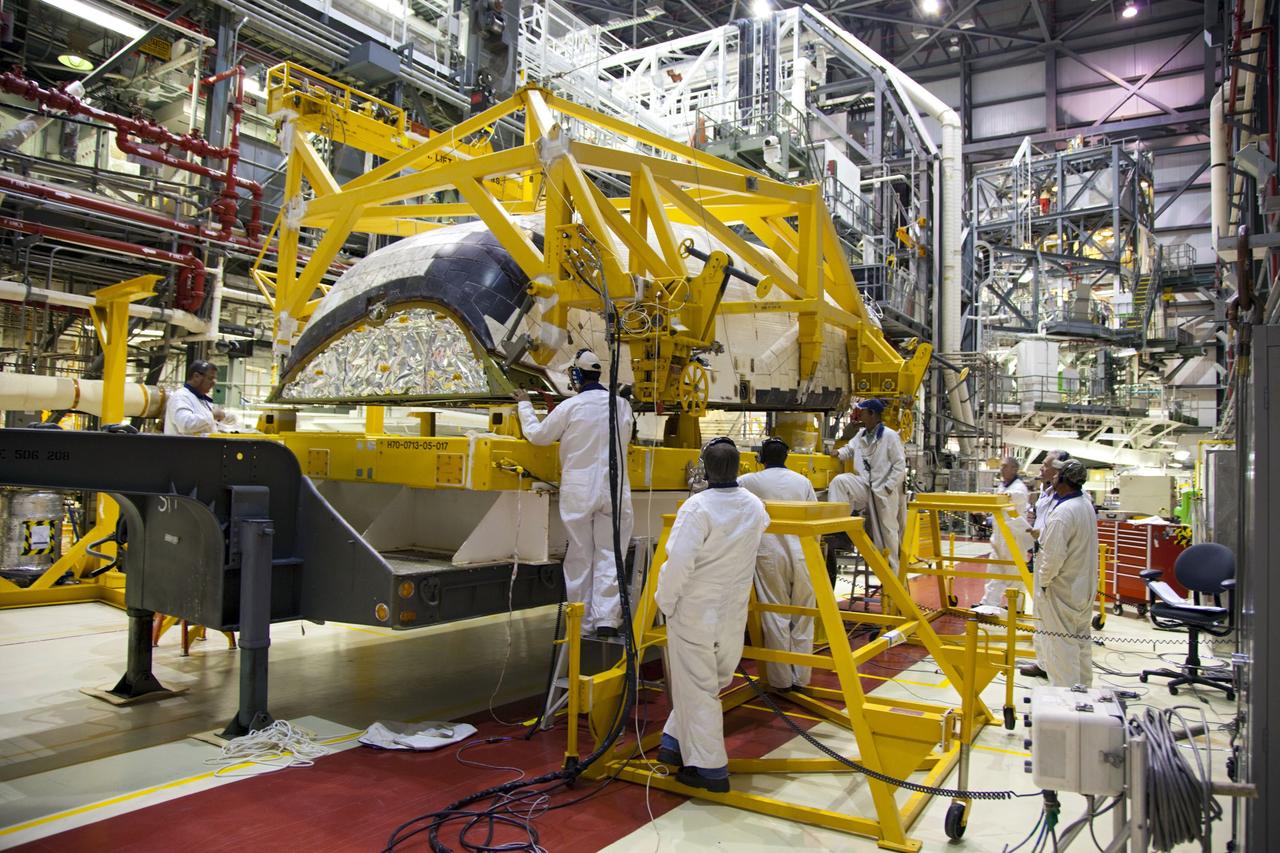
CAPE CANAVERAL, Fla. -- In Orbiter Processing Facility-1 at NASA’s Kennedy Space Center in Florida, technicians secure shuttle Endeavour’s left-hand orbital maneuvering system, or OMS, pod onto a transporter. It will then be moved to the Hypergol Maintenance Facility. The work is part of Endeavour’s transition and retirement processing. The spacecraft is being prepared for public display at the California Science Center in Los Angeles. Endeavour flew 25 missions, spent 299 days in space, orbited Earth 4,671 times and traveled 122, 883, 151 miles over the course of its 19-year career. Endeavour’s STS-134 and final mission was completed after landing on June 1, 2011. Photo credit: Frank Michaux
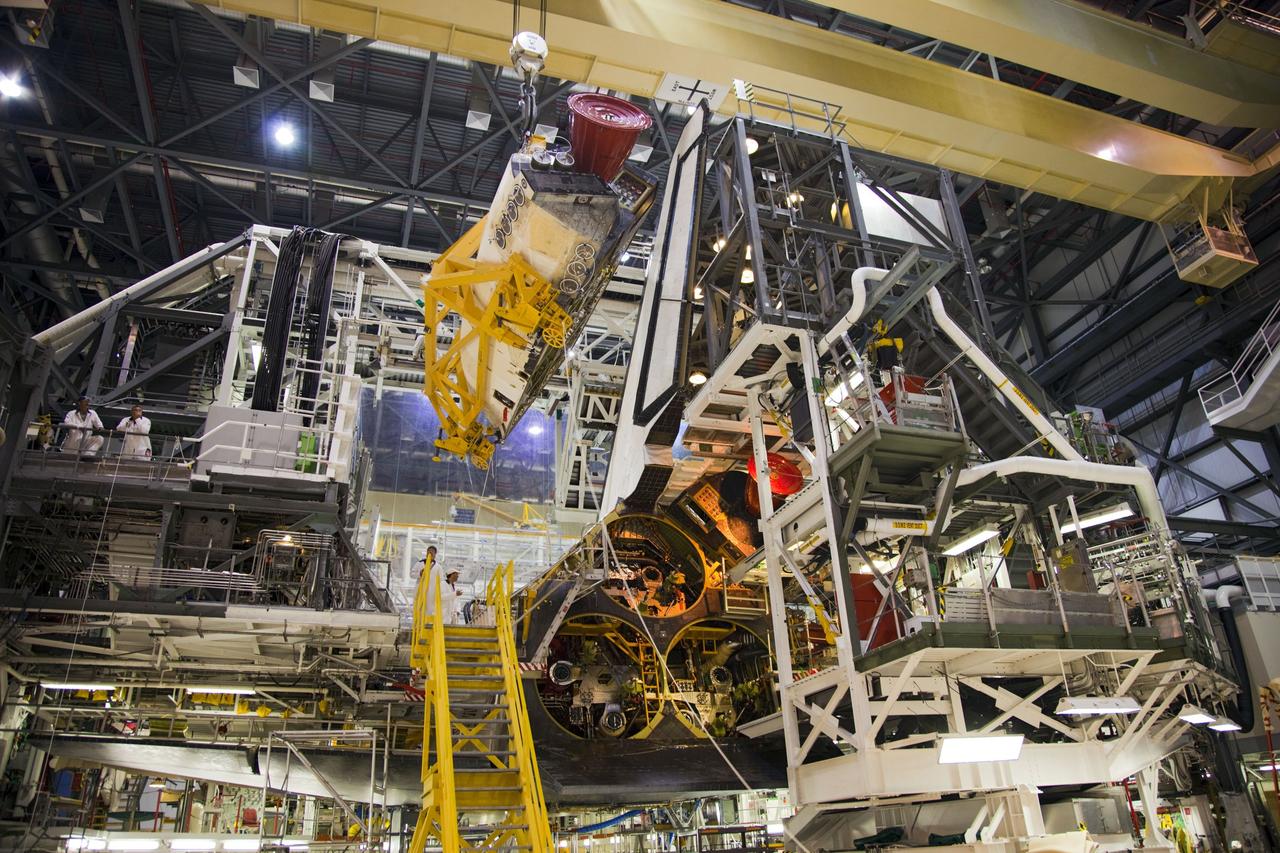
CAPE CANAVERAL, Fla. -- In Orbiter Processing Facility-1 at NASA’s Kennedy Space Center in Florida, an overhead crane is used to remove shuttle Endeavour’s left-hand orbital maneuvering system, or OMS, pod. The work is part of Endeavour’s transition and retirement processing. The spacecraft is being prepared for public display at the California Science Center in Los Angeles. Endeavour flew 25 missions, spent 299 days in space, orbited Earth 4,671 times and traveled 122, 883, 151 miles over the course of its 19-year career. Endeavour’s STS-134 and final mission was completed after landing on June 1, 2011. Photo credit: Frank Michaux
CAPE CANAVERAL, Fla. -- In Orbiter Processing Facility-1 at NASA’s Kennedy Space Center in Florida, technicians monitor the progress as an overhead crane removes shuttle Endeavour’s left-hand orbital maneuvering system, or OMS, pod. The work is part of Endeavour’s transition and retirement processing. The spacecraft is being prepared for public display at the California Science Center in Los Angeles. Endeavour flew 25 missions, spent 299 days in space, orbited Earth 4,671 times and traveled 122, 883, 151 miles over the course of its 19-year career. Endeavour’s STS-134 and final mission was completed after landing on June 1, 2011. Photo credit: Frank Michaux
CAPE CANAVERAL, Fla. -- In Orbiter Processing Facility-1 at NASA’s Kennedy Space Center in Florida, an overhead crane is used to remove shuttle Endeavour’s left-hand orbital maneuvering system, or OMS, pod. The work is part of Endeavour’s transition and retirement processing. The spacecraft is being prepared for public display at the California Science Center in Los Angeles. Endeavour flew 25 missions, spent 299 days in space, orbited Earth 4,671 times and traveled 122, 883, 151 miles over the course of its 19-year career. Endeavour’s STS-134 and final mission was completed after landing on June 1, 2011. Photo credit: Frank Michaux
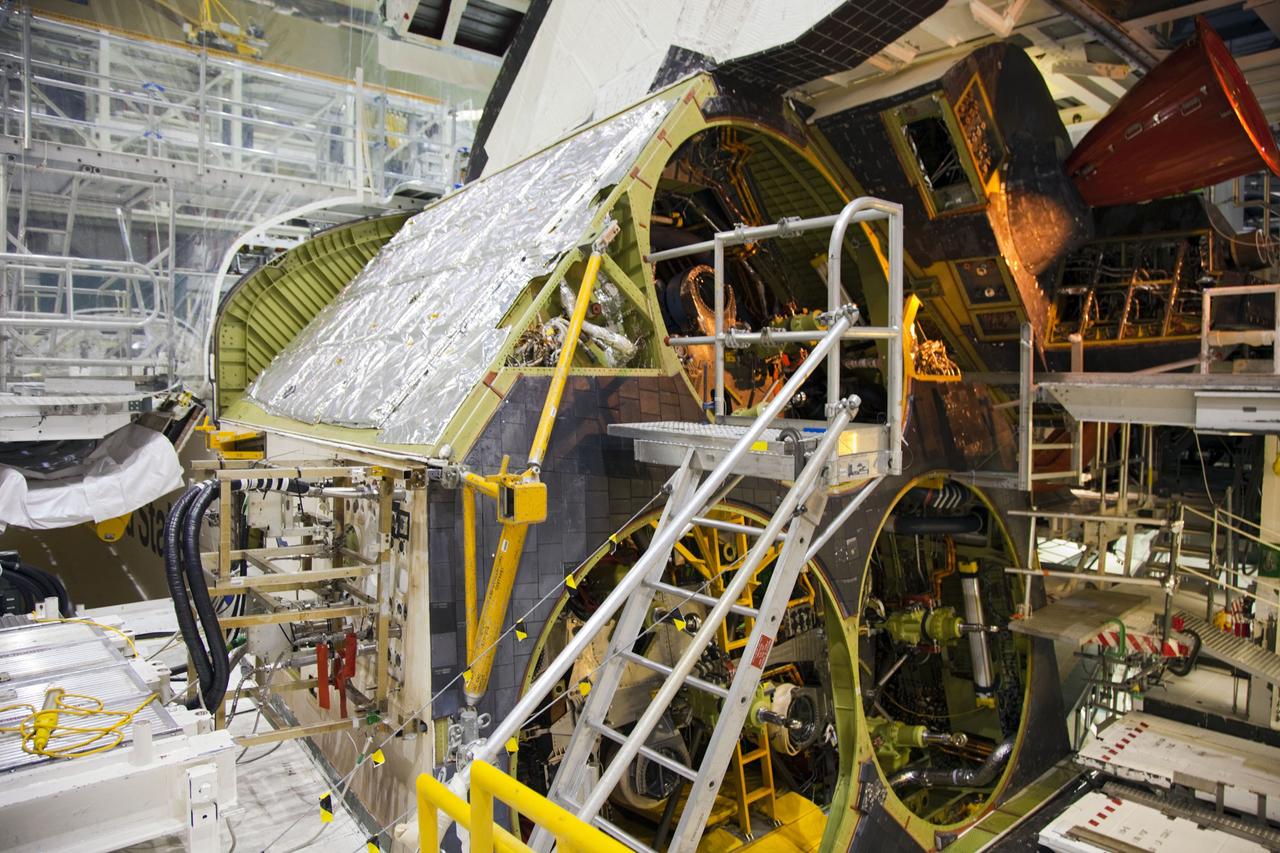
CAPE CANAVERAL, Fla. -- In Orbiter Processing Facility-1 at NASA’s Kennedy Space Center in Florida, shuttle Endeavour’s left-hand orbital maneuvering system, or OMS, pod was removed and lowered onto a transporter. It will then be moved to the Hypergol Maintenance Facility. The work is part of Endeavour’s transition and retirement processing. The spacecraft is being prepared for public display at the California Science Center in Los Angeles. Endeavour flew 25 missions, spent 299 days in space, orbited Earth 4,671 times and traveled 122, 883, 151 miles over the course of its 19-year career. Endeavour’s STS-134 and final mission was completed after landing on June 1, 2011. Photo credit: Frank Michaux
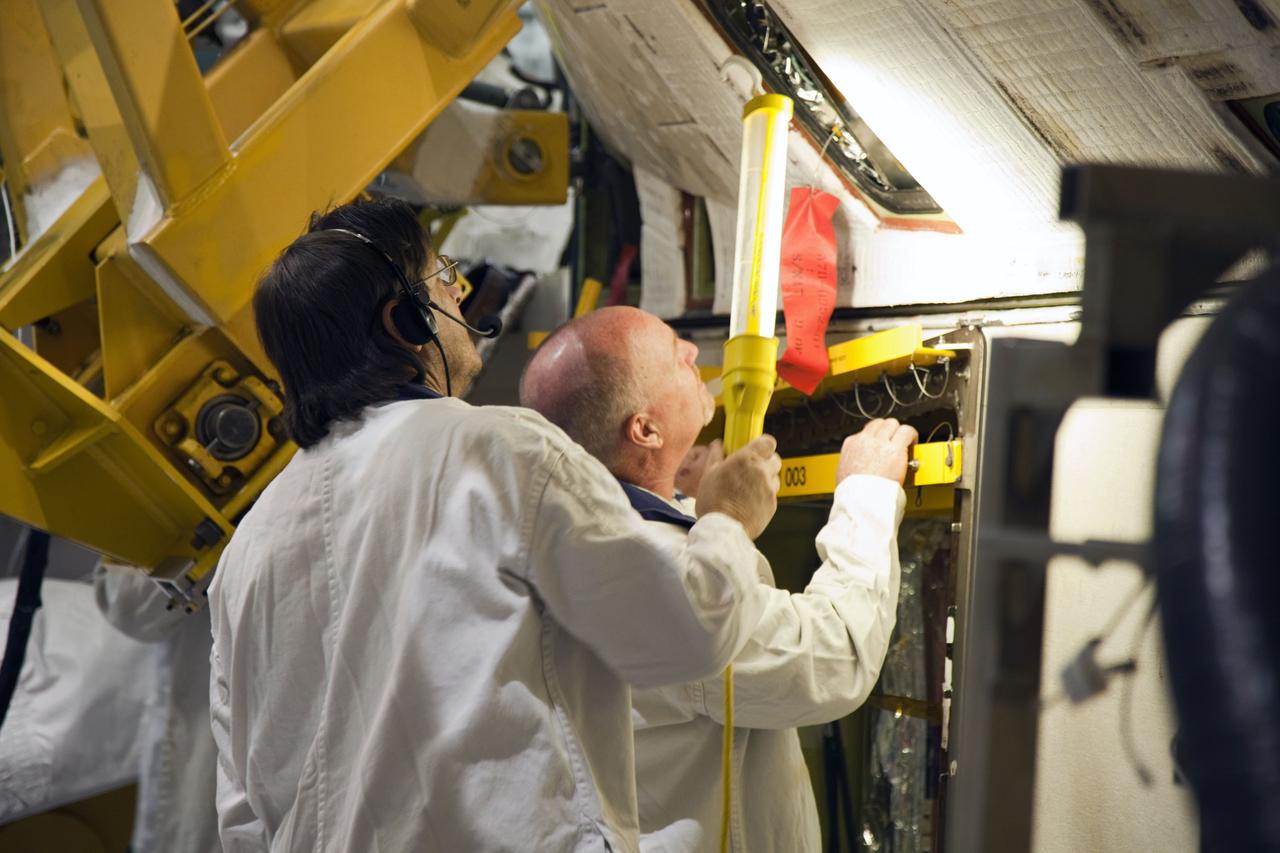
CAPE CANAVERAL, Fla. -- In Orbiter Processing Facility-1 at NASA’s Kennedy Space Center in Florida, technicians monitor the progress as an overhead crane removes shuttle Endeavour’s left-hand orbital maneuvering system, or OMS, pod. The work is part of Endeavour’s transition and retirement processing. The spacecraft is being prepared for public display at the California Science Center in Los Angeles. Endeavour flew 25 missions, spent 299 days in space, orbited Earth 4,671 times and traveled 122, 883, 151 miles over the course of its 19-year career. Endeavour’s STS-134 and final mission was completed after landing on June 1, 2011. Photo credit: Frank Michaux
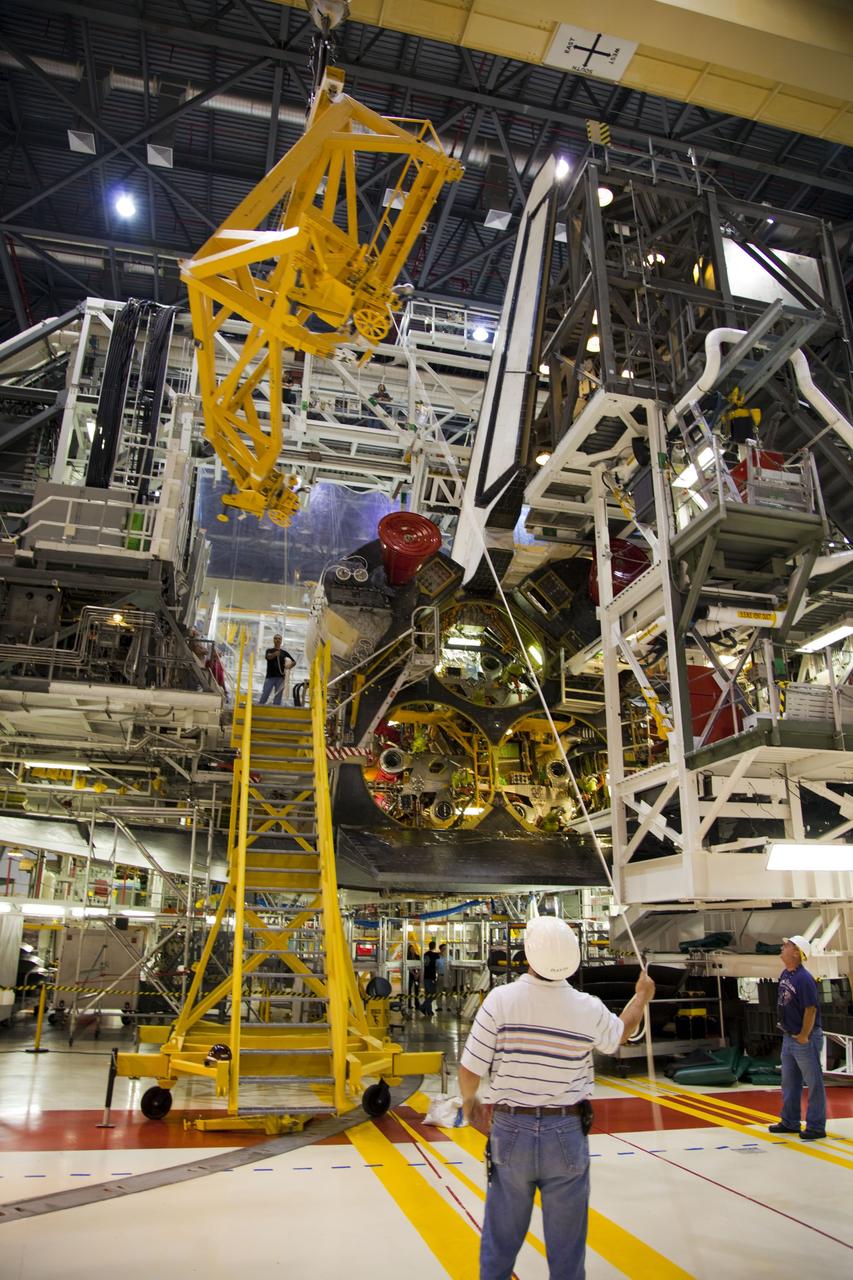
CAPE CANAVERAL, Fla. -- In Orbiter Processing Facility-1 at NASA’s Kennedy Space Center in Florida, workers monitor the progress as an overhead crane is moved into place to begin the process of removing shuttle Endeavour’s orbital maneuvering system, or OMS, pods.The work is part of Endeavour’s transition and retirement processing. The spacecraft is being prepared for public display at the California Science Center in Los Angeles. Endeavour flew 25 missions, spent 299 days in space, orbited Earth 4,671 times and traveled 122, 883, 151 miles over the course of its 19-year career. Endeavour’s STS-134 and final mission was completed after landing on June 1, 2011. Photo credit: Frank Michaux
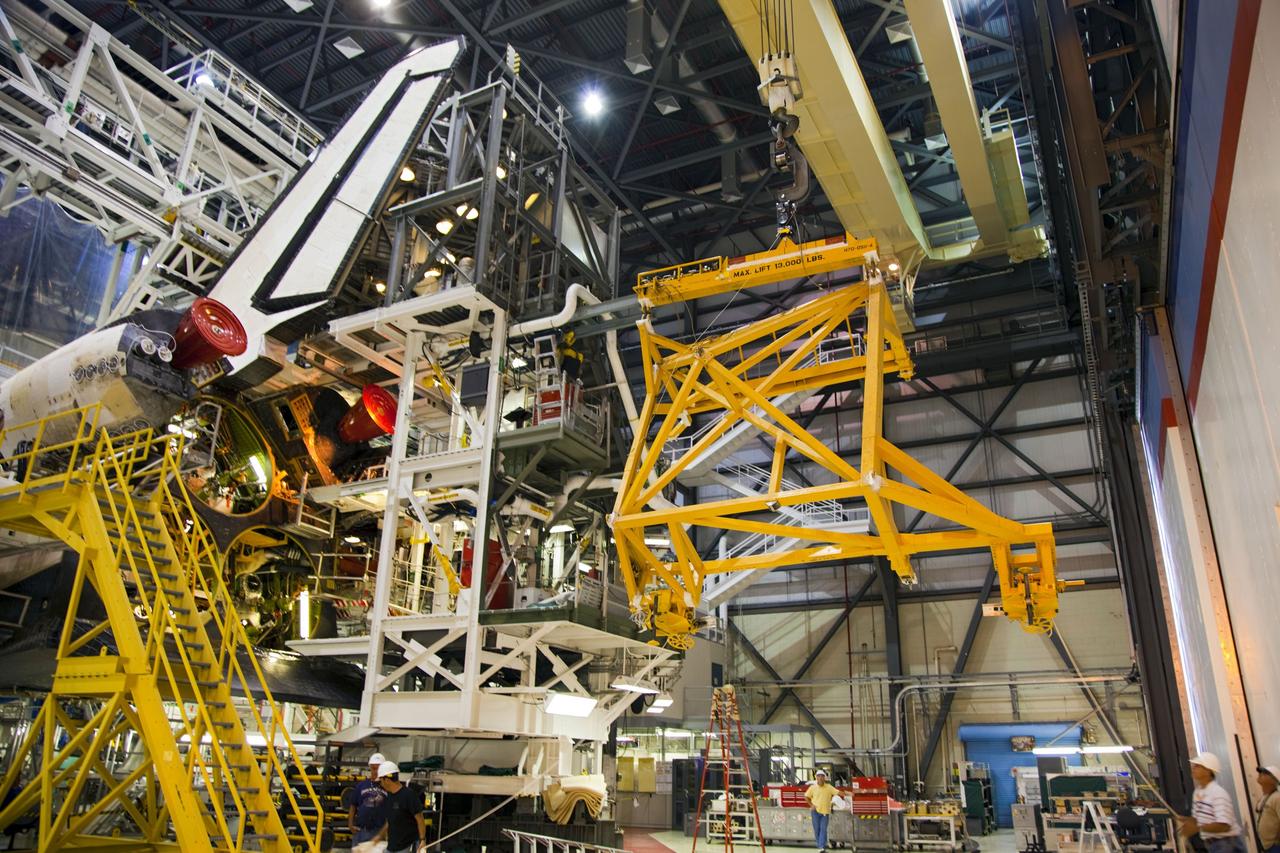
CAPE CANAVERAL, Fla. -- In Orbiter Processing Facility-1 at NASA’s Kennedy Space Center in Florida, an overhead crane is moved into place to begin the process of removing shuttle Endeavour’s orbital maneuvering system, or OMS, pods. The work is part of Endeavour’s transition and retirement processing. The spacecraft is being prepared for public display at the California Science Center in Los Angeles. Endeavour flew 25 missions, spent 299 days in space, orbited Earth 4,671 times and traveled 122, 883, 151 miles over the course of its 19-year career. Endeavour’s STS-134 and final mission was completed after landing on June 1, 2011. Photo credit: Frank Michaux
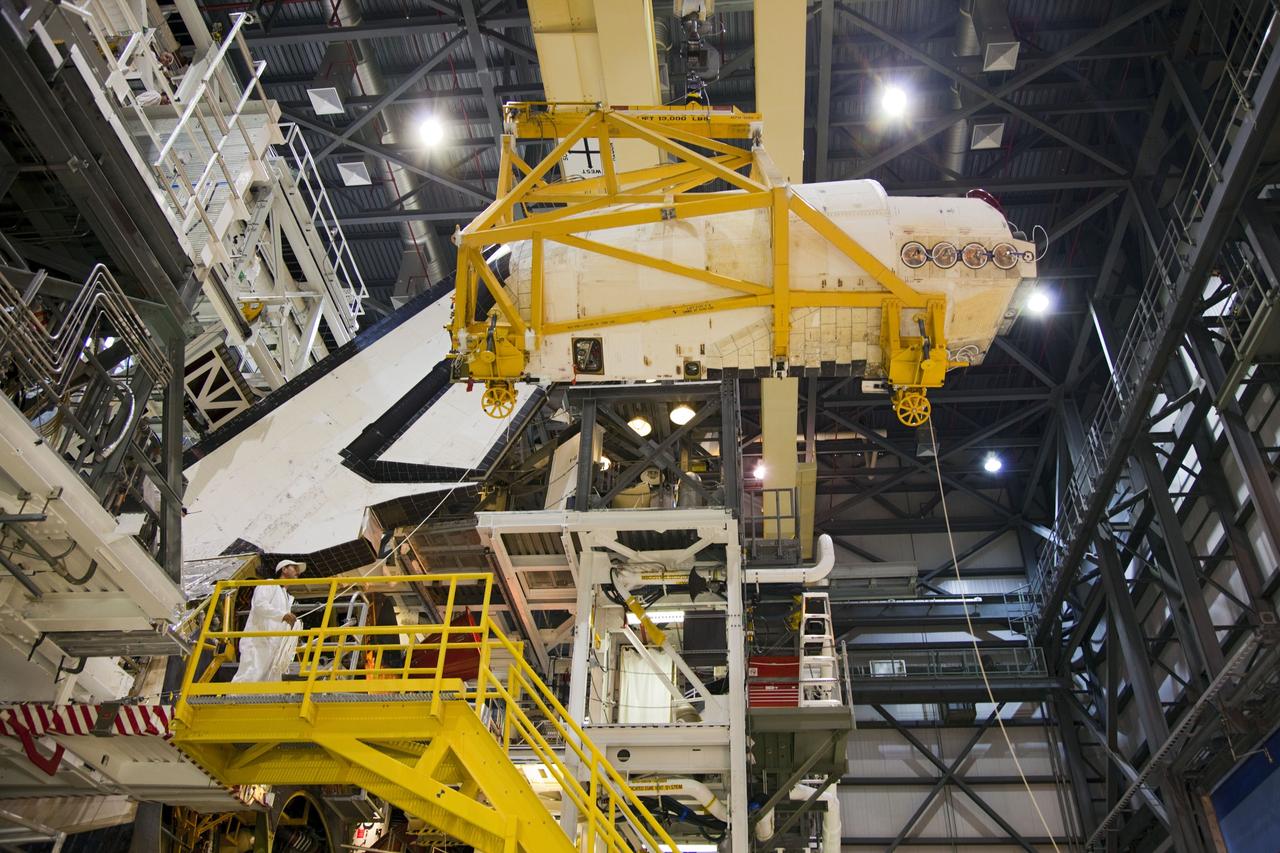
CAPE CANAVERAL, Fla. -- In Orbiter Processing Facility-1 at NASA’s Kennedy Space Center in Florida, an overhead crane moves shuttle Endeavour’s left-hand orbital maneuvering system, or OMS, pod away from the spacecraft. The work is part of Endeavour’s transition and retirement processing. The spacecraft is being prepared for public display at the California Science Center in Los Angeles. Endeavour flew 25 missions, spent 299 days in space, orbited Earth 4,671 times and traveled 122, 883, 151 miles over the course of its 19-year career. Endeavour’s STS-134 and final mission was completed after landing on June 1, 2011. Photo credit: Frank Michaux
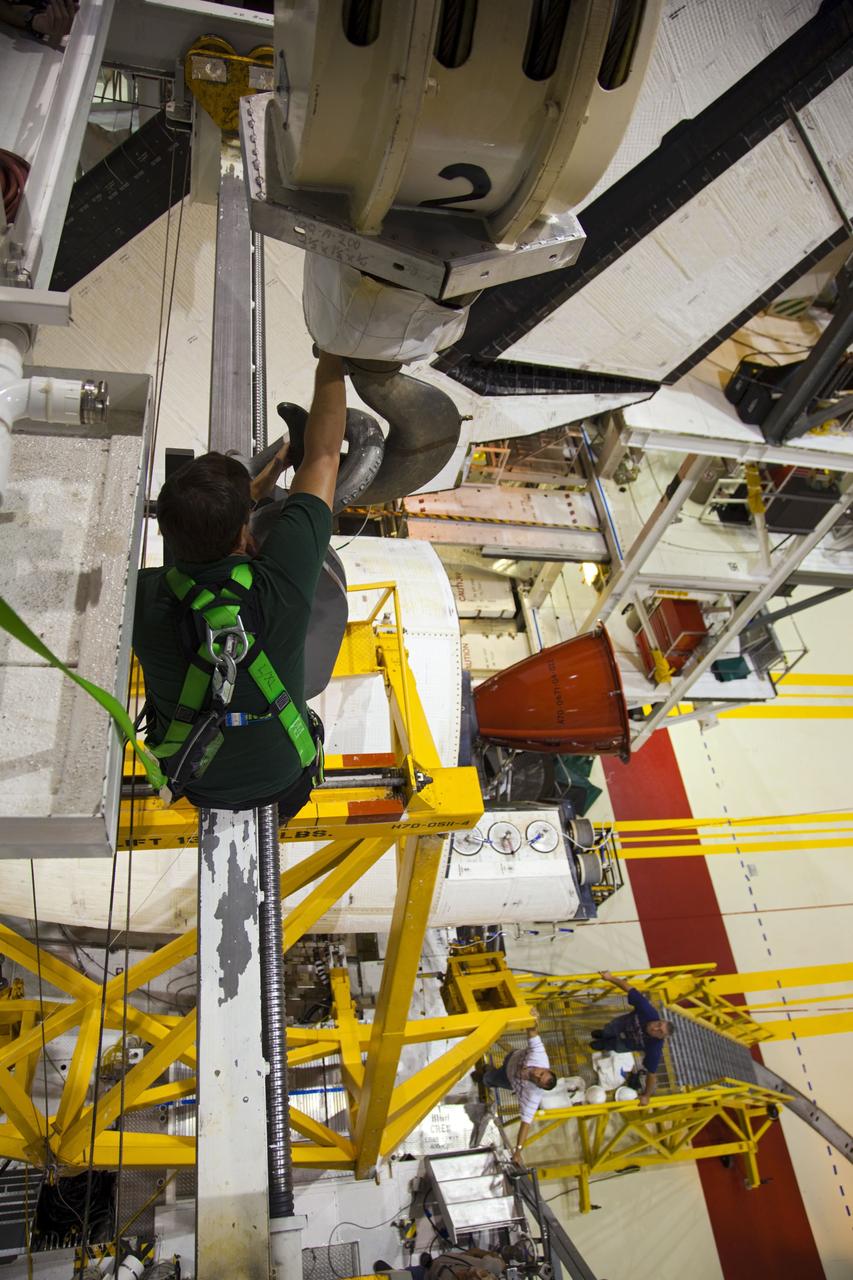
CAPE CANAVERAL, Fla. -- In Orbiter Processing Facility-1 at NASA’s Kennedy Space Center in Florida, an overhead crane is moved into place around shuttle Endeavour’s left-hand orbital maneuvering system, or OMS, pod, to begin removal of the component.The work is part of Endeavour’s transition and retirement processing. The spacecraft is being prepared for public display at the California Science Center in Los Angeles. Endeavour flew 25 missions, spent 299 days in space, orbited Earth 4,671 times and traveled 122, 883, 151 miles over the course of its 19-year career. Endeavour’s STS-134 and final mission was completed after landing on June 1, 2011. Photo credit: Frank Michaux
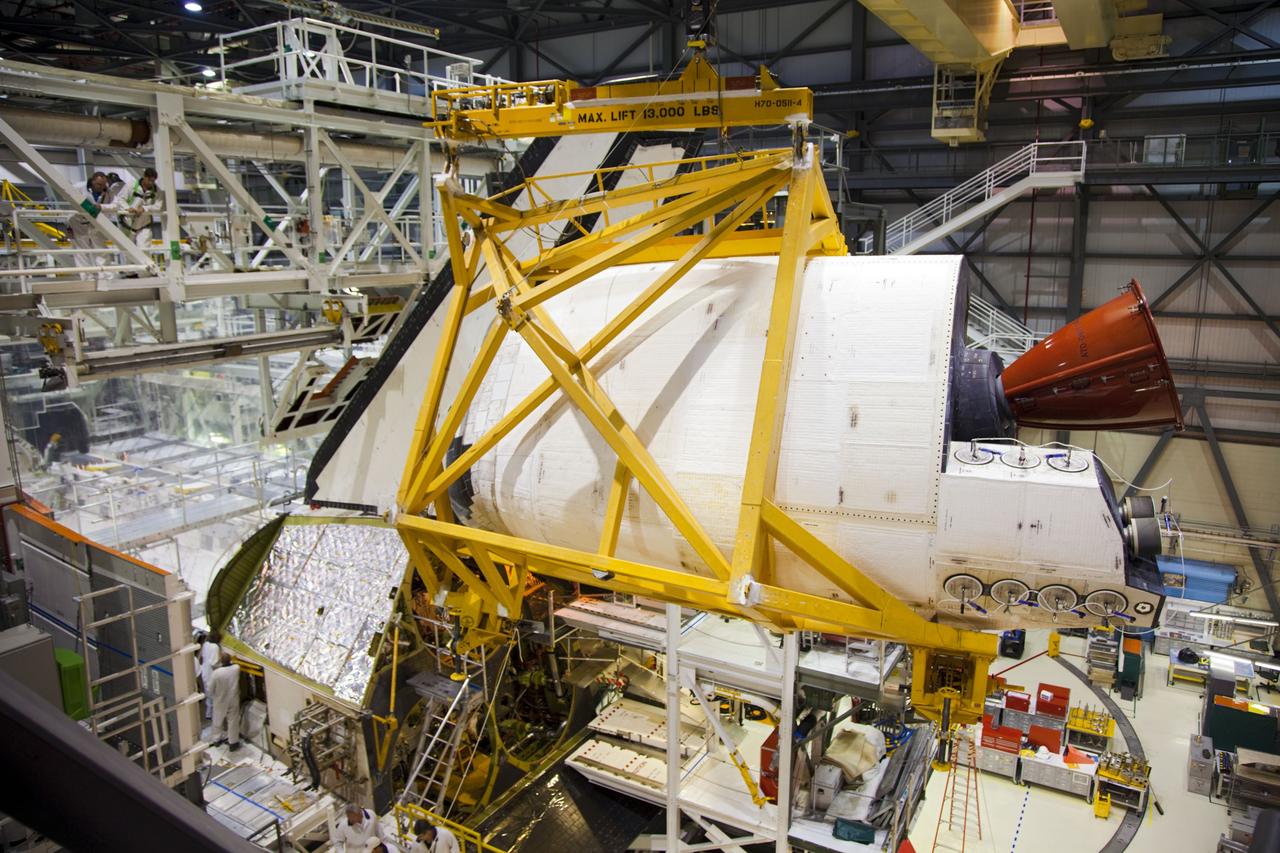
CAPE CANAVERAL, Fla. -- In Orbiter Processing Facility-1 at NASA’s Kennedy Space Center in Florida, an overhead crane moves shuttle Endeavour’s left-hand orbital maneuvering system, or OMS, pod away from the spacecraft. The work is part of Endeavour’s transition and retirement processing. The spacecraft is being prepared for public display at the California Science Center in Los Angeles. Endeavour flew 25 missions, spent 299 days in space, orbited Earth 4,671 times and traveled 122, 883, 151 miles over the course of its 19-year career. Endeavour’s STS-134 and final mission was completed after landing on June 1, 2011. Photo credit: Frank Michaux

CAPE CANAVERAL, Fla. -- In Orbiter Processing Facility-1 at NASA’s Kennedy Space Center in Florida, an overhead crane is used to remove shuttle Endeavour’s left-hand orbital maneuvering system, or OMS, pod. The work is part of Endeavour’s transition and retirement processing. The spacecraft is being prepared for public display at the California Science Center in Los Angeles. Endeavour flew 25 missions, spent 299 days in space, orbited Earth 4,671 times and traveled 122, 883, 151 miles over the course of its 19-year career. Endeavour’s STS-134 and final mission was completed after landing on June 1, 2011. Photo credit: Frank Michaux
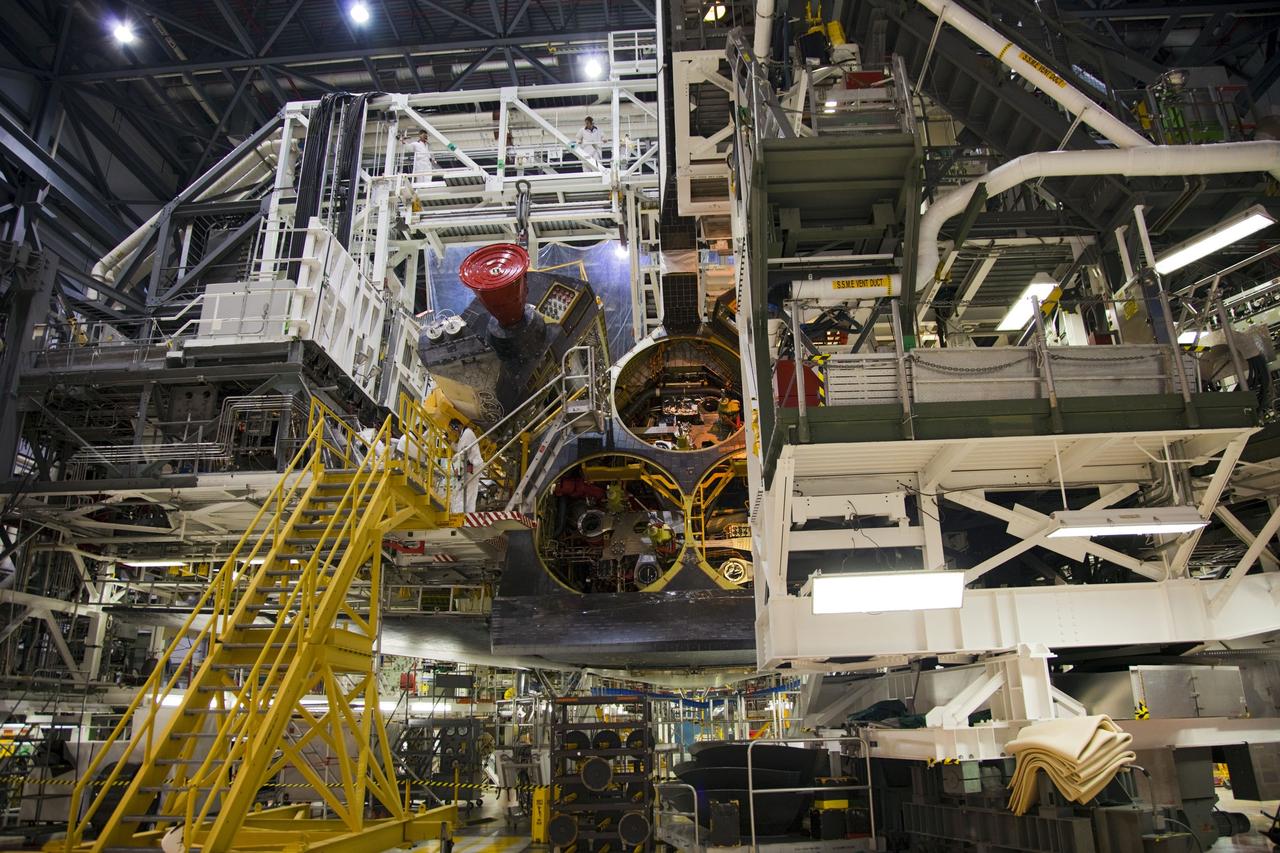
CAPE CANAVERAL, Fla. -- In Orbiter Processing Facility-1 at NASA’s Kennedy Space Center in Florida, a large overhead crane removes shuttle Endeavour’s left-hand orbital maneuvering system, or OMS, pod. The work is part of Endeavour’s transition and retirement processing. The spacecraft is being prepared for public display at the California Science Center in Los Angeles. Endeavour flew 25 missions, spent 299 days in space, orbited Earth 4,671 times and traveled 122, 883, 151 miles over the course of its 19-year career. Endeavour’s STS-134 and final mission was completed after landing on June 1, 2011. Photo credit: Frank Michaux