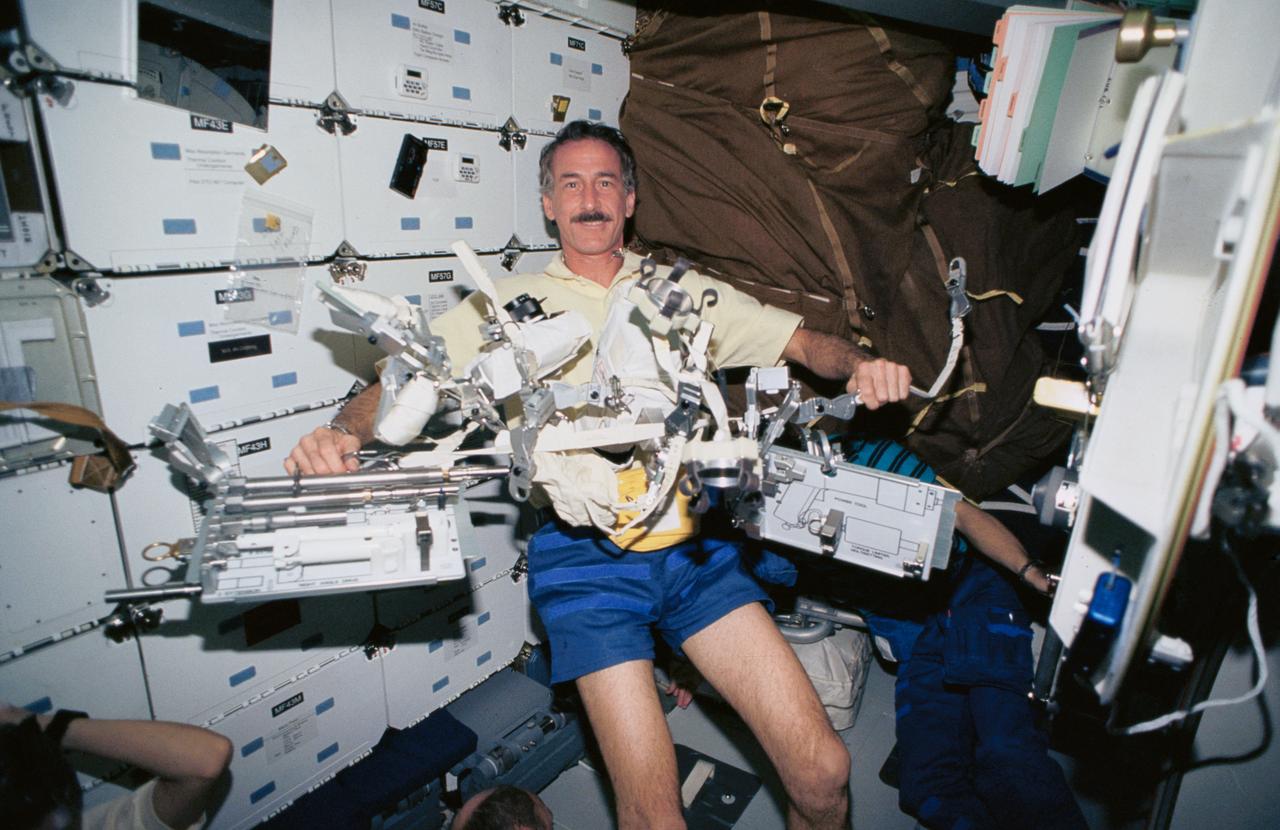
STS061-03-029 (2013 Dec 1993) --- Astronaut Jeffrey A. Hoffman displays tools used in the five space walks on the STS-61 Hubble Space Telescope (HST) repair mission. Hoffman was one of four space walkers making use of the variegated gear.
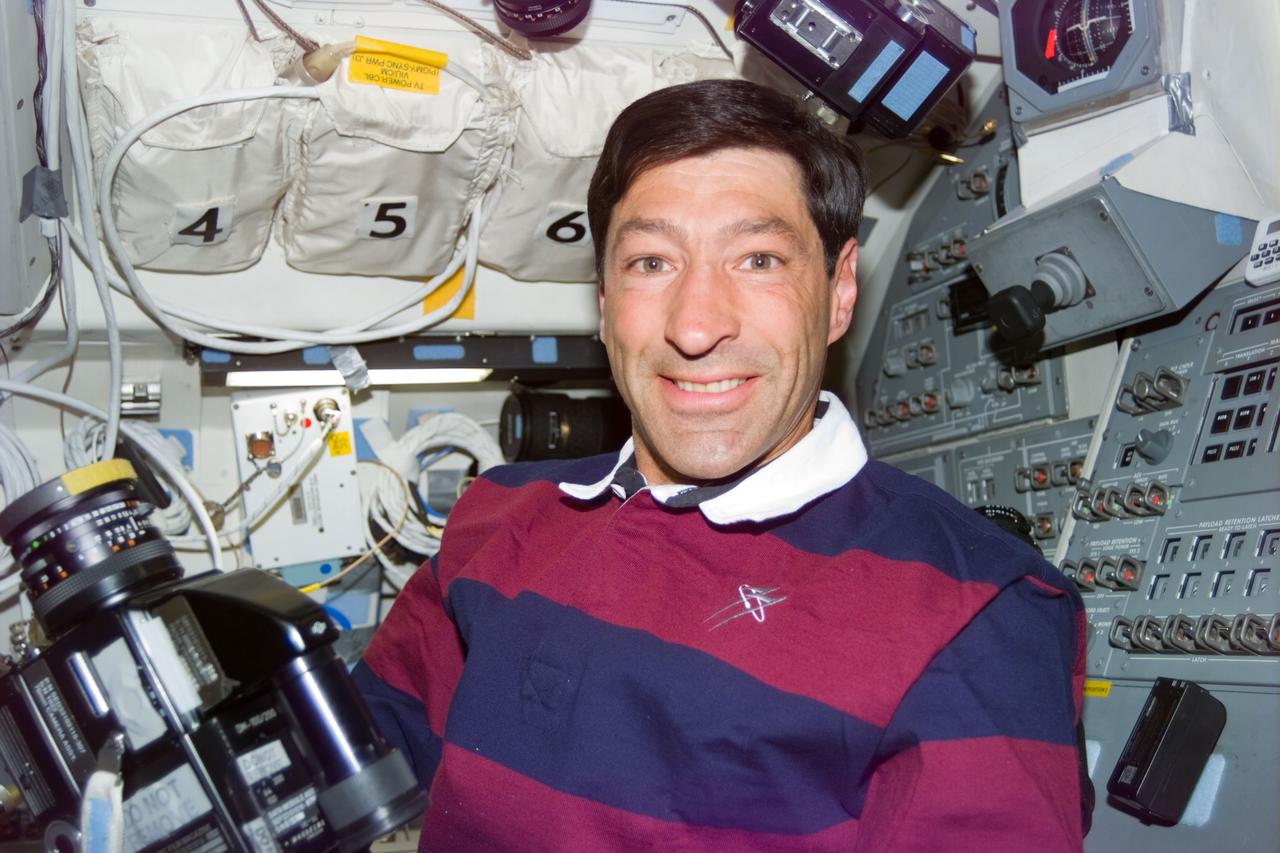
S77-E-5078 (24 May 1996) --- On the Space Shuttle Endeavour's aft flight deck, astronaut Mario Runco, Jr., mission specialist, grabs a hand-held 70mm camera and prepares to take still pictures of an Earth observation target of opportunity. A pair of windows just out of frame above Runco's head provide the crew members with a prime operating perspective of Earth observation targets. A crew mate exposed the image with an Electronic Still Camera (ESC).
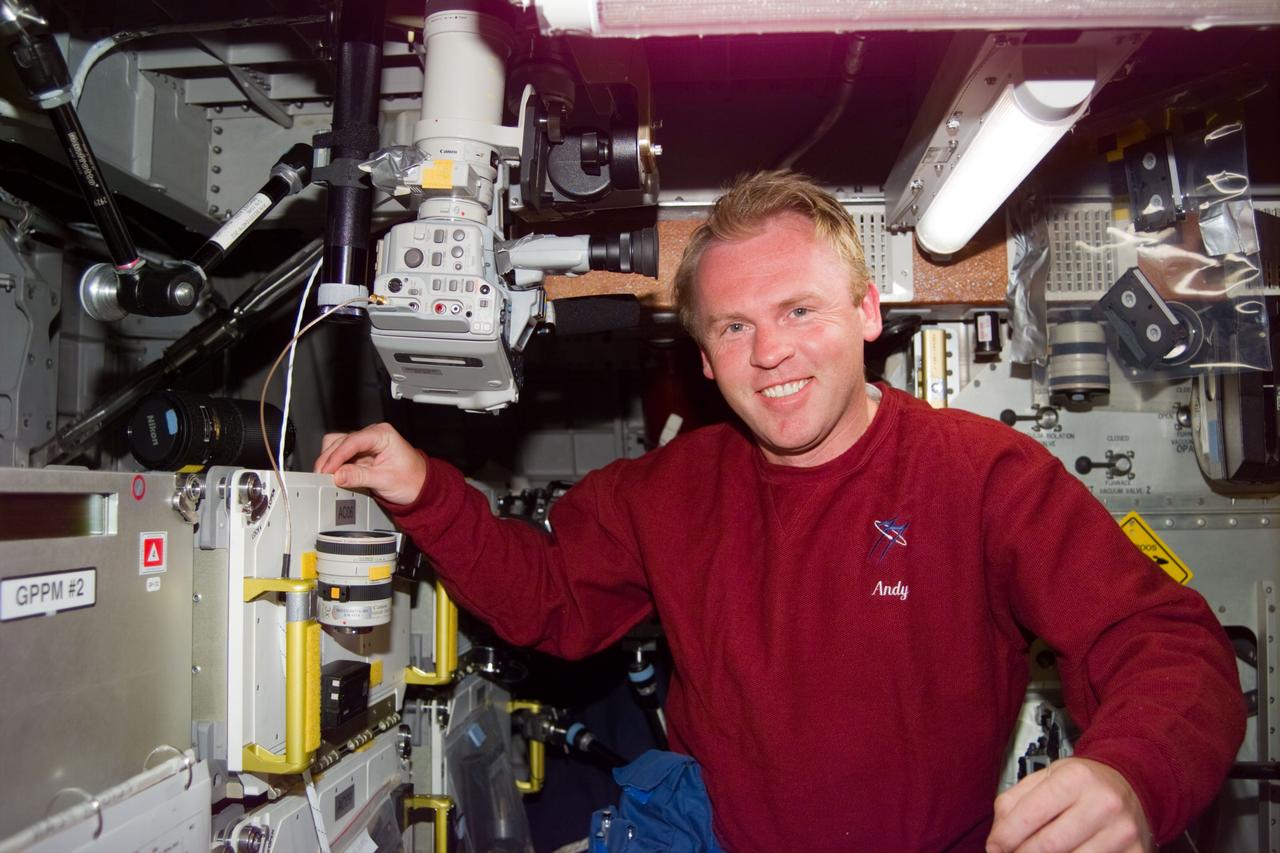
S77-E-5089 (25 May 1996) --- Astronaut Andrew S. W. Thomas, mission specialist, interrupts a Spacehab task to pose for an Electronic Still Camera (ESC) snapshot inside the Spacehab Module onboard the Earth-orbiting Space Shuttle Endeavour. In upper left is the view port which crew members had used for viewing and photographing operations with the Spartan 207/Inflatable Antenna Experiment (IAE). Thomas has his hand on an aft-bulkhead-mounted locker. The Space Experiment Facility (SEF), designed and managed by the University of Alabama, is just behind his left shoulder.
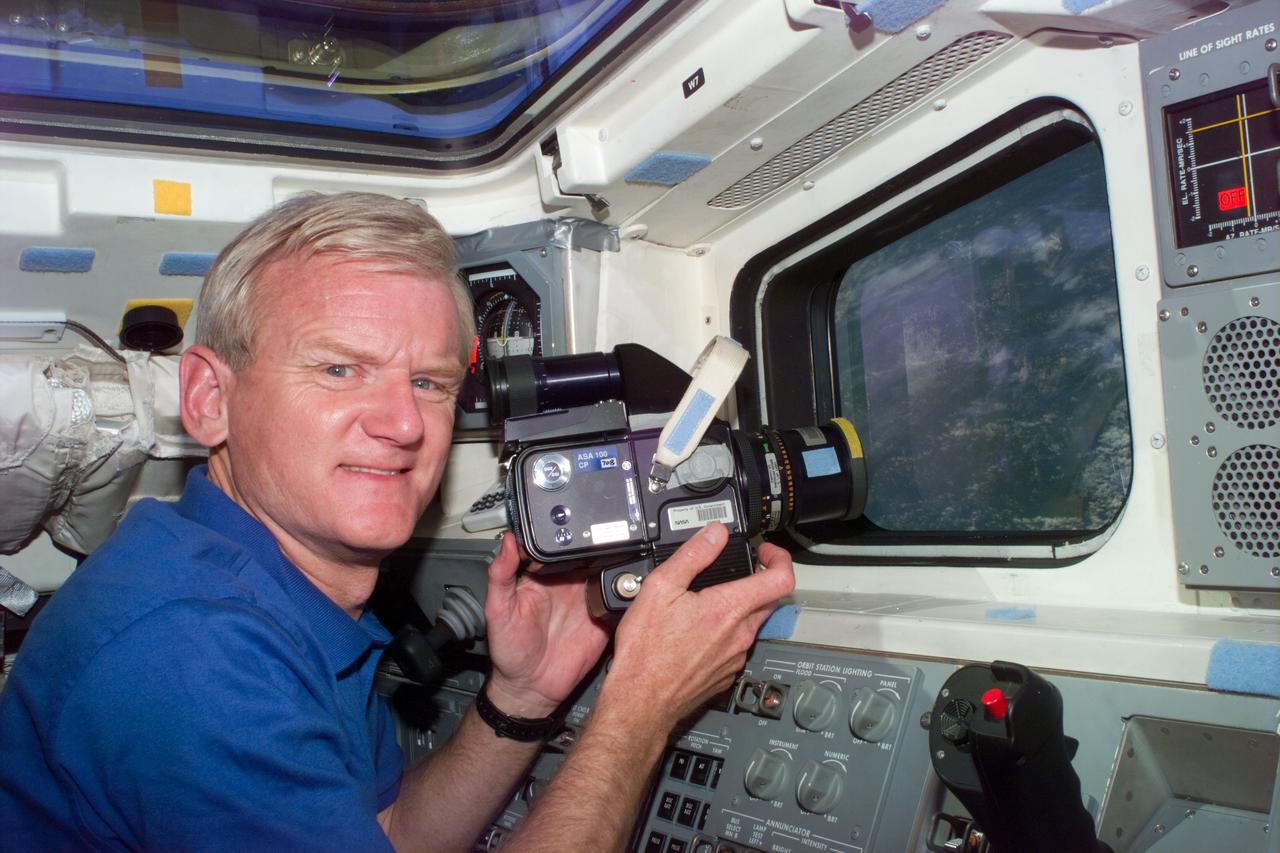
S77-E-5109 (26 May 1996) --- Astronaut John H. Casper, commander, pauses during a photography session on the aft flight deck of the Space Shuttle Endeavour. The scene was recorded with an Electronic Still Camera (ESC).
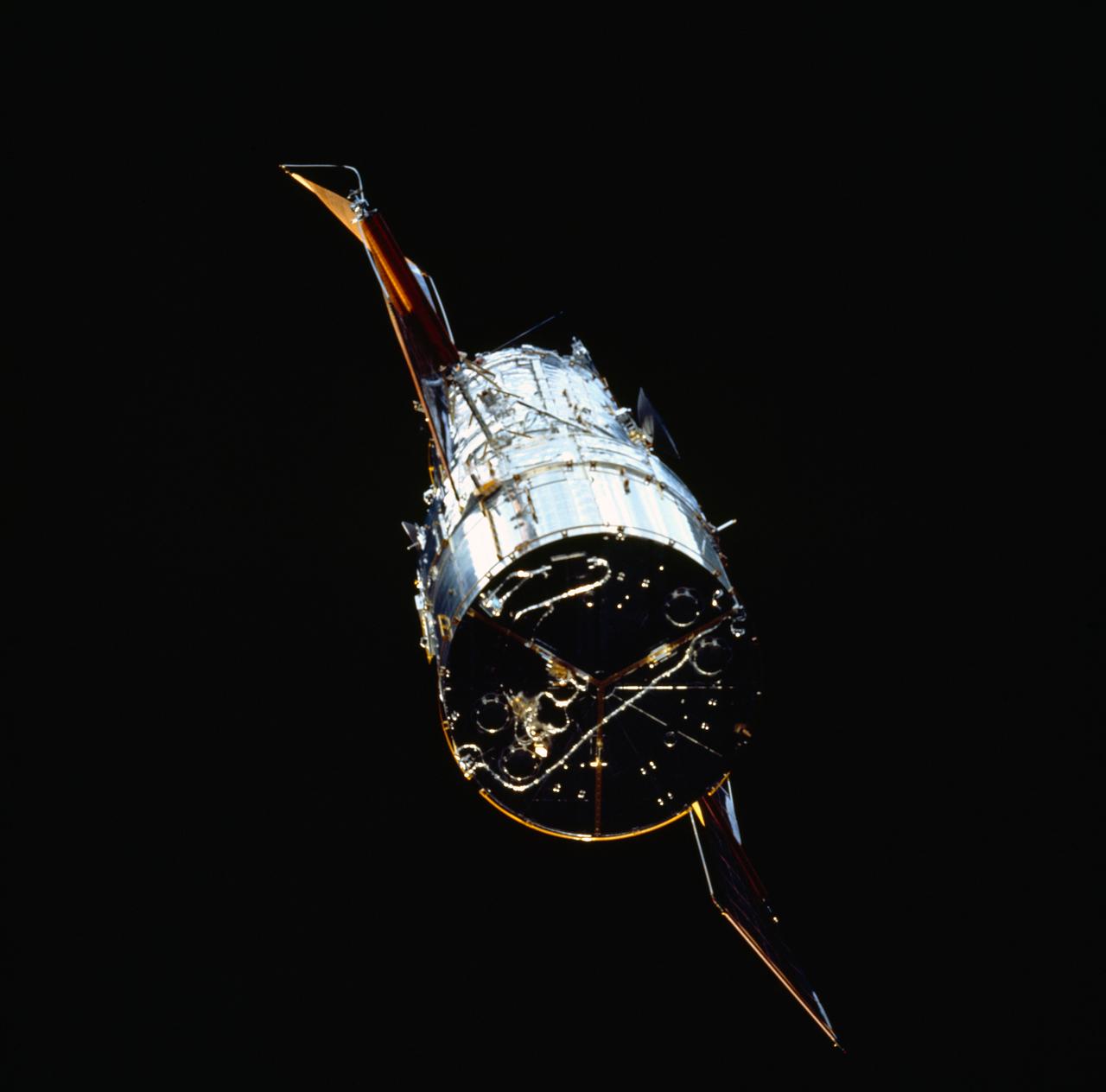
STS061-73-040 (4 Dec 1993) --- Backdropped against the blackness of space, the Hubble Space Telescope (HST) nears the Space Shuttle Endeavour. With the aid of the Remote Manipulator System (RMS), the STS-61 crew members later grappled the spacecraft and berthed it in the cargo bay for five-days of servicing chores by four space walkers.
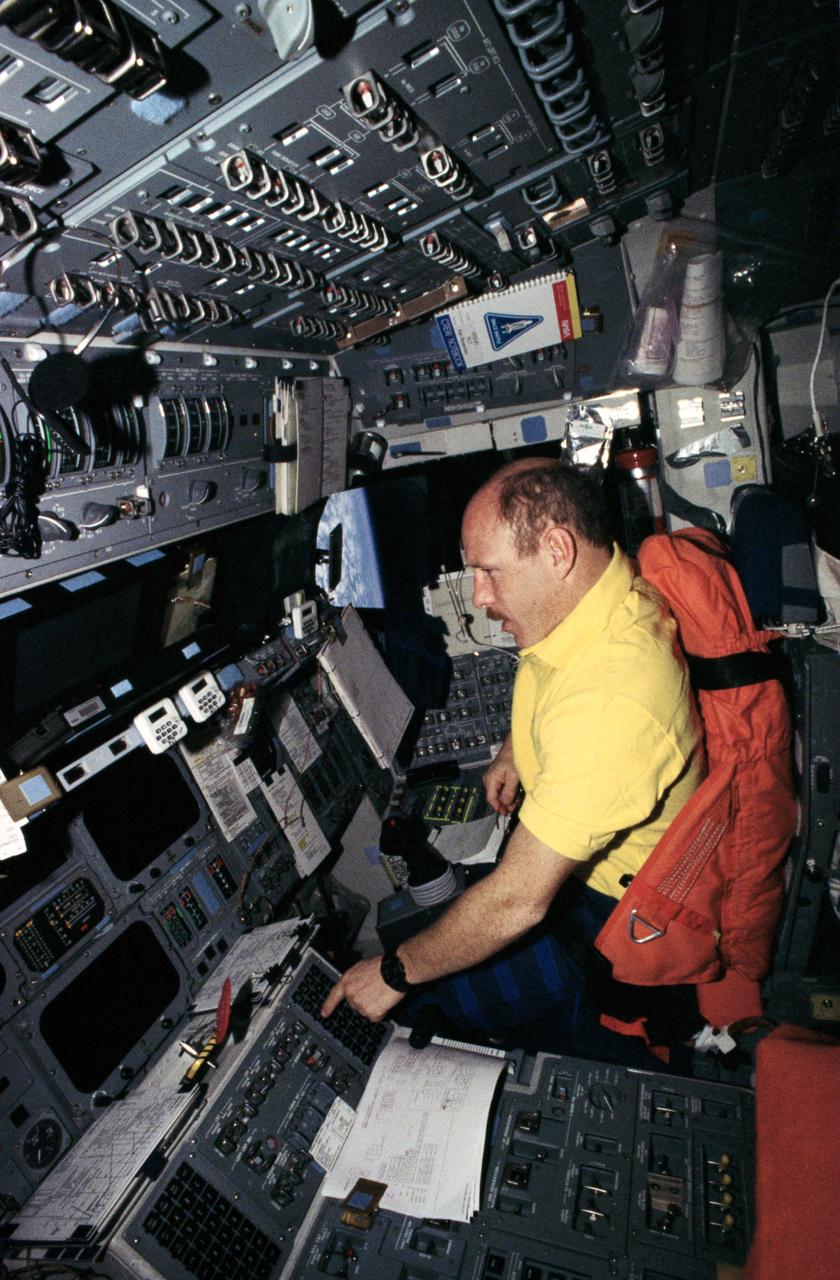
STS061-53-010 (4 Dec 1993) --- Astronaut Kenneth D. Bowersox mans the pilot's station on the Space Shuttle Endeavour during the eleven-day mission to service the Hubble Space Telescope (HST). Bowersox was one of three crew members who remained in the crew cabin while astronauts conducted a total of five space walks to perform various tasks on the HST.
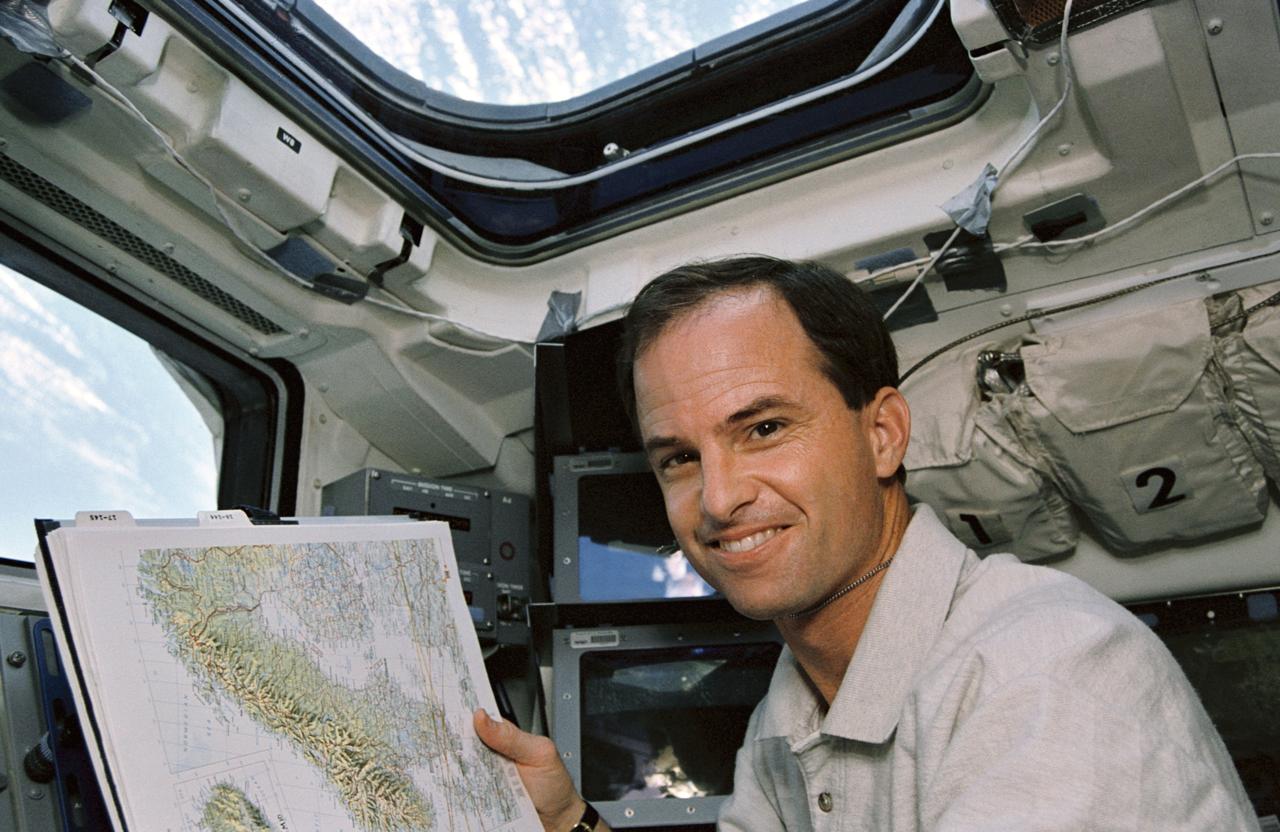
STS059-16-032 (9-20 April 1994) --- Astronaut Kevin P. Chilton, pilot, displays a map of Scandinavia on the Space Shuttle Endeavour's flight deck. Large scale maps such as this were used by the crew to locate specific sites of interest to the Space Radar Laboratory scientists. The crew then photographed the sites at the same time as the radar in the payload bay imaged them. Chilton was joined in space by five other NASA astronauts for a week and a half of support to the Space Radar Laboratory (SRL-1) mission and other tasks.
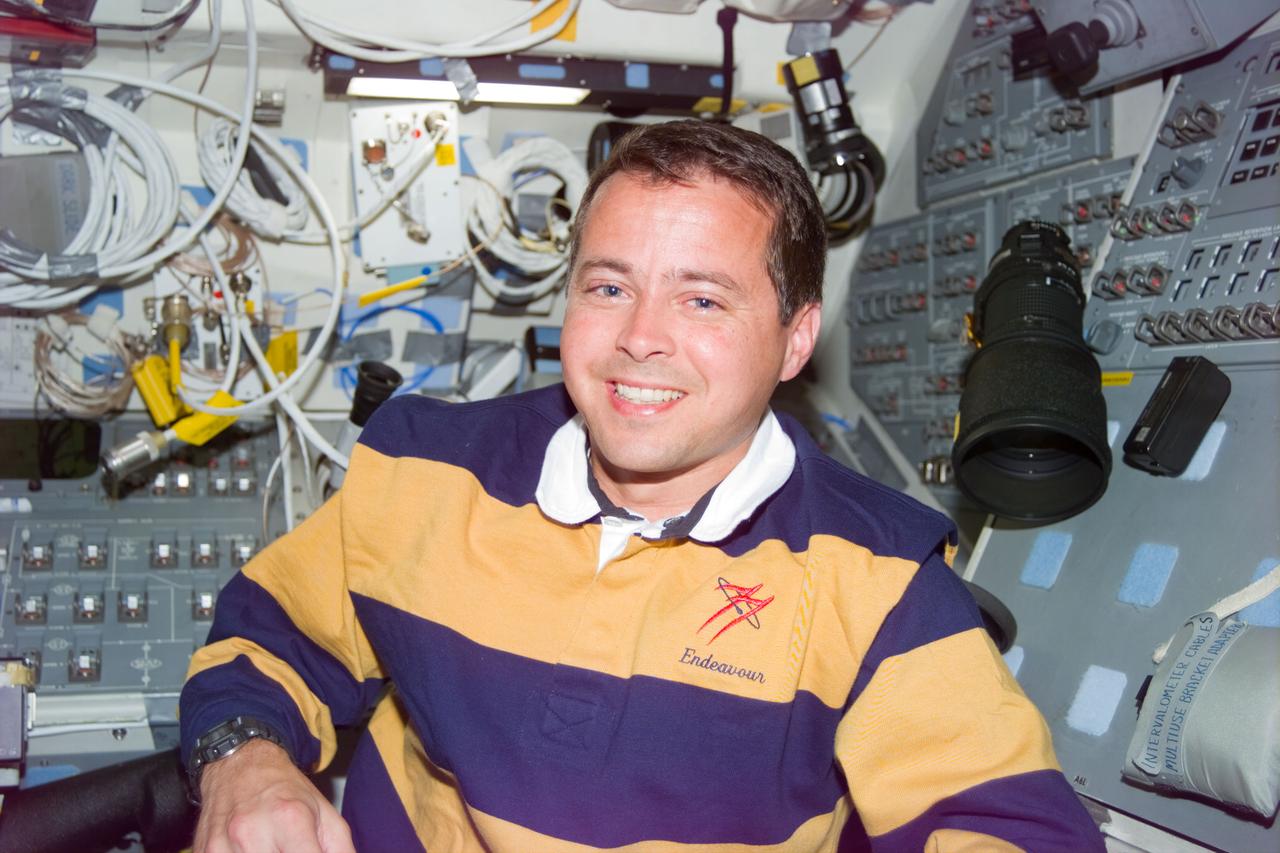
S77-E-5077 (24 May 1996) --- On the Space Shuttle Endeavour's aft flight deck, astronaut Daniel W. Bursch, mission specialist, is photographed prior to recording still pictures of an Earth observation target of opportunity. A camera lens is temporarily stowed nearby on the aft wall. A crew mate exposed the image with an Electronic Still Camera (ESC).
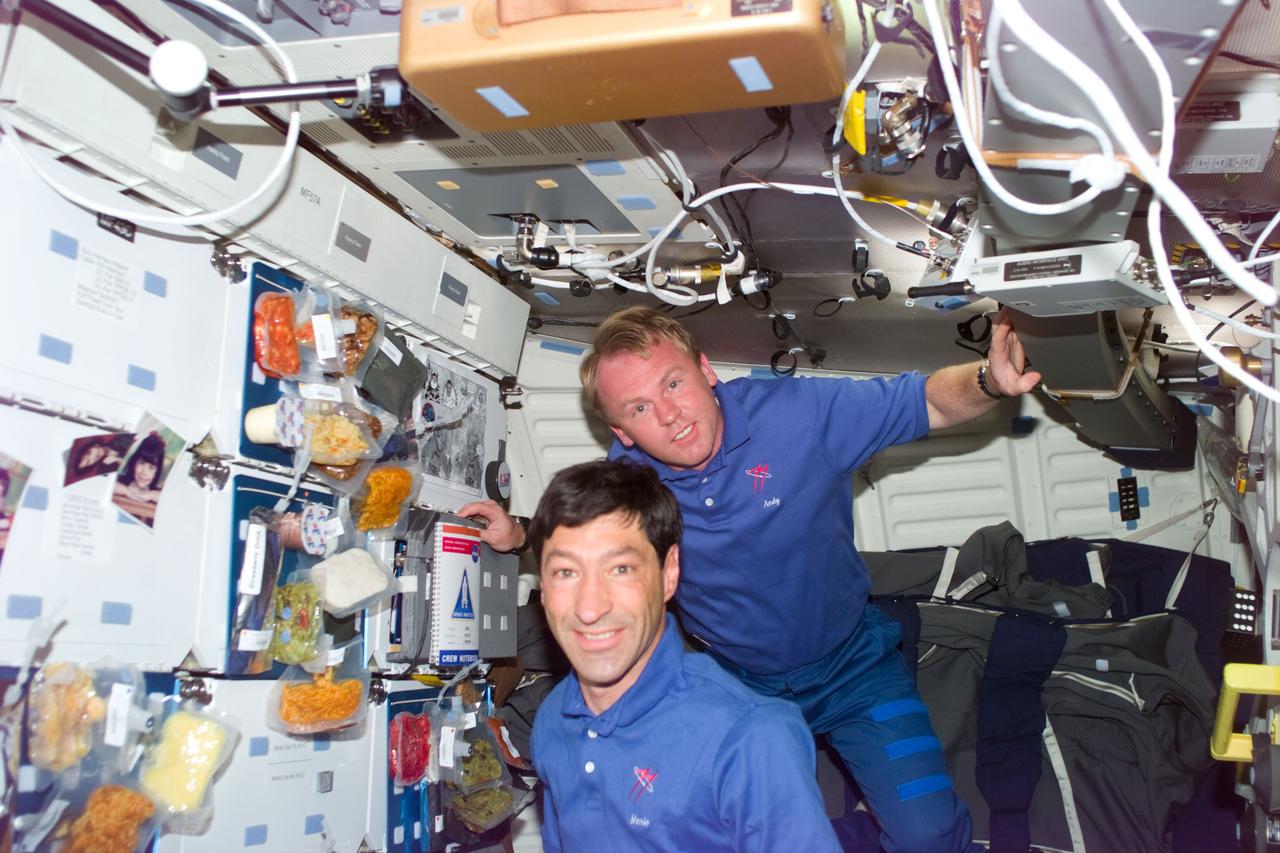
S77-E-5120 (26 May 1996) --- Astronauts Mario Runco, Jr. and Andrew S. W. Thomas, both mission specialists, pose for photo while in the middeck of the Earth-orbiting Space Shuttle Endeavour. The scene was recorded with an Electronic Still Camera (ESC).
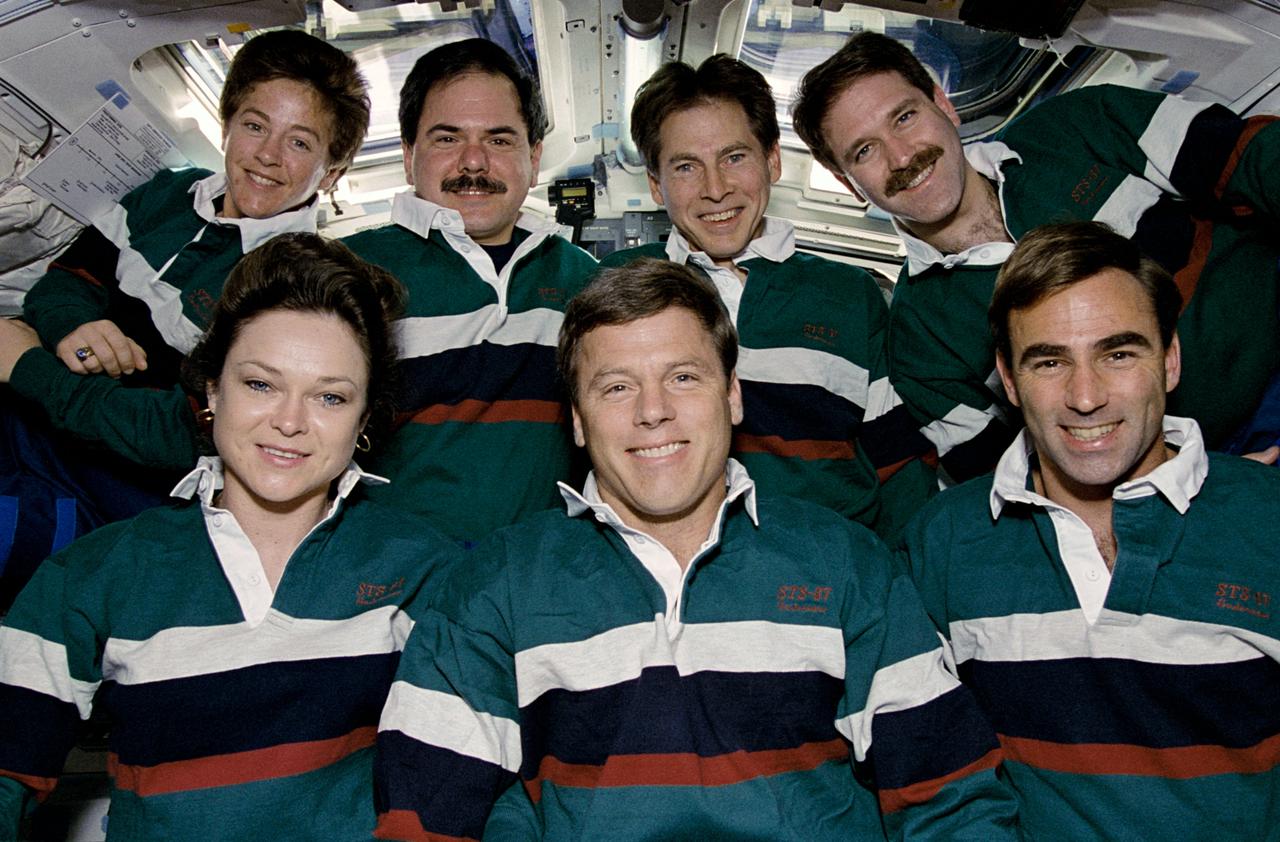
The STS-67/ASTRO-2 crew members pose for their traditional inflight portrait on the aft flight deck of the Earth orbiting Space Shuttle Endeavour. Left to right in the front are astronauts Tamara E. Jernigan, payload commander; Steven S. Oswald, mission commander; and William G. Gregory, pilot. Left to right on the back row are astronaut Wendy B. Lawrence, flight engineer; payload specialists Ronald A. Parise and Samuel T. Durrance; and John M. Grunsfeld, mission specialist.
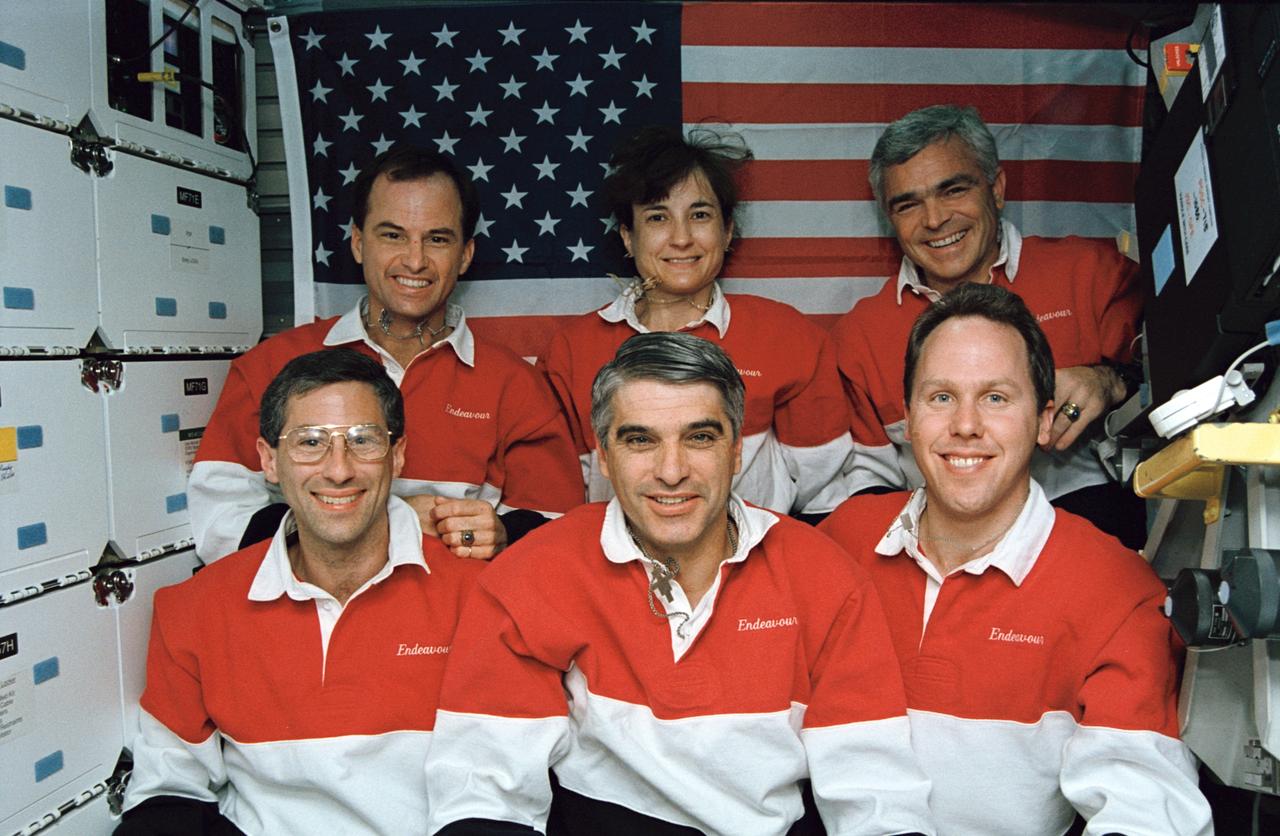
STS059-44-004 (9-20 April 1994) --- This middeck scene aboard the Space Shuttle Endeavour caught all six STS-59 crew members in a rare group shot. Astronaut Sidney M. Gutierrez, mission commander (front center) is flanked by astronauts Jerome (Jay) Apt and Thomas D. Jones, both mission specialists. On the back row are (left to right) astronaut Kevin P. Chilton, pilot; Linda M. Godwin, payload commander; and Michael R. (Rich) Clifford, mission specialist. Most of the week and a half was divided into two work shifts for the crew members.
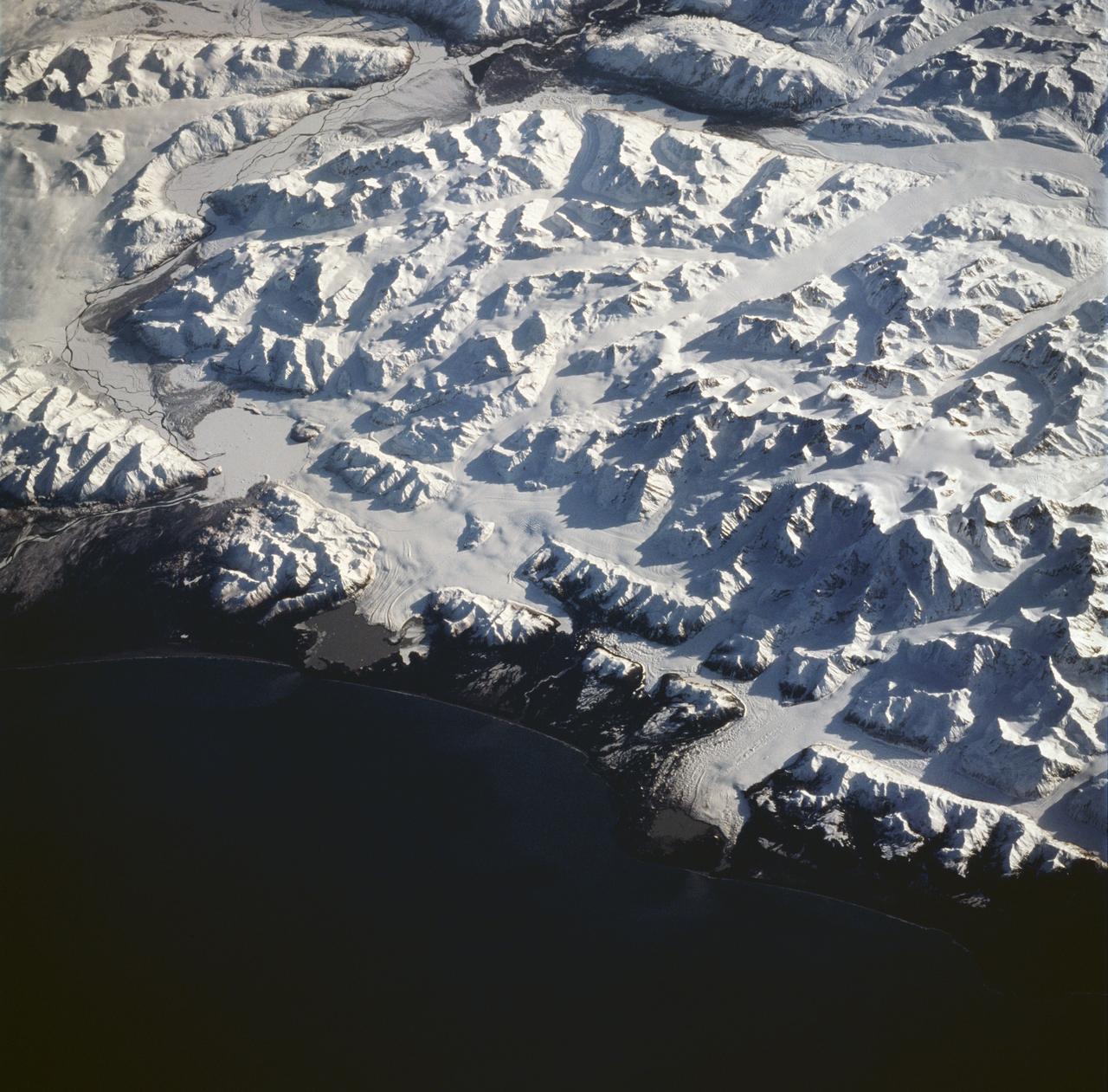
STS059-228-094 (9-20 April 1994) --- The spring thaw along the coast of the Gulf of Alaska has not touched the St. Elias Mountains, southeast of Yakutat Bay and Malaspina Glacier. A prominent glacier flows from Mt. Fairweather (15,300 feet) at right center, to form Cape Fairweather. Another glacier to the northwest almost reaches the sea; the valley of the Alsek River forms a broad, braided plan at upper left. The low sun elevation and oblique angle of this photograph provide a striking 3-dimensional appearance to the black-and-white landscape. SRL investigators will study microwave response to varying depths and conditions of ice and snow along this coast, in Spring and Summer. Hasselblad photograph.
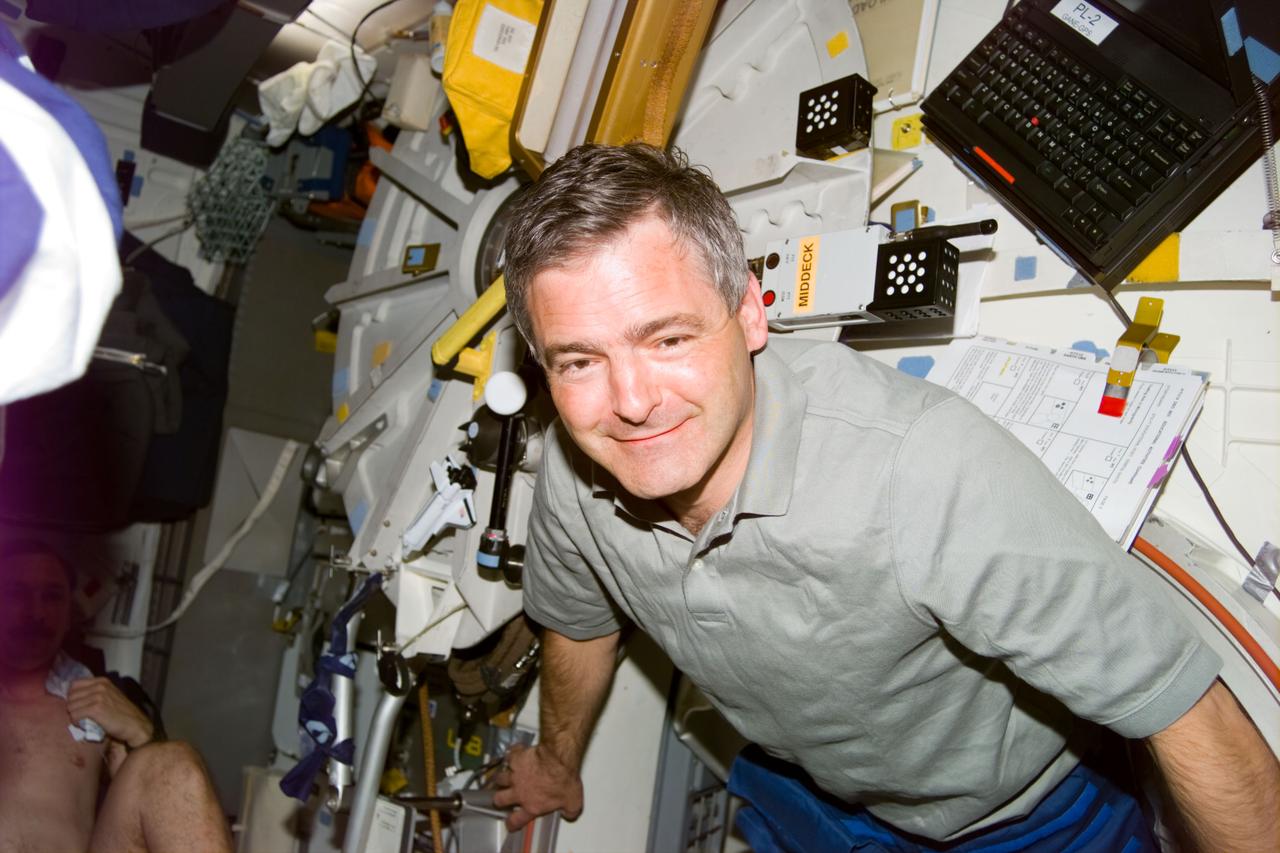
S77-E-5107 (26 May 1996) --- Astronaut Marc Garneau, mission specialist representing the Canadian Space Agency (CSA), poses for a photograph onboard the middeck of the Earth-orbiting Space Shuttle Endeavour. The scene was recorded with an Electronic Still Camera (ESC).
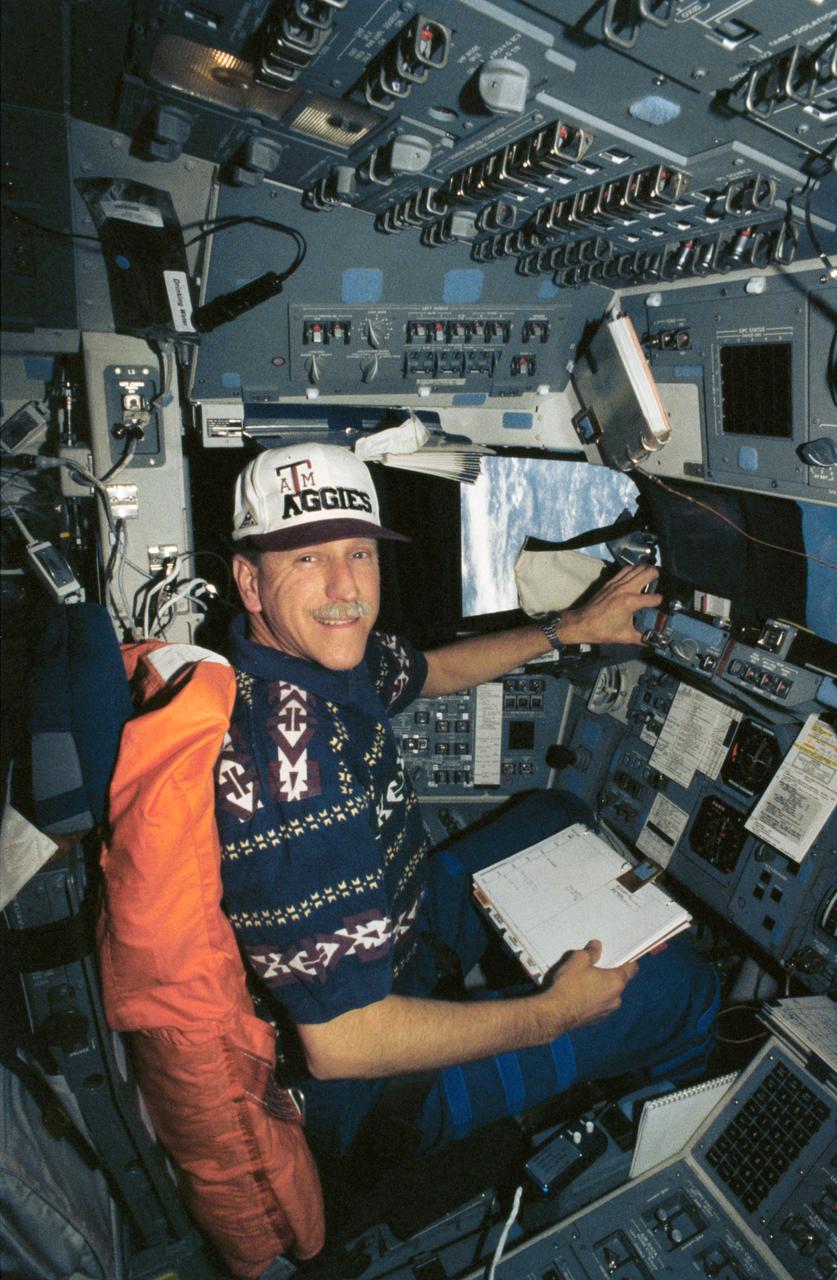
STS061-53-001 (4 Dec 1993) --- Astronaut Richard O. Covey mans the commander's station on the Space Shuttle Endeavour during flight day 3 of the eleven-day mission to service the Hubble Space Telescope (HST). Covey wears a Texas A & M University cap as a salute to members of the training staff who have A & M connections. The crew was busy on this day preparing for the approach and grapple operations with the HST.
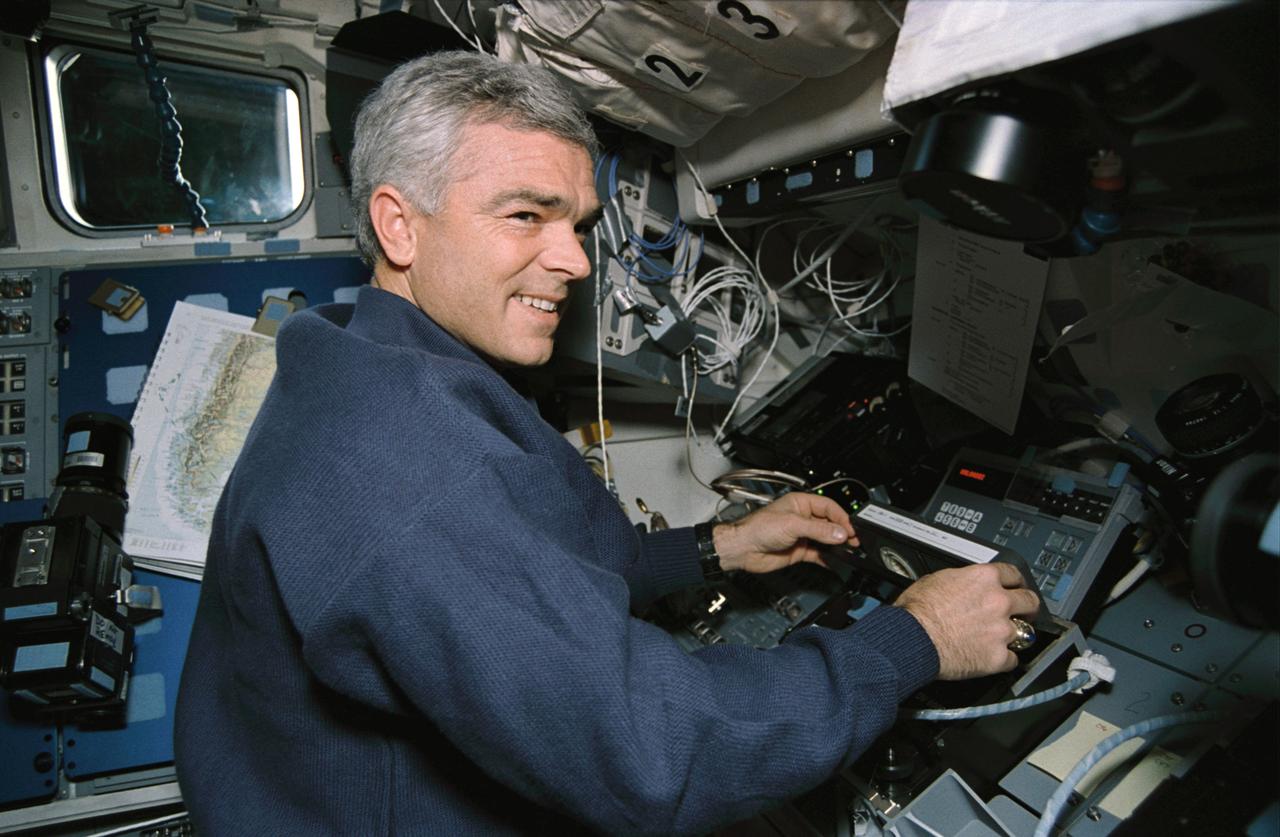
STS059-09-012 (9-20 April 1994) --- On the Space Shuttle Endeavour's aft flight deck, astronaut Michael R. (Rich) Clifford, mission specialist, inserts a tape in the payload high rate recorder. Three of these state-of-the-art recorders captured four times the amount of data that could be radioed to the ground. The 183 tapes, each containing 40 megabytes of data, will be turned into images over the next year, and analyzed over the next decade. Clifford was joined in space by five other NASA astronauts for a week and a half of support to the Space Radar Laboratory (SRL-1)/STS-59 mission.
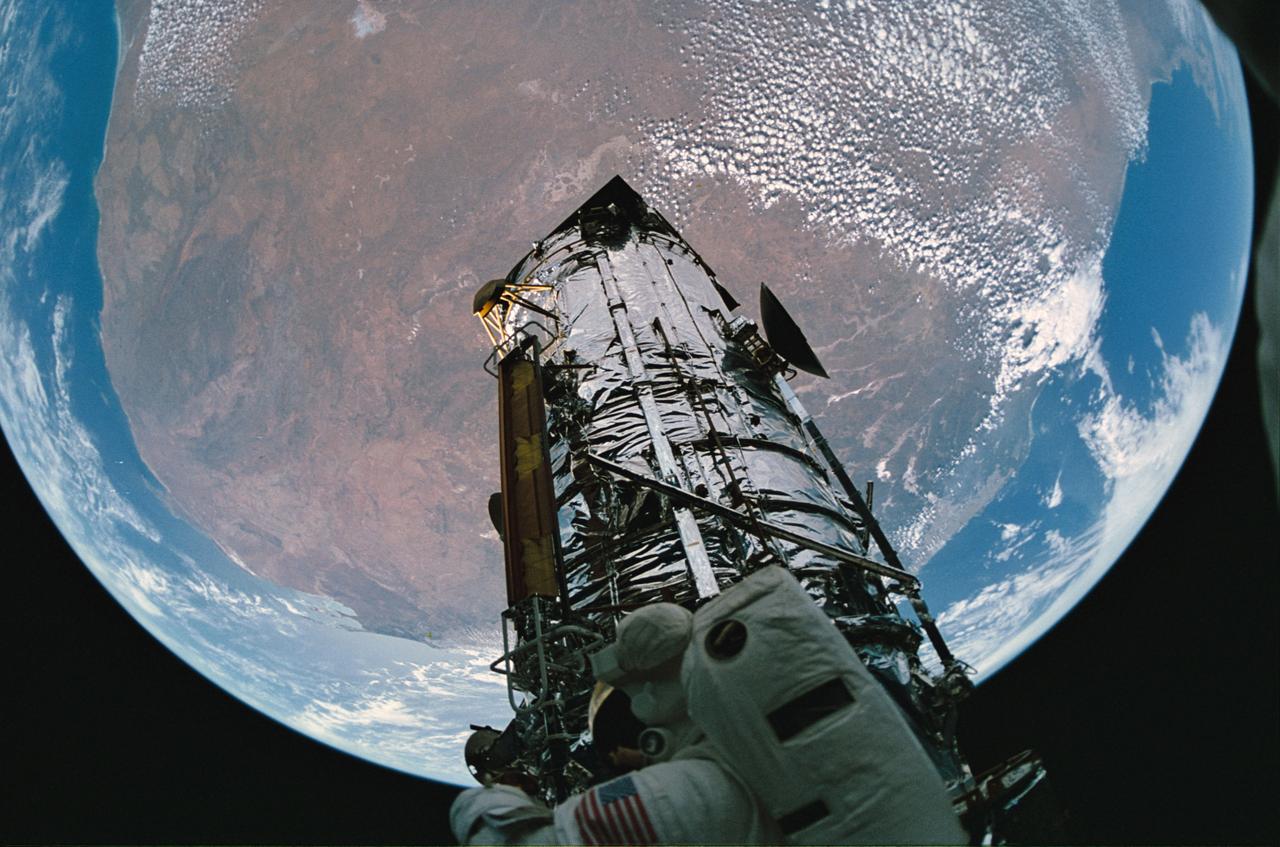
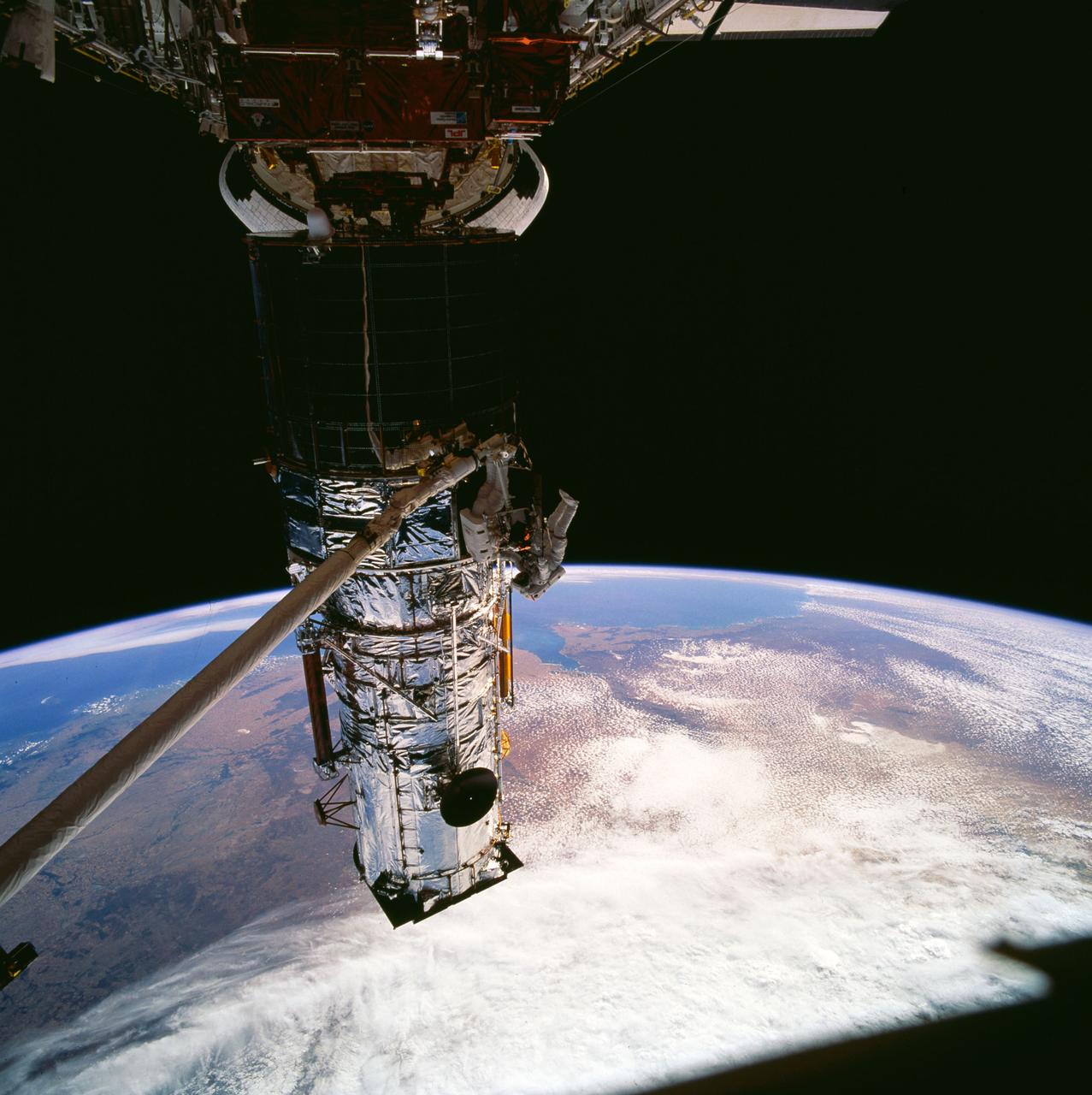
STS061-65-015 (9 Dec 1993) --- A fish-eye lens was used to capture the Hubble Space Telescope (HST), a spherical Earth and Australian landmass with a bit of distortion during the final extravehicular activity (EVA) on the STS-61 HST-servicing mission. Astronaut F. Story Musgrave can be seen at bottom of the frame.
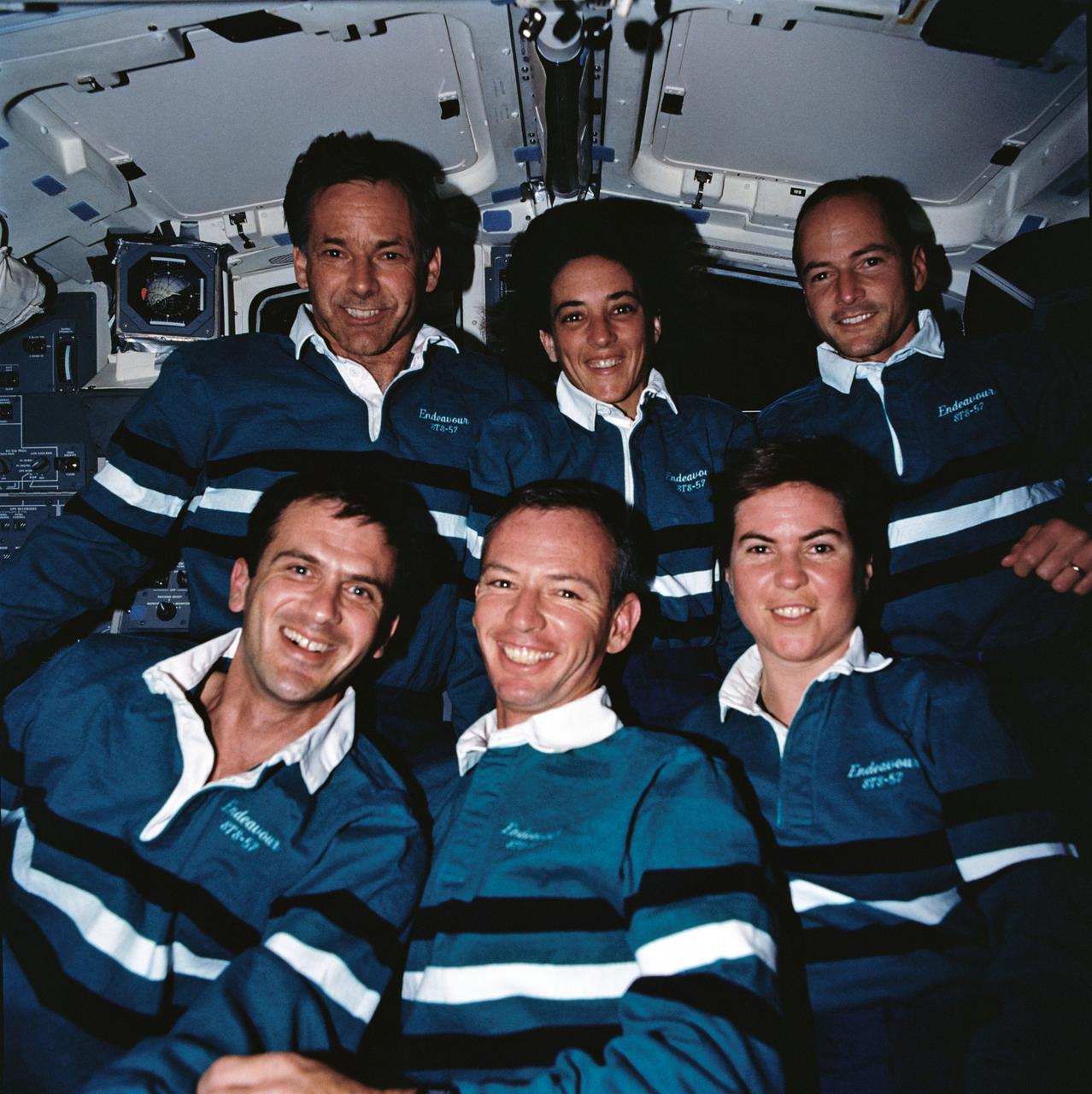
STS057-94-017 (21 June - 1 July 1993) --- Six astronauts onboard the Space Shuttle Endeavour pose for the traditional inflight crew portrait on the aft flight deck. In the rear (left to right) are astronauts Ronald J. Grabe, mission commander; Nancy J. Sherlock, mission specialist; and G. David Low, payload commander; in front (left to right), Peter J. K. (Jeff) Wisoff, mission specialist; Brian Duffy, pilot; and Janice E. Voss, mission specialist.
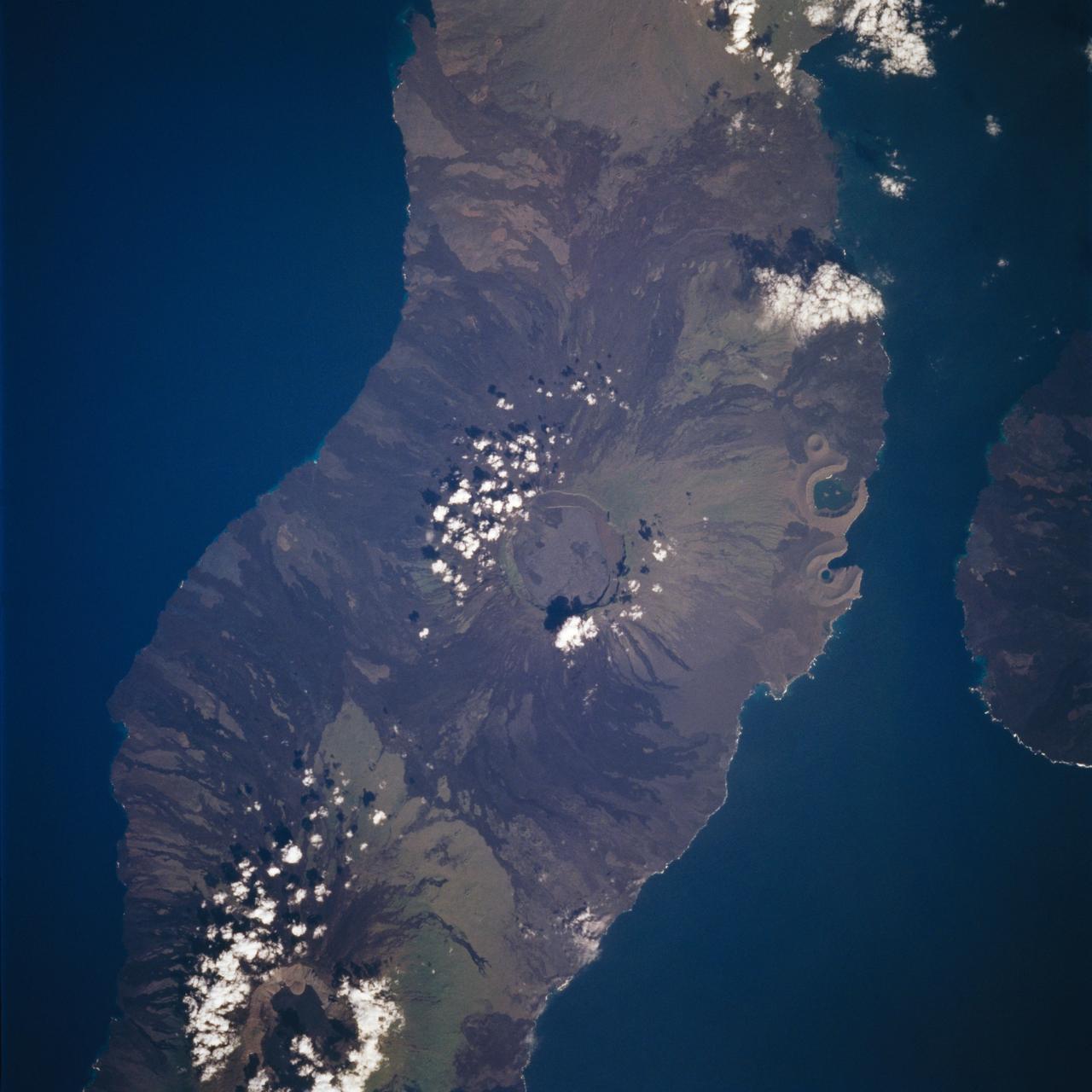
STS059-213-019 (9-20 April 1994) --- SRL scientists will use these photographs with the radar imagery to discriminate among different ages of basalt flows, and different ecosystems of shrub communities, on these equatorial volcanic islands. Aims are twofold: to understand the history of physical and biological systems on the islands themselves, and to extend what is learned to other, less-well-known areas globally. Hasselblad photograph.
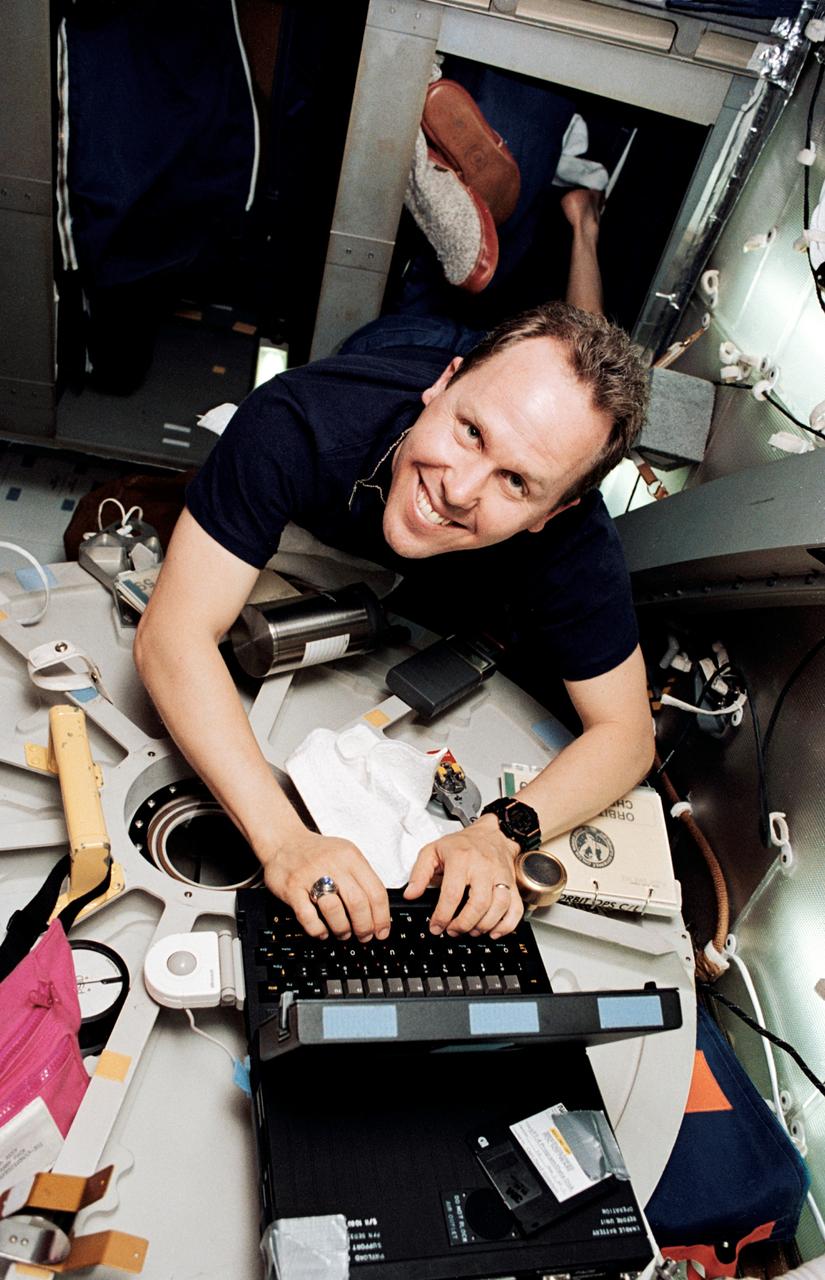
STS059-10-011 (9-20 April 1994) --- Astronaut Thomas D. Jones appears to have climbed out of bed right into his work in this onboard 35mm frame. Actually, Jones had anchored himself in the bunk facility while working on one of the onboard computers which transfered data to the ground via modem. The mission specialist was joined in space by five other NASA astronauts for a week and a half of support to the Space Radar Laboratory (SRL-1)/STS-59 mission.
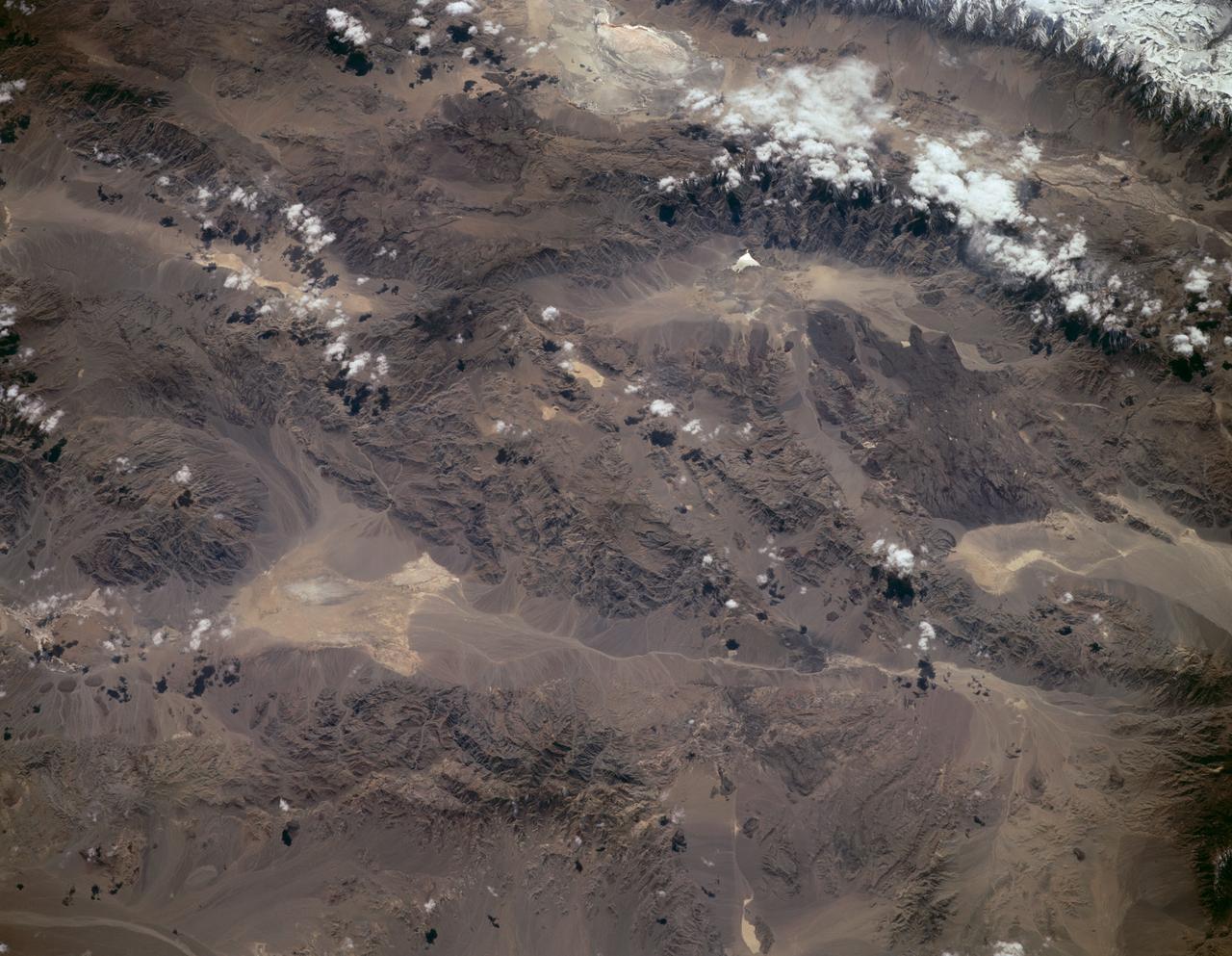
STS059-L09-162 (9-20 April 1994) --- Orient with the snow-covered mountains (Sierra Nevada of California) in the upper right corner. Then Owens Valley runs along the top of the photograph to Owens Lake playa at top center. The upper end of Death Valley extends from right to left in the foreground, with the drainage running down to a playa at Stovepipe Wells in the left foreground. Geologists are studying microwave signatures of the different playa surfaces, and the coatings on alluvial fans that extend from mountain masses, to try to sort out the history of different climates in this formerly wet but now hyperarid region.
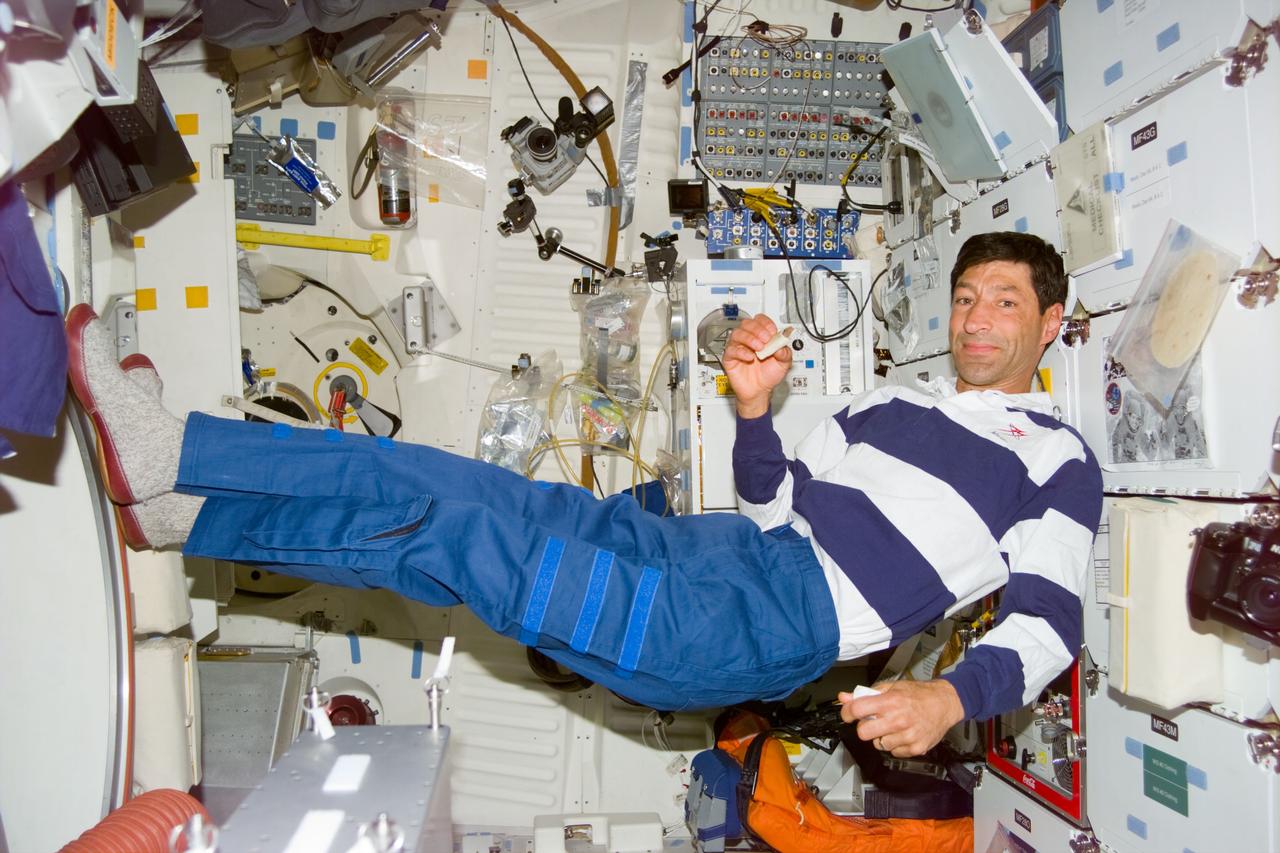
S77-E-5104 (26 May 1996) --- Astronaut Mario Runco, Jr., mission specialist, takes a break from activities on Space Shuttle Endeavour?s middeck. The scene was recorded with an Electronic Still Camera (ESC).
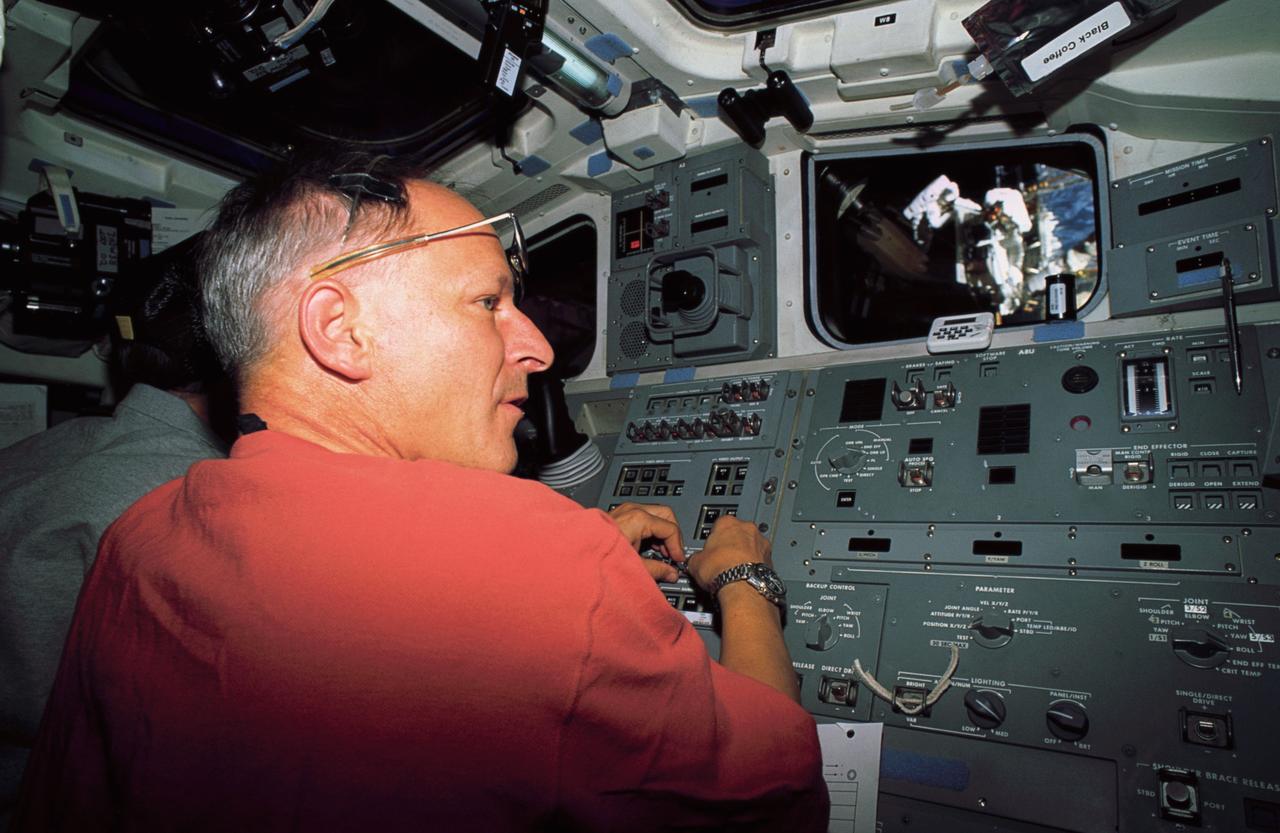
STS061-23-037 (2-13 Dec 1993) --- ESA astronaut Claude Nicollier, mission specialist, is stationed on the Space Shuttle Endeavour's flight deck during one of the five Hubble Space Telescope (HST) servicing space walks. The controls for the Remote Manipulator System (RMS), which played an important role in the space walks, are left of frame center. Two space walkers can be seen through the aft windows.
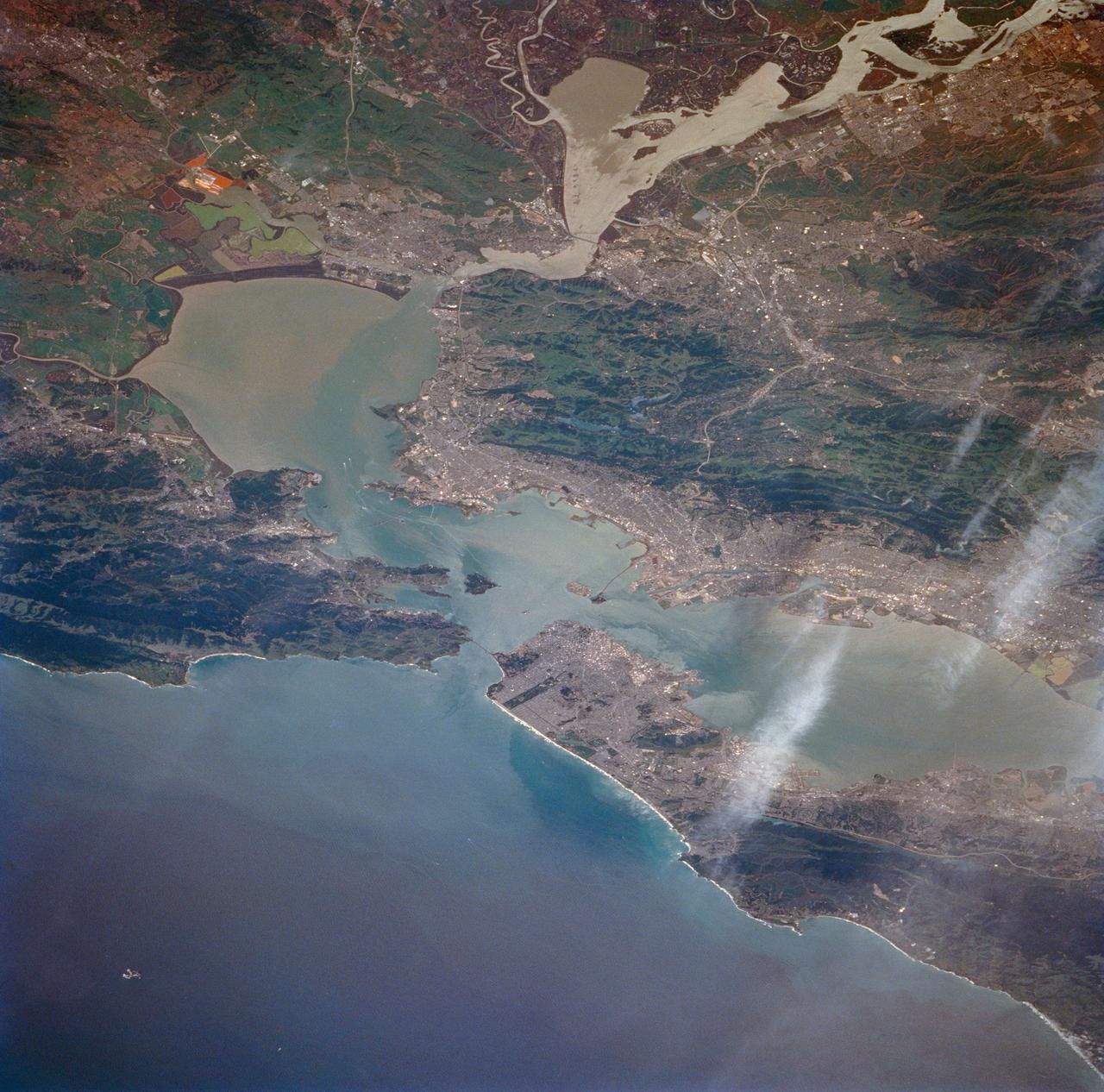
STS059-213-009 (9-20 April 1994) --- San Francisco Bay. Orient with the sea up. The delta of the combined Sacramento and San Joaquin Rivers occupies the foreground, San Francisco Bay the middle distance, and the Pacific Ocean the rest. Variations in water color caused both by sediment load and by wind streaking strike the eye. Man-made features dominate this scene. The Lafayette/Concord complex is left of the bay head, Vallejo is to the right, the Berkeley/Oakland complex rims the shoreline of the main bay, and San Francisco fills the peninsula beyond. Salt-evaporation ponds contain differently-colored algae depending on salinity. The low altitude (less than 120 nautical miles) and unusually-clear air combine to provide unusually-strong green colors in this Spring scene. Hasselblad camera.
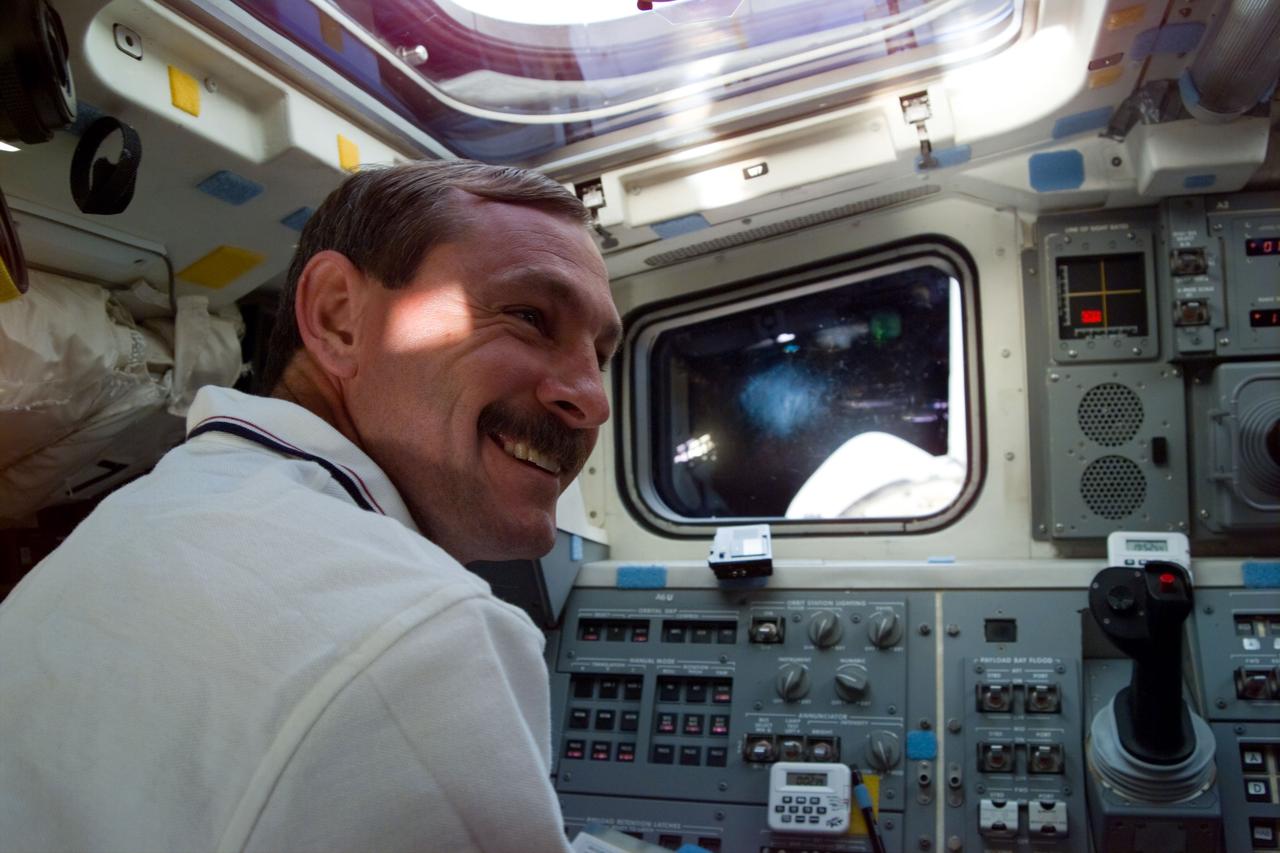
S77-E-5066 (22 May 1996) --- Astronaut Curtis L. Brown, Jr., pilot, is seen on the starboard side of the Space Shuttle Endeavour's aft flight deck just prior to the deployment of the Satellite Test Unit (STU), part of the Passive Aerodynamically Stabilized Magnetically Damped Satellite (PAMS). Brown's image was captured with an Electronic Still Camera (ESC). Minutes later the camera was being used to document the deployment of PAMS-STU. The six-member crew will continue operations (tracking, rendezvousing and station-keeping) with PAMS-STU periodically throughout the remainder of the mission.
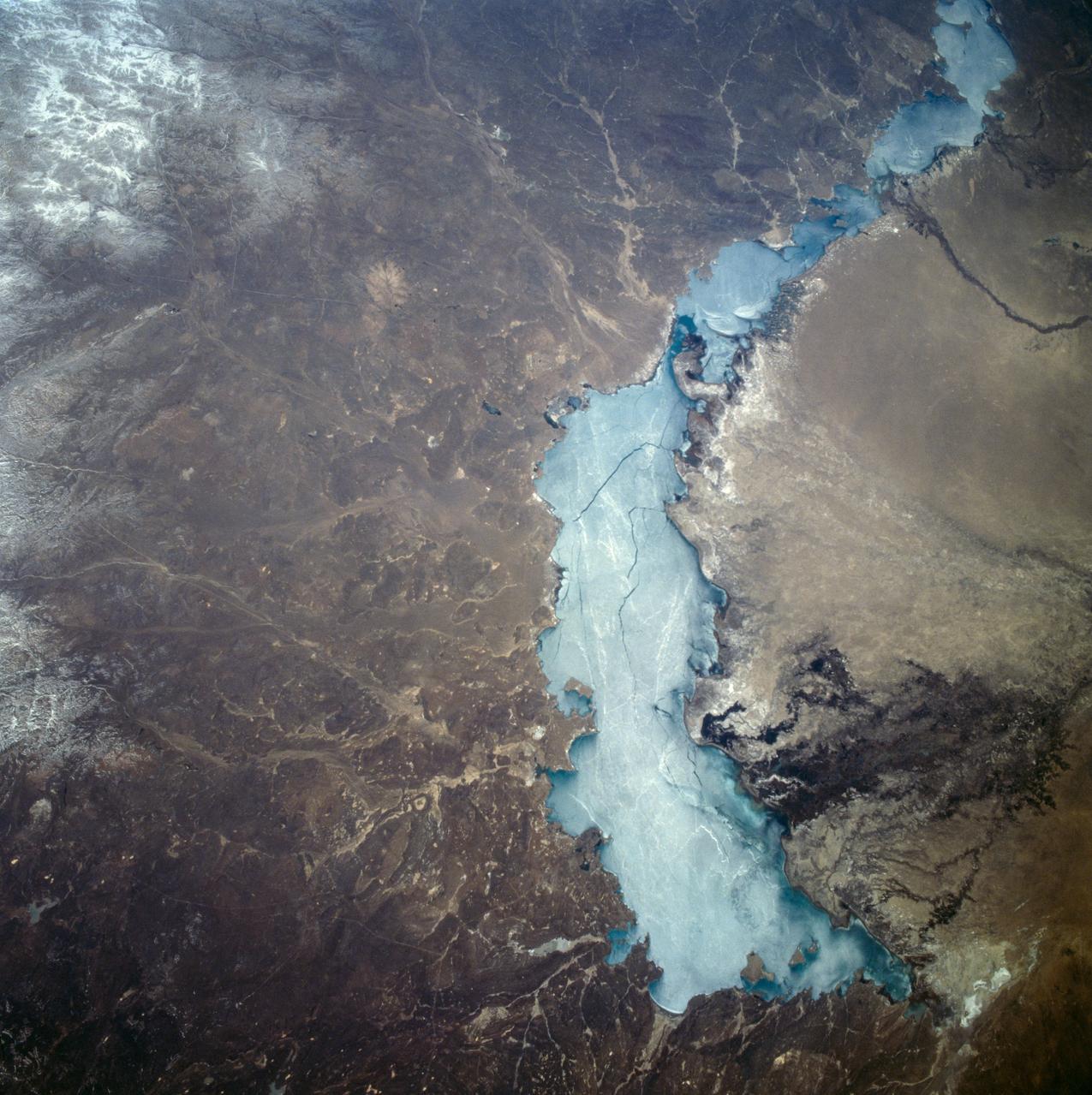
STS059-209-081 (9-20 April 1994) --- Lake Balkhash, in eastern Kazakhstan, is some 300 miles long. The lake, frozen in this scene, thawed noticeably during the mission. The shape of the lake is controlled by the delta of the Ili River, which flows from the Tien Shan Mountains in western China across this arid steppe. SRL scientists will use radar data to study the microwave effects of differences in soil moisture, and in freezing or thawing, on the deltaic sediments. Hasselblad camera.
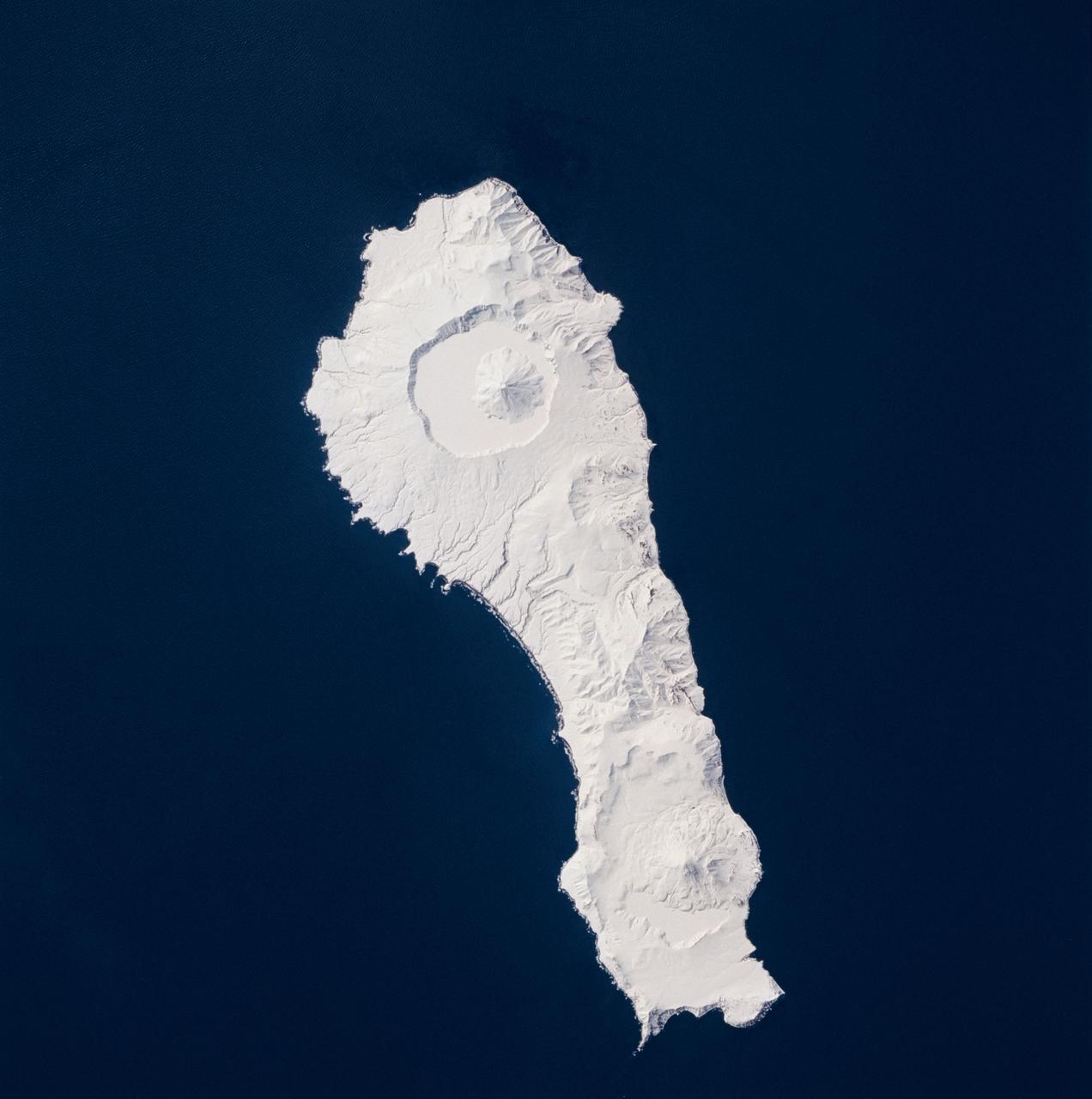
STS059-219-065 (9-20 April 1994) --- The narrow end of the island is to the north by northeast. This is one of several volcanic islands extending south by southwest between the southern tip of Kamchatka and Japan. The exposure was stopped down to provide extremely fine detail in the totally snow-covered landscape, at the same time making the dark sea look completely black. Compare to STS047-90-087, taken in September, which shows a green ground cover. Hasselblad photograph.
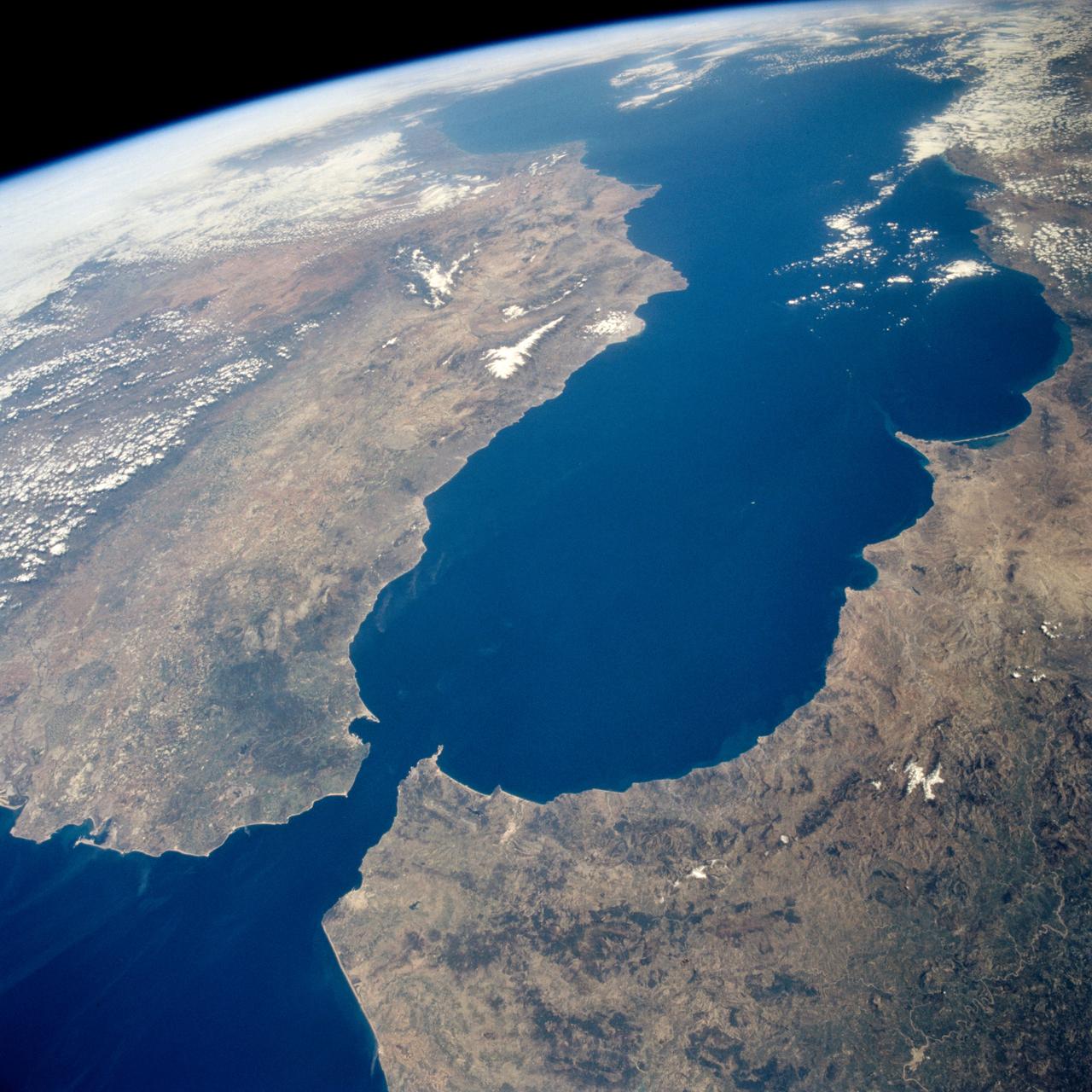
STS059-238-074 (9-20 April 1994) --- The Atlantic Ocean, Straits of Gibraltar, and Alboran Sea (the westernmost portion of the Mediterranean Sea) separate Spain on the left from Morocco on the right. Algeciras Harbor is the prominent notch cut out of the eastern end of the north shore of the Strait; the Rock of Gibraltar is the tiny arrowhead that separates the notch from the Alboran Sea. The Sierra Nevada, farther away down the Spanish coast, lives up to its name in this April scene. The difference in elevation between the Sierra Morena and the Guadalquivir River valley is highlighted nicely by cumulus clouds. Tangier, Morocco can be seen as a light-toned spot on the southern shore of the Strait, near the entrance to the Atlantic Ocean. Hasselblad photograph.
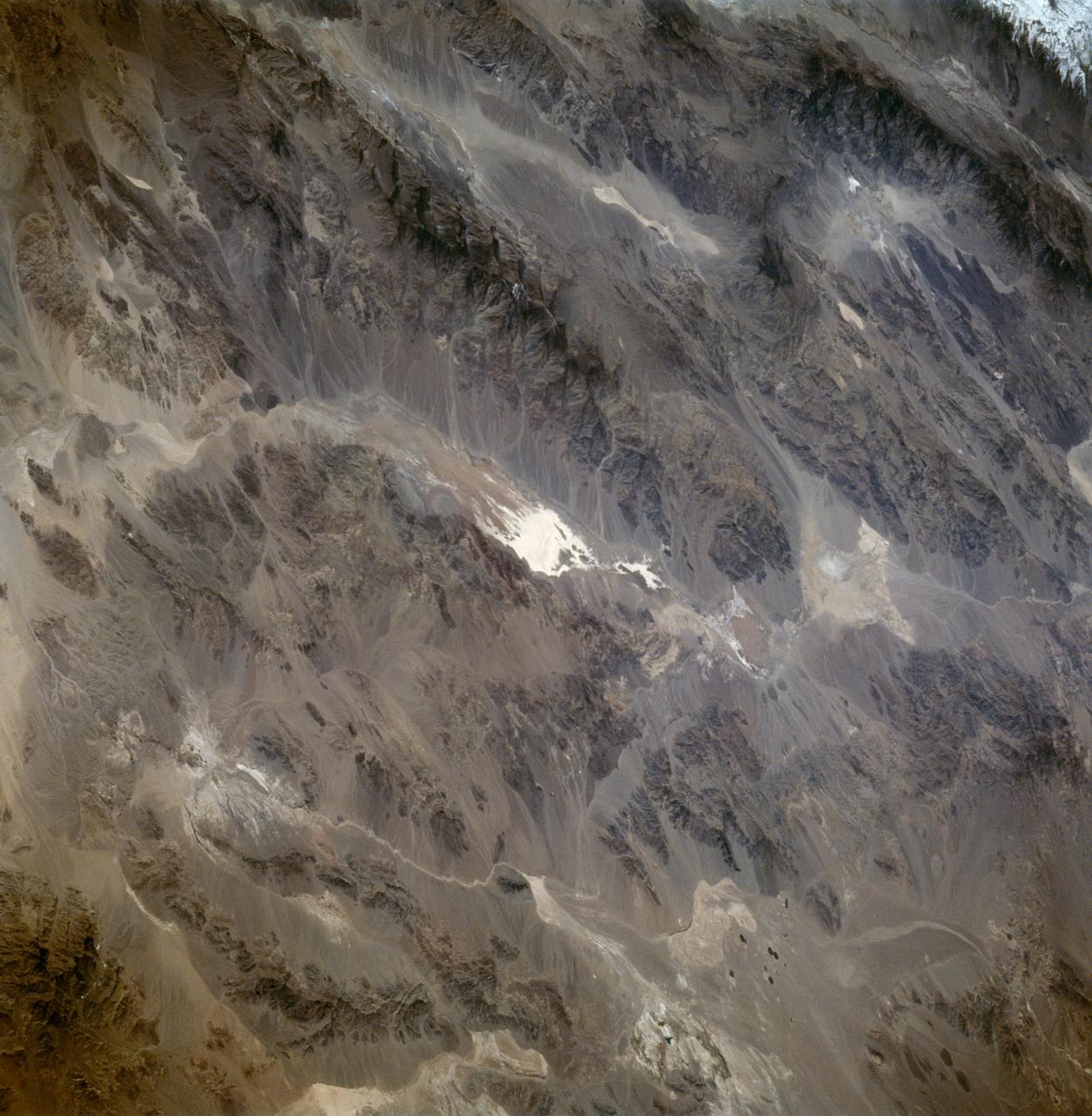
STS059-86-059 (9-20 April 1994) --- This oblique handheld Hasselblad 70mm photo shows Death Valley, near California's border with Nevada. The valley -- the central feature of Death Valley National Monument -- extends north to south for some 140 miles (225 kilometers). Hemmed in to the east by the Amargosa Range and to the west by the Panamints, its width varies from 5 to 15 miles (8 to 24 kilometers). Using Spaceborne Imaging Radar (SIR-C) and X-band Synthetic Aperture Radar (X-SAR) onboard the Space Shuttle Endeavour, the crew was able to record a great deal of data on this and other sites, as part of NASA's Mission to Planet Earth.
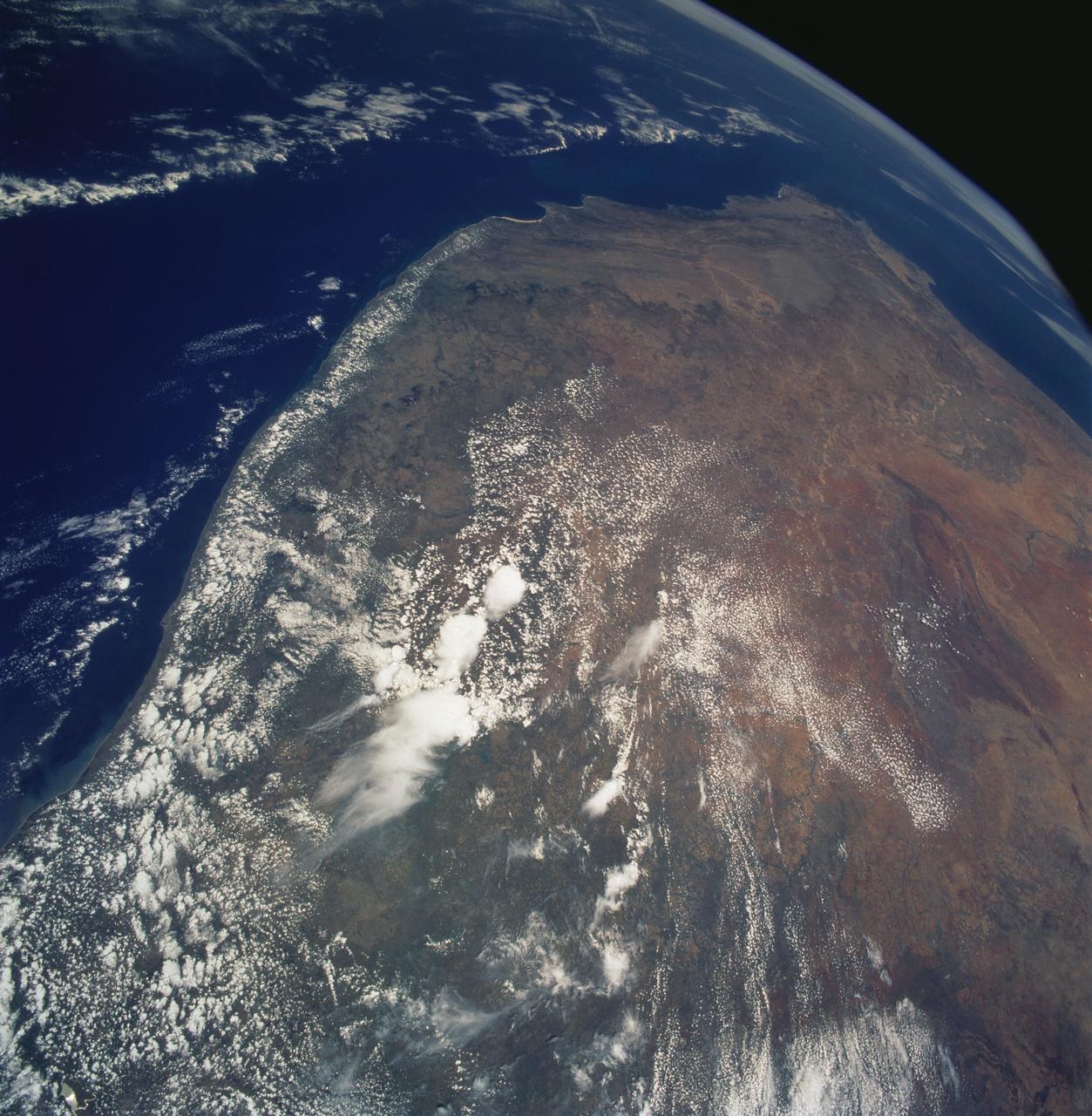
STS061-106-091 (December 1993) --- The entire southern tip of Africa is shown in this high altitude 50mm photograph. The center of the photograph is at approximately 28.0 degrees south and 24.0 degrees east Cape Columbine is at the upper right with Durban at the lower center. The Orange River is at the upper center of the frame. Cape Agulas is the southernmost part of the African continent and is visible toward the upper right corner with the great bays of South Africa trending toward the bottom right. Continuing clockwise along the coast, Durban projects out into the Indian Ocean. The oceanic clouds on the right side of the photograph probably depict a current boundary. The Drakensberg Range on the east, the great Karoo Range to the south and the Karas Mountains on the west surround the drier central plateau. The southern Kalahari Desert is at the upper left of the photograph.
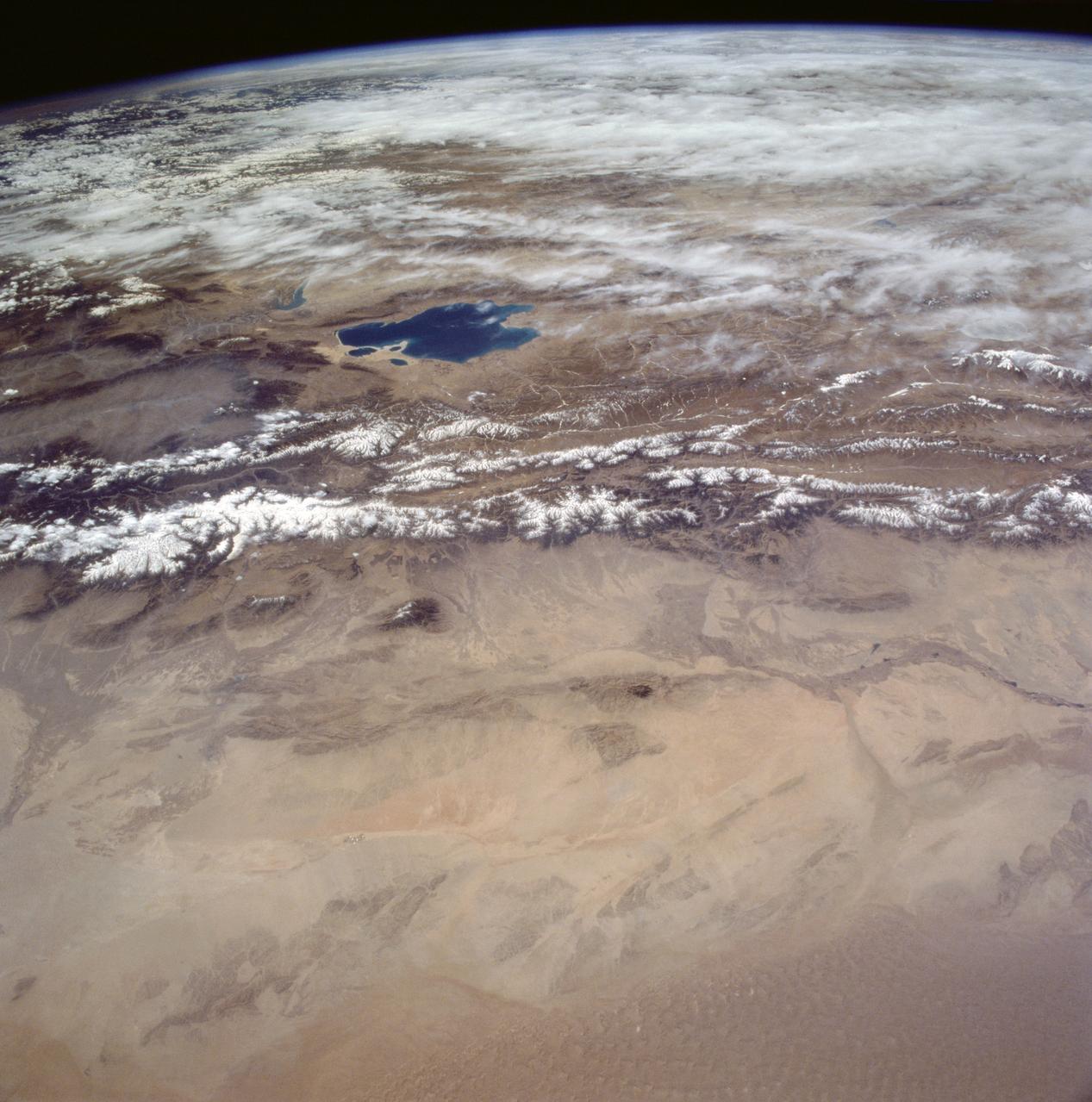
STS059-220-041 (9-20 April 1994) --- View to the south by southwest across the southern Gobi Desert (China) across the Chi-Lien-Shan or Quilienshan or Nanshan (Mountains) in Gansu Province to Lake Quinghai or Ch'ing-Hai (orthography varies with political conditions and scholarship) in Quinghai Province. The lake has a surface elevation of 10,450 feet, partially filling one of the easternmost closed drainage basins of Central Asia. Hasselblad photograph.
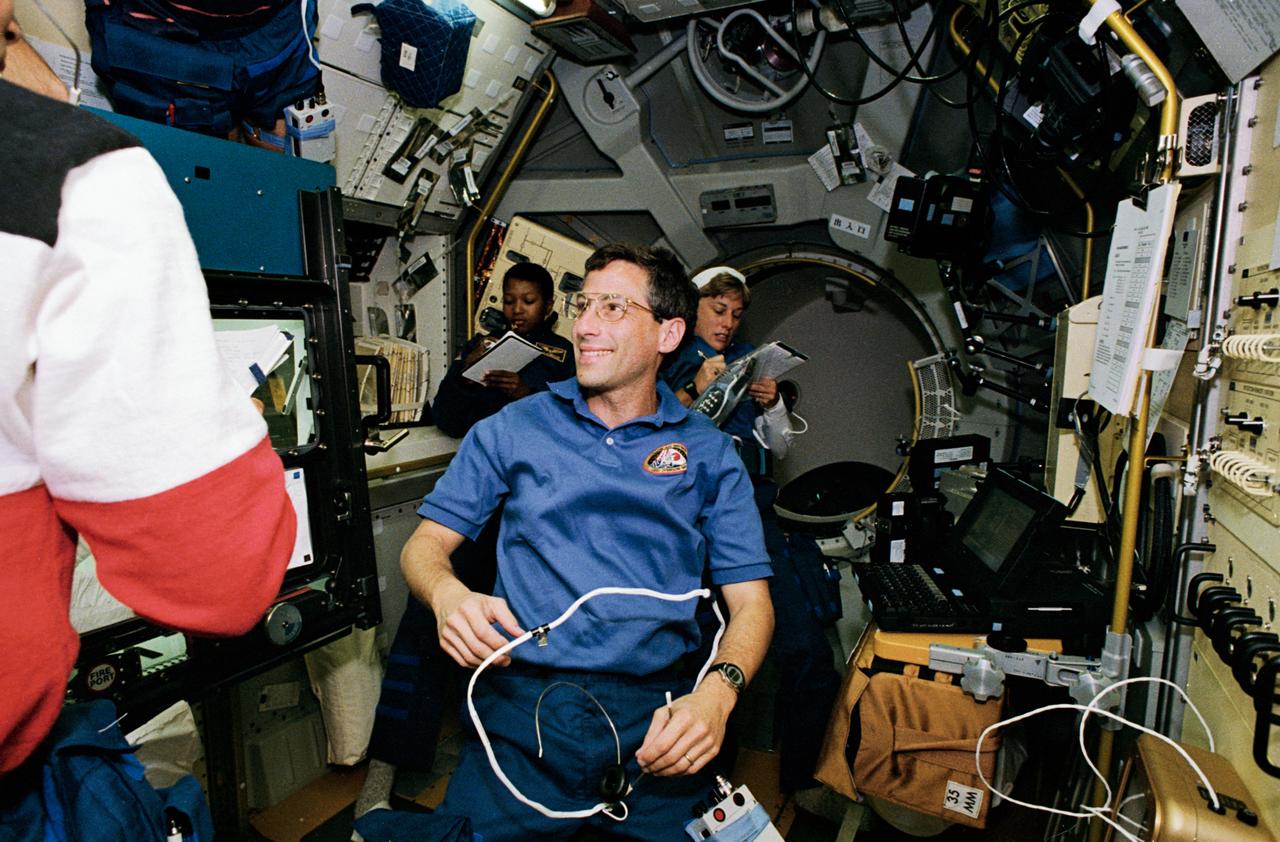
STS047-05-019 (12 - 20 Sept 1992) --- Astronaut Jerome (Jay) Apt, mission specialist, responds to a crew mate's query during a shift change in the Spacelab-J Science Module aboard the Earth-orbiting Space Shuttle Endeavour. Others pictured, left to right, are astronauts Mark C. Lee (immediate foreground, partially out of frame), payload commander; Mae C. Jemison and N. Jan Davis, mission specialists. The four joined two other NASA astronauts and a Japanese payload specialist for eight days aboard Endeavour in support of the joint Japanese-American effort.
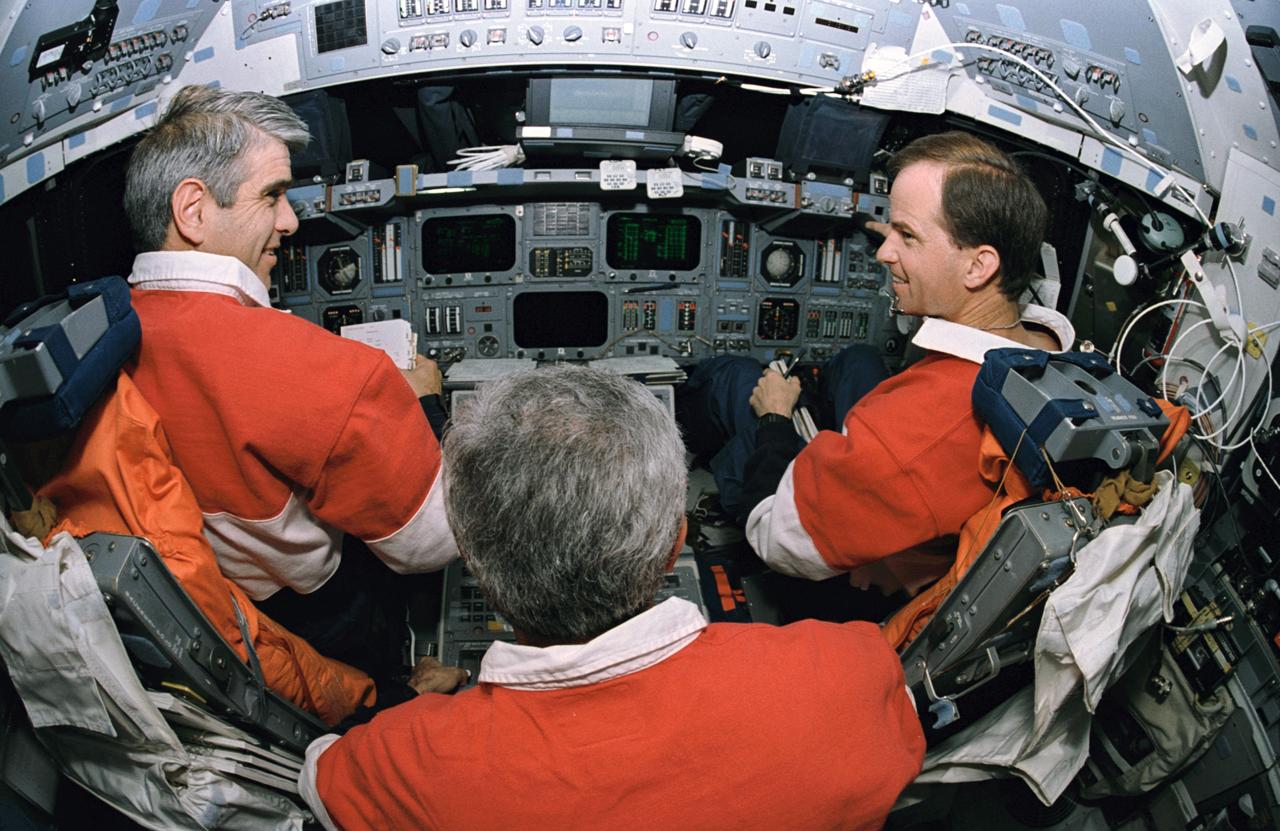
STS059-12-035 (9-20 April 1994) --- A 16mm lens on a 35mm camera provides a "fish-eye" effect for this rare scene on the Space Shuttle Endeavour's flight deck during checkout of the spacecraft's flight control systems. Astronauts Sidney M. Gutierrez (left) and Kevin P. Chilton (right) man the commander and pilot stations, respectively. Astronaut Michael R. (Rich) Clifford, the flight engineer, is seated behind the two. Not pictured are astronauts Linda M. Godwin, payload commander, and Jerome (Jay) Apt and Thomas D. Jones, both mission specialists.
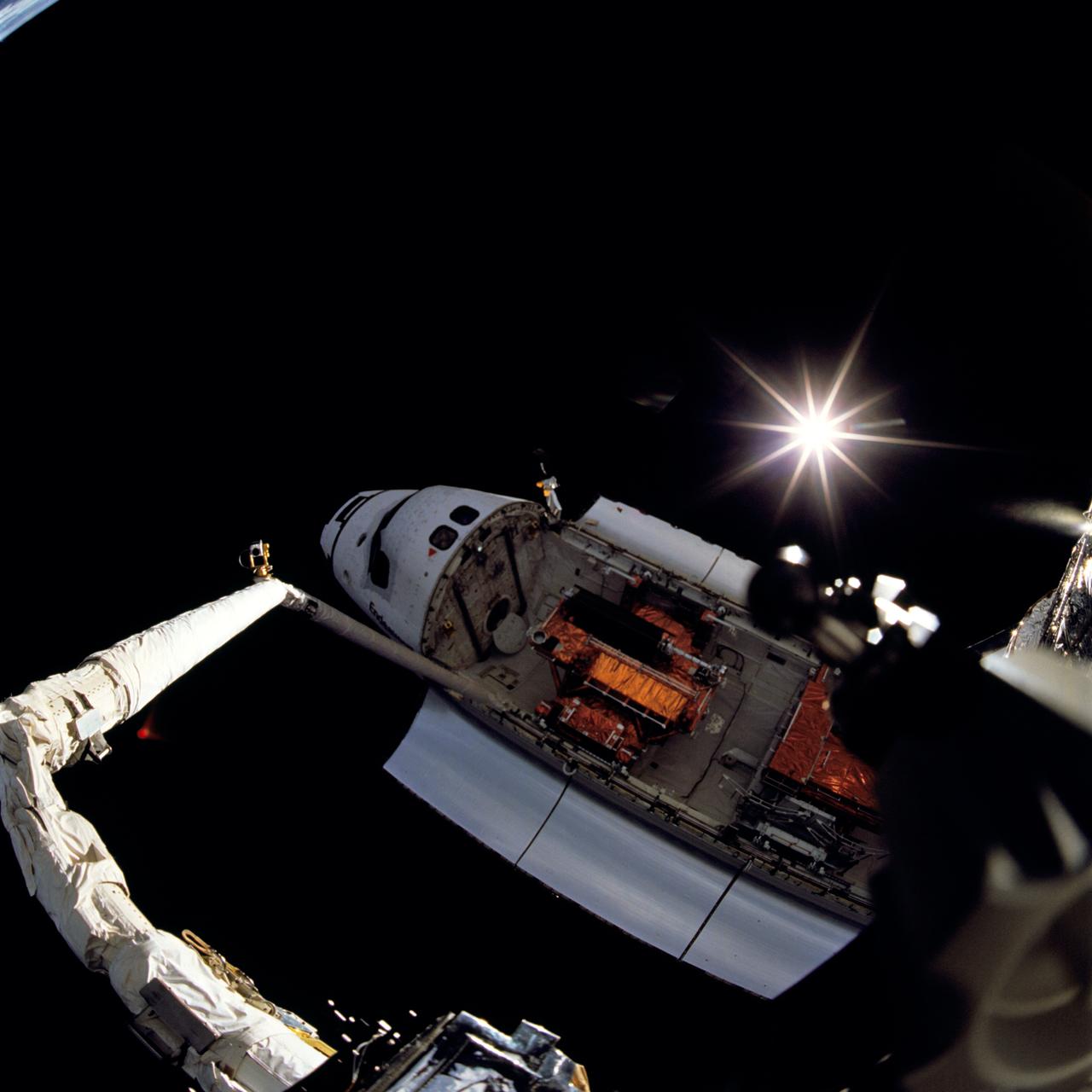
STS061-105-024 (2-13 Dec. 1993) --- One of Endeavour's space walkers captured this view of Endeavour backdropped against the blackness of space, with the Sun displaying a rayed effect. The extended Remote Manipulator System (RMS) arm that the astronaut was standing on is seen on the left side of the view.
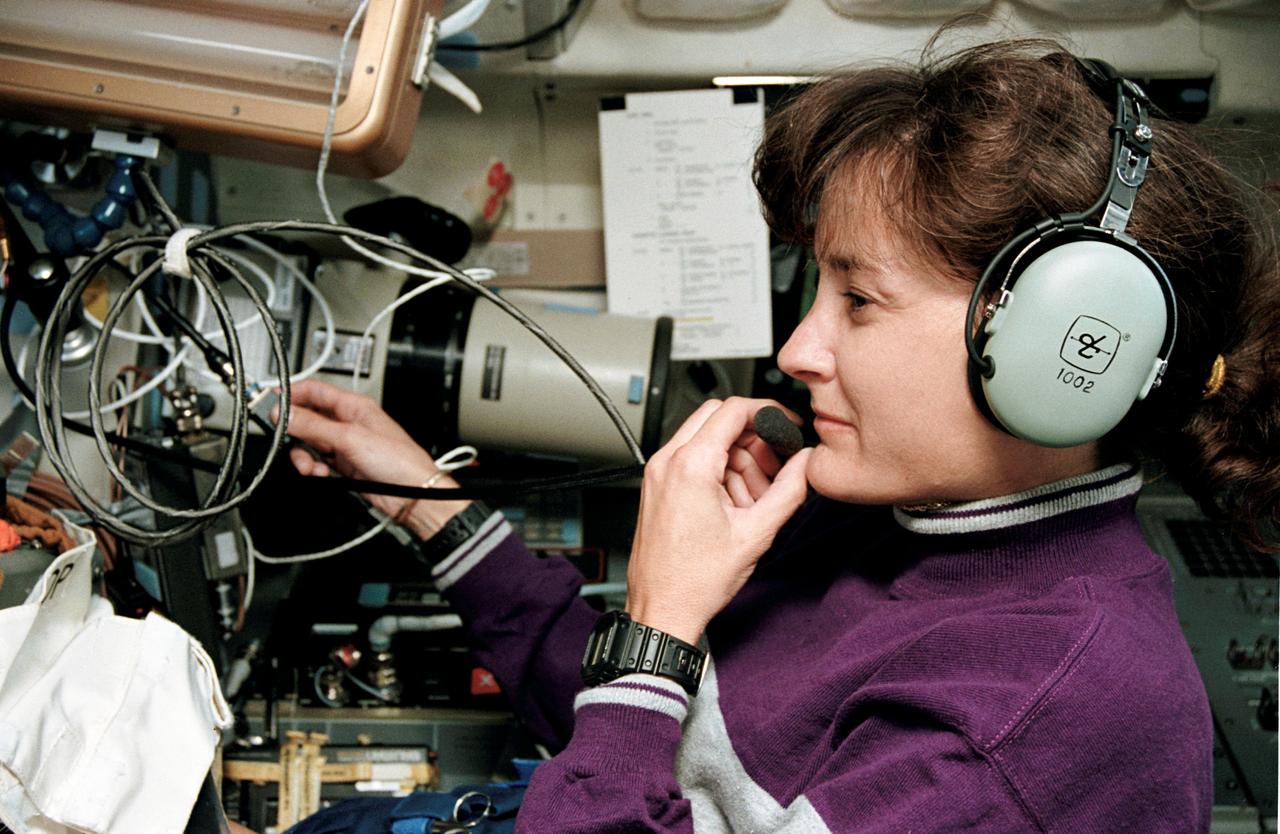
STS059-16-028 (9-20 April 1994) --- Onboard the Space Shuttle Endeavour, astronaut Linda M. Godwin talks to students via the Shuttle Amateur Radio Experiment (SAREX). The payload commander, as well as several other STS-59 crew members spent some off-duty time using the amateur radio equipment to communicate with "Hams" and students on Earth.
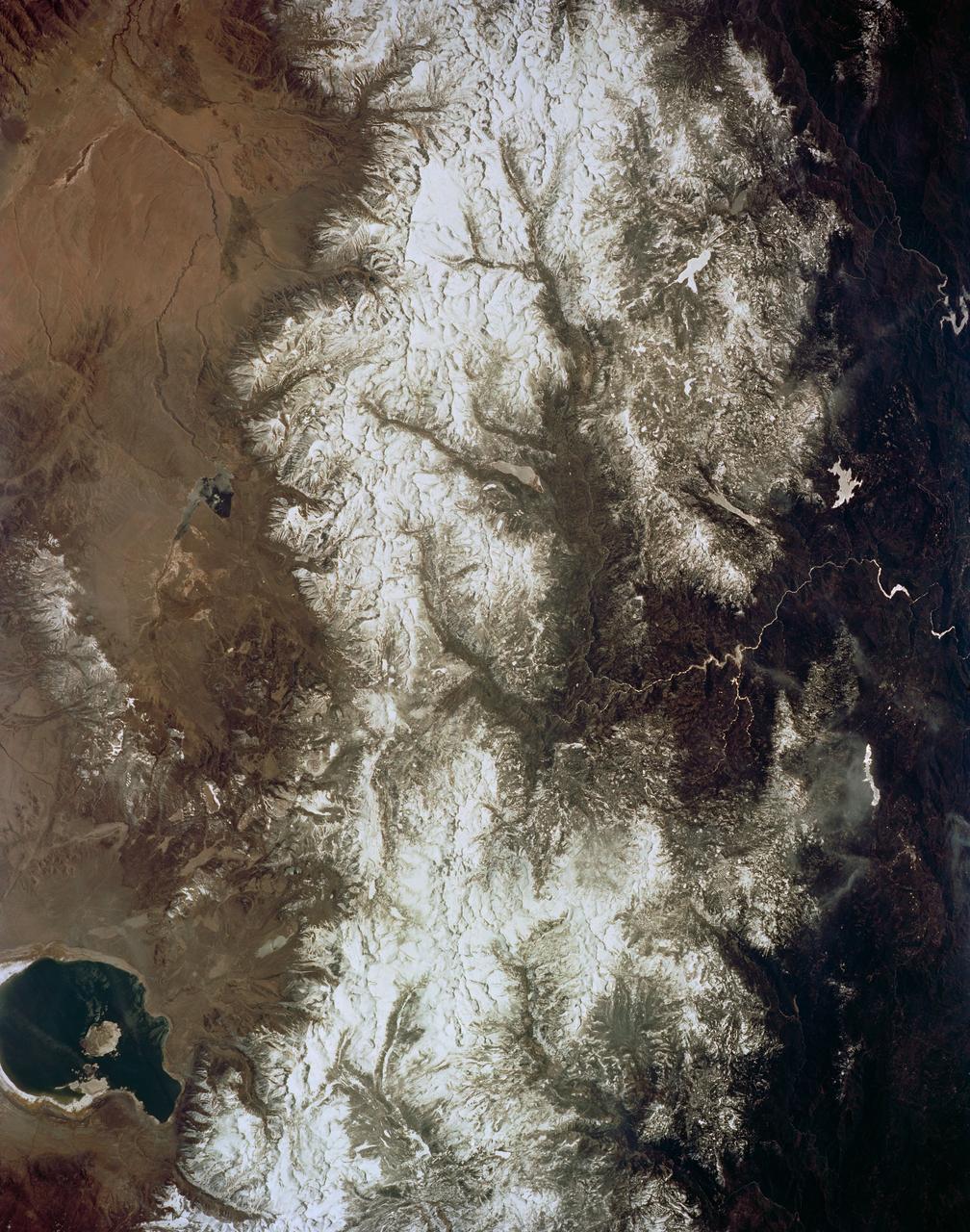
STS059-154-160 (9-20 April 1994) --- Orient with Mono Lake, California at the lower right; then the view is westward across the Sierra Nevada into the San Joaquin River drainage. A tiny network of ski trails can be seen on the Mono Lake side of the Sierras, on a line between Mono Lake and the snow-free San Joaquin headwaters. The ski trails mark Mammoth Mountain, where SRL investigators are studying microwave measurements of the water content of snowpacks. Linhof camera.
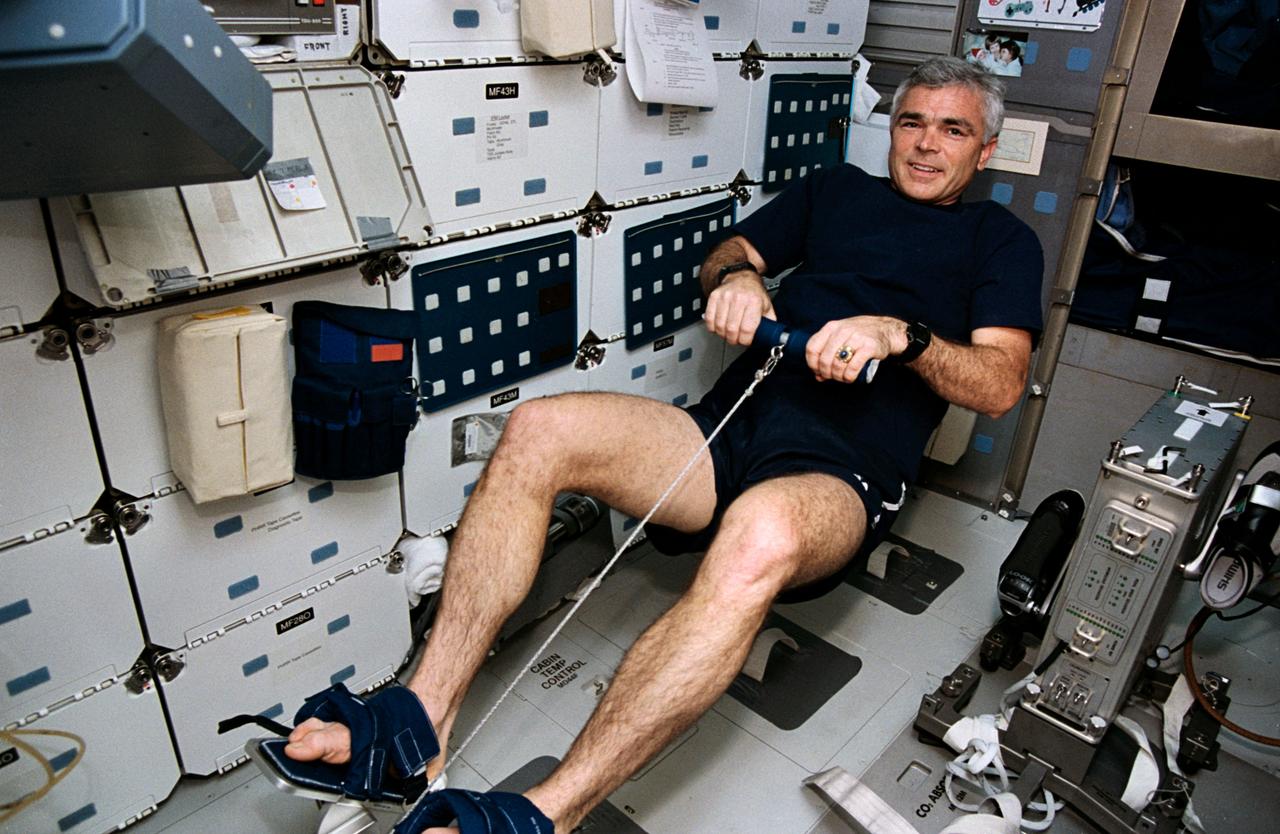
STS059-11-014 (9-20 April 1994) --- Astronaut Michael R. (Rich) Clifford, mission specialist, uses the rowing machine temporarily deployed on the Space Shuttle Endeavour's middeck. Many of the crew members put in time on the device during the week and a half mission.
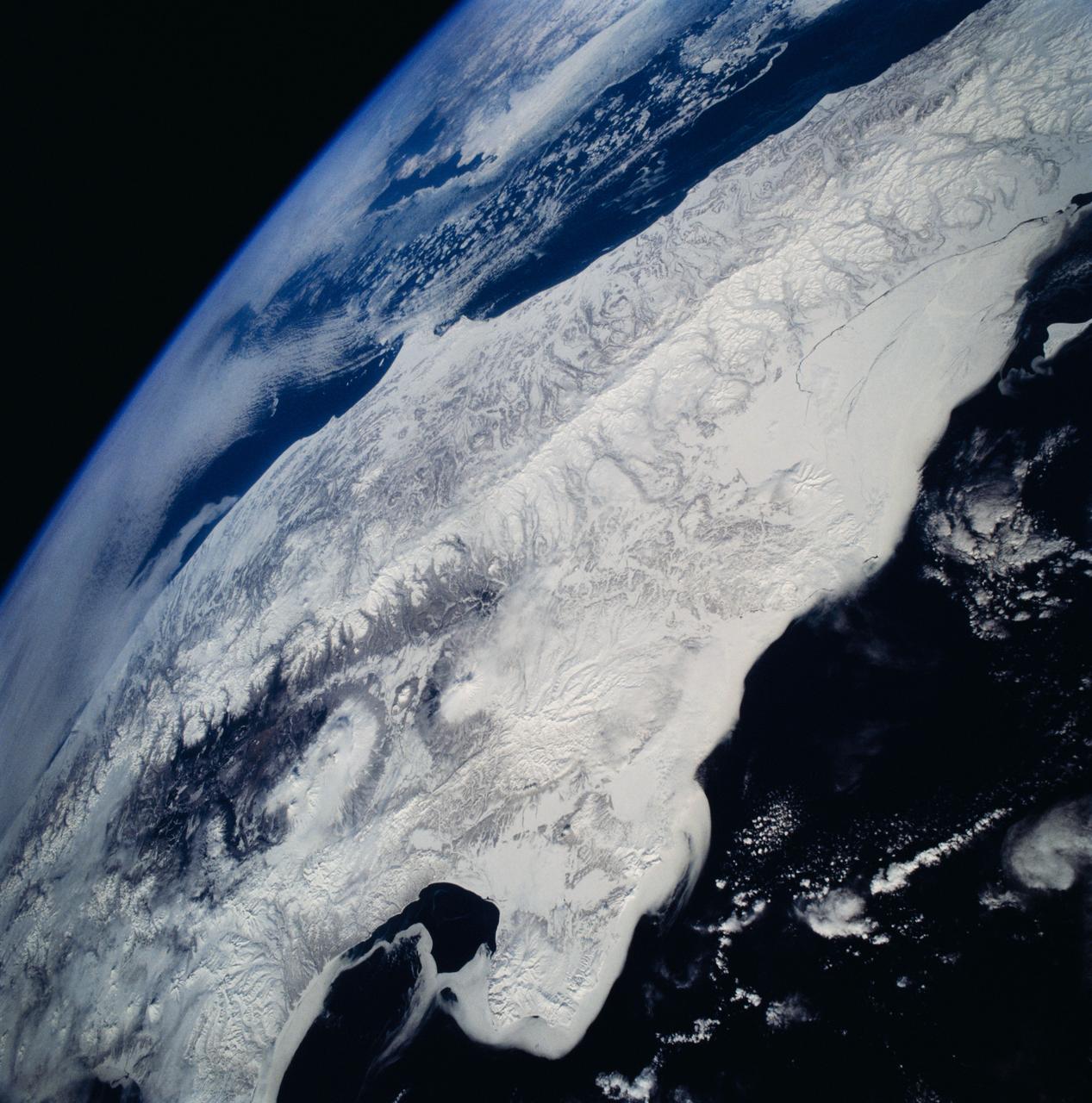
STS059-81-095 (9-20 April 1994) --- View southwestward across the Kamchatka Peninsula. The cluster of volcanoes in the middle distance are active, including Klutchevskaya whose summit reaches 15,580 feet. Changes in volcanic deposits, snow, and ice are being studied by Russian and American SRL investigators. Seasonal changes in sea ice are also of interest, for example, in Kamchatskiy Bay (upper left). Hasselblad camera, 40mm lens.
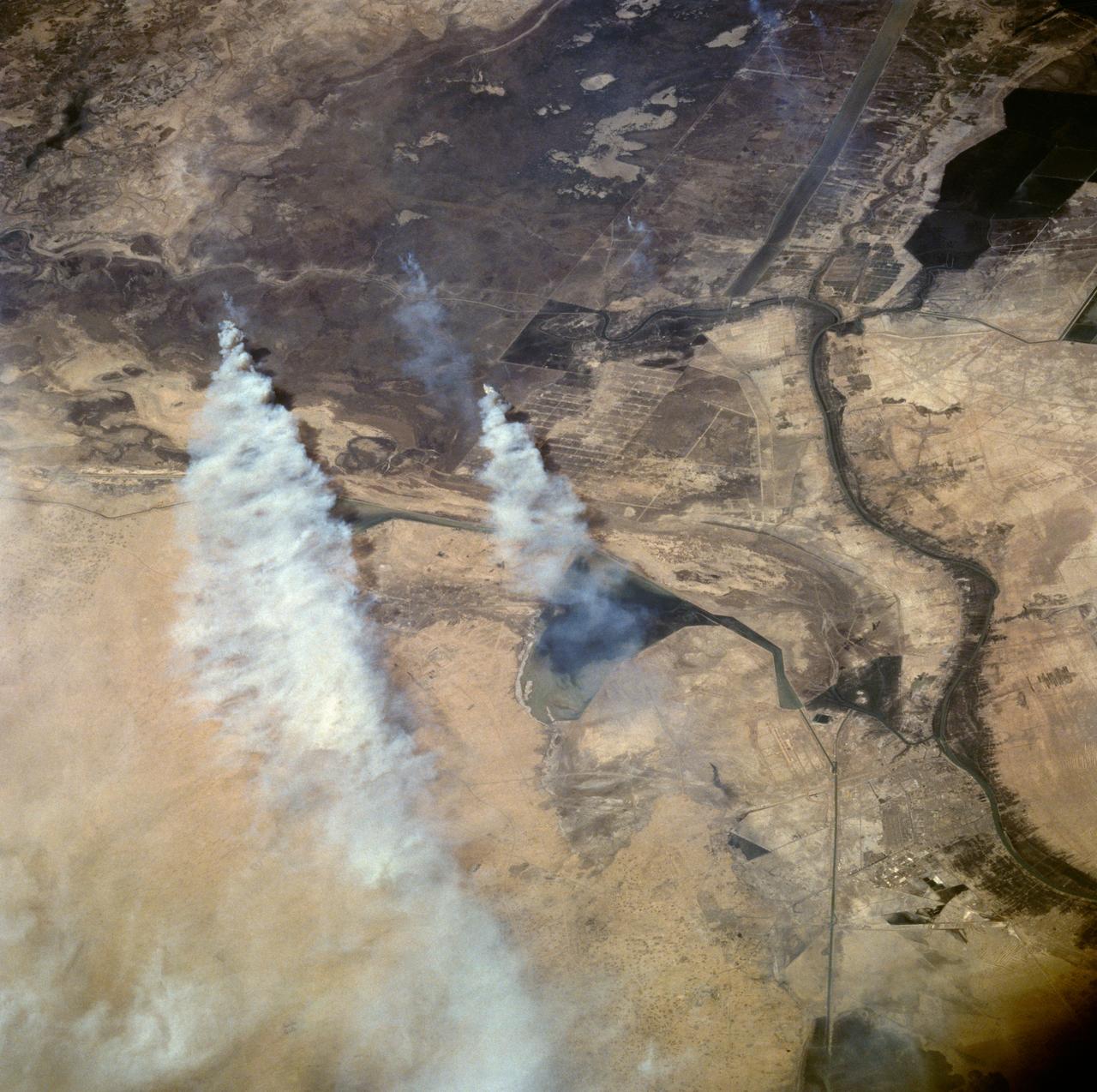
STS059-82-010 (9-20 April 1994) --- View northwestward of a small part of southeastern Iraq. The city of Basra can be seen in the lower left corner, and the former junction of the Tigris and Euphrates Rivers in the upper right. The streams have been channelized, in part to dewater and burn an extensive marsh. Hasselblad camera, 250mm lens.
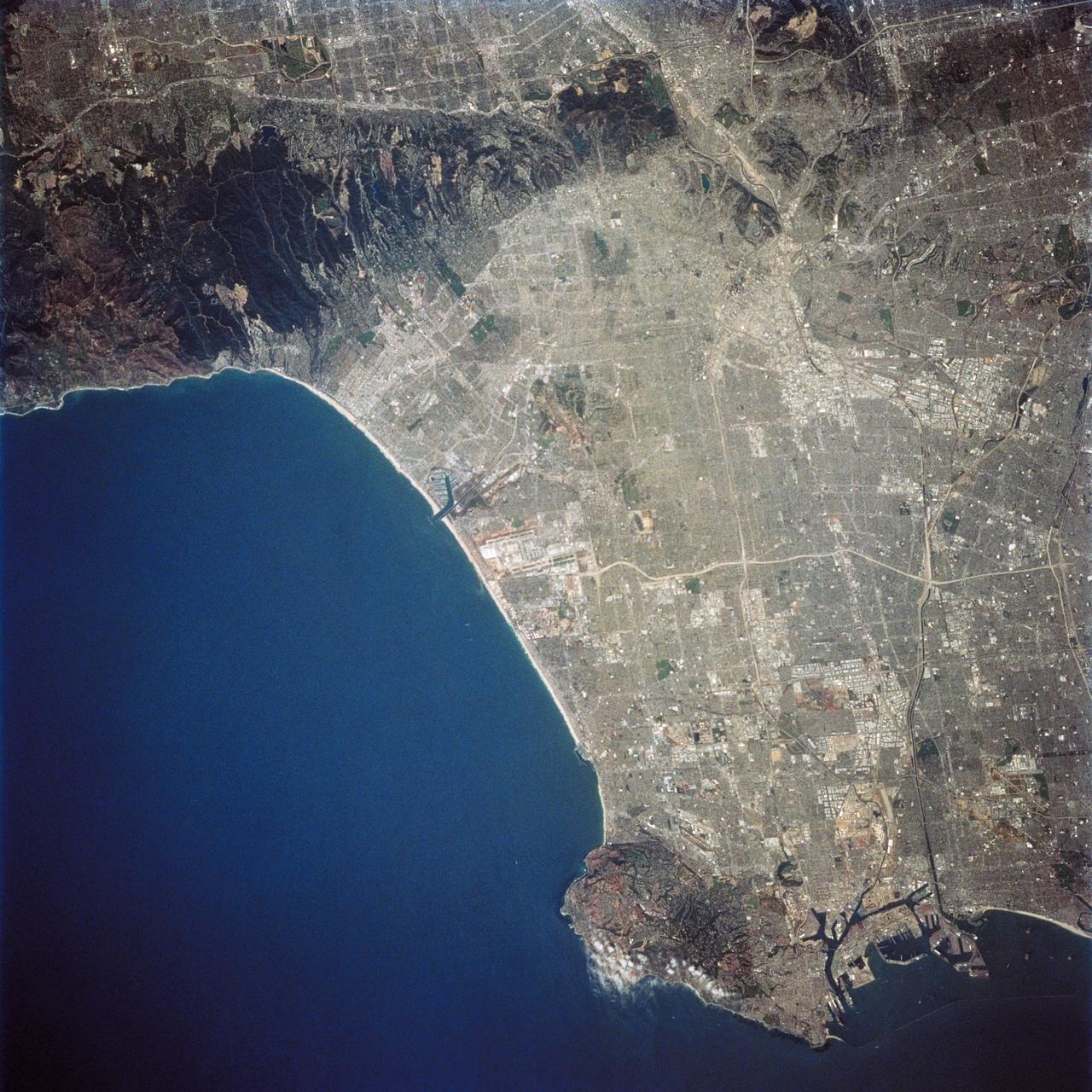
STS059-227-050 (9-20 April 1994) --- A low altitude, and unusually clear air, provided perhaps the most detailed view of Los Angeles, California ever obtained during a shuttle flight. Orient with the bulk of the ocean to the lower left. Then Long Beach is in the lower right, just east of the Palos Verdes Hills that extend into the Pacific Ocean. Marina del Rey is cut into the straight segment of beach, with Los Angeles International Airport (LAX) clearly visible to the southeast. Downtown Los Angeles is the light-toned sprawl in the upper right, with the rectangular grid pattern of Pasadena extending out of the picture. The Santa Monica Mountains to the upper left extend east-west, separating the San Fernando Valley (epicenter of the 1993 earthquake) from the Los Angeles Basin proper. It is impossible to determine by photo interpretation whether or not the de-vegetated scars along the southern edge of the mountains represent man-made features (real-estate development) or wildfires.

STS059-13-030 (9-20 April 1994) --- From the Space Shuttle Endeavour's aft flight deck, astronauts Kevin P. Chilton, pilot, and Linda M. Godwin, payload commander, monitor and photograph clouds on Earth. The two, along with four other NASA astronauts spent a week and a half aboard Endeavour in support of the Space Radar Laboratory (SRL-1)/STS-59 mission.
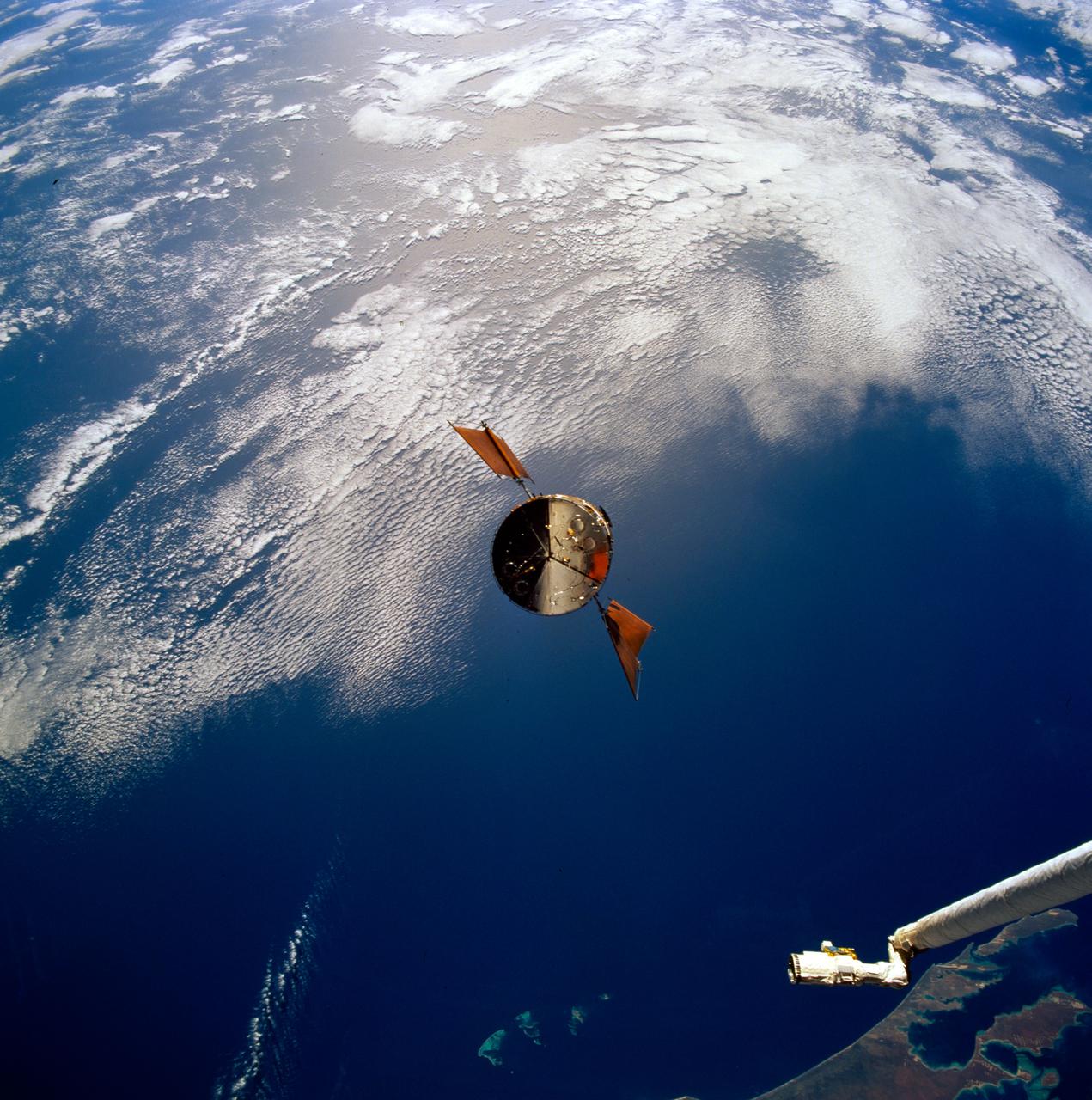
STS061-93-031 (4 Dec 1993) --- Part of the vast Indian Ocean forms the backdrop for this scene of the Hubble Space Telescope (HST) as it approaches the Space Shuttle Endeavour. Denham Sound and Shark Bay, on Australia's west coast, are just below the waiting mechanical arm at lower right corner.
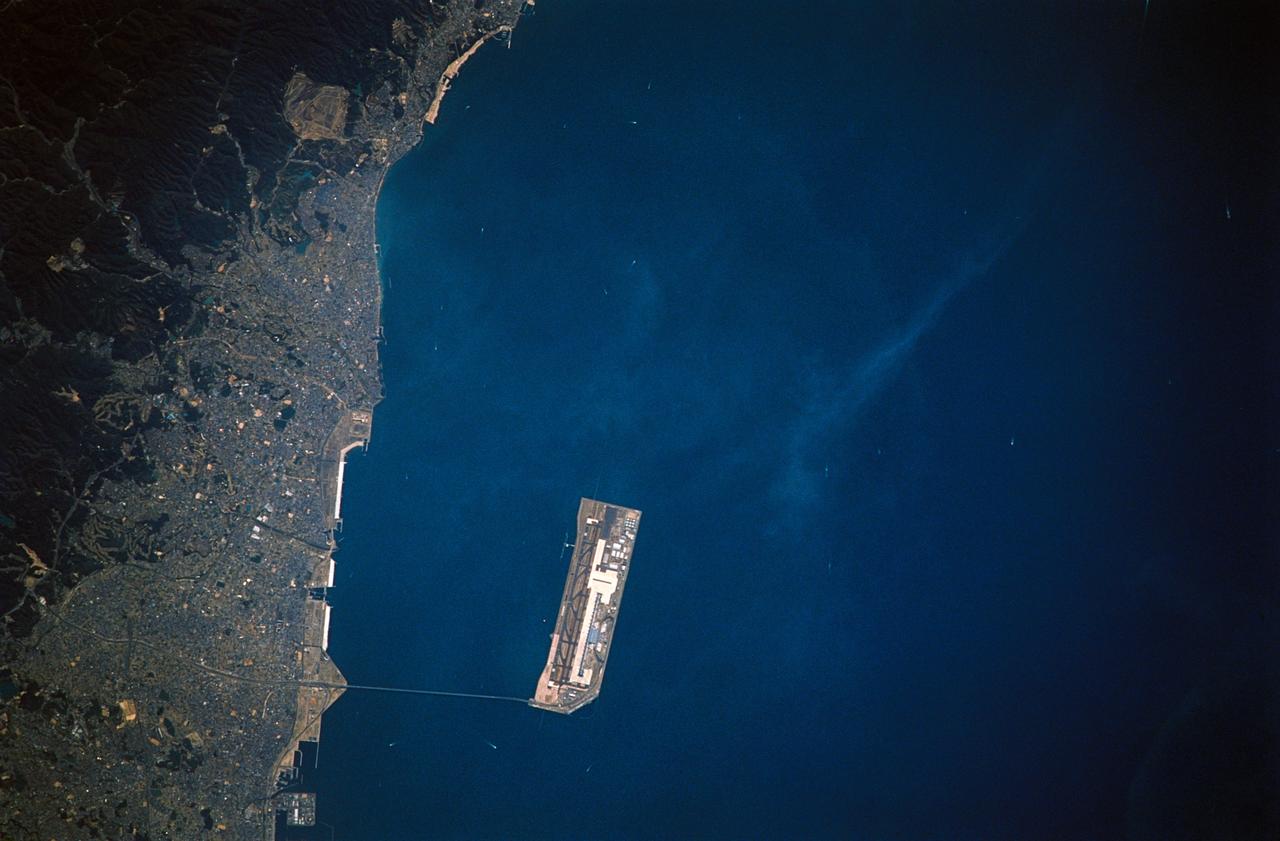
STS059-305-021 (9-20 April 1994) --- The floating airport at Osaka, Honshu, Japan. Nikon photograph, 300mm lens.
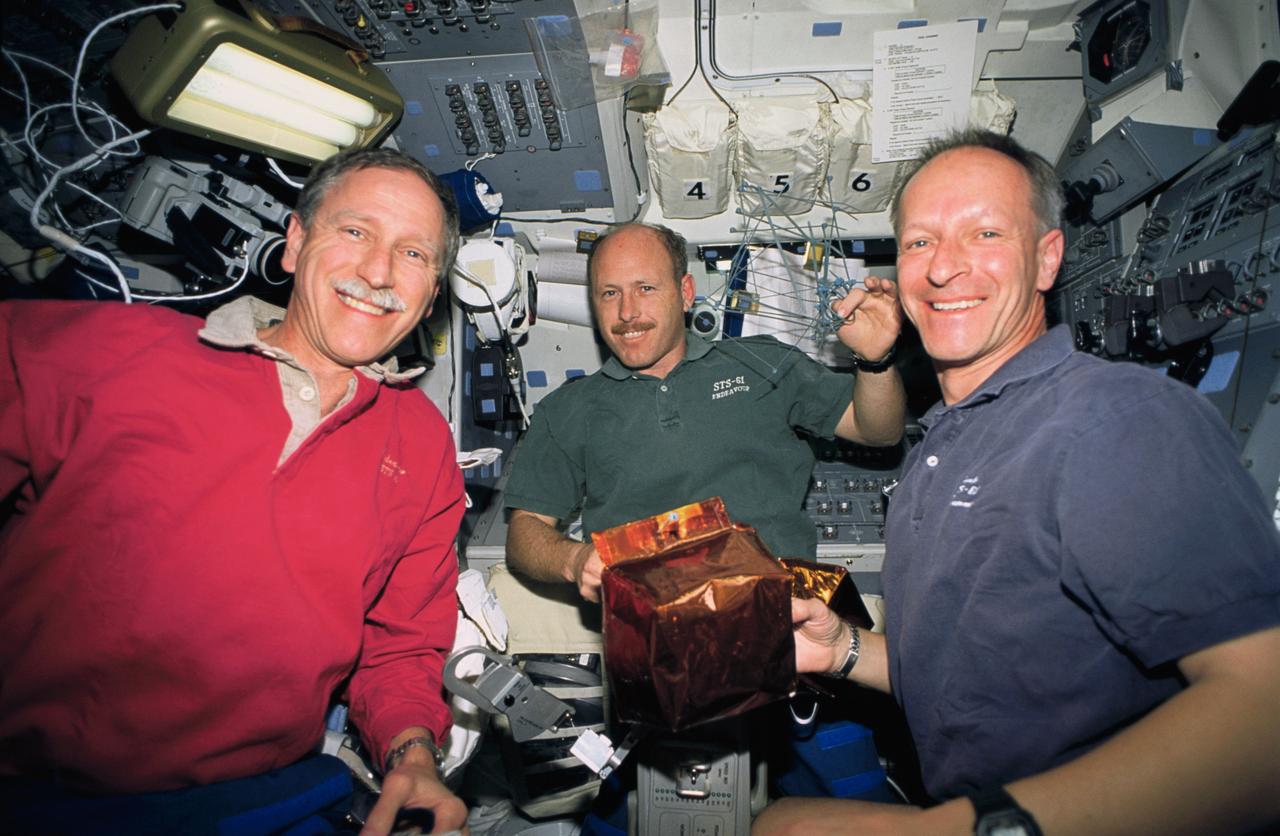
STS061-23-005 (8 Dec 1993) --- Three members of the STS-61 crew prepare covers to be placed on magnetometers near the top of the Hubble Space Telescope (HST). Left to right are Richard O. Covey, mission commander; Kenneth D. Bowersox, pilot and Claude Nicollier, mission specialist. On the following day, astronauts Jeffrey A. Hoffman and F. Story Musgrave placed the covers on the magnetometers as they wrapped up five days of servicing on HST.
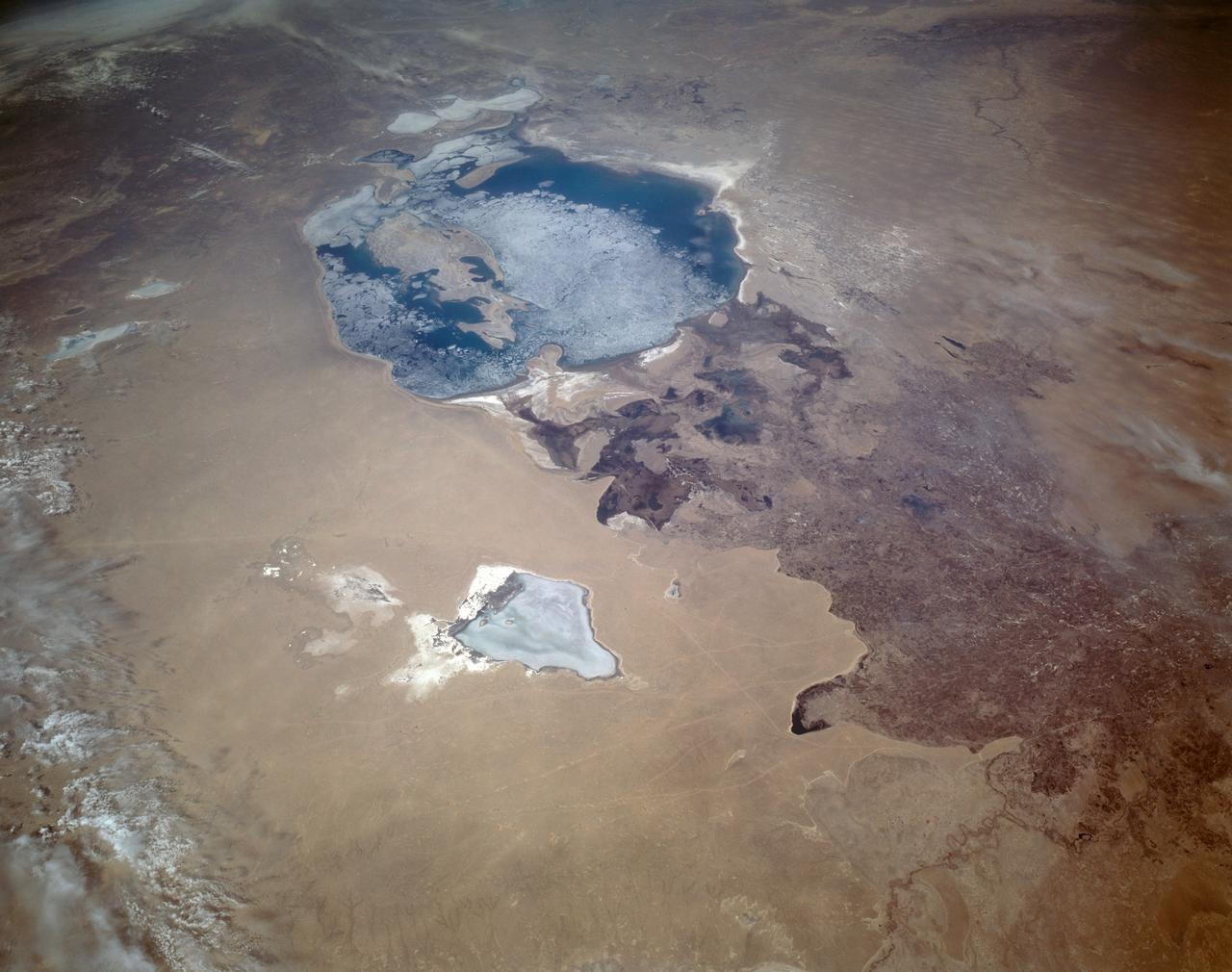
STS059-L22-140 (9-20 April 1994) --- View northeastward across Uzbekastan to the partly-ice-covered Aral Sea and Kazakhstan. The irrigated fan-delta of the Amu Darya extends from the right side of the photograph to end in extensive salt flats at the south end of the sea. The Aral was the fourth-largest inland sea or lake in the world, until diversion and over-use of the river water for irrigation led, in this arid climate, to the sea's decline. Linhof camera.
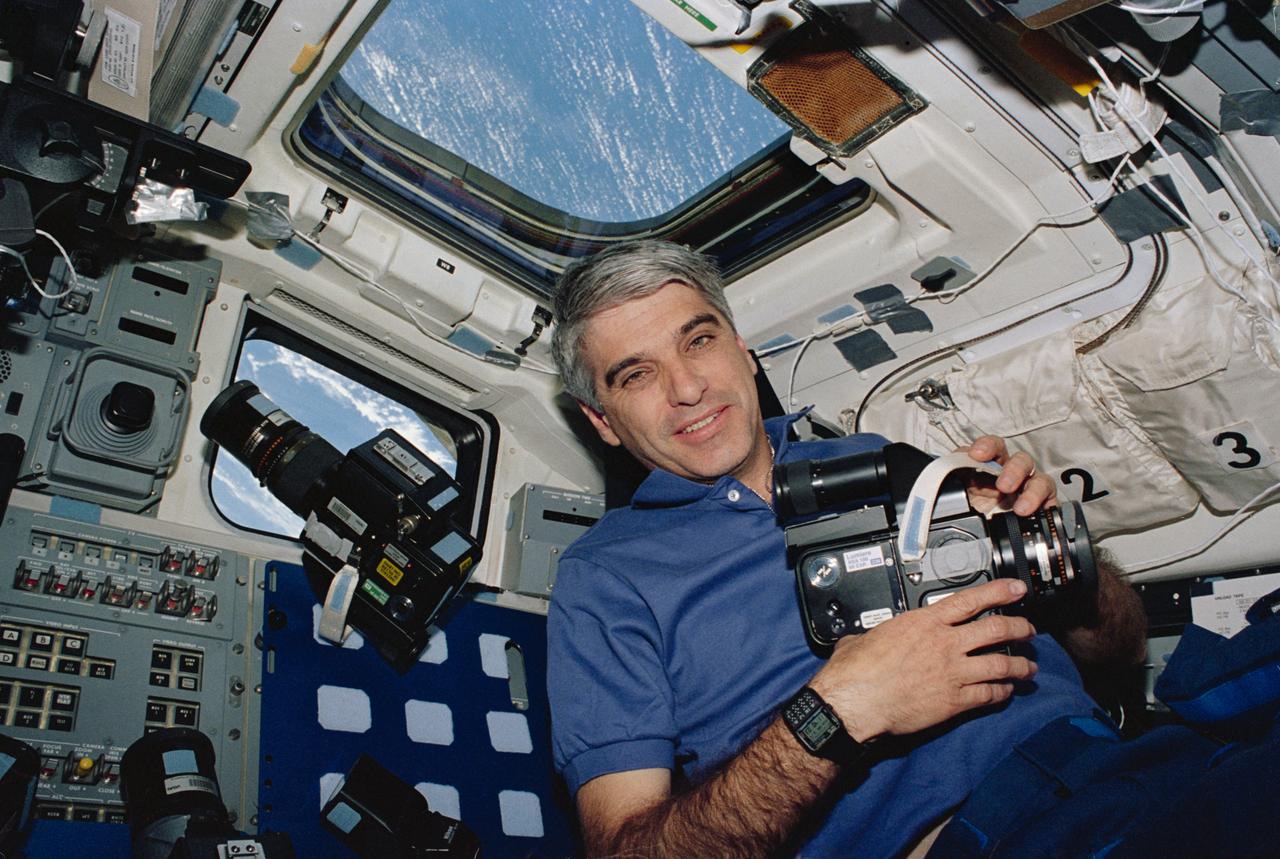
STS059-19-004 (9-20 April 1994) --- Astronaut Sidney M. Gutierrez, mission commander, pauses on the flight deck during Earth observations on the Space Shuttle Endeavour. Gutierrez, who was joined by five other NASA astronauts for 11-days in Earth orbit, holds a 70mm Hasselblad camera. The camera was one of several instruments used during the SRL mission to record an unprecedented compilation of data on planet Earth.
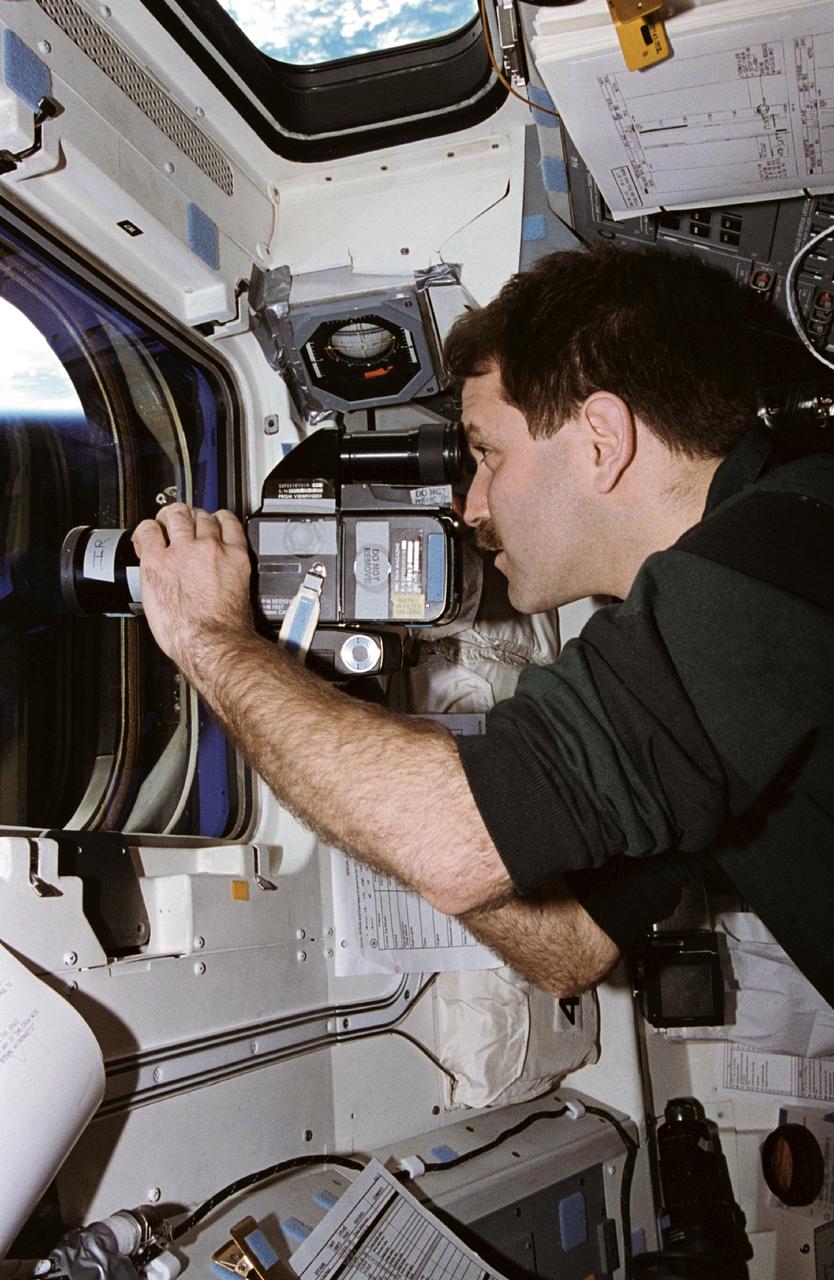
STS067-377-008 (2-18 March 1995) --- Astronaut John M. Grunsfeld, mission specialist, uses a handheld Hasselblad camera to record the Astro-2 payload. Orbiting Earth at 190 nautical miles, Grunsfeld joined four other NASA astronauts and two scientists for almost 17 days conducting research in support of the Astro-2 mission.
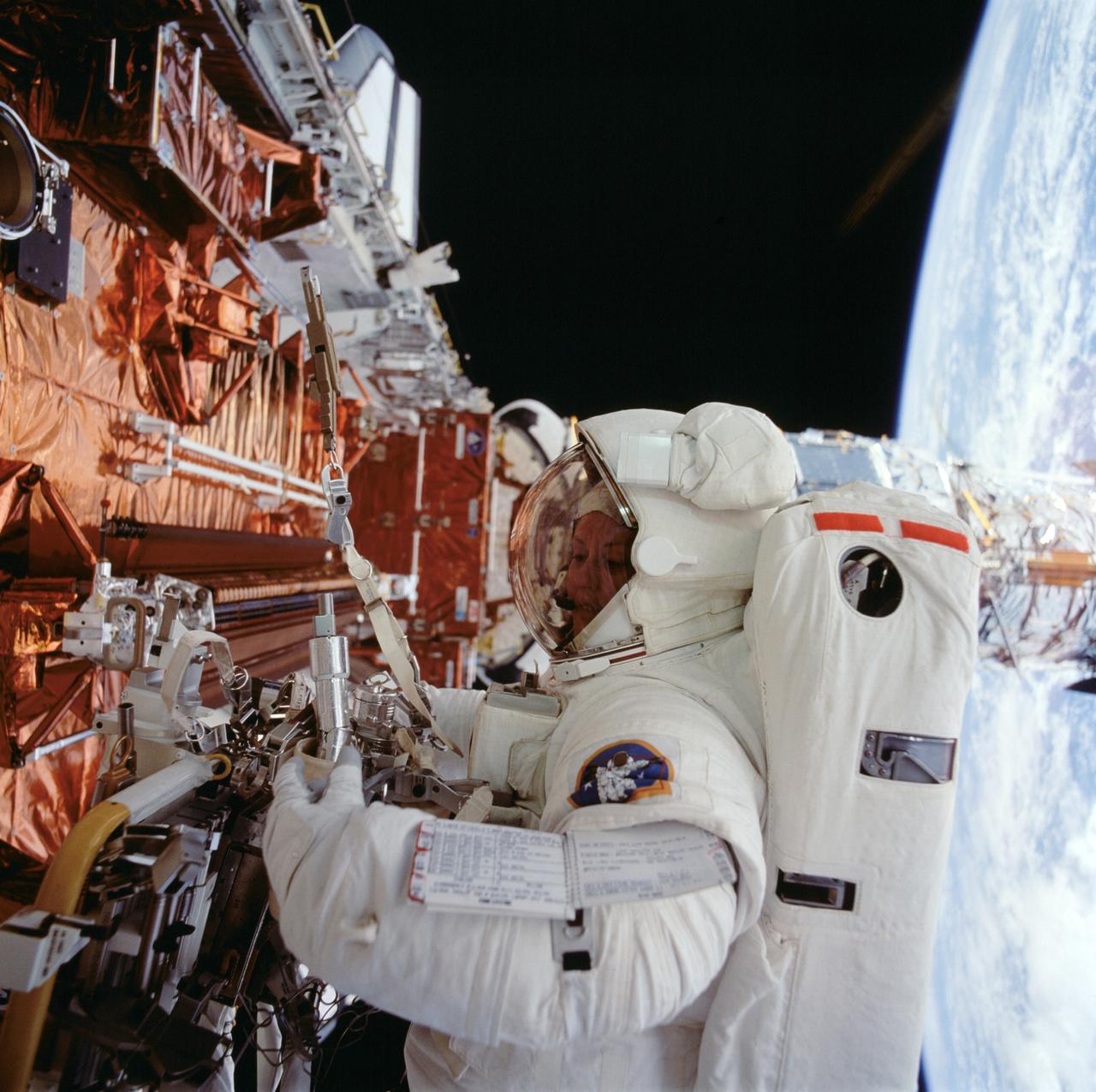
STS061-098-000K (8 Dec. 1993) --- Astronaut Kathryn C. Thornton works with equipment associated with servicing chores on the Hubble Space Telescope (HST) during the fourth extravehicular activity (EVA) on the eleven-day mission.
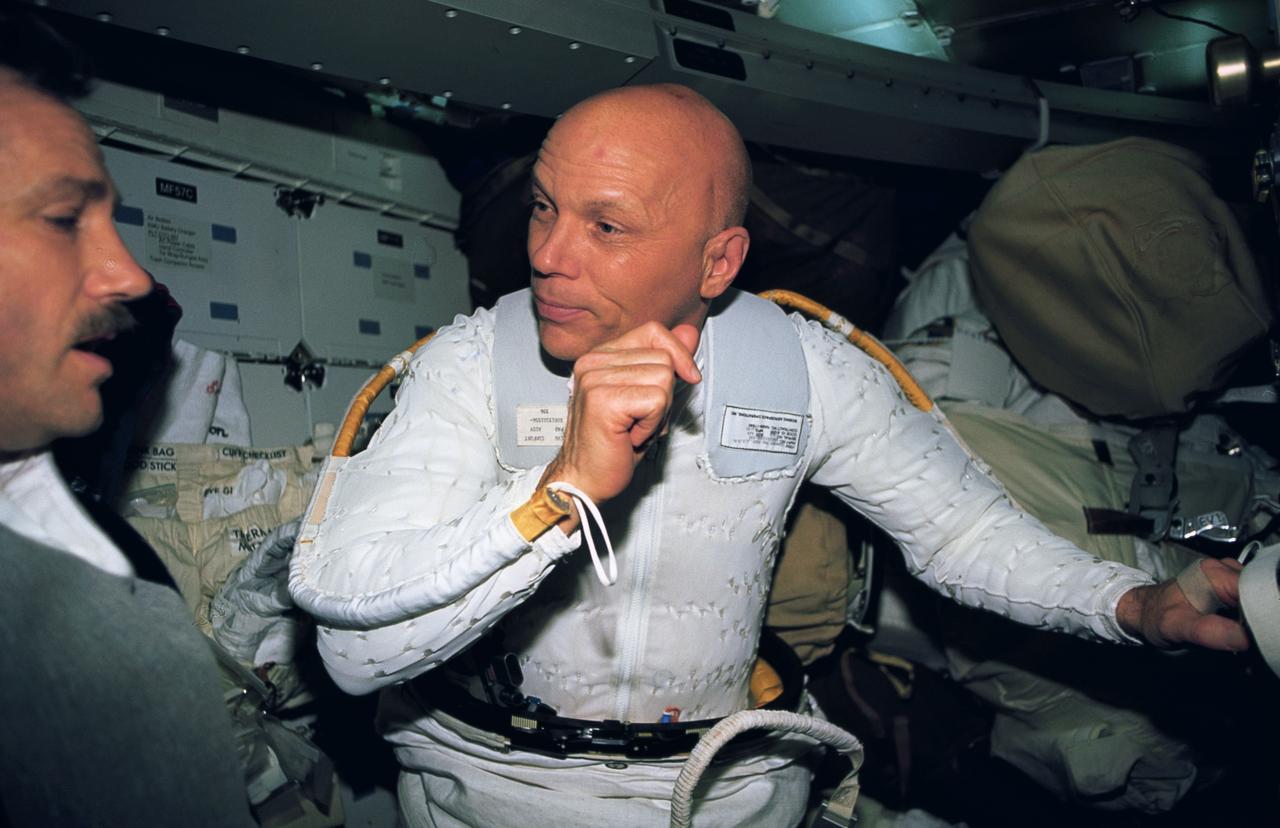
STS061-38-014 (9 Dec 1993) --- Astronaut F. Story Musgrave gets assistance from astronaut Thomas D. Akers while suiting up for the final space walk on the eleven-day, Hubble Space Telescope (HST) servicing mission. Musgrave joined astronaut Jeffrey A. Hoffman (out of frame) on three space walks, while Akers teamed with astronaut Kathryn D. Thornton for two.
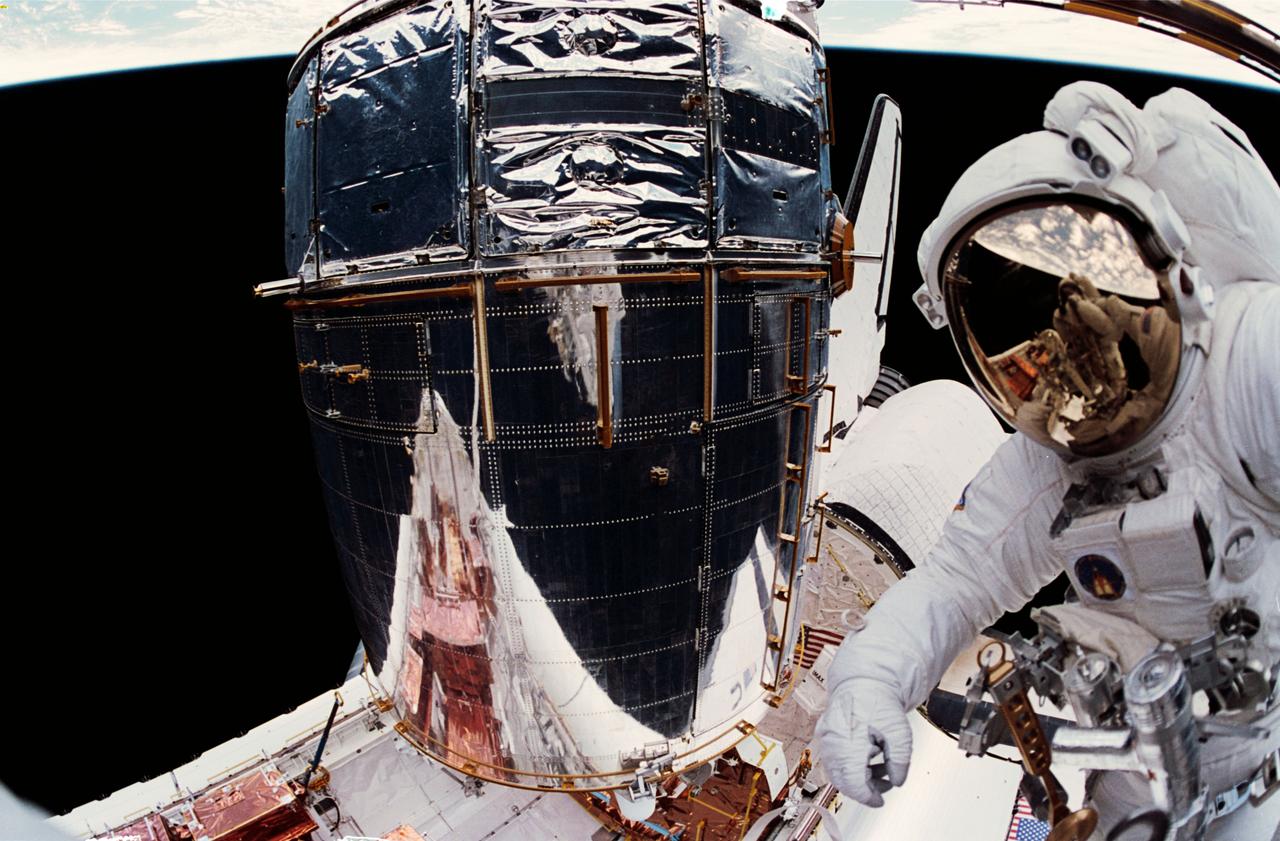
STS061-65-009 (2-13 Dec 1993) --- Astronaut Jeffrey A. Hoffman is reflected in the helmet visor of F. Story Musgrave as he photographs the veteran astronaut during one of the pair's three-shared extravehicular activity?s (EVA).
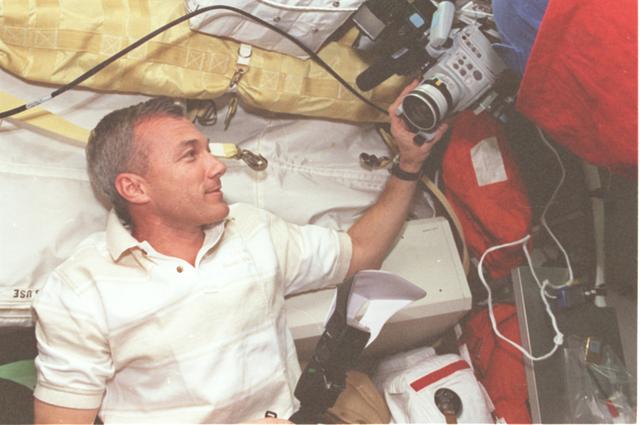
STS089-364-019 (22-31 Jan. 1998) --- Astronaut Terrence W. (Terry) Wilcutt, STS-89 mission commander, adjusts a camcorder onboard the Earth-orbiting space shuttle Endeavour. The Primary Life Support System (PLSS) for an Extravehicular Mobility Unit (EMU) is stored nearby. Though no extravehicular activity (EVA) was planned for the nine-day mission, the EMU spacesuit was carried onboard in the event a contingency EVA was required. Photo credit: NASA
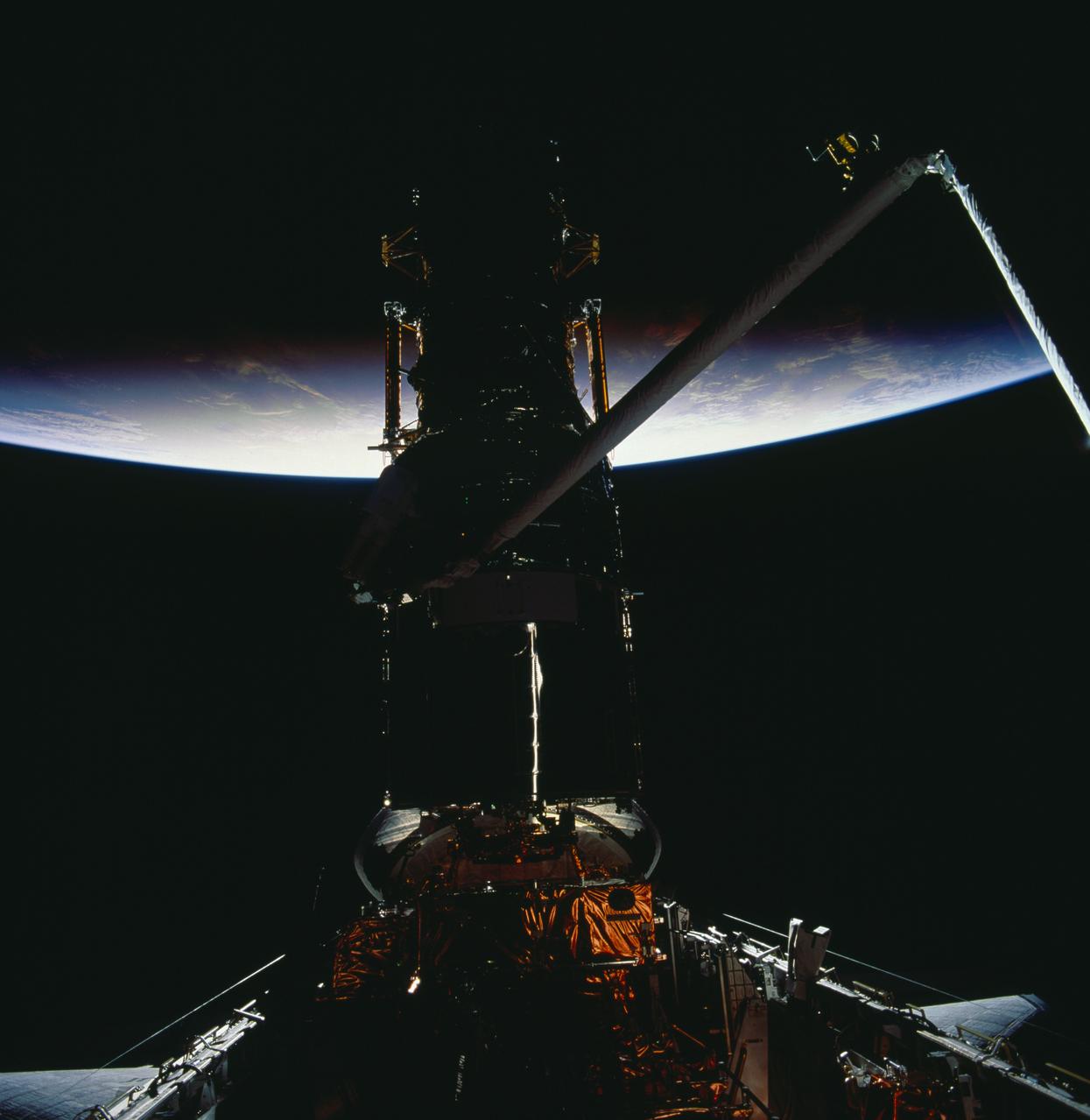
STS061-98-0AR (8 Dec 1993) --- Earth is partially illuminated but the Hubble Space Telescope (HST) and the Space Shuttle Endeavour are still mostly in darkness, in this 70mm frame photographed during the fourth of five space walks. Astronaut Kathryn C. Thornton, barely visible above left center in the frame, works to install the Corrective Optics Space Telescope Axial Replacement (COSTAR).
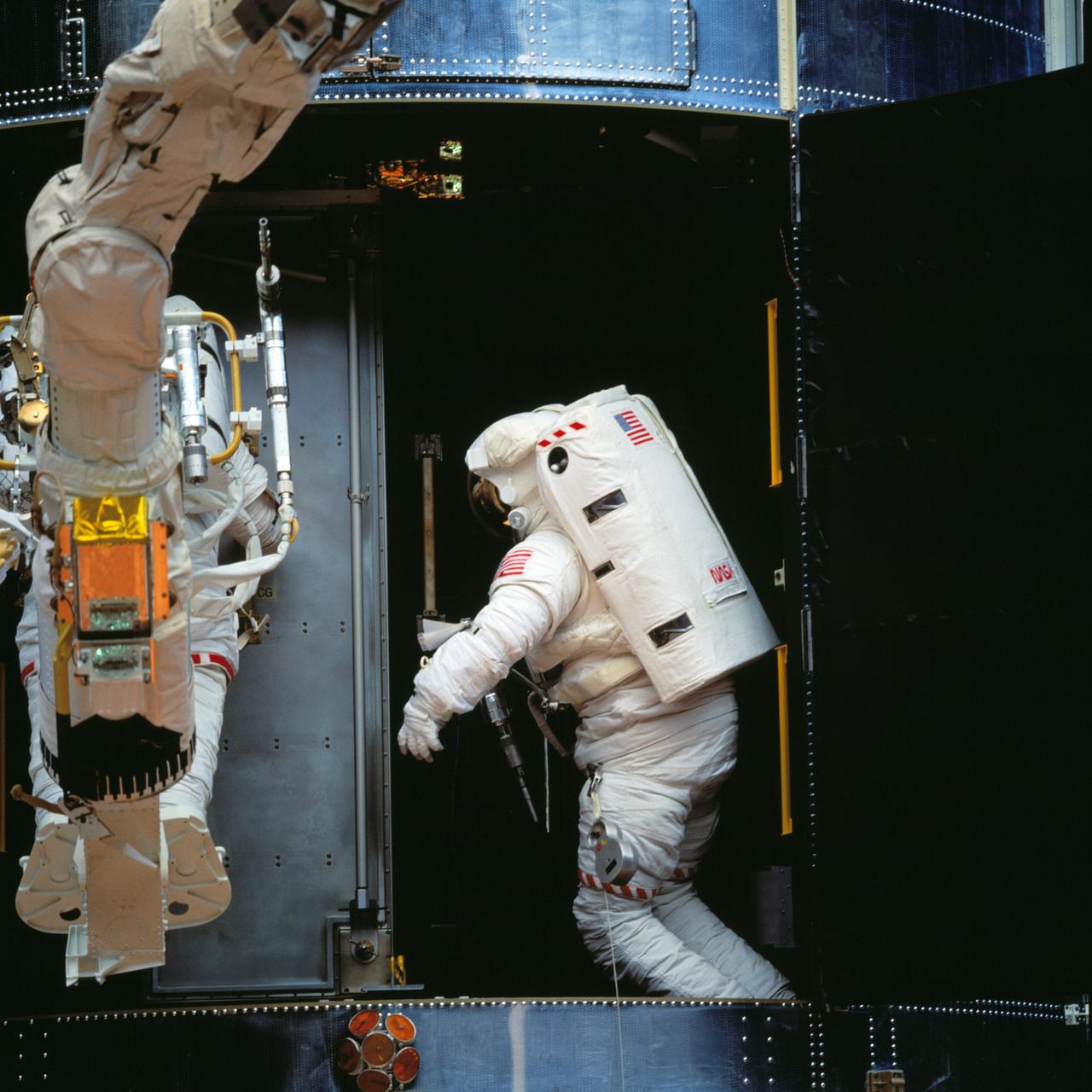
STS061-94-059 (8 Dec. 1993) --- Astronaut Thomas D. Akers maneuvers inside the bay which will house the Corrective Optics Space Telescope Axial Replacement (COSTAR) while assisting astronaut Kathryn C. Thornton with the installation of the 640-pound instrument. Thornton, anchored on the end of the Remote Manipulator System (RMS) arm, is partially visible as she prepares to install the COSTAR.
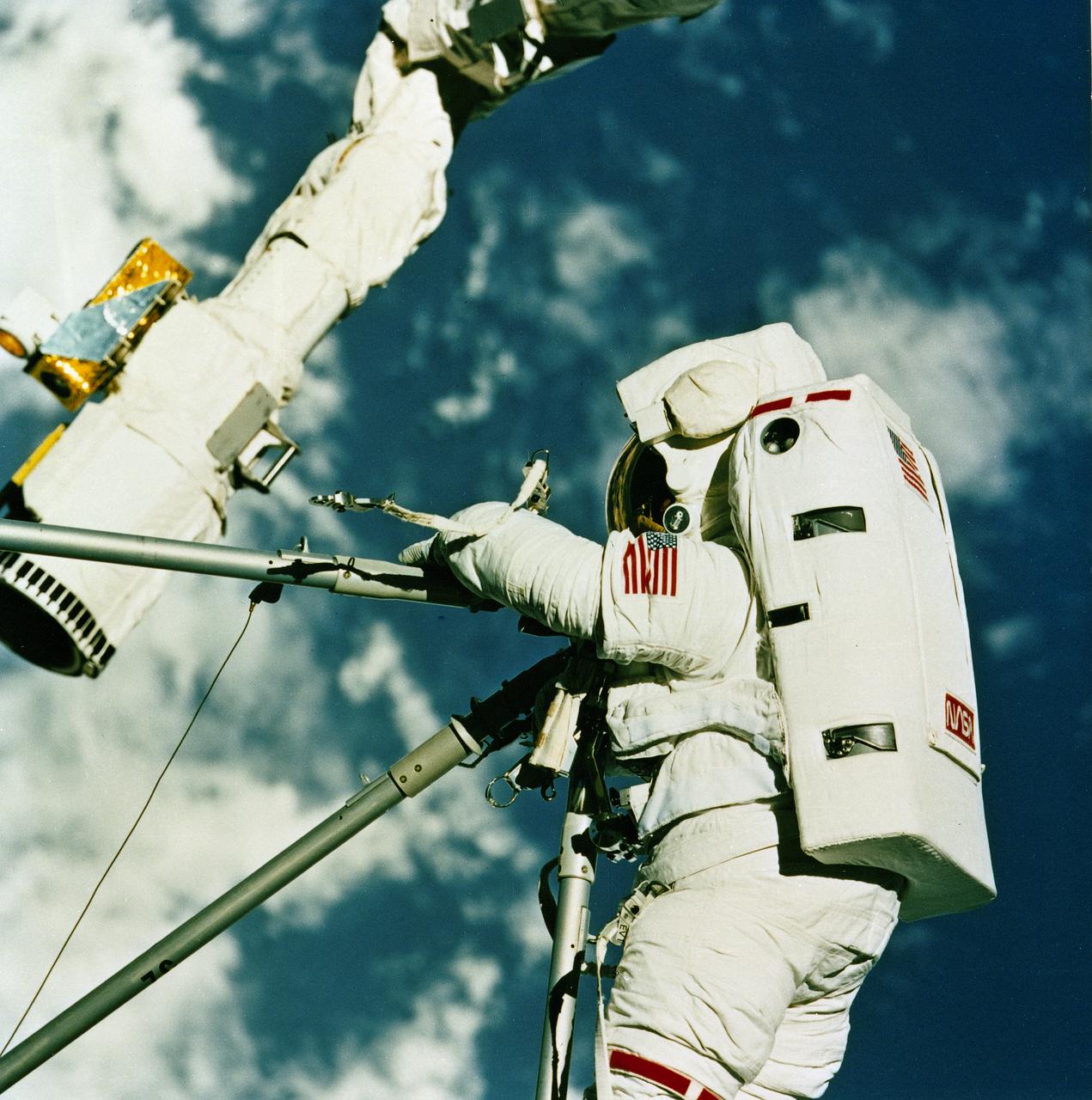
STS-49, the first flight of the Space Shuttle Orbiter Endeavour, lifted off from launch pad 39B on May 7, 1992 at 6:40 pm CDT. The STS-49 mission was the first U.S. orbital flight to feature 4 extravehicular activities (EVAs), and the first flight to involve 3 crew members working simultaneously outside of the spacecraft. The primary objective was the capture and redeployment of the INTELSAT VI (F-3) which was stranded in an unusable orbit since its launch aboard the Titan rocket in March 1990. In this STS-49 onboard photo, Astronaut Kathryn Thornton joins three struts together during her Extra Vehicular Activity (EVA).
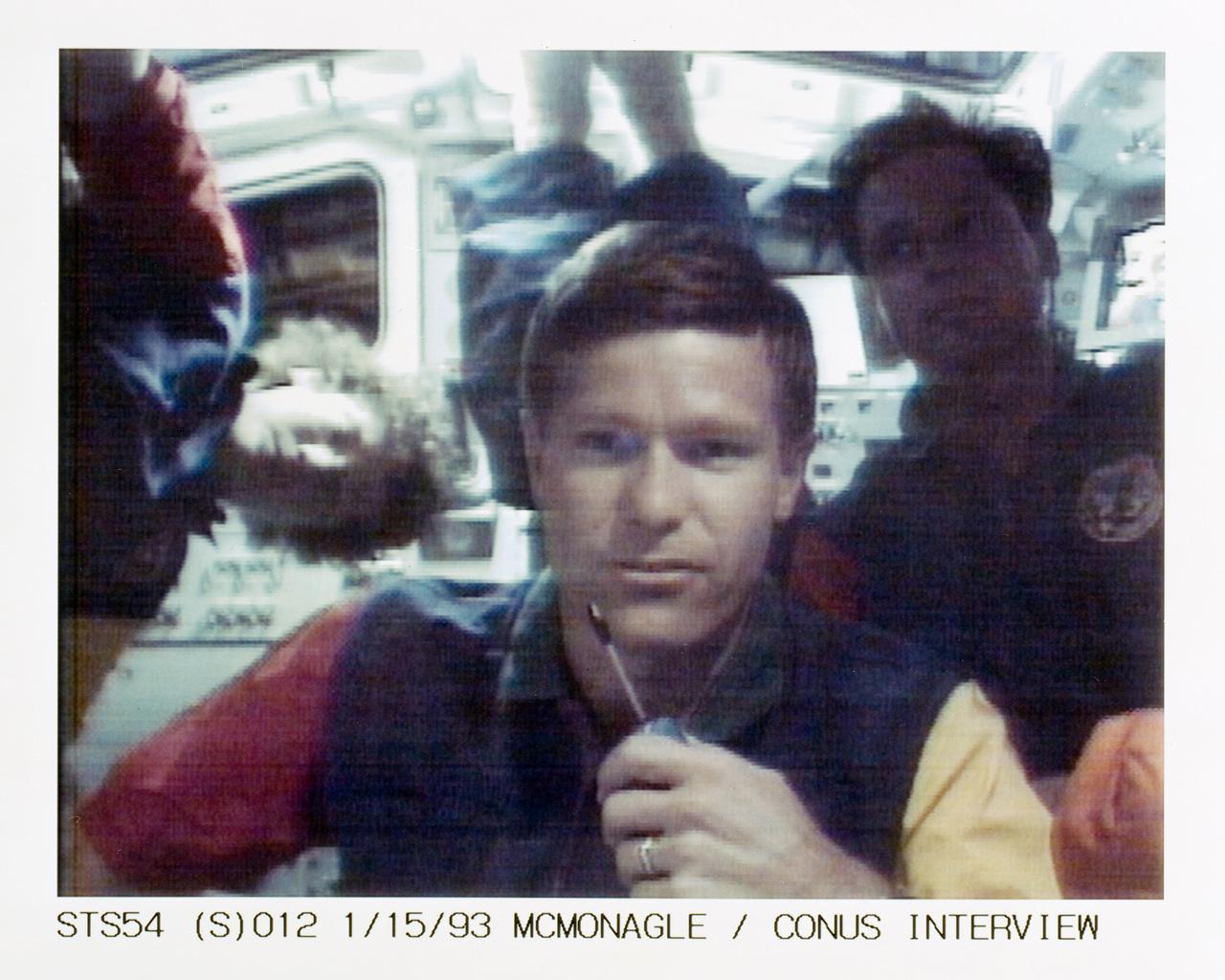
STS054-S-012 (15 Jan 1993) --- McMonagle talks to a radio station from the flight deck of Endeavour while, in the background, several crewmates await their turns to communicate with other stations. The scene was recorded at 13:54:14:13 GMT, Jan. 15, 1993.
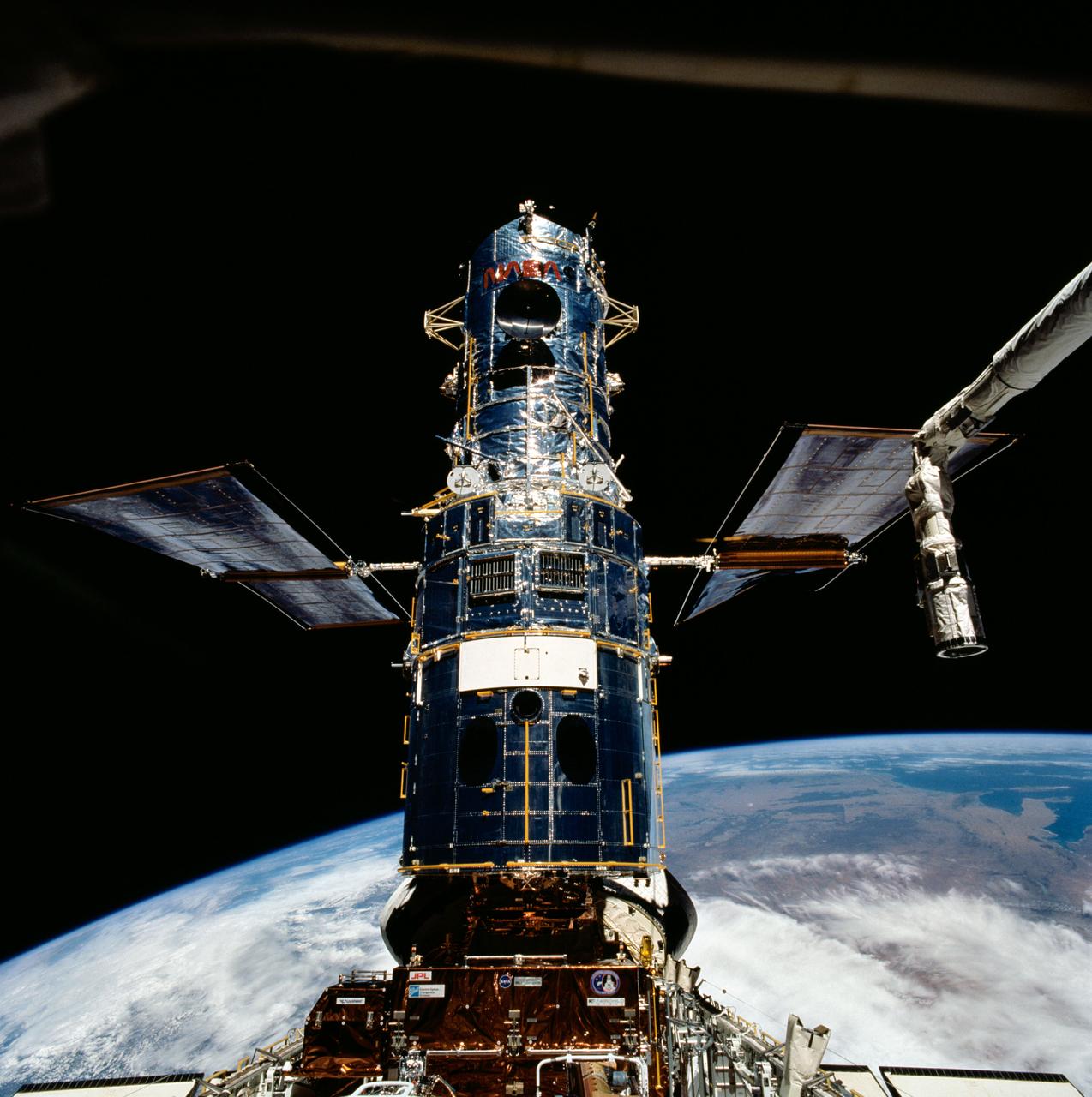
STS061-86-030 (4 Dec 1993) --- The Hubble Space Telescope (HST) is pictured in the Space Shuttle Endeavour's cargo bay following its capture and berthing early in the eleven-day STS-61 mission. The Remote Manipulator System (RMS) arm, with television cameras mounted on it, was maneuvered from inside the cabin in order to survey HST. Five days of space walks followed, during which a variety of servicing tasks were performed by four crew members.
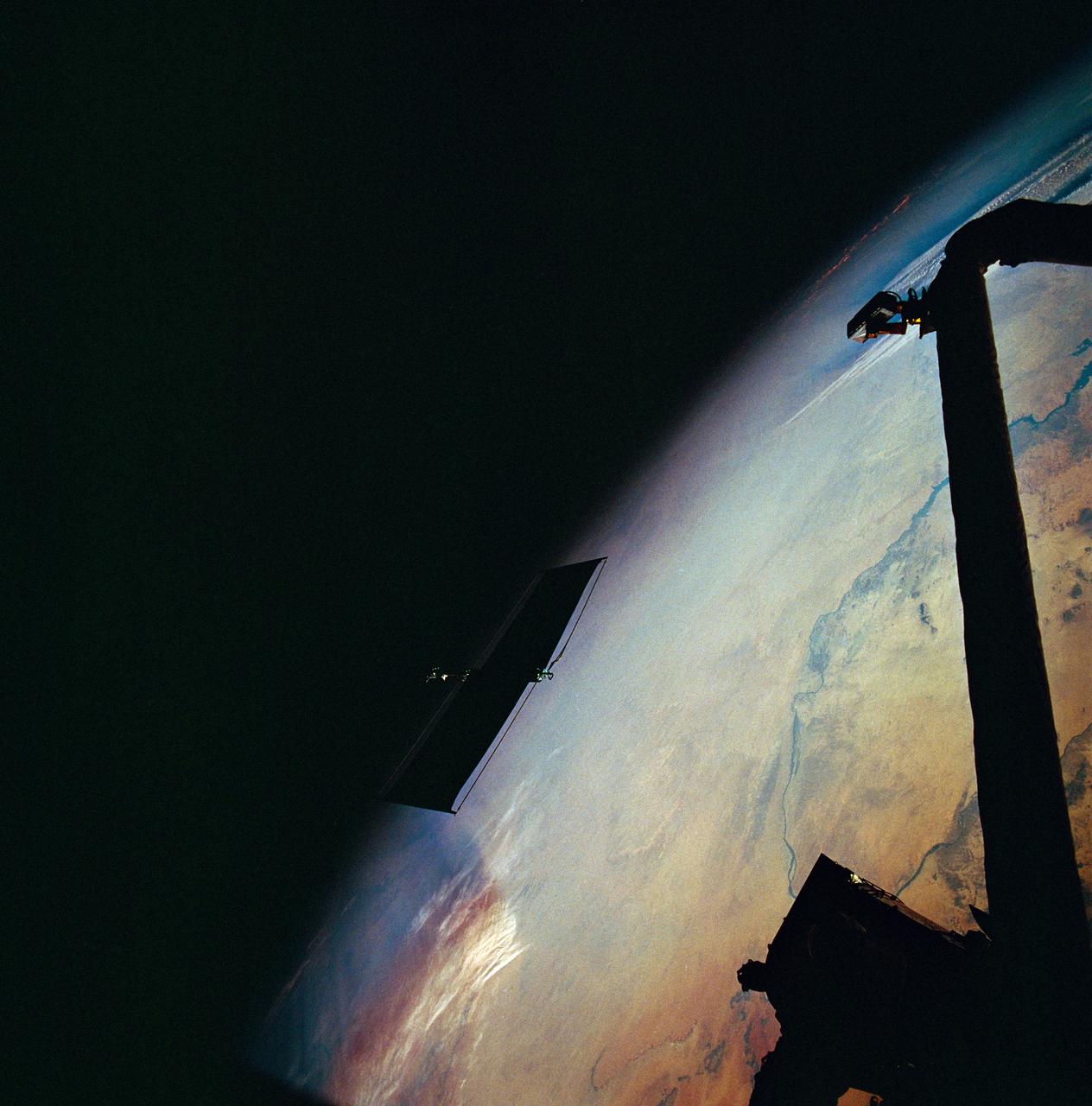
STS061-95-031 (6 Dec 1993) --- The damaged solar array panel removed from the Hubble Space Telescope (HST) is backdropped over northern Sudan. Astronaut Kathryn C. Thornton, just out of frame at top right, watched the panel after releasing it moments earlier.
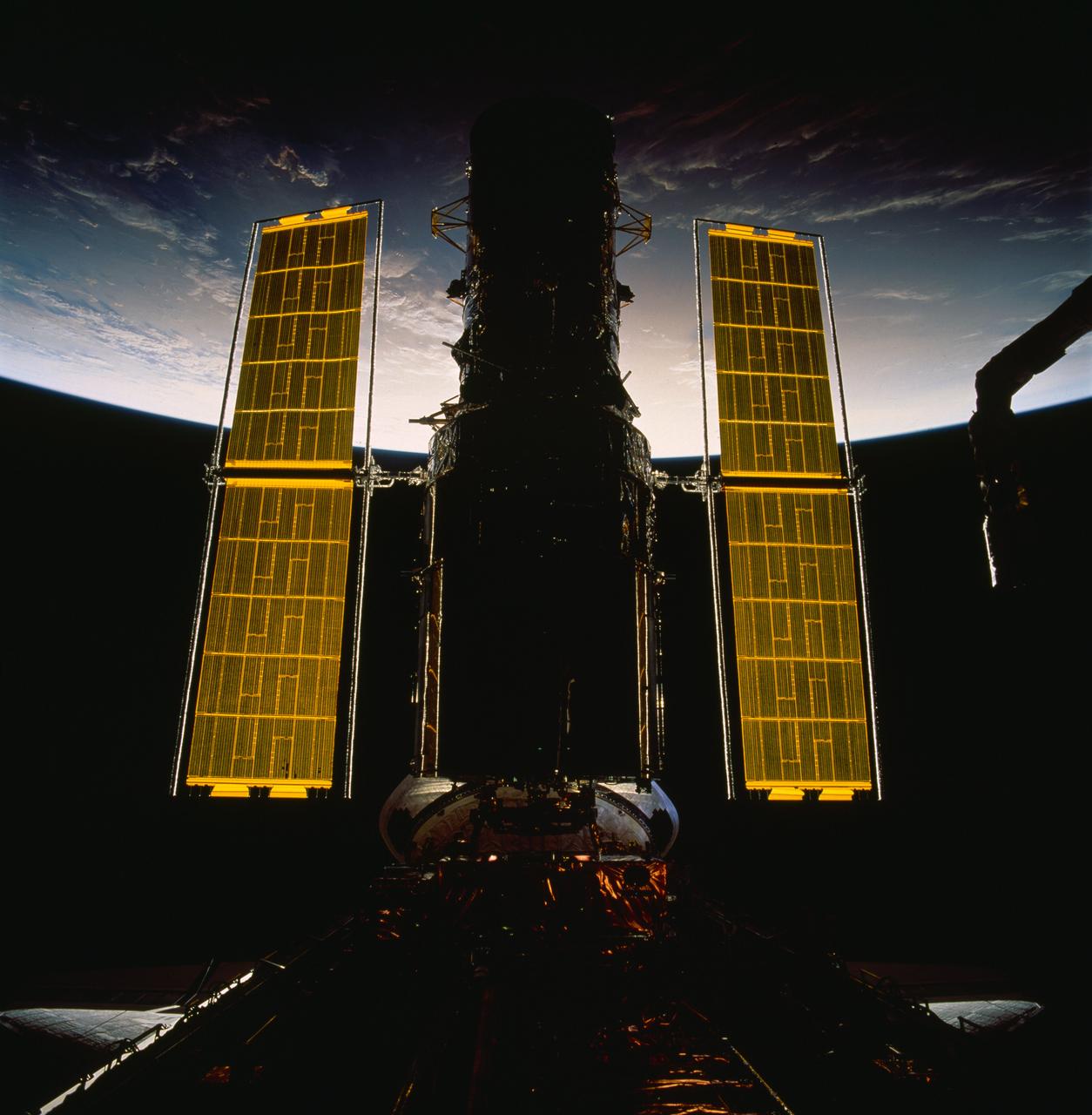
STS061-99-002 (2-13 Dec 1993) --- The new set of solar array panels deployed on the Hubble Space Telescope (HST) is backdropped against the blackness of space and a widely cloud-covered area on Earth. The 70mm frame was exposed by one of the Space Shuttle Endeavour's seven crew members on the aft flight deck.
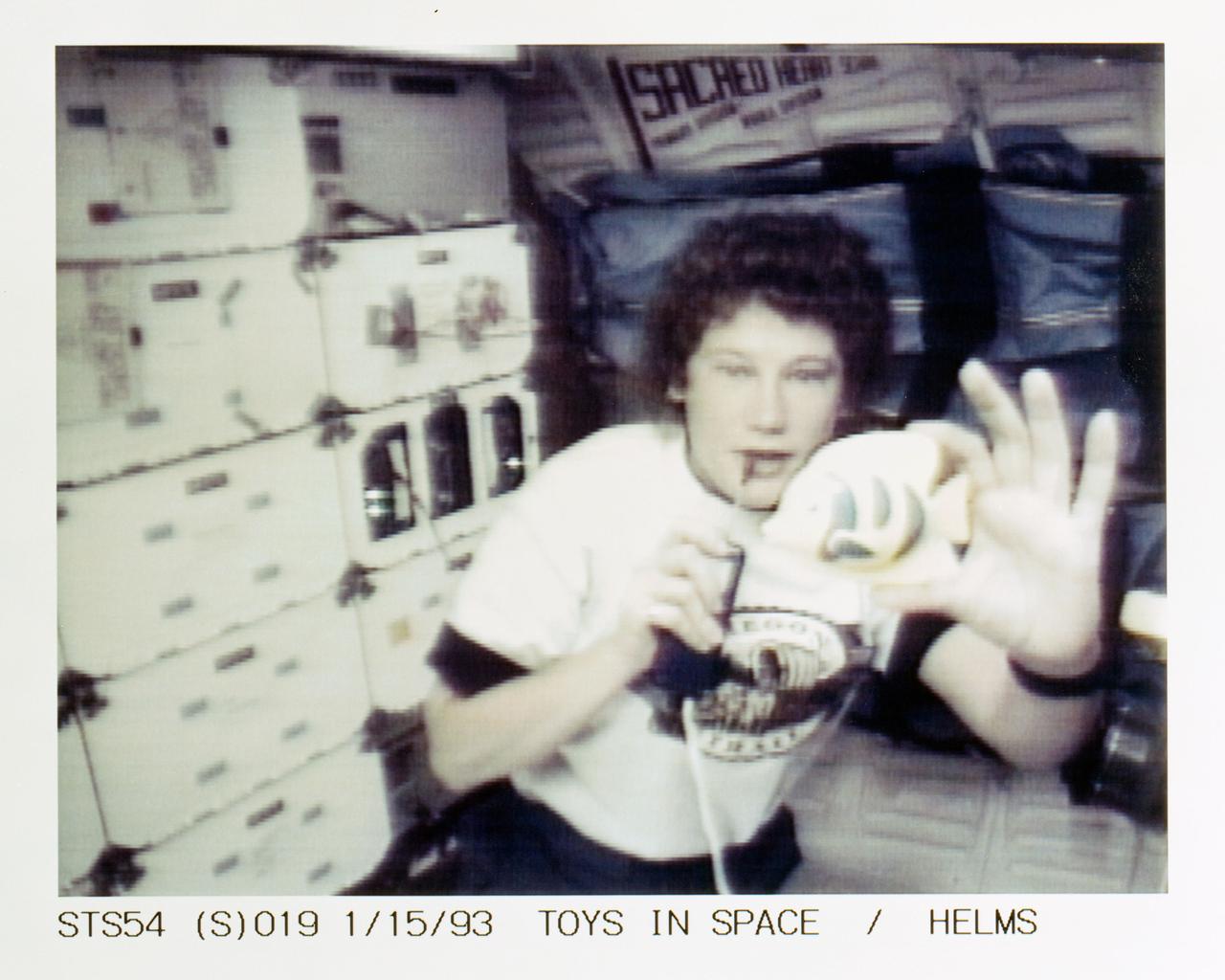
STS054-S-019 (15 Jan 1993) --- Helms with a fish toy on the middeck demonstrates some of the physics of toys to students watching on television. Four schools were chosen to ask questions of the astronauts during the lengthy program. Helms fielded questions from students at Shaver Elementary School in Portland, Oregon. The fish was used to demonstrate Newton's third law of motion and the conservation of angular momentum. The entire collection of toys will be videotaped for an educational program to be distributed to schools in the fall of this year. The scene was recorded at 17:50:08:27 GMT, Jan. 15, 1993.
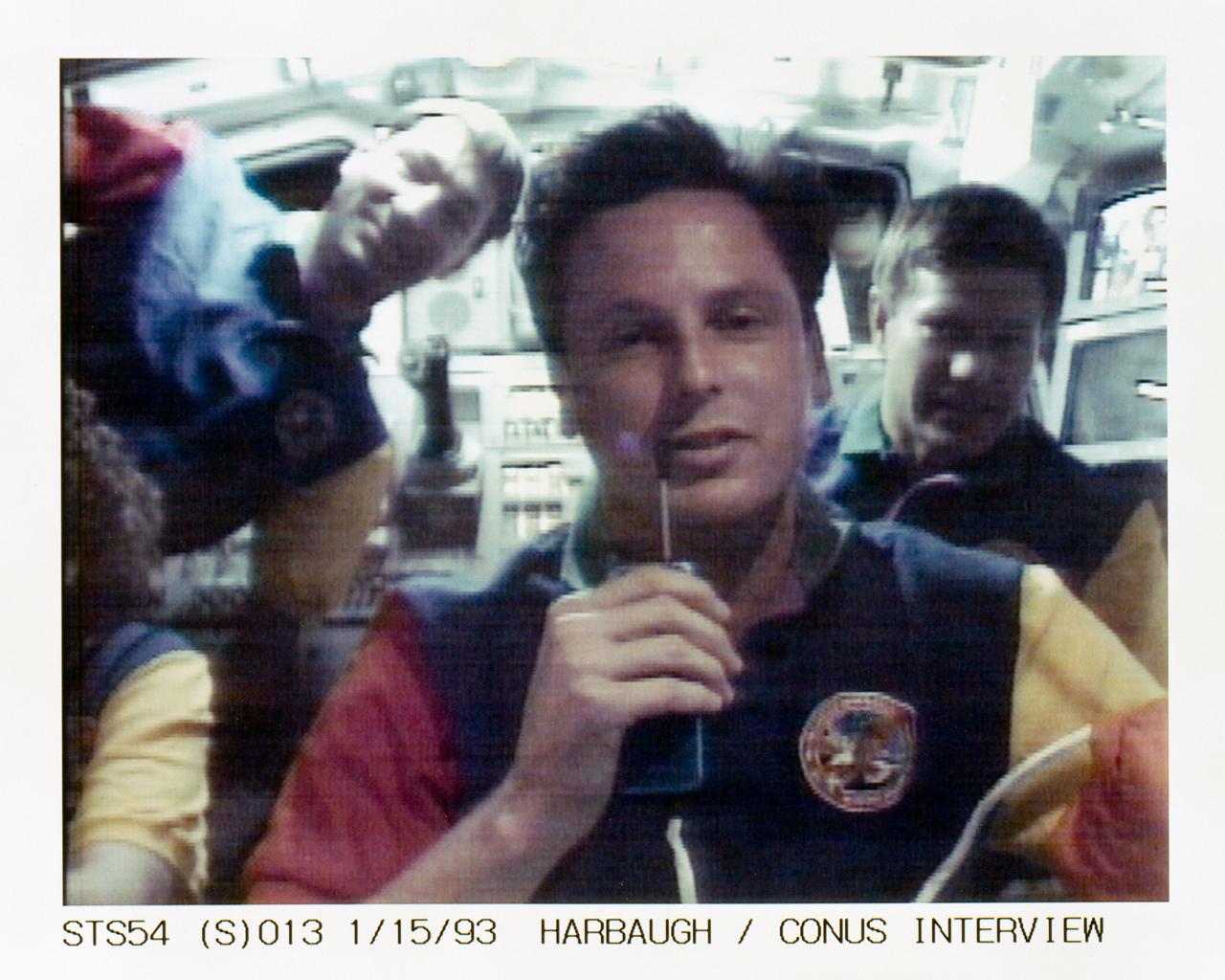
STS054-S-013 (15 Jan 1993) --- Harbaugh talks to a radio station from the flight deck of Endeavour while, in the background, several crewmates await their turns to communicate with other stations. The scene was recorded at 13:57:20:20 GMT, Jan. 15, 1993.
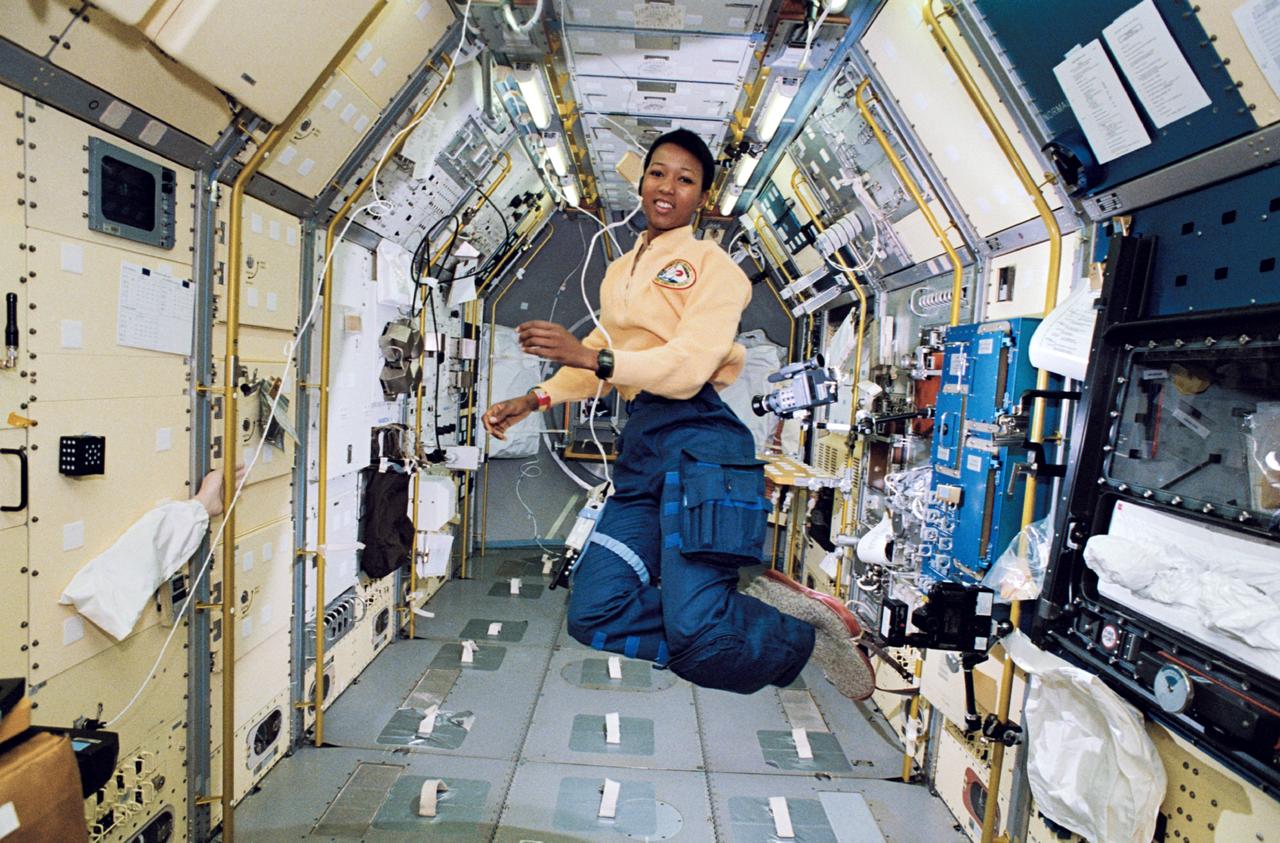
STS047-37-003 (12-20 Sept. 1992) --- Astronaut Mae C. Jemison, STS-47 mission specialist, appears to be clicking her heels in zero-gravity in this 35mm frame photographed in the Science Module aboard the Earth-orbiting Space Shuttle Endeavour. Making her first flight in space, Dr. Jemison was joined by five other NASA astronauts and a Japanese payload specialist for eight days of research in support of the Spacelab-J mission, a joint effort between Japan and the United States.
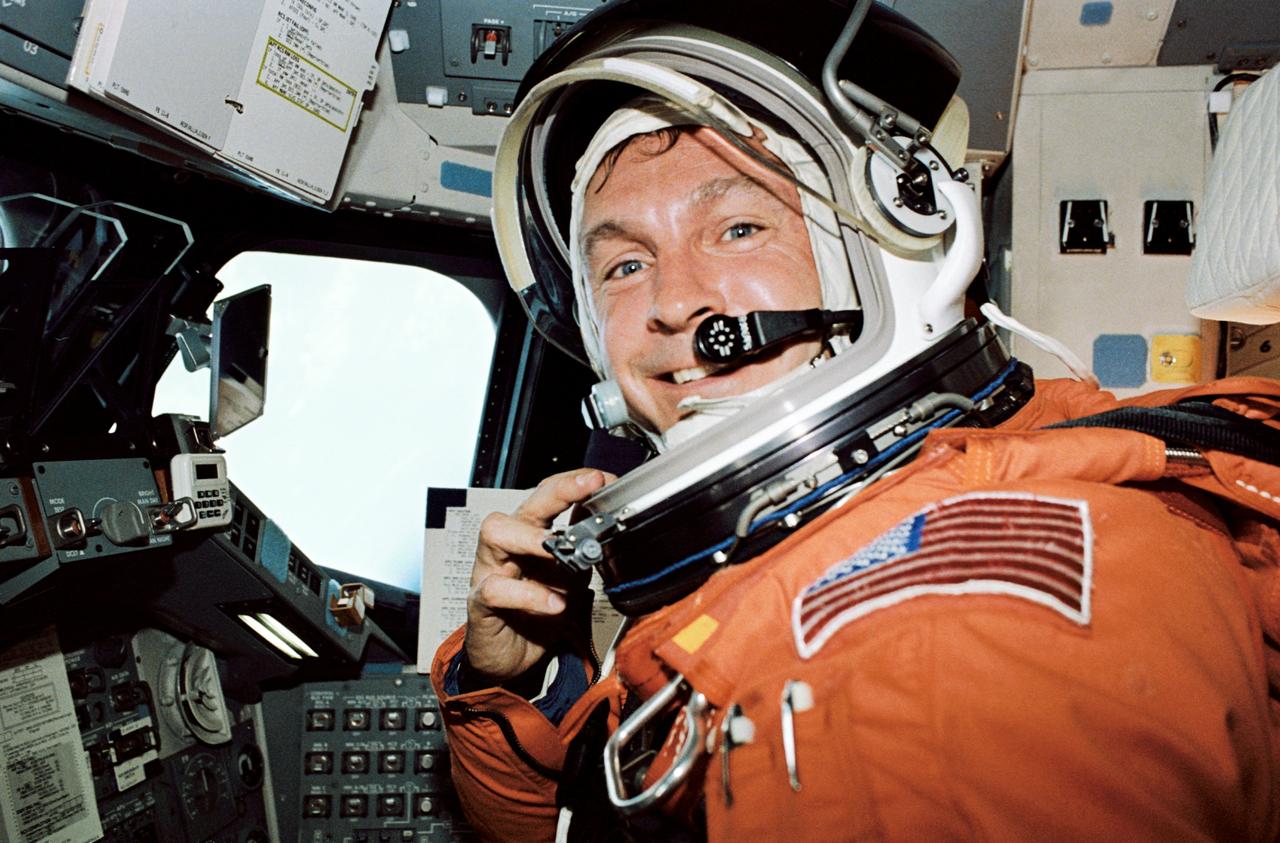
STS047-28-002 (20 Sept. 1992) --- Astronaut Curtis L. Brown, Jr., STS-47 pilot, is photographed at the Space Shuttle Endeavour's pilot station about ten minutes after main engine cutoff on launch day of the eight-day Spacelab-J mission. Wearing the partial-pressure launch and entry suit, Brown shared the forward cabin with astronaut Robert L. Gibson (out of frame at left), mission commander. Endeavour was beginning its second mission in space, this one devoted to research supporting the Spacelab-J mission.
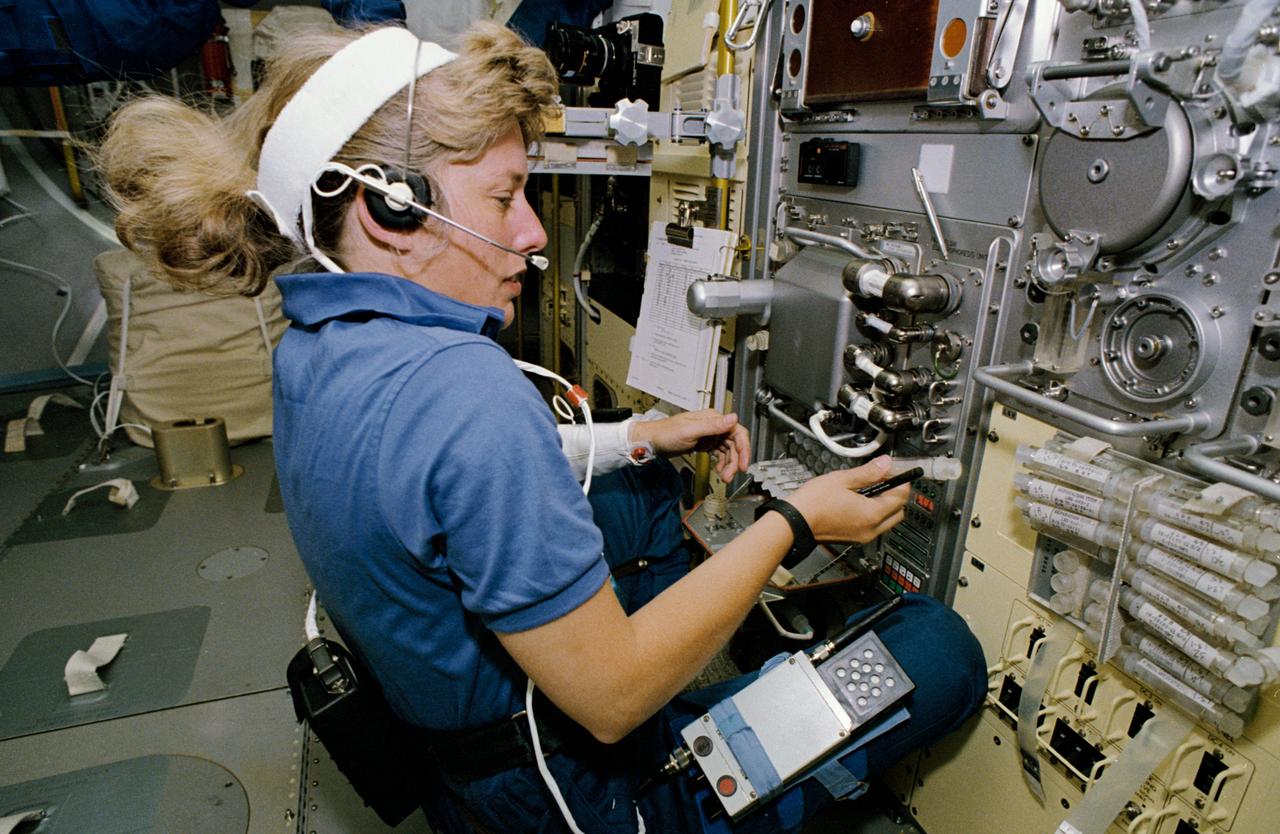
STS047-03-024 (12 - 20 Sept 1992) --- Astronaut N. Jan Davis, mission specialist, talks to ground controllers as she works with the Free Flow Electrophoresis Unit (FFEU) in the Science Module of the Earth-orbiting Space Shuttle Endeavour. Davis joined five other NASA astronauts and a Japanese payload specialist for eight days of scientific research onboard Endeavour.
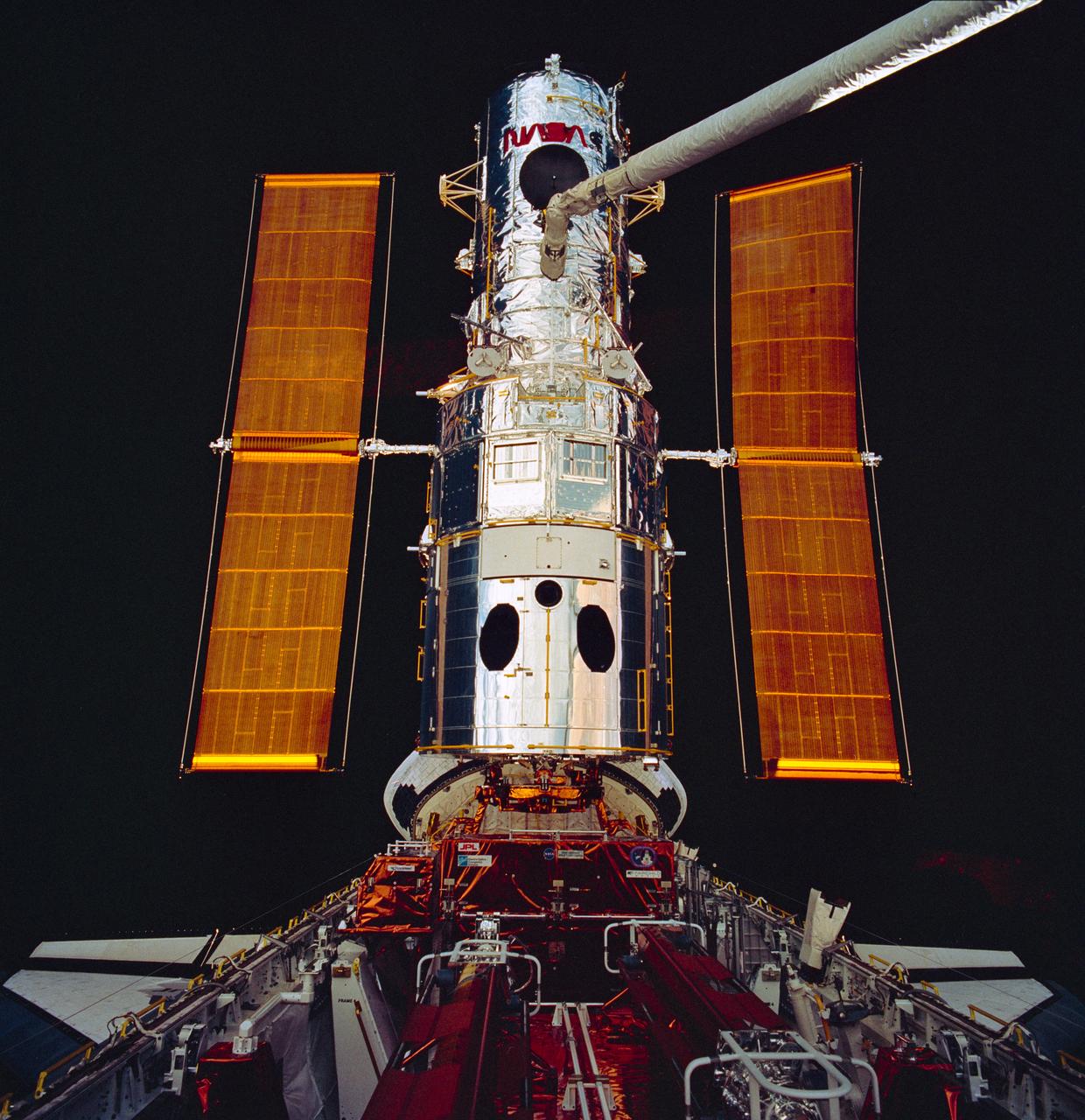
STS061-79-072 (4 Dec 1993) --- The Hubble Space Telescope (HST) is backdropped against the blackness of space in this 70mm frame recorded during a video survey of the spacecraft following the telescope's recent berthing in the Space Shuttle Endeavour's cargo bay. European Space Agency (ESA) scientist Claude Nicollier controlled the Remote Manipulator System (RMS) arm slowly so that mounted TV cameras could show flight controllers the various areas on the telescope.
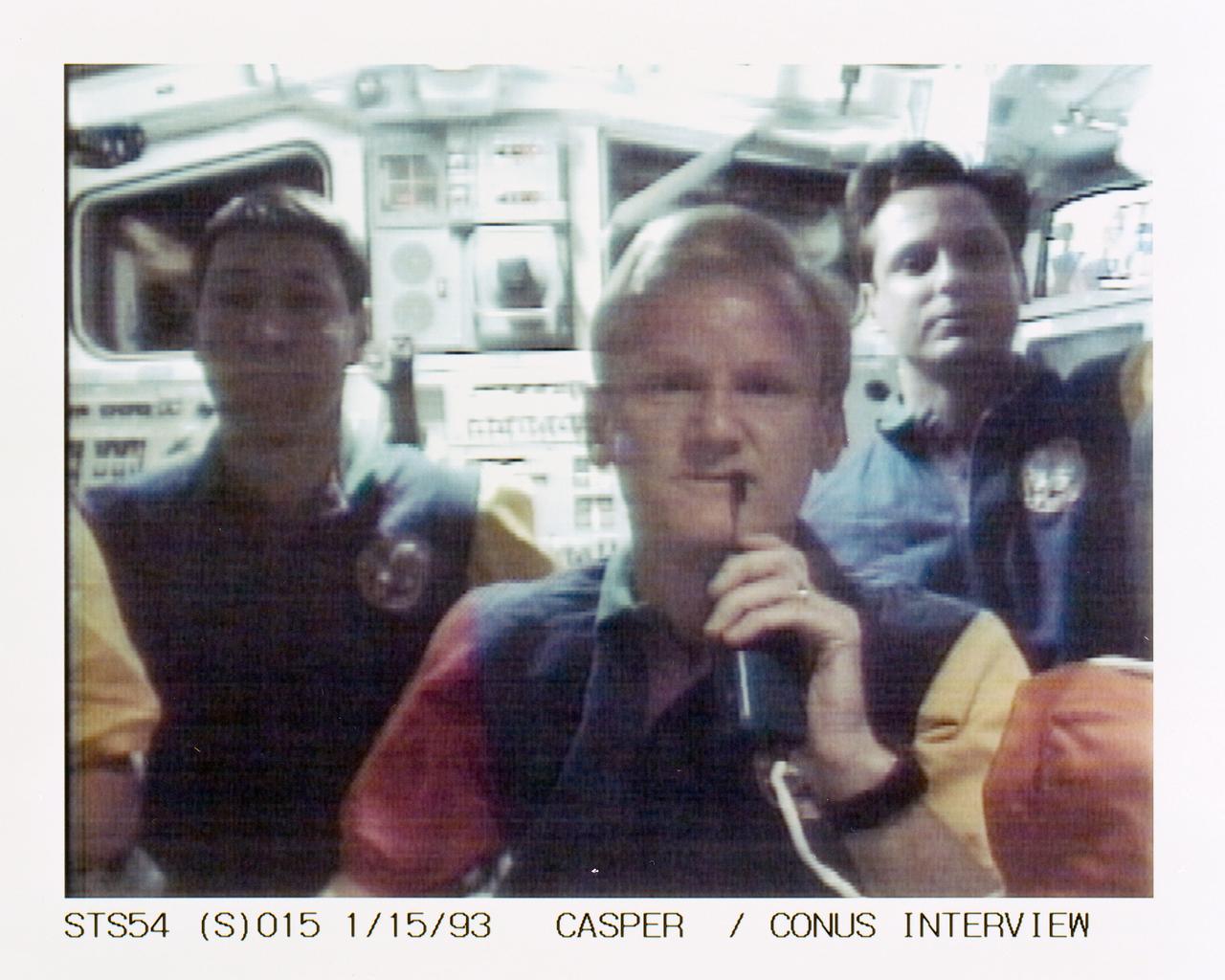
STS054-S-015 (15 Jan 1993) --- Casper talks to a radio station from the flight deck of Endeavour while, in the background, Runco, left, and Harbaugh await their turns to communicate with other stations. The scene was recorded at 13:45:54:05 GMT, Jan. 15, 1993.
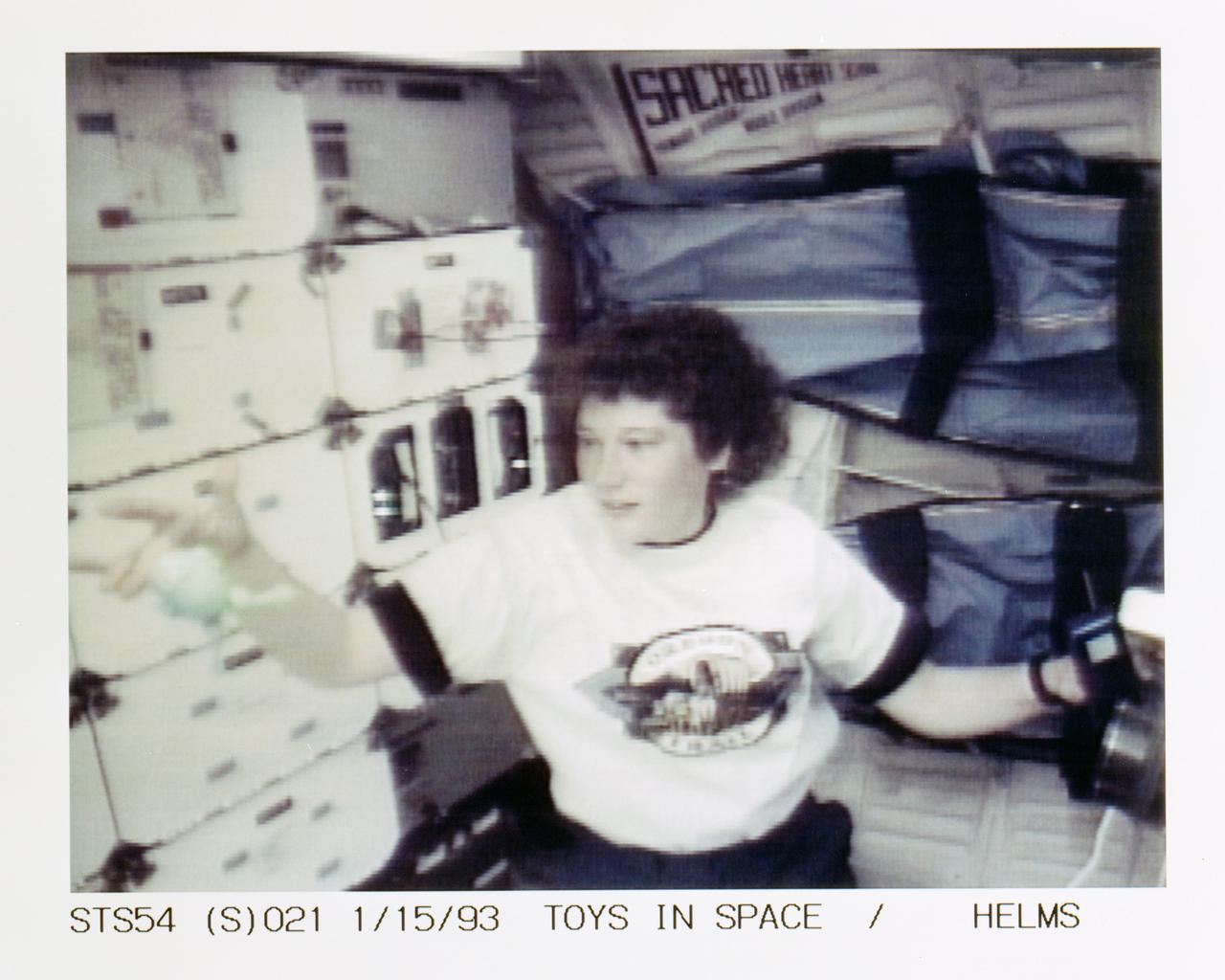
STS054-S-021 (15 Jan 1993) --- Helms with a frog swimmer toy on the middeck demonstrates some of the physics of toys to students watching on television. Four schools were chosen to ask questions of the astronauts during the lengthy program. Helms fielded questions from students at Shaver Elementary School in Portland, Oregon. The swimmer frog was used to demonstrate Newton's third law of motion and the conservation of angular momentum. The entire collection of toys will be videotaped for an educational program to be distributed to schools in the fall of this year. The scene was recorded at 17:51:38:12 GMT, Jan. 15, 1993.
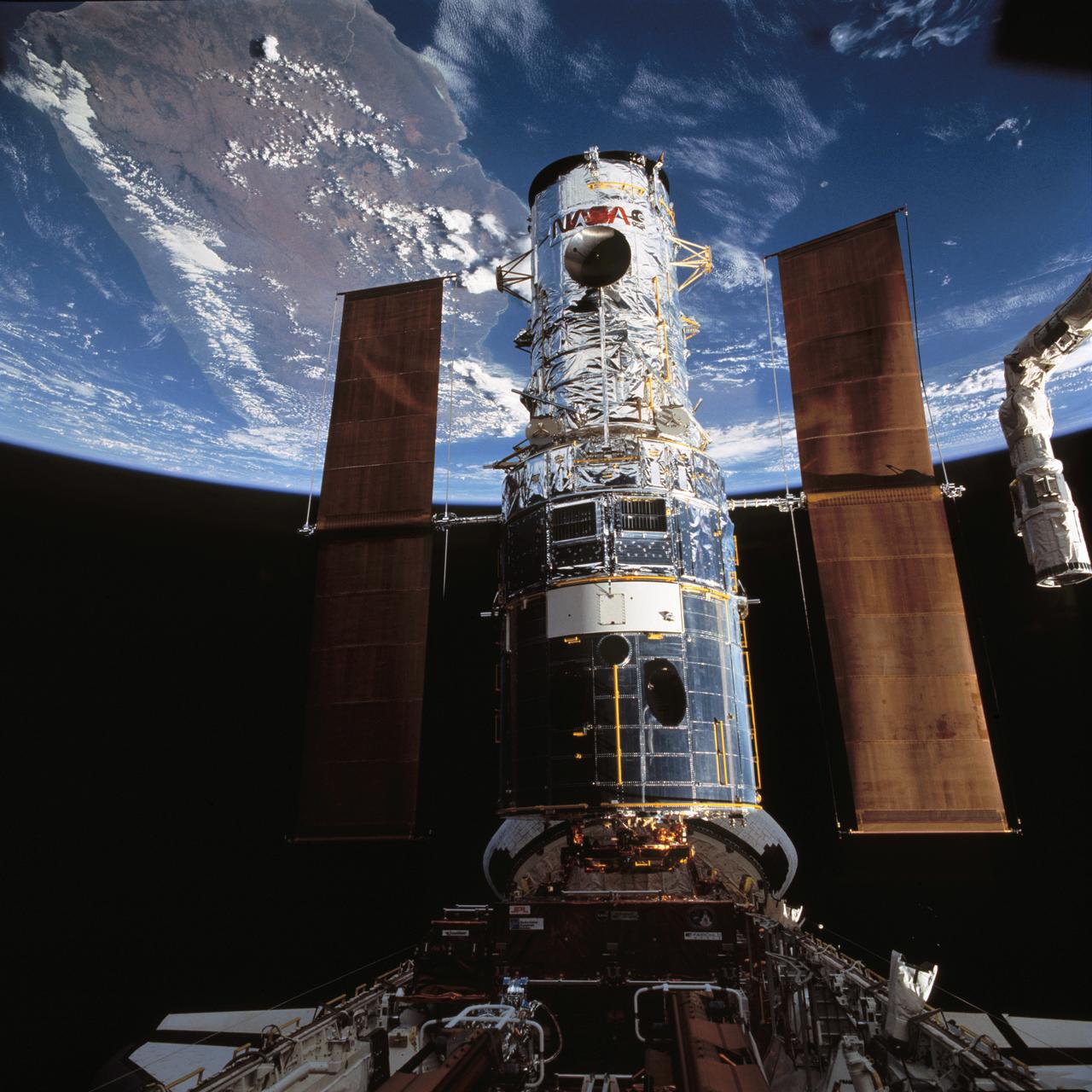
STS061-79-087 (4 Dec. 1993) --- The Hubble Space Telescope (HST), backdropped over Madagascar, is berthed in the space shuttle Endeavour's cargo bay following its capture by the STS-61 astronauts. The crew used TV cameras to survey the spacecraft before sending out four astronauts on five separate sessions of extravehicular activity (EVA) to perform a variety of servicing tasks. Photo credit: NASA
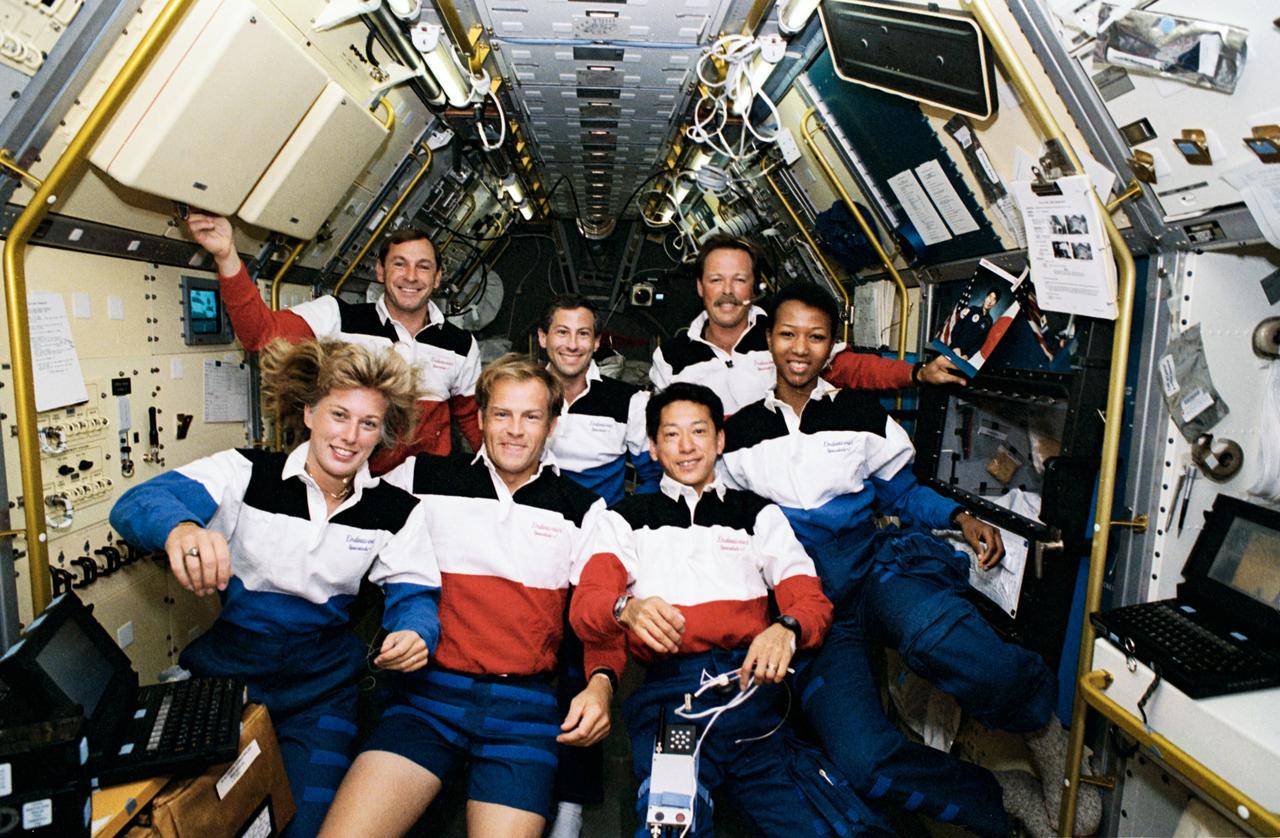
STS047-12-002 (12 - 20 Sept 1992) --- The crew members assemble for their traditional in-flight portrait in this 35mm frame photographed in the Science Module aboard the Earth-orbiting Space Shuttle Endeavour. Left to right (front) are N. Jan Davis, Mark C. Lee and Mamoru Mohri; and (rear) Curtis L. Brown, Jr., Jerome (Jay) Apt, Robert L. Gibson and Mae C. Jemison. The seven spent eight days in space in support of the Spacelab-J mission.
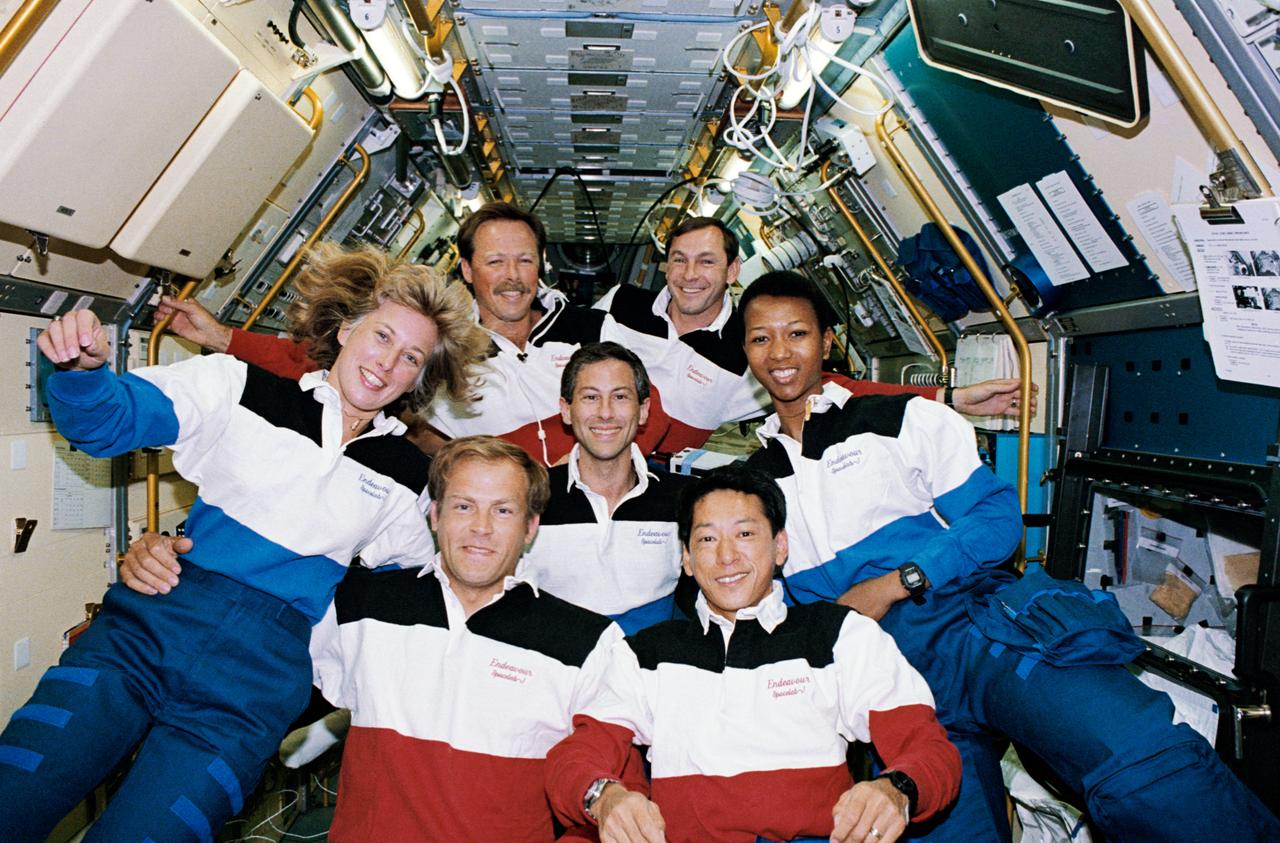
STS047-09-009 (12 - 20 Sept 1992) --- The seven crew members sharing eight days of research in support of Spacelab-J pose for the traditional inflight portrait in the Science Module. Pictured, left to right, back row, are Robert L. Gibson, mission commander; and Curtis L. Brown, Jr., pilot; middle row, N. Jan Davis, Jerome (Jay) Apt and Mae C. Jemison, all mission specialists; and front row, Mark C. Lee, payload commander, and Mamoru Mohri, payload specialist representing Japan's National Space Development Agency (NASDA).

STS054-S-023 (15 Jan 1993) --- Casper holds up a paper boomerang before sailing it across Endeavour's middeck. The demonstration was part of a lengthy "physics of toys" program conducted by all five crewmembers on their third day aboard the Shuttle. Through telephone and TV downlinks, students in four schools around the country participated in a special lesson to discover how specific toys function differently in the classroom compared to those on the Shuttle. The boomerang was used to demonstrate Bernouli's principle and gyroscopic stability. The entire collection of toys will be videotaped for an educational program to be distributed to schools in the autumn. The scene was downlinked at 18:11:04:26 GMT, Jan. 15, 1993.
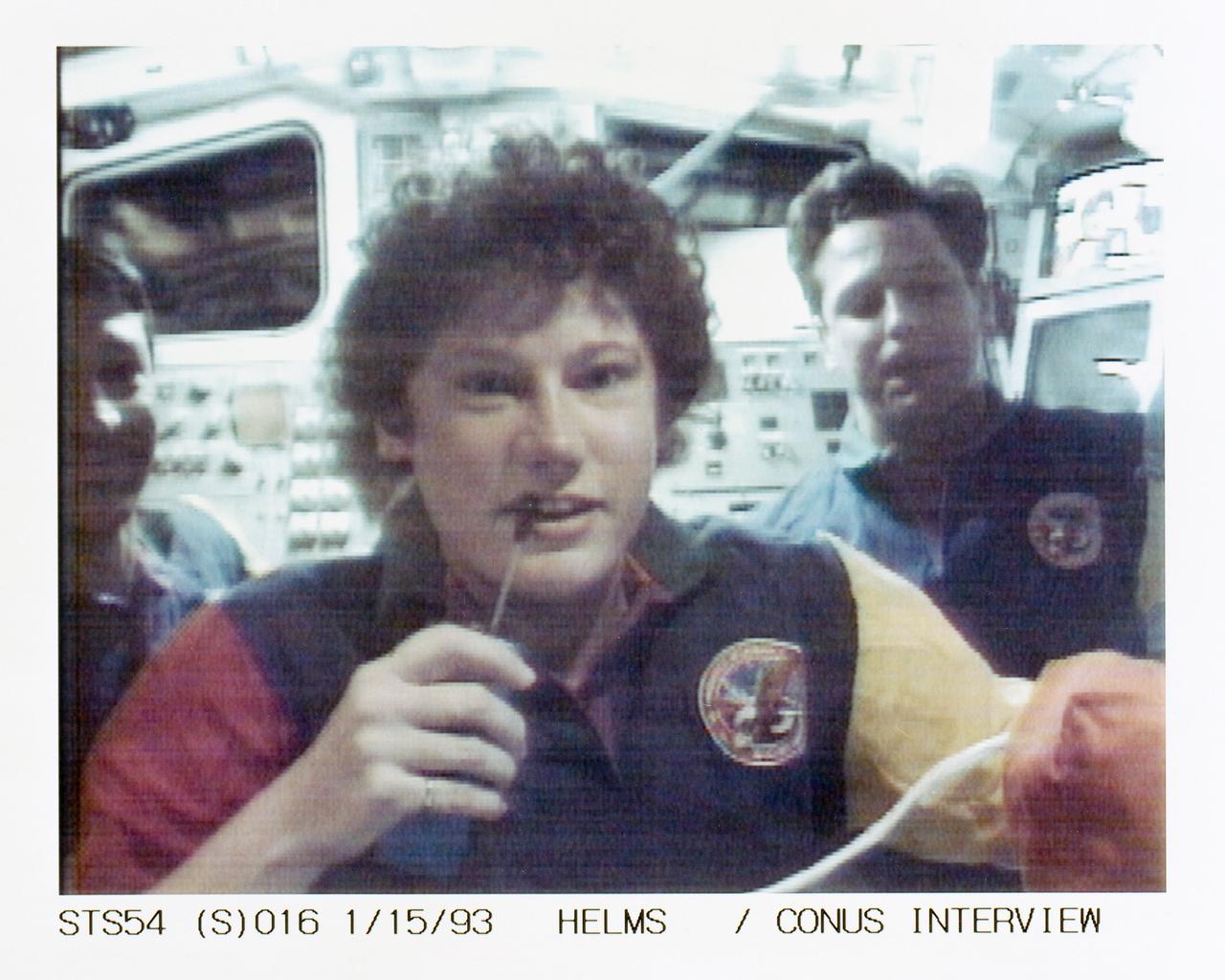
STS054-S-016 (15 Jan 1993) --- Helms talks to a radio station from the flight deck of Endeavour while Runco, left, and Harbaugh look on in the background. The scene was recorded at 13:54:14:13 GMT, Jan. 15, 1993.
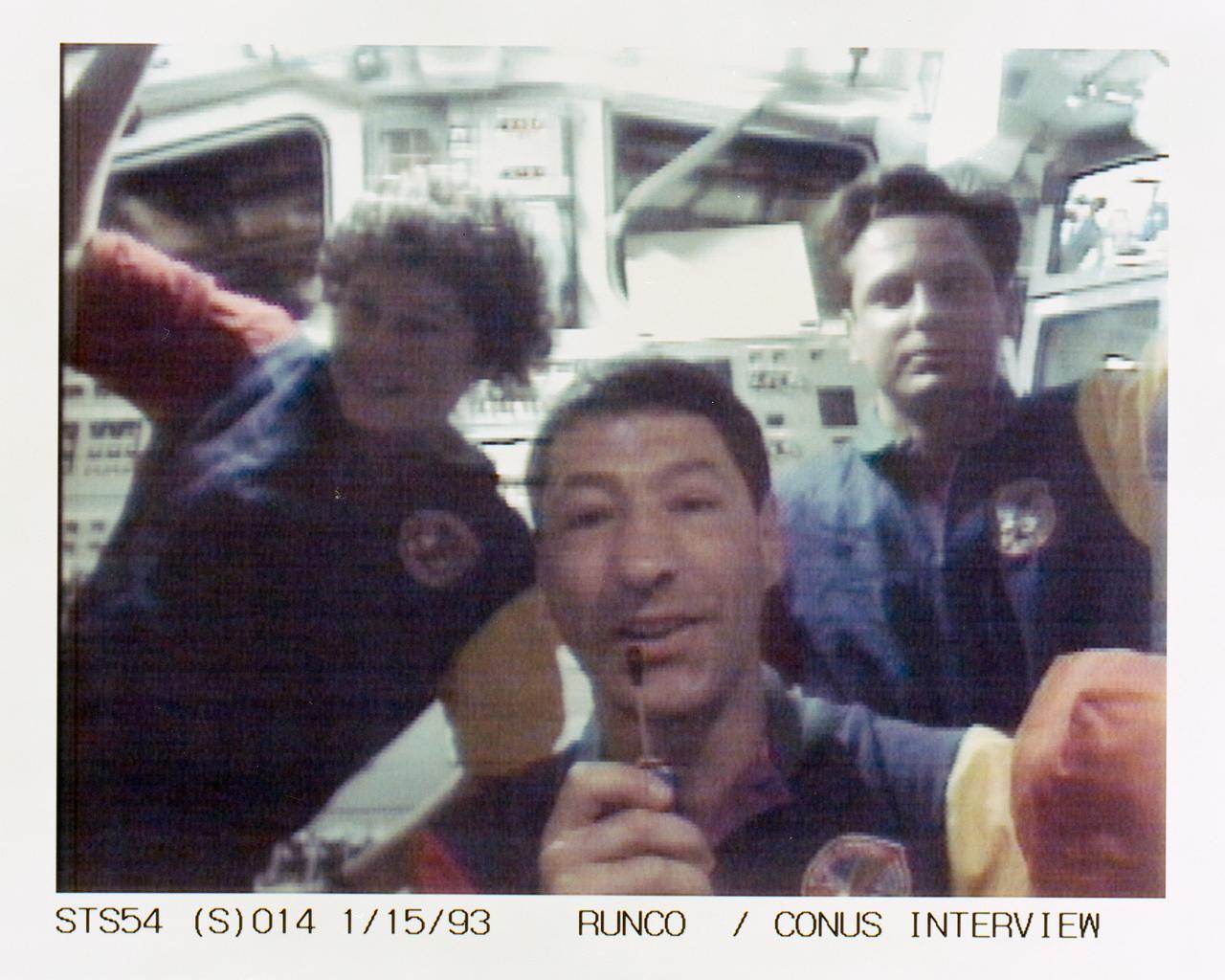
STS054-S-014 (15 Jan 1993) --- Runco talks to a radio station from the flight deck of Endeavour while, in the background, several crewmates await their turns to communicate with other stations. The scene was recorded at 13:48:45:11 GMT, Jan. 15, 1993.
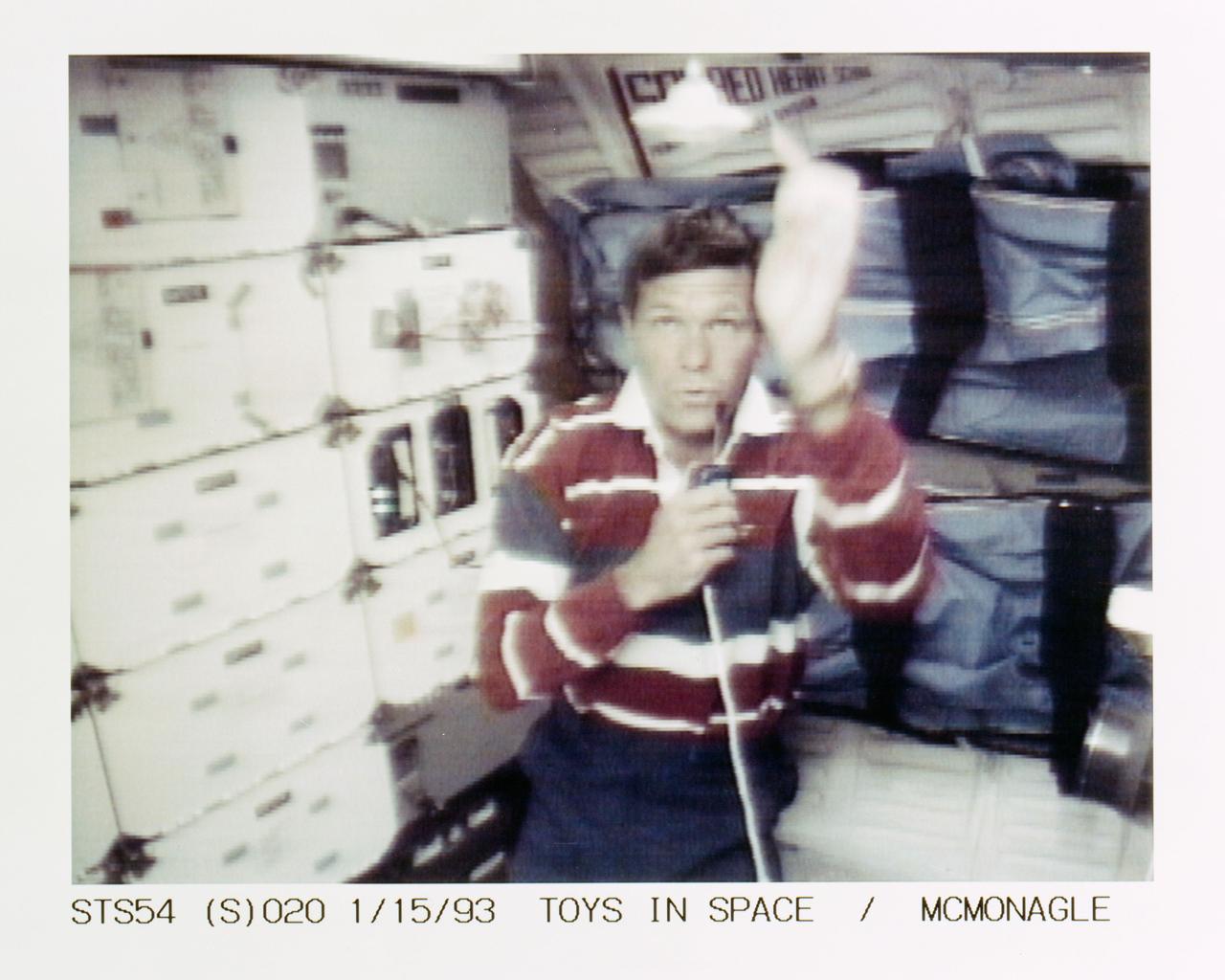
STS054-S-020 (15 Jan 1993) --- McMonagle watches as a top spins above his head on the middeck of the Earth-orbiting Endeavour. The demonstration was part of a lengthy "physics of toys" program conducted by all five crewmembers on their third day aboard the Shuttle. Through telephone and TV downlinks, students in four schools around the country participated in a special lesson to discover how specific toys function differently in the classroom compared to those on the Shuttle. Students at Westwood Elementary School in Flint, Michigan -- McMonagle's hometown -- asked him questions about the several toys he demonstrated. The top demonstrates gyroscopic motion, the center of mass and angular momentum. The entire collection of toys will be videotaped for an educational program to be distributed to schools in the autumn. The scene was downlinked at 18:01:59:11 GMT, Jan. 15, 1993.
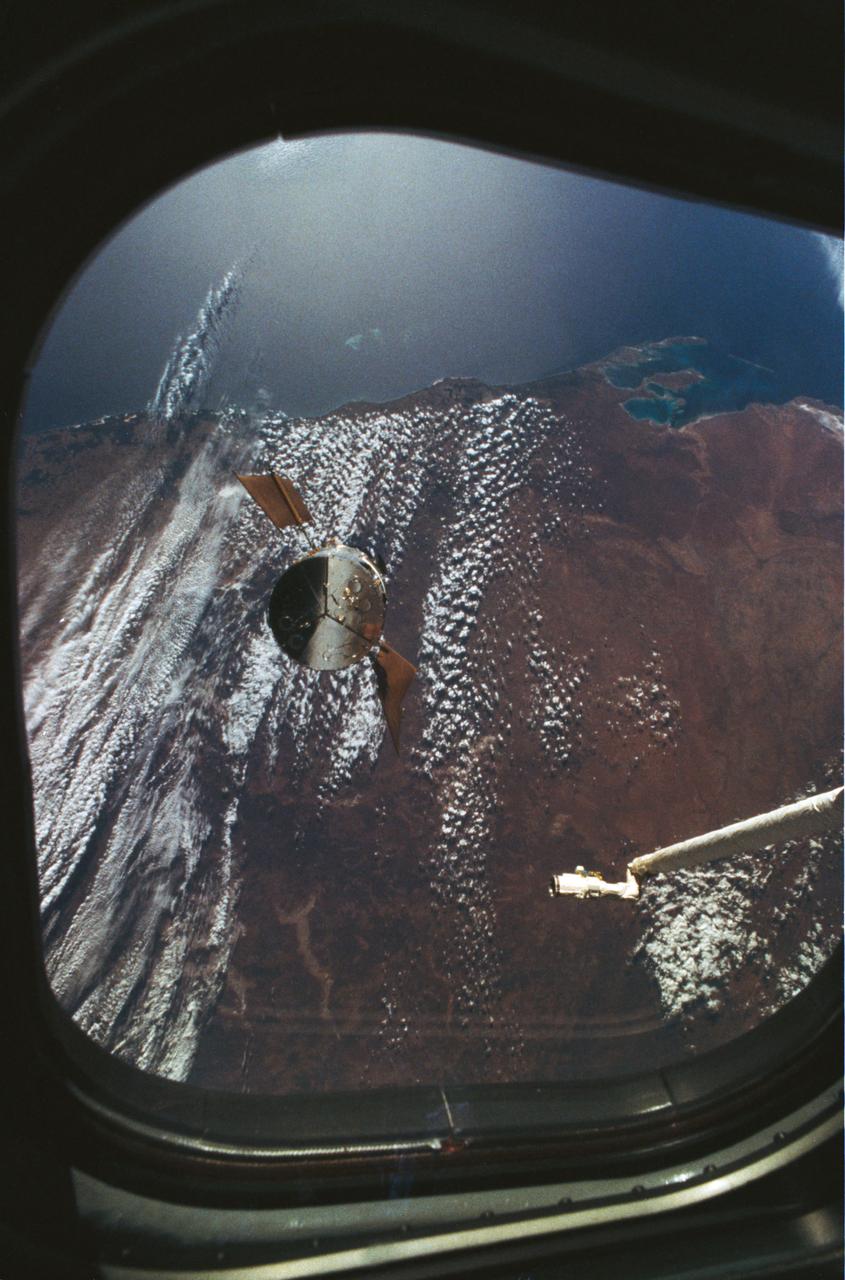
STS061-53-026 (4 Dec 1993) --- One of the Space Shuttle Endeavour's aft flight deck windows frames this view of the Hubble Space Telescope (HST) as it approaches the Endeavour. Backdropped against western Australia, the Remote Manipulator System (RMS) arm awaits the arrival of the telescope. Once berthed in Endeavour's cargo bay, HST underwent five days of servicing provided by four space walking crew members. Shark Bay (upper left) and Perth (lower left) are visible in the frame.
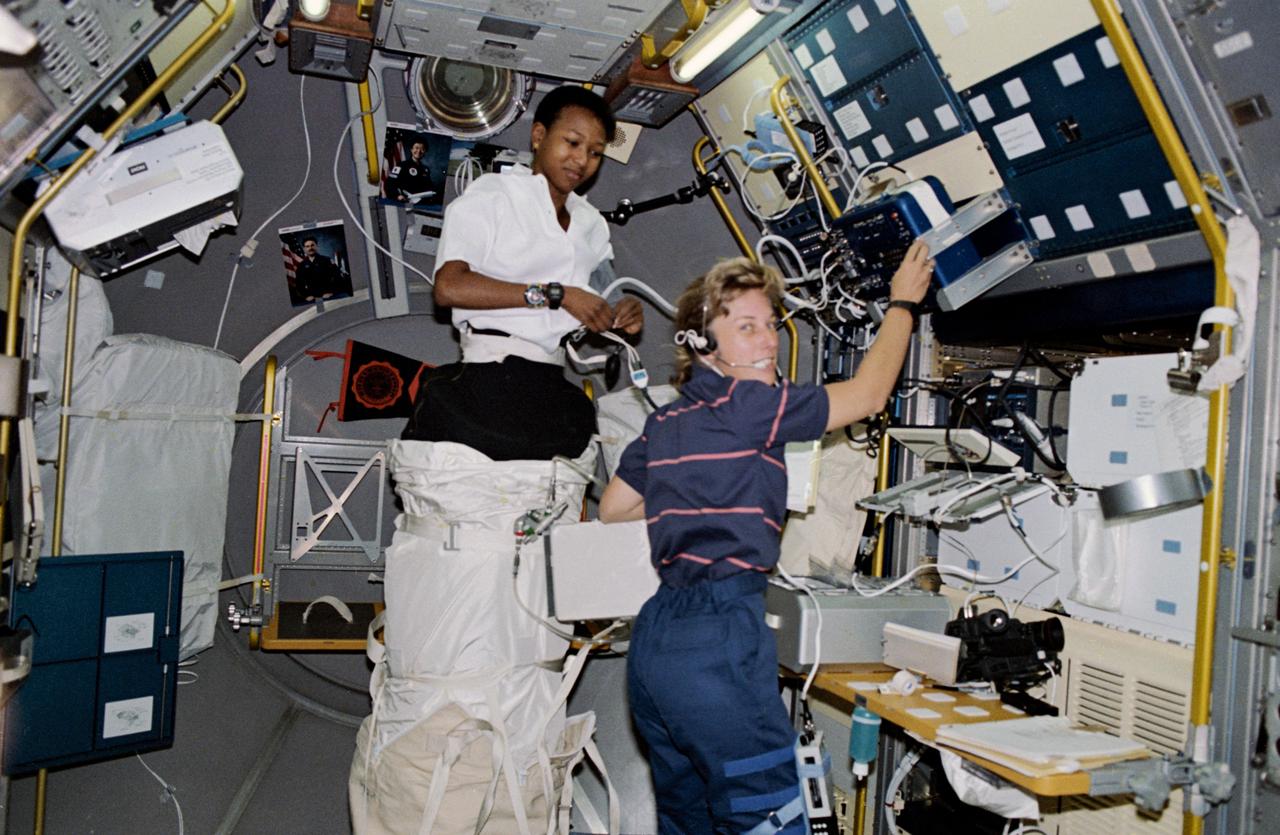
STS047-230-030 (12 - 20 Sept 1992) --- Astronauts Mae C. Jemison (left) and N. Jan Davis, mission specialists, are pictured in the Spacelab-J science module preparing to conduct a session with the Lower Body Negative Pressure (LBNP) experiment. The two joined four other NASA astronauts and a payload specialist representing Japan's National Space Development Agency (NASDA) aboard the Earth-orbiting Space Shuttle Endeavour for eight days of Spacelab-J research.
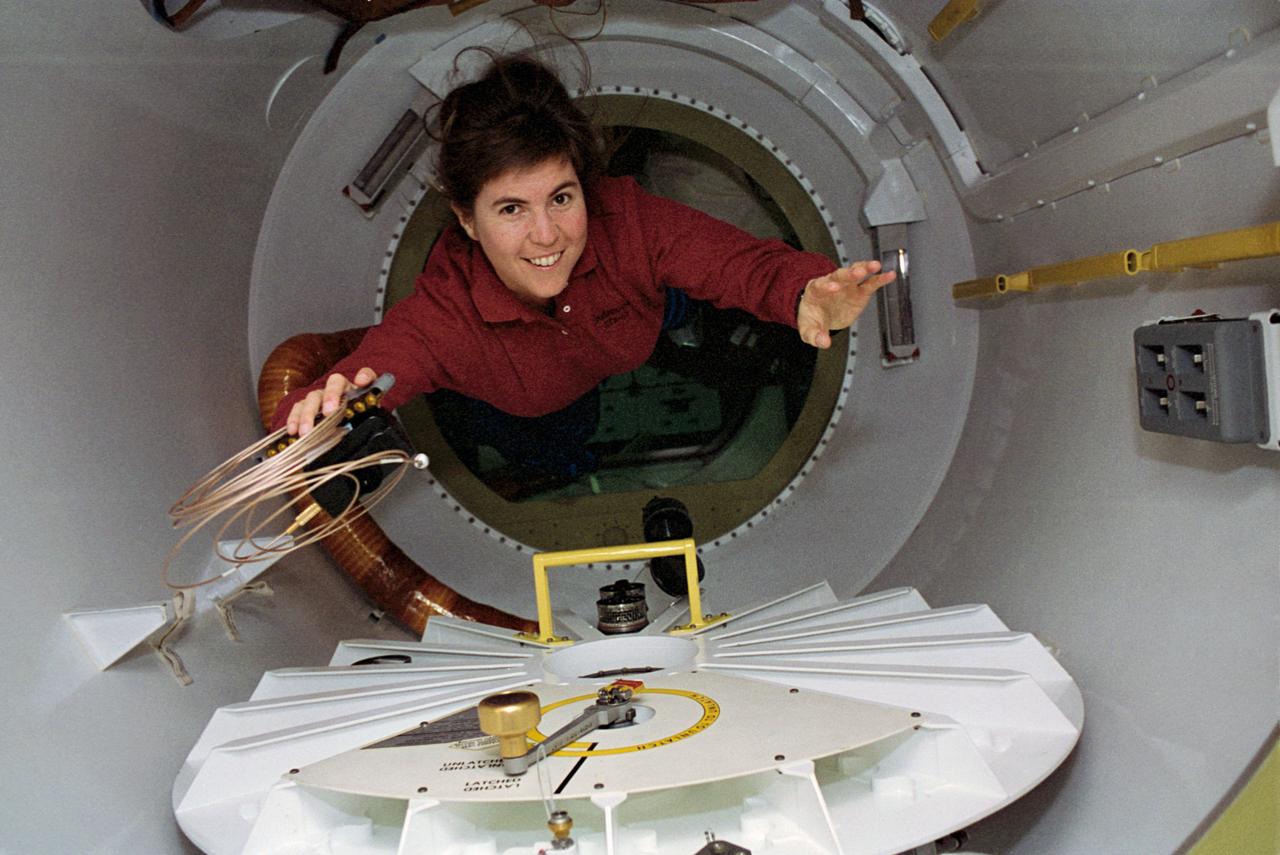
STS057-28-013 (21 June - 1 July 1993) --- With a camera and cable in hand, astronaut Janice E. Voss, mission specialist, floats through a special tunnel into the SpaceHab module. Voss and five other NASA astronauts spent almost ten days aboard the Space Shuttle Endeavour in Earth-orbit supporting the SpaceHab mission, retrieving the European Retrievable Carrier (EURECA) and conducting various experiments.
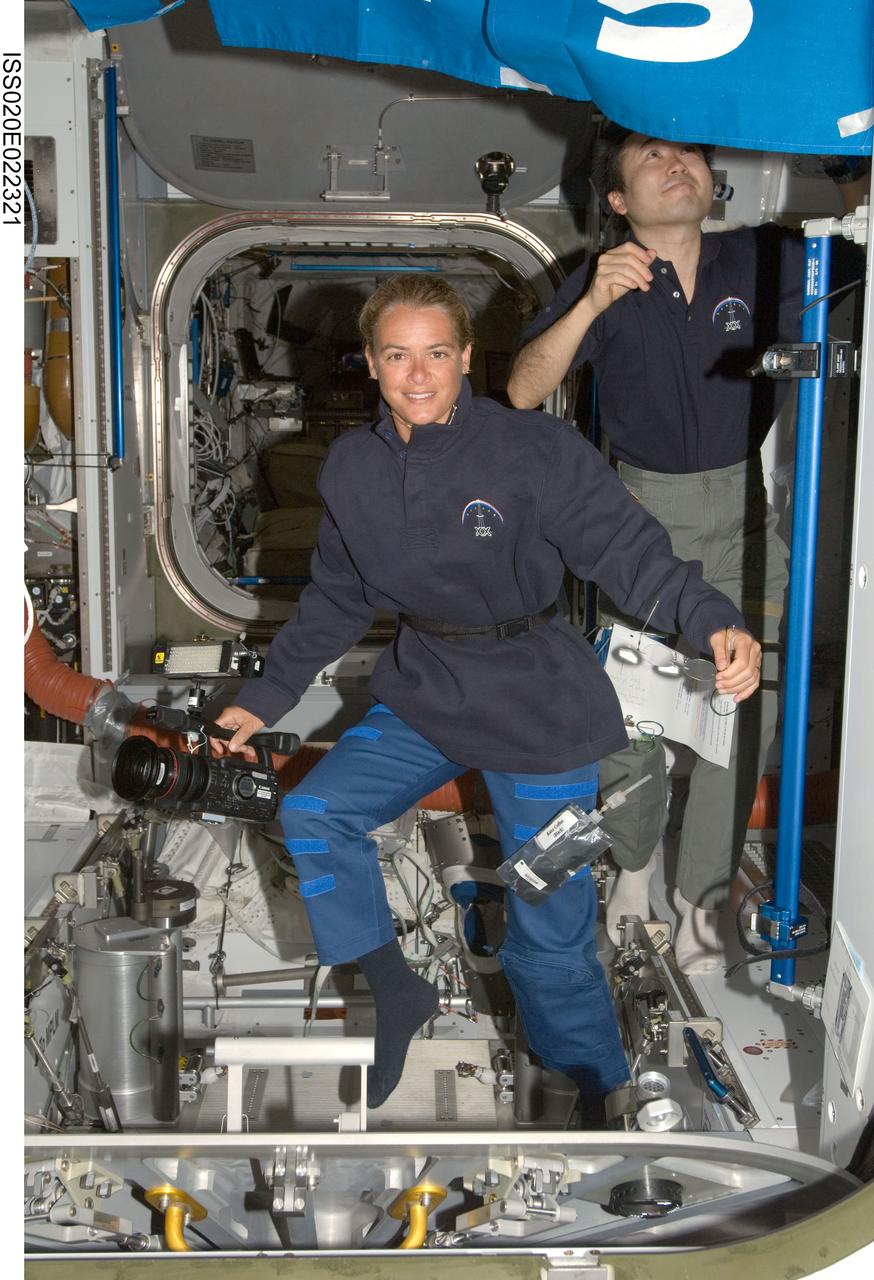
ISS020-E-022321 (18 July 2009) --- On the second day of joint activities between the STS-127 astronauts and ISS Expedition 20 crew members, Canadian Space Agency astronaut Julie Payette and Japanese Aerospace Exploration Agency astronaut Koichi Wakata are pictured onboard the orbital outpost. They are among 11 astronauts and cosmonauts who remained inside the shuttle and station to provide support while two crew members performed the first spacewalk to continue work on the station. Wakata has been serving as a flight engineer onboard ISS, but converts to an STS-127 missison specialist until returning home aboard Endeavour later this month.
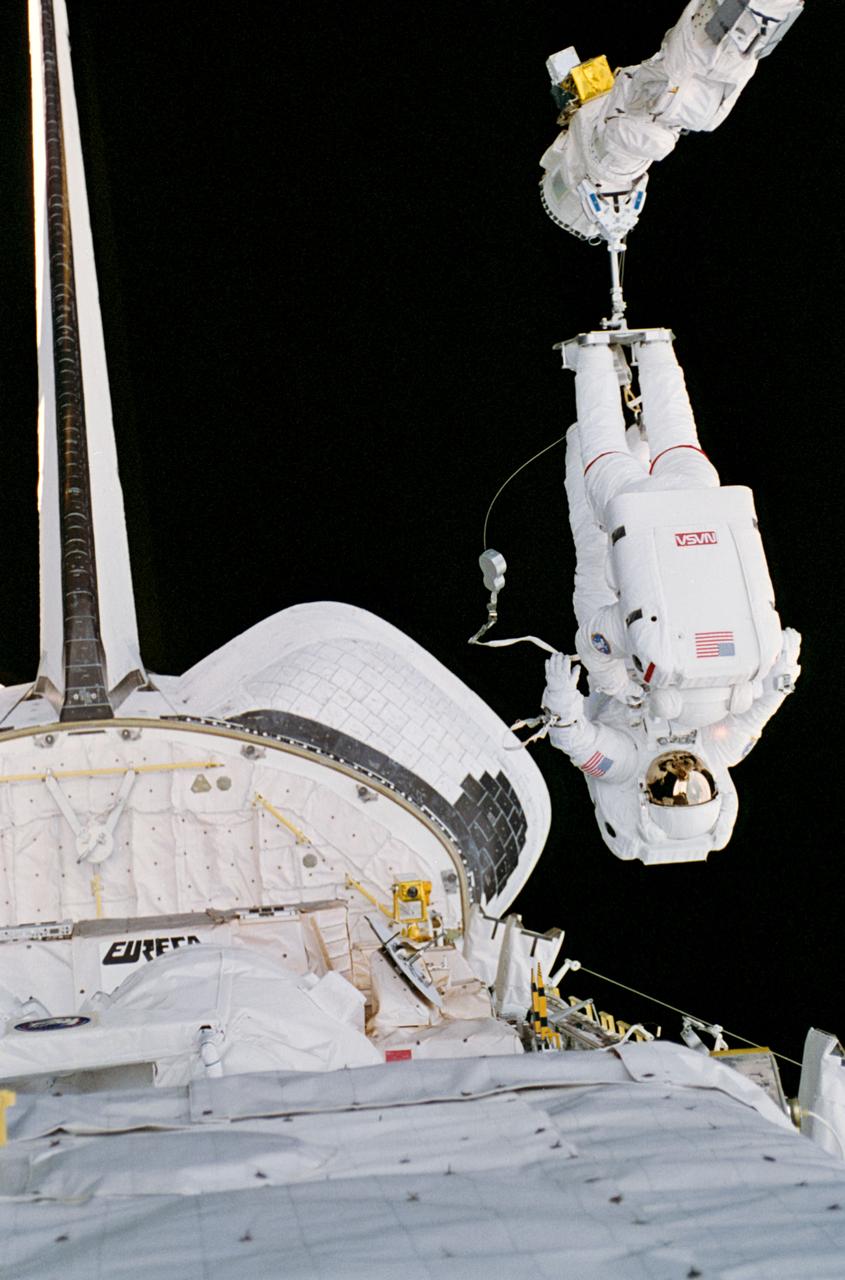
STS057-32-008 (25 June 1993) --- Astronaut G. David Low (nearer camera), his feet anchored to Endeavour's Remote Manipulator System (RMS), lifts fellow astronaut Peter J. K. (Jeff) Wisoff during a special phase of the lengthy June 25, 1993, extravehicular activity (EVA). This phase of the EVA dealt with the simulation of handling large components in space. This particular task was rehearsed with eyes toward the servicing of the Hubble Space Telescope (HST) in the near future or the assembly and maintenance of the International Space Station later. The two mission specialists and four other NASA astronauts spent almost ten days aboard the Space Shuttle Endeavour in Earth-orbit supporting the SPACEHAB mission, retrieving the European Retrievable Carrier (EURECA) and conducting various experiments.
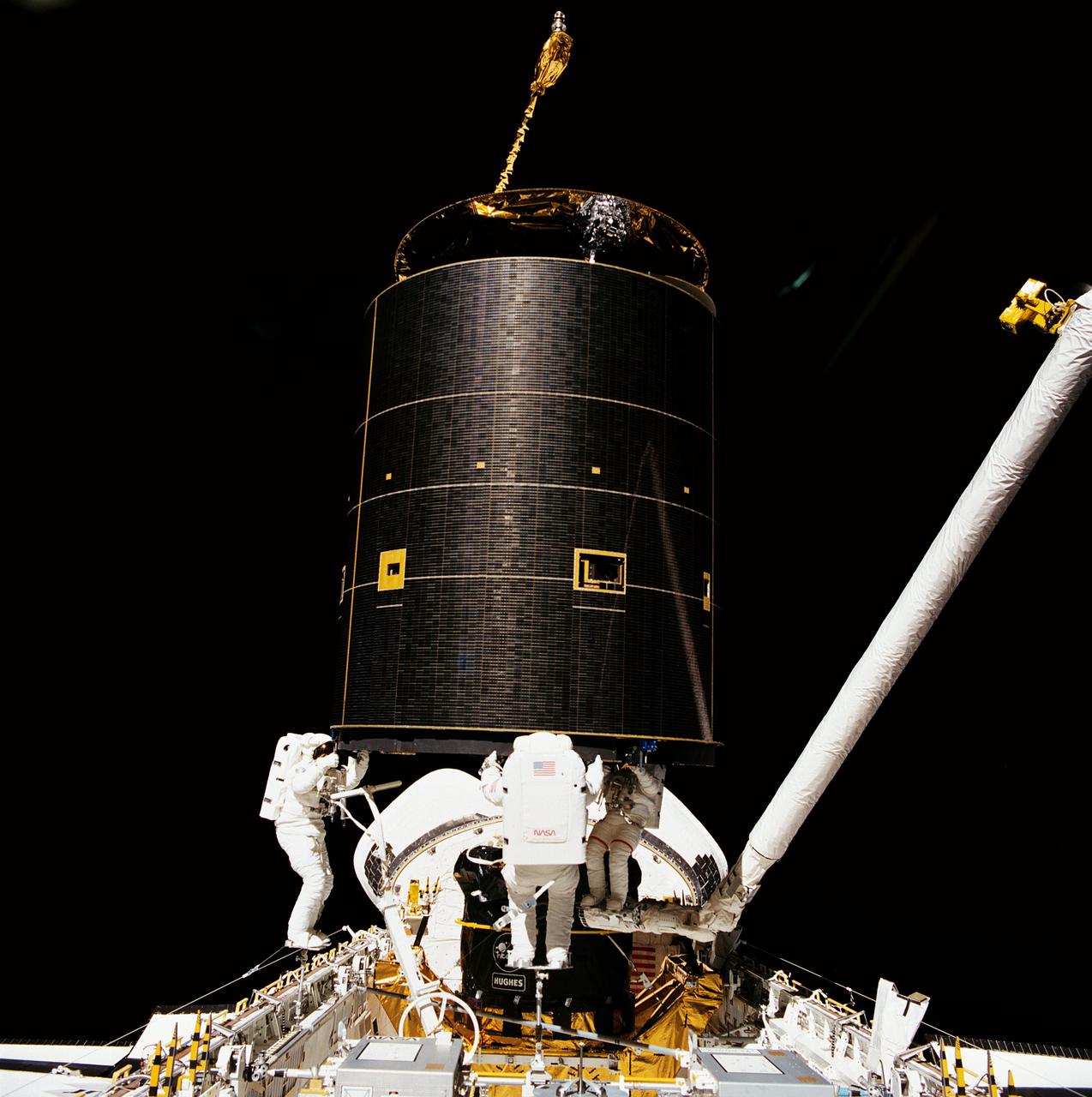
STS049-91-026 (13 May 1992) --- Three astronauts hold onto the 4.5-ton Intelsat VI satellite after a six-handed "capture" was made minutes earlier. Left to right are astronauts Richard J. Hieb, Thomas D. Akers and Pierre J. Thuot. Thuot stands on the end of the remote manipulator system arm, from which he had made two earlier unsuccessful grapple attempts on two-person extravehicular activity sessions. Ground controllers and crew members agreed that a third attempt, using three mission specialists in the cargo bay of the space shuttle Endeavour, was the effort needed to accomplish the capture feat.
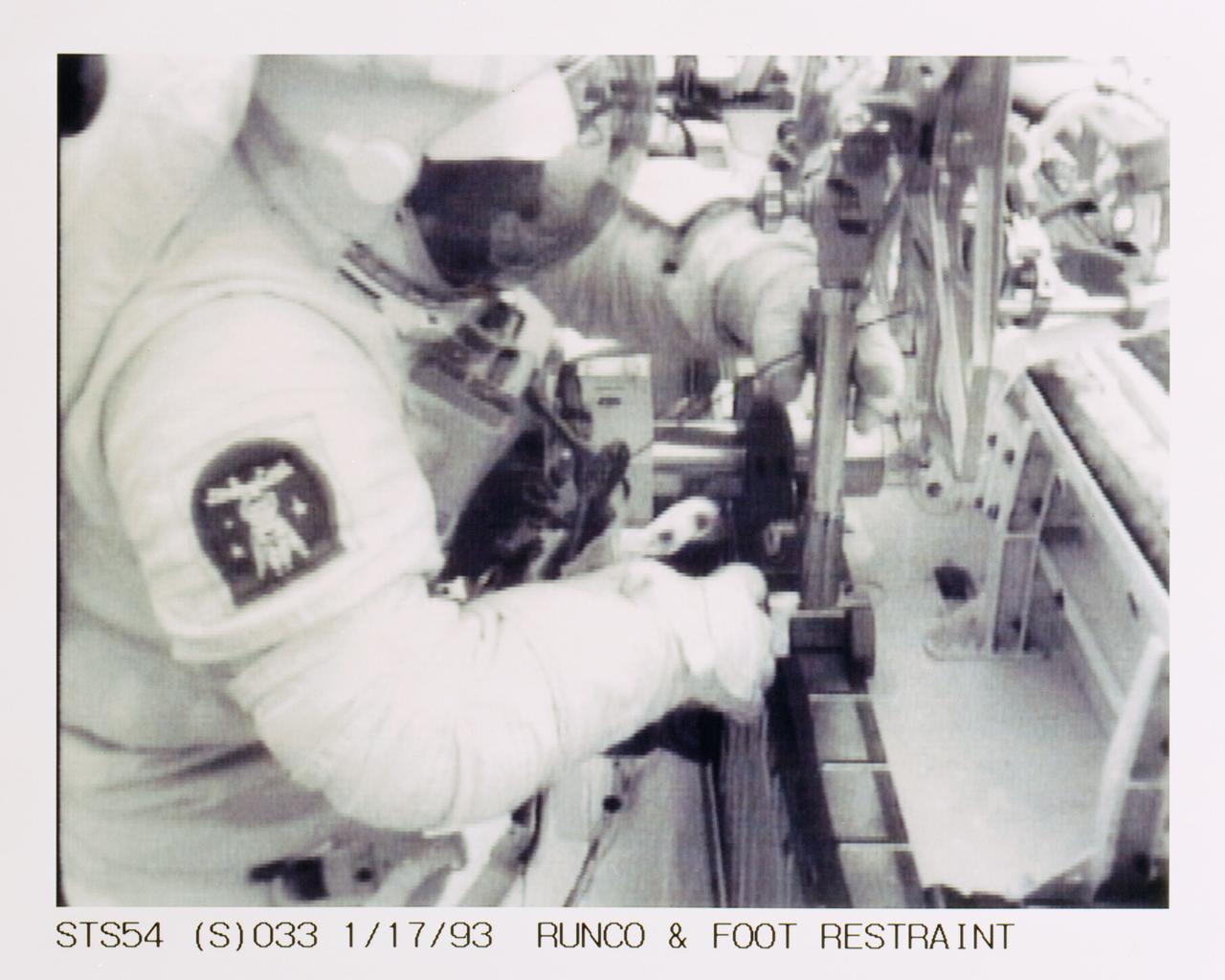
STS054-S-033 (17 Jan 1993) --- Runco works with a mobile foot restraint during extravehicular activity (EVA) in Endeavour's cargo bay. The scene was downlinked at 11:52:04:28 GMT, Jan. 17, 1993.
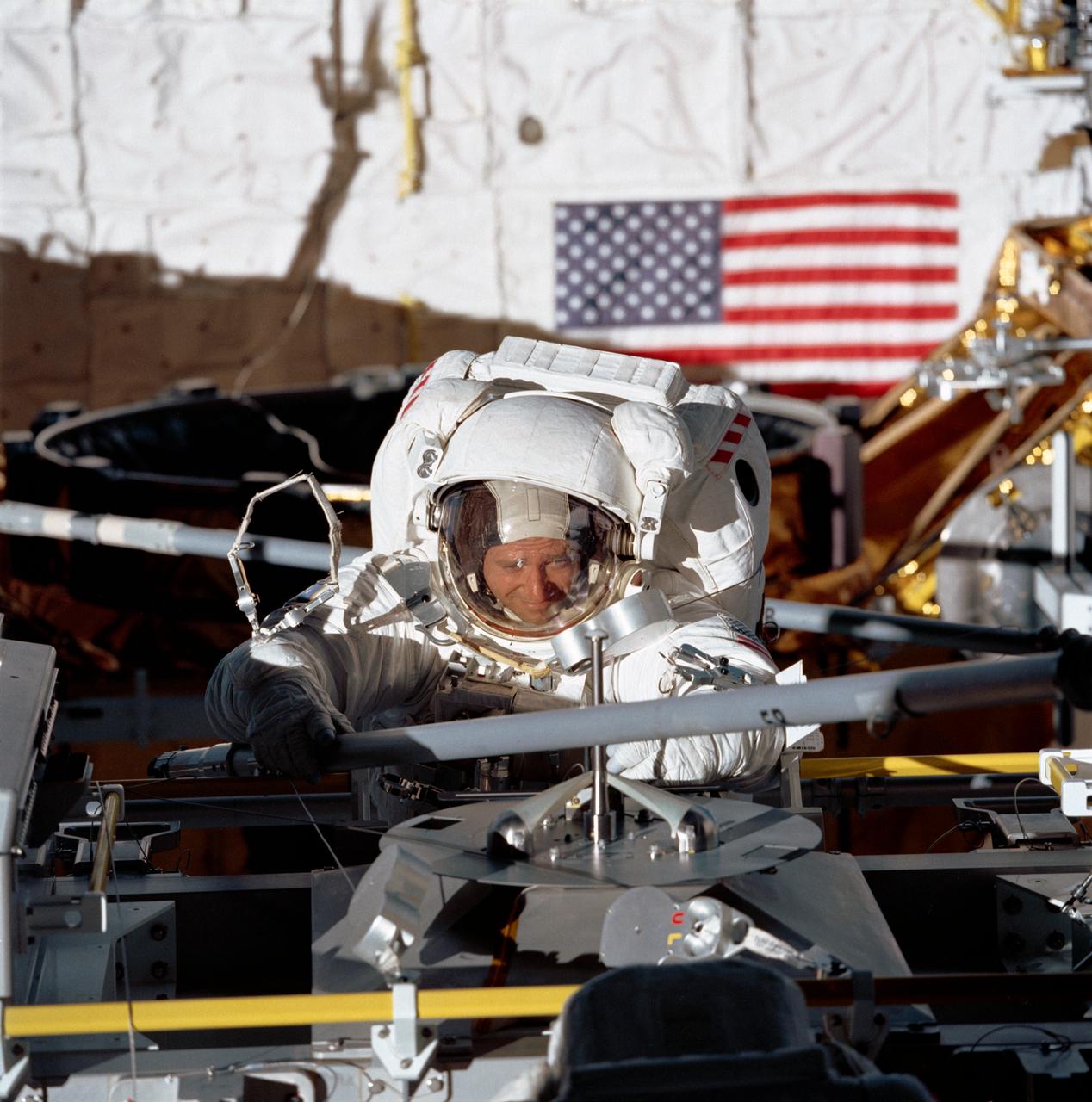
STS049-77-028 (14 May 1992) --- Astronaut Thomas D. Akers, STS-49 mission specialist, grabs a strut device as fourth period of extravehicular activity (EVA) gets underway in the Space Shuttle Endeavour's cargo bay. Akers is positioned near the Multi-purpose Support Structure (MPESS). The purpose of the final EVA on this nine-day mission was the evaluation of Assembly of Station by EVA Methods (ASEM). The scene was recorded on 70mm film by a fellow crew member in the space shuttle's cabin. Astronaut Kathryn C. Thornton (out of frame) joined Akers on the 7 1/2 hour EVA.
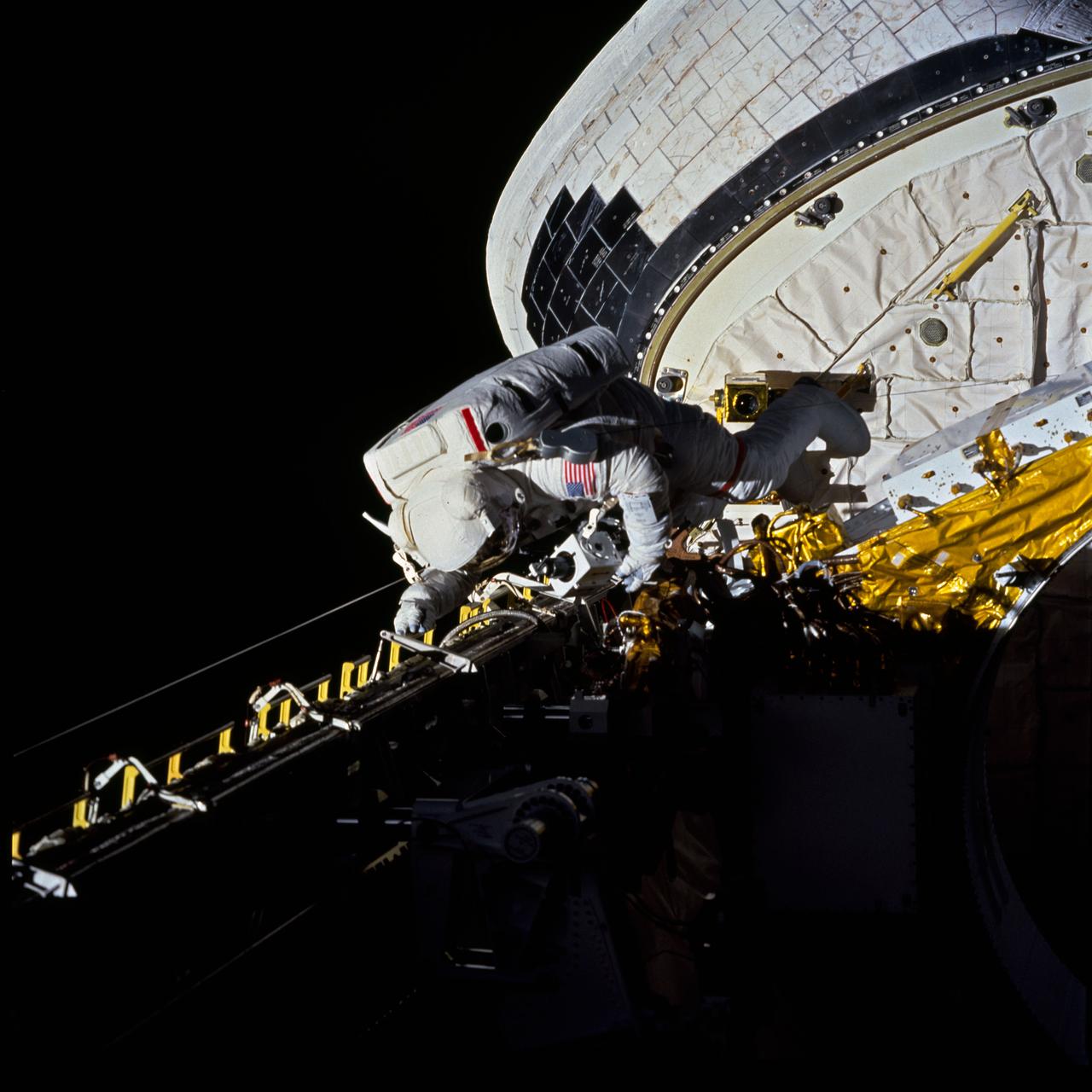
STS054-80-0N (17 Jan 1993) --- Astronaut Gregory J. Harbaugh moves along the starboard side of Endeavour's cargo bay during the four-plus hour long extravehicular activity (EVA) on January 17, 1993. The photograph was taken with a 70mm camera from inside Endeavour's cabin by a fellow crewmember. Three astronauts remained inside to support the spacewalk by astronauts Harbaugh and Mario Runco Jr. (out of frame).
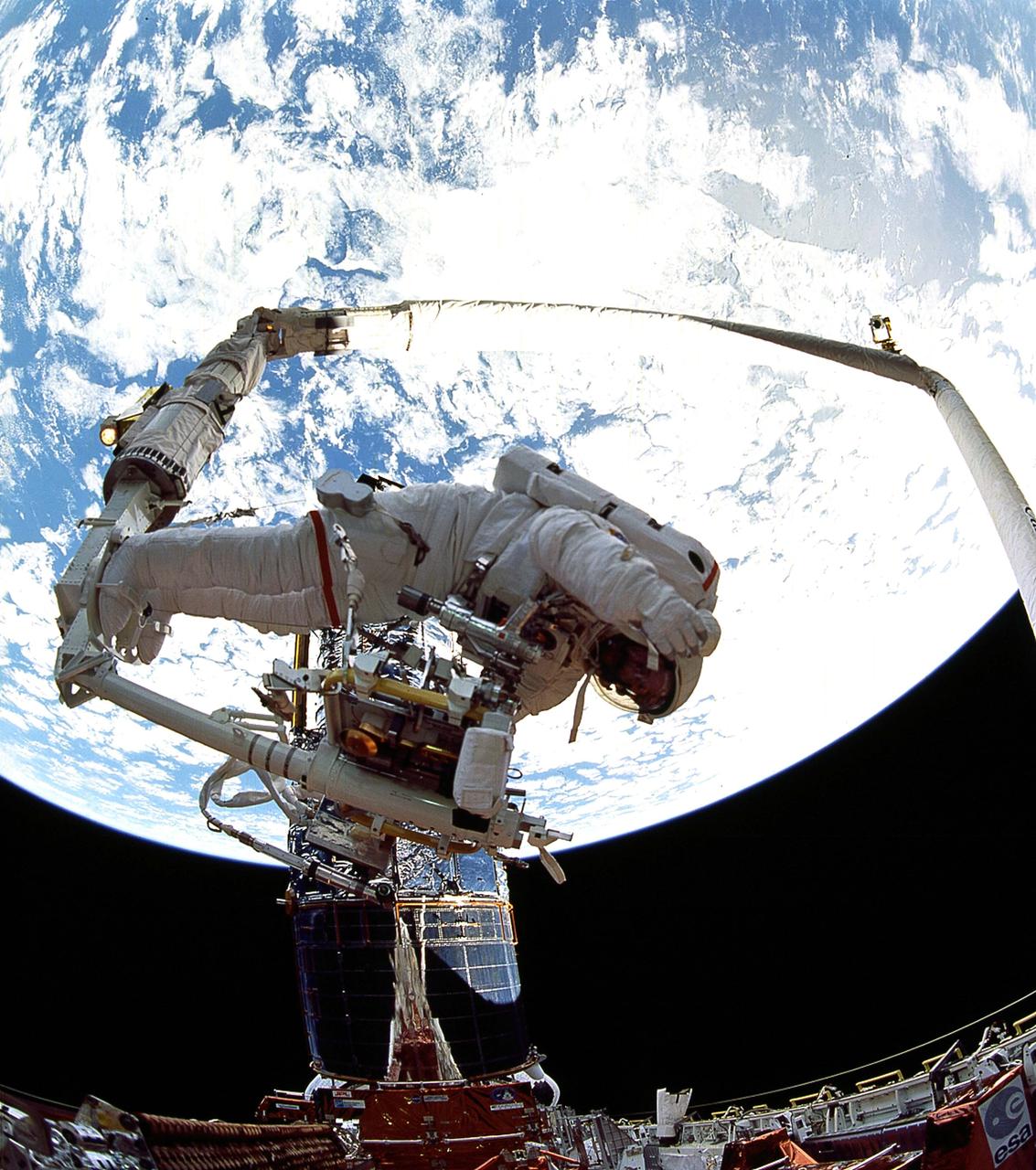
STS061-105-026 (7 Dec. 1993) --- Astronaut Jeffrey A. Hoffman signals directions to European Space Agency (ESA) astronaut Claude Nicollier, as the latter controls the Remote Manipulator System (RMS) arm during the third of five Extravehicular Activities (EVA) on the Hubble Space Telescope (HST) servicing mission. Astronauts Hoffman and F. Story Musgrave earlier changed out the Wide Field\Planetary Camera (WF\PC).
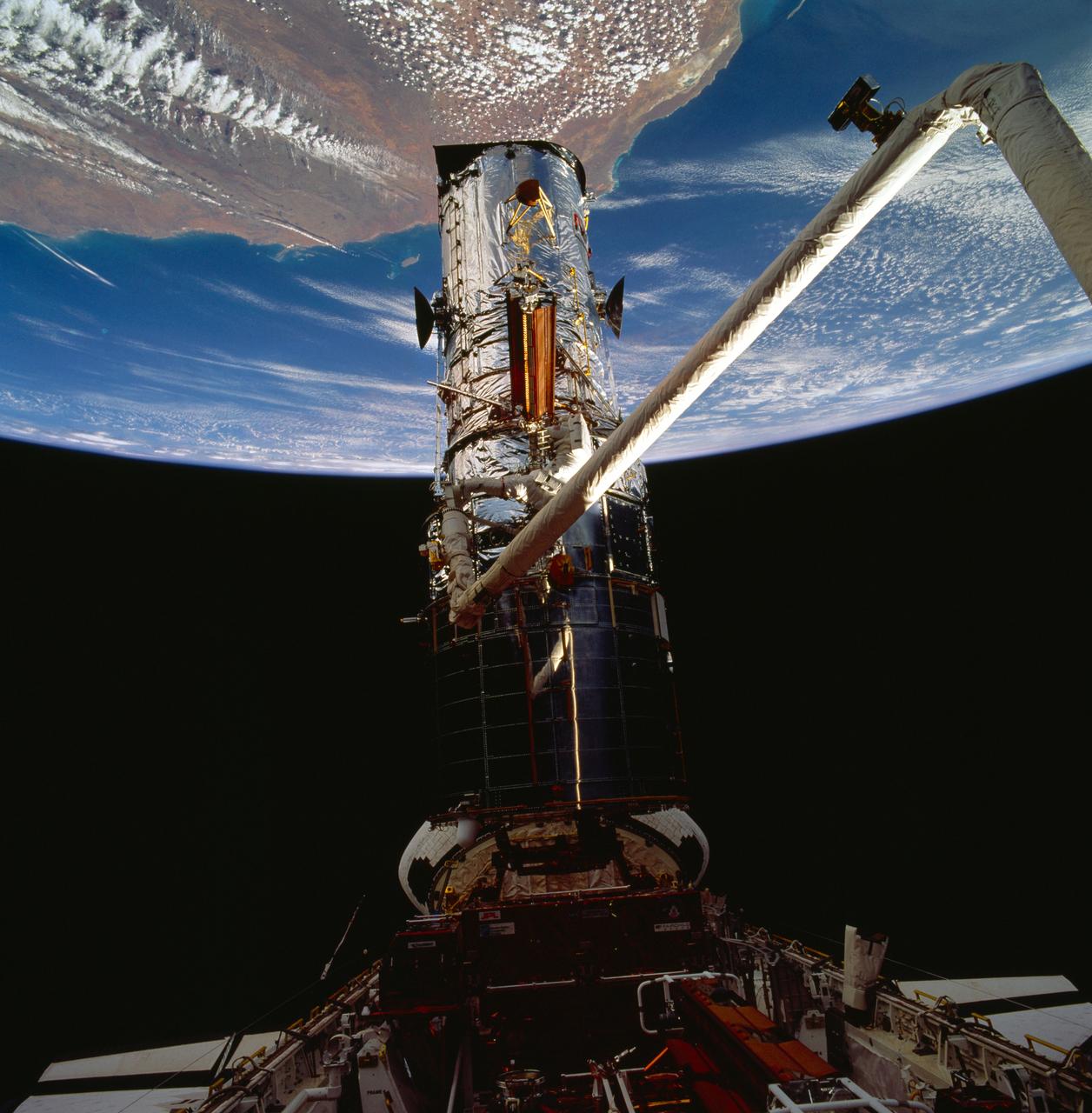
STS061-95-075 (6 Dec 1993) --- Astronauts Kathryn C. Thornton and Thomas D. Akers work to remove one of the solar arrays on the Hubble Space Telescope (HST) on the second of five extravehicular activity?s (EVA). The two space walkers later replaced both solar array panels. Part of Australia is in the background.
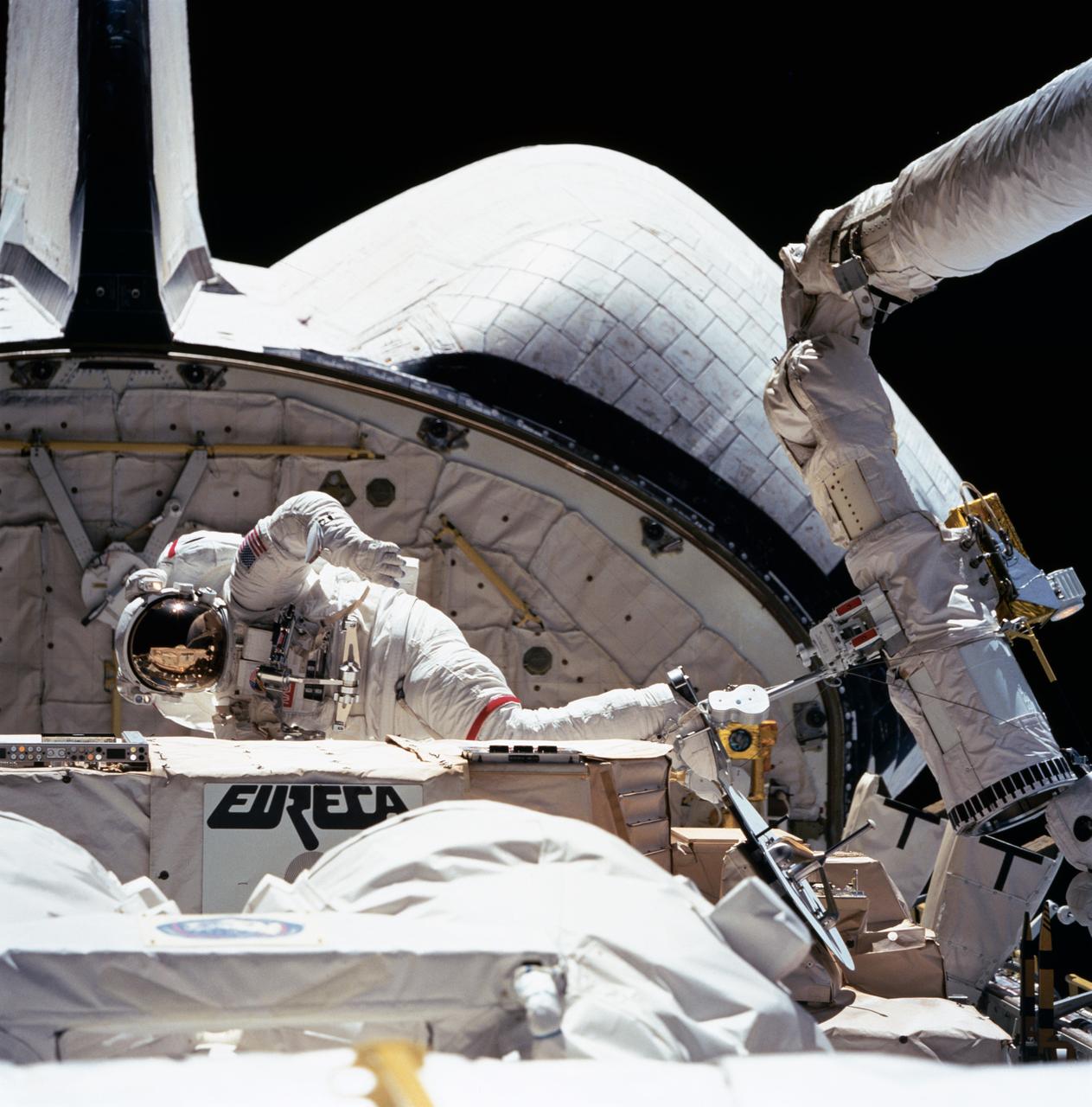
The darkness of space forms the backdrop for this extravehicular activity (EVA) scene captured by one of the STS-57 crewmembers in Endeavour's, Orbiter Vehicle (OV) 105's, crew cabin. Pictured near the recently "captured" European Retrievable Carrier (EURECA) at frame center is Mission Specialist (MS) and Payload Commander (PLC) G. David Low. Suited in an extravehicular mobility unit (EMU), Low, anchored to the remote manipulator system (RMS) via a portable foot restraint (PFR) (manipulator foot restraint (MFR)), is conducting Detailed Test Objective (DTO) 1210 procedures. Specifically, this activity will assist in refining several procedures being developed to service the Hubble Space Telescope (HST) on mission STS-61 in December 1993. The PFR is attached to the RMS end effector via a PFR attachment device (PAD). Partially visible in the foreground is the Superfluid Helium Onorbit Transfer (SHOOT) payload.
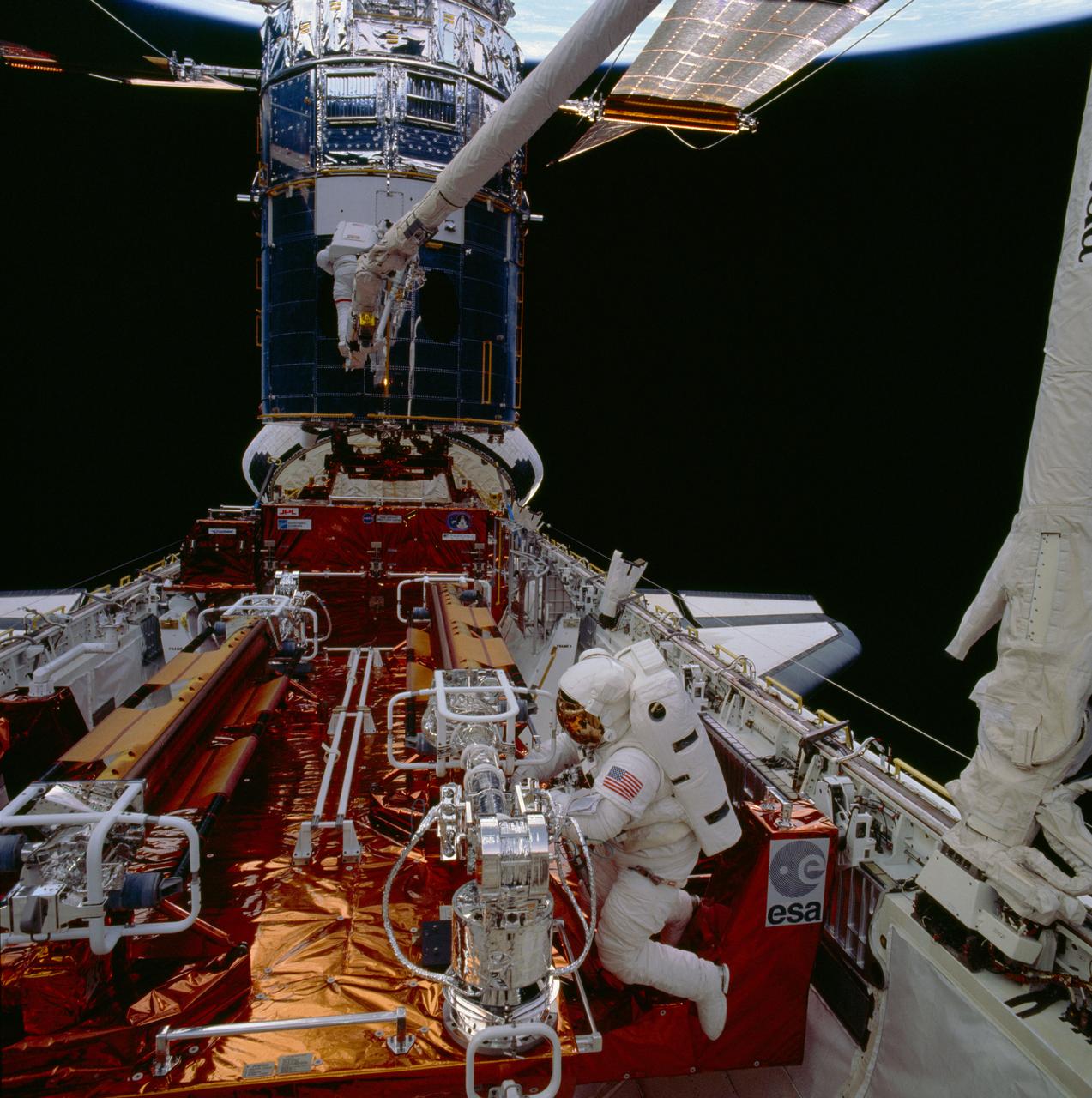
STS061-86-048 (5 Dec 1993) --- Astronauts F. Story Musgrave (foreground) and Jeffrey A. Hoffman are pictured near the end of the first of five extravehicular activity?s (EVA). Musgrave works at the Solar Array Carrier (SAC) in the Space Shuttle Endeavour's cargo bay. Hoffman, anchored to a foot restraint mounted on the end of the Space Shuttle Endeavour's Remote Manipulator System (RMS) arm, waits to be maneuvered to the forward payload bay. The original solar array panels are partially visible at top, while their replacements remain stowed in foreground. The crew's second pair of space walkers -- astronauts Kathryn C. Thornton and Thomas D. Akers -- later changed the solar arrays on the mission's second EVA.
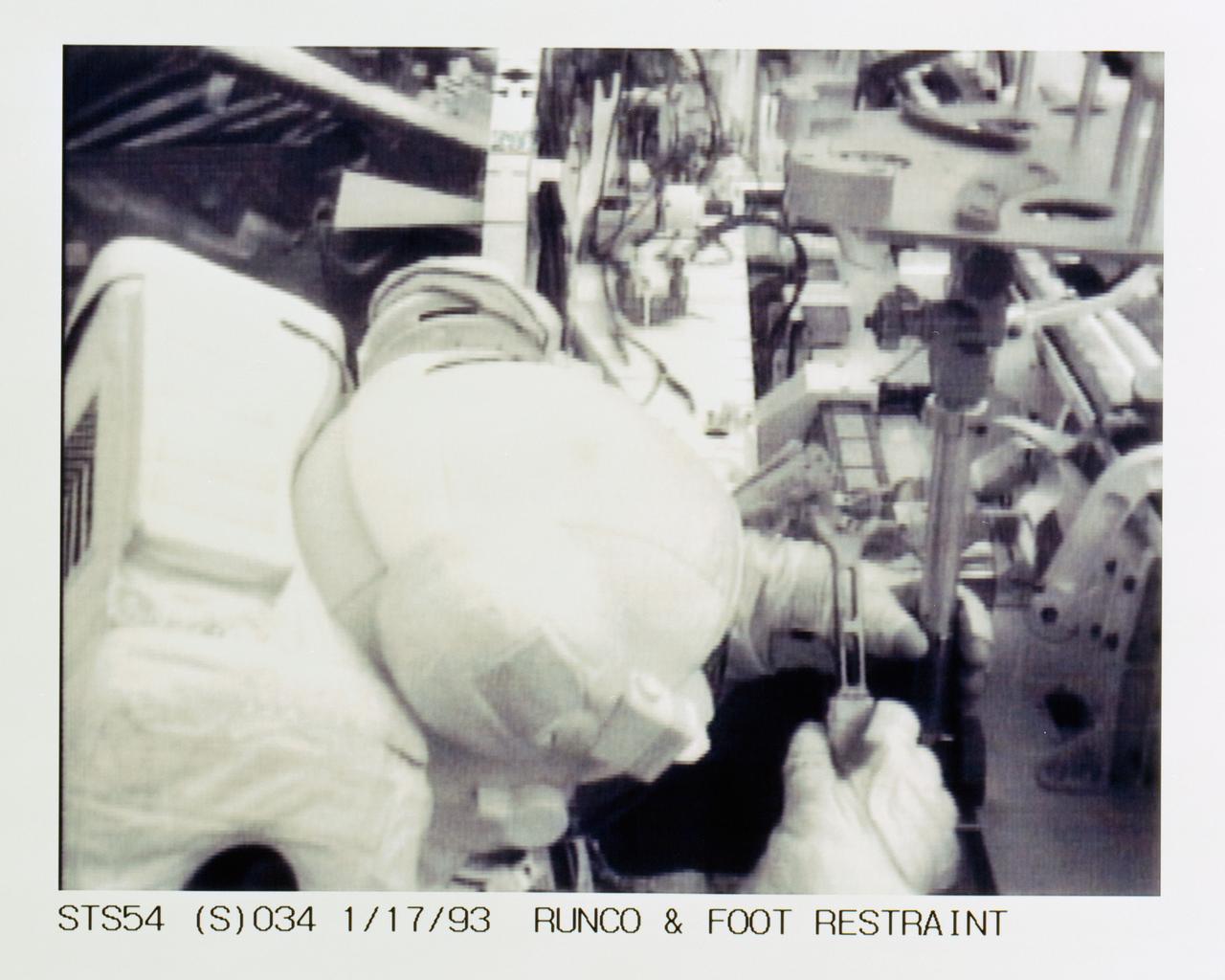
STS054-S-034 (17 Jan 1993) --- Closeup view of Runco as he works to install a mobile foot restraint during extravehicular activity (EVA) in Endeavour's cargo bay. The scene was downlinked at 11:55:07:24 GMT, Jan. 17, 1993.
STS061-102-010 (9 Dec 1993) --- Astronauts Jeffrey A. Hoffman (left) and F. Story Musgrave team to replace one of two Solar Array Drive Electronics (SADE) units on the Hubble Space Telescope (HST). Musgrave is standing on a foot restraint mounted on the end of the Space Shuttle Endeavour's Remote Manipulator System (RMS) arm. The black object, in upper left corner, is part of the window frame, through which this 70mm frame was exposed, inside Endeavour's cabin.
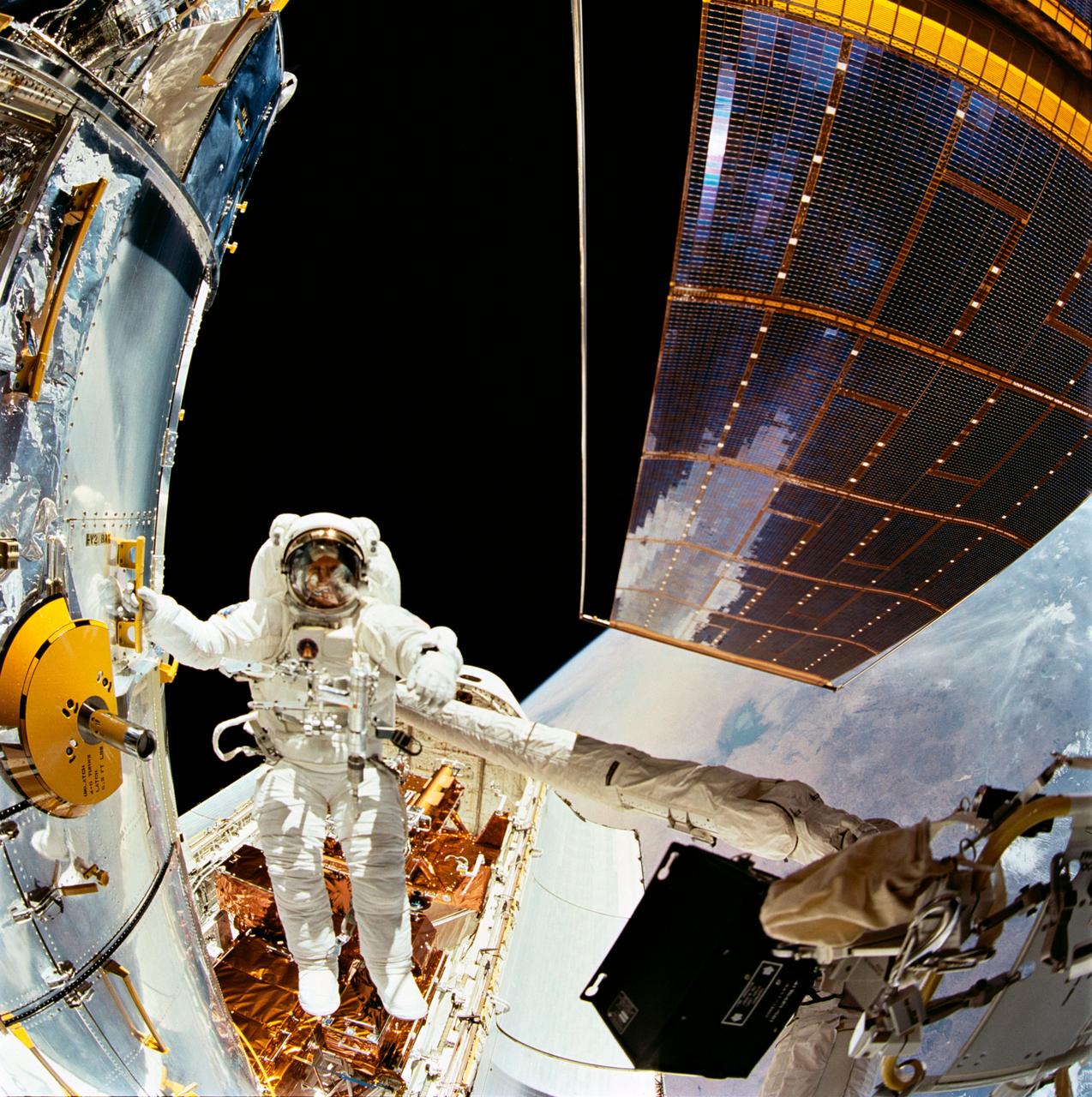
STS061-104-007 (5 Dec 1993) --- Astronaut F. Story Musgrave, holding to one of many strategically placed handrails on the Hubble Space Telescope (HST), is photographed during the first of five extravehicular activity?s (EVA) on the HST-servicing mission, aboard the Space Shuttle Endeavour.
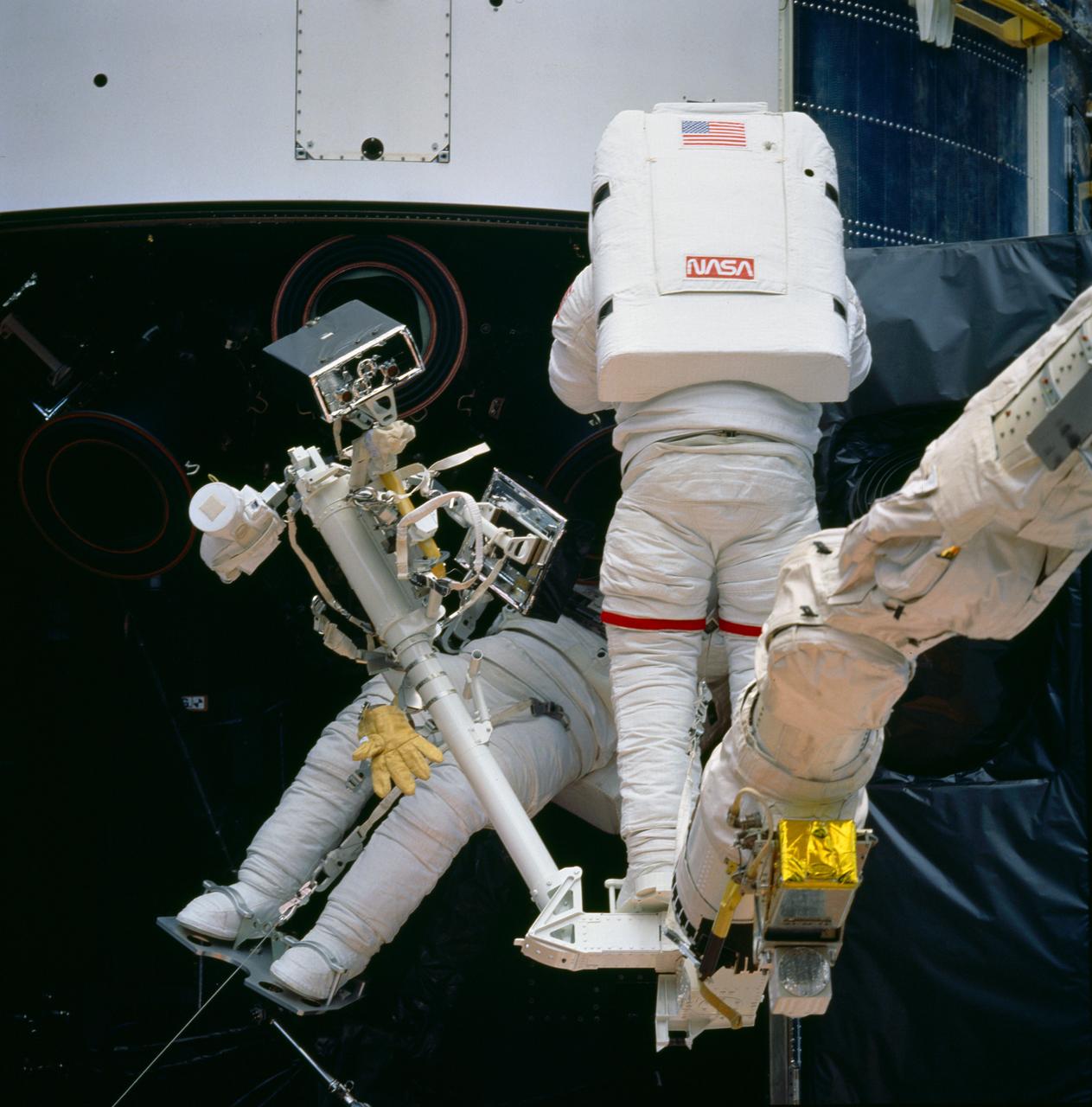
STS061-87-046 (5 Dec 1993) --- Astronauts Jeffrey A. Hoffman (right) and F. Story Musgrave work near the base of the Hubble Space Telescope (HST) on the first of five spacewalks. Their particular mission here is to replace failed Rate Sensor Units (RSU) inside the telescope's housing. Hoffman is anchored to a foot restraint, mounted on the end of the Space Shuttle Endeavour's Remote Manipulator System (RMS) arm, while Musgrave is standing on a foot restraint attached to a support structure in the cargo bay.
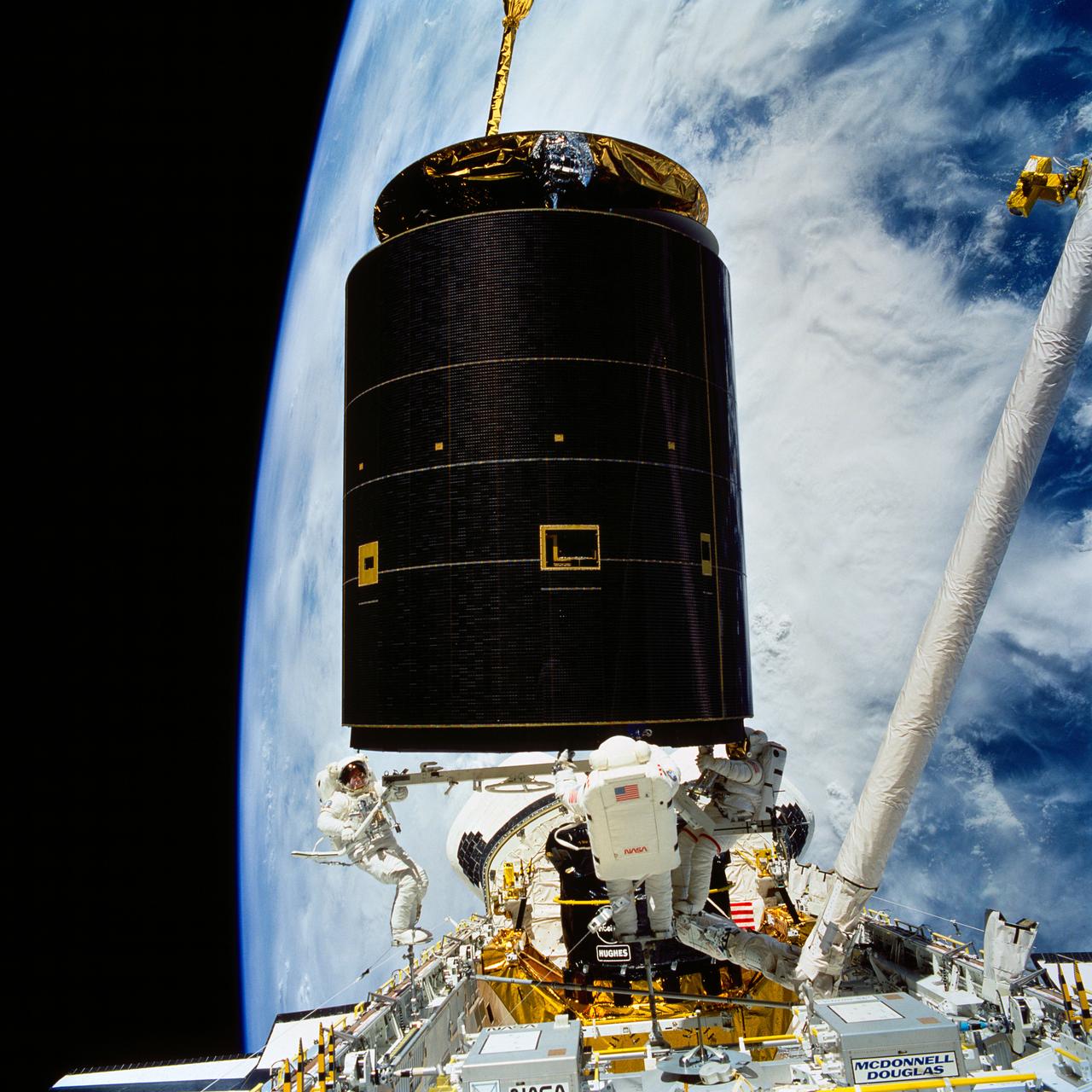
STS049-91-029 (13 May 1992) --- Following the successful capture of Intelsat VI satellite, three astronauts continue their chores toward moving the 4.5 ton communications satellite into the space shuttle Endeavour's cargo bay. A fellow crew member recorded this 70mm still frame from inside Endeavour's cabin. Left to right, astronauts Richard J. Hieb, Thomas D. Akers and Pierre J. Thuot, cooperate on the effort to attach a specially designed grapple bar underneath the satellite. Thuot stands on the end of the Remote Manipulator System's (RMS) arm while Hieb and Akers are on Portable Foot Restraints (PFR) affixed to Endeavour's portside and the Multipurpose Support Structure (MPESS), respectively. The sections of Earth which form the backdrop for the scene are blanketed with thousands of square miles of clouds. Photo credit: NASA
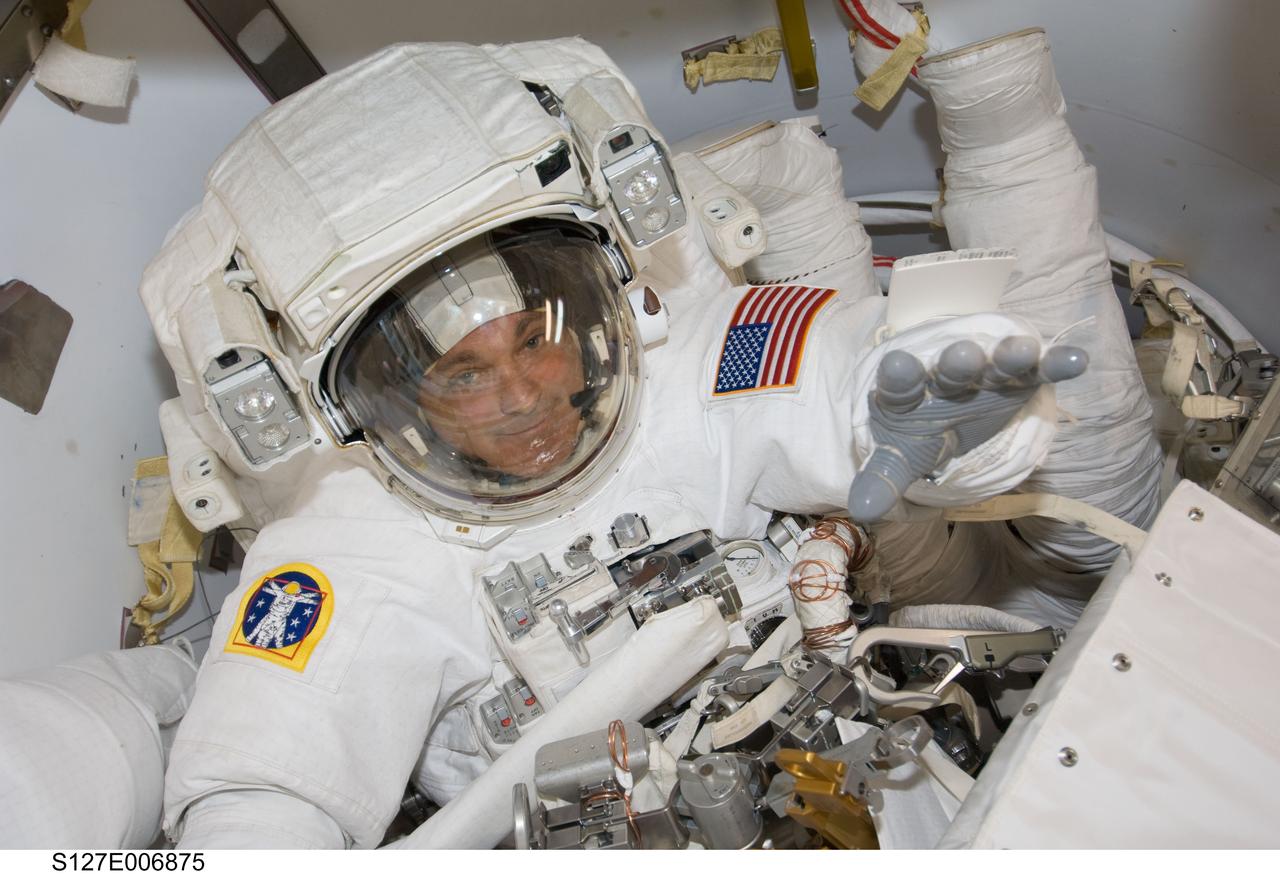
S127-E-006875 (18 July 2009) --- Astronaut Dave Wolf, mission specialist, on July 18 was one of two Endeavour astronauts to kick off a series of five sessions of ISS-related extravehicular activity for the STS-127 crew. Wolf, seen onboard the orbital outpost here, was joined by astronaut Tim Kopra for this session, his first of three scheduled.
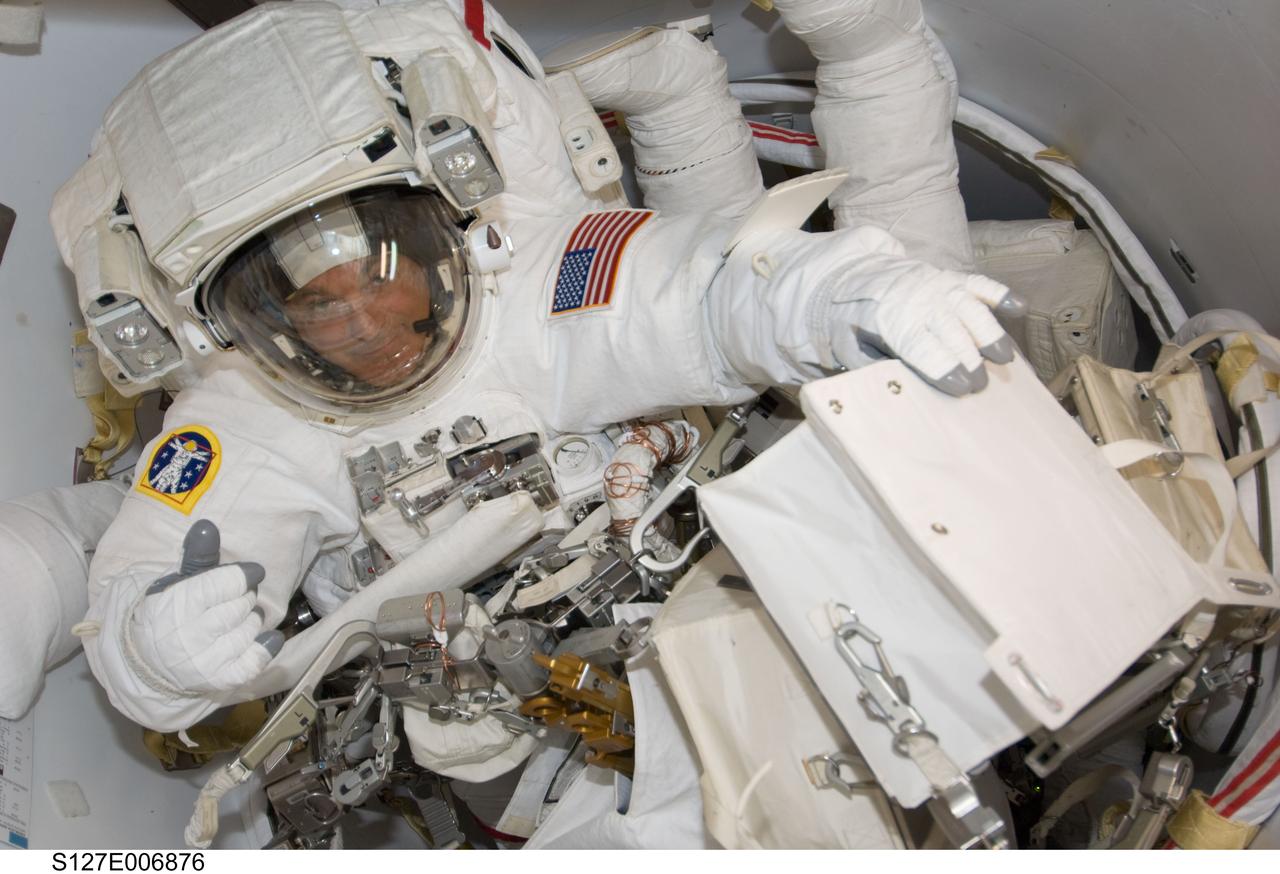
S127-E-006876 (18 July 2009) --- Astronaut Dave Wolf, mission specialist, on July 18 was one of two Endeavour astronauts to kick off a series of five sessions of ISS-related extravehicular activity for the STS-127 crew. Wolf, seen onboard the orbital outpost here, was joined by astronaut Tim Kopra for this session, his first of three scheduled.
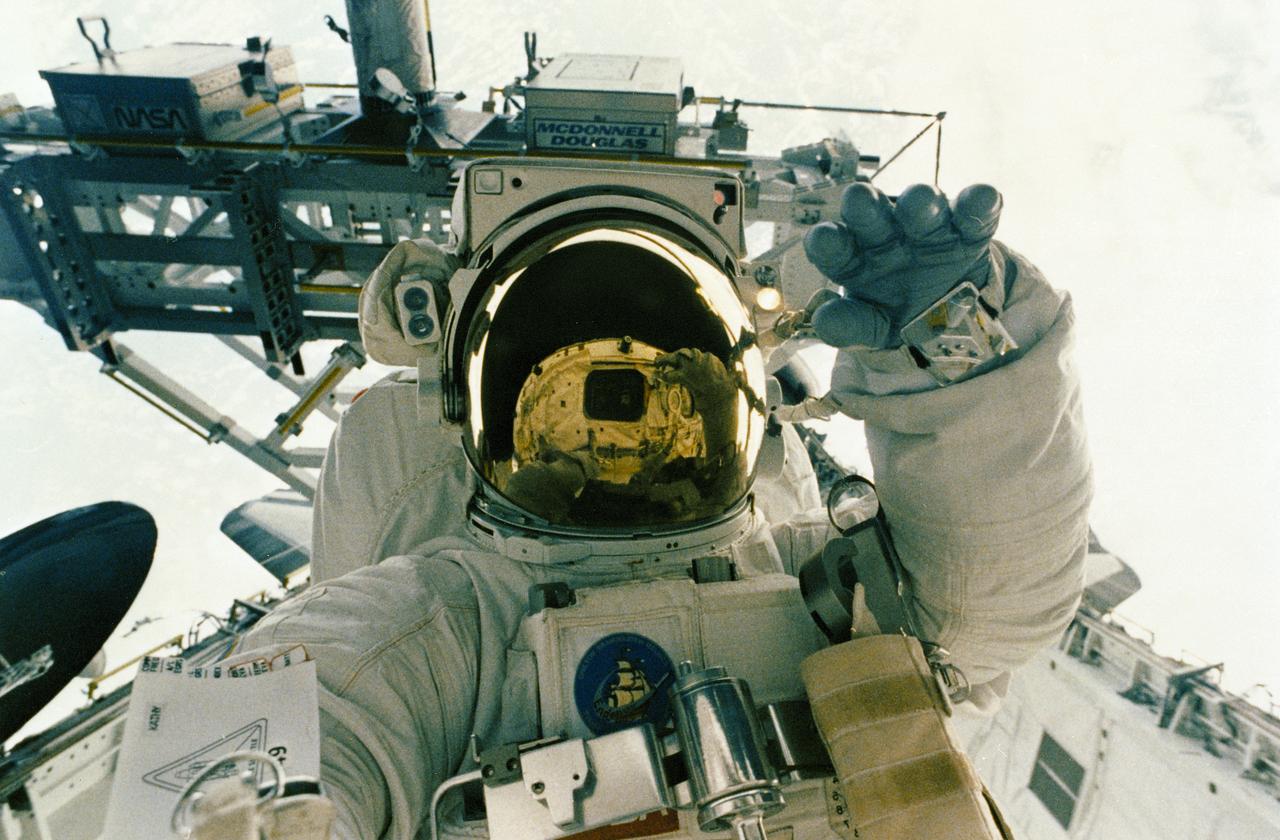
STS-49, the first flight of the Space Shuttle Orbiter Endeavour, lifted off from launch pad 39B on May 7, 1992 at 6:40 pm CDT. The STS-49 mission was the first U.S. orbital flight to feature 4 extravehicular activities (EVAs), and the first flight to involve 3 crew members working simultaneously outside of the spacecraft. The primary objective was the capture and redeployment of the INTELSAT VI (F-3), a communication satellite for the International Telecommunication Satellite organization, which was stranded in an unusable orbit since its launch aboard the Titan rocket in March 1990. In this onboard photo, astronaut Kathryn Thornton is working on the Assembly of Station by EVA Methods (ASEM) in the cargo bay.
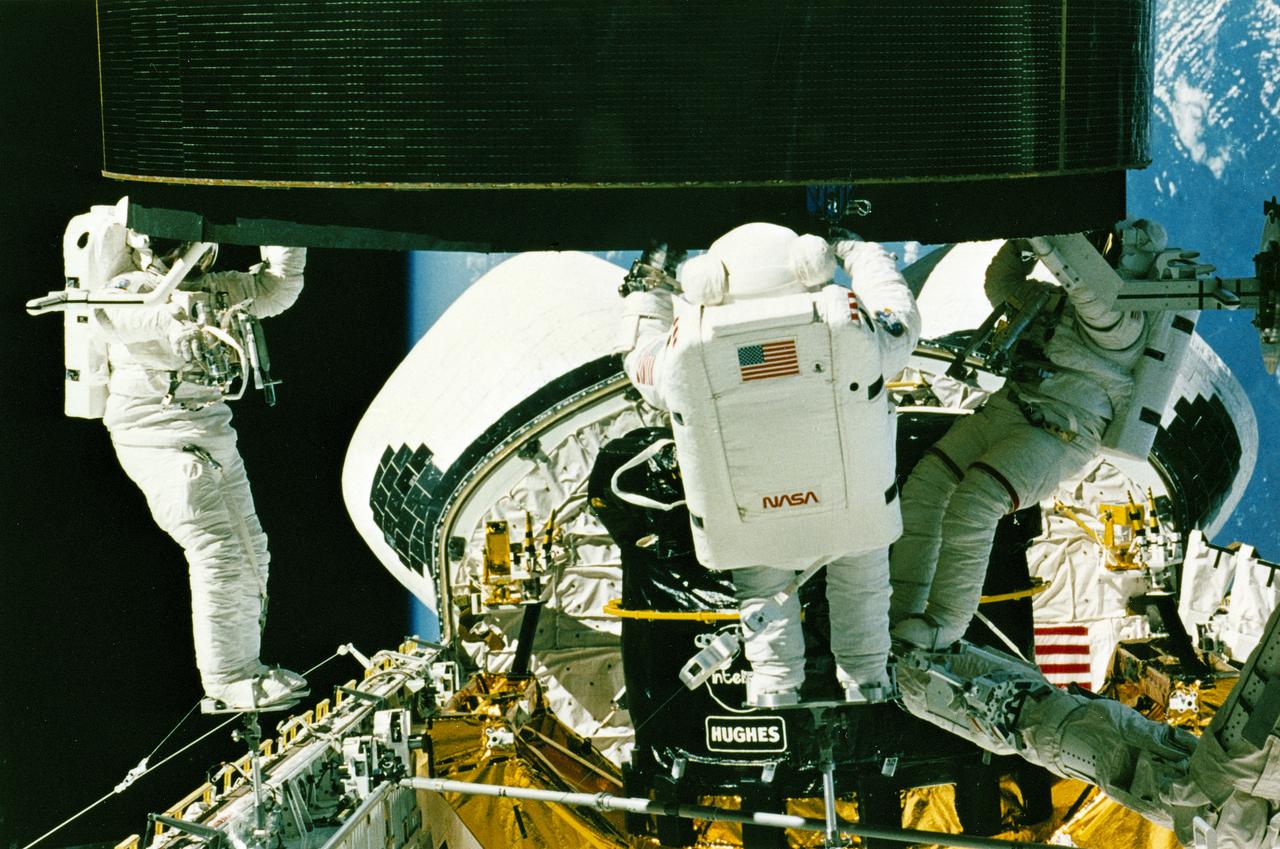
STS-49, the first flight of the Space Shuttle Orbiter Endeavour, lifted off from launch pad 39B on May 7, 1992 at 6:40 pm CDT. The STS-49 mission was the first U.S. orbital flight to feature 4 extravehicular activities (EVAs), and the first flight to involve 3 crew members working simultaneously outside of the spacecraft. The primary objective was the capture and redeployment of the INTELSAT VI (F-3), a communication satellite for the International Telecommunication Satellite organization, which was stranded in an unusable orbit since its launch aboard the Titan rocket in March 1990. In this onboard photo, astronauts Hieb, Akers, and Thuot have handholds on the satellite.
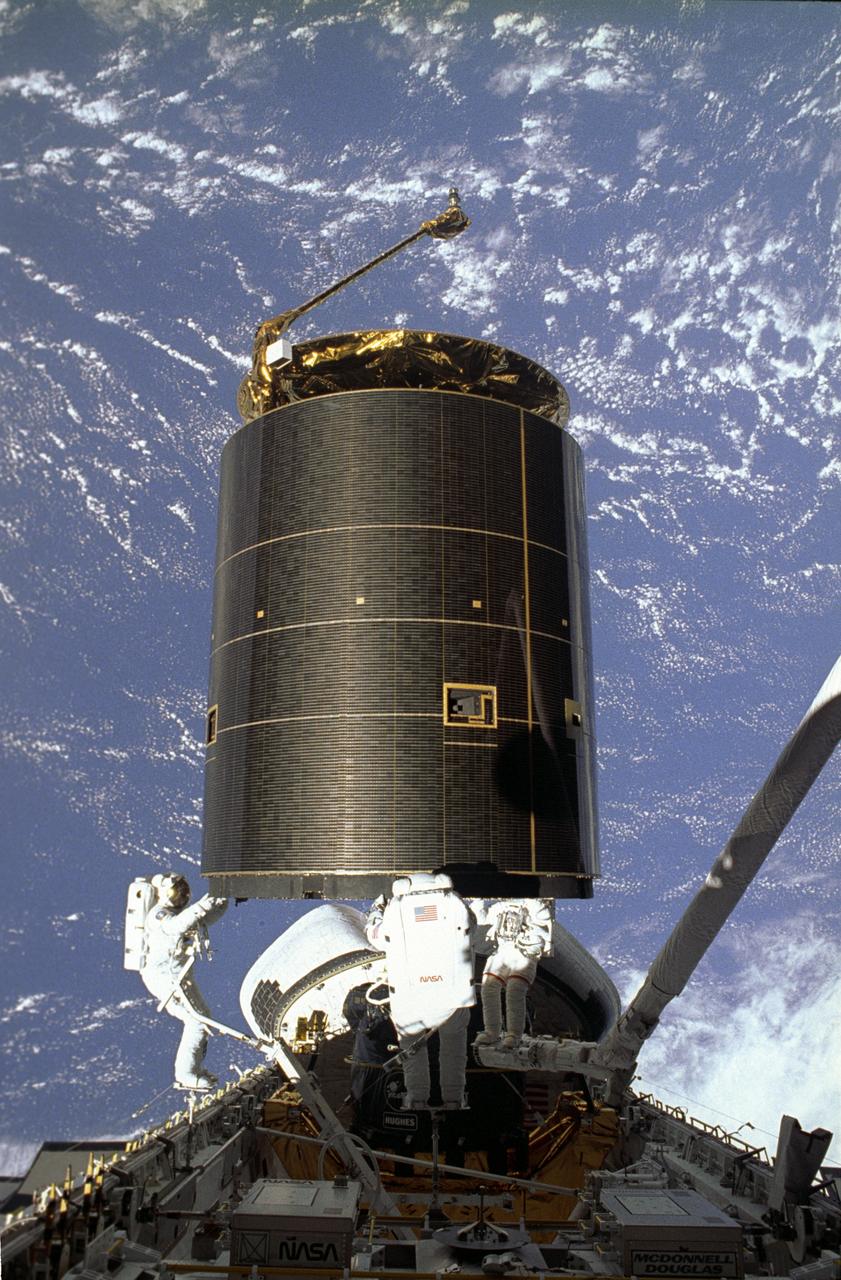
STS-49, the first flight of the Space Shuttle Orbiter Endeavour, lifted off from launch pad 39B on May 7, 1992 at 6:40 pm CDT. The STS-49 mission was the first U.S. orbital flight to feature 4 extravehicular activities (EVAs), and the first flight to involve 3 crew members working simultaneously outside of the spacecraft. The primary objective was the capture and redeployment of the INTELSAT VI (F-3), a communication satellite for the International Telecommunication Satellite organization, which was stranded in an unusable orbit since its launch aboard the Titan rocket in March 1990. In this onboard photo, astronauts Hieb, Akers, and Thuot have handholds on the satellite.
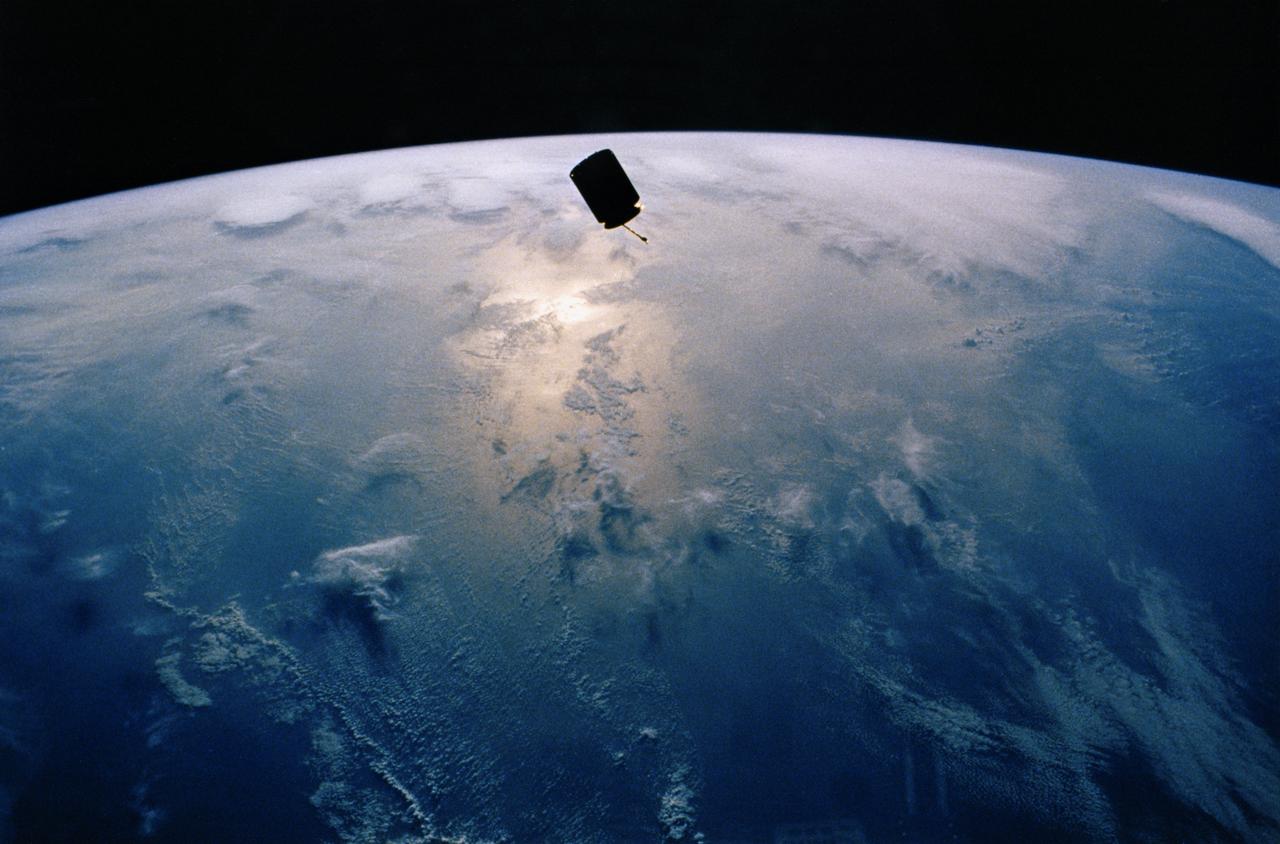
STS-49, the first flight of the Space Shuttle Orbiter Endeavour, lifted off from launch pad 39B on May 7, 1992 at 6:40 pm CDT. The STS-49 mission was the first U.S. orbital flight to feature 4 extravehicular activities (EVAs), and the first flight to involve 3 crew members working simultaneously outside of the spacecraft. The primary objective was the capture and redeployment of the INTELSAT VI (F-3), a communication satellite for the International Telecommunication Satellite organization, which was stranded in an unusable orbit since its launch aboard the Titan rocket in March 1990. This onboard photo captures the free flying INTELSAT IV.
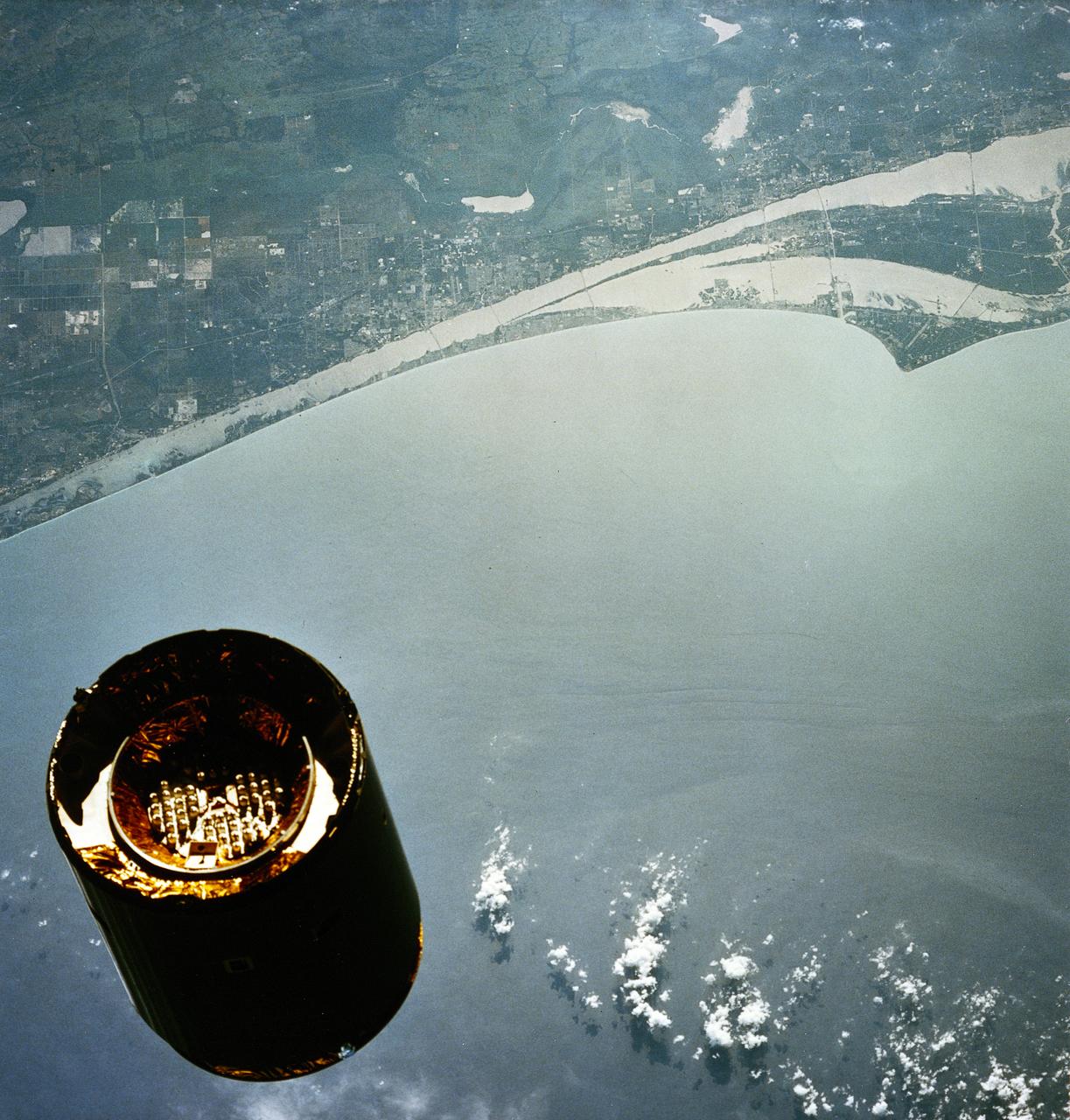
STS-49, the first flight of the Space Shuttle Orbiter Endeavour, lifted off from launch pad 39B on May 7, 1992 at 6:40 pm CDT. The STS-49 mission was the first U.S. orbital flight to feature 4 extravehicular activities (EVAs), and the first flight to involve 3 crew members working simultaneously outside of the spacecraft. The primary objective was the capture and redeployment of the INTELSAT VI (F-3), a communication satellite for the International Telecommunication Satellite organization, which was stranded in an unusable orbit since its launch aboard the Titan rocket in March 1990. This onboard photo depicts Florida’s Atlantic coast and the Cape Canaveral area as the backdrop for this scene of the INTELSAT VI’s approach to the Shuttle Endeavour.
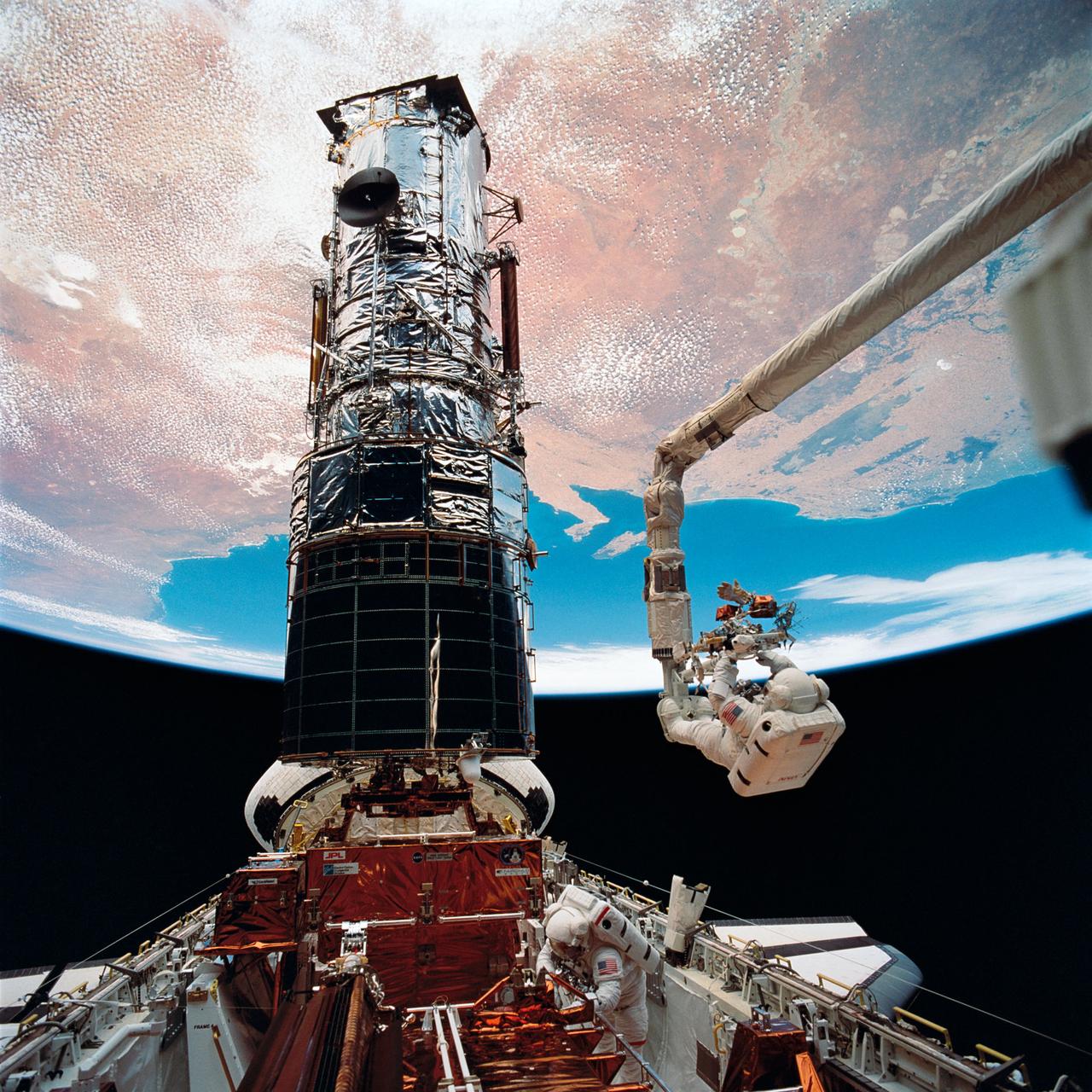
STS061-98-050 (9 Dec 1993) --- Astronaut F. Story Musgrave, anchored on the end of the Remote Manipulator System (RMS) arm, prepares to be elevated to the top of the towering Hubble Space Telescope (HST) to install protective covers on magnetometers. Astronaut Jeffrey A. Hoffman (bottom of frame) assisted Musgrave with final servicing tasks on the telescope, wrapping up five days of extravehicular activities (EVA).
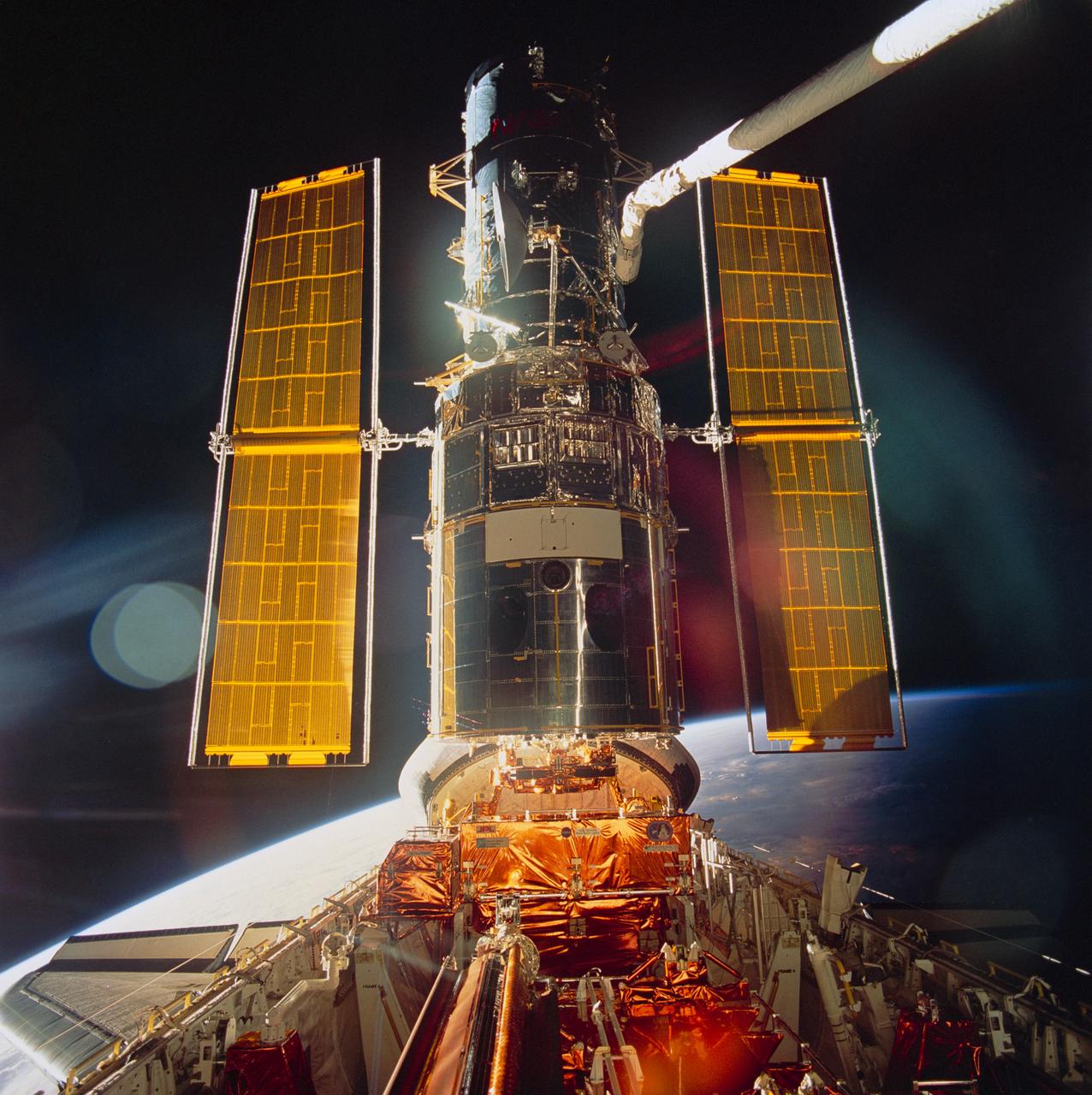
STS061-99-009 (9 Dec 1993) --- Sunlight reflects off the Space Shuttle Endeavour's aft windows and the shiny Hubble Space Telescope (HST) prior to its post-servicing deployment near the end of the eleven-day mission. A handheld Hasselblad camera was used inside Endeavour's cabin to record the image.
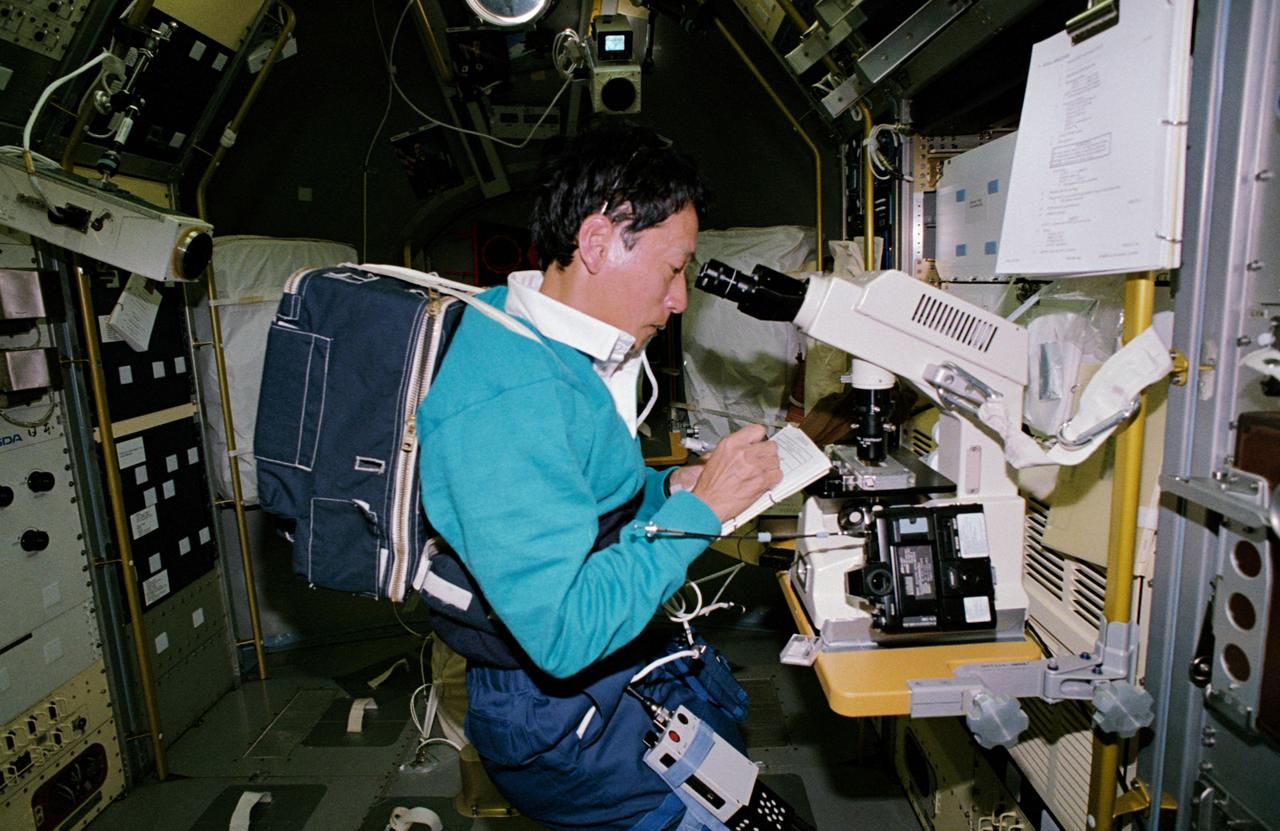
STS047-05-025 (12 - 20 Sept 1992) --- Payload specialist Mamoru Mohri, representing Japan's National Space Development Agency (NASDA), uses a microscope to produce photomicrographs of mammalian cells. The mammal cell structure experiment is one of a large number of tests that were performed during the eight-day Spacelab-J mission. On his back, Dr. Mohri totes a health monitoring experiment. The primary objective of the physiological monitoring system is to observe the health condition of the Japanese payload specialist so that good health can be maintained during and after the spaceflight.