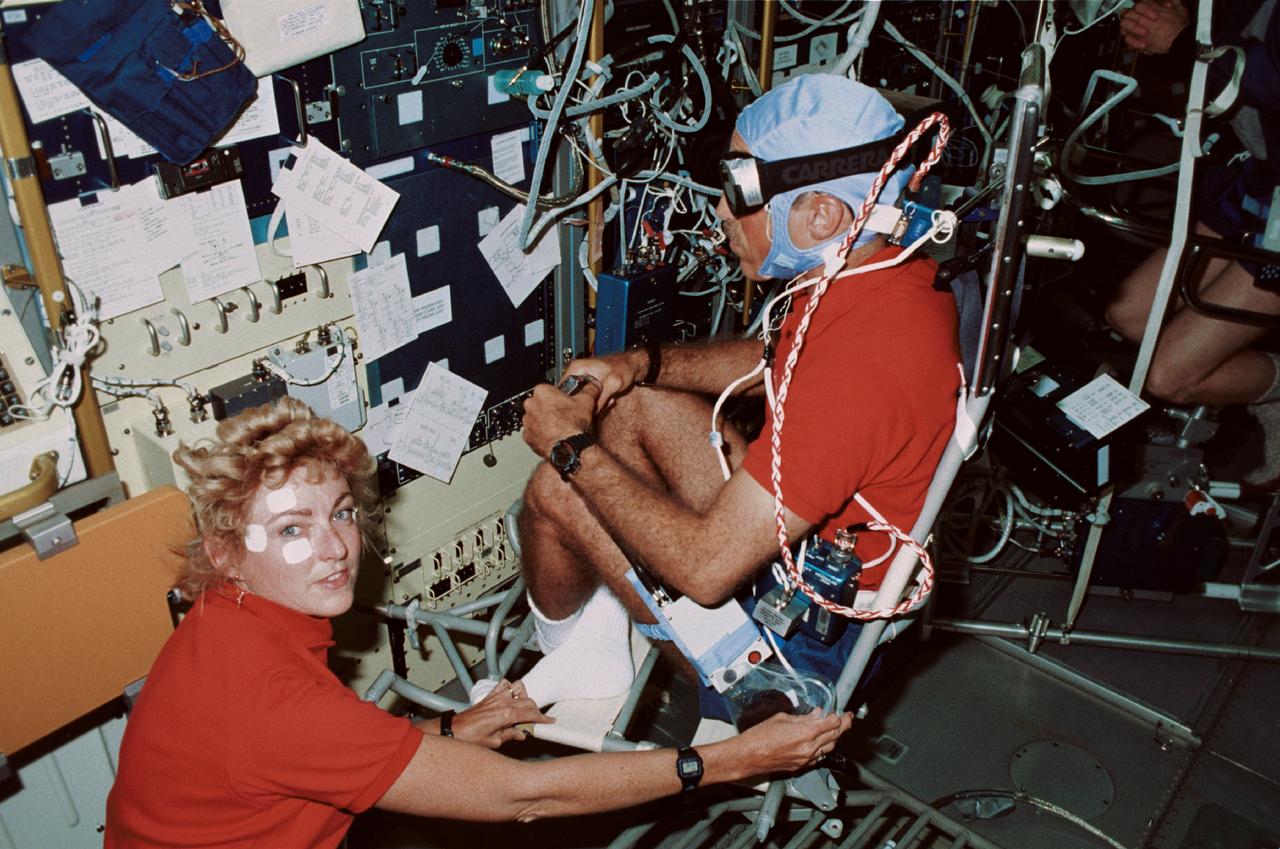
STS040-211-020 (5-14 June 1991) --- Vestibular experiment activities were captured onboard Columbia's Spacelab Life Sciences (SLS-1) module in this 35mm scene. Astronaut James P. Bagian, STS-40 mission specialist, is in a rotating chair while wearing an accelometer and electrodes to record head motion and horizontal and vertical eye movements during the rotations. Payload specialist Millie Hughes-Fulford, lower left, assists with the test.
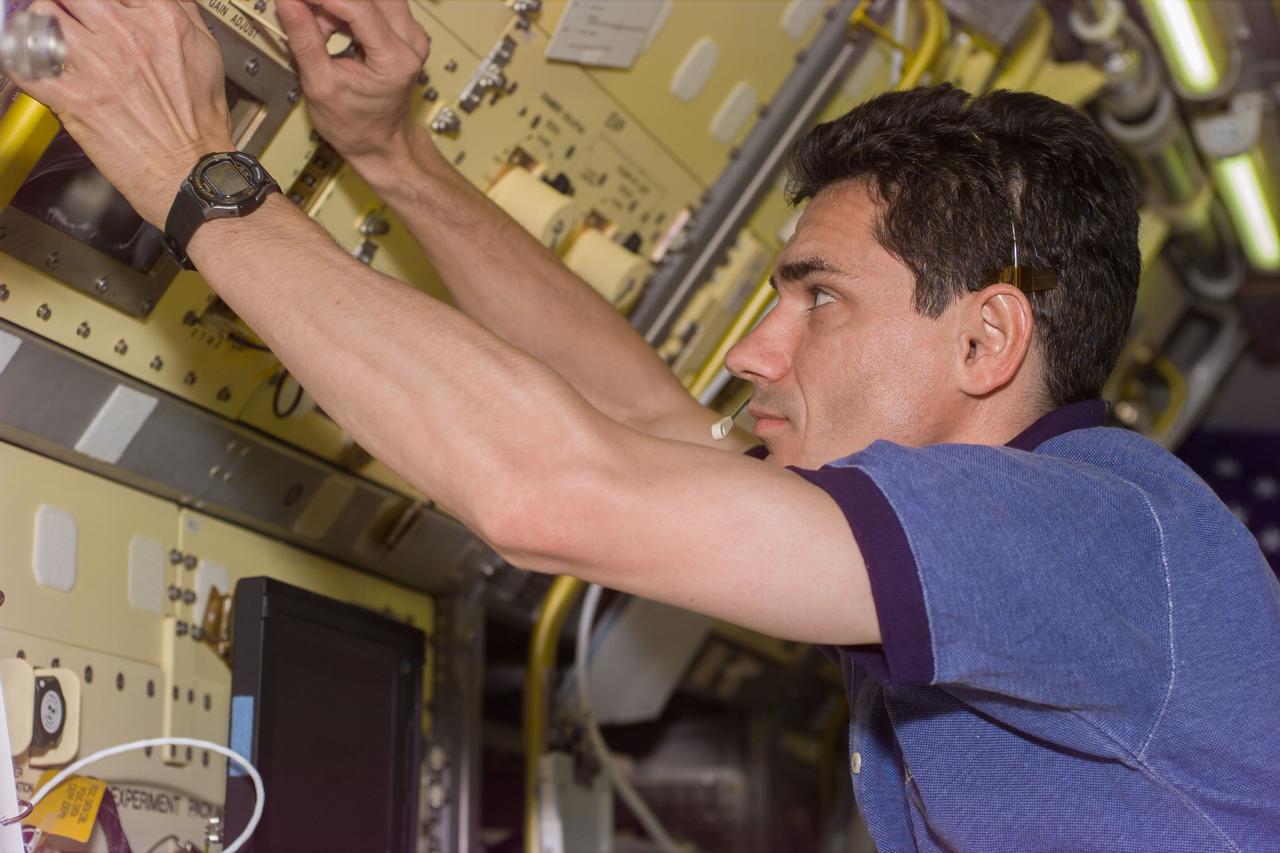
S94-E-5002 (5 July 1997) --- Payload specialist Gregory J. Linteris checks on a combustion experiment onboard the Space Shuttle Columbia's Spacelab Module during flight day five activities.

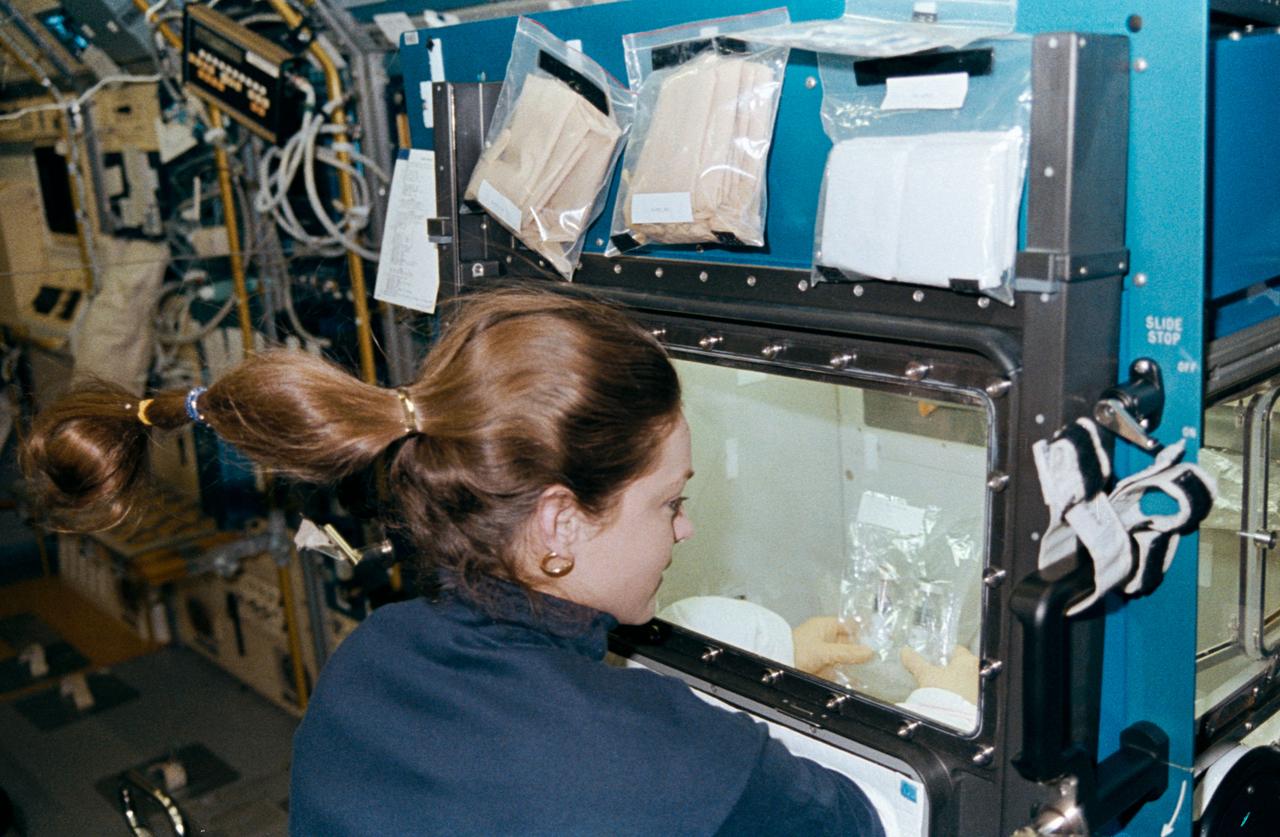
S94-E-5001 (5 July 1997) --- Astronaut Donald Thomas, mission specialist, uses a microscope at the glovebox onboard the Space Shuttle Columbia's Spacelab Module during flight day five activities.
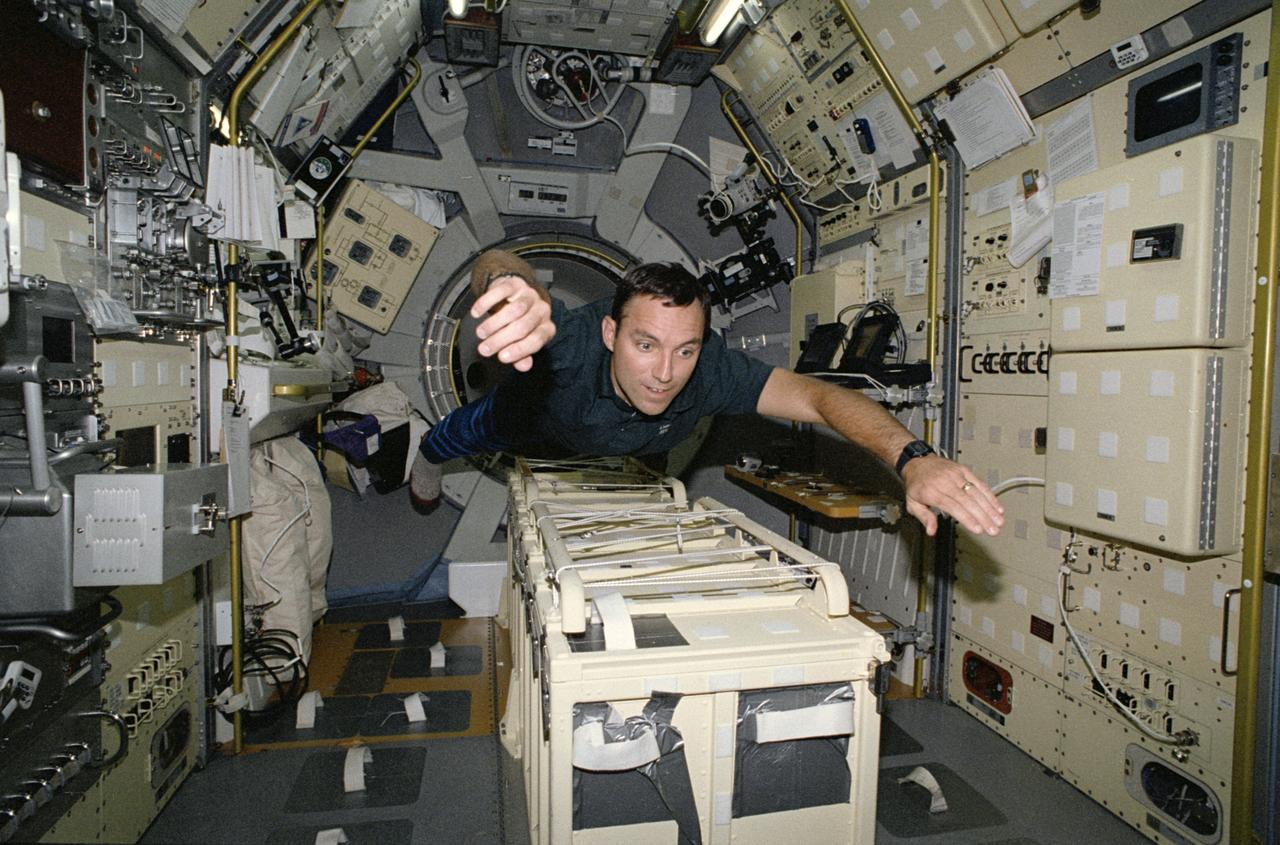
STS-65 Mission Specialist Carl E. Walz floats above center aisle equipment in the International Microgravity Laboratory 2 (IML-2) spacelab science module. Walz has just entered the IML-2 module via the spacelab tunnel (note hatch opening behind him). The tunnel connects the IML-2 module with Columbia's, Orbiter Vehicle (OV) 102's, crew compartment. Walz along with five other NASA astronauts and a Japanese payload specialist spent more than two weeks in Earth orbit conducting IML-2 experiments. This photo was among the first released by NASA following IML-2.
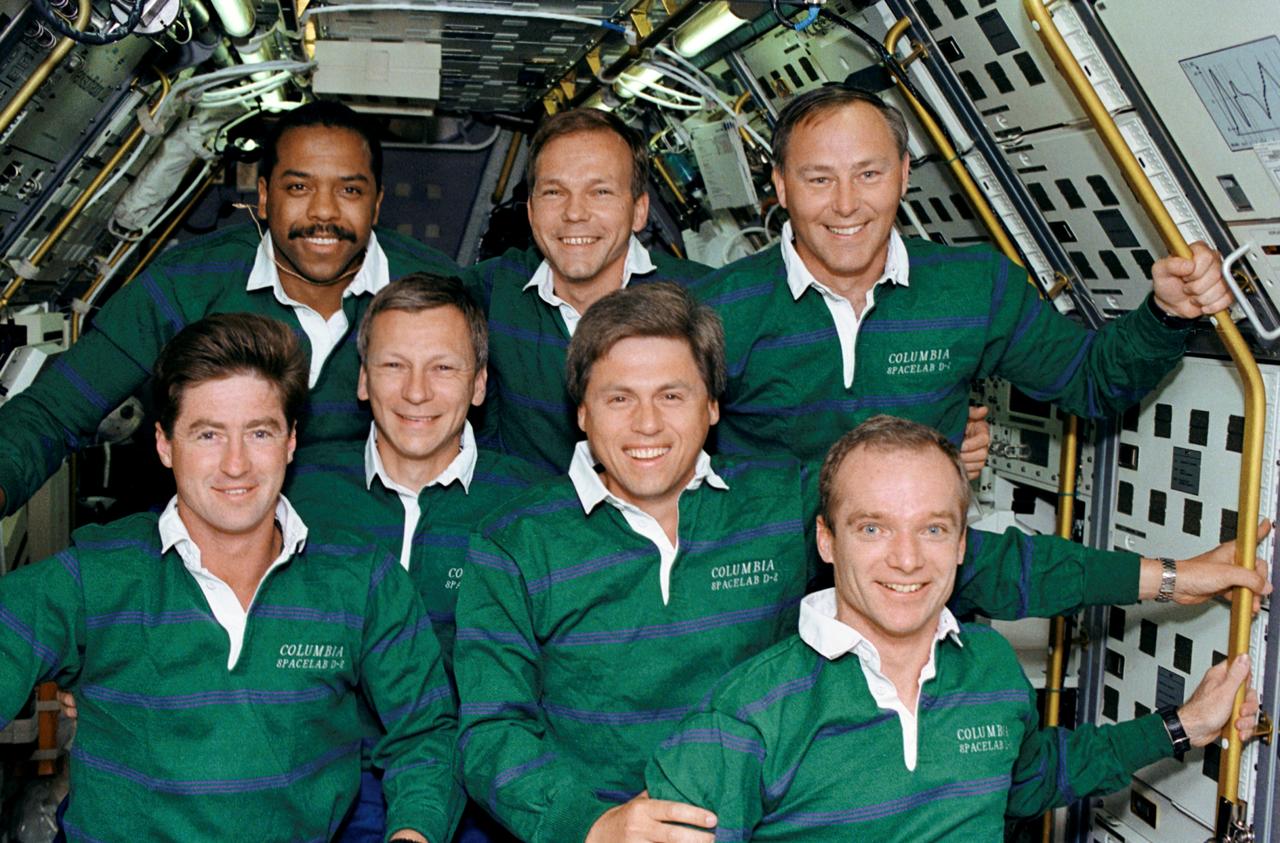
STS055-203-009 (26 April-6 May 1993) --- The seven crew members who spent 10 days aboard the space shuttle Columbia pose for the traditional in-flight portrait in the Spacelab D-2 Science Module. Front, left to right, are Terence T. (Tom) Henricks, Steven R. Nagel, Ulrich Walter and Charles J. Precourt. In the rear are (left to right) Bernard A. Harris Jr., Hans Schlegel and Jerry L. Ross. Nagel served as mission commander; Henricks was the pilot and Ross, the payload commander. Harris and Precourt were mission specialists and Schlegel and Walter were payload specialists representing the German Aerospace Research Establishment (DLR). Photo credit: NASA
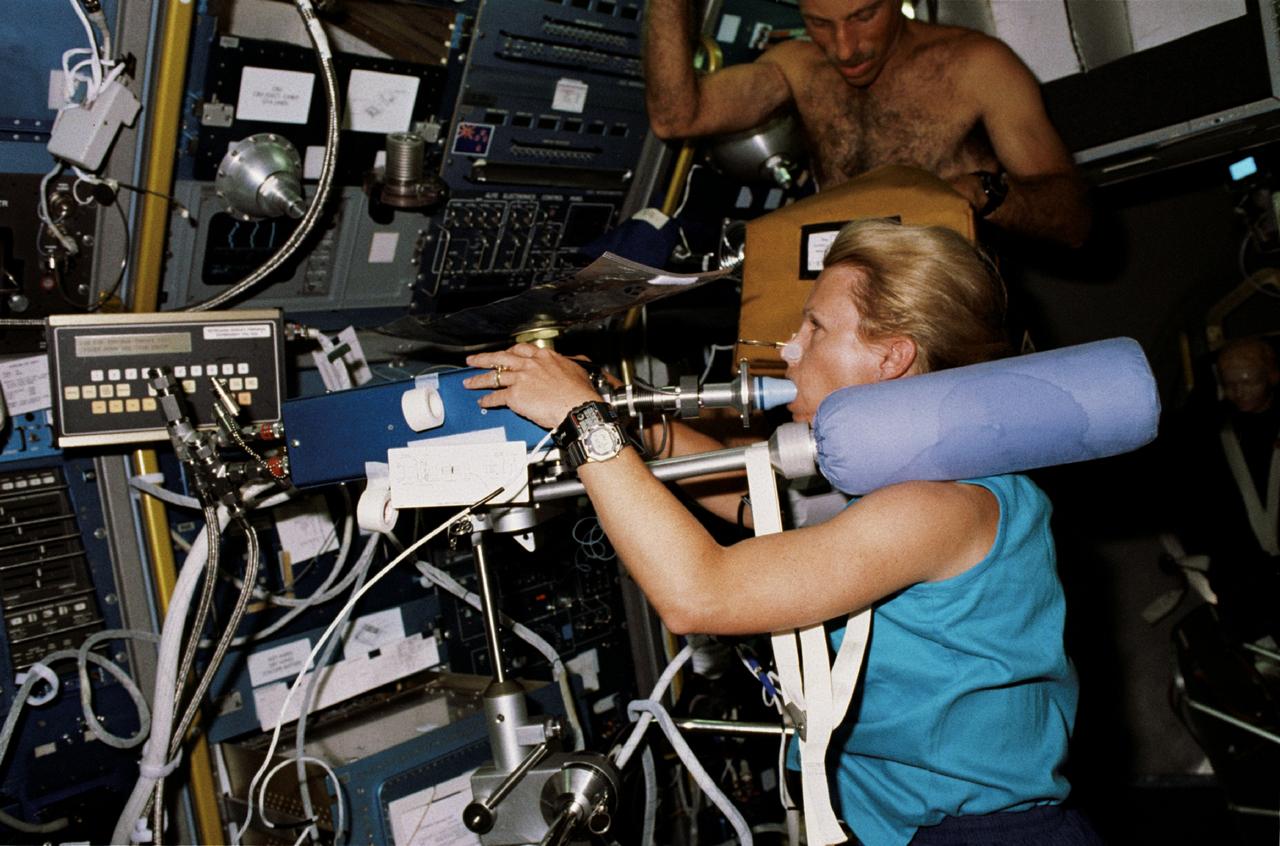
STS040-211-019 (5-14 June 1991) --- Astride the bicycle ergometer, astronaut Rhea Seddon, mission specialist, breathes into the cardiovascular re-breathing unit during the exercise phase of an experiment. The investigation, In-flight Study of Cardiovascular Deconditioning (Experiment 066), was developed by Dr. Leon E. Farhi of the State University of New York in Buffalo. It focuses on the deconditioning of the heart and lungs and changes in cardiopulmonary function that occur upon return to Earth. By using non-invasive techniques of prolonged expiration and re-breathing, investigators can determine the amount of blood pumped out of the heart (cardiac output), the ease with which blood flows through all the vessels (total peripheral resistance), oxygen used and carbon dioxide released by the body, and lung function and volume changes. Measurements are made both while crew members are resting and while they pedal the exercise bicycle, as Dr. Seddon is doing here. This scene was photographed with a 35mm camera.
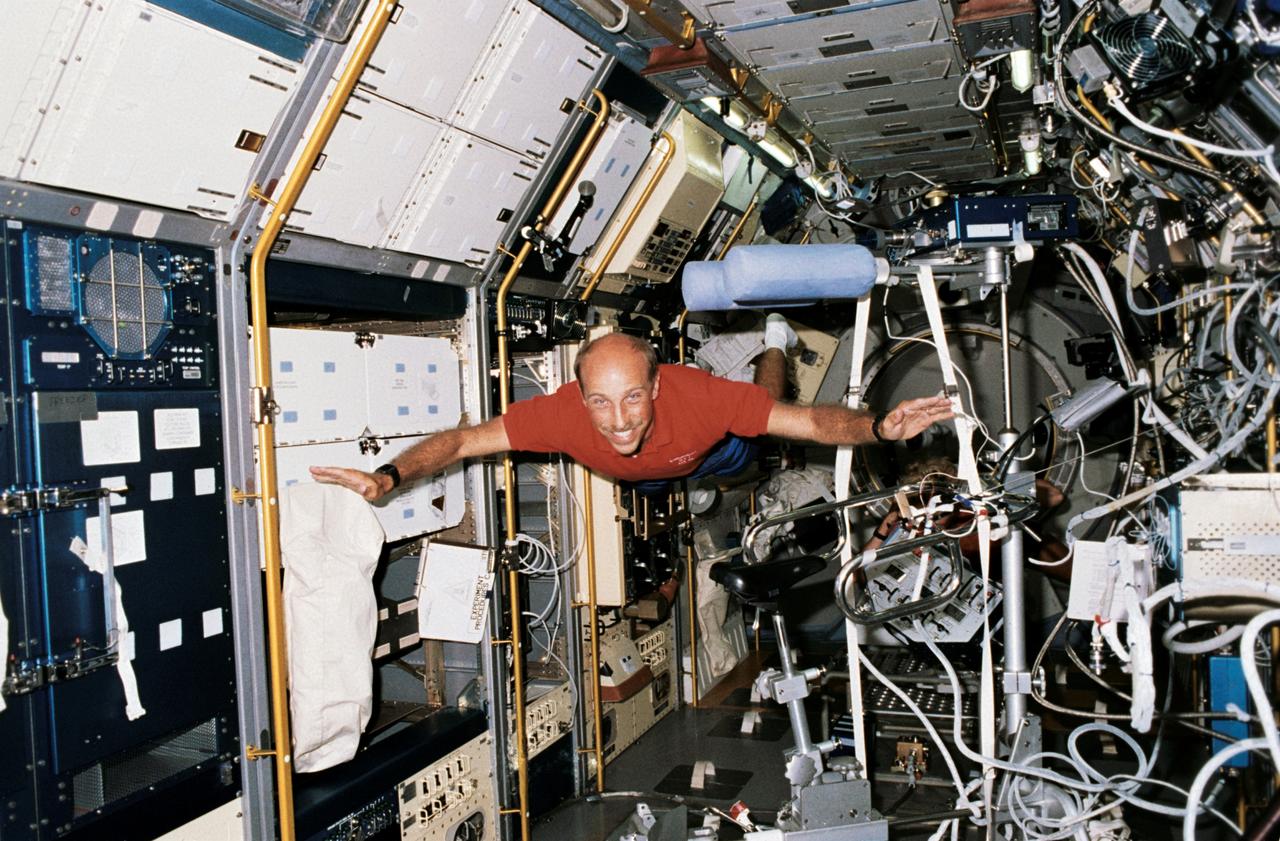
STS040-212-004 (5-14 June 1991) --- Astronaut James P. Bagian, STS-40 mission specialist, floats through the Spacelab Life Sciences (SLS-1) module aboard the Earth-orbiting Space Shuttle Columbia. Bagian and six other crew members spent over nine-days in space conducting life sciences research.
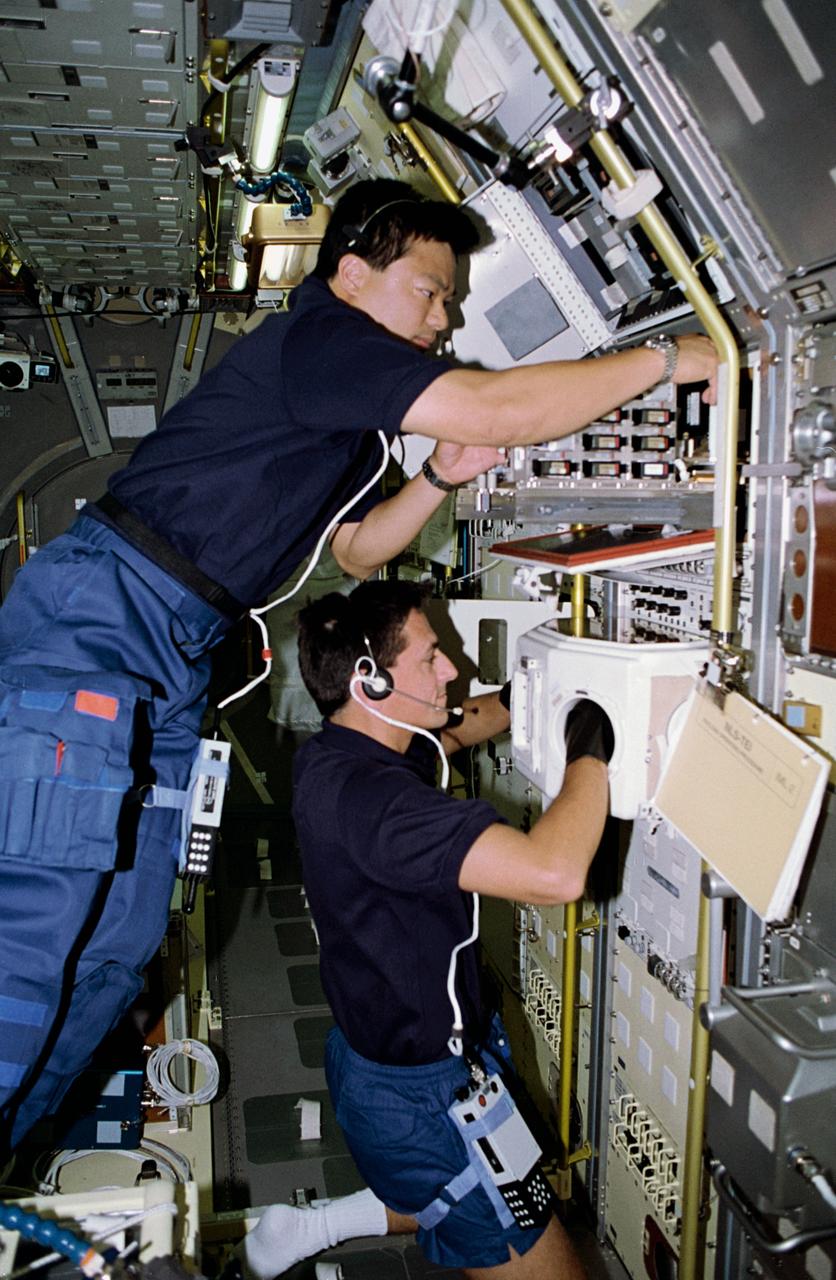
STS-65 Mission Specialist (MS) Leroy Chiao (top) and MS Donald A. Thomas are seen at work in the International Microgravity Laboratory 2 (IML-2) spacelab science module aboard the Space Shuttle Columbia, Orbiter Vehicle (OV) 102. The two crewmembers are conducting experiments at the IML-2 Rack 5 Biorack (BR). Chiao places a sample in the BR incubator as Thomas handles another sample inside the BR glovebox. The glovebox is used to prepare samples for BR and slow rotating centrifuge microscope (NIZEMI) experiments.
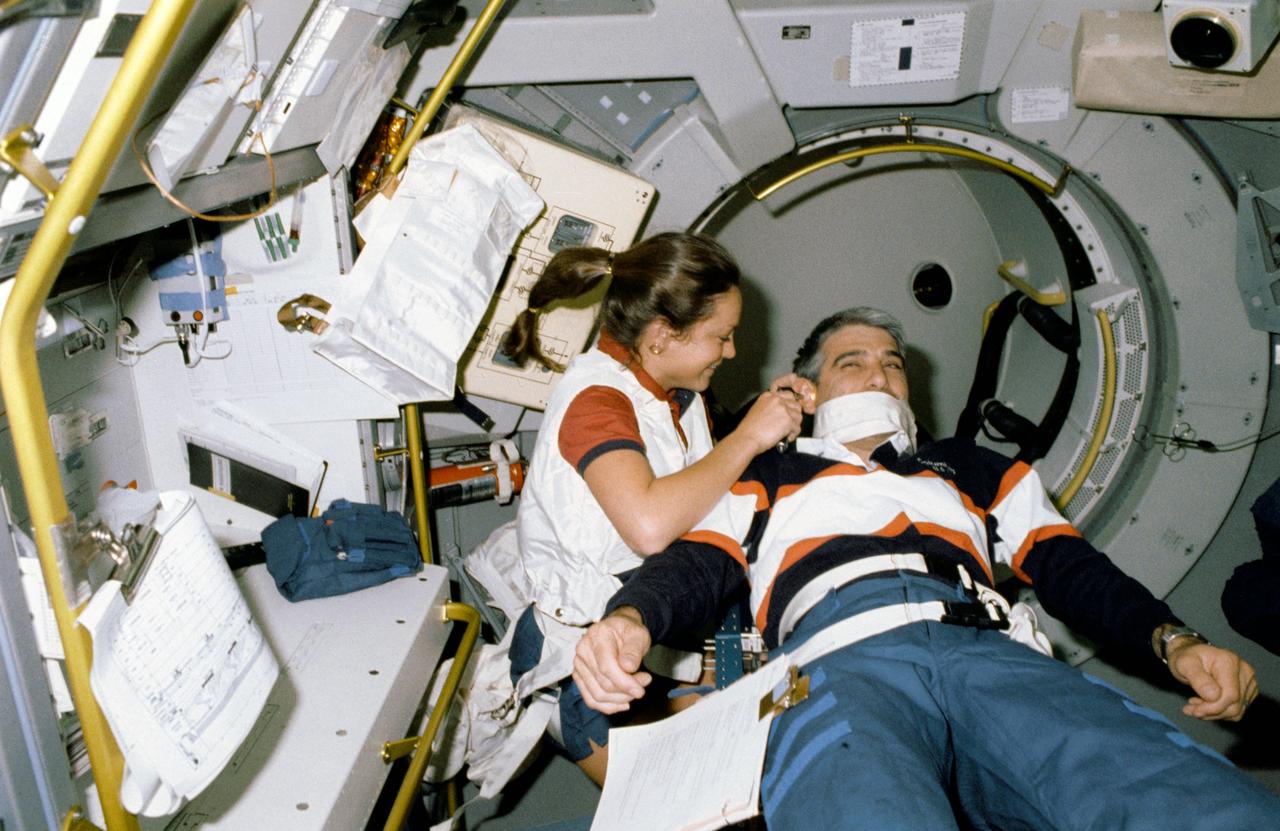
STS040-206-002 (5-14 June 1991) --- Held in place by the Spacelab Life Sciences (SLS-1) Medical Restraint System (MRS), astronaut Sidney M. Gutierrez, pilot, gets his ears checked by astronaut Tamara E. Jernigan, mission specialist. The two are in the SLS-1 module, onboard the Space Shuttle Columbia. The scene was photographed with a 35mm camera.
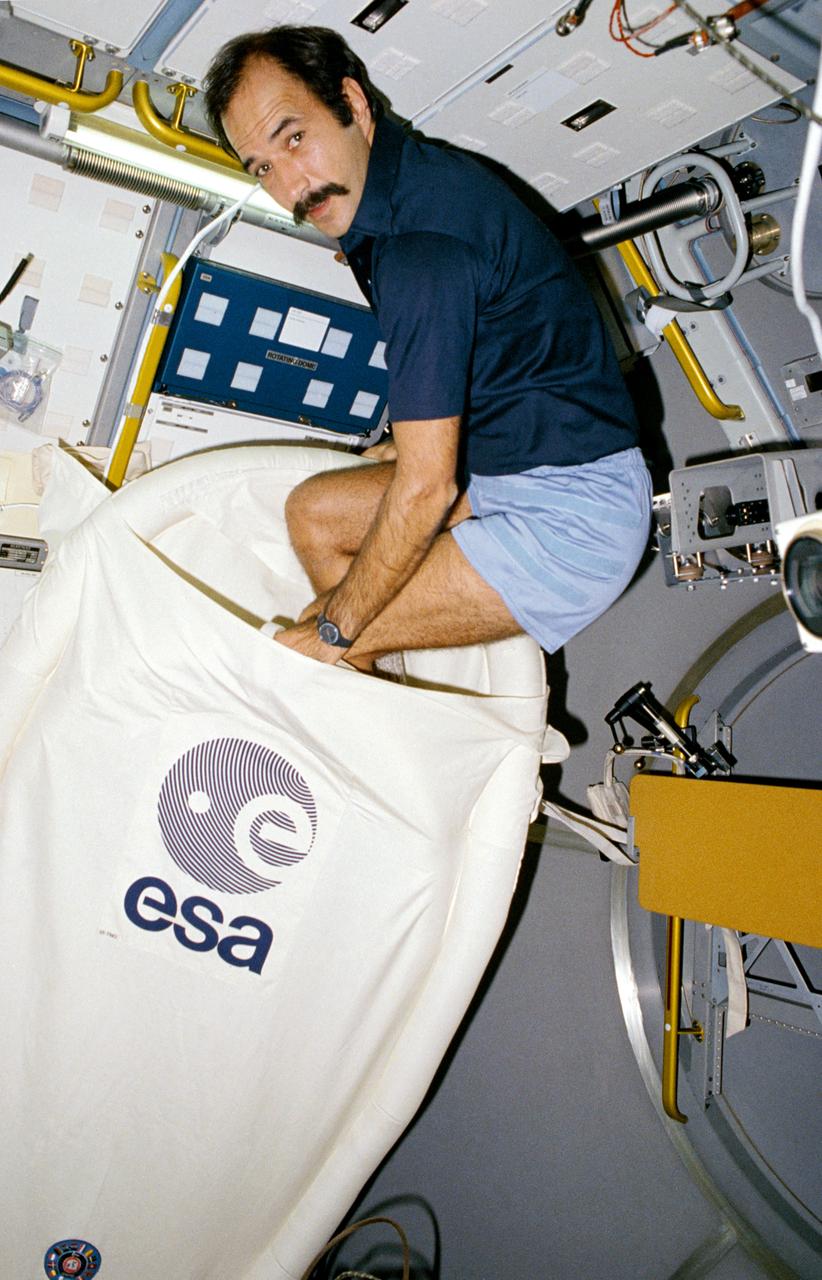
61A-08-018 (30 Oct.-6 Nov. 1985) --- Wubbo J. Ockels, a Dutch scientists representing the European Space Agency (ESA), crawls from an unique sleeping restraint in D-1 science module. Unlike the other crewmembers on STS 61A, Ockels did not sleep in the middeck of the Challenger. Ockels proposed this concept of sleeping facility and the actual hardware was developed by the Technisch Natur Wetenschappelyk Onderzoek (TNO), a Dutch government organization.
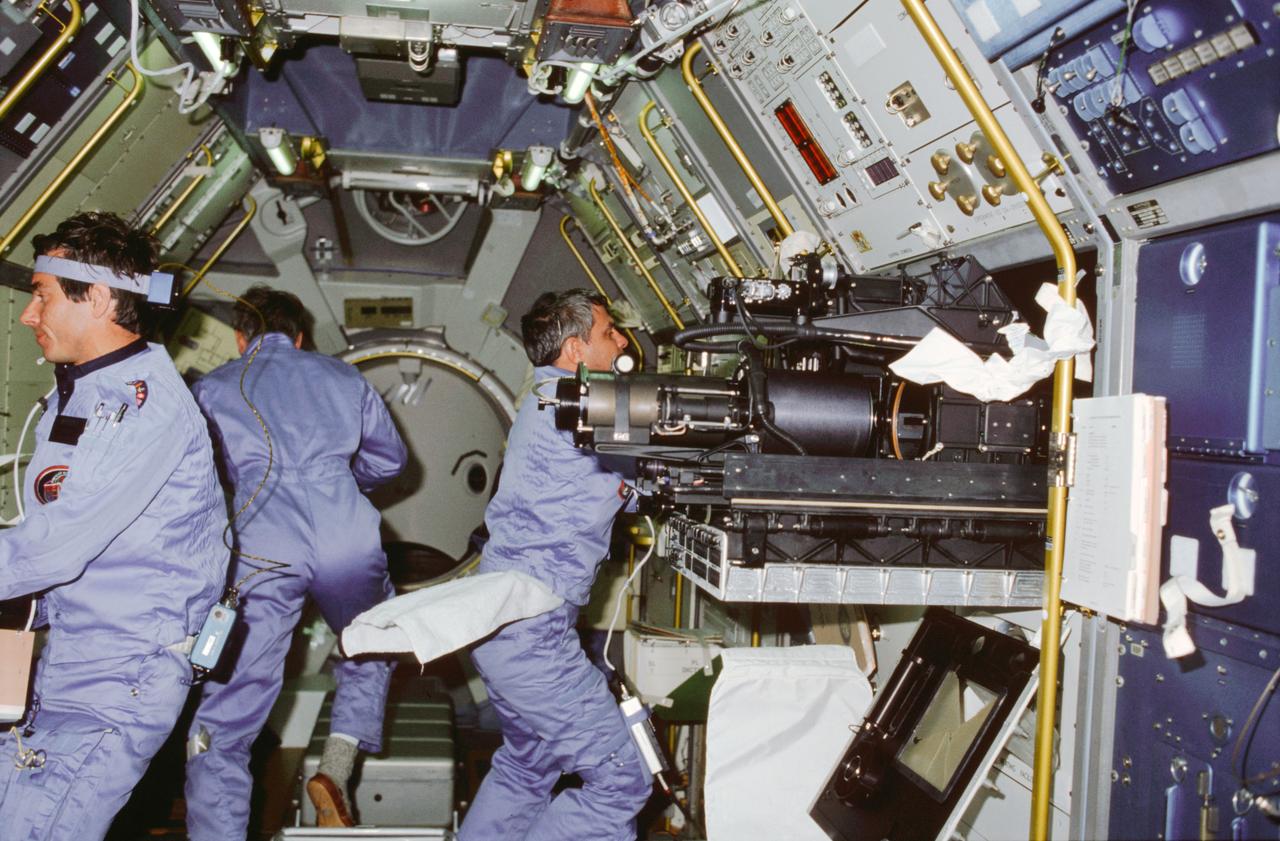
STS009-03-093 (28 Nov-8 Dec 1983) --- A mission specialist and two payload specialists busy themselves in the Spacelab 1 module aboard the Earth orbiting Space Shuttle Columbia. Left to right are Payload Specialist Robert A. R. Parker. Parker is partially obscured by a deployed instrument of the fluid physics module at the materials sciences double rack. Merbold, a physicist from Max-Planck Institute in the Federal Republic of Germany, wears a head band-like device and a recorder as part of an overall effort to learn more about space adaptation. Both Space lab 1 payload specialists wore the devices during most of their waking hours on this 10-day flight. The frame was exposed with a 35mm camera.
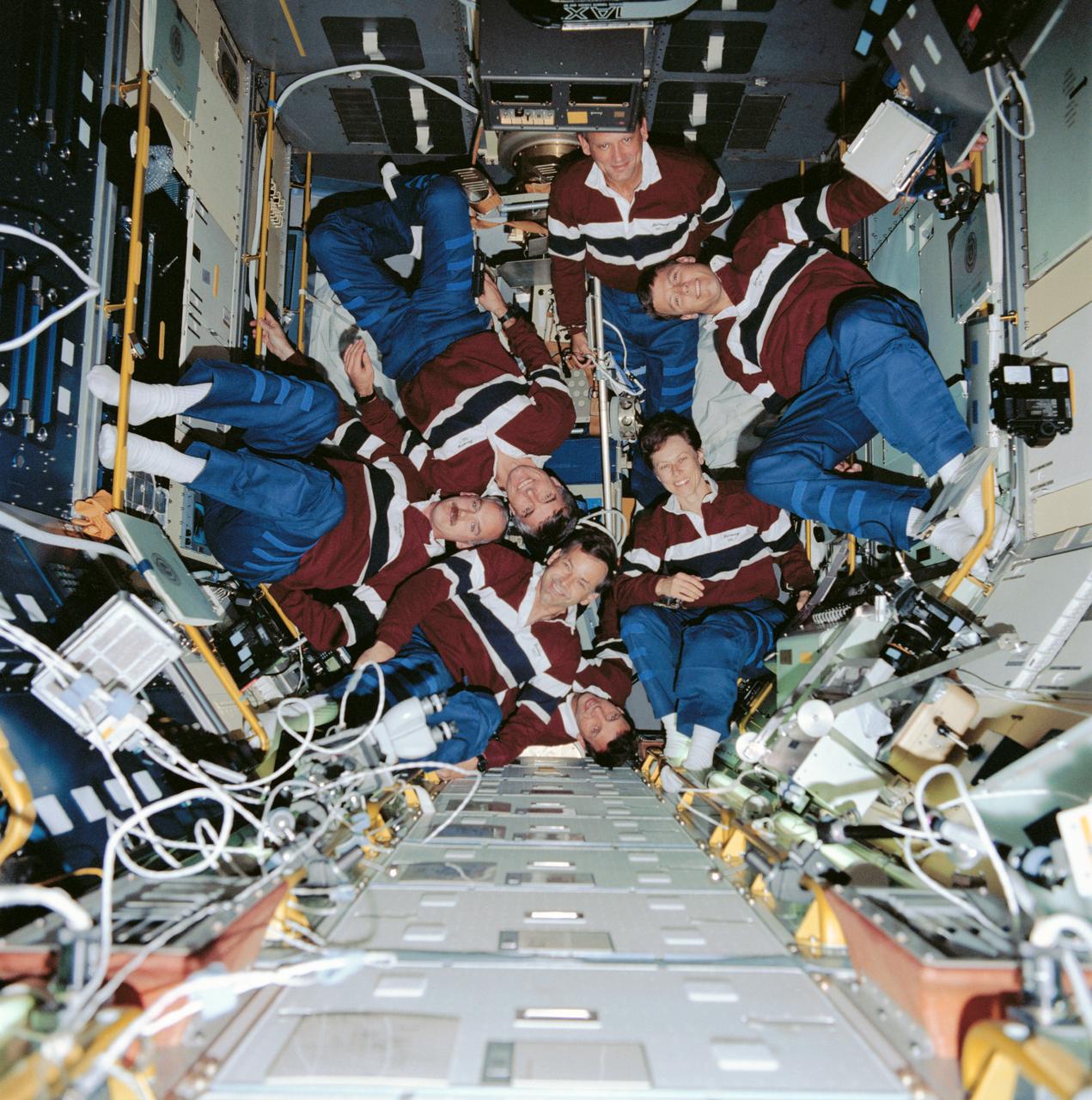
STS042-78-061 (22-30 Jan. 1992) --- The seven STS-42 crewmembers pose for a traditional in-space portrait in the shirt-sleeve environment of the International Microgravity Laboratory (IML-1) science module in the shuttle's cargo bay. (Hold picture with index numbers at top.) David C. Hilmers, mission specialist, is at top center of the 70mm image. Others pictured are (clockwise) Ronald J. Grabe, mission commander; William F. Readdy; mission specialist; Ulf Merbold, European Space Agency (ESA) payload specialist; Norman E. Thagard, payload commander; Stephen S. Oswald, pilot; and Roberta L. Bondar, Canadian payload specialist. The rotating chair, used often in biomedical tests on the eight-day flight, is (partially obscured) in center frame.
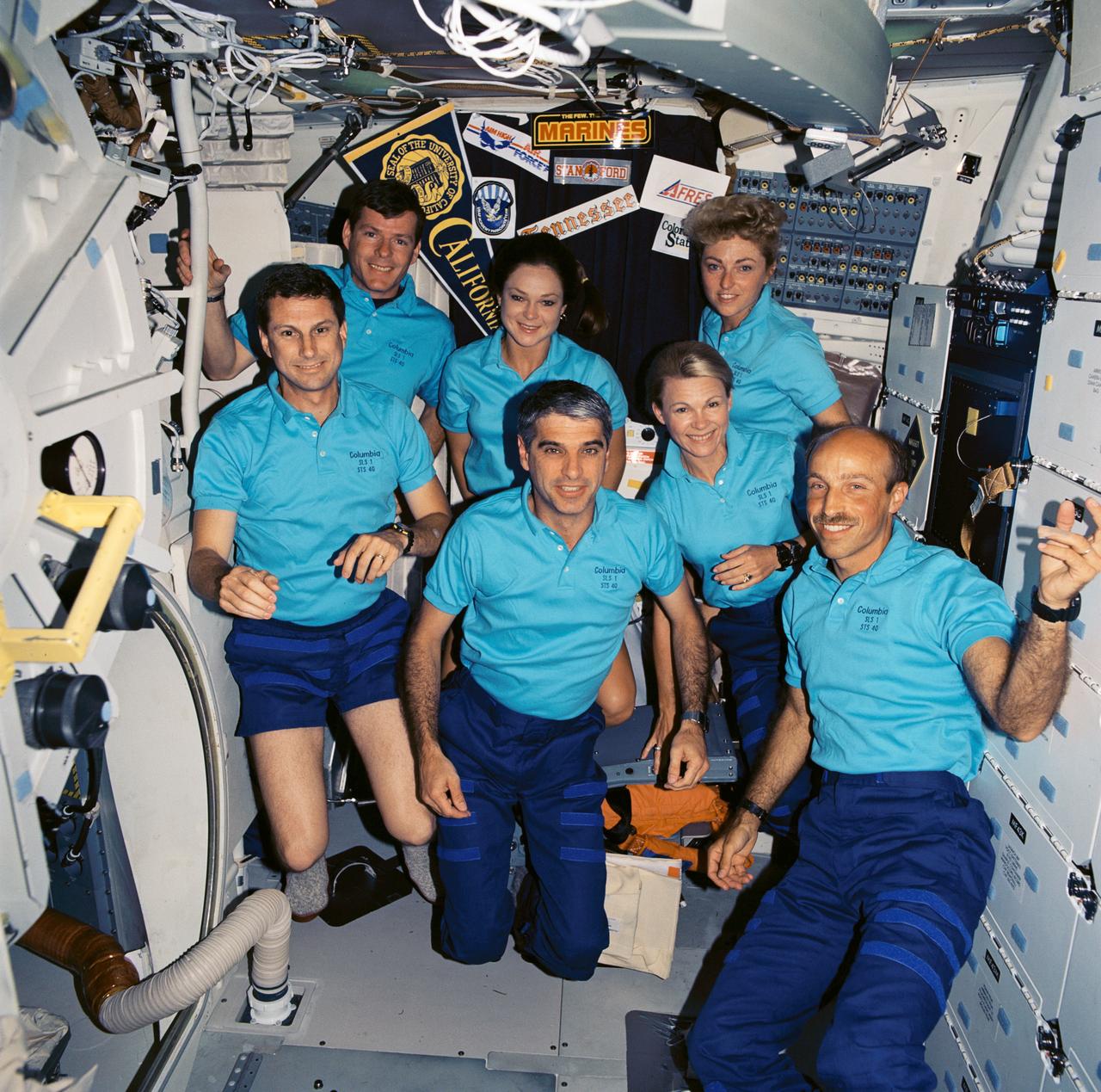
STS040-605-009 (5-14 June 1991) --- The seven crew members for STS-40 pose for an in-space portrait on the Space Shuttle Columbia's mid-deck. Left to right, in front are F. Andrew Gaffney, Sidney M. Gutierrez, Rhea Seddon and James P. Bagian; in back, Bryan D. O'Connor, Tamara E. Jernigan and Millie Hughes-Fulford. The five astronauts and two payload specialists are spending nine days in space in support of the Spacelab Life Sciences (SLS-1) mission. The image was one of 25 visuals used by the STS-40 crew at its Post Flight Press Conference (PFPC) on June 28, 1991.
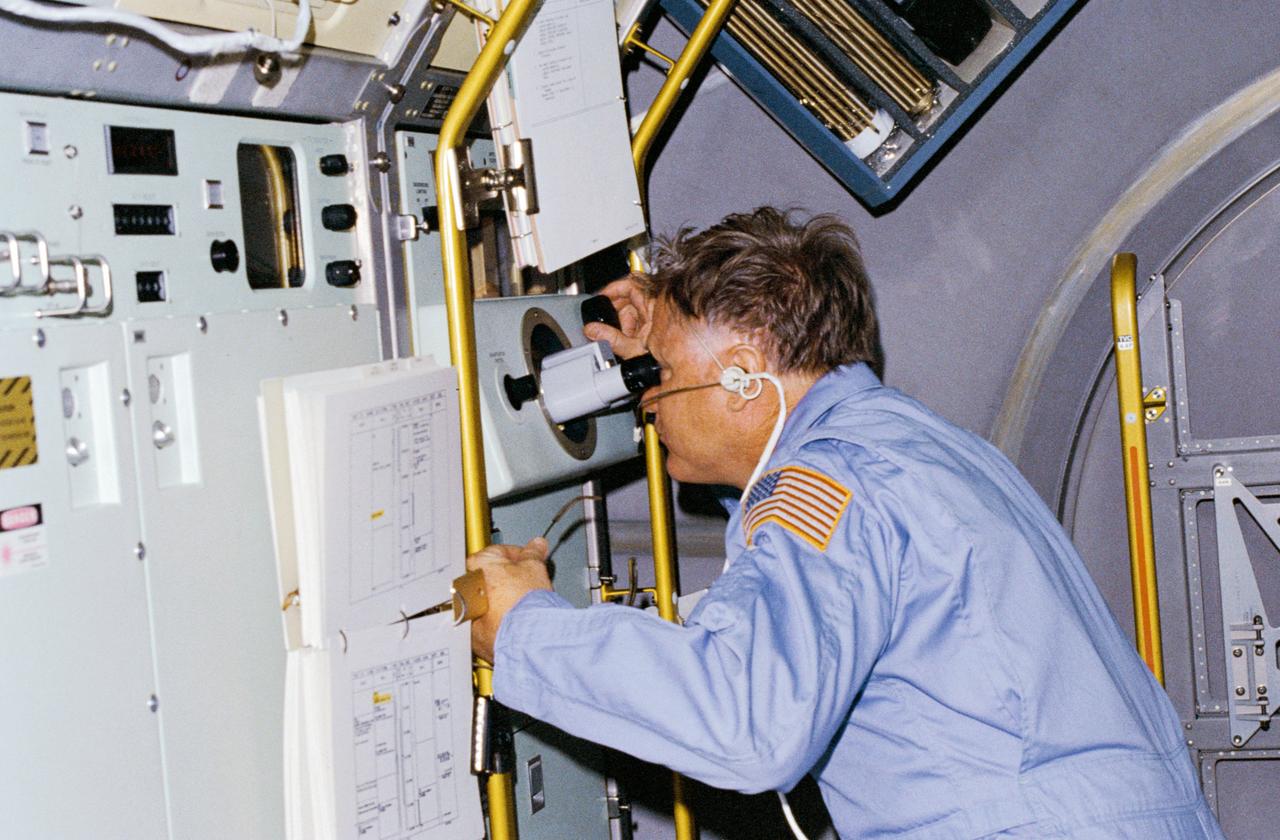
51B-01-007 (30 April 1985) --- Astronaut Don L. Lind, 51-B Spacelab 3 mission specialist, observes the growth of mercuric iodide crystal in the vapor crystal growth system (VCGS) on the Spacelab 3 science module aboard the orbiter Challenger.
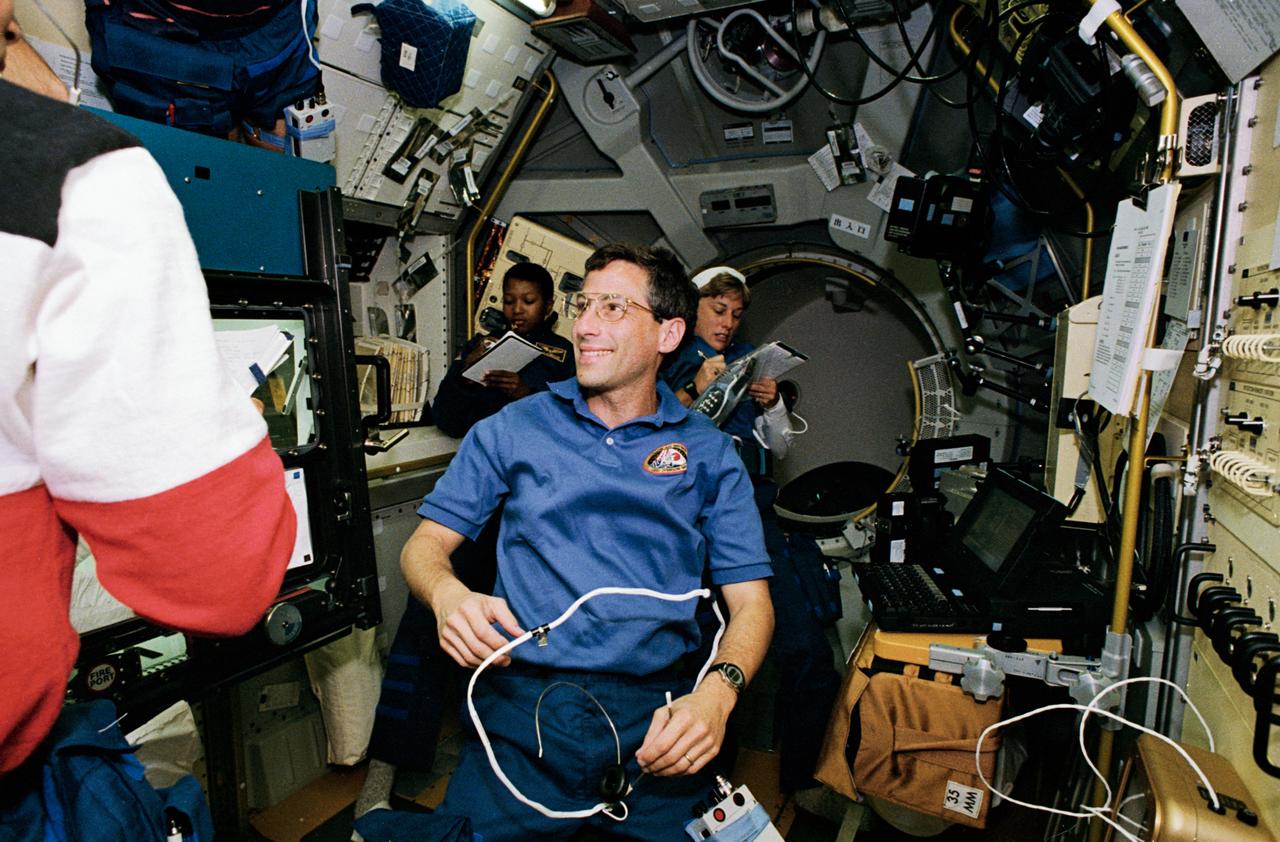
STS047-05-019 (12 - 20 Sept 1992) --- Astronaut Jerome (Jay) Apt, mission specialist, responds to a crew mate's query during a shift change in the Spacelab-J Science Module aboard the Earth-orbiting Space Shuttle Endeavour. Others pictured, left to right, are astronauts Mark C. Lee (immediate foreground, partially out of frame), payload commander; Mae C. Jemison and N. Jan Davis, mission specialists. The four joined two other NASA astronauts and a Japanese payload specialist for eight days aboard Endeavour in support of the joint Japanese-American effort.
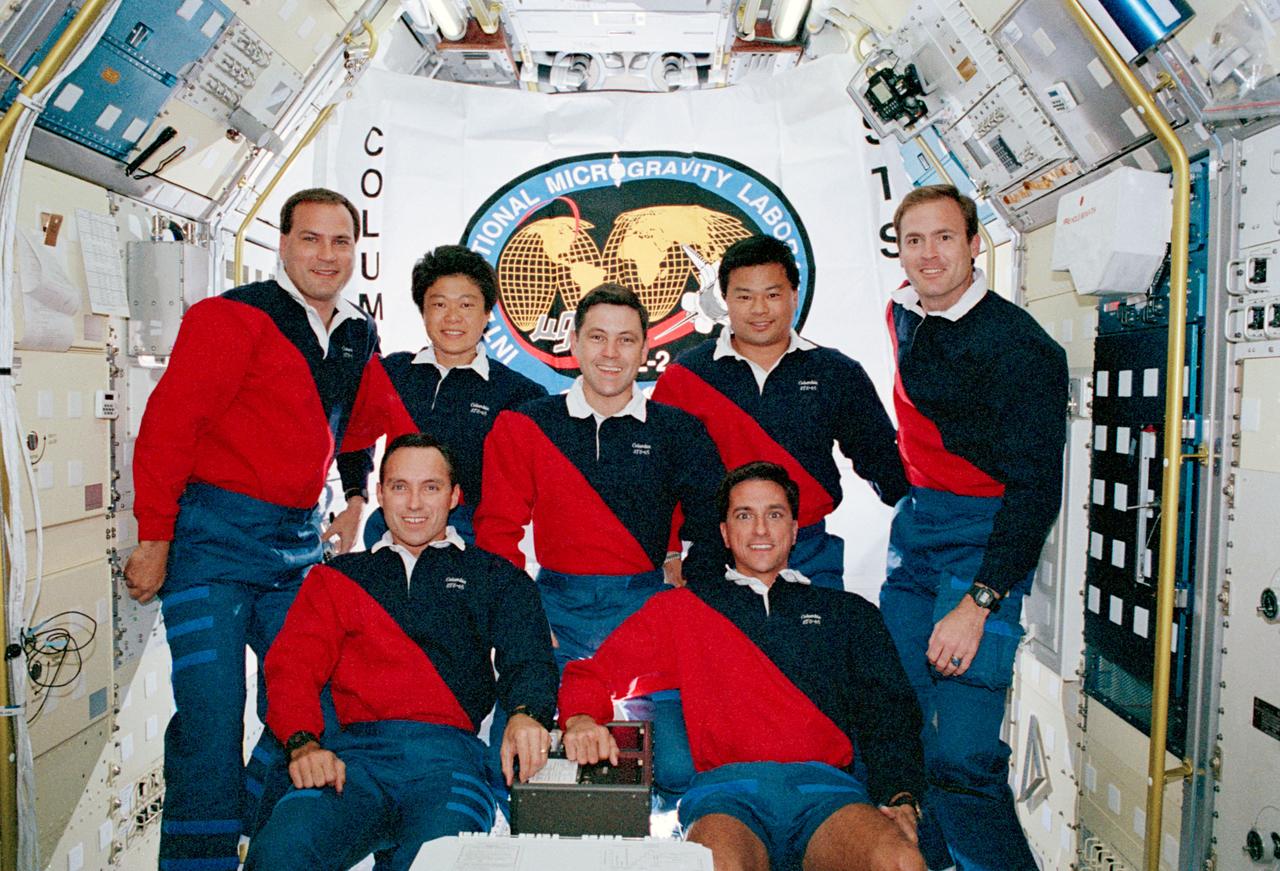
In the spacelab science module aboard the Space Shuttle Columbia, Orbiter Vehicle (OV) 102, the seven crewmembers pose for the traditional onboard (inflight) crew portrait. Displayed in the background is a flag with the International Microgravity Laboratory 2 (IML-2) insignia and Columbia inscribed along the edge. In the front row (left to right) are Mission Specialist (MS) Carl E. Walz and MS Donald A. Thomas. Behind them (left to right) are Payload Commander (PLC) Richard J. Hieb, Payload Specialist Chiaki Mukai, Commander Robert D. Cabana, MS Leroy Chiao, and Pilot James D. Halsell, Jr. Mukai represents the National Space Development Agency (NASDA) of Japan. Crewmembers are wearing their mission polo shirts for the portrait. Inside this module, the crew conducted experiments in support of the IML-2 mission.
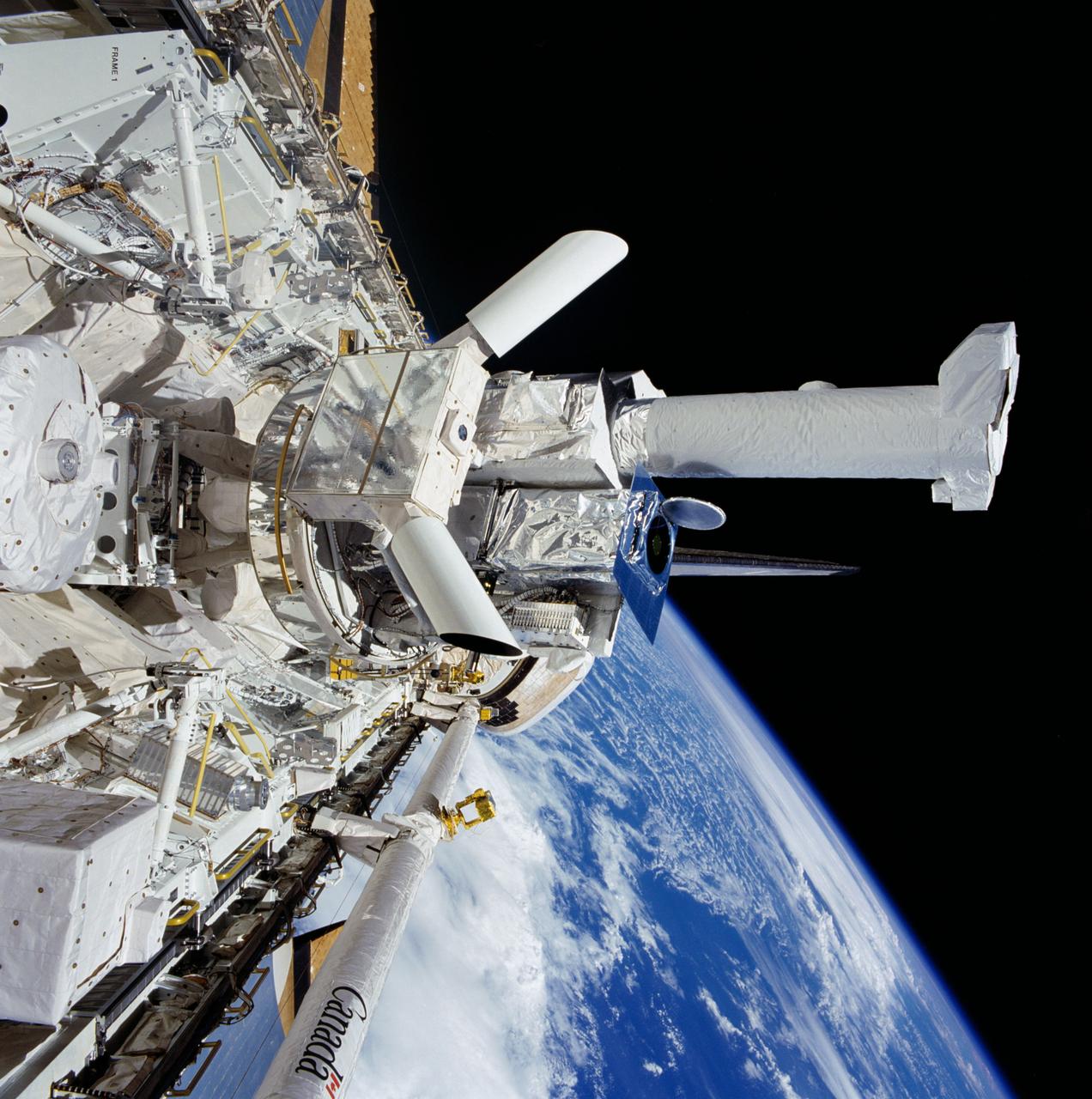
51F-42-069 (29 July-6 Aug 1985) --- The solar optical universal polarimeter (SOUP) experiment is visible among the cluster of Spacelab 2 hardware in the cargo bay of the Earth-orbiting Space Shuttle Challenger, backdropped against a curtain of white clouds over ocean waters. Various components of the instrument positioning system (IPS) are conspicuous at the center of the frame. Now resting, the remote manipulator system (RMS) was used at various points during the mission with the plasma diagnostics package (PDP) and as a support service structure for television cameras covering various activities of the busy science-oriented Spacelab 2 mission.
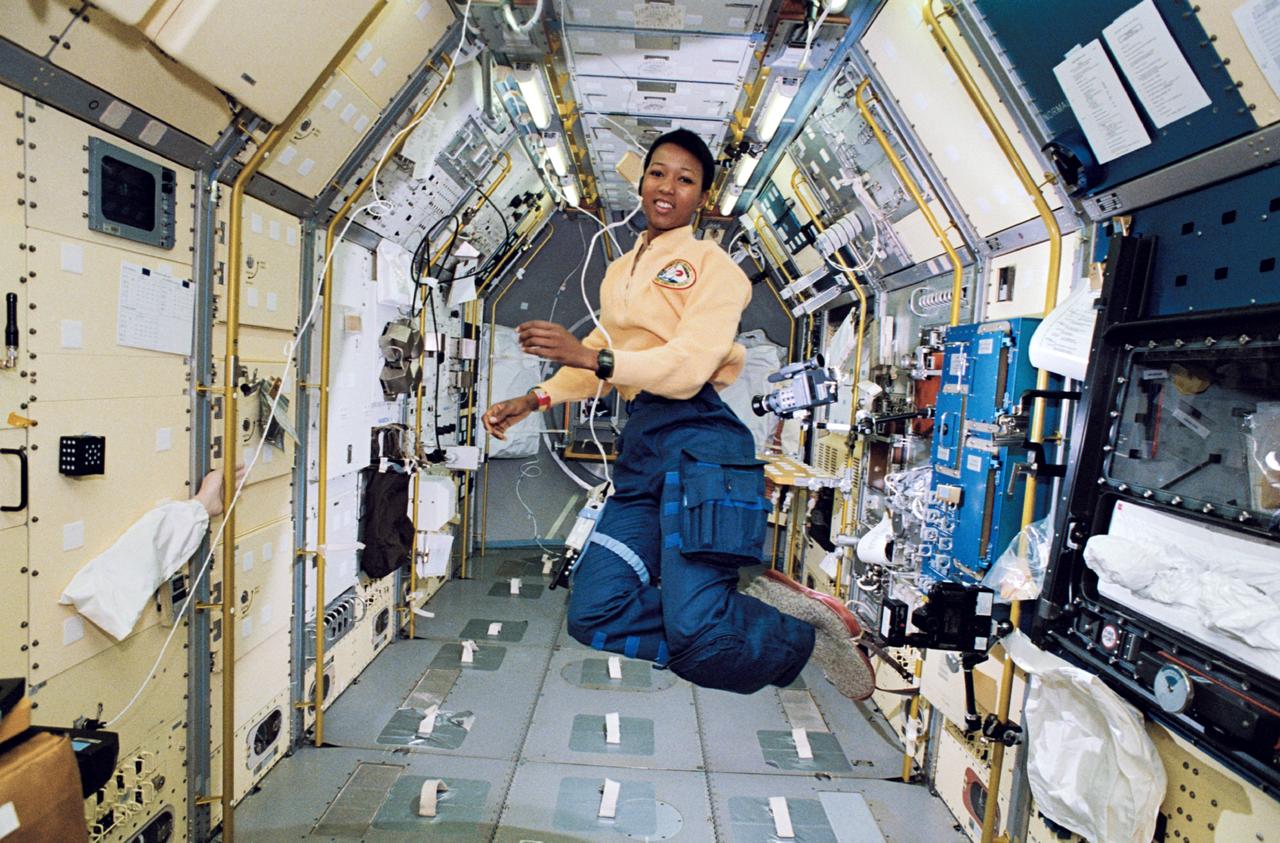
STS047-37-003 (12-20 Sept. 1992) --- Astronaut Mae C. Jemison, STS-47 mission specialist, appears to be clicking her heels in zero-gravity in this 35mm frame photographed in the Science Module aboard the Earth-orbiting Space Shuttle Endeavour. Making her first flight in space, Dr. Jemison was joined by five other NASA astronauts and a Japanese payload specialist for eight days of research in support of the Spacelab-J mission, a joint effort between Japan and the United States.
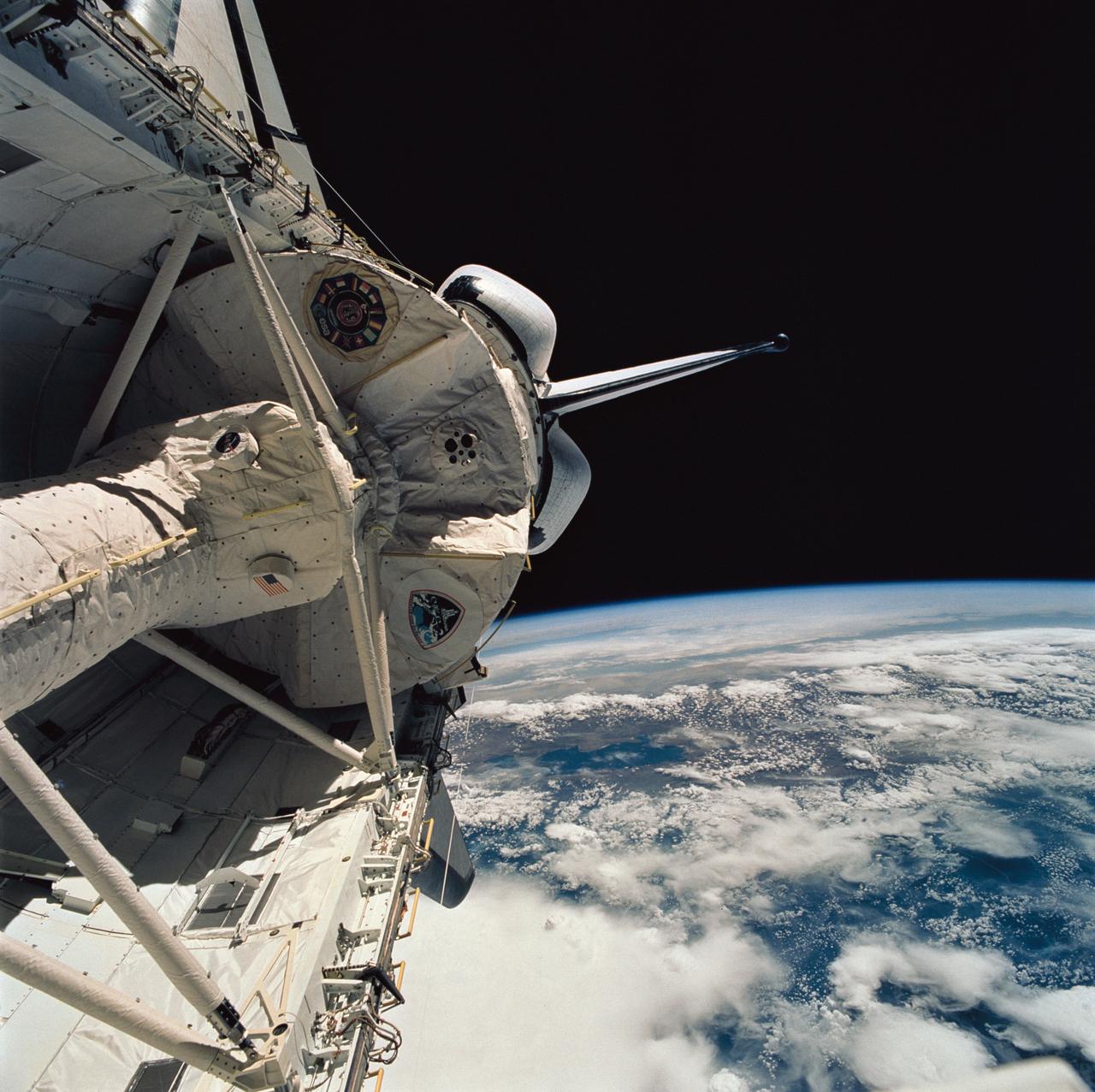
STS058-76-041 (18 Oct-1 Nov 1993) --- Backdropped against the Peru-Bolivia border and part of the Amazon basin, the Spacelab Life Sciences (SLS-2) laboratory module was captured with a 70mm camera, by one of the seven crew members inside the Space Shuttle Columbia's cabin. Part of the tunnel-like passageway is visible in the foreground. Six NASA astronauts and a veterinarian from the private sector spent two weeks devoted to medical research in Earth-orbit. Lake Titicaca, the largest high-altitude lake in the world lies in the Altiplano of Bolivia and Peru. Space Shuttle photography has been used to document fluctuations of several meters of the level of Lake Titicaca during the past decade, as well as to document the eutrophication of the north end of the lake, which is primarily due to increased population in the Peruvian shoreline areas. This view shows the effect of abnormally heavy precipitation of the region for the third successive year. Meteorologists feel this precipitation increase, which may portend another increase of the lake level, is due to the third successive El Nino - Southern Oscillation phenomenon in the 1993 - 94 southern hemisphere summertime. This global phenomenon is now resulting in major weather disturbances in Indonesia, California, Texas and elsewhere.
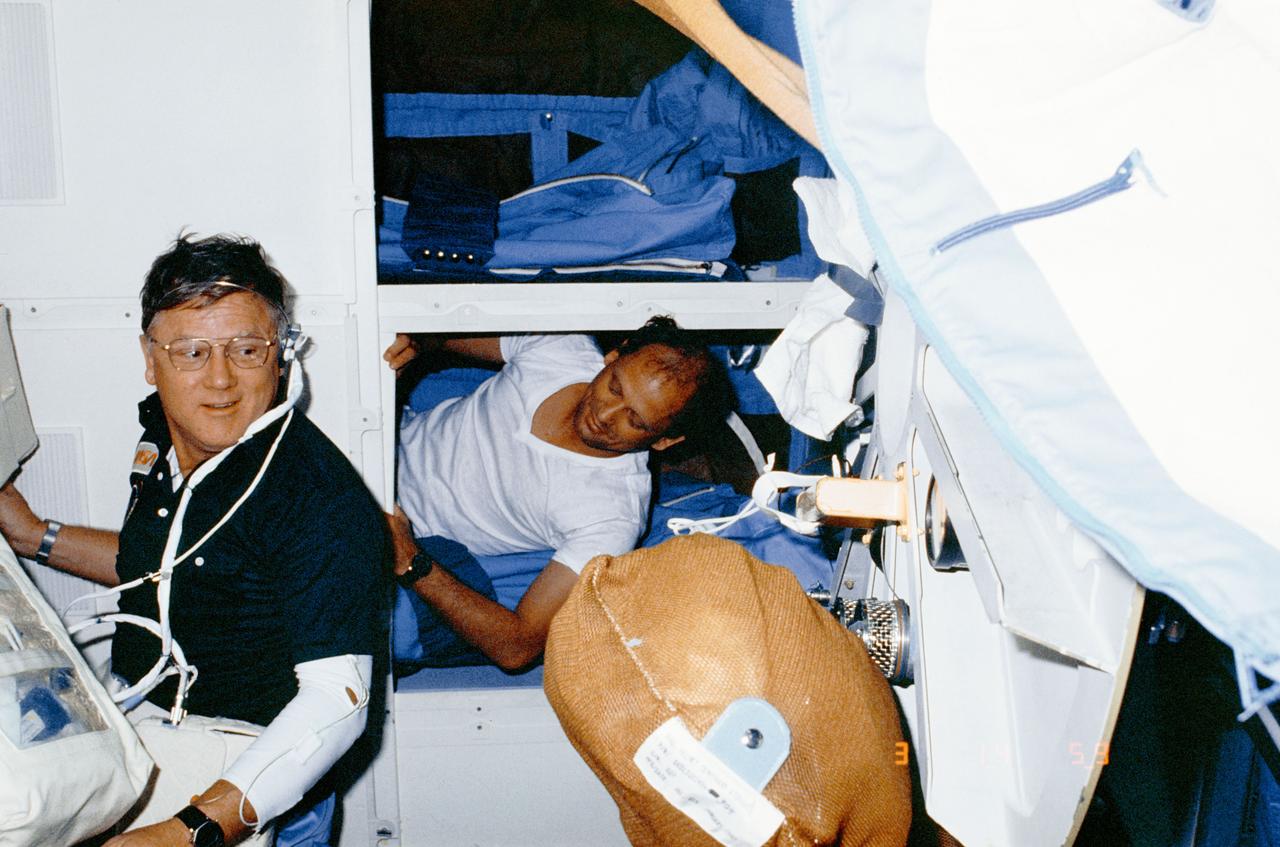
Astronaut Norman E. Thagard, mission specialist for the "silver" team, rests on the middeck while the "gold" team is on duty in the science module. Don L. Lind, left, "gold" team member, meanwhile participates in autogenic feedback training (AFT), designed to help flight crewmembers overcome the effects of zero-gravity adaptation.
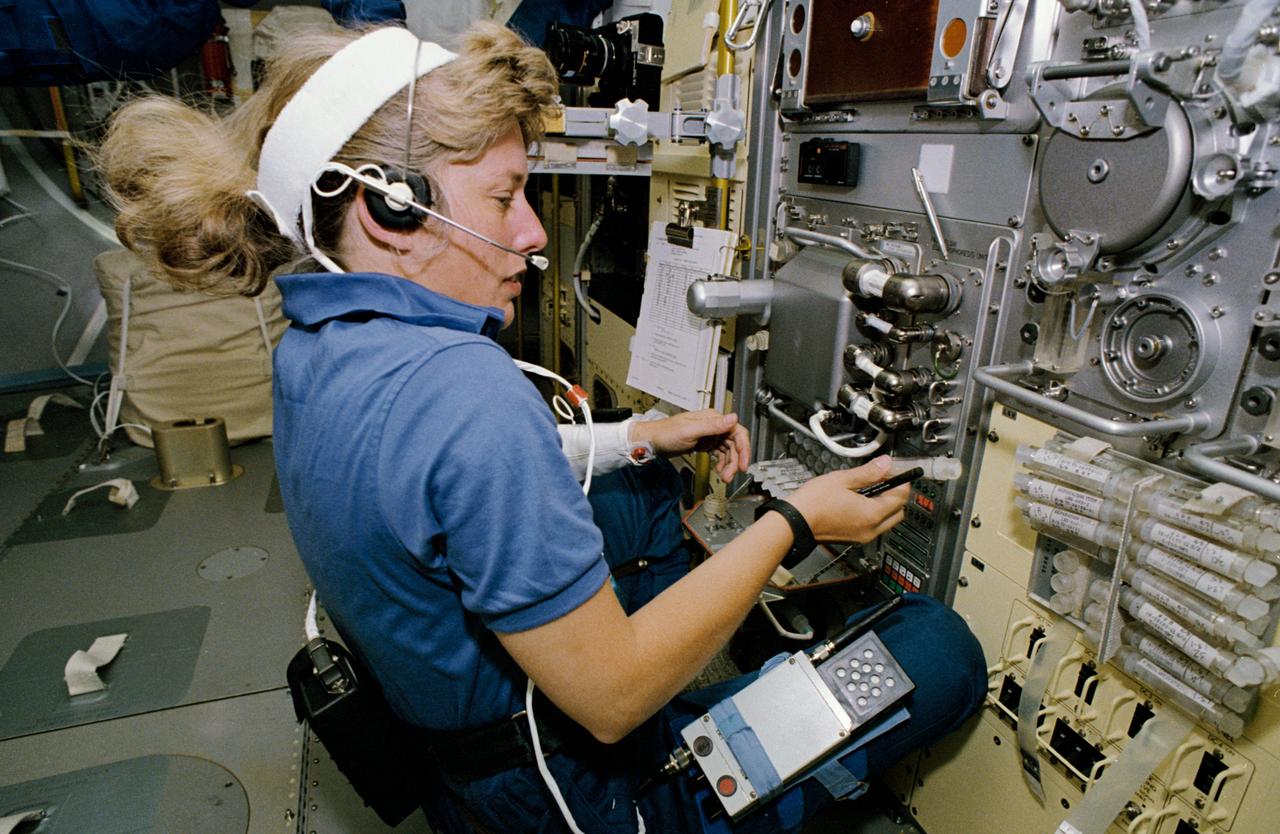
STS047-03-024 (12 - 20 Sept 1992) --- Astronaut N. Jan Davis, mission specialist, talks to ground controllers as she works with the Free Flow Electrophoresis Unit (FFEU) in the Science Module of the Earth-orbiting Space Shuttle Endeavour. Davis joined five other NASA astronauts and a Japanese payload specialist for eight days of scientific research onboard Endeavour.
STS040-224-005 (5-14 June 1991) --- Astronaut Tamara E. Jernigan, STS-40 mission specialist, conducts an evaluation of the General Purpose Work Station (GPWS) in the Spacelab Life Sciences (SLS-1) module onboard the Earth-orbiting Space Shuttle Columbia. The photograph was taken with a 35mm camera.
STS058-202-002 (18 Oct.-1 Nov. 1993) --- Astronaut Rhea Seddon, STS-58 payload commander, spins the Spacelab Life Sciences (SLS-2) rotating chair as payload specialist Martin J. Fettman serves as test subject. The two joined five NASA astronauts for fourteen days of medical research aboard the Earth-orbiting space shuttle Columbia. Photo credit: NASA
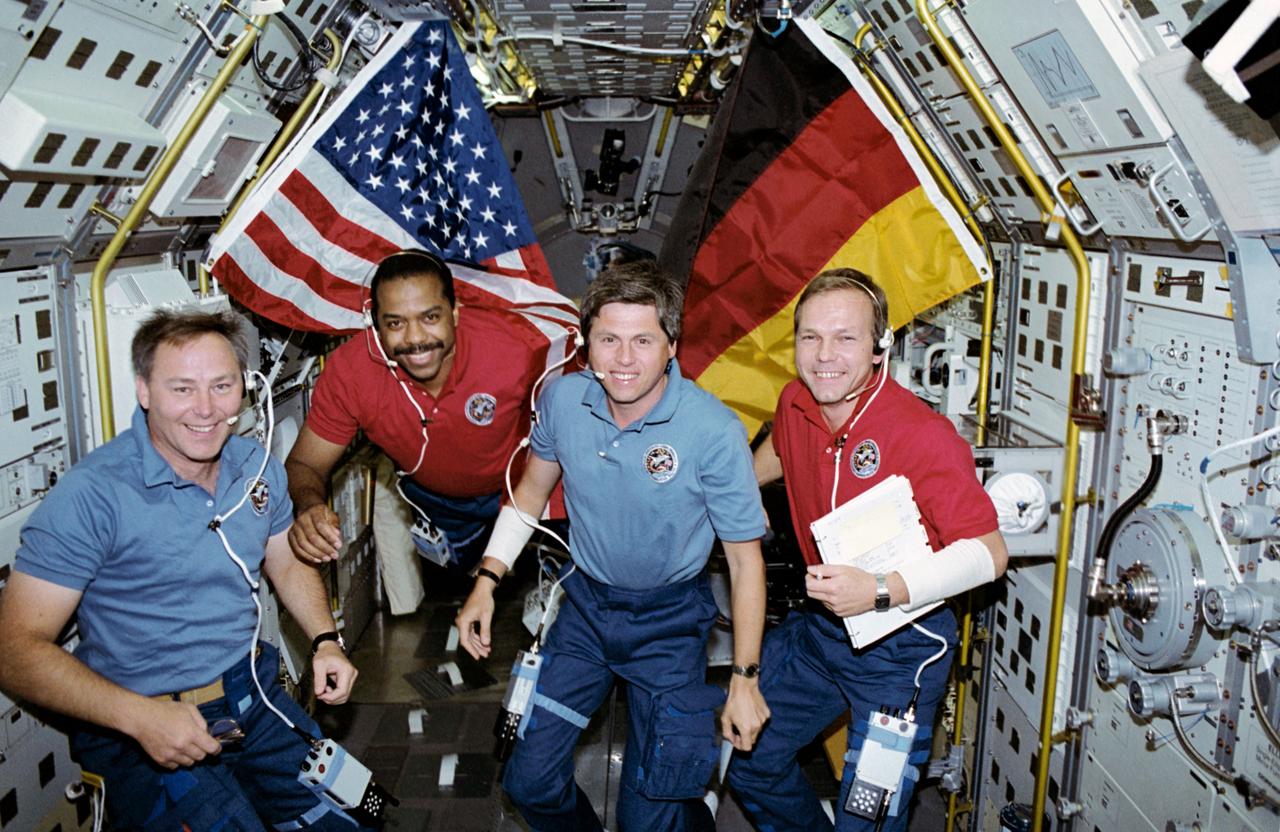
STS-55 crewmembers pose with United States and German flags inside the Spacelab Deutsche 2 (SL-D2) science module located in the payload bay (PLB) of Columbia, Orbiter Vehicle (OV) 102. Wearing communications kit assembly headsets (HDSTs) are (left to right) Mission Specialist 1 (MS1) and Payload Commander (PLC) Jerry L. Ross, MS3 Bernard A. Harris, Jr, German Payload Specialist 1 Ulrich Walter, and Payload Specialist 2 Hans Schlegel.
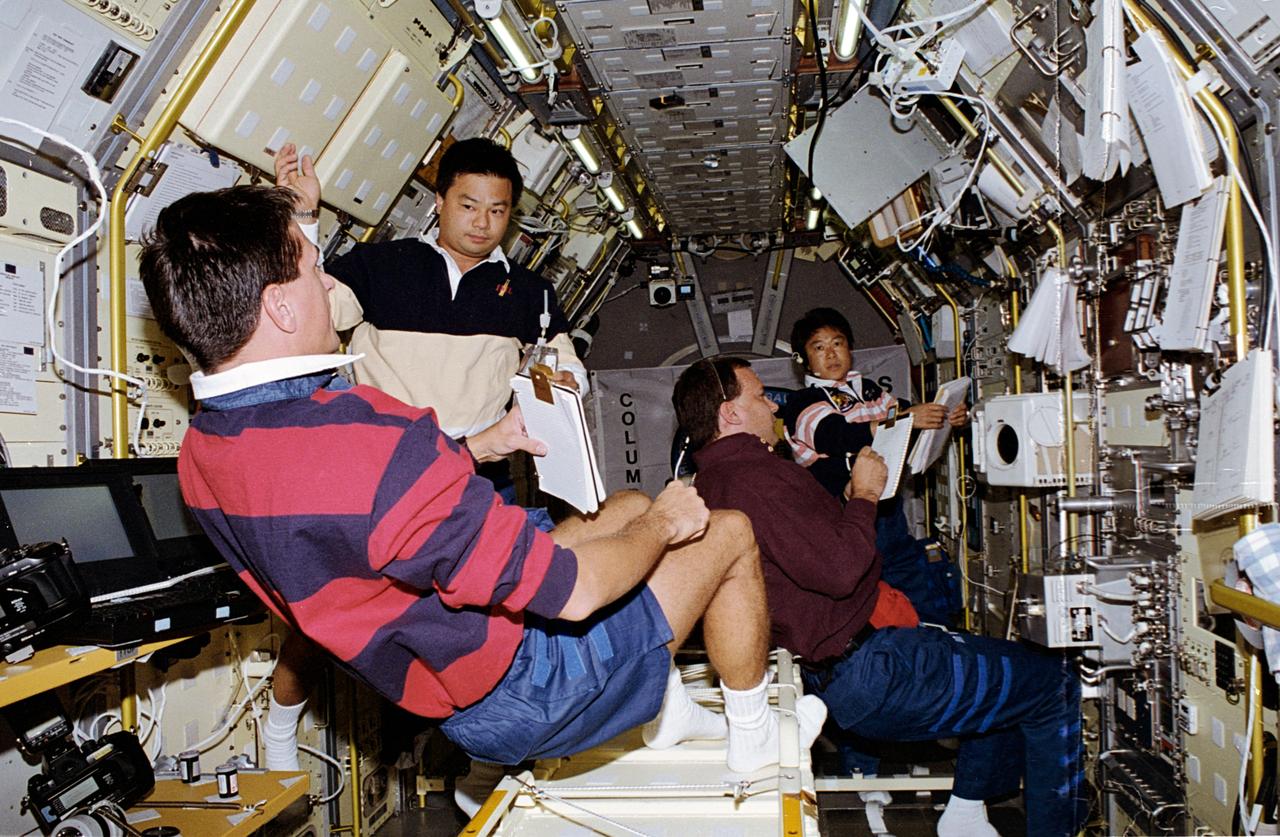
STS065-05-037 (8-23 July 1994) --- In the science module aboard the Space Shuttle Columbia, four members of the crew busy themselves with experiments in support of the second International Microgravity Laboratory (IML-2) mission. Left to right are Donald A. Thomas and Leroy Chiao, both mission specialists; Richard J. Hieb, payload commander, and Dr. Chiaki Mukai of NASDA, payload specialist.
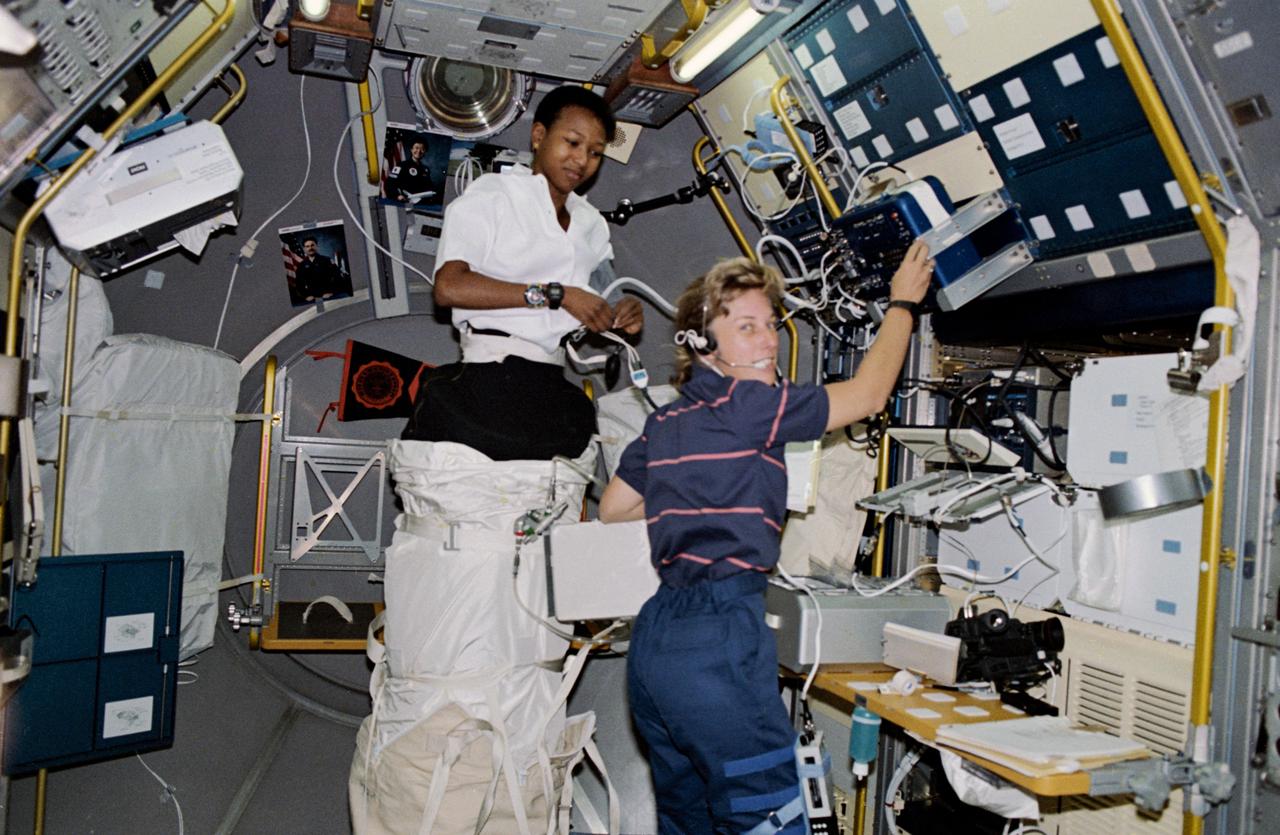
STS047-230-030 (12 - 20 Sept 1992) --- Astronauts Mae C. Jemison (left) and N. Jan Davis, mission specialists, are pictured in the Spacelab-J science module preparing to conduct a session with the Lower Body Negative Pressure (LBNP) experiment. The two joined four other NASA astronauts and a payload specialist representing Japan's National Space Development Agency (NASDA) aboard the Earth-orbiting Space Shuttle Endeavour for eight days of Spacelab-J research.
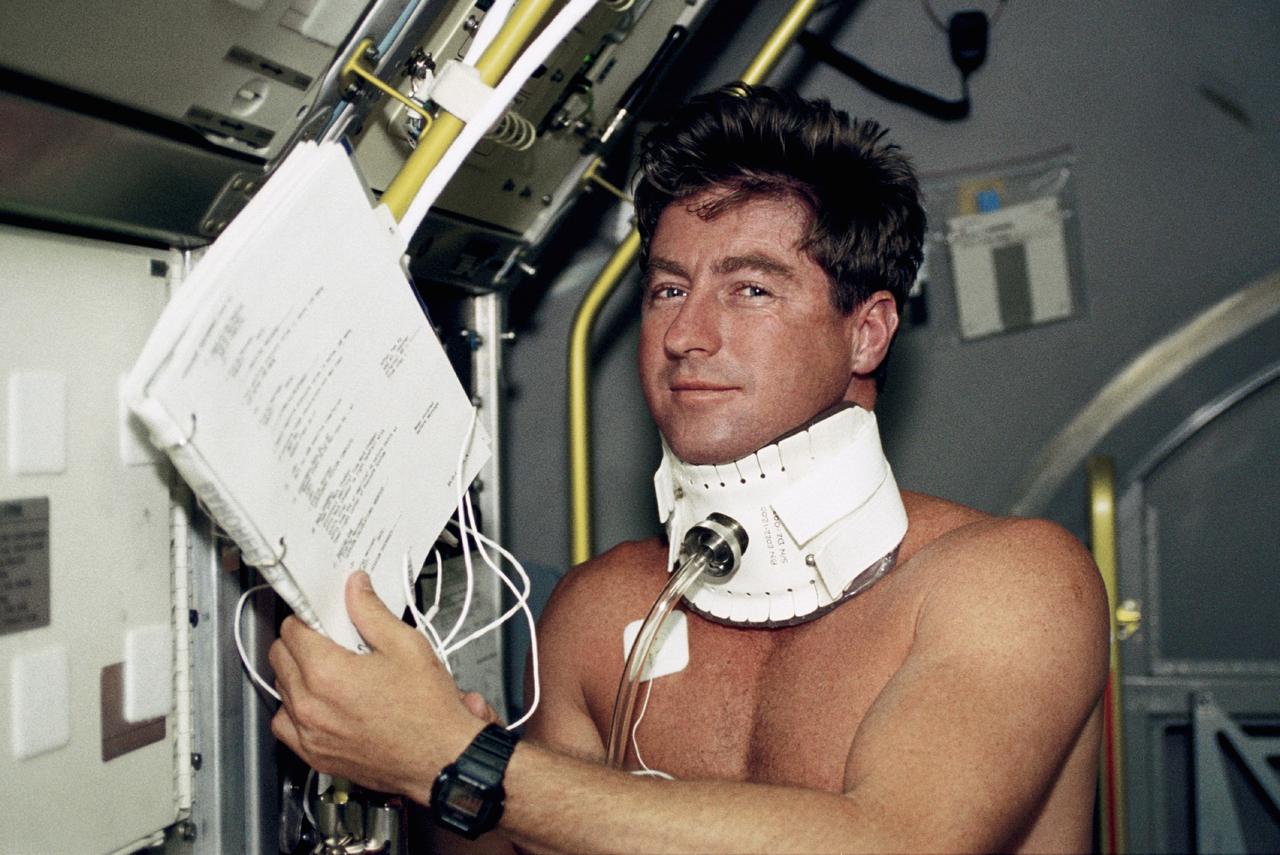
STS055-233-019 (26 April-6 May 1993) --- Terence T. (Tom) Henricks, STS-55 pilot, wears a special collar for a space adaptation experiment in the science module onboard the Earth-orbiting Space Shuttle Columbia. The Baroreflex (BA) experiment is designed to investigate the theory that light-headedness and a reduction in blood pressures upon standing after landing may arise because the normal reflex system regulating blood pressure behaves differently after having adapted to a microgravity environment. These space-based measurements of the baroreflex will be compared to ground measurements to determine if microgravity affects the reflex.
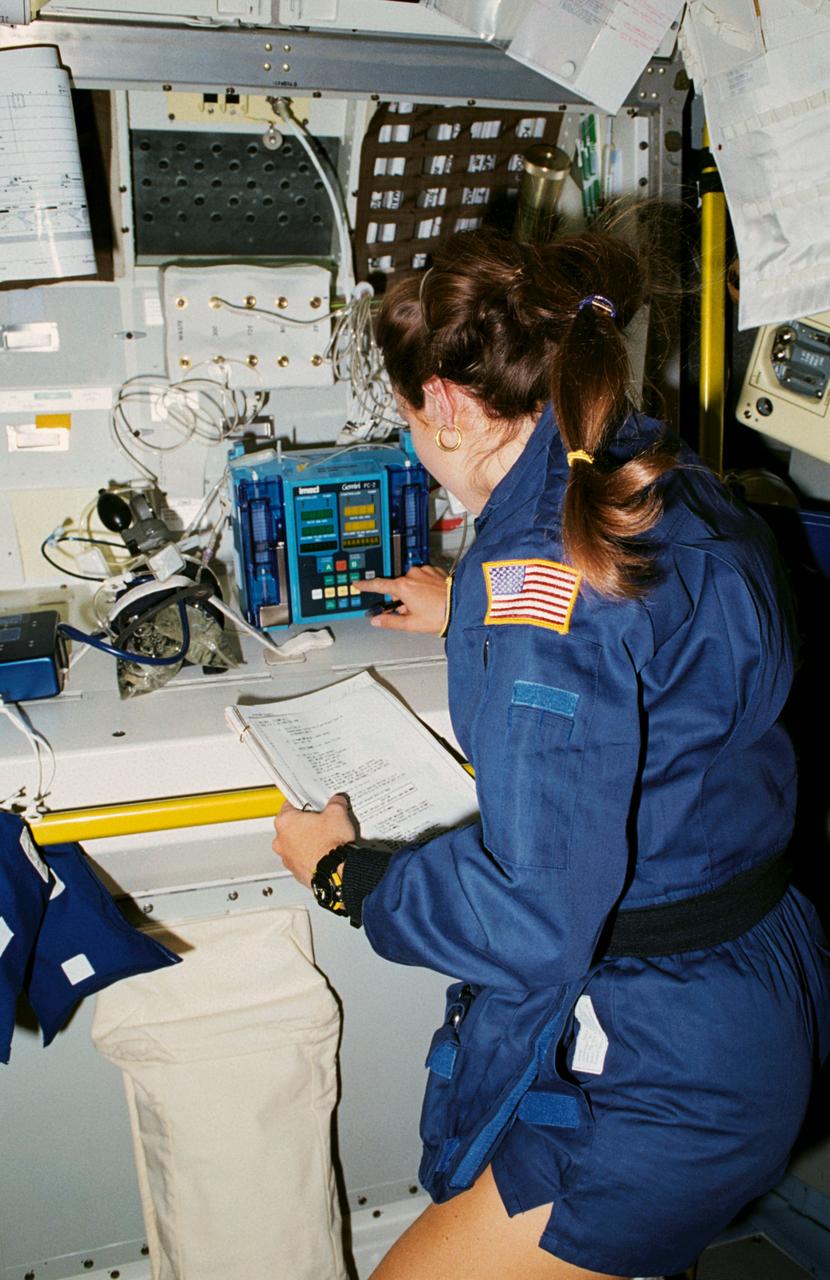
STS040-30-008 (5-14 June 1991) --- Astronaut Tamara E. Jernigan, after applying a blood pressure cuff to an experiment, watches it in operation. The experiment is the intravenous infusion pump. The device is being considered for use on Space Station Freedom's Health Maintenance Facility. Dr. Jernigan is one of seven crew members supporting the nine-day Spacelab Life Sciences (SLS-1) mission aboard the Earth-orbiting Space Shuttle Columbia.
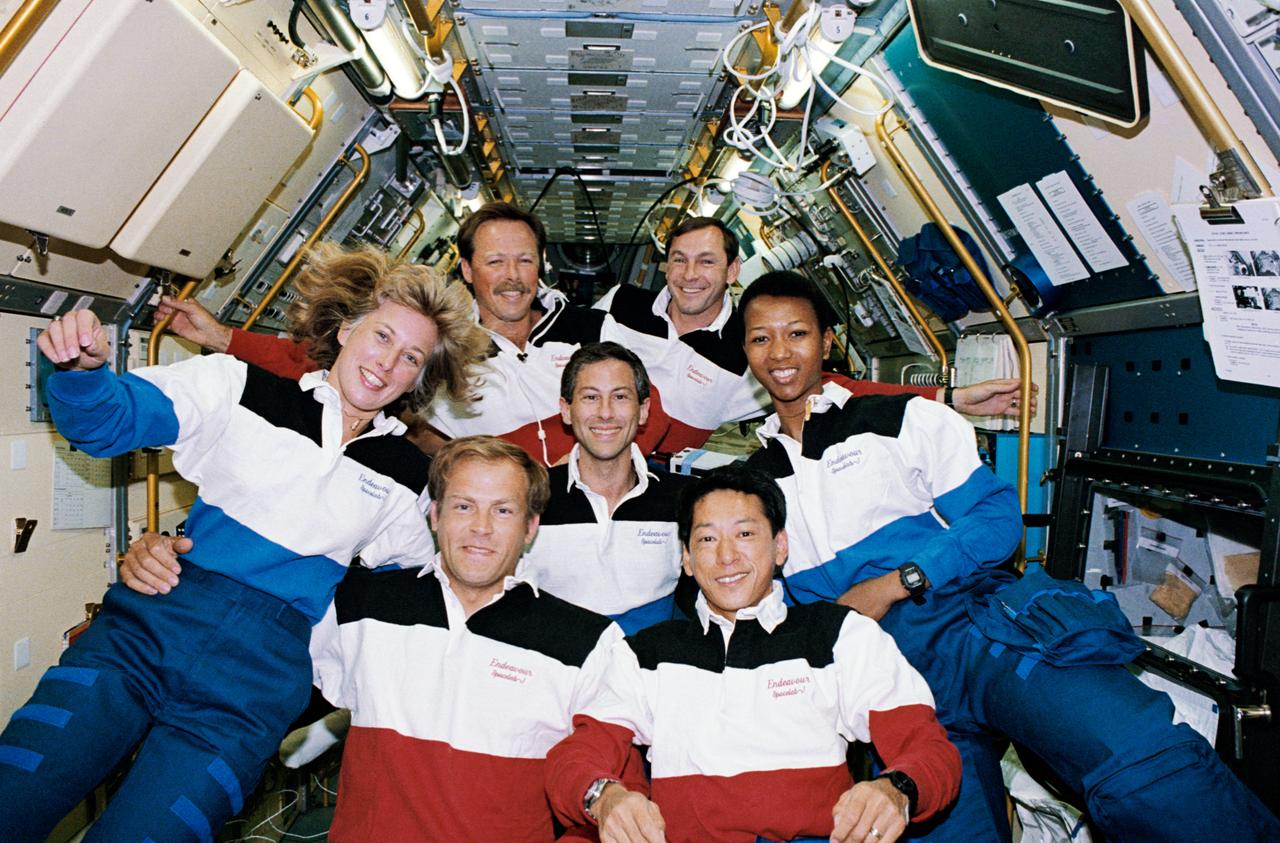
STS047-09-009 (12 - 20 Sept 1992) --- The seven crew members sharing eight days of research in support of Spacelab-J pose for the traditional inflight portrait in the Science Module. Pictured, left to right, back row, are Robert L. Gibson, mission commander; and Curtis L. Brown, Jr., pilot; middle row, N. Jan Davis, Jerome (Jay) Apt and Mae C. Jemison, all mission specialists; and front row, Mark C. Lee, payload commander, and Mamoru Mohri, payload specialist representing Japan's National Space Development Agency (NASDA).
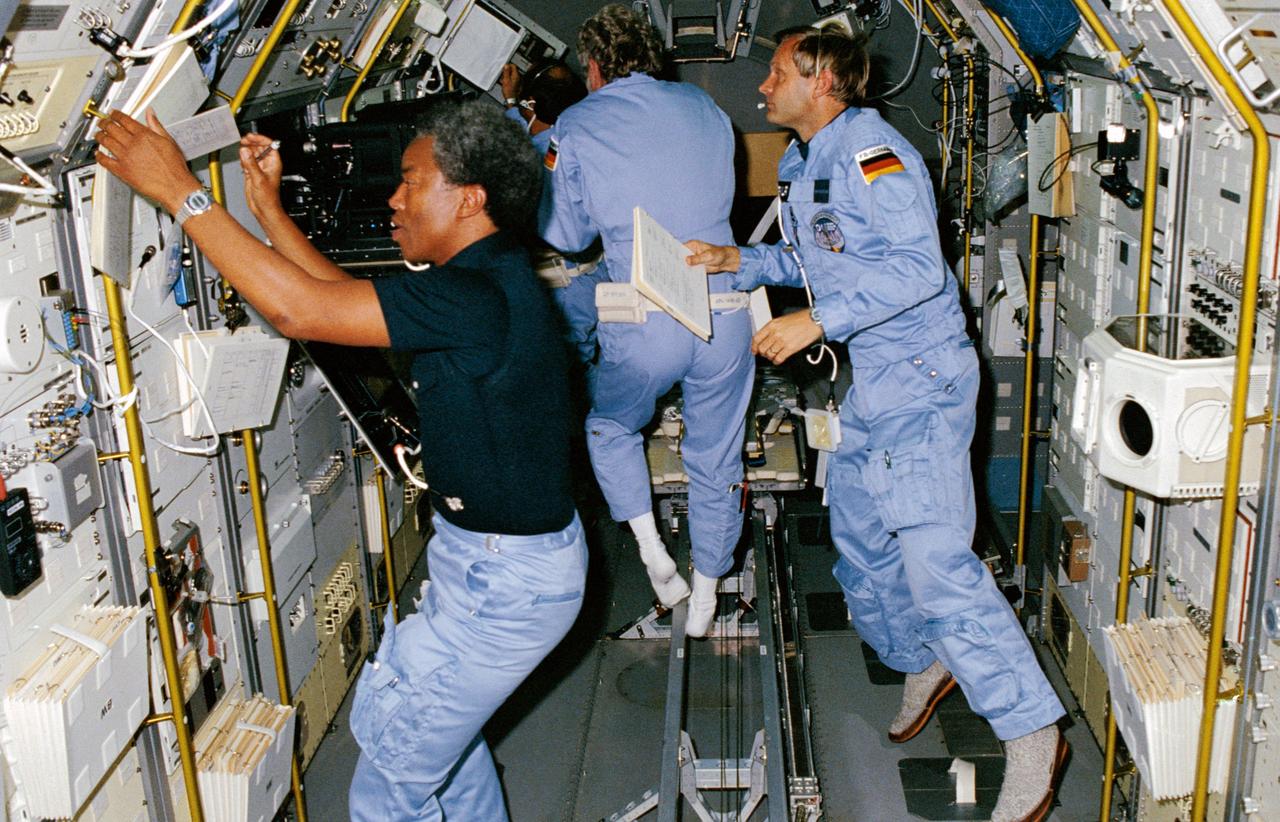
61A-01-030 (30 Oct.-6 Nov. 1985) --- Mission specialist Guion S. Bluford prepares to perform a physics experiment onboard the D-1 science module in the cargo bay of the earth-orbiting Space Shuttle Challenger. In the backgroud, three European payload specialists busy themselves with experiment chores: (L-R) Wubbo J. Ockels (partially obscured), Reinhard Furrer and Ernst Messerschmid.
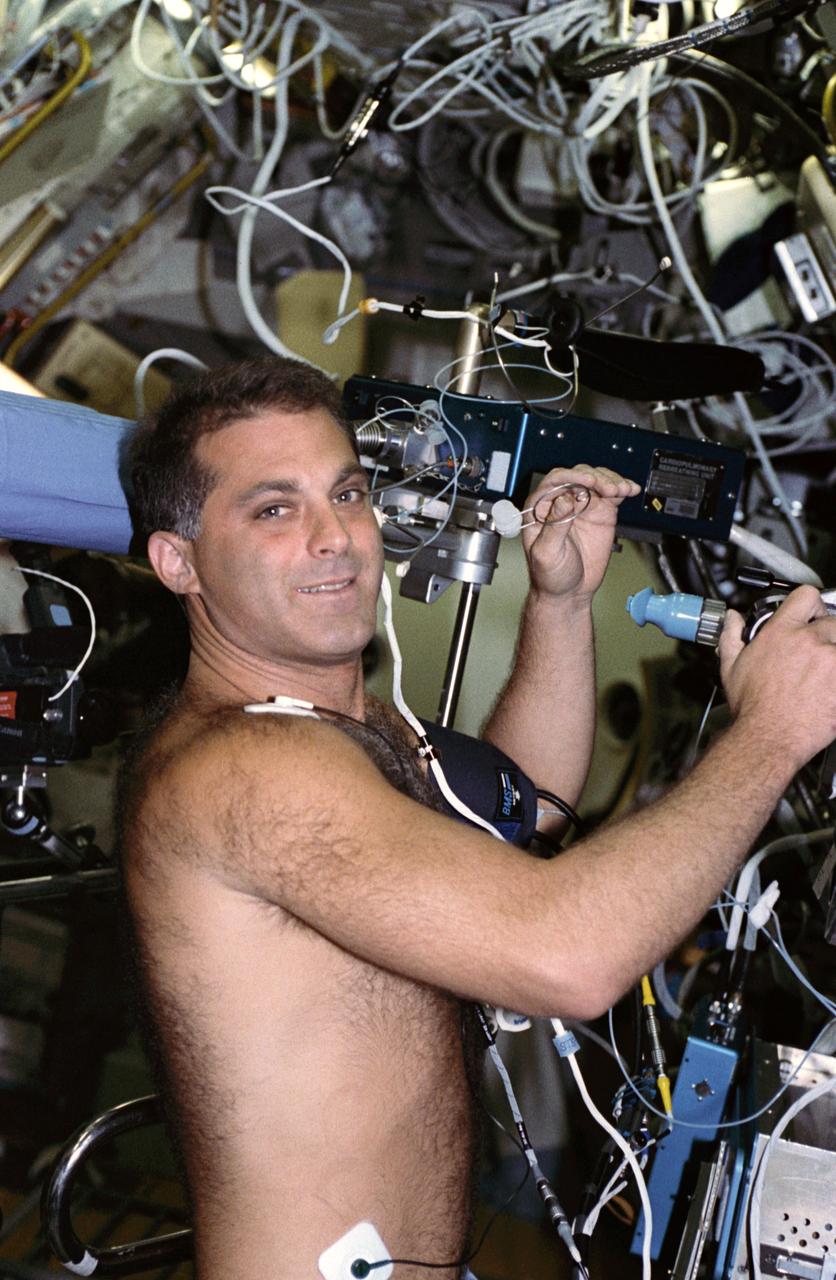
STS058-204-014 (18 Oct.-1 Nov. 1993) --- Astronaut David A. Wolf, mission specialist, participates in an experiment that investigates in-space distribution and movement of blood and gas in the pulmonary system. The data gathered during the two-week flight will be compared with results of tests performed on Earth to determine the changes that occur in pulmonary functions. Photo credit: NASA
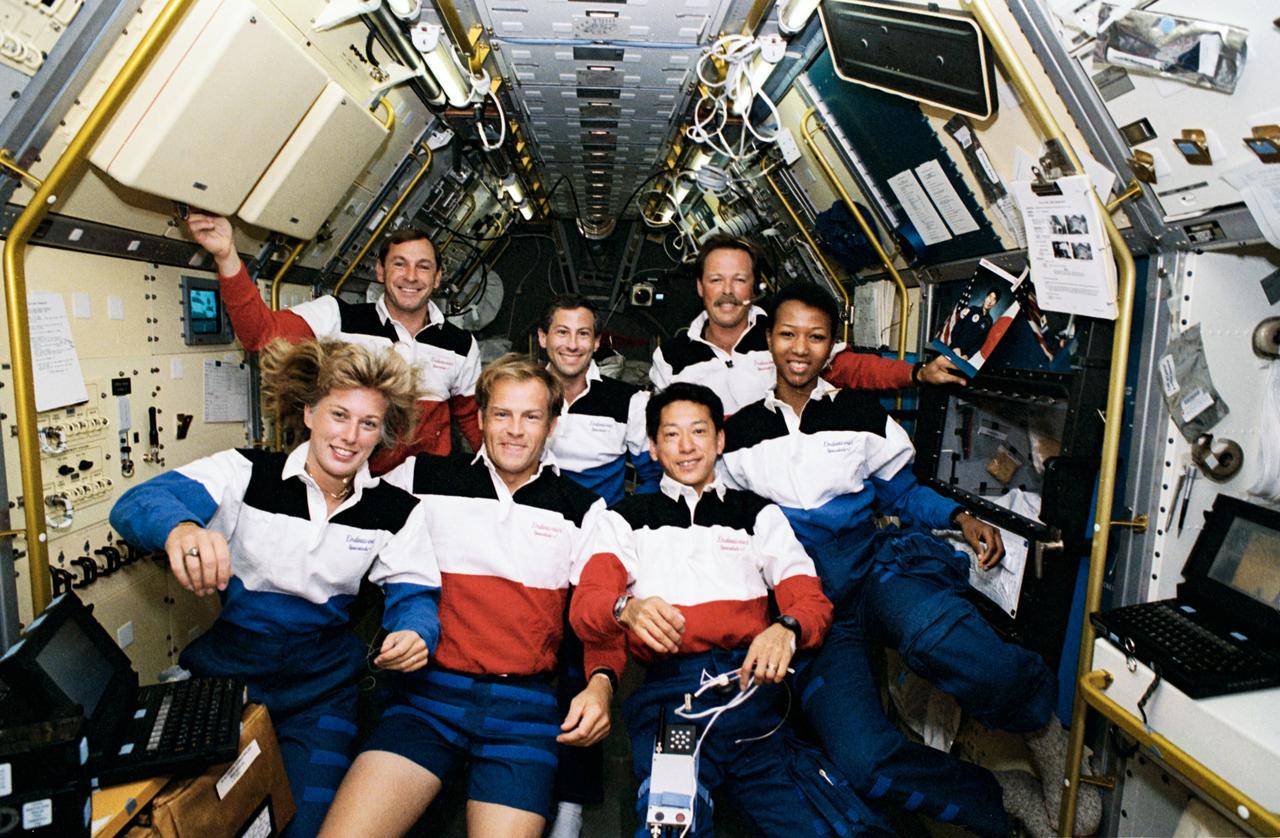
STS047-12-002 (12 - 20 Sept 1992) --- The crew members assemble for their traditional in-flight portrait in this 35mm frame photographed in the Science Module aboard the Earth-orbiting Space Shuttle Endeavour. Left to right (front) are N. Jan Davis, Mark C. Lee and Mamoru Mohri; and (rear) Curtis L. Brown, Jr., Jerome (Jay) Apt, Robert L. Gibson and Mae C. Jemison. The seven spent eight days in space in support of the Spacelab-J mission.

STS065-214-037 (8-23 July 1994) --- Ready to begin one of her busy twelve hour shifts, payload specialist Dr. Chiaki Naito-Mukai enters the International Microgravity Laboratory (IML-2) science module in the cargo bay via the tunnel connecting it to the Space Shuttle Columbia's cabin. Dr. Mukai joined six NASA astronauts for more than two weeks of experimenting in Earth orbit. This photo was among the first released by NASA following IML-2. Also onboard were NASA astronauts Robert D. Cabana, James D. Halsell, Jr., Richard J. Hieb, Carl E. Walz, Donald A. Thomas and Leroy Chiao. Dr. Mukai represented the National Space Development Agency (NASDA) of Japan.
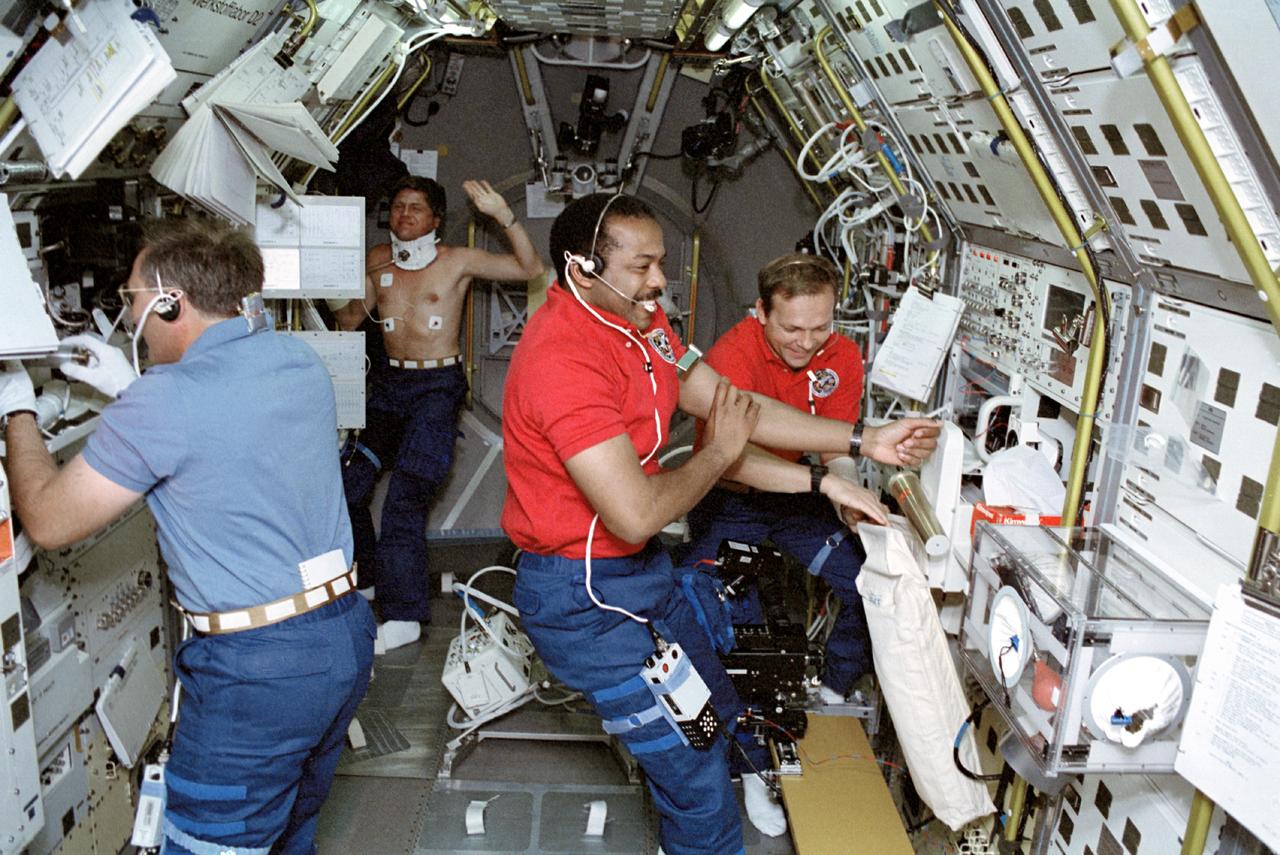
STS055-22-004 (26 April-6 May 1993) --- Four of the seven crew members who spent 10 days aboard the Space Shuttle Columbia are pictured during a brief shift overlap period in the Spacelab D-2 Science Module. Left to right are Jerry L. Ross, Ulrich Walter, Bernard A. Harris, Jr. and Hans Schlegel. Ross, STS-55 payload commander, is changing a sample in a materials processing furnace; Walter, a German payload specialist is in the midst of a baroreflex test and fellow payload specialist Schlegel assists mission specialist and physician Harris with a physiological test at the "Anthrorack".

STS055-203-034 (26 April-6 May 1993) --- Astronaut Steven R. Nagel, STS-55 mission commander, has found an isolated station in the D-2 science module from which to talk to students on Earth. Like many before it, the seven member crew participated in communications with students and licensed radio operators via the Shuttle Amateur Radio Experiment (SAREX). Photo credit: NASA
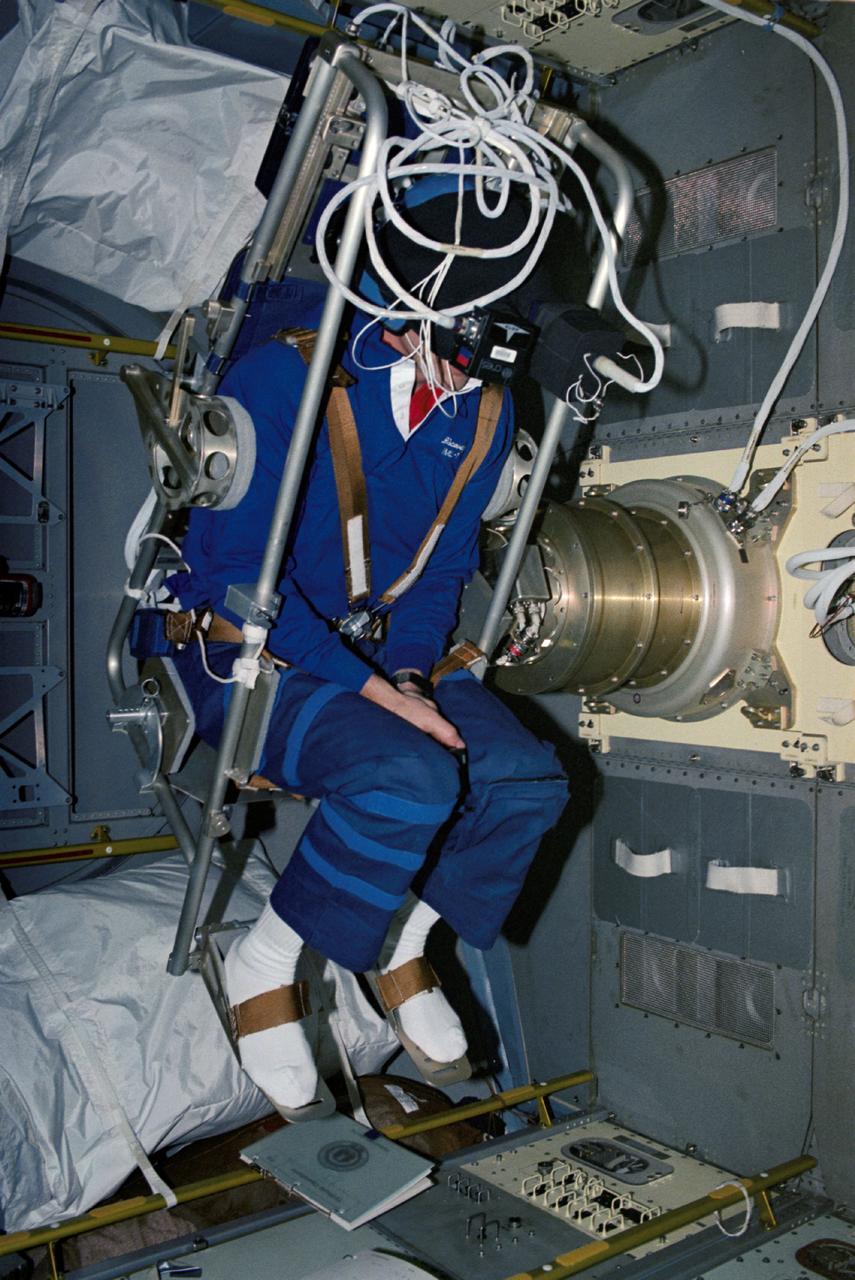
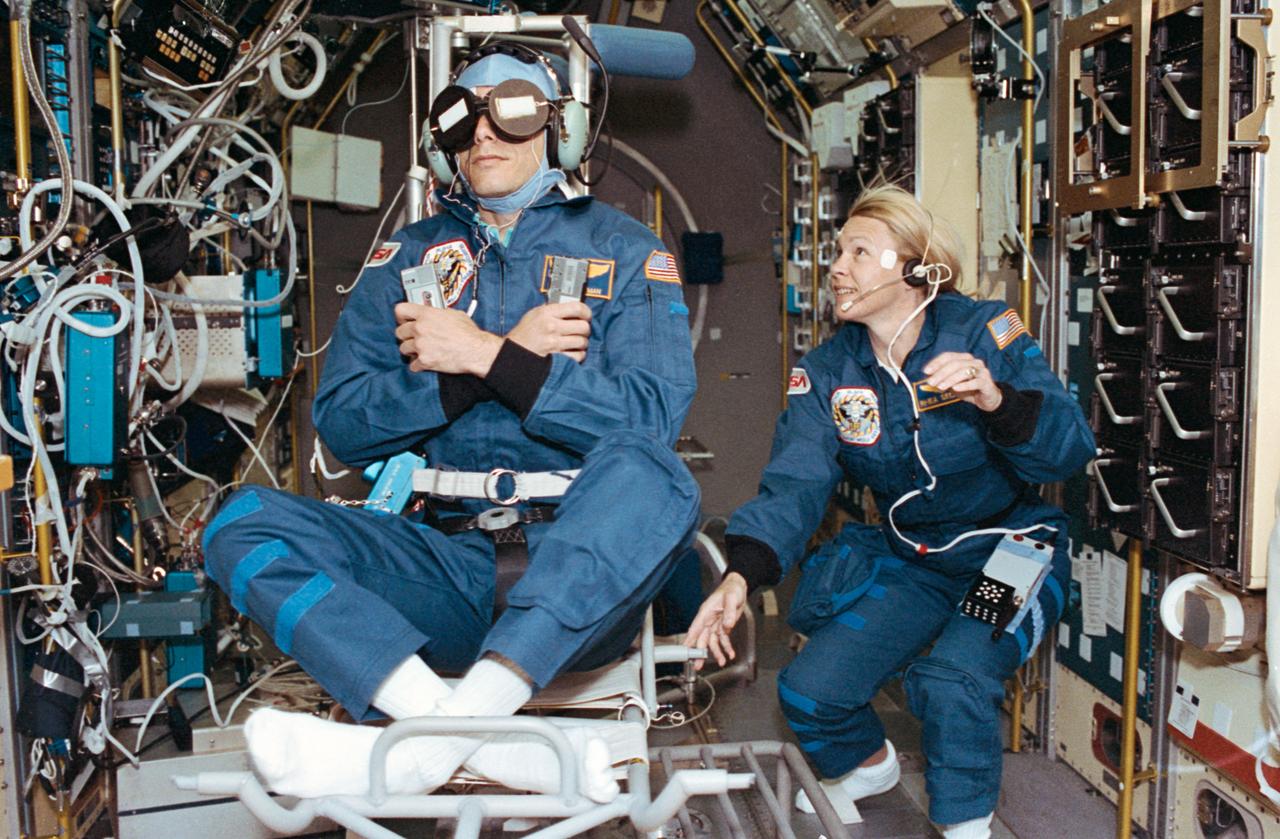
STS042-27-037 (22-30 Jan. 1992) --- Astronaut David C. Hilmers, STS-42 mission specialist, wearing a helmet assembly, sits in the Microgravity Vestibular Investigation (MVI) rotating chair. The scene is in the International Microgravity Laboratory (IML-1) science module aboard Discovery. Hilmers, a mission specialist, and six other crewmembers spent more than eight days in Earth-orbit conducting experiments. Hilmer's helmet assembly is outfitted with accelerometers to measure head movements and visors that fit over each eye independently to provide visual stimuli. The chair system has three movement patterns: "sinusoidal" or traveling predictably back and forth over the same distance at a constant speed; "pseudorandom" or moving back and forth over the varying distances; and "stepped" or varying speeds beginning and stopping suddenly.
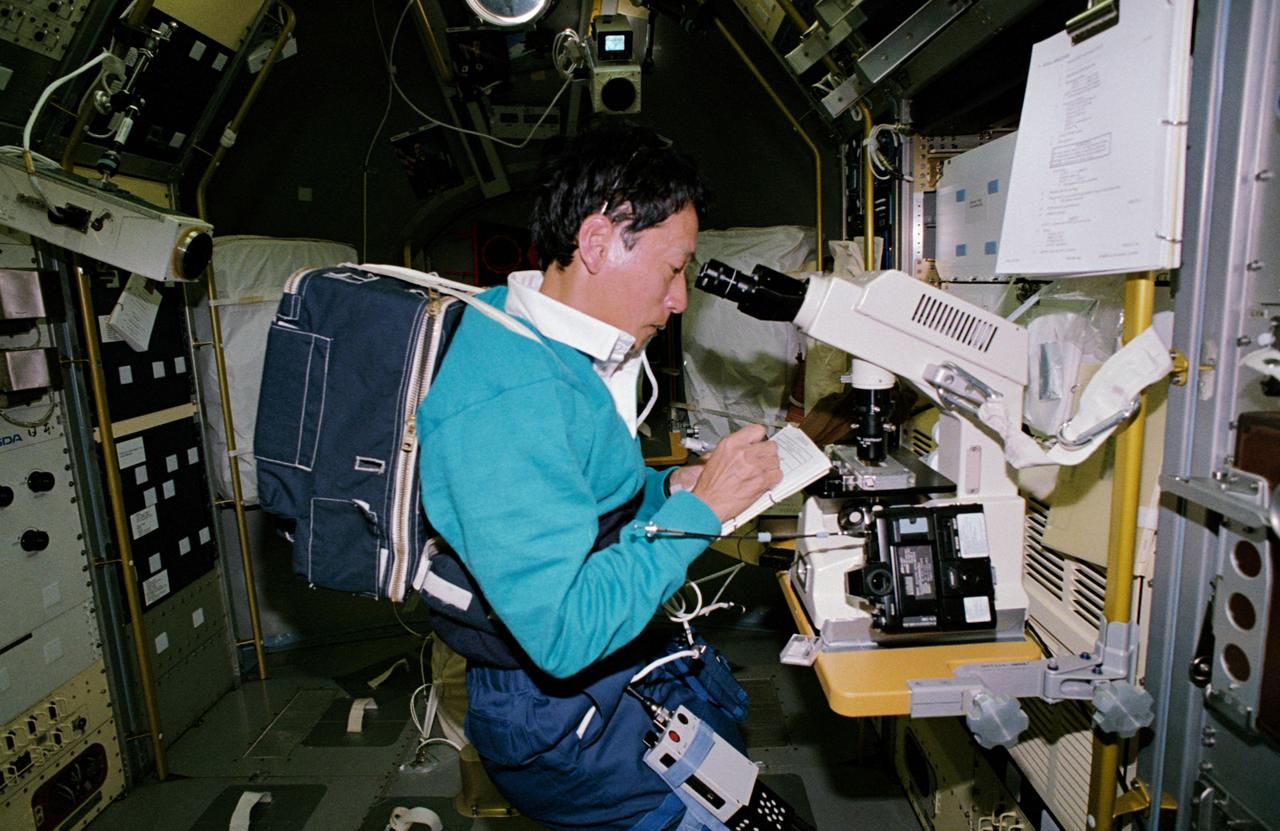
STS047-05-025 (12 - 20 Sept 1992) --- Payload specialist Mamoru Mohri, representing Japan's National Space Development Agency (NASDA), uses a microscope to produce photomicrographs of mammalian cells. The mammal cell structure experiment is one of a large number of tests that were performed during the eight-day Spacelab-J mission. On his back, Dr. Mohri totes a health monitoring experiment. The primary objective of the physiological monitoring system is to observe the health condition of the Japanese payload specialist so that good health can be maintained during and after the spaceflight.
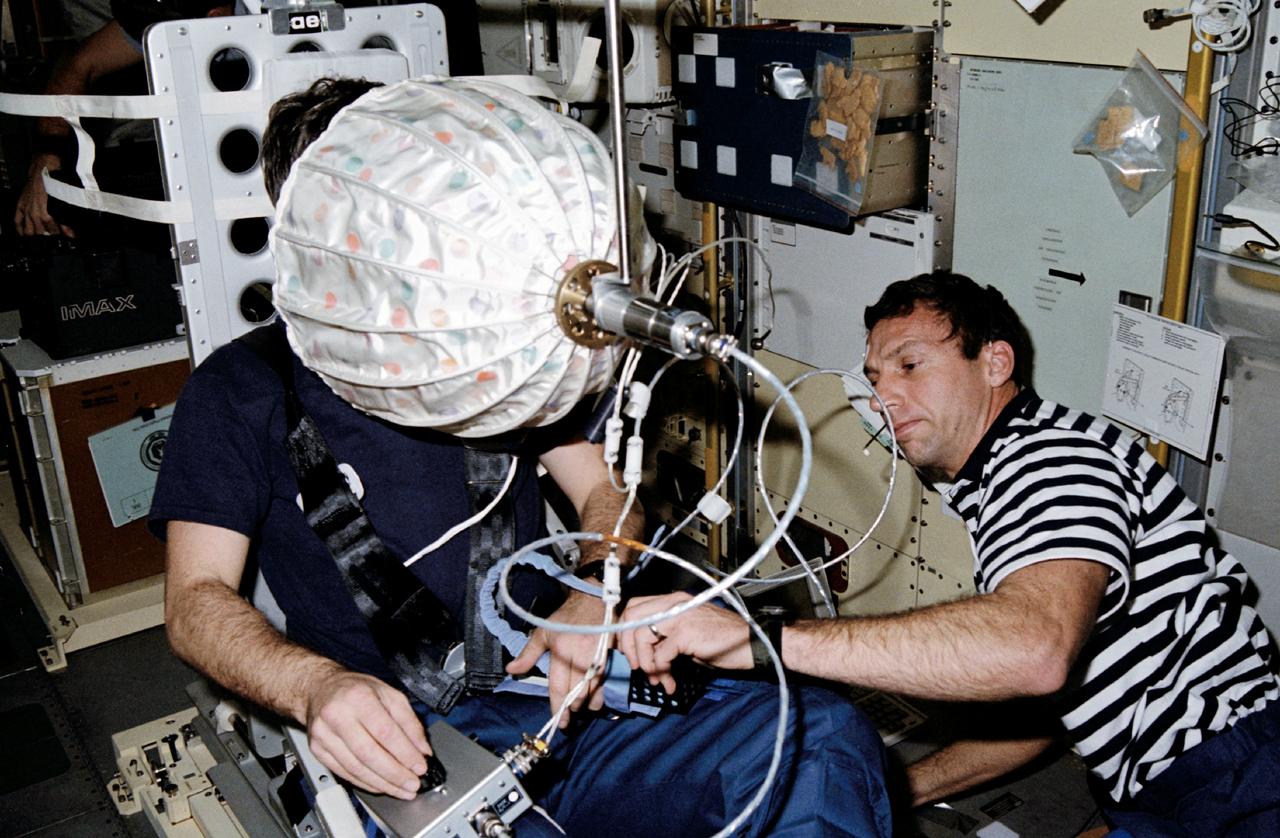
STS042-203-024 (22-30 Jan. 1992) --- Astronaut David C. Hilmers (right), STS-42 mission specialist, assists European Space Agency (ESA) payload specialist Ulf Merbold with the visual stimulator experiment on the Space Shuttle Discovery's middeck. This particular test is part of an ongoing study of the Space Adaptation Syndrome (SAS). Seated in a stationary mini-sled, Merbold (or any other subject for this test) stares at an umbrella-shaped rotating dome with a pattern of colored dots on its interior. While observing the rotating dome, the subject turns a knob to indicate his perception of body rotation. The strength of circular vection is calculated by comparing the signals from the dome and the knob. The greater the false sense of circular vection, the more the subject is relying on visual information instead of otolith information.
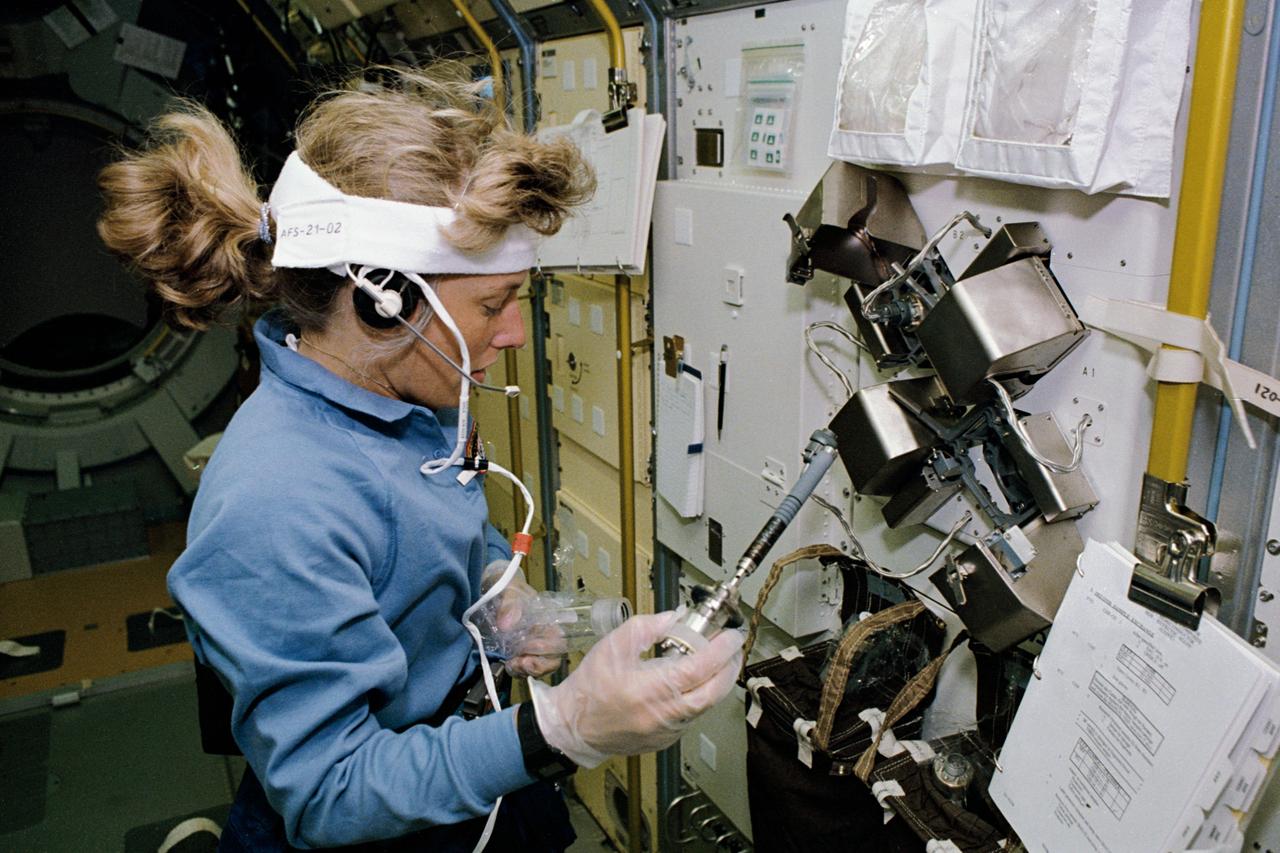
STS047-02-003 (12 - 20 Sept 1992) --- Astronaut N. Jan Davis, mission specialist, works at the Continuous Heating Furnace (CHF) in the Spacelab-J Science Module. This furnace provided temperatures up to 1,300 degrees Celsius and rapid cooling to two sets of samples concurrently. The furnace accommodated in-space experiments in the Fabrication of Si-As-Te:Ni Ternary Amorphous Semiconductor and the Crystal Growth of Compound Semiconductors. These were two of the many experiments designed and monitored by Japan's National Space Development Agency (NASDA).
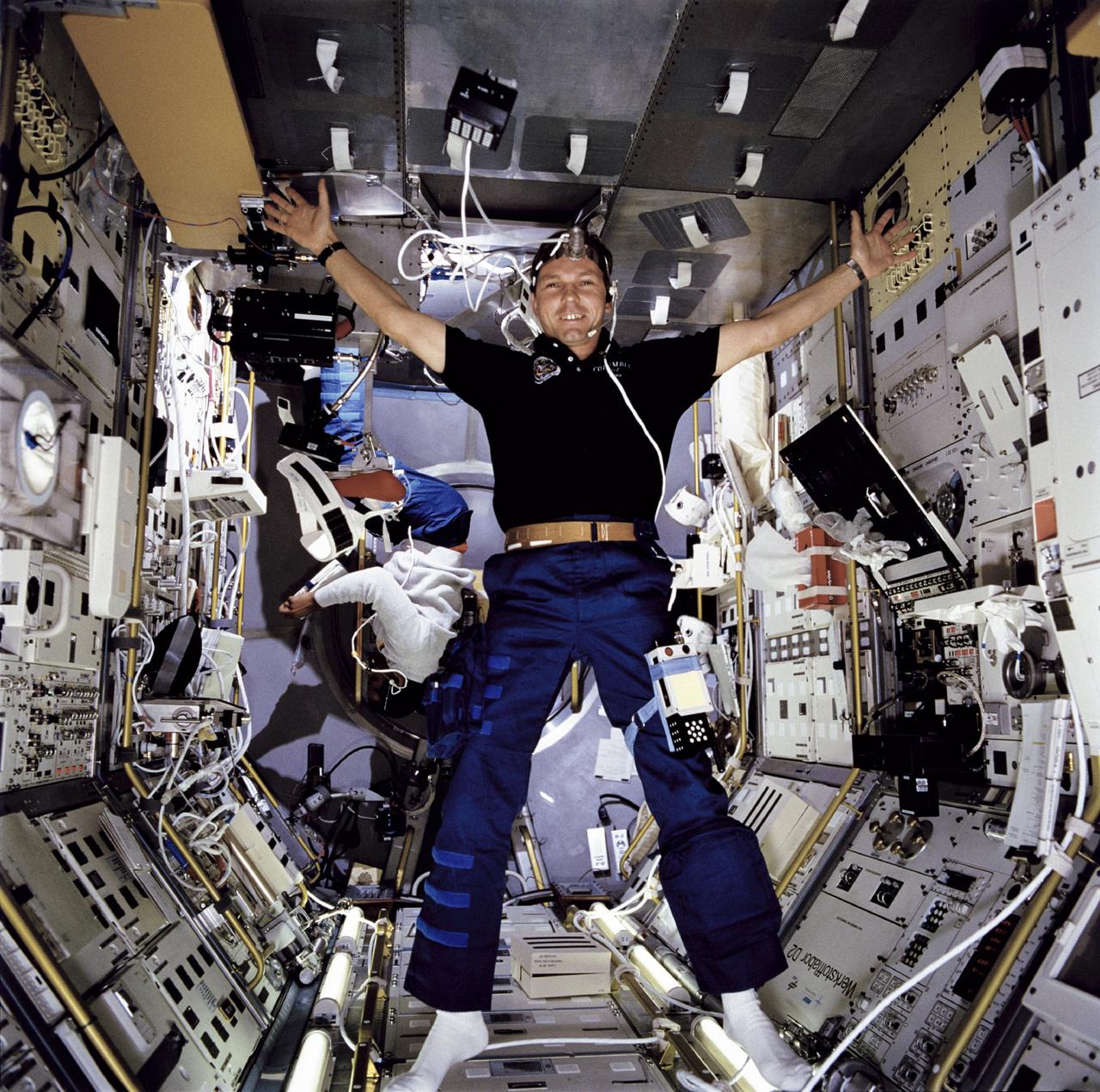
STS055-106-090 (26 April- 6 May 1993) --- Hans Schlegel, one of two STS-55 payload specialists representing the German Aerospace Research Establishment (DLR) onboard the Space Shuttle Columbia, finds plenty of room to "spread out" while participating in a Tissue experiment. Astronaut Bernard A. Harris, Jr., mission specialist, monitors an experiment in the background.
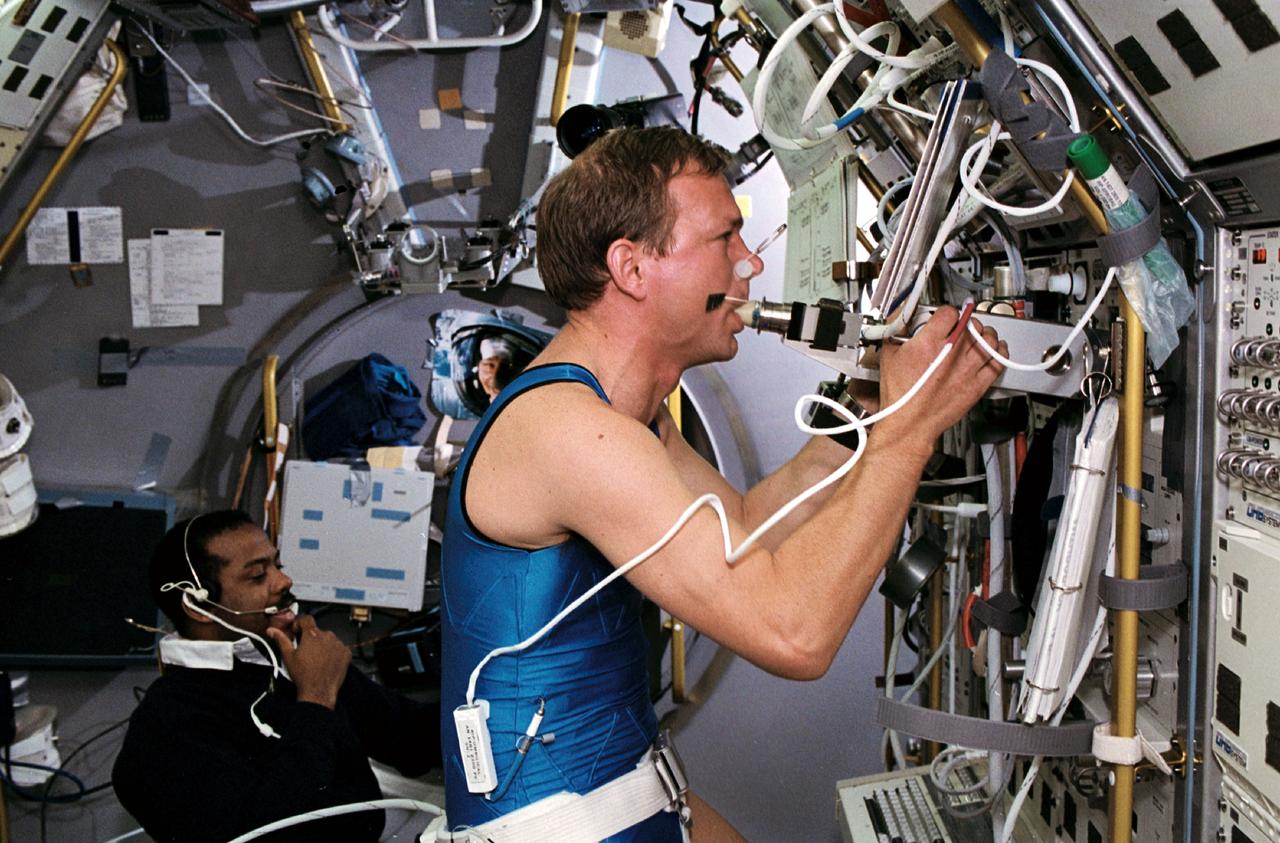
STS055-45-017 (26 April-6 May 1993) --- Hans Schlegel (foreground) participates in the ongoing investigation of human physiology under microgravity conditions as he works out on the ergometer at the Anthrorack. Monitoring the "run" is astronaut Bernard A. Harris, Jr., STS-55 mission specialist. Schlegel is one of two payload specialists representing the German Aerospace Research Establishment (DLR) on the Spacelab D-2 mission.
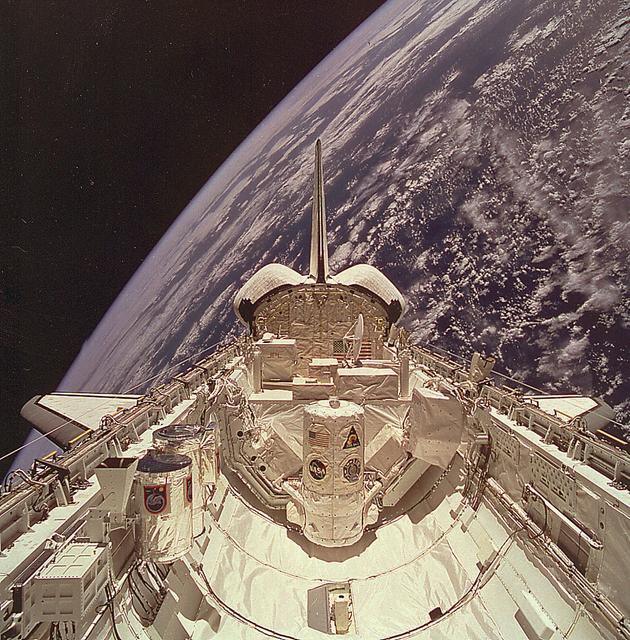
This is an STS-66 mission onboard photo of the Space Shuttle Orbiter Atlantis showing the payload of the third Atmospheric Laboratory for Applications and Science (ATLAS-3) mission. During the ATLAS missions, international teams of scientists representing many disciplines combined their expertise to seek answers to complex questions about the atmospheric and solar conditions that sustain life on Earth. The ATLAS program specifically investigated how Earth's middle and upper atmospheres and climate are affected by by the sun and by products of industrial and agricultural activities on Earth. Thirteen ATLAS instruments supported experiments in atmospheric sciences, solar physics, space plasma physics, and astronomy. The instruments were mounted on two Spacelab pallets in the Space Shuttle payload bay. The ATLAS-3 mission continued a variety of atmospheric and solar studies to improve understanding of the Earth's atmosphere and its energy input from the sun. A key scientific objective was to refine existing data on variations in the fragile ozone layer of the atmosphere. The Orbiter Atlantis was launched on November 3, 1994 for the ATLAS-3 mission (STS-66).
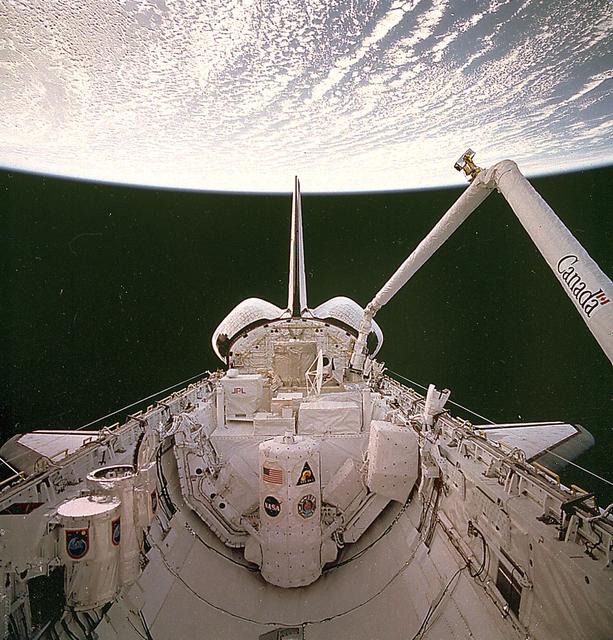
This is an STS-66 mission onboard photo showing the Remote Manipulator System (RMS) moving toward one of the solar science instruments for the third Atmospheric Laboratory for Applications and Science (ATLAS-3) mission in the cargo bay of the Orbiter Atlantis. During the ATLAS missions, international teams of scientists representing many disciplines combined their expertise to seek answers to complex questions about the atmospheric and solar conditions that sustain life on Earth. The ATLAS program specifically investigated how Earth's middle and upper atmospheres and climate are affected by by the sun and by products of industrial and agricultural activities on Earth. Thirteen ATLAS instruments supported experiments in atmospheric sciences, solar physics, space plasma physics, and astronomy. The instruments were mounted on two Spacelab pallets in the Space Shuttle payload bay. The ATLAS-3 mission continued a variety of atmospheric and solar studies, to improve understanding of the Earth's atmosphere and its energy input from the sun. A key scientific objective was to refine existing data on variations in the fragile ozone layer of the atmosphere. The Shuttle Orbiter Atlantis was launched on November 3, 1994 for the ATLAS-3 mission (STS-66). The ATLAS program was managed by the Marshall Space Flight Center.
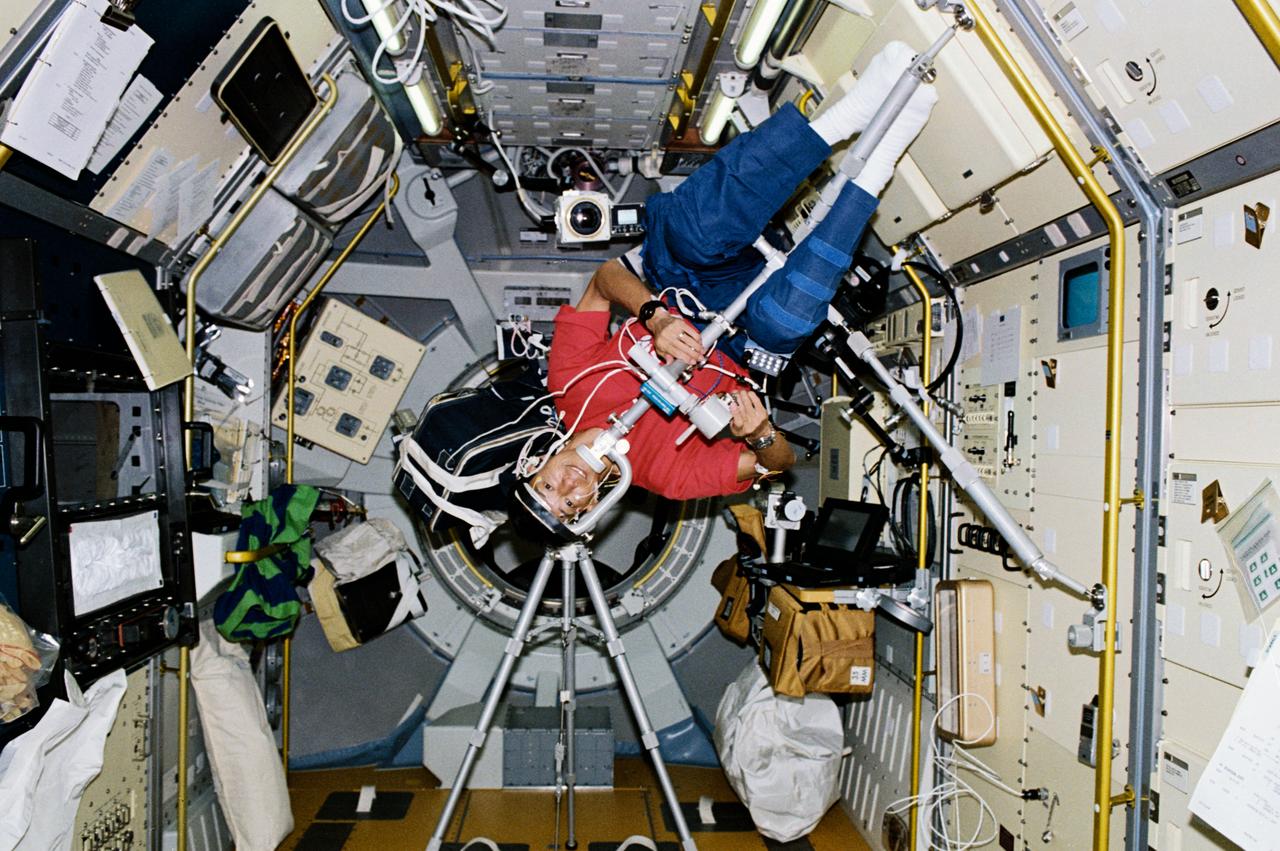
STS047-204-006 (12 - 20 Sept 1992) --- Dr. Mamoru Mohri, payload specialist representing Japan's National Space Development Agency (NASDA), participates in an experiment designed to learn more about Space Adaptation Syndrome (SAS). The experiment is titled, "Comparative Measurement of Visual Stability in Earth and Cosmic Space." During the experiment, Dr. Mohri tracked a flickering light target while eye movements and neck muscle tension were measured. This 45-degree angle position was one of four studied during the eight-day Spacelab-J mission.
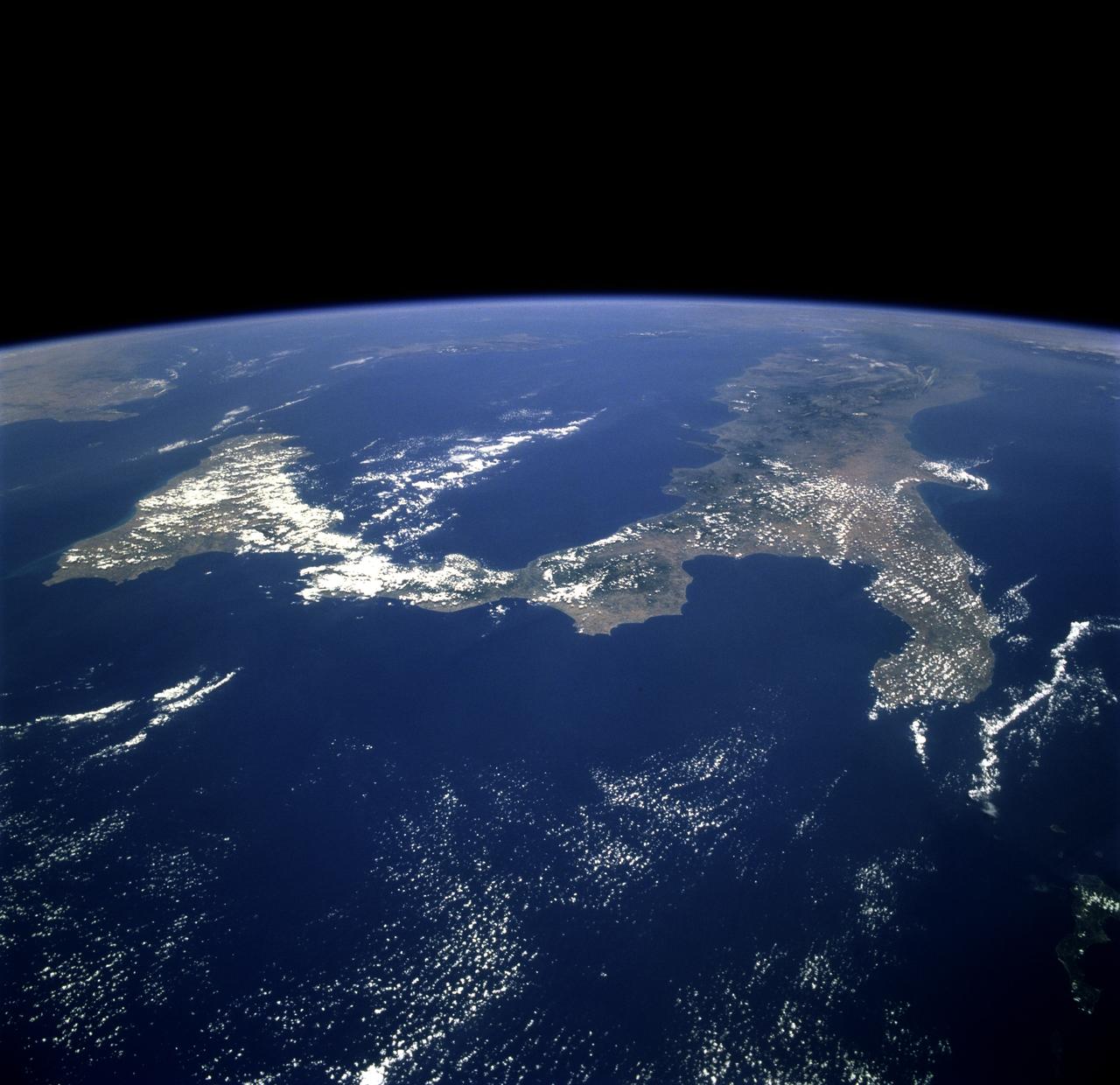
STS078-751-012 (20 June-7 July 1996) --- The international crew of the Life and Microgravity Spacelab (LMS-1) mission onboard the Space Shuttle Columbia photographed this oblique view of the "toe" of Italy and the island of Sicily. Southern Italy is known as the Mezzogiorno because of the intensity of sunshine there at midday (Mezzogiorno is the Italian term for "midday" or "noon"). Mezzogiorno is a mainland subregion consisting of the modern southern Italian regions of Abruzzi, Molise, Campania, Puglia, Basilicata, and Calabria and an insular subregion composed of Sicily and Sardinia. Southern Italy is dominated by the Apennine Range, seen in the photo on the west side, and up to one-half of the land is too steep for any form of cultivation. Coastal plains are generally narrow and poorly drained and are limited to the environs of the cities of Naples and Salerno, Foggia, and Taranto. Chief crops in this region include wheat, olives, grapes, peaches, apricots, pears, and various vegetables. Iron, steel, machine tools, agricultural machinery, and petrochemicals are produced in the industrial triangle of Bari, Brindisi, and Taranto; industries around Naples are more diversified and produce textiles and various consumer goods, iron, steel, Olivetti office machinery, Pirelli cables, Alfa Romeo automobiles, and ships. The Adriatic Sea on the east separates it from the Balkans, and the Mediterranean Sea on the south separates it from North Africa. Three major tectonic plates, converging from the south, the west, and the northeast, create geologically unstable conditions throughout southern Italy and Sicily. The most famous of southern Italy's four active volcanoes is Mount Vesuvius, whose eruption in AD 79 destroyed Pompeii. Sicily's Mount Etna and Stromboli, on an island north of Sicily, were active during this Space Shuttle mission.