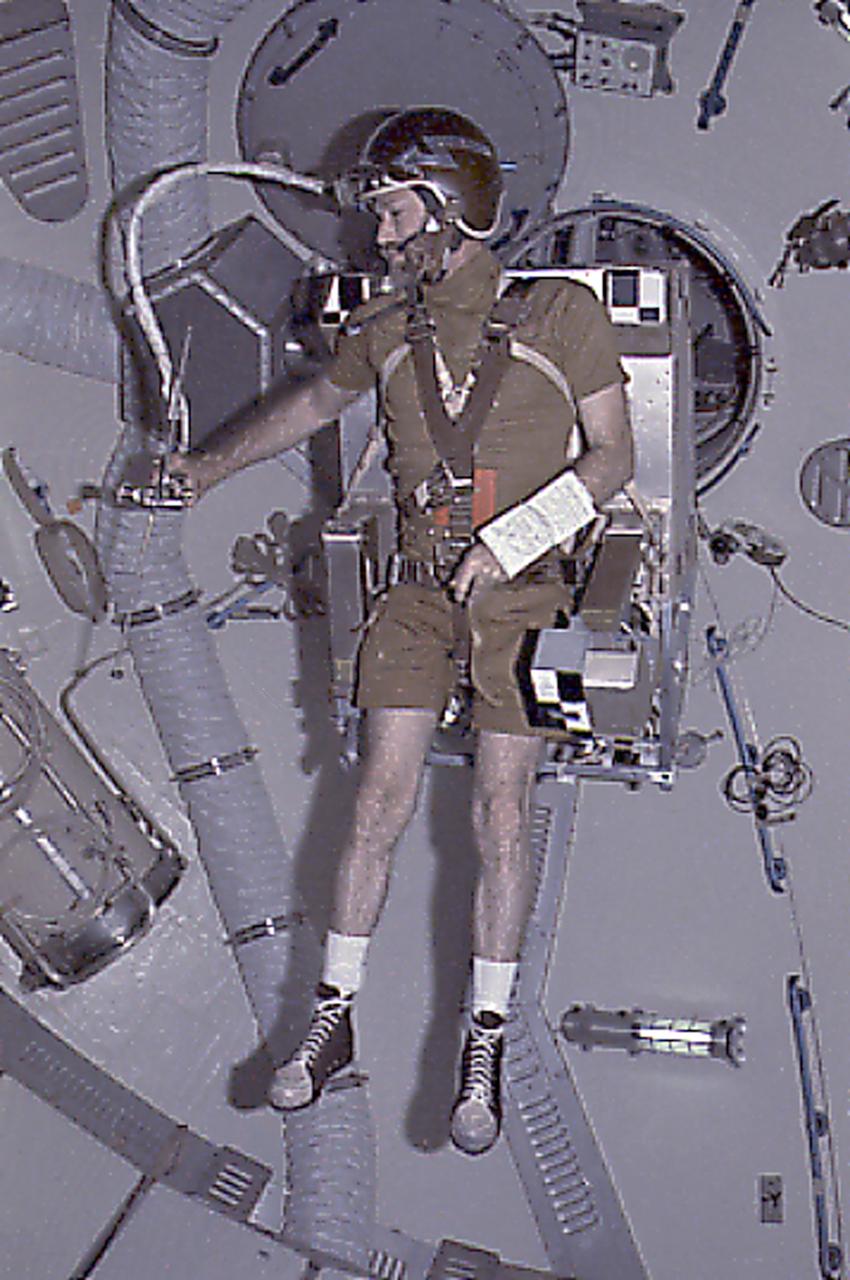
This Skylab-4 onboard photograph depicts Astronaut Gerald Carr testing Astronaut Maneuvering Equipment (M509) by flying it around under weightless conditions in the Orbital Workshop. The M509 experiment was an operational study to evaluate and conduct an in-orbit verification of the utility of various maneuvering techniques to assist astronauts in performing tasks that were representative of future extravehicular activity requirements.
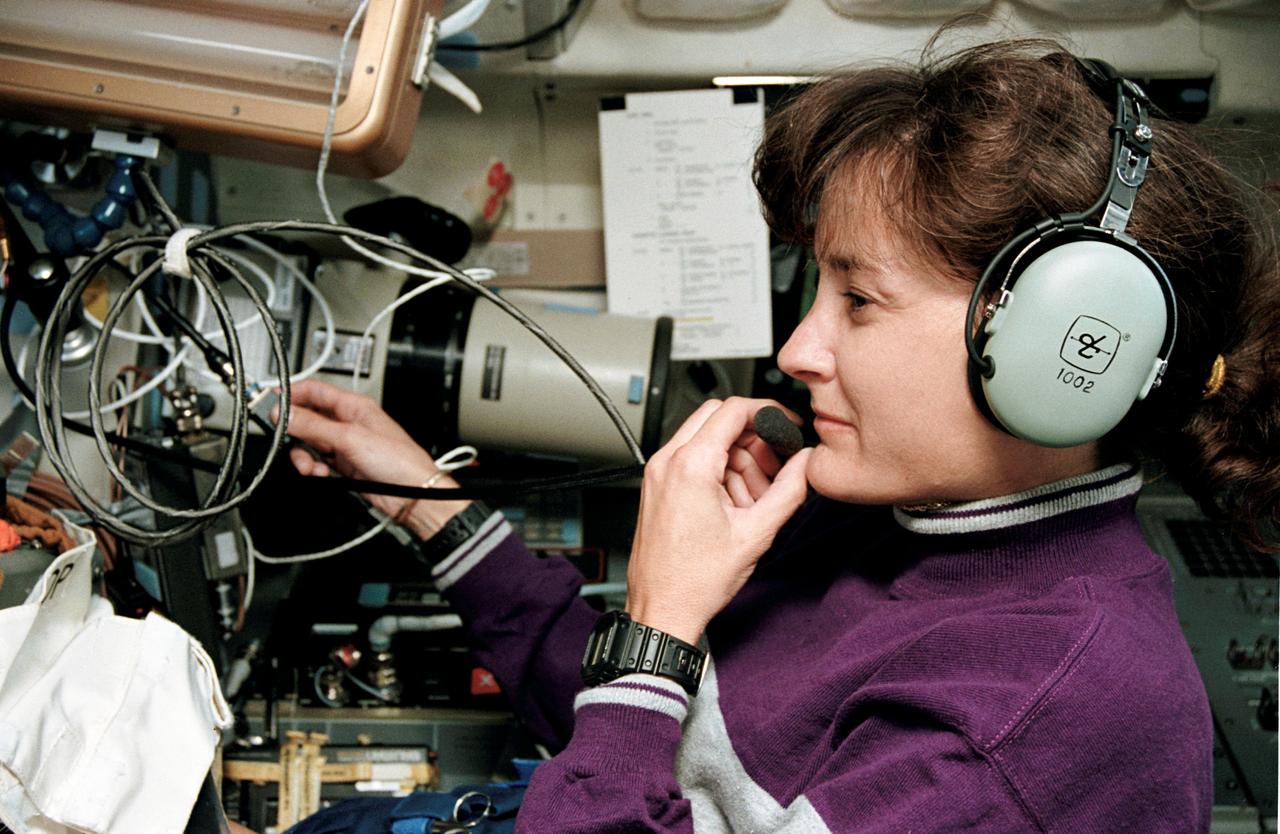
STS059-16-028 (9-20 April 1994) --- Onboard the Space Shuttle Endeavour, astronaut Linda M. Godwin talks to students via the Shuttle Amateur Radio Experiment (SAREX). The payload commander, as well as several other STS-59 crew members spent some off-duty time using the amateur radio equipment to communicate with "Hams" and students on Earth.
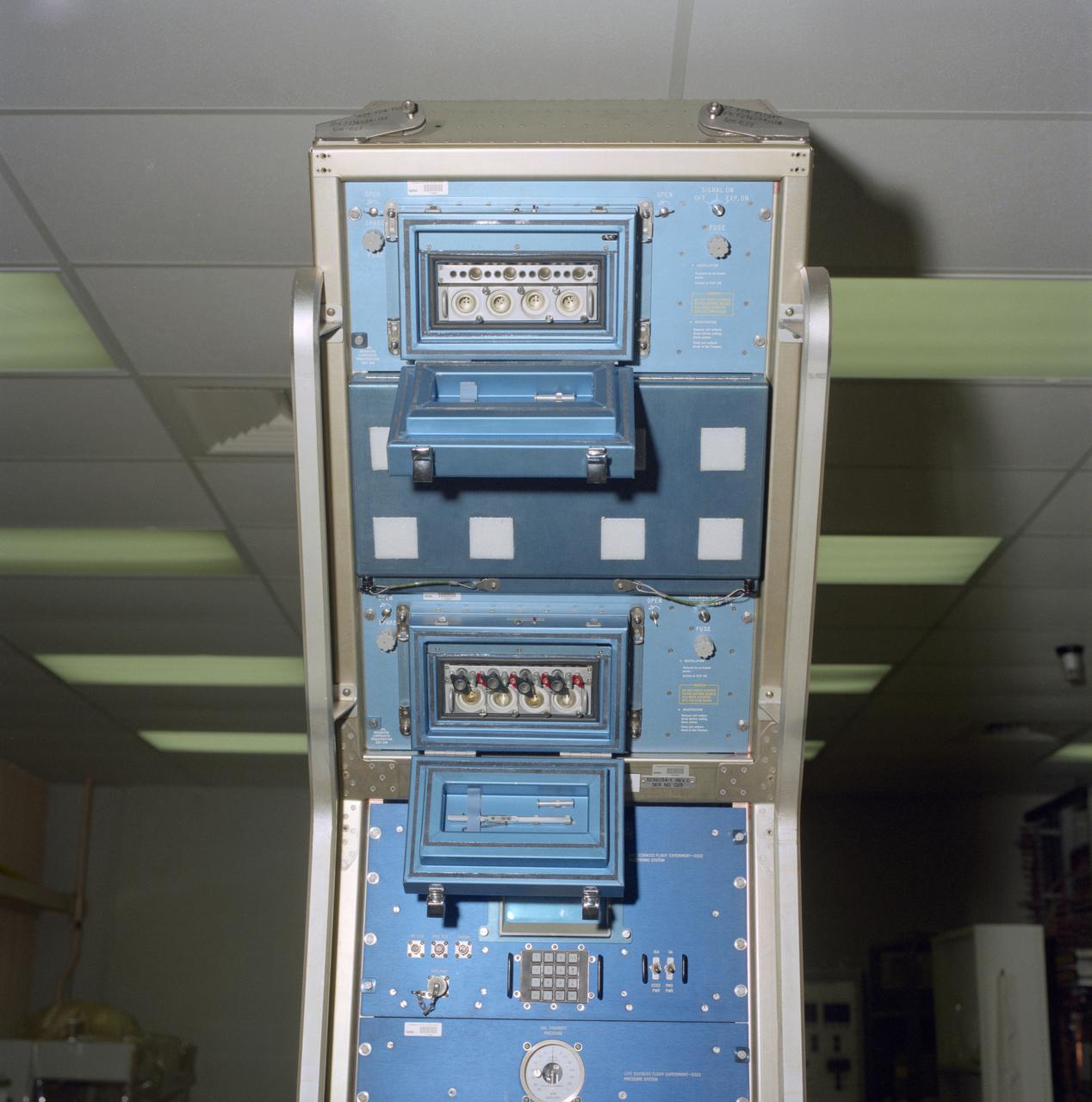
S84-43683 (26 Nov 1984) --- This vertically positioned rectangular piece of hardware, scheduled to fly on the science module of Spacelab Life Sciences-1, is important to the immunology investigation on the mission. Called Lymphocyte Proliferation in Weightlessness (Experiment 240), the test was developed by Dr. Augosto Cogoli of the Institute of Biotechnology, Gruppe Weltraum Biologie, in Zurich, Switzerland. It represents a continuation of previous Spacelab experiments by examining the effects of weightlessness on lymphocyte activation. Cultures will be grown in the microgravity incubators on the pictured hardware.
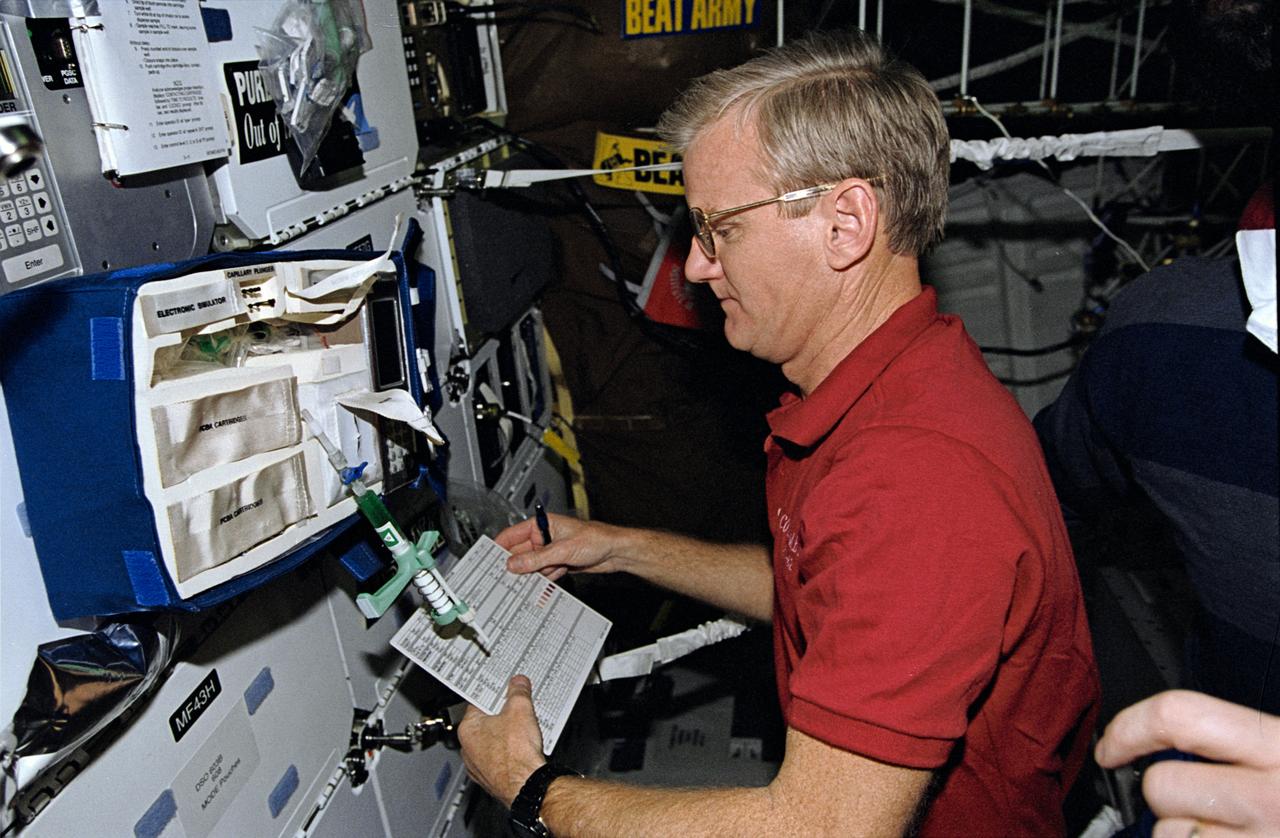
STS062-10-010 (4-18 March 1994) --- Astronaut John H. Casper, mission commander, takes stock of paraphenalia used to support medical testing onboard Columbia's middeck. Casper was poind by four other veteran astronauts for 14 days of variegated research in earth orbit.
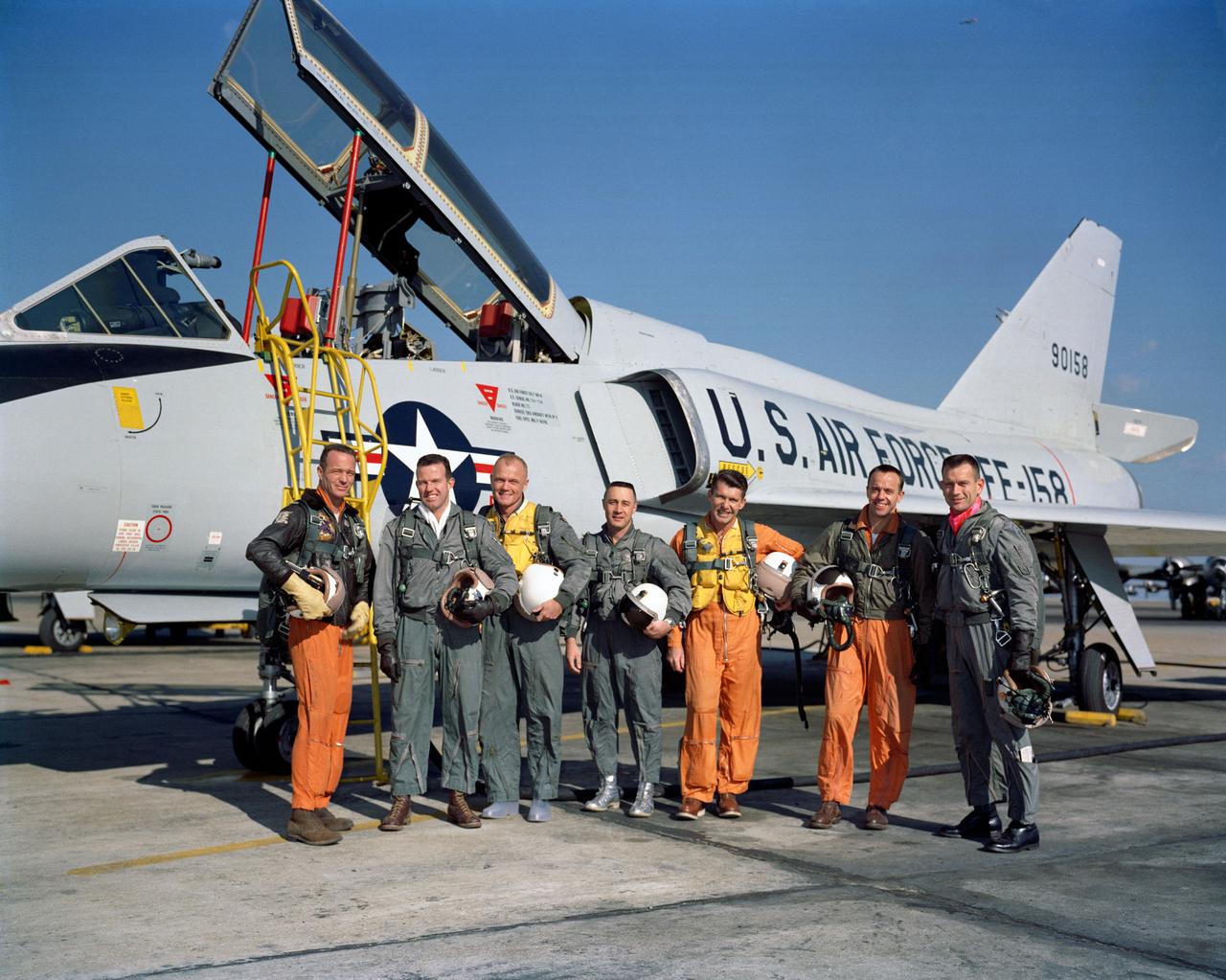
S61-01250 (20 Jan. 1961) --- Photo of the Mercury astronauts standing beside a Convair 106-B aircraft. They are, left to right, M. Scott Carpenter, L. Gordon Cooper Jr., John H. Glenn Jr., Virgil I. Grissom, Walter M. Schirra Jr., Alan B. Shepard Jr. and Donald K. Slayton. EDITOR'S NOTE: Astronaut Gus Grissom died in the Apollo 1 -- Apollo/Saturn (AS-204) -- fire at Cape Kennedy, Florida on Jan. 27, 1967. Astronaut Deke Slayton died from complications of a brain tumor, in League City, Texas on June 13, 1993. Astronaut Shepard died after a lengthy illness in Monterey, California, on July 21, 1998. As of Jan. 1, 1977 none of the seven astronauts remained with the NASA Space Program. However, in October 1998, United States Senator Glenn (Democrat-Ohio) flew as payload specialist on the STS-95 mission. Photo credit: NASA
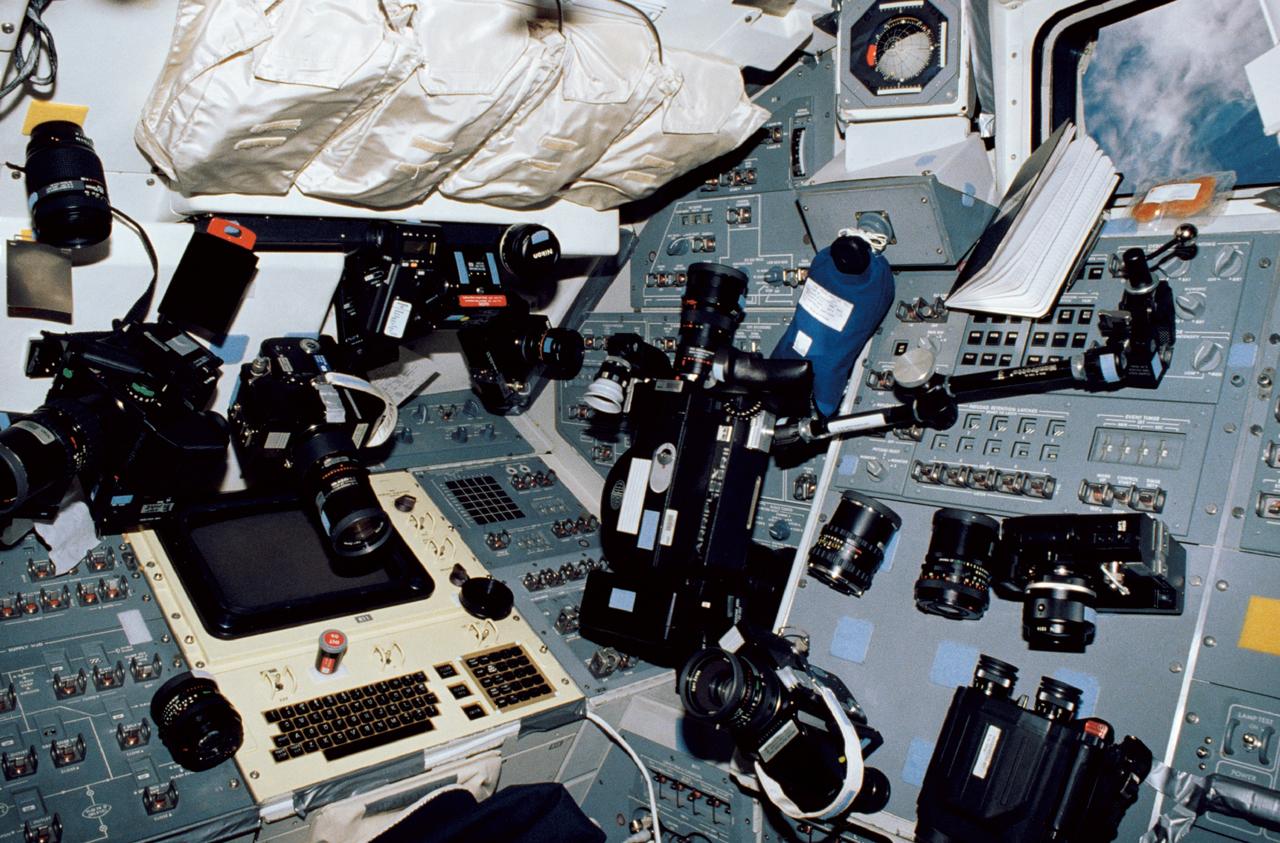
STS035-10-015 (2-10 Dec 1990) --- This busy scene shows cameras and supportive photographic gear temporarily stowed on Space Shuttle Columbia's aft flight deck. It was photographed with a 35mm camera by astronaut Jeffrey A. Hoffman, mission specialist, who called the cluster a "camera forest." The seven STS-35 crewmembers trained to record a wide variety of imagery with an equally broad range of equipment. In addition to cameras, a spot meter, film, a pair of binoculars, a bracket, lenses, lens cleaner and other photographic equipment are in the scene. Clouds over ocean waters are framed by an aft flight deck window at upper right.
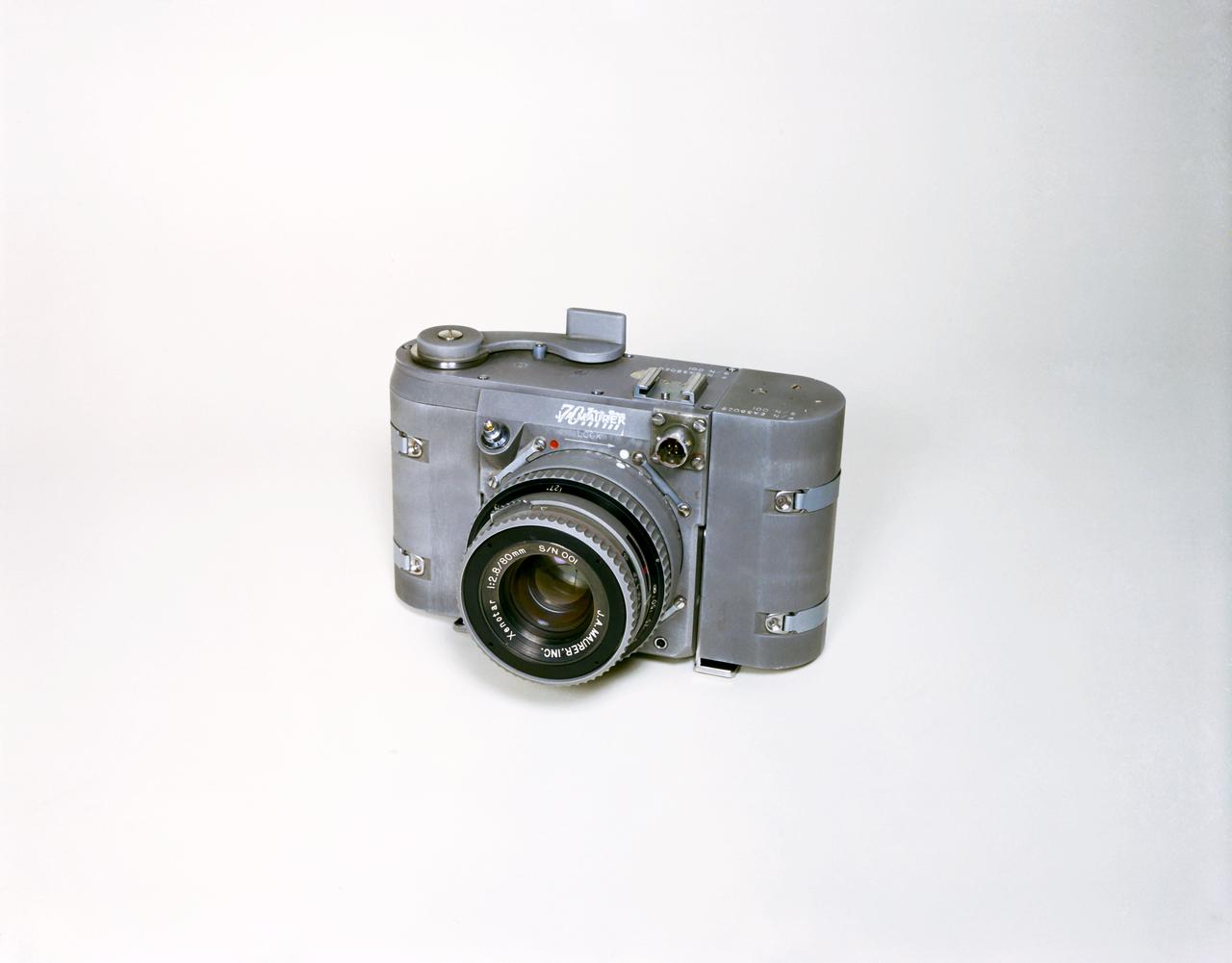
S65-23639 (28 April 1965) --- A bench view of a 70mm camera expected to be used by the Gemini-4 astronauts.
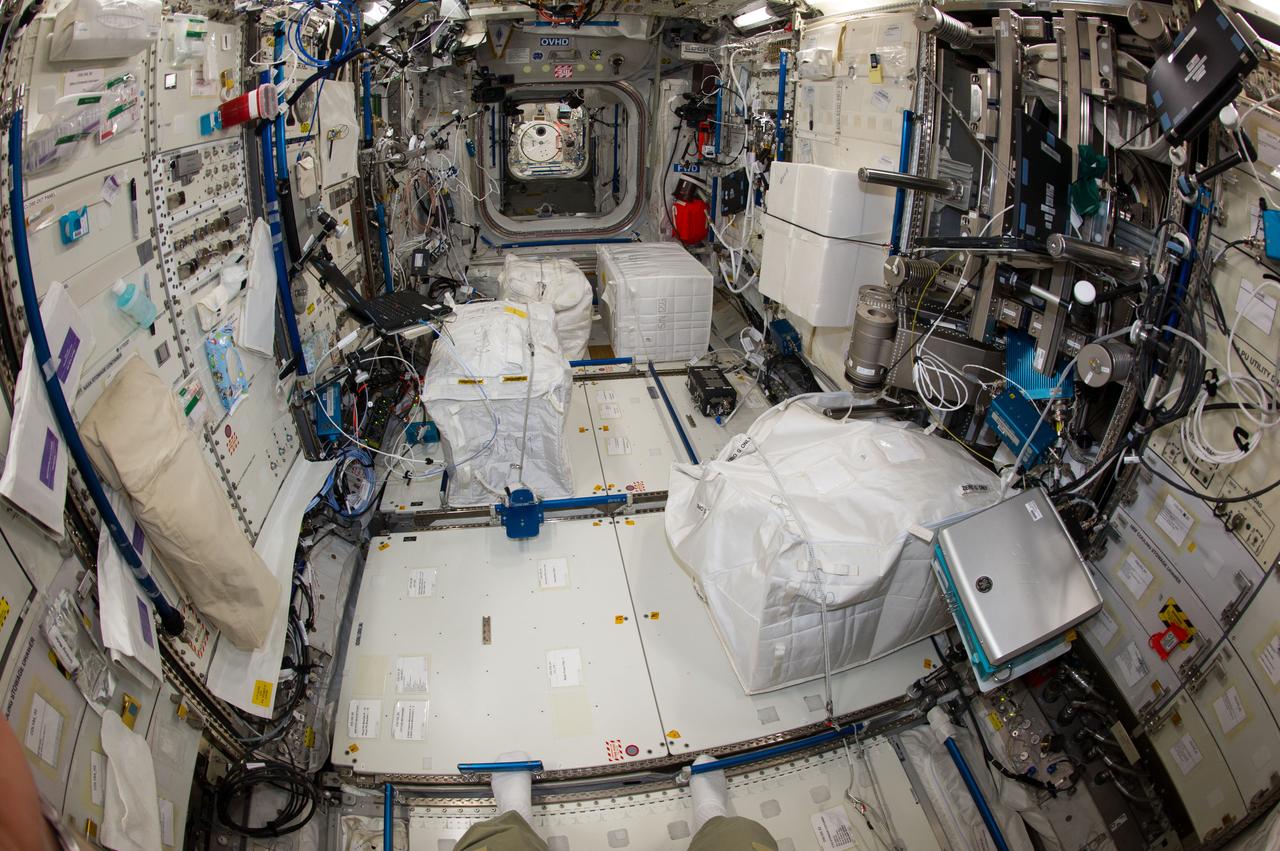
ISS040-E-008058 (7 June 2014) --- The interior of the Columbus laboratory is featured in this image photographed by an Expedition 40 crew member on the International Space Station.
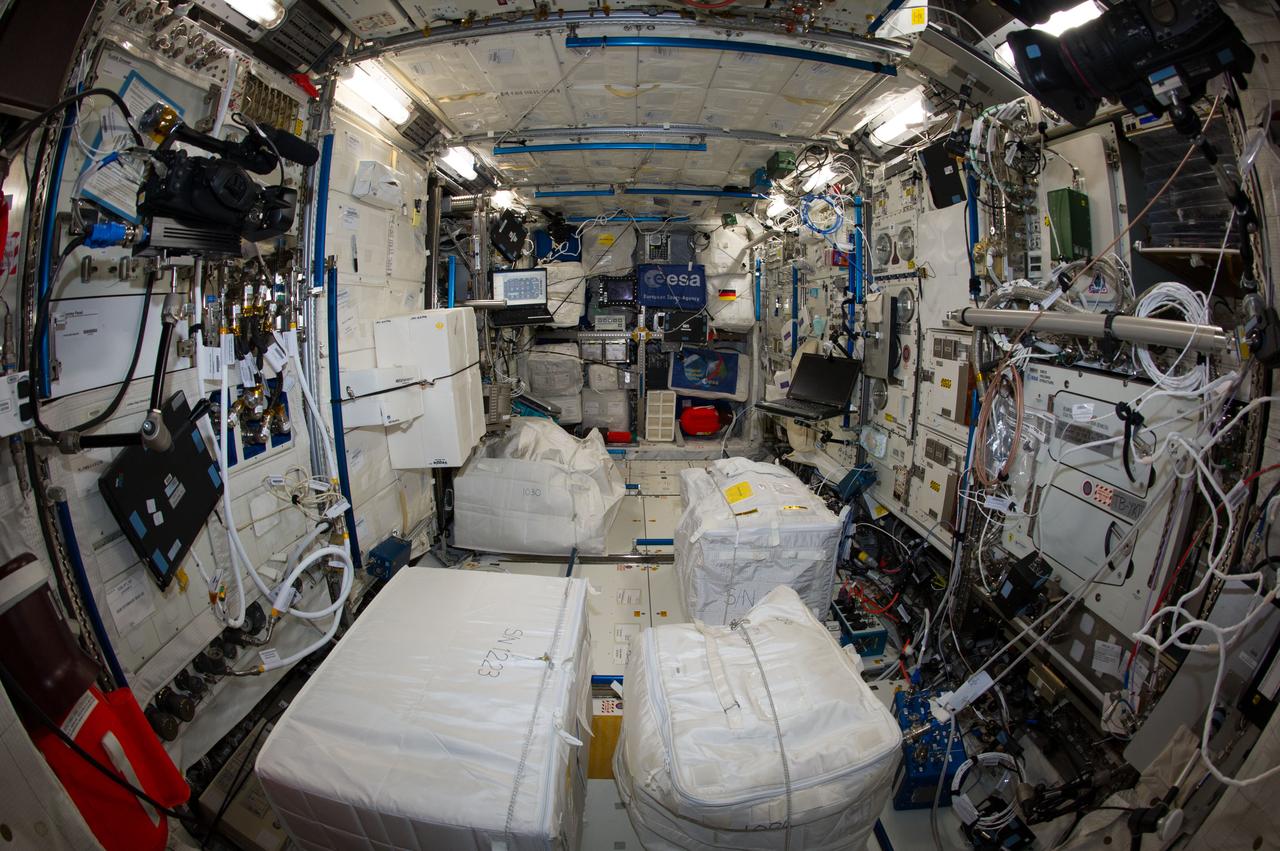
ISS040-E-008065 (7 June 2014) --- The interior of the Columbus laboratory is featured in this image photographed by an Expedition 40 crew member on the International Space Station.
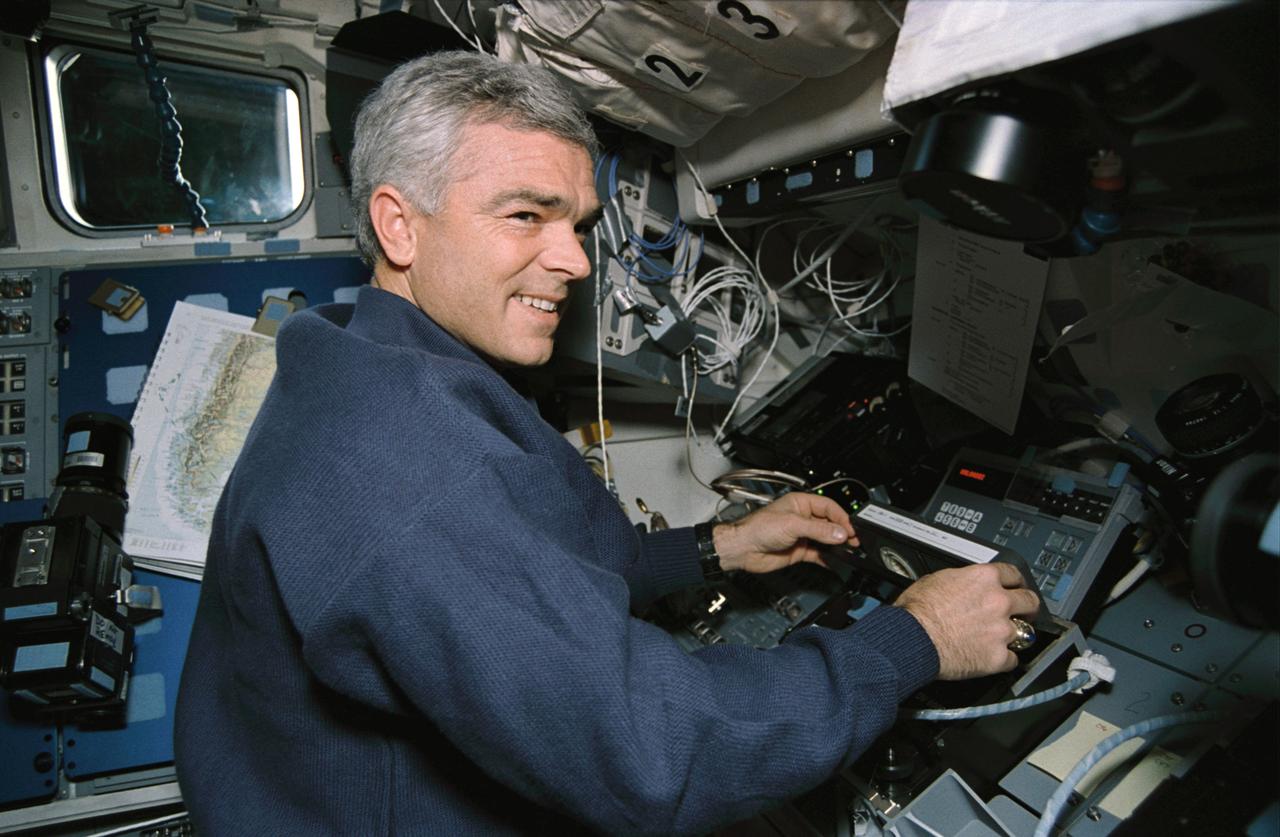
STS059-09-012 (9-20 April 1994) --- On the Space Shuttle Endeavour's aft flight deck, astronaut Michael R. (Rich) Clifford, mission specialist, inserts a tape in the payload high rate recorder. Three of these state-of-the-art recorders captured four times the amount of data that could be radioed to the ground. The 183 tapes, each containing 40 megabytes of data, will be turned into images over the next year, and analyzed over the next decade. Clifford was joined in space by five other NASA astronauts for a week and a half of support to the Space Radar Laboratory (SRL-1)/STS-59 mission.
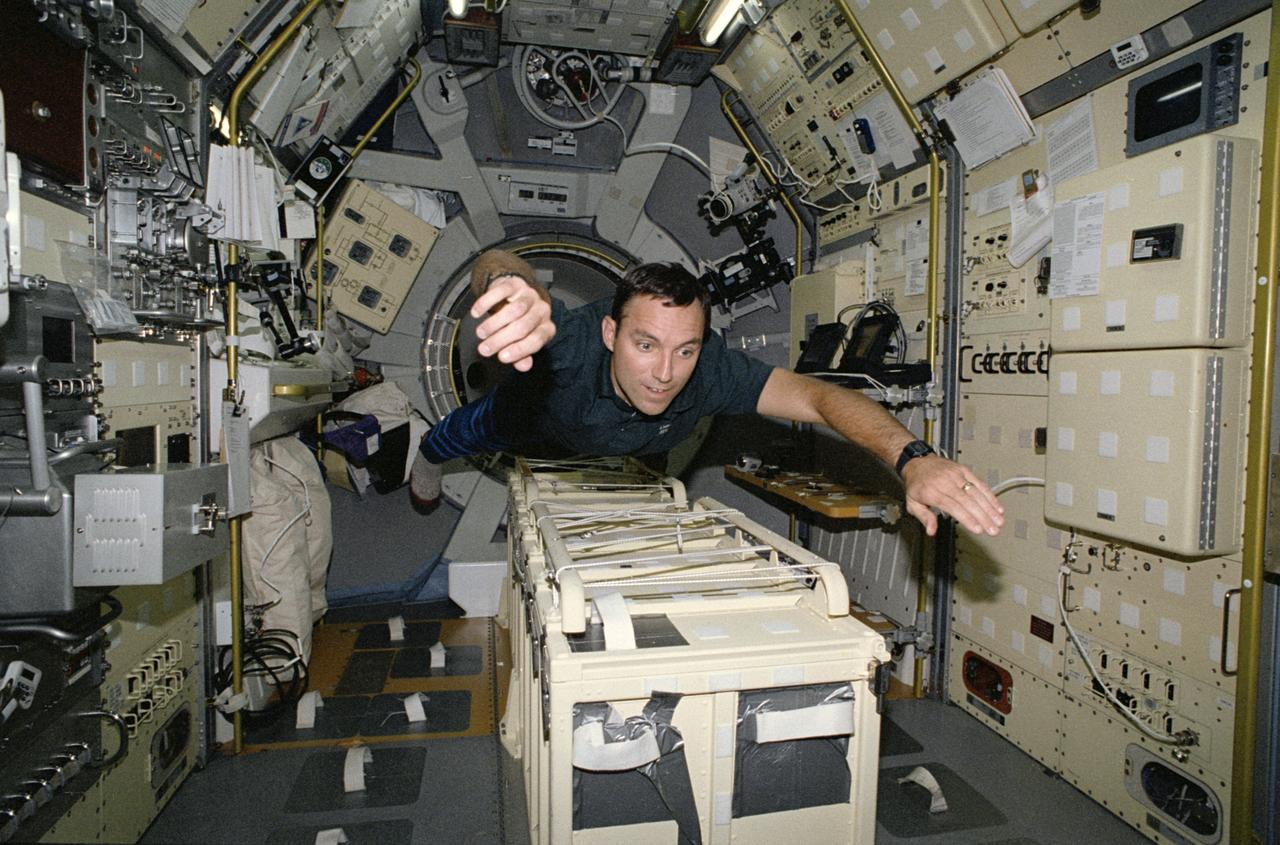
STS-65 Mission Specialist Carl E. Walz floats above center aisle equipment in the International Microgravity Laboratory 2 (IML-2) spacelab science module. Walz has just entered the IML-2 module via the spacelab tunnel (note hatch opening behind him). The tunnel connects the IML-2 module with Columbia's, Orbiter Vehicle (OV) 102's, crew compartment. Walz along with five other NASA astronauts and a Japanese payload specialist spent more than two weeks in Earth orbit conducting IML-2 experiments. This photo was among the first released by NASA following IML-2.
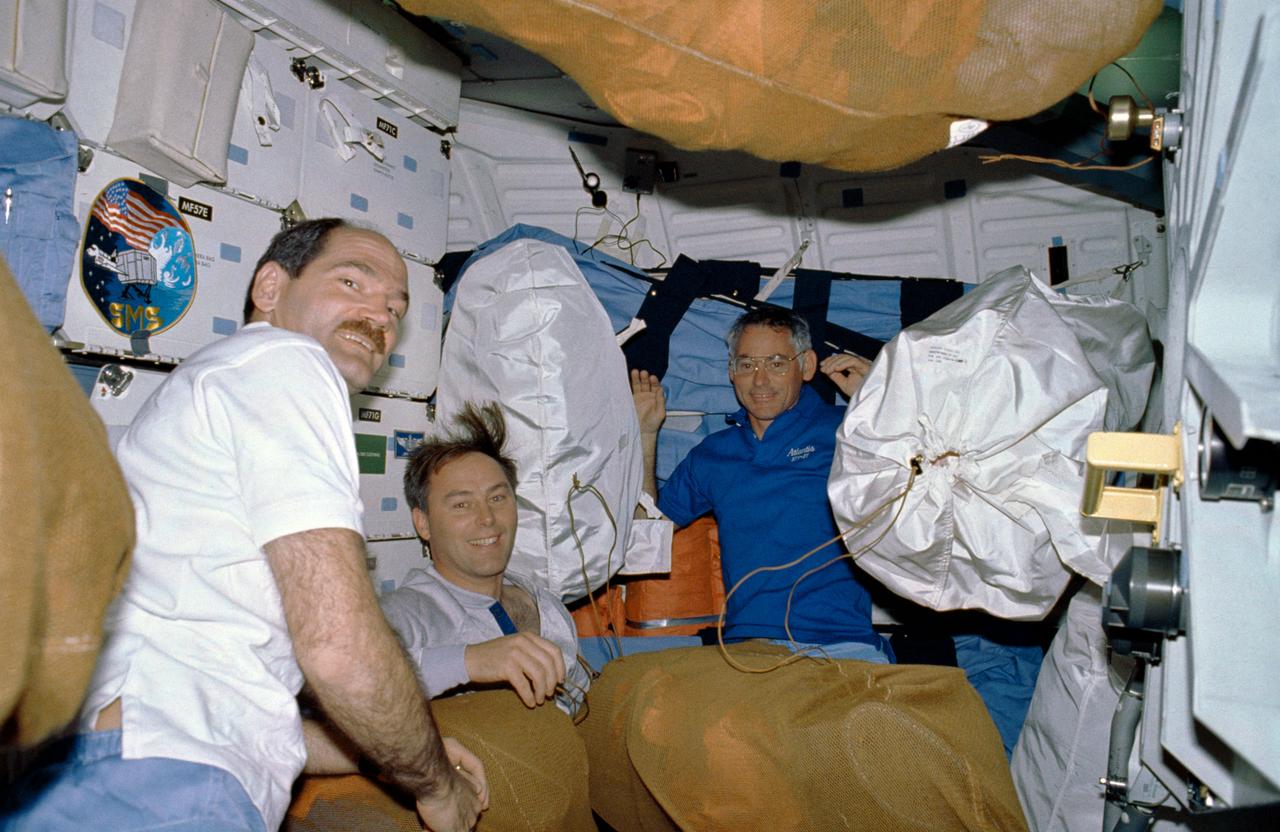
STS027-10-003 (2-6 Dec. 1988) --- From the left, astronauts Guy S. Gardner, STS-27 pilot, along with Jerry L. Ross and Richard M. (Mike) Mullane, both mission specialists, take a break from moving gear and equipment on the middeck of the Earth-orbiting space shuttle Atlantis. Photo credit: NASA
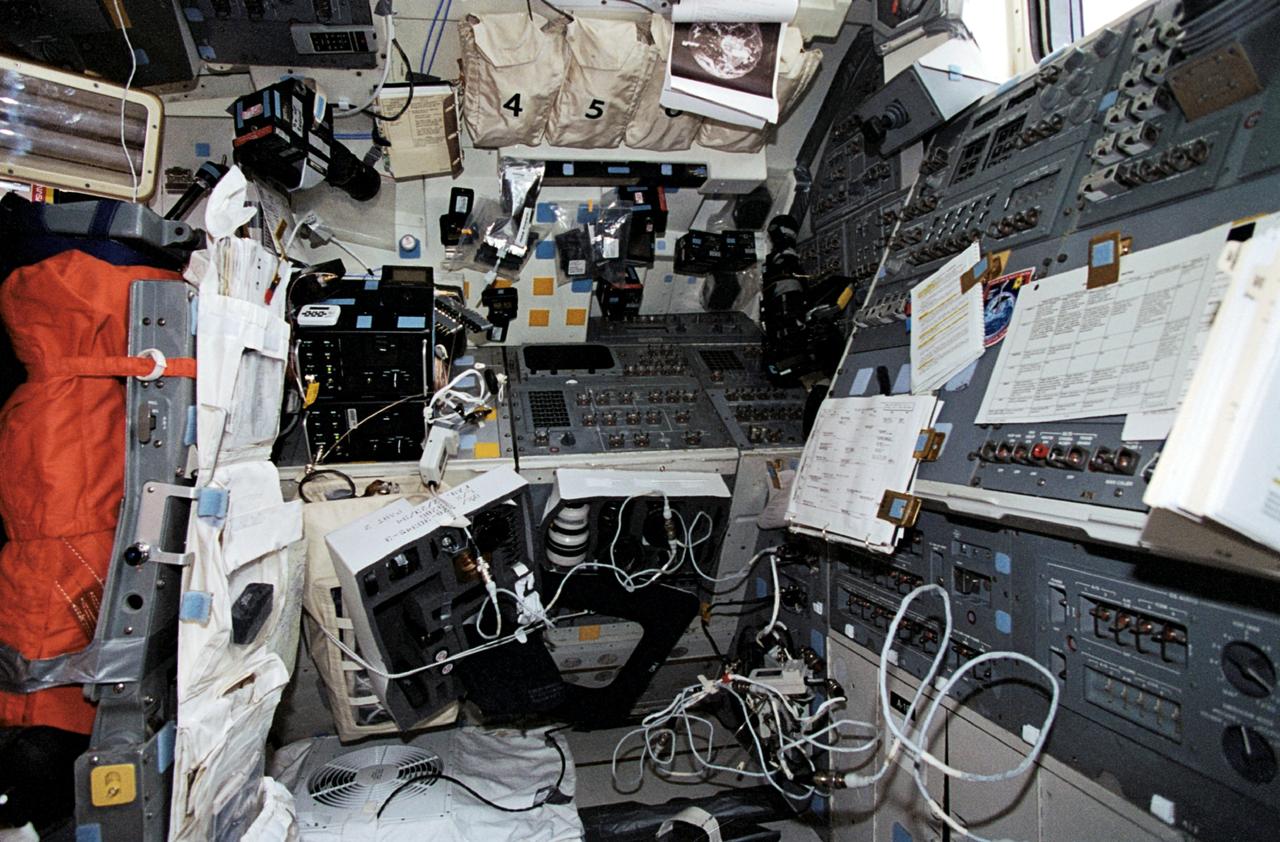
STS062-17-034 (4-18 March 1994) --- This scene, resembling a photographer's studio/laboratory, actually shows the aft flight deck of the Earth-orbiting Space Shuttle Columbia. A variety of cameras, lenses, visual aids and other gear are seen stowed around the flight deck. The five astronaut crew members devoted a large portion of their on-duty time at this workstation using some of this photographic equipment to record Earth imagery.
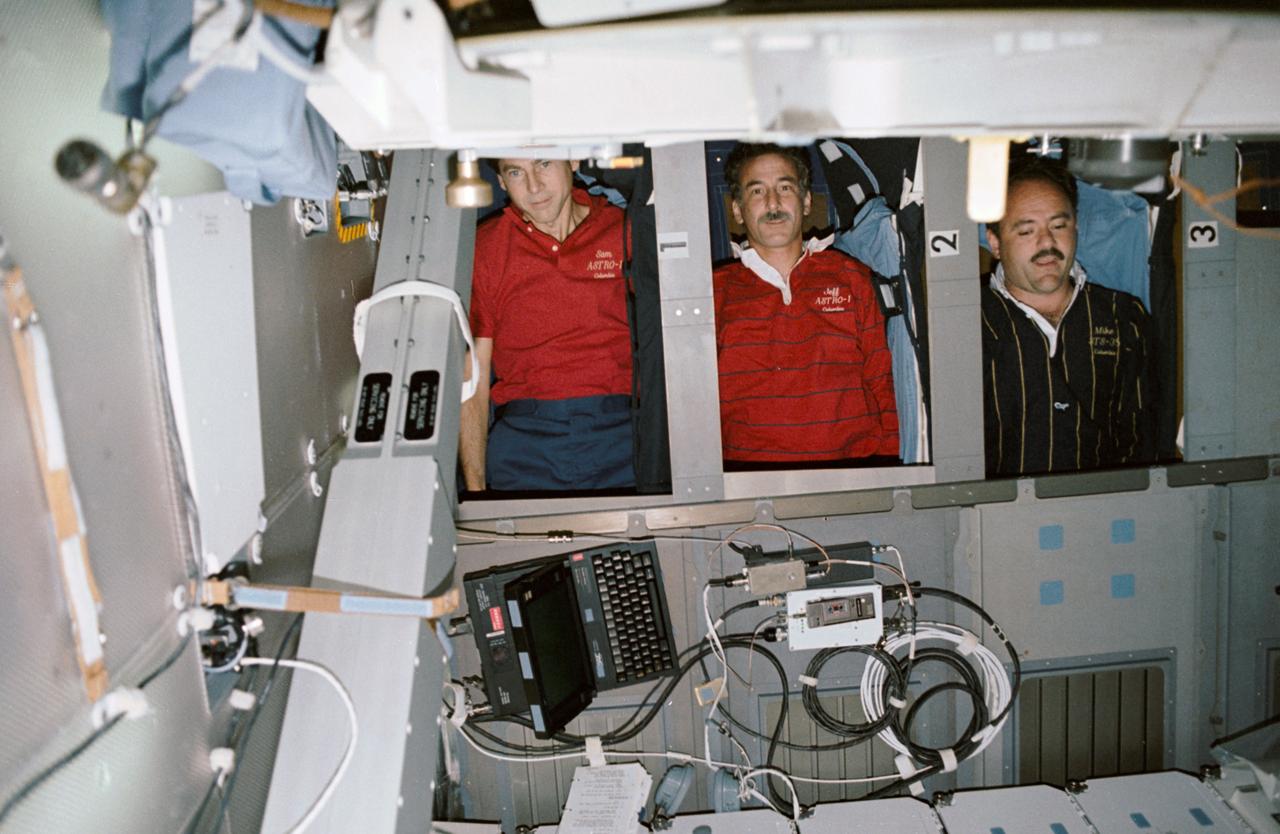
Though they are not actually asleep, three STS-35 crewmembers demonstrate the bunk-style sleep compartments onboard Columbia's, Orbiter Vehicle (OV) 102's, middeck. From top to bottom are Payload Specialist Samuel T. Durrance, Mission Specialist (MS) Jeffrey A. Hoffman, and MS John M. Lounge. At the left is the shuttle amateur radio experiment (SAREX). The crew escape pole (CES) is visible overhead and the open airlock hatch in the foreground. The sleep station is located against the middeck starboard wall.
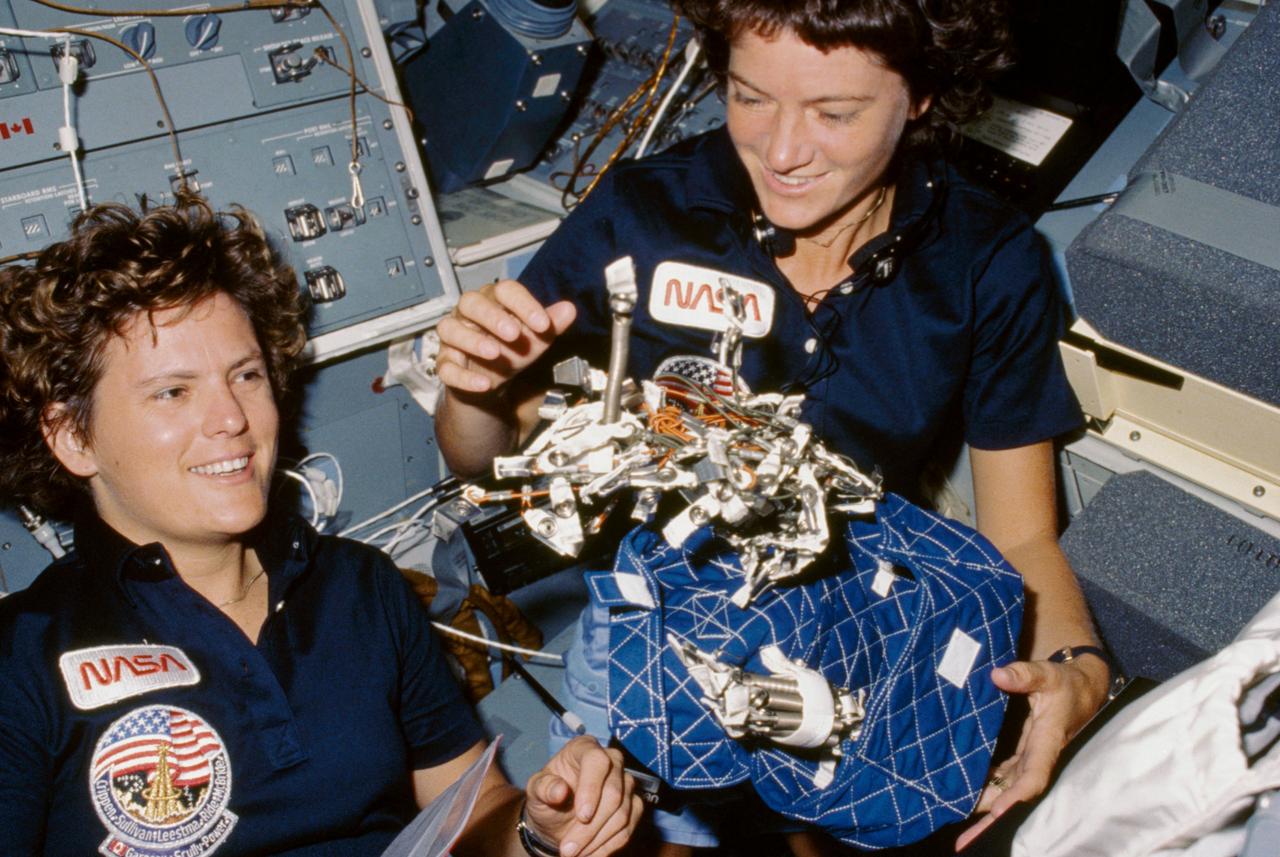
41G-07-021 (5-13 October 1984) --- Astronauts Kathryn D. Sullivan, left, and Sally K. Ride show off what appears to be a "bag of worms", a product of their creativity. The "bag" is a sleep restraint and the majority of the "worms" are springs and clips used with the sleep restraint in its normal application. Clamps, a bungee cord and Velcro strips are other recognizable items in the "creation".
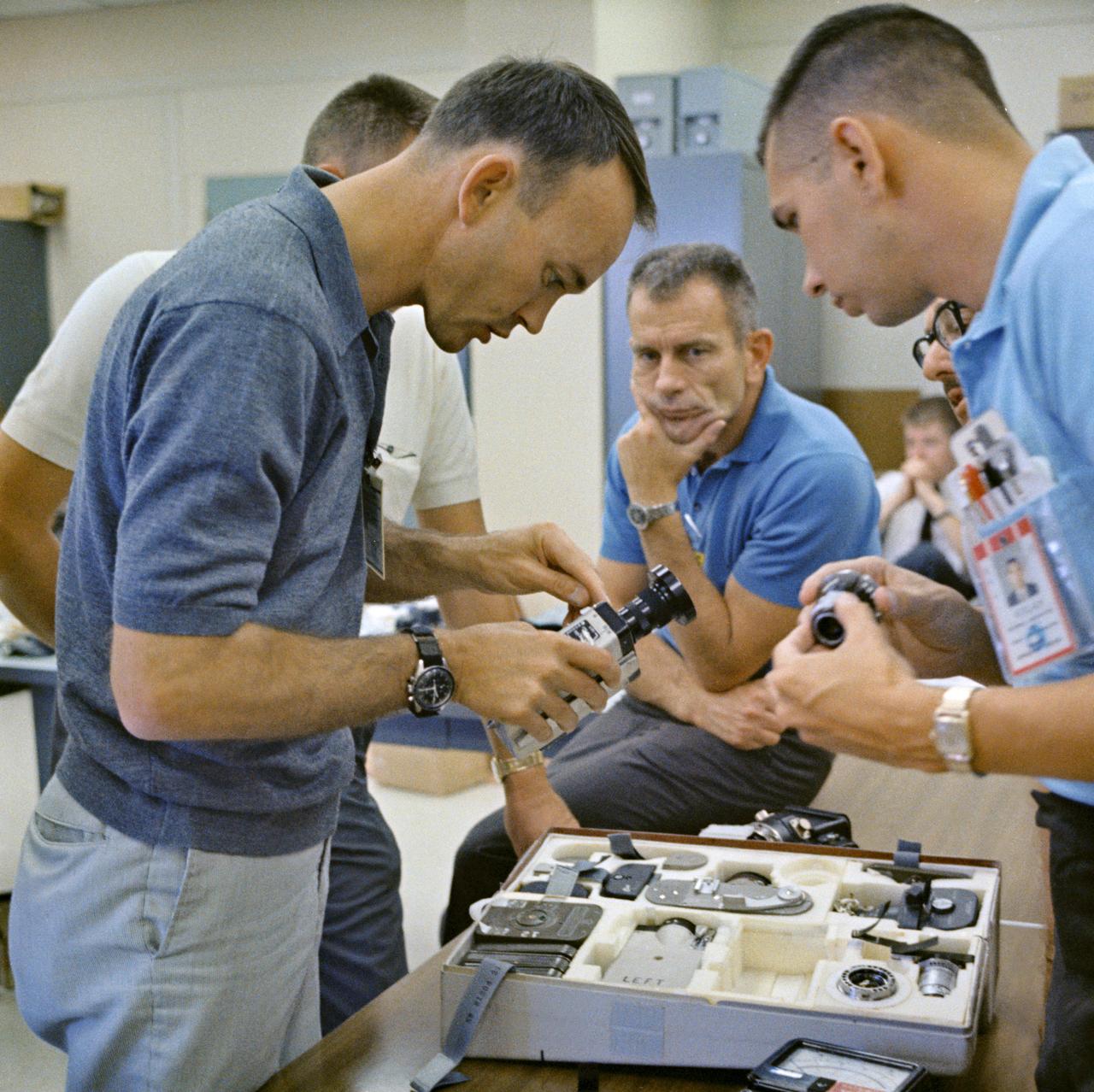
S66-42763 (18 July 1966) --- Astronaut Michael Collins (left), Gemini-10 prime crew pilot, inspects a camera during prelaunch activity at Cape Kennedy, Florida. In center background is Dr. Donald K. Slayton, Manned Spacecraft Center (MSC) Director of Flight Crew Operations. Photo credit: NASA
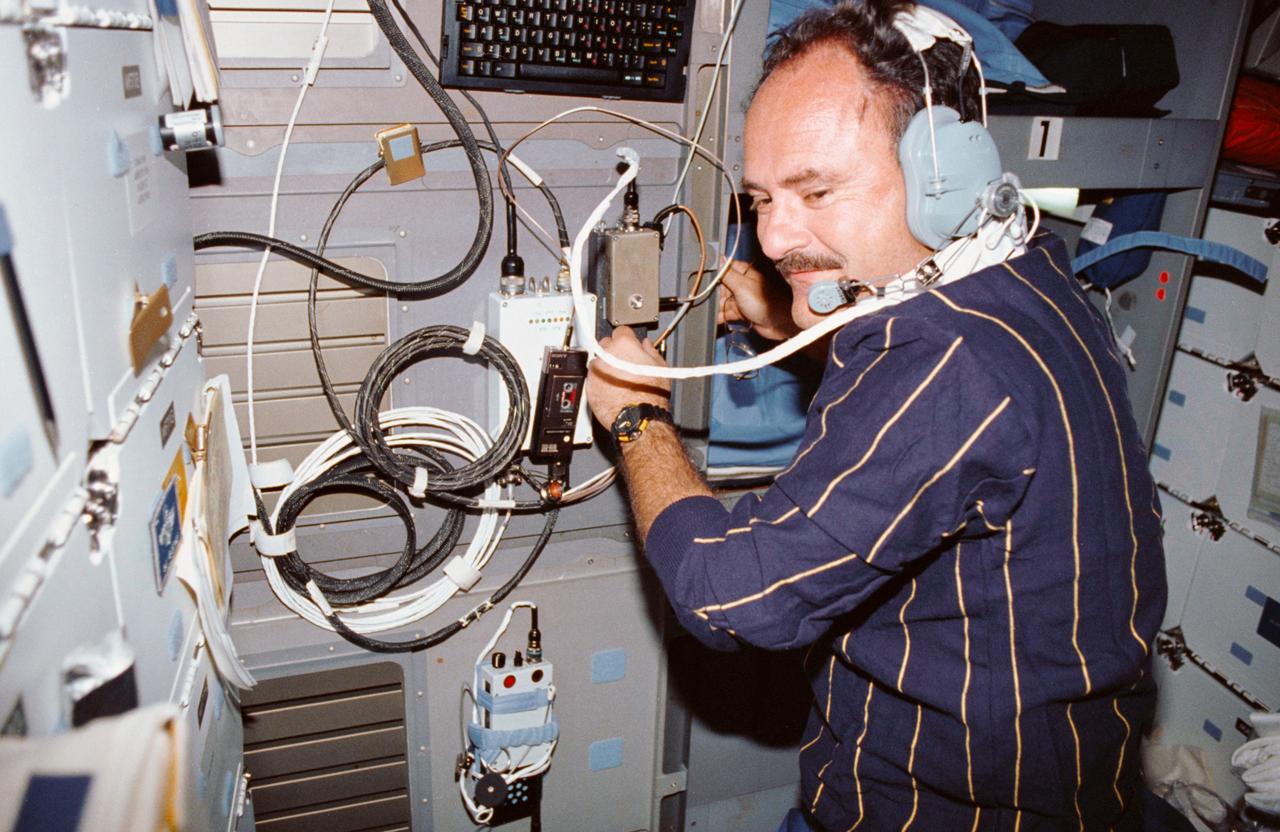
STS035-15-010 (2-11 Dec 1990) --- Astronaut John M. (Mike) Lounge, STS-35 mission specialist, communicates with family members from the middeck of Space Shuttle Columbia in Earth orbit. The STS-35 Shuttle amateur radio experiment (SAREX), allowed the Astro 1 crewmembers to "visit" and briefly share some of their in space experiences with family members. The picture was made with a 35mm camera. Note: Used by Astronomer Ronald A. Parise on his off-duty hours, SAREX provided radio transmissions between ground based amateur radio operators around the world and the Shuttle. Parise is a payload specialist who is also a licensed amateur radio operator (call-sign WA4SIR). The experiment enabled students from all over the United States to have a chance to communicate with an astronaut in space.
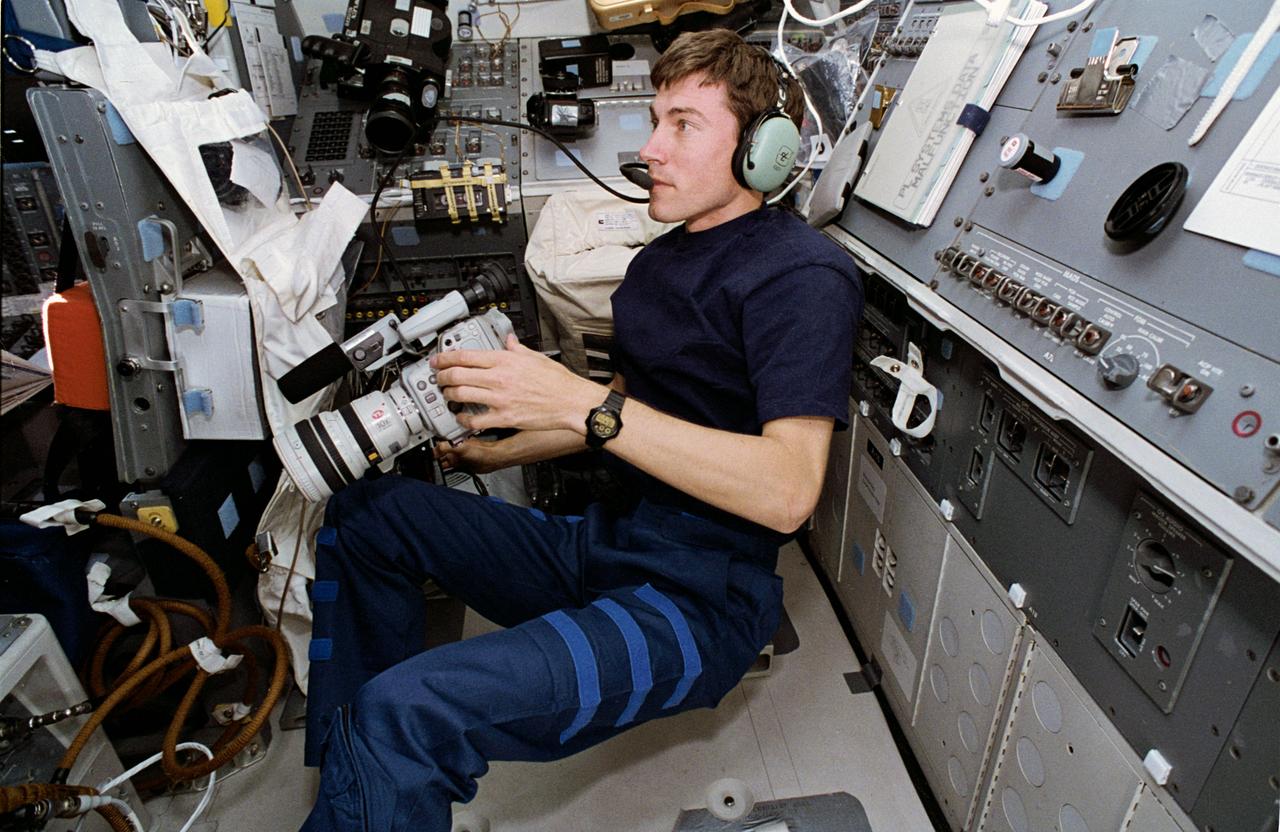
STS60-29-009 (10 Feb 1994) --- On the Space Shuttle Discovery's aft flight deck, Russian cosmonaut Sergei K. Krikalev prepares for one chore while performing another. Using the Shuttle Amateur Radio Experiment (SAREX) gear, the mission specialist was talking with students in Maine. He holds a camcorder, which was later called into action to record inflight activities. Krikalev joined five NASA astronauts for eight days in space aboard Discovery.
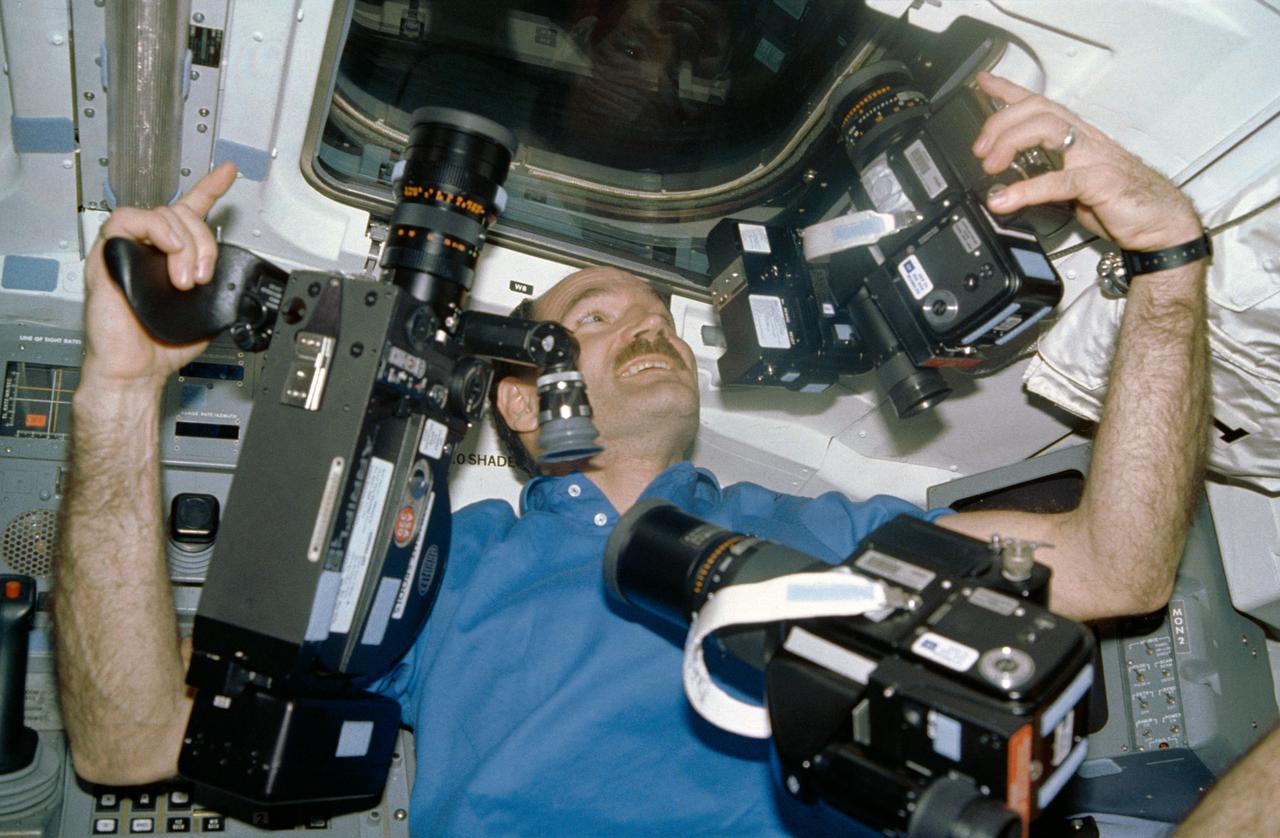
STS027-14-021 (2-6 Dec. 1988) --- Astronaut Guy S. Gardner, STS-27 pilot, appears to have enough cameras as he prepares to take photographs onboard the Earth-orbiting space shuttle Atlantis. Photo credit: NASA
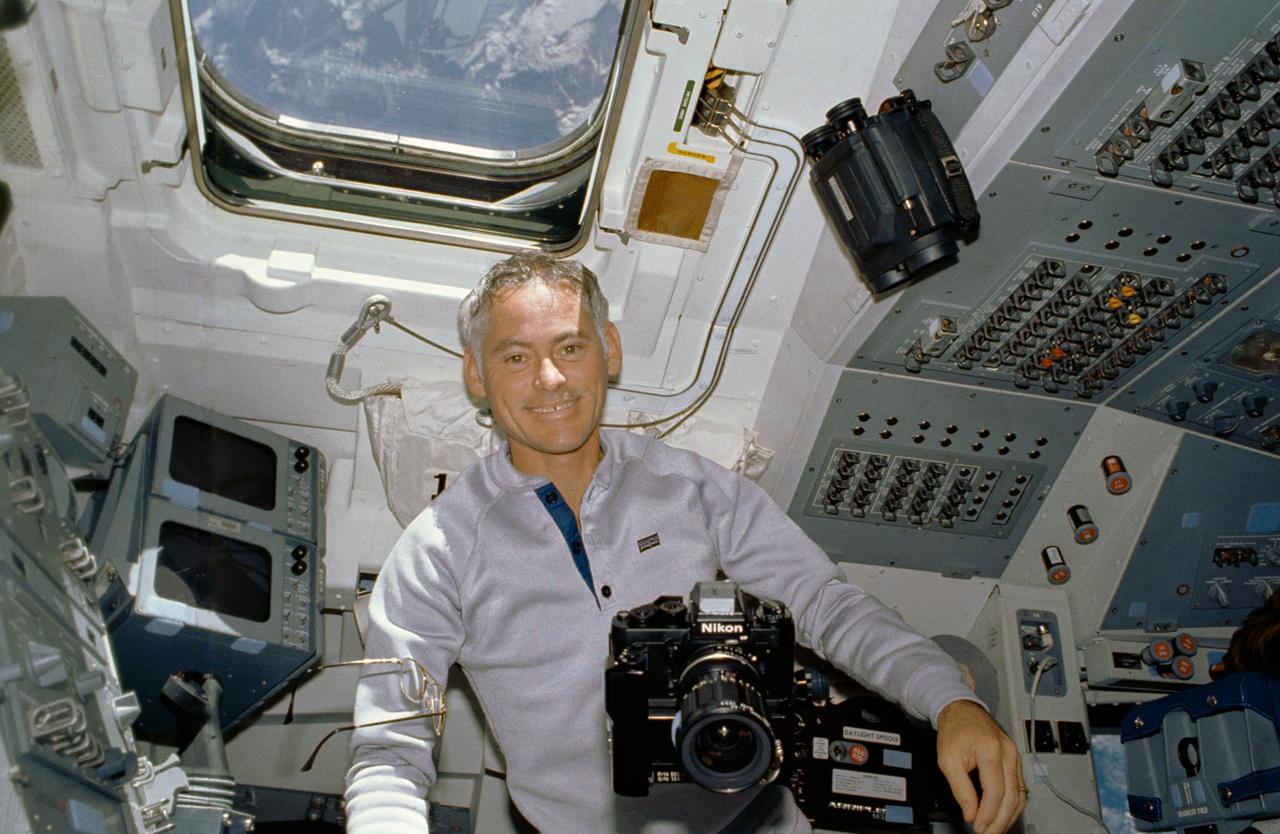
STS027-10-021 (2-6 Dec. 1988) --- Astronaut Richard M. (Mike) Mullane, STS-27 mission specialist, is able to handle a number of cameras with the aid of the microgravity in the shirt sleeve environment of the Earth-orbiting space shuttle Atlantis. Photo credit: NASA
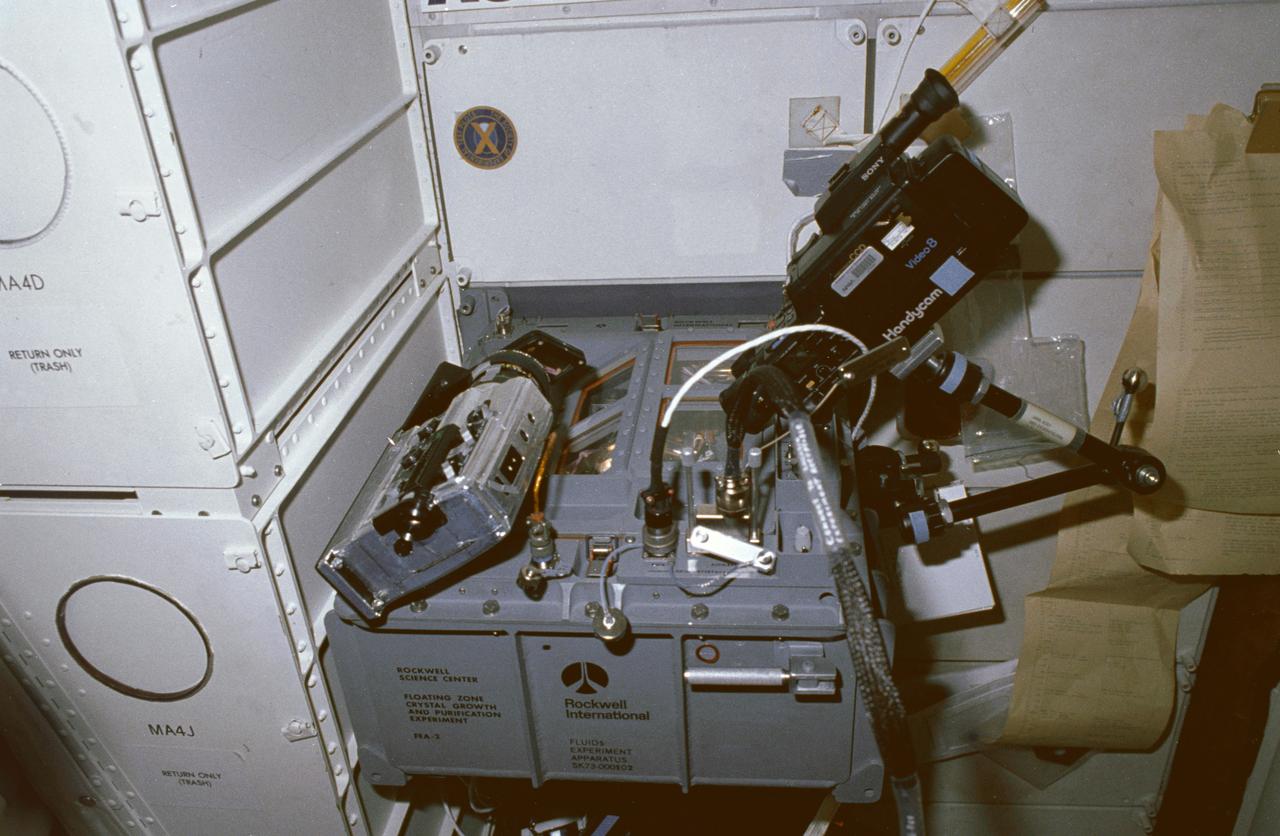
STS030-10-003 (4-8 May 1989) --- An overall scene of the onboard materials science project for STS-30. Seen is the fluids experiment apparatus, supported by an accompanying computer and an 8mm camcorder for its operation. Another major component of the project-- Astronaut Mary L. Cleave, who devoted a great deal of STS-30 monitoring various experiments--is out of frame.
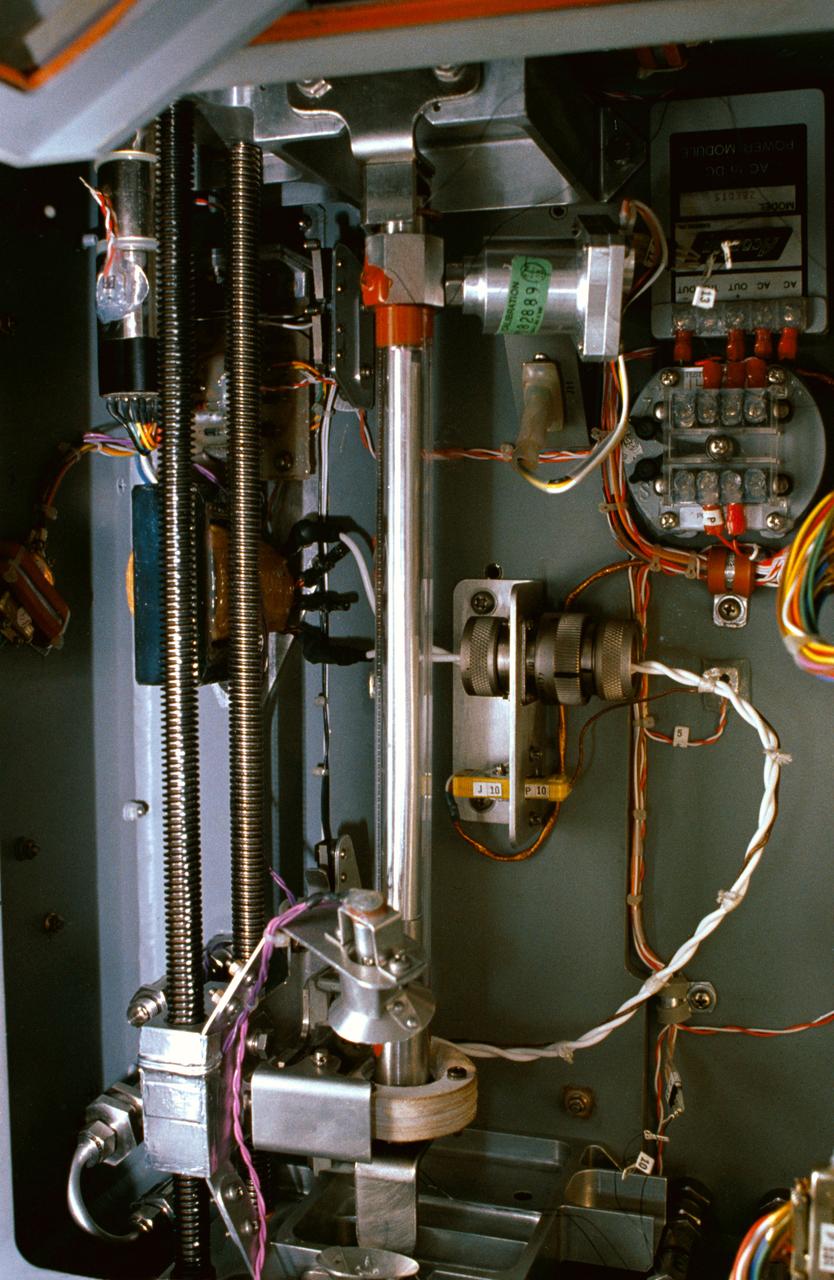
STS030-01-015 (4-8 May 1989) --- A 35mm close-up view of the Fluids Experiment Apparatus (FEA) aboard Atlantis for NASA’s STS-30 mission. Rockwell International is engaged in a joint endeavor agreement with NASA’s Office of Commercial Programs in the field of floating zone crystal growth and purification research. The March 1987 agreement provides for microgravity experiments to be performed in the company’s Microgravity Laboratory, the FEA. Crewmembers, especially Mary L. Cleave, devoted a great deal of onboard time to the monitoring of various materials science experiments using the apparatus.
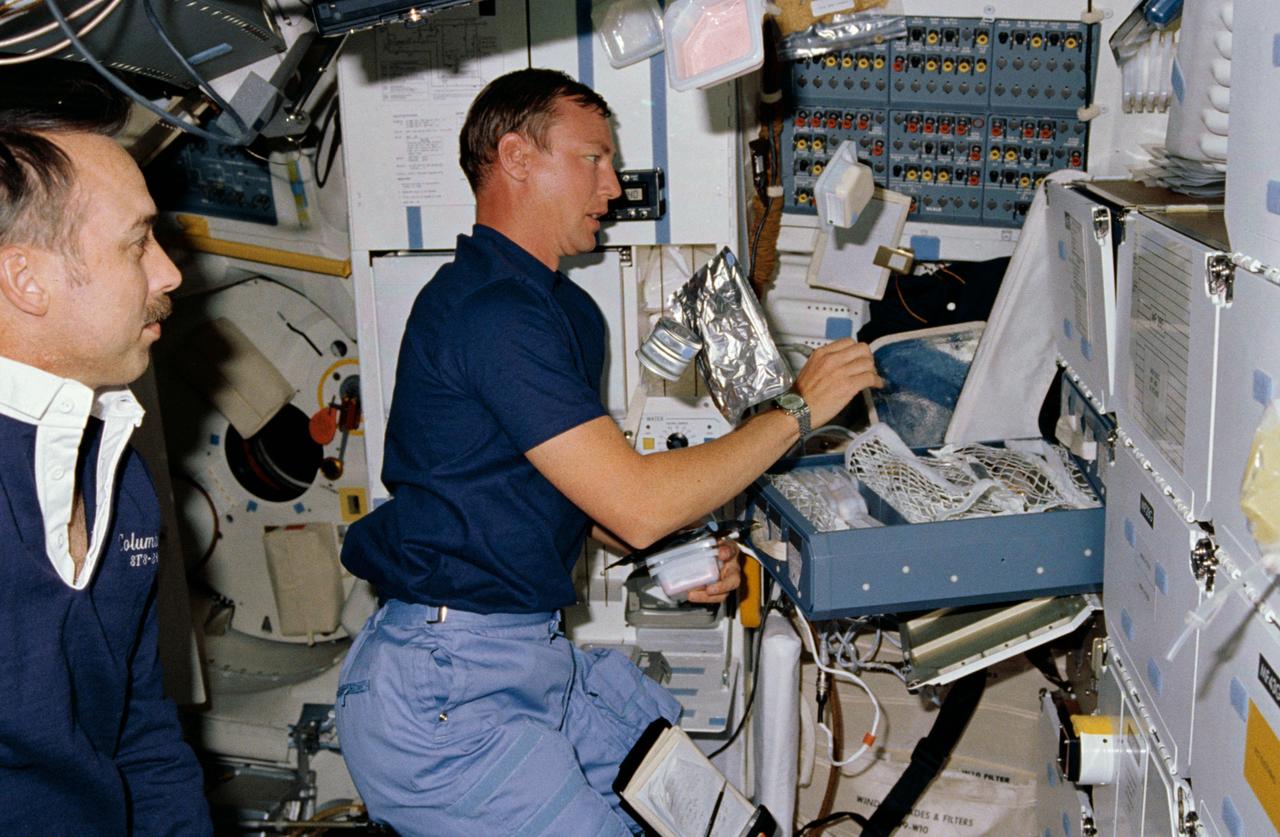
STS028-13-013 (August 1989) --- Astronaut Mark N. Brown, STS-28 mission specialist, assembles various components of a meal at the stowage locker area of Columbia's middeck, as James C. Adamson, mission specialist, looks on.
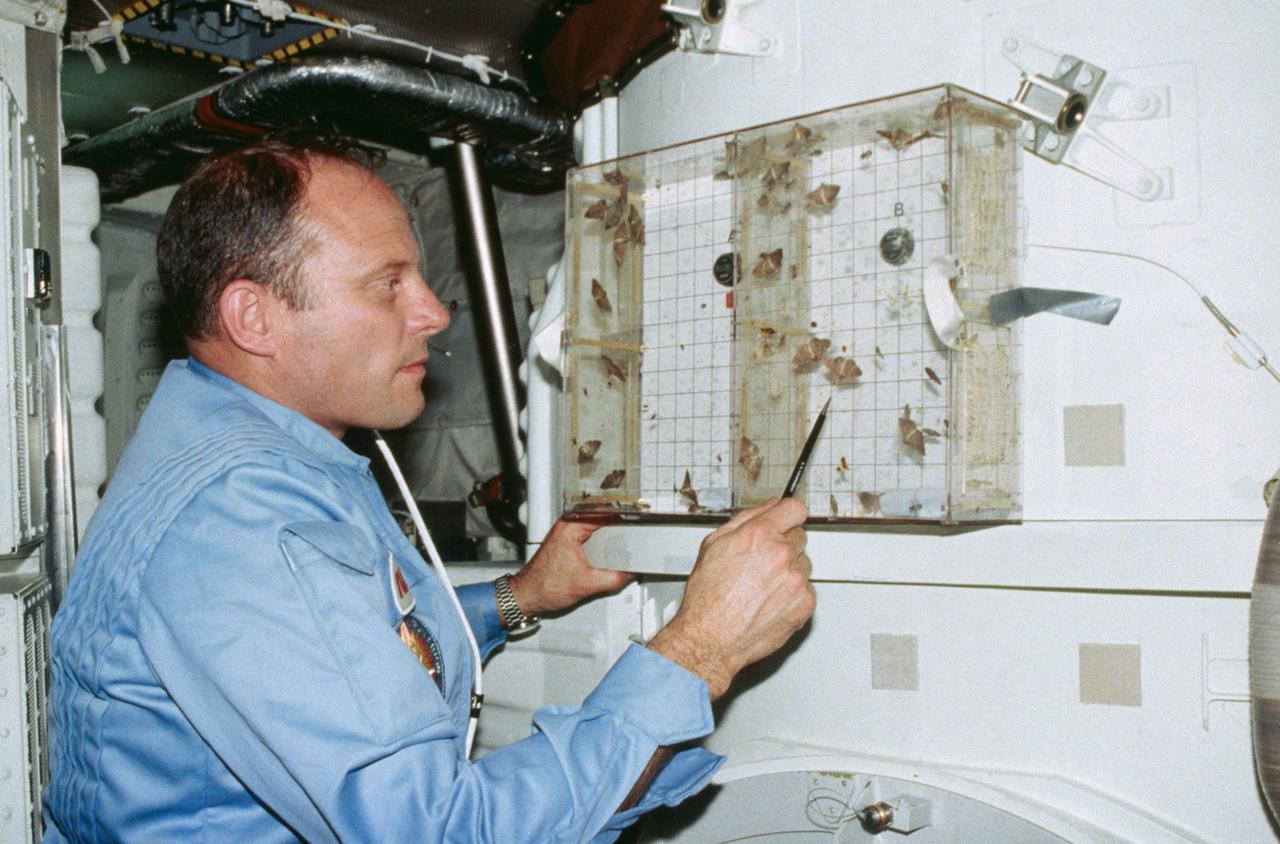
Commander Jack Lousma examines Insect Flight Motion Study (Student Experiment) taped to the airlock on the aft middeck. Lousma points to velvetbean caterpillar moth activity with a pen.
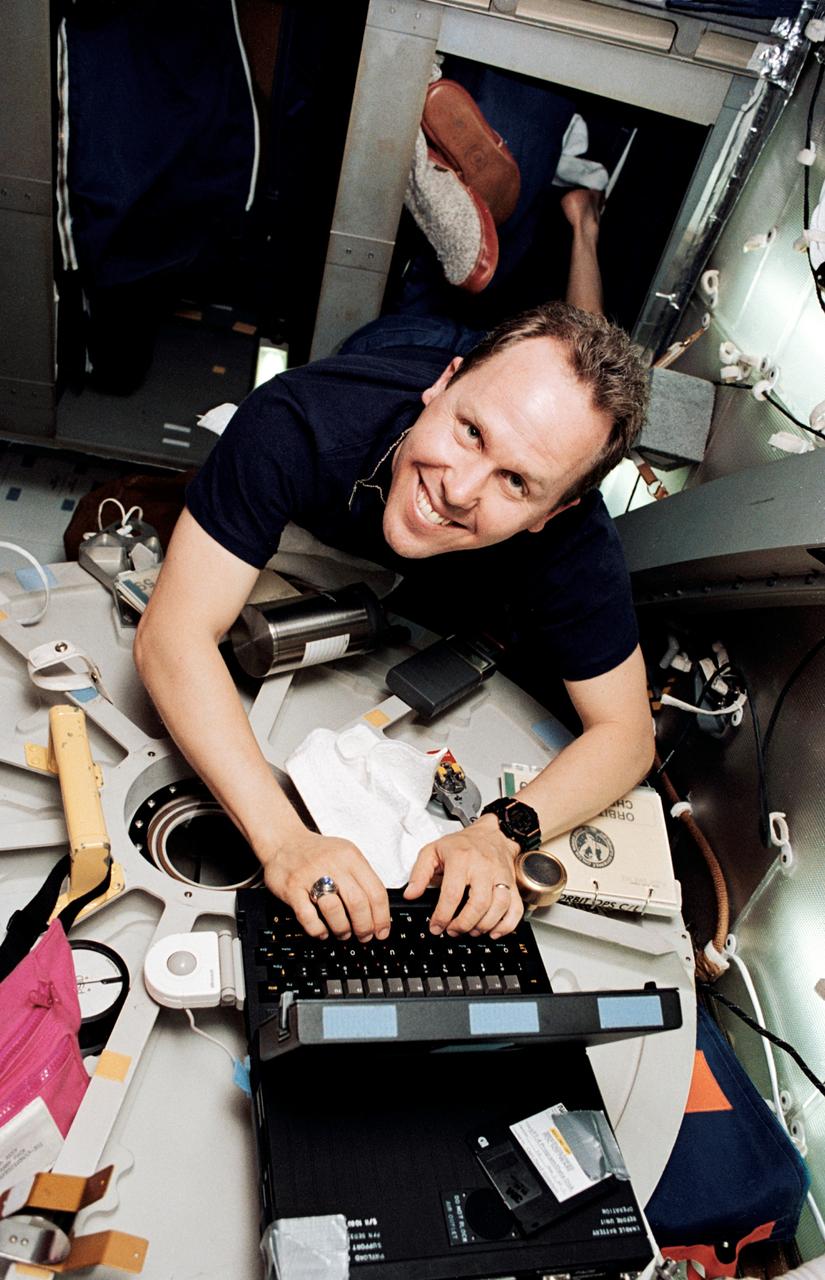
STS059-10-011 (9-20 April 1994) --- Astronaut Thomas D. Jones appears to have climbed out of bed right into his work in this onboard 35mm frame. Actually, Jones had anchored himself in the bunk facility while working on one of the onboard computers which transfered data to the ground via modem. The mission specialist was joined in space by five other NASA astronauts for a week and a half of support to the Space Radar Laboratory (SRL-1)/STS-59 mission.
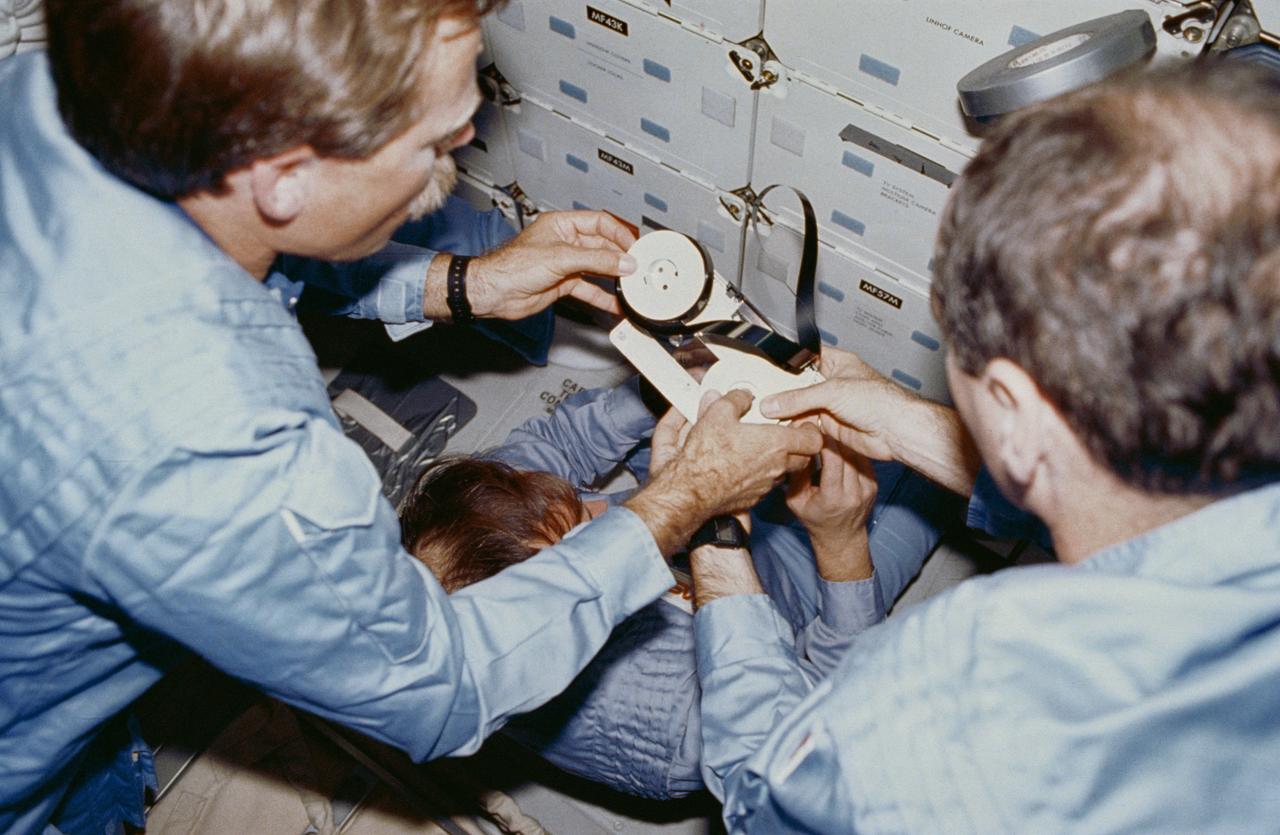
STS027-05-020 (2-6 Dec. 1988) --- In the foreground, astronauts Robert L. Gibson (left) and Guy S. Gardner, commander and pilot, respectively, for the STS-27 mission, repair a 3/4-inch video reel on the middeck of the Earth-orbiting space shuttle Atlantis. Photo credit: NASA
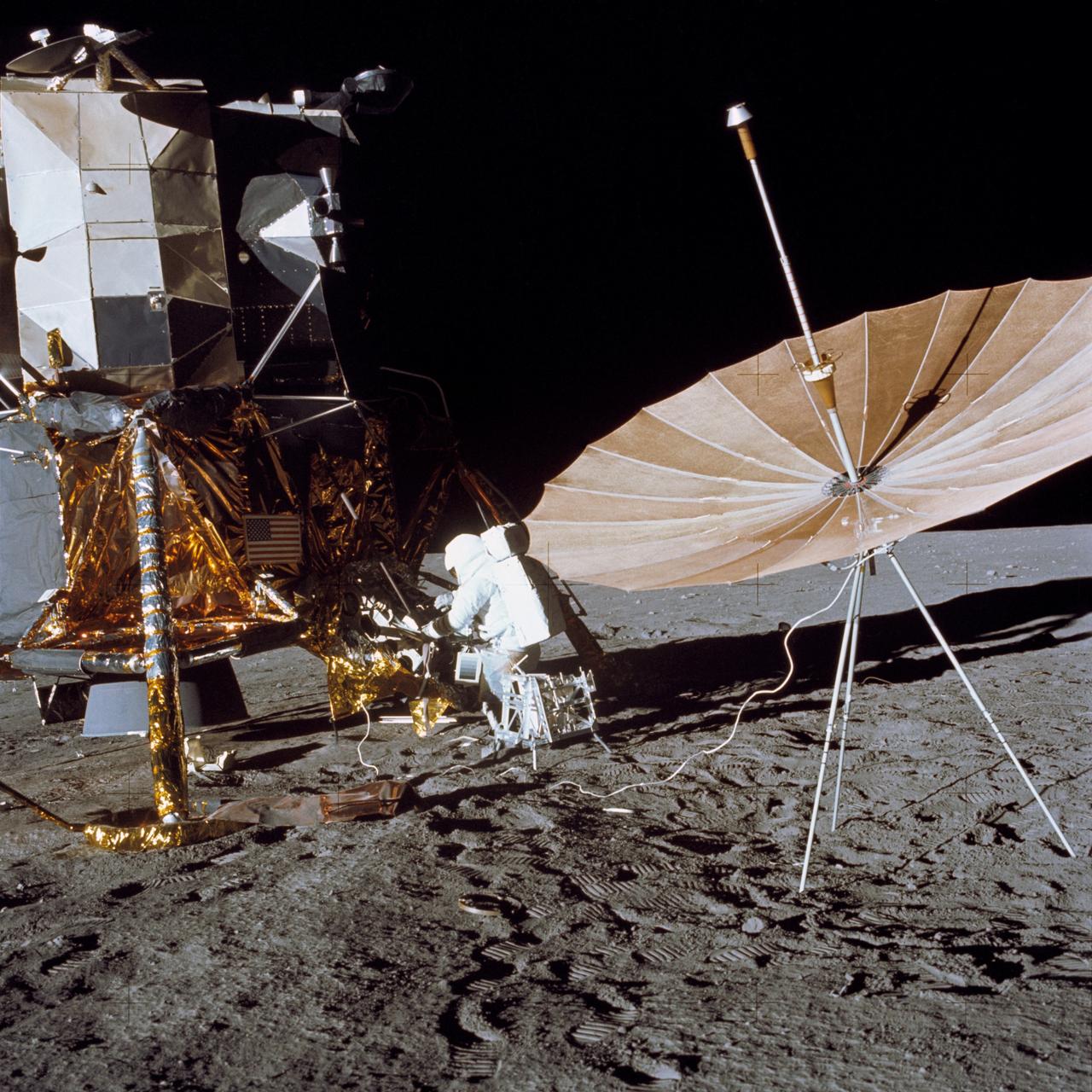
AS12-47-6988 (19 Nov. 1969) --- Astronaut Charles Conrad Jr., commander of the Apollo 12 lunar landing mission, stands at the Module Equipment Stowage Assembly (MESA) on the Lunar Module (LM) following the first Apollo 12 extravehicular activity (EVA) on the lunar surface. The erectable S-band antenna is already deployed at right. The carrier for the Apollo Lunar Hand Tools (ALHT) is near Conrad. While astronauts Conrad and Alan L. Bean, lunar module pilot, descended in the LM to explore the lunar surface, astronaut Richard F. Gordon Jr., command module pilot, remained with the Command and Service Modules (CSM) in lunar orbit.
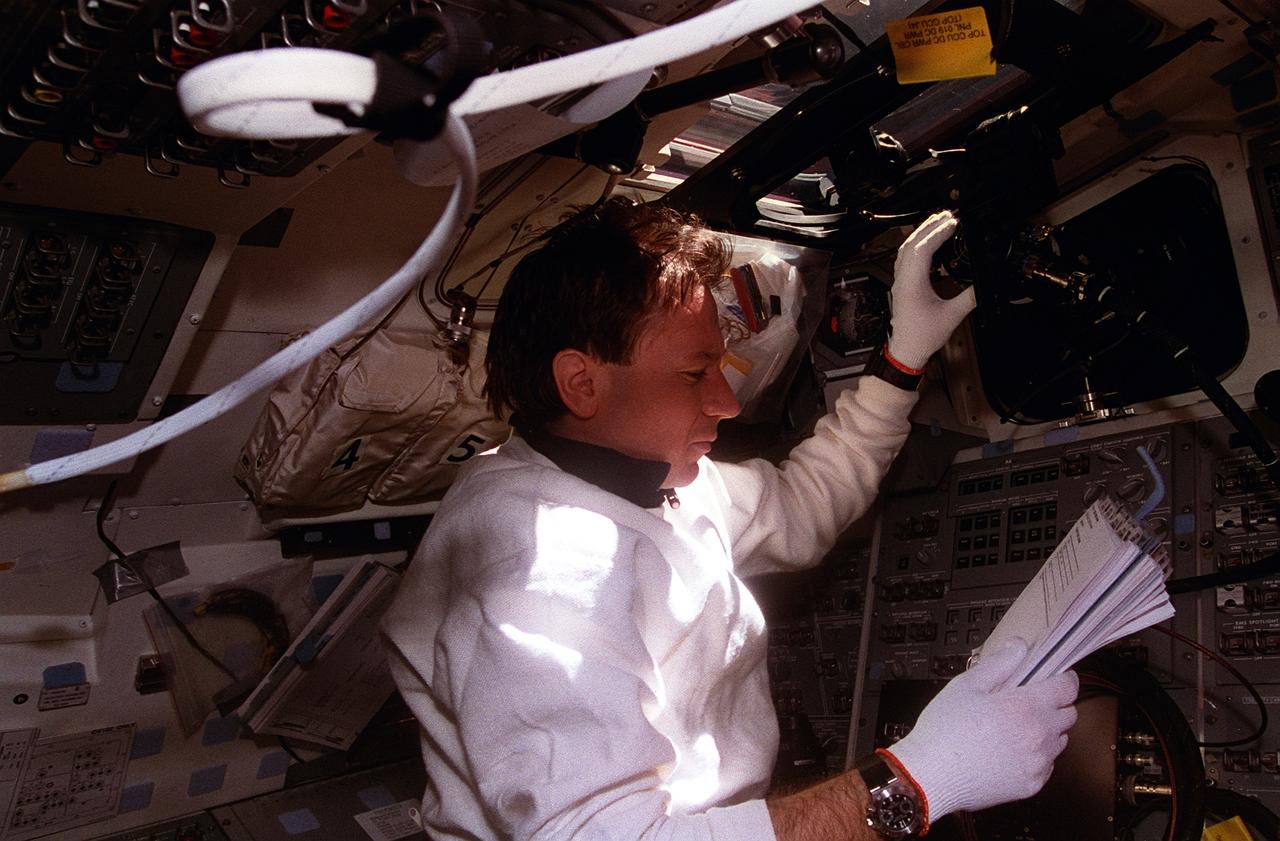
STS075-310-002 (22 Feb.-9 March 1996) --- Astronaut Maurizio Cheli, STS-75 mission specialist, works with the Tether Optical Phenomenon System (TOPS) on the flight deck of the Earth-orbiting Space Shuttle Columbia. Cheli, representing the European Space Agency (ESA), joined four other astronauts and an international payload specialists for 16 days of scientific research in Earth-orbit.
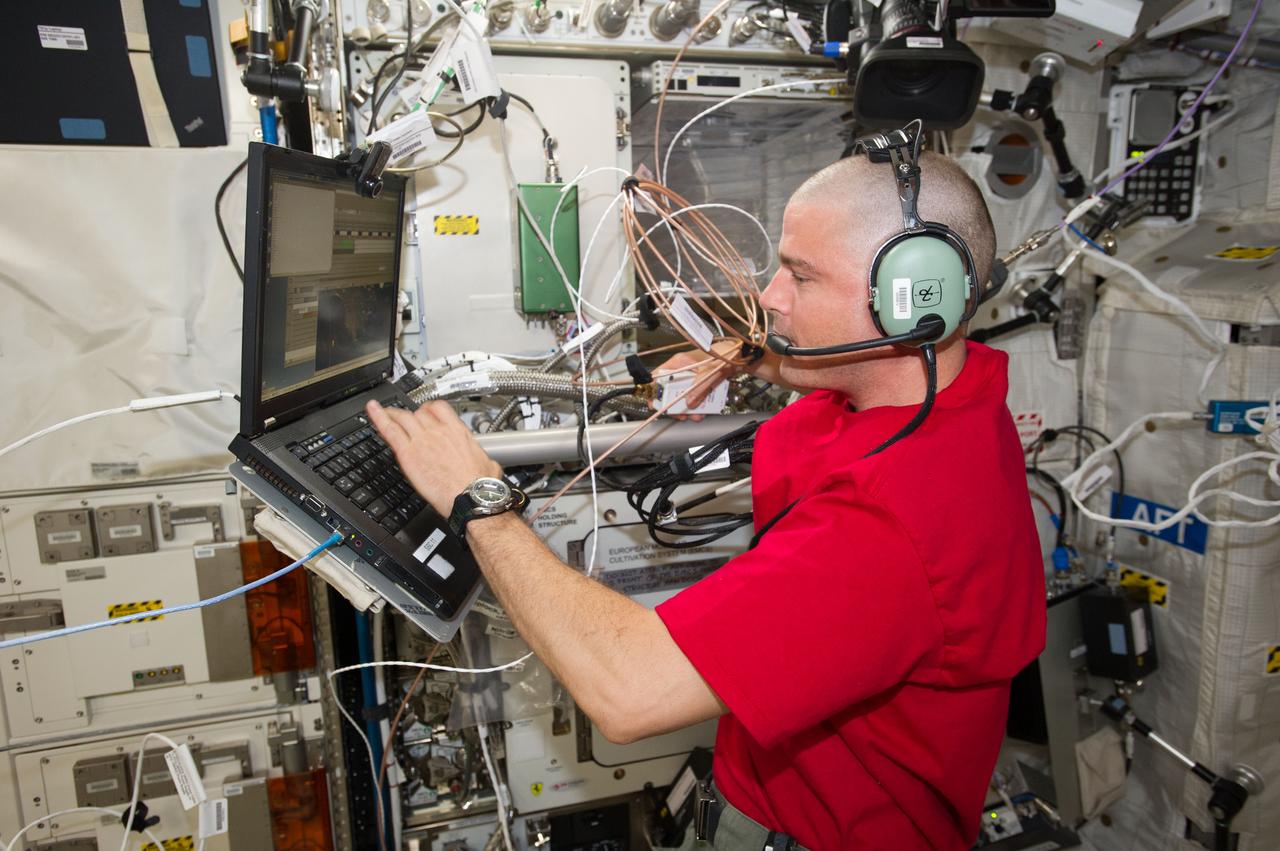
ISS040-E-024110 (28 June 2014) --- NASA astronaut Reid Wiseman, Expedition 40 flight engineer, wearing a communication headset, uses a computer in the Columbus laboratory of the International Space Station.
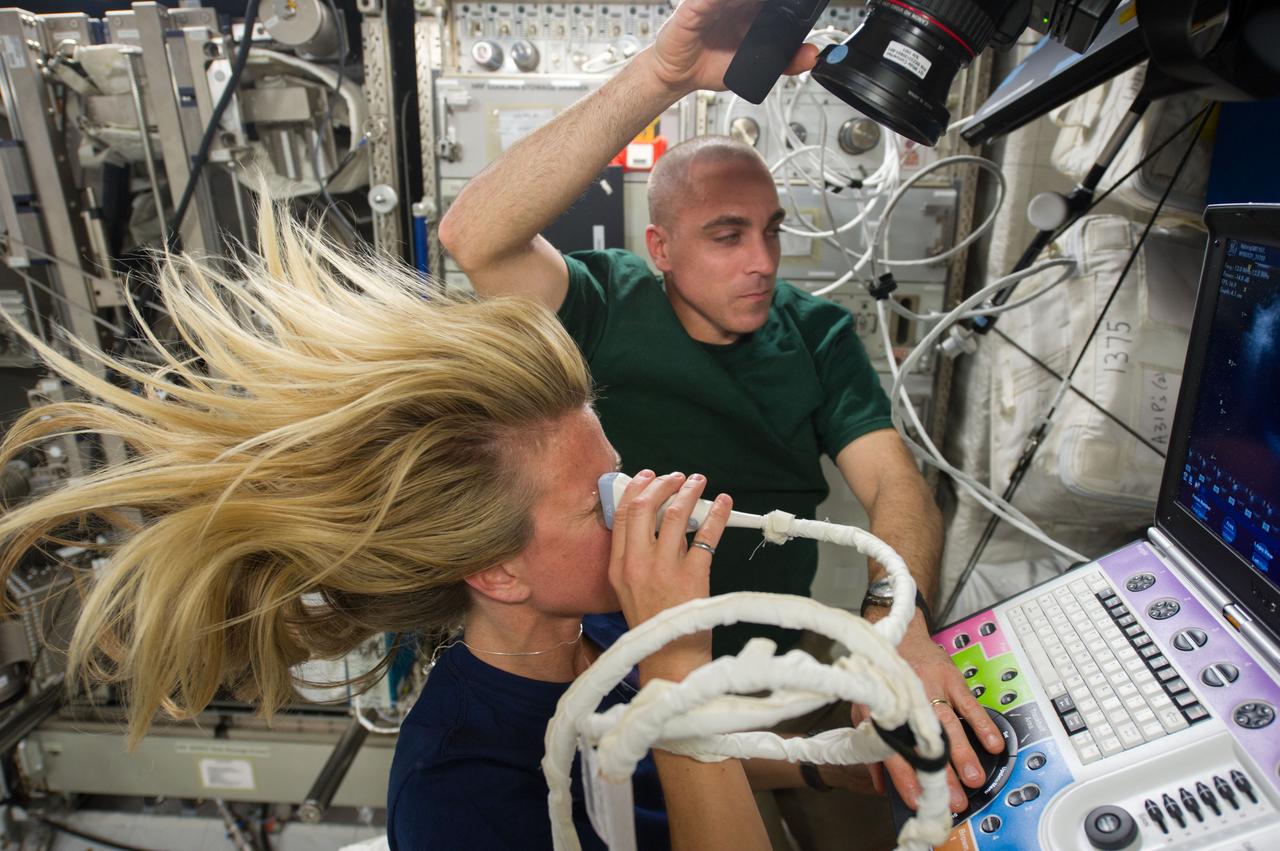
Astronaut Karen Nyberg,Expedition 37 flight engineer, assisted by astronaut Chris Cassidy, performs an Ocular Health (OH) Ultrasound 2 scan in the Destiny laboratory of the International Space Station.
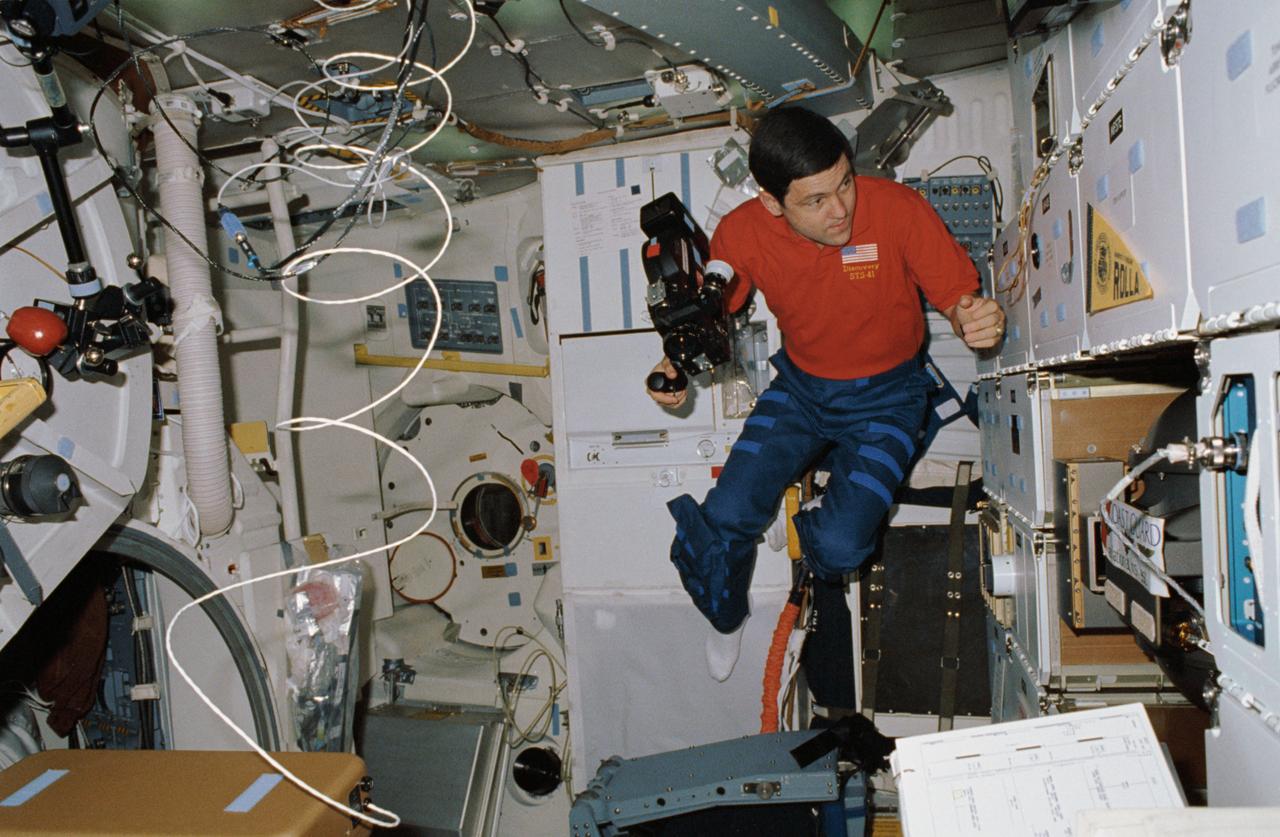
STS041-05-011 (6-10 Oct 1990) --- Astronaut Robert D. Cabana, STS-41 pilot, exhibits the weightlessness of space travel as he appears to "float" about on the middeck of Discovery. Careful inspection of the photo proves that, actually, his floating is limited, as he has anchored his left foot with a special restraint device. He apparently has chosen this vantage point to use the Arriflex motion picture camera in his right hand.
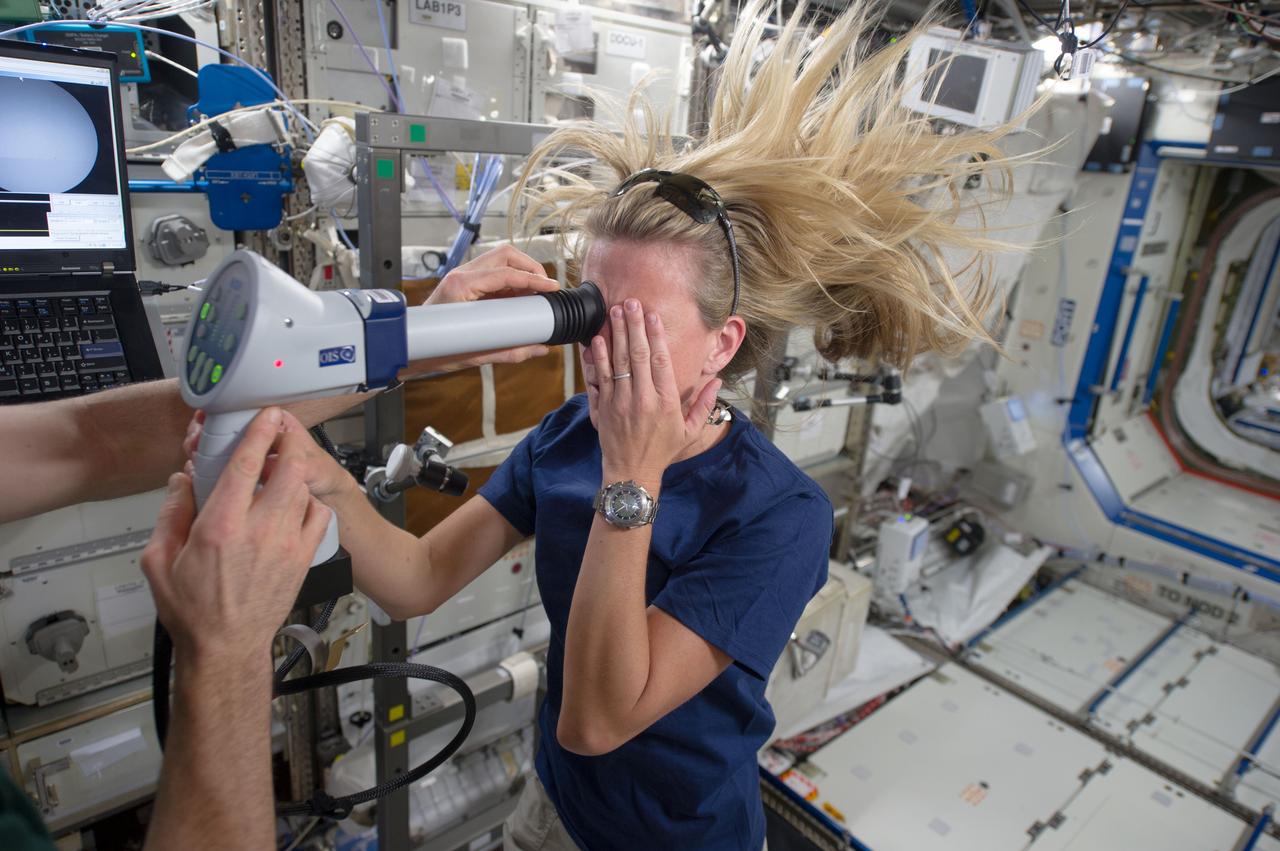
Astronaut Karen Nyberg and Astronaut Chris Cassidy (partially visible), both Expedition 37 flight engineers, perform an Ocular Health (OH) Fundoscope Exam in the Destiny laboratory of the International Space Station
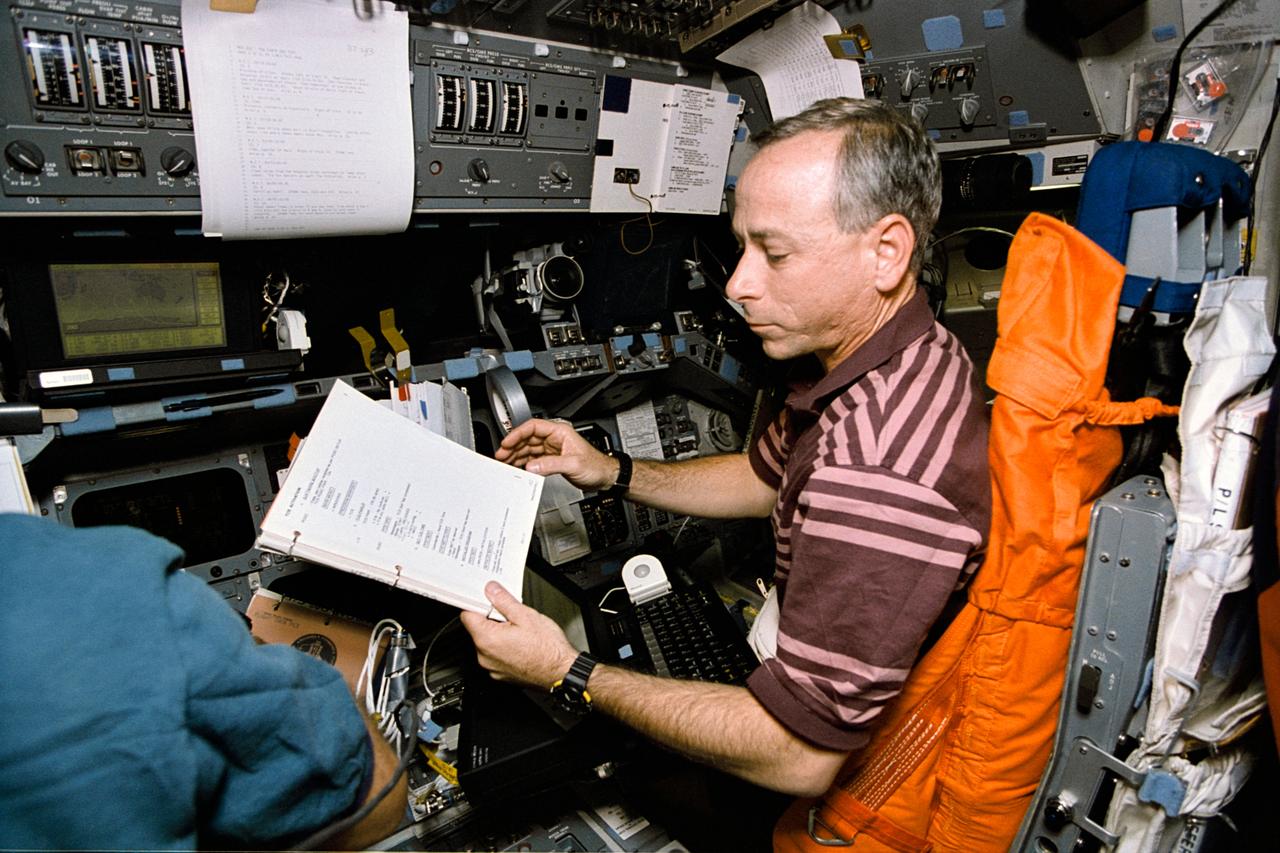
STS064-22-024 (9-20 Sept. 1994) --- With a manual and lap top computer in front of him, astronaut Carl J. Meade, STS-64 mission specialist, supports operations with the Trajectory Control Sensor (TCS) aboard the Earth-orbiting space shuttle Discovery. For this exercise, Meade temporarily mans the pilot's station on the forward flight deck. The TCS is the work of a team of workers at NASA's Johnson Space Center. Data gathered during this flight was expected to prove valuable in designing and developing a sensor for use during the rendezvous and mating phases of orbiter missions to the space station. For this demonstration, the Shuttle Pointed Autonomous Research Tool for Astronomy 201 (SPARTAN 201) was used as the target vehicle during release and retrieval operations. Photo credit: NASA or National Aeronautics and Space Administration
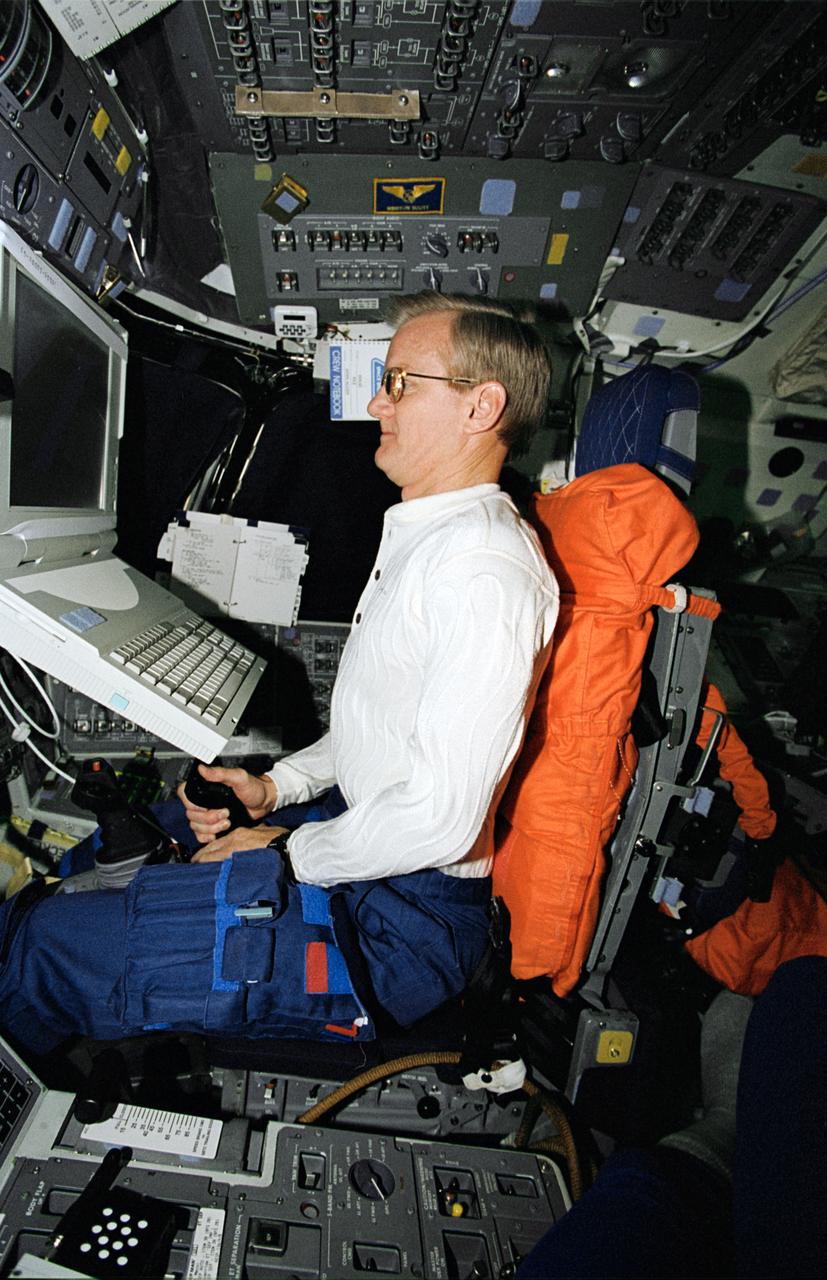
STS062-15-013 (4-18 March 1994) --- Astronaut John H. Casper, mission commander, participates in an experiment that measures the effects of space flight on pilot proficiency. Astronauts Casper and Andrew M. Allen, pilot, continued the testing of the Portable Inflight Landing Operations Trainer (PILOT), which first flew onboard Columbia in October of 1993.
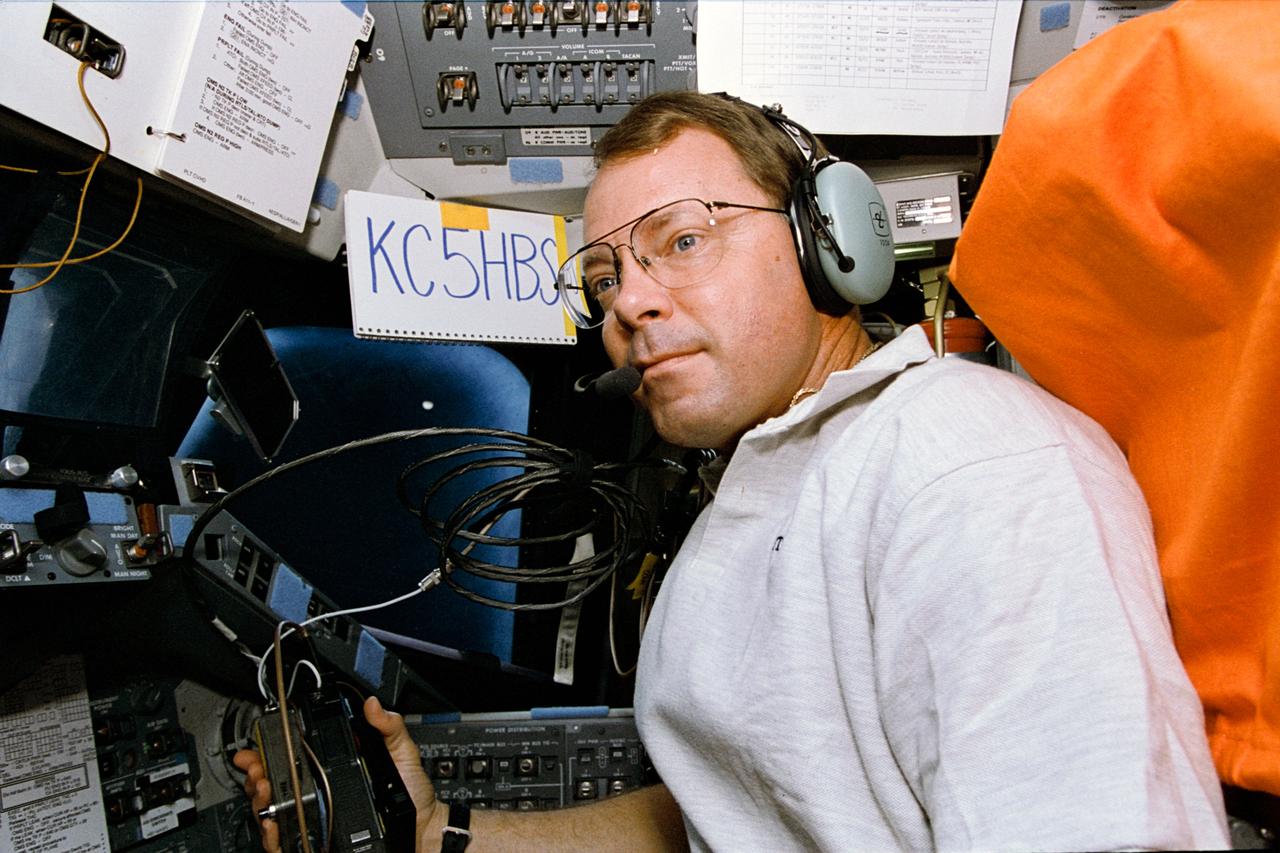
STS064-04-009 (9-20 Sept. 1994) --- Astronaut L. Blaine Hammond, STS-64 pilot, talks to students on Earth via the Shuttle Amateur Radio Experiment (SAREX) on the space shuttle Discovery's flight deck. The recently licensed "Ham" operator and several other crew members throughout the mission were connected with schools around the world with the aid of a number of amateur radio operators. Hammond joined five other NASA astronauts for almost 11 days in Earth orbit aboard Discovery. Photo credit: NASA or National Aeronautics and Space Administration
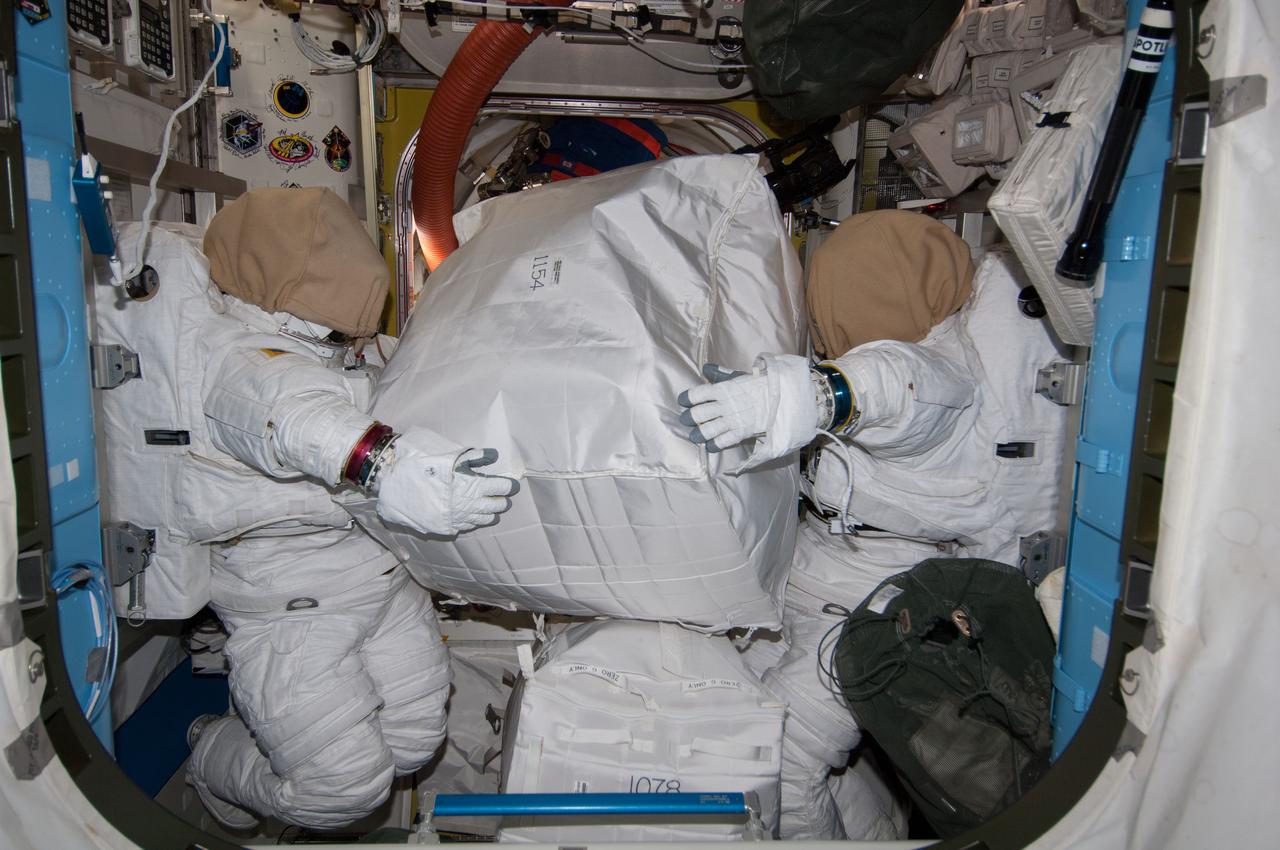
ISS040-E-086597 (1 Aug. 2014) --- Two unoccupied Extravehicular Mobility Unit (EMU) spacesuits, photographed by an Expedition 40 crew member, appear to hold stowage containers in the Quest airlock of the International Space Station.
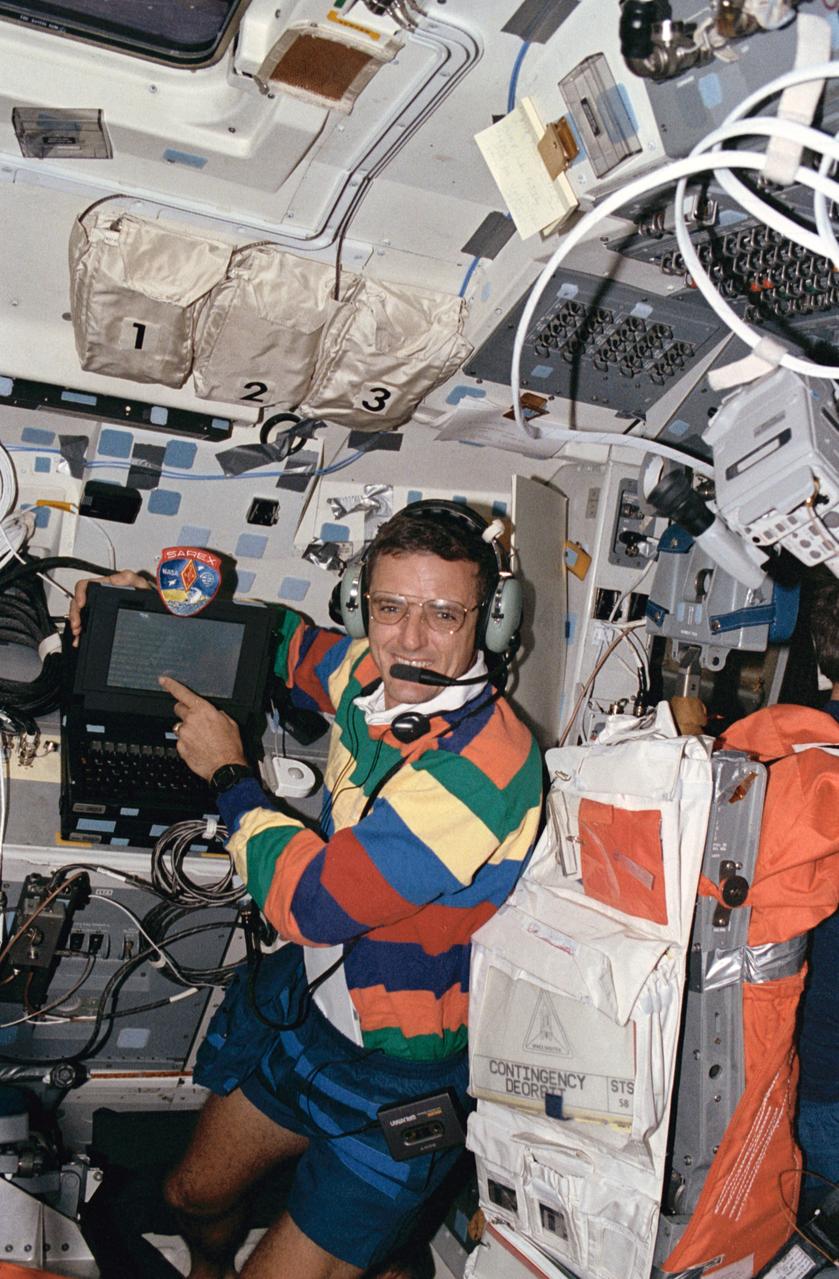
STS058-21-011 (24 Oct 1993) --- From the flight deck of the Earth-orbiting Space Shuttle Columbia, astronaut William S. McArthur talks to students on Earth. The mission specialist's activity was part of the Shuttle Amateur Radio Experiment (SAREX), a frequent payload on Shuttle missions which serves to enlighten students around the world on the topic of space travel. McArthur (call letters KC5ACR) is one of three licensed amateur radio operators on the seven-member flight.
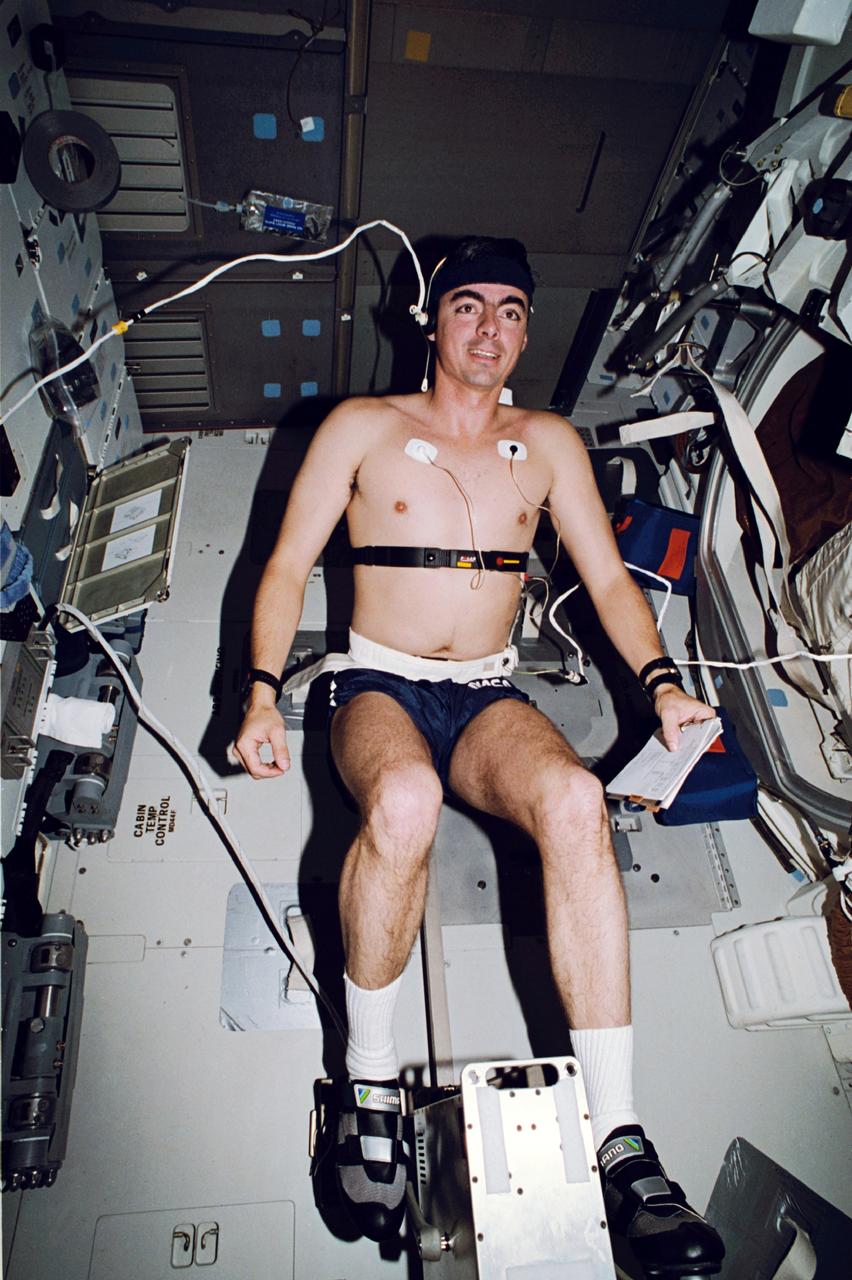
STS046-24-025 (31 July-8 Aug. 1992) --- Astronaut Andrew M. Allen, STS-46 pilot, exercises on the bicycle ergometer device on the flight deck of the Space Shuttle Atlantis as it makes one of its 127 total orbits for the eight-day mission. Allen, equipped with sensors for monitoring his biological systems during the run, was joined by four other NASA astronauts and two European scientists on the mission.

View of a pair of Extravehicular Mobility Units (EMUs) and assorted other bags in the Quest Airlock as documented by the Expedition 36 crew.
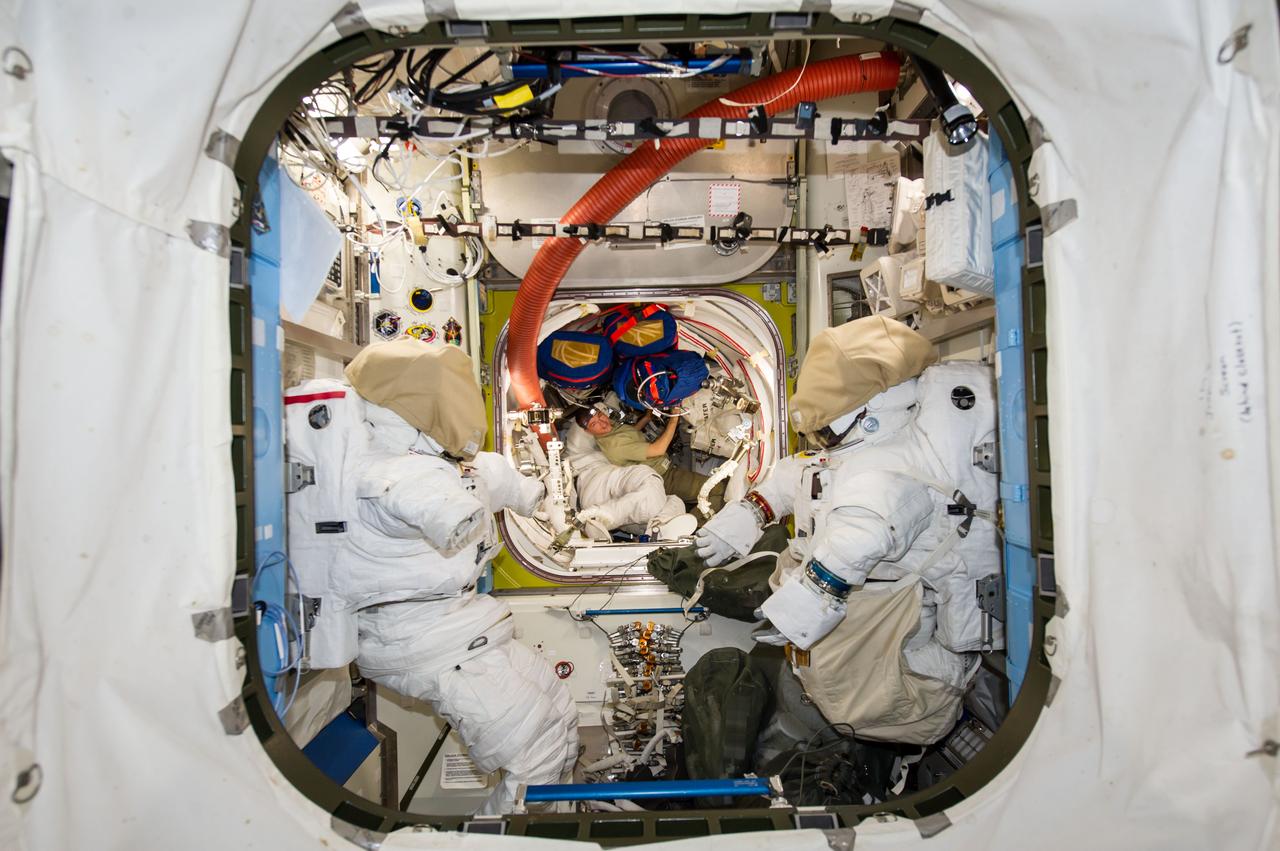
ISS041-E-016637 (16 Sept. 2014) --- NASA astronaut Reid Wiseman (center background), Expedition 41 flight engineer, works among stowed equipment in the Quest airlock of the International Space Station. Two Extravehicular Mobility Unit (EMU) spacesuits are visible in the foreground.
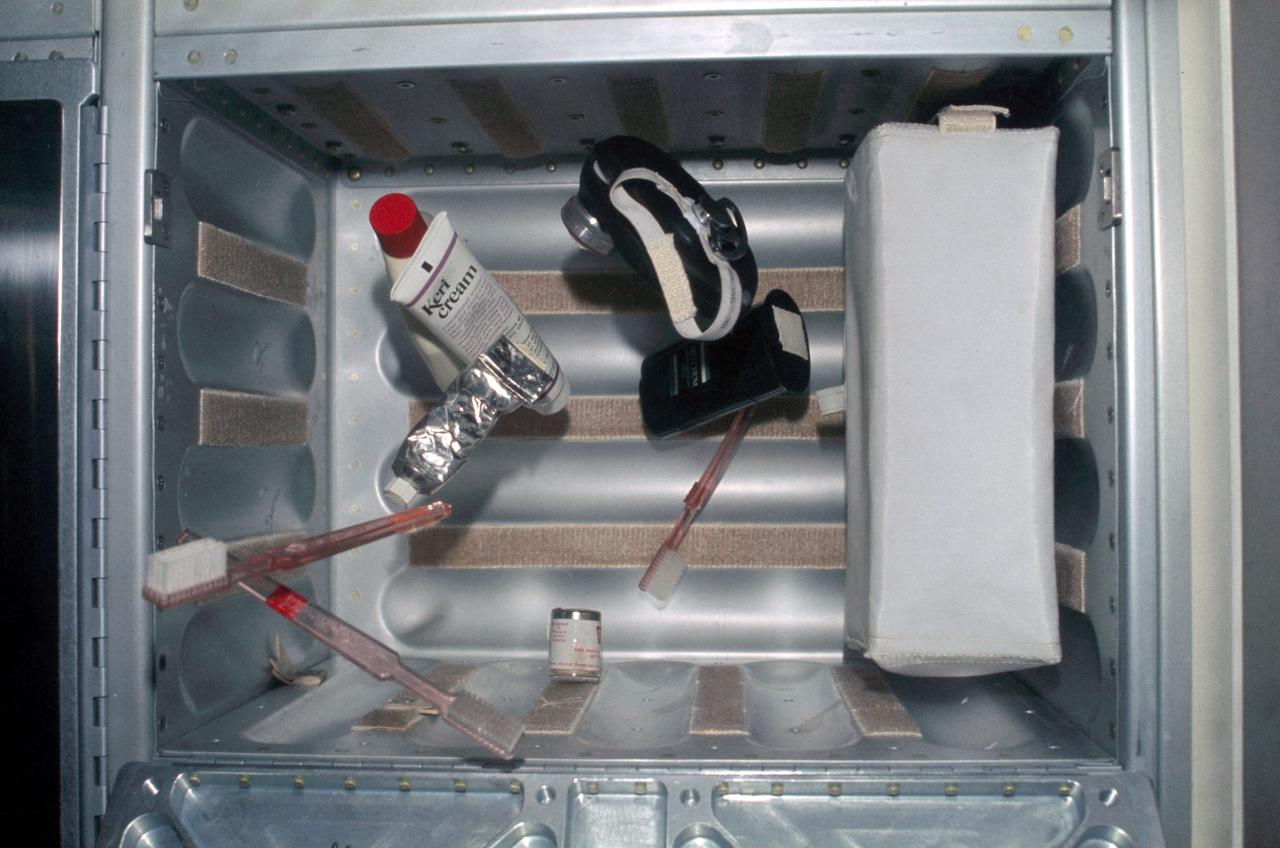
SL3-110-1430 (August 1973) --- View inside the personal hygiene locker of a Skylab 3 astronaut, which contains his toothbrush, battery operated razor, toothpaste and hand cream. Photo credit: NASA
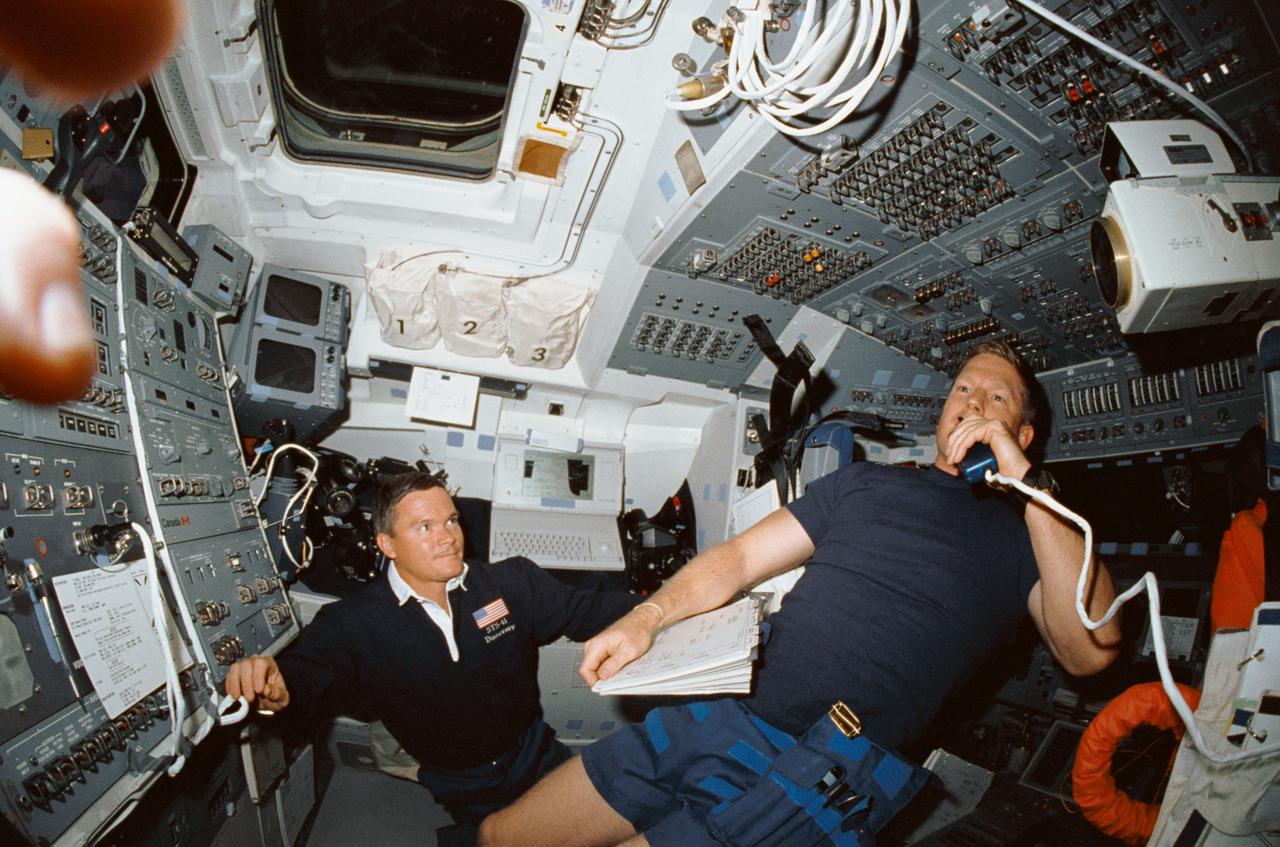
STS041-02-035 (6-10 Oct 1990) --- A fish-eye lens view shows two of STS-41's three mission specialists on the flight deck of Discovery. Astronaut William M. Shepherd, right, communicates with ground controllers as Astronaut Bruce E. Melnick looks on.
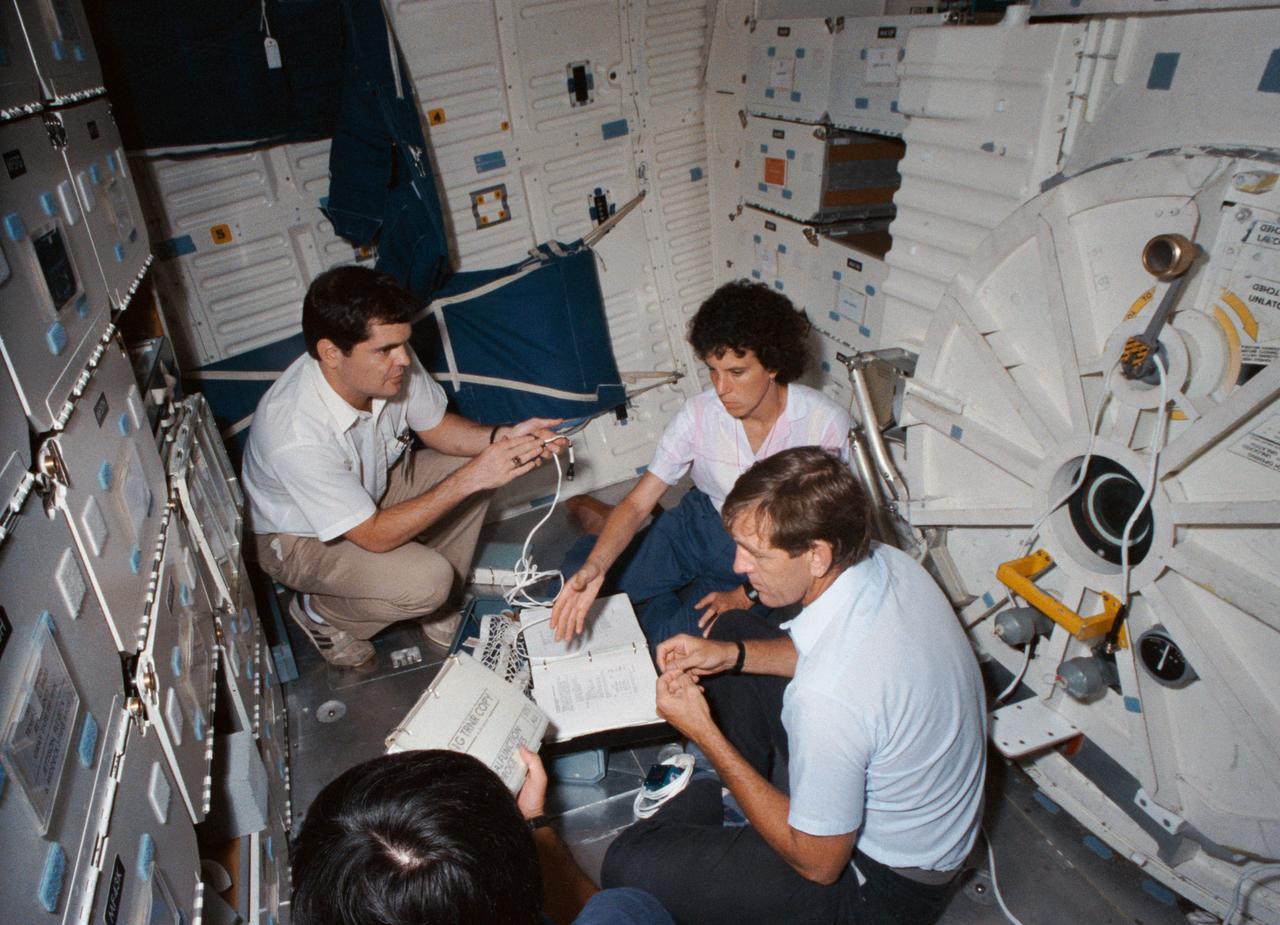
S89-39537 (July 1989) --- Two astronaut-crewmembers for NASA's STS-34 mission are briefed on inflight maintenance procedures on the mid-deck of the Space Shuttle crew compartment trainer in JSC's Shuttle mockup and integration laboratory. They are Ellen S. Baker and Michael J. McCulley, mission specialist and pilot, respectively for the scheduled Oct. 1989 mission aboard the Atlantis.

41D-12-020 (6 Sept 1984) --- Astronaut Judith A. Resnik, mission specialist, anchors herself on the flight deck (out of frame) to take a peek at mid-deck activity aboard the Earth-orbiting Space Shuttle Discovery. Among the many stationary and portable cameras onboard the flight are (left to right) TV camera, a data acquisition motion picture camera and the IMAX.
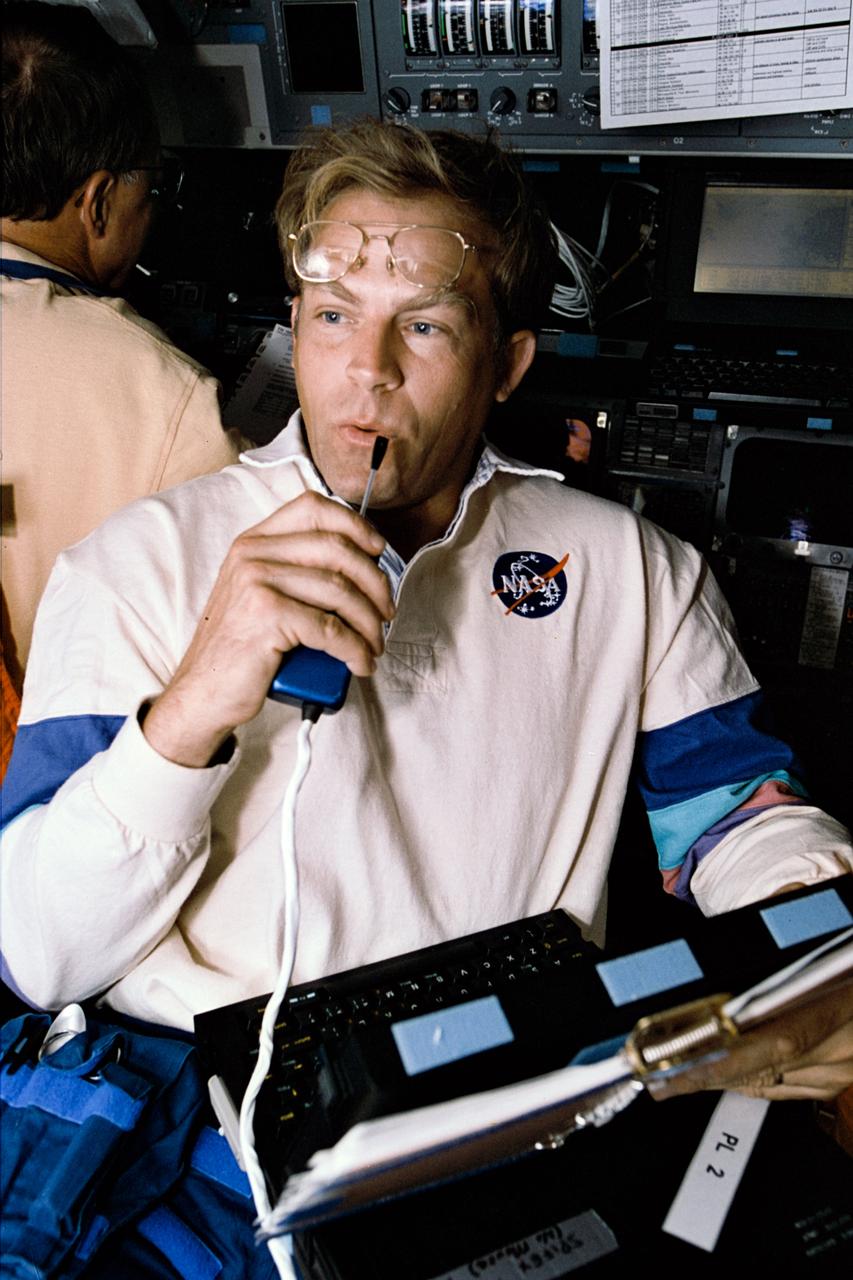
STS064-311-031 (10 Sept. 1994) --- Astronaut Mark C. Lee, STS-64 mission specialist, at a Payload General Support Computer (PGSC) on the space shuttle Discovery's flight deck, talks to ground controllers about the Shuttle Plume Impingement Flight Experiment (SPIFEX). Astronaut L. Blaine Hammond, pilot, is partially visible in the background. Photo credit: NASA or National Aeronautics and Space Administration
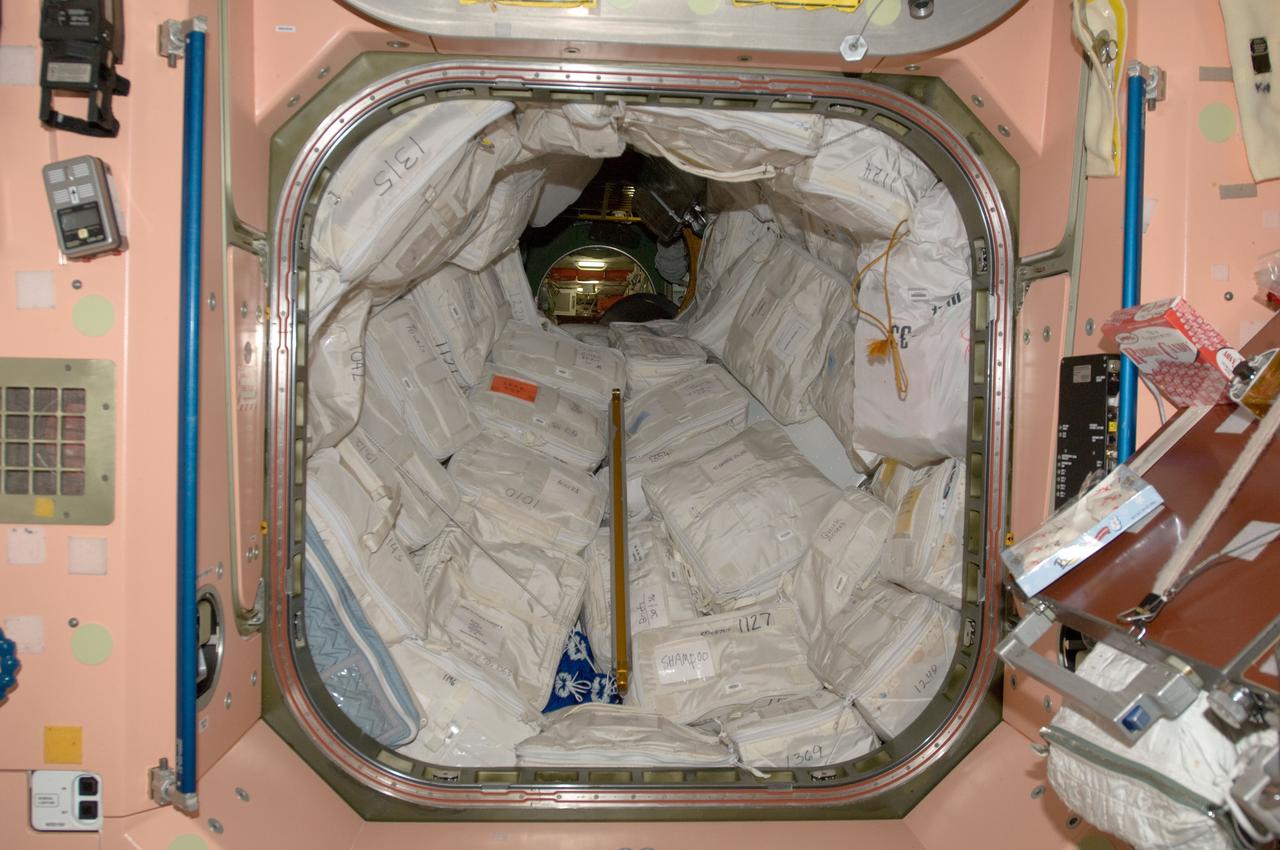
View of stowage in the aft end of the Node 1 and the hatch leading to Pressurized Mating Adapter 1 (PMA1). The PMA1 is also lined with stowed equipment. Photo was taken during Expedition 34.
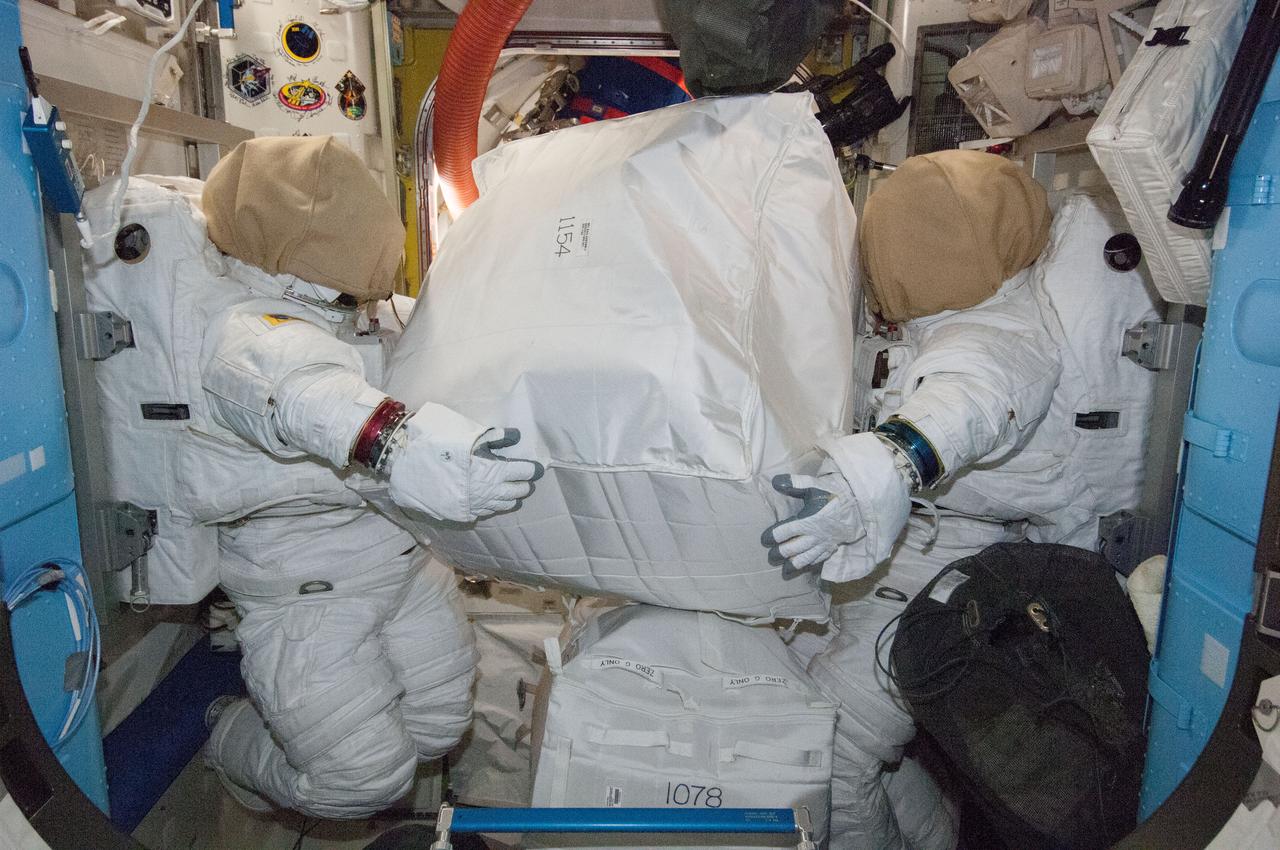
ISS040-E-086600 (1 Aug. 2014) --- Two unoccupied Extravehicular Mobility Unit (EMU) spacesuits, photographed by an Expedition 40 crew member, appear to hold stowage containers in the Quest airlock of the International Space Station.
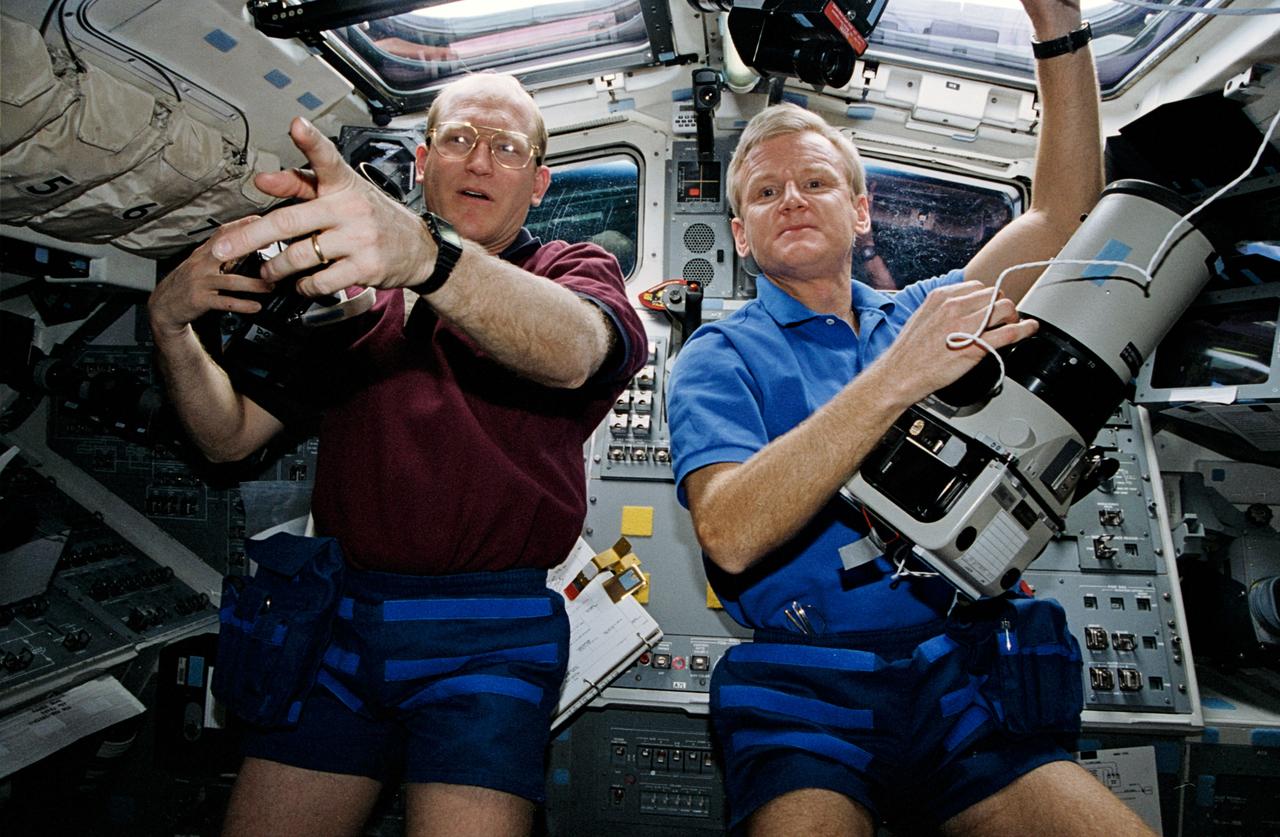
STS062-06-030 (4-18 March 1994) --- With cameras in hand two of the STS-62 astronauts prepare to take pictures of their home planet. John H. Casper (right), mission commander, handles a large format, Linhof camera, while Charles D. (Sam) Gemar, mission specialist, has just added a roll of film to a 70mm handheld Hasselblad camera. Earth observations and documentation occupied muc of the on-duty time of all five of the STS-62 crewmembers during their 14-day mission in earth orbit.

STS059-32-016 (20 April 1994) --- Astronaut Linda M. Godwin, STS-59 payload commander, poses with the spacesuit she wore for launch. She will eventually wear the partial pressure suit for the entry phase of the Space Shuttle Endeavour's week and a half mission in Earth orbit.
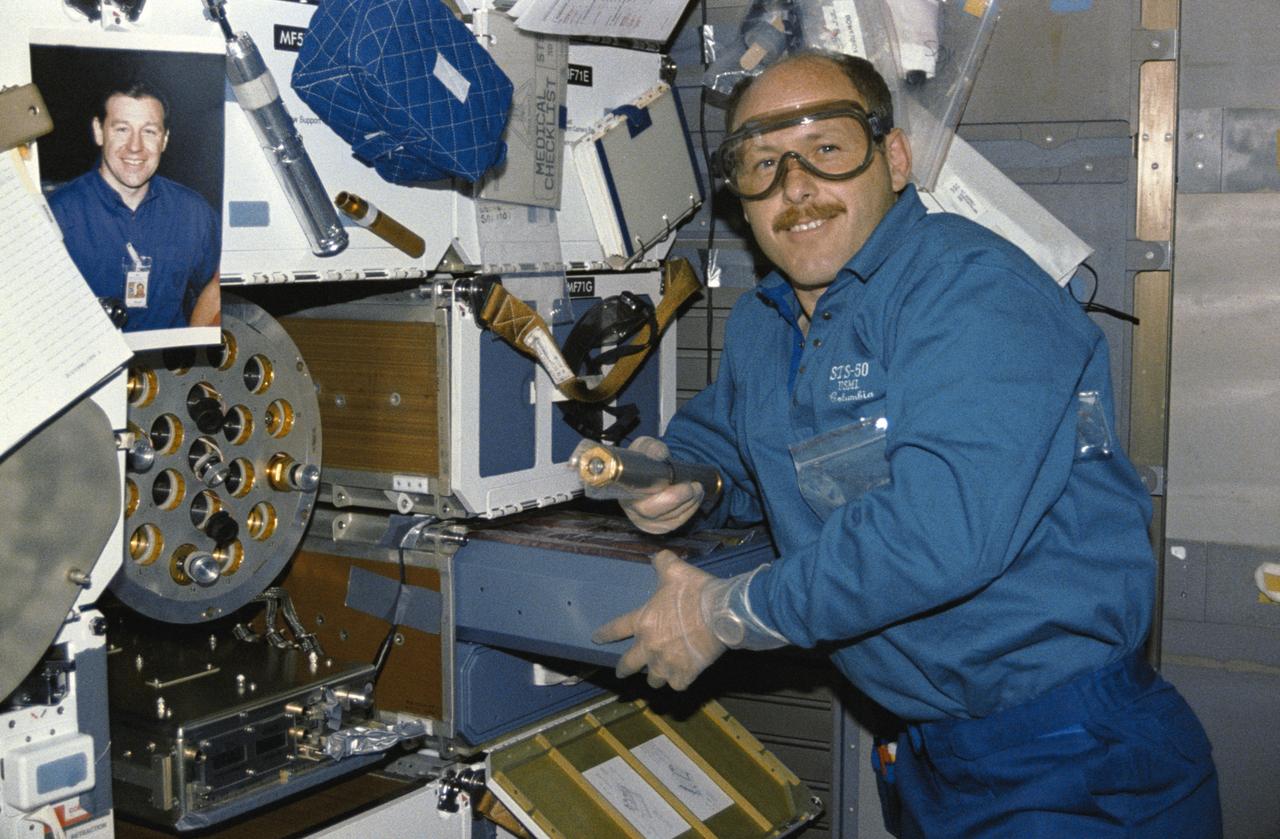
STS50-262-004 (25 June-9 July 1992) --- Astronaut Kenneth D. Bowersox, STS-50 pilot, holds an autoclave used in the growing of zeolite crystals on the middeck of the Earth-orbiting Space Shuttle Columbia. He is standing near the Zeolite Crystal Growth (ZCG) furnace, which is housed in the space of two stowage lockers. On the 14-day U.S. Microgravity Laboratory mission, zeolite crystals were grown in 38 individual autoclaves, which were joined in pairs to be inserted into the 19 furnace orifices. While the autoclaves appear the same externally, there are several types of internal arrangements that were tested to determine which one provides the best mixing of the component solutions. The portrait of alternate payload specialist Albert Sacco, Jr. is mounted nearby. Sacco, serving as a ground controller at Marshall Space Flight Center in Alabama, worked in conjunction with the red shift crew in the science module.
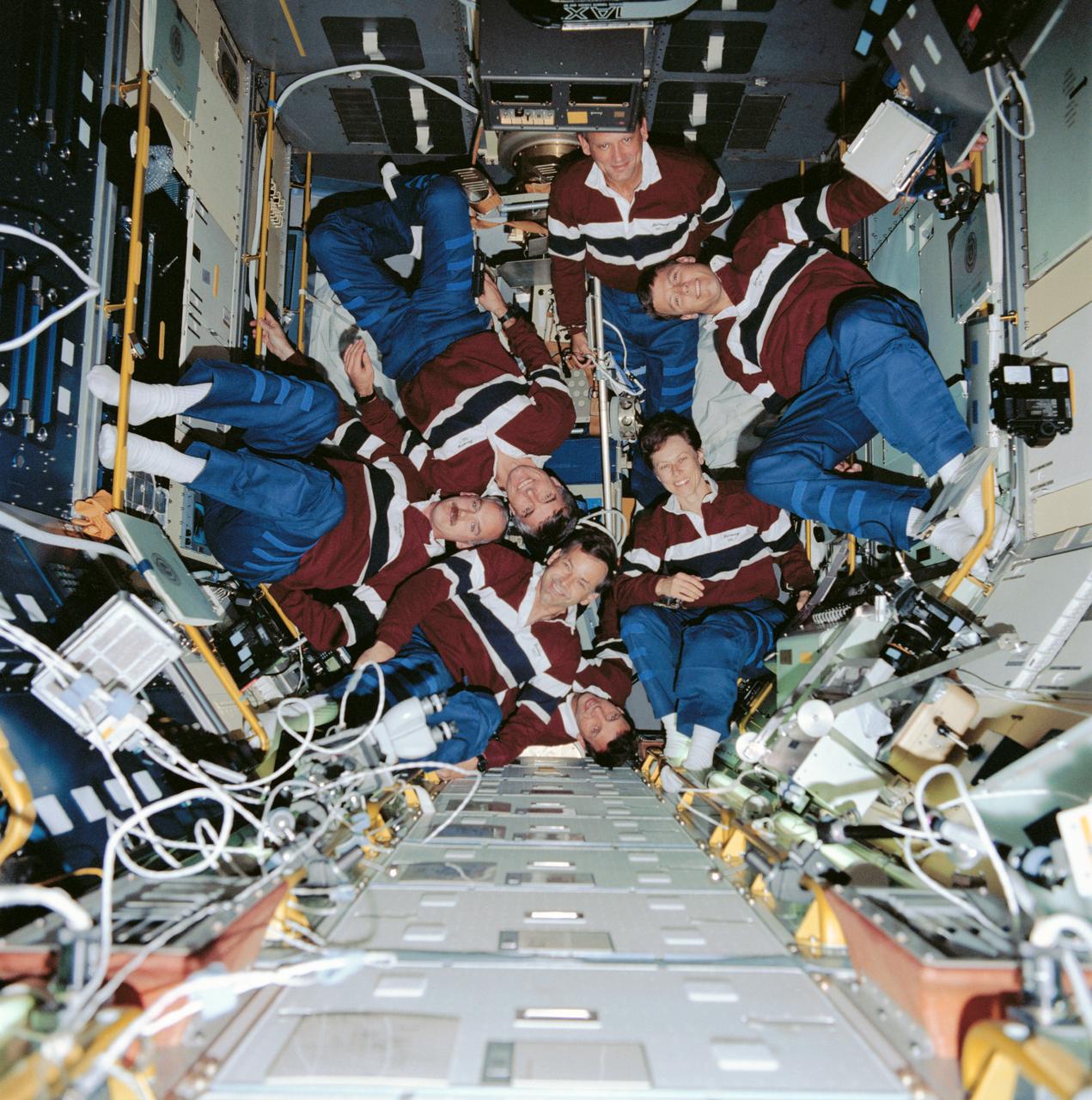
STS042-78-061 (22-30 Jan. 1992) --- The seven STS-42 crewmembers pose for a traditional in-space portrait in the shirt-sleeve environment of the International Microgravity Laboratory (IML-1) science module in the shuttle's cargo bay. (Hold picture with index numbers at top.) David C. Hilmers, mission specialist, is at top center of the 70mm image. Others pictured are (clockwise) Ronald J. Grabe, mission commander; William F. Readdy; mission specialist; Ulf Merbold, European Space Agency (ESA) payload specialist; Norman E. Thagard, payload commander; Stephen S. Oswald, pilot; and Roberta L. Bondar, Canadian payload specialist. The rotating chair, used often in biomedical tests on the eight-day flight, is (partially obscured) in center frame.
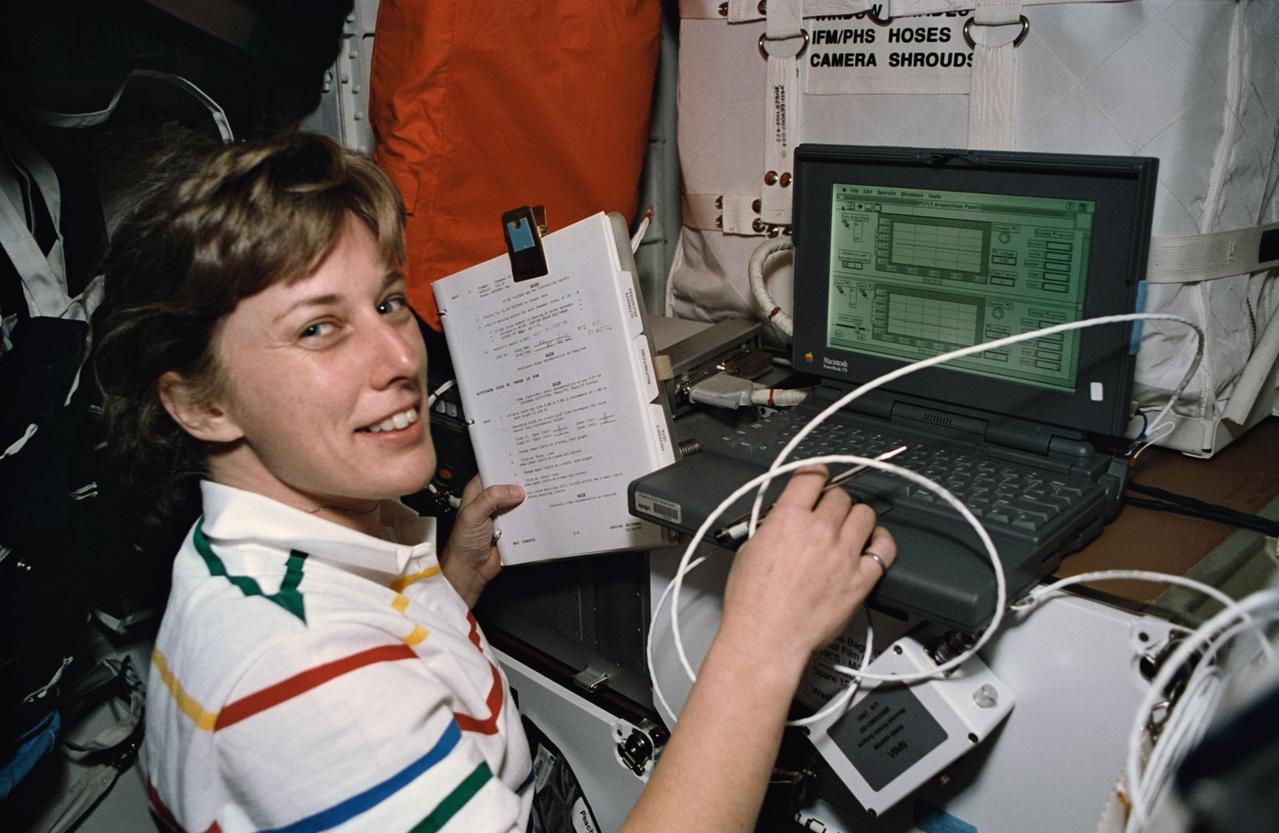
STS060-21-031 (3-11 Feb 1994) --- Using a lap top computer, astronaut N. Jan Davis monitors systems for the Commercial Protein Crystal Growth (CPCG) experiment onboard the Space Shuttle Discovery. Davis joined four other NASA astronauts and a Russian cosmonaut for eight days in space aboard Discovery.

S66-54590 (13 Sept. 1966) --- Astronaut Richard F. Gordon Jr., Gemini-11 pilot, prepares to open spacecraft hatch to jettison used equipment. Photo credit: NASA
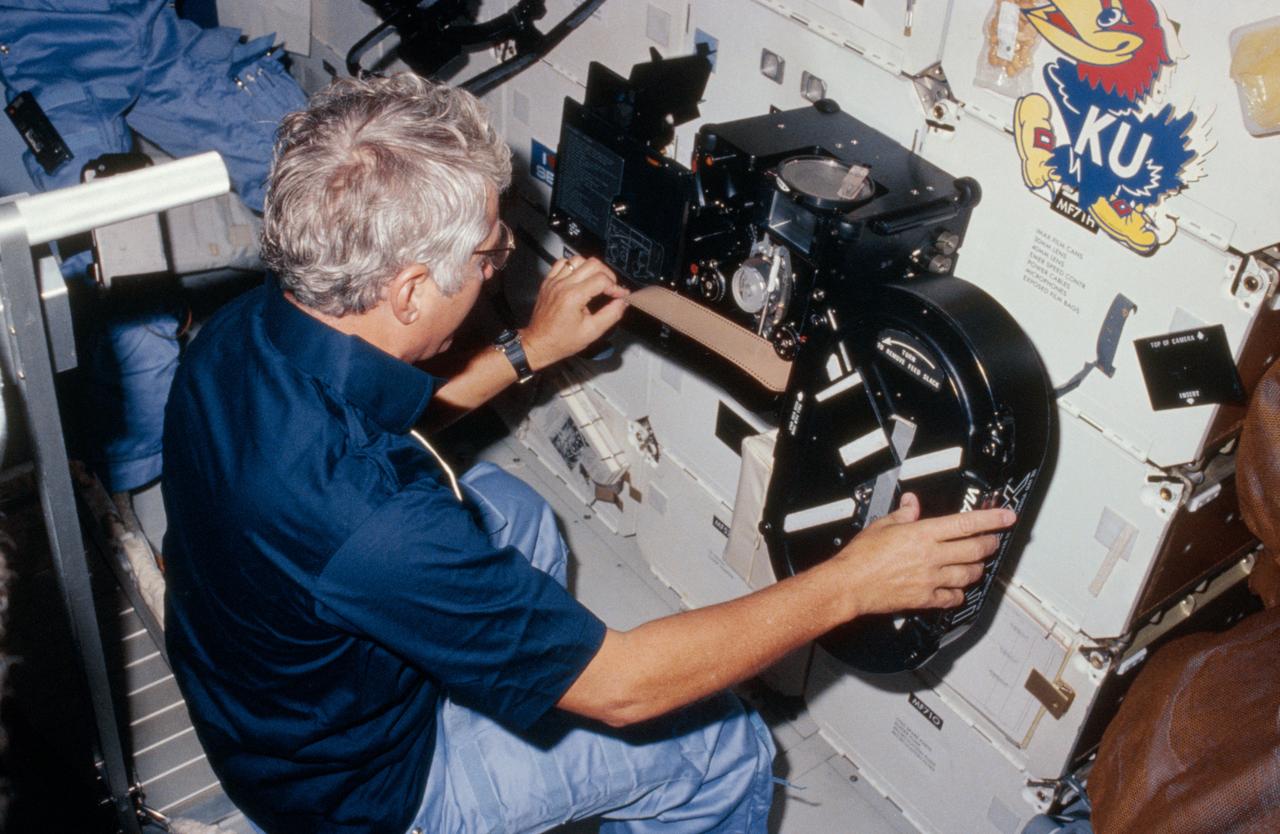
41D-11-004 (8 September 1984 --- View of Crew Commander Henry Hartsfield Jr. loading film into the IMAX camera during the 41-D mission. The camera is floating in front of the middeck lockers. Above it is a sticker of the University of Kansas mascott, the Jayhawk.
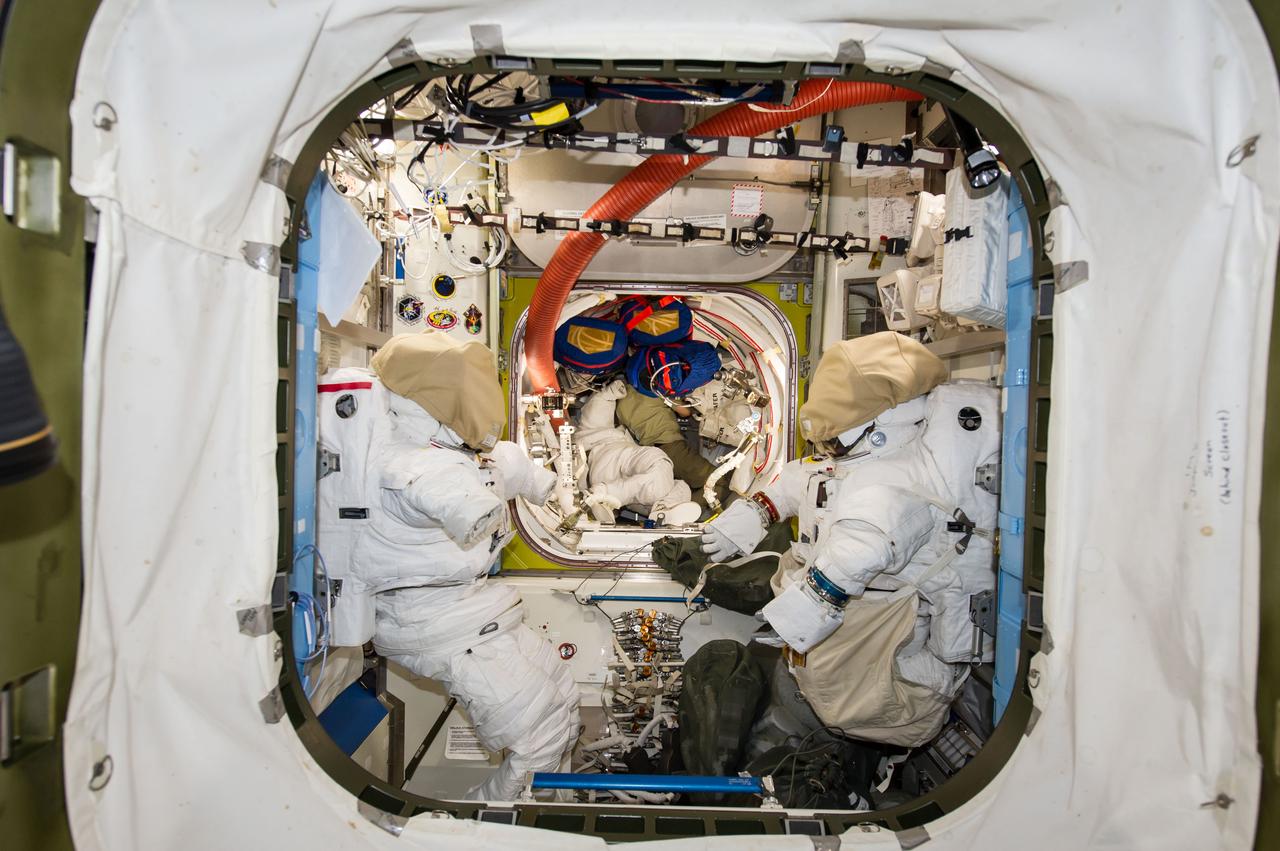
ISS041-E-016635 (16 Sept. 2014) --- NASA astronaut Reid Wiseman (center background), Expedition 41 flight engineer, works among stowed equipment in the Quest airlock of the International Space Station. Two Extravehicular Mobility Unit (EMU) spacesuits are visible in the foreground.
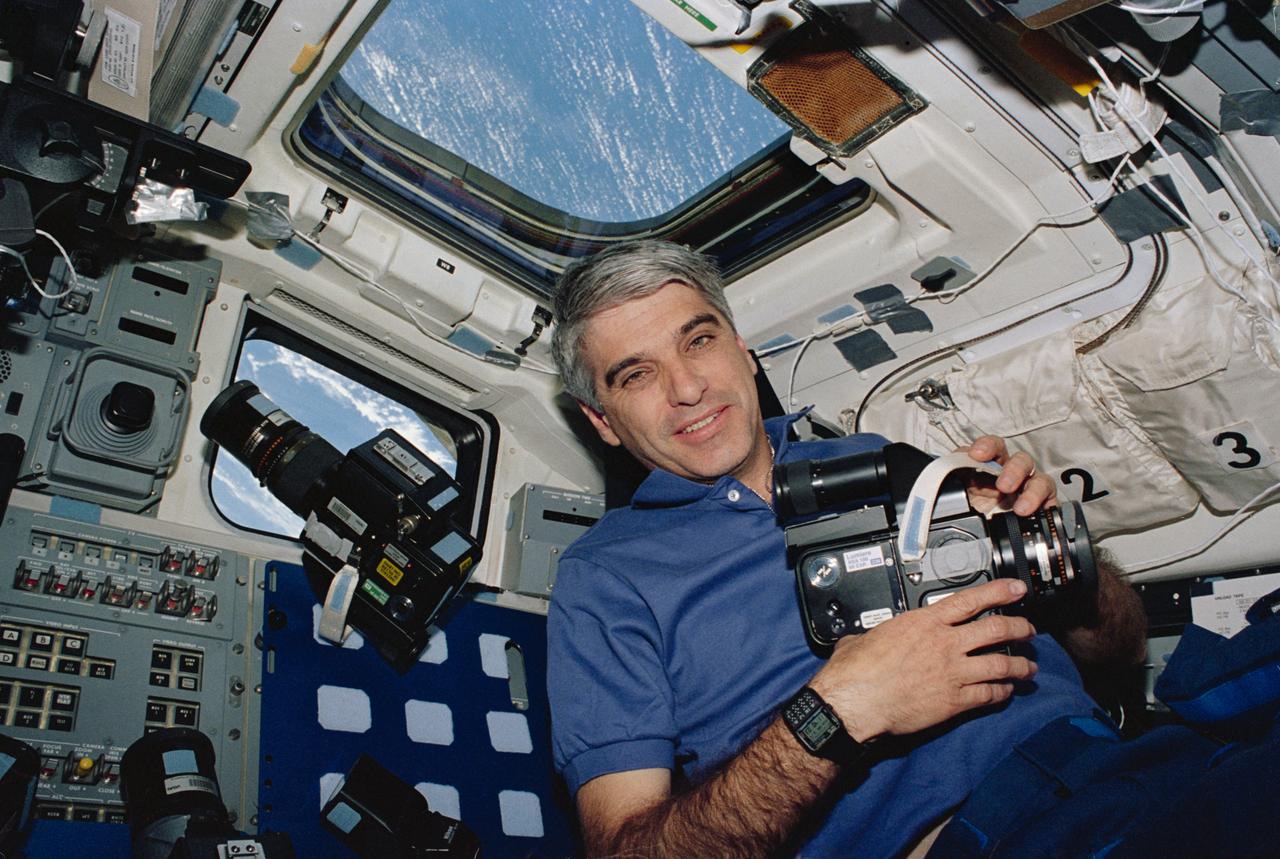
STS059-19-004 (9-20 April 1994) --- Astronaut Sidney M. Gutierrez, mission commander, pauses on the flight deck during Earth observations on the Space Shuttle Endeavour. Gutierrez, who was joined by five other NASA astronauts for 11-days in Earth orbit, holds a 70mm Hasselblad camera. The camera was one of several instruments used during the SRL mission to record an unprecedented compilation of data on planet Earth.
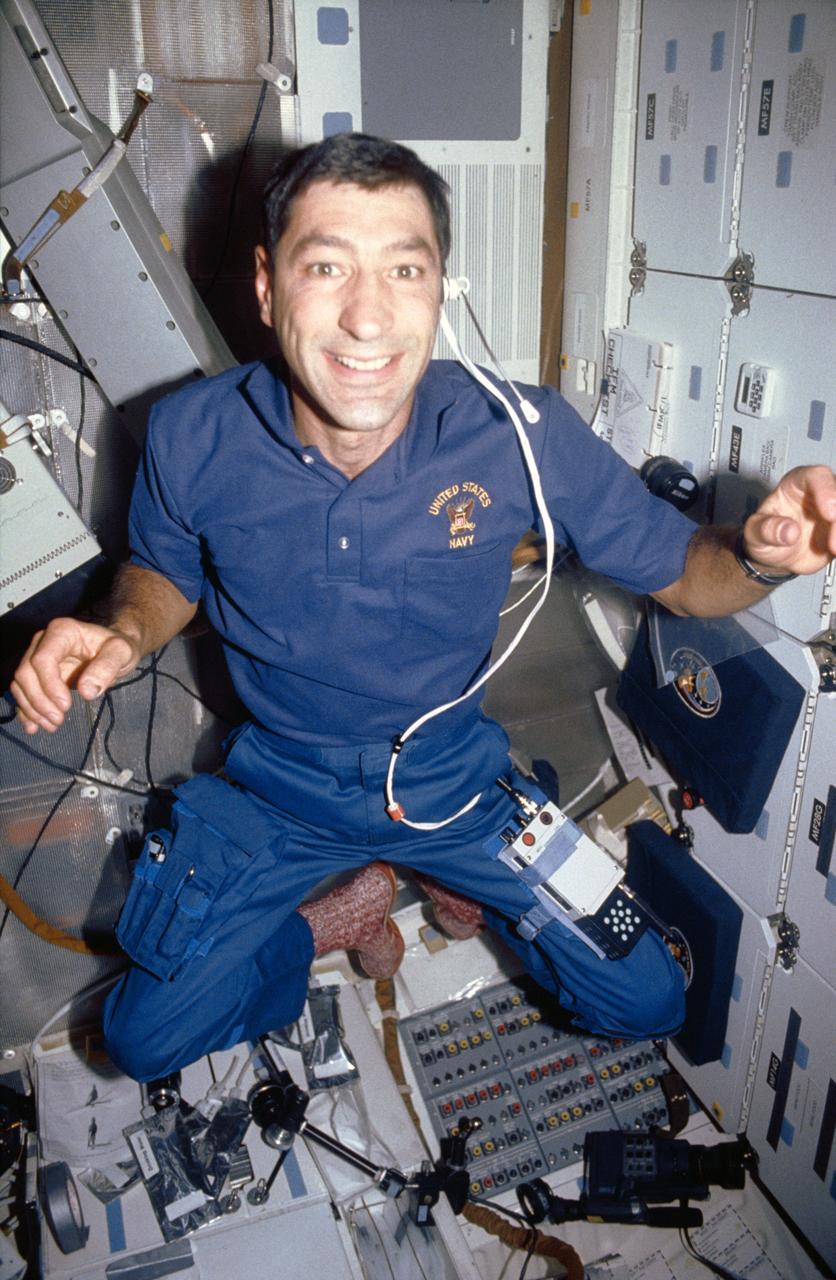
STS044-19-026 (24 Nov-1 Dec 1991) --- Astronaut Mario Runco Jr., STS-44 mission specialist, floats on Atlantis' middeck.
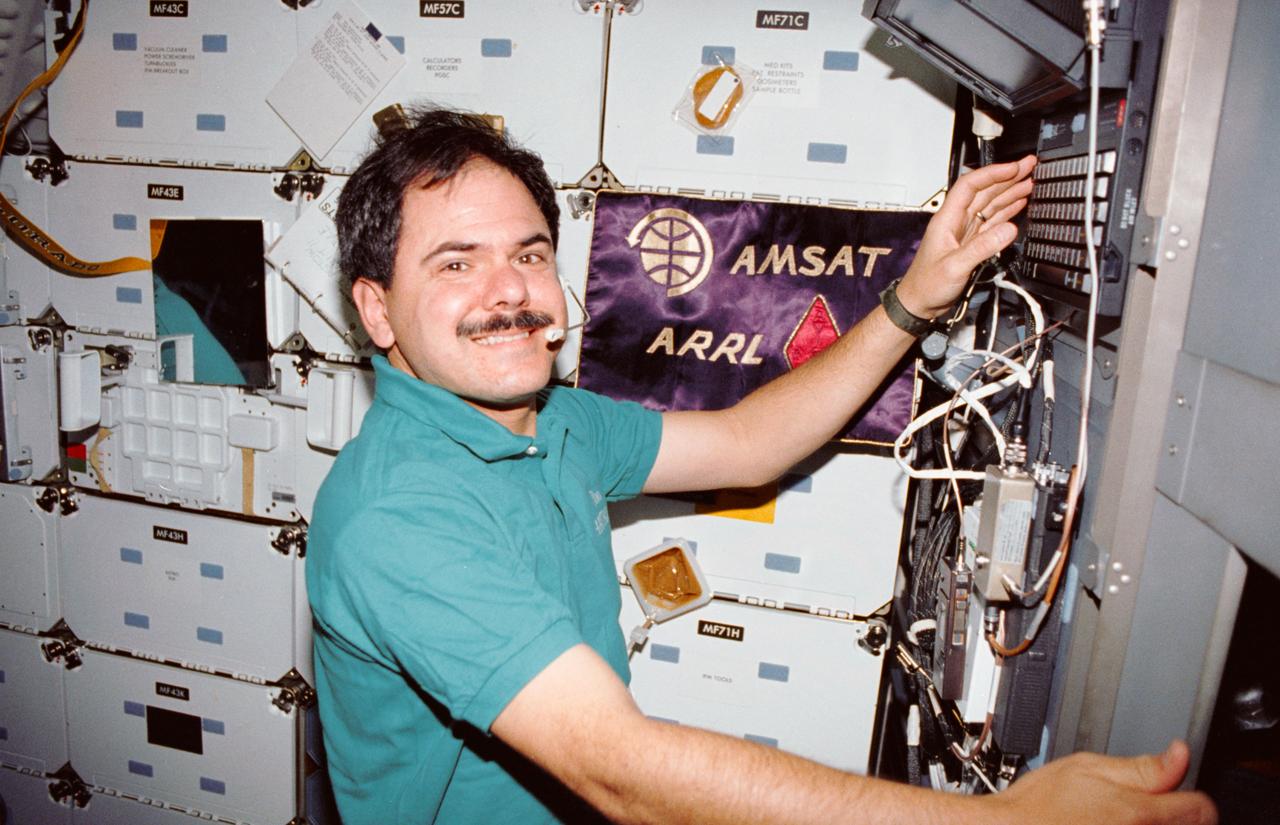
STS-35 Payload Specialist Ronald A. Parise enters data into the payload and general support computer (PGSC) in preparation for Earth communication via the Shuttle Amateur Radio Experiment (SAREX) aboard Columbia, Orbiter Vehicle (OV) 102. The SAREX equipment is secured to the middeck starboard sleep station. SAREX provided radio transmissions between ground based amateur radio operators around the world and Parise, a licensed amateur radio operator. The experiment enabled students to communicate with an astronaut in space, as Parise (call-sign WA4SIR) devoted some of his off-duty time to that purpose. Displayed on the forward lockers beside Parise is a AMSAT (Amateur Radio Satellite Corporation) / ARRL (American Radio Relay League) banner. Food items and checklists are attached to the lockers. In locker position MF43G, the Development Test Objective (DTO) Trash Compaction and Retention System Demonstration extended duration orbiter (EDO) compactor is visible.
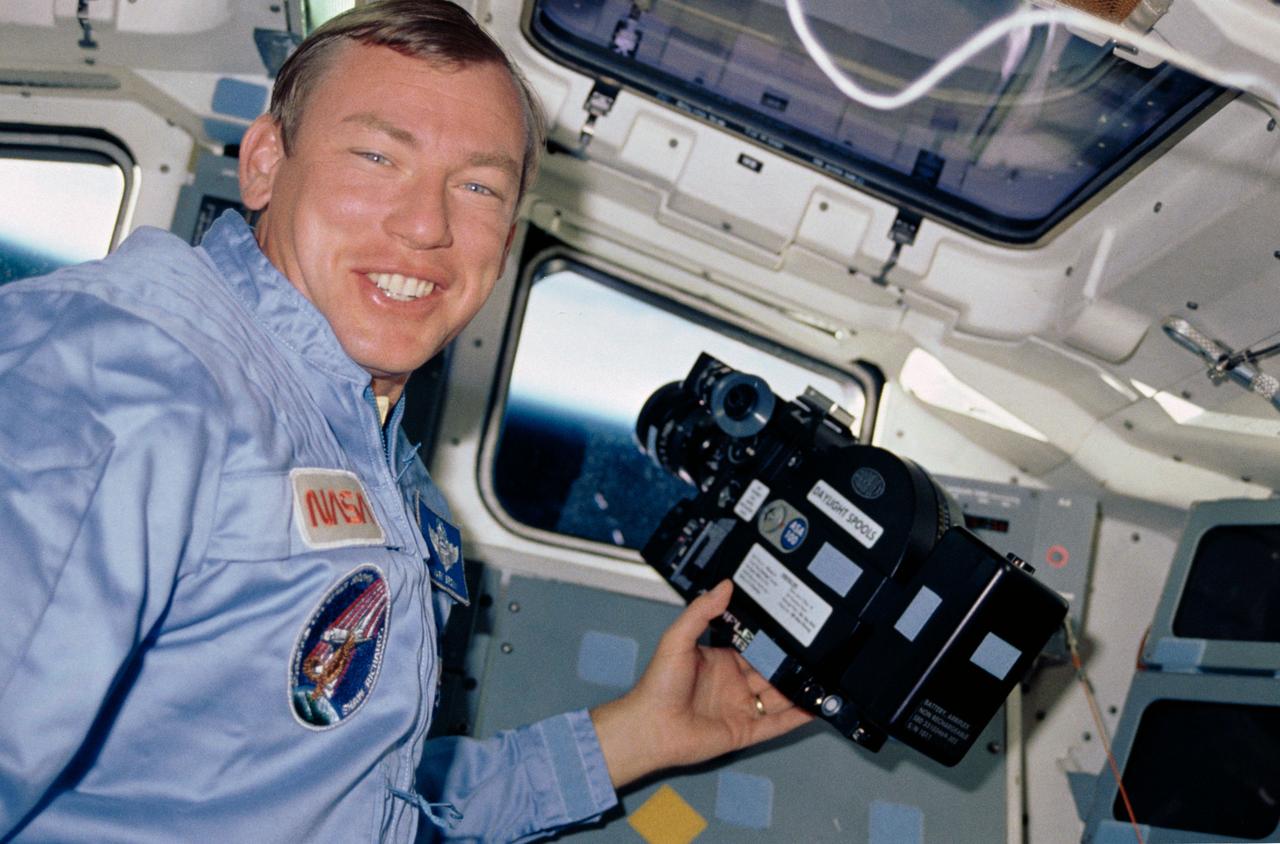
STS028-17-033 (August 1989) --- Astronaut Mark N. Brown, STS-28 mission specialist, pauses from a session of motion-picture photography conducted through one of the aft windows on the flight deck of the Earth-orbiting Space Shuttle Columbia. He is using an Arriflex camera. The horizon of the blue and white appearing Earth and its airglow are visible in the background.
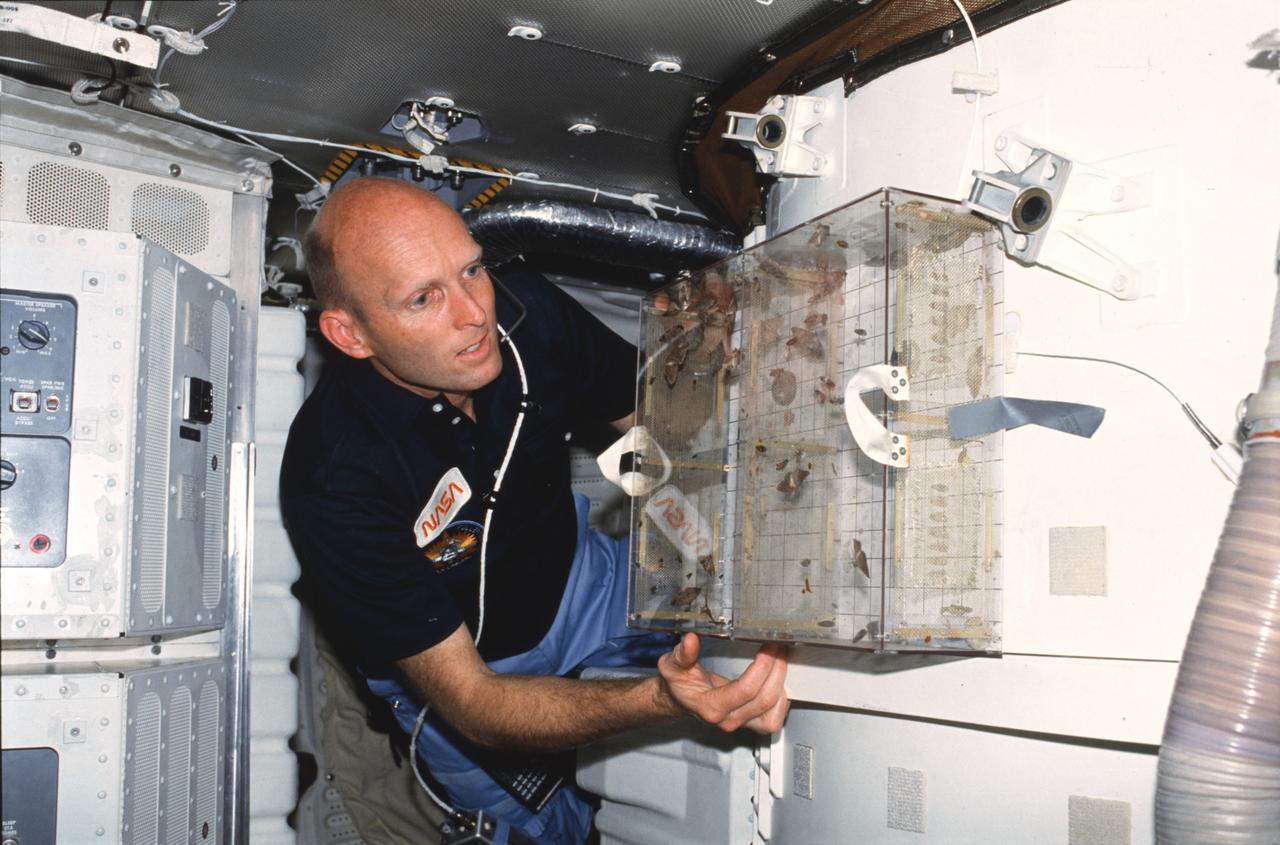
STS003-23-178 (22-30 March 1982) --- Astronaut C. Gordon Fullerton, STS-3 pilot, examines Student Experiment 81-8 (SE-81-8) Insect Flight Motion Study taped to the airlock on aft middeck. Todd Nelson, a high school senior from Minnesota, won a national contest to fly his experiment on this particular flight. Moths, flies, and bees were studied in the near weightless environment. Photo credit: NASA
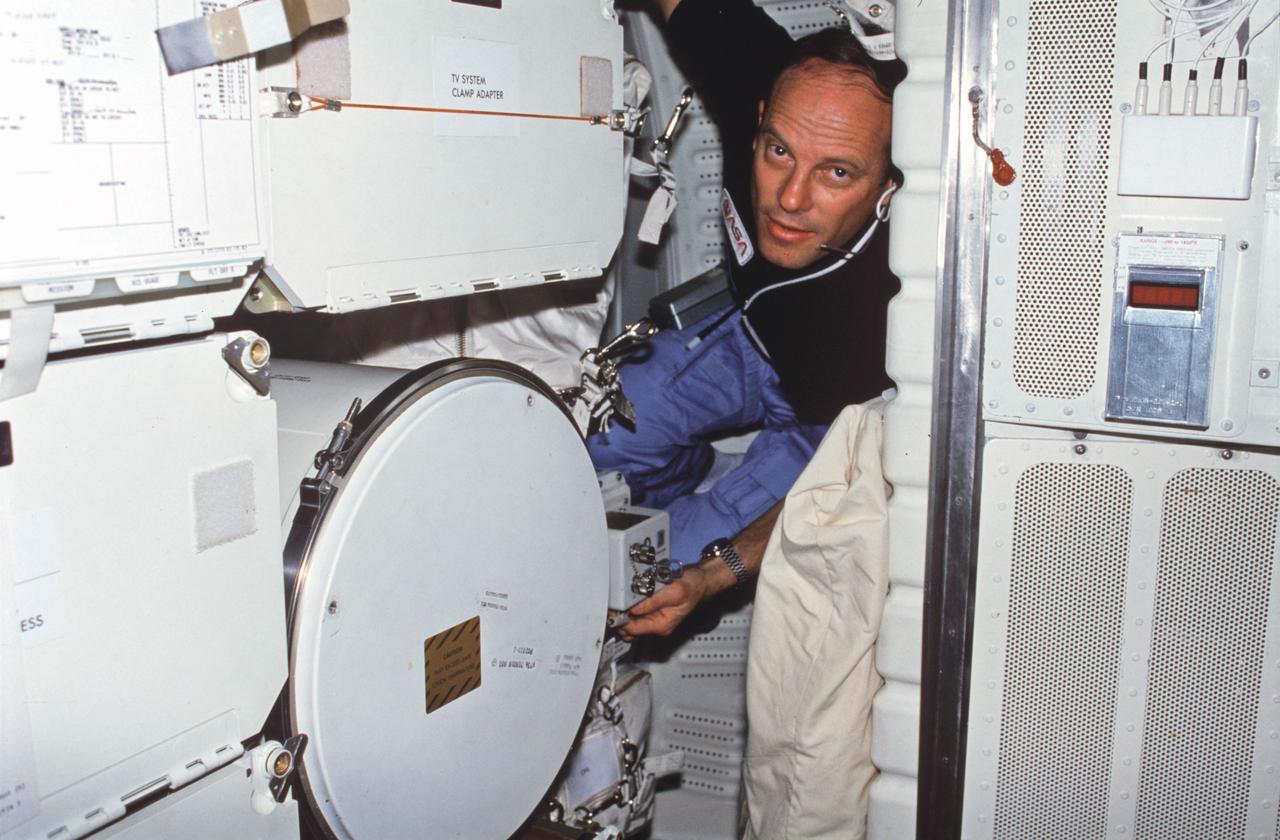
STS003-22-127 (22-30 March 1982) --- Astronaut Jack R. Lousma, STS-3 commander, wearing communications kit assembly (assy) mini-headset, adjusts controls on Monodisperse Latex Reactor (MLR) experiment located in forward middeck lockers MF57H and MF57K. To reach MLR support electronics assy controls, Lousma squeezes in between forward lockers and Development Flight Instrument (DFI) unit on starboard bulkhead. Photo credit: NASA
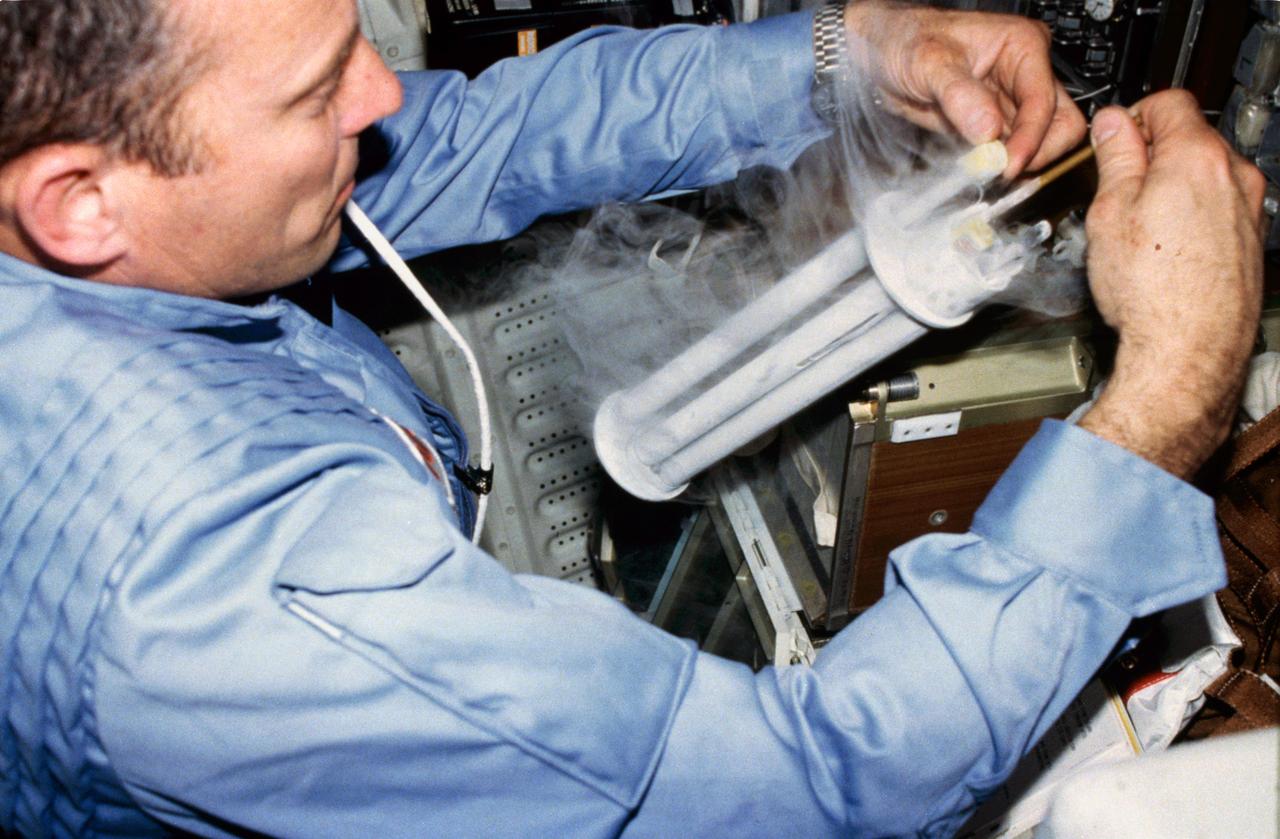
Commander Jack Lousma works with Electrophoresis Equipment Verification Test (EEVT) electrophoresis unit, cryogenic freezer and tube, and stowage locker equipment located on crew compartment middeck aft bulkhead.
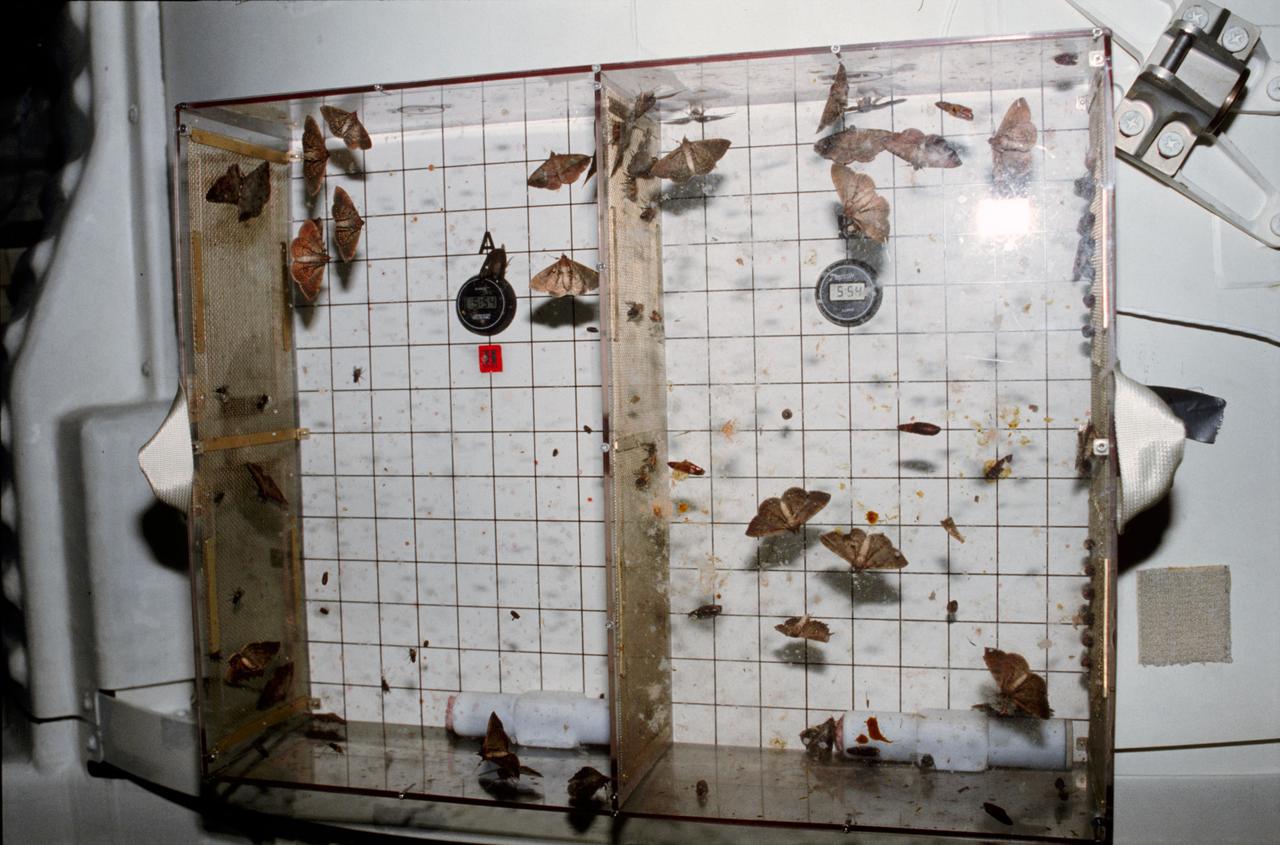
STS003-23-175 (22-30 March 1982) --- Student Experiment 81-8 (SE-81-8) Insect Flight Motion Study taped to the airlock on aft middeck of space shuttle Columbia. Photo credit: NASA
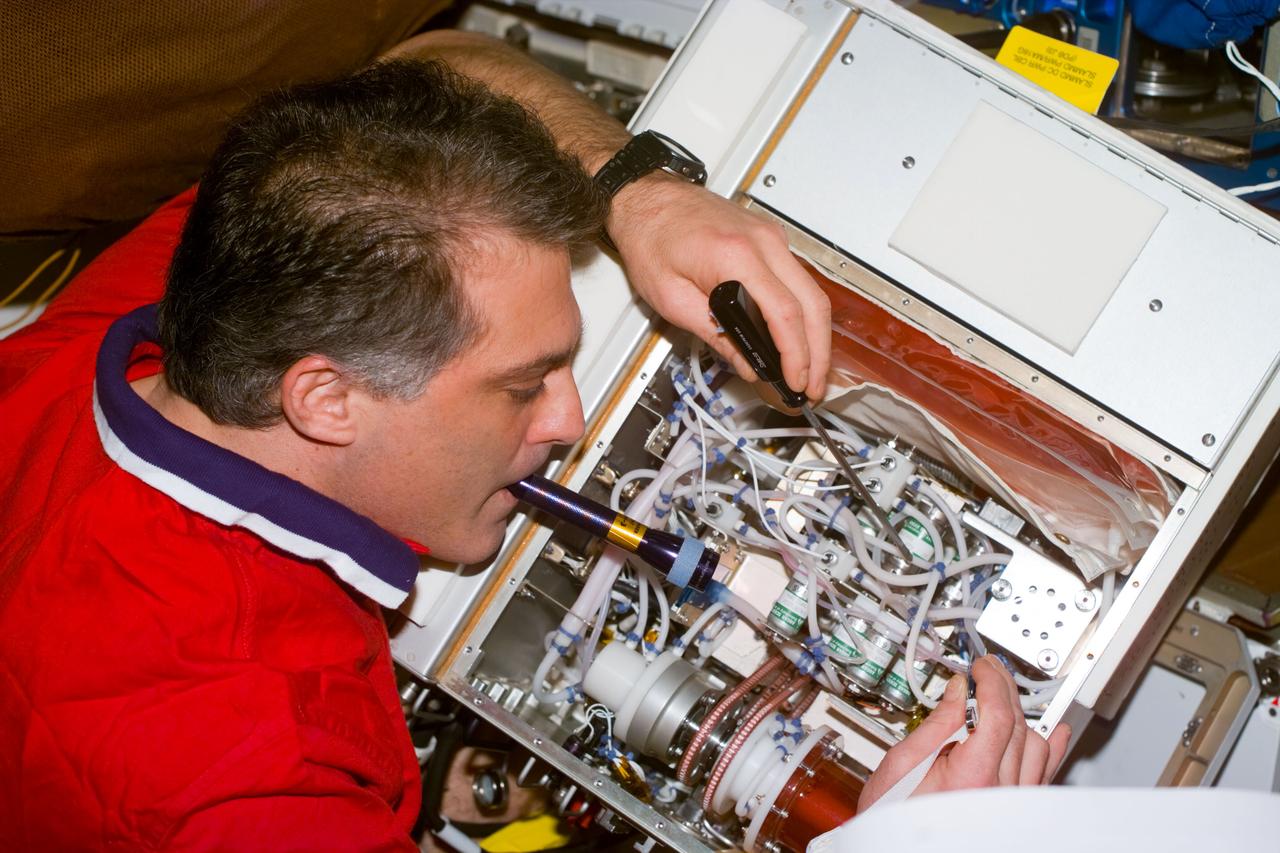
S89-E-5274 (26 Jan 1998) --- This Electronic Still Camera (ESC) image shows astronaut David A. Wolf, mission specialist and cosmonaut guest researcher, holding a pen light in his teeth to get better lighting in this piece of equipment, he is working on onboard the Space Shuttle Endeavour. Wolf is being replaced by astronaut Andrew S. W. Thomas as the cosmonaut guest researcher onboard Russia's Mir Space Station. Thomas will be the last American astronaut to serve onboard the Mir. This ESC view was taken on January 26, 1998, at 14:28:06 GMT.
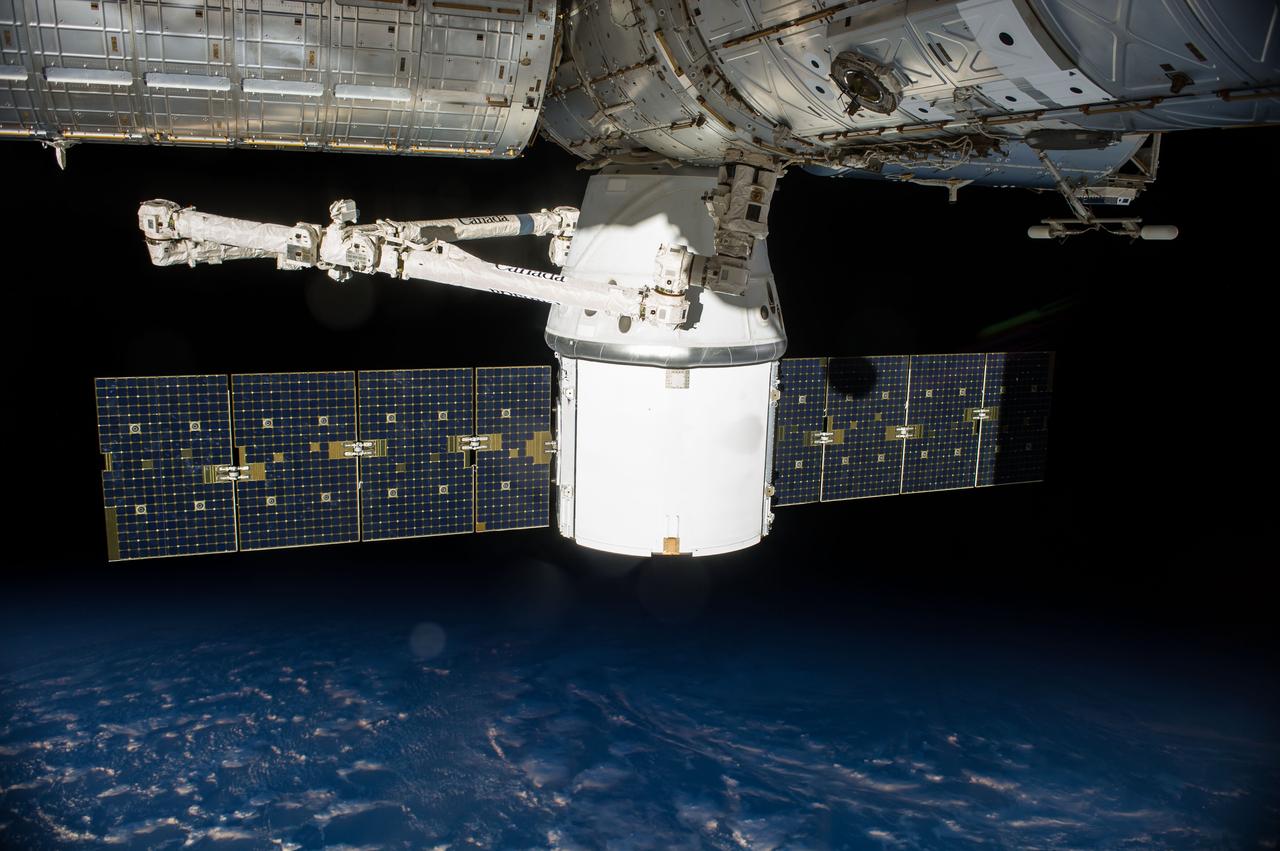
ISS041-E-033463 (24 Sept. 2014) --- SpaceX's uncrewed Dragon cargo spacecraft is docked to the International Space Station after arriving on Sept. 23 with a load of supplies and equipment for the three crew members currently onboard the orbital outpost and the three who will join them soon.
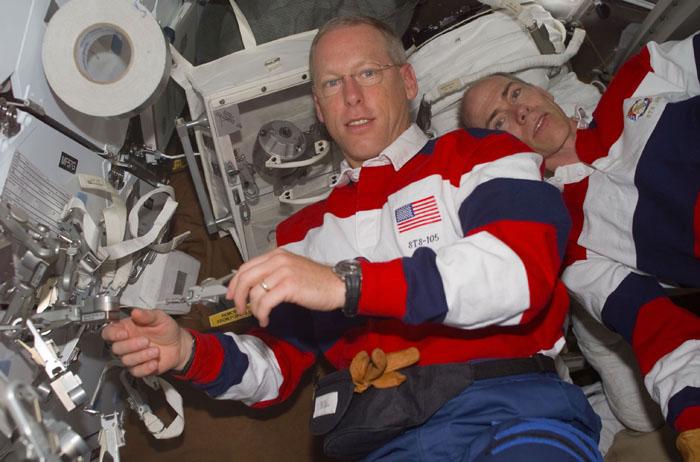
STS105-E-5217 (15 August 2001) --- Onboard the Space Shuttle Discovery, astronauts Patrick G. Forrester (left) and Daniel T. Barry check out some of the equipment they will be working with on their scheduled space walk in less than 24 hours. The image was recorded with a digital still camera.
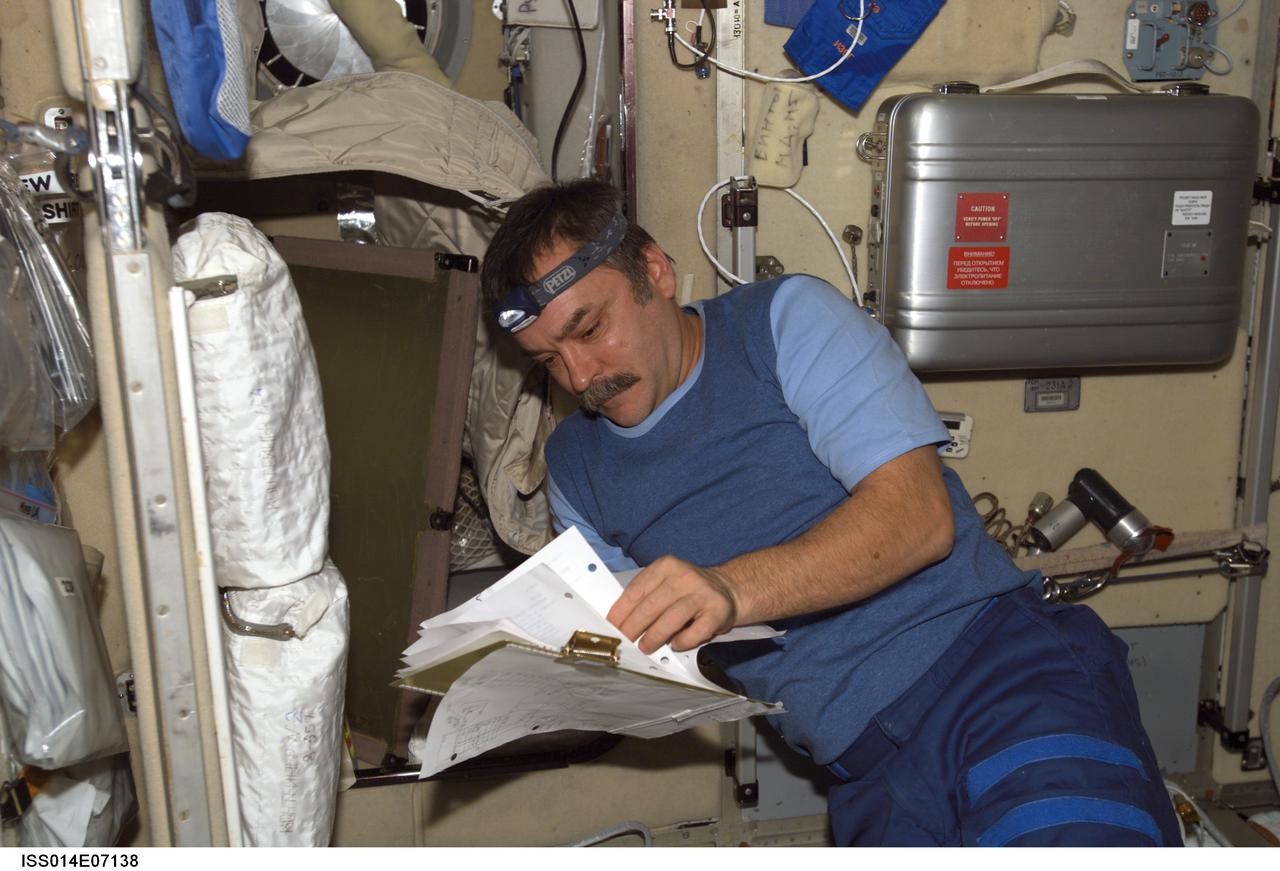
ISS014-E-07138 (3 Nov. 2006) --- Cosmonaut Mikhail Tyurin, Expedition 14 flight engineer representing Russia's Federal Space Agency, installs and connects onboard equipment control system cables in the Zvezda Service Module of the International Space Station.
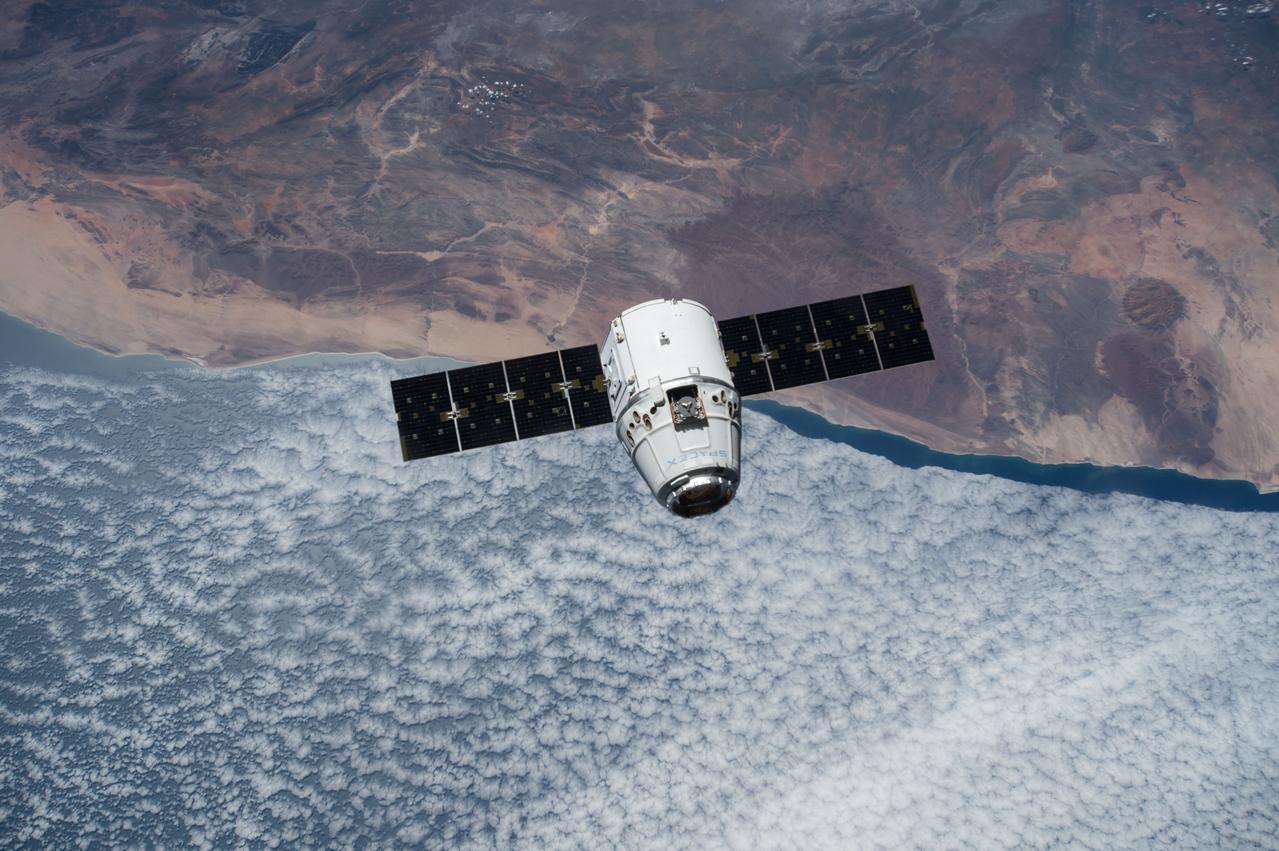
ISS043E122200 (04/17/2015) --- The SpaceX Dragon cargo spacecraft approaches the International Space Station Apr. 17th, 2015 after launching three days earlier from Cape Canaveral Air Station, Florida. It carries some 2 tons of science experiments, equipment, and supplies for the Expedition 43 team onboard the station.
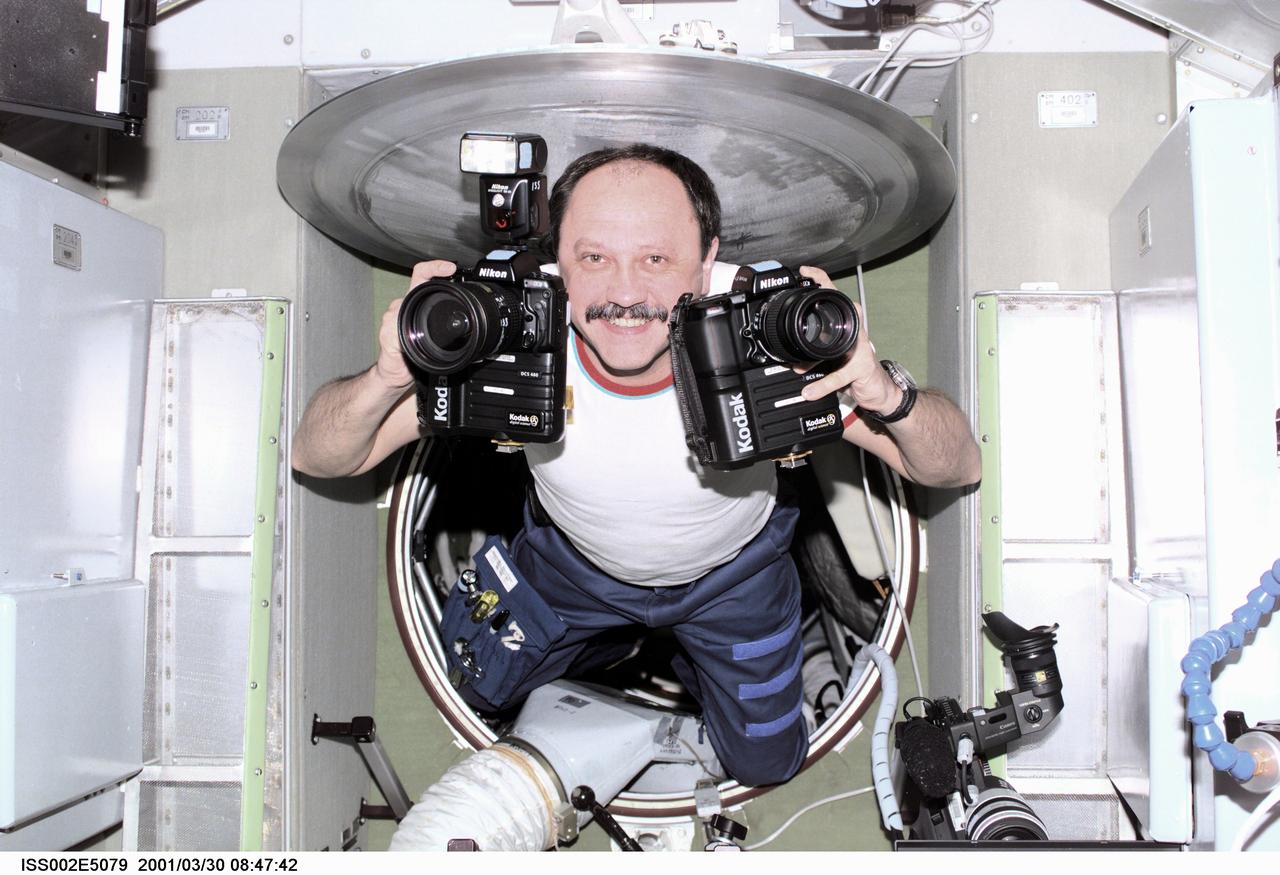
ISS002-E-5079 (30 March 2001) --- Cosmonaut Yury V. Usachev, Expedition Two commander, floats into the Zvezda Service Module equipped with cameras. Usachev, representing Rosaviakosmos, and two NASA astronauts recently replaced the Expedition One crew onboard the orbital outpost. This image was recorded with a digital still camera.
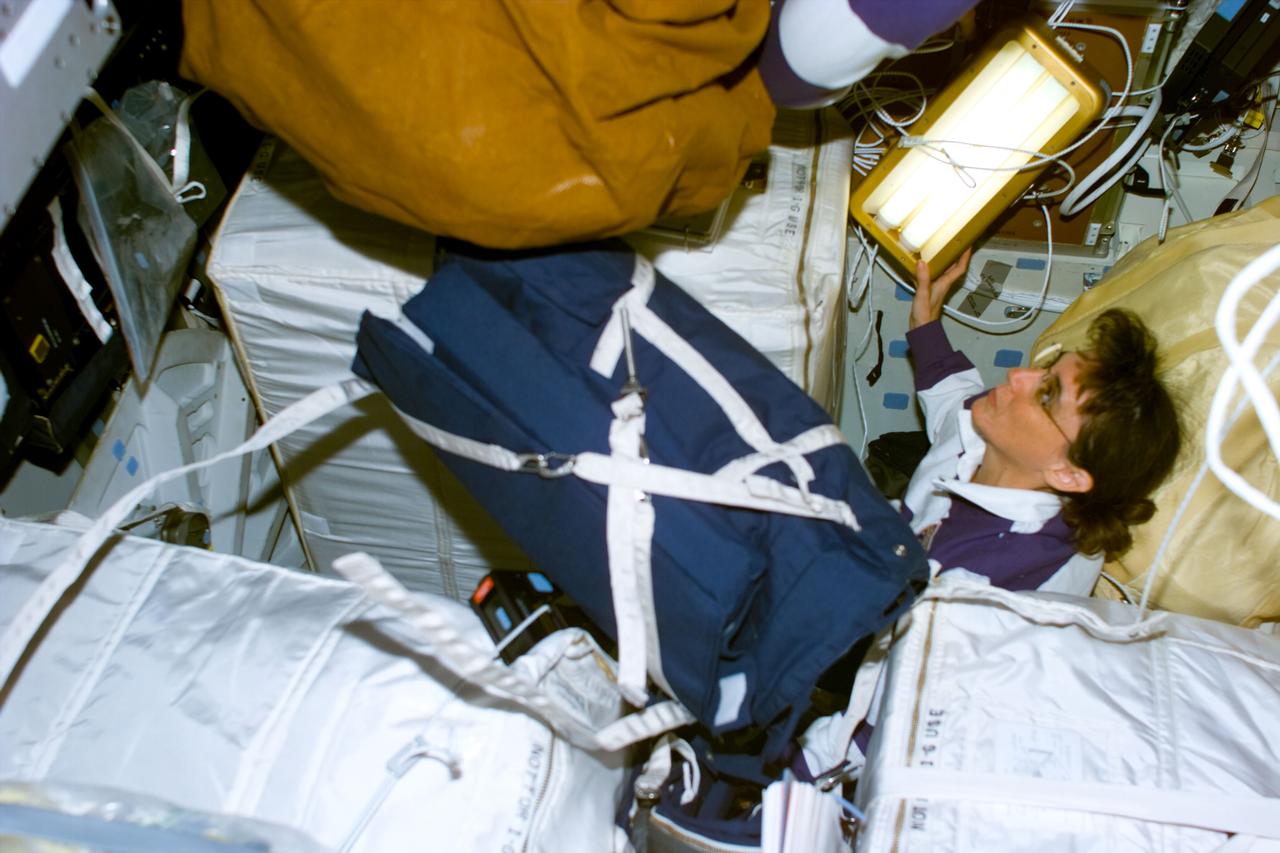
S88-E-5135 (12-12-98) --- Astronaut Nancy J. Currie, mission specialist, totes a lamp while sorting through a mountain of bags filled with hardware, equipment and supplies onboard Endeavour. The photo was taken with an electronic still camera at 03:49:03 GMT, Dec. 12.
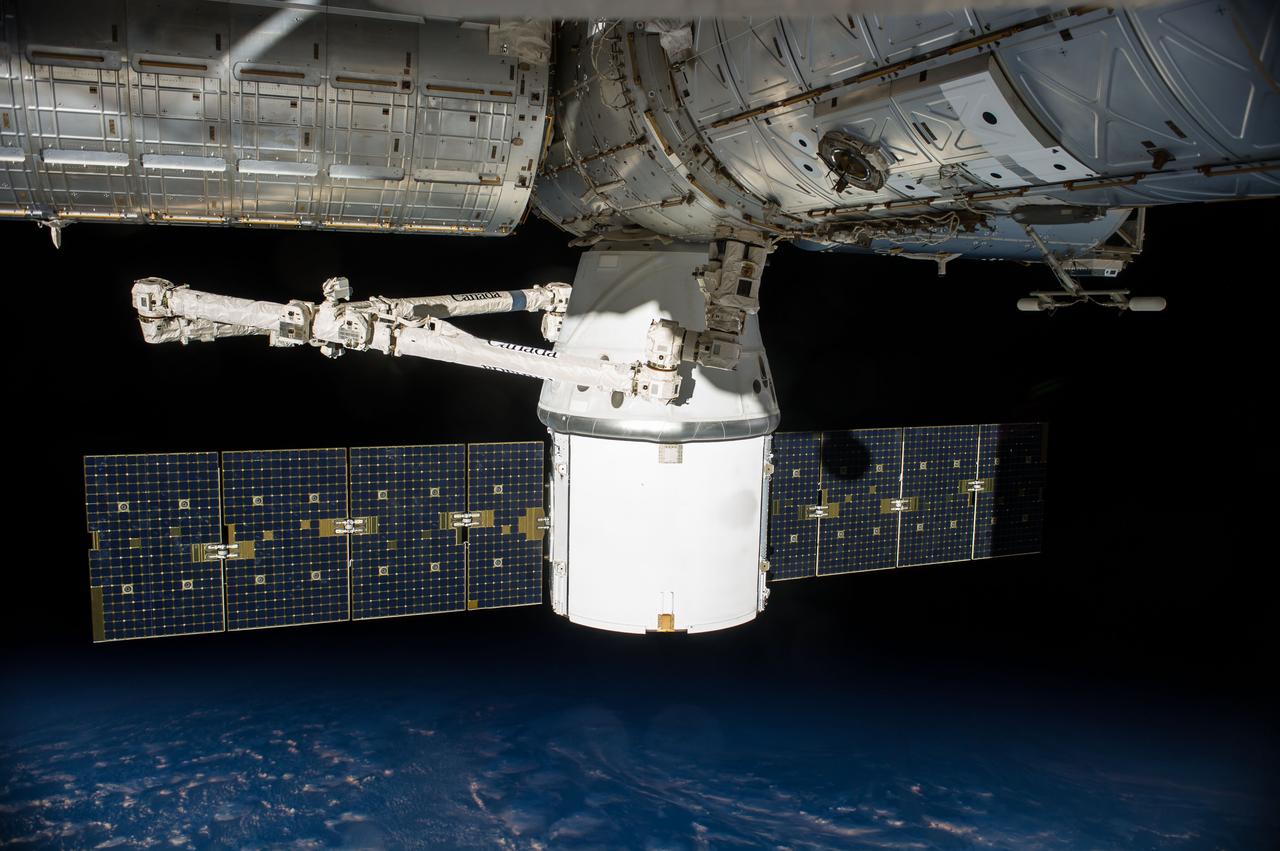
ISS041-E-033462 (24 Sept. 2014) --- SpaceX's uncrewed Dragon cargo spacecraft is docked to the International Space Station after arriving on Sept. 23 with a load of supplies and equipment for the three crew members currently onboard the orbital outpost and the three who will join them soon.
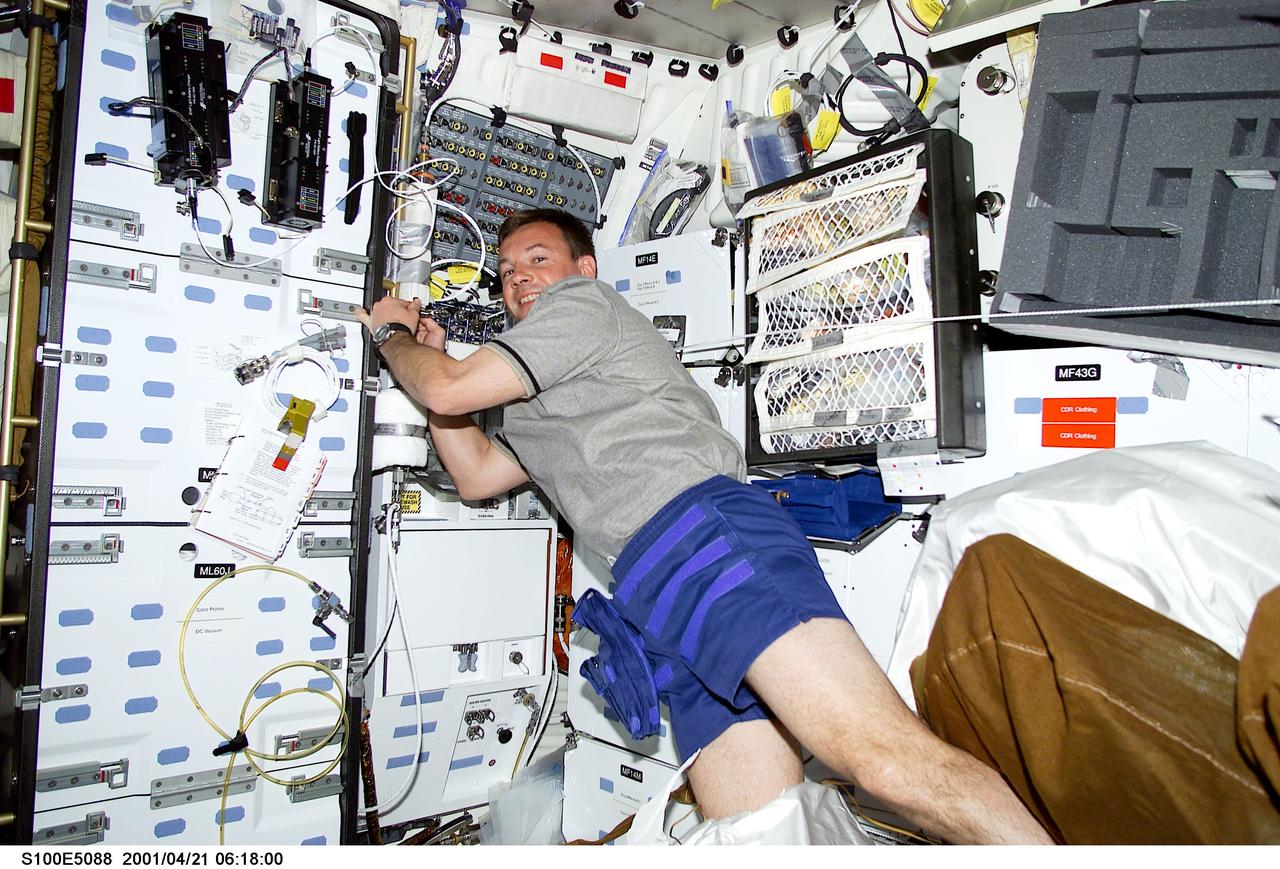
S100-E-5088 (21 April 2001) --- Cosmonaut Yuri V. Lonchakov, STS-100 mission specialist representing Rosaviakosmos, is pictured with temporarily-stowed equipment and supplies onboard the Space Shuttle Endeavour as the spacecraft heads toward a rendezvous with the International Space Station (ISS). The middeck scene was recorded with a digital still camera.
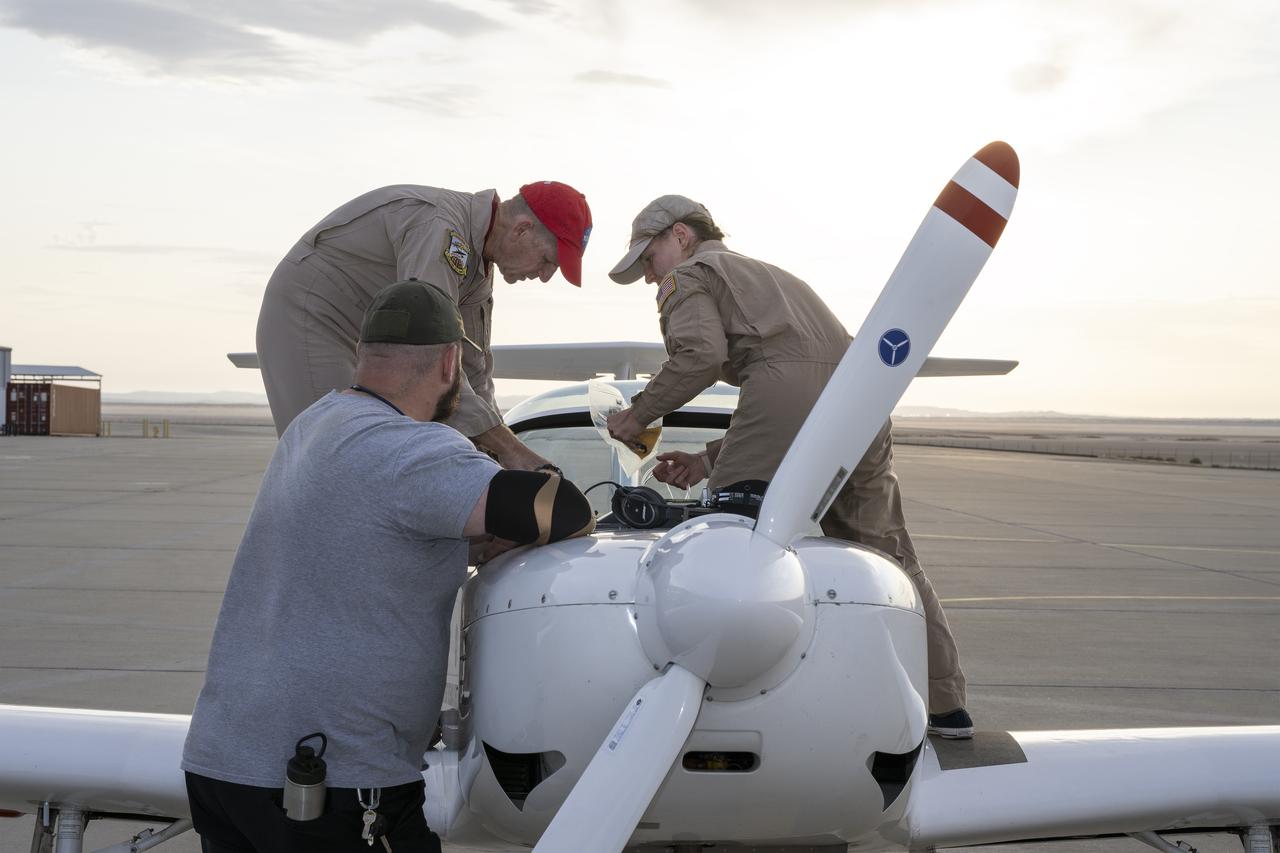
A NASA TG-14 glider aircraft is prepared for flight at NASA’s Armstrong Flight Research Center in Edwards, California, in support of the agency’s Quesst mission. The aircraft is equipped with onboard microphones to capture sonic boom noise generated during rehearsal flights, helping researchers measure the acoustic signature of supersonic aircraft closer to the ground.
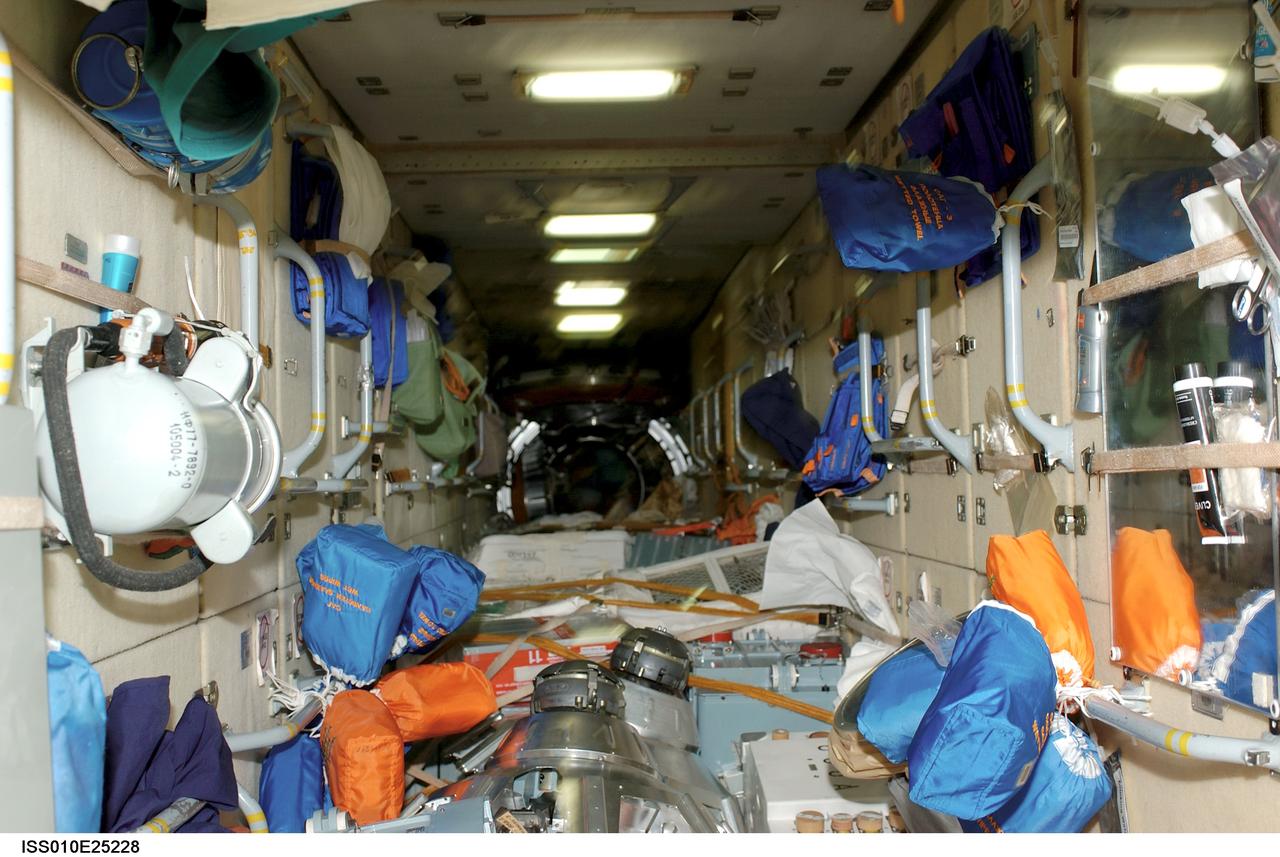
ISS010-E-25228 (20 April 2005) --- This view shows supplies and equipment stowed in the functional cargo block (FGB) or Zarya photographed by a crewmember on the International Space Station (ISS). At the time this photo was taken the Expedition 10 and 11 crews were onboard the Station.
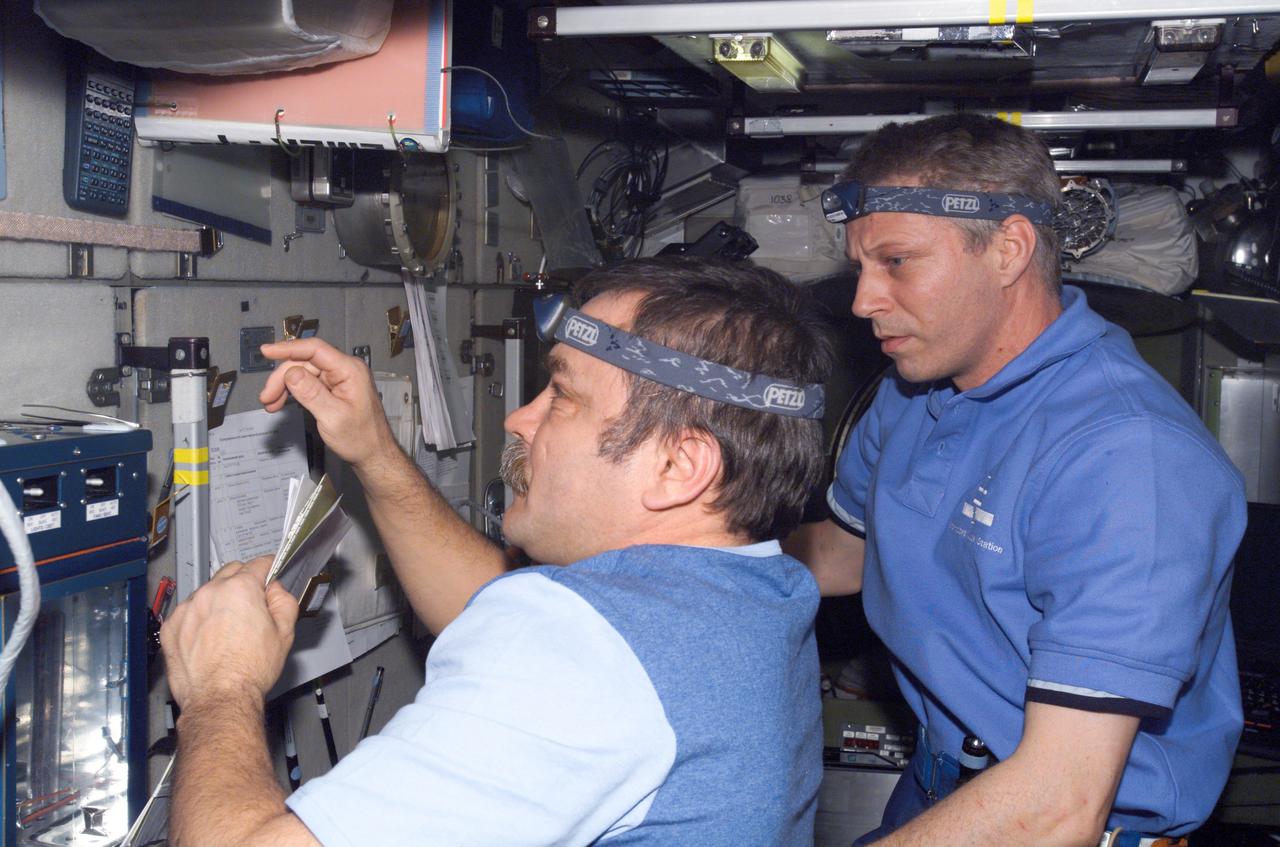
ISS014-E-07142 (3 Nov. 2006) --- Cosmonaut Mikhail Tyurin (foreground) representing Russia's Federal Space Agency, and European Space Agency (ESA) astronaut Thomas Reiter, both Expedition 14 flight engineers, install and connect onboard equipment control system cables in the Zvezda Service Module of the International Space Station.
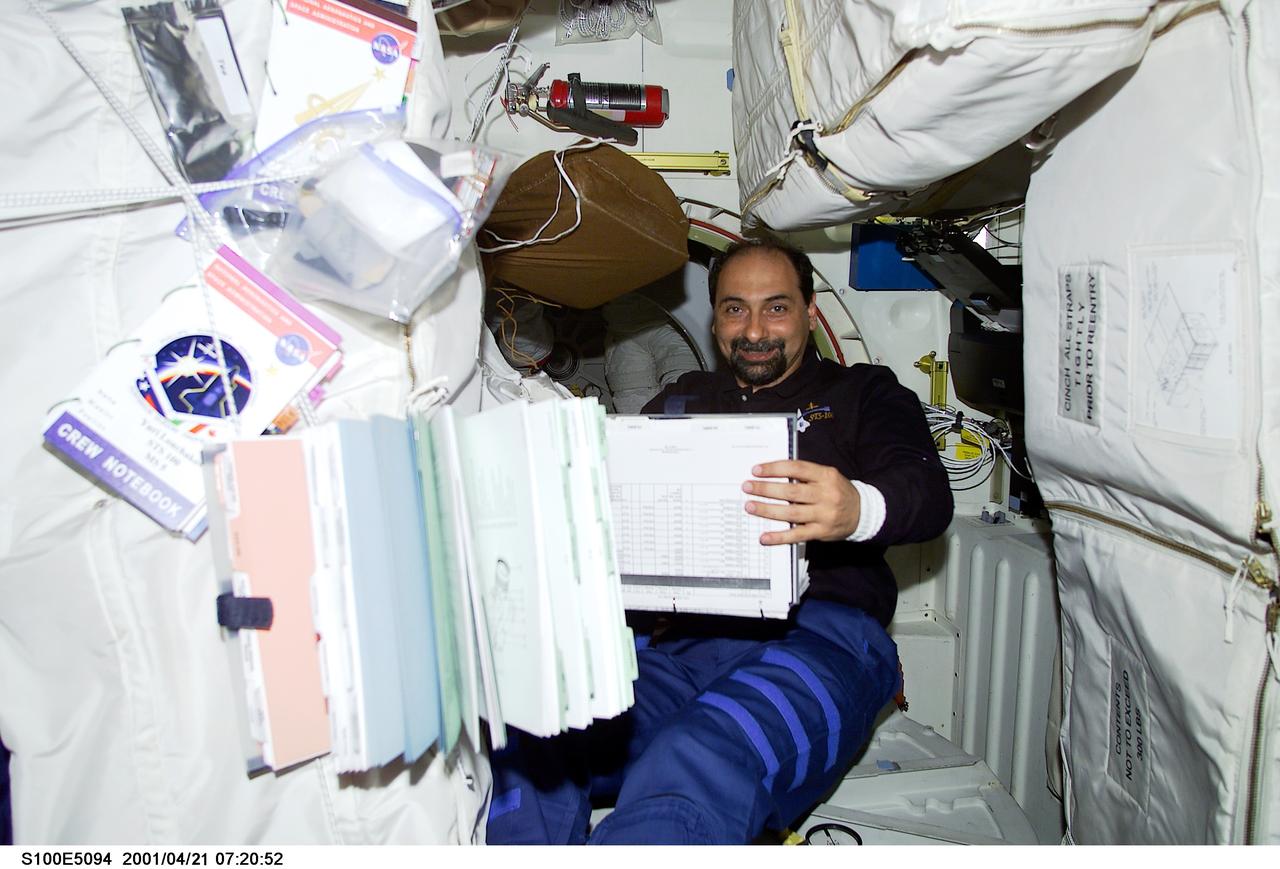
S100-E-5094 (21 April 2001) --- Astronaut Umberto Guidoni, mission specialist representing the European Space Agency, is surrounded by equipment and supplies onboard the Space Shuttle Endeavour as the spacecraft heads toward a rendezvous with the International Space Station (ISS). The middeck scene was recorded with a digital still camera.
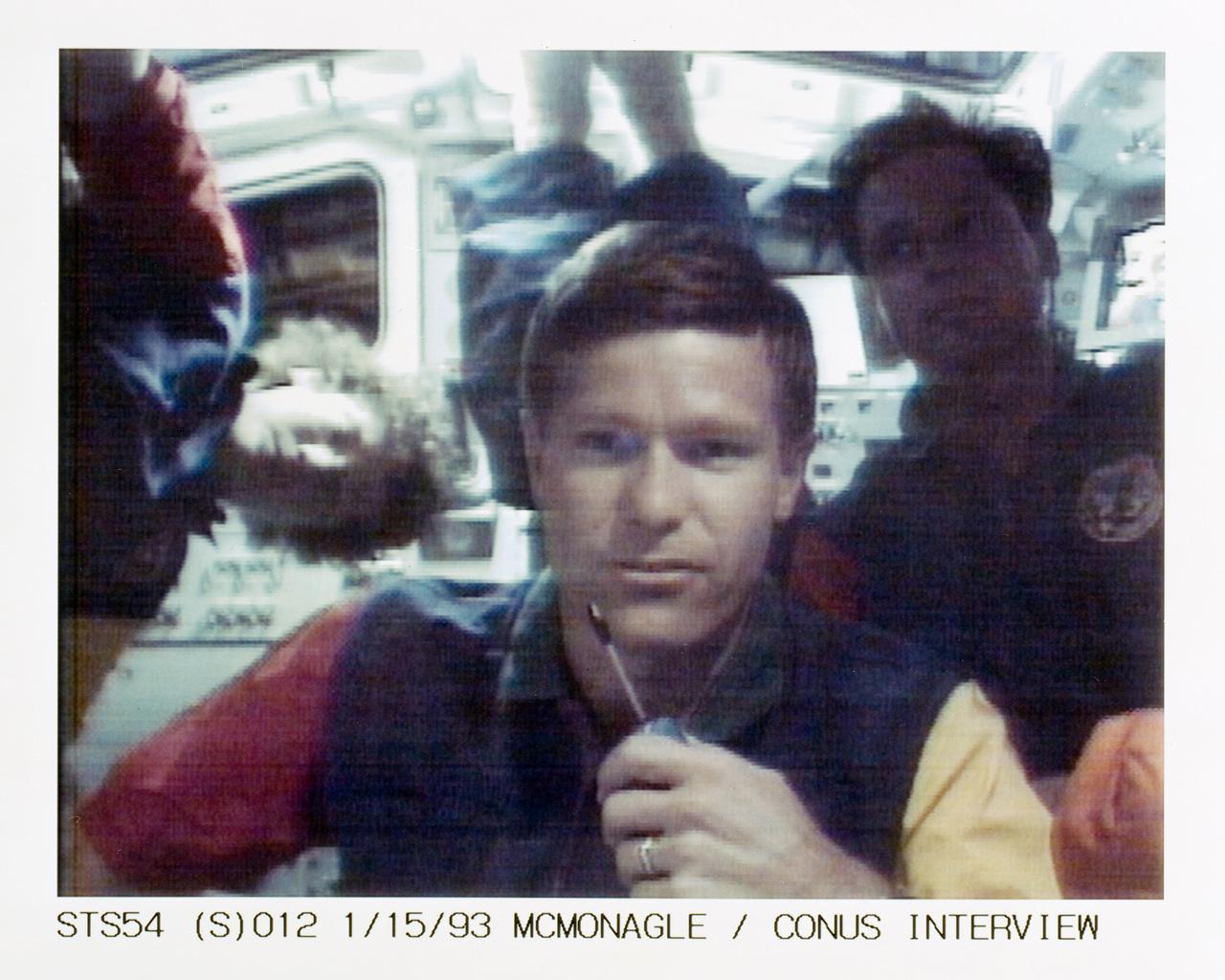
STS054-S-012 (15 Jan 1993) --- McMonagle talks to a radio station from the flight deck of Endeavour while, in the background, several crewmates await their turns to communicate with other stations. The scene was recorded at 13:54:14:13 GMT, Jan. 15, 1993.
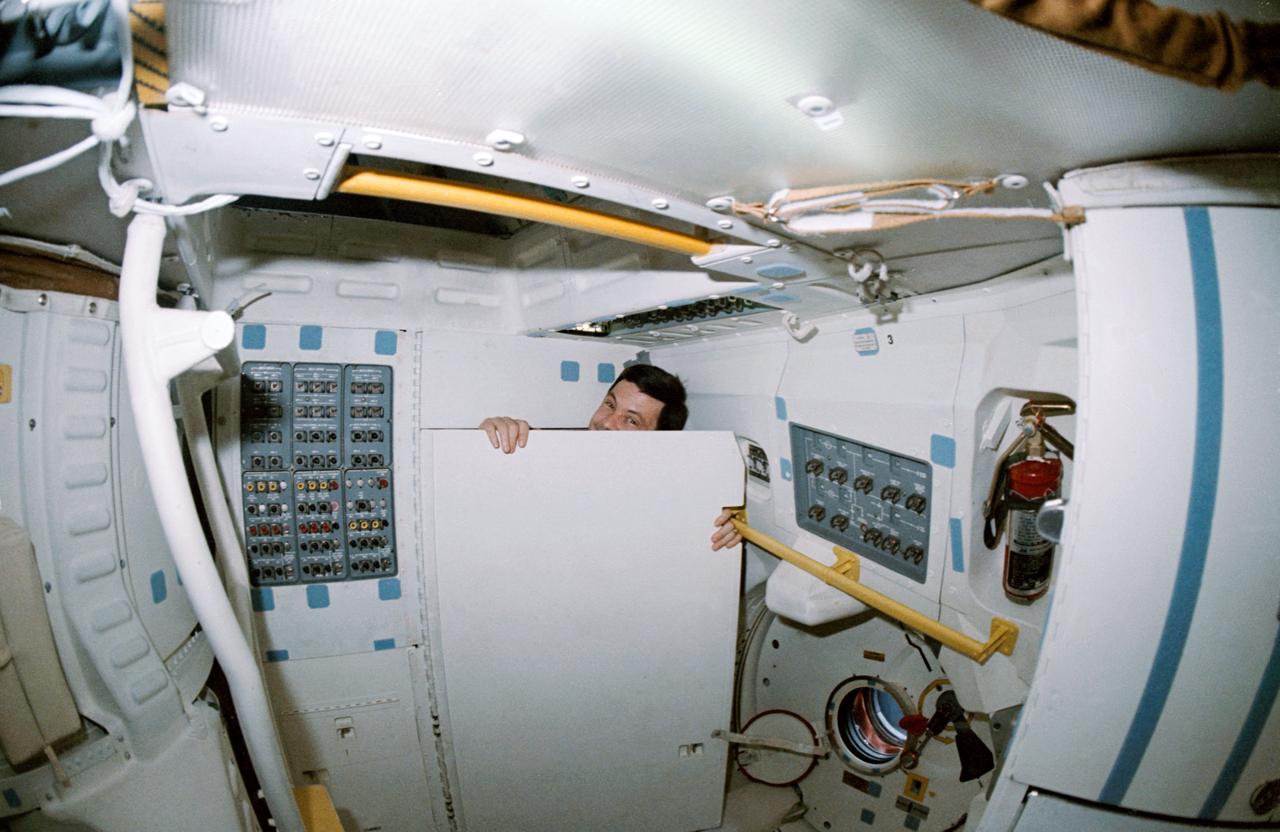
STS-41 crewmembers conduct Detailed Supplementary Objective (DSO) 0472 Intraocular Pressure on the middeck of Discovery, Orbiter Vehicle (OV) 103. Mission Specialist (MS) William M. Shepherd rests his head on the stowed treadmill while Pilot Robert D. Cabana, holding Shepherd's eye open, prepares to measure Shepherd's intraocular pressure using a tono pen (in his right hand). Objectives include: establishing a database of changes in intraocular pressures that can be used to evaluate crew health; validating ten degree head down bedrest as a model for cephalad fluid shifts in microgravity; facilitating the interpretation of data by providing a quantative measure of microgravity induced cephalad fluid shifts; and validating the tono pen as an effective tool for diagnostic and scientific data collection.
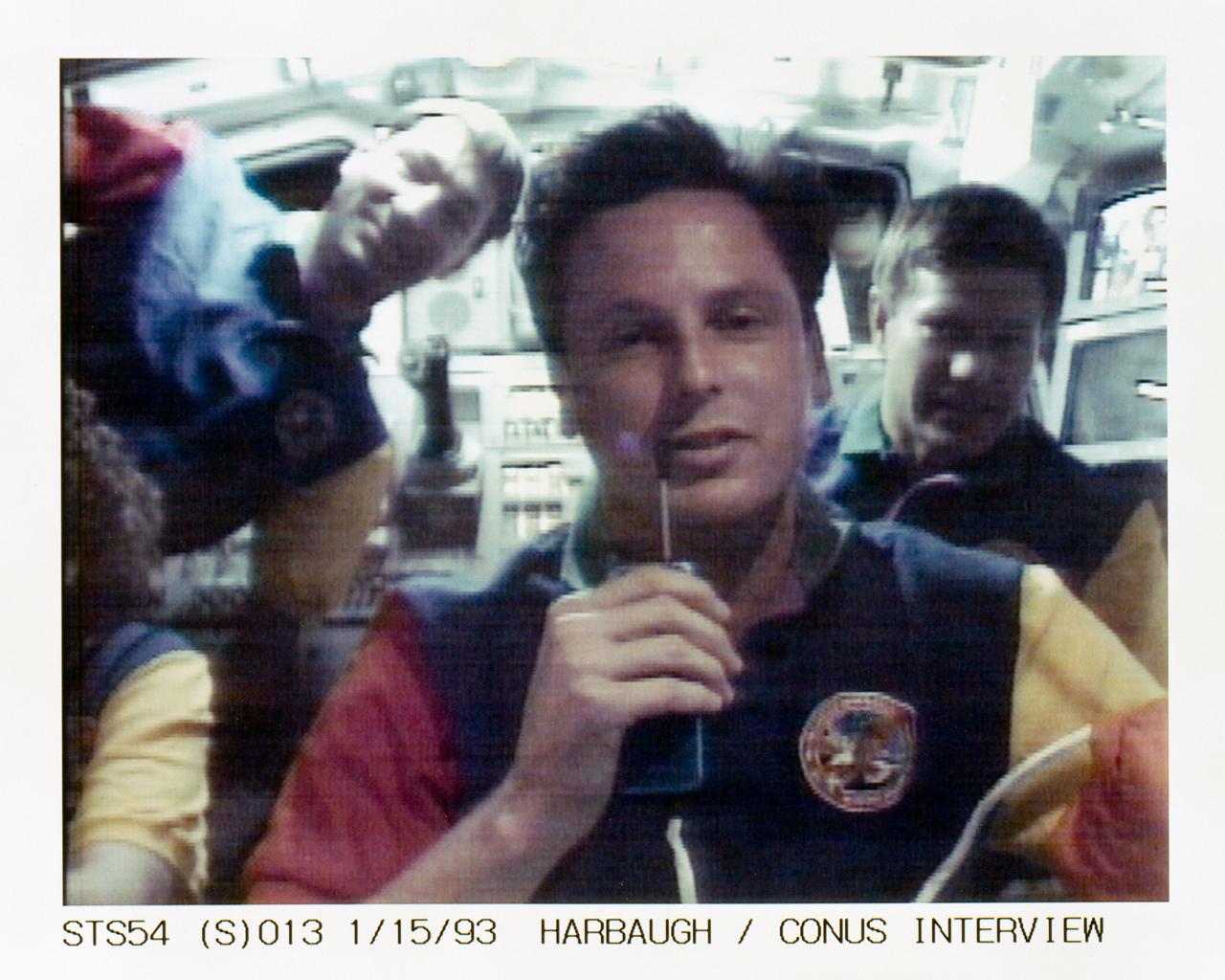
STS054-S-013 (15 Jan 1993) --- Harbaugh talks to a radio station from the flight deck of Endeavour while, in the background, several crewmates await their turns to communicate with other stations. The scene was recorded at 13:57:20:20 GMT, Jan. 15, 1993.
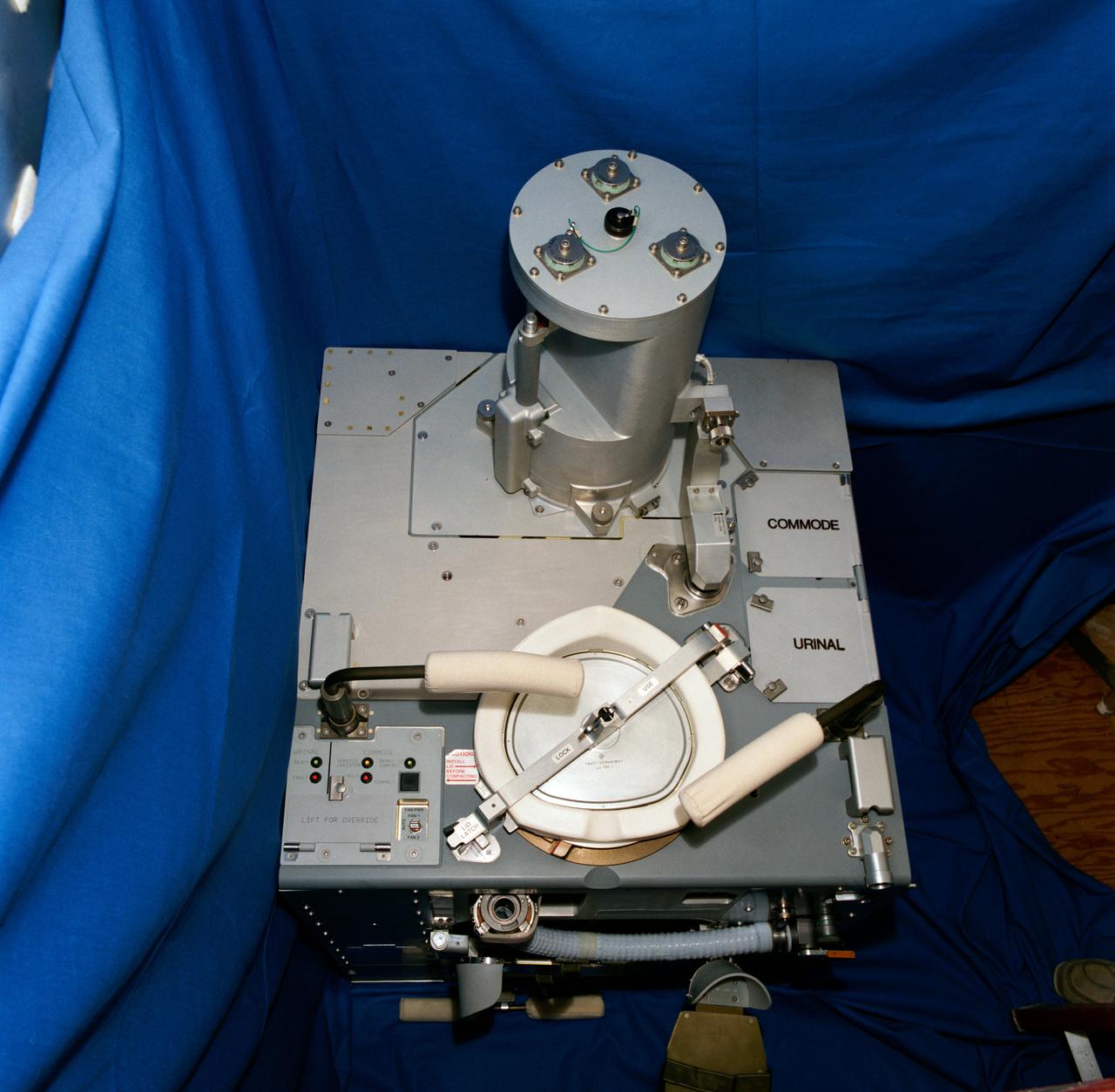
S92-46726 (November 1992) --- A high angle view of the Improved Waste Collection System (IWCS) scheduled to fly aboard NASA's Space Shuttle Endeavour for the STS-54 mission. Among the advantages the new IWCS is hoped to have over the current WCS are greater dependability, better hygiene, virtually unlimited capacity and more efficient preparation between Shuttle missions. Unlike the previous WCS, the improved version will not have to be removed from the spacecraft to be readied for the next flight.
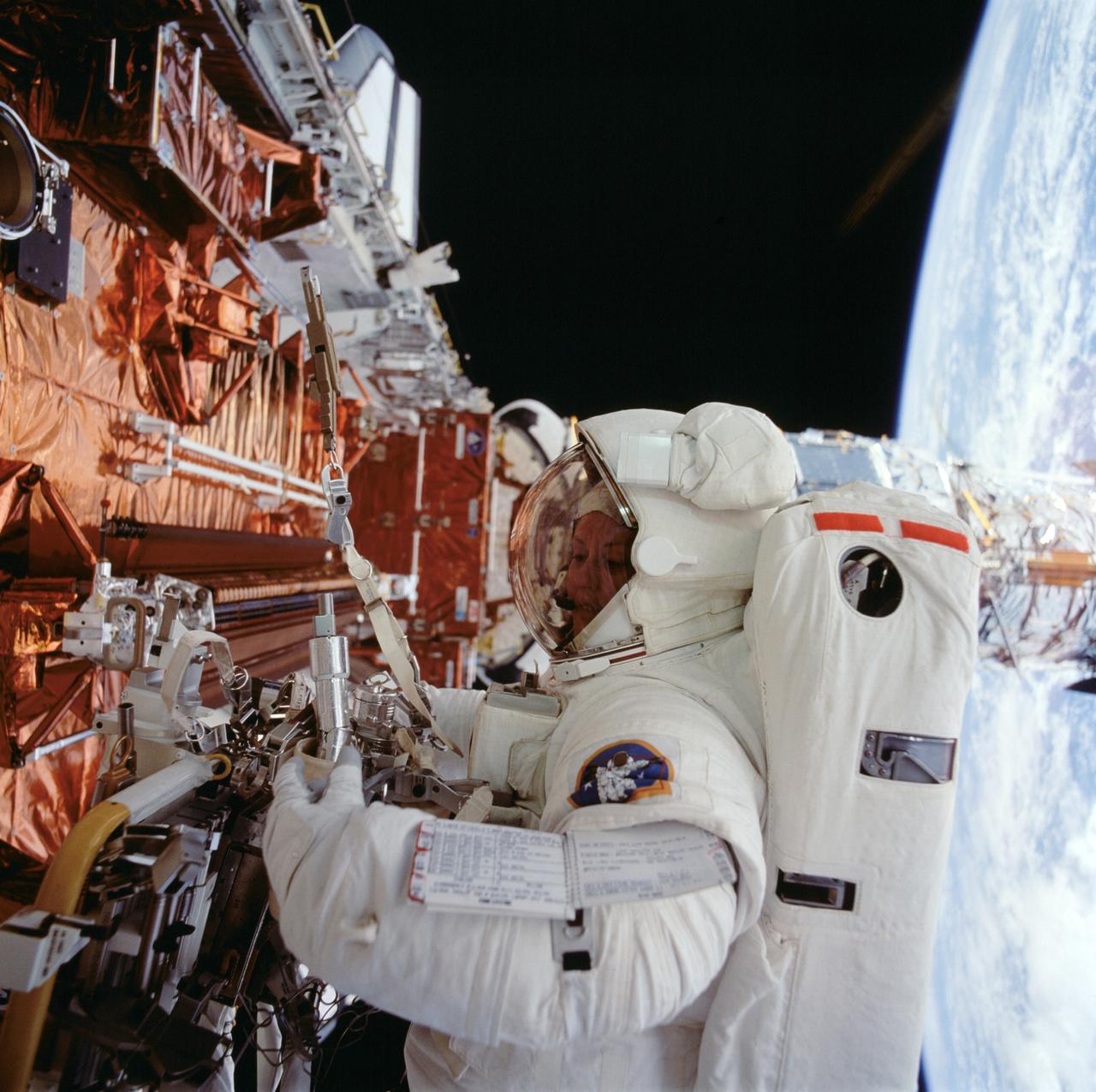
STS061-098-000K (8 Dec. 1993) --- Astronaut Kathryn C. Thornton works with equipment associated with servicing chores on the Hubble Space Telescope (HST) during the fourth extravehicular activity (EVA) on the eleven-day mission.
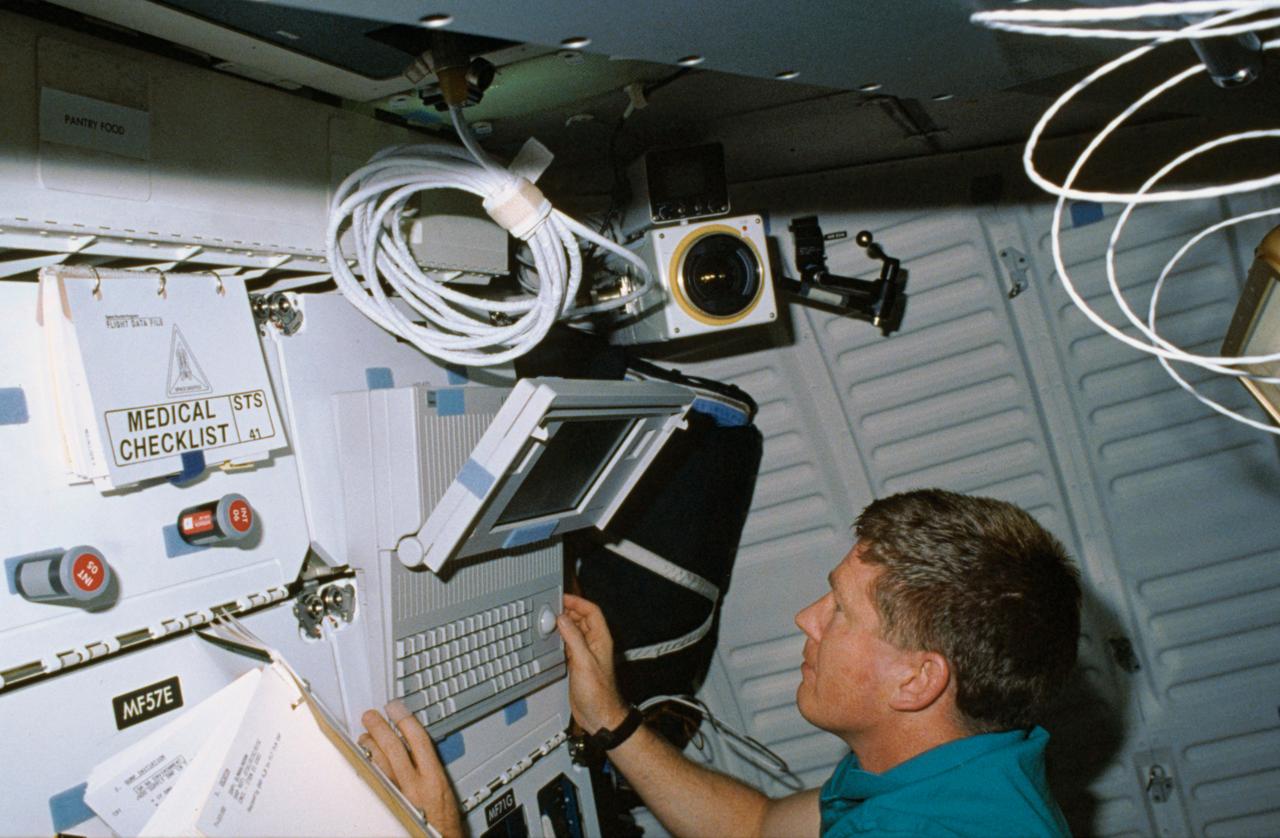
STS-41 Mission Specialist (MS) William M. Shepherd uses Detailed Test Objective (DTO) Space Station Cursor Control Device Evaluation MACINTOSH portable computer on the middeck of Discovery, Orbiter Vehicle (OV) 103. The computer is velcroed to forward lockers MF71C and MF71E. Surrounding Shepherd are checklists, the field sequential (FS) crew cabin camera, and a lighting fixture.

STS-36 Commander John O. Creighton, smiling and wearing a headset, listens to music as the tape recorder freefloats in front of him. During this lighter moment of the mission, Creighton is positioned at the commanders station on the forward flight deck of Atlantis, Orbiter Vehicle (OV) 104. Forward flight deck windows W1 and W2 appear on his left. Creighton and four other astronauts spent four days, 10 hours and 19 minutes aboard the spacecraft for the Department of Defense (DOD) devoted mission.

S92-45750 (1 Sept 1992) --- Astronaut John H. Casper, mission commander, assigned to fly aboard the Space Shuttle Endeavour for the STS-54 mission, gets in some rehearsal time at JSC's Shuttle mockup and integration facility. Part of a spacesuit is visible at lower right. Two STS-54 crewmembers will spend four-plus hours wearing extravehicular mobility units (EMU) for a planned spacewalk in a continuing evaluation program for EVA techniques and gear for Space Station Freedom.
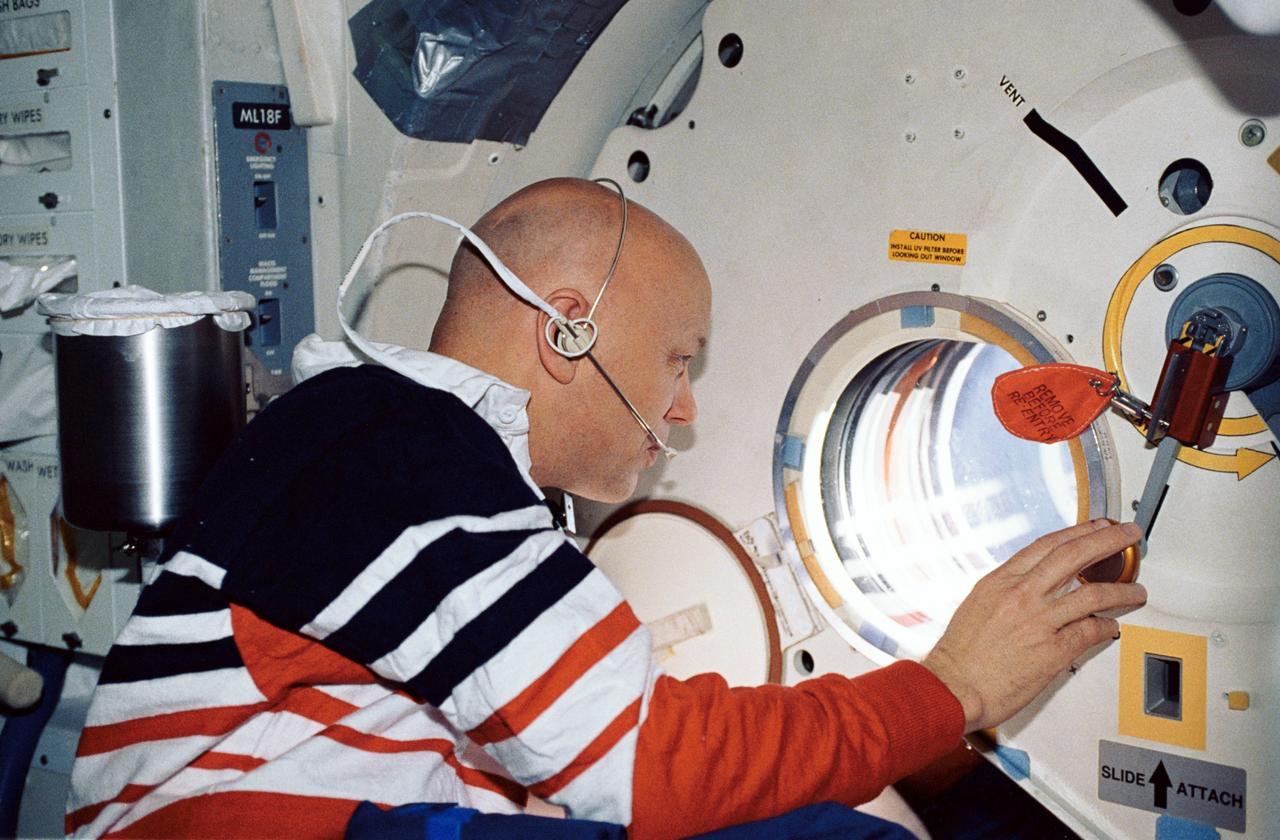
STS044-32-003 (24 Nov.-1 Dec. 1991) --- Astronaut F. Story Musgrave, STS-44 mission specialist, makes visual observations through Atlantis' hatch window. This photograph was among the first released by NASA following the eight day mission, dedicated to the Department of Defense.
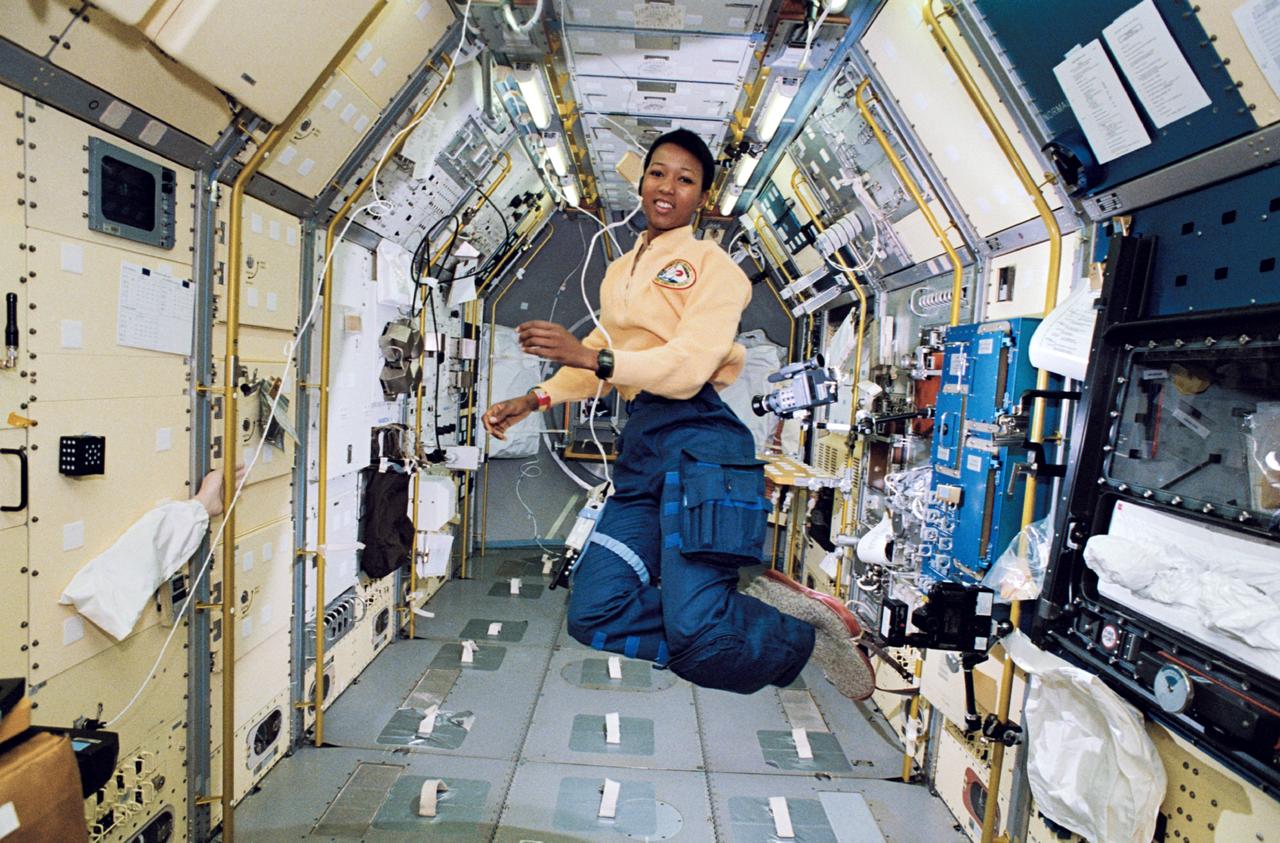
STS047-37-003 (12-20 Sept. 1992) --- Astronaut Mae C. Jemison, STS-47 mission specialist, appears to be clicking her heels in zero-gravity in this 35mm frame photographed in the Science Module aboard the Earth-orbiting Space Shuttle Endeavour. Making her first flight in space, Dr. Jemison was joined by five other NASA astronauts and a Japanese payload specialist for eight days of research in support of the Spacelab-J mission, a joint effort between Japan and the United States.
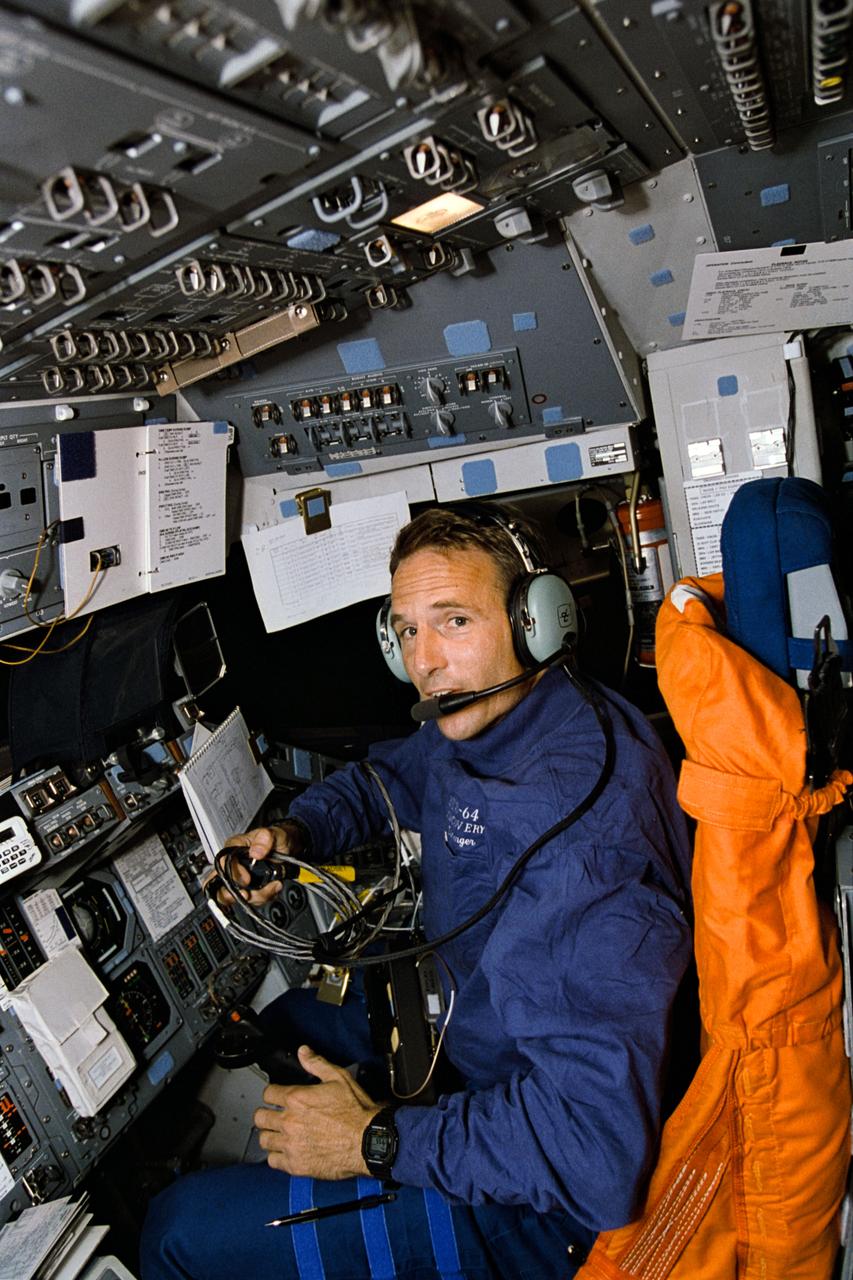
STS064-20-026 (9-20 Sept. 1994) --- Astronaut Jerry M. Linenger, STS-64 mission specialist, uses the Shuttle Amateur Radio Experiment (SAREX) to communicate with students on Earth. Various members of the crew made contact with a number of other "hams" around the world during the almost 11-day mission in Earth orbit. Photo credit: NASA or National Aeronautics and Space Administration

AS07-04-1586 (20 Oct. 1968) --- Astronaut Walter Cunningham, Apollo 7 lunar module pilot, writes with space pen as he is photographed performing flight tasks on the ninth day of the Apollo 7 mission. Note the 70mm Hasselblad camera film magazine just above Cunningham's right hand floating in the weightless (zero gravity) environment of the spacecraft.
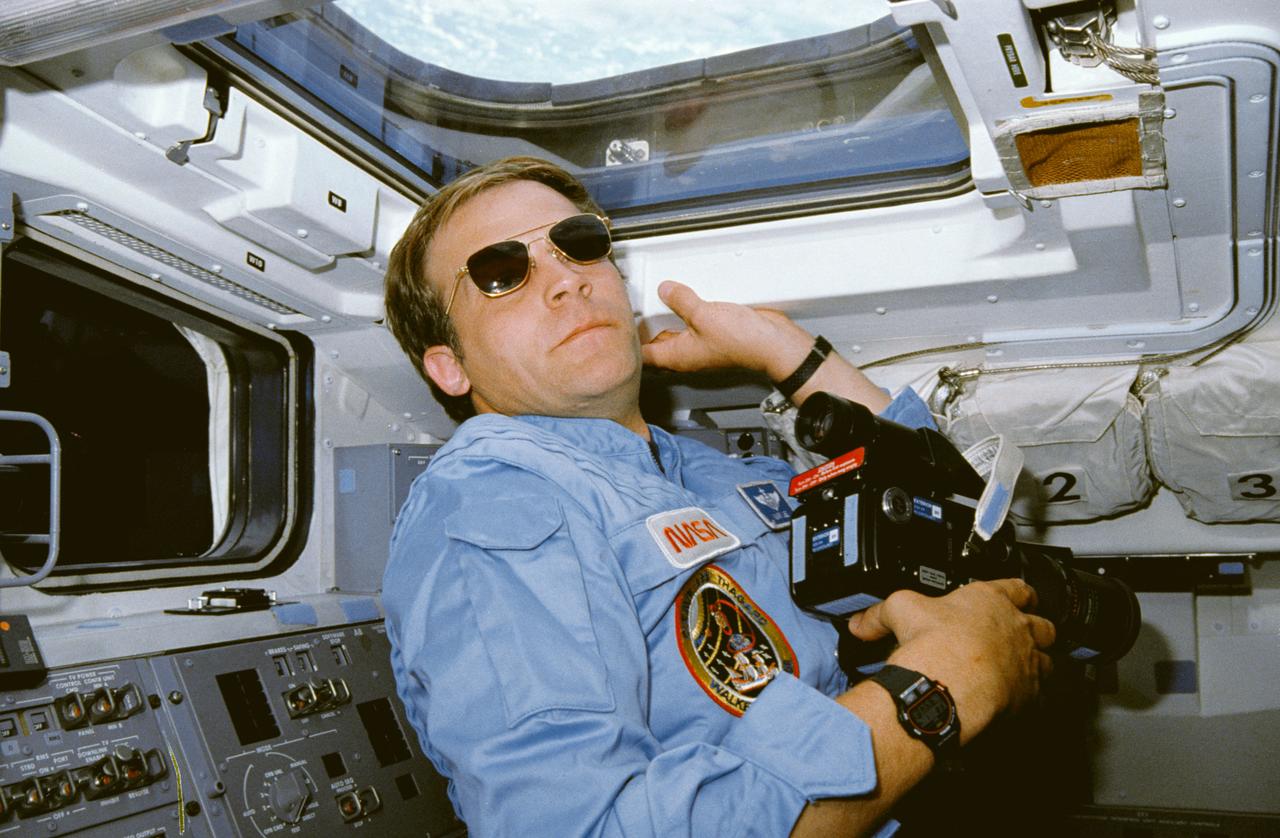
STS030-08-015 (4-8 May 1989) --- Astronaut Mark C. Lee, STS-30 mission specialist, pauses from a of Earth photography on Atlantis' aft flight deck. He holds a 70mm camera. The scene was recorded with a 35mm camera. The photo was in a group released by NASA following the completion of a four-day mission in space.
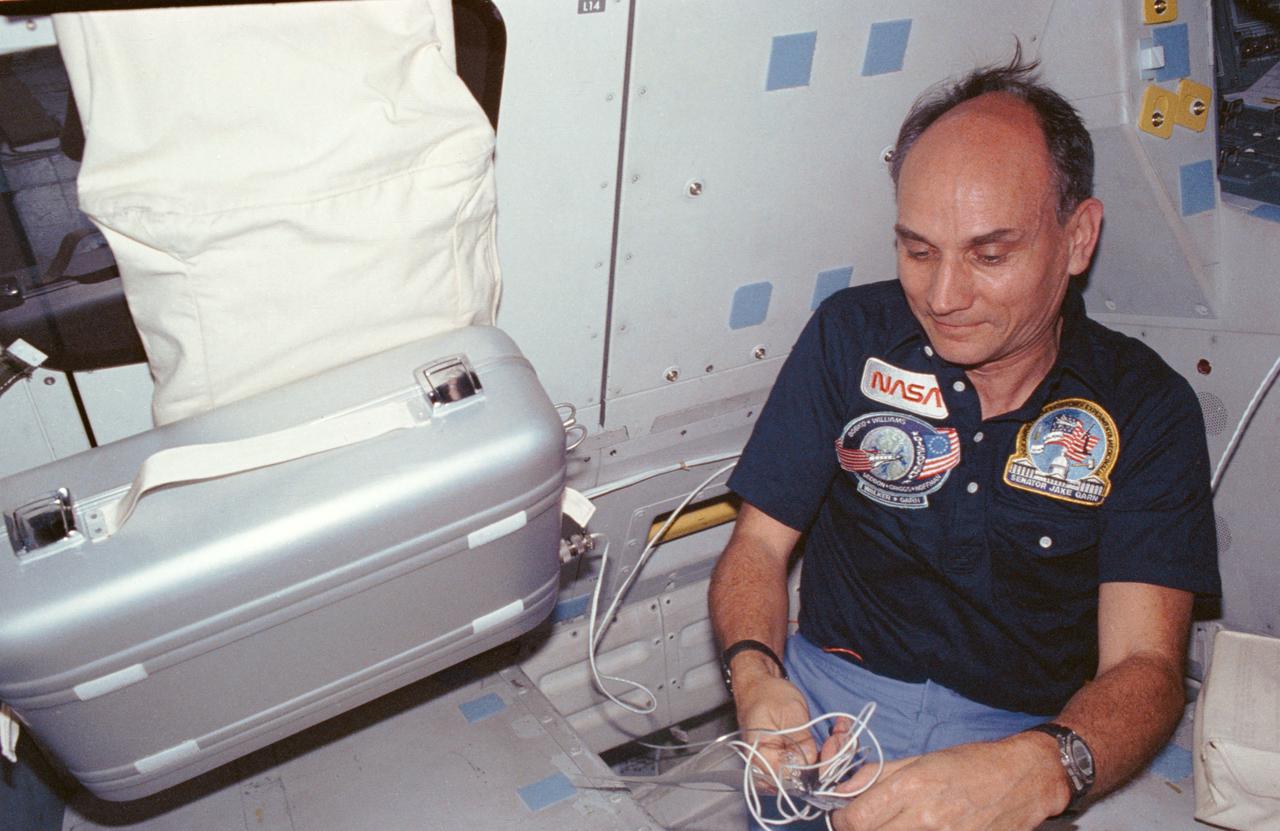
U. S. Senator E.J. (Jake) Garn, payload specialist, plugs in a food warmer in middeck area of the Shuttle Discovery.
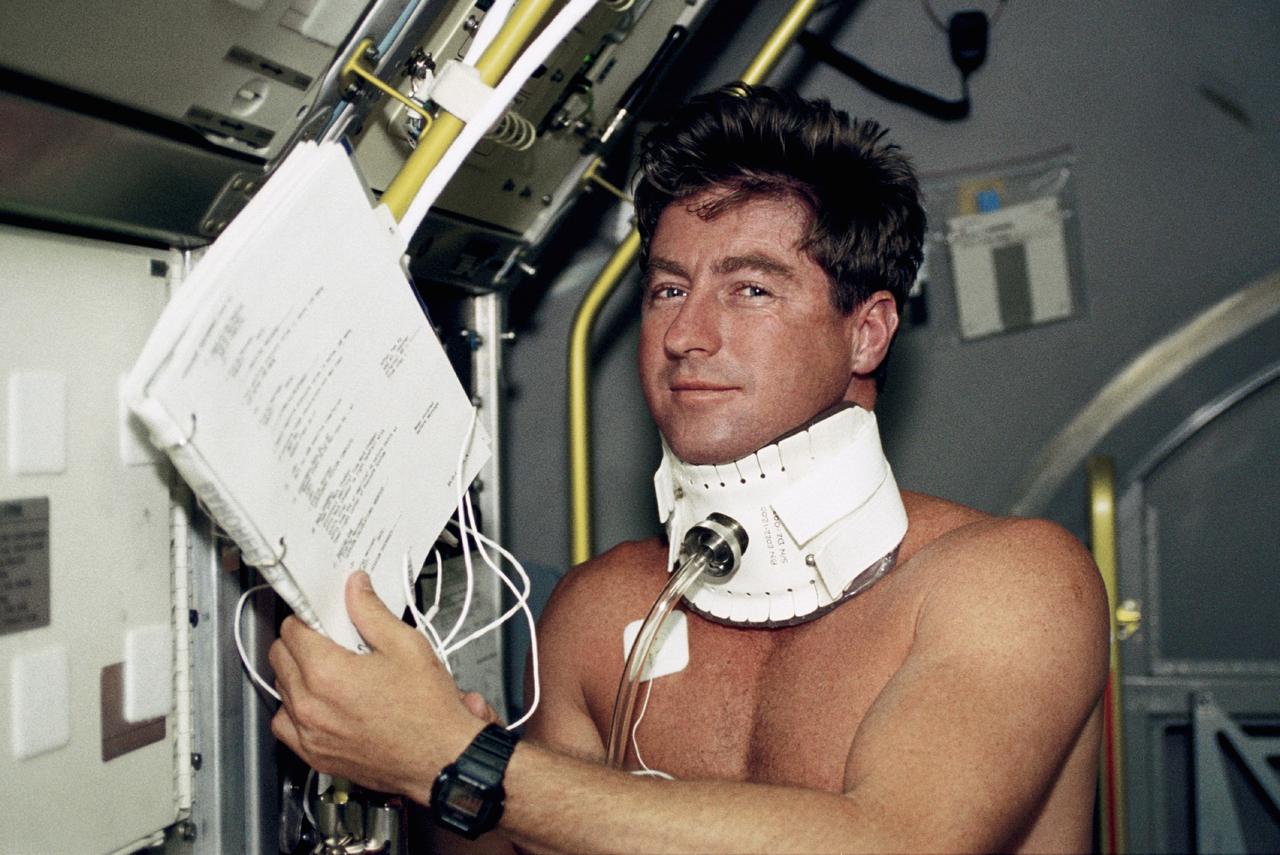
STS055-233-019 (26 April-6 May 1993) --- Terence T. (Tom) Henricks, STS-55 pilot, wears a special collar for a space adaptation experiment in the science module onboard the Earth-orbiting Space Shuttle Columbia. The Baroreflex (BA) experiment is designed to investigate the theory that light-headedness and a reduction in blood pressures upon standing after landing may arise because the normal reflex system regulating blood pressure behaves differently after having adapted to a microgravity environment. These space-based measurements of the baroreflex will be compared to ground measurements to determine if microgravity affects the reflex.
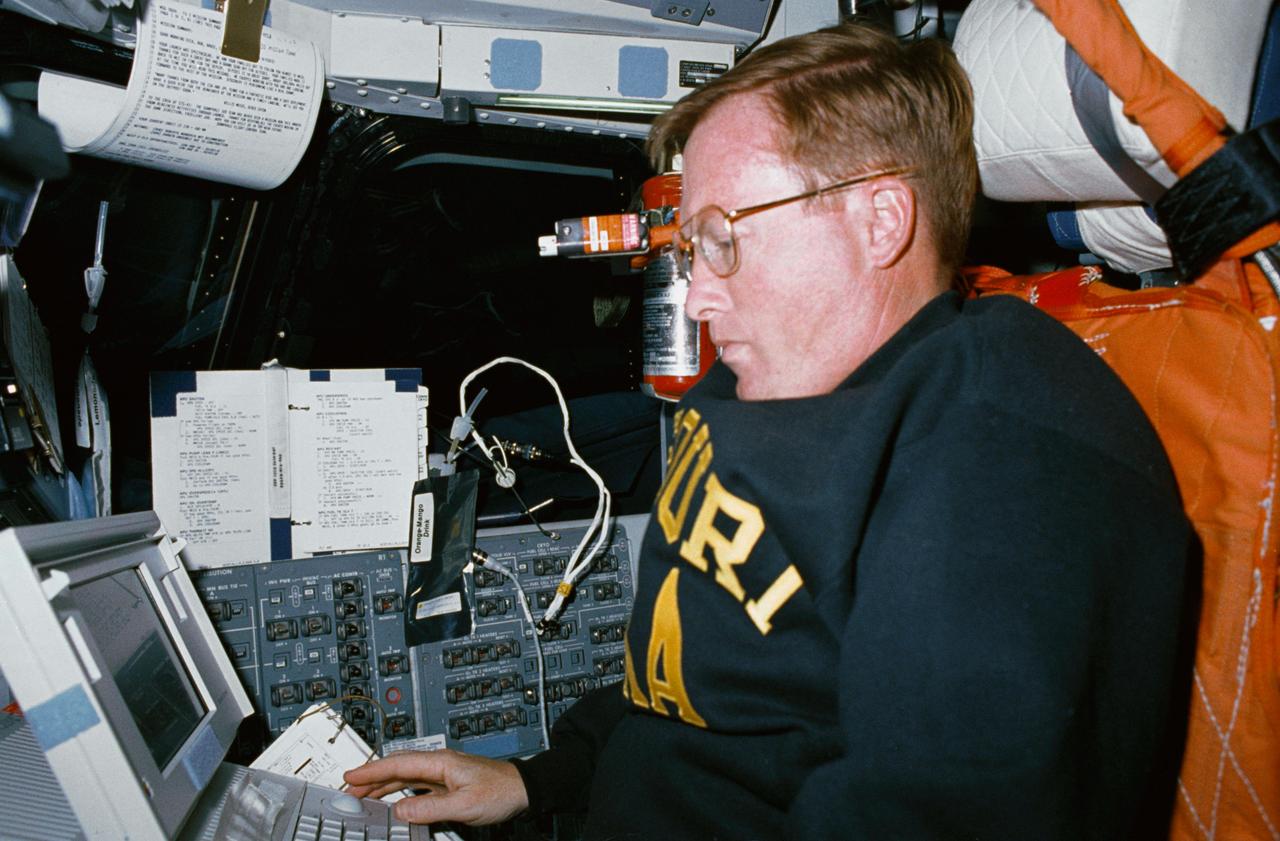
STS041-01-002 (6-10 Oct 1990) --- Astronaut Richard N. Richards, STS 41 mission commander, "borrows" the pilot's station to utilize a Shuttle portable onboard computer during the four-day flight. The photo was made with a 35mm camera.
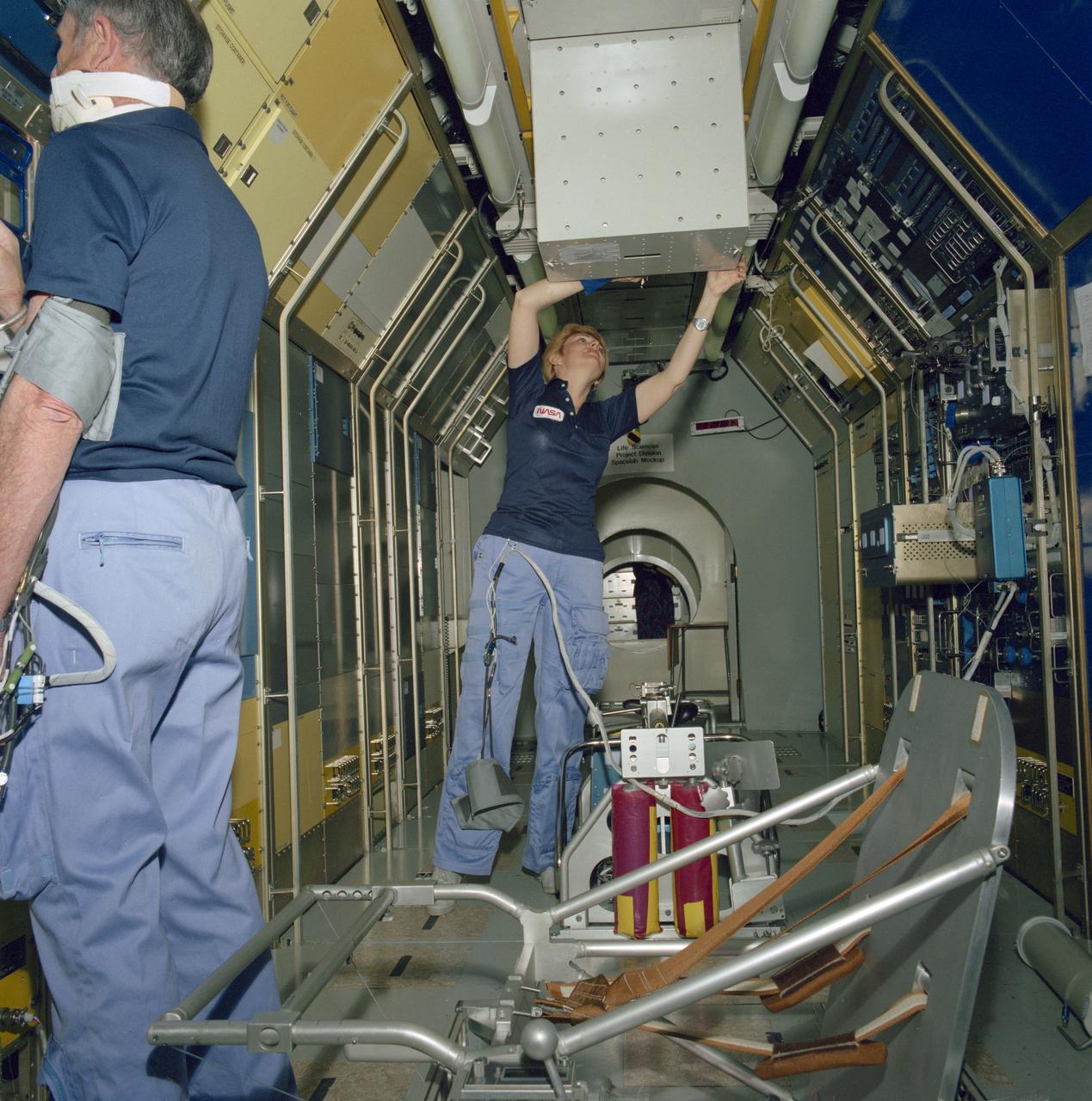
STS-40 Payload Specialist Millie Hughes-Fulford along with backup payload specialist Robert Ward Phillips familiarize themselves with Spacelab Life Sciences 1 (SLS-1) equipment. The two scientists are in JSC's Life Sciences Project Division (LSPD) SLS mockup located in the Bioengineering and Test Support Facility Bldg 36. Hughes-Fulford, in the center aisle, pulls equipment from an overhead stowage locker while Phillips, in the foreground, experiments with the baroreflex neck pressure chamber at Rack 11. The baroreflex collar will be used in conjuction with Experiment No. 022, Influence of Weightlessness Upon Human Autonomic Cardiovascular Control. Behind Phillips in the center aisle are body mass measurement device (BMMD) (foreground) and the stowed bicycle ergometer.
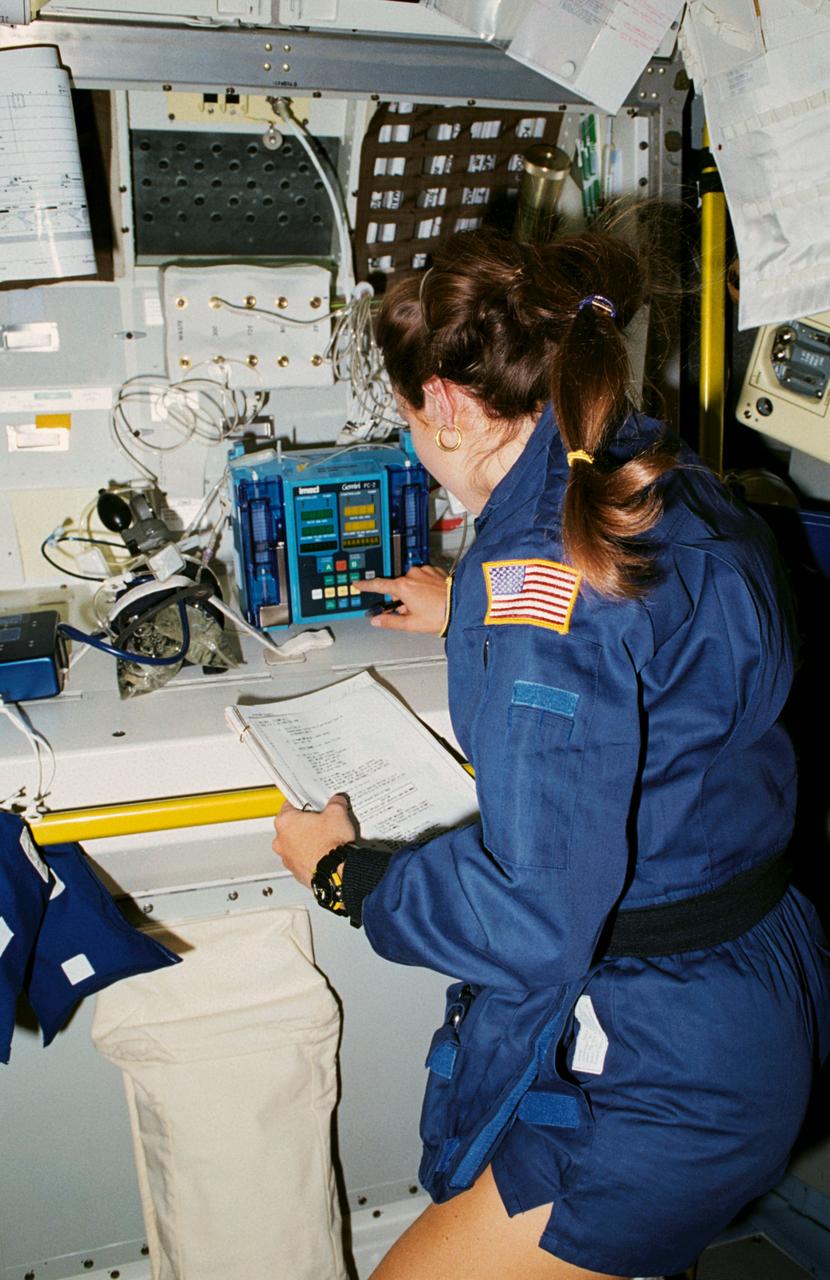
STS040-30-008 (5-14 June 1991) --- Astronaut Tamara E. Jernigan, after applying a blood pressure cuff to an experiment, watches it in operation. The experiment is the intravenous infusion pump. The device is being considered for use on Space Station Freedom's Health Maintenance Facility. Dr. Jernigan is one of seven crew members supporting the nine-day Spacelab Life Sciences (SLS-1) mission aboard the Earth-orbiting Space Shuttle Columbia.
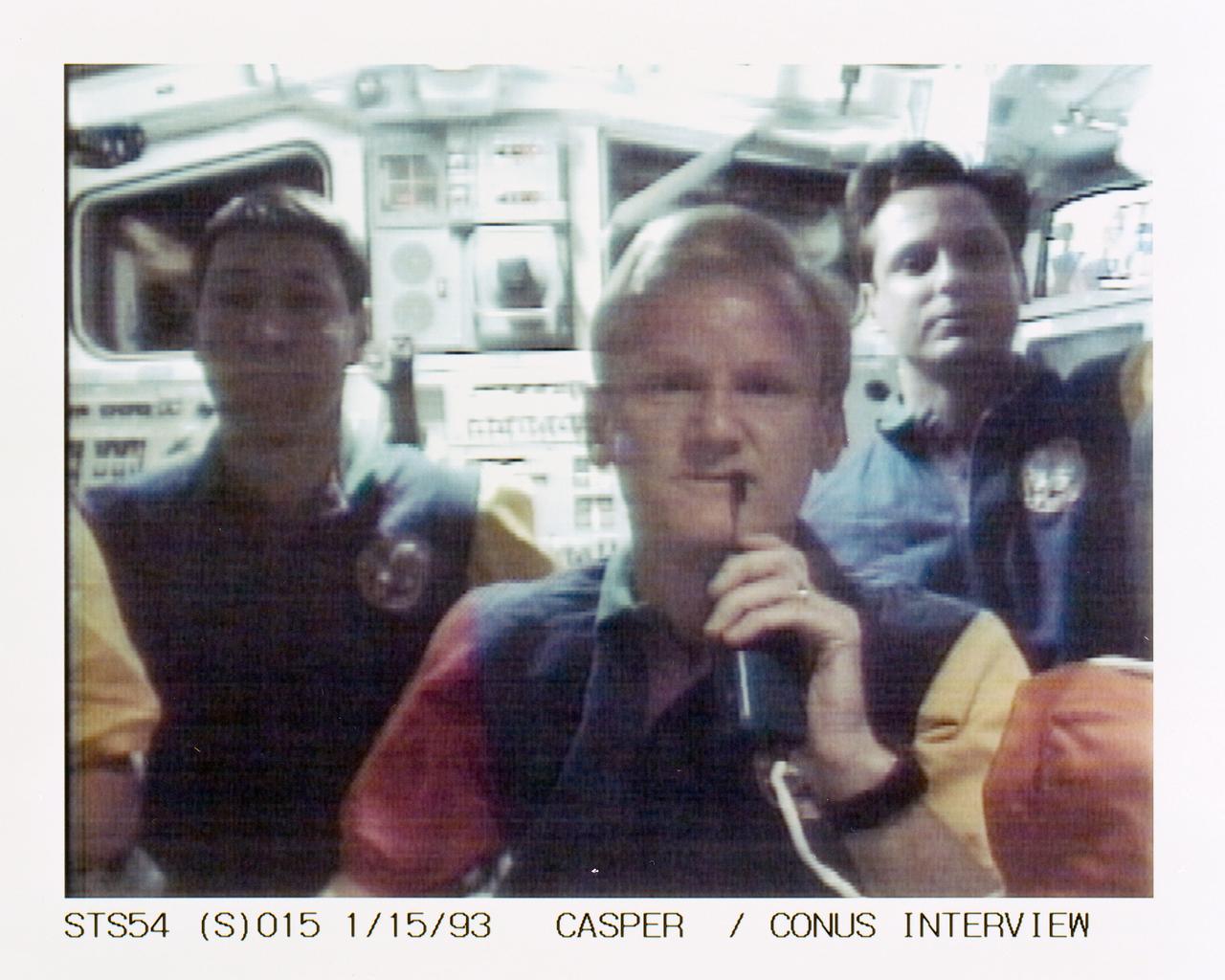
STS054-S-015 (15 Jan 1993) --- Casper talks to a radio station from the flight deck of Endeavour while, in the background, Runco, left, and Harbaugh await their turns to communicate with other stations. The scene was recorded at 13:45:54:05 GMT, Jan. 15, 1993.
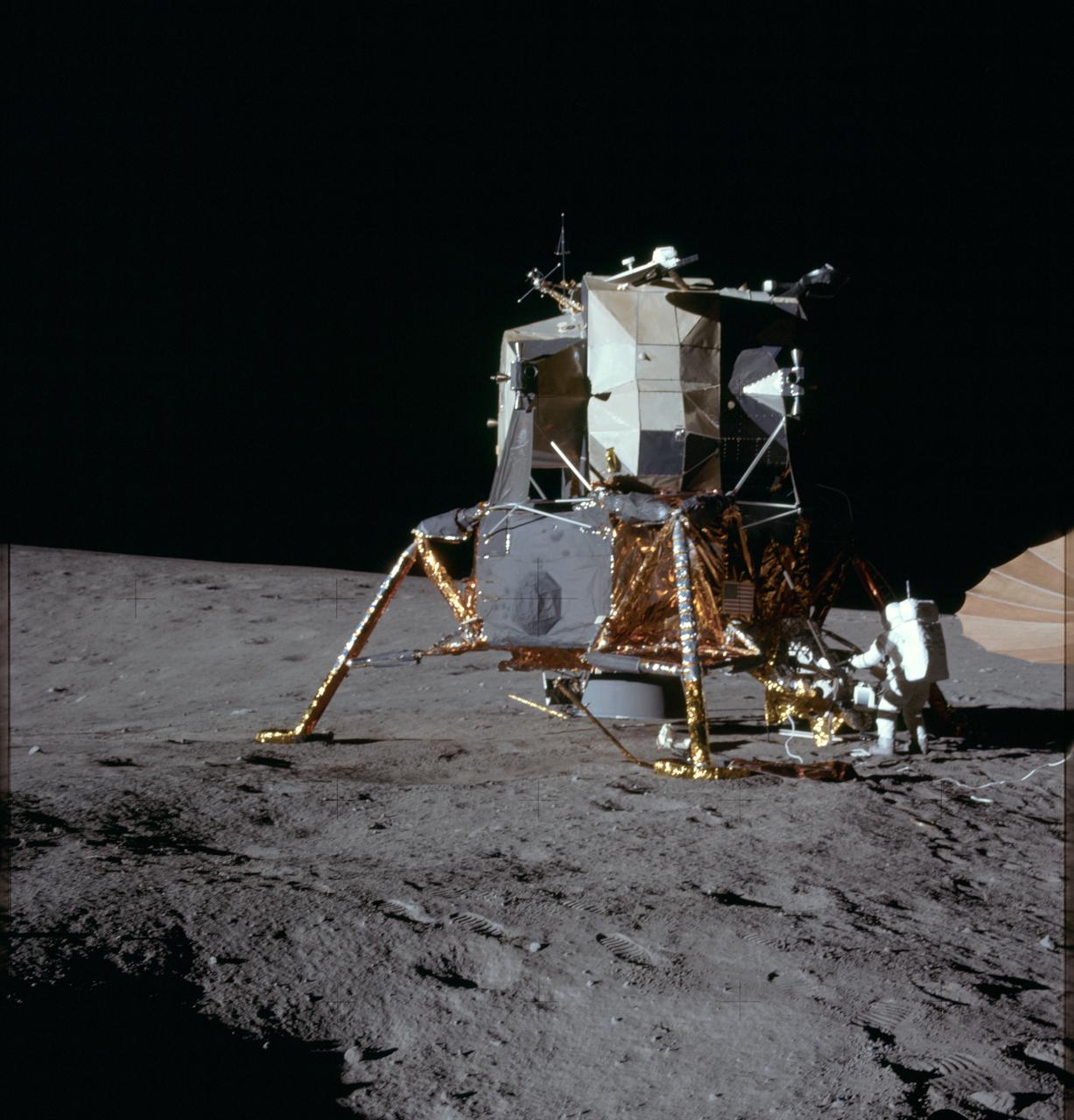
AS12-46-6749 (19 Nov. 1969) --- Astronaut Alan L. Bean, lunar module pilot for the Apollo 12 lunar landing mission, works at the Modular Equipment Stowage Assembly (MESA) on the Apollo 12 Lunar Module (LM) during the mission's first extravehicular activity, (EVA) on Nov. 19, 1969. Astronaut Charles Conrad Jr., commander, and Bean descended in the Apollo 12 LM to explore the moon while astronaut Richard F. Gordon Jr., command module pilot, remained with the Command and Service Modules (CSM) in lunar orbit.
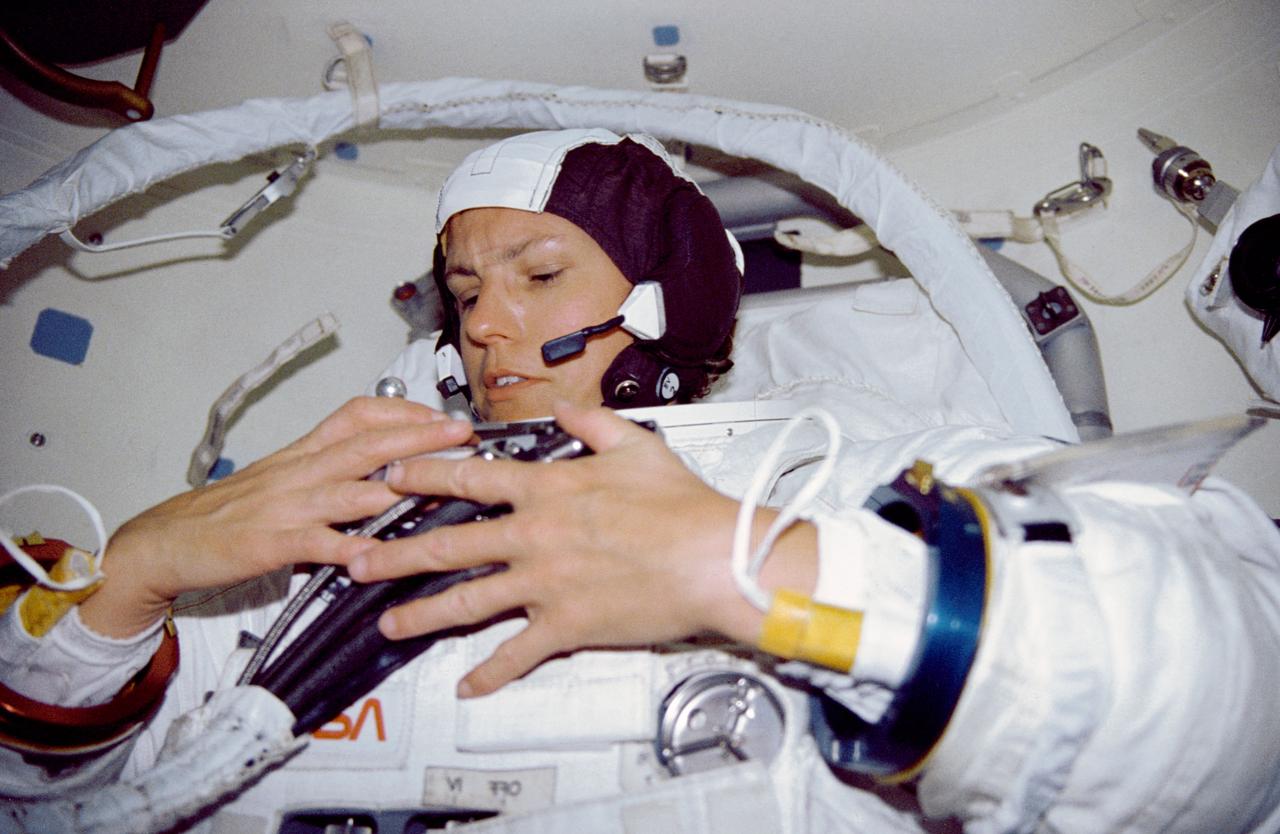
STS-31 Mission Specialist (MS) Kathryn D. Sullivan, wearing extravehicular mobility unit (EMU) & communications carrier assembly (CCA), attaches service and cooling umbilical (SCU) to the EMU connection on the display & control module (DCM) during contingency extravehicular activity (EVA) preparations in the airlock of Discovery, Orbiter Vehicle (OV) 103. The procedure was completed in case an EVA was required to support Hubble Space Telescope (HST) deployment.
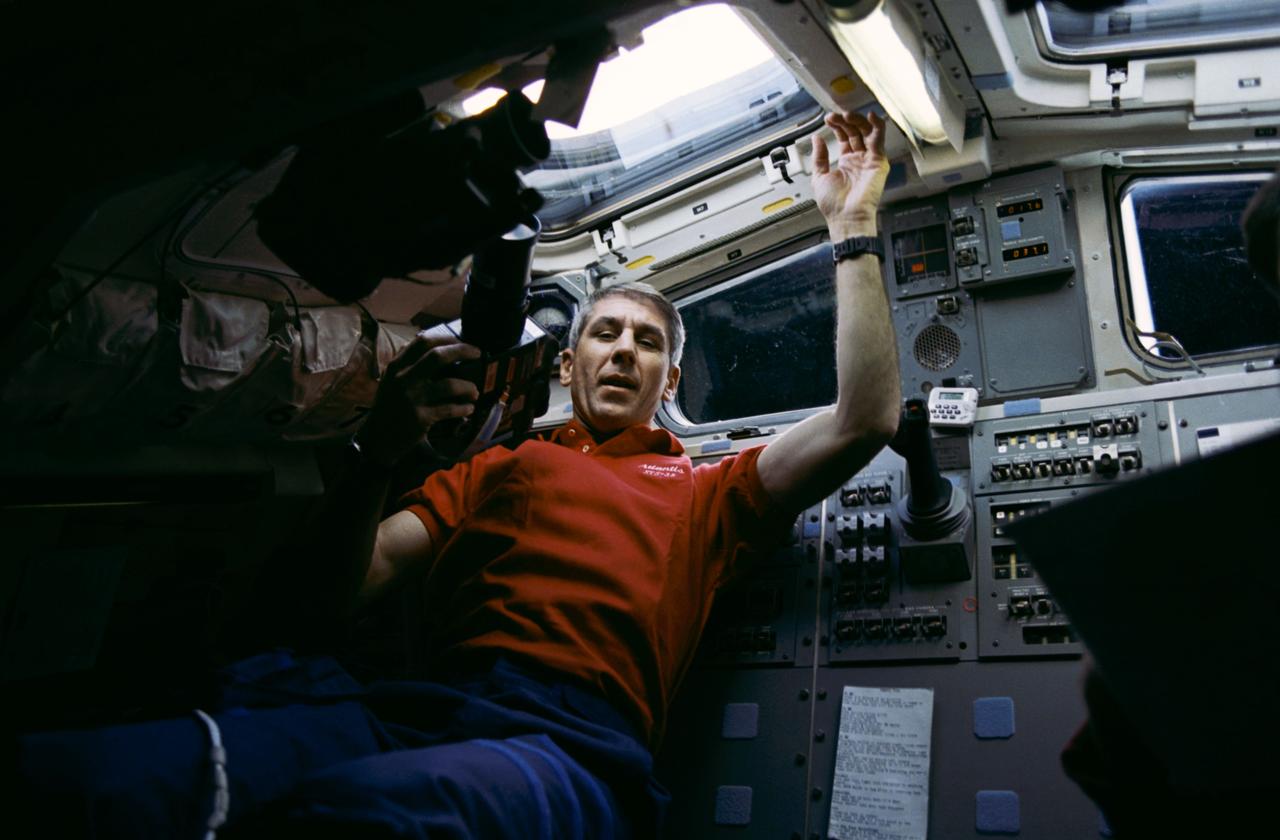
STS038-25-005 (20 Nov 1990) --- STS-38 Mission Specialist (MS) Robert C. Springer, holding HASSELBLAD camera, positions himself under aft flight deck overhead window W7 before recording the Earth's surface below. Behind Springer are Atlantis', Orbiter Vehicle (OV) 104's, on orbit station and aft flight deck viewing windows.
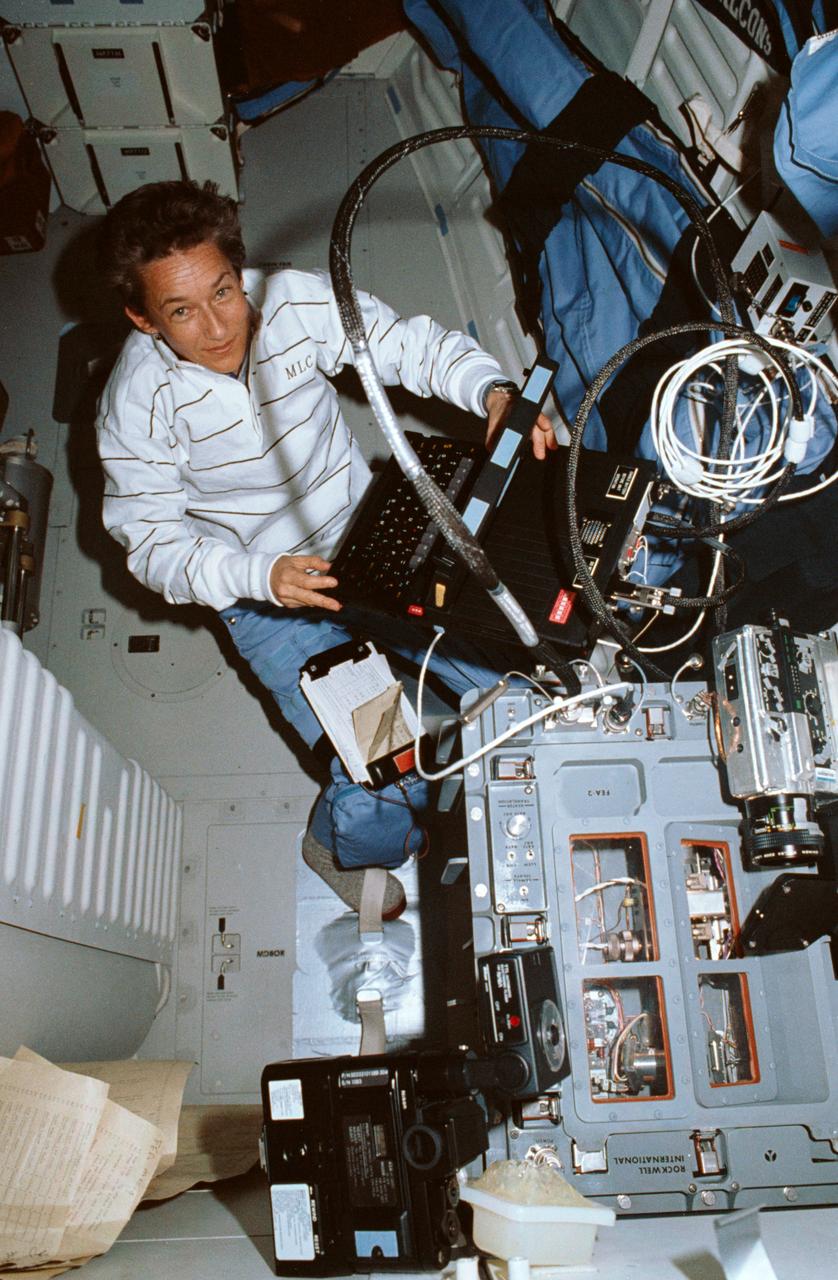
STS030-02-018 (4-8 May 1989) --- A 35mm overall scene of the operations devoted to the fluids experiment apparatus (FEA) aboard Atlantis for NASA’s STS-30 mission. Astronaut Mary L. Cleave, mission specialist, is seen with the computer which is instrumental in the carrying out of a variety of materials science experiments. Rockwell International is engaged in a joint endeavor agreement with NASA’s Office of Commercial Programs in the field of floating zone crystal growth and purification research. The March 1987 agreement provides for microgravity experiments to be performed in the company’s Microgravity Laboratory, the FEA. An 8 mm camcorder which documented details inside the apparatus is visible at bottom of the frame.
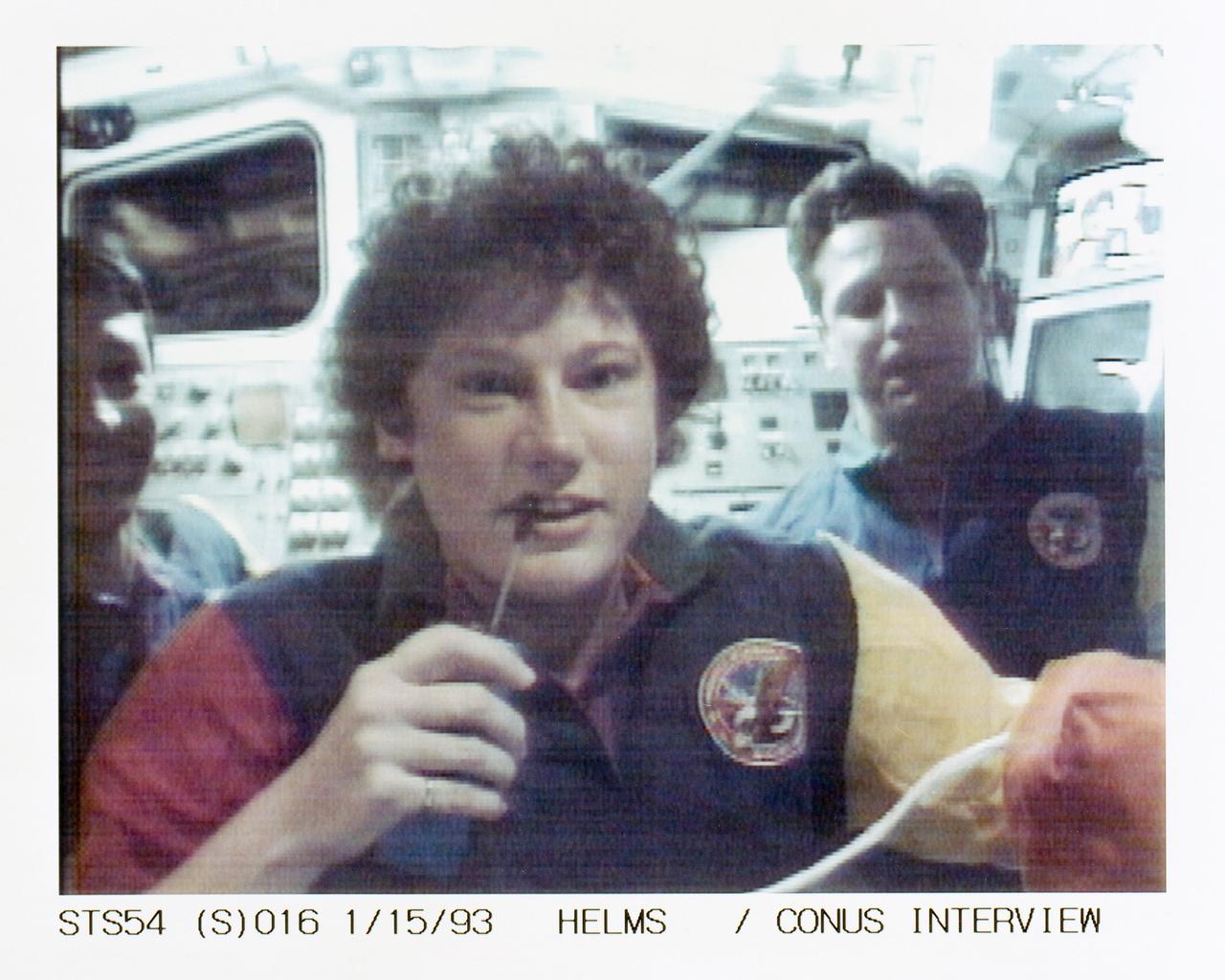
STS054-S-016 (15 Jan 1993) --- Helms talks to a radio station from the flight deck of Endeavour while Runco, left, and Harbaugh look on in the background. The scene was recorded at 13:54:14:13 GMT, Jan. 15, 1993.