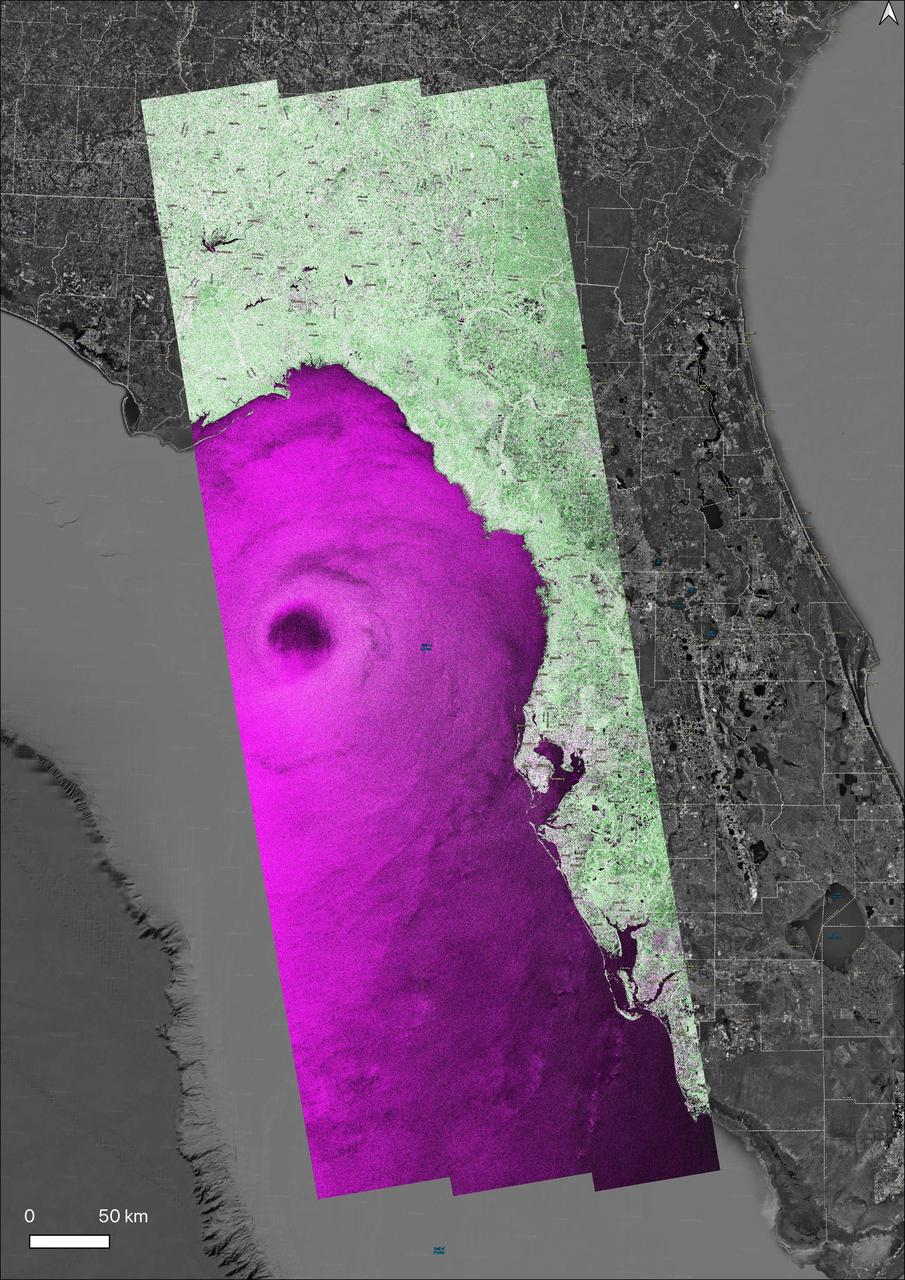
NASA's Observational Products for End-Users from Remote Sensing Analysis (OPERA) project generated a radar image of Hurricane Helene on Friday, Sept. 26, 2024, at 7:38 p.m. local time, as the storm approached the Florida coast. One of the largest storms to develop in the Gulf of Mexico in the last century, Helene made landfall as a Category 4 hurricane in the Big Bend area of Florida at about 11:10 p.m. The data shown in the image is from the synthetic aperture radar (SAR) instrument on the Copernicus Sentinel-1A satellite, operated by the European Space Agency (ESA), and processed by OPERA into a data product called OPERA RTC-S1. The OPERA RTC-S1 image was converted to a false color image. In this color scale, vegetated areas appear green, urban areas appear white/pink, calm water appears black, and rough water appears purple or magenta. The eye of the hurricane can be clearly seen as a large dark patch in the Gulf of Mexico. The OPERA RTC-S1 image was superimposed on a Google Earth satellite background shown in grayscale and the ESRI Boundaries Places layer. https://photojournal.jpl.nasa.gov/catalog/PIA26414
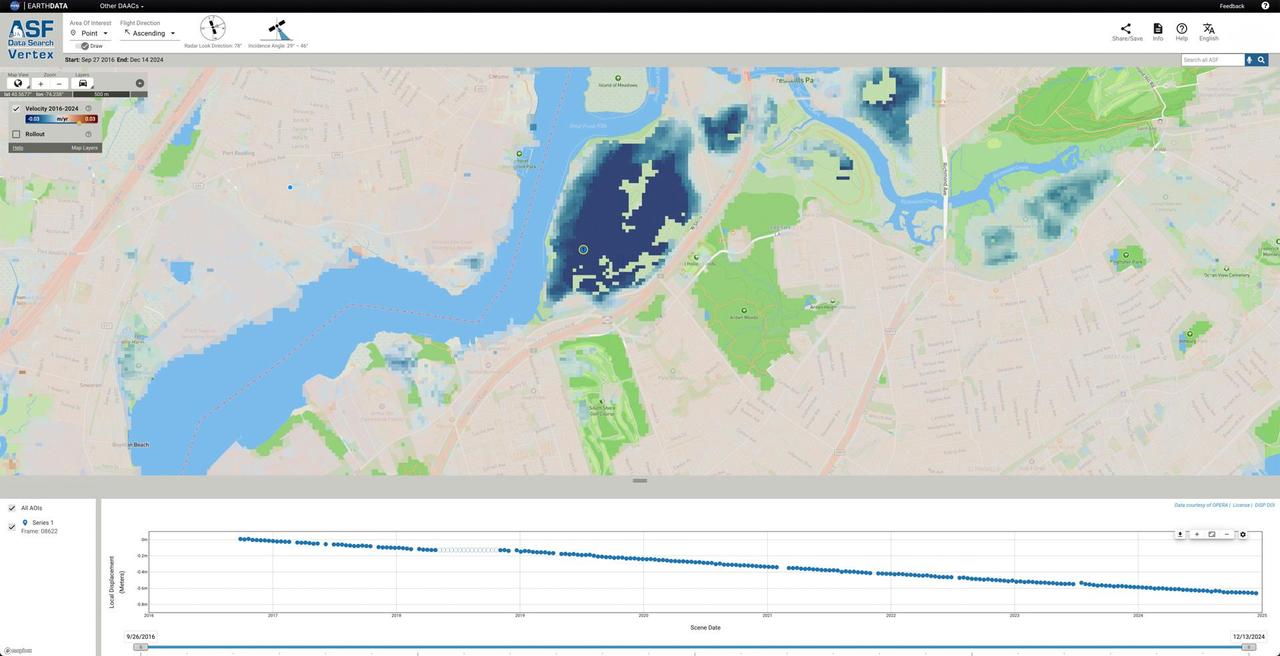
NASA, along with the agency's Jet Propulsion Laboratory in Southern California, is collaborating with the Alaska Satellite Facility in Fairbanks to create a powerful web-based tool that will show the movement of land across North America down to less than an inch. The online portal and its underlying dataset unlock a trove of satellite radar measurements that can help anyone identify where and by how much the land beneath their feet may be moving – whether from earthquakes, volcanoes, landslides, or the extraction of underground natural resources such as groundwater. Spearheaded by NASA's Observational Products for End-Users from Remote Sensing Analysis, or OPERA, project at JPL, the effort equips users with information that would otherwise take years of training to harness. The project builds on data from spaceborne synthetic aperture radars, or SARs, to generate high-resolution data on how Earth's surface is moving. Formally called the North America Surface Displacement Product Suite, the new dataset dates to 2016. By the end of 2025, the data will cover the entire United States, Central America, and Canada within 120 miles (200 kilometers) of the U.S. border. The image shows how the portal visualizes land sinking over time in Freshkills Park, which is being built on a former landfill on Staten Island, New York. Landfills tend to sink over time as waste decomposes, compacts, and settles under its own weight. The blue dot marks the point on the land where the portal is displaying movement in the accompanying scatterplot. https://photojournal.jpl.nasa.gov/catalog/PIA26494
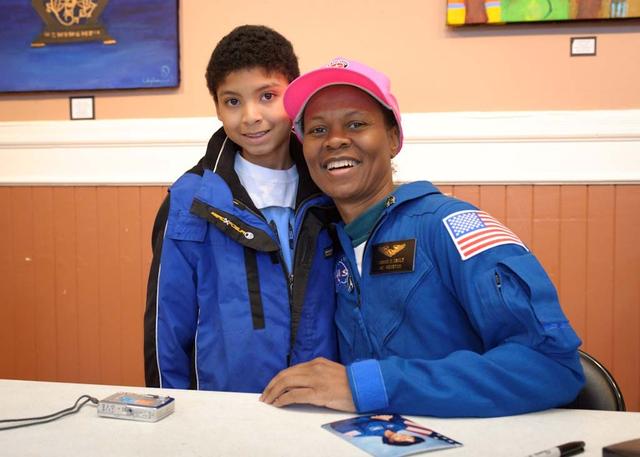
10th Anniversary of Reachout for the Rainbow after School Science Festival highlighting NASA Ames and the Traveling Space Museum exhibits and activities at the South San Francisco Bayview Opera House. NASA Astronaut Yvonne Cagle signing autographs after speaking at event, shown here with Stephen Horsley. photo release on file

Opera singer Denyce Graves sings during the "Salute to Apollo" ceremony at the Kennedy Center for the Performing Arts, Saturday, July 18, 2009 in Washington. The event was part of NASA's week long celebration of the Apollo 40th Anniversary. Photo Credit: (NASA/Bill Ingalls)
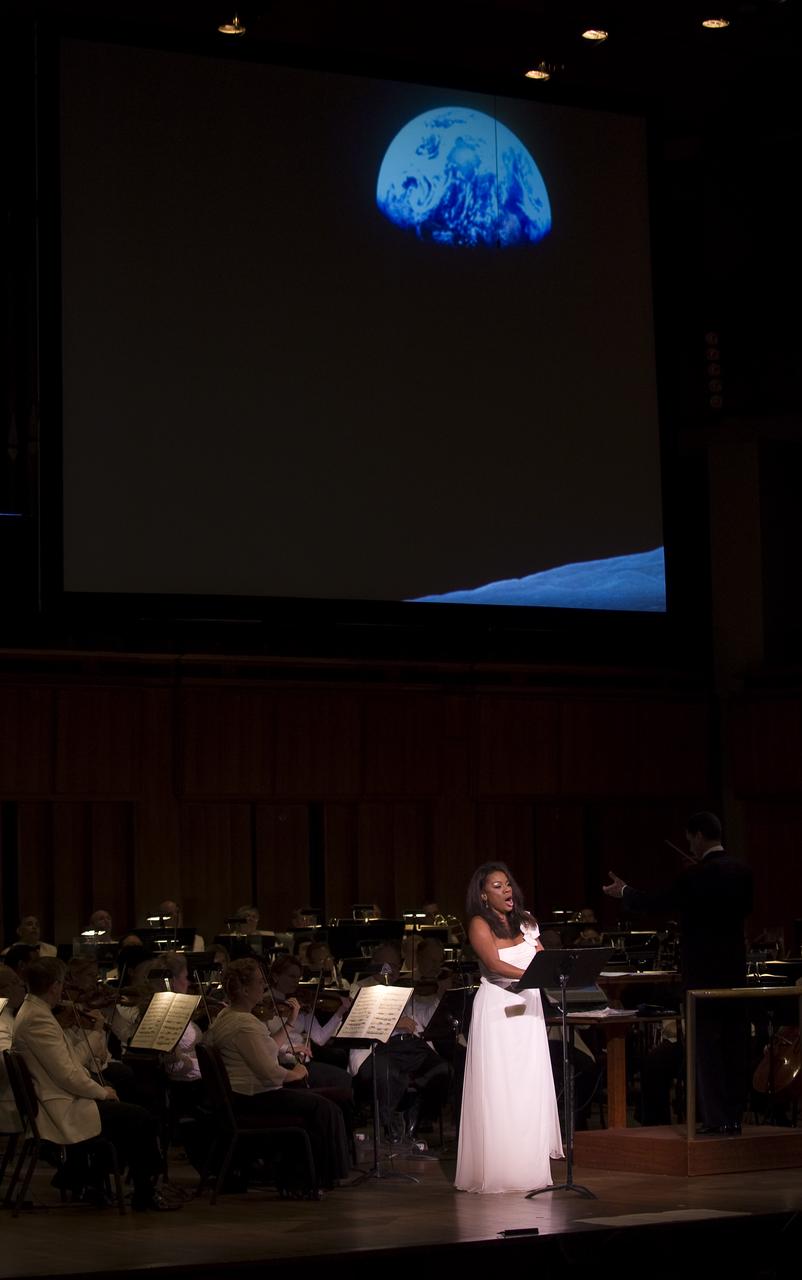
Opera singer Denyce Graves sings during the "Salute to Apollo" ceremony at the Kennedy Center for the Performing Arts, Saturday, July 18, 2009 in Washington. The event was part of NASA's week long celebration of the Apollo 40th Anniversary. Photo Credit: (NASA/Bill Ingalls)
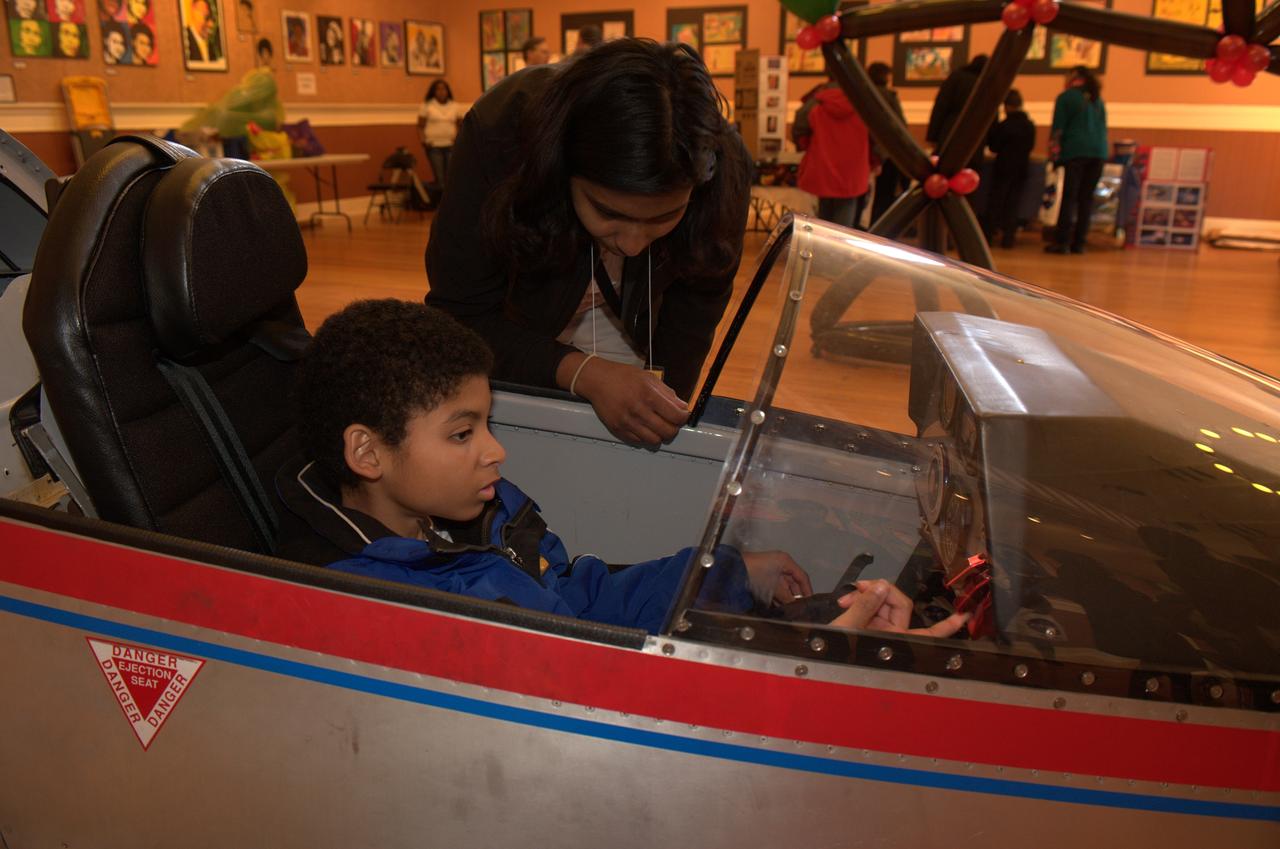
10th Anniversary of Reachout for the Rainbow after School Science Festival highlighting NASA Ames and the Traveling Space Museum exhibits and activities at the South San Francisco Bayview Opera House. Stephen Horsley gets a close up look at the cockpit of one the models provided by the Traveling Space Museum (TCS). photo release on file

Emil de Cou, Conductor of the National Symphony Orchestra, applauds after Opera singer Denyce Graves' perfomance during the "Salute to Apollo" ceremony at the Kennedy Center for the Performing Arts, Saturday, July 18, 2009 in Washington. The event was part of NASA's week long celebration of the Apollo 40th Anniversary. Photo Credit: (NASA/Bill Ingalls)
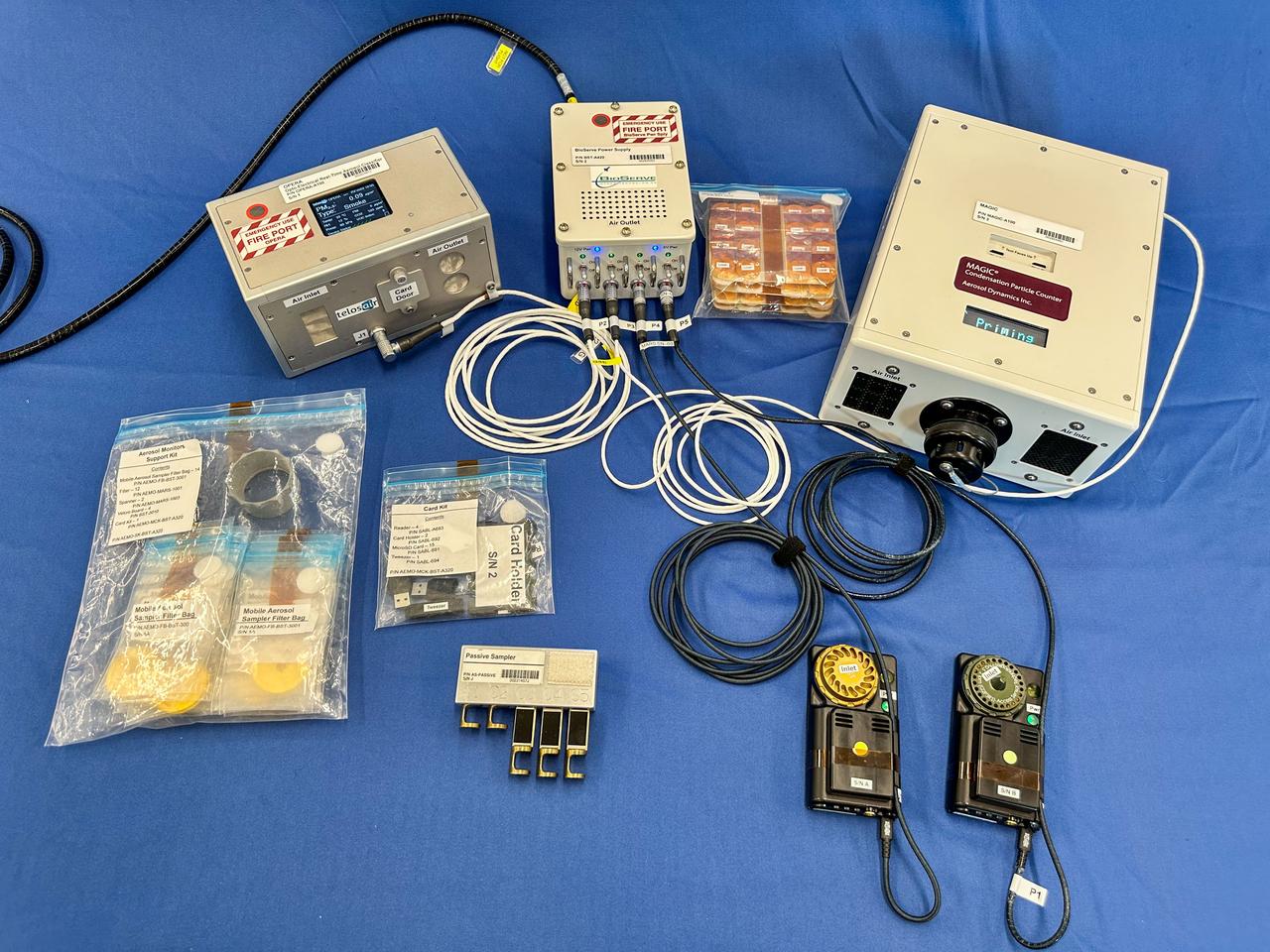
jsc2025e036188 (2/3/2025) --- A preflight image of the Exploration Aerosol Monitors (ExAM) hardware which includes the Moderated Aerosol Growth with Internal water Cycling (MAGIC) particle counter, the OPto-electrical Realtime Aerosol classifier (OPERA), the Mobile Aerosol Reference Samplers (MARS). Aerosol Monitors demonstrates technologies to continuously monitor the concentration of airborne pollutant particles, which must be kept within safe ranges, inside the International Space Station. Image courtesy of BioServe.
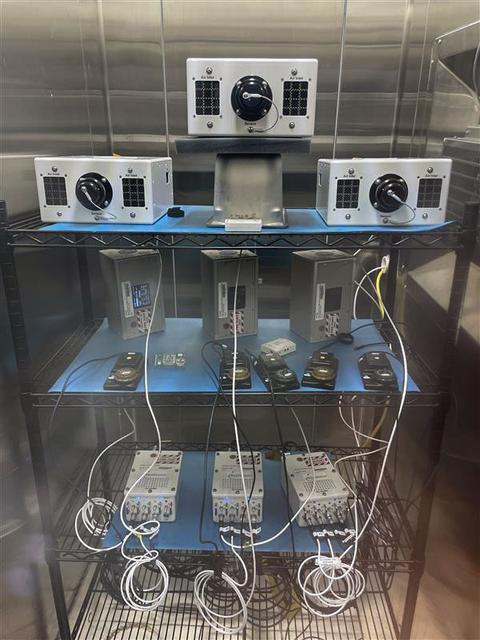
jsc2025e036187 (4/4/2025) --- The Exploration Aerosol Monitors (ExAM) hardware in BioServe Space Technologies’ environmental chamber: the Moderated Aerosol Growth with Internal water Cycling (MAGIC) particle counter (x3; top), the OPto-electrical Realtime Aerosol classifier (OPERA, x3; middle, back), the Mobile Aerosol Reference Samplers (MARS, x5; middle, front); power supplies (bottom). Aerosol Monitors demonstrates technologies to continuously monitor the concentration of airborne pollutant particles, which must be kept within safe ranges, inside the International Space Station.