
S83-35782 (18 June 1983) --- An Orbital Maneuvering System (OMS) engine firing caused this bright glow at the aft end of the Earth-orbiting space shuttle Challenger on June 18, 1983. Also visible in the 70mm exposure are parts of the Shuttle Pallet Satellite (SPAS-01). The experiment package for NASA's Office of Space and Terrestrial Applications (OSTA-2), the protective cradles for the Indonesian Palapa-B and Telesat Canada Anik C2 satellites, some getaway special (GAS) canisters and the Canadian-built Remote Manipulator System (RMS). The firing took place less than an hour after deployment of Anik. Photo credit: NASA
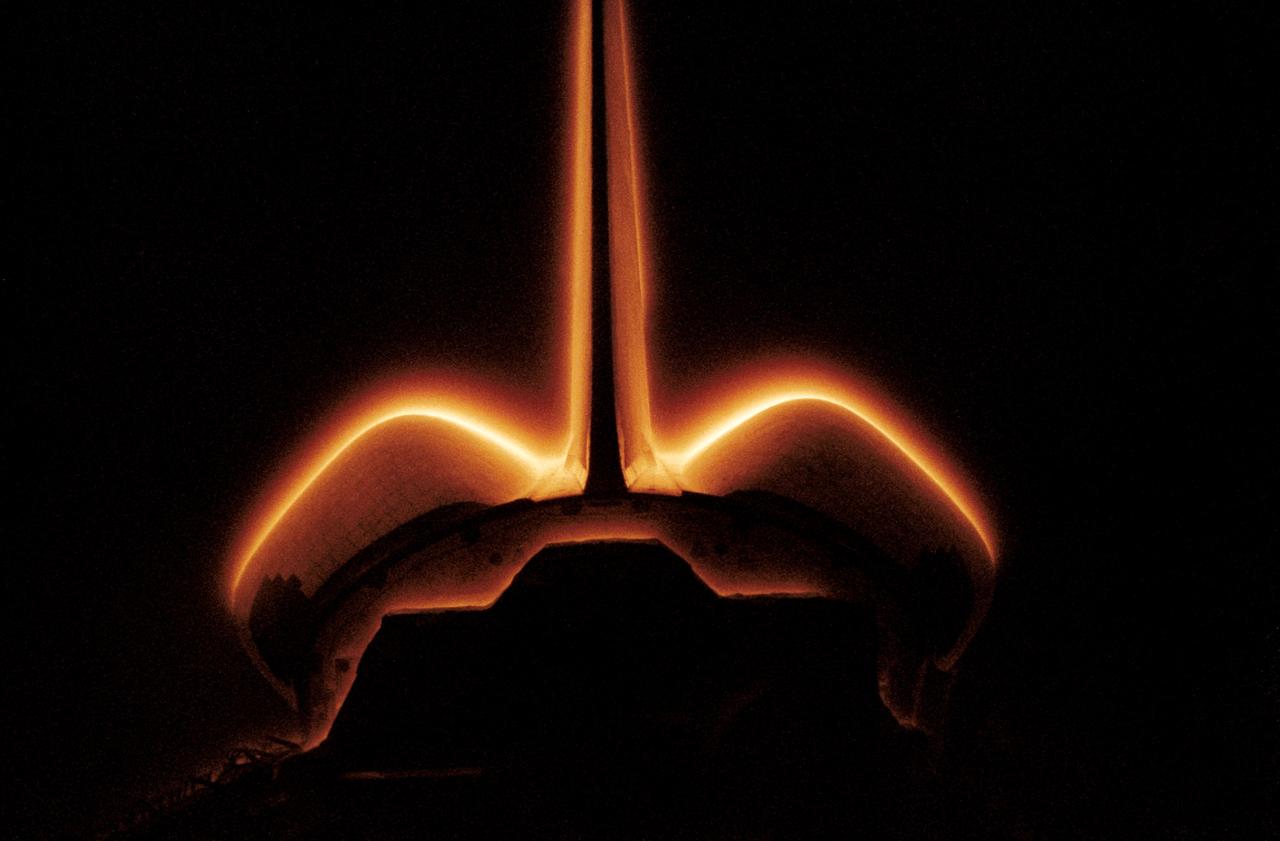
STS062-42-026 (4-18 March 1994) --- This 35mm frame, photographed as the Space Shuttle Columbia was orbiting Earth during a "night" pass, documents the glow phenomenon surrounding the vertical stabilizer and the Orbital Maneuvering System (OMS) pods of the spacecraft.
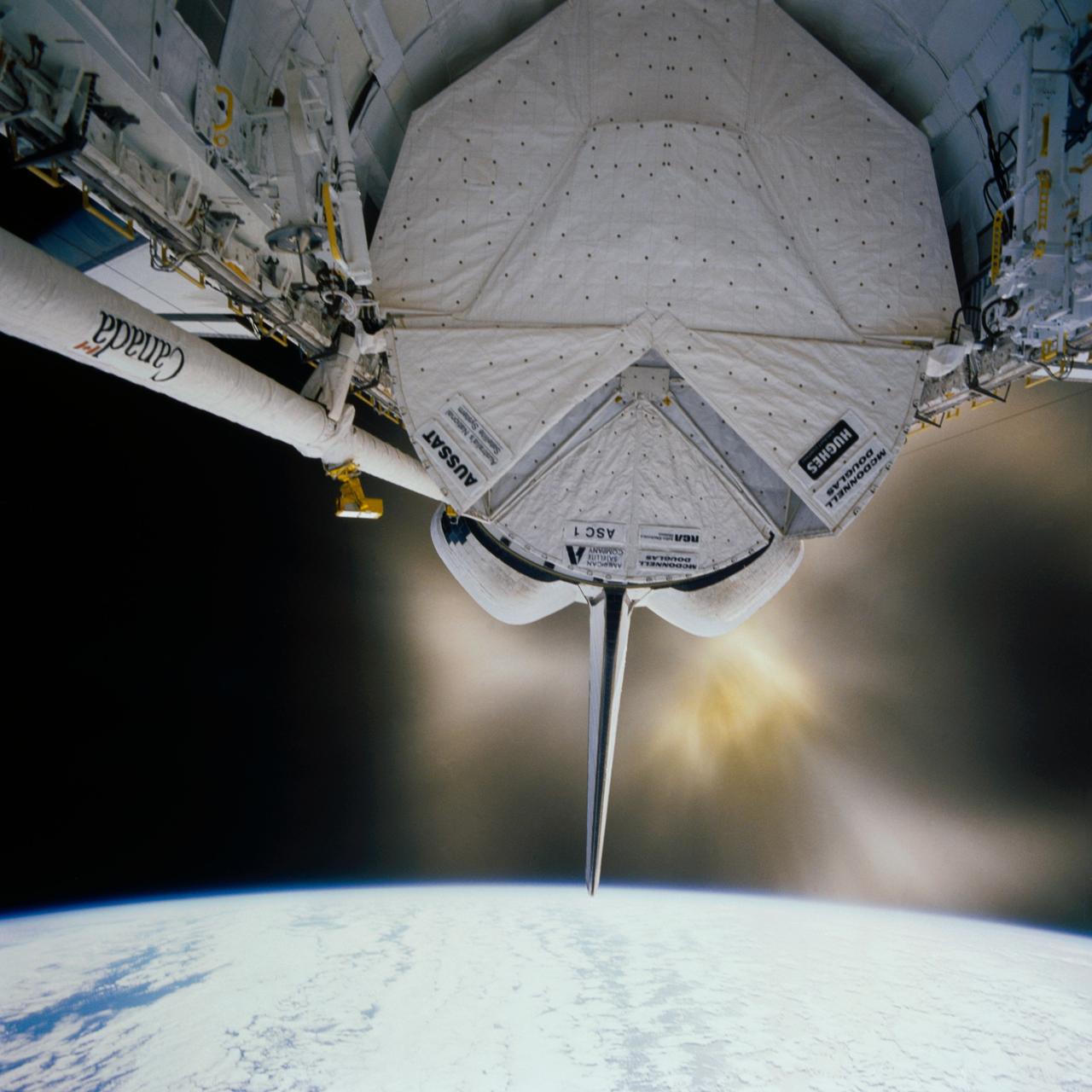
View of a single engine orbital maneuvering system (OMS) firing on the Discovery. The payload bay is open and the protective canisters for the AUSSAT communications satellite (open) and the ASC-1 are visible. A cloudy Earth's horizon can be seen above the orbiter.
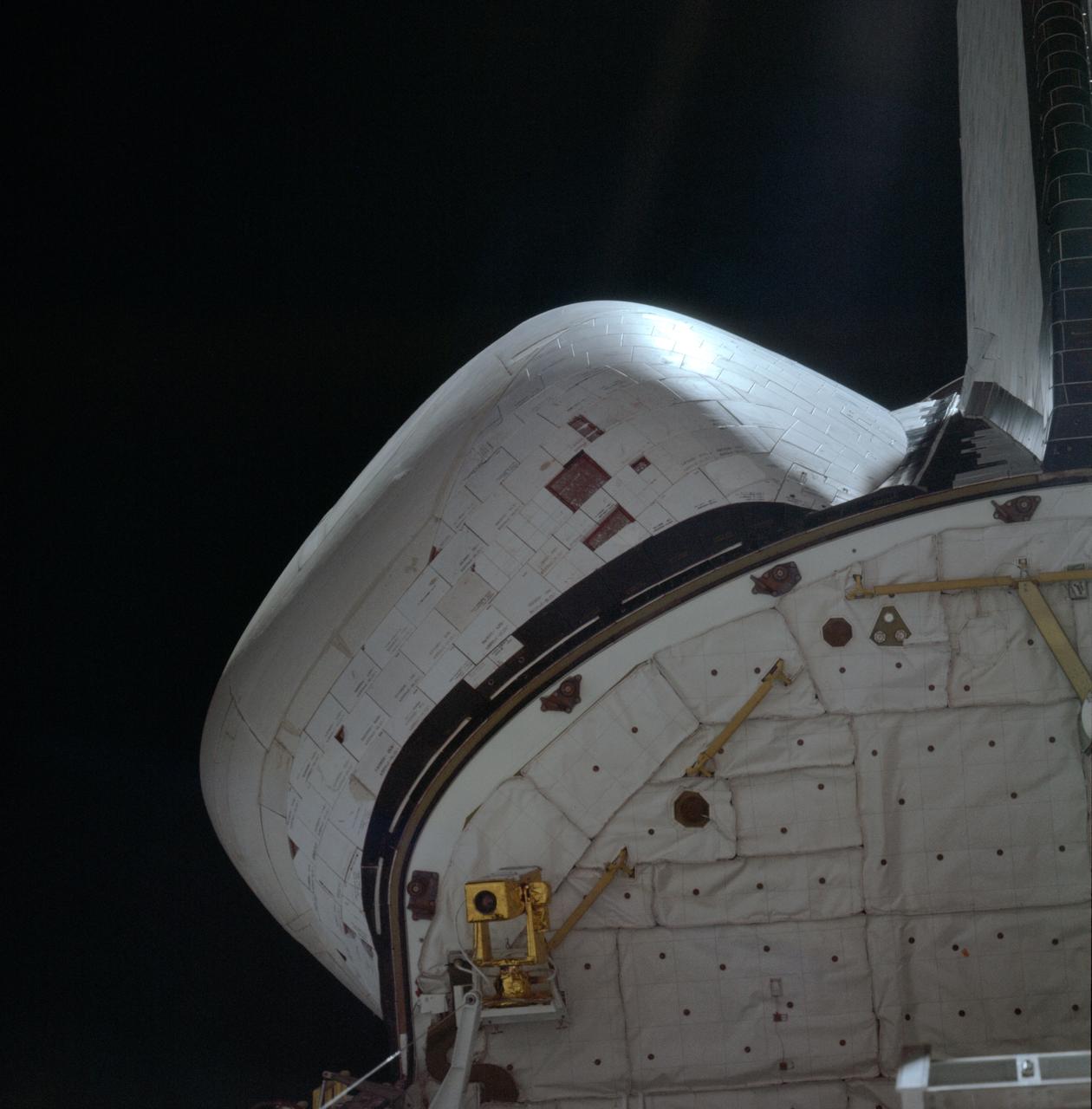
STS001-08-289 (12-14 April 1981) --- A 250mm Hasselblad view of the left OMS pod and missing tiles. Photo credit: NASA
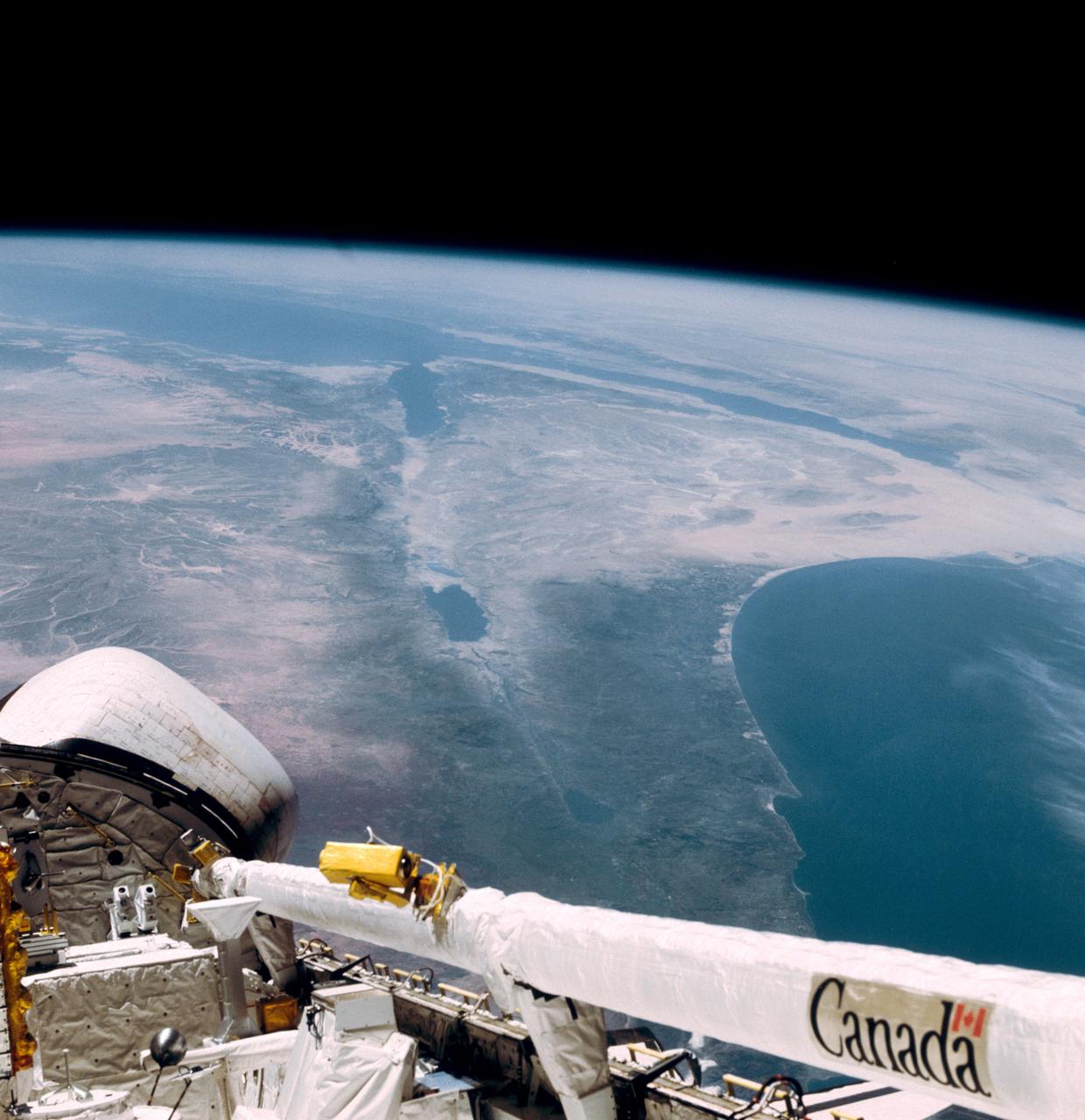
This southerly looking view photographed from the orbiting Space Shuttle Columbia shows a small portion of the vehichle's aft section. The 50-ft Canadian built remote manipulator system (RMS) is in a resting posture (lower right corner) stretched out along the 60-ft. long cargo bay. Many of the components of the OSS-1 payload package are in the bottom center. The Mediterranean Sea is at right foreground. Parts of the Sinai peninsula, Israel, Egypt, Saudi Arabia, Jordan, Palestine, Syria, and Lebanon can be located in the photo. The Red Sea, Gulf of Aqaba, Suez Canal are near the photo's horizon.

STS084-357-008 (15-24 May 1997) --- Photographed through the aft flight deck windows of the Earth-orbiting Space Shuttle Atlantis, this 35mm frame captures a firing of the Orbital Maneuvering System (OMS) engines to perform a necessary maneuver. The vertical stabilizer, flanked by the two OMS pods, is illuminated in the scene.
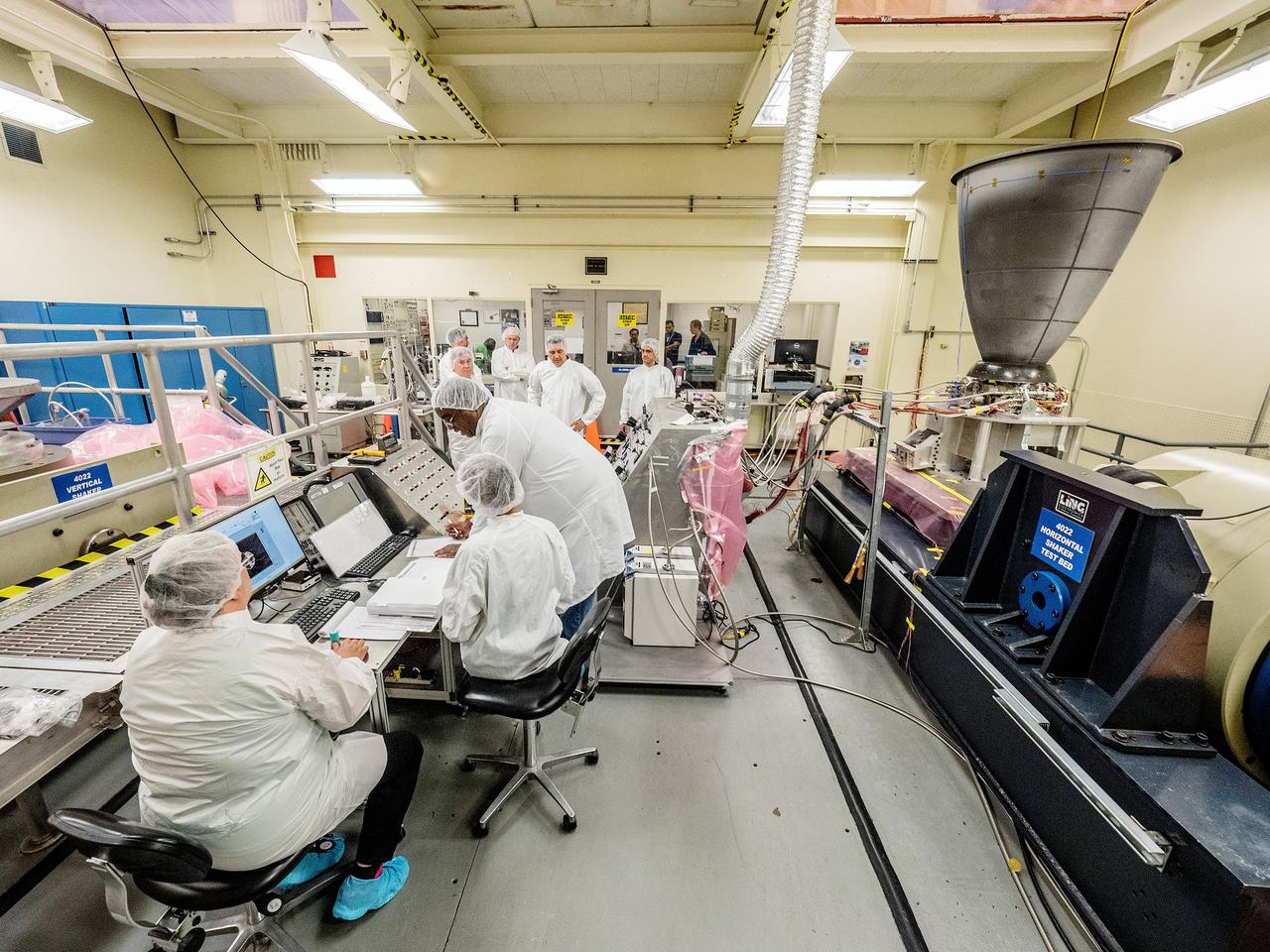
An Orbital Maneuvering System engine is vibration tested at NASA’s Johnson Space Center in Houston on June 16, 2016, before shipment to the agency’s White Sands Test Facility in New Mexico, where it will be fired to qualify the engine for use on Orion’s service module. The vibration testing will help ensure the engine can withstand the loads induced by launch on the agency’s Space Launch System rocket. This summer, another Orbital Maneuvering System engine will be tested at Johnson before it is supplied to ESA (European Space Agency) to integrate into Orion's service module, which will power, propel and cool Orion in space, and also provide consumables like air and water for future crews. ..ESA and its contractor Airbus Defence and Space are providing the service module for Artemis I. This Orbital Maneuvering System engine was used on the space shuttle to provide the thrust for orbital insertion, orbit circularization, orbit transfer, rendezvous, deorbit and abort situations and flew on 31 shuttle flights. The engine flying on Artemis I flew on 19 space shuttle flights, beginning with STS-41G in October 1984 and ending with STS-112 in October 2002.
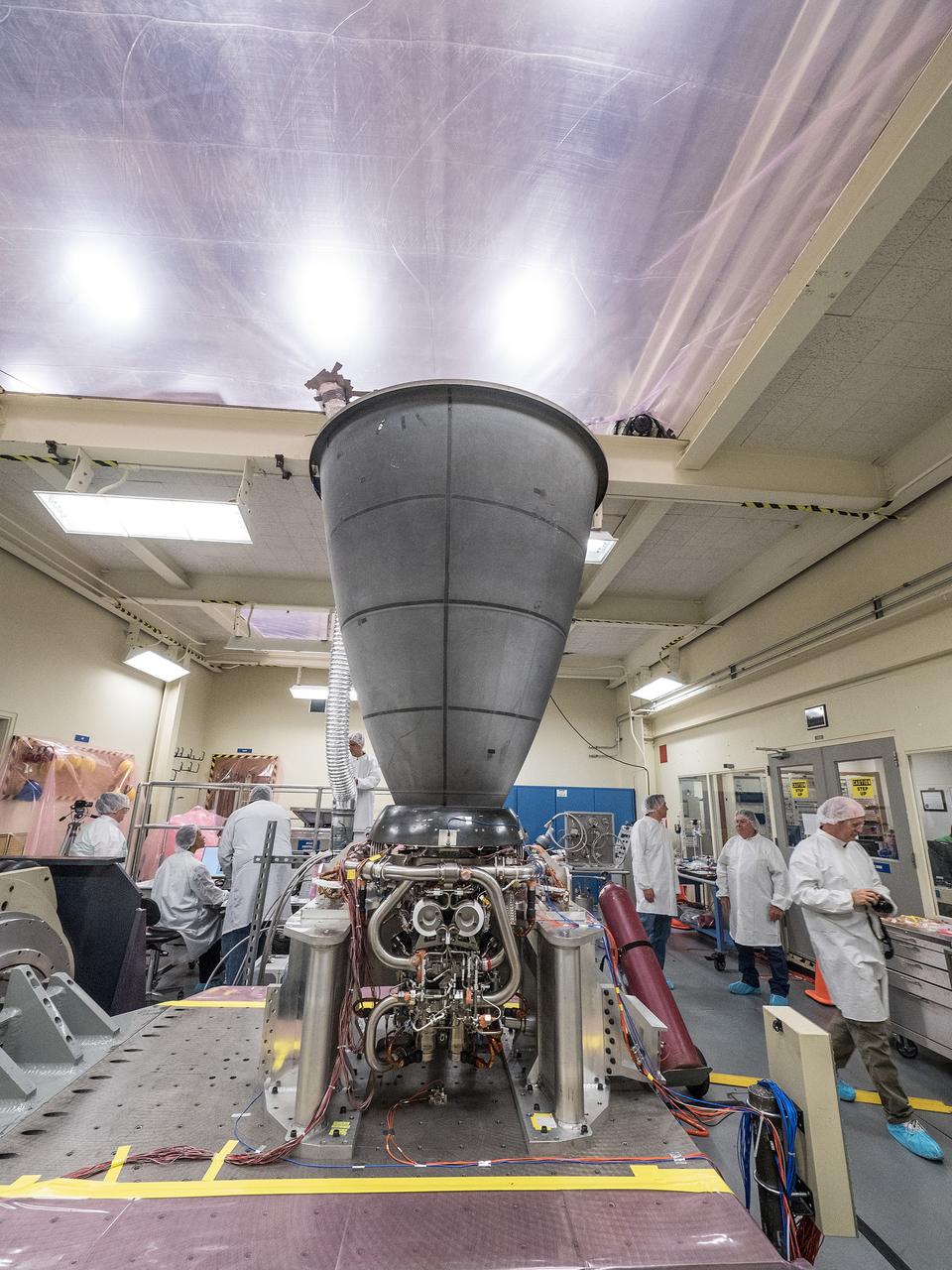
An Orbital Maneuvering System engine is vibration tested at NASA’s Johnson Space Center in Houston on June 16, 2016, before shipment to the agency’s White Sands Test Facility in New Mexico, where it will be fired to qualify the engine for use on Orion’s service module. The vibration testing will help ensure the engine can withstand the loads induced by launch on the agency’s Space Launch System rocket. This summer, another Orbital Maneuvering System engine will be tested at Johnson before it is supplied to ESA (European Space Agency) to integrate into Orion's service module, which will power, propel and cool Orion in space, and also provide consumables like air and water for future crews. ..ESA and its contractor Airbus Defence and Space are providing the service module for Artemis I. This Orbital Maneuvering System engine was used on the space shuttle to provide the thrust for orbital insertion, orbit circularization, orbit transfer, rendezvous, deorbit and abort situations and flew on 31 shuttle flights. The engine flying on Artemis I flew on 19 space shuttle flights, beginning with STS-41G in October 1984 and ending with STS-112 in October 2002.
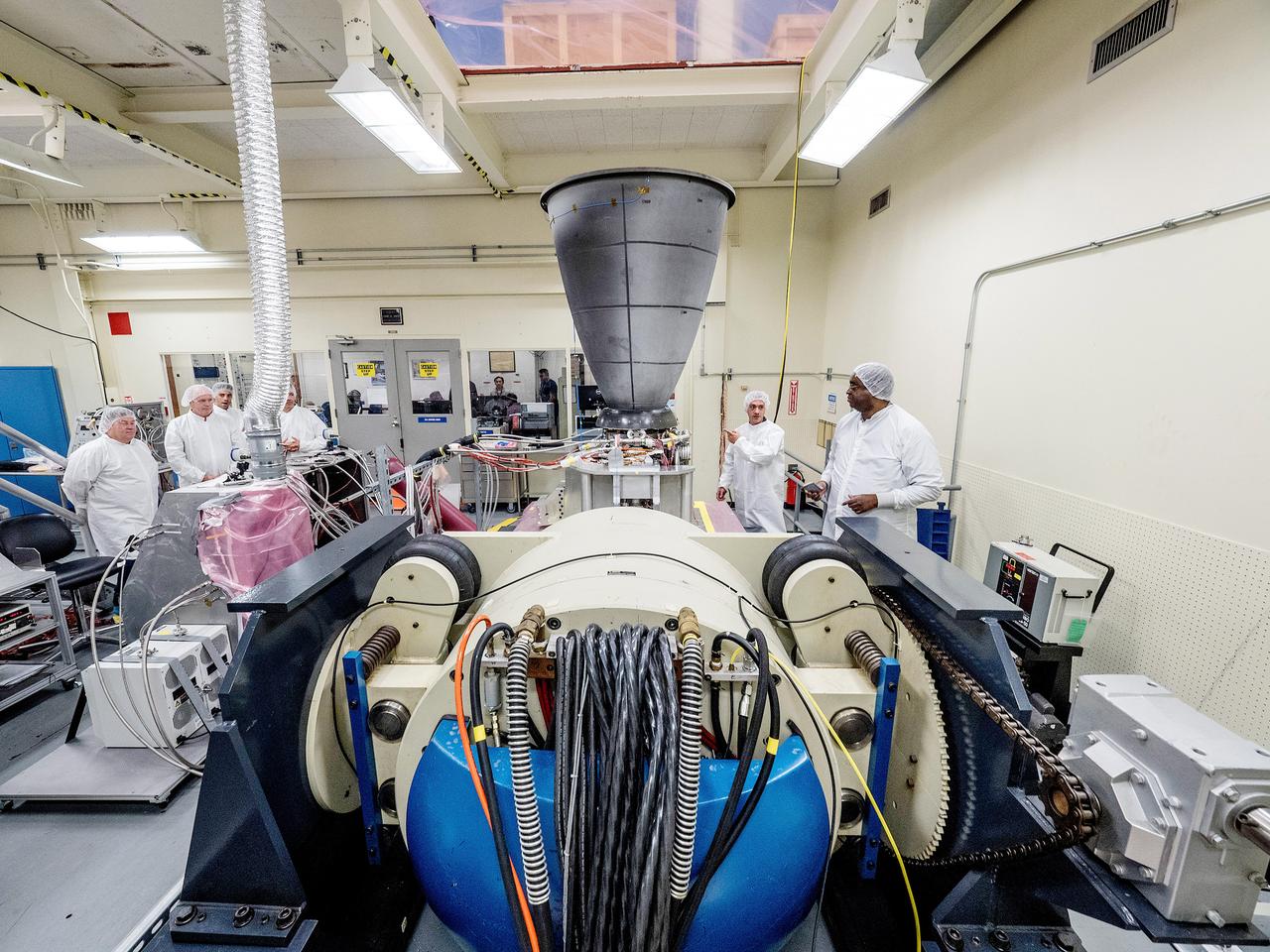
An Orbital Maneuvering System engine is vibration tested at NASA’s Johnson Space Center in Houston on June 16, 2016, before shipment to the agency’s White Sands Test Facility in New Mexico, where it will be fired to qualify the engine for use on Orion’s service module. The vibration testing will help ensure the engine can withstand the loads induced by launch on the agency’s Space Launch System rocket. This summer, another Orbital Maneuvering System engine will be tested at Johnson before it is supplied to ESA (European Space Agency) to integrate into Orion's service module, which will power, propel and cool Orion in space, and also provide consumables like air and water for future crews. ..ESA and its contractor Airbus Defence and Space are providing the service module for Artemis I. This Orbital Maneuvering System engine was used on the space shuttle to provide the thrust for orbital insertion, orbit circularization, orbit transfer, rendezvous, deorbit and abort situations and flew on 31 shuttle flights. The engine flying on Artemis I flew on 19 space shuttle flights, beginning with STS-41G in October 1984 and ending with STS-112 in October 2002.
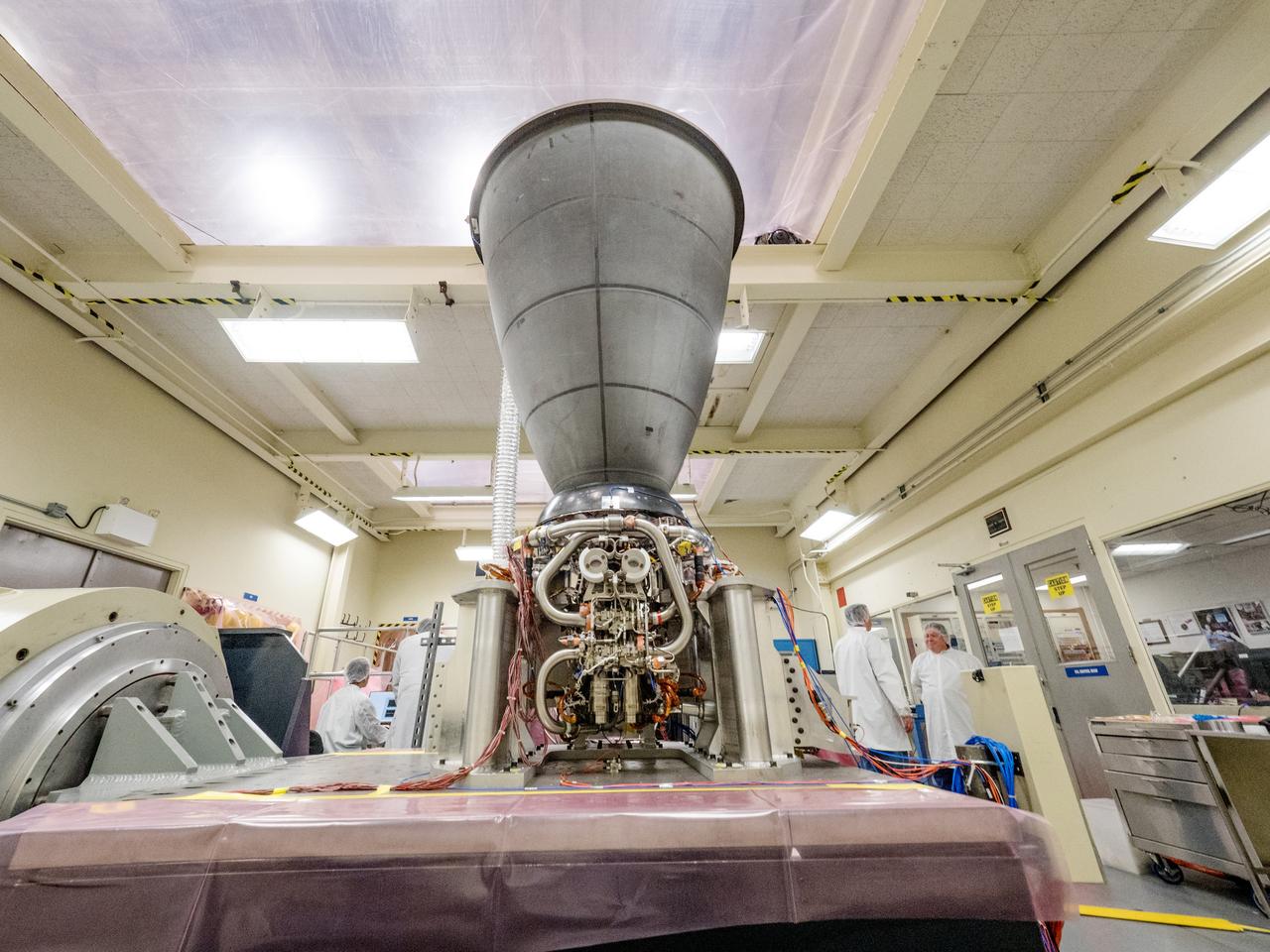
An Orbital Maneuvering System engine is vibration tested at NASA’s Johnson Space Center in Houston on June 16, 2016, before shipment to the agency’s White Sands Test Facility in New Mexico, where it will be fired to qualify the engine for use on Orion’s service module. The vibration testing will help ensure the engine can withstand the loads induced by launch on the agency’s Space Launch System rocket. This summer, another Orbital Maneuvering System engine will be tested at Johnson before it is supplied to ESA (European Space Agency) to integrate into Orion's service module, which will power, propel and cool Orion in space, and also provide consumables like air and water for future crews. ..ESA and its contractor Airbus Defence and Space are providing the service module for Artemis I. This Orbital Maneuvering System engine was used on the space shuttle to provide the thrust for orbital insertion, orbit circularization, orbit transfer, rendezvous, deorbit and abort situations and flew on 31 shuttle flights. The engine flying on Artemis I flew on 19 space shuttle flights, beginning with STS-41G in October 1984 and ending with STS-112 in October 2002.
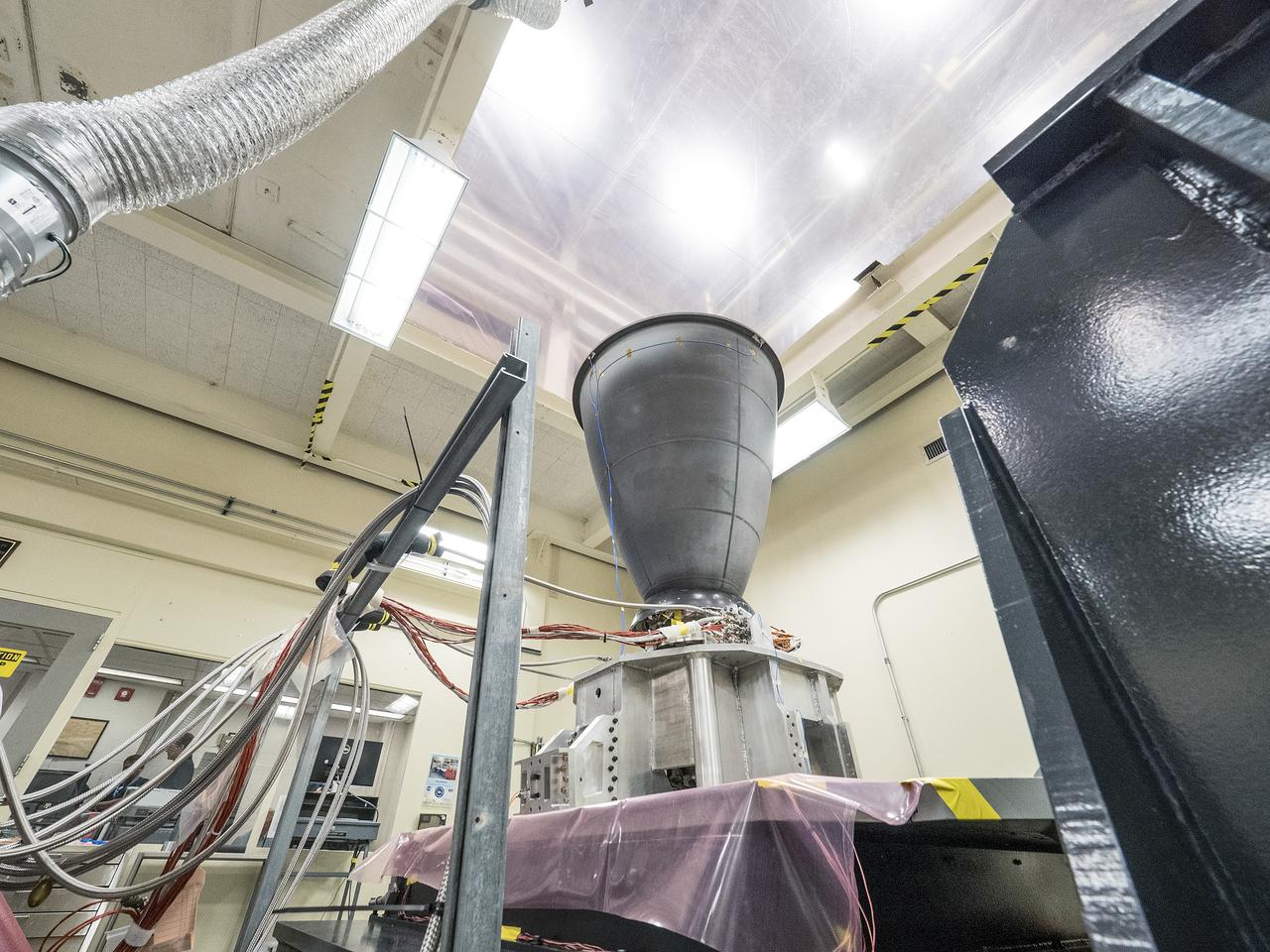
An Orbital Maneuvering System engine is vibration tested at NASA’s Johnson Space Center in Houston on June 16, 2016, before shipment to the agency’s White Sands Test Facility in New Mexico, where it will be fired to qualify the engine for use on Orion’s service module. The vibration testing will help ensure the engine can withstand the loads induced by launch on the agency’s Space Launch System rocket. This summer, another Orbital Maneuvering System engine will be tested at Johnson before it is supplied to ESA (European Space Agency) to integrate into Orion's service module, which will power, propel and cool Orion in space, and also provide consumables like air and water for future crews. ..ESA and its contractor Airbus Defence and Space are providing the service module for Artemis I. This Orbital Maneuvering System engine was used on the space shuttle to provide the thrust for orbital insertion, orbit circularization, orbit transfer, rendezvous, deorbit and abort situations and flew on 31 shuttle flights. The engine flying on Artemis I flew on 19 space shuttle flights, beginning with STS-41G in October 1984 and ending with STS-112 in October 2002.
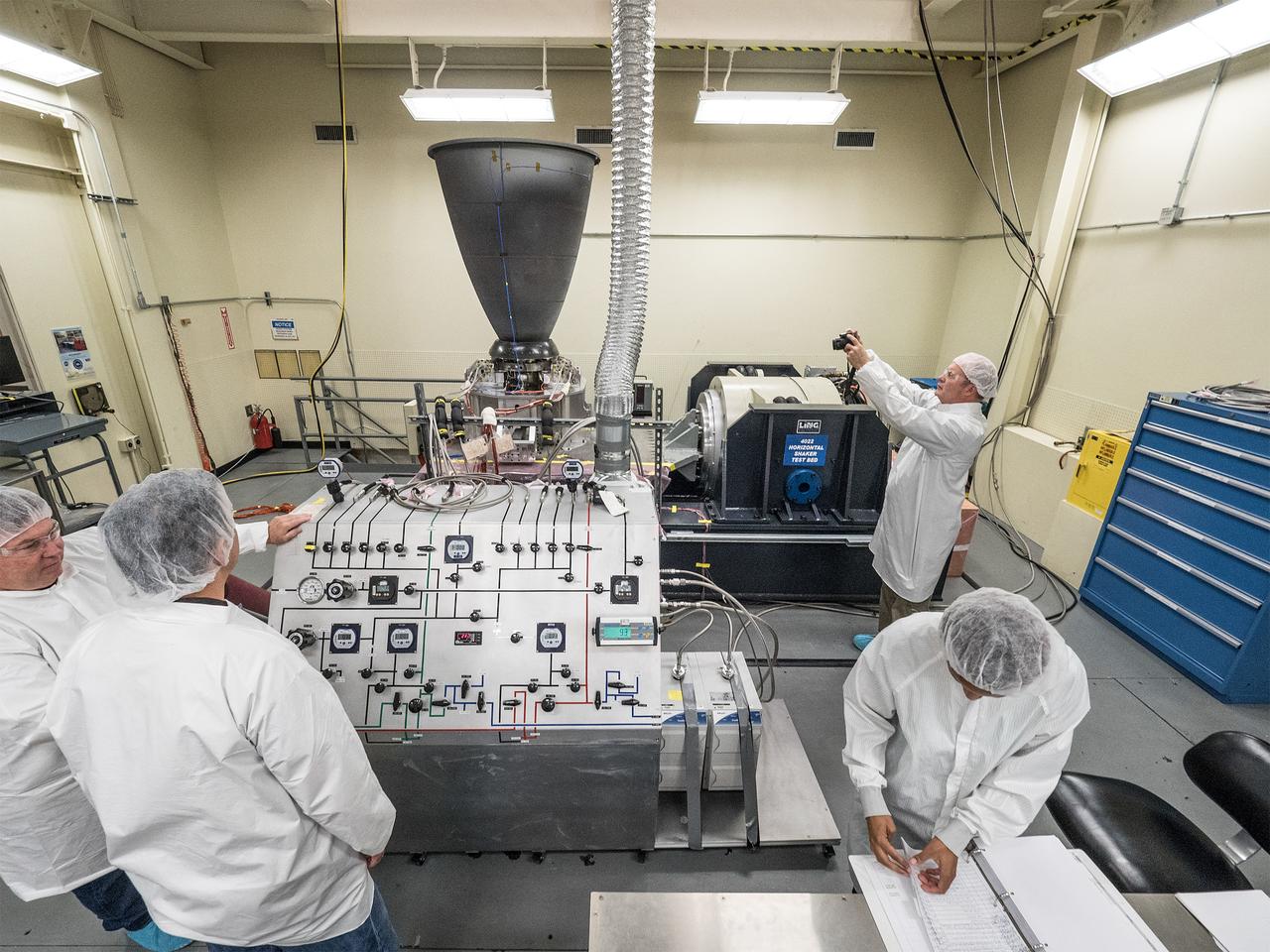
An Orbital Maneuvering System engine is vibration tested at NASA’s Johnson Space Center in Houston on June 16, 2016, before shipment to the agency’s White Sands Test Facility in New Mexico, where it will be fired to qualify the engine for use on Orion’s service module. The vibration testing will help ensure the engine can withstand the loads induced by launch on the agency’s Space Launch System rocket. This summer, another Orbital Maneuvering System engine will be tested at Johnson before it is supplied to ESA (European Space Agency) to integrate into Orion's service module, which will power, propel and cool Orion in space, and also provide consumables like air and water for future crews. ..ESA and its contractor Airbus Defence and Space are providing the service module for Artemis I. This Orbital Maneuvering System engine was used on the space shuttle to provide the thrust for orbital insertion, orbit circularization, orbit transfer, rendezvous, deorbit and abort situations and flew on 31 shuttle flights. The engine flying on Artemis I flew on 19 space shuttle flights, beginning with STS-41G in October 1984 and ending with STS-112 in October 2002.
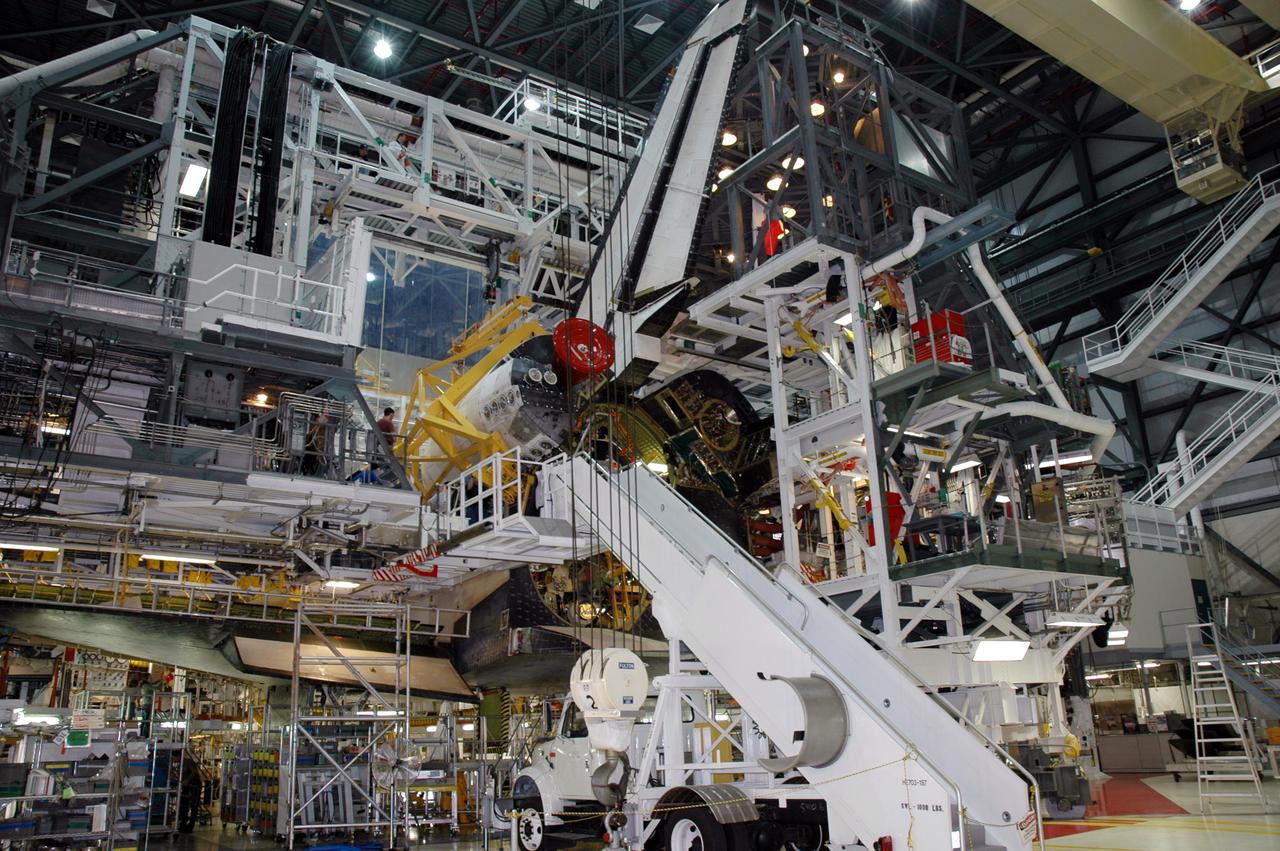
KENNEDY SPACE CENTER, FLA. - In Orbiter Process Facility bay 1, the installation of the left Orbital Maneuvering System (OMS) pod on Space Shuttle Atlantis is complete. The Orbital Maneuvering System provides the thrust for orbit insertion, orbit circularization, orbit transfer, rendezvous, deorbit, abort to orbit and abort once around. It can provide up to 1,000 pounds of propellant to the aft reaction control system. Each pod contains one OMS engine and the hardware needed to pressurize, store and distribute the propellants to perform the velocity maneuvers. Atlantis is the designated orbiter to fly on mission STS-121. The mission has a launch window of July 12 - July 31.
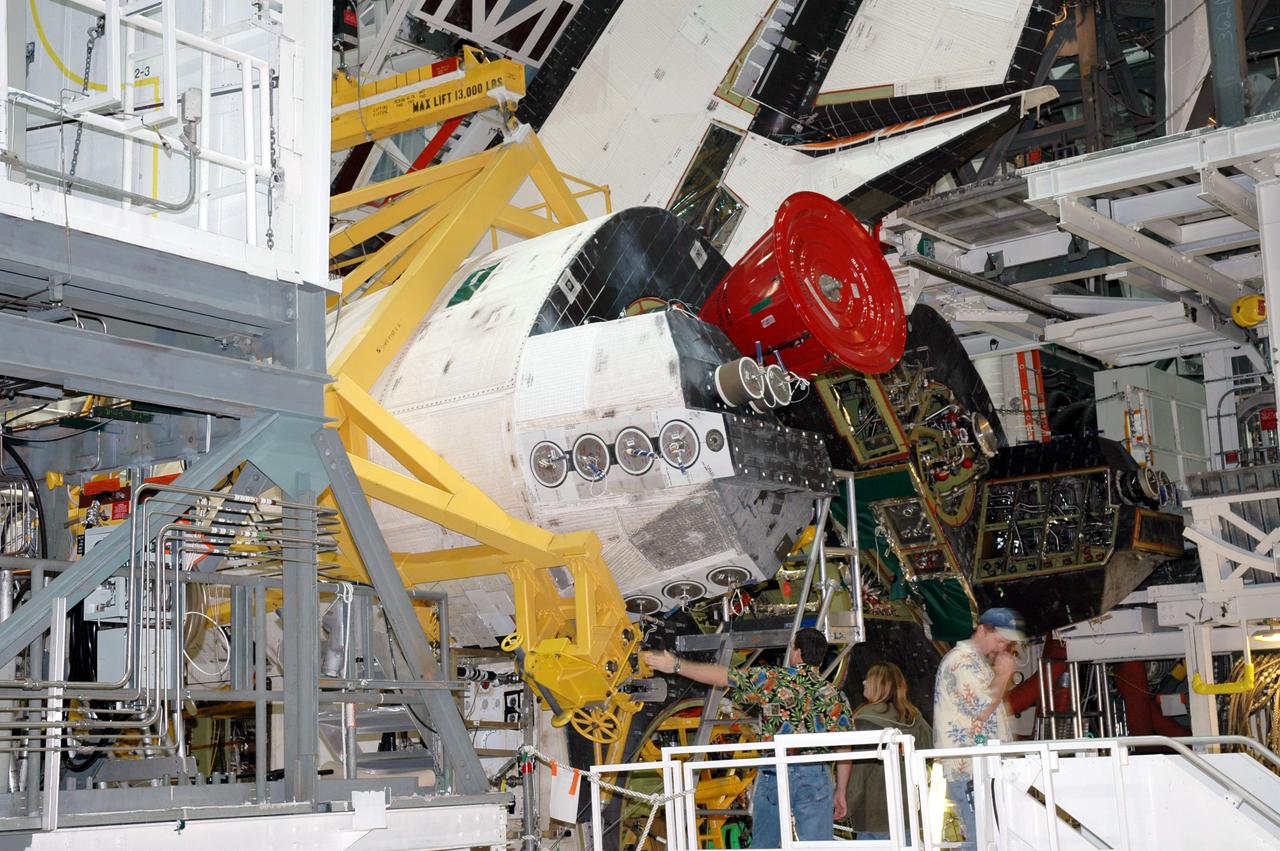
KENNEDY SPACE CENTER, FLA. - Technicians discuss the left Orbital Maneuvering System (OMS) pod installed on Space Shuttle Atlantis today in Orbiter Process Facility bay 1. The Orbital Maneuvering System provides the thrust for orbit insertion, orbit circularization, orbit transfer, rendezvous, deorbit, abort to orbit and abort once around. It can provide up to 1,000 pounds of propellant to the aft reaction control system. Each pod contains one OMS engine and the hardware needed to pressurize, store and distribute the propellants to perform the velocity maneuvers. Atlantis is the designated orbiter to fly on mission STS-121. The mission has a launch window of July 12 - July 31.
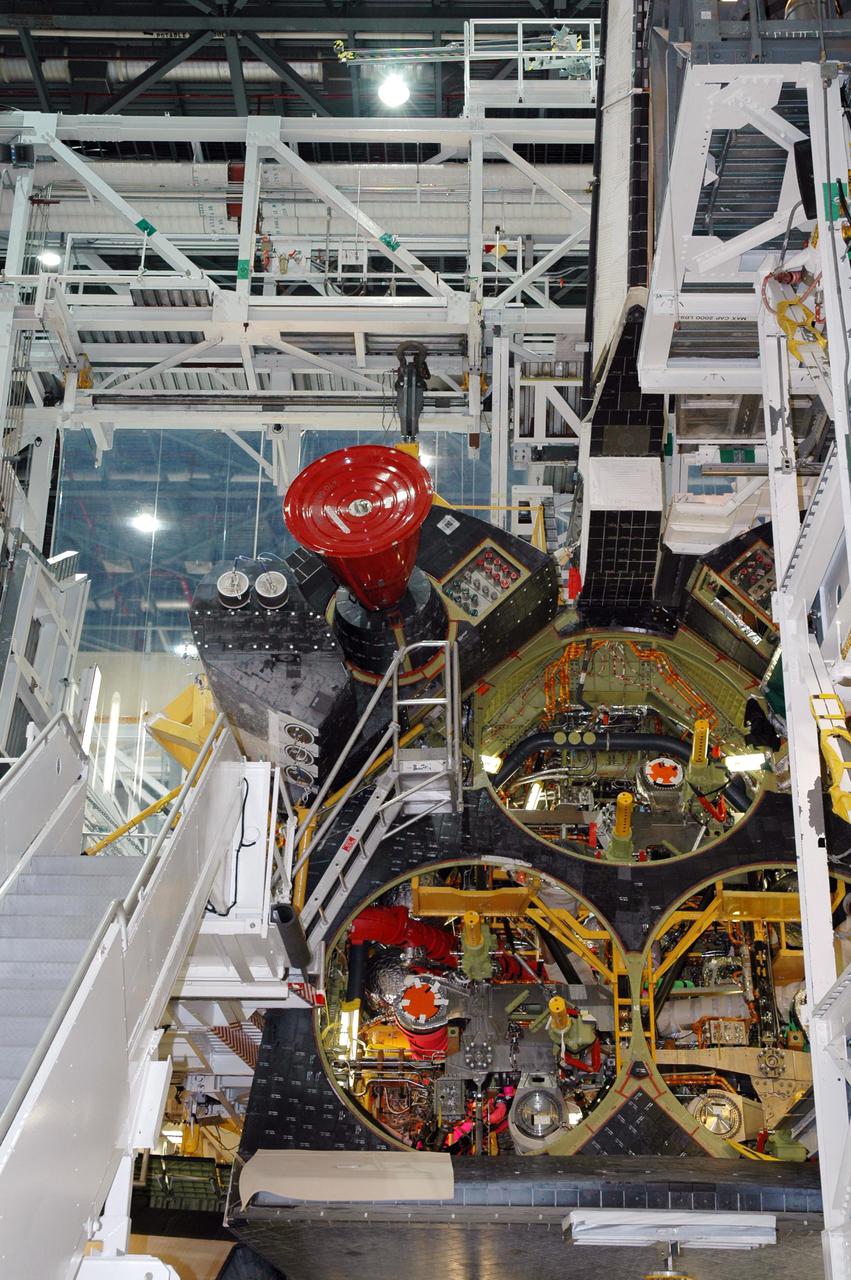
KENNEDY SPACE CENTER, FLA. - Space Shuttle Atlantis is outfitted with its left Orbital Maneuvering System (OMS) pod in Orbiter Process Facility bay 1. The Orbital Maneuvering System provides the thrust for orbit insertion, orbit circularization, orbit transfer, rendezvous, deorbit, abort to orbit and abort once around. It can provide up to 1,000 pounds of propellant to the aft reaction control system. Each pod contains one OMS engine and the hardware needed to pressurize, store and distribute the propellants to perform the velocity maneuvers. Atlantis is the designated orbiter to fly on mission STS-121. The mission has a launch window of July 12 - July 31.
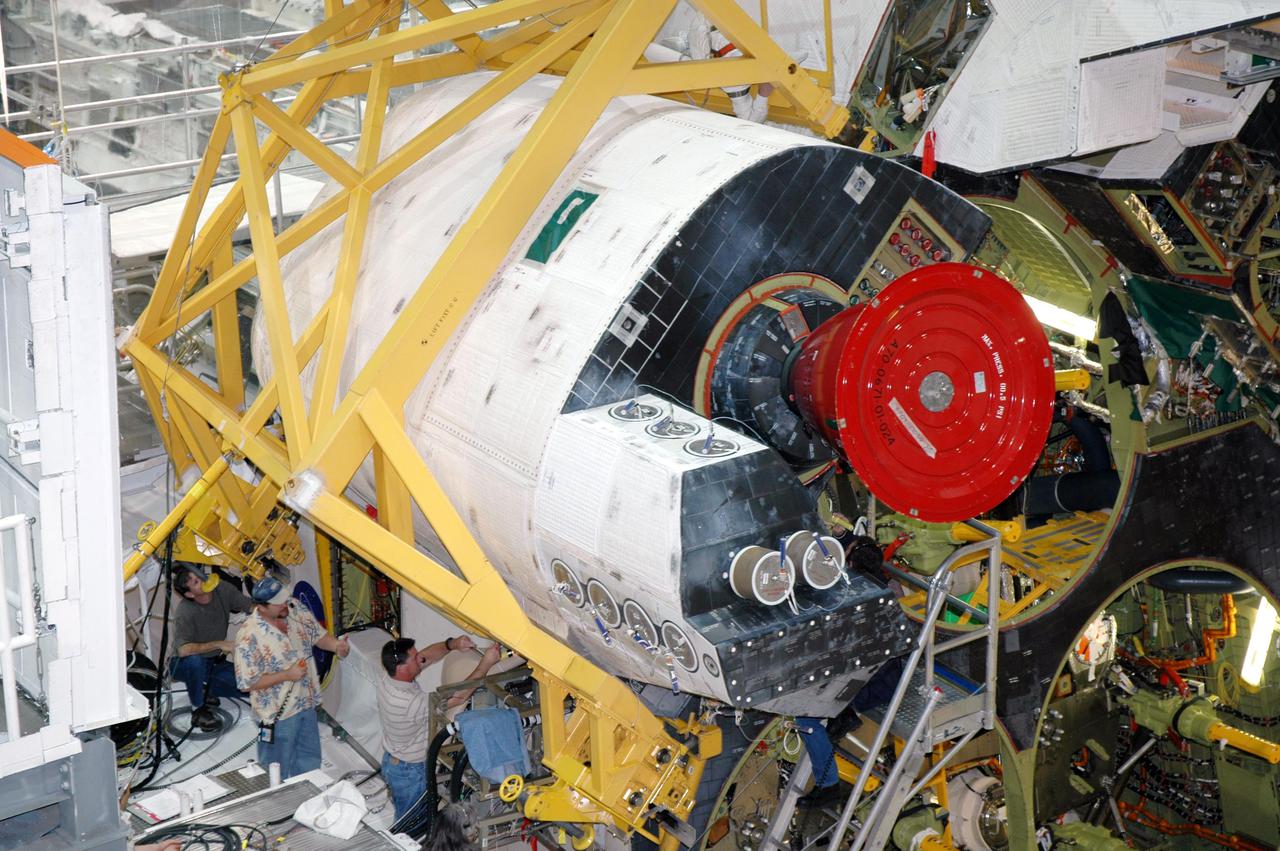
KENNEDY SPACE CENTER, FLA. - Technicians install the left Orbital Maneuvering System (OMS) pod on Space Shuttle Atlantis in Orbiter Process Facility bay 1. The Orbital Maneuvering System provides the thrust for orbit insertion, orbit circularization, orbit transfer, rendezvous, deorbit, abort to orbit and abort once around. It can provide up to 1,000 pounds of propellant to the aft reaction control system. Each pod contains one OMS engine and the hardware needed to pressurize, store and distribute the propellants to perform the velocity maneuvers. Atlantis is the designated orbiter to fly on mission STS-121. The mission has a launch window of July 12 - July 31.
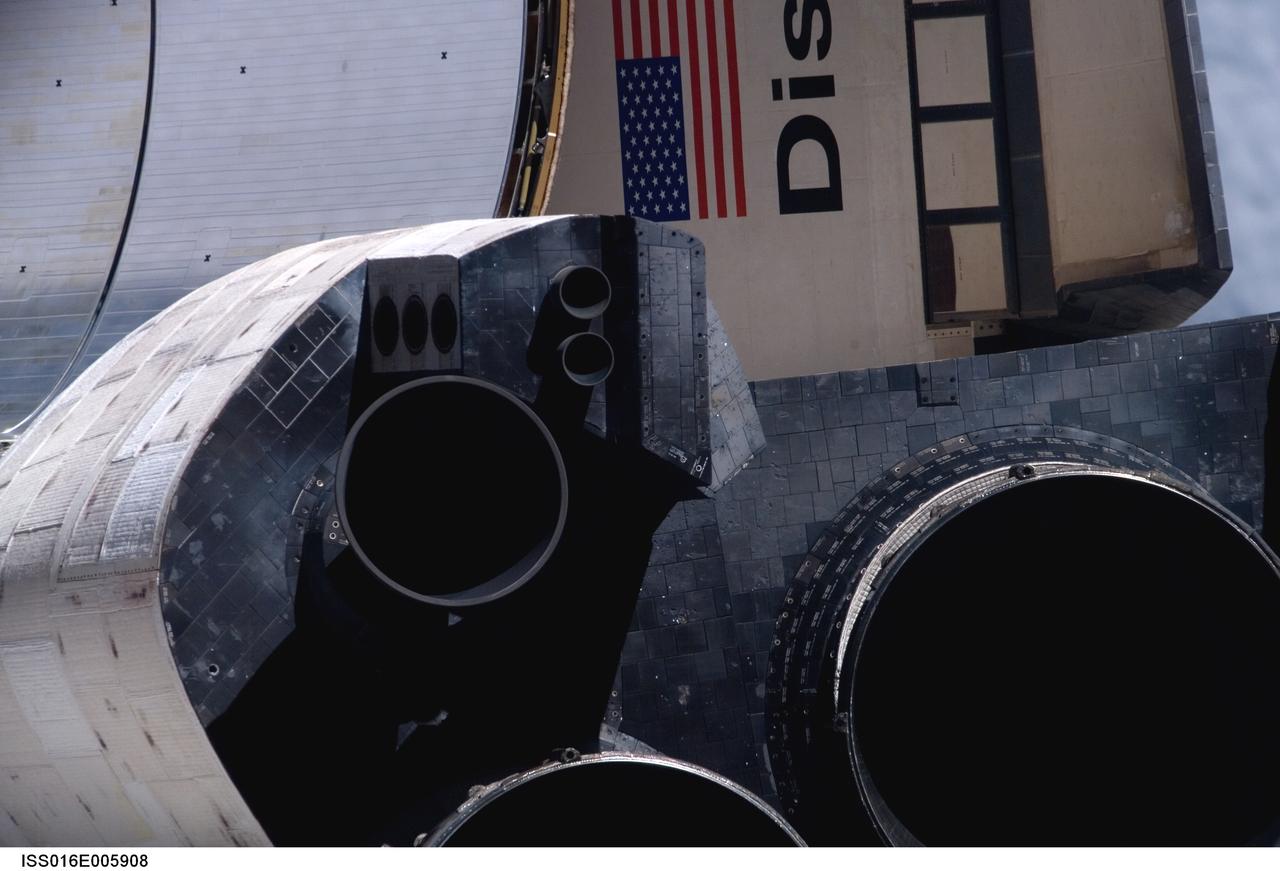
ISS016-E-005908 (25 Oct. 2007) --- A close-up view of Space Shuttle Discovery's tail section is featured in this image photographed by an Expedition 16 crewmember during a backflip maneuver performed by the approaching visitors (STS-120) to the International Space Station. The image provides partial views of the shuttle's main engines, orbital maneuvering system (OMS) pods, a portion of the payload bay door panels and the shuttle's wings.
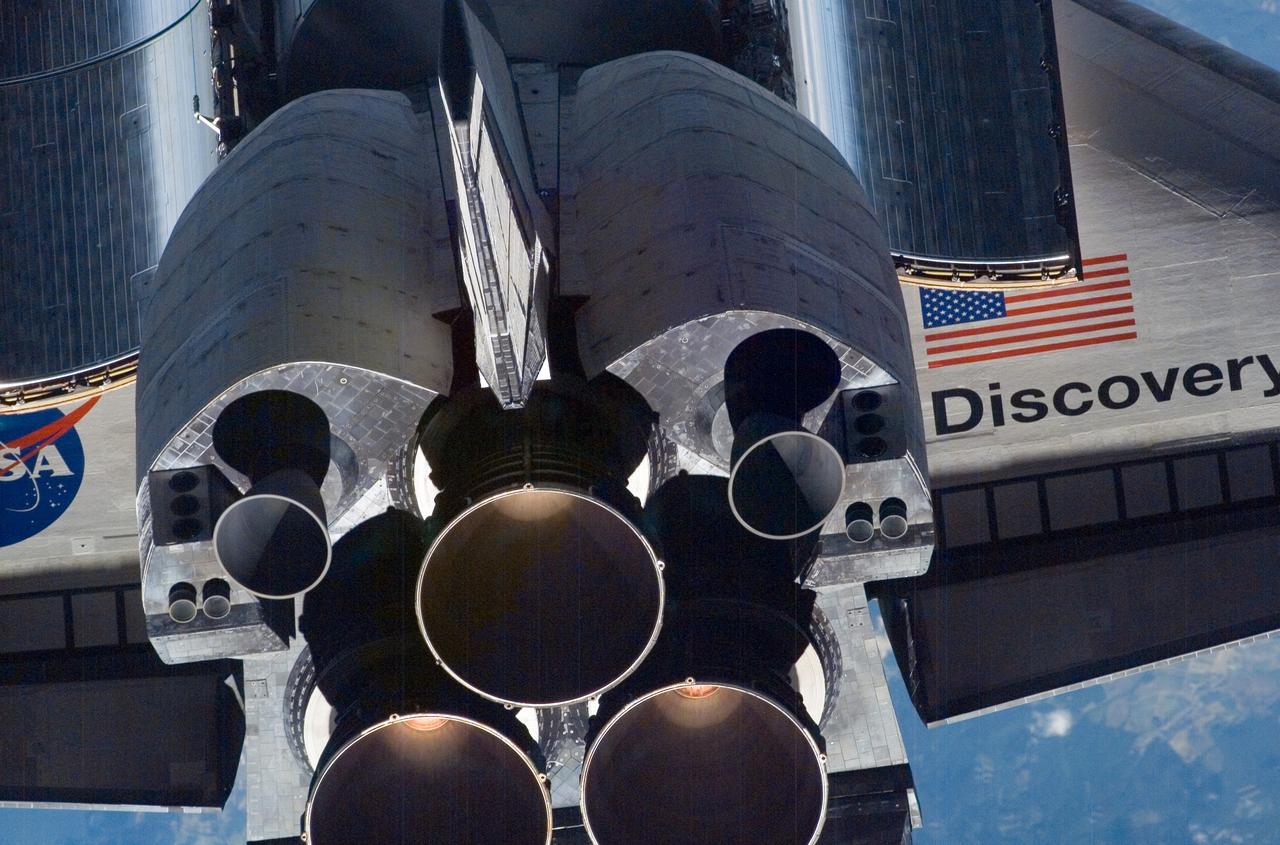
A close-up view of Space Shuttle Discovery's tail section is featured in this image photographed by an Expedition 13 crew member on the International Space Station (ISS) during the STS-121 Rotating Pitch Maneuver (RPM) survey. Visible are the space shuttle's main engines (SSME), vertical stabilizer, orbital maneuvering system (OMS) pods and a portion of the aft cargo bay and wings. The Marshall Space Flight Center (MSFC) has management responsibility for development of the SSME.
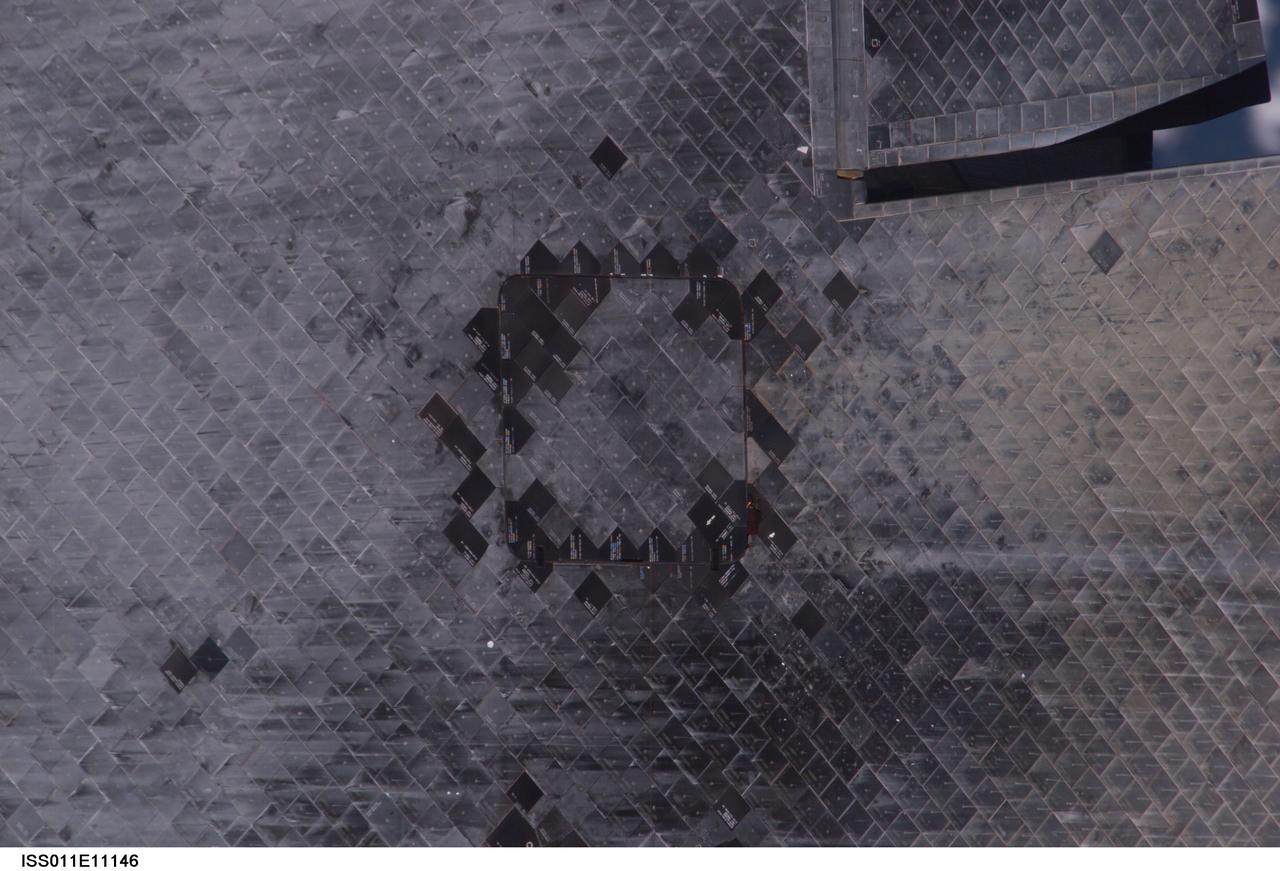
ISS011-E-11146 (28 July 2005) --- View of the Space Shuttle Discovery's underside (near Orbital Maneuvering System pod), photographed as part of the survey sequence performed by the Expedition 11 crew during the STS-114 R-Bar Pitch Maneuver on Flight Day 3. This picture was used by Steve M. Poulos, Jr. Manager, Space Shuttle Vehicle Engineering Office, as one of his visual aids in a July 28, 2005 press conference in the Teague Auditorium at the Johnson Space Center.
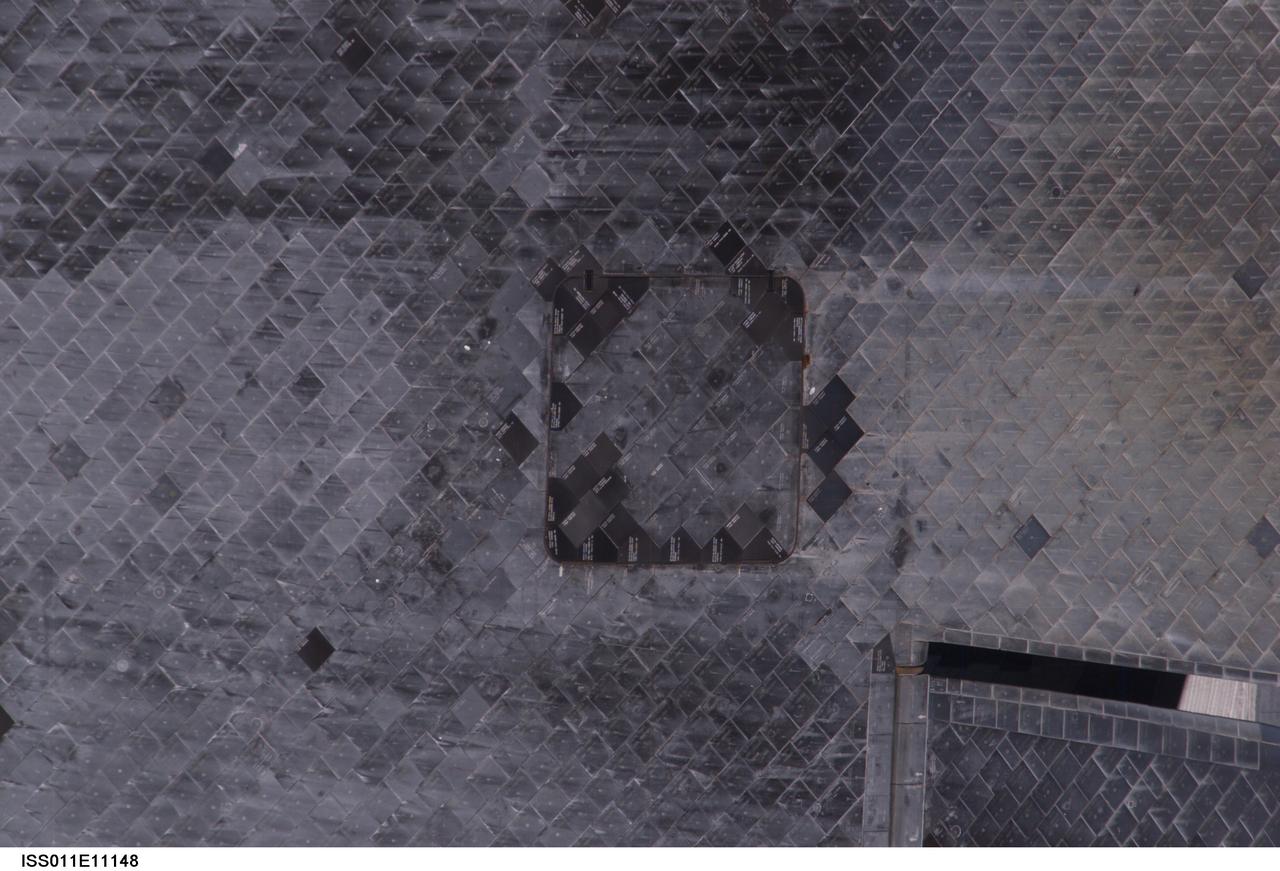
ISS011-E-11148 (28 July 2005) --- View of the Space Shuttle Discovery's underside (near the Orbital Maneuvering System pod), photographed as part of the survey sequence performed by the Expedition 11 crew during the STS-114 R-Bar Pitch Maneuver on Flight Day 3. This picture was used by Steve M. Poulos, Jr. Manager, Space Shuttle Vehicle Engineering Office, as one of his visual aids in a July 28, 2005 press conference in the Teague Auditorium at the Johnson Space Center.
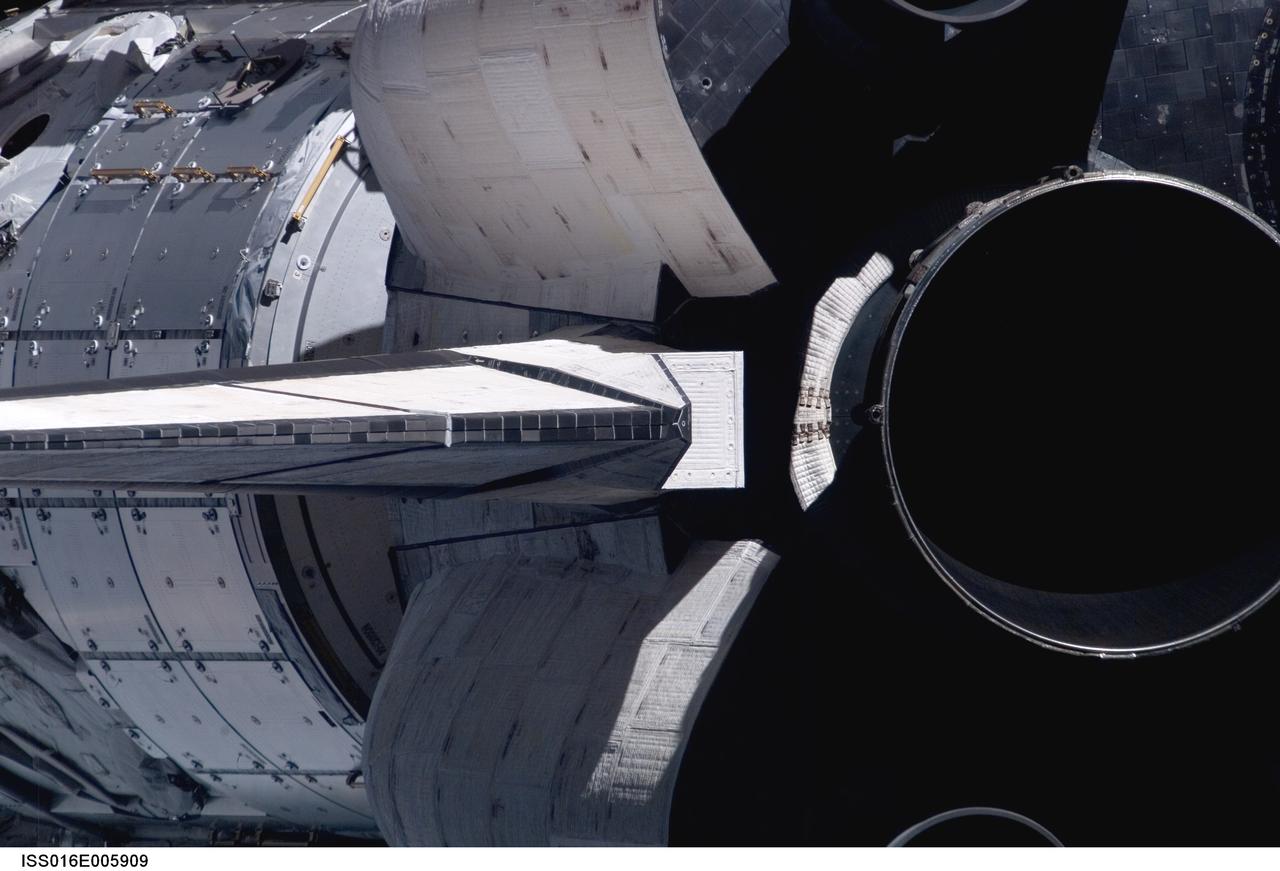
ISS016-E-005909 (25 Oct. 2007) --- A close-up view of Space Shuttle Discovery's tail section is featured in this image photographed by an Expedition 16 crewmember during a backflip maneuver performed by the approaching visitors (STS-120) to the International Space Station. The image provides partial views of the shuttle's main engines, orbital maneuvering system (OMS) pods, vertical stabilizer and the Harmony node in the payload bay.
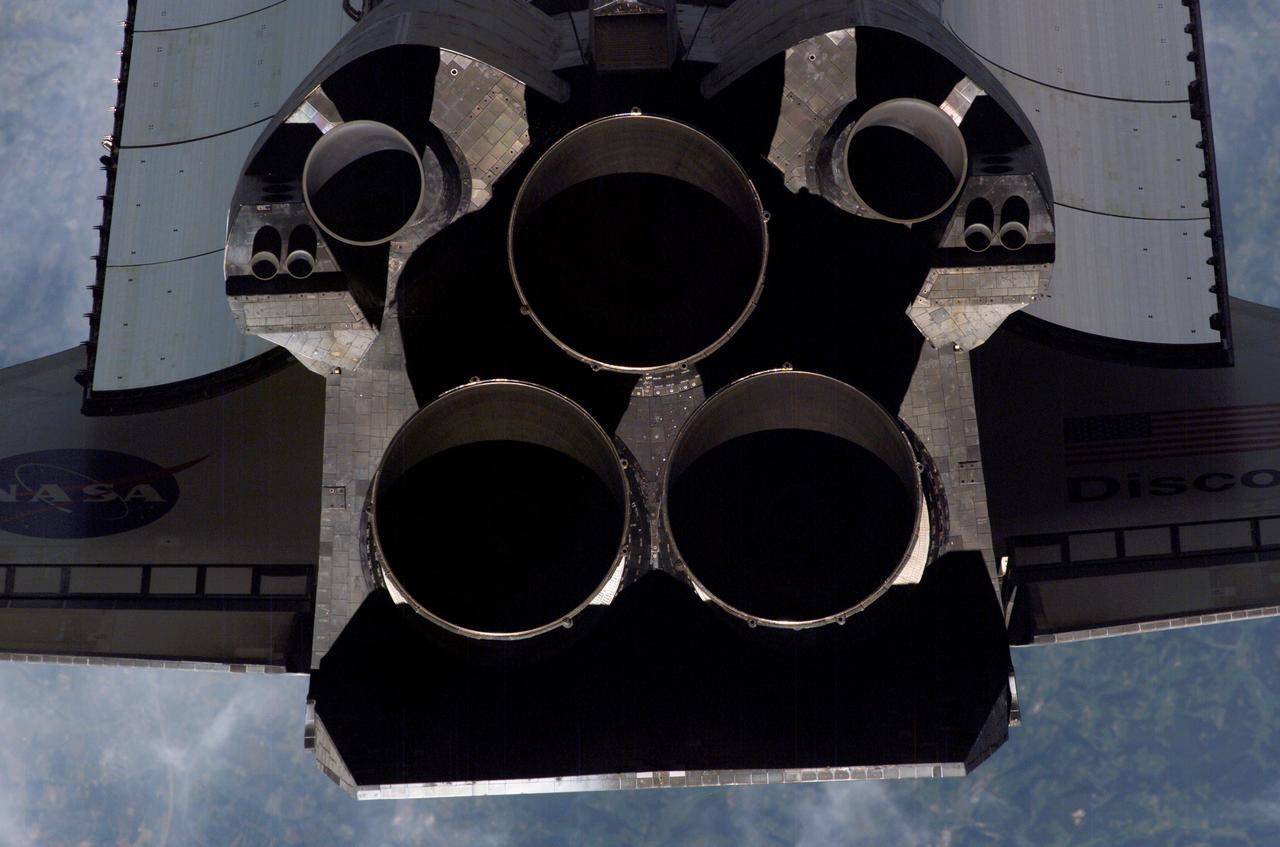
ISS013-E-47629 (6 July 2006) --- A close-up view of Space Shuttle Discovery's tail section is featured in this image photographed by an Expedition 13 crewmember on the International Space Station during STS-121 R-Pitch Maneuver survey on Flight Day 3. Visible are the shuttle's main engines, vertical stabilizer, orbital maneuvering system (OMS) pods, reaction control system (RCS) jets and a portion of payload bay door radiator and wings.
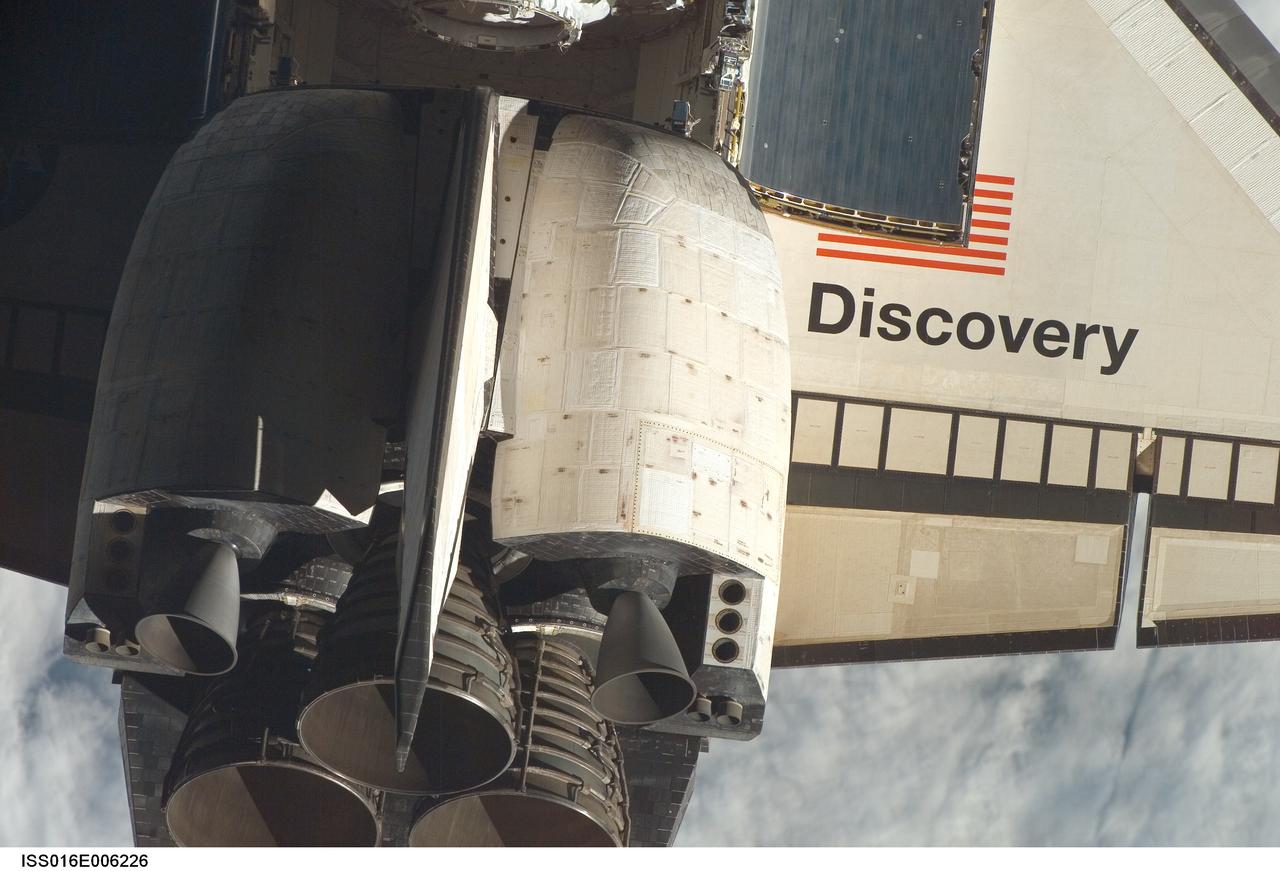
ISS016-E-006226 (25 Oct. 2007) --- Space Shuttle Discovery's tail section is featured in this close-up image photographed by an Expedition 16 crewmember during a backflip maneuver performed by the approaching visitors (STS-120) to the International Space Station. The image provides partial views of the shuttle's main engines, starboard wing section, orbital maneuvering system (OMS) pods, vertical stabilizer and payload bay door panels.
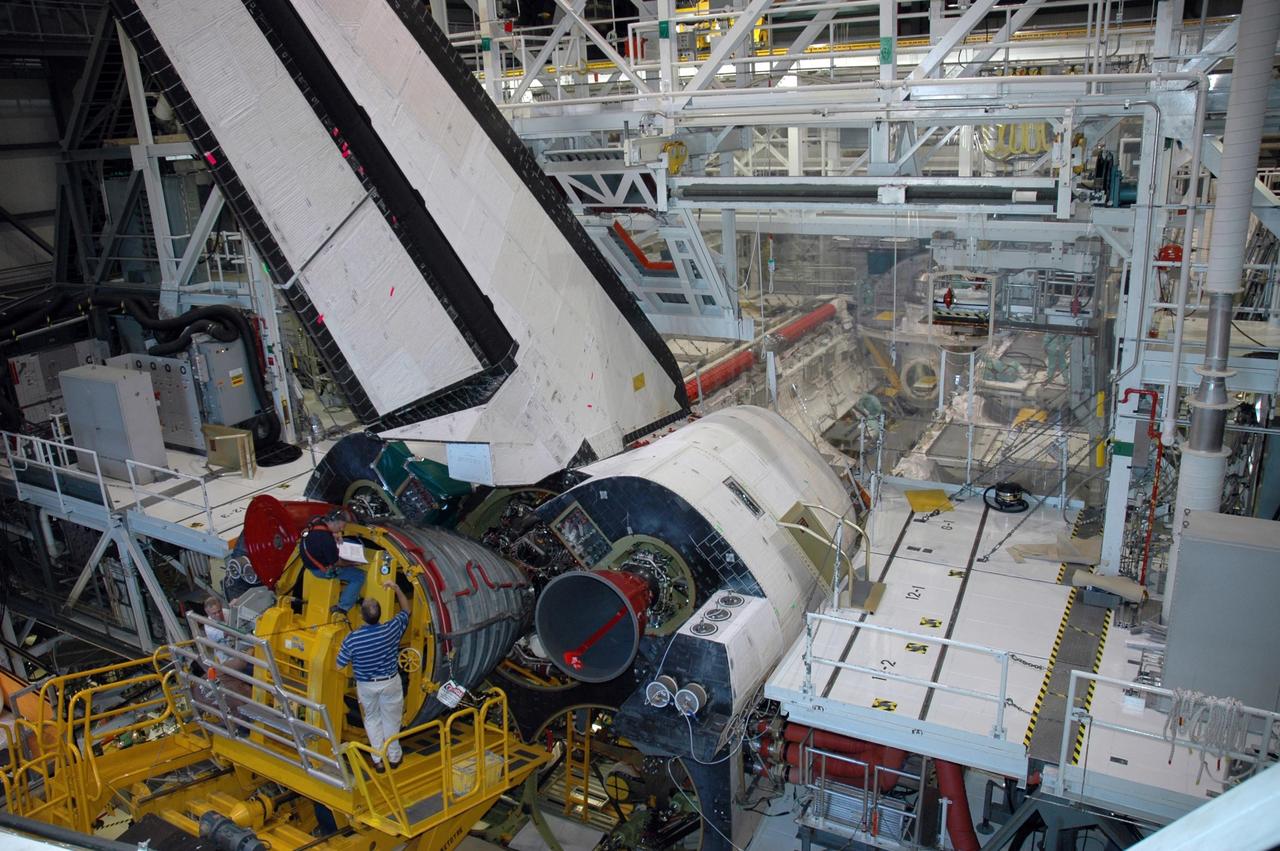
KENNEDY SPACE CENTER, FLA. -- In Orbiter Processing Facility bay 3 at NASA's Kennedy Space Center, technicians on a Hyster forklift maneuver space shuttle main engine no. 1 into place on Endeavour. Each space shuttle main engine is 14 feet long, weighs about 6,700 pounds, and is 7.5 feet in diameter at the end of the nozzle. The orbiter is targeted for launch on Feb. 14 for mission STS-123 to the International Space Station. Photo credit: NASA/Jack Pfaller
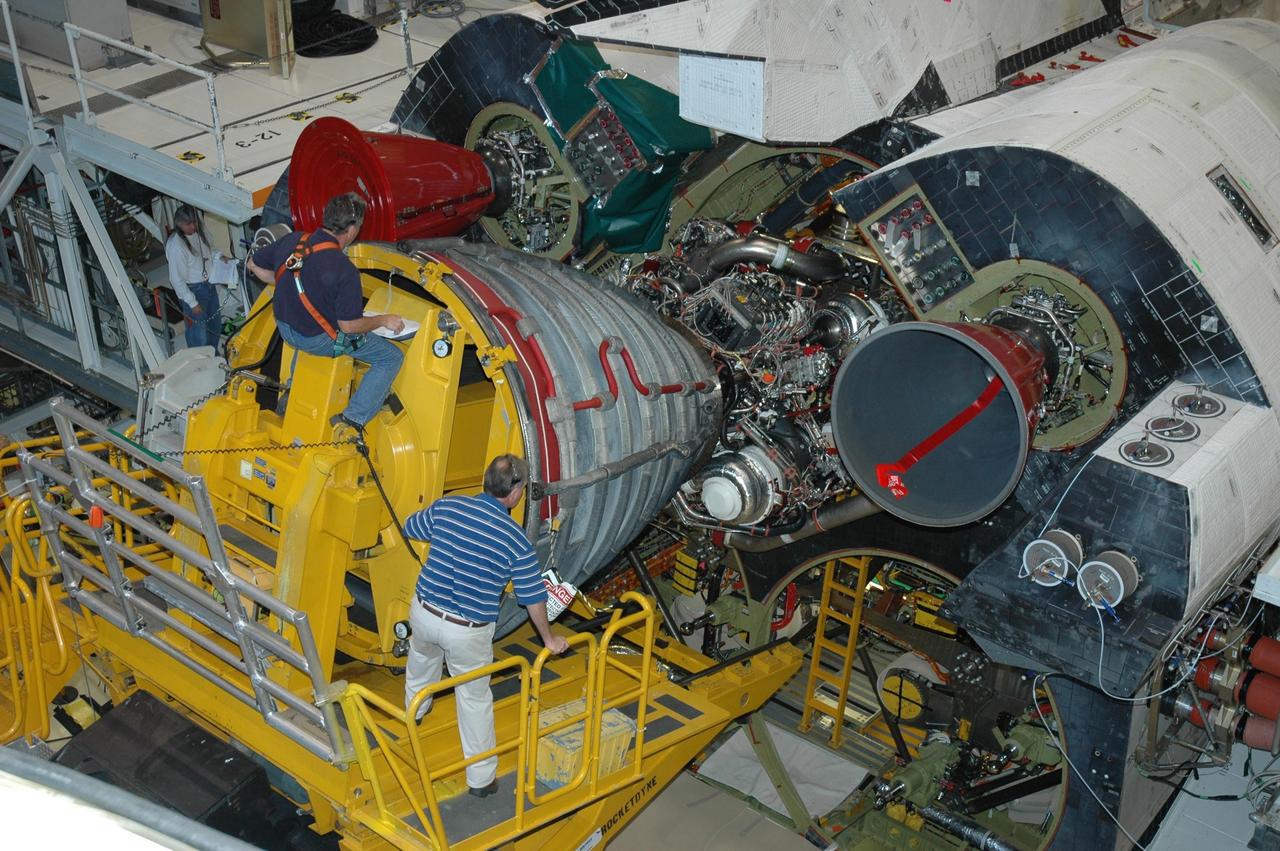
KENNEDY SPACE CENTER, FLA. -- In Orbiter Processing Facility bay 3 at NASA's Kennedy Space Center, technicians on a Hyster forklift maneuver space shuttle main engine no. 1 into place on Endeavour. Each space shuttle main engine is 14 feet long, weighs about 6,700 pounds, and is 7.5 feet in diameter at the end of the nozzle. The orbiter is targeted for launch on Feb. 14 for mission STS-123 to the International Space Station. Photo credit: NASA/Jack Pfaller
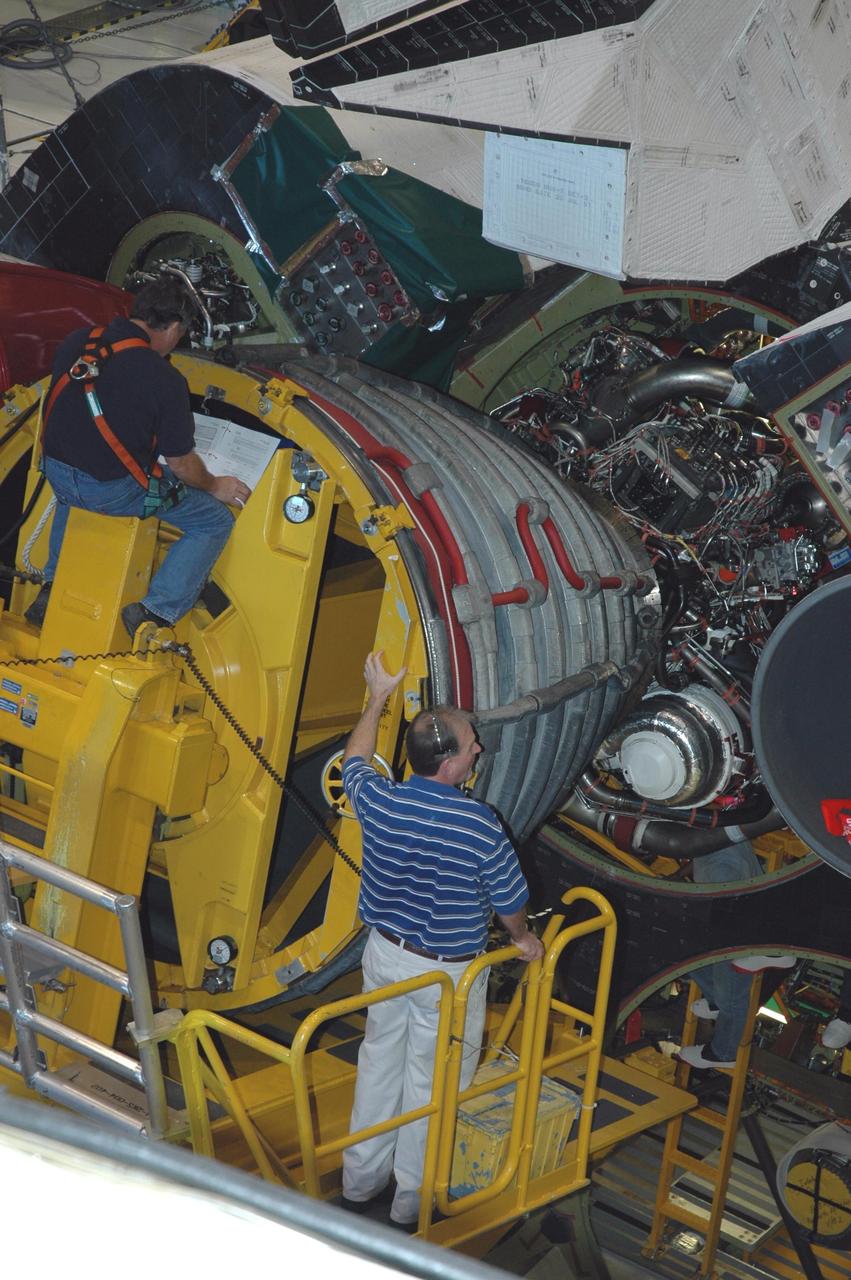
KENNEDY SPACE CENTER, FLA. -- In Orbiter Processing Facility bay 3 at NASA's Kennedy Space Center, technicians on a Hyster forklift maneuver space shuttle main engine no. 1 into place on Endeavour. Each space shuttle main engine is 14 feet long, weighs about 6,700 pounds, and is 7.5 feet in diameter at the end of the nozzle. The orbiter is targeted for launch on Feb. 14 for mission STS-123 to the International Space Station. Photo credit: NASA/Jack Pfaller
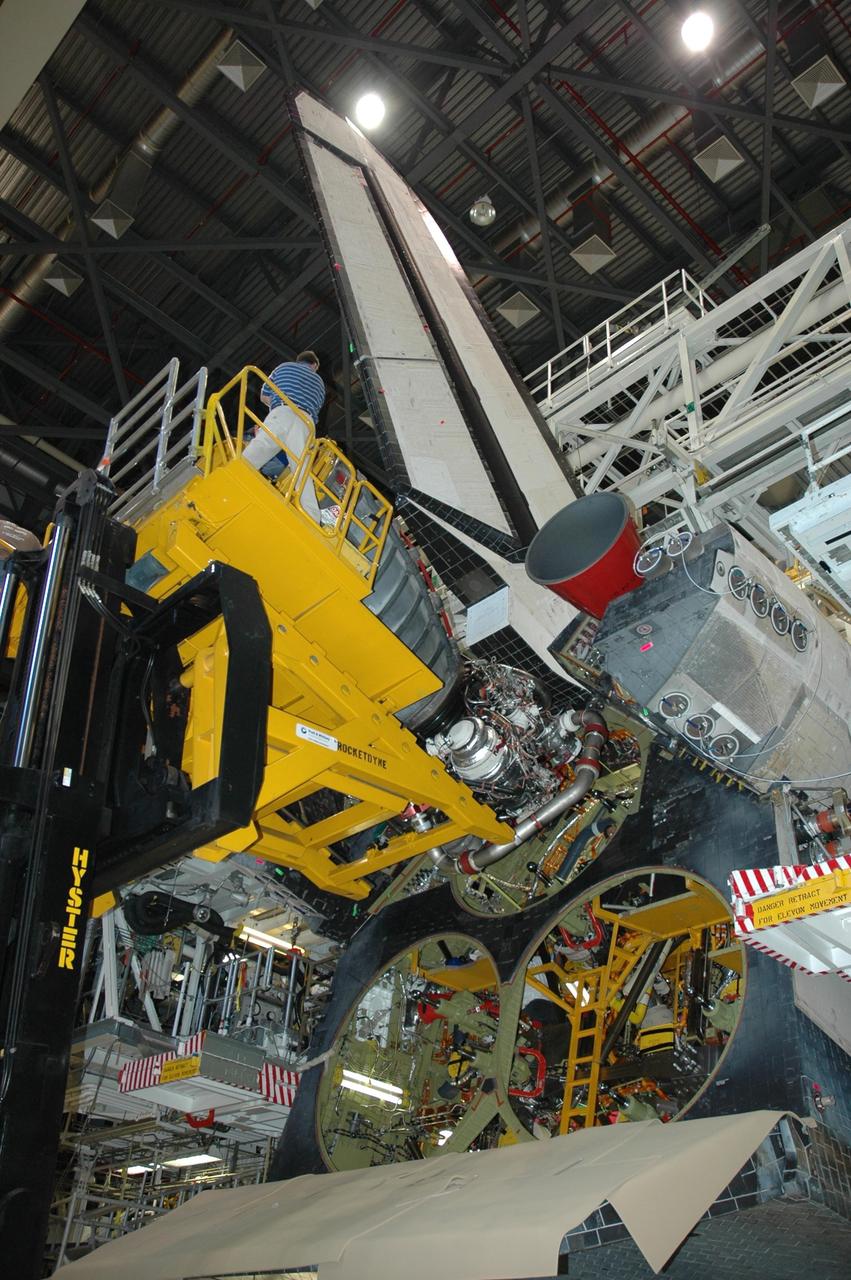
KENNEDY SPACE CENTER, FLA. -- In Orbiter Processing Facility bay 3 at NASA's Kennedy Space Center, technicians on a Hyster forklift maneuver space shuttle main engine no. 1 into place on Endeavour. Each space shuttle main engine is 14 feet long, weighs about 6,700 pounds, and is 7.5 feet in diameter at the end of the nozzle. The orbiter is targeted for launch on Feb. 14 for mission STS-123 to the International Space Station. Photo credit: NASA/Jack Pfaller
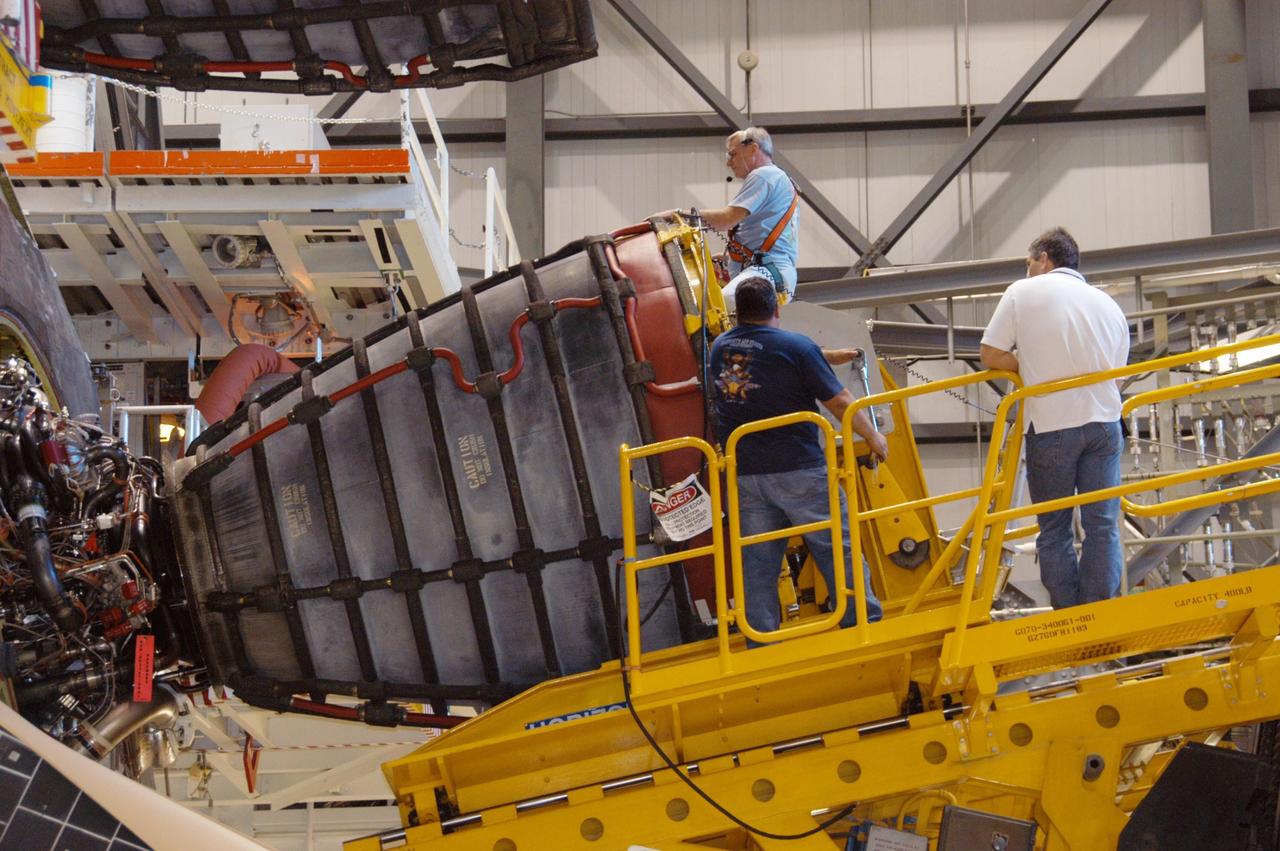
KENNEDY SPACE CENTER, FLA. -- In Orbiter Processing Facility bay 2, technicians on a Hyster forklift maneuver space shuttle main engine no. 3 into place on Endeavour. Each space shuttle main engine is 14 feet long, weighs about 6,700 pounds, and is 7.5 feet in diameter at the end of the nozzle. The orbiter is scheduled for mission STS-118, targeted for launch on June 28. The mission will be the 22nd flight to the International Space Station, carrying another starboard array, S5, for installation. Photo credit: NASA/George Shelton
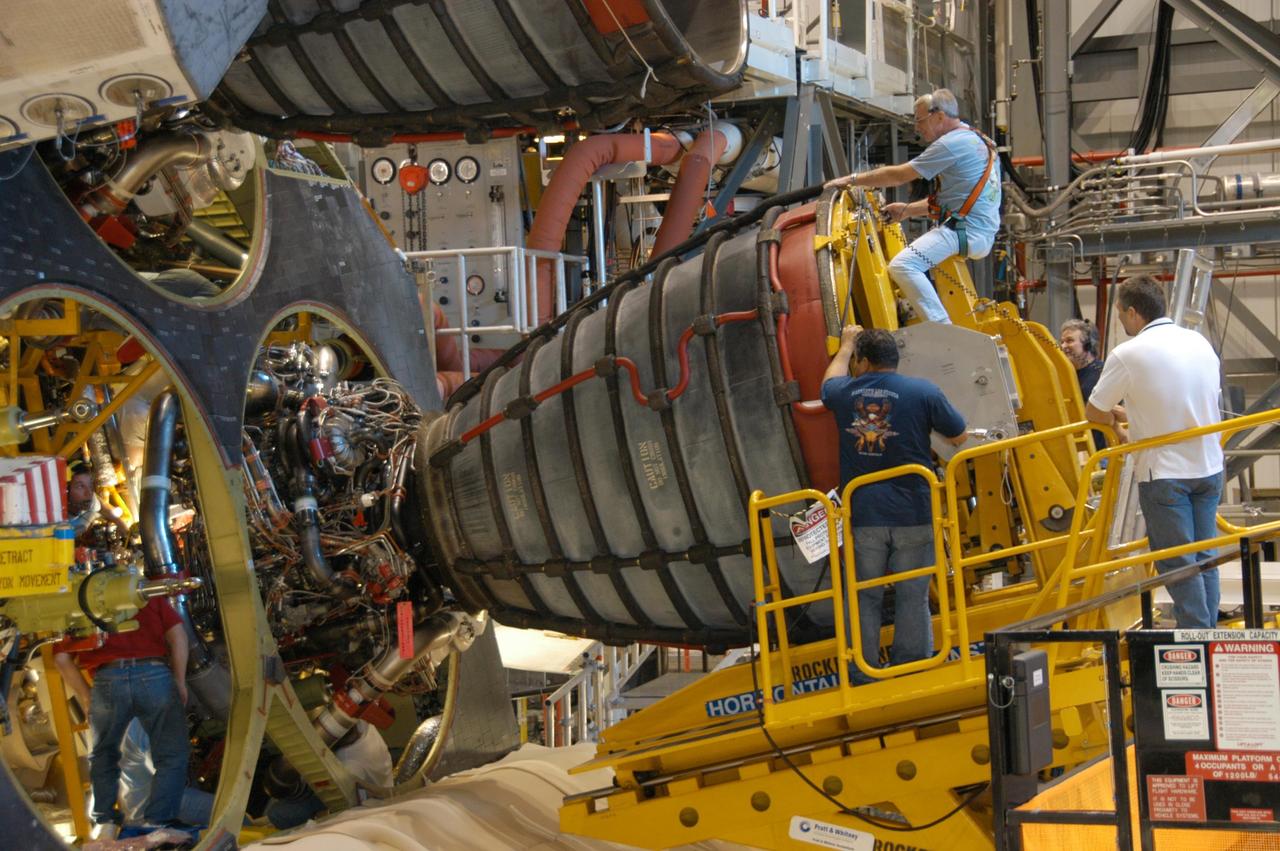
KENNEDY SPACE CENTER, FLA. -- In Orbiter Processing Facility bay 2, technicians on a Hyster forklift maneuver space shuttle main engine no. 3 into place on Endeavour. Each space shuttle main engine is 14 feet long, weighs about 6,700 pounds, and is 7.5 feet in diameter at the end of the nozzle. The orbiter is scheduled for mission STS-118, targeted for launch on June 28. The mission will be the 22nd flight to the International Space Station, carrying another starboard array, S5, for installation. Photo credit: NASA/George Shelton
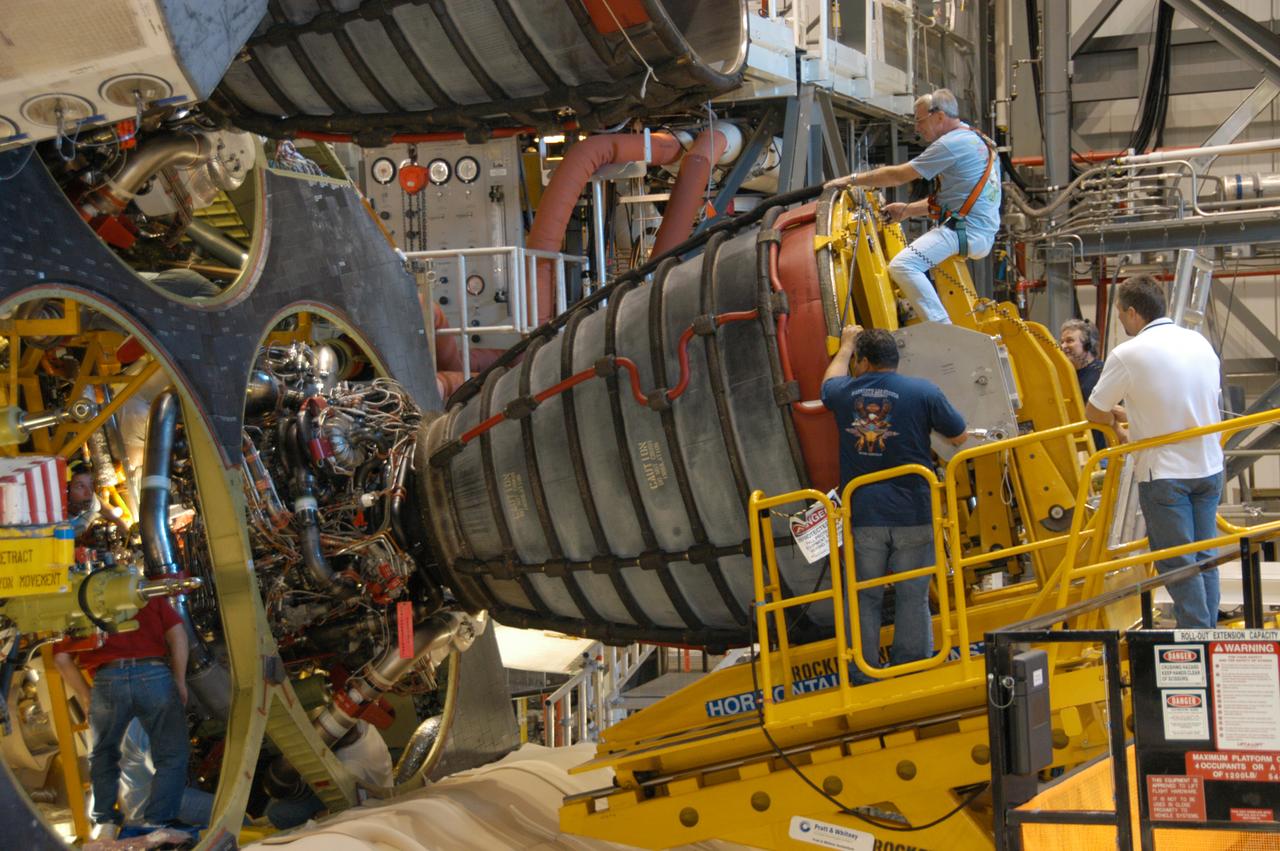
In Orbiter Processing Facility bay 2, technicians on a Hyster forklift maneuver space shuttle main engine no. 3 into place on Endeavour. Each space shuttle main engine is 14 feet long, weighs about 6,700 pounds, and is 7.5 feet in diameter at the end of the nozzle. The orbiter is scheduled for mission STS-118, targeted for launch on June 28. The mission will be the 22nd flight to the International Space Station, carrying another starboard array, S5, for installation.

In Orbiter Processing Facility bay 2, technicians on a Hyster forklift maneuver space shuttle main engine no. 3 into place on Endeavour. Each space shuttle main engine is 14 feet long, weighs about 6,700 pounds, and is 7.5 feet in diameter at the end of the nozzle. The orbiter is scheduled for mission STS-118, targeted for launch on June 28. The mission will be the 22nd flight to the International Space Station, carrying another starboard array, S5, for installation.
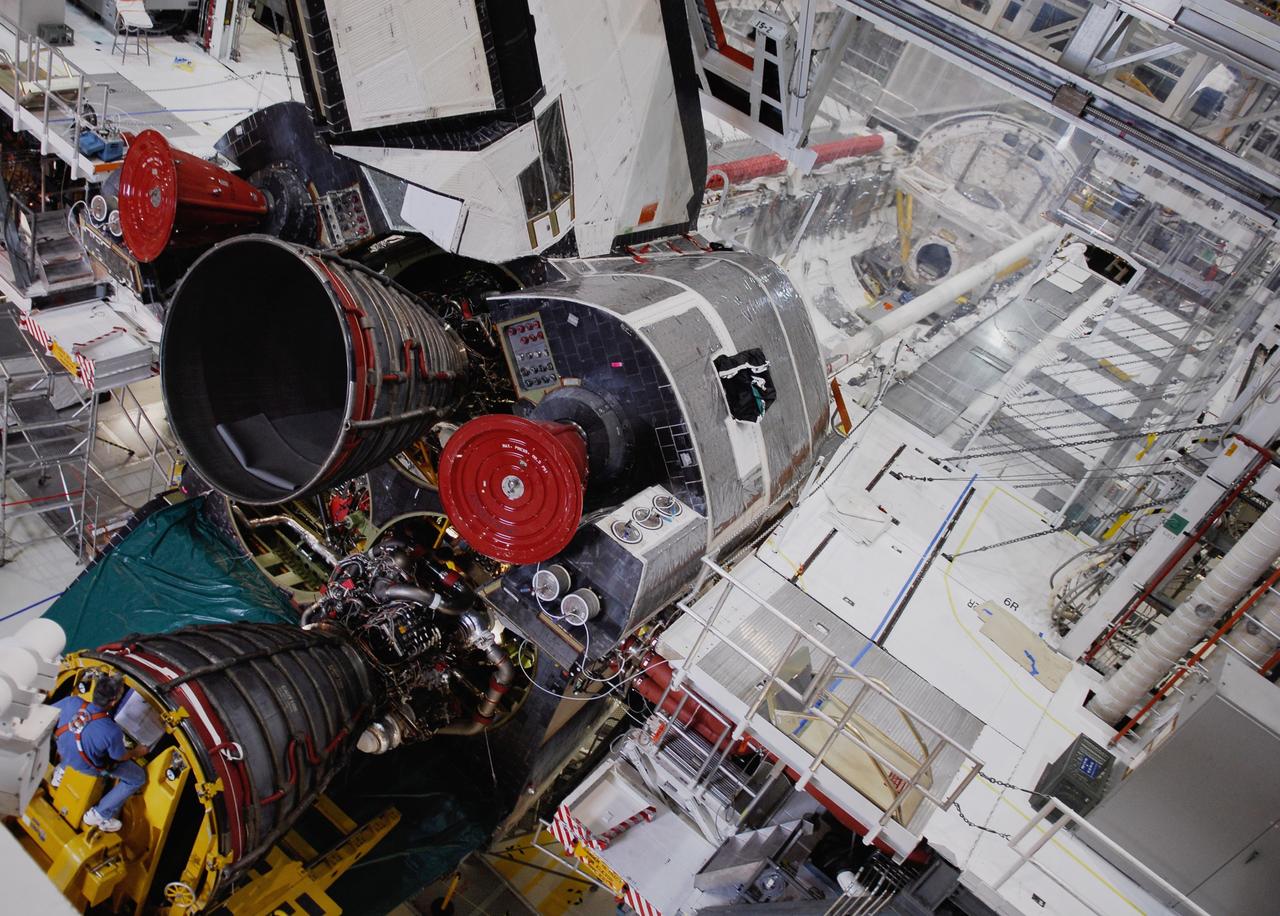
CAPE CANAVERAL, Fla. – In Orbiter Processing Facility bay No. 1, the technician on the engine installer moves a shuttle main engine toward the opening in space shuttle Atlantis. A pitch-and-yaw system helps maneuver the engine into place. Main engine No. 1 has already been installed. Atlantis is the designated vehicle for the STS-125 mission to service the Hubble Space Telescope. Launch is targeted for Oct. 8. Photo credit: NASA/Kim Shiflett

CAPE CANAVERAL, Fla. – In Orbiter Processing Facility bay No. 1, the technician on the engine installer moves a shuttle main engine into the opening in space shuttle Atlantis. A pitch-and-yaw system helps maneuver the engine into place. Main engine No. 1 has already been installed. Atlantis is the designated vehicle for the STS-125 mission to service the Hubble Space Telescope. Launch is targeted for Oct. 8. Photo credit: NASA/Kim Shiflett
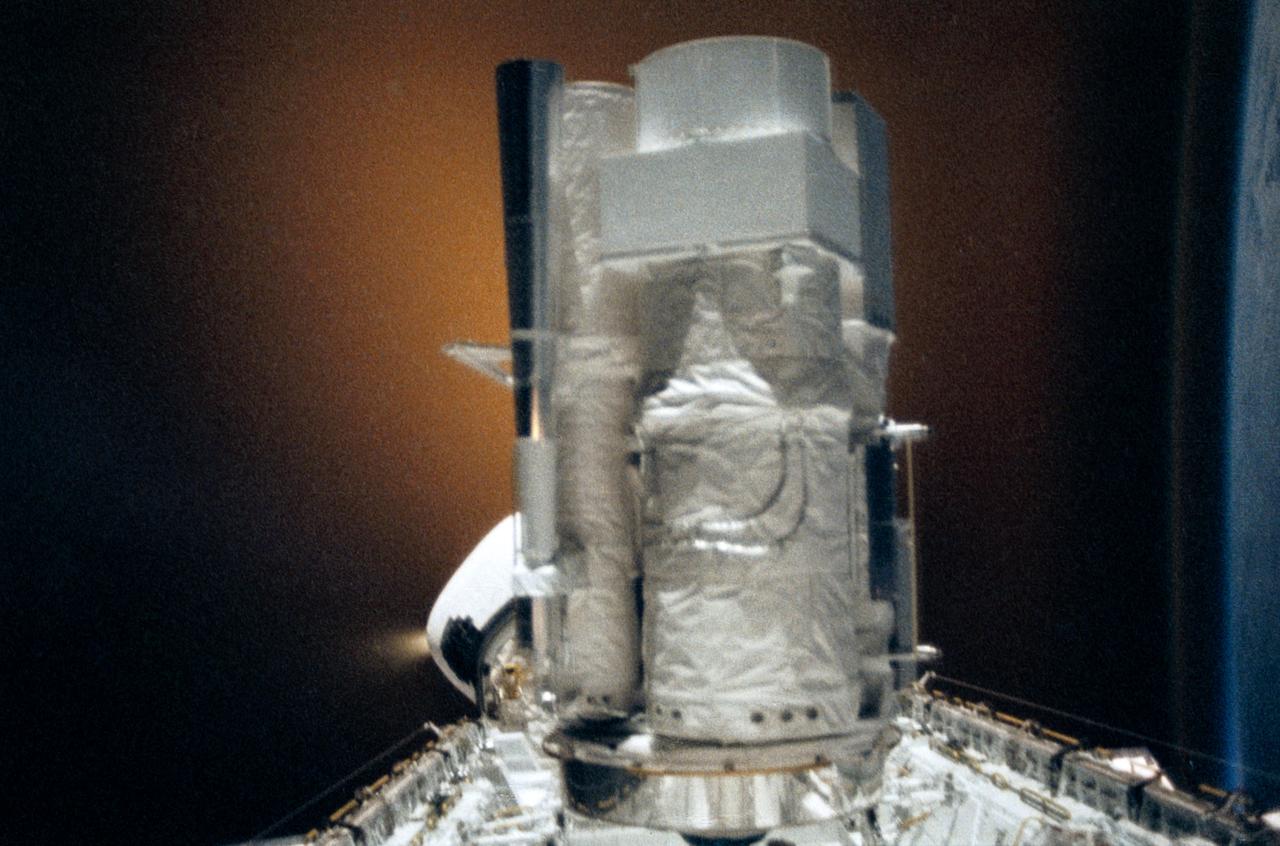
STS035-28-006 (2-10 Dec 1990) --- STS-35 Astronomy Laboratory 1 (ASTRO-1) telescopes, in on-orbit operating position in the payload bay (PLB), are silhouetted against an reaction control system (RCS) right thruster firing. Three ultraviolet telescopes are mounted and precisely co-aligned on a common structure, called the cruciform, that is attached to the instrument pointing system (IPS). Here the IPS holds the telescopes in a position that is parallel to the Earth's limb below. Visible on the cruciform are the star tracker (S TRK) (silver cone at the top), the Ultraviolet Imaging Telescope (UIT) (behind S TRK), and the Hopkins Ultraviolet Telescope(HUT).
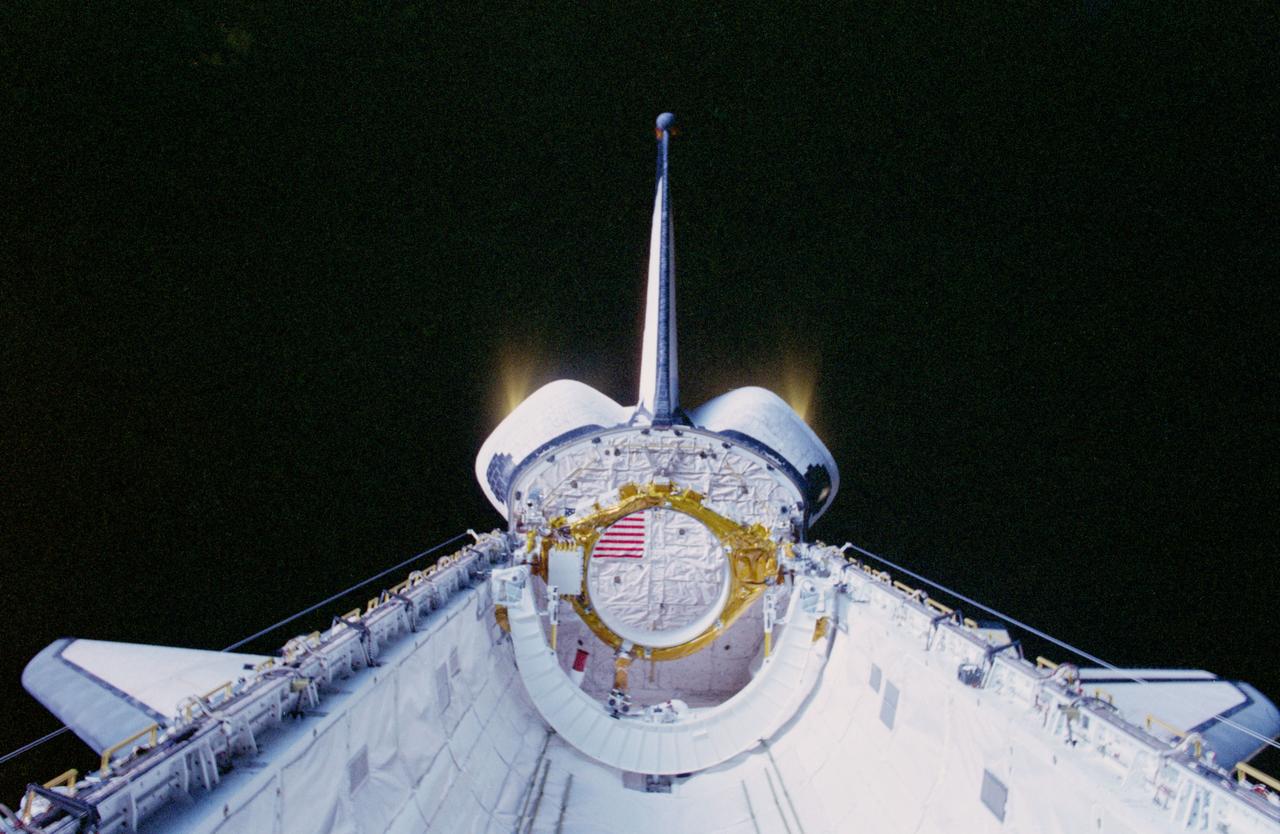
STS093-347-031 (22-27 July 1999) --- Black space forms the backdrop for this scene of the Orbital Maneuvering System (OMS) engine pods during a thruster burn photographed by one of the astronauts on the aft flight deck of the Space Shuttle Columbia.
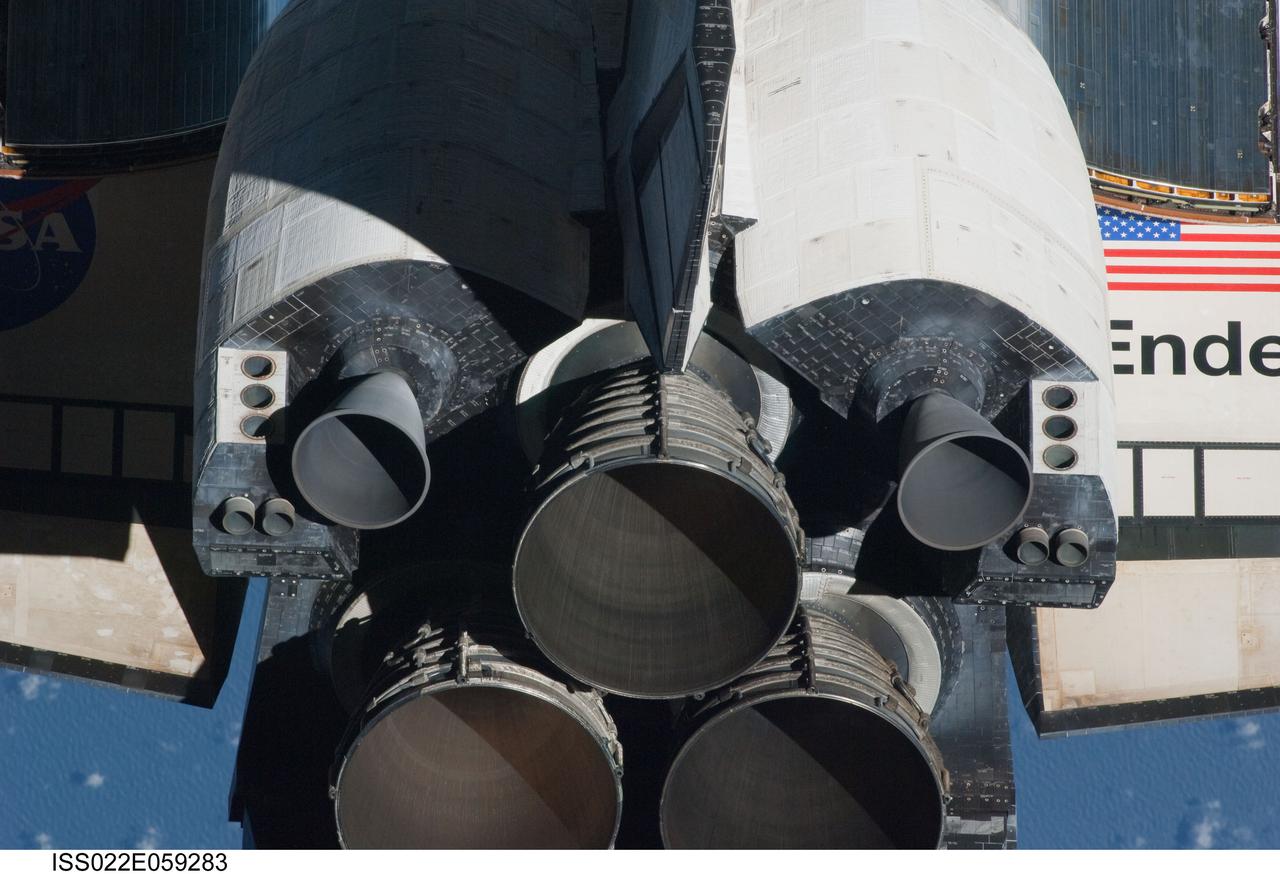
ISS022-E-059283 (9 Feb. 2010) --- This view of the aft portion of the space shuttle Endeavour, including the three main engines and orbital maneuvering system (OMS) pods, was provided by an Expedition 22 crew member during a survey of the approaching vehicle prior to docking with the International Space Station. As part of the survey and part of every mission's activities, Endeavour performed a back-flip for the rendezvous pitch maneuver (RPM). The image was photographed with a digital still camera, using a 400mm lens at a distance of about 600 feet (180 meters).

CAPE CANAVERAL, Fla. – In Orbiter Processing Facility-1 at NASA’s Kennedy Space Center in Florida, United Space Alliance technicians reinstall the left orbital maneuvering system, or OMS, pod on space shuttle Atlantis. The orbital maneuvering system provided the shuttle with thrust for orbit insertion, rendezvous and deorbit, and could provide up to 1,000 pounds of propellant to the aft reaction control system. The OMS is housed in two independent pods located on each side of the shuttle's aft fuselage. Each pod contains one OMS engine and the hardware needed to pressurize, store and distribute the propellants to perform the velocity maneuvers. Atlantis’ OMS pods were removed and sent to White Sands Test Facility in New Mexico to be cleaned of residual toxic propellant. The work is part of the Space Shuttle Program’s transition and retirement processing of the shuttle fleet. A groundbreaking was held Jan. 18 for Atlantis' future home, a 65,000-square-foot exhibit hall in Shuttle Plaza at the Kennedy Space Center Visitor Complex. Atlantis is scheduled to roll over to the visitor complex in November in preparation for the exhibit’s grand opening in July 2013. For more information, visit http://www.nasa.gov/transition. Photo credit: NASA/Ben Smegelsky
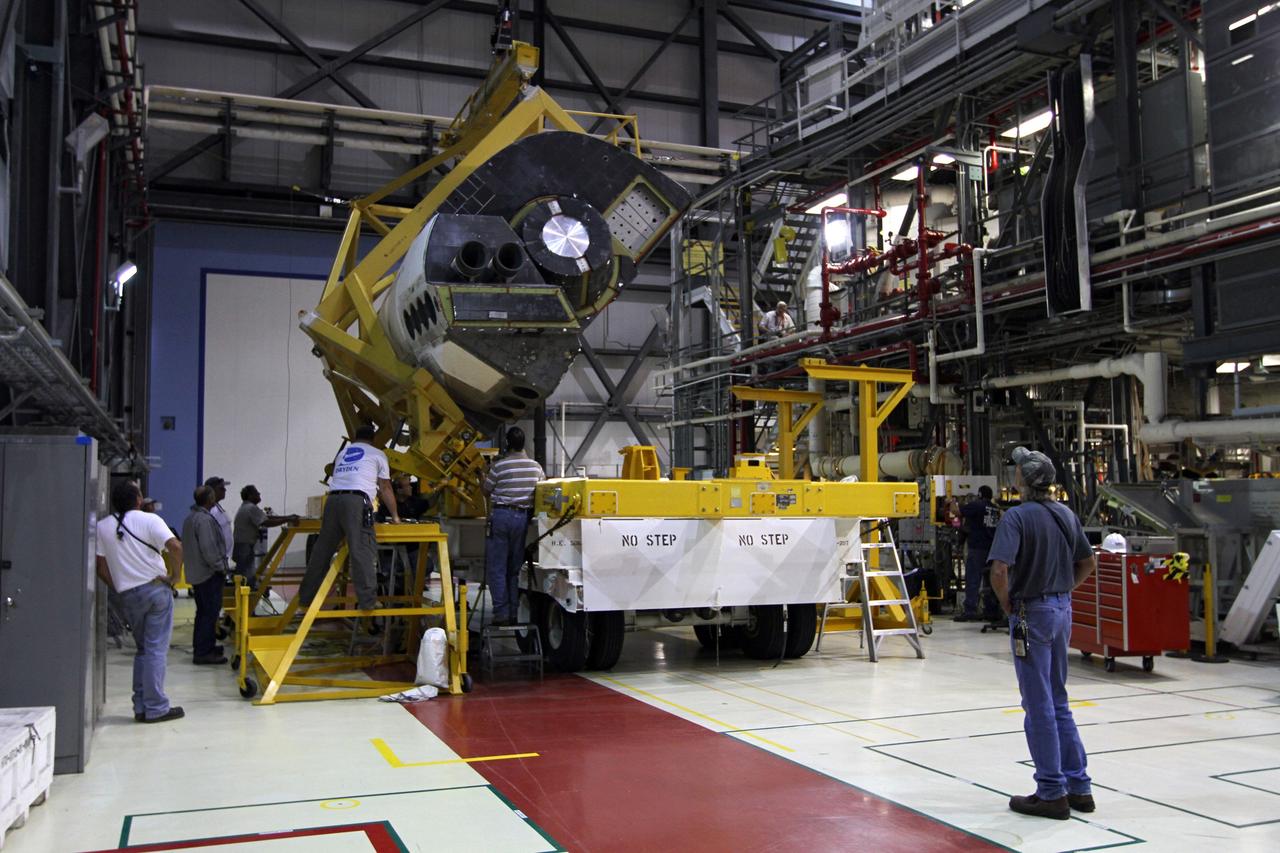
CAPE CANAVERAL, Fla. – In Orbiter Processing Facility-1 at NASA’s Kennedy Space Center in Florida, an orbital maneuvering system, or OMS, pod is lifted from its transporter under the careful supervision of United Space Alliance technicians. The pod will be reinstalled on space shuttle Atlantis. The orbital maneuvering system provided the shuttle with thrust for orbit insertion, rendezvous and deorbit, and could provide up to 1,000 pounds of propellant to the aft reaction control system. The OMS is housed in two independent pods located on each side of the shuttle's aft fuselage. Each pod contains one OMS engine and the hardware needed to pressurize, store and distribute the propellants to perform the velocity maneuvers. Atlantis’ OMS pods were removed and sent to White Sands Test Facility in New Mexico to be cleaned of residual toxic propellant. The work is part of the Space Shuttle Program’s transition and retirement processing of the shuttle fleet. A groundbreaking was held Jan. 18 for Atlantis' future home, a 65,000-square-foot exhibit hall in Shuttle Plaza at the Kennedy Space Center Visitor Complex. Atlantis is scheduled to roll over to the visitor complex in November in preparation for the exhibit’s grand opening in July 2013. For more information, visit http://www.nasa.gov/transition. Photo credit: NASA/Kim Shiflett
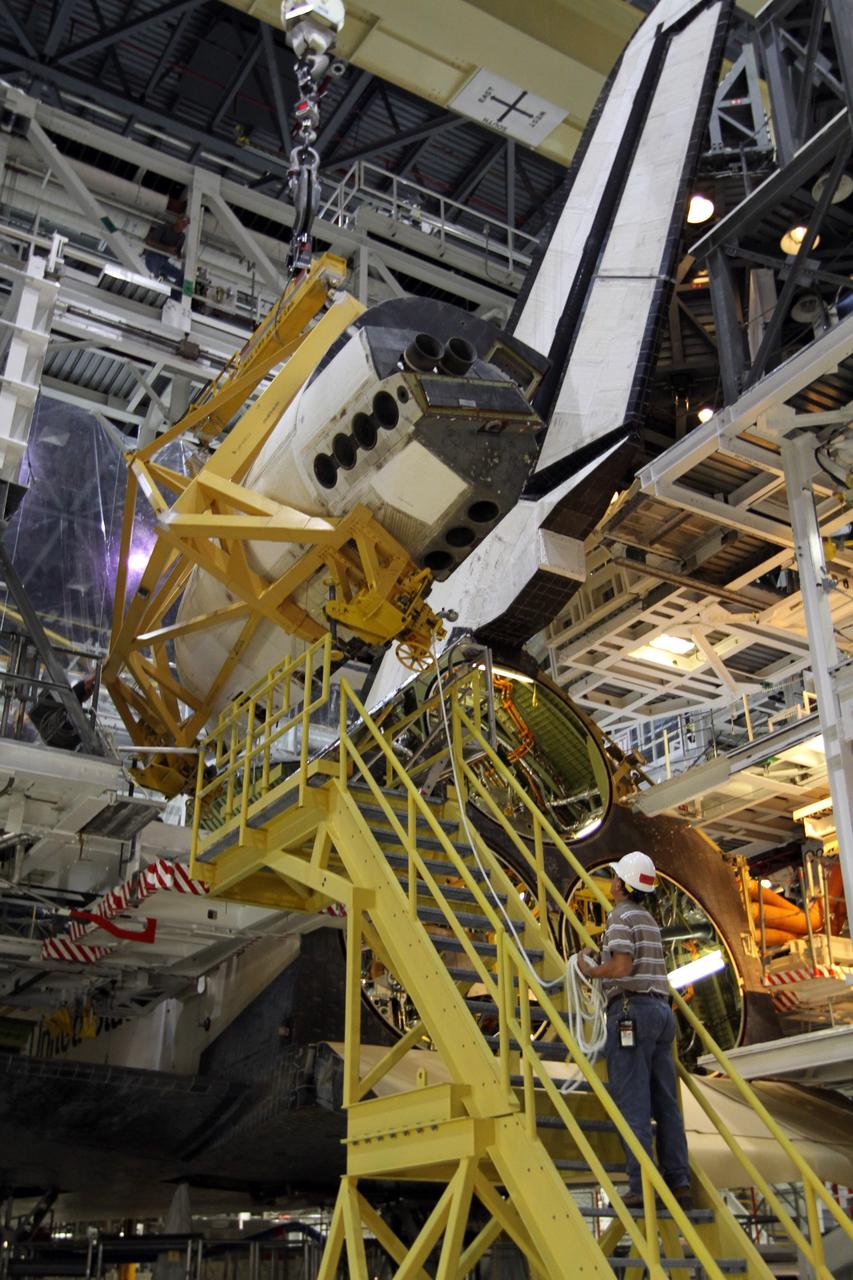
CAPE CANAVERAL, Fla. – In Orbiter Processing Facility-1 at NASA’s Kennedy Space Center in Florida, a United Space Alliance technician prepares to steady the orbital maneuvering system, or OMS, pod being lowered into position alongside space shuttle Atlantis. The orbital maneuvering system provided the shuttle with thrust for orbit insertion, rendezvous and deorbit, and could provide up to 1,000 pounds of propellant to the aft reaction control system. The OMS is housed in two independent pods located on each side of the shuttle's aft fuselage. Each pod contains one OMS engine and the hardware needed to pressurize, store and distribute the propellants to perform the velocity maneuvers. Atlantis’ OMS pods were removed and sent to White Sands Test Facility in New Mexico to be cleaned of residual toxic propellant. The work is part of the Space Shuttle Program’s transition and retirement processing of the shuttle fleet. A groundbreaking was held Jan. 18 for Atlantis' future home, a 65,000-square-foot exhibit hall in Shuttle Plaza at the Kennedy Space Center Visitor Complex. Atlantis is scheduled to roll over to the visitor complex in November in preparation for the exhibit’s grand opening in July 2013. For more information, visit http://www.nasa.gov/transition. Photo credit: NASA/Kim Shiflett
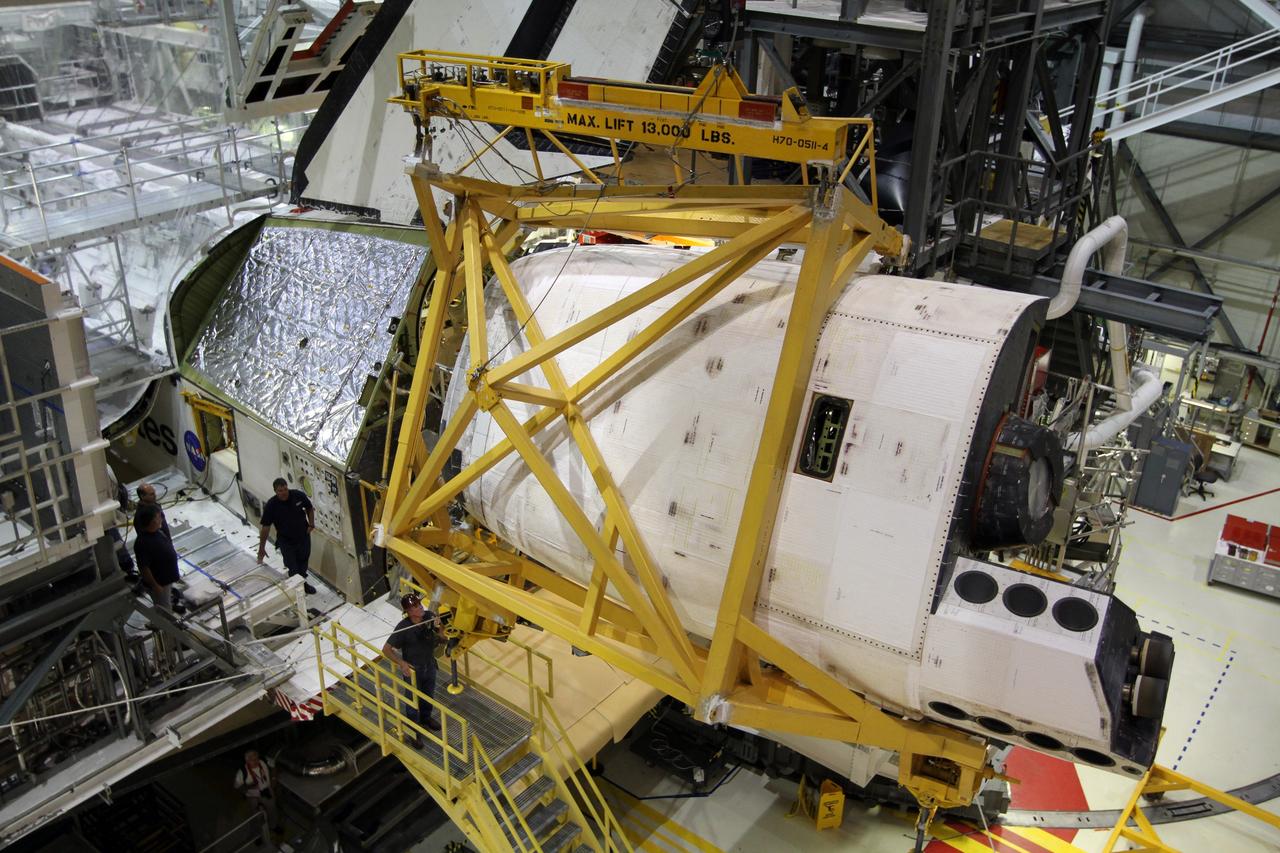
CAPE CANAVERAL, Fla. – In Orbiter Processing Facility-1 at NASA’s Kennedy Space Center in Florida, United Space Alliance technicians prepare to reinstall on space shuttle Atlantis the orbital maneuvering system, or OMS, pod heading their way. The orbital maneuvering system provided the shuttle with thrust for orbit insertion, rendezvous and deorbit, and could provide up to 1,000 pounds of propellant to the aft reaction control system. The OMS is housed in two independent pods located on each side of the shuttle's aft fuselage. Each pod contains one OMS engine and the hardware needed to pressurize, store and distribute the propellants to perform the velocity maneuvers. Atlantis’ OMS pods were removed and sent to White Sands Test Facility in New Mexico to be cleaned of residual toxic propellant. The work is part of the Space Shuttle Program’s transition and retirement processing of the shuttle fleet. A groundbreaking was held Jan. 18 for Atlantis' future home, a 65,000-square-foot exhibit hall in Shuttle Plaza at the Kennedy Space Center Visitor Complex. Atlantis is scheduled to roll over to the visitor complex in November in preparation for the exhibit’s grand opening in July 2013. For more information, visit http://www.nasa.gov/transition. Photo credit: NASA/Kim Shiflett
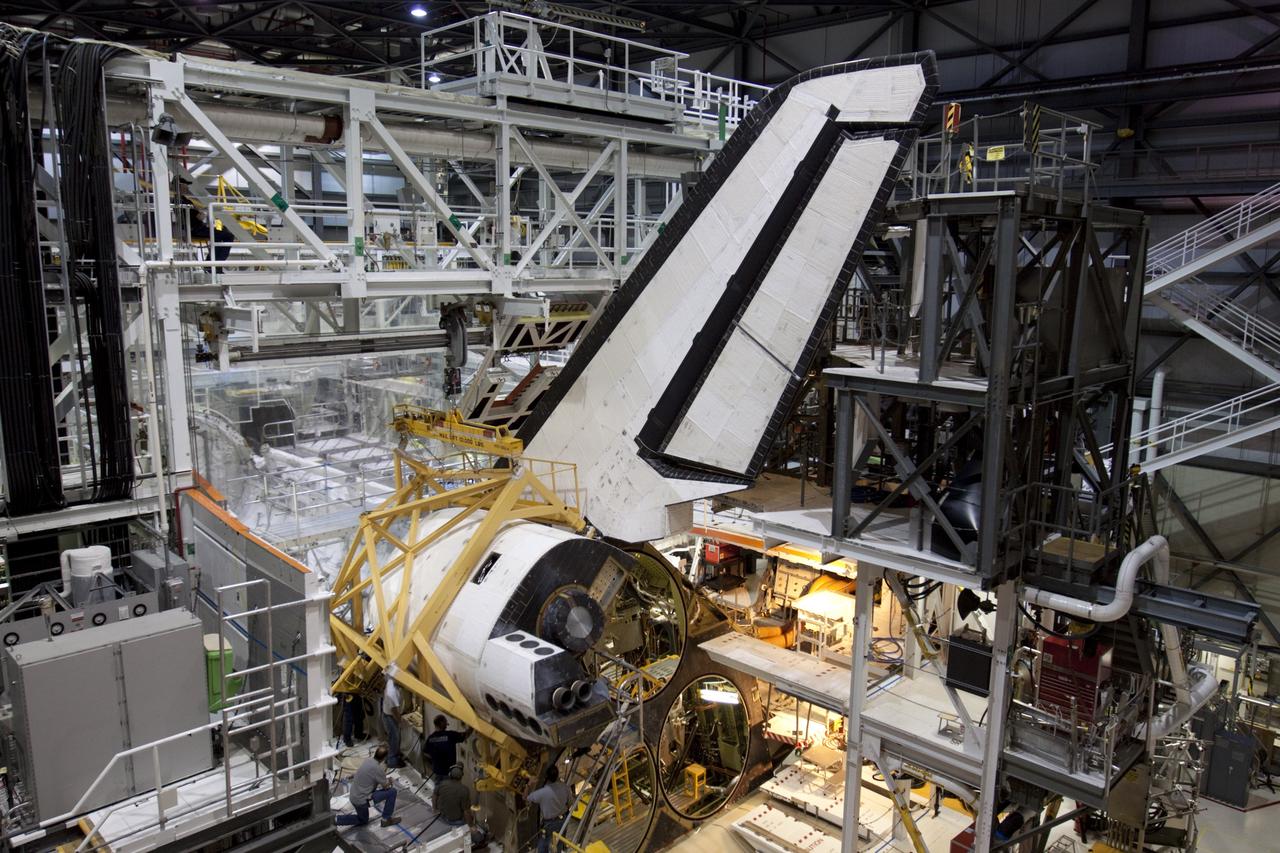
CAPE CANAVERAL, Fla. – In Orbiter Processing Facility-1 at NASA’s Kennedy Space Center in Florida, United Space Alliance technicians reinstall the left orbital maneuvering system, or OMS, pod on space shuttle Atlantis. The orbital maneuvering system provided the shuttle with thrust for orbit insertion, rendezvous and deorbit, and could provide up to 1,000 pounds of propellant to the aft reaction control system. The OMS is housed in two independent pods located on each side of the shuttle's aft fuselage. Each pod contains one OMS engine and the hardware needed to pressurize, store and distribute the propellants to perform the velocity maneuvers. Atlantis’ OMS pods were removed and sent to White Sands Test Facility in New Mexico to be cleaned of residual toxic propellant. The work is part of the Space Shuttle Program’s transition and retirement processing of the shuttle fleet. A groundbreaking was held Jan. 18 for Atlantis' future home, a 65,000-square-foot exhibit hall in Shuttle Plaza at the Kennedy Space Center Visitor Complex. Atlantis is scheduled to roll over to the visitor complex in November in preparation for the exhibit’s grand opening in July 2013. For more information, visit http://www.nasa.gov/transition. Photo credit: NASA/Ben Smegelsky
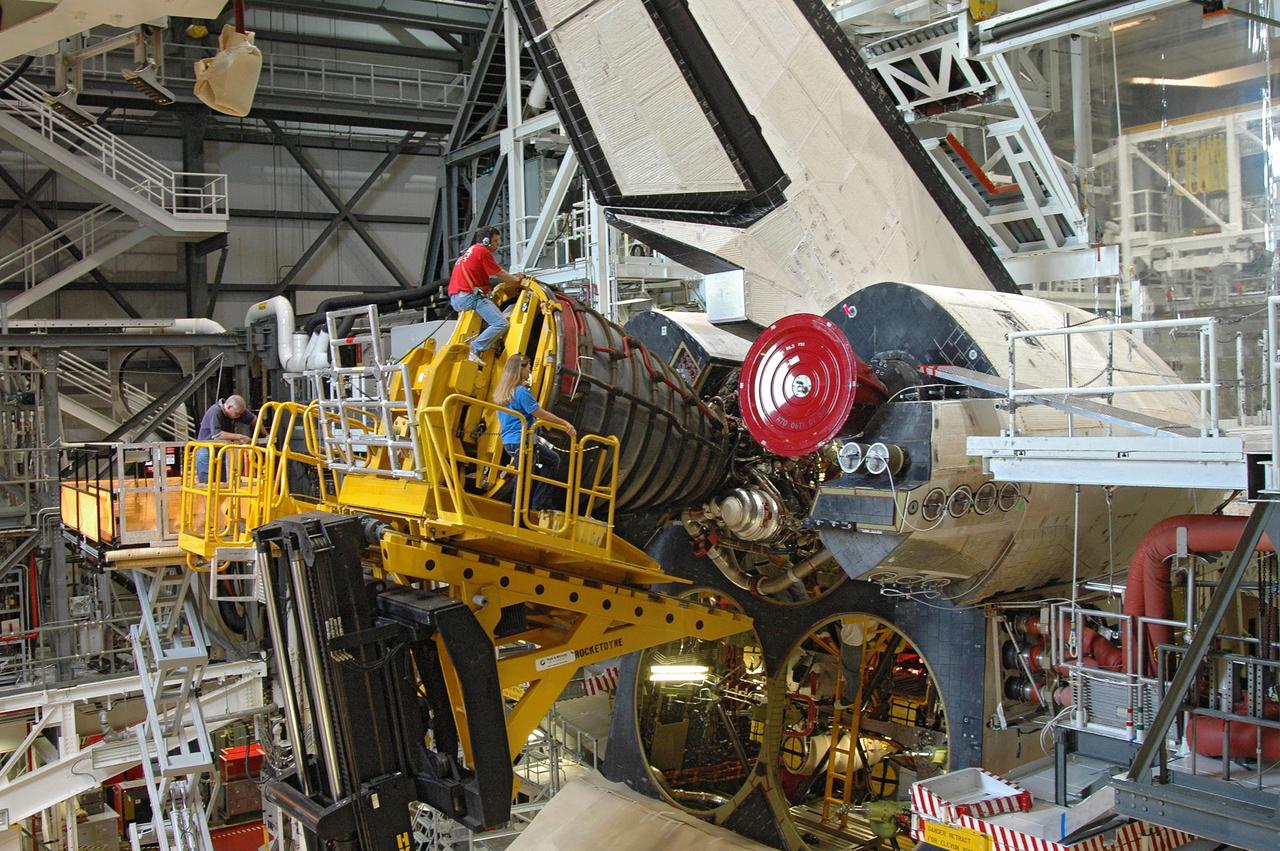
CAPE CANAVERAL, Fla. – In the Orbiter Processing Facility bay 2, technicians work the engine installer to maneuver main engine 1 into place on space shuttle Endeavour. The scheduled launch vehicle for the STS-126 mission, Endeavour will deliver a multi-purpose logistics module to the International Space Station. Launch is targeted for Nov. 10. Endeavour is also the backup shuttle, if needed for rescue, for the STS-125 mission in October that will make repairs on the Hubble Space Telescope. For that purpose, it is designated STS-400. Photo credit: NASA/Jim Grossmann
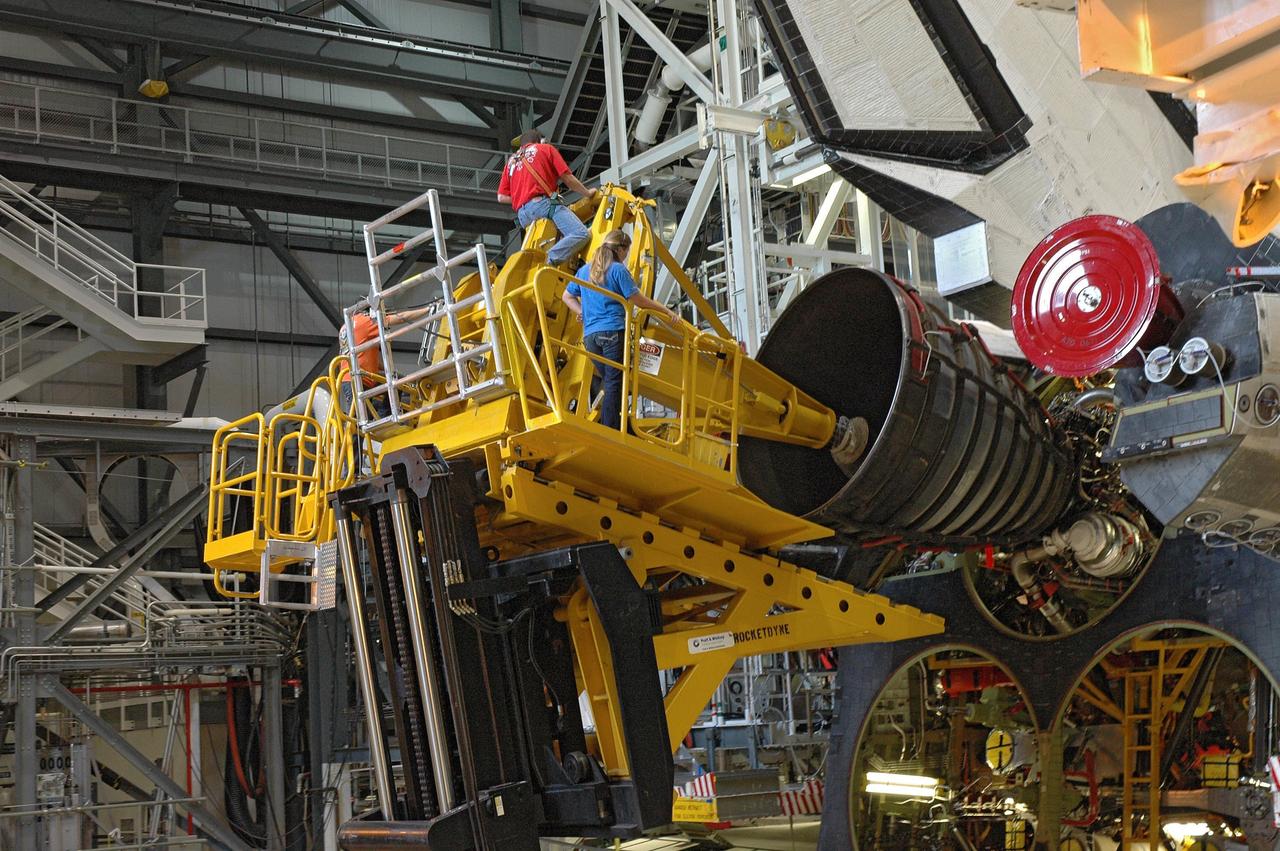
CAPE CANAVERAL, Fla. – In the Orbiter Processing Facility bay 2, technicians work the engine installer to maneuver main engine 1 into place on space shuttle Endeavour. The scheduled launch vehicle for the STS-126 mission, Endeavour will deliver a multi-purpose logistics module to the International Space Station. Launch is targeted for Nov. 10. Endeavour is also the backup shuttle, if needed for rescue, for the STS-125 mission in October that will make repairs on the Hubble Space Telescope. For that purpose, it is designated STS-400. Photo credit: NASA/Jim Grossmann
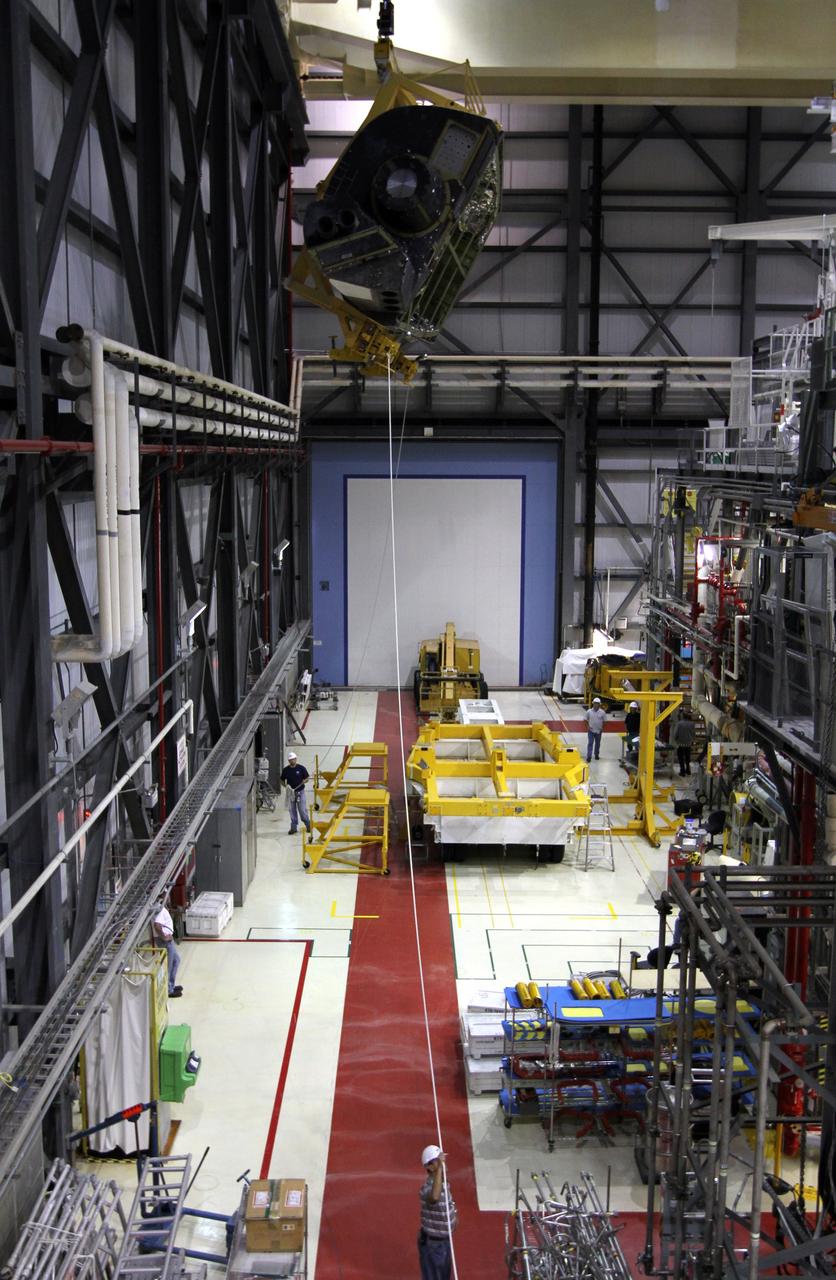
CAPE CANAVERAL, Fla. – An orbital maneuvering system, or OMS, pod glides across the ceiling away from its transporter in Orbiter Processing Facility-1 at NASA’s Kennedy Space Center in Florida. The pod will be reinstalled on space shuttle Atlantis. The orbital maneuvering system provided the shuttle with thrust for orbit insertion, rendezvous and deorbit, and could provide up to 1,000 pounds of propellant to the aft reaction control system. The OMS is housed in two independent pods located on each side of the shuttle's aft fuselage. Each pod contains one OMS engine and the hardware needed to pressurize, store and distribute the propellants to perform the velocity maneuvers. Atlantis’ OMS pods were removed and sent to White Sands Test Facility in New Mexico to be cleaned of residual toxic propellant. The work is part of the Space Shuttle Program’s transition and retirement processing of the shuttle fleet. A groundbreaking was held Jan. 18 for Atlantis' future home, a 65,000-square-foot exhibit hall in Shuttle Plaza at the Kennedy Space Center Visitor Complex. Atlantis is scheduled to roll over to the visitor complex in November in preparation for the exhibit’s grand opening in July 2013. For more information, visit http://www.nasa.gov/transition. Photo credit: NASA/Kim Shiflett
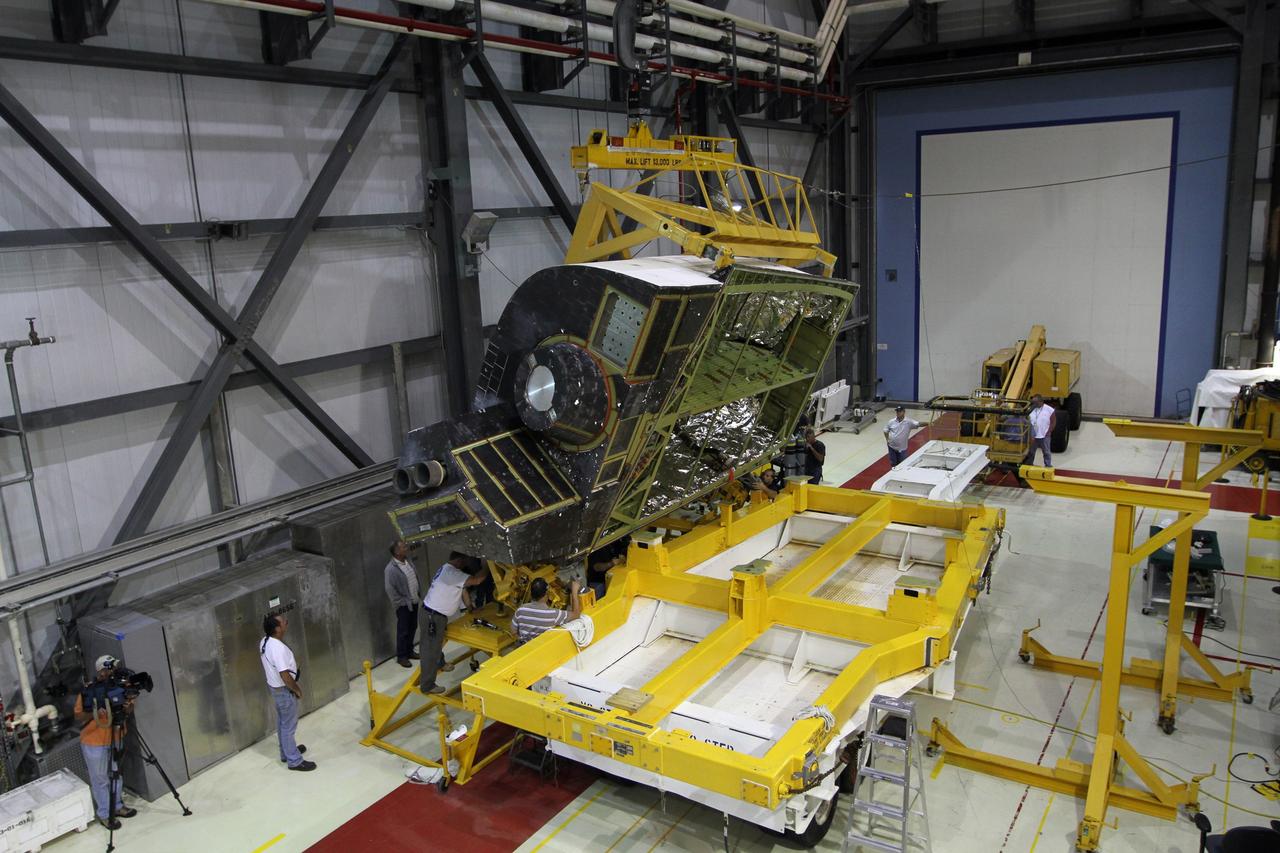
CAPE CANAVERAL, Fla. – In Orbiter Processing Facility-1 at NASA’s Kennedy Space Center in Florida, the underbelly of an orbital maneuvering system, or OMS, pod comes into view as it is lifted from its transporter. The pod will be reinstalled on space shuttle Atlantis. The orbital maneuvering system provided the shuttle with thrust for orbit insertion, rendezvous and deorbit, and could provide up to 1,000 pounds of propellant to the aft reaction control system. The OMS is housed in two independent pods located on each side of the shuttle's aft fuselage. Each pod contains one OMS engine and the hardware needed to pressurize, store and distribute the propellants to perform the velocity maneuvers. Atlantis’ OMS pods were removed and sent to White Sands Test Facility in New Mexico to be cleaned of residual toxic propellant. The work is part of the Space Shuttle Program’s transition and retirement processing of the shuttle fleet. A groundbreaking was held Jan. 18 for Atlantis' future home, a 65,000-square-foot exhibit hall in Shuttle Plaza at the Kennedy Space Center Visitor Complex. Atlantis is scheduled to roll over to the visitor complex in November in preparation for the exhibit’s grand opening in July 2013. For more information, visit http://www.nasa.gov/transition. Photo credit: NASA/Kim Shiflett

CAPE CANAVERAL, Fla. – An orbital maneuvering system, or OMS, pod is lifted across the ceiling in Orbiter Processing Facility-1 at NASA’s Kennedy Space Center in Florida. The pod will be reinstalled on space shuttle Atlantis. The orbital maneuvering system provided the shuttle with thrust for orbit insertion, rendezvous and deorbit, and could provide up to 1,000 pounds of propellant to the aft reaction control system. The OMS is housed in two independent pods located on each side of the shuttle's aft fuselage. Each pod contains one OMS engine and the hardware needed to pressurize, store and distribute the propellants to perform the velocity maneuvers. Atlantis’ OMS pods were removed and sent to White Sands Test Facility in New Mexico to be cleaned of residual toxic propellant. The work is part of the Space Shuttle Program’s transition and retirement processing of the shuttle fleet. A groundbreaking was held Jan. 18 for Atlantis' future home, a 65,000-square-foot exhibit hall in Shuttle Plaza at the Kennedy Space Center Visitor Complex. Atlantis is scheduled to roll over to the visitor complex in November in preparation for the exhibit’s grand opening in July 2013. For more information, visit http://www.nasa.gov/transition. Photo credit: NASA/Kim Shiflett
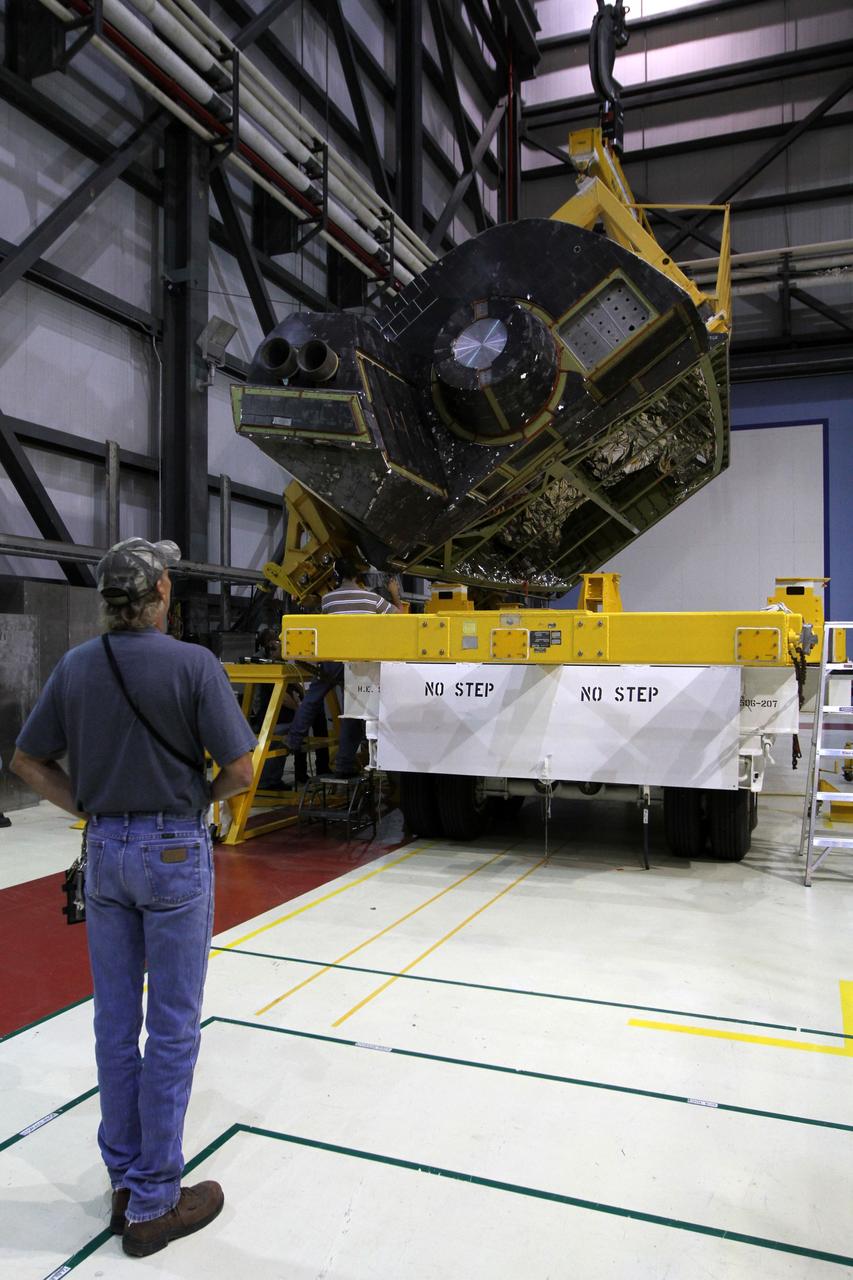
CAPE CANAVERAL, Fla. – In Orbiter Processing Facility-1 at NASA’s Kennedy Space Center in Florida, a handling fixture lifts an orbital maneuvering system, or OMS, pod from its transporter. The pod will be reinstalled on space shuttle Atlantis. The orbital maneuvering system provided the shuttle with thrust for orbit insertion, rendezvous and deorbit, and could provide up to 1,000 pounds of propellant to the aft reaction control system. The OMS is housed in two independent pods located on each side of the shuttle's aft fuselage. Each pod contains one OMS engine and the hardware needed to pressurize, store and distribute the propellants to perform the velocity maneuvers. Atlantis’ OMS pods were removed and sent to White Sands Test Facility in New Mexico to be cleaned of residual toxic propellant. The work is part of the Space Shuttle Program’s transition and retirement processing of the shuttle fleet. A groundbreaking was held Jan. 18 for Atlantis' future home, a 65,000-square-foot exhibit hall in Shuttle Plaza at the Kennedy Space Center Visitor Complex. Atlantis is scheduled to roll over to the visitor complex in November in preparation for the exhibit’s grand opening in July 2013. For more information, visit http://www.nasa.gov/transition. Photo credit: NASA/Kim Shiflett
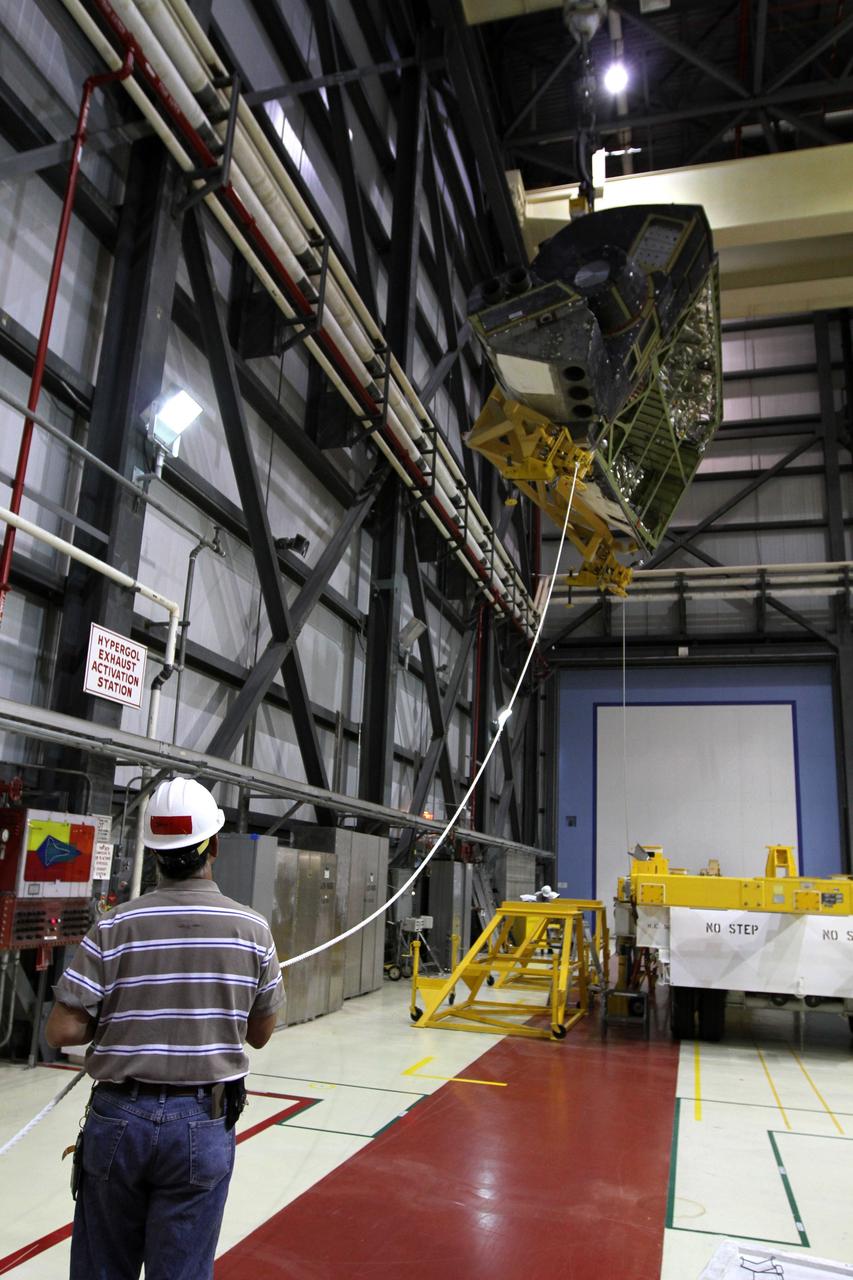
CAPE CANAVERAL, Fla. – An orbital maneuvering system, or OMS, pod hovers above its transporter in Orbiter Processing Facility-1 at NASA’s Kennedy Space Center in Florida. The pod will be reinstalled on space shuttle Atlantis. The orbital maneuvering system provided the shuttle with thrust for orbit insertion, rendezvous and deorbit, and could provide up to 1,000 pounds of propellant to the aft reaction control system. The OMS is housed in two independent pods located on each side of the shuttle's aft fuselage. Each pod contains one OMS engine and the hardware needed to pressurize, store and distribute the propellants to perform the velocity maneuvers. Atlantis’ OMS pods were removed and sent to White Sands Test Facility in New Mexico to be cleaned of residual toxic propellant. The work is part of the Space Shuttle Program’s transition and retirement processing of the shuttle fleet. A groundbreaking was held Jan. 18 for Atlantis' future home, a 65,000-square-foot exhibit hall in Shuttle Plaza at the Kennedy Space Center Visitor Complex. Atlantis is scheduled to roll over to the visitor complex in November in preparation for the exhibit’s grand opening in July 2013. For more information, visit http://www.nasa.gov/transition. Photo credit: NASA/Kim Shiflett
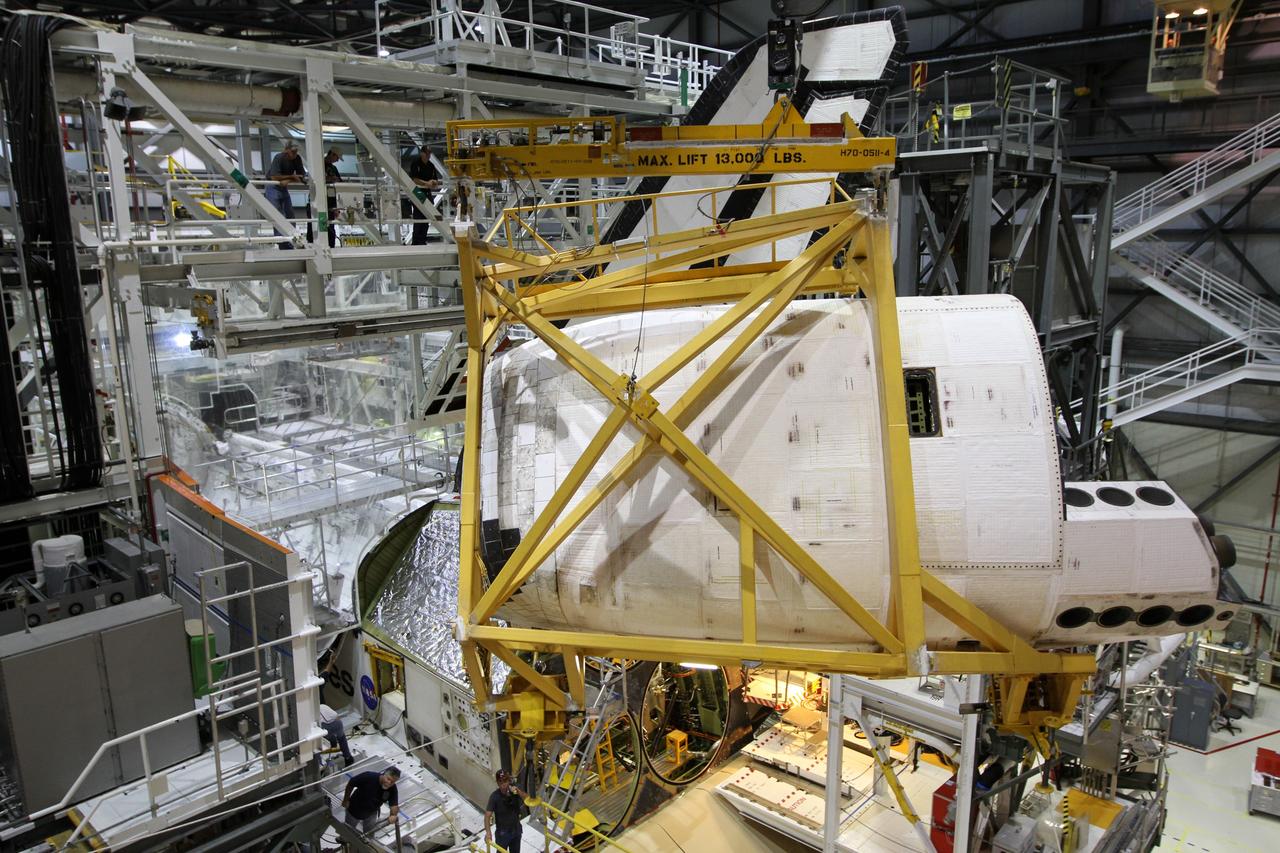
CAPE CANAVERAL, Fla. – In Orbiter Processing Facility-1 at NASA’s Kennedy Space Center in Florida, an orbital maneuvering system, or OMS, pod glides across the ceiling toward space shuttle Atlantis on which it will be installed. The orbital maneuvering system provided the shuttle with thrust for orbit insertion, rendezvous and deorbit, and could provide up to 1,000 pounds of propellant to the aft reaction control system. The OMS is housed in two independent pods located on each side of the shuttle's aft fuselage. Each pod contains one OMS engine and the hardware needed to pressurize, store and distribute the propellants to perform the velocity maneuvers. Atlantis’ OMS pods were removed and sent to White Sands Test Facility in New Mexico to be cleaned of residual toxic propellant. The work is part of the Space Shuttle Program’s transition and retirement processing of the shuttle fleet. A groundbreaking was held Jan. 18 for Atlantis' future home, a 65,000-square-foot exhibit hall in Shuttle Plaza at the Kennedy Space Center Visitor Complex. Atlantis is scheduled to roll over to the visitor complex in November in preparation for the exhibit’s grand opening in July 2013. For more information, visit http://www.nasa.gov/transition. Photo credit: NASA/Kim Shiflett
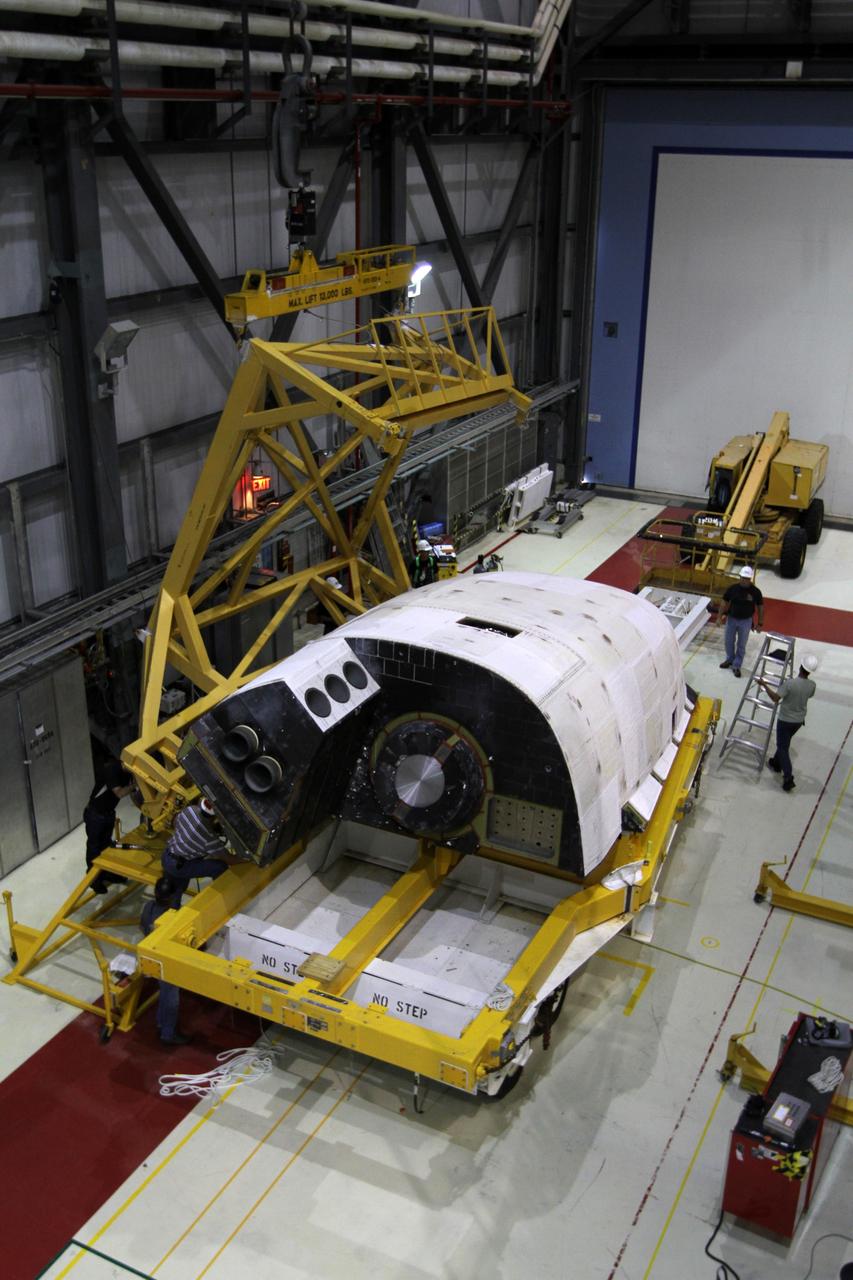
CAPE CANAVERAL, Fla. – In Orbiter Processing Facility-1 at NASA’s Kennedy Space Center in Florida, preparations are under way to lift an orbital maneuvering system, or OMS, pod from its transporter. The pod will be reinstalled on space shuttle Atlantis. The orbital maneuvering system provided the shuttle with thrust for orbit insertion, rendezvous and deorbit, and could provide up to 1,000 pounds of propellant to the aft reaction control system. The OMS is housed in two independent pods located on each side of the shuttle's aft fuselage. Each pod contains one OMS engine and the hardware needed to pressurize, store and distribute the propellants to perform the velocity maneuvers. Atlantis’ OMS pods were removed and sent to White Sands Test Facility in New Mexico to be cleaned of residual toxic propellant. The work is part of the Space Shuttle Program’s transition and retirement processing of the shuttle fleet. A groundbreaking was held Jan. 18 for Atlantis' future home, a 65,000-square-foot exhibit hall in Shuttle Plaza at the Kennedy Space Center Visitor Complex. Atlantis is scheduled to roll over to the visitor complex in November in preparation for the exhibit’s grand opening in July 2013. For more information, visit http://www.nasa.gov/transition. Photo credit: NASA/Kim Shiflett
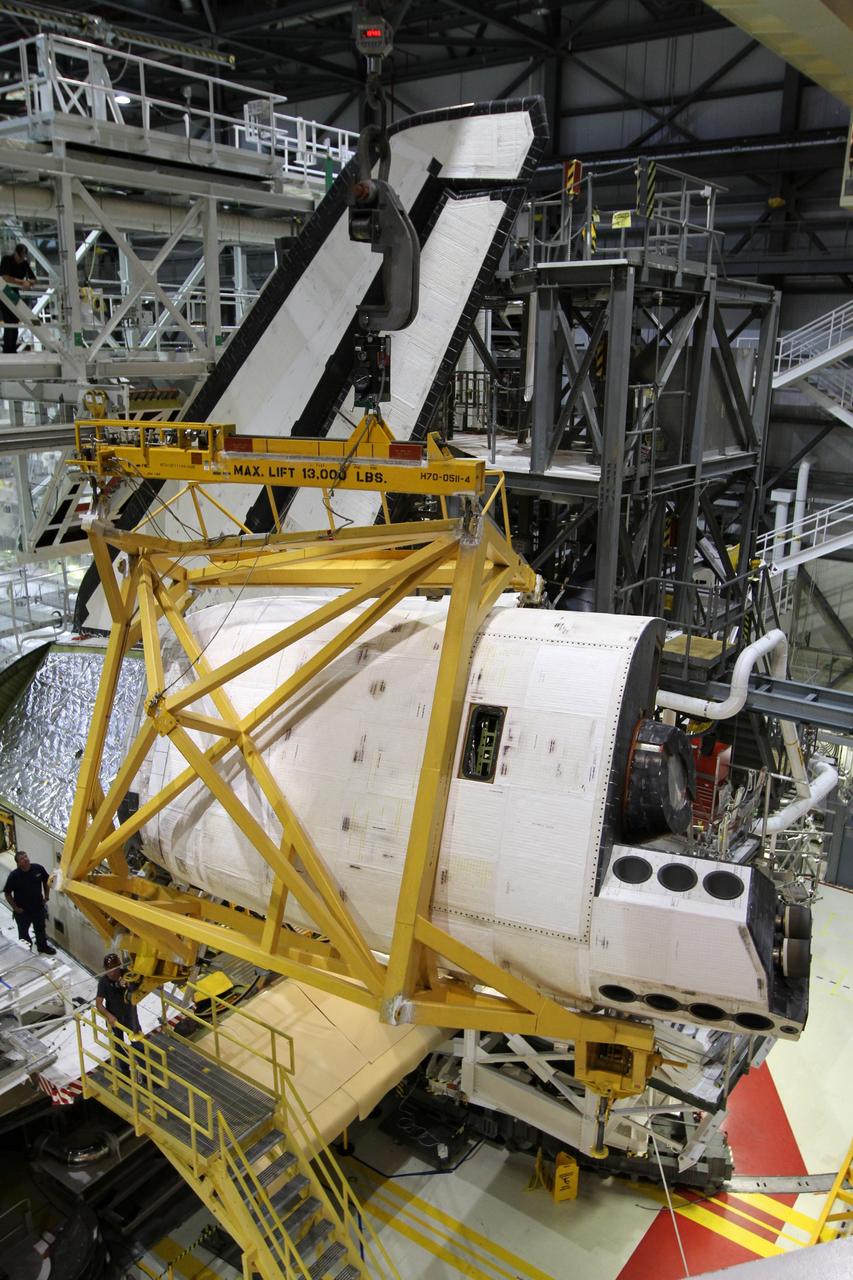
CAPE CANAVERAL, Fla. – In Orbiter Processing Facility-1 at NASA’s Kennedy Space Center in Florida, an orbital maneuvering system, or OMS, pod is lifted toward space shuttle Atlantis on which it will be installed. The orbital maneuvering system provided the shuttle with thrust for orbit insertion, rendezvous and deorbit, and could provide up to 1,000 pounds of propellant to the aft reaction control system. The OMS is housed in two independent pods located on each side of the shuttle's aft fuselage. Each pod contains one OMS engine and the hardware needed to pressurize, store and distribute the propellants to perform the velocity maneuvers. Atlantis’ OMS pods were removed and sent to White Sands Test Facility in New Mexico to be cleaned of residual toxic propellant. The work is part of the Space Shuttle Program’s transition and retirement processing of the shuttle fleet. A groundbreaking was held Jan. 18 for Atlantis' future home, a 65,000-square-foot exhibit hall in Shuttle Plaza at the Kennedy Space Center Visitor Complex. Atlantis is scheduled to roll over to the visitor complex in November in preparation for the exhibit’s grand opening in July 2013. For more information, visit http://www.nasa.gov/transition. Photo credit: NASA/Kim Shiflett
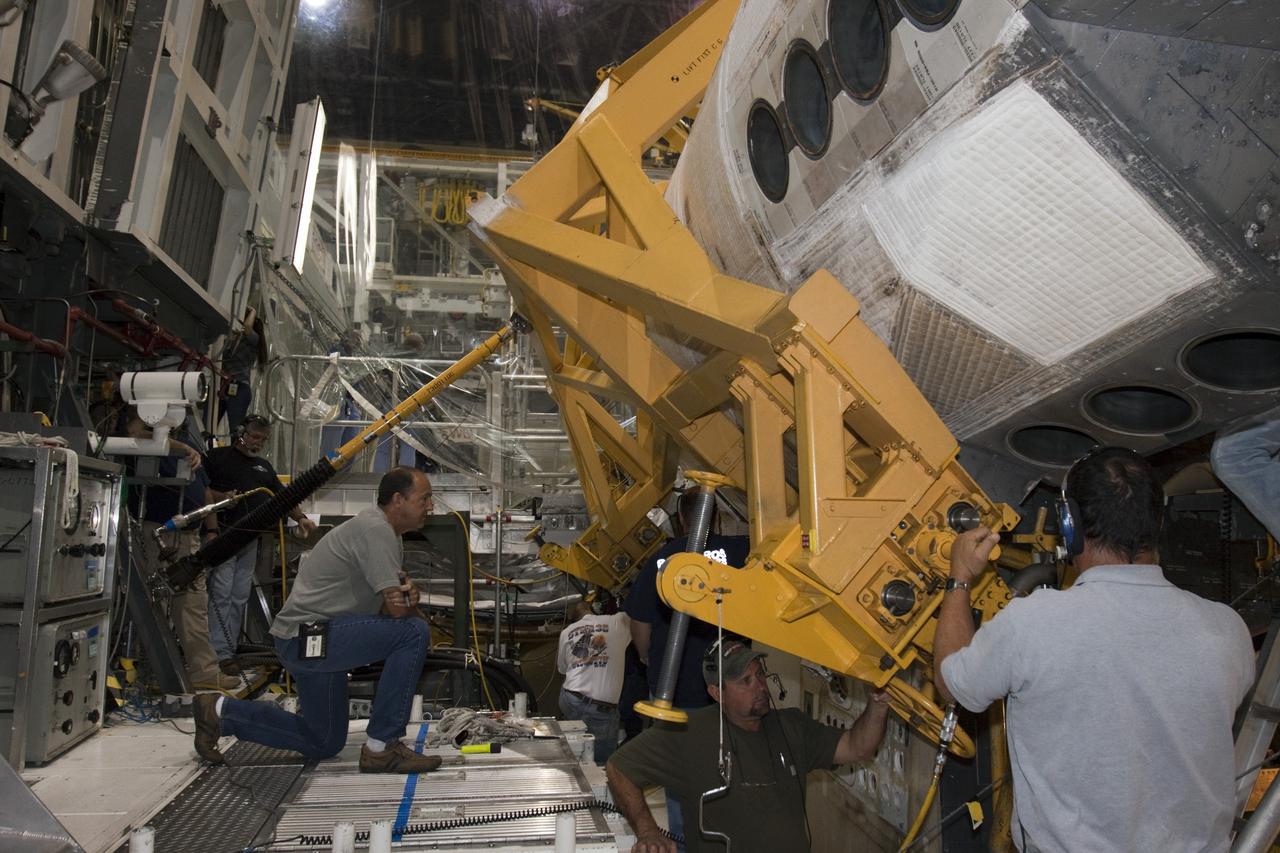
CAPE CANAVERAL, Fla. – In Orbiter Processing Facility-1 at NASA’s Kennedy Space Center in Florida, reinstallation of the left orbital maneuvering system, or OMS, pod on space shuttle Atlantis is under way. The orbital maneuvering system provided the shuttle with thrust for orbit insertion, rendezvous and deorbit, and could provide up to 1,000 pounds of propellant to the aft reaction control system. The OMS is housed in two independent pods located on each side of the shuttle's aft fuselage. Each pod contains one OMS engine and the hardware needed to pressurize, store and distribute the propellants to perform the velocity maneuvers. Atlantis’ OMS pods were removed and sent to White Sands Test Facility in New Mexico to be cleaned of residual toxic propellant. The work is part of the Space Shuttle Program’s transition and retirement processing of the shuttle fleet. A groundbreaking was held Jan. 18 for Atlantis' future home, a 65,000-square-foot exhibit hall in Shuttle Plaza at the Kennedy Space Center Visitor Complex. Atlantis is scheduled to roll over to the visitor complex in November in preparation for the exhibit’s grand opening in July 2013. For more information, visit http://www.nasa.gov/transition. Photo credit: NASA/Ben Smegelsky
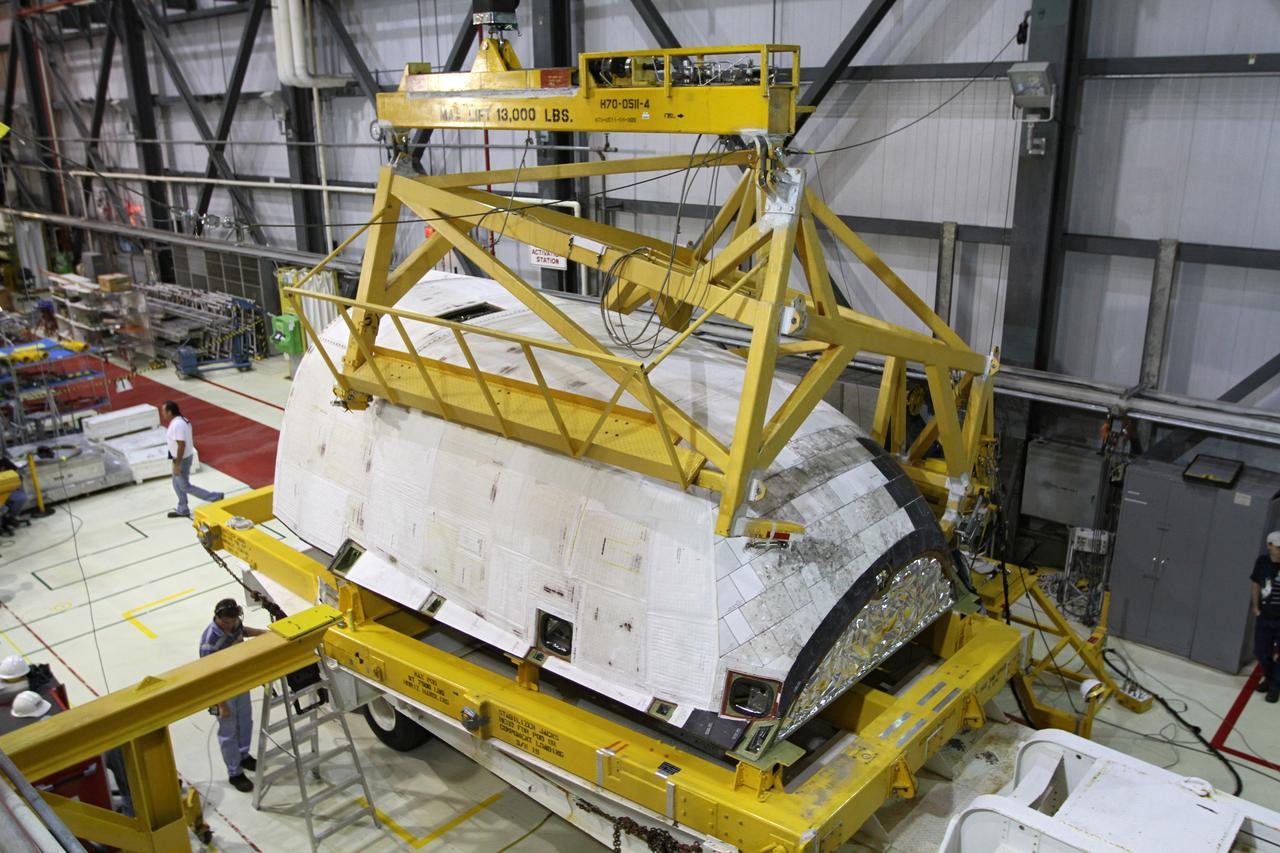
CAPE CANAVERAL, Fla. – In Orbiter Processing Facility-1 at NASA’s Kennedy Space Center in Florida, a handling fixture is attached to an orbital maneuvering system, or OMS, pod to lift it from its transporter. The pod will be reinstalled on space shuttle Atlantis. The orbital maneuvering system provided the shuttle with thrust for orbit insertion, rendezvous and deorbit, and could provide up to 1,000 pounds of propellant to the aft reaction control system. The OMS is housed in two independent pods located on each side of the shuttle's aft fuselage. Each pod contains one OMS engine and the hardware needed to pressurize, store and distribute the propellants to perform the velocity maneuvers. Atlantis’ OMS pods were removed and sent to White Sands Test Facility in New Mexico to be cleaned of residual toxic propellant. The work is part of the Space Shuttle Program’s transition and retirement processing of the shuttle fleet. A groundbreaking was held Jan. 18 for Atlantis' future home, a 65,000-square-foot exhibit hall in Shuttle Plaza at the Kennedy Space Center Visitor Complex. Atlantis is scheduled to roll over to the visitor complex in November in preparation for the exhibit’s grand opening in July 2013. For more information, visit http://www.nasa.gov/transition. Photo credit: NASA/Kim Shiflett
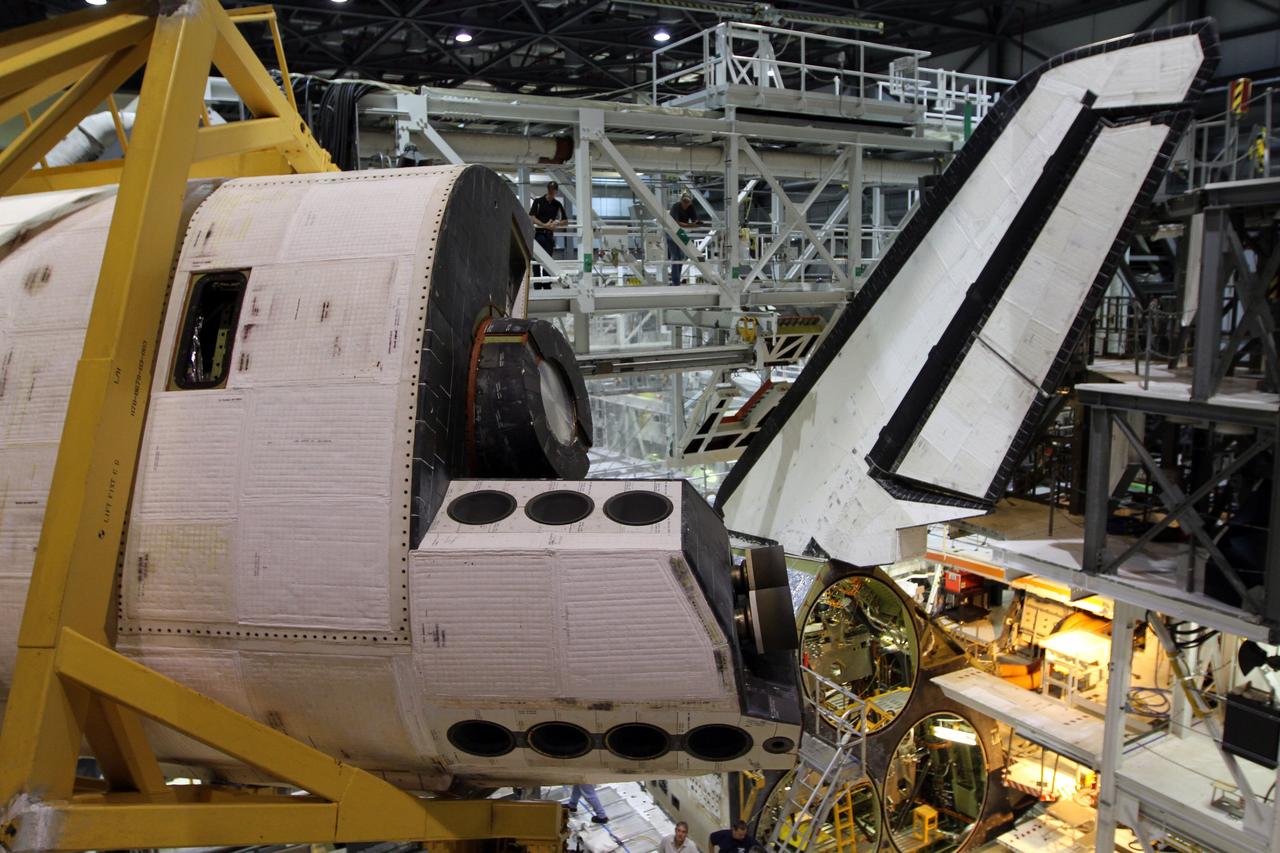
CAPE CANAVERAL, Fla. – An orbital maneuvering system, or OMS, pod appears to be in flight as it glides across the ceiling in Orbiter Processing Facility-1 at NASA’s Kennedy Space Center in Florida. The pod will be reinstalled on space shuttle Atlantis. The orbital maneuvering system provided the shuttle with thrust for orbit insertion, rendezvous and deorbit, and could provide up to 1,000 pounds of propellant to the aft reaction control system. The OMS is housed in two independent pods located on each side of the shuttle's aft fuselage. Each pod contains one OMS engine and the hardware needed to pressurize, store and distribute the propellants to perform the velocity maneuvers. Atlantis’ OMS pods were removed and sent to White Sands Test Facility in New Mexico to be cleaned of residual toxic propellant. The work is part of the Space Shuttle Program’s transition and retirement processing of the shuttle fleet. A groundbreaking was held Jan. 18 for Atlantis' future home, a 65,000-square-foot exhibit hall in Shuttle Plaza at the Kennedy Space Center Visitor Complex. Atlantis is scheduled to roll over to the visitor complex in November in preparation for the exhibit’s grand opening in July 2013. For more information, visit http://www.nasa.gov/transition. Photo credit: NASA/Kim Shiflett
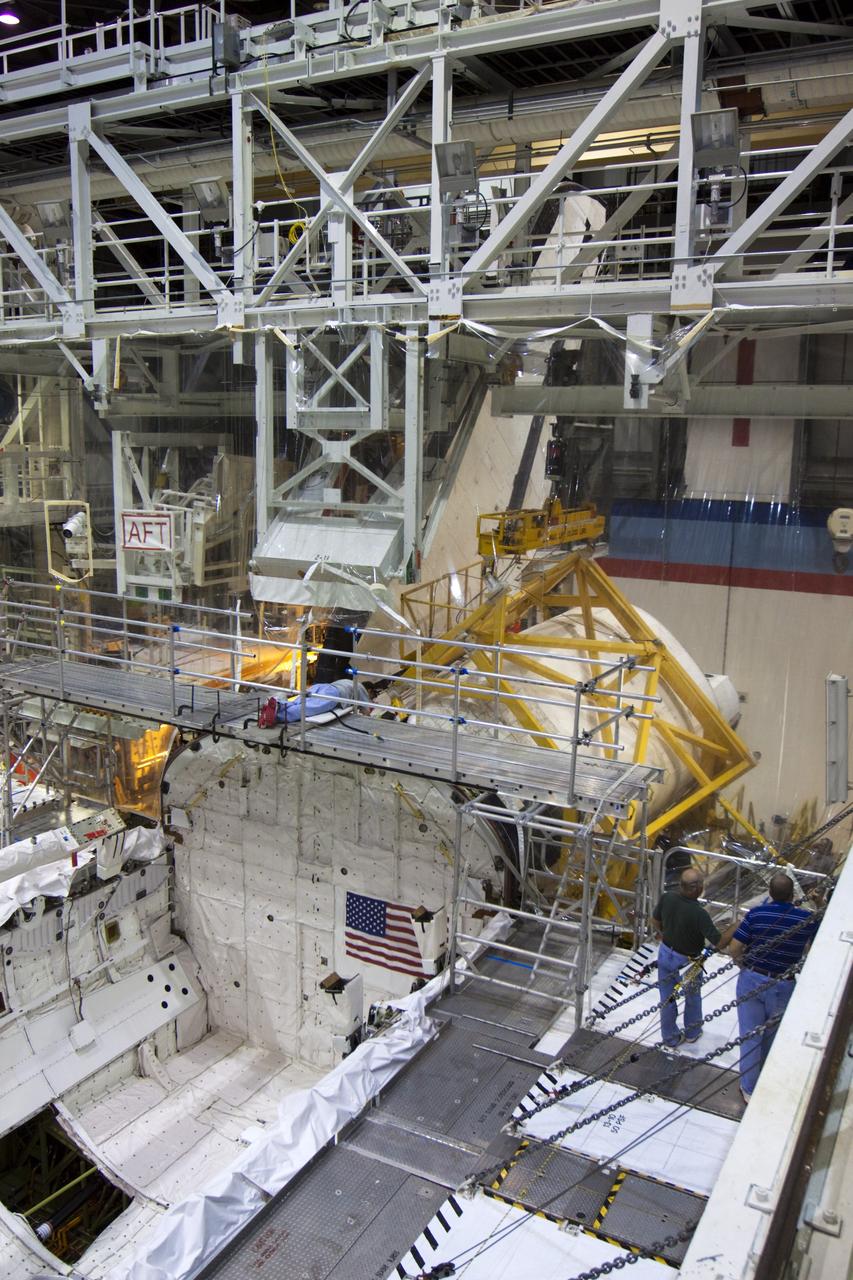
CAPE CANAVERAL, Fla. – In Orbiter Processing Facility-1 at NASA’s Kennedy Space Center in Florida, reinstallation of the left orbital maneuvering system, or OMS, pod on space shuttle Atlantis is under way. The orbital maneuvering system provided the shuttle with thrust for orbit insertion, rendezvous and deorbit, and could provide up to 1,000 pounds of propellant to the aft reaction control system. The OMS is housed in two independent pods located on each side of the shuttle's aft fuselage. Each pod contains one OMS engine and the hardware needed to pressurize, store and distribute the propellants to perform the velocity maneuvers. Atlantis’ OMS pods were removed and sent to White Sands Test Facility in New Mexico to be cleaned of residual toxic propellant. The work is part of the Space Shuttle Program’s transition and retirement processing of the shuttle fleet. A groundbreaking was held Jan. 18 for Atlantis' future home, a 65,000-square-foot exhibit hall in Shuttle Plaza at the Kennedy Space Center Visitor Complex. Atlantis is scheduled to roll over to the visitor complex in November in preparation for the exhibit’s grand opening in July 2013. For more information, visit http://www.nasa.gov/transition. Photo credit: NASA/Ben Smegelsky
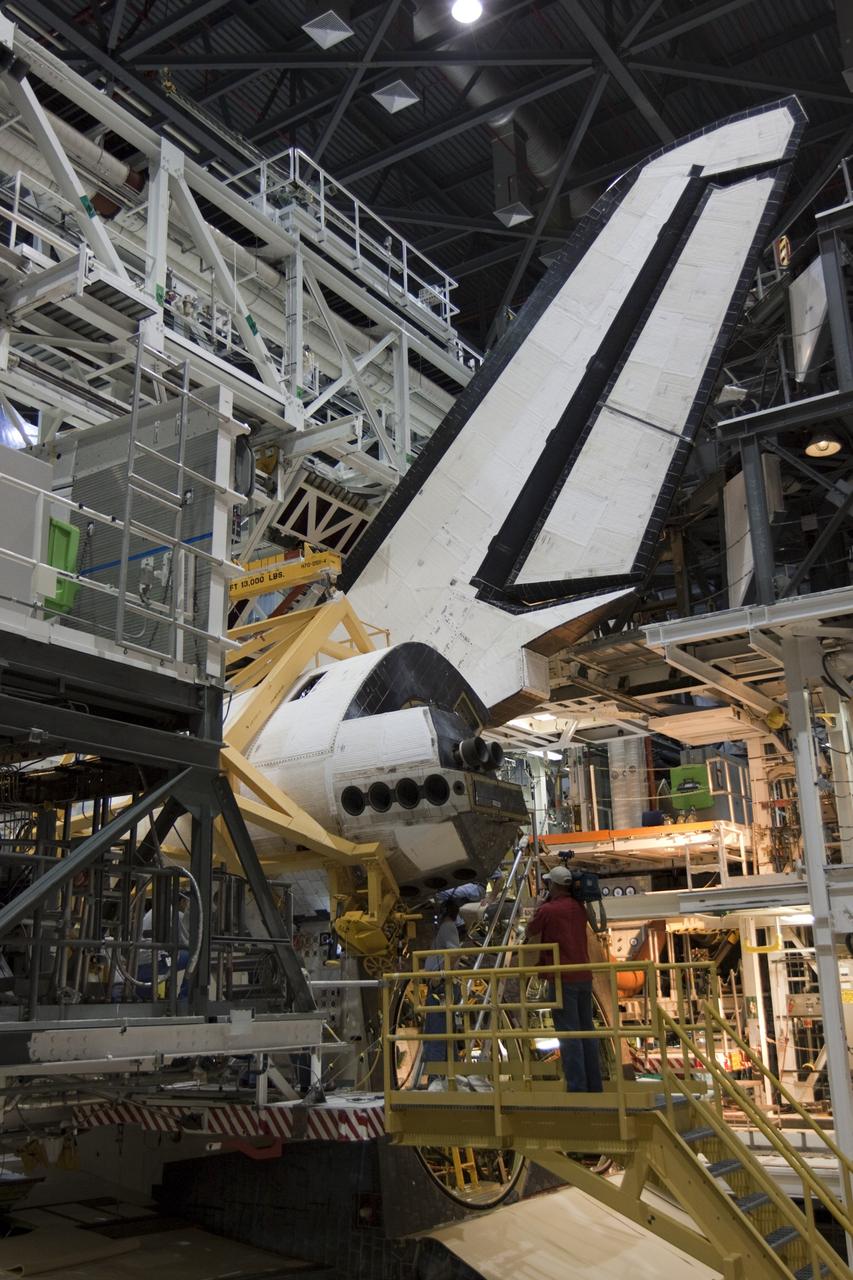
CAPE CANAVERAL, Fla. – In Orbiter Processing Facility-1 at NASA’s Kennedy Space Center in Florida, preparations are under way to reinstall the left orbital maneuvering system, or OMS, pod on space shuttle Atlantis. The orbital maneuvering system provided the shuttle with thrust for orbit insertion, rendezvous and deorbit, and could provide up to 1,000 pounds of propellant to the aft reaction control system. The OMS is housed in two independent pods located on each side of the shuttle's aft fuselage. Each pod contains one OMS engine and the hardware needed to pressurize, store and distribute the propellants to perform the velocity maneuvers. Atlantis’ OMS pods were removed and sent to White Sands Test Facility in New Mexico to be cleaned of residual toxic propellant. The work is part of the Space Shuttle Program’s transition and retirement processing of the shuttle fleet. A groundbreaking was held Jan. 18 for Atlantis' future home, a 65,000-square-foot exhibit hall in Shuttle Plaza at the Kennedy Space Center Visitor Complex. Atlantis is scheduled to roll over to the visitor complex in November in preparation for the exhibit’s grand opening in July 2013. For more information, visit http://www.nasa.gov/transition. Photo credit: NASA/Ben Smegelsky
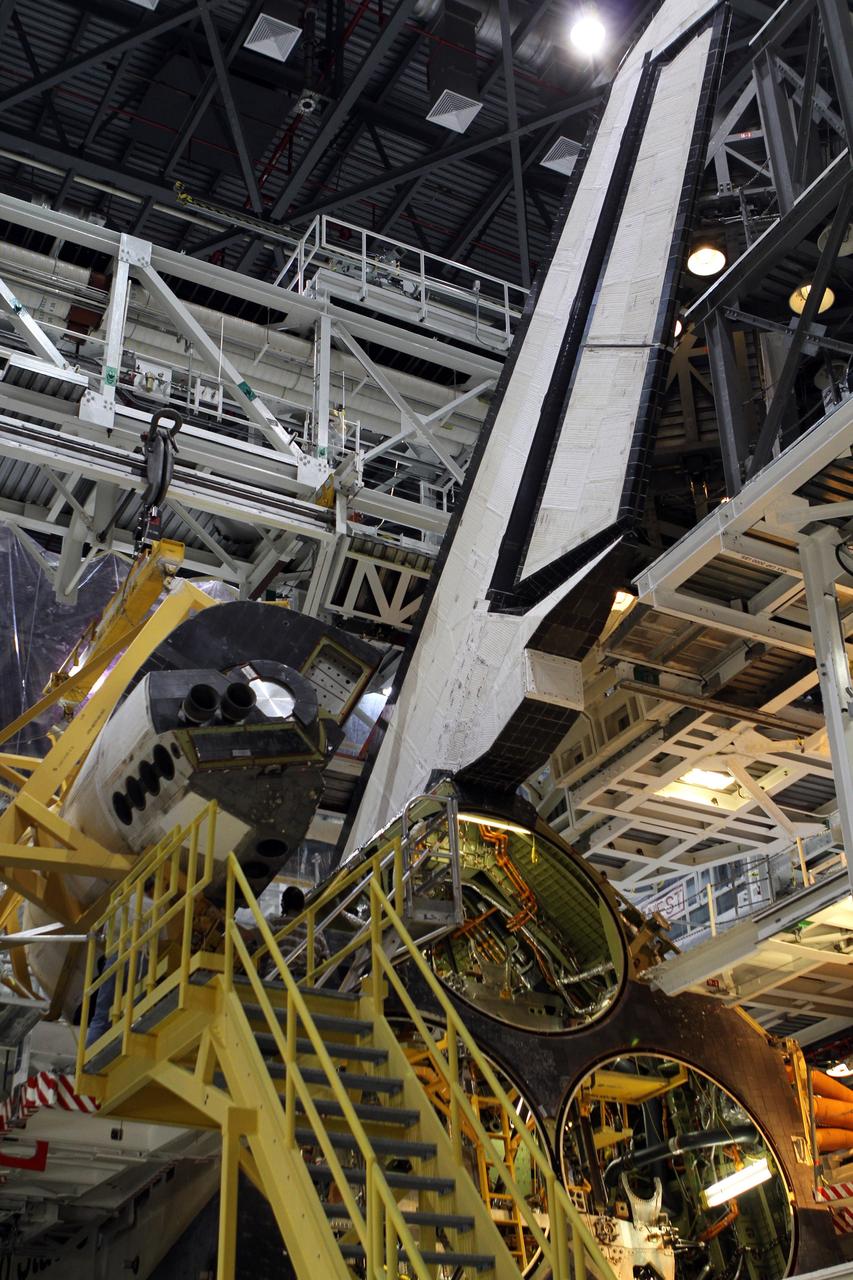
CAPE CANAVERAL, Fla. – In Orbiter Processing Facility-1 at NASA’s Kennedy Space Center in Florida, the left orbital maneuvering system, or OMS, pod glides into position next to space shuttle Atlantis for reinstallation. The orbital maneuvering system provided the shuttle with thrust for orbit insertion, rendezvous and deorbit, and could provide up to 1,000 pounds of propellant to the aft reaction control system. The OMS is housed in two independent pods located on each side of the shuttle's aft fuselage. Each pod contains one OMS engine and the hardware needed to pressurize, store and distribute the propellants to perform the velocity maneuvers. Atlantis’ OMS pods were removed and sent to White Sands Test Facility in New Mexico to be cleaned of residual toxic propellant. The work is part of the Space Shuttle Program’s transition and retirement processing of the shuttle fleet. A groundbreaking was held Jan. 18 for Atlantis' future home, a 65,000-square-foot exhibit hall in Shuttle Plaza at the Kennedy Space Center Visitor Complex. Atlantis is scheduled to roll over to the visitor complex in November in preparation for the exhibit’s grand opening in July 2013. For more information, visit http://www.nasa.gov/transition. Photo credit: NASA/Kim Shiflett
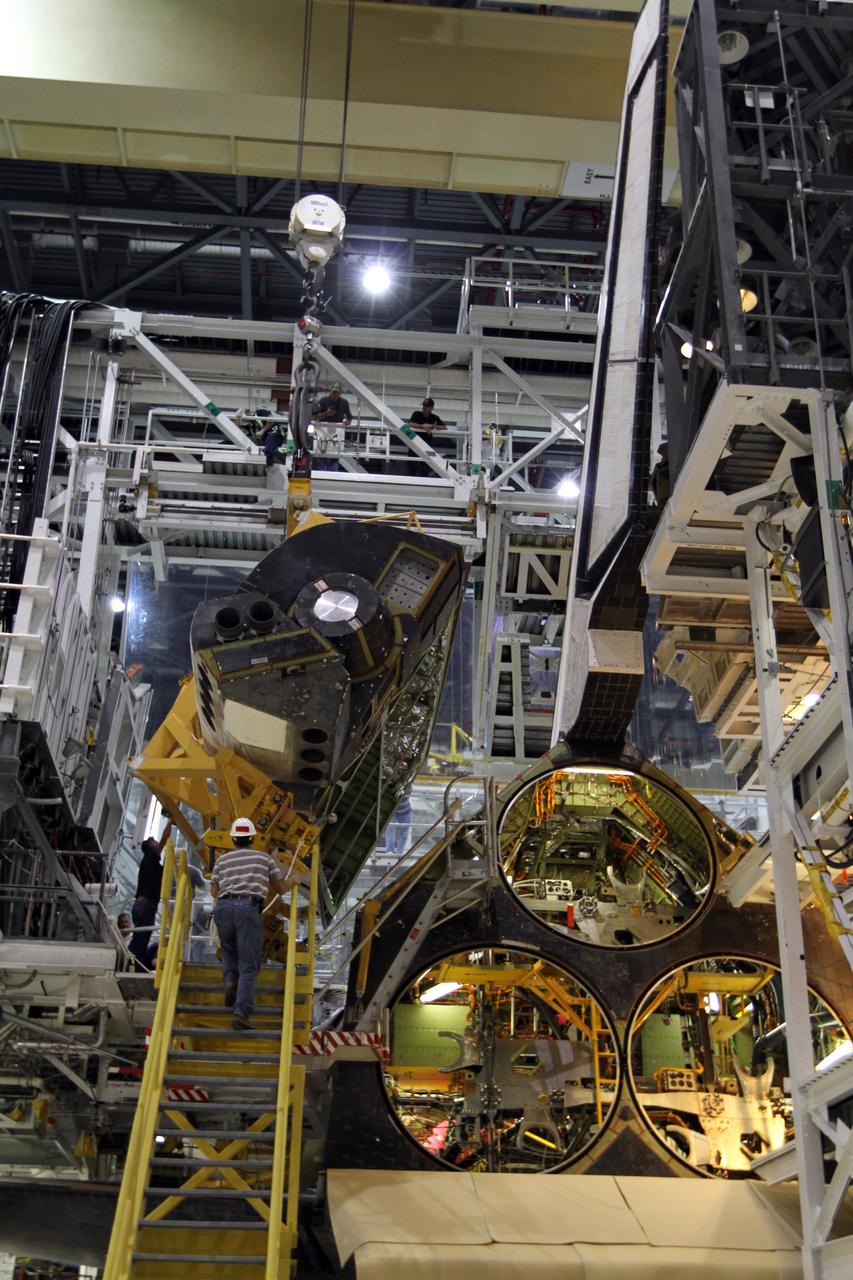
CAPE CANAVERAL, Fla. – In Orbiter Processing Facility-1 at NASA’s Kennedy Space Center in Florida, the left orbital maneuvering system, or OMS, pod is rotated into position on space shuttle Atlantis for reinstallation. The orbital maneuvering system provided the shuttle with thrust for orbit insertion, rendezvous and deorbit, and could provide up to 1,000 pounds of propellant to the aft reaction control system. The OMS is housed in two independent pods located on each side of the shuttle's aft fuselage. Each pod contains one OMS engine and the hardware needed to pressurize, store and distribute the propellants to perform the velocity maneuvers. Atlantis’ OMS pods were removed and sent to White Sands Test Facility in New Mexico to be cleaned of residual toxic propellant. The work is part of the Space Shuttle Program’s transition and retirement processing of the shuttle fleet. A groundbreaking was held Jan. 18 for Atlantis' future home, a 65,000-square-foot exhibit hall in Shuttle Plaza at the Kennedy Space Center Visitor Complex. Atlantis is scheduled to roll over to the visitor complex in November in preparation for the exhibit’s grand opening in July 2013. For more information, visit http://www.nasa.gov/transition. Photo credit: NASA/Kim Shiflett
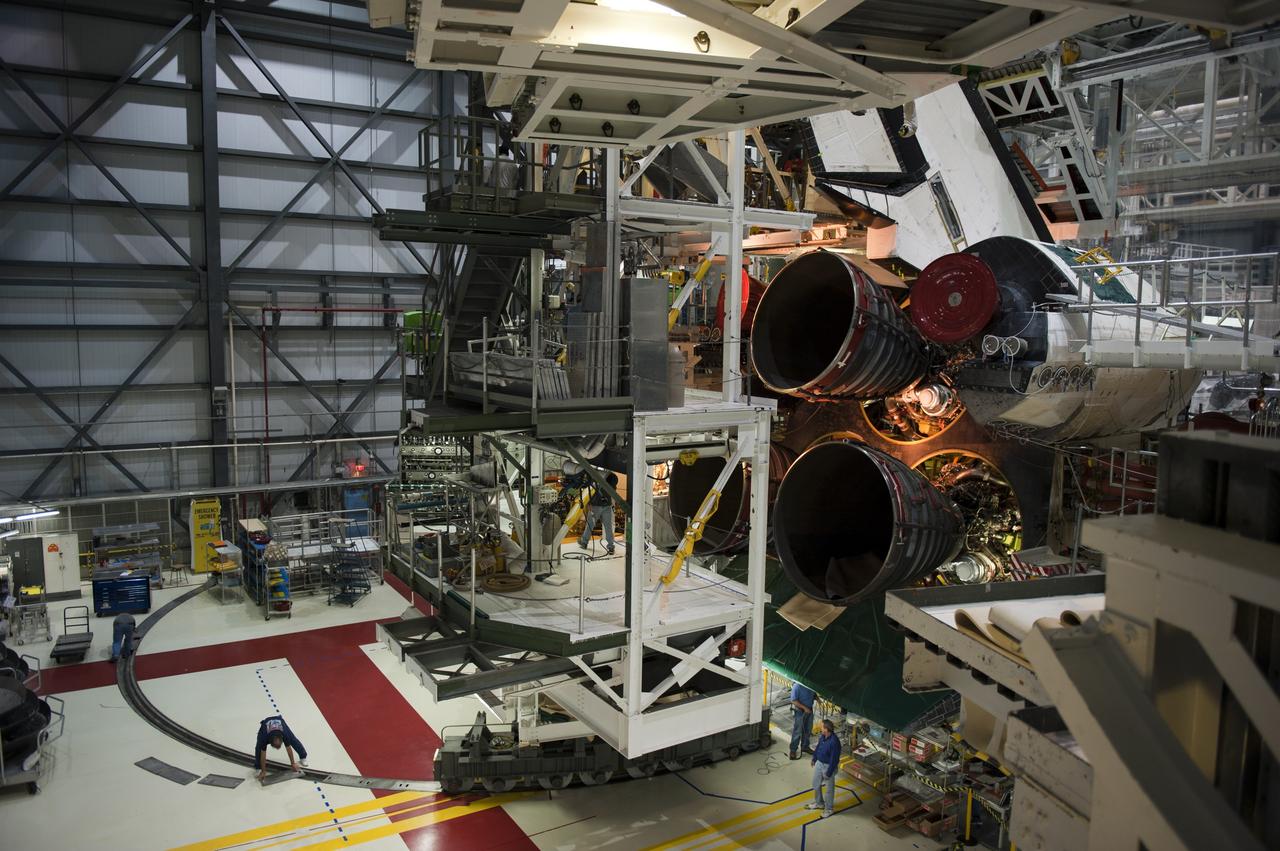
CAPE CANAVERAL, Fla. -- In Orbiter Processing Facility-1 at NASA's Kennedy Space Center in Florida, technicians prepare to move an aft access platform into place behind shuttle Atlantis, following the installation of the spacecraft's three main engines. Shown is the right-hand orbital maneuvering system (OMS) pod and engine taken from the right-hand access arm. Atlantis is being prepared for the "launch on need," or potential rescue mission, for the final planned shuttle flight, Endeavour's STS-134 mission. For more information, visit www.nasa.gov/shuttle. Photo credit: NASA/Kim Shiflett
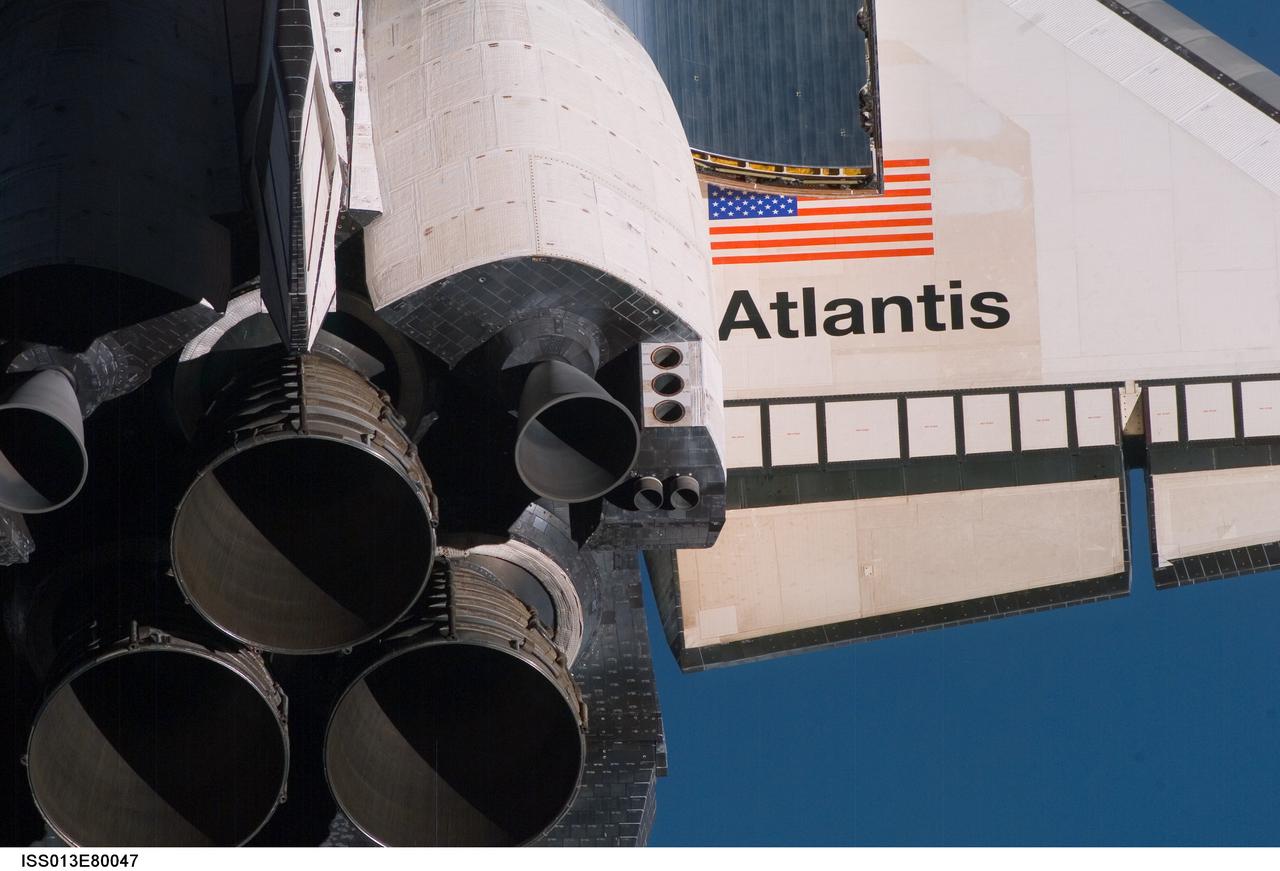
ISS013-E-80047 (11 Sept. 2006) --- A crewmember aboard the International Space Station took this picture with a handheld digital still camera as the Space Shuttle Atlantis performed a backflip while it was about 600 feet from the station during its approach. The flip, done on every shuttle mission, allows a full photographic survey of the shuttle heat shield to be taken by the station crew. This image from that survey shows the three the main engines, and part of the starboard wing and the starboard orbital maneuvering system (OMS) pod.
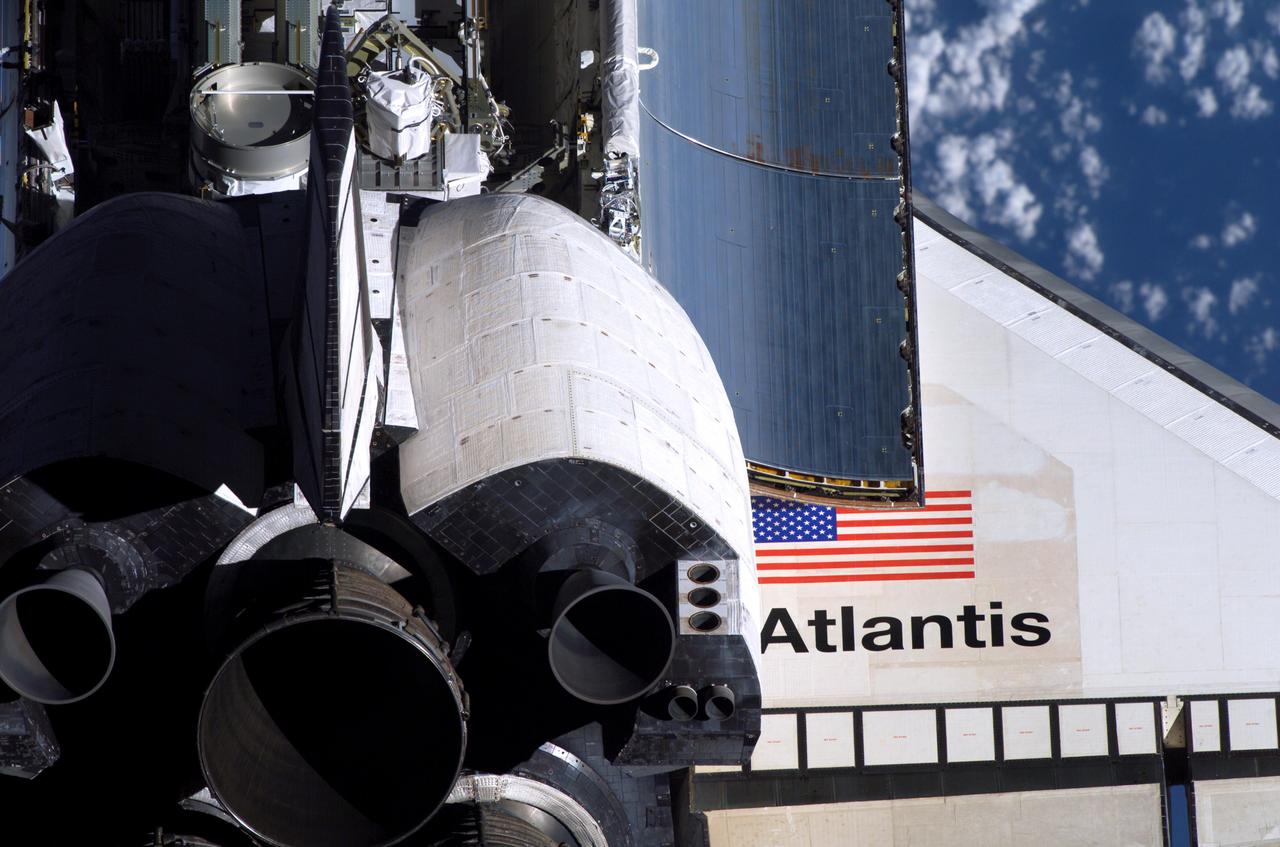
ISS013-E-80040 (11 Sept. 2006) --- A crewmember aboard the International Space Station took this picture with a handheld digital still camera as the Space Shuttle Atlantis performed a back-flip while it was about 600 feet from the station during its approach. The flip, done on every shuttle mission, allows a full photographic survey of the shuttle heat shield to be taken by the station crew. This image from that survey shows one of the three the main engines, and part of the starboard wing and the starboard orbital maneuvering system (OMS) pod.
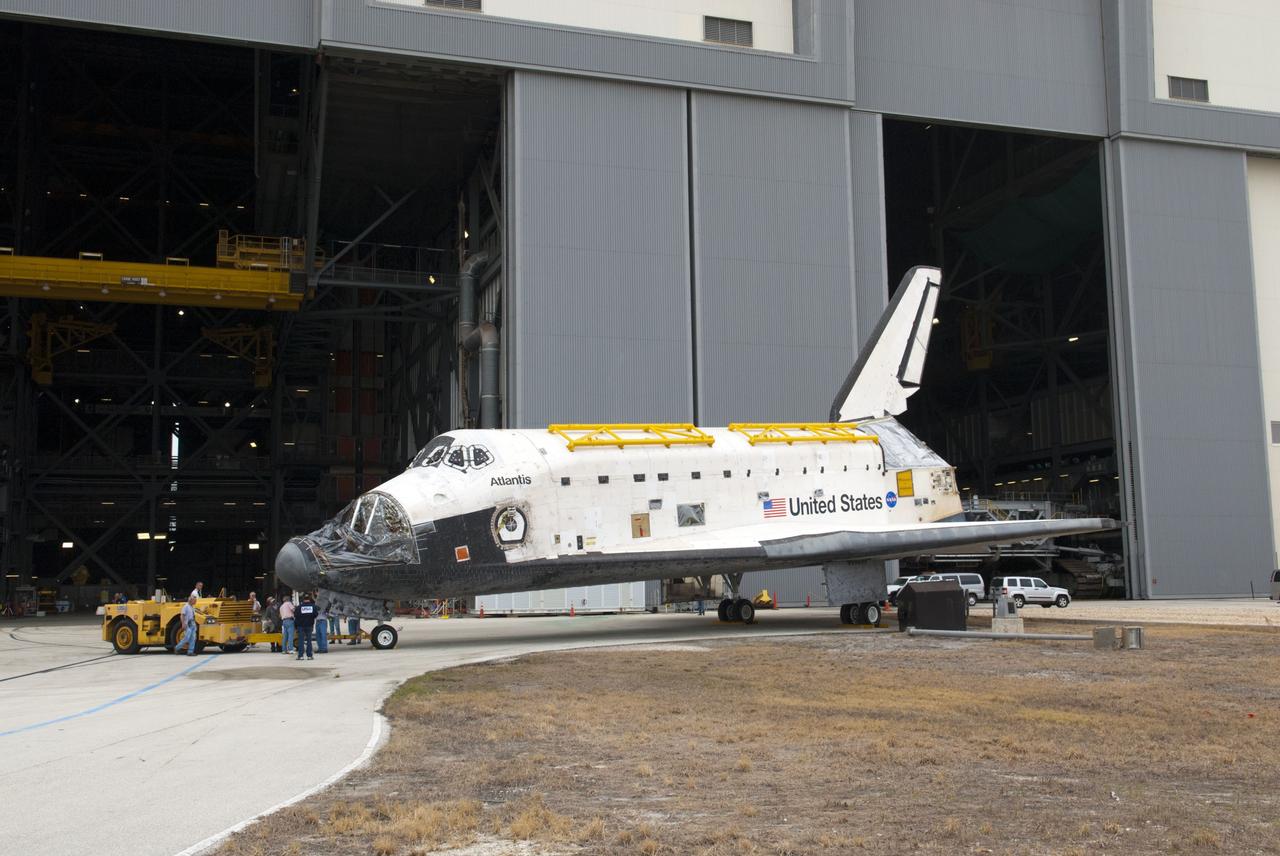
CAPE CANAVERAL, Fla. – At NASA’s Kennedy Space Center in Florida, space shuttle Atlantis is being towed from the Vehicle Assembly Building over to Orbiter Processing Facility-1. Atlantis’ forward reaction control system, orbiter maneuvering system pods and three space shuttle main engines have been removed. The work is part of the Space Shuttle Program’s transition and retirement processing of the three space shuttles. Atlantis is being prepared for display at the Kennedy Space Center Visitor Complex and is scheduled to rollover to the complex in November. Photo credit: NASA/Tim Jacobs
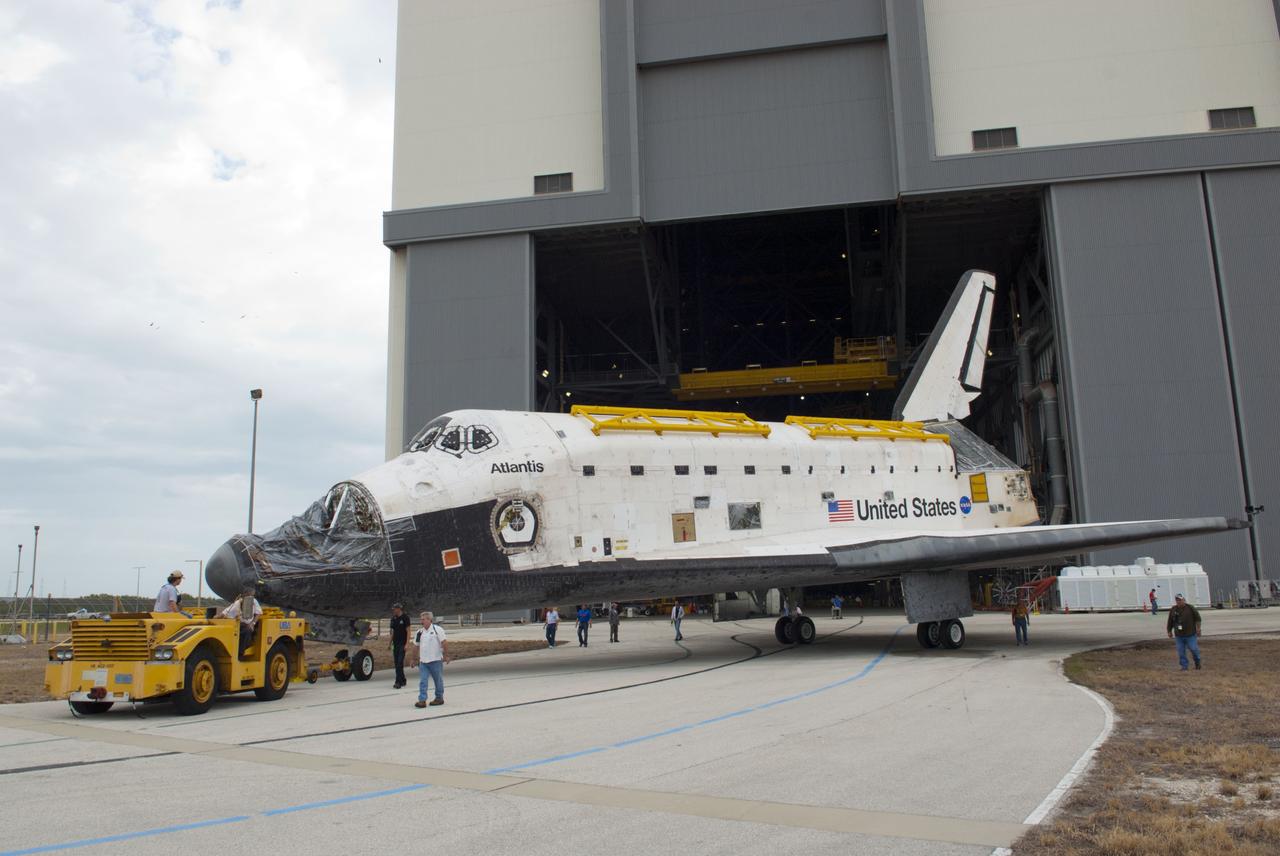
CAPE CANAVERAL, Fla. – At NASA’s Kennedy Space Center in Florida, workers walk alongside as space shuttle Atlantis is towed out of the Vehicle Assembly Building and over to Orbiter Processing Facility-1. Atlantis’ forward reaction control system, orbiter maneuvering system pods and three space shuttle main engines have been removed. The work is part of the Space Shuttle Program’s transition and retirement processing of the three space shuttles. Atlantis is being prepared for display at the Kennedy Space Center Visitor Complex and is scheduled to rollover to the complex in November. Photo credit: NASA/Tim Jacobs
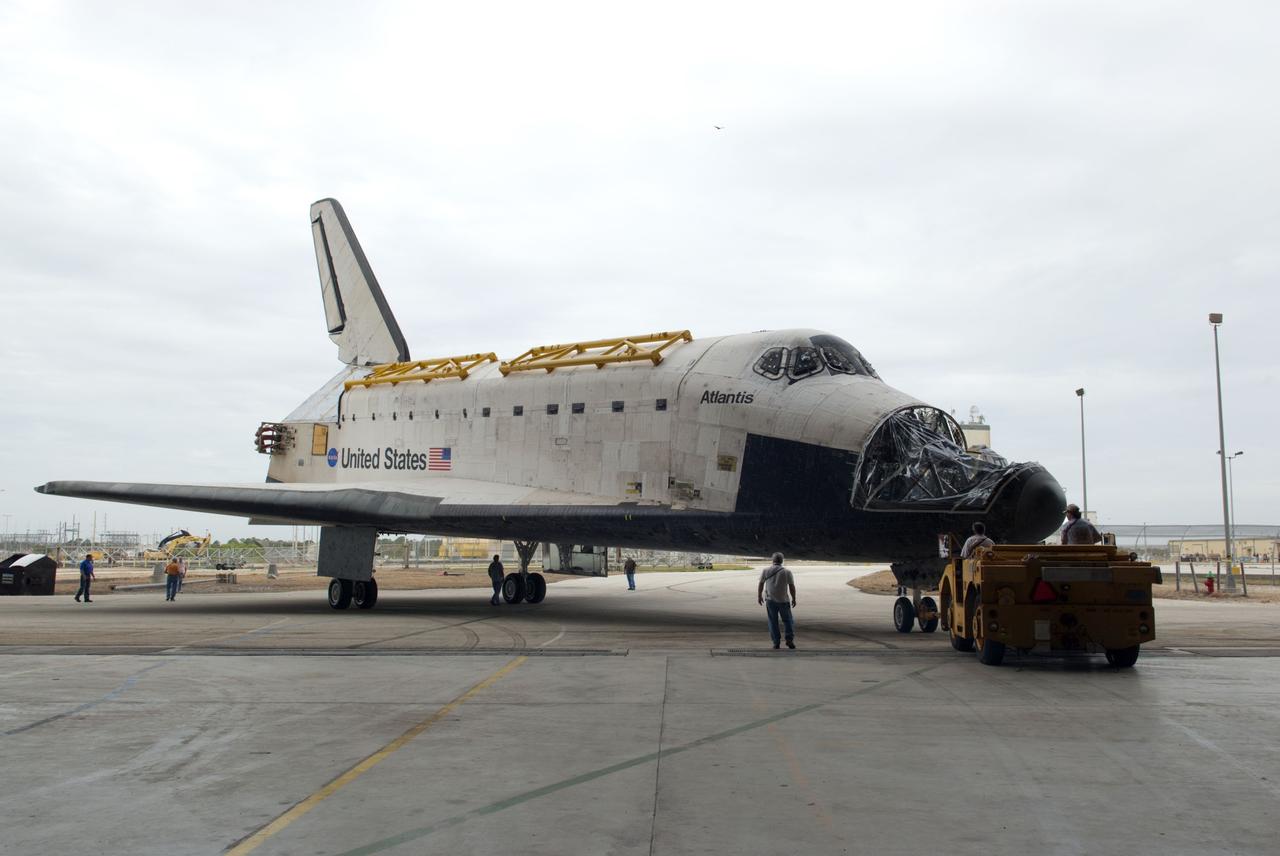
CAPE CANAVERAL, Fla. – At NASA’s Kennedy Space Center in Florida, space shuttle Atlantis is being towed from the Vehicle Assembly Building over to Orbiter Processing Facility-1. Atlantis’ forward reaction control system, orbiter maneuvering system pods and three space shuttle main engines have been removed. The work is part of the Space Shuttle Program’s transition and retirement processing of the three space shuttles. Atlantis is being prepared for display at the Kennedy Space Center Visitor Complex and is scheduled to rollover to the complex in November. Photo credit: NASA/Tim Jacobs
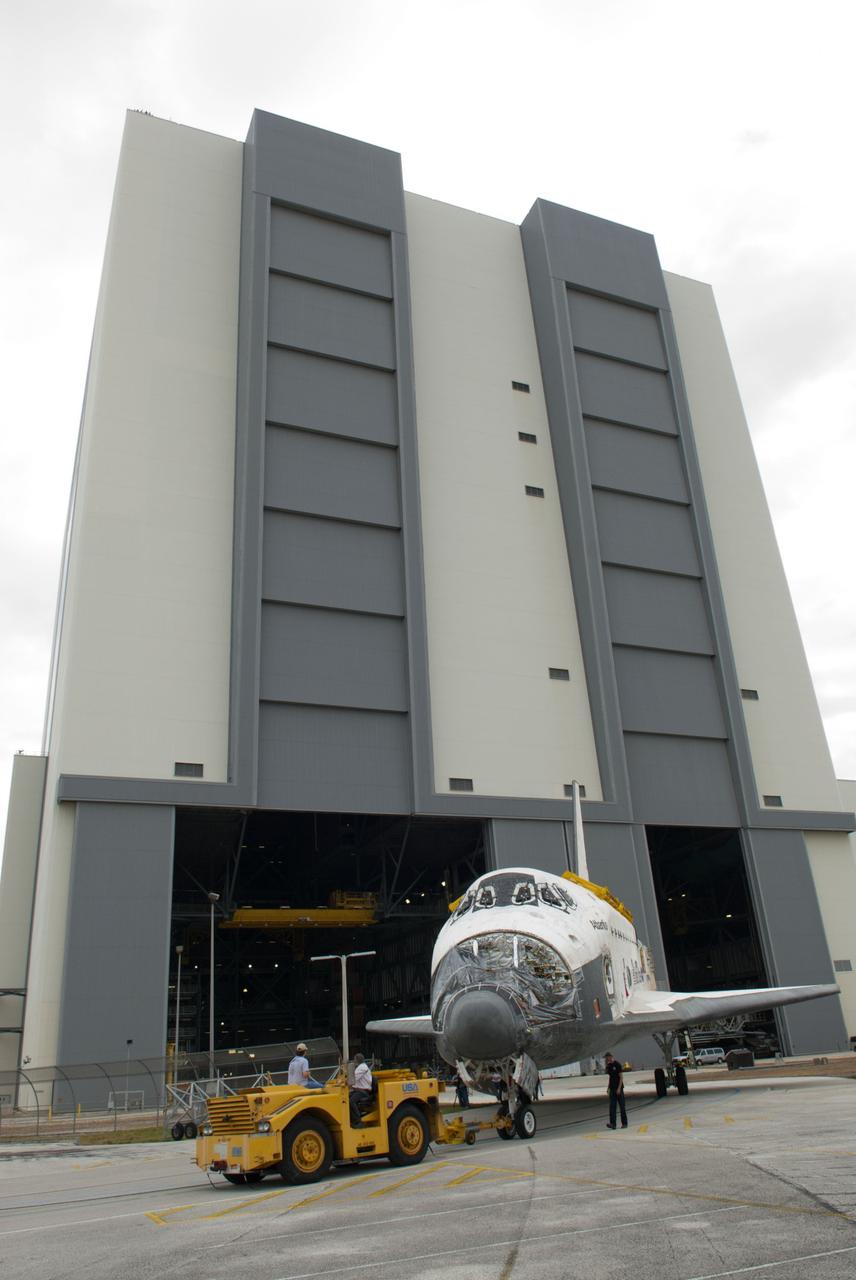
CAPE CANAVERAL, Fla. – At NASA’s Kennedy Space Center in Florida, space shuttle Atlantis is towed out of the Vehicle Assembly Building and over to Orbiter Processing Facility-1. Atlantis’ forward reaction control system, orbiter maneuvering system pods and three space shuttle main engines have been removed. The work is part of the Space Shuttle Program’s transition and retirement processing of the three space shuttles. Atlantis is being prepared for display at the Kennedy Space Center Visitor Complex and is scheduled to rollover to the complex in November. Photo credit: NASA/Tim Jacobs
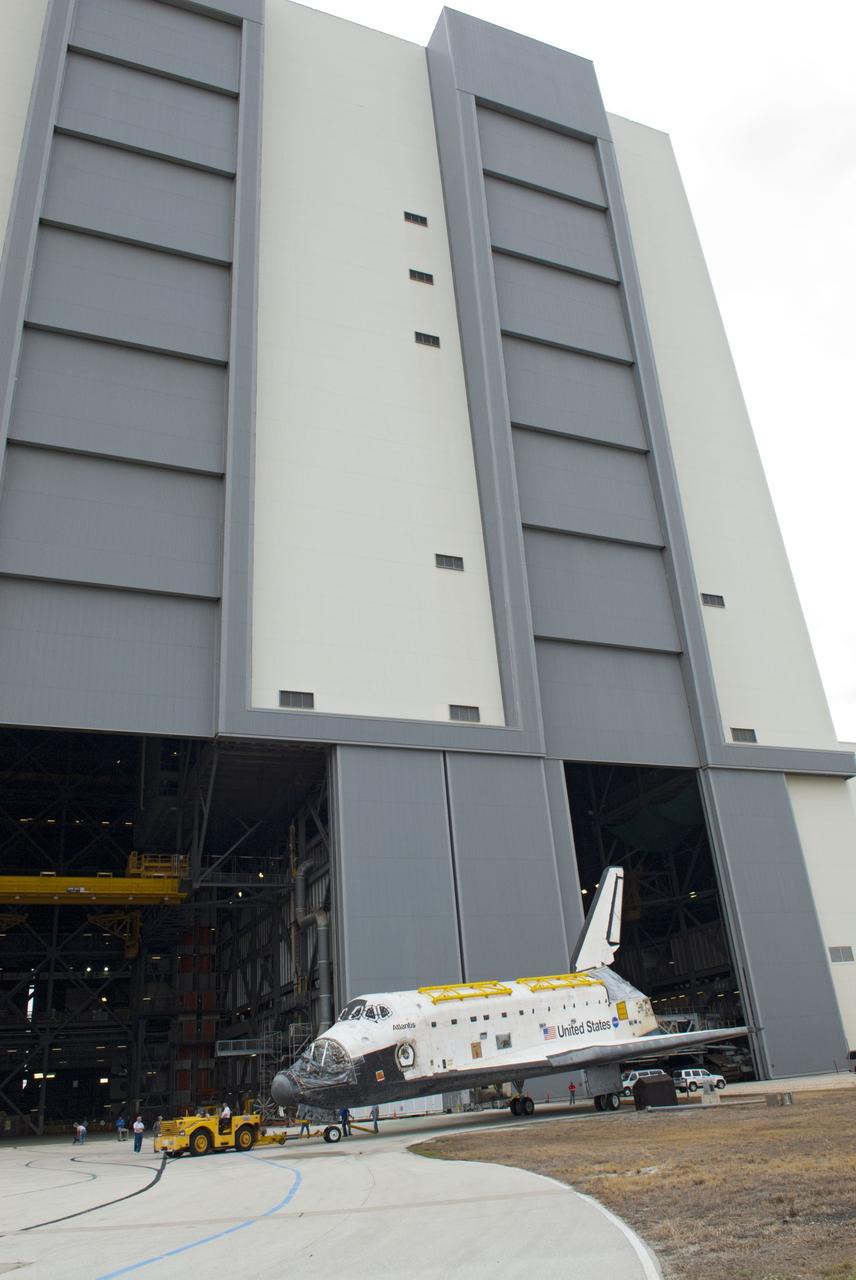
CAPE CANAVERAL, Fla. – At NASA’s Kennedy Space Center in Florida, space shuttle Atlantis is being towed from the Vehicle Assembly Building over to Orbiter Processing Facility-1. Atlantis’ forward reaction control system, orbiter maneuvering system pods and three space shuttle main engines have been removed. The work is part of the Space Shuttle Program’s transition and retirement processing of the three space shuttles. Atlantis is being prepared for display at the Kennedy Space Center Visitor Complex and is scheduled to rollover to the complex in November. Photo credit: NASA/Tim Jacobs
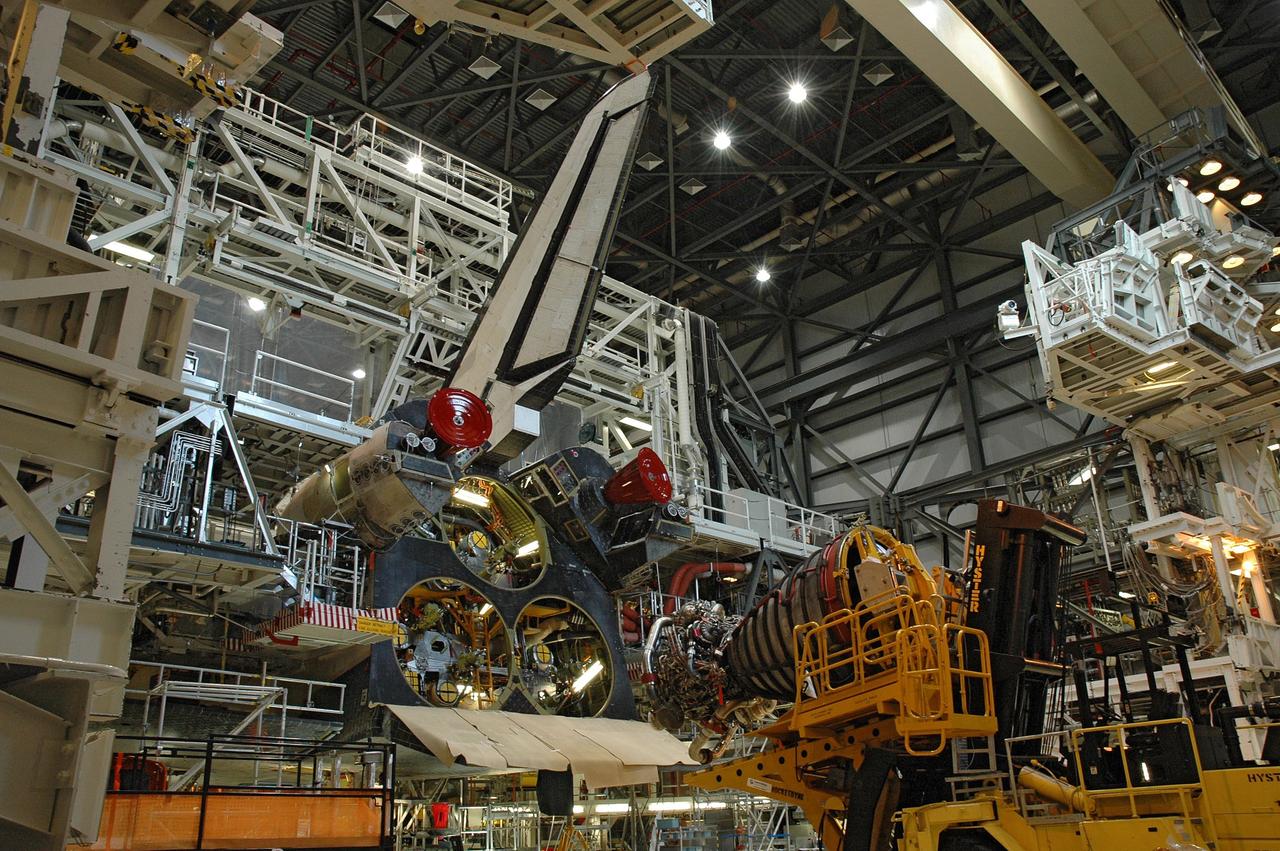
CAPE CANAVERAL, Fla. – In the Orbiter Processing Facility bay 2, technicians on the Hyster forklift maneuver main engine 1 for installation on space shuttle Endeavour. The scheduled launch vehicle for the STS-126 mission, Endeavour will deliver a multi-purpose logistics module to the International Space Station. Launch is targeted for Nov. 10. Endeavour is also the backup shuttle, if needed for rescue, for the STS-125 mission in October that will make repairs on the Hubble Space Telescope. For that purpose, it is designated STS-400. Photo credit: NASA/Jim Grossmann
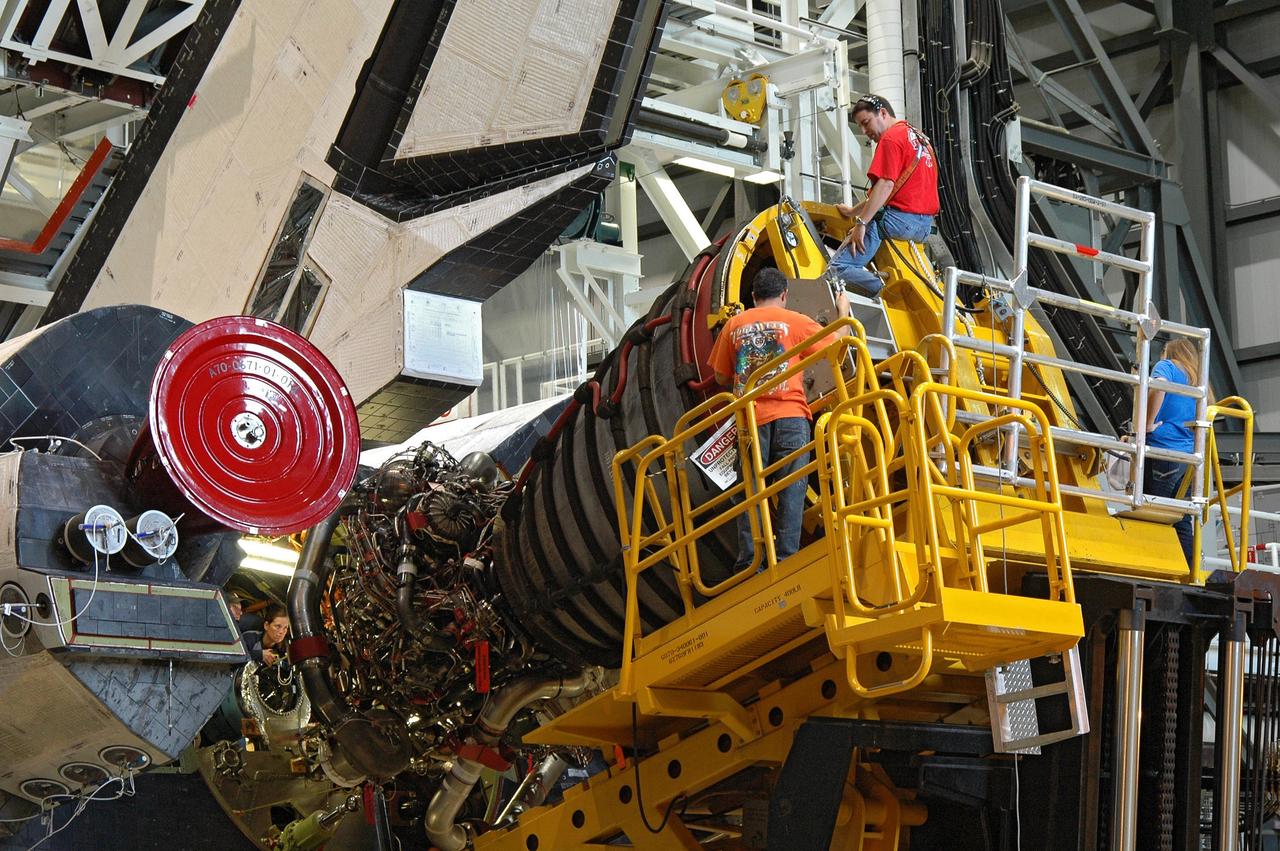
CAPE CANAVERAL, Fla. – In the Orbiter Processing Facility bay 2, technicians on the Hyster forklift maneuver main engine 1 for installation on space shuttle Endeavour. The scheduled launch vehicle for the STS-126 mission, Endeavour will deliver a multi-purpose logistics module to the International Space Station. Launch is targeted for Nov. 10. Endeavour is also the backup shuttle, if needed for rescue, for the STS-125 mission in October that will make repairs on the Hubble Space Telescope. For that purpose, it is designated STS-400. Photo credit: NASA/Jim Grossmann
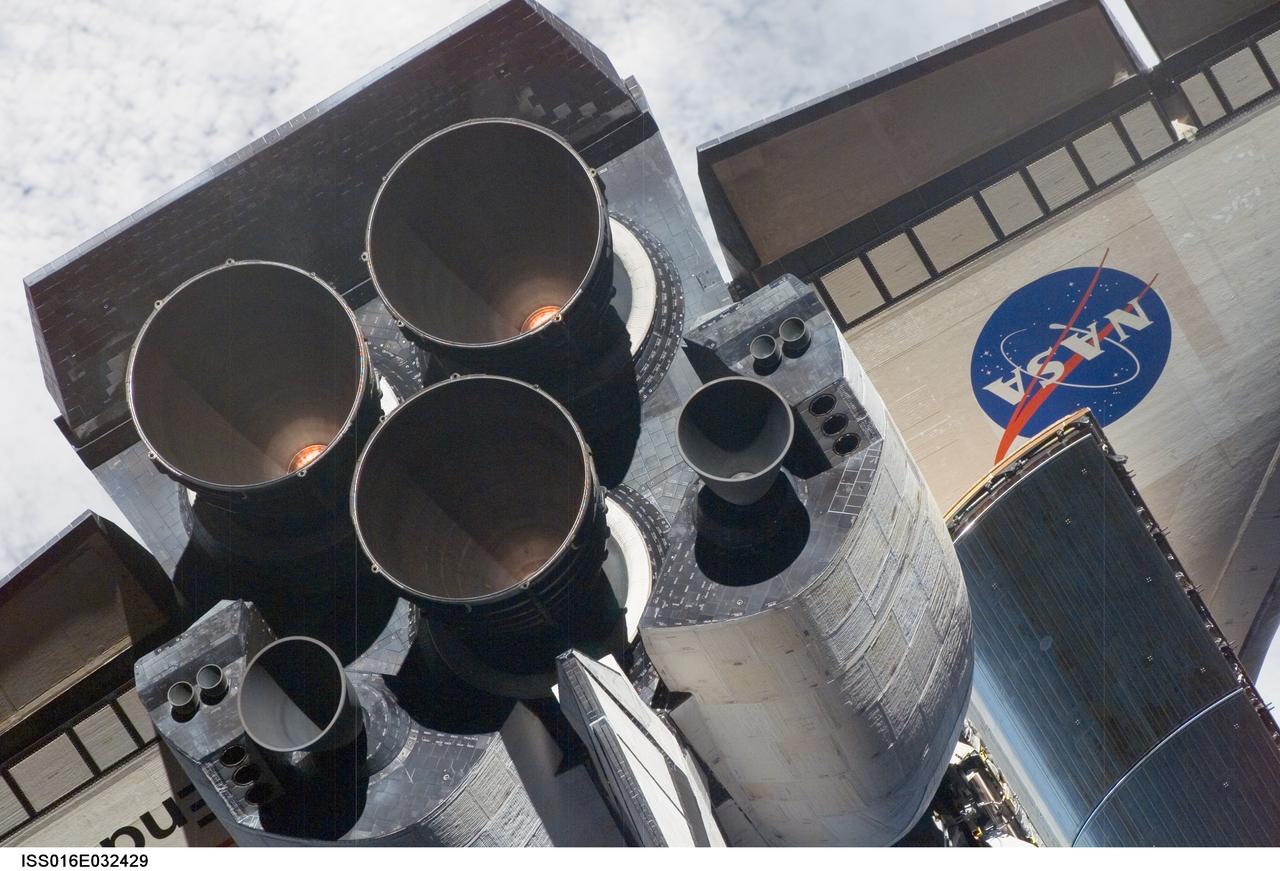
ISS016-E-032429 (12 March 2008) --- A close-up view of Space Shuttle Endeavour's tail section was provided by Expedition 16 crewmembers on the International Space Station (ISS). The image provides partial views of the shuttle's main engines, orbital maneuvering system (OMS) pods, a portion of the payload bay door panels and the shuttle's wings. Before docking with the station, astronaut Dominic Gorie, STS-123 commander, flew the shuttle through a roll pitch maneuver or basically a backflip to allow the space station crew a good view of Endeavour's heat shield. Using digital still cameras equipped with both 400 and 800 millimeter lenses, the ISS crewmembers took a number of photos of the shuttle's thermal protection system and sent them down to teams on the ground for analysis. A 400 millimeter lens was used for this image.
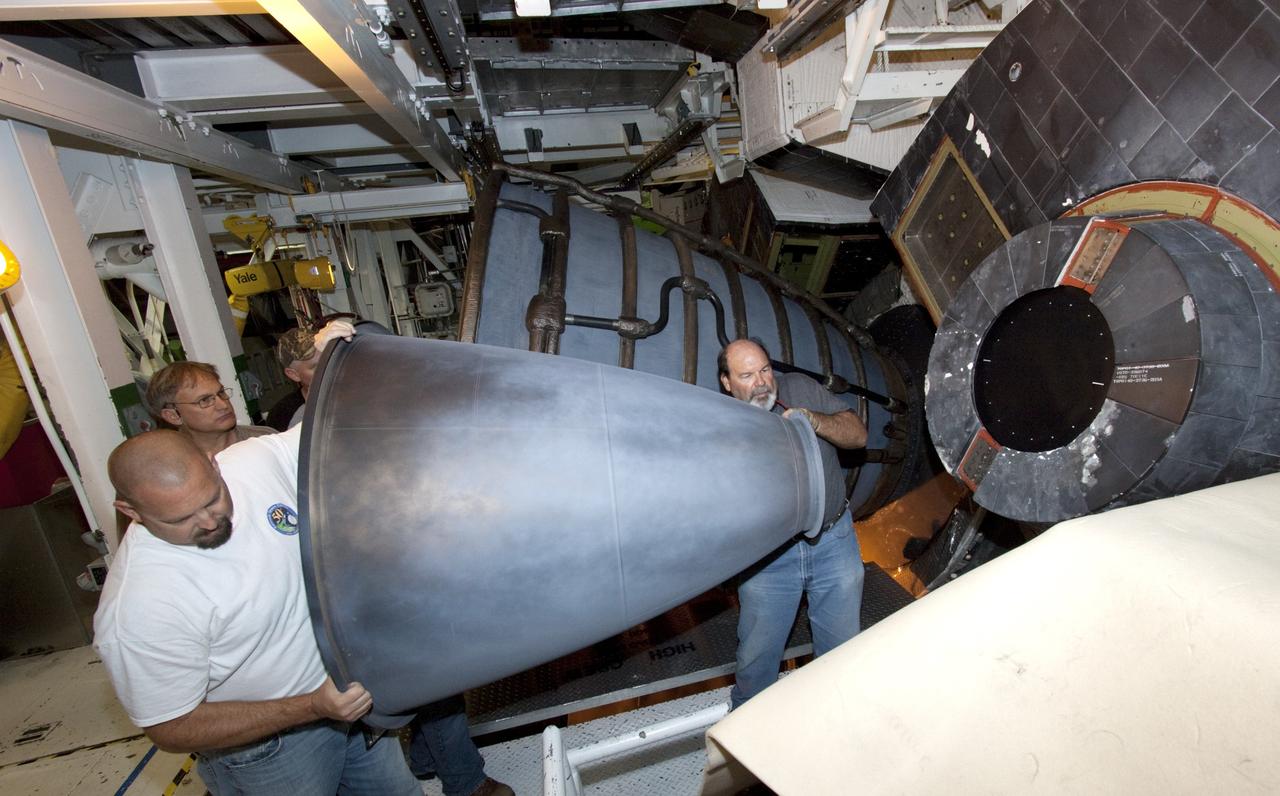
CAPE CANAVERAL, Fla. – In Bay 2 of the Orbiter Processing Facility at NASA's Kennedy Space Center in Florida, United Space Alliance technicians install an Orbital Maneuvering System engine nozzle on the space shuttle Atlantis. The orbiter is undergoing final preparations for its transfer to the Kennedy Space Center Visitor Complex targeted for November. The work is part of Transition and Retirement of the remaining space shuttles, Atlantis and Endeavour. Atlantis is being prepared for public display at Kennedy's Visitor Complex. Over the course of its 26-year career, Atlantis spent 293 days in space during 33 missions. For more information, visit http://www.nasa.gov/transition Photo credit: NASA/Jim Grossmann
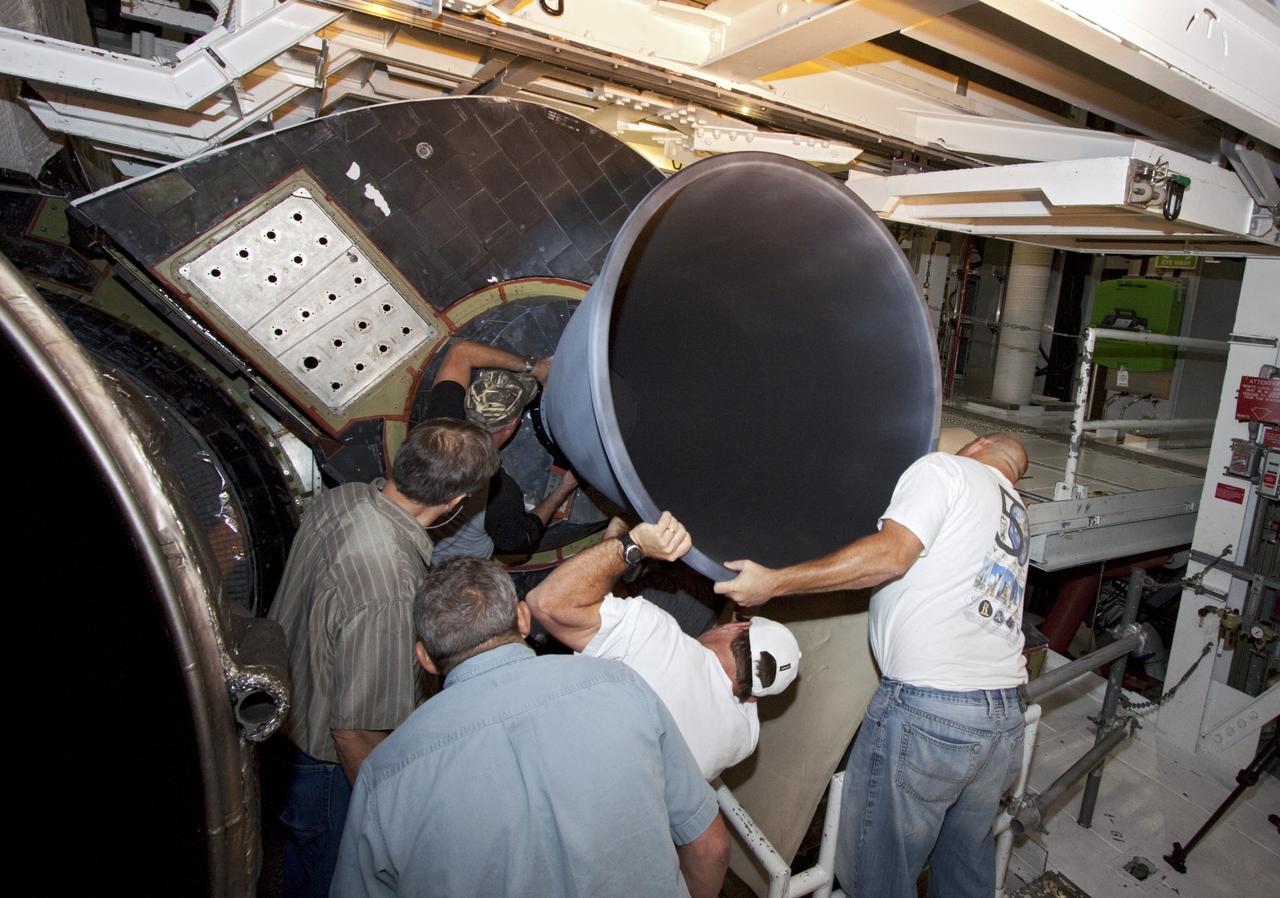
CAPE CANAVERAL, Fla. – In Bay 2 of the Orbiter Processing Facility at NASA's Kennedy Space Center in Florida, United Space Alliance technicians install an Orbital Maneuvering System engine nozzle on the space shuttle Atlantis. The orbiter is undergoing final preparations for its transfer to the Kennedy Space Center Visitor Complex targeted for November. The work is part of Transition and Retirement of the remaining space shuttles, Atlantis and Endeavour. Atlantis is being prepared for public display at Kennedy's Visitor Complex. Over the course of its 26-year career, Atlantis spent 293 days in space during 33 missions. For more information, visit http://www.nasa.gov/transition Photo credit: NASA/Jim Grossmann
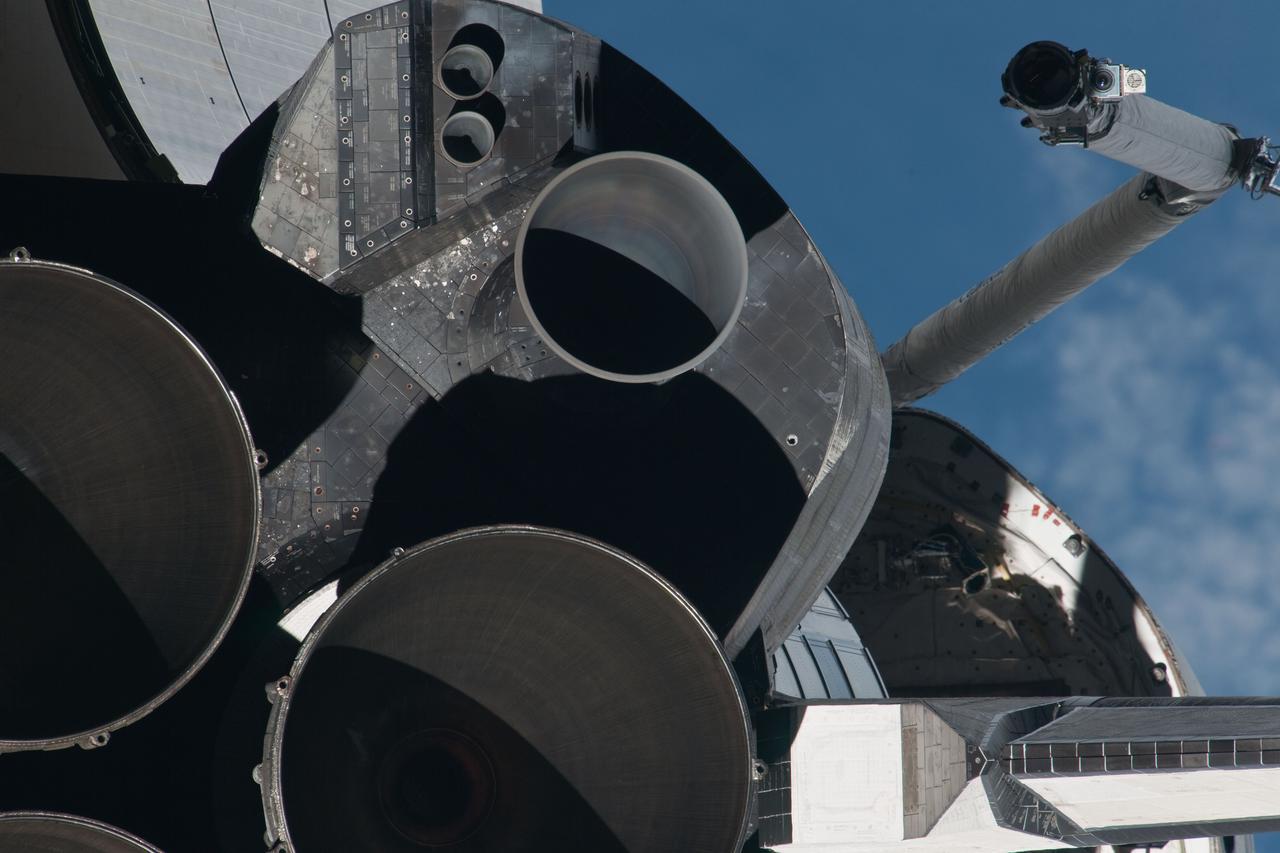
ISS028-E-015647 (10 July 2011) --- This picture of Atlantis' main and subsystem engines is one of a series of images showing various parts of the space shuttle Atlantis in Earth orbit as photographed by one of three crew members -- half the station crew -- who were equipped with still cameras for this purpose on the International Space Station as the shuttle “posed” for photos and visual surveys and performed a back-flip for the rendezvous pitch maneuver (RPM). A 1000 millimeter lens was used to capture this particular series of images.
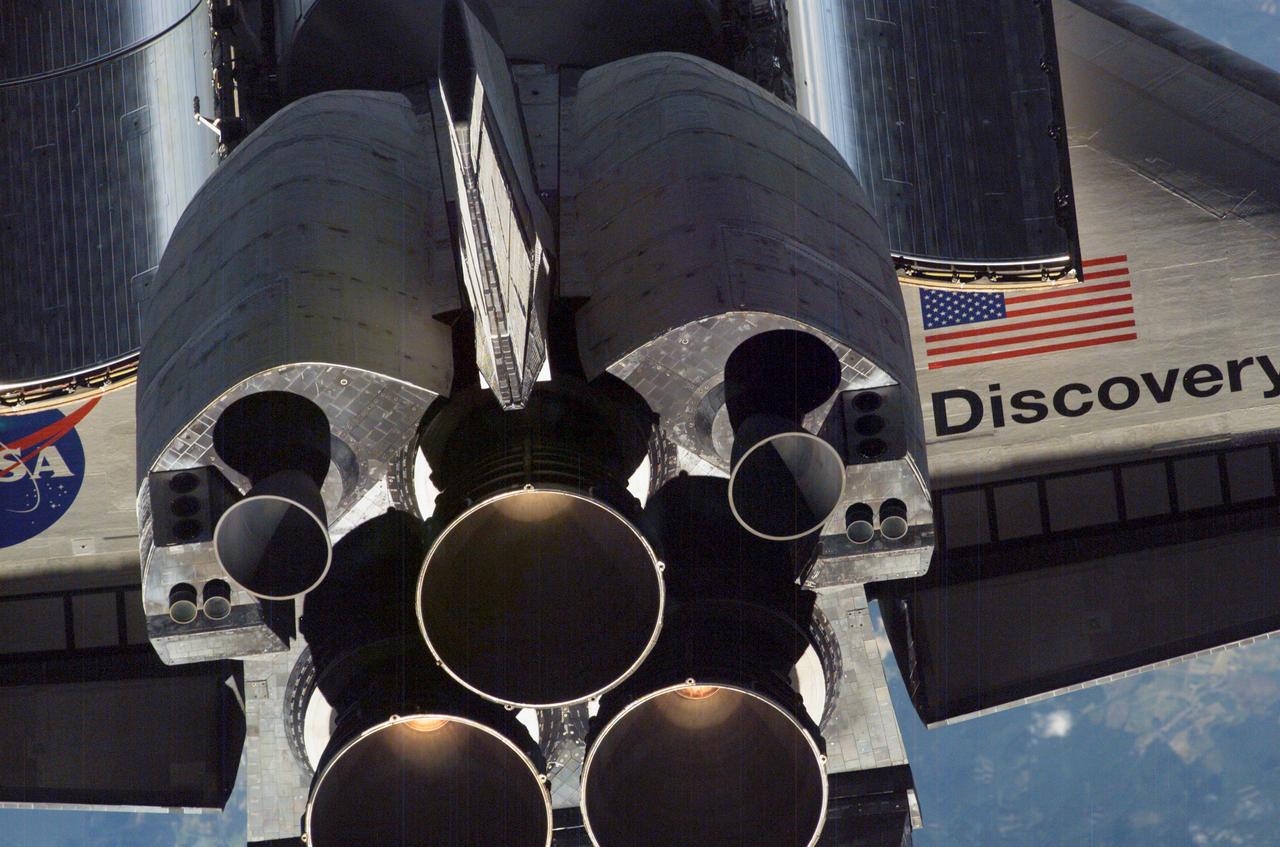
ISS013-E-47643 (6 July 2006) --- A close-up view of Space Shuttle Discovery's tail section is featured in this image photographed by an Expedition 13 crewmember on the International Space Station during RPM survey. Visible are the shuttle's main engines, vertical stabilizer, orbital maneuvering system (OMS) pods and a portion of the aft cargo bay and wings.
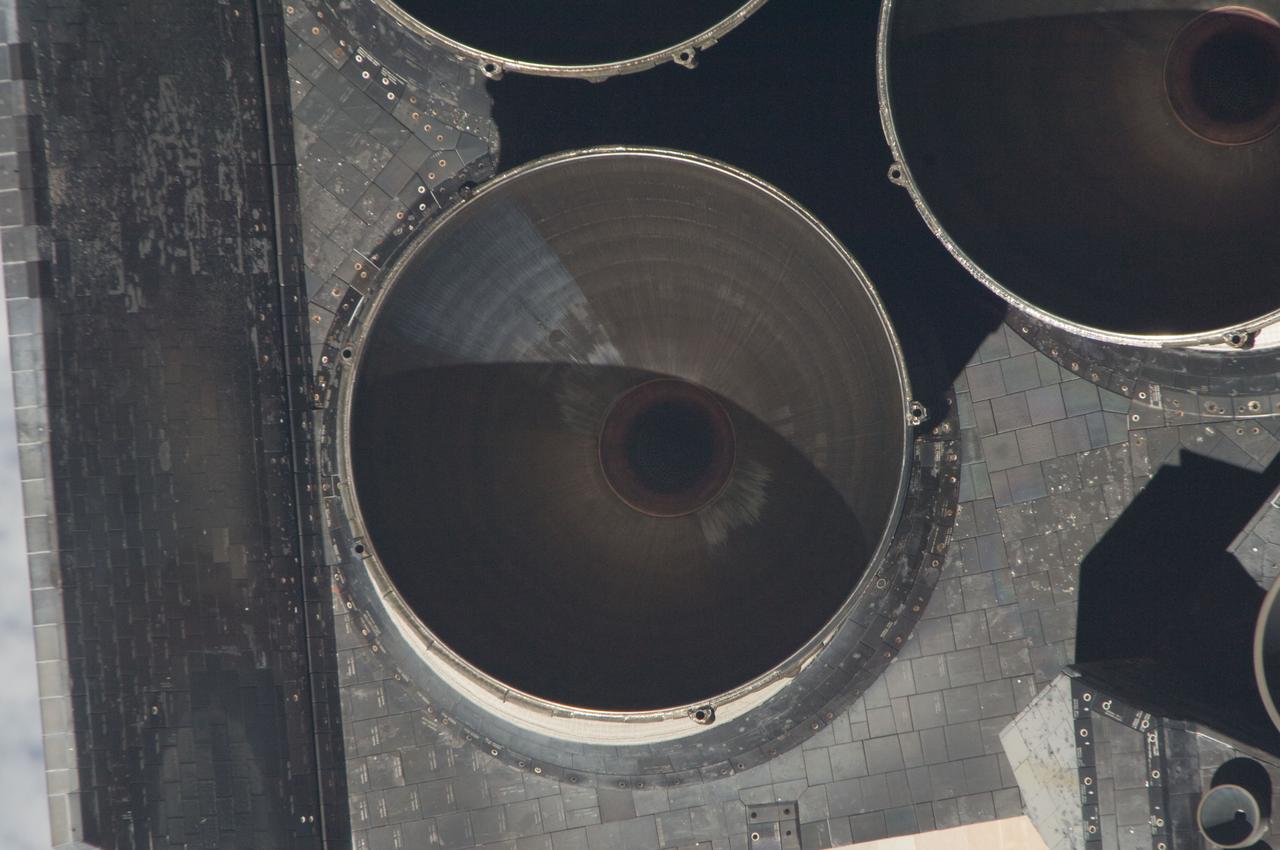
ISS028-E-015328 (10 July 2011) --- Parts of Atlantis' set of main engines are visible in one of a series of images showing various parts of the space shuttle in Earth orbit as photographed by one of the six crewmembers on the International Space Station as the shuttle “posed” for photo and visual surveys and performed a back-flip for the rendezvous pitch maneuver (RPM). An 800 millimeter lens was used to capture this particular series of images.
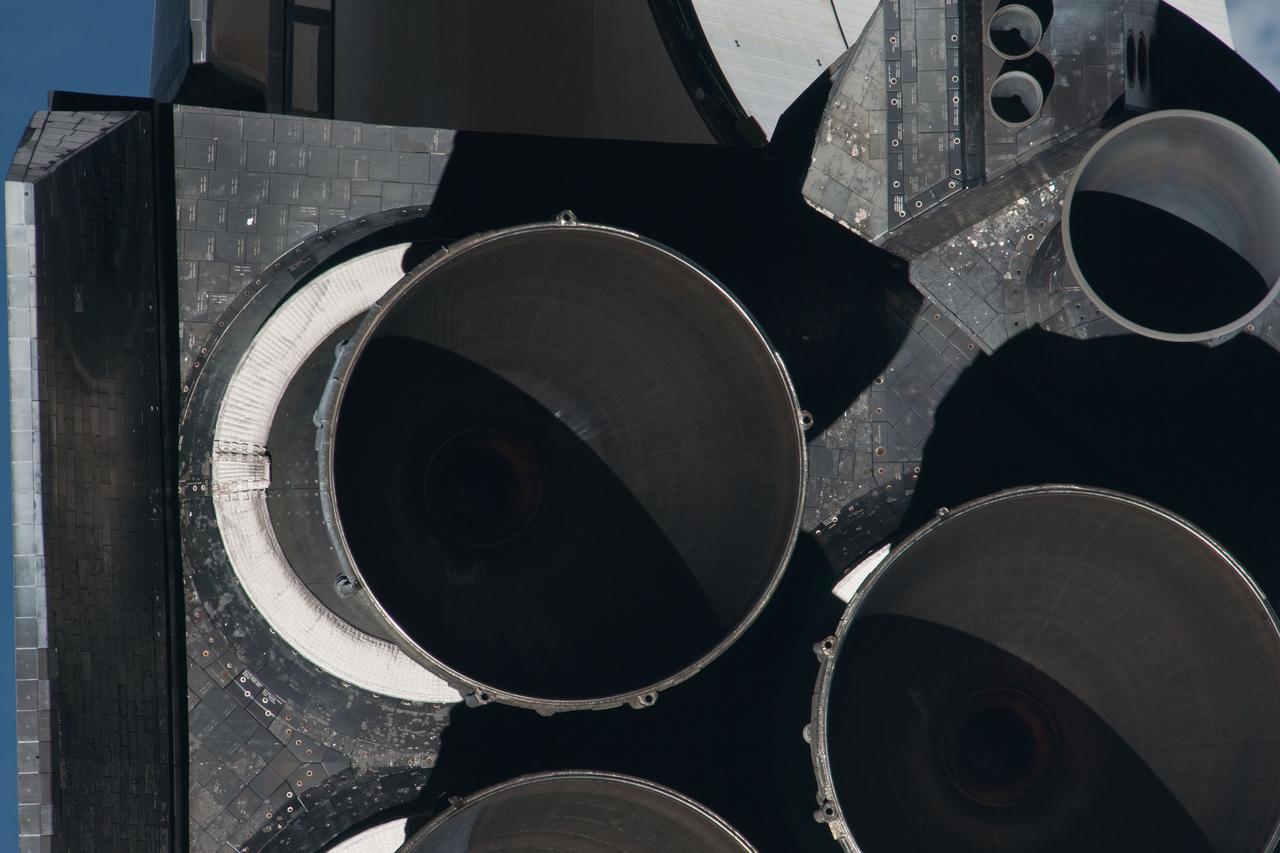
ISS028-E-015588 (10 July 2011) --- This picture of Atlantis' main and subsystem engines is one of a series of images showing various parts of the space shuttle Atlantis in Earth orbit as photographed by one of three crew members -- half the station crew -- who were equipped with still cameras for this purpose on the International Space Station as the shuttle “posed” for photos and visual surveys and performed a back-flip for the rendezvous pitch maneuver (RPM). A 1000 millimeter lens was used to capture this particular series of images.
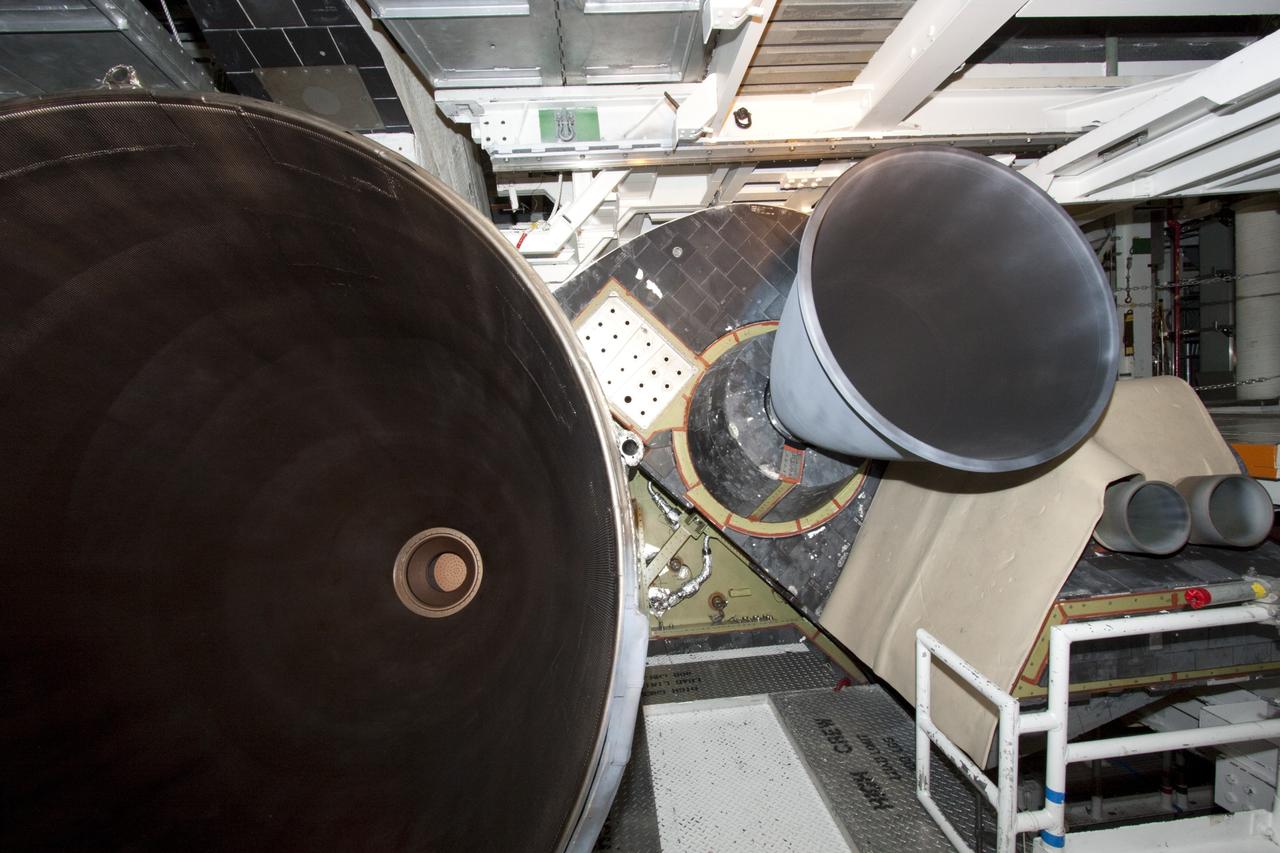
CAPE CANAVERAL, Fla. – In Bay 2 of the Orbiter Processing Facility at NASA's Kennedy Space Center in Florida, an Orbital Maneuvering System engine nozzle has just been installed on the space shuttle Atlantis. The orbiter is undergoing final preparations for its transfer to the Kennedy Space Center Visitor Complex targeted for November. The work is part of Transition and Retirement of the remaining space shuttles, Atlantis and Endeavour. Atlantis is being prepared for public display at Kennedy's Visitor Complex. Over the course of its 26-year career, Atlantis spent 293 days in space during 33 missions. For more information, visit http://www.nasa.gov/transition Photo credit: NASA/Jim Grossmann
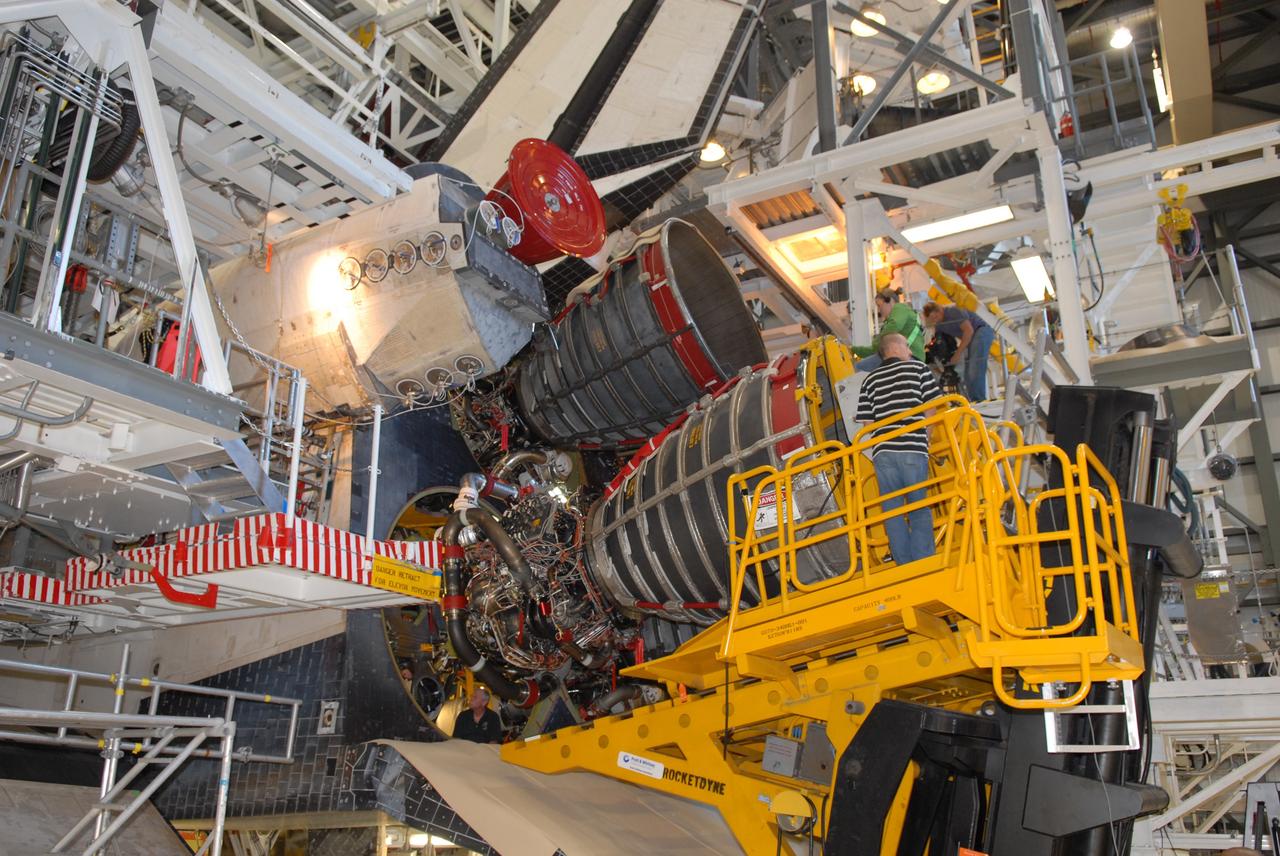
CAPE CANAVERAL, Fla. – A Pratt & Whitney Rocketdyne technician carefully maneuvers a space shuttle main engine into position on space shuttle Endeavour in Orbiter Processing Facility Bay 2 at NASA's Kennedy Space Center in Florida. The engine will fly on the shuttle's STS-130 mission to the International Space Station. Even though this engine weighs one-seventh as much as a locomotive engine, its high-pressure fuel pump alone delivers as much horsepower as 28 locomotives, while its high-pressure oxidizer pump delivers the equivalent horsepower of an additional 11 locomotives. The maximum equivalent horsepower developed by the shuttle's three main engines is more than 37 million horsepower. Endeavour is targeted to launch Feb. 4, 2010. Photo credit: NASA/Jim Grossmann
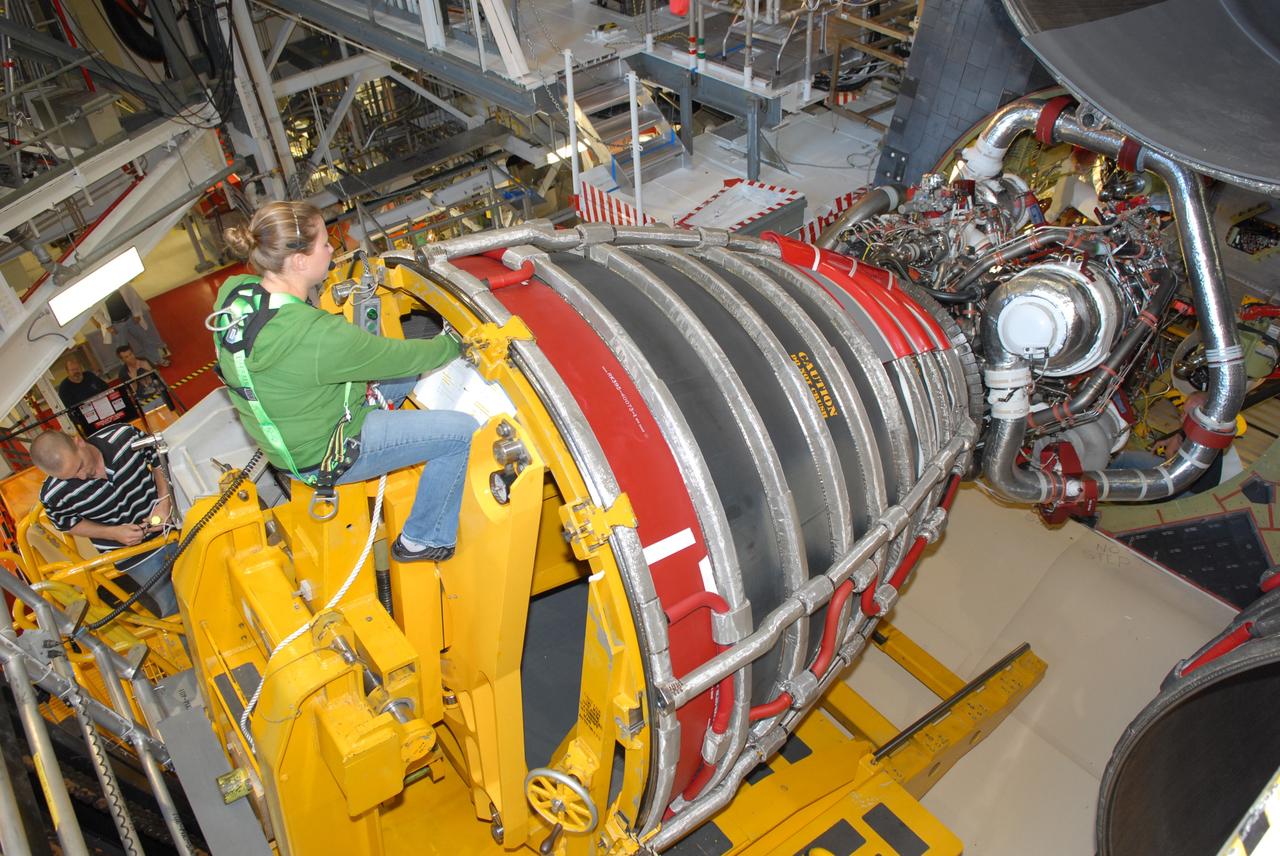
CAPE CANAVERAL, Fla. – A Pratt & Whitney Rocketdyne technician carefully maneuvers a space shuttle main engine into position on space shuttle Endeavour in Orbiter Processing Facility Bay 2 at NASA's Kennedy Space Center in Florida. The engine will fly on the shuttle's STS-130 mission to the International Space Station. Even though this engine weighs one-seventh as much as a locomotive engine, its high-pressure fuel pump alone delivers as much horsepower as 28 locomotives, while its high-pressure oxidizer pump delivers the equivalent horsepower of an additional 11 locomotives. The maximum equivalent horsepower developed by the shuttle's three main engines is more than 37 million horsepower. Endeavour is targeted to launch Feb. 4, 2010. Photo credit: NASA/Jim Grossmann
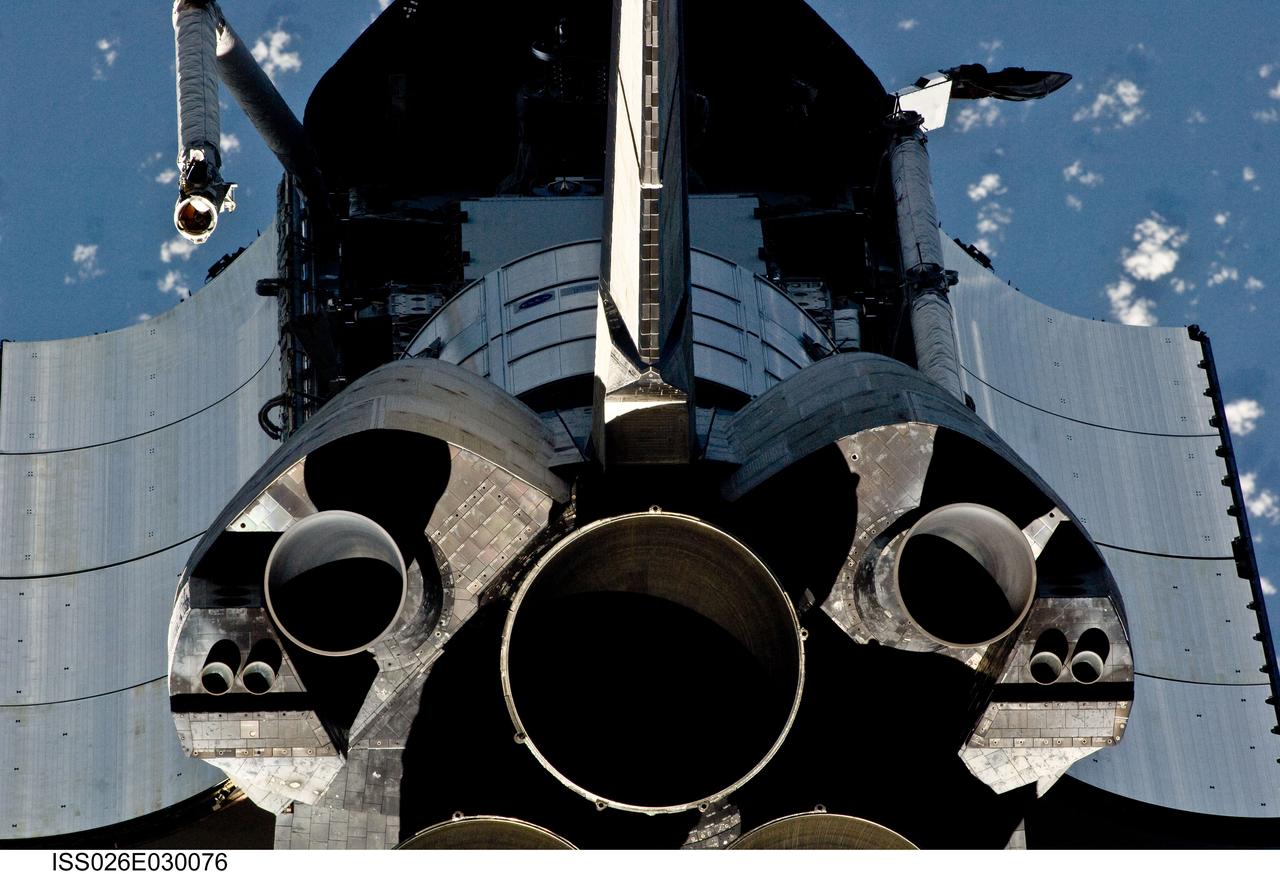
ISS026-E-030076 (26 Feb. 2011) --- This view of the aft portion of the space shuttle Discovery, including main engines, part of the cargo bay, vertical stabilizer and orbital maneuvering system (OMS) pods was provided by an Expedition 26 crew member during a survey of the approaching STS-133 vehicle prior to docking with the International Space Station. As part of the survey and part of every mission's activities, Discovery performed a back-flip for the rendezvous pitch maneuver (RPM). The image was photographed with a digital still camera, using a 400mm lens at a distance of about 600 feet (180 meters).
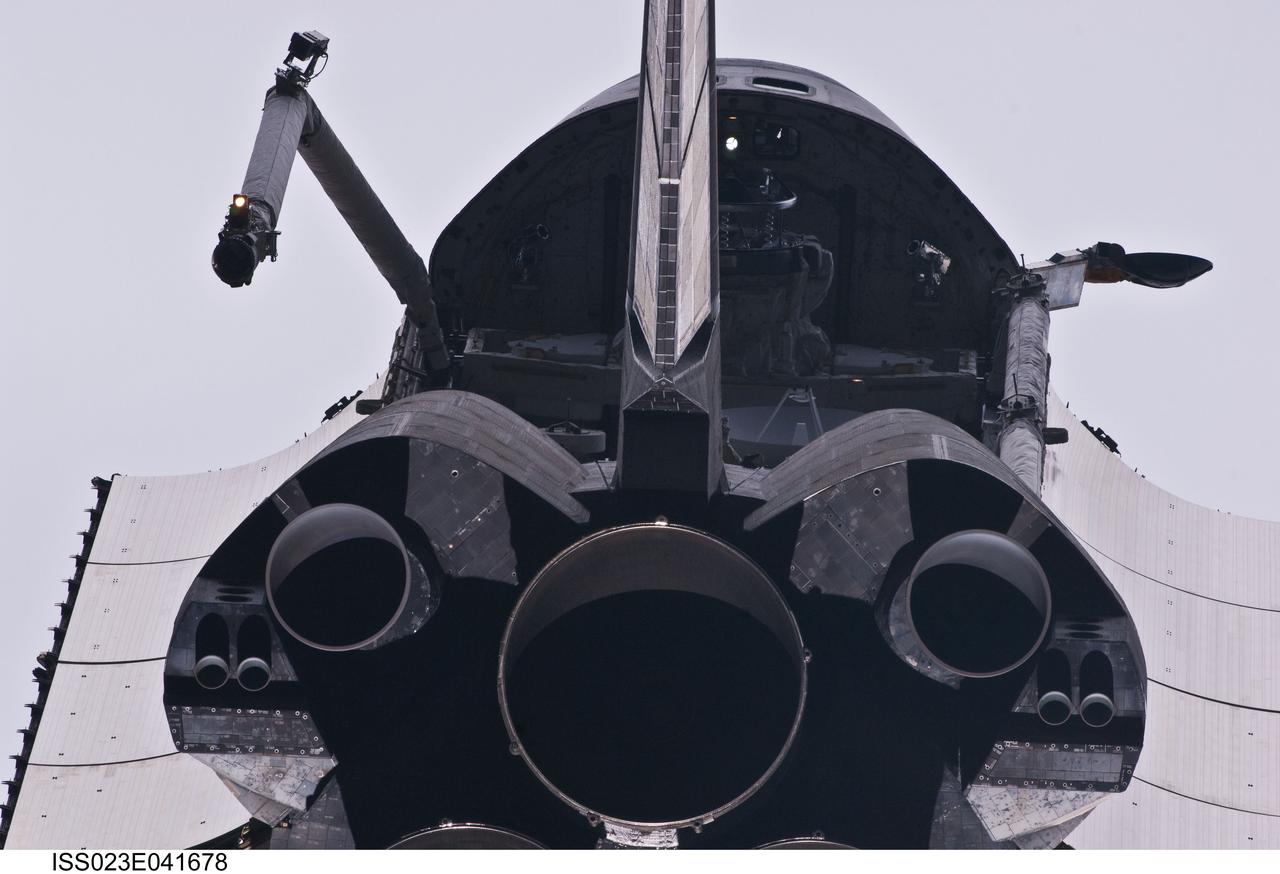
ISS023-E-041678 (16 May 2010) --- This view of the aft portion of the space shuttle Atlantis, including main engines, part of the cargo bay, vertical stabilizer and orbital maneuvering system (OMS) pods was provided by an Expedition 23 crew member during a survey of the approaching STS-132 vehicle prior to docking with the International Space Station. As part of the survey and part of every mission's activities, Atlantis performed a back-flip for the rendezvous pitch maneuver (RPM). The image was photographed with a digital still camera, using a 400mm lens at a distance of about 600 feet (180 meters).
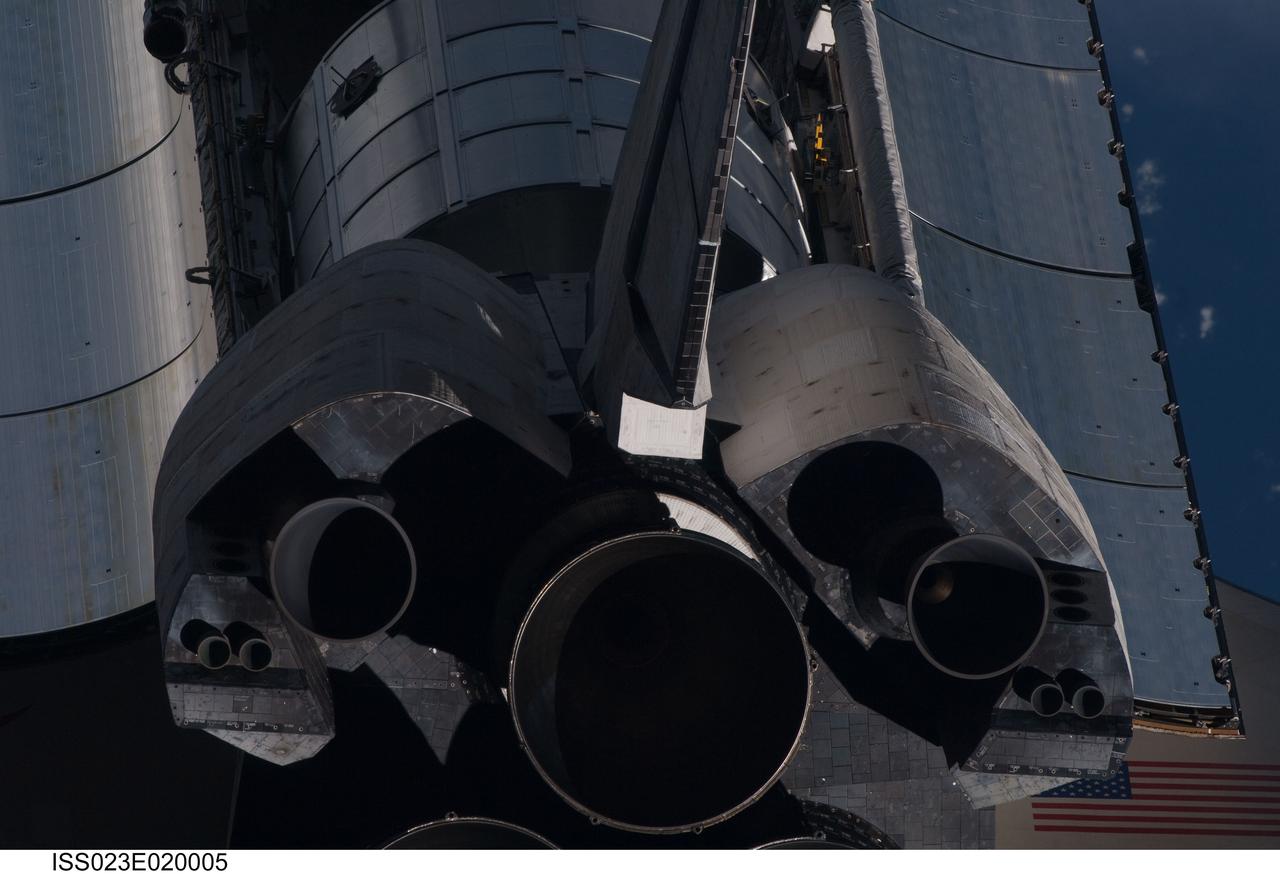
ISS023-E-020005 (7 April 2010) --- This view of the aft portion of the space shuttle Discovery, including the three main engines, part of the cargo bay, vertical stabilizer and orbital maneuvering system (OMS) pods, was provided by an Expedition 23 crew member during a survey of the approaching vehicle prior to docking with the International Space Station. As part of the survey and part of every mission's activities, the STS-131 Discovery crew performed a back-flip for the rendezvous pitch maneuver (RPM). The image was photographed with a digital still camera, using a 400mm lens at a distance of about 600 feet (180 meters). The multi-purpose logistics module Leonardo is visible in the cargo bay.
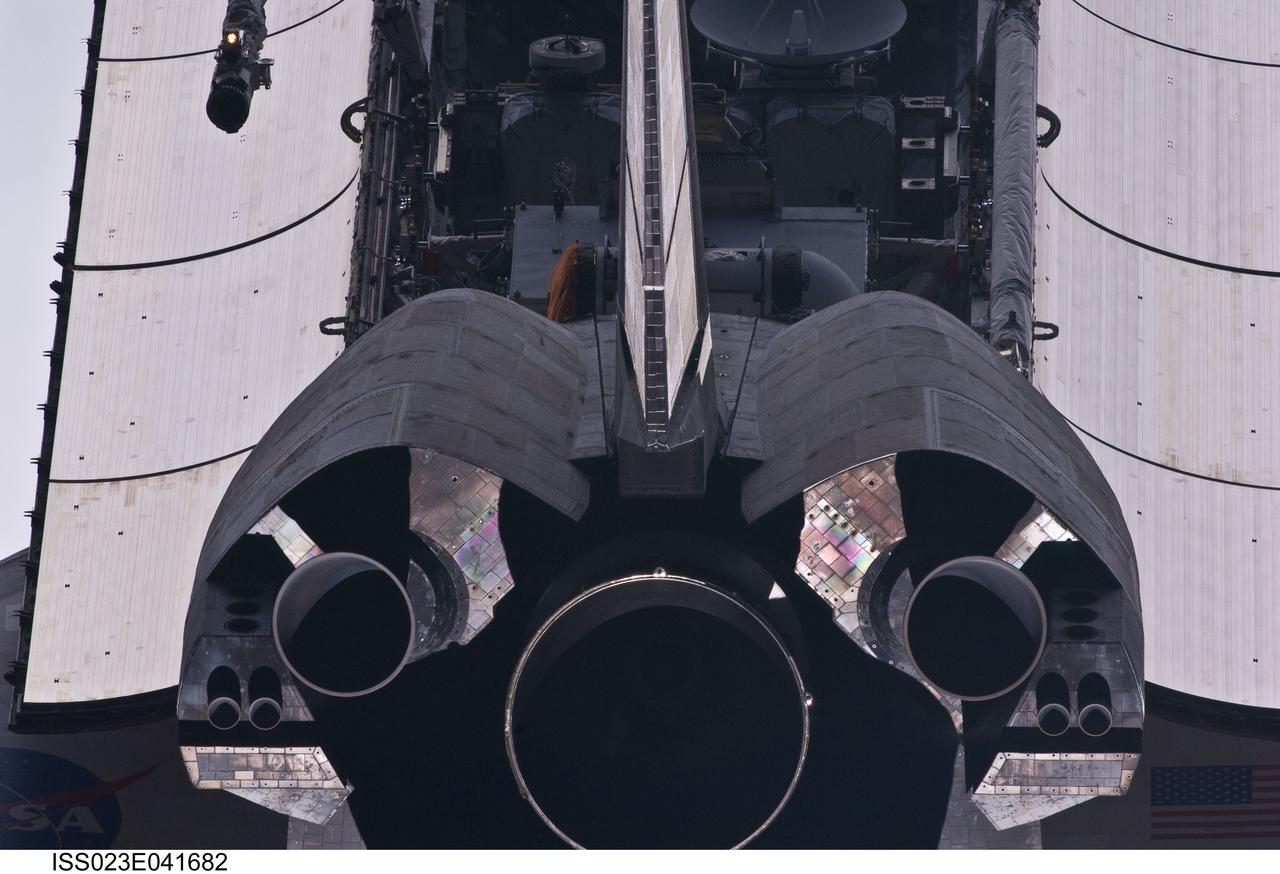
ISS023-E-041682 (16 May 2010) --- This view of the aft portion of the space shuttle Atlantis, including main engines, part of the cargo bay, vertical stabilizer and orbital maneuvering system (OMS) pods was provided by an Expedition 23 crew member during a survey of the approaching STS-132 vehicle prior to docking with the International Space Station. As part of the survey and part of every mission's activities, Atlantis performed a back-flip for the rendezvous pitch maneuver (RPM). The image was photographed with a digital still camera, using a 400mm lens at a distance of about 600 feet (180 meters).
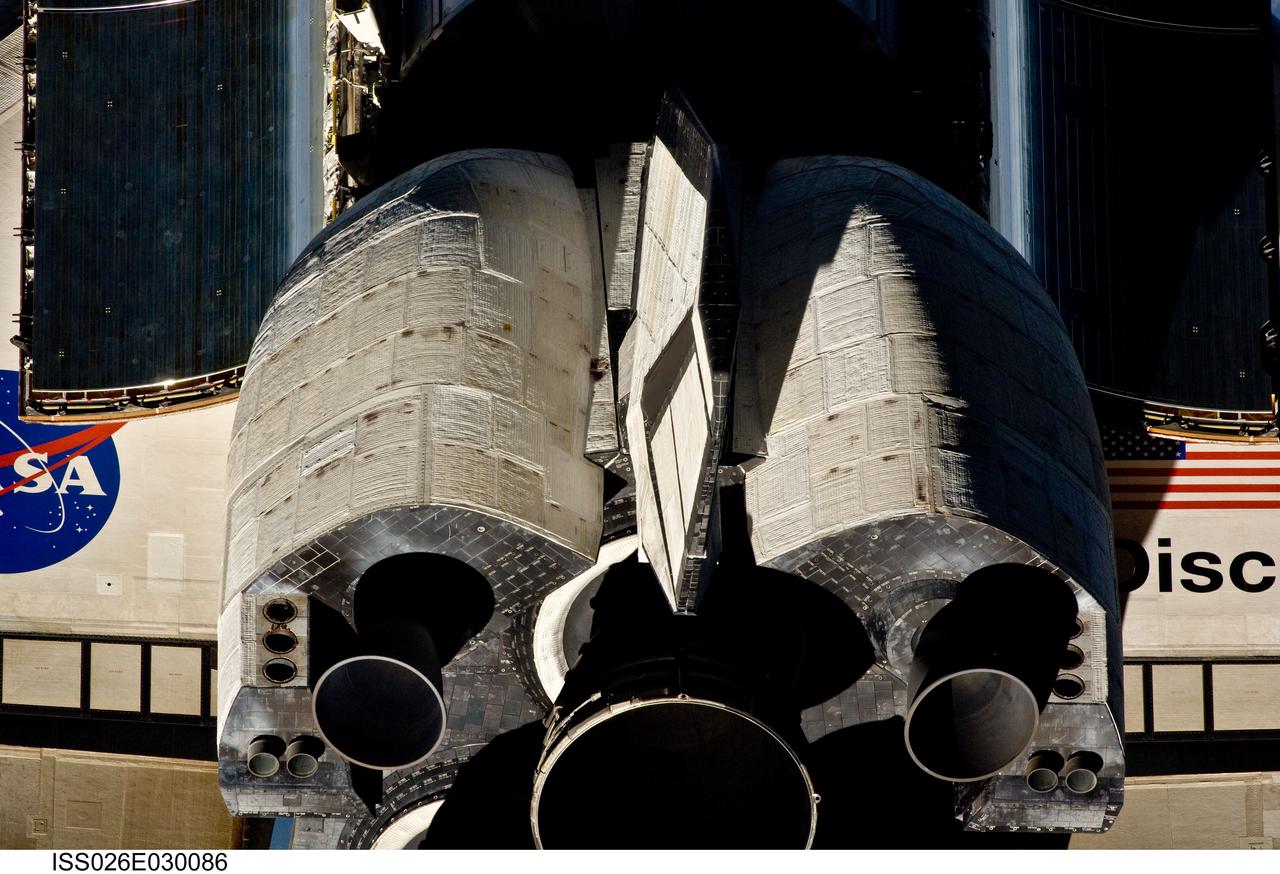
ISS026-E-030086 (26 Feb. 2011) --- This view of the aft portion of the space shuttle Discovery, including the three main engines and orbital maneuvering system (OMS) pods, was provided by an Expedition 26 crew member during a survey of the approaching STS-133 vehicle prior to docking with the International Space Station. As part of the survey and part of every mission's activities, Discovery performed a back-flip for the rendezvous pitch maneuver (RPM). The image was photographed with a digital still camera, using a 400mm lens at a distance of about 600 feet (180 meters).
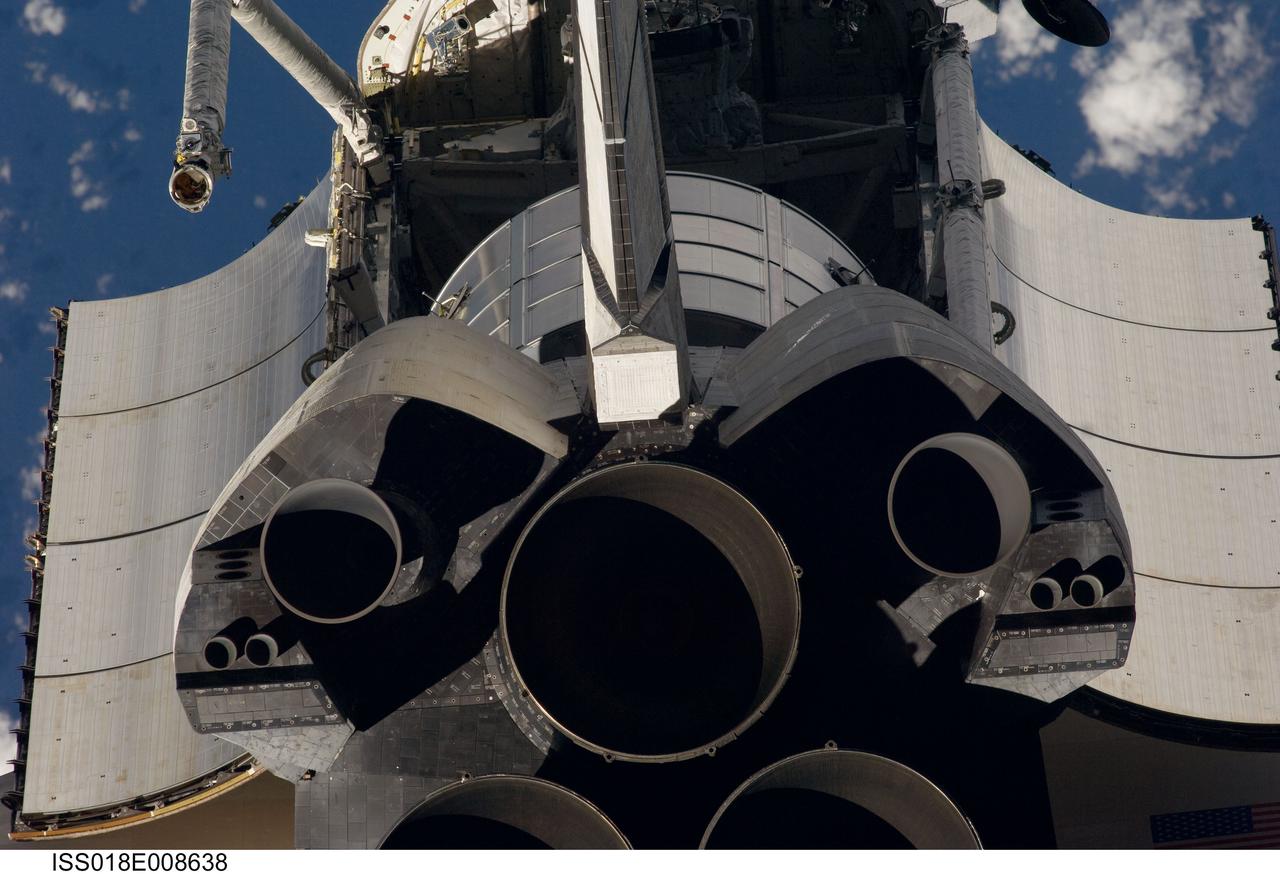
ISS018-E-008638 (16 Nov. 2008) --- A close-up view of Space Shuttle Endeavour's tail section was provided by Expedition 18 crewmembers on the International Space Station. The image provides partial views of the shuttle's main engines, orbital maneuvering system (OMS) pods, vertical stabilizer, the payload bay door panels and the Leonard Multi-Purpose Logistics Module located in the cargo bay. Before docking with the station, astronaut Chris Ferguson, STS-126 commander, flew the shuttle through a roll pitch maneuver or basically a backflip to allow the space station crew a good view of Endeavour's heat shield. Using digital still cameras equipped with both 400 and 800 millimeter lenses, the ISS crewmembers took a number of photos of the shuttle's thermal protection system and sent them down to teams on the ground for analysis. A 400 millimeter lens was used for this image.
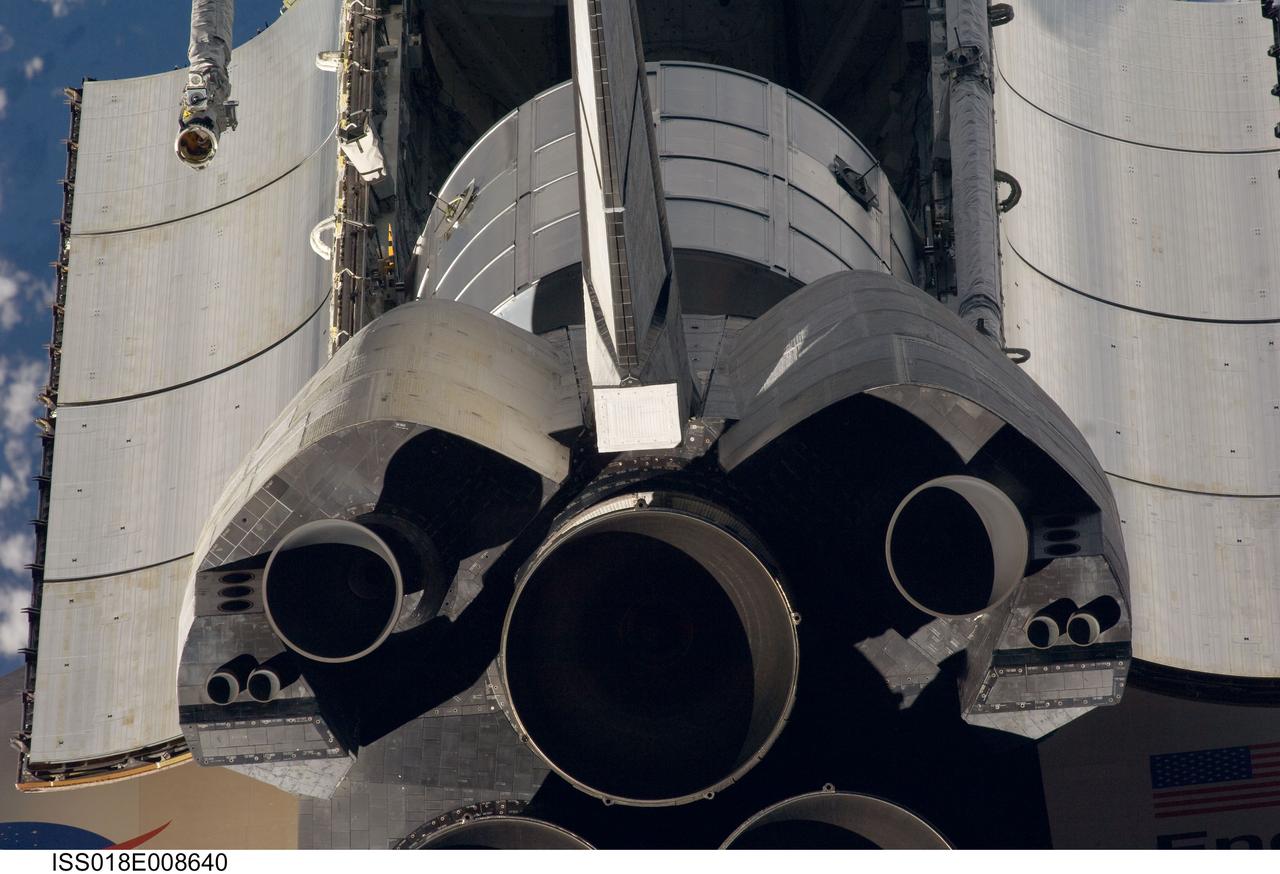
ISS018-E-008640 (16 Nov. 2008) --- A close-up view of Space Shuttle Endeavour's tail section was provided by Expedition 18 crewmembers on the International Space Station. The image provides partial views of the shuttle's main engines, orbital maneuvering system (OMS) pods, vertical stabilizer, the payload bay door panels and the Leonard Multi-Purpose Logistics Module located in the cargo bay. Before docking with the station, astronaut Chris Ferguson, STS-126 commander, flew the shuttle through a roll pitch maneuver or basically a backflip to allow the space station crew a good view of Endeavour's heat shield. Using digital still cameras equipped with both 400 and 800 millimeter lenses, the ISS crewmembers took a number of photos of the shuttle's thermal protection system and sent them down to teams on the ground for analysis. A 400 millimeter lens was used for this image.
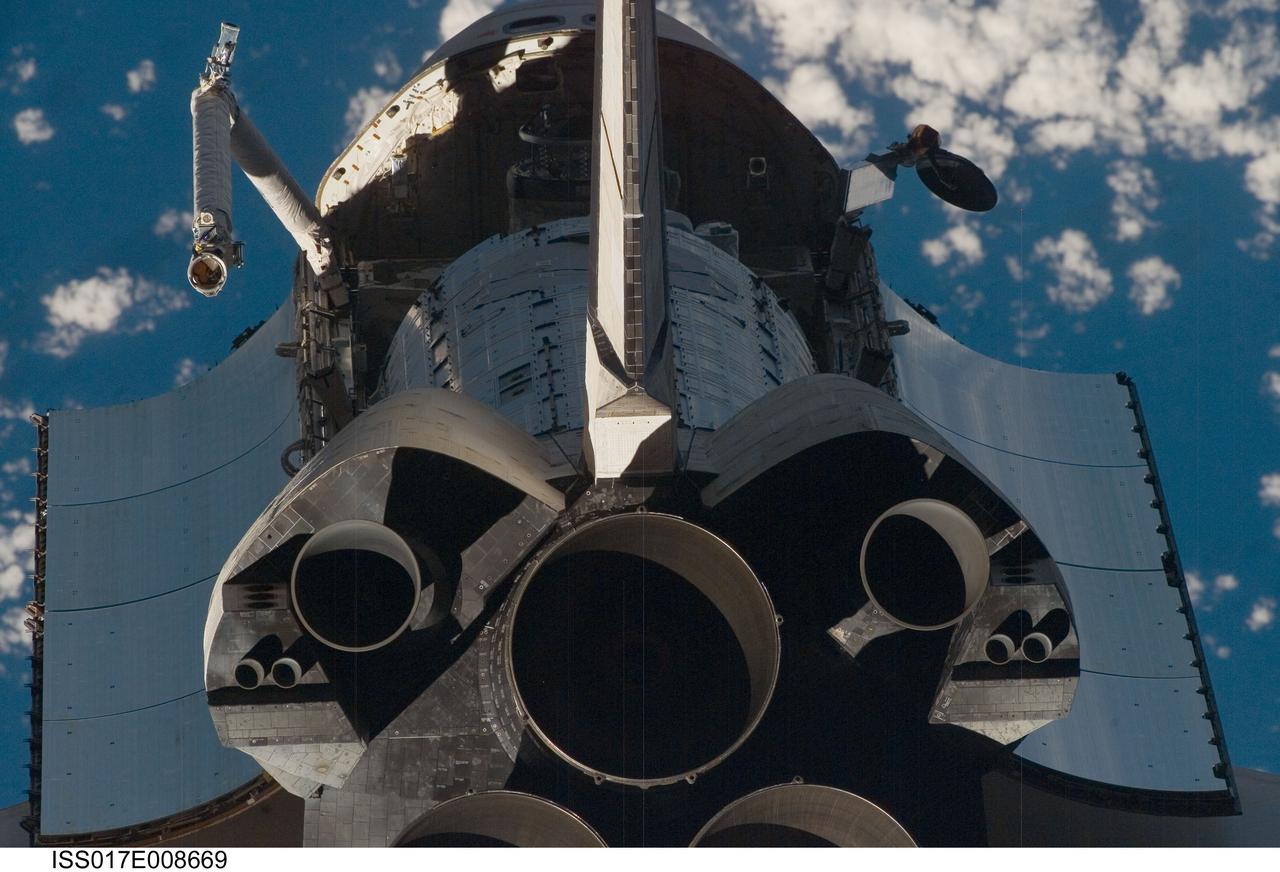
ISS017-E-008669 (2 June 2008) --- A close-up view of Space Shuttle Discovery's tail section was provided by Expedition 17 crewmembers on the International Space Station (ISS). The image provides partial views of the shuttle's main engines, orbital maneuvering system (OMS) pods, vertical stabilizer, the payload bay door panels and the second component of the Japan Aerospace Exploration Agency's Kibo laboratory, the Japanese Pressurized Module (JPM) located in the cargo bay. Before docking with the station, astronaut Mark Kelly, STS-124 commander, flew the shuttle through a roll pitch maneuver or basically a backflip to allow the space station crew a good view of Discovery's heat shield. Using digital still cameras equipped with both 400 and 800 millimeter lenses, the ISS crewmembers took a number of photos of the shuttle's thermal protection system and sent them down to teams on the ground for analysis. A 400 millimeter lens was used for this image.

CAPE CANAVERAL, Fla. - In Orbiter Processing Facility bay 3 at NASA's Kennedy Space Center in Florida, a worker maneuvers space shuttle main engine No. 1 toward the aft opening in space shuttle Discovery for installation. Each engine is 14 feet long, weighs about 6,700 pounds, and is 7.5 feet in diameter at the end of the nozzle. Discovery is being processed for its next mission, STS-119, targeted for launch on Feb. 12, 2009. Discovery and its crew will deliver integrated truss structure 6 (S6) and solar arrays to the International Space Station. Photo credit: NASA/Dimitri Gerondidakis
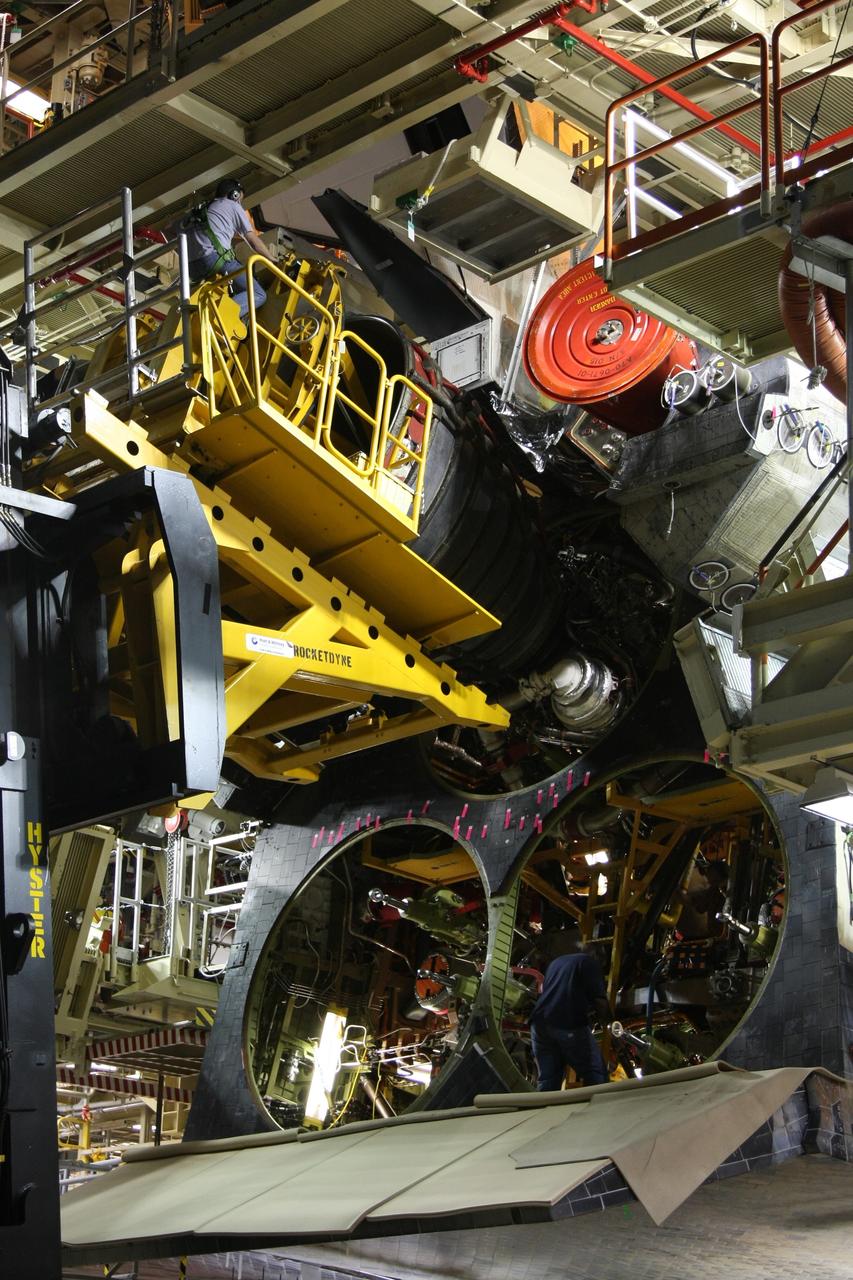
CAPE CANAVERAL, Fla. - Using a Hyster forklift, workers maneuver space shuttle main engine No. 1 (top) into place in space shuttle Discovery in Orbiter Processing Facility bay 3 at NASA's Kennedy Space Center in Florida. Each engine is 14 feet long, weighs about 6,700 pounds, and is 7.5 feet in diameter at the end of the nozzle. Discovery is being processed for its next mission, STS-119, targeted for launch on Feb. 12, 2009. Discovery and its crew will deliver integrated truss structure 6 (S6) and solar arrays to the International Space Station. Photo credit: NASA/Dimitri Gerondidakis
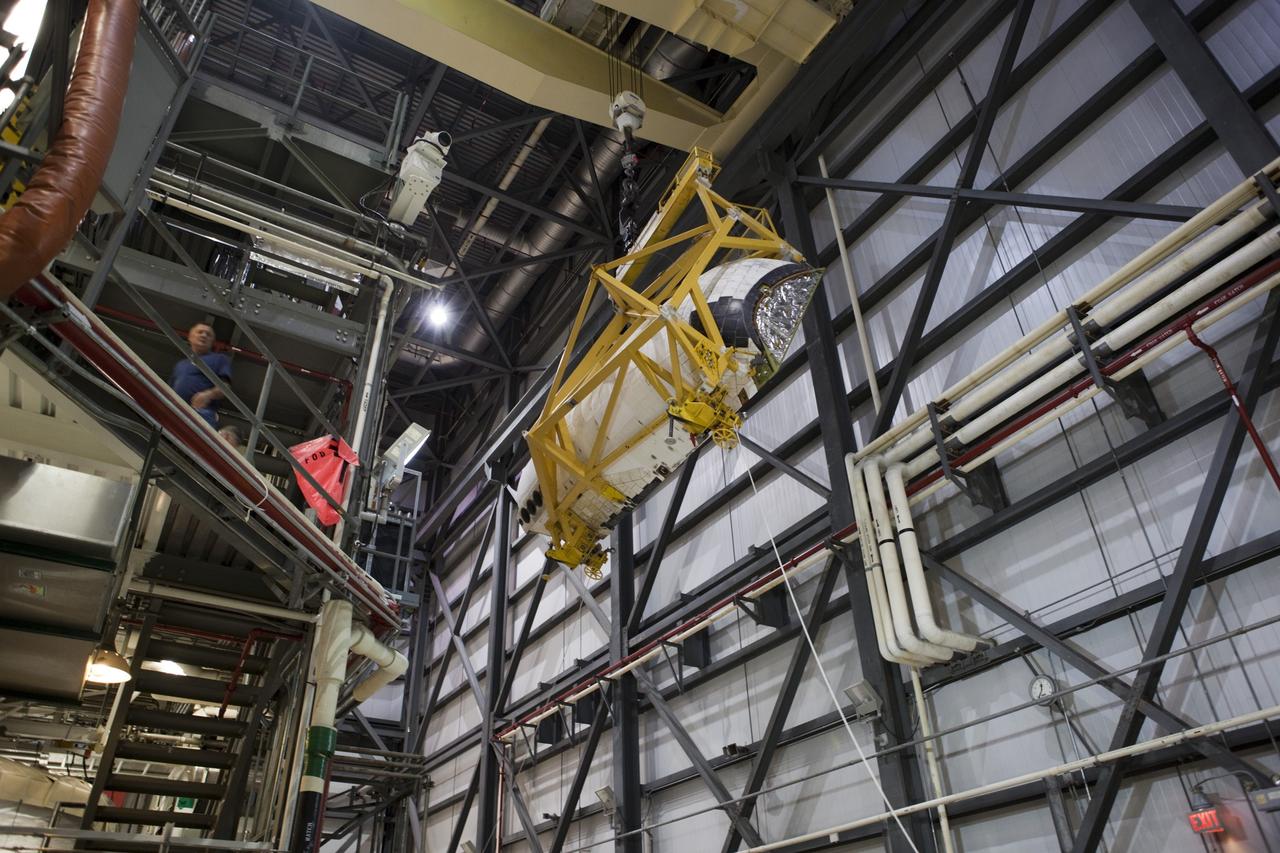
CAPE CANAVERAL, Fla. – Inside Orbiter Processing Facility-1 at NASA’s Kennedy Space Center in Florida, a United Space Alliance technician monitors the progress as a large crane lifts the right orbital maneuvering system, or OMS, pod for installation on space shuttle Atlantis. It is the last time an OMS pod will be installed on Atlantis. The OMS provided the shuttle with thrust for orbit insertion, rendezvous and deorbit, and could provide up to 1,000 pounds of propellant to the aft reaction control system. The OMS is housed in two independent pods located on each side of the shuttle’s aft fuselage. Each pod contains one OMS engine and the hardware needed to pressurize, store and distribute the propellants to perform the velocity maneuvers. Atlantis’ OMS pods were removed and sent to the test facility at White Sands Space Harbor in New Mexico to be cleaned of residual toxic propellant. The work is part of the Space Shuttle Program’s transition and retirement processing of the space shuttle fleet. A groundbreaking was held Jan. 18 for Atlantis’ future home, a 65,000-square-foot exhibit hall in Shuttle Plaza at the Kennedy Space Center Visitor Complex. Atlantis is scheduled to roll over to the visitor complex in November in preparation for the exhibit’s grand opening in July 2013. For more information, visit http://www.nasa.gov/transition. Photo credit: NASA/Dimitri Gerondidakis
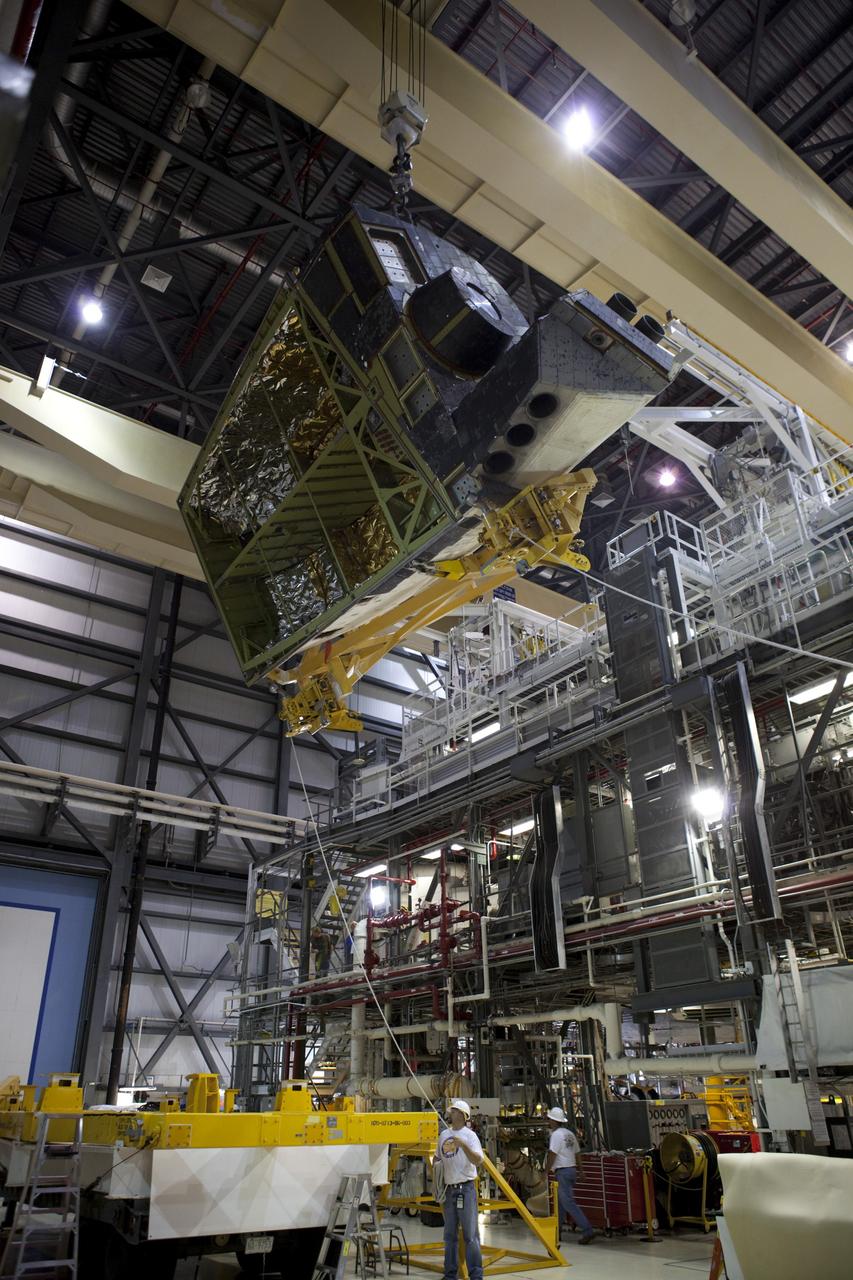
CAPE CANAVERAL, Fla. – Inside Orbiter Processing Facility-1 at NASA’s Kennedy Space Center in Florida, United Space Alliance technicians monitor the progress as a large crane lifts the right orbital maneuvering system, or OMS, pod for installation on space shuttle Atlantis. It is the last time an OMS pod will be installed on Atlantis. The OMS provided the shuttle with thrust for orbit insertion, rendezvous and deorbit, and could provide up to 1,000 pounds of propellant to the aft reaction control system. The OMS is housed in two independent pods located on each side of the shuttle’s aft fuselage. Each pod contains one OMS engine and the hardware needed to pressurize, store and distribute the propellants to perform the velocity maneuvers. Atlantis’ OMS pods were removed and sent to the test facility at White Sands Space Harbor in New Mexico to be cleaned of residual toxic propellant. The work is part of the Space Shuttle Program’s transition and retirement processing of the space shuttle fleet. A groundbreaking was held Jan. 18 for Atlantis’ future home, a 65,000-square-foot exhibit hall in Shuttle Plaza at the Kennedy Space Center Visitor Complex. Atlantis is scheduled to roll over to the visitor complex in November in preparation for the exhibit’s grand opening in July 2013. For more information, visit http://www.nasa.gov/transition. Photo credit: NASA/Dimitri Gerondidakis
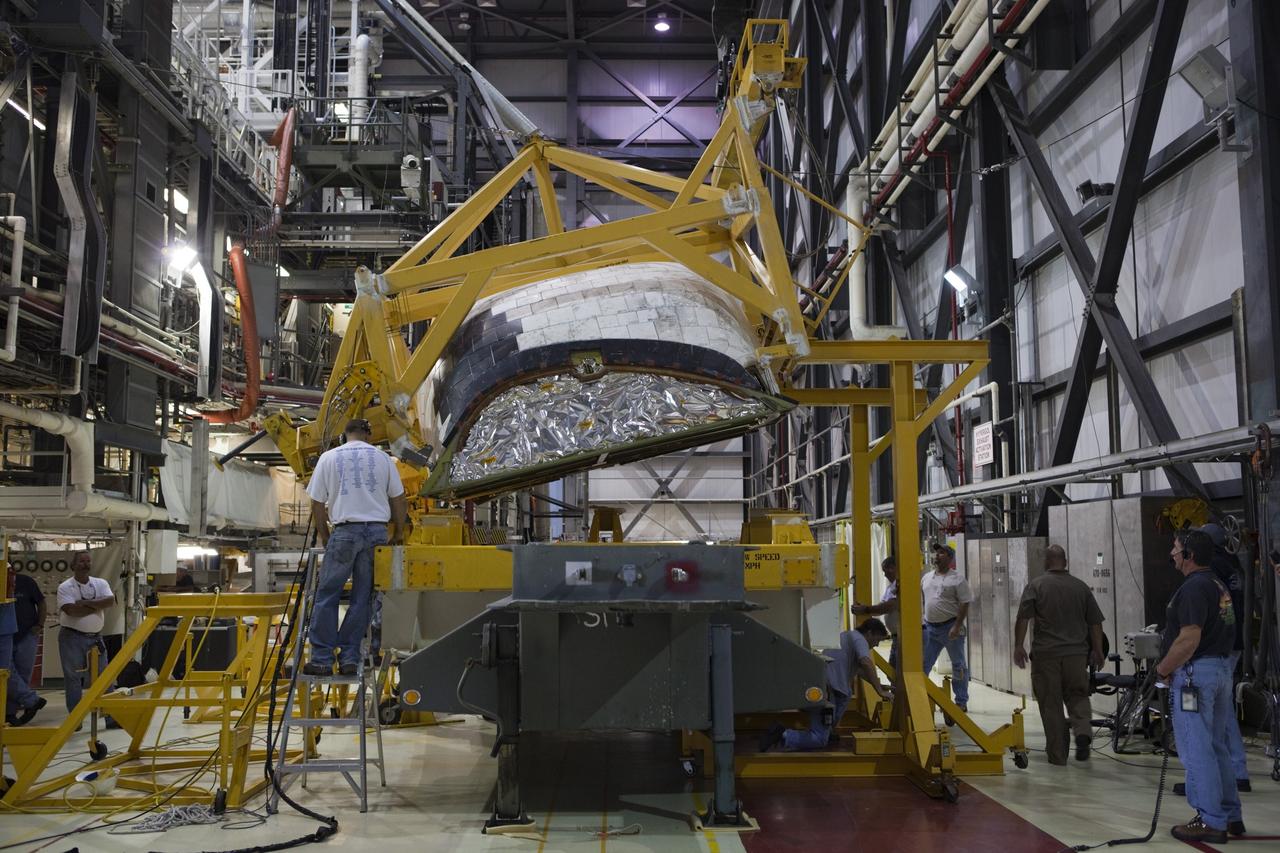
CAPE CANAVERAL, Fla. – Inside Orbiter Processing Facility-1 at NASA’s Kennedy Space Center in Florida, United Space Alliance technicians monitor the progress as a large crane begins to lift the right orbital maneuvering system, or OMS, pod for installation on space shuttle Atlantis. It is the last time an OMS pod will be installed on Atlantis. The OMS provided the shuttle with thrust for orbit insertion, rendezvous and deorbit, and could provide up to 1,000 pounds of propellant to the aft reaction control system. The OMS is housed in two independent pods located on each side of the shuttle’s aft fuselage. Each pod contains one OMS engine and the hardware needed to pressurize, store and distribute the propellants to perform the velocity maneuvers. Atlantis’ OMS pods were removed and sent to the test facility at White Sands Space Harbor in New Mexico to be cleaned of residual toxic propellant. The work is part of the Space Shuttle Program’s transition and retirement processing of the space shuttle fleet. A groundbreaking was held Jan. 18 for Atlantis’ future home, a 65,000-square-foot exhibit hall in Shuttle Plaza at the Kennedy Space Center Visitor Complex. Atlantis is scheduled to roll over to the visitor complex in November in preparation for the exhibit’s grand opening in July 2013. For more information, visit http://www.nasa.gov/transition. Photo credit: NASA/Dimitri Gerondidakis
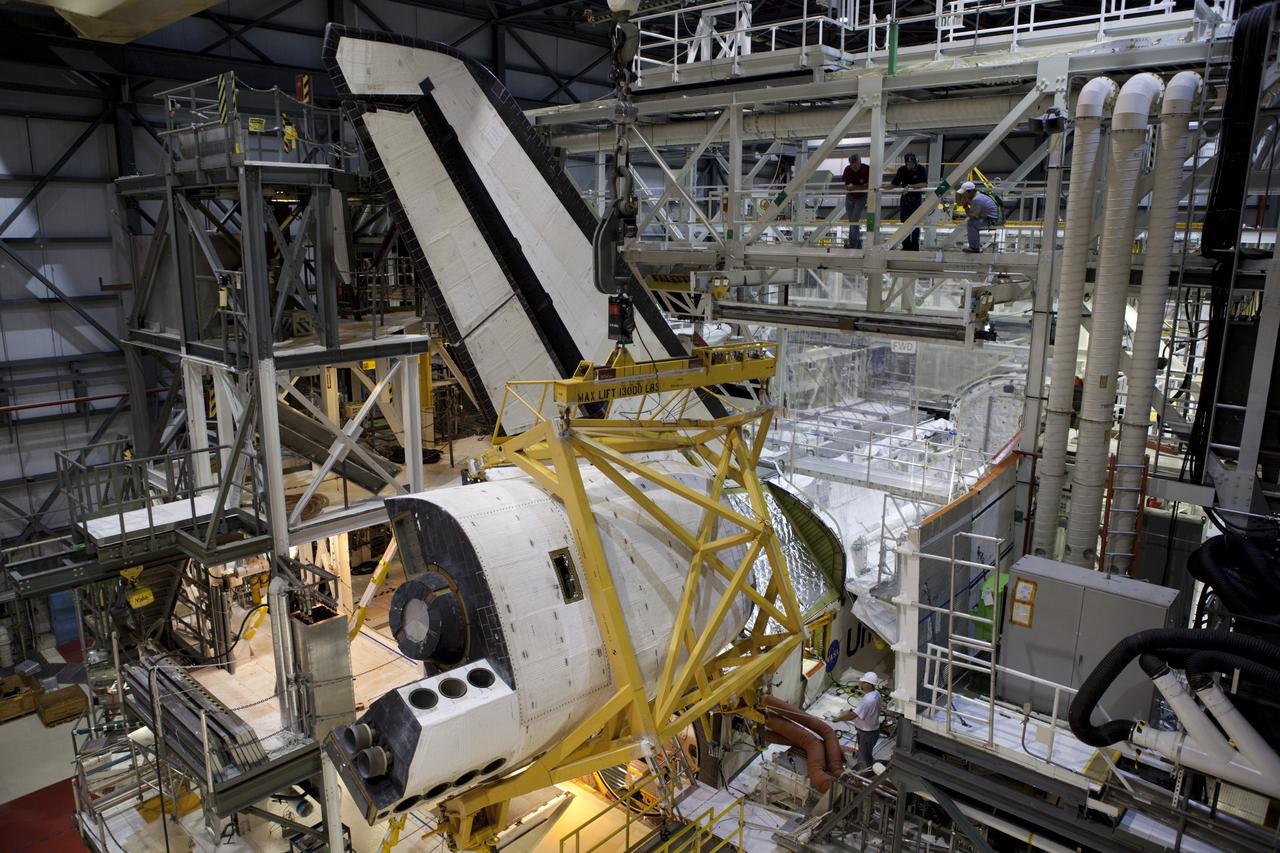
CAPE CANAVERAL, Fla. – Inside Orbiter Processing Facility-1 at NASA’s Kennedy Space Center in Florida, United Space Alliance technicians monitor the progress as a large crane moves the right orbital maneuvering system, or OMS, pod closer to space shuttle Atlantis. It is the last time an OMS pod will be installed on Atlantis. The OMS provided the shuttle with thrust for orbit insertion, rendezvous and deorbit, and could provide up to 1,000 pounds of propellant to the aft reaction control system. The OMS is housed in two independent pods located on each side of the shuttle’s aft fuselage. Each pod contains one OMS engine and the hardware needed to pressurize, store and distribute the propellants to perform the velocity maneuvers. Atlantis’ OMS pods were removed and sent to the test facility at White Sands Space Harbor in New Mexico to be cleaned of residual toxic propellant. The work is part of the Space Shuttle Program’s transition and retirement processing of the space shuttle fleet. A groundbreaking was held Jan. 18 for Atlantis’ future home, a 65,000-square-foot exhibit hall in Shuttle Plaza at the Kennedy Space Center Visitor Complex. Atlantis is scheduled to roll over to the visitor complex in November in preparation for the exhibit’s grand opening in July 2013. For more information, visit http://www.nasa.gov/transition. Photo credit: NASA/Dimitri Gerondidakis
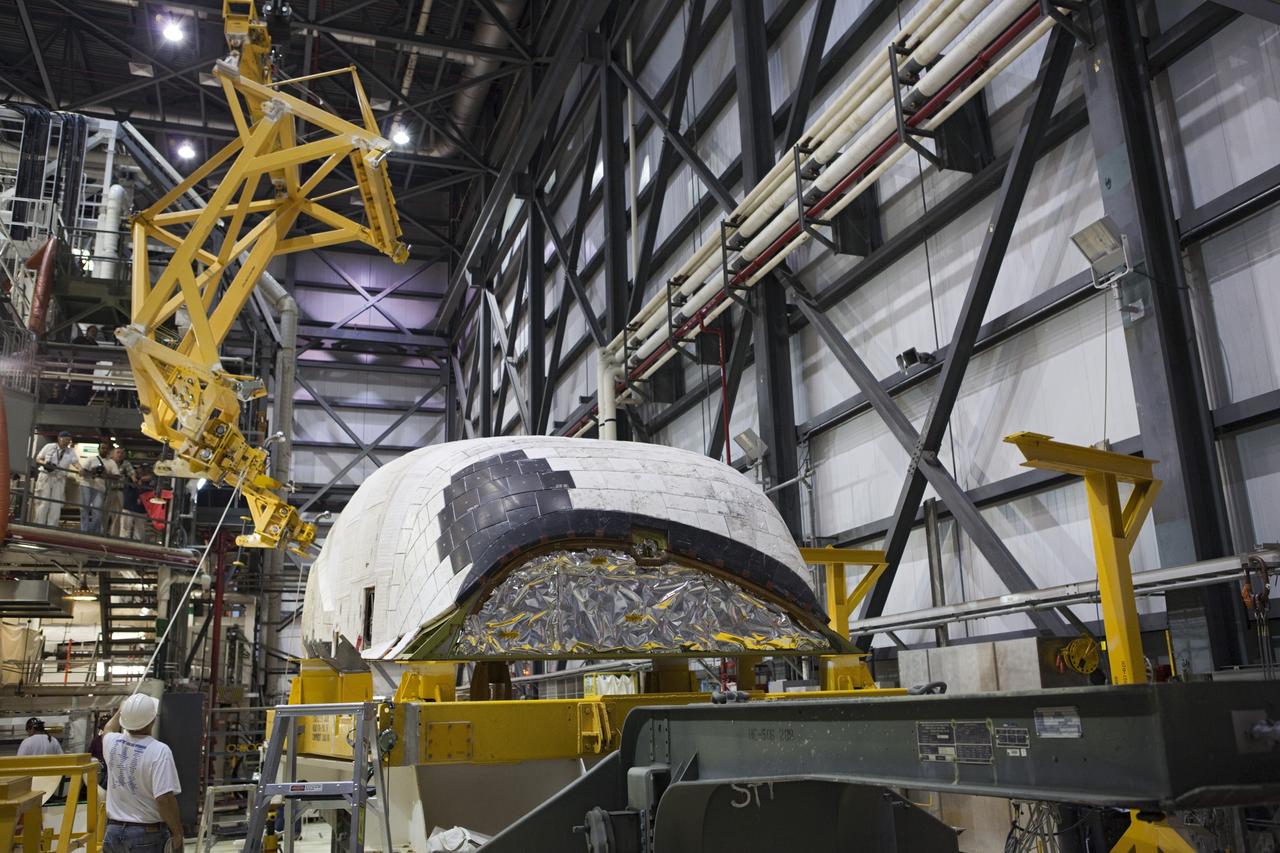
CAPE CANAVERAL, Fla. – Inside Orbiter Processing Facility-1 at NASA’s Kennedy Space Center in Florida, United Space Alliance technicians monitor the progress as a large crane is lowered toward the right orbital maneuvering system, or OMS, pod for space shuttle Atlantis. It will be the last time an OMS pod is installed on Atlantis. The OMS provided the shuttle with thrust for orbit insertion, rendezvous and deorbit, and could provide up to 1,000 pounds of propellant to the aft reaction control system. The OMS is housed in two independent pods located on each side of the shuttle’s aft fuselage. Each pod contains one OMS engine and the hardware needed to pressurize, store and distribute the propellants to perform the velocity maneuvers. Atlantis’ OMS pods were removed and sent to the test facility at White Sands Space Harbor in New Mexico to be cleaned of residual toxic propellant. The work is part of the Space Shuttle Program’s transition and retirement processing of the space shuttle fleet. A groundbreaking was held Jan. 18 for Atlantis’ future home, a 65,000-square-foot exhibit hall in Shuttle Plaza at the Kennedy Space Center Visitor Complex. Atlantis is scheduled to roll over to the visitor complex in November in preparation for the exhibit’s grand opening in July 2013. For more information, visit http://www.nasa.gov/transition. Photo credit: NASA/Dimitri Gerondidakis
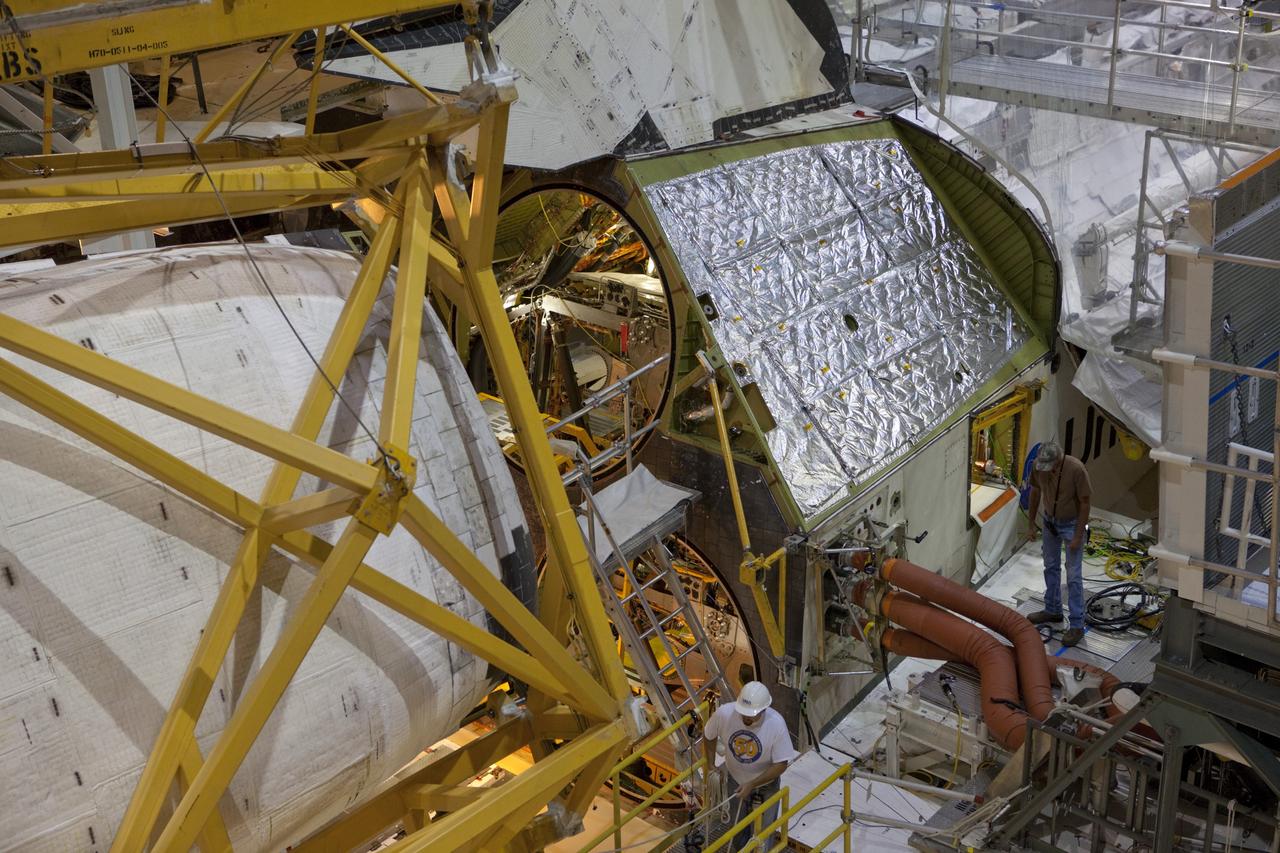
CAPE CANAVERAL, Fla. – Inside Orbiter Processing Facility-1 at NASA’s Kennedy Space Center in Florida, United Space Alliance technicians monitor the progress as a large crane moves the right orbital maneuvering system, or OMS, pod closer to space shuttle Atlantis. It is the last time an OMS pod will be installed on Atlantis. The OMS provided the shuttle with thrust for orbit insertion, rendezvous and deorbit, and could provide up to 1,000 pounds of propellant to the aft reaction control system. The OMS is housed in two independent pods located on each side of the shuttle’s aft fuselage. Each pod contains one OMS engine and the hardware needed to pressurize, store and distribute the propellants to perform the velocity maneuvers. Atlantis’ OMS pods were removed and sent to the test facility at White Sands Space Harbor in New Mexico to be cleaned of residual toxic propellant. The work is part of the Space Shuttle Program’s transition and retirement processing of the space shuttle fleet. A groundbreaking was held Jan. 18 for Atlantis’ future home, a 65,000-square-foot exhibit hall in Shuttle Plaza at the Kennedy Space Center Visitor Complex. Atlantis is scheduled to roll over to the visitor complex in November in preparation for the exhibit’s grand opening in July 2013. For more information, visit http://www.nasa.gov/transition. Photo credit: NASA/Dimitri Gerondidakis
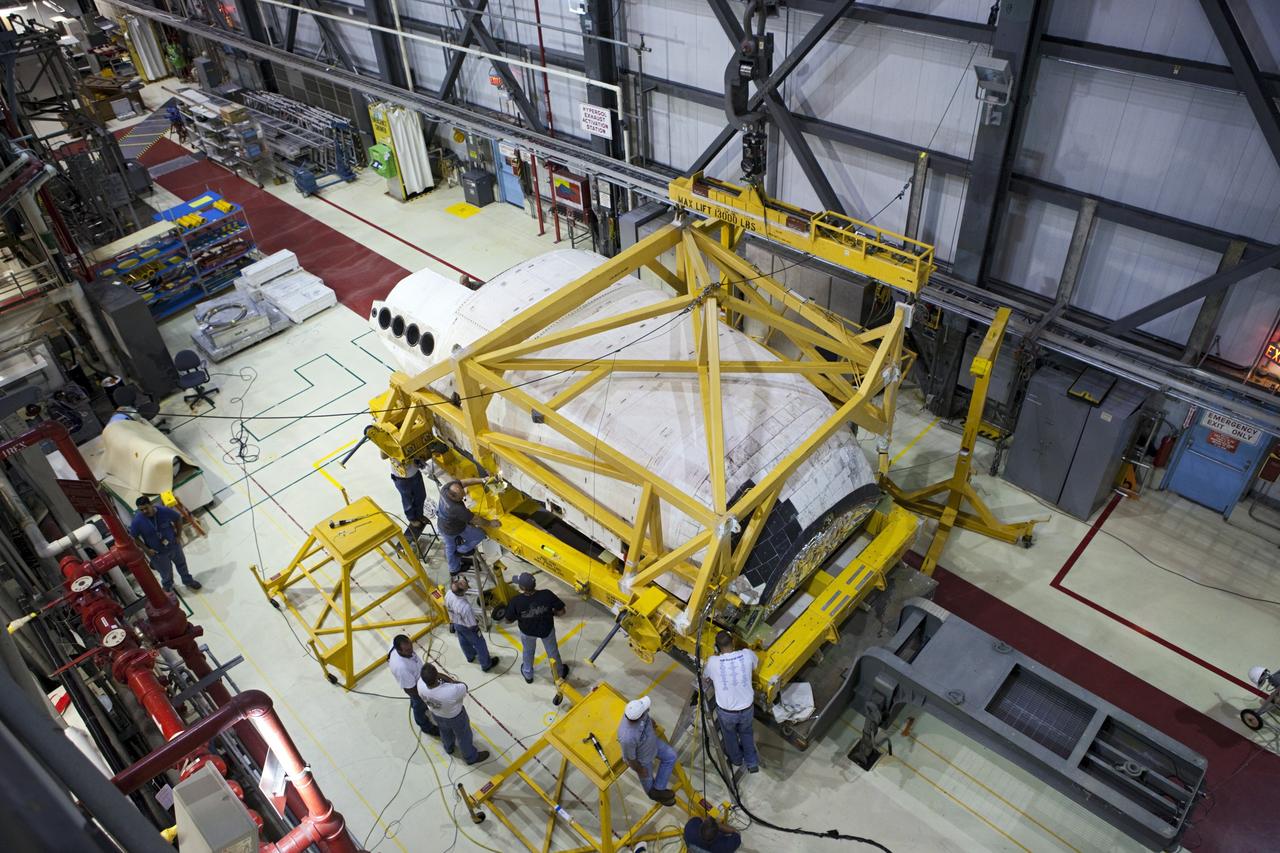
CAPE CANAVERAL, Fla. – In a view from above inside Orbiter Processing Facility-1 at NASA’s Kennedy Space Center in Florida, United Space Alliance technicians monitor the progress as a crane is attached to the right orbital maneuvering system, or OMS, pod for space shuttle Atlantis. It is the last time an OMS pod will be installed on Atlantis. The OMS provided the shuttle with thrust for orbit insertion, rendezvous and deorbit, and could provide up to 1,000 pounds of propellant to the aft reaction control system. The OMS is housed in two independent pods located on each side of the shuttle’s aft fuselage. Each pod contains one OMS engine and the hardware needed to pressurize, store and distribute the propellants to perform the velocity maneuvers. Atlantis’ OMS pods were removed and sent to the test facility at White Sands Space Harbor in New Mexico to be cleaned of residual toxic propellant. The work is part of the Space Shuttle Program’s transition and retirement processing of the space shuttle fleet. A groundbreaking was held Jan. 18 for Atlantis’ future home, a 65,000-square-foot exhibit hall in Shuttle Plaza at the Kennedy Space Center Visitor Complex. Atlantis is scheduled to roll over to the visitor complex in November in preparation for the exhibit’s grand opening in July 2013. For more information, visit http://www.nasa.gov/transition. Photo credit: NASA/Dimitri Gerondidakis
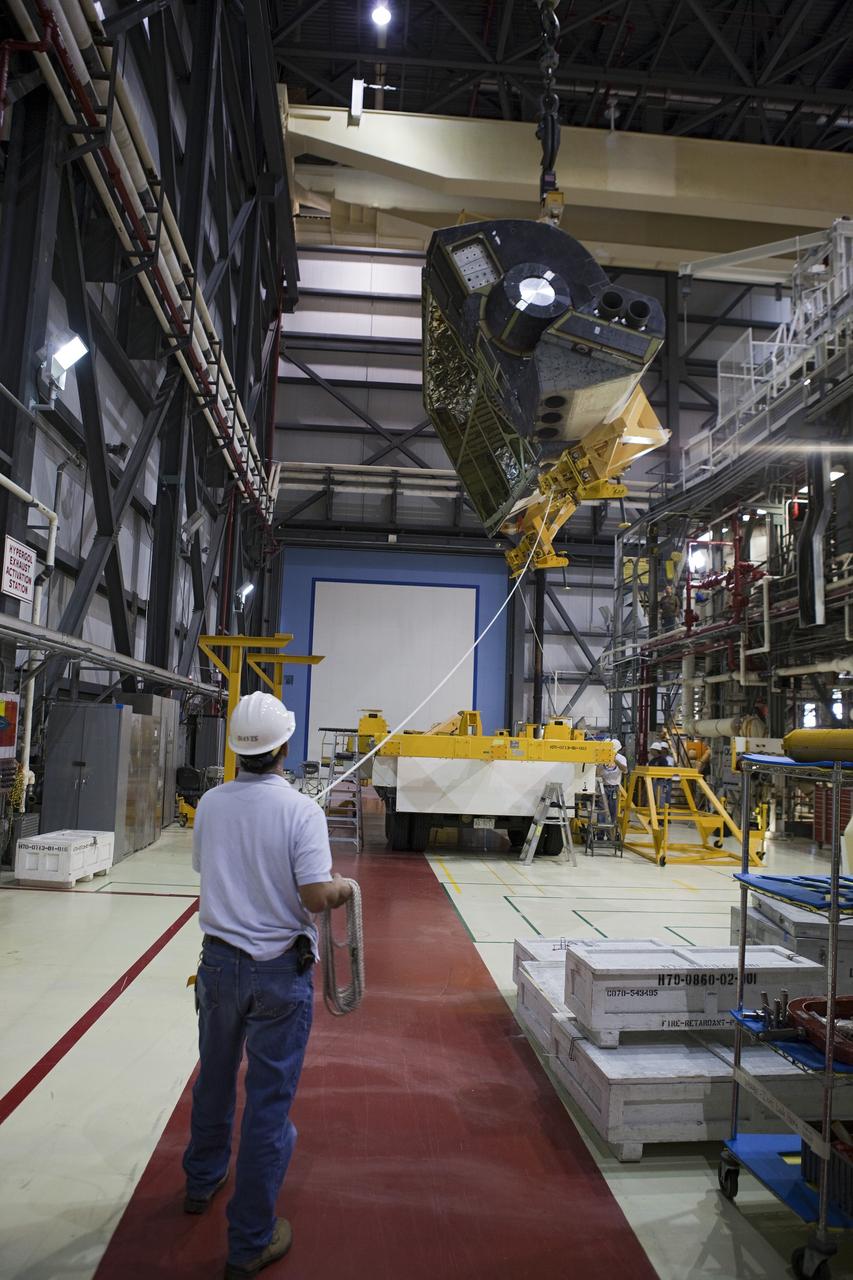
CAPE CANAVERAL, Fla. – Inside Orbiter Processing Facility-1 at NASA’s Kennedy Space Center in Florida, a United Space Alliance technician monitors the progress as a large crane lifts the right orbital maneuvering system, or OMS, pod for installation on space shuttle Atlantis. It is the last time an OMS pod will be installed on Atlantis. The OMS provided the shuttle with thrust for orbit insertion, rendezvous and deorbit, and could provide up to 1,000 pounds of propellant to the aft reaction control system. The OMS is housed in two independent pods located on each side of the shuttle’s aft fuselage. Each pod contains one OMS engine and the hardware needed to pressurize, store and distribute the propellants to perform the velocity maneuvers. Atlantis’ OMS pods were removed and sent to the test facility at White Sands Space Harbor in New Mexico to be cleaned of residual toxic propellant. The work is part of the Space Shuttle Program’s transition and retirement processing of the space shuttle fleet. A groundbreaking was held Jan. 18 for Atlantis’ future home, a 65,000-square-foot exhibit hall in Shuttle Plaza at the Kennedy Space Center Visitor Complex. Atlantis is scheduled to roll over to the visitor complex in November in preparation for the exhibit’s grand opening in July 2013. For more information, visit http://www.nasa.gov/transition. Photo credit: NASA/Dimitri Gerondidakis
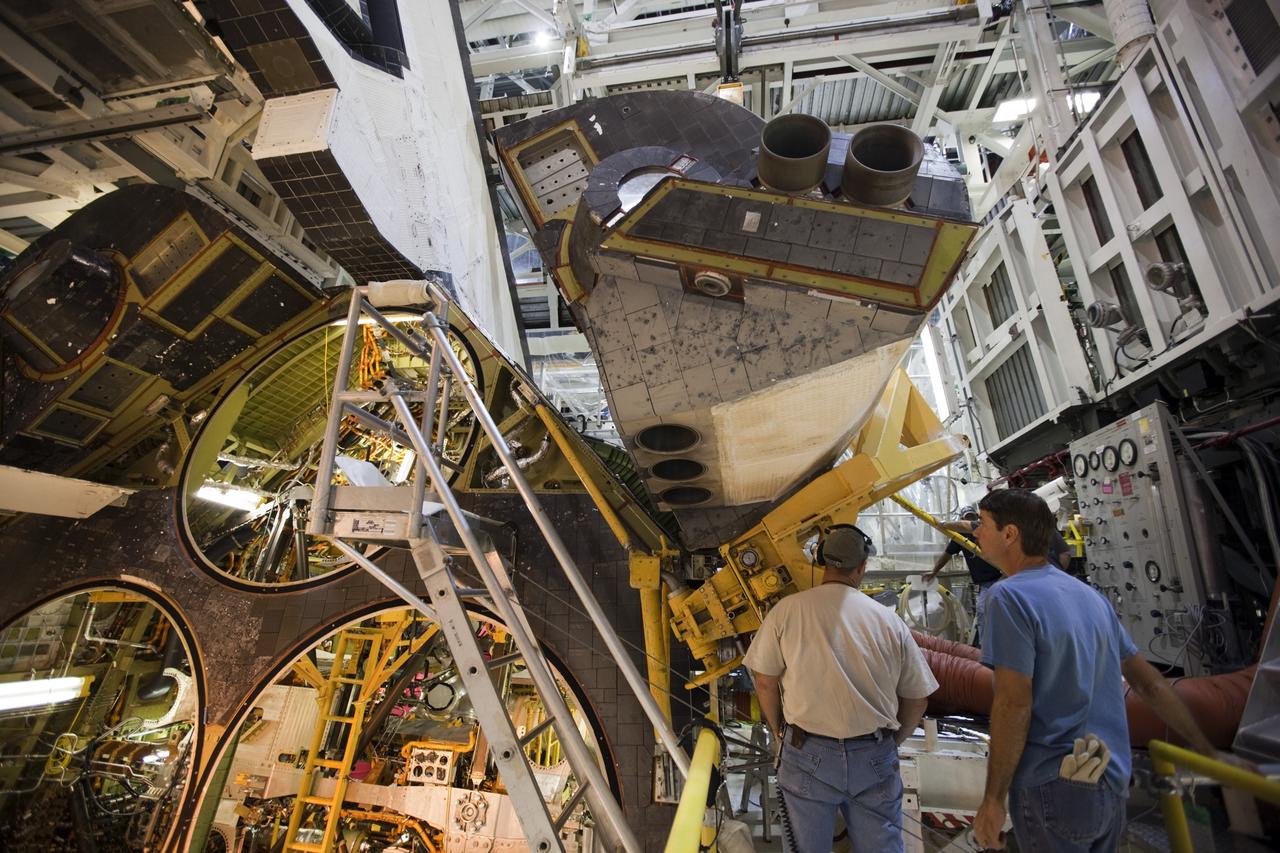
CAPE CANAVERAL, Fla. – Inside Orbiter Processing Facility-1 at NASA’s Kennedy Space Center in Florida, United Space Alliance technicians monitor the progress as a large crane lowers the right orbital maneuvering system, or OMS, pod onto space shuttle Atlantis. It is the last time an OMS pod will be installed on Atlantis. The OMS provided the shuttle with thrust for orbit insertion, rendezvous and deorbit, and could provide up to 1,000 pounds of propellant to the aft reaction control system. The OMS is housed in two independent pods located on each side of the shuttle’s aft fuselage. Each pod contains one OMS engine and the hardware needed to pressurize, store and distribute the propellants to perform the velocity maneuvers. Atlantis’ OMS pods were removed and sent to the test facility at White Sands Space Harbor in New Mexico to be cleaned of residual toxic propellant. The work is part of the Space Shuttle Program’s transition and retirement processing of the space shuttle fleet. A groundbreaking was held Jan. 18 for Atlantis’ future home, a 65,000-square-foot exhibit hall in Shuttle Plaza at the Kennedy Space Center Visitor Complex. Atlantis is scheduled to roll over to the visitor complex in November in preparation for the exhibit’s grand opening in July 2013. For more information, visit http://www.nasa.gov/transition. Photo credit: NASA/Dimitri Gerondidakis
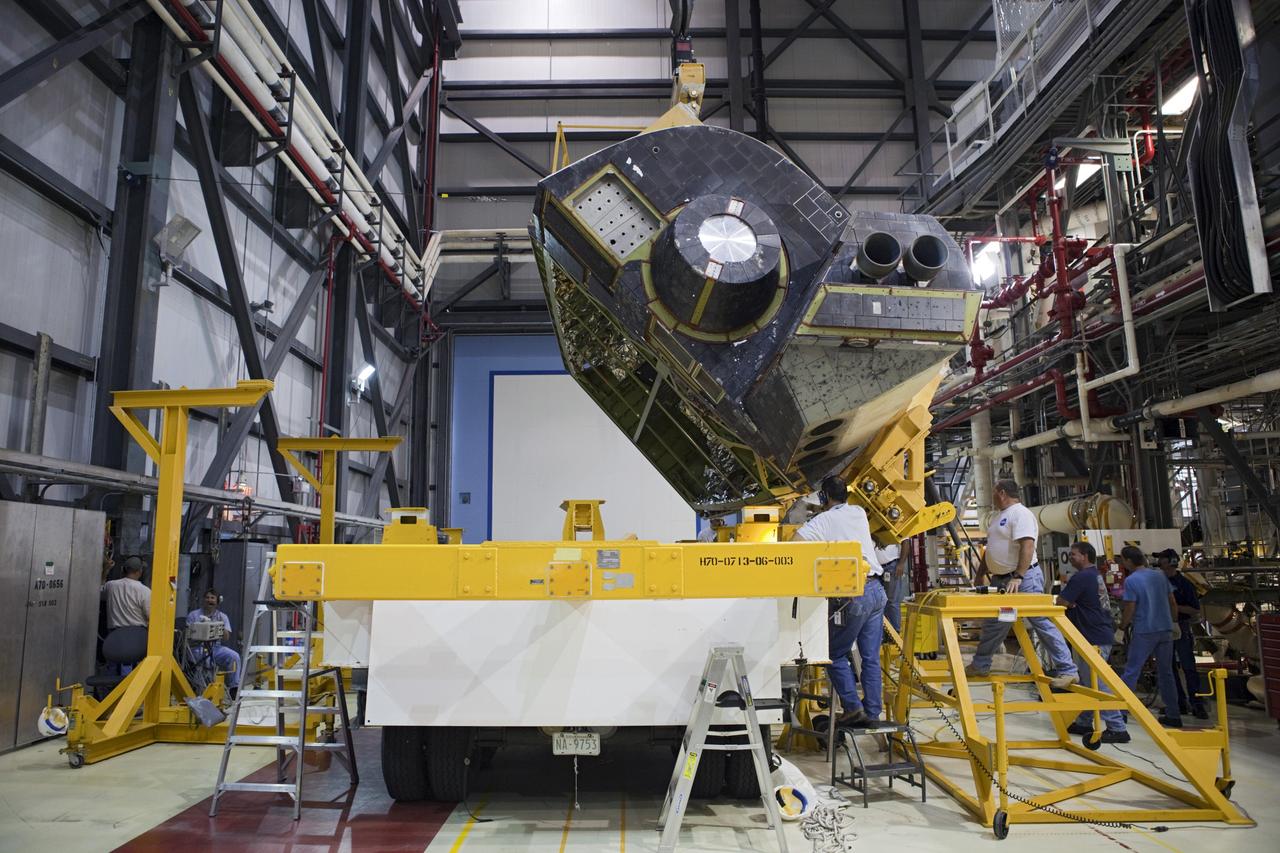
CAPE CANAVERAL, Fla. – Inside Orbiter Processing Facility-1 at NASA’s Kennedy Space Center in Florida, United Space Alliance technicians monitor the progress as a large crane begins to lift the right orbital maneuvering system, or OMS, pod for installation on space shuttle Atlantis. It is the last time an OMS pod will be installed on Atlantis. The OMS provided the shuttle with thrust for orbit insertion, rendezvous and deorbit, and could provide up to 1,000 pounds of propellant to the aft reaction control system. The OMS is housed in two independent pods located on each side of the shuttle’s aft fuselage. Each pod contains one OMS engine and the hardware needed to pressurize, store and distribute the propellants to perform the velocity maneuvers. Atlantis’ OMS pods were removed and sent to the test facility at White Sands Space Harbor in New Mexico to be cleaned of residual toxic propellant. The work is part of the Space Shuttle Program’s transition and retirement processing of the space shuttle fleet. A groundbreaking was held Jan. 18 for Atlantis’ future home, a 65,000-square-foot exhibit hall in Shuttle Plaza at the Kennedy Space Center Visitor Complex. Atlantis is scheduled to roll over to the visitor complex in November in preparation for the exhibit’s grand opening in July 2013. For more information, visit http://www.nasa.gov/transition. Photo credit: NASA/Dimitri Gerondidakis
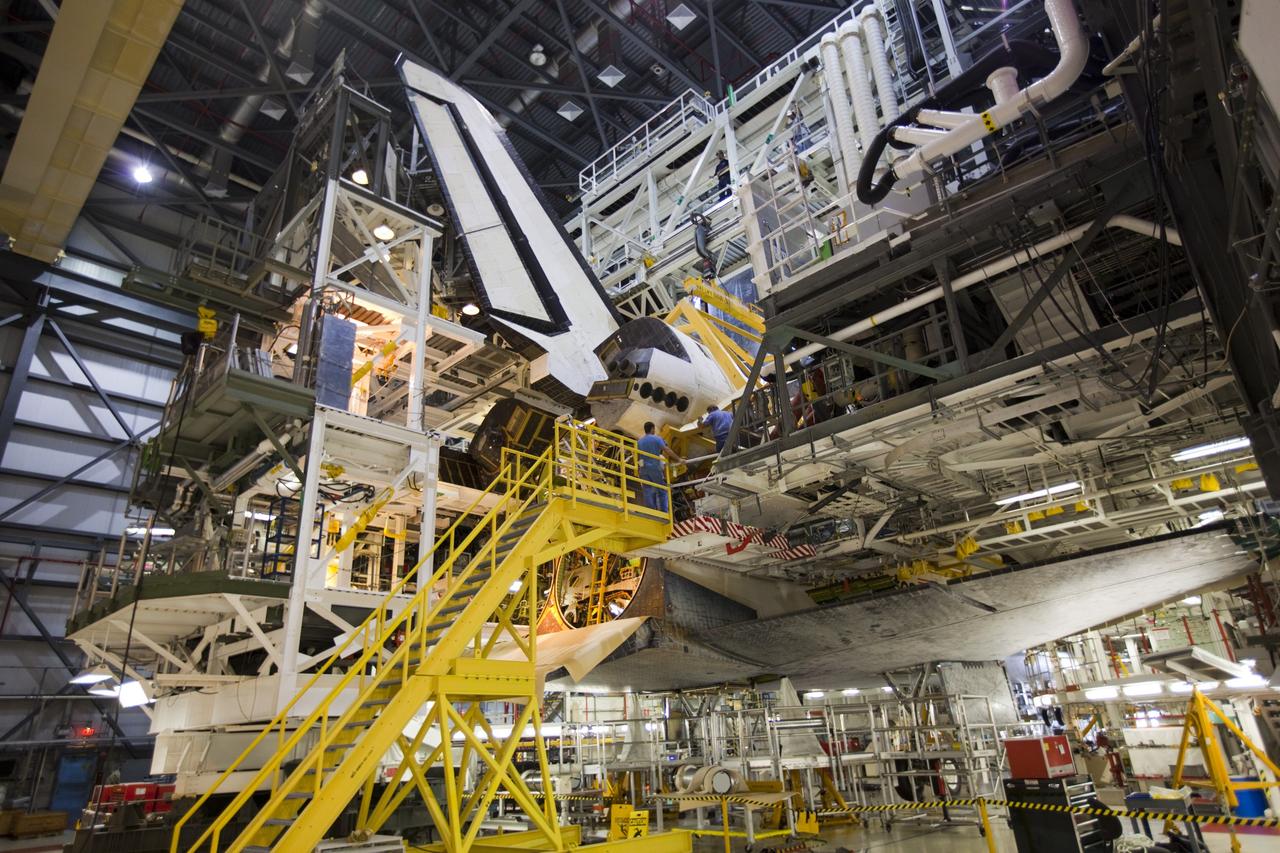
CAPE CANAVERAL, Fla. – Inside Orbiter Processing Facility-1 at NASA’s Kennedy Space Center in Florida, a large crane lowers the right orbital maneuvering system, or OMS, pod onto space shuttle Atlantis. It is the last time an OMS pod will be installed on Atlantis. The OMS provided the shuttle with thrust for orbit insertion, rendezvous and deorbit, and could provide up to 1,000 pounds of propellant to the aft reaction control system. The OMS is housed in two independent pods located on each side of the shuttle’s aft fuselage. Each pod contains one OMS engine and the hardware needed to pressurize, store and distribute the propellants to perform the velocity maneuvers. Atlantis’ OMS pods were removed and sent to the test facility at White Sands Space Harbor in New Mexico to be cleaned of residual toxic propellant. The work is part of the Space Shuttle Program’s transition and retirement processing of the space shuttle fleet. A groundbreaking was held Jan. 18 for Atlantis’ future home, a 65,000-square-foot exhibit hall in Shuttle Plaza at the Kennedy Space Center Visitor Complex. Atlantis is scheduled to roll over to the visitor complex in November in preparation for the exhibit’s grand opening in July 2013. For more information, visit http://www.nasa.gov/transition. Photo credit: NASA/Dimitri Gerondidakis
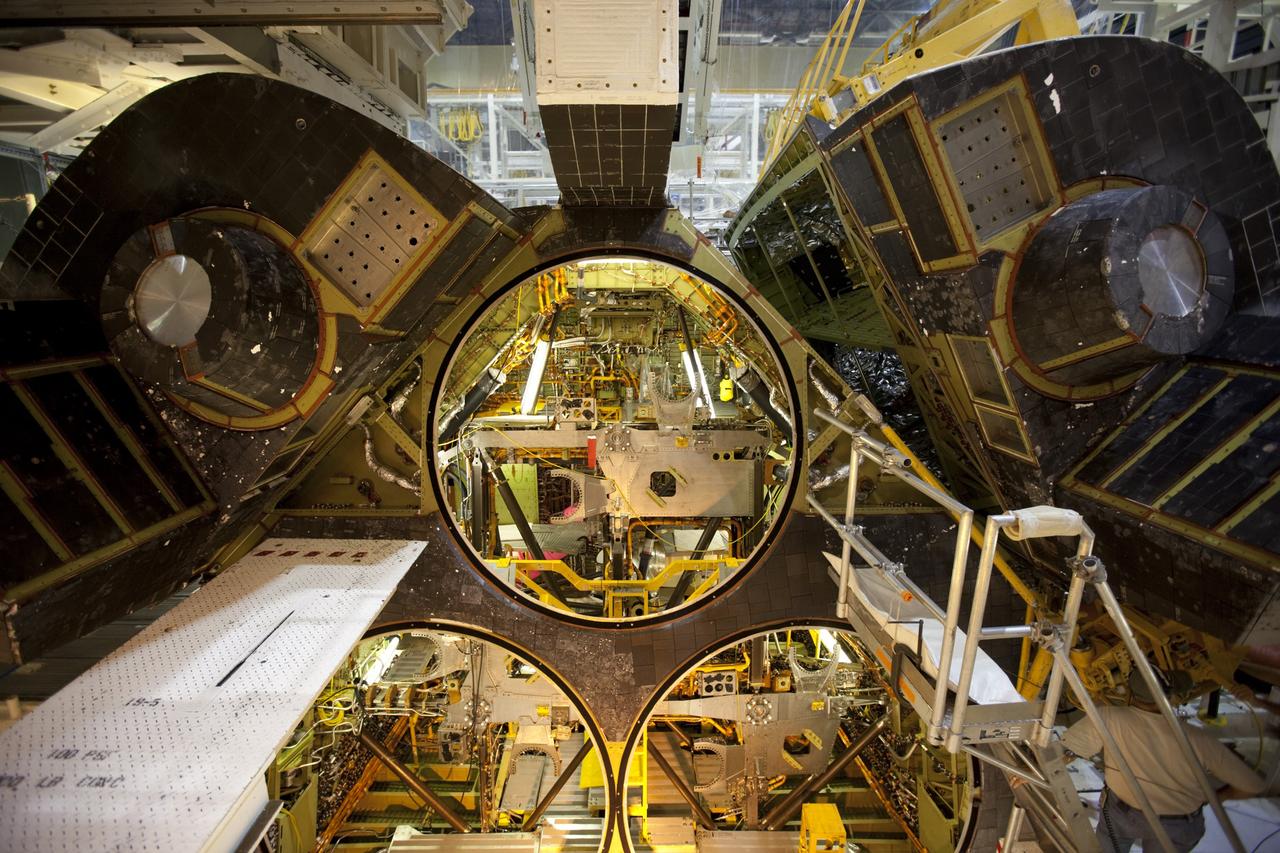
CAPE CANAVERAL, Fla. –Inside Orbiter Processing Facility-1 at NASA’s Kennedy Space Center in Florida, a unique close-up view shows a large crane lowering the right orbital maneuvering system, or OMS, pod closer to space shuttle Atlantis and the left OMS pod already installed. It is the last time an OMS pod will be installed on Atlantis. The OMS provided the shuttle with thrust for orbit insertion, rendezvous and deorbit, and could provide up to 1,000 pounds of propellant to the aft reaction control system. The OMS is housed in two independent pods located on each side of the shuttle’s aft fuselage. Each pod contains one OMS engine and the hardware needed to pressurize, store and distribute the propellants to perform the velocity maneuvers. Atlantis’ OMS pods were removed and sent to the test facility at White Sands Space Harbor in New Mexico to be cleaned of residual toxic propellant. The work is part of the Space Shuttle Program’s transition and retirement processing of the space shuttle fleet. A groundbreaking was held Jan. 18 for Atlantis’ future home, a 65,000-square-foot exhibit hall in Shuttle Plaza at the Kennedy Space Center Visitor Complex. Atlantis is scheduled to roll over to the visitor complex in November in preparation for the exhibit’s grand opening in July 2013. For more information, visit http://www.nasa.gov/transition. Photo credit: NASA/Dimitri Gerondidakis