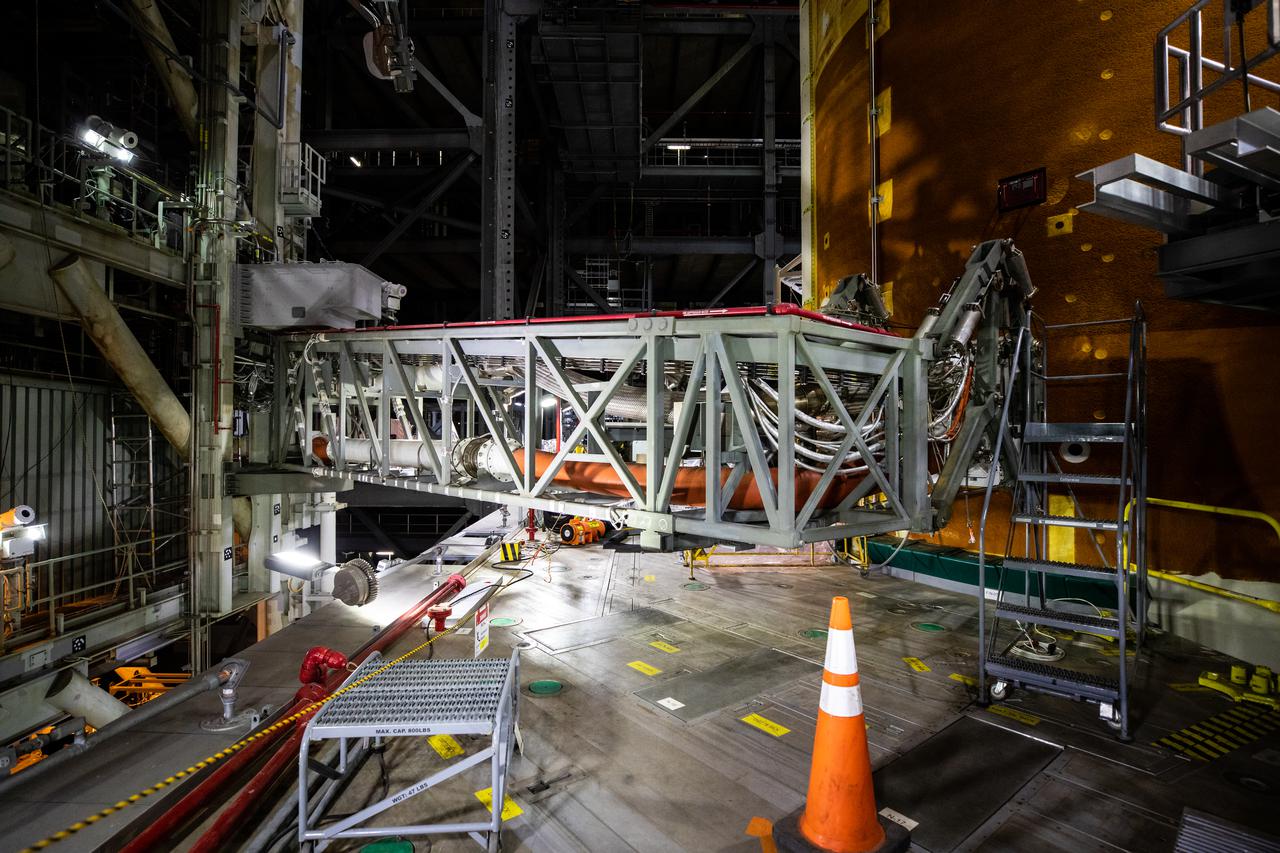
The core stage inter-tank umbilical – one of multiple connections on the mobile launcher that will provide power, communications, and pressurized gases to the rocket – is attached to the Space Launch System (SLS) core stage inside the Vehicle Assembly Building at NASA’s Kennedy Space Center in Florida on Aug. 12, 2021. Before the Orion spacecraft can be stacked atop the SLS, teams are conducting various tests to ensure the rocket can properly communicate with the ground systems equipment that will be used for launch. The first in an increasingly complex set of missions, Artemis I will test SLS and Orion as an integrated system prior to crewed flights to the Moon. Through Artemis, NASA will send the first woman and the first person of color to the lunar surface, as well as establish a sustainable presence on and around the Moon.

Seen here is a close-up view of the Orion stage adapter (OSA) structural test article atop the Space Launch System (SLS) rocket inside the Vehicle Assembly Building (VAB) at NASA’s Kennedy Space Center in Florida on Aug. 12, 2021. The test article, representing the mass and weight of the actual flight hardware, is being used for various tests inside the VAB ahead of OSA stacking operations. The first in an increasingly complex set of missions, Artemis I will test SLS and the Orion spacecraft as an integrated system prior to crewed flights to the Moon. Through Artemis, NASA will send the first woman and the first person of color to the lunar surface, as well as establish a sustainable presence on and around the Moon.

The core stage inter-tank umbilical – one of multiple connections on the mobile launcher that will provide power, communications, and pressurized gases to the rocket – is attached to the Space Launch System (SLS) core stage inside the Vehicle Assembly Building at NASA’s Kennedy Space Center in Florida on Aug. 12, 2021. Before the Orion spacecraft can be stacked atop the SLS, teams are conducting various tests to ensure the rocket can properly communicate with the ground systems equipment that will be used for launch. The first in an increasingly complex set of missions, Artemis I will test SLS and Orion as an integrated system prior to crewed flights to the Moon. Through Artemis, NASA will send the first woman and the first person of color to the lunar surface, as well as establish a sustainable presence on and around the Moon.

Seen here is a close-up view of the Orion stage adapter (OSA) structural test article atop the Space Launch System (SLS) rocket inside the Vehicle Assembly Building (VAB) at NASA’s Kennedy Space Center in Florida on Aug. 12, 2021. The test article, representing the mass and weight of the actual flight hardware, is being used for various tests inside the VAB ahead of OSA stacking operations. The first in an increasingly complex set of missions, Artemis I will test SLS and the Orion spacecraft as an integrated system prior to crewed flights to the Moon. Through Artemis, NASA will send the first woman and the first person of color to the lunar surface, as well as establish a sustainable presence on and around the Moon.

In High Bay 3 inside the Vehicle Assembly Building at NASA’s Kennedy Space Center in Florida, teams with Exploration Ground Systems and Jacobs use the Orion stage adapter structural test article and the Mass Simulator for Orion for testing on Aug. 13, 2021. They are stacked atop the Space Launch System (SLS) rocket. These test articles represent the mass and weight of the actual Orion stage adapter and Orion spacecraft that will be used for various tests. Launching in 2021, Artemis I will be an uncrewed test of the Orion spacecraft and SLS rocket as an integrated system ahead of crewed flights to the Moon. Under Artemis, NASA aims to land the first woman and first person of color on the Moon and establish sustainable lunar exploration.
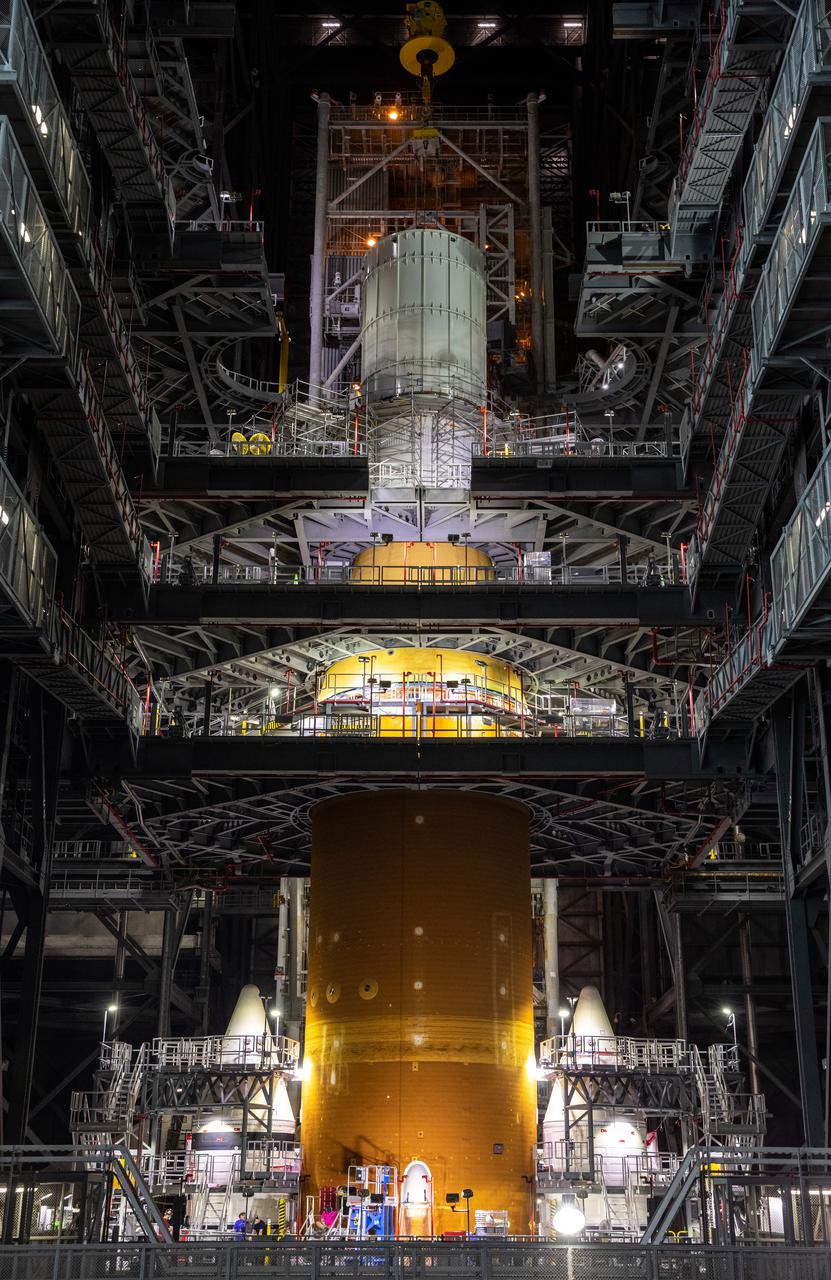
Tests are underway in High Bay 3 inside the Vehicle Assembly Building at NASA’s Kennedy Space Center in Florida on Aug. 13, 2021, using the Orion stage adapter structural test article and the Mass Simulator for Orion. Stacked atop the Space Launch System (SLS) rocket, these test articles represent the mass and weight of the actual Orion stage adapter and Orion spacecraft. Launching in 2021, Artemis I will be an uncrewed test of the Orion spacecraft and SLS rocket as an integrated system ahead of crewed flights to the Moon. Under Artemis, NASA aims to land the first woman and first person of color on the Moon and establish sustainable lunar exploration.

In High Bay 3 inside the Vehicle Assembly Building at NASA’s Kennedy Space Center in Florida, teams with Exploration Ground Systems and Jacobs use the Orion stage adapter structural test article and the Mass Simulator for Orion for testing on Aug. 13, 2021. They are stacked atop the Space Launch System (SLS) rocket. These test articles represent the mass and weight of the actual Orion stage adapter and Orion spacecraft that will be used for various tests. Launching in 2021, Artemis I will be an uncrewed test of the Orion spacecraft and SLS rocket as an integrated system ahead of crewed flights to the Moon. Under Artemis, NASA aims to land the first woman and first person of color on the Moon and establish sustainable lunar exploration.

Tests are underway in High Bay 3 inside the Vehicle Assembly Building at NASA’s Kennedy Space Center in Florida on Aug. 13, 2021, using the Orion stage adapter structural test article and the Mass Simulator for Orion. Stacked atop the Space Launch System (SLS) rocket, these test articles represent the mass and weight of the actual Orion stage adapter and Orion spacecraft. Launching in 2021, Artemis I will be an uncrewed test of the Orion spacecraft and SLS rocket as an integrated system ahead of crewed flights to the Moon. Under Artemis, NASA aims to land the first woman and first person of color on the Moon and establish sustainable lunar exploration.