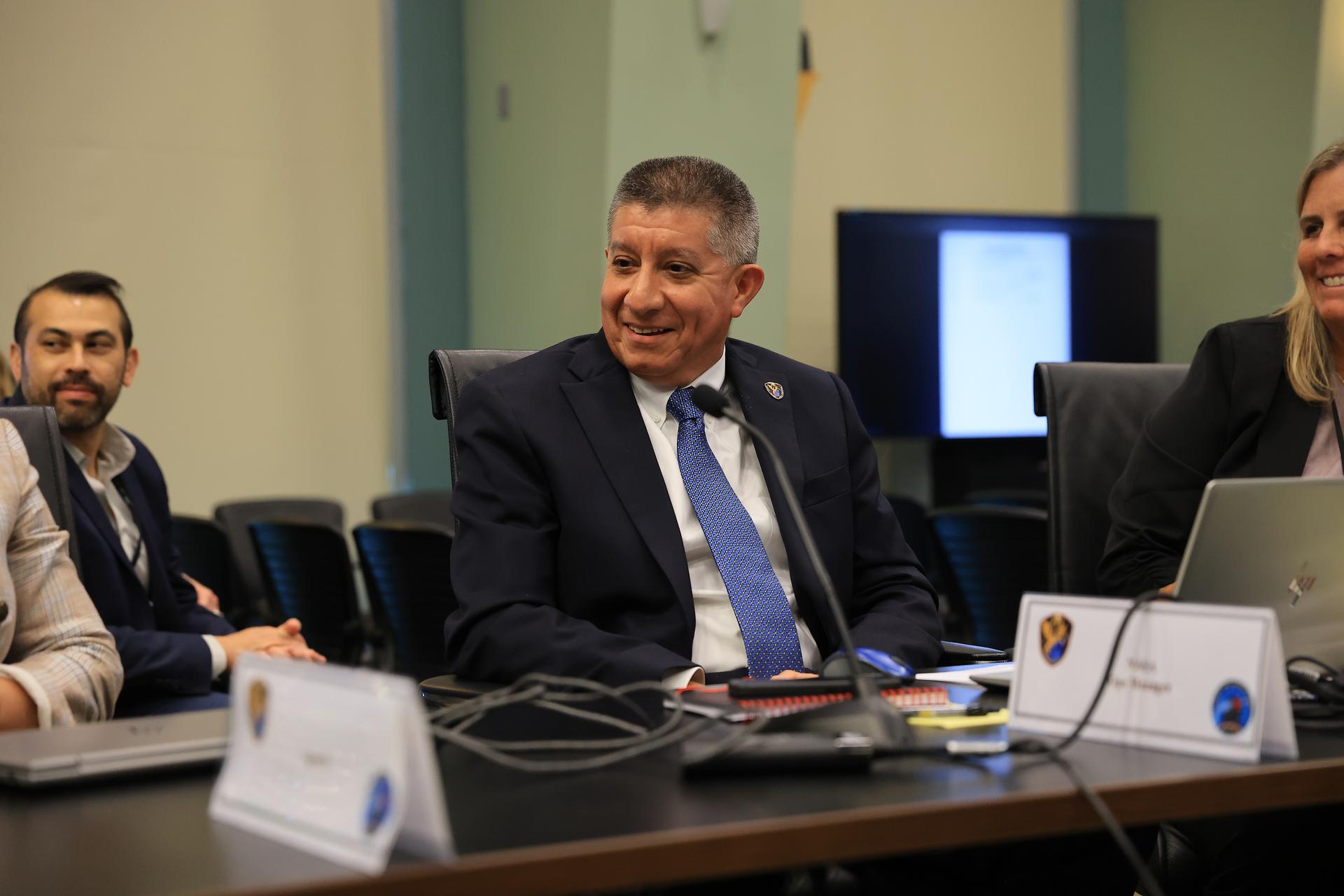
Richard Jones, deputy program manager of NASA’s Commercial Crew Program, participates in NASA’s SpaceX Crew-13 Flight Readiness Review at the agency’s Kennedy Space Center in Florida on Friday, Sept. 25, 2026. NASA astronauts Jessica Watkins and Luke Delaney, CSA (Canadian Space Agency) astronaut Joshua Kutryk, and Roscosmos cosmonaut Sergey Teteryatnikov will launch aboard a SpaceX Dragon spacecraft and Falcon 9 rocket to the International Space Station at 11:10 a.m. EDT on Thursday, Oct. 1, from Cape Canaveral Space Force Station’s Space Launch Complex 40.
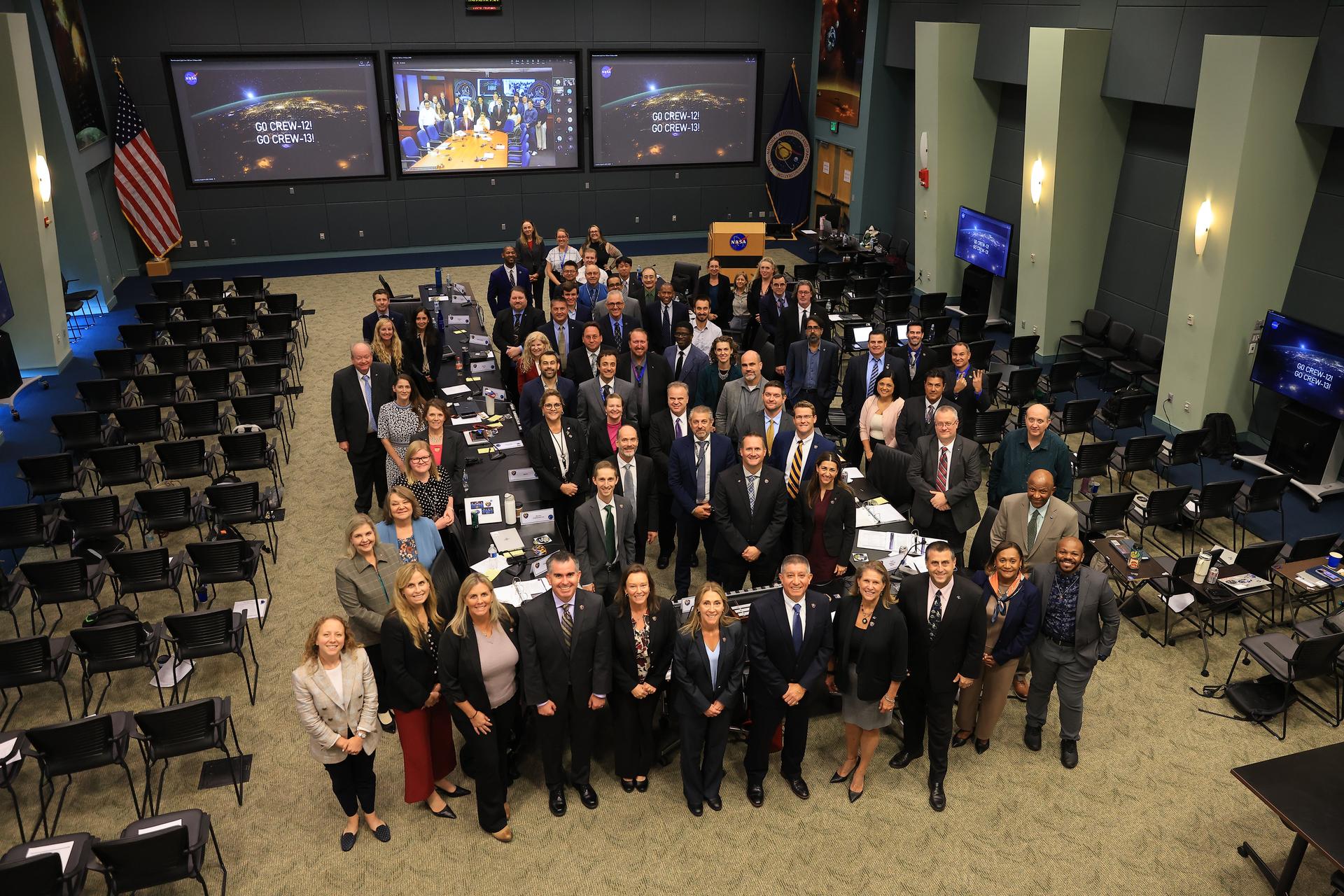
Managers with NASA and SpaceX, along with international partners, participate in NASA’s SpaceX Crew-13 Flight Readiness Review at the agency’s Kennedy Space Center in Florida on Friday, Sept. 25, 2026. NASA astronauts Jessica Watkins and Luke Delaney, CSA (Canadian Space Agency) astronaut Joshua Kutryk, and Roscosmos cosmonaut Sergey Teteryatnikov will launch aboard a SpaceX Dragon spacecraft and Falcon 9 rocket to the International Space Station at 11:10 a.m. EDT on Thursday, Oct. 1, from Cape Canaveral Space Force Station’s Space Launch Complex 40.
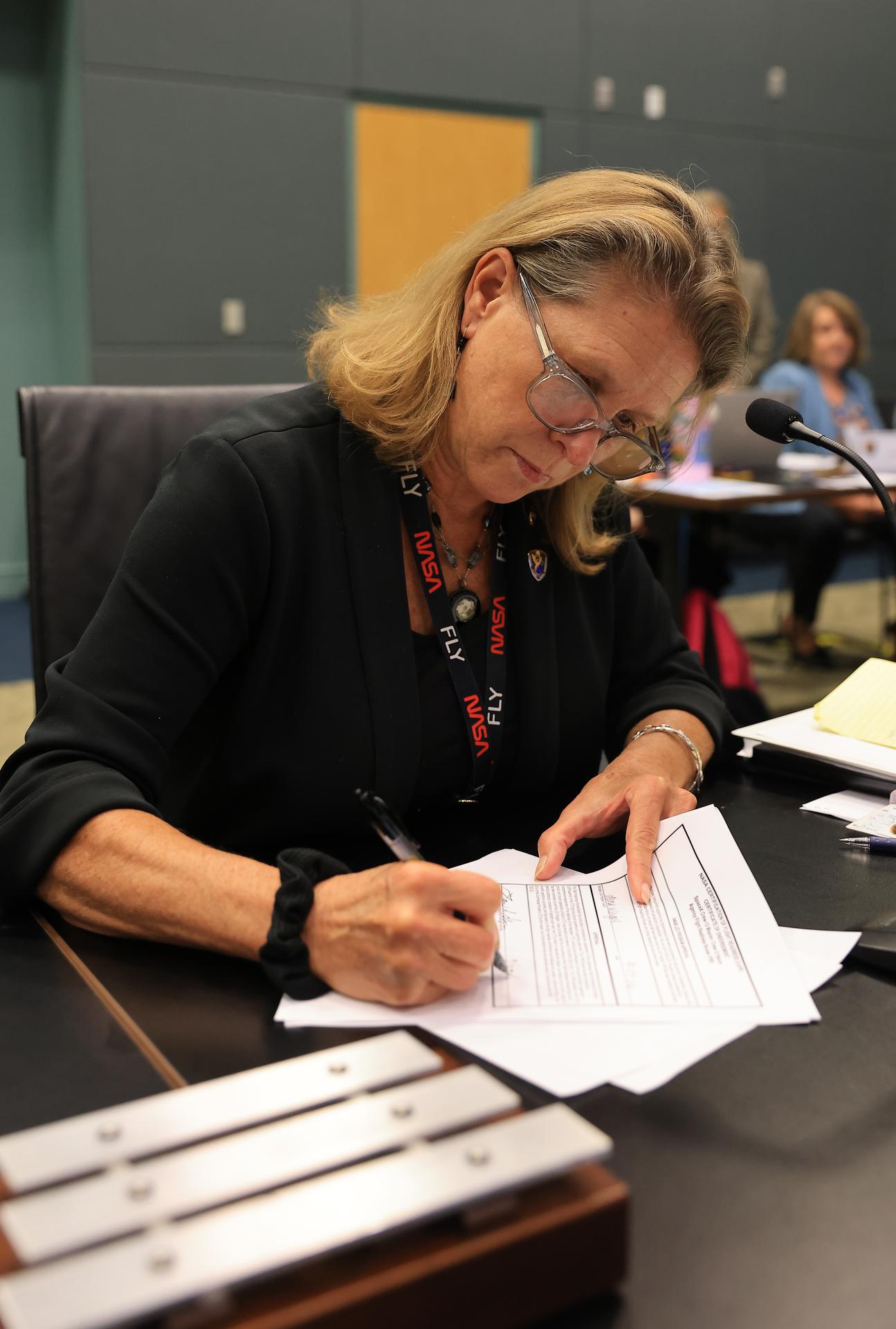
Dr. Lori Glaze, associate administrator for NASA’s Human Spaceflight Mission Directorate, participates in NASA’s SpaceX Crew-13 Flight Readiness Review at the agency’s Kennedy Space Center in Florida on Friday, Sept. 25, 2026. NASA astronauts Jessica Watkins and Luke Delaney, CSA (Canadian Space Agency) astronaut Joshua Kutryk, and Roscosmos cosmonaut Sergey Teteryatnikov will launch aboard a SpaceX Dragon spacecraft and Falcon 9 rocket to the International Space Station at 11:10 a.m. EDT on Thursday, Oct. 1, from Cape Canaveral Space Force Station’s Space Launch Complex 40.
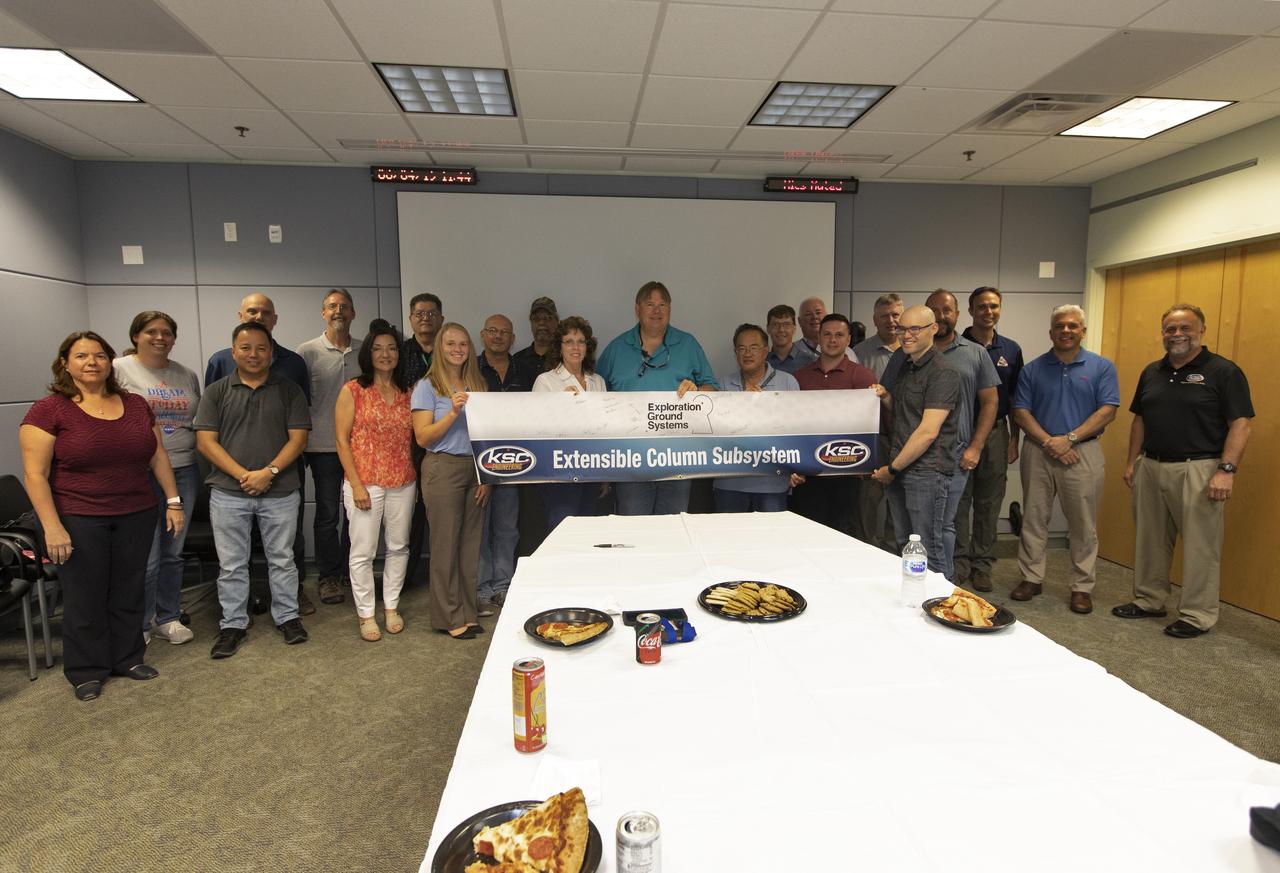
Engineers celebrate the completion of the Extensible Column Subsystem (XCS) project during a banner event held in Operations Support Building II at Kennedy Space Center. The XCS team successfully executed an aggressive schedule, receiving outstanding support from the fabrication contractor, Met-Con. Full functional testing occurred at Met-Con’s facility, with no mechanical or structural issues. All four columns and the test fixture have been delivered to Kennedy. Full-scale testing will take place when the Mobile Launcher gets to the pad later this summer.
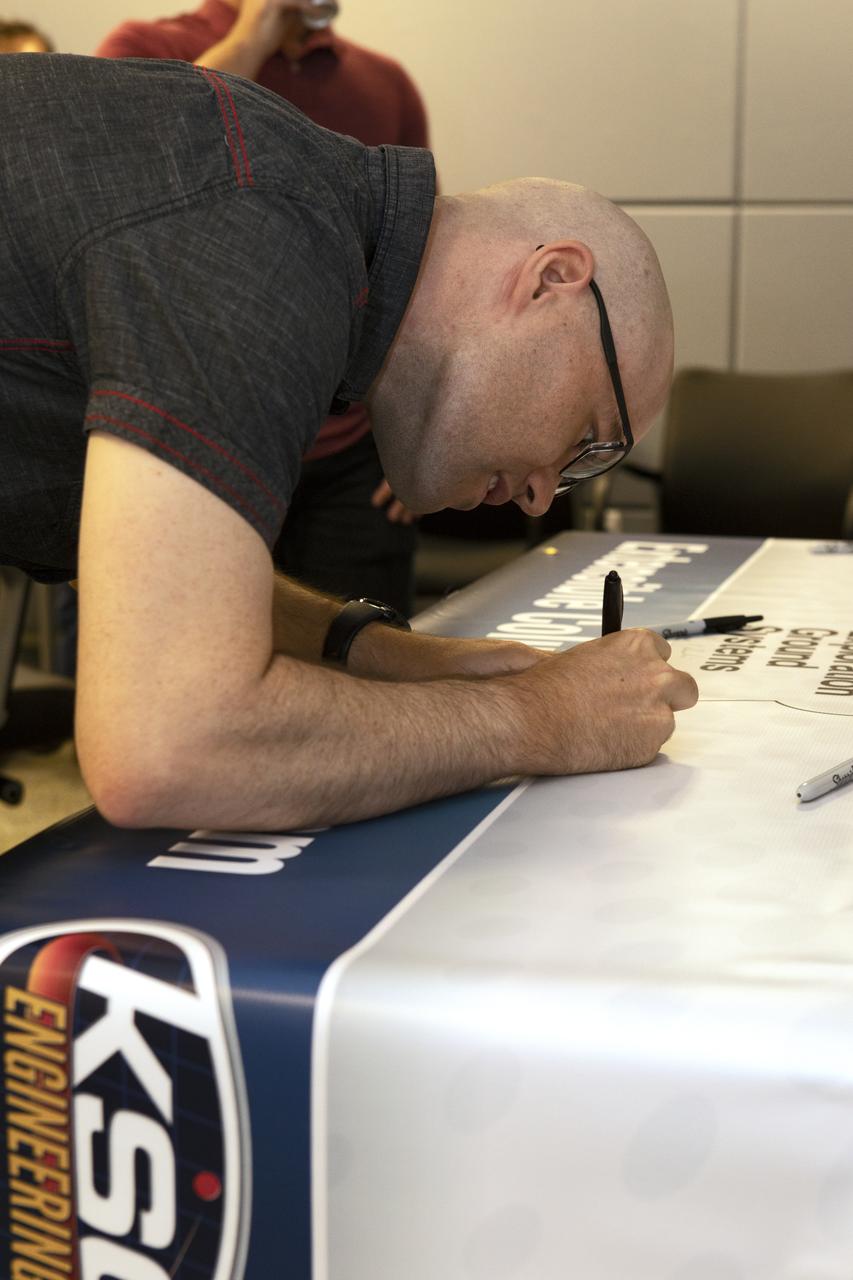
Engineers celebrate the completion of the Extensible Column Subsystem (XCS) project during a banner event held in Operations Support Building II at Kennedy Space Center. The XCS team successfully executed an aggressive schedule, receiving outstanding support from the fabrication contractor, Met-Con. Full functional testing occurred at Met-Con’s facility, with no mechanical or structural issues. All four columns and the test fixture have been delivered to Kennedy. Full-scale testing will take place when the Mobile Launcher gets to the pad later this summer.

Engineers celebrate the completion of the Extensible Column Subsystem (XCS) project during a banner event held in Operations Support Building II at Kennedy Space Center. The XCS team successfully executed an aggressive schedule, receiving outstanding support from the fabrication contractor, Met-Con. Full functional testing occurred at Met-Con’s facility, with no mechanical or structural issues. All four columns and the test fixture have been delivered to Kennedy. Full-scale testing will take place when the Mobile Launcher gets to the pad later this summer.
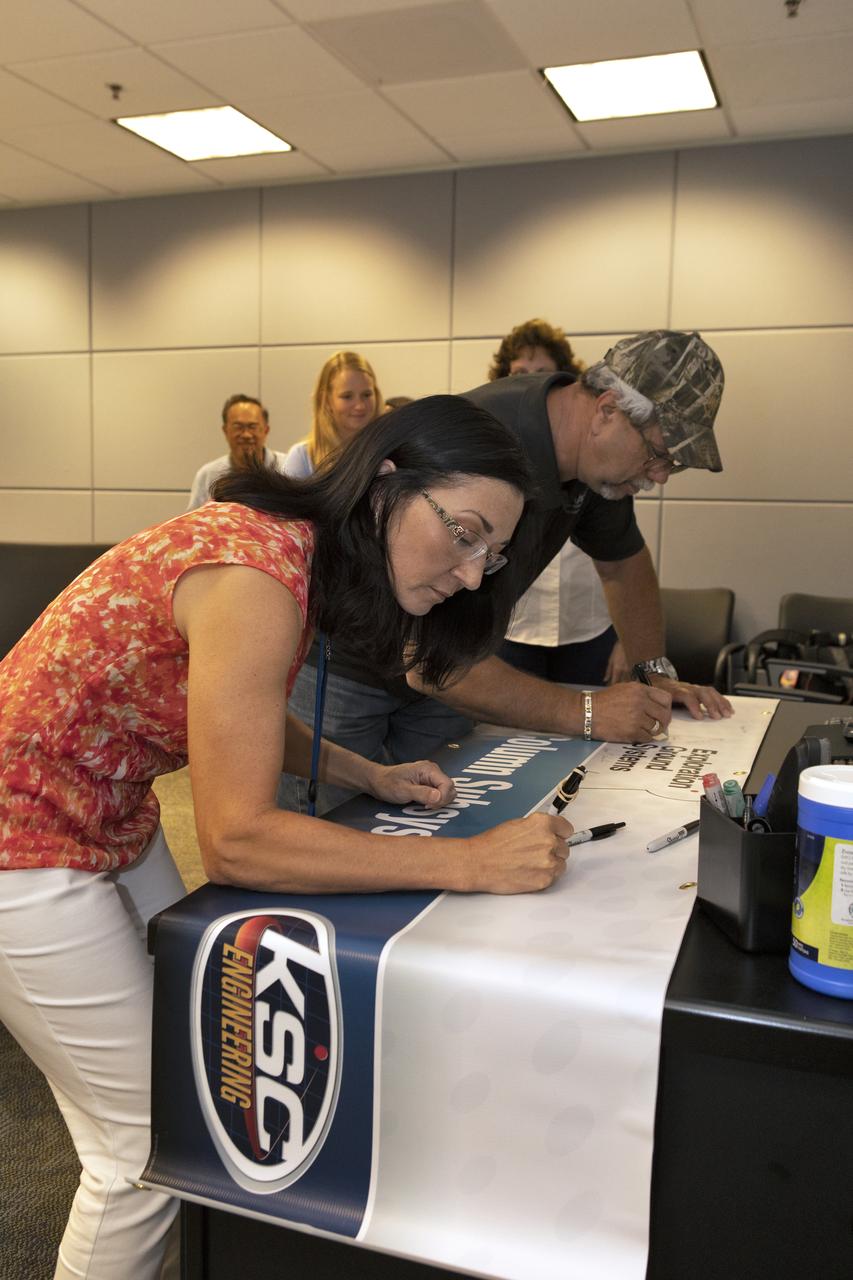
Engineers celebrate the completion of the Extensible Column Subsystem (XCS) project during a banner event held in Operations Support Building II at Kennedy Space Center. The XCS team successfully executed an aggressive schedule, receiving outstanding support from the fabrication contractor, Met-Con. Full functional testing occurred at Met-Con’s facility, with no mechanical or structural issues. All four columns and the test fixture have been delivered to Kennedy. Full-scale testing will take place when the Mobile Launcher gets to the pad later this summer.
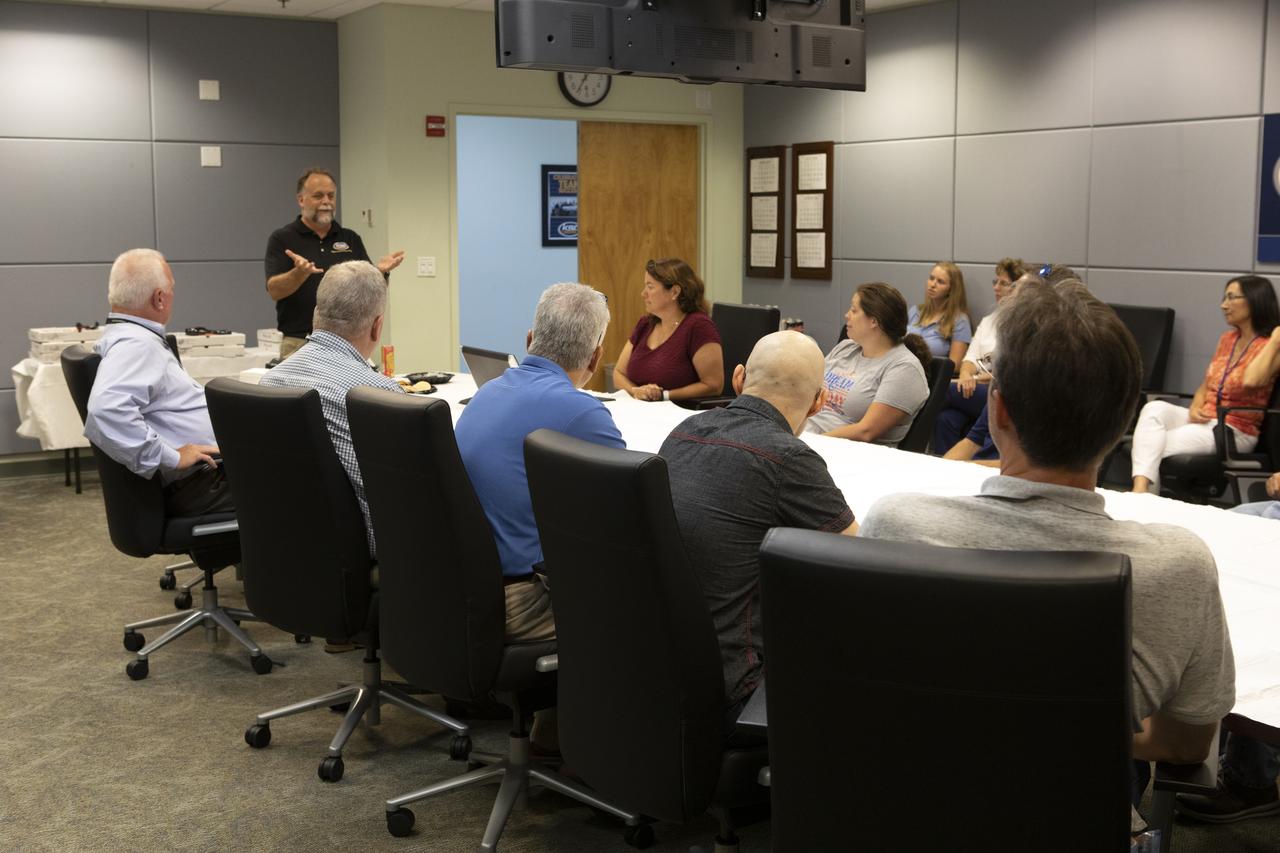
Engineers celebrate the completion of the Extensible Column Subsystem (XCS) project during a banner event held in Operations Support Building II at Kennedy Space Center. The XCS team successfully executed an aggressive schedule, receiving outstanding support from the fabrication contractor, Met-Con. Full functional testing occurred at Met-Con’s facility, with no mechanical or structural issues. All four columns and the test fixture have been delivered to Kennedy. Full-scale testing will take place when the Mobile Launcher gets to the pad later this summer.

Engineers celebrate the completion of the Extensible Column Subsystem (XCS) project during a banner event held in Operations Support Building II at Kennedy Space Center. The XCS team successfully executed an aggressive schedule, receiving outstanding support from the fabrication contractor, Met-Con. Full functional testing occurred at Met-Con’s facility, with no mechanical or structural issues. All four columns and the test fixture have been delivered to Kennedy. Full-scale testing will take place when the Mobile Launcher gets to the pad later this summer.
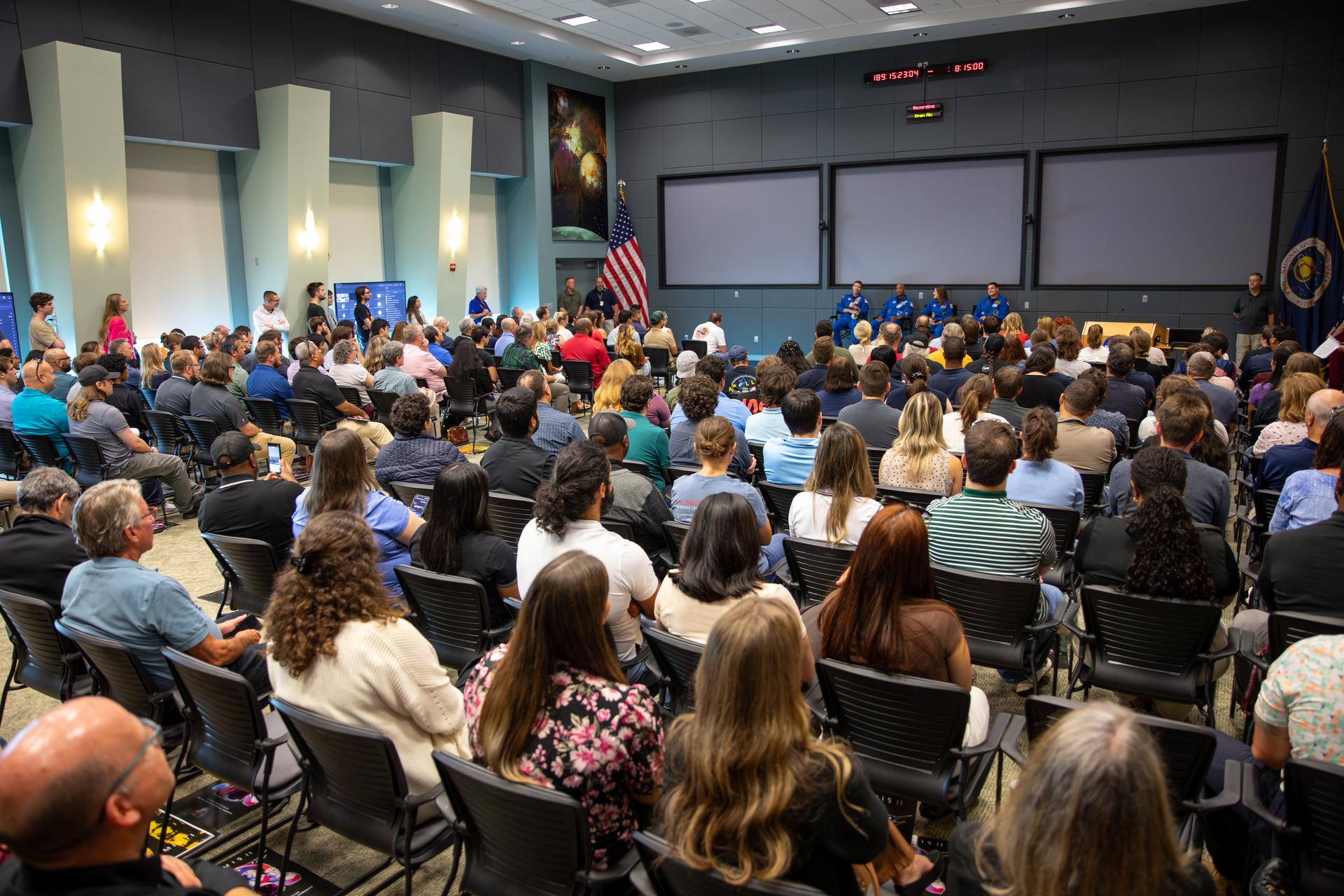
From left, Artemis II NASA astronauts Reid Wiseman, Victor Glover, Christina Koch, along with CSA (Canadian Space Agency) astronaut Jeremy Hansen speak to employees at NASA’s Kennedy Space Center in Florida on Wednesday, July 8, 2026. The crew returned to NASA Kennedy for their first official visit since launch of Artemis II on Wednesday, April 1, 2026, to visit with the center’s workforce and tour facilities to view progress on Artemis III prelaunch processing.
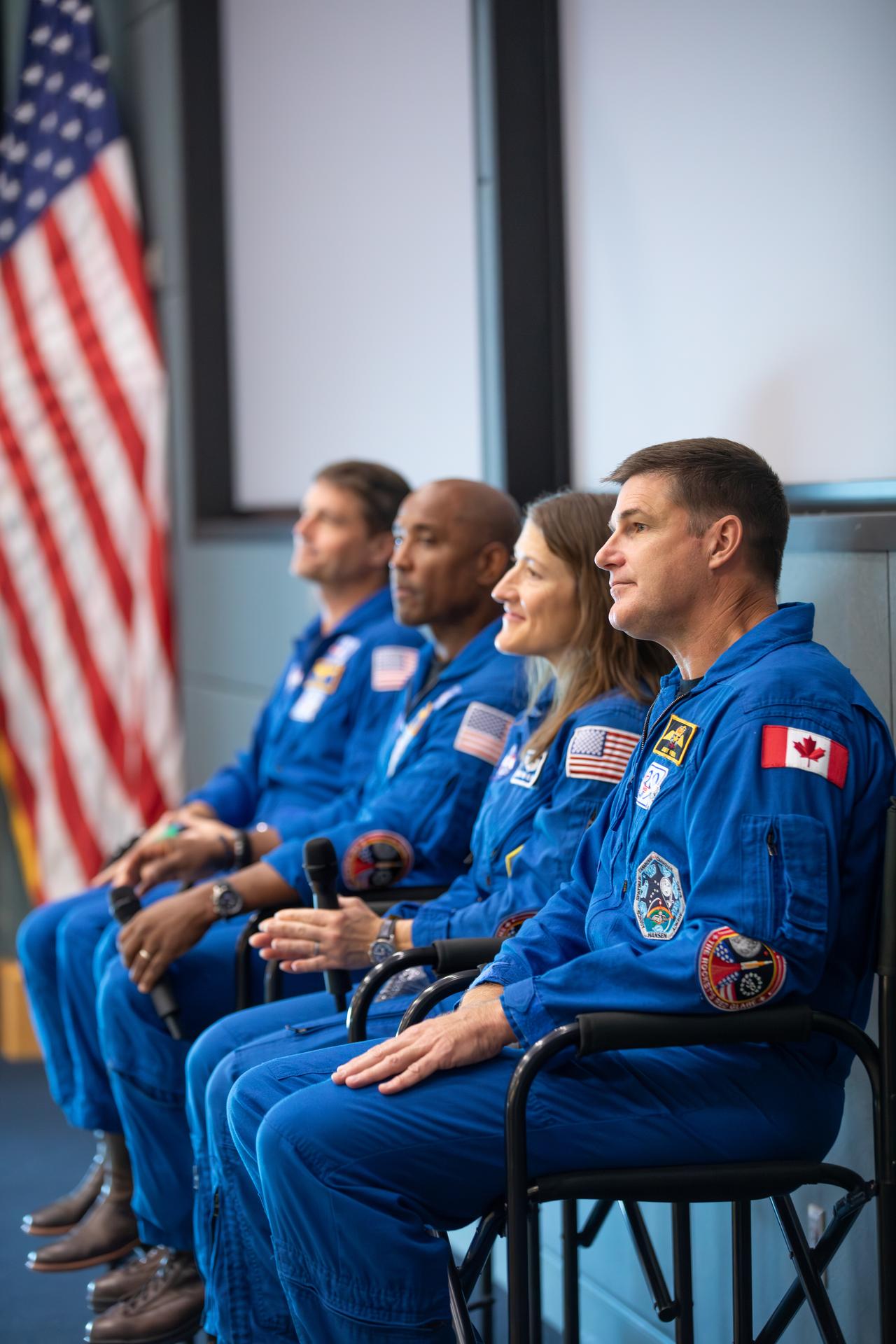
From left, Artemis II NASA astronauts Reid Wiseman, Victor Glover, Christina Koch, along with CSA (Canadian Space Agency) astronaut Jeremy Hansen speak to employees at NASA’s Kennedy Space Center in Florida on Wednesday, July 8, 2026. The crew returned to NASA Kennedy for their first official visit since launch of Artemis II on Wednesday, April 1, 2026, to visit with the center’s workforce and tour facilities to view progress on Artemis III prelaunch processing.
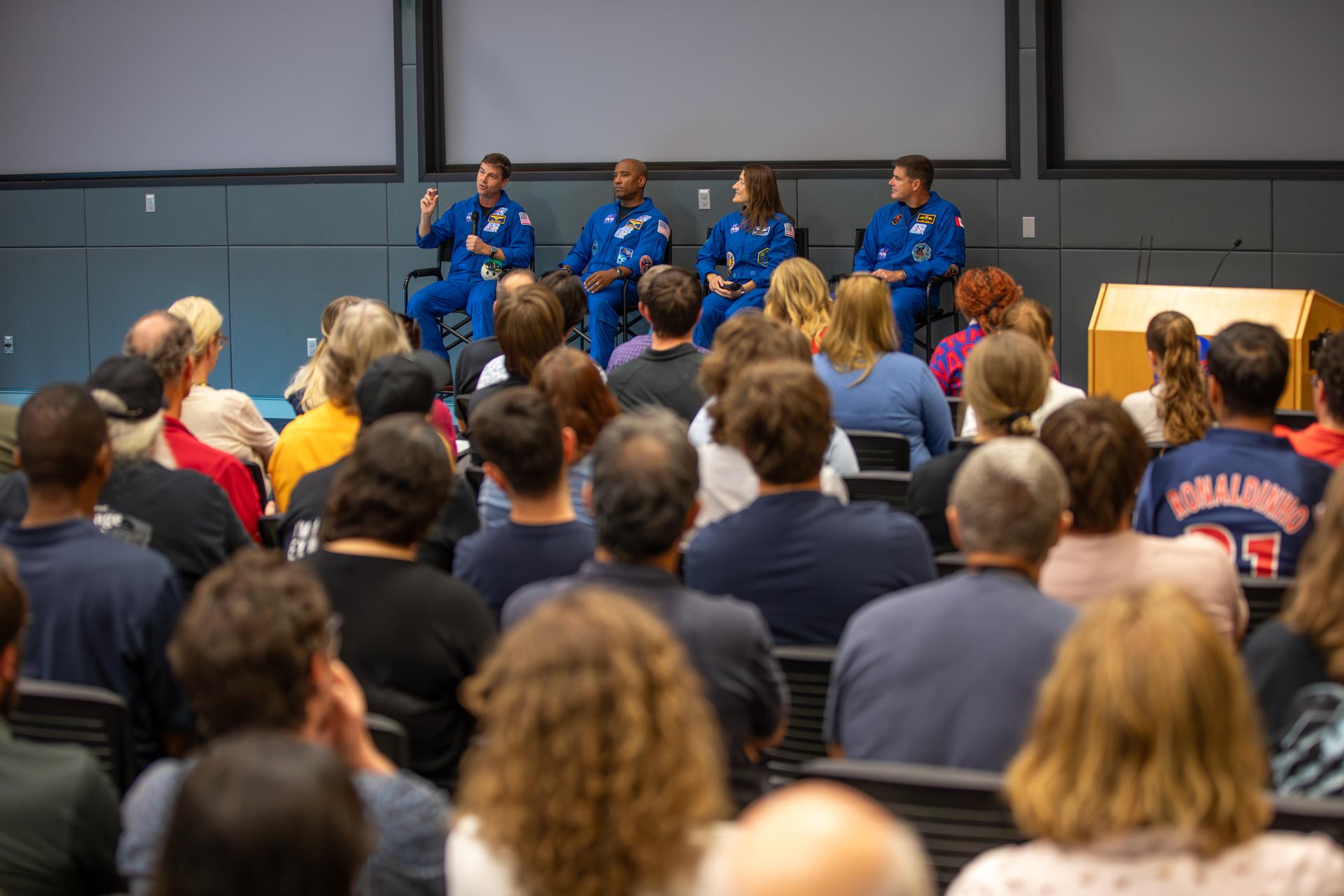
From left, Artemis II NASA astronauts Reid Wiseman, Victor Glover, Christina Koch, along with CSA (Canadian Space Agency) astronaut Jeremy Hansen speak to employees at NASA’s Kennedy Space Center in Florida on Wednesday, July 8, 2026. The crew returned to NASA Kennedy for their first official visit since launch of Artemis II on Wednesday, April 1, 2026, to visit with the center’s workforce and tour facilities to view progress on Artemis III prelaunch processing.
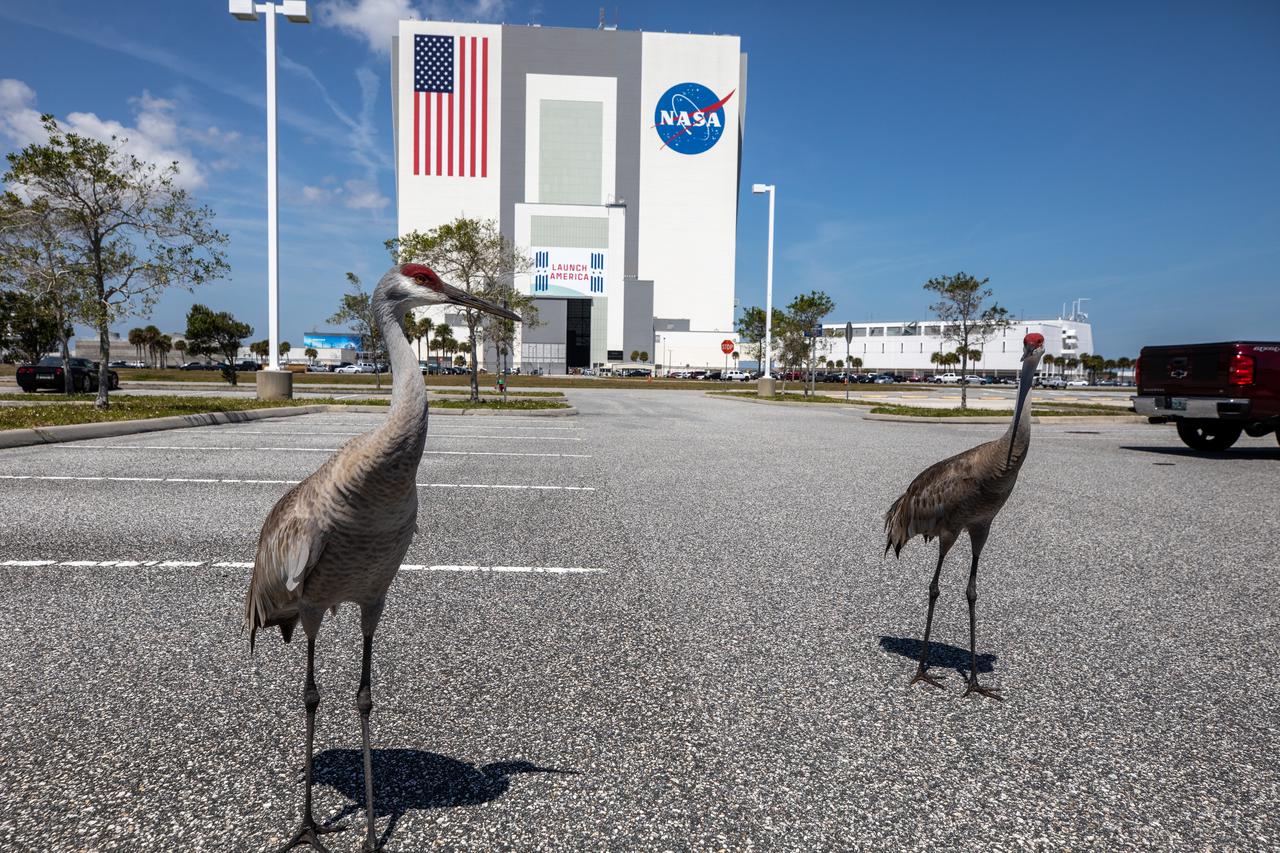
A pair of sandhill cranes explore a paved parking area near the Vehicle Assembly Building at NASA’s Kennedy Space Center in Florida on March 24, 2021. Kennedy shares space with the Merritt Island National Wildlife refuge, which is home to more than 1,000 species of plants, 117 species of fish, 68 amphibians and reptiles, 330 birds, and 31 different mammals. The refuge provides a favorable environment for the cranes as it contains shallow freshwater habitats for nesting, along with a variety of vegetation and prey to feed on.
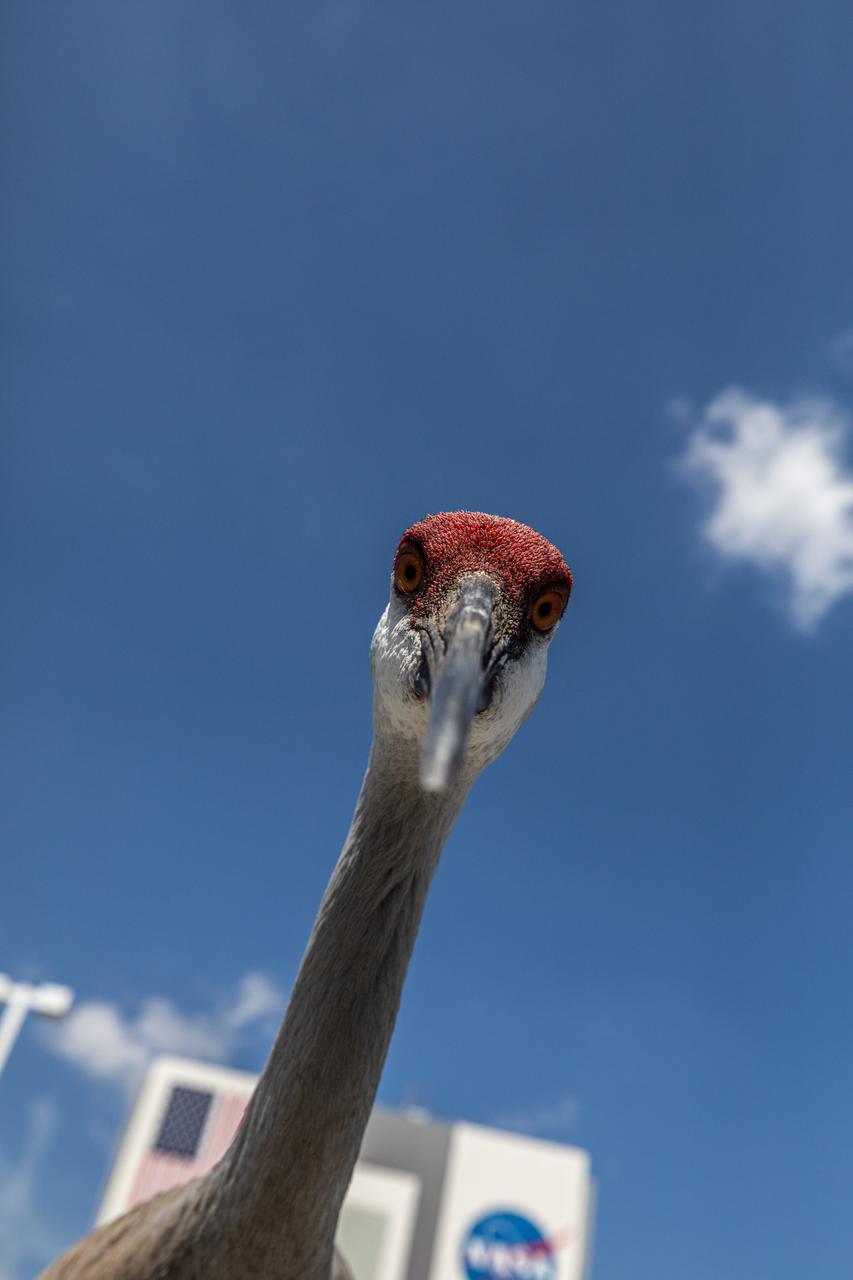
An inquisitive sandhill crane approaches the photographer near the Vehicle Assembly Building at NASA’s Kennedy Space Center in Florida on March 24, 2021. Kennedy shares space with the Merritt Island National Wildlife refuge, which is home to more than 1,000 species of plants, 117 species of fish, 68 amphibians and reptiles, 330 birds, and 31 different mammals. The refuge provides a favorable environment for sandhill cranes as it contains shallow freshwater habitats for nesting, along with a variety of vegetation and prey to feed on.
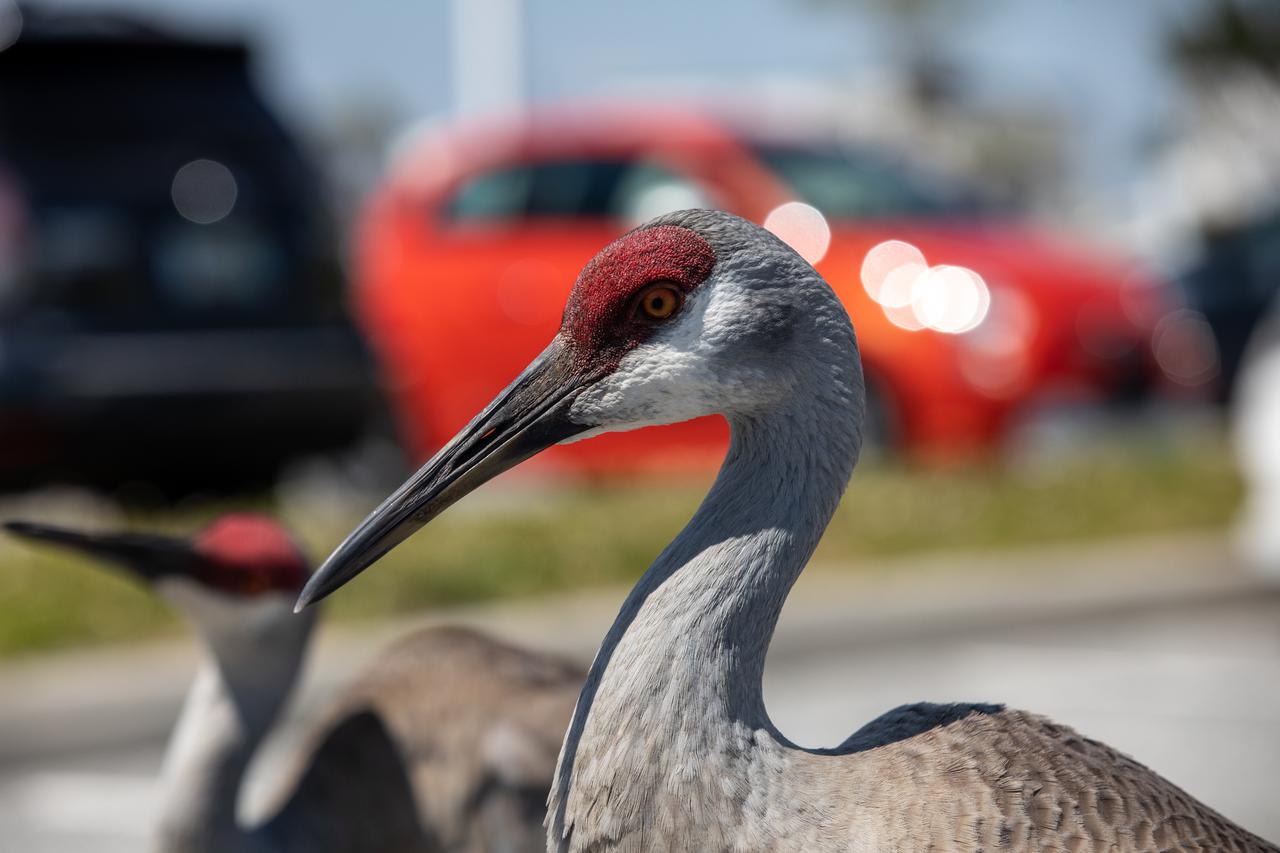
A pair of sandhill cranes explore a paved parking area at NASA’s Kennedy Space Center in Florida on March 24, 2021. Kennedy shares space with the Merritt Island National Wildlife refuge, which is home to more than 1,000 species of plants, 117 species of fish, 68 amphibians and reptiles, 330 birds, and 31 different mammals. The refuge provides a favorable environment for the cranes as it contains shallow freshwater habitats for nesting, along with a variety of vegetation and prey to feed on.

A sandhill crane explores a paved parking area near the Vehicle Assembly Building at NASA’s Kennedy Space Center in Florida on March 24, 2021. Kennedy shares space with the Merritt Island National Wildlife refuge, which is home to more than 1,000 species of plants, 117 species of fish, 68 amphibians and reptiles, 330 birds, and 31 different mammals. The refuge provides a favorable environment for sandhill cranes as it contains shallow freshwater habitats for nesting, along with a variety of vegetation and prey to feed on.
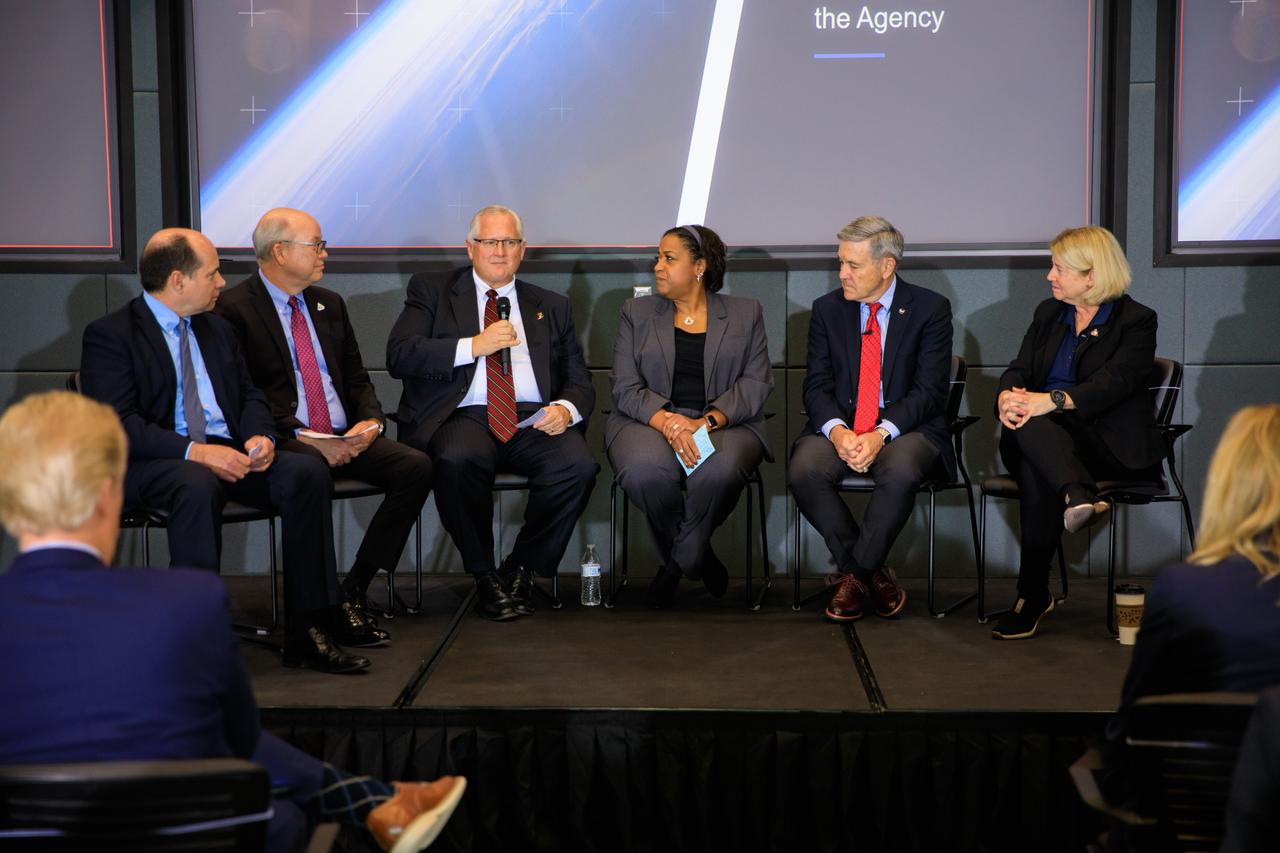
NASA senior leaders participate in a procurement discussion with employees on Nov. 29, 2022, at the agency’s Kennedy Space Center in Florida. The conversation focused on strengthening acquisition and program management within the agency. From left are David Mitchell, chief program management officer; Craig McArthur, OCFO/director for Strategic Investments Division; Scott Barber, associate general counsel for Acquisition Law; Karla Smith Jackson, assistant administrator for Procurement; NASA Associate Administrator Bob Cabana; and NASA Deputy Administrator Pam Melroy.
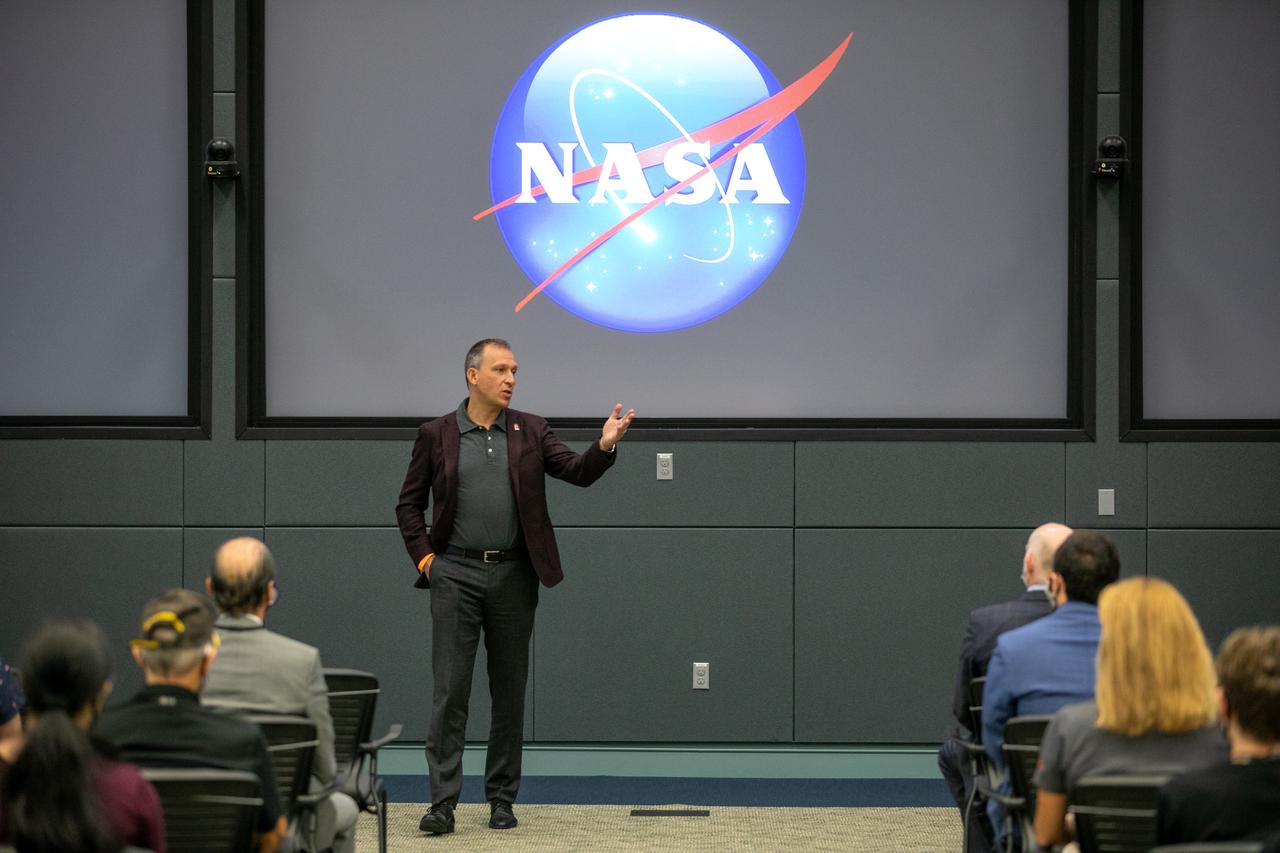
Thomas Zurbuchen, NASA associate administrator, Science Mission Directorate, participates in a Mars 2020 VIP briefing at the Operations and Support Building II at NASA’s Kennedy Space Center in Florida on July 30, 2020, before launch of the Mars Perseverance rover and Ingenuity helicopter on a United Launch Alliance Atlas V 541 rocket from Space Launch Complex 41 at nearby Cape Canaveral Air Force Station. Liftoff occurred at 7:50 a.m. EDT. The rover is part of NASA’s Mars Exploration Program, a long-term effort of robotic exploration of the Red Planet. The rover will search for habitable conditions in the ancient past and signs of past microbial life on Mars. The Launch Services Program at Kennedy is responsible for launch management.
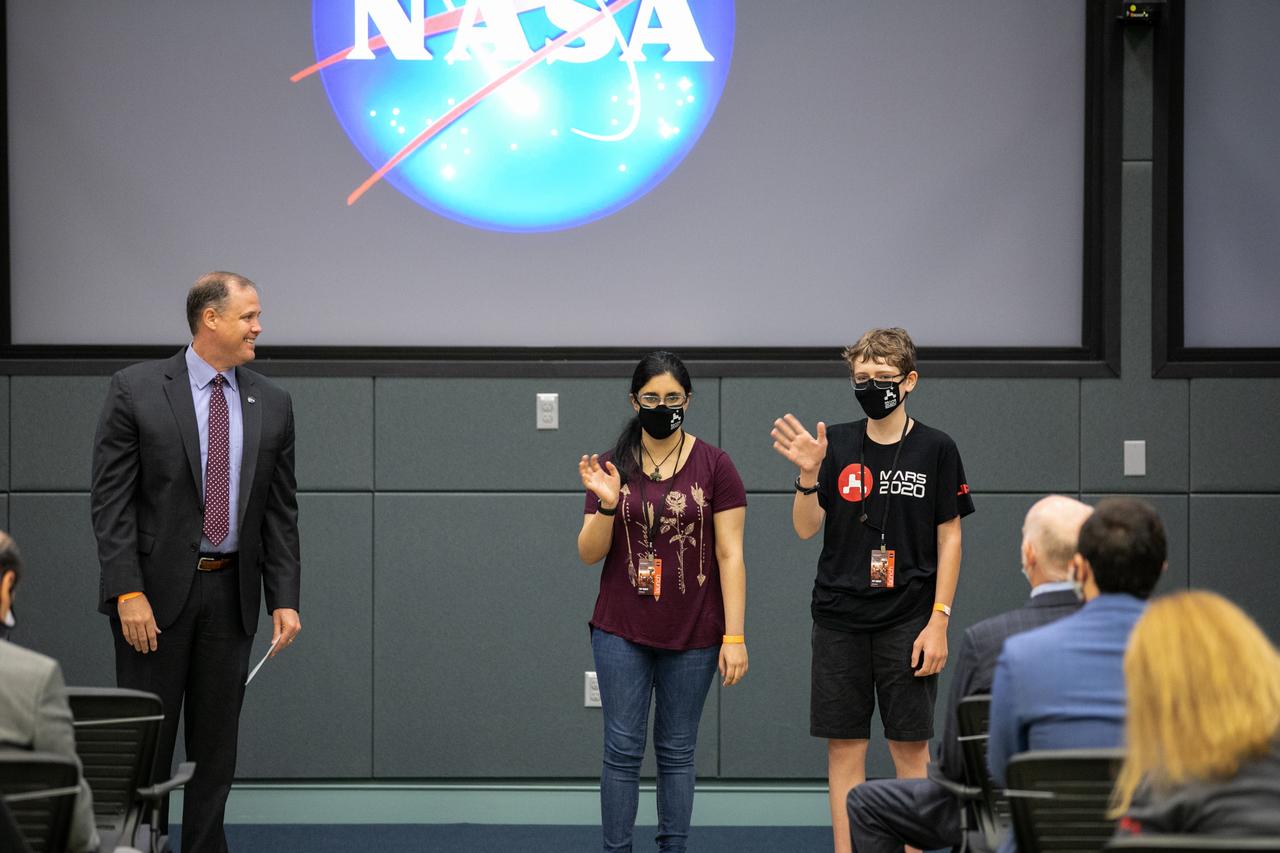
NASA Administrator Jim Bridenstine participates in a Mars 2020 VIP briefing at the Operations and Support Building II at NASA’s Kennedy Space Center in Florida on July 30, 2020. Also joining him are students Vaneeza Rupani and Alex Mather. Rupani named the Ingenuity helicopter, and Mather named the Perseverance rover. The briefing took place before launch of the rover and helicopter on a United Launch Alliance Atlas V 541 rocket from Space Launch Complex 41 at nearby Cape Canaveral Air Force Station. Liftoff occurred at 7:50 a.m. EDT. The rover is part of NASA’s Mars Exploration Program, a long-term effort of robotic exploration of the Red Planet. The rover will search for habitable conditions in the ancient past and signs of past microbial life on Mars. The Launch Services Program at Kennedy is responsible for launch management.
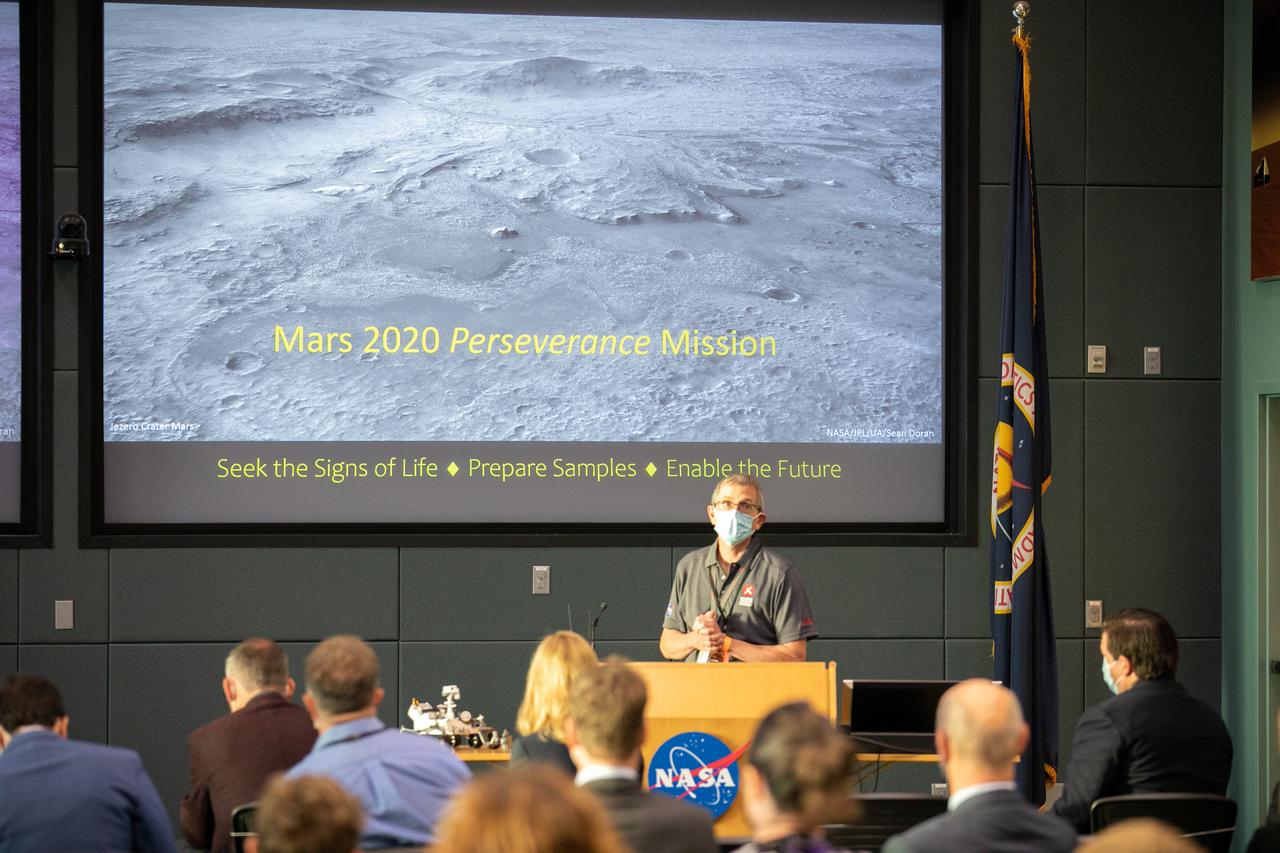
Dr. Kenneth Farley, a project scientist with Caltech, gave a science overview at the Mars 2020 VIP briefing at the Operations and Support Building II at NASA’s Kennedy Space Center in Florida on July 30, 2020, before launch of the Mars Perseverance rover and Ingenuity helicopter on a United Launch Alliance Atlas V 541 rocket from Space Launch Complex 41 at nearby Cape Canaveral Air Force Station. Liftoff occurred at 7:50 a.m. The rover is part of NASA’s Mars Exploration Program, a long-term effort of robotic exploration of the Red Planet. The rover will search for habitable conditions in the ancient past and signs of past microbial life on Mars. The Launch Services Program at Kennedy is responsible for launch management.
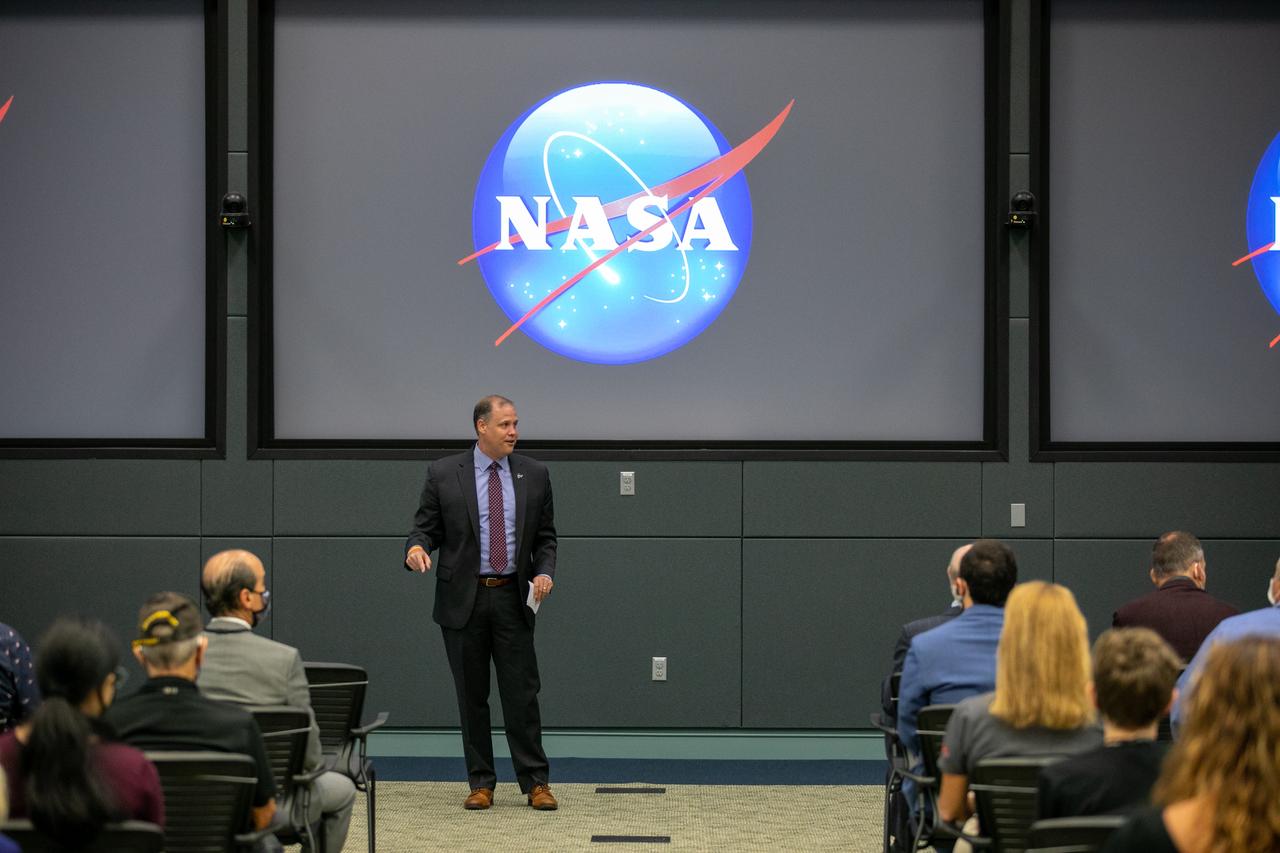
NASA Administrator Jim Bridenstine participates in a Mars 2020 VIP briefing at the Operations and Support Building II at NASA’s Kennedy Space Center in Florida on July 30, 2020, before launch of the Mars Perseverance rover and Ingenuity helicopter on a United Launch Alliance Atlas V 541 rocket from Space Launch Complex 41 at nearby Cape Canaveral Air Force Station. Liftoff occurred at 7:50 a.m. EDT. The rover is part of NASA’s Mars Exploration Program, a long-term effort of robotic exploration of the Red Planet. The rover will search for habitable conditions in the ancient past and signs of past microbial life on Mars. The Launch Services Program at Kennedy is responsible for launch management.
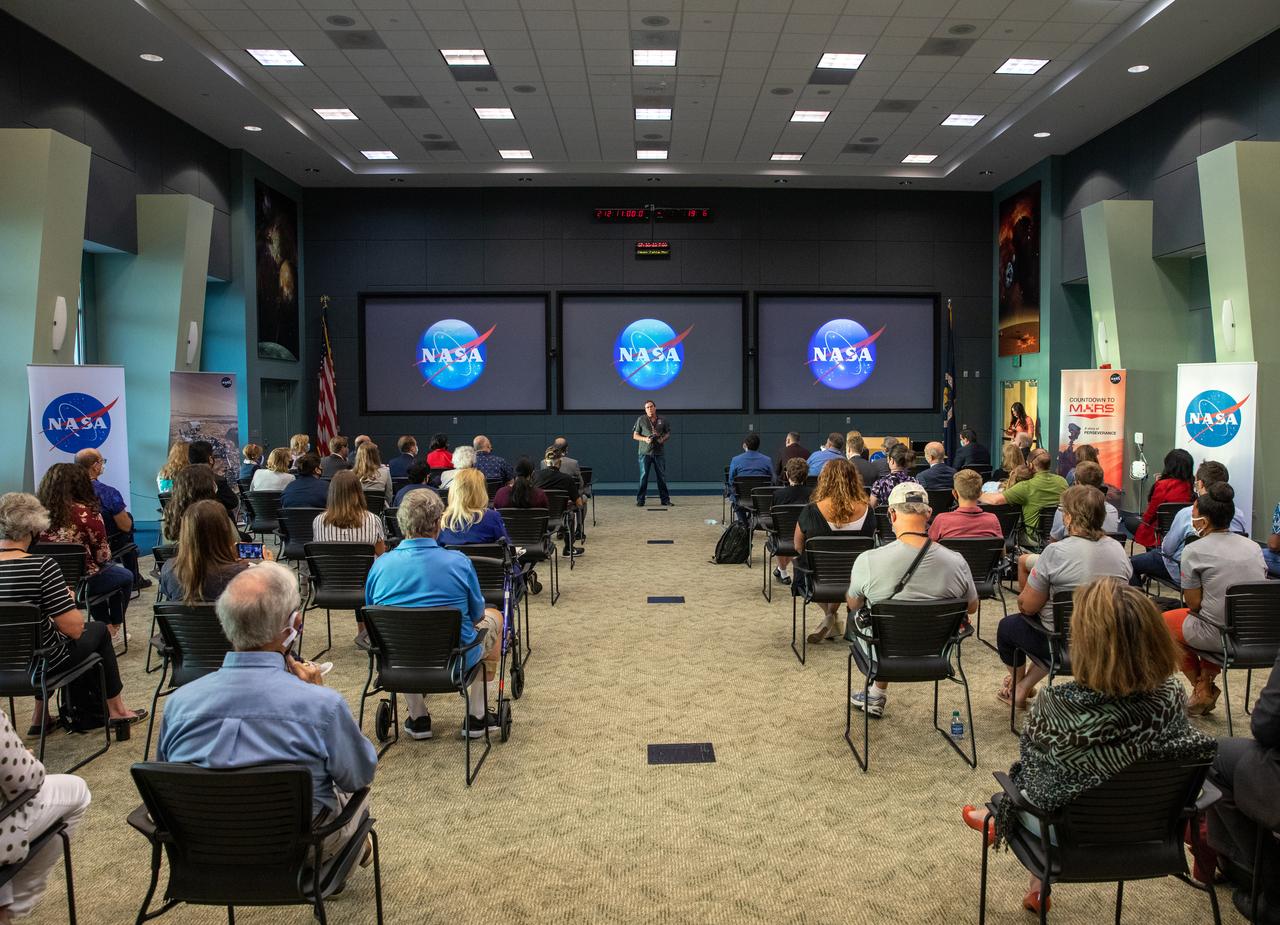
Michael Watkins, director of NASA’s Jet Propulsion Laboratory in Pasadena, California, participates in a Mars 2020 VIP briefing at the Operations and Support Building II at NASA’s Kennedy Space Center in Florida on July 30, 2020, before launch of the Mars Perseverance rover and Ingenuity helicopter on a United Launch Alliance Atlas V 541 rocket from Space Launch Complex 41 at nearby Cape Canaveral Air Force Station. Liftoff occurred at 7:50 a.m. The rover is part of NASA’s Mars Exploration Program, a long-term effort of robotic exploration of the Red Planet. The rover will search for habitable conditions in the ancient past and signs of past microbial life on Mars. The Launch Services Program at Kennedy is responsible for launch management.

Students Alex Mather, left, and Vaneeza Rupani prepare to watch the launch of the Mars 2020 Perseverance rover and Ingenuity helicopter from the observation deck of the Operations and Support Building II at NASA’s Kennedy Space Center in Florida on July 30, 2020. Mather named the Perseverance rover and Rupani named the Ingenuity helicopter. The rover and helicopter launched at 7:50 a.m. EDT on a United Launch Alliance Atlas V 541 rocket from Space Launch Complex 41 at nearby Cape Canaveral Air Force Station. The rover is part of NASA’s Mars Exploration Program, a long-term effort of robotic exploration of the Red Planet. The rover will search for habitable conditions in the ancient past and signs of past microbial life on Mars. The Launch Services Program at Kennedy is responsible for launch management.
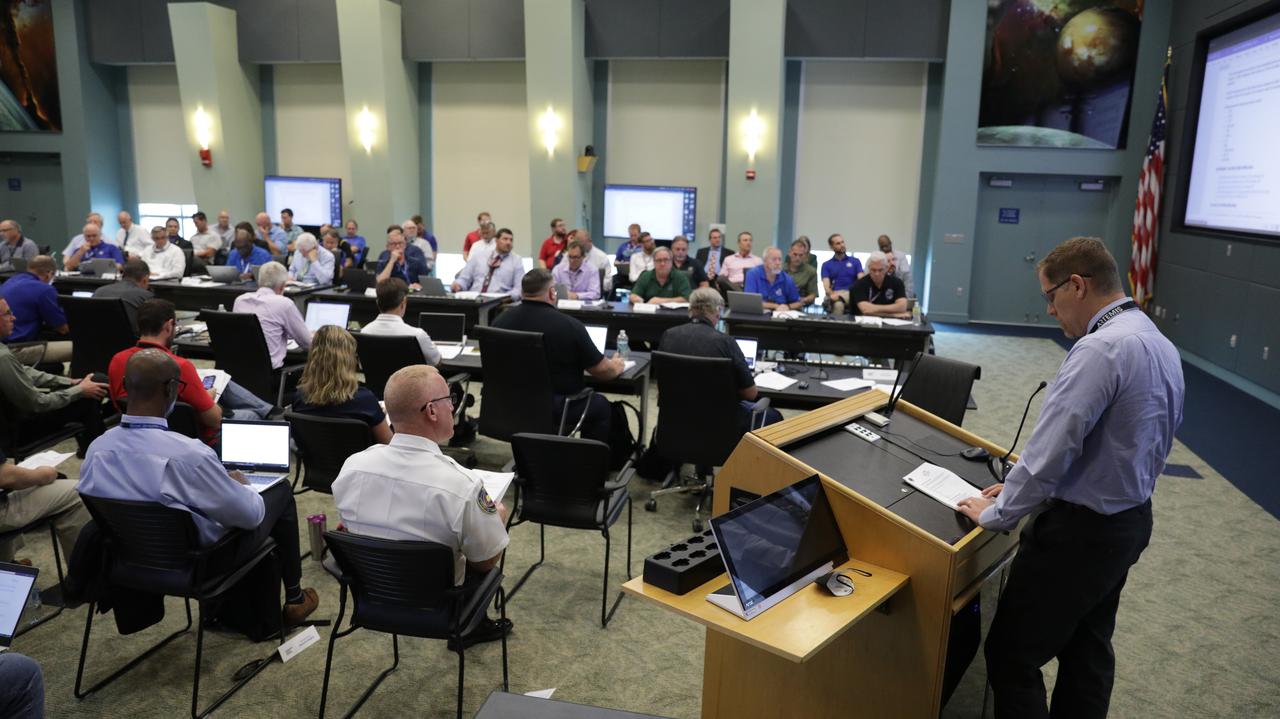
Artemis I team members conduct the Artemis I launch pre-test briefing on Sept. 23, 2022, at NASA’s Kennedy Space Center in Florida. The first in a series of increasingly complex missions, Artemis I will provide a foundation for human deep space exploration and demonstrate our commitment and capability to extend human presence to the Moon and beyond. The primary goal of Artemis I is to thoroughly test the integrated systems before crewed missions by operating the spacecraft in a deep space environment, testing Orion’s heat shield, and recovering the crew module after reentry, descent, and splashdown.
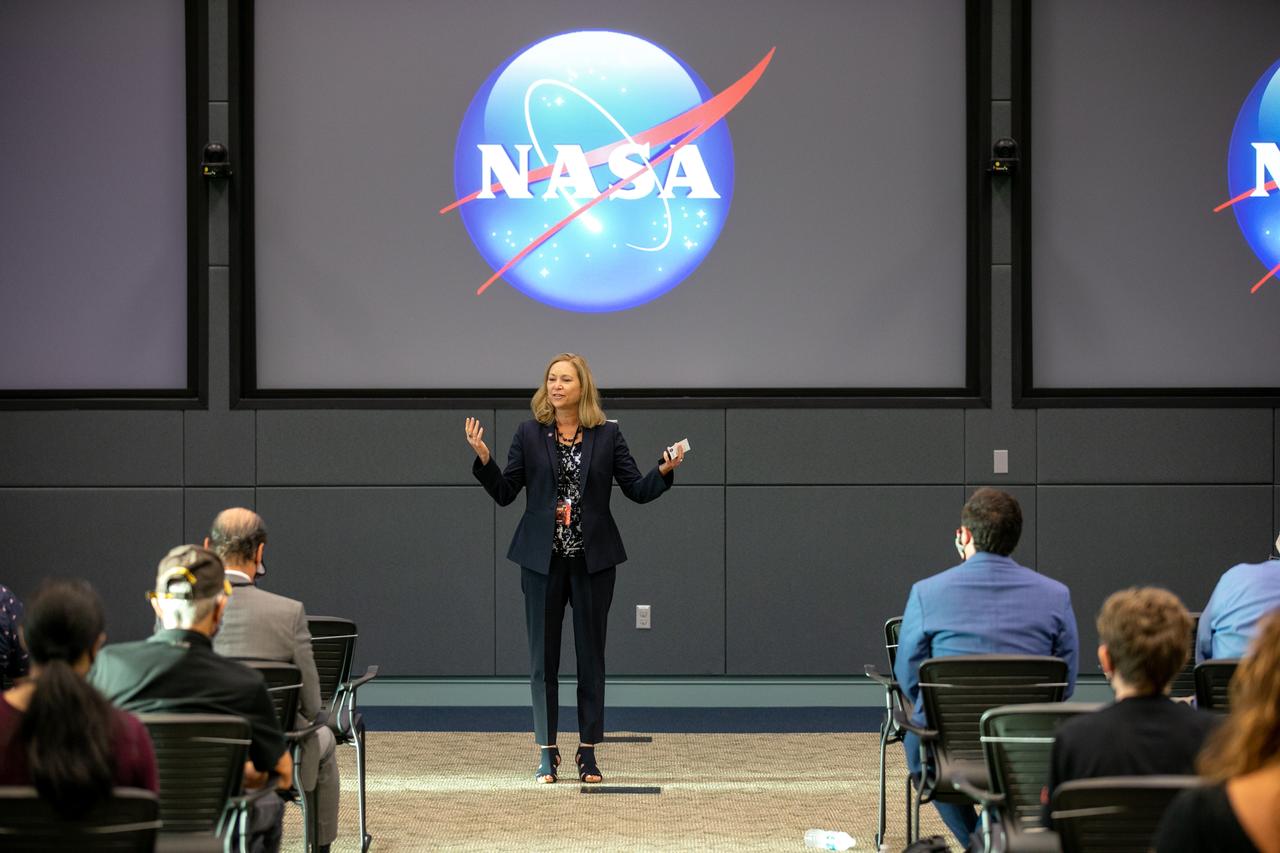
Janet Petro, deputy director of Kennedy Space Center in Florida, participates in a Mars 2020 VIP briefing at the Operations and Support Building II at NASA’s Kennedy Space Center in Florida on July 30, 2020, before launch of the Mars Perseverance rover and Ingenuity helicopter on a United Launch Alliance Atlas V 541 rocket from Space Launch Complex 41 at nearby Cape Canaveral Air Force Station. Liftoff occurred at 7:50 a.m. The rover is part of NASA’s Mars Exploration Program, a long-term effort of robotic exploration of the Red Planet. The rover will search for habitable conditions in the ancient past and signs of past microbial life on Mars. The Launch Services Program at Kennedy is responsible for launch management.
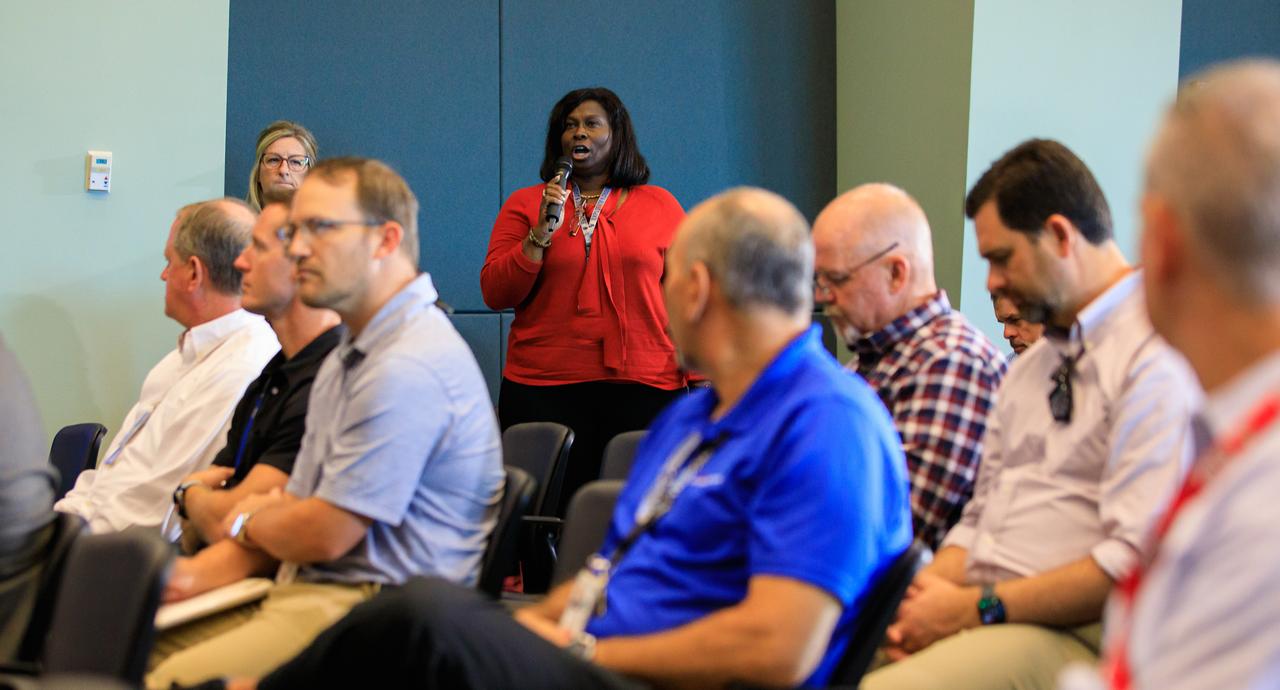
A NASA Kennedy Space Center employee asks a question during a procurement discussion on Nov. 29, 2022, at the space center in Florida. NASA senior leaders participating in the discussion with employees are NASA Deputy Administrator Pam Melroy; NASA Association Administrator Bob Cabana; Karla Smith Jackson, assistant administrator for Procurement; Scott Barber, associate general counsel for Acquisition Law; Craig McArthur, OCFO/director for Strategic Investments Division; and David Mitchell, chief program management officer.
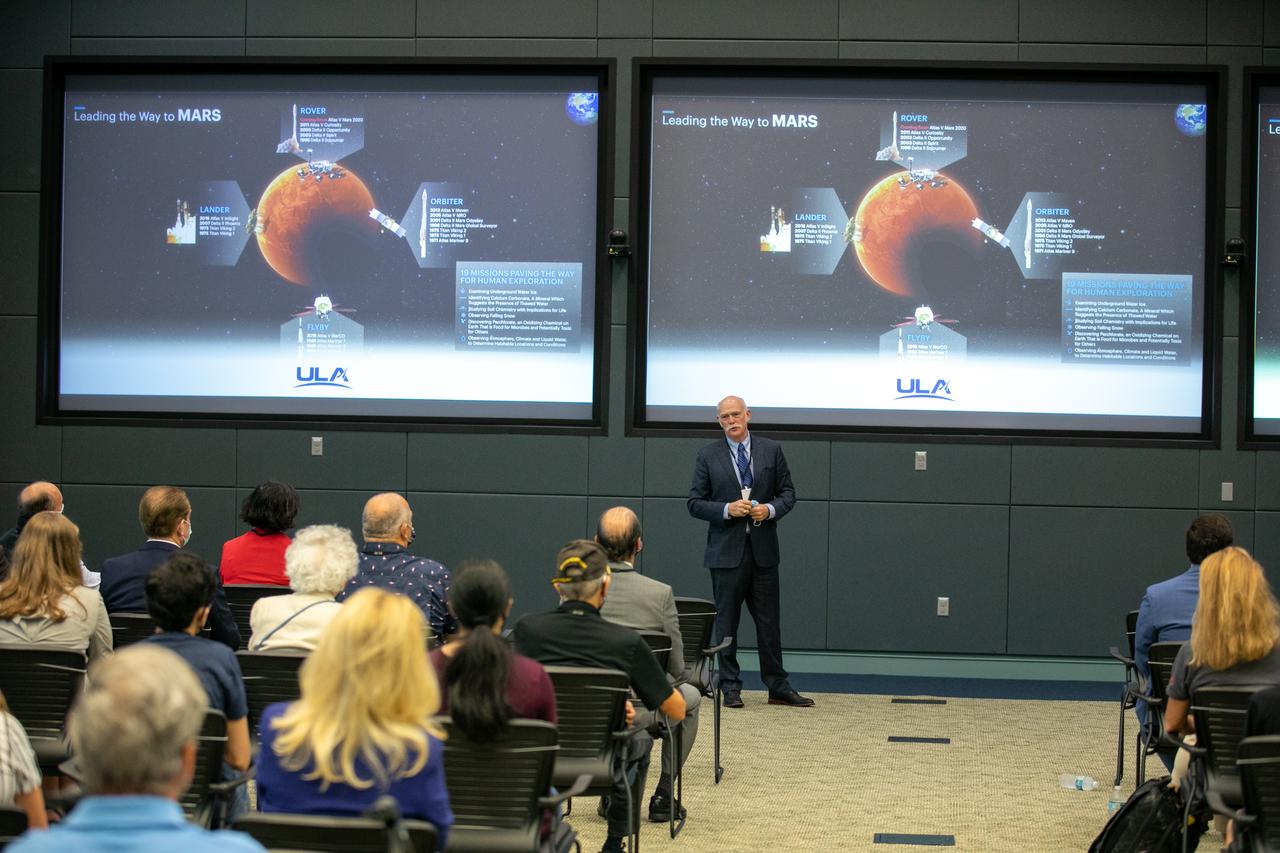
Tory Bruno, president and CEO of United Launch Alliance, participates in a Mars 2020 VIP briefing at the Operations and Support Building II at NASA’s Kennedy Space Center in Florida on July 30, 2020, before launch of the Mars Perseverance rover and Ingenuity helicopter on a United Launch Alliance Atlas V 541 rocket from Space Launch Complex 41 at nearby Cape Canaveral Air Force Station. Liftoff occurred at 7:50 a.m. The rover is part of NASA’s Mars Exploration Program, a long-term effort of robotic exploration of the Red Planet. The rover will search for habitable conditions in the ancient past and signs of past microbial life on Mars. The Launch Services Program at Kennedy is responsible for launch management.
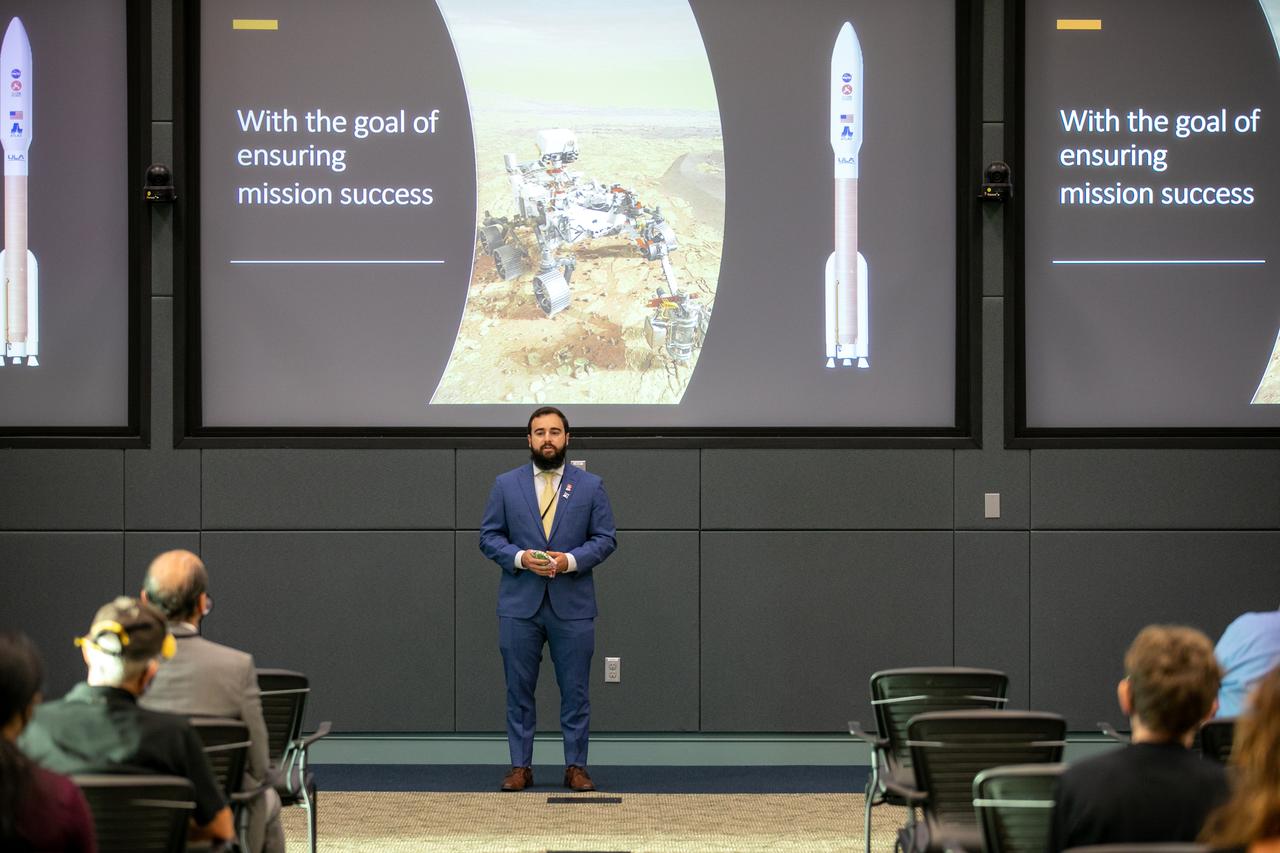
Erik Durnberg, a structural dynamics engineer with NASA’s Launch Services Program, participates in a Mars 2020 VIP briefing at the Operations and Support Building II at NASA’s Kennedy Space Center in Florida on July 30, 2020, before launch of the Mars Perseverance rover and Ingenuity helicopter on a United Launch Alliance Atlas V 541 rocket from Space Launch Complex 41 at nearby Cape Canaveral Air Force Station. Liftoff occurred at 7:50 a.m. The rover is part of NASA’s Mars Exploration Program, a long-term effort of robotic exploration of the Red Planet. The rover will search for habitable conditions in the ancient past and signs of past microbial life on Mars. The Launch Services Program at Kennedy is responsible for launch management.
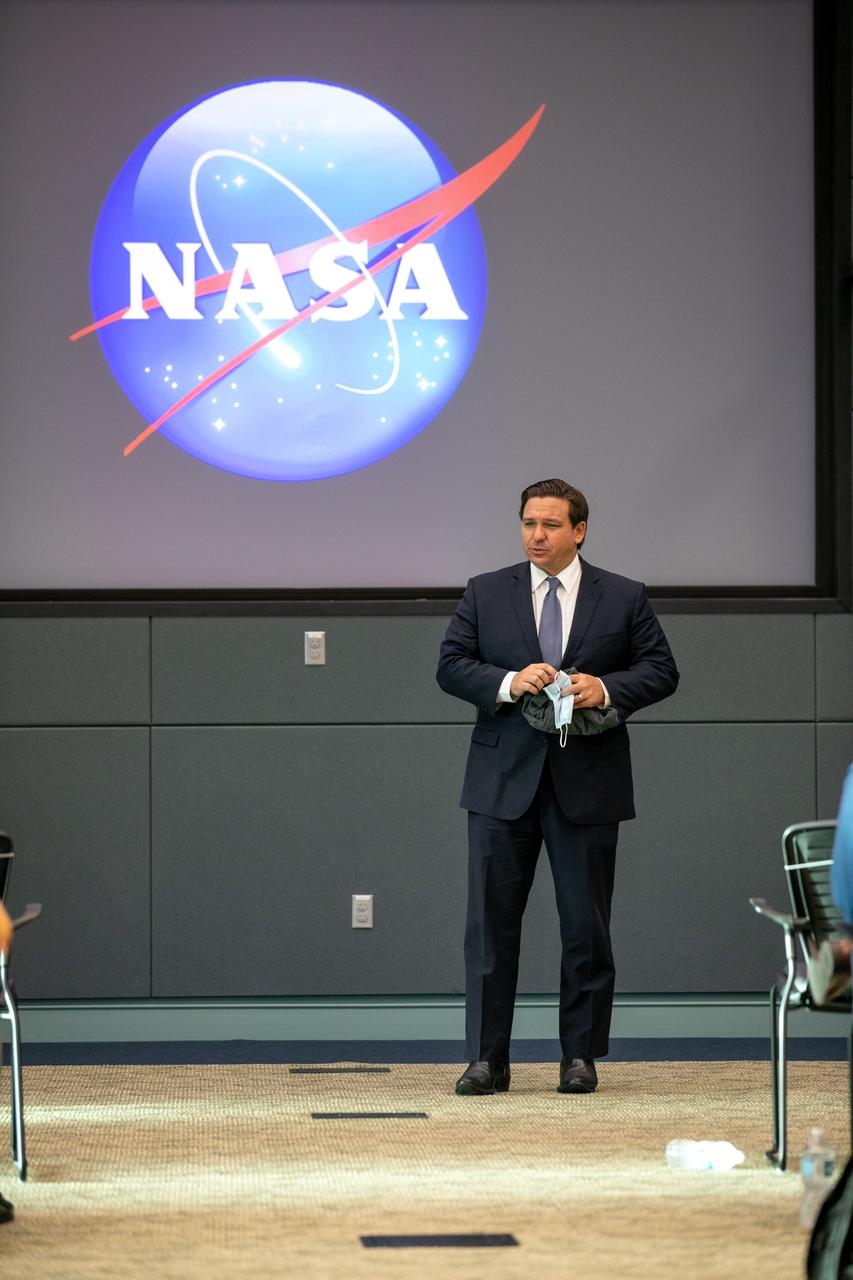
Ron DeSantis, Florida Governor, participates in a Mars 2020 VIP briefing at the Operations and Support Building II at NASA’s Kennedy Space Center in Florida on July 30, 2020, before launch of the Mars Perseverance rover and Ingenuity helicopter on a United Launch Alliance Atlas V 541 rocket from Space Launch Complex 41 at nearby Cape Canaveral Air Force Station. Liftoff occurred at 7:50 a.m. The rover is part of NASA’s Mars Exploration Program, a long-term effort of robotic exploration of the Red Planet. The rover will search for habitable conditions in the ancient past and signs of past microbial life on Mars. The Launch Services Program at Kennedy is responsible for launch management.
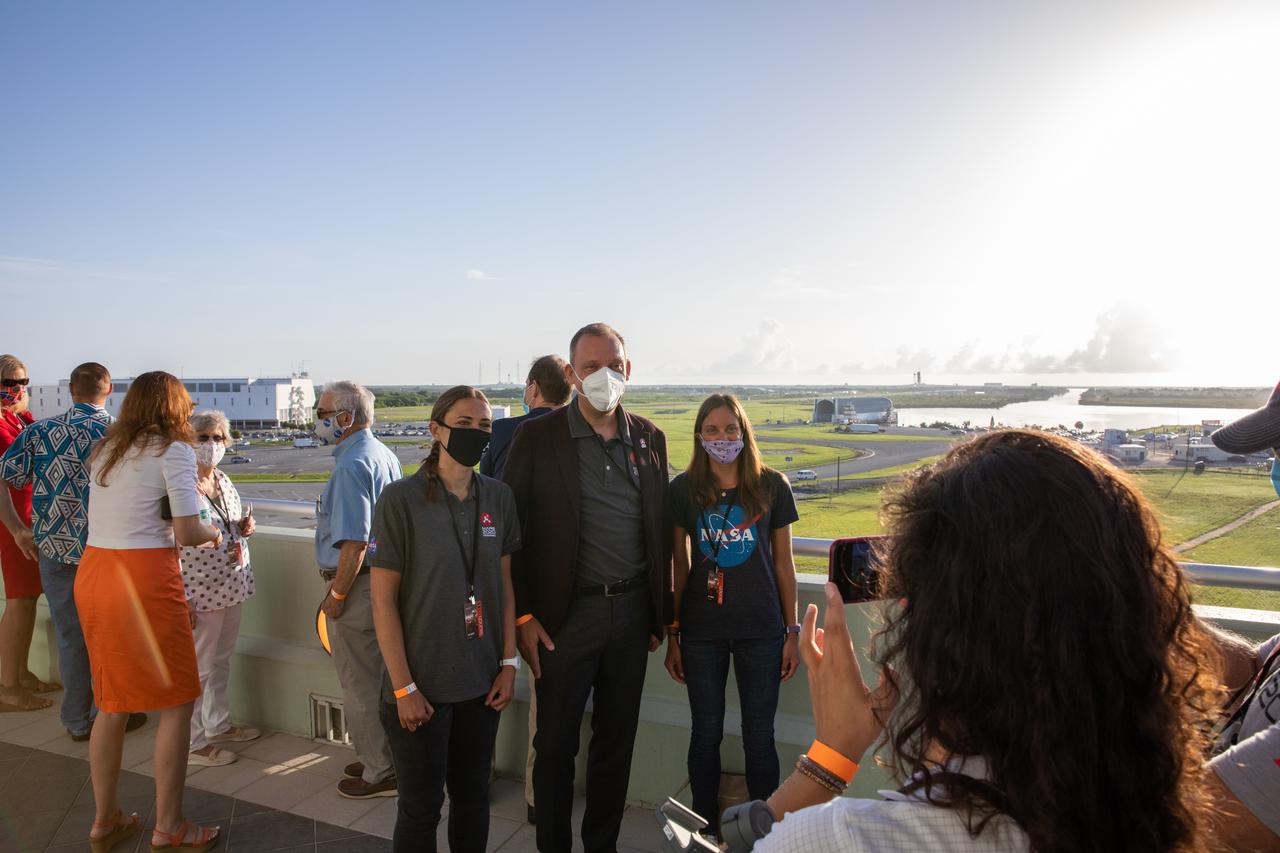
On the observation deck of the Operations and Support Building II at NASA’s Kennedy Space Center in Florida, Thomas Zurbuchen, center, NASA associate administrator, Science Mission Directorate, prepares to view the launch of the Mars 2020 Perseverance rover and Ingenuity helicopter on a United Launch Alliance Atlas V 541 rocket on July 30, 2020. Liftoff occurred at 7:50 a.m. EDT from Space Launch Complex 41 at Cape Canaveral Air Force Station. At left is Joan Irvin, and at right is Danielle Marsh. Both were former students who now work on NASA Planetary Science missions. The rover is part of NASA’s Mars Exploration Program, a long-term effort of robotic exploration of the Red Planet. The rover will search for habitable conditions in the ancient past and signs of past microbial life on Mars. The Launch Services Program at Kennedy is responsible for launch management.
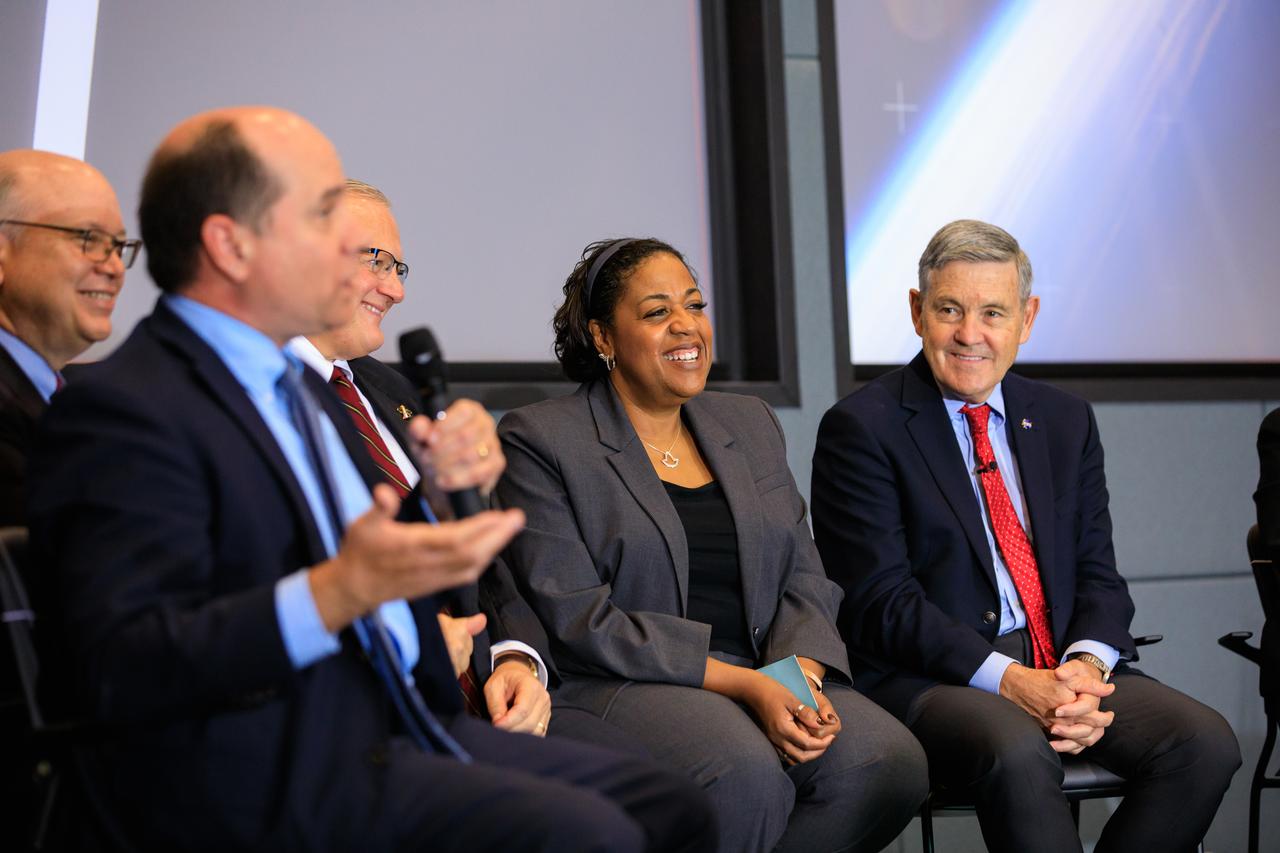
NASA senior leaders participate in a procurement discussion with employees on Nov. 29, 2022, at the agency’s Kennedy Space Center in Florida. The conversation focused on strengthening acquisition and program management within the agency. From left are David Mitchell, chief program management officer; Craig McArthur, (in view behind Mitchell) OCFO/director for Strategic Investments Division; Scott Barber, associate general counsel for Acquisition Law; Karla Smith Jackson, assistant administrator for Procurement; and NASA Associate Administrator Bob Cabana. Also participating, but not pictured, is NASA Deputy Administrator Pam Melroy.
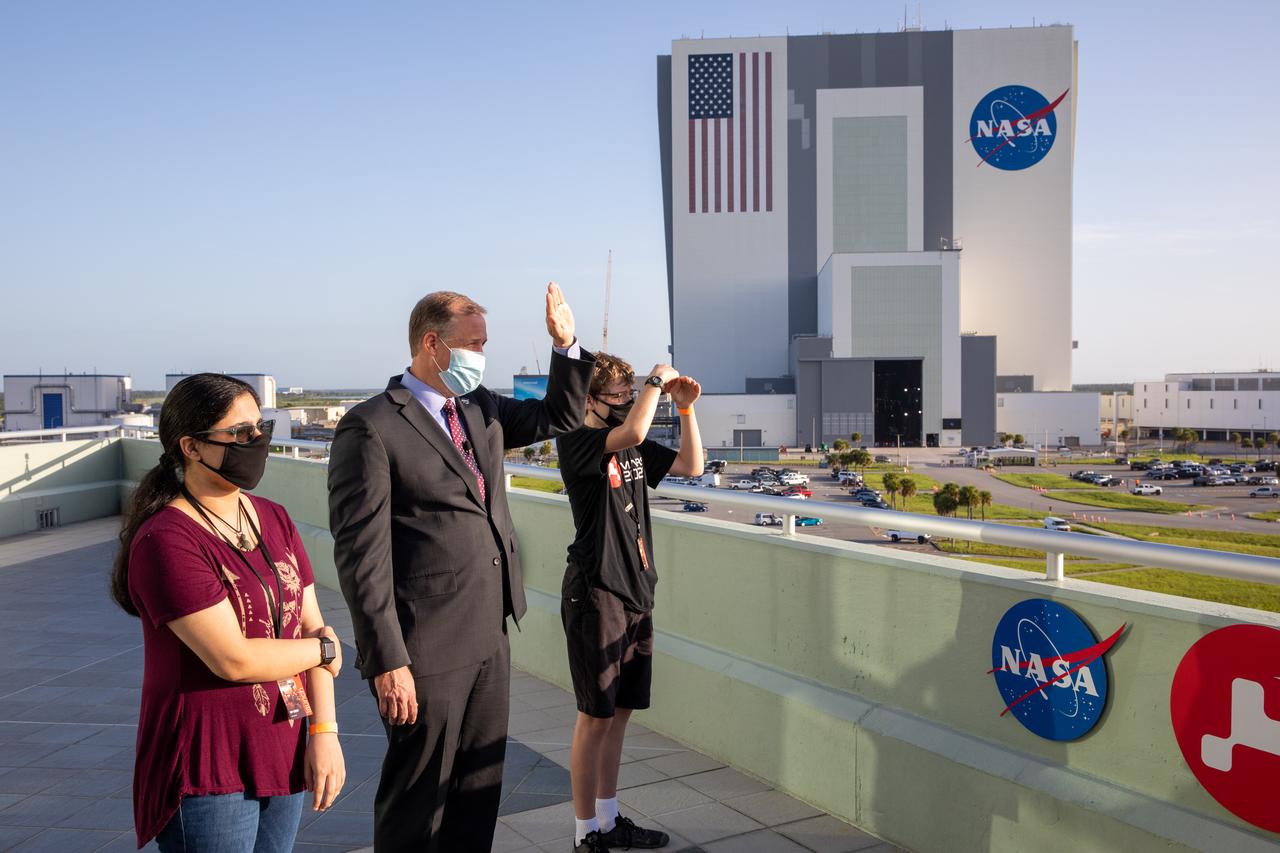
NASA Administrator Jim Bridenstine, center, watches Mars 2020 launch on the observation deck of the Operations and Support Building II at NASA’s Kennedy Space Center in Florida on July 30, 2020. With him are students Vaneeza Rupani, at left, and Alex Mather. Rupani named the Ingenuity helicopter, and Mather names the Mars Perseverance rover. A United Launch Alliance Atlas V 541 rocket lifted off at 7:50 a.m. EDT from Space Launch Complex 41 at nearby Cape Canaveral Air Force Station, sending the rover and helicopter on their trek to Mars. The rover is part of NASA’s Mars Exploration Program, a long-term effort of robotic exploration of the Red Planet. The rover will search for habitable conditions in the ancient past and signs of past microbial life on Mars. The Launch Services Program at Kennedy is responsible for launch management.
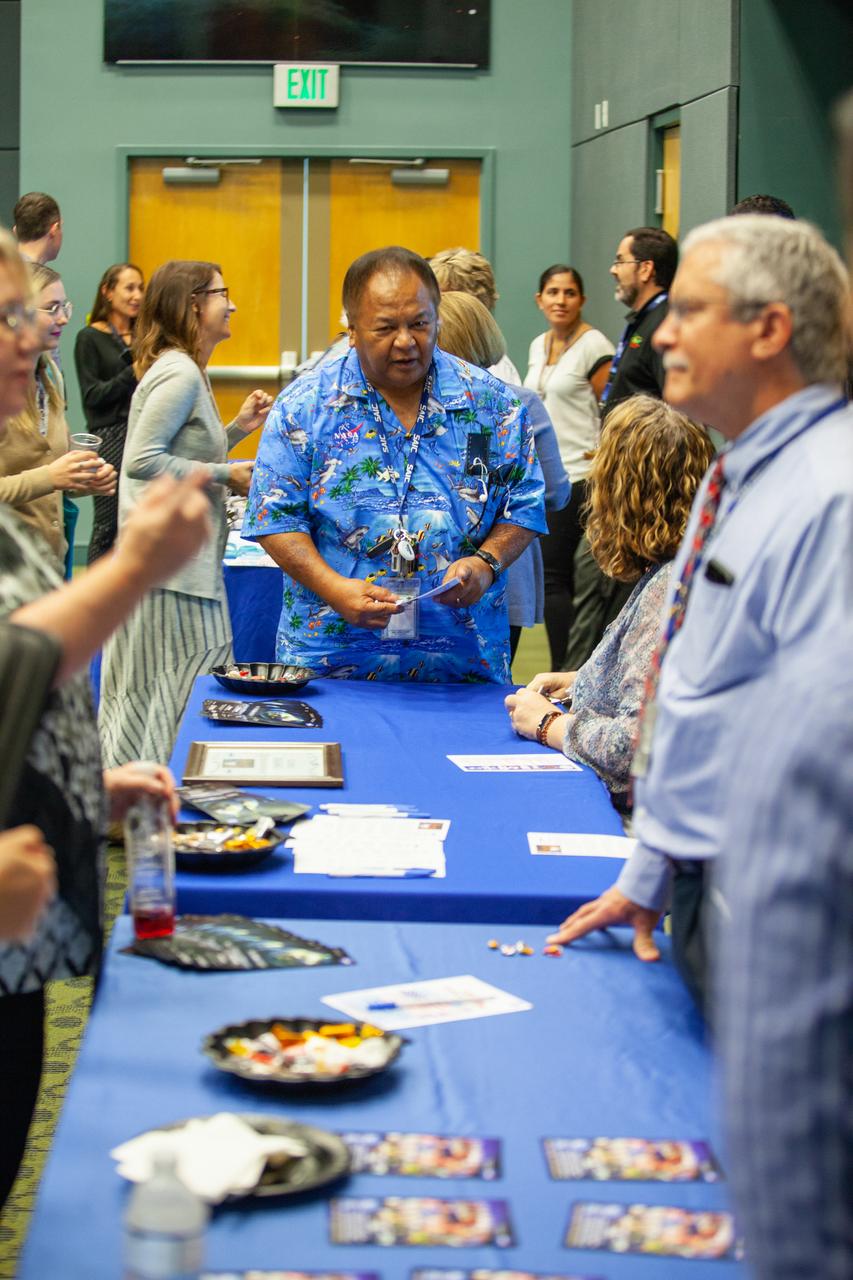
Kennedy Space Center employees interact during the “KSC and Proud to Be” centerwide diversity event held at the Florida spaceport’s Operations Support Building II (OSB II) on Aug. 20, 2019. The event featured a presentation by Robin Hauser, a director and producer of award-winning documentaries. Hauser, who has spoken at the White House and at conferences worldwide, addressed bias in artificial intelligence. A new employee video focusing on the importance of employee resource groups at the center made its debut showing at the event.
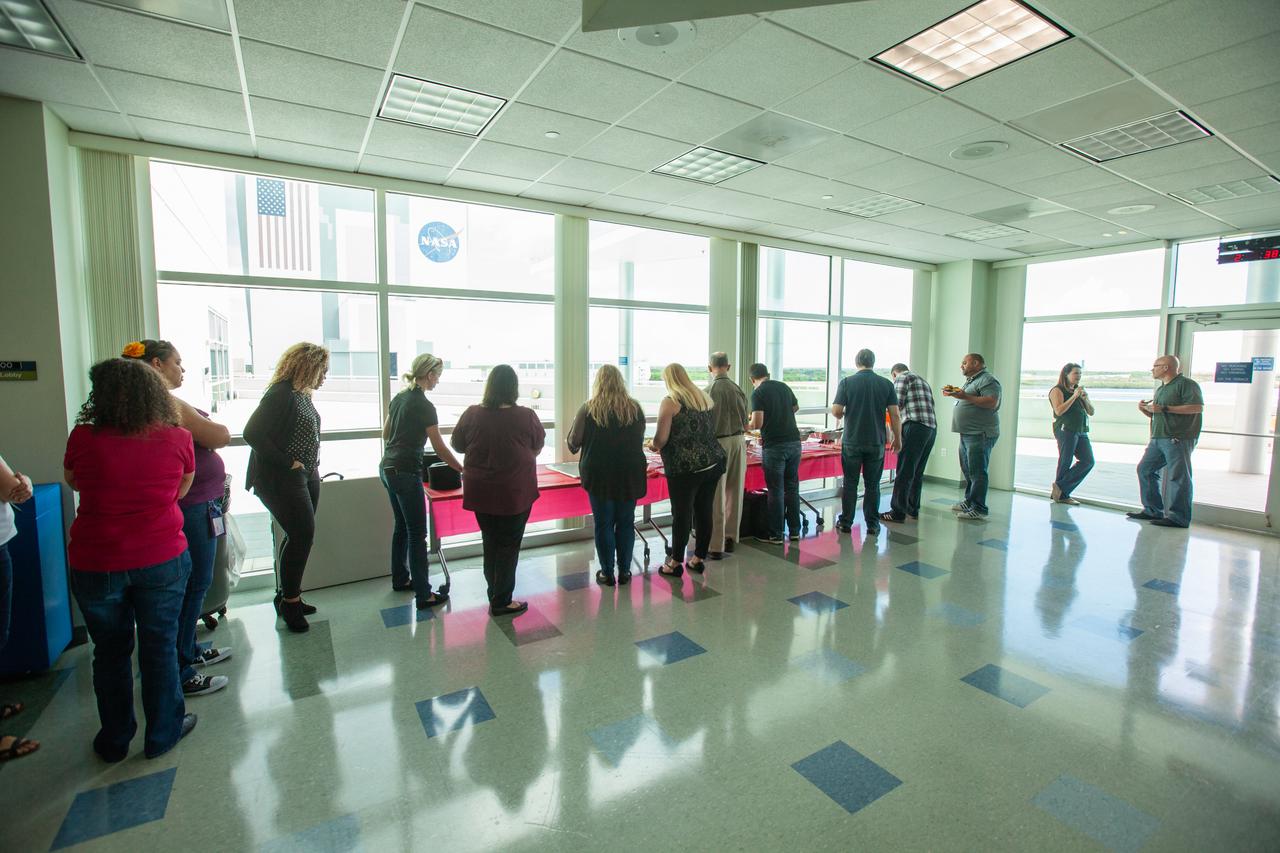
Kennedy Space Center employees sample food at the “KSC and Proud to Be” centerwide diversity event held at the Florida spaceport’s Operations Support Building II (OSB II) on Aug. 20, 2019. The event featured a presentation by Robin Hauser, a director and producer of award-winning documentaries. Hauser, who has spoken at the White House and at conferences worldwide, addressed bias in artificial intelligence. A new employee video focusing on the importance of employee resource groups at the center made its debut showing at the event.
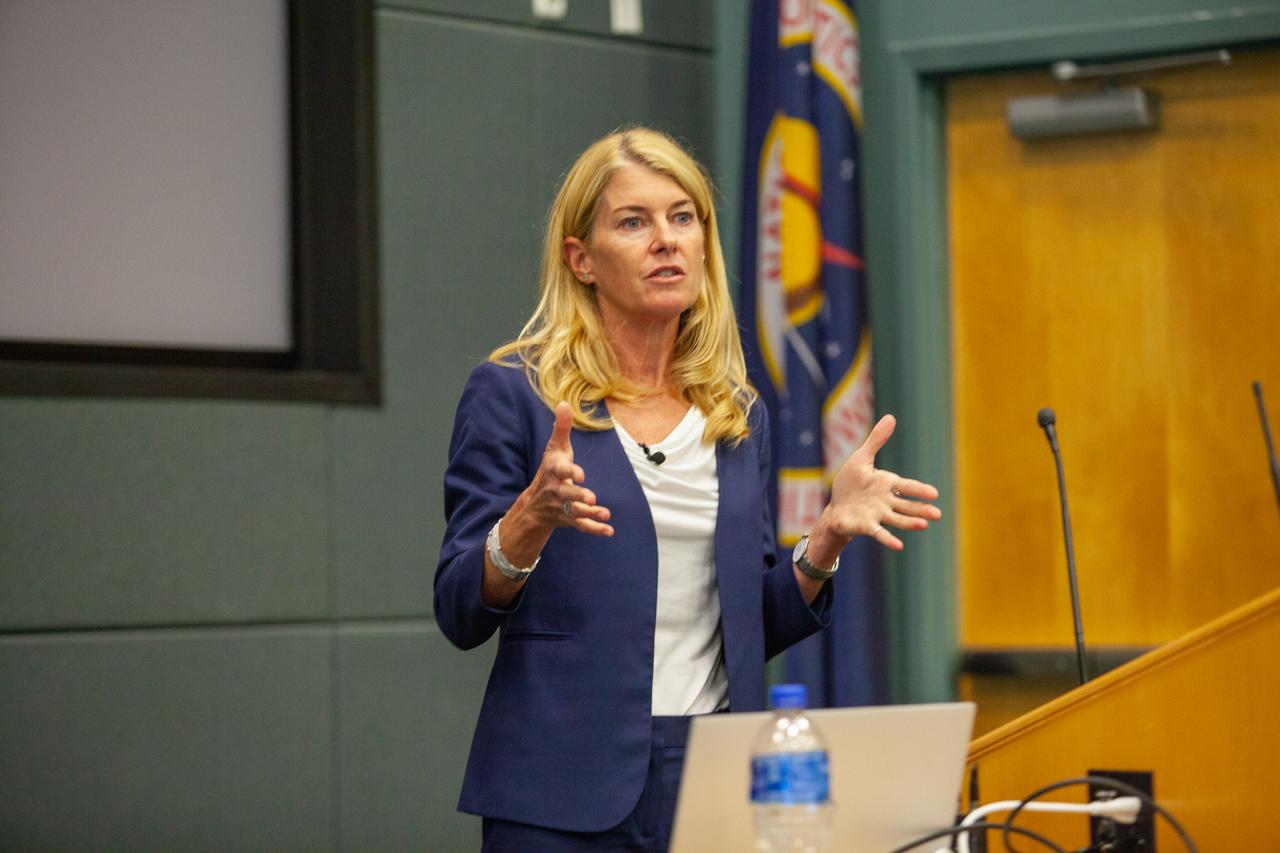
Robin Hauser, a director and producer of award-winning documentaries, delivers a presentation during the “KSC and Proud to Be” centerwide diversity event held at Kennedy Space Center’s Operations Support Building II (OSB II) on Aug. 20, 2019. Hauser, who has spoken at the White House and at conferences worldwide, addressed bias in artificial intelligence. The event wrapped up with the debut showing of a new employee video focusing on the importance of employee resource groups at the center, followed by closing remarks from Kennedy Director Bob Cabana.
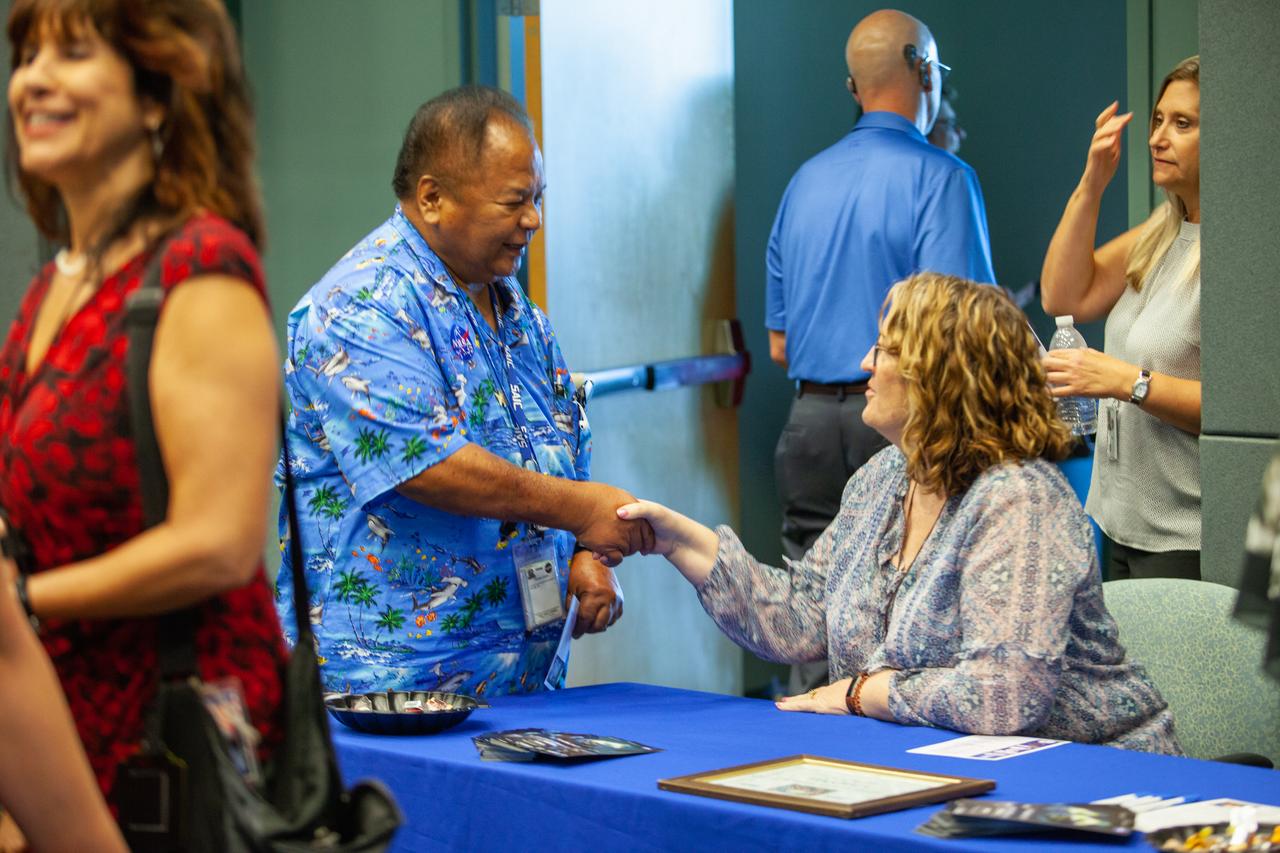
Kennedy Space Center employees interact during the “KSC and Proud to Be” centerwide diversity event held at the Florida spaceport’s Operations Support Building II (OSB II) on Aug. 20, 2019. The event featured a presentation by Robin Hauser, a director and producer of award-winning documentaries. Hauser, who has spoken at the White House and at conferences worldwide, addressed bias in artificial intelligence. A new employee video focusing on the importance of employee resource groups at the center made its debut showing at the event.
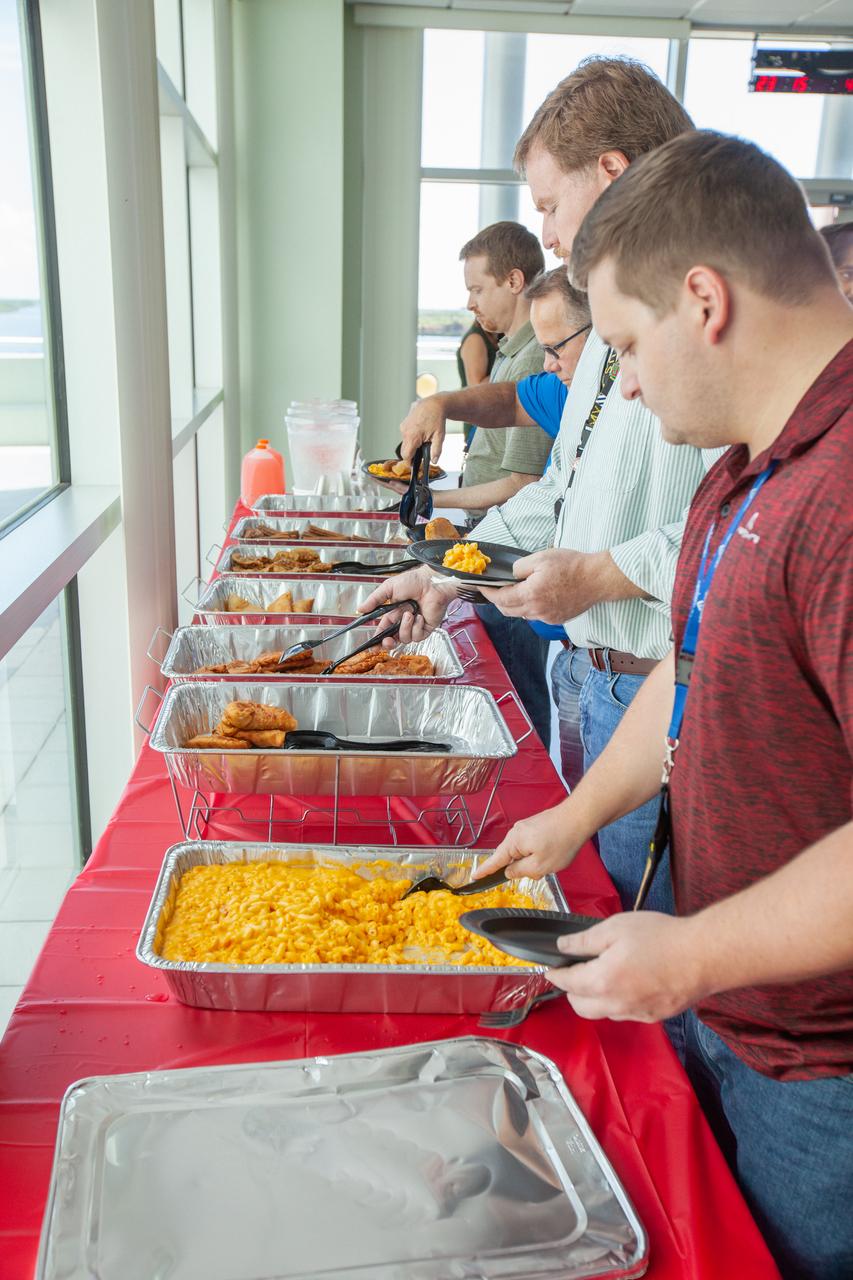
Kennedy Space Center employees sample food at the “KSC and Proud to Be” centerwide diversity event held at the Florida spaceport’s Operations Support Building II (OSB II) on Aug. 20, 2019. The event featured a presentation by Robin Hauser, a director and producer of award-winning documentaries. Hauser, who has spoken at the White House and at conferences worldwide, addressed bias in artificial intelligence. A new employee video focusing on the importance of employee resource groups at the center made its debut showing at the event.
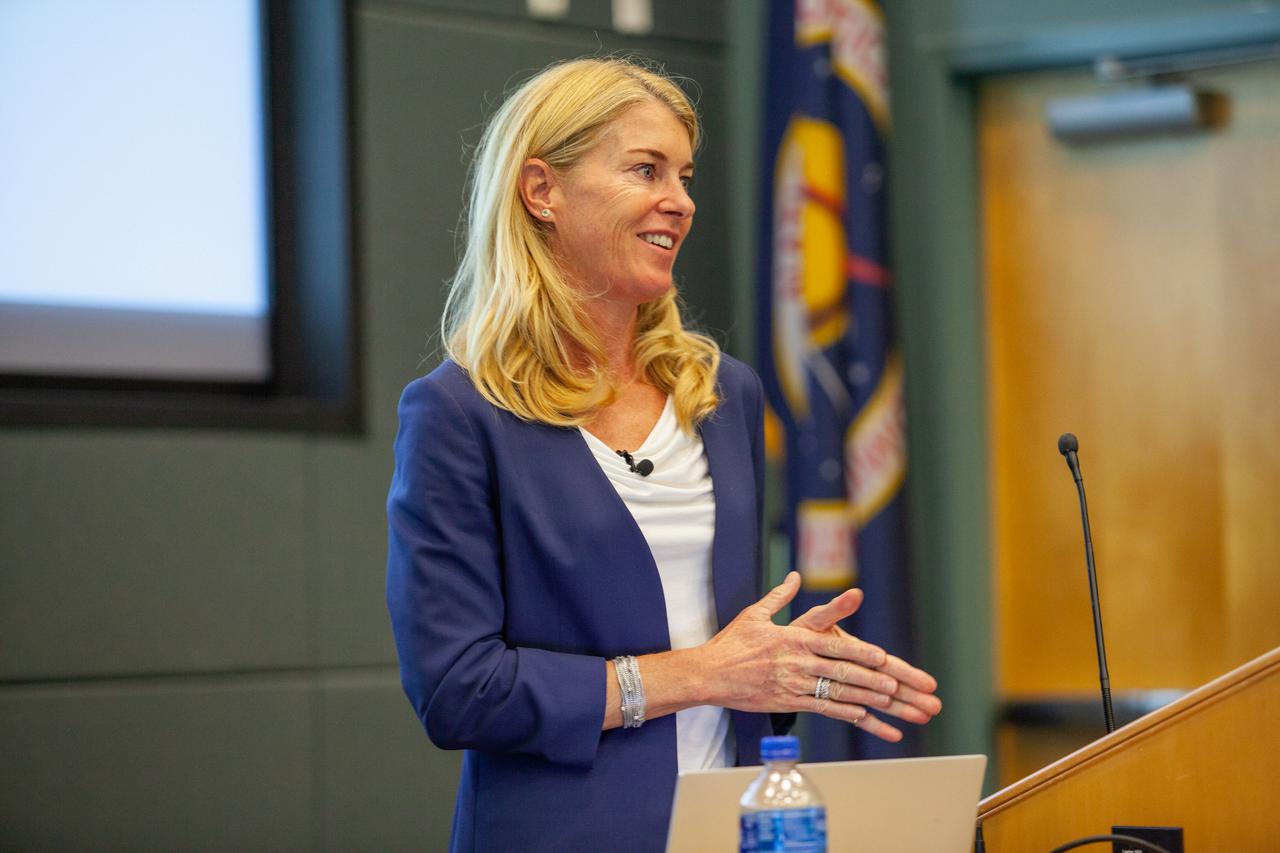
Robin Hauser, a director and producer of award-winning documentaries, delivers a presentation during the “KSC and Proud to Be” centerwide diversity event held at Kennedy Space Center’s Operations Support Building II (OSB II) on Aug. 20, 2019. Hauser, who has spoken at the White House and at conferences worldwide, addressed bias in artificial intelligence. The event wrapped up with the debut showing of a new employee video focusing on the importance of employee resource groups at the center, followed by closing remarks from Kennedy Director Bob Cabana.

The audience tunes in during the “KSC and Proud to Be” centerwide diversity event held at Kennedy Space Center’s Operations Support Building II (OSB II) on Aug. 20, 2019. The event featured a presentation by Robin Hauser, a director and producer of award-winning documentaries. Hauser, who has spoken at the White House and at conferences worldwide, addressed bias in artificial intelligence. A new employee video focusing on the importance of employee resource groups at the center made its debut showing at the event.
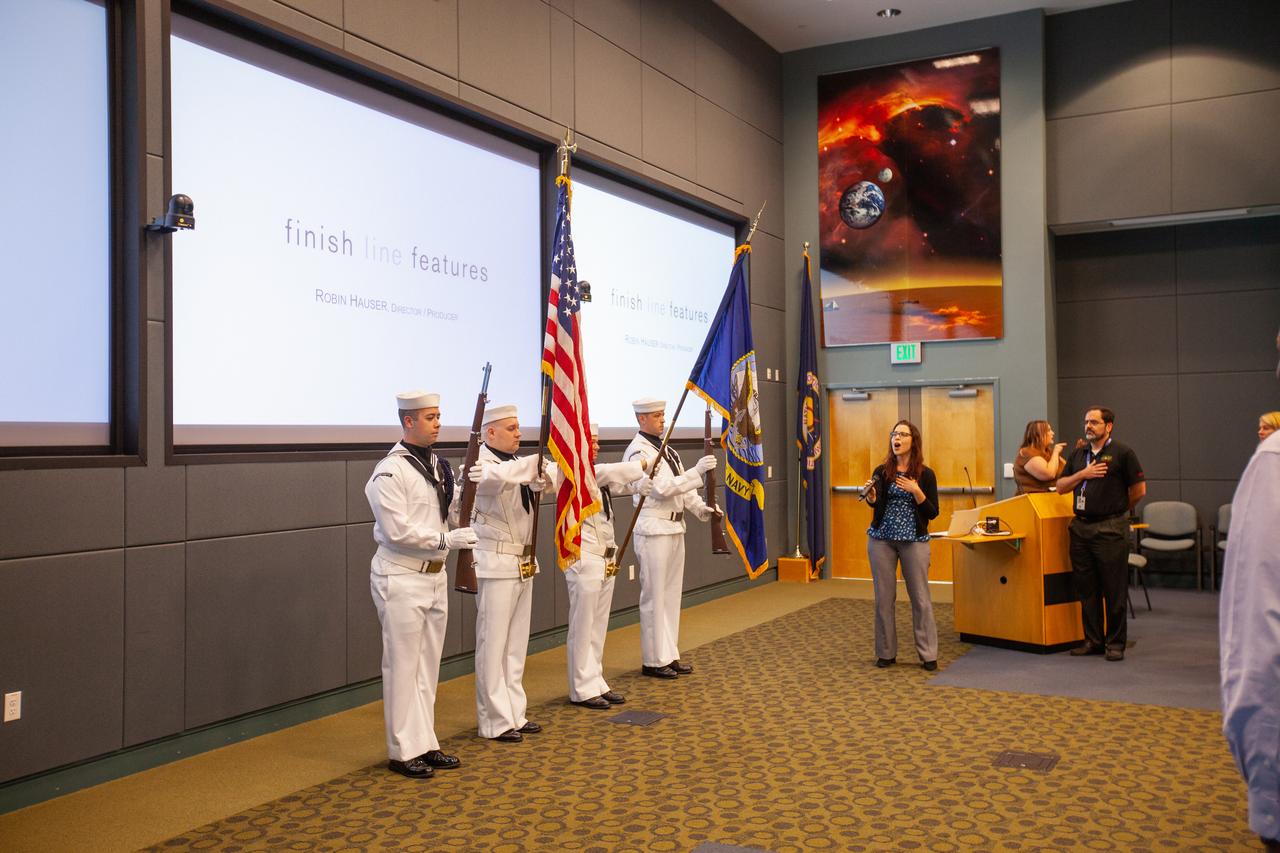
Ivette Aponte, from Kennedy Space Center’s Engineering Directorate, sings the National Anthem at the “KSC and Proud to Be” centerwide diversity event held at the Florida spaceport’s Operations Support Building II (OSB II) on Aug. 20, 2019. The event featured a presentation by Robin Hauser, a director and producer of award-winning documentaries. Hauser, who has spoken at the White House and at conferences worldwide, addressed bias in artificial intelligence. A new employee video focusing on the importance of employee resource groups at the center made its debut showing at the event.
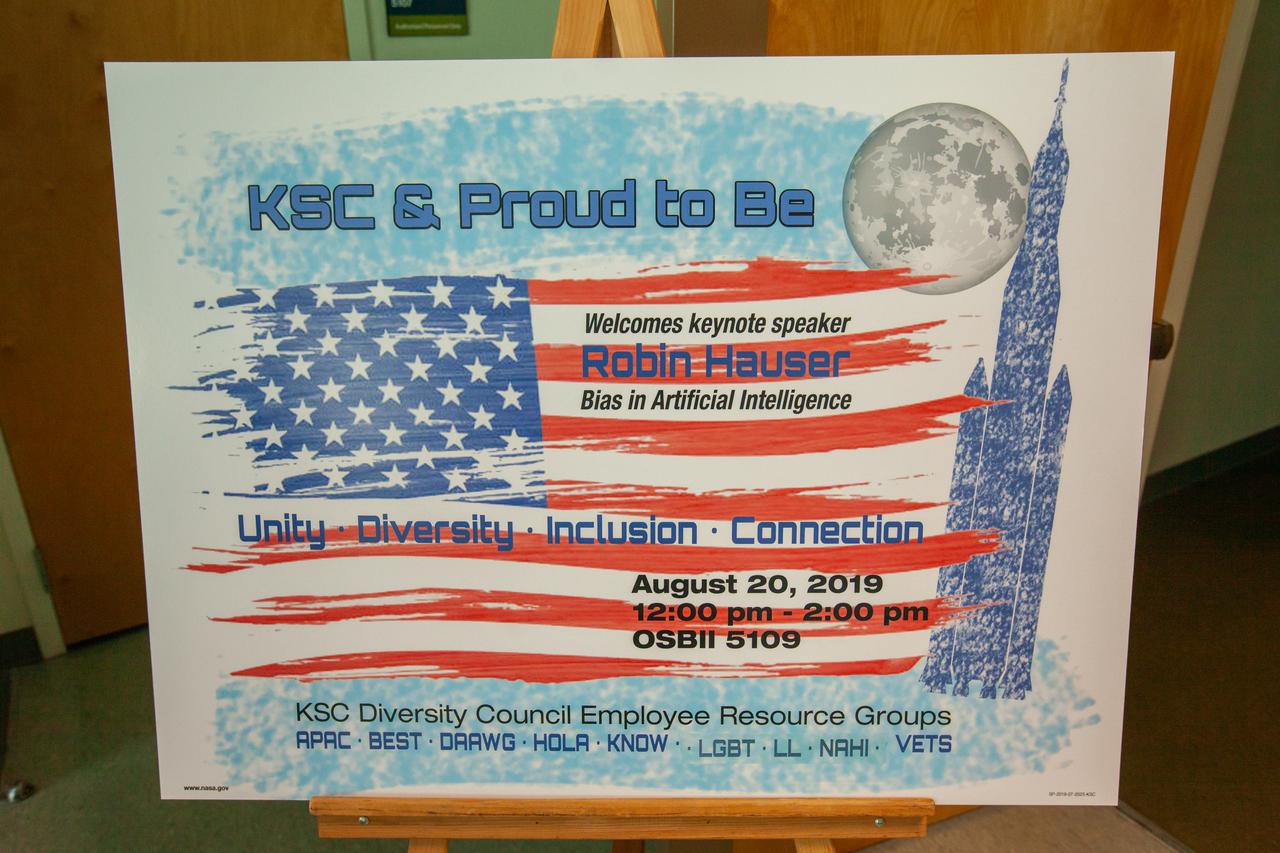
A sign welcomes Kennedy Space Center employees to the “KSC and Proud to Be” centerwide diversity event held at the Florida spaceport’s Operations Support Building II (OSB II) on Aug. 20, 2019. The event featured a presentation by Robin Hauser, a director and producer of award-winning documentaries. Hauser, who has spoken at the White House and at conferences worldwide, addressed bias in artificial intelligence. A new employee video focusing on the importance of employee resource groups at the center made its debut showing at the event.

Kennedy Space Center employees sample food at the “KSC and Proud to Be” centerwide diversity event held at the Florida spaceport’s Operations Support Building II (OSB II) on Aug. 20, 2019. The event featured a presentation by Robin Hauser, a director and producer of award-winning documentaries. Hauser, who has spoken at the White House and at conferences worldwide, addressed bias in artificial intelligence. A new employee video focusing on the importance of employee resource groups at the center made its debut showing at the event.
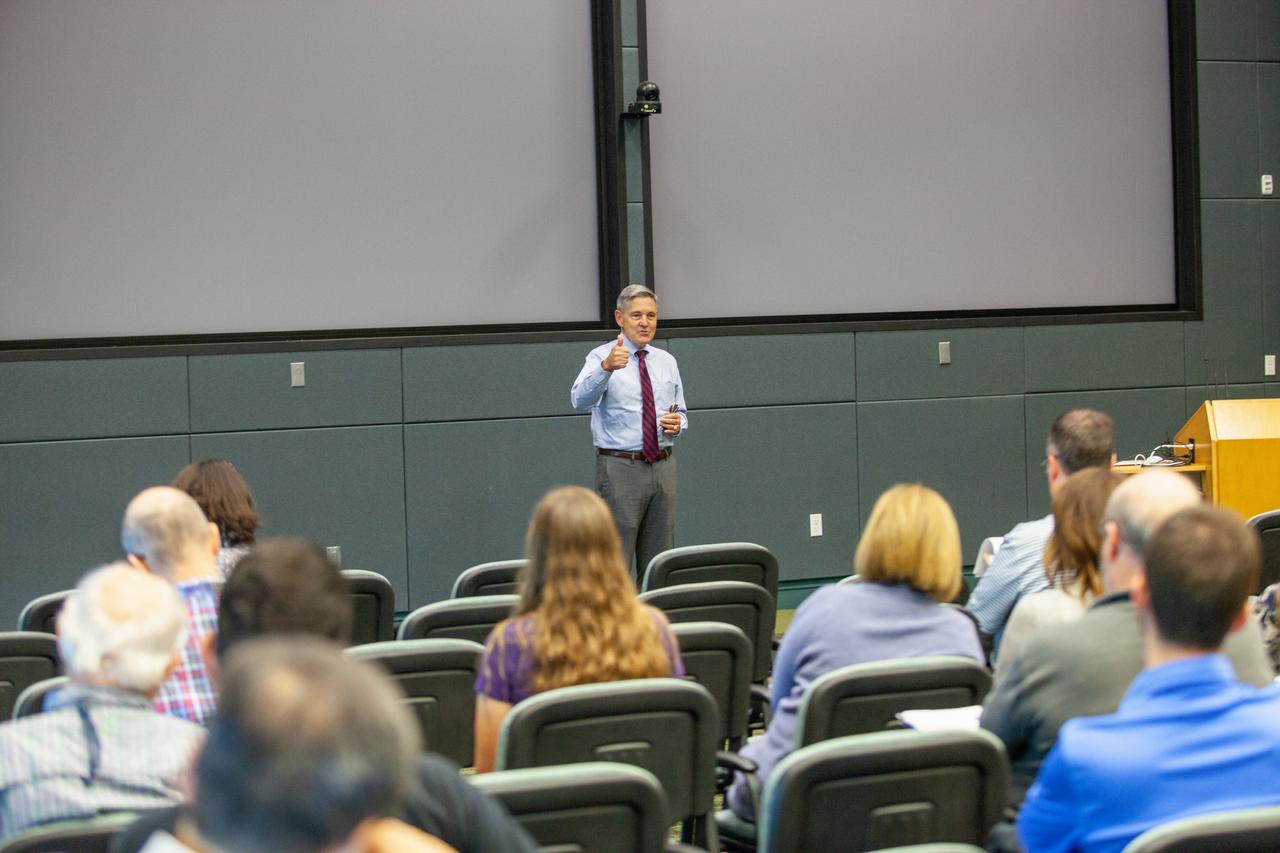
Kennedy Space Center Director Bob Cabana speaks during the “KSC and Proud to Be” centerwide diversity event held at the Florida spaceport’s Operations Support Building II (OSB II) on Aug. 20, 2019. The event featured a presentation by Robin Hauser, a director and producer of award-winning documentaries. Hauser, who has spoken at the White House and at conferences worldwide, addressed bias in artificial intelligence. A new employee video focusing on the importance of employee resource groups at the center made its debut showing at the event.
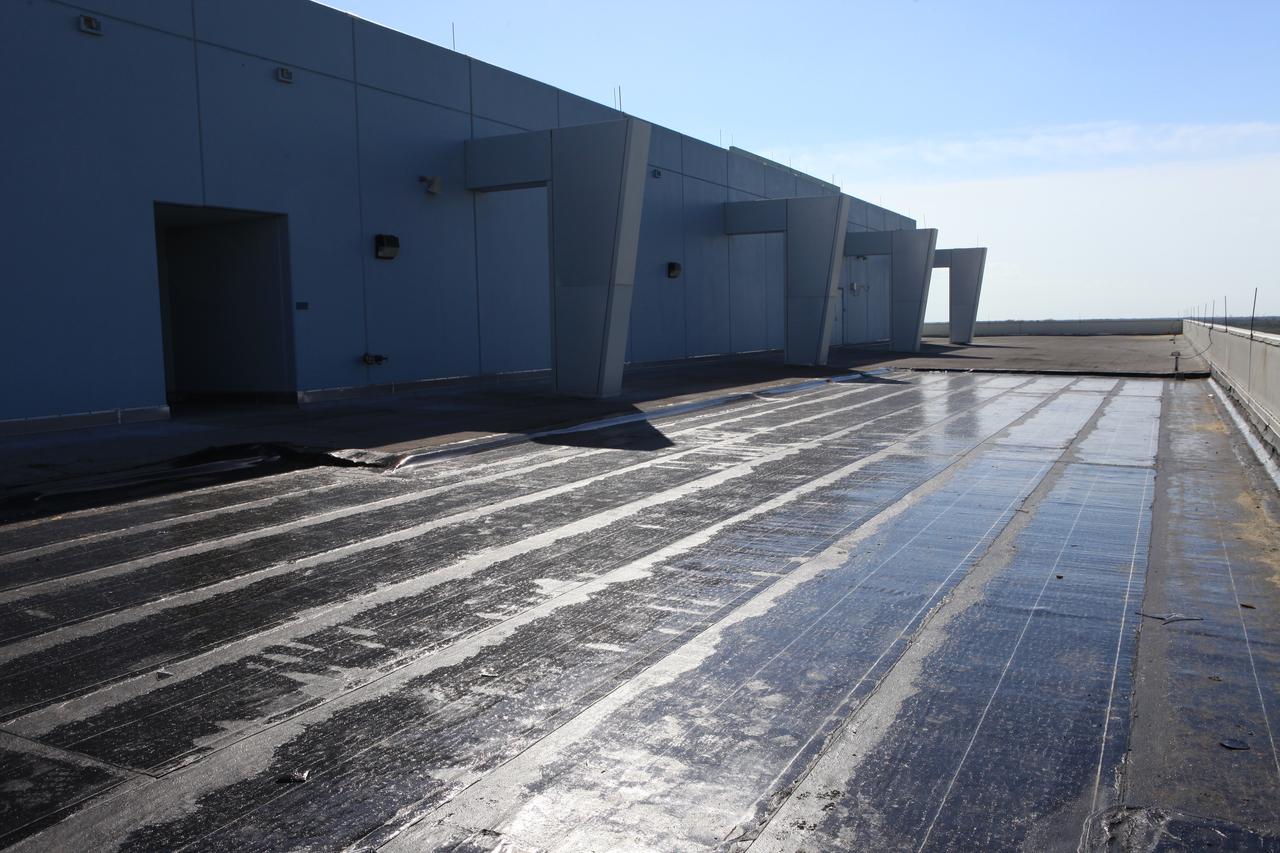
Following Hurricane Matthew, repairs have been made to the roof of the Operations Support Building (OSB) II in the Launch Complex 39 area at NASA's Kennedy Space Center in Florida. Assessments and repairs continue on various structures and facilities across the spaceport, part of the ongoing recovery from the storm, which passed to the east of Kennedy on Oct. 6 and 7, 2016. The center received some isolated roof damage, damaged support buildings, a few downed power lines, and limited water intrusion. Beach erosion also occurred, although the storm surge was less than expected.

Following Hurricane Matthew, repairs have been made to the roof of the Operations Support Building (OSB) II in the Launch Complex 39 area at NASA's Kennedy Space Center in Florida. Assessments and repairs continue on various structures and facilities across the spaceport, part of the ongoing recovery from the storm, which passed to the east of Kennedy on Oct. 6 and 7, 2016. The center received some isolated roof damage, damaged support buildings, a few downed power lines, and limited water intrusion. Beach erosion also occurred, although the storm surge was less than expected.
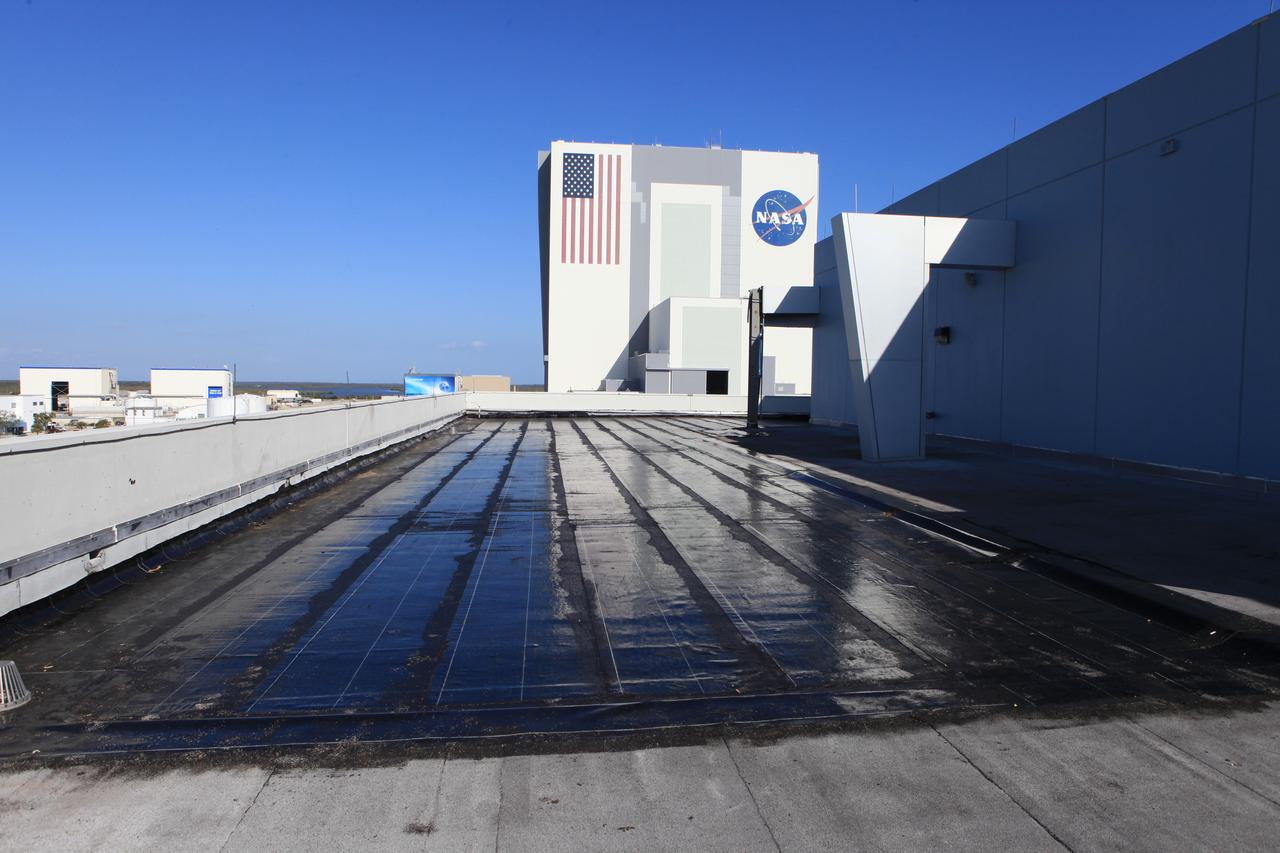
Following Hurricane Matthew, repairs have been made to the roof of the Operations Support Building (OSB) II in the Launch Complex 39 area at NASA's Kennedy Space Center in Florida. Assessments and repairs continue on various structures and facilities across the spaceport, part of the ongoing recovery from the storm, which passed to the east of Kennedy on Oct. 6 and 7, 2016. The center received some isolated roof damage, damaged support buildings, a few downed power lines, and limited water intrusion. Beach erosion also occurred, although the storm surge was less than expected.
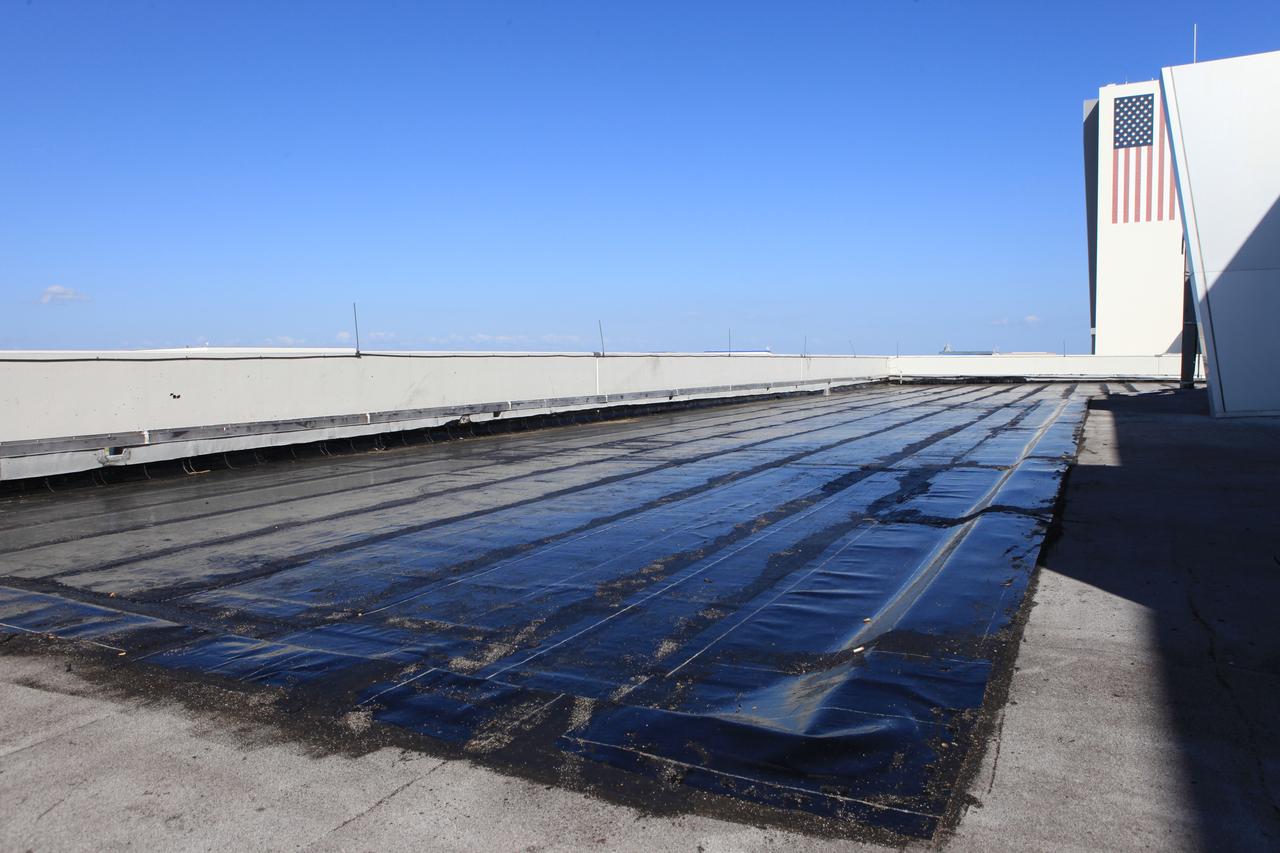
Following Hurricane Matthew, repairs have been made to the roof of the Operations Support Building (OSB) II in the Launch Complex 39 area at NASA's Kennedy Space Center in Florida. Assessments and repairs continue on various structures and facilities across the spaceport, part of the ongoing recovery from the storm, which passed to the east of Kennedy on Oct. 6 and 7, 2016. The center received some isolated roof damage, damaged support buildings, a few downed power lines, and limited water intrusion. Beach erosion also occurred, although the storm surge was less than expected.

Jessica Conner, special emphasis program manager, Office of Diversity and Equal Opportunity, addresses the audience during the “KSC and Proud to Be” centerwide diversity event held at Kennedy Space Center’s Operations Support Building II (OSB II) on Aug. 20, 2019. The event featured a presentation by Robin Hauser, a director and producer of award-winning documentaries. Hauser, who has spoken at the White House and at conferences worldwide, addressed bias in artificial intelligence. A new employee video focusing on the importance of employee resource groups at the center made its debut showing at the event.

Jessica Conner, special emphasis program manager, Office of Diversity and Equal Opportunity, addresses the audience during the “KSC and Proud to Be” centerwide diversity event held at Kennedy Space Center’s Operations Support Building II (OSB II) on Aug. 20, 2019. The event featured a presentation by Robin Hauser, a director and producer of award-winning documentaries. Hauser, who has spoken at the White House and at conferences worldwide, addressed bias in artificial intelligence. A new employee video focusing on the importance of employee resource groups at the center made its debut showing at the event.
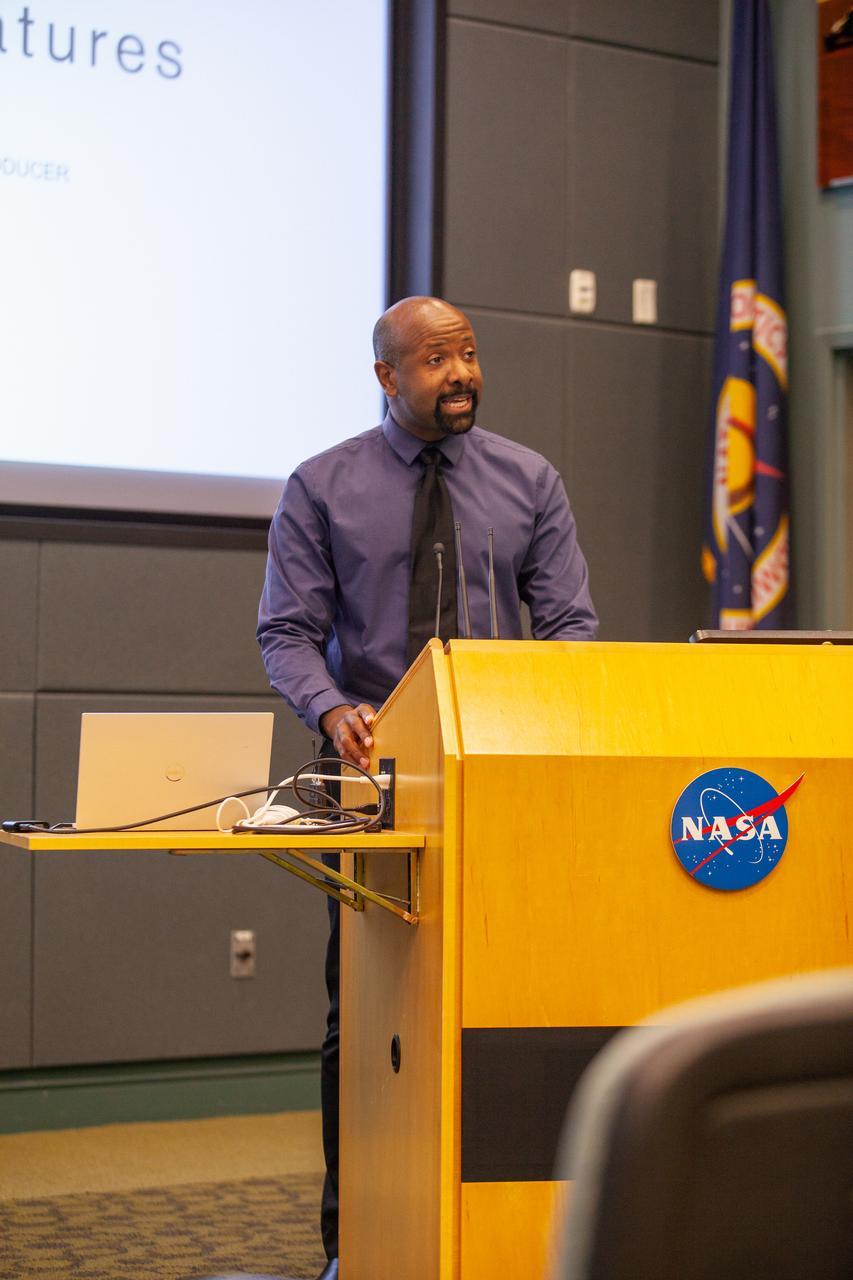
Martin Hayes, co-chair of the Black Employee Strategy Team (BEST) at Kennedy Space Center, speaks during the “KSC and Proud to Be” centerwide diversity event held at the Florida spaceport’s Operations Support Building II (OSB II) on Aug. 20, 2019. The event featured a presentation by Robin Hauser, a director and producer of award-winning documentaries. Hauser, who has spoken at the White House and at conferences worldwide, addressed bias in artificial intelligence. A new employee video focusing on the importance of employee resource groups at the center made its debut showing at the event.
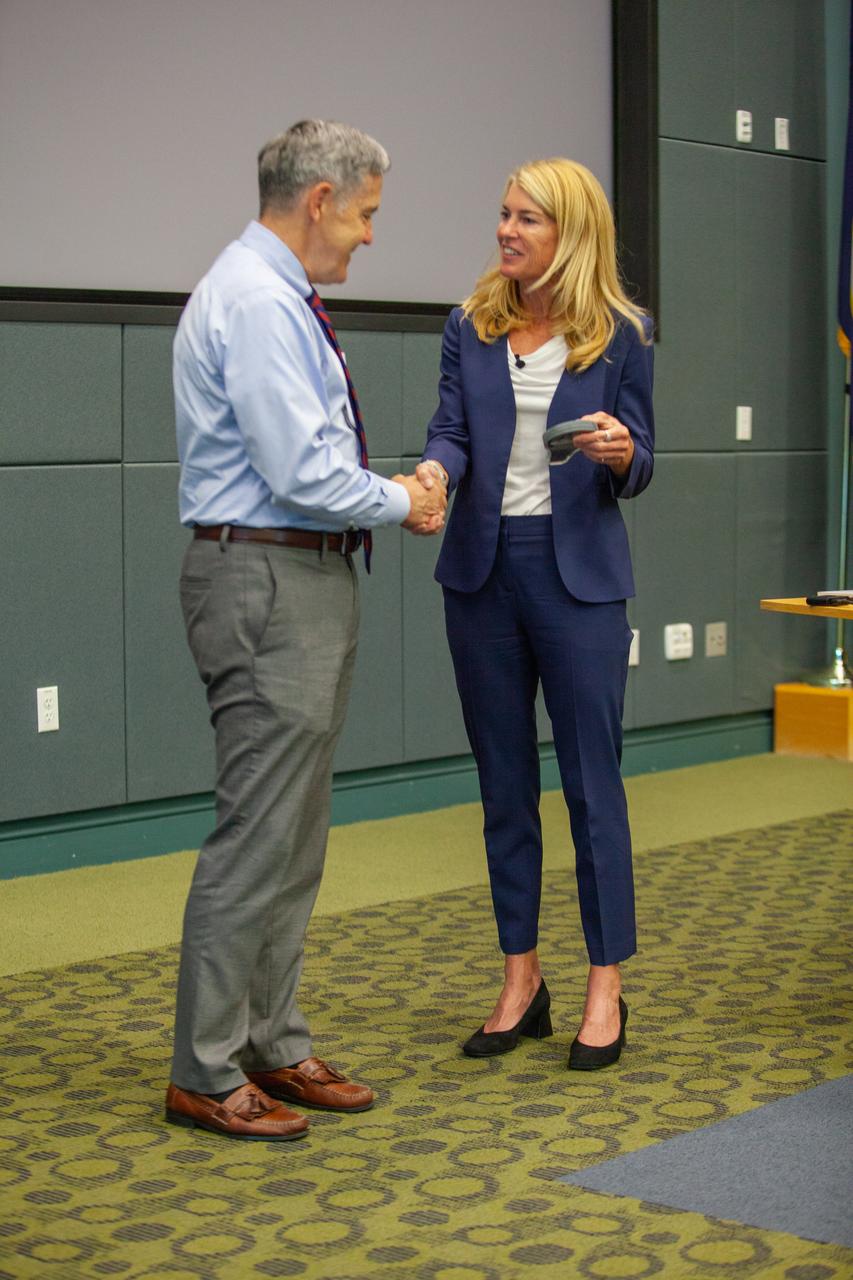
Kennedy Space Center Director Bob Cabana, left, presents well-known documentary filmmaker Robin Hauser with a token of appreciation during the “KSC and Proud to Be” centerwide diversity event held at the Florida spaceport’s Operations Support Building II (OSB II) on Aug. 20, 2019. The plaque was made from glass that was a part of Kennedy’s Launch Control Center during the Apollo and Space Shuttle programs. Hauser, who has spoken at the White House and at conferences worldwide, addressed bias in artificial intelligence. A new employee video focusing on the importance of employee resource groups at the center made its debut showing at the event.
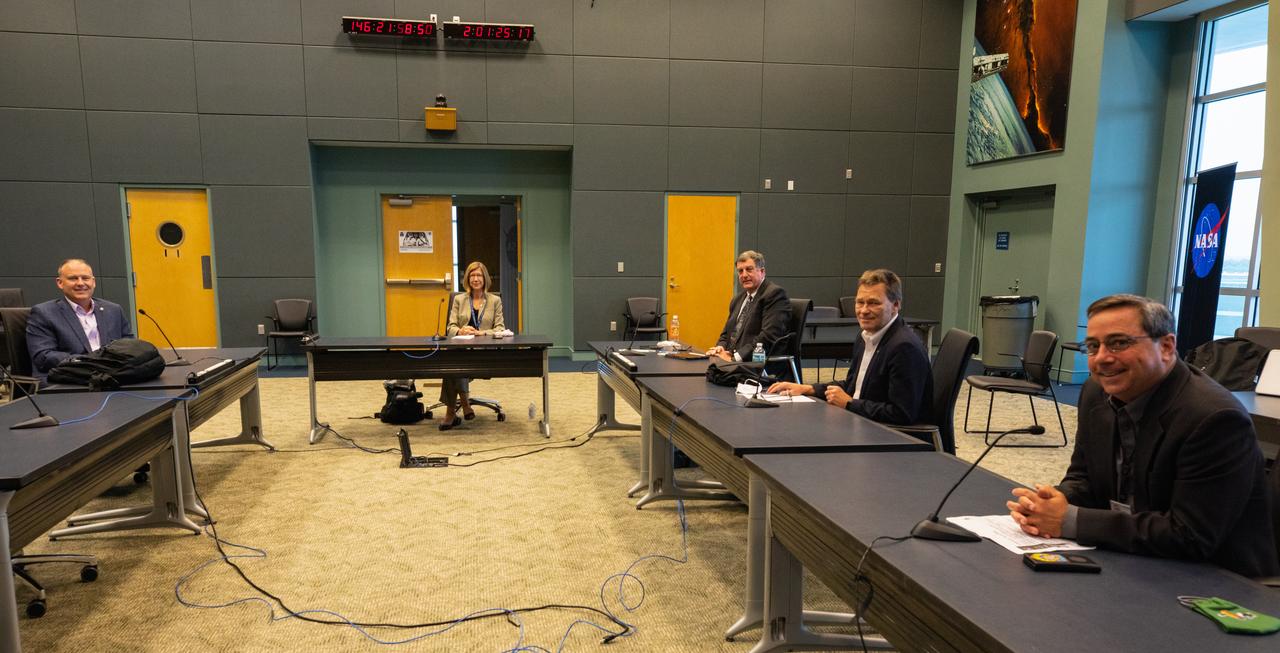
Representatives from NASA, SpaceX and the U.S. Space Force 45th Weather Squadron participate in a news conference following the Launch Readiness Review at the agency’s Kennedy Space Center in Florida on Monday, May 25, 2020, in advance of NASA’s SpaceX Demo-2 Flight Test to the International Space Station as part of NASA’s Commercial Crew Program. From the left are: Norm Knight, deputy director, NASA Johnson Space Center Flight Operations Kathy Lueders, manager, NASA Commercial Crew Program; Kirk Shireman, manager, International Space Station Program; Hans Koenigsmann, vice president, Build and Flight Reliability, SpaceX; and Mike McAleenan, launch weather officer, 45th Weather Squadron. Launch is currently targeted for 4:33 p.m. EDT Wednesday, May 27. The SpaceX Crew Dragon spacecraft will launch on a Falcon 9 rocket from historic Launch Complex 39A at NASA’s Kennedy Space Center in Florida.
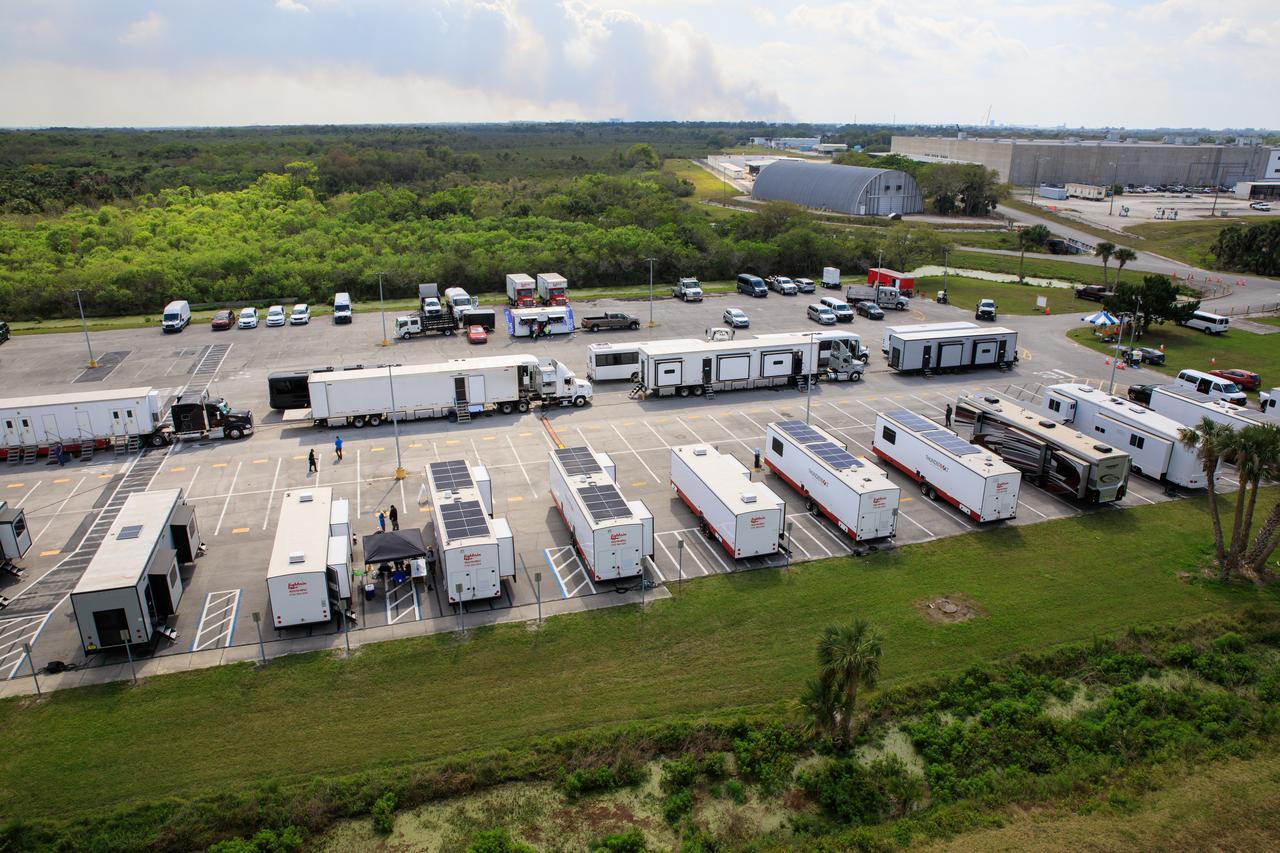
A major motion picture is being filmed in February 2023 at NASA’s Kennedy Space Center in Florida. In view is Base Camp #1 in the Launch Complex 39 area that includes support buildings for the film project.
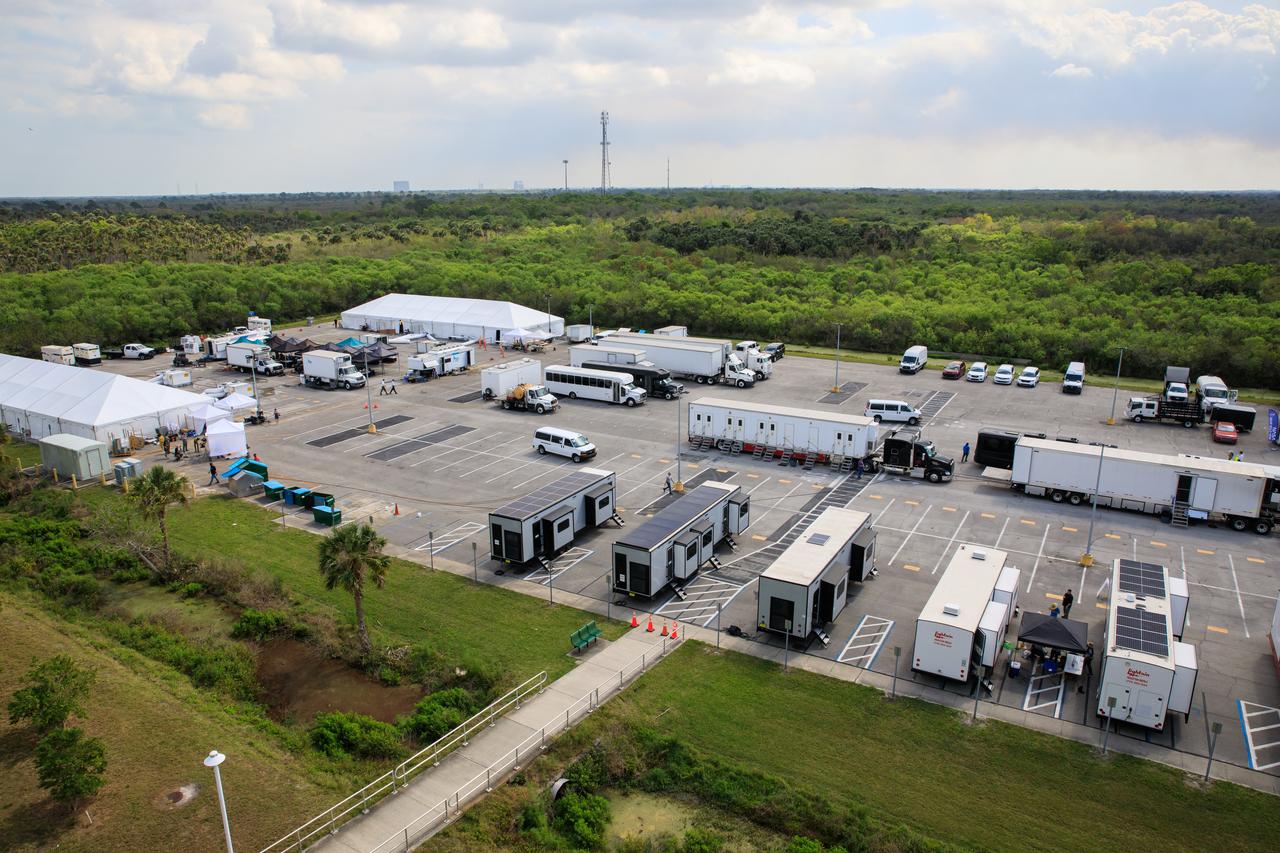
A major motion picture is being filmed in February 2023 at NASA’s Kennedy Space Center in Florida. In view is Base Camp #1 in the Launch Complex 39 area that includes support buildings for the film project.
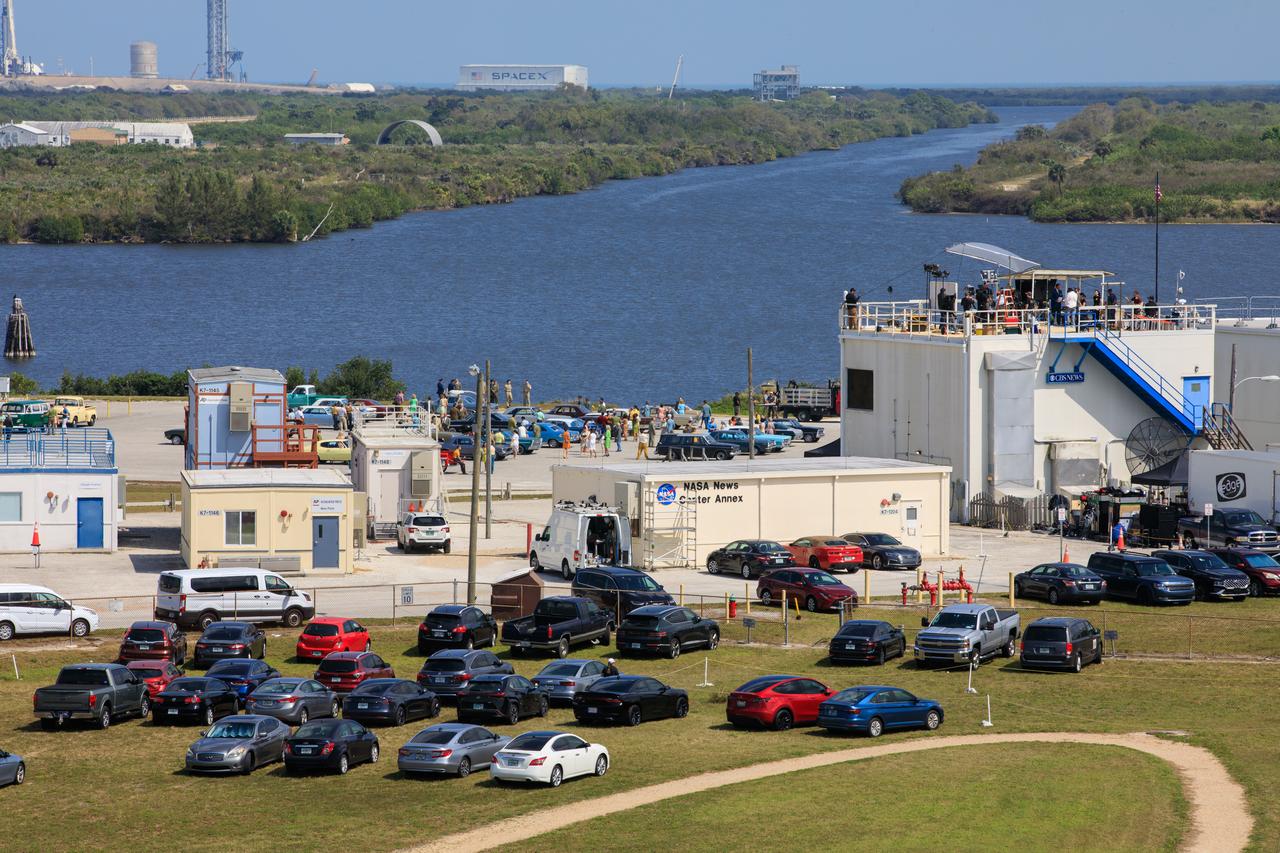
A major motion picture is being filmed in February 2023 at NASA’s Kennedy Space Center in Florida. Filming is in progress in the lower parking lot of the News Center.
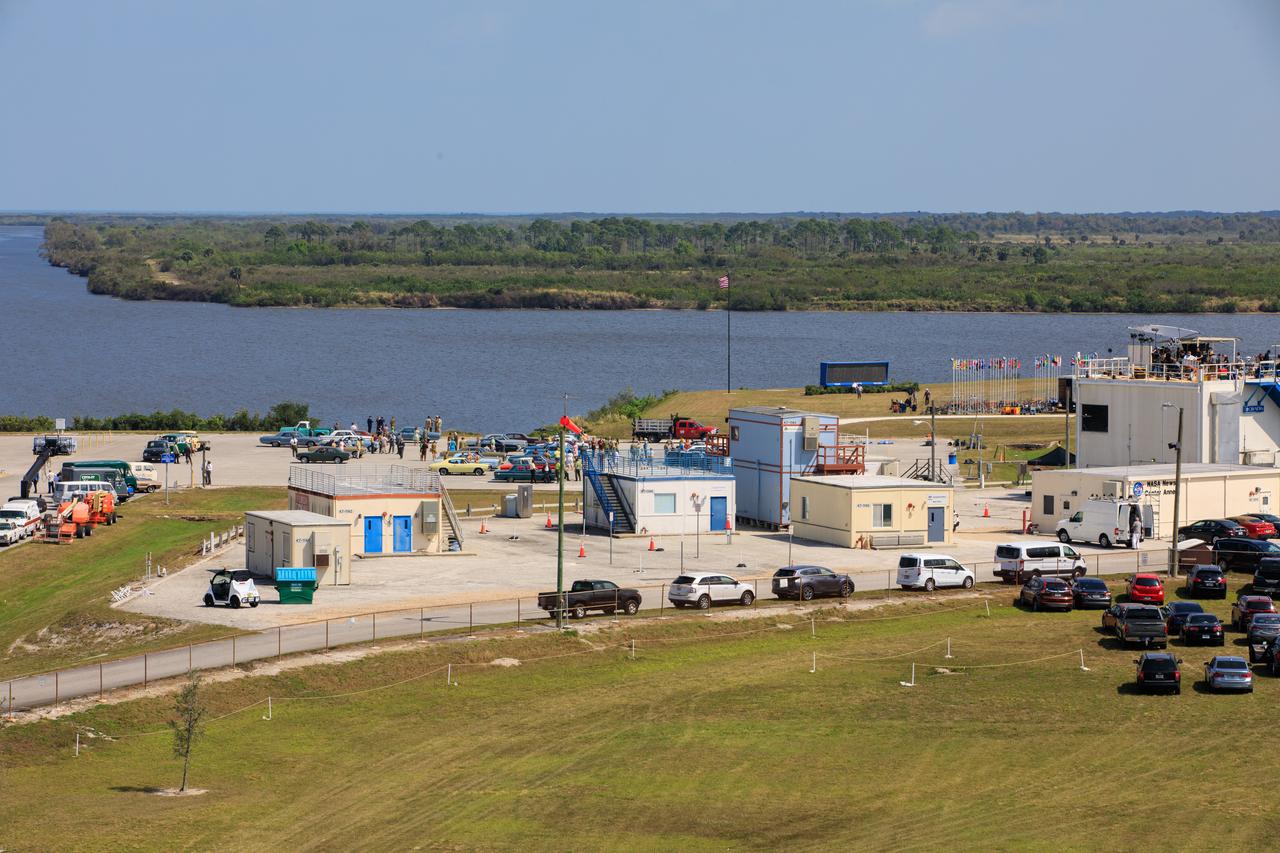
A major motion picture is being filmed in February 2023 at NASA’s Kennedy Space Center in Florida. Filming is in progress in the lower parking lot of the News Center.
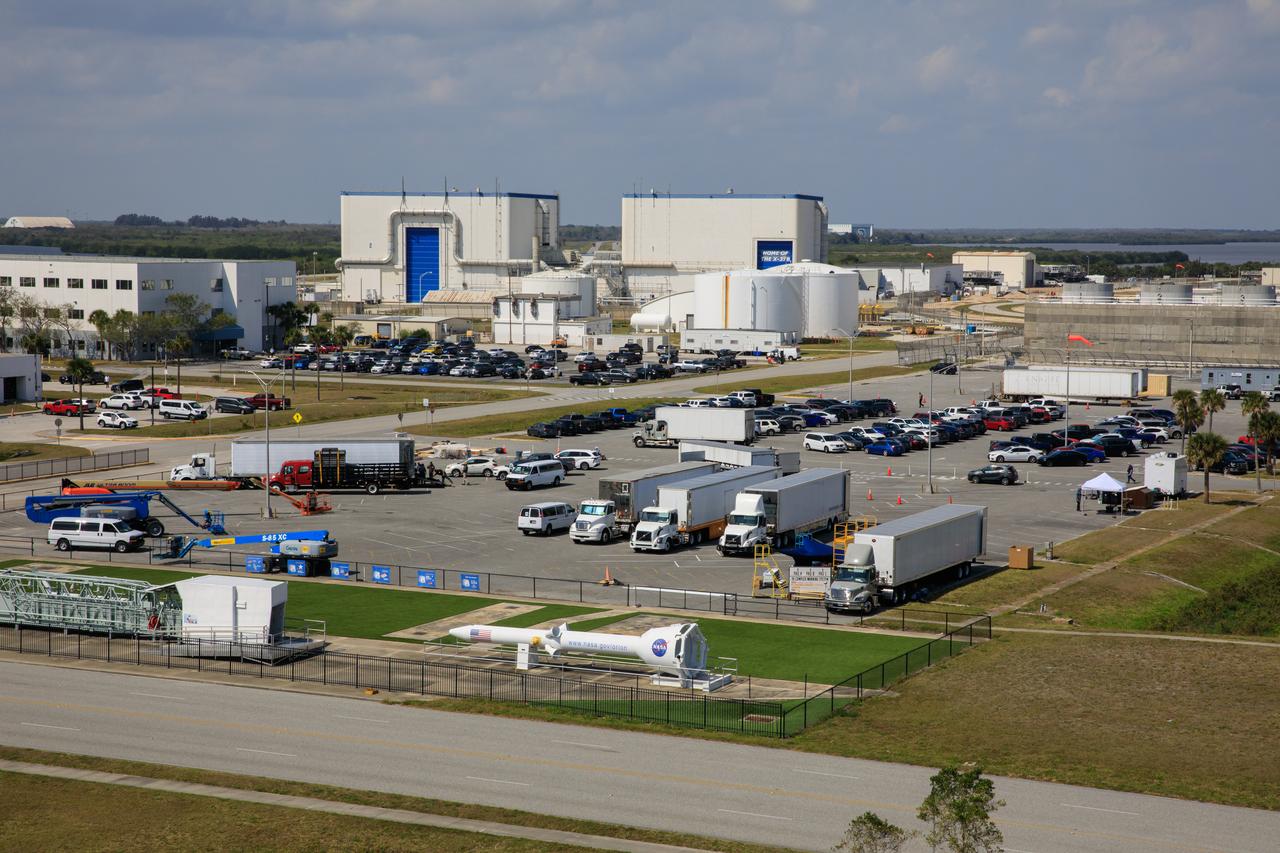
A major motion picture is being filmed in February 2023 at NASA’s Kennedy Space Center in Florida. In view are some of the support vehicles in use for the film project in the Launch Complex 39 area.
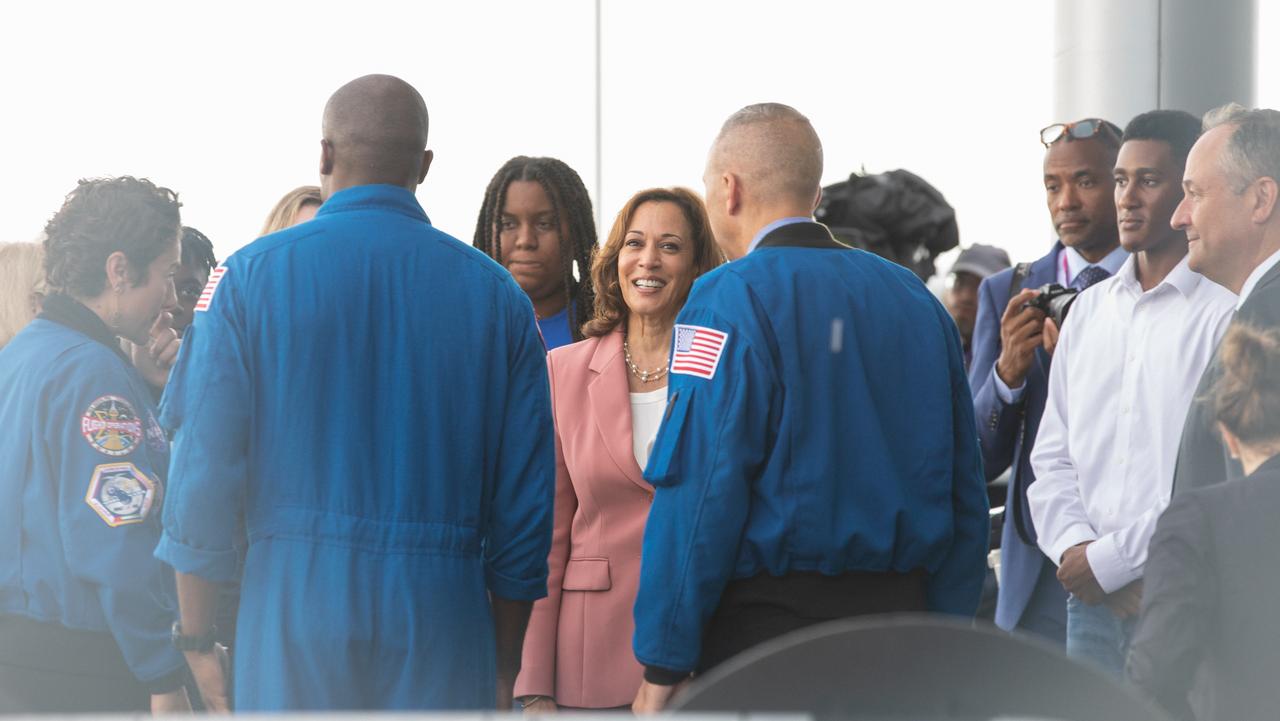
Vice President Kamala Harris visits with NASA astronaut candidate Andre Douglas, at left, and Randy Bresnik, at right, during launch countdown activities on Aug. 29, 2022, at the agency’s Kennedy Space Center in Florida. The launch was waved off for the day. The first in a series of increasingly complex missions, Artemis I will provide a foundation for human deep space exploration and demonstrate our commitment and capability to extend human presence to the Moon and beyond. The primary goal of Artemis I is to thoroughly test the integrated systems before crewed missions by operating the spacecraft in a deep space environment, testing Orion’s heat shield, and recovering the crew module after reentry, descent, and splashdown.
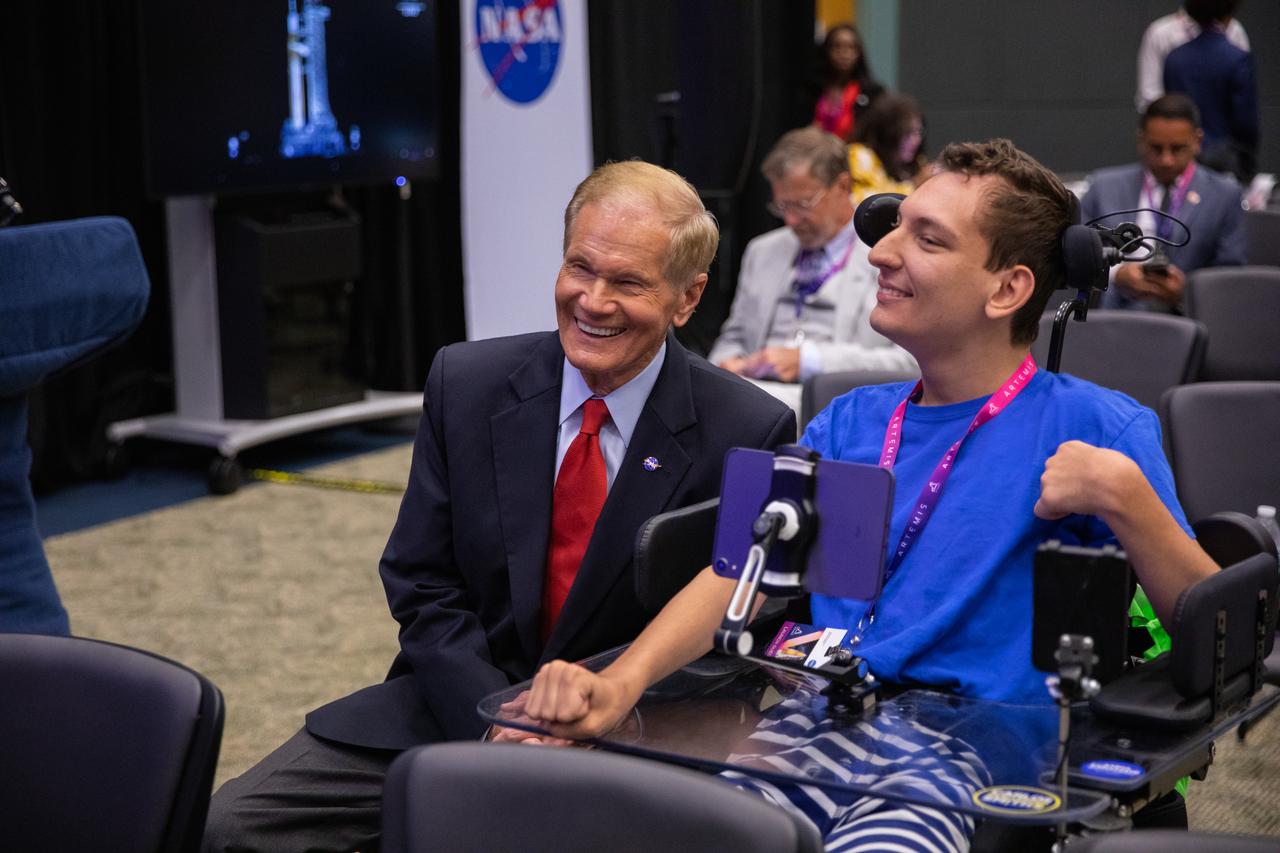
NASA Administrator Bill Nelson, at left, visits with a launch guest during launch countdown activities for NASA’s Artemis I mission on Aug. 29, 2022, at the agency’s Kennedy Space Center in Florida. The launch was waved off for the day. The first in a series of increasingly complex missions, Artemis I will provide a foundation for human deep space exploration and demonstrate our commitment and capability to extend human presence to the Moon and beyond. The primary goal of Artemis I is to thoroughly test the integrated systems before crewed missions by operating the spacecraft in a deep space environment, testing Orion’s heat shield, and recovering the crew module after reentry, descent, and splashdown.
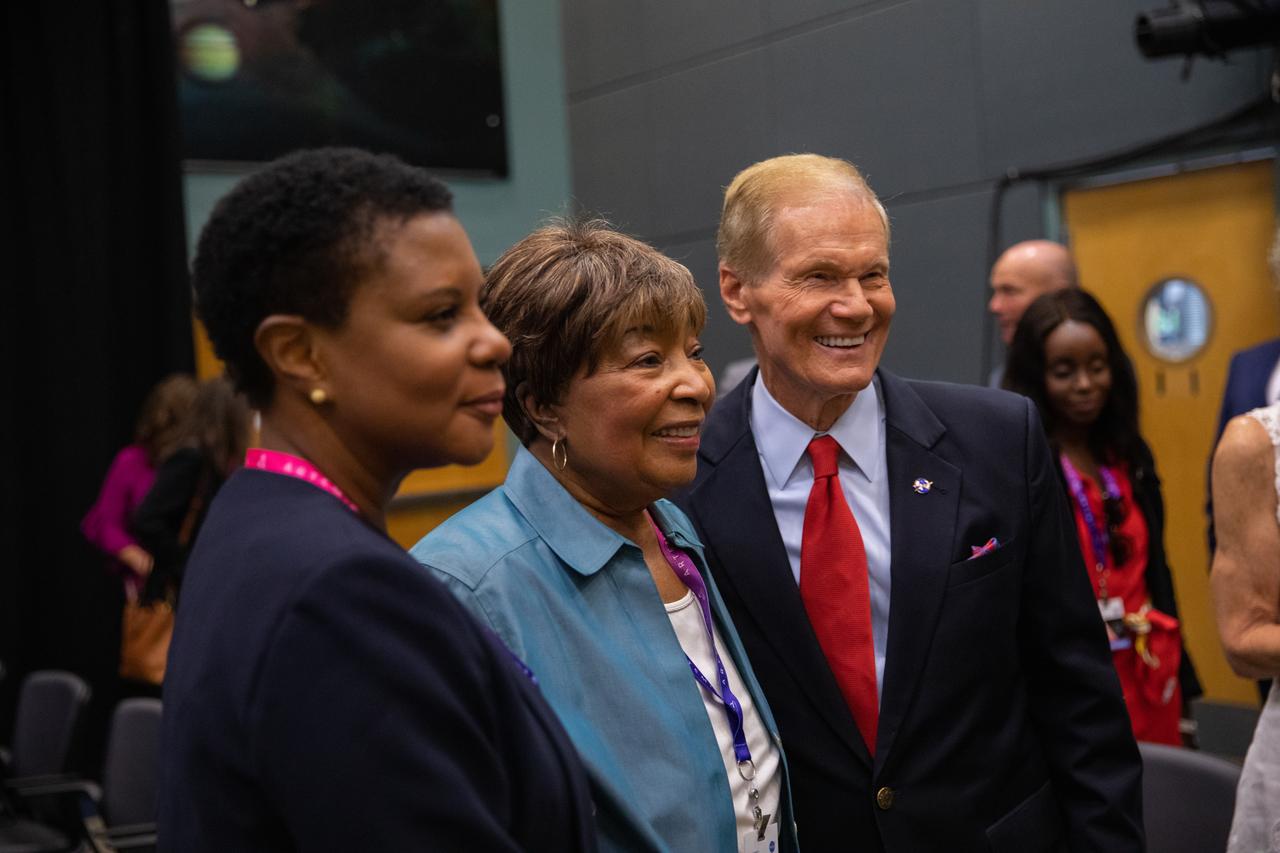
NASA Administrator Bill Nelson, far right, visits with Congresswoman (TX) Eddie Bernice Johnson, center, during launch countdown activities for NASA’s Artemis I mission on Aug. 29, 2022, at the agency’s Kennedy Space Center in Florida. The launch was waved off for the day. The first in a series of increasingly complex missions, Artemis I will provide a foundation for human deep space exploration and demonstrate our commitment and capability to extend human presence to the Moon and beyond. The primary goal of Artemis I is to thoroughly test the integrated systems before crewed missions by operating the spacecraft in a deep space environment, testing Orion’s heat shield, and recovering the crew module after reentry, descent, and splashdown.

Former NASA astronaut Gen. Tom Stafford attends an Artemis I guest briefing during launch countdown activities on Aug. 29, 2022, at the agency’s Kennedy Space Center in Florida. The launch was waved off for the day. The first in a series of increasingly complex missions, Artemis I will provide a foundation for human deep space exploration and demonstrate our commitment and capability to extend human presence to the Moon and beyond. The primary goal of Artemis I is to thoroughly test the integrated systems before crewed missions by operating the spacecraft in a deep space environment, testing Orion’s heat shield, and recovering the crew module after reentry, descent, and splashdown.
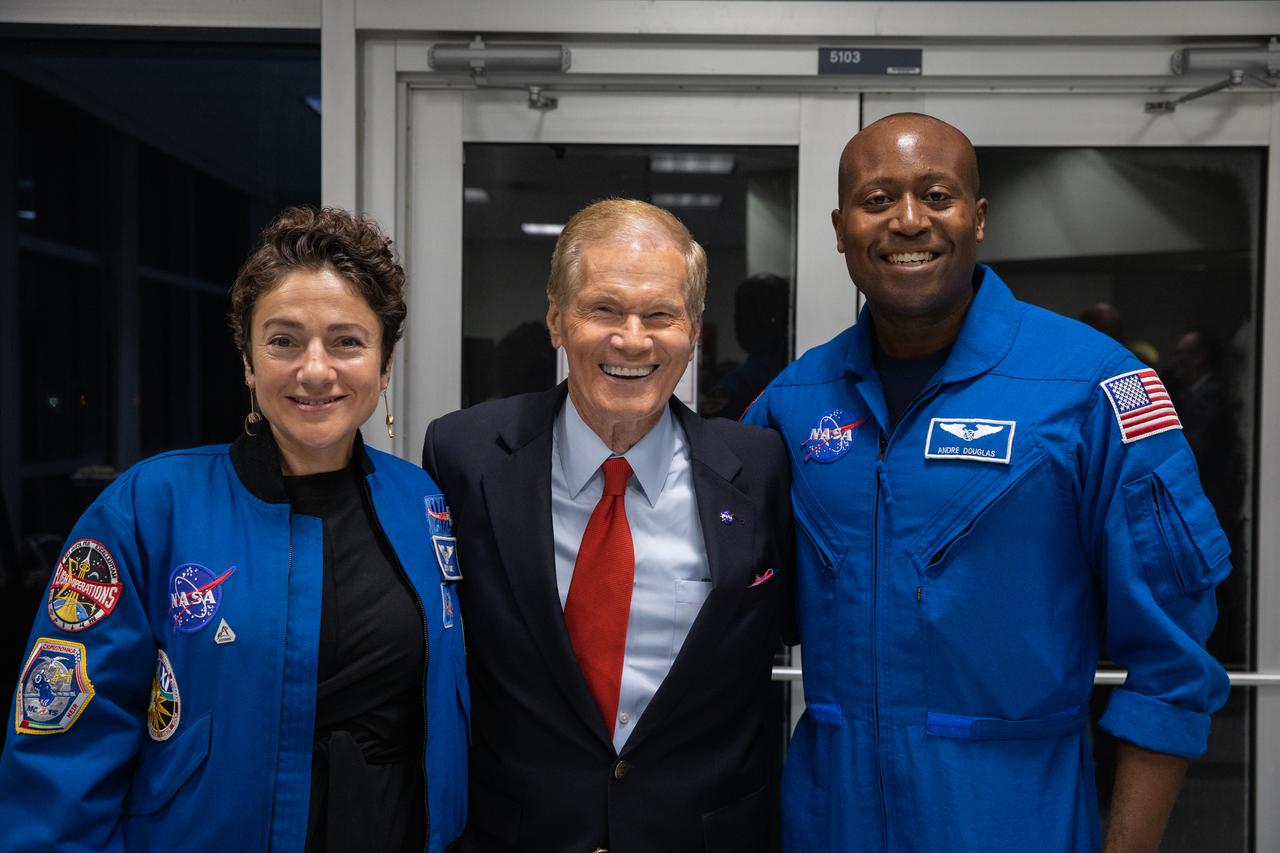
NASA Administrator Bill Nelson, center, visits with NASA astronaut Jessica Meir, at right, and astronaut candidate Andre Douglas, during launch countdown activities for NASA’s Artemis I mission on Aug. 29, 2022, at the agency’s Kennedy Space Center in Florida. The launch was waved off for the day. The first in a series of increasingly complex missions, Artemis I will provide a foundation for human deep space exploration and demonstrate our commitment and capability to extend human presence to the Moon and beyond. The primary goal of Artemis I is to thoroughly test the integrated systems before crewed missions by operating the spacecraft in a deep space environment, testing Orion’s heat shield, and recovering the crew module after reentry, descent, and splashdown.

NASA Associate Administrator Amit Kshatriya participates in the Artemis II Flight Readiness Review with NASA leadership on Wednesday, March 11, 2026, at NASA’s Kennedy Space Center in Florida. The review is an assessment of the readiness of NASA’s SLS (Space Launch System) rocket and Orion spacecraft to support the Artemis II test flight as four astronauts journey around the Moon and return to Earth.

From left, Charlie Blackwell-Thompson, launch director, Exploration Ground Systems Program and Lili Villarreal, Artemis II landing and recovery director in Exploration Ground Systems Program at NASA’s Kennedy Space Center in Florida, participate in the Artemis II Flight Readiness Review with NASA leadership on Wednesday, March 11, 2026, at NASA Kennedy. The review is an assessment of the readiness of NASA’s SLS (Space Launch System) rocket and Orion spacecraft to support the Artemis II test flight as four astronauts journey around the Moon and return to Earth.

From left, NASA Associate Administrator Amit Kshatriya and Lori Glaze, acting associate administrator, Exploration Systems Development Mission Directorate, participate in the Artemis II Flight Readiness Review with NASA leadership on Wednesday, March 11, 2026, at NASA’s Kennedy Space Center in Florida. The review is an assessment of the readiness of NASA’s SLS (Space Launch System) rocket and Orion spacecraft to support the Artemis II test flight as four astronauts journey around the Moon and return to Earth.

Kennedy Space Center Deputy Director Kelvin Manning participates in the Artemis II Flight Readiness Review with NASA leadership on Wednesday, March 11, 2026, at NASA’s Kennedy Space Center in Florida. The review is an assessment of the readiness of NASA’s SLS (Space Launch System) rocket and Orion spacecraft to support the Artemis II test flight as four astronauts journey around the Moon and return to Earth.
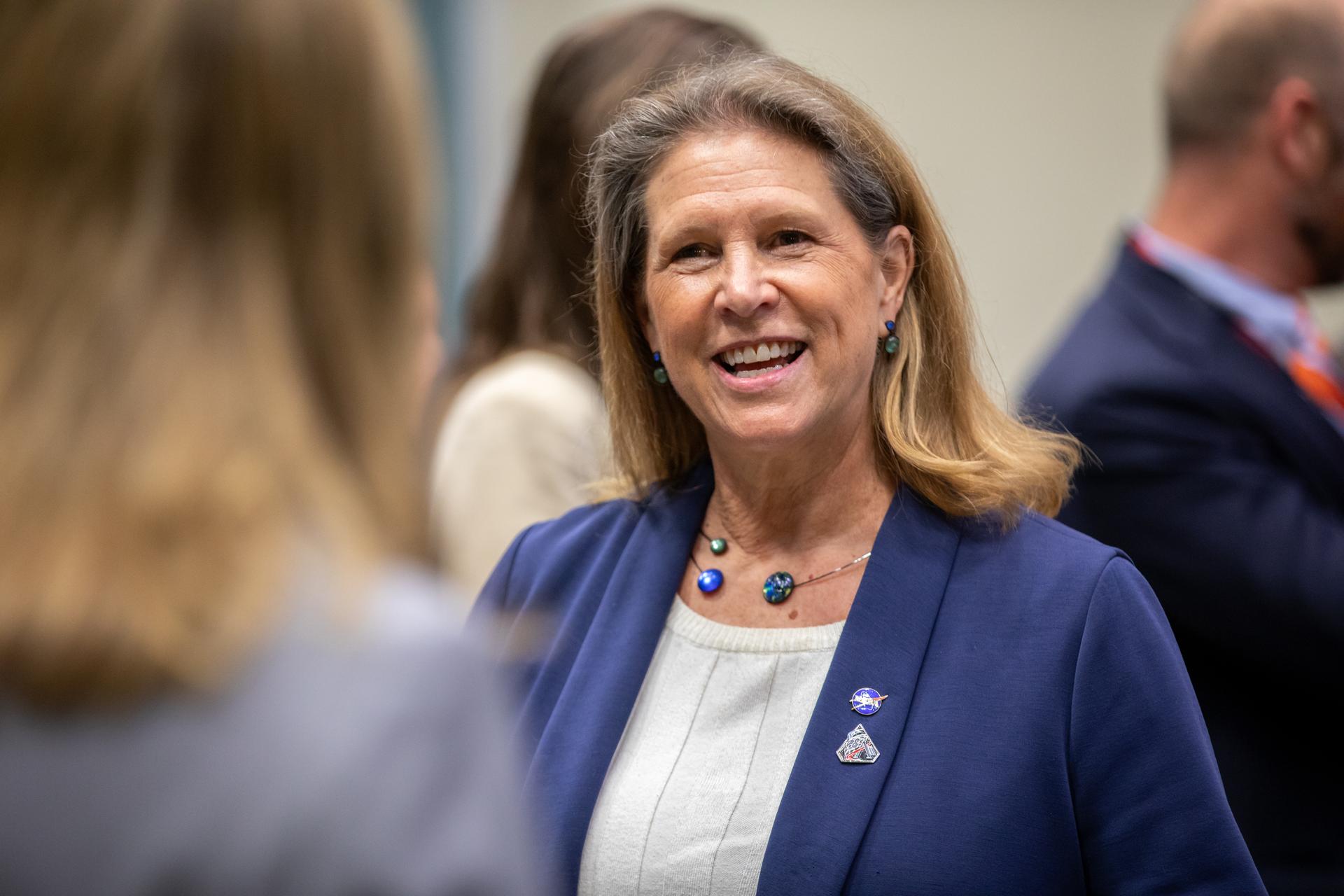
Lori Glaze, acting associate administrator, NASA’s Exploration Systems Development Mission Directorate, participates in the Artemis II Flight Readiness Review with NASA leadership on Wednesday, March 11, 2026, at NASA’s Kennedy Space Center in Florida. The review is an assessment of the readiness of NASA’s SLS (Space Launch System) rocket and Orion spacecraft to support the Artemis II test flight as four astronauts journey around the Moon and return to Earth.

NASA astronaut Randy Bresnik participates in the Artemis II Flight Readiness Review with NASA leadership on Wednesday, March 11, 2026, at NASA’s Kennedy Space Center in Florida. The review is an assessment of the readiness of NASA’s SLS (Space Launch System) rocket and Orion spacecraft to support the Artemis II test flight as four astronauts journey around the Moon and return to Earth.

NASA leadership, with Artemis II astronauts Christina Koch, Victor Glover, Reid Wiseman, and CSA (Canadian Space Agency) Jeremy Hansen joining virtually, participate in the Artemis II Flight Readiness Review on Wednesday, March 11, 2026, at NASA’s Kennedy Space Center in Florida. The review is an assessment of the readiness of NASA’s SLS (Space Launch System) rocket and Orion spacecraft to support the Artemis II test flight as four astronauts journey around the Moon and return to Earth.
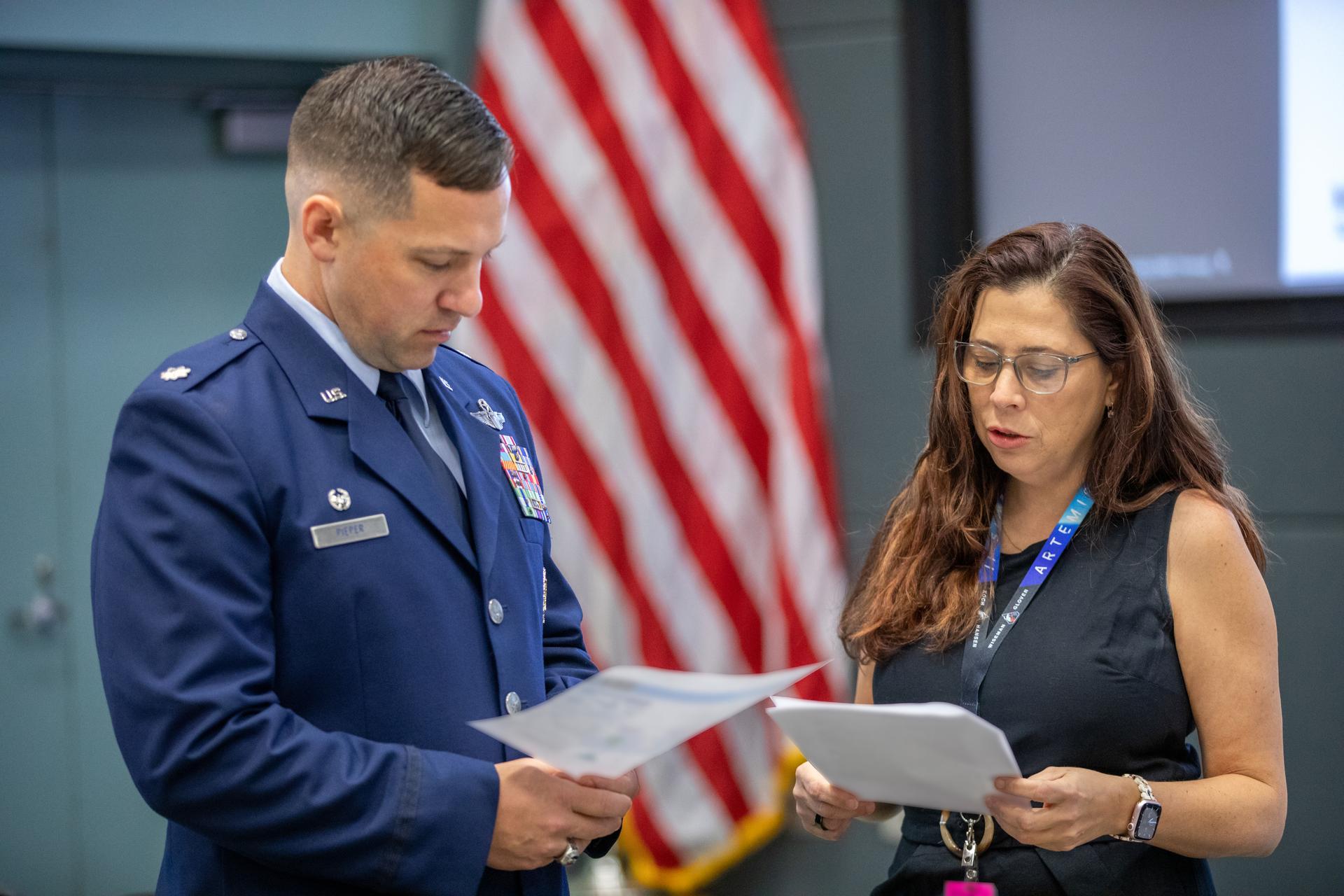
From left, Lieutenant Colonel Kevin M. Pieper, 1st Air Force, Detachment 3 at Patrick Space Force Base in Florida and Lili Villarreal, Artemis II landing and recovery director in Exploration Ground Systems Program at NASA’s Kennedy Space Center in Florida, participate in the Artemis II Flight Readiness Review with NASA leadership on Wednesday, March 11, 2026, at NASA Kennedy. The review is an assessment of the readiness of NASA’s SLS (Space Launch System) rocket and Orion spacecraft to support the Artemis II test flight as four astronauts journey around the Moon and return to Earth.
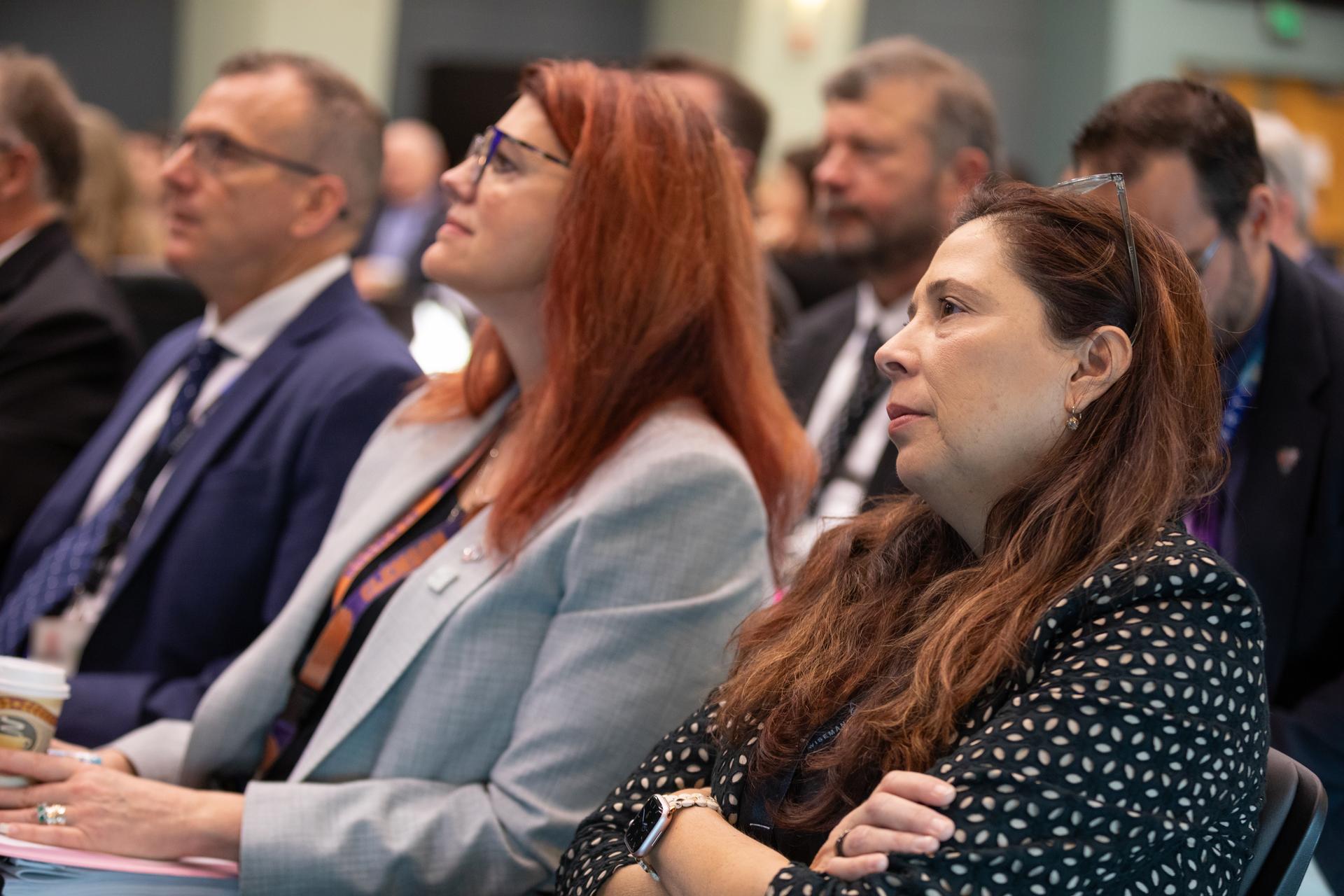
From left, Cliff Lanham, deputy manager, Exploration Ground Systems; Charlie Blackwell-Thompson, launch director, Exploration Ground Systems Program; and Lili Villarreal, Artemis II landing and recovery director in Exploration Ground Systems Program at NASA’s Kennedy Space Center in Florida, participate in the Artemis II Flight Readiness Review with NASA leadership on Wednesday, March 11, 2026, at NASA Kennedy. The review is an assessment of the readiness of NASA’s SLS (Space Launch System) rocket and Orion spacecraft to support the Artemis II test flight as four astronauts journey around the Moon and return to Earth.

From left, NASA Associate Administrator Amit Kshatriya; Lori Glaze, acting associate administrator, Exploration Systems Development Mission Directorate; and John Honeycutt, chair, Artemis II mission management team, participate in the Artemis II Flight Readiness Review with NASA leadership on Wednesday, March 11, 2026, at NASA’s Kennedy Space Center in Florida. The review is an assessment of the readiness of NASA’s SLS (Space Launch System) rocket and Orion spacecraft to support the Artemis II test flight as four astronauts journey around the Moon and return to Earth.

From left, Shawn Quinn, manager, Exploration Ground Systems Program; Cliff Lanham, deputy manager, Exploration Ground Systems; and Charlie Blackwell-Thompson, launch director, Exploration Ground Systems Program Program at NASA’s Kennedy Space Center in Florida, participate in the Artemis II Flight Readiness Review with NASA leadership on Wednesday, March 11, 2026, at NASA Kennedy. The review is an assessment of the readiness of NASA’s SLS (Space Launch System) rocket and Orion spacecraft to support the Artemis II test flight as four astronauts journey around the Moon and return to Earth.

From left, Kennedy Space Center Director Janet Petro and Charlie Blackwell-Thompson, launch director, Exploration Ground Systems Program, participate in the Artemis II Flight Readiness Review with NASA leadership on Wednesday, March 11, 2026, at NASA’s Kennedy Space Center in Florida. The review is an assessment of the readiness of NASA’s SLS (Space Launch System) rocket and Orion spacecraft to support the Artemis II test flight as four astronauts journey around the Moon and return to Earth.

From left, Joel Montalbano acting associate administrator for NASA’s Space Operations Mission Directorate at NASA Headquarters and Nicky Fox, associate administrator, Science Mission Directorate, NASA Headquarters, participate in the Artemis II Flight Readiness Review with NASA leadership on Wednesday, March 11, 2026, at NASA’s Kennedy Space Center in Florida. The review is an assessment of the readiness of NASA’s SLS (Space Launch System) rocket and Orion spacecraft to support the Artemis II test flight as four astronauts journey around the Moon and return to Earth.

From left, Kennedy Space Center Director Janet Petro; Charlie Blackwell-Thompson, launch director, Exploration Ground Systems Program; and Shawn Quinn, manager, Exploration Ground Systems Program, participate in the Artemis II Flight Readiness Review with NASA leadership on Wednesday, March 11, 2026, at NASA’s Kennedy Space Center in Florida. The review is an assessment of the readiness of NASA’s SLS (Space Launch System) rocket and Orion spacecraft to support the Artemis II test flight as four astronauts journey around the Moon and return to Earth.

From left, John Honeycutt, chair, Artemis II mission management team and Lori Glaze, acting associate administrator, Exploration Systems Development Mission Directorate, with Artemis II astronauts Christina Koch, Victor Glover, Reid Wiseman, and CSA (Canadian Space Agency) Jeremy Hansen joining virtually, participate in the Artemis II Flight Readiness Review with NASA leadership on Wednesday, March 11, 2026, at NASA’s Kennedy Space Center in Florida. The review is an assessment of the readiness of NASA’s SLS (Space Launch System) rocket and Orion spacecraft to support the Artemis II test flight as four astronauts journey around the Moon and return to Earth.

Kennedy Space Center Director Janet Petro participates in the Artemis II Flight Readiness Review with NASA leadership on Wednesday, March 11, 2026, at NASA’s Kennedy Space Center in Florida. The review is an assessment of the readiness of NASA’s SLS (Space Launch System) rocket and Orion spacecraft to support the Artemis II test flight as four astronauts journey around the Moon and return to Earth.

NASA leadership, with Artemis II astronauts Christina Koch, Victor Glover, Reid Wiseman, and CSA (Canadian Space Agency) Jeremy Hansen joining virtually, participate in the Artemis II Flight Readiness Review on Wednesday, March 11, 2026, at NASA’s Kennedy Space Center in Florida. The review is an assessment of the readiness of NASA’s SLS (Space Launch System) rocket and Orion spacecraft to support the Artemis II test flight as four astronauts journey around the Moon and return to Earth.
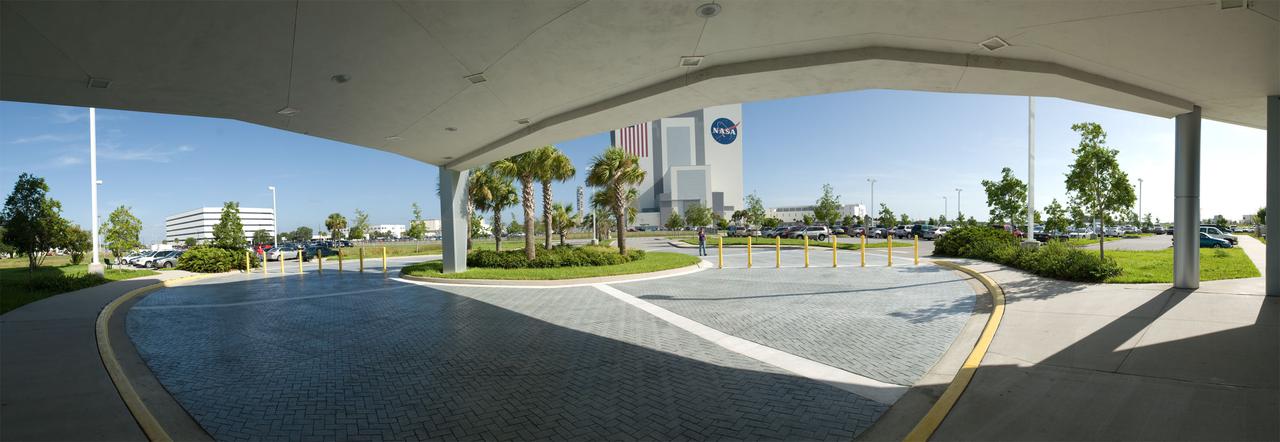
CAPE CANAVERAL, Fla. -- The panoramic view of the Vehicle Assembly Building, or VAB, at NASA's Kennedy Space Center in Florida is taken from under the porte cochere of the Operations Support Building, or OSB, II located in the Launch Complex 39 area. OSB I also is seen towards to the left of the VAB. To the right of the VAB in the distance, is the 4-story Launch Control Center. Photo credit: NASA_Frankie Martin
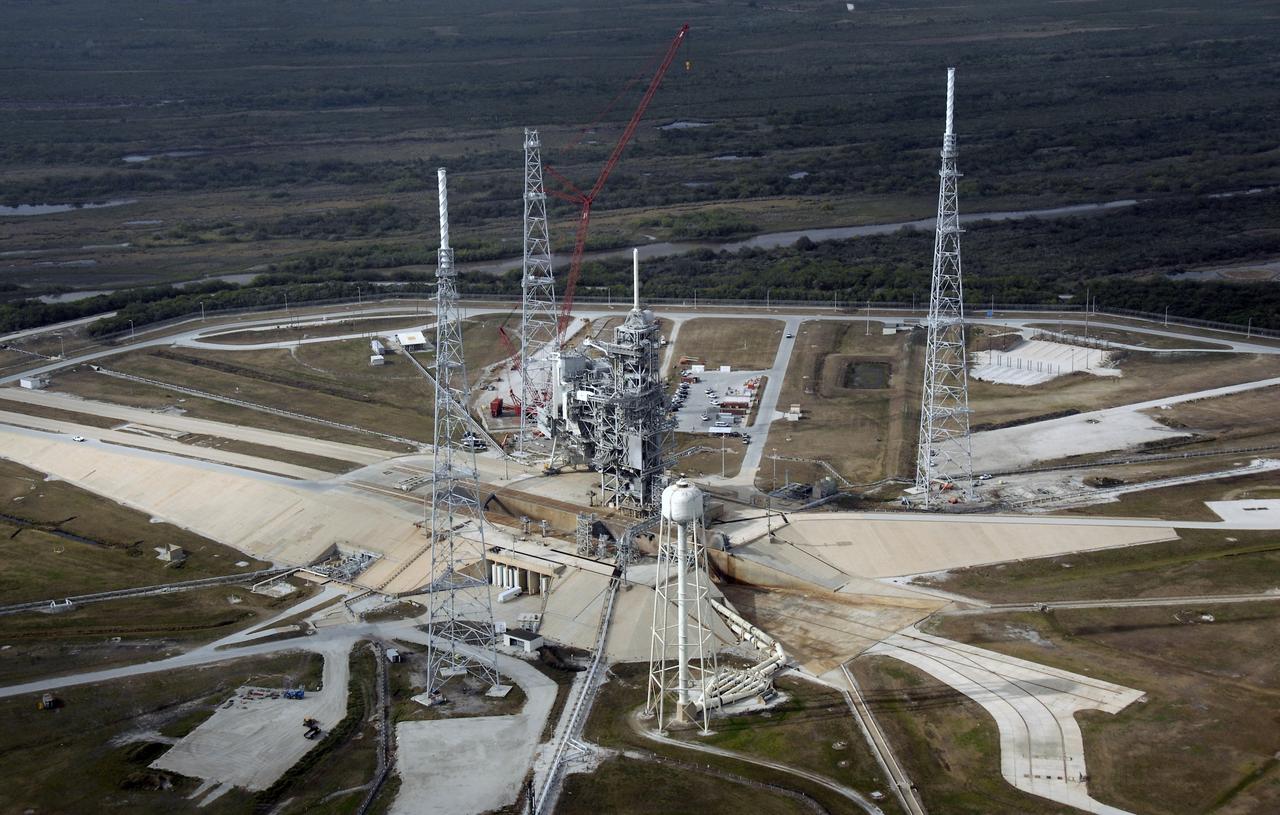
CAPE CANAVERAL, Fla. – An aerial view of the newly erected lightning towers on Launch Pad 39B at NASA's Kennedy Space Center in Florida. The two towers at left and right contain the lightning mast on top; the one at center does not. At center are the fixed and rotating service structures that have served the Space Shuttle Program. In the foreground is the tower that holds 300,000 gallons of water used for sound suppression during a shuttle liftoff. The new lightning protection system is being built for the Constellation Program and Ares/Orion launches. Each of the towers is 500 feet tall with an additional 100-foot fiberglass mast atop supporting a wire catenary system. This improved lightning protection system allows for the taller height of the Ares I rocket compared to the space shuttle. Pad 39B will be the site of the first Ares rocket launch, including the Ares I-X test flight that is targeted for July 2009. Photo credit: NASA/Kim Shiflett
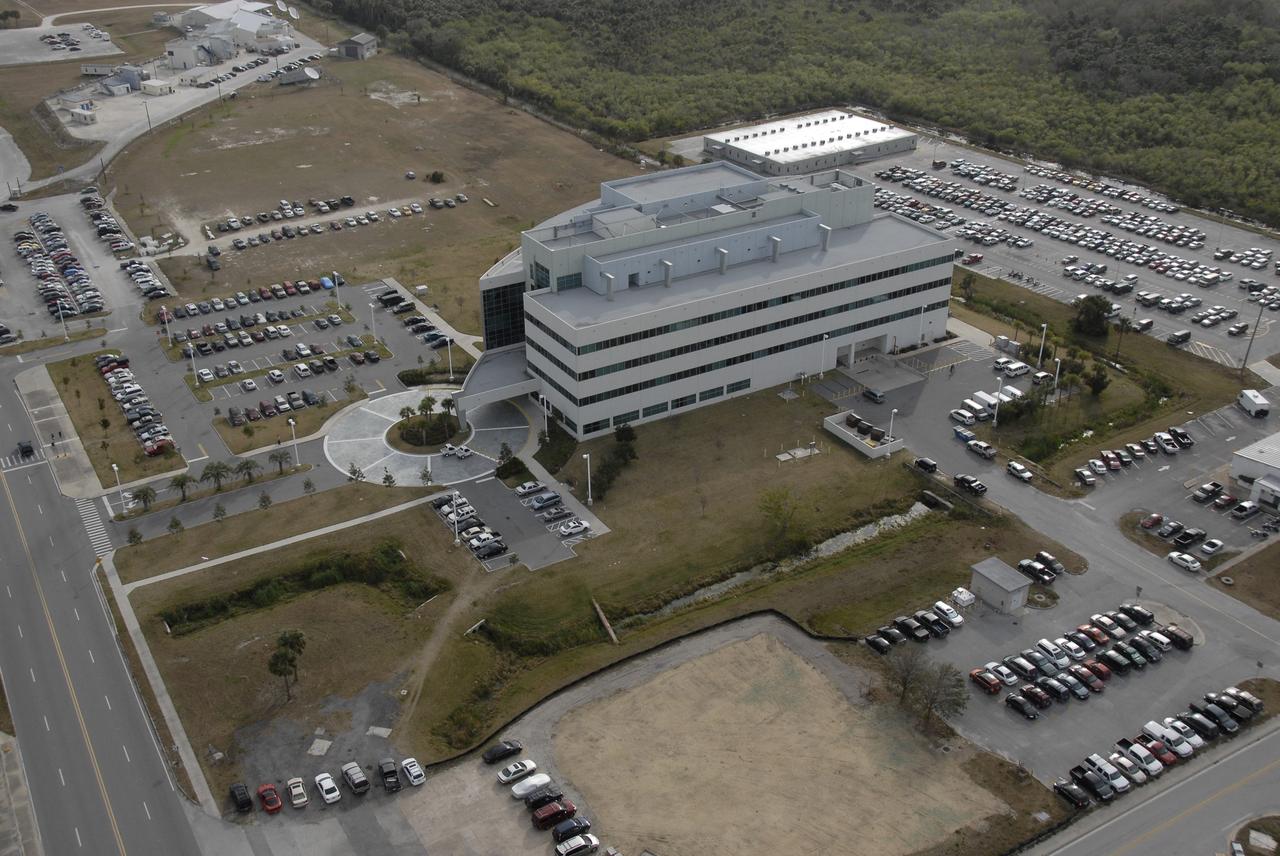
CAPE CANAVERAL, Fla. – – An aerial view of the Operations Support Building II in the Launch Complex 39 Area at NASA's Kennedy Space Center in Florida. Photo credit: NASA/Kim Shiflett
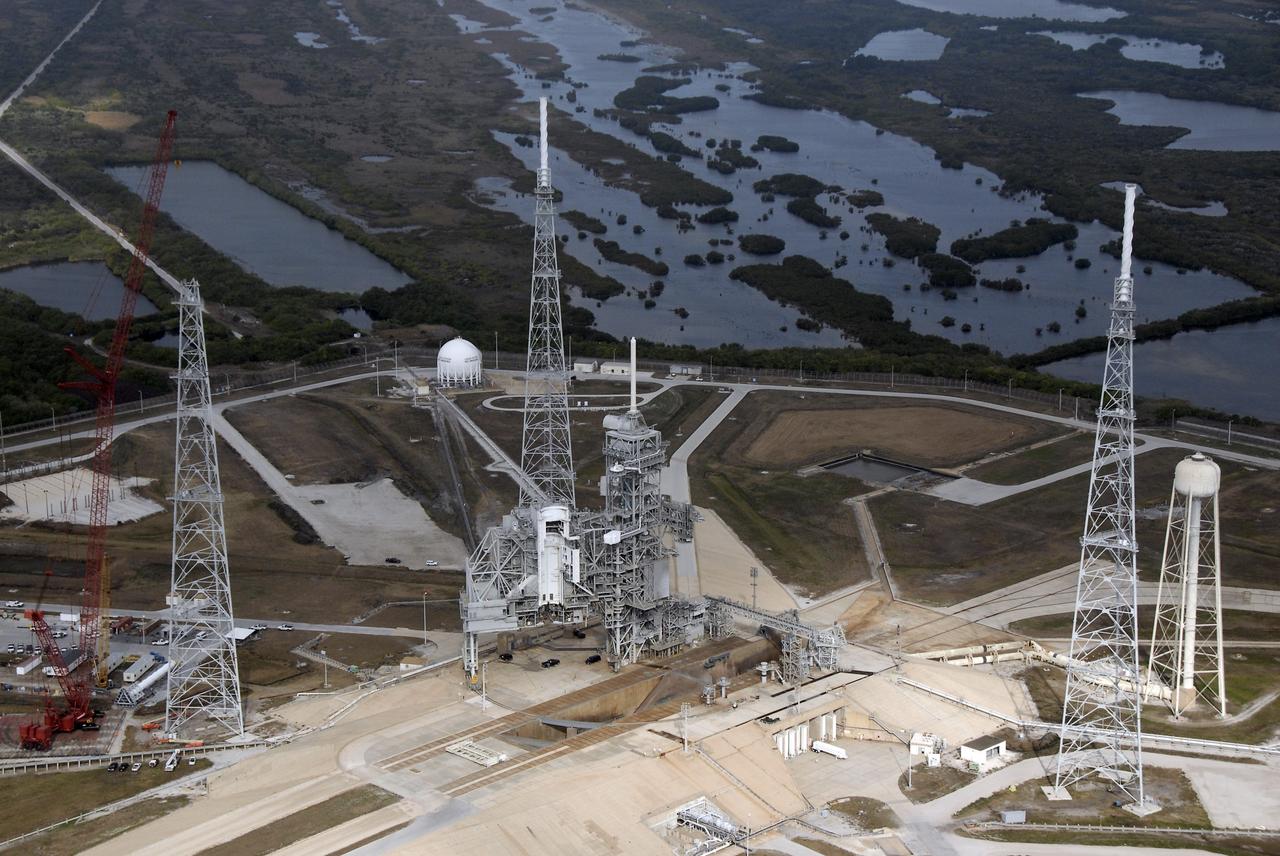
CAPE CANAVERAL, Fla. – An aerial view of the newly erected lightning towers on Launch Pad 39B at NASA's Kennedy Space Center. The two towers at center and right contain the lightning mast on top; the one at left does not. At center are the fixed and rotating service structures that have served the Space Shuttle Program. In the foreground is the tower that holds 300,000 gallons of water used for sound suppression during a shuttle liftoff. The new lightning protection system is being built for the Constellation Program and Ares/Orion launches. Each of the towers is 500 feet tall with an additional 100-foot fiberglass mast atop supporting a wire catenary system. This improved lightning protection system allows for the taller height of the Ares I rocket compared to the space shuttle. Pad 39B will be the site of the first Ares rocket launch, including the Ares I-X test flight that is targeted for July 2009. Photo credit: NASA/Kim Shiflett
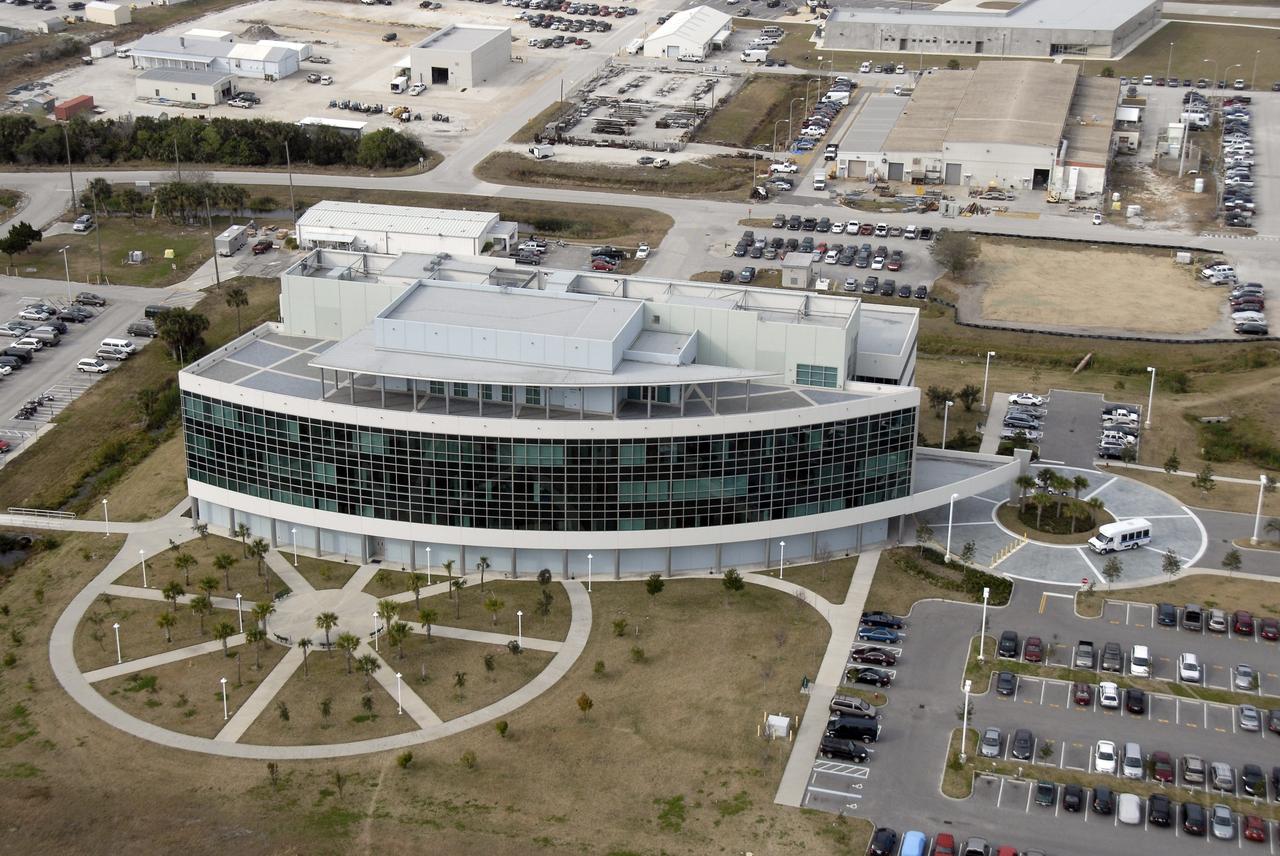
CAPE CANAVERAL, Fla. – An aerial view of the Operations Support Building II in the Launch Complex 39 Area at NASA's Kennedy Space Center in Florida. The panorama of windows faces the launch pads. Photo credit: NASA/Kim Shiflett
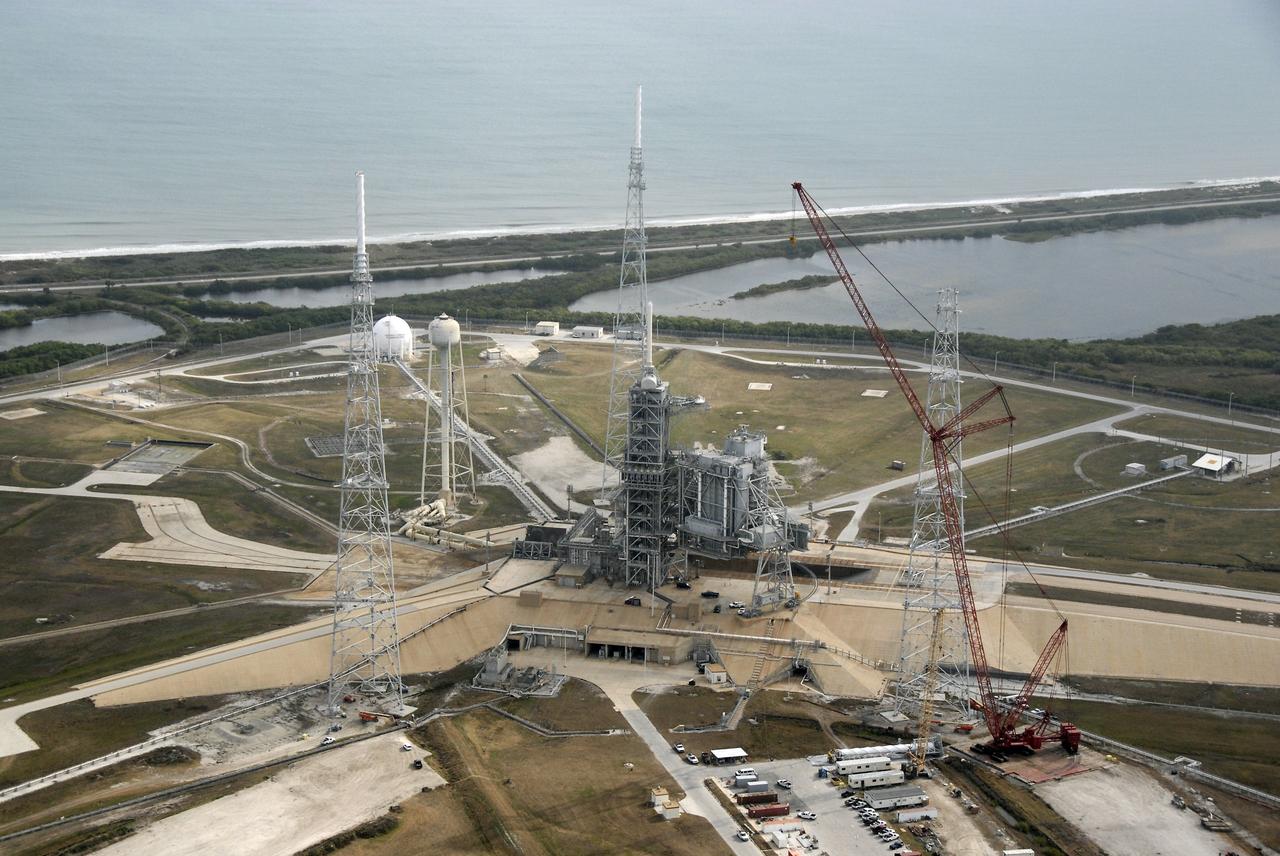
CAPE CANAVERAL, Fla. – An aerial view of the newly erected lightning towers on Launch Pad 39B at NASA's Kennedy Space Center in Florida. The two towers at left and center contain the lightning mast on top; the one at right does not. At center are the fixed and rotating service structures that have served the Space Shuttle Program. Beyond the pad is the Atlantic Ocean. The new lightning protection system is being built for the Constellation Program and Ares/Orion launches. Each of the towers is 500 feet tall with an additional 100-foot fiberglass mast atop supporting a wire catenary system. This improved lightning protection system allows for the taller height of the Ares I rocket compared to the space shuttle. Pad 39B will be the site of the first Ares vehicle launch, including the Ares I-X test flight that is targeted for July 2009. Photo credit: NASA/Kim Shiflett
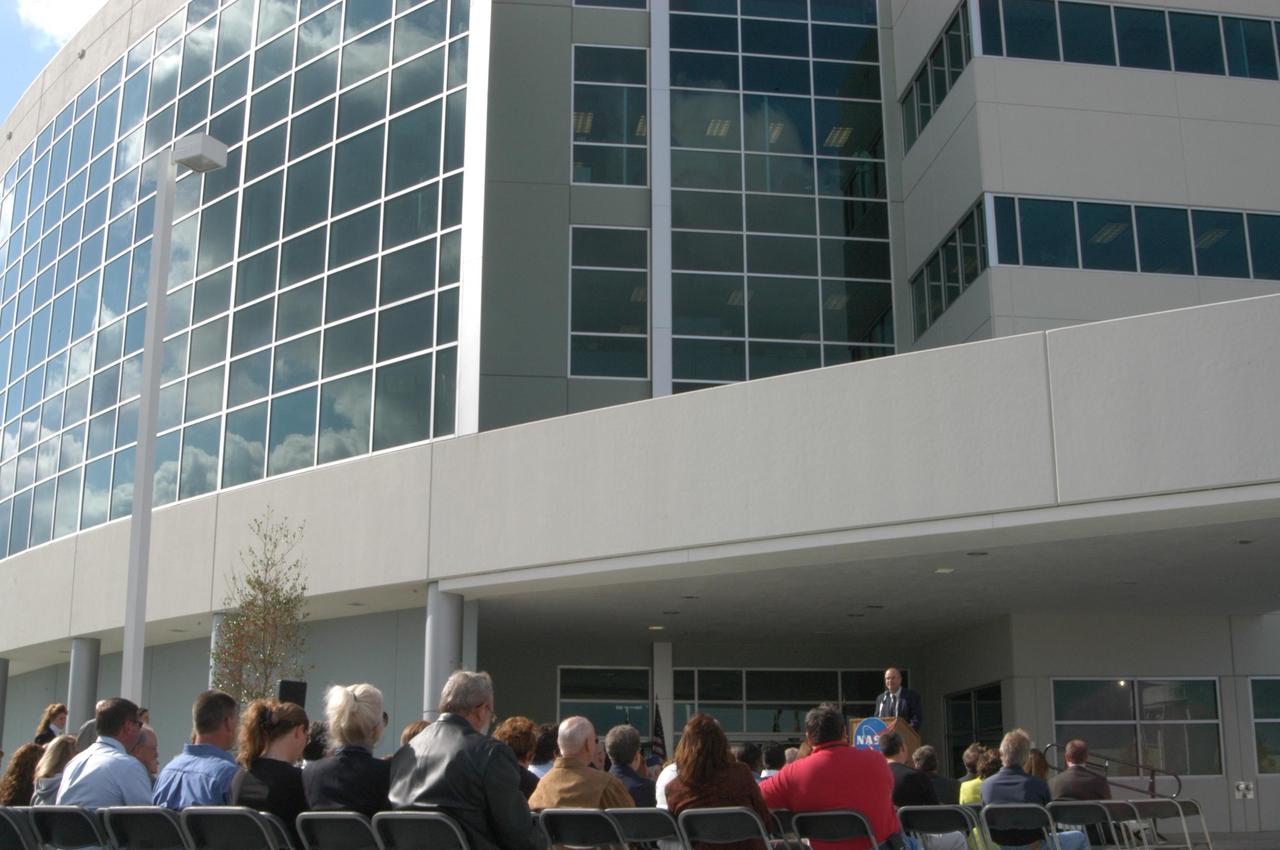
KENNEDY SPACE CENTER, FLA. -- Scott Kerr, director of Engineering Development at Kennedy Space Center, addresses guests at a ribbon-cutting ceremony for the Operations Support Building II (behind him). He and other key Center personnel and guests attended the significant event. The Operations Support Building II is an Agency safety and health initiative project to replace 198,466 square feet of substandard modular housing and trailers in the Launch Complex 39 area at Kennedy Space Center. The five-story building, which sits south of the Vehicle Assembly Building and faces the launch pads, includes 960 office spaces, 16 training rooms, computer and multimedia conference rooms, a Mission Conference Center with an observation deck, technical libraries, an Exchange store, storage, break areas, and parking. Photo credit: NASA/George Shelton
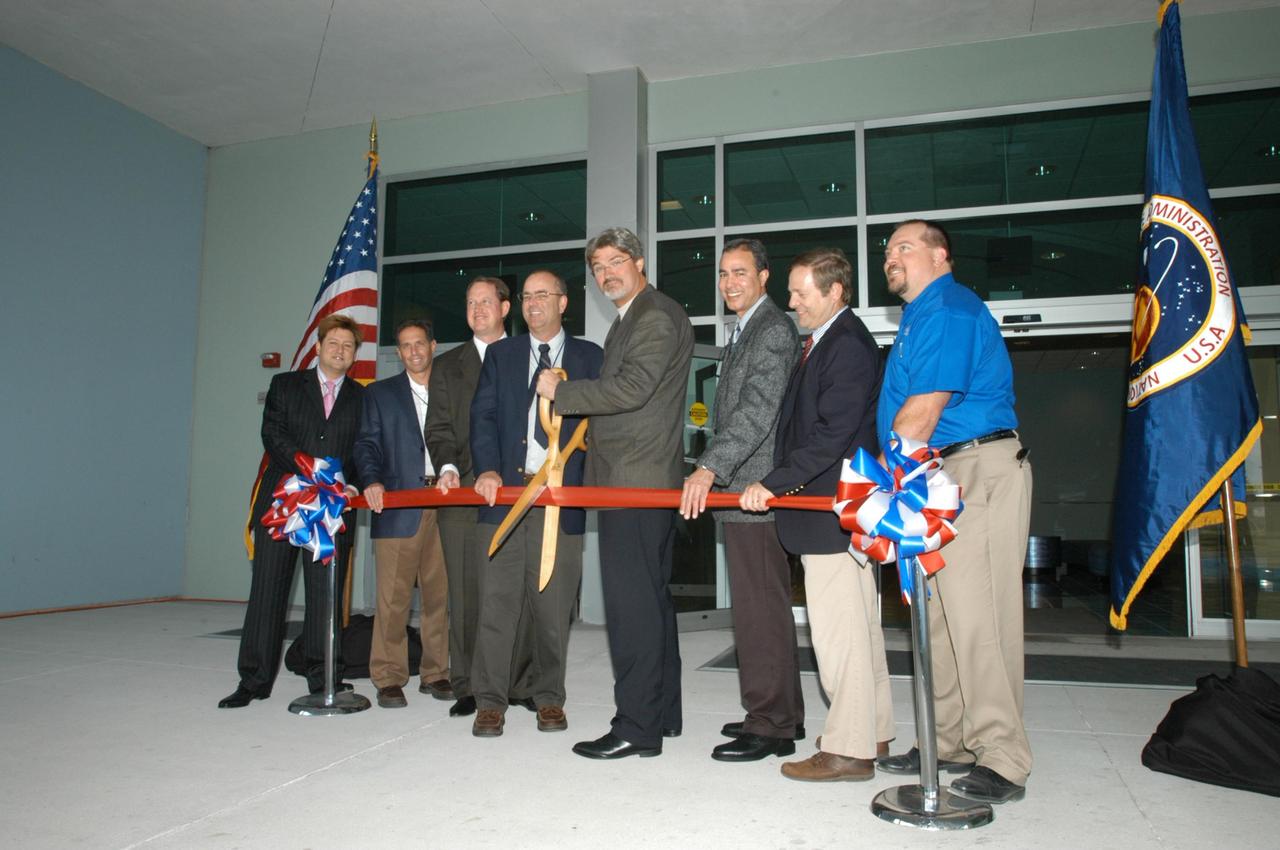
KENNEDY SPACE CENTER, FLA. -- With the ribbon-cutting ceremony, the new Operations Support Building II is officially in business. Participating in the event are (left to right) Aris Garcia, vice president of the architecture firm Wolfgang Alvarez; Mark Nappi, associate program manager of Ground Operations for United Space Alliance; Donald Minderman, NASA project manager; Scott Kerr, director of Engineering Development at Kennedy; Bill Parsons, deputy director of Kennedy Space Center; Miguel Morales, with NASA Engineering Development; Mike Wetmore, director of Shuttle Processing; and Tim Clancy, president of the construction firm Clancy & Theys. The Operations Support Building II is an Agency safety and health initiative project to replace 198,466 square feet of substandard modular housing and trailers in the Launch Complex 39 area at Kennedy Space Center. The five-story building, which sits south of the Vehicle Assembly Building and faces the launch pads, includes 960 office spaces, 16 training rooms, computer and multimedia conference rooms, a Mission Conference Center with an observation deck, technical libraries, an Exchange store, storage, break areas, and parking. Photo credit: NASA/George Shelton
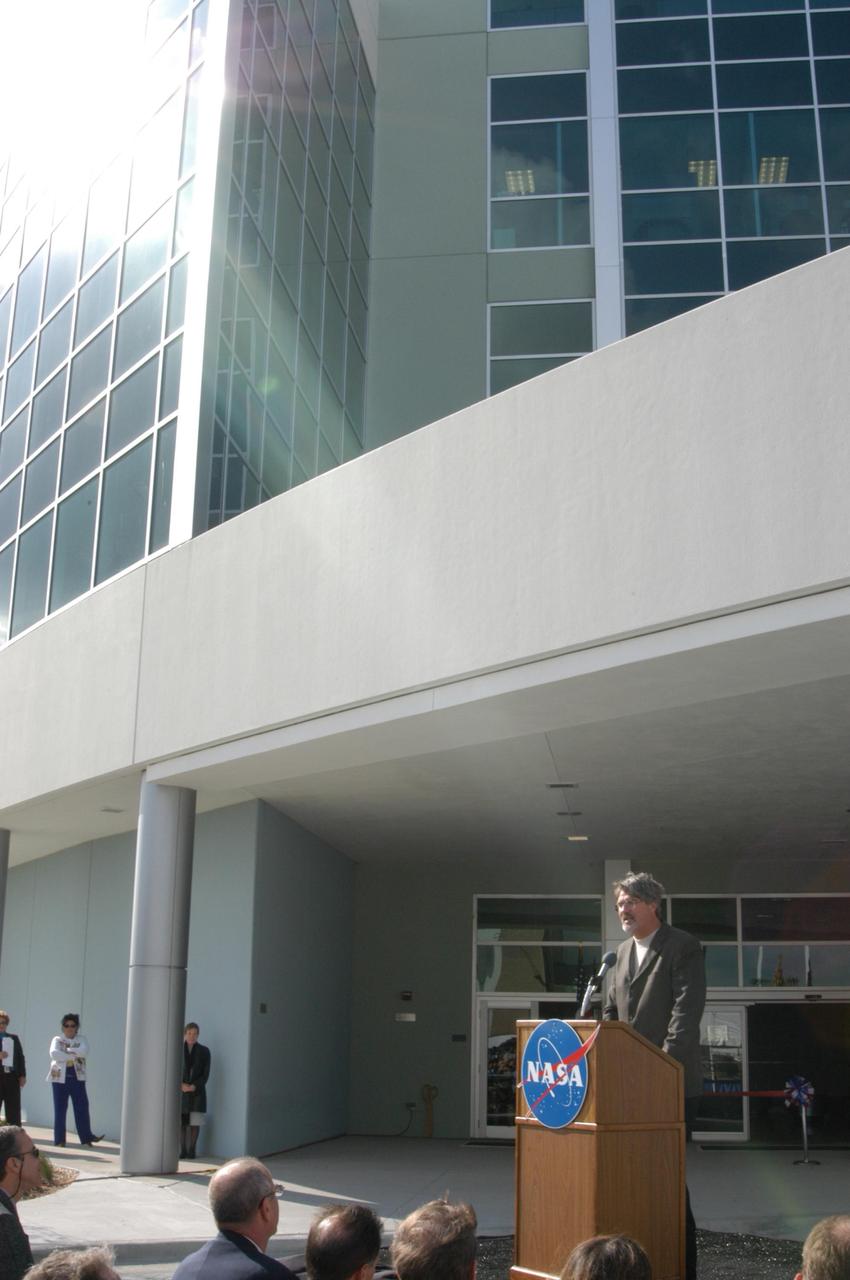
KENNEDY SPACE CENTER, FLA. -- Kennedy Space Center Deputy Director Bill Parsons talks to guests at a ribbon-cutting ceremony for the Operations Support Building II (behind him). He and other key Center personnel and guests attended the significant event. The Operations Support Building II is an Agency safety and health initiative project to replace 198,466 square feet of substandard modular housing and trailers in the Launch Complex 39 area at Kennedy Space Center. The five-story building, which sits south of the Vehicle Assembly Building and faces the launch pads, includes 960 office spaces, 16 training rooms, computer and multimedia conference rooms, a Mission Conference Center with an observation deck, technical libraries, an Exchange store, storage, break areas, and parking. Photo credit: NASA/George Shelton
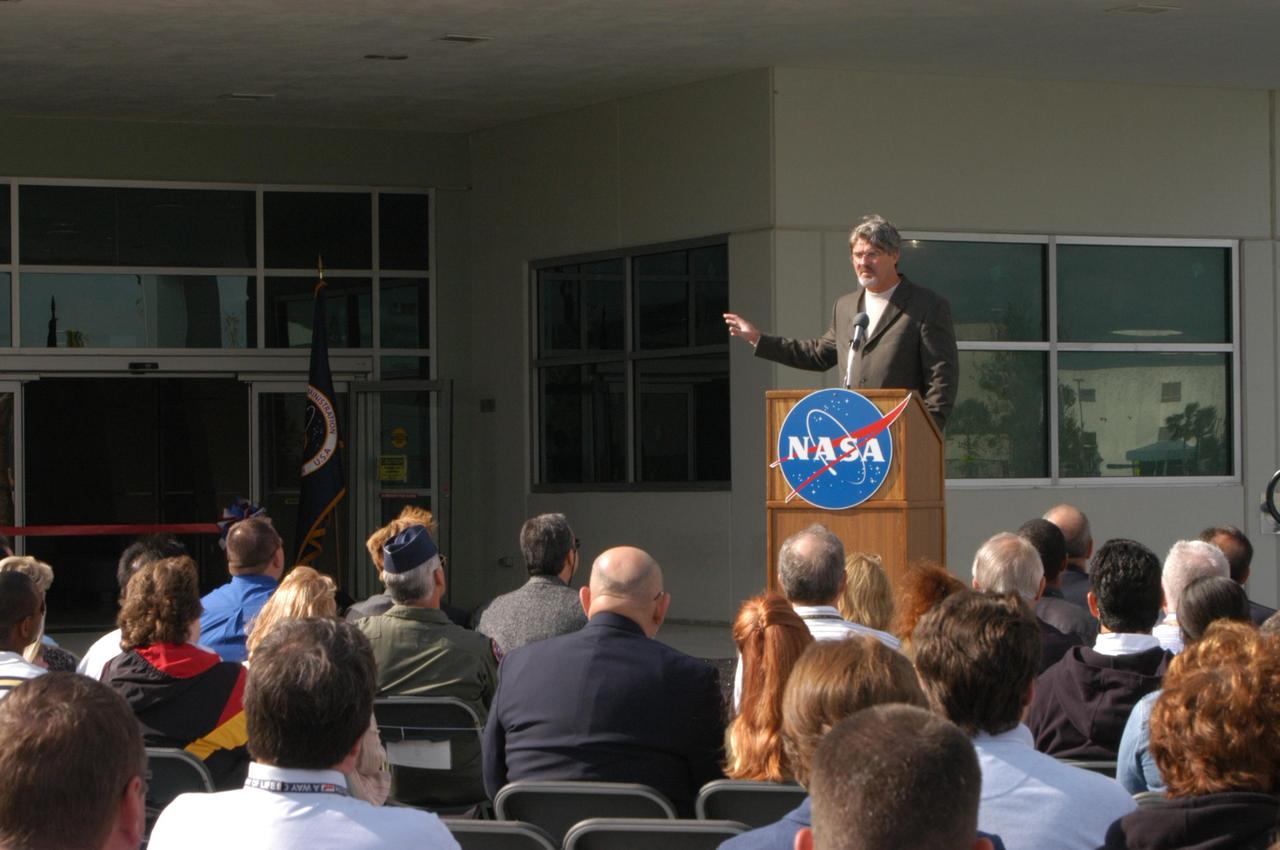
KENNEDY SPACE CENTER, FLA. -- Kennedy Space Center Deputy Director Bill Parsons explains the significance of the Operations Support Building II (behind him) to guests at the ribbon-cutting ceremony. The Operations Support Building II is an Agency safety and health initiative project to replace 198,466 square feet of substandard modular housing and trailers in the Launch Complex 39 area at Kennedy Space Center. The five-story building, which sits south of the Vehicle Assembly Building and faces the launch pads, includes 960 office spaces, 16 training rooms, computer and multimedia conference rooms, a Mission Conference Center with an observation deck, technical libraries, an Exchange store, storage, break areas, and parking. Photo credit: NASA/George Shelton
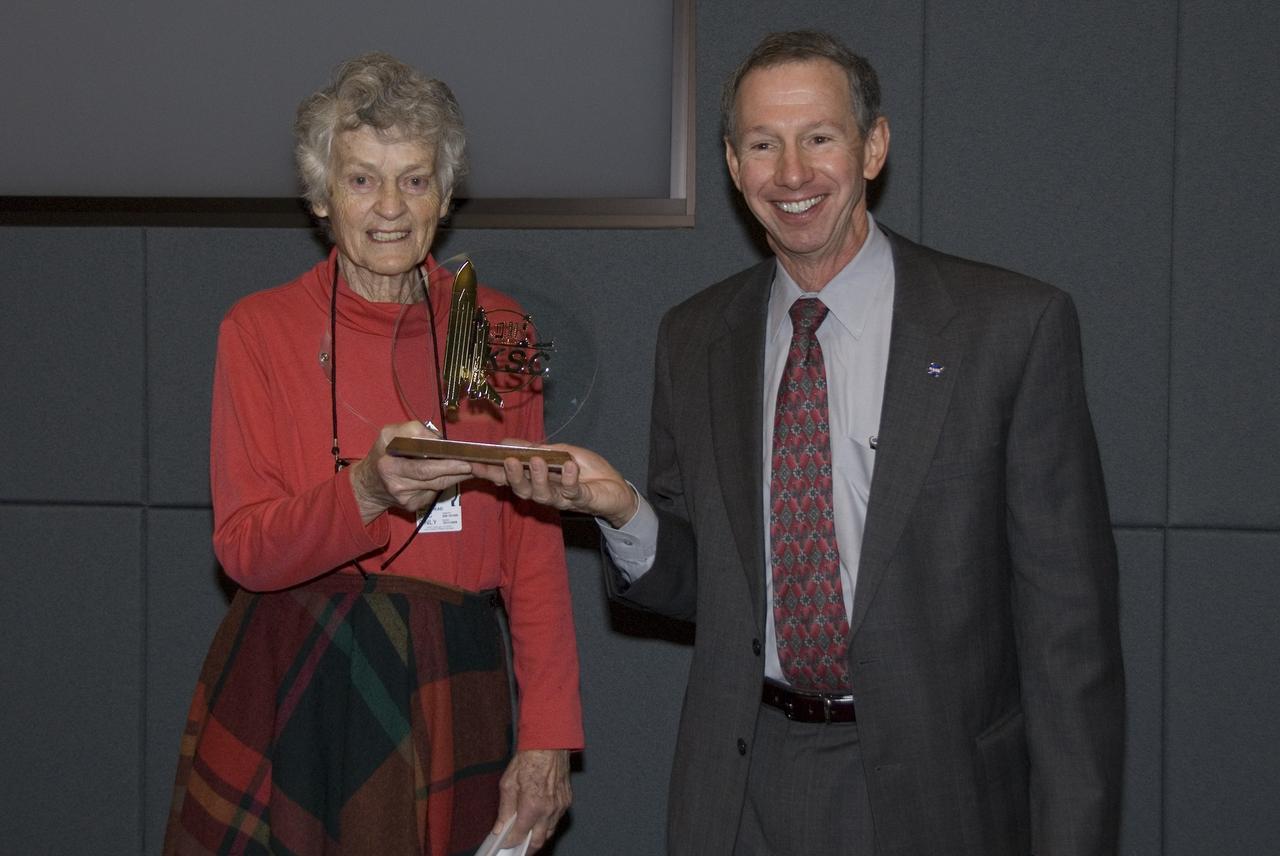
CAPE CANAVERAL, Fla. – Virginia Whitehead receives NASA’s Lifetime Achievement Award from Mike Griffin at a ceremony shortly before the STS-126 Flight Readiness Review at the OSB II on Oct. 30. Whitehead has worked at NASA's Kennedy Space Center for 34 years.
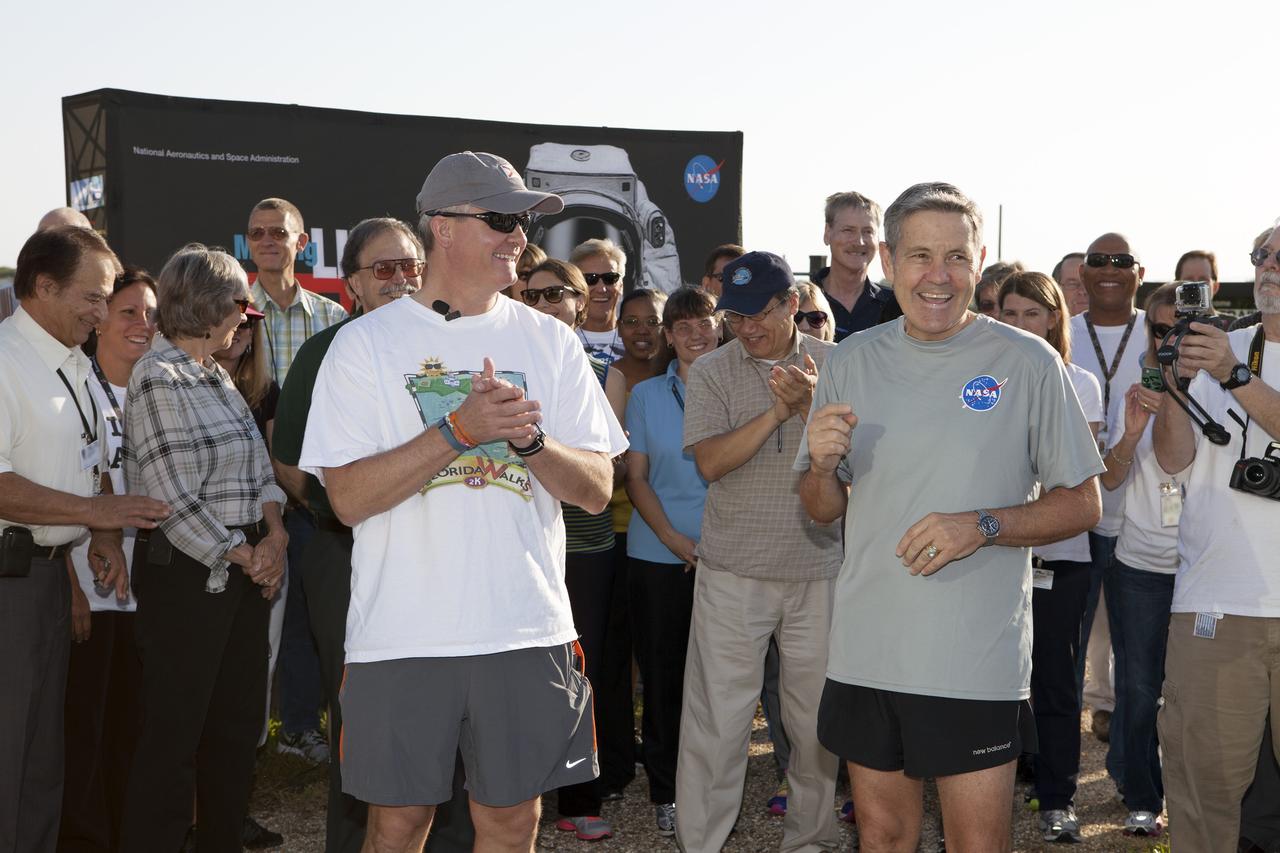
CAPE CANAVERAL, Fla. – Kennedy Space Center Director Bob Cabana, right, Florida State Surgeon General John Armstrong and other guests prepare for an early morning run at the center's Pathfinder Trail near the Operations and Support Building II at Kennedy Space Center in Florida, to officially kick off National Employee Health and Fitness Month with the NASA Moves! challenge. NASA Moves! challenged the workforce from each of the agency's field centers to engage in at least 20 minutes of activity, or 10,000 steps, each day from May 18-31. About 100 people participated in the kickoff event on the Pathfinder Trail in the heart of the center's Launch Complex 39. The one-third-mile-long gravel walkway traces the iconic shape of a space shuttle orbiter and features a set of exercise stations. The friendly contest is part of NASA's new Health4Life initiative, a Web-based health initiative designed to help employees track their health, fitness and nutrition. Health4Life also provides an array of resources geared toward increasing physical activity. Photo credit: NASA/Dimitri Gerondidakis
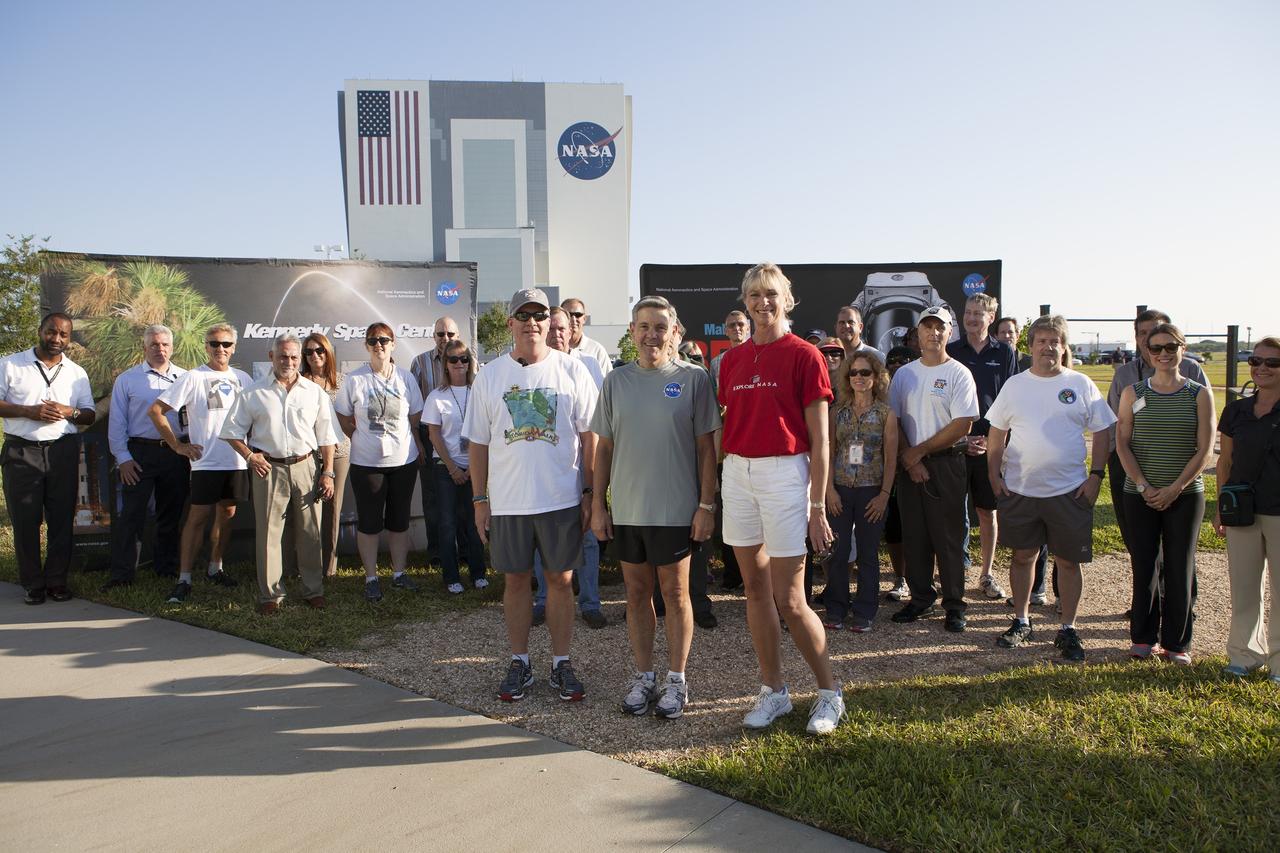
CAPE CANAVERAL, Fla. – From left, Florida State Surgeon General John Armstrong, Kennedy Space Center Director Bob Cabana, Center Operations Director Nancy Bray and Kennedy workers and guests prepare to take an early morning run along the center's Pathfinder Trail near the Operations and Support Building II at Kennedy Space Center in Florida, to officially kick off National Employee Health and Fitness Month with the NASA Moves! challenge. NASA Moves! challenged the workforce from each of the agency's field centers to engage in at least 20 minutes of activity, or 10,000 steps, each day from May 18-31. About 100 people participated in the kickoff event on the Pathfinder Trail in the heart of the center's Launch Complex 39. The one-third-mile-long gravel walkway traces the iconic shape of a space shuttle orbiter and features a set of exercise stations. The friendly contest is part of NASA's new Health4Life initiative, a Web-based health initiative designed to help employees track their health, fitness and nutrition. Health4Life also provides an array of resources geared toward increasing physical activity. Photo credit: NASA/Dimitri Gerondidakis

CAPE CANAVERAL, Fla. – Workers take an early morning walk along the Pathfinder Trail near the Operations and Support Building II at Kennedy Space Center in Florida, to officially kick off National Employee Health and Fitness Month with the NASA Moves! challenge. NASA Moves! challenged the workforce from each of the agency's field centers to engage in at least 20 minutes of activity, or 10,000 steps, each day from May 18-31. About 100 people participated in the kickoff event on the Pathfinder Trail in the heart of the center's Launch Complex 39. The one-third-mile-long gravel walkway traces the iconic shape of a space shuttle orbiter and features a set of exercise stations. The friendly contest is part of NASA's new Health4Life initiative, a Web-based health initiative designed to help employees track their health, fitness and nutrition. Health4Life also provides an array of resources geared toward increasing physical activity. Photo credit: NASA/Dimitri Gerondidakis
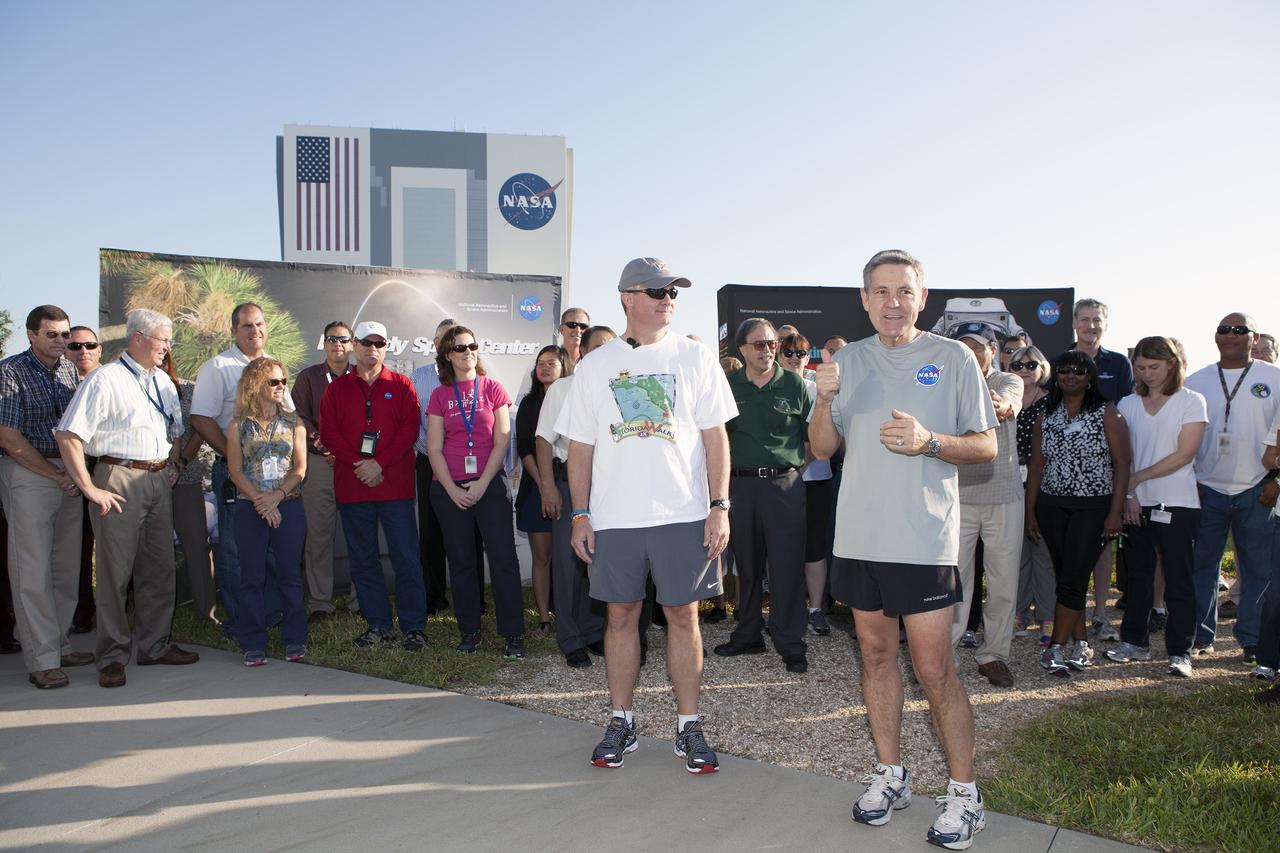
CAPE CANAVERAL, Fla. – Kennedy Space Center Director Bob Cabana, left, and Florida State Surgeon General John Armstrong complete an early morning run along the center's Pathfinder Trail near the Operations and Support Building II at Kennedy Space Center in Florida, to officially kick off National Employee Health and Fitness Month with the NASA Moves! challenge. NASA Moves! challenged the workforce from each of the agency's field centers to engage in at least 20 minutes of activity, or 10,000 steps, each day from May 18-31. About 100 people participated in the kickoff event on the Pathfinder Trail in the heart of the center's Launch Complex 39. The one-third-mile-long gravel walkway traces the iconic shape of a space shuttle orbiter and features a set of exercise stations. The friendly contest is part of NASA's new Health4Life initiative, a Web-based health initiative designed to help employees track their health, fitness and nutrition. Health4Life also provides an array of resources geared toward increasing physical activity. Photo credit: NASA/Dimitri Gerondidakis
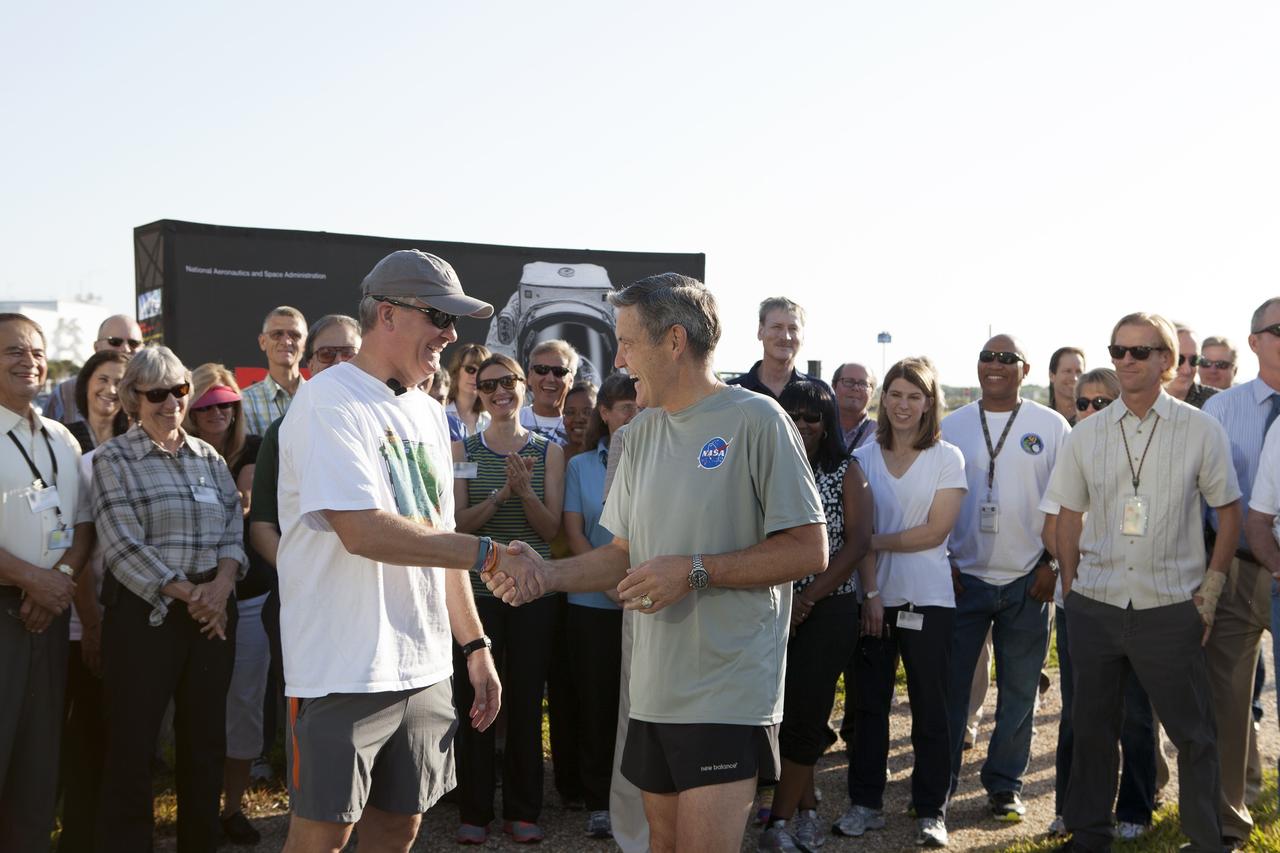
CAPE CANAVERAL, Fla. – Kennedy Space Center Director Bob Cabana, right, shakes hands with Florida State Surgeon General John Armstrong before an early morning run along the center's Pathfinder Trail near the Operations and Support Building II at Kennedy Space Center in Florida, to officially kick off National Employee Health and Fitness Month with the NASA Moves! challenge. NASA Moves! challenged the workforce from each of the agency's field centers to engage in at least 20 minutes of activity, or 10,000 steps, each day from May 18-31. About 100 people participated in the kickoff event on the Pathfinder Trail in the heart of the center's Launch Complex 39. The one-third-mile-long gravel walkway traces the iconic shape of a space shuttle orbiter and features a set of exercise stations. The friendly contest is part of NASA's new Health4Life initiative, a Web-based health initiative designed to help employees track their health, fitness and nutrition. Health4Life also provides an array of resources geared toward increasing physical activity. Photo credit: NASA/Dimitri Gerondidakis
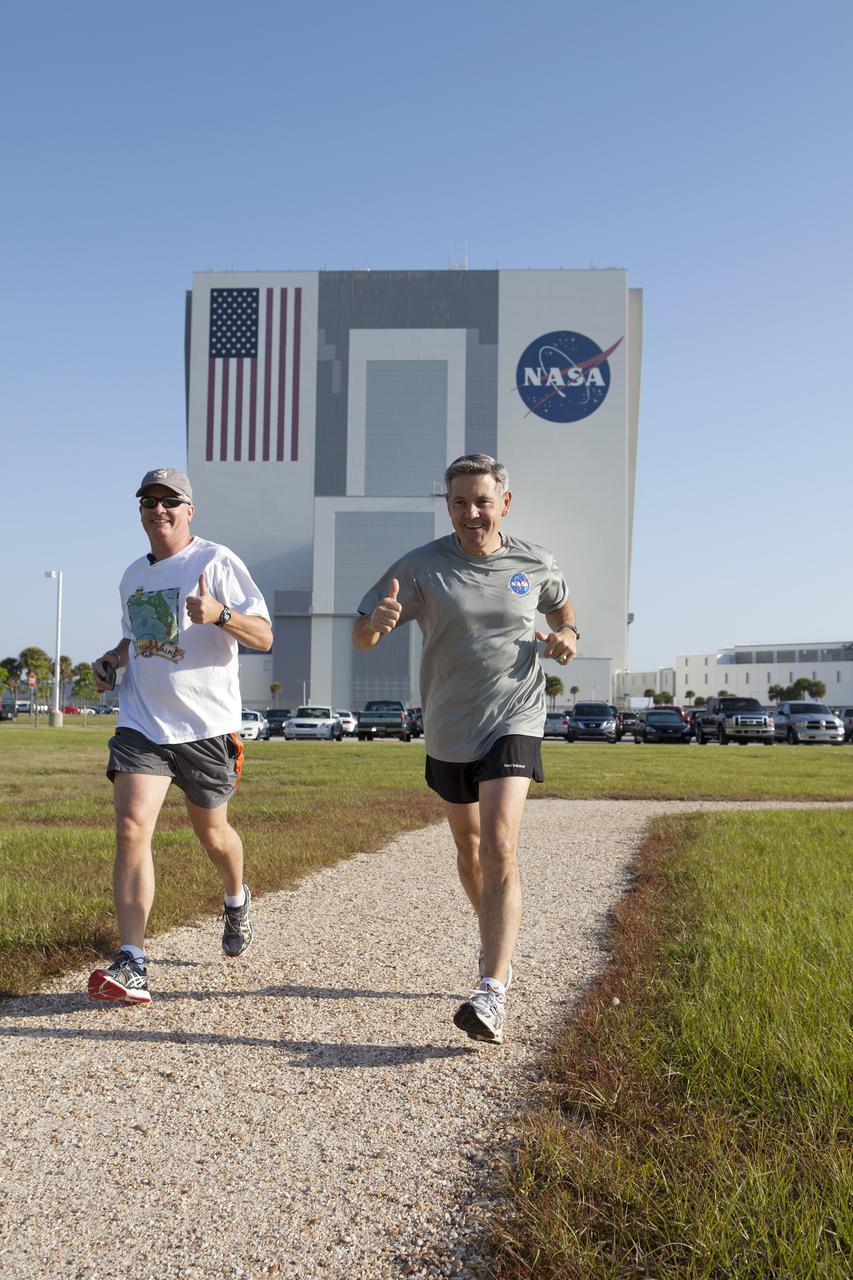
CAPE CANAVERAL, Fla. – Kennedy Space Center Director Bob Cabana, right, and Florida State Surgeon General John Armstrong take an early morning run along the center's Pathfinder Trail near the Operations and Support Building II at Kennedy Space Center in Florida, to officially kick off National Employee Health and Fitness Month with the NASA Moves! challenge. NASA Moves! challenged the workforce from each of the agency's field centers to engage in at least 20 minutes of activity, or 10,000 steps, each day from May 18-31. About 100 people participated in the kickoff event on the Pathfinder Trail in the heart of the center's Launch Complex 39. The one-third-mile-long gravel walkway traces the iconic shape of a space shuttle orbiter and features a set of exercise stations. The friendly contest is part of NASA's new Health4Life initiative, a Web-based health initiative designed to help employees track their health, fitness and nutrition. Health4Life also provides an array of resources geared toward increasing physical activity. Photo credit: NASA/Dimitri Gerondidakis
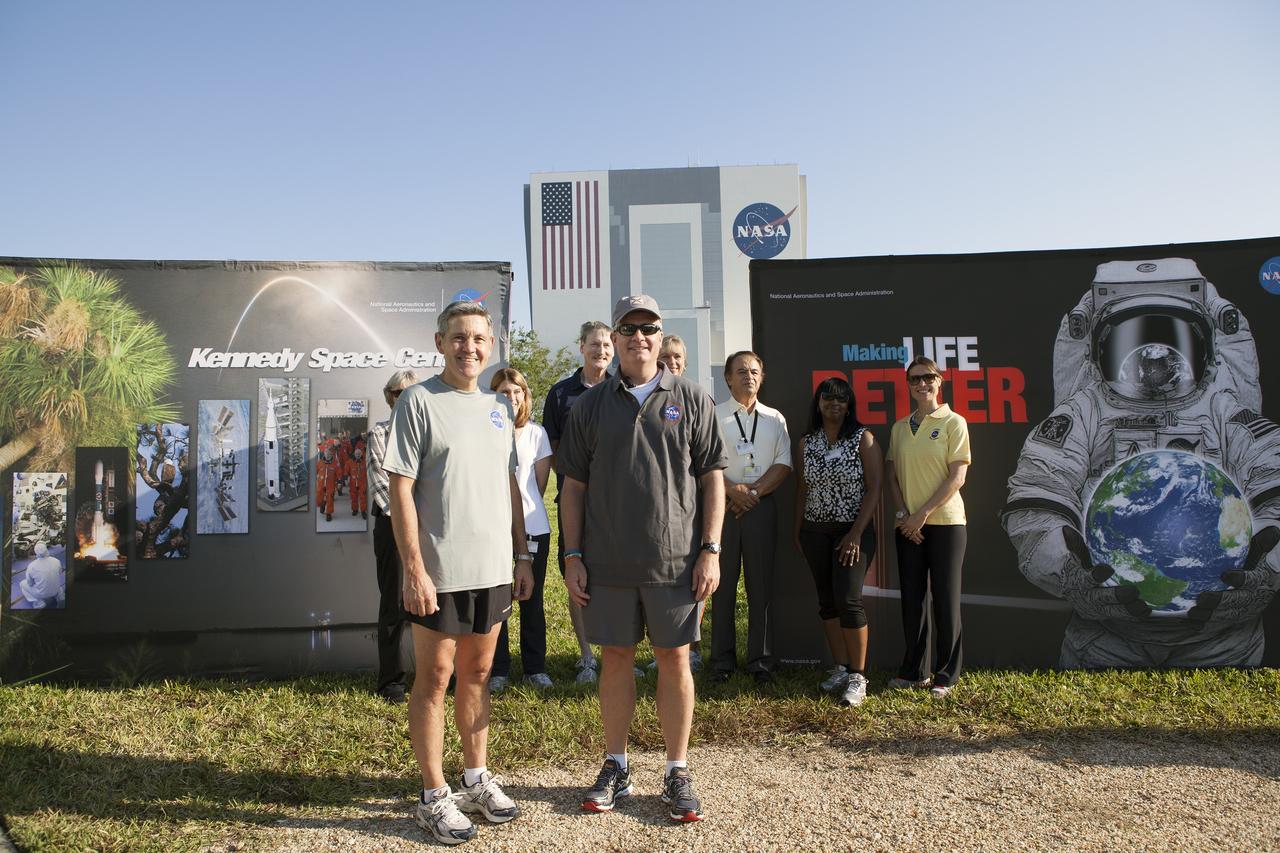
CAPE CANAVERAL, Fla. – Kennedy Space Center Director Bob Cabana, right, Florida State Surgeon General John Armstrong, other Kennedy managers and guests prepare for an early morning run at the center's Pathfinder Trail near the Operations and Support Building II at Kennedy Space Center in Florida, to officially kick off National Employee Health and Fitness Month with the NASA Moves! challenge. NASA Moves! challenged the workforce from each of the agency's field centers to engage in at least 20 minutes of activity, or 10,000 steps, each day from May 18-31. About 100 people participated in the kickoff event on the Pathfinder Trail in the heart of the center's Launch Complex 39. The one-third-mile-long gravel walkway traces the iconic shape of a space shuttle orbiter and features a set of exercise stations. The friendly contest is part of NASA's new Health4Life initiative, a Web-based health initiative designed to help employees track their health, fitness and nutrition. Health4Life also provides an array of resources geared toward increasing physical activity. Photo credit: NASA/Dimitri Gerondidakis

CAPE CANAVERAL, Fla. – Nancy Bray, right, Center Operations director at Kennedy Space Center, and Lori Hicks, Human Resources, take an early morning walk along the center's Pathfinder Trail near the Operations and Support Building II at Kennedy Space Center in Florida, to officially kick off National Employee Health and Fitness Month with the NASA Moves! challenge. NASA Moves! challenged the workforce from each of the agency's field centers to engage in at least 20 minutes of activity, or 10,000 steps, each day from May 18-31. About 100 people participated in the kickoff event on the Pathfinder Trail in the heart of the center's Launch Complex 39. The one-third-mile-long gravel walkway traces the iconic shape of a space shuttle orbiter and features a set of exercise stations. The friendly contest is part of NASA's new Health4Life initiative, a Web-based health initiative designed to help employees track their health, fitness and nutrition. Health4Life also provides an array of resources geared toward increasing physical activity. Photo credit: NASA/Dimitri Gerondidakis
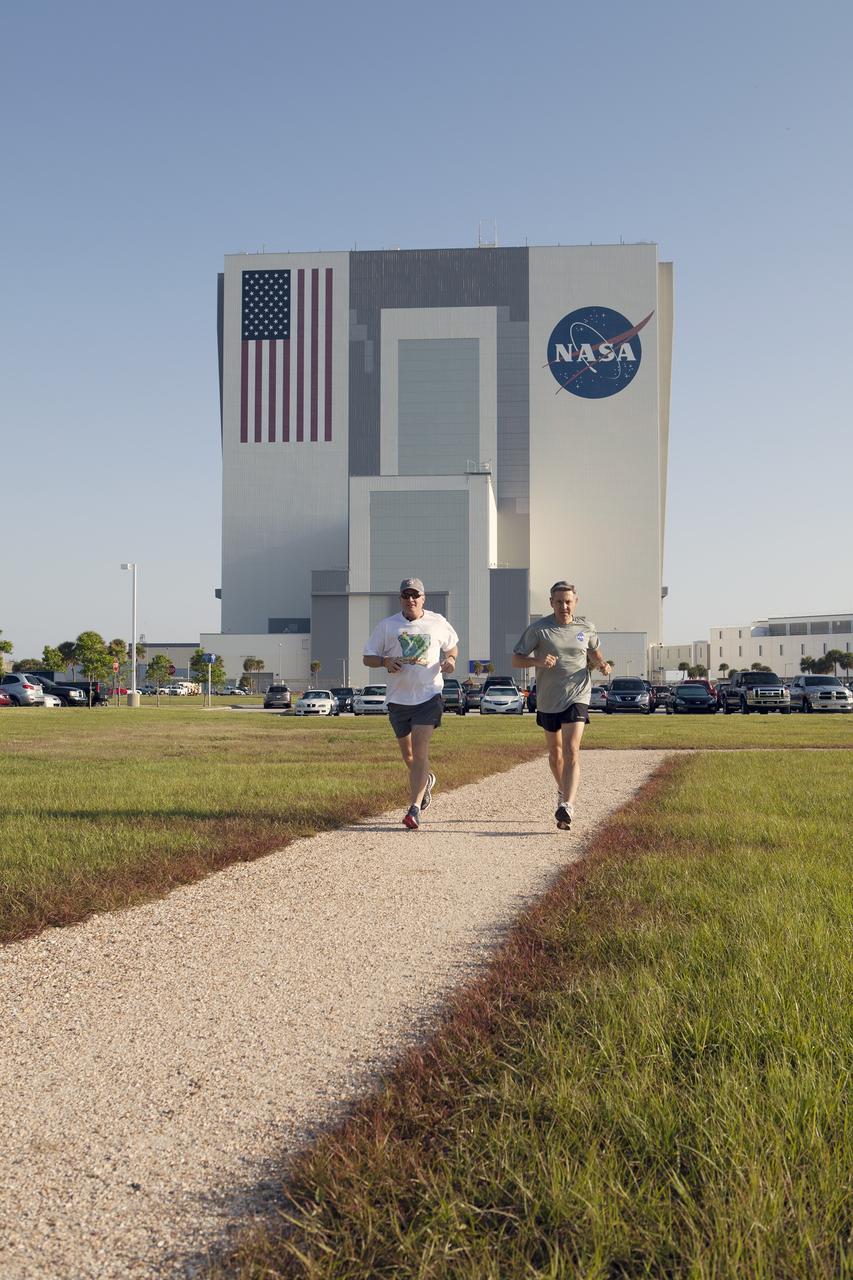
CAPE CANAVERAL, Fla. – Kennedy Space Center Director Bob Cabana, right, and Florida State Surgeon General John Armstrong begin an early morning run along the center's Pathfinder Trail near the Operations and Support Building II at Kennedy Space Center in Florida, to officially kick off National Employee Health and Fitness Month with the NASA Moves! challenge. NASA Moves! challenged the workforce from each of the agency's field centers to engage in at least 20 minutes of activity, or 10,000 steps, each day from May 18-31. About 100 people participated in the kickoff event on the Pathfinder Trail in the heart of the center's Launch Complex 39. The one-third-mile-long gravel walkway traces the iconic shape of a space shuttle orbiter and features a set of exercise stations. The friendly contest is part of NASA's new Health4Life initiative, a Web-based health initiative designed to help employees track their health, fitness and nutrition. Health4Life also provides an array of resources geared toward increasing physical activity. Photo credit: NASA/Dimitri Gerondidakis
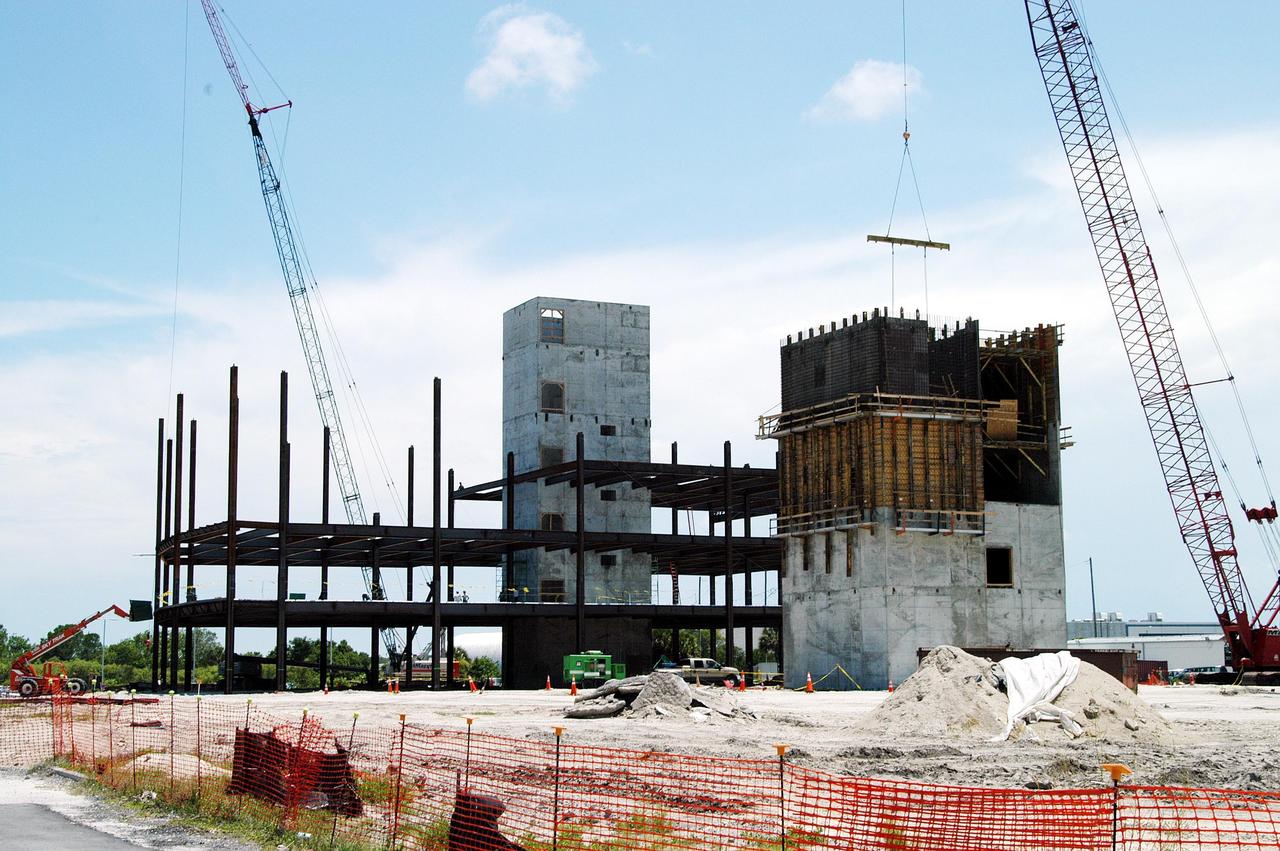
KENNEDY SPACE CENTER, FLA. - Towers and girders are the current construction components on the Operations Support Building (OSB) II in the Launch Complex 39 Area. The new building, which replaces modular housing constructed more than 20 years ago, will house NASA and contractor support staff for shuttle operations. The new structure is projected to be ready in April 2005.