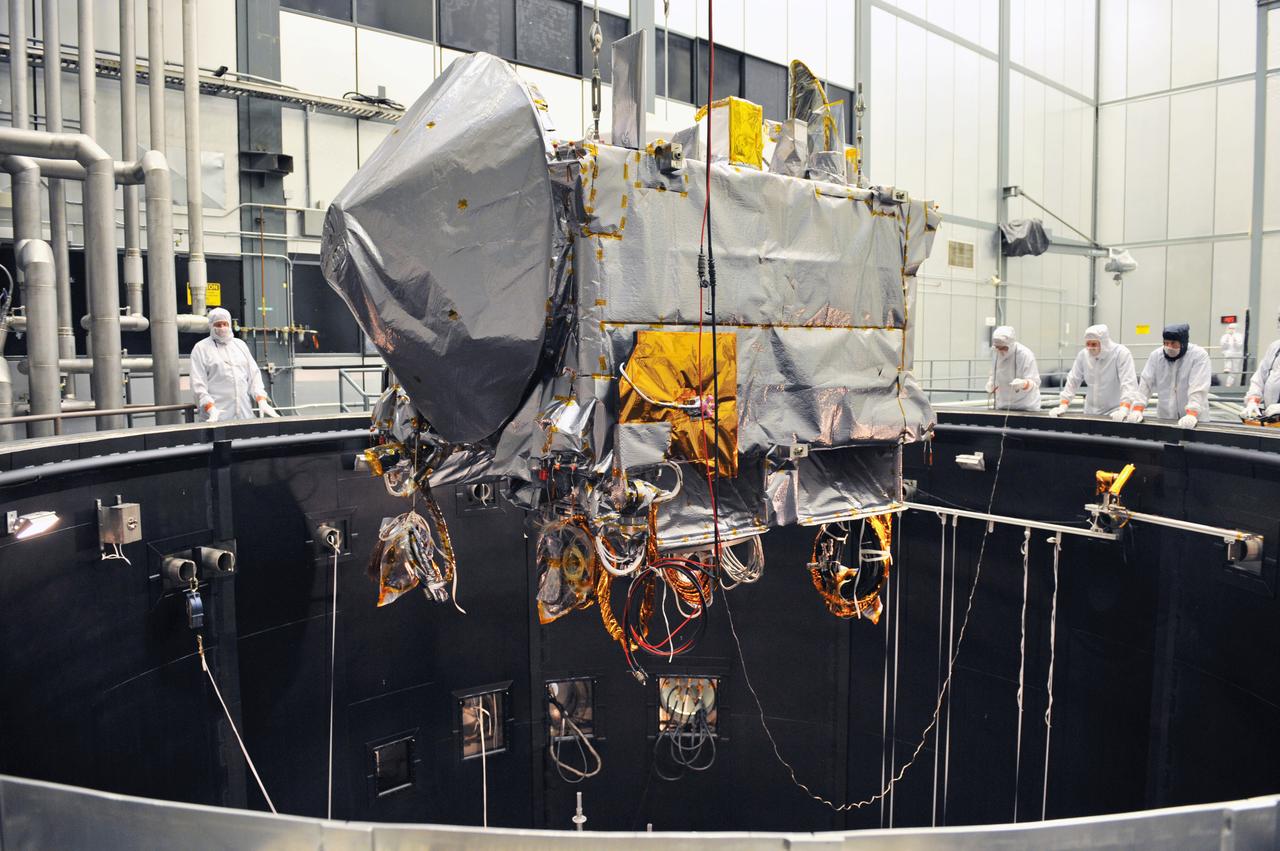
The OSIRIS-REx spacecraft being lifted into the thermal vacuum chamber at Lockheed Martin for environmental testing.
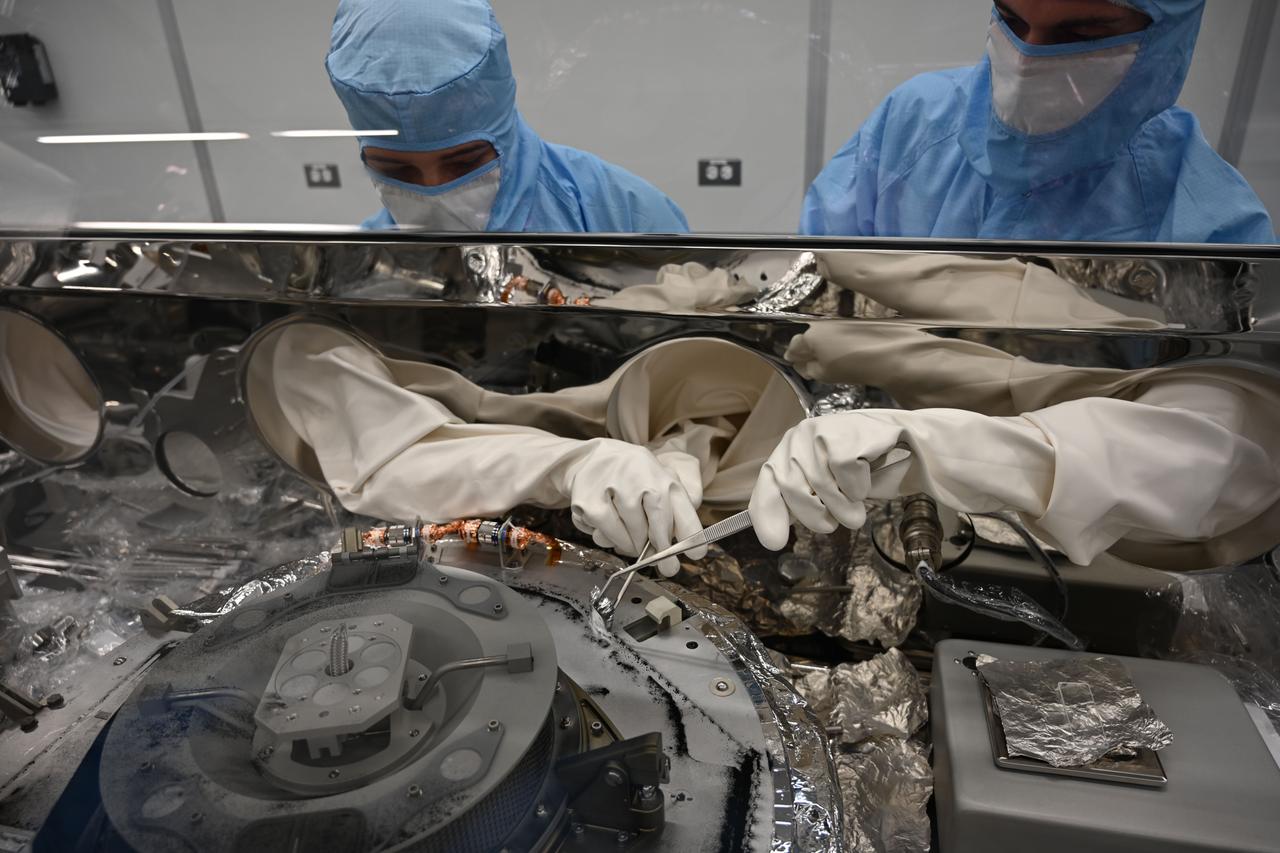
Astromaterials processors Mari Montoya, left, and Curtis Calva, right, use tools to collect asteroid particles from the base of the OSIRIS-REx science canister. Credit: NASA
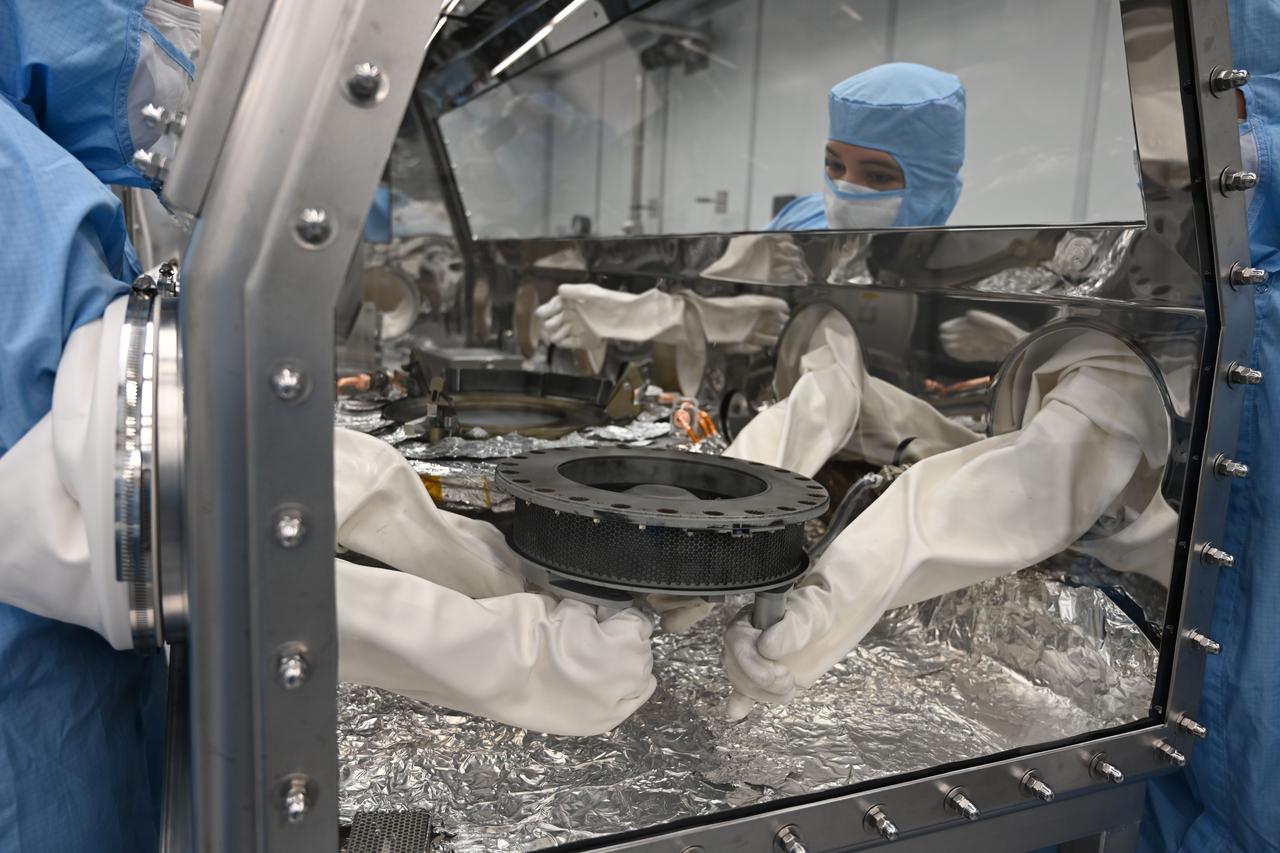
Astromaterials processor Mari Montoya and OSIRIS-REx curation team members set the TAGSAM (Touch and Go Sample Acquisition Mechanism) down in the canister glovebox after removing it from the canister base and flipping it over. Credit: NASA/ Kimberly Allums
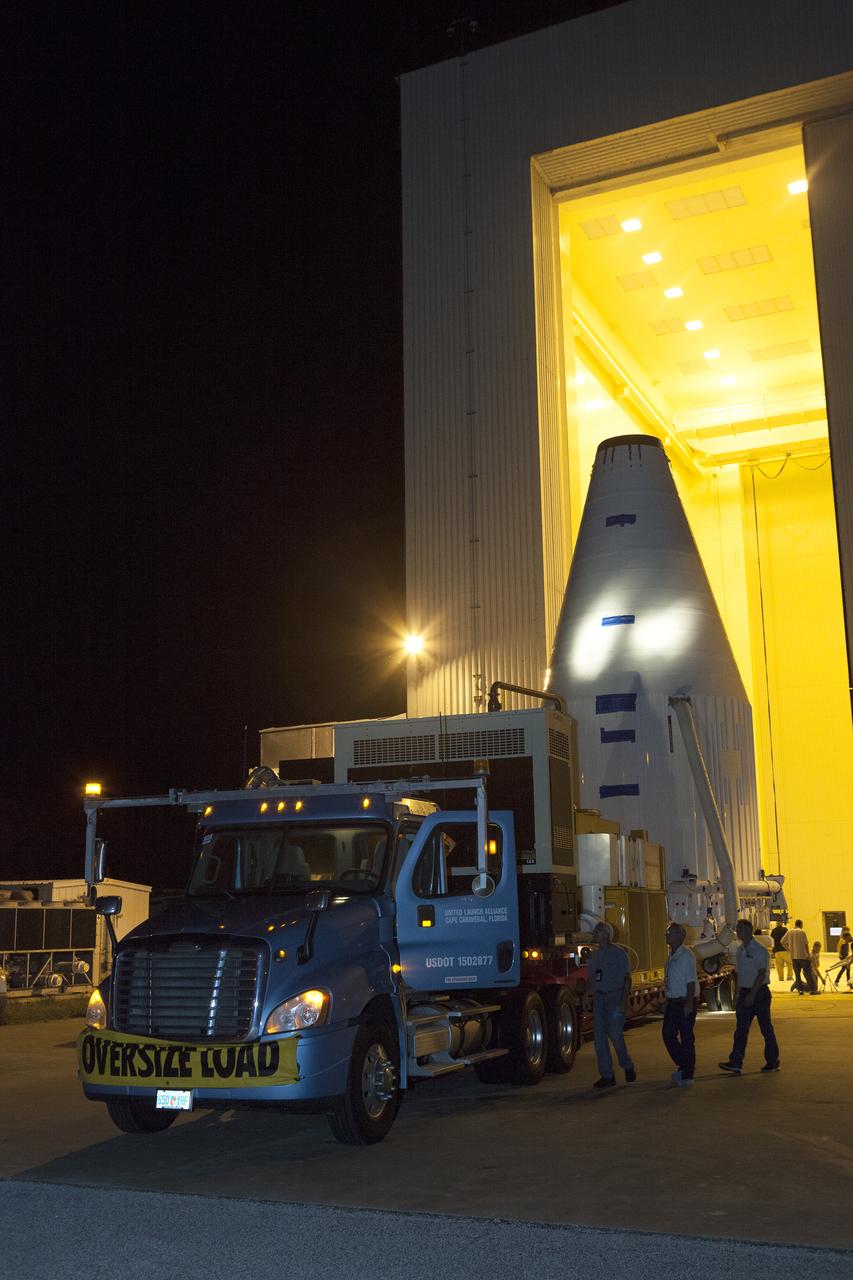
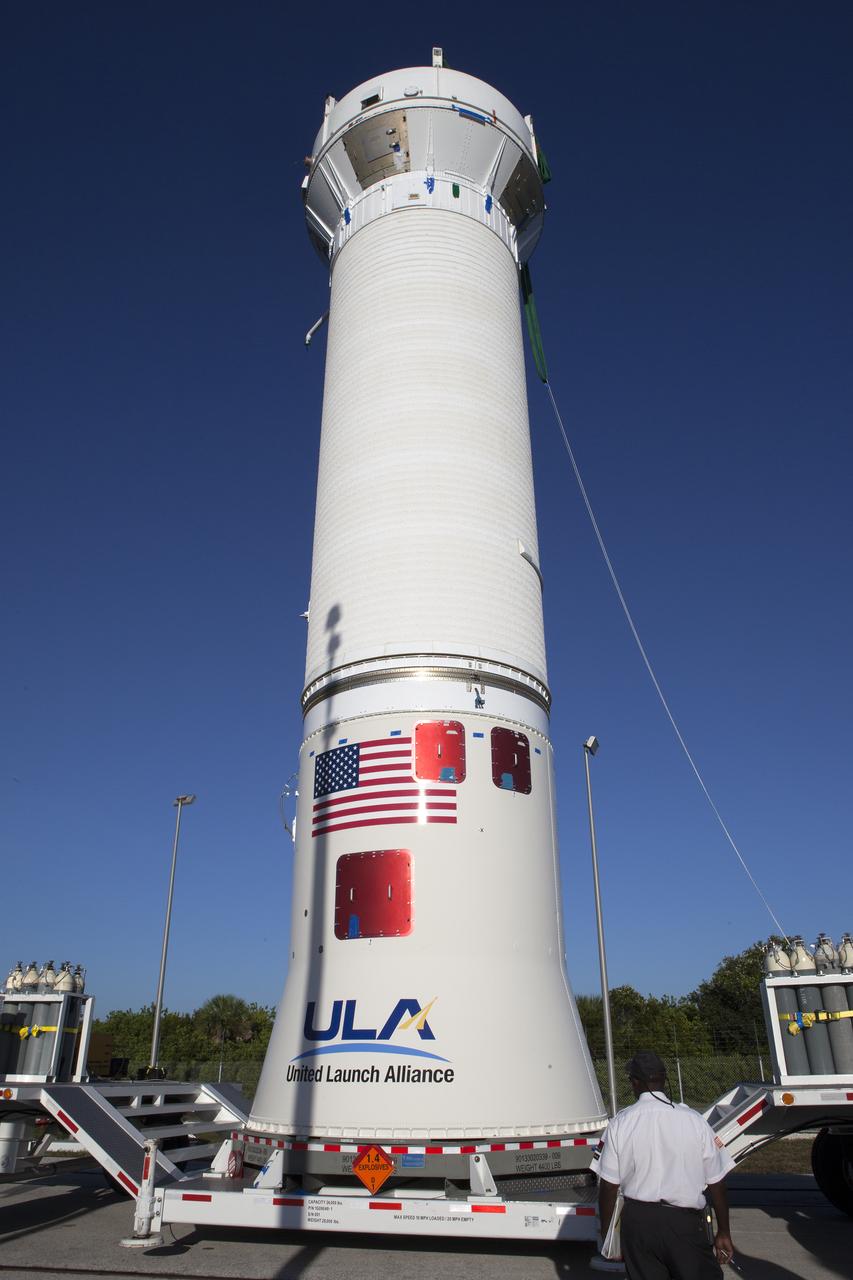
The OSIRIS-REx spacecraft, enclosed in a payload fairing, is towed from the Payload Hazardous Servicing Facility at NASA's Kennedy Space Center to begin the trip to Space Launch Complex 41 at the adjacent Cape Canaveral Air Force Station. The United Launch Alliance Atlas V rocket that is to lift OSIRIS-REx into space was stacked at SLC-41 so the spacecraft and fairing could be hoisted and bolted to the rocket promptly. The spacecraft will be sent to rendezvous with, survey and take a sample from an asteroid called Bennu.
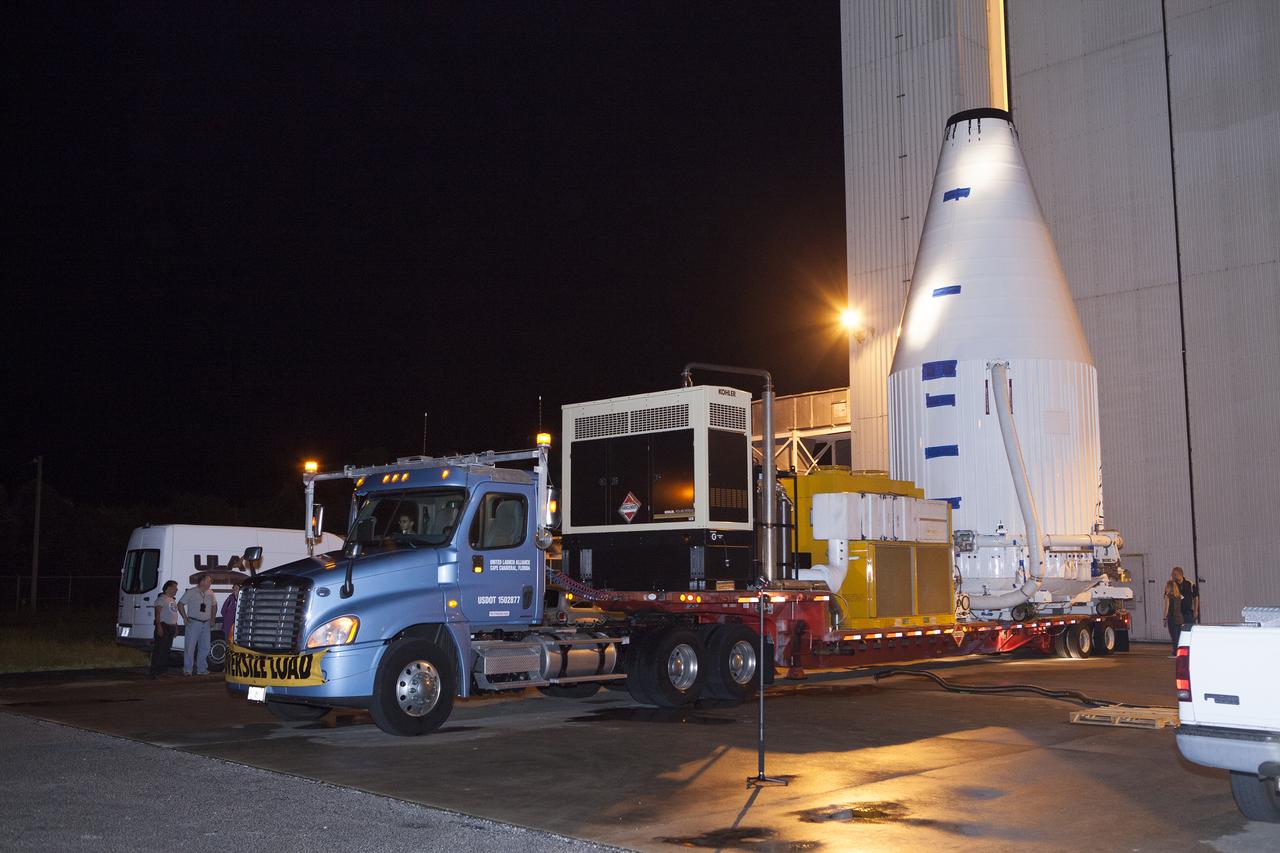
The OSIRIS-REx spacecraft, enclosed in a payload fairing, is towed from the Payload Hazardous Servicing Facility at NASA's Kennedy Space Center to begin the trip to Space Launch Complex 41 at the adjacent Cape Canaveral Air Force Station. The United Launch Alliance Atlas V rocket that is to lift OSIRIS-REx into space was stacked at SLC-41 so the spacecraft and fairing could be hoisted and bolted to the rocket promptly. The spacecraft will be sent to rendezvous with, survey and take a sample from an asteroid called Bennu.
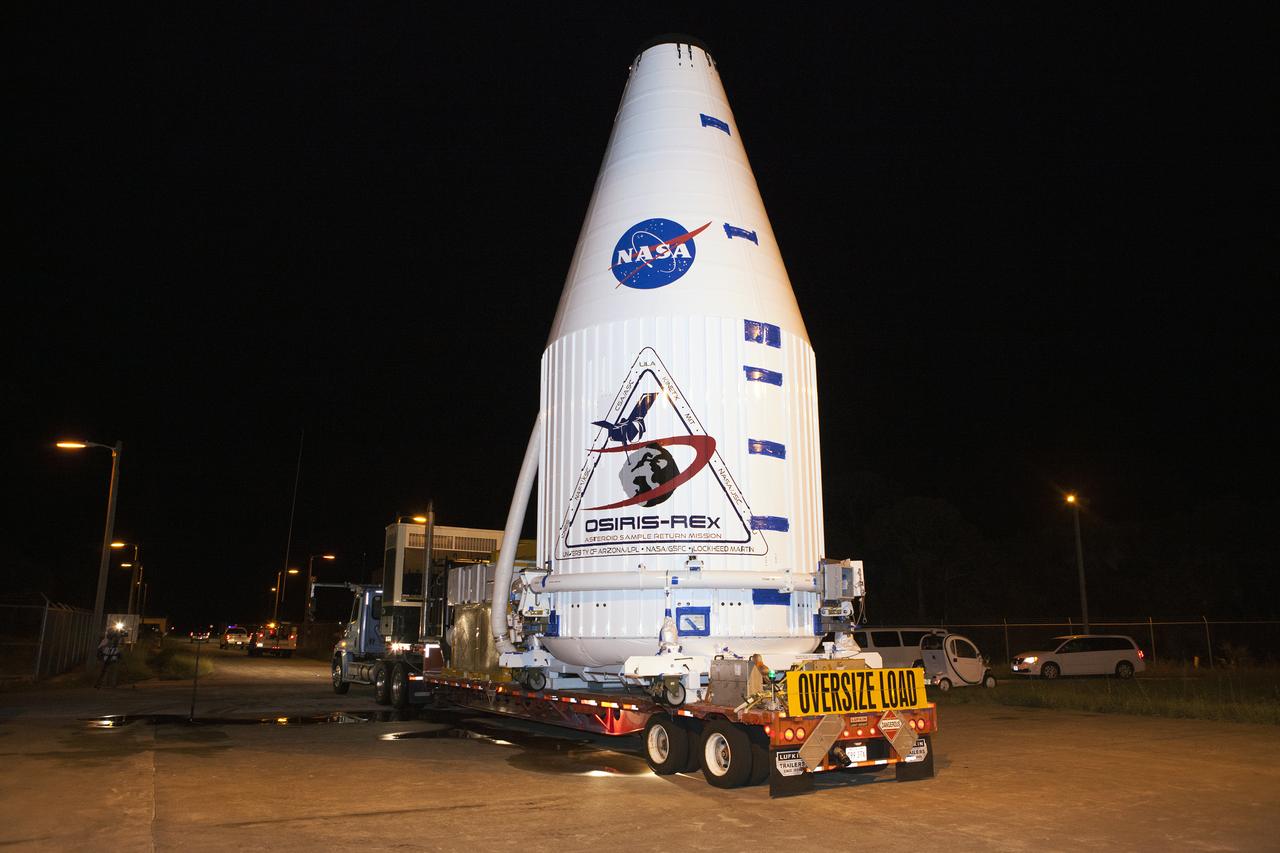
The OSIRIS-REx spacecraft, enclosed in a payload fairing, is towed from the Payload Hazardous Servicing Facility at NASA's Kennedy Space Center to begin the trip to Space Launch Complex 41 at the adjacent Cape Canaveral Air Force Station. The United Launch Alliance Atlas V rocket that is to lift OSIRIS-REx into space was stacked at SLC-41 so the spacecraft and fairing could be hoisted and bolted to the rocket promptly. The spacecraft will be sent to rendezvous with, survey and take a sample from an asteroid called Bennu.
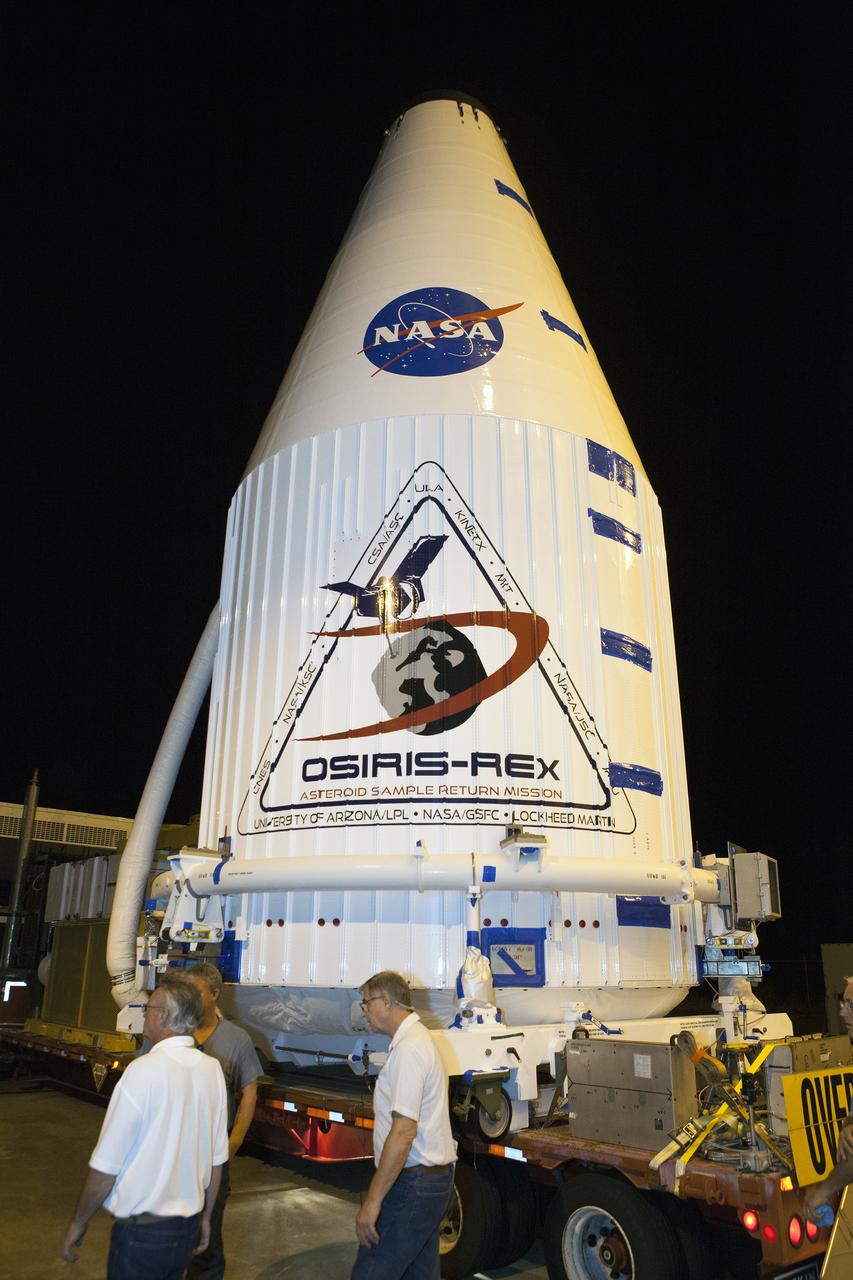
The OSIRIS-REx spacecraft, enclosed in a payload fairing, is towed from the Payload Hazardous Servicing Facility at NASA's Kennedy Space Center to begin the trip to Space Launch Complex 41 at the adjacent Cape Canaveral Air Force Station. The United Launch Alliance Atlas V rocket that is to lift OSIRIS-REx into space was stacked at SLC-41 so the spacecraft and fairing could be hoisted and bolted to the rocket promptly. The spacecraft will be sent to rendezvous with, survey and take a sample from an asteroid called Bennu.
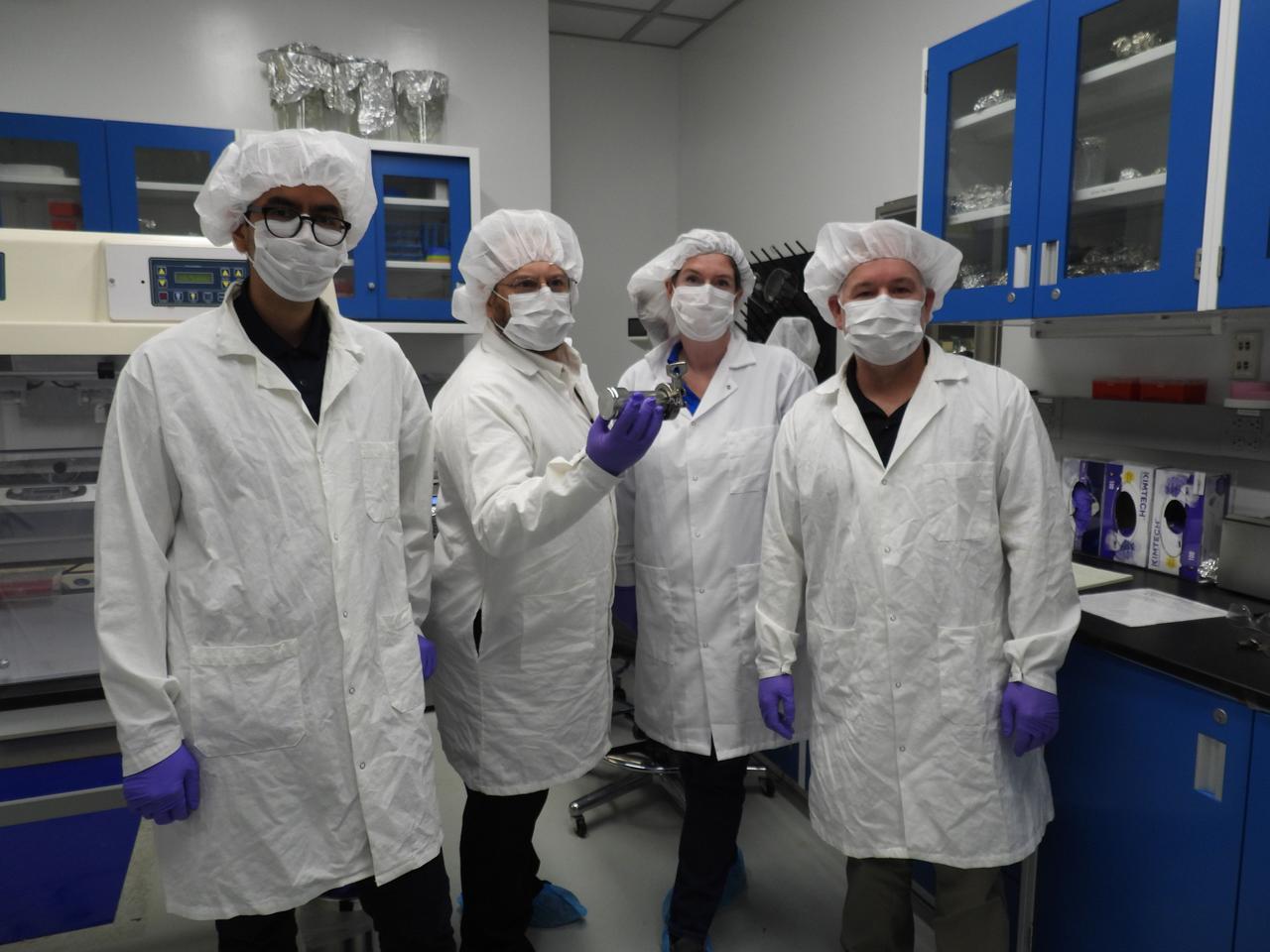
Researchers at NASA's Goddard Space Flight Center in Greenbelt, Maryland, pose with a cannister that contains a portion of the asteroid Bennu sample delivered to Earth by the agency's OSIRIS-REx (Origins, Spectral Interpretation, Resource Identification, and Security – Regolith Explorer) mission. From left to right: Angel Mojarro, organic geochemist; Jason Dworkin, OSIRIS-REX project scientist; Hannah McLain, astrobiologist; and Danny Glavin, senior sample scientist.
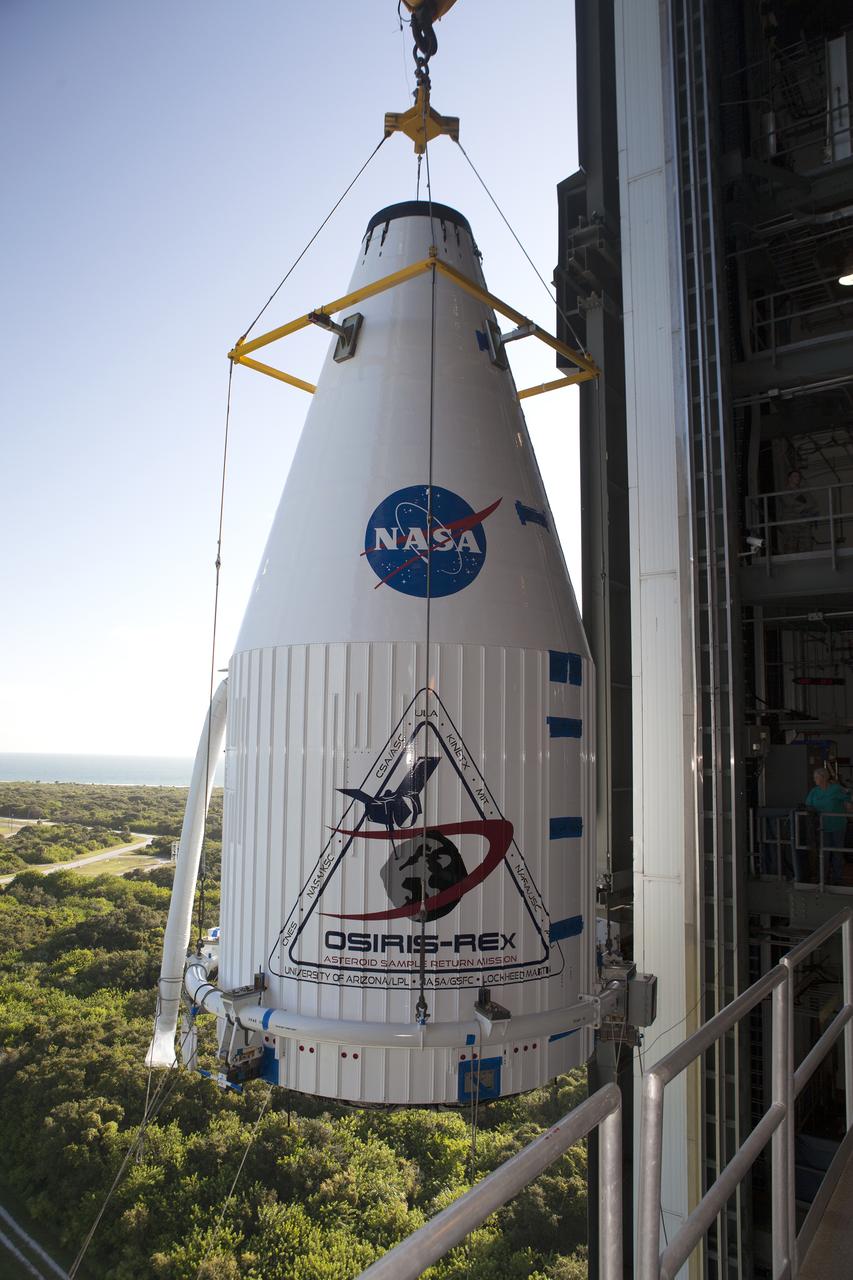
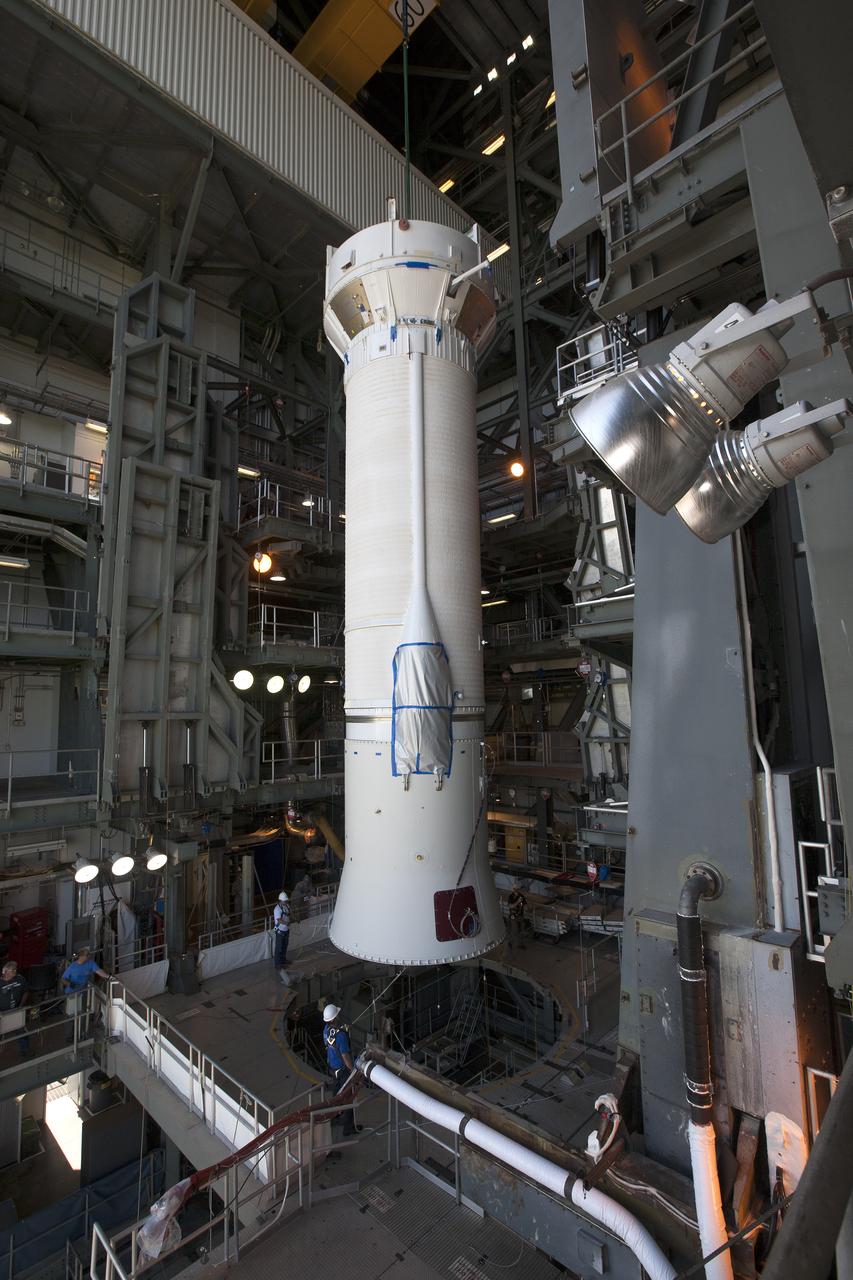
The OSIRIS-REx spacecraft, enclosed in a payload fairing, is lifted at Space Launch Complex 41 at Cape Canaveral Air Force Station. The United Launch Alliance Atlas V rocket that is to lift OSIRIS-REx into space was stacked at SLC-41 so the spacecraft and fairing could be hoisted and bolted to the rocket promptly. The spacecraft will be sent to rendezvous with, survey and take a sample from an asteroid called Bennu.
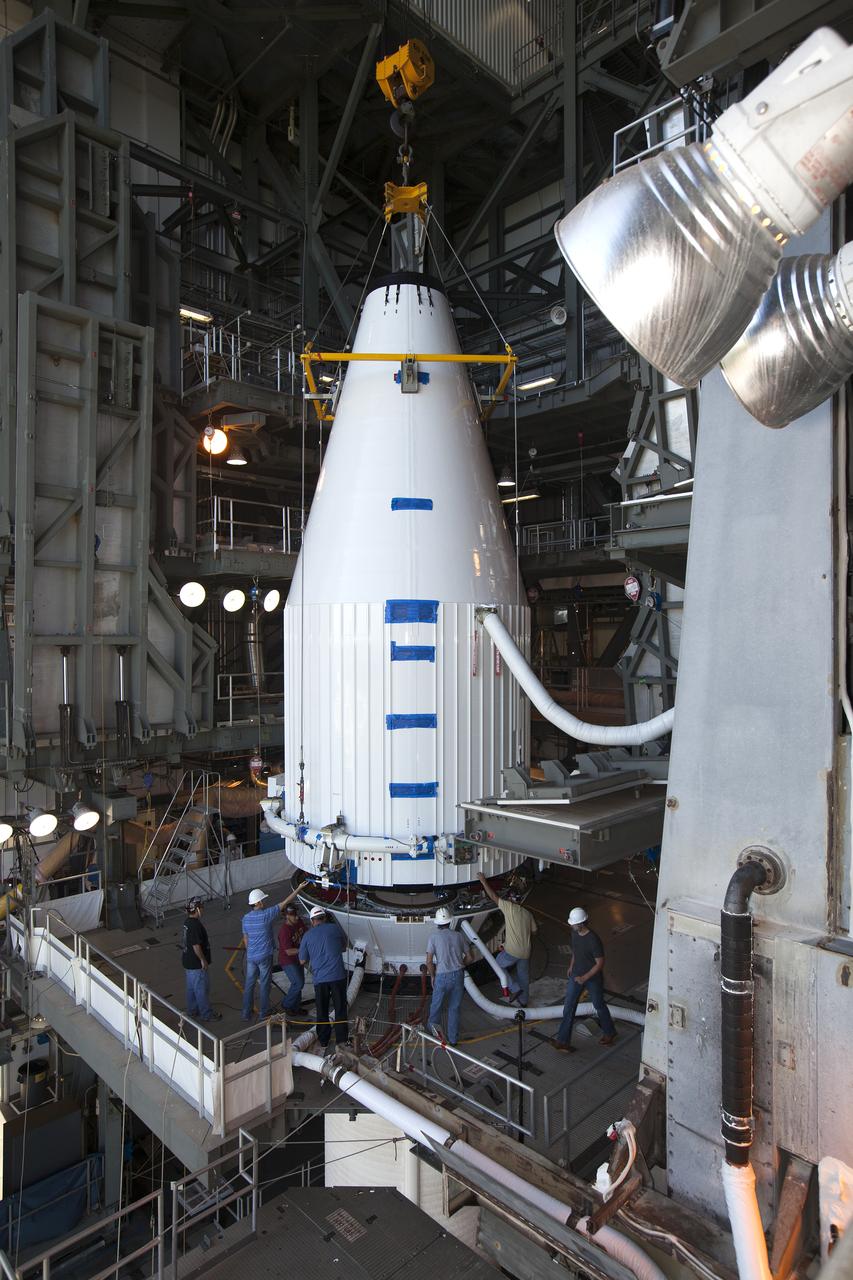
The OSIRIS-REx spacecraft, enclosed in a payload fairing, is positioned atop a United Launch Alliance Atlas V rocket at Space Launch Complex 41 at Cape Canaveral Air Force Station. The rocket that is to lift OSIRIS-REx into space was stacked at SLC-41 so the spacecraft and fairing could be hoisted and bolted to the rocket promptly. The spacecraft will be sent to rendezvous with, survey and take a sample from an asteroid called Bennu.
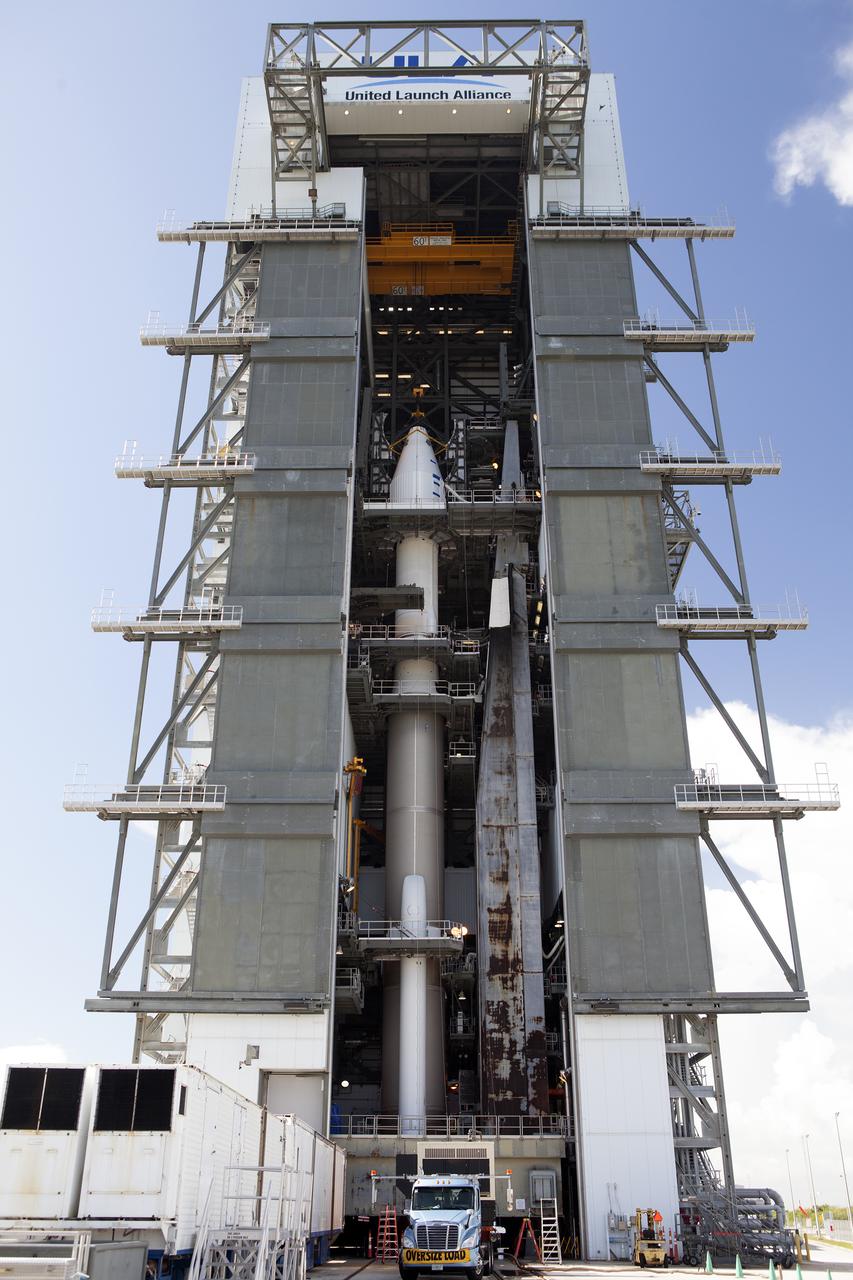
The OSIRIS-REx spacecraft, enclosed in a payload fairing, is positioned atop a United Launch Alliance Atlas V rocket at Space Launch Complex 41 at Cape Canaveral Air Force Station. The rocket that is to lift OSIRIS-REx into space was stacked at SLC-41 so the spacecraft and fairing could be hoisted and bolted to the rocket promptly. The spacecraft will be sent to rendezvous with, survey and take a sample from an asteroid called Bennu.
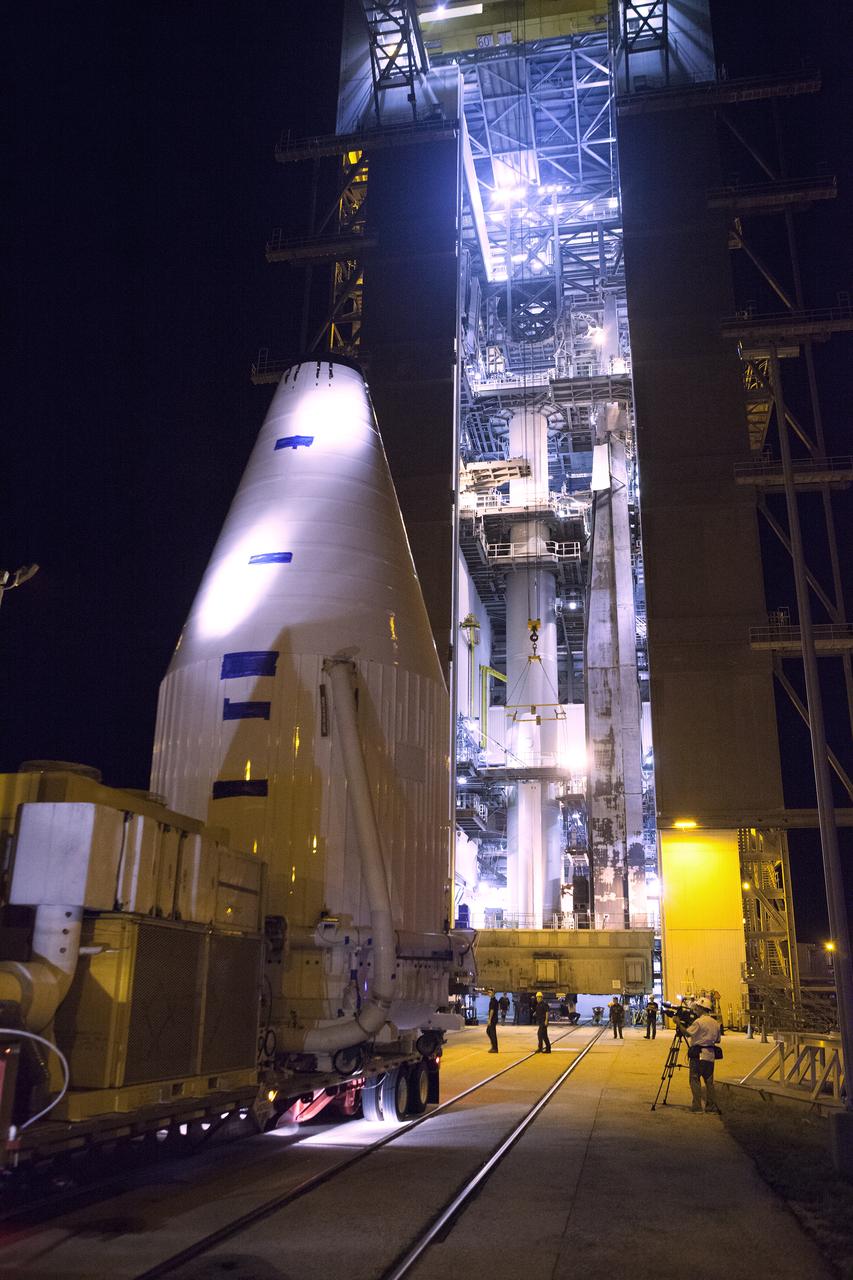
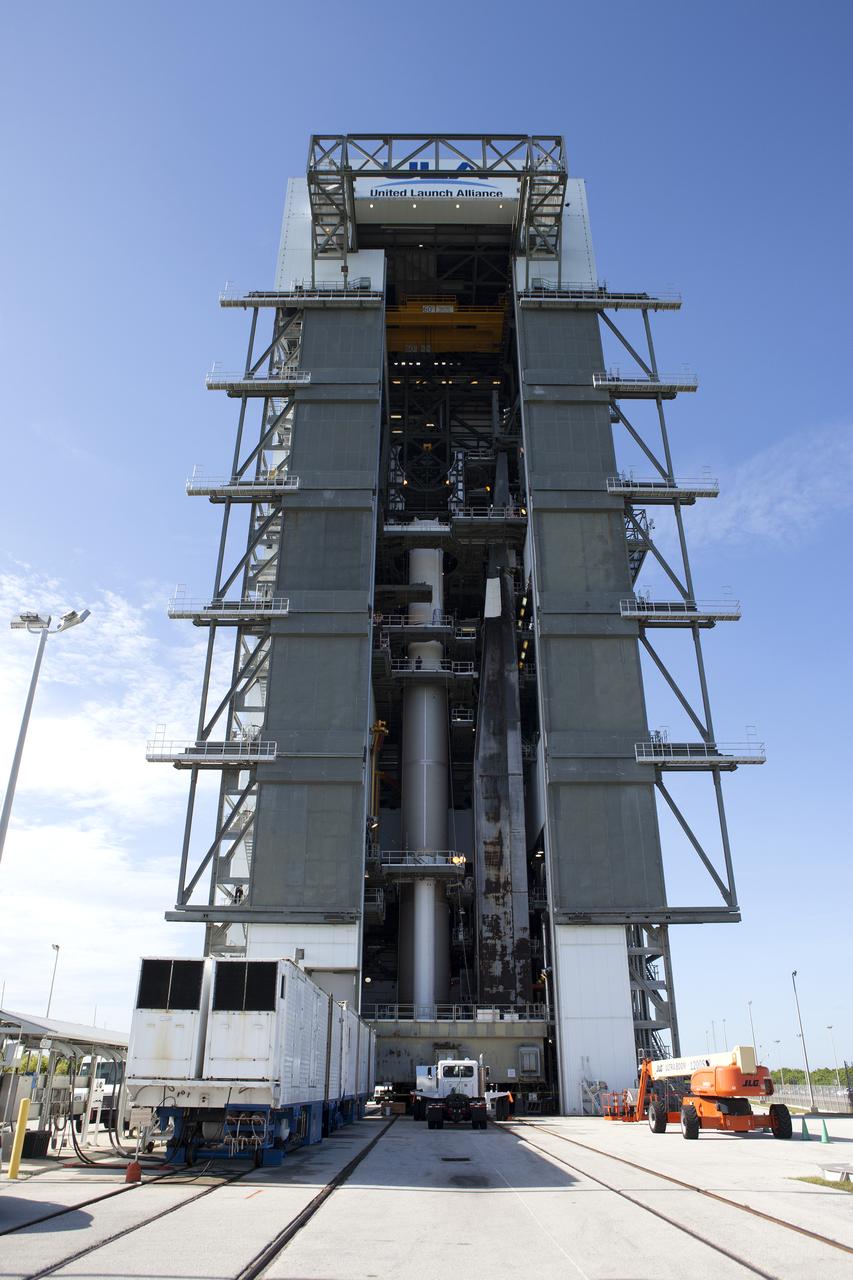
The OSIRIS-REx spacecraft, enclosed in a payload fairing, arrives at Space Launch Complex 41 at Cape Canaveral Air Force Station. The United Launch Alliance Atlas V rocket that is to lift OSIRIS-REx into space was stacked at SLC-41 so the spacecraft and fairing could be hoisted and bolted to the rocket promptly. The spacecraft will be sent to rendezvous with, survey and take a sample from an asteroid called Bennu.
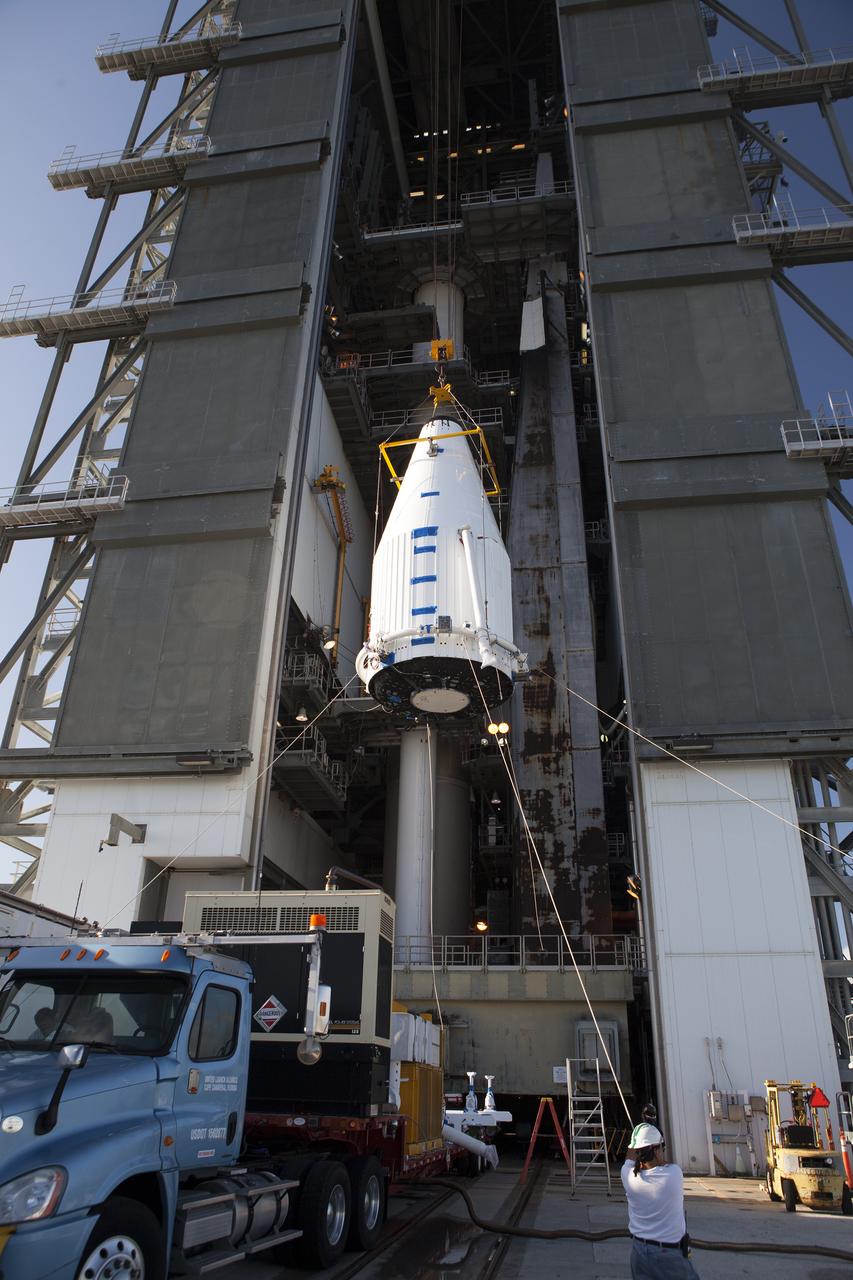
The OSIRIS-REx spacecraft, enclosed in a payload fairing, is lifted at Space Launch Complex 41 at Cape Canaveral Air Force Station. The United Launch Alliance Atlas V rocket that is to lift OSIRIS-REx into space was stacked at SLC-41 so the spacecraft and fairing could be hoisted and bolted to the rocket promptly. The spacecraft will be sent to rendezvous with, survey and take a sample from an asteroid called Bennu.

The OSIRIS-REx spacecraft, enclosed in a payload fairing, is positioned for lifting at Space Launch Complex 41 at Cape Canaveral Air Force Station. The United Launch Alliance Atlas V rocket that is to lift OSIRIS-REx into space was stacked at SLC-41 so the spacecraft and fairing could be hoisted and bolted to the rocket promptly. The spacecraft will be sent to rendezvous with, survey and take a sample from an asteroid called Bennu.
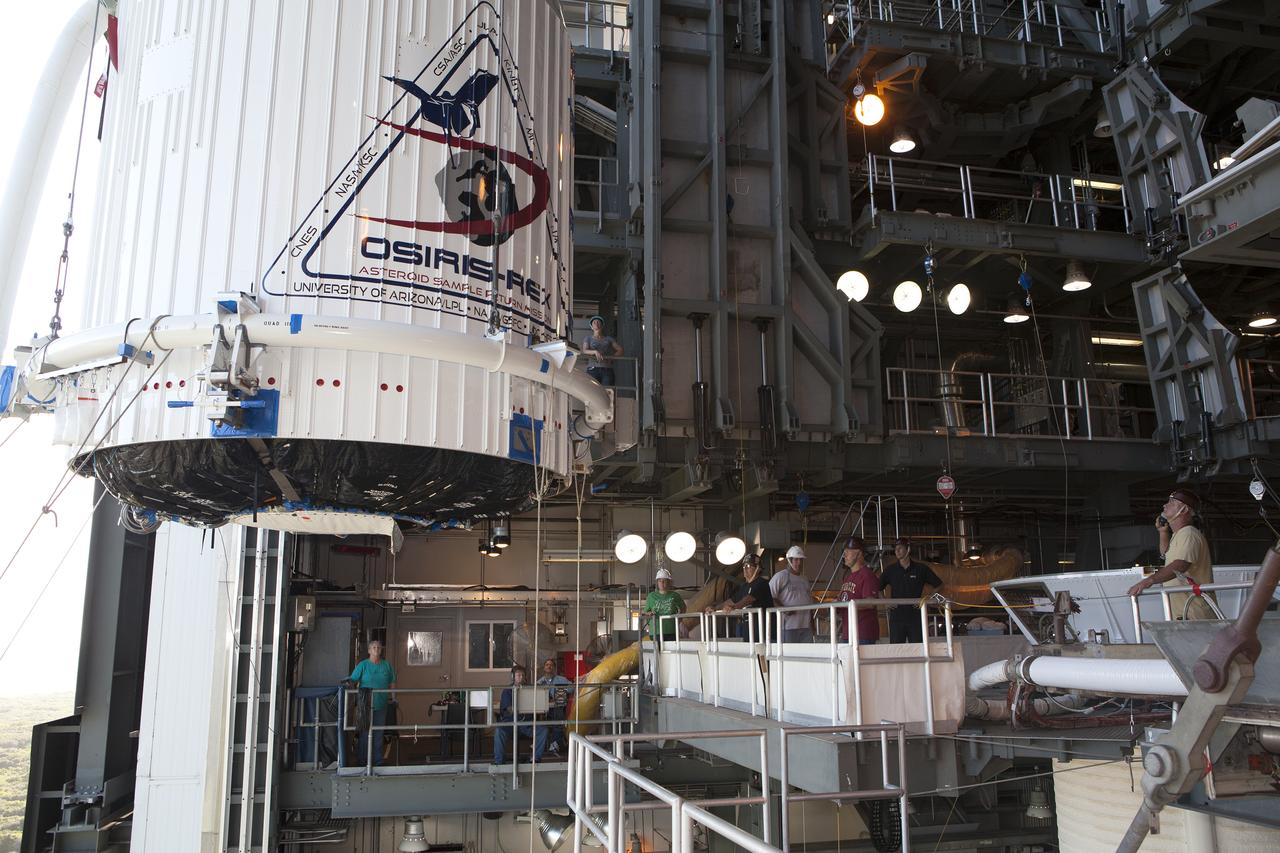
The OSIRIS-REx spacecraft, enclosed in a payload fairing, is lifted at Space Launch Complex 41 at Cape Canaveral Air Force Station. The United Launch Alliance Atlas V rocket that is to lift OSIRIS-REx into space was stacked at SLC-41 so the spacecraft and fairing could be hoisted and bolted to the rocket promptly. The spacecraft will be sent to rendezvous with, survey and take a sample from an asteroid called Bennu.
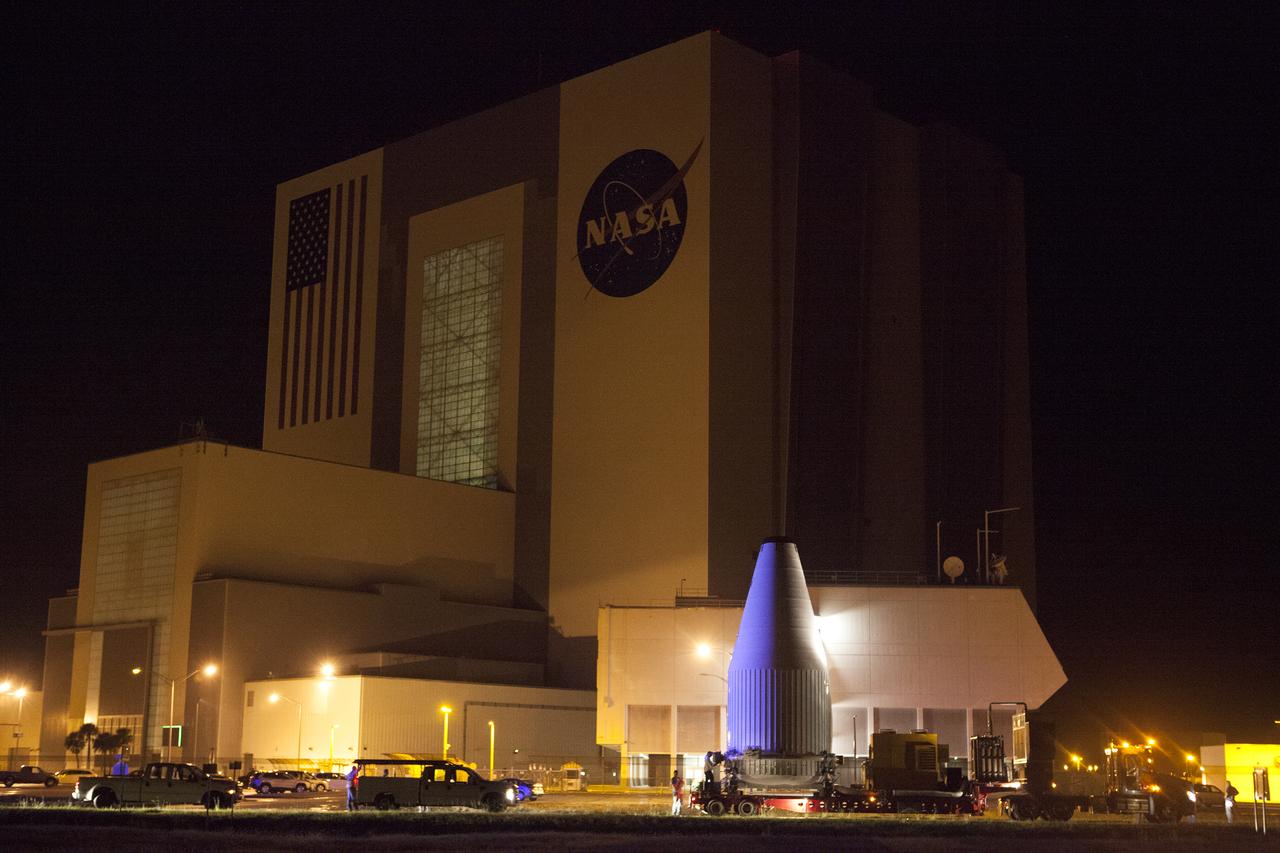
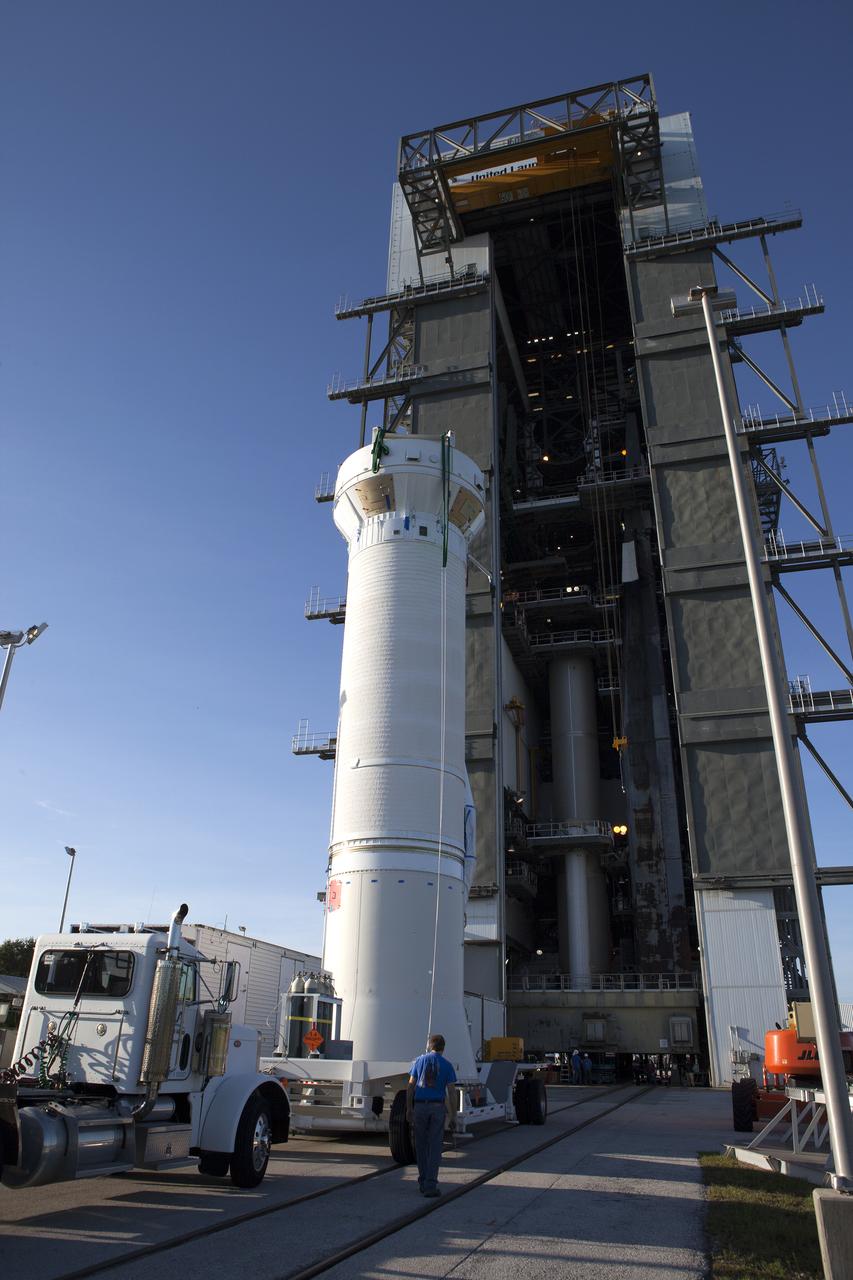
The OSIRIS-REx spacecraft, enclosed in a payload fairing, is towed past the Vehicle Assembly Building at NASA's Kennedy Space Center on its way to Space Launch Complex 41 at the adjacent Cape Canaveral Air Force Station. The United Launch Alliance Atlas V rocket that is to lift OSIRIS-REx into space was stacked at SLC-41 so the spacecraft and fairing could be hoisted and bolted to the rocket promptly. The spacecraft will be sent to rendezvous with, survey and take a sample from an asteroid called Bennu.
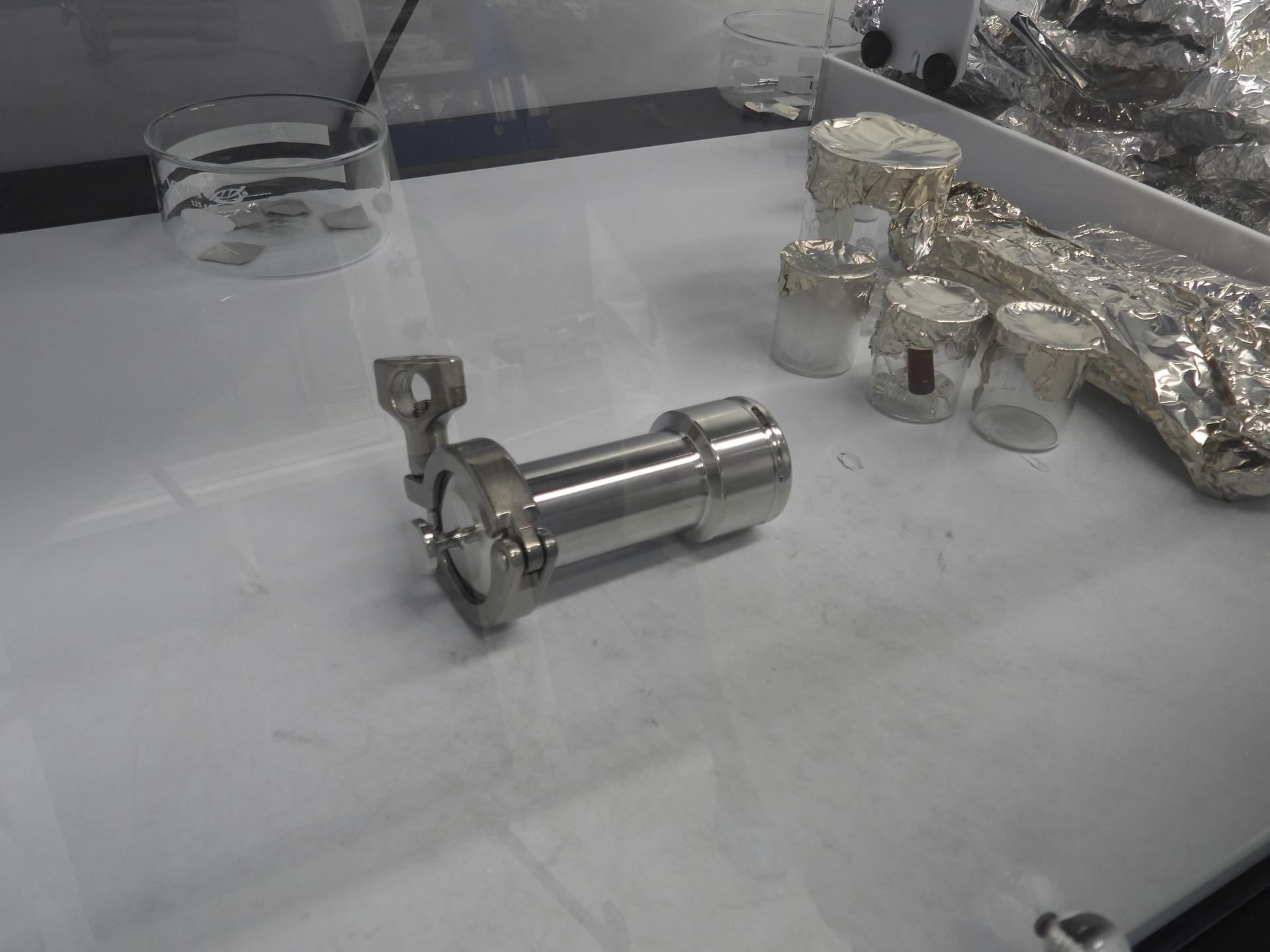
Photographed inside a laboratory at NASA's Goddard Space Flight Center in Greenbelt, Maryland, this cannister contains a portion of the asteroid Bennu sample delivered to Earth by the agency's OSIRIS-REx (Origins, Spectral Interpretation, Resource Identification, and Security – Regolith Explorer) mission.
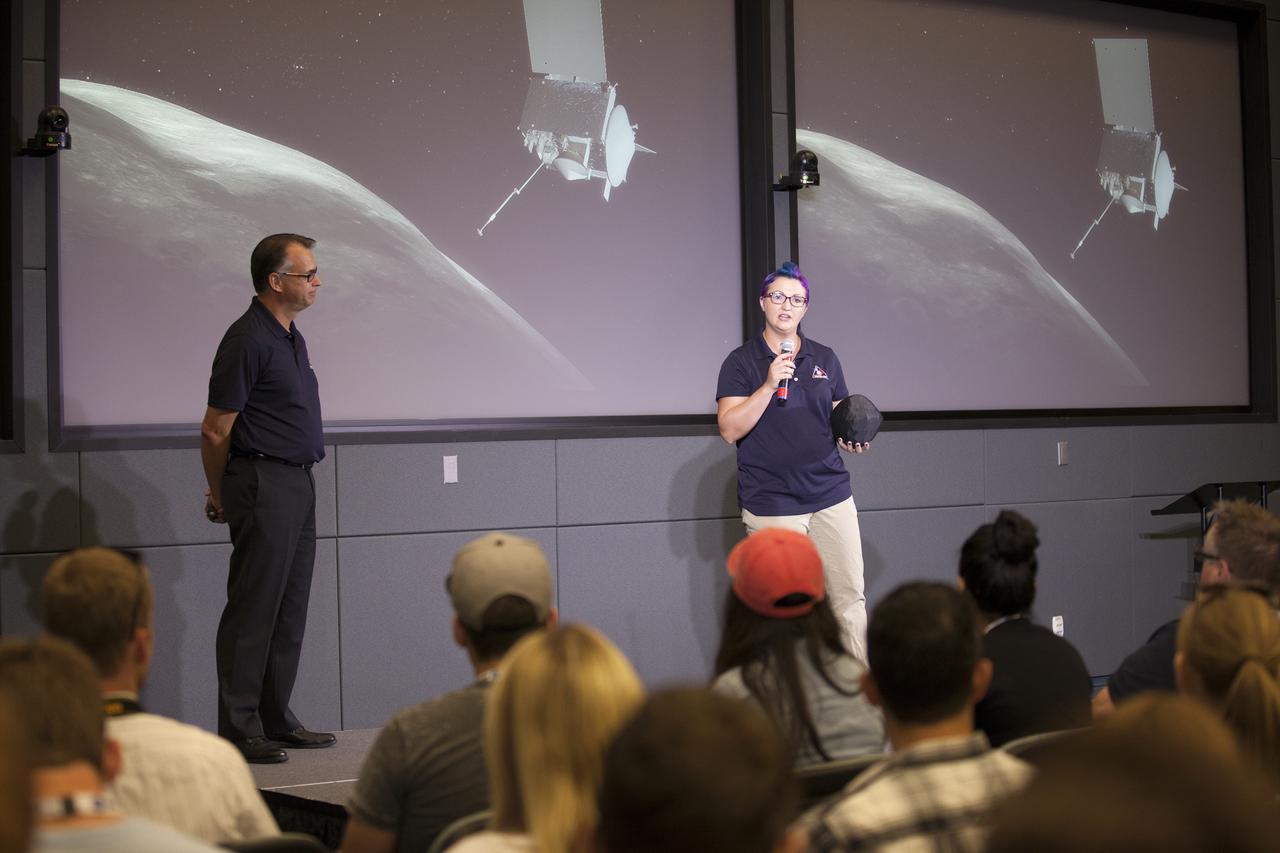
Social media followers were briefed by NASA scientists on asteroids, how they relate to the origins of our solar system and the search for life beyond Earth, during a NASA Social presentation in the Operations Support Building II at the agency’s Kennedy Space Center in Florida. The presentation took place before launch of the agency’s Origins, Spectral Interpretation, Resource Identification, Security-Regolith Explorer, or OSIRIS-REx spacecraft. From the left, are Dante Lauretta, OSIRIS-REx principal investigator from the University of Arizona at Tucson, and Christina Richey, OSIRIS-REx deputy program scientists at NASA Headquarters in Washington.
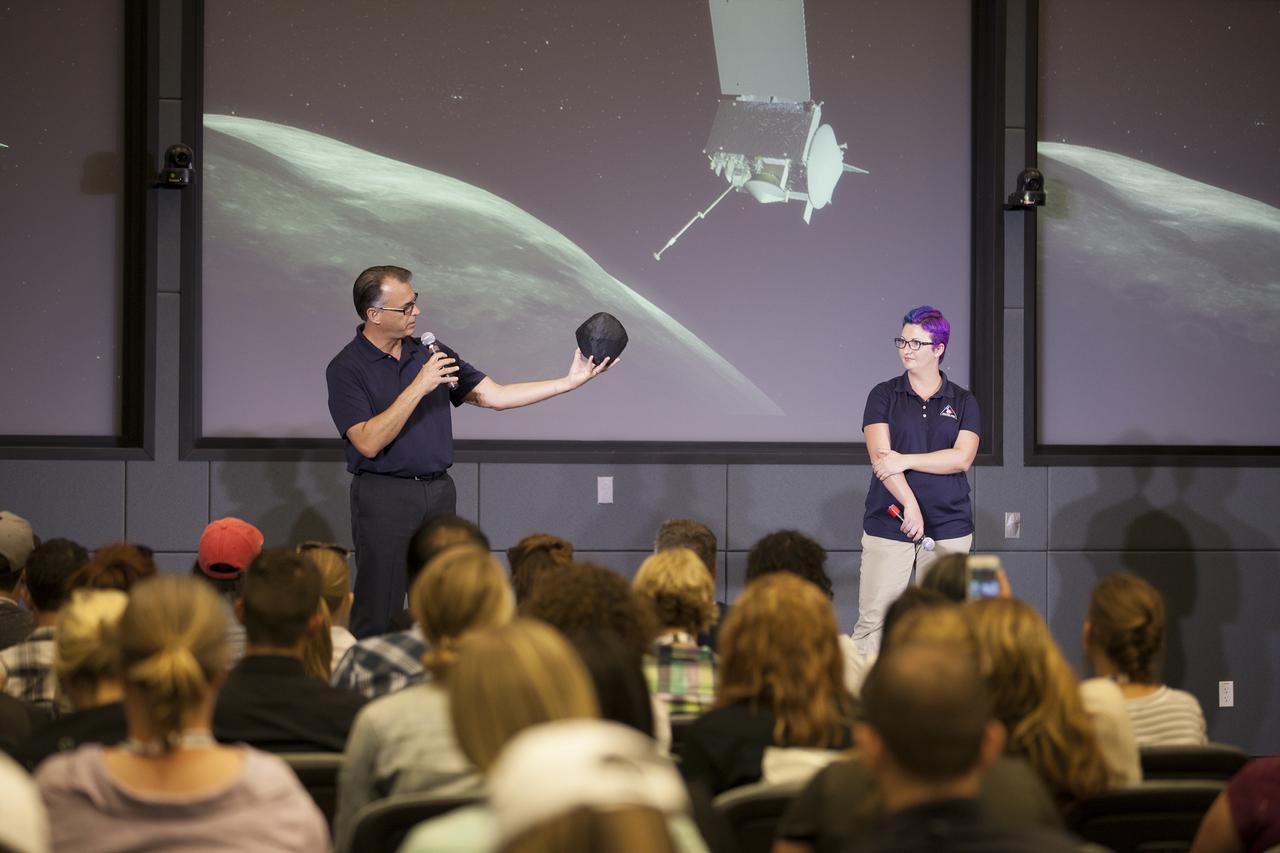
Social media followers were briefed by NASA scientists on asteroids, how they relate to the origins of our solar system and the search for life beyond Earth, during a NASA Social presentation in the Operations Support Building II at the agency’s Kennedy Space Center in Florida. The presentation took place before launch of the agency’s Origins, Spectral Interpretation, Resource Identification, Security-Regolith Explorer, or OSIRIS-REx spacecraft. From the left, are Dante Lauretta, OSIRIS-REx principal investigator from the University of Arizona at Tucson, and Christina Richey, OSIRIS-REx deputy program scientists at NASA Headquarters in Washington.
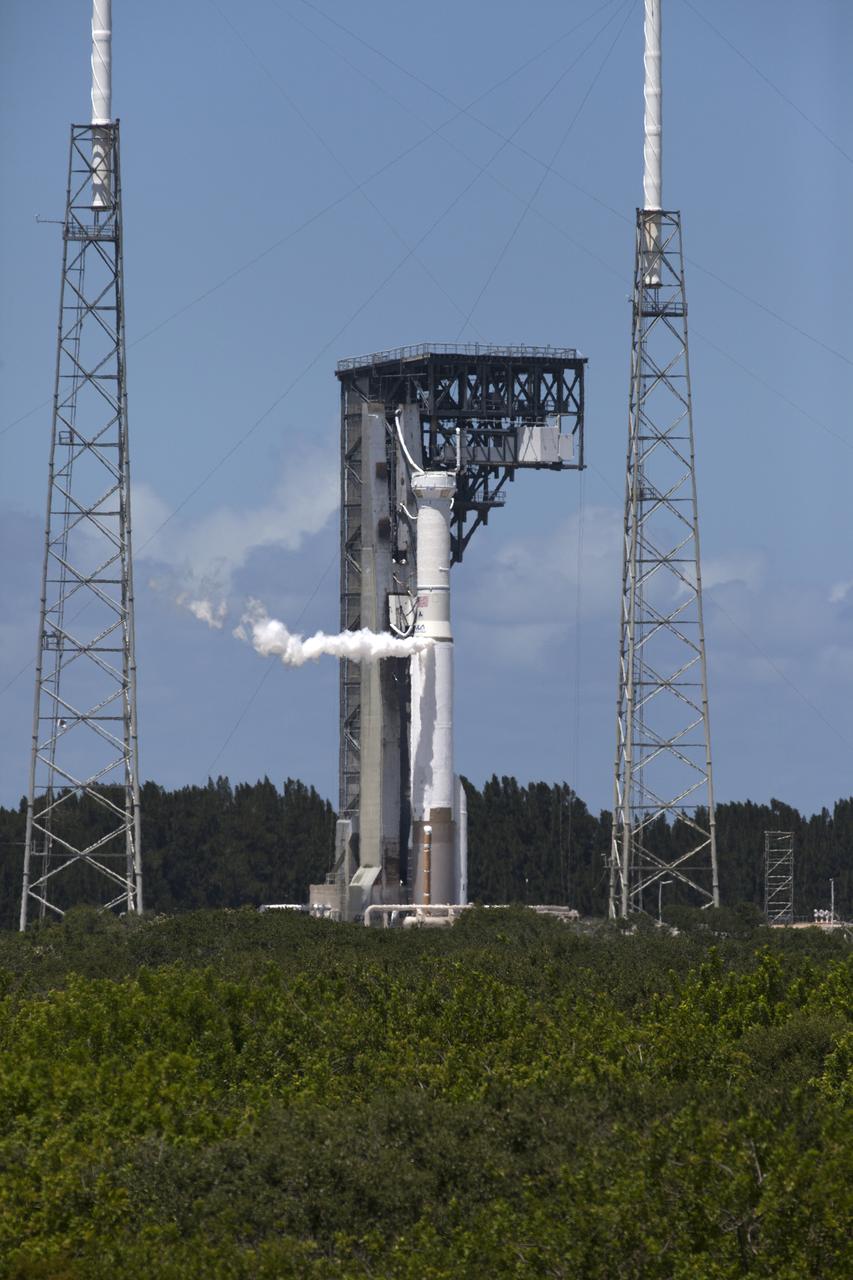
The booster and Centaur upper stage of a United Launch Alliance Atlas V vent gaseous propellant during a “wet dress rehearsal” test at Space Launch Complex 41 on Florida’s Cape Canaveral Air Force Station. The rocket will boost NASA’s Origins, Spectral Interpretation, Resource Identification, Security-Regolith Explorer, or OSIRIS-REx spacecraft. Targeted for liftoff Sept. 8, 2016, OSIRIS-REx will be the first U.S. mission to sample an asteroid, retrieve at least two ounces of surface material and return it to Earth for study. The asteroid, Bennu, may hold clues to the origin of the solar system and the source of water and organic molecules found on Earth.
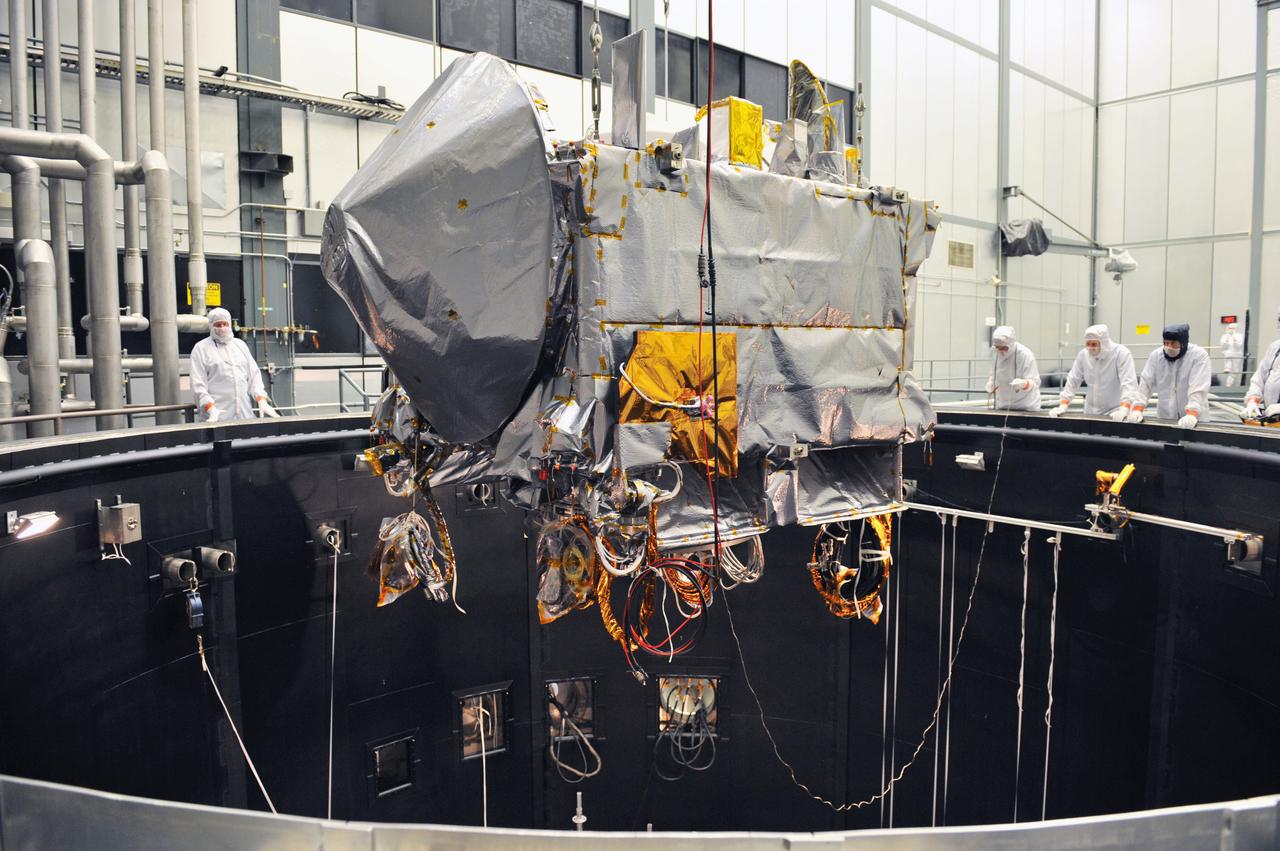
The OSIRIS-REx spacecraft being lifted into the thermal vacuum chamber at Lockheed Martin for environmental testing. Credits: Lockheed Martin Read more: <a href="http://www.nasa.gov/feature/goddard/2016/osiris-rex-in-thermal-vac" rel="nofollow">www.nasa.gov/feature/goddard/2016/osiris-rex-in-thermal-vac</a>
Tim Linn, chief system engineer with Lockheed Martin, discusses the unique design of the OSIRIS-REx spacecraft during a NASA Social with social media followers in the Operations Support Building II at NASA’s Kennedy Space Center in Florida. The presentation took place before launch of the agency’s Origins, Spectral Interpretation, Resource Identification, Security-Regolith Explorer, or OSIRIS-REx spacecraft.
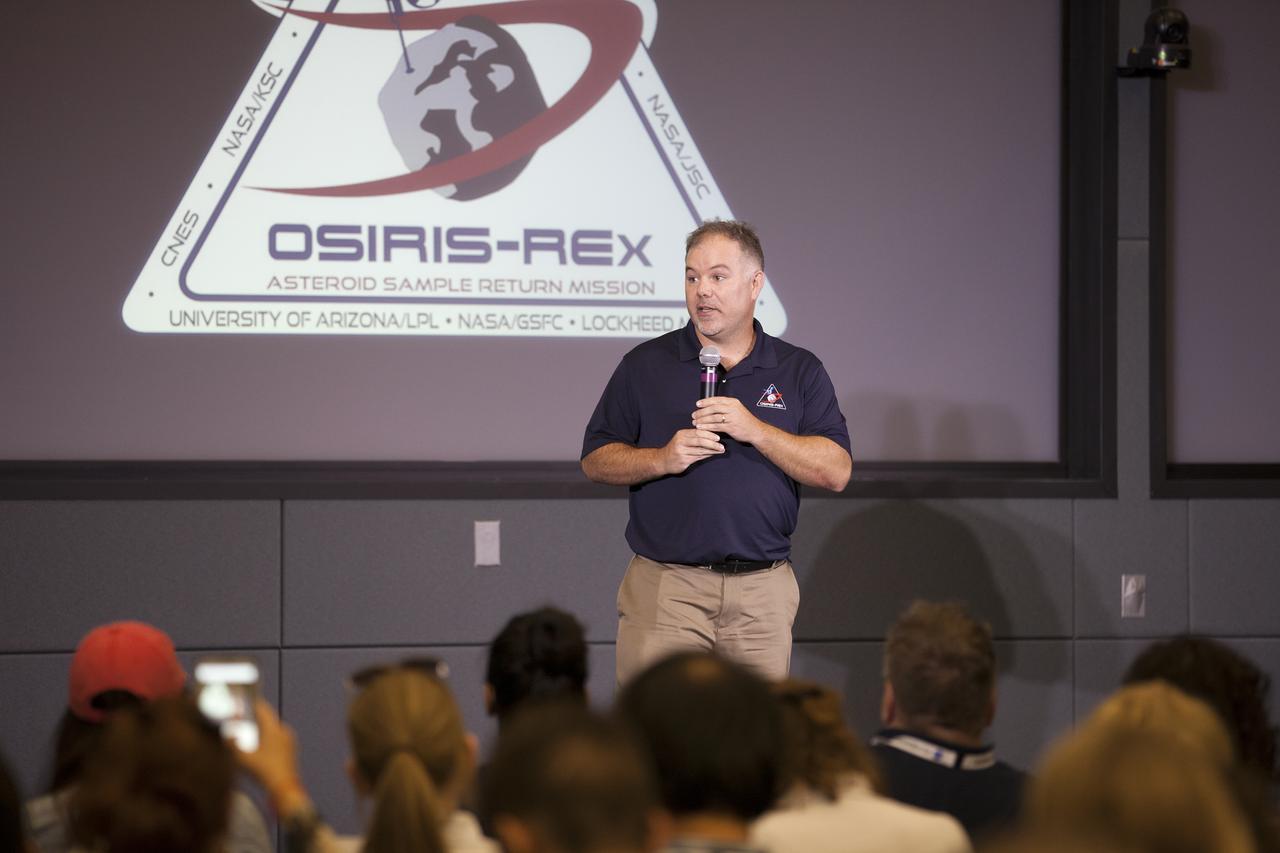
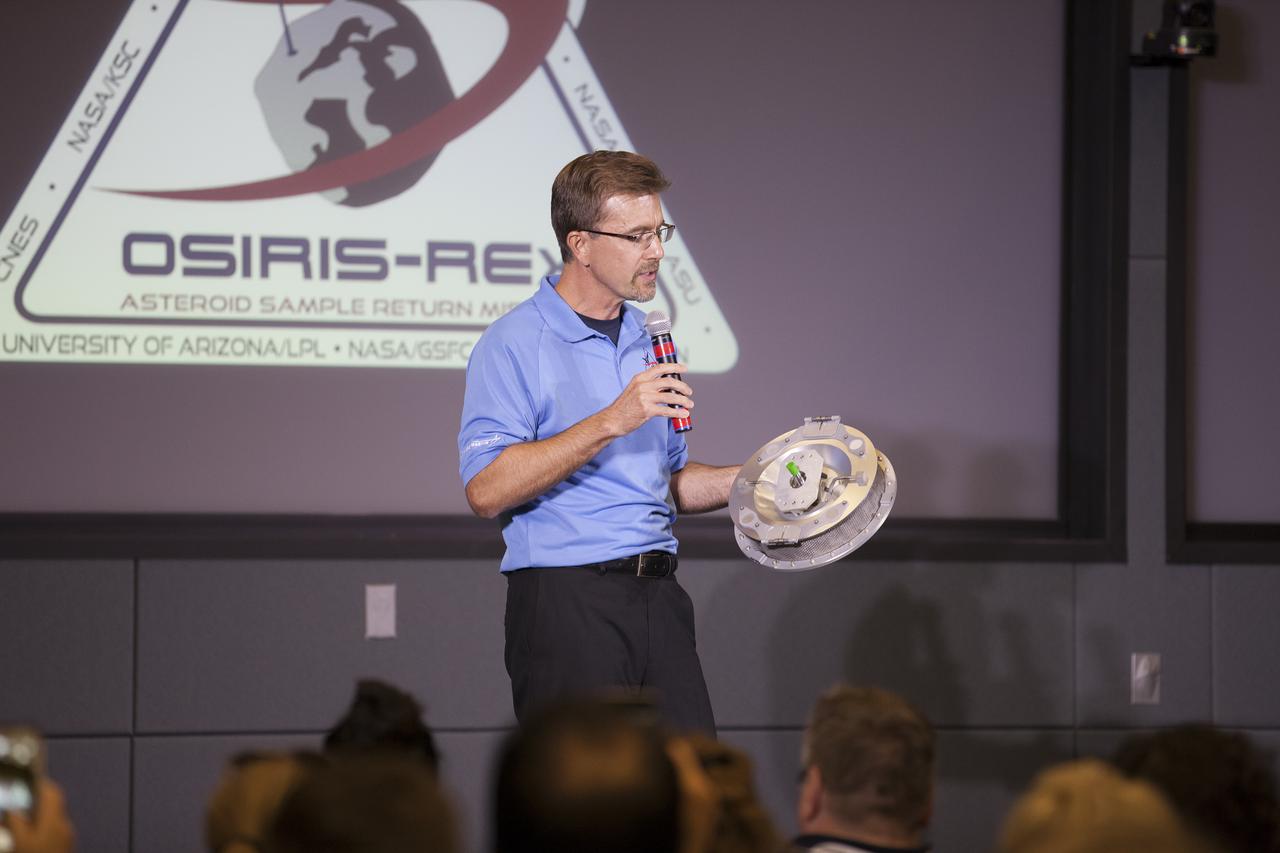
Daniel Glavin, OSIRIS-REx co-investigator at NASA’s Goddard Space Flight Center in Greenbelt, Maryland, talks to social media followers during a NASA Social in the Operations Support Building II at the agency’s Kennedy Space Center in Florida. The presentation took place before launch of the agency’s Origins, Spectral Interpretation, Resource Identification, Security-Regolith Explorer, or OSIRIS-REx spacecraft.
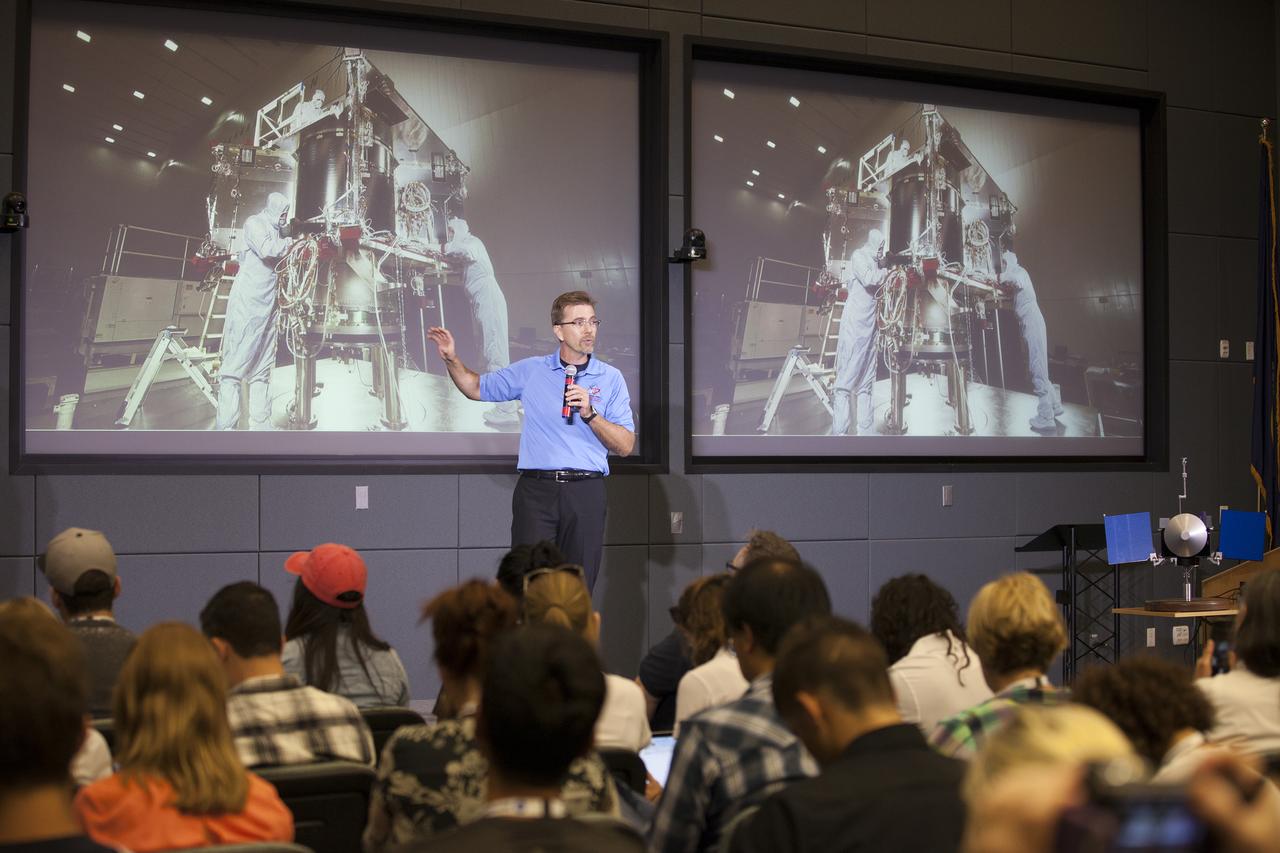
Tim Linn, chief system engineer with Lockheed Martin, discusses the unique design of the OSIRIS-REx spacecraft during a NASA Social with social media followers in the Operations Support Building II at NASA’s Kennedy Space Center in Florida. The presentation took place before launch of the agency’s Origins, Spectral Interpretation, Resource Identification, Security-Regolith Explorer, or OSIRIS-REx spacecraft.
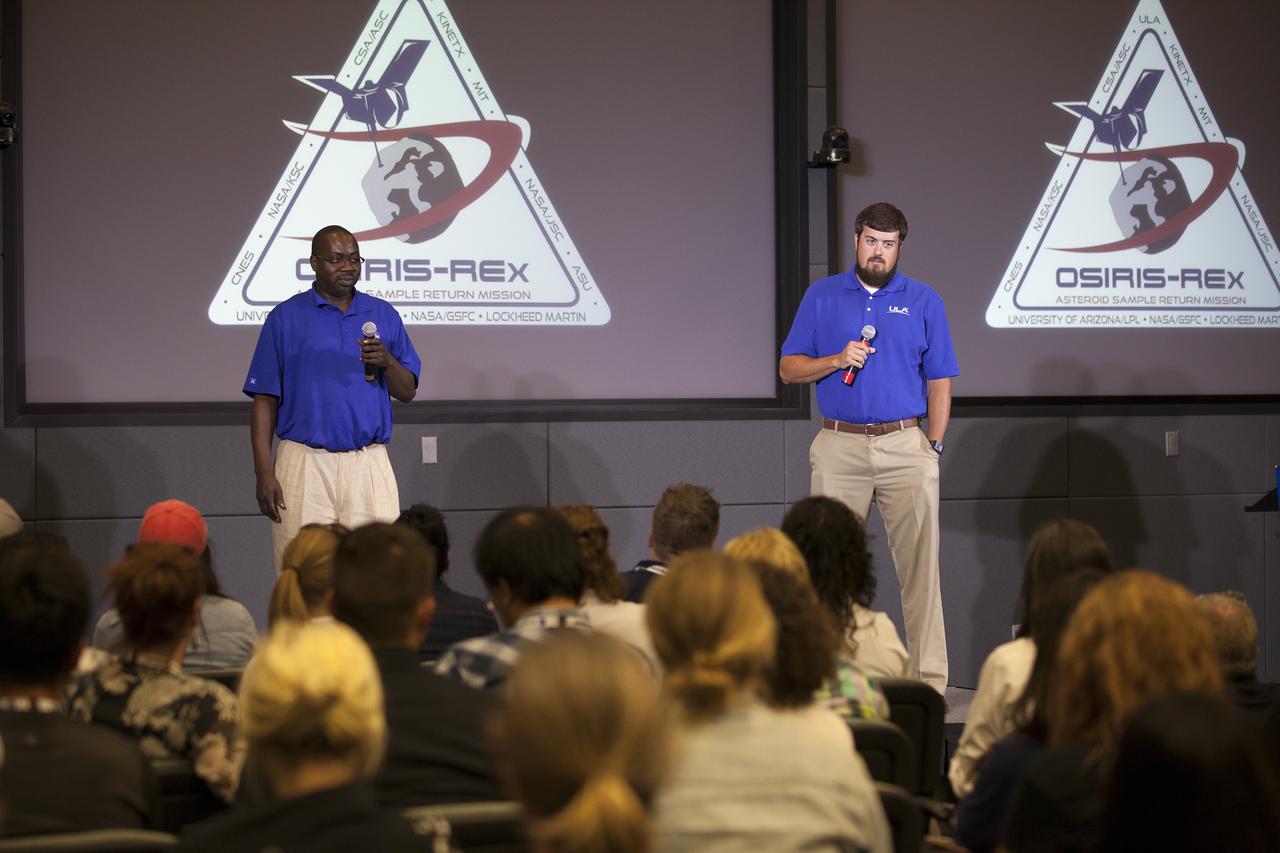
Social media followers were briefed by NASA scientists on asteroids, how they relate to the origins of our solar system and the search for life beyond Earth, during a NASA Social presentation in the Operations Support Building II at the agency’s Kennedy Space Center in Florida. The presentation took place before launch of the agency’s Origins, Spectral Interpretation, Resource Identification, Security-Regolith Explorer, or OSIRIS-REx spacecraft. From the left, are Jarmaine Ollivierre, OSIRIS-REx lead flight designs with NASA’s Launch Services Program; and Gordon McLemore, with United Launch Alliance (ULA). OSIRIS-REx will launch aboard a ULA Atlas V rocket from Space Launch Complex 41 at NASA’s Kennedy Space Center.
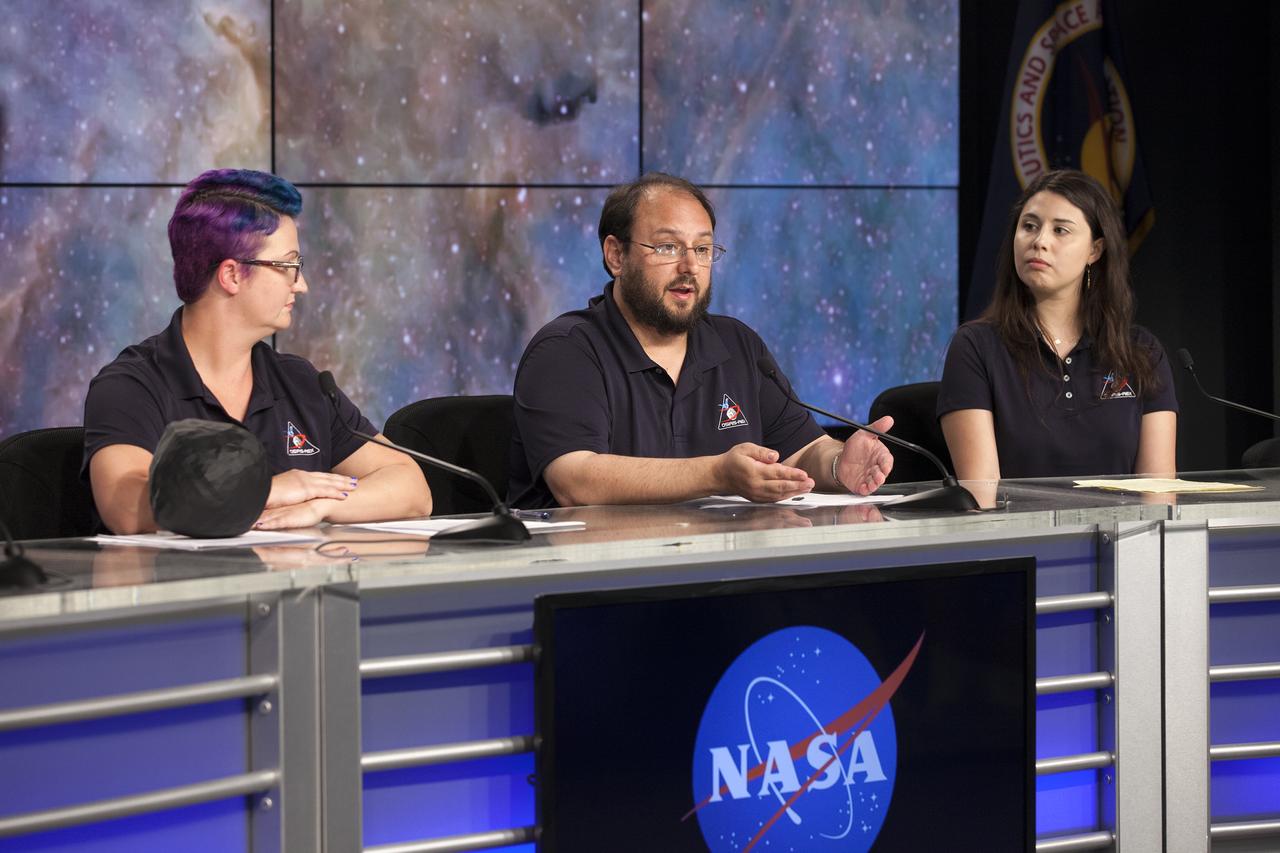
In the Kennedy Space Center’s Press Site auditorium, members of the media participate in a briefing on science experiments involved in NASA’s Origins, Spectral Interpretation, Resource Identification, Security-Regolith Explorer, or OSIRIS-REx spacecraft. From left are: Christina Richey, OSIRIS-REx deputy program scientist at NASA Headquarters in Washington; Jason Dworkin, OSIRIS-REx project scientist at NASA’s Goddard Space Flight Center in Greenbelt, Maryland; Daniella DellaGiustina, OSIRIS-REx lead image processing scientist at the University of Arizona, Tucson.
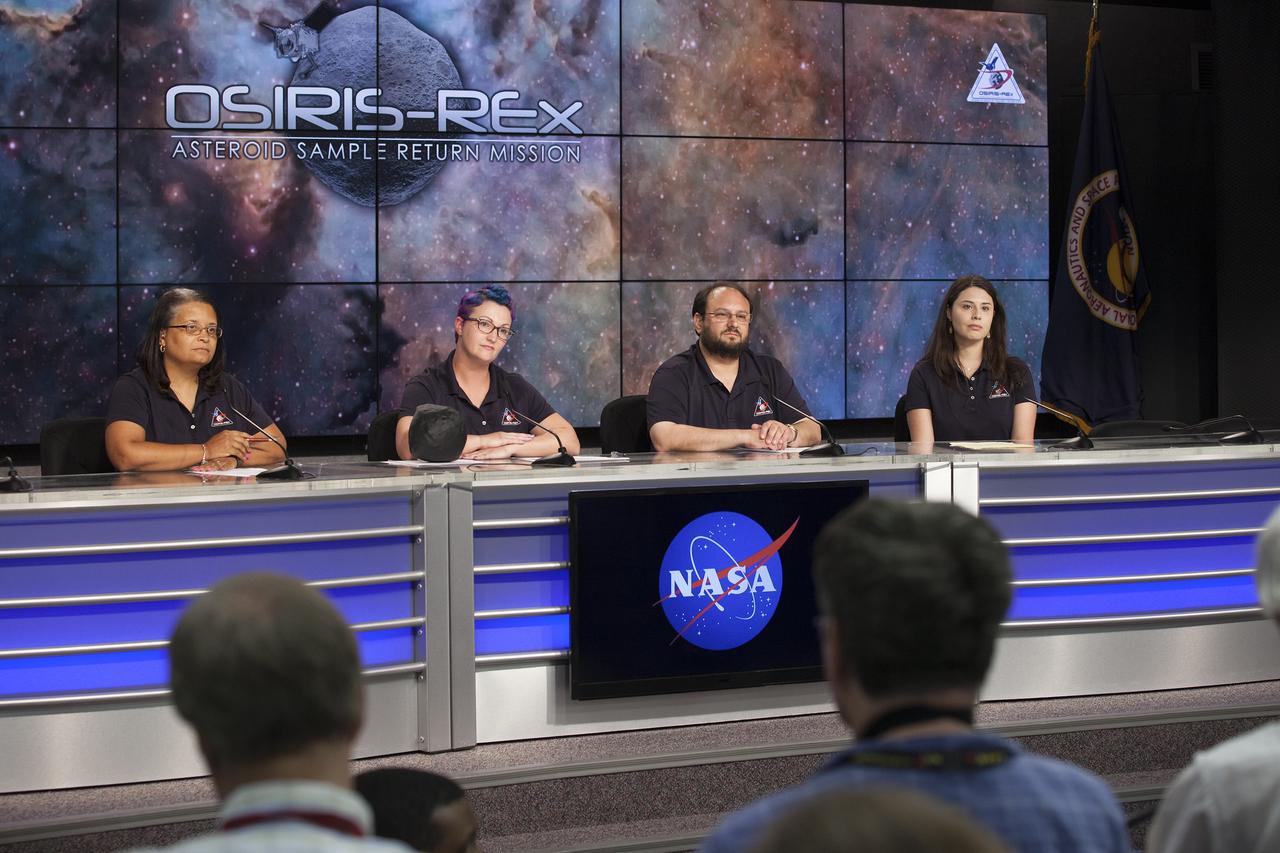
In the Kennedy Space Center’s Press Site auditorium, members of the media participate in a briefing on science experiments involved in NASA’s Origins, Spectral Interpretation, Resource Identification, Security-Regolith Explorer, or OSIRIS-REx spacecraft. From left are: Nancy Neal-Jones of NASA Communications; Christina Richey, OSIRIS-REx deputy program scientist at NASA Headquarters in Washington; Jason Dworkin, OSIRIS-REx project scientist at NASA’s Goddard Space Flight Center in Greenbelt, Maryland; Daniella DellaGiustina, OSIRIS-REx lead image processing scientist at the University of Arizona, Tucson.
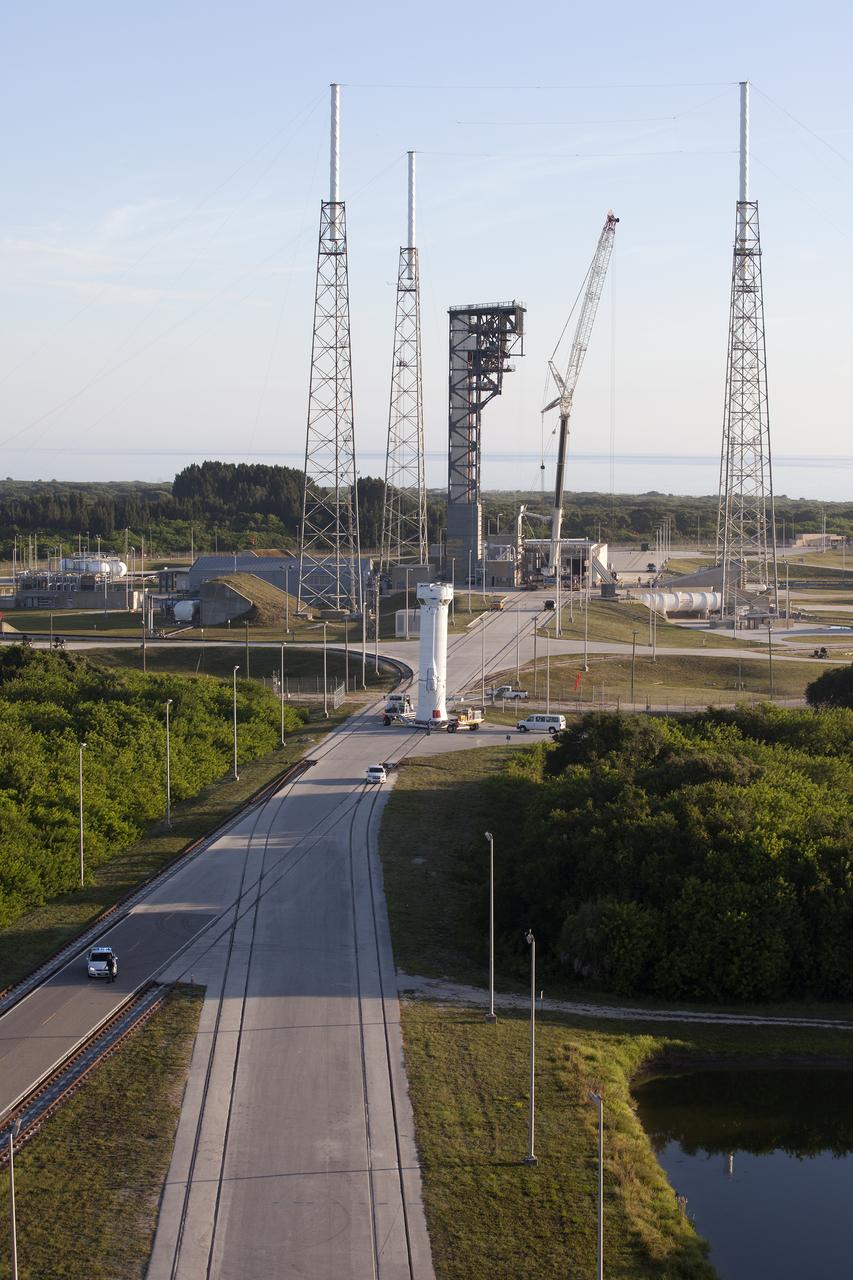
A Centaur upper stage, standing upright on a transporter, arrives at Space Launch Complex 41 on Florida’s Cape Canaveral Air Force Station, where it will be attached to the United Launch Alliance Atlas V rocket first stage booster. The rocket will boost NASA’s Origins, Spectral Interpretation, Resource Identification, Security-Regolith Explorer, or OSIRIS-REx spacecraft. Targeted for liftoff Sept. 8, 2016, OSIRIS-Rex will be the first U.S. mission to sample an asteroid, retrieve at least two ounces of surface material and return it to Earth for study. The asteroid, Bennu, may hold clues to the origin of the solar system and the source of water and organic molecules found on Earth.
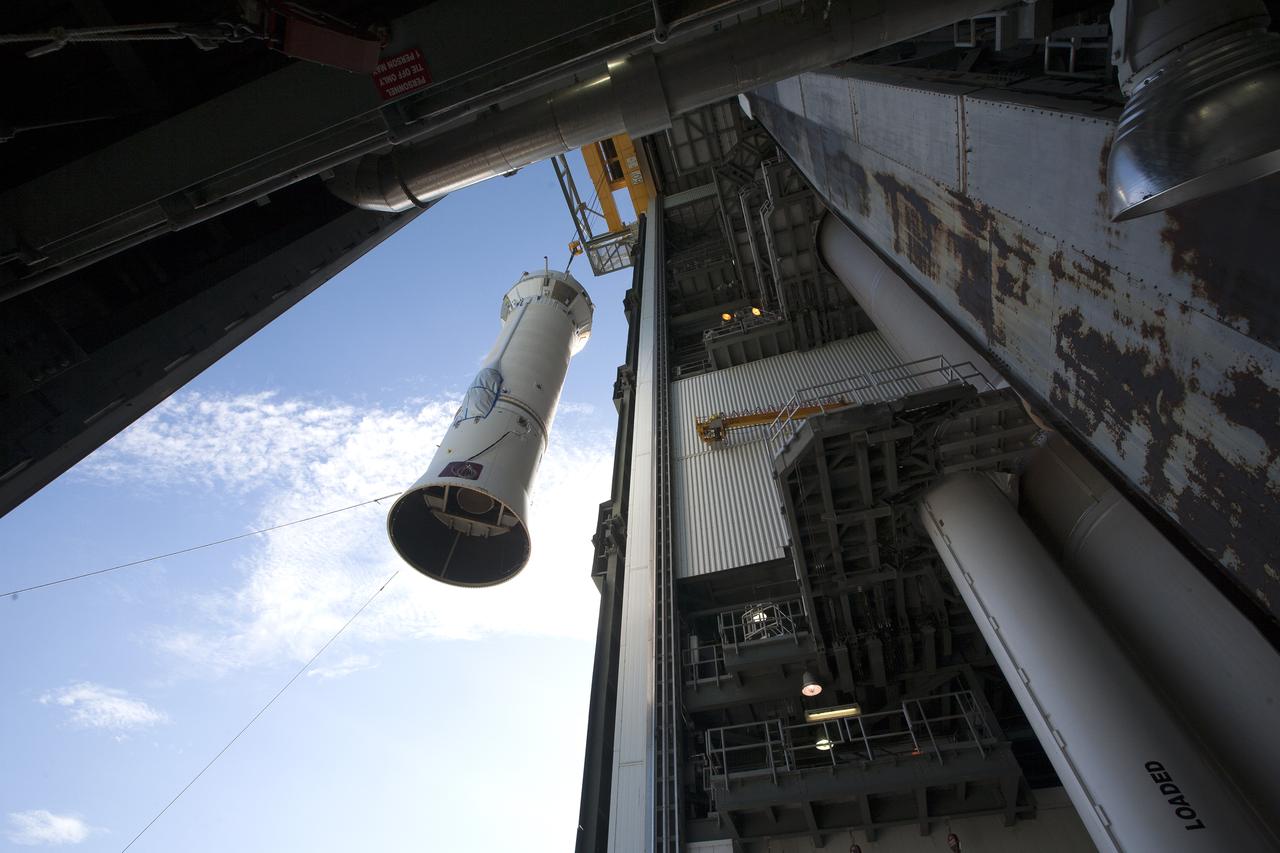
A Centaur upper stage is lifted at Space Launch Complex 41 on Florida’s Cape Canaveral Air Force Station, where it will be attached to the United Launch Alliance Atlas V rocket first stage booster. The rocket will boost NASA’s Origins, Spectral Interpretation, Resource Identification, Security-Regolith Explorer, or OSIRIS-REx spacecraft. Targeted for liftoff Sept. 8, 2016, OSIRIS-Rex will be the first U.S. mission to sample an asteroid, retrieve at least two ounces of surface material and return it to Earth for study. The asteroid, Bennu, may hold clues to the origin of the solar system and the source of water and organic molecules found on Earth.
A Centaur upper stage, standing upright on a transporter, is prepared to be lifted and attached to the United Launch Alliance Atlas V rocket first stage booster at Space Launch Complex 41 on Florida’s Cape Canaveral Air Force Station. The rocket will boost NASA’s Origins, Spectral Interpretation, Resource Identification, Security-Regolith Explorer, or OSIRIS-REx spacecraft. Targeted for liftoff Sept. 8, 2016, OSIRIS-Rex will be the first U.S. mission to sample an asteroid, retrieve at least two ounces of surface material and return it to Earth for study. The asteroid, Bennu, may hold clues to the origin of the solar system and the source of water and organic molecules found on Earth.
A Centaur upper stage has been lowered into position atop the United Launch Alliance Atlas V rocket first stage booster at Space Launch Complex 41 on Florida’s Cape Canaveral Air Force Station. The rocket will boost NASA’s Origins, Spectral Interpretation, Resource Identification, Security-Regolith Explorer, or OSIRIS-REx spacecraft. Targeted for liftoff Sept. 8, 2016, OSIRIS-Rex will be the first U.S. mission to sample an asteroid, retrieve at least two ounces of surface material and return it to Earth for study. The asteroid, Bennu, may hold clues to the origin of the solar system and the source of water and organic molecules found on Earth.
Team members prepare to attach a Centaur upper stage to the United Launch Alliance Atlas V rocket first stage booster at Space Launch Complex 41 on Florida’s Cape Canaveral Air Force Station. The rocket will boost NASA’s Origins, Spectral Interpretation, Resource Identification, Security-Regolith Explorer, or OSIRIS-REx spacecraft. Targeted for liftoff Sept. 8, 2016, OSIRIS-Rex will be the first U.S. mission to sample an asteroid, retrieve at least two ounces of surface material and return it to Earth for study. The asteroid, Bennu, may hold clues to the origin of the solar system and the source of water and organic molecules found on Earth.
A Centaur upper stage, standing upright on a transporter, is prepared to be lifted and attached to the United Launch Alliance Atlas V rocket first stage booster at Space Launch Complex 41 on Florida’s Cape Canaveral Air Force Station. The rocket will boost NASA’s Origins, Spectral Interpretation, Resource Identification, Security-Regolith Explorer, or OSIRIS-REx spacecraft. Targeted for liftoff Sept. 8, 2016, OSIRIS-Rex will be the first U.S. mission to sample an asteroid, retrieve at least two ounces of surface material and return it to Earth for study. The asteroid, Bennu, may hold clues to the origin of the solar system and the source of water and organic molecules found on Earth.
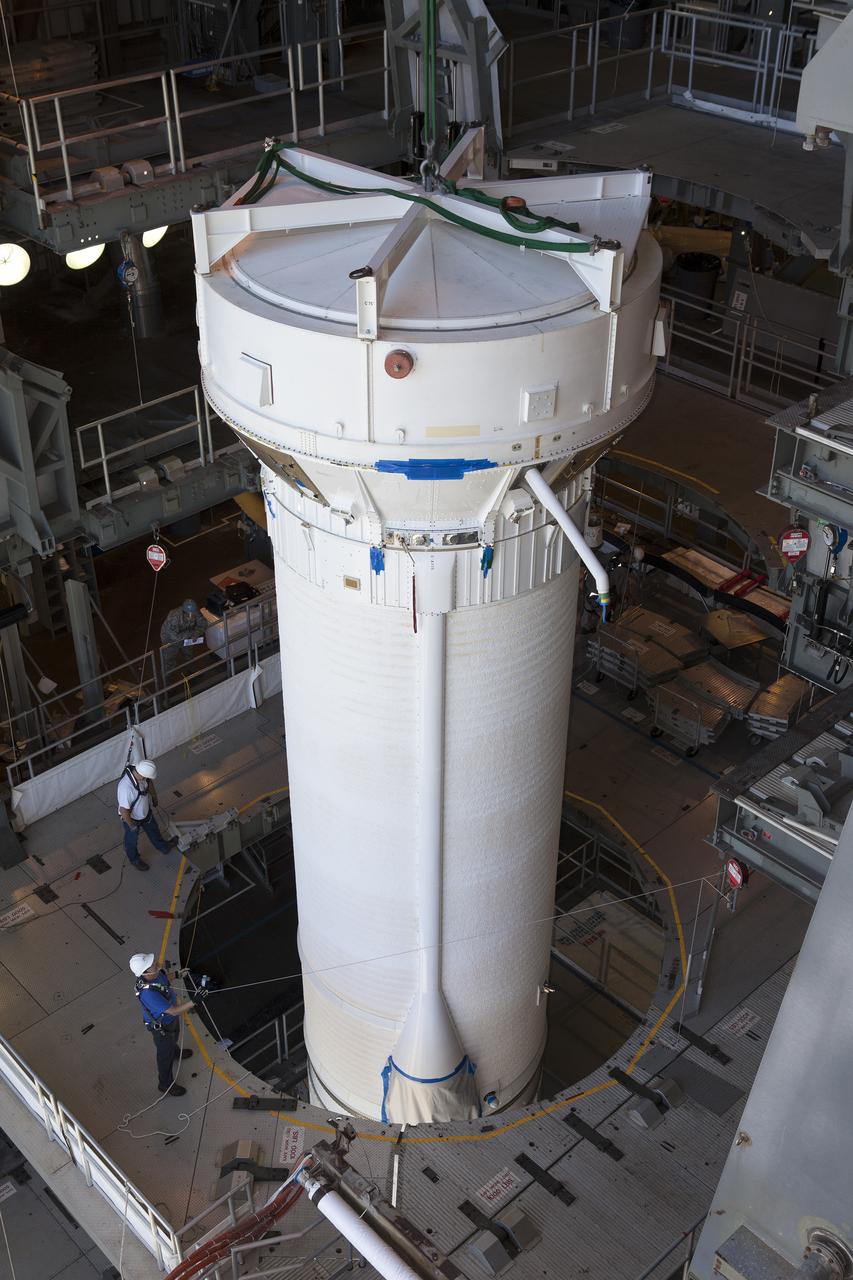
Team members prepare to attach a Centaur upper stage to the United Launch Alliance Atlas V rocket first stage booster at Space Launch Complex 41 on Florida’s Cape Canaveral Air Force Station. The rocket will boost NASA’s Origins, Spectral Interpretation, Resource Identification, Security-Regolith Explorer, or OSIRIS-REx spacecraft. Targeted for liftoff Sept. 8, 2016, OSIRIS-Rex will be the first U.S. mission to sample an asteroid, retrieve at least two ounces of surface material and return it to Earth for study. The asteroid, Bennu, may hold clues to the origin of the solar system and the source of water and organic molecules found on Earth.
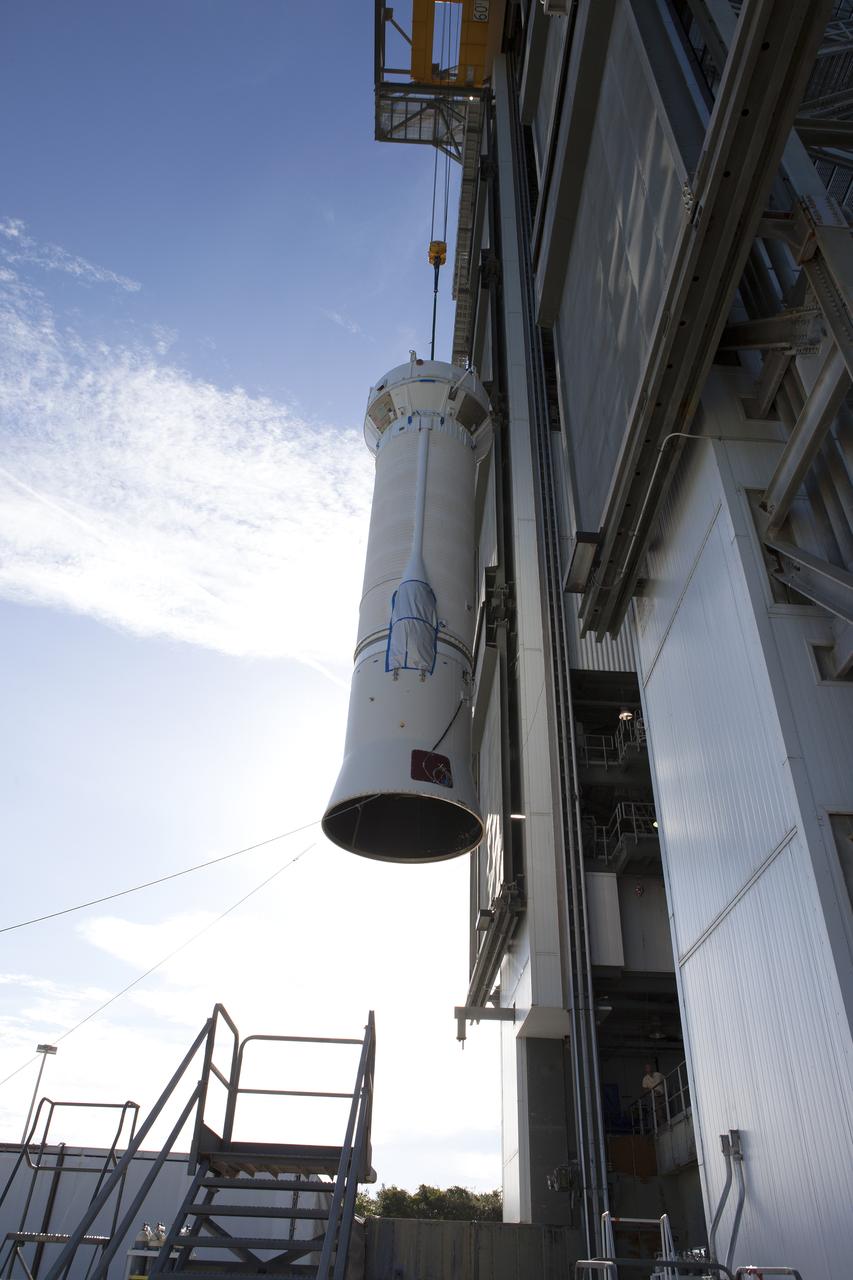
A Centaur upper stage is lifted at Space Launch Complex 41 on Florida’s Cape Canaveral Air Force Station, where it will be attached to the United Launch Alliance Atlas V rocket first stage booster. The rocket will boost NASA’s Origins, Spectral Interpretation, Resource Identification, Security-Regolith Explorer, or OSIRIS-REx spacecraft. Targeted for liftoff Sept. 8, 2016, OSIRIS-Rex will be the first U.S. mission to sample an asteroid, retrieve at least two ounces of surface material and return it to Earth for study. The asteroid, Bennu, may hold clues to the origin of the solar system and the source of water and organic molecules found on Earth.
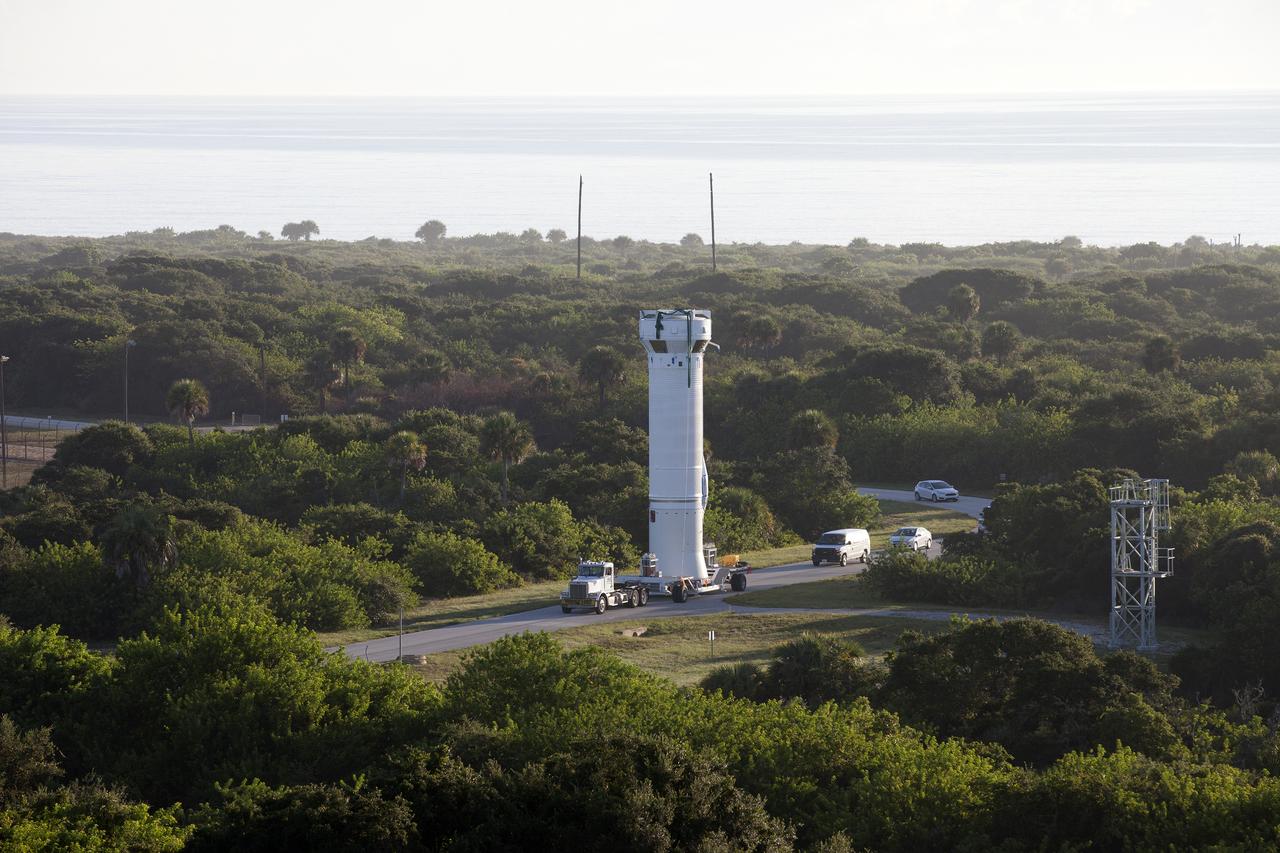
A Centaur upper stage, standing upright on a transporter, is driven to Space Launch Complex 41 on Florida’s Cape Canaveral Air Force Station, where it will be attached to the United Launch Alliance Atlas V rocket first stage booster. The rocket will boost NASA’s Origins, Spectral Interpretation, Resource Identification, Security-Regolith Explorer, or OSIRIS-REx spacecraft. Targeted for liftoff Sept. 8, 2016, OSIRIS-Rex will be the first U.S. mission to sample an asteroid, retrieve at least two ounces of surface material and return it to Earth for study. The asteroid, Bennu, may hold clues to the origin of the solar system and the source of water and organic molecules found on Earth.
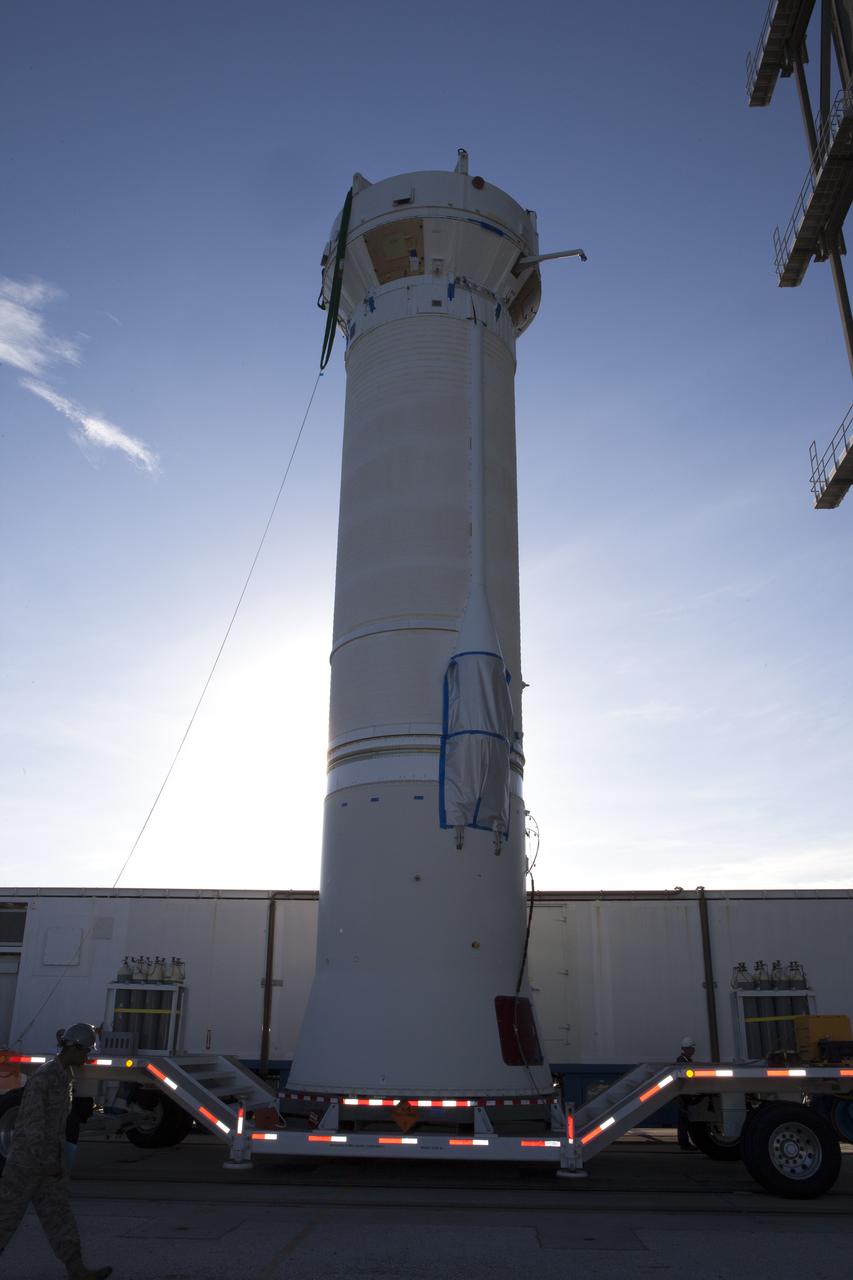
A Centaur upper stage, standing upright on a transporter, is prepared to be lifted and attached to the United Launch Alliance Atlas V rocket first stage booster at Space Launch Complex 41 on Florida’s Cape Canaveral Air Force Station. With a Centaur upper stage, the rocket will boost NASA’s Origins, Spectral Interpretation, Resource Identification, Security-Regolith Explorer, or OSIRIS-REx spacecraft. Targeted for liftoff Sept. 8, 2016, OSIRIS-Rex will be the first U.S. mission to sample an asteroid, retrieve at least two ounces of surface material and return it to Earth for study. The asteroid, Bennu, may hold clues to the origin of the solar system and the source of water and organic molecules found on Earth.
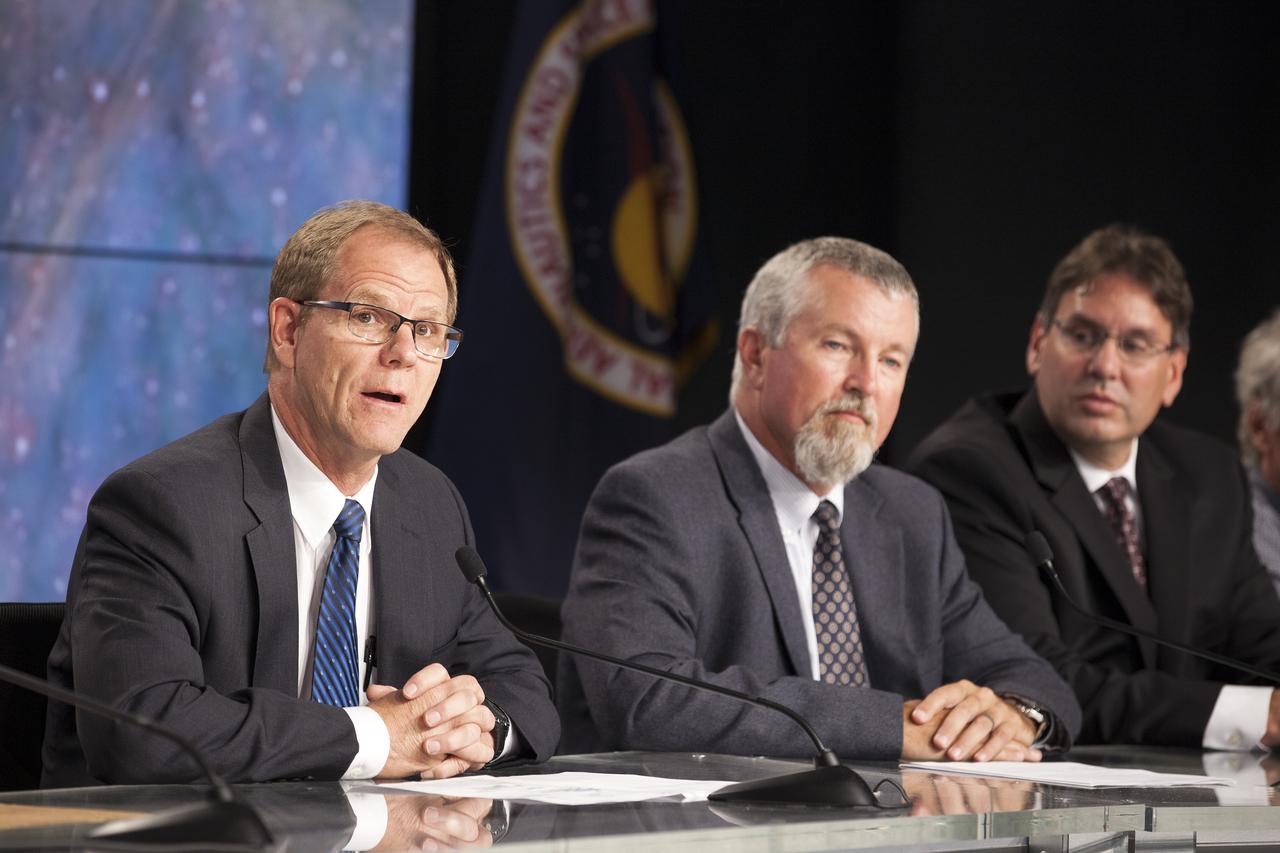
In the Kennedy Space Center’s Press Site auditorium, Scott Messer, program manager for NASA missions at United Launch Alliance in Centennial, Colorado; Michael Donnelly, OSIRIS-REx project manager at NASA’s Goddard Space Flight Center in Greenbelt, Maryland; and Rich Kuhns, OSIRIS-REx program manager for Lockheed Martin Space Systems in Denver; speak to members of the media at a prelaunch news conference for the agency’s Origins, Spectral Interpretation, Resource Identification, Security-Regolith Explorer, or OSIRIS-REx spacecraft.
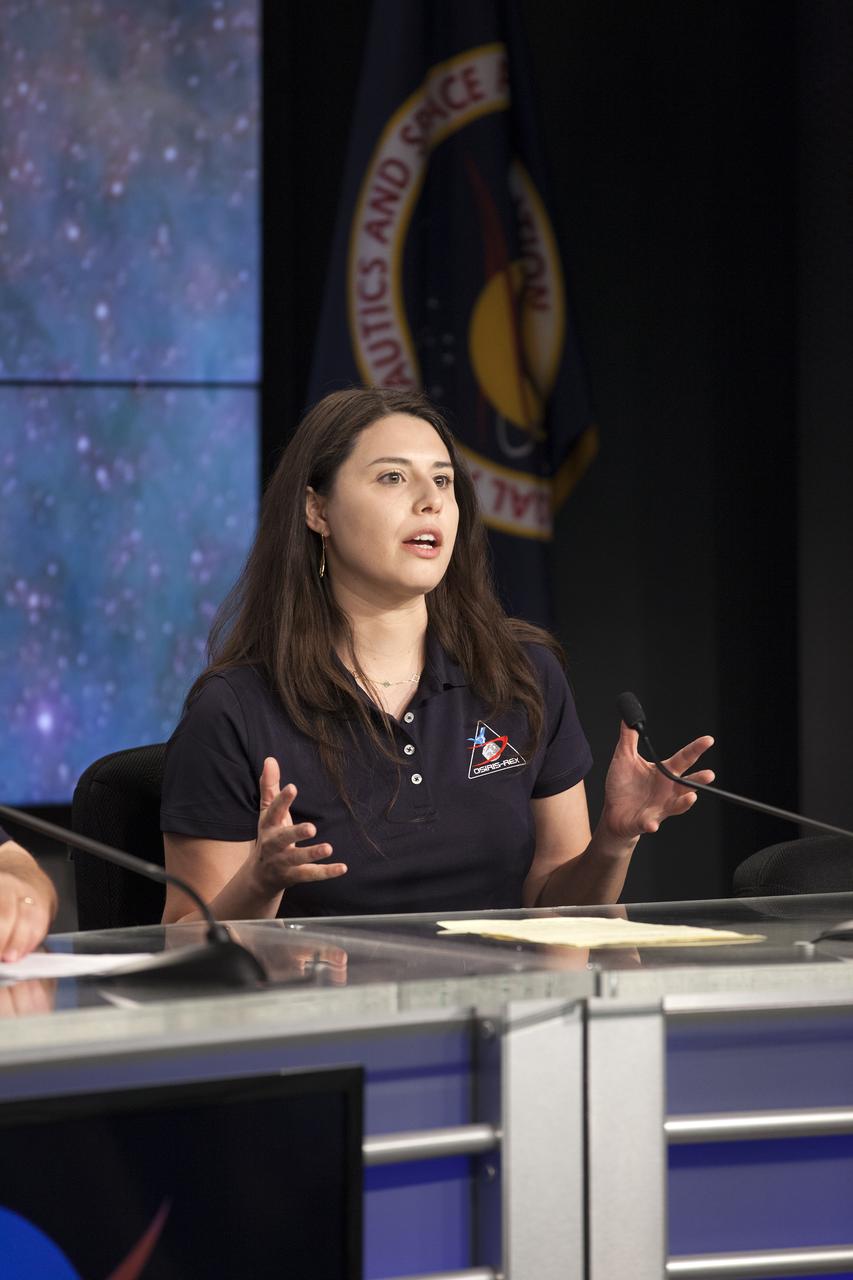
In the Kennedy Space Center’s Press Site auditorium, Daniella DellaGiustina, OSIRIS-REx lead image processing scientist at the University of Arizona, Tucson, speaks to members of the media during a briefing on science experiments involved in NASA’s Origins, Spectral Interpretation, Resource Identification, Security-Regolith Explorer, or OSIRIS-REx spacecraft.
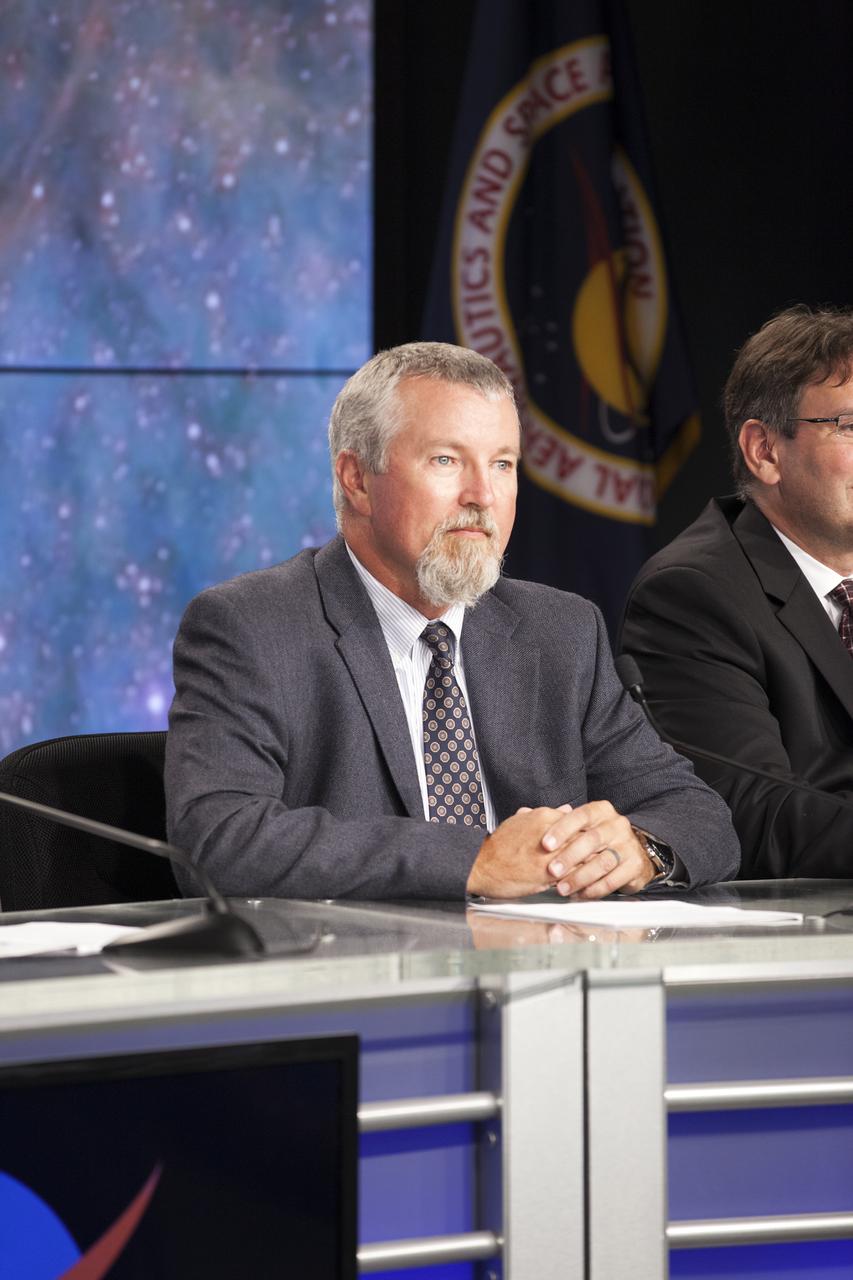
In the Kennedy Space Center’s Press Site auditorium, Michael Donnelly, OSIRIS-REx project manager at NASA’s Goddard Space Flight Center in Greenbelt, Maryland, speaks to members of the media at a prelaunch news conference for the agency’s Origins, Spectral Interpretation, Resource Identification, Security-Regolith Explorer, or OSIRIS-REx spacecraft.

In the Kennedy Space Center’s Press Site auditorium, Christina Richey, OSIRIS-REx deputy program scientist at NASA Headquarters in Washington, speaks to members of the media during a briefing on science experiments involved in NASA’s Origins, Spectral Interpretation, Resource Identification, Security-Regolith Explorer, or OSIRIS-REx spacecraft.
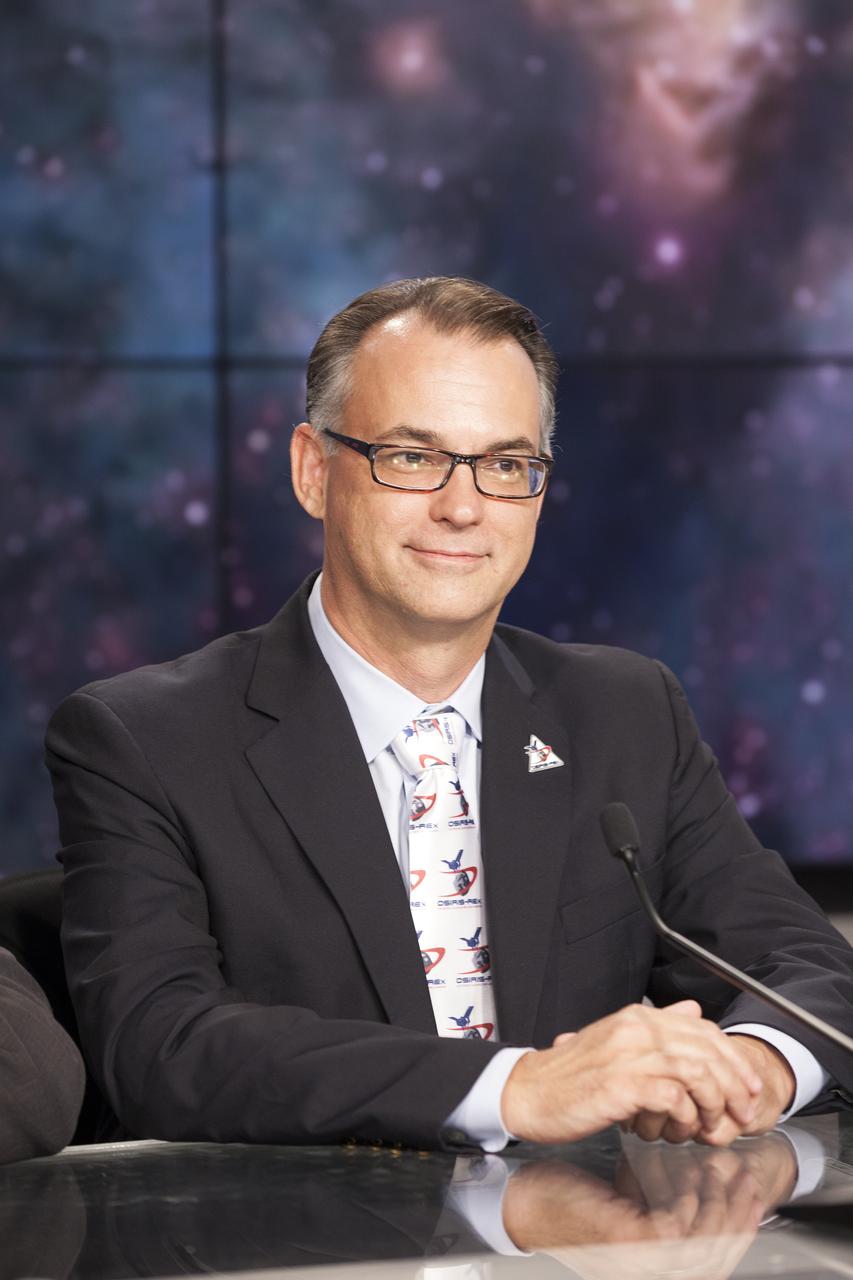
In the Kennedy Space Center’s Press Site auditorium, Dante Lauretta, OSIRIS-REx principal investigator at the University of Arizona, Tucson, speaks to members of the media at a prelaunch news conference for the agency’s Origins, Spectral Interpretation, Resource Identification, Security-Regolith Explorer, or OSIRIS-REx spacecraft.
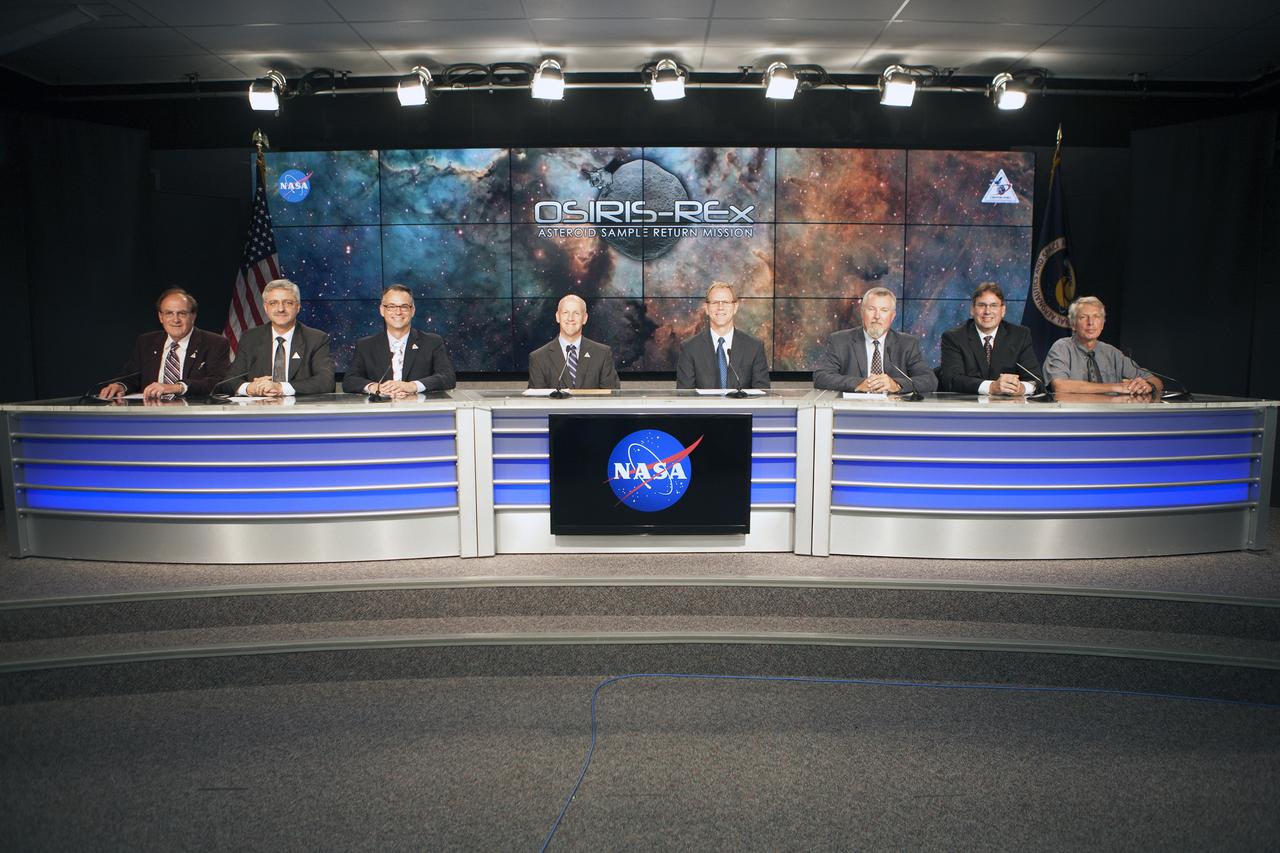
In the Kennedy Space Center’s Press Site auditorium, NASA and industry leaders speak to members of the media at a prelaunch news conference for the agency’s Origins, Spectral Interpretation, Resource Identification, Security-Regolith Explorer, or OSIRIS-REx spacecraft. From left are: George Diller of NASA Communications; Geoffrey Yoder, acting associate administrator of NASA’s Science Mission Directorate in Washington; Dante Lauretta, OSIRIS-REx principal investigator at the University of Arizona, Tucson; Tim Dunn, NASA launch manager at Kennedy; Scott Messer, program manager for NASA missions at United Launch Alliance in Centennial, Colorado; Michael Donnelly, OSIRIS-REx project manager at NASA’s Goddard Space Flight Center in Greenbelt, Maryland; Rich Kuhns, OSIRIS-REx program manager for Lockheed Martin Space Systems in Denver; and Clay Flinn, launch weather officer for the 45th Weather Squadron at Cape Canaveral Air Force Station, Florida.
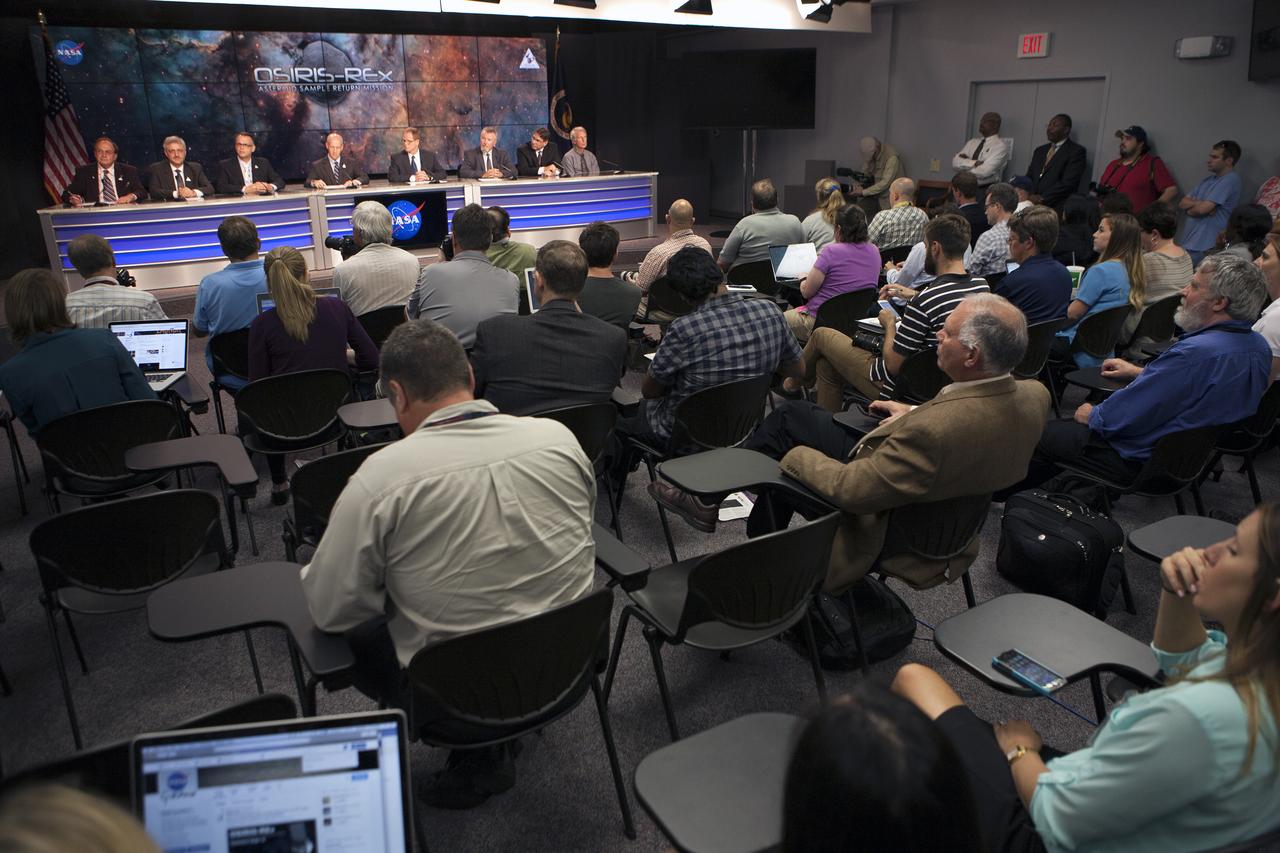
In the Kennedy Space Center’s Press Site auditorium, NASA and industry leaders speak to members of the media at a prelaunch news conference for the agency’s Origins, Spectral Interpretation, Resource Identification, Security-Regolith Explorer, or OSIRIS-REx spacecraft. From left are: George Diller of NASA Communications; Geoffrey Yoder, acting associate administrator of NASA’s Science Mission Directorate in Washington; Dante Lauretta, OSIRIS-REx principal investigator at the University of Arizona, Tucson; Tim Dunn, NASA launch manager at Kennedy; Scott Messer, program manager for NASA missions at United Launch Alliance in Centennial, Colorado; Michael Donnelly, OSIRIS-REx project manager at NASA’s Goddard Space Flight Center in Greenbelt, Maryland; Rich Kuhns, OSIRIS-REx program manager for Lockheed Martin Space Systems in Denver; and Clay Flinn, launch weather officer for the 45th Weather Squadron at Cape Canaveral Air Force Station, Florida.
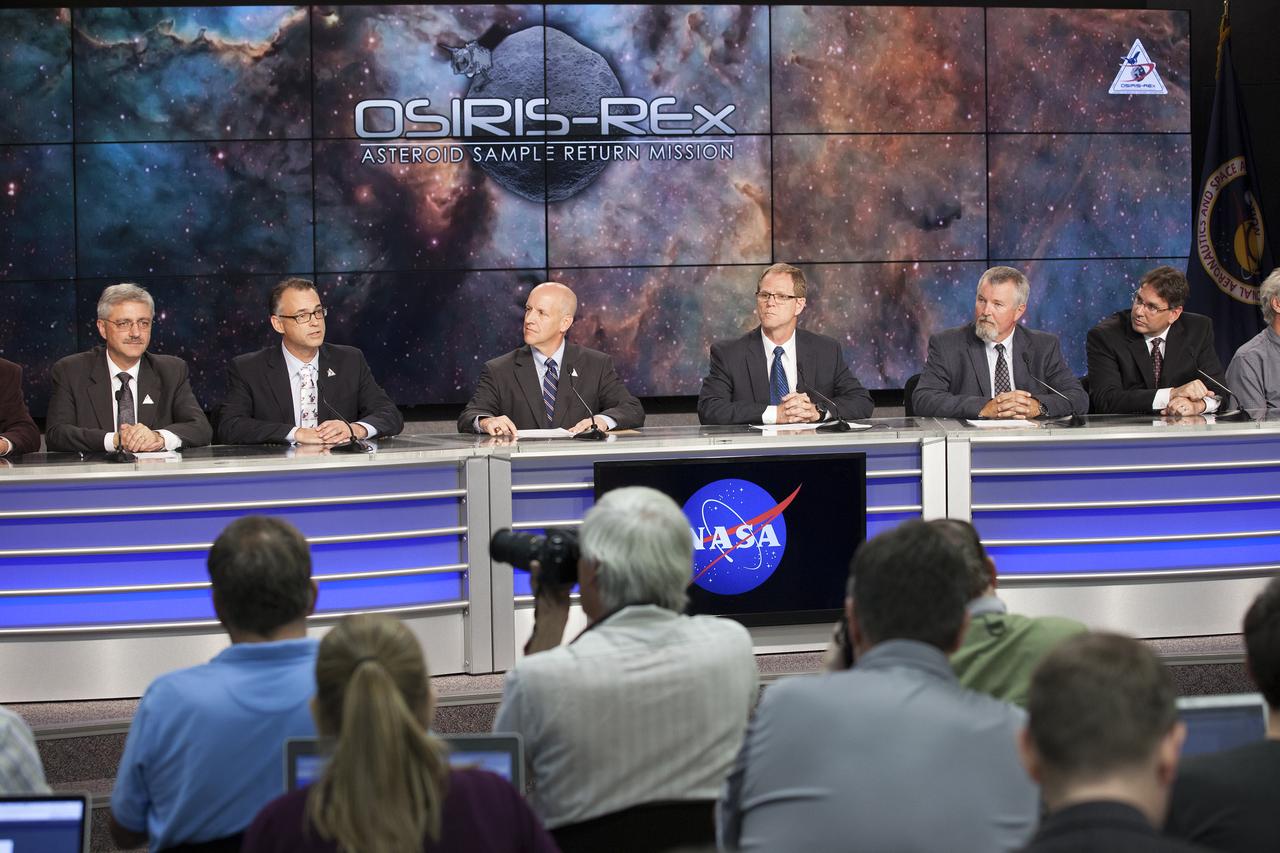
In the Kennedy Space Center’s Press Site auditorium, NASA and industry leaders speak to members of the media at a prelaunch news conference for the agency’s Origins, Spectral Interpretation, Resource Identification, Security-Regolith Explorer, or OSIRIS-REx spacecraft. From left are: Geoffrey Yoder, acting associate administrator of NASA’s Science Mission Directorate in Washington; Dante Lauretta, OSIRIS-REx principal investigator at the University of Arizona, Tucson; Tim Dunn, NASA launch manager at Kennedy; Scott Messer, program manager for NASA missions at United Launch Alliance in Centennial, Colorado; Michael Donnelly, OSIRIS-REx project manager at NASA’s Goddard Space Flight Center in Greenbelt, Maryland; and Rich Kuhns, OSIRIS-REx program manager for Lockheed Martin Space Systems in Denver.
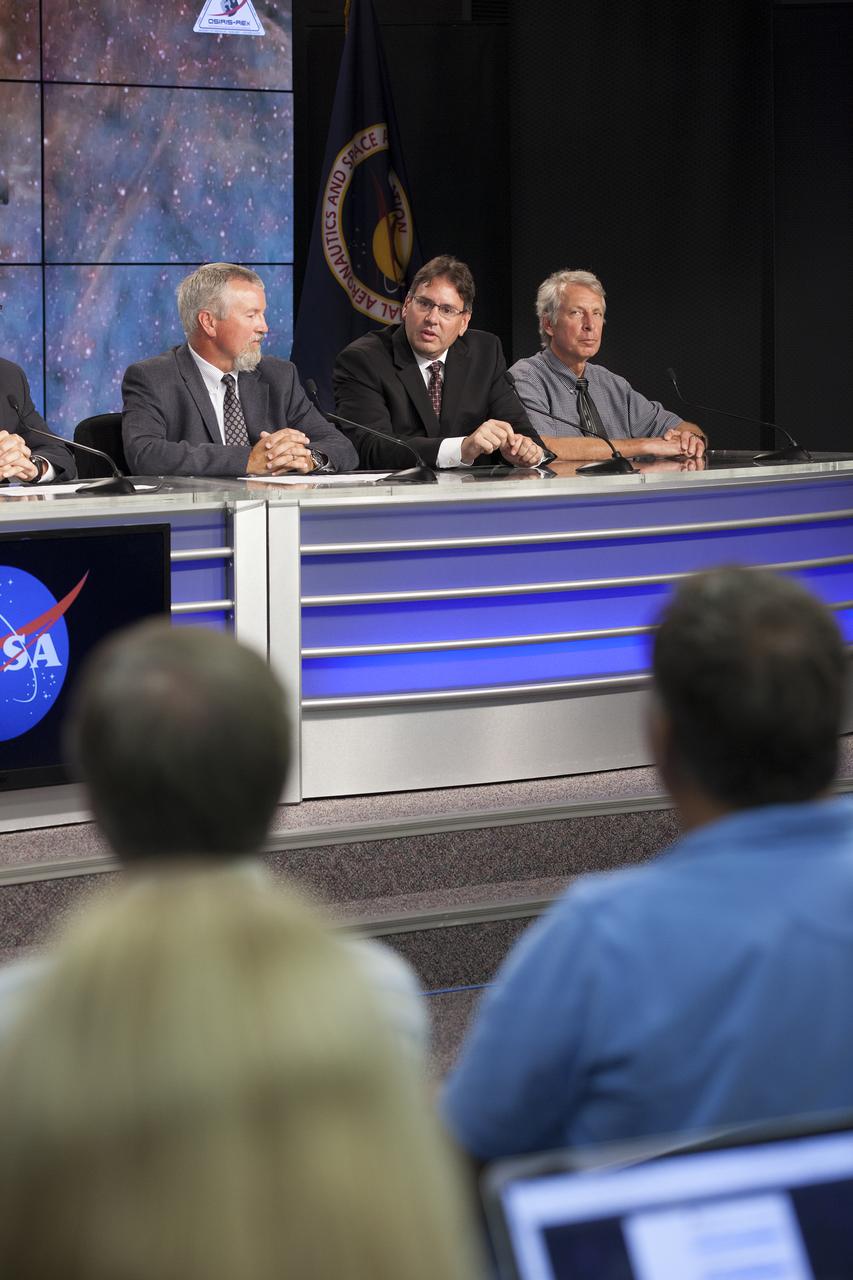
In the Kennedy Space Center’s Press Site auditorium, NASA and industry leaders speak to members of the media at a prelaunch news conference for the agency’s Origins, Spectral Interpretation, Resource Identification, Security-Regolith Explorer, or OSIRIS-REx spacecraft. From left are: Michael Donnelly, OSIRIS-REx project manager at NASA’s Goddard Space Flight Center in Greenbelt, Maryland; Rich Kuhns, OSIRIS-REx program manager for Lockheed Martin Space Systems in Denver; and Clay Flinn, launch weather officer for the 45th Weather Squadron at Cape Canaveral Air Force Station, Florida.
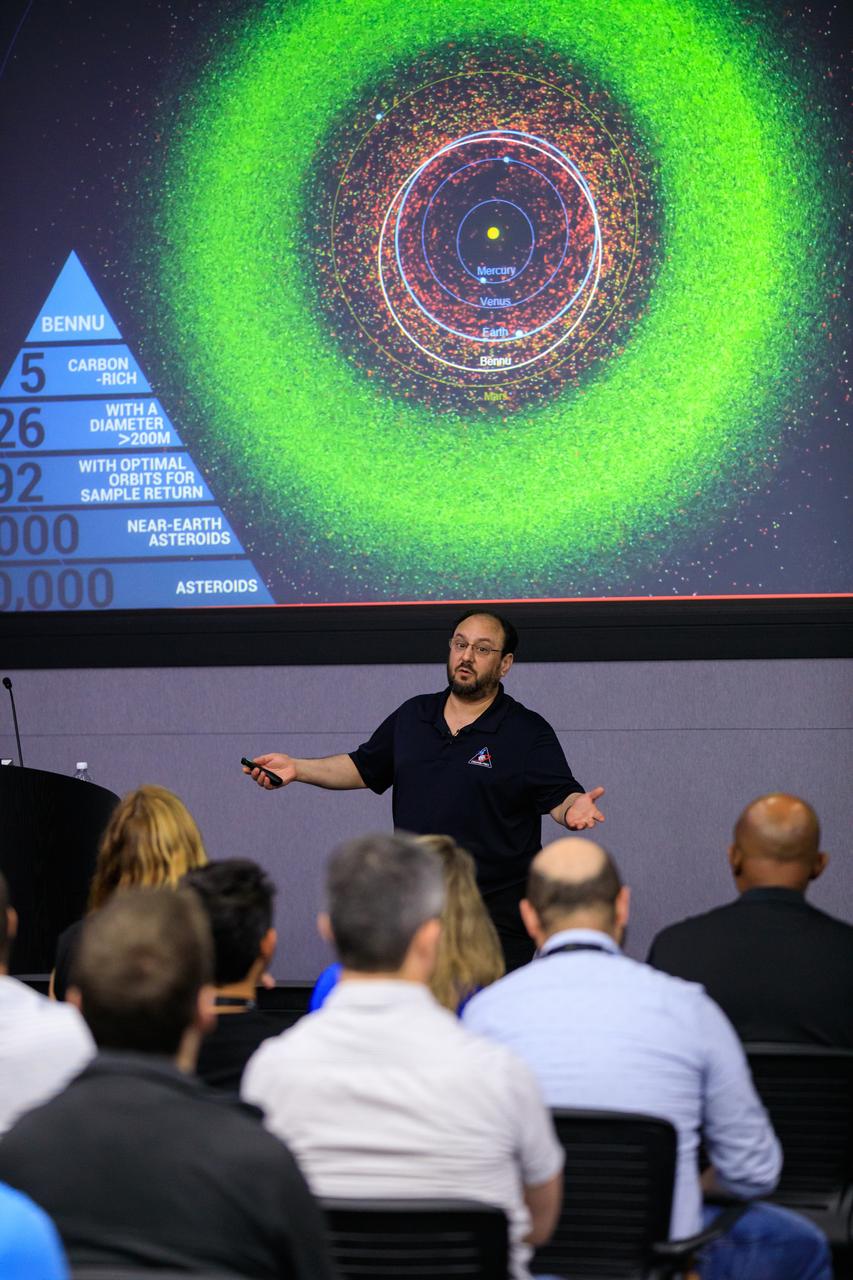
OSIRIS-REx Project Scientist, Dr. Jason Dworkin of NASA’s Goddard Space Flight Center in Greenbelt, Maryland, presents a mission update inside the Mission Briefing Room of the Neil A. Armstrong Operations and Checkout Building at Kennedy Space Center in Florida, on May 11, 2023. Launched seven years ago, the OSIRIS-REx spacecraft is set to return a material sample from asteroid Bennu on Sept. 24, 2023, when the sample return capsule separates from the spacecraft and lands by parachute at the Utah Test and Training Range/Dugway Proving Ground, southwest of Salt Lake City. OSIRIS-REx is the first U.S. mission to sample an asteroid, retrieve at least two ounces of surface material, and return it to Earth for study.
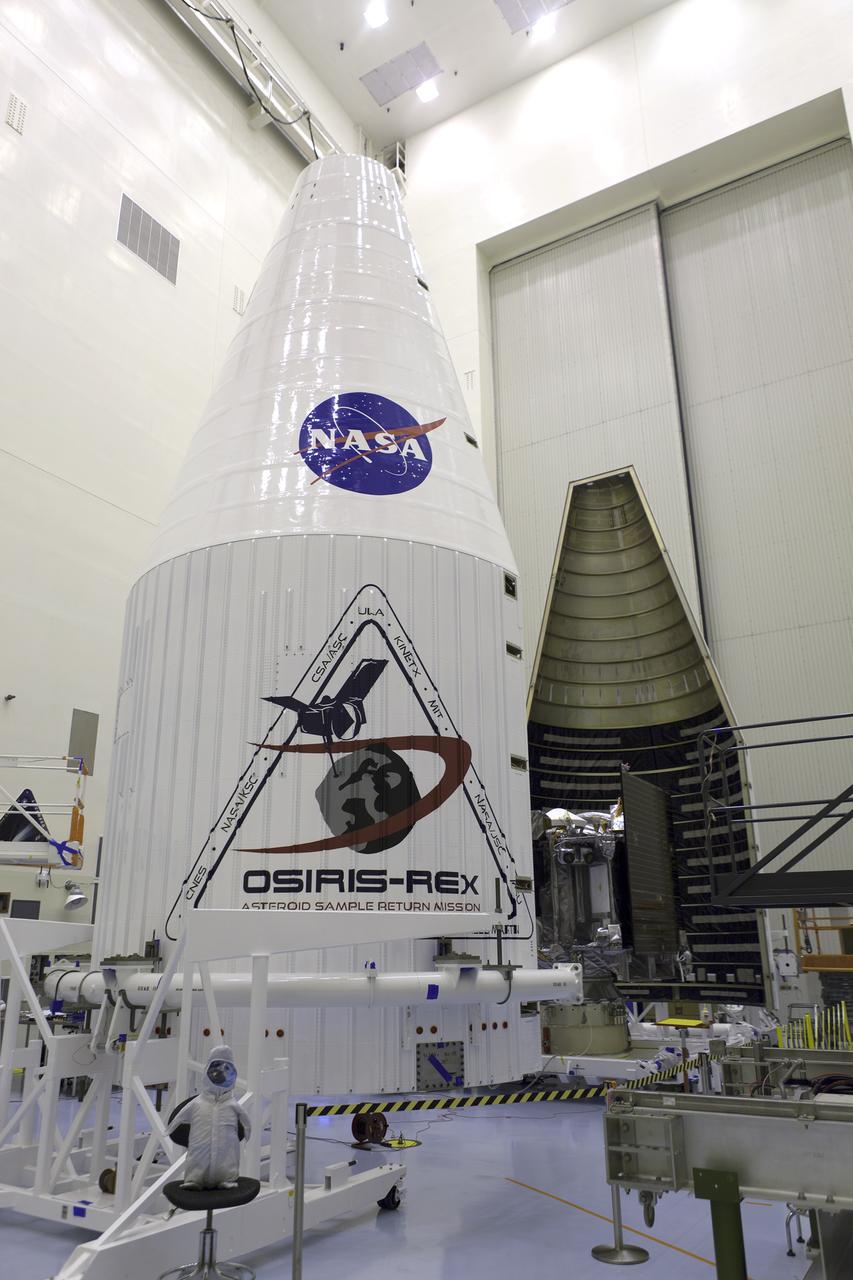
Inside the Payload Hazardous Servicing Facility at NASA's Kennedy Space Center in Florida, the agency’s Origins, Spectral Interpretation, Resource Identification, Security-Regolith Explorer, or OSIRIS-REx spacecraft is encapsulated in its payload fairing. Targeted for liftoff at 7:05 p.m. EDT Sept. 8, 2016, OSIRIS-Rex will be the first U.S. mission to sample an asteroid, retrieve at least two ounces of surface material and return it to Earth for study. The asteroid, Bennu, may hold clues to the origin of the solar system and the source of water and organic molecules found on Earth.

Inside the Payload Hazardous Servicing Facility at NASA's Kennedy Space Center in Florida, engineers and technicians encapsulate the agency’s Origins, Spectral Interpretation, Resource Identification, Security-Regolith Explorer, or OSIRIS-REx spacecraft in its payload fairing. Targeted for liftoff at 7:05 p.m. EDT Sept. 8, 2016, OSIRIS-Rex will be the first U.S. mission to sample an asteroid, retrieve at least two ounces of surface material and return it to Earth for study. The asteroid, Bennu, may hold clues to the origin of the solar system and the source of water and organic molecules found on Earth.
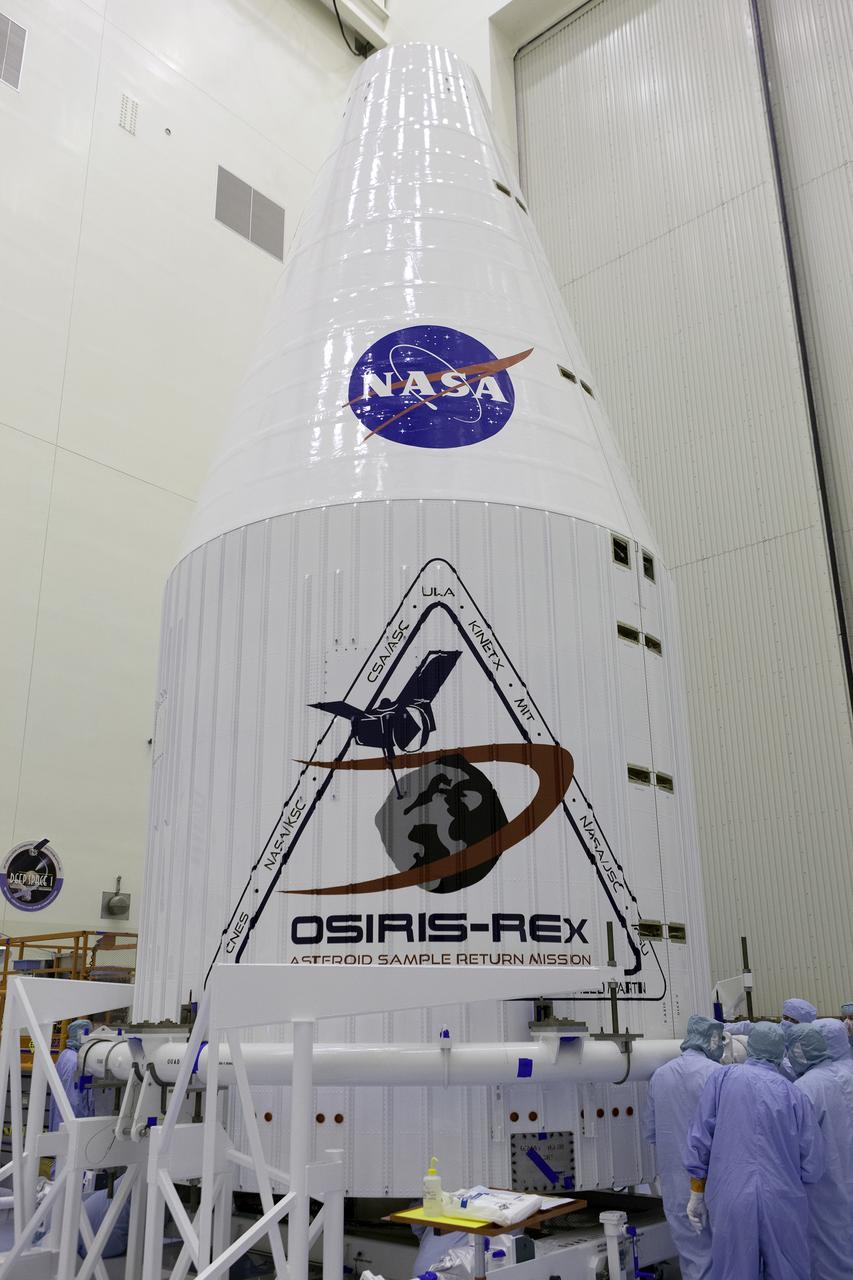
Inside the Payload Hazardous Servicing Facility at NASA's Kennedy Space Center in Florida, engineers and technicians encapsulate the agency’s Origins, Spectral Interpretation, Resource Identification, Security-Regolith Explorer, or OSIRIS-REx spacecraft in its payload fairing. Targeted for liftoff at 7:05 p.m. EDT Sept. 8, 2016, OSIRIS-Rex will be the first U.S. mission to sample an asteroid, retrieve at least two ounces of surface material and return it to Earth for study. The asteroid, Bennu, may hold clues to the origin of the solar system and the source of water and organic molecules found on Earth.
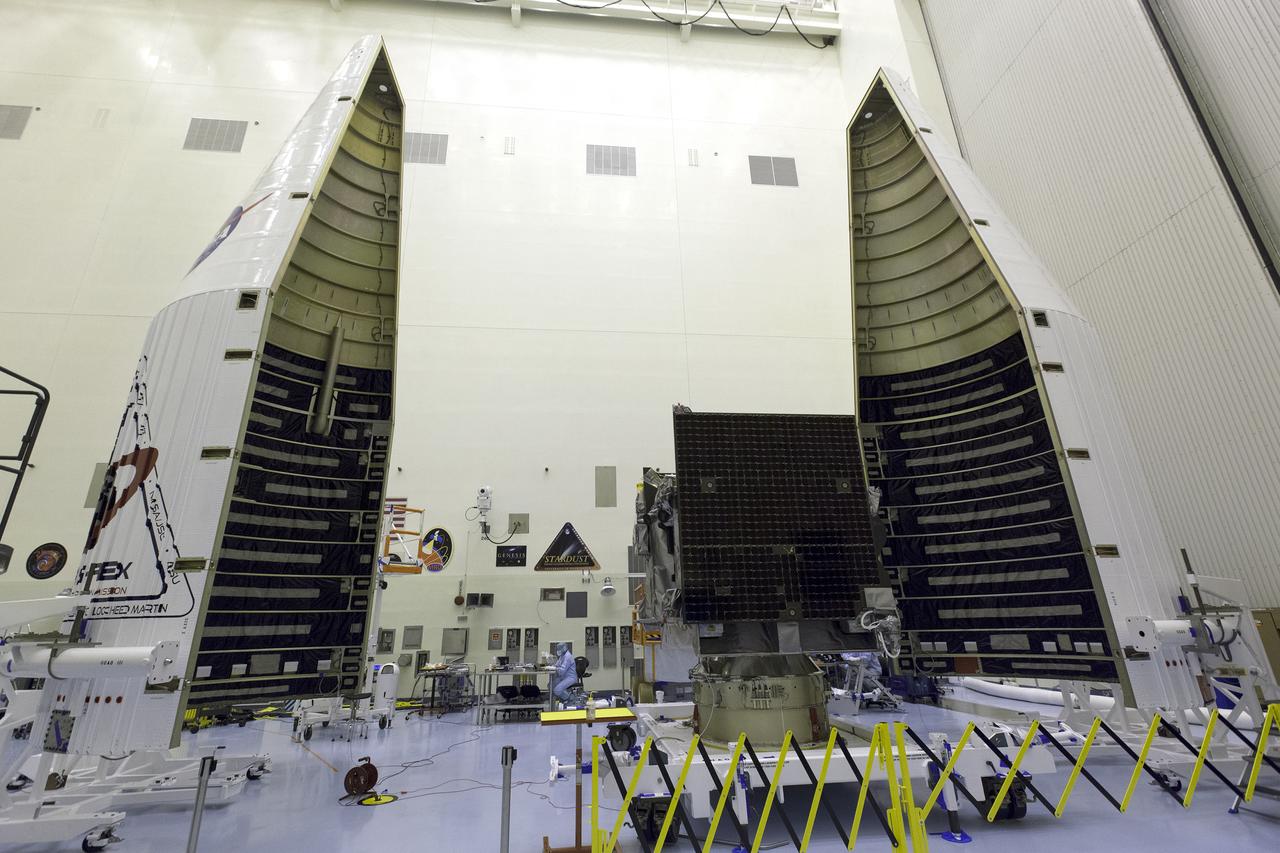
Inside the Payload Hazardous Servicing Facility at NASA's Kennedy Space Center in Florida, the agency’s Origins, Spectral Interpretation, Resource Identification, Security-Regolith Explorer, or OSIRIS-REx spacecraft is encapsulated in its payload fairing. Targeted for liftoff at 7:05 p.m. EDT Sept. 8, 2016, OSIRIS-Rex will be the first U.S. mission to sample an asteroid, retrieve at least two ounces of surface material and return it to Earth for study. The asteroid, Bennu, may hold clues to the origin of the solar system and the source of water and organic molecules found on Earth.

In the Kennedy Space Center’s Press Site auditorium, NASA and industry leaders speak to members of the media at a prelaunch news conference for the agency’s Origins, Spectral Interpretation, Resource Identification, Security-Regolith Explorer, or OSIRIS-REx spacecraft. From left are: Dante Lauretta, OSIRIS-REx principal investigator at the University of Arizona, Tucson; Tim Dunn, NASA launch manager at Kennedy; and Scott Messer, program manager for NASA missions at United Launch Alliance in Centennial, Colorado.
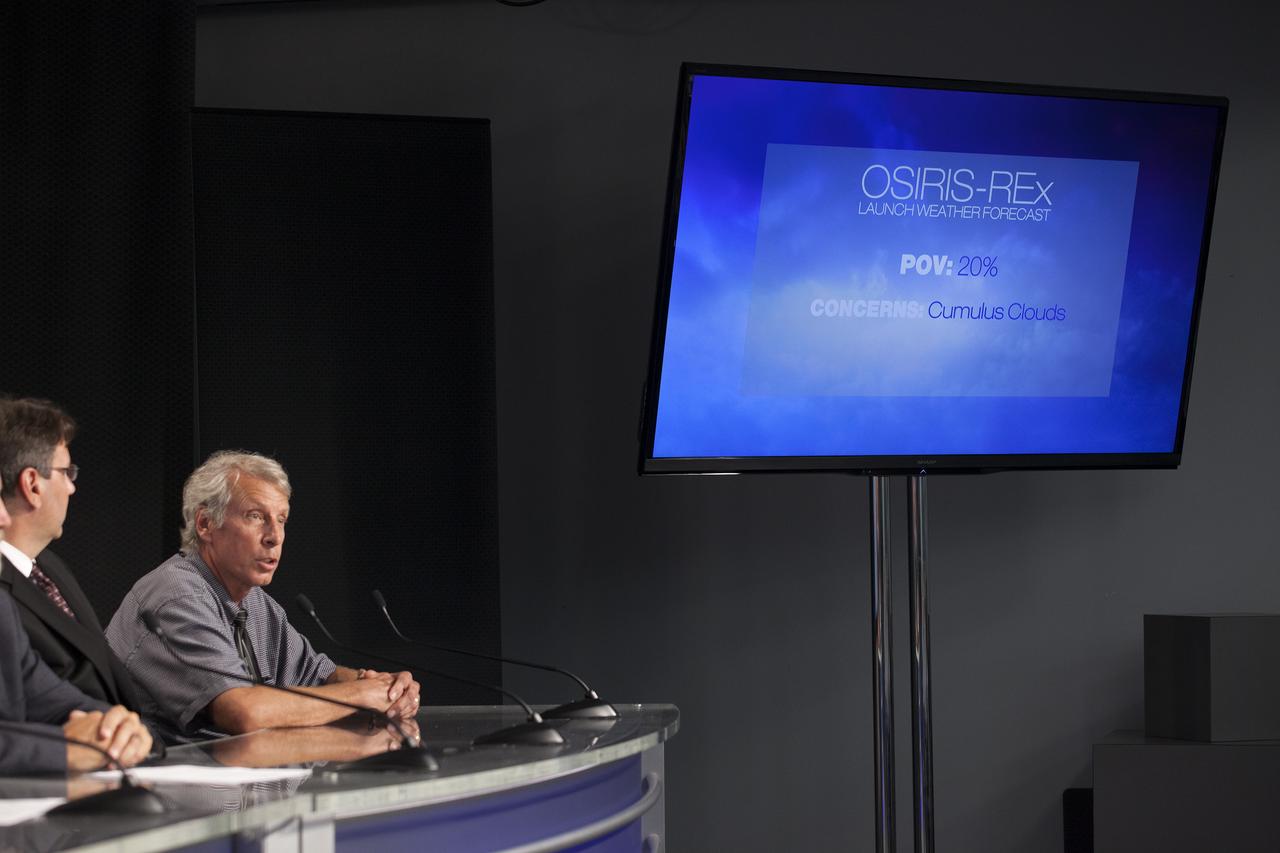
In the Kennedy Space Center’s Press Site auditorium, Clay Flinn, launch weather officer for the 45th Weather Squadron at Cape Canaveral Air Force Station, Florida speaks to members of the media abouth the weather forecast at a prelaunch news conference for the agency’s Origins, Spectral Interpretation, Resource Identification, Security-Regolith Explorer, or OSIRIS-REx spacecraft. To Flinn’s right is Rich Kuhns, OSIRIS-REx program manager for Lockheed Martin Space Systems in Denver.
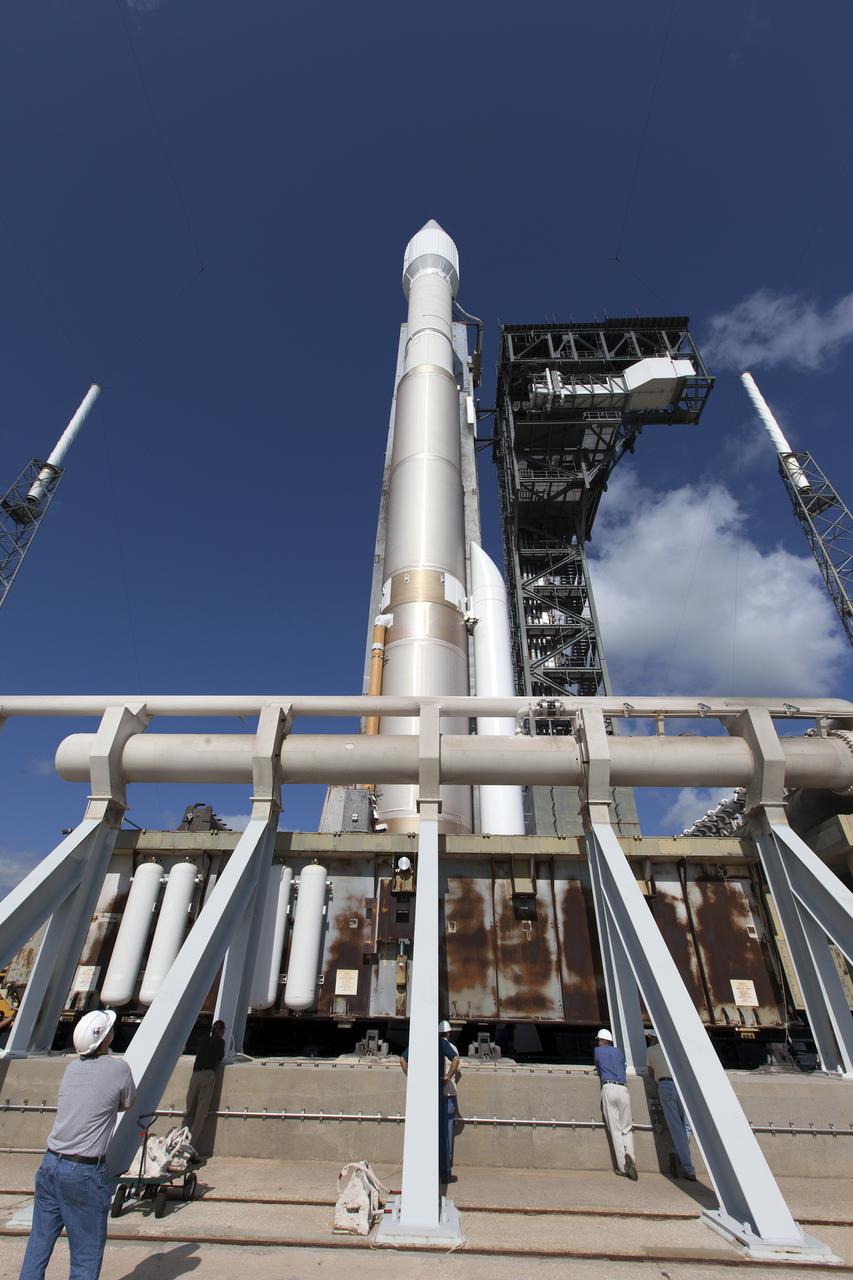
The United Launch Alliance Atlas V rocket arrives at Space Launch Complex 41 at Cape Canaveral Air Force Station in Florida. The launch vehicle will boost NASA’s Origins, Spectral Interpretation, Resource Identification, Security-Regolith Explorer, or OSIRIS-REx spacecraft. This will be the first U.S. mission to sample an asteroid, retrieve at least two ounces of surface material and return it to Earth for study. The asteroid, Bennu, may hold clues to the origin of the solar system and the source of water and organic molecules found on Earth.
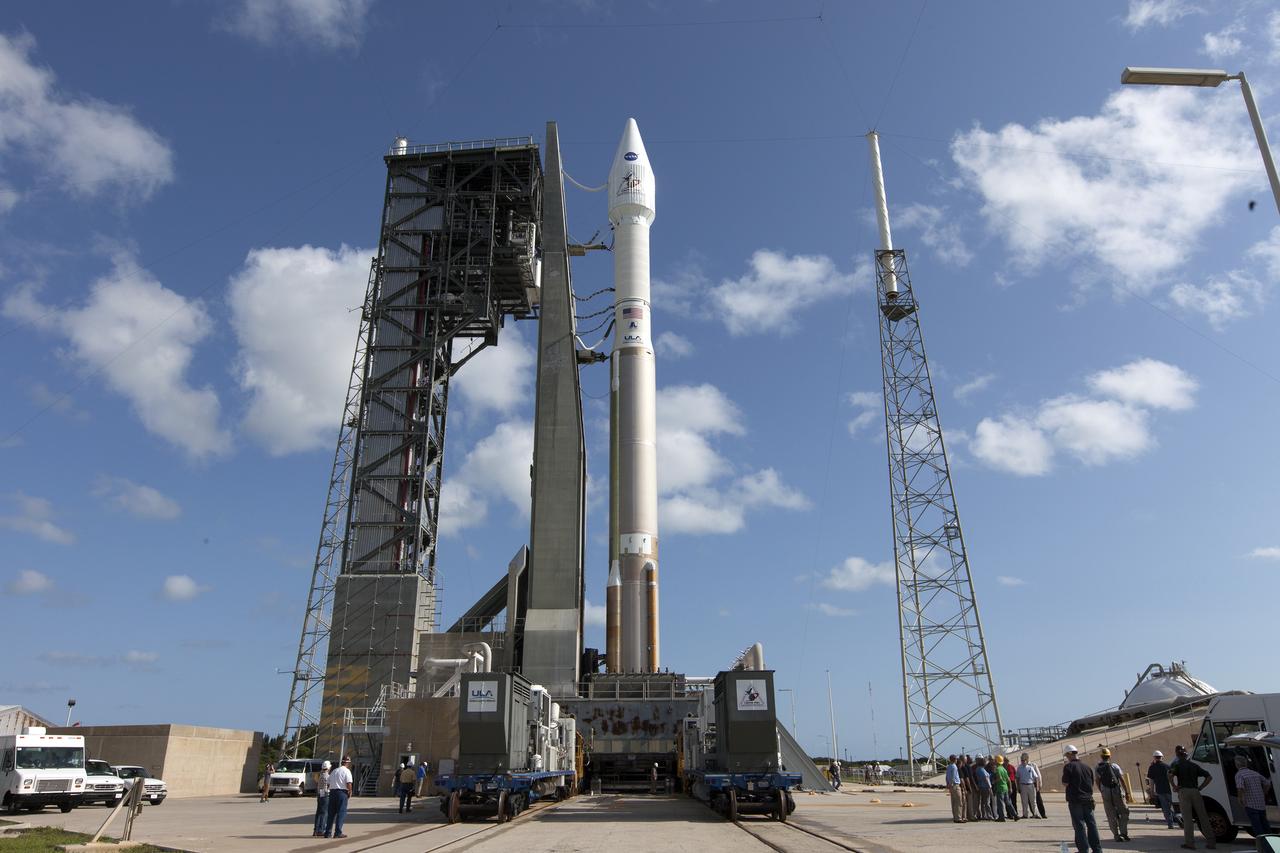
The United Launch Alliance Atlas V rocket arrives at Space Launch Complex 41 at Cape Canaveral Air Force Station in Florida. The launch vehicle will boost NASA’s Origins, Spectral Interpretation, Resource Identification, Security-Regolith Explorer, or OSIRIS-REx spacecraft. This will be the first U.S. mission to sample an asteroid, retrieve at least two ounces of surface material and return it to Earth for study. The asteroid, Bennu, may hold clues to the origin of the solar system and the source of water and organic molecules found on Earth.
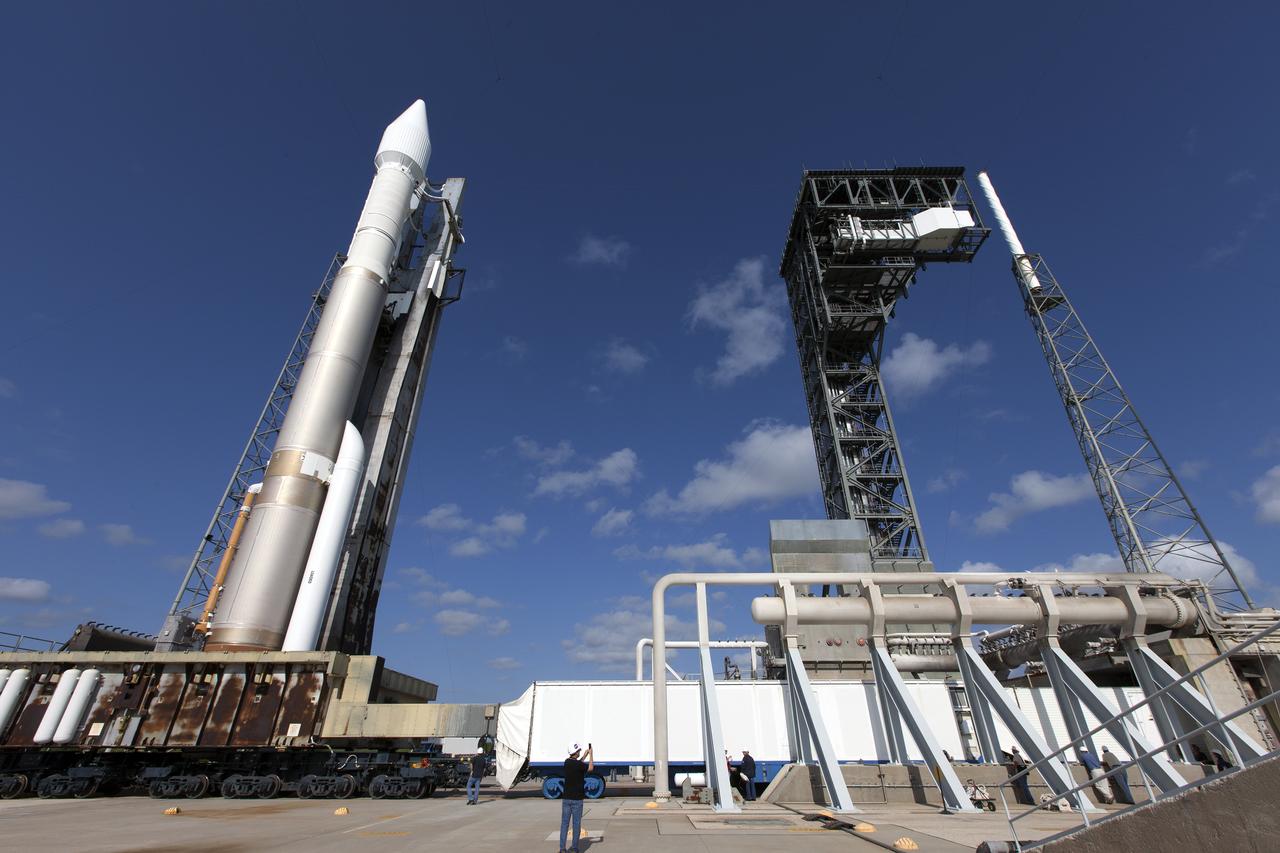
The United Launch Alliance Atlas V rocket arrives at Space Launch Complex 41 at Cape Canaveral Air Force Station in Florida. The launch vehicle will boost NASA’s Origins, Spectral Interpretation, Resource Identification, Security-Regolith Explorer, or OSIRIS-REx spacecraft. This will be the first U.S. mission to sample an asteroid, retrieve at least two ounces of surface material and return it to Earth for study. The asteroid, Bennu, may hold clues to the origin of the solar system and the source of water and organic molecules found on Earth.
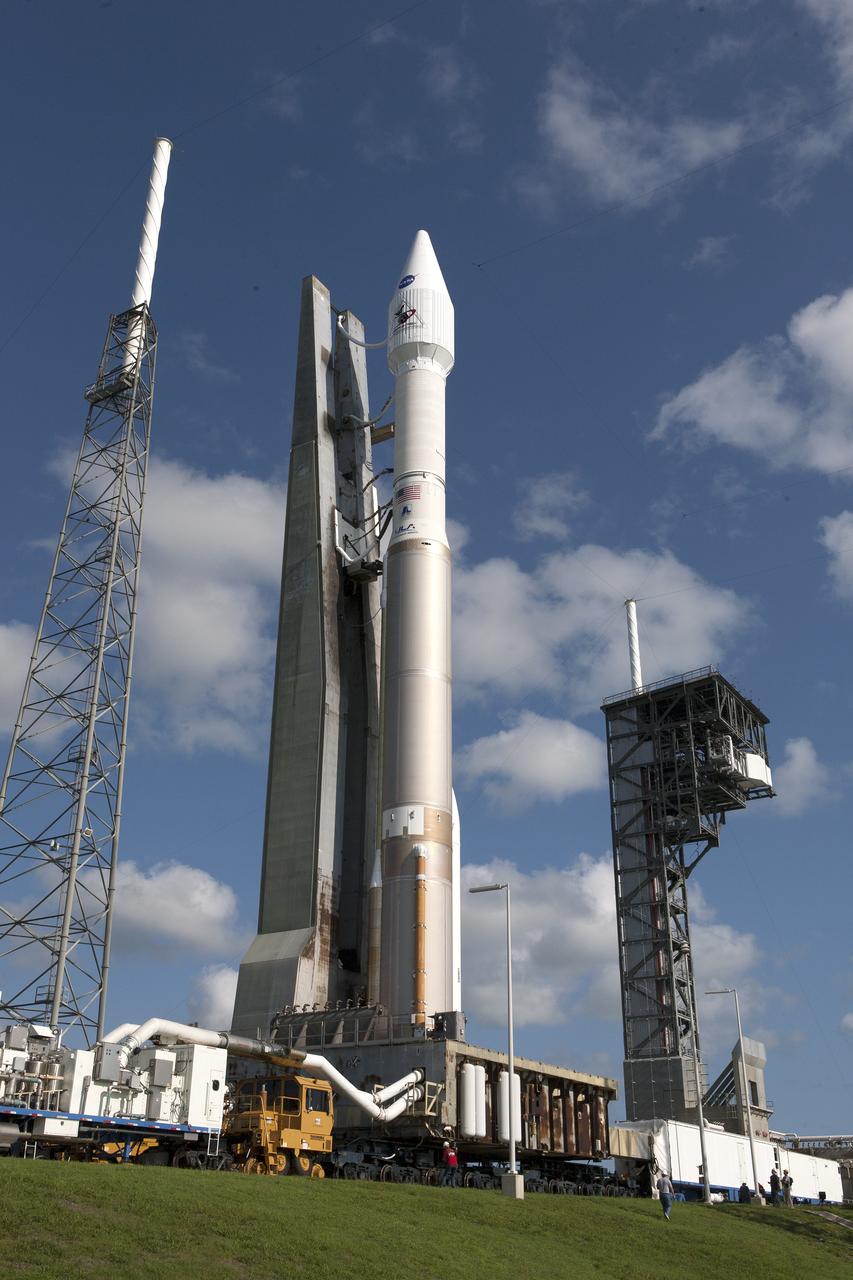
The United Launch Alliance Atlas V rocket arrives at Space Launch Complex 41 at Cape Canaveral Air Force Station in Florida. The launch vehicle will boost NASA’s Origins, Spectral Interpretation, Resource Identification, Security-Regolith Explorer, or OSIRIS-REx spacecraft. This will be the first U.S. mission to sample an asteroid, retrieve at least two ounces of surface material and return it to Earth for study. The asteroid, Bennu, may hold clues to the origin of the solar system and the source of water and organic molecules found on Earth.
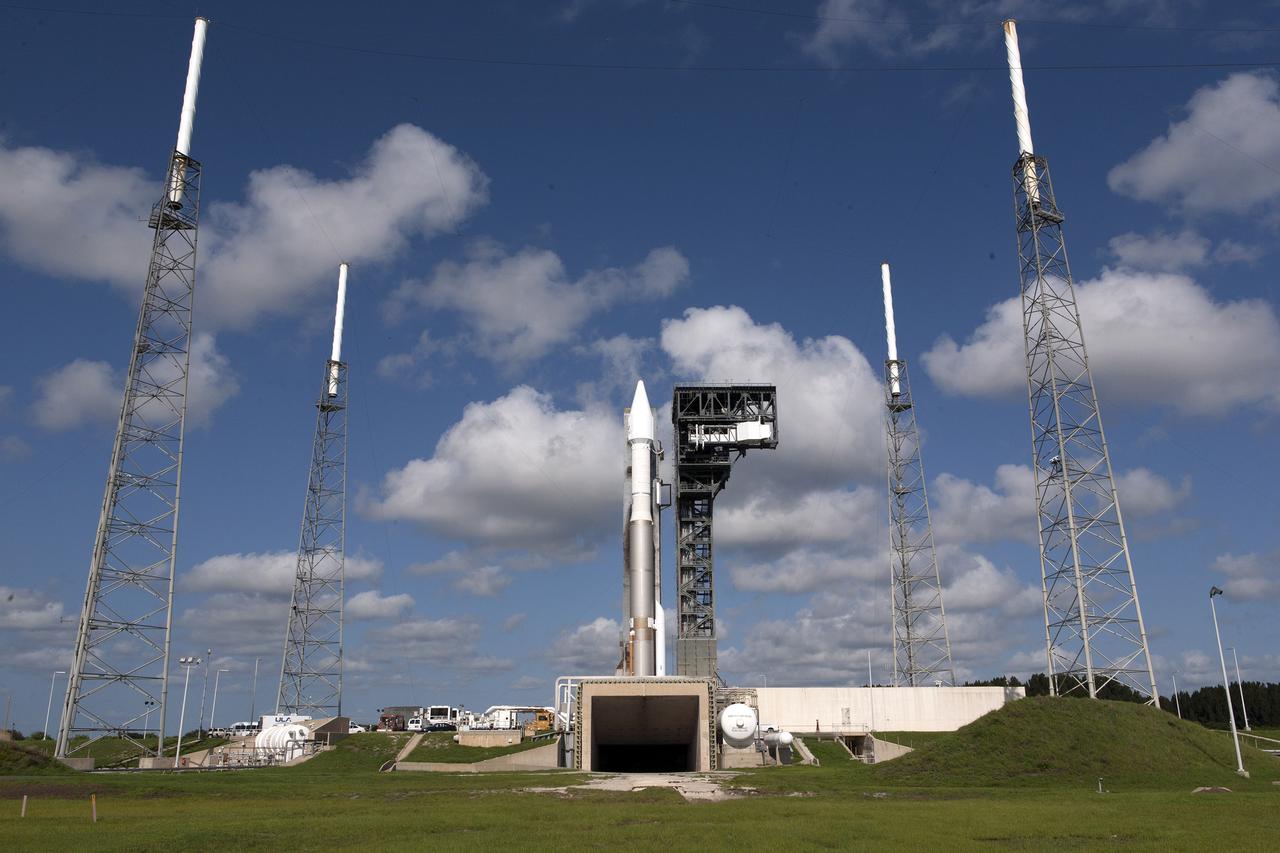
The United Launch Alliance Atlas V rocket arrives at Space Launch Complex 41 at Cape Canaveral Air Force Station in Florida. The launch vehicle will boost NASA’s Origins, Spectral Interpretation, Resource Identification, Security-Regolith Explorer, or OSIRIS-REx spacecraft. This will be the first U.S. mission to sample an asteroid, retrieve at least two ounces of surface material and return it to Earth for study. The asteroid, Bennu, may hold clues to the origin of the solar system and the source of water and organic molecules found on Earth.
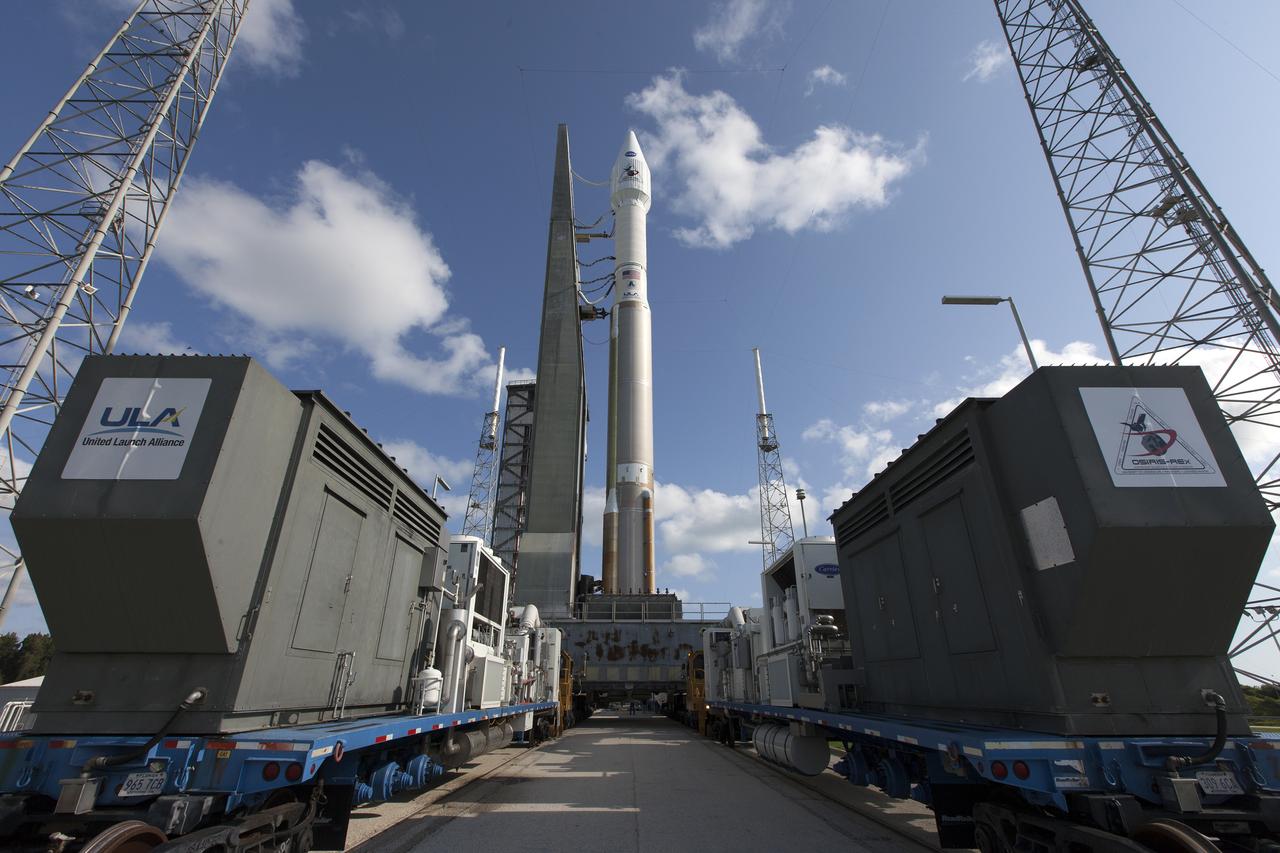
The United Launch Alliance Atlas V rocket arrives at Space Launch Complex 41 at Cape Canaveral Air Force Station in Florida. The launch vehicle will boost NASA’s Origins, Spectral Interpretation, Resource Identification, Security-Regolith Explorer, or OSIRIS-REx spacecraft. This will be the first U.S. mission to sample an asteroid, retrieve at least two ounces of surface material and return it to Earth for study. The asteroid, Bennu, may hold clues to the origin of the solar system and the source of water and organic molecules found on Earth.
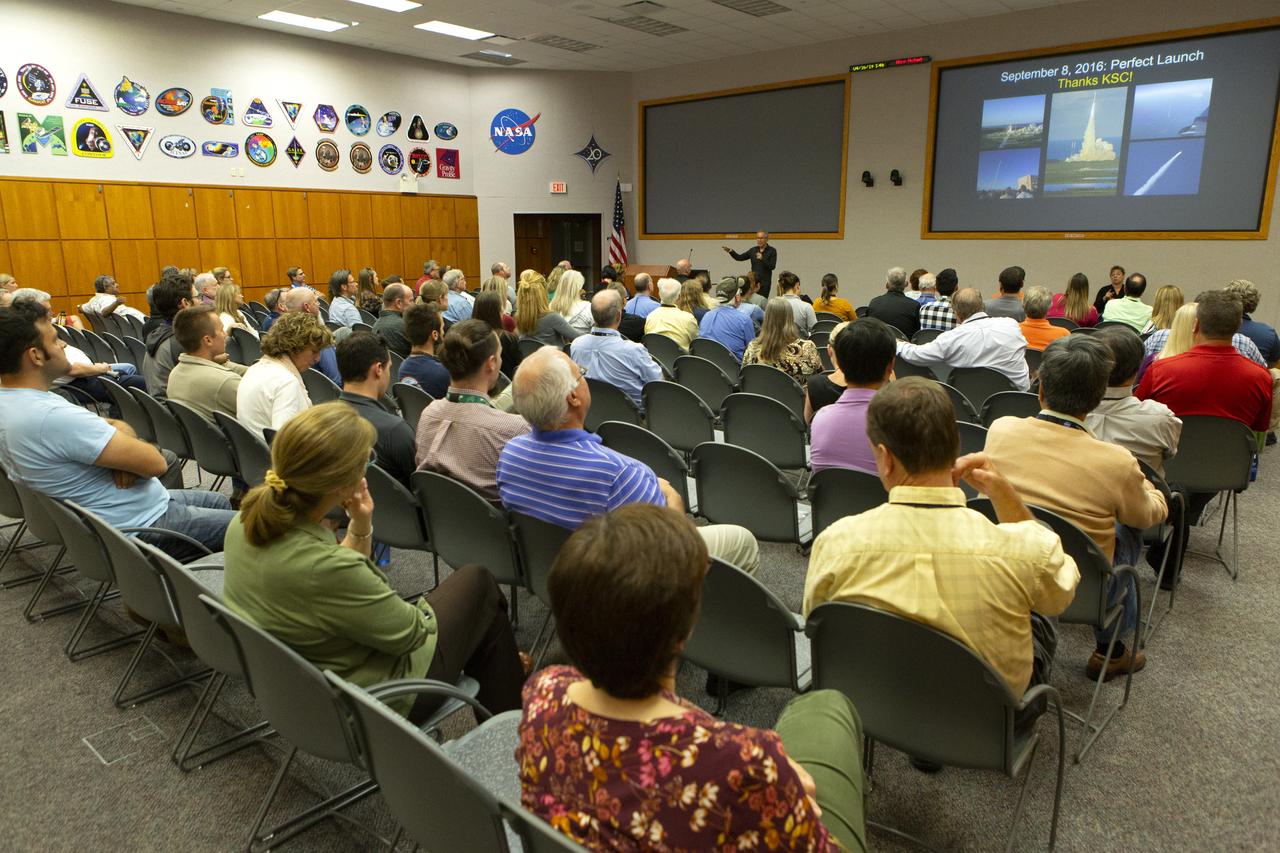
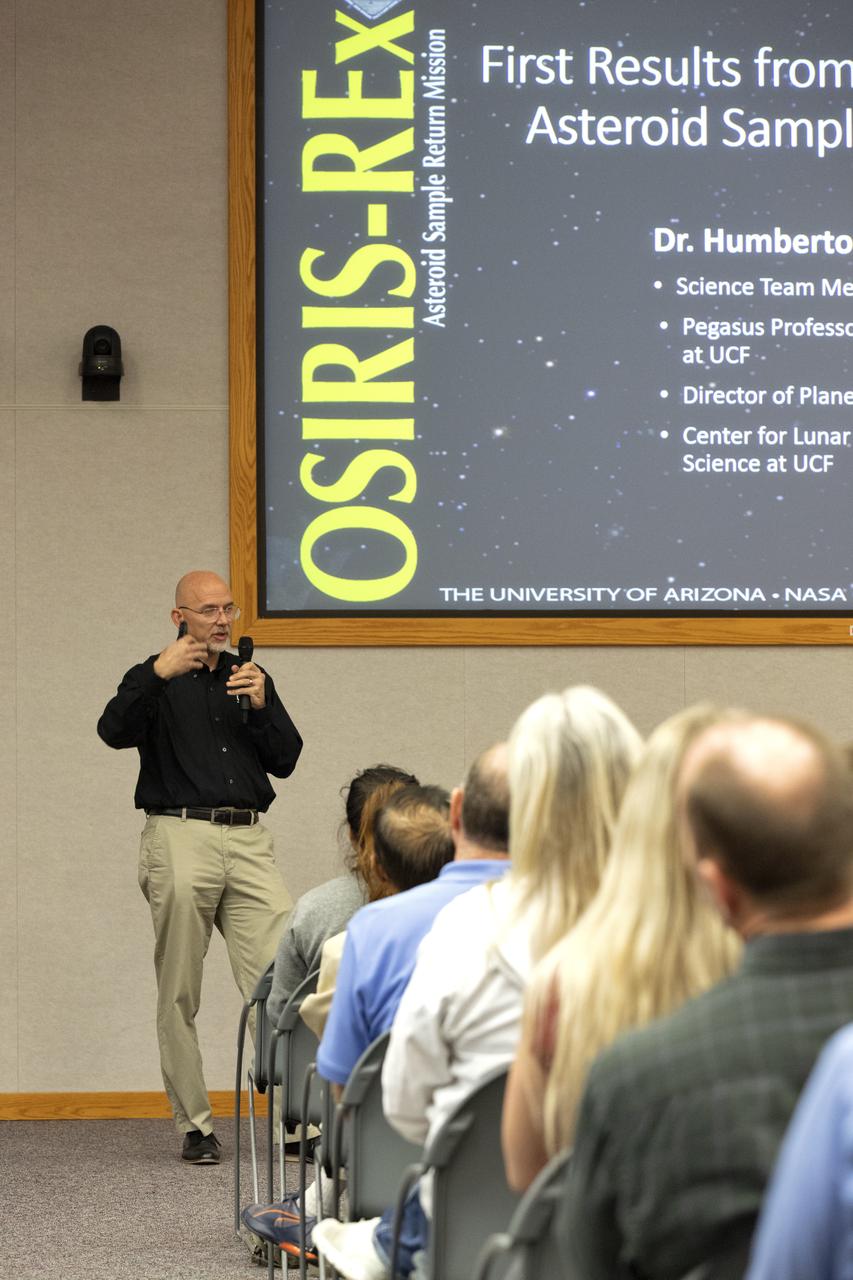
Kennedy Space Center employees gather in the Florida spaceport’s Neil Armstrong O&C Mission Briefing Room on April 16, 2019, to hear Dr. Humberto Campins from the University of Central Florida give a status update on NASA’s Origins, Spectral Interpretation, Resource Identification, Security-Regolith Explorer (OSIRIS-REx). The first U.S. mission to sample an asteroid, OSIRIS-REx launched from Cape Canaveral Air Force Station on Sept. 8, 2016 aboard a United Launch Alliance Atlas V rocket. Management of the launch service for OSIRIS-REx was the responsibility of NASA’s Launch Services Program, based at Kennedy.
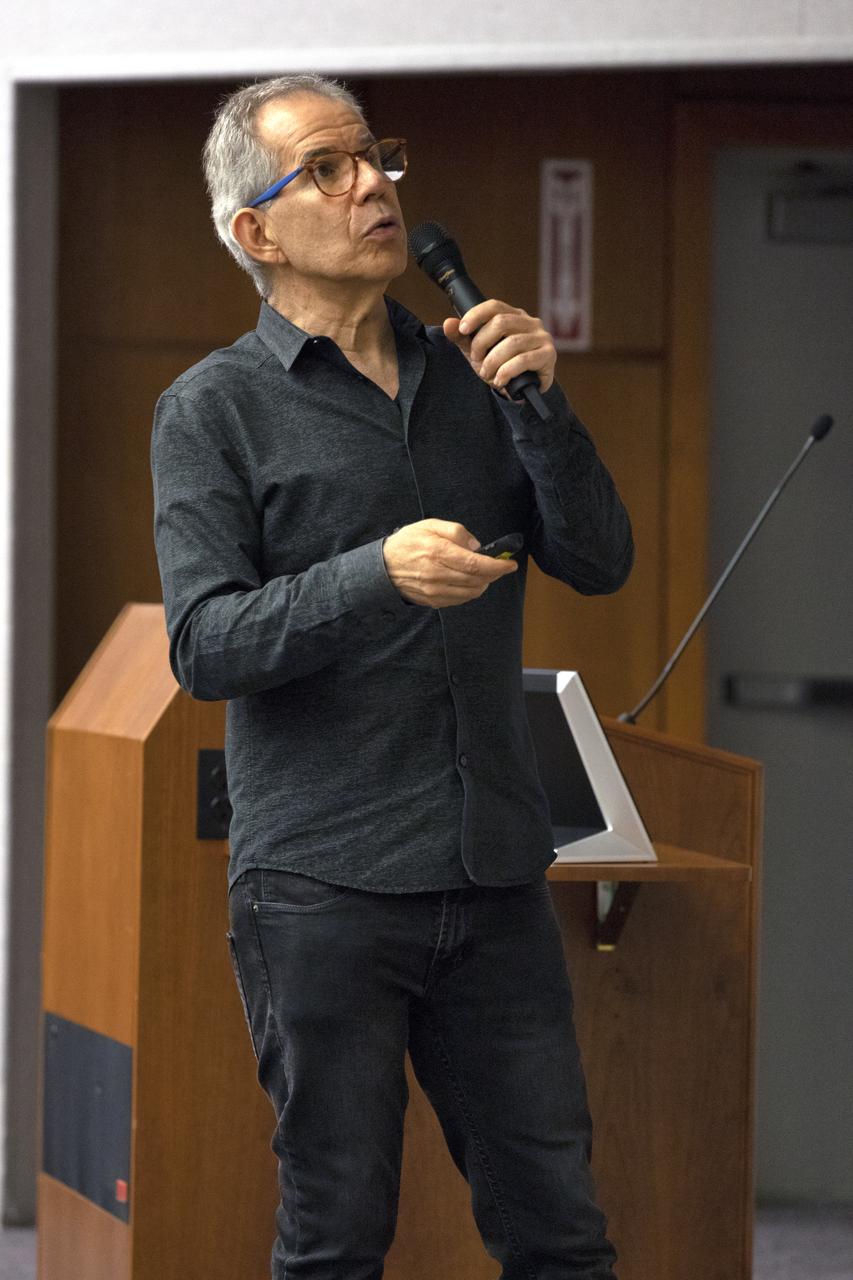
Dr. Humberto Campins from the University of Central Florida speaks to Kennedy Space Center employees in the Florida spaceport’s Neil Armstrong O&C Mission Briefing Room on April 16, 2019, to give a status update on NASA’s Origins, Spectral Interpretation, Resource Identification, Security-Regolith Explorer (OSIRIS-REx). The first U.S. mission to sample an asteroid, OSIRIS-REx launched from Cape Canaveral Air Force Station on Sept. 8, 2016 aboard a United Launch Alliance Atlas V rocket. Management of the launch service for OSIRIS-REx was the responsibility of NASA’s Launch Services Program, based at Kennedy.
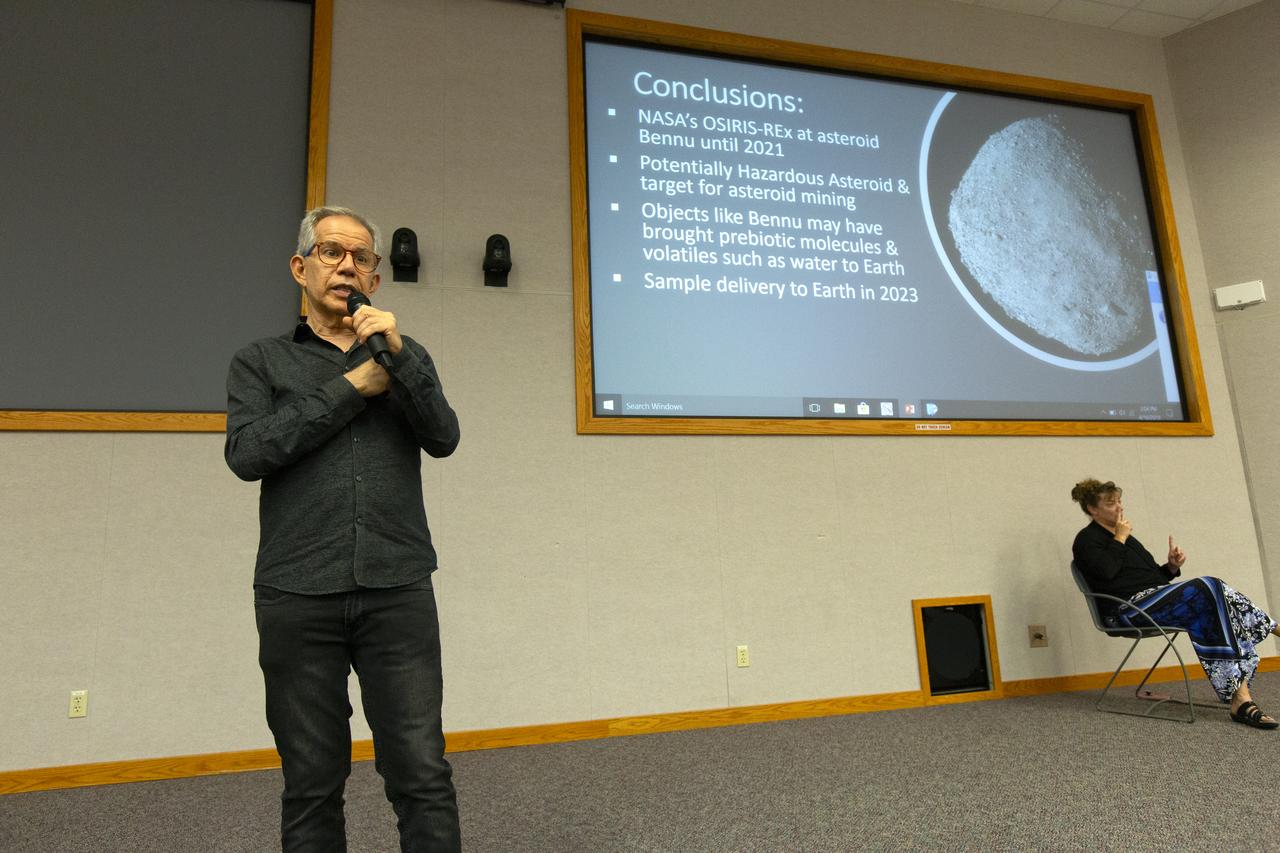
Dr. Humberto Campins from the University of Central Florida speaks to Kennedy Space Center employees in the Florida spaceport’s Neil Armstrong O&C Mission Briefing Room on April 16, 2019, to give a status update on NASA’s Origins, Spectral Interpretation, Resource Identification, Security-Regolith Explorer (OSIRIS-REx). The first U.S. mission to sample an asteroid, OSIRIS-REx launched from Cape Canaveral Air Force Station on Sept. 8, 2016 aboard a United Launch Alliance Atlas V rocket. Management of the launch service for OSIRIS-REx was the responsibility of NASA’s Launch Services Program, based at Kennedy.
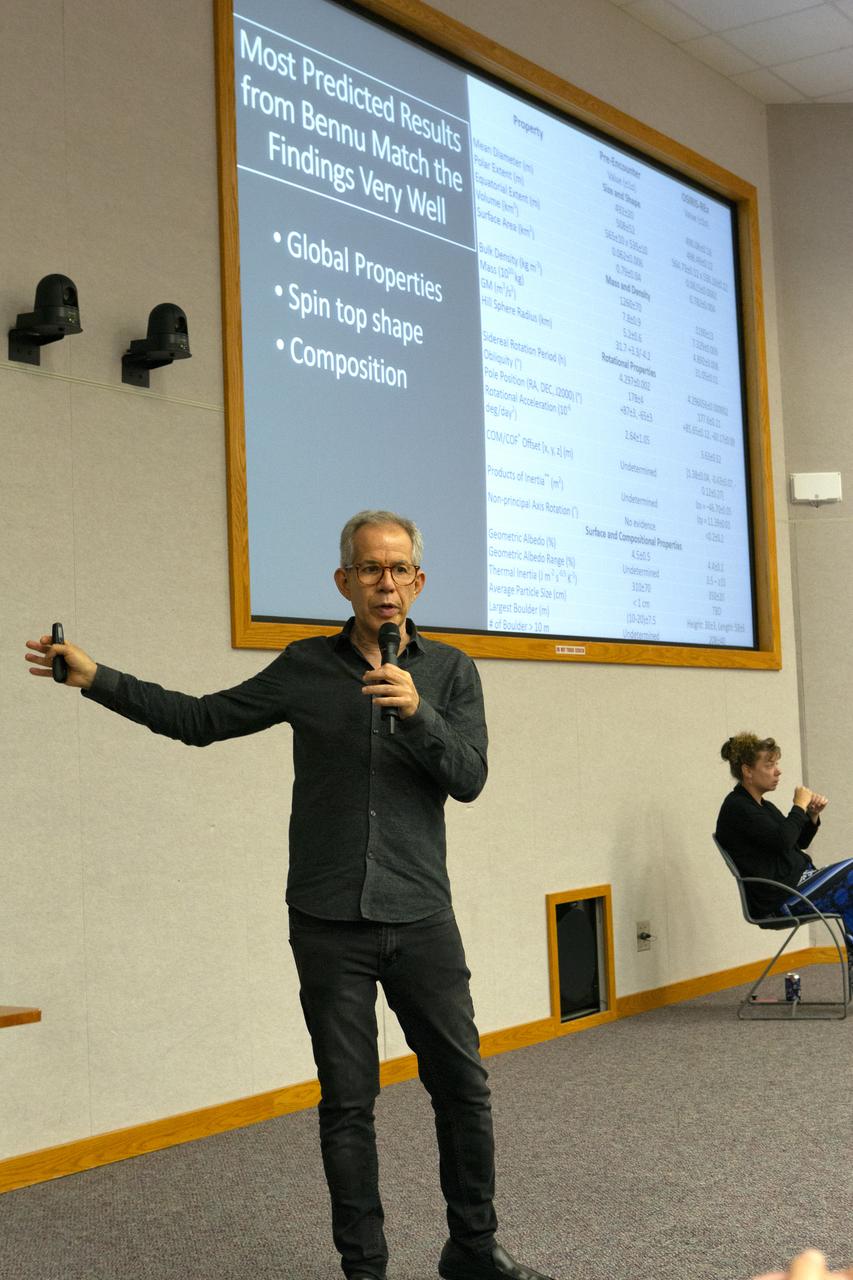
Dr. Humberto Campins from the University of Central Florida speaks to Kennedy Space Center employees in the Florida spaceport’s Neil Armstrong O&C Mission Briefing Room on April 16, 2019, to give a status update on NASA’s Origins, Spectral Interpretation, Resource Identification, Security-Regolith Explorer (OSIRIS-REx). The first U.S. mission to sample an asteroid, OSIRIS-REx launched from Cape Canaveral Air Force Station on Sept. 8, 2016 aboard a United Launch Alliance Atlas V rocket. Management of the launch service for OSIRIS-REx was the responsibility of NASA’s Launch Services Program, based at Kennedy.
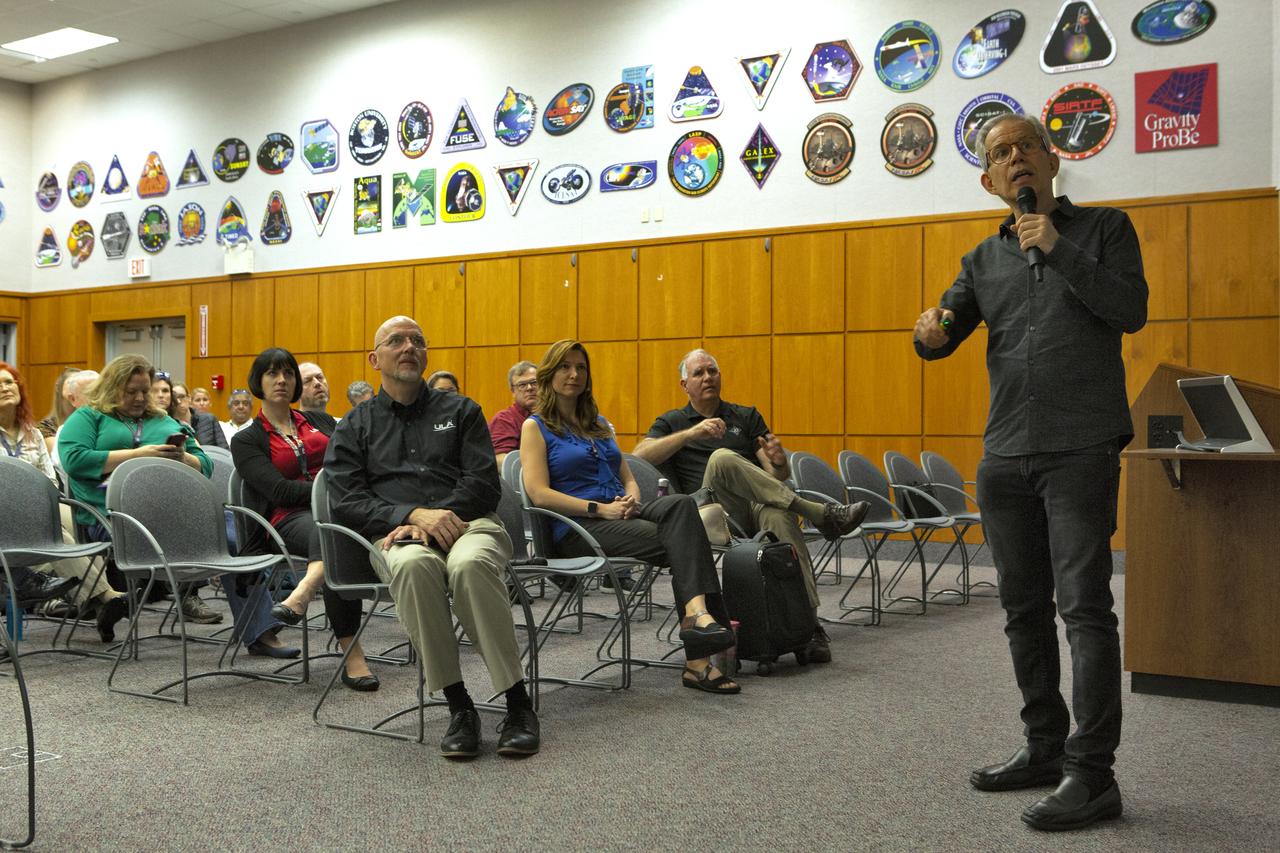
Dr. Humberto Campins from the University of Central Florida speaks to Kennedy Space Center employees in the Florida spaceport’s Neil Armstrong O&C Mission Briefing Room on April 16, 2019, to give a status update on NASA’s Origins, Spectral Interpretation, Resource Identification, Security-Regolith Explorer (OSIRIS-REx). The first U.S. mission to sample an asteroid, OSIRIS-REx launched from Cape Canaveral Air Force Station on Sept. 8, 2016 aboard a United Launch Alliance Atlas V rocket. Management of the launch service for OSIRIS-REx was the responsibility of NASA’s Launch Services Program, based at Kennedy.
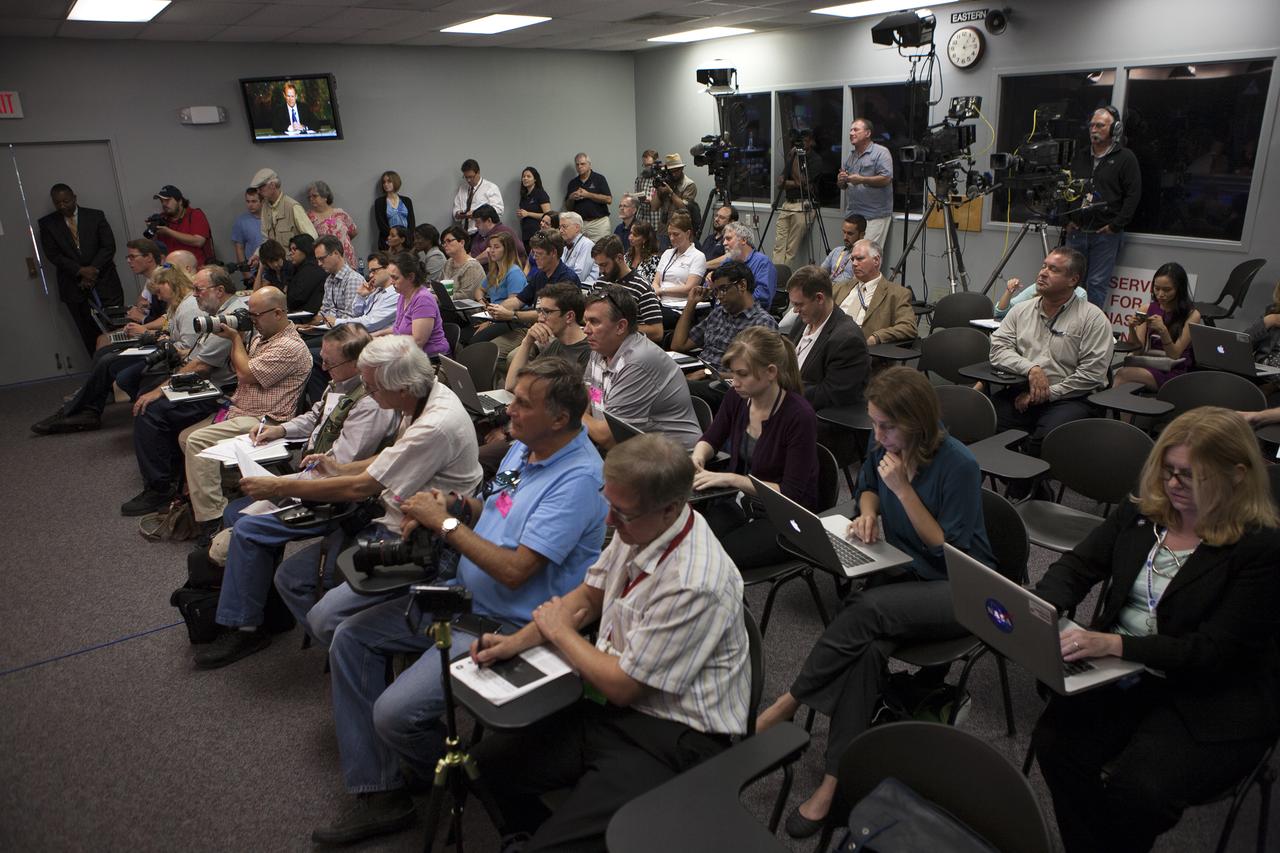
In the Kennedy Space Center’s Press Site auditorium, members of the media participated with NASA and industry leaders in a prelaunch news conference for the agency’s Origins, Spectral Interpretation, Resource Identification, Security-Regolith Explorer, or OSIRIS-REx spacecraft.

The United Launch Alliance Atlas V rocket arrives at Space Launch Complex 41 at Cape Canaveral Air Force Station in Florida. The launch vehicle will boost NASA’s Origins, Spectral Interpretation, Resource Identification, Security-Regolith Explorer, or OSIRIS-REx spacecraft. This will be the first U.S. mission to sample an asteroid, retrieve at least two ounces of surface material and return it to Earth for study. The asteroid, Bennu, may hold clues to the origin of the solar system and the source of water and organic molecules found on Earth. Photo credit: NASA/Kim Shiflett
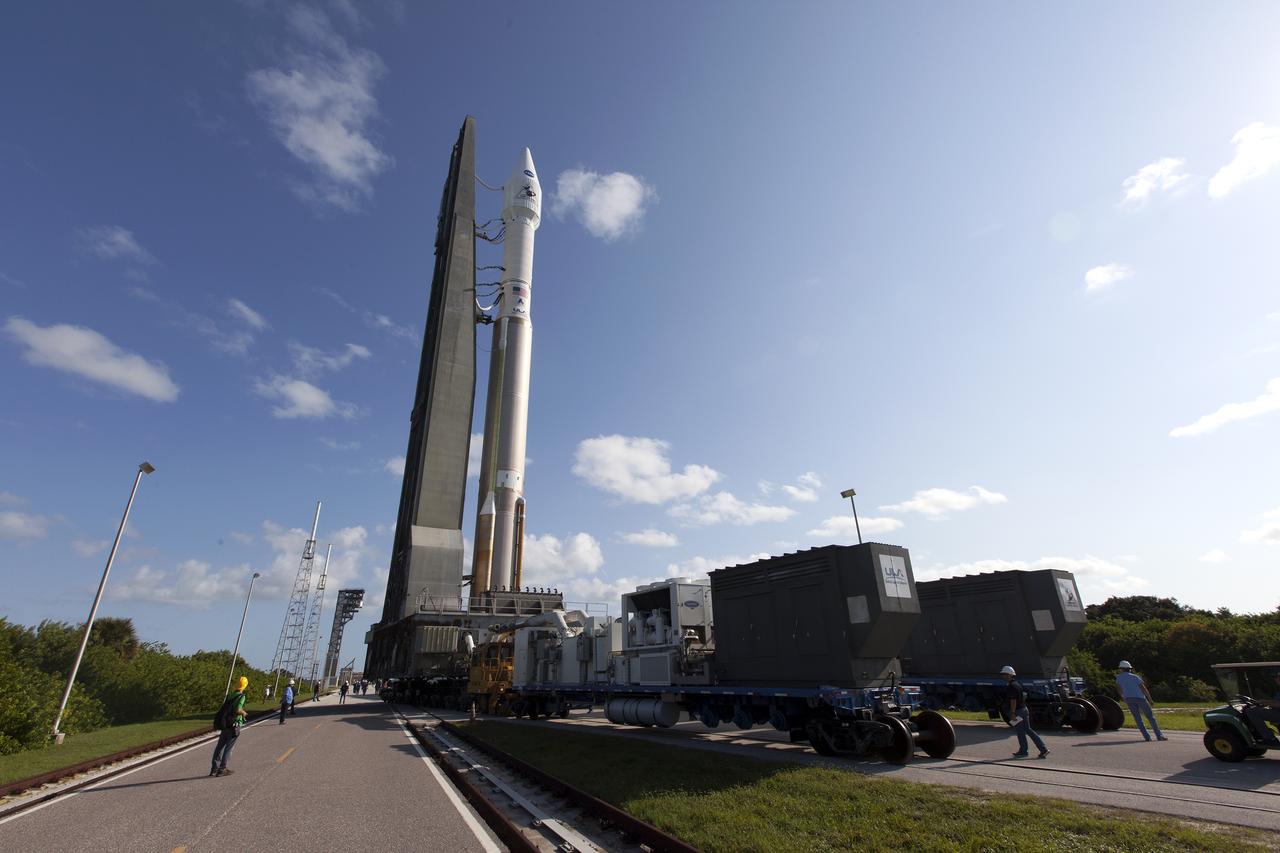
A United Launch Alliance Atlas V rocket rolled out of the Vertical Integration Facility and is on its way to Space Launch Complex 41 at Cape Canaveral Air Force Station in Florida. The launch vehicle will boost NASA’s Origins, Spectral Interpretation, Resource Identification, Security-Regolith Explorer, or OSIRIS-REx spacecraft. This will be the first U.S. mission to sample an asteroid, retrieve at least two ounces of surface material and return it to Earth for study. The asteroid, Bennu, may hold clues to the origin of the solar system and the source of water and organic molecules found on Earth.

A United Launch Alliance Atlas V rocket begins to roll out of the Vertical Integration Facility to Space Launch Complex 41 at Cape Canaveral Air Force Station in Florida. The launch vehicle will boost NASA’s Origins, Spectral Interpretation, Resource Identification, Security-Regolith Explorer, or OSIRIS-REx spacecraft. This will be the first U.S. mission to sample an asteroid, retrieve at least two ounces of surface material and return it to Earth for study. The asteroid, Bennu, may hold clues to the origin of the solar system and the source of water and organic molecules found on Earth.

After leaving the Vertical Integration Facility, a United Launch Alliance Atlas V rocket arrives at Space Launch Complex 41 at Cape Canaveral Air Force Station in Florida. The launch vehicle will boost NASA’s Origins, Spectral Interpretation, Resource Identification, Security-Regolith Explorer, or OSIRIS-REx spacecraft. This will be the first U.S. mission to sample an asteroid, retrieve at least two ounces of surface material and return it to Earth for study. The asteroid, Bennu, may hold clues to the origin of the solar system and the source of water and organic molecules found on Earth.
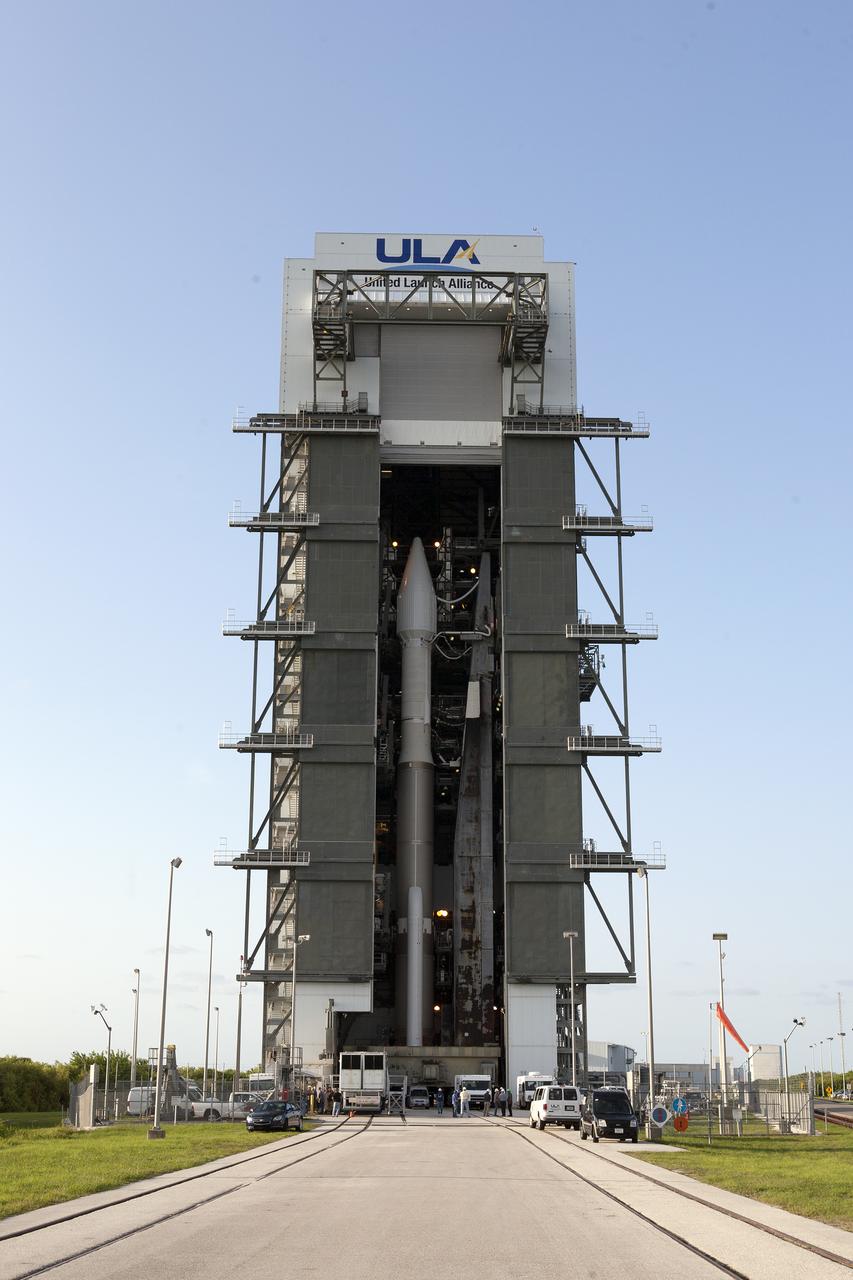
A United Launch Alliance Atlas V rocket begins to roll out of the Vertical Integration Facility to Space Launch Complex 41 at Cape Canaveral Air Force Station in Florida. The launch vehicle will boost NASA’s Origins, Spectral Interpretation, Resource Identification, Security-Regolith Explorer, or OSIRIS-REx spacecraft. This will be the first U.S. mission to sample an asteroid, retrieve at least two ounces of surface material and return it to Earth for study. The asteroid, Bennu, may hold clues to the origin of the solar system and the source of water and organic molecules found on Earth.
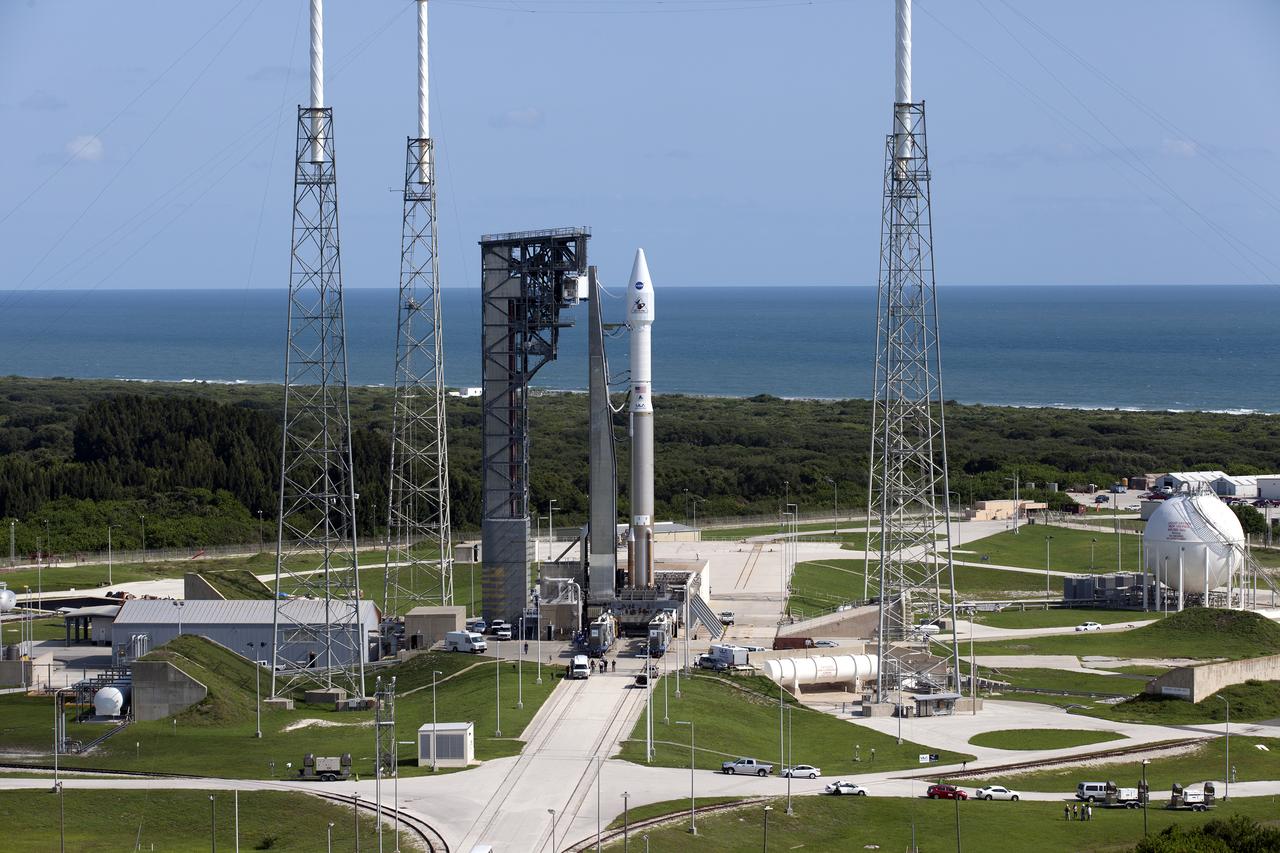
The United Launch Alliance Atlas V rocket has made the trek from the Vertical Integration Facility to Space Launch Complex 41 at Cape Canaveral Air Force Station in Florida. The launch vehicle will boost NASA’s Origins, Spectral Interpretation, Resource Identification, Security-Regolith Explorer, or OSIRIS-REx spacecraft. This will be the first U.S. mission to sample an asteroid, retrieve at least two ounces of surface material and return it to Earth for study. The asteroid, Bennu, may hold clues to the origin of the solar system and the source of water and organic molecules found on Earth.
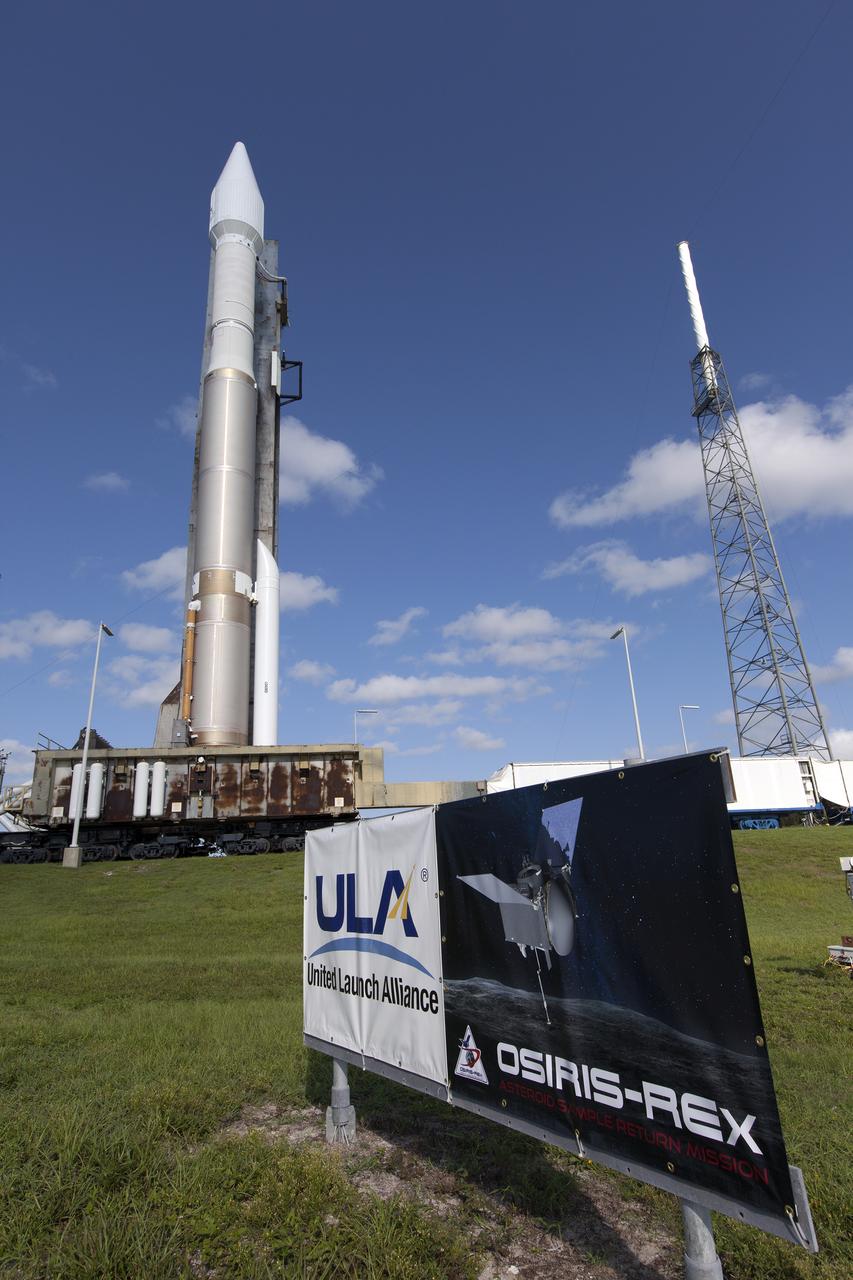
After leaving the Vertical Integration Facility, a United Launch Alliance Atlas V rocket is on its way to Space Launch Complex 41 at Cape Canaveral Air Force Station in Florida. The launch vehicle will boost NASA’s Origins, Spectral Interpretation, Resource Identification, Security-Regolith Explorer, or OSIRIS-REx spacecraft. This will be the first U.S. mission to sample an asteroid, retrieve at least two ounces of surface material and return it to Earth for study. The asteroid, Bennu, may hold clues to the origin of the solar system and the source of water and organic molecules found on Earth.
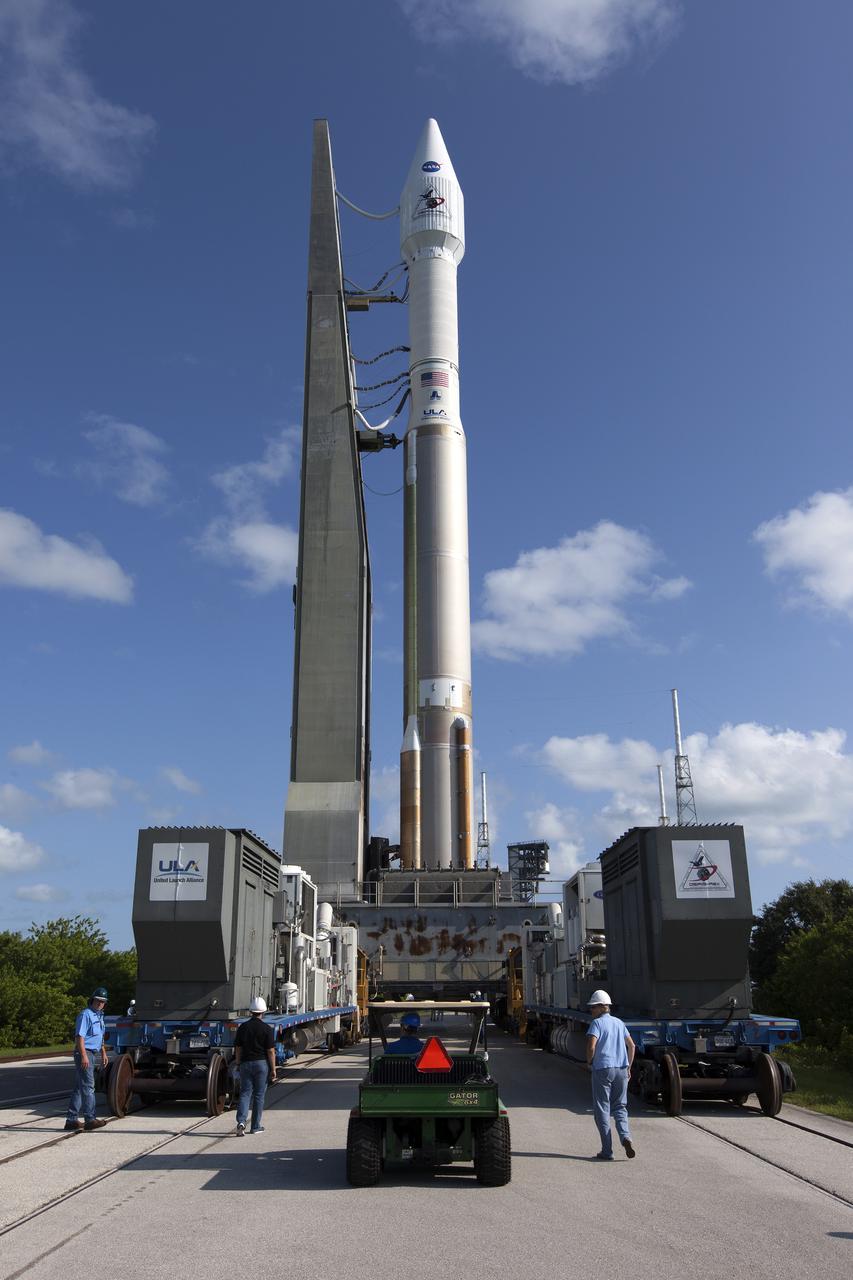
A United Launch Alliance Atlas V rocket has left the Vertical Integration Facility and is on its way to Space Launch Complex 41 at Cape Canaveral Air Force Station in Florida. The launch vehicle will boost NASA’s Origins, Spectral Interpretation, Resource Identification, Security-Regolith Explorer, or OSIRIS-REx spacecraft. This will be the first U.S. mission to sample an asteroid, retrieve at least two ounces of surface material and return it to Earth for study. The asteroid, Bennu, may hold clues to the origin of the solar system and the source of water and organic molecules found on Earth.
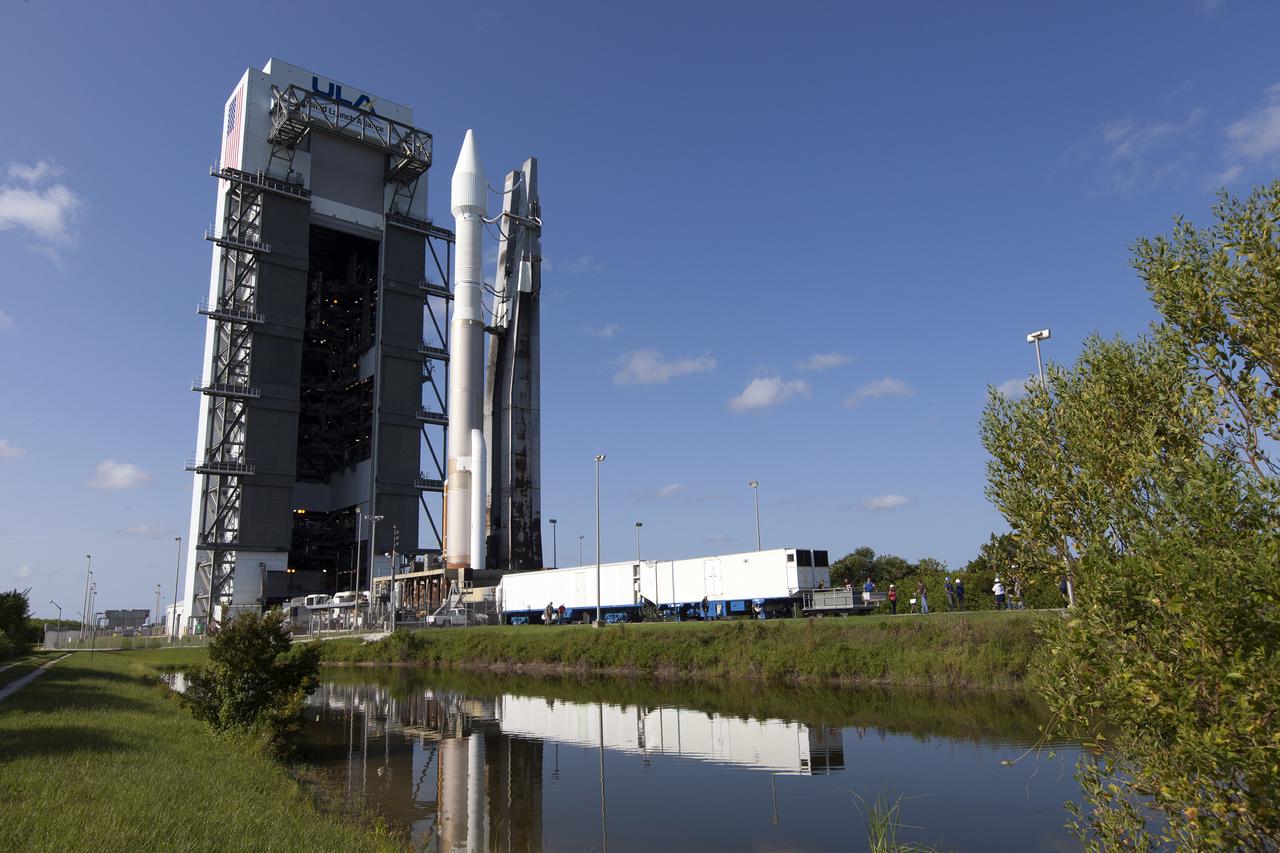
A United Launch Alliance Atlas V rocket rolls out of the Vertical Integration Facility on its way to Space Launch Complex 41 at Cape Canaveral Air Force Station in Florida. The launch vehicle will boost NASA’s Origins, Spectral Interpretation, Resource Identification, Security-Regolith Explorer, or OSIRIS-REx spacecraft. This will be the first U.S. mission to sample an asteroid, retrieve at least two ounces of surface material and return it to Earth for study. The asteroid, Bennu, may hold clues to the origin of the solar system and the source of water and organic molecules found on Earth.
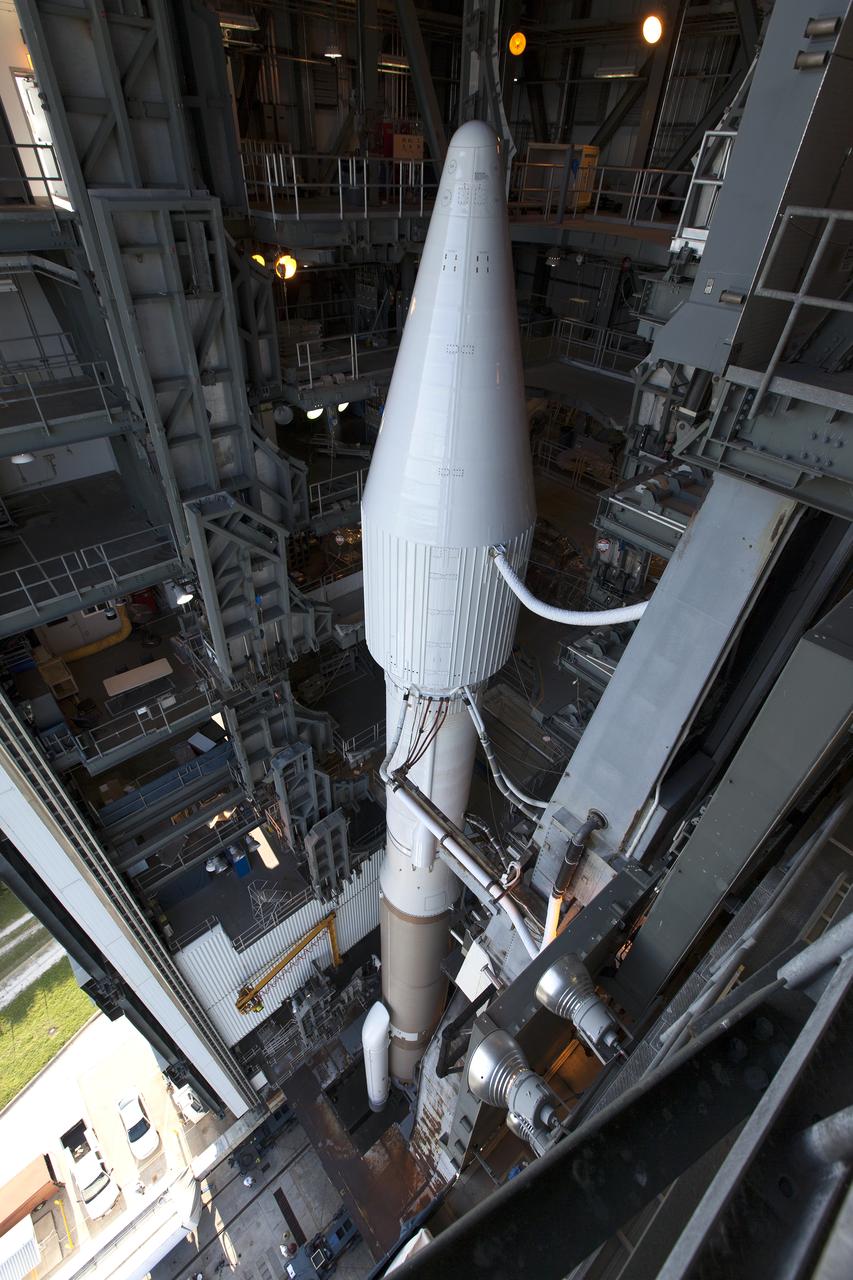
In a view from above, a United Launch Alliance Atlas V rocket begins to roll out of the Vertical Integration Facility to Space Launch Complex 41 at Cape Canaveral Air Force Station in Florida. The launch vehicle will boost NASA’s Origins, Spectral Interpretation, Resource Identification, Security-Regolith Explorer, or OSIRIS-REx spacecraft. This will be the first U.S. mission to sample an asteroid, retrieve at least two ounces of surface material and return it to Earth for study. The asteroid, Bennu, may hold clues to the origin of the solar system and the source of water and organic molecules found on Earth.
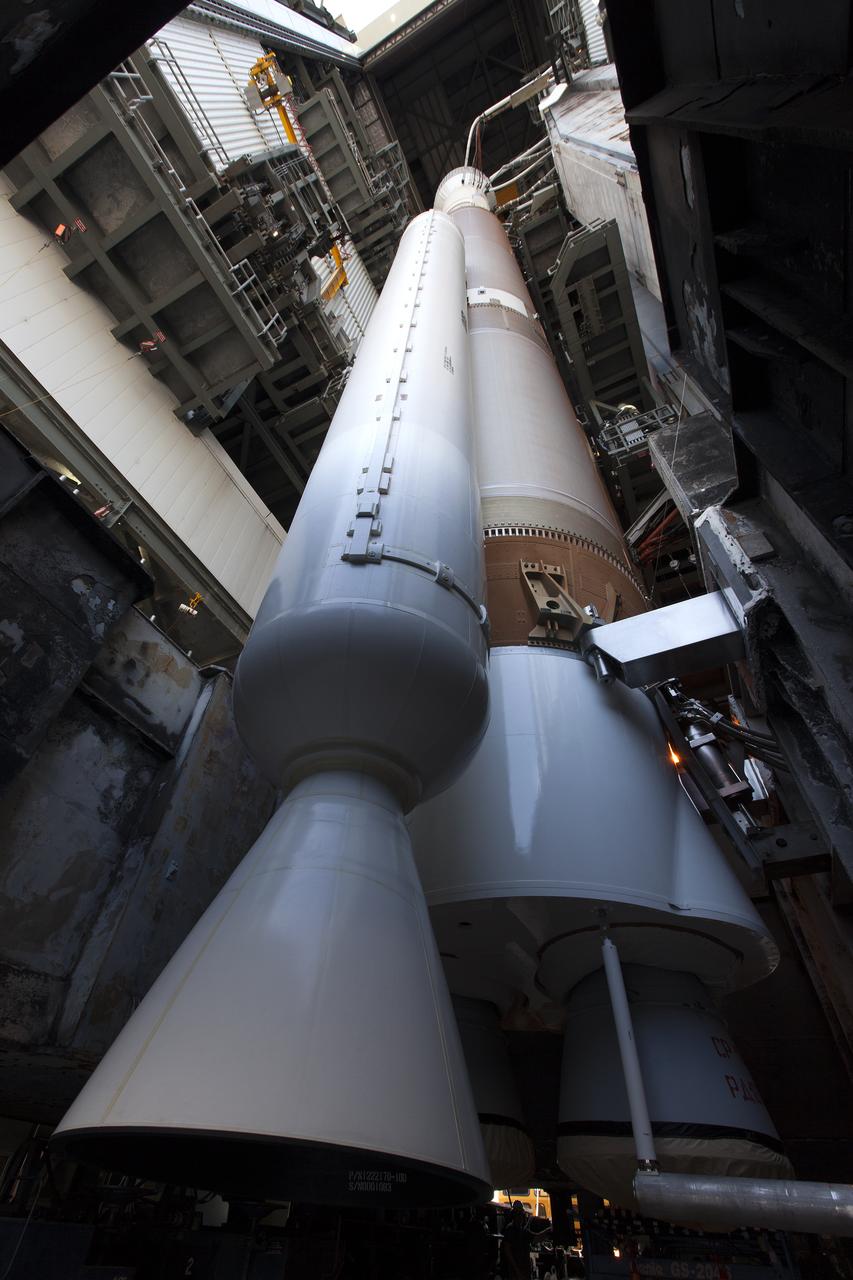
In a view from ground level looking up, a United Launch Alliance Atlas V rocket begins to roll out of the Vertical Integration Facility to Space Launch Complex 41 at Cape Canaveral Air Force Station in Florida. The launch vehicle will boost NASA’s Origins, Spectral Interpretation, Resource Identification, Security-Regolith Explorer, or OSIRIS-REx spacecraft. This will be the first U.S. mission to sample an asteroid, retrieve at least two ounces of surface material and return it to Earth for study. The asteroid, Bennu, may hold clues to the origin of the solar system and the source of water and organic molecules found on Earth.
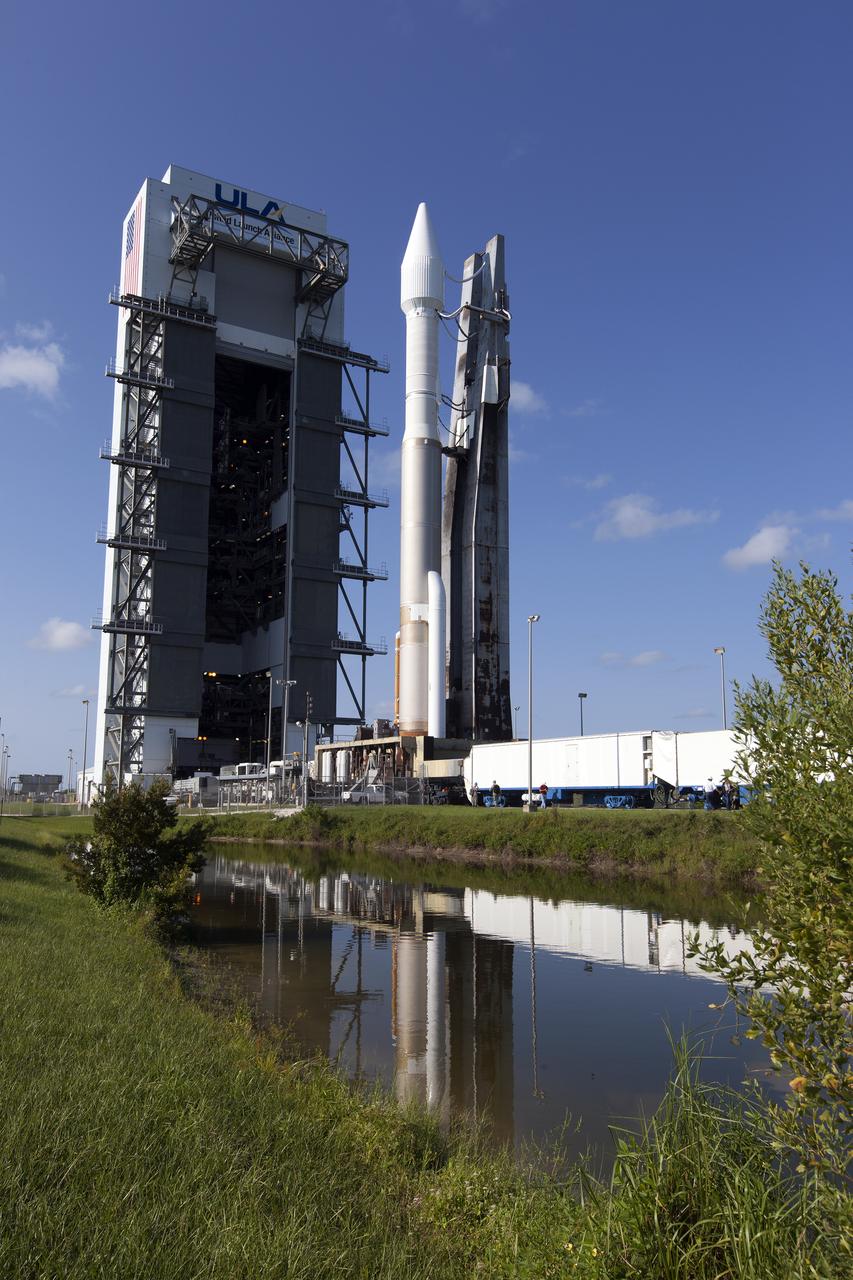
A United Launch Alliance Atlas V rocket is reflected in the water as it rolls out of the Vertical Integration Facility on its way to Space Launch Complex 41 at Cape Canaveral Air Force Station in Florida. The launch vehicle will boost NASA’s Origins, Spectral Interpretation, Resource Identification, Security-Regolith Explorer, or OSIRIS-REx spacecraft. This will be the first U.S. mission to sample an asteroid, retrieve at least two ounces of surface material and return it to Earth for study. The asteroid, Bennu, may hold clues to the origin of the solar system and the source of water and organic molecules found on Earth.
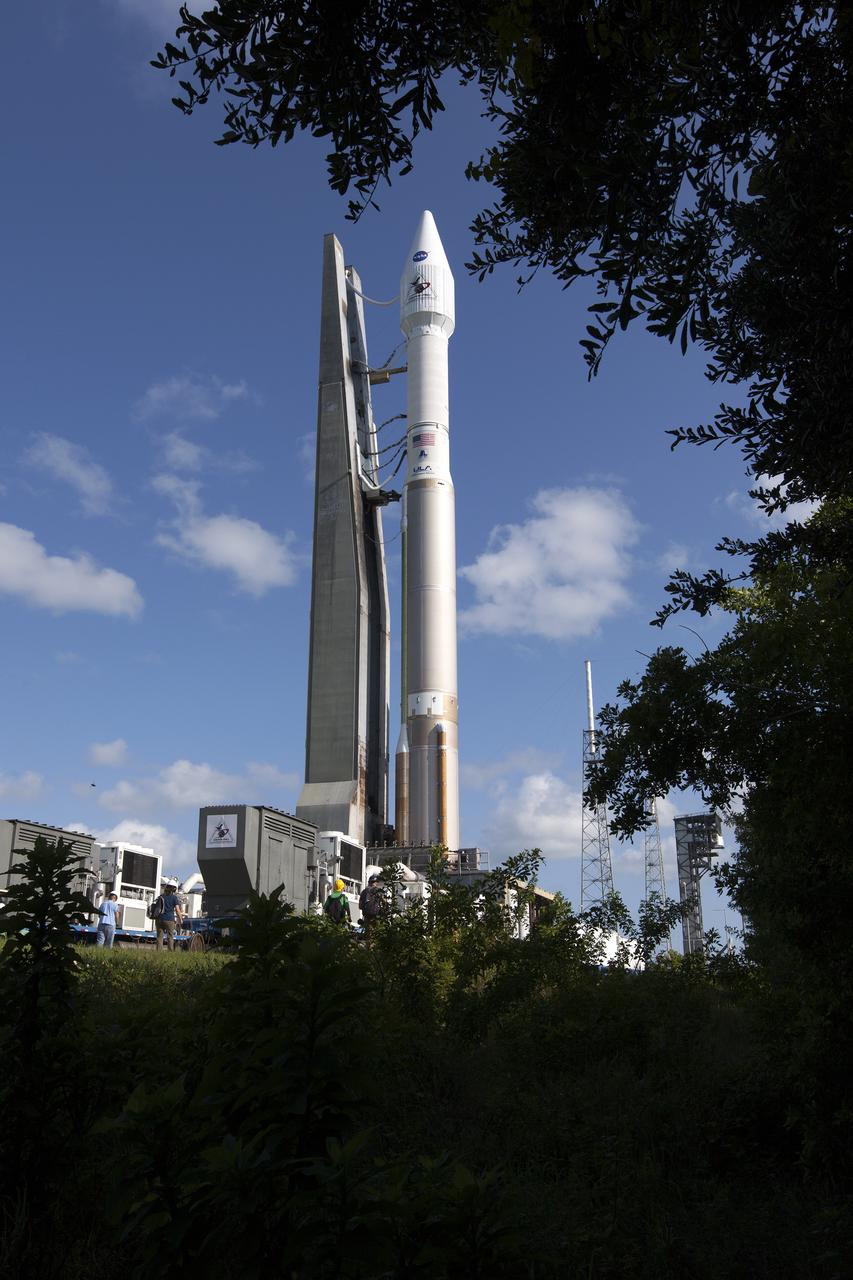
After leaving the Vertical Integration Facility, a United Launch Alliance Atlas V rocket is on its way to Space Launch Complex 41 at Cape Canaveral Air Force Station in Florida. The launch vehicle will boost NASA’s Origins, Spectral Interpretation, Resource Identification, Security-Regolith Explorer, or OSIRIS-REx spacecraft. This will be the first U.S. mission to sample an asteroid, retrieve at least two ounces of surface material and return it to Earth for study. The asteroid, Bennu, may hold clues to the origin of the solar system and the source of water and organic molecules found on Earth.
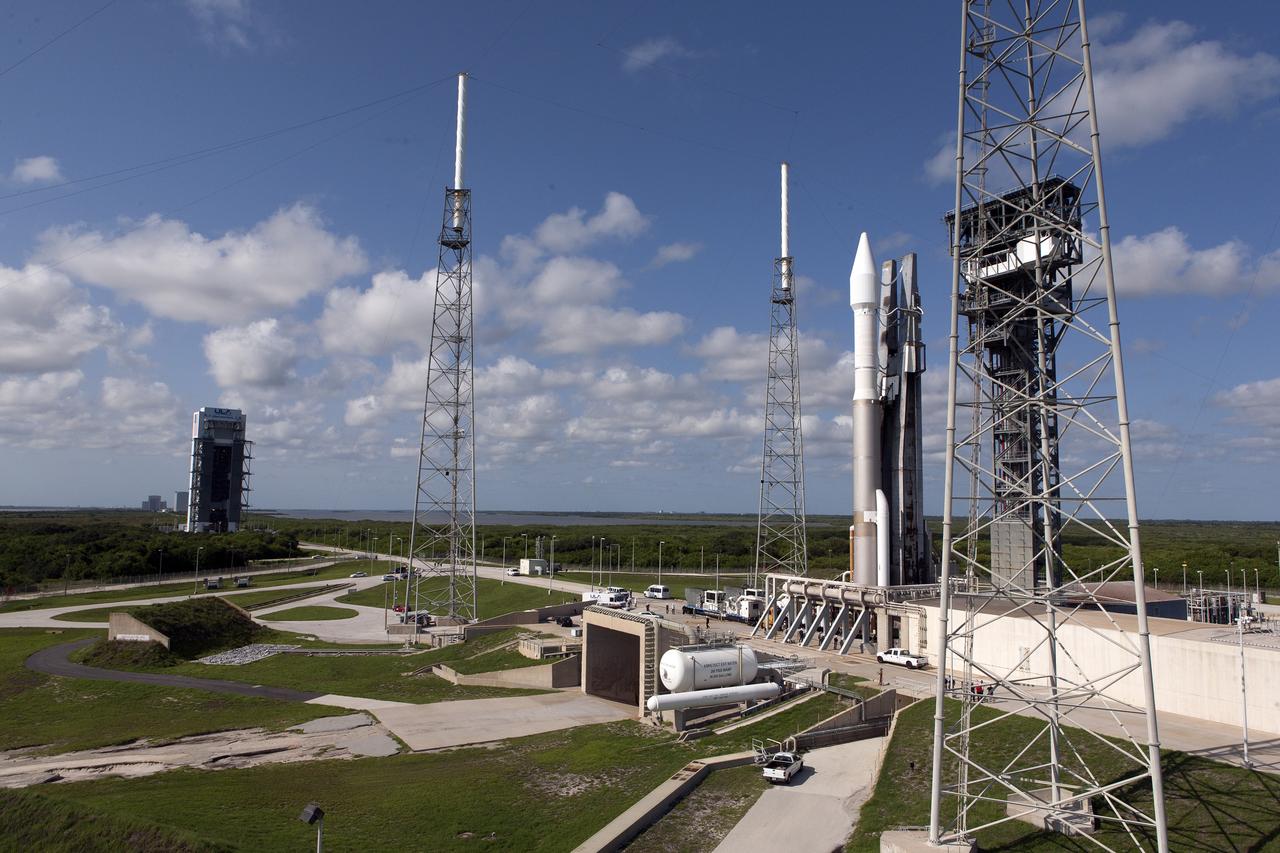
The United Launch Alliance Atlas V rocket has made the trek from the Vertical Integration Facility to Space Launch Complex 41 at Cape Canaveral Air Force Station in Florida. The launch vehicle will boost NASA’s Origins, Spectral Interpretation, Resource Identification, Security-Regolith Explorer, or OSIRIS-REx spacecraft. This will be the first U.S. mission to sample an asteroid, retrieve at least two ounces of surface material and return it to Earth for study. The asteroid, Bennu, may hold clues to the origin of the solar system and the source of water and organic molecules found on Earth.
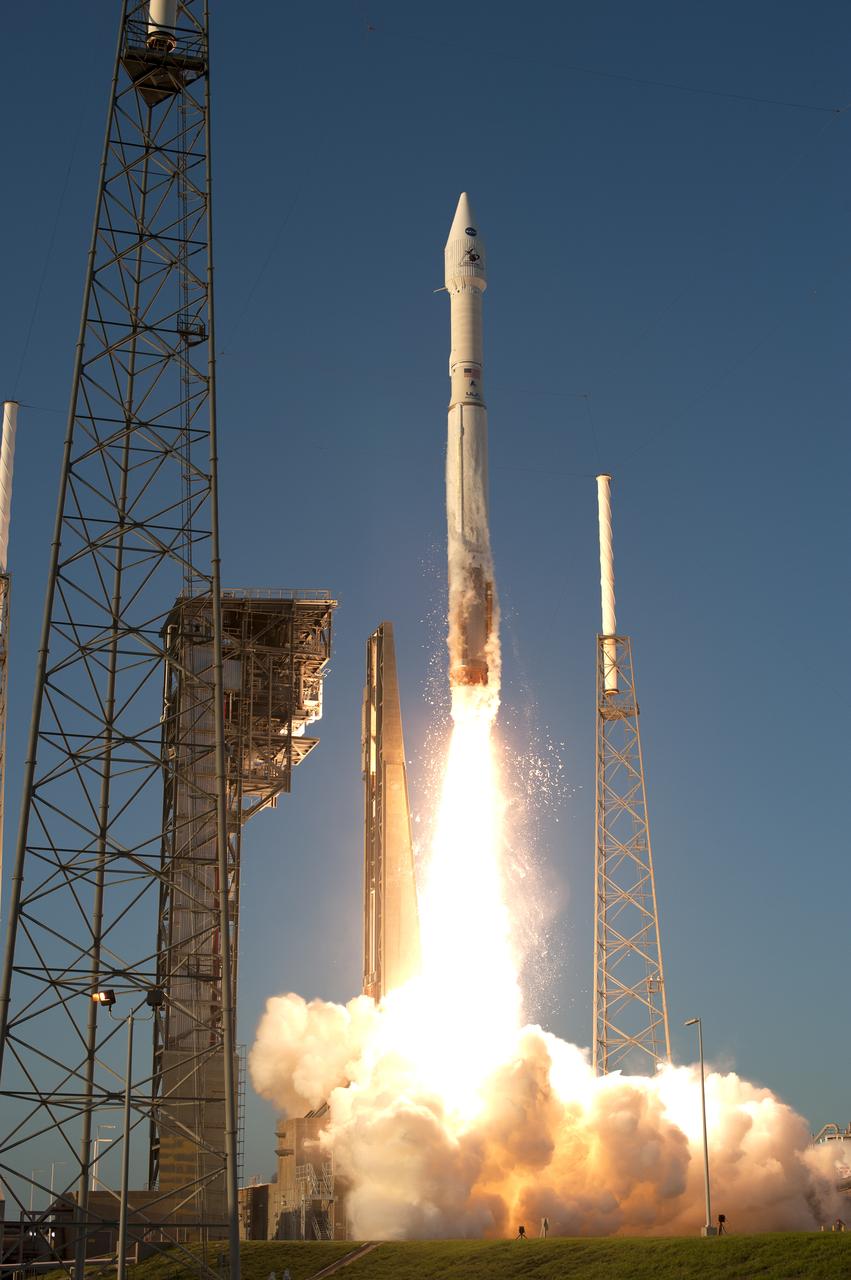
Liftoff of OSIRIS-A United Launch Alliance Atlas V rocket lifts off from Space Launch Complex 41 at Cape Canaveral Air Force Station carrying NASA’s Origins, Spectral Interpretation, Resource Identification, Security-Regolith Explorer, or OSIRIS-REx spacecraft on the first U.S. mission to sample an asteroid, retrieve at least two ounces of surface material and return it to Earth for study. Liftoff was at 7:05 p.m. EDT. The asteroid, Bennu, may hold clues to the origin of the solar system and the source of water and organic molecules found on Earth.
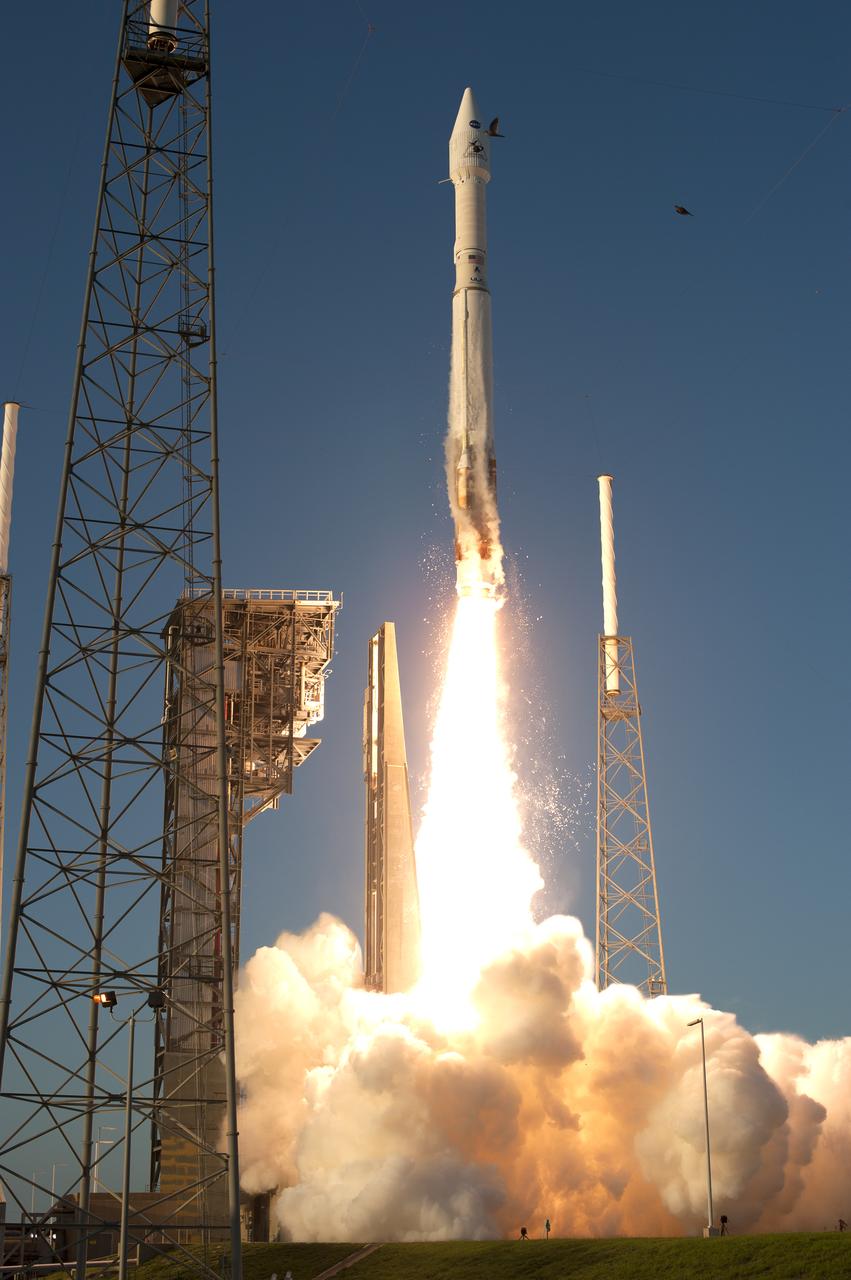
Liftoff of OSIRIS-REA United Launch Alliance Atlas V rocket lifts off from Space Launch Complex 41 at Cape Canaveral Air Force Station carrying NASA’s Origins, Spectral Interpretation, Resource Identification, Security-Regolith Explorer, or OSIRIS-REx spacecraft on the first U.S. mission to sample an asteroid, retrieve at least two ounces of surface material and return it to Earth for study. Liftoff was at 7:05 p.m. EDT. The asteroid, Bennu, may hold clues to the origin of the solar system and the source of water and organic molecules found on Earth.
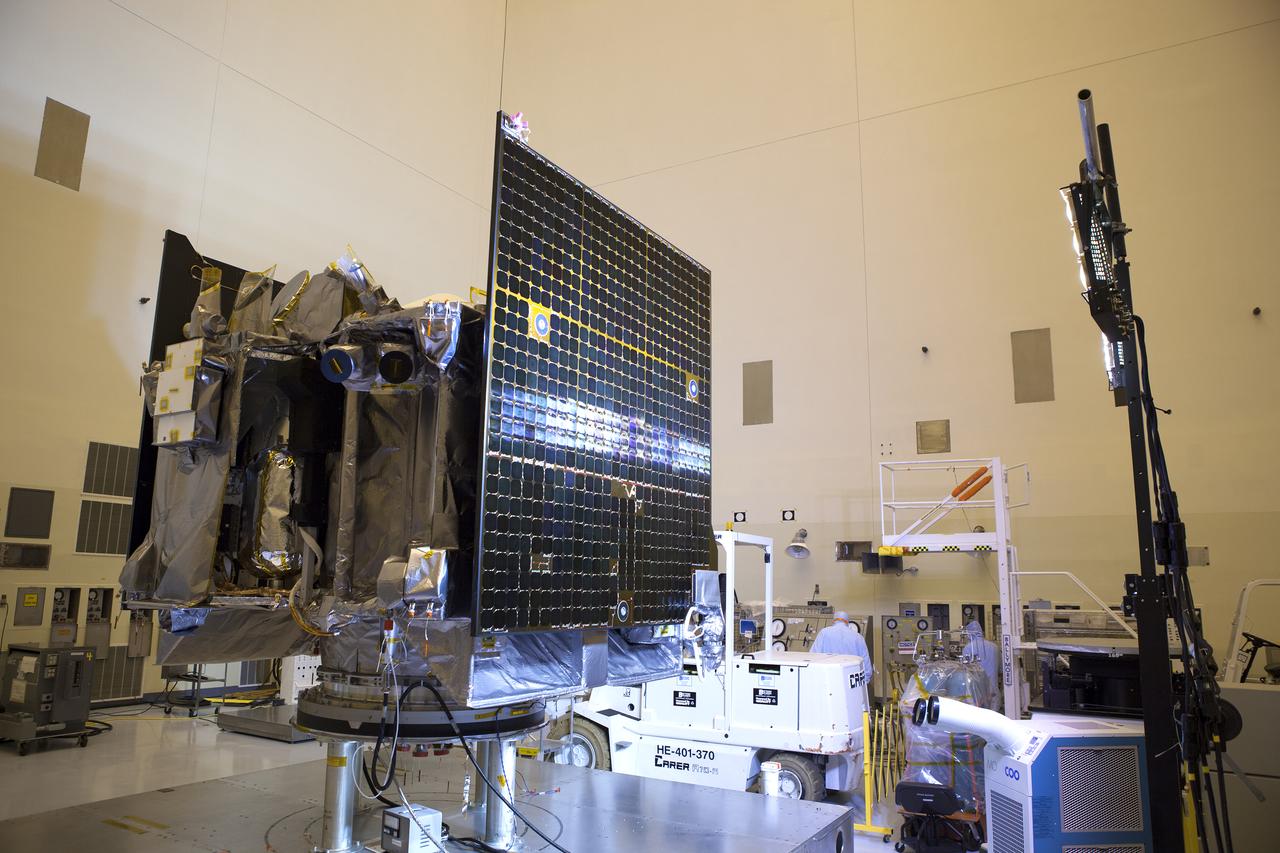
Inside the Payload Hazardous Servicing Facility at NASA's Kennedy Space Center in Florida, illumination testing is underway on the power-producing solar arrays for the agency’s Origins, Spectral Interpretation, Resource Identification, Security-Regolith Explorer, or OSIRIS-REx spacecraft. Targeted for liftoff Sept. 8, 2016, OSIRIS-Rex will be the first U.S. mission to sample an asteroid, retrieve at least two ounces of surface material and return it to Earth for study. The asteroid, Bennu, may hold clues to the origin of the solar system and the source of water and organic molecules found on Earth.
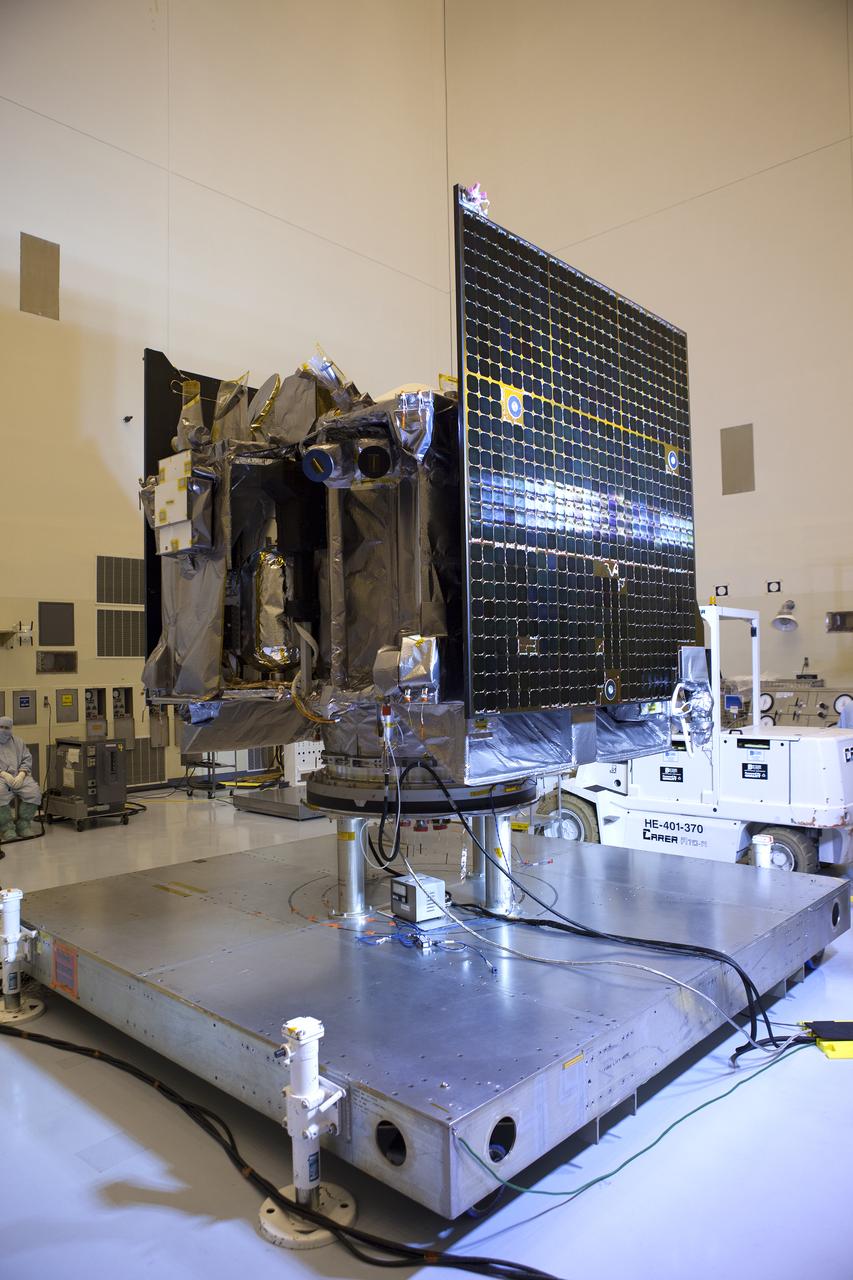
Inside the Payload Hazardous Servicing Facility at NASA's Kennedy Space Center in Florida, illumination testing is underway on the power-producing solar arrays for the agency’s Origins, Spectral Interpretation, Resource Identification, Security-Regolith Explorer, or OSIRIS-REx spacecraft. Targeted for liftoff Sept. 8, 2016, OSIRIS-Rex will be the first U.S. mission to sample an asteroid, retrieve at least two ounces of surface material and return it to Earth for study. The asteroid, Bennu, may hold clues to the origin of the solar system and the source of water and organic molecules found on Earth.
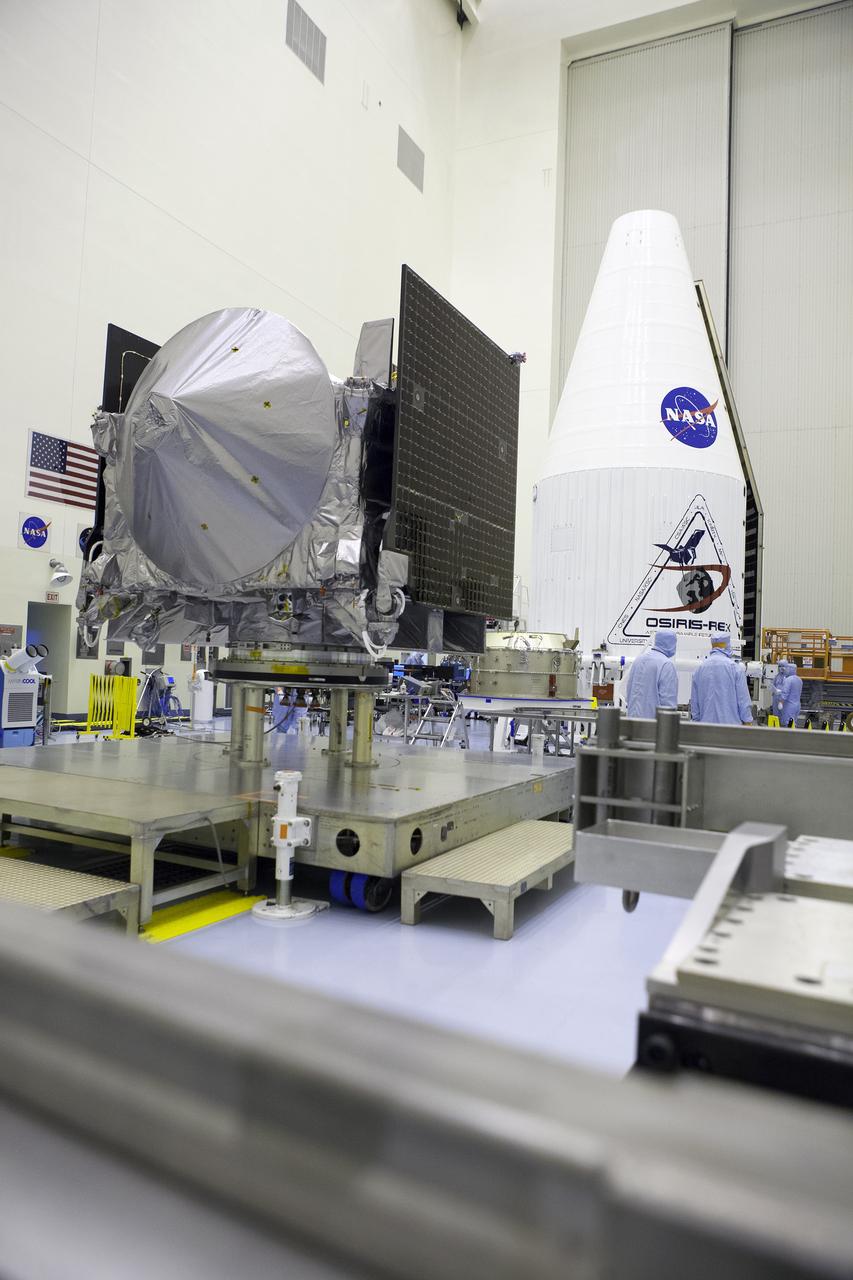
Inside the Payload Hazardous Servicing Facility at NASA's Kennedy Space Center in Florida, the agency’s Origins, Spectral Interpretation, Resource Identification, Security-Regolith Explorer, or OSIRIS-REx spacecraft is prepared for encapsulation in its payload fairing. Targeted for liftoff Sept. 8, 2016, OSIRIS-Rex will be the first U.S. mission to sample an asteroid, retrieve at least two ounces of surface material and return it to Earth for study. The asteroid, Bennu, may hold clues to the origin of the solar system and the source of water and organic molecules found on Earth.
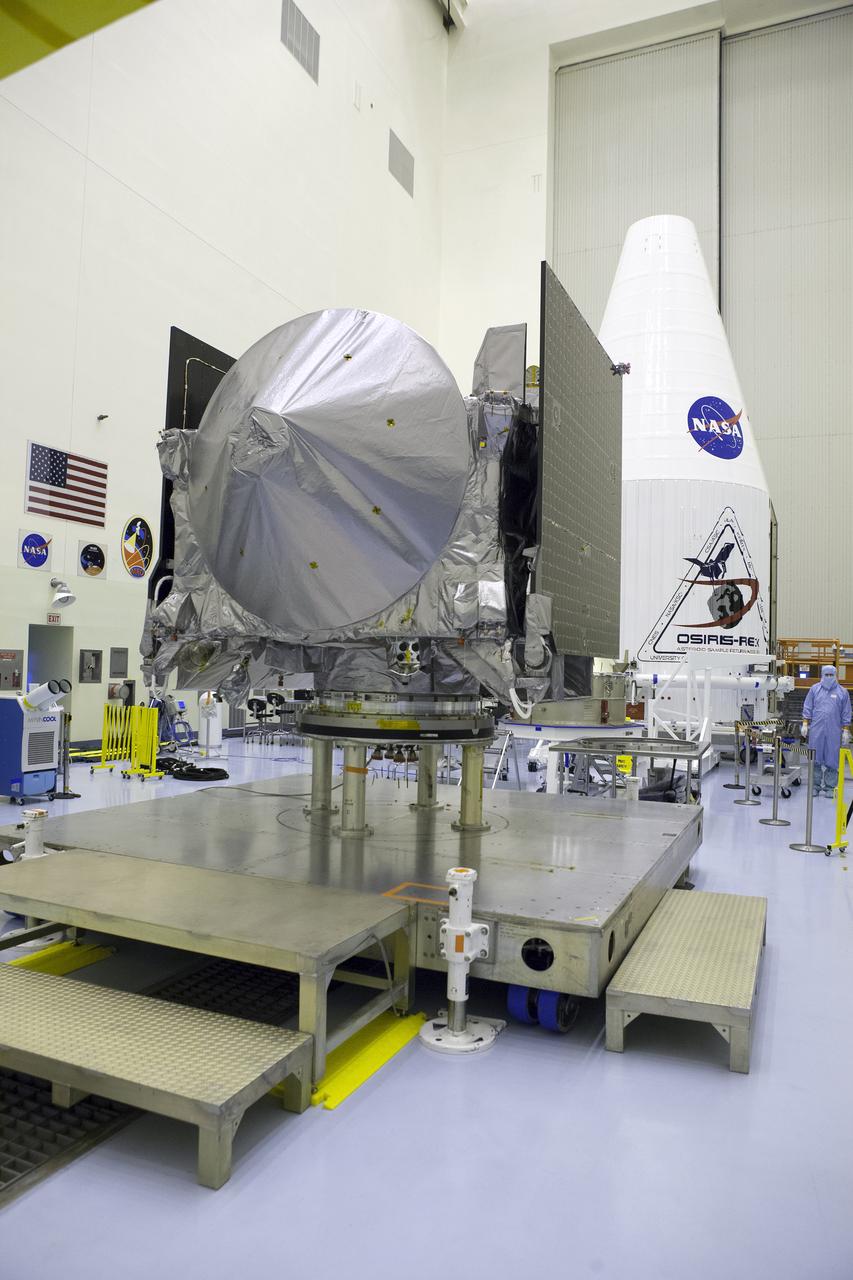
Inside the Payload Hazardous Servicing Facility at NASA's Kennedy Space Center in Florida, the agency’s Origins, Spectral Interpretation, Resource Identification, Security-Regolith Explorer, or OSIRIS-REx spacecraft is prepared for encapsulation in its payload fairing. Targeted for liftoff Sept. 8, 2016, OSIRIS-Rex will be the first U.S. mission to sample an asteroid, retrieve at least two ounces of surface material and return it to Earth for study. The asteroid, Bennu, may hold clues to the origin of the solar system and the source of water and organic molecules found on Earth.
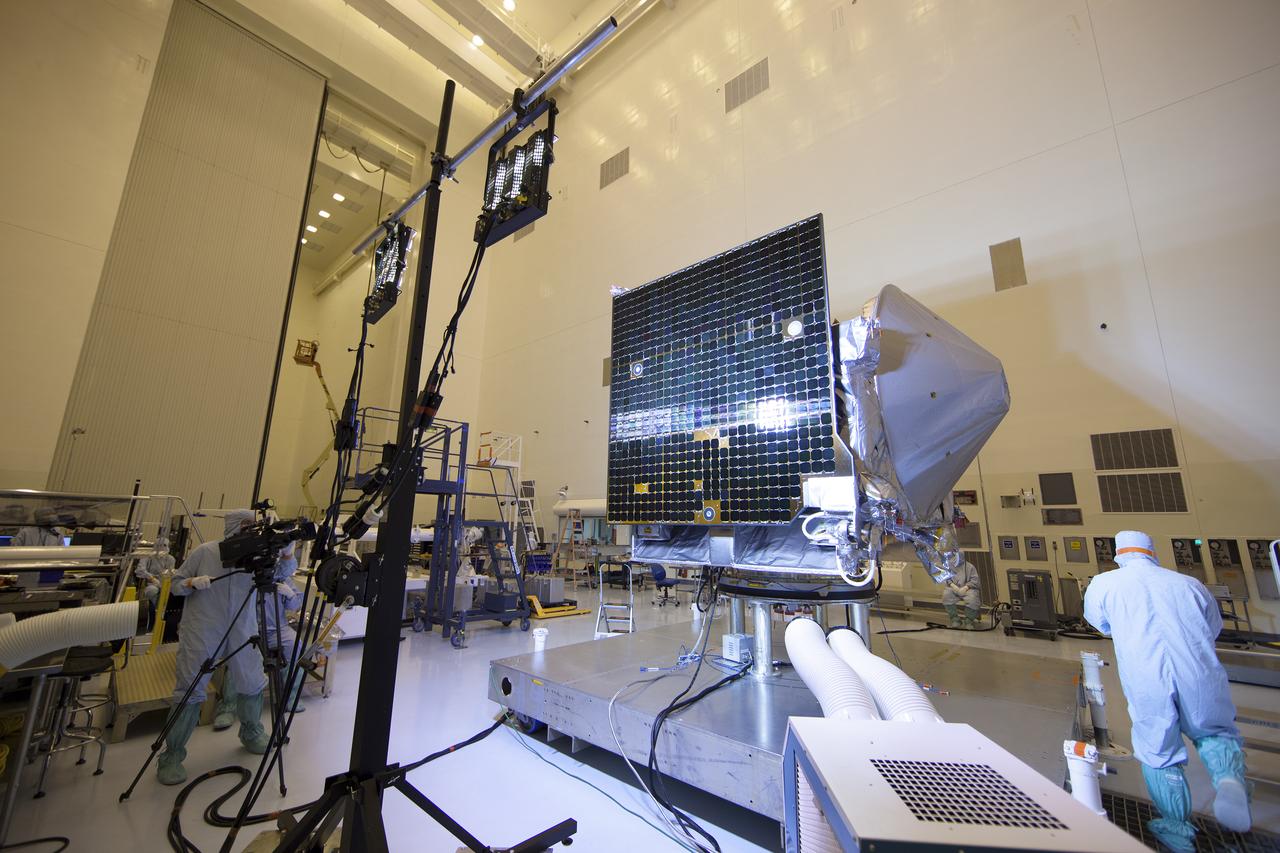
Inside the Payload Hazardous Servicing Facility at NASA's Kennedy Space Center in Florida, illumination testing is underway on the power -producing solar arrays for the agency’s Origins, Spectral Interpretation, Resource Identification, Security-Regolith Explorer, or OSIRIS-REx spacecraft. Targeted for liftoff Sept. 8, 2016, OSIRIS-Rex will be the first U.S. mission to sample an asteroid, retrieve at least two ounces of surface material and return it to Earth for study. The asteroid, Bennu, may hold clues to the origin of the solar system and the source of water and organic molecules found on Earth.
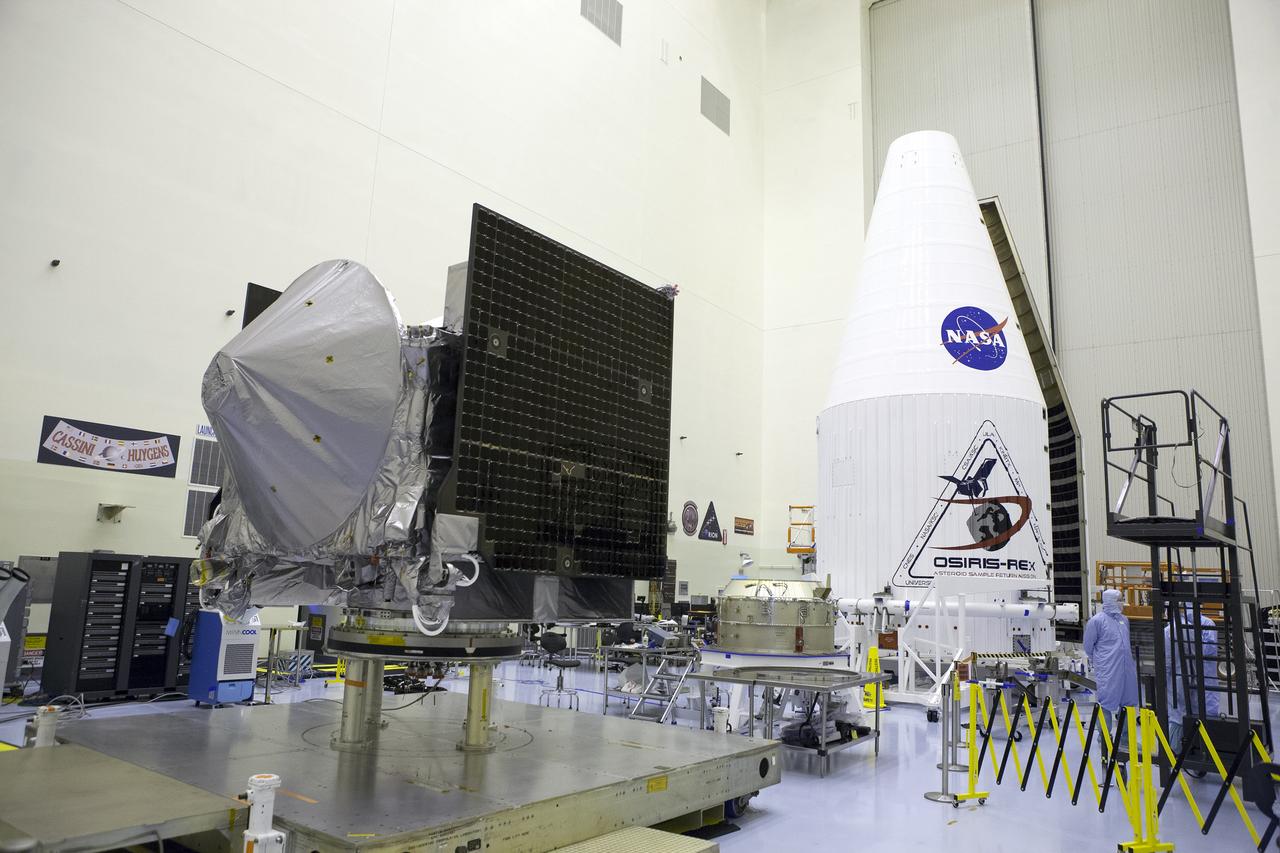
Inside the Payload Hazardous Servicing Facility at NASA's Kennedy Space Center in Florida, the agency’s Origins, Spectral Interpretation, Resource Identification, Security-Regolith Explorer, or OSIRIS-REx spacecraft is prepared for encapsulation in its payload fairing. Targeted for liftoff Sept. 8, 2016, OSIRIS-Rex will be the first U.S. mission to sample an asteroid, retrieve at least two ounces of surface material and return it to Earth for study. The asteroid, Bennu, may hold clues to the origin of the solar system and the source of water and organic molecules found on Earth.
Dane Drefke, United Launch Alliance (ULA) lead engineer for Atlas V mechanical operations, speaks in Kennedy Space Center’s Neil Armstrong O&C Mission Briefing Room on April 16, 2019, during an employee event in which Dr. Humberto Campins from the University of Central Florida gave a status update on NASA’s Origins, Spectral Interpretation, Resource Identification, Security-Regolith Explorer (OSIRIS-REx). The first U.S. mission to sample an asteroid, OSIRIS-REx launched from Cape Canaveral Air Force Station on Sept. 8, 2016 aboard a United Launch Alliance Atlas V rocket. Management of the launch service for OSIRIS-REx was the responsibility of NASA’s Launch Services Program, based at Kennedy.
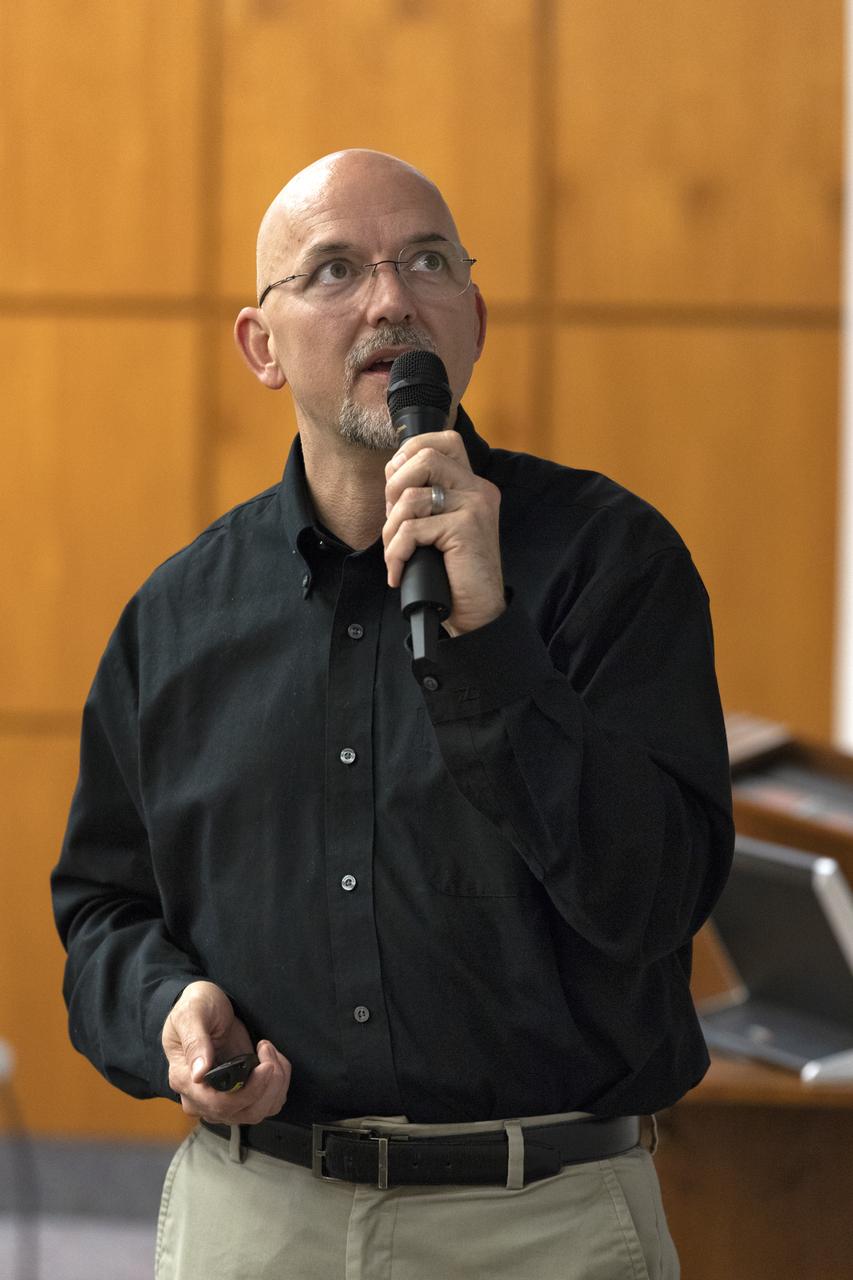
Dane Drefke, United Launch Alliance (ULA) lead engineer for Atlas V mechanical operations, speaks in Kennedy Space Center’s Neil Armstrong O&C Mission Briefing Room on April 16, 2019, during an employee event in which Dr. Humberto Campins from the University of Central Florida gave a status update on NASA’s Origins, Spectral Interpretation, Resource Identification, Security-Regolith Explorer (OSIRIS-REx). The first U.S. mission to sample an asteroid, OSIRIS-REx launched from Cape Canaveral Air Force Station on Sept. 8, 2016 aboard a United Launch Alliance Atlas V rocket. Management of the launch service for OSIRIS-REx was the responsibility of NASA’s Launch Services Program, based at Kennedy.
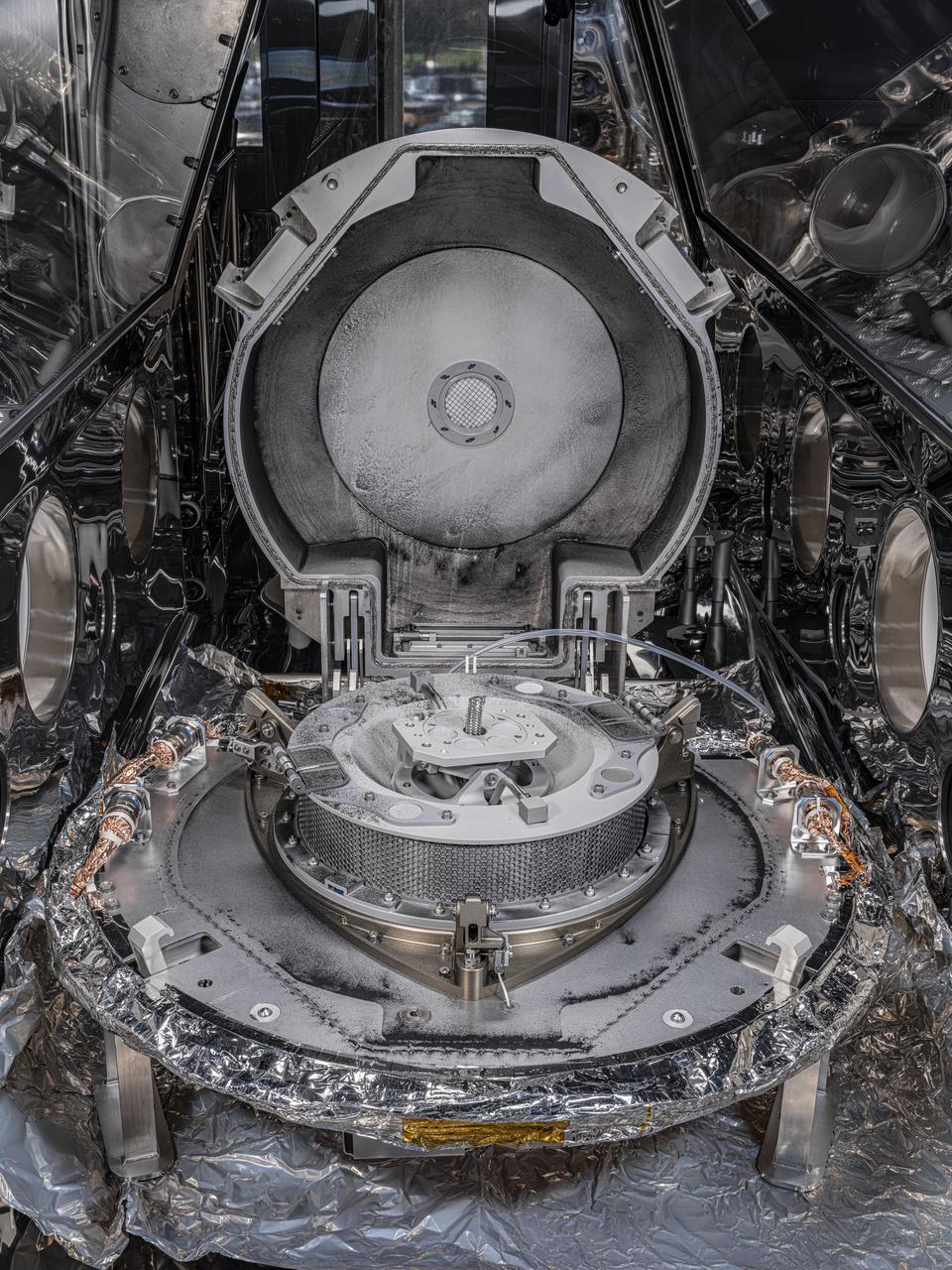
A view of the OSIRIS-REx sample canister with the lid removed, revealing the Touch and Go Sample Acquisition Mechanism (TAGSAM) inside. When astromaterials processors removed the canister lid, they discovered a coating of fine asteroid dust and sand-sized particles covering the inside of the lid and on the top of the avionics deck. The round portion in the center of the lower part of the canister is the TAGSAM that was used to collect pristine material from asteroid Bennu in 2020. The spacecraft delivered the sample return capsule to Earth on Sept. 24, 2023. OSIRIS-REx is the first U.S. mission to collect a sample from an asteroid. Scientists hope the Bennu sample will reveal whether asteroids that collided with Earth billions of years ago thereby delivered water and other ingredients for life to our planet. Credits: Photo credit: NASA/Erika Blumenfeld & Joseph Aebersold Image Capture: Created using manual high-resolution precision photography and semi-automated focus stacking procedure.
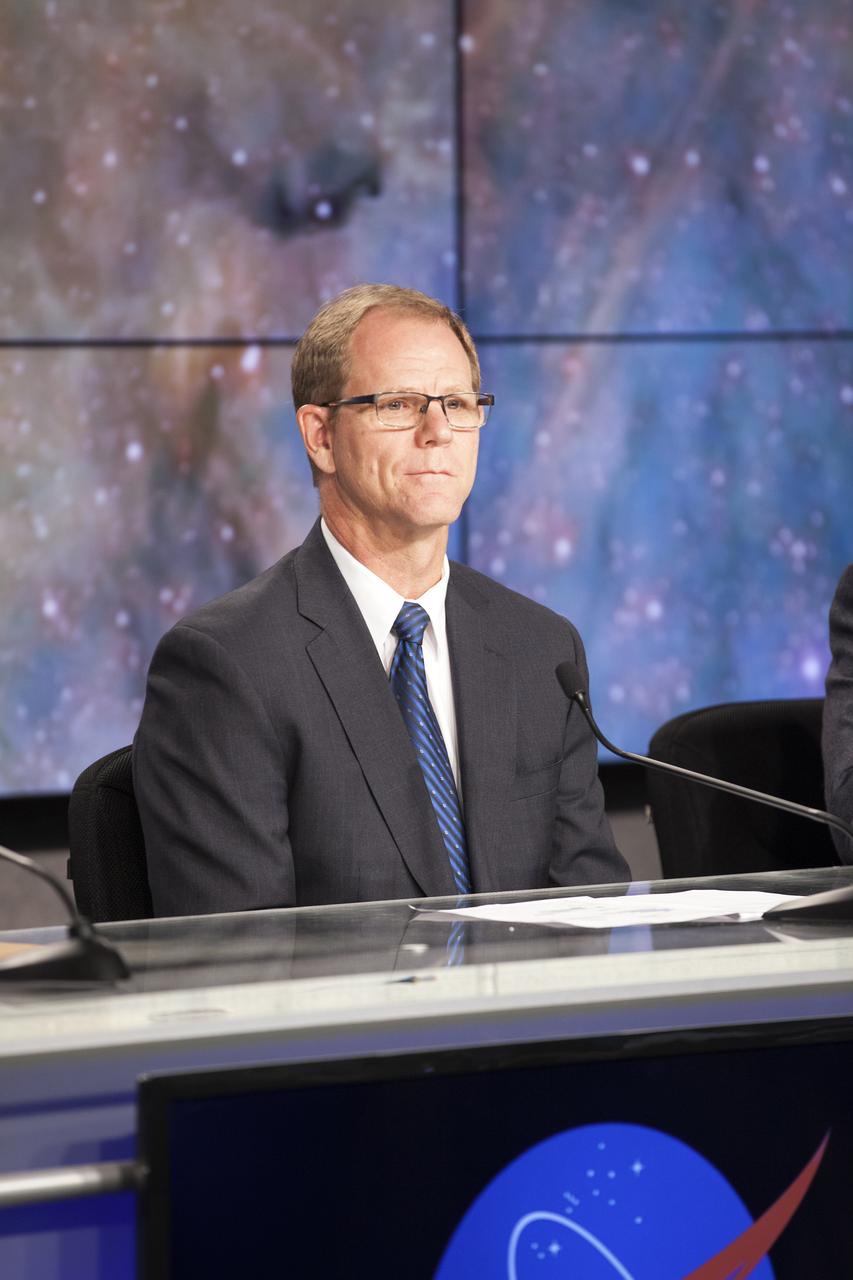
In the Kennedy Space Center’s Press Site auditorium, Scott Messer, program manager for NASA missions at United Launch Alliance in Centennial, Colorado, speaks to members of the media at a prelaunch news conference for the agency’s Origins, Spectral Interpretation, Resource Identification, Security-Regolith Explorer, or OSIRIS-REx spacecraft.
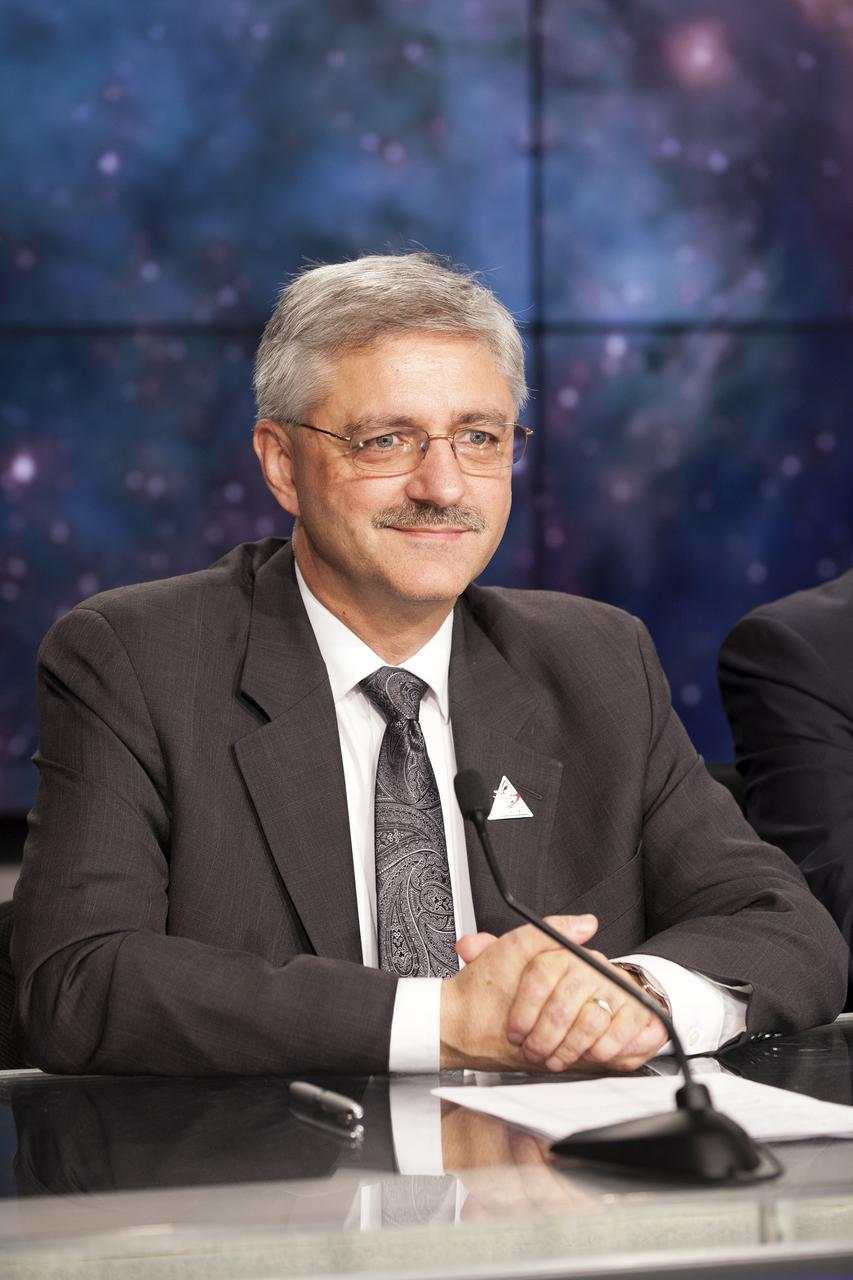
In the Kennedy Space Center’s Press Site auditorium, Geoffrey Yoder, acting associate administrator of NASA’s Science Mission Directorate in Washington, speaks to members of the media at a prelaunch news conference for the agency’s Origins, Spectral Interpretation, Resource Identification, Security-Regolith Explorer, or OSIRIS-REx spacecraft.
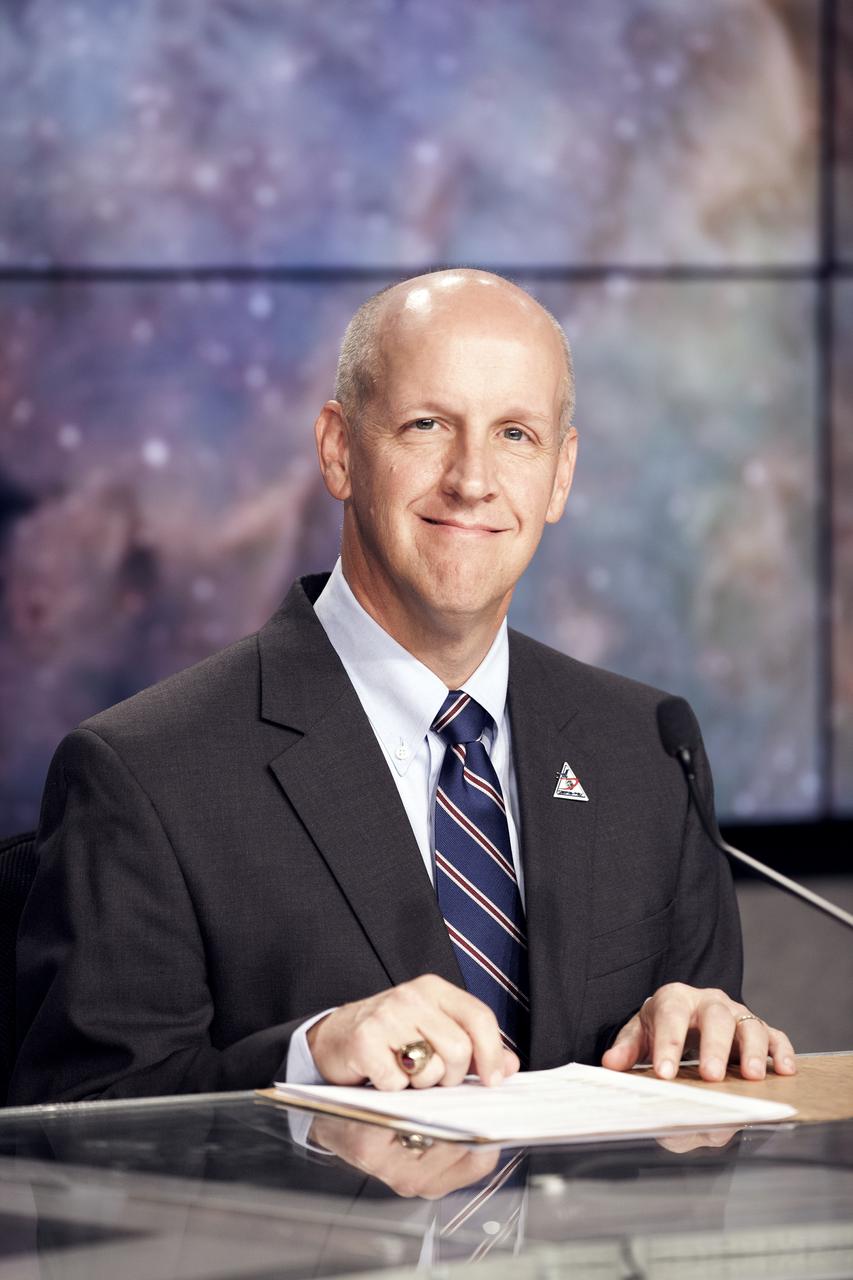
In the Kennedy Space Center’s Press Site auditorium, Tim Dunn, NASA launch manager at Kennedy, speaks to members of the media at a prelaunch news conference for the agency’s Origins, Spectral Interpretation, Resource Identification, Security-Regolith Explorer, or OSIRIS-REx spacecraft.
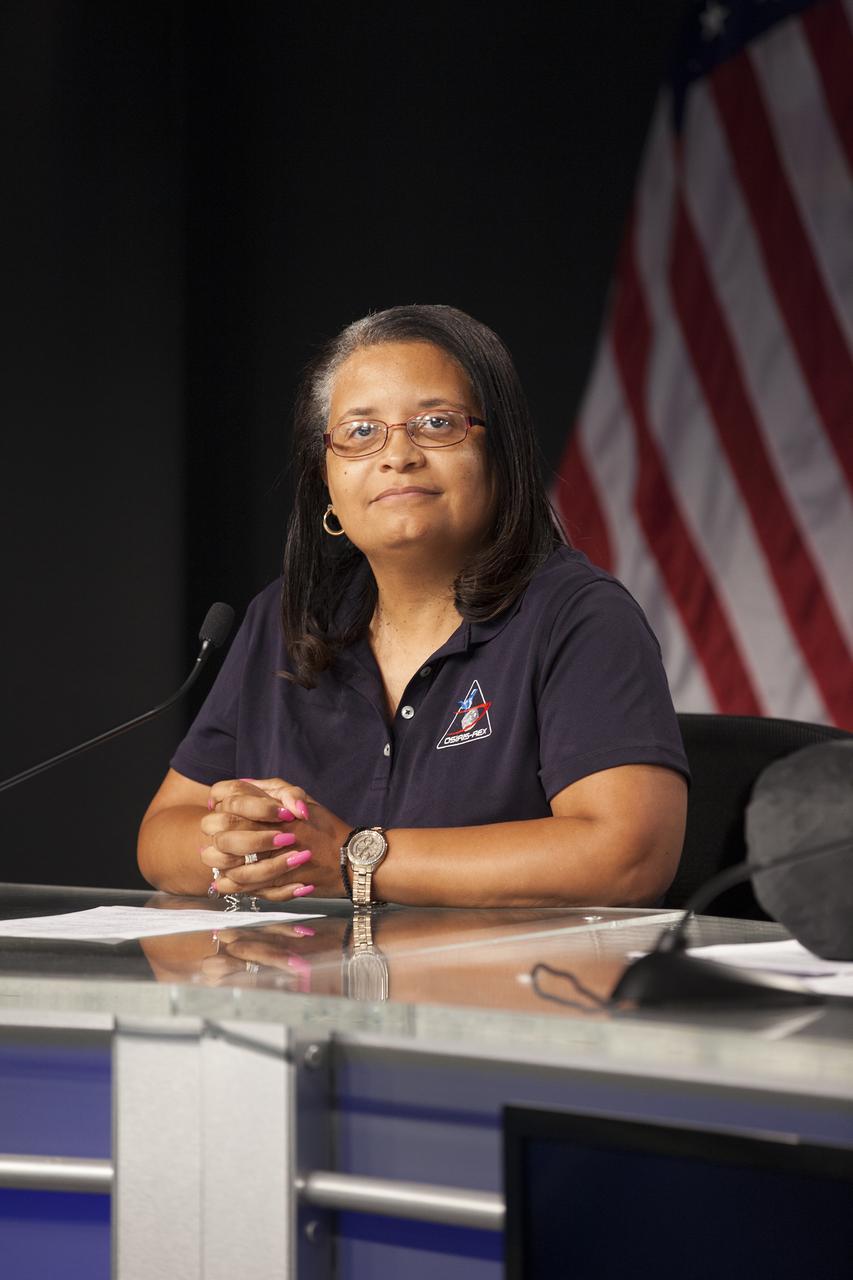
In the Kennedy Space Center’s Press Site auditorium, Nancy Neal-Jones of NASA Communications at the Goddard Space Flight Center in Greenbelt, Maryland, moderates a media briefing on science experiments involved in NASA’s Origins, Spectral Interpretation, Resource Identification, Security-Regolith Explorer, or OSIRIS-REx spacecraft.
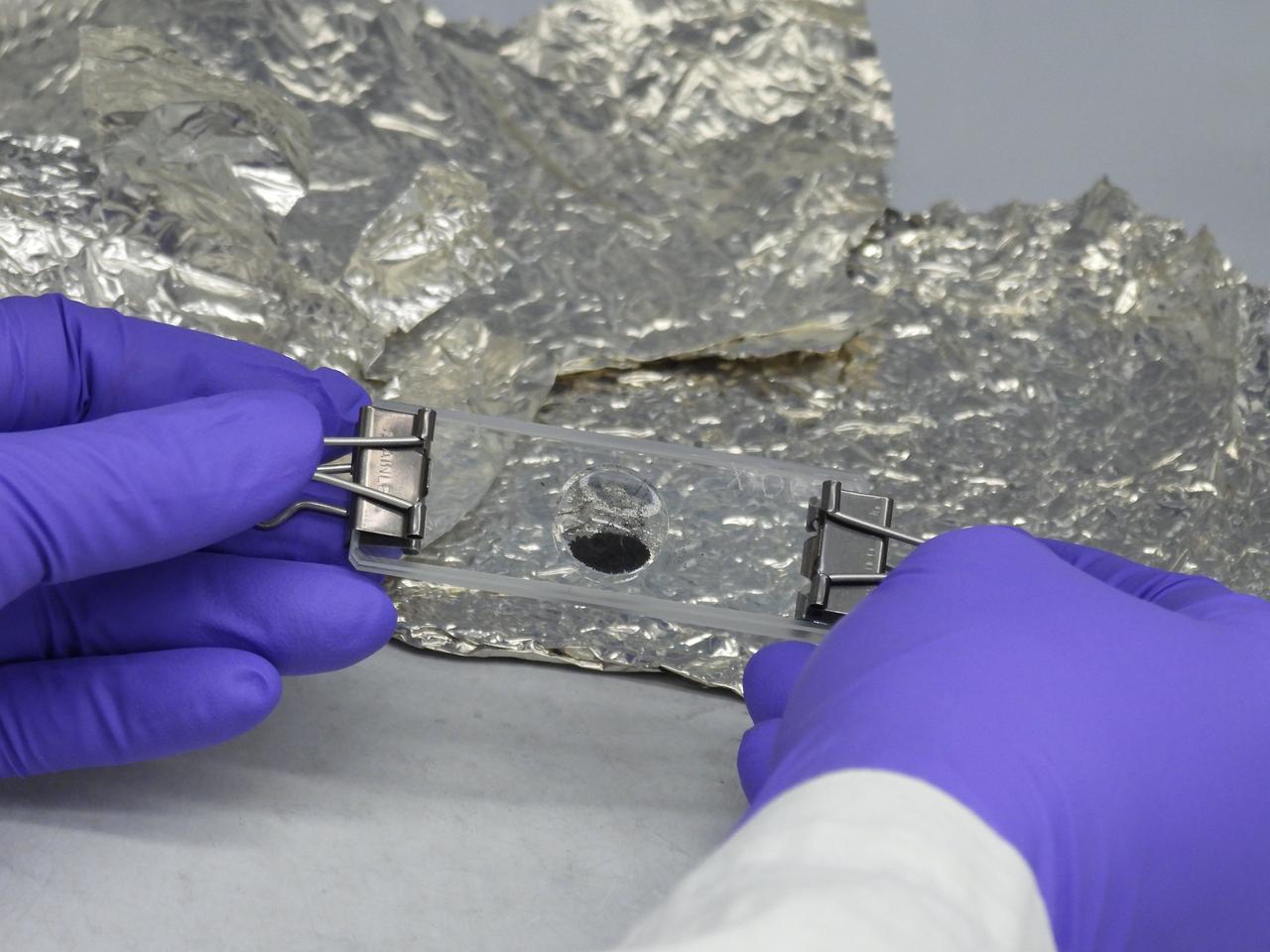
A portion of the asteroid Bennu sample delivered to Earth by NASA's OSIRIS-REx (Origins, Spectral Interpretation, Resource Identification, and Security – Regolith Explorer) mission, set into a microscope slide at the agency's Goddard Space Flight Center in Greenbelt, Maryland.
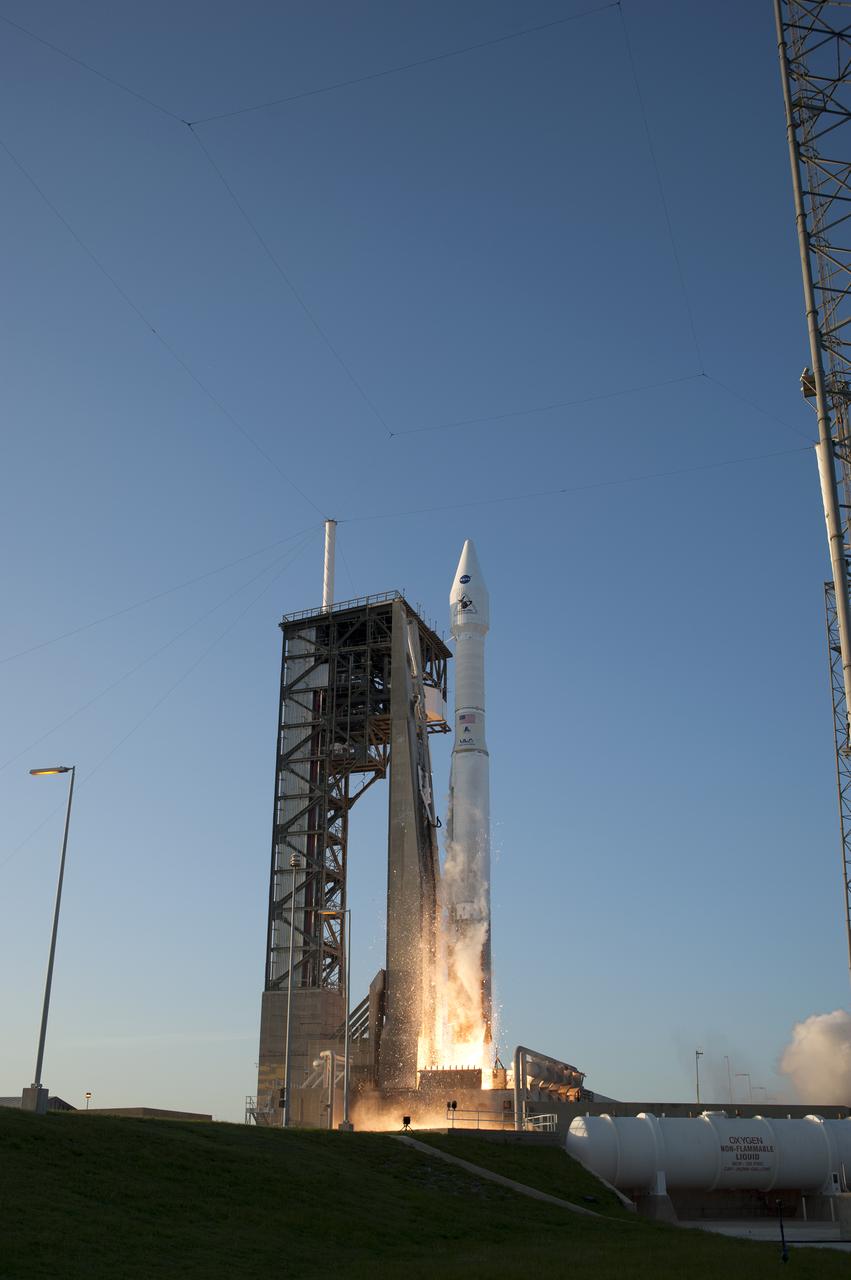
A United Launch Alliance Atlas V rocket lifts off from Space Launch Complex 41 at Cape Canaveral Air Force Station carrying NASA’s Origins, Spectral Interpretation, Resource Identification, Security-Regolith Explorer, or OSIRIS-REx spacecraft on the first U.S. mission to sample an asteroid, retrieve at least two ounces of surface material and return it to Earth for study. Liftoff was at 7:05 p.m. EDT. The asteroid, Bennu, may hold clues to the origin of the solar system and the source of water and organic molecules found on Earth.
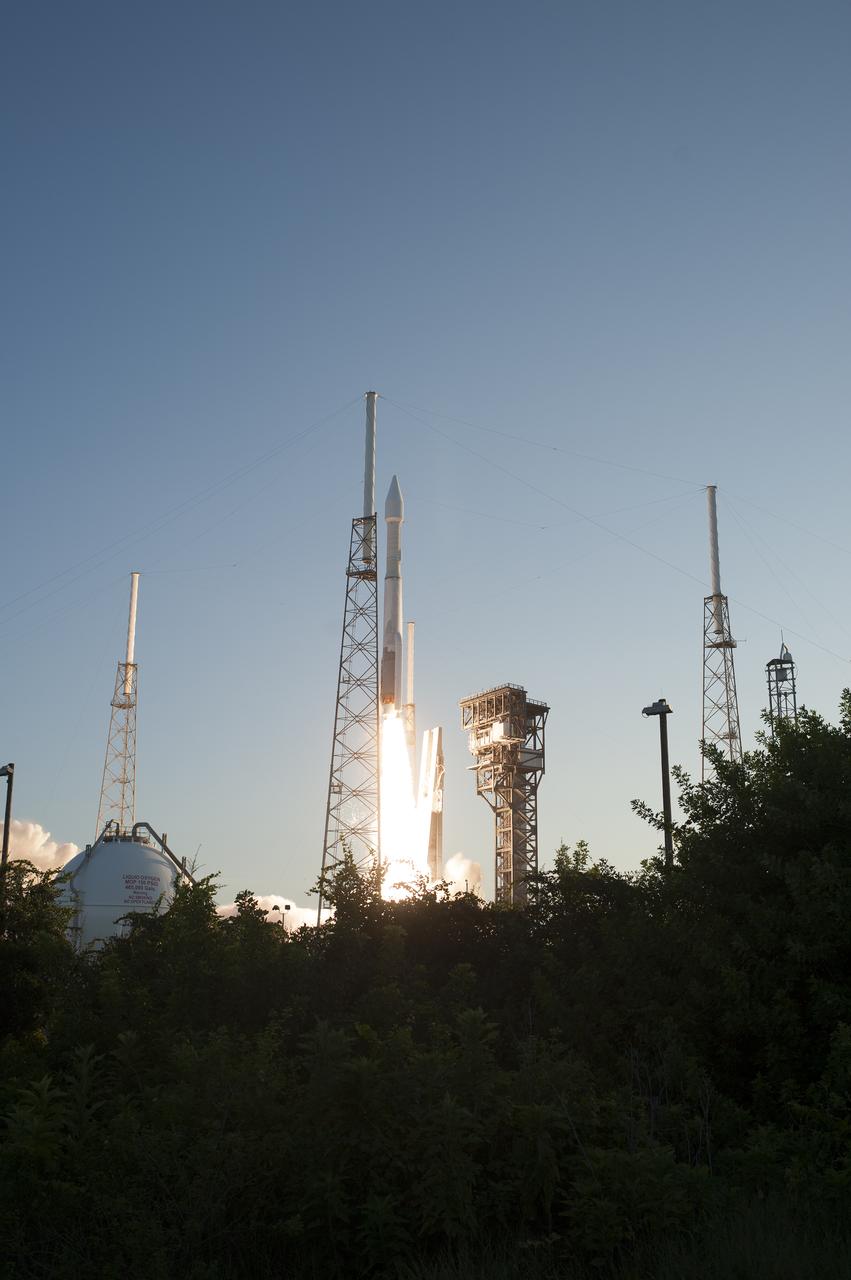
A United Launch Alliance Atlas V rocket lifts off from Space Launch Complex 41 at Cape Canaveral Air Force Station carrying NASA’s Origins, Spectral Interpretation, Resource Identification, Security-Regolith Explorer, or OSIRIS-REx spacecraft on the first U.S. mission to sample an asteroid, retrieve at least two ounces of surface material and return it to Earth for study. Liftoff was at 7:05 p.m. EDT. The asteroid, Bennu, may hold clues to the origin of the solar system and the source of water and organic molecules found on Earth.
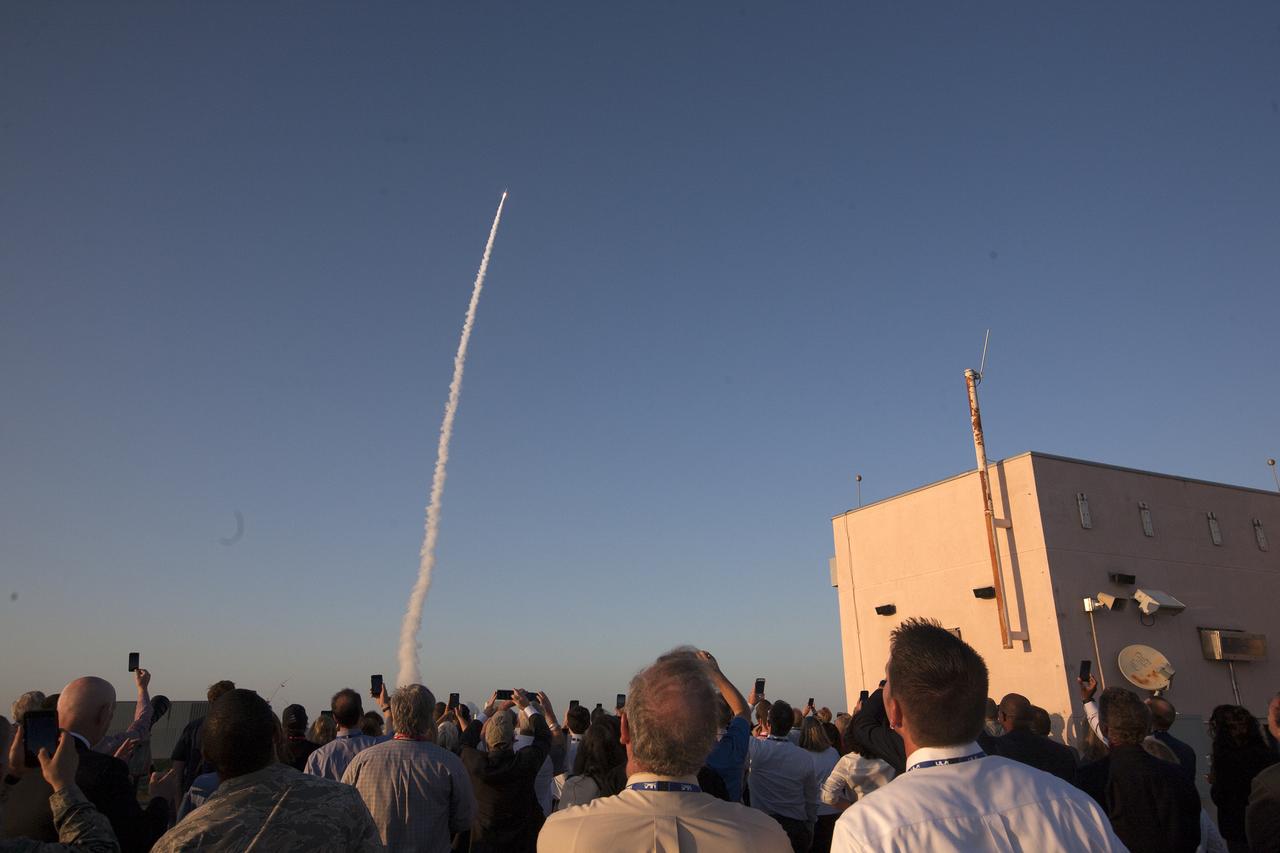
A United Launch Alliance Atlas V rocket lifts off from Space Launch Complex 41 at Cape Canaveral Air Force Station carrying NASA’s Origins, Spectral Interpretation, Resource Identification, Security-Regolith Explorer, or OSIRIS-REx spacecraft on the first U.S. mission to sample an asteroid, retrieve at least two ounces of surface material and return it to Earth for study. Liftoff was at 7:05 p.m. EDT. The asteroid, Bennu, may hold clues to the origin of the solar system and the source of water and organic molecules found on Earth.
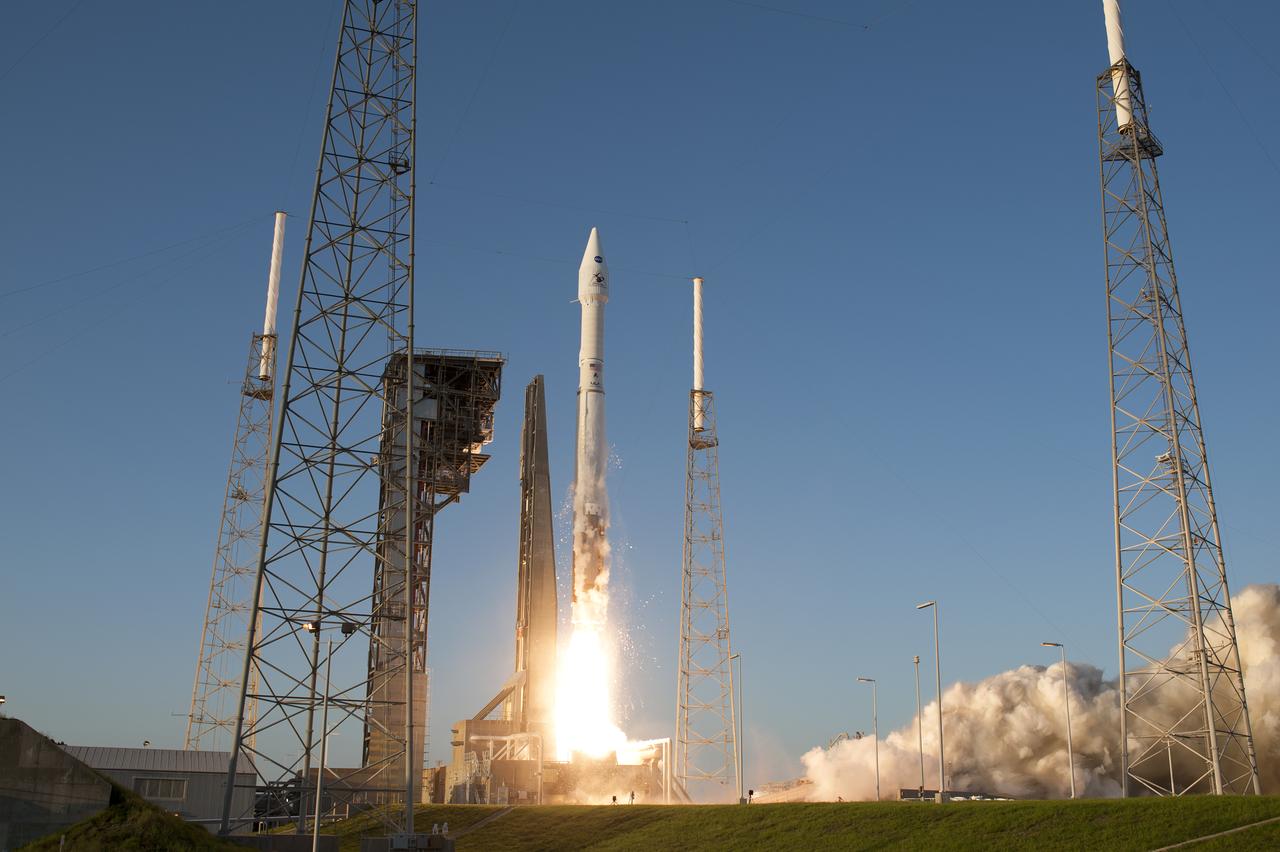
A United Launch Alliance Atlas V rocket lifts off from Space Launch Complex 41 at Cape Canaveral Air Force Station carrying NASA’s Origins, Spectral Interpretation, Resource Identification, Security-Regolith Explorer, or OSIRIS-REx spacecraft on the first U.S. mission to sample an asteroid, retrieve at least two ounces of surface material and return it to Earth for study. Liftoff was at 7:05 p.m. EDT. The asteroid, Bennu, may hold clues to the origin of the solar system and the source of water and organic molecules found on Earth.
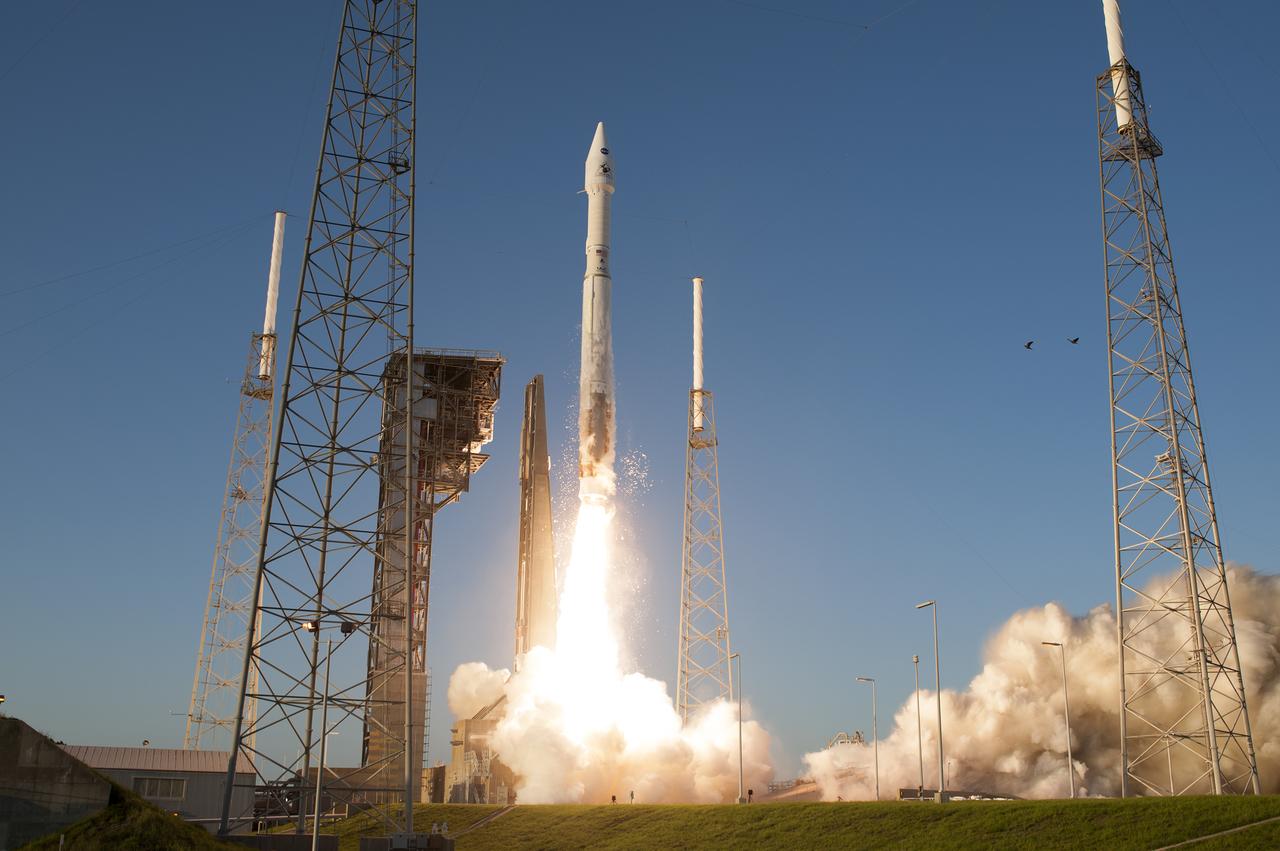
A United Launch Alliance Atlas V rocket lifts off from Space Launch Complex 41 at Cape Canaveral Air Force Station carrying NASA’s Origins, Spectral Interpretation, Resource Identification, Security-Regolith Explorer, or OSIRIS-REx spacecraft on the first U.S. mission to sample an asteroid, retrieve at least two ounces of surface material and return it to Earth for study. Liftoff was at 7:05 p.m. EDT. The asteroid, Bennu, may hold clues to the origin of the solar system and the source of water and organic molecules found on Earth.