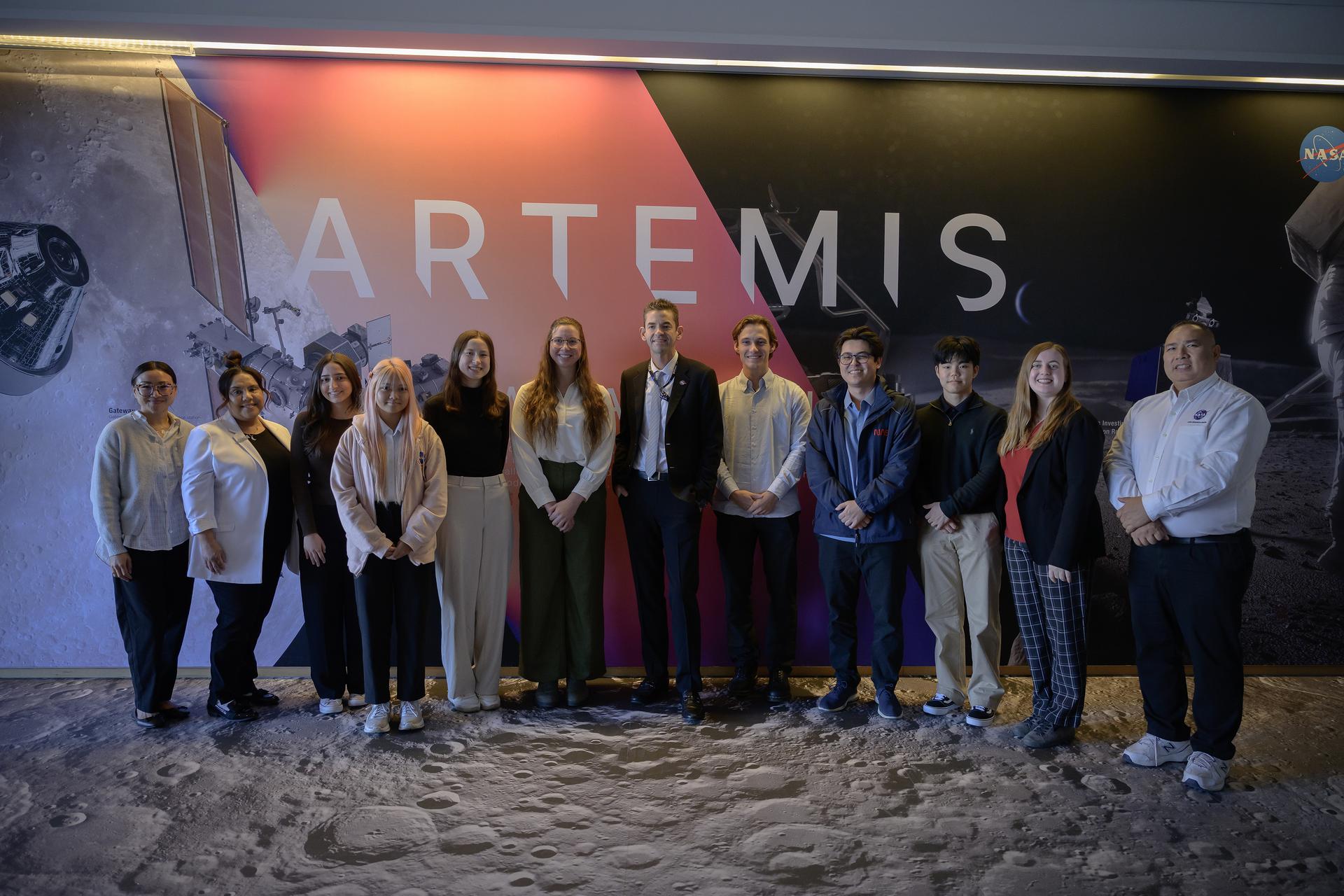
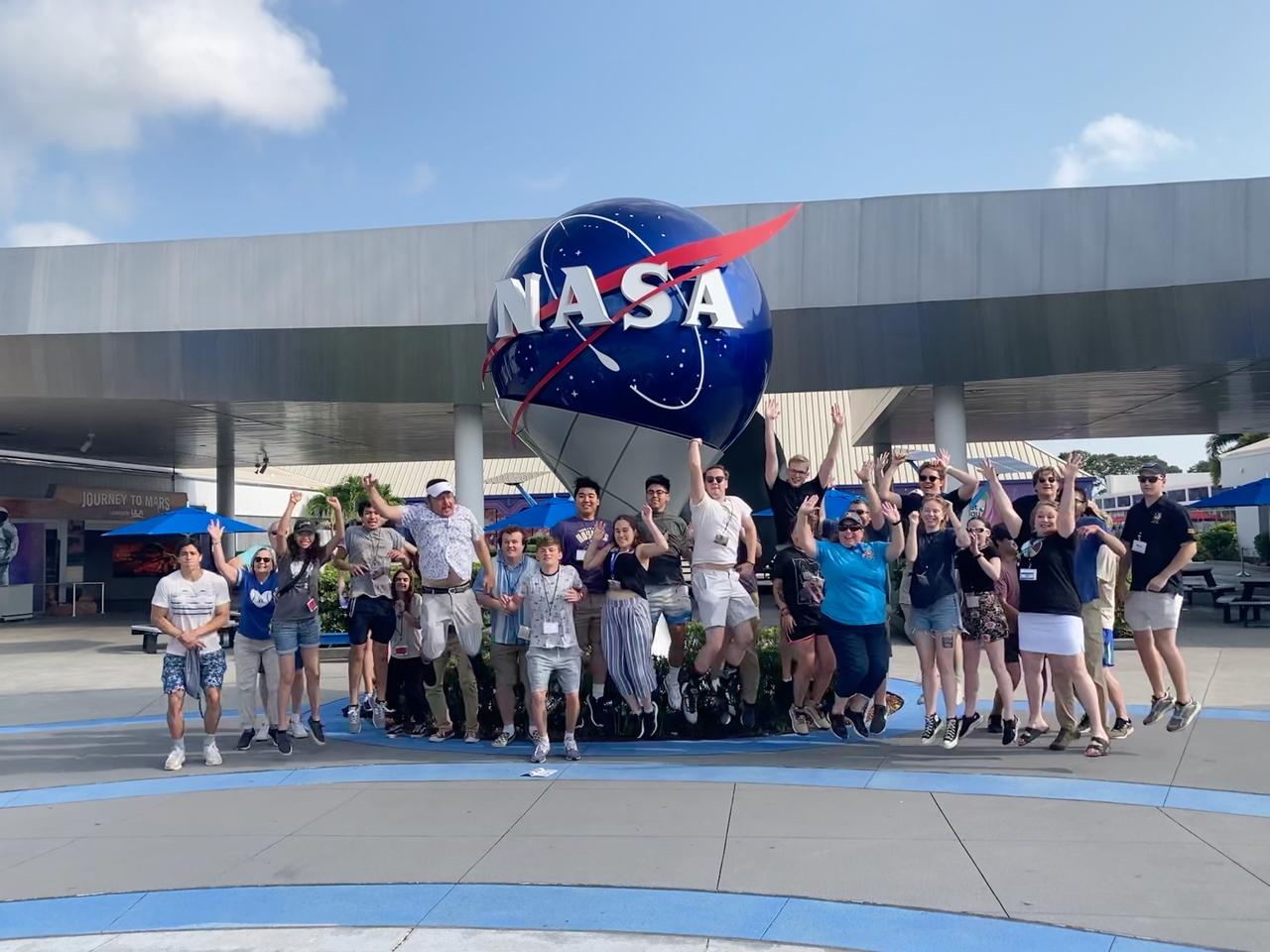
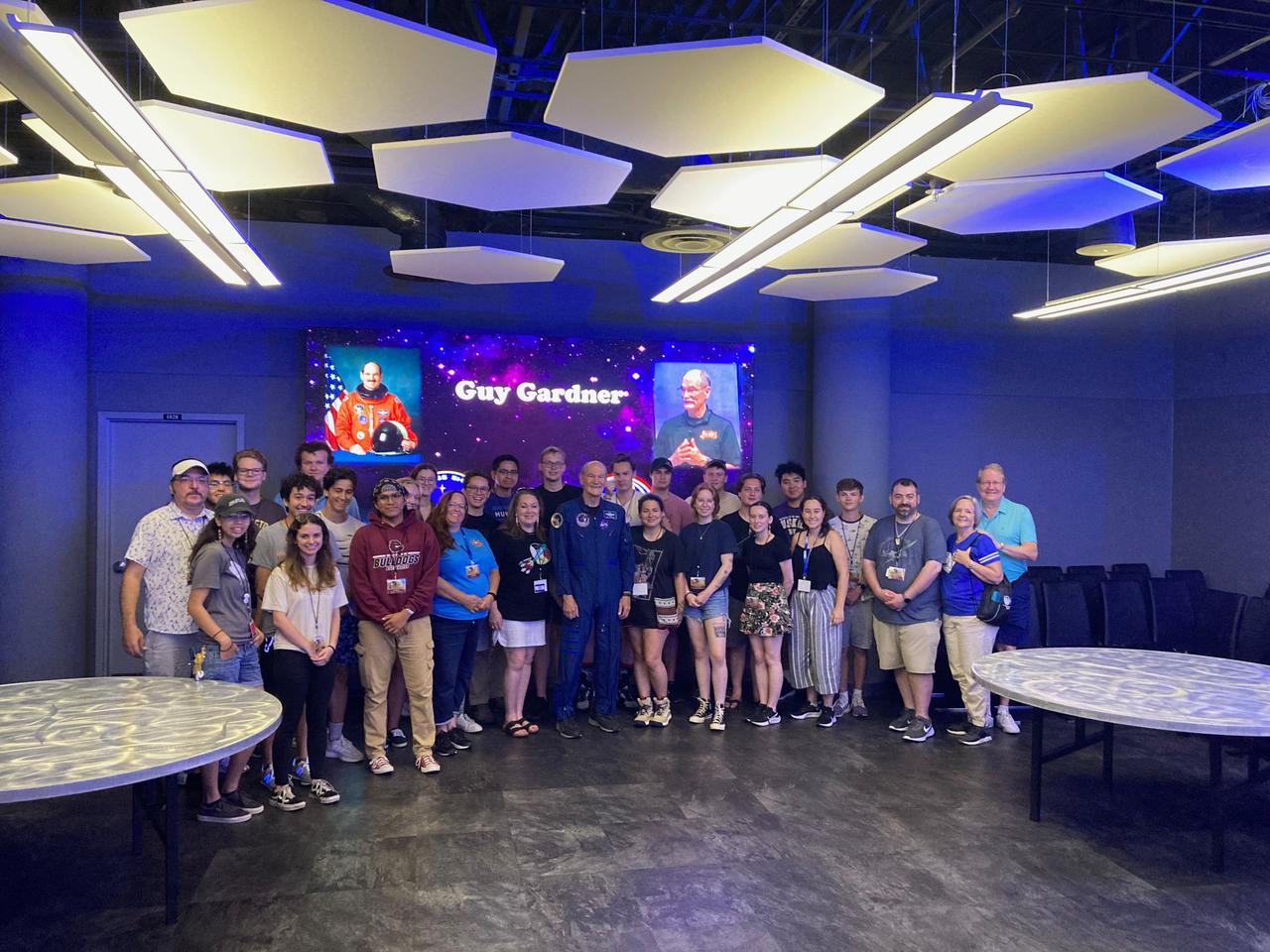
NASA Administrator Jared Isaacman, center, and OSTEM 2026 Spring Interns with Jonas Dino, right.
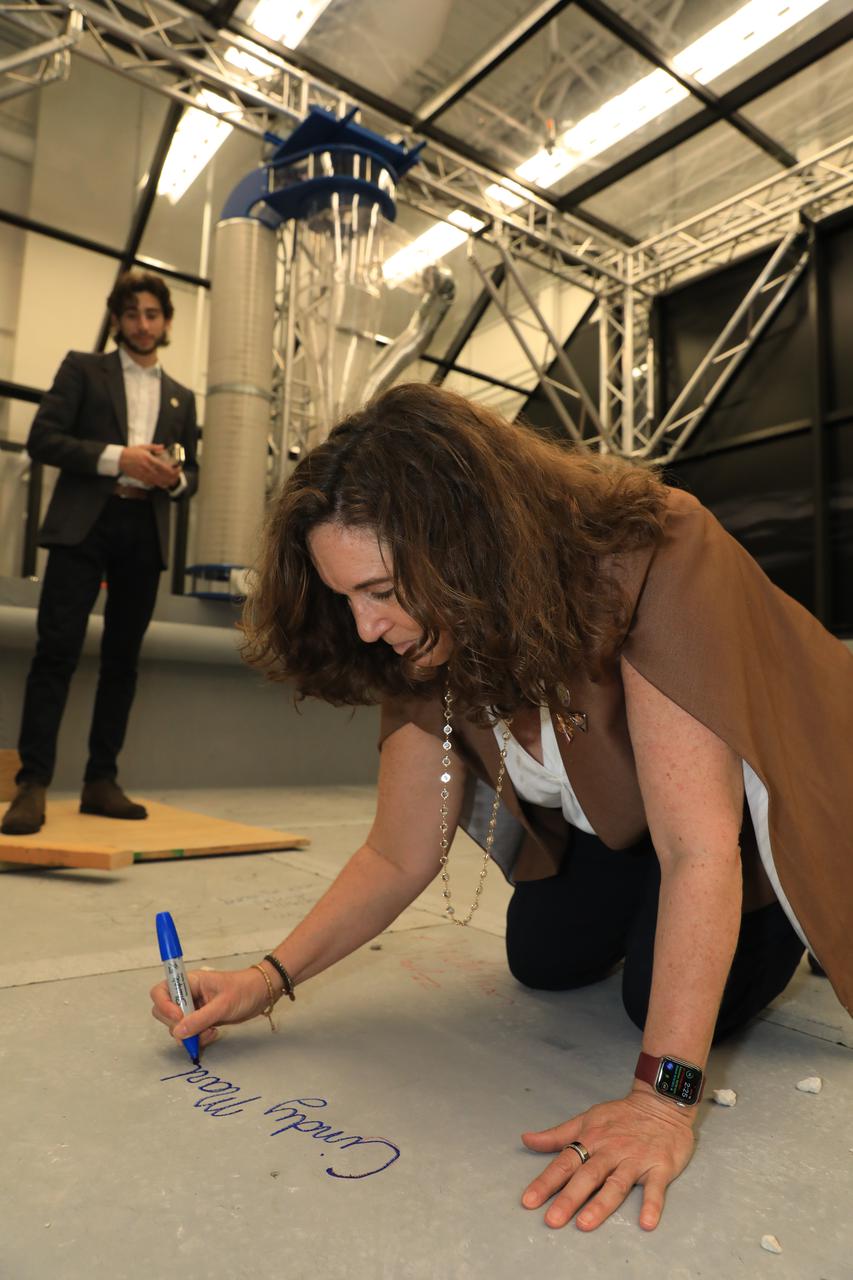
U.S. Dept. of Education Deputy Secretary Cindy Marten signs the floor of the Lunabotics arena at the Center for Space Education at NASA’s Kennedy Space Center Visitor Complex in Florida on March 16, 2022. The LUNABOTICS competition is an engineering exercise that challenges college students to develop a lunar excavator as part of NASA’s Artemis student challenges. Marten was at Kennedy Space Center to address NASA’s national partners and guests during the one-day Artemis Summit.

U.S. Dept. of Education Deputy Secretary Cindy Marten addresses NASA’s national partners and guests during the Artemis Summit at NASA’s Kennedy Space Center in Florida on March 16, 2022. The Offices of STEM Engagement, Communication and Human Exploration Operations Mission Directorate hosted a one-day meeting for partners, grantees and other interested organizations to learn about Public and STEM Engagement plans and opportunities for the upcoming Artemis I mission. The event introduced participants to the importance of the Artemis program and supports them in the use of Artemis I content as they serve students, educators, families, and the general public.

Partners and guests toured the Vehicle Assembly Building at NASA’s Kennedy Space Center in Florida on March 16, 2022 ahead of the rollout of the agency’s Artemis I Space Launch System and Orion spacecraft to Launch Pad 39B for a wet dress rehearsal ahead of launch. The group was at the center for the Artemis Summit, a one-day meeting for partners, grantees and other interested organizations to learn about Public and STEM Engagement plans and opportunities for the upcoming Artemis I mission. The event introduced participants to the importance of the Artemis program and supports them in the use of Artemis I content as they serve students, educators, families, and the general public.
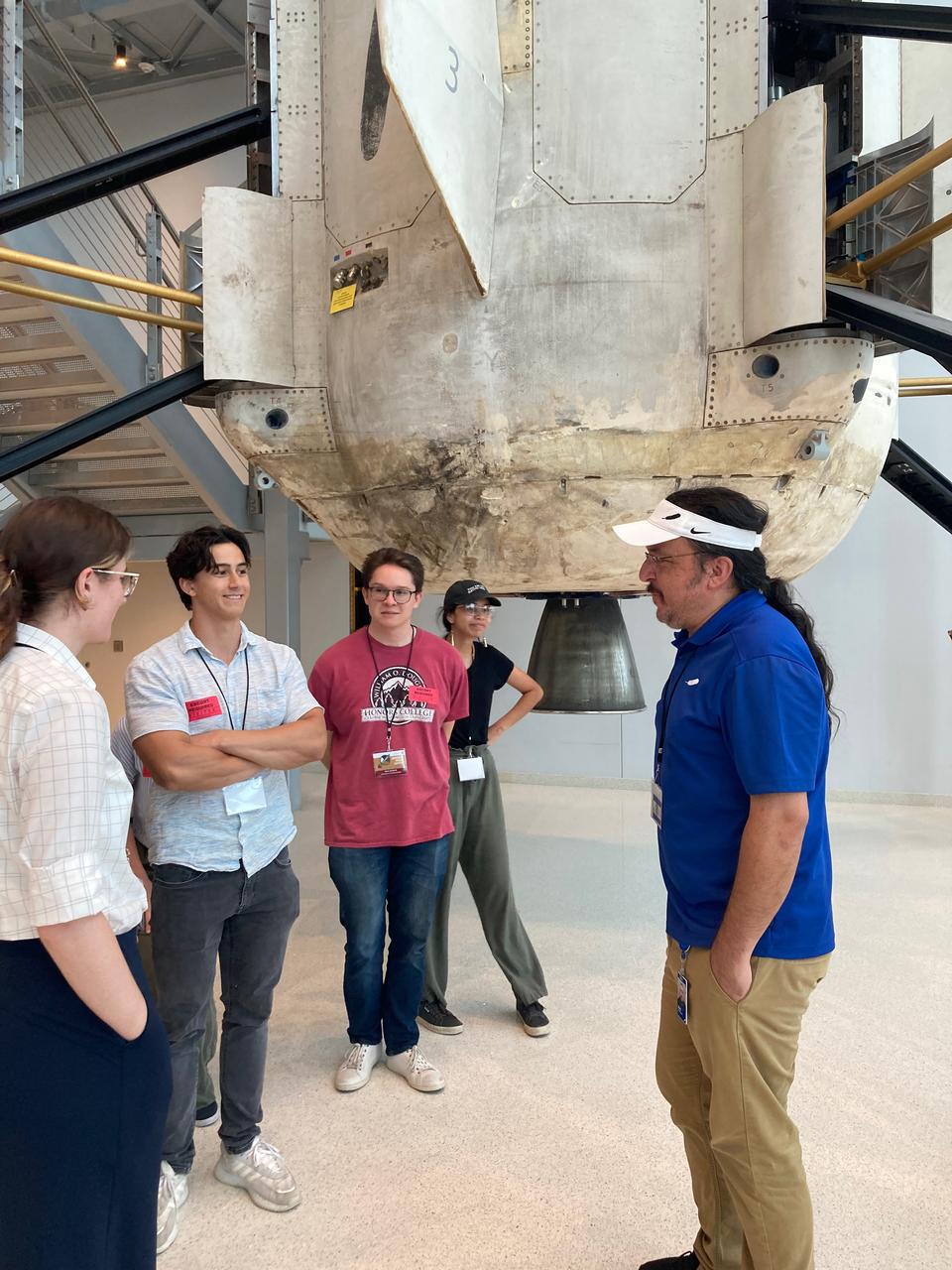
Participants from the 14th First Nations Launch High-Power Rocket Competition watch NASA’s SpaceX Crew-7 launch from the Banana Creek viewing site at the agency’s Kennedy Space Center in Florida on Saturday, Aug. 26, 2023. A SpaceX Falcon 9 rocket carrying NASA astronaut Jasmin Moghbeli, ESA (European Space Agency) astronaut Andreas Mogensen, JAXA (Japan Aerospace Exploration Agency) astronaut Satoshi Furukawa, and Roscosmos cosmonaut Konstantin Borisov launched to the International Space Station at 3:27 a.m. EDT from Kennedy’s Launch Complex 39A. Students and advisors from University of Washington, University of Colorado-Boulder, and an international team from Queens University – this year’s First Nations Launch grand prize teams – traveled to Kennedy for a VIP tour, culminating in viewing the Crew-7 launch. Another highlight included a guided tour of historic Hangar AE, led by James Wood (Osage Nation and Loyal Shawnee), chief engineer of NASA’s Launch Services Program, technical advisor for the Crew-7 launch, and First Nations mentor and judge. One of NASA’s Artemis Student Challenges, the First Nations Launch competition comprises students from tribal colleges and universities, Native American-Serving Nontribal Institutions, and collegiate chapters of the American Indian Science and Engineering Society who design, build, and launch a high-powered rocket from a launch site in Kansasville, Wisconsin. The competition is facilitated by NASA’s Wisconsin Space Grant Consortium and managed by the agency’s Office of STEM Engagement at Kennedy.
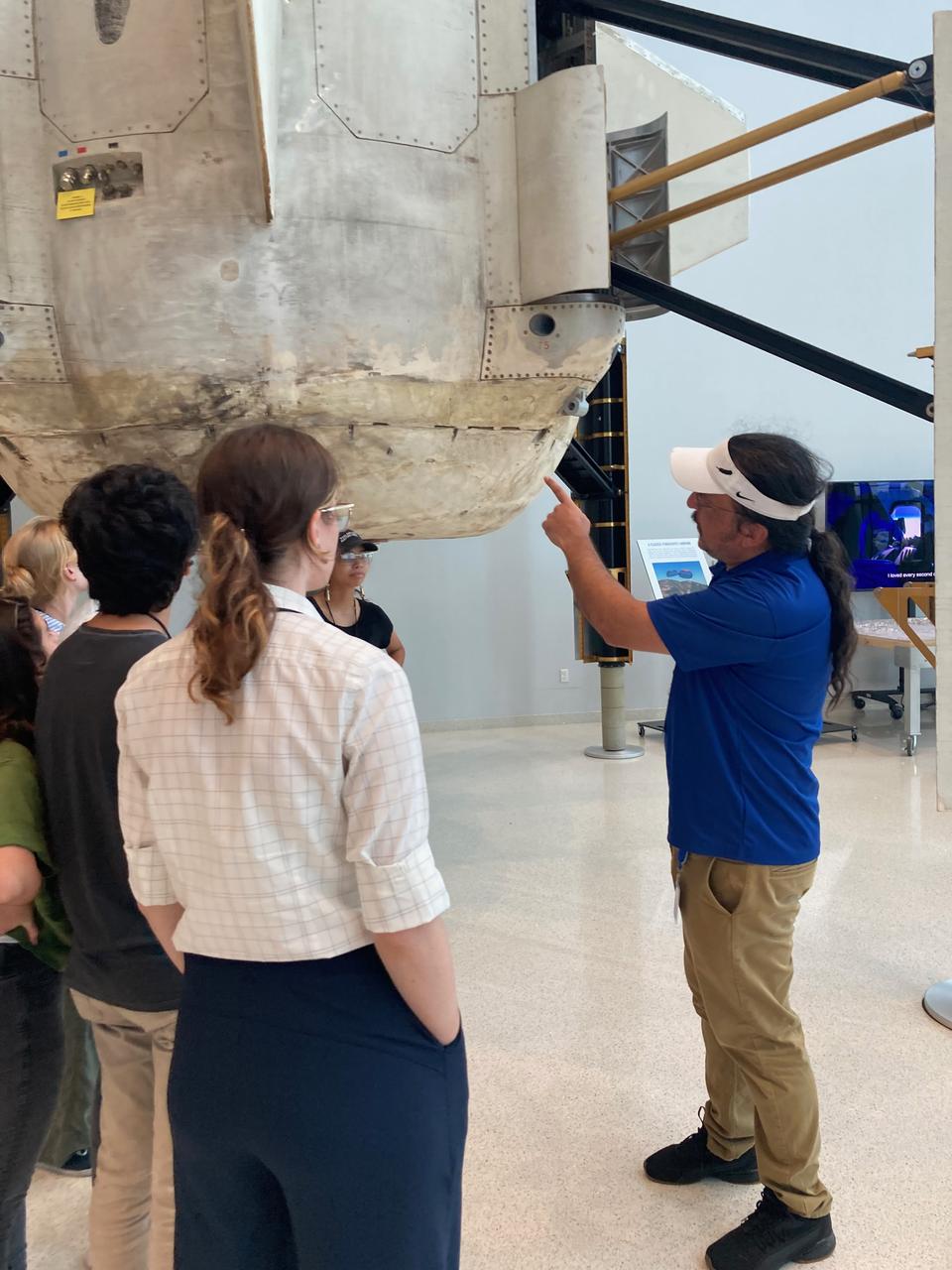
Participants from the 14th First Nations Launch High-Power Rocket Competition watch NASA’s SpaceX Crew-7 launch from the Banana Creek viewing site at the agency’s Kennedy Space Center in Florida on Saturday, Aug. 26, 2023. A SpaceX Falcon 9 rocket carrying NASA astronaut Jasmin Moghbeli, ESA (European Space Agency) astronaut Andreas Mogensen, JAXA (Japan Aerospace Exploration Agency) astronaut Satoshi Furukawa, and Roscosmos cosmonaut Konstantin Borisov launched to the International Space Station at 3:27 a.m. EDT from Kennedy’s Launch Complex 39A. Students and advisors from University of Washington, University of Colorado-Boulder, and an international team from Queens University – this year’s First Nations Launch grand prize teams – traveled to Kennedy for a VIP tour, culminating in viewing the Crew-7 launch. Another highlight included a guided tour of historic Hangar AE, led by James Wood (Osage Nation and Loyal Shawnee), chief engineer of NASA’s Launch Services Program, technical advisor for the Crew-7 launch, and First Nations mentor and judge. One of NASA’s Artemis Student Challenges, the First Nations Launch competition comprises students from tribal colleges and universities, Native American-Serving Nontribal Institutions, and collegiate chapters of the American Indian Science and Engineering Society who design, build, and launch a high-powered rocket from a launch site in Kansasville, Wisconsin. The competition is facilitated by NASA’s Wisconsin Space Grant Consortium and managed by the agency’s Office of STEM Engagement at Kennedy.
Participants from the 14th First Nations Launch High-Power Rocket Competition watch NASA’s SpaceX Crew-7 launch from the Banana Creek viewing site at the agency’s Kennedy Space Center in Florida on Saturday, Aug. 26, 2023. A SpaceX Falcon 9 rocket carrying NASA astronaut Jasmin Moghbeli, ESA (European Space Agency) astronaut Andreas Mogensen, JAXA (Japan Aerospace Exploration Agency) astronaut Satoshi Furukawa, and Roscosmos cosmonaut Konstantin Borisov launched to the International Space Station at 3:27 a.m. EDT from Kennedy’s Launch Complex 39A. Students and advisors from University of Washington, University of Colorado-Boulder, and an international team from Queens University – this year’s First Nations Launch grand prize teams – traveled to Kennedy for a VIP tour, culminating in viewing the Crew-7 launch. Another highlight included a guided tour of historic Hangar AE, led by James Wood (Osage Nation and Loyal Shawnee), chief engineer of NASA’s Launch Services Program, technical advisor for the Crew-7 launch, and First Nations mentor and judge. One of NASA’s Artemis Student Challenges, the First Nations Launch competition comprises students from tribal colleges and universities, Native American-Serving Nontribal Institutions, and collegiate chapters of the American Indian Science and Engineering Society who design, build, and launch a high-powered rocket from a launch site in Kansasville, Wisconsin. The competition is facilitated by NASA’s Wisconsin Space Grant Consortium and managed by the agency’s Office of STEM Engagement at Kennedy.
Participants from the 14th First Nations Launch High-Power Rocket Competition watch NASA’s SpaceX Crew-7 launch from the Banana Creek viewing site at the agency’s Kennedy Space Center in Florida on Saturday, Aug. 26, 2023. A SpaceX Falcon 9 rocket carrying NASA astronaut Jasmin Moghbeli, ESA (European Space Agency) astronaut Andreas Mogensen, JAXA (Japan Aerospace Exploration Agency) astronaut Satoshi Furukawa, and Roscosmos cosmonaut Konstantin Borisov launched to the International Space Station at 3:27 a.m. EDT from Kennedy’s Launch Complex 39A. Students and advisors from University of Washington, University of Colorado-Boulder, and an international team from Queens University – this year’s First Nations Launch grand prize teams – traveled to Kennedy for a VIP tour, culminating in viewing the Crew-7 launch. Another highlight included a guided tour of historic Hangar AE, led by James Wood (Osage Nation and Loyal Shawnee), chief engineer of NASA’s Launch Services Program, technical advisor for the Crew-7 launch, and First Nations mentor and judge. One of NASA’s Artemis Student Challenges, the First Nations Launch competition comprises students from tribal colleges and universities, Native American-Serving Nontribal Institutions, and collegiate chapters of the American Indian Science and Engineering Society who design, build, and launch a high-powered rocket from a launch site in Kansasville, Wisconsin. The competition is facilitated by NASA’s Wisconsin Space Grant Consortium and managed by the agency’s Office of STEM Engagement at Kennedy.
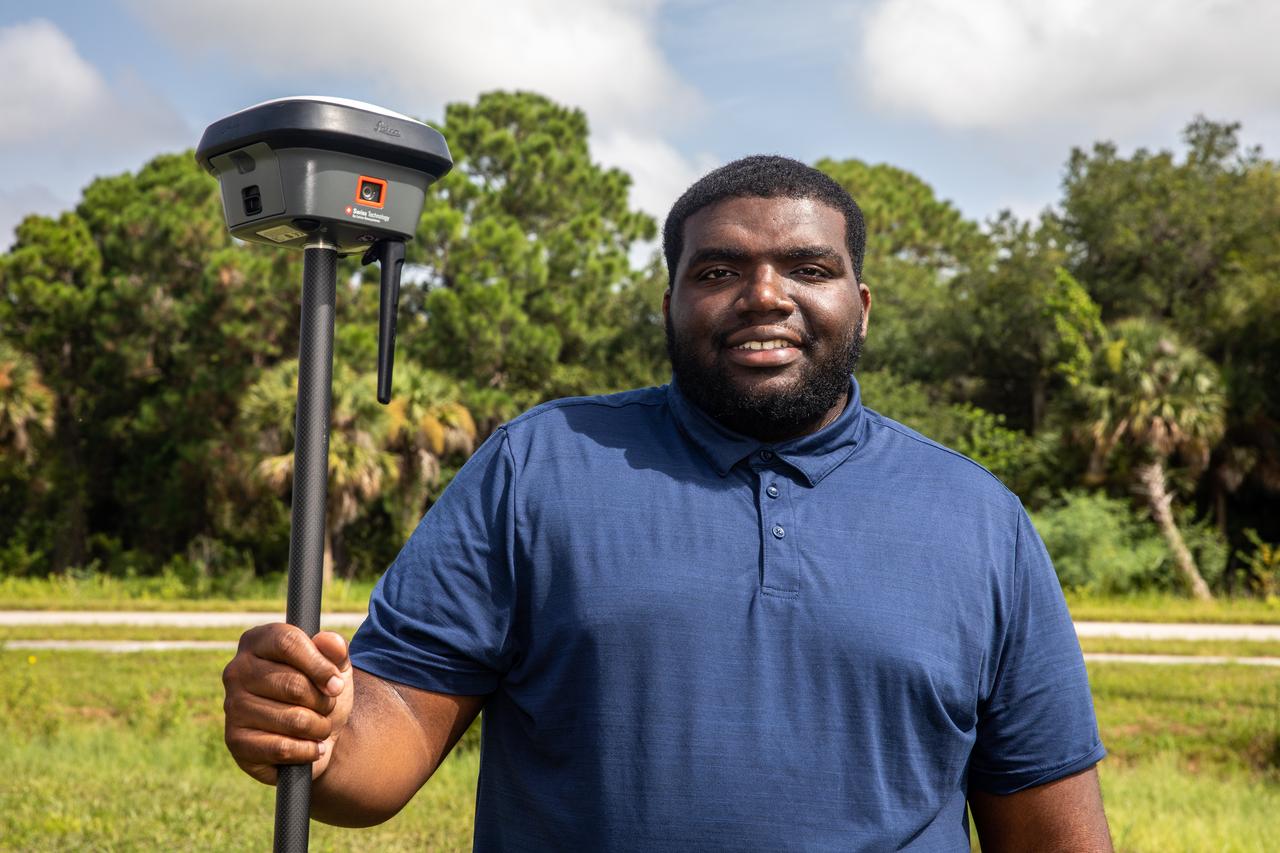
Rayshaun Wheeler said he created “forever-lasting memories” during his 10-week work experience at NASA’s Kennedy Space Center in Florida. A Farmville, Virginia, native, Wheeler is about halfway through his doctoral course work at the University of Virginia. At Kennedy, he worked under mentor Jason Schuler at Kennedy’s Granular Mechanics and Regolith Operations Lab in the center’s Swamp Works facility.
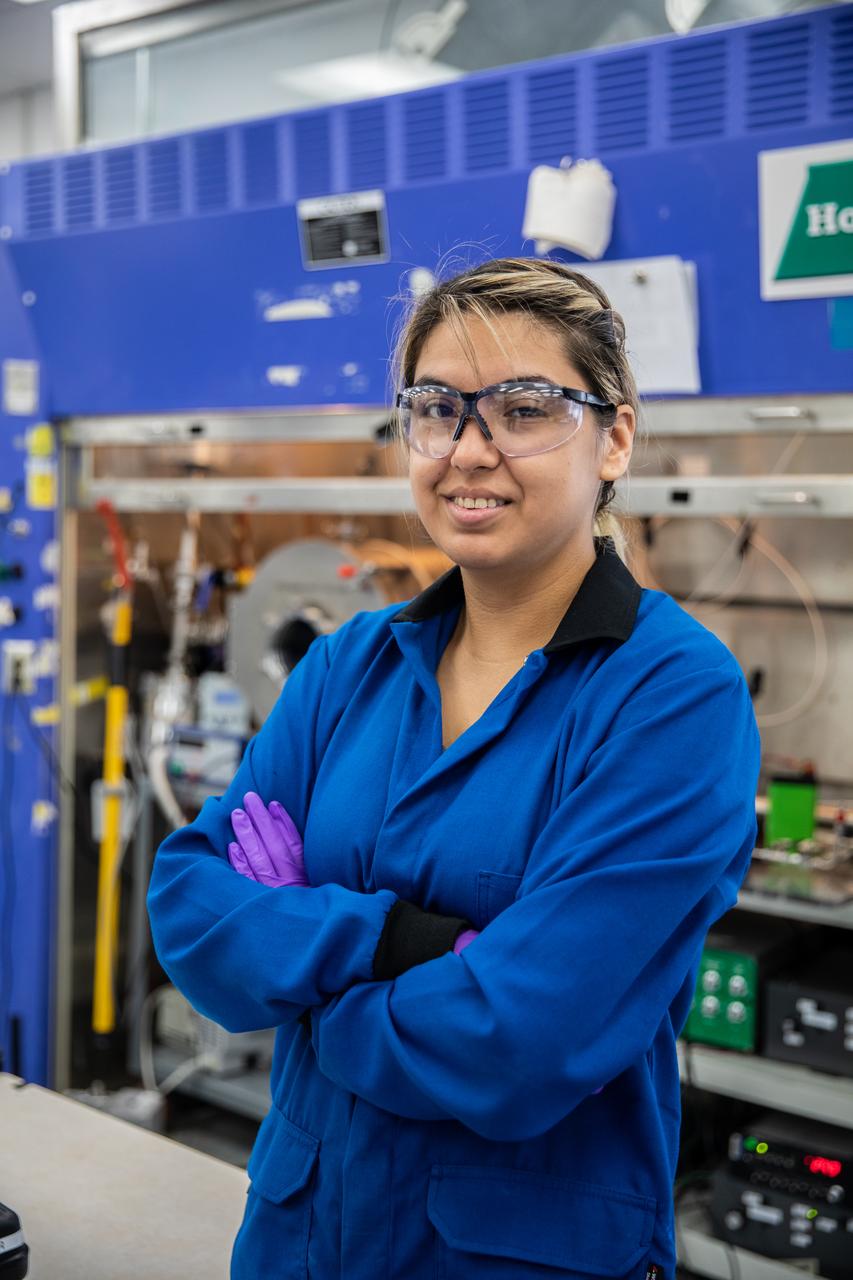
Angie Huerta, a first-year Ph.D. student studying particle physics at the University of Notre Dame, recently completed a GEM Fellowship program at NASA’s Kennedy Space Center in Florida. At Kennedy, Huerta worked closely on a project testing hydrogen plasma on lunar regolith simulant, which is similar to returned lunar soil samples, to explore the plasma’s reliability and efficiency potential for Artemis, NASA’s lunar exploration program.
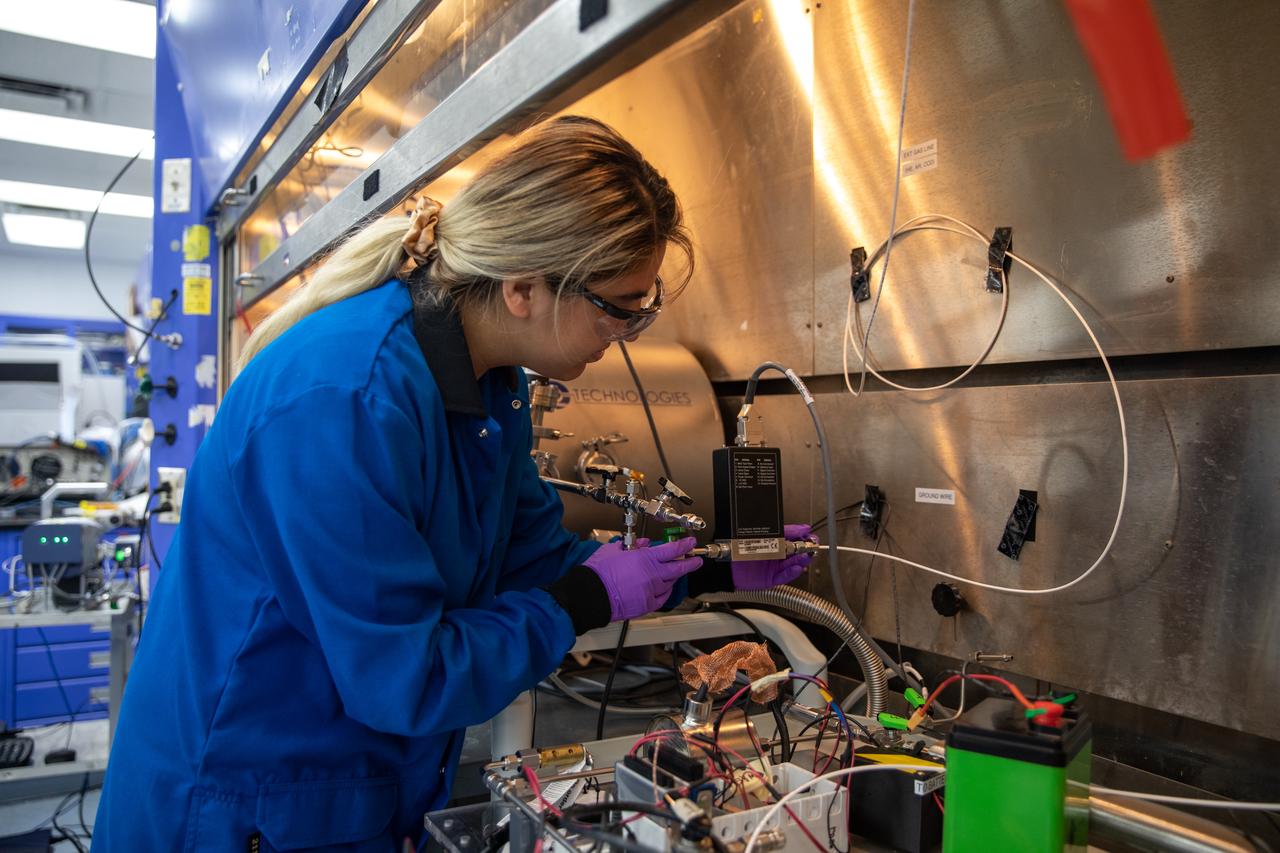
Angie Huerta, a first-year Ph.D. student studying particle physics at the University of Notre Dame, recently completed a GEM Fellowship program at NASA’s Kennedy Space Center in Florida. At Kennedy, Huerta worked closely on a project testing hydrogen plasma on lunar regolith simulant, which is similar to returned lunar soil samples, to explore the plasma’s reliability and efficiency potential for Artemis, NASA’s lunar exploration program.
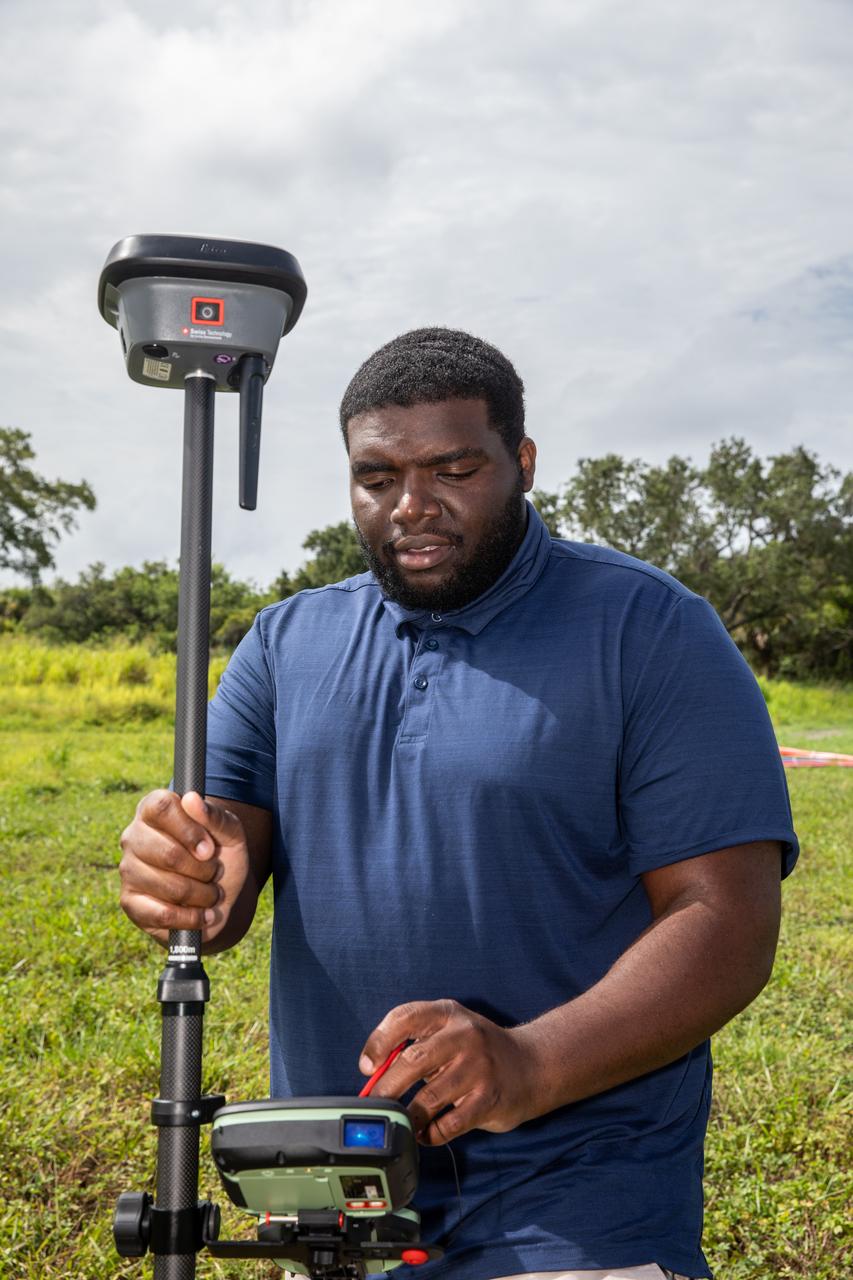
Rayshaun Wheeler said he created “forever-lasting memories” during his 10-week work experience at NASA’s Kennedy Space Center in Florida. A Farmville, Virginia, native, Wheeler is about halfway through his doctoral course work at the University of Virginia. At Kennedy, he worked under mentor Jason Schuler at Kennedy’s Granular Mechanics and Regolith Operations Lab in the center’s Swamp Works facility.
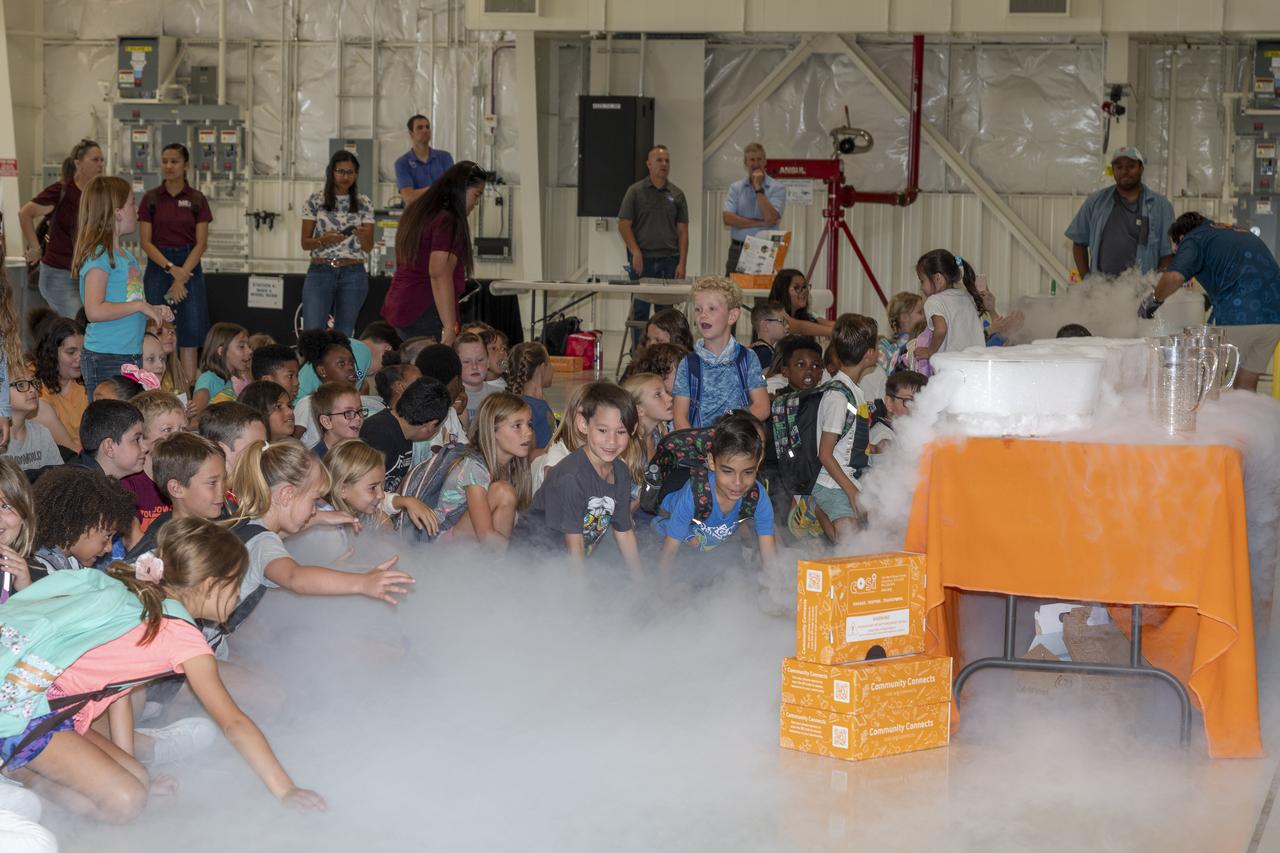
Students are wrapped in a cloud from a demonstration by NASA’s California Office of STEM Engagement event with Center of Science and Industry at NASA’s Armstrong Flight Research Center in Edwards, California.
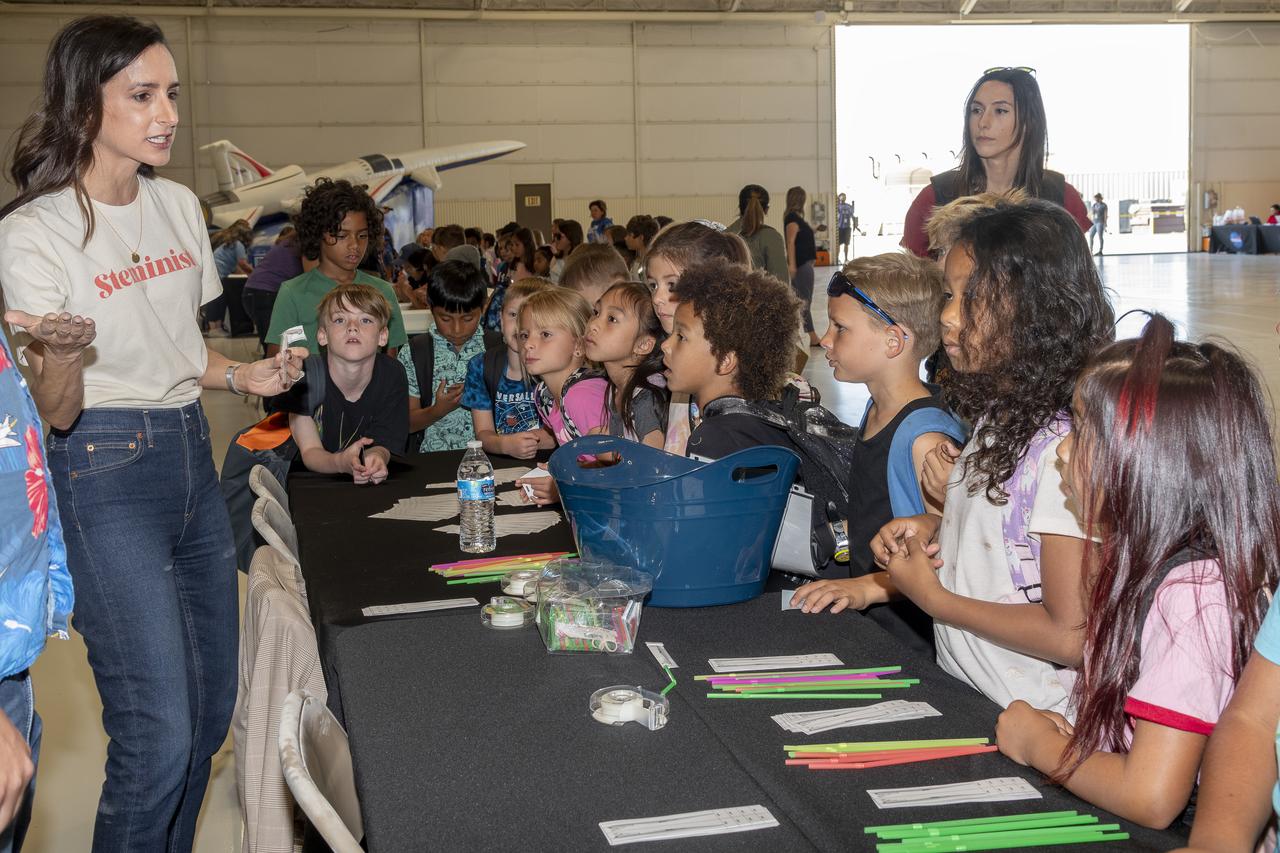
Kate M. McMurtry, deputy director of Integrated Aviation Systems Program shares with students how NASA is working to quiet the sonic boom with the development of the X-59 aircraft at NASA’s California Office of STEM Engagement event with Center of Science and Industry at NASA Armstrong Flight Research Center in Edwards, California.
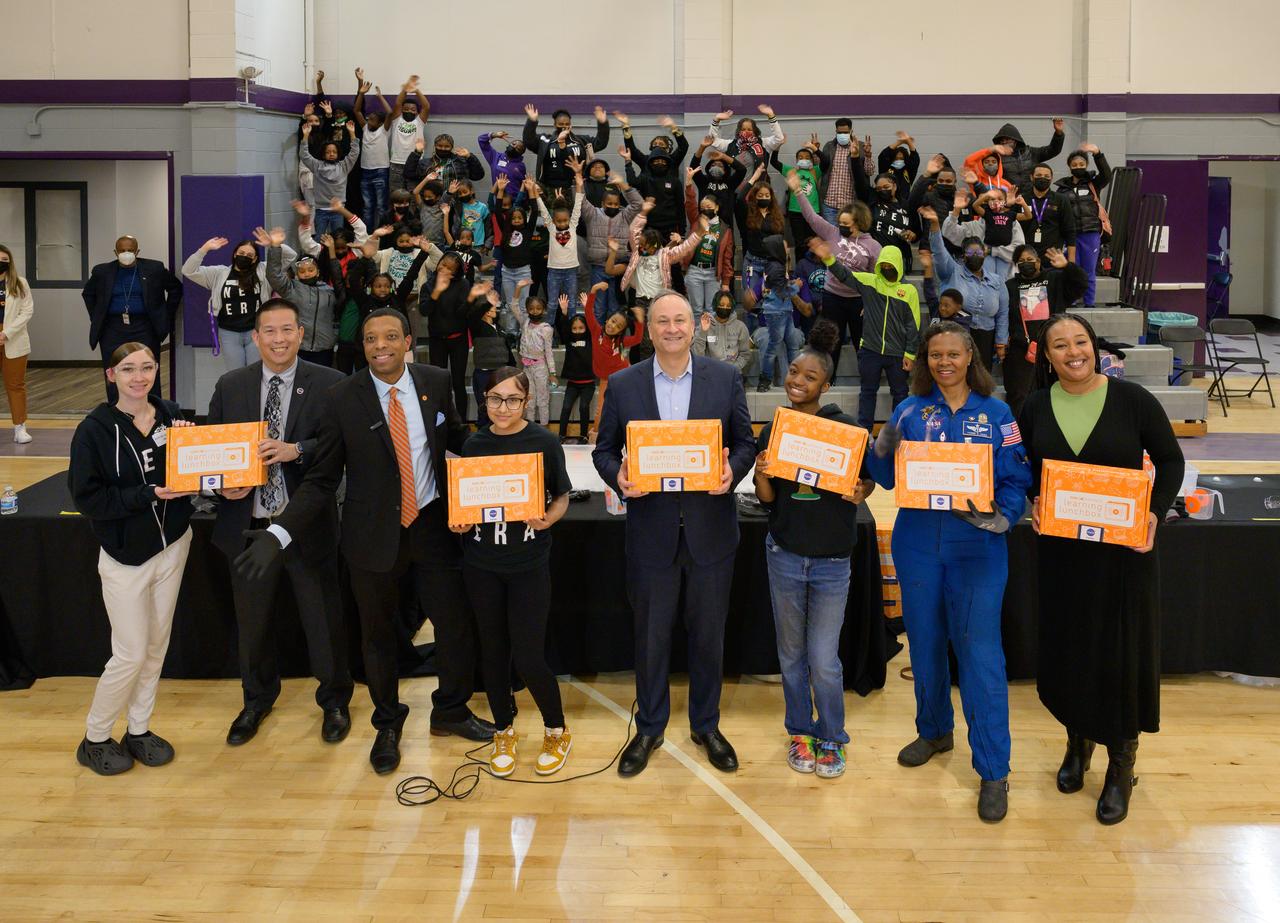
Second Gentleman Douglas Emhoff, center, with COSI and NASA staff and students from the East Oakland Youth Development Center in Oakland, California. Hosted in honor of Women’s History Month by the Center of Science and Industry (COSI) under a NASA OSTEM agreement, the Oakland activities reached 500 East Bay students and provided five space-focused learning activities that showcase the diversity of STEM at NASA.
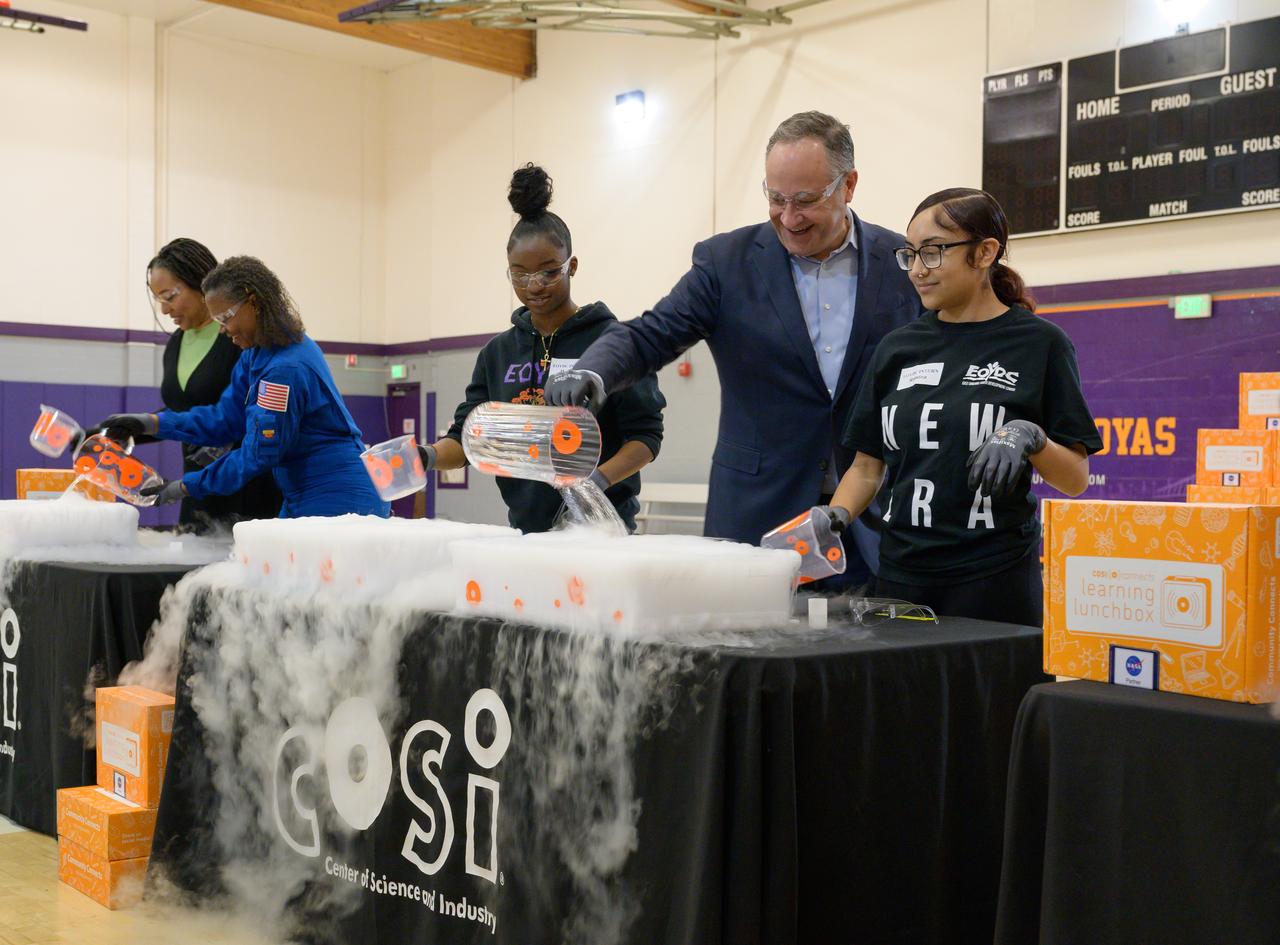
Second Gentleman Douglas Emhoff, second from right, participates in a “make a cloud” demonstration with students at the East Oakland Youth Development Center in Oakland, California. Hosted in honor of Women’s History Month by the Center of Science and Industry (COSI) under a NASA OSTEM agreement, the Oakland activities reached 500 East Bay students and provided five space-focused learning activities that showcase the diversity of STEM at NASA.
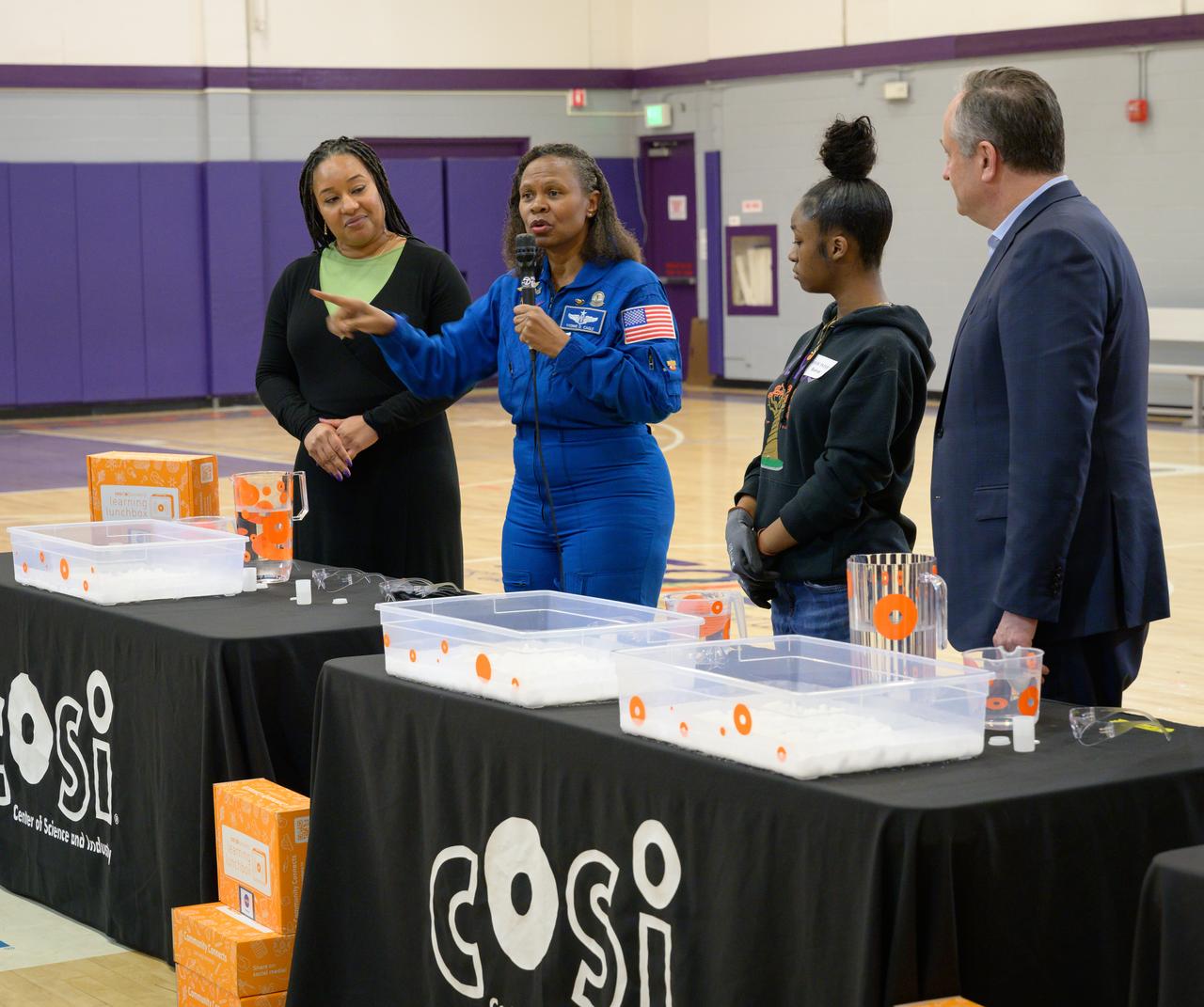
Astronaut Yvonne Cagle provides opening remarks at the East Oakland Youth Development Center in Oakland, California. Hosted in honor of Women’s History Month by the Center of Science and Industry (COSI) under a NASA OSTEM agreement, the Oakland activities reached 500 East Bay students and provided five space-focused learning activities that showcase the diversity of STEM at NASA.
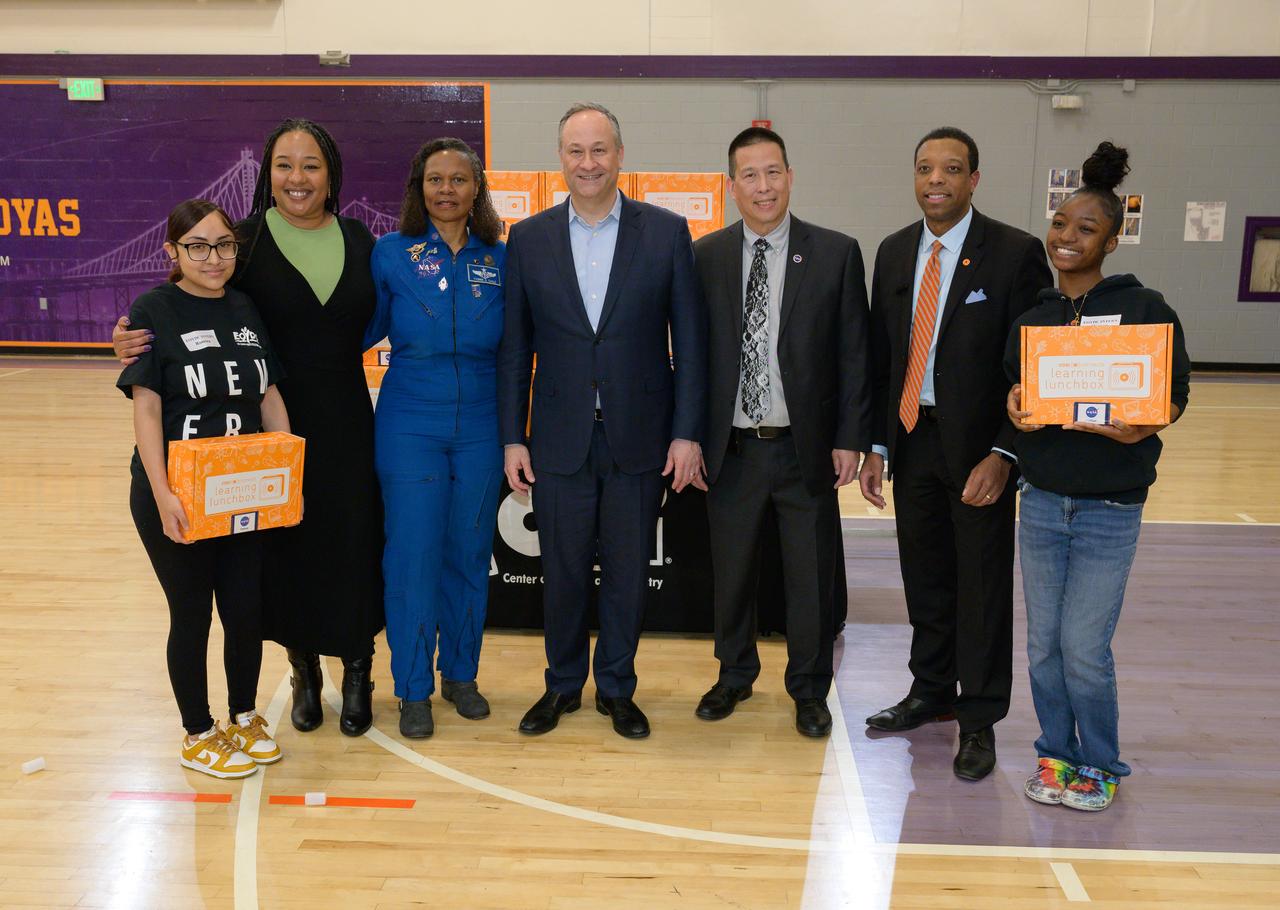
Second Gentleman Douglas Emhoff, center, with NASA and COSI staff at the East Oakland Youth Development Center in Oakland, California. Hosted in honor of Women’s History Month by the Center of Science and Industry (COSI) under a NASA OSTEM agreement, the Oakland activities reached 500 East Bay students and provided five space-focused learning activities that showcase the diversity of STEM at NASA.
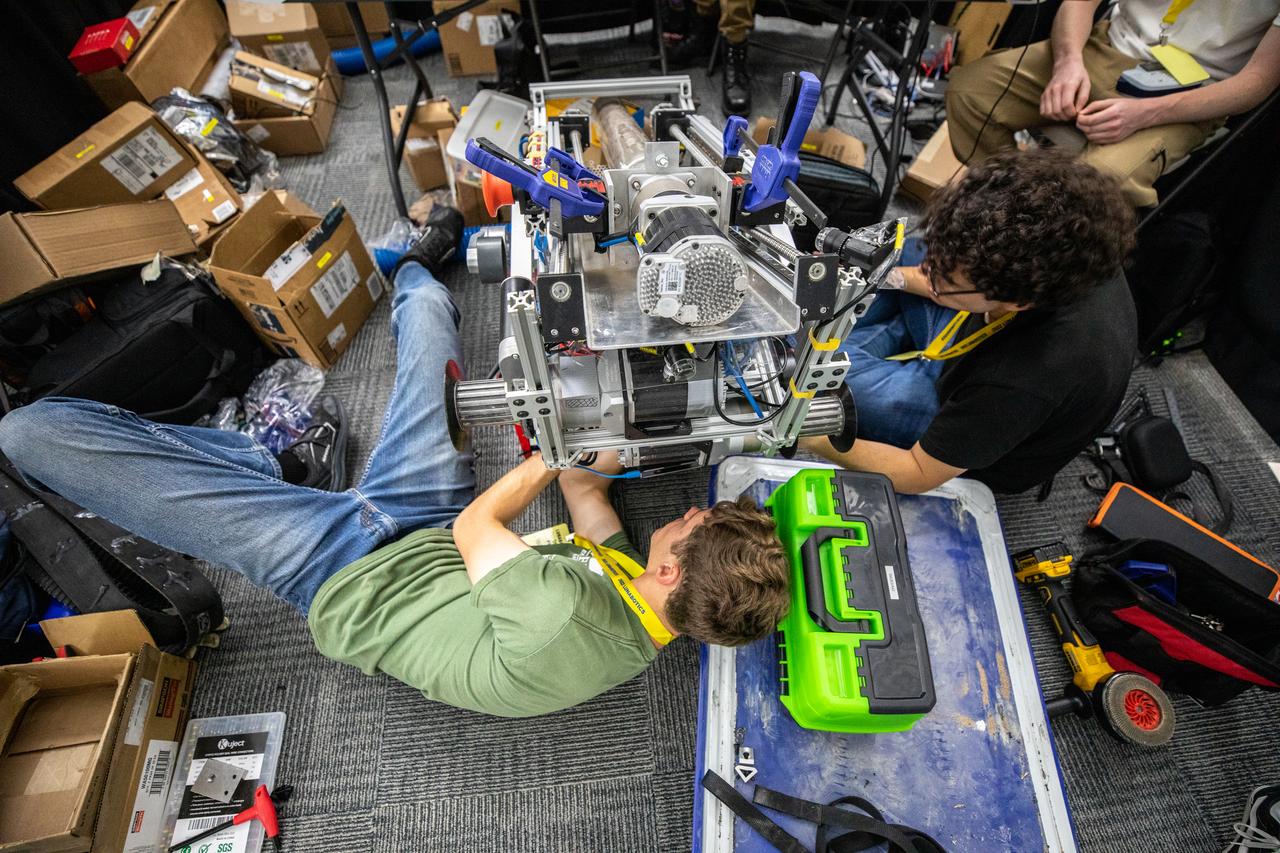
New Mexico Tech students prepare their robotic miner for its turn to dig in the mining arena during NASA’s LUNABOTICS competition on May 23, 2022, at the Center for Space Education near the Kennedy Space Center Visitor Complex in Florida. More than 35 teams from around the U.S. have designed and built remote-controlled robots for the mining competition. Teams use their autonomous or remote-controlled robots to maneuver and dig in a supersized sandbox filled with rocks and simulated lunar soil, or regolith. The objective of the challenge is to see which team’s robot can collect and deposit the most rocky regolith within a specified amount of time.
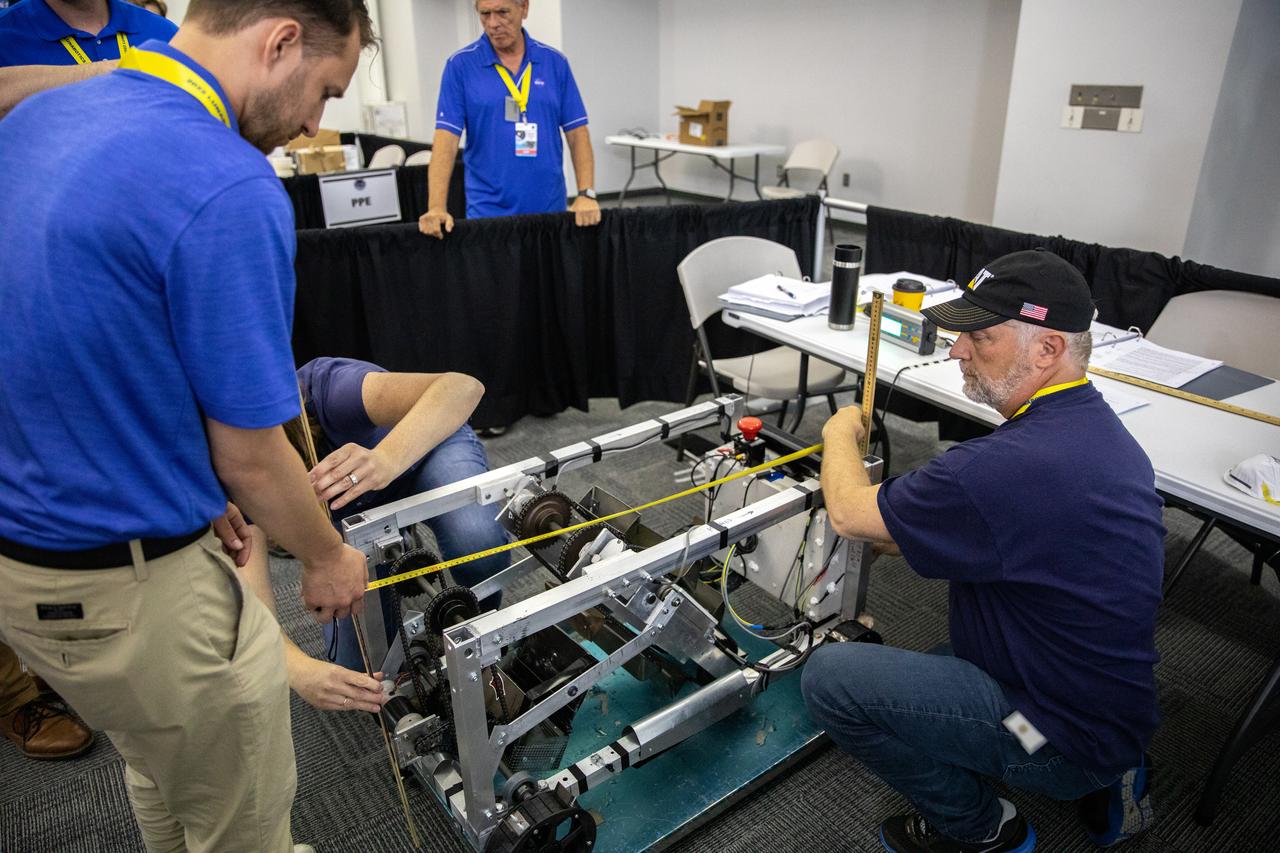
The Saginaw Valley State University team’s robotic miner is being measured and weighed to qualify for its turn to dig in the mining arena during NASA’s LUNABOTICS competition on May 23, 2022, at the Center for Space Education near the Kennedy Space Center Visitor Complex in Florida. More than 35 teams from around the U.S. have designed and built remote-controlled robots for the mining competition. Teams use their autonomous or remote-controlled robots to maneuver and dig in a supersized sandbox filled with rocks and simulated lunar soil, or regolith. The objective of the challenge is to see which team’s robot can collect and deposit the most rocky regolith within a specified amount of time.
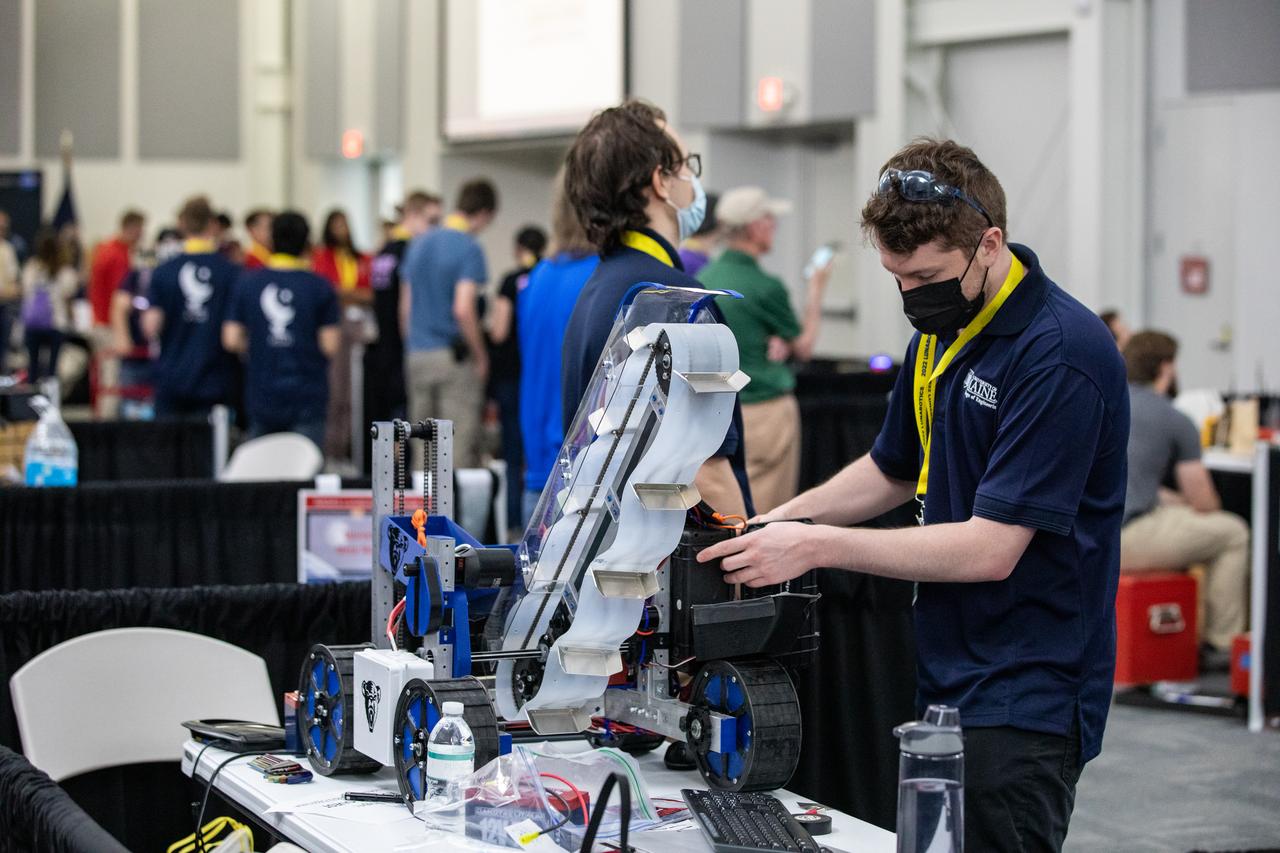
A team member from the University of Maine prepares their robotic miner for its turn to dig in the mining arena during NASA’s LUNABOTICS competition on May 26, 2022, at the Center for Space Education near the Kennedy Space Center Visitor Complex in Florida. More than 35 teams from around the U.S. have designed and built remote-controlled robots for the mining competition. Teams use their semi-autonomous or remote-controlled robots to maneuver and dig in a supersized sandbox filled with rocks and simulated lunar soil, or regolith. The objective of the challenge is to see which team’s robot can collect and deposit the most rocky regolith within a specified amount of time.
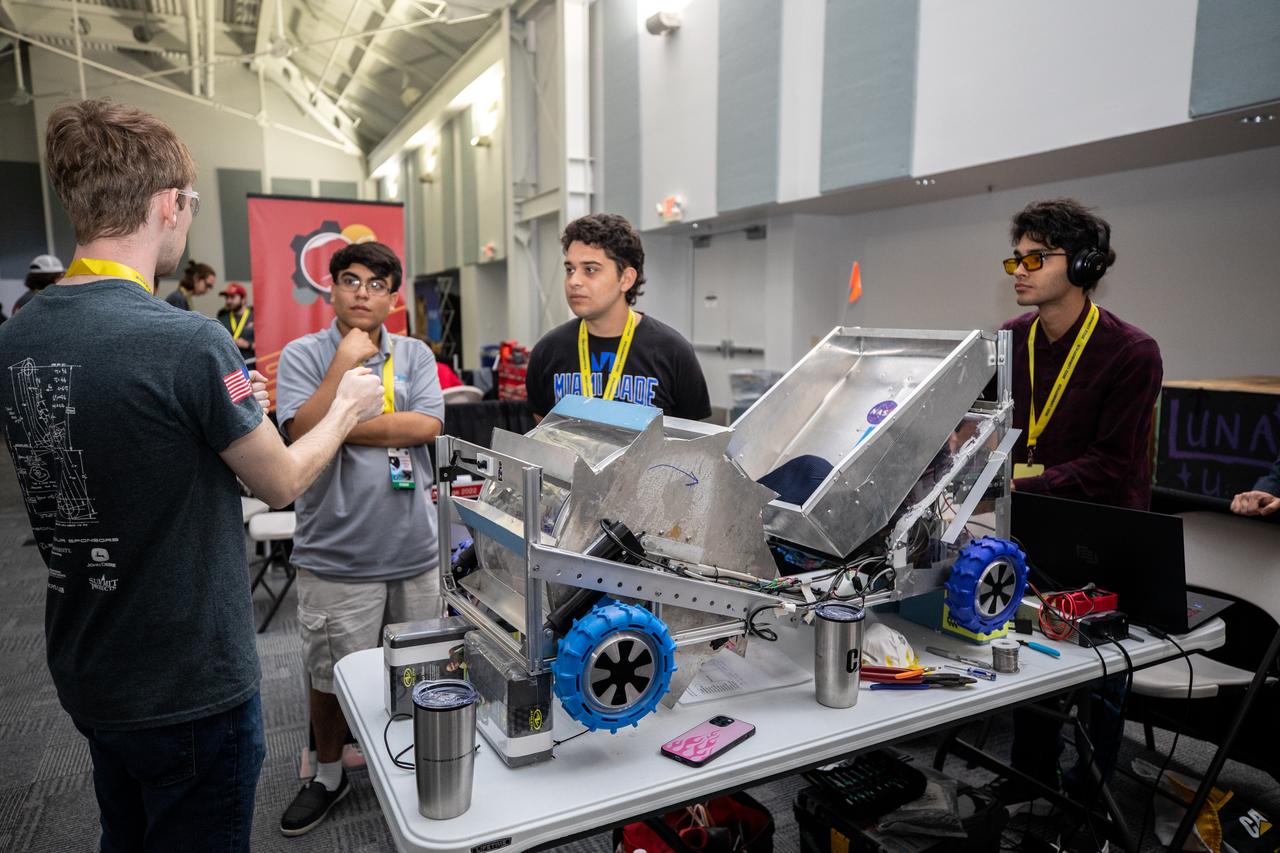
Students from Miami-Dade College at Kendall prepare their robotic miner for its turn to dig in the mining arena during NASA’s LUNABOTICS competition on May 24, 2022, at the Center for Space Education near the Kennedy Space Center Visitor Complex in Florida. More than 35 teams from around the U.S. have designed and built remote-controlled robots for the mining competition. Teams use their autonomous or remote-controlled robots to maneuver and dig in a supersized sandbox filled with rocks and simulated lunar soil, or regolith. The objective of the challenge is to see which team’s robot can collect and deposit the most rocky regolith within a specified amount of time.
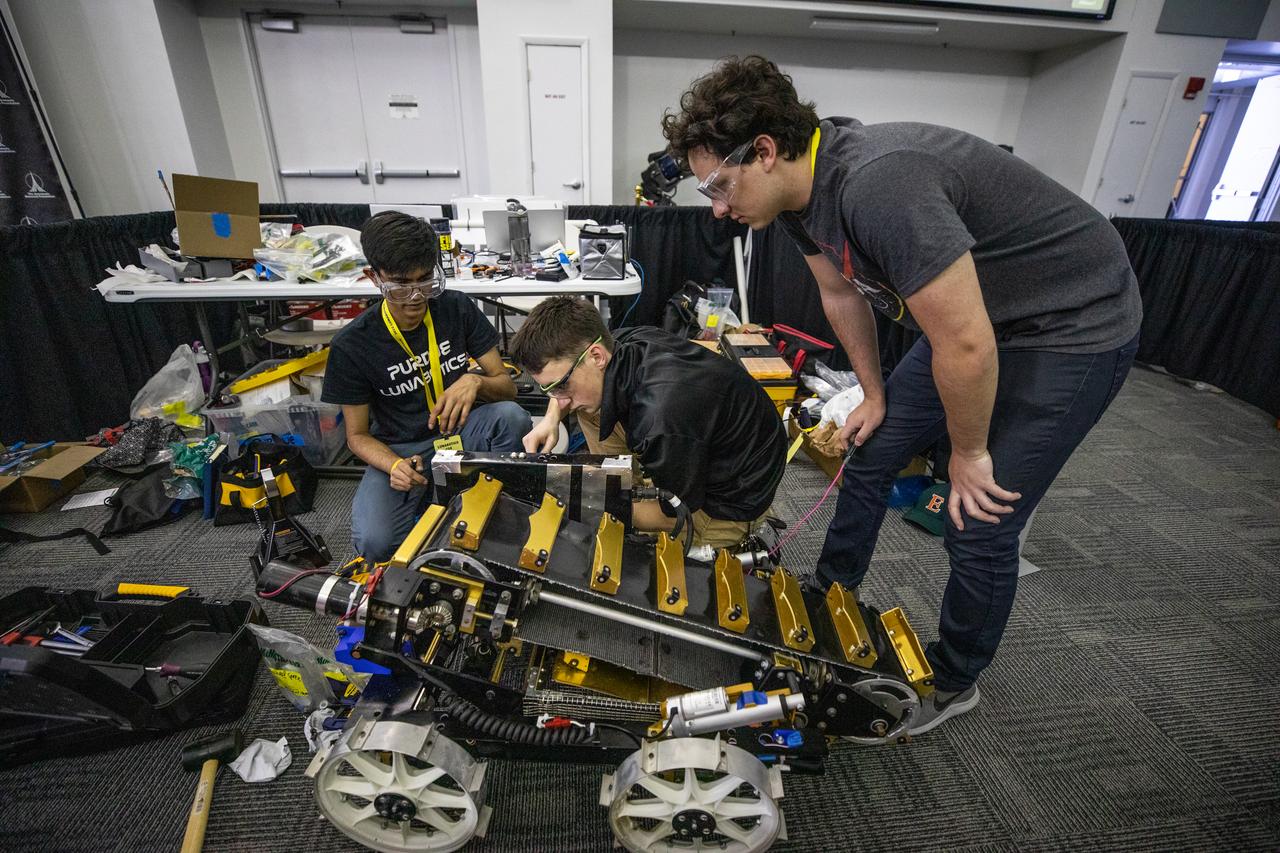
Students from Purdue University prepare their robotic miner for its turn to dig in the mining pit during NASA’s LUNABOTICS competition on May 23, 2022, at the Center for Space Education near the Kennedy Space Center Visitor Complex in Florida. More than 35 teams from around the U.S. have designed and built remote-controlled robots for the mining competition. Teams use their autonomous or remote-controlled robots to maneuver and dig in a supersized sandbox filled with rocks and simulated lunar soil, or regolith. The objective of the challenge is to see which team’s robot can collect and deposit the most rocky regolith within a specified amount of time.
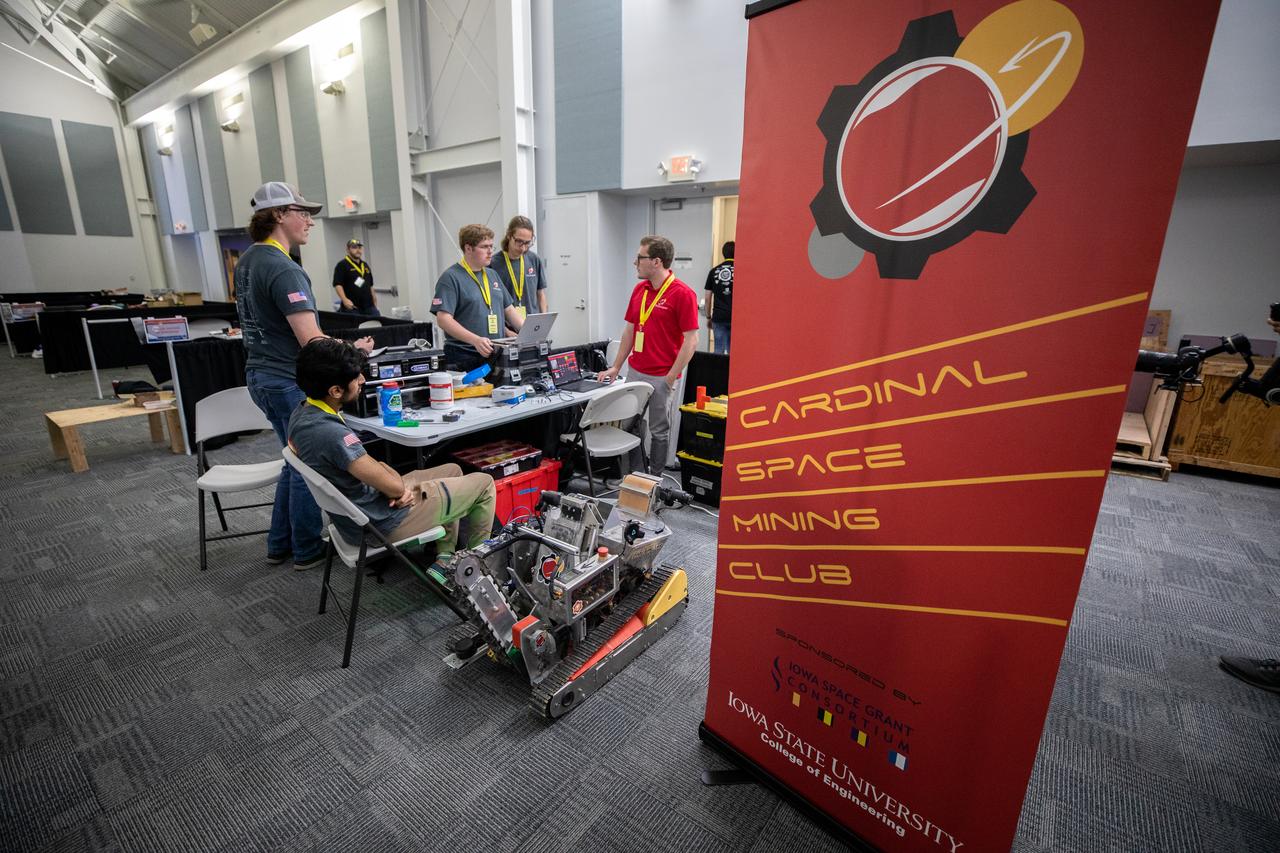
Students from Iowa State University College students prepare their robotic miner for its turn to dig in the mining arena during NASA’s LUNABOTICS competition on May 23, 2022, at the Center for Space Education near the Kennedy Space Center Visitor Complex in Florida. More than 35 teams from around the U.S. have designed and built remote-controlled robots for the mining competition. Teams use their autonomous or remote-controlled robots to maneuver and dig in a supersized sandbox filled with rocks and simulated lunar soil, or regolith. The objective of the challenge is to see which team’s robot can collect and deposit the most rocky regolith within a specified amount of time.
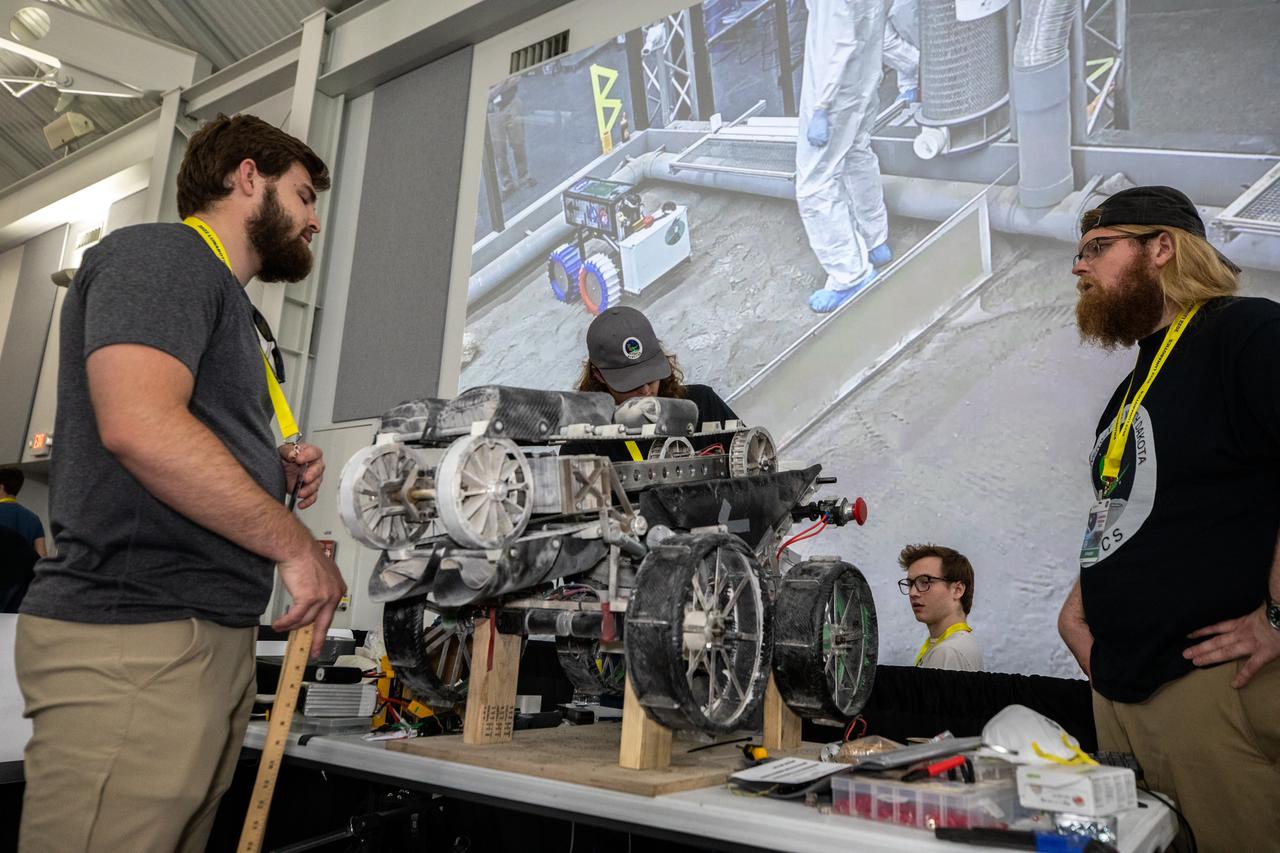
Students from the University of North Dakota prepare their robot miner for its turn to dig in the mining arena during NASA’s LUNABOTICS competition on May 26, 2022, at the Center for Space Education near the Kennedy Space Center Visitor Complex in Florida. More than 35 teams from around the U.S. have designed and built remote-controlled robots for the mining competition. Teams use their semi-autonomous or remote-controlled robots to maneuver and dig in a supersized sandbox filled with rocks and simulated lunar soil, or regolith. The objective of the challenge is to see which team’s robot can collect and deposit the most rocky regolith within a specified amount of time.
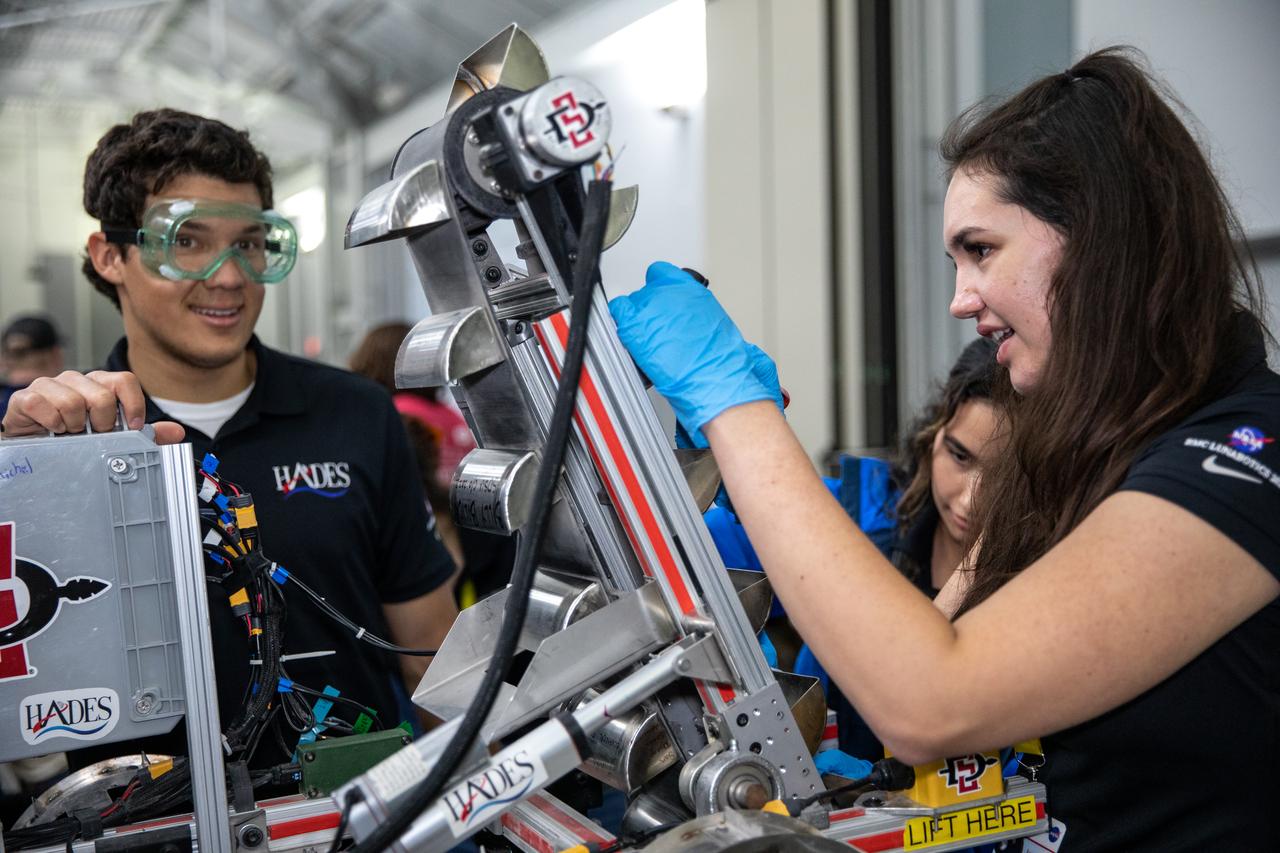
Students from San Diego State College prepare their robotic miner for its second turn to dig in the mining arena during NASA’s LUNABOTICS competition on May 27, 2022, at the Center for Space Education near the Kennedy Space Center Visitor Complex in Florida. More than 35 teams from around the U.S. have designed and built remote-controlled robots for the mining competition. Teams used their autonomous or remote-controlled robots to maneuver and dig in a supersized sandbox filled with lunar simulant and rocks. The objective of the challenge is to see which team’s robot can collect and deposit the most rocky regolith within a specified amount of time.
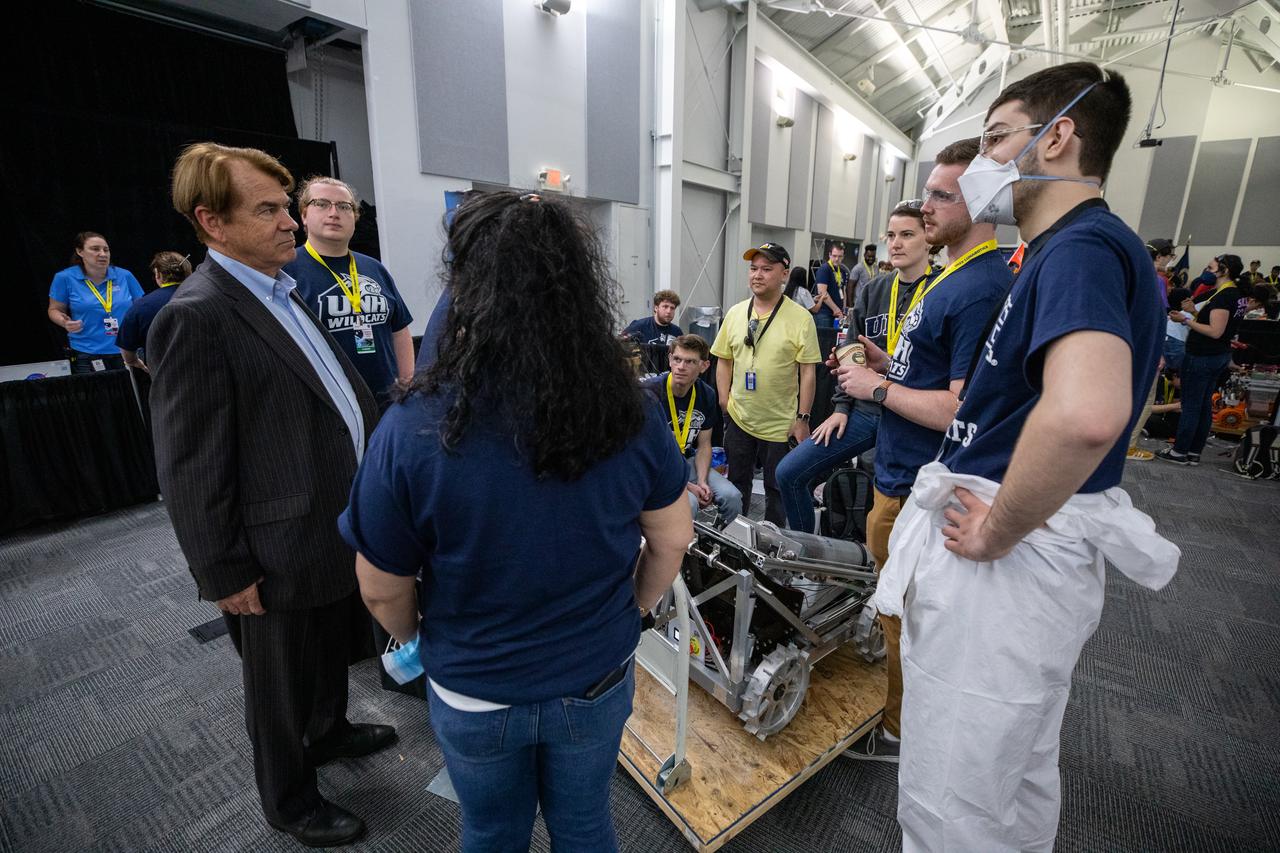
Thad Altman, far left, chairman and CEO of the Astronaut Memorial Foundation, talks to students from the University of New Hampshire as they prepare to take their robotic miner for its turn to dig in the mining arena during NASA’s LUNABOTICS competition on May 26, 2022, at the Center for Space Education near the Kennedy Space Center Visitor Complex in Florida. More than 35 teams from around the U.S. have designed and built remote-controlled robots for the mining competition. Teams use their semi-autonomous or remote-controlled robots to maneuver and dig in a supersized sandbox filled with rocks and simulated lunar soil, or regolith. The objective of the challenge is to see which team’s robot can collect and deposit the most rocky regolith within a specified amount of time.
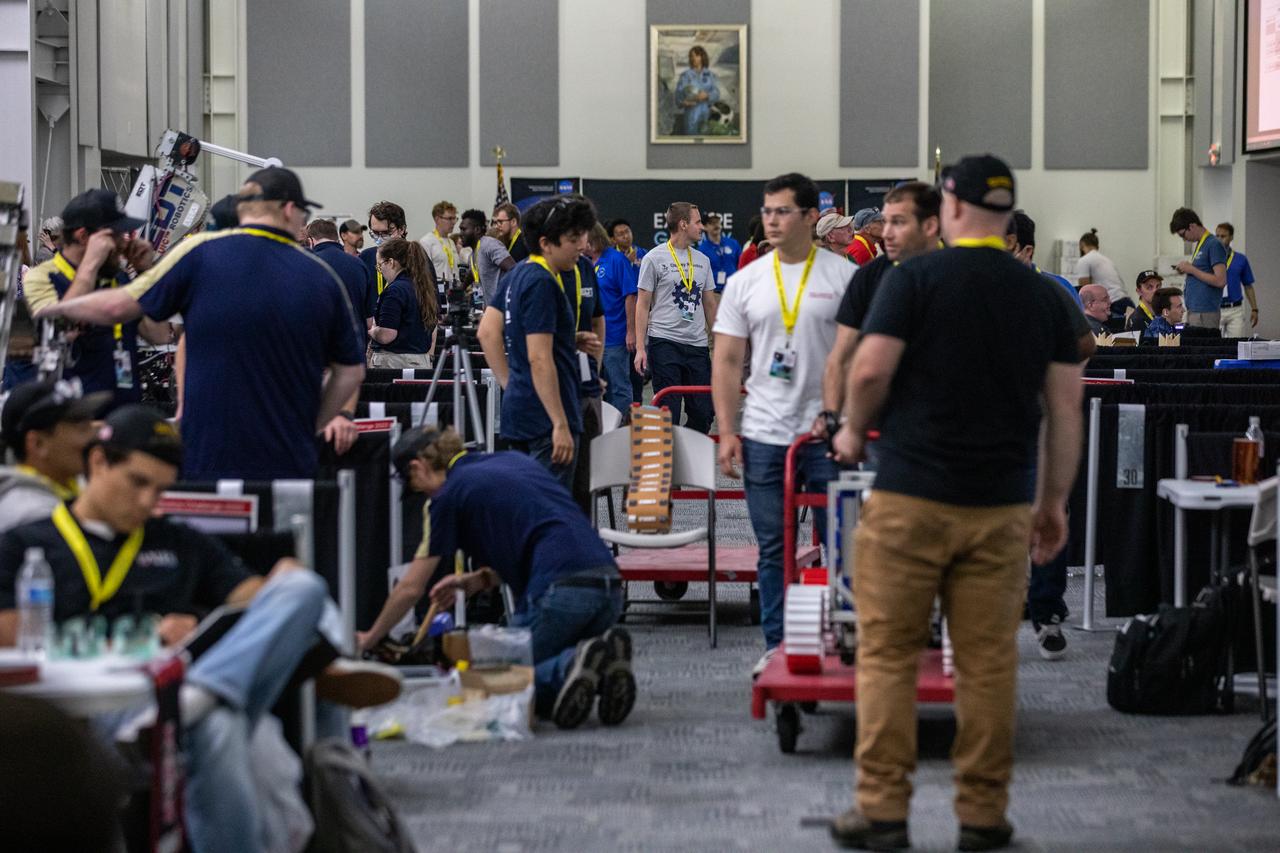
College teams prepare their robotic miners for their turn to dig in the mining arena during NASA’s LUNABOTICS competition on May 26, 2022, at the Center for Space Education near the Kennedy Space Center Visitor Complex in Florida. More than 35 teams from around the U.S. have designed and built remote-controlled robots for the mining competition. Teams use their semi-autonomous or remote-controlled robots to maneuver and dig in a supersized sandbox filled with rocks and simulated lunar soil, or regolith. The objective of the challenge is to see which team’s robot can collect and deposit the most rocky regolith within a specified amount of time.
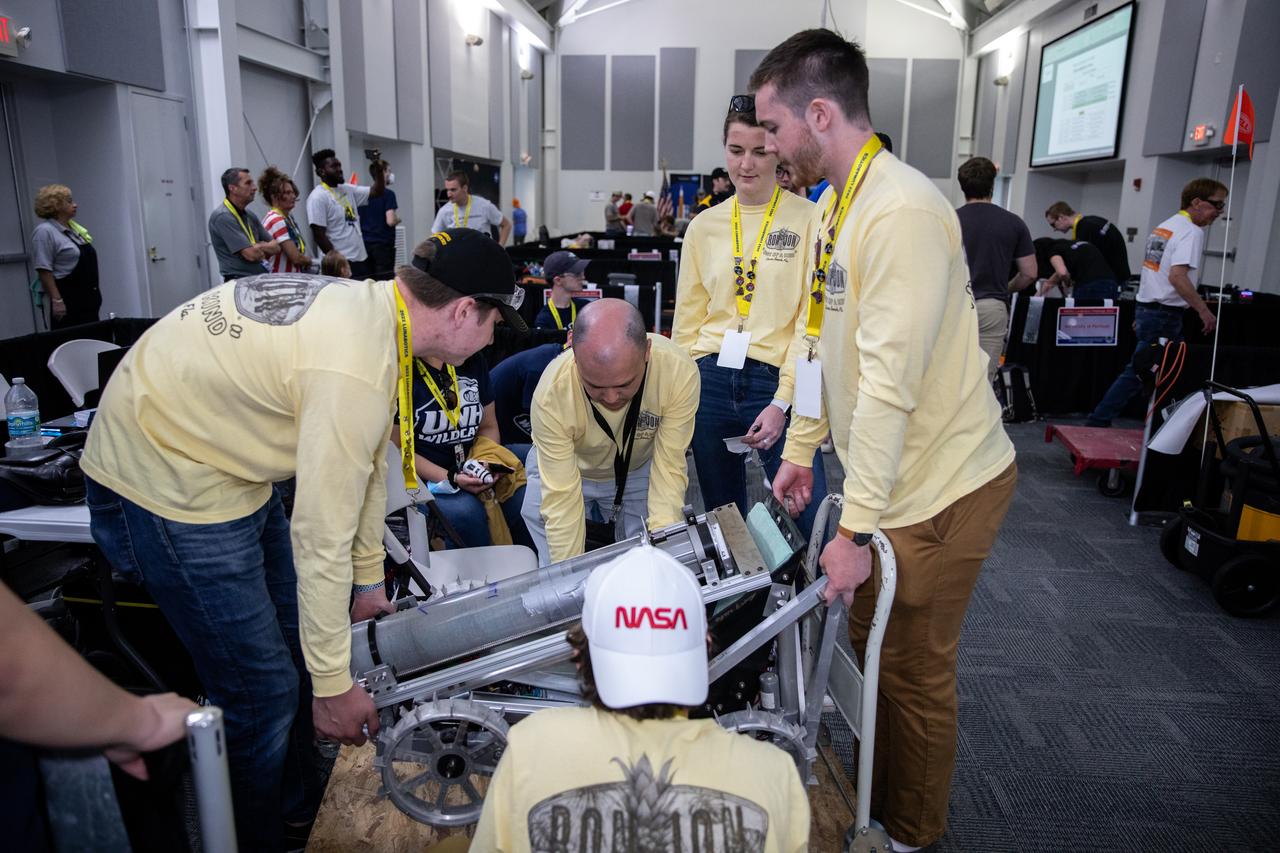
The University of New Hampshire’s robotic miner is placed on a cart to record its measurements and weight before the school’s team prepares it for its turn to dig in the mining arena during NASA’s LUNABOTICS competition on May 27, 2022, at the Center for Space Education near the Kennedy Space Center Visitor Complex in Florida. More than 35 teams from around the U.S. have designed and built remote-controlled robots for the mining competition. Teams use their autonomous or remote-controlled robots to maneuver and dig in a supersized sandbox filled with lunar simulant and rocks. The objective of the challenge is to see which team’s robot can collect and deposit the most rocky regolith within a specified amount of time.
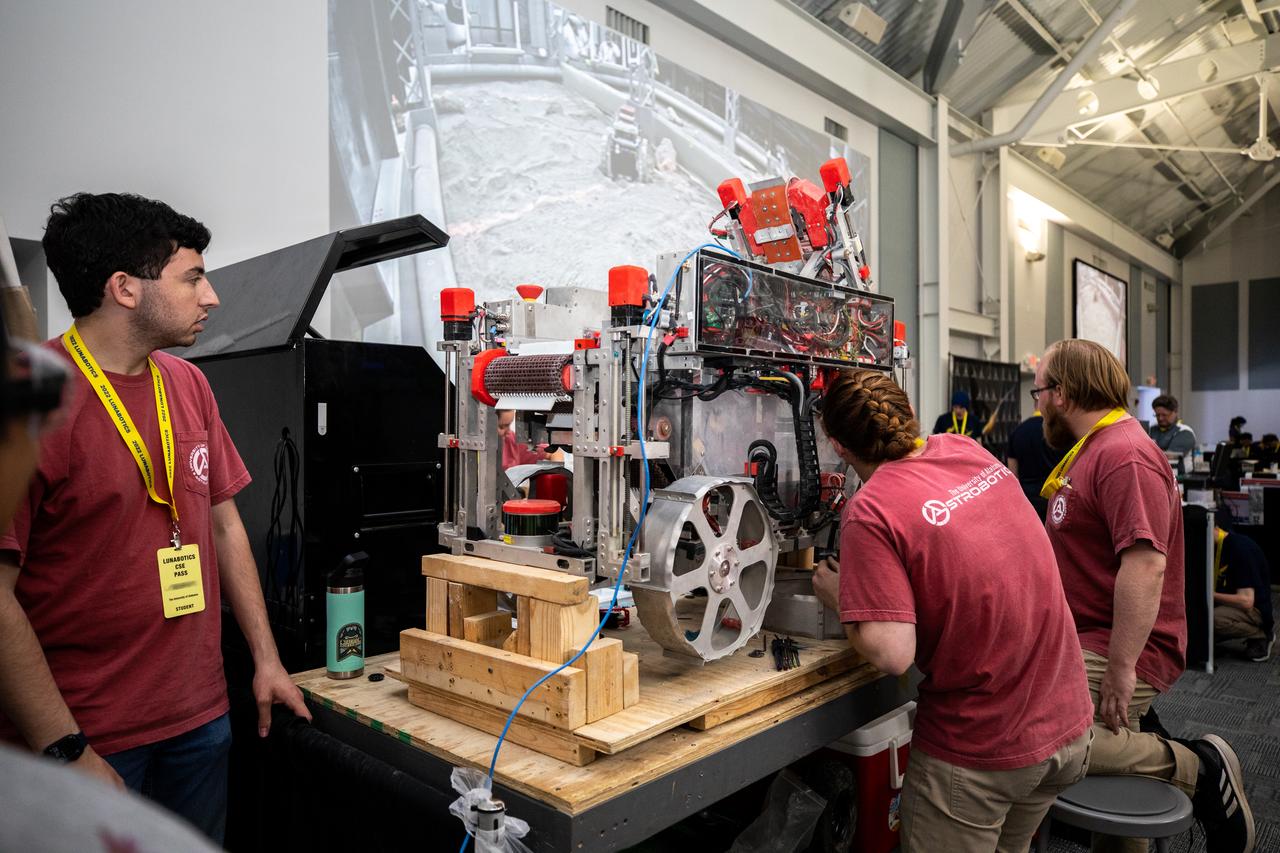
Students from the University of Alabama prepare their robotic miner for its turn to dig in the mining arena during NASA’s LUNABOTICS competition on May 24, 2022, at the Center for Space Education near the Kennedy Space Center Visitor Complex in Florida. More than 35 teams from around the U.S. have designed and built remote-controlled robots for the mining competition. Teams use their autonomous or remote-controlled robots to maneuver and dig in a supersized sandbox filled with rocks and simulated lunar soil, or regolith. The objective of the challenge is to see which team’s robot can collect and deposit the most rocky regolith within a specified amount of time.
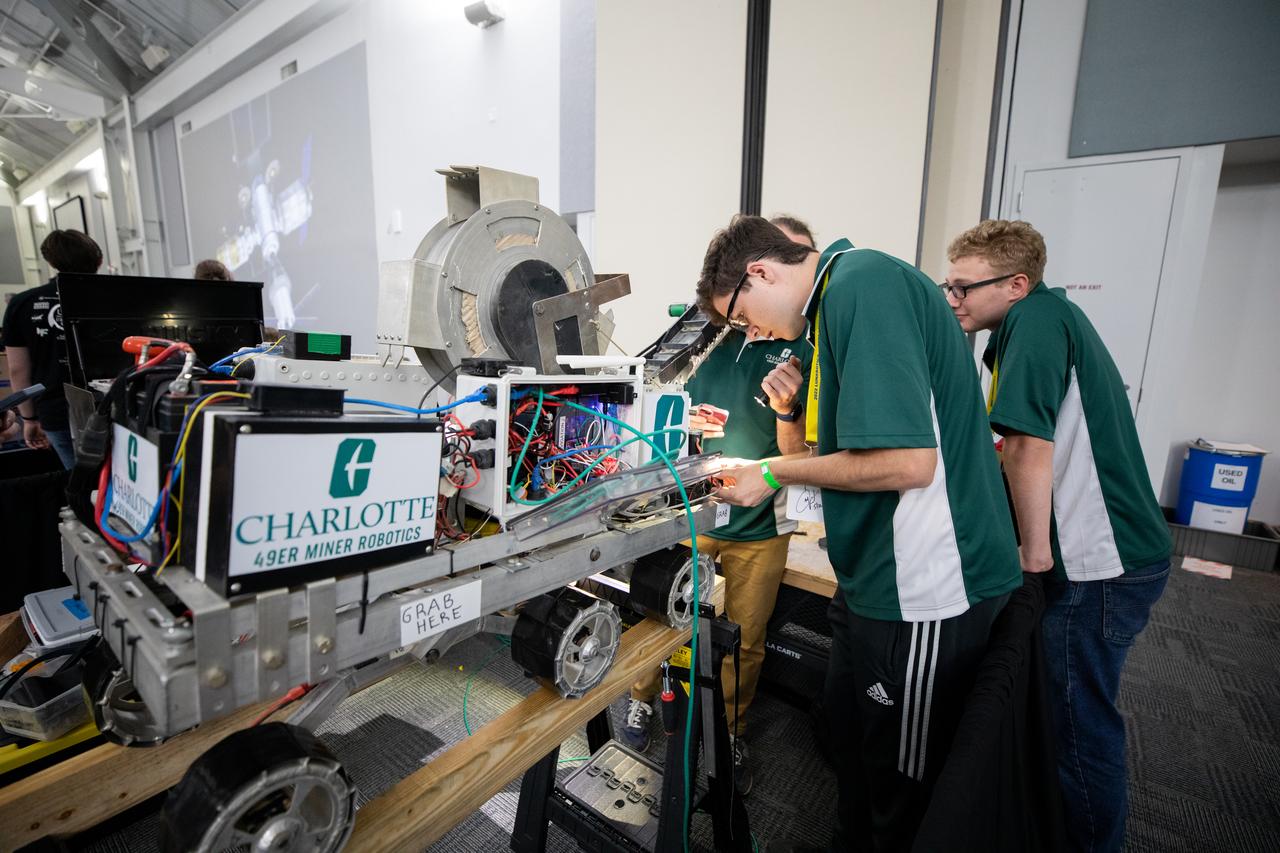
Students from the University of North Carolina at Charlotte prepare their robotic miner for its turn to dig in the mining arena during NASA’s LUNABOTICS competition on May 23, 2022, at the Center for Space Education near the Kennedy Space Center Visitor Complex in Florida. More than 35 teams from around the U.S. have designed and built remote-controlled robots for the mining competition. Teams use their autonomous or remote-controlled robots to maneuver and dig in a supersized sandbox filled with rocks and simulated lunar soil, or regolith. The objective of the challenge is to see which team’s robot can collect and deposit the most rocky regolith within a specified amount of time.

Kennedy Space Center Director Janet Petro, second from right, watches onscreen as robotic miners dig in the mining arena during NASA’s LUNABOTICS competition on May 23, 2022, at the Center for Space Education near the Kennedy Space Center Visitor Complex in Florida. Second from left is Thad Altman, president and CEO of The Astronauts Memorial Foundation. More than 35 teams from around the U.S. have designed and built remote-controlled robots for the mining competition. Teams use their autonomous or remote-controlled robots to maneuver and dig in a supersized sandbox filled with rocks and simulated lunar soil, or regolith. The objective of the challenge is to see which team’s robot can collect and deposit the most rocky regolith within a specified amount of time.
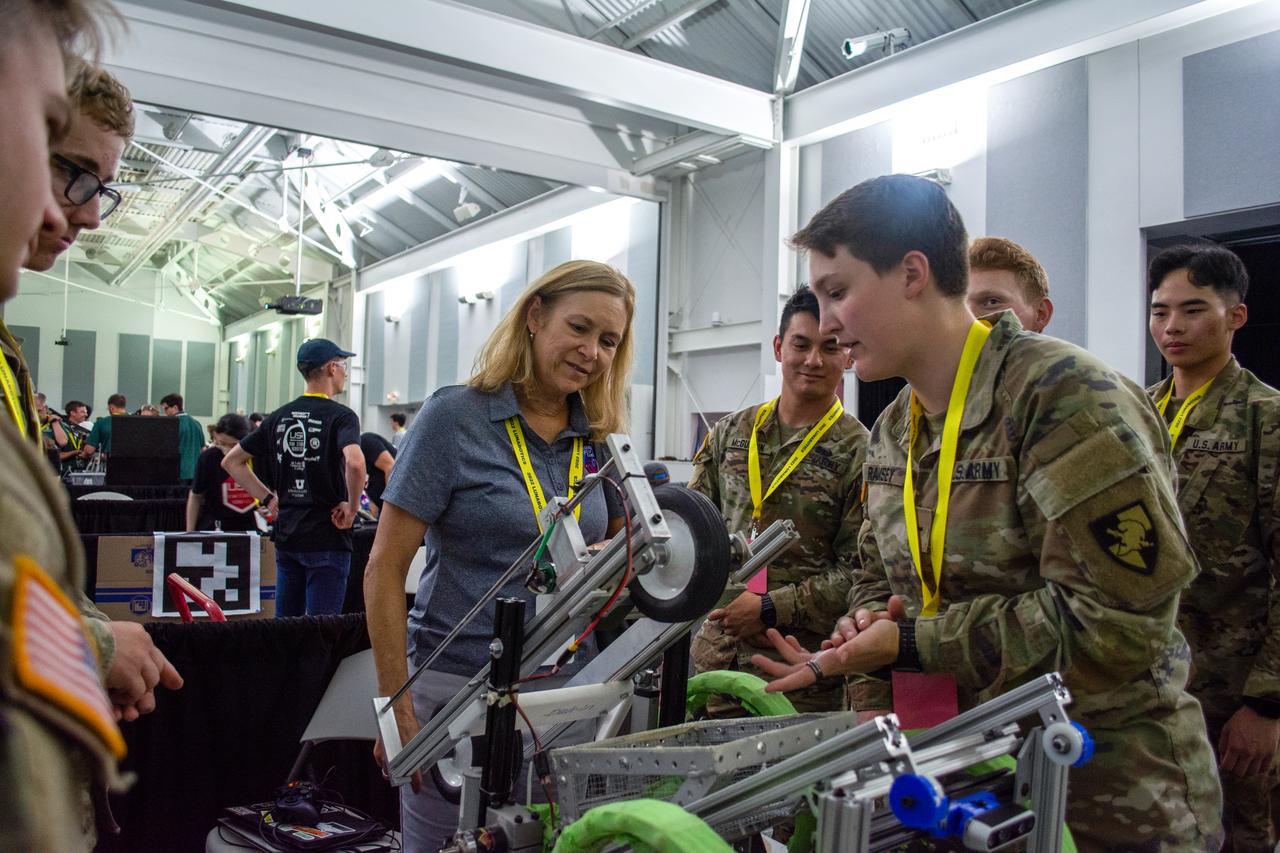
Kennedy Space Center Director Janet Petro, in the center, visits with students from the United States Military Academy (West Point), during NASA’s LUNABOTICS competition on May 23, 2022, at the Center for Space Education near the Kennedy Space Center Visitor Complex in Florida, on May 23, 2022. The students are preparing their robotic miner for its turn to dig in the mining arena. More than 35 teams from around the U.S. have designed and built remote-controlled robots for the mining competition. Teams use their autonomous or remote-controlled robots to maneuver and dig in a supersized sandbox filled with rocks and simulated lunar soil, or regolith. The objective of the challenge is to see which team’s robot can collect and deposit the most rocky regolith within a specified amount of time.
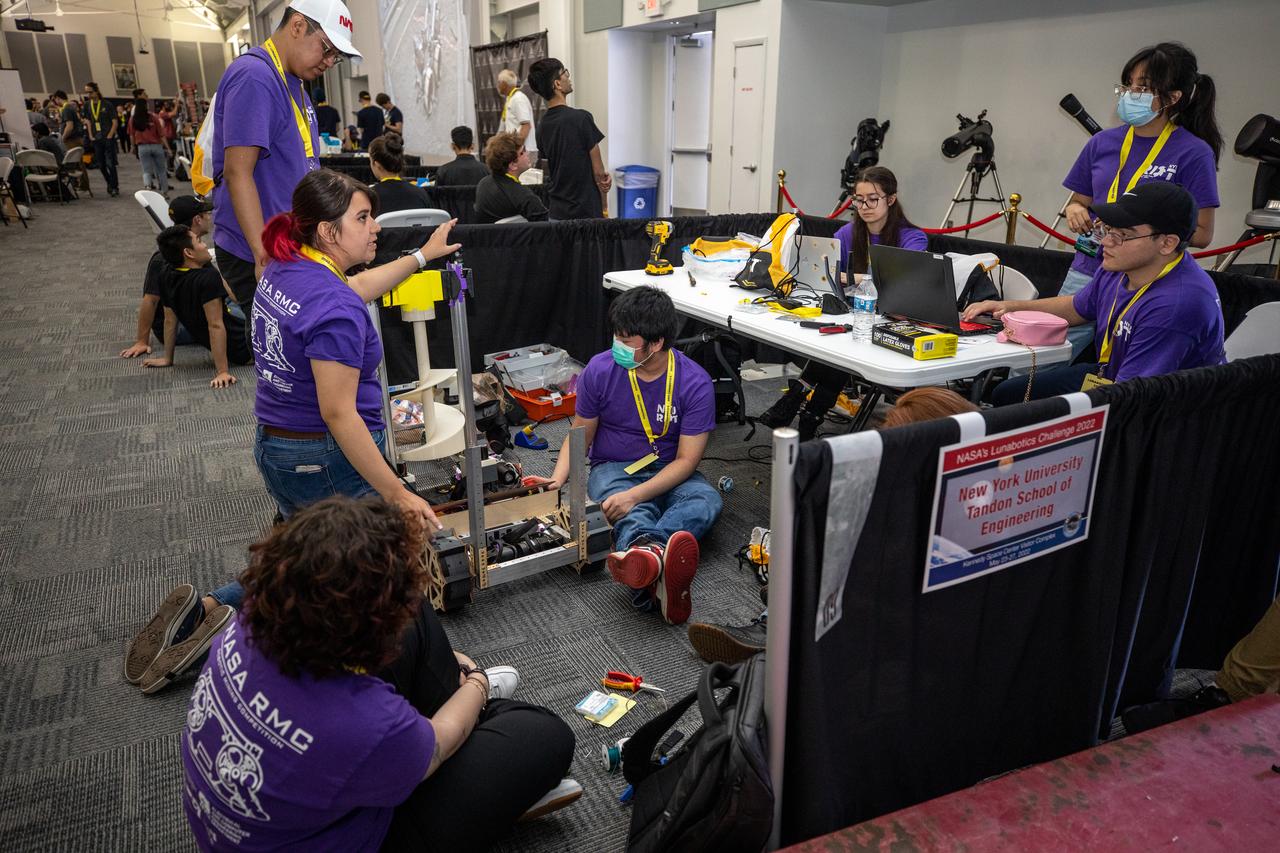
Students from the New York University Tandon School of Engineering prepare their robot for its turn to dig in the mining arena during NASA’s LUNABOTICS competition on May 24, 2022, at the Center for Space Education near the Kennedy Space Center Visitor Complex in Florida. More than 35 teams from around the U.S. have designed and built remote-controlled robots for the mining competition. Teams use their autonomous or remote-controlled robots to maneuver and dig in a supersized sandbox filled with rocks and simulated lunar soil, or regolith. The objective of the challenge is to see which team’s robot can collect and deposit the most rocky regolith within a specified amount of time.
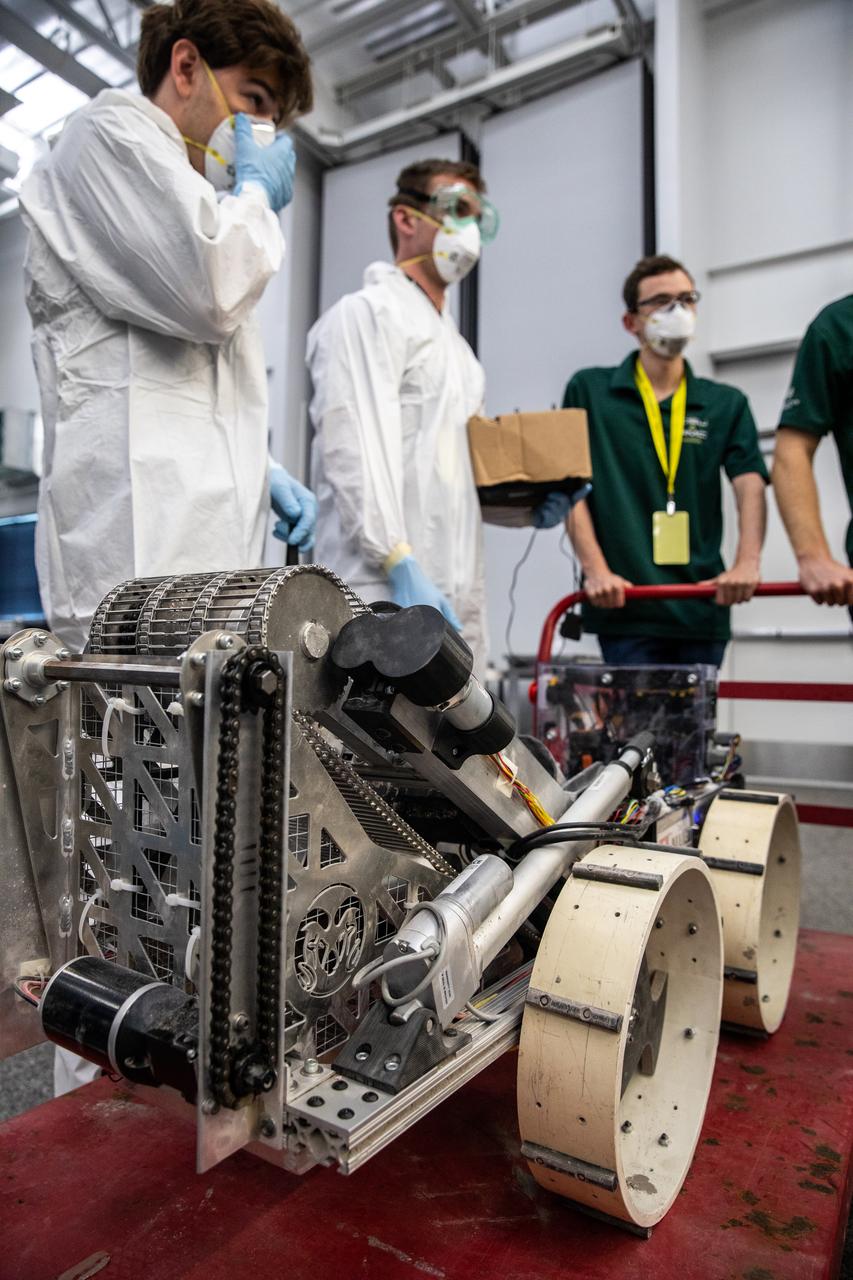
Students from Colorado State University prepare their robotic miner for its turn to dig in the mining arena during NASA’s LUNABOTICS competition on May 24, 2022, at the Center for Space Education near the Kennedy Space Center Visitor Complex in Florida. More than 35 teams from around the U.S. have designed and built remote-controlled robots for the mining competition. Teams use their autonomous or remote-controlled robots to maneuver and dig in a supersized sandbox filled with rocks and simulated lunar soil, or regolith. The objective of the challenge is to see which team’s robot can collect and deposit the most rocky regolith within a specified amount of time.
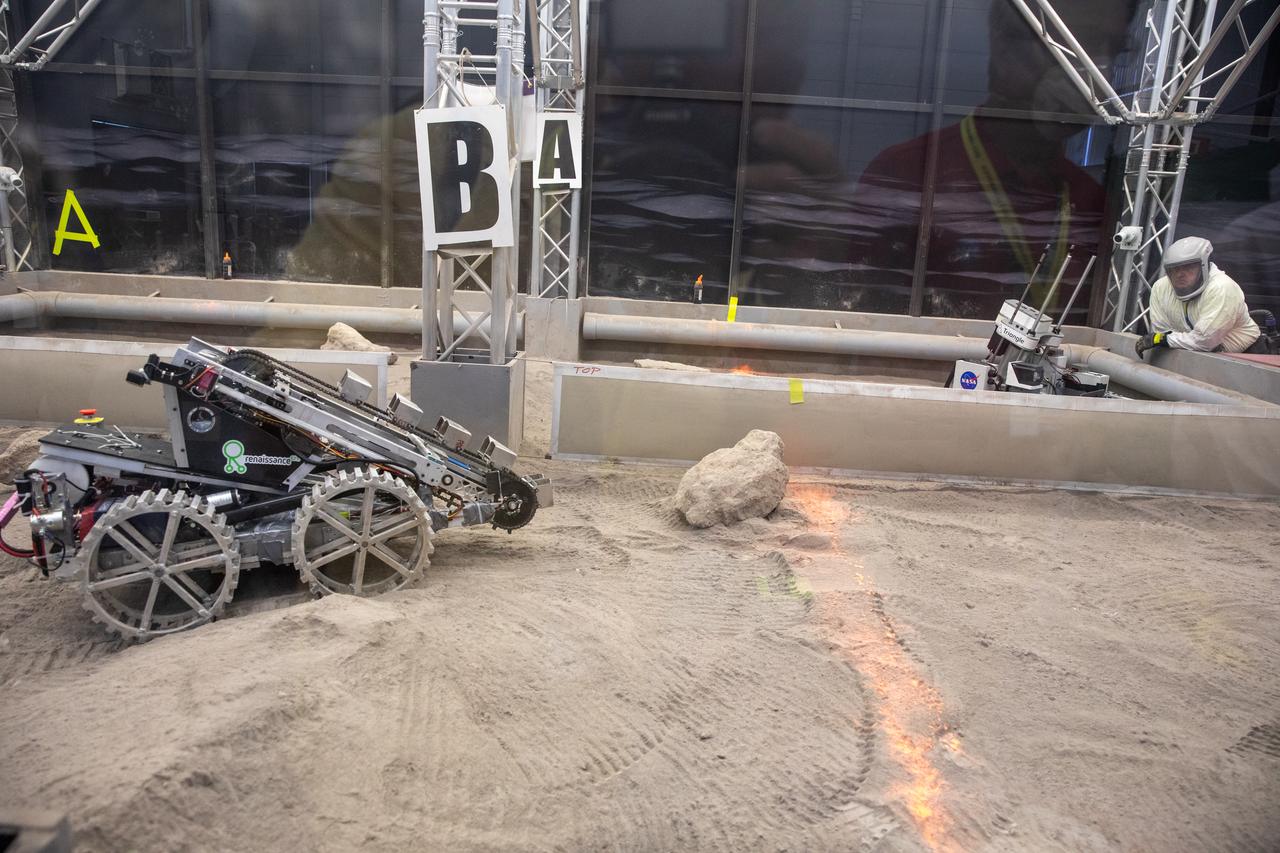
A robotic miner from Marquette University in Milwaukee, Wisconsin, prepares to dig in the mining arena during NASA’s LUNABOTICS competition on May 27, 2022, at the Center for Space Education near the Kennedy Space Center Visitor Complex in Florida. More than 35 college and university teams from around the U.S. have designed and built remote-controlled robots for the mining competition. Teams use their autonomous or remote-controlled robots to maneuver and dig in a supersized sandbox filled with lunar simulant and rocks. The objective of the challenge is to see which team’s robot can collect and deposit the most rocky regolith within a specified amount of time.
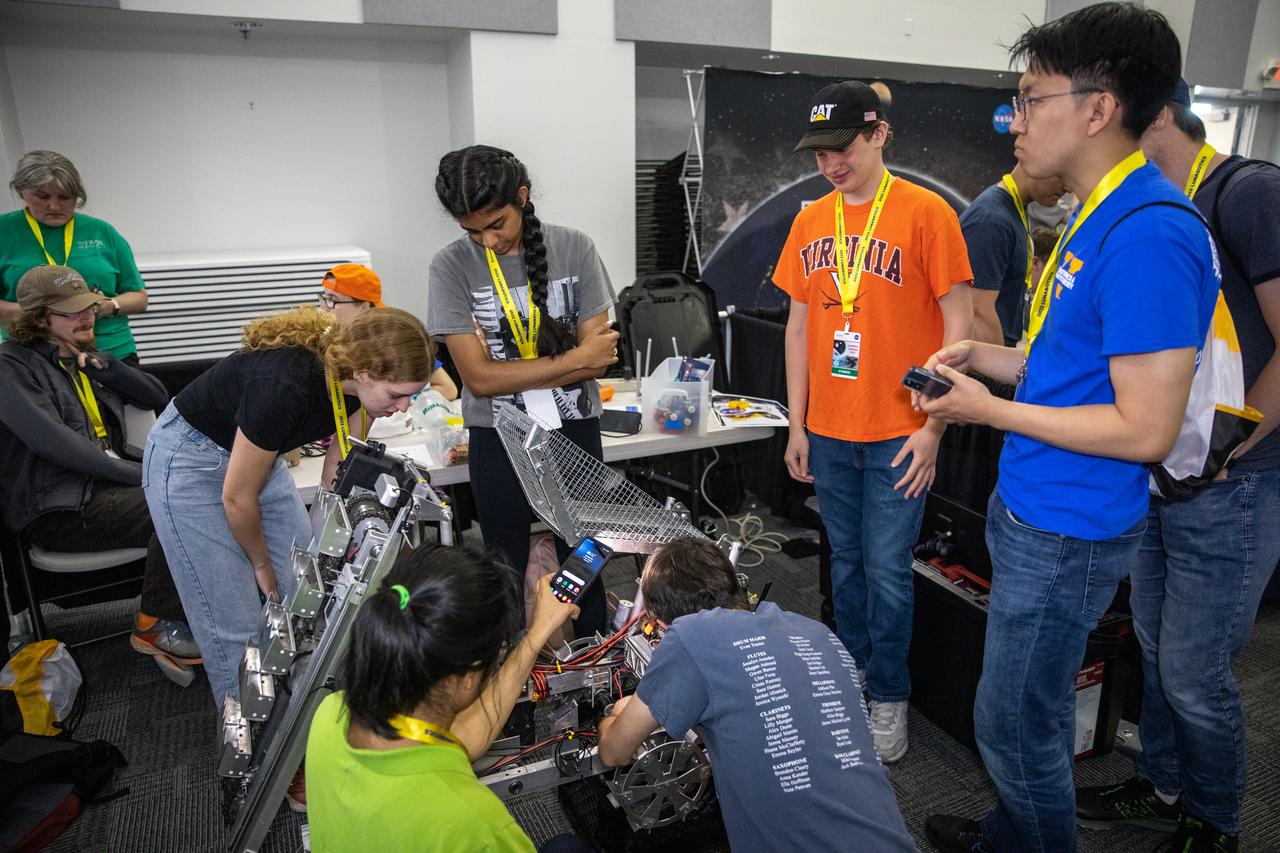
Students from the University of Virginia prepare their robotic miner for its turn to dig in the mining arena during NASA’s LUNABOTICS competition on May 26, 2022, at the Center for Space Education near the Kennedy Space Center Visitor Complex in Florida. More than 35 teams from around the U.S. have designed and built remote-controlled robots for the mining competition. Teams use their semi-autonomous or remote-controlled robots to maneuver and dig in a supersized sandbox filled with rocks and simulated lunar soil, or regolith. The objective of the challenge is to see which team’s robot can collect and deposit the most rocky regolith within a specified amount of time.
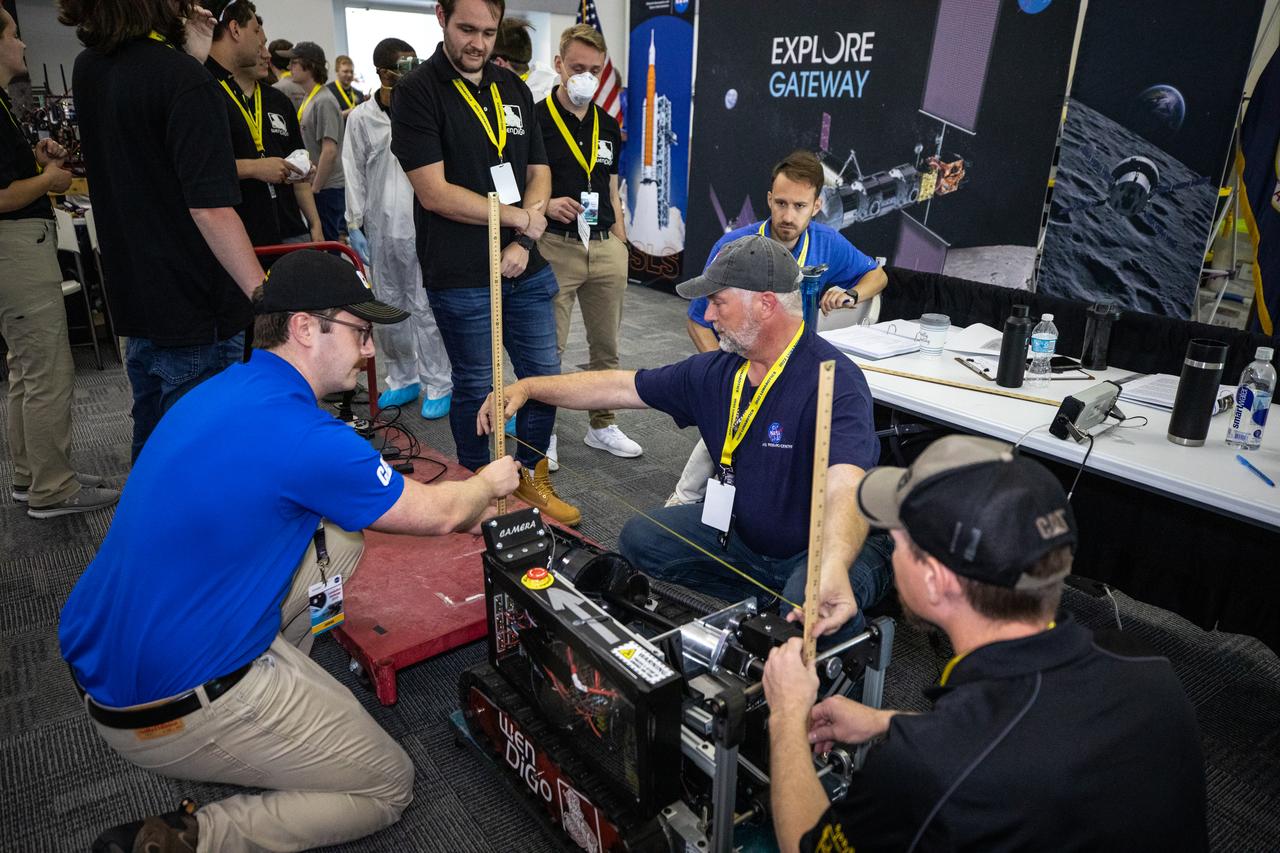
Students from the University of Nebraska-Lincoln prepare their robotic miner for its turn to dig in the mining arena during NASA’s LUNABOTICS competition on May 26, 2022, at the Center for Space Education near the Kennedy Space Center Visitor Complex in Florida. More than 35 teams from around the U.S. have designed and built remote-controlled robots for the mining competition. Teams use their semi-autonomous or remote-controlled robots to maneuver and dig in a supersized sandbox filled with rocks and simulated lunar soil, or regolith. The objective of the challenge is to see which team’s robot can collect and deposit the most rocky regolith within a specified amount of time.

Students from California State University, Long Beach, prepare their robotic miner for its turn to dig in the mining arena during NASA’s LUNABOTICS competition on May 24, 2022, at the Center for Space Education near the Kennedy Space Center Visitor Complex in Florida. More than 35 teams from around the U.S. have designed and built remote-controlled robots for the mining competition. Teams use their autonomous or remote-controlled robots to maneuver and dig in a supersized sandbox filled with rocks and simulated lunar soil, or regolith. The objective of the challenge is to see which team’s robot can collect and deposit the most rocky regolith within a specified amount of time.
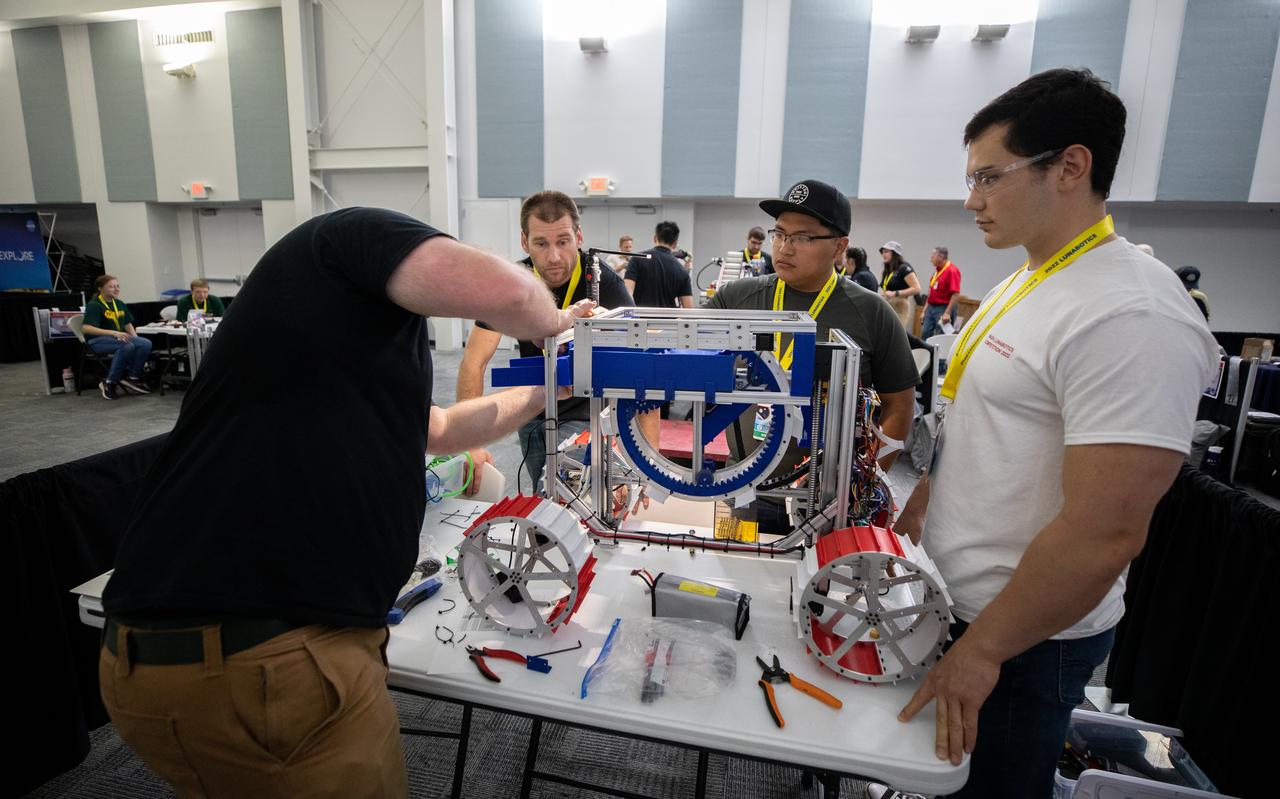
Team members from Sonoma State University in California prepare their robotic miner for its turn to dig in the mining arena during NASA’s LUNABOTICS competition on May 26, 2022, at the Center for Space Education near the Kennedy Space Center Visitor Complex in Florida. More than 35 teams from around the U.S. have designed and built remote-controlled robots for the mining competition. Teams use their semi-autonomous or remote-controlled robots to maneuver and dig in a supersized sandbox filled with rocks and simulated lunar soil, or regolith. The objective of the challenge is to see which team’s robot can collect and deposit the most rocky regolith within a specified amount of time.
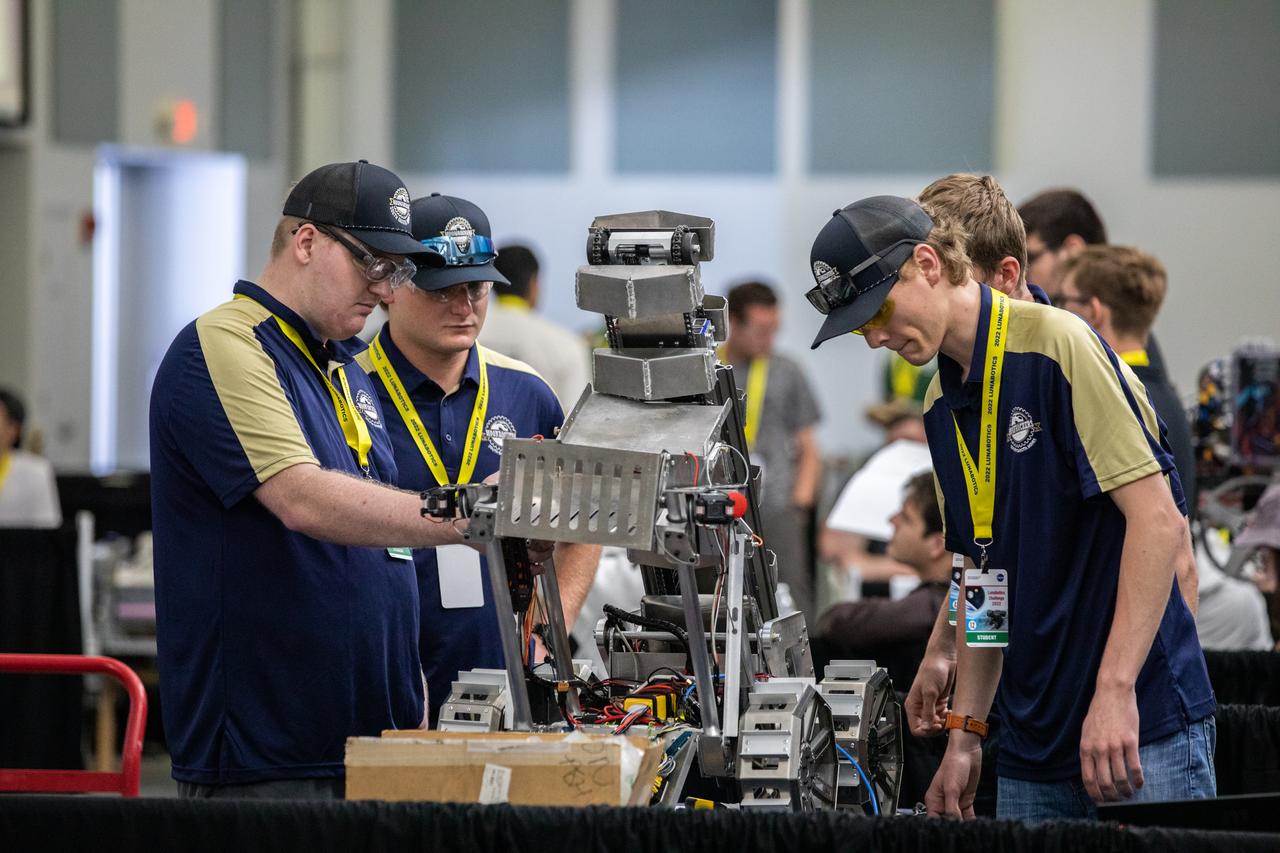
Team members from the South Dakota School of Mines and Technology prepare their robotic miner for its turn to dig in the mining arena during NASA’s LUNABOTICS competition on May 26, 2022, at the Center for Space Education near the Kennedy Space Center Visitor Complex in Florida. More than 35 teams from around the U.S. have designed and built remote-controlled robots for the mining competition. Teams use their semi-autonomous or remote-controlled robots to maneuver and dig in a supersized sandbox filled with rocks and simulated lunar soil, or regolith. The objective of the challenge is to see which team’s robot can collect and deposit the most rocky regolith within a specified amount of time.
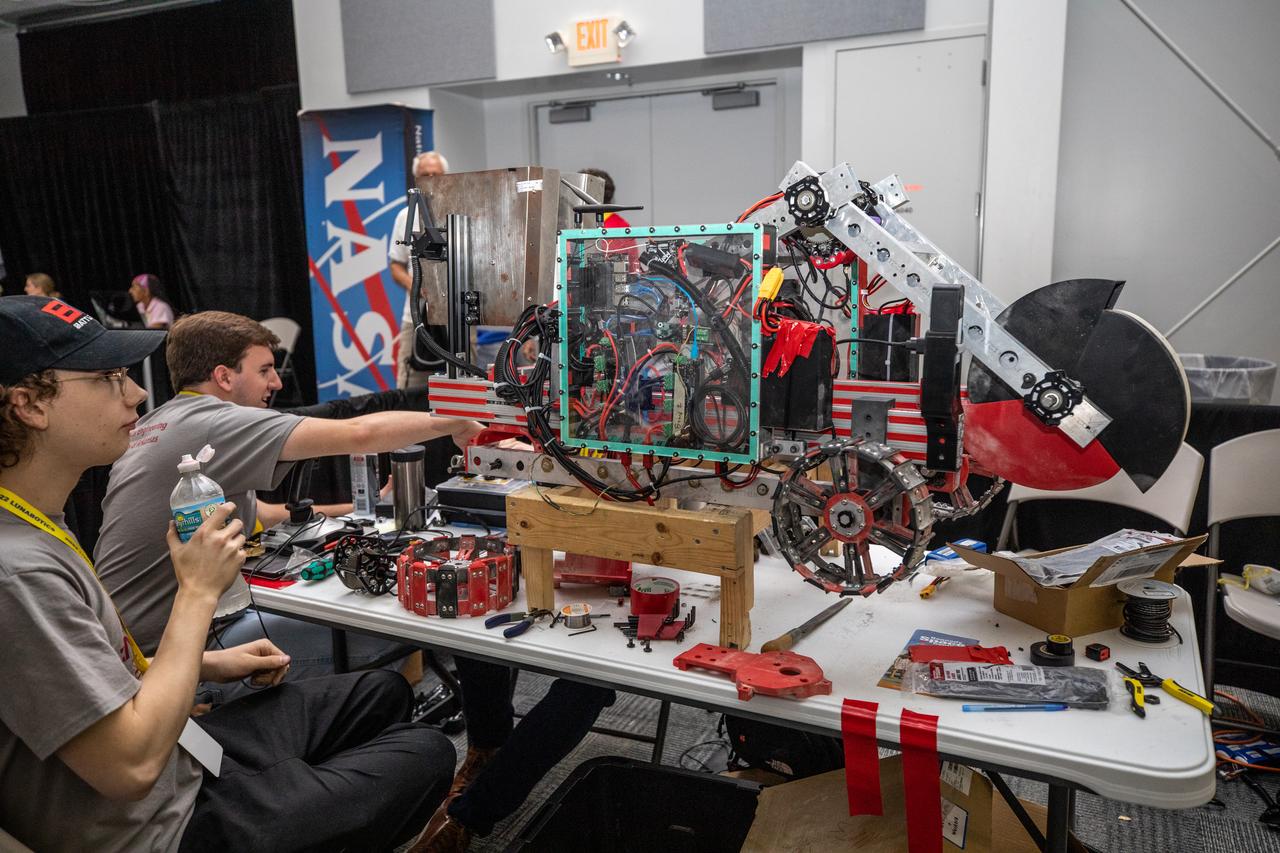
Students from the University of Arkansas prepare their robot for its turn to dig in the mining arena during NASA’s LUNABOTICS competition on May 24, 2022, at the Center for Space Education near the Kennedy Space Center Visitor Complex in Florida. More than 35 teams from around the U.S. have designed and built remote-controlled robots for the mining competition. Teams use their autonomous or remote-controlled robots to maneuver and dig in a supersized sandbox filled with rocks and simulated lunar soil, or regolith. The objective of the challenge is to see which team’s robot can collect and deposit the most rocky regolith within a specified amount of time.

Students from the University of Illinois at Chicago prepare their robotic miner for its turn to dig in the mining arena during NASA’s LUNABOTICS competition on May 26, 2022, at the Center for Space Education near the Kennedy Space Center Visitor Complex in Florida. More than 35 teams from around the U.S. have designed and built remote-controlled robots for the mining competition. Teams use their autonomous or remote-controlled robots to maneuver and dig in a supersized sandbox filled with rocks and simulated lunar soil, or regolith. The objective of the challenge is to see which team’s robot can collect and deposit the most rocky regolith within a specified amount of time.
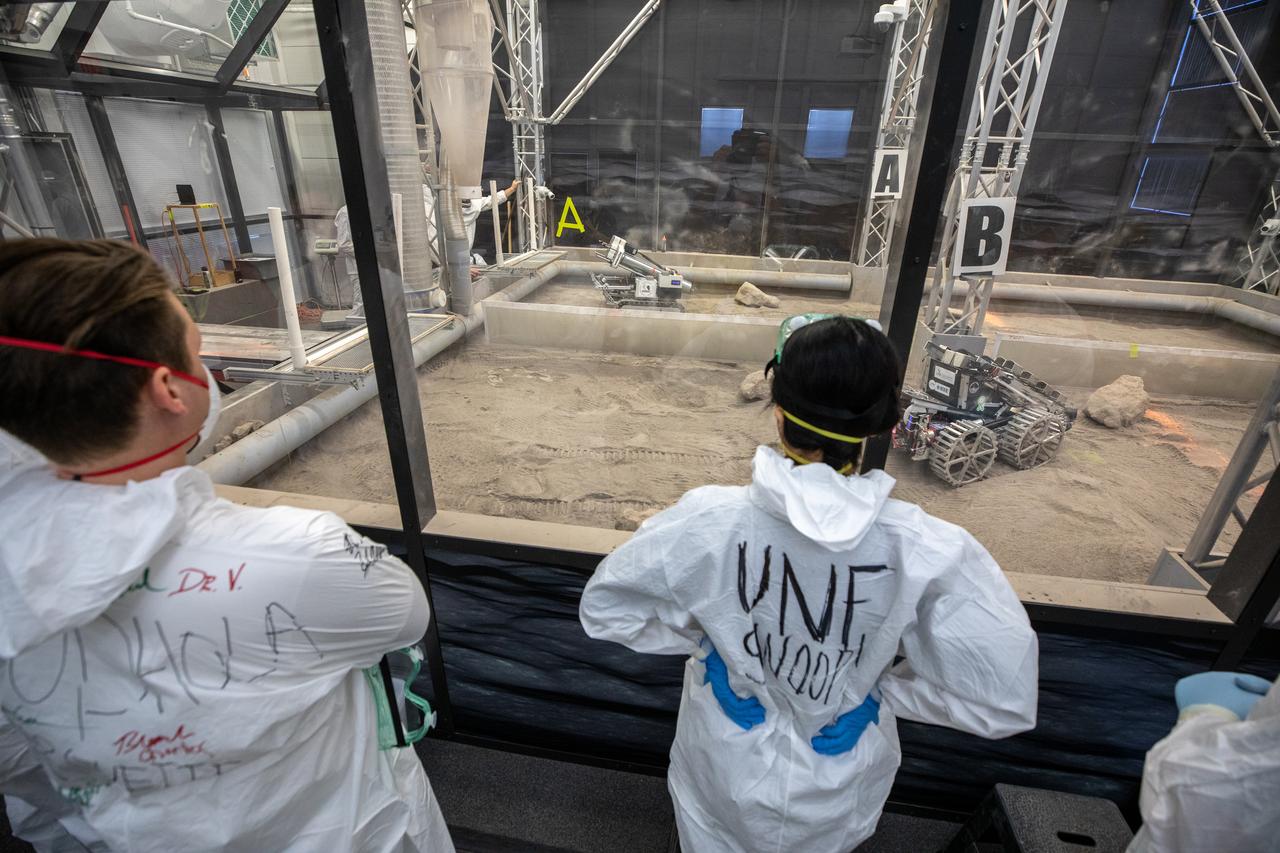
Team members from the University of North Florida watch their robotic miner dig in the mining arena NASA’s LUNABOTICS competition on May 27, 2022, at the Center for Space Education near the Kennedy Space Center Visitor Complex in Florida. More than 35 teams from around the U.S. have designed and built remote-controlled robots for the mining competition. Teams used their autonomous or remote-controlled robots to maneuver and dig in a supersized sandbox filled with lunar simulant and rocks. The objective of the challenge is to see which team’s robot can collect and deposit the most rocky regolith within a specified amount of time.
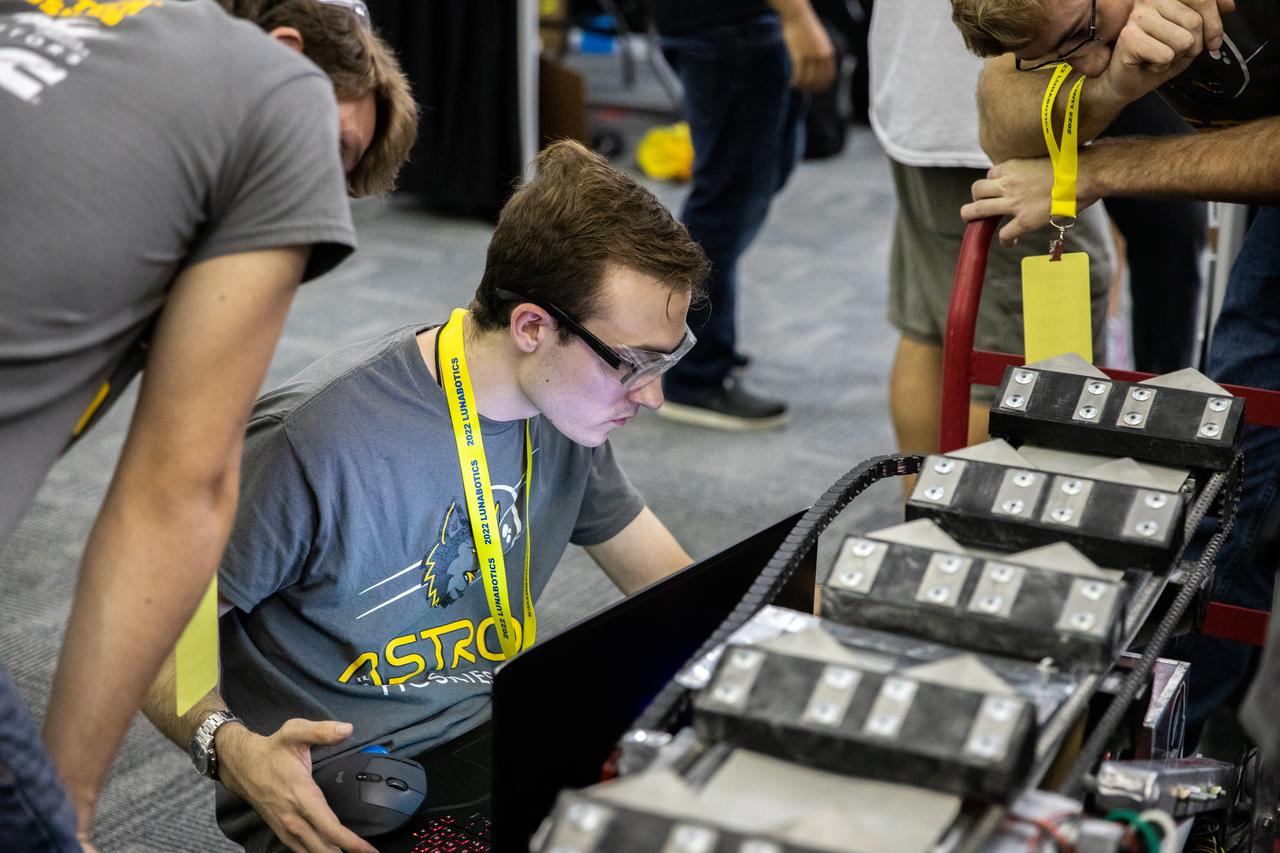
Students from the University of Rochester prepare their robotic miner for its turn to dig in the mining arena during NASA’s LUNABOTICS competition on May 23, 2022, at the Center for Space Education near the Kennedy Space Center Visitor Complex in Florida. More than 35 teams from around the U.S. have designed and built remote-controlled robots for the mining competition. Teams use their autonomous or remote-controlled robots to maneuver and dig in a supersized sandbox filled with rocks and simulated lunar soil, or regolith. The objective of the challenge is to see which team’s robot can collect and deposit the most rocky regolith within a specified amount of time.
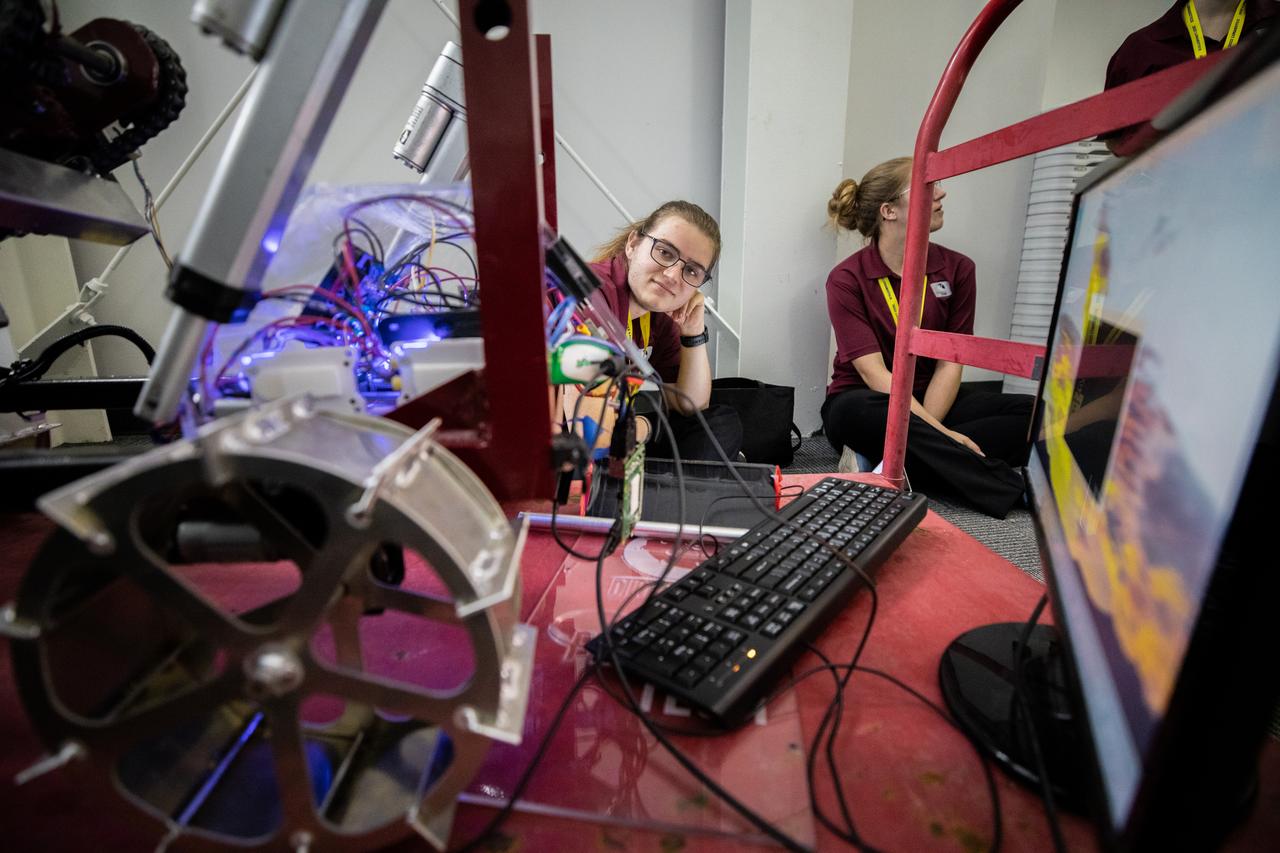
Students with Florida Technological University prepare their robotic miner for its turn to dig in the mining arena during NASA’s LUNABOTICS competition on May 23, 2022, at the Center for Space Education near the Kennedy Space Center Visitor Complex in Florida. More than 35 teams from around the U.S. have designed and built remote-controlled robots for the mining competition. Teams use their autonomous or remote-controlled robots to maneuver and dig in a supersized sandbox filled with rocks and simulated lunar soil, or regolith. The objective of the challenge is to see which team’s robot can collect and deposit the most rocky regolith within a specified amount of time.
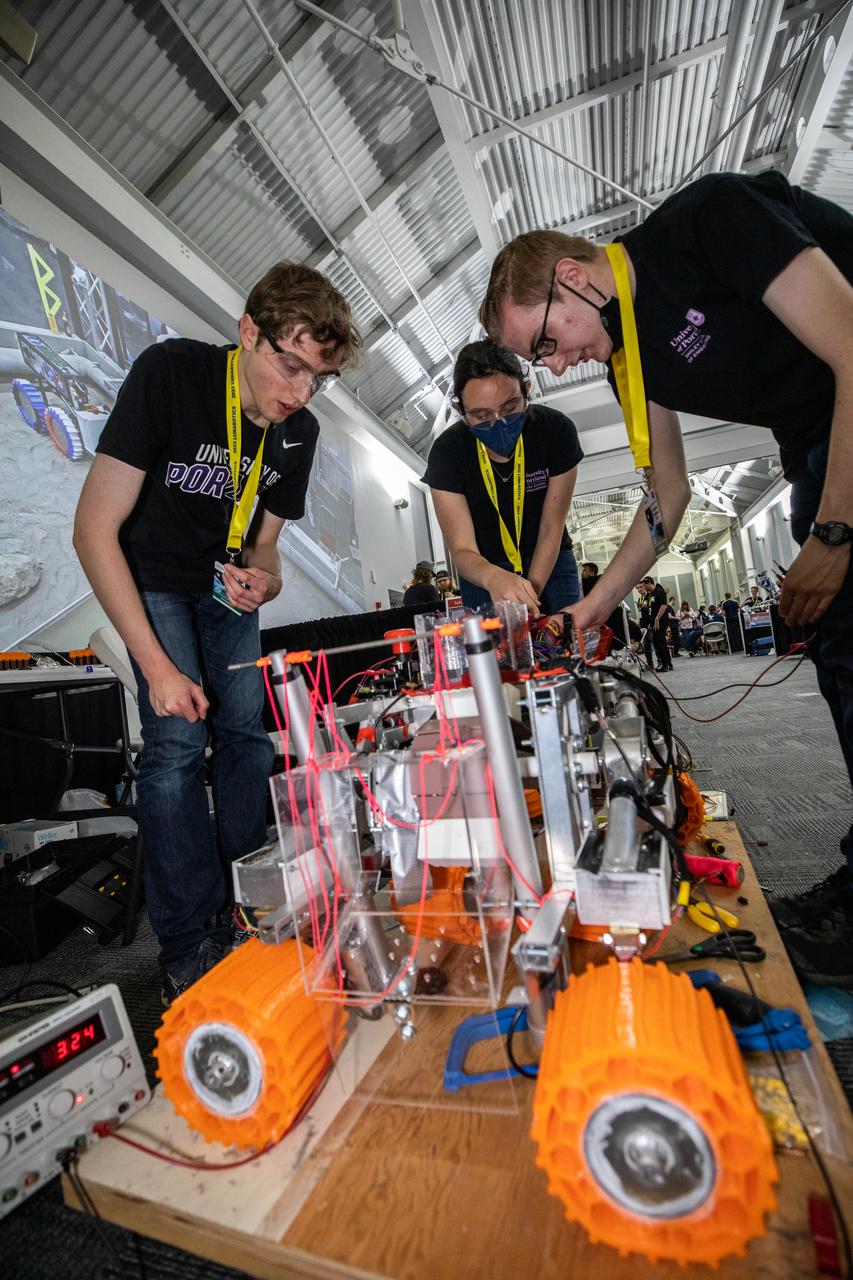
Students from the University of Portland in Oregon prepare their robot miner for its turn to dig in the mining arena during NASA’s LUNABOTICS competition on May 26, 2022, at the Center for Space Education near the Kennedy Space Center Visitor Complex in Florida. More than 35 teams from around the U.S. have designed and built remote-controlled robots for the mining competition. Teams use their semi-autonomous or remote-controlled robots to maneuver and dig in a supersized sandbox filled with rocks and simulated lunar soil, or regolith. The objective of the challenge is to see which team’s robot can collect and deposit the most rocky regolith within a specified amount of time.
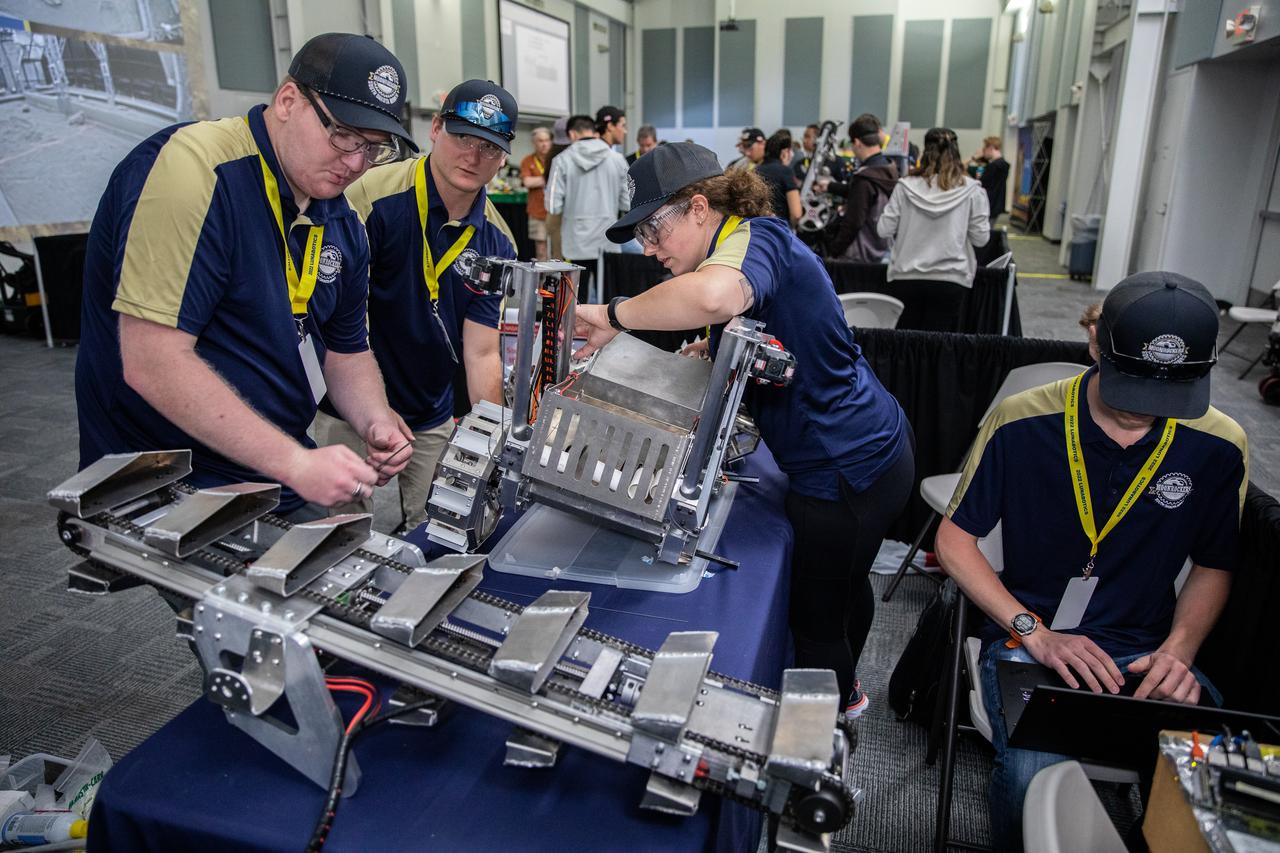
Students from the South Dakota School of Mines and Technology prepare their robotic miner for its turn to dig in the mining arena during NASA’s LUNABOTICS competition on May 26, 2022, at the Center for Space Education near the Kennedy Space Center Visitor Complex in Florida. More than 35 teams from around the U.S. have designed and built remote-controlled robots for the mining competition. Teams use their semi-autonomous or remote-controlled robots to maneuver and dig in a supersized sandbox filled with rocks and simulated lunar soil, or regolith. The objective of the challenge is to see which team’s robot can collect and deposit the most rocky regolith within a specified amount of time.
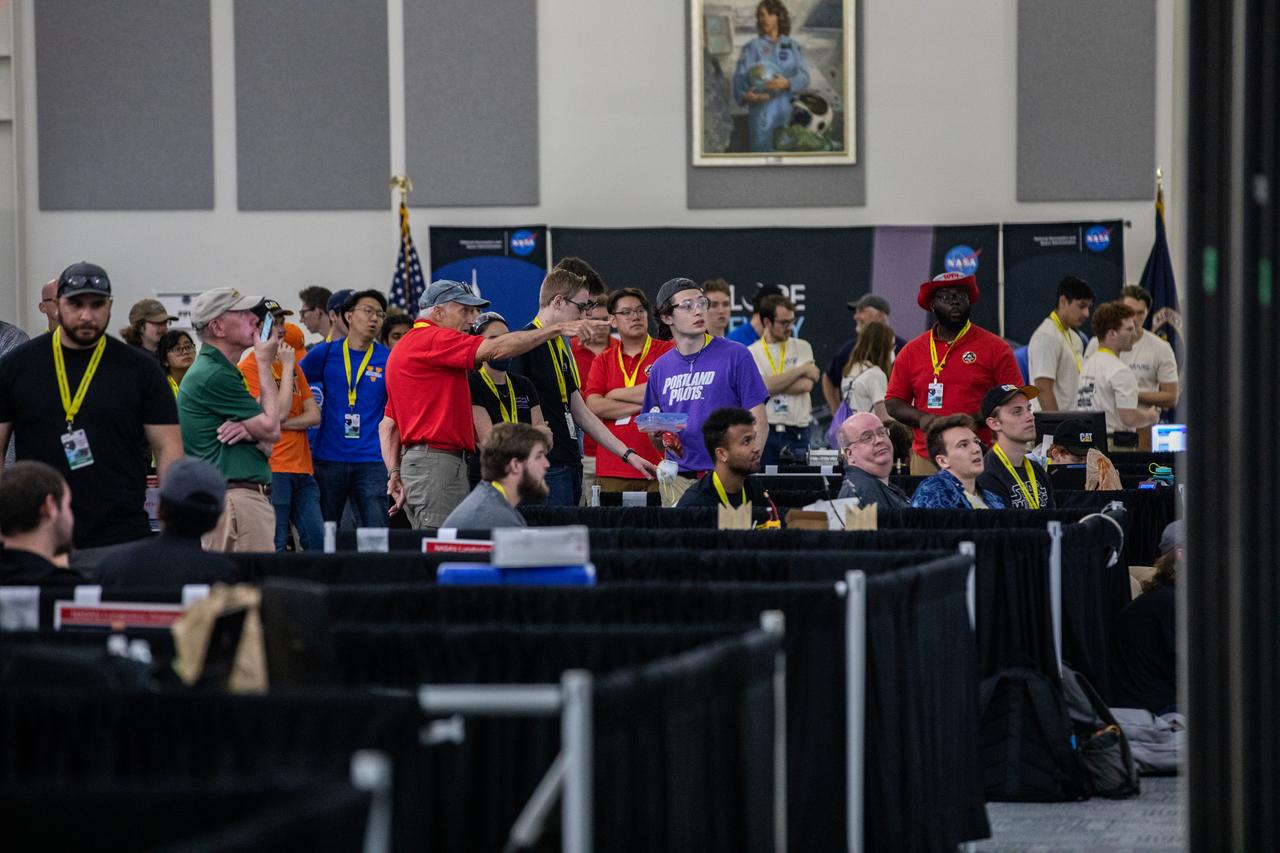
Team members from various colleges and universities watch a jumbo screen as robotic miners dig in the mining arena during NASA’s LUNABOTICS competition on May 26, 2022, at the Center for Space Education near the Kennedy Space Center Visitor Complex in Florida. More than 35 teams from around the U.S. have designed and built remote-controlled robots for the mining competition. Teams use their semi-autonomous or remote-controlled robots to maneuver and dig in a supersized sandbox filled with rocks and simulated lunar soil, or regolith. The objective of the challenge is to see which team’s robot can collect and deposit the most rocky regolith within a specified amount of time.
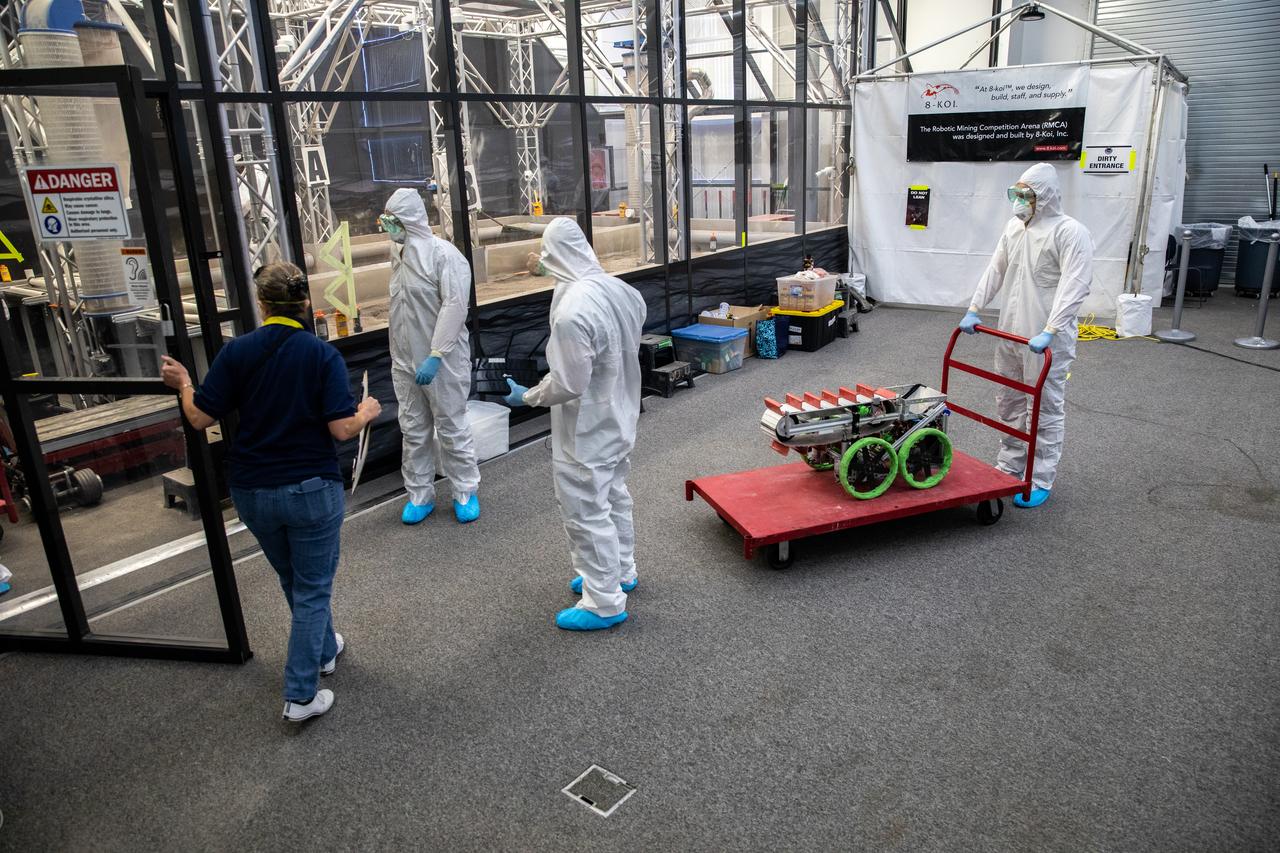
Students from the United States Military Academy (West Point), dressed in safety gear, prepare to enter the mining arena with their robotic miner during NASA’s LUNABOTICS competition on May 24, 2022, at the Center for Space Education near the Kennedy Space Center Visitor Complex in Florida. More than 35 teams from around the U.S. have designed and built remote-controlled robots for the mining competition. Teams use their autonomous or remote-controlled robots to maneuver and dig in a supersized sandbox filled with rocks and simulated lunar soil, or regolith. The objective of the challenge is to see which team’s robot can collect and deposit the most rocky regolith within a specified amount of time.
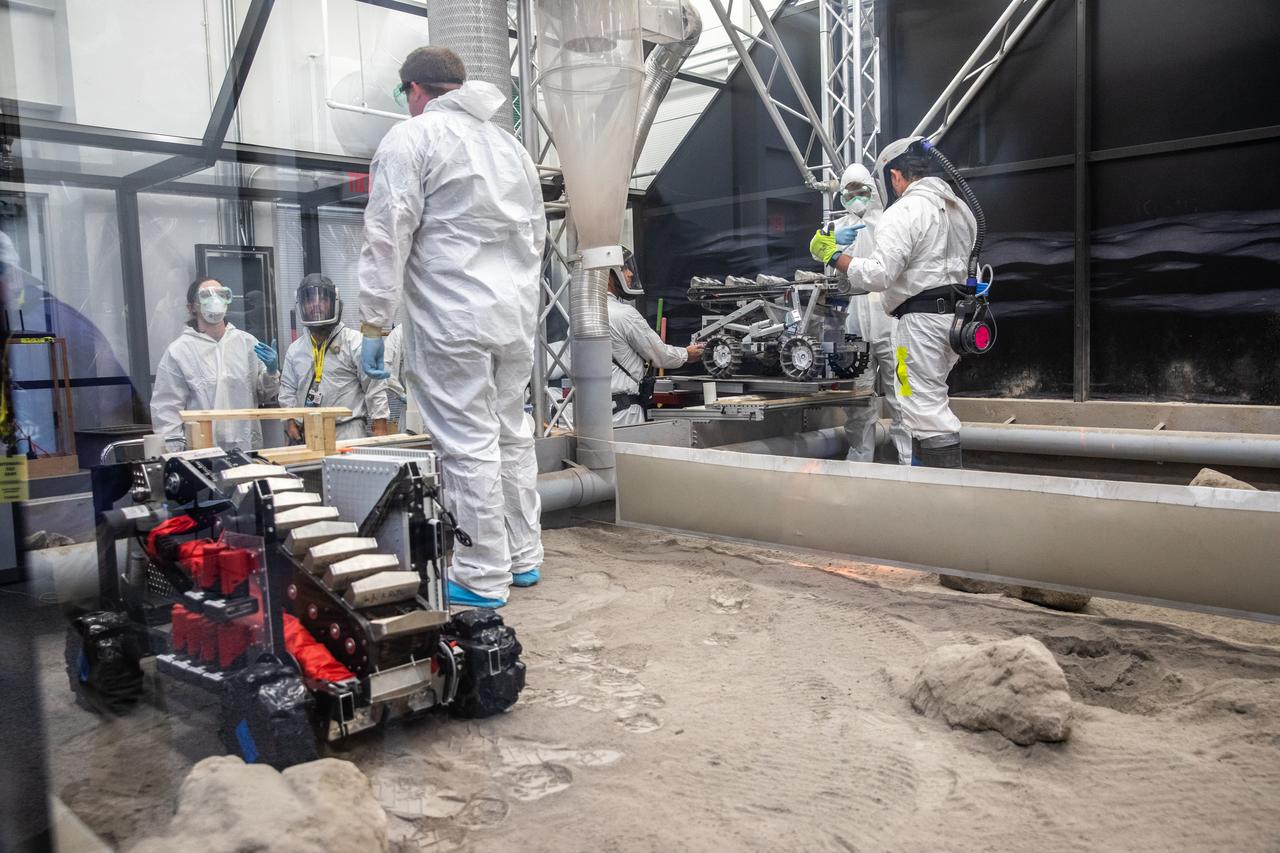
The Milwaukee School of Engineering’s robotic miner is ready for its turn to dig in the mining arena during NASA’s LUNABOTICS competition on May 24, 2022, at the Center for Space Education near the Kennedy Space Center Visitor Complex in Florida. More than 35 teams from around the U.S. have designed and built remote-controlled robots for the mining competition. Teams use their autonomous or remote-controlled robots to maneuver and dig in a supersized sandbox filled with rocks and simulated lunar soil, or regolith. The objective of the challenge is to see which team’s robot can collect and deposit the most rocky regolith within a specified amount of time.
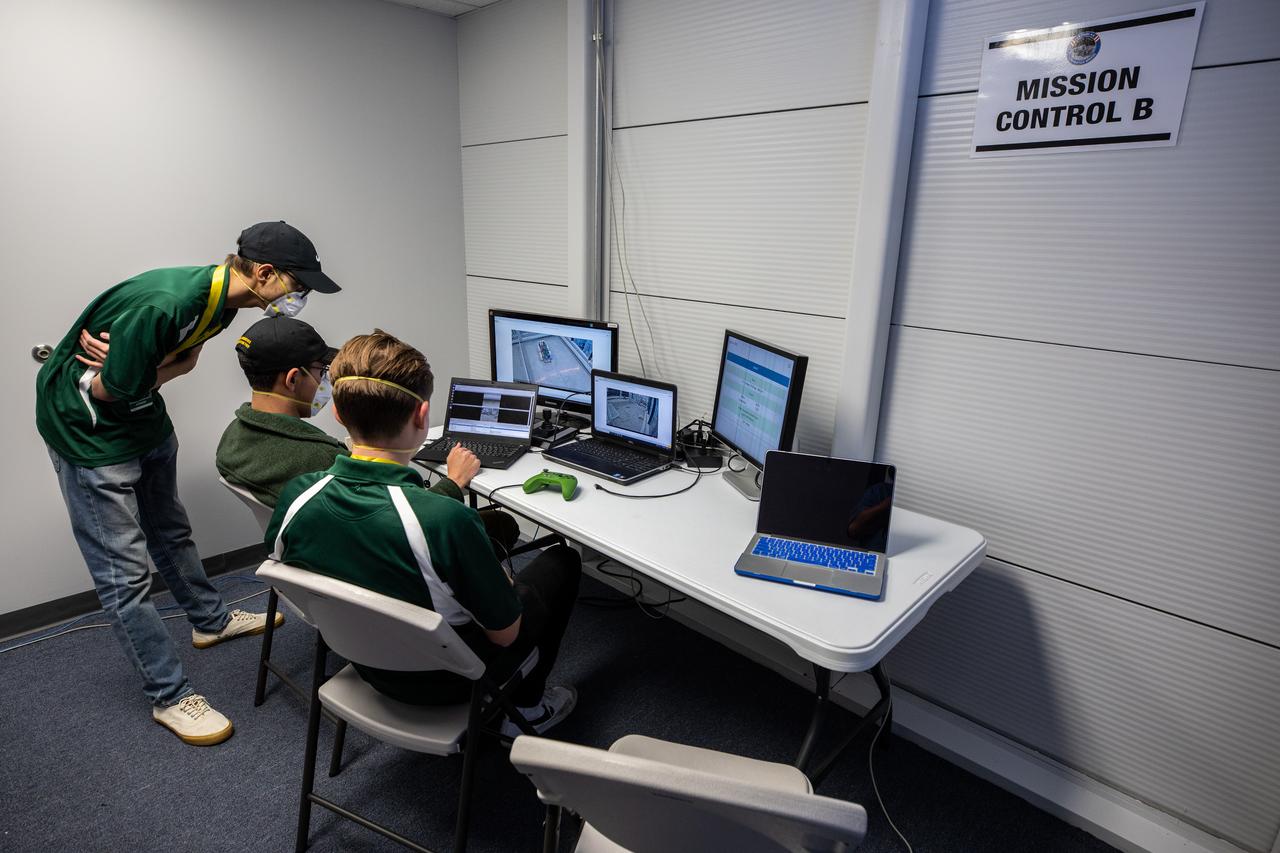
Team members from the College of DuPage in Illinois control their robotic miner in the mining arena during NASA’s LUNABOTICS competition on May 26, 2022, at the Center for Space Education near the Kennedy Space Center Visitor Complex in Florida. More than 35 teams from around the U.S. have designed and built remote-controlled robots for the mining competition. Teams use their semi-autonomous or remote-controlled robots to maneuver and dig in a supersized sandbox filled with rocks and simulated lunar soil, or regolith. The objective of the challenge is to see which team’s robot can collect and deposit the most rocky regolith within a specified amount of time.

Students from the University of Miami build a robotic miner to compete in this year’s Lunabotics competition. More than 40 teams from around the U.S. participated in the competition, designing and building remote-controlled robots under constraints similar to those the agency will face as it returns to the lunar surface through Artemis. The objective of the challenge is to see which team’s robot can collect and deposit the most rocky regolith within a specified amount of time.
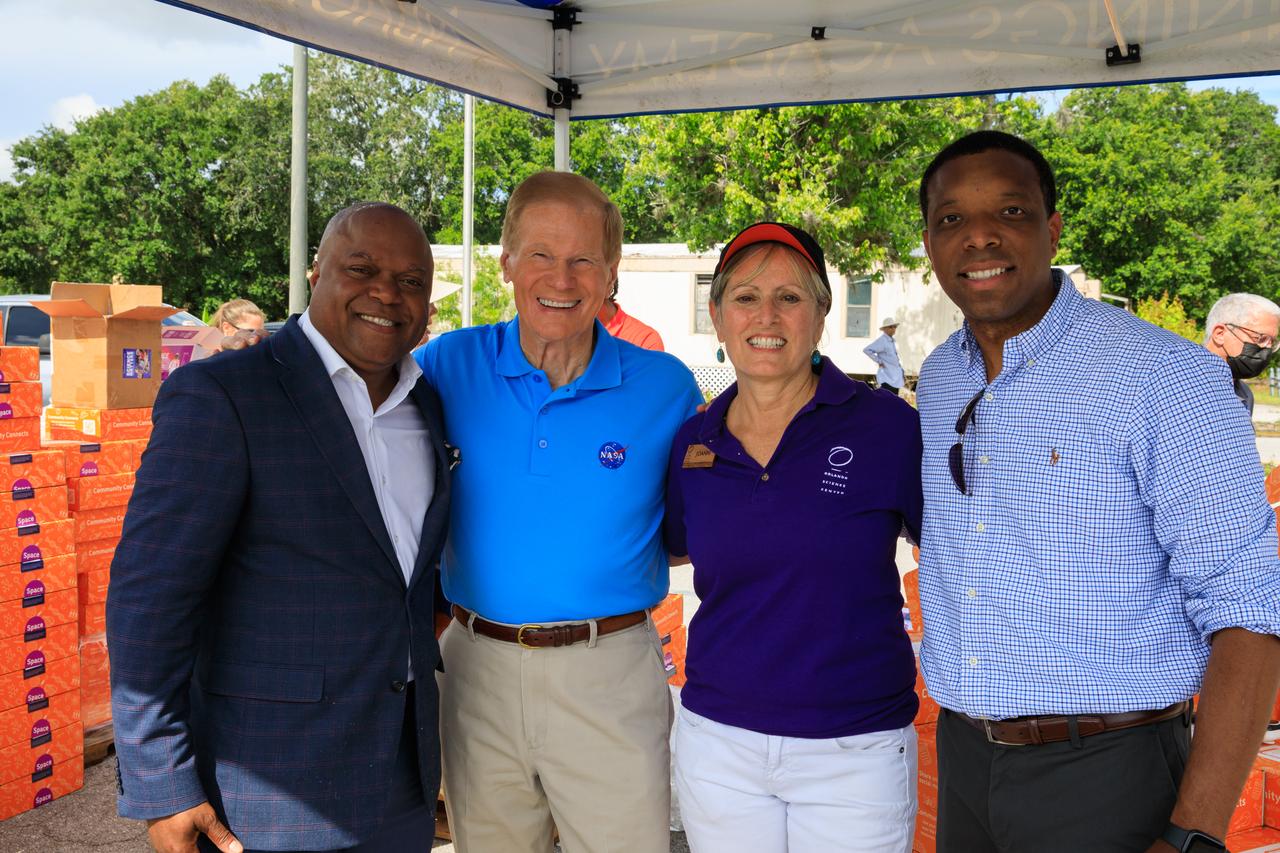
From left to right, Dr. Frederic Bertley, president and CEO, Center of Science and Industry (COSI); NASA Administrator Bill Nelson; JoAnn Newman, president and CEO, Orlando Science Center; and Stephen White, chief strategy officer, COSI helped kick off a new initiative to deliver food and hands-on science, technology, engineering, and math kits, called Learning Lunchboxes, at New Beginnings Church – The Gathering Place in Orlando, Florida on Friday, June 3. The lunchboxes are aimed at inspiring and educating youth and families about NASA’s upcoming Artemis missions, which includes landing the first woman and person of color on the Moon and helping prepare for human exploration of Mars. Partners on the initiative with NASA include COSI, the Second Harvest Food Bank, and the Orlando Science Center. The NASA Artemis Learning Lunchbox is made possible through NASA’s Teams Engaging Affiliated Museums and Informal Institutions (TEAM II) program. NASA Learning Lunchboxes provide five space-focused learning activities that showcase the diversity of STEM at NASA. COSI will distribute 30,000 NASA Learning Lunchboxes at local food banks across the country to help feed hungry lives and feed hungry minds. This innovative, community-based model will bring together other science centers and museums, afterschool providers, and community leaders to highlight the importance of STEM. This project also includes digital extension resources.
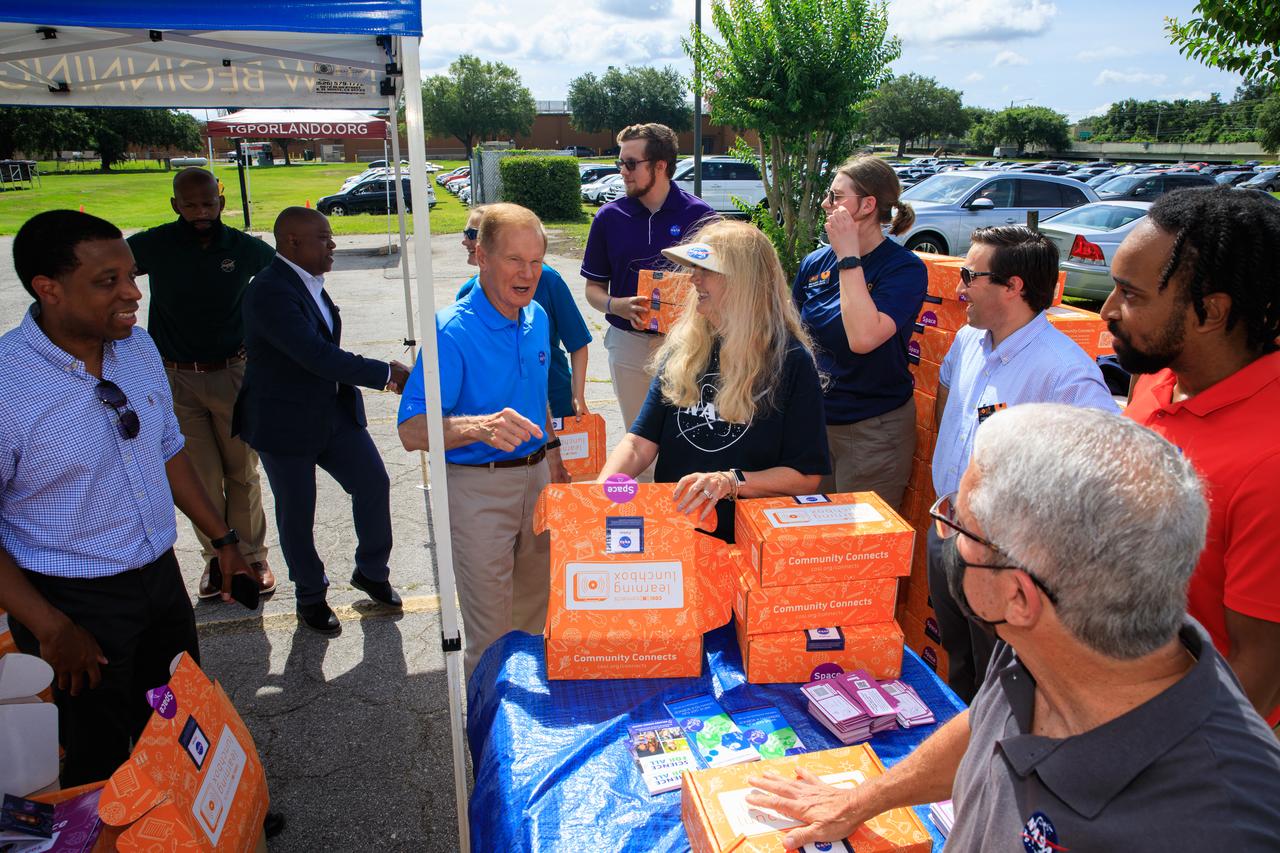
NASA Administrator Bill Nelson helped kick off a new initiative to deliver food and hands-on science, technology, engineering, and math kits, called Learning Lunchboxes, at New Beginnings Church – The Gathering Place in Orlando, Florida on Friday, June 3. The lunchboxes are aimed at inspiring and educating youth and families about NASA’s upcoming Artemis missions, which includes landing the first woman and person of color on the Moon and helping prepare for human exploration of Mars. Partners on the initiative with NASA include the Center of Science and Industry, the Second Harvest Food Bank, and the Orlando Science Center. The NASA Artemis Learning Lunchbox is made possible through NASA’s Teams Engaging Affiliated Museums and Informal Institutions (TEAM II) program. NASA Learning Lunchboxes provide five space-focused learning activities that showcase the diversity of STEM at NASA. COSI will distribute 30,000 NASA Learning Lunchboxes at local food banks across the country to help feed hungry lives and feed hungry minds. This innovative, community-based model will bring together other science centers and museums, afterschool providers, and community leaders to highlight the importance of STEM. This project also includes digital extension resources.
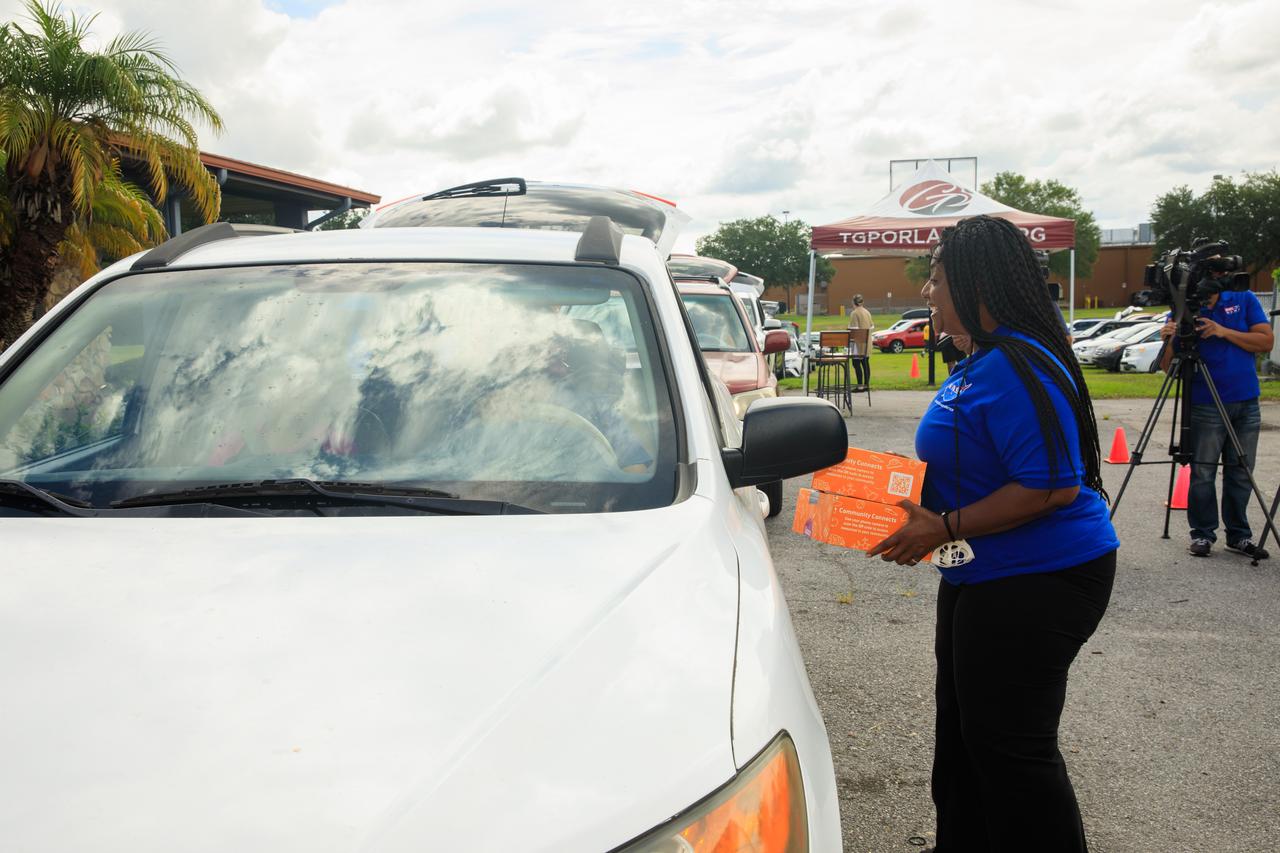
Barbara Brown, director of the Exploration Research and Technology Program at Kennedy Space Center in Florida, helped kick off a new initiative to deliver food and hands-on science, technology, engineering, and math kits, called Learning Lunchboxes, at New Beginnings Church – The Gathering Place in Orlando, Florida on Friday, June 3. The lunchboxes are aimed at inspiring and educating youth and families about NASA’s upcoming Artemis missions, which includes landing the first woman and person of color on the Moon and helping prepare for human exploration of Mars. Partners on the initiative with NASA include the Center of Science and Industry, the Second Harvest Food Bank, and the Orlando Science Center. The NASA Artemis Learning Lunchbox is made possible through NASA’s Teams Engaging Affiliated Museums and Informal Institutions (TEAM II) program. NASA Learning Lunchboxes provide five space-focused learning activities that showcase the diversity of STEM at NASA. COSI will distribute 30,000 NASA Learning Lunchboxes at local food banks across the country to help feed hungry lives and feed hungry minds. This innovative, community-based model will bring together other science centers and museums, afterschool providers, and community leaders to highlight the importance of STEM. This project also includes digital extension resources.
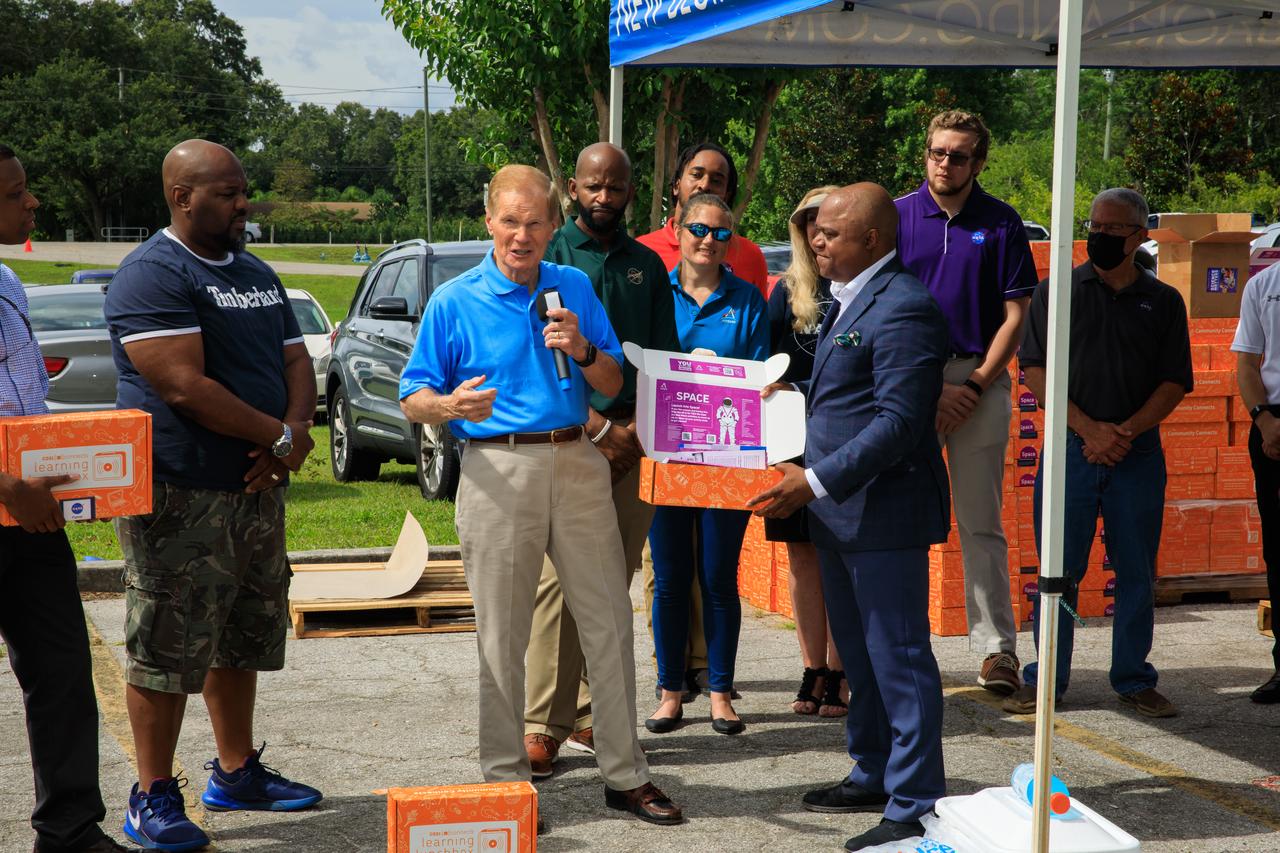
NASA Administrator Bill Nelson helped kick off a new initiative to deliver food and hands-on science, technology, engineering, and math kits, called Learning Lunchboxes, at New Beginnings Church – The Gathering Place in Orlando, Florida on Friday, June 3. The lunchboxes are aimed at inspiring and educating youth and families about NASA’s upcoming Artemis missions, which includes landing the first woman and person of color on the Moon and helping prepare for human exploration of Mars. Partners on the initiative with NASA include the Center of Science and Industry, the Second Harvest Food Bank, and the Orlando Science Center. The NASA Artemis Learning Lunchbox is made possible through NASA’s Teams Engaging Affiliated Museums and Informal Institutions (TEAM II) program. NASA Learning Lunchboxes provide five space-focused learning activities that showcase the diversity of STEM at NASA. COSI will distribute 30,000 NASA Learning Lunchboxes at local food banks across the country to help feed hungry lives and feed hungry minds. This innovative, community-based model will bring together other science centers and museums, afterschool providers, and community leaders to highlight the importance of STEM. This project also includes digital extension resources.
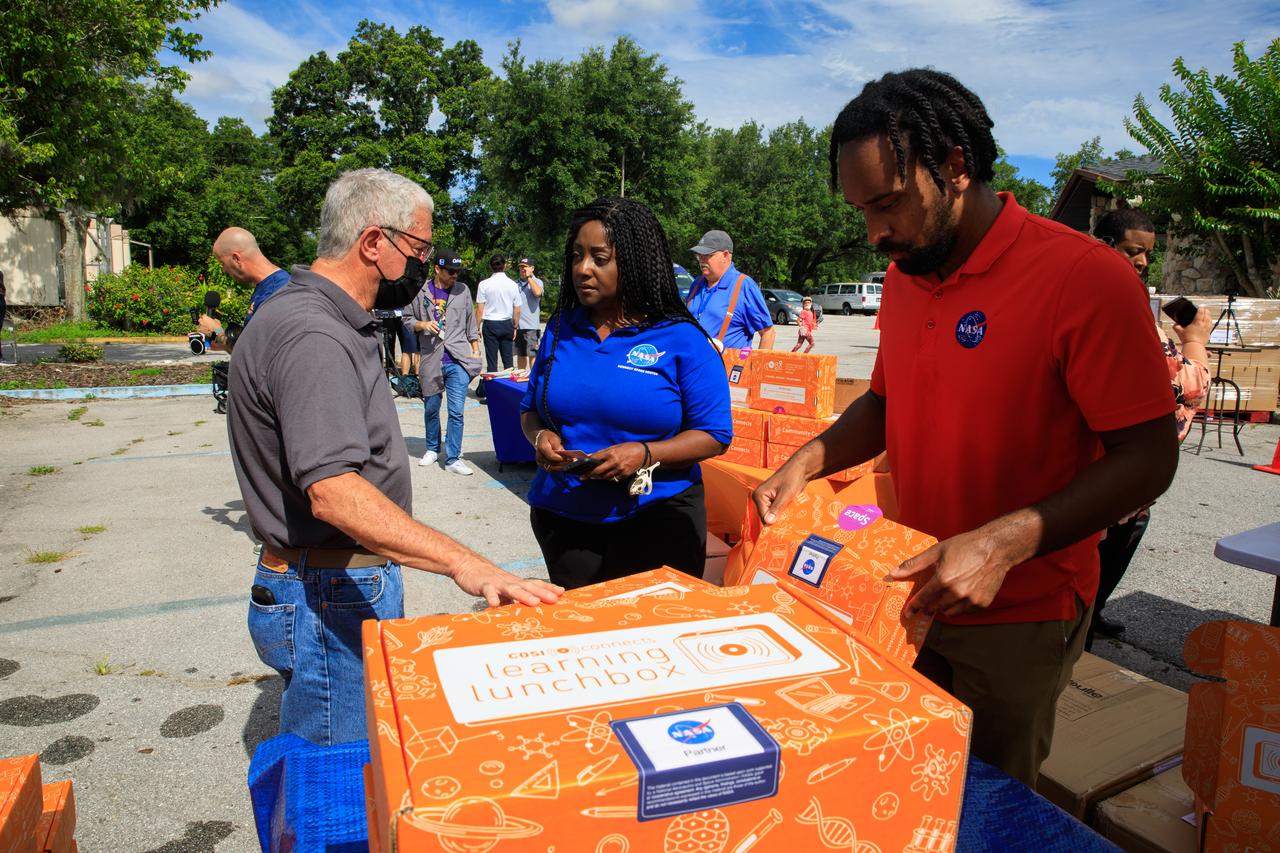
Barbara Brown (center), director of the Exploration Research and Technology Program at Kennedy Space Center in Florida, helped kick off a new initiative to deliver food and hands-on science, technology, engineering, and math kits, called Learning Lunchboxes, at New Beginnings Church – The Gathering Place in Orlando, Florida on Friday, June 3. The lunchboxes are aimed at inspiring and educating youth and families about NASA’s upcoming Artemis missions, which includes landing the first woman and person of color on the Moon and helping prepare for human exploration of Mars. Partners on the initiative with NASA include the Center of Science and Industry, the Second Harvest Food Bank, and the Orlando Science Center. The NASA Artemis Learning Lunchbox is made possible through NASA’s Teams Engaging Affiliated Museums and Informal Institutions (TEAM II) program. NASA Learning Lunchboxes provide five space-focused learning activities that showcase the diversity of STEM at NASA. COSI will distribute 30,000 NASA Learning Lunchboxes at local food banks across the country to help feed hungry lives and feed hungry minds. This innovative, community-based model will bring together other science centers and museums, afterschool providers, and community leaders to highlight the importance of STEM. This project also includes digital extension resources.
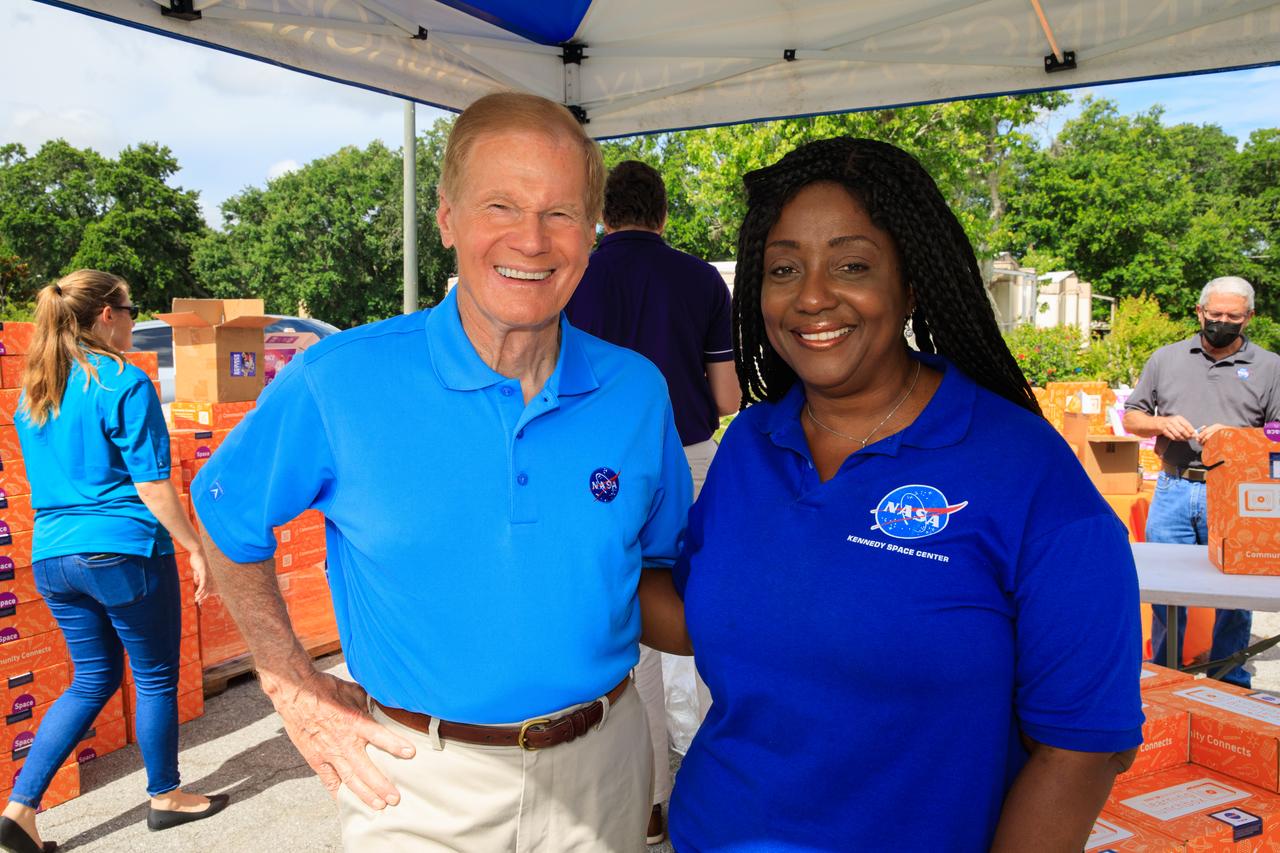
NASA Administrator Bill Nelson (left) and Barbara Brown (right), director of the Exploration Research and Technology Program at Kennedy Space Center in Florida, helped kick off a new initiative to deliver food and hands-on science, technology, engineering, and math kits, called Learning Lunchboxes, at New Beginnings Church – The Gathering Place in Orlando, Florida on Friday, June 3. The lunchboxes are aimed at inspiring and educating youth and families about NASA’s upcoming Artemis missions, which includes landing the first woman and person of color on the Moon and helping prepare for human exploration of Mars. Partners on the initiative with NASA include the Center of Science and Industry, the Second Harvest Food Bank, and the Orlando Science Center. The NASA Artemis Learning Lunchbox is made possible through NASA’s Teams Engaging Affiliated Museums and Informal Institutions (TEAM II) program. NASA Learning Lunchboxes provide five space-focused learning activities that showcase the diversity of STEM at NASA. COSI will distribute 30,000 NASA Learning Lunchboxes at local food banks across the country to help feed hungry lives and feed hungry minds. This innovative, community-based model will bring together other science centers and museums, afterschool providers, and community leaders to highlight the importance of STEM. This project also includes digital extension resources.
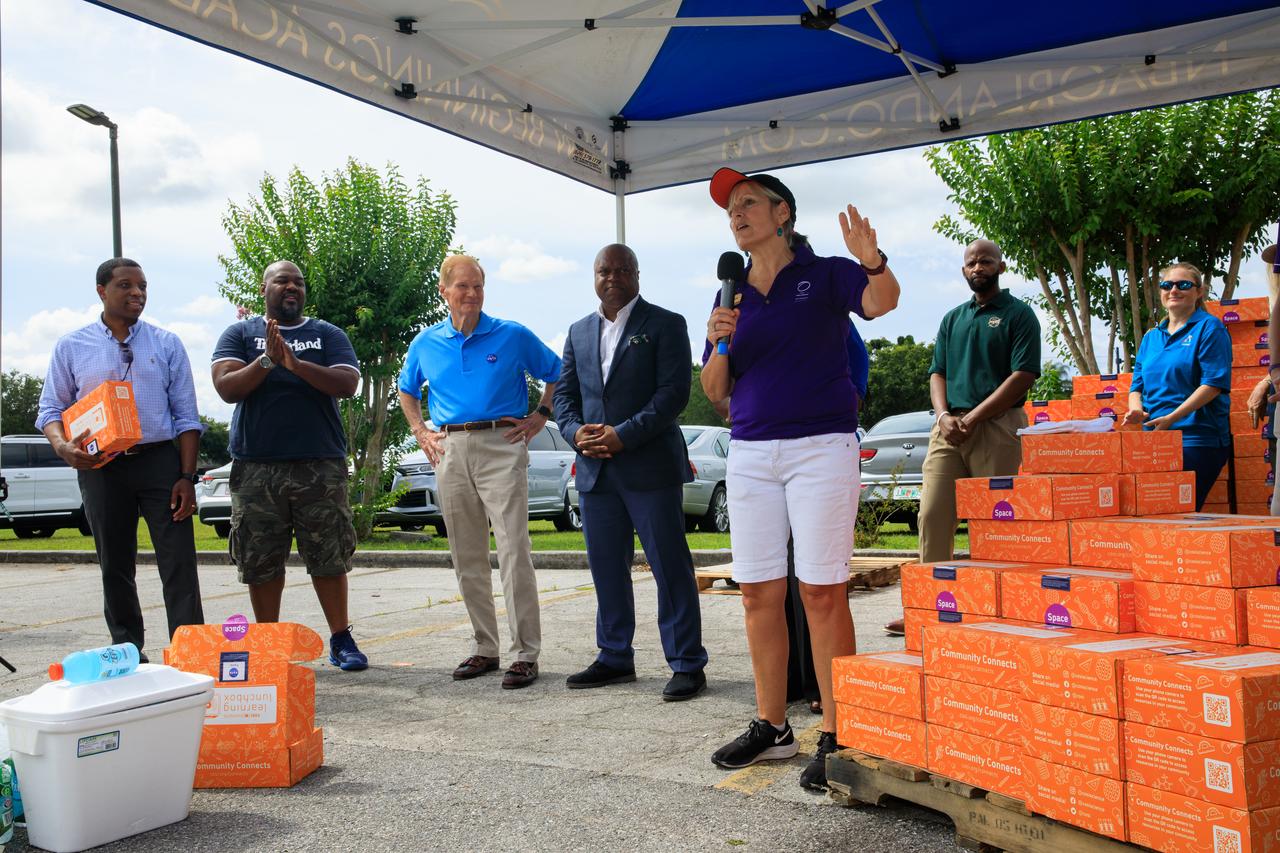
Dr. Frederic Bertley (center), president and CEO, Center of Science and Industry (COSI), speaks at New Beginnings Church – The Gathering Place in Orlando, Florida on Friday, June 3, as part of the launch of a new initiative to deliver food and hands-on science, technology, engineering, and math kits, called Learning Lunchboxes. NASA Administrator Bill Nelson and other agency representatives were on hand to hand out the lunchboxes, which are aimed at inspiring and educating youth and families about NASA’s upcoming Artemis missions, including landing the first woman and person of color on the Moon and helping prepare for human exploration of Mars. Along with COSI, NASA’s partners on the initiative include the Second Harvest Food Bank and the Orlando Science Center. The NASA Artemis Learning Lunchbox is made possible through NASA’s Teams Engaging Affiliated Museums and Informal Institutions (TEAM II) program. NASA Learning Lunchboxes provide five space-focused learning activities that showcase the diversity of STEM at NASA. COSI will distribute 30,000 NASA Learning Lunchboxes at local food banks across the country to help feed hungry lives and feed hungry minds. This innovative, community-based model will bring together other science centers and museums, afterschool providers, and community leaders to highlight the importance of STEM. This project also includes digital extension resources.
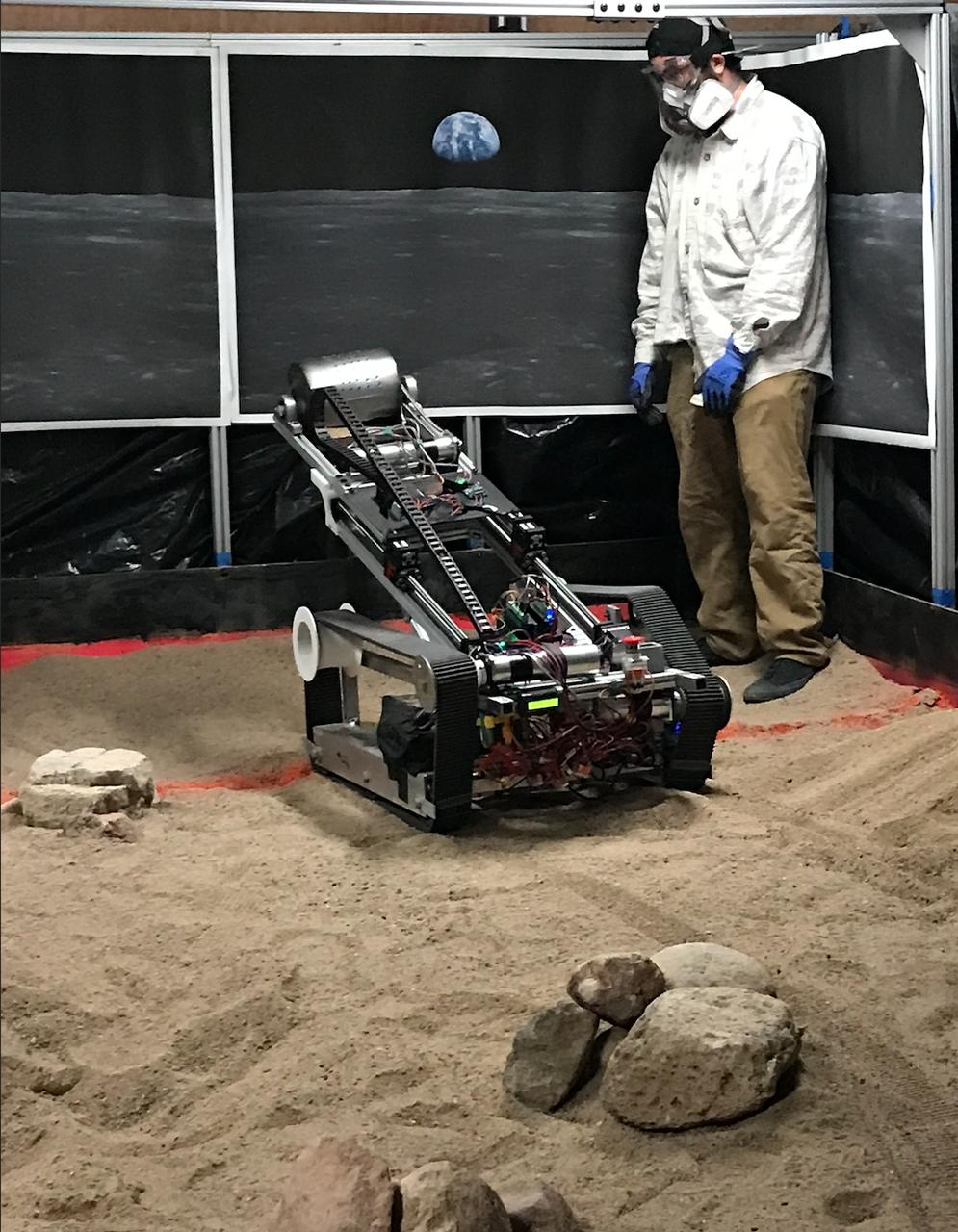
The New Mexico College of Mining and Technology robotic miner takes its first dig in the school’s mining arena. More than 40 teams from around the U.S. participated in NASA’s Lunabotics competition, which challenges collegiate teams to design and built remote-controlled robots under constraints similar to those the agency will face as it returns to the lunar surface through Artemis. The objective of the challenge is to see which team’s robot can collect and deposit the most rocky regolith within a specified amount of time.
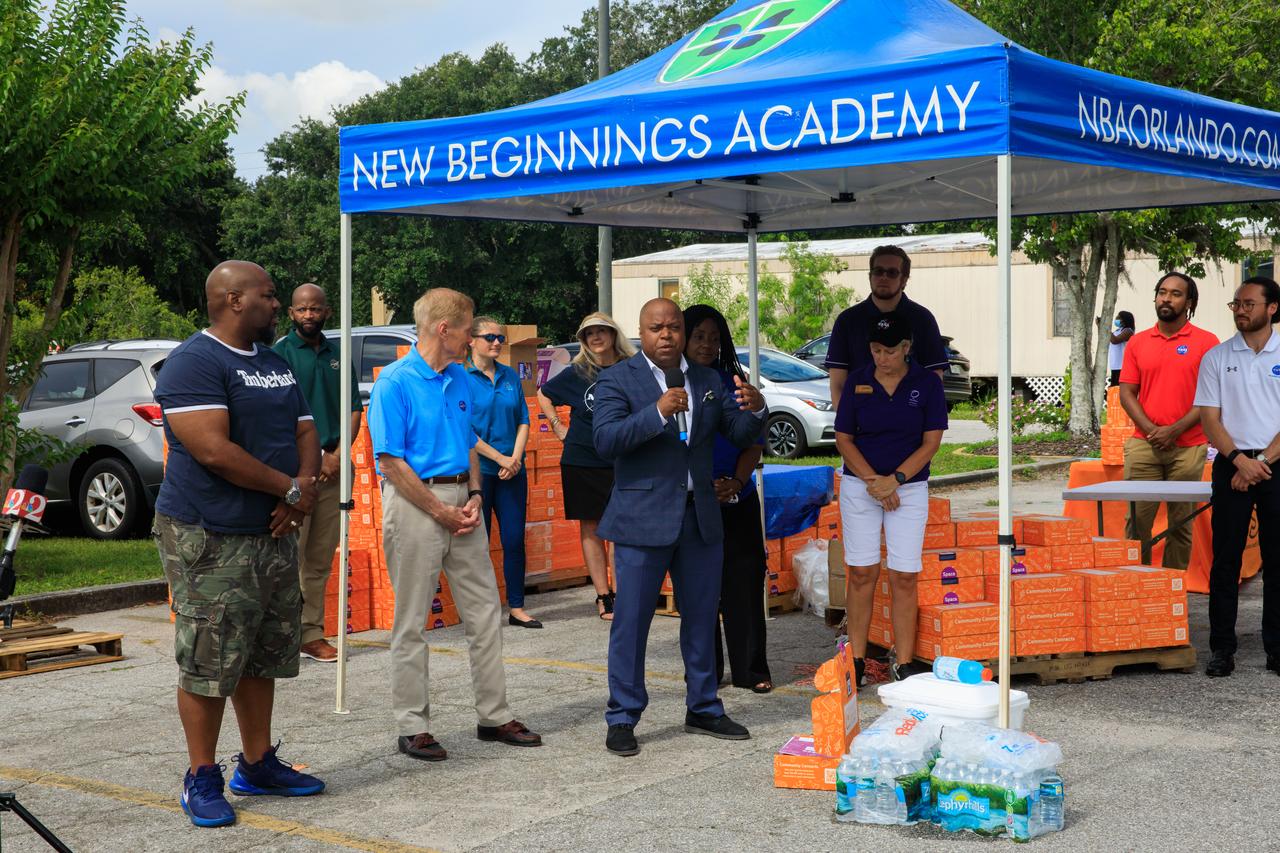
Dr. Frederic Bertley (center), president and CEO, Center of Science and Industry (COSI), speaks at New Beginnings Church – The Gathering Place in Orlando, Florida on Friday, June 3, as part of the launch of a new initiative to deliver food and hands-on science, technology, engineering, and math kits, called Learning Lunchboxes. NASA Administrator Bill Nelson and other agency representatives were on hand to hand out the lunchboxes, which are aimed at inspiring and educating youth and families about NASA’s upcoming Artemis missions, including landing the first woman and person of color on the Moon and helping prepare for human exploration of Mars. Along with COSI, NASA’s partners on the initiative include the Second Harvest Food Bank and the Orlando Science Center. The NASA Artemis Learning Lunchbox is made possible through NASA’s Teams Engaging Affiliated Museums and Informal Institutions (TEAM II) program. NASA Learning Lunchboxes provide five space-focused learning activities that showcase the diversity of STEM at NASA. COSI will distribute 30,000 NASA Learning Lunchboxes at local food banks across the country to help feed hungry lives and feed hungry minds. This innovative, community-based model will bring together other science centers and museums, afterschool providers, and community leaders to highlight the importance of STEM. This project also includes digital extension resources.
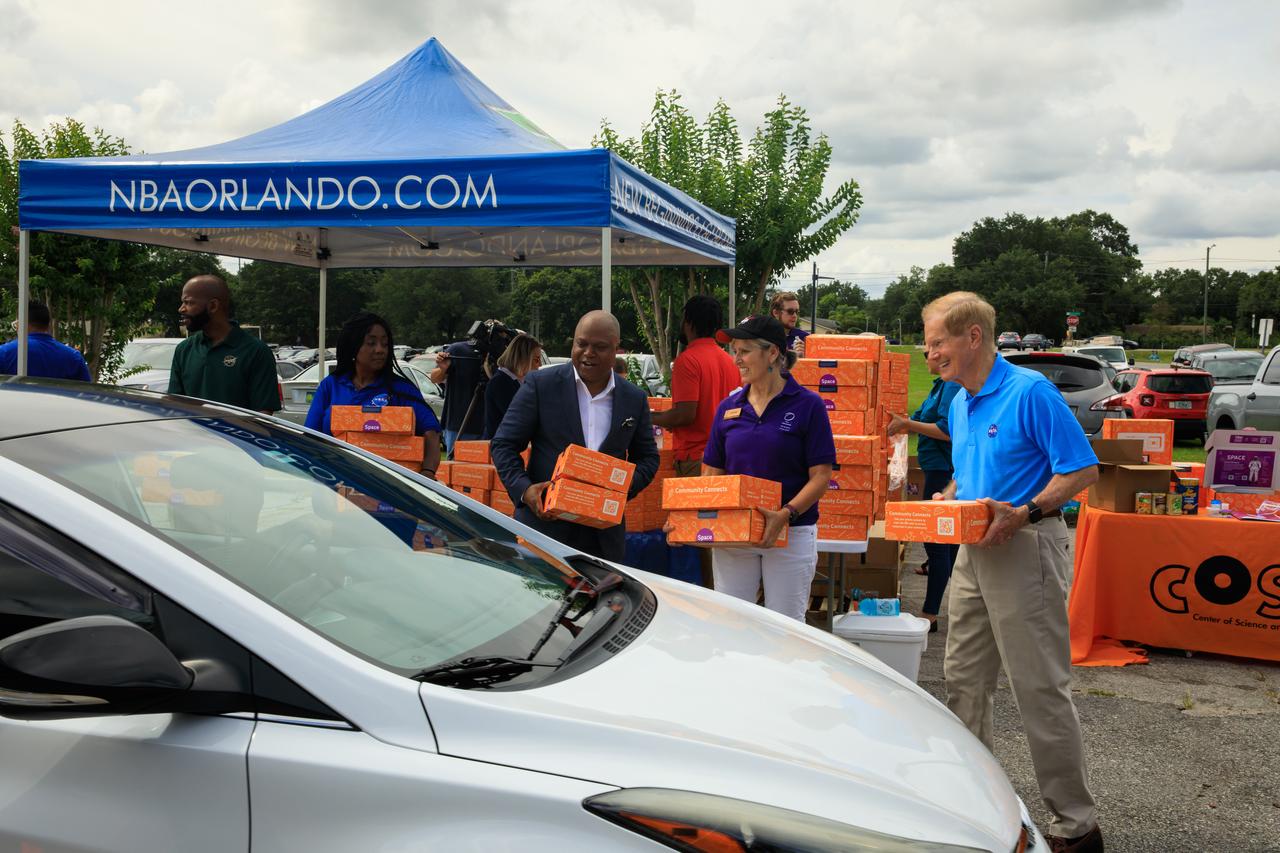
NASA Administrator Bill Nelson helped kick off a new initiative to deliver food and hands-on science, technology, engineering, and math kits, called Learning Lunchboxes, at New Beginnings Church – The Gathering Place in Orlando, Florida on Friday, June 3. The lunchboxes are aimed at inspiring and educating youth and families about NASA’s upcoming Artemis missions, which includes landing the first woman and person of color on the Moon and helping prepare for human exploration of Mars. Partners on the initiative with NASA include the Center of Science and Industry, the Second Harvest Food Bank, and the Orlando Science Center. The NASA Artemis Learning Lunchbox is made possible through NASA’s Teams Engaging Affiliated Museums and Informal Institutions (TEAM II) program. NASA Learning Lunchboxes provide five space-focused learning activities that showcase the diversity of STEM at NASA. COSI will distribute 30,000 NASA Learning Lunchboxes at local food banks across the country to help feed hungry lives and feed hungry minds. This innovative, community-based model will bring together other science centers and museums, afterschool providers, and community leaders to highlight the importance of STEM. This project also includes digital extension resources.
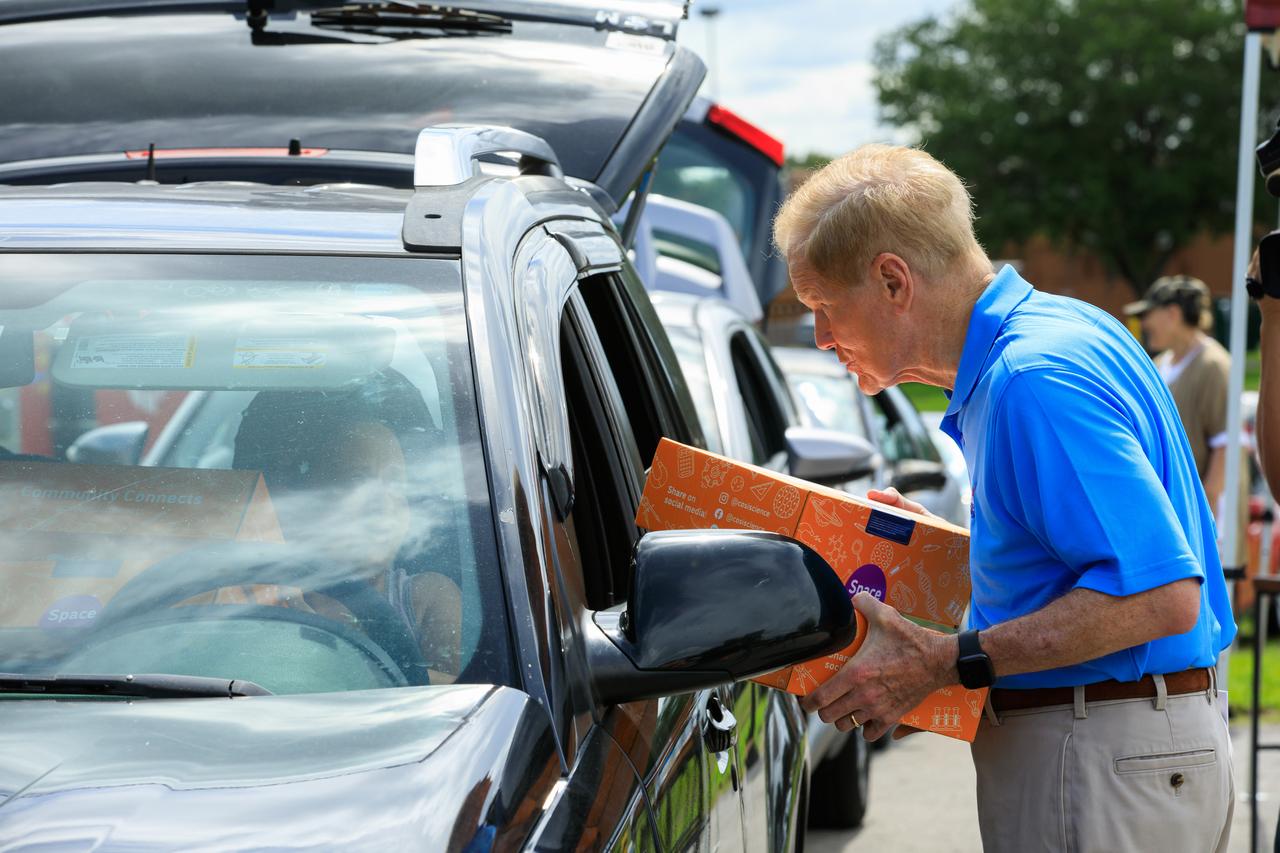
NASA Administrator Bill Nelson helped kick off a new initiative to deliver food and hands-on science, technology, engineering, and math kits, called Learning Lunchboxes, at New Beginnings Church – The Gathering Place in Orlando, Florida on Friday, June 3. The lunchboxes are aimed at inspiring and educating youth and families about NASA’s upcoming Artemis missions, which includes landing the first woman and person of color on the Moon and helping prepare for human exploration of Mars. Partners on the initiative with NASA include the Center of Science and Industry, the Second Harvest Food Bank, and the Orlando Science Center. The NASA Artemis Learning Lunchbox is made possible through NASA’s Teams Engaging Affiliated Museums and Informal Institutions (TEAM II) program. NASA Learning Lunchboxes provide five space-focused learning activities that showcase the diversity of STEM at NASA. COSI will distribute 30,000 NASA Learning Lunchboxes at local food banks across the country to help feed hungry lives and feed hungry minds. This innovative, community-based model will bring together other science centers and museums, afterschool providers, and community leaders to highlight the importance of STEM. This project also includes digital extension resources.
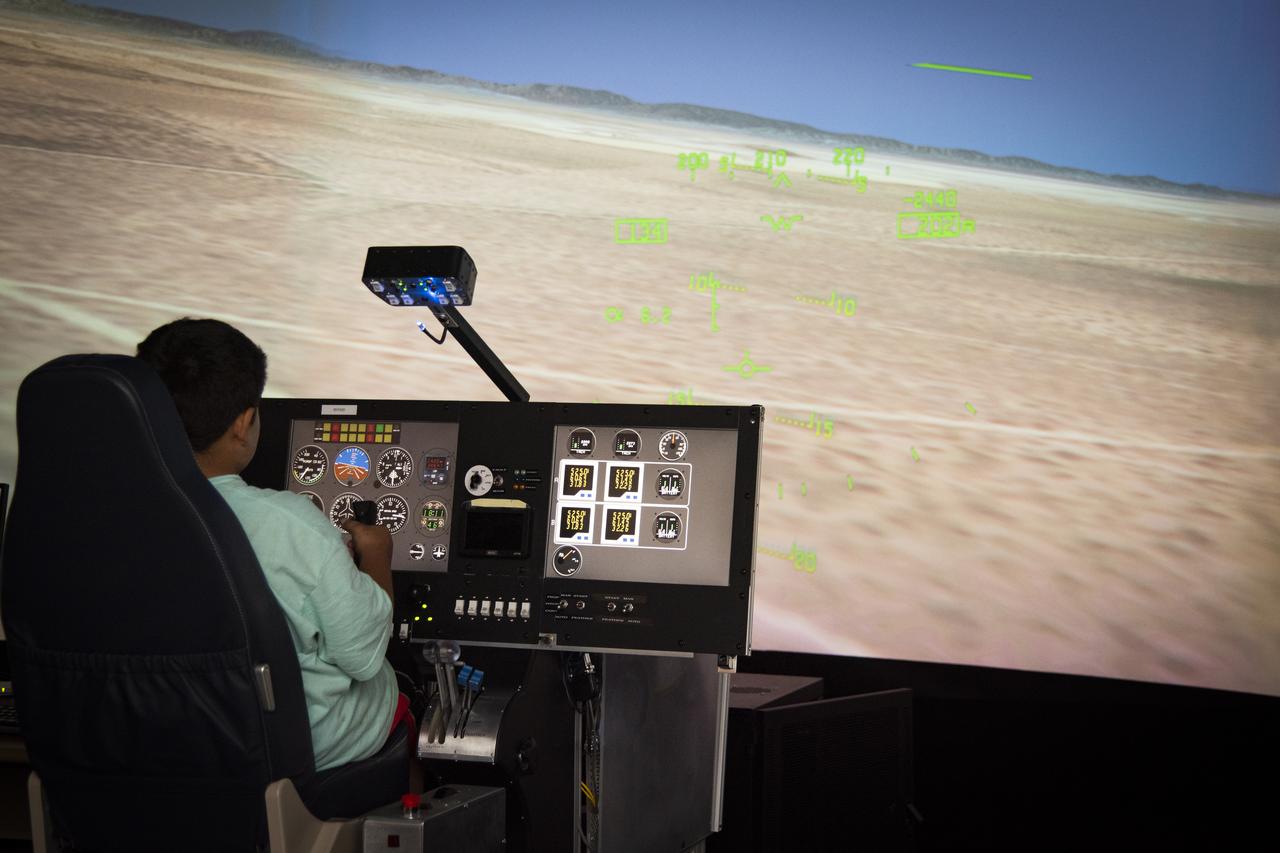
An elementary student enrolled in the U.S. Department of Defense Starbase program at Edwards Air Force Base flew the X-57 Maxwell inside NASA’s Armstrong  Flight Research Center’s simulator lab on Sept. 16th 2019.
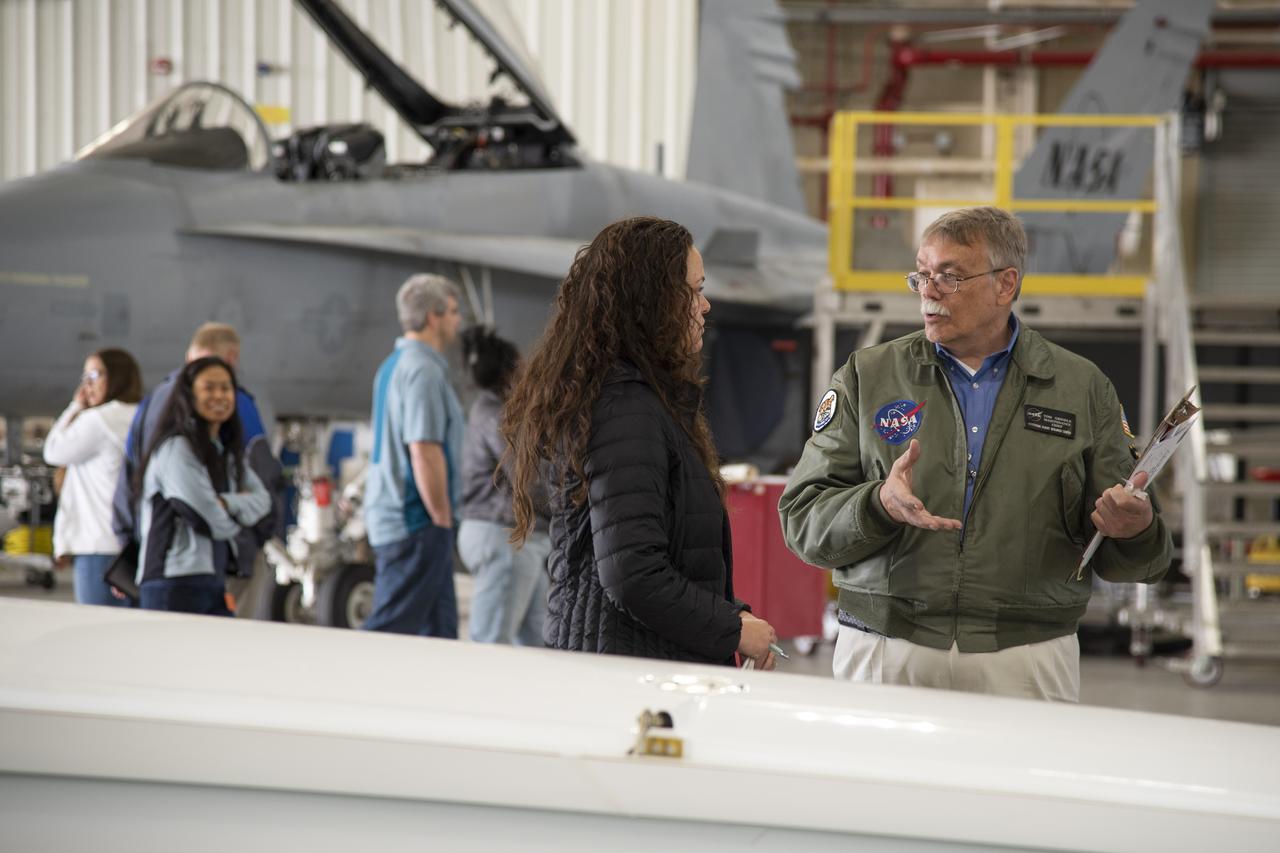
NASA Armstrong’s Chief of Maintenance, Tom Grindle, leads a tour inside the hangar with a group of teachers.
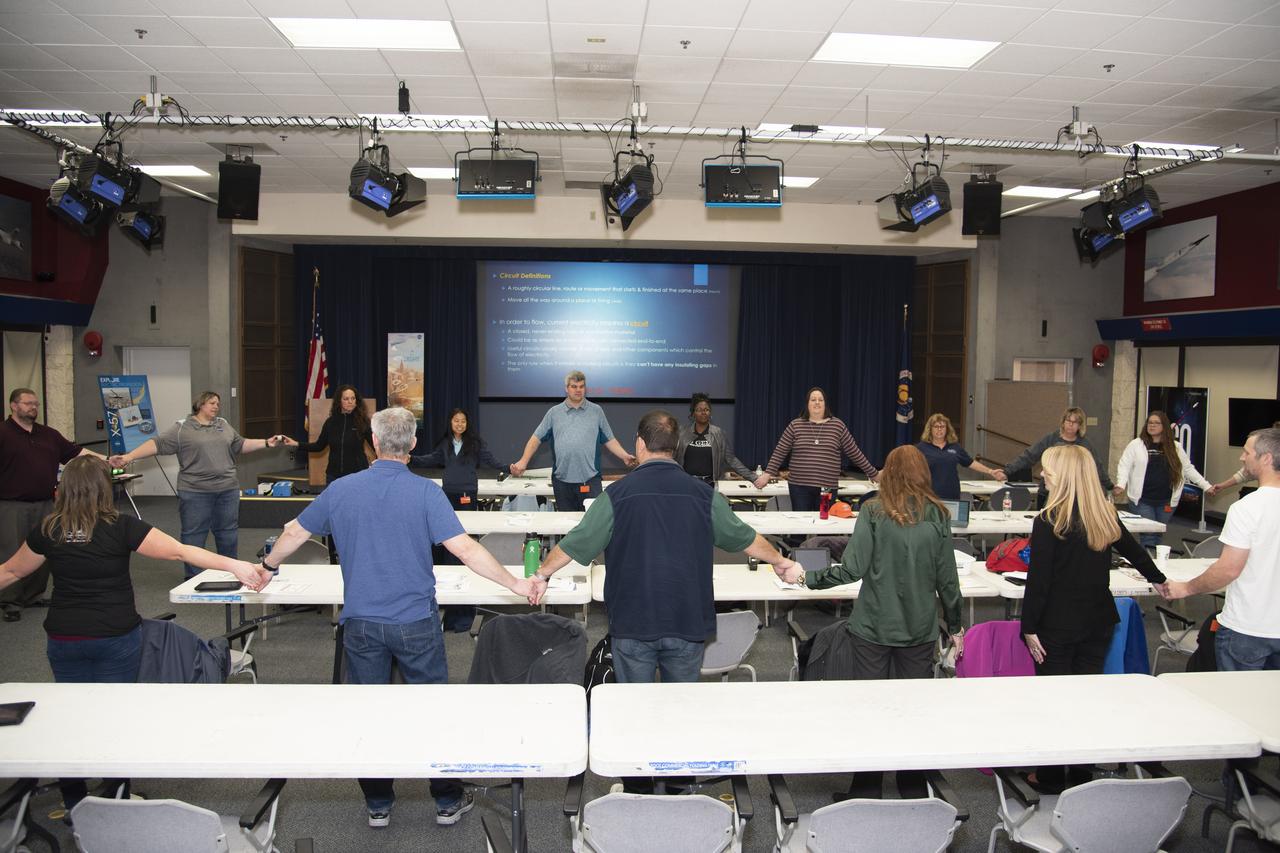
Barbara Buckner, NASA Armstrong's educator professional development specialist, leads a group exercise to form a human circuit to power an electric ball.
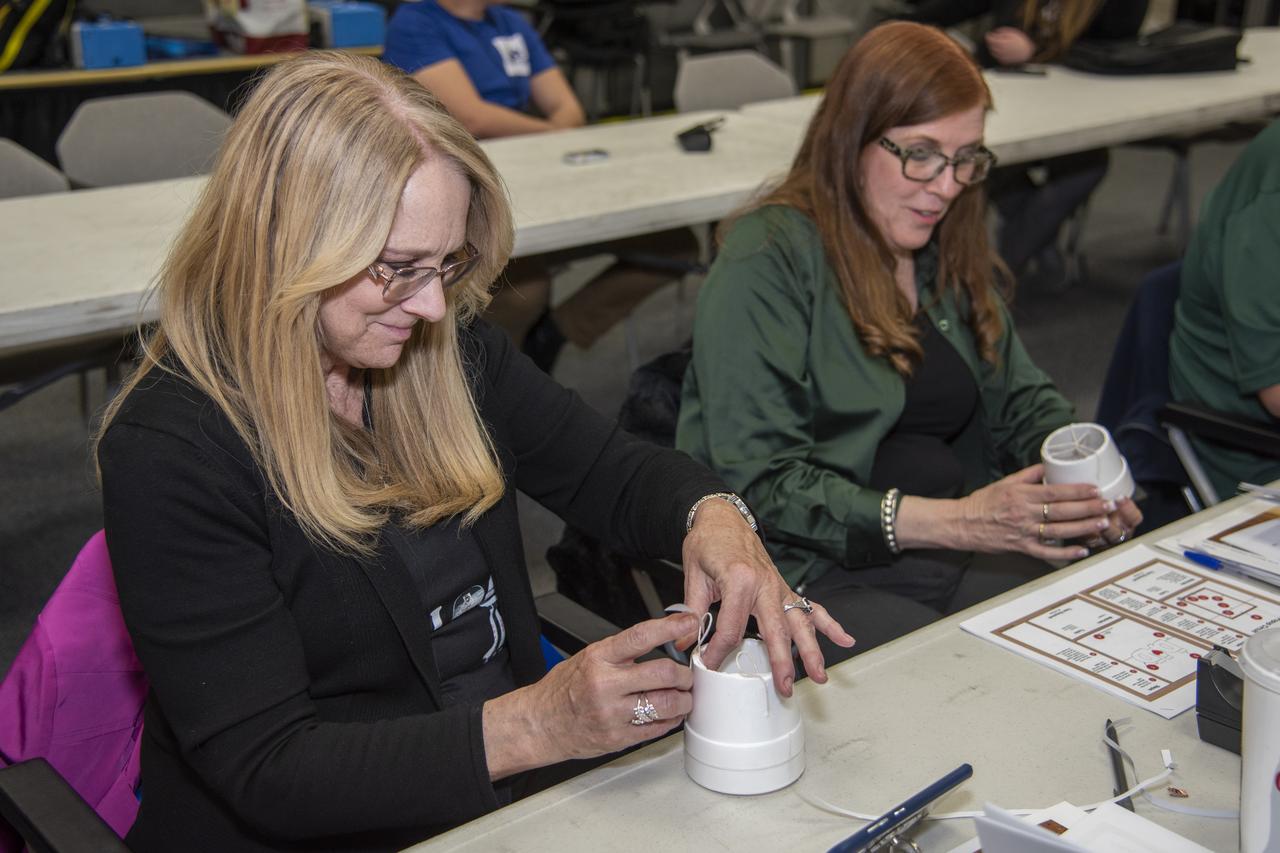
Teacher Kristen Deckner learns how to build a Remote Manipulator (Robotic) Arm during the Educational Technology Institute hosted by NASA Armstrong's Office of STEM Engagement.
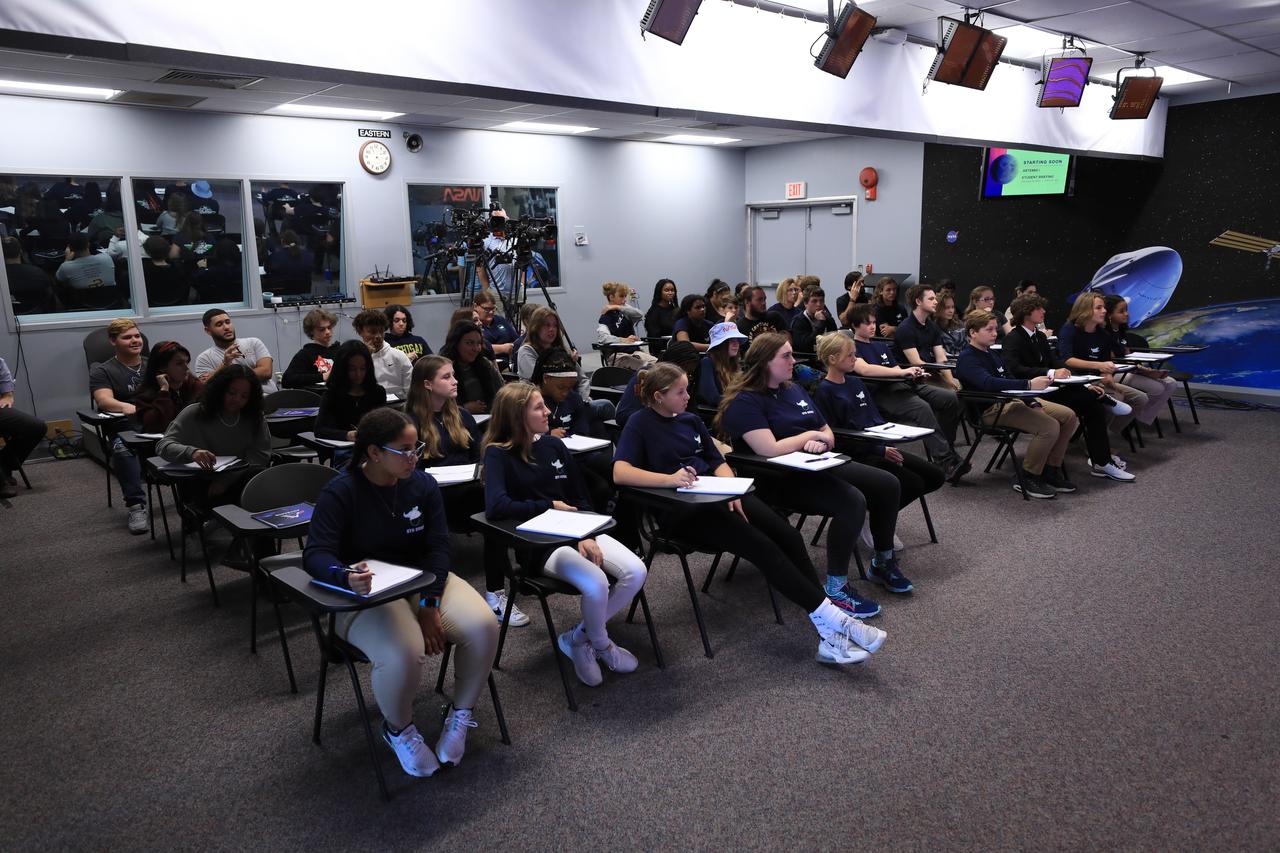
As part of NASA’s NextGen STEM project, students from Florida’s St. Cloud High School and Storm Grove Middle School in Vero Beach participate in an Artemis I student media briefing inside the John Holliman Auditorium of the News Center at NASA’s Kennedy Space Center in Florida on Jan. 19, 2023. Along with the students participating in person, middle and high school students across the country had the opportunity to ask questions of the panel via phone to discuss the Artemis I mission and the agency’s future of human space exploration.
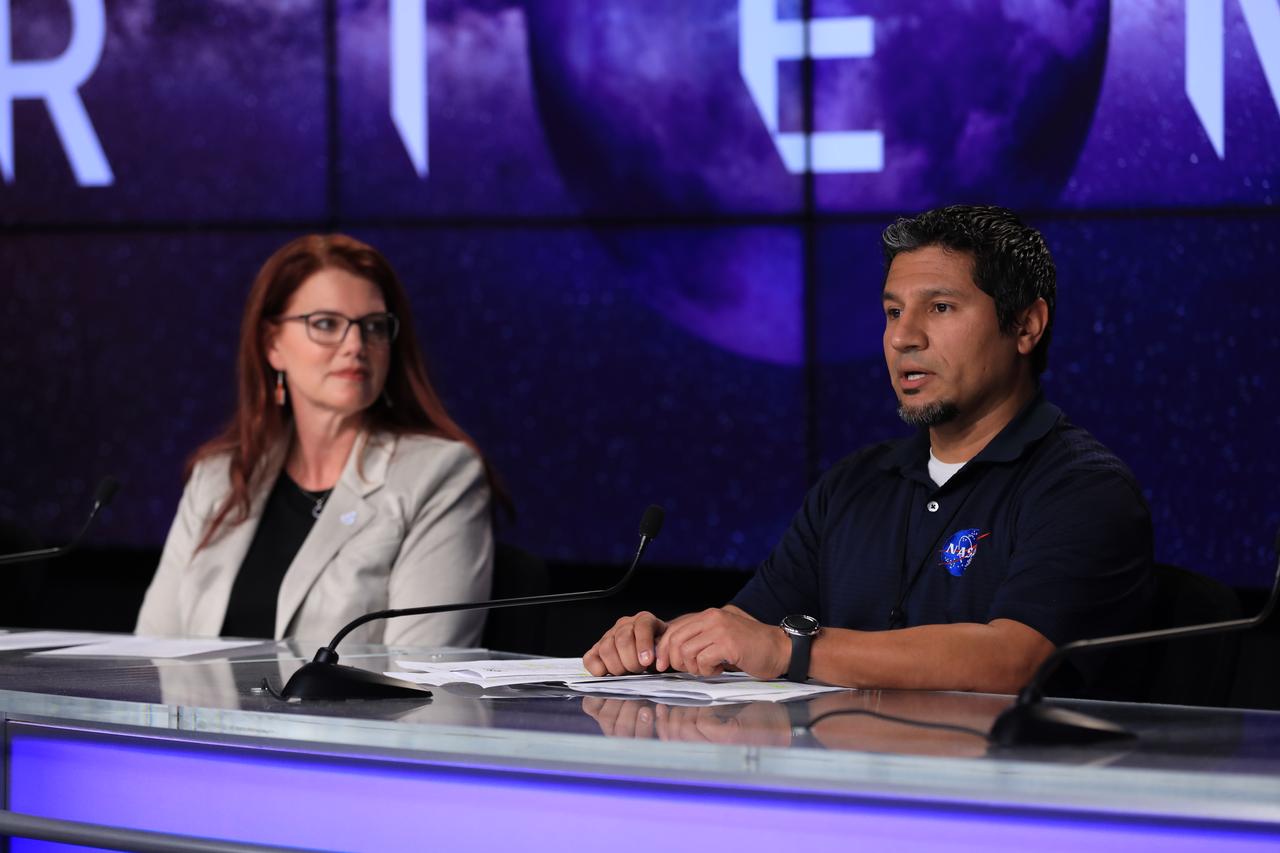
From left, NASA’s Artemis Launch Director Charlie Blackwell-Thompson and Space Launch System Resident Management Office Manager Elkin Norena participate in an Artemis I student media briefing inside the John Holliman Auditorium of the News Center at Kennedy Space Center in Florida on Jan. 19, 2023. As part of NASA’s NextGen STEM project, students from Florida’s St. Cloud High School and Storm Grove Middle School in Vero Beach participated in person during the briefing, while middle and high school students across the country had the opportunity to ask questions of the panel via phone to discuss the Artemis I mission and the agency’s future of human space exploration.
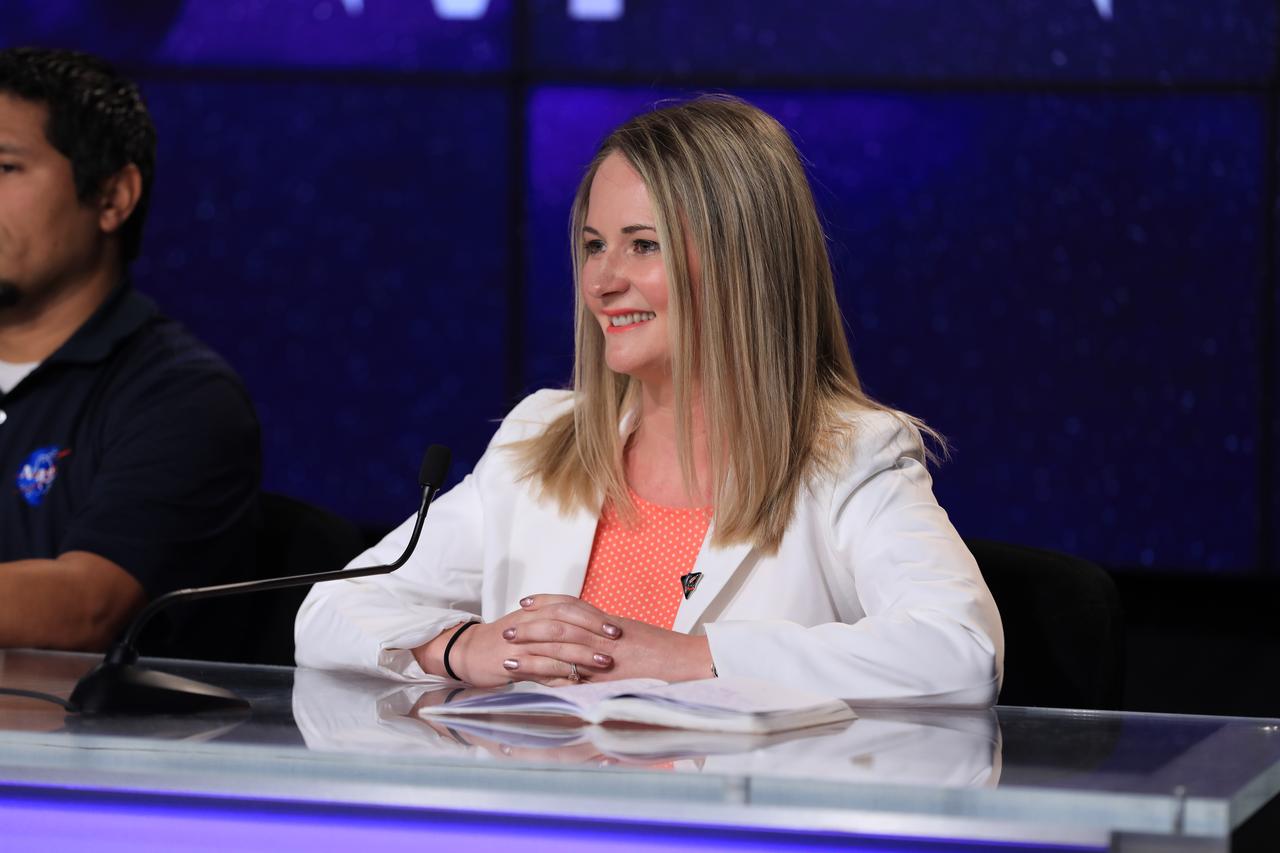
Space Launch Delta 45 Weather Officer Melody Lovin participates in an Artemis I student media briefing inside the John Holliman Auditorium of the News Center at NASA’s Kennedy Space Center in Florida on Jan. 19, 2023. As part of NASA’s NextGen STEM project, students from Florida’s St. Cloud High School and Storm Grove Middle School in Vero Beach participated in person during the briefing, while middle and high school students across the country had the opportunity to ask questions of the panel via phone to discuss the Artemis I mission and the agency’s future of human space exploration.
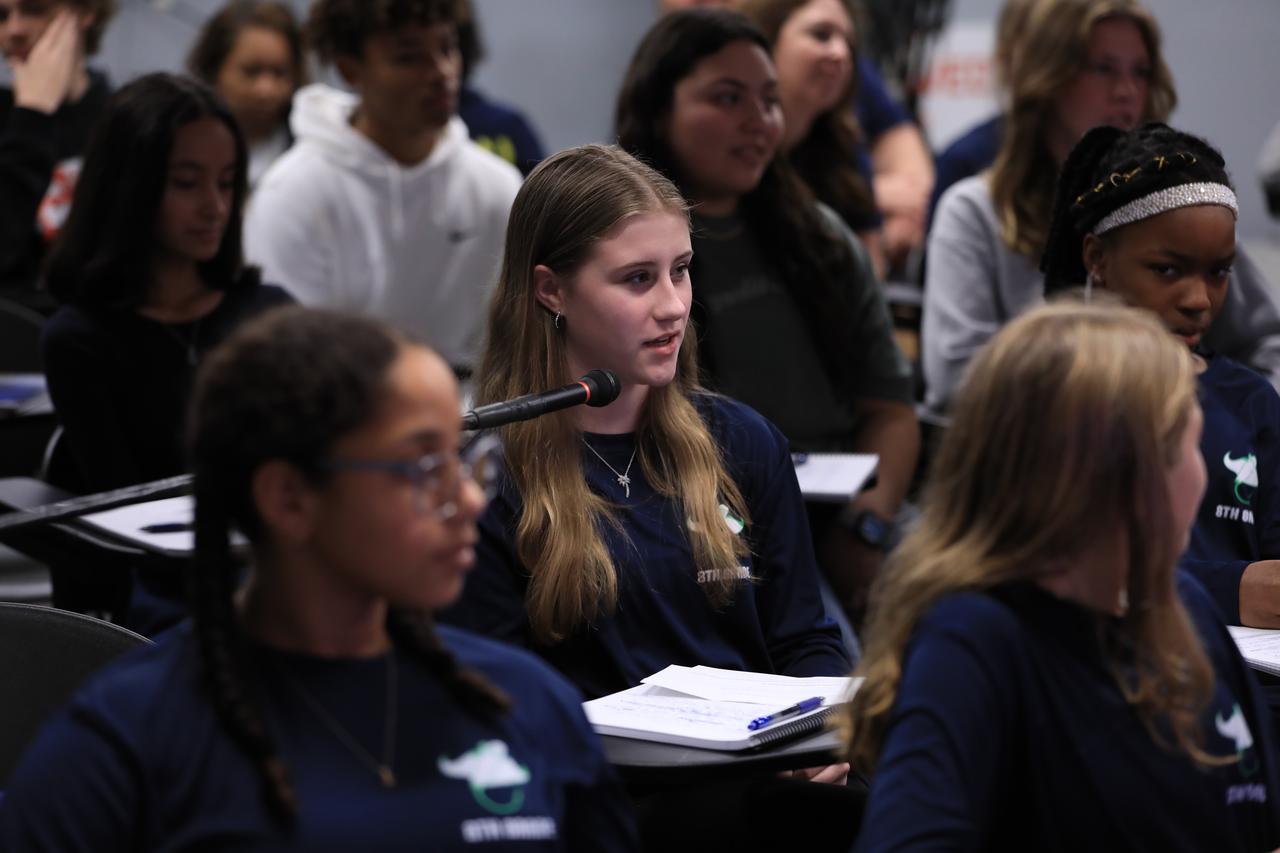
As part of NASA’s NextGen STEM project, students from Florida’s St. Cloud High School and Storm Grove Middle School in Vero Beach participate in an Artemis I student media briefing inside the John Holliman Auditorium of the News Center at NASA’s Kennedy Space Center in Florida on Jan. 19, 2023. Along with the students participating in person, middle and high school students across the country had the opportunity to ask questions of the panel via phone to discuss the Artemis I mission and the agency’s future of human space exploration.
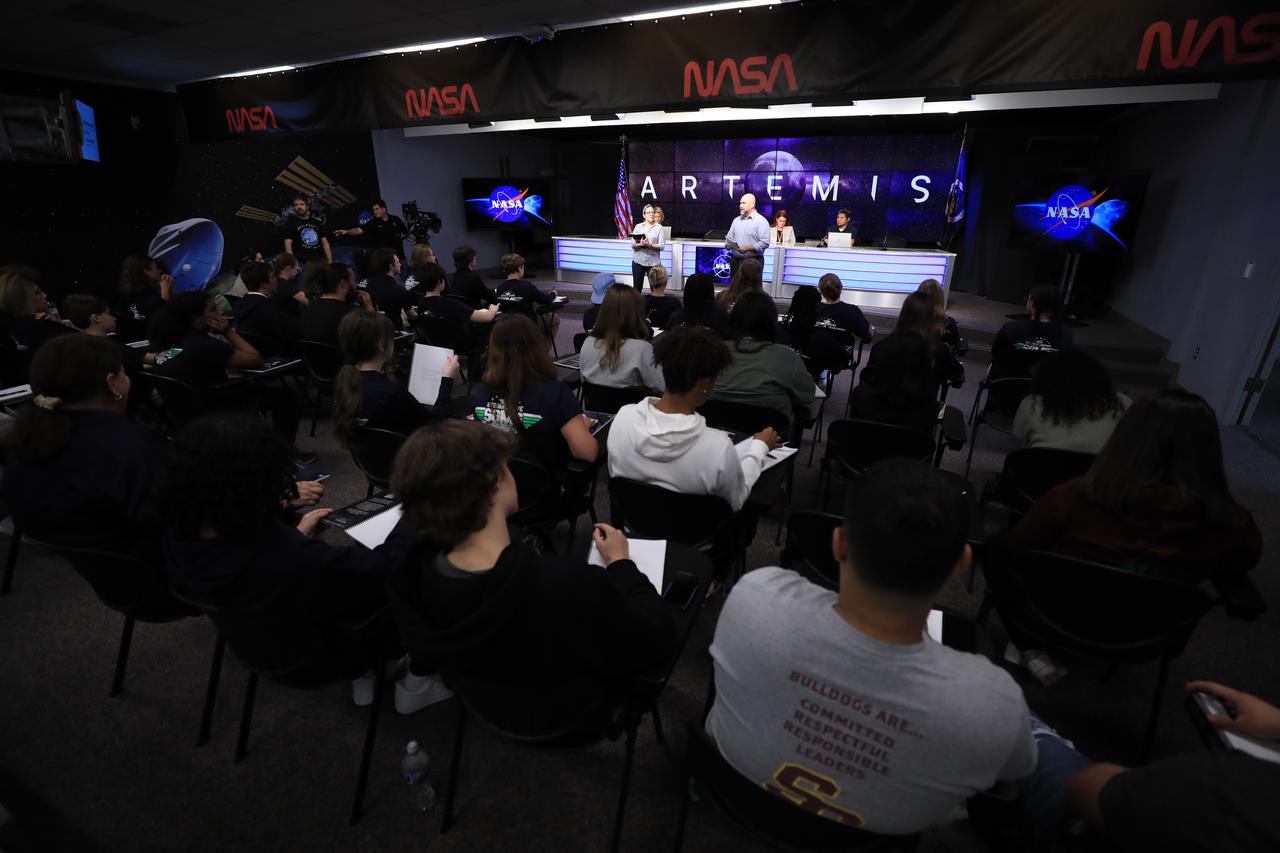
As part of NASA’s NextGen STEM project, Public Affairs Writers Danielle Sempsrott (left) and Jason Costa address students from Florida’s St. Cloud High School and Storm Grove Middle School in Vero Beach during an Artemis I student media briefing inside the John Holliman Auditorium of the News Center at NASA’s Kennedy Space Center in Florida on Jan. 19, 2023. Participants in the briefing included Kennedy Space Center Deputy Director Kelvin Manning, Artemis Launch Director Charlie Blackwell-Thompson, Manager of the Space Launch System Resident Management Office Elkin Norena, and Space Launch Delta 45 Weather Officer Melody Lovin. Along with the students participating in person, middle and high school students across the country had the opportunity to ask questions of the panel via phone to discuss the Artemis I mission and the agency’s future of human space exploration.
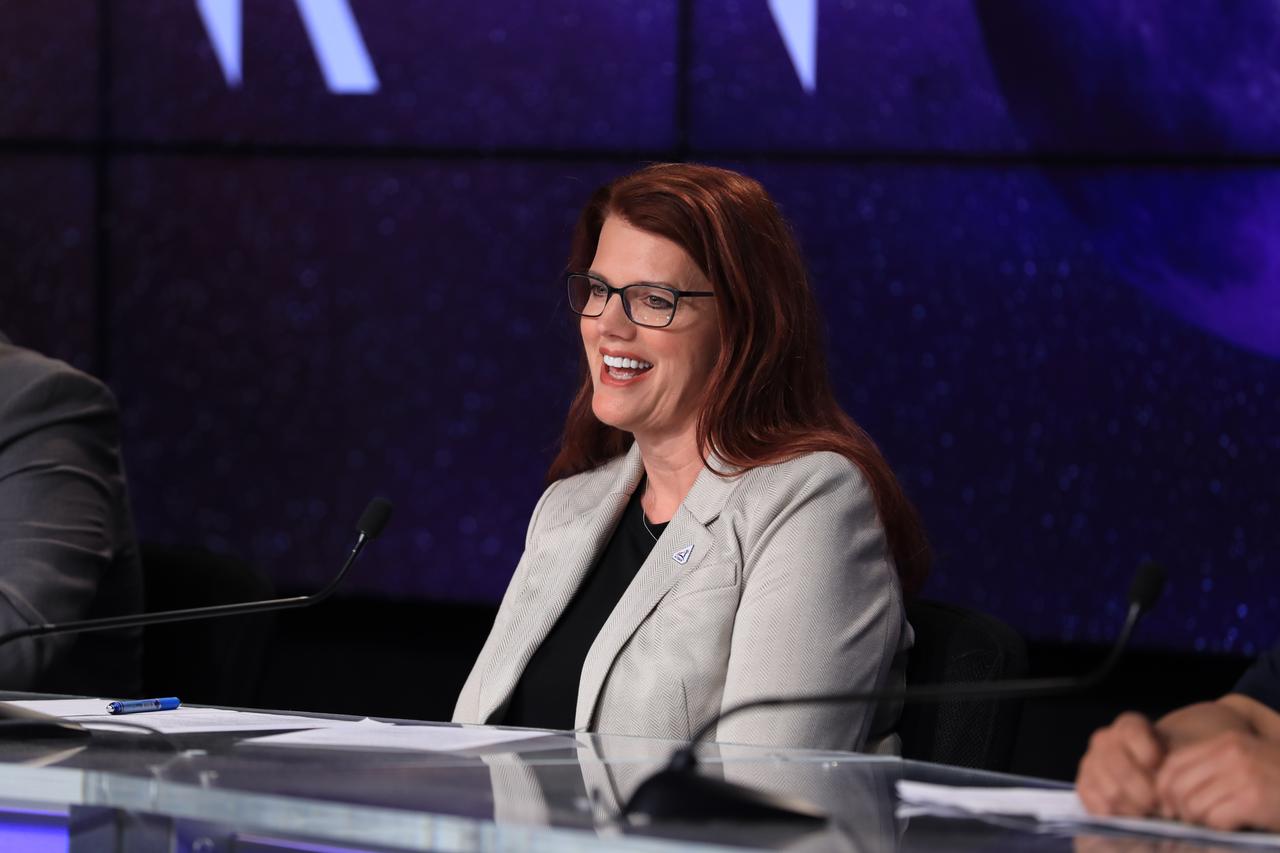
NASA’s Artemis Launch Director Charlie Blackwell-Thompson participates in an Artemis I student media briefing inside the John Holliman Auditorium of the News Center at Kennedy Space Center in Florida on Jan. 19, 2023. As part of NASA’s NextGen STEM project, students from Florida’s St. Cloud High School and Storm Grove Middle School in Vero Beach participated in person during the briefing, while middle and high school students across the country had the opportunity to ask questions of the panel via phone to discuss the Artemis I mission and the agency’s future of human space exploration.
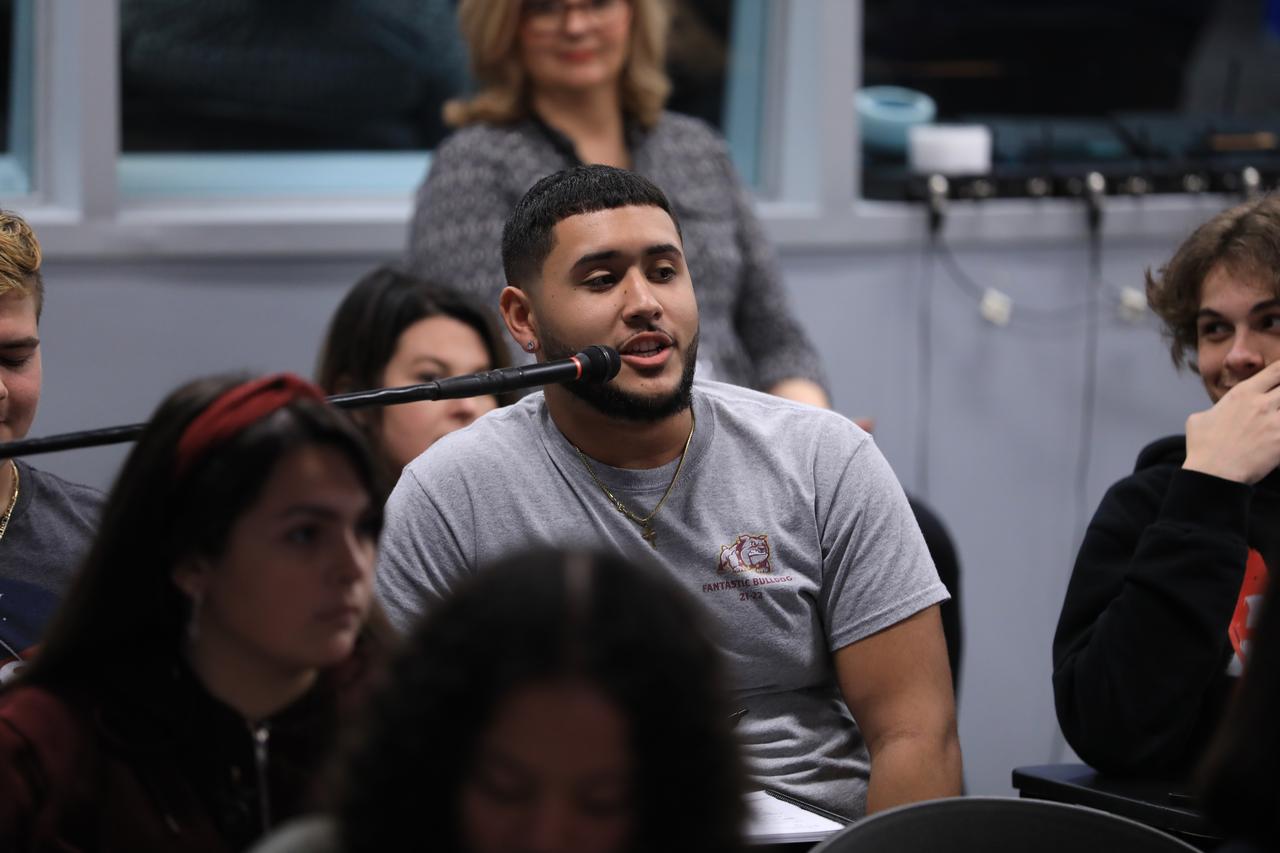
As part of NASA’s NextGen STEM project, students from Florida’s St. Cloud High School and Storm Grove Middle School in Vero Beach participate in an Artemis I student media briefing inside the John Holliman Auditorium of the News Center at NASA’s Kennedy Space Center in Florida on Jan. 19, 2023. Along with the students participating in person, middle and high school students across the country had the opportunity to ask questions of the panel via phone to discuss the Artemis I mission and the agency’s future of human space exploration.
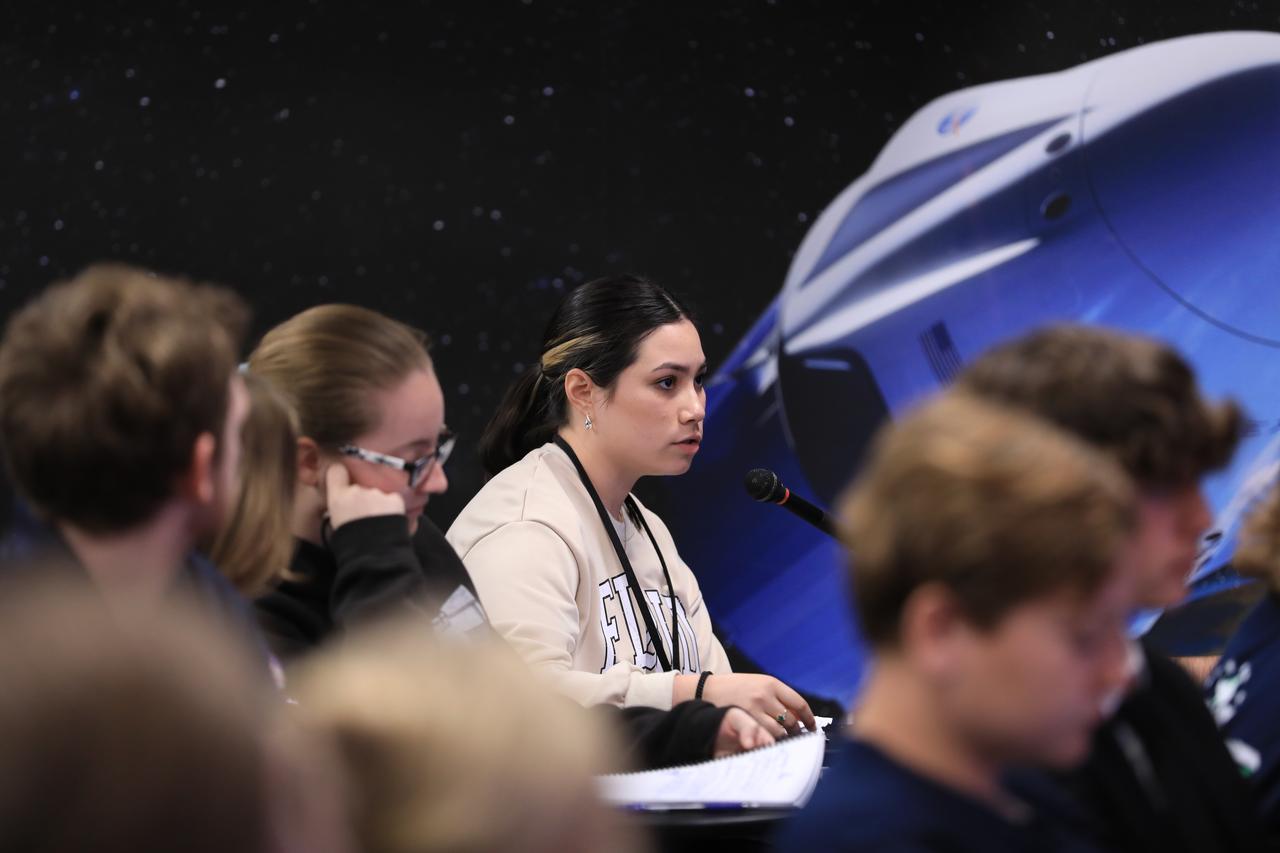
As part of NASA’s NextGen STEM project, students from Florida’s St. Cloud High School and Storm Grove Middle School in Vero Beach participate in an Artemis I student media briefing inside the John Holliman Auditorium of the News Center at NASA’s Kennedy Space Center in Florida on Jan. 19, 2023. Along with the students participating in person, middle and high school students across the country had the opportunity to ask questions of the panel via phone to discuss the Artemis I mission and the agency’s future of human space exploration.
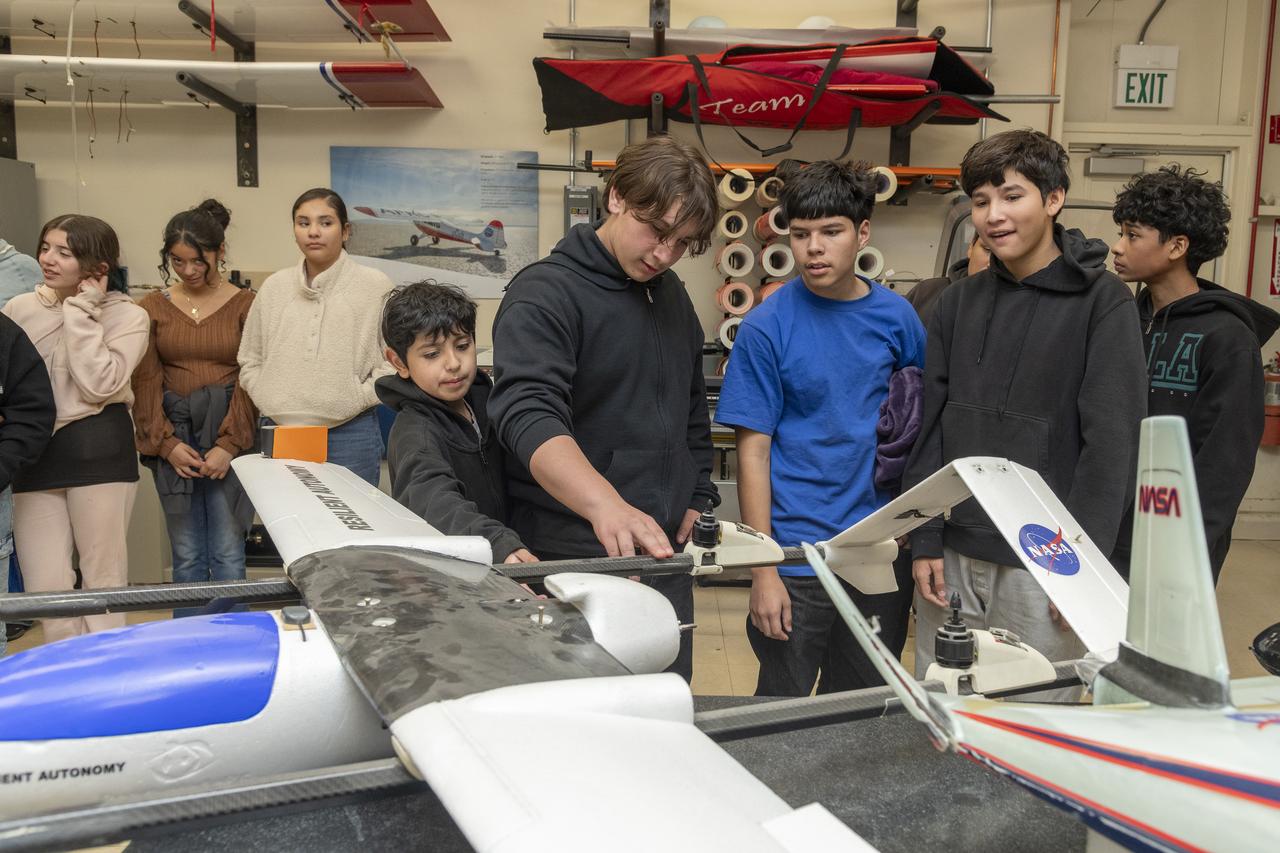
A group of middle school students engage with a model aircraft while learning from NASA experts in the model lab at NASA’s Armstrong Flight Research Center in Edwards, California during an event hosted by NASA’s California Office of STEM Engagement.
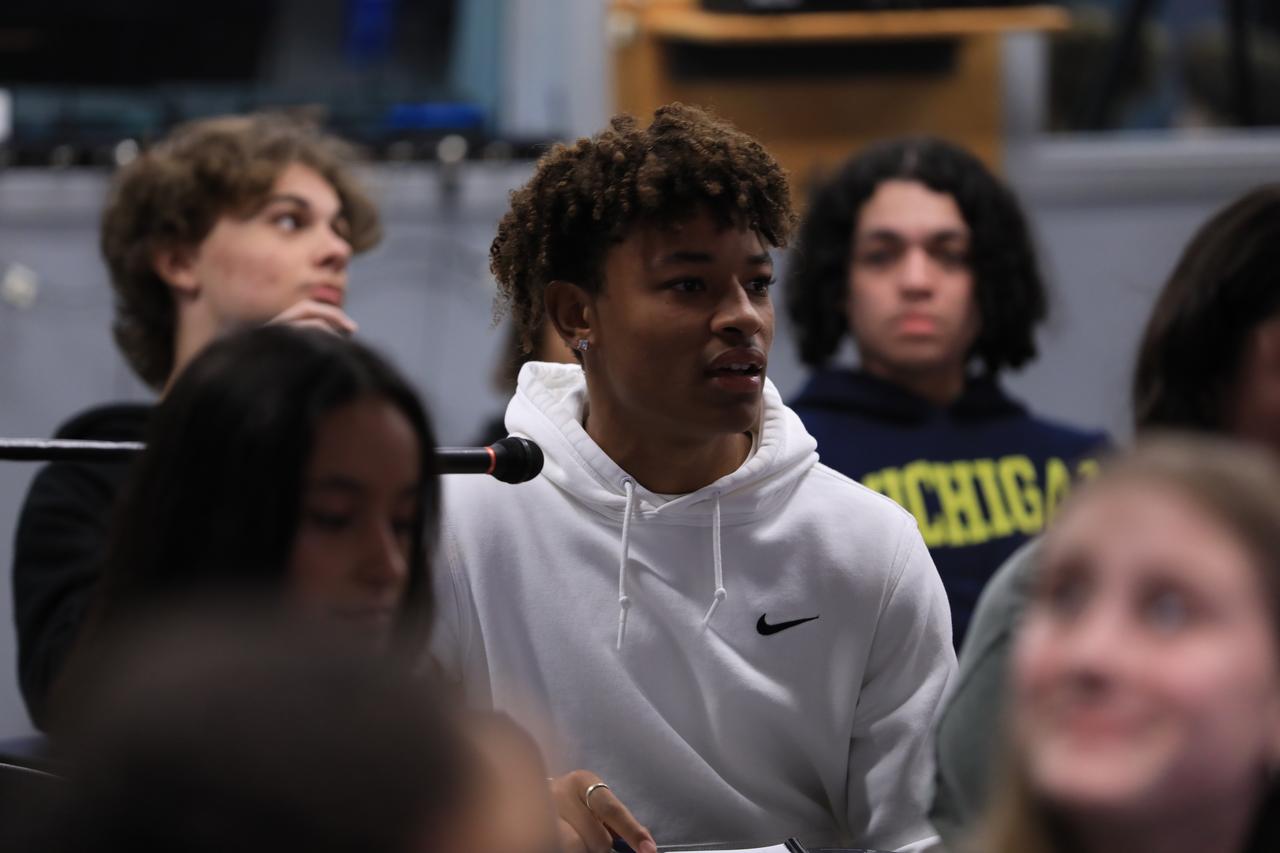
As part of NASA’s NextGen STEM project, students from Florida’s St. Cloud High School and Storm Grove Middle School in Vero Beach participate in an Artemis I student media briefing inside the John Holliman Auditorium of the News Center at NASA’s Kennedy Space Center in Florida on Jan. 19, 2023. Along with the students participating in person, middle and high school students across the country had the opportunity to ask questions of the panel via phone to discuss the Artemis I mission and the agency’s future of human space exploration.
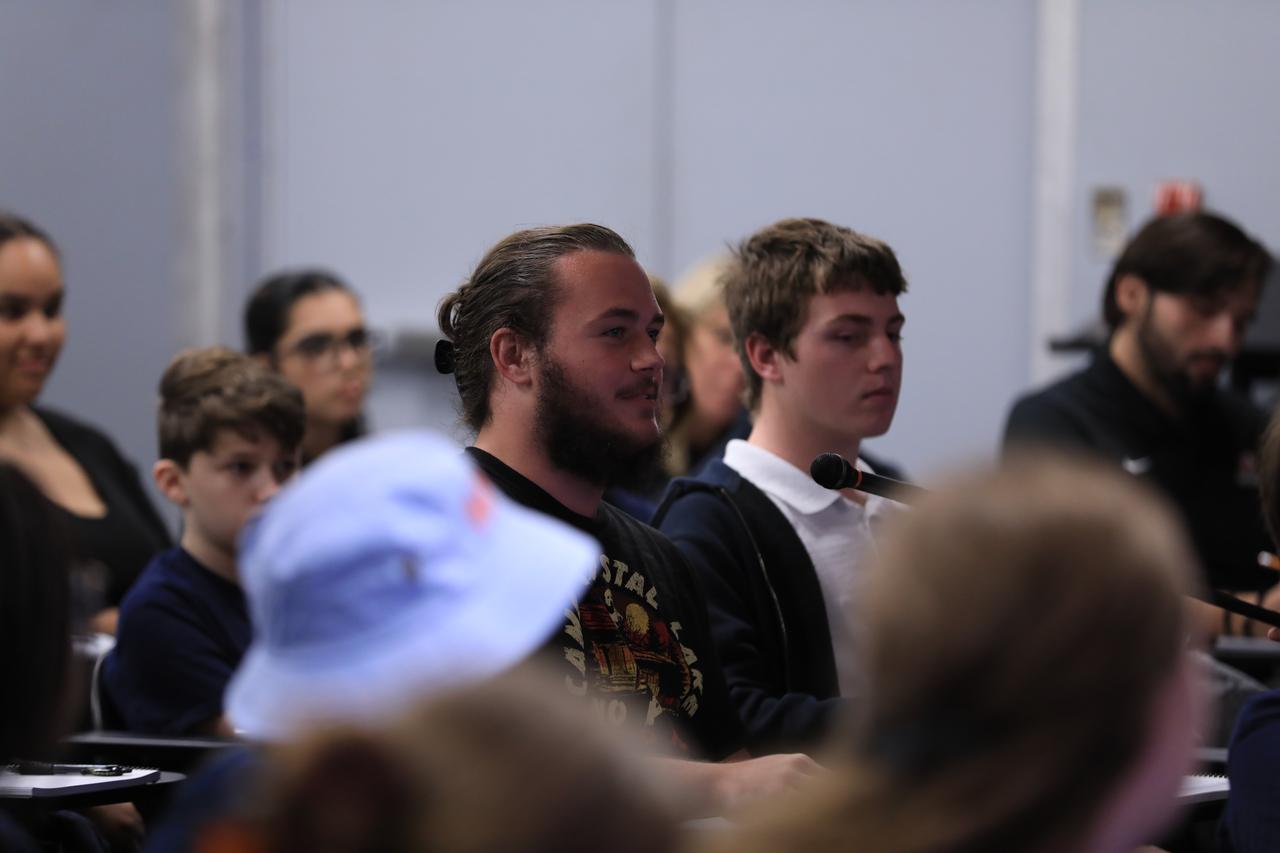
As part of NASA’s NextGen STEM project, students from Florida’s St. Cloud High School and Storm Grove Middle School in Vero Beach participate in an Artemis I student media briefing inside the John Holliman Auditorium of the News Center at NASA’s Kennedy Space Center in Florida on Jan. 19, 2023. Along with the students participating in person, middle and high school students across the country had the opportunity to ask questions of the panel via phone to discuss the Artemis I mission and the agency’s future of human space exploration.
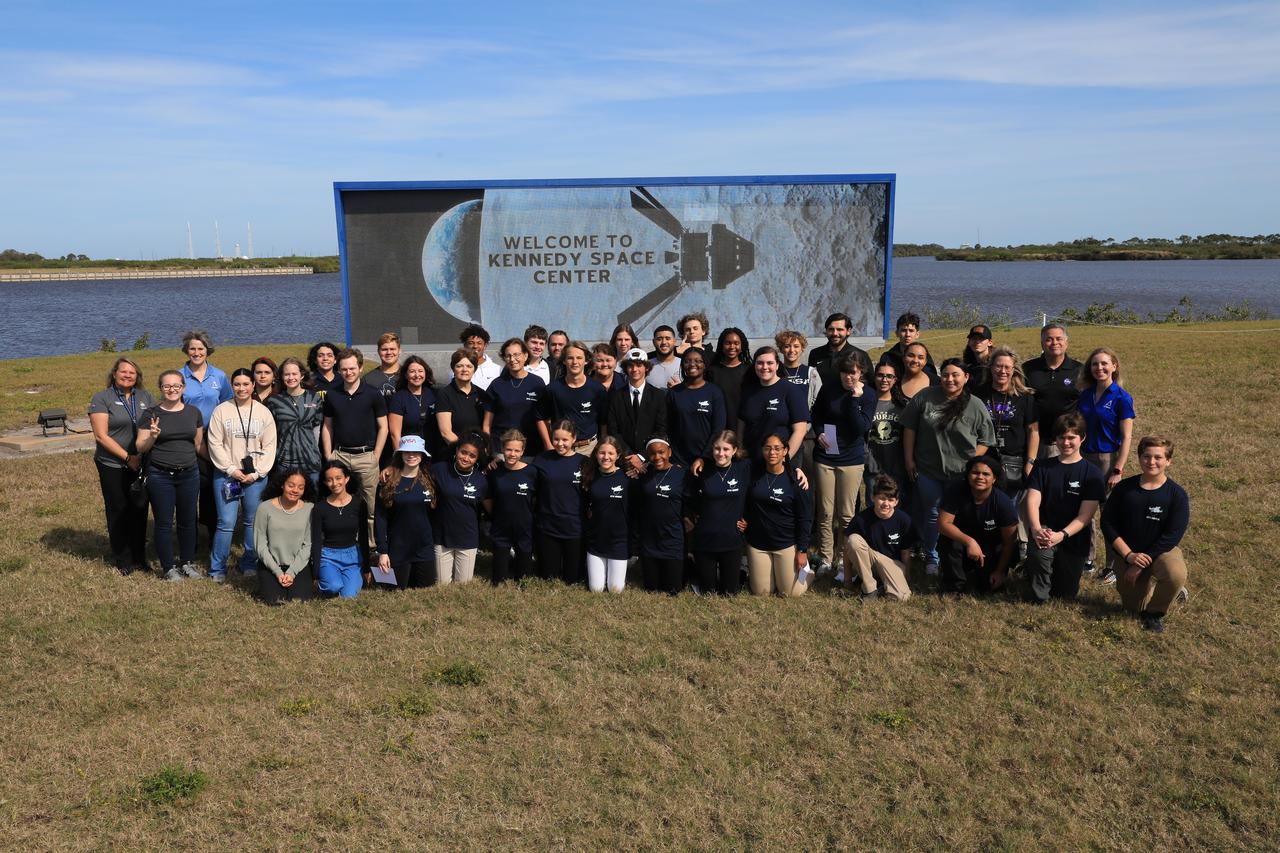
Students from Florida’s St. Cloud High School and Storm Grove Middle School in Vero Beach pose in front of the countdown clock at NASA’s Kennedy Space Center in Florida on Jan. 19, 2023. As part of NASA’s NextGen STEM project, students were invited to tour the facilities at the spaceport before participating in a televised briefing inside the John Holliman Auditorium of the News Center, featuring Kennedy Space Center Deputy Director Kelvin Manning; Artemis Launch Director Charlie Blackwell-Thompson; Manager of the Space Launch System Resident Management Office Elkin Norena; and Space Launch Delta 45 Weather Officer Melody Lovin. Along with the students participating in person, middle and high school students across the country had the opportunity to ask questions of the panel via phone to discuss the Artemis I mission and the agency’s future of human space exploration.
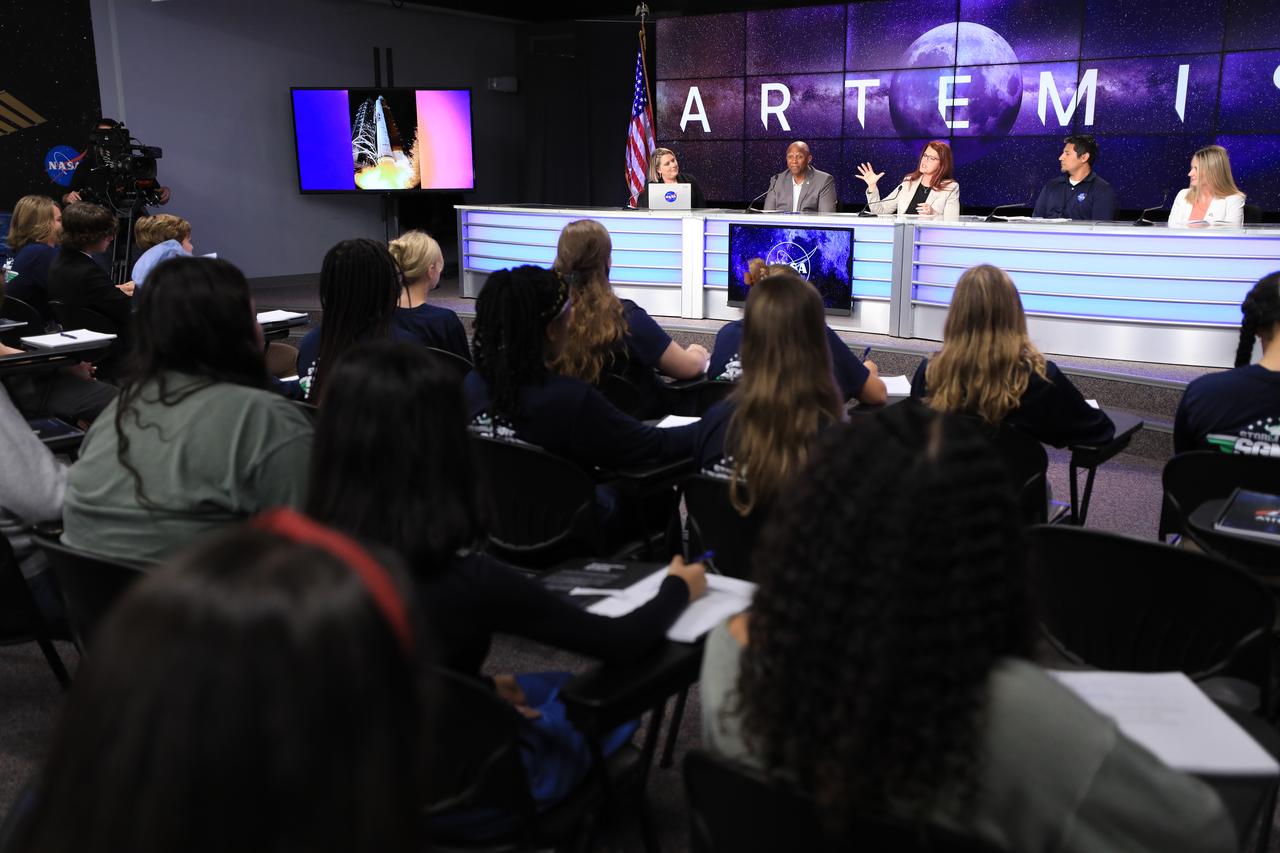
From left, NASA Communications’ Leah Martin, Kennedy Space Center Deputy Director Kelvin Manning, Artemis Launch Director Charlie Blackwell-Thompson, Space Launch System Resident Management Office Manager Elkin Norena, and Space Launch Delta 45 Weather Officer Melody Lovin participate in an Artemis I student media briefing inside the John Holliman Auditorium of the News Center at the Florida spaceport on Jan. 19, 2023. As part of NASA’s NextGen STEM project, students from Florida’s St. Cloud High School and Storm Grove Middle School in Vero Beach participated in person during the briefing, while middle and high school students across the country had the opportunity to ask questions of the panel via phone to discuss the Artemis I mission and the agency’s future of human space exploration.
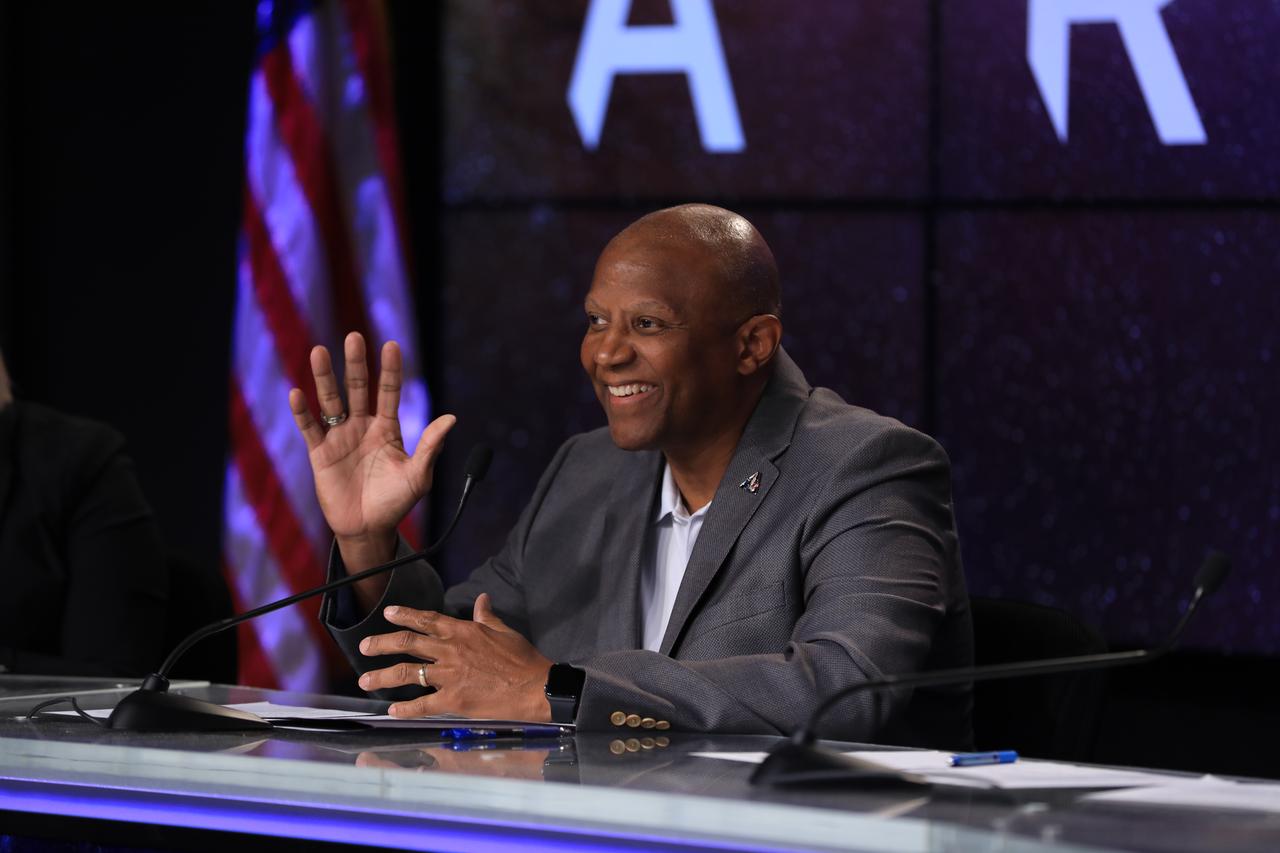
Kennedy Space Center Deputy Director Kelvin Manning participates in an Artemis I student media briefing inside the John Holliman Auditorium of the News Center at the Florida spaceport on Jan. 19, 2023. As part of NASA’s NextGen STEM project, students from Florida’s St. Cloud High School and Storm Grove Middle School in Vero Beach participated in person during the briefing, while middle and high school students across the country had the opportunity to ask questions of the panel via phone to discuss the Artemis I mission and the agency’s future of human space exploration.
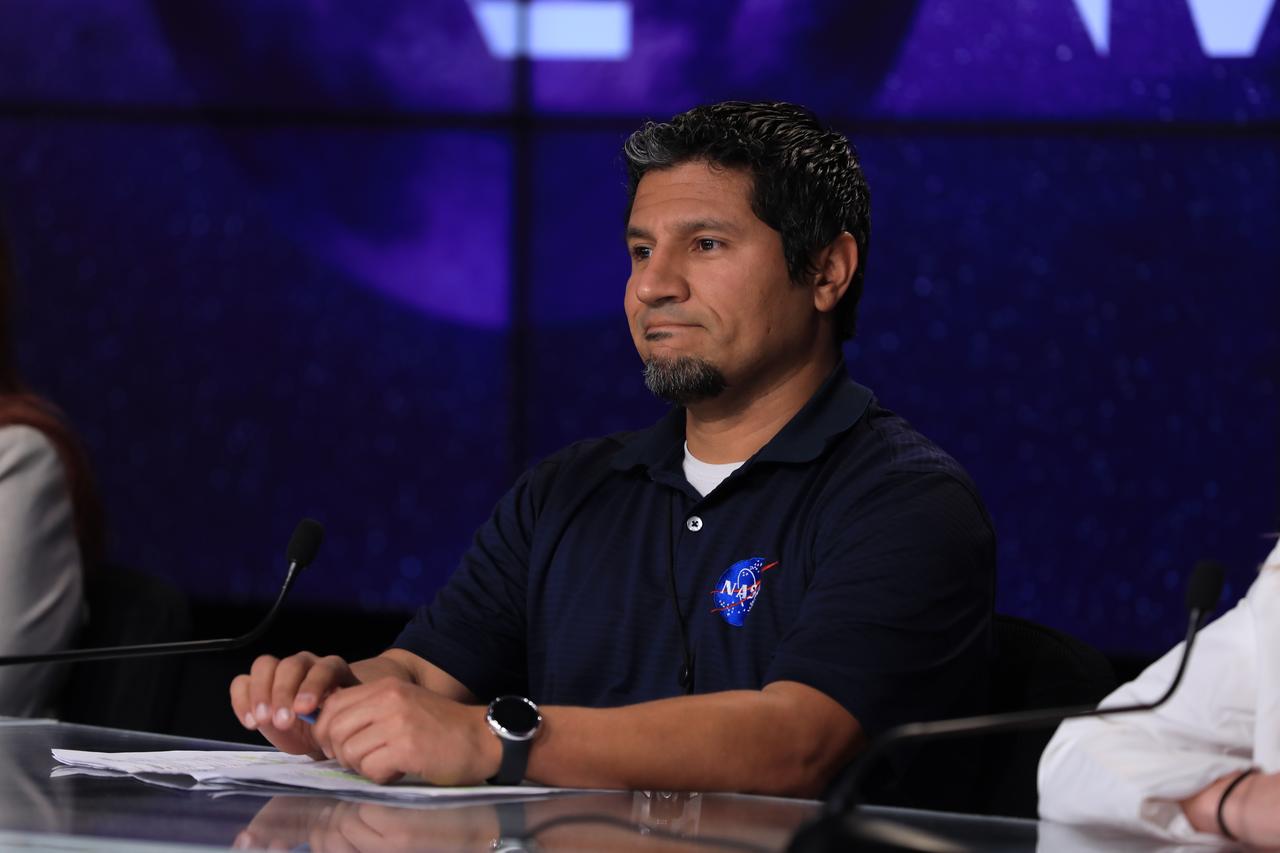
NASA’s Space Launch System Resident Management Office Manager Elkin Norena participates in an Artemis I student media briefing inside the John Holliman Auditorium of the News Center at Kennedy Space Center in Florida on Jan. 19, 2023. As part of NASA’s NextGen STEM project, students from Florida’s St. Cloud High School and Storm Grove Middle School in Vero Beach participated in person during the briefing, while middle and high school students across the country had the opportunity to ask questions of the panel via phone to discuss the Artemis I mission and the agency’s future of human space exploration.
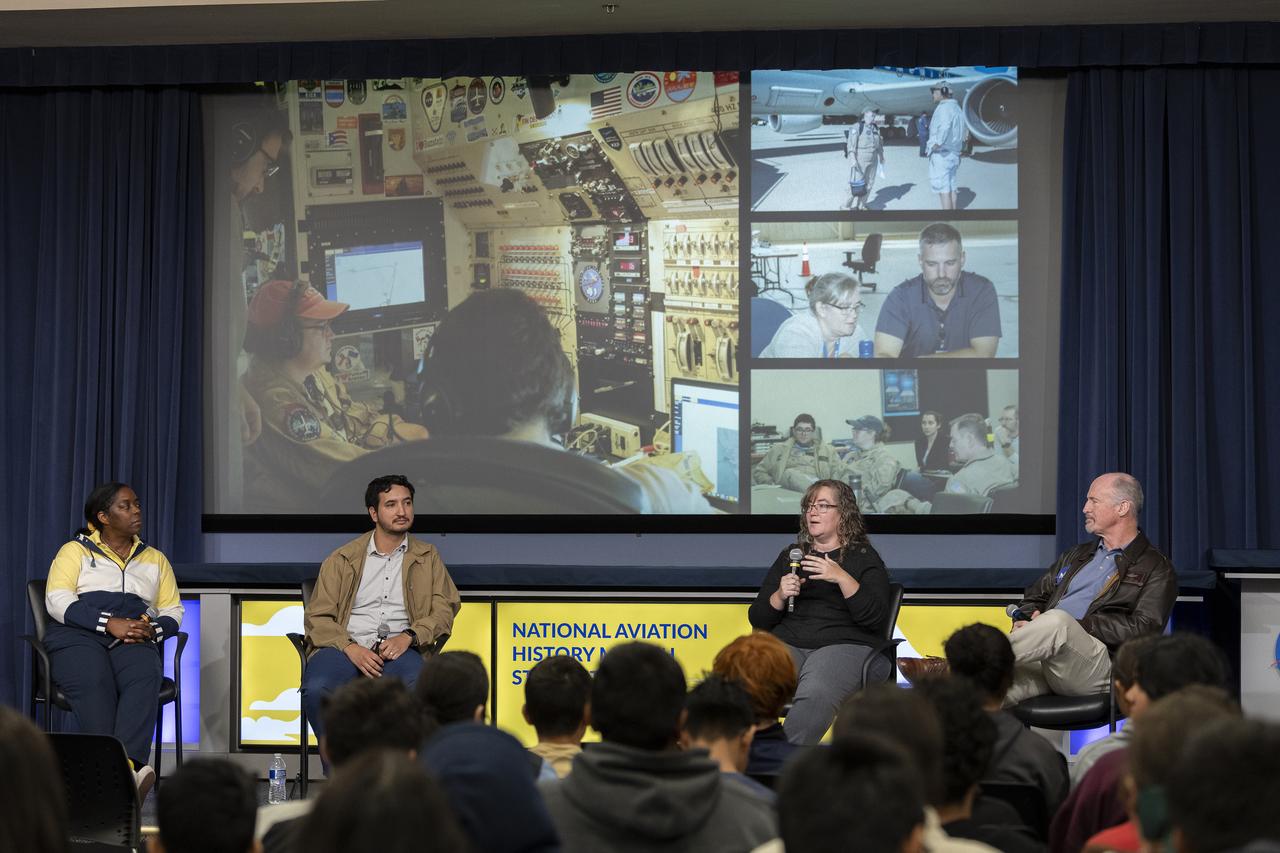
NASA Armstrong experts share their stories about their career paths and experiences at NASA to middle school students during an event hosted by NASA’s California Office of STEM Engagement at NASA’s Armstrong Flight Research Center in Edwards, California. From left to right: Laurie Grindle, Julio Trevino, Nicki Reid and Troy Asher.
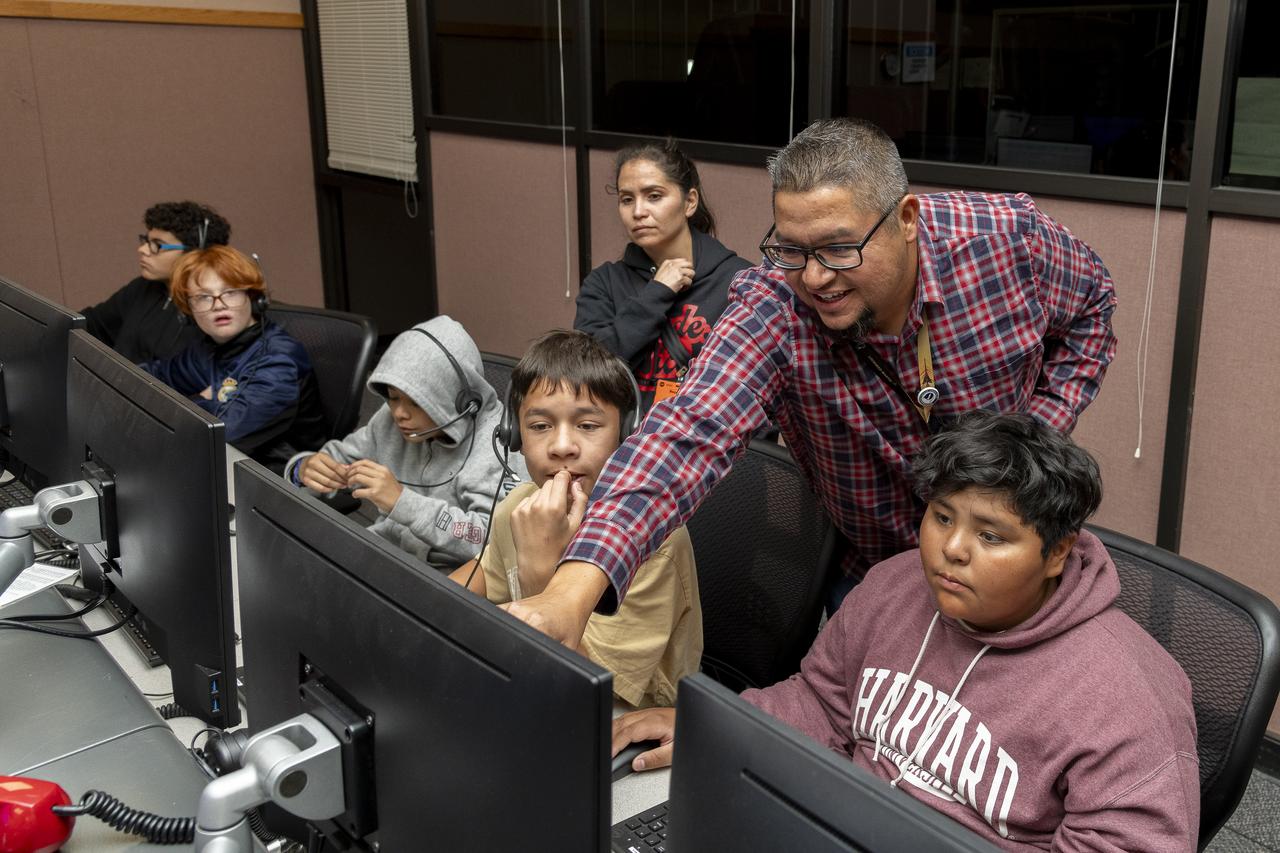
A group of middle school students and their teachers sit in the control room for a hands-on experience at NASA’s Armstrong Flight Research Center in Edwards, California during an event hosted by NASA’s California Office of STEM Engagement for National Aviation History Month.
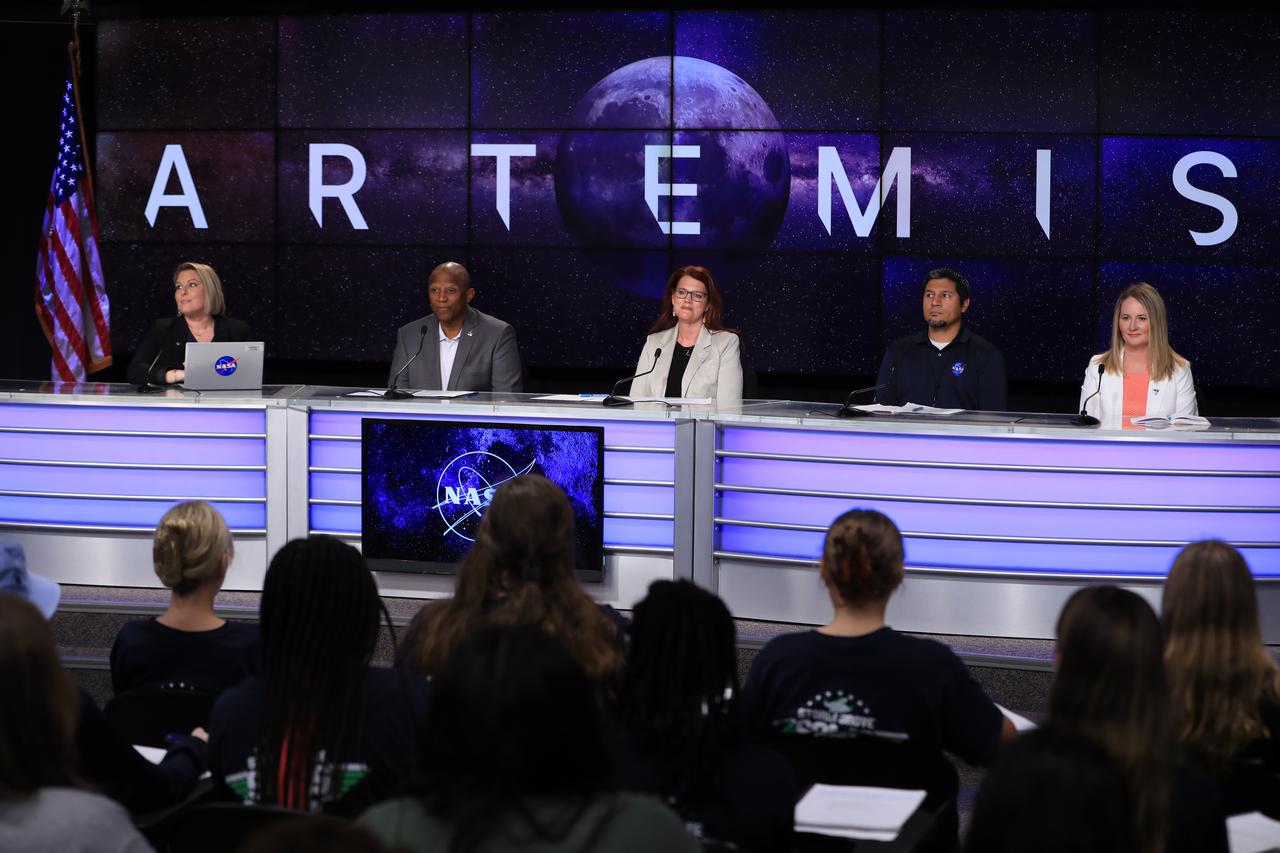
From left, NASA Communications’ Leah Martin, Kennedy Space Center Deputy Director Kelvin Manning, Artemis Launch Director Charlie Blackwell-Thompson, Space Launch System Resident Management Office Manager Elkin Norena, and Space Launch Delta 45 Weather Officer Melody Lovin participate in an Artemis I student media briefing inside the John Holliman Auditorium of the News Center on Jan. 19, 2023, at the Florida spaceport. As part of NASA’s NextGen STEM project, students from Florida’s St. Cloud High School and Storm Grove Middle School in Vero Beach, participated in person during the briefing, while middle and high school students across the country had the opportunity to ask questions of the panel via phone to discuss the Artemis I mission and the agency’s future of human space exploration.

A group of students and their chaperones view a mural on a wall at the News Center during a tour of NASA’s Kennedy Space Center in Florida on Oct. 6, 2022. The middle-school students, from the Boys and Girls Clubs of the Flathead Indian Reservation in Montana, are visiting the space center with the Students to Launch program. Students to Launch engages students in STEM (science, technology, engineering and mathematics) and creates awareness of careers in the space program.
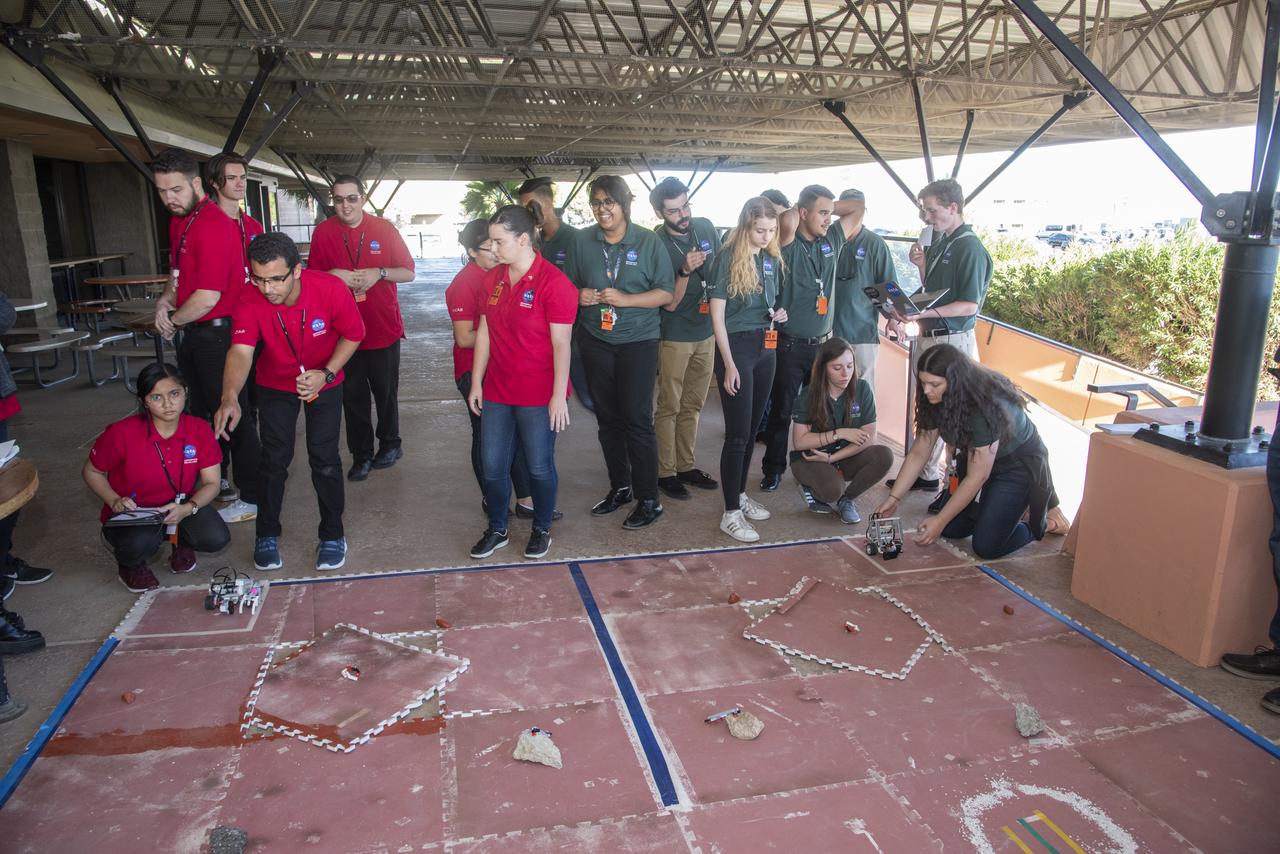
Four student teams: Blue, Gold, Green and Red built, designed and tested a LEGO robotic Martian rover prototype at NASA's Armstrong Flight Research Center. The teams competed against each other during a four-day workshop coordinated by the NASA Community College Aerospace Scholars. Each team prepared a marketing package to "sell" their design to NASA based on the performance of its Martian rover.
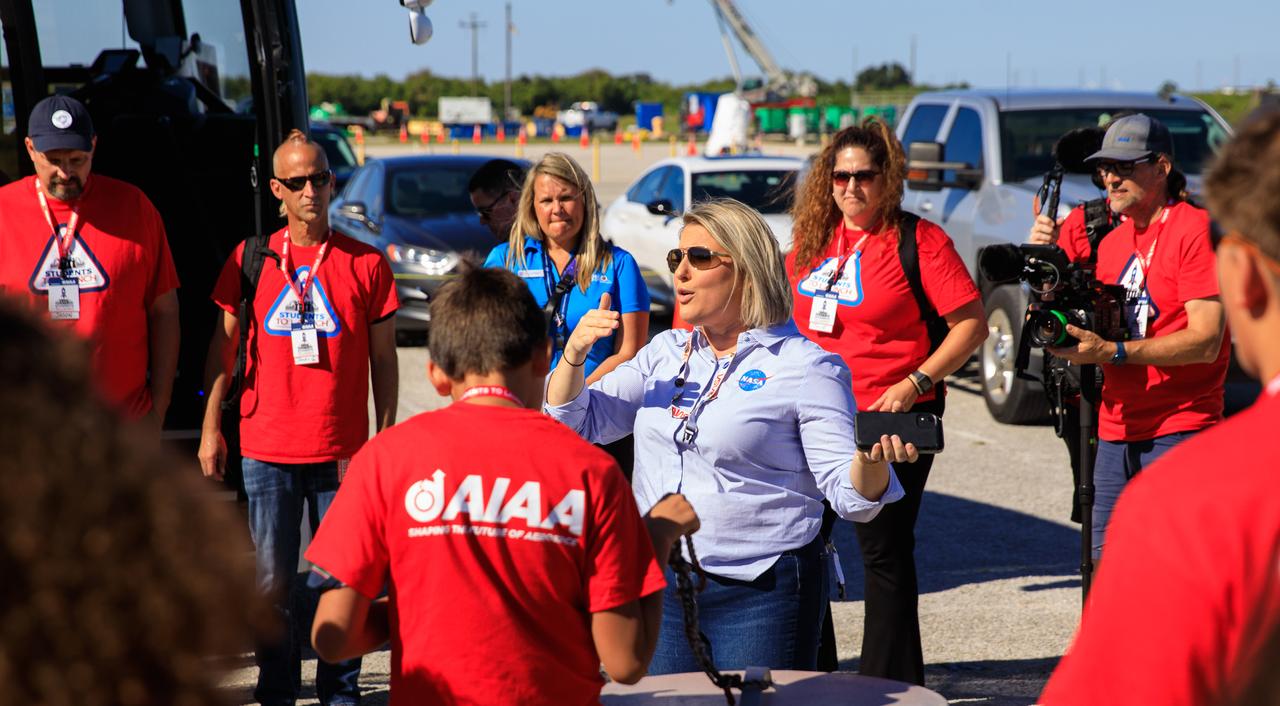
Leah Martin, in the center, NASA Communications, speaks to students and their chaperones during a tour of NASA’s Kennedy Space Center in Florida on Oct. 6, 2022. The middle-school students, from the Boys and Girls Clubs of the Flathead Indian Reservation and lake in Montana, are visiting the space center with the Students to Launch program. Students to Launch engages students in STEM (science, technology, engineering and mathematics) and creates awareness of careers in the space program.
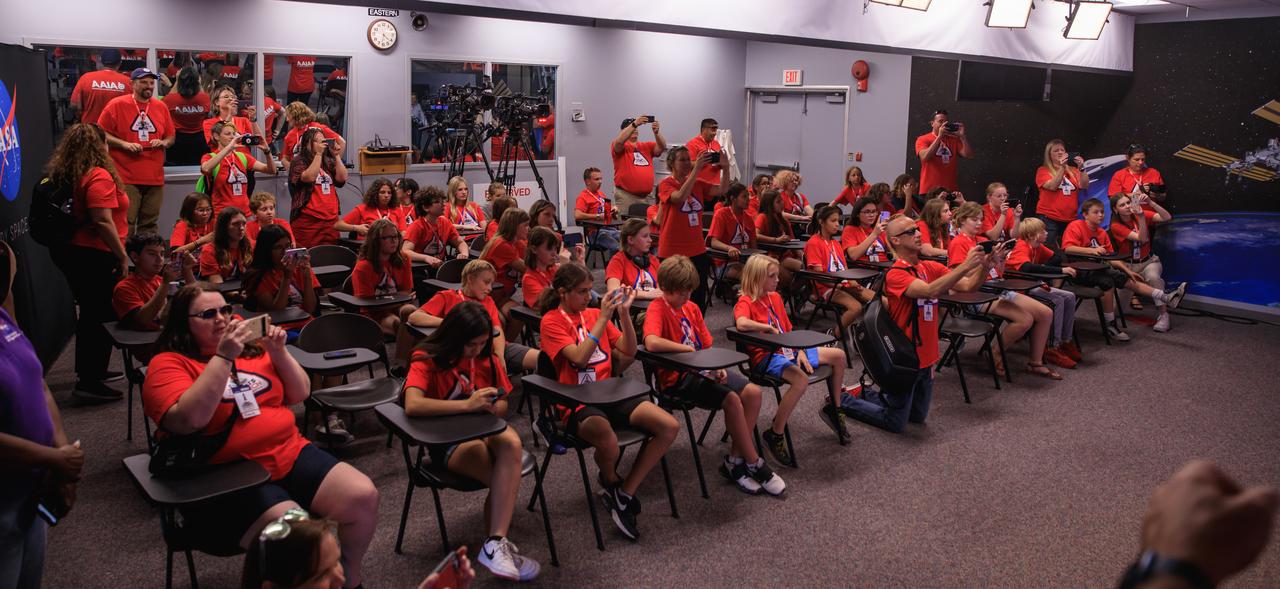
A group of students and their chaperones gather in the John Holliman Auditorium of the News Center for a mock news briefing during a tour of NASA’s Kennedy Space Center in Florida on Oct. 6, 2022. The middle-school students, from the Boys and Girls Clubs of the Flathead Indian Reservation in Montana, are visiting the space center with the Students to Launch program. Students to Launch engages students in STEM (science, technology, engineering and mathematics) and creates awareness of careers in the space program.
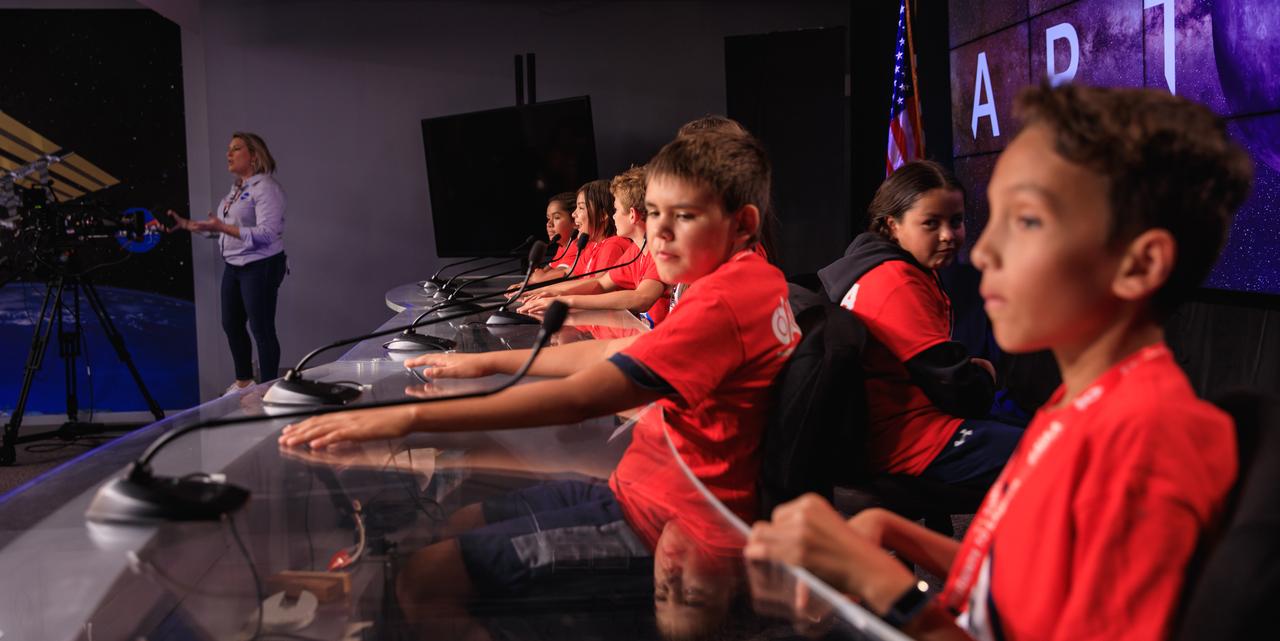
A group of students and their chaperones gather in the John Holliman Auditorium of the News Center during a tour of NASA’s Kennedy Space Center in Florida on Oct. 6, 2022. Some of them are seated at the dais at the front of the auditorium. The middle-school students, from the Boys and Girls Clubs of the Flathead Indian Reservation in Montana, are visiting the space center with the Students to Launch program. Students to Launch engages students in STEM (science, technology, engineering and mathematics) and creates awareness of careers in the space program.
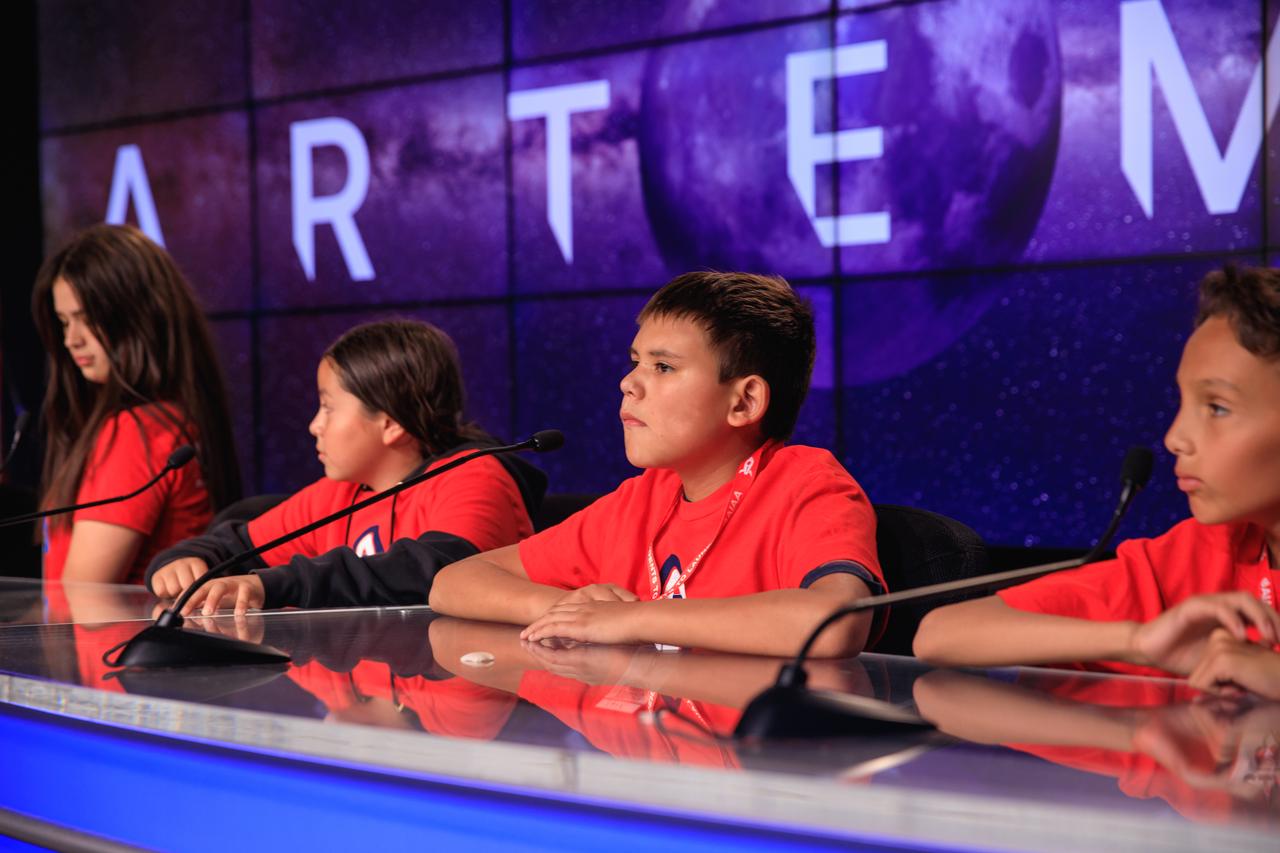
A group of students and their chaperones gather in the John Holliman Auditorium of the News Center to simulate a news conference during a tour of NASA’s Kennedy Space Center in Florida on Oct. 6, 2022. Some of them are seated at the dais at the front of the auditorium. The middle-school students, from the Boys and Girls Clubs of the Flathead Indian Reservation in Montana, are visiting the space center with the Students to Launch program. Students to Launch engages students in STEM (science, technology, engineering and mathematics) and creates awareness of careers in the space program.
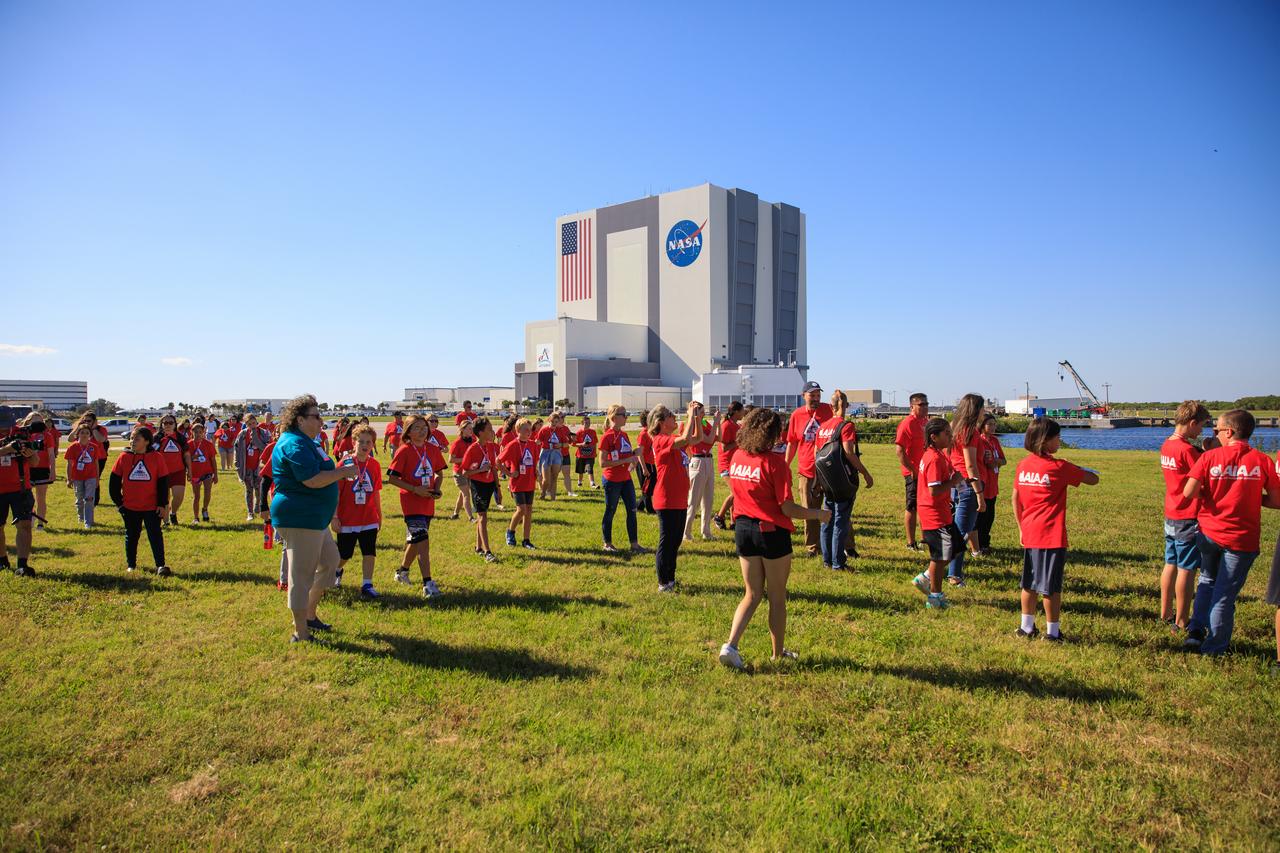
A group of students and their chaperones tour NASA’s Kennedy Space Center in Florida on Oct. 6, 2022. The middle-school students, from the Boys and Girls Clubs of the Flathead Indian Reservation in Montana, are visiting the space center under a Space Act Agreement with the Students to Launch program. Students to Launch engages students in STEM (science, technology, engineering and mathematics) and creates awareness of careers in the space program.
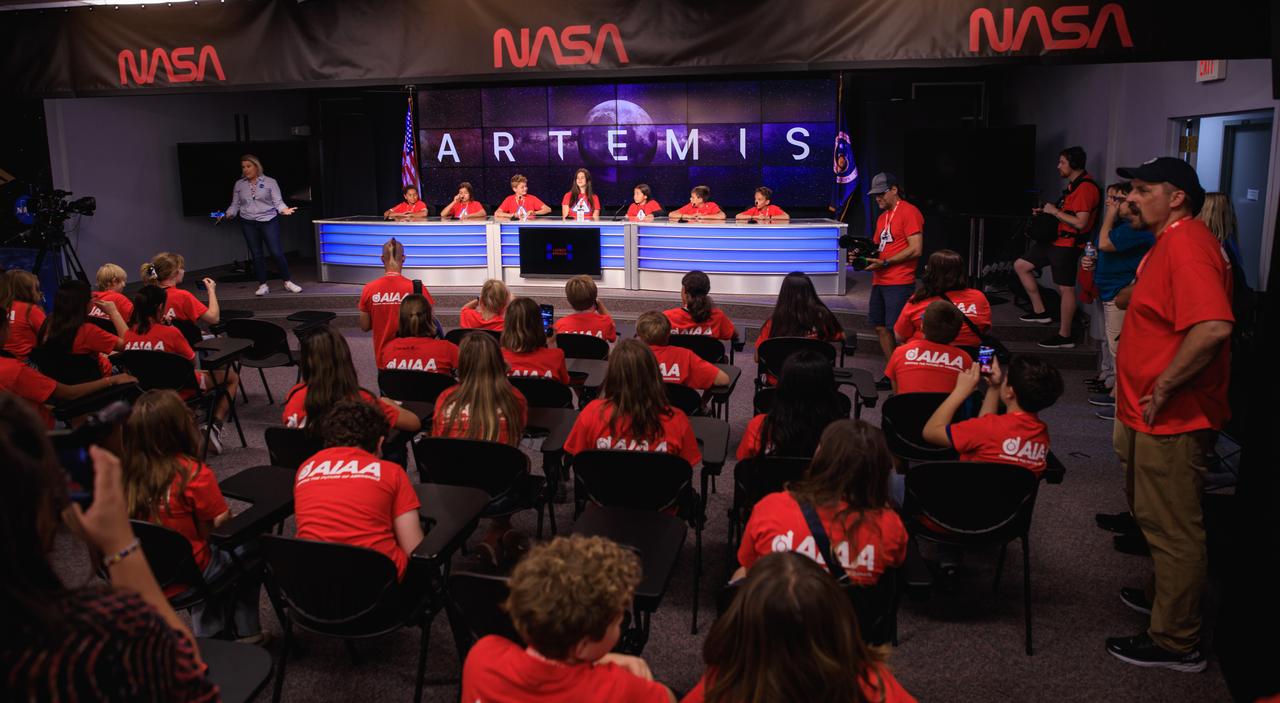
A group of students and their chaperones gather in the John Holliman Auditorium of the News Center to simulate a news conference during a tour of NASA’s Kennedy Space Center in Florida on Oct. 6, 2022. Some of them are seated at the dais at the front of the auditorium. At far left is Leah Martin, NASA Communications. The middle-school students, from the Boys and Girls Clubs of the Flathead Indian Reservation in Montana, are visiting the space center with the Students to Launch program. Students to Launch engages students in STEM (science, technology, engineering and mathematics) and creates awareness of careers in the space program.

A group of students and their chaperones gather for a photo at the launch countdown clock near the News Center at NASA’s Kennedy Space Center in Florida on Oct. 6, 2022. The middle-school students, from the Boys and Girls Clubs of the Flathead Indian Reservation in Montana, are visiting the space center with the Students to Launch program. Students to Launch is engages students in STEM (science, technology, engineering and mathematics) and creates awareness of careers in the space program.

NASA Astronaut Joe Acaba speaks to students and educators during their tour stop at the Lunar Landing Research Facility during an aerospace technical field career day event at Langley Research Center, Hampton Va., Wednesday, April 29, 2026. Photo Credit (NASA/Mark L Knopp)

NASA Mechanical Engineer Christopher B. Meek speaks to students and educators during their tour stop at the Lunar Landing Research Facility for an aerospace technical field career day event at Langley Research Center, Hampton Va., Wednesday, April 29, 2026. Photo Credit (NASA/Mark L. Knopp)

High school and college students, and educators spent a day learning about careers in technical fields in aerospace. They engaged in hands-on activities, tours, and listening to keynote presentations and panels, interacting with NASA’s subject matter experts at Langley Research Center, Hampton Va, Wednesday, April 29, 2026. Photo Credit (NASA/Mark L. Knopp)

High school and college students, and educators spent a day learning about careers in technical fields in aerospace. They engaged in hands-on activities, tours, and listening to keynote presentations and panels, interacting with NASA’s subject matter experts at Langley Research Center, Hampton Va, Wednesday, April 29, 2026. Photo Credit (NASA/Mark L. Knopp)
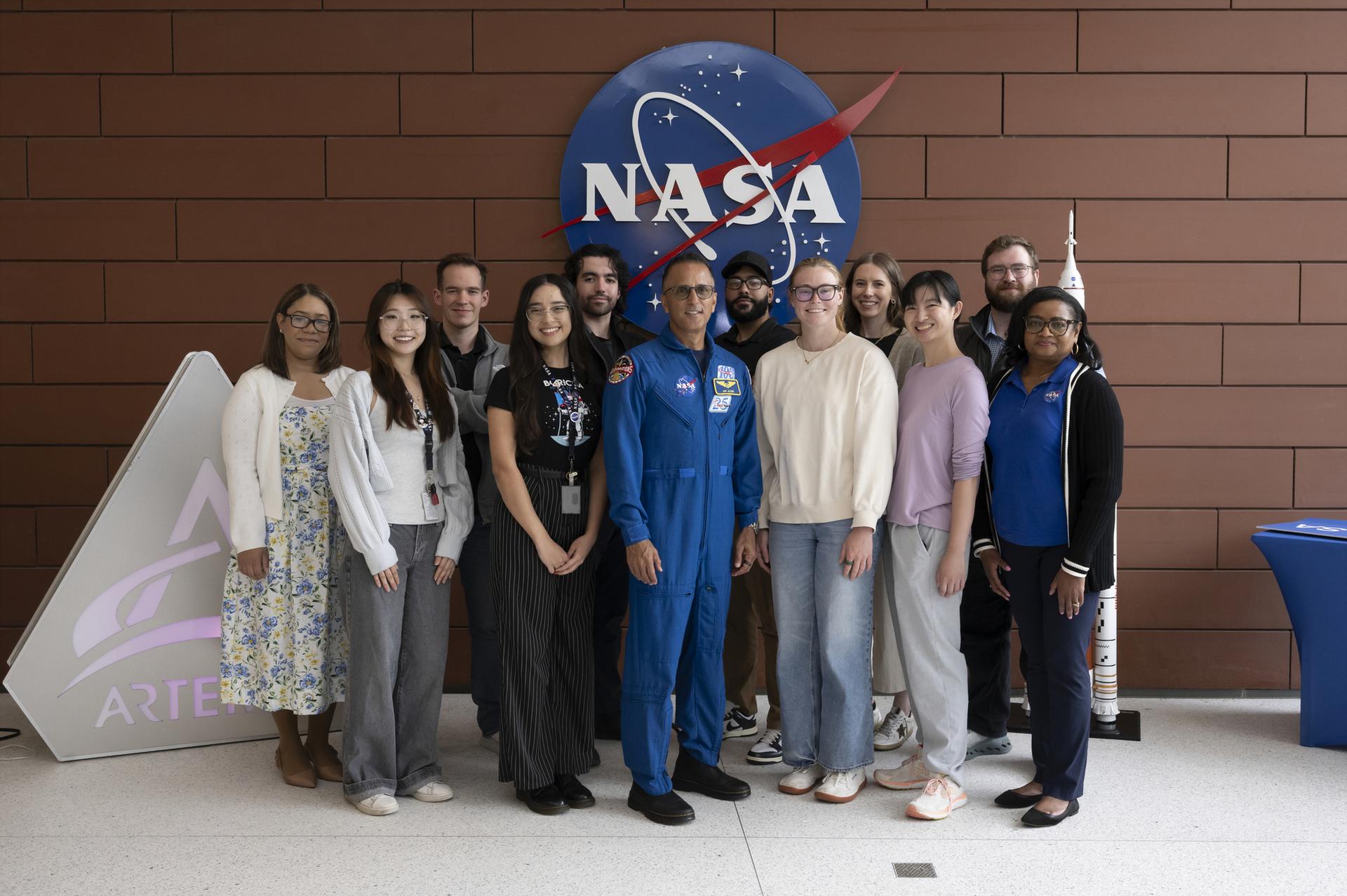
High school and college students, and educators spent a day learning about careers in technical fields in aerospace. They engaged in hands-on activities, tours, and listening to keynote presentations and panels, interacting with NASA’s subject matter experts at Langley Research Center, Hampton Va, Wednesday, April 29, 2026. Photo Credit (NASA/Ryan H. Hill)