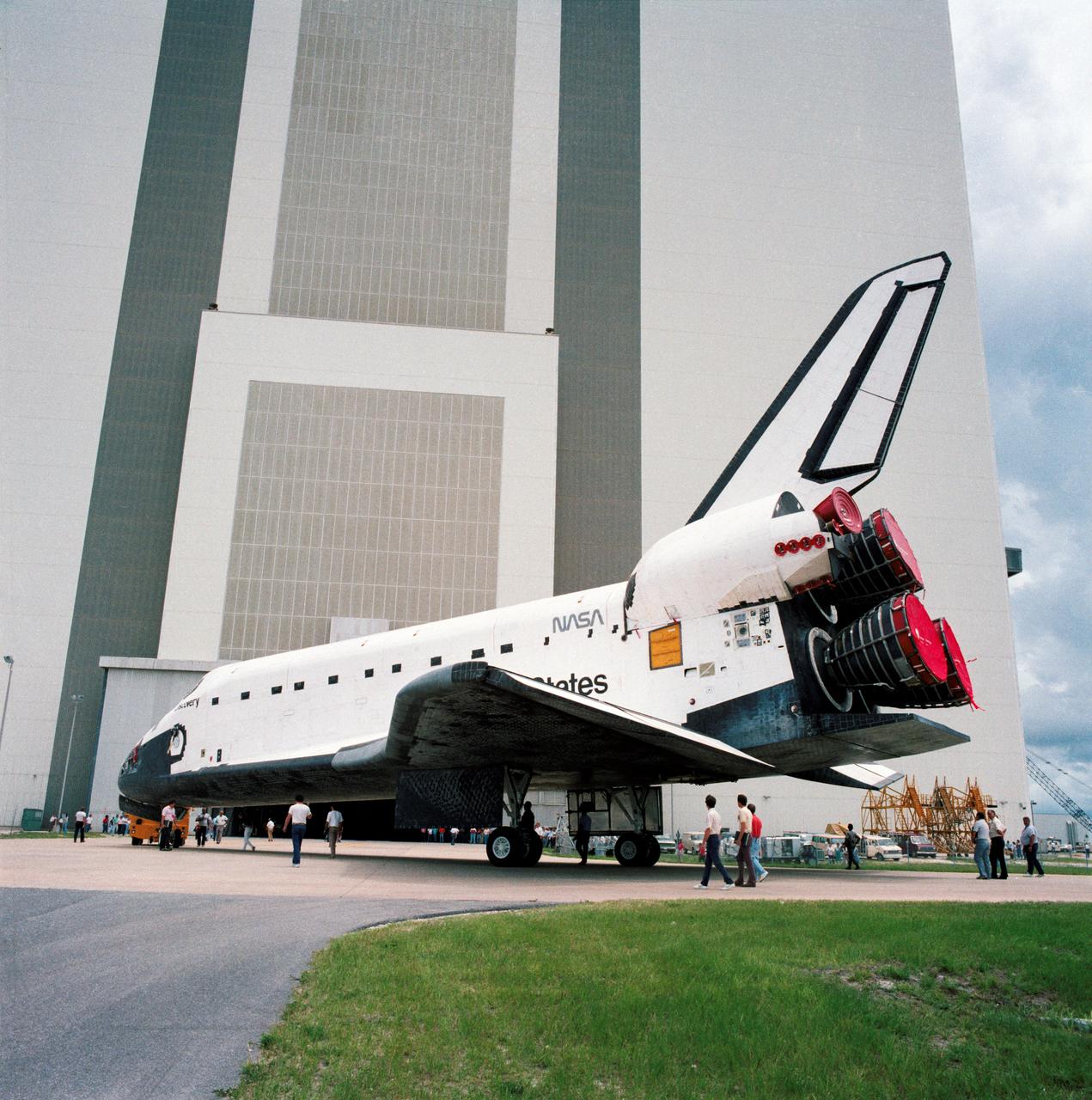
S88-42092 (15 July 1988) --- STS-26 Discovery, Orbiter Vehicle (OV) 103, rollover at Kennedy Space Center (KSC) is closely monitored by engineers and technicians in the late stages of the move from the orbiter processing facility (OPF) to the vehicle assembly building (VAB) as preflight preparations continue. A large crowd of KSC employees and other spectators watches in the background as OV-103, supported by its landing gear, is pulled toward VAB (background). While in the VAB, OV-103 will be mated to two solid rocket boosters (SRBs) and an external fuel tank.
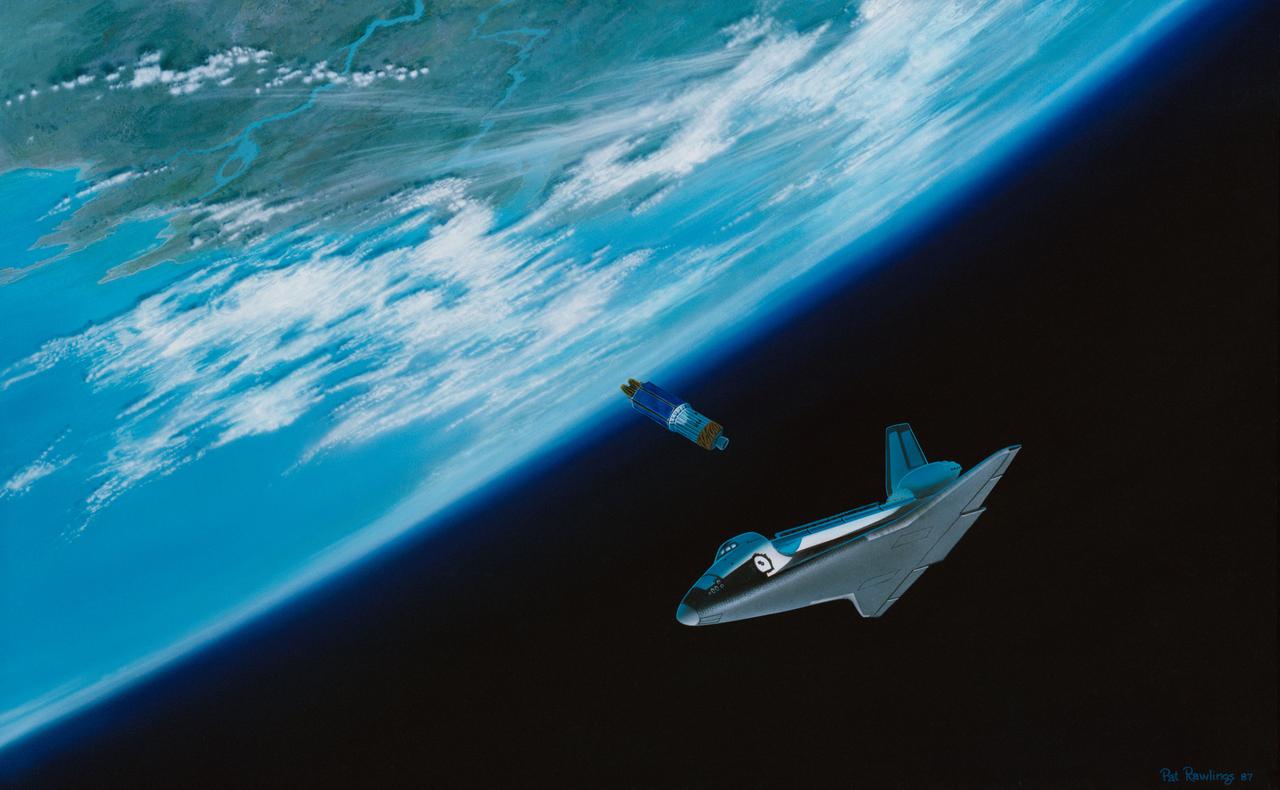
STS-26 Discovery, Orbiter Vehicle (OV) 103, artwork depicts tracking and data relay satellite C (TDRS-C) deployment. OV-103 orbits above Earth in bottom-to-sun attitude, moments after TDRS-C's release into space. TDRS-C is seen just below open payload bay (PLB). Artwork was done by Pat Rawlings of Eagle Engineering.
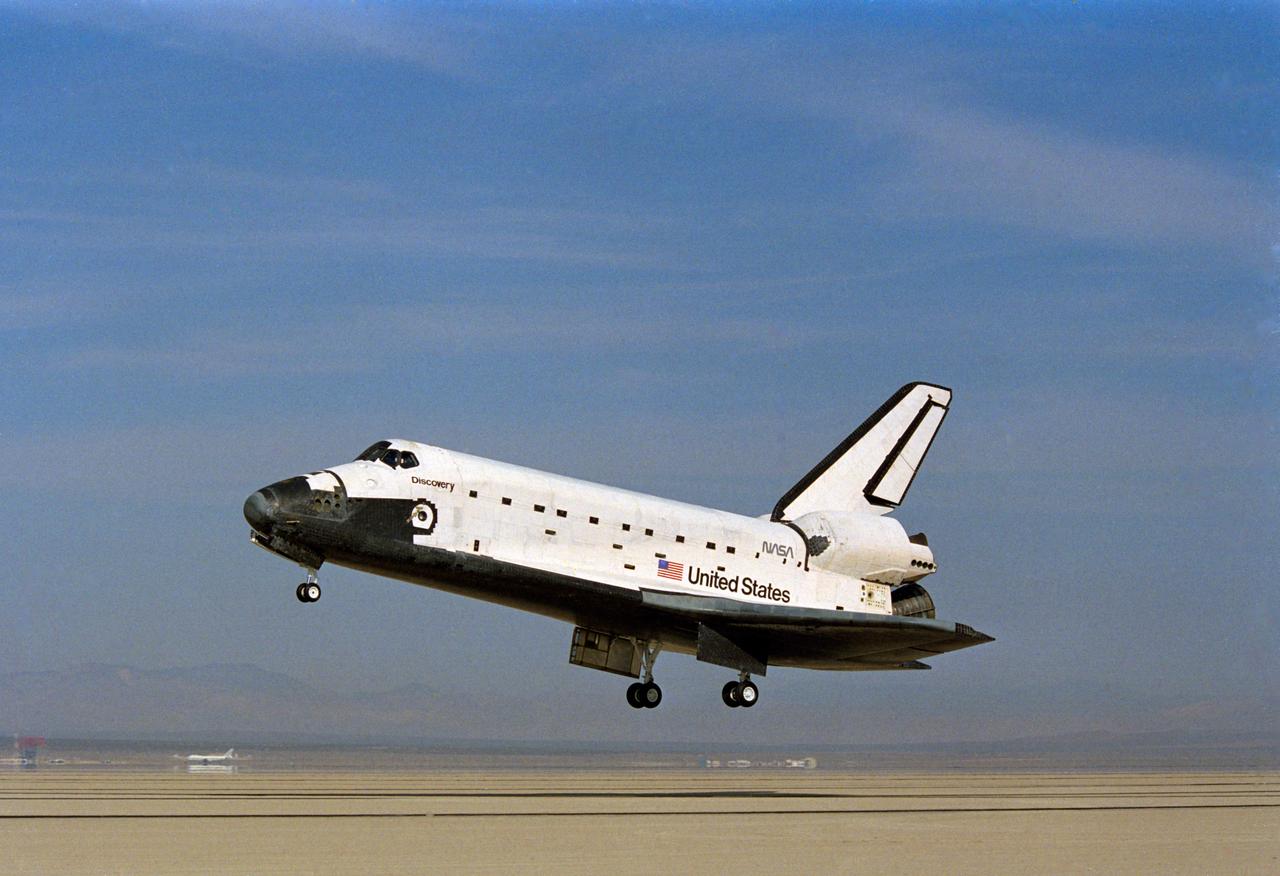
STS-26 Discovery, Orbiter Vehicle (OV) 103, with nose landing gear (NLG) and main landing gear (MLG) deployed glides above dry lakebed runway 17 at Edwards Air Force Base (EAFB), California. This profile view shows OV-103's port side just before MLG touchdown.
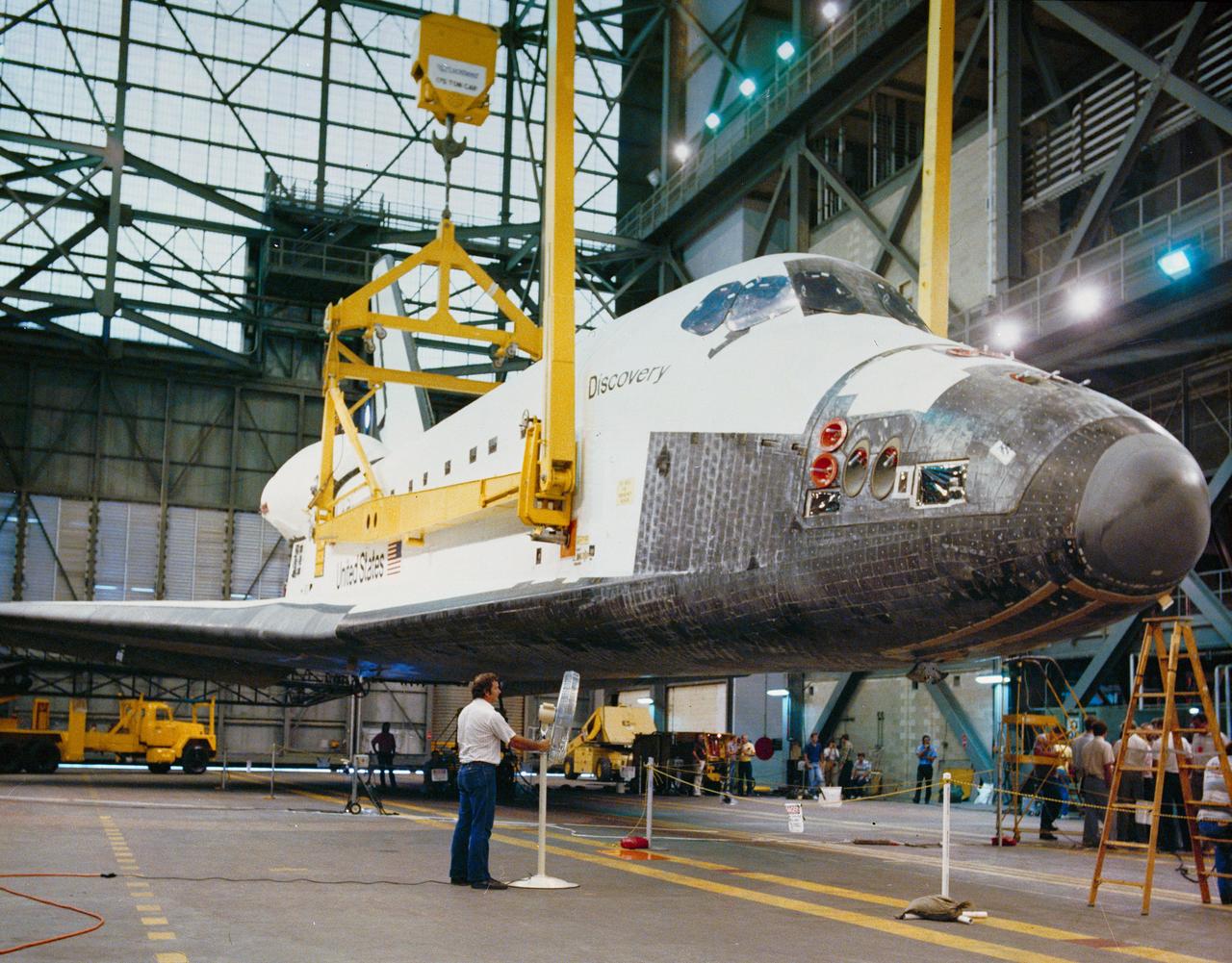
S88-41541 (7 July 1988) --- STS-26 Discovery, Orbiter Vehicle (OV) 103, is suspended by overhead crane and large frame attached to vehicle at four points. A ground-level view shows OV-103 during operations to accomplish its mating to two solid rocket boosters (SRBs) and an external fuel tank (ET) in the vehicle assembly building (VAB) at the Kennedy Space Center (KSC). From this step OV-103 will be lifted vertically and hoisted high inside the VAB for mating with the already connected ET and SRBs. In less than two weeks, the combined components will be rolled to Pad 39B atop a mobile launch platform.
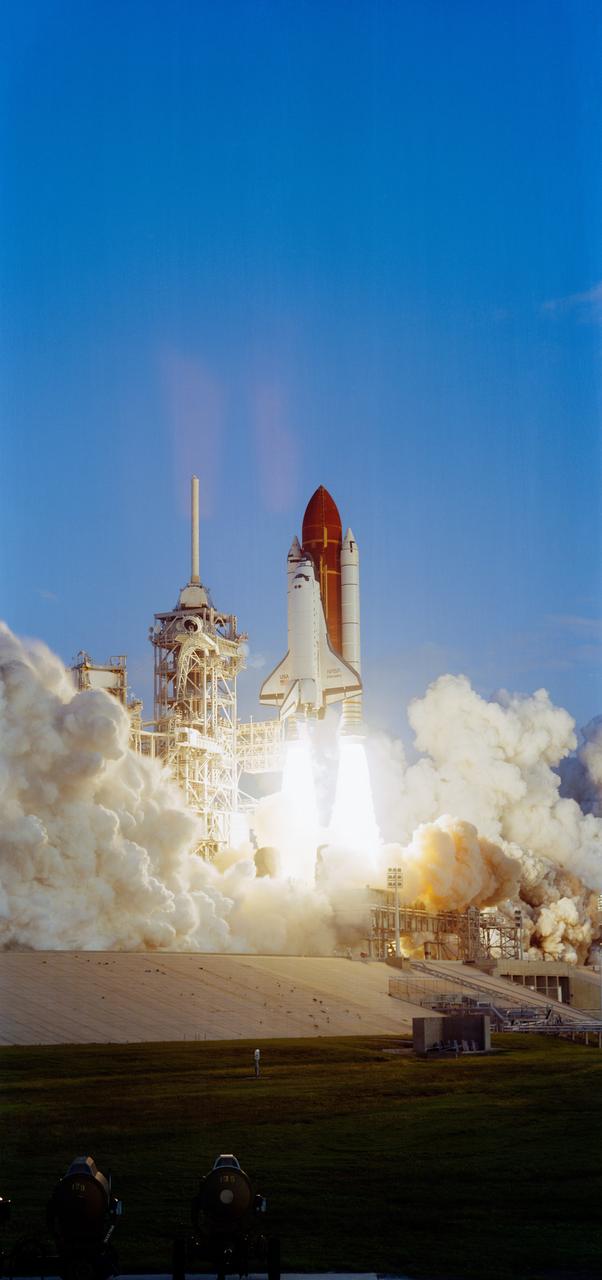
STS-41 Discovery, Orbiter Vehicle (OV) 103, lifts off from the Kennedy Space Center (KSC) Launch Complex (LC) Pad 39 mobile launcher platform at 7:47 am (Eastern Daylight Time (EDT)). OV-103 riding atop the external tank (ET) and flanked by two solid rocket boosters (SRBs), is captured just moments after liftoff. Not yet clear of the fixed service structure (FSS) tower, OV-103 is highlighted against the cloudless morning sky. Exhaust smoke billows from the SRBs and the space shuttle main engines (SSMEs) creating a cloud over the launch pad area.
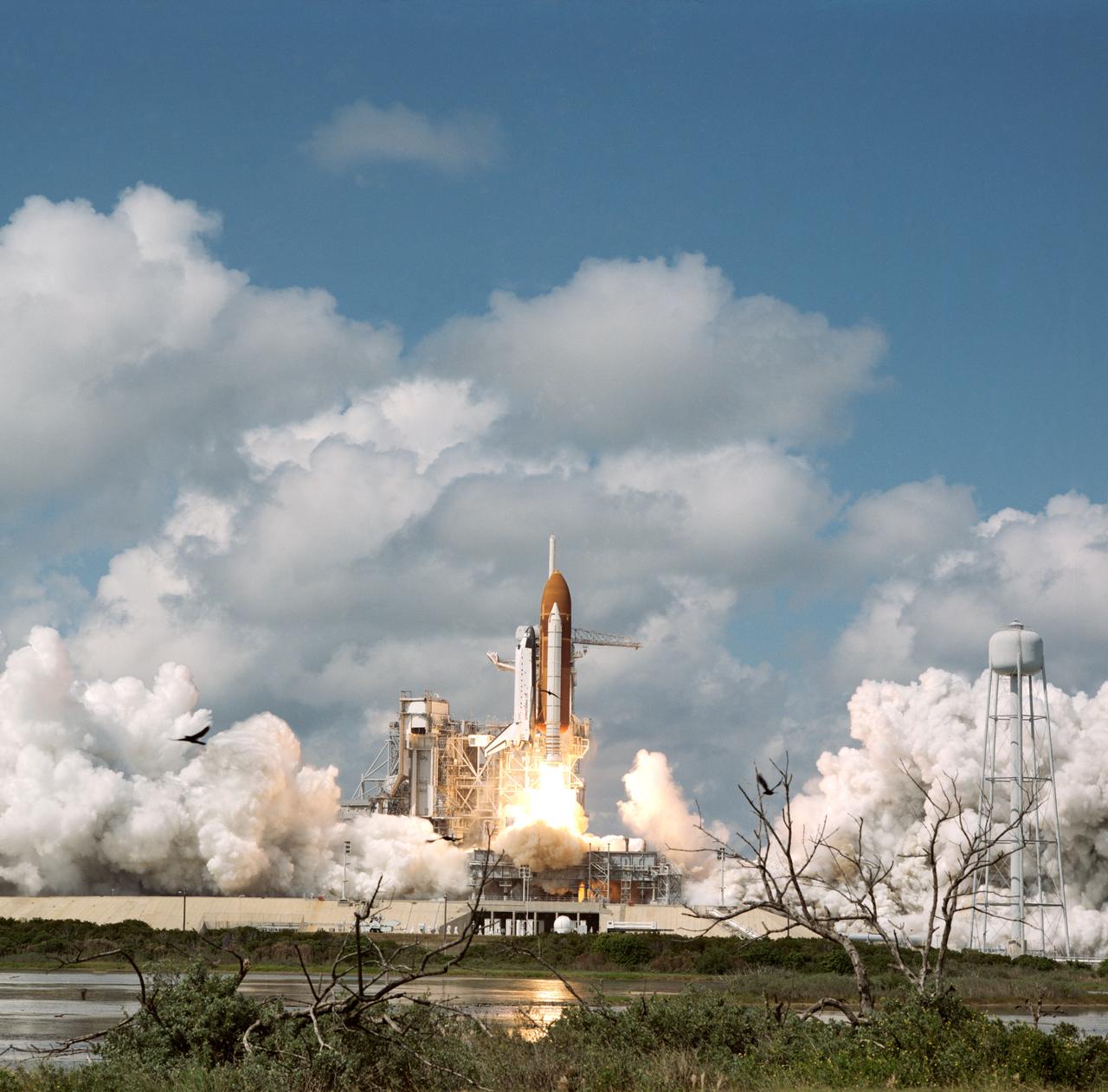
STS-26 Discovery, Orbiter Vehicle (OV) 103, lifts off from mobile launcher platform at Kennedy Space Center (KSC) Launch Complex (LC) pad 39B. Riding atop the orange external tank (ET), OV-103 heads for Earth orbit as the exhaust plumes from the two solid rocket boosters (SRBs) cover the mobile launcher platform and the area surrounding the launch pad. SRB firings are reflected in a nearby waterway. In the foreground are trees and several birds in flight. STS-26 marks OV-103's first flight since September 1985 and NASA's first manned mission since the 51L Challenger accident, 01-28-86.
STS-31 Discovery, Orbiter Vehicle (OV) 103, rides above the firey glow of the solid rocket boosters (SRBs) and space shuttle main engines (SSMEs) and a long trail of exhaust as it heads toward Earth orbit. Kennedy Space Center (KSC) Launch Complex (LC) Pad 39B is covered in an exhaust cloud moments after the liftoff of OV-103 at 8:33:51.0492 am (Eastern Daylight Time (EDT)). The exhaust plume pierces the low-lying clouds as OV-103 soars into the clear skies above. A nearby waterway appears in the foreground.
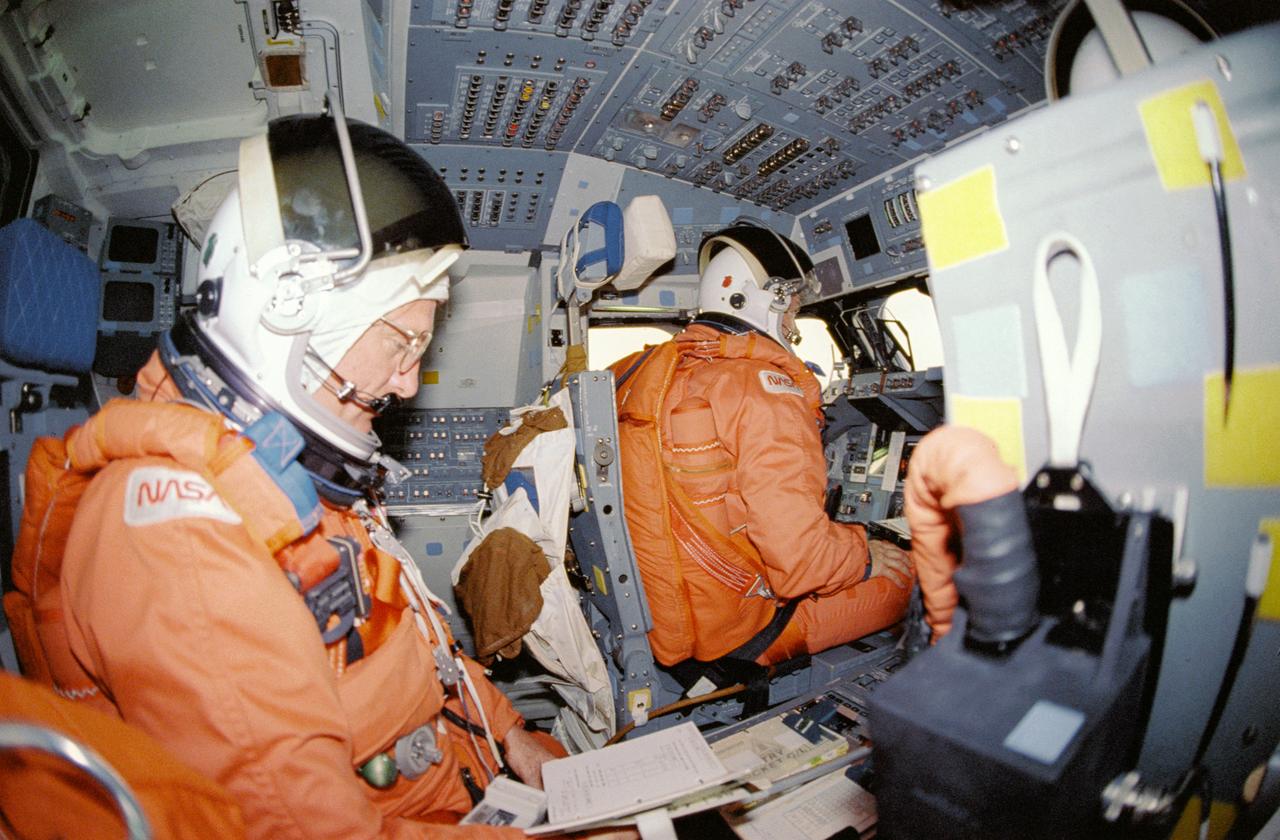
STS029-24-004 (18 March 1989) --- STS-29 crewmembers, wearing launch and entry suits (LESs) and launch and entry helmets (LEHs), review checklists on Discovery, Orbiter Vehicle (OV) 103, flight deck. Commander Michael L. Coats is seated at the forward flight deck commanders station with Mission Specialist (MS) James F. Buchli on aft flight deck strapped in mission specialist seat. OV-103 makes its return after five days in space. Note color in forward windows W1, W2, W3 caused by friction of entry through the Earth's atmosphere. Personal Egress Air Pack (PEAP) is visible on pilots seat back.
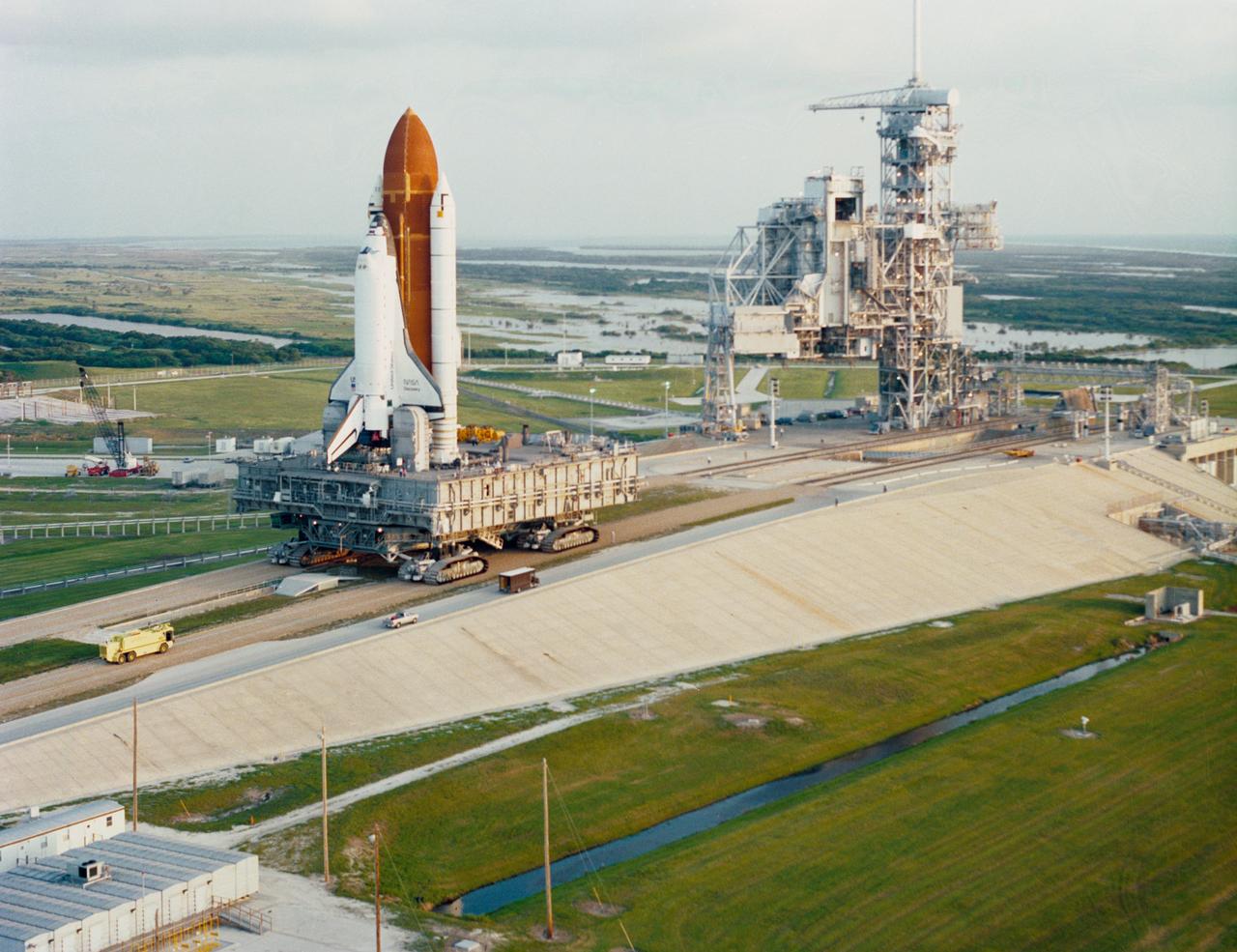
STS-26 Discovery, Orbiter Vehicle (OV) 103, rolls out to Kennedy Space Center (KSC) launch complex (LC) pad 39B on top of the crawler transporter. OV-103 nears LC pad 39B after a six-hour journey from the vehicle assembly building (VAB). When locked onto the nearby rotating service structure (RSS), work will continue to ready the vehicle for the STS-26 launch later in the summer.

S90-27594 (November 1989) --- Manley L. "Sonny" Carter Jr., STS-33 mission specialist, wearing a Launch and Entry Suit (LES), poses in front of the space shuttle Discovery, Orbiter Vehicle (OV) 103 at the Kennedy Space Center (KSC) Launch Complex Pad 39B, at the 195 feet level elevator entrance at Pad 39B. Visible in the background is the catwalk to OV-103's side hatch and the Atlantic Ocean. Note: Carter died April 5, 1991 at age 43, in a civil aviation accident.
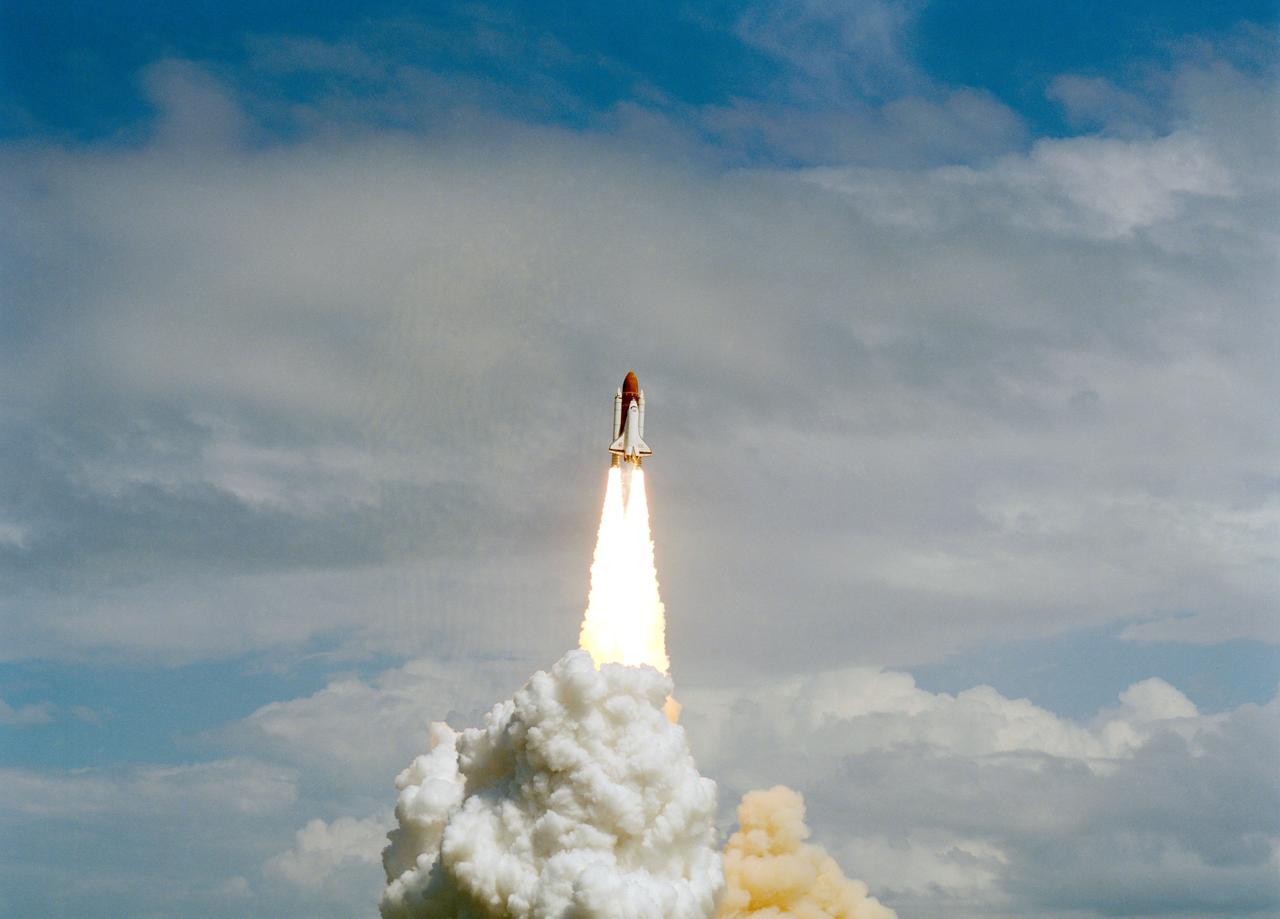
STS-26 Discovery, Orbiter Vehicle (OV) 103, rises into a cloudy sky and heads for Earth orbit atop the external tank (ET) as exhaust plumes billow from the two solid rocket boosters (SRBs) during liftoff from Kennedy Space Center (KSC) Launch Complex (LC) pad 39B. STS-26 marks OV-103's first flight since September 1985 and NASA's first manned mission since 51L Challenger accident, 01-28-86.
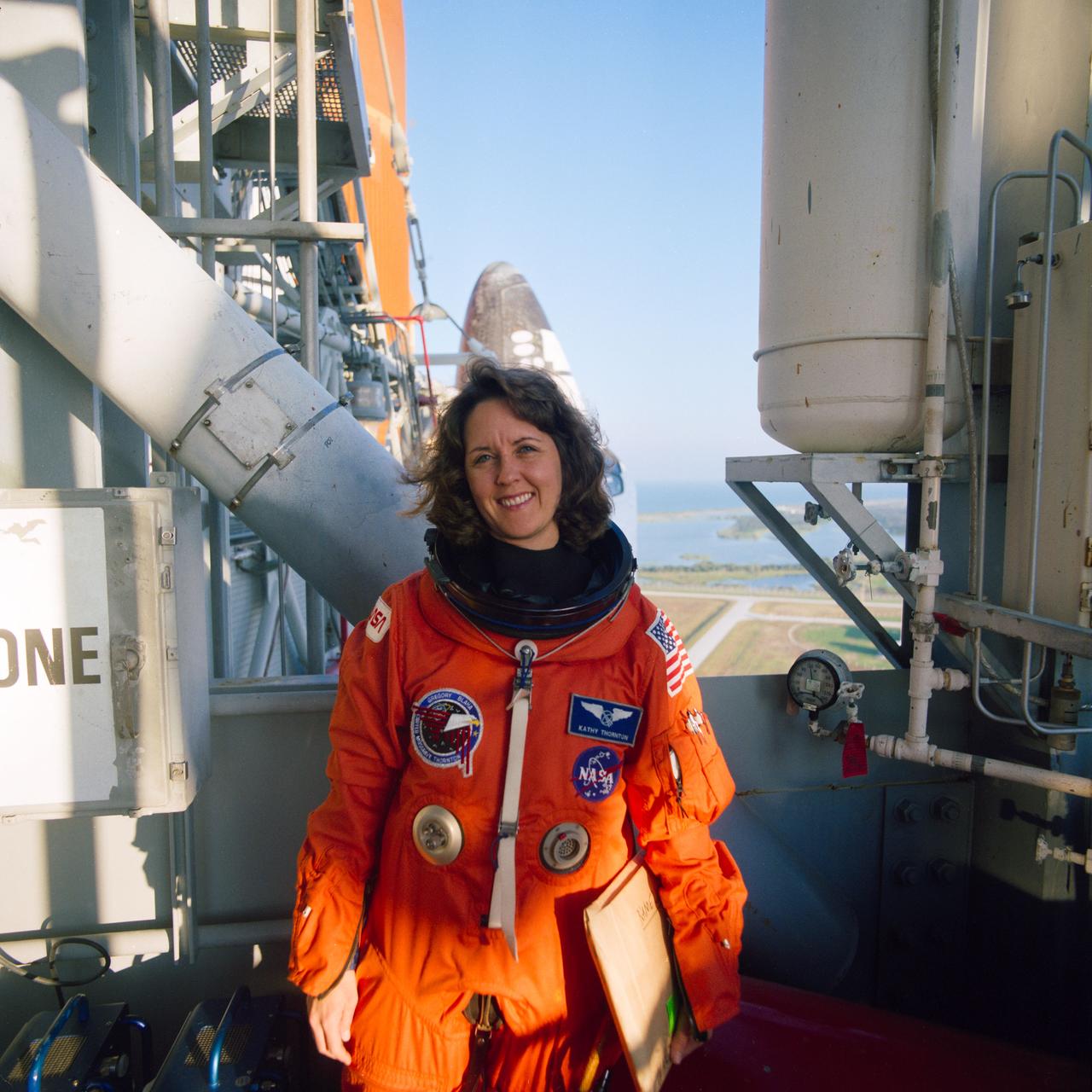
STS-33 Mission Specialist (MS) Kathryn C. Thornton, wearing launch and entry suit (LES) and holding file folder, poses in front of Discovery, Orbiter Vehicle (OV) 103, at the 195 ft level elevator entrance at Kennedy Space Center (KSC) Launch Complex (LC) Pad 39B. Visible in the background is the catwalk to OV-103's side hatch and the Atlantic Ocean.
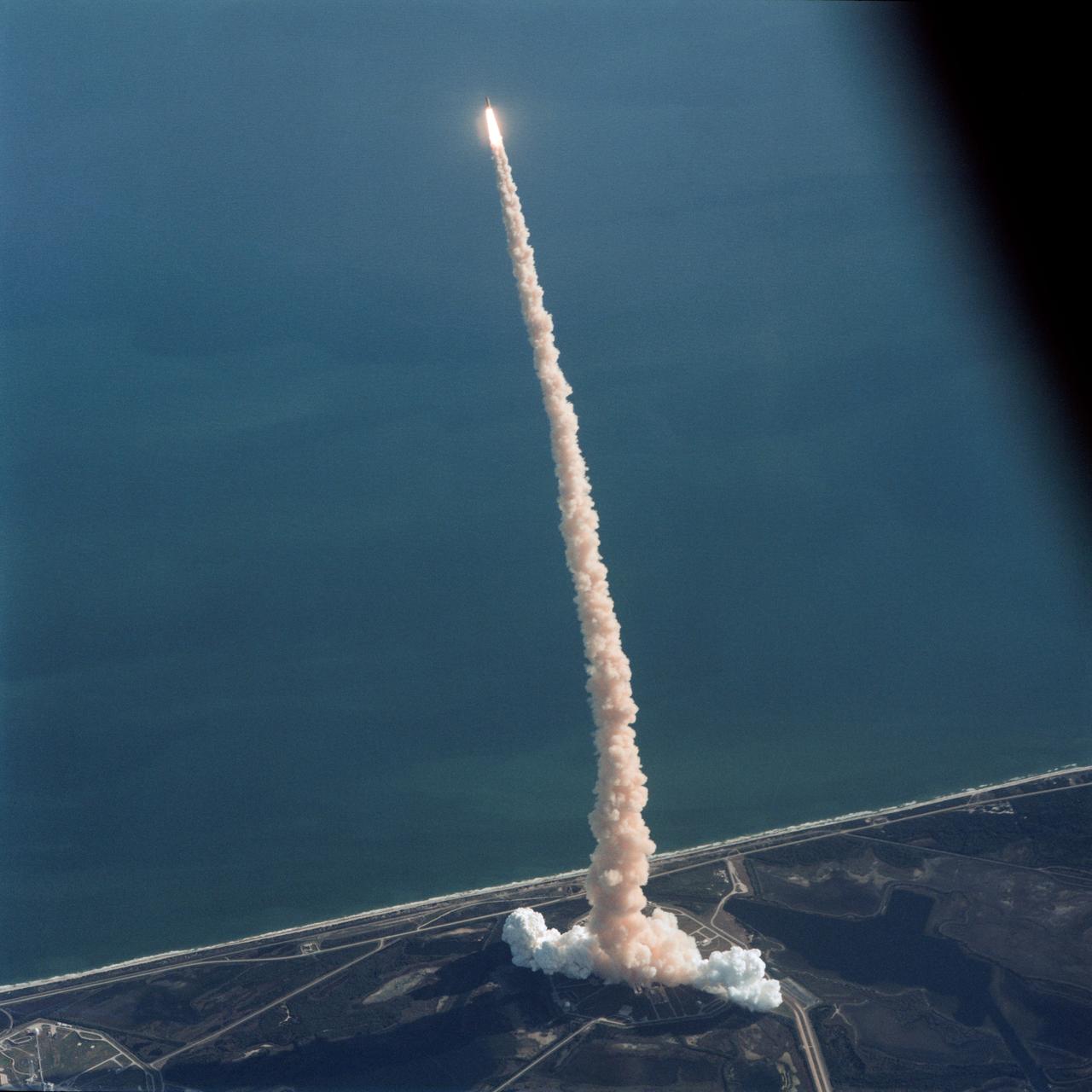
Air-to-air view, taken from the weather-monitoring Shuttle Training Aircraft (STA), shows STS-42 Discovery, Orbiter Vehicle (OV) 103, as it soars above the Atlantic Ocean after liftoff from a Kennedy Space Center (KSC) Launch Complex (LC) Pad at 9:52:33 am (Eastern Standard Time (EST)). The exhaust plume traces OV-103's flight path.
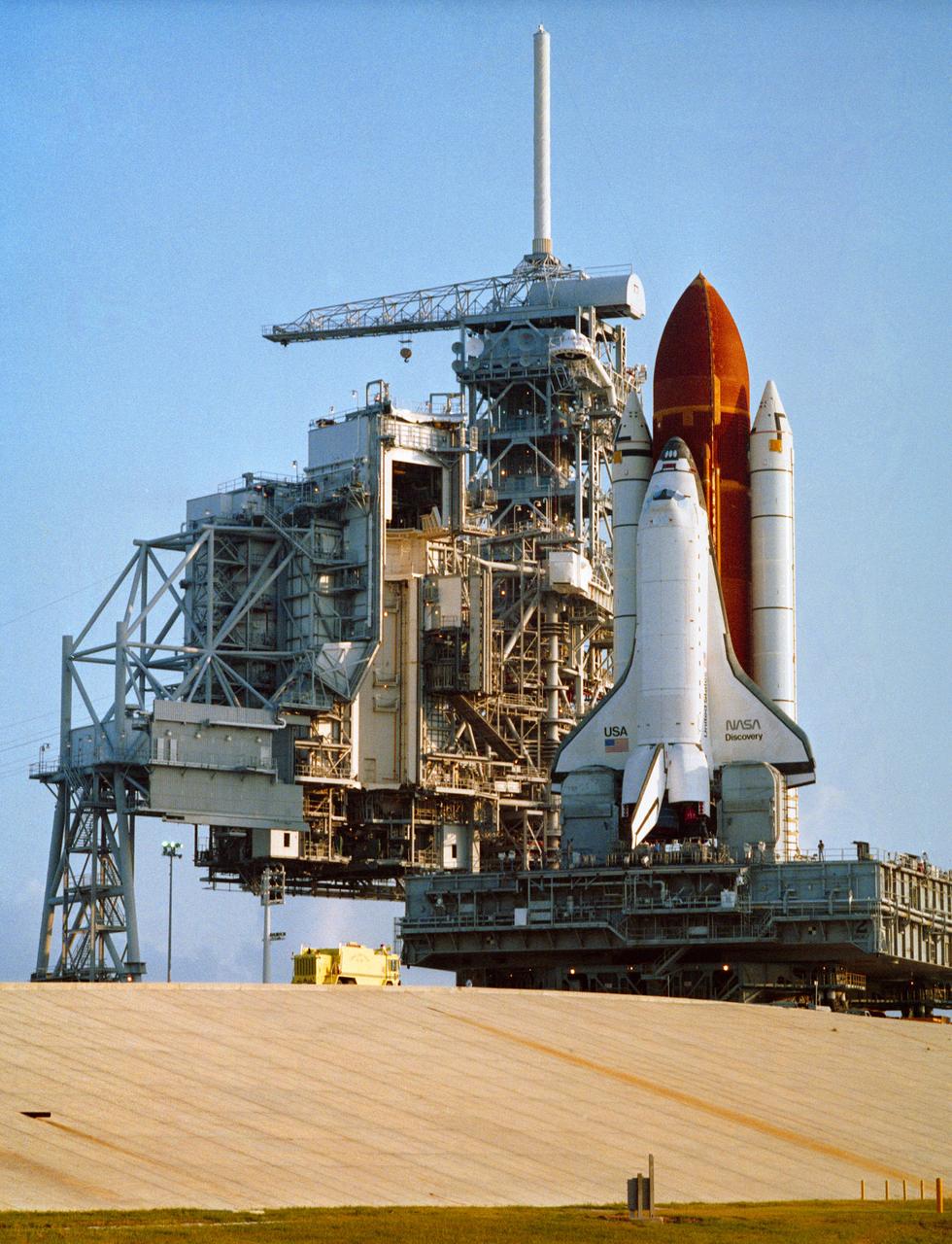
S88-42101 (15 July 1988) --- STS-26 Discovery, Orbiter Vehicle (OV) 103, awaits further processing at Kennedy Space Center (KSC) launch complex (LC) pad 39B. OV-103 arrived at LC pad 39B after a six-hour journey from the vehicle assembly building (VAB). The rotating service structure is retracted.
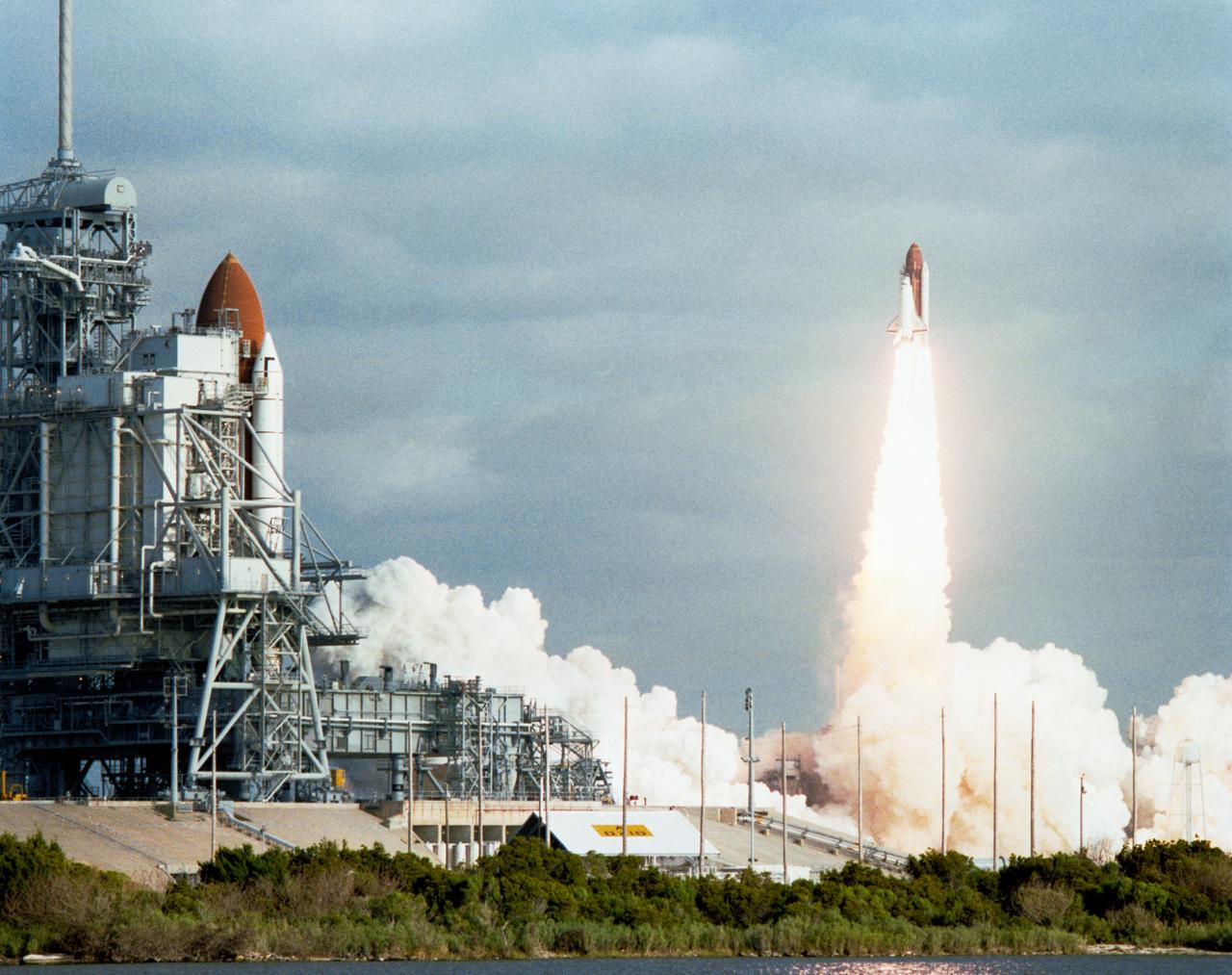
STS-31 Discovery, Orbiter Vehicle (OV) 103, lifts off from Kennedy Space Center (KSC) Launch Complex (LC) 39 Pad B. In the foreground STS-35 Columbia, OV-102, is visible on launch pad 39A. This event marked the first time since January 1986 that there was an orbiter on each pad. LC 39 pads are separated by 1.6 miles. View provided by KSC with alternate number KSC-90PC-610.
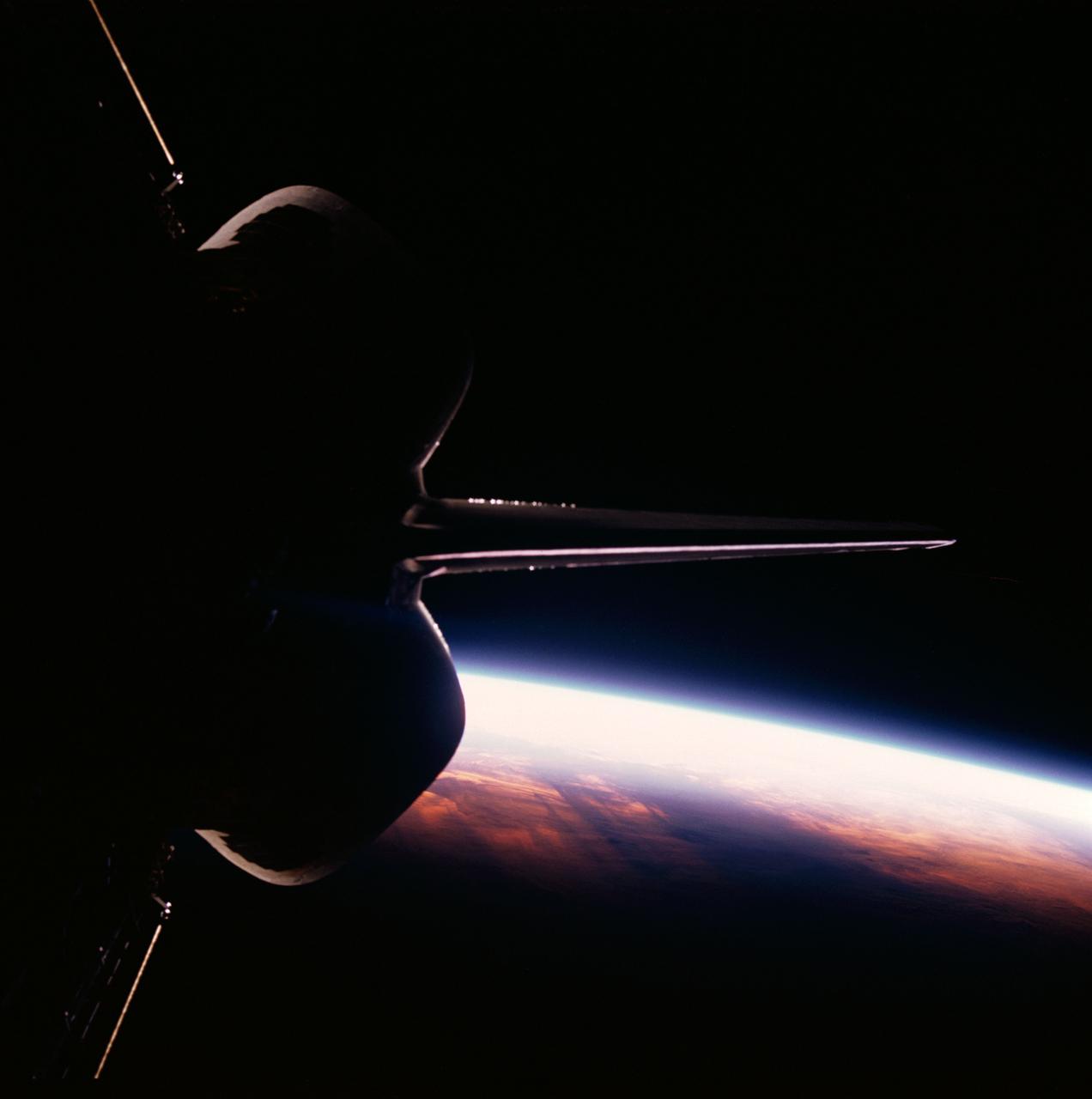
Discovery's, Orbiter Vehicle (OV) 103's, vertical stabilizer and orbital maneuvering system (OMS) pods are backdropped against the contrasted blackness of space illuminated by a colorful Earth / sunrise panorama. View was taken through the aft flight deck viewing windows during STS-26.
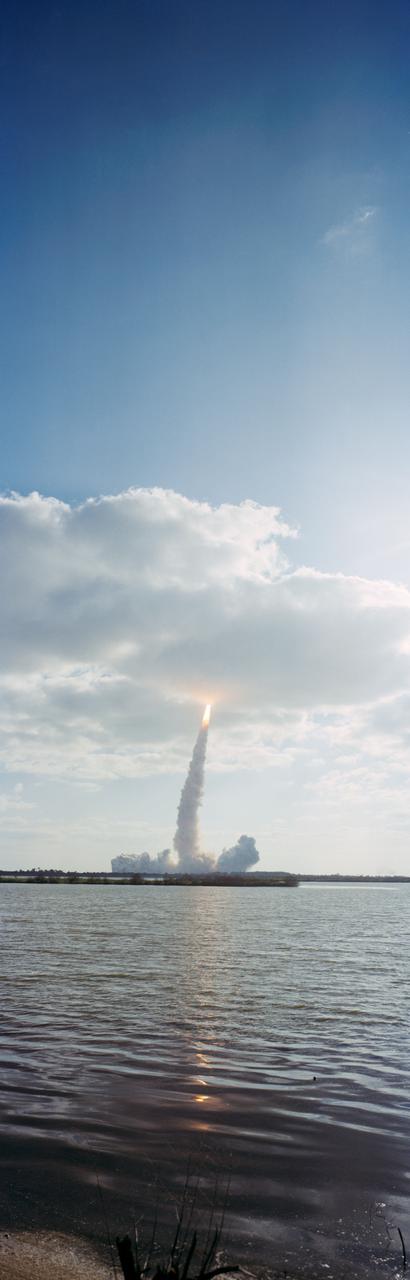
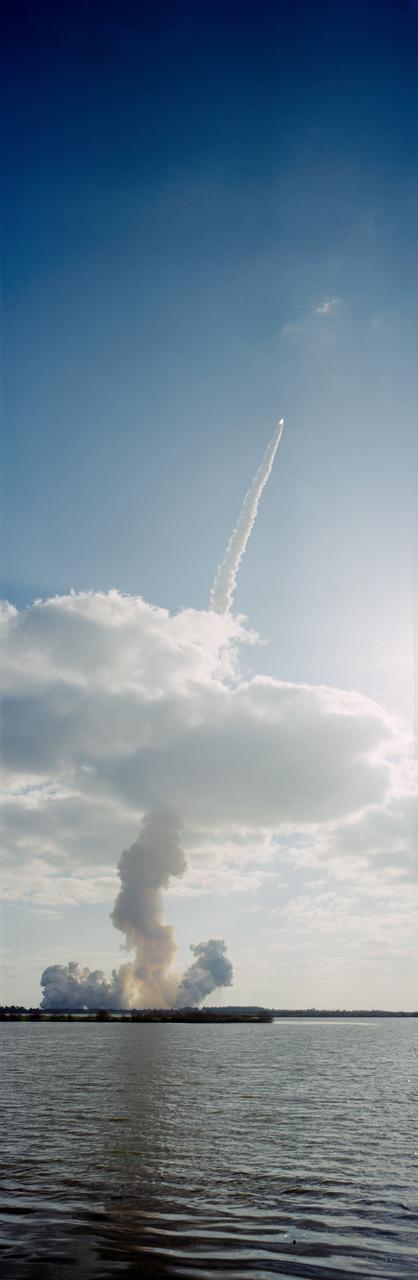
STS-31 Discovery, Orbiter Vehicle (OV) 103, is hidden in low-lying cloud cover as it rises above Kennedy Space Center (KSC) Launch Complex (LC) Pad 39B just after its liftoff at 8:33:51.0492 am (Eastern Daylight Time (EDT)). The glow of the solid rocket booster (SRB) and the space shuttle main engine (SSME) firings appears just below the cloud cover and is reflected in the nearby waterway (foreground). An exhaust plume trails from OV-103 and its SRBs and covers the launch pad area.
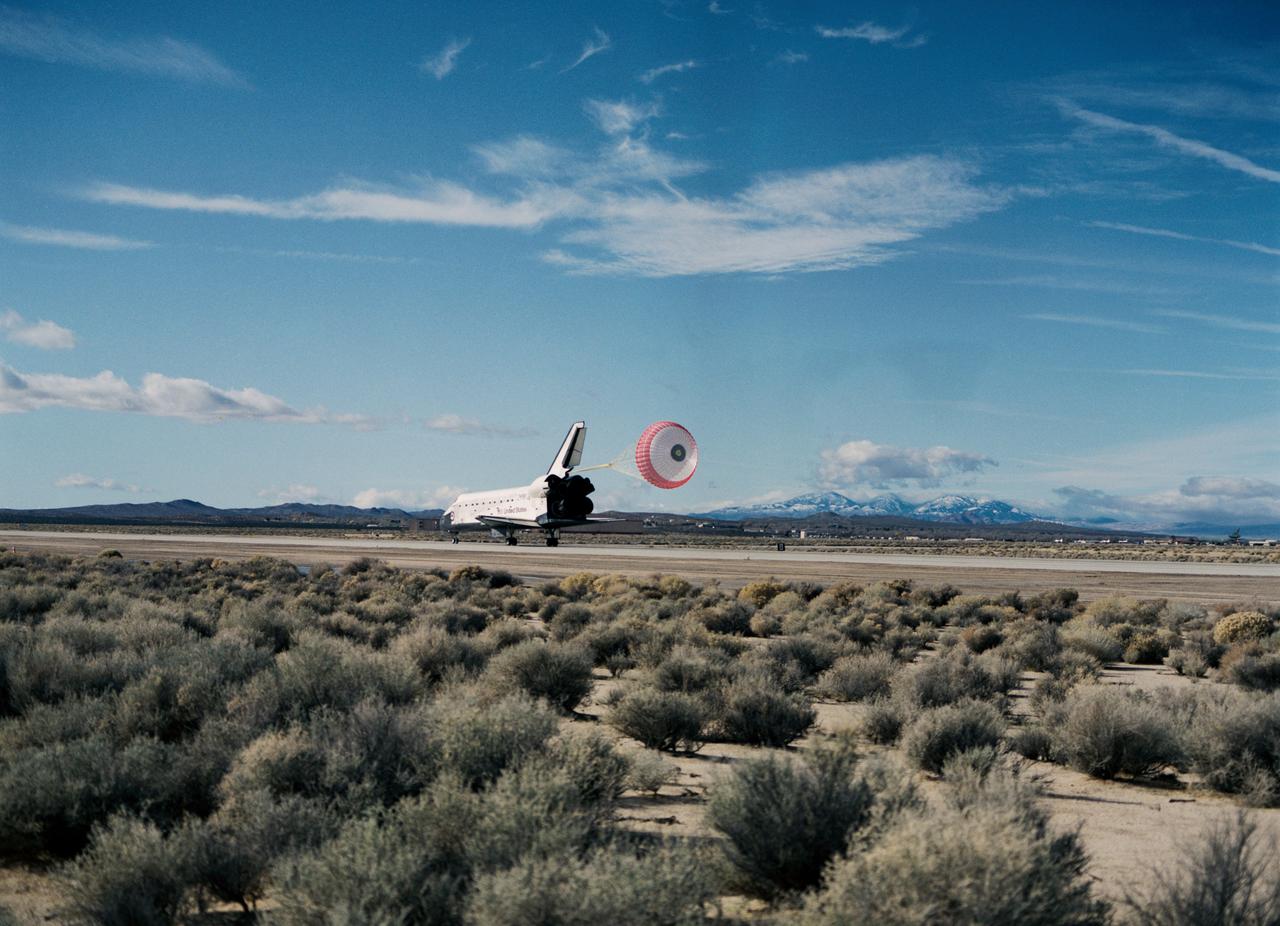
STS-53 Discovery, Orbiter Vehicle (OV) 103, is slowed by a red, white, and blue drag chute during its landing on concrete runway 22 at Edwards Air Force Base (EAFB), California. Main landing gear (MLG) touchdown occurred at 12:43:17 pm (Pacific Standard Time (PST)). This aft view of OV-103 shows the drag chute deployed from its compartment at the base of the vertical tail, the speedbrake/rudder flaps open, and the space shuttle main engines (SSMEs). Both MLG and nose landing gear (NLG) ride along the runway surface. Desert scrub brush appears in the foreground and mountains are seen in the background.
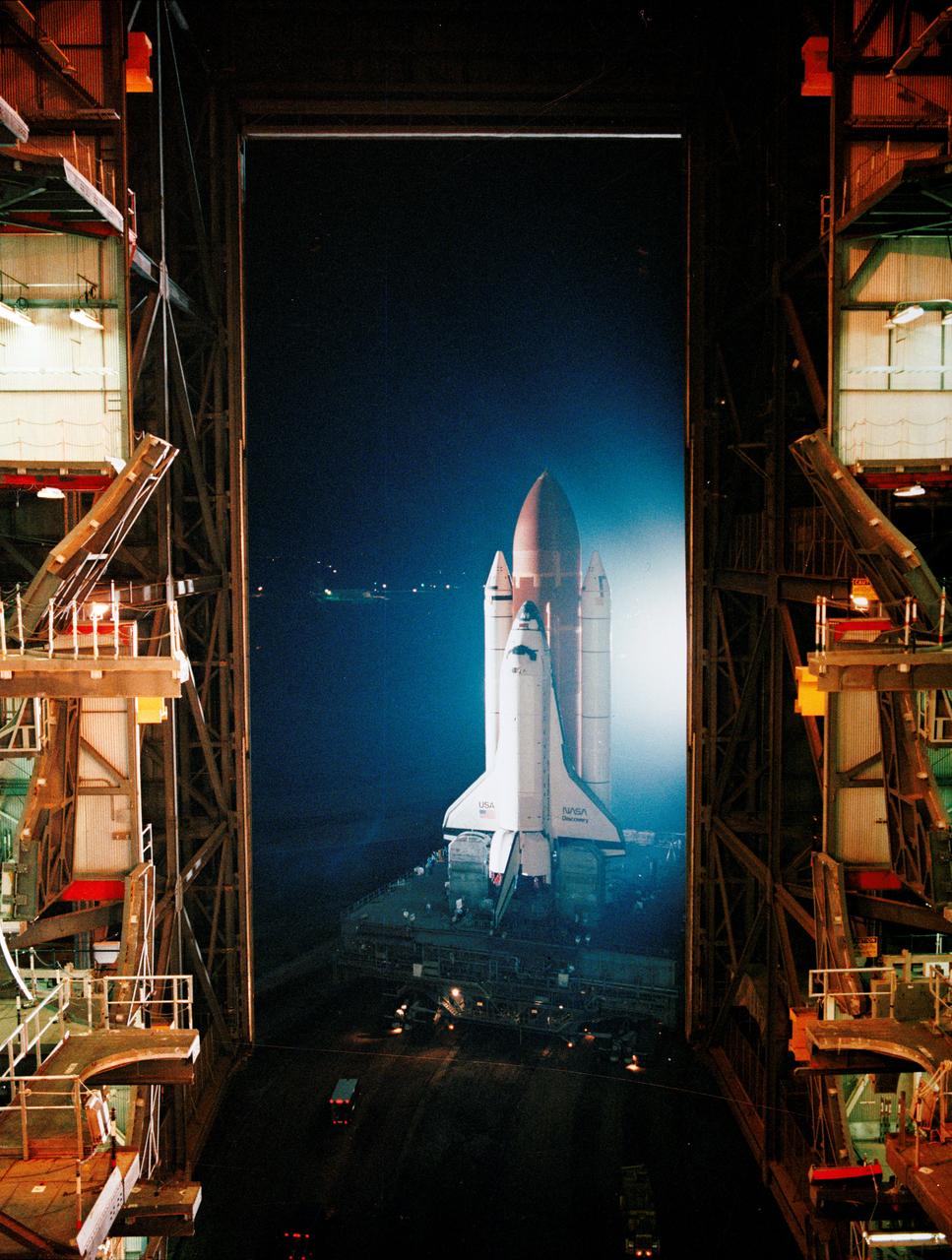
STS-26 Discovery, Orbiter Vehicle (OV) 103, mated with the external tank (ET) and solid rocket boosters (SRBs), is framed by Kennedy Space Center's (KSC's) vehicle assembly building (VAB) doorway as it rolled out. This high angle view shows OV-103 atop the mobile launch pad and crawler transporter as it begins its slow exit from VAB en route to launch complex (LC) pad 39B. The move began shortly after midnight on the nation's 212th birthday. Ceremonies marking the event were held later during daylight hours.
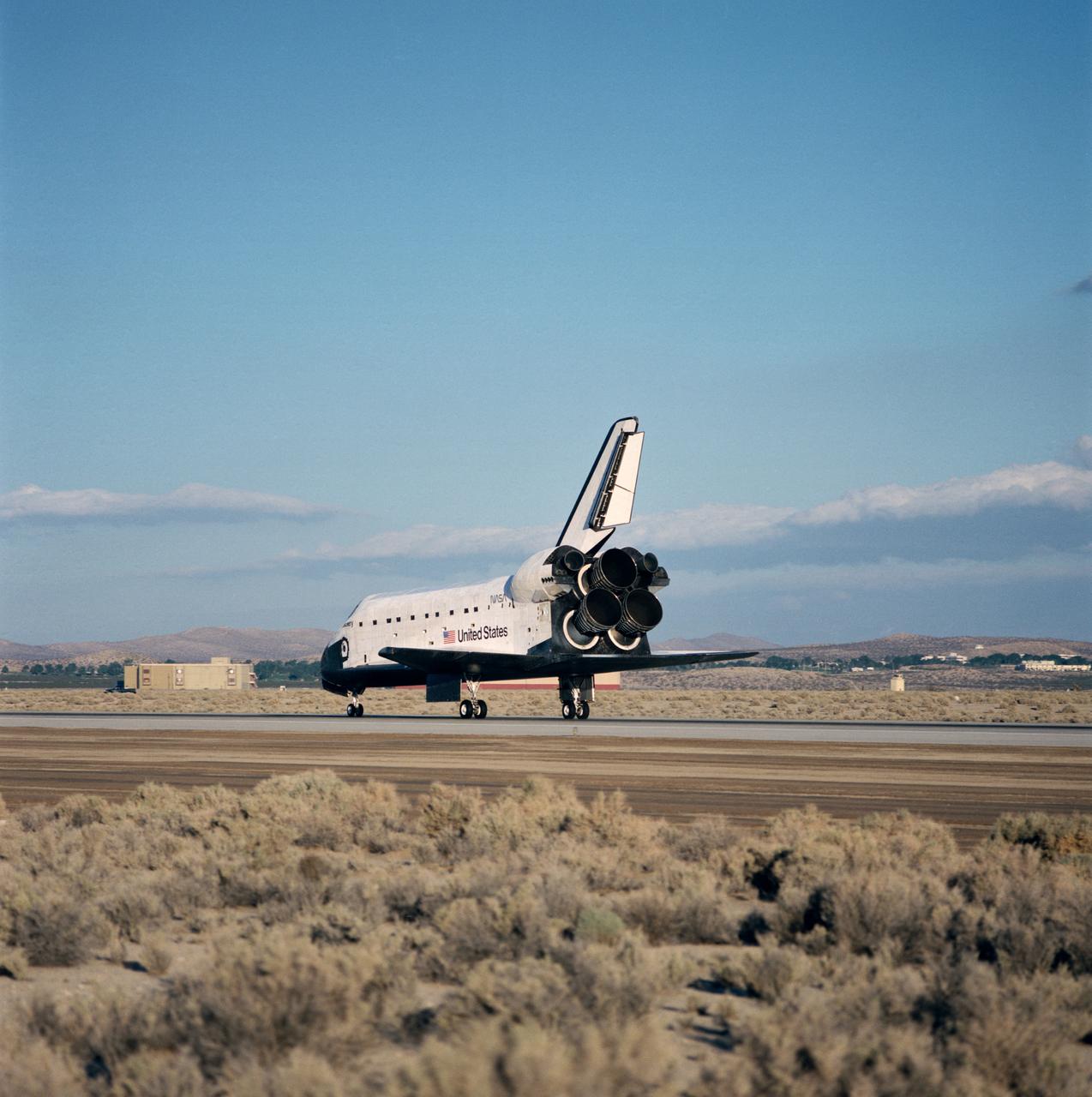
STS-31 Discovery, Orbiter Vehicle (OV) 103, rolls along concrete runway 22 at Edwards Air Force Base (EAFB), California, after nose landing gear (NLG) and main landing gear (MLG) touchdown. This view looks down OV-103's port side from the space shuttle main engines (SSMEs) to the nose section. The SSMEs are gimbaled to their descent position and the rudder/speedbrake is deployed on the vertical stabilizer. Wheel stop occurred at 6:51 am (Pacific Daylight Time (PDT)). In the distance EAFB facilities are visible.
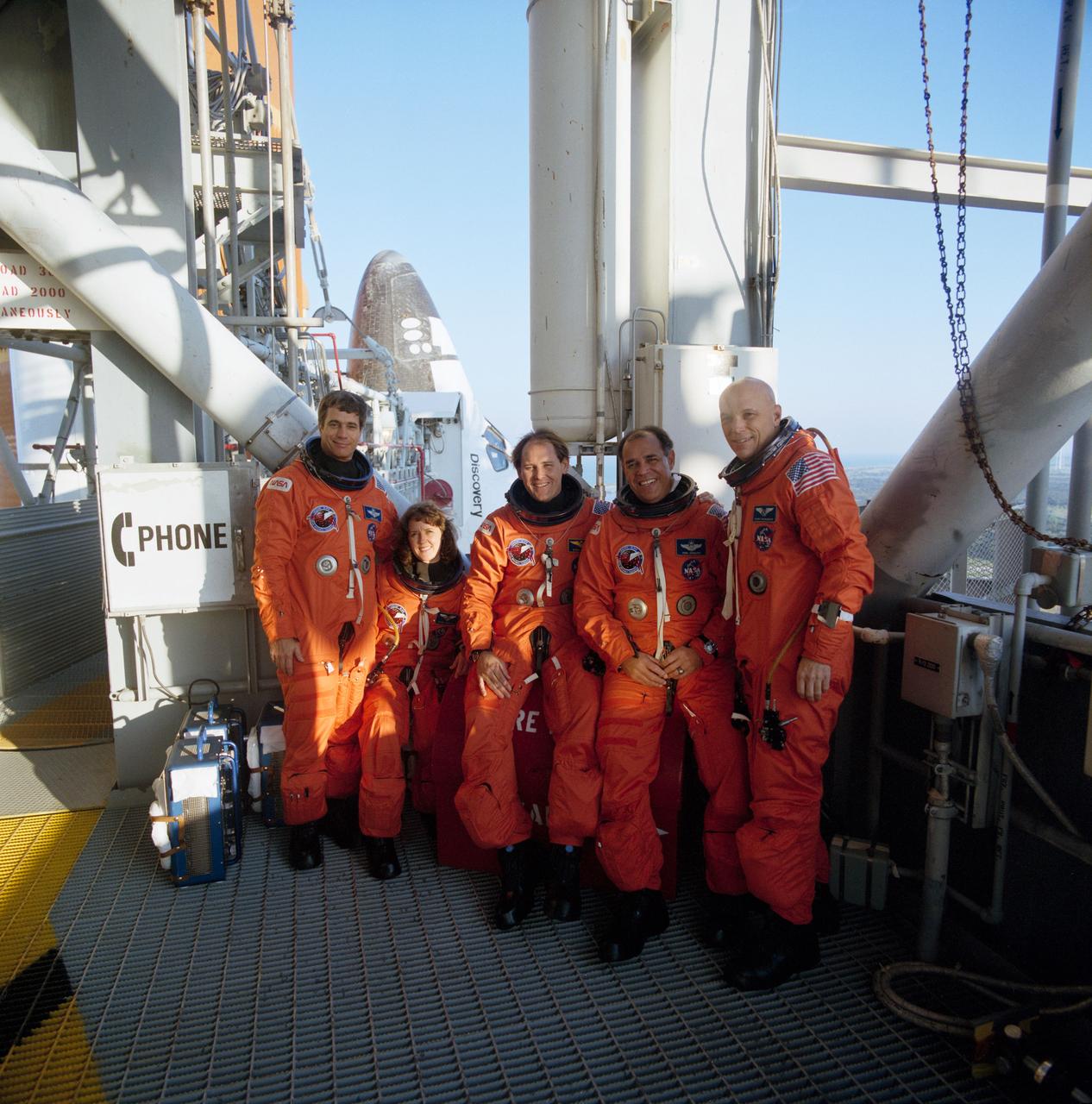
S90-27591 (23 Jan 1990) --- STS-33 crewmembers, wearing launch and entry suit (LES), take a break from training activities to pose for group portrait in front of Discovery, Orbiter Vehicle (OV) 103, at the 195 ft level elevator entrance at Kennedy Space Center (KSC) Launch Complex (LC) Pad 39B. Left to right are Pilot John E. Blaha, Mission Specialist (MS) Kathryn C. Thornton, MS Manley L. Carter, Jr, Commander Frederick D. Gregory, and MS F. Story Musgrave. Visible in the background is the catwalk to OV-103's side hatch.
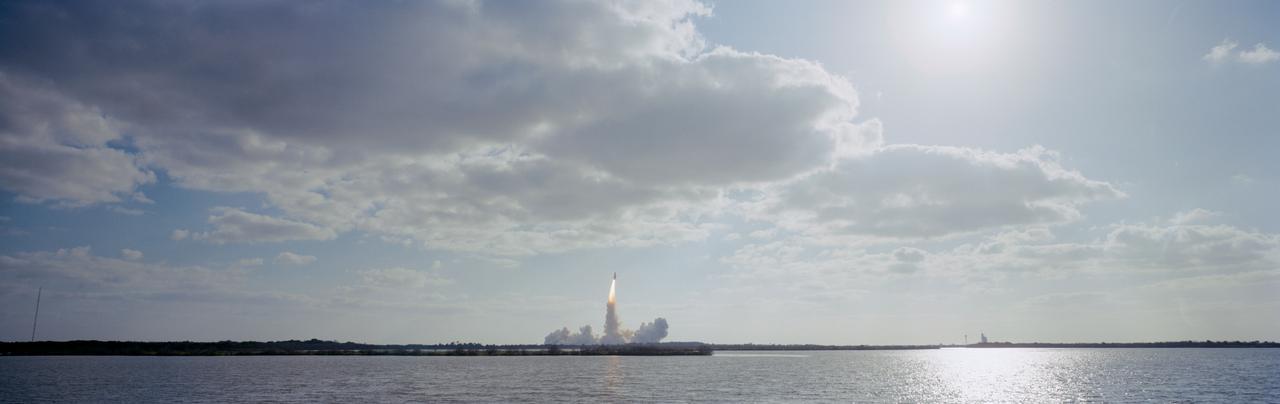
In this distant view, STS-31 Discovery, Orbiter Vehicle (OV) 103, is seen as it heads skyward after liftoff from Kennedy Space Center (KSC) Launch Complex (LC) Pad 39B at 8:33:51.0492 am (Eastern Daylight Time (EDT)). OV-103's silhouette atop the external tank (ET) appears above the glow of the solid rocket booster (SRB) and space shuttle main engine (SSME) firings. An exhaust plume trails behind and covers the launch pad area below the orbiter. A nearby waterway reflects the SRB/SSME glow in the foreground. At the far right and barely discernible is KSC LC Pad 39A and the Sound Supression Water System tower. Columbia, OV-102, is on LC Pad 39A which is separated by a distance of 1.6 miles. This was the first time since January 1986 that there was a shuttle on each pad.
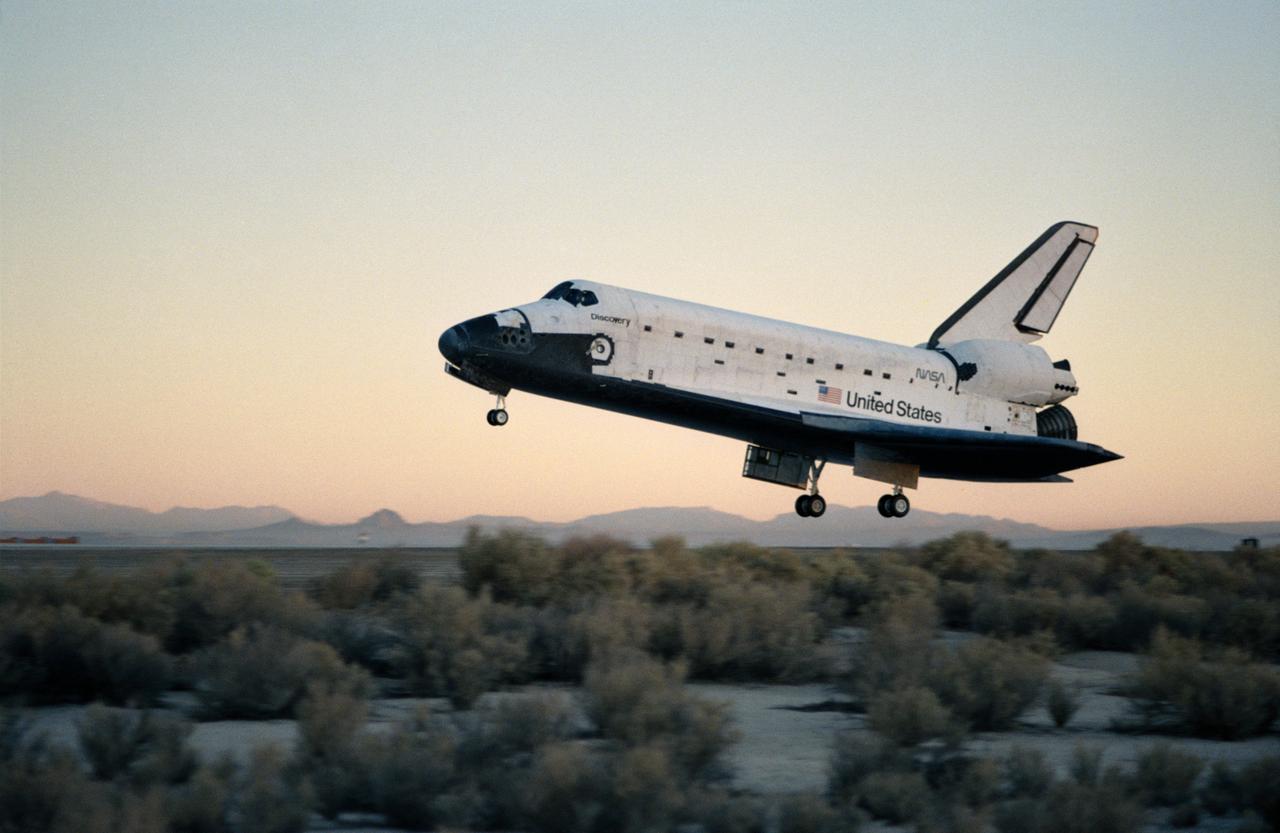
STS-41 Discovery, Orbiter Vehicle (OV) 103, with nose landing gear (NLG) and main landing gear (MLG) deployed, glides over concrete runway 22 at Edwards Air Force Base (EAFB), California, prior to touchdown.

STS-41 Discovery, Orbiter Vehicle (OV) 103, with nose landing gear (NLG) and main landing gear (MLG) deployed, glides over concrete runway 22 at Edwards Air Force Base (EAFB), California, prior to touchdown.
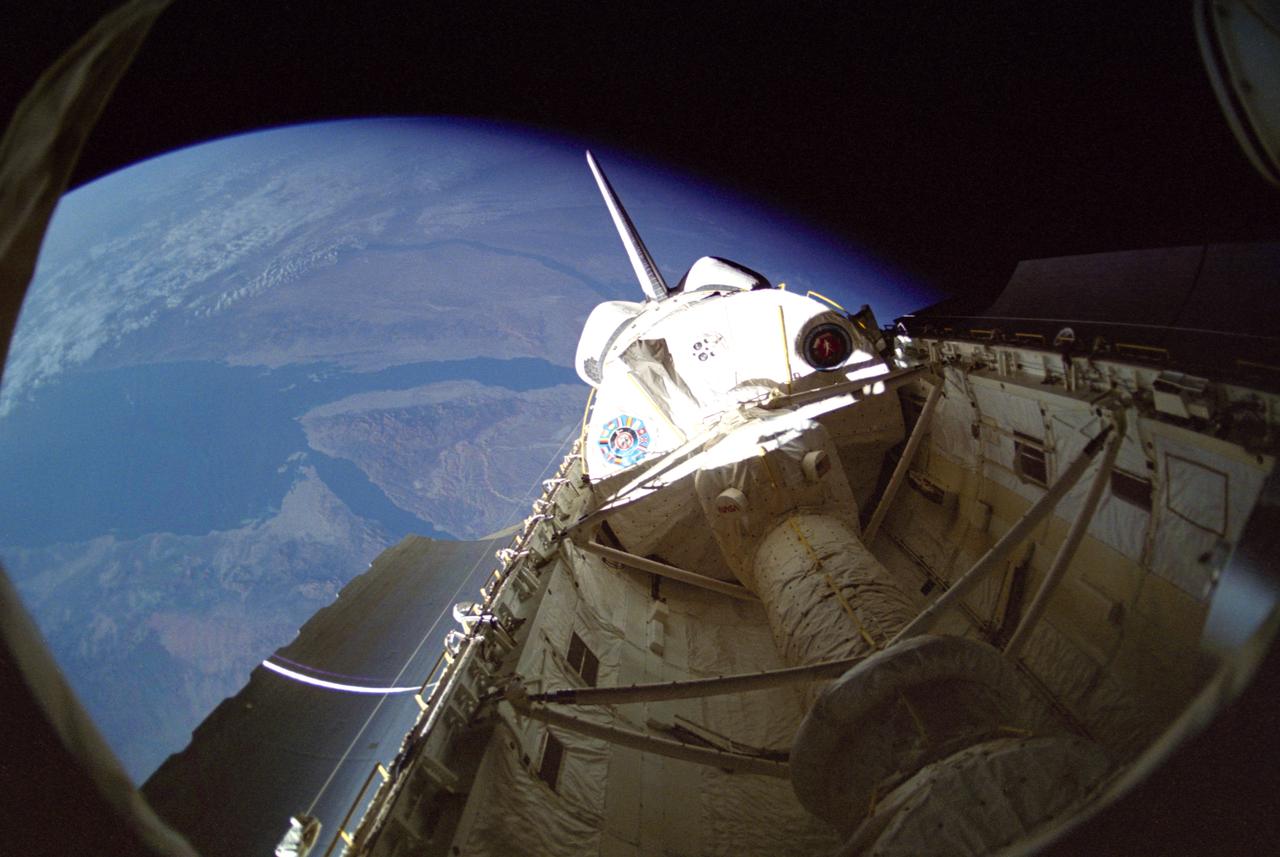
STS042-25-027 (30 Jan 1992) --- STS-42 International Microgravity Laboratory 1 (IML-1) Spacelab module and Spacelab tunnel (foreground) exteriors are documented in the payload bay (PLB) of Discovery, Orbiter Vehicle (OV) 103, and backdropped against the Red Sea and part of the Sinai Peninsula.
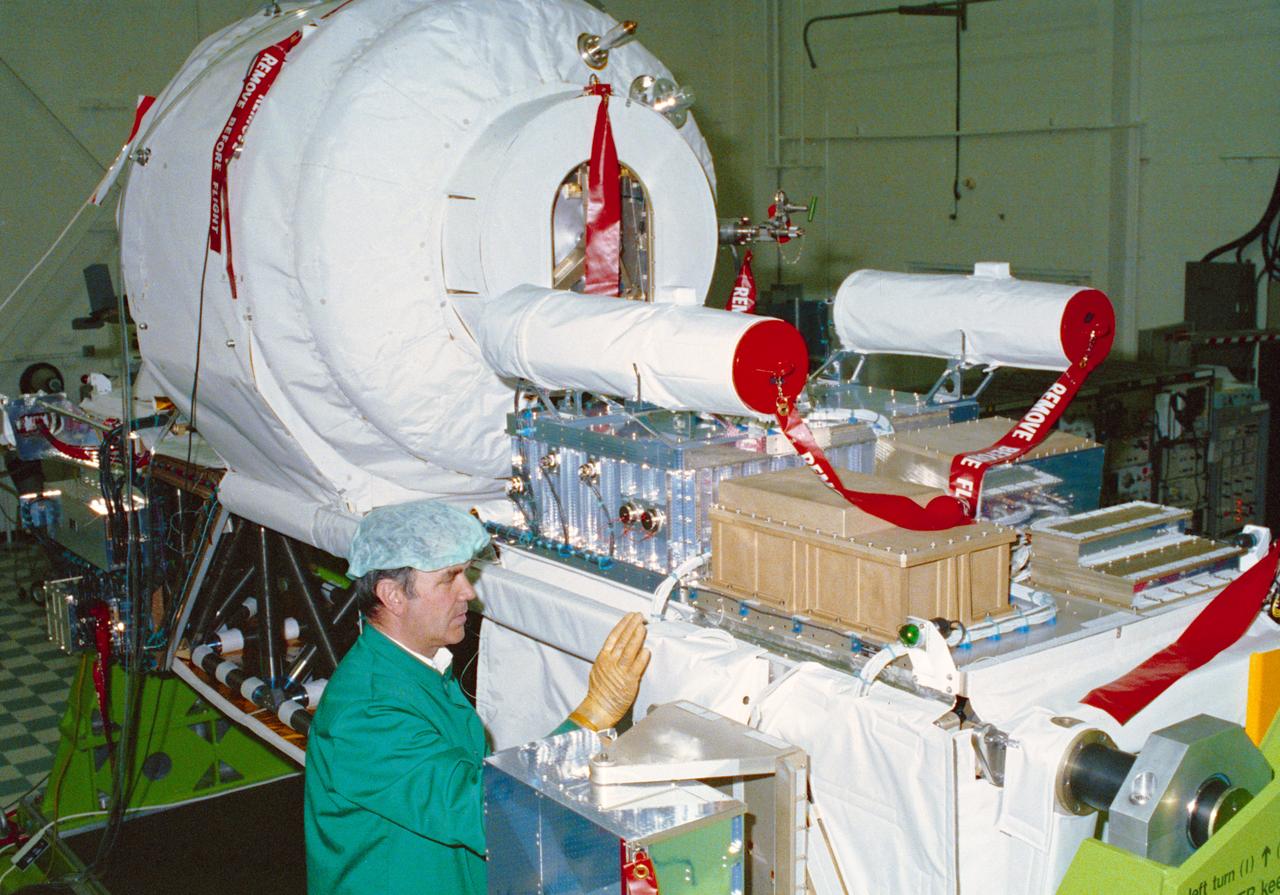
S91-27781 (5 Nov 1990) --- STS-39 Discovery, Orbiter Vehicle (OV) 103, Infrared Background Signature Survey (IBSS) Shuttle Pallet Satellite (SPAS) II documented during preflight processing procedures. German Messerschmitt-Bolkow-Blohm (MBB) technicians work on SPAS II cryostat (without insulation) and other elements at the Cape Canaveral Air Force Station, 11/05/90
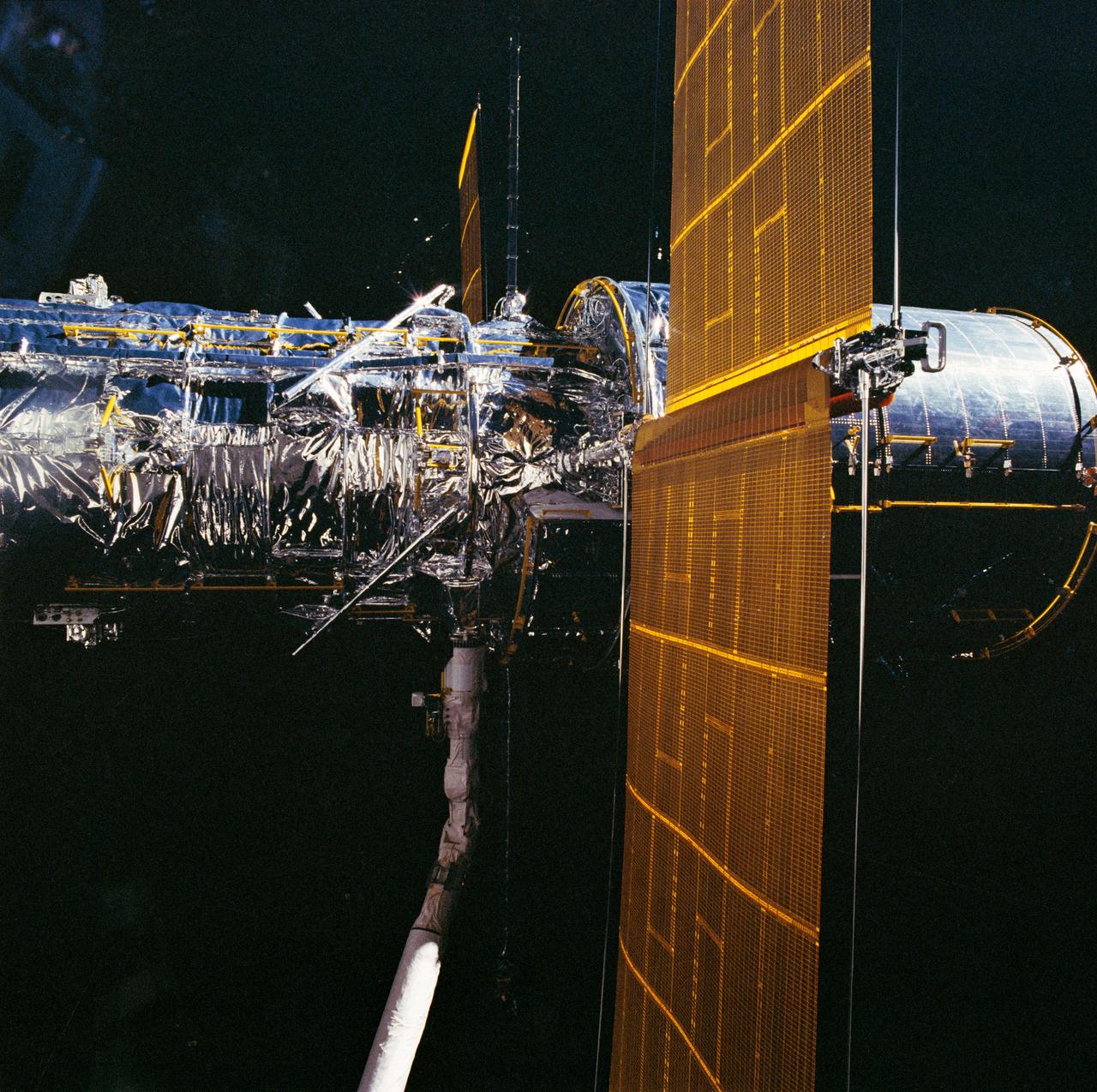
During STS-31, the Hubble Space Telescope (HST), grappled by the remote manipulator system (RMS) end effector, is held against the blackness of space. The two solar array (SA) wings (large gold panels) are fully extended with bistem cassette and secondary deployment mechanism (SDM) handle clearly visible. The two deployed high gain antennae (HGA) masts are parallel to the SA panels. RMS end effector is positioned on the starboard fixture during the predeployment checkout operations above Discovery's, Orbiter Vehicle (OV) 103's, payload bay (PLB).
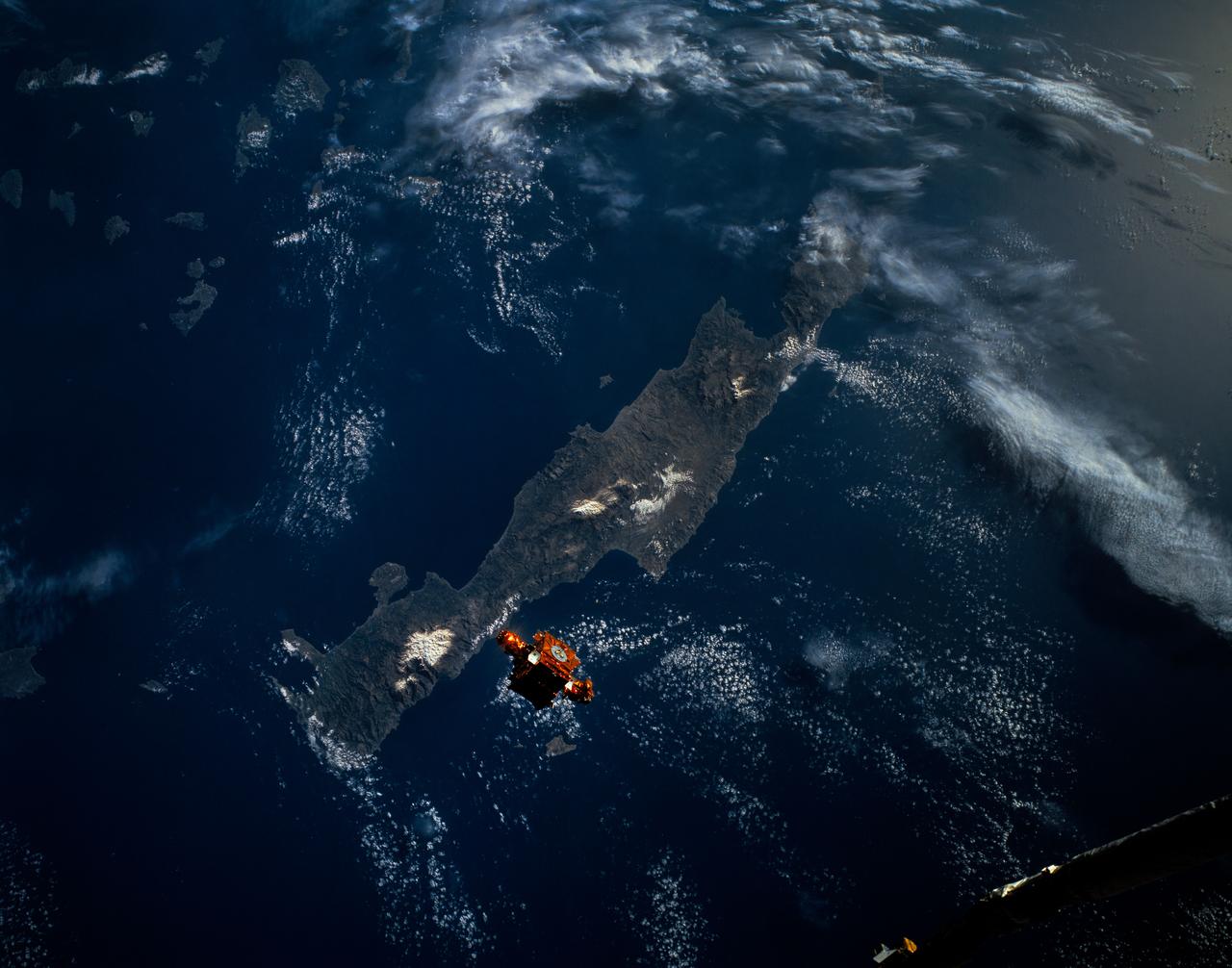
During STS-56, the Shuttle Pointed Autonomous Research Tool for Astronomy 201 (SPARTAN-201), a freeflying payload, was photographed by Discovery's, Orbiter Vehicle (OV) 103's, crewmembers as it drifted above the Mediterranean Sea near the island of Crete. On the mission's third day, the remote manipulator system (RMS) arm was used to lift SPARTAN-201 from its support structure in OV-103's payload bay and release it in space. SPARTAN-201 was later recaptured by OV-103's RMS and returned to Earth with the astronaut crew.
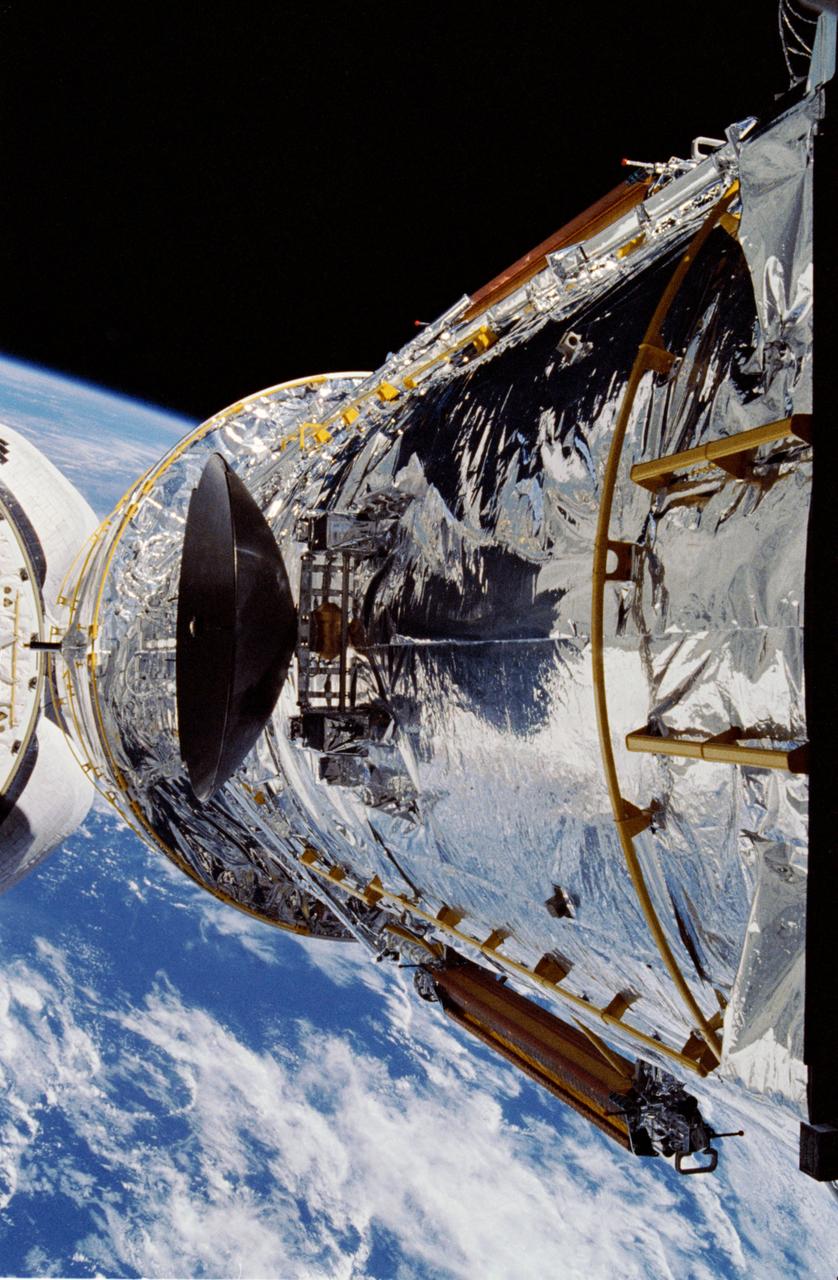
The Hubble Space Telescope (HST) is raised above the payload bay (PLB) in low hover position during STS-31 checkout and pre-deployment procedures aboard Discovery, Orbiter Vehicle (OV) 103. Stowed along the HST Support System Module (SSM) are the high gain antenna (HGA) (center) and the two solar arrays (one either side). In the background are the orbital maneuvering system (OMS) pods and the Earth's surface.
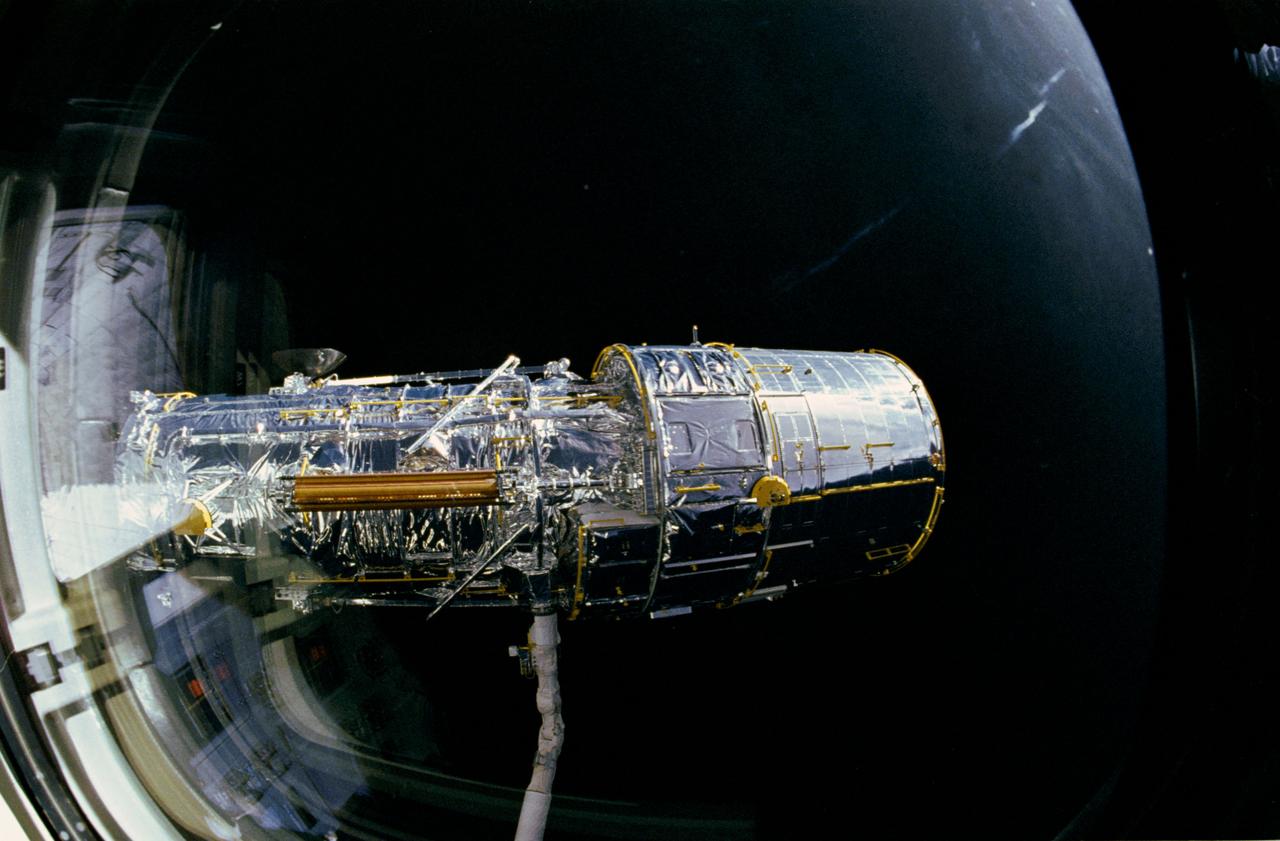
During STS-31 checkout, the Hubble Space Telescope (HST) is held in a pre-deployment position by Discovery's, Orbiter Vehicle (OV) 103's, remote manipulator system (RMS). The view, taken from the crew cabin overhead window W7, shows the starboard solar array (SA) panel (center) and two high gain antennae (HGA) (on either side) stowed along side the Support System Module (SSM) forward shell. The sun highlights HST against the blackness of space.
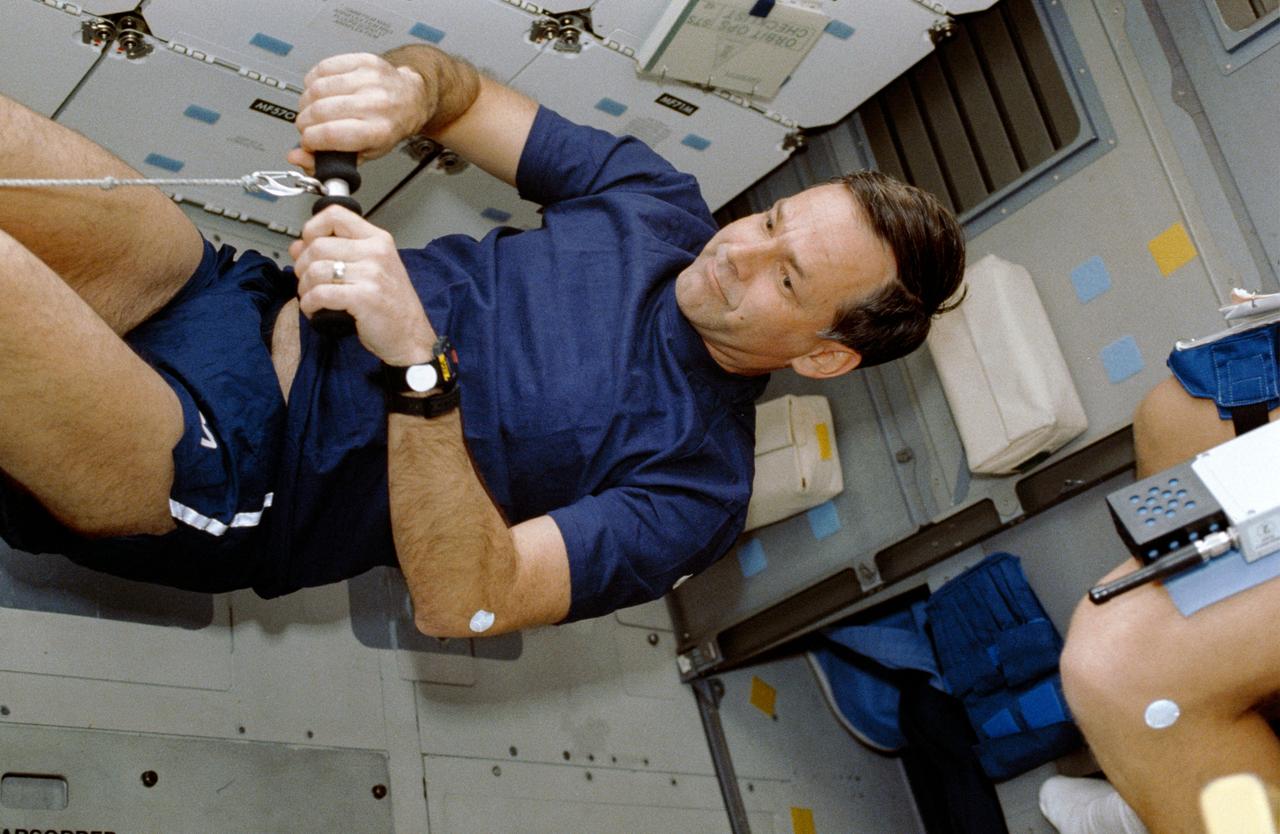
STS042-05-037 (30 Jan 1992) --- Astronaut Ronald J. Grabe, STS-42 commander, exercises using MK1 Rowing Machine on the middeck of Discovery, Orbiter Vehicle (OV) 103. Grabe is using the exercise device as part of Development Test Objective (DTO) 653, Evaluation of MK1 Rowing Machine. The forward lockers appear at Grabe's right and the sleep station behind him.
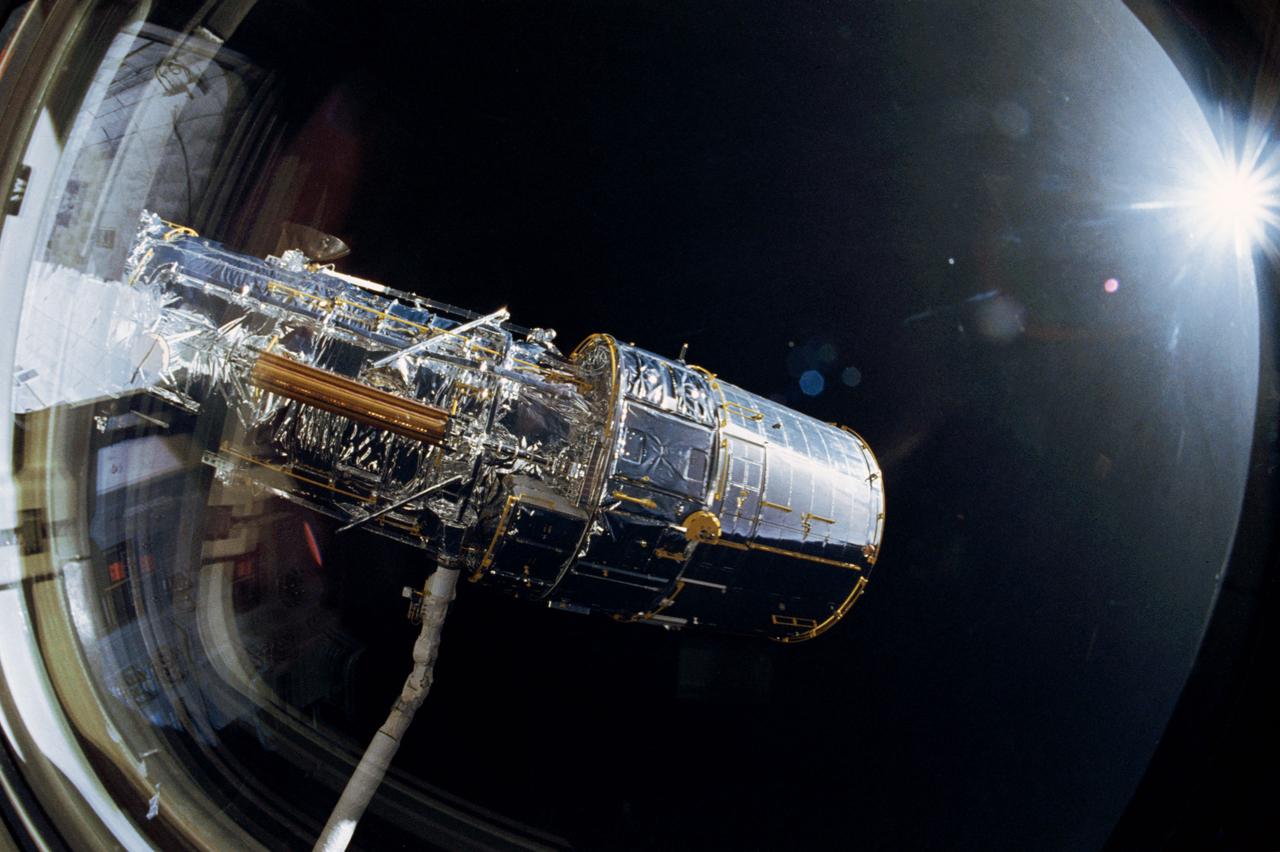
The Hubble Space Telescope (HST), grappled by Discovery's, Orbiter Vehicle (OV) 103's, remote manipulator system (RMS), is oriented in a 90 degree pitch position during STS-31 pre-deployment checkout procedures. The solar array (SA) panel (center) and high gain antennae (HGA) (on either side) are stowed along the Support System Module (SSM) forward shell prior to deployment. The sun highlights HST against the blackness of space.
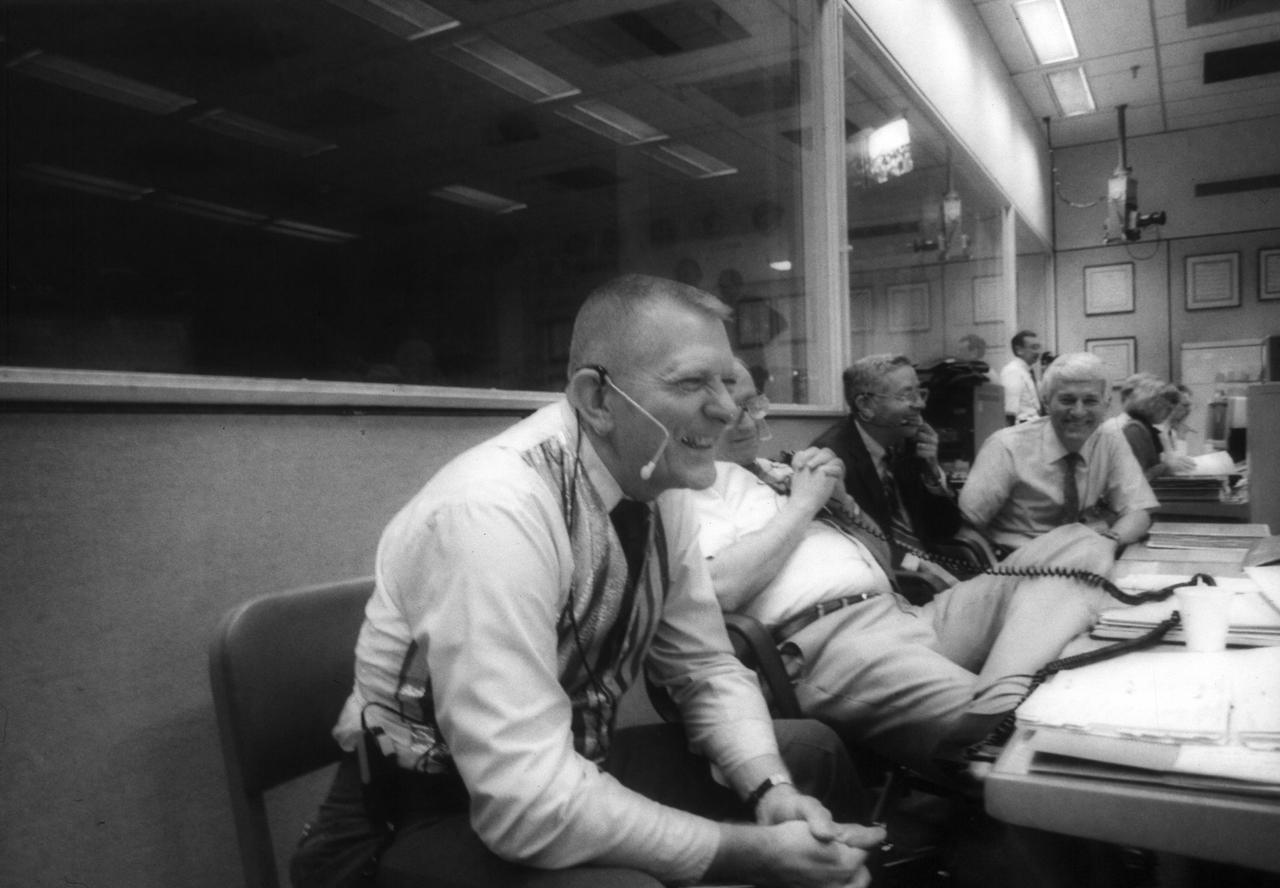
JSC officials, laughing, listen to crewmembers' commentary onboard Discovery, Orbiter Vehicle (OV) 103, during STS-26. In the Flight Control Room (FCR) of JSC's Mission Control Center (MCC) Bldg 30 and seated at the Mission Operations Directorate (MOD) console, MOD Director Eugene F. Kranz (foreground), wearing red, white and blue vest, smiles along with JSC Director Aaron Cohen and Flight Crew Operations Deputy Director Henry W. Hartsfield, Jr. (far right).
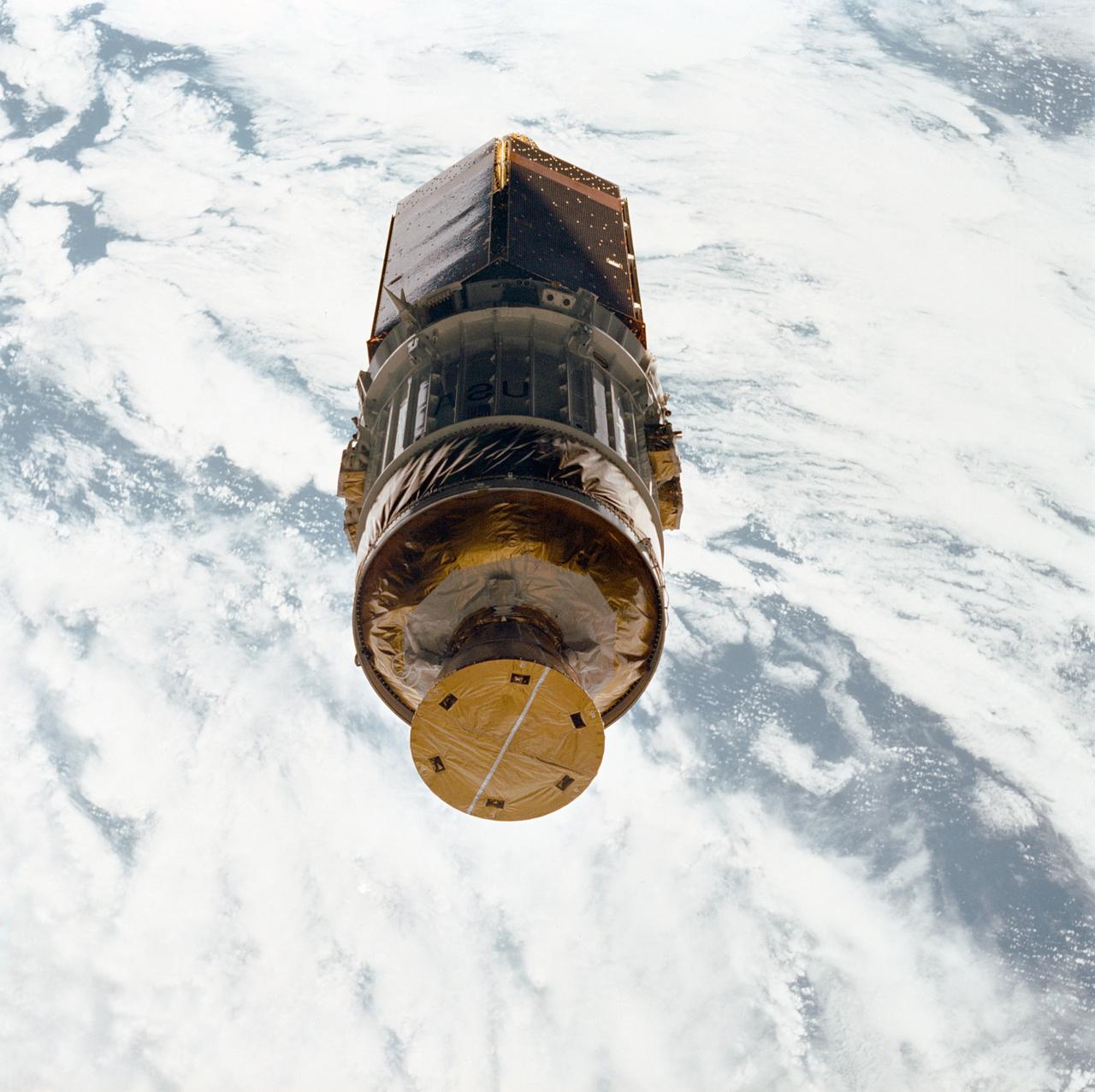
STS026-31-071 (3 Oct 1988) --- After deployment from Discovery, Orbiter Vehicle (OV) 103, the inertial upper stage (IUS) with the tracking and data relay satellite C (TDRS-C) drifts above the cloud-covered Earth surface. TDRS-C, in stowed configuration (solar array panels visible), is mounted atop the IUS with the interstage and solid rocket motor and nozzle seen in the foreground.
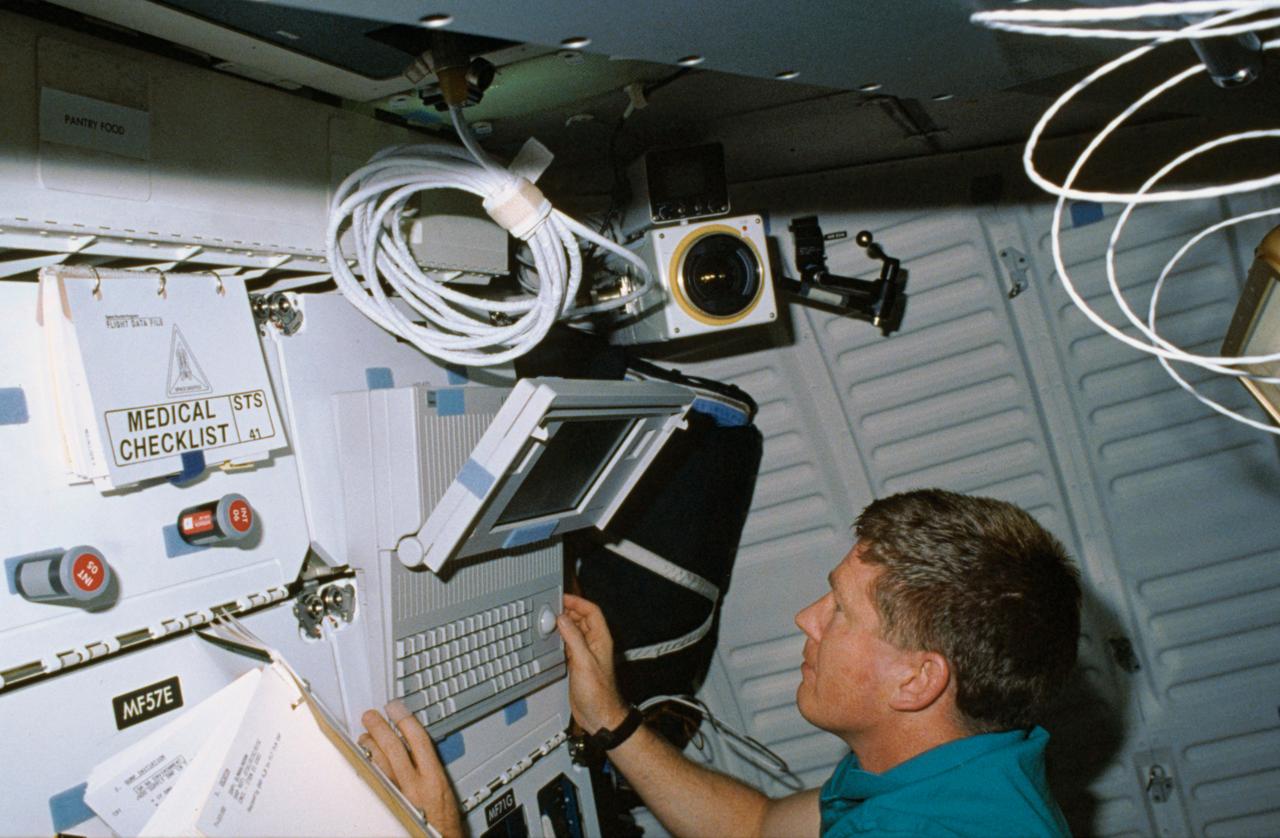
STS-41 Mission Specialist (MS) William M. Shepherd uses Detailed Test Objective (DTO) Space Station Cursor Control Device Evaluation MACINTOSH portable computer on the middeck of Discovery, Orbiter Vehicle (OV) 103. The computer is velcroed to forward lockers MF71C and MF71E. Surrounding Shepherd are checklists, the field sequential (FS) crew cabin camera, and a lighting fixture.
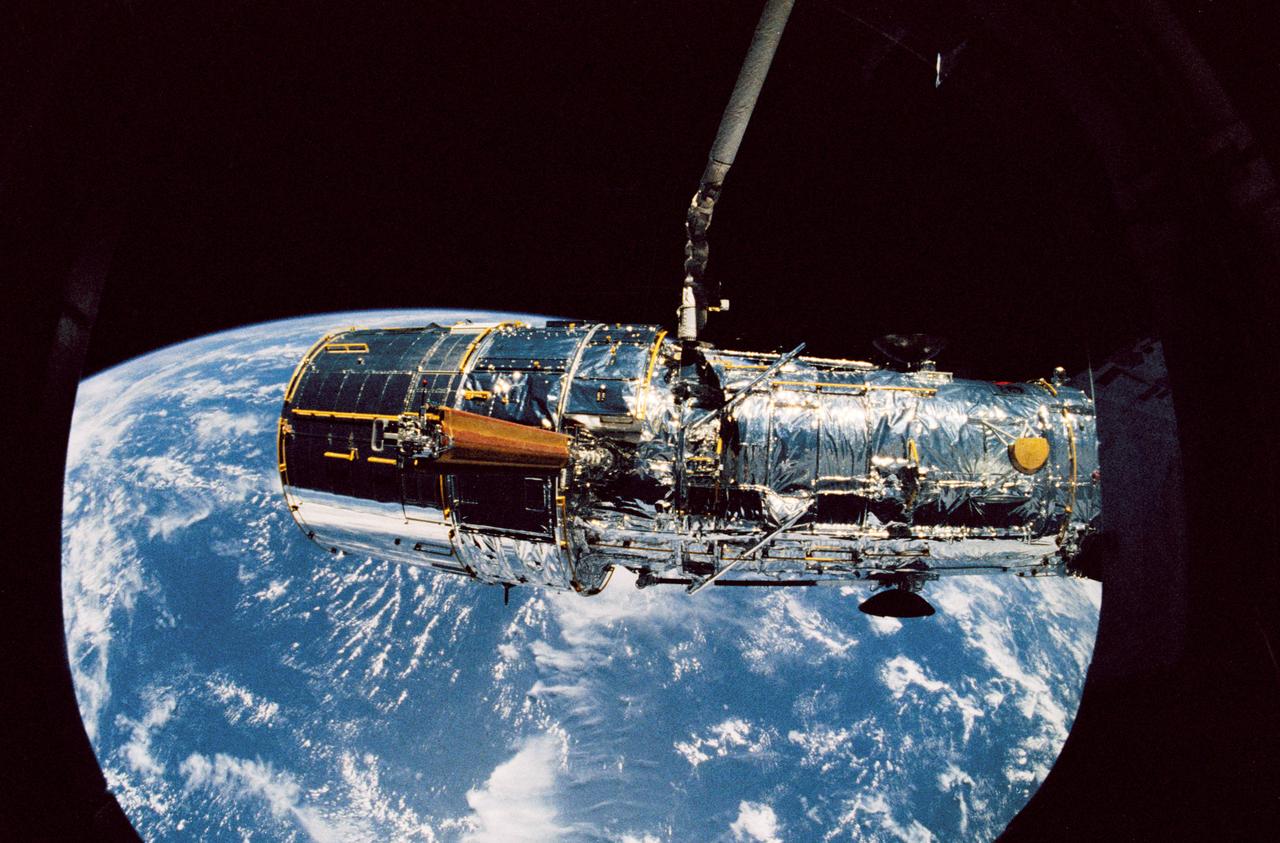
Held in appendage deploy position by Discovery's, Orbiter Vehicle (OV) 103's, remote manipulator system (RMS), the Hubble Space Telescope's (HST's) starboard solar array (SA) bistem cassette is released from its stowed position on the Support System Module (SSM) forward shell. The spreader bar & bistem begin to unfurl the SA wing. View was taken by an STS-31 crewmember through an overhead window & is backdropped against the surface of the Earth.
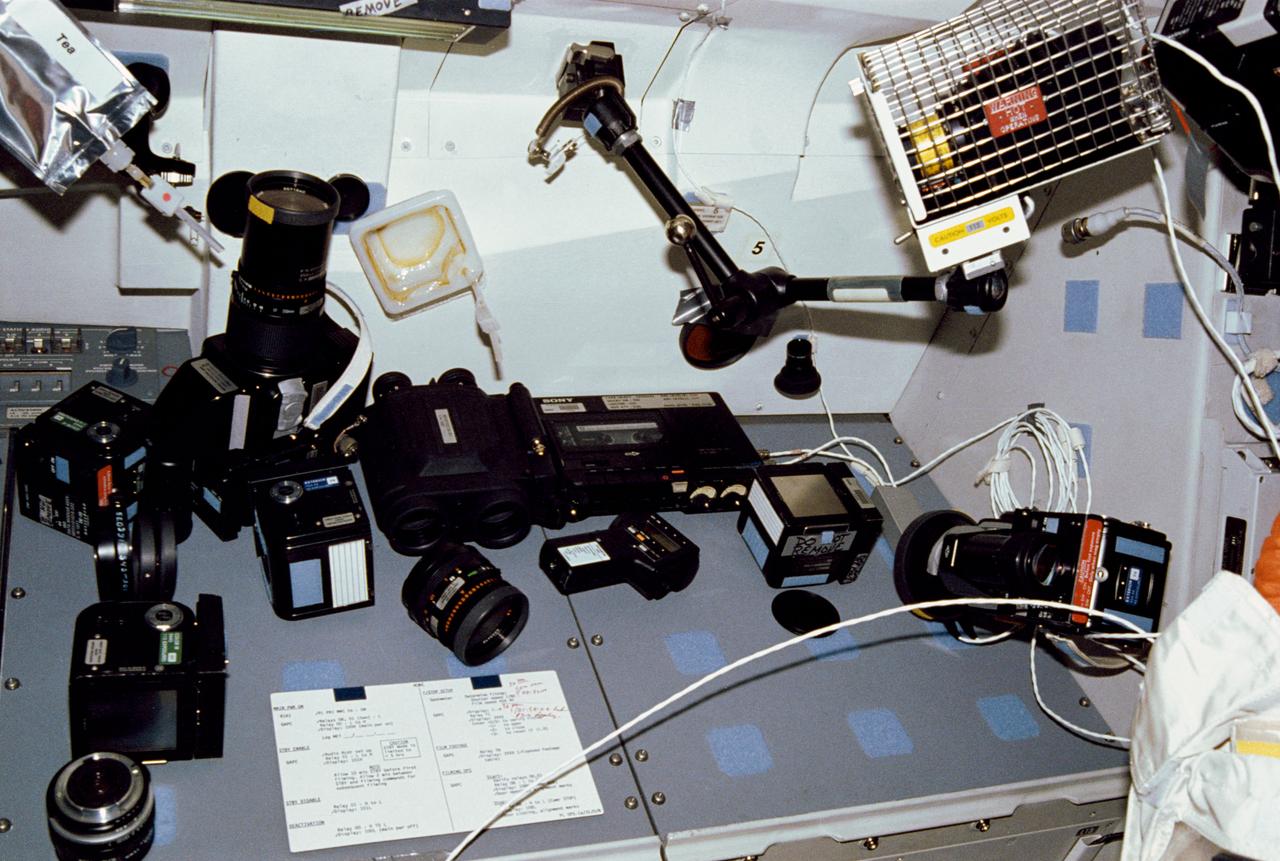
This array of photographic equipment, displayed on the aft flight deck payload station, represents just a part of the imaging and recording hardware which was carried aboard Discovery, Orbiter Vehicle (OV) 103, for STS-31's five day mission. Lenses, film magazines, cassettes, recorders, camera chassis, a pair of binoculars, spot meter, tape recorder, and a bracket-mounted light fixture are included among the array.
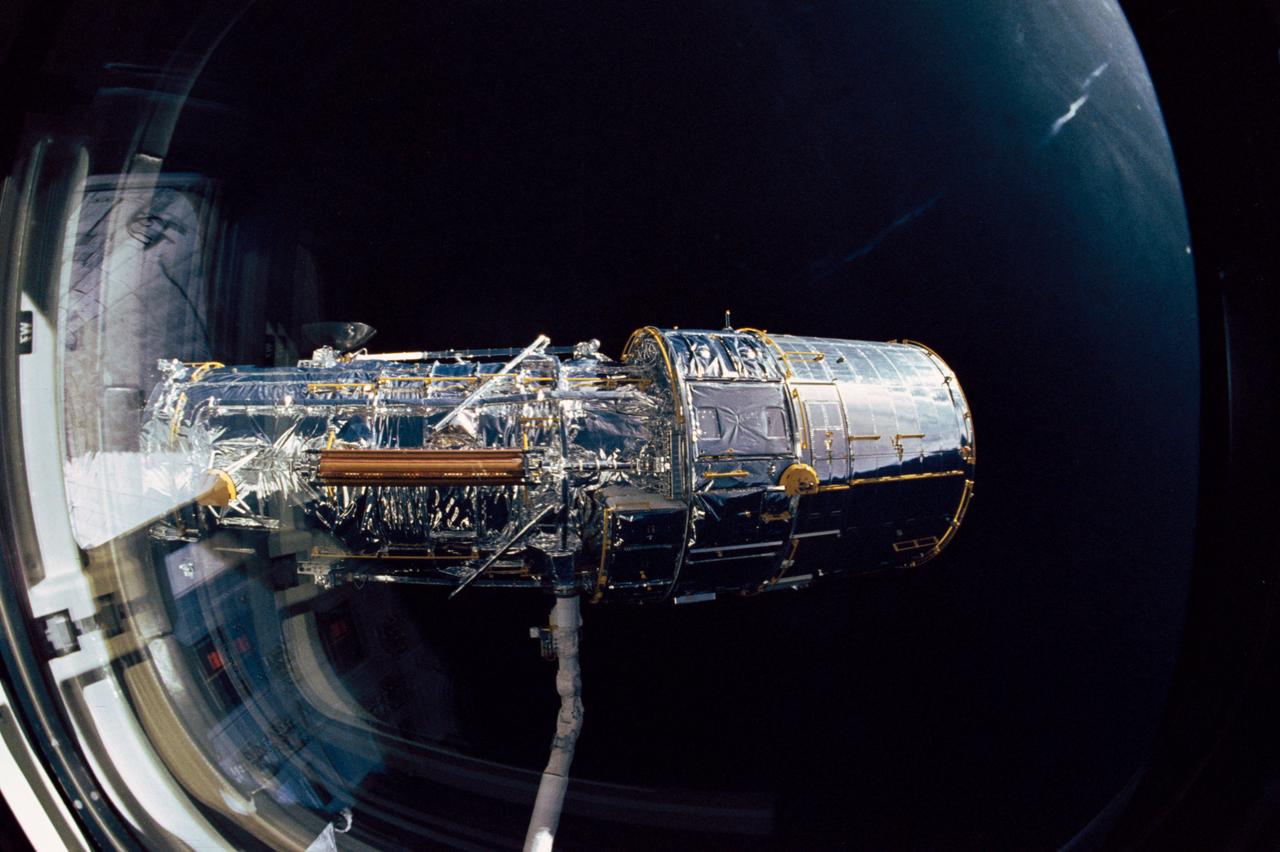
The Hubble Space Telescope (HST), grappled by Discovery's, Orbiter Vehicle (OV) 103's, remote manipulator system (RMS), is held in a pre-deployment position. During STS-31 checkout procedures, the solar array (SA) panels and the high gain antennae (HGA) will be deployed. The starboard SA (center) and the two HGA are stowed along side the Support System Module (SSM) forward shell. The sun highlights HST against the blackness of space.
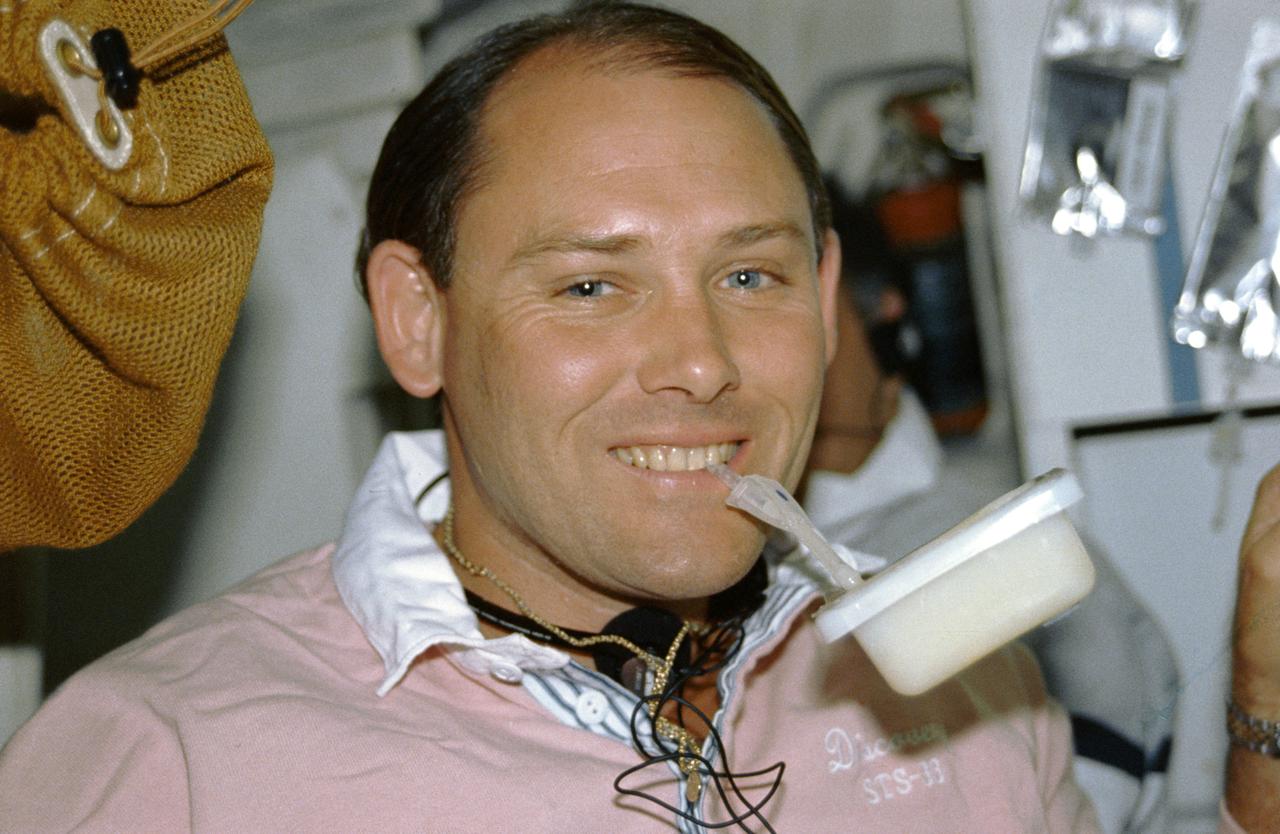
STS033-17-005A (27 Nov 1989) --- Astronaut Manley L. Carter, Jr., STS-33 mission specialist, smiling, sips drink from a beverage container using a straw on Discovery's, Orbiter Vehicle (OV) 103's, middeck. Around Carter's neck are a necklace and tape recorder headphones (headset). A net stowage bag free floats next to Carter's head.
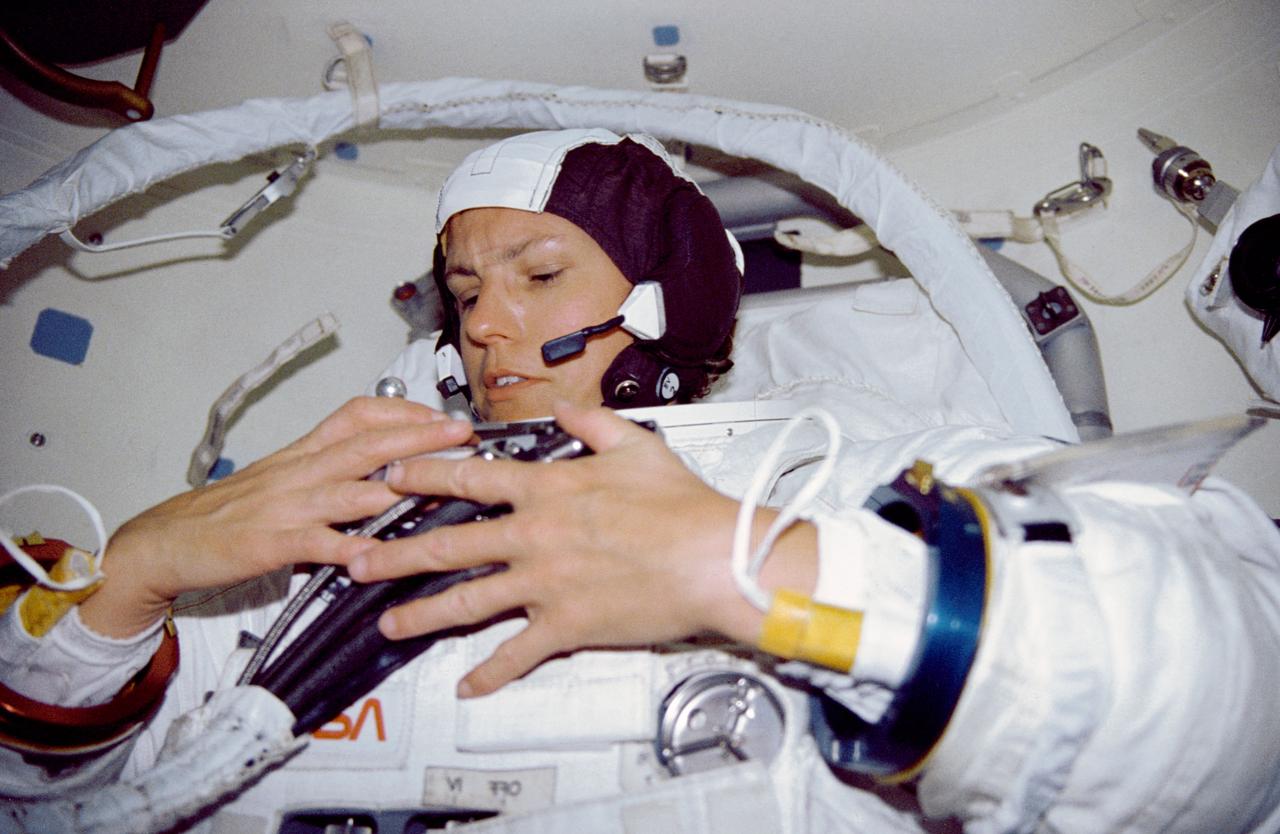
STS-31 Mission Specialist (MS) Kathryn D. Sullivan, wearing extravehicular mobility unit (EMU) & communications carrier assembly (CCA), attaches service and cooling umbilical (SCU) to the EMU connection on the display & control module (DCM) during contingency extravehicular activity (EVA) preparations in the airlock of Discovery, Orbiter Vehicle (OV) 103. The procedure was completed in case an EVA was required to support Hubble Space Telescope (HST) deployment.
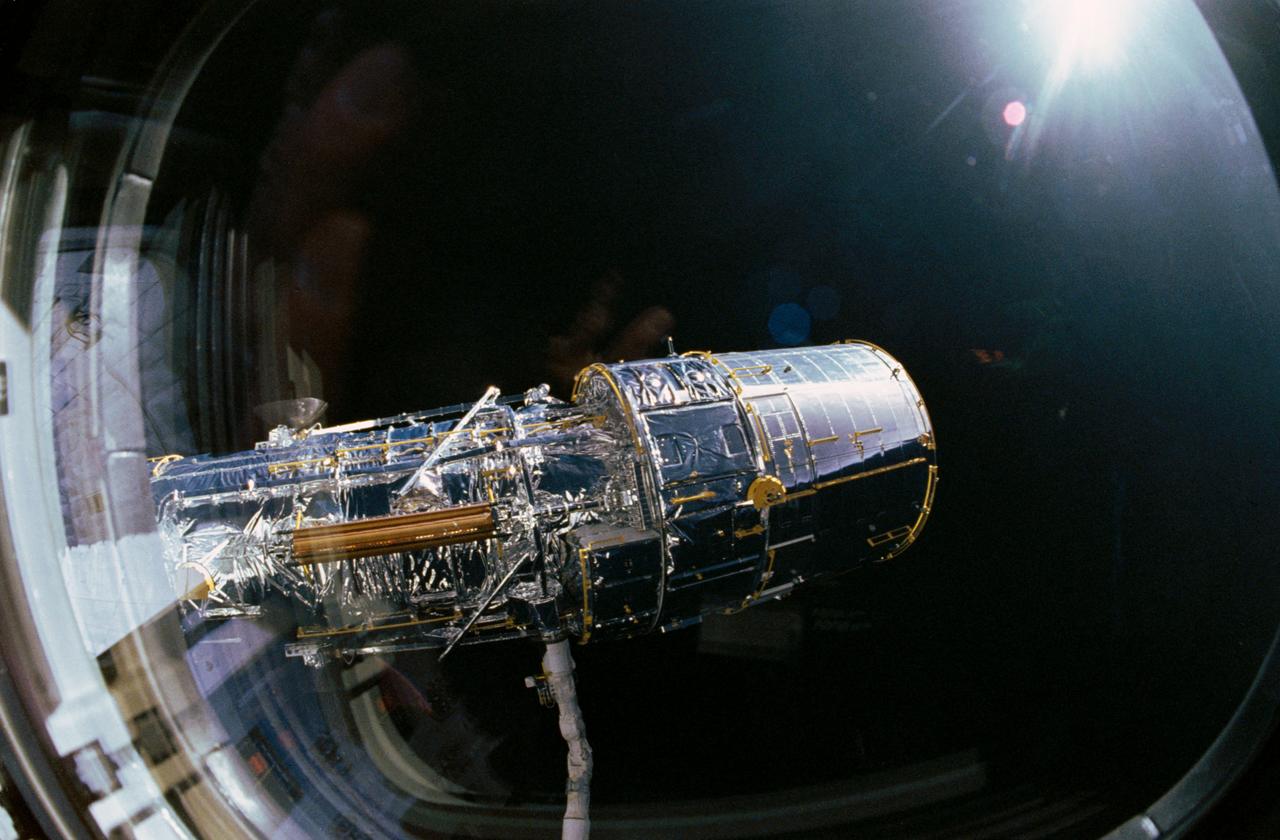
View taken through overhead window W7 aboard Discovery, Orbiter Vehicle (OV) 103, shows the Hubble Space Telescope (HST) grappled by the remote manipulator system (RMS) and held in a 90 degree pitch position against the blackness of space. The solar array (SA) panel (center) and the high gain antennae (HGA) (on either side) are visible along the Support System Module (SSM) forward shell prior to deployment during STS-31.
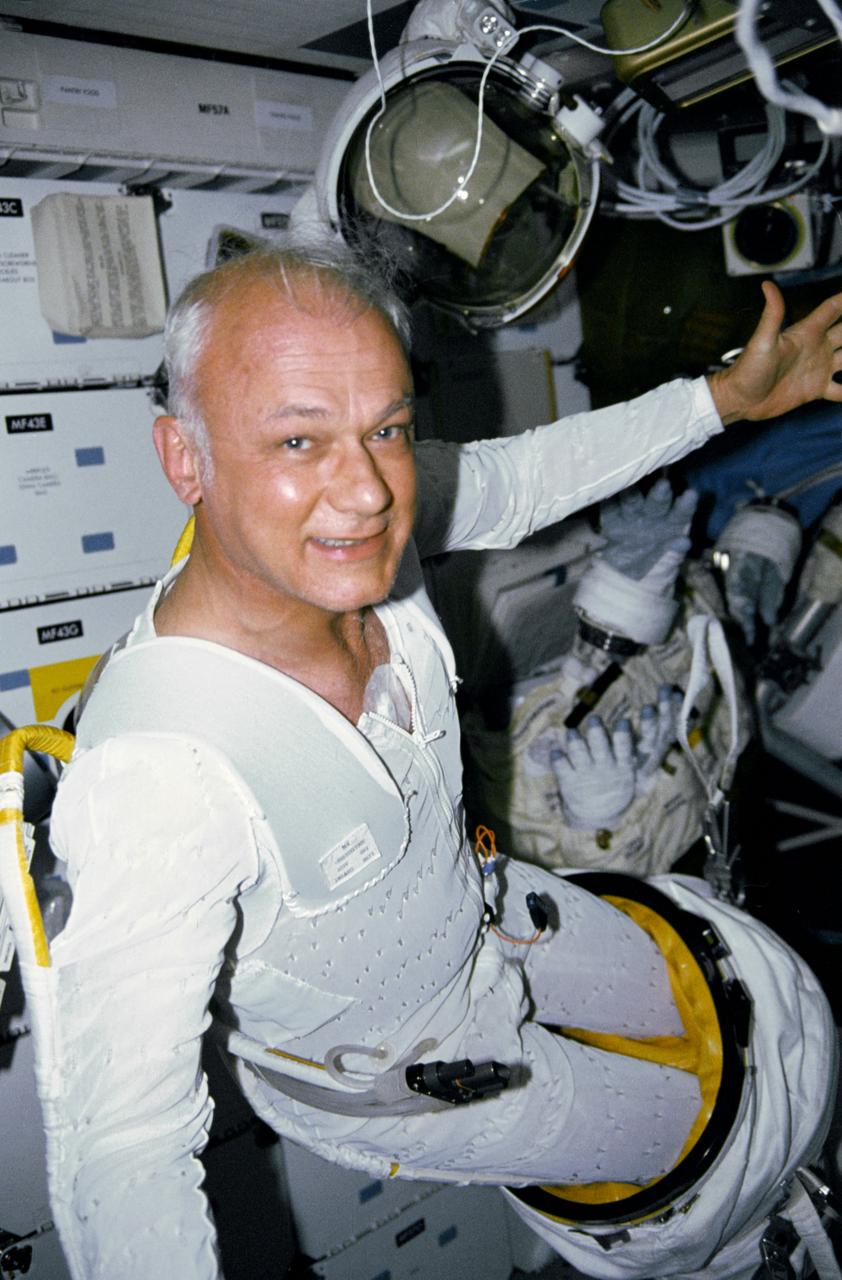
STS-31 Mission Specialist (MS) Bruce McCandless II, wearing liquid cooling and ventilation garment (LCVG), works his way out of the extravehicular mobility unit (EMU) lower torso on the middeck of Discovery, Orbiter Vehicle (OV) 103. McCandless was in a standby mode to perform extravehicular activity (EVA) if needed to support Hubble Space Telescope (HST) deployment and post- deployment tasks. None was needed. His helmet and gloves freefloat in the background.
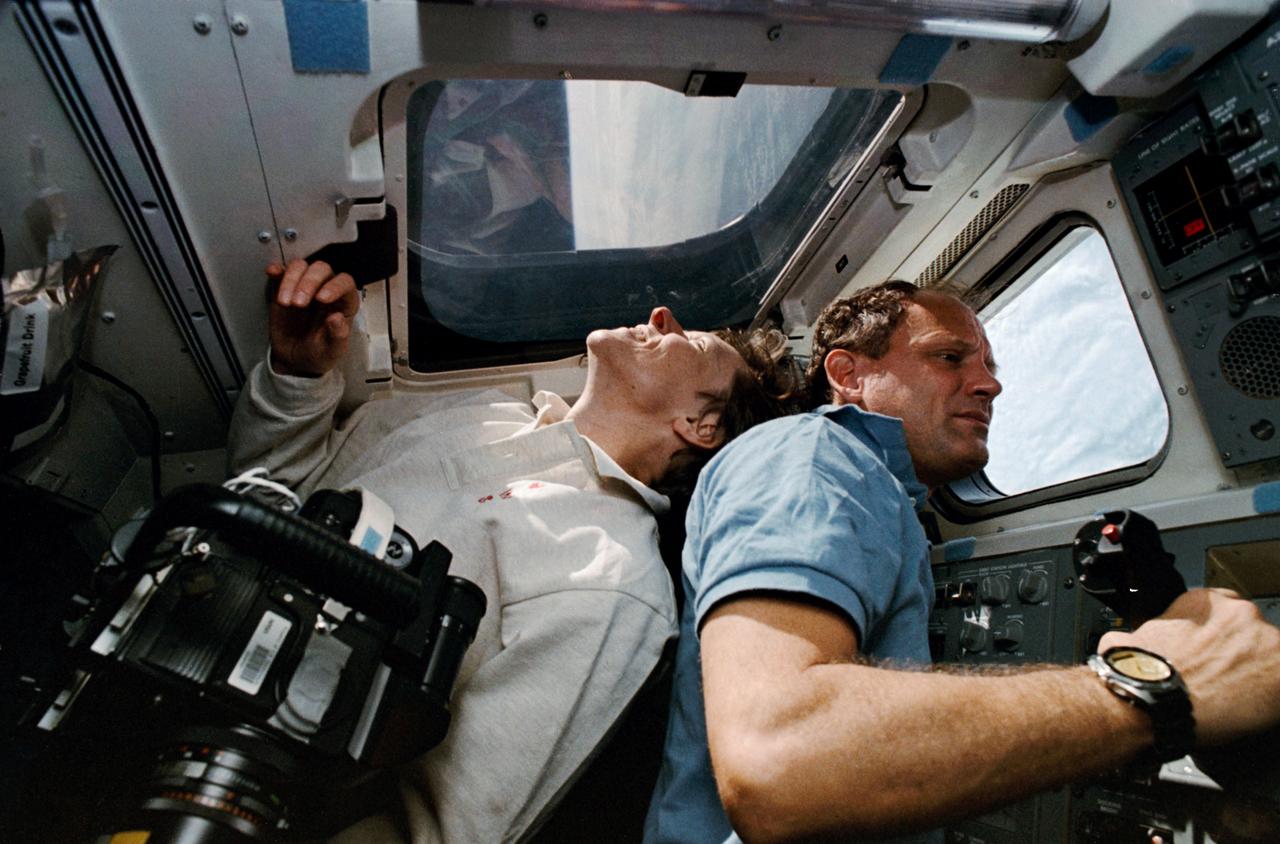
STS-42 Payload Specialist Roberta L. Bondar (light shirt) smiles as she looks out overhead window W7 while Mission Specialist (MS) and Payload Commander (PLC) Norman E. Thagard peers out aft viewing window W9. The two crewmembers are on the aft flight deck of Discovery, Orbiter Vehicle (OV) 103. In the foreground, a camera is ready to capture the Earth below.
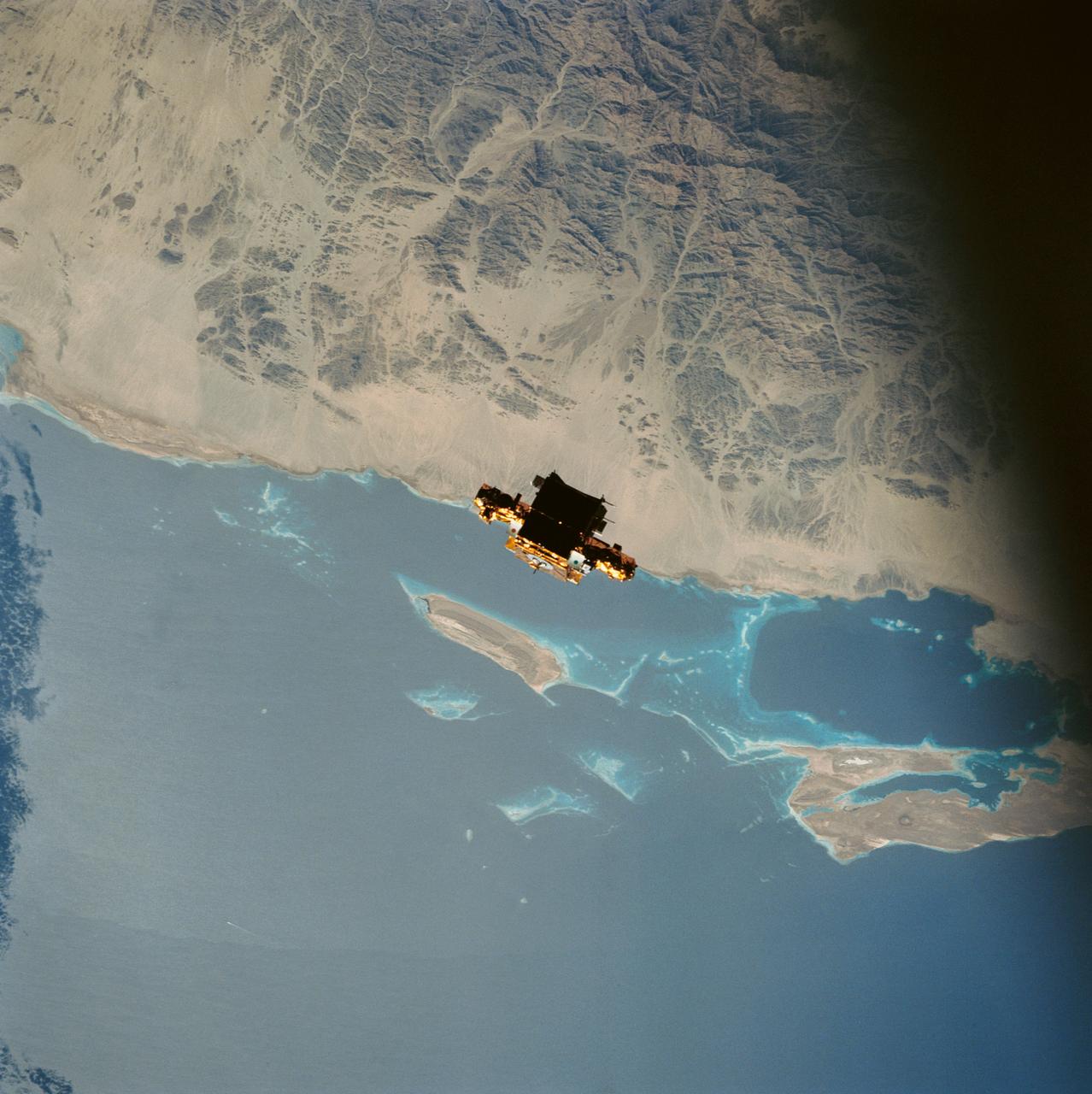
During STS-56, the Shuttle Pointed Autonomous Research Tool for Astronomy 201 (SPARTAN-201), a freeflying payload, was captured on 70mm film as it drifts over the Red Sea coast of Sudan. SPARTAN-201 was photographed by the crewmembers aboard Discovery, Orbiter Vehicle (OV) 103. On the mission's third day, crewmembers used the remote manipulator system (RMS) to lift the satellite from its support structure in OV-103's payload bay (PLB) and release it into space. SPARTAN-201 was later recaptured by OV-103's RMS and returned to Earth with the astronaut crew. The cape structure in the background is Ras abu Shagara, north of Port Sudan.
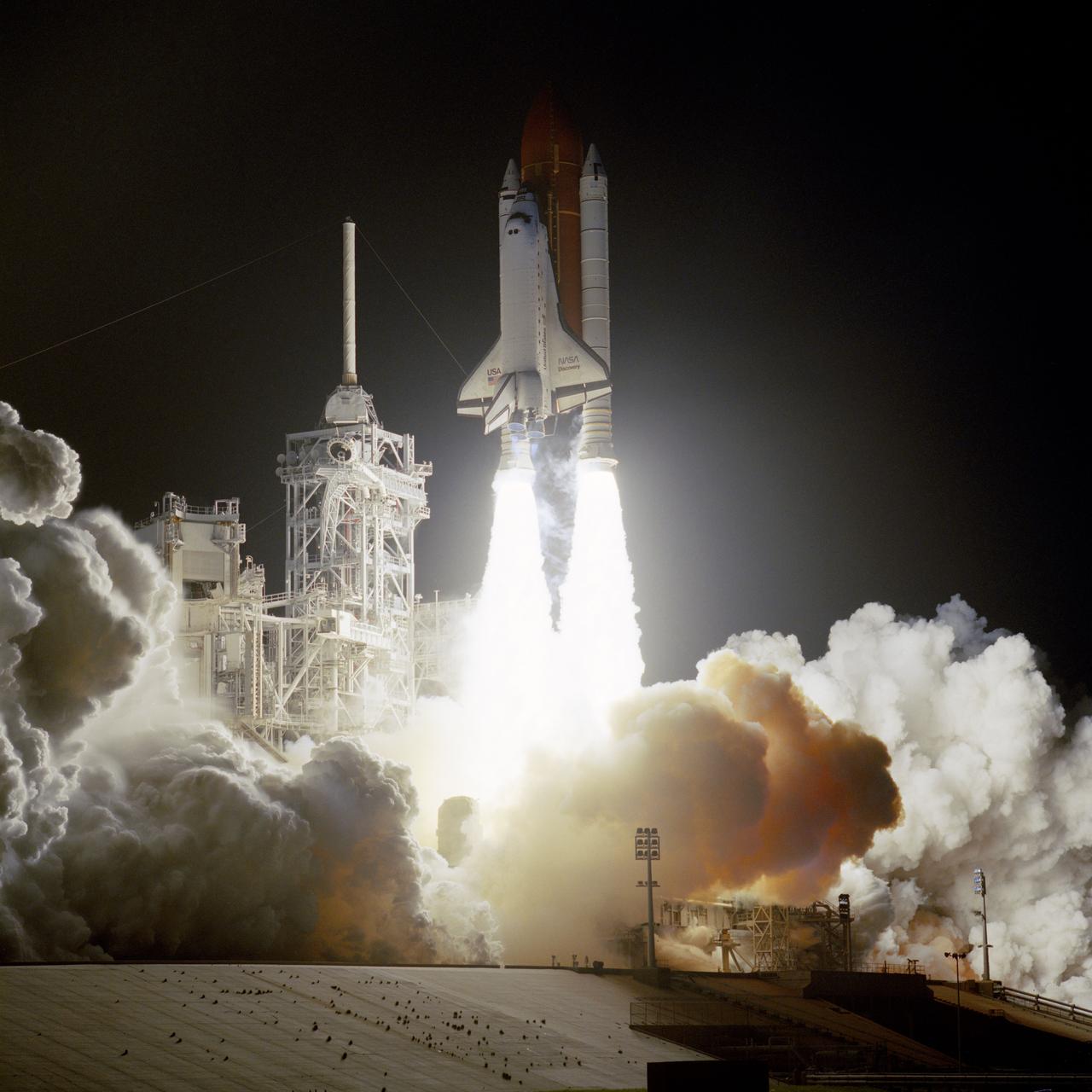
STS-56 Discovery, Orbiter Vehicle (OV) 103, riding atop its external tank (ET) and flanked by two solid rocket boosters (SRBs), lifts off from Kennedy Space Center (KSC) Launch Complex (LC) Pad 39B into the early morning darkness at 1:29 am (Eastern Daylight Time (EDT)). In this nocturnal scene, OV-102's nose section is obscured in the shadowy darkness as it clears the fixed service structure (FSS) tower. Exhaust plumes trail from the SRB skirts and cover the launch pad area in a billowy cloud. The SRB / Space Shuttle Main Engine (SSME) firings illuminate the FSS and the retracted rotating service structure (RSS). Debris is visible on the base of the launch pad.
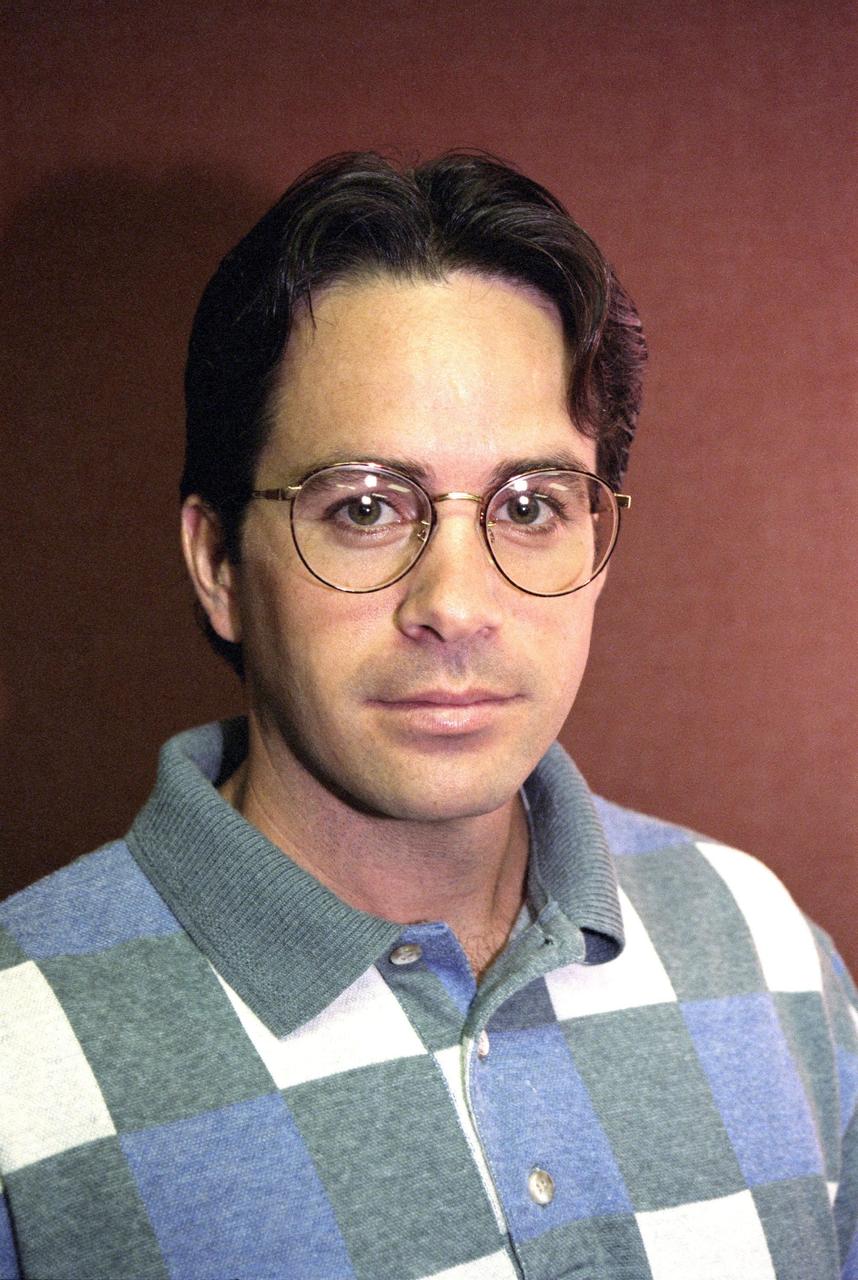
KENNEDY SPACE CENTER, FLA. -- Official portrait of W. Scott Cilelnto, flow director for the Orbiter Discovery (OV-103).
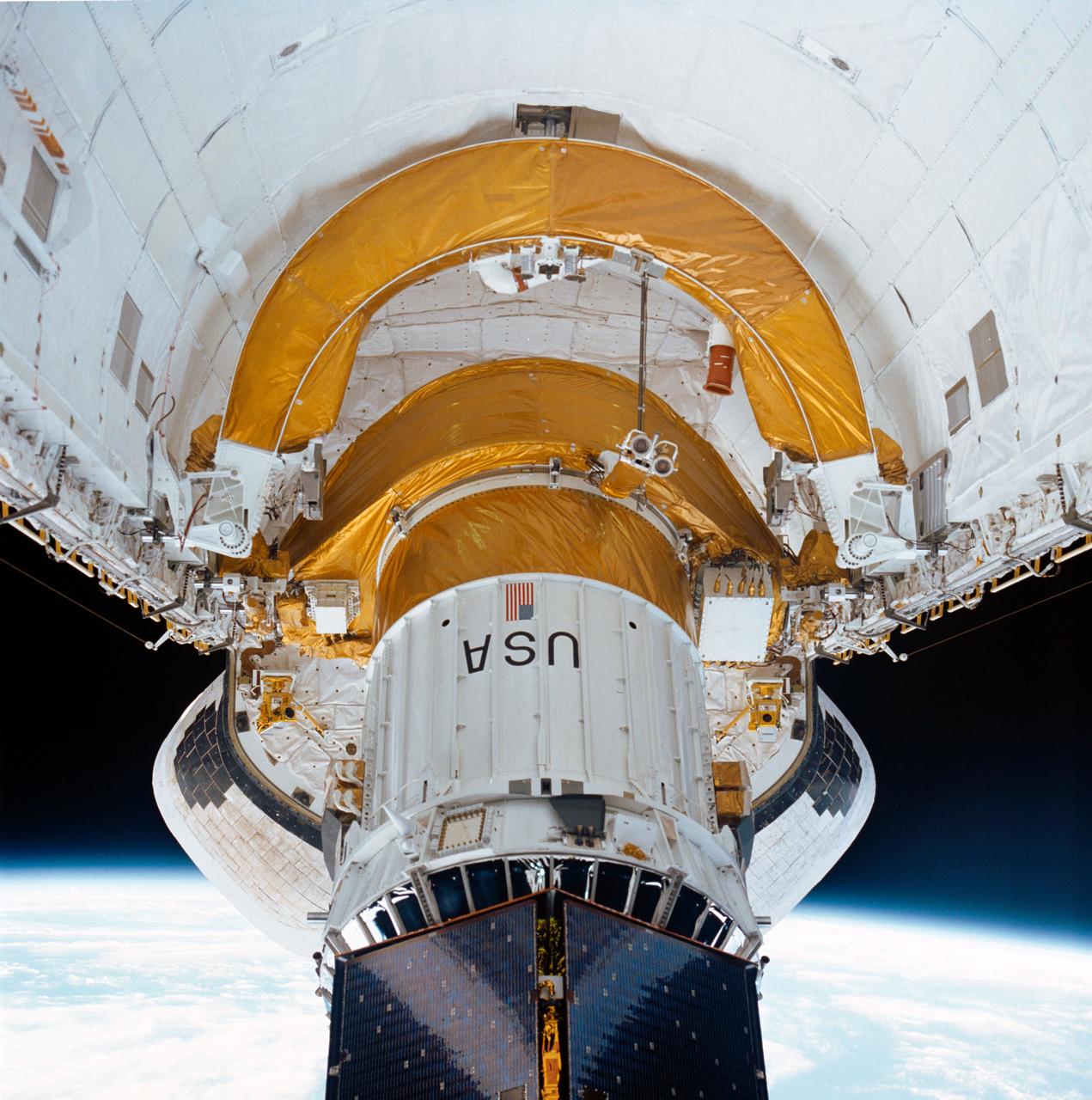
During STS-26, inertial upper stage (IUS) with the tracking and data relay satellite C (TDRS-C) located in the payload bay (PLB) of Discovery, Orbiter Vehicle (OV) 103, is raised into deployment attitude (an angle of 50 degrees) by the airborne support equipment (ASE). ASE aft frame tilt actuator (AFTA) table supports the IUS as it is positioned in the PLB and the ASE umbilical boom drifts away from IUS toward ASE forward cradle. TDRS-C solar array panels (in stowed configuration) are visible on top of the IUS. In the background are the orbital maneuvering system (OMS) pods and the Earth's limb.
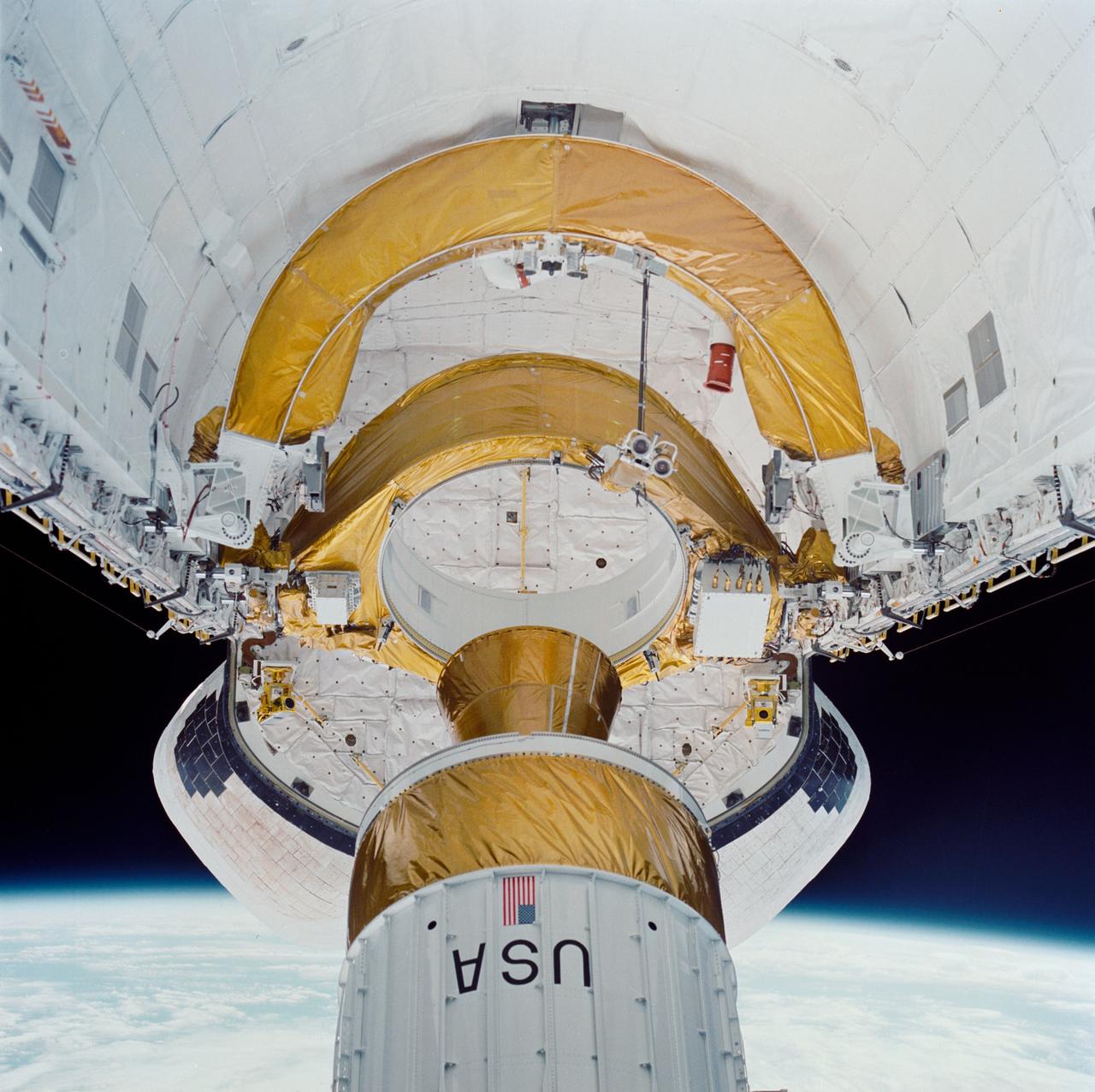
During STS-26, inertial upper stage (IUS) with the tracking and data relay satellite C (TDRS-C) drifts above Discovery, Orbiter Vehicle (OV) 103, payload bay (PLB) after being positioned in deployment attitude (an angle of 50 degrees) by the airborne support equipment (ASE). IUS vacates the ASE aft frame tilt actuator (AFTA) table in the PLB while the disconnected ASE umbilical boom floats above ASE forward cradle. IUS first stage rocket motor and nozzle and the interstage are visible as the IUS is deployed. In the background are the orbital maneuvering system (OMS) pods and the Earth's limb.
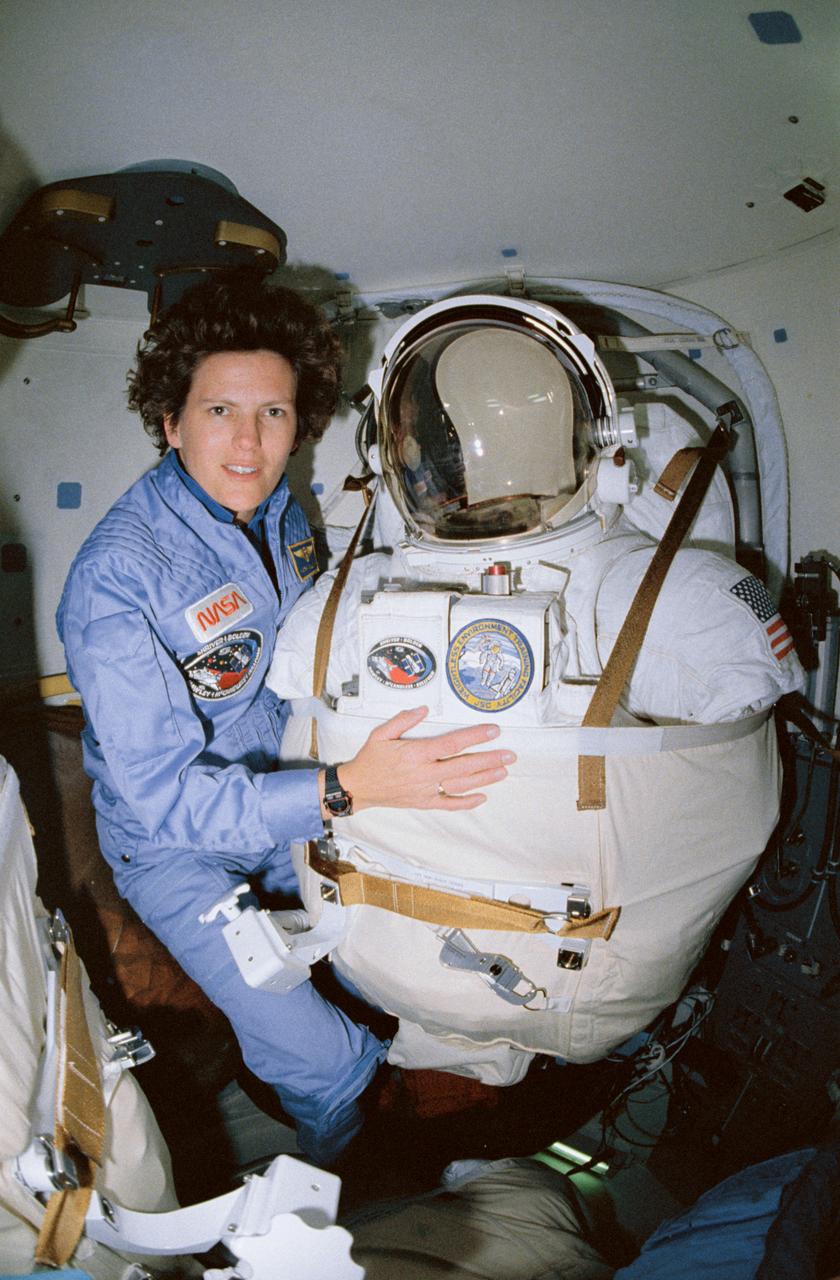
STS-31 Mission Specialist (MS) Kathryn D. Sullivan poses for a picture before beginning extravehicular mobility unit (EMU) donning procedures in the airlock of Discovery, Orbiter Vehicle (OV) 103. Sullivan will remove the lower torso restraint and don EMU which is supported on an airlock adapter plate (AAP). When suited, Sullivan will be ready for contingency extravehicular activity (EVA) in the event that problems arise with the Hubble Space Telescope (HST) deployment. Displayed on the front of the EMU are the STS-31 mission insignia and the JSC Weightless Environment Training Facility (WETF) insignia.
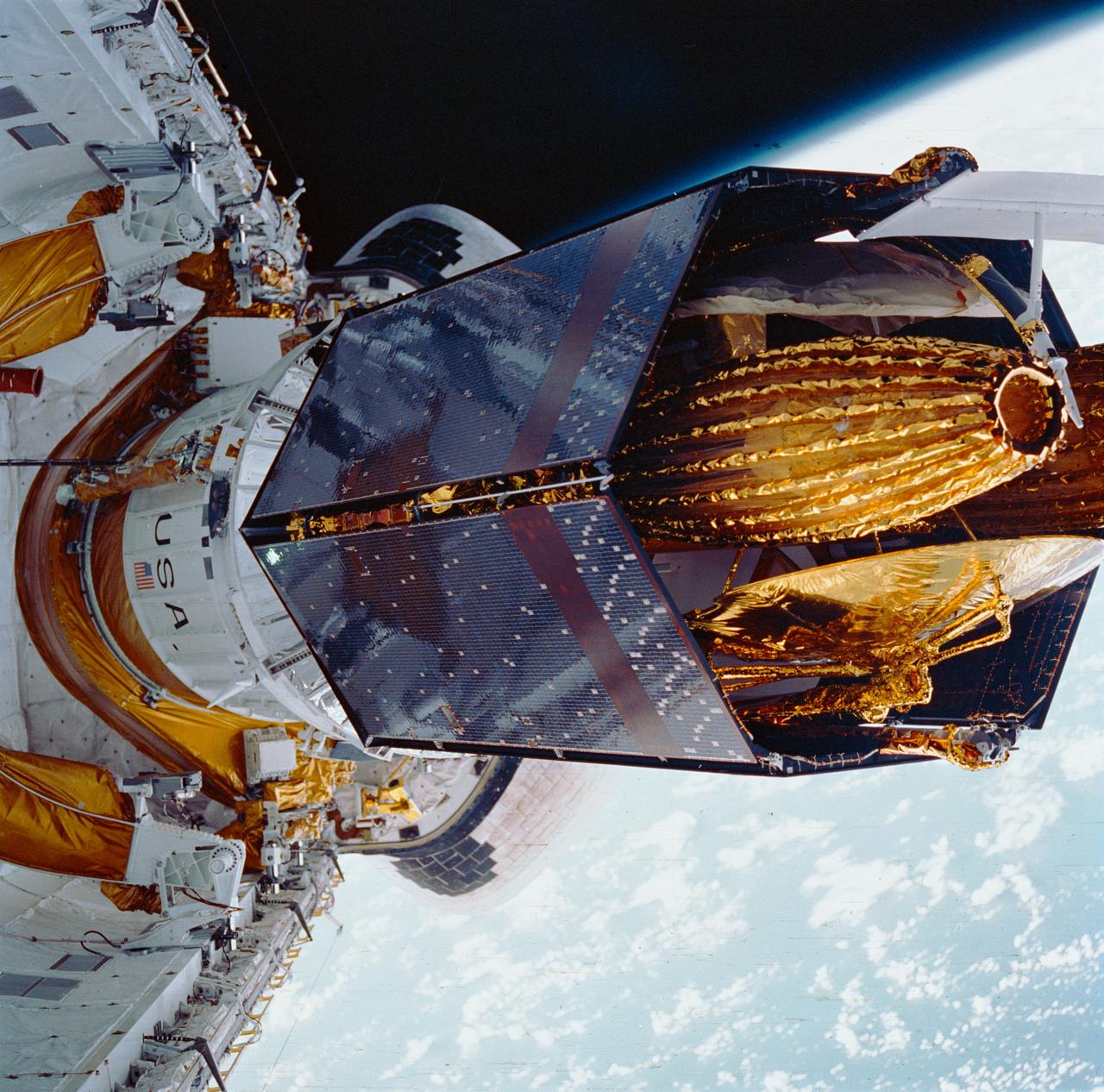
During STS-26, inertial upper stage (IUS) with tracking and data relay satellite C (TDRS-C) located in the payload bay (PLB) of Discovery, Orbiter Vehicle (OV) 103, is positioned into its proper deployment attitude (an angle of 50 degrees) by the airborne support equipment (ASE). In the foreground, the ASE forward cradle is visible. The IUS is mounted in the ASE aft frame tilt actuator (AFTA) table. TDRS-C components in stowed configuration include solar array panels, TDRS single access #1 and #2, TDRS SGL, and S-Band omni antenna. In the background are the orbital maneuvering system (OMS) pods, the Earth's cloud-covered surface, and the Earth's limb.
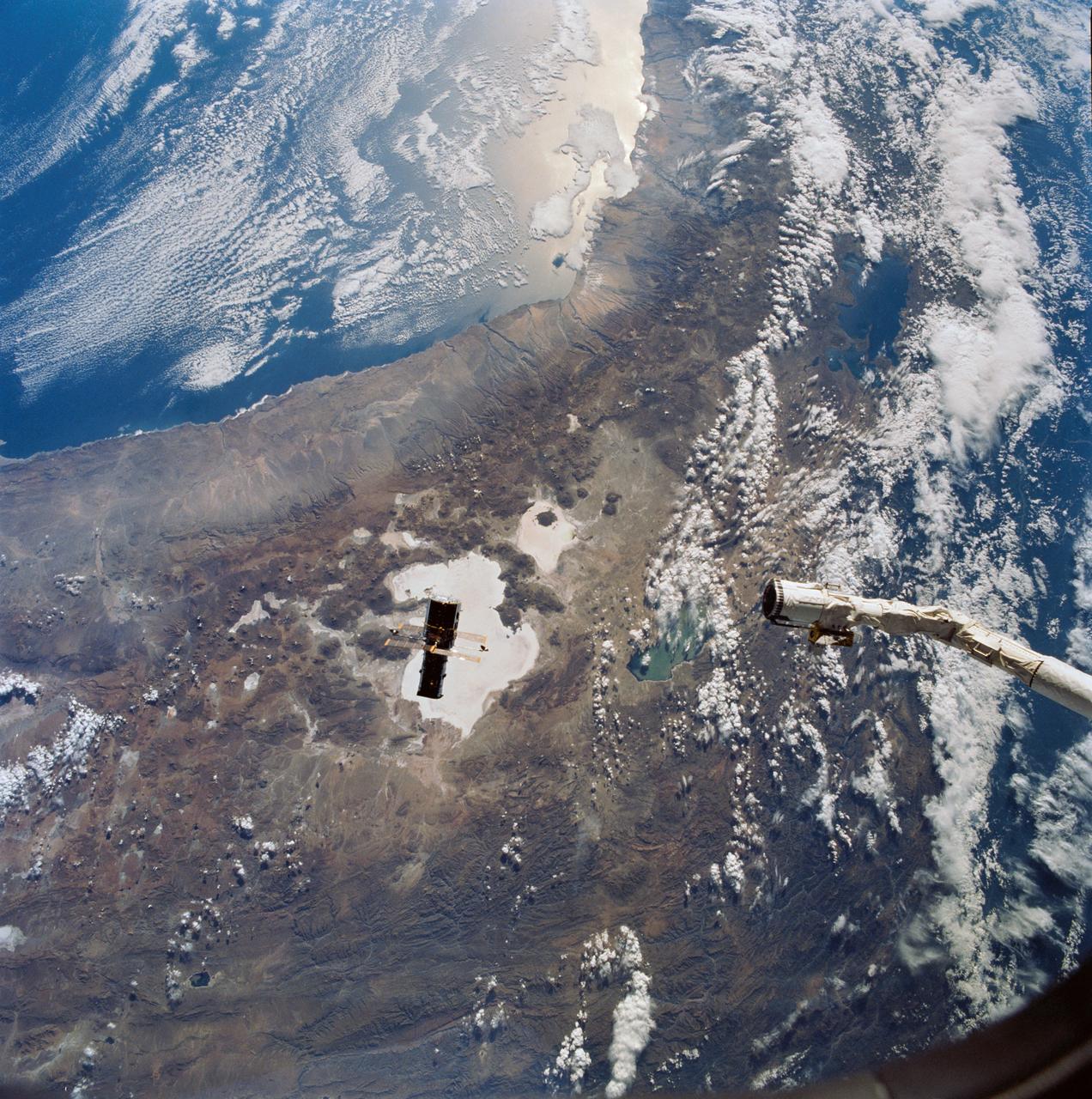
Hubble Space Telescope (HST), with its solar array (SA) wings and high gain antennae (HGA) fully extended,is released from Discovery's, Orbiter Vehicle (OV) 103's, remote manipulator system (RMS) end effector and is set free into Earth orbit by the STS-31 crew. HST drifts away from the end effector over the Andes Mountains.Parts of Bolivia, Peru, Chile, and Argentina are visible. The view covers a huge area of the western half of South America stretching from 14 degrees south latitude to 23 degrees, about 1,000 kilometers.
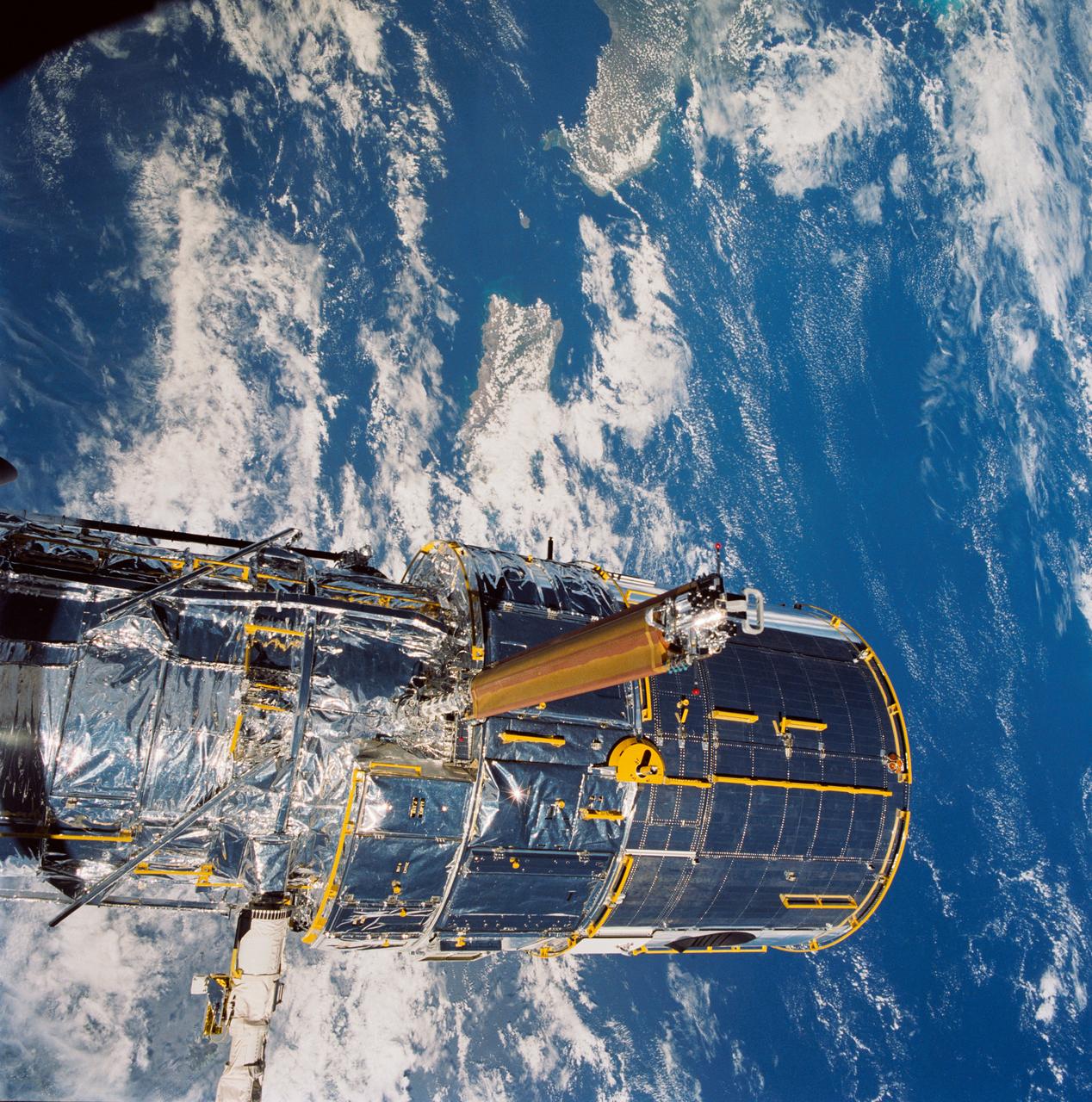
During STS-31, the Hubble Space Telescope (HST) grappled by the remote manipulator system (RMS) end effector is held in appendage deploy position above Discovery, Orbiter Vehicle (OV) 103. The solar array (SA) bistem cassette has been released from its latch fittings. The bistem spreader bars begin to unfurl the SA wing. The secondary deployment mechanism (SDM) handle is visible at the SA end. Stowed against either side of the HST System Support Module (SSM) forward shell are the high-gain antennae (HGA). Puerto Rico and the Dominican Republic are recognizable at the left of the frame.
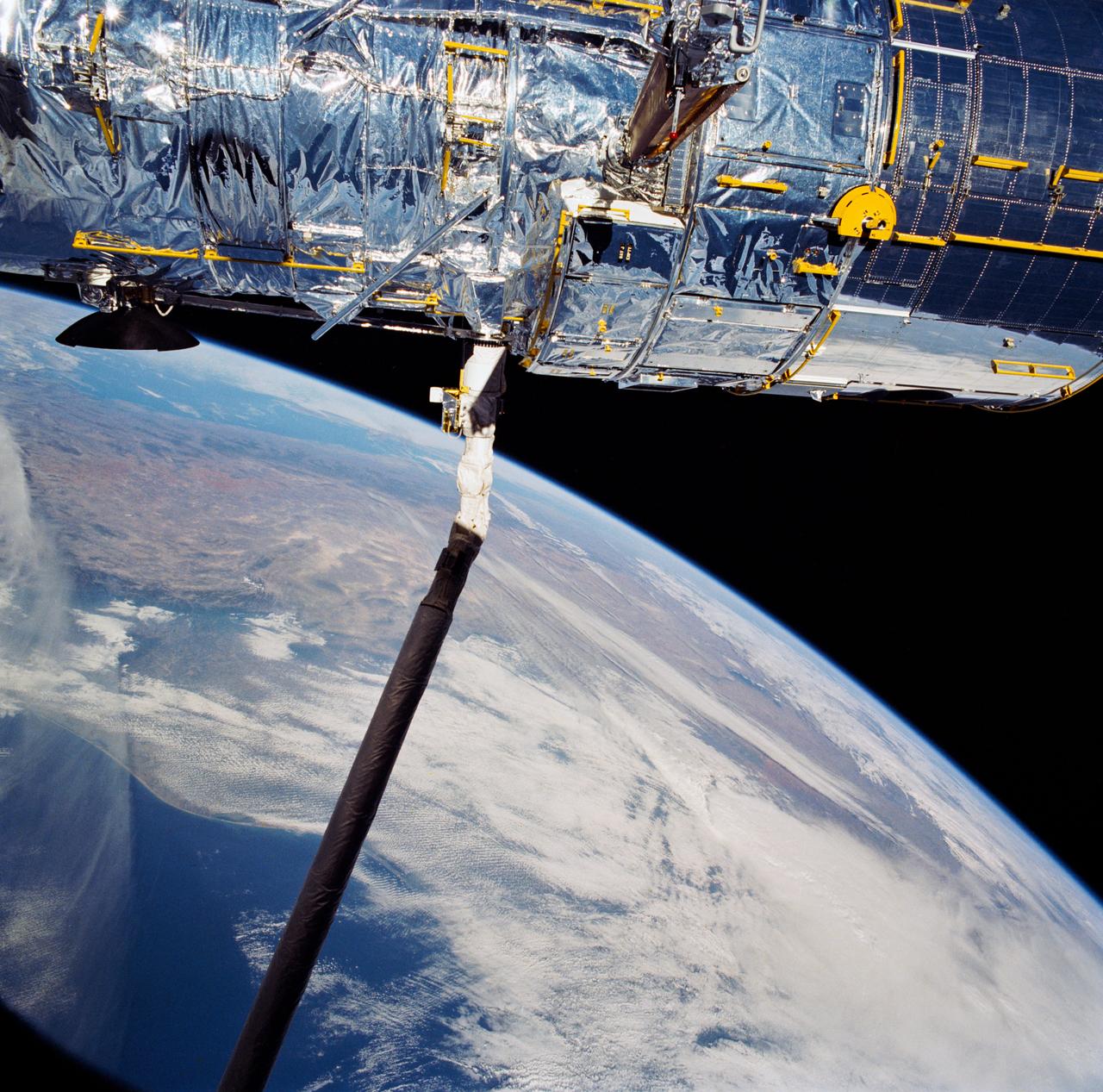
During STS-31, the Hubble Space Telescope (HST) is held in appendage deploy position by Discovery's, Orbiter Vehicle (OV) 103's, remote manipulator system (RMS) above the payload bay (PLB) and crew compartment cabin. While in this position the solar array (SA) wing bistem cassette (HST center) is deployed from its stowed location along side the Support System Module (SSM) forward shell. A high gain antenna (HGA) remains stowed along the SSM. The Earth's surface and the Earth limb creates a dramatic backdrop.
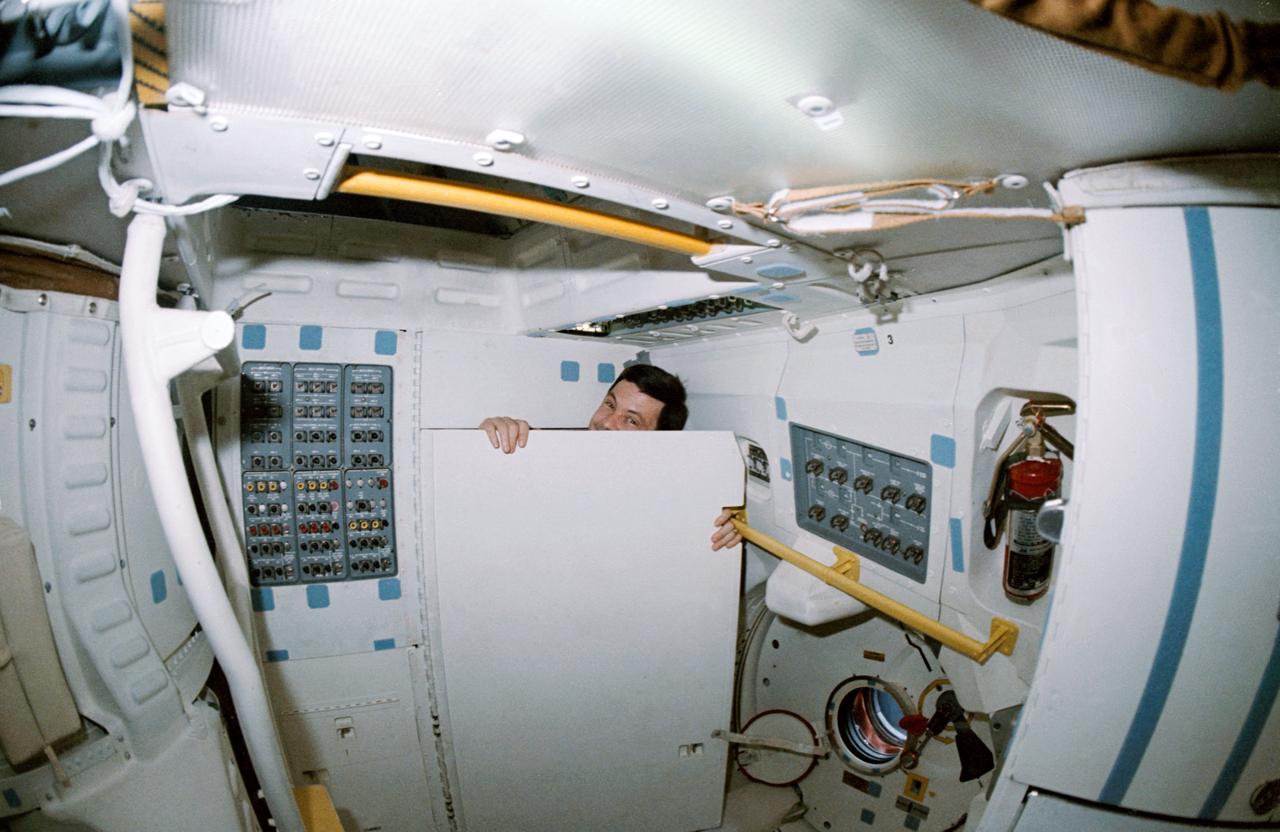
STS-41 crewmembers conduct Detailed Supplementary Objective (DSO) 0472 Intraocular Pressure on the middeck of Discovery, Orbiter Vehicle (OV) 103. Mission Specialist (MS) William M. Shepherd rests his head on the stowed treadmill while Pilot Robert D. Cabana, holding Shepherd's eye open, prepares to measure Shepherd's intraocular pressure using a tono pen (in his right hand). Objectives include: establishing a database of changes in intraocular pressures that can be used to evaluate crew health; validating ten degree head down bedrest as a model for cephalad fluid shifts in microgravity; facilitating the interpretation of data by providing a quantative measure of microgravity induced cephalad fluid shifts; and validating the tono pen as an effective tool for diagnostic and scientific data collection.
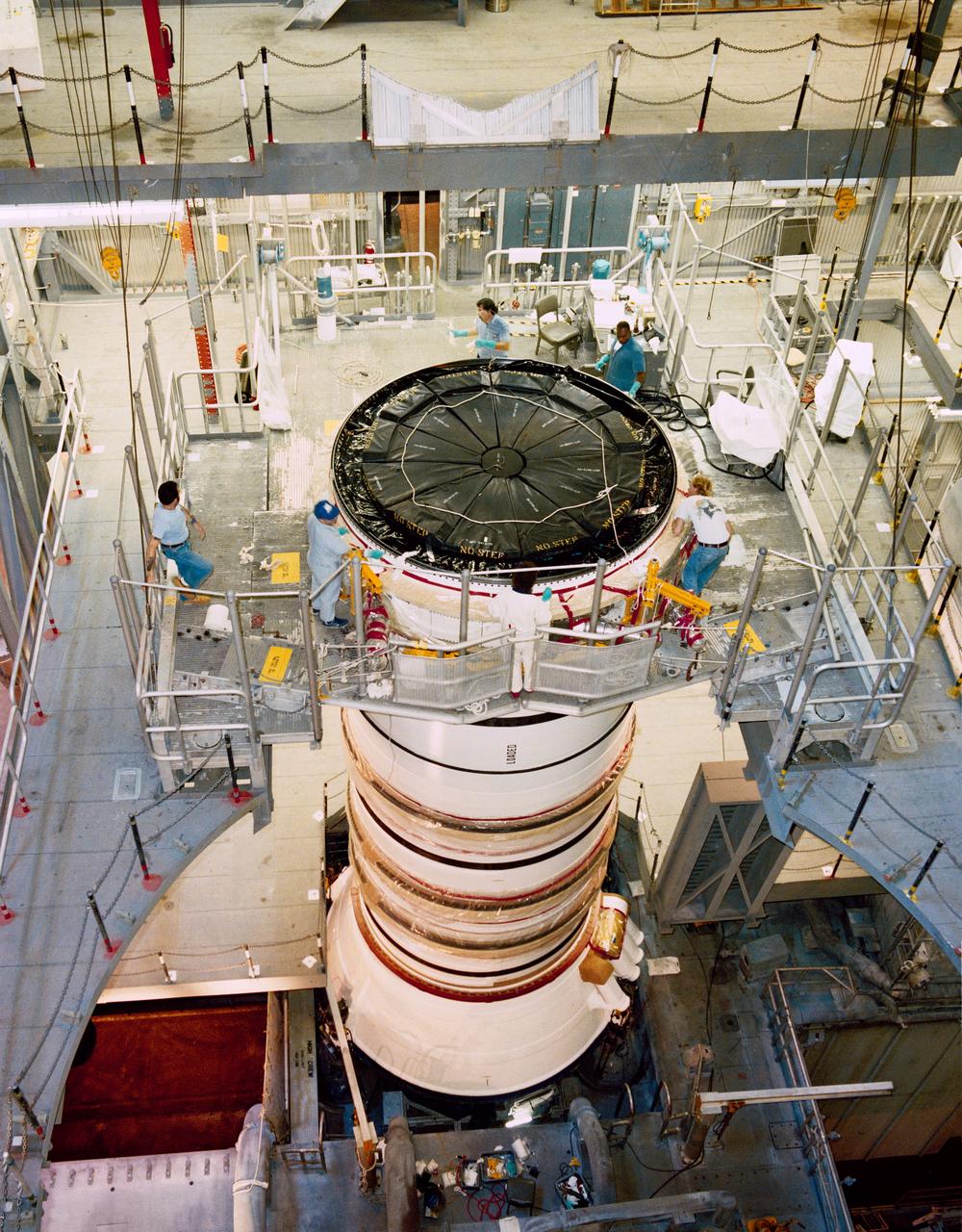
STS-29 Discovery, Orbiter Vehicle (OV) 103, solid rocket booster (SRB) right aft segment is being prepared for stacking in the Kennedy Space Center (KSC) Vehicle Assembly Building (VAB). Technicians examine and work with SRB seal from scaffolding platform. The twin sets of boosters provide 80 percent of the space shuttle launch thrust. Each SRB is made up of four "loaded" or fueled segments. The SRBs operate in parallel with the space shuttle main engines (SSMEs) for the first two minutes of flight providing additional thrust needed to escape the gravitational pull of the Earth. At an altitude of approximately 24 nautical miles, the SRBs separate, descend on parachutes, and land in the Atlantic Ocean where they are recovered and reused on future flights. View provided by KSC with alternate number KSC-88PC-1323.
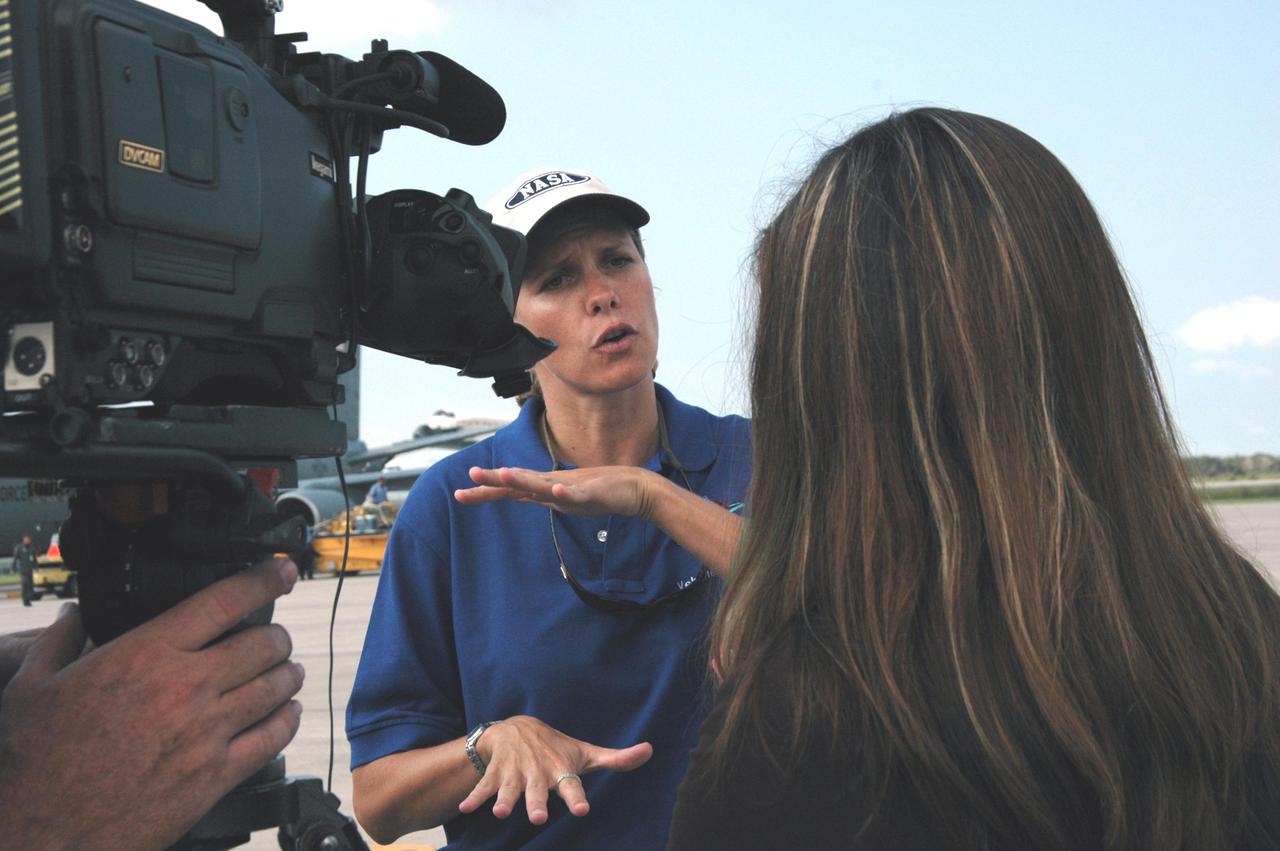
KENNEDY SPACE CENTER, FLA. - Stephanie Stilson, vehicle manager for Space Shuttle Discovery (OV-103), is interviewed by the news media at the Kennedy Space Center (KSC) Shuttle Landing Facility (SLF). The interview followed the touchdown of Discovery, atop a modified Boeing 747 Shuttle Carrier Aircraft (SCA), on runway 15 at the SLF at about 10:00 a.m. EDT. The cross-country ferry flight became necessary when two days of unfavorable weather conditions at KSC forced Discovery to land on runway 22 at Edwards Air Force Base, Calif., on Aug. 9 following mission STS-114. On the return trip, stops were made at Altus Air Force Base, Okla., and Barksdale Air Force Base, La., where Discovery stayed for two nights. The SCA and Discovery will be towed to the Mate_Demate Device at the SLF where a crane will lift Discovery from the SCA and place it on solid ground. Discovery will then be towed to the Orbiter Processing Facility where preparations will begin for its next flight, STS-121.
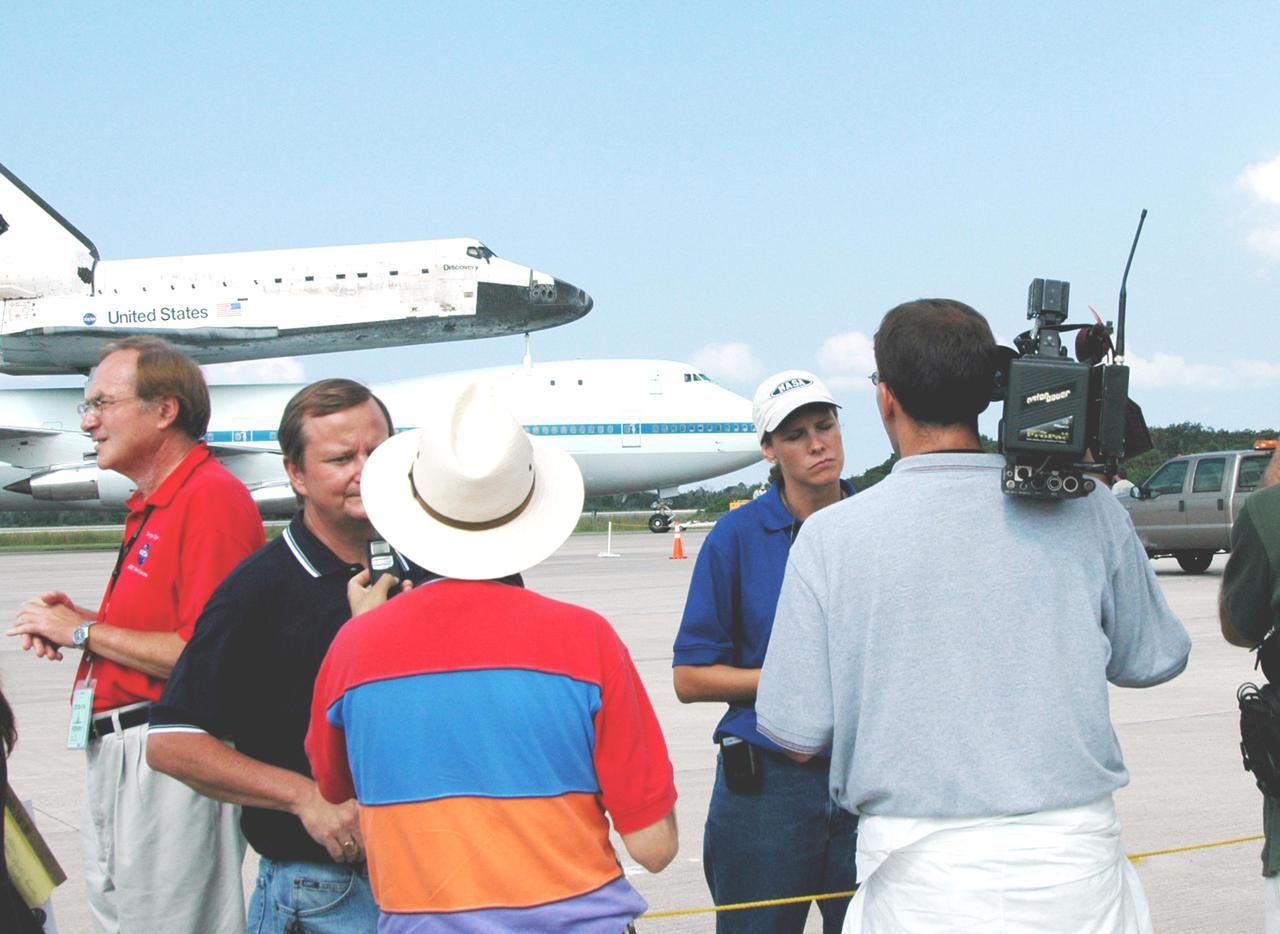
KENNEDY SPACE CENTER, FLA. - Mike Leinbach (facing camera left), Shuttle launch director, and Stephanie Stilson (facing camera right), vehicle manager for Space Shuttle Discovery (OV-103), are interviewed by the news media at the Kennedy Space Center (KSC) Shuttle Landing Facility (SLF). The interviews followed the touchdown of Discovery, atop a modified Boeing 747 Shuttle Carrier Aircraft (SCA), on runway 15 at the SLF at about 10:00 a.m. EDT. The cross-country ferry flight became necessary when two days of unfavorable weather conditions at KSC forced Discovery to land on runway 22 at Edwards Air Force Base, Calif., on Aug. 9 following mission STS-114. On the return trip, stops were made at Altus Air Force Base, Okla., and Barksdale Air Force Base, La., where Discovery stayed for two nights. The SCA and Discovery will be towed to the Mate_Demate Device at the SLF where a crane will lift Discovery from the SCA and place it on solid ground. Discovery will then be towed to the Orbiter Processing Facility where preparations will begin for its next flight, STS-121.
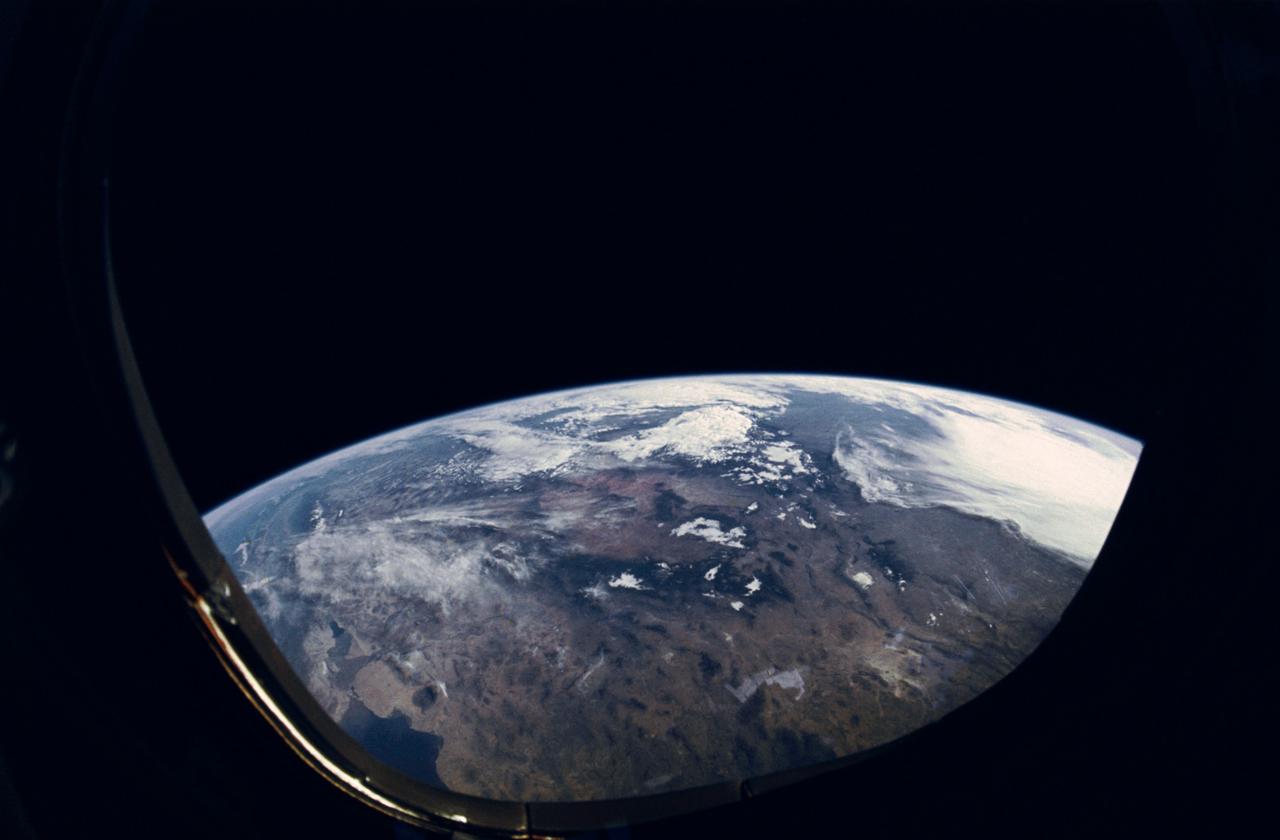
STS-31 Earth observation taken aboard Discovery, Orbiter Vehicle (OV) 103, is of the western United States with the Salton Sea and Imperial Valley area recognizable at the lower left. The view is framed in a flight deck window and was photographed using a fish-eye lens.
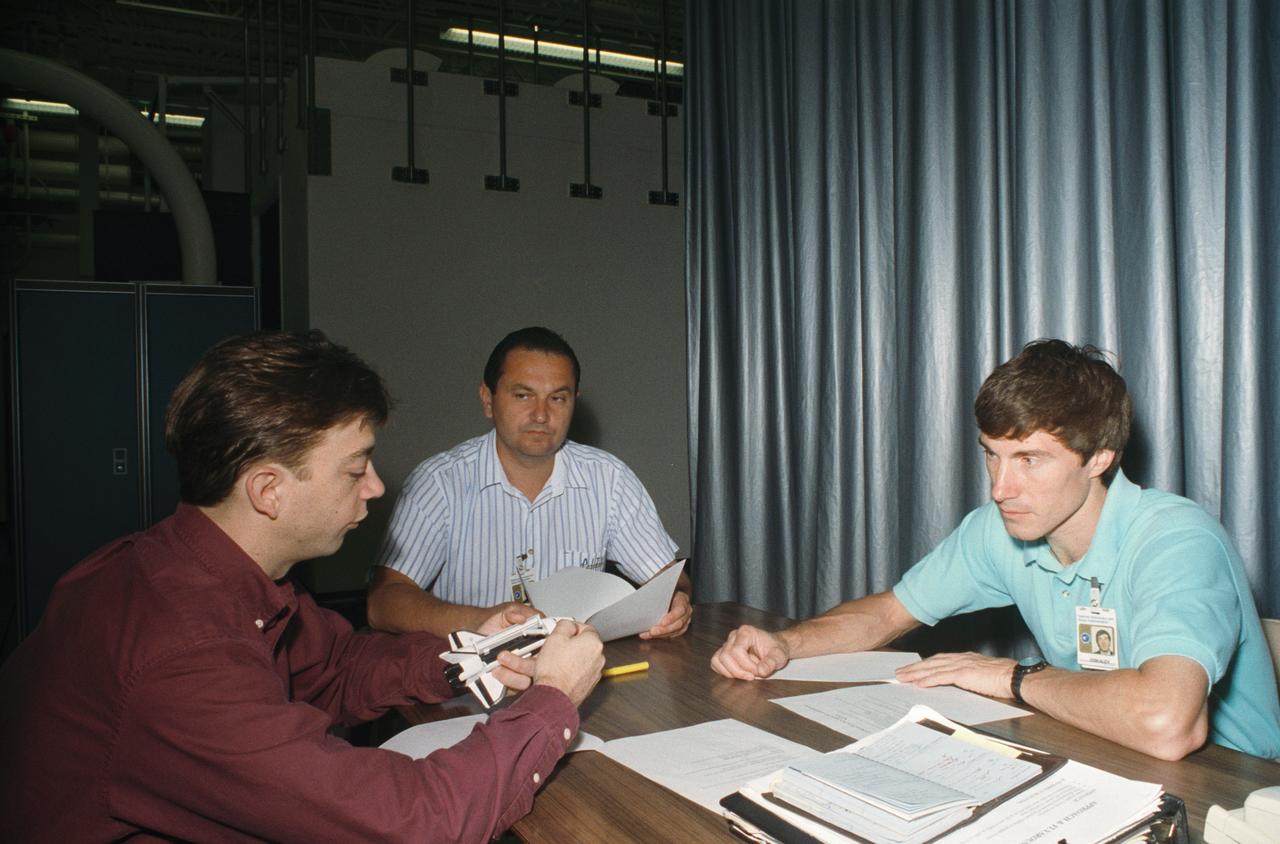
STS-60 Discovery, Orbiter Vehicle (OV) 103, Russian Mission Specialist Sergei Krikalev and Russian backup Mission Specialist Vladimir Titov work with Training Instructor Richard M. Davis (holding space shuttle model) prior to entering the Building 16 Systems Engineering Simulator (SES).
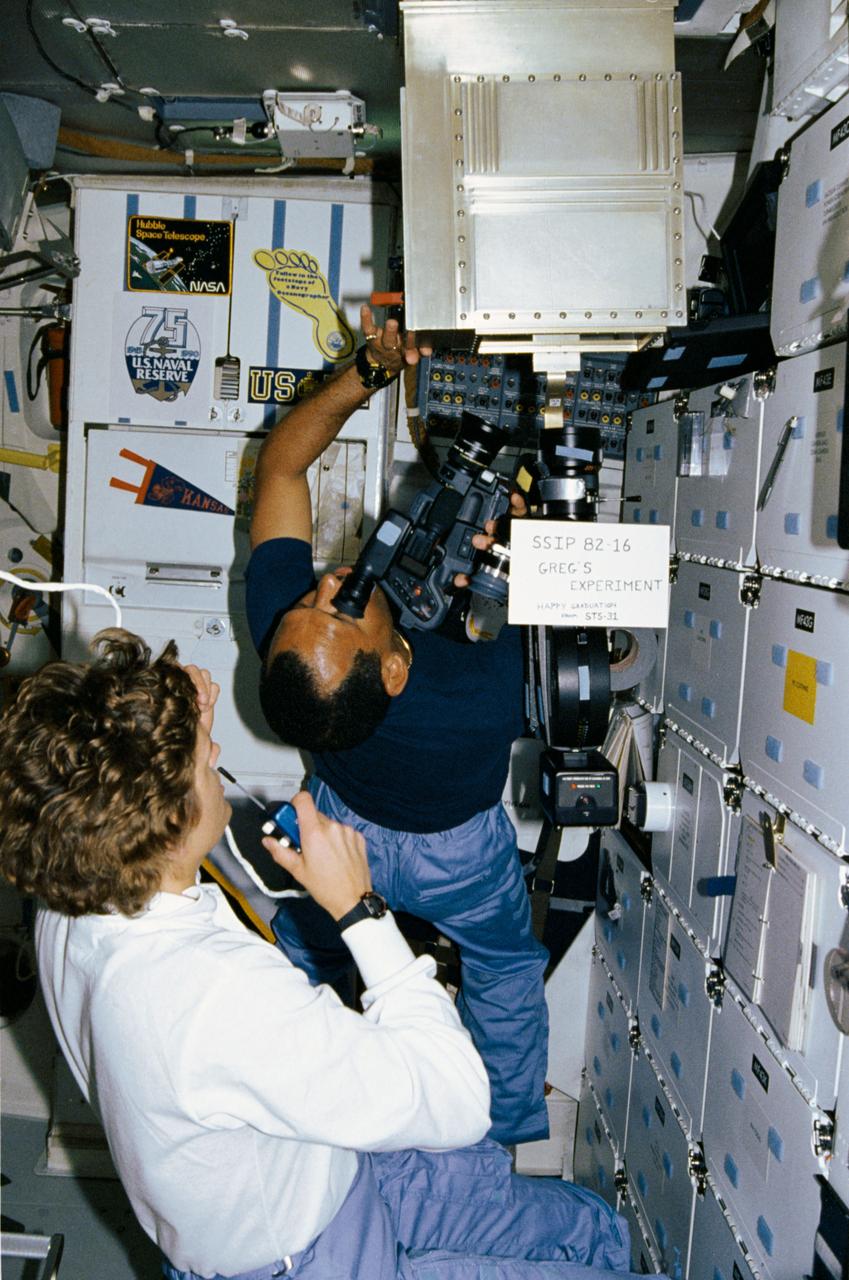
STS-31 Mission Specialist (MS) Kathryn D. Sullivan monitors and advises ground controllers of the activity inside the Student Experiment (SE) 82-16, Ion arc - studies of the effects of microgravity and a magnetic field on an electric arc, mounted in front of the middeck lockers aboard Discovery, Orbiter Vehicle (OV) 103. Pilot Charles F. Bolden uses a video camera and an ARRIFLEX motion picture camera to record the activity inside the special chamber. A sign in front of the experiment reads "SSIP 82-16 Greg's Experiment Happy Graduation from STS-31." SSIP stands for Shuttle Student Involvement Program. Gregory S. Peterson who developed the experiment (Greg's Experiment) is a student at Utah State University and monitored the experiment's operation from JSC's Mission Control Center (MCC) during the flight. Decals displayed in the background on the orbiter galley represent the Hubble Space Telescope (HST), the United States (U.S.) Naval Reserve, Navy Oceanographers, U.S. Navy, and University of Kansas.
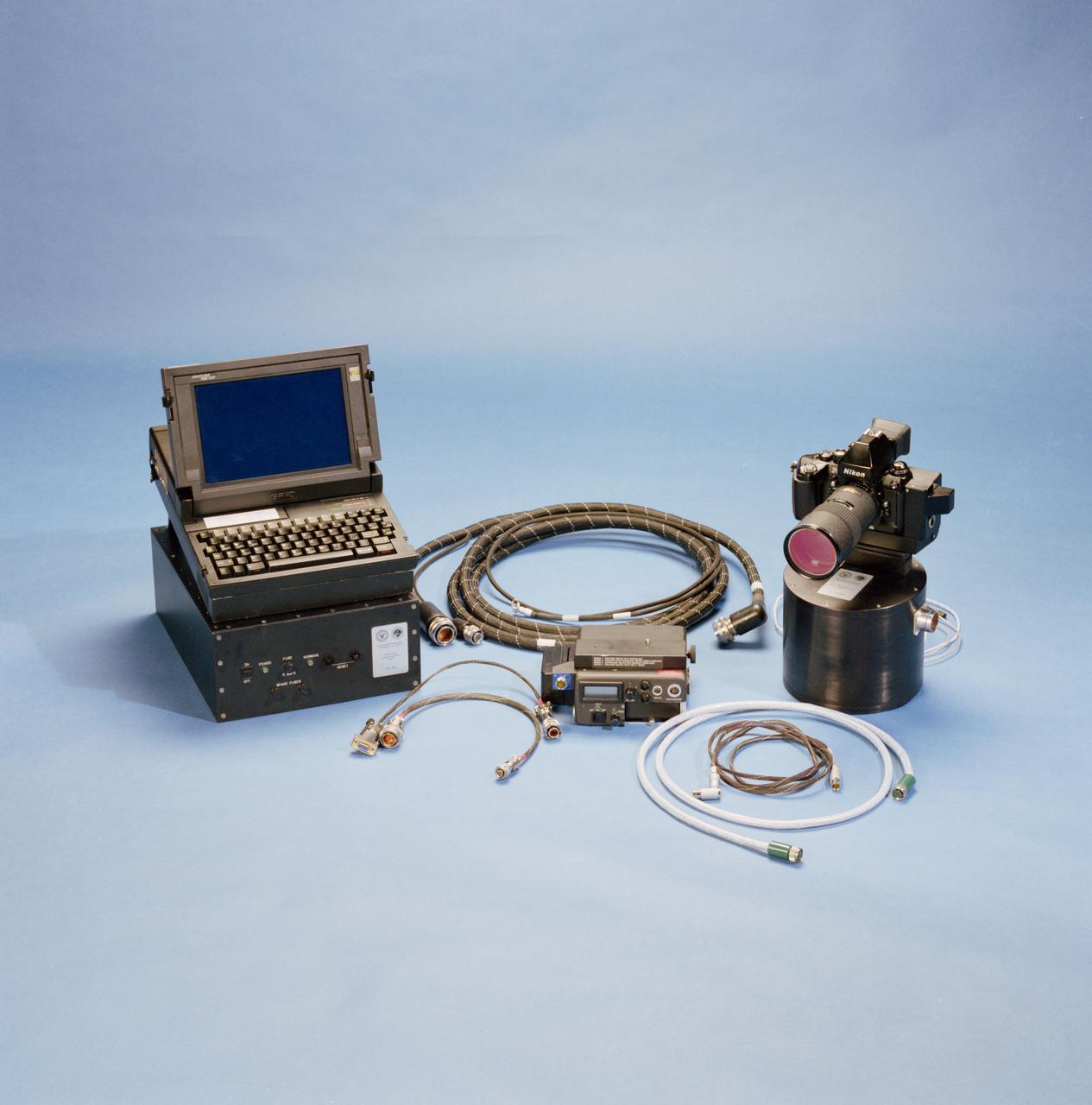
STS-53 Discovery, Orbiter Vehicle (OV) 103, Department of Defense (DOD) mission Hand-held Earth-oriented Real-time Cooperative, User-friendly, Location, targeting, and Environmental System (Hercules) spaceborne experiment equipment is documented in this table top view. HERCULES is a joint NAVY-NASA-ARMY payload designed to provide real-time high resolution digital electronic imagery and geolocation (latitude and longitude determination) of earth surface targets of interest. HERCULES system consists of (from left to right): a specially modified GRID Systems portable computer mounted atop NASA developed Playback-Downlink Unit (PDU) and the Naval Research Laboratory (NRL) developed HERCULES Attitude Processor (HAP); the NASA-developed Electronic Still Camera (ESC) Electronics Box (ESCEB) including removable imagery data storage disks and various connecting cables; the ESC (a NASA modified Nikon F-4 camera) mounted atop the NRL HERCULES Inertial Measurement Unit (HIMU) containing the three-axis ring-laser gyro.
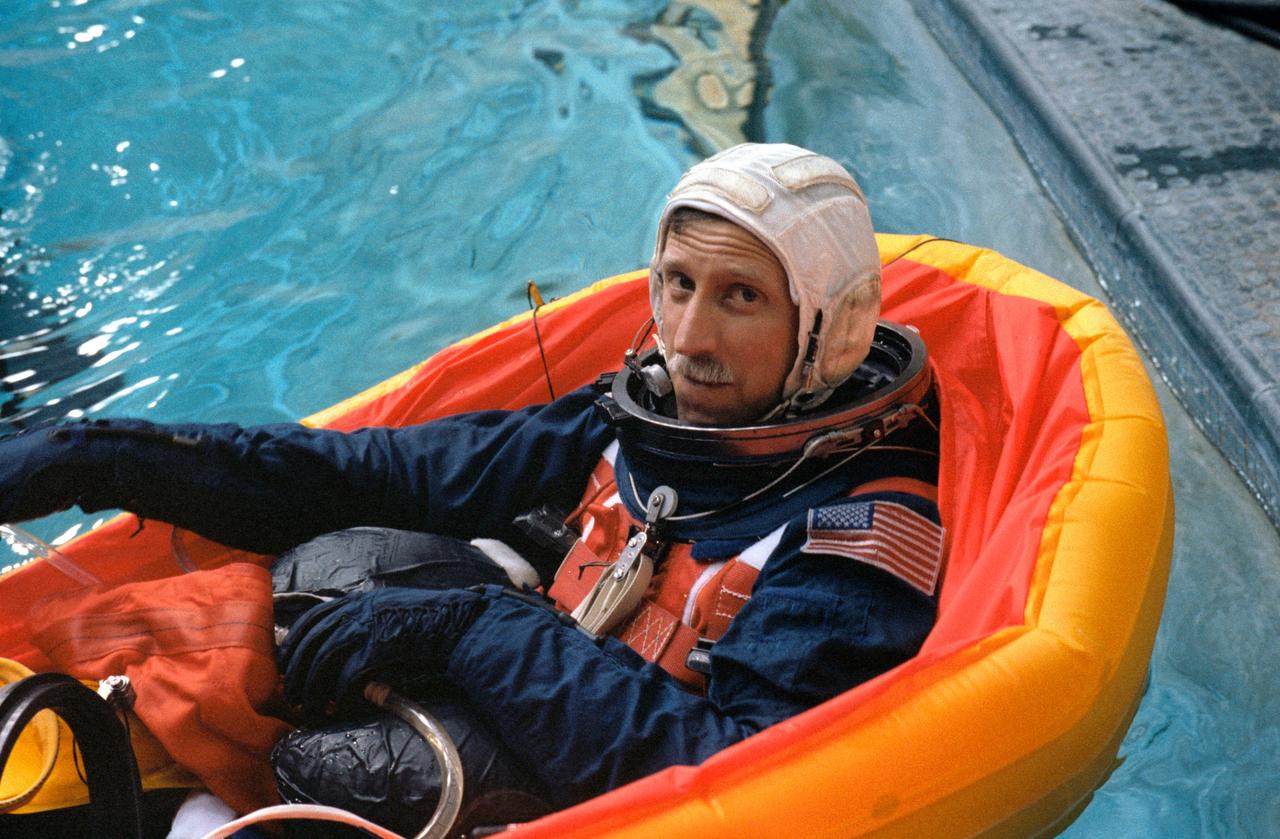
S88-42425 (20 July 1988) --- STS-26 Discovery, Orbiter Vehicle (OV) 103, Pilot Richard O. Covey, wearing the newly designed launch and entry suit (LES), floats in single-occupant life raft in JSC Weightless Environment Training Facility (WETF) Bldg 29 pool. The simulation of the escape and rescue operations utilized the crew escape system (CES) pole method of egress from the Space Shuttle.
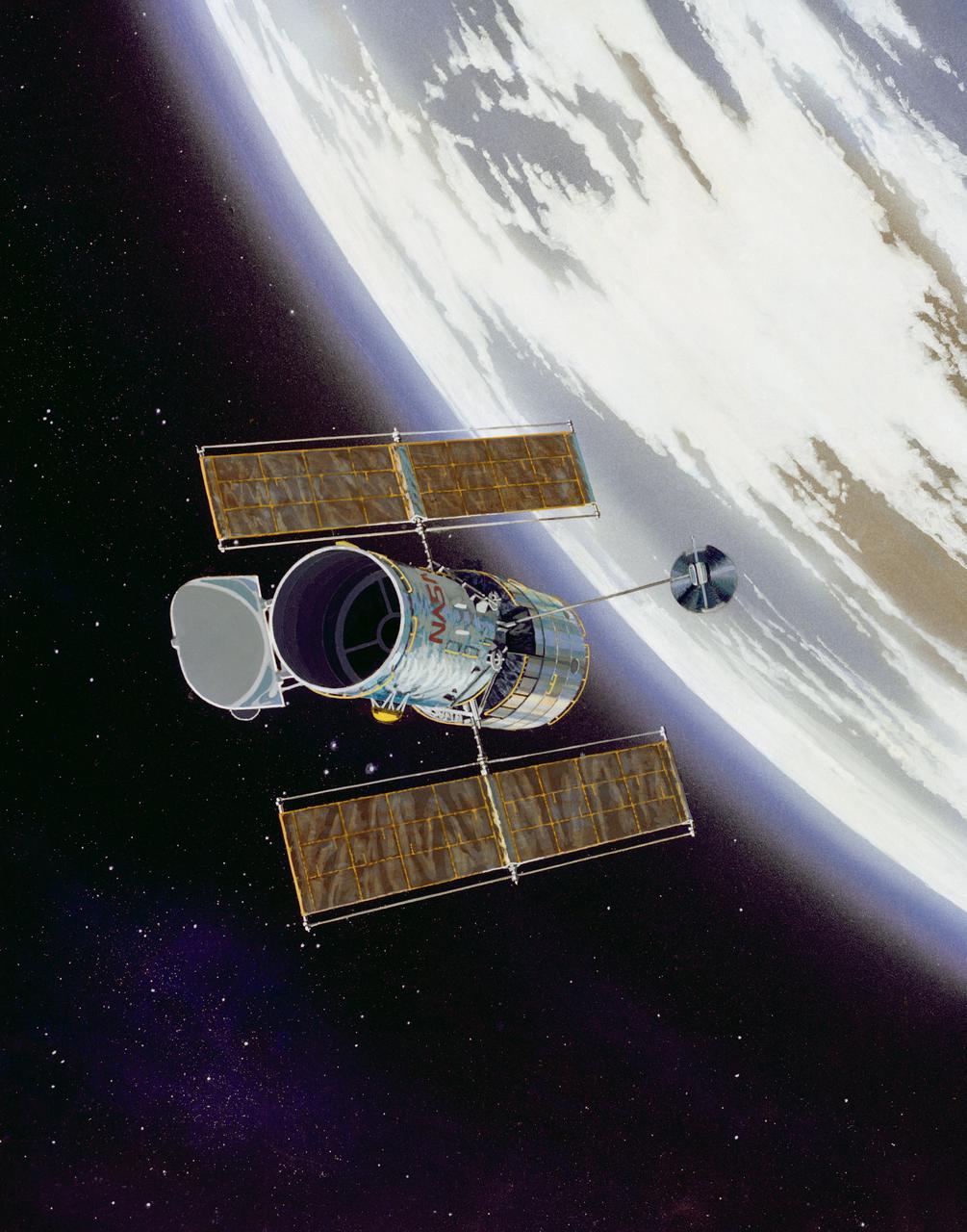
This artist concept shows the Hubble Space Telescope (HST) in operational configuration orbiting the Earth after its deploy from Discovery, Orbiter Vehicle (OV) 103 during STS-31. The high gain antennas (HGAs) and solar arrays (SAs) have been extended. HST's aperature door is open as it views the universe from a vantage point above the Earth's atmosphere. View provided by the Marshall Space Flight Center (MSFC).
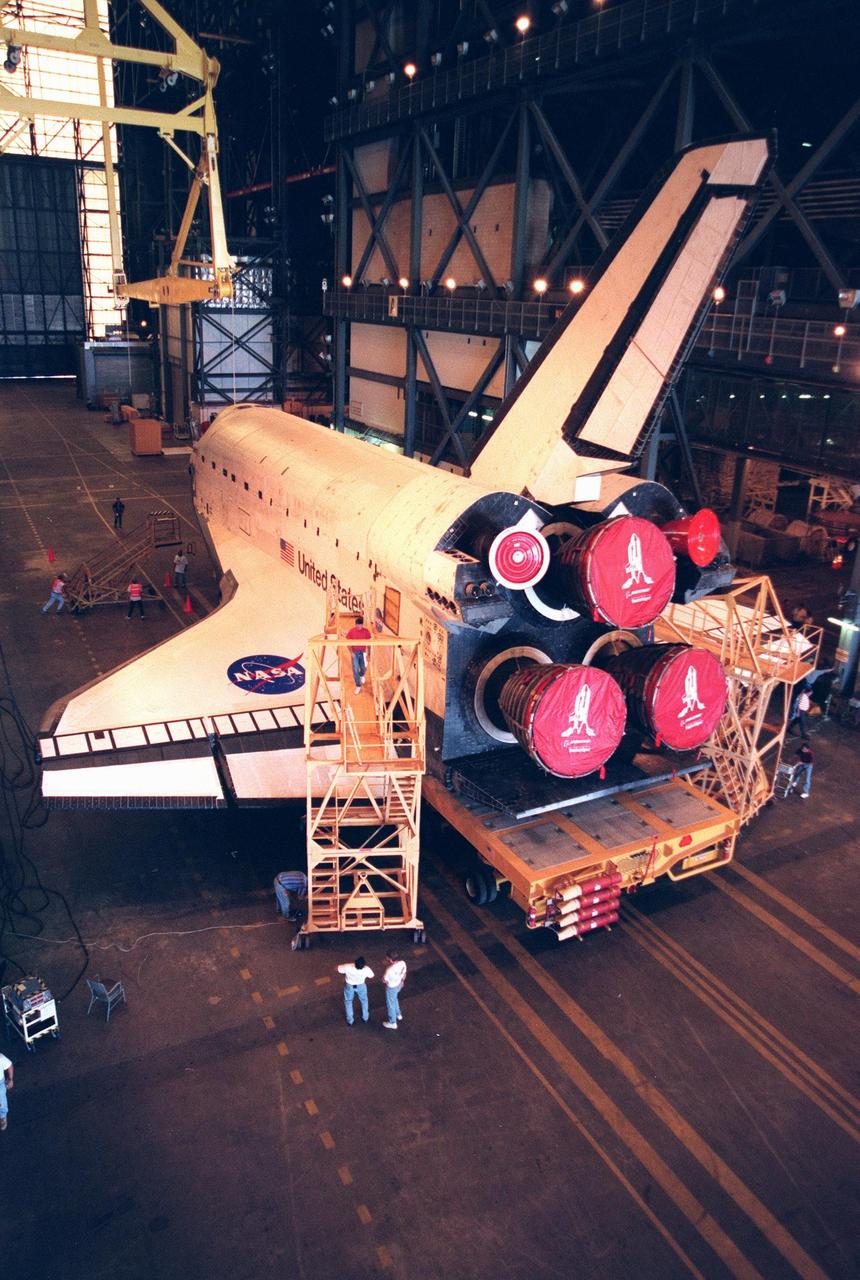
In the Vehicle Assembly Building, workers prepare the orbiter Discovery for vertical lift before mating it with the external tank. The orbiter displays the recently painted NASA logo, termed the "meatball," on its left wing and both sides of the fuselage. Discovery (OV-103) is scheduled for its 25th flight, from Launch Pad 39B, on Oct. 29, 1998, for the STS-95 mission
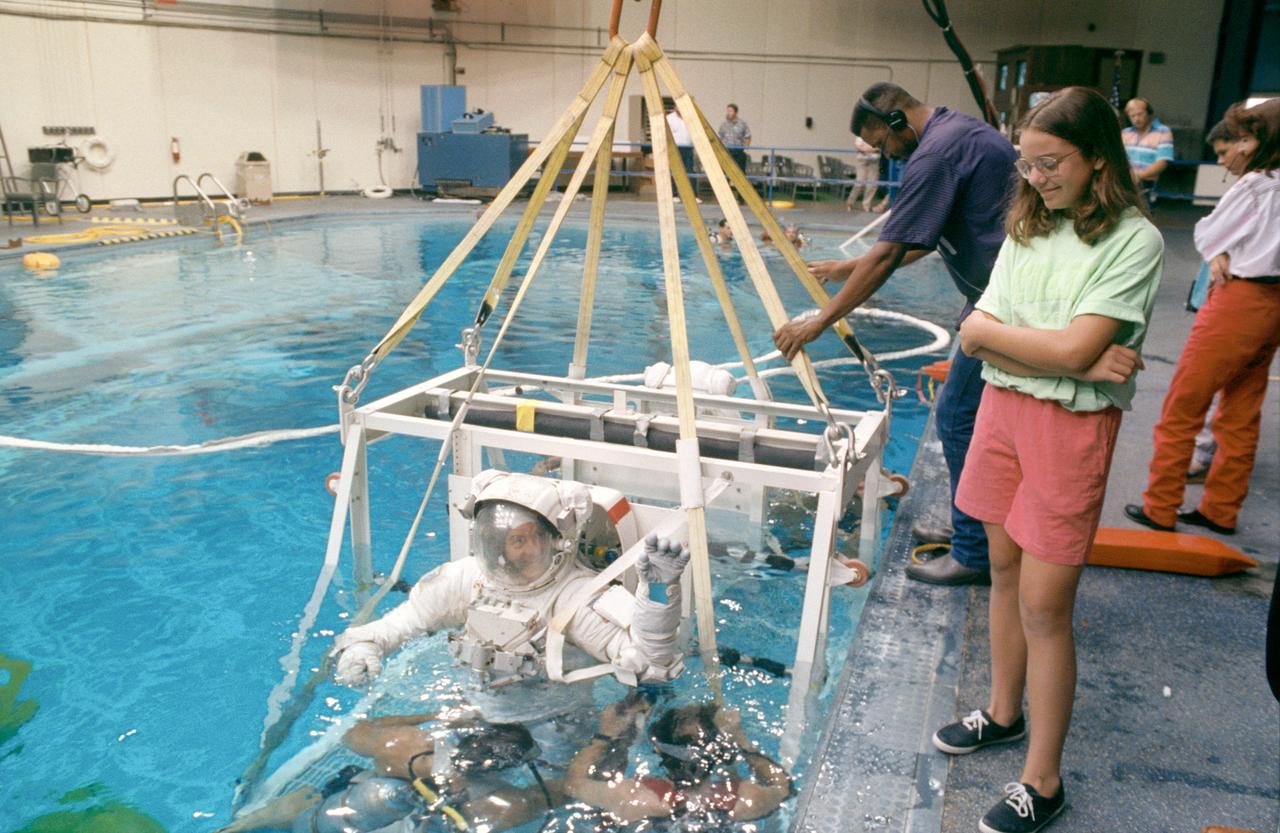
S92-43335 (28 July 1992) --- STS-53 Discovery, Orbiter Vehicle (OV) 103, Mission Specialist James S. Voss, wearing extravehicular mobility unit (EMU), is lowered into JSC?s Weightless Environment Training Facility (WETF) Bldg. 29 pool. Voss waves to his daughter standing on the poolside as the platform he is positioned in is submerged in the pool. Technicians on the poolside and scuba equipped divers in the water monitor activities. Once underwater, Voss will participate in contingency extravehicular activity (EVA) procedures.
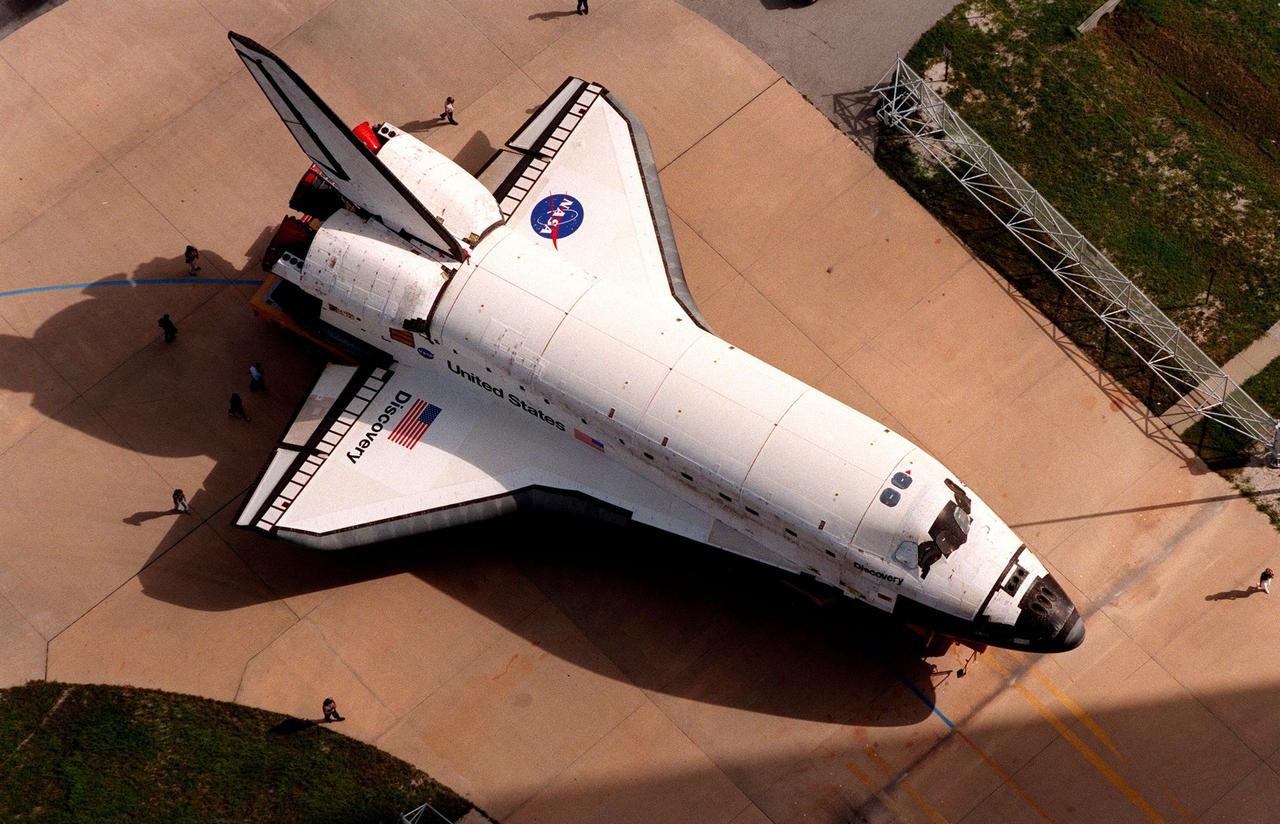
Morning shadows frame the orbiter Discovery on its rollover from the Orbiter Processing Facility Bay 2 to the Vehicle Assembly Building. The orbiter displays the recently painted NASA logo, termed the "meatball," on its left wing and both sides of the fuselage. Discovery (OV-103) is scheduled for its 25th flight, from Launch Pad 39B, on Oct. 29, 1998, for the STS-95 mission

STS-42 Earth observation taken aboard Discovery, Orbiter Vehicle (OV) 103, is of New York City (NYC), New York (41.0N, 74.0W). Snow cover highlights the large areas of development and the many reservoirs in this wintertime scene of the metropolitan NYC area. Features such as Central Park in Manhattan, the George Washington Bridge connecting Manhattan with New Jersey, street patterns in most of the boroughs, La Guardia and JFK airports in Queens, and the extensive harbor system are easily identified.
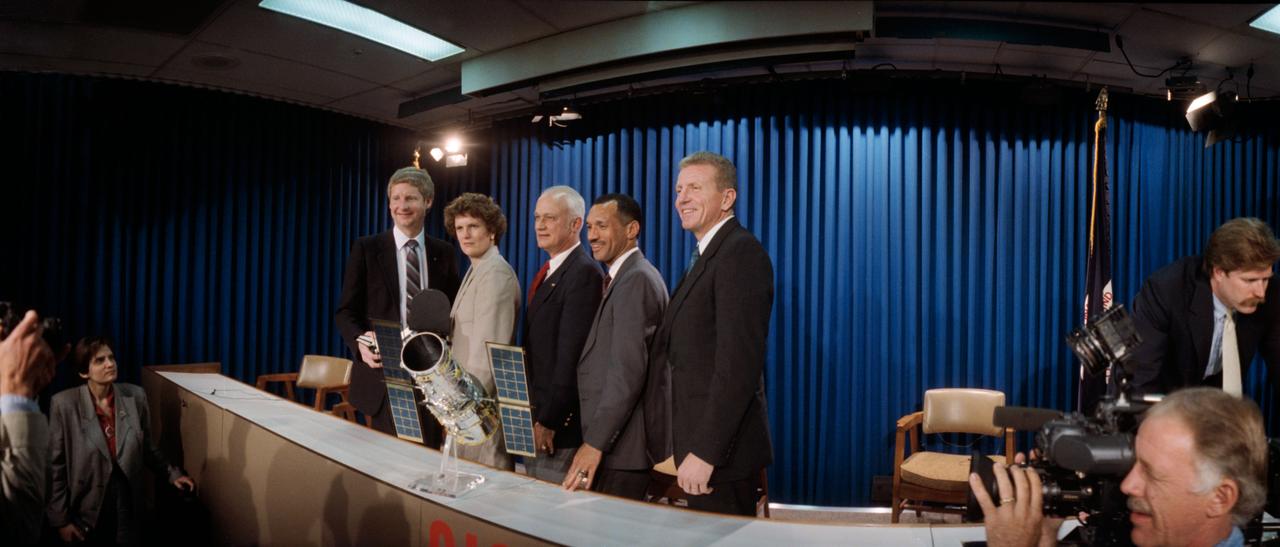
STS-31 Discovery, Orbiter Vehicle (OV) 103, crewmembers pose for an informal portrait after the T-30 (thirty days before launch) briefing at JSC's Auditorium and Public Affairs Facility Bldg 2. Standing behind the conference table are (left to right) Mission Specialist (MS) Steven A. Hawley, MS Kathryn D. Sullivan, MS Bruce McCandless II, Pilot Charles F. Bolden, and Commander Loren J. Shriver.
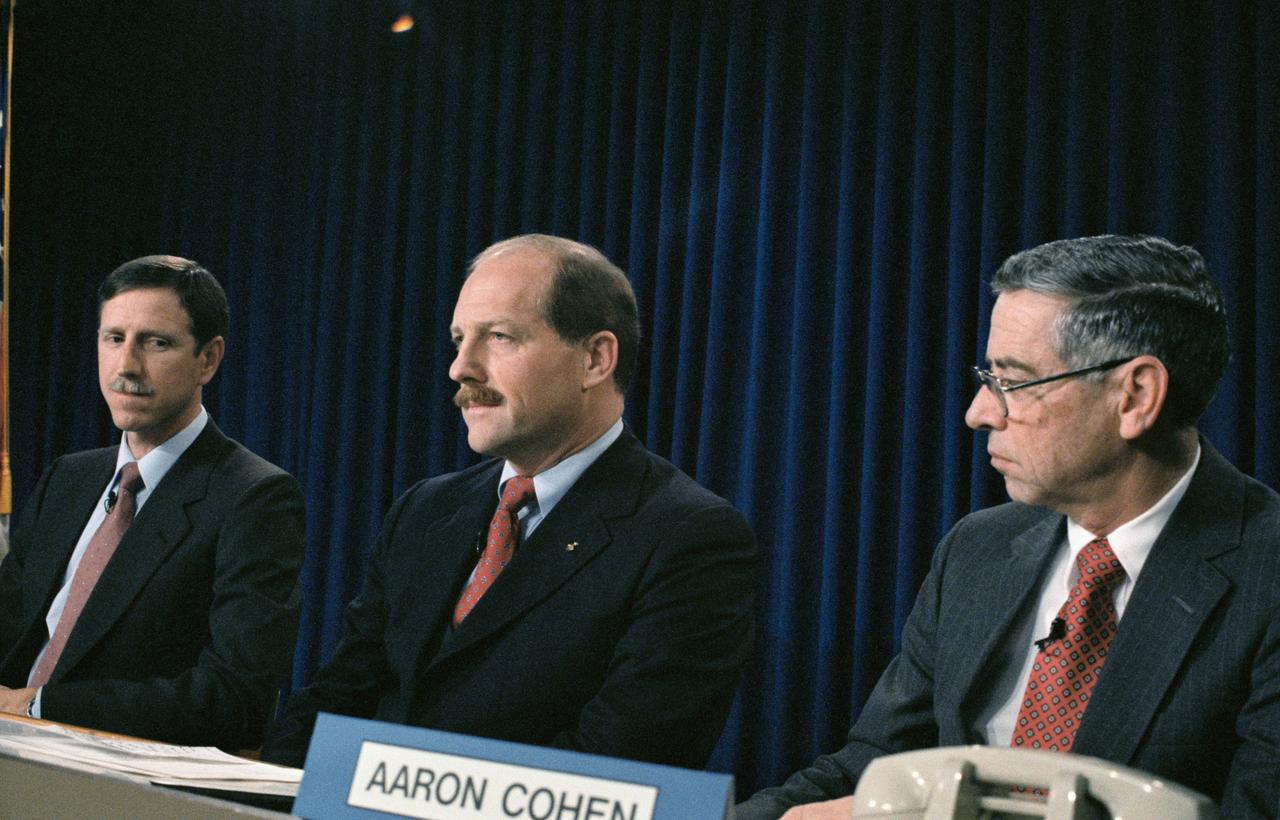
STS-26 Discovery, Orbiter Vehicle (OV) 103, crew including Commander Frederick H. Hauck and Pilot Richard O. Covey and JSC Director Aaron Cohen participate in press conference held at JSC Auditorium and Public Affairs Facility Bldg 2. Hauck and Covey are shown with Cohen as they ponder queries from news media representatives during the first press conference for the group since the mission's announcement last week. Left to right are Covey, Hauck, and Cohen.
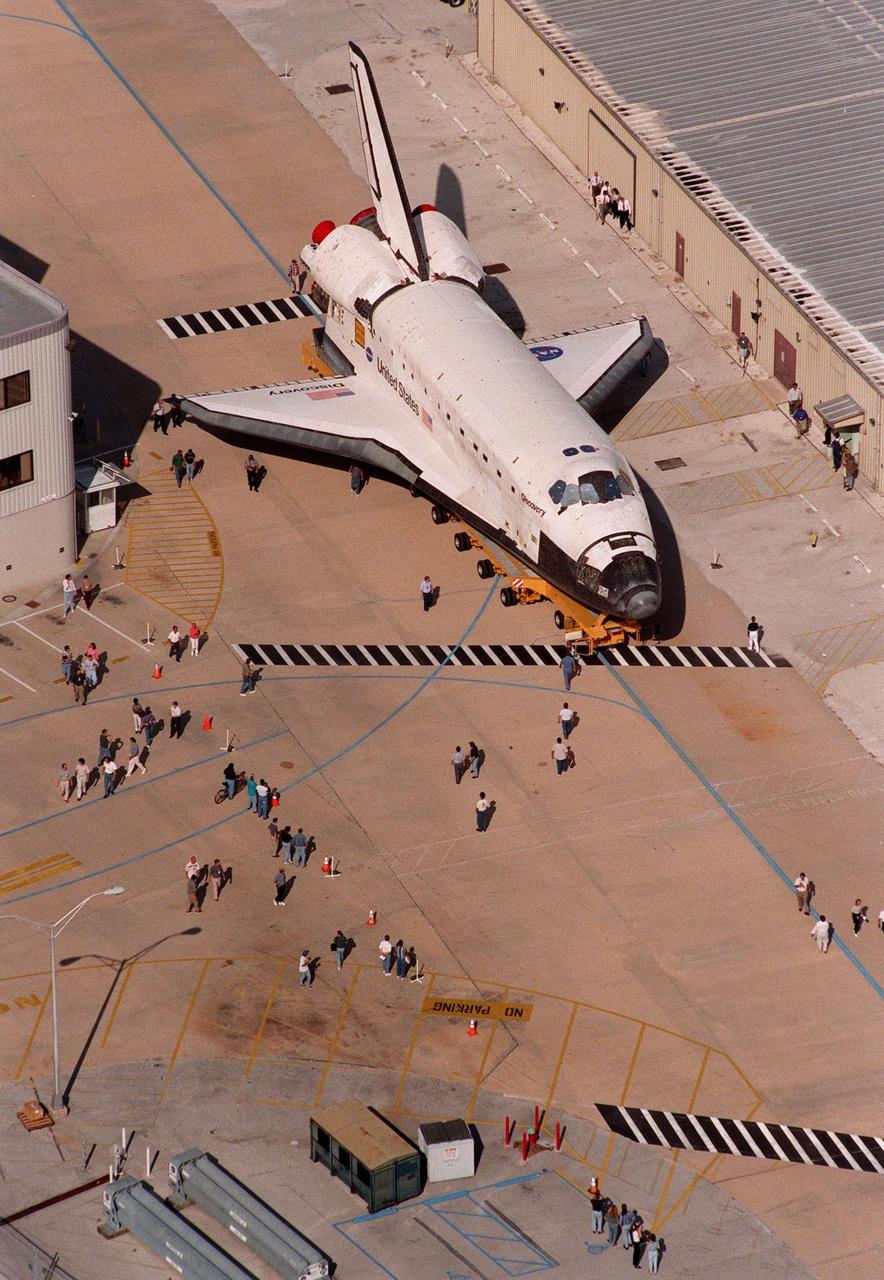
The orbiter Discovery is moved from the Orbiter Processing Facility Bay 2 to the Vehicle Assembly Building, drawing the attention of KSC employees. The orbiter displays the recently painted NASA logo, termed the "meatball," on its left wing and both sides of the fuselage. Discovery (OV-103) is scheduled for its 25th flight, from Launch Pad 39B, on Oct. 29, 1998, for the STS-95 mission

STS-48 Mission Specialist (MS) James F. Buchli, wearing an extravehicular mobility unit (EMU), is watched by SCUBA-equipped divers as the platform he is standing on is lowered into JSC's Weightless Environment Training Facility (WETF) Bldg 29 pool. When completely underwater, Buchli will be released from the platform and will perform contingency extravehicular activity (EVA) operations. This underwater simulation of a spacewalk is part of the training required for Buchli's upcoming mission aboard Discovery, Orbiter Vehicle (OV) 103.
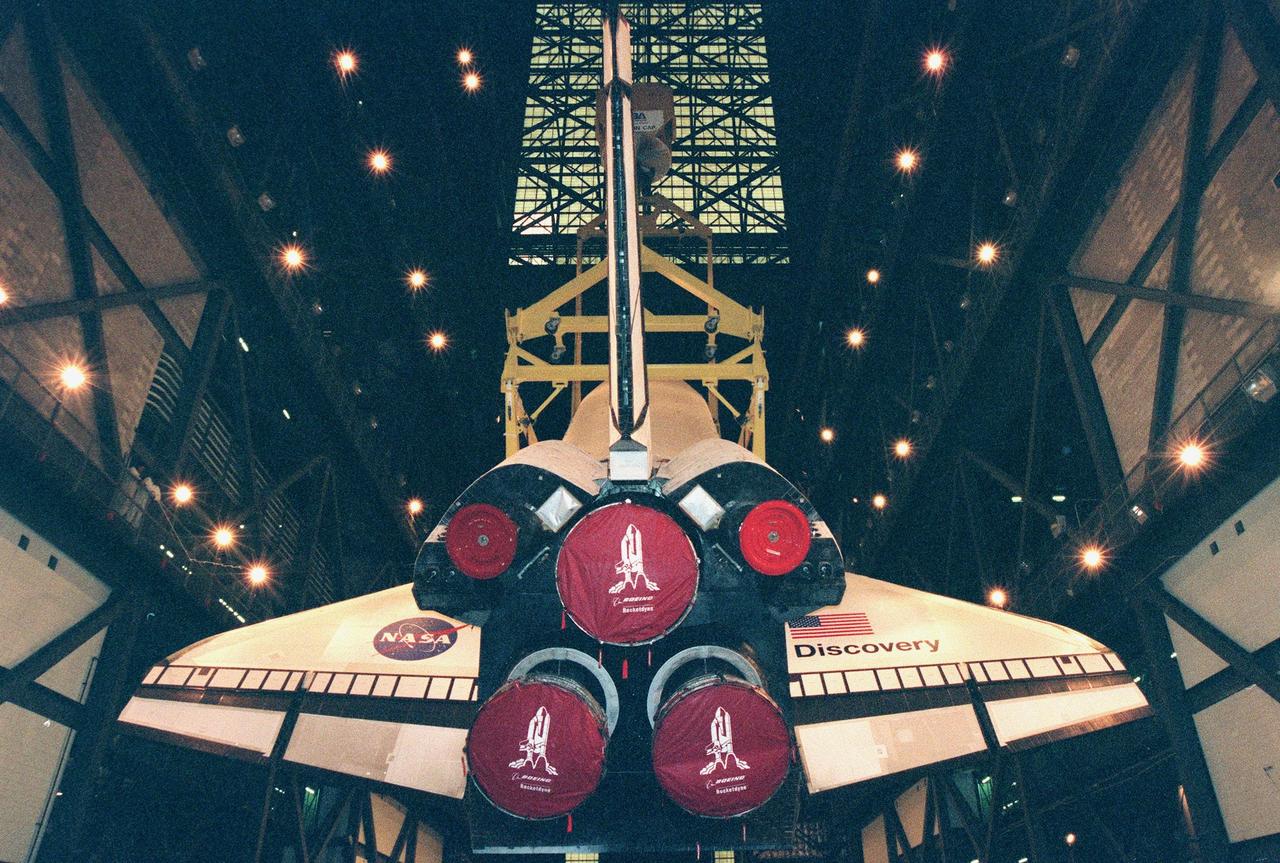
In the Vehicle Assembly Building, the orbiter Discovery (viewed from behind the Space Shuttle Main Engines) is raised to a vertical position in order to be mated with the external tank. The orbiter displays the recently painted NASA logo, termed the "meatball," on its left, or port, wing. The logo also has been painted on both sides of the aft fuselage. Discovery (OV-103), the first of the orbiters to be launched with the new art work, is scheduled for its 25th flight, from Launch Pad 39B, on Oct. 29, 1998, for the STS-95 mission
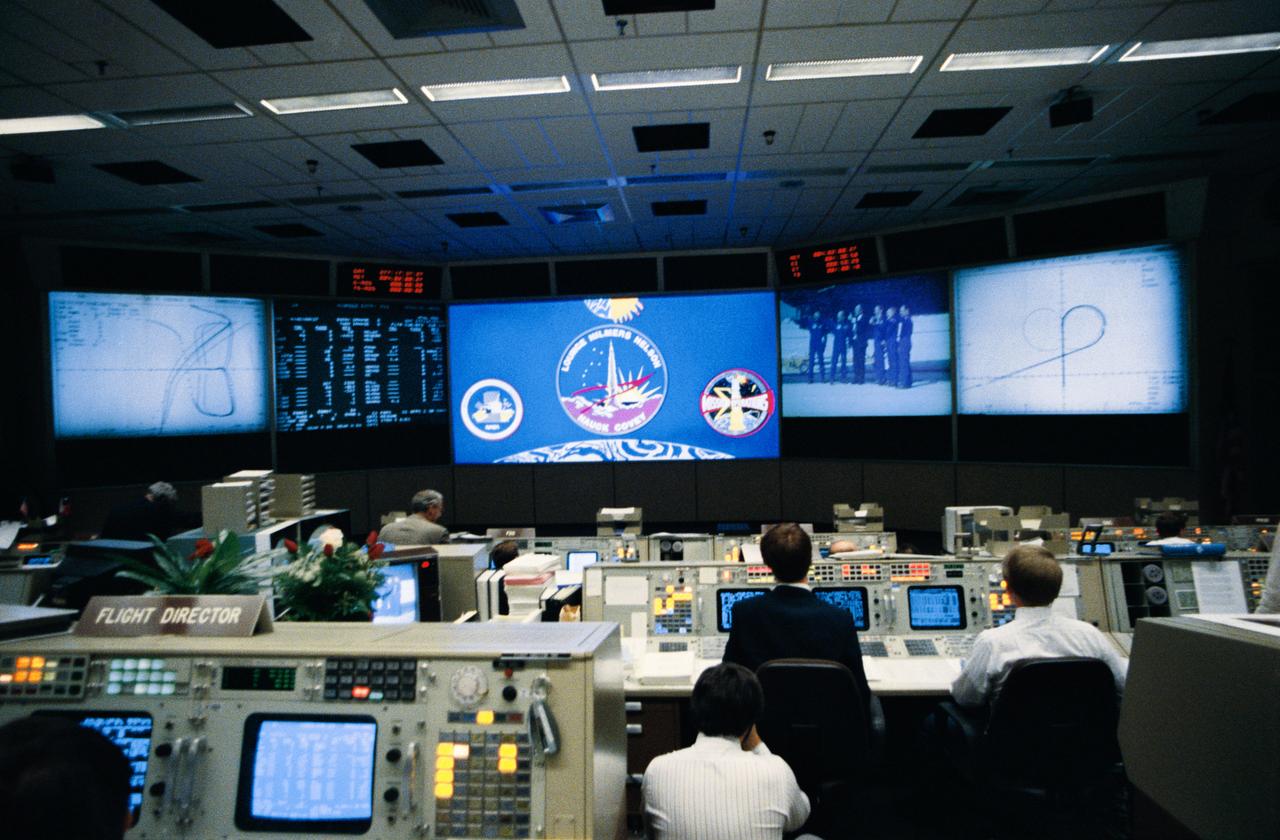
JSC Mission Control Center (MCC) Bldg 30 flight control room (FCR) personnel monitor STS-26 post landing activities and ceremonies at Edwards Air Force Base (EAFB) via their monitors. Displayed on front screens are approach and landing diagrams, data, the space shuttle program insignia, the STS-26 mission insignia, the Mission Operations Directorate insignia, and the STS-26 crew standing in front of Discovery, Orbiter Vehicle (OV) 103.
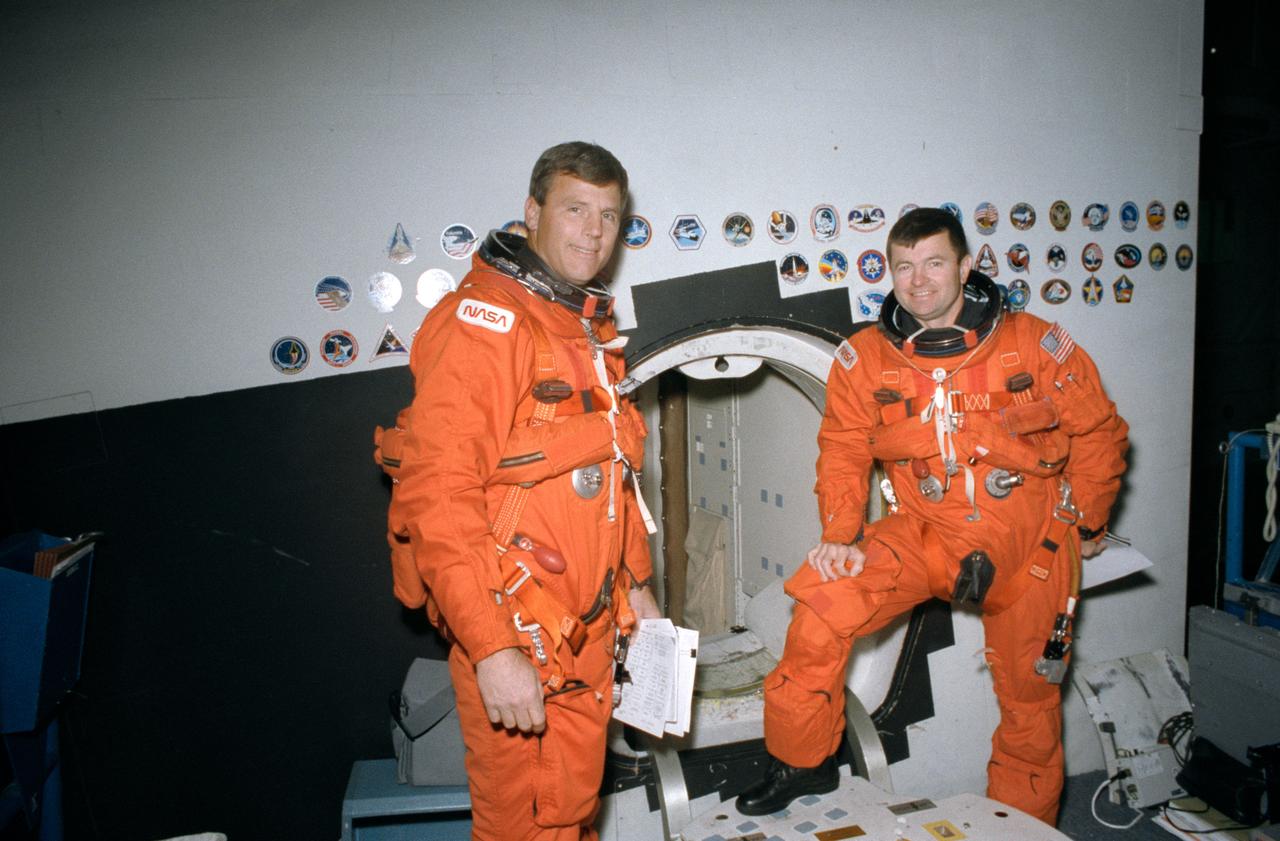
STS-56 Discovery, Orbiter Vehicle (OV) 103, Commander Kenneth Cameron (right) and Pilot Stephen S. Oswald, wearing launch and entry suits (LESs), stand at the side hatch of the crew compartment trainer (CCT), a shuttle mockup, prior to entering the mockup. Once inside the CCT, they will don their launch and entry helmets (LEHs) and participate in emergency egress (bailout) procedures. The CCT is located in JSC's Mockup and Integration Laboratory (MAIL) Bldg 9NE.
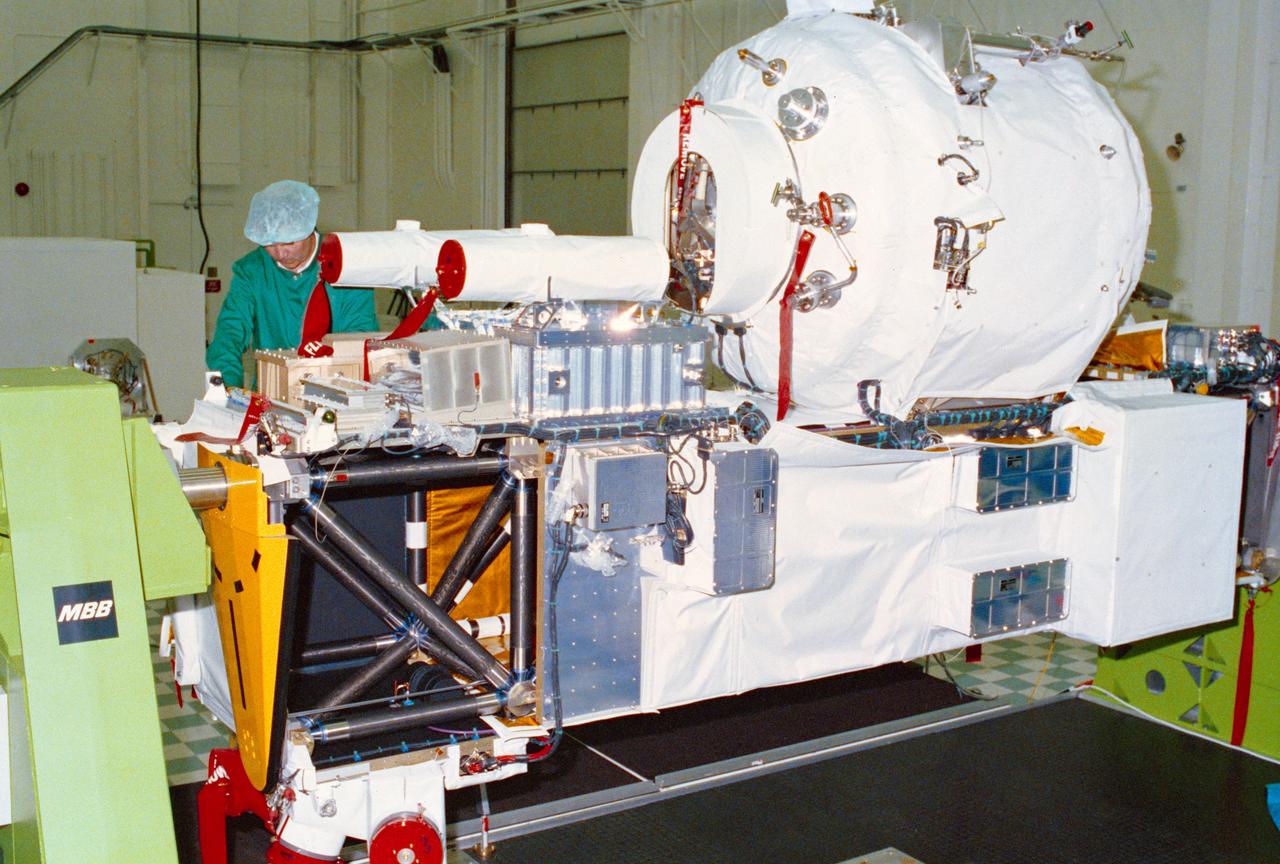
S91-27784 (5 Nov 1990) --- STS-39 Discovery, Orbiter Vehicle (OV) 103, Infrared Background Signature Survey (IBSS) Shuttle Pallet Satellite (SPAS) II documented during preflight processing procedures. German Messerschmitt-Bolkow-Blohm (MBB) technicians work on SPAS II cryostat (without insulation) and other elements at the Cape Canaveral Air Force Station, 11/05/90
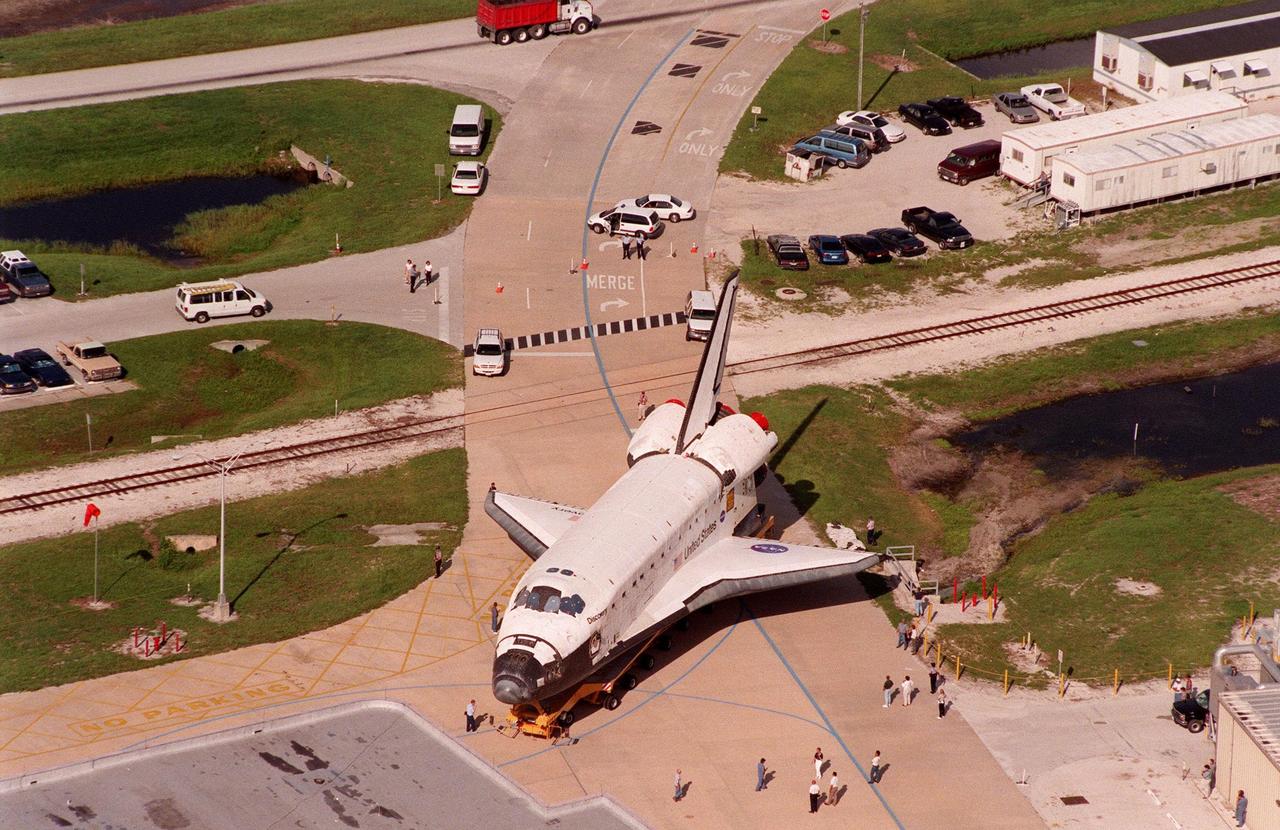
Rollover of the orbiter Discovery from the Orbiter Processing Facility Bay 2 to the Vehicle Assembly Building draws the attention of KSC employees. The orbiter displays the recently painted NASA logo, termed the "meatball," on its left wing and both sides of the fuselage. Discovery (OV-103) is scheduled for its 25th flight, from Launch Pad 39B, on Oct. 29, 1998, for the STS-95 mission
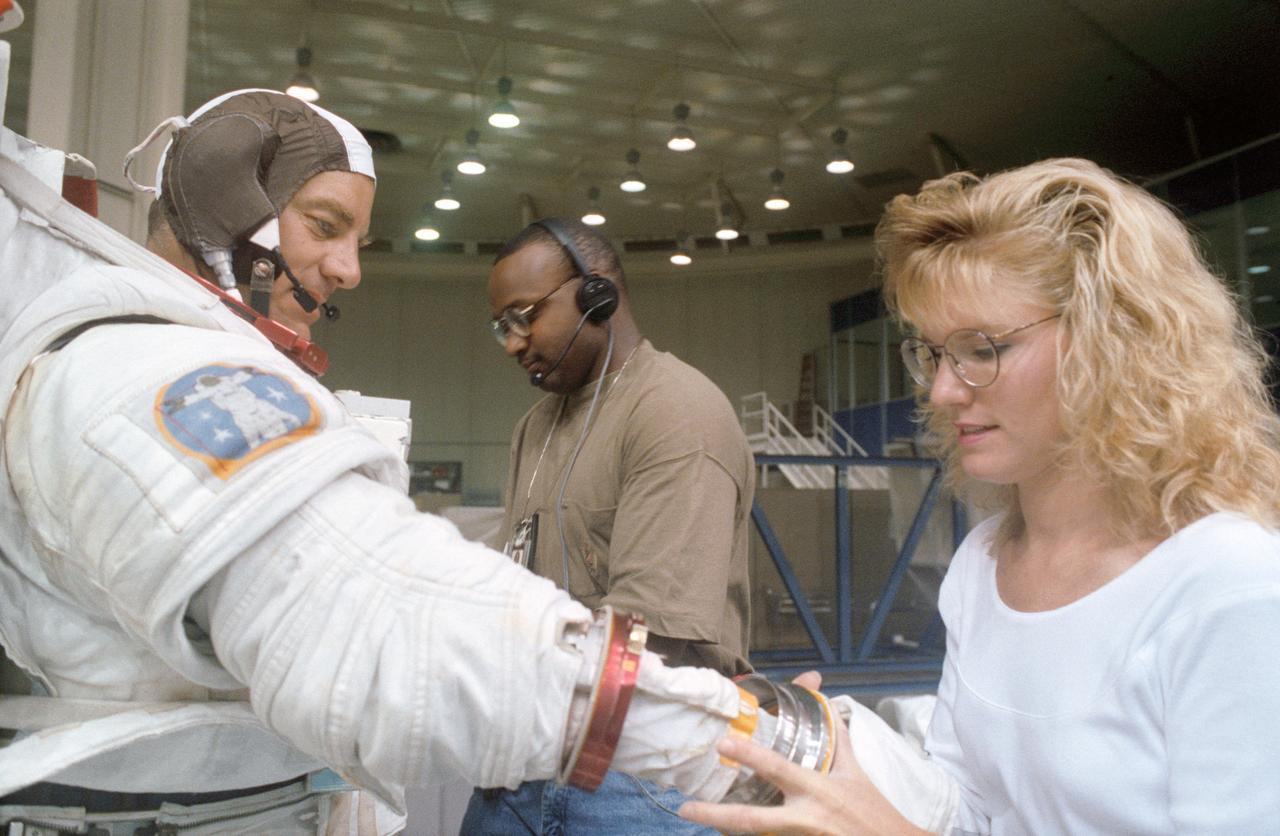
S92-42679 (28 July 1992) --- STS-53 Discovery, Orbiter Vehicle (OV) 103, Mission Specialist James S. Voss, wearing extravehicular mobility unit (EMU) and communications carrier assembly (CCA), dons his gloves with assistance from two technicians. Voss is preparing for an underwater contingency extravehicular activity (EVA) simulation in JSC?s Weightless Environment Training Facility (WETF) Bldg.29 pool.
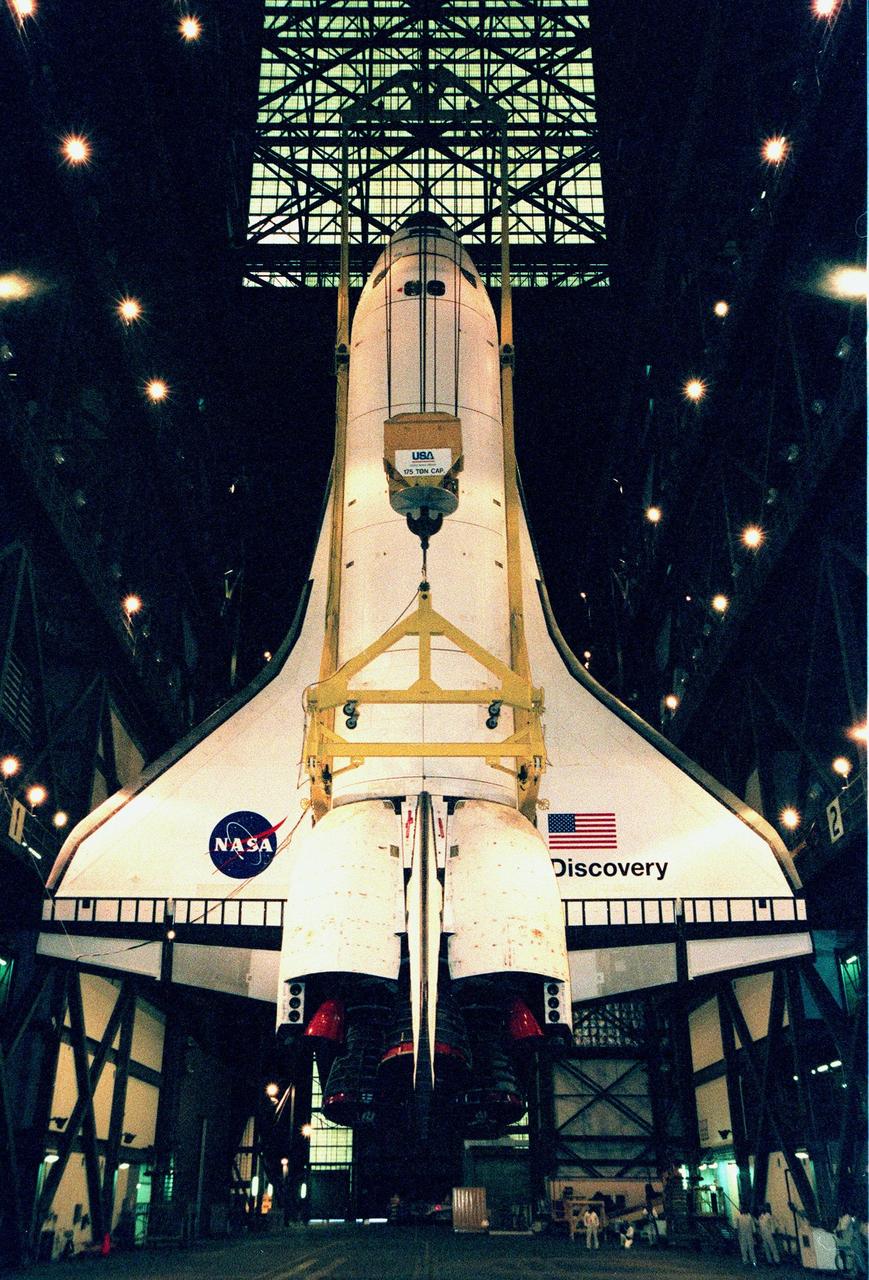
In the Vehicle Assembly Building, the orbiter Discovery is fully vertical, after being lifted into position for mating with the external tank. The orbiter displays the recently painted NASA logo, termed the "meatball," on its left, or port, wing. The logo also has been painted on both sides of the aft fuselage. Discovery (OV-103), the first of the orbiters to be launched with the new art work, is scheduled for its 25th flight, from Launch Pad 39B, on Oct. 29, 1998, for the STS-95 mission
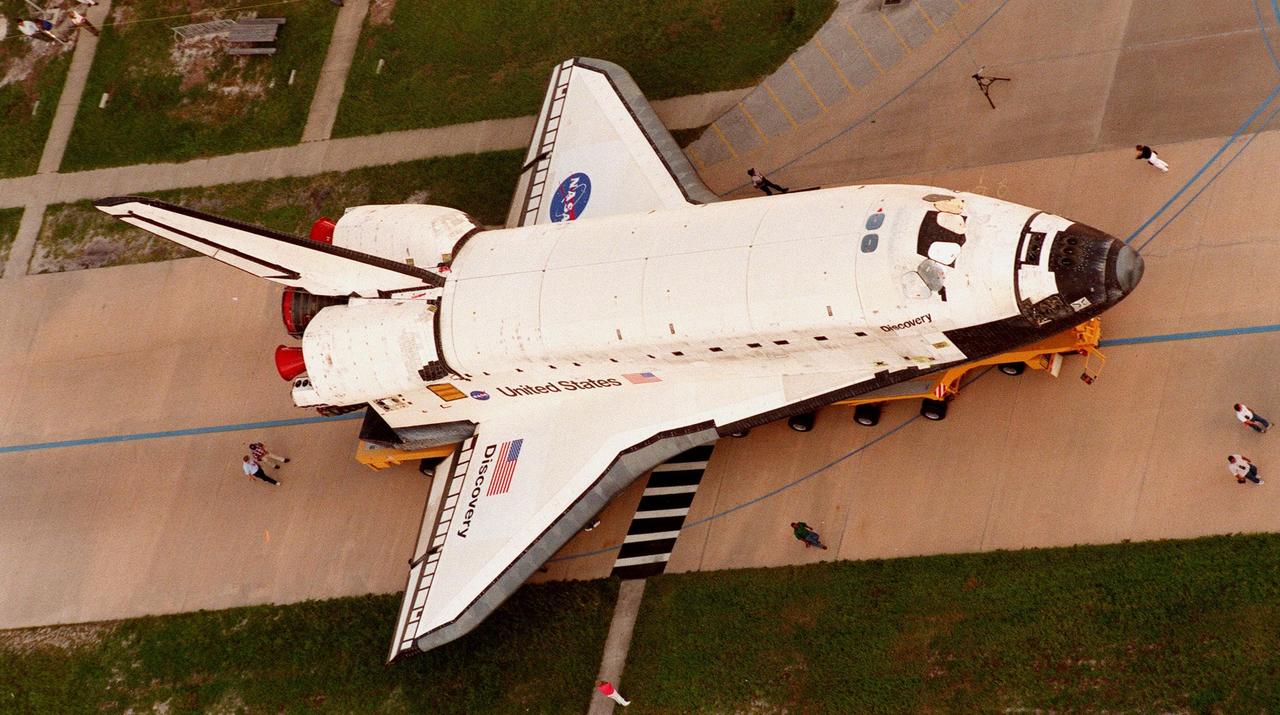
KSC employees accompany the orbiter Discovery on its rollover from the Orbiter Processing Facility Bay 2 to the Vehicle Assembly Building. The orbiter displays the recently painted NASA logo, termed the "meatball," on its left wing and both sides of the fuselage. Discovery (OV-103) is scheduled for its 25th flight, from Launch Pad 39B, on Oct. 29, 1998, for the STS-95 mission
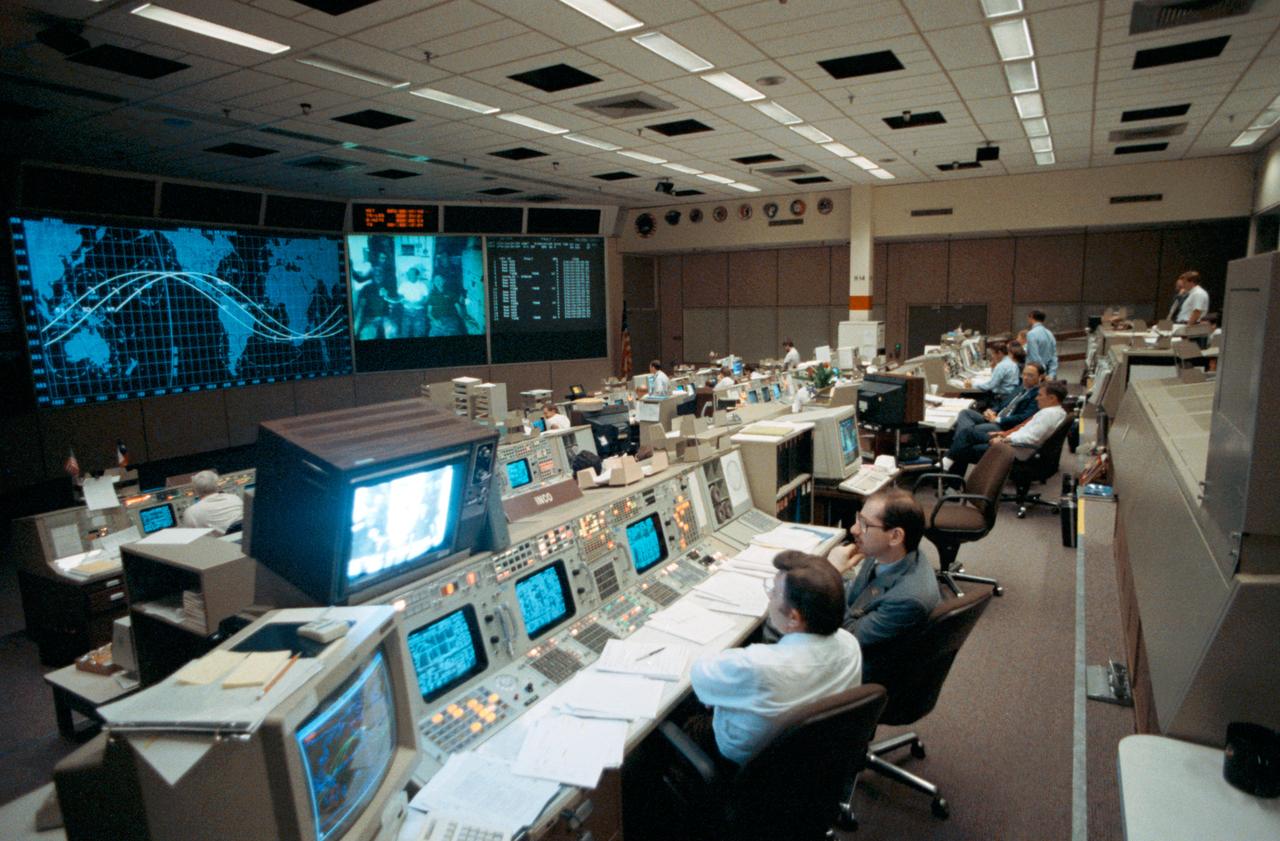
Flight controllers in JSC's Mission Control Center (MCC) Bldg 30 flight control room (FCR) listen to a presentation by STS-26 crewmembers on the fourth day of Discovery's, Orbiter Vehicle (OV) 103's, orbital mission. Instrumentation and Communications Officers (INCOs) Harold Black (left foreground) and John F. Muratore and other controllers view a television (TV) transmission of the crew on a screen in front of the FCR as each member relates some inner feelings while paying tribute to the 51L Challenger crew.
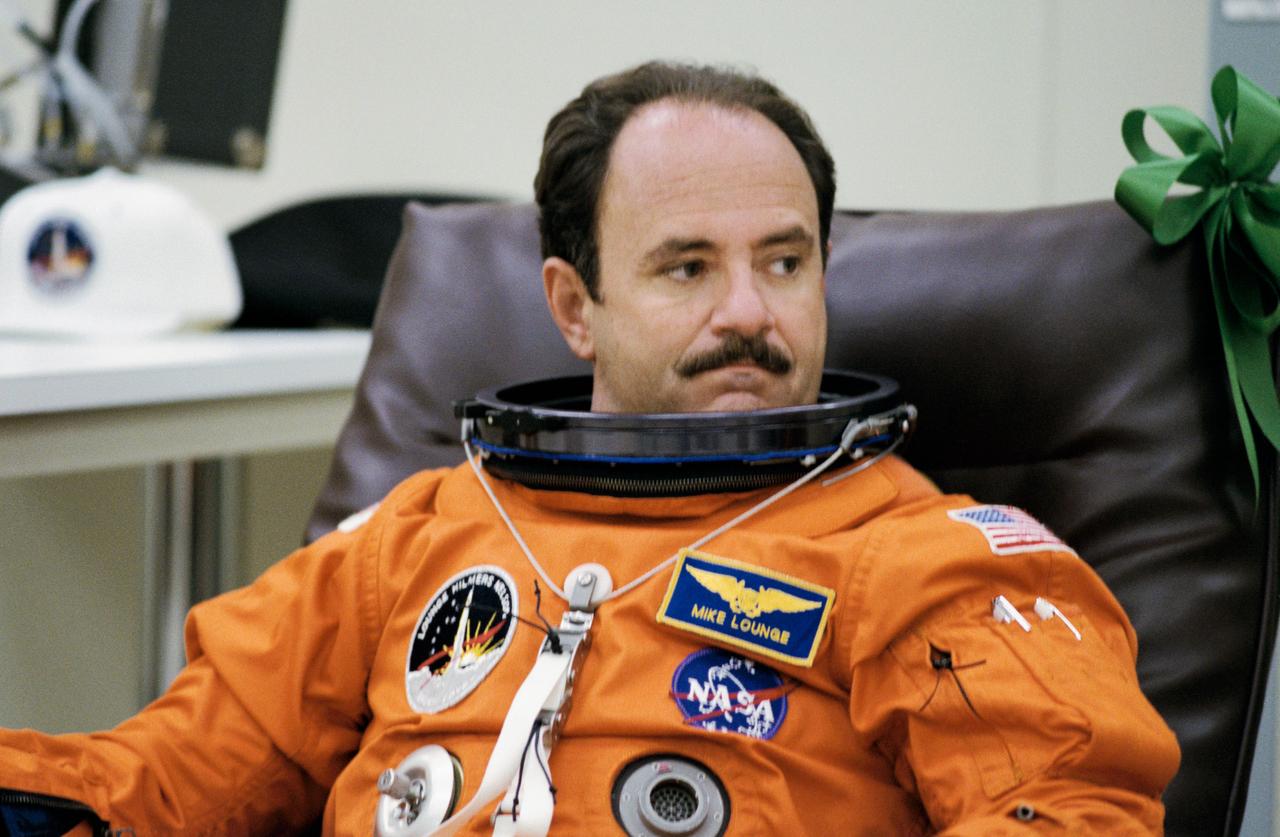
STS-26 Discovery, Orbiter Vehicle (OV) 103, Mission Specialist (MS) John M. Lounge relaxes in reclining chair after donning his orange launch and entry suit (LES) at the Kennedy Space Center (KSC) Operations and Checkout (O&C) Building. Upon completion of preflight suit tests, crewmembers will head to the launch pad.
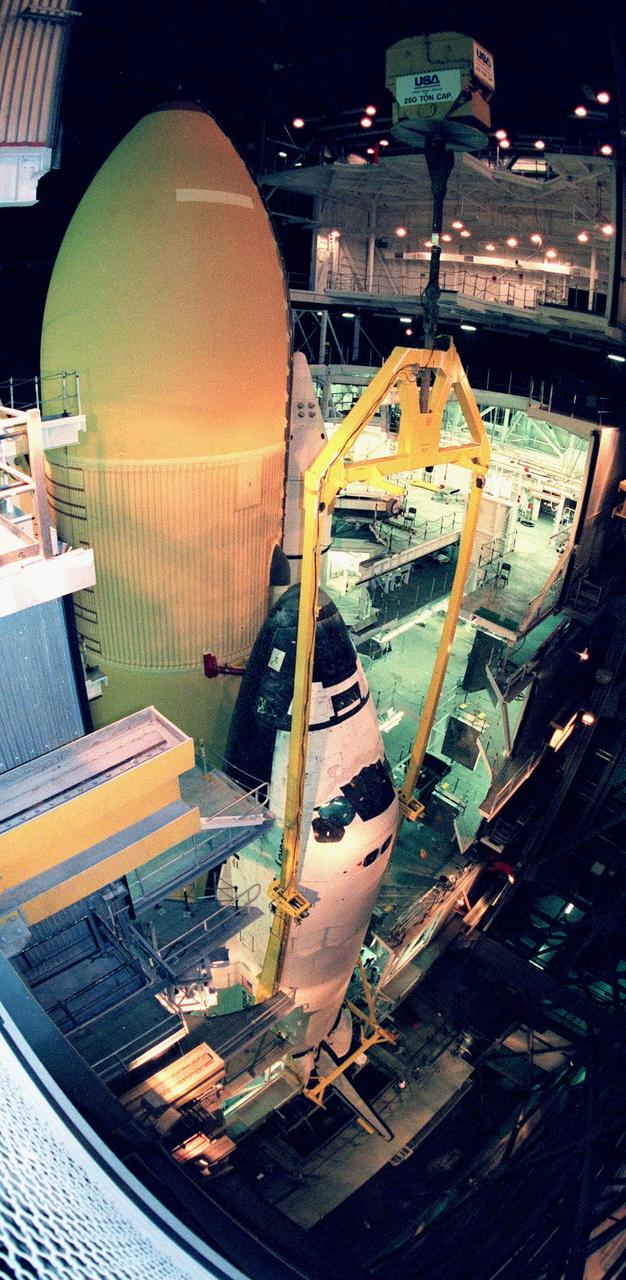
In the Vehicle Assembly Building, the orbiter Discovery is mated with the external tank and solid rocket booster stack (seen behind the orbiter, to the left). The orbiter was recently painted with the NASA logo, termed the "meatball," on the left, or port, wing and both sides of the aft fuselage. Discovery (OV-103) is the first of the orbiters to be launched with the new artwork. It is scheduled for its 25th flight, from Launch Pad 39B, on Oct. 29, 1998, for the STS-95 mission
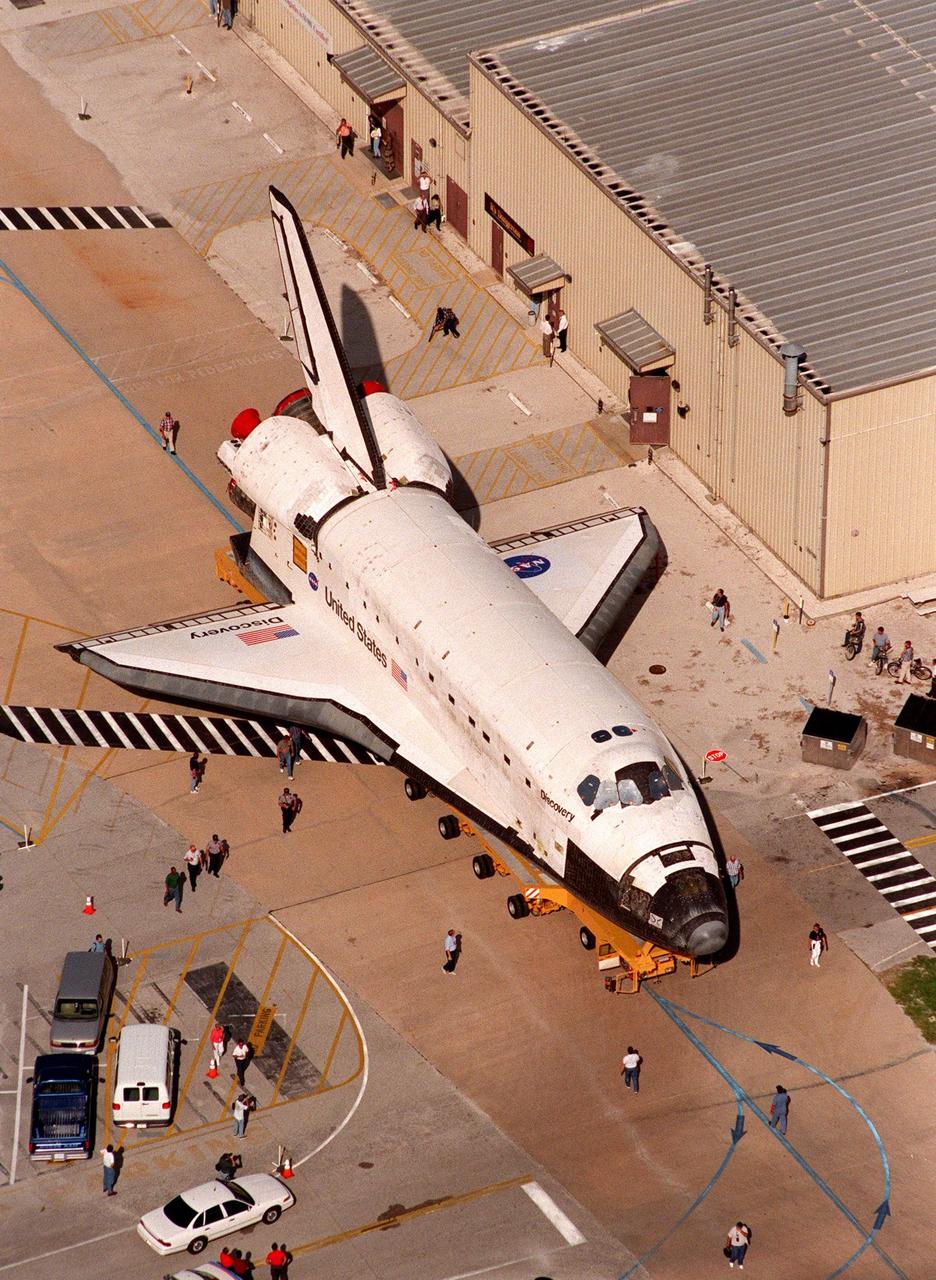
Rollover of the orbiter Discovery from the Orbiter Processing Facility Bay 2 to the Vehicle Assembly Building draws the attention of KSC employees. The orbiter displays the recently painted NASA logo, termed the "meatball," on its left wing and both sides of the fuselage. Discovery (OV-103) is scheduled for its 25th flight, from Launch Pad 39B, on Oct. 29, 1998, for the STS-95 mission
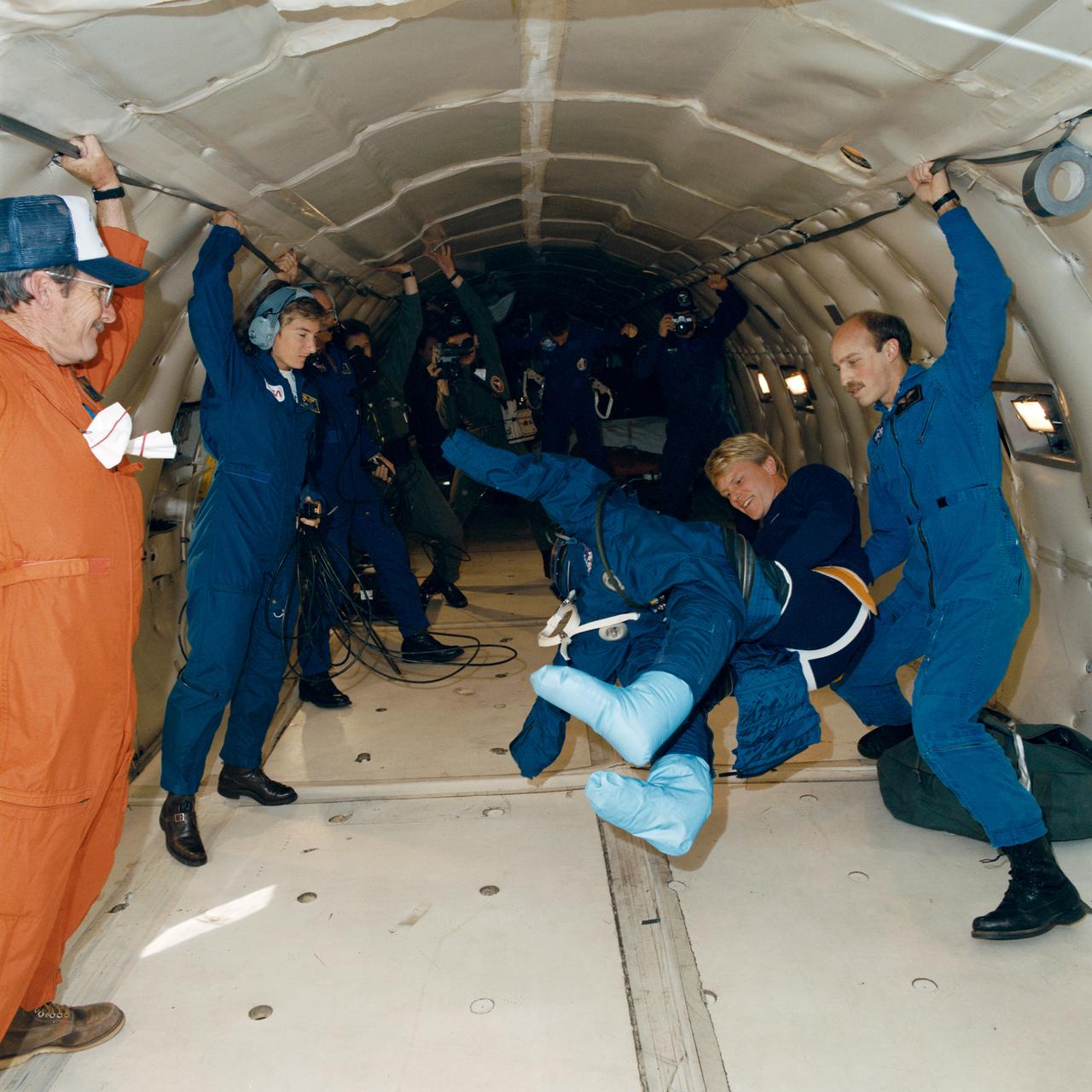
STS-26 Discovery, Orbiter Vehicle (OV) 103, Mission Specialist (MS) George D. Nelson practices donning and doffing new (navy blue) partial pressure suit (launch and entry suit (LES)) aboard KC-135 NASA 930 during zero gravity testing. Nelson is assisted by astronaut James P. Bagian as KC-135 flight crew (including Stephanie A. Wells) looks on and photographers document activities.
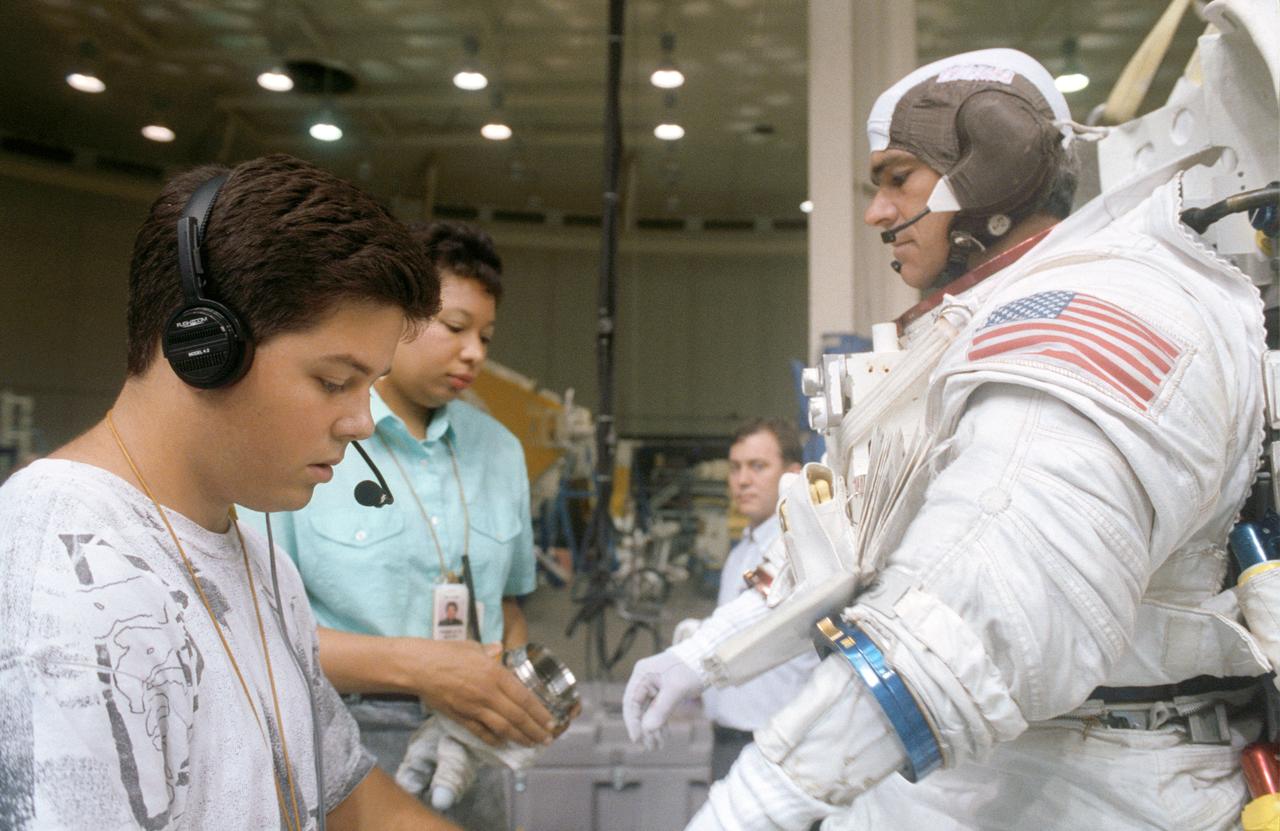
S92-42681 (28 July 1992) --- STS-53 Discovery, Orbiter Vehicle (OV) 103, Mission Specialist (MS) Michael R.U. Clifford, wearing extravehicular mobility unit (EMU) and communications carrier assembly (CCA), dons gloves with assistance from two technicians. Clifford is preparing for an underwater contingency extravehicular activity (EVA) simulation in JSC's Weightless Environment Training Facility (WETF) Bldg 29 pool.

In the Vehicle Assembly Building, the orbiter Discovery (viewed from below the Space Shuttle Main Engines, starboard side) is raised to a vertical position in order to be mated with the external tank. The orbiter displays the recently painted NASA logo, termed the "meatball," on the aft fuselage. The logo also has been painted on the left, or port, wing. Discovery (OV-103), the first of the orbiters to be launched with the new art work, is scheduled for its 25th flight, from Launch Pad 39B, on Oct. 29, 1998, for the STS-95 mission
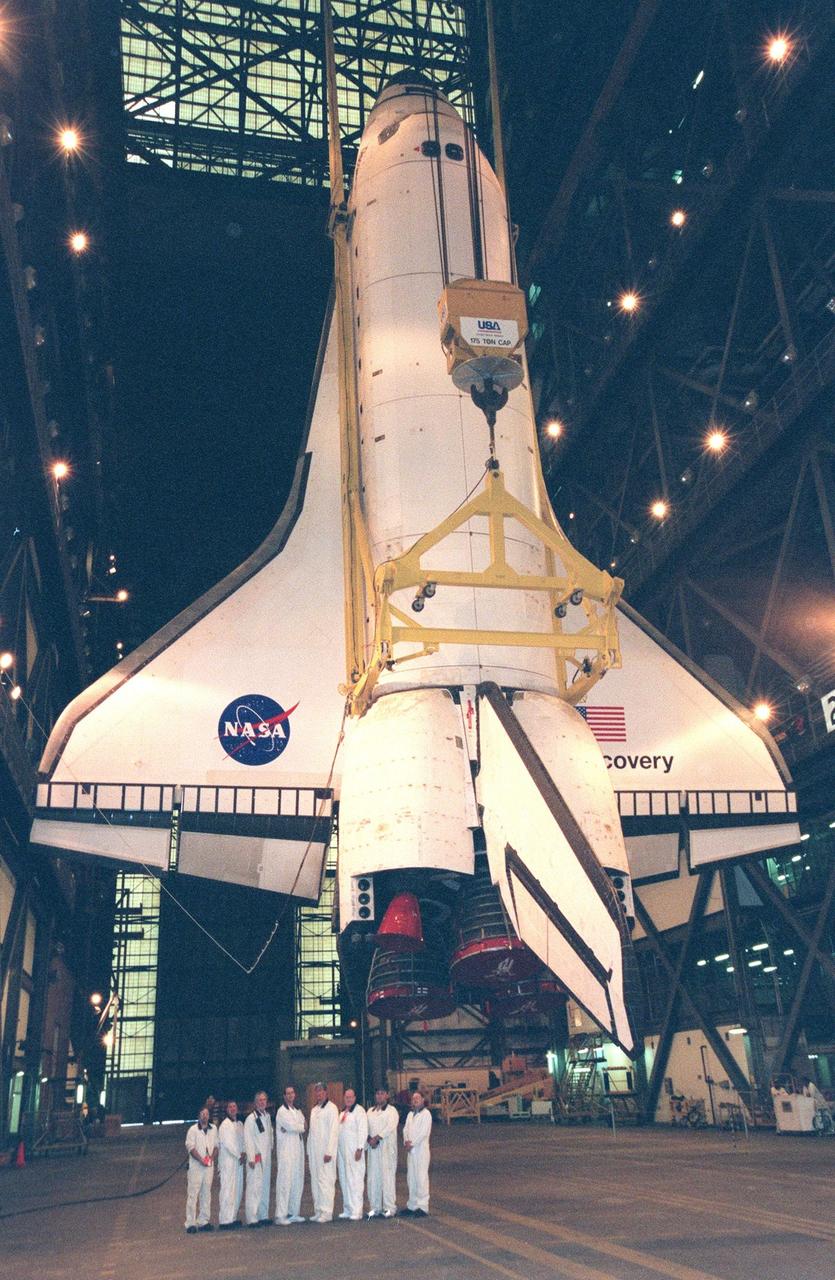
United Space Alliance Forward Shop workers stand near the orbiter Discovery in the Vehicle Assembly Building . The orbiter is being prepared for mating with the external tank. Discovery displays the recently painted NASA logo, termed the "meatball," on its left, or port, wing. The logo also has been painted on both sides of the aft fuselage. Discovery (OV-103), the first of the orbiters to be launched with the new art work, is scheduled for its 25th flight, from Launch Pad 39B, on Oct. 29, 1998, for the STS-95 mission
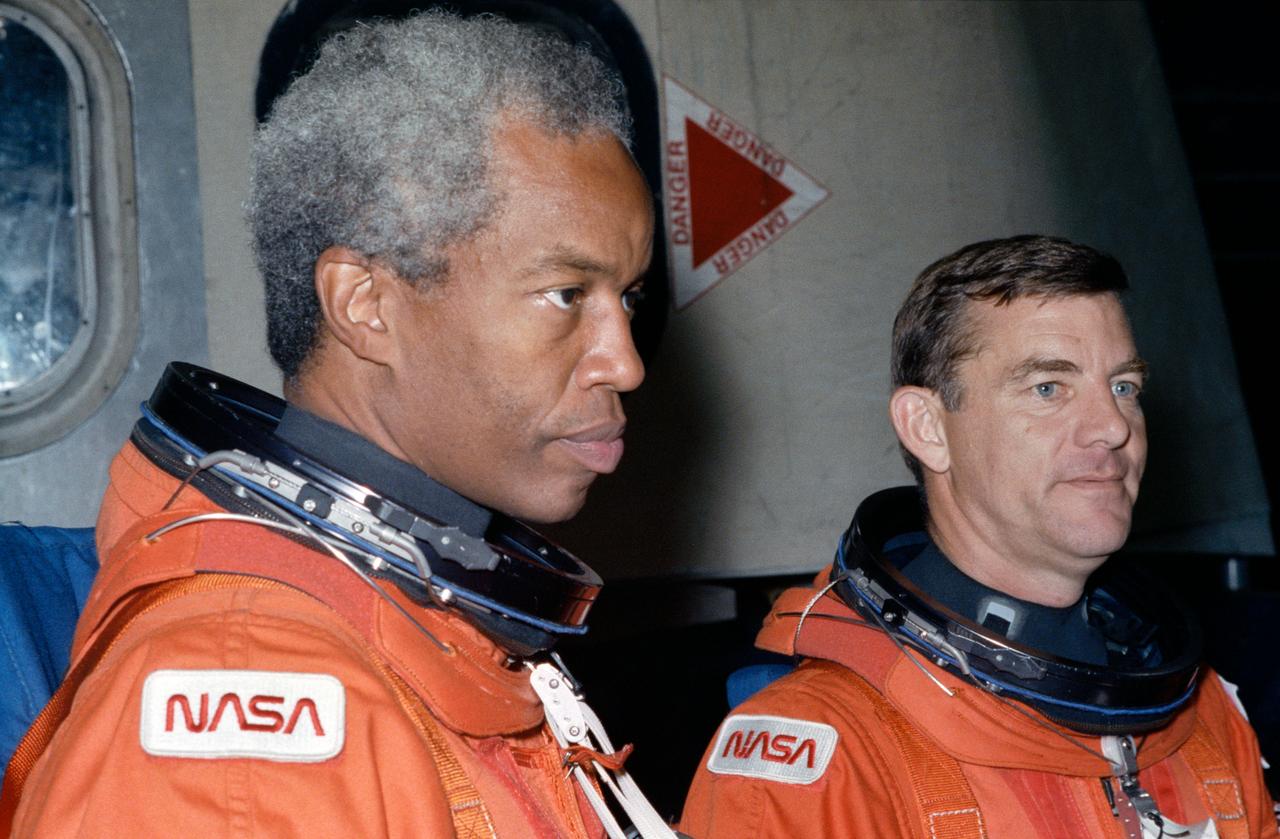
S92-49644 (1994) --- STS-53 Discovery, Orbiter Vehicle (OV) 103, Mission Specialist (MS) Guion S. Bluford (left) and MS James S. Voss, wearing launch and entry suits (LESs), listen to instructions prior to launch emergency egress bailout training. Bluford and Voss, along with the other STS-53 crewmembers, will practice bailout procedures in JSC's crew compartment trainer (CCT) located in the Mockup and Integration Laboratory (MAIL) Bldg 9NE
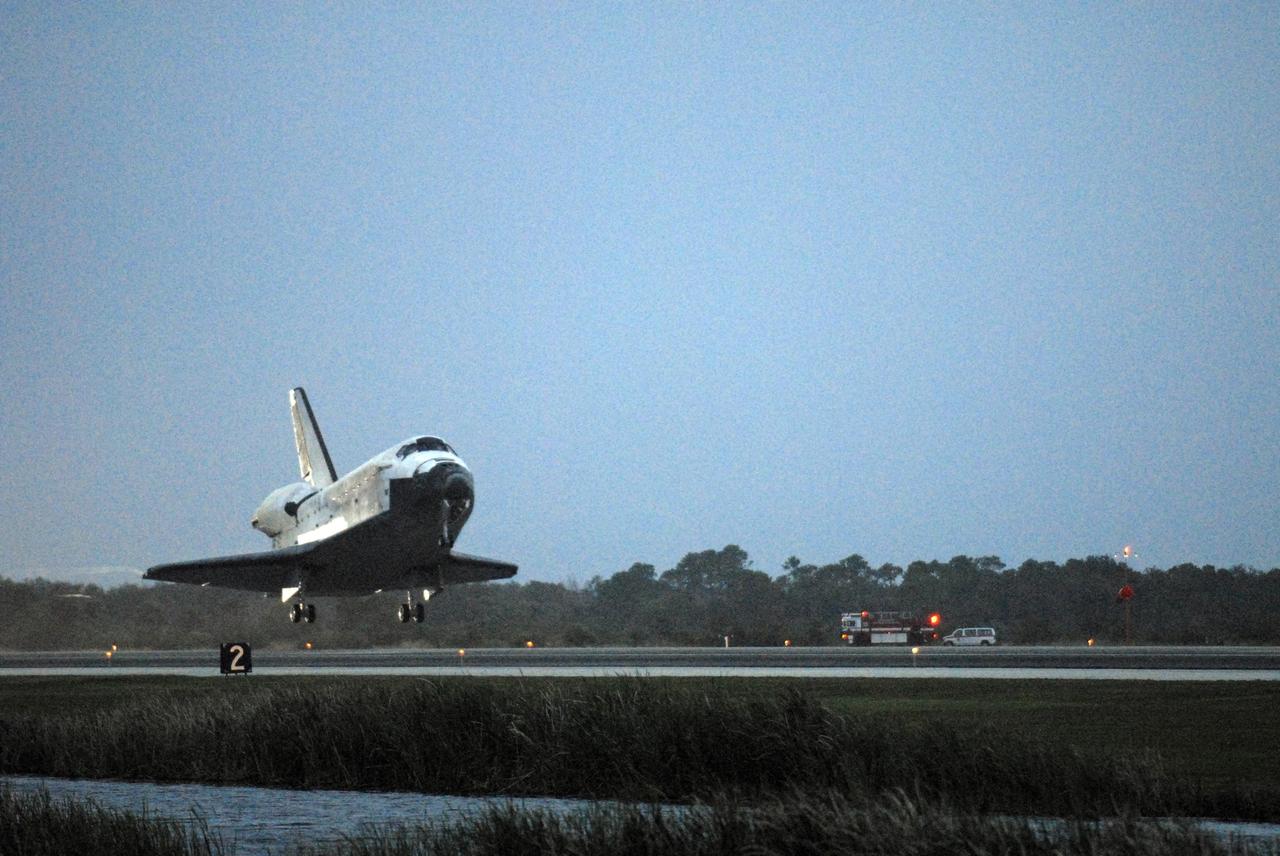
KENNEDY SPACE CENTER, FLA. -- On the shortest day of the year, Discovery touches down at sunset on Runway 15 at NASA Kennedy Space Center's Shuttle Landing Facility as the sun sets, concluding mission STS-116. The rescue vehicles in the background are in position in the unlikely event they are needed during post-landing operations. Aboard are Commander Mark Polansky, Pilot William Oefelein, and Mission Specialists Robert Curbeam, Joan Higginbotham, Nicholas Patrick and Christer Fuglesang, who represents the European Space Agency, as well as Thomas Reiter, who is returning from a 6-month stay on the International Space Station. During the mission, three spacewalks attached the P5 integrated truss structure to the station, and completed the rewiring of the orbiting laboratory's power system. A fourth spacewalk retracted a stubborn solar array. Main gear touchdown was at 5:32 p.m. EST. Nose gear touchdown was at 5:32:12 p.m. and wheel stop was at 5:32:52 p.m. At touchdown -- nominally about 2,500 ft. beyond the runway threshold -- the orbiter is traveling at a speed ranging from 213 to 226 mph. Discovery traveled 5,330,000 miles, landing on orbit 204. Mission elapsed time was 12 days, 20 hours, 44 minutes and 16 seconds. This is the 64th landing at KSC. Photo credit: NASA/Tom Joseph
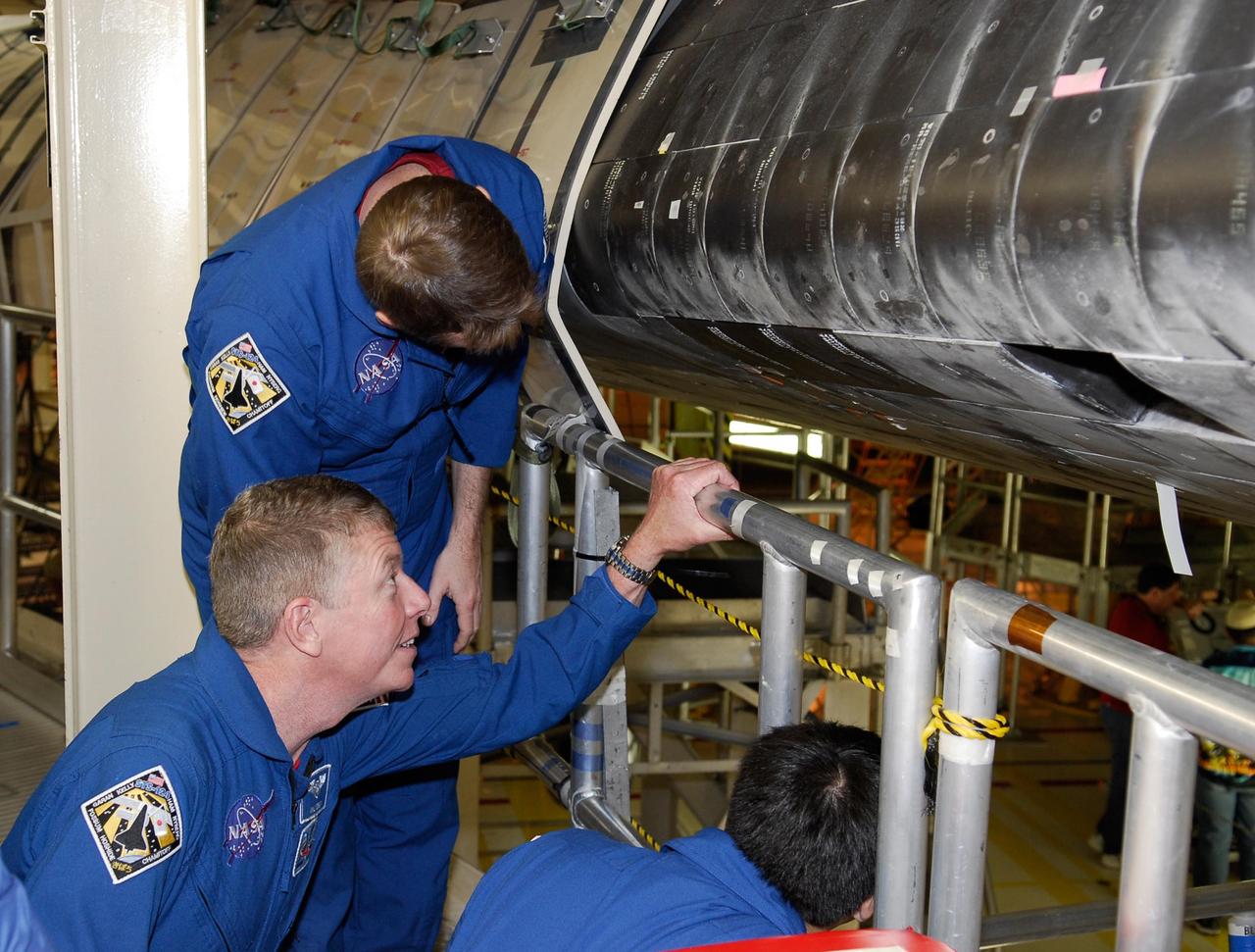
KENNEDY SPACE CENTER, FLA. -- In the Orbiter Processing Facility bay 3 at NASA's Kennedy Space Center, members of the STS-124 crew inspect space shuttle Discovery during a crew equipment interface test. Seen, top to bottom are Pilot Kenneth Ham and Mission Specialists Michael Fossum and Akihiko Hoshide, who represents the Japan Aerospace Exploration Agency, called JAXA. On the mission, Discovery will transport the Kibo Japanese Experiment Module - Pressurized Module (JEM-PM) and the Japanese Remote Manipulator System (JEM-RMS) to the International Space Station to complete the Kibo laboratory. The launch of Discovery is targeted for April 24. Photo credit: NASA/Kim Shiflett
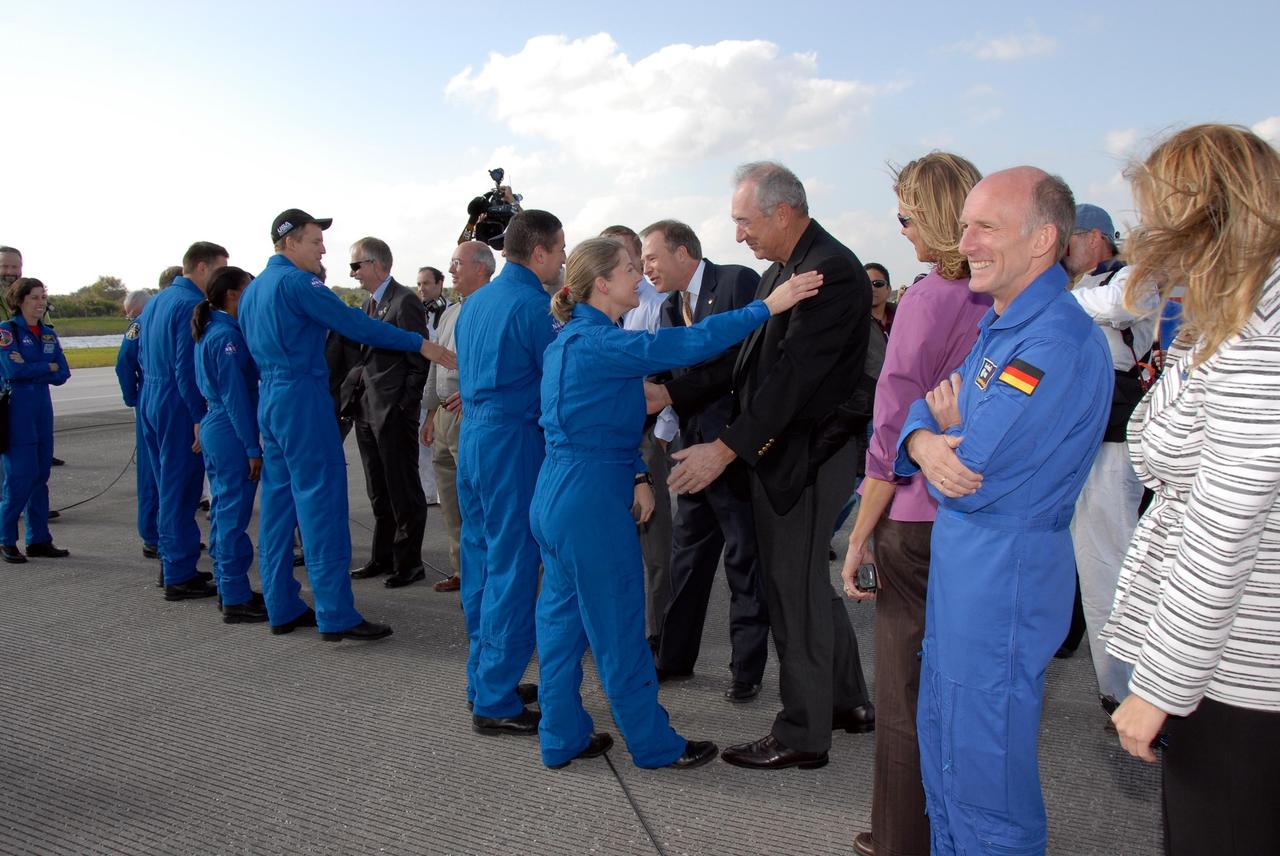
KENNEDY SPACE CENTER, FLA. -- The STS-120 crew members are greeted by NASA and Kennedy VIPs after completing their successful mission. From left are STS-120 mission specialists Doug Wheelock, Stephanie Wilson and Scott Parazynski, Pilot George Zamka and Commander Pamela Melroy. The NASA VIPs include NASA Administrator Mike Griffin, Associate Administrator for NASA Space Operations William Gerstenmaier and Shuttle Program Manager Wayne Hale. The lineup also includes Shuttle Launch Director Mike Leinbach. Melroy and the Discovery crew completed the 15-day mission STS-120, with an on-time landing at 1:01:16 p.m. Wheel stop was at 1:02:07 p.m. Mission elapsed time was 15 days, 2 hours, 24 minutes and 2 seconds. Mission elapsed time was 15 days, 2 hours, 24 minutes and 2 seconds. Mission STS-120 continued the construction of the station with the installation of the Harmony Node 2 module and the relocation of the P6 truss. Photo credit: NASA/Kim Shiflett
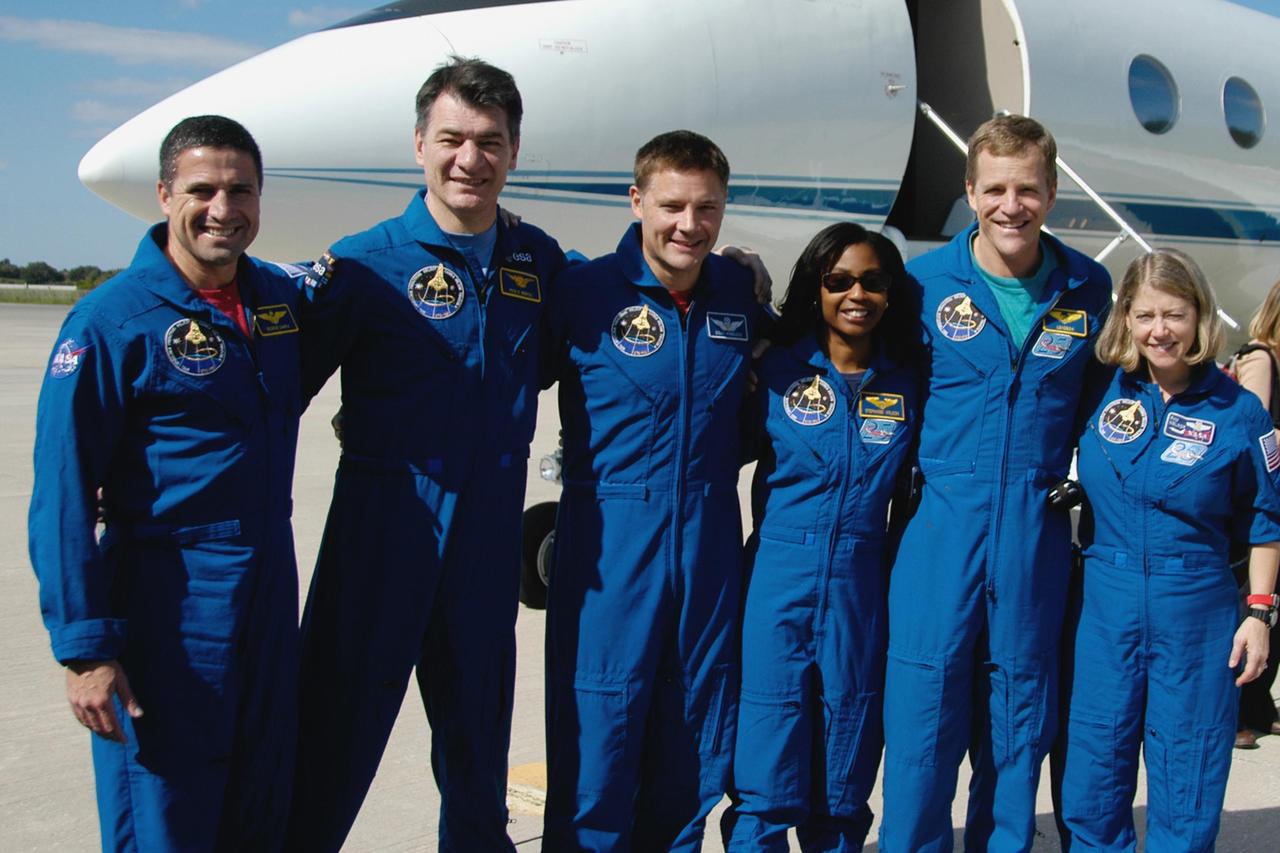
KENNEDY SPACE CENTER, FLA. -- The STS-120 crew members are ready for their return to flight to Houston. From left are Pilot George Zamka, Mission Specialists Paolo Nespoli, Doug Wheelock, Stephanie Wilson and Scott Parazynski, and Commander Pamela Melroy. A welcoming ceremony for the crew is planned at NASA's Hangar 276 on the south end of Ellington Field in Texas. On the 15-day mission, the STS-120 crew continued the construction of the station with the installation of the Harmony Node 2 module and the relocation of the P6 truss. They landed Nov. 7 at NASA's Kennedy Space Center . Photo credit: NASA/George Shelton

KENNEDY SPACE CENTER, FLA. -- After a 15-day mission to the International Space Station, space shuttle Discovery touches down on Runway 33 of the Shuttle Landing Facility at NASA's Kennedy Space Center, completing mission STS-120. Main gear touchdown was 1:01:16 p.m. Wheel stop was at 1:02:07 p.m. Mission elapsed time was 15 days, 2 hours, 24 minutes and 2 seconds. Mission STS-120 continued the construction of the station with the installation of the Harmony Node 2 module and the relocation of the P6 truss. Photo credit: NASA/Scott Haun

KENNEDY SPACE CENTER, FLA. -- In the Space Station Processing Facility at NASA's Kennedy Space Center, workers close the hatch on the Japanese Experiment Module, called Kibo. The closing is in preparation for the transfer to a payload canister and the move to the launch pad. On the mission, space shuttle Discovery will transport the Kibo module and the Japanese Remote Manipulator System, or JEM-RMS, to complete the Kibo laboratory. The launch of Discovery is targeted for April 24. Photo credit: NASA/Kim Shiflett

CAPE CANAVERAL, Fla. -- At Launch Pad 39A at NASA's Kennedy Space Center, the crawler-transporter is moved to the foot of the pad after delivering space shuttle Discovery for final prelaunch processing for the STS-124 mission. Discovery's 3.4-mile journey from the Vehicle Assembly Building began at 11:47 p.m. on May 2. The shuttle arrived at the launch pad at 4:25 a.m. EDT May 3 and was secured, or hard down, by 6:06 a.m. On the 13-day mission, Discovery and its crew will deliver the Japan Aerospace Exploration Agency's Japanese Experiment Module – Pressurized Module and the Japanese Remote Manipulator System. Launch is targeted for May 31. Photo credit: NASA/Troy Cryder
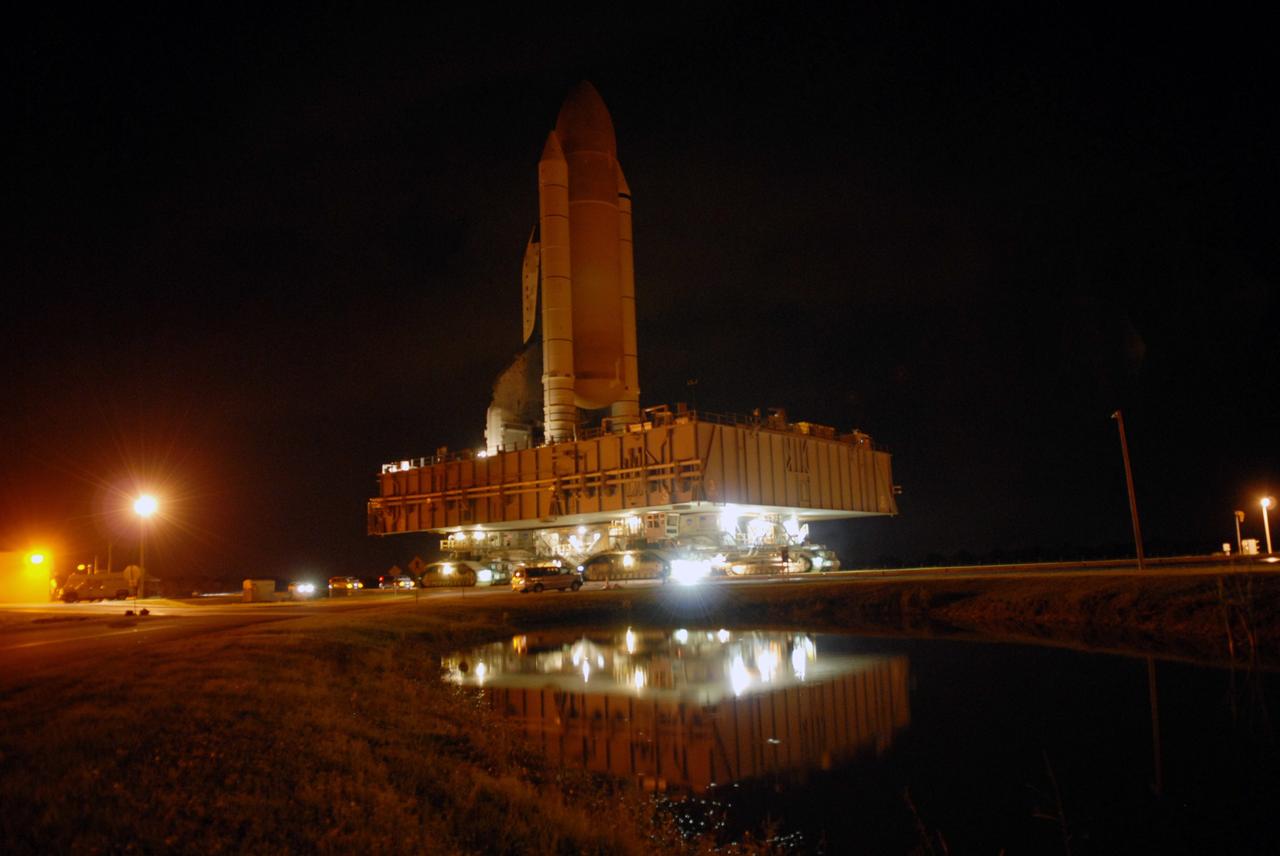
CAPE CANAVERAL, Fla. -- At NASA's Kennedy Space Center, a crawler transporter moves space shuttle Discovery, secured atop a mobile launch platform, along the crawlerway from the Vehicle Assembly Building to Launch Pad 39A to prepare for the STS-124 mission. The 3.4-mile journey from the Vehicle Assembly Building began at 11:47 p.m. on May 2. The shuttle arrived at the launch pad at 4:25 a.m. EDT May 3 and was secured, or hard down, by 6:06 a.m. On the 13-day mission, Discovery and its crew will deliver the Japan Aerospace Exploration Agency's Japanese Experiment Module – Pressurized Module and the Japanese Remote Manipulator System. Launch is targeted for May 31. Photo credit: NASA/Troy Cryder
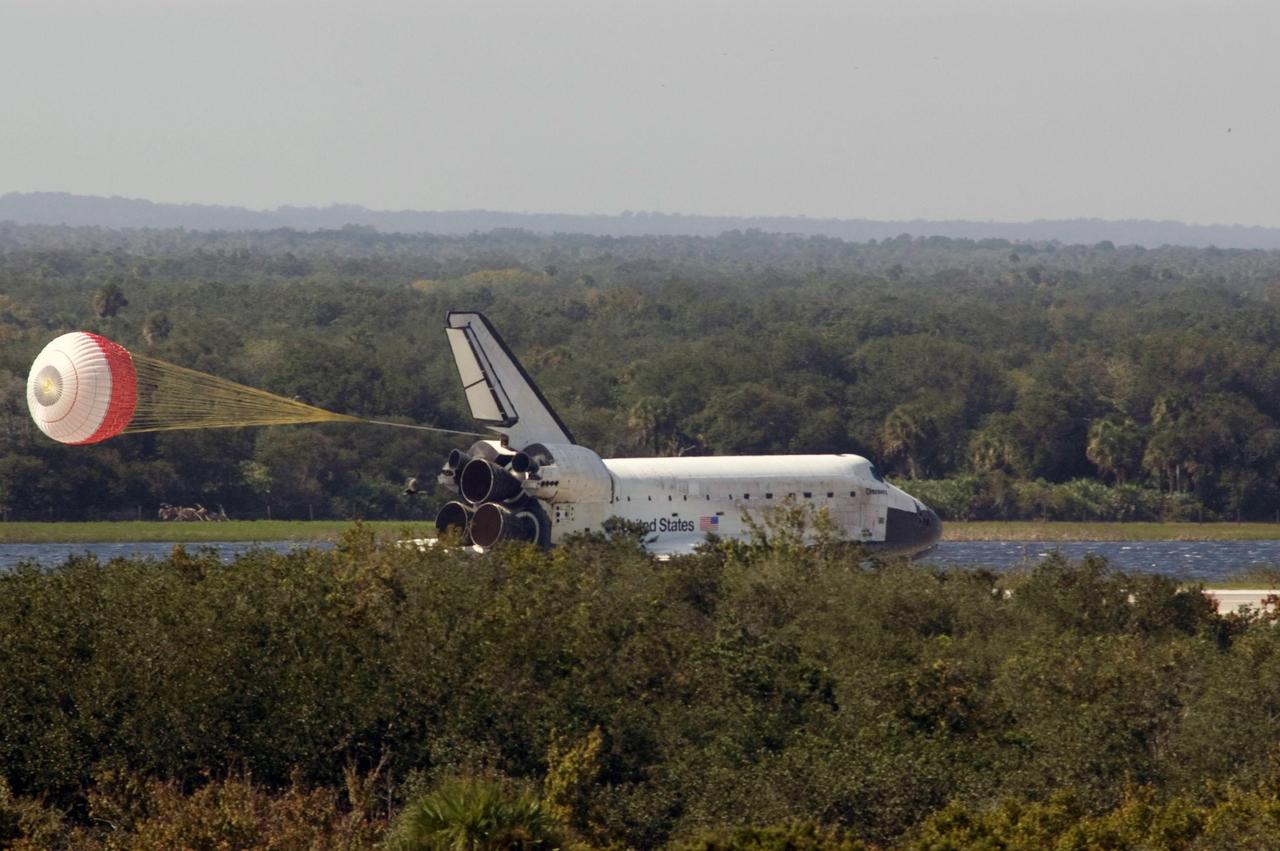
KENNEDY SPACE CENTER, FLA. -- The drag chute deployed behind space shuttle Discovery helps slow its smooth landing on Runway 33 of the Shuttle Landing Facility at NASA's Kennedy Space Center, completing the 15-day mission STS-120. Main gear touchdown was 1:01:16 p.m. Wheel stop was at 1:02:07 p.m. Mission elapsed time was 15 days, 2 hours, 24 minutes and 2 seconds. Mission STS-120 continued the construction of the station with the installation of the Harmony Node 2 module and the relocation of the P6 truss. Photo credit: NASA/Scott Haun
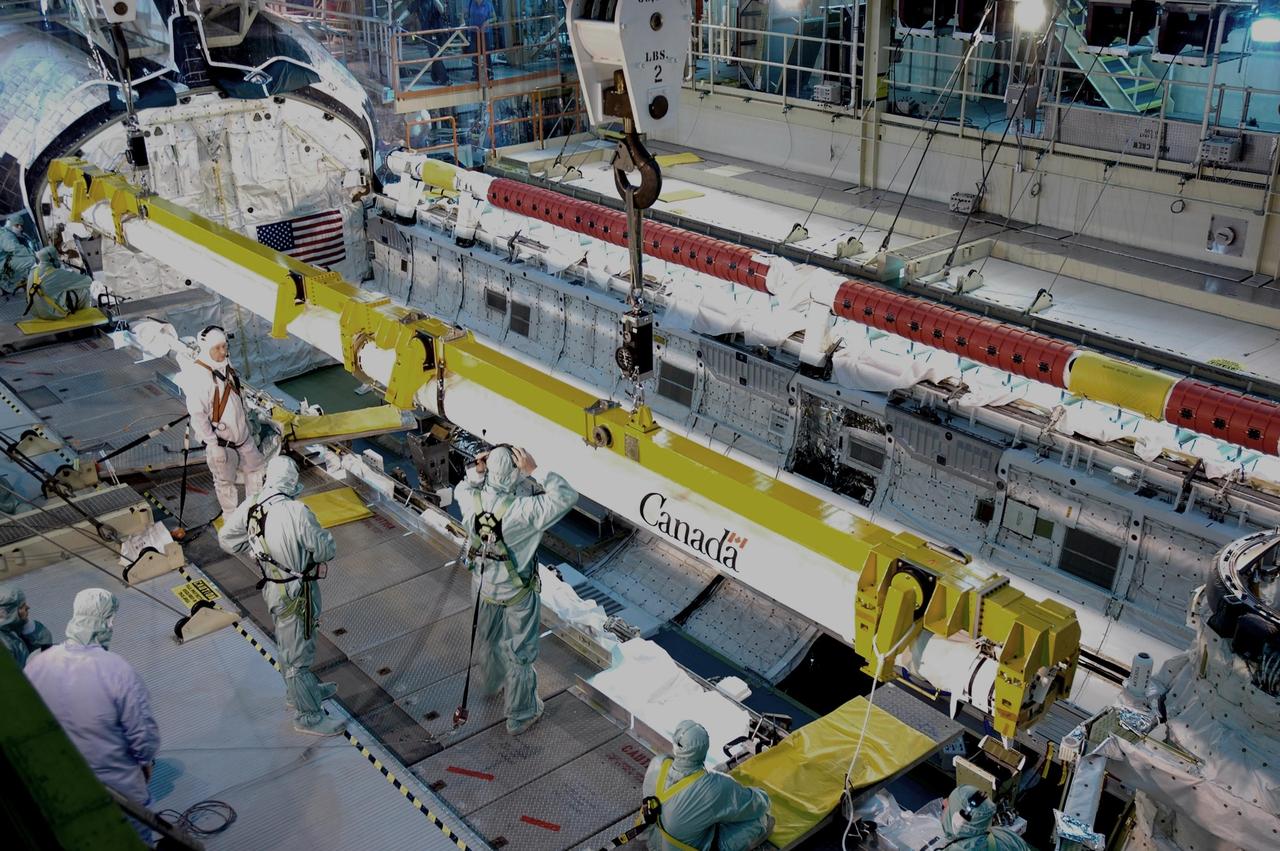
KENNEDY SPACE CENTER, FLA. - Suspended by cables in bay 3 of the Orbiter Processing Facility, the orbiter boom sensor system is lowered toward its place in Discovery's payload bay. It was removed last week in order to inspect the power system, which is routine after every flight. Discovery returned from mission STS-121 in late July, and is now being processed for mission STS-116, scheduled to launch in mid-December. Photo credit: NASA/Jim Grossmann

KENNEDY SPACE CENTER, FLA. -- STS-120 mission specialist Stephanie Wilson is happy to be back at NASA's Kennedy Space Center after the 15-day mission to the International Space Station aboard space shuttle Discovery. The Discovery crew completed mission STS-120 with an on-time landing at 1:01:16 p.m. Wheel stop was at 1:02:07 p.m. Mission elapsed time was 15 days, 2 hours, 24 minutes and 2 seconds. Mission STS-120 continued the construction of the station with the installation of the Harmony Node 2 module and the relocation of the P6 truss. Photo credit: NASA/Kim Shiflett

KENNEDY SPACE CENTER, FLA. -- Seen from behind, space shuttle Discovery kicks up dust as it touches down on Runway 33 of the Shuttle Landing Facility at NASA's Kennedy Space Center to complete the 15-day mission STS-120. Main gear touchdown was 1:01:16 p.m. Wheel stop was at 1:02:07 p.m. Mission elapsed time was 15 days, 2 hours, 24 minutes and 2 seconds. During the mission, the STS-120 crew continued the construction of the station with the installation of the Harmony Node 2 module and the relocation of the P6 truss. Photo credit: NASA/Scott Haun, Tom Farrar, Raphael Hernandez