
CAPE CANAVERAL, Fla. – At the Shuttle Landing Facility at NASA’s Kennedy Space Center in Florida, workers prepare to tow a Shuttle Carrier Aircraft to the mate-demate device for mating with space shuttle Discovery. This SCA, designated NASA 905, is a Boeing 747 jet originally manufactured for commercial use, which was modified by NASA to transport the shuttles between destinations on Earth. NASA 905 is assigned to the remaining ferry missions, delivering the shuttles to their permanent public display sites. Discovery’s new home will be the Smithsonian's National Air and Space Museum Steven F. Udvar-Hazy Center in Chantilly, Va. For more information on the SCA, visit http://www.nasa.gov/centers/dryden/news/FactSheets/FS-013-DFRC.html. For more information on shuttle transition and retirement activities, visit http://www.nasa.gov/transition. Photo credit: NASA/Tim Jacobs
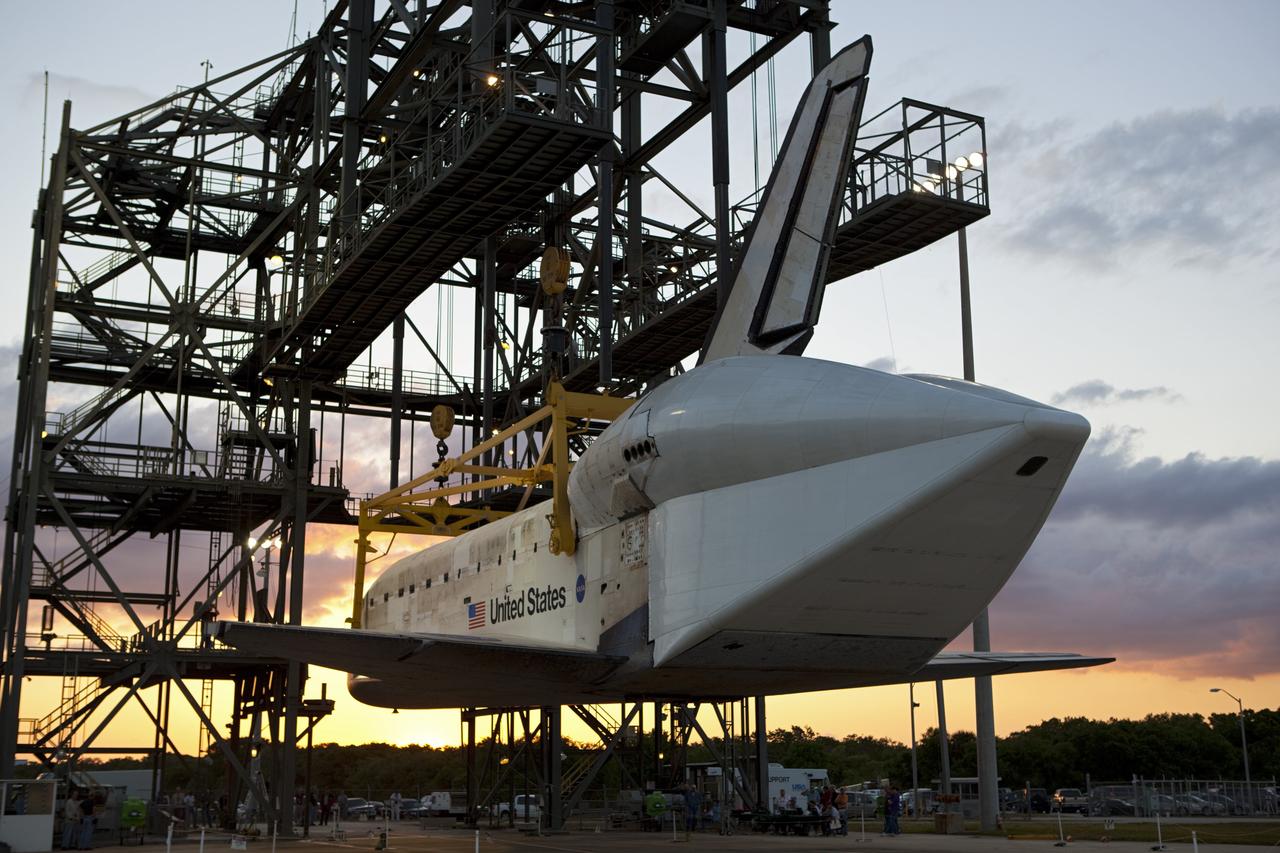
CAPE CANAVERAL, Fla. – At the Shuttle Landing Facility at NASA’s Kennedy Space Center in Florida, space shuttle Discovery slowly is lifted off the ground inside the mate-demate device in preparation for the arrival of the Shuttle Carrier Aircraft. The device, known as the MDD, is a large gantry-like steel structure used to hoist a shuttle off the ground and position it onto the back of the aircraft, or SCA. The SCA is a Boeing 747 jet, originally manufactured for commercial use, which was modified by NASA to transport the shuttles between destinations on Earth. The SCA designated NASA 905 is assigned to the remaining ferry missions, delivering the shuttles to their permanent public display sites. NASA 905 is scheduled to ferry Discovery to the Washington Dulles International Airport in Virginia on April 17, after which the shuttle will be placed on display in the Smithsonian's National Air and Space Museum Steven F. Udvar-Hazy Center. For more information on the SCA, visit http://www.nasa.gov/centers/dryden/news/FactSheets/FS-013-DFRC.html. For more information on shuttle transition and retirement activities, visit http://www.nasa.gov/transition. Photo credit: NASA/Dimitri Gerondidakis
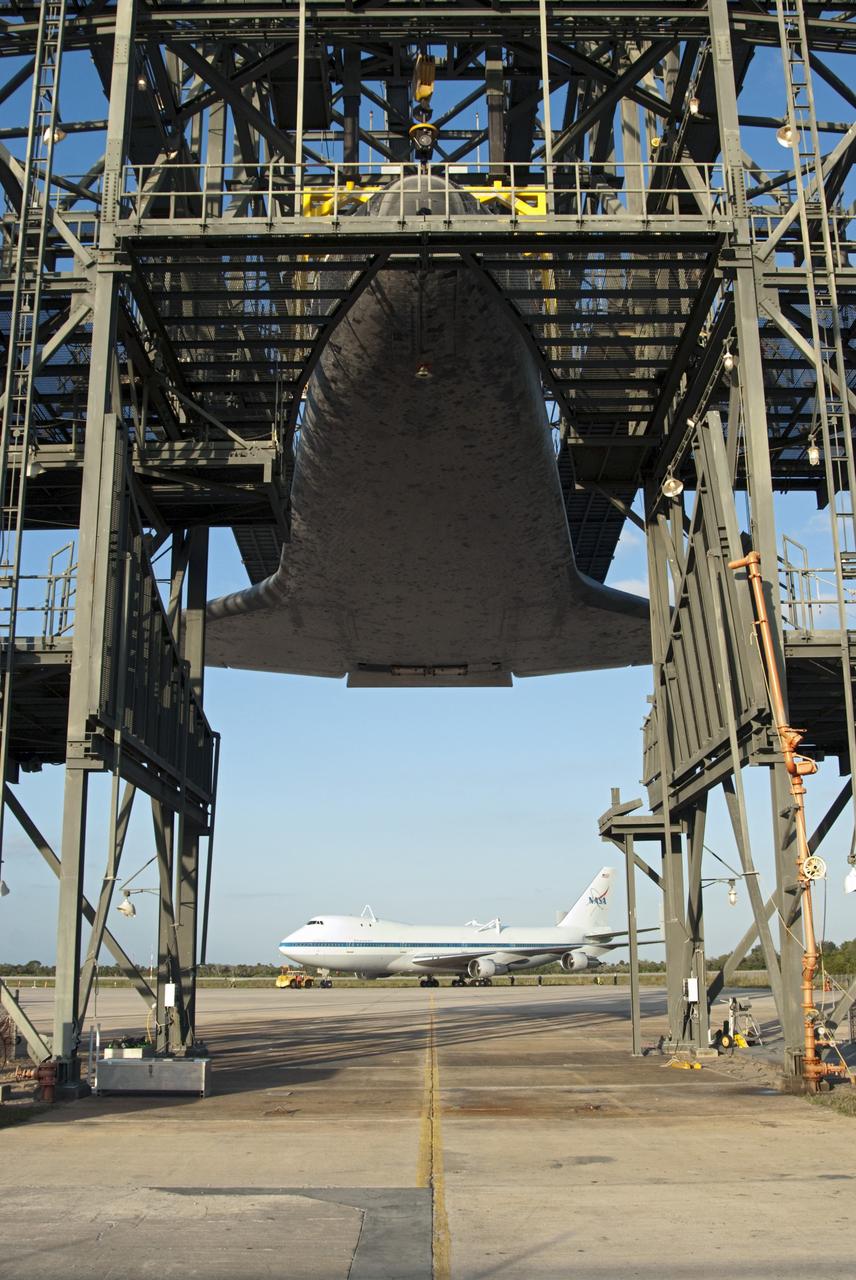
CAPE CANAVERAL, Fla. – At the Shuttle Landing Facility at NASA’s Kennedy Space Center in Florida, space shuttle Discovery is suspended 60 feet off the ground inside the mate-demate device in preparation for the arrival of the Shuttle Carrier Aircraft, in the background. The device, known as the MDD, is a large gantry-like steel structure used to hoist a shuttle off the ground and position it onto the back of the aircraft, or SCA. The SCA is a Boeing 747 jet, originally manufactured for commercial use, which was modified by NASA to transport the shuttles between destinations on Earth. The SCA designated NASA 905 is assigned to the remaining ferry missions, delivering the shuttles to their permanent public display sites. NASA 905 is scheduled to ferry Discovery to the Washington Dulles International Airport in Virginia on April 17, after which the shuttle will be placed on display in the Smithsonian's National Air and Space Museum Steven F. Udvar-Hazy Center. For more information on the SCA, visit http://www.nasa.gov/centers/dryden/news/FactSheets/FS-013-DFRC.html. For more information on shuttle transition and retirement activities, visit http://www.nasa.gov/transition. Photo credit: NASA/Tim Jacobs
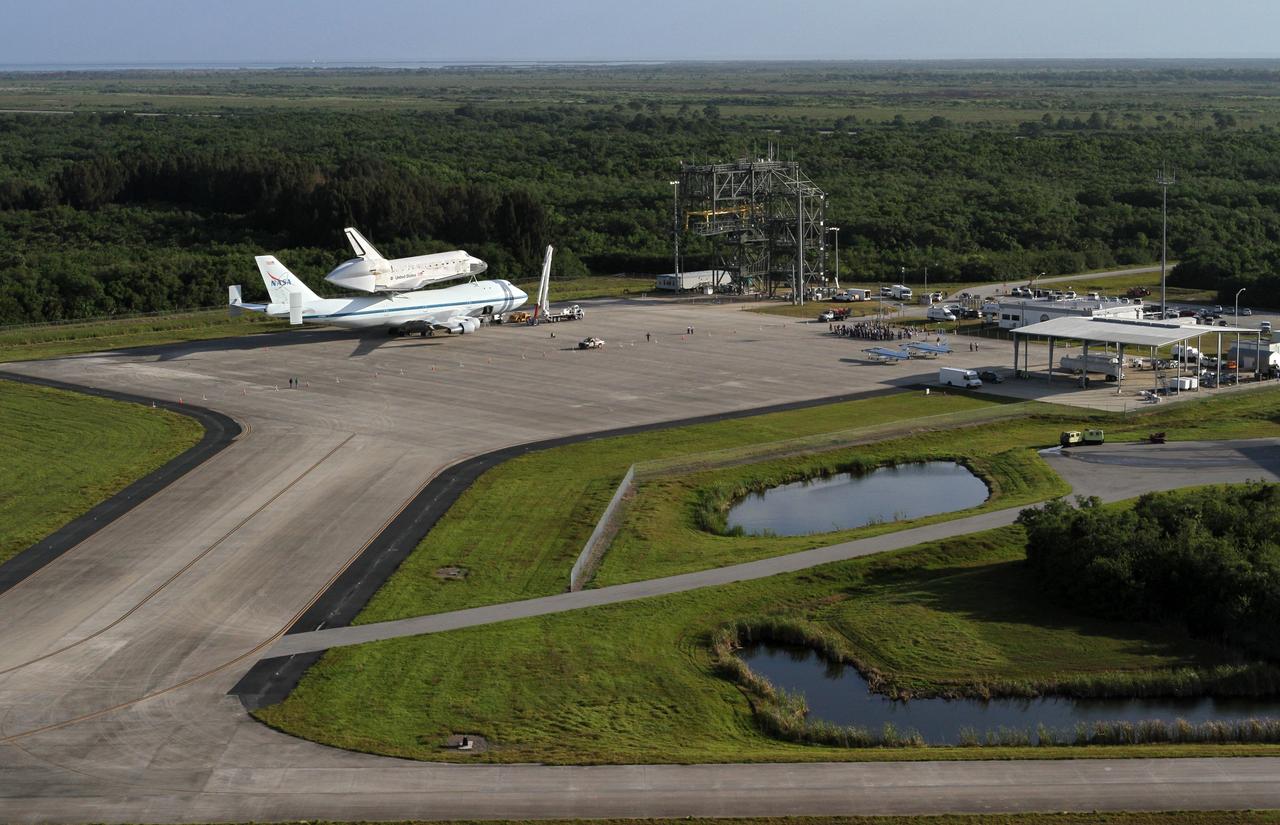
CAPE CANAVERAL, Fla. – This is an aerial view of space shuttle Discovery bolted to the top of a Shuttle Carrier Aircraft SCA on the ramp of the Shuttle Landing Facility SLF at NASA’s Kennedy Space Center in Florida. Discovery's last crew members are expected to be at the SLF, along with Kennedy employees and guests, as the center says goodbye to the agency's most-flown shuttle on April 17. The SCA, designated NASA 905, will ferry Discovery to the Washington Dulles International Airport in Virginia, after which the shuttle will be moved for public display in the Smithsonian's National Air and Space Museum Steven F. Udvar-Hazy Center on April 19. For more information on the SCA, visit http://www.nasa.gov/centers/dryden/news/FactSheets/FS-013-DFRC.html. For more information on shuttle transition and retirement activities, visit http://www.nasa.gov/transition. Photo credit: NASA/Kim Shiflett
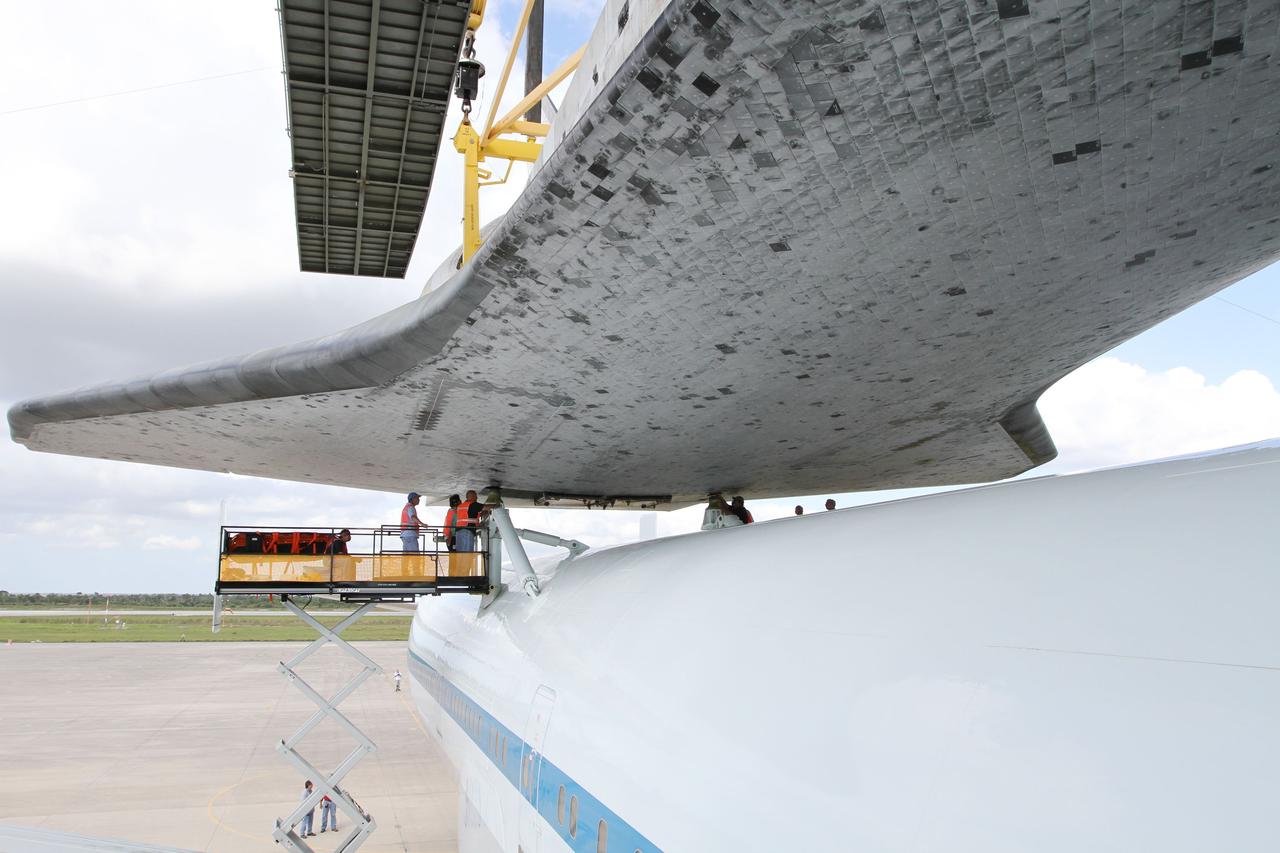
CAPE CANAVERAL, Fla. – At the Shuttle Landing Facility at NASA’s Kennedy Space Center in Florida, workers attach space shuttle Discovery to the Shuttle Carrier Aircraft in the mate-demate device. The device, known as the MDD, is a large gantry-like steel structure used to hoist a shuttle off the ground and position it onto the back of the aircraft, or SCA. The SCA is a Boeing 747 jet, originally manufactured for commercial use, which was modified by NASA to transport the shuttles between destinations on Earth. The SCA designated NASA 905 is assigned to the remaining ferry missions, delivering the shuttles to their permanent public display sites. NASA 905 is scheduled to ferry Discovery to the Washington Dulles International Airport in Virginia on April 17, after which the shuttle will be placed on display in the Smithsonian's National Air and Space Museum Steven F. Udvar-Hazy Center. For more information on the SCA, visit http://www.nasa.gov/centers/dryden/news/FactSheets/FS-013-DFRC.html. For more information on shuttle transition and retirement activities, visit http://www.nasa.gov/transition. Photo credit: NASA/Kim Shiflett
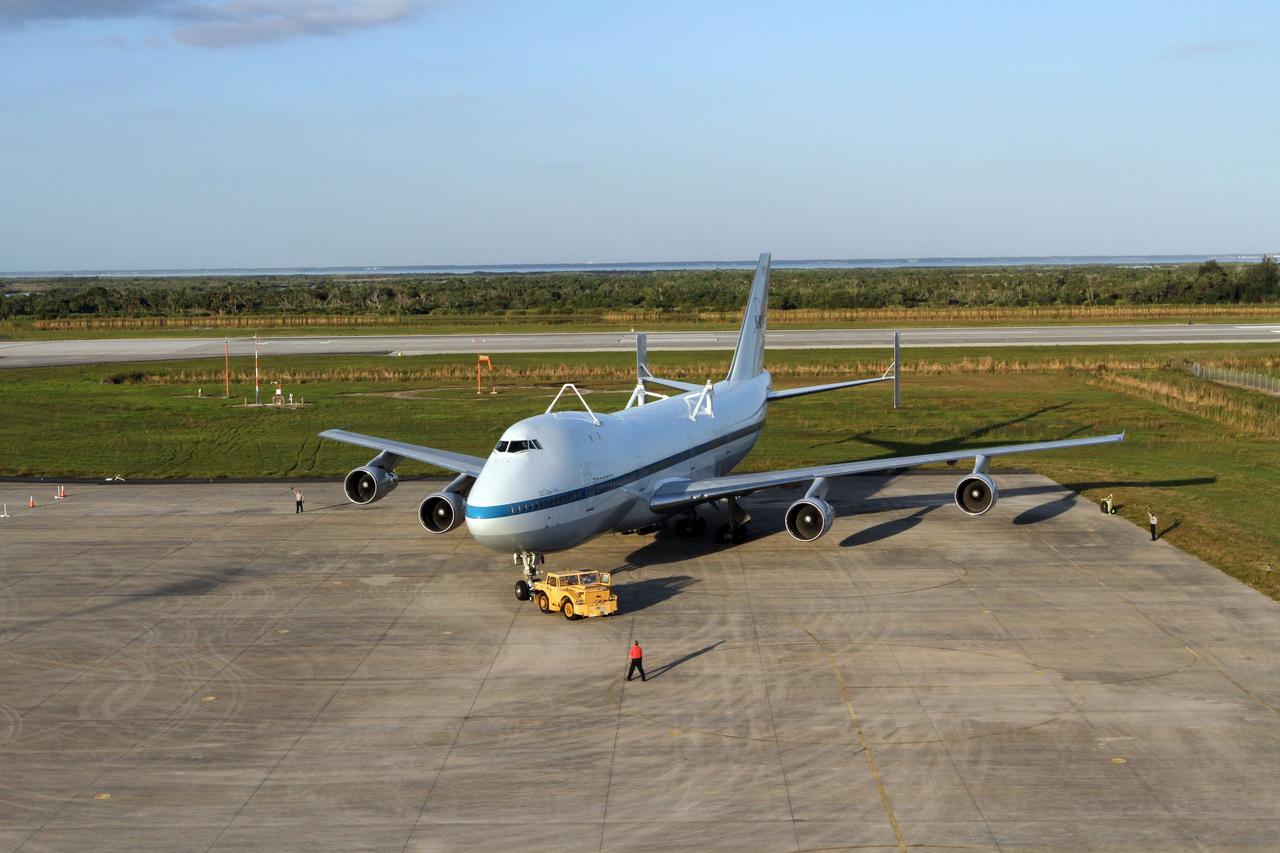
CAPE CANAVERAL, Fla. – At the Shuttle Landing Facility at NASA’s Kennedy Space Center in Florida, preparations are under way to tow a Shuttle Carrier Aircraft to the mate-demate device for mating with space shuttle Discovery. This SCA, designated NASA 905, is a Boeing 747 jet originally manufactured for commercial use, which was modified by NASA to transport the shuttles between destinations on Earth. NASA 905 is assigned to the remaining ferry missions, delivering the shuttles to their permanent public display sites. Discovery’s new home will be the Smithsonian's National Air and Space Museum Steven F. Udvar-Hazy Center in Chantilly, Va. For more information on the SCA, visit http://www.nasa.gov/centers/dryden/news/FactSheets/FS-013-DFRC.html. For more information on shuttle transition and retirement activities, visit http://www.nasa.gov/transition. Photo credit: NASA/Kim Shiflett
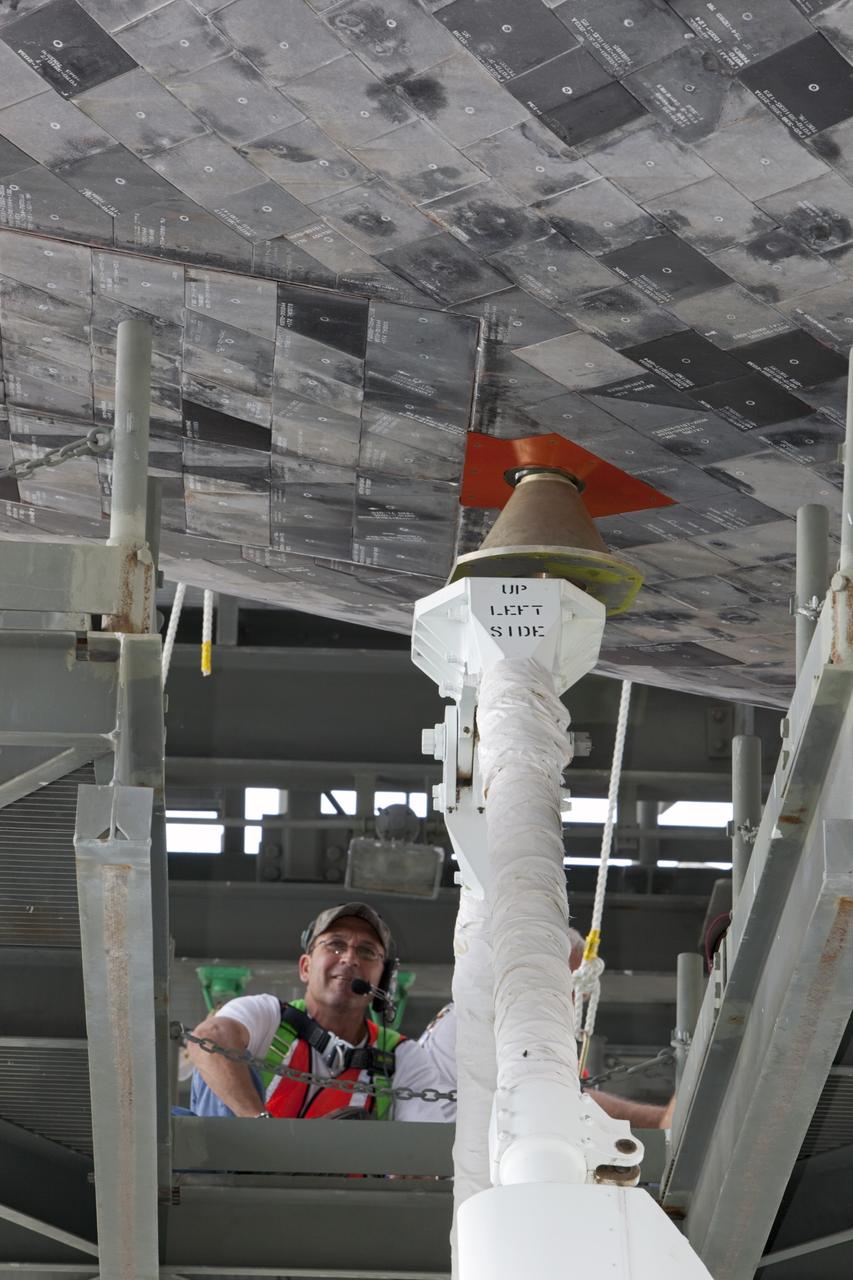
CAPE CANAVERAL, Fla. – At the Shuttle Landing Facility at NASA’s Kennedy Space Center in Florida, workers in the mate-demate device attach space shuttle Discovery to the Shuttle Carrier Aircraft. The device, known as the MDD, is a large gantry-like steel structure used to hoist a shuttle off the ground and position it onto the back of the aircraft, or SCA. The SCA is a Boeing 747 jet, originally manufactured for commercial use, which was modified by NASA to transport the shuttles between destinations on Earth. This SCA, designated NASA 905, is assigned to the remaining ferry missions, delivering the shuttles to their permanent public display sites. NASA 905 is scheduled to ferry Discovery to the Washington Dulles International Airport in Virginia on April 17, after which the shuttle will be placed on display in the Smithsonian's National Air and Space Museum Steven F. Udvar-Hazy Center. For more information on the SCA, visit http://www.nasa.gov/centers/dryden/news/FactSheets/FS-013-DFRC.html. For more information on shuttle transition and retirement activities, visit http://www.nasa.gov/transition. Photo credit: NASA/Dimitri Gerondidakis
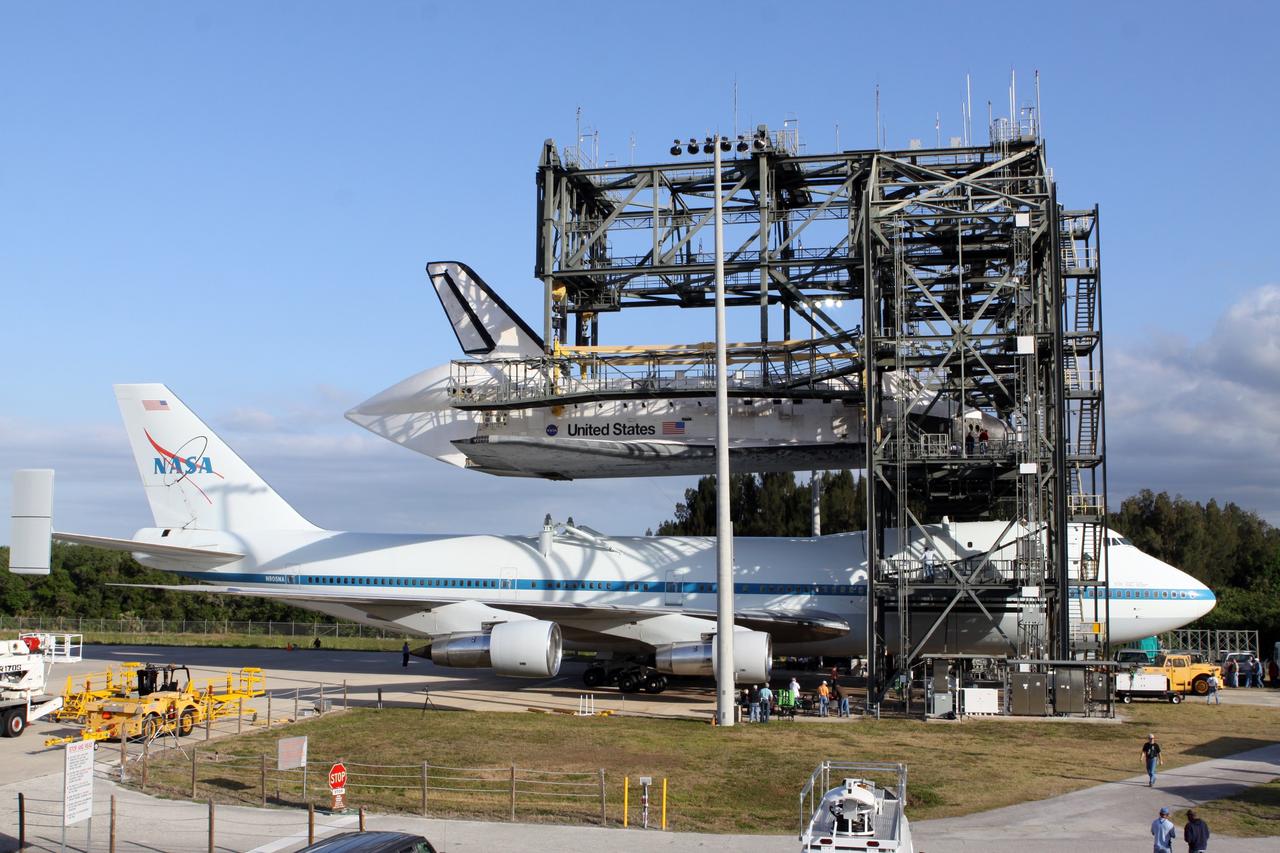
CAPE CANAVERAL, Fla. – At the Shuttle Landing Facility at NASA’s Kennedy Space Center in Florida, the Shuttle Carrier Aircraft is positioned beneath space shuttle Discovery in the mate-demate device. Discovery will be lowered and mated to the aircraft in preparation for its departure from Kennedy on Tuesday. The device, known as the MDD, is a large gantry-like steel structure used to hoist a shuttle off the ground and position it onto the back of the aircraft, or SCA. The SCA is a Boeing 747 jet, originally manufactured for commercial use, which was modified by NASA to transport the shuttles between destinations on Earth. The SCA designated NASA 905 is assigned to the remaining ferry missions, delivering the shuttles to their permanent public display sites. NASA 905 is scheduled to ferry Discovery to the Washington Dulles International Airport in Virginia on April 17, after which the shuttle will be placed on display in the Smithsonian's National Air and Space Museum Steven F. Udvar-Hazy Center. For more information on the SCA, visit http://www.nasa.gov/centers/dryden/news/FactSheets/FS-013-DFRC.html. For more information on shuttle transition and retirement activities, visit http://www.nasa.gov/transition. Photo credit: NASA/Kim Shiflett
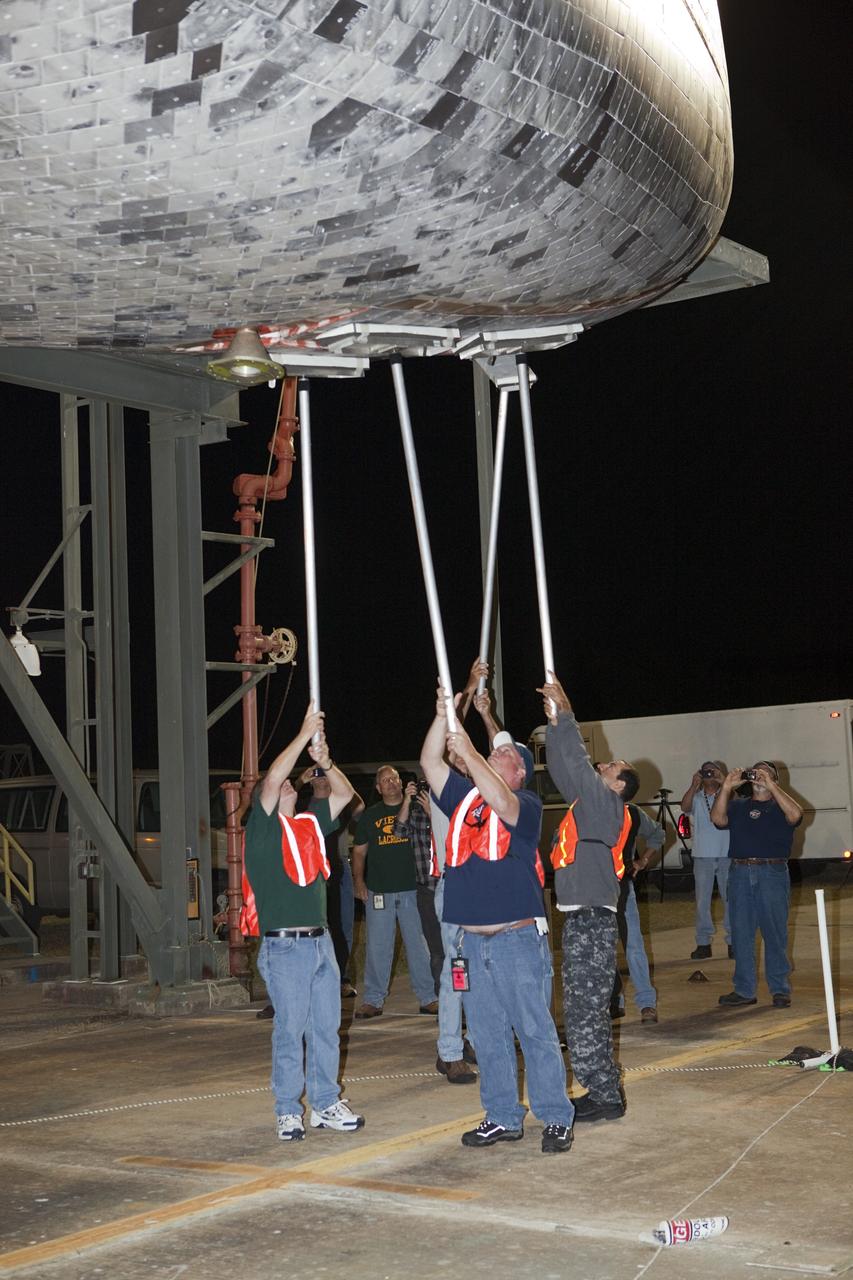
CAPE CANAVERAL, Fla. - At the Shuttle Landing Facility at NASA’s Kennedy Space Center in Florida, workers at the mate-demate device complete final preparations to lift and mate space shuttle Discovery to a Shuttle Carrier Aircraft. The device, known as the MDD, is a large gantry-like steel structure used to hoist a shuttle off the ground and position it onto the back of the aircraft, or SCA. The SCA is a Boeing 747 jet, originally manufactured for commercial use, which was modified by NASA to transport the shuttles between destinations on Earth. The SCA designated NASA 905 is assigned to the remaining ferry missions, delivering the shuttles to their permanent public display sites. NASA 905 is scheduled to ferry Discovery to the Washington Dulles International Airport in Virginia on April 17, after which the shuttle will be placed on display in the Smithsonian's National Air and Space Museum Steven F. Udvar-Hazy Center. For more information on the SCA, visit http://www.nasa.gov/centers/dryden/news/FactSheets/FS-013-DFRC.html. For more information on shuttle transition and retirement activities, visit http://www.nasa.gov/transition. Photo credit: NASA/Dimitri Gerondidakis
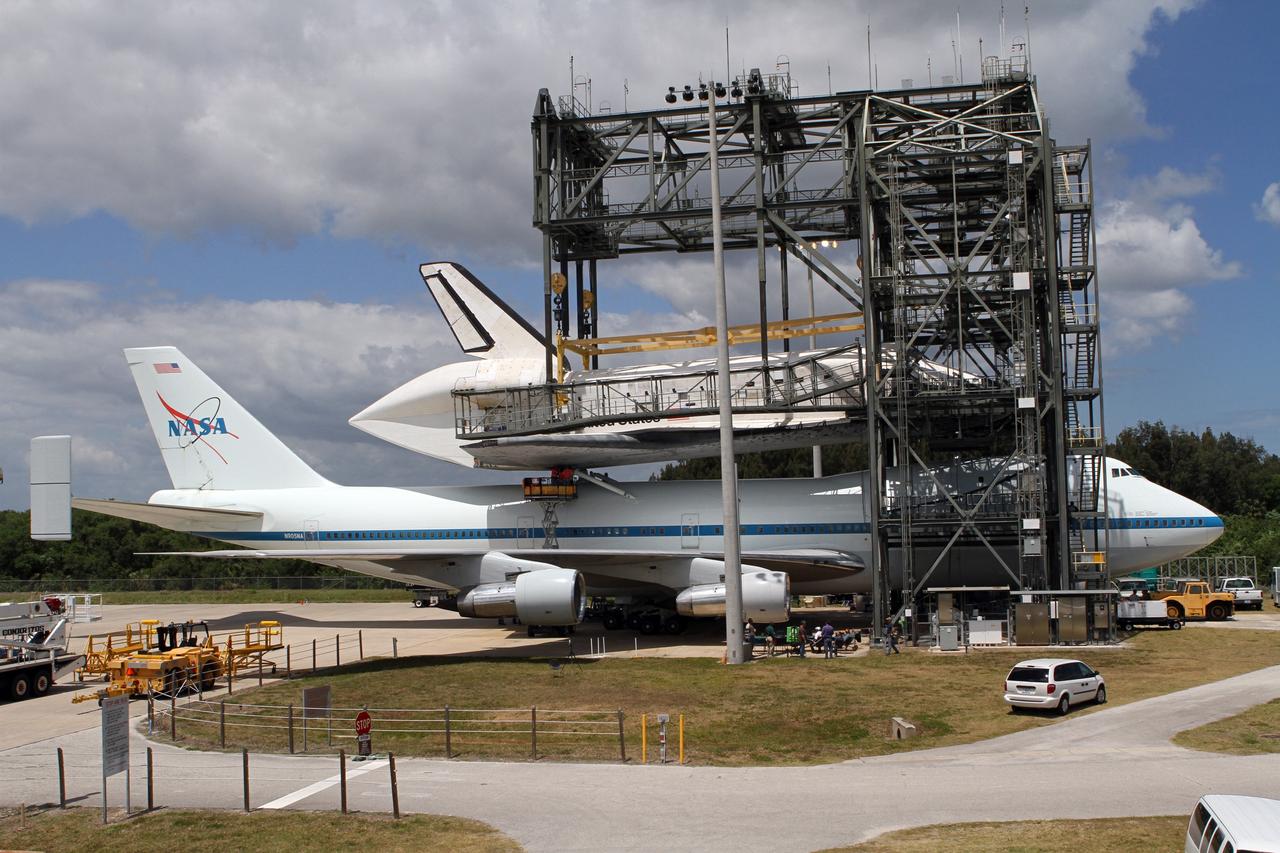
CAPE CANAVERAL, Fla. – At the Shuttle Landing Facility at NASA’s Kennedy Space Center in Florida, initial mating of space shuttle Discovery and the Shuttle Carrier Aircraft is complete in the mate-demate device. Known as the “soft mate,” the procedure was complete at about 11:15 a.m. EDT. The device, known as the MDD, is a large gantry-like steel structure used to hoist a shuttle off the ground and position it onto the back of the aircraft, or SCA. The SCA is a Boeing 747 jet, originally manufactured for commercial use, which was modified by NASA to transport the shuttles between destinations on Earth. This SCA, designated NASA 905, is assigned to the remaining ferry missions, delivering the shuttles to their permanent public display sites. NASA 905 is scheduled to ferry Discovery to the Washington Dulles International Airport in Virginia on April 17, after which the shuttle will be placed on display in the Smithsonian's National Air and Space Museum Steven F. Udvar-Hazy Center. For more information on the SCA, visit http://www.nasa.gov/centers/dryden/news/FactSheets/FS-013-DFRC.html. For more information on shuttle transition and retirement activities, visit http://www.nasa.gov/transition. Photo credit: NASA/Kim Shiflett
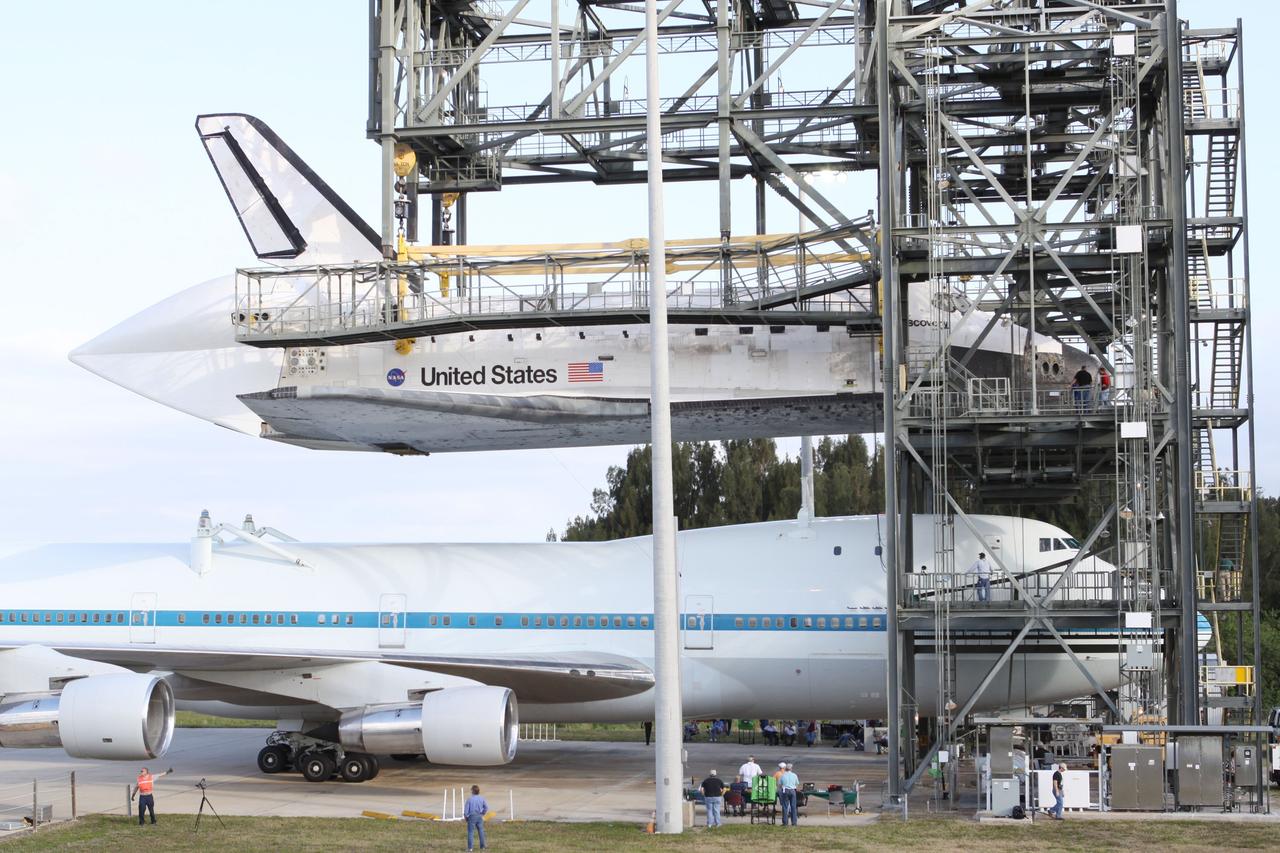
CAPE CANAVERAL, Fla. – At the Shuttle Landing Facility at NASA’s Kennedy Space Center in Florida, the Shuttle Carrier Aircraft moves into position under space shuttle Discovery suspended 60 feet off the ground in the mate-demate device. The device, known as the MDD, is a large gantry-like steel structure used to hoist a shuttle off the ground and position it onto the back of the aircraft, or SCA. The SCA is a Boeing 747 jet, originally manufactured for commercial use, which was modified by NASA to transport the shuttles between destinations on Earth. The SCA designated NASA 905 is assigned to the remaining ferry missions, delivering the shuttles to their permanent public display sites. NASA 905 is scheduled to ferry Discovery to the Washington Dulles International Airport in Virginia on April 17, after which the shuttle will be placed on display in the Smithsonian's National Air and Space Museum Steven F. Udvar-Hazy Center. For more information on the SCA, visit http://www.nasa.gov/centers/dryden/news/FactSheets/FS-013-DFRC.html. For more information on shuttle transition and retirement activities, visit http://www.nasa.gov/transition. Photo credit: NASA/Kim Shiflett
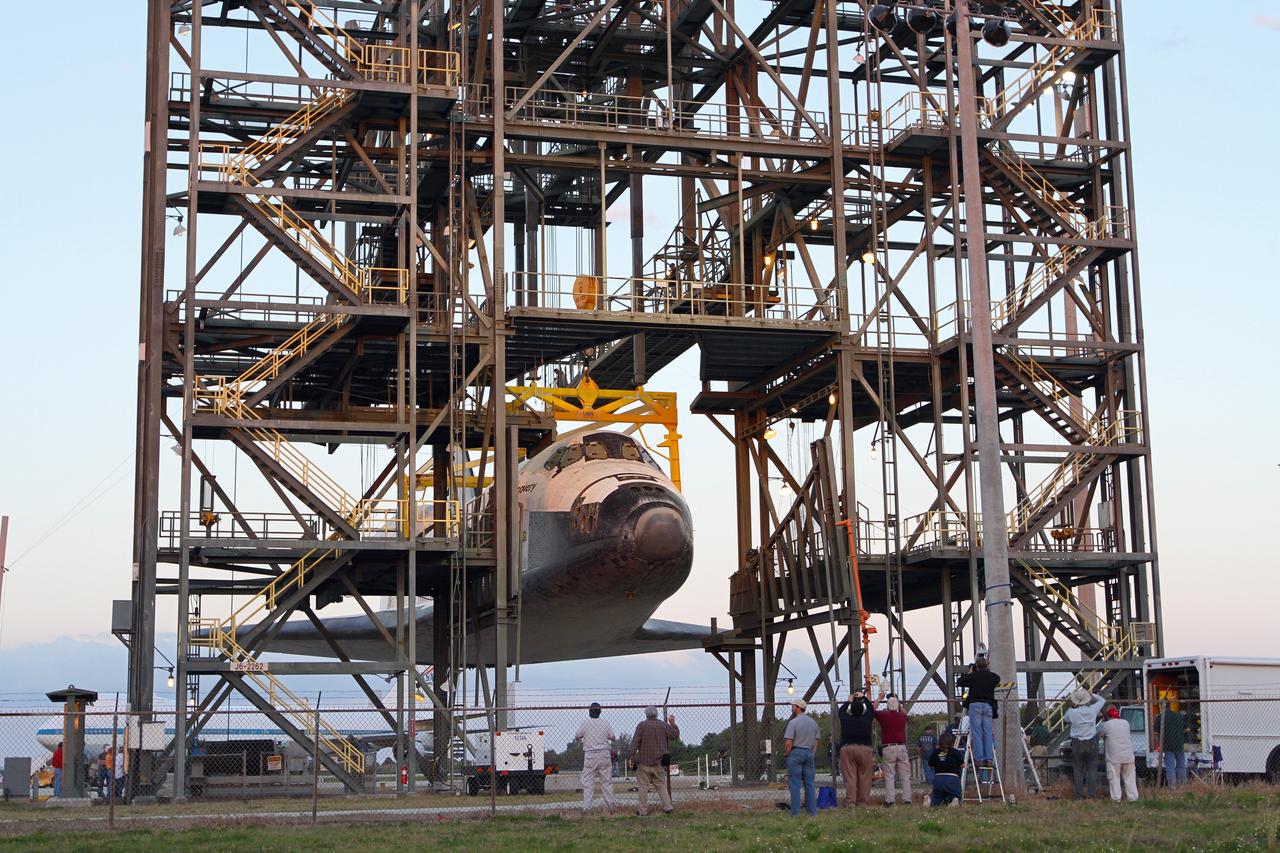
CAPE CANAVERAL, Fla. – At the Shuttle Landing Facility at NASA’s Kennedy Space Center in Florida, space shuttle Discovery is raised into the mate-demate device during operations to place it on top of a Shuttle Carrier Aircraft. The device, known as the MDD, is a large gantry-like steel structure used to hoist a shuttle off the ground and position it onto the back of the aircraft, or SCA. The SCA is a Boeing 747 jet, originally manufactured for commercial use, which was modified by NASA to transport the shuttles between destinations on Earth. The SCA designated NASA 905 is assigned to the remaining ferry missions, delivering the shuttles to their permanent public display sites. NASA 905 is scheduled to ferry Discovery to the Washington Dulles International Airport in Virginia on April 17, after which the shuttle will be placed on display in the Smithsonian's National Air and Space Museum Steven F. Udvar-Hazy Center. For more information on the SCA, visit http://www.nasa.gov/centers/dryden/news/FactSheets/FS-013-DFRC.html. For more information on shuttle transition and retirement activities, visit http://www.nasa.gov/transition. Photo credit: NASA/Kim Shiflett
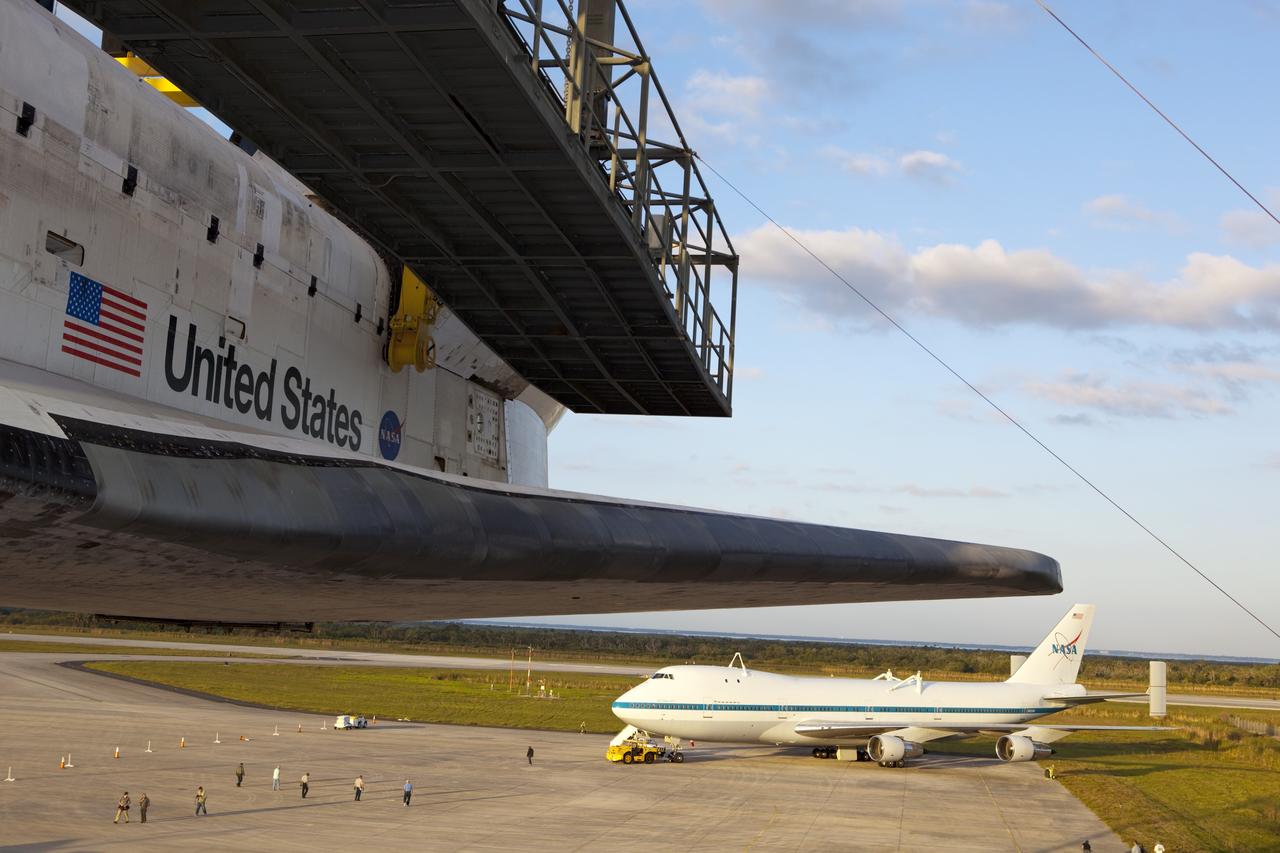
CAPE CANAVERAL, Fla. – At the Shuttle Landing Facility at NASA’s Kennedy Space Center in Florida, preparations are under way to tow a Shuttle Carrier Aircraft to the mate-demate device for mating with space shuttle Discovery, in the foreground. This SCA, designated NASA 905, is a Boeing 747 jet originally manufactured for commercial use, which was modified by NASA to transport the shuttles between destinations on Earth. NASA 905 is assigned to the remaining ferry missions, delivering the shuttles to their permanent public display sites. Discovery’s new home will be the Smithsonian's National Air and Space Museum Steven F. Udvar-Hazy Center in Chantilly, Va. For more information on the SCA, visit http://www.nasa.gov/centers/dryden/news/FactSheets/FS-013-DFRC.html. For more information on shuttle transition and retirement activities, visit http://www.nasa.gov/transition. Photo credit: NASA/Dimitri Gerondidakis
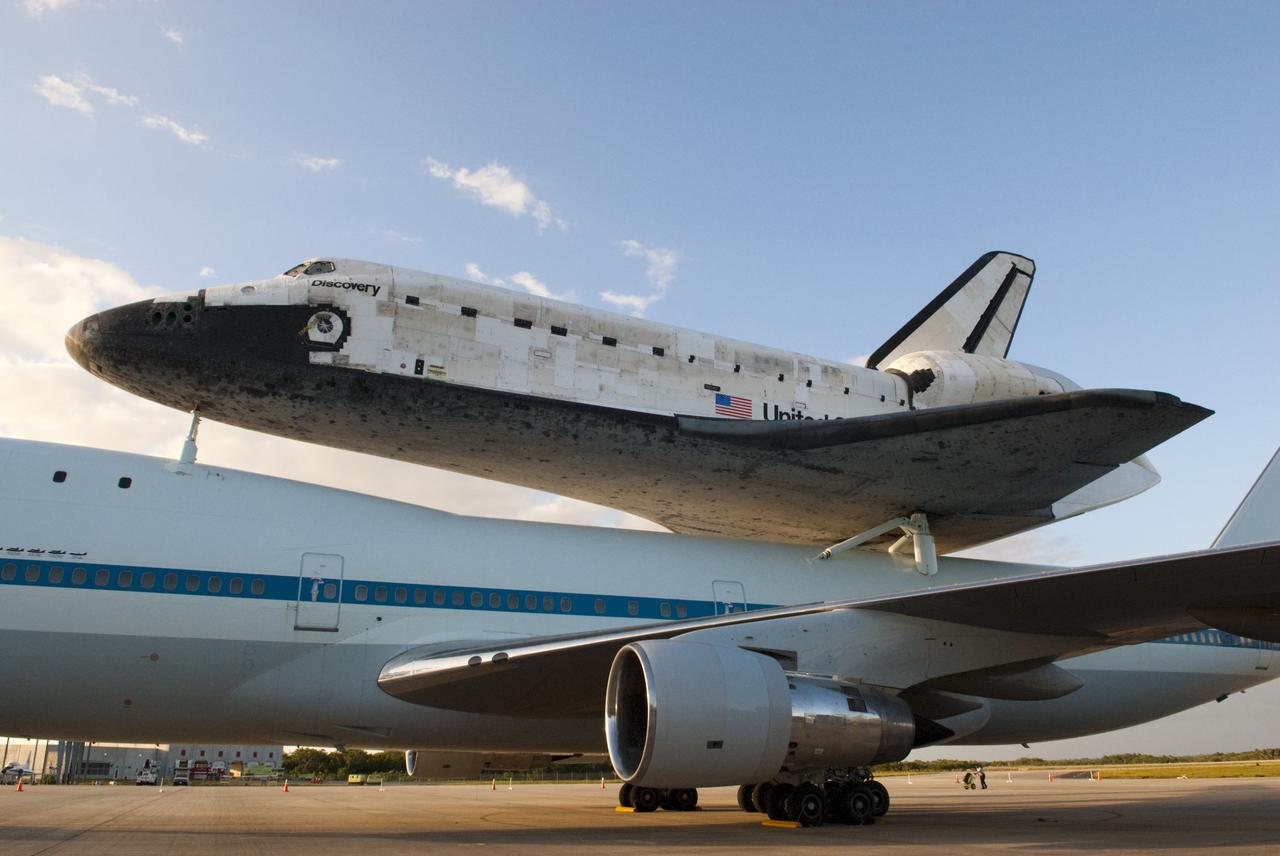
CAPE CANAVERAL, Fla. – At the Shuttle Landing Facility at NASA’s Kennedy Space Center in Florida, space shuttle Discovery is firmly attached to the back of a Shuttle Carrier Aircraft, awaiting departure from Kennedy in the morning. The aircraft, also known as an SCA, is a Boeing 747 jet, originally manufactured for commercial use, which was modified by NASA to transport the shuttles between destinations on Earth. The SCA designated NASA 905 is assigned to the remaining ferry missions, delivering the shuttles to their permanent public display sites. NASA 905 is scheduled to ferry Discovery to the Washington Dulles International Airport in Virginia on April 17, after which the shuttle will be placed on display in the Smithsonian's National Air and Space Museum Steven F. Udvar-Hazy Center. For more information on the SCA, visit http://www.nasa.gov/centers/dryden/news/FactSheets/FS-013-DFRC.html. For more information on shuttle transition and retirement activities, visit http://www.nasa.gov/transition. Photo credit: NASA/Tim Jacobs
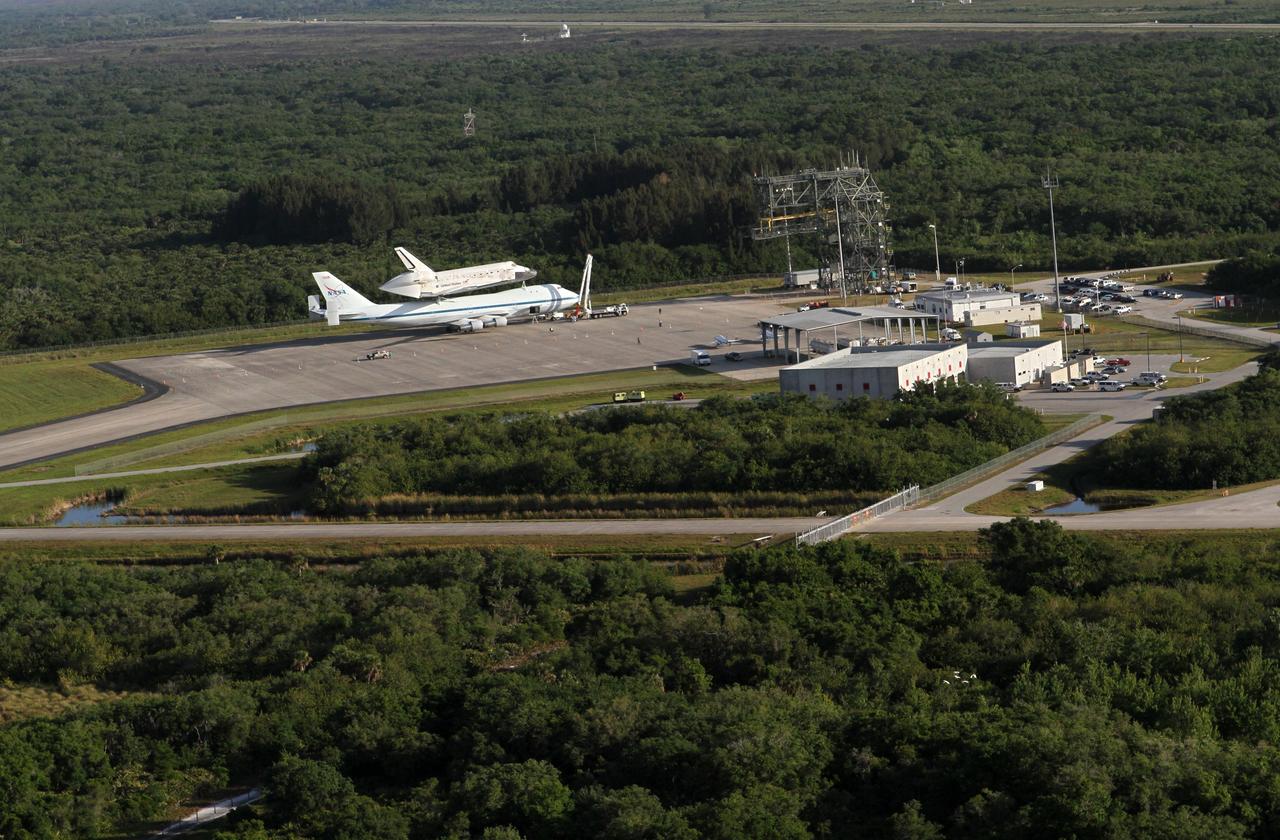
CAPE CANAVERAL, Fla. – This is an aerial view of space shuttle Discovery bolted to the top of a Shuttle Carrier Aircraft SCA on the ramp of the Shuttle Landing Facility SLF at NASA’s Kennedy Space Center in Florida. Discovery's last crew members are expected to be at the SLF, along with Kennedy employees and guests, as the center says goodbye to the agency's most-flown shuttle on April 17. The SCA, designated NASA 905, will ferry Discovery to the Washington Dulles International Airport in Virginia, after which the shuttle will be moved for public display in the Smithsonian's National Air and Space Museum Steven F. Udvar-Hazy Center on April 19. For more information on the SCA, visit http://www.nasa.gov/centers/dryden/news/FactSheets/FS-013-DFRC.html. For more information on shuttle transition and retirement activities, visit http://www.nasa.gov/transition. Photo credit: NASA/Kim Shiflett
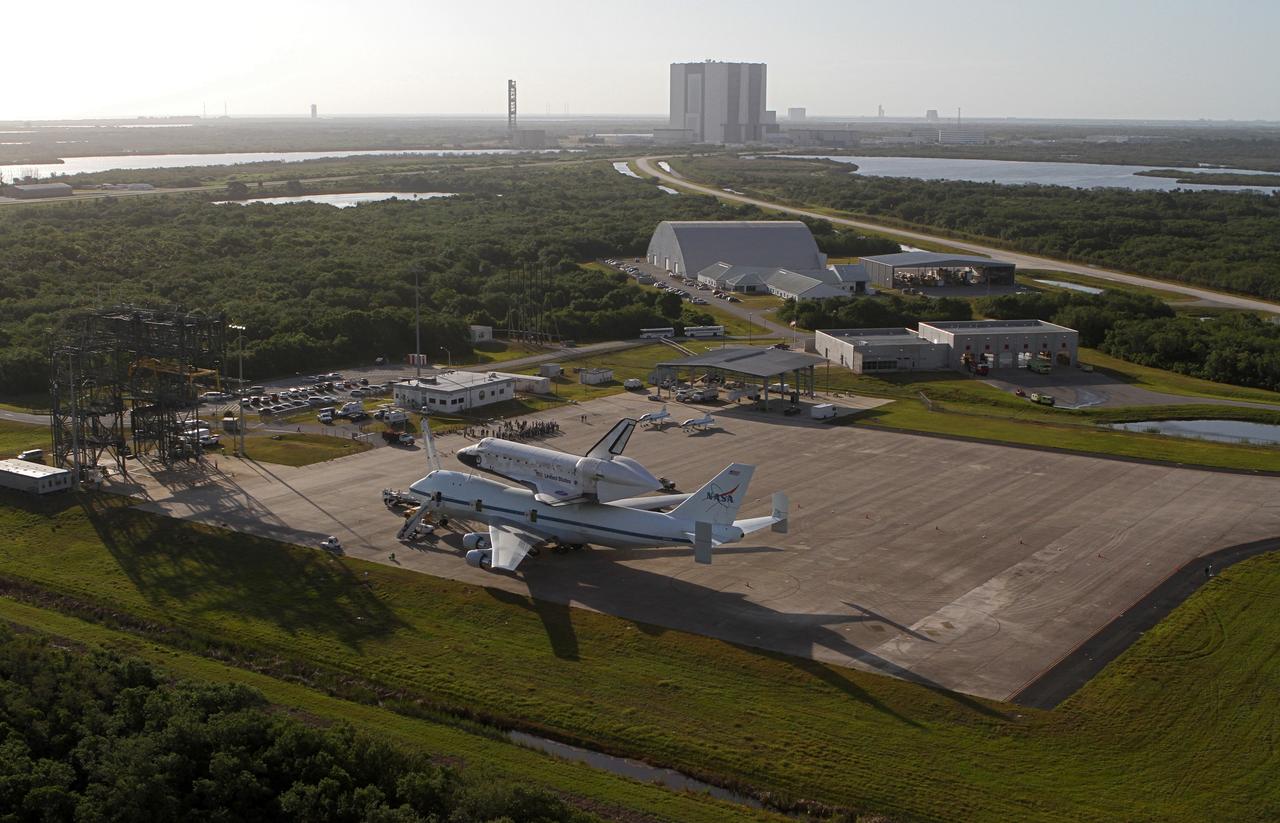
CAPE CANAVERAL, Fla. – This is an aerial view of space shuttle Discovery bolted to the top of a Shuttle Carrier Aircraft SCA on the ramp of the Shuttle Landing Facility SLF at NASA’s Kennedy Space Center in Florida. Discovery's last crew members are expected to be at the SLF, along with Kennedy employees and guests, as the center says goodbye to the agency's most-flown shuttle on April 17. The SCA, designated NASA 905, will ferry Discovery to the Washington Dulles International Airport in Virginia, after which the shuttle will be moved for public display in the Smithsonian's National Air and Space Museum Steven F. Udvar-Hazy Center on April 19. For more information on the SCA, visit http://www.nasa.gov/centers/dryden/news/FactSheets/FS-013-DFRC.html. For more information on shuttle transition and retirement activities, visit http://www.nasa.gov/transition. Photo credit: NASA/Kim Shiflett
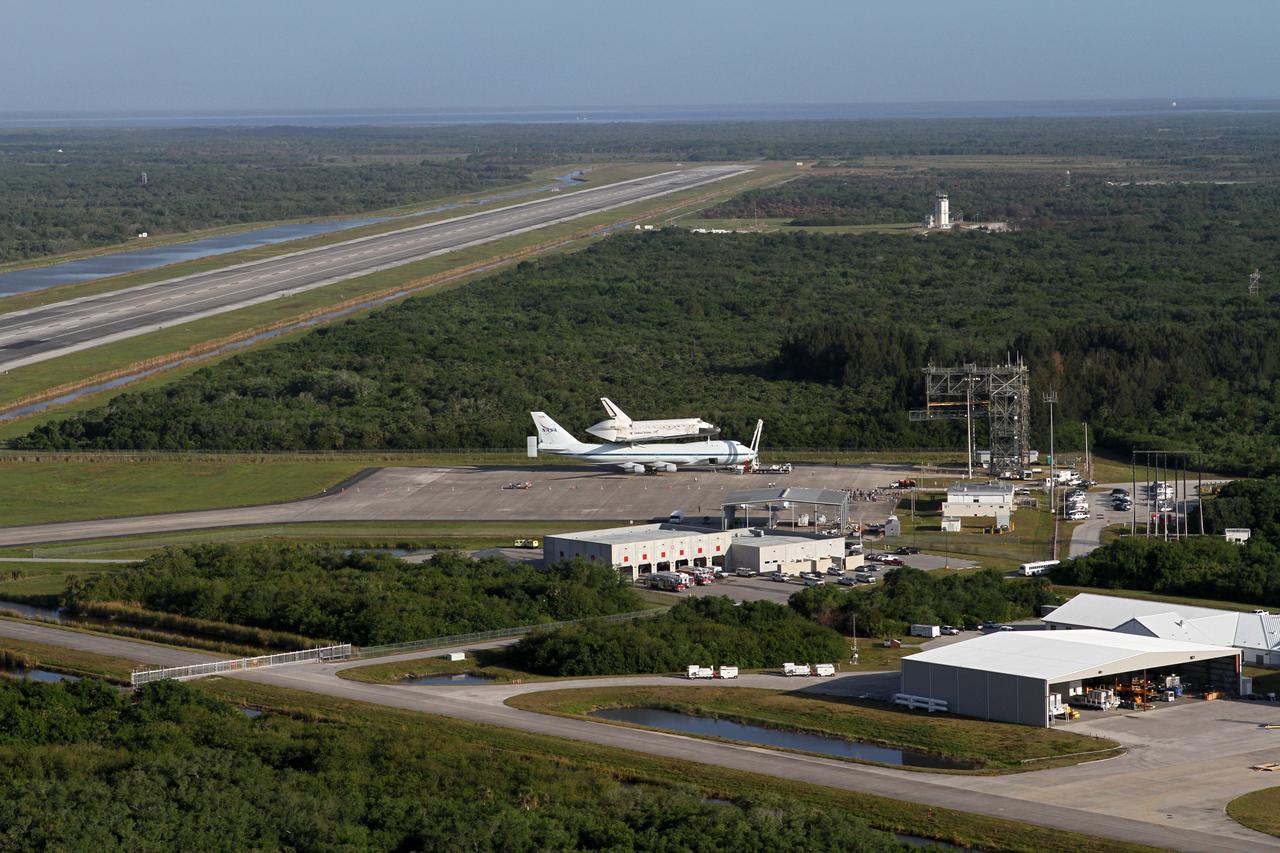
CAPE CANAVERAL, Fla. – This is an aerial view of the long Shuttle Landing Facility SLF runway at NASA's Kennedy Space Center in Florida that space shuttle Discovery, bolted to the top of a Shuttle Carrier Aircraft SCA, will take off from on April 17. Discovery's last crew members are expected to be at the runway, along with Kennedy employees and guests, as the center says goodbye to the agency's most-flown shuttle. The SCA, designated NASA 905, will ferry Discovery to the Washington Dulles International Airport in Virginia, after which the shuttle will be moved for public display in the Smithsonian's National Air and Space Museum Steven F. Udvar-Hazy Center on April 19. For more information on the SCA, visit http://www.nasa.gov/centers/dryden/news/FactSheets/FS-013-DFRC.html. For more information on shuttle transition and retirement activities, visit http://www.nasa.gov/transition. Photo credit: NASA/Kim Shiflett
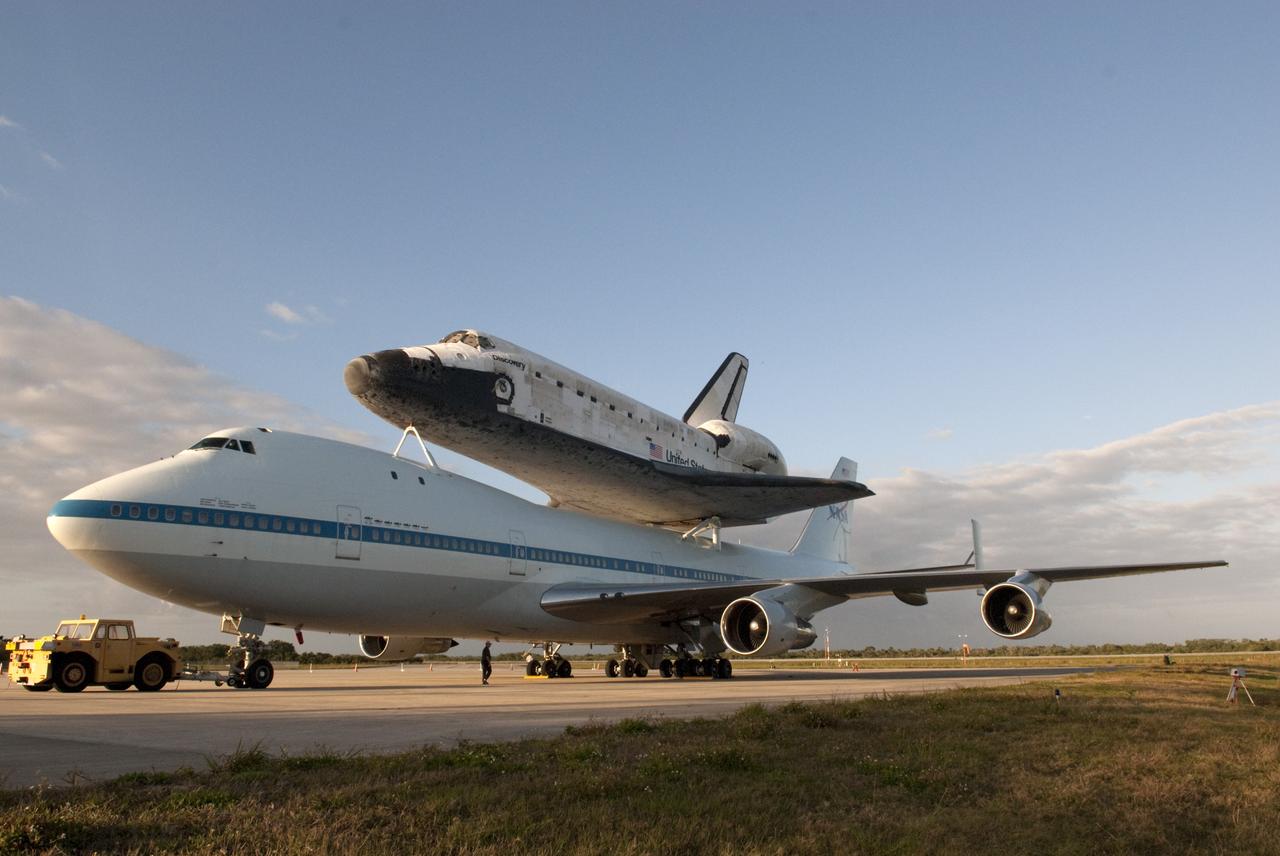
CAPE CANAVERAL, Fla. – At the Shuttle Landing Facility at NASA’s Kennedy Space Center in Florida, the Shuttle Carrier Aircraft with space shuttle Discovery secured to its back is parked on the tarmac awaiting departure from Kennedy tomorrow morning. The aircraft, also known as an SCA, is a Boeing 747 jet, originally manufactured for commercial use, which was modified by NASA to transport the shuttles between destinations on Earth. The SCA designated NASA 905 is assigned to the remaining ferry missions, delivering the shuttles to their permanent public display sites. NASA 905 is scheduled to ferry Discovery to the Washington Dulles International Airport in Virginia on April 17, after which the shuttle will be placed on display in the Smithsonian's National Air and Space Museum Steven F. Udvar-Hazy Center. For more information on the SCA, visit http://www.nasa.gov/centers/dryden/news/FactSheets/FS-013-DFRC.html. For more information on shuttle transition and retirement activities, visit http://www.nasa.gov/transition. Photo credit: NASA/Tim Jacobs
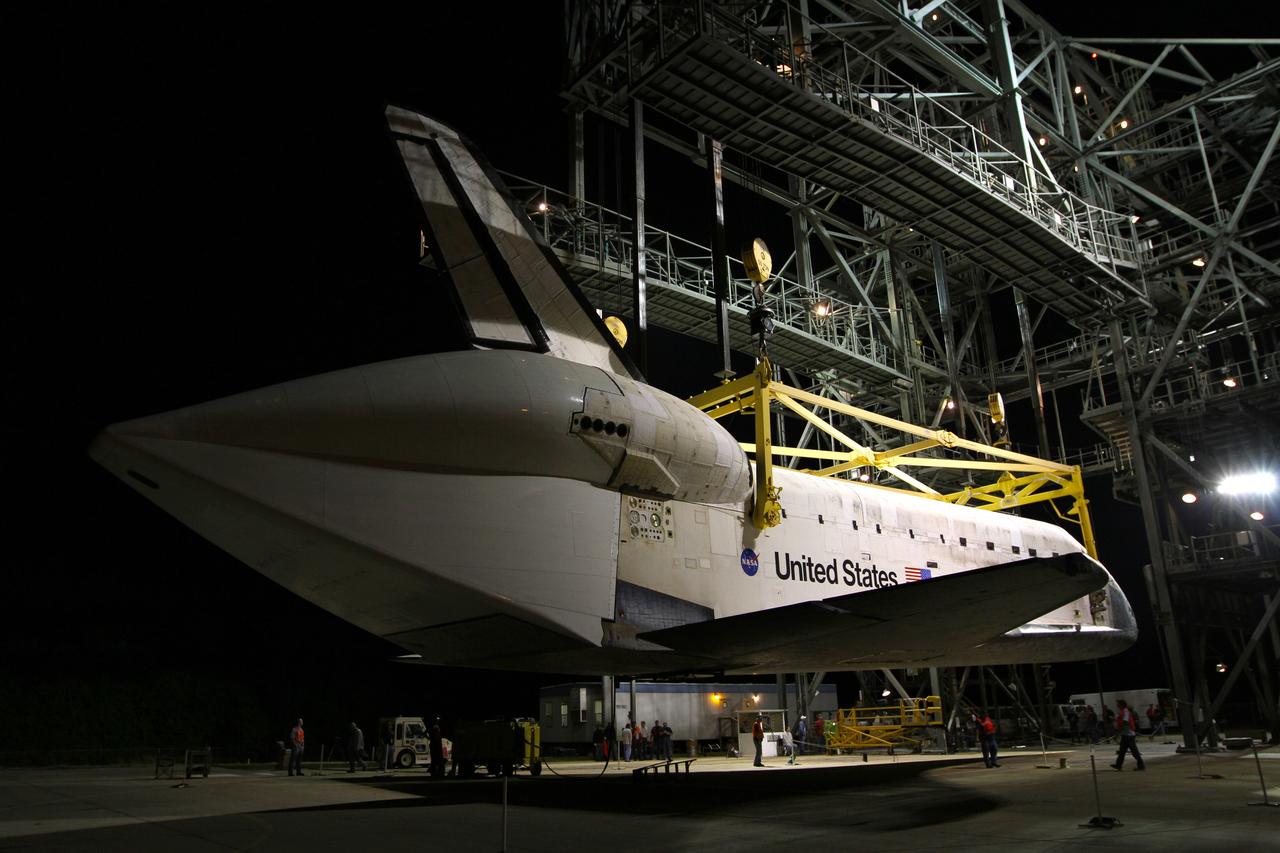
CAPE CANAVERAL, Fla. – Before sunrise at the Shuttle Landing Facility at NASA’s Kennedy Space Center in Florida, space shuttle Discovery is lifted into the mate-demate device by a crane hooked to the yellow sling. Operations have resumed to place Discovery on top of a Shuttle Carrier Aircraft in preparation for its departure from Kennedy on Tuesday. The device, known as the MDD, is a large gantry-like steel structure used to hoist a shuttle off the ground and position it onto the back of the aircraft, or SCA. The SCA is a Boeing 747 jet, originally manufactured for commercial use, which was modified by NASA to transport the shuttles between destinations on Earth. The SCA designated NASA 905 is assigned to the remaining ferry missions, delivering the shuttles to their permanent public display sites. NASA 905 is scheduled to ferry Discovery to the Washington Dulles International Airport in Virginia on April 17, after which the shuttle will be placed on display in the Smithsonian's National Air and Space Museum Steven F. Udvar-Hazy Center. For more information on the SCA, visit http://www.nasa.gov/centers/dryden/news/FactSheets/FS-013-DFRC.html. For more information on shuttle transition and retirement activities, visit http://www.nasa.gov/transition. Photo credit: NASA/Kim Shiflett
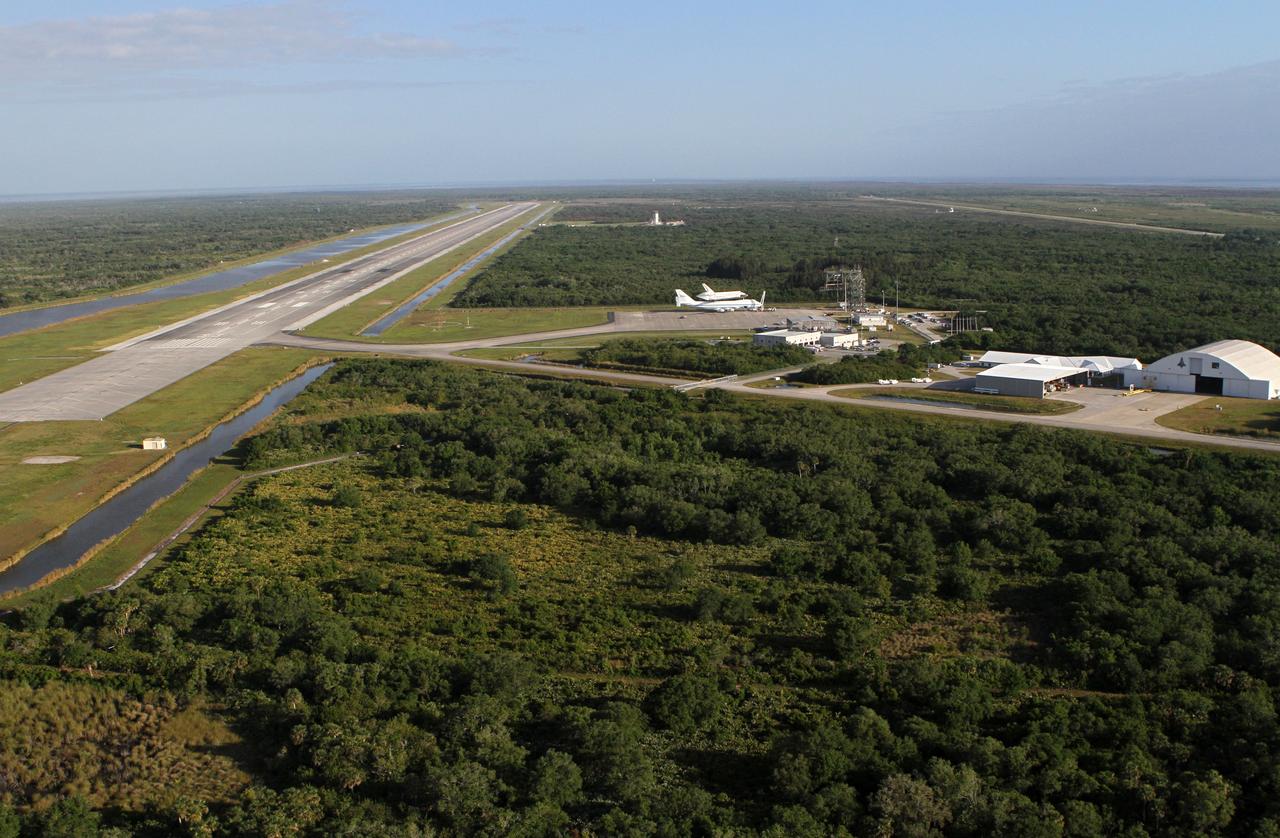
CAPE CANAVERAL, Fla. – This is an aerial view of the long Shuttle Landing Facility SLF runway at NASA's Kennedy Space Center in Florida that space shuttle Discovery, bolted to the top of a Shuttle Carrier Aircraft SCA, will take off from on April 17. Discovery's last crew members are expected to be at the runway, along with Kennedy employees and guests, as the center says goodbye to the agency's most-flown shuttle. The SCA, designated NASA 905, will ferry Discovery to the Washington Dulles International Airport in Virginia, after which the shuttle will be moved for public display in the Smithsonian's National Air and Space Museum Steven F. Udvar-Hazy Center on April 19. For more information on the SCA, visit http://www.nasa.gov/centers/dryden/news/FactSheets/FS-013-DFRC.html. For more information on shuttle transition and retirement activities, visit http://www.nasa.gov/transition. Photo credit: NASA/Kim Shiflett
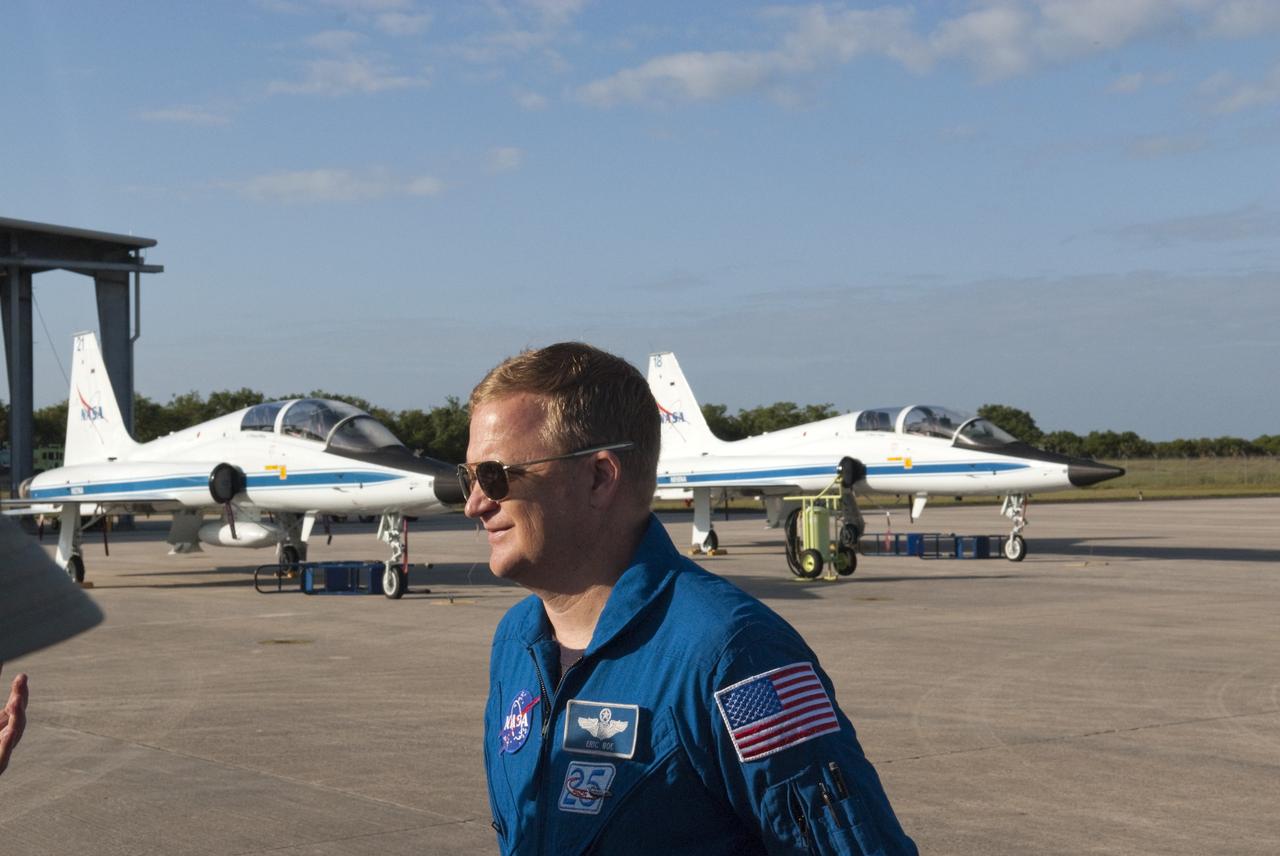
CAPE CANAVERAL, Fla. – At the Shuttle Landing Facility at NASA’s Kennedy Space Center in Florida, STS-133 Pilot Eric Boe talks to media representatives with NASA T-38 jets in the background. Boe was a member of the crew to fly on Discovery’s final mission in February and March 2011. Other members of the STS-133 crew were Commander Steve Lindsey, and Mission Specialists Nicole Stott, Michael Barratt, Alvin Drew and Steve Bowen. Discovery is scheduled to depart from Kennedy for the final time tomorrow morning on the back of a Shuttle Carrier Aircraft. Also known as an SCA, the aircraft is a Boeing 747 jet, originally manufactured for commercial use, which was modified by NASA to transport the shuttles between destinations on Earth. The SCA designated NASA 905 is assigned to the remaining ferry missions, delivering the shuttles to their permanent public display sites. NASA 905 is scheduled to ferry Discovery to the Washington Dulles International Airport in Virginia on April 17, after which the shuttle will be placed on display in the Smithsonian's National Air and Space Museum Steven F. Udvar-Hazy Center. For more information on the SCA, visit http://www.nasa.gov/centers/dryden/news/FactSheets/FS-013-DFRC.html. For more information on shuttle transition and retirement activities, visit http://www.nasa.gov/transition. Photo credit: NASA/Tim Jacobs
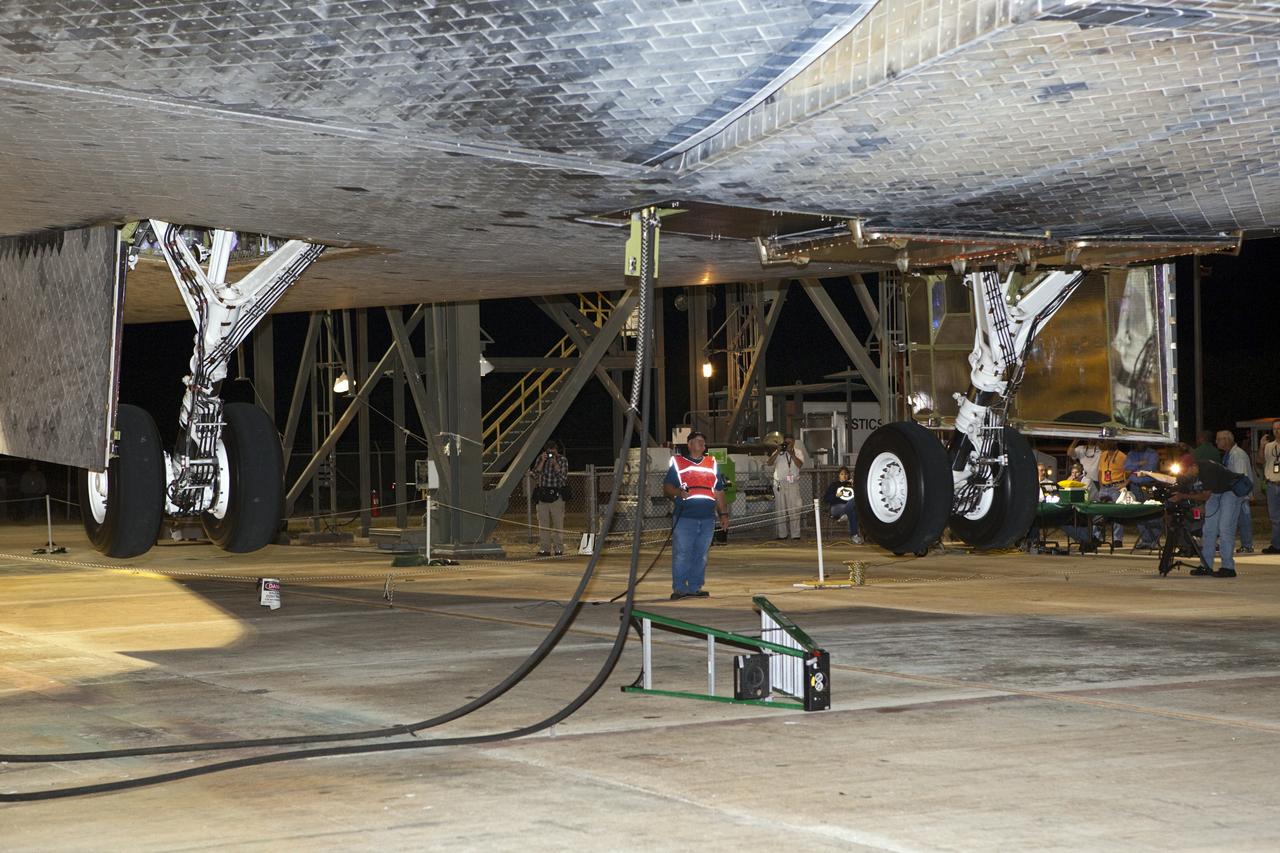
CAPE CANAVERAL, Fla. - At the Shuttle Landing Facility at NASA’s Kennedy Space Center in Florida, final inspections are made on space shuttle Discovery before it is lifted into the mate-demate device and mated to a Shuttle Carrier Aircraft. The device, known as the MDD, is a large gantry-like steel structure used to hoist a shuttle off the ground and position it onto the back of the aircraft, or SCA. The SCA is a Boeing 747 jet, originally manufactured for commercial use, which was modified by NASA to transport the shuttles between destinations on Earth. The SCA designated NASA 905 is assigned to the remaining ferry missions, delivering the shuttles to their permanent public display sites. NASA 905 is scheduled to ferry Discovery to the Washington Dulles International Airport in Virginia on April 17, after which the shuttle will be placed on display in the Smithsonian's National Air and Space Museum Steven F. Udvar-Hazy Center. For more information on the SCA, visit http://www.nasa.gov/centers/dryden/news/FactSheets/FS-013-DFRC.html. For more information on shuttle transition and retirement activities, visit http://www.nasa.gov/transition. Photo credit: NASA/Dimitri Gerondidakis
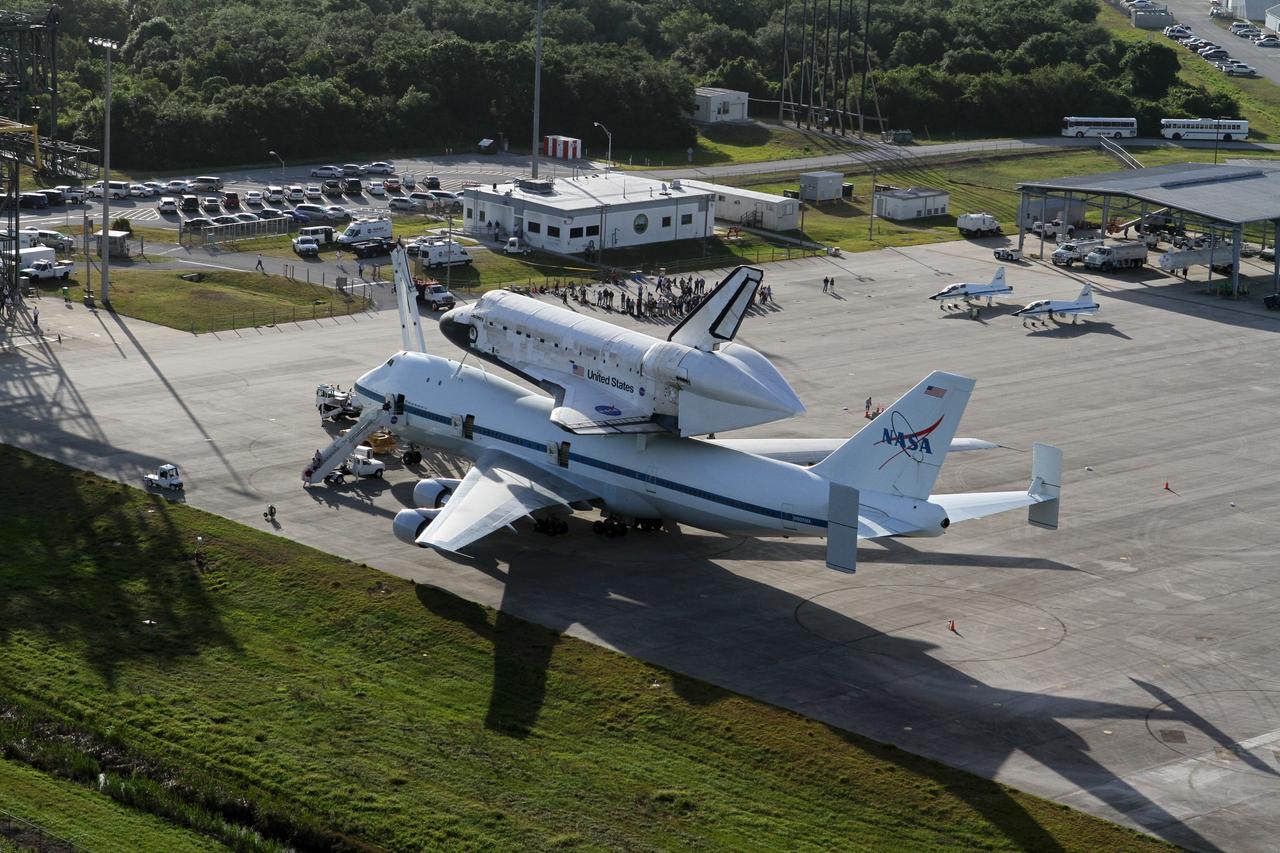
CAPE CANAVERAL, Fla. – This is an aerial view of space shuttle Discovery bolted to the top of a Shuttle Carrier Aircraft SCA on the ramp of the Shuttle Landing Facility SLF at NASA’s Kennedy Space Center in Florida. Also on the ramp is a pair of T-38 training jets. Discovery's last crew members are expected to be at the SLF, along with Kennedy employees and guests, as the center says goodbye to the agency's most-flown shuttle on April 17. The SCA, designated NASA 905, will ferry Discovery to the Washington Dulles International Airport in Virginia, after which the shuttle will be moved for public display in the Smithsonian's National Air and Space Museum Steven F. Udvar-Hazy Center on April 19. For more information on the SCA, visit http://www.nasa.gov/centers/dryden/news/FactSheets/FS-013-DFRC.html. For more information on shuttle transition and retirement activities, visit http://www.nasa.gov/transition. Photo credit: NASA/Kim Shiflett

CAPE CANAVERAL, Fla. – At the Shuttle Landing Facility at NASA’s Kennedy Space Center in Florida, workers remove the covers from space shuttle Discovery’s windows from the basket of an articulating boom lift. Discovery, attached to the back of a Shuttle Carrier Aircraft, is scheduled for departure from Kennedy for the final time tomorrow morning. The aircraft, also known as an SCA, is a Boeing 747 jet, originally manufactured for commercial use which was modified by NASA to transport the shuttles between destinations on Earth. The SCA designated NASA 905 is assigned to the remaining ferry missions, delivering the shuttles to their permanent public display sites. NASA 905 is scheduled to ferry Discovery to the Washington Dulles International Airport in Virginia on April 17, after which the shuttle will be placed on display in the Smithsonian's National Air and Space Museum Steven F. Udvar-Hazy Center. For more information on the SCA, visit http://www.nasa.gov/centers/dryden/news/FactSheets/FS-013-DFRC.html. For more information on shuttle transition and retirement activities, visit http://www.nasa.gov/transition. Photo credit: NASA/Tim Jacobs
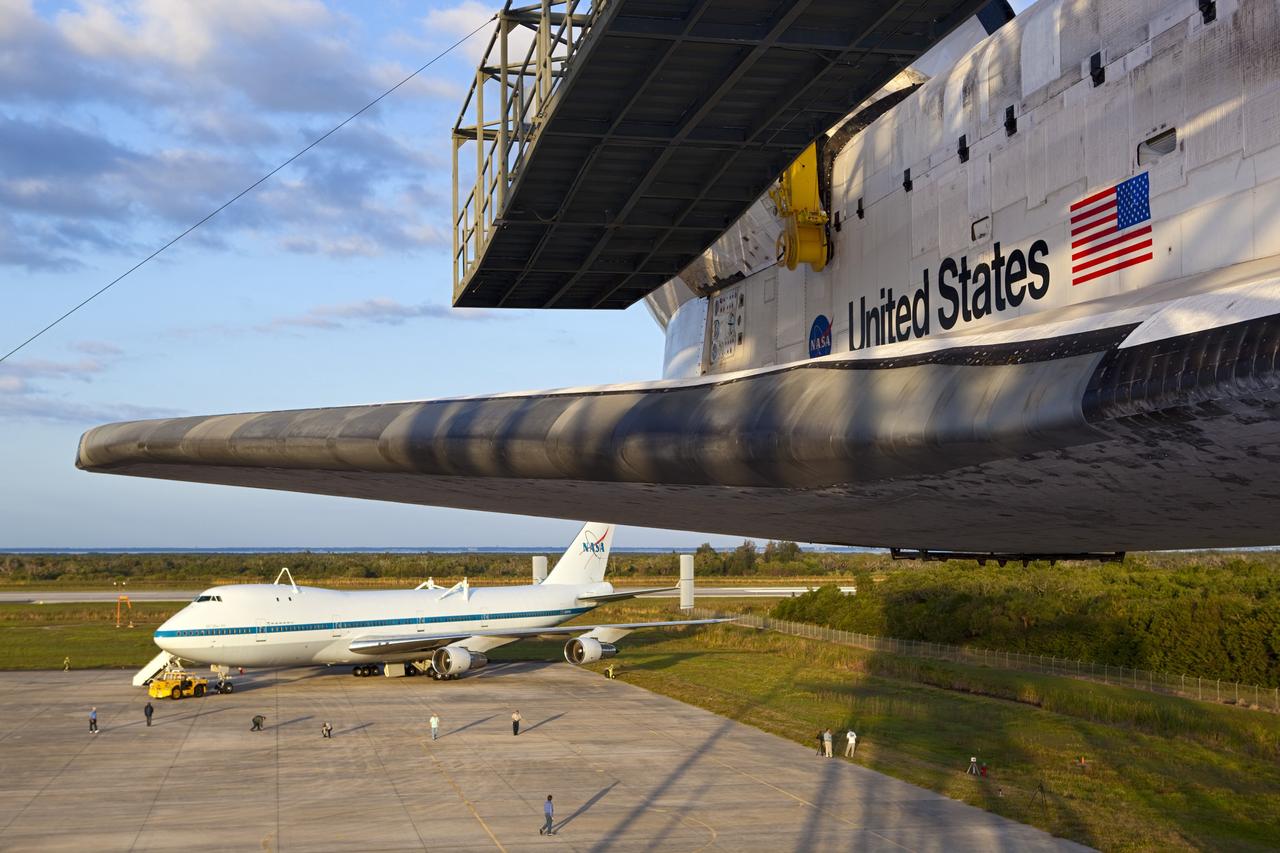
CAPE CANAVERAL, Fla. – At the Shuttle Landing Facility at NASA’s Kennedy Space Center in Florida, preparations are under way to tow a Shuttle Carrier Aircraft to the mate-demate device for mating with space shuttle Discovery, in the foreground. This SCA, designated NASA 905, is a Boeing 747 jet originally manufactured for commercial use, which was modified by NASA to transport the shuttles between destinations on Earth. NASA 905 is assigned to the remaining ferry missions, delivering the shuttles to their permanent public display sites. Discovery’s new home will be the Smithsonian's National Air and Space Museum Steven F. Udvar-Hazy Center in Chantilly, Va. For more information on the SCA, visit http://www.nasa.gov/centers/dryden/news/FactSheets/FS-013-DFRC.html. For more information on shuttle transition and retirement activities, visit http://www.nasa.gov/transition. Photo credit: NASA/Dimitri Gerondidakis
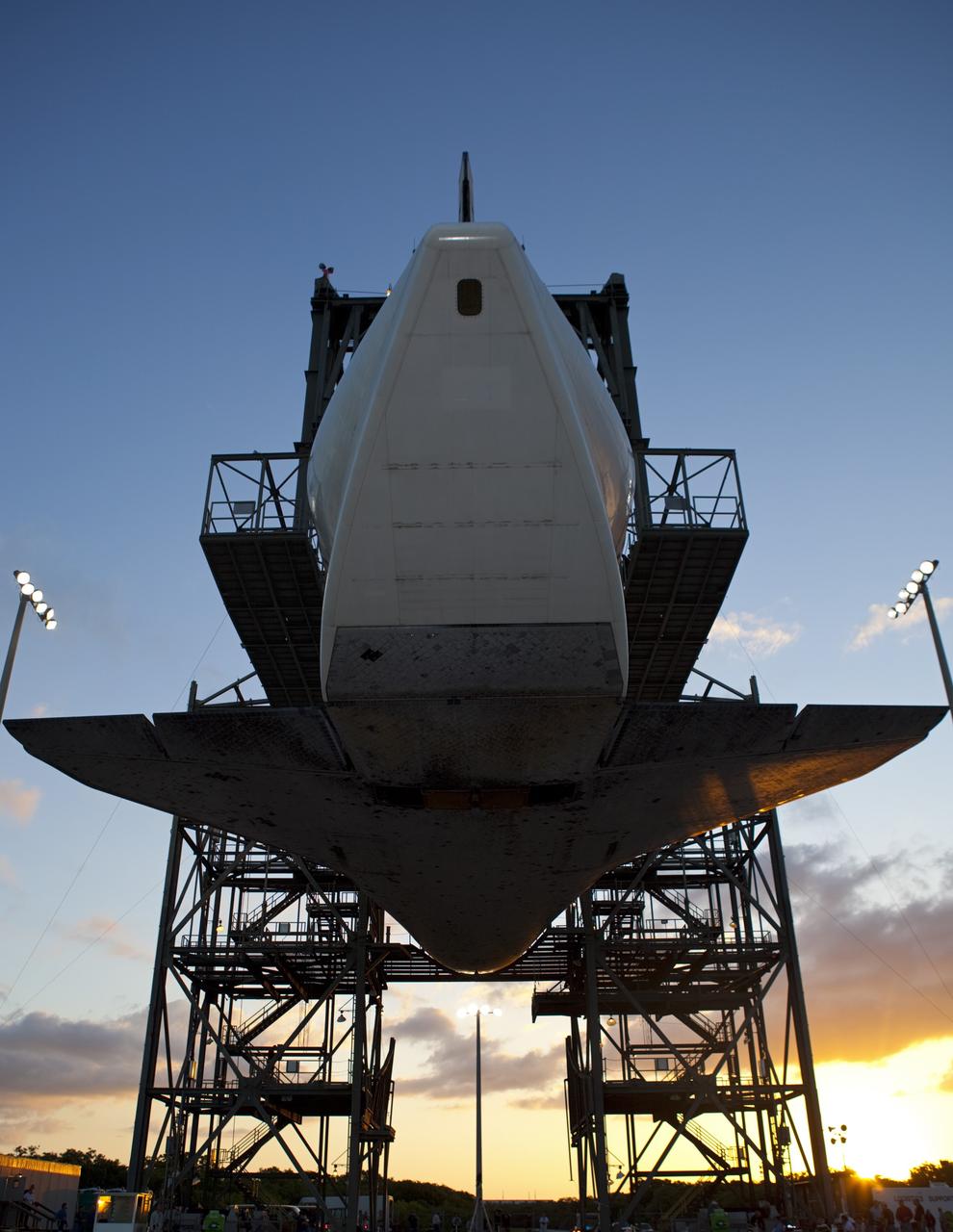
CAPE CANAVERAL, Fla. – At the Shuttle Landing Facility at NASA’s Kennedy Space Center in Florida, space shuttle Discovery slowly is lifted off the ground inside the mate-demate device in preparation for the arrival of the Shuttle Carrier Aircraft. The device, known as the MDD, is a large gantry-like steel structure used to hoist a shuttle off the ground and position it onto the back of the aircraft, or SCA. The SCA is a Boeing 747 jet, originally manufactured for commercial use, which was modified by NASA to transport the shuttles between destinations on Earth. The SCA designated NASA 905 is assigned to the remaining ferry missions, delivering the shuttles to their permanent public display sites. NASA 905 is scheduled to ferry Discovery to the Washington Dulles International Airport in Virginia on April 17, after which the shuttle will be placed on display in the Smithsonian's National Air and Space Museum Steven F. Udvar-Hazy Center. For more information on the SCA, visit http://www.nasa.gov/centers/dryden/news/FactSheets/FS-013-DFRC.html. For more information on shuttle transition and retirement activities, visit http://www.nasa.gov/transition. Photo credit: NASA/Dimitri Gerondidakis
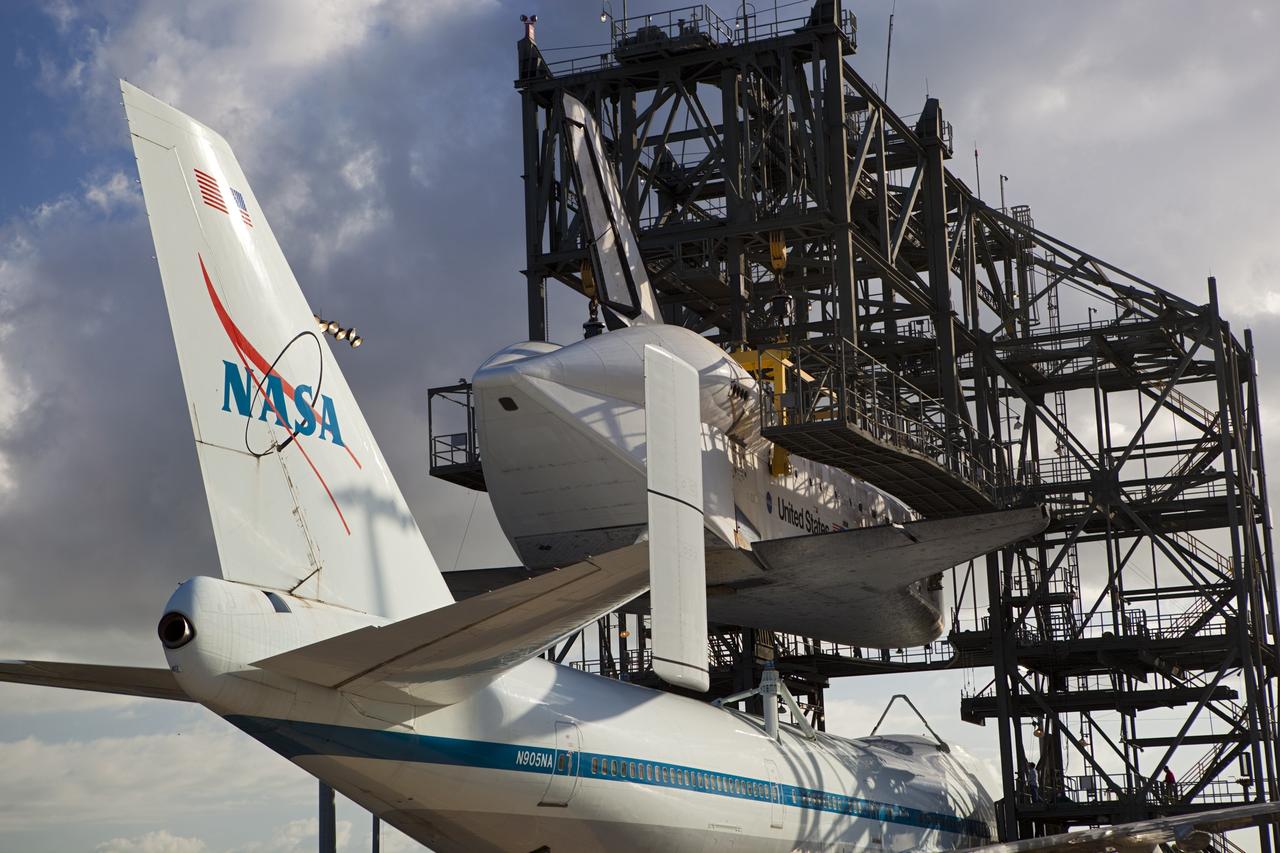
CAPE CANAVERAL, Fla. – At the Shuttle Landing Facility at NASA’s Kennedy Space Center in Florida, the Shuttle Carrier Aircraft moves into position under space shuttle Discovery suspended 60 feet off the ground in the mate-demate device. The device, known as the MDD, is a large gantry-like steel structure used to hoist a shuttle off the ground and position it onto the back of the aircraft, or SCA. The SCA is a Boeing 747 jet, originally manufactured for commercial use, which was modified by NASA to transport the shuttles between destinations on Earth. This SCA, designated NASA 905, is assigned to the remaining ferry missions, delivering the shuttles to their permanent public display sites. NASA 905 is scheduled to ferry Discovery to the Washington Dulles International Airport in Virginia on April 17, after which the shuttle will be placed on display in the Smithsonian's National Air and Space Museum Steven F. Udvar-Hazy Center. For more information on the SCA, visit http://www.nasa.gov/centers/dryden/news/FactSheets/FS-013-DFRC.html. For more information on shuttle transition and retirement activities, visit http://www.nasa.gov/transition. Photo credit: NASA/Dimitri Gerondidakis
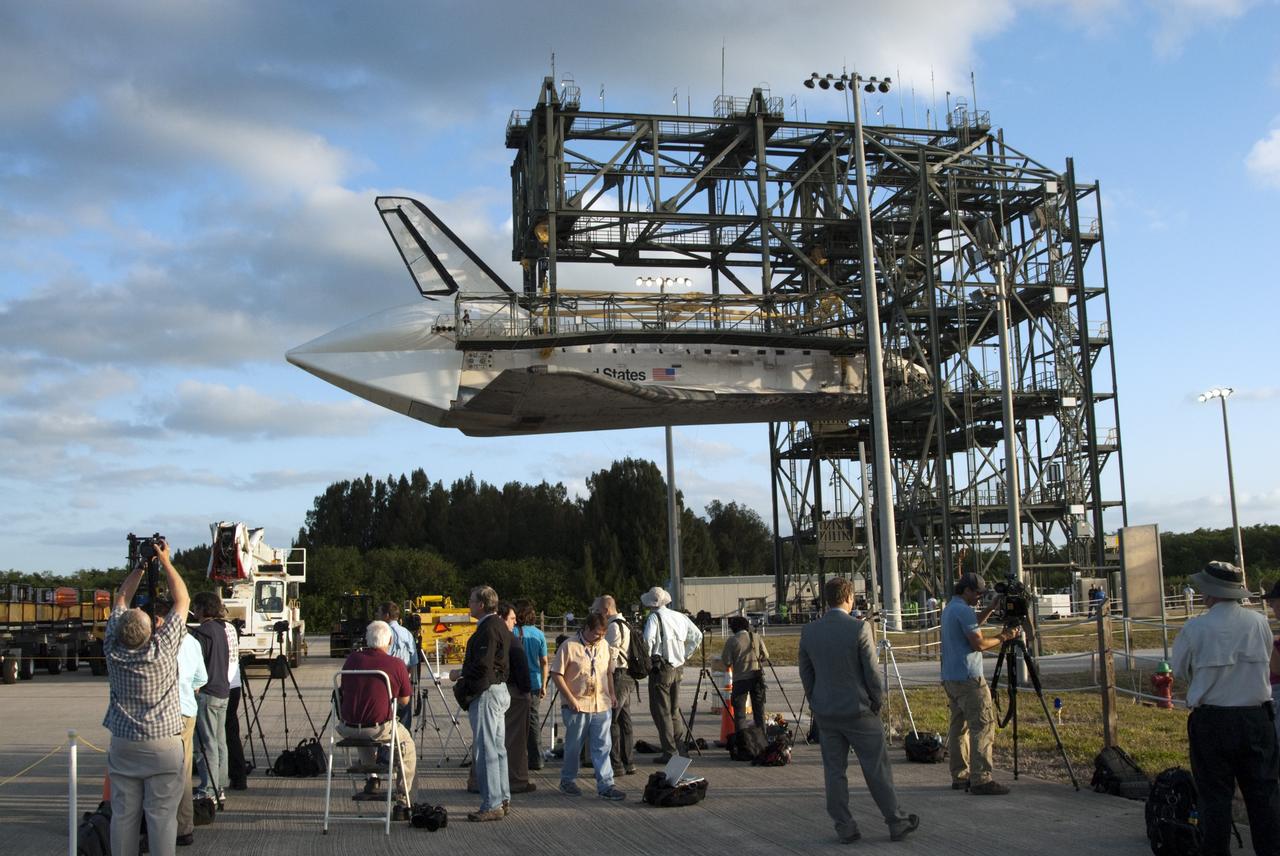
CAPE CANAVERAL, Fla. – At the Shuttle Landing Facility at NASA’s Kennedy Space Center in Florida, media representatives are on hand as space shuttle Discovery is lifted 60 feet off the ground inside the mate-demate device in preparation for the arrival of the Shuttle Carrier Aircraft. The device, known as the MDD, is a large gantry-like steel structure used to hoist a shuttle off the ground and position it onto the back of the aircraft, or SCA. The SCA is a Boeing 747 jet, originally manufactured for commercial use, which was modified by NASA to transport the shuttles between destinations on Earth. The SCA designated NASA 905 is assigned to the remaining ferry missions, delivering the shuttles to their permanent public display sites. NASA 905 is scheduled to ferry Discovery to the Washington Dulles International Airport in Virginia on April 17, after which the shuttle will be placed on display in the Smithsonian's National Air and Space Museum Steven F. Udvar-Hazy Center. For more information on the SCA, visit http://www.nasa.gov/centers/dryden/news/FactSheets/FS-013-DFRC.html. For more information on shuttle transition and retirement activities, visit http://www.nasa.gov/transition. Photo credit: NASA/Tim Jacobs
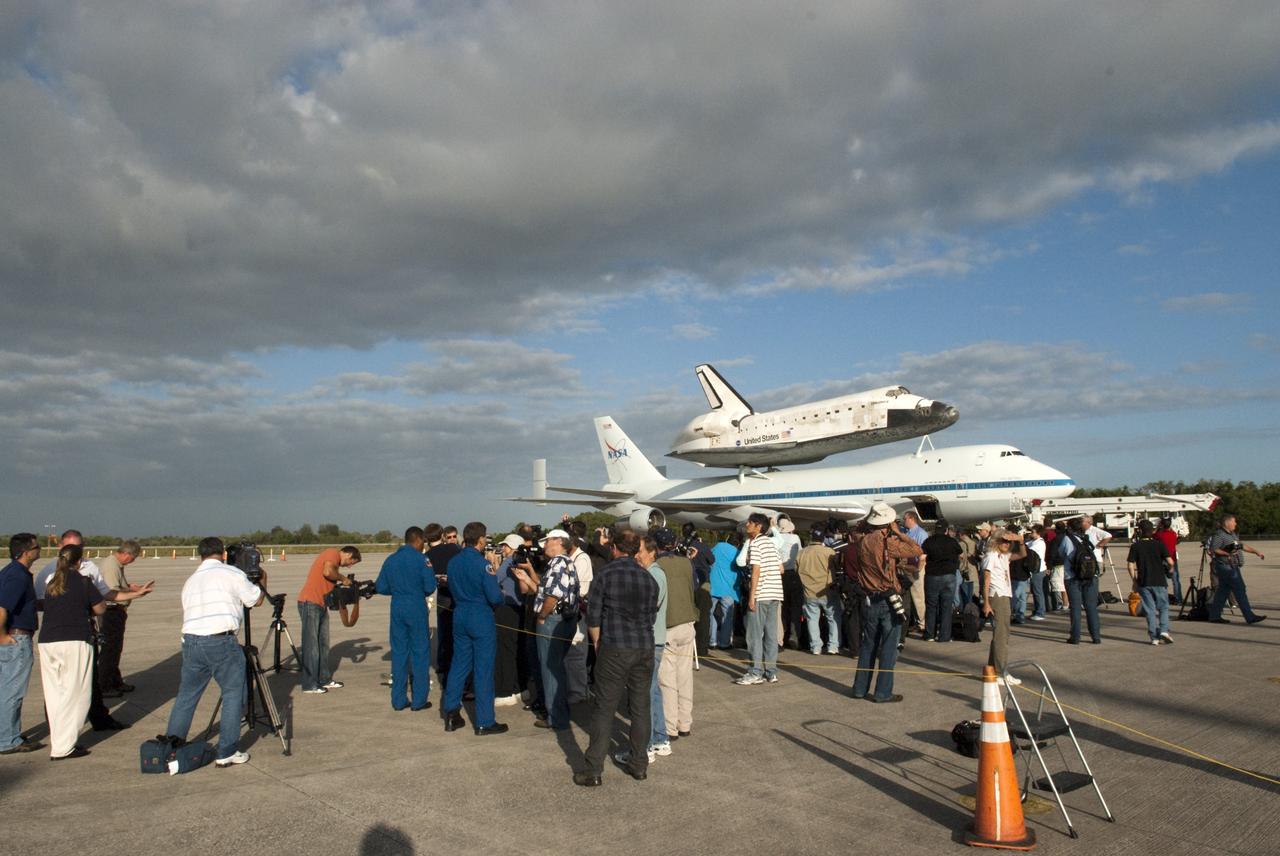
CAPE CANAVERAL, Fla. – At the Shuttle Landing Facility at NASA’s Kennedy Space Center in Florida, media representatives interview members of the last astronaut crew to fly aboard space shuttle Discovery, in the background, which is scheduled to depart from Kennedy for the final time tomorrow morning aboard a Shuttle Carrier Aircraft. Members of the crew of Discovery’s last mission, STS-133, were Commander Steve Lindsey, Pilot Eric Boe, and Mission Specialists Nicole Stott, Michael Barratt, Alvin Drew and Steve Bowen. Also known as an SCA, the aircraft is a Boeing 747 jet, originally manufactured for commercial use, which was modified by NASA to transport the shuttles between destinations on Earth. The SCA designated NASA 905 is assigned to the remaining ferry missions, delivering the shuttles to their permanent public display sites. NASA 905 is scheduled to ferry Discovery to the Washington Dulles International Airport in Virginia on April 17, after which the shuttle will be placed on display in the Smithsonian's National Air and Space Museum Steven F. Udvar-Hazy Center. For more information on the SCA, visit http://www.nasa.gov/centers/dryden/news/FactSheets/FS-013-DFRC.html. For more information on shuttle transition and retirement activities, visit http://www.nasa.gov/transition. Photo credit: NASA/Tim Jacobs
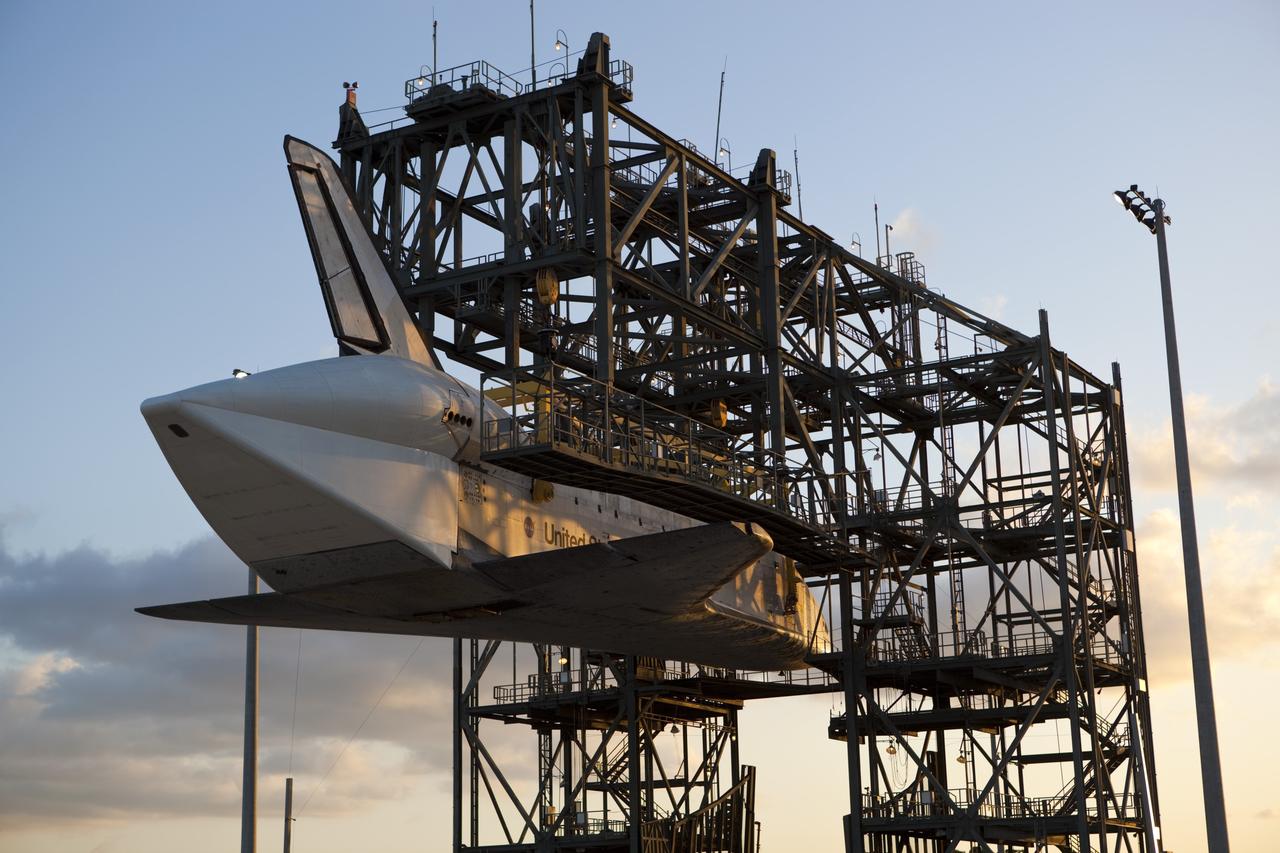
CAPE CANAVERAL, Fla. – At the Shuttle Landing Facility at NASA’s Kennedy Space Center in Florida, space shuttle Discovery is suspended 60 feet off the ground inside the mate-demate device in preparation for the arrival of the Shuttle Carrier Aircraft. The device, known as the MDD, is a large gantry-like steel structure used to hoist a shuttle off the ground and position it onto the back of the aircraft, or SCA. The SCA is a Boeing 747 jet, originally manufactured for commercial use, which was modified by NASA to transport the shuttles between destinations on Earth. The SCA designated NASA 905 is assigned to the remaining ferry missions, delivering the shuttles to their permanent public display sites. NASA 905 is scheduled to ferry Discovery to the Washington Dulles International Airport in Virginia on April 17, after which the shuttle will be placed on display in the Smithsonian's National Air and Space Museum Steven F. Udvar-Hazy Center. For more information on the SCA, visit http://www.nasa.gov/centers/dryden/news/FactSheets/FS-013-DFRC.html. For more information on shuttle transition and retirement activities, visit http://www.nasa.gov/transition. Photo credit: NASA/Dimitri Gerondidakis
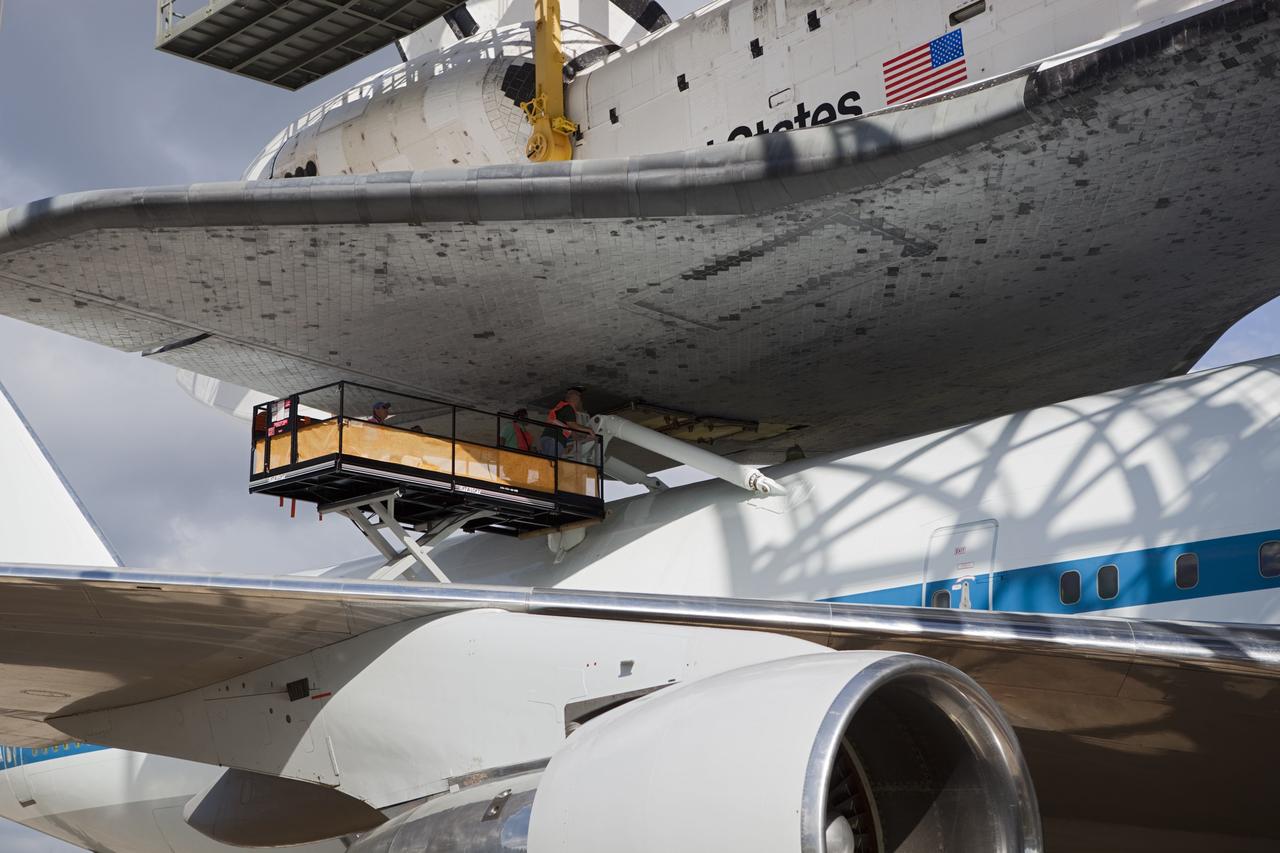
CAPE CANAVERAL, Fla. – At the Shuttle Landing Facility at NASA’s Kennedy Space Center in Florida, workers attach space shuttle Discovery to the Shuttle Carrier Aircraft in the mate-demate device. The device, known as the MDD, is a large gantry-like steel structure used to hoist a shuttle off the ground and position it onto the back of the aircraft, or SCA. The SCA is a Boeing 747 jet, originally manufactured for commercial use, which was modified by NASA to transport the shuttles between destinations on Earth. This SCA, designated NASA 905, is assigned to the remaining ferry missions, delivering the shuttles to their permanent public display sites. NASA 905 is scheduled to ferry Discovery to the Washington Dulles International Airport in Virginia on April 17, after which the shuttle will be placed on display in the Smithsonian's National Air and Space Museum Steven F. Udvar-Hazy Center. For more information on the SCA, visit http://www.nasa.gov/centers/dryden/news/FactSheets/FS-013-DFRC.html. For more information on shuttle transition and retirement activities, visit http://www.nasa.gov/transition. Photo credit: NASA/Dimitri Gerondidakis
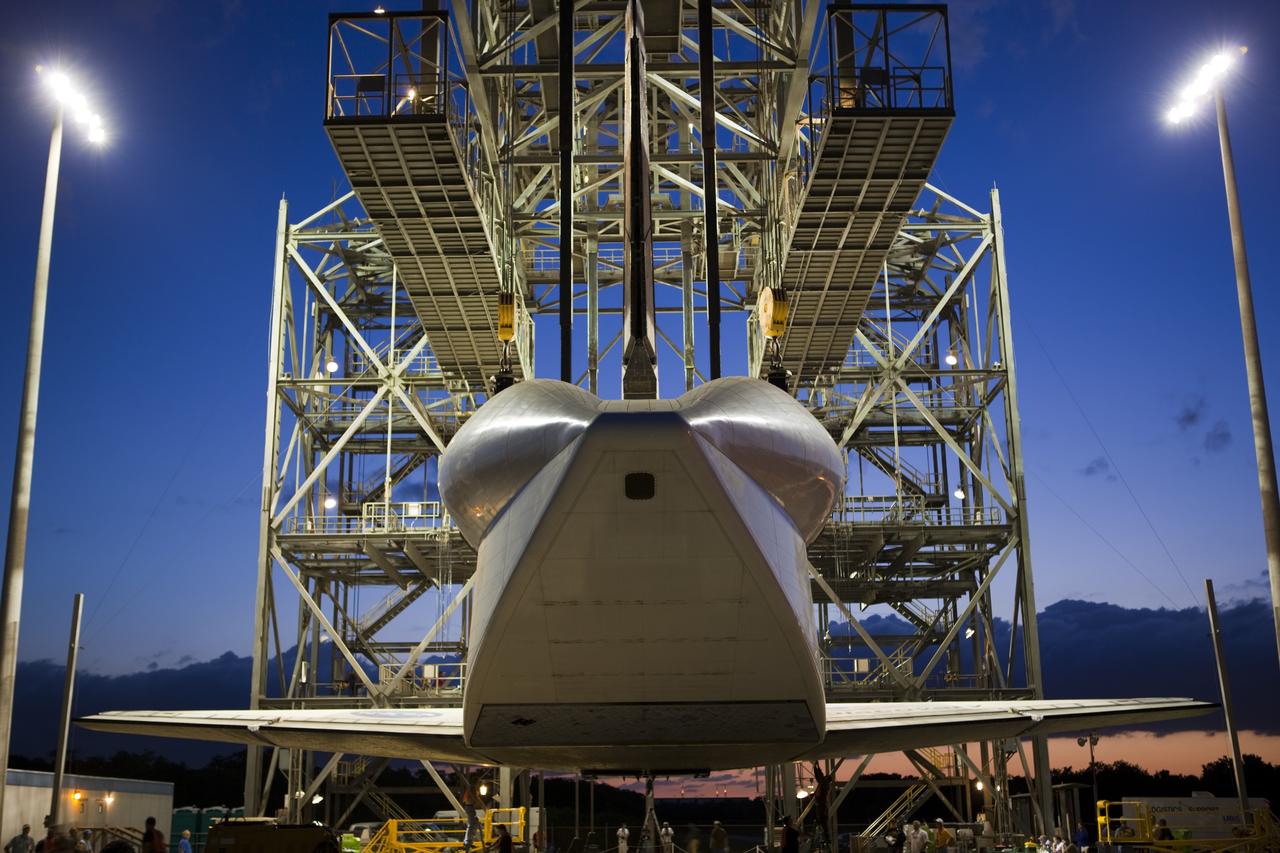
CAPE CANAVERAL, Fla. – Before daybreak at the Shuttle Landing Facility at NASA’s Kennedy Space Center in Florida, operations are under way at the mate-demate device to lift space shuttle Discovery on top of a Shuttle Carrier Aircraft. A tail cone has been installed over Discovery’s three replica shuttle main engines to reduce aerodynamic drag and turbulence during the ferry flight. The device, known as the MDD, is a large gantry-like steel structure used to hoist a shuttle off the ground and position it onto the back of the aircraft, or SCA. The SCA is a Boeing 747 jet, originally manufactured for commercial use, which was modified by NASA to transport the shuttles between destinations on Earth. The SCA designated NASA 905 is assigned to the remaining ferry missions, delivering the shuttles to their permanent public display sites. NASA 905 is scheduled to ferry Discovery to the Washington Dulles International Airport in Virginia on April 17, after which the shuttle will be placed on display in the Smithsonian's National Air and Space Museum Steven F. Udvar-Hazy Center. For more information on the SCA, visit http://www.nasa.gov/centers/dryden/news/FactSheets/FS-013-DFRC.html. For more information on shuttle transition and retirement activities, visit http://www.nasa.gov/transition. Photo credit: NASA/Dimitri Gerondidakis
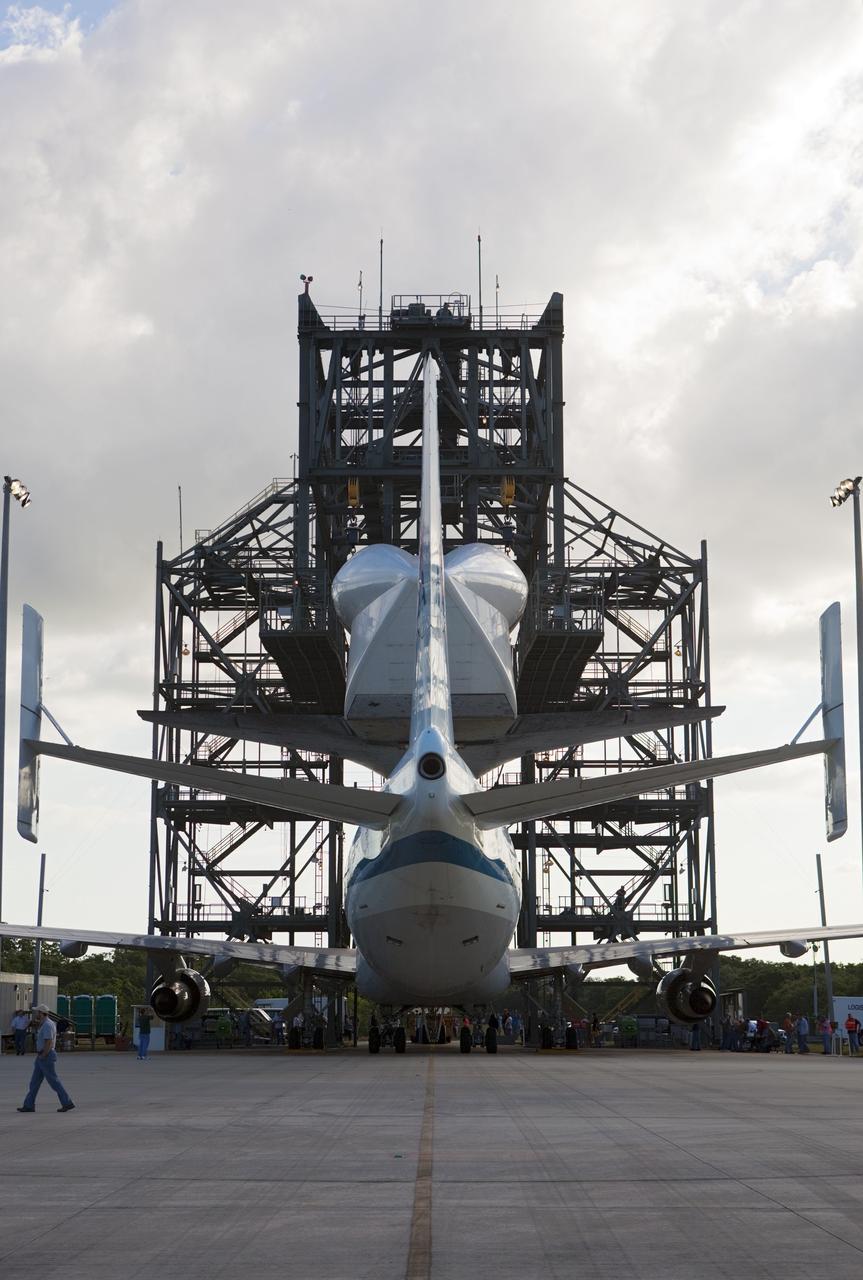
CAPE CANAVERAL, Fla. – At the Shuttle Landing Facility at NASA’s Kennedy Space Center in Florida, space shuttle Discovery is lowered onto the Shuttle Carrier Aircraft in the mate-demate device during mating operations. The device, known as the MDD, is a large gantry-like steel structure used to hoist a shuttle off the ground and position it onto the back of the aircraft, or SCA. The SCA is a Boeing 747 jet, originally manufactured for commercial use, which was modified by NASA to transport the shuttles between destinations on Earth. This SCA, designated NASA 905, is assigned to the remaining ferry missions, delivering the shuttles to their permanent public display sites. NASA 905 is scheduled to ferry Discovery to the Washington Dulles International Airport in Virginia on April 17, after which the shuttle will be placed on display in the Smithsonian's National Air and Space Museum Steven F. Udvar-Hazy Center. For more information on the SCA, visit http://www.nasa.gov/centers/dryden/news/FactSheets/FS-013-DFRC.html. For more information on shuttle transition and retirement activities, visit http://www.nasa.gov/transition. Photo credit: NASA/Dimitri Gerondidakis
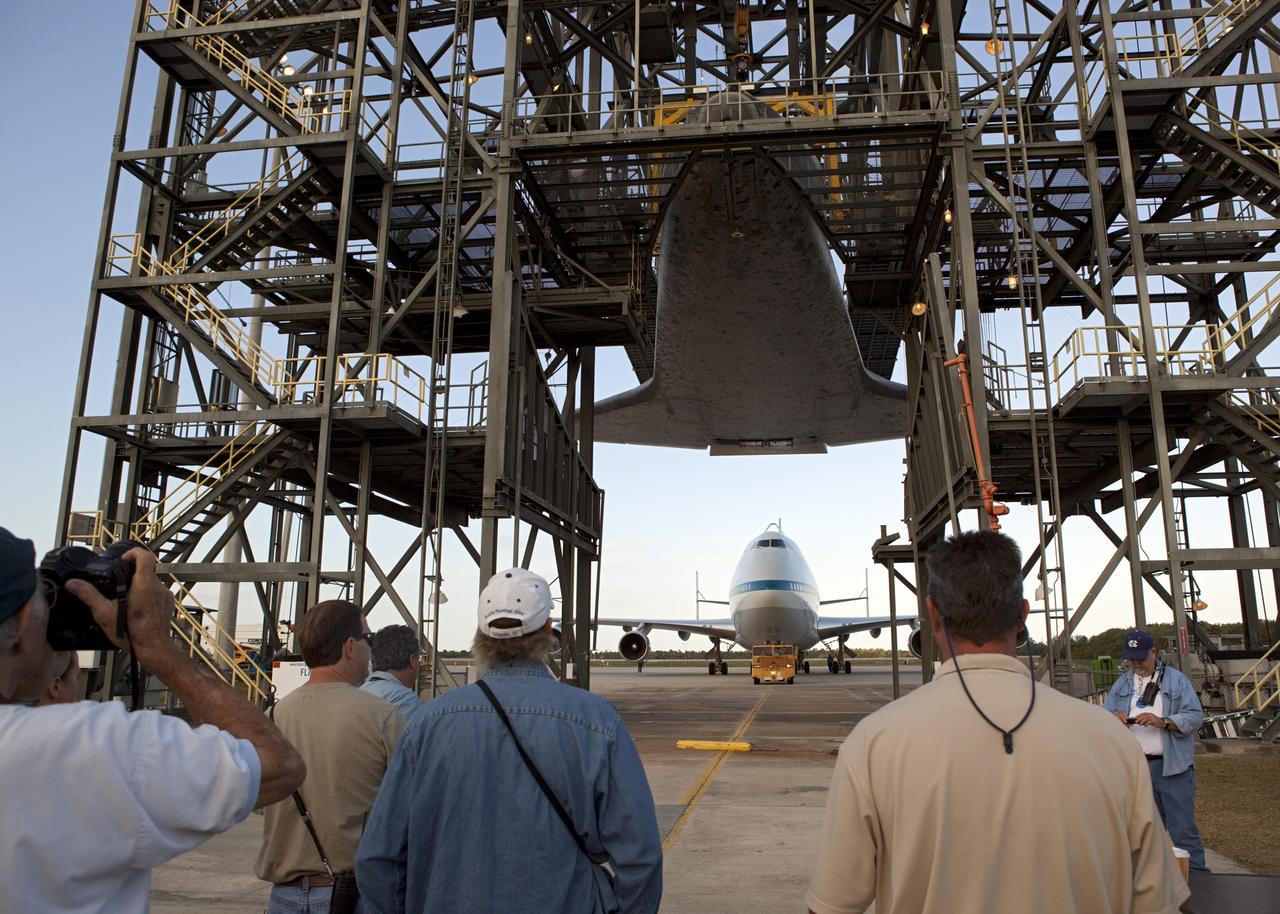
CAPE CANAVERAL, Fla. – At the Shuttle Landing Facility at NASA’s Kennedy Space Center in Florida, workers are standing by for the arrival of the Shuttle Carrier Aircraft under space shuttle Discovery suspended 60 feet off the ground inside the mate-demate device. The device, known as the MDD, is a large gantry-like steel structure used to hoist a shuttle off the ground and position it onto the back of the aircraft, or SCA. The SCA is a Boeing 747 jet, originally manufactured for commercial use, which was modified by NASA to transport the shuttles between destinations on Earth. This SCA, designated NASA 905, is assigned to the remaining ferry missions, delivering the shuttles to their permanent public display sites. NASA 905 is scheduled to ferry Discovery to the Washington Dulles International Airport in Virginia on April 17, after which the shuttle will be placed on display in the Smithsonian's National Air and Space Museum Steven F. Udvar-Hazy Center. For more information on the SCA, visit http://www.nasa.gov/centers/dryden/news/FactSheets/FS-013-DFRC.html. For more information on shuttle transition and retirement activities, visit http://www.nasa.gov/transition. Photo credit: NASA/Dimitri Gerondidakis
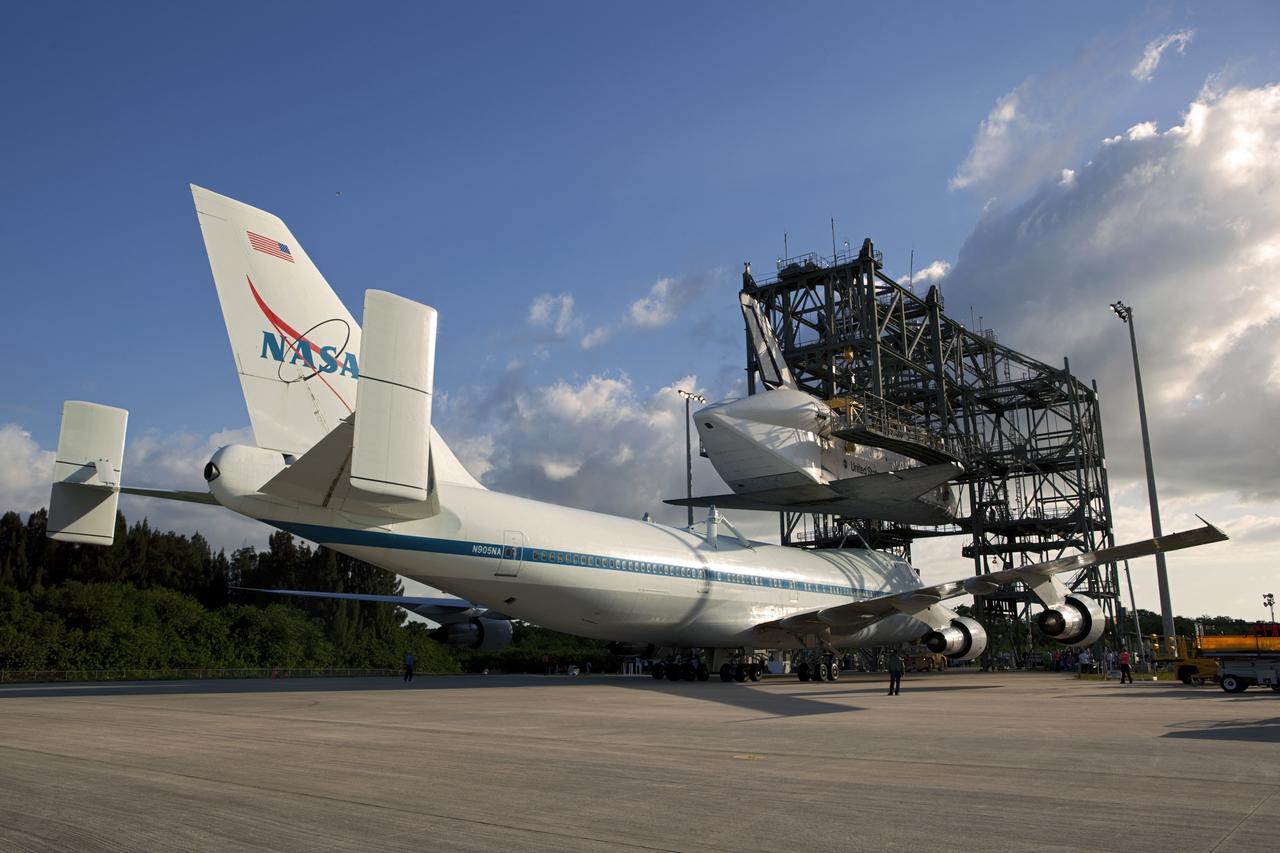
CAPE CANAVERAL, Fla. – At the Shuttle Landing Facility at NASA’s Kennedy Space Center in Florida, the Shuttle Carrier Aircraft moves into position under space shuttle Discovery suspended 60 feet off the ground in the mate-demate device. The device, known as the MDD, is a large gantry-like steel structure used to hoist a shuttle off the ground and position it onto the back of the aircraft, or SCA. The SCA is a Boeing 747 jet, originally manufactured for commercial use, which was modified by NASA to transport the shuttles between destinations on Earth. This SCA, designated NASA 905, is assigned to the remaining ferry missions, delivering the shuttles to their permanent public display sites. NASA 905 is scheduled to ferry Discovery to the Washington Dulles International Airport in Virginia on April 17, after which the shuttle will be placed on display in the Smithsonian's National Air and Space Museum Steven F. Udvar-Hazy Center. For more information on the SCA, visit http://www.nasa.gov/centers/dryden/news/FactSheets/FS-013-DFRC.html. For more information on shuttle transition and retirement activities, visit http://www.nasa.gov/transition. Photo credit: NASA/Dimitri Gerondidakis
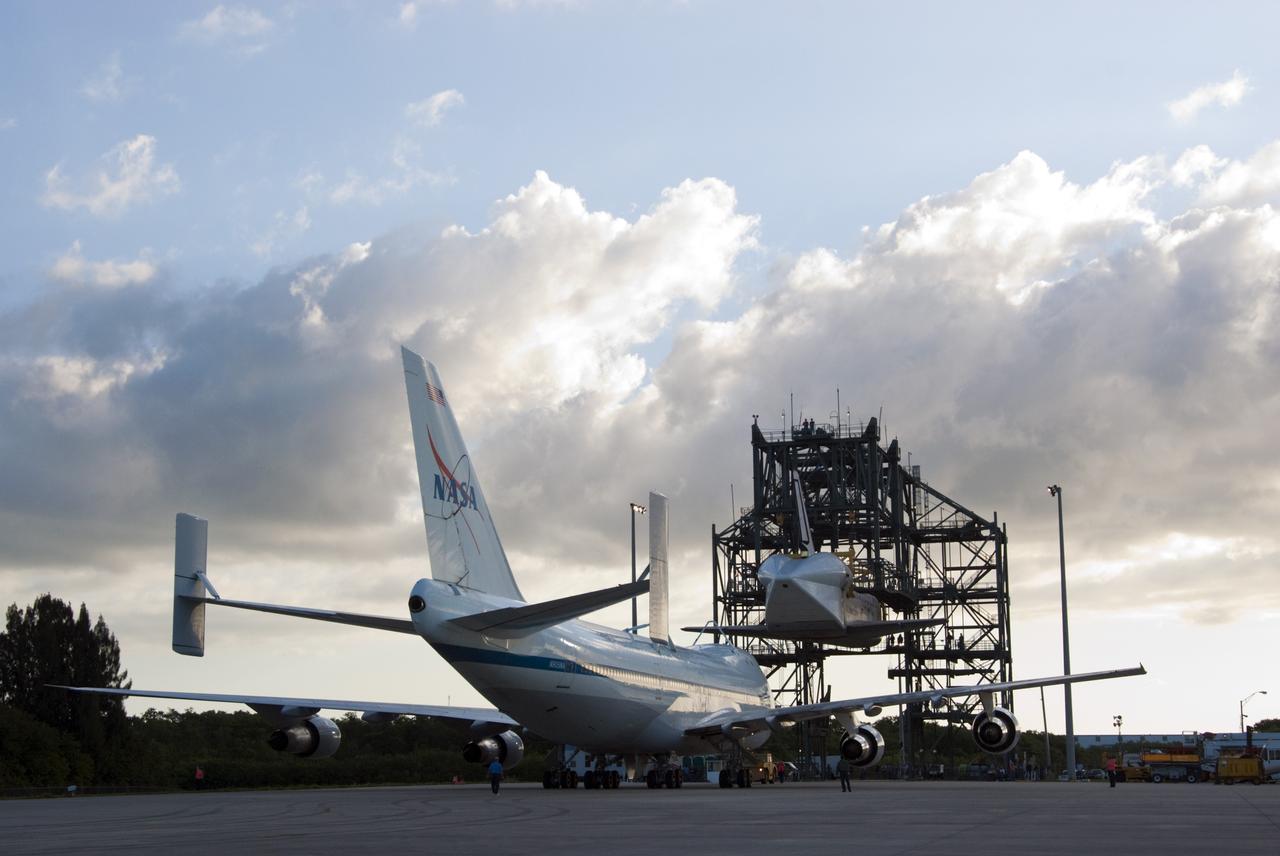
CAPE CANAVERAL, Fla. – At the Shuttle Landing Facility at NASA’s Kennedy Space Center in Florida, the Shuttle Carrier Aircraft moves into position under space shuttle Discovery in the mate-demate device. The device, known as the MDD, is a large gantry-like steel structure used to hoist a shuttle off the ground and position it onto the back of the aircraft, or SCA. This SCA, designated NASA 905, is a Boeing 747 jet originally manufactured for commercial use, which was modified by NASA to transport the shuttles between destinations on Earth. NASA 905 is assigned to the remaining ferry missions, delivering the shuttles to their permanent public display sites. Discovery’s new home will be the Smithsonian's National Air and Space Museum Steven F. Udvar-Hazy Center in Chantilly, Va. For more information on the SCA, visit http://www.nasa.gov/centers/dryden/news/FactSheets/FS-013-DFRC.html. For more information on shuttle transition and retirement activities, visit http://www.nasa.gov/transition. Photo credit: NASA/Tim Jacobs
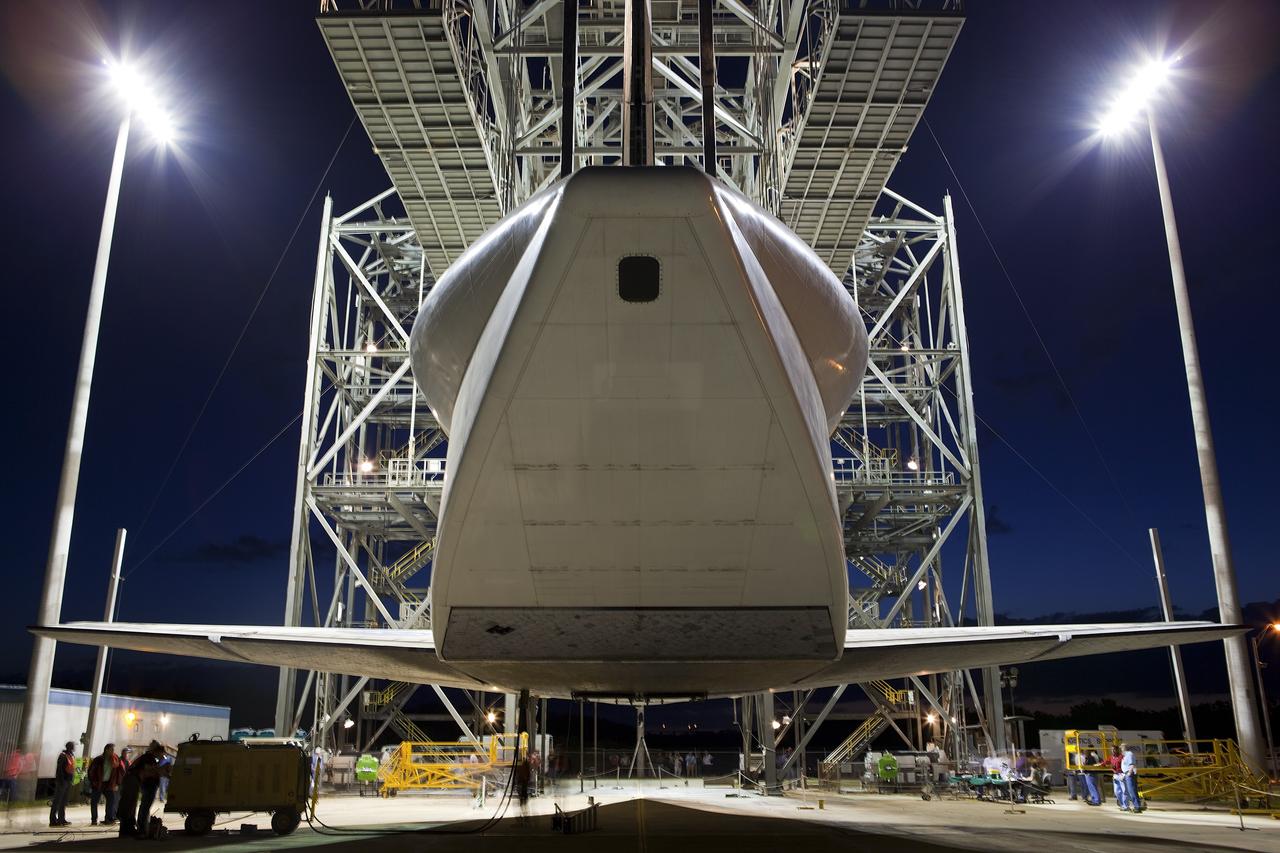
CAPE CANAVERAL, Fla. – Before daybreak at the Shuttle Landing Facility at NASA’s Kennedy Space Center in Florida, space shuttle Discovery hovers above the ground at the mate-demate device. Operations are under way to position Discovery on top of a Shuttle Carrier Aircraft in preparation for its departure from Kennedy on Tuesday. A tail cone has been installed over Discovery’s three replica shuttle main engines to reduce aerodynamic drag and turbulence during the ferry flight. The device, known as the MDD, is a large gantry-like steel structure used to hoist a shuttle off the ground and position it onto the back of the aircraft, or SCA. The SCA is a Boeing 747 jet, originally manufactured for commercial use, which was modified by NASA to transport the shuttles between destinations on Earth. The SCA designated NASA 905 is assigned to the remaining ferry missions, delivering the shuttles to their permanent public display sites. NASA 905 is scheduled to ferry Discovery to the Washington Dulles International Airport in Virginia on April 17, after which the shuttle will be placed on display in the Smithsonian's National Air and Space Museum Steven F. Udvar-Hazy Center. For more information on the SCA, visit http://www.nasa.gov/centers/dryden/news/FactSheets/FS-013-DFRC.html. For more information on shuttle transition and retirement activities, visit http://www.nasa.gov/transition. Photo credit: NASA/Dimitri Gerondidakis
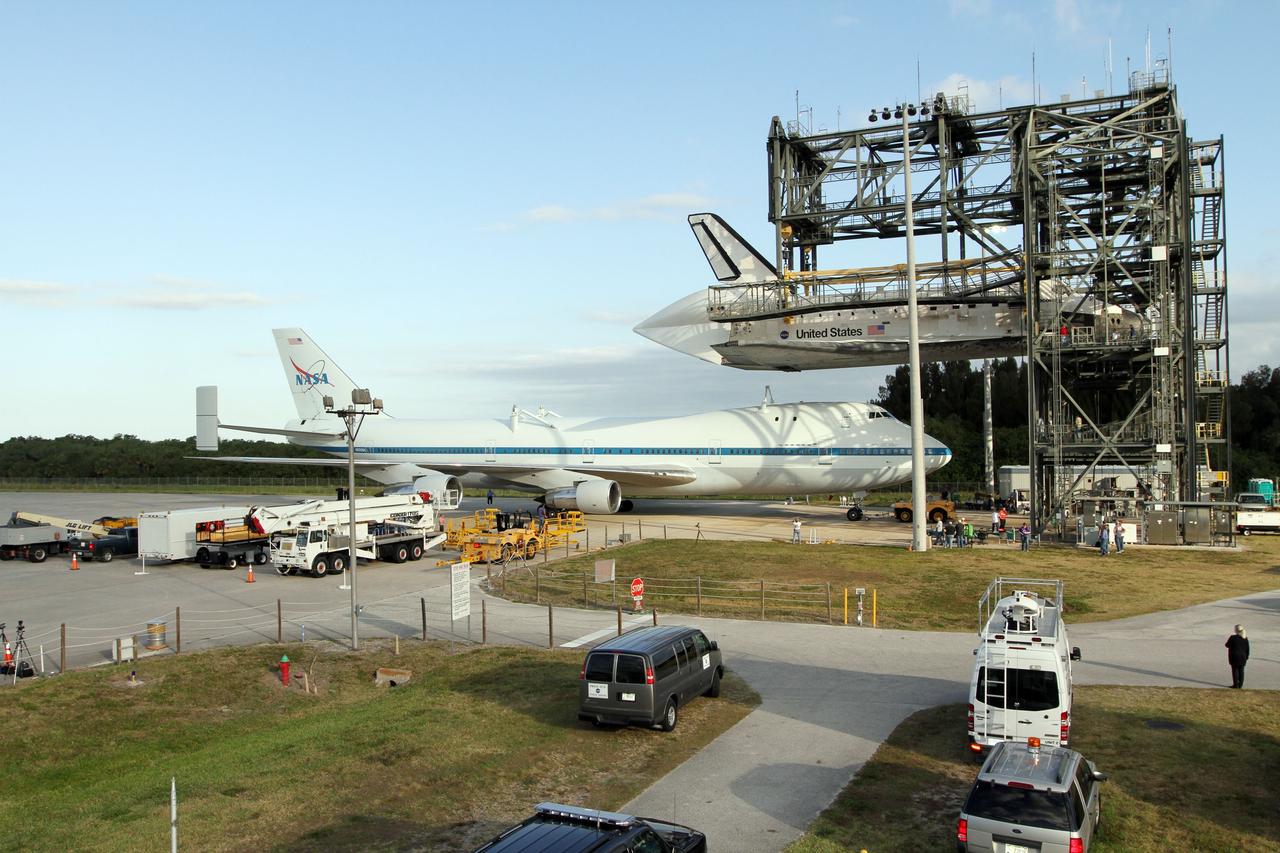
CAPE CANAVERAL, Fla. – At the Shuttle Landing Facility at NASA’s Kennedy Space Center in Florida, the Shuttle Carrier Aircraft moves into position under space shuttle Discovery suspended 60 feet off the ground in the mate-demate device. The device, known as the MDD, is a large gantry-like steel structure used to hoist a shuttle off the ground and position it onto the back of the aircraft, or SCA. The SCA is a Boeing 747 jet, originally manufactured for commercial use, which was modified by NASA to transport the shuttles between destinations on Earth. The SCA designated NASA 905 is assigned to the remaining ferry missions, delivering the shuttles to their permanent public display sites. NASA 905 is scheduled to ferry Discovery to the Washington Dulles International Airport in Virginia on April 17, after which the shuttle will be placed on display in the Smithsonian's National Air and Space Museum Steven F. Udvar-Hazy Center. For more information on the SCA, visit http://www.nasa.gov/centers/dryden/news/FactSheets/FS-013-DFRC.html. For more information on shuttle transition and retirement activities, visit http://www.nasa.gov/transition. Photo credit: NASA/Kim Shiflett
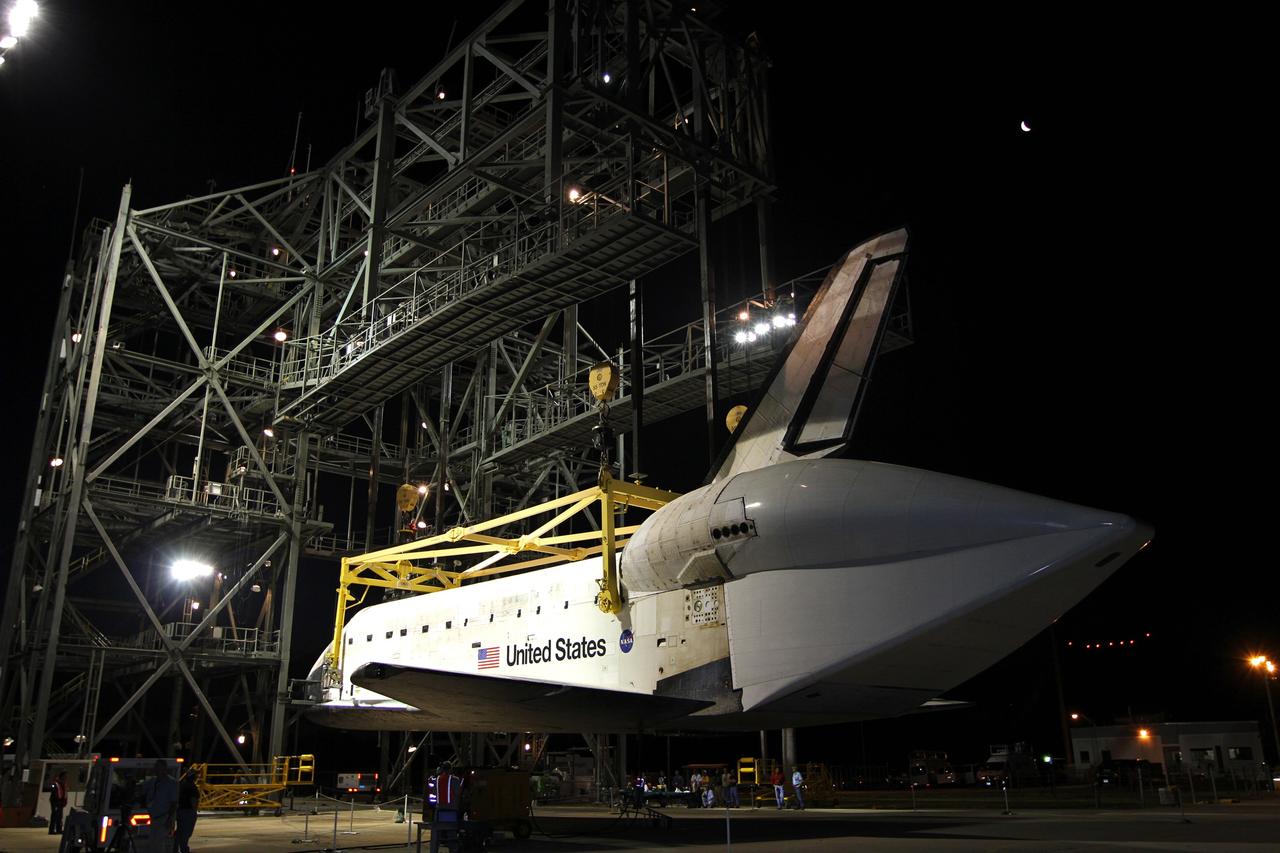
CAPE CANAVERAL, Fla. – Before sunrise at the Shuttle Landing Facility at NASA’s Kennedy Space Center in Florida, space shuttle Discovery is lifted into the mate-demate device by a crane hooked to the yellow sling. Operations have resumed to place Discovery on top of a Shuttle Carrier Aircraft in preparation for its departure from Kennedy on Tuesday. A tail cone has been installed over Discovery’s three replica shuttle main engines to reduce aerodynamic drag and turbulence during the ferry flight. The device, known as the MDD, is a large gantry-like steel structure used to hoist a shuttle off the ground and position it onto the back of the aircraft, or SCA. The SCA is a Boeing 747 jet, originally manufactured for commercial use, which was modified by NASA to transport the shuttles between destinations on Earth. The SCA designated NASA 905 is assigned to the remaining ferry missions, delivering the shuttles to their permanent public display sites. NASA 905 is scheduled to ferry Discovery to the Washington Dulles International Airport in Virginia on April 17, after which the shuttle will be placed on display in the Smithsonian's National Air and Space Museum Steven F. Udvar-Hazy Center. For more information on the SCA, visit http://www.nasa.gov/centers/dryden/news/FactSheets/FS-013-DFRC.html. For more information on shuttle transition and retirement activities, visit http://www.nasa.gov/transition. Photo credit: NASA/Kim Shiflett
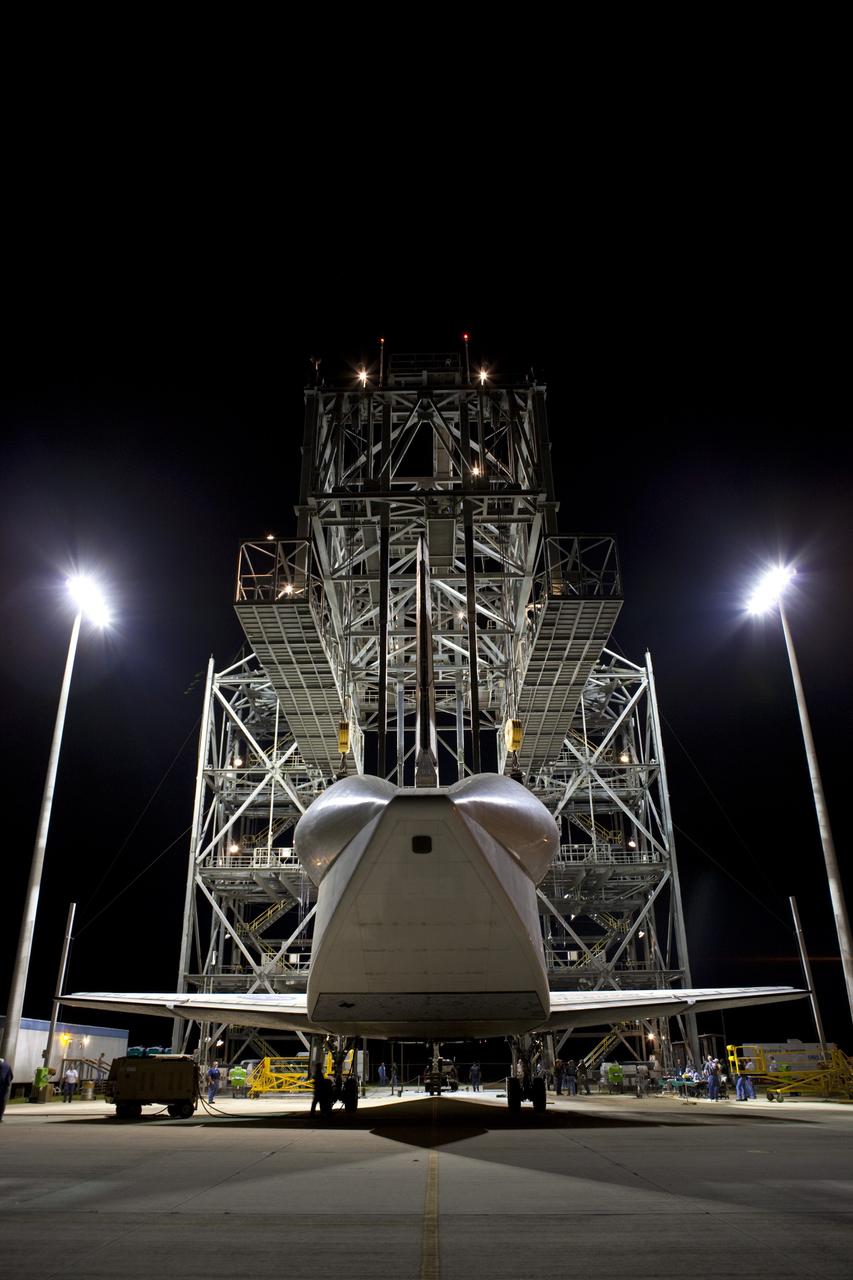
CAPE CANAVERAL, Fla. – Before daybreak at the Shuttle Landing Facility at NASA’s Kennedy Space Center in Florida, preparations are under way at the mate-demate device to resume mating operations of space shuttle Discovery to a Shuttle Carrier Aircraft. A tail cone covers Discovery’s three replica shuttle main engines to reduce aerodynamic drag and turbulence during the ferry flight. The device, known as the MDD, is a large gantry-like steel structure used to hoist a shuttle off the ground and position it onto the back of the aircraft, or SCA. The SCA is a Boeing 747 jet, originally manufactured for commercial use, which was modified by NASA to transport the shuttles between destinations on Earth. The SCA designated NASA 905 is assigned to the remaining ferry missions, delivering the shuttles to their permanent public display sites. NASA 905 is scheduled to ferry Discovery to the Washington Dulles International Airport in Virginia on April 17, after which the shuttle will be placed on display in the Smithsonian's National Air and Space Museum Steven F. Udvar-Hazy Center. For more information on the SCA, visit http://www.nasa.gov/centers/dryden/news/FactSheets/FS-013-DFRC.html. For more information on shuttle transition and retirement activities, visit http://www.nasa.gov/transition. Photo credit: NASA/Dimitri Gerondidakis
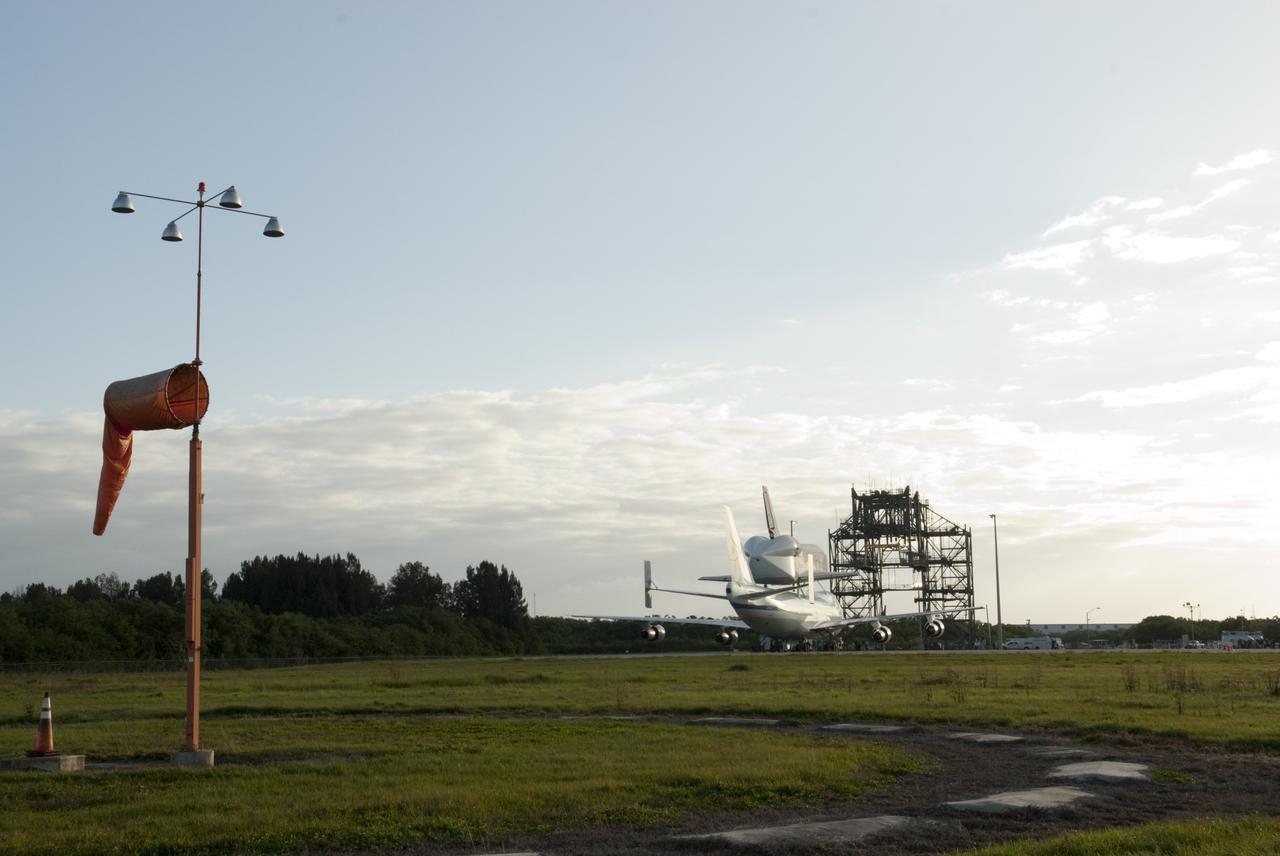
CAPE CANAVERAL, Fla. – At the Shuttle Landing Facility at NASA’s Kennedy Space Center in Florida, no weather constraints to the planned flight plan are detected for departure tomorrow morning of the Shuttle Carrier Aircraft with space shuttle Discovery secured to its back. In the distance, at right, is the mate/demate device used to lift Discovery onto the aircraft. The device, also known as the MDD, is a large gantry-like steel structure used to hoist a shuttle off the ground and position it onto the back of the aircraft, or SCA. The SCA is a Boeing 747 jet, originally manufactured for commercial use, which was modified by NASA to transport the shuttles between destinations on Earth. The SCA designated NASA 905 is assigned to the remaining ferry missions, delivering the shuttles to their permanent public display sites. NASA 905 is scheduled to ferry Discovery to the Washington Dulles International Airport in Virginia on April 17, after which the shuttle will be placed on display in the Smithsonian's National Air and Space Museum Steven F. Udvar-Hazy Center. For more information on the SCA, visit http://www.nasa.gov/centers/dryden/news/FactSheets/FS-013-DFRC.html. For more information on shuttle transition and retirement activities, visit http://www.nasa.gov/transition. Photo credit: NASA/Tim Jacobs The aircraft, also known as an SCA, is a Boeing 747 jet, originally manufactured for commercial use, which was modified by NASA to transport the shuttles between destinations on Earth. The SCA designated NASA 905 is assigned to the remaining ferry missions, delivering the shuttles to their permanent public display sites. NASA 905 is scheduled to ferry Discovery to the Washington Dulles International Airport in Virginia on April 17, after which the shuttle will be placed on display in the Smithsonian's National Air and Space Museum Steven F. Udvar-Hazy Center. For more information on the SCA, visit http://www.nasa.gov/centers/dryden/news/FactSheets/FS-013-DFRC.html. For more information on shuttle transition and retirement activities, visit http://www.nasa.gov/transition. Photo credit: NASA/Tim Jacobs
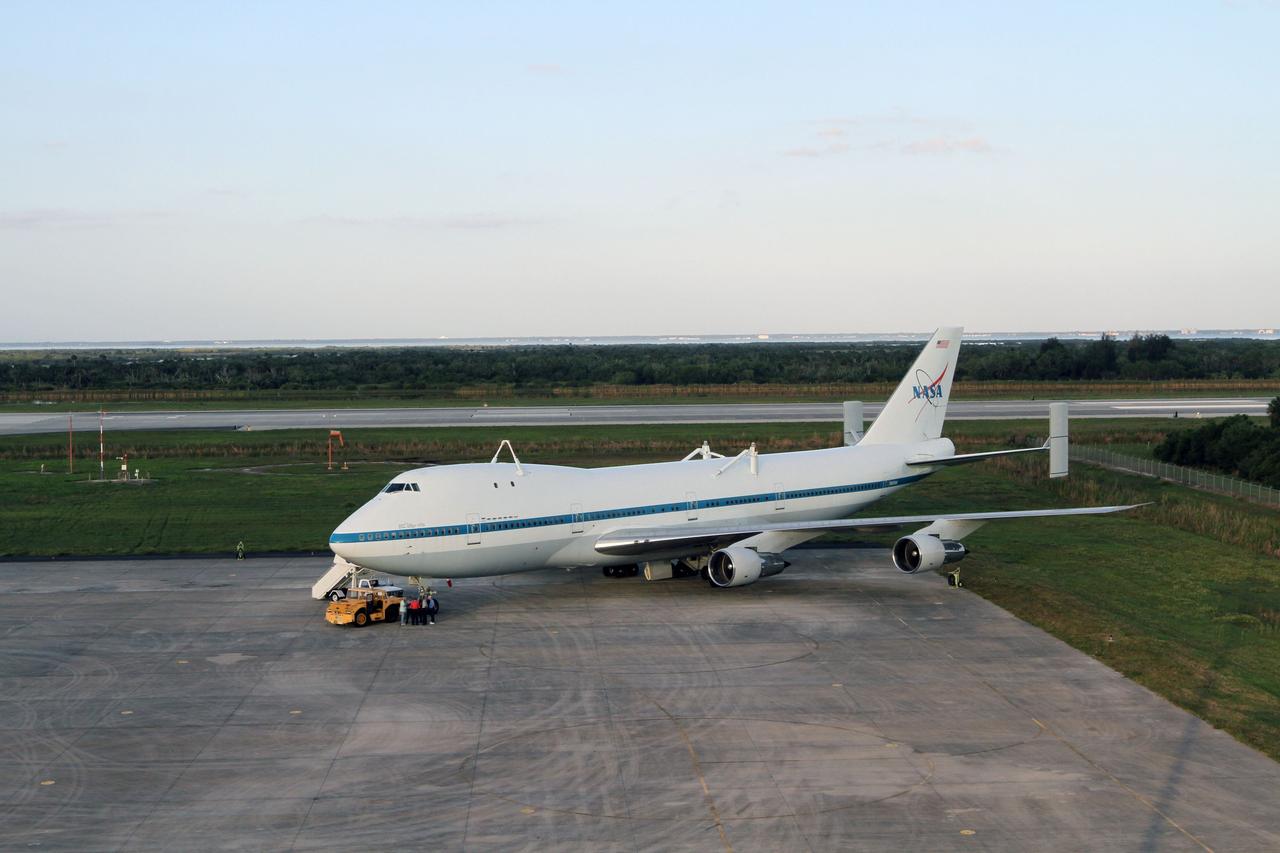
CAPE CANAVERAL, Fla. – At the Shuttle Landing Facility at NASA’s Kennedy Space Center in Florida, workers prepare to tow a Shuttle Carrier Aircraft to the mate-demate device for mating with space shuttle Discovery. This SCA, designated NASA 905, is a Boeing 747 jet originally manufactured for commercial use, which was modified by NASA to transport the shuttles between destinations on Earth. NASA 905 is assigned to the remaining ferry missions, delivering the shuttles to their permanent public display sites. Discovery’s new home will be the Smithsonian's National Air and Space Museum Steven F. Udvar-Hazy Center in Chantilly, Va. For more information on the SCA, visit http://www.nasa.gov/centers/dryden/news/FactSheets/FS-013-DFRC.html. For more information on shuttle transition and retirement activities, visit http://www.nasa.gov/transition. Photo credit: NASA/Kim Shiflett
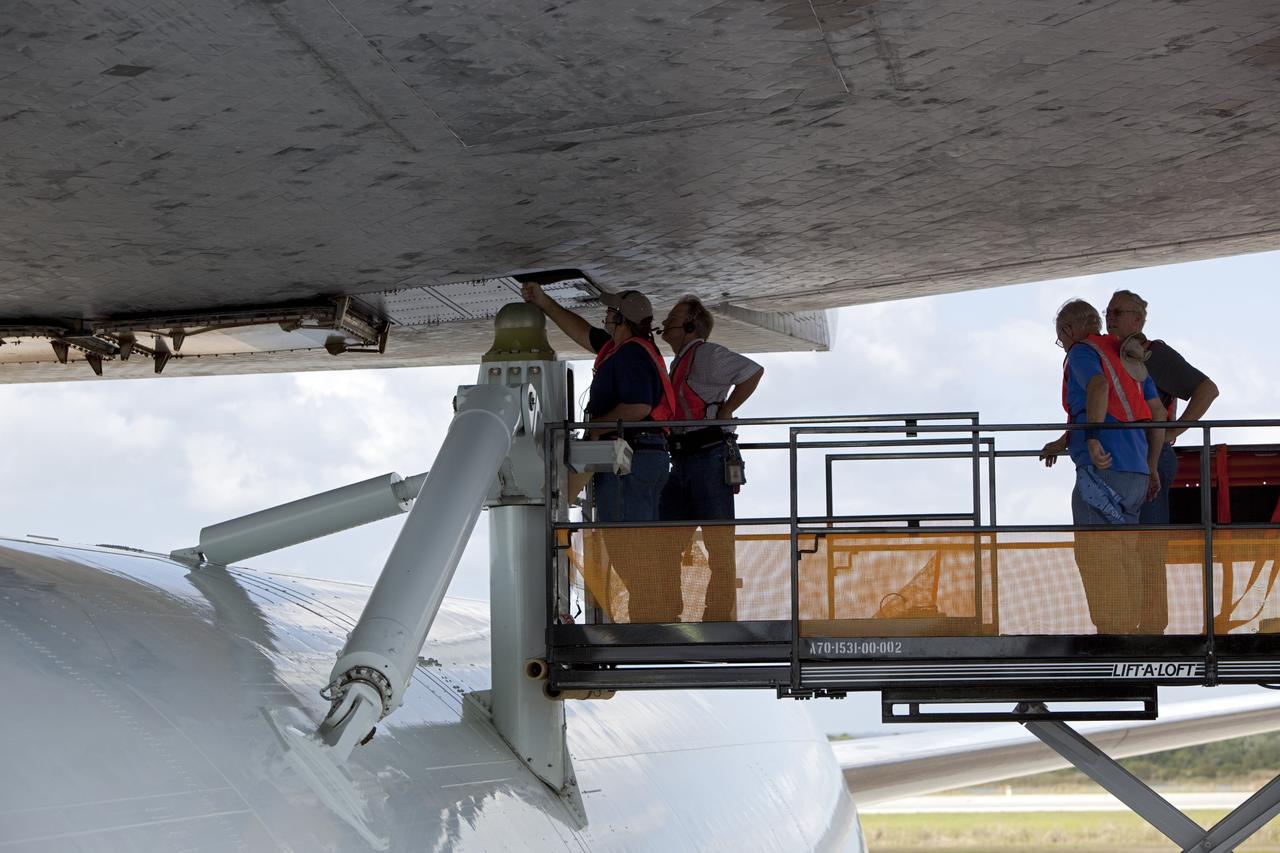
CAPE CANAVERAL, Fla. – At the Shuttle Landing Facility at NASA’s Kennedy Space Center in Florida, workers attach space shuttle Discovery to the Shuttle Carrier Aircraft in the mate-demate device. The device, known as the MDD, is a large gantry-like steel structure used to hoist a shuttle off the ground and position it onto the back of the aircraft, or SCA. The SCA is a Boeing 747 jet, originally manufactured for commercial use, which was modified by NASA to transport the shuttles between destinations on Earth. This SCA, designated NASA 905, is assigned to the remaining ferry missions, delivering the shuttles to their permanent public display sites. NASA 905 is scheduled to ferry Discovery to the Washington Dulles International Airport in Virginia on April 17, after which the shuttle will be placed on display in the Smithsonian's National Air and Space Museum Steven F. Udvar-Hazy Center. For more information on the SCA, visit http://www.nasa.gov/centers/dryden/news/FactSheets/FS-013-DFRC.html. For more information on shuttle transition and retirement activities, visit http://www.nasa.gov/transition. Photo credit: NASA/Dimitri Gerondidakis

CAPE CANAVERAL, Fla. – This is an aerial view of the long Shuttle Landing Facility SLF runway at NASA's Kennedy Space Center in Florida that space shuttle Discovery, bolted to the top of a Shuttle Carrier Aircraft SCA, will take off from on April 17. Discovery's last crew members are expected to be at the runway, along with Kennedy employees and guests, as the center says goodbye to the agency's most-flown shuttle. The SCA, designated NASA 905, will ferry Discovery to the Washington Dulles International Airport in Virginia, after which the shuttle will be moved for public display in the Smithsonian's National Air and Space Museum Steven F. Udvar-Hazy Center on April 19. For more information on the SCA, visit http://www.nasa.gov/centers/dryden/news/FactSheets/FS-013-DFRC.html. For more information on shuttle transition and retirement activities, visit http://www.nasa.gov/transition. Photo credit: NASA/Kim Shiflett
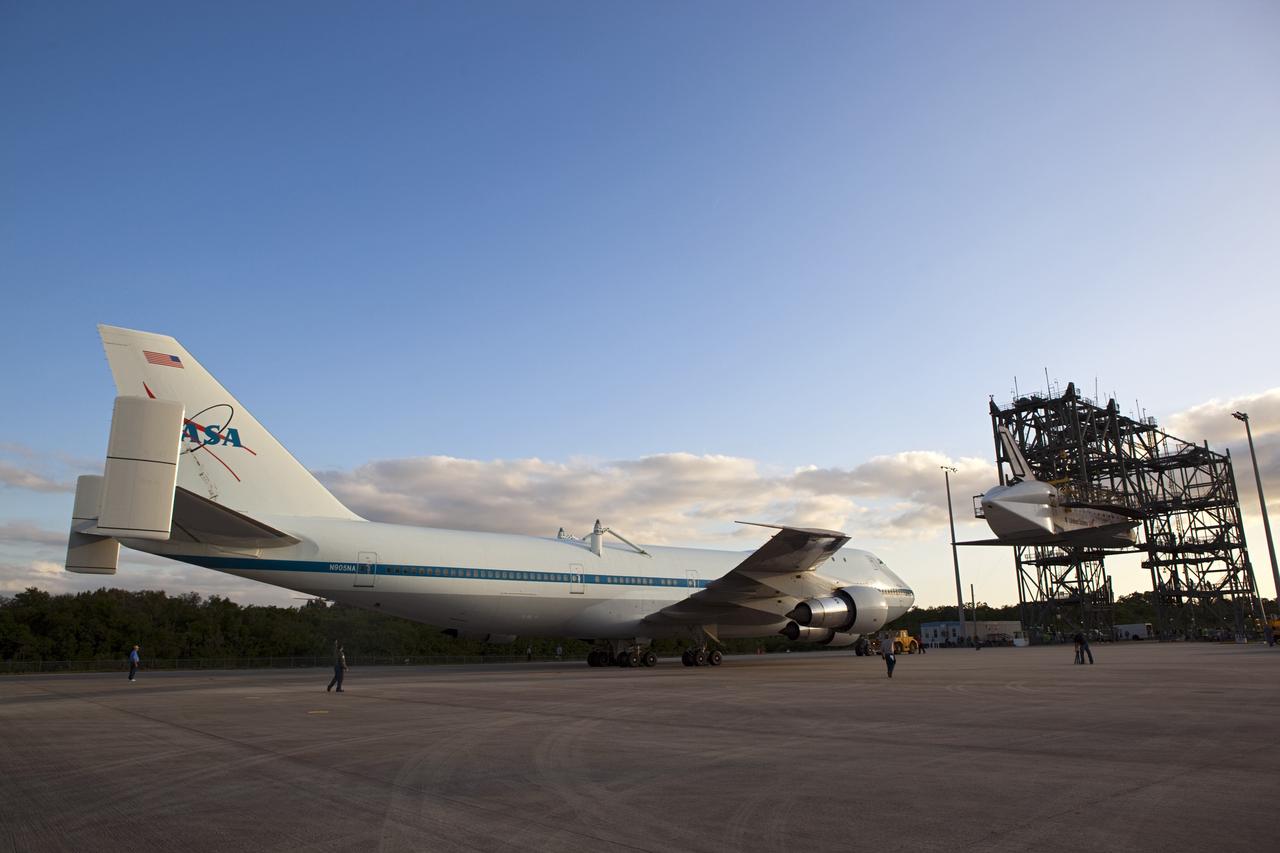
CAPE CANAVERAL, Fla. – At the Shuttle Landing Facility at NASA’s Kennedy Space Center in Florida, the Shuttle Carrier Aircraft moves into position under space shuttle Discovery suspended 60 feet off the ground in the mate-demate device. The device, known as the MDD, is a large gantry-like steel structure used to hoist a shuttle off the ground and position it onto the back of the aircraft, or SCA. This SCA, designated NASA 905, is a Boeing 747 jet originally manufactured for commercial use, which was modified by NASA to transport the shuttles between destinations on Earth. NASA 905 is assigned to the remaining ferry missions, delivering the shuttles to their permanent public display sites. Discovery’s new home will be the Smithsonian's National Air and Space Museum Steven F. Udvar-Hazy Center in Chantilly, Va. For more information on the SCA, visit http://www.nasa.gov/centers/dryden/news/FactSheets/FS-013-DFRC.html. For more information on shuttle transition and retirement activities, visit http://www.nasa.gov/transition. Photo credit: NASA/Dimitri Gerondidakis
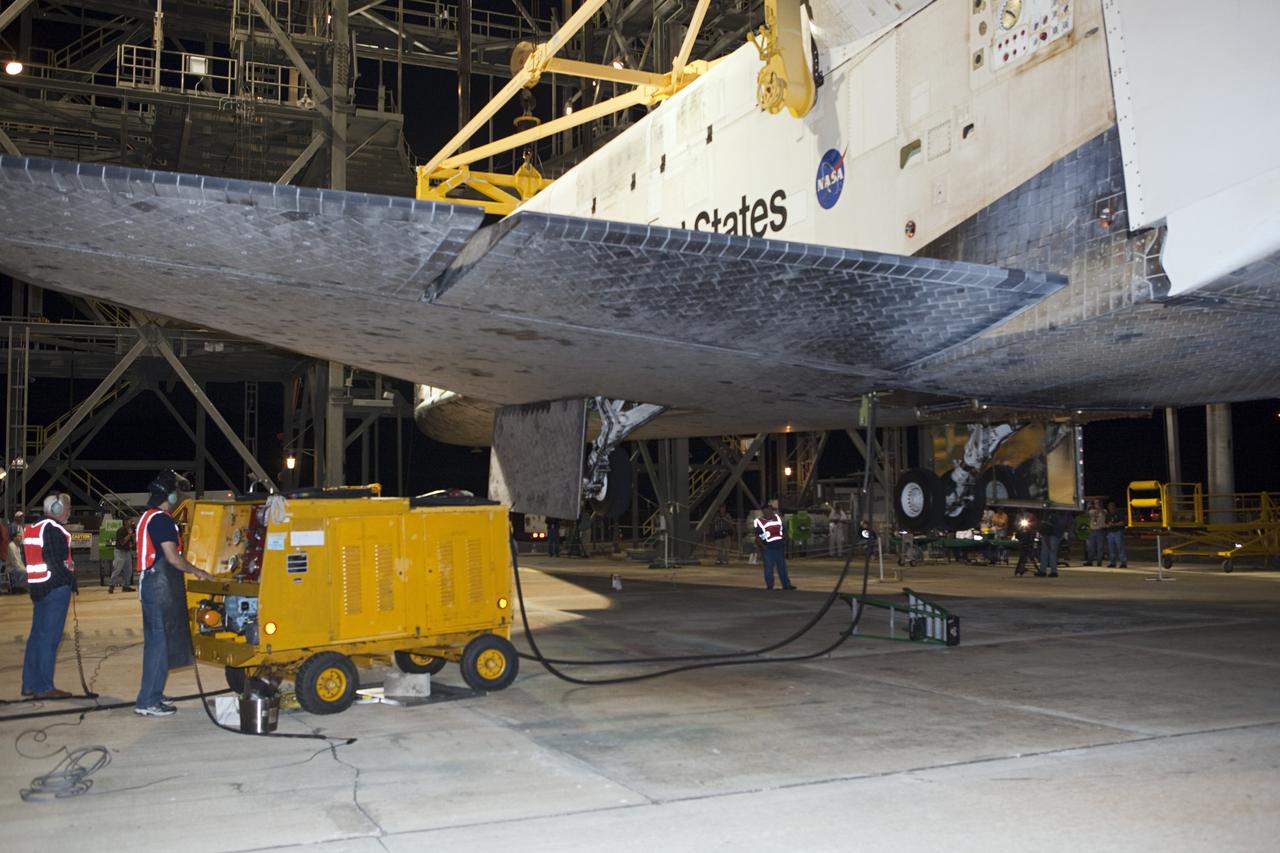
CAPE CANAVERAL, Fla. - At the Shuttle Landing Facility at NASA’s Kennedy Space Center in Florida, workers at the mate-demate device make final preparations to lift and mate space shuttle Discovery to a Shuttle Carrier Aircraft. The device, known as the MDD, is a large gantry-like steel structure used to hoist a shuttle off the ground and position it onto the back of the aircraft, or SCA. The SCA is a Boeing 747 jet, originally manufactured for commercial use, which was modified by NASA to transport the shuttles between destinations on Earth. The SCA designated NASA 905 is assigned to the remaining ferry missions, delivering the shuttles to their permanent public display sites. NASA 905 is scheduled to ferry Discovery to the Washington Dulles International Airport in Virginia on April 17, after which the shuttle will be placed on display in the Smithsonian's National Air and Space Museum Steven F. Udvar-Hazy Center. For more information on the SCA, visit http://www.nasa.gov/centers/dryden/news/FactSheets/FS-013-DFRC.html. For more information on shuttle transition and retirement activities, visit http://www.nasa.gov/transition. Photo credit: NASA/Dimitri Gerondidakis
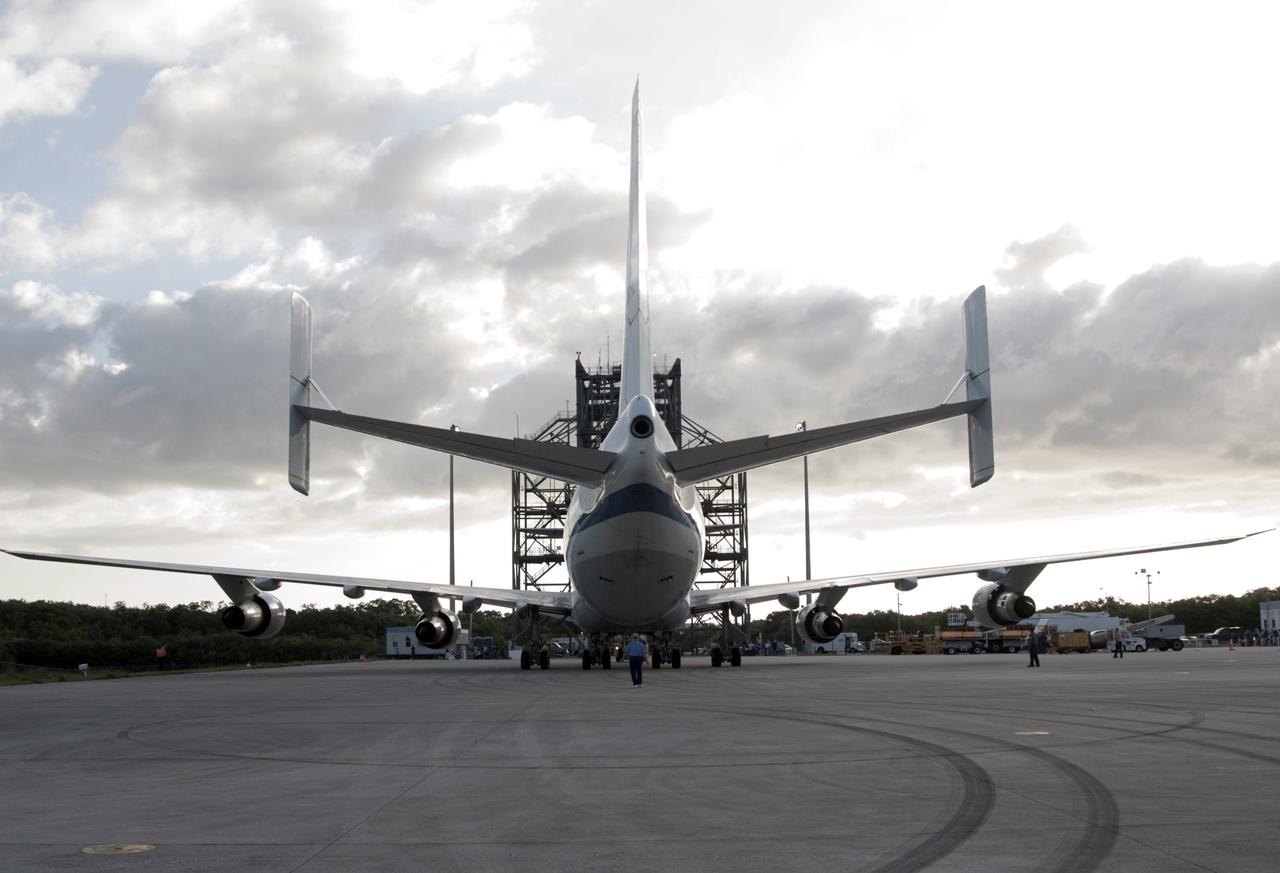
CAPE CANAVERAL, Fla. – At the Shuttle Landing Facility at NASA’s Kennedy Space Center in Florida, the Shuttle Carrier Aircraft approaches the mate-demate device, in the background, for mating with space shuttle Discovery. This SCA, designated NASA 905, is a Boeing 747 jet originally manufactured for commercial use, which was modified by NASA to transport the shuttles between destinations on Earth. NASA 905 is assigned to the remaining ferry missions, delivering the shuttles to their permanent public display sites. Discovery’s new home will be the Smithsonian's National Air and Space Museum Steven F. Udvar-Hazy Center in Chantilly, Va. For more information on the SCA, visit http://www.nasa.gov/centers/dryden/news/FactSheets/FS-013-DFRC.html. For more information on shuttle transition and retirement activities, visit http://www.nasa.gov/transition. Photo credit: NASA/Tim Jacobs
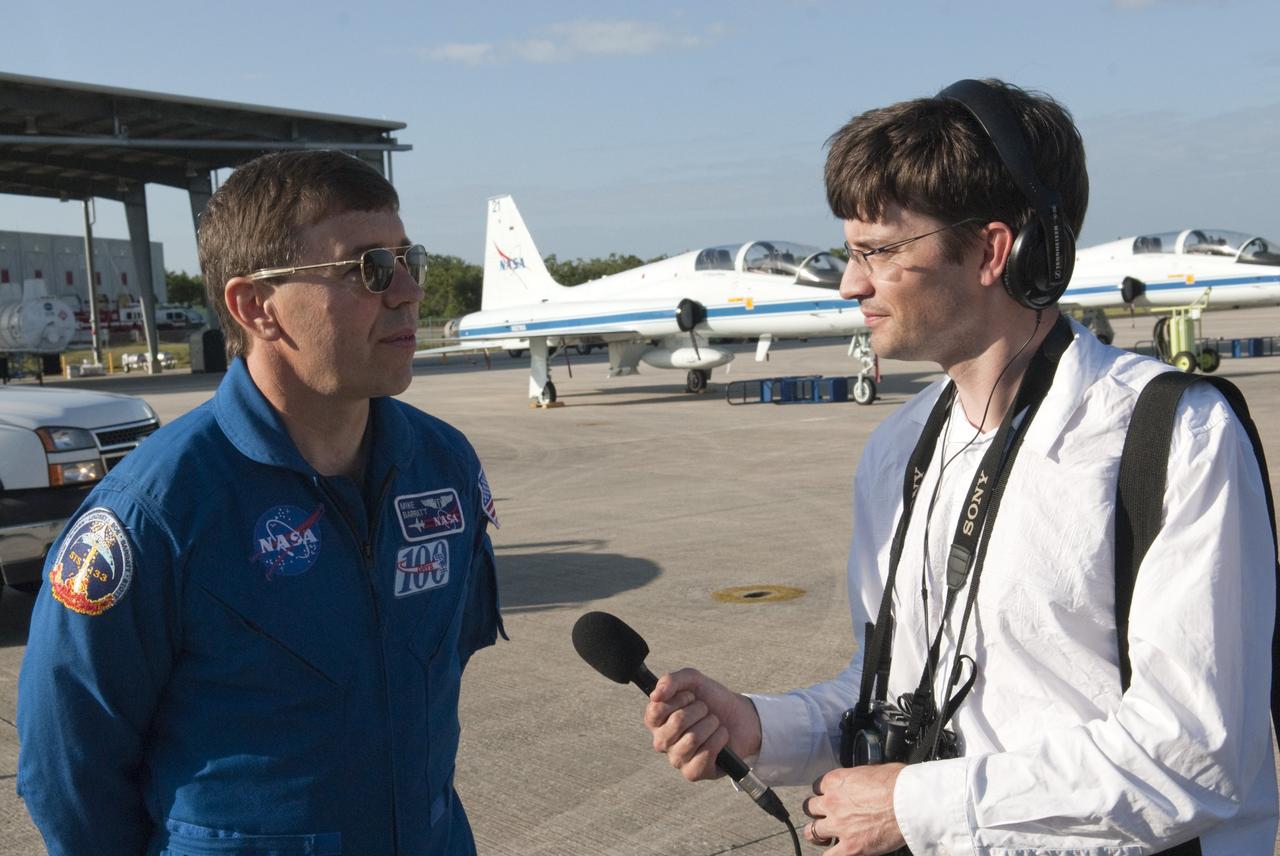
CAPE CANAVERAL, Fla. – At the Shuttle Landing Facility at NASA’s Kennedy Space Center in Florida, STS-133 Mission Specialist Michael Barratt talks to a representative of the media with NASA T-38 jets in the background. Barratt was a member of the crew to fly on Discovery’s final mission in February and March 2011. Other members of the STS-133 crew were Commander Steve Lindsey, Pilot Eric Boe and Mission Specialists Nicole Stott, Michael Barratt, Alvin Drew and Steve Bowen. Discovery is scheduled to depart from Kennedy for the final time tomorrow morning on the back of a Shuttle Carrier Aircraft. Also known as an SCA, the aircraft is a Boeing 747 jet, originally manufactured for commercial use, which was modified by NASA to transport the shuttles between destinations on Earth. The SCA designated NASA 905 is assigned to the remaining ferry missions, delivering the shuttles to their permanent public display sites. NASA 905 is scheduled to ferry Discovery to the Washington Dulles International Airport in Virginia on April 17, after which the shuttle will be placed on display in the Smithsonian's National Air and Space Museum Steven F. Udvar-Hazy Center. For more information on the SCA, visit http://www.nasa.gov/centers/dryden/news/FactSheets/FS-013-DFRC.html. For more information on shuttle transition and retirement activities, visit http://www.nasa.gov/transition. Photo credit: NASA/Tim Jacobs
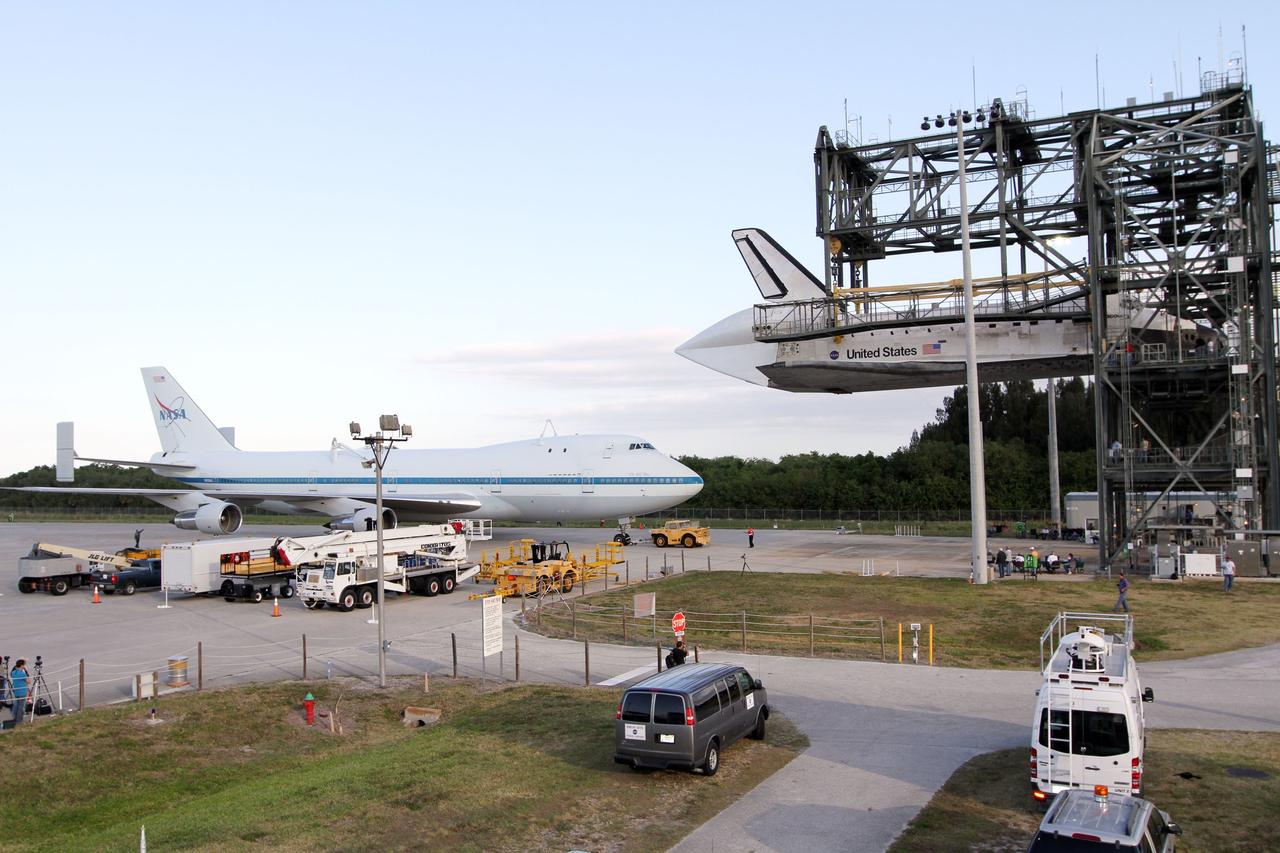
CAPE CANAVERAL, Fla. – At the Shuttle Landing Facility at NASA’s Kennedy Space Center in Florida, the Shuttle Carrier Aircraft moves into position under space shuttle Discovery suspended 60 feet off the ground in the mate-demate device. The device, known as the MDD, is a large gantry-like steel structure used to hoist a shuttle off the ground and position it onto the back of the aircraft, or SCA. The SCA is a Boeing 747 jet, originally manufactured for commercial use, which was modified by NASA to transport the shuttles between destinations on Earth. The SCA designated NASA 905 is assigned to the remaining ferry missions, delivering the shuttles to their permanent public display sites. NASA 905 is scheduled to ferry Discovery to the Washington Dulles International Airport in Virginia on April 17, after which the shuttle will be placed on display in the Smithsonian's National Air and Space Museum Steven F. Udvar-Hazy Center. For more information on the SCA, visit http://www.nasa.gov/centers/dryden/news/FactSheets/FS-013-DFRC.html. For more information on shuttle transition and retirement activities, visit http://www.nasa.gov/transition. Photo credit: NASA/Kim Shiflett

CAPE CANAVERAL, Fla. – Before sunrise at the Shuttle Landing Facility at NASA’s Kennedy Space Center in Florida, lights on the mate-demate device reveal space shuttle Discovery suspended above the ground. Operations are under way to place Discovery on top of a Shuttle Carrier Aircraft in preparation for its departure from Kennedy on Tuesday. A tail cone has been installed over Discovery’s three replica shuttle main engines to reduce aerodynamic drag and turbulence during the ferry flight. The device, known as the MDD, is a large gantry-like steel structure used to hoist a shuttle off the ground and position it onto the back of the aircraft, or SCA. The SCA is a Boeing 747 jet, originally manufactured for commercial use, which was modified by NASA to transport the shuttles between destinations on Earth. The SCA designated NASA 905 is assigned to the remaining ferry missions, delivering the shuttles to their permanent public display sites. NASA 905 is scheduled to ferry Discovery to the Washington Dulles International Airport in Virginia on April 17, after which the shuttle will be placed on display in the Smithsonian's National Air and Space Museum Steven F. Udvar-Hazy Center. For more information on the SCA, visit http://www.nasa.gov/centers/dryden/news/FactSheets/FS-013-DFRC.html. For more information on shuttle transition and retirement activities, visit http://www.nasa.gov/transition. Photo credit: NASA/Kim Shiflett
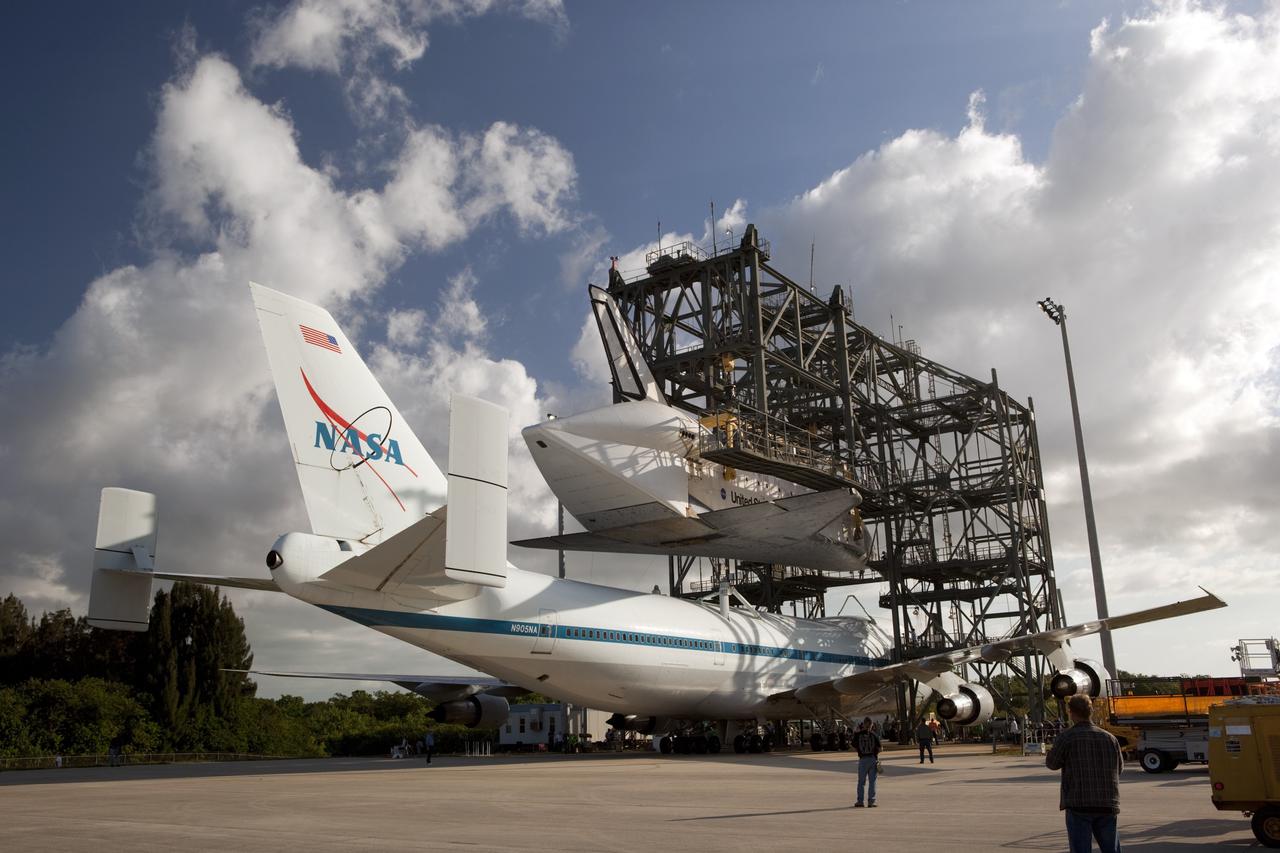
CAPE CANAVERAL, Fla. – At the Shuttle Landing Facility at NASA’s Kennedy Space Center in Florida, the Shuttle Carrier Aircraft is in position under space shuttle Discovery in the mate-demate device for mating operations to begin. The device, known as the MDD, is a large gantry-like steel structure used to hoist a shuttle off the ground and position it onto the back of the aircraft, or SCA. The SCA is a Boeing 747 jet, originally manufactured for commercial use, which was modified by NASA to transport the shuttles between destinations on Earth. This SCA, designated NASA 905, is assigned to the remaining ferry missions, delivering the shuttles to their permanent public display sites. NASA 905 is scheduled to ferry Discovery to the Washington Dulles International Airport in Virginia on April 17, after which the shuttle will be placed on display in the Smithsonian's National Air and Space Museum Steven F. Udvar-Hazy Center. For more information on the SCA, visit http://www.nasa.gov/centers/dryden/news/FactSheets/FS-013-DFRC.html. For more information on shuttle transition and retirement activities, visit http://www.nasa.gov/transition. Photo credit: NASA/Dimitri Gerondidakis
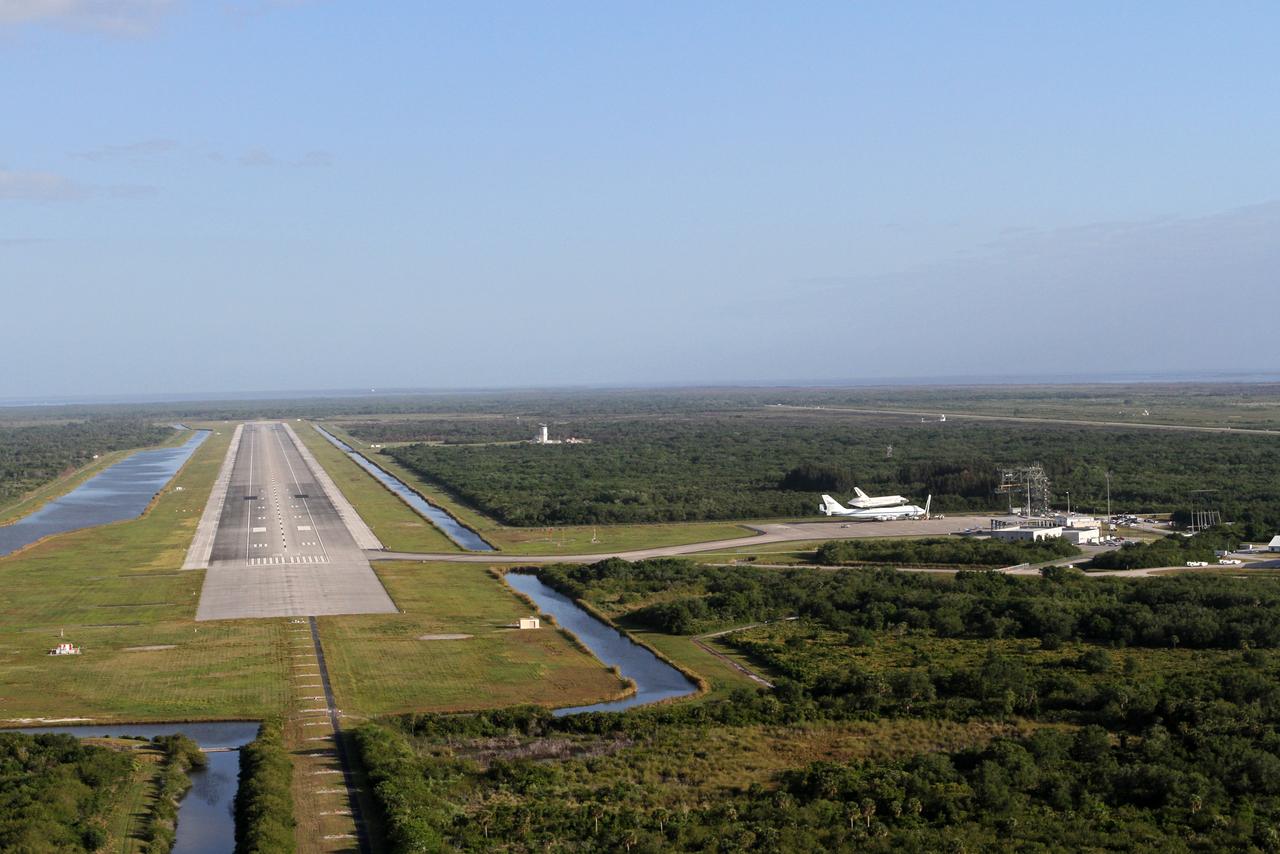
CAPE CANAVERAL, Fla. – This is an aerial view of the long Shuttle Landing Facility SLF runway at NASA's Kennedy Space Center in Florida that space shuttle Discovery, bolted to the top of a Shuttle Carrier Aircraft SCA, will take off from on April 17. Discovery's last crew members are expected to be at the runway, along with Kennedy employees and guests, as the center says goodbye to the agency's most-flown shuttle. The SCA, designated NASA 905, will ferry Discovery to the Washington Dulles International Airport in Virginia, after which the shuttle will be moved for public display in the Smithsonian's National Air and Space Museum Steven F. Udvar-Hazy Center on April 19. For more information on the SCA, visit http://www.nasa.gov/centers/dryden/news/FactSheets/FS-013-DFRC.html. For more information on shuttle transition and retirement activities, visit http://www.nasa.gov/transition. Photo credit: NASA/Kim Shiflett
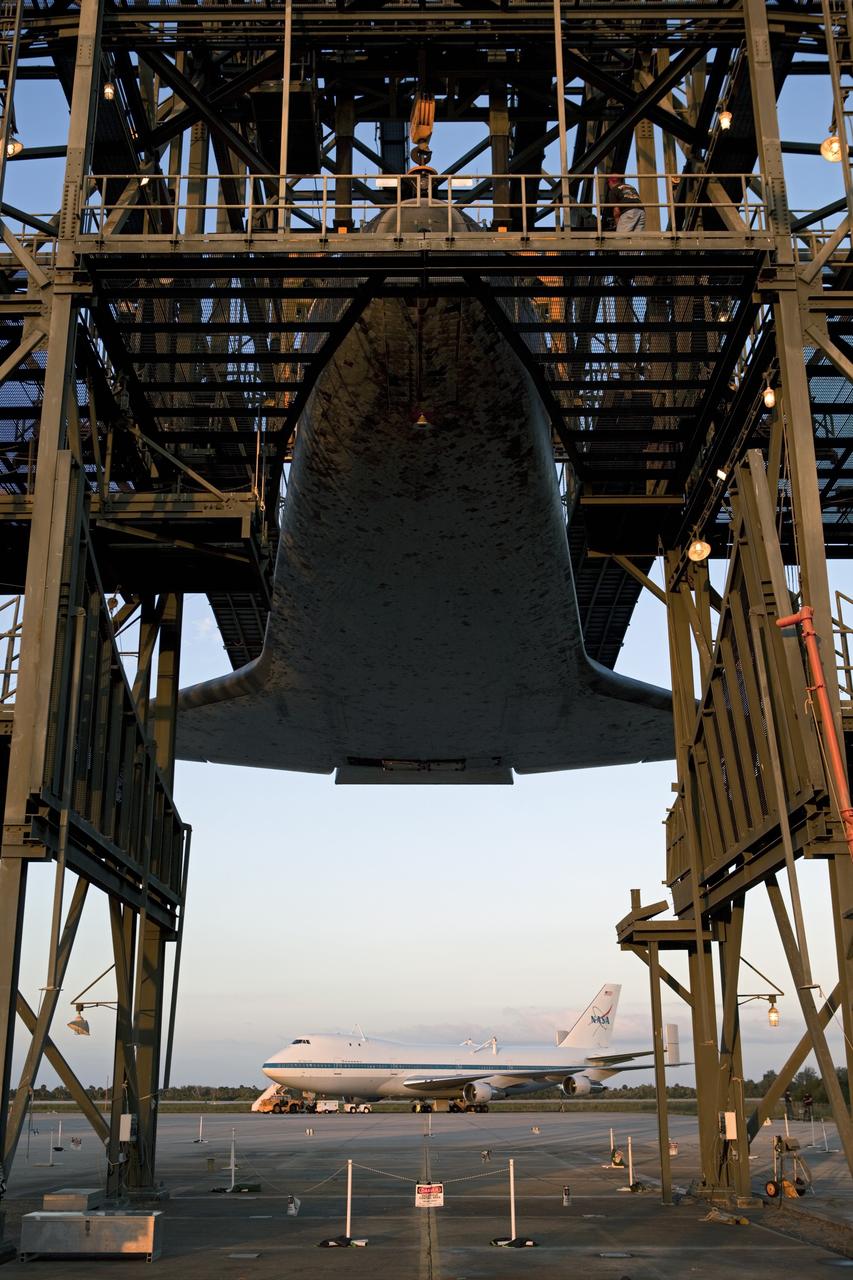
CAPE CANAVERAL, Fla. – At the Shuttle Landing Facility at NASA’s Kennedy Space Center in Florida, space shuttle Discovery is suspended 60 feet off the ground inside the mate-demate device in preparation for the arrival of the Shuttle Carrier Aircraft, in the background. The device, known as the MDD, is a large gantry-like steel structure used to hoist a shuttle off the ground and position it onto the back of the aircraft, or SCA. The SCA is a Boeing 747 jet, originally manufactured for commercial use, which was modified by NASA to transport the shuttles between destinations on Earth. The SCA designated NASA 905 is assigned to the remaining ferry missions, delivering the shuttles to their permanent public display sites. NASA 905 is scheduled to ferry Discovery to the Washington Dulles International Airport in Virginia on April 17, after which the shuttle will be placed on display in the Smithsonian's National Air and Space Museum Steven F. Udvar-Hazy Center. For more information on the SCA, visit http://www.nasa.gov/centers/dryden/news/FactSheets/FS-013-DFRC.html. For more information on shuttle transition and retirement activities, visit http://www.nasa.gov/transition. Photo credit: NASA/Dimitri Gerondidakis
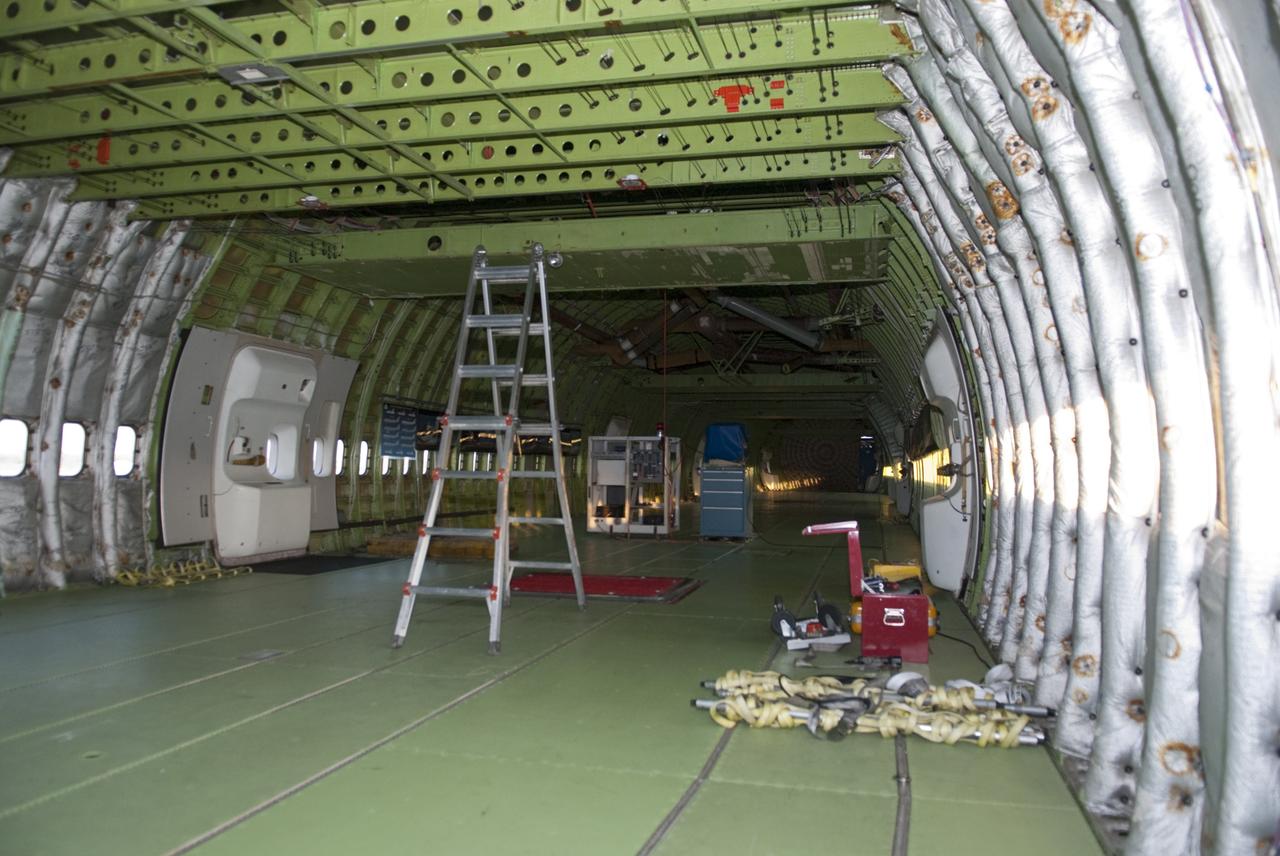
CAPE CANAVERAL, Fla. – At the Shuttle Landing Facility at NASA’s Kennedy Space Center in Florida, final preparations are made to the interior of the Shuttle Carrier Aircraft before it is towed to the mate-demate device for mating with space shuttle Discovery. This SCA, designated NASA 905, is a Boeing 747 jet originally manufactured for commercial use, which was modified by NASA to transport the shuttles between destinations on Earth. NASA 905 is assigned to the remaining ferry missions, delivering the shuttles to their permanent public display sites. Discovery’s new home will be the Smithsonian's National Air and Space Museum Steven F. Udvar-Hazy Center in Chantilly, Va. For more information on the SCA, visit http://www.nasa.gov/centers/dryden/news/FactSheets/FS-013-DFRC.html. For more information on shuttle transition and retirement activities, visit http://www.nasa.gov/transition. Photo credit: NASA/Tim Jacobs
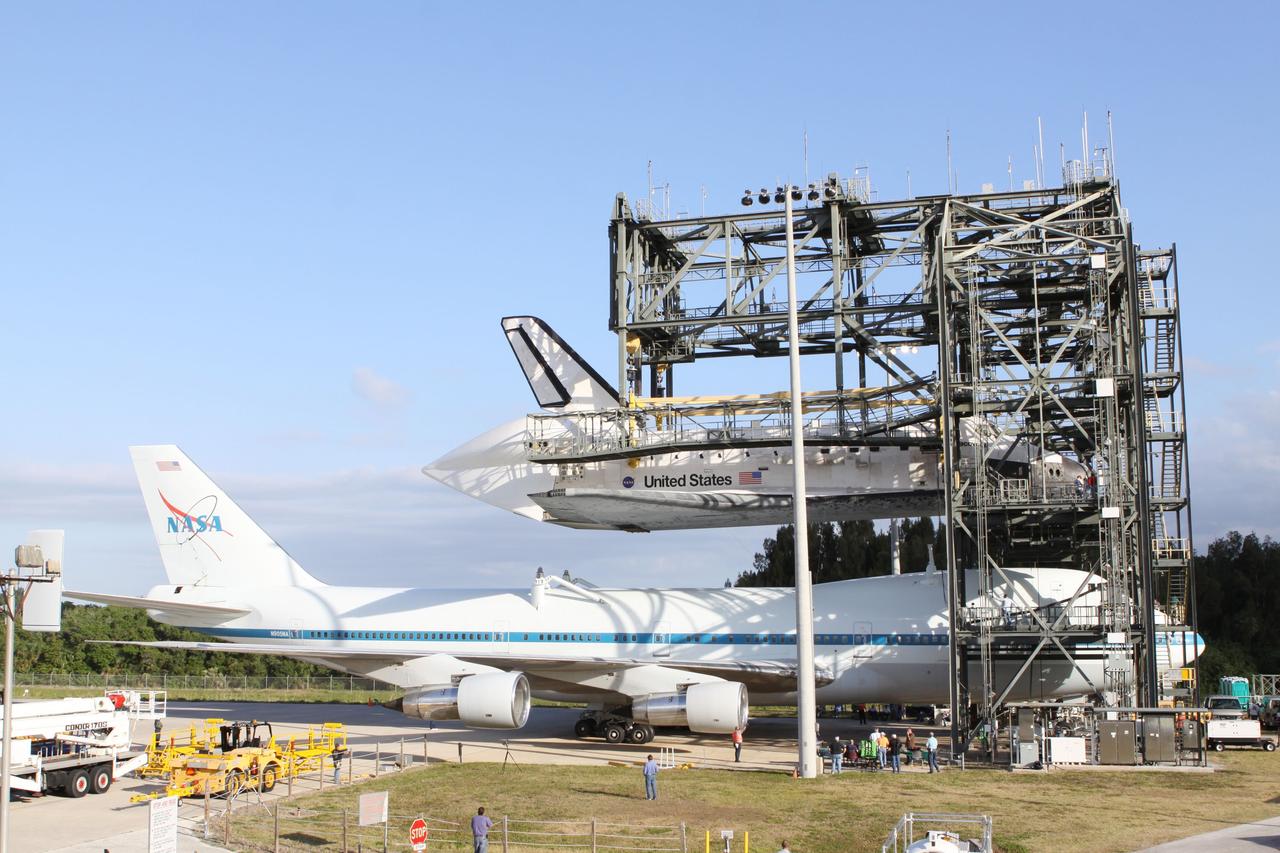
CAPE CANAVERAL, Fla. – At the Shuttle Landing Facility at NASA’s Kennedy Space Center in Florida, the Shuttle Carrier Aircraft moves into position under space shuttle Discovery suspended 60 feet off the ground in the mate-demate device. The device, known as the MDD, is a large gantry-like steel structure used to hoist a shuttle off the ground and position it onto the back of the aircraft, or SCA. The SCA is a Boeing 747 jet, originally manufactured for commercial use, which was modified by NASA to transport the shuttles between destinations on Earth. The SCA designated NASA 905 is assigned to the remaining ferry missions, delivering the shuttles to their permanent public display sites. NASA 905 is scheduled to ferry Discovery to the Washington Dulles International Airport in Virginia on April 17, after which the shuttle will be placed on display in the Smithsonian's National Air and Space Museum Steven F. Udvar-Hazy Center. For more information on the SCA, visit http://www.nasa.gov/centers/dryden/news/FactSheets/FS-013-DFRC.html. For more information on shuttle transition and retirement activities, visit http://www.nasa.gov/transition. Photo credit: NASA/Kim Shiflett
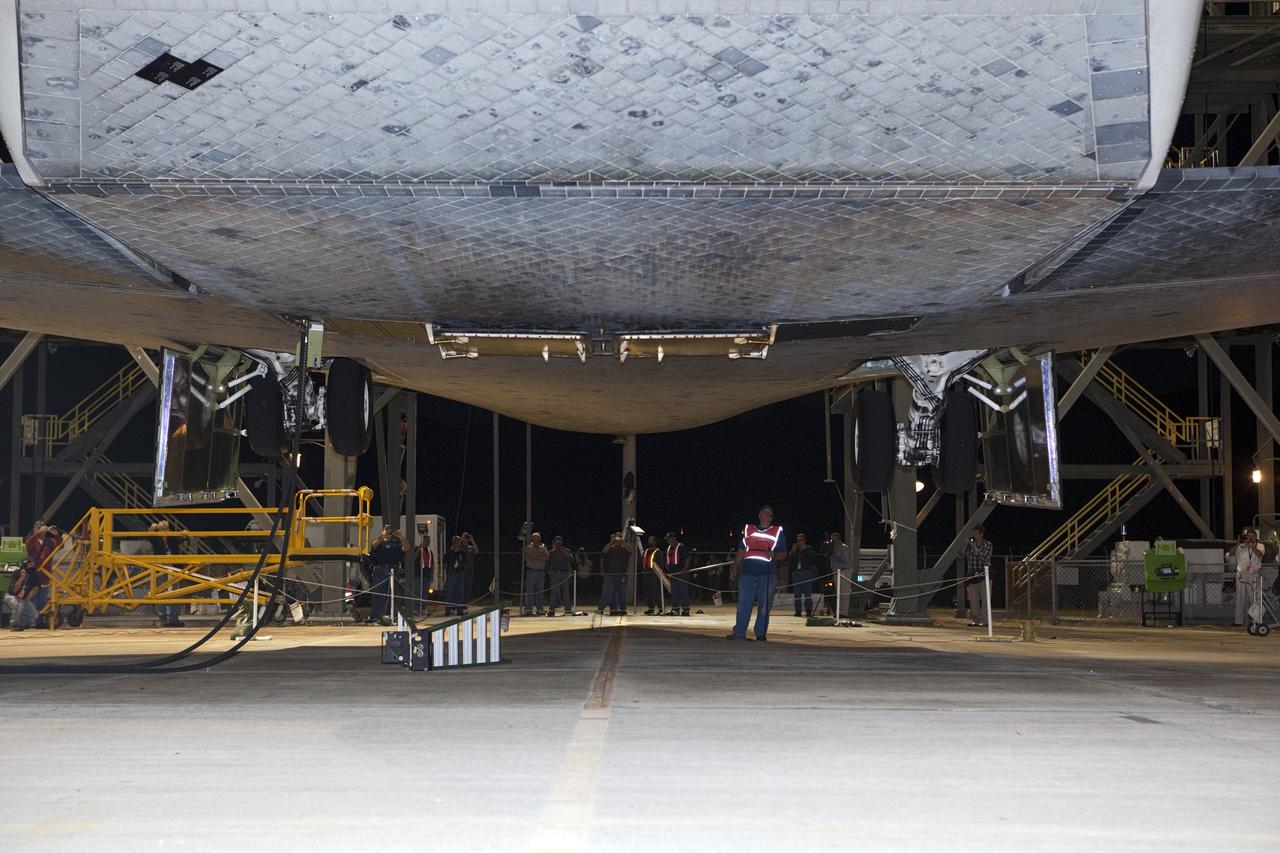
CAPE CANAVERAL, Fla. - At the Shuttle Landing Facility at NASA’s Kennedy Space Center in Florida, final inspections are made of space shuttle Discovery before it is lifted into the mate-demate device and lowered onto the top of a Shuttle Carrier Aircraft. The device, known as the MDD, is a large gantry-like steel structure used to hoist a shuttle off the ground and position it onto the back of the aircraft, or SCA. The SCA is a Boeing 747 jet, originally manufactured for commercial use, which was modified by NASA to transport the shuttles between destinations on Earth. The SCA designated NASA 905 is assigned to the remaining ferry missions, delivering the shuttles to their permanent public display sites. NASA 905 is scheduled to ferry Discovery to the Washington Dulles International Airport in Virginia on April 17, after which the shuttle will be placed on display in the Smithsonian's National Air and Space Museum Steven F. Udvar-Hazy Center. For more information on the SCA, visit http://www.nasa.gov/centers/dryden/news/FactSheets/FS-013-DFRC.html. For more information on shuttle transition and retirement activities, visit http://www.nasa.gov/transition. Photo credit: NASA/Dimitri Gerondidakis
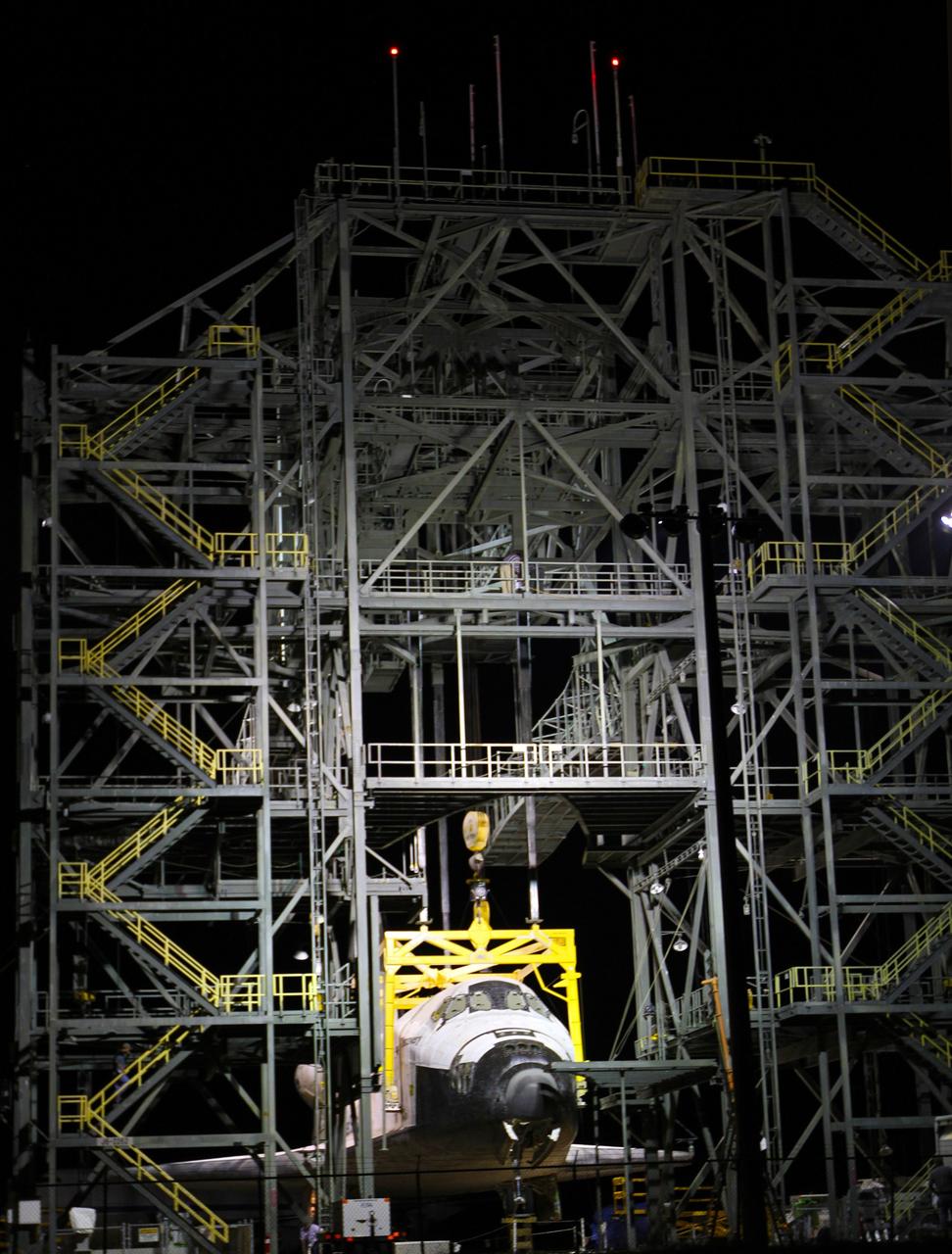
CAPE CANAVERAL, Fla. – Before daybreak at the Shuttle Landing Facility at NASA’s Kennedy Space Center in Florida, preparations are under way at the mate-demate device to resume mating operations of space shuttle Discovery to a Shuttle Carrier Aircraft. The yellow sling was attached to the shuttle yesterday, but out-of-parameter winds required that operations be suspended for the day. The device, known as the MDD, is a large gantry-like steel structure used to hoist a shuttle off the ground and position it onto the back of the aircraft, or SCA. The SCA is a Boeing 747 jet, originally manufactured for commercial use, which was modified by NASA to transport the shuttles between destinations on Earth. The SCA designated NASA 905 is assigned to the remaining ferry missions, delivering the shuttles to their permanent public display sites. NASA 905 is scheduled to ferry Discovery to the Washington Dulles International Airport in Virginia on April 17, after which the shuttle will be placed on display in the Smithsonian's National Air and Space Museum Steven F. Udvar-Hazy Center. For more information on the SCA, visit http://www.nasa.gov/centers/dryden/news/FactSheets/FS-013-DFRC.html. For more information on shuttle transition and retirement activities, visit http://www.nasa.gov/transition. Photo credit: NASA/Kim Shiflett
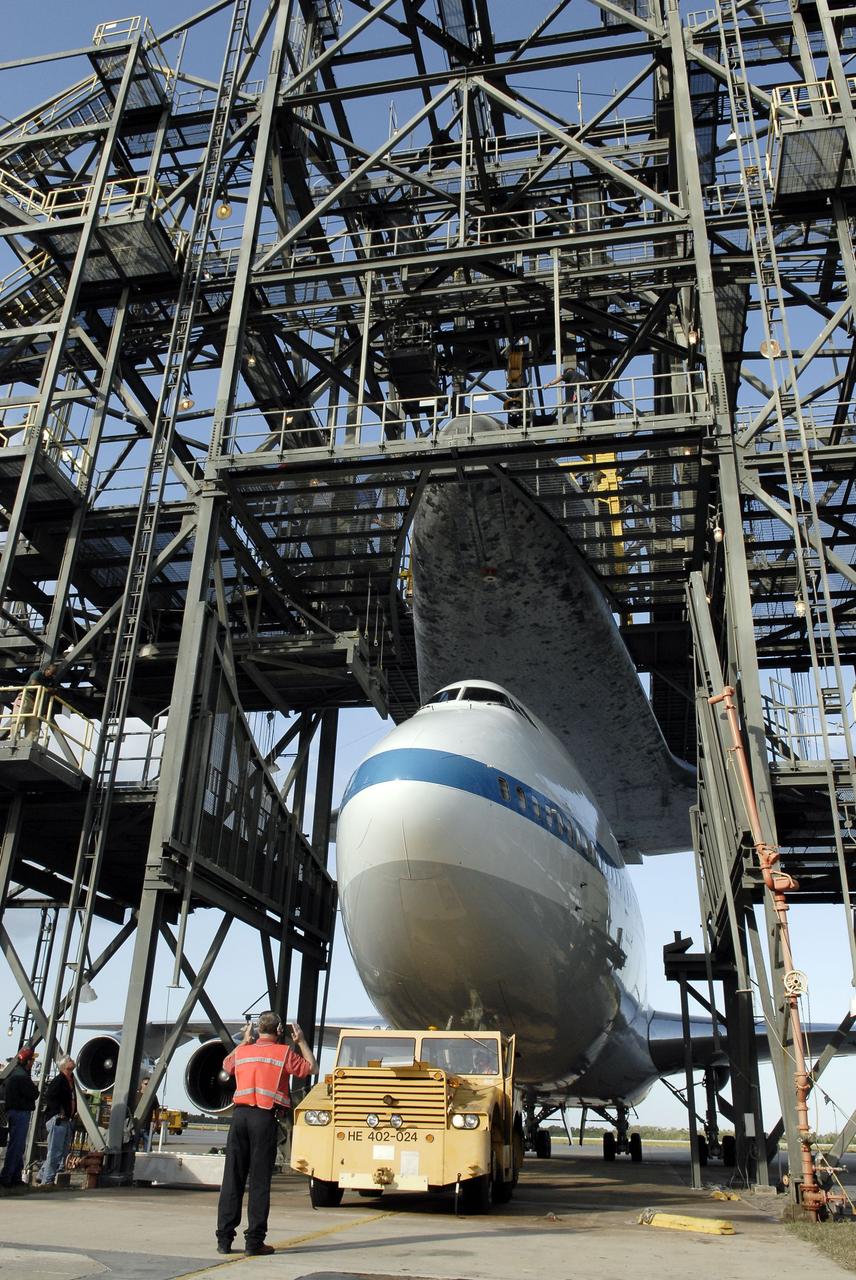
CAPE CANAVERAL, Fla. – At the Shuttle Landing Facility at NASA’s Kennedy Space Center in Florida, a worker guides the Shuttle Carrier Aircraft into position under space shuttle Discovery suspended in the mate-demate device. The device, known as the MDD, is a large gantry-like steel structure used to hoist a shuttle off the ground and position it onto the back of the aircraft, or SCA. The SCA is a Boeing 747 jet, originally manufactured for commercial use, which was modified by NASA to transport the shuttles between destinations on Earth. This SCA, designated NASA 905, is assigned to the remaining ferry missions, delivering the shuttles to their permanent public display sites. NASA 905 is scheduled to ferry Discovery to the Washington Dulles International Airport in Virginia on April 17, after which the shuttle will be placed on display in the Smithsonian's National Air and Space Museum Steven F. Udvar-Hazy Center. For more information on the SCA, visit http://www.nasa.gov/centers/dryden/news/FactSheets/FS-013-DFRC.html. For more information on shuttle transition and retirement activities, visit http://www.nasa.gov/transition. Photo credit: NASA/Tim Jacobs
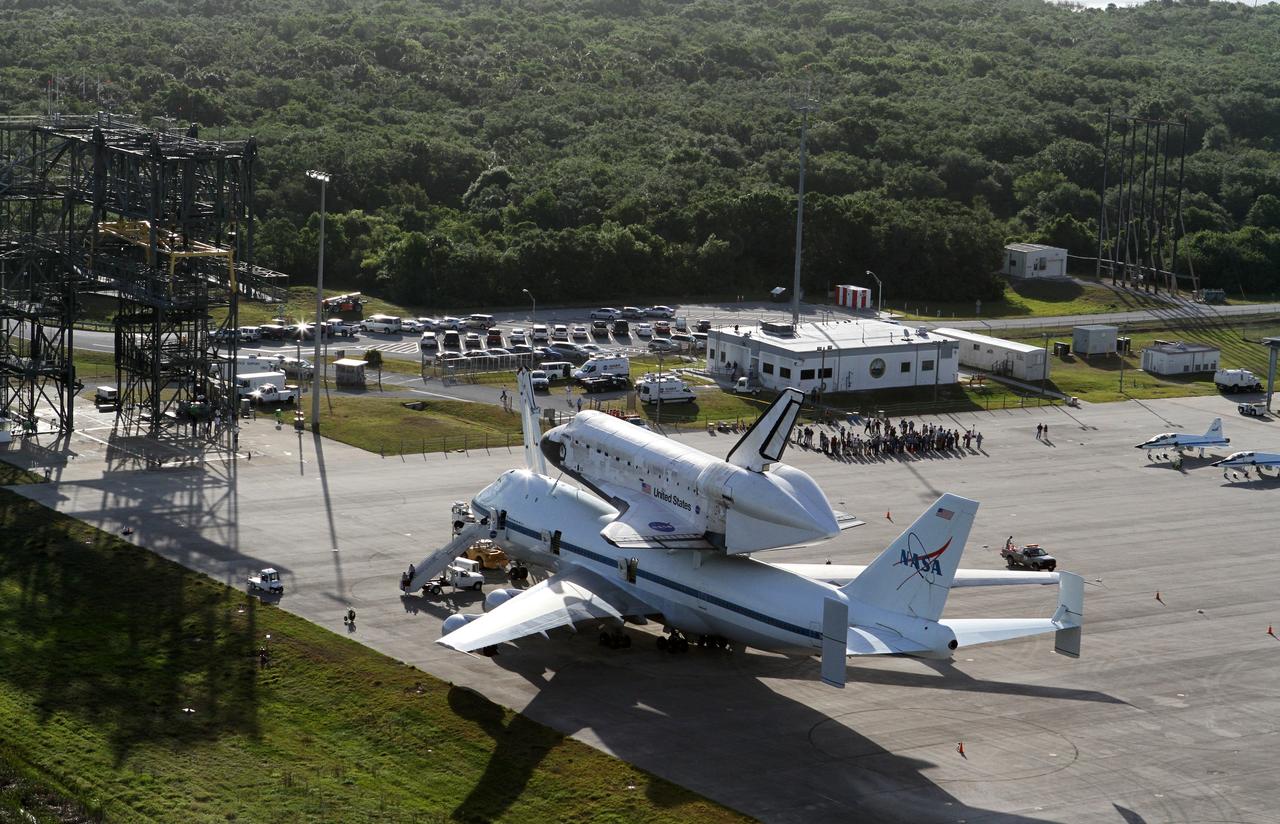
CAPE CANAVERAL, Fla. – This is an aerial view of space shuttle Discovery bolted to the top of a Shuttle Carrier Aircraft SCA on the ramp of the Shuttle Landing Facility SLF at NASA’s Kennedy Space Center in Florida. Also on the ramp is a pair of T-38 training jets. Discovery's last crew members are expected to be at the SLF, along with Kennedy employees and guests, as the center says goodbye to the agency's most-flown shuttle on April 17. The mate/demate device, known as the MDD, is in view and is where transition and retirement teams prepared the duo for the ferry flight. The SCA, designated NASA 905, will ferry Discovery to the Washington Dulles International Airport in Virginia, after which the shuttle will be moved for public display in the Smithsonian's National Air and Space Museum Steven F. Udvar-Hazy Center on April 19. For more information on the SCA, visit http://www.nasa.gov/centers/dryden/news/FactSheets/FS-013-DFRC.html. For more information on shuttle transition and retirement activities, visit http://www.nasa.gov/transition. Photo credit: NASA/Kim Shiflett
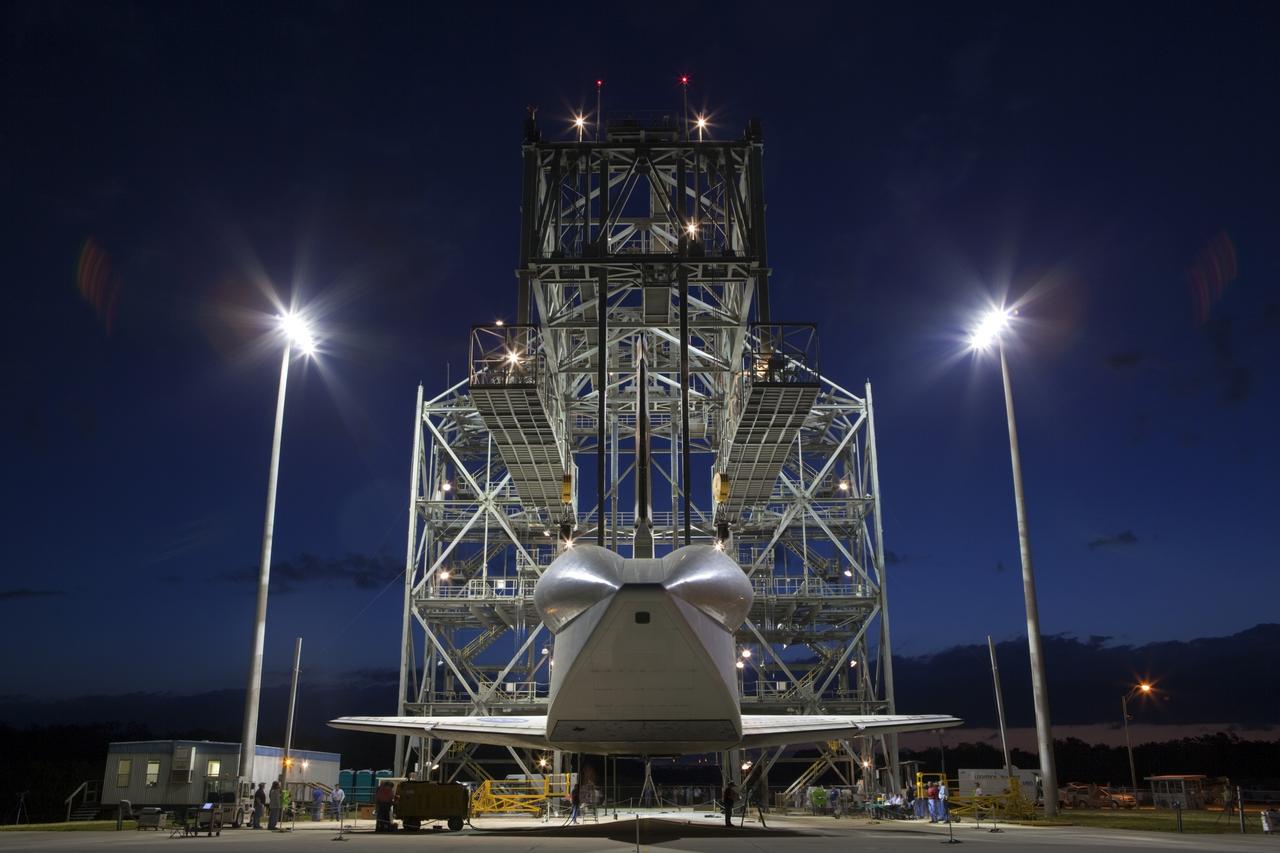
CAPE CANAVERAL, Fla. – Before daybreak at the Shuttle Landing Facility at NASA’s Kennedy Space Center in Florida, space shuttle Discovery hovers above the ground at the mate-demate device. Operations are under way to position Discovery on top of a Shuttle Carrier Aircraft in preparation for its departure from Kennedy on Tuesday. A tail cone has been installed over Discovery’s three replica shuttle main engines to reduce aerodynamic drag and turbulence during the ferry flight. The device, known as the MDD, is a large gantry-like steel structure used to hoist a shuttle off the ground and position it onto the back of the aircraft, or SCA. The SCA is a Boeing 747 jet, originally manufactured for commercial use, which was modified by NASA to transport the shuttles between destinations on Earth. The SCA designated NASA 905 is assigned to the remaining ferry missions, delivering the shuttles to their permanent public display sites. NASA 905 is scheduled to ferry Discovery to the Washington Dulles International Airport in Virginia on April 17, after which the shuttle will be placed on display in the Smithsonian's National Air and Space Museum Steven F. Udvar-Hazy Center. For more information on the SCA, visit http://www.nasa.gov/centers/dryden/news/FactSheets/FS-013-DFRC.html. For more information on shuttle transition and retirement activities, visit http://www.nasa.gov/transition. Photo credit: NASA/Dimitri Gerondidakis
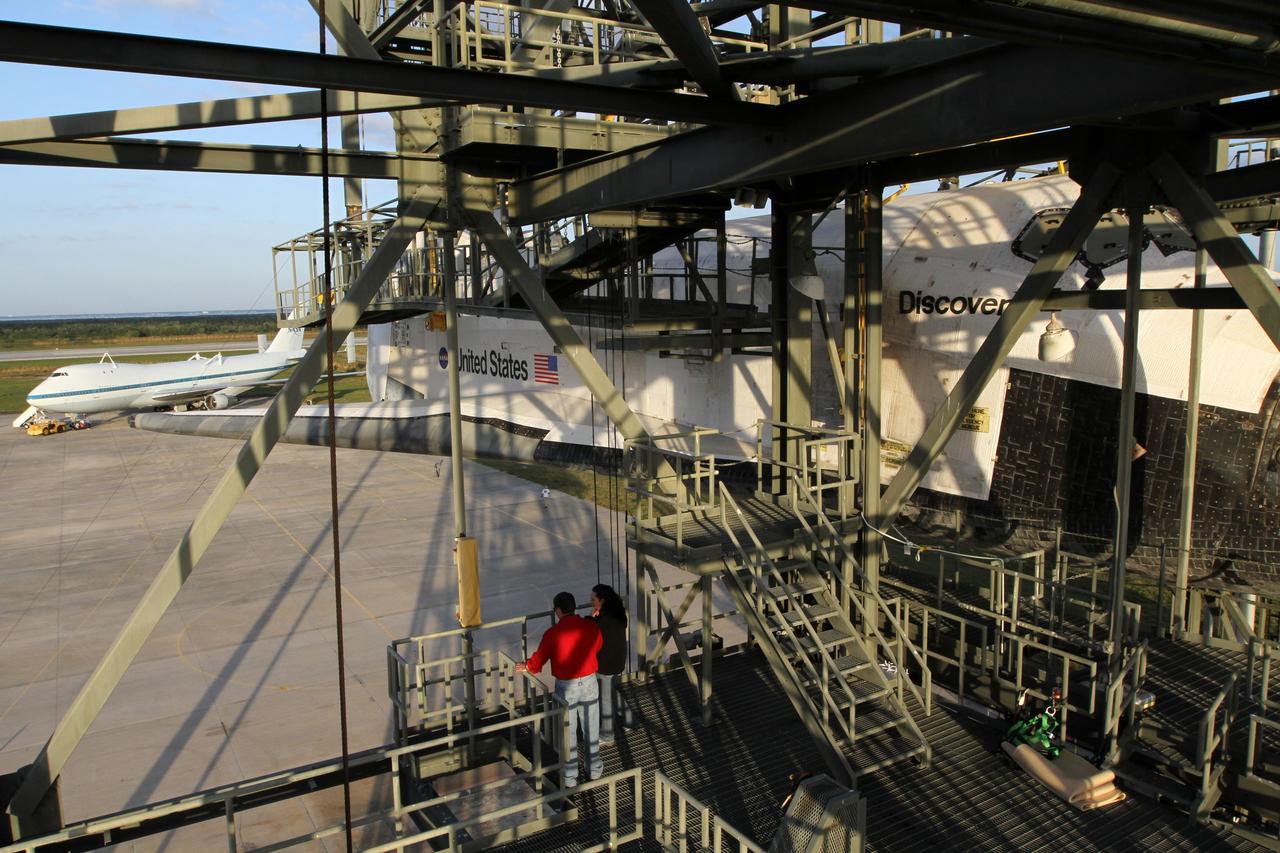
CAPE CANAVERAL, Fla. – At the Shuttle Landing Facility at NASA’s Kennedy Space Center in Florida, space shuttle Discovery is suspended 60 feet off the ground inside the mate-demate device in preparation for the arrival of the Shuttle Carrier Aircraft, in the background. The device, known as the MDD, is a large gantry-like steel structure used to hoist a shuttle off the ground and position it onto the back of the aircraft, or SCA. This SCA, designated NASA 905, is a Boeing 747 jet originally manufactured for commercial use, which was modified by NASA to transport the shuttles between destinations on Earth. NASA 905 is assigned to the remaining ferry missions, delivering the shuttles to their permanent public display sites. Discovery’s new home will be the Smithsonian's National Air and Space Museum Steven F. Udvar-Hazy Center in Chantilly, Va. For more information on the SCA, visit http://www.nasa.gov/centers/dryden/news/FactSheets/FS-013-DFRC.html. For more information on shuttle transition and retirement activities, visit http://www.nasa.gov/transition. Photo credit: NASA/Kim Shiflett
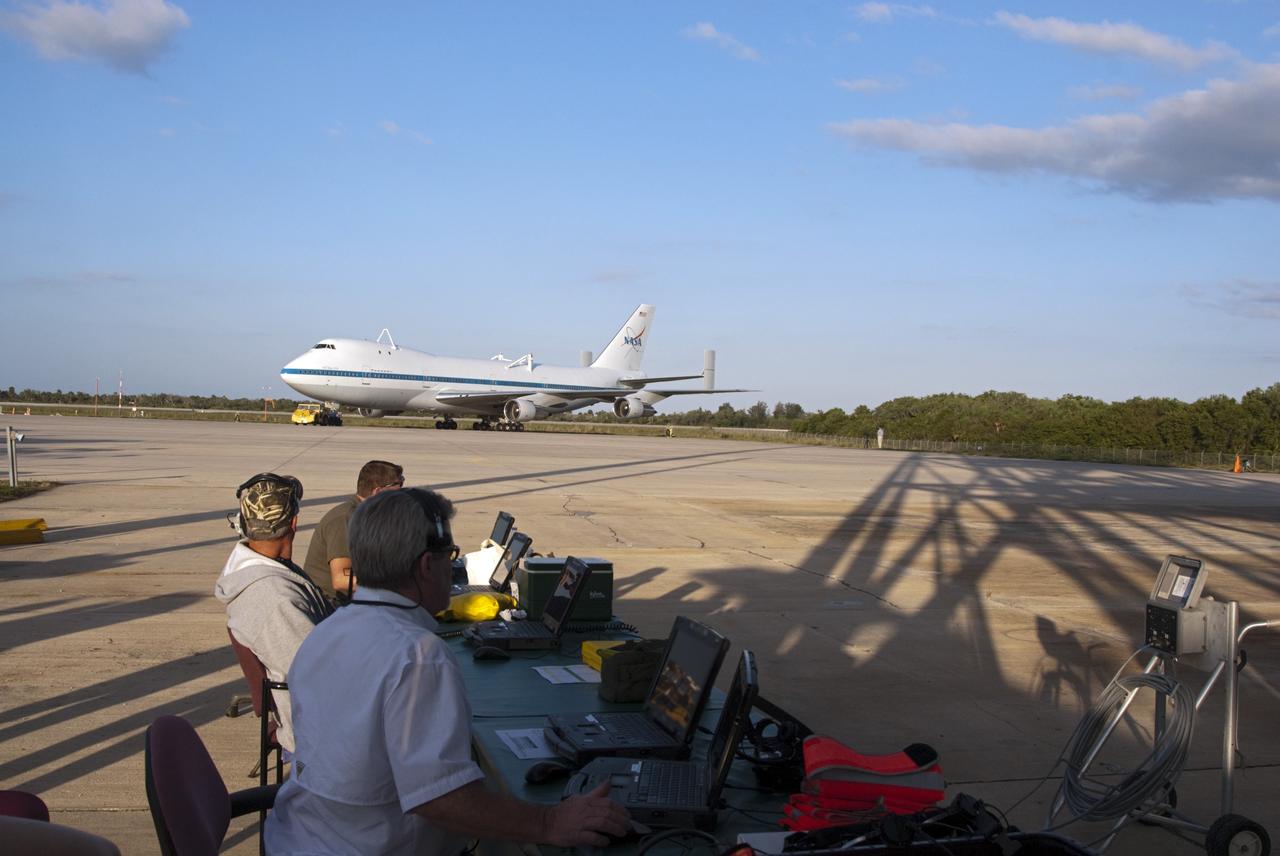
CAPE CANAVERAL, Fla. – At the Shuttle Landing Facility at NASA’s Kennedy Space Center in Florida, operations are under way to tow the Shuttle Carrier Aircraft to the mate-demate device for mating with space shuttle Discovery. This SCA, designated NASA 905, is a Boeing 747 jet originally manufactured for commercial use, which was modified by NASA to transport the shuttles between destinations on Earth. NASA 905 is assigned to the remaining ferry missions, delivering the shuttles to their permanent public display sites. Discovery’s new home will be the Smithsonian's National Air and Space Museum Steven F. Udvar-Hazy Center in Chantilly, Va. For more information on the SCA, visit http://www.nasa.gov/centers/dryden/news/FactSheets/FS-013-DFRC.html. For more information on shuttle transition and retirement activities, visit http://www.nasa.gov/transition. Photo credit: NASA/Tim Jacobs

CAPE CANAVERAL, Fla. – This is an aerial view of space shuttle Discovery bolted to the top of a Shuttle Carrier Aircraft SCA on the ramp of the Shuttle Landing Facility SLF at NASA’s Kennedy Space Center in Florida. The mate/demate device, known as the MDD, also is in view and is where transition and retirement teams prepared the duo for the ferry flight. Discovery's last crew members are expected to be at the SLF, along with Kennedy employees and guests, as the center says goodbye to the agency's most-flown shuttle on April 17. The SCA, designated NASA 905, will ferry Discovery to the Washington Dulles International Airport in Virginia, after which the shuttle will be moved for public display in the Smithsonian's National Air and Space Museum Steven F. Udvar-Hazy Center on April 19. For more information on the SCA, visit http://www.nasa.gov/centers/dryden/news/FactSheets/FS-013-DFRC.html. For more information on shuttle transition and retirement activities, visit http://www.nasa.gov/transition. Photo credit: NASA/Kim Shiflett
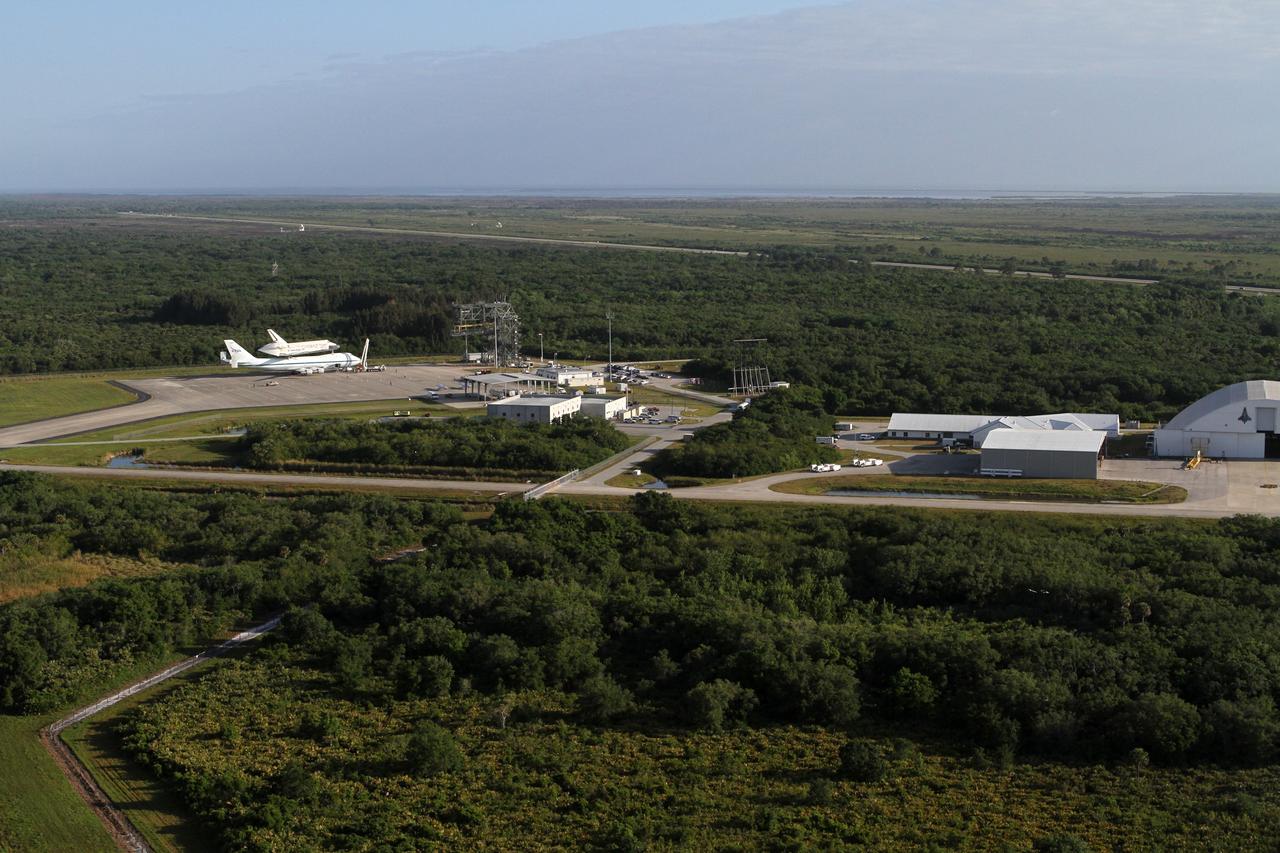
CAPE CANAVERAL, Fla. – This is an aerial view of space shuttle Discovery bolted to the top of a Shuttle Carrier Aircraft SCA on the ramp of the Shuttle Landing Facility SLF at NASA’s Kennedy Space Center in Florida. Discovery's last crew members are expected to be at the SLF, along with Kennedy employees and guests, as the center says goodbye to the agency's most-flown shuttle on April 17. The SCA, designated NASA 905, will ferry Discovery to the Washington Dulles International Airport in Virginia, after which the shuttle will be moved for public display in the Smithsonian's National Air and Space Museum Steven F. Udvar-Hazy Center on April 19. For more information on the SCA, visit http://www.nasa.gov/centers/dryden/news/FactSheets/FS-013-DFRC.html. For more information on shuttle transition and retirement activities, visit http://www.nasa.gov/transition. Photo credit: NASA/Kim Shiflett
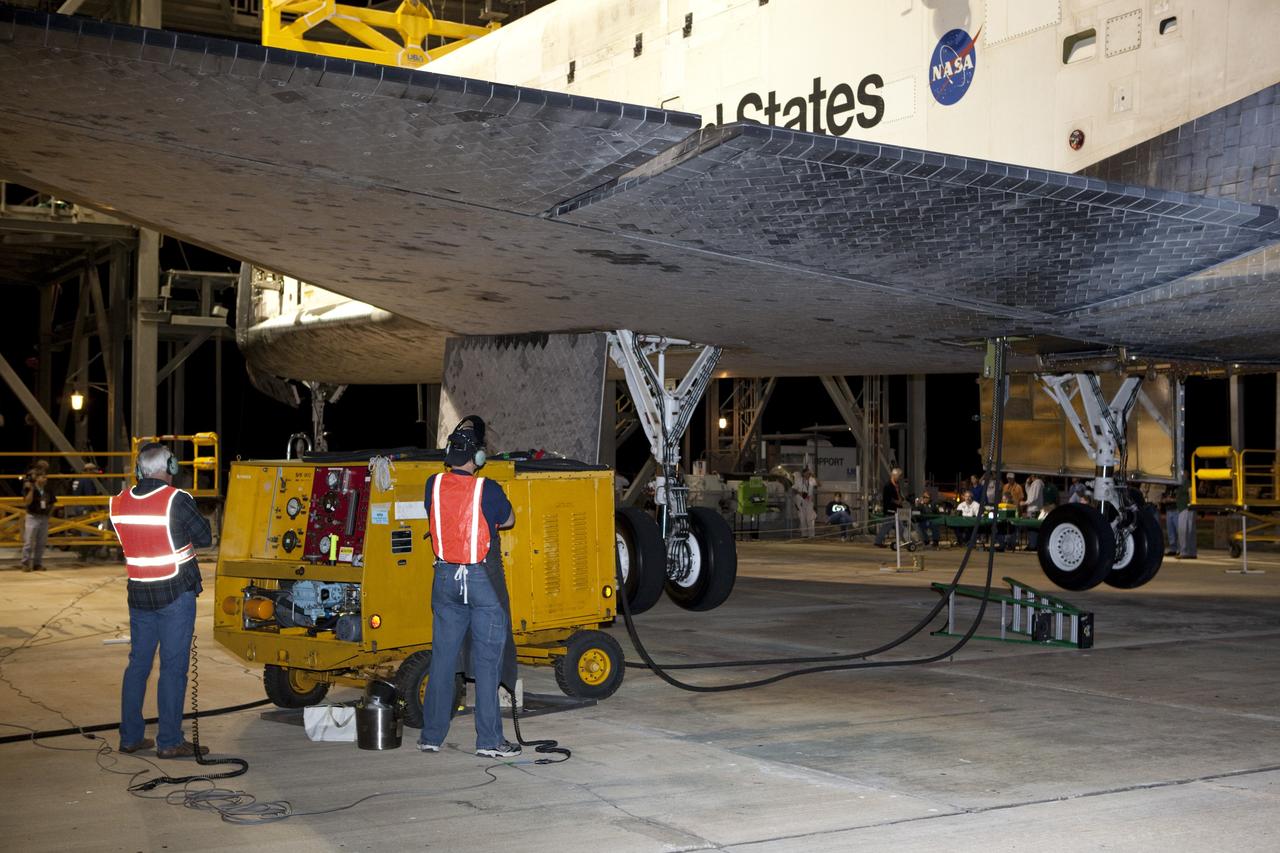
CAPE CANAVERAL, Fla. - At the Shuttle Landing Facility at NASA’s Kennedy Space Center in Florida, operations are under way at the mate-demate device to position Discovery on top of a Shuttle Carrier Aircraft in preparation for its departure from Kennedy on Tuesday. The device, known as the MDD, is a large gantry-like steel structure used to hoist a shuttle off the ground and position it onto the back of the aircraft, or SCA. The SCA is a Boeing 747 jet, originally manufactured for commercial use, which was modified by NASA to transport the shuttles between destinations on Earth. The SCA designated NASA 905 is assigned to the remaining ferry missions, delivering the shuttles to their permanent public display sites. NASA 905 is scheduled to ferry Discovery to the Washington Dulles International Airport in Virginia on April 17, after which the shuttle will be placed on display in the Smithsonian's National Air and Space Museum Steven F. Udvar-Hazy Center. For more information on the SCA, visit http://www.nasa.gov/centers/dryden/news/FactSheets/FS-013-DFRC.html. For more information on shuttle transition and retirement activities, visit http://www.nasa.gov/transition. Photo credit: NASA/Dimitri Gerondidakis
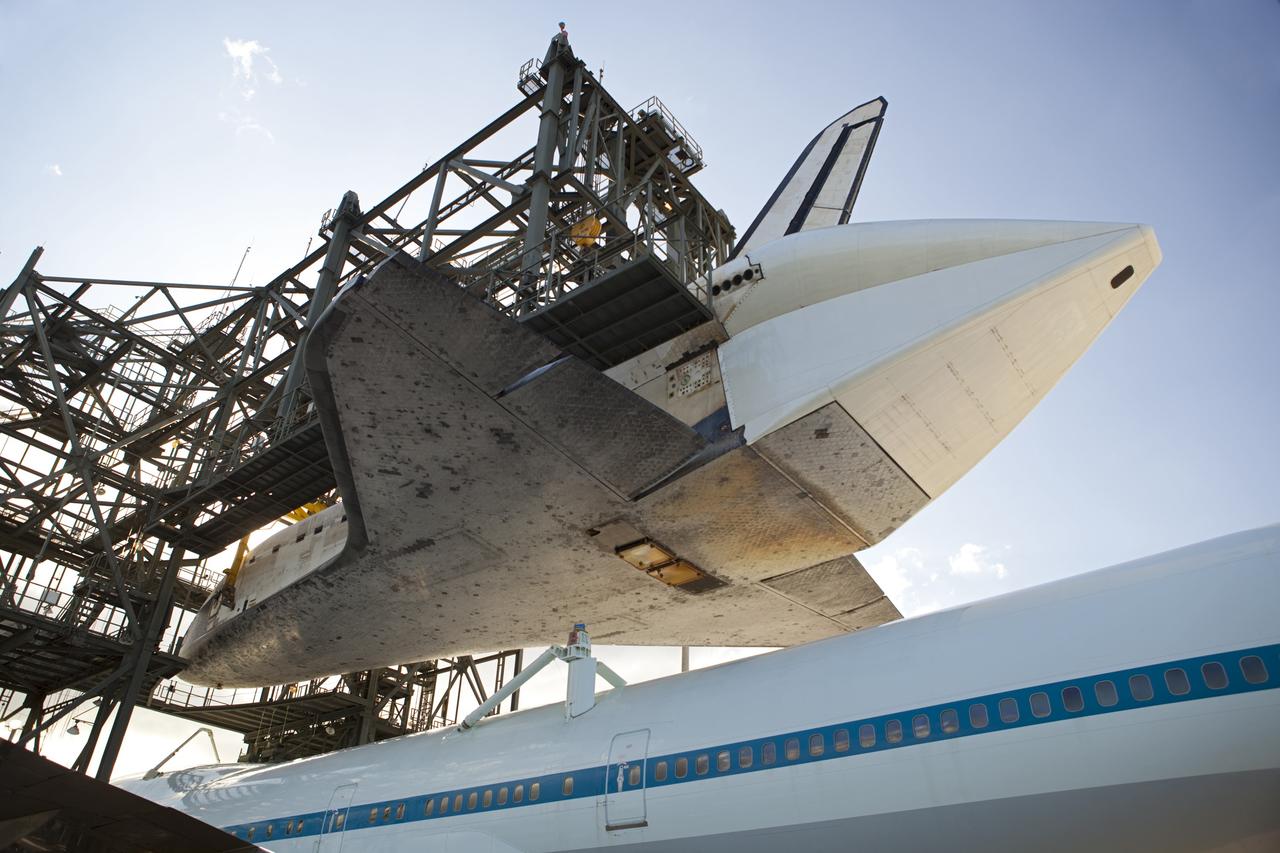
CAPE CANAVERAL, Fla. – At the Shuttle Landing Facility at NASA’s Kennedy Space Center in Florida, space shuttle Discovery is lowered onto the Shuttle Carrier Aircraft in the mate-demate device during mating operations. The device, known as the MDD, is a large gantry-like steel structure used to hoist a shuttle off the ground and position it onto the back of the aircraft, or SCA. The SCA is a Boeing 747 jet, originally manufactured for commercial use, which was modified by NASA to transport the shuttles between destinations on Earth. This SCA, designated NASA 905, is assigned to the remaining ferry missions, delivering the shuttles to their permanent public display sites. NASA 905 is scheduled to ferry Discovery to the Washington Dulles International Airport in Virginia on April 17, after which the shuttle will be placed on display in the Smithsonian's National Air and Space Museum Steven F. Udvar-Hazy Center. For more information on the SCA, visit http://www.nasa.gov/centers/dryden/news/FactSheets/FS-013-DFRC.html. For more information on shuttle transition and retirement activities, visit http://www.nasa.gov/transition. Photo credit: NASA/Dimitri Gerondidakis
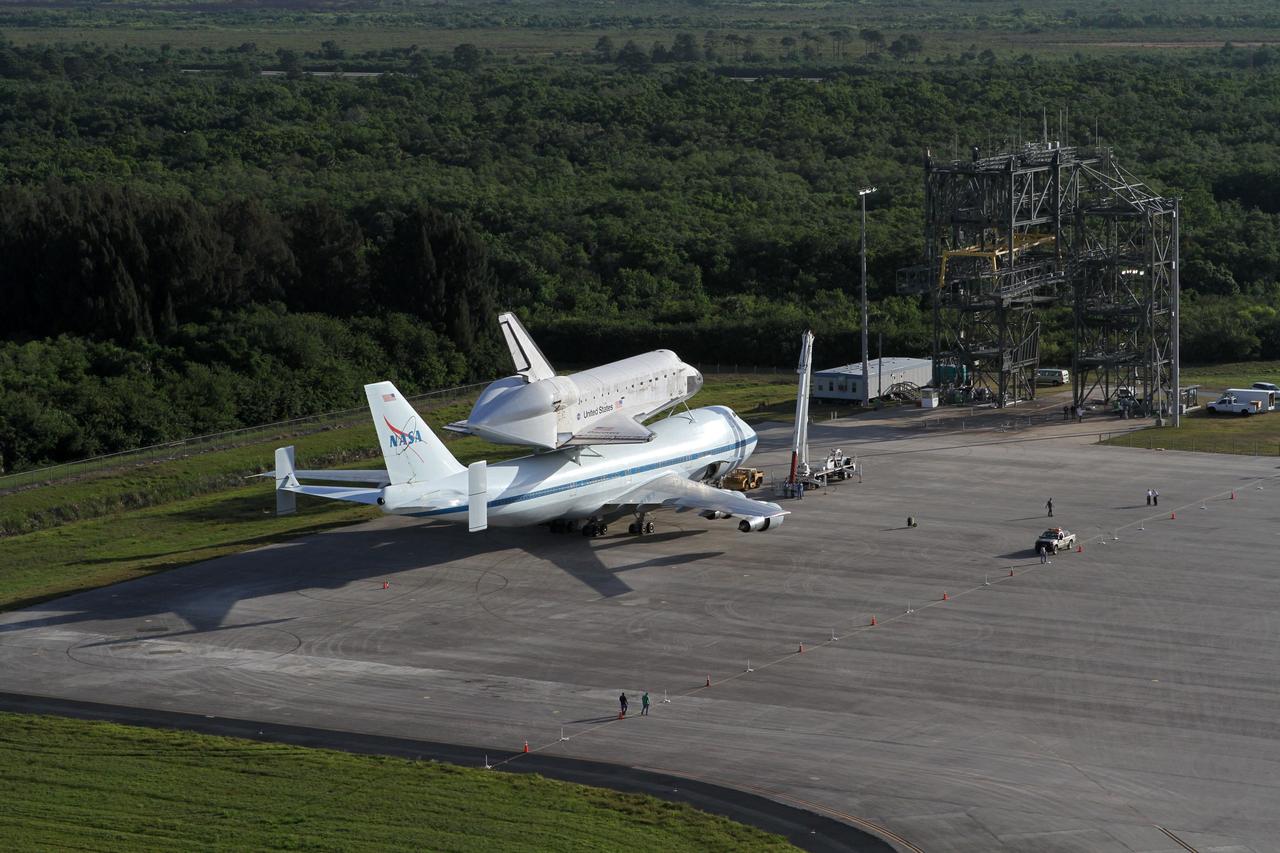
CAPE CANAVERAL, Fla. – This is an aerial view of space shuttle Discovery bolted to the top of a Shuttle Carrier Aircraft SCA on the ramp of the Shuttle Landing Facility SLF at NASA’s Kennedy Space Center in Florida. The mate/demate device, known as the MDD, also is in view and is where transition and retirement teams prepared the duo for the ferry flight. Discovery's last crew members are expected to be at the SLF, along with Kennedy employees and guests, as the center says goodbye to the agency's most-flown shuttle on April 17. The SCA, designated NASA 905, will ferry Discovery to the Washington Dulles International Airport in Virginia, after which the shuttle will be moved for public display in the Smithsonian's National Air and Space Museum Steven F. Udvar-Hazy Center on April 19. For more information on the SCA, visit http://www.nasa.gov/centers/dryden/news/FactSheets/FS-013-DFRC.html. For more information on shuttle transition and retirement activities, visit http://www.nasa.gov/transition. Photo credit: NASA/Kim Shiflett
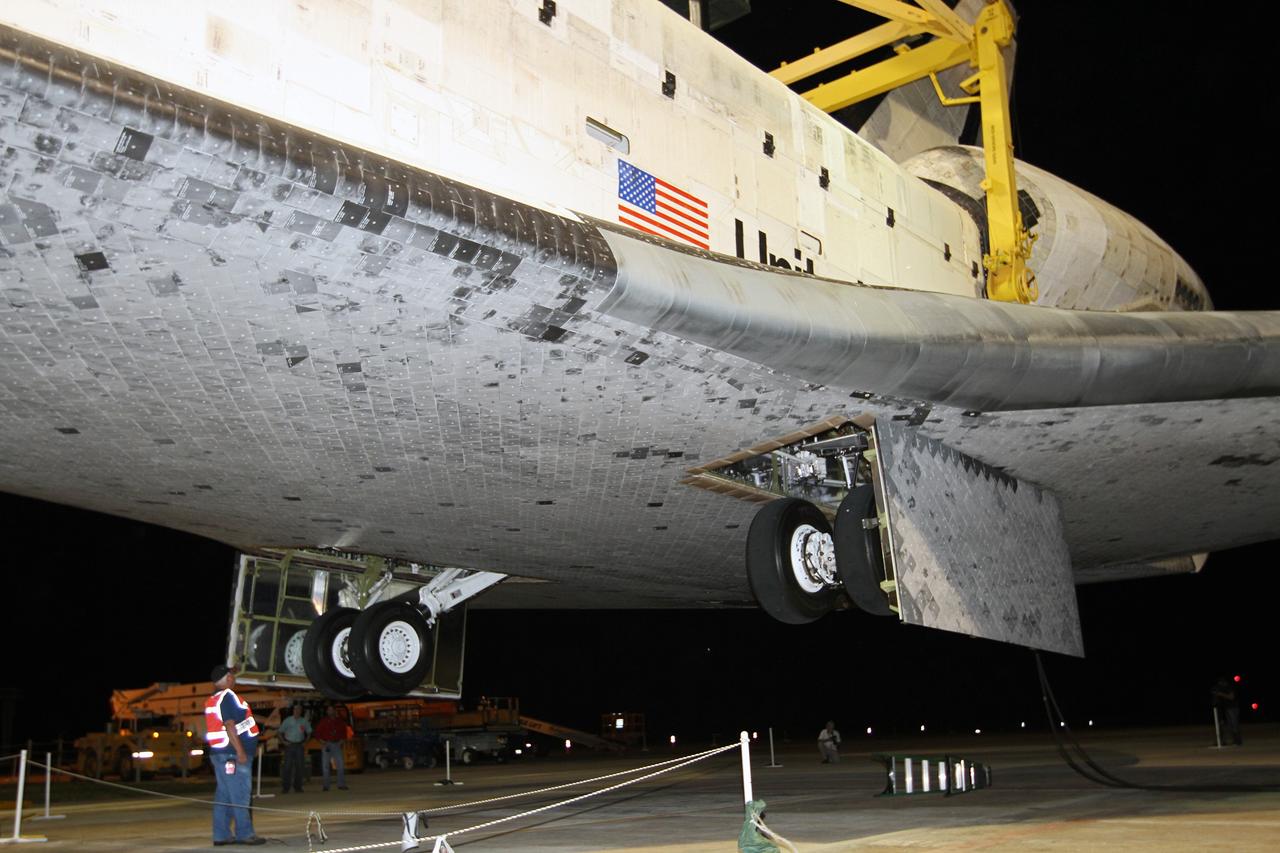
CAPE CANAVERAL, Fla. –At the Shuttle Landing Facility at NASA’s Kennedy Space Center in Florida, space shuttle Discovery rises above the heads of the workers as it is lifted off the ground into the mate-demate device. Operations are under way to position Discovery on top of a Shuttle Carrier Aircraft in preparation for its departure from Kennedy on Tuesday. The device, known as the MDD, is a large gantry-like steel structure used to hoist a shuttle off the ground and position it onto the back of the aircraft, or SCA. The SCA is a Boeing 747 jet, originally manufactured for commercial use, which was modified by NASA to transport the shuttles between destinations on Earth. The SCA designated NASA 905 is assigned to the remaining ferry missions, delivering the shuttles to their permanent public display sites. NASA 905 is scheduled to ferry Discovery to the Washington Dulles International Airport in Virginia on April 17, after which the shuttle will be placed on display in the Smithsonian's National Air and Space Museum Steven F. Udvar-Hazy Center. For more information on the SCA, visit http://www.nasa.gov/centers/dryden/news/FactSheets/FS-013-DFRC.html. For more information on shuttle transition and retirement activities, visit http://www.nasa.gov/transition. Photo credit: NASA/Kim Shiflett
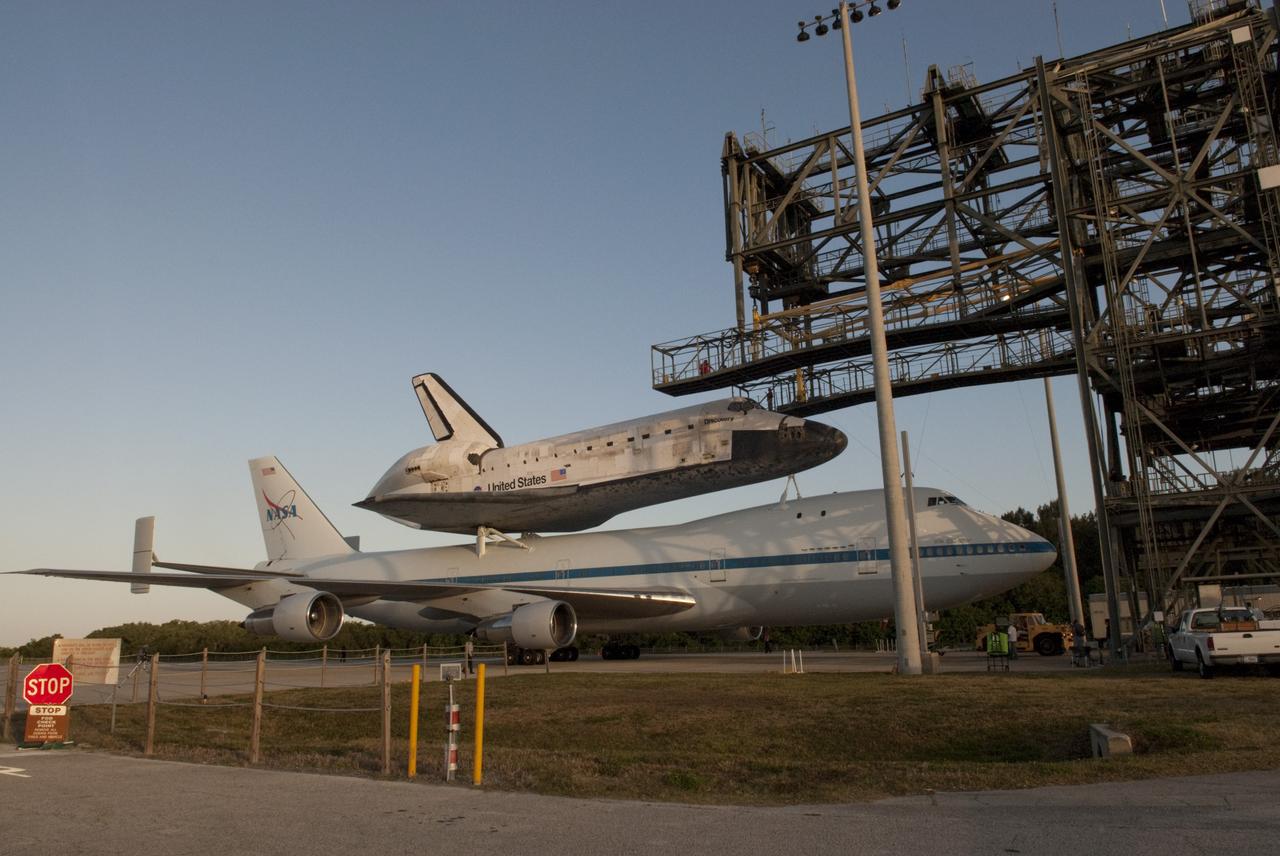
CAPE CANAVERAL, Fla. – At the Shuttle Landing Facility at NASA’s Kennedy Space Center in Florida, the Shuttle Carrier Aircraft backs away from the mate/demate device with space shuttle Discovery secured to its back. The device, also known as the MDD, is a large gantry-like steel structure used to hoist a shuttle off the ground and position it onto the back of the aircraft, or SCA. The SCA is a Boeing 747 jet, originally manufactured for commercial use, which was modified by NASA to transport the shuttles between destinations on Earth. The SCA designated NASA 905 is assigned to the remaining ferry missions, delivering the shuttles to their permanent public display sites. NASA 905 is scheduled to ferry Discovery to the Washington Dulles International Airport in Virginia on April 17, after which the shuttle will be placed on display in the Smithsonian's National Air and Space Museum Steven F. Udvar-Hazy Center. For more information on the SCA, visit http://www.nasa.gov/centers/dryden/news/FactSheets/FS-013-DFRC.html. For more information on shuttle transition and retirement activities, visit http://www.nasa.gov/transition. Photo credit: NASA/Tim Jacobs

CAPE CANAVERAL, Fla. – At the Shuttle Landing Facility at NASA’s Kennedy Space Center in Florida, initial mating of space shuttle Discovery and the Shuttle Carrier Aircraft is complete in the mate-demate device. Known as the “soft mate,” the procedure was complete at about 11:15 a.m. EDT. The device, known as the MDD, is a large gantry-like steel structure used to hoist a shuttle off the ground and position it onto the back of the aircraft, or SCA. The SCA is a Boeing 747 jet, originally manufactured for commercial use, which was modified by NASA to transport the shuttles between destinations on Earth. This SCA, designated NASA 905, is assigned to the remaining ferry missions, delivering the shuttles to their permanent public display sites. NASA 905 is scheduled to ferry Discovery to the Washington Dulles International Airport in Virginia on April 17, after which the shuttle will be placed on display in the Smithsonian's National Air and Space Museum Steven F. Udvar-Hazy Center. For more information on the SCA, visit http://www.nasa.gov/centers/dryden/news/FactSheets/FS-013-DFRC.html. For more information on shuttle transition and retirement activities, visit http://www.nasa.gov/transition. Photo credit: NASA/Kim Shiflett
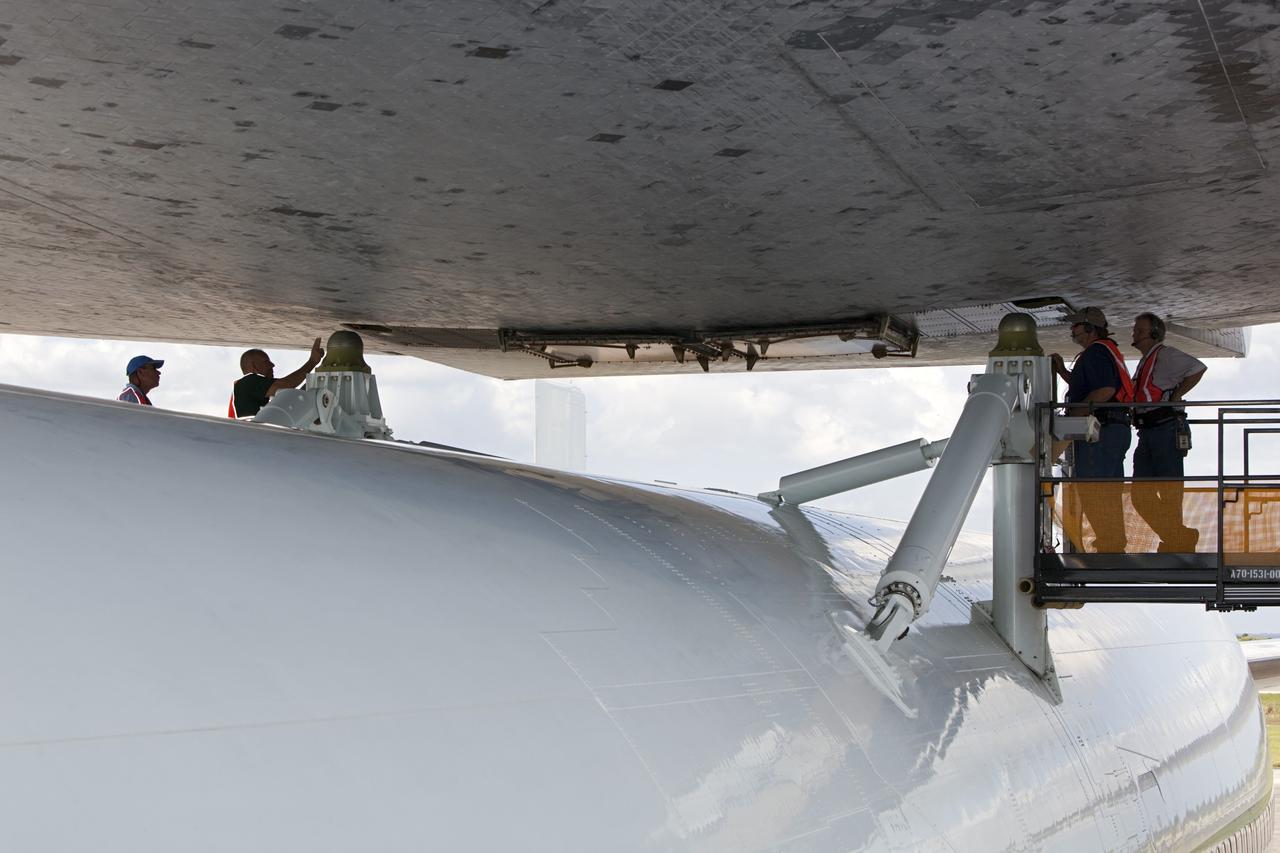
CAPE CANAVERAL, Fla. – At the Shuttle Landing Facility at NASA’s Kennedy Space Center in Florida, workers in the mate-demate device attach space shuttle Discovery to the Shuttle Carrier Aircraft. The device, known as the MDD, is a large gantry-like steel structure used to hoist a shuttle off the ground and position it onto the back of the aircraft, or SCA. The SCA is a Boeing 747 jet, originally manufactured for commercial use, which was modified by NASA to transport the shuttles between destinations on Earth. This SCA, designated NASA 905, is assigned to the remaining ferry missions, delivering the shuttles to their permanent public display sites. NASA 905 is scheduled to ferry Discovery to the Washington Dulles International Airport in Virginia on April 17, after which the shuttle will be placed on display in the Smithsonian's National Air and Space Museum Steven F. Udvar-Hazy Center. For more information on the SCA, visit http://www.nasa.gov/centers/dryden/news/FactSheets/FS-013-DFRC.html. For more information on shuttle transition and retirement activities, visit http://www.nasa.gov/transition. Photo credit: NASA/Dimitri Gerondidakis
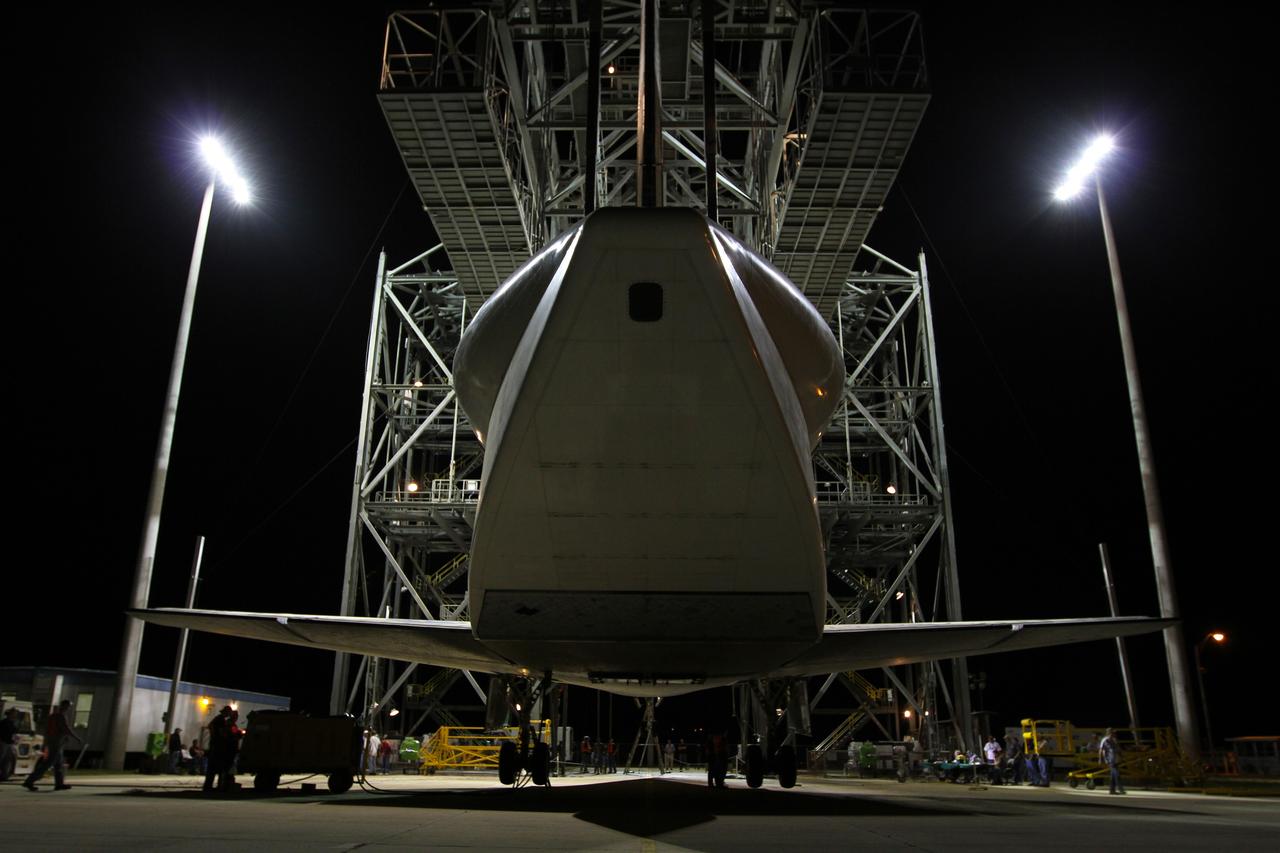
CAPE CANAVERAL, Fla. – Before daybreak at the Shuttle Landing Facility at NASA’s Kennedy Space Center in Florida, space shuttle Discovery hovers above the ground at the mate-demate device. Operations are under way to position Discovery on top of a Shuttle Carrier Aircraft in preparation for its departure from Kennedy on Tuesday. A tail cone has been installed over Discovery’s three replica shuttle main engines to reduce aerodynamic drag and turbulence during the ferry flight. The device, known as the MDD, is a large gantry-like steel structure used to hoist a shuttle off the ground and position it onto the back of the aircraft, or SCA. The SCA is a Boeing 747 jet, originally manufactured for commercial use, which was modified by NASA to transport the shuttles between destinations on Earth. The SCA designated NASA 905 is assigned to the remaining ferry missions, delivering the shuttles to their permanent public display sites. NASA 905 is scheduled to ferry Discovery to the Washington Dulles International Airport in Virginia on April 17, after which the shuttle will be placed on display in the Smithsonian's National Air and Space Museum Steven F. Udvar-Hazy Center. For more information on the SCA, visit http://www.nasa.gov/centers/dryden/news/FactSheets/FS-013-DFRC.html. For more information on shuttle transition and retirement activities, visit http://www.nasa.gov/transition. Photo credit: NASA/Kim Shiflett
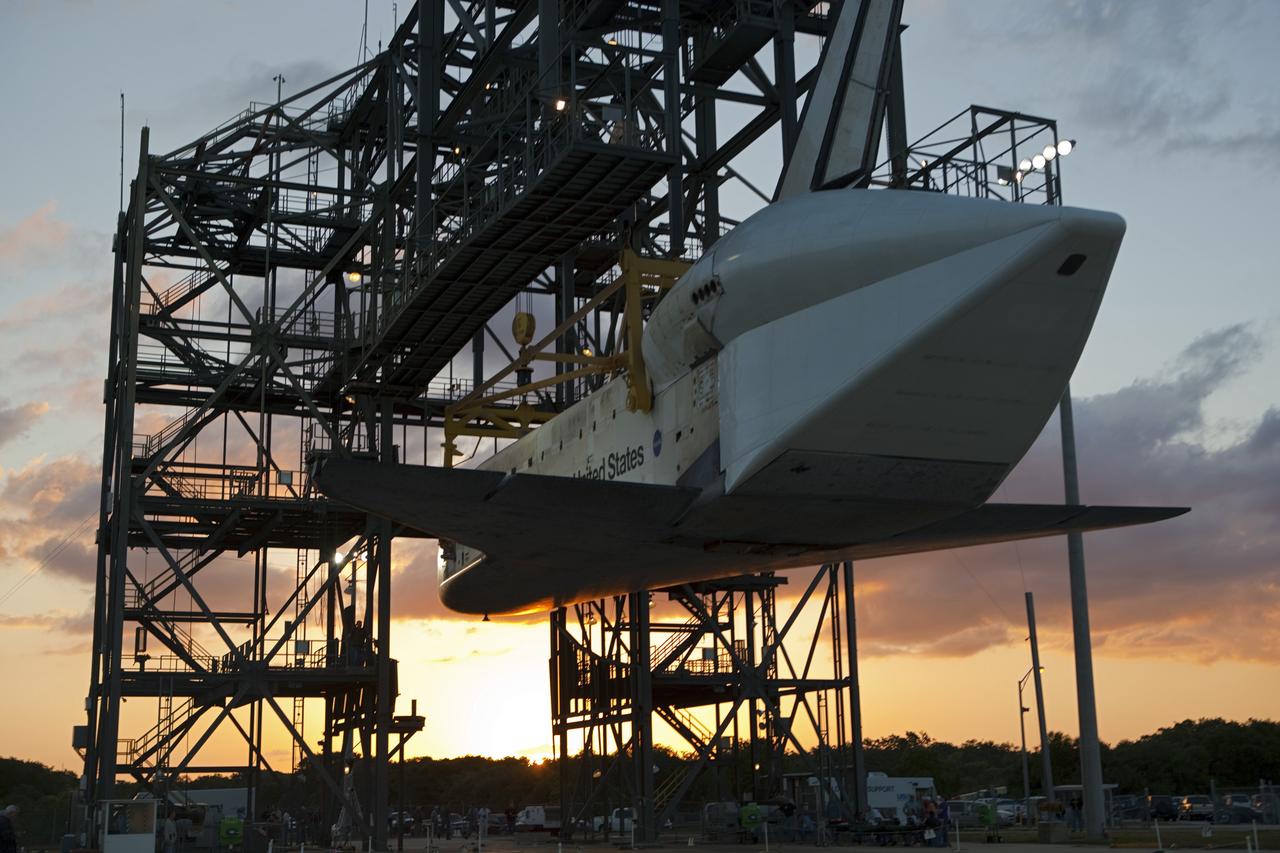
CAPE CANAVERAL, Fla. – At the Shuttle Landing Facility at NASA’s Kennedy Space Center in Florida, space shuttle Discovery slowly is lifted off the ground inside the mate-demate device in preparation for the arrival of the Shuttle Carrier Aircraft. The device, known as the MDD, is a large gantry-like steel structure used to hoist a shuttle off the ground and position it onto the back of the aircraft, or SCA. The SCA is a Boeing 747 jet, originally manufactured for commercial use, which was modified by NASA to transport the shuttles between destinations on Earth. The SCA designated NASA 905 is assigned to the remaining ferry missions, delivering the shuttles to their permanent public display sites. NASA 905 is scheduled to ferry Discovery to the Washington Dulles International Airport in Virginia on April 17, after which the shuttle will be placed on display in the Smithsonian's National Air and Space Museum Steven F. Udvar-Hazy Center. For more information on the SCA, visit http://www.nasa.gov/centers/dryden/news/FactSheets/FS-013-DFRC.html. For more information on shuttle transition and retirement activities, visit http://www.nasa.gov/transition. Photo credit: NASA/Dimitri Gerondidakis
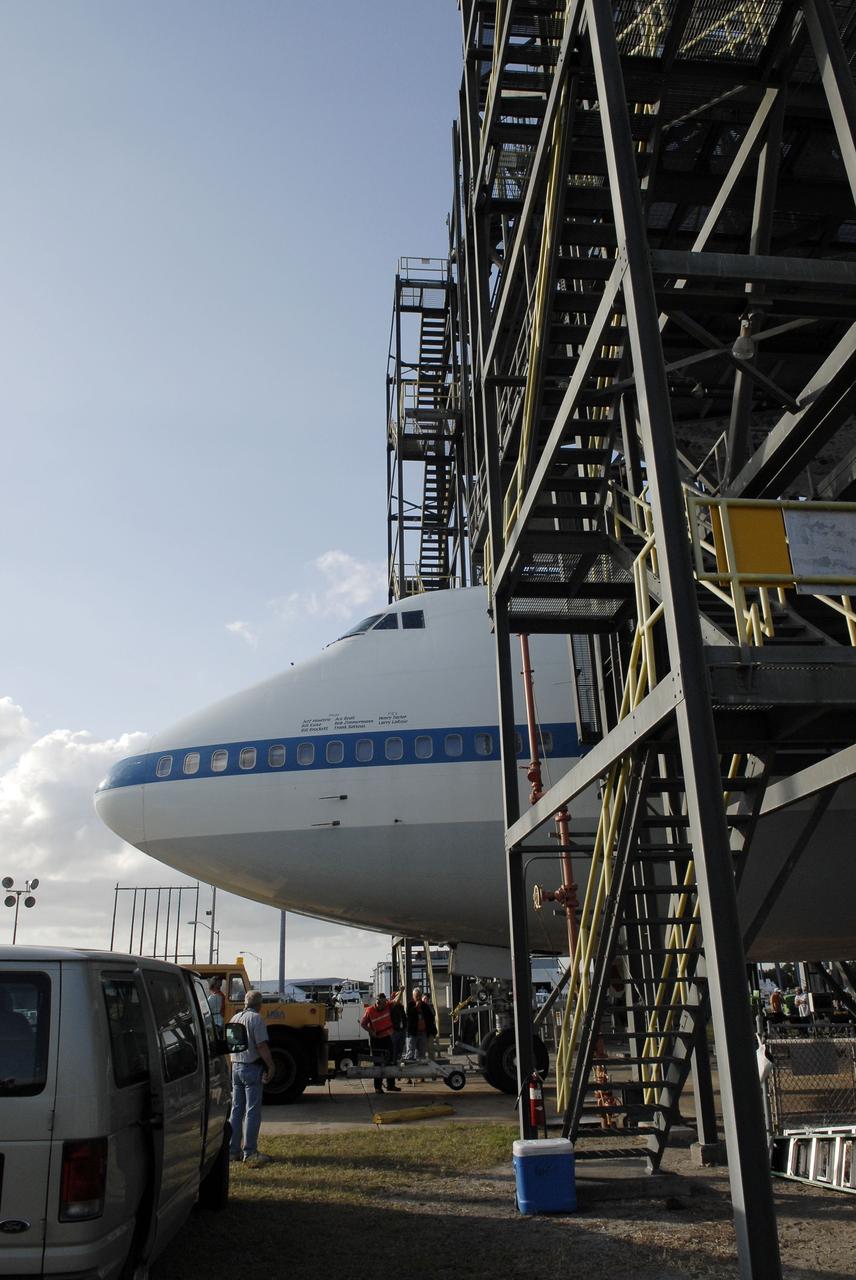
CAPE CANAVERAL, Fla. – At the Shuttle Landing Facility at NASA’s Kennedy Space Center in Florida, the Shuttle Carrier Aircraft is parked into position under space shuttle Discovery for mating operations to begin at the mate-demate device. The device, known as the MDD, is a large gantry-like steel structure used to hoist a shuttle off the ground and position it onto the back of the aircraft, or SCA. The SCA is a Boeing 747 jet, originally manufactured for commercial use, which was modified by NASA to transport the shuttles between destinations on Earth. This SCA, designated NASA 905, is assigned to the remaining ferry missions, delivering the shuttles to their permanent public display sites. NASA 905 is scheduled to ferry Discovery to the Washington Dulles International Airport in Virginia on April 17, after which the shuttle will be placed on display in the Smithsonian's National Air and Space Museum Steven F. Udvar-Hazy Center. For more information on the SCA, visit http://www.nasa.gov/centers/dryden/news/FactSheets/FS-013-DFRC.html. For more information on shuttle transition and retirement activities, visit http://www.nasa.gov/transition. Photo credit: NASA/Tim Jacobs

CAPE CANAVERAL, Fla. – At the Shuttle Landing Facility at NASA’s Kennedy Space Center in Florida, workers are standing by as the Shuttle Carrier Aircraft moves into position beneath space shuttle Discovery suspended 60 feet off the ground inside the mate-demate device. The device, known as the MDD, is a large gantry-like steel structure used to hoist a shuttle off the ground and position it onto the back of the aircraft, or SCA. The SCA is a Boeing 747 jet, originally manufactured for commercial use, which was modified by NASA to transport the shuttles between destinations on Earth. This SCA, designated NASA 905, is assigned to the remaining ferry missions, delivering the shuttles to their permanent public display sites. NASA 905 is scheduled to ferry Discovery to the Washington Dulles International Airport in Virginia on April 17, after which the shuttle will be placed on display in the Smithsonian's National Air and Space Museum Steven F. Udvar-Hazy Center. For more information on the SCA, visit http://www.nasa.gov/centers/dryden/news/FactSheets/FS-013-DFRC.html. For more information on shuttle transition and retirement activities, visit http://www.nasa.gov/transition. Photo credit: NASA/Dimitri Gerondidakis
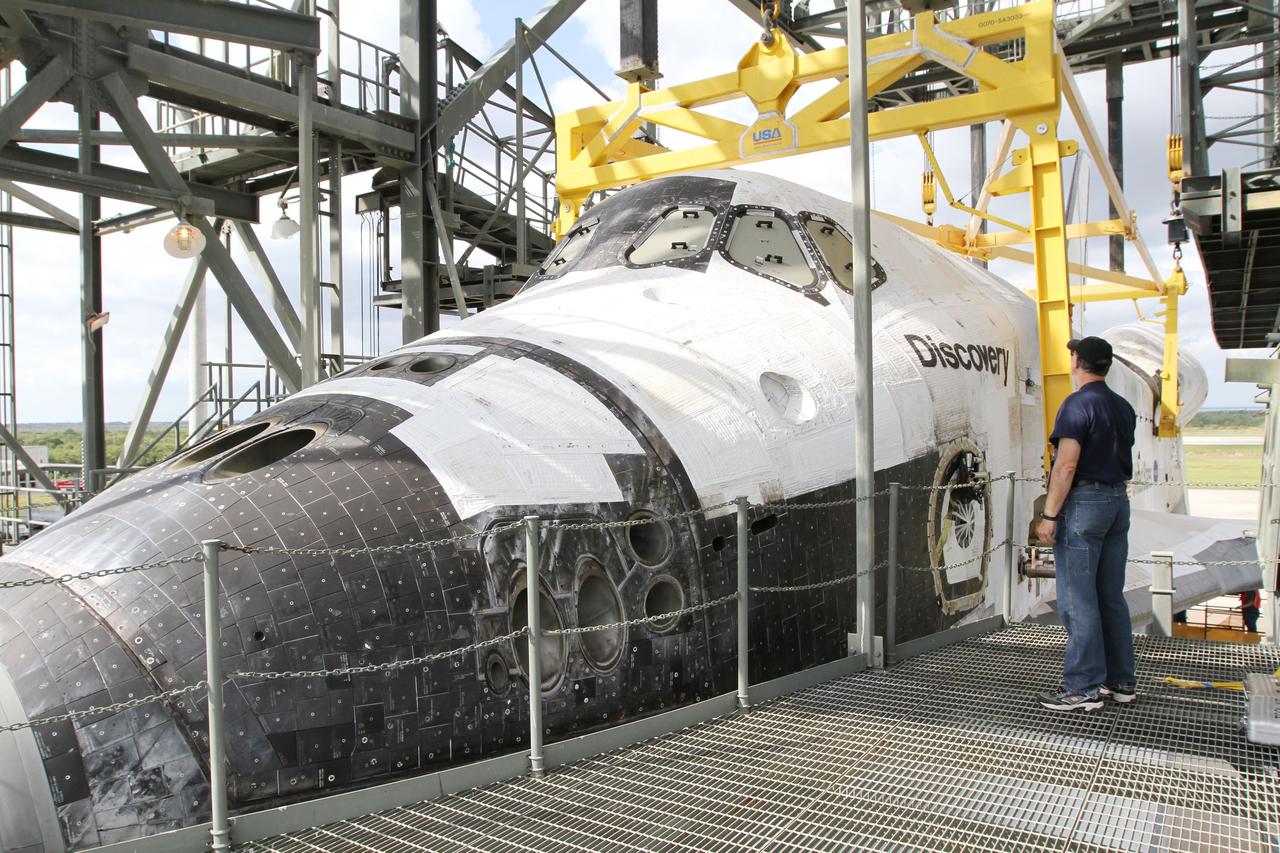
CAPE CANAVERAL, Fla. – At the Shuttle Landing Facility at NASA’s Kennedy Space Center in Florida, a worker inspects space shuttle Discovery as it is attached to the Shuttle Carrier Aircraft in the mate-demate device. The device, known as the MDD, is a large gantry-like steel structure used to hoist a shuttle off the ground and position it onto the back of the aircraft, or SCA. The SCA is a Boeing 747 jet, originally manufactured for commercial use, which was modified by NASA to transport the shuttles between destinations on Earth. The SCA designated NASA 905 is assigned to the remaining ferry missions, delivering the shuttles to their permanent public display sites. NASA 905 is scheduled to ferry Discovery to the Washington Dulles International Airport in Virginia on April 17, after which the shuttle will be placed on display in the Smithsonian's National Air and Space Museum Steven F. Udvar-Hazy Center. For more information on the SCA, visit http://www.nasa.gov/centers/dryden/news/FactSheets/FS-013-DFRC.html. For more information on shuttle transition and retirement activities, visit http://www.nasa.gov/transition. Photo credit: NASA/Kim Shiflett
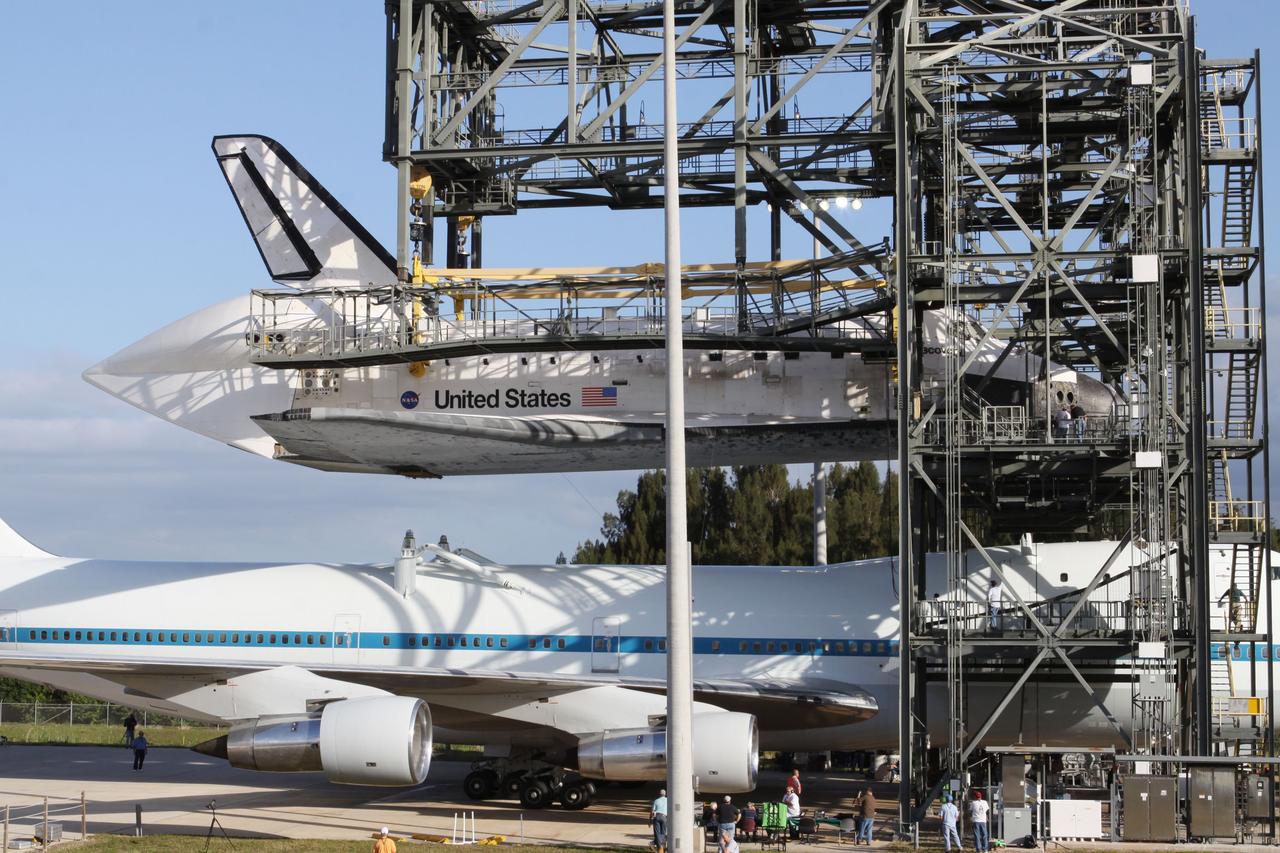
CAPE CANAVERAL, Fla. – At the Shuttle Landing Facility at NASA’s Kennedy Space Center in Florida, preparations are under way to lower space shuttle Discovery onto the Shuttle Carrier Aircraft in the mate-demate device. The device, known as the MDD, is a large gantry-like steel structure used to hoist a shuttle off the ground and position it onto the back of the aircraft, or SCA. The SCA is a Boeing 747 jet, originally manufactured for commercial use, which was modified by NASA to transport the shuttles between destinations on Earth. The SCA designated NASA 905 is assigned to the remaining ferry missions, delivering the shuttles to their permanent public display sites. NASA 905 is scheduled to ferry Discovery to the Washington Dulles International Airport in Virginia on April 17, after which the shuttle will be placed on display in the Smithsonian's National Air and Space Museum Steven F. Udvar-Hazy Center. For more information on the SCA, visit http://www.nasa.gov/centers/dryden/news/FactSheets/FS-013-DFRC.html. For more information on shuttle transition and retirement activities, visit http://www.nasa.gov/transition. Photo credit: NASA/Kim Shiflett
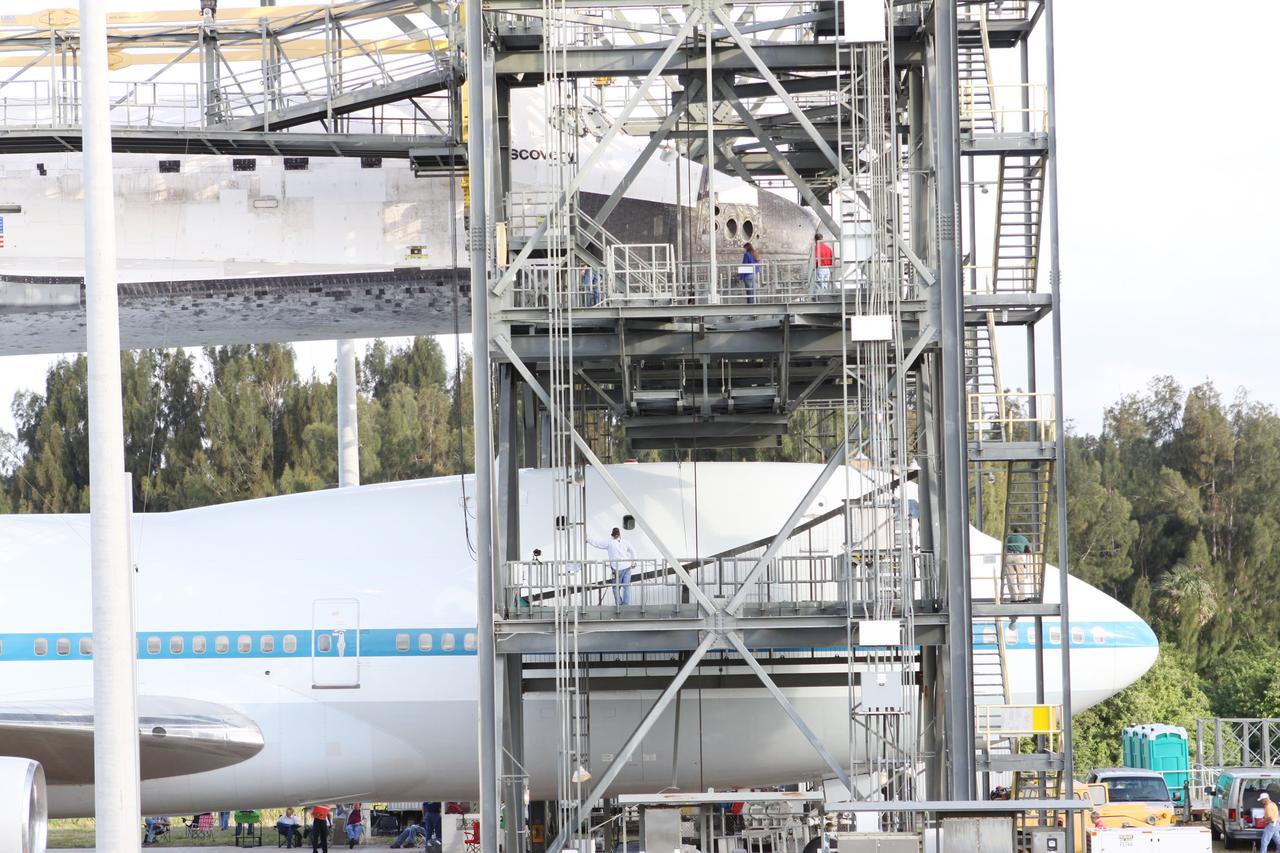
CAPE CANAVERAL, Fla. – At the Shuttle Landing Facility at NASA’s Kennedy Space Center in Florida, the Shuttle Carrier Aircraft is in position under space shuttle Discovery in the mate-demate device for mating operations to begin. The device, known as the MDD, is a large gantry-like steel structure used to hoist a shuttle off the ground and position it onto the back of the aircraft, or SCA. The SCA is a Boeing 747 jet, originally manufactured for commercial use, which was modified by NASA to transport the shuttles between destinations on Earth. The SCA designated NASA 905 is assigned to the remaining ferry missions, delivering the shuttles to their permanent public display sites. NASA 905 is scheduled to ferry Discovery to the Washington Dulles International Airport in Virginia on April 17, after which the shuttle will be placed on display in the Smithsonian's National Air and Space Museum Steven F. Udvar-Hazy Center. For more information on the SCA, visit http://www.nasa.gov/centers/dryden/news/FactSheets/FS-013-DFRC.html. For more information on shuttle transition and retirement activities, visit http://www.nasa.gov/transition. Photo credit: NASA/Kim Shiflett
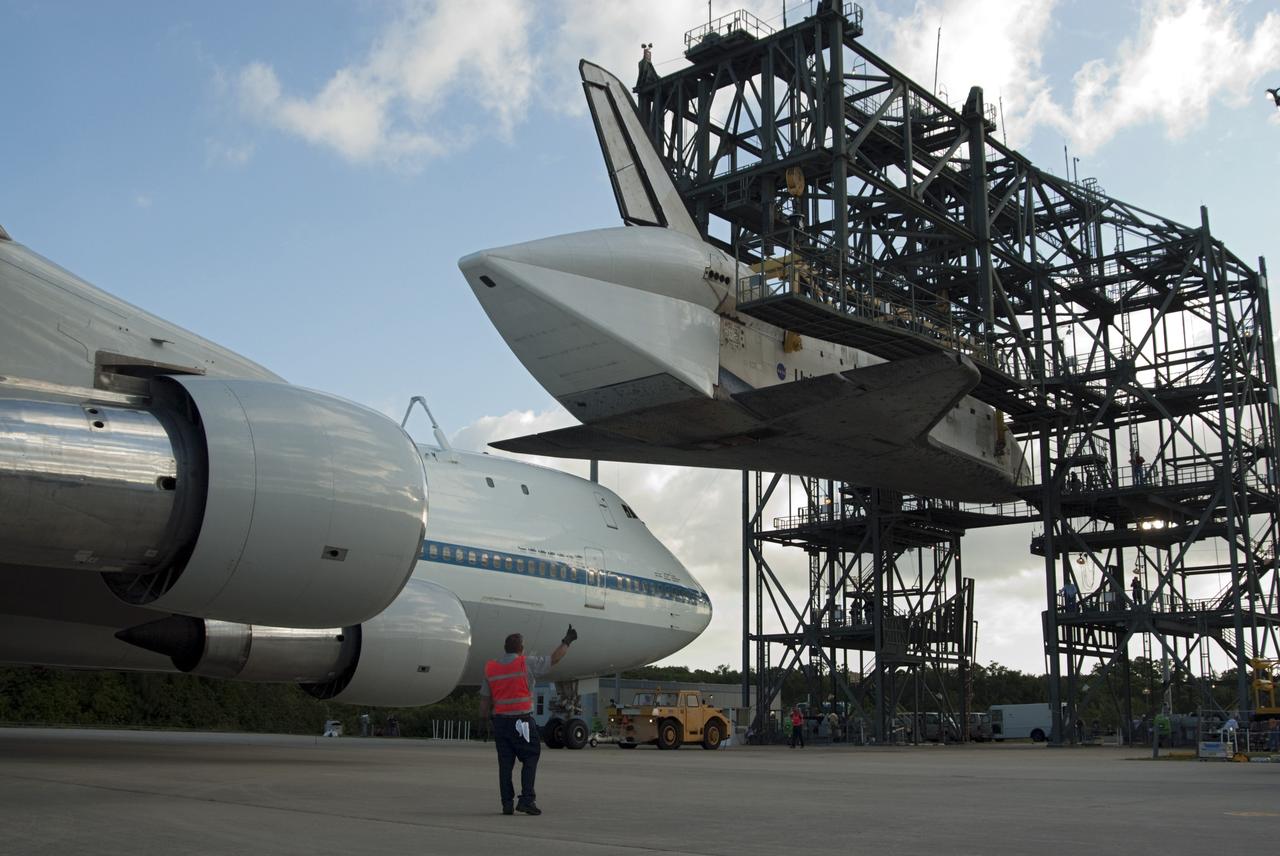
CAPE CANAVERAL, Fla. – At the Shuttle Landing Facility at NASA’s Kennedy Space Center in Florida, the Shuttle Carrier Aircraft moves into position under space shuttle Discovery suspended 60 feet off the ground in the mate-demate device. The device, known as the MDD, is a large gantry-like steel structure used to hoist a shuttle off the ground and position it onto the back of the aircraft, or SCA. This SCA, designated NASA 905, is a Boeing 747 jet originally manufactured for commercial use, which was modified by NASA to transport the shuttles between destinations on Earth. NASA 905 is assigned to the remaining ferry missions, delivering the shuttles to their permanent public display sites. Discovery’s new home will be the Smithsonian's National Air and Space Museum Steven F. Udvar-Hazy Center in Chantilly, Va. For more information on the SCA, visit http://www.nasa.gov/centers/dryden/news/FactSheets/FS-013-DFRC.html. For more information on shuttle transition and retirement activities, visit http://www.nasa.gov/transition. Photo credit: NASA/Tim Jacobs

CAPE CANAVERAL, Fla. – At the Shuttle Landing Facility at NASA’s Kennedy Space Center in Florida, STS-133 Mission Specialists Nicole Stott and Michael Barratt pose for a photographer in front of a Shuttle Carrier Aircraft on which space shuttle Discovery has been secured for departure. Stott and Barratt were members of the crew to fly on Discovery’s final mission in February and March 2011. Other members of the STS-133 crew were Commander Steve Lindsey, Pilot Eric Boe, and Mission Specialists Alvin Drew and Steve Bowen. Discovery is scheduled to depart from Kennedy for the final time tomorrow morning. Also known as an SCA, the aircraft is a Boeing 747 jet, originally manufactured for commercial use, which was modified by NASA to transport the shuttles between destinations on Earth. The SCA designated NASA 905 is assigned to the remaining ferry missions, delivering the shuttles to their permanent public display sites. NASA 905 is scheduled to ferry Discovery to the Washington Dulles International Airport in Virginia on April 17, after which the shuttle will be placed on display in the Smithsonian's National Air and Space Museum Steven F. Udvar-Hazy Center. For more information on the SCA, visit http://www.nasa.gov/centers/dryden/news/FactSheets/FS-013-DFRC.html. For more information on shuttle transition and retirement activities, visit http://www.nasa.gov/transition. Photo credit: NASA/Tim Jacobs
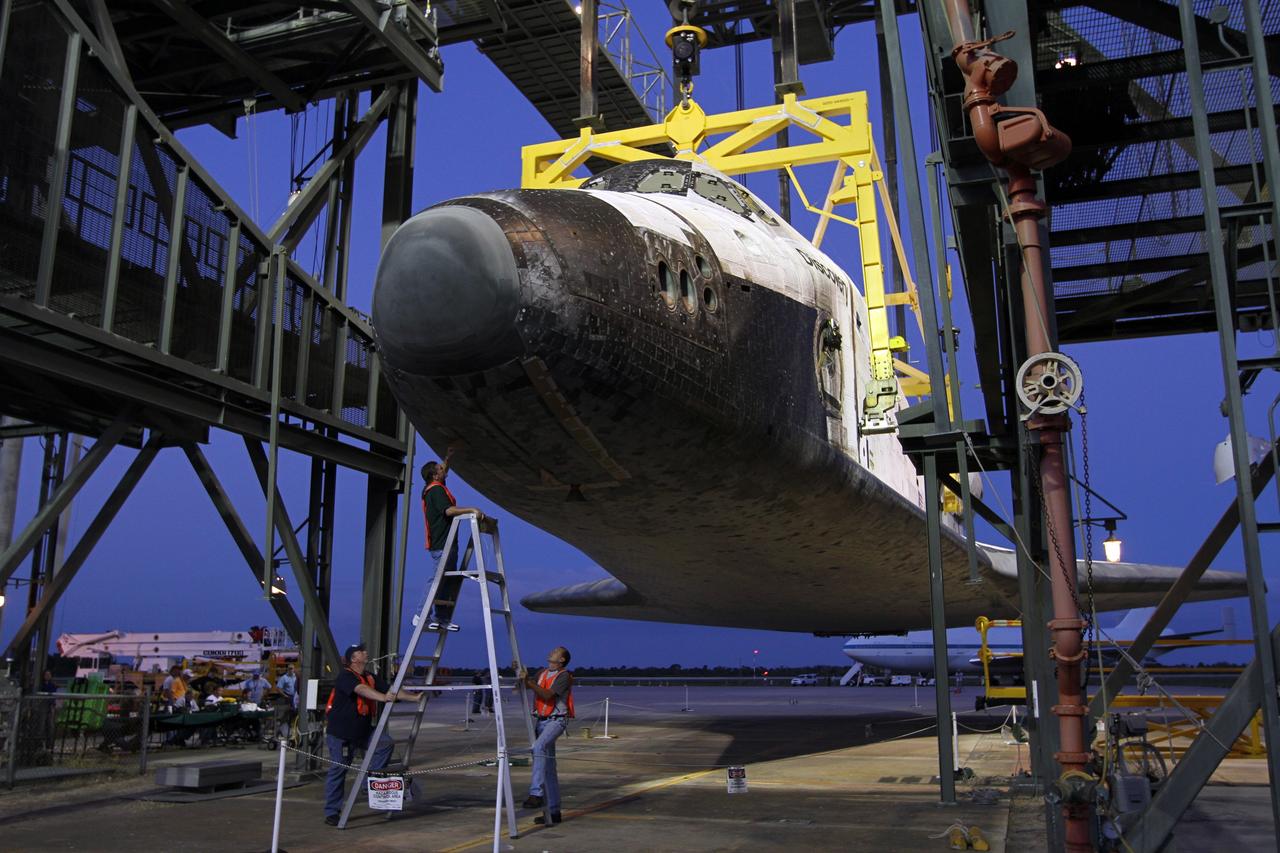
CAPE CANAVERAL, Fla. – As the sun rises over the Shuttle Landing Facility at NASA’s Kennedy Space Center in Florida, workers at the mate-demate device inspect space shuttle Discovery to ensure that it is ready for placement on top of a Shuttle Carrier Aircraft. The device, known as the MDD, is a large gantry-like steel structure used to hoist a shuttle off the ground and position it onto the back of the aircraft, or SCA. The SCA is a Boeing 747 jet, originally manufactured for commercial use, which was modified by NASA to transport the shuttles between destinations on Earth. The SCA designated NASA 905 is assigned to the remaining ferry missions, delivering the shuttles to their permanent public display sites. NASA 905 is scheduled to ferry Discovery to the Washington Dulles International Airport in Virginia on April 17, after which the shuttle will be placed on display in the Smithsonian's National Air and Space Museum Steven F. Udvar-Hazy Center. For more information on the SCA, visit http://www.nasa.gov/centers/dryden/news/FactSheets/FS-013-DFRC.html. For more information on shuttle transition and retirement activities, visit http://www.nasa.gov/transition. Photo credit: NASA/Kim Shiflett
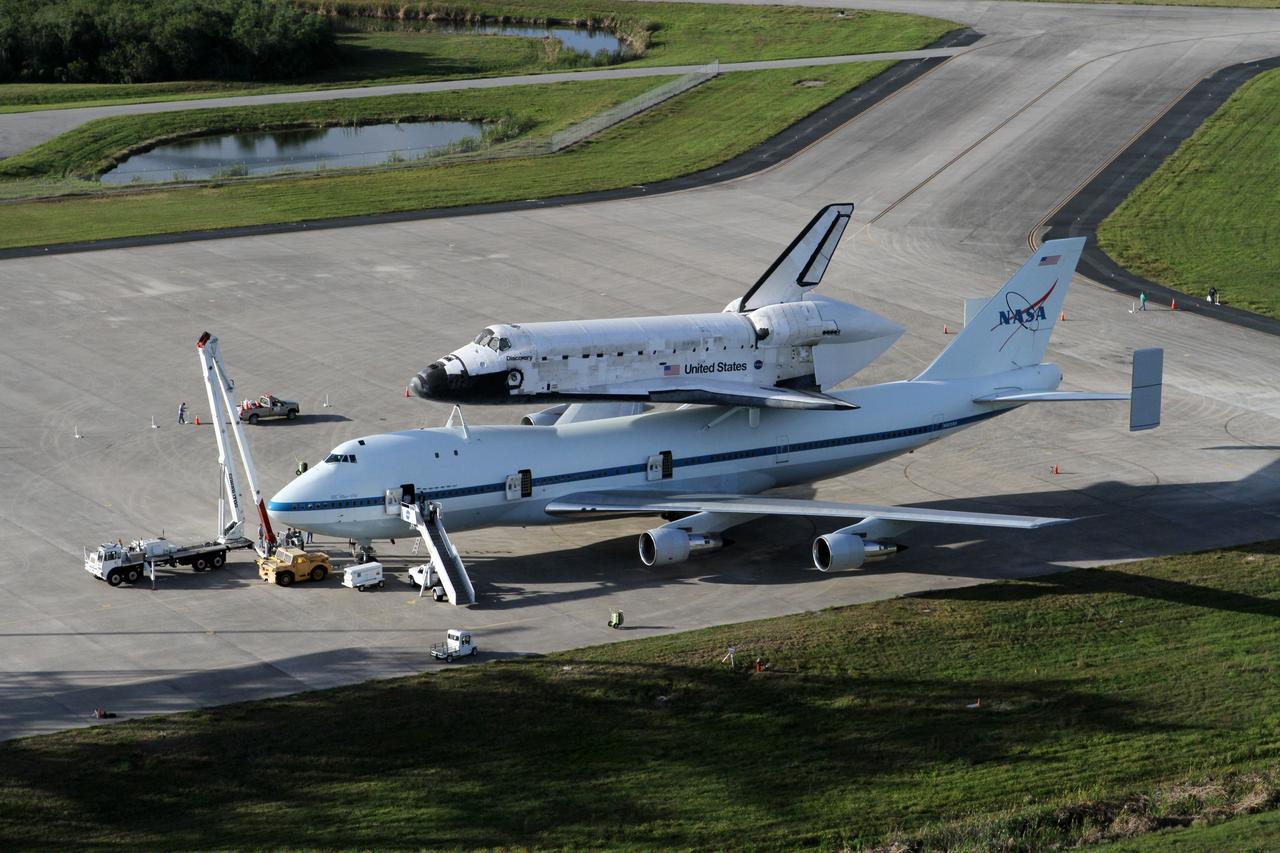
CAPE CANAVERAL, Fla. – This is an aerial view of space shuttle Discovery bolted to the top of a Shuttle Carrier Aircraft SCA on the ramp of the Shuttle Landing Facility SLF at NASA’s Kennedy Space Center in Florida. Discovery's last crew members are expected to be at the SLF, along with Kennedy employees and guests, as the center says goodbye to the agency's most-flown shuttle on April 17. The SCA, designated NASA 905, will ferry Discovery to the Washington Dulles International Airport in Virginia, after which the shuttle will be moved for public display in the Smithsonian's National Air and Space Museum Steven F. Udvar-Hazy Center on April 19. For more information on the SCA, visit http://www.nasa.gov/centers/dryden/news/FactSheets/FS-013-DFRC.html. For more information on shuttle transition and retirement activities, visit http://www.nasa.gov/transition. Photo credit: NASA/Kim Shiflett
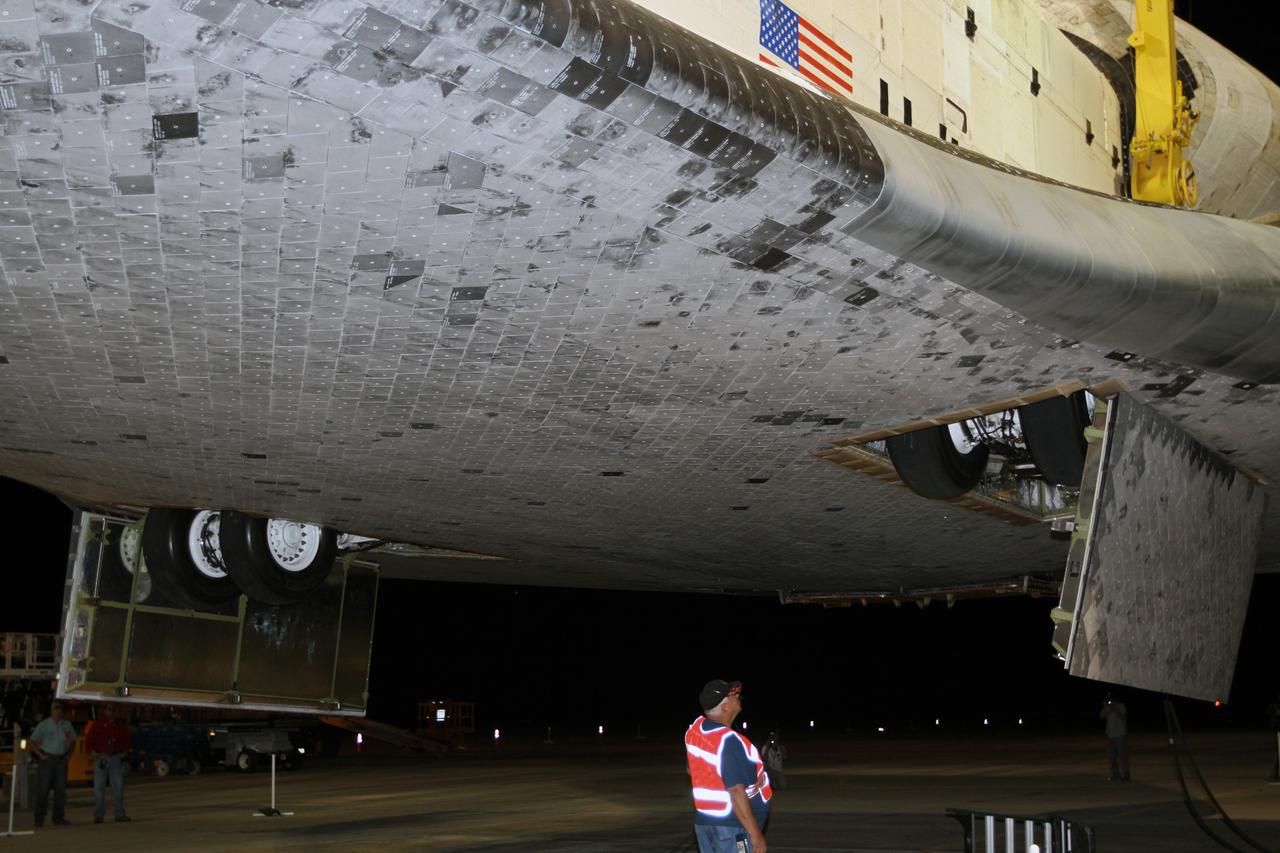
CAPE CANAVERAL, Fla. – At the Shuttle Landing Facility at NASA’s Kennedy Space Center in Florida, vigilant workers monitor space shuttle Discovery as it is lifted off the ground into the mate-demate device. Operations are under way to position Discovery on top of a Shuttle Carrier Aircraft in preparation for its departure from Kennedy on Tuesday. The device, known as the MDD, is a large gantry-like steel structure used to hoist a shuttle off the ground and position it onto the back of the aircraft, or SCA. The SCA is a Boeing 747 jet, originally manufactured for commercial use, which was modified by NASA to transport the shuttles between destinations on Earth. The SCA designated NASA 905 is assigned to the remaining ferry missions, delivering the shuttles to their permanent public display sites. NASA 905 is scheduled to ferry Discovery to the Washington Dulles International Airport in Virginia on April 17, after which the shuttle will be placed on display in the Smithsonian's National Air and Space Museum Steven F. Udvar-Hazy Center. For more information on the SCA, visit http://www.nasa.gov/centers/dryden/news/FactSheets/FS-013-DFRC.html. For more information on shuttle transition and retirement activities, visit http://www.nasa.gov/transition. Photo credit: NASA/Kim Shiflett
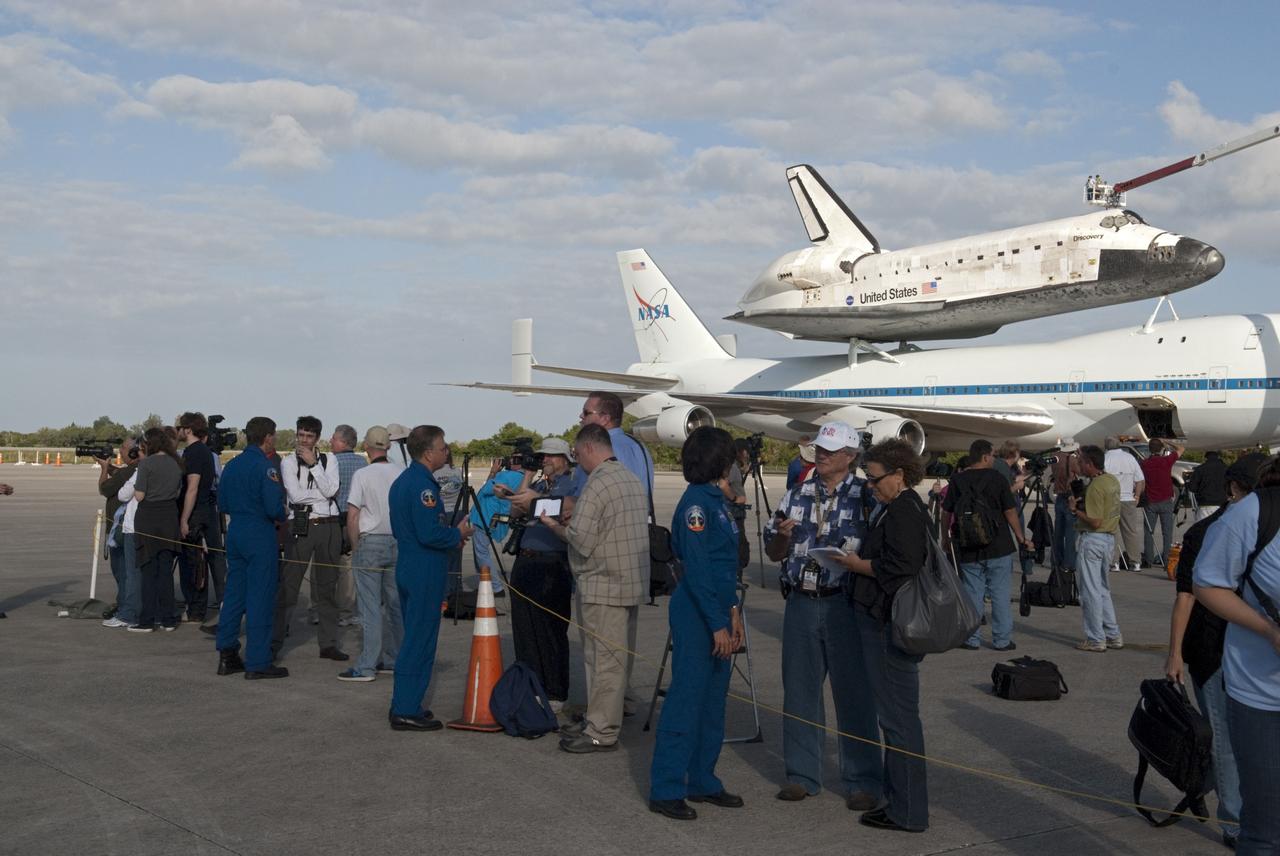
CAPE CANAVERAL, Fla. – At the Shuttle Landing Facility at NASA’s Kennedy Space Center in Florida, media representatives interview members of the last astronaut crew to fly aboard space shuttle Discovery, in the background, which is scheduled to depart from Kennedy for the final time tomorrow morning aboard a Shuttle Carrier Aircraft. Members of the crew of Discovery’s last mission, STS-133, were Commander Steve Lindsey, Pilot Eric Boe, and Mission Specialists Nicole Stott, Michael Barratt, Alvin Drew and Steve Bowen. Also known as an SCA, the aircraft is a Boeing 747 jet, originally manufactured for commercial use, which was modified by NASA to transport the shuttles between destinations on Earth. The SCA designated NASA 905 is assigned to the remaining ferry missions, delivering the shuttles to their permanent public display sites. NASA 905 is scheduled to ferry Discovery to the Washington Dulles International Airport in Virginia on April 17, after which the shuttle will be placed on display in the Smithsonian's National Air and Space Museum Steven F. Udvar-Hazy Center. For more information on the SCA, visit http://www.nasa.gov/centers/dryden/news/FactSheets/FS-013-DFRC.html. For more information on shuttle transition and retirement activities, visit http://www.nasa.gov/transition. Photo credit: NASA/Tim Jacobs
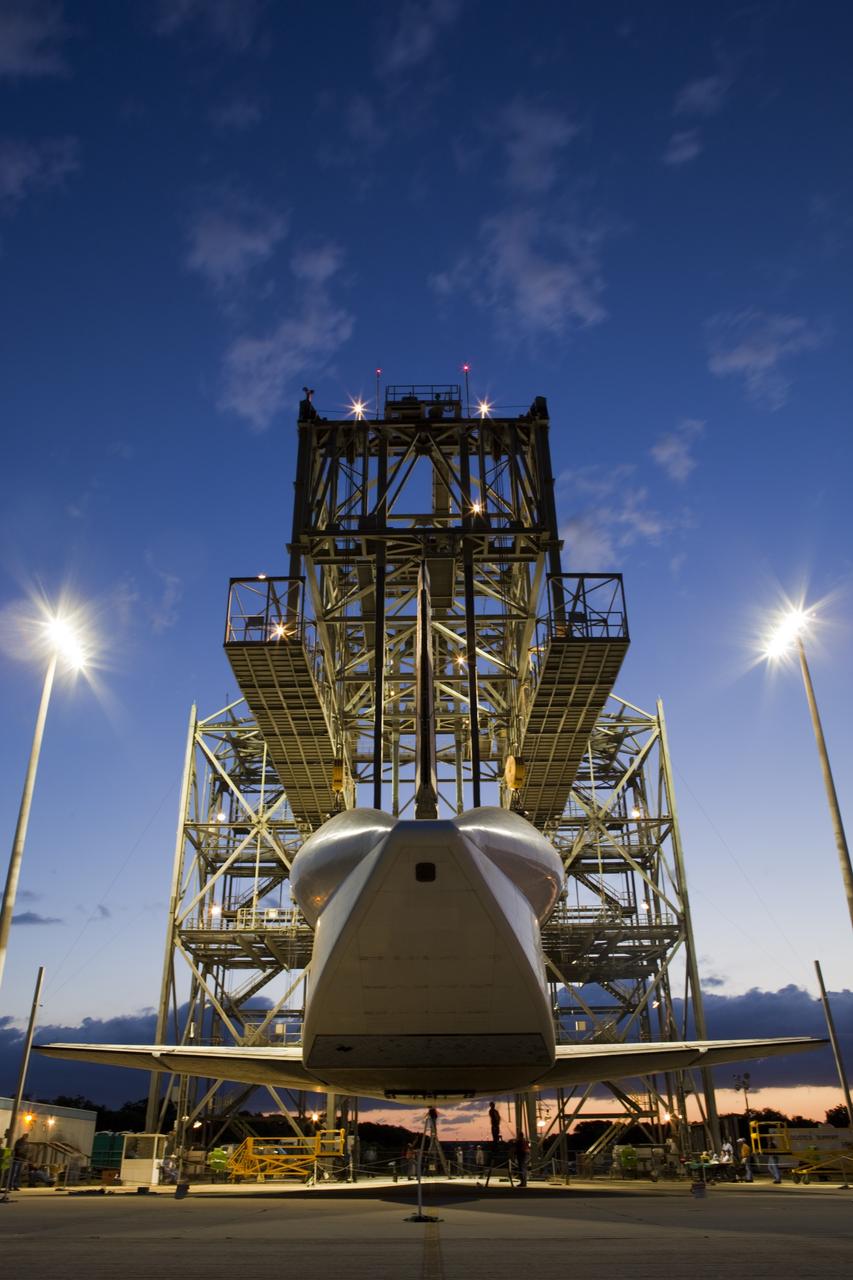
CAPE CANAVERAL, Fla. – As the sun rises over the Shuttle Landing Facility at NASA’s Kennedy Space Center in Florida, operations are under way at the mate-demate device to lift space shuttle Discovery on top of a Shuttle Carrier Aircraft. A tail cone has been installed over Discovery’s three replica shuttle main engines to reduce aerodynamic drag and turbulence during the ferry flight. The device, known as the MDD, is a large gantry-like steel structure used to hoist a shuttle off the ground and position it onto the back of the aircraft, or SCA. The SCA is a Boeing 747 jet, originally manufactured for commercial use, which was modified by NASA to transport the shuttles between destinations on Earth. The SCA designated NASA 905 is assigned to the remaining ferry missions, delivering the shuttles to their permanent public display sites. NASA 905 is scheduled to ferry Discovery to the Washington Dulles International Airport in Virginia on April 17, after which the shuttle will be placed on display in the Smithsonian's National Air and Space Museum Steven F. Udvar-Hazy Center. For more information on the SCA, visit http://www.nasa.gov/centers/dryden/news/FactSheets/FS-013-DFRC.html. For more information on shuttle transition and retirement activities, visit http://www.nasa.gov/transition. Photo credit: NASA/Dimitri Gerondidakis

CAPE CANAVERAL, Fla. – At the Shuttle Landing Facility at NASA’s Kennedy Space Center in Florida, the mating of space shuttle Discovery to the Shuttle Carrier Aircraft is under way in the mate-demate device. The device, known as the MDD, is a large gantry-like steel structure used to hoist a shuttle off the ground and position it onto the back of the aircraft, or SCA. The SCA is a Boeing 747 jet, originally manufactured for commercial use, which was modified by NASA to transport the shuttles between destinations on Earth. The SCA designated NASA 905 is assigned to the remaining ferry missions, delivering the shuttles to their permanent public display sites. NASA 905 is scheduled to ferry Discovery to the Washington Dulles International Airport in Virginia on April 17, after which the shuttle will be placed on display in the Smithsonian's National Air and Space Museum Steven F. Udvar-Hazy Center. For more information on the SCA, visit http://www.nasa.gov/centers/dryden/news/FactSheets/FS-013-DFRC.html. For more information on shuttle transition and retirement activities, visit http://www.nasa.gov/transition. Photo credit: NASA/Kim Shiflett

CAPE CANAVERAL, Fla. – At the Shuttle Landing Facility at NASA’s Kennedy Space Center in Florida, a final inspection is made of the cockpit of the Shuttle Carrier Aircraft before it is towed to the mate-demate device for mating with space shuttle Discovery. This SCA, designated NASA 905, is a Boeing 747 jet originally manufactured for commercial use, which was modified by NASA to transport the shuttles between destinations on Earth. NASA 905 is assigned to the remaining ferry missions, delivering the shuttles to their permanent public display sites. Discovery’s new home will be the Smithsonian's National Air and Space Museum Steven F. Udvar-Hazy Center in Chantilly, Va. For more information on the SCA, visit http://www.nasa.gov/centers/dryden/news/FactSheets/FS-013-DFRC.html. For more information on shuttle transition and retirement activities, visit http://www.nasa.gov/transition. Photo credit: NASA/Tim Jacobs
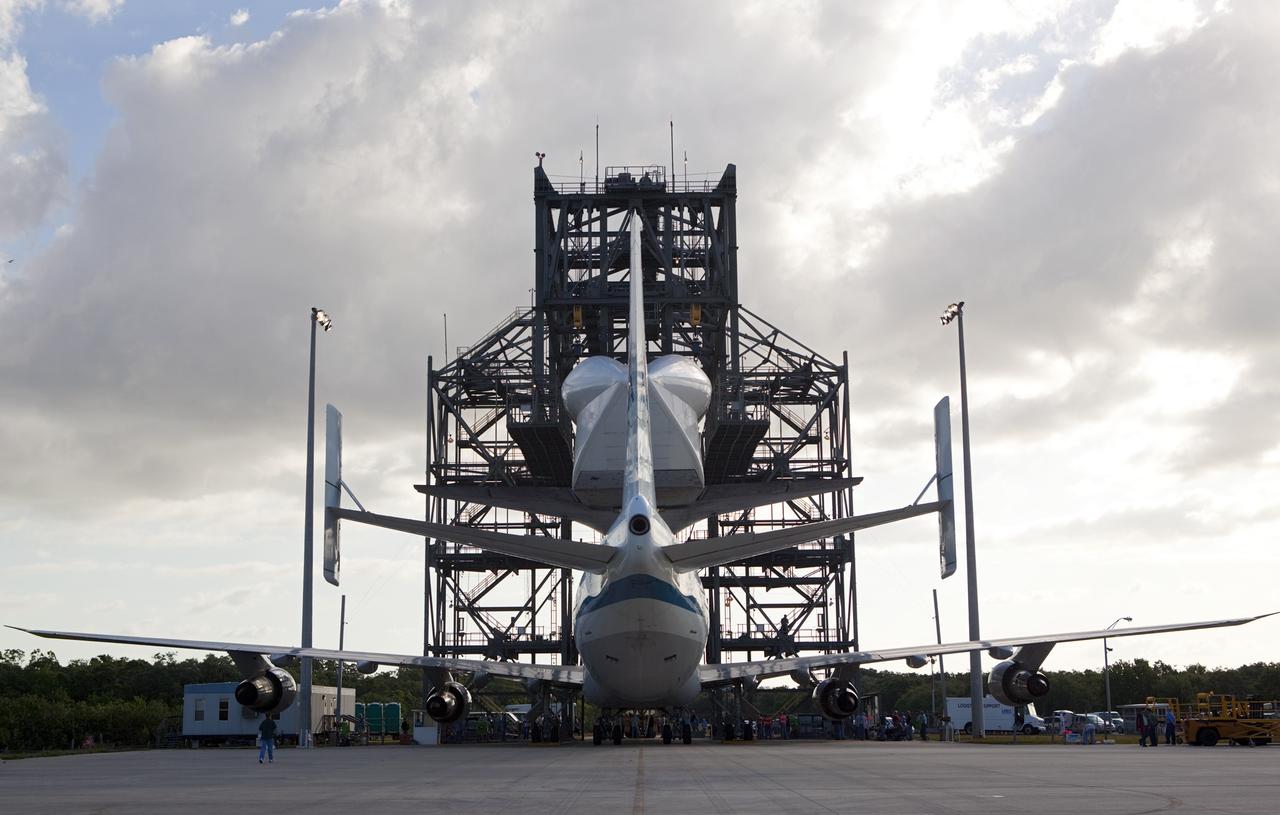
CAPE CANAVERAL, Fla. – At the Shuttle Landing Facility at NASA’s Kennedy Space Center in Florida, space shuttle Discovery is lowered onto the Shuttle Carrier Aircraft in the mate-demate device during mating operations. The device, known as the MDD, is a large gantry-like steel structure used to hoist a shuttle off the ground and position it onto the back of the aircraft, or SCA. The SCA is a Boeing 747 jet, originally manufactured for commercial use, which was modified by NASA to transport the shuttles between destinations on Earth. This SCA, designated NASA 905, is assigned to the remaining ferry missions, delivering the shuttles to their permanent public display sites. NASA 905 is scheduled to ferry Discovery to the Washington Dulles International Airport in Virginia on April 17, after which the shuttle will be placed on display in the Smithsonian's National Air and Space Museum Steven F. Udvar-Hazy Center. For more information on the SCA, visit http://www.nasa.gov/centers/dryden/news/FactSheets/FS-013-DFRC.html. For more information on shuttle transition and retirement activities, visit http://www.nasa.gov/transition. Photo credit: NASA/Dimitri Gerondidakis
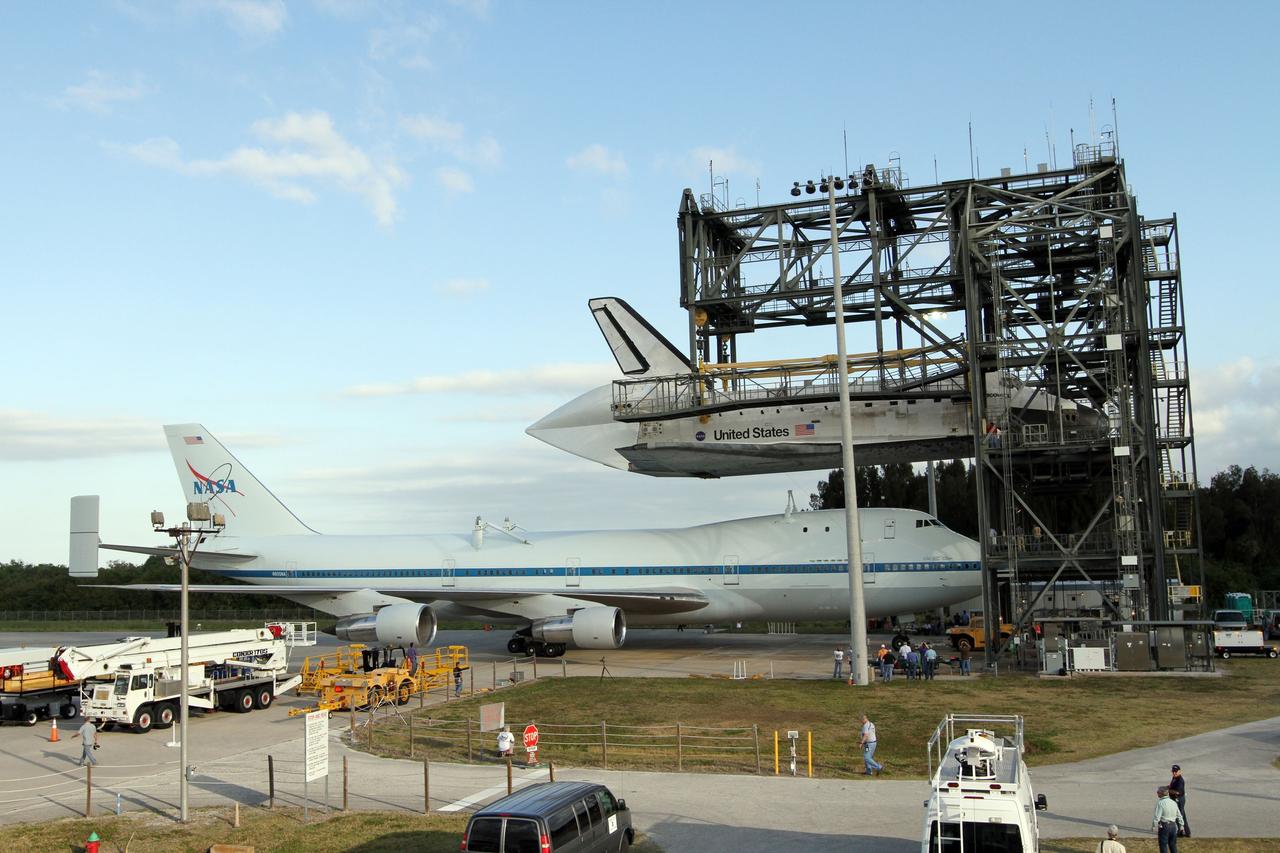
CAPE CANAVERAL, Fla. – At the Shuttle Landing Facility at NASA’s Kennedy Space Center in Florida, the Shuttle Carrier Aircraft moves into position under space shuttle Discovery suspended 60 feet off the ground in the mate-demate device. The device, known as the MDD, is a large gantry-like steel structure used to hoist a shuttle off the ground and position it onto the back of the aircraft, or SCA. The SCA is a Boeing 747 jet, originally manufactured for commercial use, which was modified by NASA to transport the shuttles between destinations on Earth. The SCA designated NASA 905 is assigned to the remaining ferry missions, delivering the shuttles to their permanent public display sites. NASA 905 is scheduled to ferry Discovery to the Washington Dulles International Airport in Virginia on April 17, after which the shuttle will be placed on display in the Smithsonian's National Air and Space Museum Steven F. Udvar-Hazy Center. For more information on the SCA, visit http://www.nasa.gov/centers/dryden/news/FactSheets/FS-013-DFRC.html. For more information on shuttle transition and retirement activities, visit http://www.nasa.gov/transition. Photo credit: NASA/Kim Shiflett
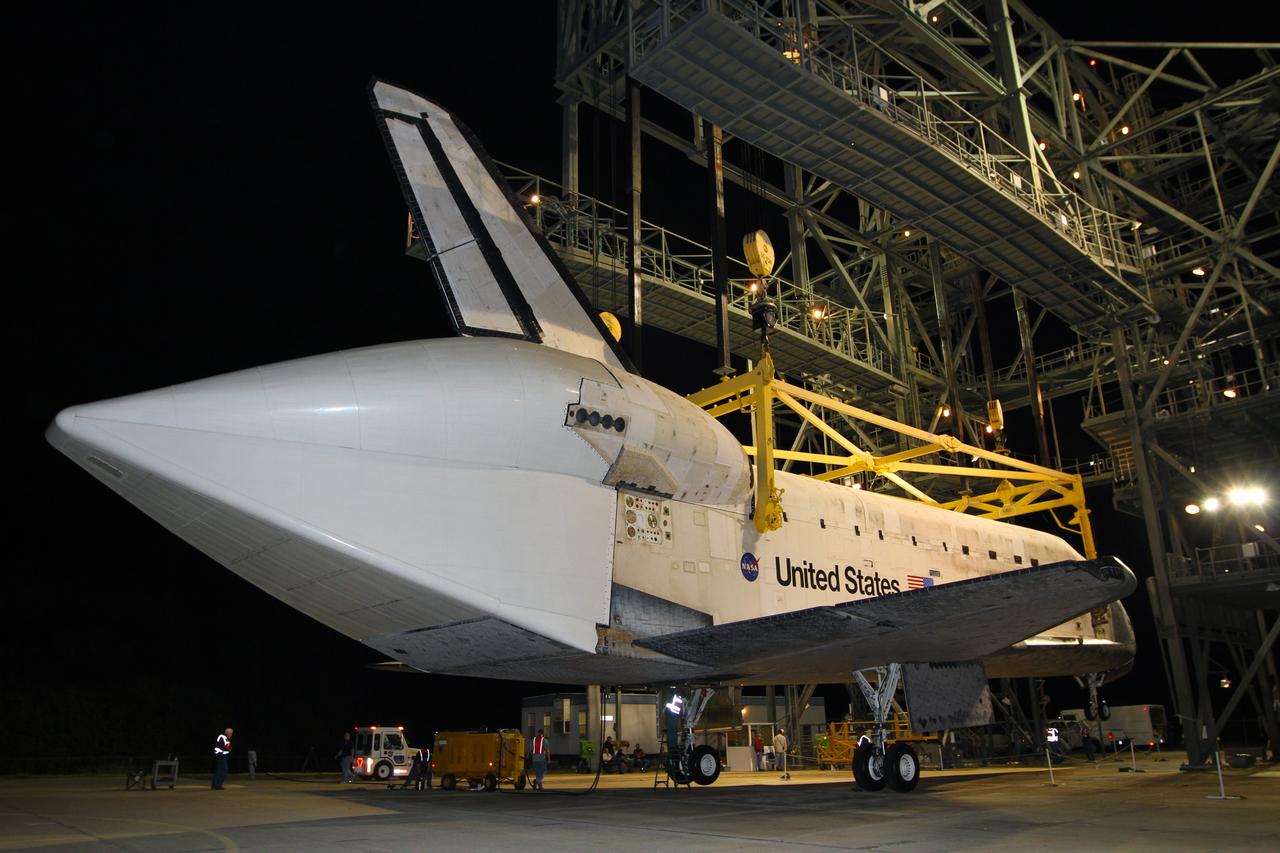
CAPE CANAVERAL, Fla. – Before daybreak at the Shuttle Landing Facility at NASA’s Kennedy Space Center in Florida, a crane on the mate-demate device lifts space shuttle Discovery from the ground. Operations are under way to position Discovery on top of a Shuttle Carrier Aircraft in preparation for its departure from Kennedy on Tuesday. A tail cone has been installed over Discovery’s three replica shuttle main engines to reduce aerodynamic drag and turbulence during the ferry flight. The device, known as the MDD, is a large gantry-like steel structure used to hoist a shuttle off the ground and position it onto the back of the aircraft, or SCA. The SCA is a Boeing 747 jet, originally manufactured for commercial use, which was modified by NASA to transport the shuttles between destinations on Earth. The SCA designated NASA 905 is assigned to the remaining ferry missions, delivering the shuttles to their permanent public display sites. NASA 905 is scheduled to ferry Discovery to the Washington Dulles International Airport in Virginia on April 17, after which the shuttle will be placed on display in the Smithsonian's National Air and Space Museum Steven F. Udvar-Hazy Center. For more information on the SCA, visit http://www.nasa.gov/centers/dryden/news/FactSheets/FS-013-DFRC.html. For more information on shuttle transition and retirement activities, visit http://www.nasa.gov/transition. Photo credit: NASA/Kim Shiflett
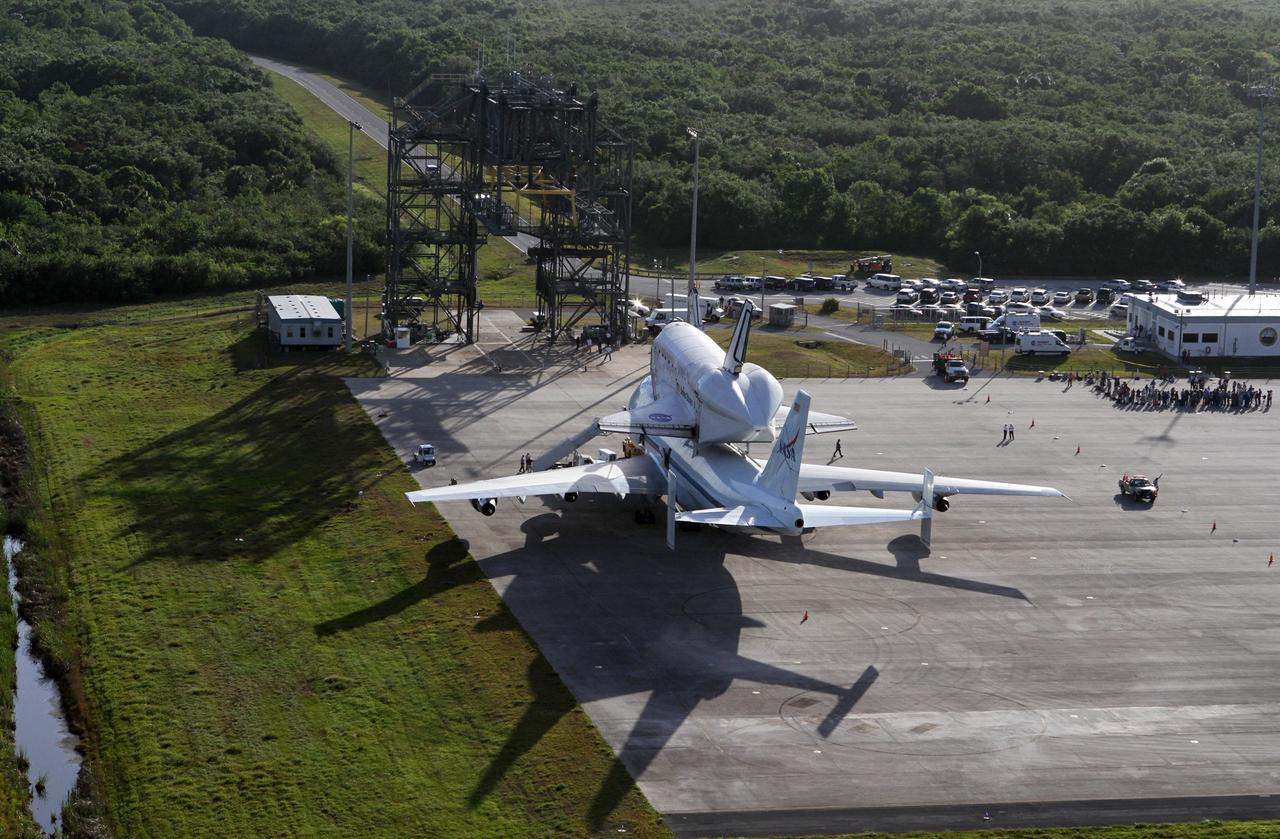
CAPE CANAVERAL, Fla. – This is an aerial view of space shuttle Discovery bolted to the top of a Shuttle Carrier Aircraft SCA on the ramp of the Shuttle Landing Facility SLF at NASA’s Kennedy Space Center in Florida. The mate/demate device, known as the MDD, also is in view and is where transition and retirement teams prepared the duo for the ferry flight. Discovery's last crew members are expected to be at the SLF, along with Kennedy employees and guests, as the center says goodbye to the agency's most-flown shuttle on April 17. The SCA, designated NASA 905, will ferry Discovery to the Washington Dulles International Airport in Virginia, after which the shuttle will be moved for public display in the Smithsonian's National Air and Space Museum Steven F. Udvar-Hazy Center on April 19. For more information on the SCA, visit http://www.nasa.gov/centers/dryden/news/FactSheets/FS-013-DFRC.html. For more information on shuttle transition and retirement activities, visit http://www.nasa.gov/transition. Photo credit: NASA/Kim Shiflett
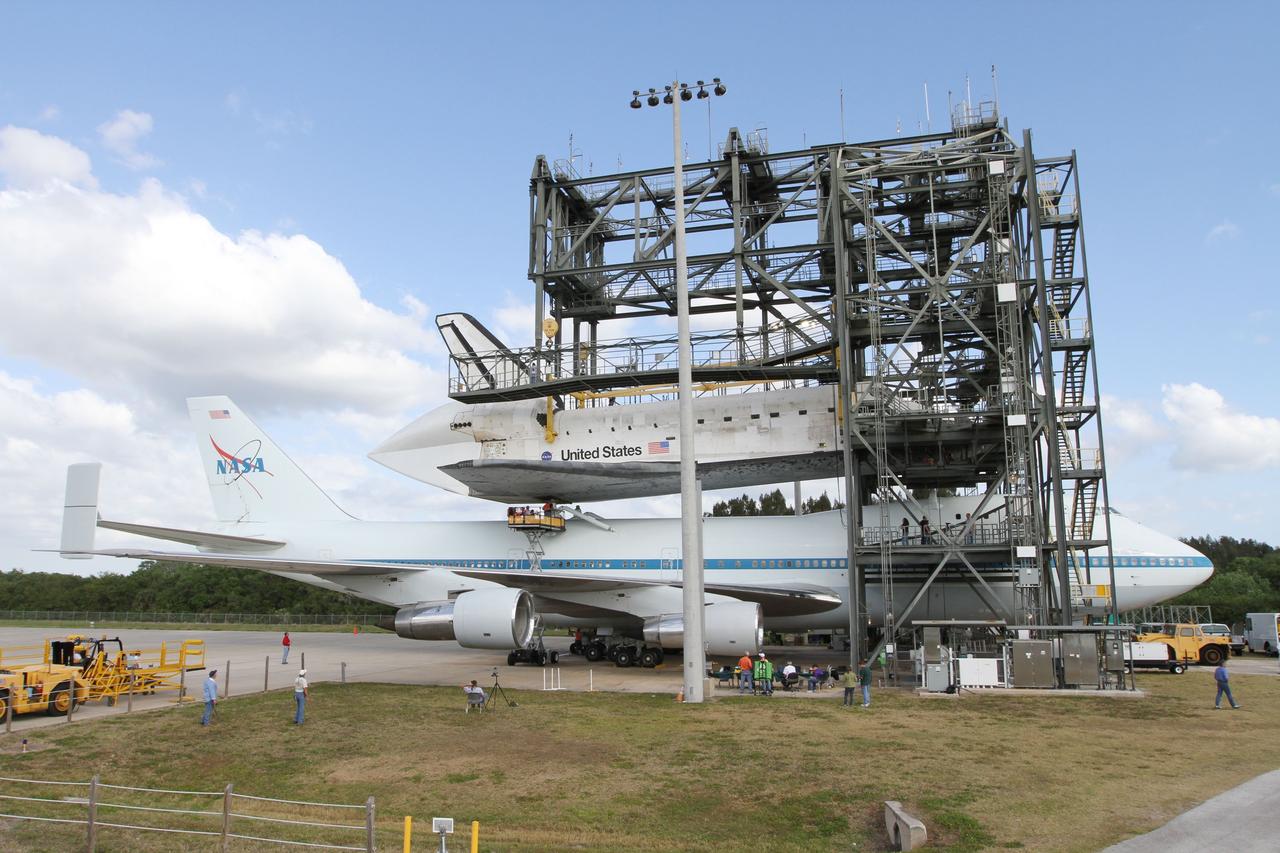
CAPE CANAVERAL, Fla. – At the Shuttle Landing Facility at NASA’s Kennedy Space Center in Florida, space shuttle Discovery is lowered onto the Shuttle Carrier Aircraft in the mate-demate device during mating operations. The device, known as the MDD, is a large gantry-like steel structure used to hoist a shuttle off the ground and position it onto the back of the aircraft, or SCA. The SCA is a Boeing 747 jet, originally manufactured for commercial use, which was modified by NASA to transport the shuttles between destinations on Earth. The SCA designated NASA 905 is assigned to the remaining ferry missions, delivering the shuttles to their permanent public display sites. NASA 905 is scheduled to ferry Discovery to the Washington Dulles International Airport in Virginia on April 17, after which the shuttle will be placed on display in the Smithsonian's National Air and Space Museum Steven F. Udvar-Hazy Center. For more information on the SCA, visit http://www.nasa.gov/centers/dryden/news/FactSheets/FS-013-DFRC.html. For more information on shuttle transition and retirement activities, visit http://www.nasa.gov/transition. Photo credit: NASA/Kim Shiflett
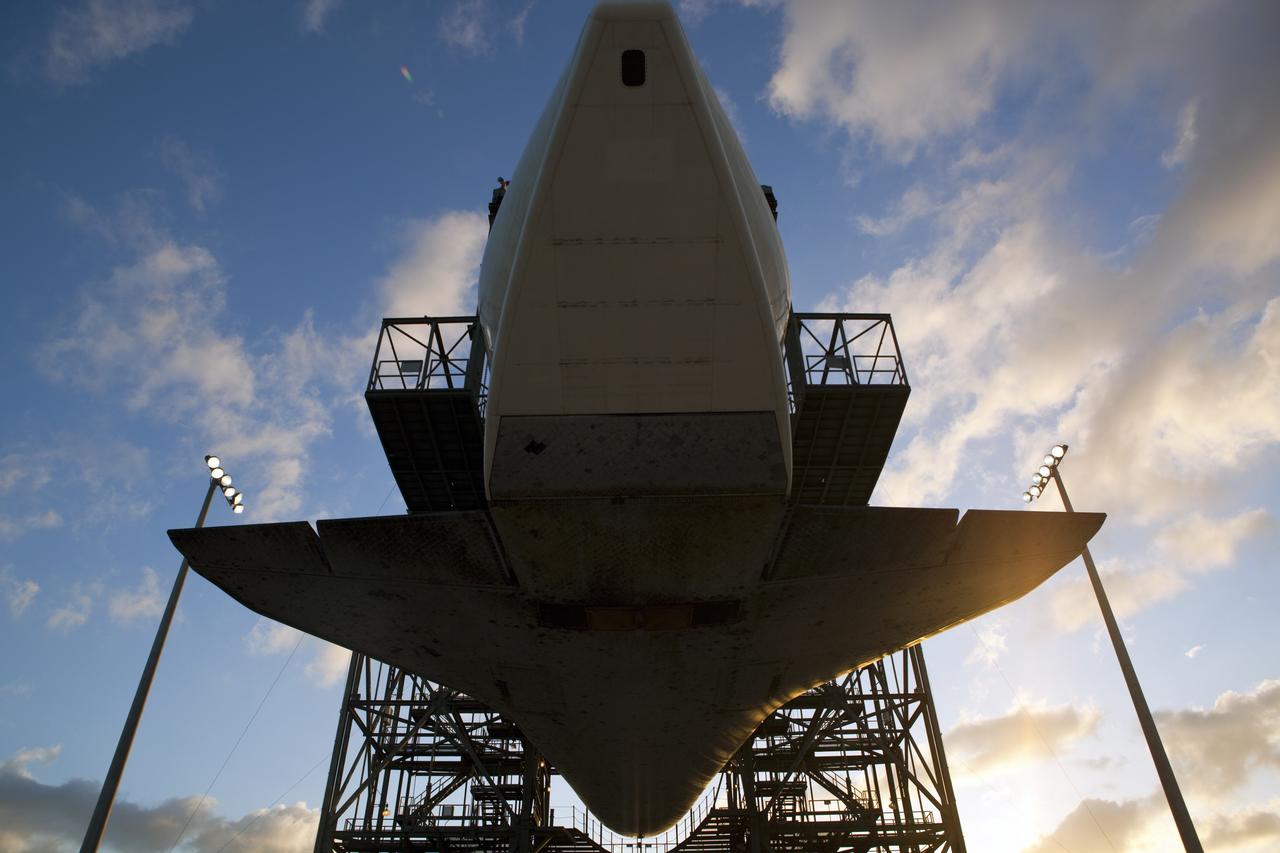
CAPE CANAVERAL, Fla. – At the Shuttle Landing Facility at NASA’s Kennedy Space Center in Florida, space shuttle Discovery is suspended 60 feet off the ground inside the mate-demate device in preparation for the arrival of the Shuttle Carrier Aircraft. The device, known as the MDD, is a large gantry-like steel structure used to hoist a shuttle off the ground and position it onto the back of the aircraft, or SCA. The SCA is a Boeing 747 jet, originally manufactured for commercial use, which was modified by NASA to transport the shuttles between destinations on Earth. The SCA designated NASA 905 is assigned to the remaining ferry missions, delivering the shuttles to their permanent public display sites. NASA 905 is scheduled to ferry Discovery to the Washington Dulles International Airport in Virginia on April 17, after which the shuttle will be placed on display in the Smithsonian's National Air and Space Museum Steven F. Udvar-Hazy Center. For more information on the SCA, visit http://www.nasa.gov/centers/dryden/news/FactSheets/FS-013-DFRC.html. For more information on shuttle transition and retirement activities, visit http://www.nasa.gov/transition. Photo credit: NASA/Dimitri Gerondidakis
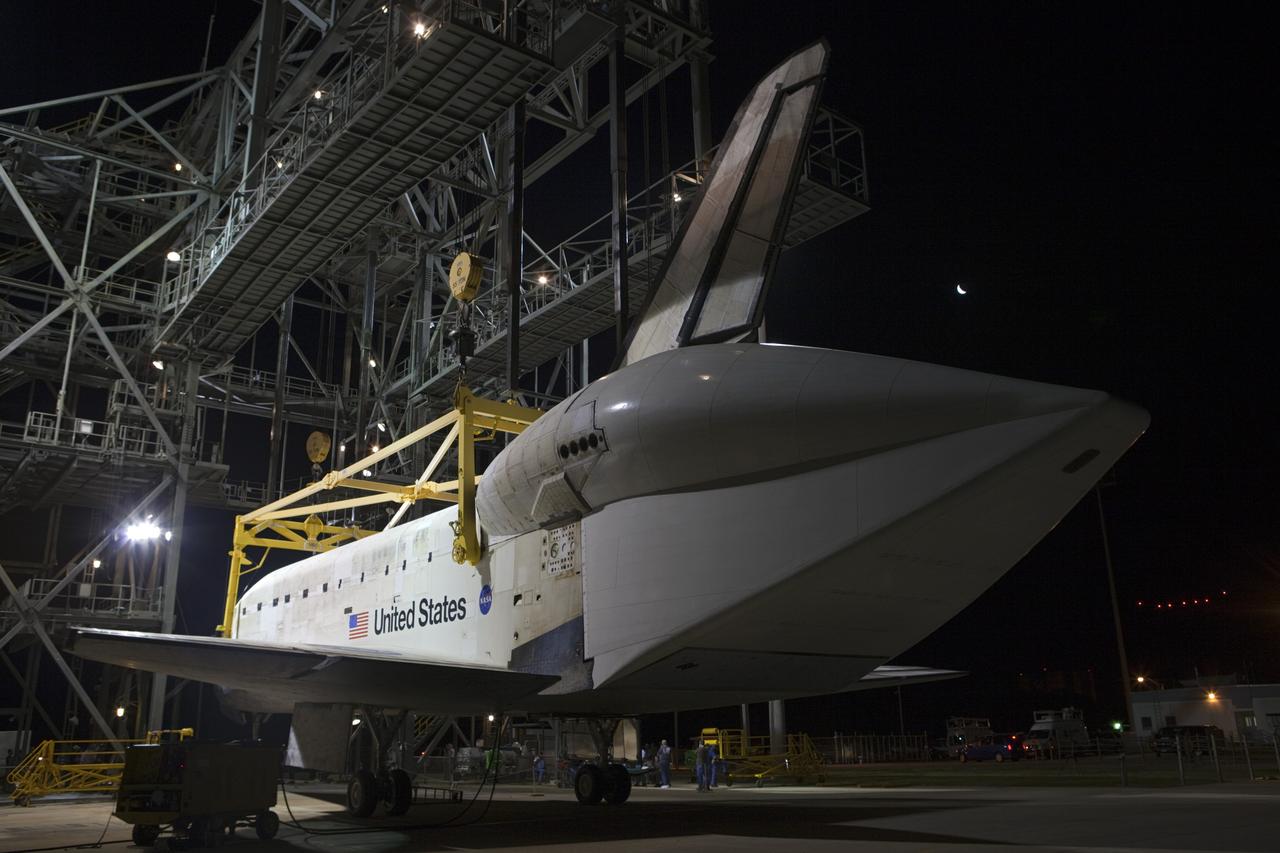
CAPE CANAVERAL, Fla. – Before daybreak at the Shuttle Landing Facility at NASA’s Kennedy Space Center in Florida, a crane on the mate-demate device prepares to lift space shuttle Discovery from the ground. Operations are under way to position Discovery on top of a Shuttle Carrier Aircraft in preparation for its departure from Kennedy on Tuesday. A tail cone has been installed over Discovery’s three replica shuttle main engines to reduce aerodynamic drag and turbulence during the ferry flight. The device, known as the MDD, is a large gantry-like steel structure used to hoist a shuttle off the ground and position it onto the back of the aircraft, or SCA. The SCA is a Boeing 747 jet, originally manufactured for commercial use, which was modified by NASA to transport the shuttles between destinations on Earth. The SCA designated NASA 905 is assigned to the remaining ferry missions, delivering the shuttles to their permanent public display sites. NASA 905 is scheduled to ferry Discovery to the Washington Dulles International Airport in Virginia on April 17, after which the shuttle will be placed on display in the Smithsonian's National Air and Space Museum Steven F. Udvar-Hazy Center. For more information on the SCA, visit http://www.nasa.gov/centers/dryden/news/FactSheets/FS-013-DFRC.html. For more information on shuttle transition and retirement activities, visit http://www.nasa.gov/transition. Photo credit: NASA/Dimitri Gerondidakis
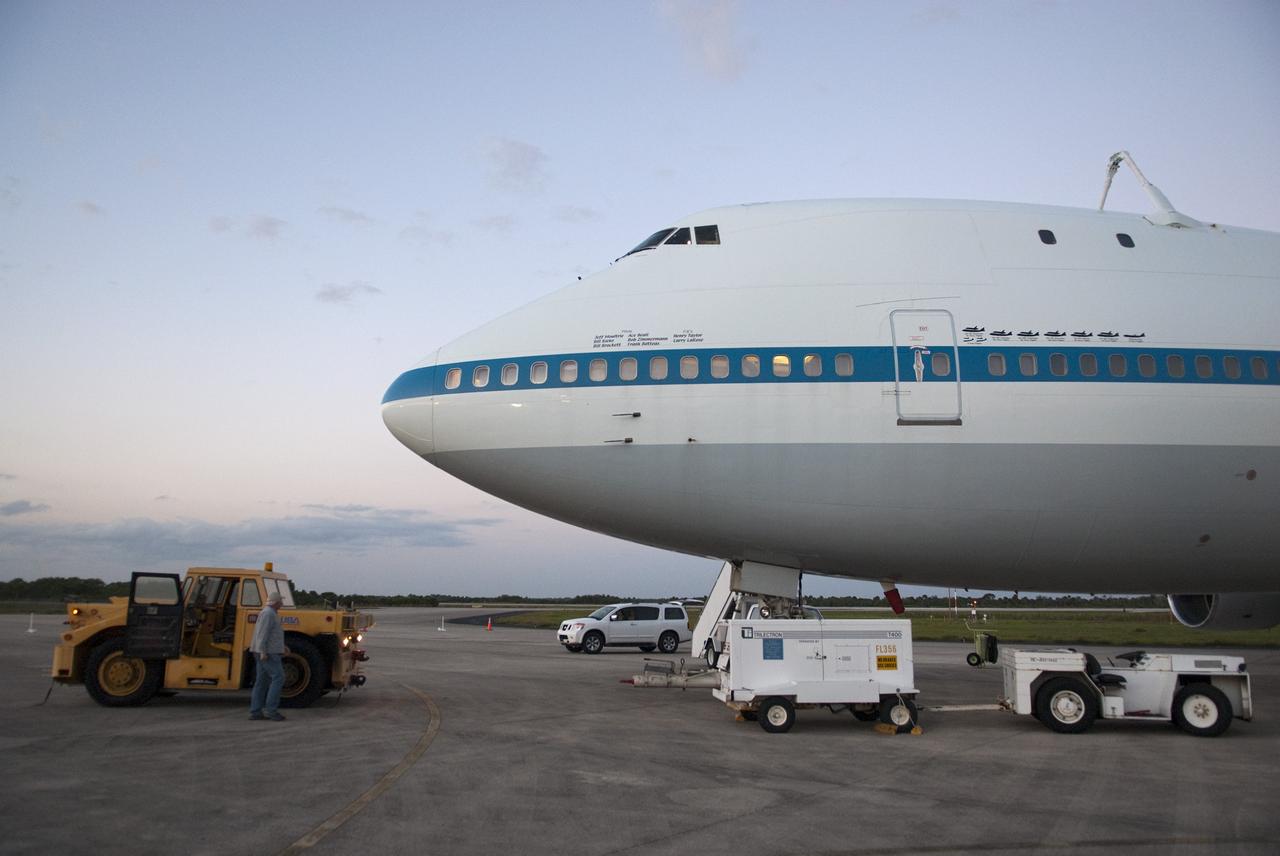
CAPE CANAVERAL, Fla. – At the Shuttle Landing Facility at NASA’s Kennedy Space Center in Florida, painted graphics line the side of NASA 905 depicting the various ferry flights the Shuttle Carrier Aircraft has supported during the Space Shuttle Program, including the tests using the space shuttle prototype Enterprise, and the names of the pilots and flight engineers who have flown it. This SCA, designated NASA 905, is a Boeing 747 jet originally manufactured for commercial use, which was modified by NASA to transport the shuttles between destinations on Earth. NASA 905 is assigned to the remaining ferry missions, delivering the shuttles to their permanent public display sites. Discovery’s new home will be the Smithsonian's National Air and Space Museum Steven F. Udvar-Hazy Center in Chantilly, Va. For more information on the SCA, visit http://www.nasa.gov/centers/dryden/news/FactSheets/FS-013-DFRC.html. For more information on shuttle transition and retirement activities, visit http://www.nasa.gov/transition. Photo credit: NASA/Tim Jacobs
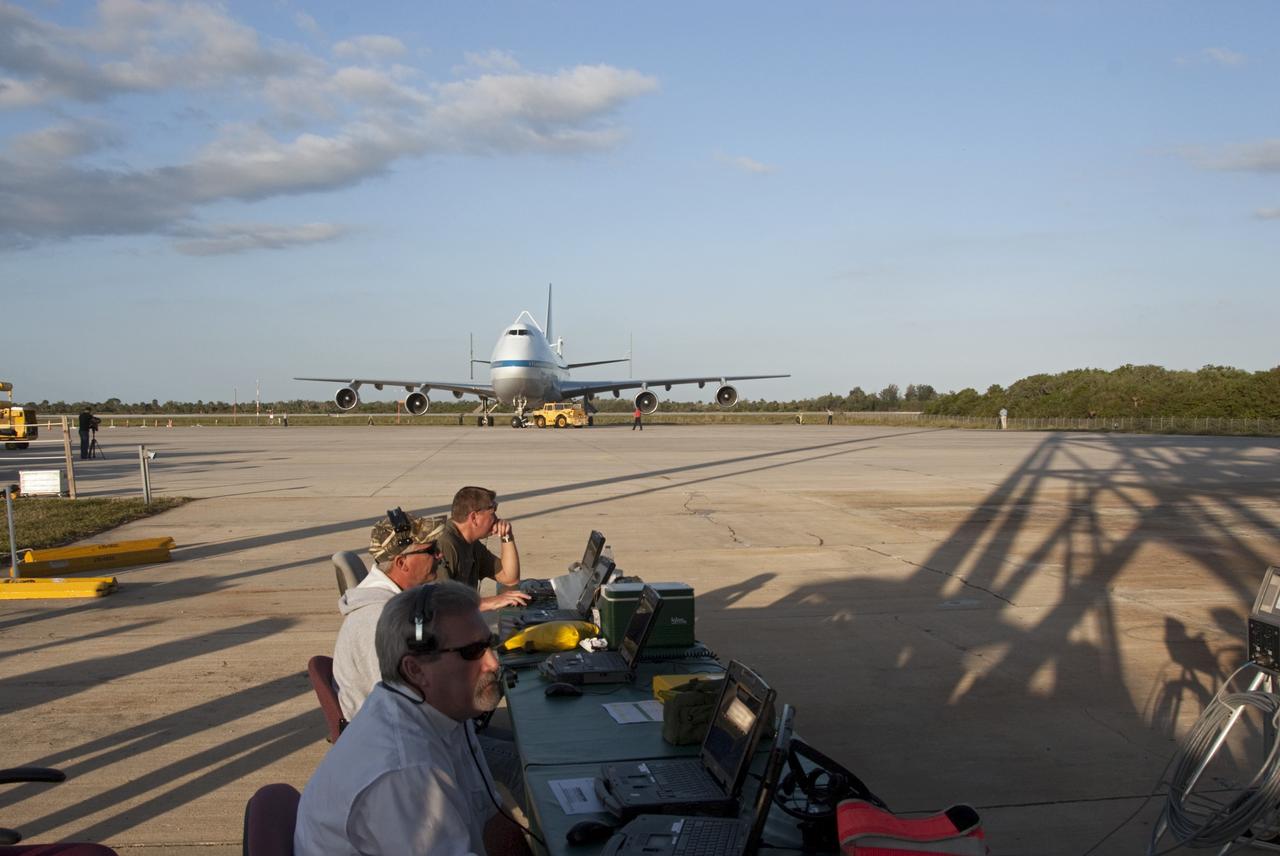
CAPE CANAVERAL, Fla. – At the Shuttle Landing Facility at NASA’s Kennedy Space Center in Florida, operations are under way to tow the Shuttle Carrier Aircraft to the mate-demate device for mating with space shuttle Discovery. This SCA, designated NASA 905, is a Boeing 747 jet originally manufactured for commercial use, which was modified by NASA to transport the shuttles between destinations on Earth. NASA 905 is assigned to the remaining ferry missions, delivering the shuttles to their permanent public display sites. Discovery’s new home will be the Smithsonian's National Air and Space Museum Steven F. Udvar-Hazy Center in Chantilly, Va. For more information on the SCA, visit http://www.nasa.gov/centers/dryden/news/FactSheets/FS-013-DFRC.html. For more information on shuttle transition and retirement activities, visit http://www.nasa.gov/transition. Photo credit: NASA/Tim Jacobs
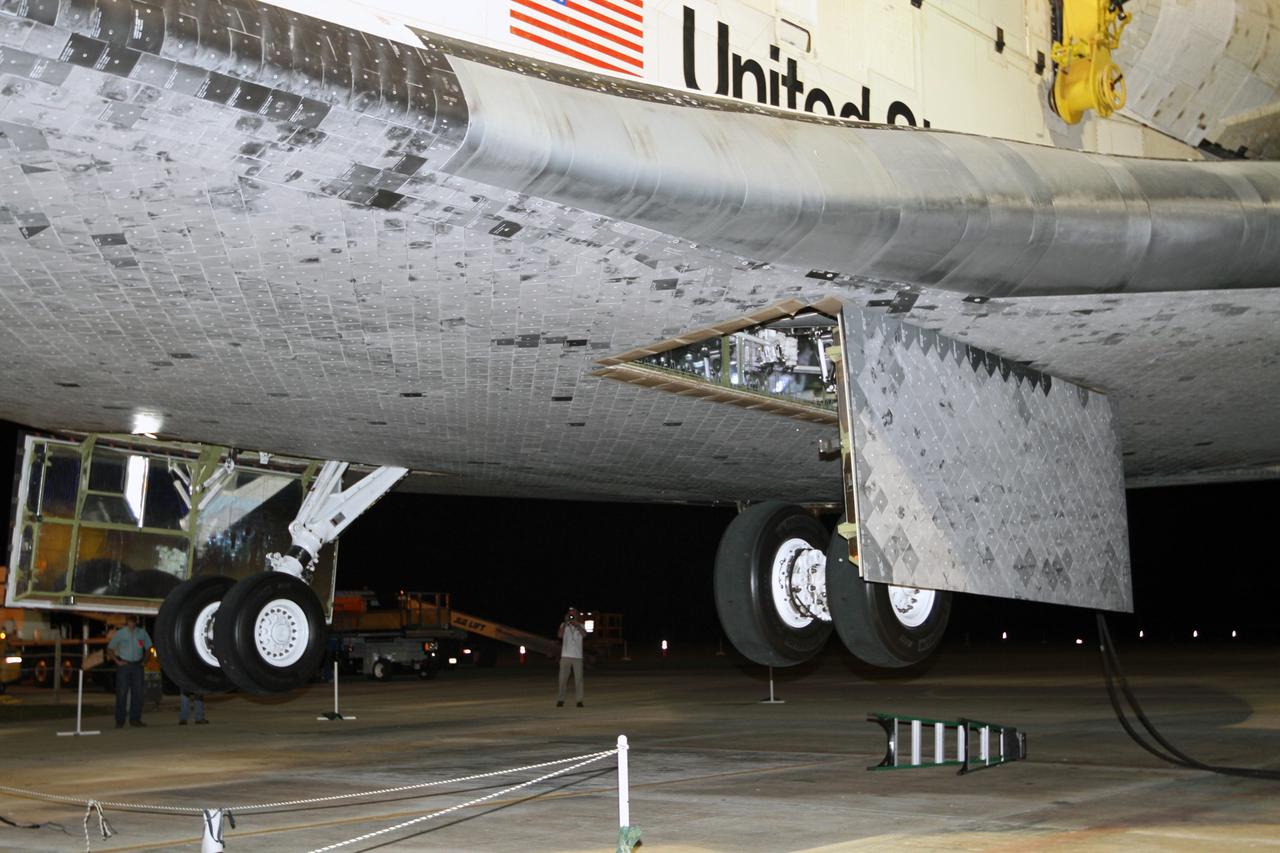
CAPE CANAVERAL, Fla. – At the Shuttle Landing Facility at NASA’s Kennedy Space Center in Florida, space shuttle Discovery is lifted off the ground into the mate-demate device. Operations are under way to position Discovery on top of a Shuttle Carrier Aircraft in preparation for its departure from Kennedy on Tuesday. The device, known as the MDD, is a large gantry-like steel structure used to hoist a shuttle off the ground and position it onto the back of the aircraft, or SCA. The SCA is a Boeing 747 jet, originally manufactured for commercial use, which was modified by NASA to transport the shuttles between destinations on Earth. The SCA designated NASA 905 is assigned to the remaining ferry missions, delivering the shuttles to their permanent public display sites. NASA 905 is scheduled to ferry Discovery to the Washington Dulles International Airport in Virginia on April 17, after which the shuttle will be placed on display in the Smithsonian's National Air and Space Museum Steven F. Udvar-Hazy Center. For more information on the SCA, visit http://www.nasa.gov/centers/dryden/news/FactSheets/FS-013-DFRC.html. For more information on shuttle transition and retirement activities, visit http://www.nasa.gov/transition. Photo credit: NASA/Kim Shiflett
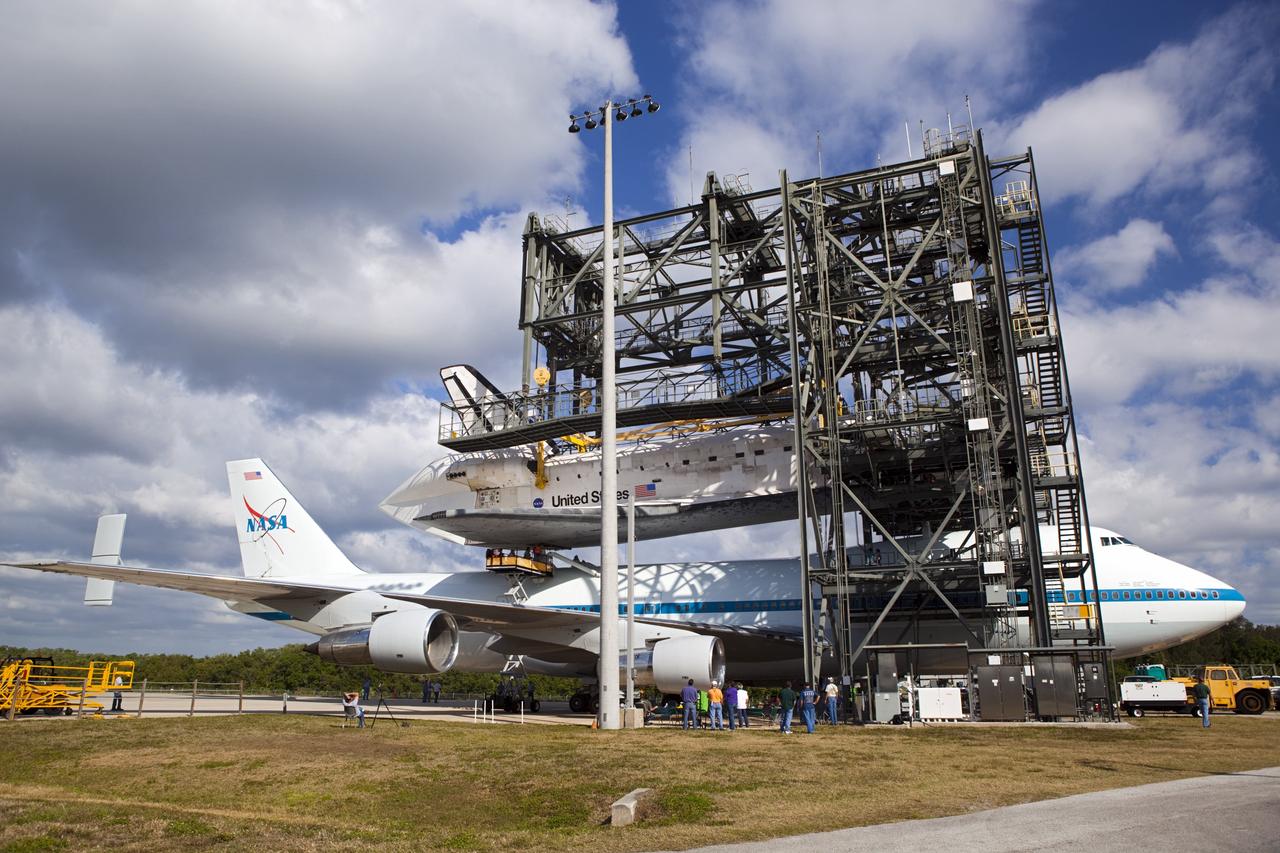
CAPE CANAVERAL, Fla. – At the Shuttle Landing Facility at NASA’s Kennedy Space Center in Florida, workers attach space shuttle Discovery to the Shuttle Carrier Aircraft in the mate-demate device. The device, known as the MDD, is a large gantry-like steel structure used to hoist a shuttle off the ground and position it onto the back of the aircraft, or SCA. The SCA is a Boeing 747 jet, originally manufactured for commercial use, which was modified by NASA to transport the shuttles between destinations on Earth. This SCA, designated NASA 905, is assigned to the remaining ferry missions, delivering the shuttles to their permanent public display sites. NASA 905 is scheduled to ferry Discovery to the Washington Dulles International Airport in Virginia on April 17, after which the shuttle will be placed on display in the Smithsonian's National Air and Space Museum Steven F. Udvar-Hazy Center. For more information on the SCA, visit http://www.nasa.gov/centers/dryden/news/FactSheets/FS-013-DFRC.html. For more information on shuttle transition and retirement activities, visit http://www.nasa.gov/transition. Photo credit: NASA/Dimitri Gerondidakis
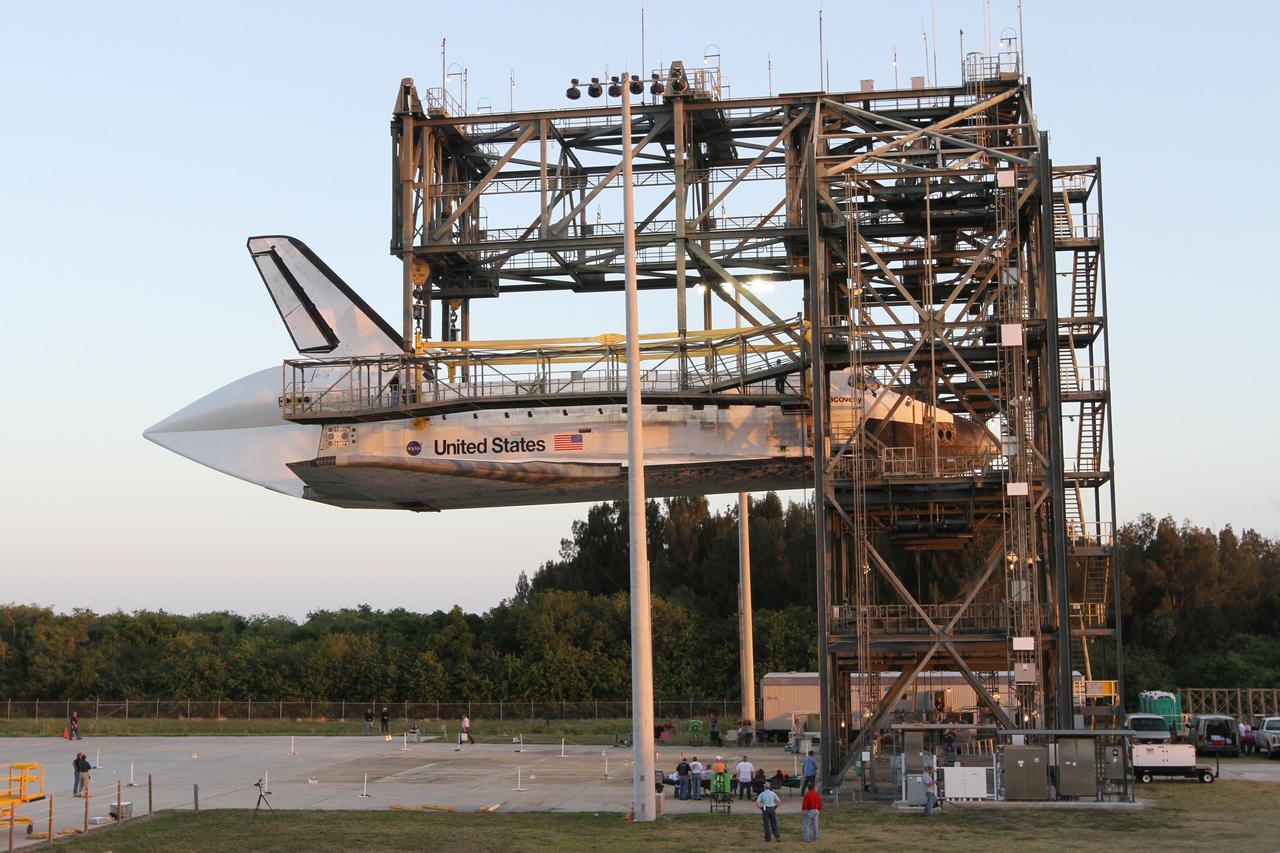
CAPE CANAVERAL, Fla. – At the Shuttle Landing Facility at NASA’s Kennedy Space Center in Florida, space shuttle Discovery slowly is lifted to the 60-foot level inside the mate-demate device in preparation for the arrival of the Shuttle Carrier Aircraft. The device, known as the MDD, is a large gantry-like steel structure used to hoist a shuttle off the ground and position it onto the back of the aircraft, or SCA. This SCA, designated NASA 905, is a Boeing 747 jet originally manufactured for commercial use, which was modified by NASA to transport the shuttles between destinations on Earth. NASA 905 is assigned to the remaining ferry missions, delivering the shuttles to their permanent public display sites. Discovery’s new home will be the Smithsonian's National Air and Space Museum Steven F. Udvar-Hazy Center in Chantilly, Va. For more information on the SCA, visit http://www.nasa.gov/centers/dryden/news/FactSheets/FS-013-DFRC.html. For more information on shuttle transition and retirement activities, visit http://www.nasa.gov/transition. Photo credit: NASA/Kim Shiflett
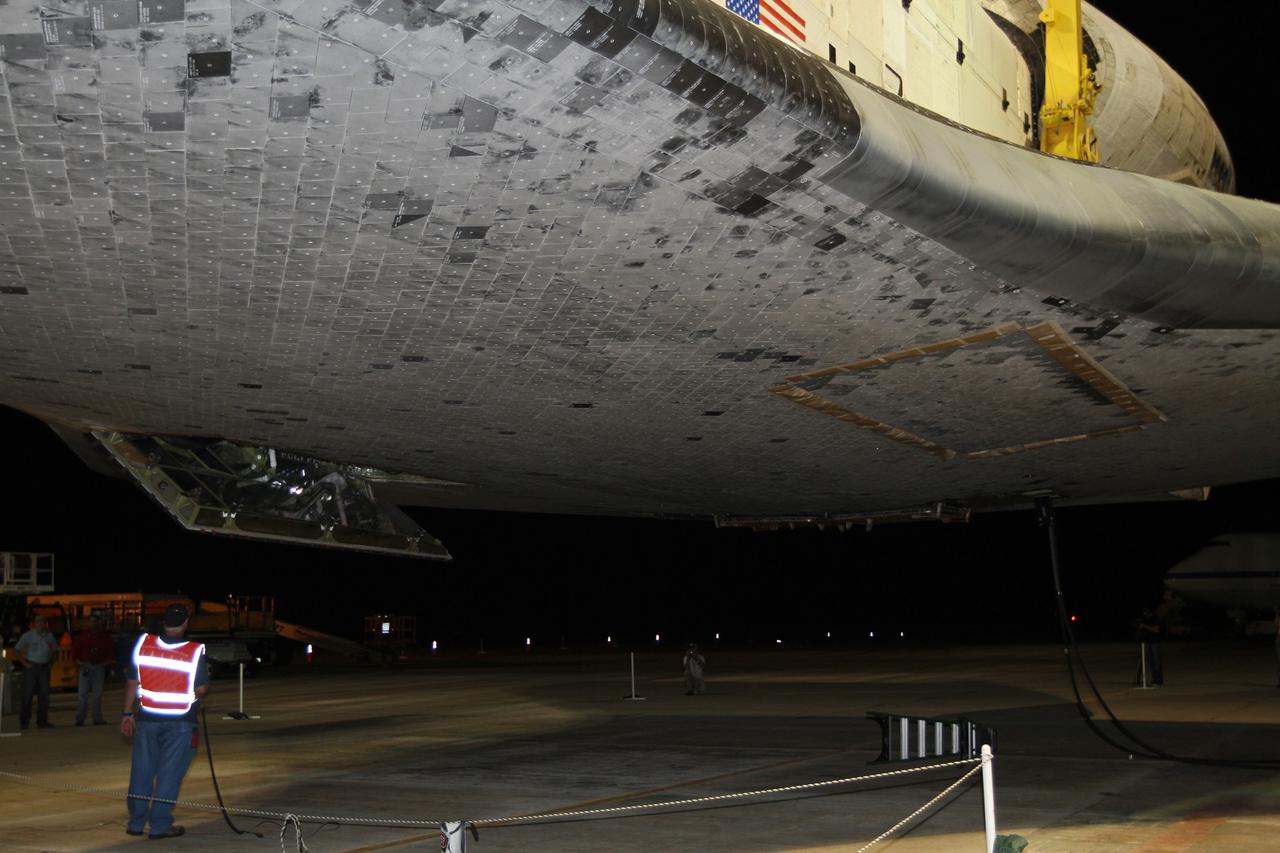
CAPE CANAVERAL, Fla. – At the Shuttle Landing Facility at NASA’s Kennedy Space Center in Florida, operations pick up where they left off Saturday when out-of-parameter winds required that work be suspended for the day. Space shuttle Discovery is being lifted into the mate-demate device for placement on top of a Shuttle Carrier Aircraft. The device, known as the MDD, is a large gantry-like steel structure used to hoist a shuttle off the ground and position it onto the back of the aircraft, or SCA. The SCA is a Boeing 747 jet, originally manufactured for commercial use, which was modified by NASA to transport the shuttles between destinations on Earth. The SCA designated NASA 905 is assigned to the remaining ferry missions, delivering the shuttles to their permanent public display sites. NASA 905 is scheduled to ferry Discovery to the Washington Dulles International Airport in Virginia on April 17, after which the shuttle will be placed on display in the Smithsonian's National Air and Space Museum Steven F. Udvar-Hazy Center. For more information on the SCA, visit http://www.nasa.gov/centers/dryden/news/FactSheets/FS-013-DFRC.html. For more information on shuttle transition and retirement activities, visit http://www.nasa.gov/transition. Photo credit: NASA/Kim Shiflett