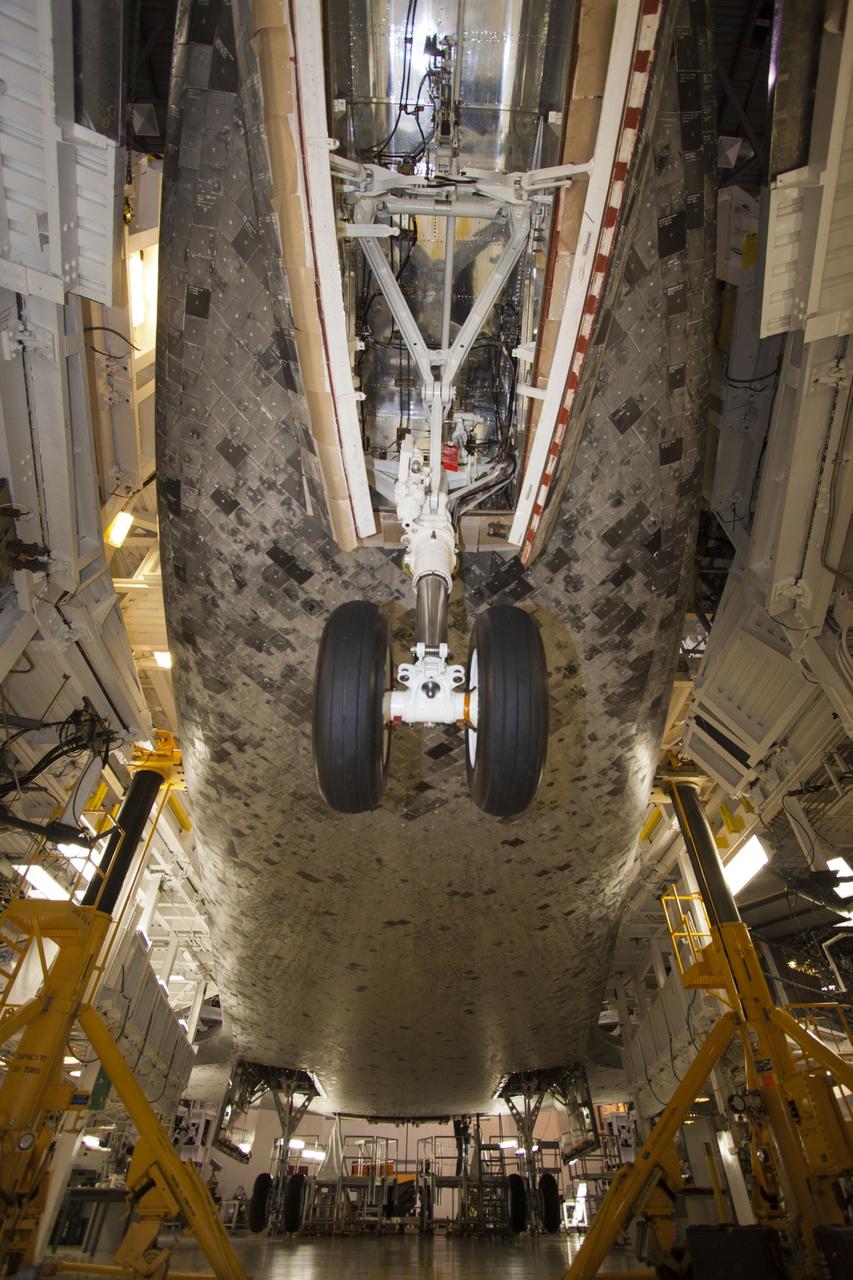
CAPE CANAVERAL, Fla. – Inside Orbiter Processing Facility-1 at NASA’s Kennedy Space Center in Florida, a long-angle view reveals the underside of space shuttle Discovery where the ferry flight doors are being installed. The work is part of the Space Shuttle Program’s transition and retirement processing of shuttle Discovery, which is being prepared for display at Smithsonian’s National Air and Space Museum, Steven F. Udvar-Hazy Center in Chantilly, Va. Discovery is scheduled to be transported atop a NASA Shuttle Carrier Aircraft modified 747 jet to Dulles International Airport in Virginia on April 17 and then moved to the Smithsonian for permanent public display on April 19. For more information, visit http://www.nasa.gov/shuttle. Photo credit: NASA/Jim Grossmann
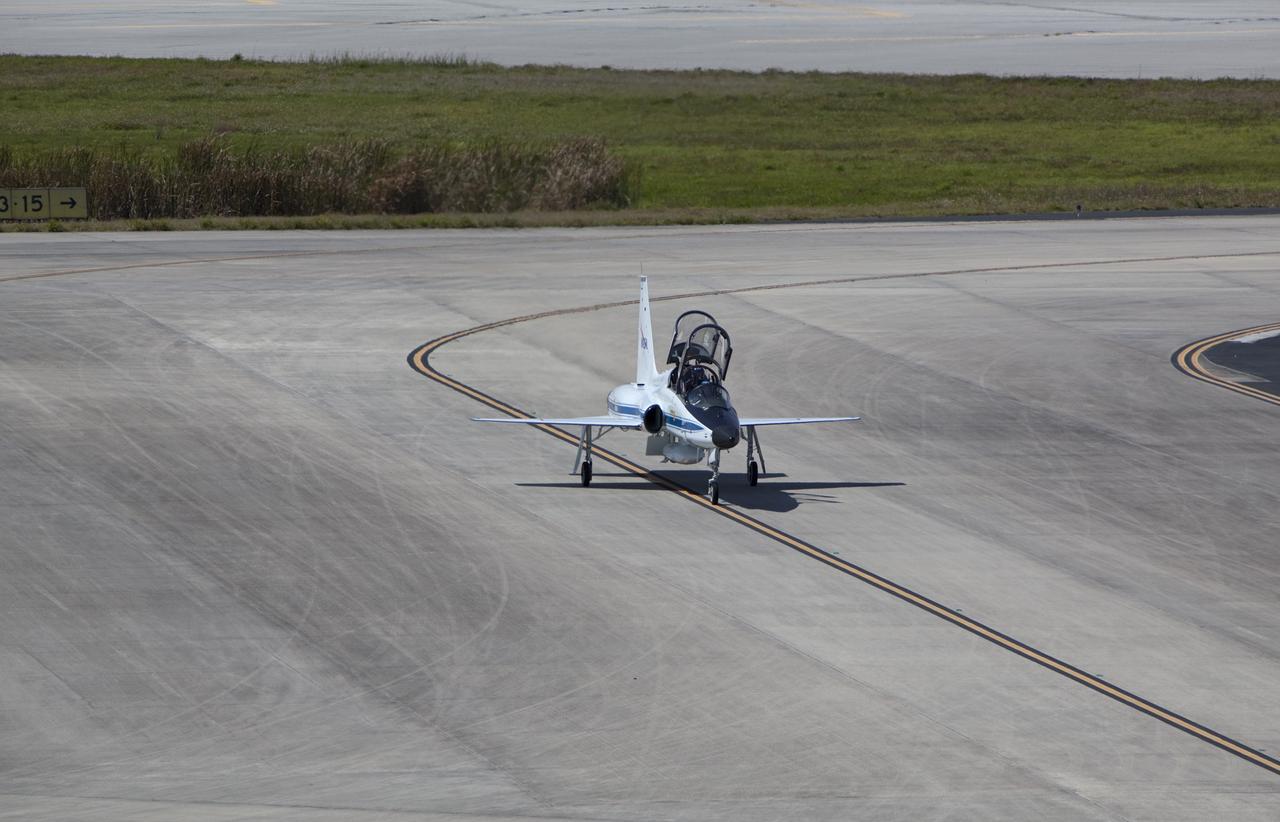
CAPE CANAVERAL, Fla. – A T-38 jet taxis onto the apron of the Shuttle Landing Facility at NASA’s Kennedy Space Center in Florida. The jet is at Kennedy to support space shuttle Discovery’s ferry flight. The Shuttle Carrier Aircraft designated NASA 905 is scheduled to ferry Discovery to the Washington Dulles International Airport in Virginia on April 17, and is assigned to all remaining ferry missions, delivering the shuttles to their permanent public display sites. After its arrival at Dulles, Discovery will be placed on display in the Smithsonian's National Air and Space Museum Steven F. Udvar-Hazy Center on April 19. For more information on the SCA, visit http://www.nasa.gov/centers/dryden/news/FactSheets/FS-013-DFRC.html. For more information on shuttle transition and retirement activities, visit http://www.nasa.gov/transition. Photo credit: NASA/Dimitri Gerondidaki
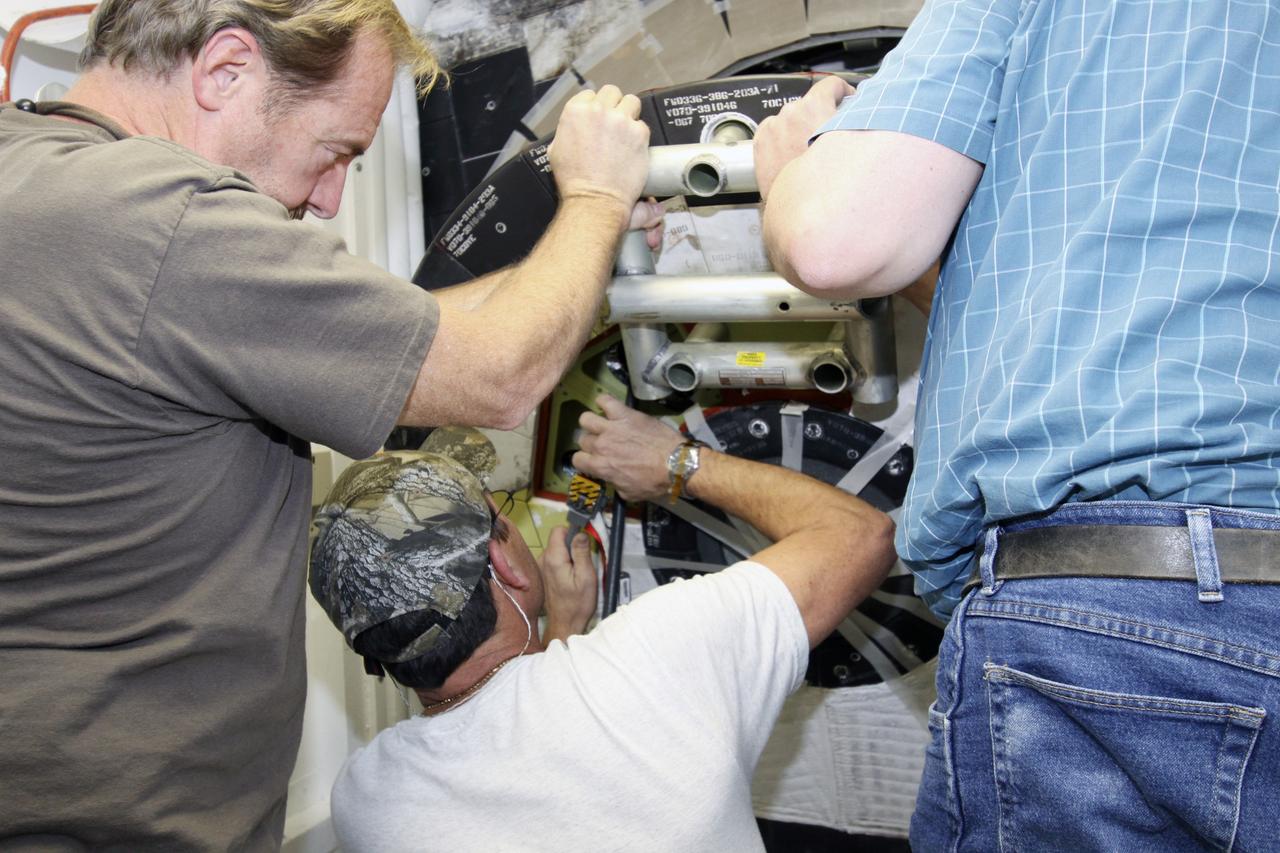
CAPE CANAVERAL, Fla. -- Inside Orbiter Processing Facility-1 at NASA’s Kennedy Space Center in Florida, technicians position space shuttle Discovery’s access hatch for final close out. The work is part of the Space Shuttle Program’s transition and retirement processing of shuttle Discovery, which is being prepared for display at Smithsonian’s National Air and Space Museum, Steven F. Udvar-Hazy Center in Chantilly, Va. Discovery is scheduled to be transported atop a NASA Shuttle Carrier Aircraft modified 747 jet to Dulles International Airport in Virginia on April 17 and then be transported to the Smithsonian on April 19. For more information, visit http://www.nasa.gov/shuttle. Photo credit: NASA/Jim Grossmann
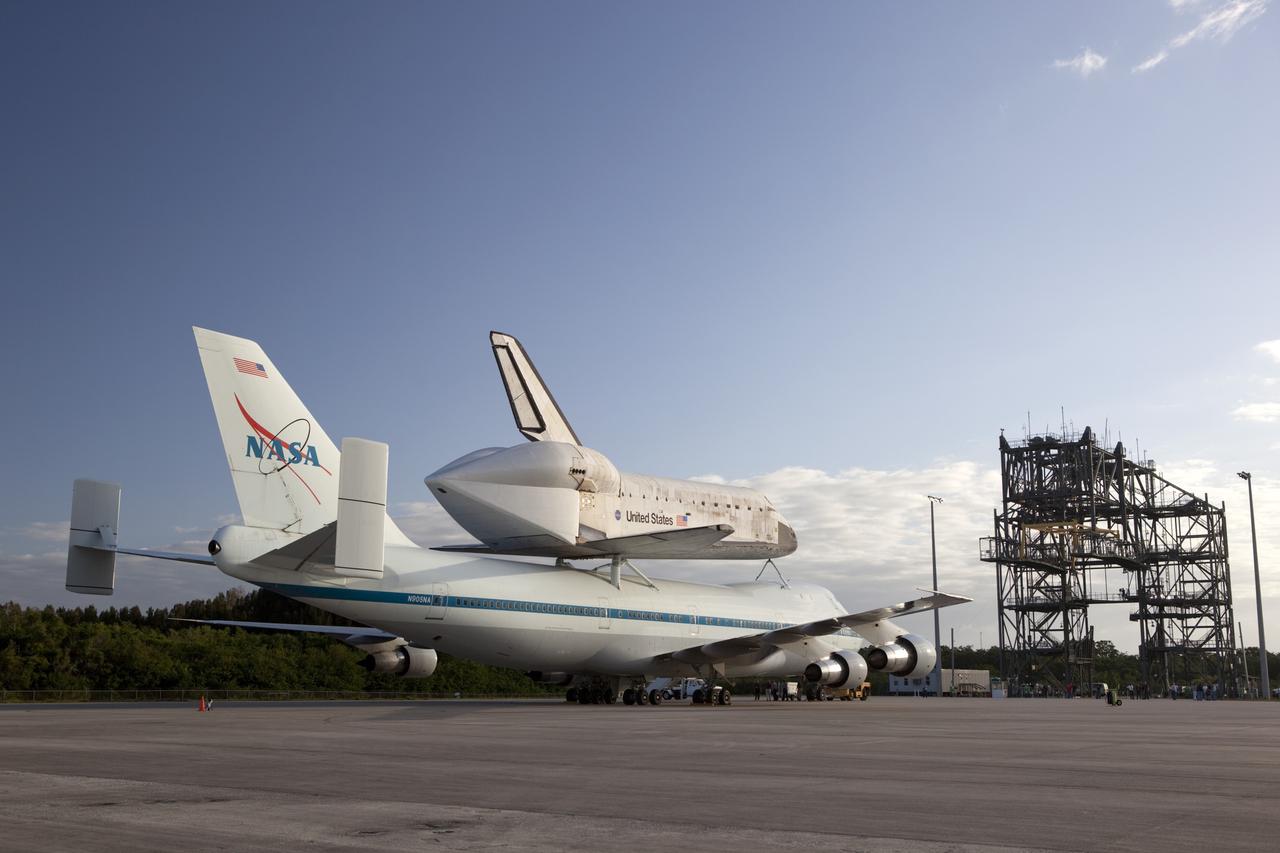
CAPE CANAVERAL, Fla. – At NASA Kennedy Space Center’s Shuttle Landing Facility in Florida, the Shuttle Carrier Aircraft, or SCA, with space shuttle Discovery attached atop, sits on the tarmac after being backed away from the mate/demate device. Known as the MDD, the devise is a large gantry-like steel structure used to hoist a shuttle off the ground and position it onto the back of the SCA. The SCA is a Boeing 747 jet that was originally manufactured for commercial use and modified by NASA to transport the shuttles between destinations on Earth. This SCA, designated NASA 905, is assigned to the remaining ferry missions, delivering the shuttles to their permanent public display sites. NASA 905 is scheduled to ferry Discovery to the Washington Dulles International Airport in Virginia on April 17, after which the shuttle will be placed on display in the Smithsonian’s National Air and Space Museum, Steven F. Udvar-Hazy Center in Chantilly, Va. For more information on the SCA, visit http://www.nasa.gov/centers/dryden/news/FactSheets/FS-013-DFRC.html. For more information on shuttle transition and retirement activities, visit http://www.nasa.gov/transition. Photo credit: NASA/Dimitri Gerondidakis

CAPE CANAVERAL, Fla. – At the left side of this aerial photo, near the horizon, the Shuttle Carrier Aircraft transporting space shuttle Discovery to its new home flies past the 525-foot-tall Vehicle Assembly Building at NASA’s Kennedy Space Center in Florida. The duo took off from Kennedy’s Shuttle Landing Facility at 7 a.m. EDT. The aircraft, known as an SCA, is a Boeing 747 jet, originally manufactured for commercial use, which was modified by NASA to transport the shuttles between destinations on Earth. This SCA, designated NASA 905, is assigned to the remaining ferry missions, delivering the shuttles to their permanent public display sites. NASA 905 is scheduled to ferry Discovery to the Washington Dulles International Airport in Virginia today, after which the shuttle will be placed on display in the Smithsonian's National Air and Space Museum Steven F. Udvar-Hazy Center. For more information on the SCA, visit http://www.nasa.gov/centers/dryden/news/FactSheets/FS-013-DFRC.html. For more information on shuttle transition and retirement activities, visit http://www.nasa.gov/transition. Photo credit: NASA/Glenn Benson
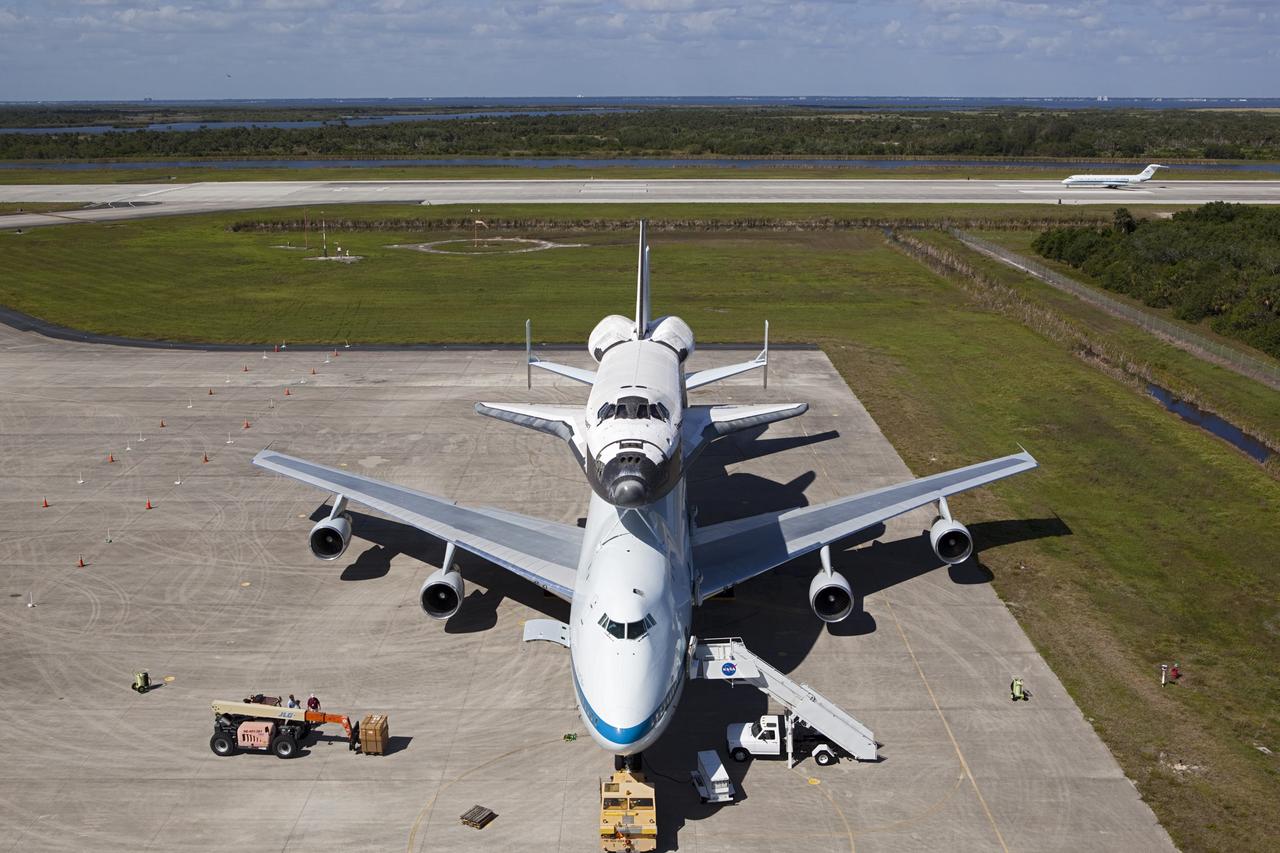
CAPE CANAVERAL, Fla. – Preparations for space shuttle Discovery’s ferry flight aboard a Shuttle Carrier Aircraft continue as the “pathfinder” aircraft for the flight lands at the Shuttle Landing Facility at NASA’s Kennedy Space Center in Florida. The NASA C-9 aircraft will fly about 100 miles ahead of Discovery to scout for the safest route between destinations. Its crew includes an SCA flight engineer who studies the weather patterns along the flight path to find a route free of rain and other turbulence. The carrier aircraft, also known as an SCA, is a Boeing 747 jet, originally manufactured for commercial use which was modified by NASA to transport the shuttles between destinations on Earth. NASA 905 is scheduled to ferry Discovery to the Washington Dulles International Airport in Virginia on April 17, and is assigned to all remaining ferry missions, delivering the shuttles to their permanent public display sites. After its arrival at Dulles, Discovery will be placed on display in the Smithsonian's National Air and Space Museum Steven F. Udvar-Hazy Center on April 19. For more information on the SCA, visit http://www.nasa.gov/centers/dryden/news/FactSheets/FS-013-DFRC.html. For more information on shuttle transition and retirement activities, visit http://www.nasa.gov/transition. Photo credit: NASA/Dimitri Gerondidaki
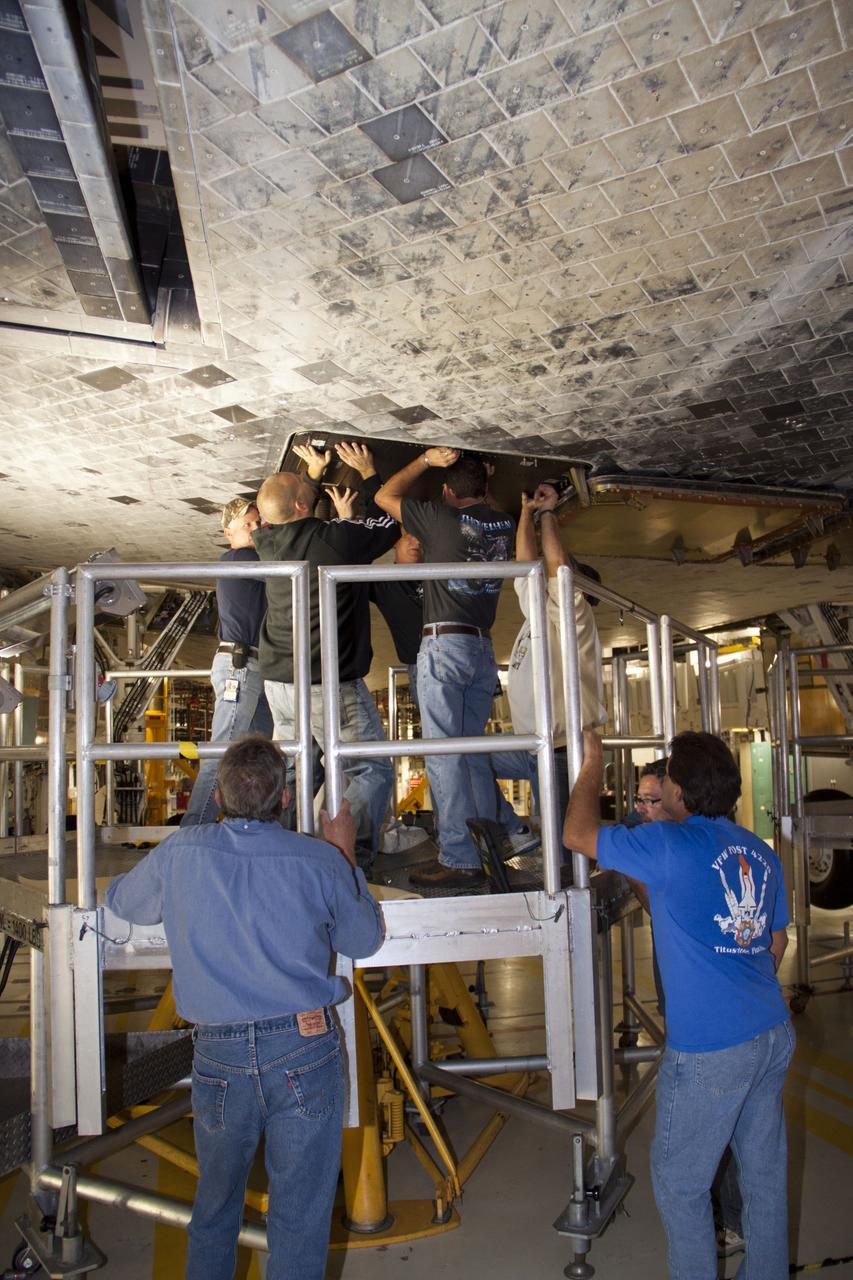
CAPE CANAVERAL, Fla. – Inside Orbiter Processing Facility-1 at NASA’s Kennedy Space Center in Florida, technicians install a ferry flight door on space shuttle Discovery. The work is part of the Space Shuttle Program’s transition and retirement processing of shuttle Discovery, which is being prepared for display at Smithsonian’s National Air and Space Museum, Steven F. Udvar-Hazy Center in Chantilly, Va. Discovery is scheduled to be transported atop a NASA Shuttle Carrier Aircraft modified 747 jet to Dulles International Airport in Virginia on April 17 and then moved to the Smithsonian for permanent public display on April 19. For more information, visit http://www.nasa.gov/shuttle. Photo credit: NASA/Jim Grossmann
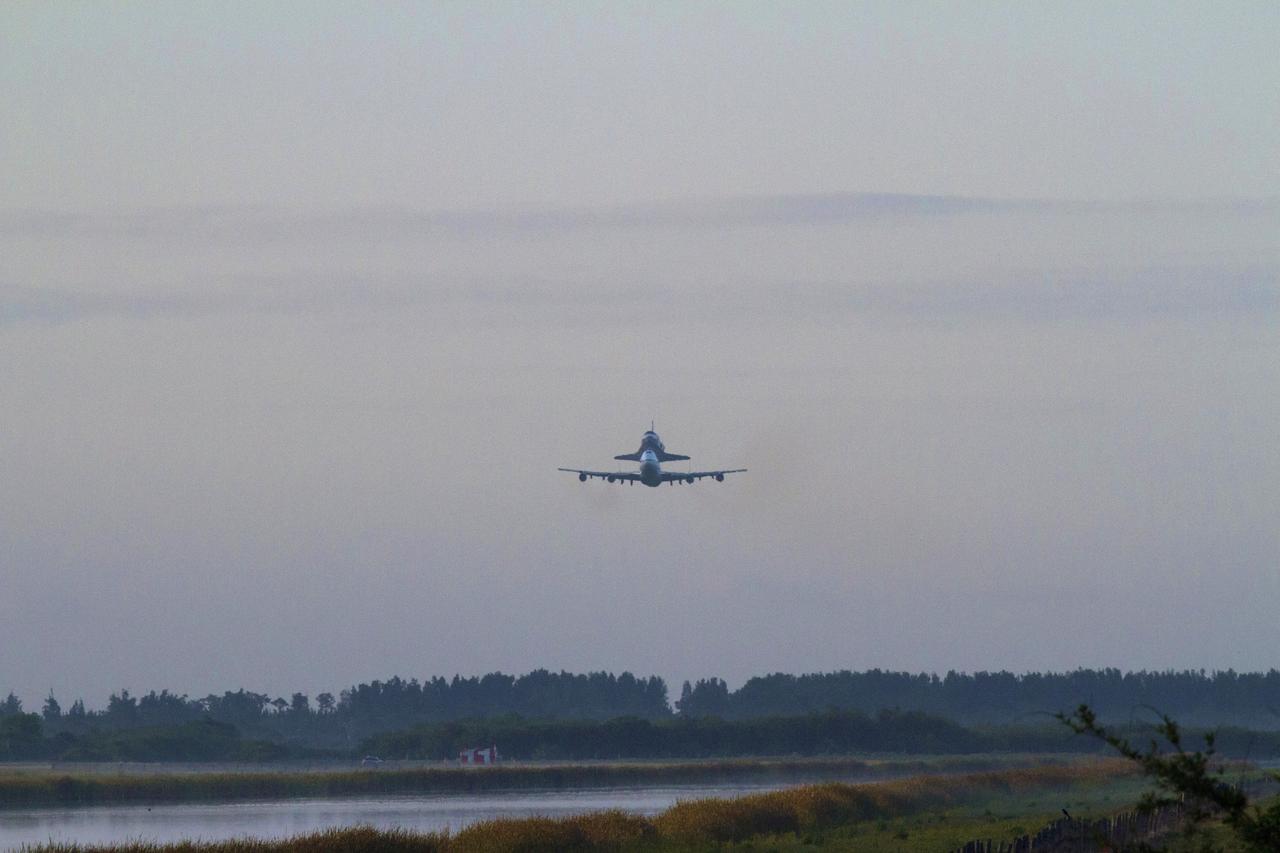
CAPE CANAVERAL, Fla. – Space shuttle Discovery, mounted to a Shuttle Carrier Aircraft, or SCA, takes off from NASA Kennedy Space Center’s Shuttle Landing Facility runway 15 in Florida at 7 a.m. EDT. The duo is beginning its ferry flight to the Washington Dulles International Airport in Virginia that also includes a flyby of the Space Coast and Washington, D.C. Discovery is leaving Kennedy after more than 28 years of service beginning with its arrival on the space coast Nov. 9, 1983. Discovery first launched to space Aug. 30, 1984, on the STS-41D mission. Discovery is the agency’s most-flown shuttle with 39 missions, more than 148 million miles and a total of one year in space. Discovery is set to move to the Smithsonian’s National Air and Space Museum, Steven F. Udvar-Hazy Center in Chantilly, Va., on April 19 where it will be place on public display. For more information on the SCA, visit http://www.nasa.gov/centers/dryden/news/FactSheets/FS-013-DFRC.html. For more information on shuttle transition and retirement activities, visit http://www.nasa.gov/transition. Photo credit: NASA/Tim Powers and Rick Wetherington
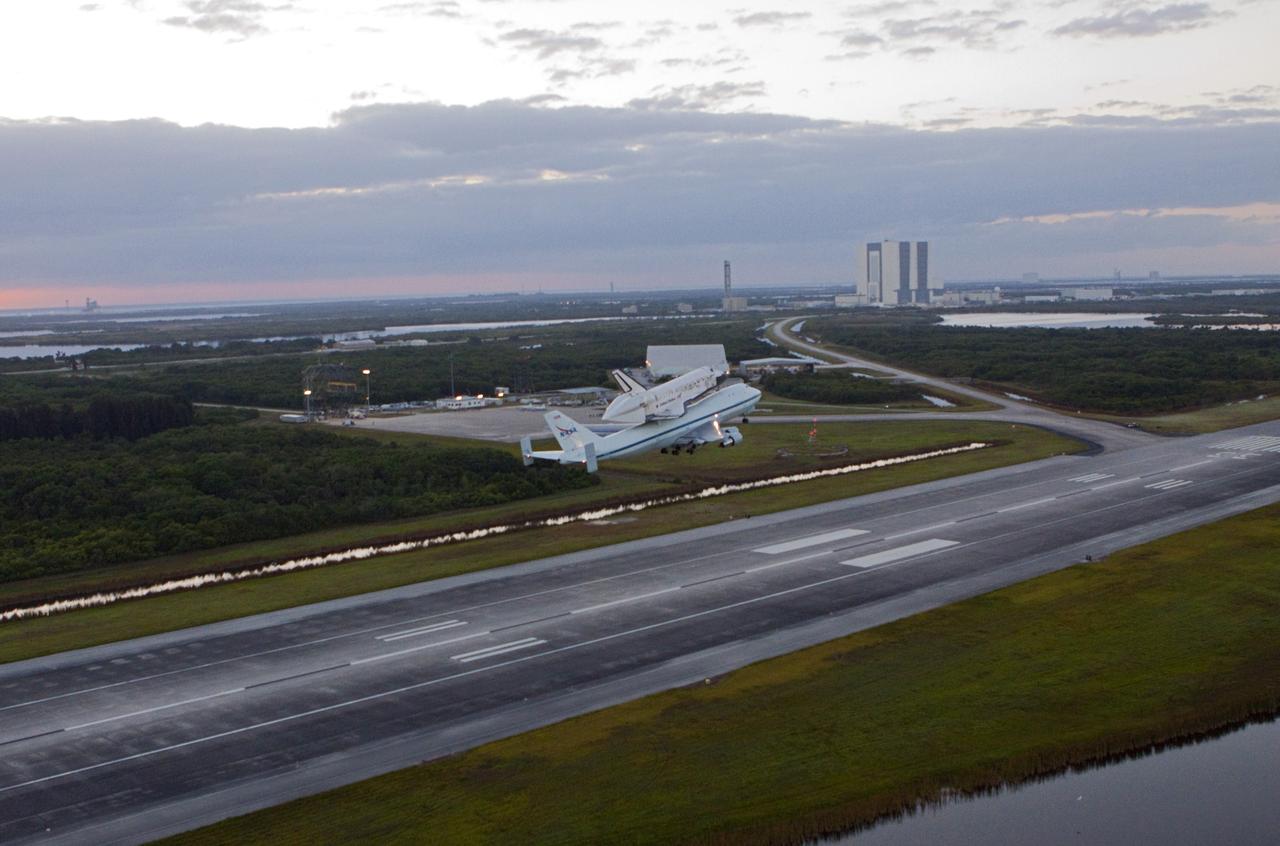
CAPE CANAVERAL, Fla. – The Shuttle Carrier Aircraft transporting space shuttle Discovery to its new home takes off from the Shuttle Landing Facility at NASA’s Kennedy Space Center in Florida at 7 a.m. EDT. In the background is the 525-foot-tall Vehicle Assembly Building and NASA’s new mobile launcher. The aircraft, known as an SCA, is a Boeing 747 jet, originally manufactured for commercial use, which was modified by NASA to transport the shuttles between destinations on Earth. This SCA, designated NASA 905, is assigned to the remaining ferry missions, delivering the shuttles to their permanent public display sites. NASA 905 is scheduled to ferry Discovery to the Washington Dulles International Airport in Virginia on April 17, after which the shuttle will be placed on display in the Smithsonian's National Air and Space Museum Steven F. Udvar-Hazy Center. For more information on the SCA, visit http://www.nasa.gov/centers/dryden/news/FactSheets/FS-013-DFRC.html. For more information on shuttle transition and retirement activities, visit http://www.nasa.gov/transition. Photo credit: NASA/Glenn Benson

CAPE CANAVERAL, Fla. – The “pathfinder” aircraft for space shuttle Discovery’s ferry flight arrives at the Shuttle Landing Facility at NASA’s Kennedy Space Center in Florida to support Discovery’s ferry flight. The NASA C-9 aircraft will fly about 100 miles ahead of Discovery to scout for the safest route between destinations. Its crew includes an SCA flight engineer who studies the weather patterns along the flight path to find a route free of rain and other turbulence. The carrier aircraft, also known as an SCA, is a Boeing 747 jet, originally manufactured for commercial use which was modified by NASA to transport the shuttles between destinations on Earth. NASA 905 is scheduled to ferry Discovery to the Washington Dulles International Airport in Virginia on April 17, and is assigned to all remaining ferry missions, delivering the shuttles to their permanent public display sites. After its arrival at Dulles, Discovery will be placed on display in the Smithsonian's National Air and Space Museum Steven F. Udvar-Hazy Center on April 19. For more information on the SCA, visit http://www.nasa.gov/centers/dryden/news/FactSheets/FS-013-DFRC.html. For more information on shuttle transition and retirement activities, visit http://www.nasa.gov/transition. Photo credit: NASA/Amanda Diller
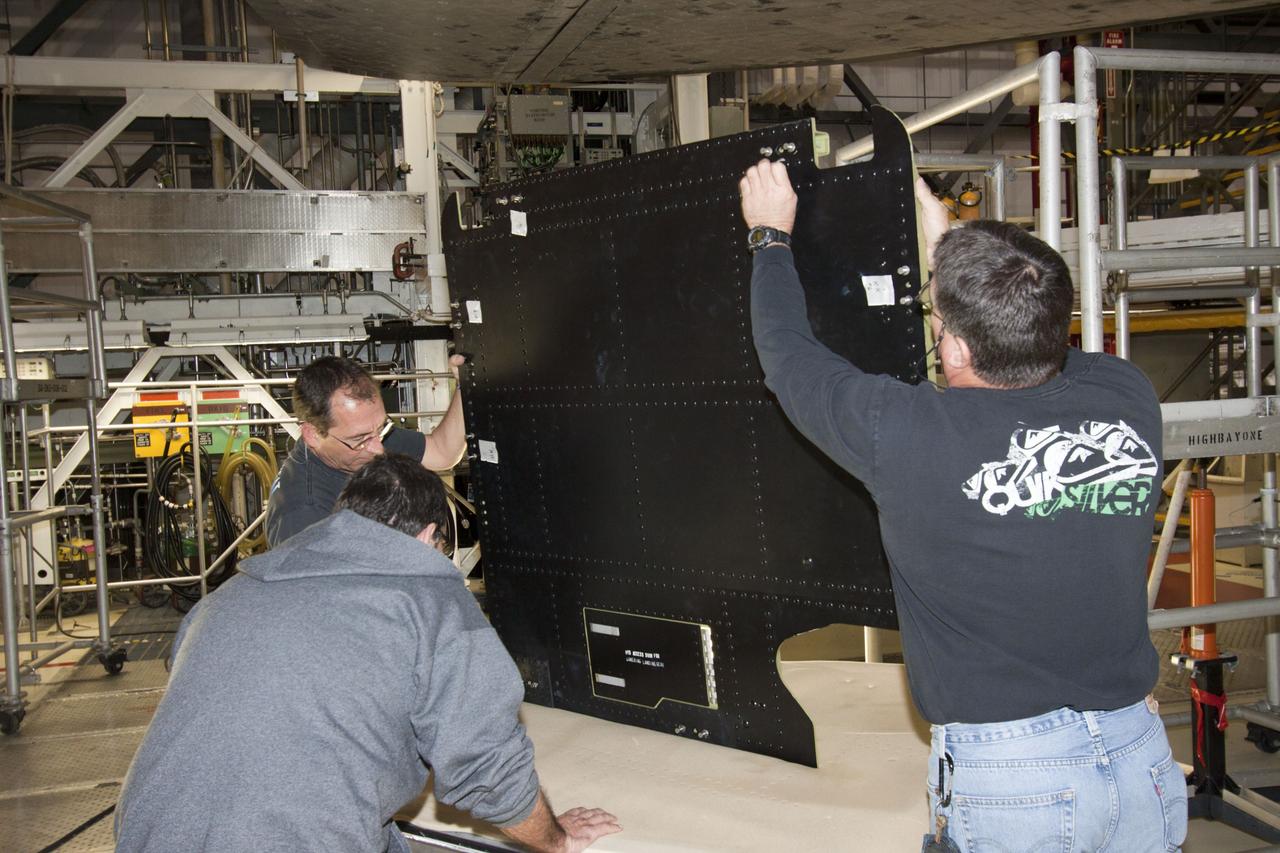
CAPE CANAVERAL, Fla. – Inside Orbiter Processing Facility-1 at NASA’s Kennedy Space Center in Florida, technicians prepare a ferry flight door for installation on space shuttle Discovery. The work is part of the Space Shuttle Program’s transition and retirement processing of shuttle Discovery, which is being prepared for display at Smithsonian’s National Air and Space Museum, Steven F. Udvar-Hazy Center in Chantilly, Va. Discovery is scheduled to be transported atop a NASA Shuttle Carrier Aircraft modified 747 jet to Dulles International Airport in Virginia on April 17 and then moved to the Smithsonian for permanent public display on April 19. For more information, visit http://www.nasa.gov/shuttle. Photo credit: NASA/Jim Grossmann
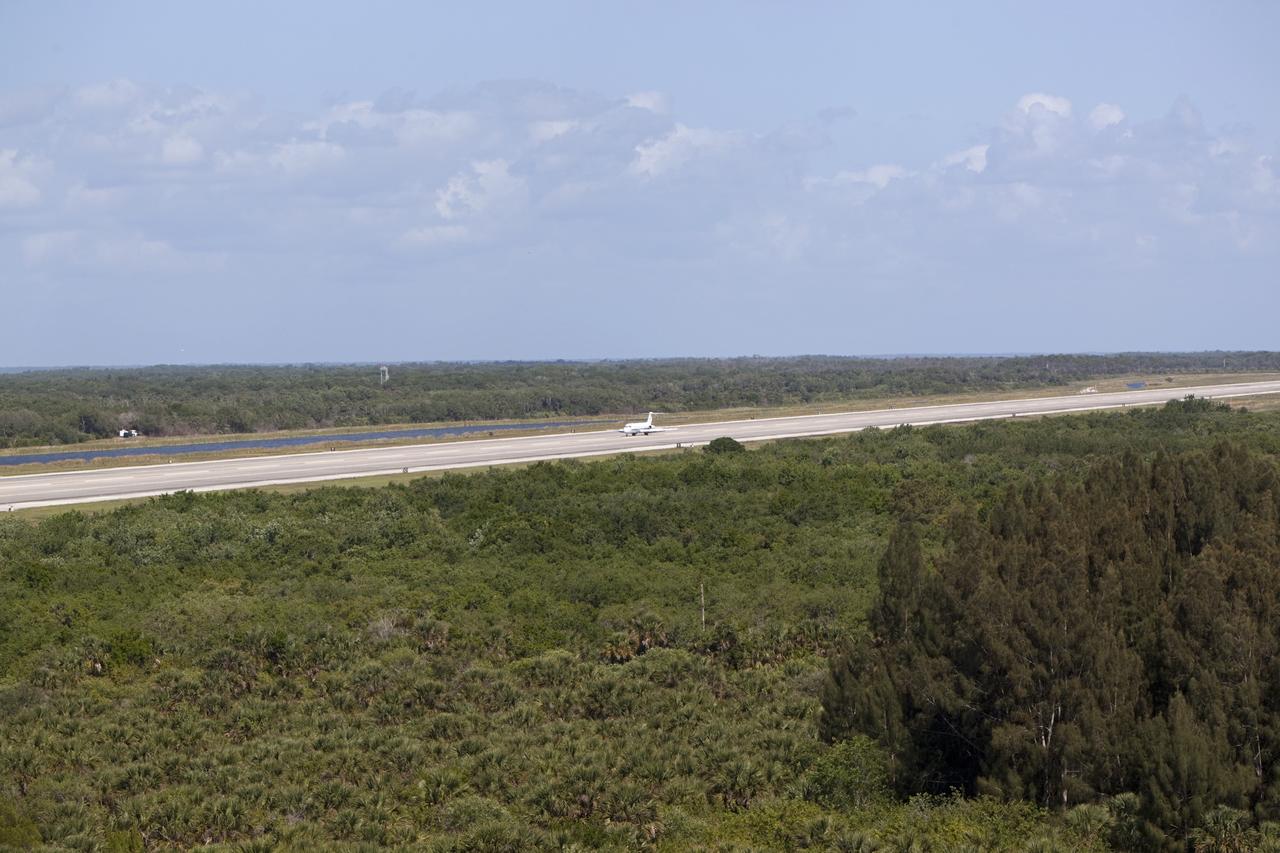
CAPE CANAVERAL, Fla. – The “pathfinder” aircraft for space shuttle Discovery’s ferry flight arrives at the Shuttle Landing Facility at NASA’s Kennedy Space Center in Florida. The NASA C-9 aircraft will fly about 100 miles ahead of Discovery to scout for the safest route between destinations. Its crew includes an SCA flight engineer who studies the weather patterns along the flight path to find a route free of rain and other turbulence. The carrier aircraft, also known as an SCA, is a Boeing 747 jet, originally manufactured for commercial use which was modified by NASA to transport the shuttles between destinations on Earth. NASA 905 is scheduled to ferry Discovery to the Washington Dulles International Airport in Virginia on April 17, and is assigned to all remaining ferry missions, delivering the shuttles to their permanent public display sites. After its arrival at Dulles, Discovery will be placed on display in the Smithsonian's National Air and Space Museum Steven F. Udvar-Hazy Center on April 19. For more information on the SCA, visit http://www.nasa.gov/centers/dryden/news/FactSheets/FS-013-DFRC.html. For more information on shuttle transition and retirement activities, visit http://www.nasa.gov/transition. Photo credit: NASA/Dimitri Gerondidaki
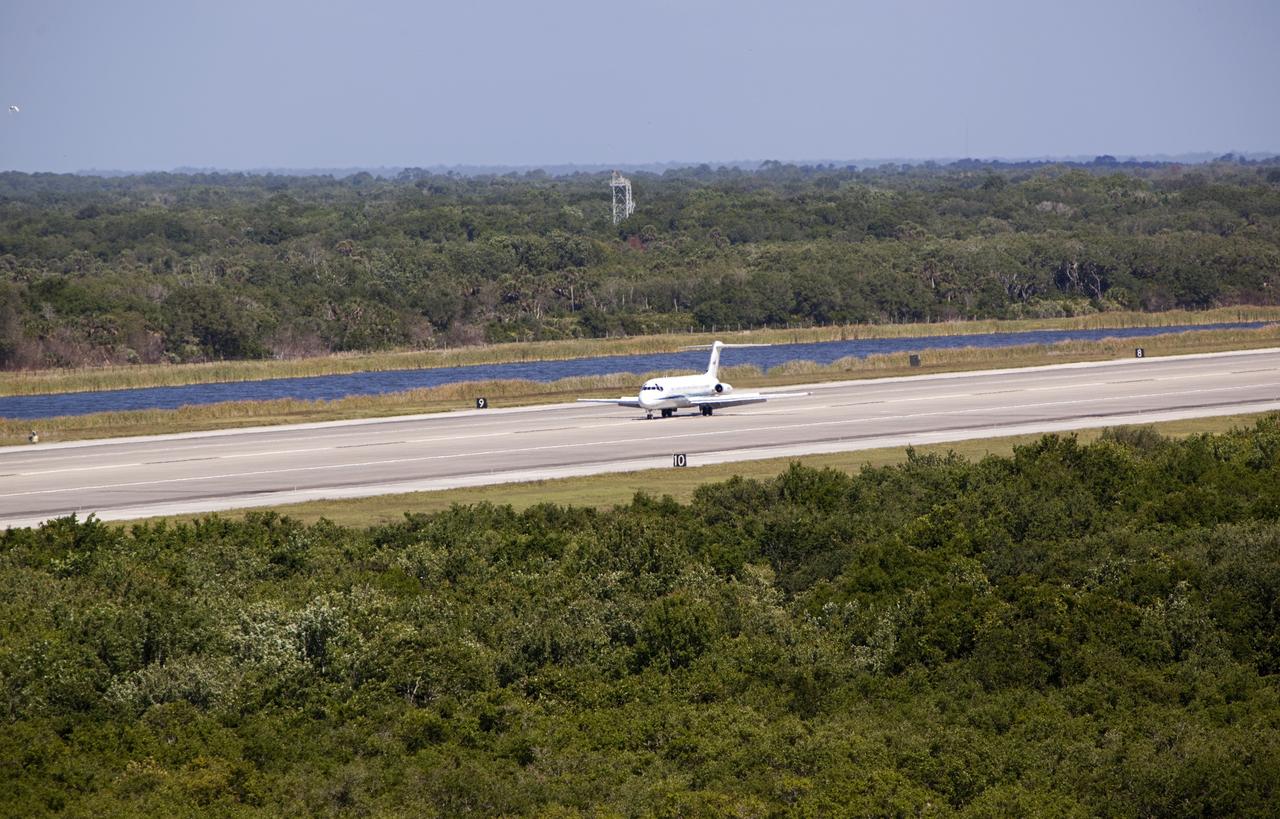
CAPE CANAVERAL, Fla. – The “pathfinder” aircraft for space shuttle Discovery’s ferry flight touches down at the Shuttle Landing Facility at NASA’s Kennedy Space Center in Florida. The NASA C-9 aircraft will fly about 100 miles ahead of Discovery to scout for the safest route between destinations. Its crew includes an SCA flight engineer who studies the weather patterns along the flight path to find a route free of rain and other turbulence. The carrier aircraft, also known as an SCA, is a Boeing 747 jet, originally manufactured for commercial use which was modified by NASA to transport the shuttles between destinations on Earth. NASA 905 is scheduled to ferry Discovery to the Washington Dulles International Airport in Virginia on April 17, and is assigned to all remaining ferry missions, delivering the shuttles to their permanent public display sites. After its arrival at Dulles, Discovery will be placed on display in the Smithsonian's National Air and Space Museum Steven F. Udvar-Hazy Center on April 19. For more information on the SCA, visit http://www.nasa.gov/centers/dryden/news/FactSheets/FS-013-DFRC.html. For more information on shuttle transition and retirement activities, visit http://www.nasa.gov/transition. Photo credit: NASA/Dimitri Gerondidaki
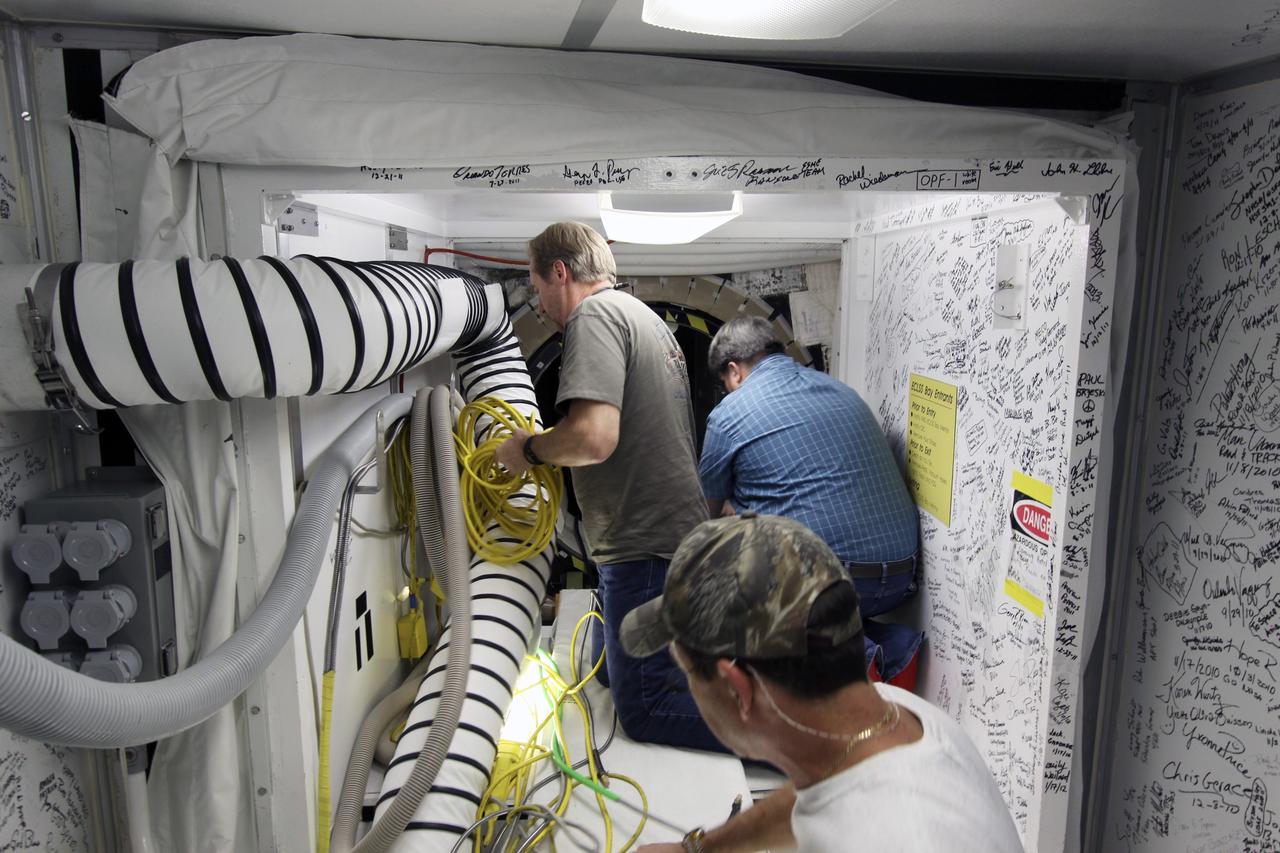
CAPE CANAVERAL, Fla. -- Inside Orbiter Processing Facility-1 at NASA’s Kennedy Space Center in Florida, technicians prepare space shuttle Discovery’s access hatch for final close out. The work is part of the Space Shuttle Program’s transition and retirement processing of shuttle Discovery, which is being prepared for display at Smithsonian’s National Air and Space Museum, Steven F. Udvar-Hazy Center in Chantilly, Va. Discovery is scheduled to be transported atop a NASA Shuttle Carrier Aircraft modified 747 jet to Dulles International Airport in Virginia on April 17 and then be transported to the Smithsonian on April 19. For more information, visit http://www.nasa.gov/shuttle. Photo credit: NASA/Jim Grossmann
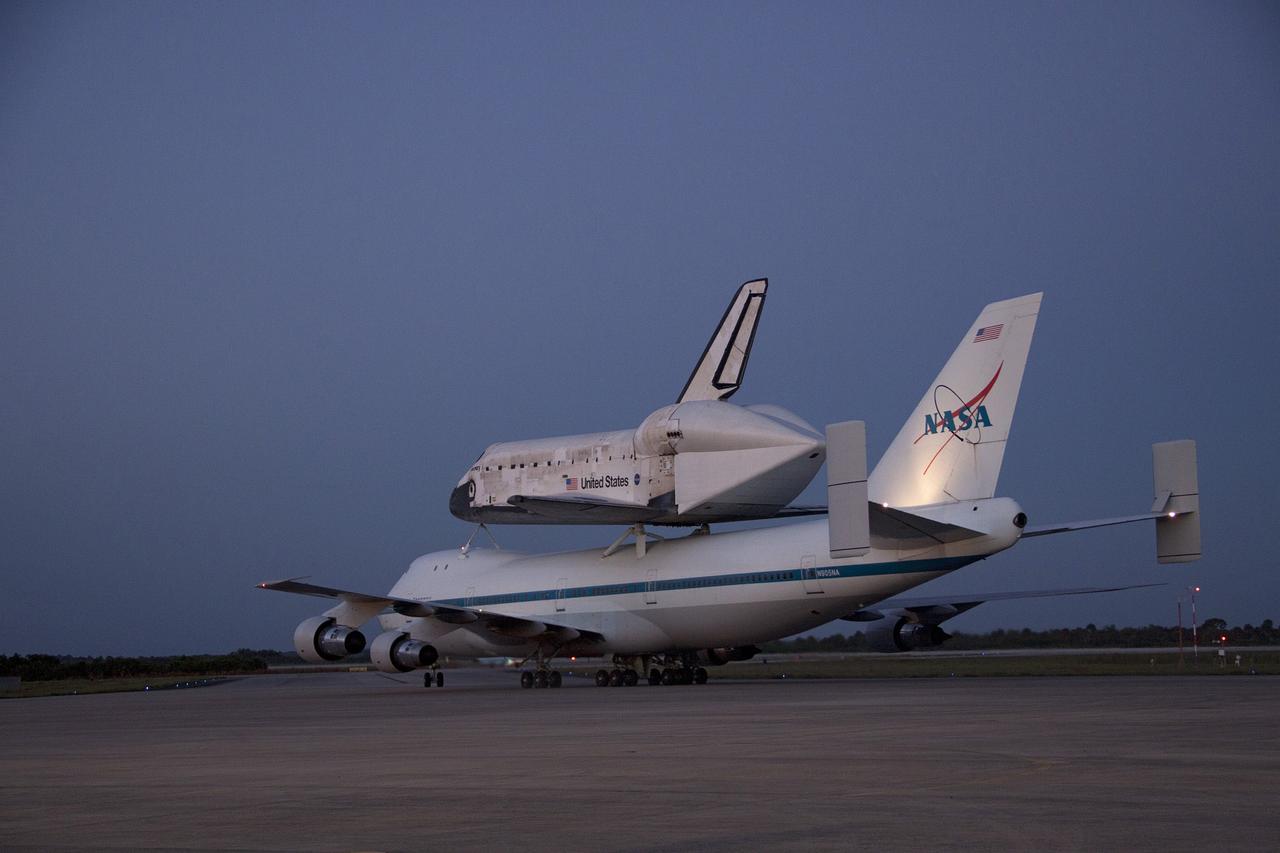
CAPE CANAVERAL, Fla. – The Shuttle Carrier Aircraft transporting space shuttle Discovery to its new home is ready for takeoff from the Shuttle Landing Facility at NASA’s Kennedy Space Center in Florida at about 7 a.m. EDT. The aircraft, known as an SCA, is a Boeing 747 jet, originally manufactured for commercial use, which was modified by NASA to transport the shuttles between destinations on Earth. This SCA, designated NASA 905, is assigned to the remaining ferry missions, delivering the shuttles to their permanent public display sites. NASA 905 is scheduled to ferry Discovery to the Washington Dulles International Airport in Virginia on April 17, after which the shuttle will be placed on display in the Smithsonian's National Air and Space Museum Steven F. Udvar-Hazy Center. For more information on the SCA, visit http://www.nasa.gov/centers/dryden/news/FactSheets/FS-013-DFRC.html. For more information on shuttle transition and retirement activities, visit http://www.nasa.gov/transition. Photo credit: NASA/Jim Grossmann
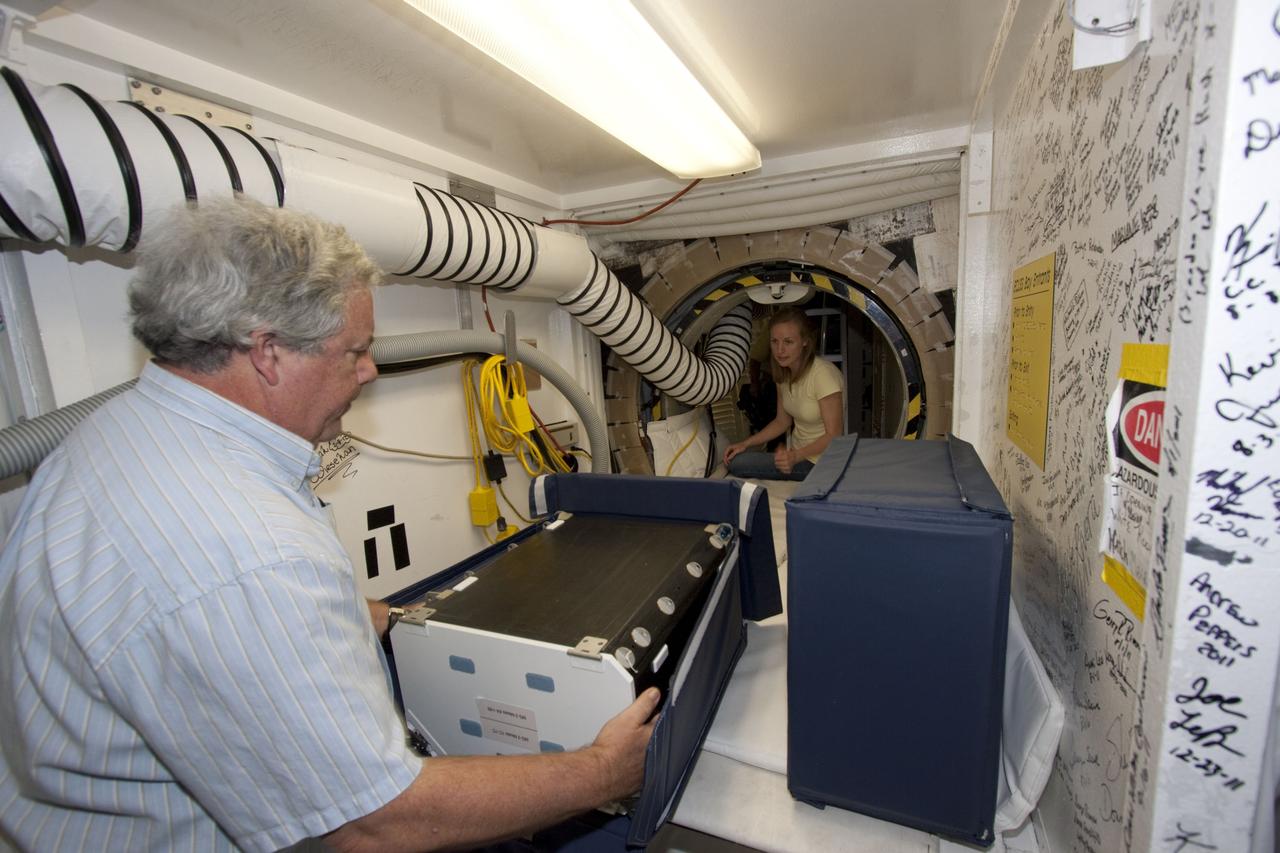
CAPE CANAVERAL, Fla. -- Inside Orbiter Processing Facility-1 at NASA’s Kennedy Space Center in Florida, technicians prepare to reinstall the lockers in the middeck of space shuttle Discovery. The work is part of the Space Shuttle Program’s transition and retirement processing of shuttle Discovery, which is being prepared for display at Smithsonian’s National Air and Space Museum, Steven F. Udvar-Hazy Center in Chantilly, Va. Discovery is scheduled to be transported atop a NASA Shuttle Carrier Aircraft modified 747 jet to Dulles International Airport in Virginia on April 17 and then be transported to the Smithsonian on April 19. For more information, visit http://www.nasa.gov/shuttle. Photo credit: NASA/Jim Grossmann
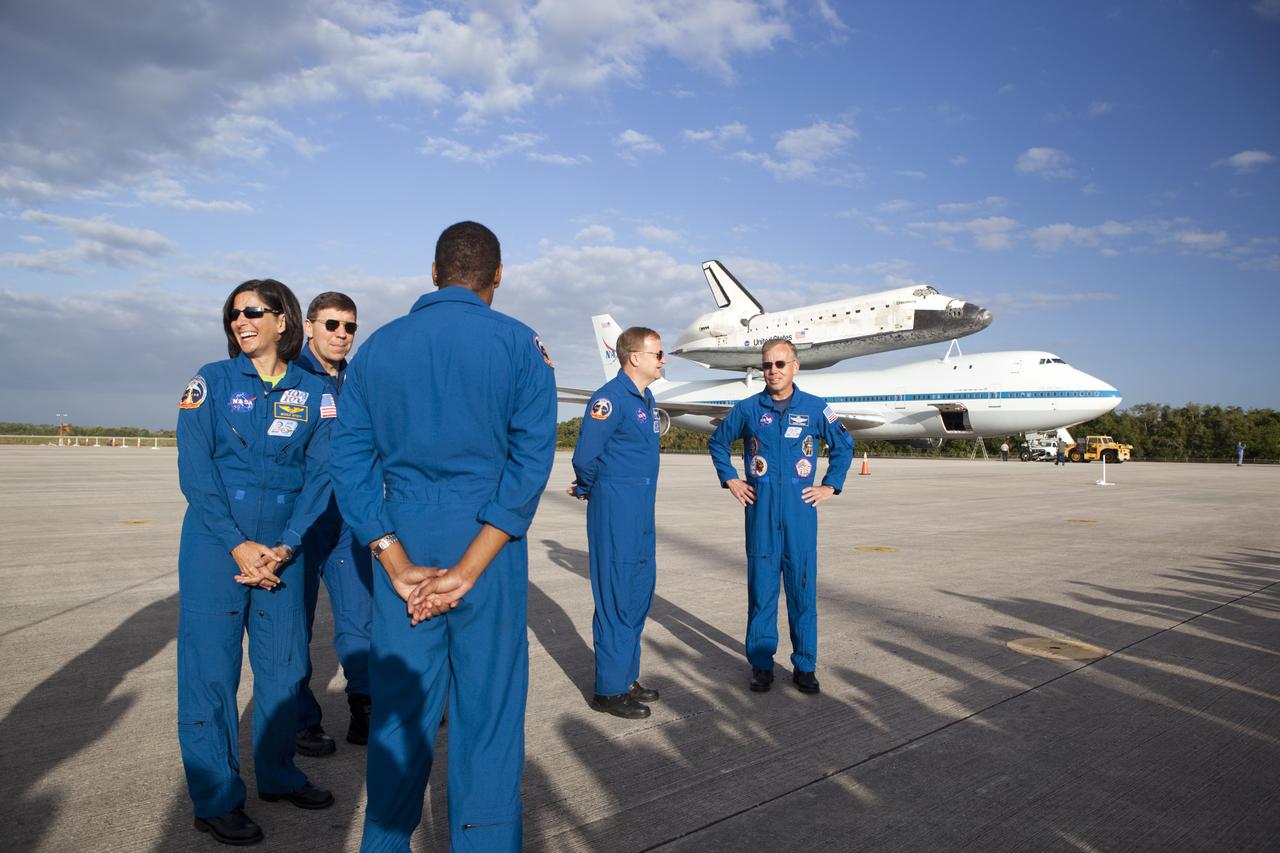
CAPE CANAVERAL, Fla. – At NASA Kennedy Space Center’s Shuttle Landing Facility in Florida, crew members of space shuttle Discovery’s last mission, STS-133, have arrived. From the left, are Mission Specialists Nicole Stott, Michael Barrett and Alvin Drew facing away, Pilot Eric Boe and Commander Steve Lindsay. In the background is the Shuttle Carrier Aircraft, or SCA, with space shuttle Discovery attached atop after being backed away from the mate/demate device. Known as the MDD, the devise is a large gantry-like steel structure used to hoist a shuttle off the ground and position it onto the back of the SCA. The SCA is a Boeing 747 jet that was originally manufactured for commercial use and modified by NASA to transport the shuttles between destinations on Earth. This SCA, designated NASA 905, is assigned to the remaining ferry missions, delivering the shuttles to their permanent public display sites. NASA 905 is scheduled to ferry Discovery to the Washington Dulles International Airport in Virginia on April 17, after which the shuttle will be placed on display in the Smithsonian’s National Air and Space Museum, Steven F. Udvar-Hazy Center in Chantilly, Va. For more information on the SCA, visit http://www.nasa.gov/centers/dryden/news/FactSheets/FS-013-DFRC.html. For more information on shuttle transition and retirement activities, visit http://www.nasa.gov/transition. Photo credit: NASA/Dimitri Gerondidakis
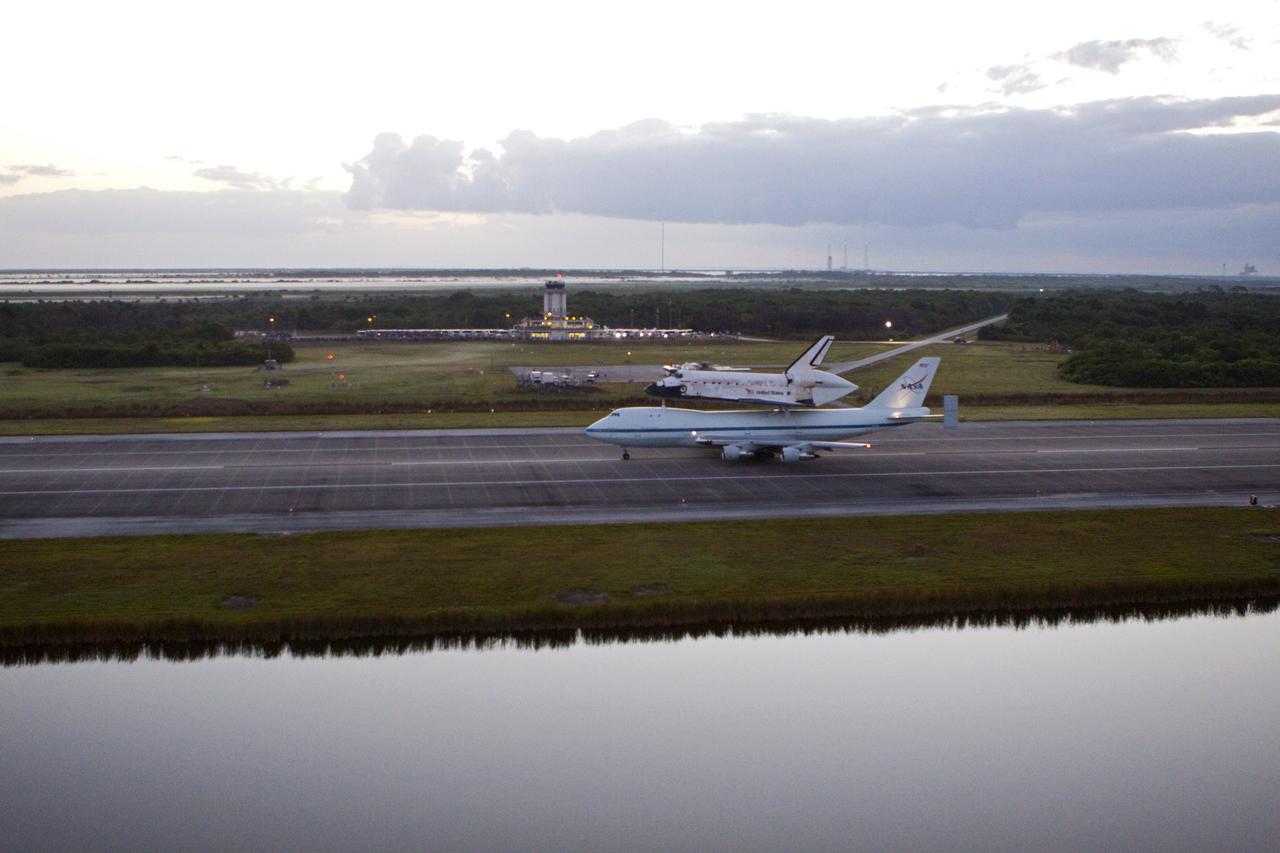
CAPE CANAVERAL, Fla. – In the early morning hours at NASA Kennedy Space Center’s Shuttle Landing Facility in Florida, the Shuttle Carrier Aircraft, or SCA, with space shuttle Discovery secured atop, taxies down the runway for a takeoff at 7 a.m. EDT. In the background is the midfield air traffic control tower. The aircraft, known as an SCA, is a Boeing 747 jet, originally manufactured for commercial use, which was modified by NASA to transport the shuttles between destinations on Earth. This SCA, designated NASA 905, is assigned to the remaining ferry missions, delivering the shuttles to their permanent public display sites. NASA 905 is scheduled to ferry Discovery to the Washington Dulles International Airport in Virginia on April 17, after which the shuttle will be placed on display in the Smithsonian’s National Air and Space Museum, Steven F. Udvar-Hazy Center in Chantilly, Va. For more information on the SCA, visit http://www.nasa.gov/centers/dryden/news/FactSheets/FS-013-DFRC.html. For more information on shuttle transition and retirement activities, visit http://www.nasa.gov/transition. Photo credit: NASA/Glenn Benson
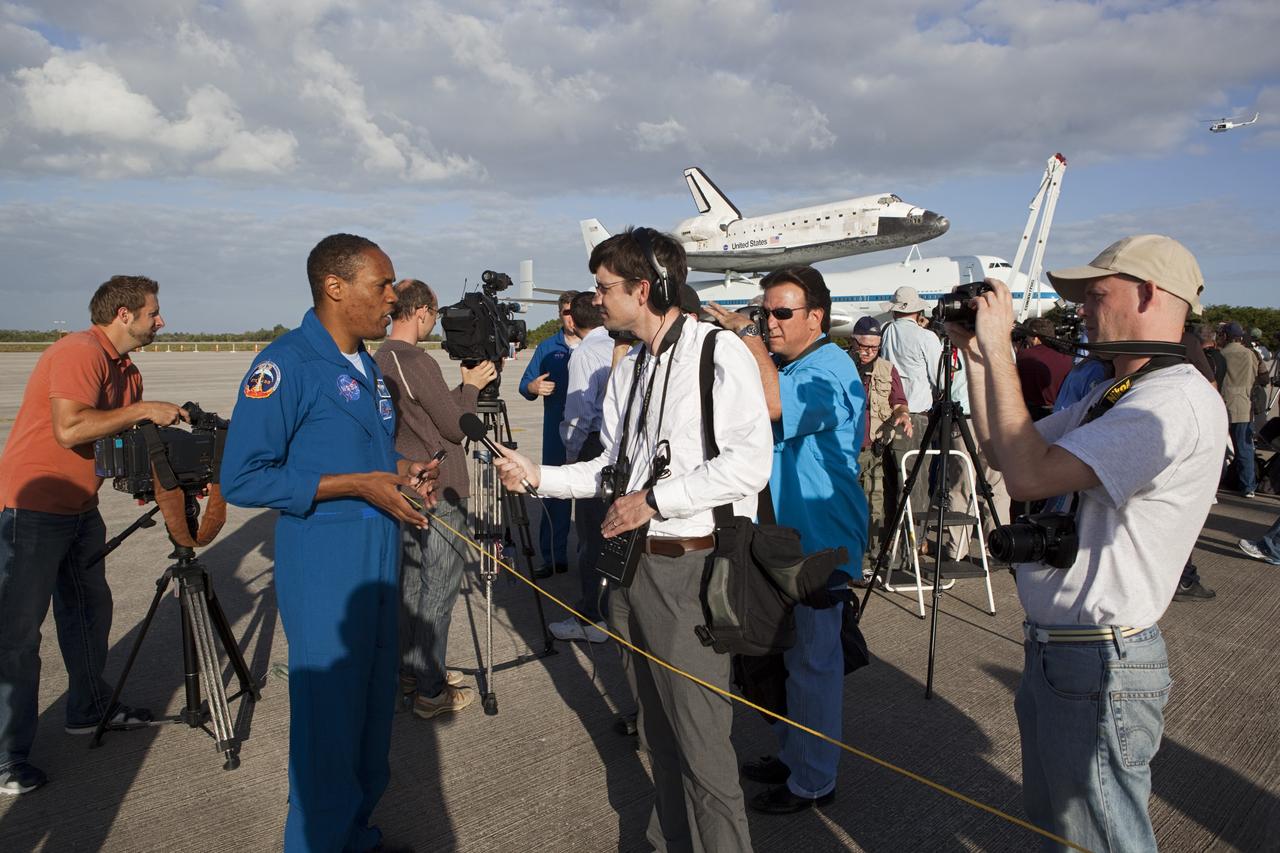
CAPE CANAVERAL, Fla. – At NASA Kennedy Space Center’s Shuttle Landing Facility in Florida, crew members of space shuttle Discovery’s last mission, STS-133, have arrived. Mission Specialist Alvin Drew visits with the media. Also present, but not in view, are Mission Specialists Nicole Stott, Michael Barrett and Steve Bowen, Pilot Eric Boe and Commander Steve Lindsay. In the background is the Shuttle Carrier Aircraft, or SCA, with space shuttle Discovery attached atop after being backed away from the mate/demate device. Known as the MDD, the devise is a large gantry-like steel structure used to hoist a shuttle off the ground and position it onto the back of the SCA. The SCA is a Boeing 747 jet that was originally manufactured for commercial use and modified by NASA to transport the shuttles between destinations on Earth. This SCA, designated NASA 905, is assigned to the remaining ferry missions, delivering the shuttles to their permanent public display sites. NASA 905 is scheduled to ferry Discovery to the Washington Dulles International Airport in Virginia on April 17, after which the shuttle will be placed on display in the Smithsonian’s National Air and Space Museum, Steven F. Udvar-Hazy Center in Chantilly, Va. For more information on the SCA, visit http://www.nasa.gov/centers/dryden/news/FactSheets/FS-013-DFRC.html. For more information on shuttle transition and retirement activities, visit http://www.nasa.gov/transition. Photo credit: NASA/Dimitri Gerondidakis

CAPE CANAVERAL, Fla. – Space shuttle Discovery, mounted to a Shuttle Carrier Aircraft, or SCA, takes off from NASA Kennedy Space Center’s Shuttle Landing Facility runway 15 in Florida at 7 a.m. EDT. The duo is beginning its ferry flight to the Washington Dulles International Airport in Virginia that also includes a flyby of the Space Coast and Washington, D.C. Also flying along with the pair is a T-38 training jet. Discovery is leaving Kennedy after more than 28 years of service beginning with its arrival on the space coast Nov. 9, 1983. Discovery first launched to space Aug. 30, 1984, on the STS-41D mission. Discovery is the agency’s most-flown shuttle with 39 missions, more than 148 million miles and a total of one year in space. Discovery is set to move to the Smithsonian’s National Air and Space Museum, Steven F. Udvar-Hazy Center in Chantilly, Va., on April 19 where it will be place on public display. For more information on the SCA, visit http://www.nasa.gov/centers/dryden/news/FactSheets/FS-013-DFRC.html. For more information on shuttle transition and retirement activities, visit http://www.nasa.gov/transition. Photo credit: NASA/Tim Powers and Rick Wetherington
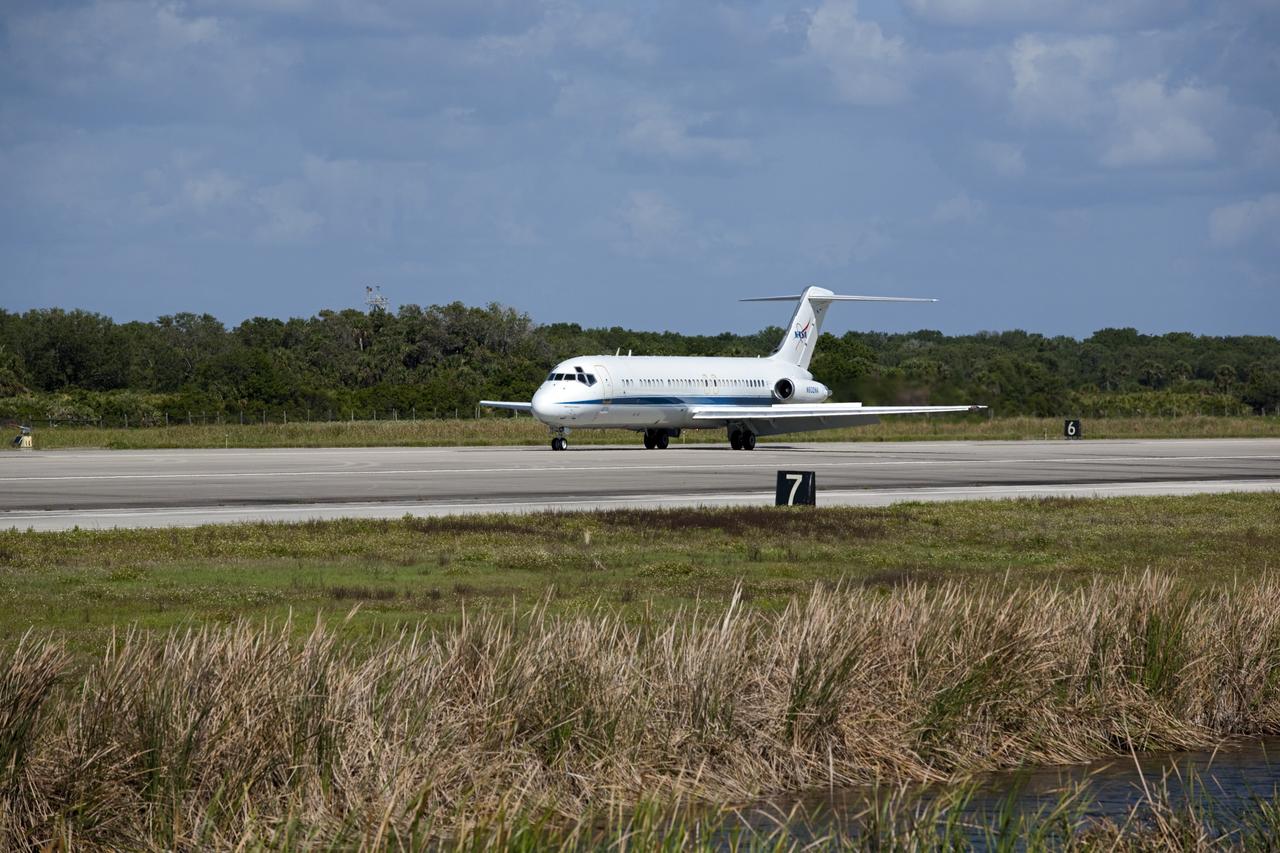
CAPE CANAVERAL, Fla. – The “pathfinder” aircraft for space shuttle Discovery’s ferry flight lands at the Shuttle Landing Facility at NASA’s Kennedy Space Center in Florida. The NASA C-9 aircraft will fly about 100 miles ahead of Discovery to scout for the safest route between destinations. Its crew includes an SCA flight engineer who studies the weather patterns along the flight path to find a route free of rain and other turbulence. The carrier aircraft, also known as an SCA, is a Boeing 747 jet, originally manufactured for commercial use which was modified by NASA to transport the shuttles between destinations on Earth. NASA 905 is scheduled to ferry Discovery to the Washington Dulles International Airport in Virginia on April 17, and is assigned to all remaining ferry missions, delivering the shuttles to their permanent public display sites. After its arrival at Dulles, Discovery will be placed on display in the Smithsonian's National Air and Space Museum Steven F. Udvar-Hazy Center on April 19. For more information on the SCA, visit http://www.nasa.gov/centers/dryden/news/FactSheets/FS-013-DFRC.html. For more information on shuttle transition and retirement activities, visit http://www.nasa.gov/transition. Photo credit: NASA/Amanda Diller
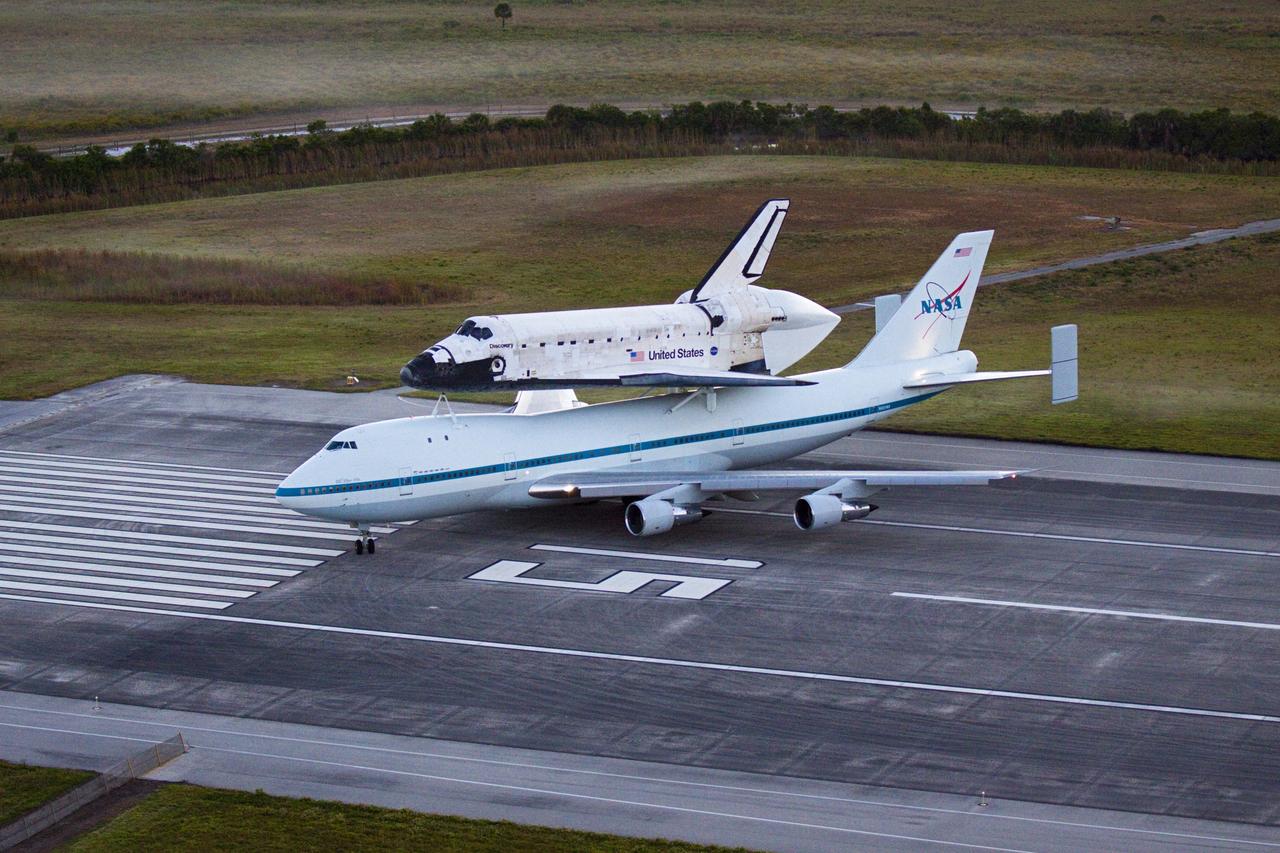
CAPE CANAVERAL, Fla. – In the early morning hours at NASA Kennedy Space Center’s Shuttle Landing Facility in Florida, the Shuttle Carrier Aircraft, or SCA, with space shuttle Discovery secured atop, begins to make the turn on runway 15 for a takeoff at 7 a.m. EDT to deliver Discovery to its new home. The aircraft, known as an SCA, is a Boeing 747 jet, originally manufactured for commercial use, which was modified by NASA to transport the shuttles between destinations on Earth. This SCA, designated NASA 905, is assigned to the remaining ferry missions, delivering the shuttles to their permanent public display sites. NASA 905 is scheduled to ferry Discovery to the Washington Dulles International Airport in Virginia on April 17, after which the shuttle will be placed on display in the Smithsonian’s National Air and Space Museum, Steven F. Udvar-Hazy Center in Chantilly, Va. For more information on the SCA, visit http://www.nasa.gov/centers/dryden/news/FactSheets/FS-013-DFRC.html. For more information on shuttle transition and retirement activities, visit http://www.nasa.gov/transition. Photo credit: NASA/Glenn Benson
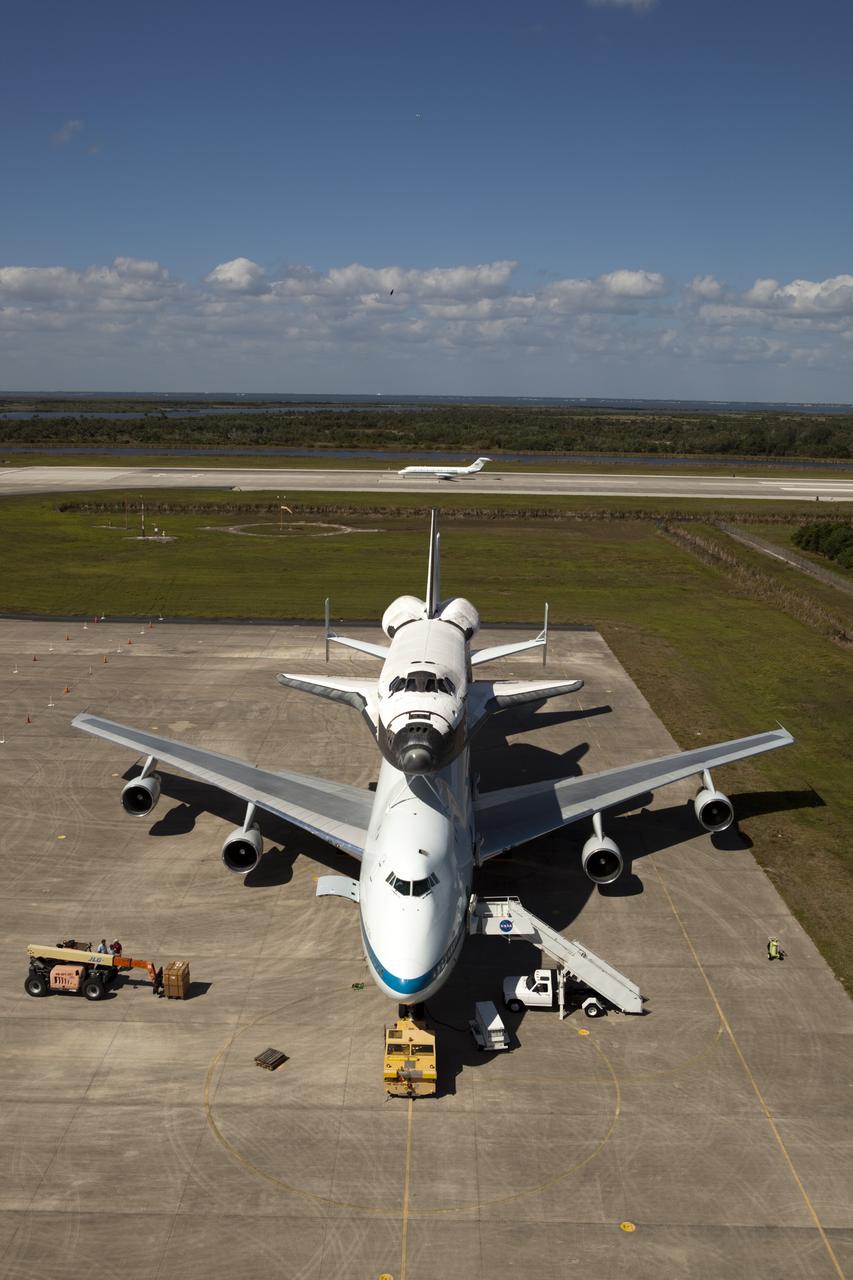
CAPE CANAVERAL, Fla. – Preparations for space shuttle Discovery’s ferry flight aboard a Shuttle Carrier Aircraft continue as the “pathfinder” aircraft for the flight lands at the Shuttle Landing Facility at NASA’s Kennedy Space Center in Florida. The NASA C-9 aircraft will fly about 100 miles ahead of Discovery to scout for the safest route between destinations. Its crew includes an SCA flight engineer who studies the weather patterns along the flight path to find a route free of rain and other turbulence. The carrier aircraft, also known as an SCA, is a Boeing 747 jet, originally manufactured for commercial use which was modified by NASA to transport the shuttles between destinations on Earth. NASA 905 is scheduled to ferry Discovery to the Washington Dulles International Airport in Virginia on April 17, and is assigned to all remaining ferry missions, delivering the shuttles to their permanent public display sites. After its arrival at Dulles, Discovery will be placed on display in the Smithsonian's National Air and Space Museum Steven F. Udvar-Hazy Center on April 19. For more information on the SCA, visit http://www.nasa.gov/centers/dryden/news/FactSheets/FS-013-DFRC.html. For more information on shuttle transition and retirement activities, visit http://www.nasa.gov/transition. Photo credit: NASA/Dimitri Gerondidaki
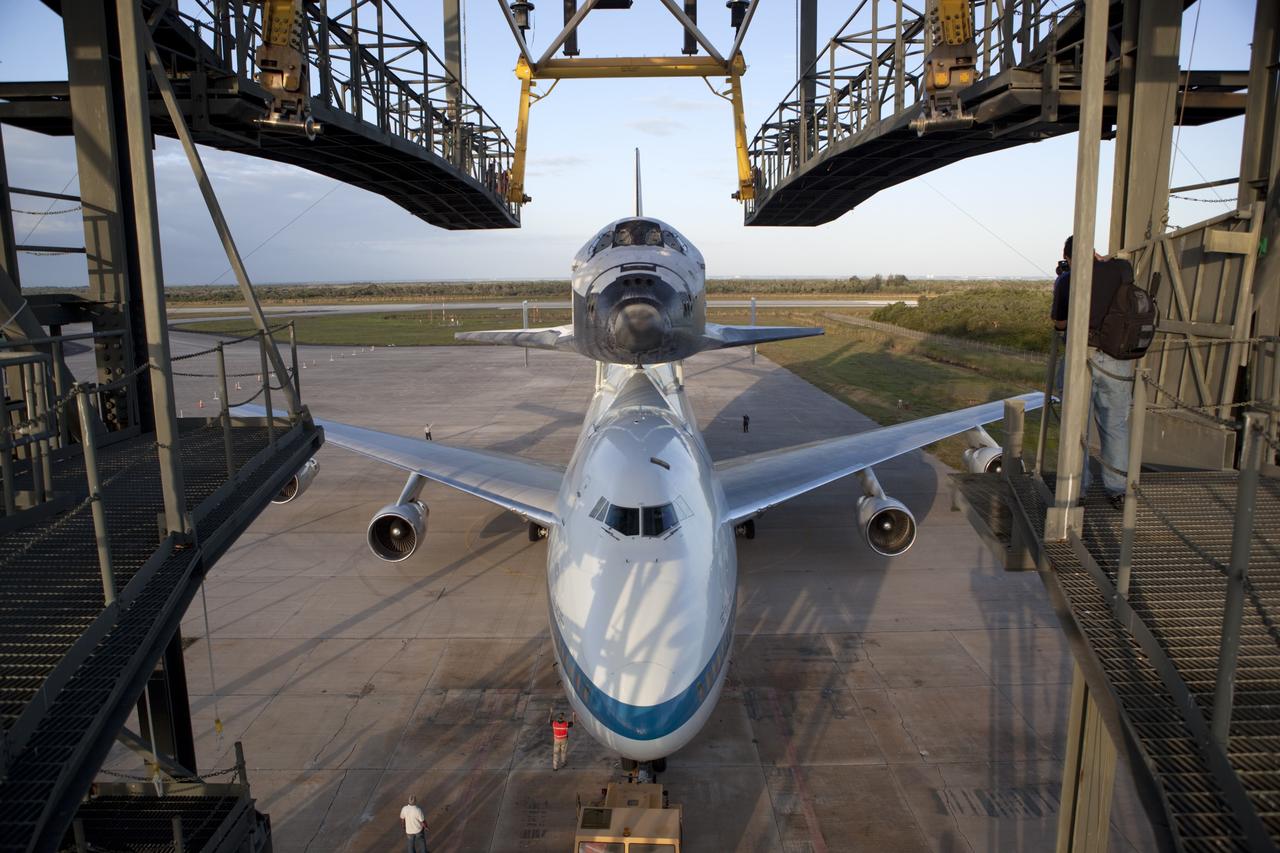
CAPE CANAVERAL, Fla. – At NASA Kennedy Space Center’s Shuttle Landing Facility in Florida, the Shuttle Carrier Aircraft, or SCA, with space shuttle Discovery attached atop, backs away from the mate/demate device. Known as the MDD, the devise is a large gantry-like steel structure used to hoist a shuttle off the ground and position it onto the back of the SCA. The SCA is a Boeing 747 jet that was originally manufactured for commercial use and modified by NASA to transport the shuttles between destinations on Earth. This SCA, designated NASA 905, is assigned to the remaining ferry missions, delivering the shuttles to their permanent public display sites. NASA 905 is scheduled to ferry Discovery to the Washington Dulles International Airport in Virginia on April 17, after which the shuttle will be placed on display in the Smithsonian’s National Air and Space Museum, Steven F. Udvar-Hazy Center in Chantilly, Va. For more information on the SCA, visit http://www.nasa.gov/centers/dryden/news/FactSheets/FS-013-DFRC.html. For more information on shuttle transition and retirement activities, visit http://www.nasa.gov/transition. Photo credit: NASA/Dimitri Gerondidakis
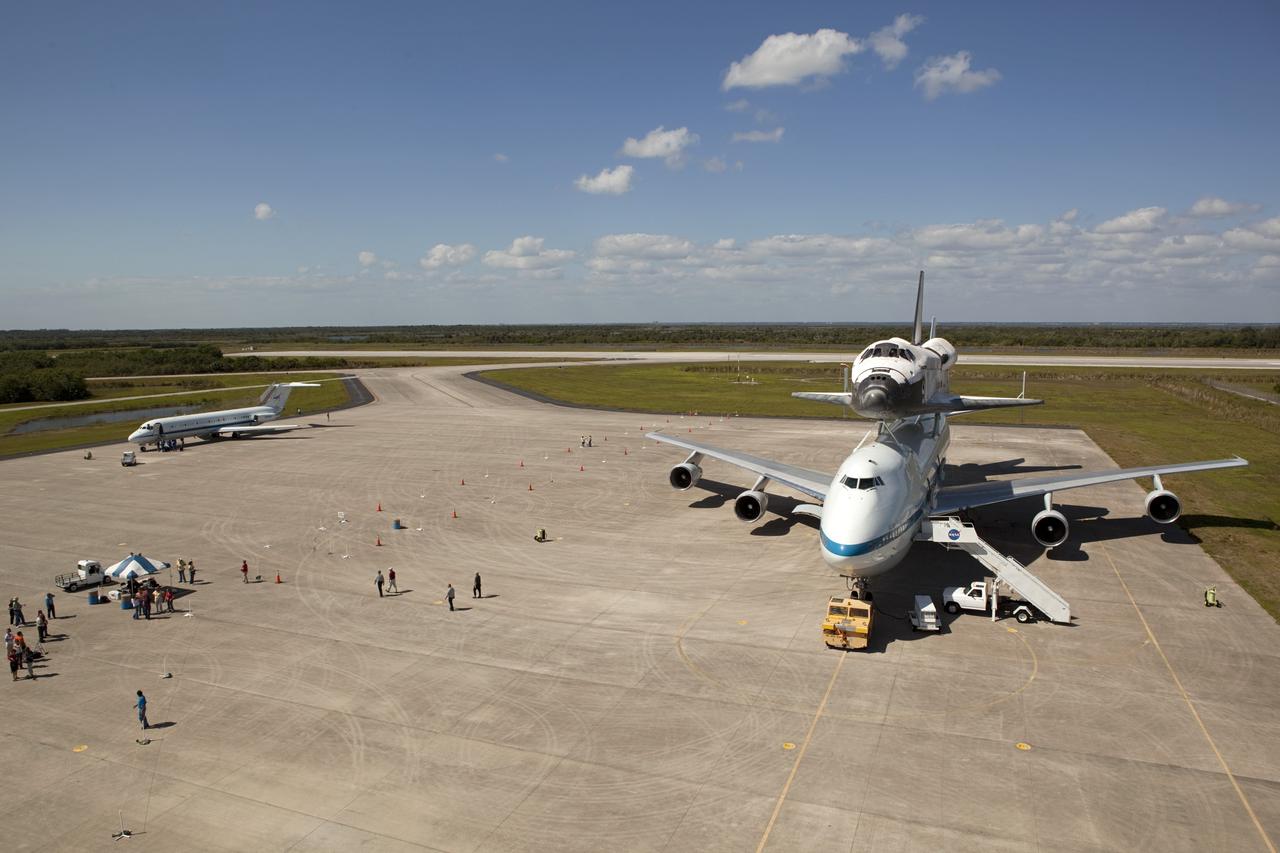
CAPE CANAVERAL, Fla. – The “pathfinder” aircraft for space shuttle Discovery’s ferry flight parks near the Shuttle Carrier Aircraft on the apron of the Shuttle Landing Facility at NASA’s Kennedy Space Center in Florida. The NASA C-9 aircraft will fly about 100 miles ahead of Discovery to scout for the safest route between destinations. Its crew includes an SCA flight engineer who studies the weather patterns along the flight path to find a route free of rain and other turbulence. The carrier aircraft, also known as an SCA, is a Boeing 747 jet, originally manufactured for commercial use which was modified by NASA to transport the shuttles between destinations on Earth. NASA 905 is scheduled to ferry Discovery to the Washington Dulles International Airport in Virginia on April 17, and is assigned to all remaining ferry missions, delivering the shuttles to their permanent public display sites. After its arrival at Dulles, Discovery will be placed on display in the Smithsonian's National Air and Space Museum Steven F. Udvar-Hazy Center on April 19. For more information on the SCA, visit http://www.nasa.gov/centers/dryden/news/FactSheets/FS-013-DFRC.html. For more information on shuttle transition and retirement activities, visit http://www.nasa.gov/transition. Photo credit: NASA/Dimitri Gerondidaki

CAPE CANAVERAL, Fla. – At NASA Kennedy Space Center’s Shuttle Landing Facility in Florida, crew members of space shuttle Discovery’s last mission, STS-133, have arrived. Commander Steve Lindsay visits with the media. Also present, but not in view, are Mission Specialists Nicole Stott, Michael Barrett, Steve Bowen and Alvin Drew, and Pilot Eric Boe. The crew arrived to view the Shuttle Carrier Aircraft, or SCA, with space shuttle Discovery attached atop after being backed away from the mate/demate device. Known as the MDD, the devise is a large gantry-like steel structure used to hoist a shuttle off the ground and position it onto the back of the SCA. The SCA is a Boeing 747 jet that was originally manufactured for commercial use and modified by NASA to transport the shuttles between destinations on Earth. This SCA, designated NASA 905, is assigned to the remaining ferry missions, delivering the shuttles to their permanent public display sites. NASA 905 is scheduled to ferry Discovery to the Washington Dulles International Airport in Virginia on April 17, after which the shuttle will be placed on display in the Smithsonian’s National Air and Space Museum, Steven F. Udvar-Hazy Center in Chantilly, Va. For more information on the SCA, visit http://www.nasa.gov/centers/dryden/news/FactSheets/FS-013-DFRC.html. For more information on shuttle transition and retirement activities, visit http://www.nasa.gov/transition. Photo credit: NASA/Dimitri Gerondidakis
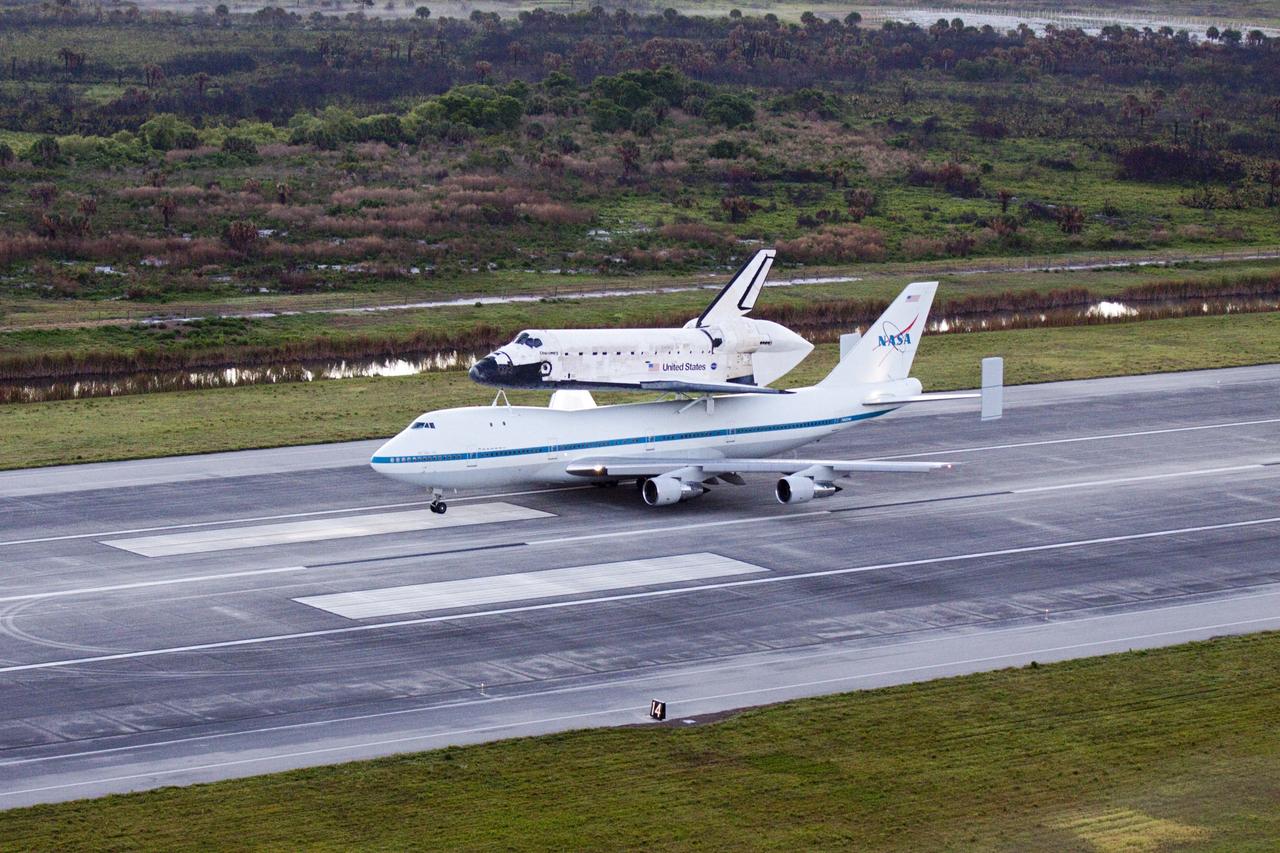
CAPE CANAVERAL, Fla. – In the early morning hours at NASA Kennedy Space Center’s Shuttle Landing Facility in Florida, the Shuttle Carrier Aircraft, or SCA, with space shuttle Discovery secured atop, taxies down the runway for a takeoff at 7 a.m. EDT to deliver Discovery to its new home. The aircraft, known as an SCA, is a Boeing 747 jet, originally manufactured for commercial use, which was modified by NASA to transport the shuttles between destinations on Earth. This SCA, designated NASA 905, is assigned to the remaining ferry missions, delivering the shuttles to their permanent public display sites. NASA 905 is scheduled to ferry Discovery to the Washington Dulles International Airport in Virginia on April 17, after which the shuttle will be placed on display in the Smithsonian’s National Air and Space Museum, Steven F. Udvar-Hazy Center in Chantilly, Va. For more information on the SCA, visit http://www.nasa.gov/centers/dryden/news/FactSheets/FS-013-DFRC.html. For more information on shuttle transition and retirement activities, visit http://www.nasa.gov/transition. Photo credit: NASA/Glenn Benson
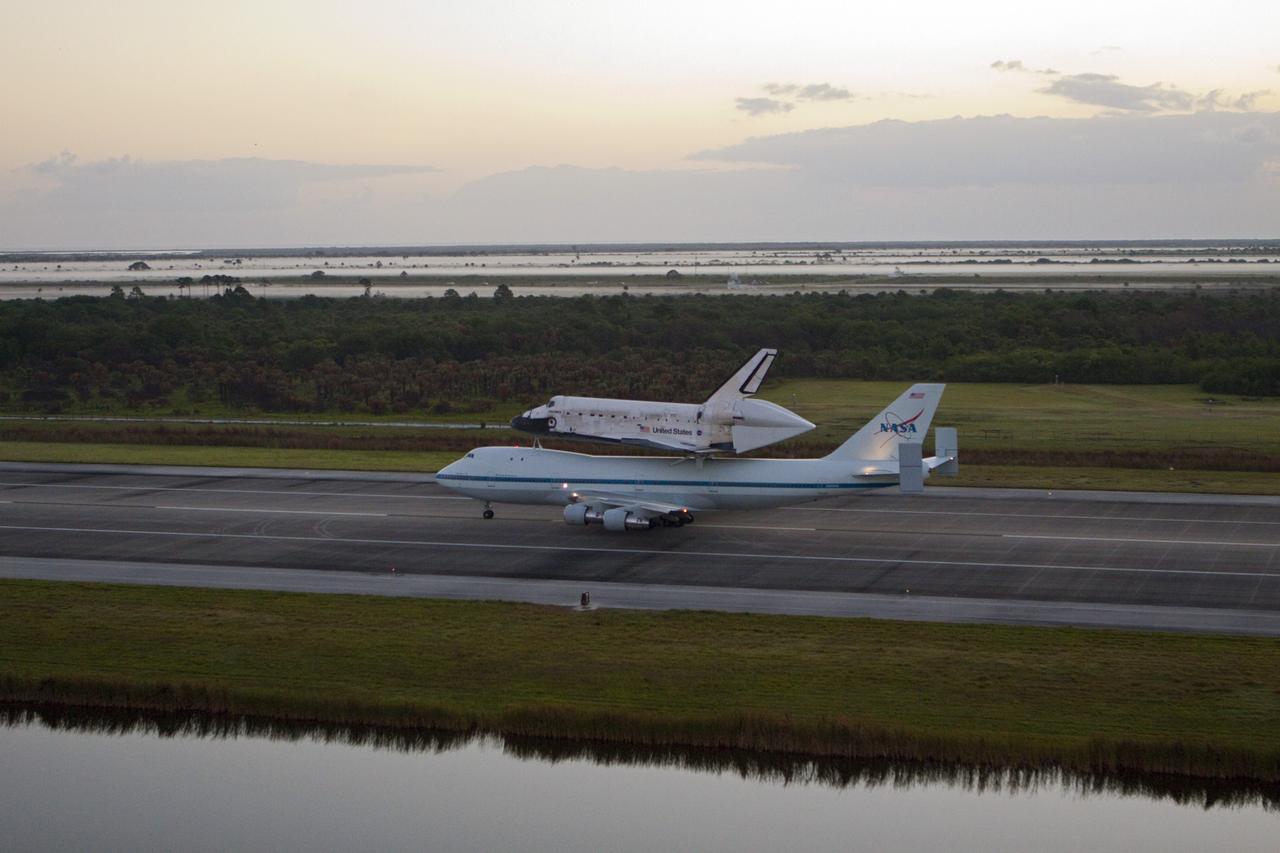
CAPE CANAVERAL, Fla. – In the early morning hours at NASA Kennedy Space Center’s Shuttle Landing Facility in Florida, the Shuttle Carrier Aircraft, or SCA, with space shuttle Discovery secured atop, taxies down the runway for a takeoff at 7 a.m. EDT. In the background is the 525-foot-tall Vehicle Assembly Building. The aircraft, known as an SCA, is a Boeing 747 jet, originally manufactured for commercial use, which was modified by NASA to transport the shuttles between destinations on Earth. This SCA, designated NASA 905, is assigned to the remaining ferry missions, delivering the shuttles to their permanent public display sites. NASA 905 is scheduled to ferry Discovery to the Washington Dulles International Airport in Virginia on April 17, after which the shuttle will be placed on display in the Smithsonian’s National Air and Space Museum, Steven F. Udvar-Hazy Center in Chantilly, Va. For more information on the SCA, visit http://www.nasa.gov/centers/dryden/news/FactSheets/FS-013-DFRC.html. For more information on shuttle transition and retirement activities, visit http://www.nasa.gov/transition. Photo credit: NASA/Glenn Benson
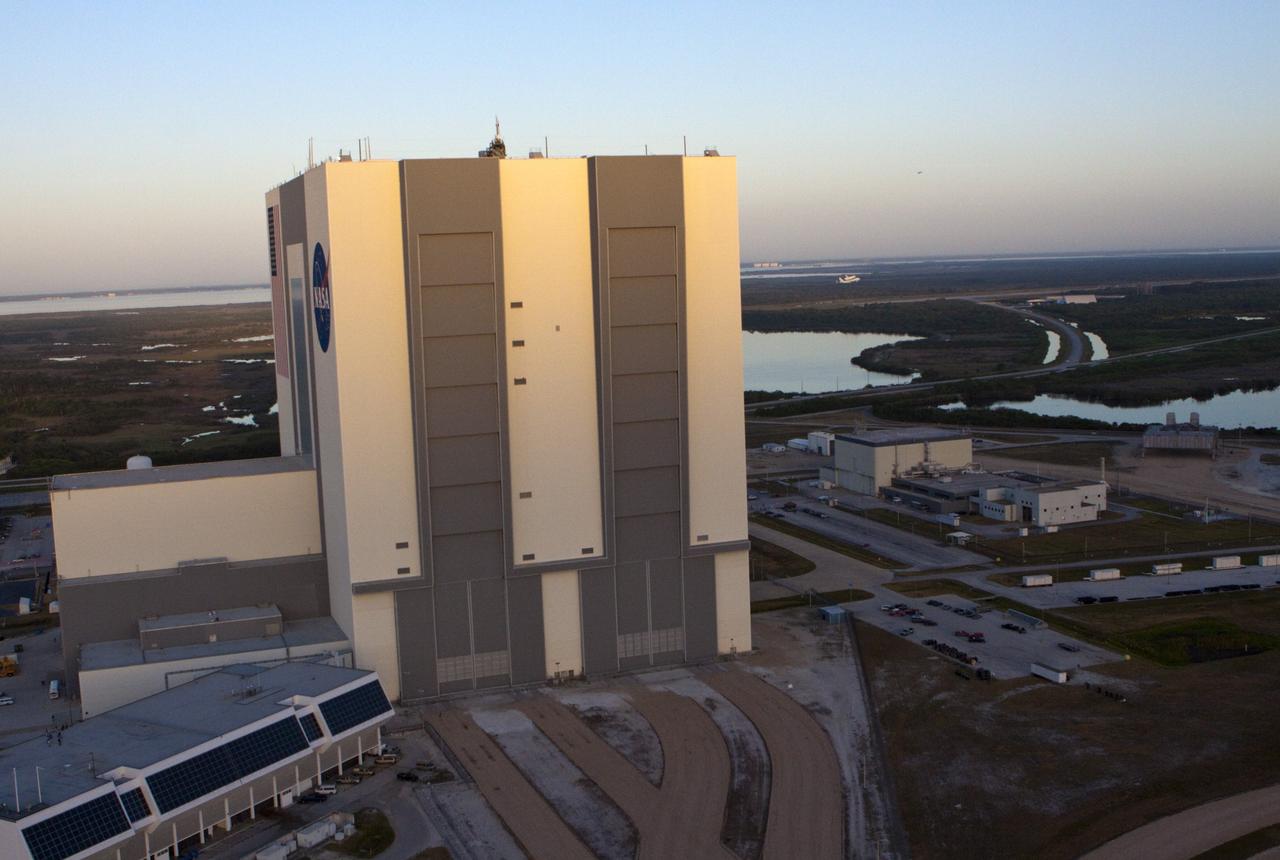
CAPE CANAVERAL, Fla. – At the right side of this aerial photo, near the horizon, the Shuttle Carrier Aircraft transporting space shuttle Discovery to its new home flies past the 525-foot-tall Vehicle Assembly Building at NASA’s Kennedy Space Center in Florida. The duo took off from Kennedy’s Shuttle Landing Facility at 7 a.m. EDT. The aircraft, known as an SCA, is a Boeing 747 jet, originally manufactured for commercial use, which was modified by NASA to transport the shuttles between destinations on Earth. This SCA, designated NASA 905, is assigned to the remaining ferry missions, delivering the shuttles to their permanent public display sites. NASA 905 is scheduled to ferry Discovery to the Washington Dulles International Airport in Virginia today, after which the shuttle will be placed on display in the Smithsonian's National Air and Space Museum Steven F. Udvar-Hazy Center. For more information on the SCA, visit http://www.nasa.gov/centers/dryden/news/FactSheets/FS-013-DFRC.html. For more information on shuttle transition and retirement activities, visit http://www.nasa.gov/transition. Photo credit: NASA/Glenn Benson
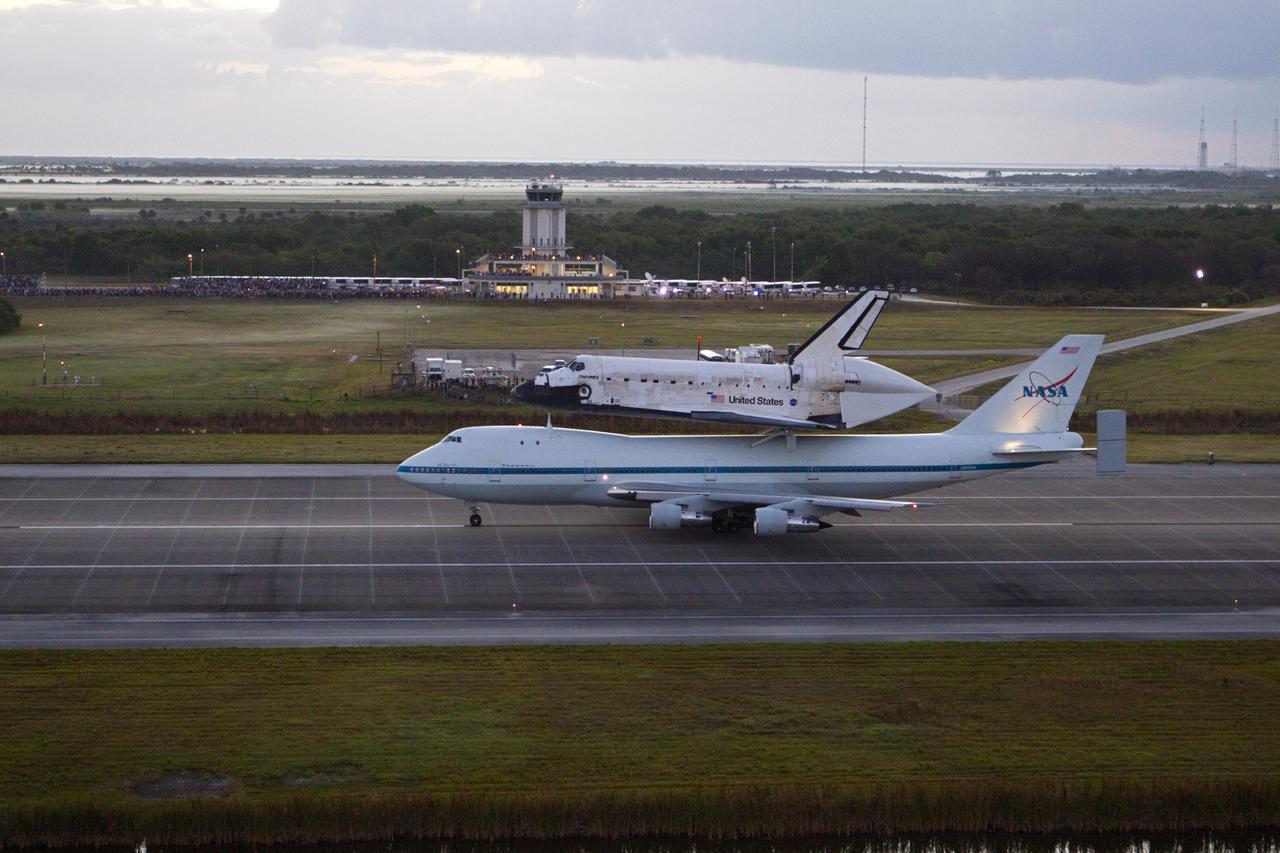
CAPE CANAVERAL, Fla. – In the early morning hours at NASA Kennedy Space Center’s Shuttle Landing Facility in Florida, the Shuttle Carrier Aircraft, or SCA, with space shuttle Discovery secured atop, taxies down the runway for a takeoff at 7 a.m. EDT. In the background is the midfield air traffic control tower. The aircraft, known as an SCA, is a Boeing 747 jet, originally manufactured for commercial use, which was modified by NASA to transport the shuttles between destinations on Earth. This SCA, designated NASA 905, is assigned to the remaining ferry missions, delivering the shuttles to their permanent public display sites. NASA 905 is scheduled to ferry Discovery to the Washington Dulles International Airport in Virginia on April 17, after which the shuttle will be placed on display in the Smithsonian’s National Air and Space Museum, Steven F. Udvar-Hazy Center in Chantilly, Va. For more information on the SCA, visit http://www.nasa.gov/centers/dryden/news/FactSheets/FS-013-DFRC.html. For more information on shuttle transition and retirement activities, visit http://www.nasa.gov/transition. Photo credit: NASA/Glenn Benson

CAPE CANAVERAL, Fla. – The “pathfinder” aircraft for space shuttle Discovery’s ferry flight parks near the Shuttle Carrier Aircraft on the tarmac of the Shuttle Landing Facility at NASA’s Kennedy Space Center in Florida. The NASA C-9 aircraft will fly about 100 miles ahead of Discovery to scout for the safest route between destinations. Its crew includes an SCA flight engineer who studies the weather patterns along the flight path to find a route free of rain and other turbulence. The carrier aircraft, also known as an SCA, is a Boeing 747 jet, originally manufactured for commercial use which was modified by NASA to transport the shuttles between destinations on Earth. NASA 905 is scheduled to ferry Discovery to the Washington Dulles International Airport in Virginia on April 17, and is assigned to all remaining ferry missions, delivering the shuttles to their permanent public display sites. After its arrival at Dulles, Discovery will be placed on display in the Smithsonian's National Air and Space Museum Steven F. Udvar-Hazy Center on April 19. For more information on the SCA, visit http://www.nasa.gov/centers/dryden/news/FactSheets/FS-013-DFRC.html. For more information on shuttle transition and retirement activities, visit http://www.nasa.gov/transition. Photo credit: NASA/Amanda Diller
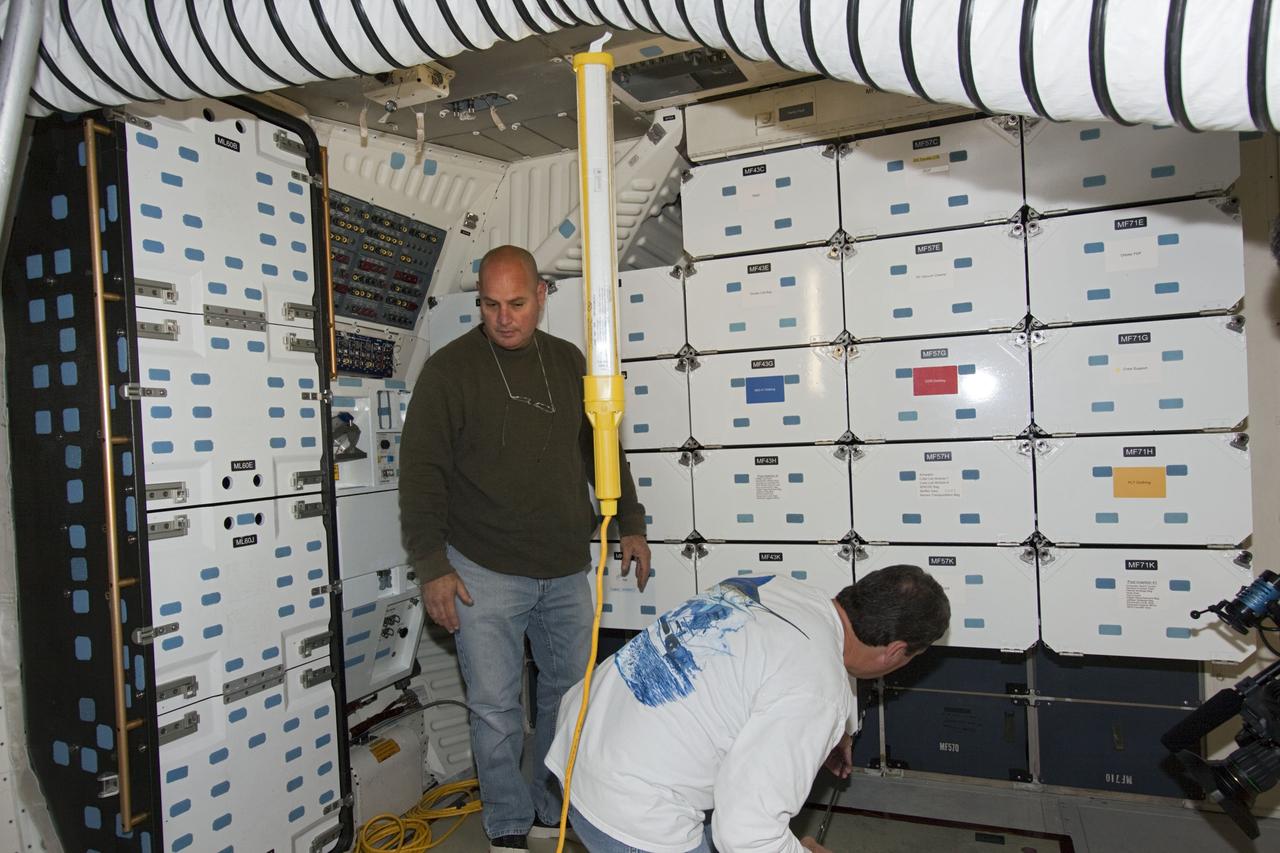
CAPE CANAVERAL, Fla. -- Inside Orbiter Processing Facility-1 at NASA’s Kennedy Space Center in Florida, technicians reinstall the lockers in the middeck of space shuttle Discovery. The work is part of the Space Shuttle Program’s transition and retirement processing of shuttle Discovery, which is being prepared for display at Smithsonian’s National Air and Space Museum, Steven F. Udvar-Hazy Center in Chantilly, Va. Discovery is scheduled to be transported atop a NASA Shuttle Carrier Aircraft modified 747 jet to Dulles International Airport in Virginia on April 17 and then be transported to the Smithsonian on April 19. For more information, visit http://www.nasa.gov/shuttle. Photo credit: NASA/Jim Grossmann
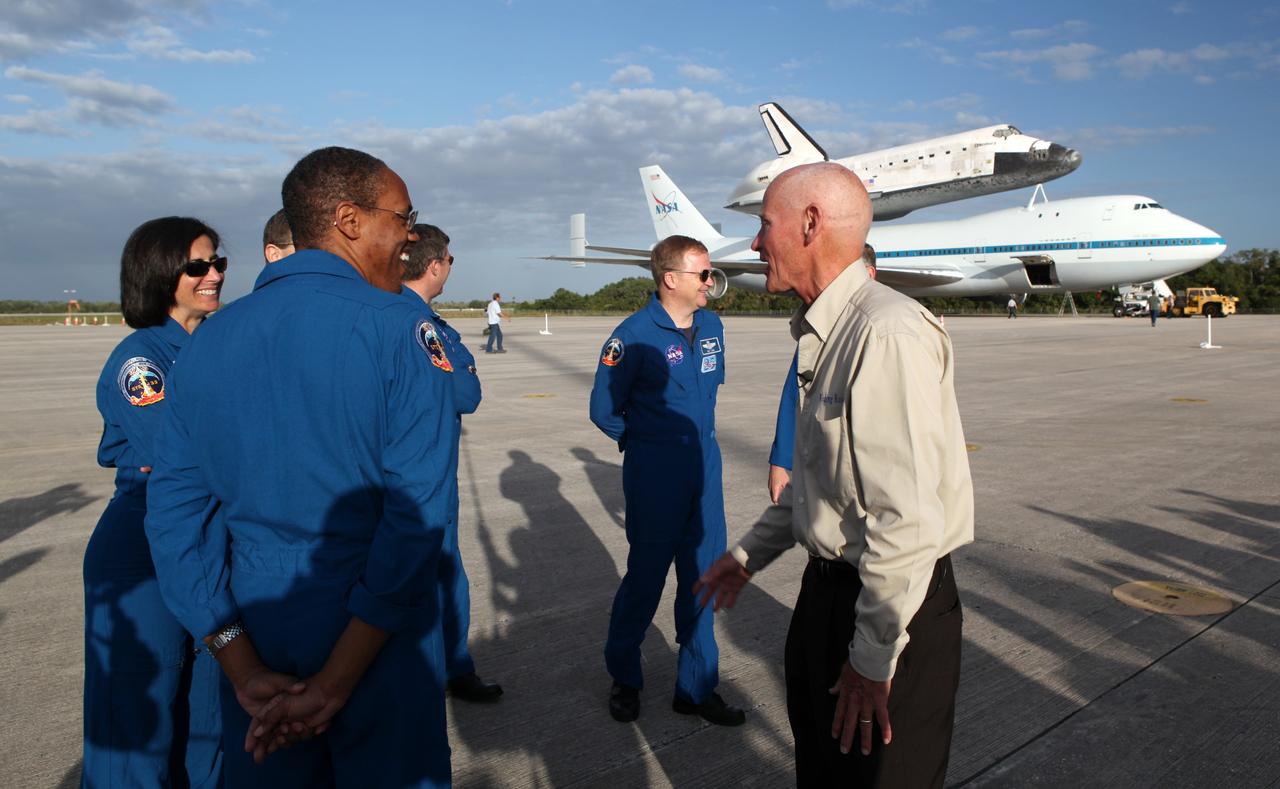
CAPE CANAVERAL, Fla. – At NASA Kennedy Space Center’s Shuttle Landing Facility in Florida, crew members of space shuttle Discovery’s last mission, STS-133, have arrived. From the left, are Mission Specialists Alvin Drew, Nicole Stott, Steve Bowen partially hidden and Michael Barrett, and Pilot Eric Boe. Also present, but not in view, is Commander Steve Lindsay. The crew arrived to view the Shuttle Carrier Aircraft, or SCA, with space shuttle Discovery attached atop after being backed away from the mate/demate device. Known as the MDD, the devise is a large gantry-like steel structure used to hoist a shuttle off the ground and position it onto the back of the SCA. The SCA is a Boeing 747 jet that was originally manufactured for commercial use and modified by NASA to transport the shuttles between destinations on Earth. This SCA, designated NASA 905, is assigned to the remaining ferry missions, delivering the shuttles to their permanent public display sites. NASA 905 is scheduled to ferry Discovery to the Washington Dulles International Airport in Virginia on April 17, after which the shuttle will be placed on display in the Smithsonian’s National Air and Space Museum, Steven F. Udvar-Hazy Center in Chantilly, Va. For more information on the SCA, visit http://www.nasa.gov/centers/dryden/news/FactSheets/FS-013-DFRC.html. For more information on shuttle transition and retirement activities, visit http://www.nasa.gov/transition. Photo credit: NASA/Dimitri Gerondidakis
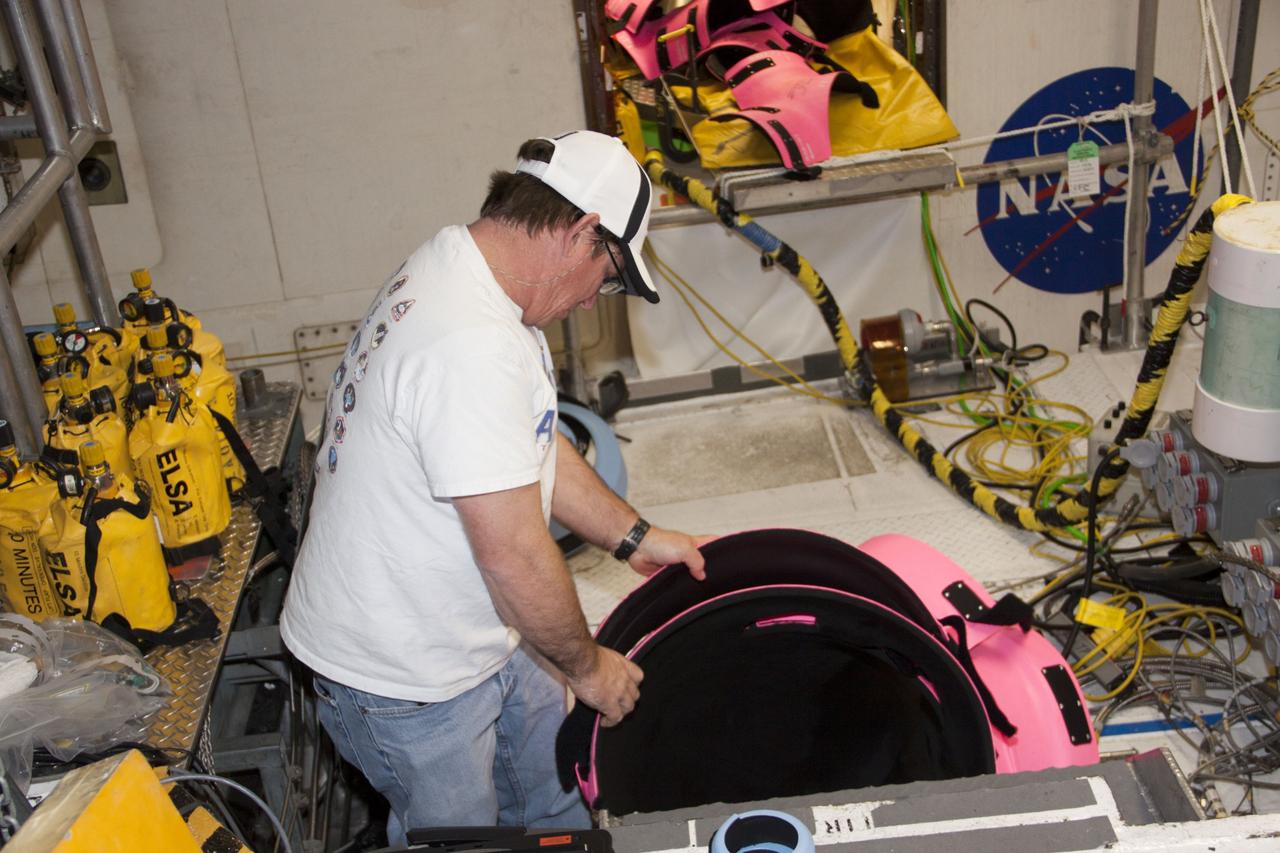
CAPE CANAVERAL, Fla. – Inside Orbiter Processing Facility-1 at NASA’s Kennedy Space Center in Florida, technicians prepare to remove space shuttle Discovery’s main propulsion system protective covers. The work is part of the Space Shuttle Program’s transition and retirement processing of shuttle Discovery, which is being prepared for display at Smithsonian’s National Air and Space Museum, Steven F. Udvar-Hazy Center in Chantilly, Va. Discovery is scheduled to be transported atop a NASA Shuttle Carrier Aircraft modified 747 jet to Dulles International Airport in Virginia on April 17 and then moved to the Smithsonian for permanent public display on April 19. For more information, visit http://www.nasa.gov/shuttle. Photo credit: NASA/Jim Grossmann
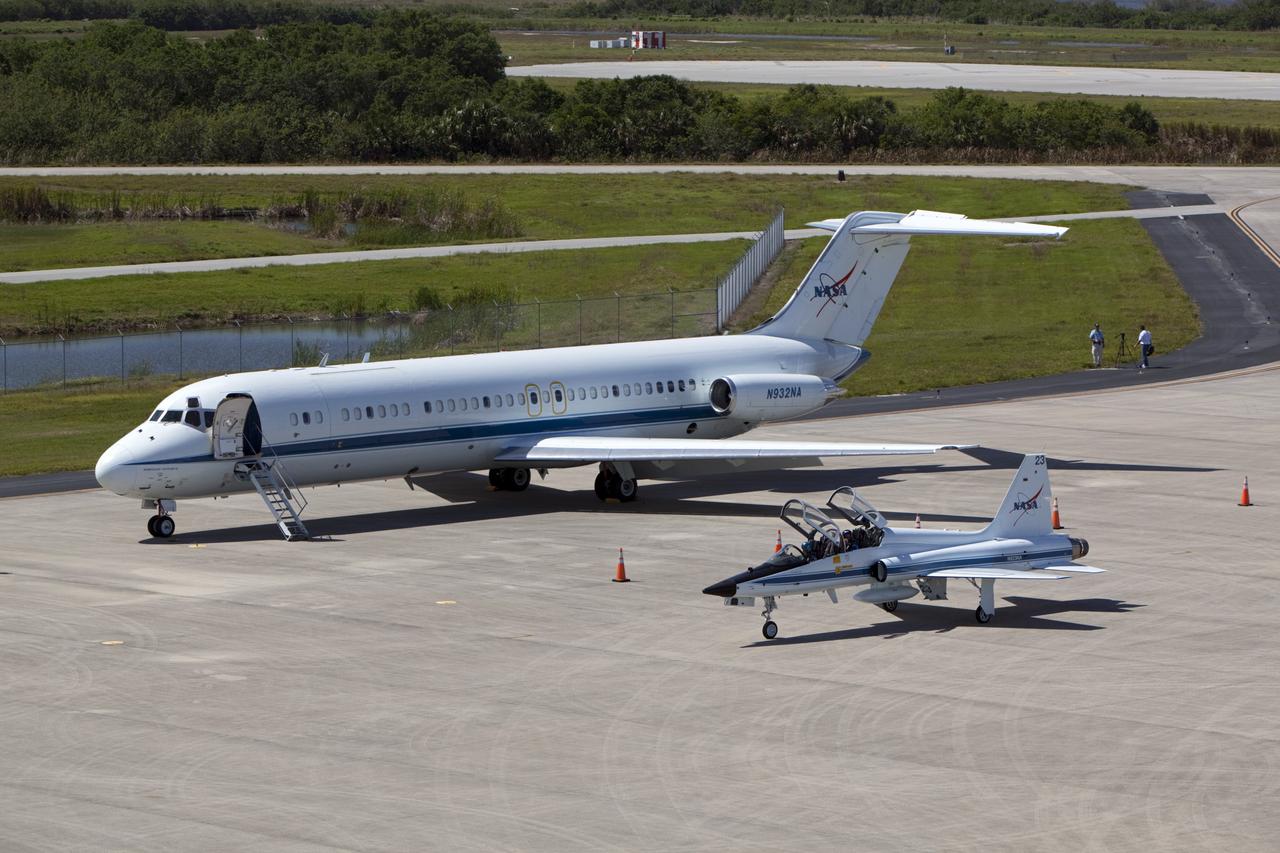
CAPE CANAVERAL, Fla. – A T-38 jet parks beside the “pathfinder” aircraft for space shuttle Discovery’s ferry flight on the apron of the Shuttle Landing Facility at NASA’s Kennedy Space Center in Florida. The NASA C-9 aircraft will fly about 100 miles ahead of Discovery to scout for the safest route between destinations. Its crew includes an SCA flight engineer who studies the weather patterns along the flight path to find a route free of rain and other turbulence. The carrier aircraft, also known as an SCA, is a Boeing 747 jet, originally manufactured for commercial use which was modified by NASA to transport the shuttles between destinations on Earth. NASA 905 is scheduled to ferry Discovery to the Washington Dulles International Airport in Virginia on April 17, and is assigned to all remaining ferry missions, delivering the shuttles to their permanent public display sites. After its arrival at Dulles, Discovery will be placed on display in the Smithsonian's National Air and Space Museum Steven F. Udvar-Hazy Center on April 19. For more information on the SCA, visit http://www.nasa.gov/centers/dryden/news/FactSheets/FS-013-DFRC.html. For more information on shuttle transition and retirement activities, visit http://www.nasa.gov/transition. Photo credit: NASA/Dimitri Gerondidaki
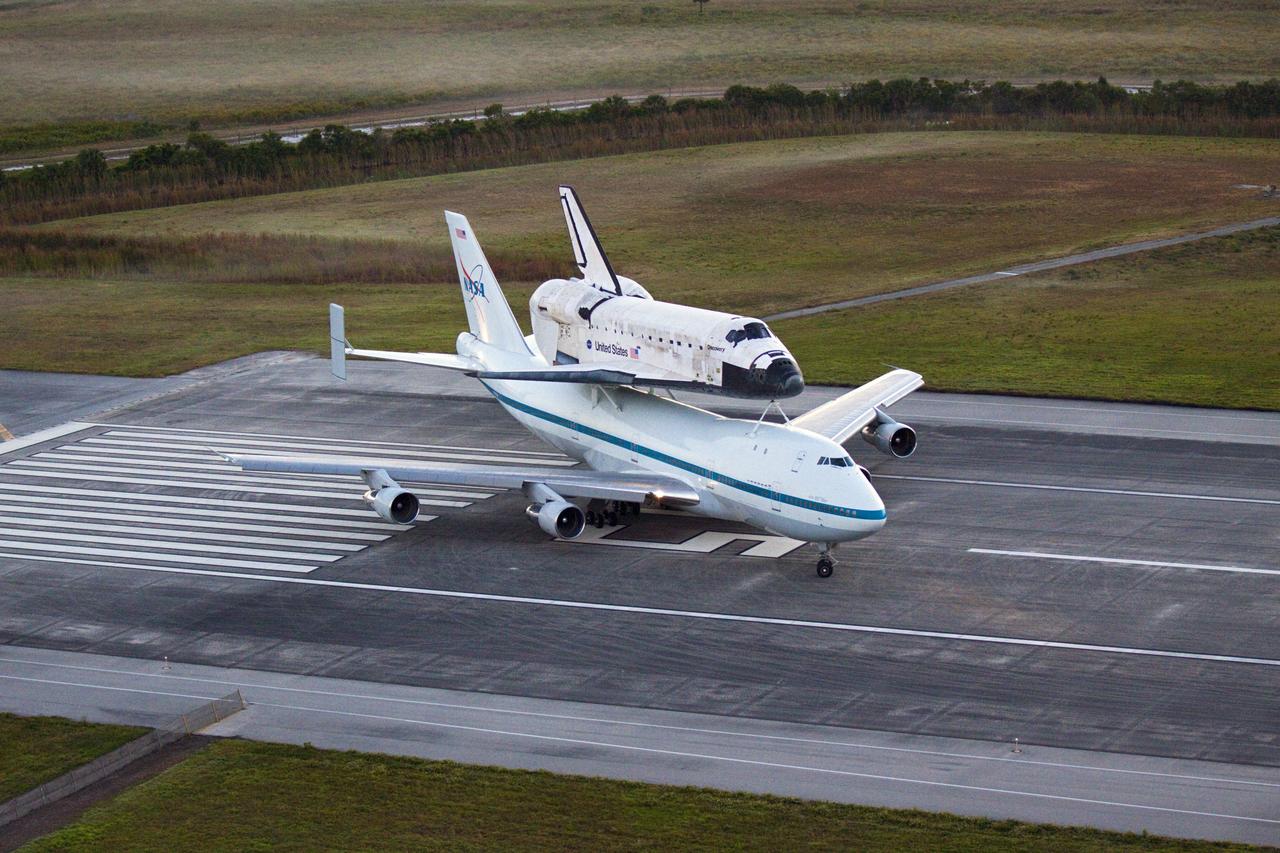
CAPE CANAVERAL, Fla. – In the early morning hours at NASA Kennedy Space Center’s Shuttle Landing Facility in Florida, the Shuttle Carrier Aircraft, or SCA, with space shuttle Discovery secured atop, completes the turn on runway 15 in preparation for a takeoff at 7 a.m. EDT to deliver Discovery to its new home. The aircraft, known as an SCA, is a Boeing 747 jet, originally manufactured for commercial use, which was modified by NASA to transport the shuttles between destinations on Earth. This SCA, designated NASA 905, is assigned to the remaining ferry missions, delivering the shuttles to their permanent public display sites. NASA 905 is scheduled to ferry Discovery to the Washington Dulles International Airport in Virginia on April 17, after which the shuttle will be placed on display in the Smithsonian’s National Air and Space Museum, Steven F. Udvar-Hazy Center in Chantilly, Va. For more information on the SCA, visit http://www.nasa.gov/centers/dryden/news/FactSheets/FS-013-DFRC.html. For more information on shuttle transition and retirement activities, visit http://www.nasa.gov/transition. Photo credit: NASA/Glenn Benson
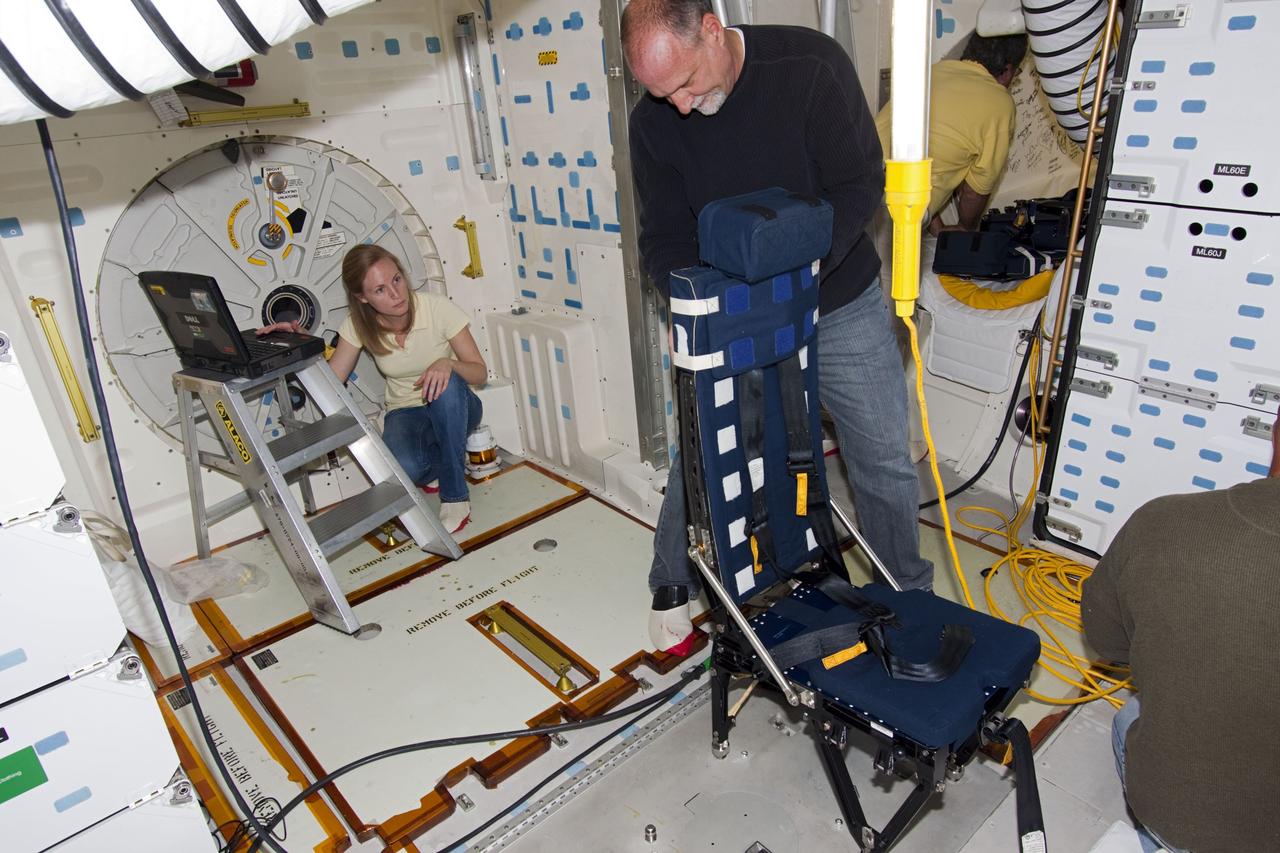
CAPE CANAVERAL, Fla. -- Inside Orbiter Processing Facility-1 at NASA’s Kennedy Space Center in Florida, technicians reinstall a seat in the middeck of space shuttle Discovery. The work is part of the Space Shuttle Program’s transition and retirement processing of shuttle Discovery, which is being prepared for display at Smithsonian’s National Air and Space Museum, Steven F. Udvar-Hazy Center in Chantilly, Va. Discovery is scheduled to be transported atop a NASA Shuttle Carrier Aircraft modified 747 jet to Dulles International Airport in Virginia on April 17 and then be transported to the Smithsonian on April 19. For more information, visit http://www.nasa.gov/shuttle. Photo credit: NASA/Jim Grossmann
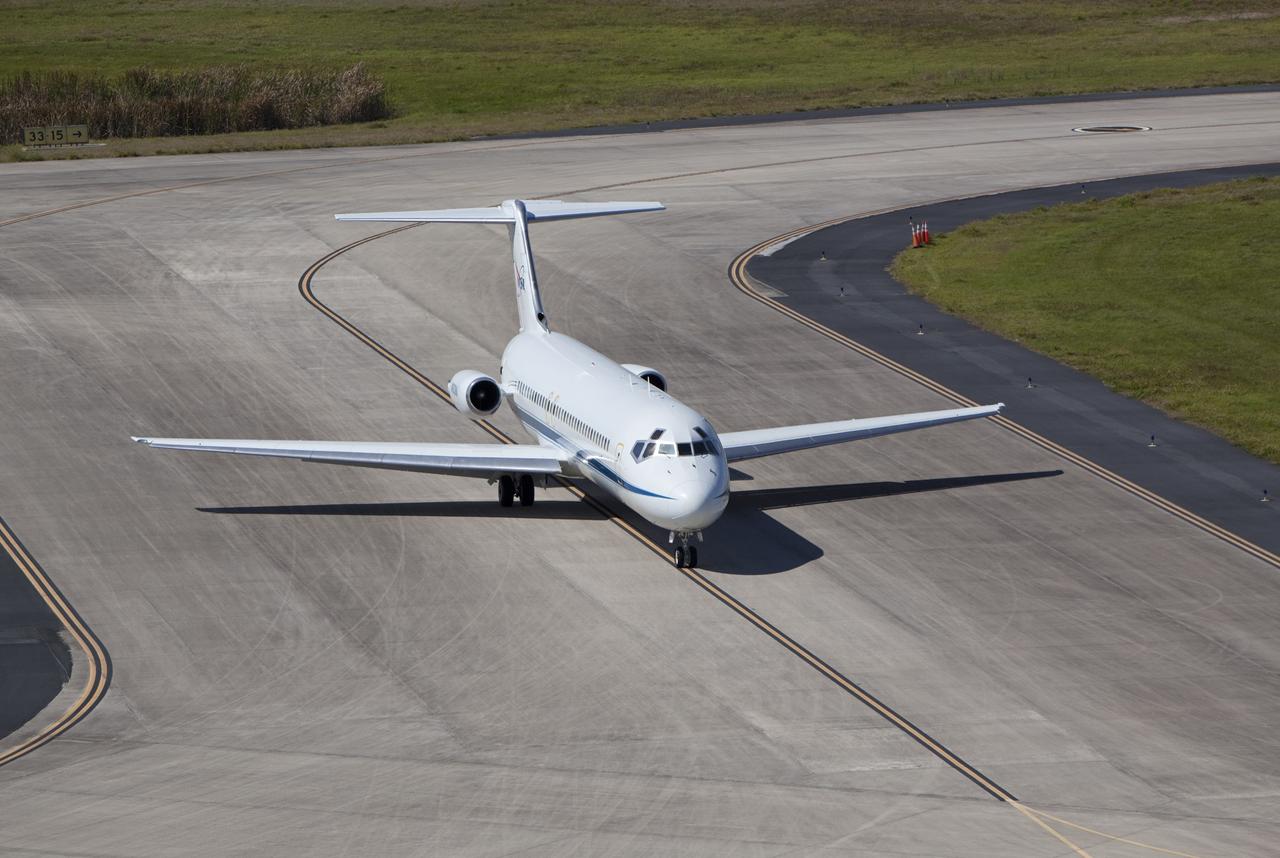
CAPE CANAVERAL, Fla. – The “pathfinder” aircraft for space shuttle Discovery’s ferry flight taxis onto the apron of the Shuttle Landing Facility at NASA’s Kennedy Space Center in Florida. The NASA C-9 aircraft will fly about 100 miles ahead of Discovery to scout for the safest route between destinations. Its crew includes an SCA flight engineer who studies the weather patterns along the flight path to find a route free of rain and other turbulence. The carrier aircraft, also known as an SCA, is a Boeing 747 jet, originally manufactured for commercial use which was modified by NASA to transport the shuttles between destinations on Earth. NASA 905 is scheduled to ferry Discovery to the Washington Dulles International Airport in Virginia on April 17, and is assigned to all remaining ferry missions, delivering the shuttles to their permanent public display sites. After its arrival at Dulles, Discovery will be placed on display in the Smithsonian's National Air and Space Museum Steven F. Udvar-Hazy Center on April 19. For more information on the SCA, visit http://www.nasa.gov/centers/dryden/news/FactSheets/FS-013-DFRC.html. For more information on shuttle transition and retirement activities, visit http://www.nasa.gov/transition. Photo credit: NASA/Dimitri Gerondidaki
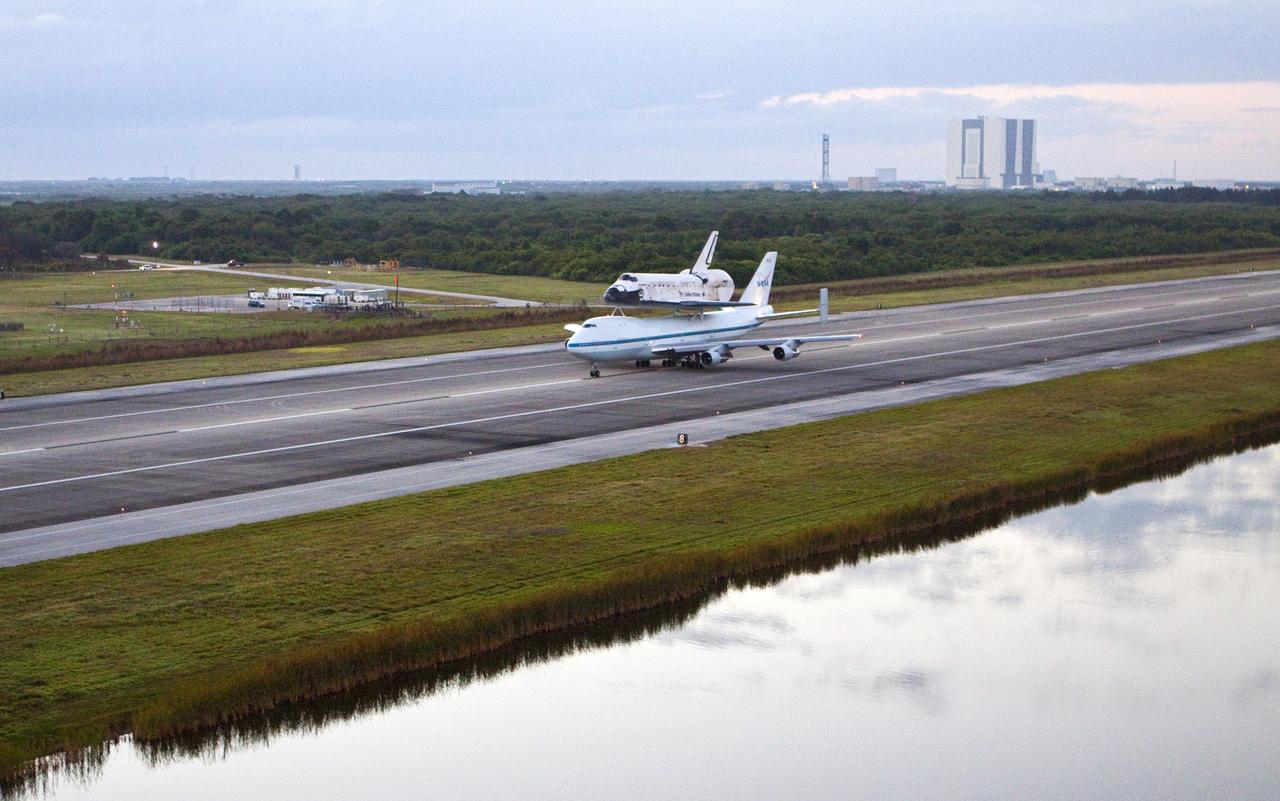
CAPE CANAVERAL, Fla. – In the early morning hours at NASA Kennedy Space Center’s Shuttle Landing Facility in Florida, the Shuttle Carrier Aircraft, or SCA, with space shuttle Discovery secured atop, taxies down the runway for a takeoff at 7 a.m. EDT. In the background is the 525-foot-tall Vehicle Assembly Building. The aircraft, known as an SCA, is a Boeing 747 jet, originally manufactured for commercial use, which was modified by NASA to transport the shuttles between destinations on Earth. This SCA, designated NASA 905, is assigned to the remaining ferry missions, delivering the shuttles to their permanent public display sites. NASA 905 is scheduled to ferry Discovery to the Washington Dulles International Airport in Virginia on April 17, after which the shuttle will be placed on display in the Smithsonian’s National Air and Space Museum, Steven F. Udvar-Hazy Center in Chantilly, Va. For more information on the SCA, visit http://www.nasa.gov/centers/dryden/news/FactSheets/FS-013-DFRC.html. For more information on shuttle transition and retirement activities, visit http://www.nasa.gov/transition. Photo credit: NASA/Glenn Benson
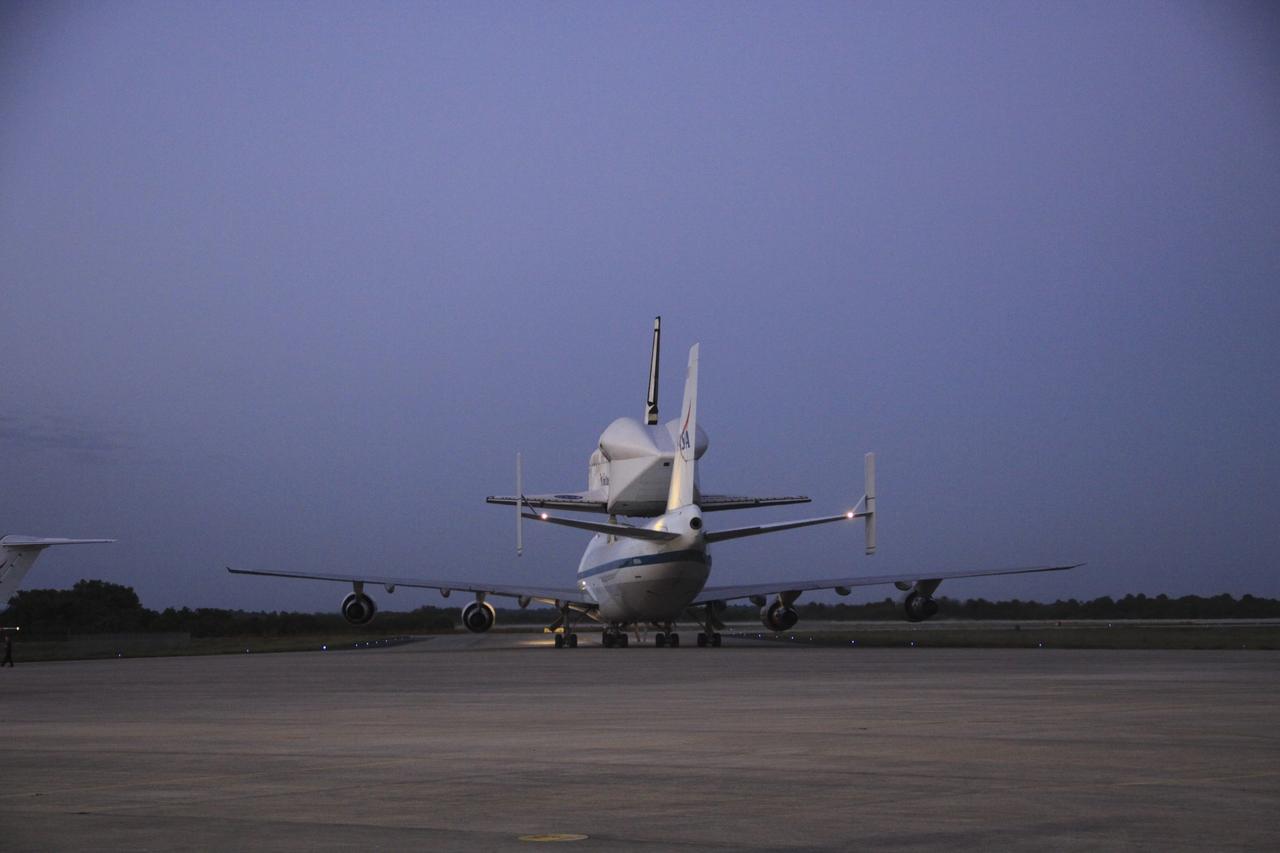
CAPE CANAVERAL, Fla. – The Shuttle Carrier Aircraft transporting space shuttle Discovery to its new home taxis to the runway at the Shuttle Landing Facility at NASA’s Kennedy Space Center in Florida preparing to take off at about 7 a.m. EDT. The aircraft, known as an SCA, is a Boeing 747 jet, originally manufactured for commercial use, which was modified by NASA to transport the shuttles between destinations on Earth. This SCA, designated NASA 905, is assigned to the remaining ferry missions, delivering the shuttles to their permanent public display sites. NASA 905 is scheduled to ferry Discovery to the Washington Dulles International Airport in Virginia on April 17, after which the shuttle will be placed on display in the Smithsonian's National Air and Space Museum Steven F. Udvar-Hazy Center. For more information on the SCA, visit http://www.nasa.gov/centers/dryden/news/FactSheets/FS-013-DFRC.html. For more information on shuttle transition and retirement activities, visit http://www.nasa.gov/transition. Photo credit: NASA/Jim Grossmann
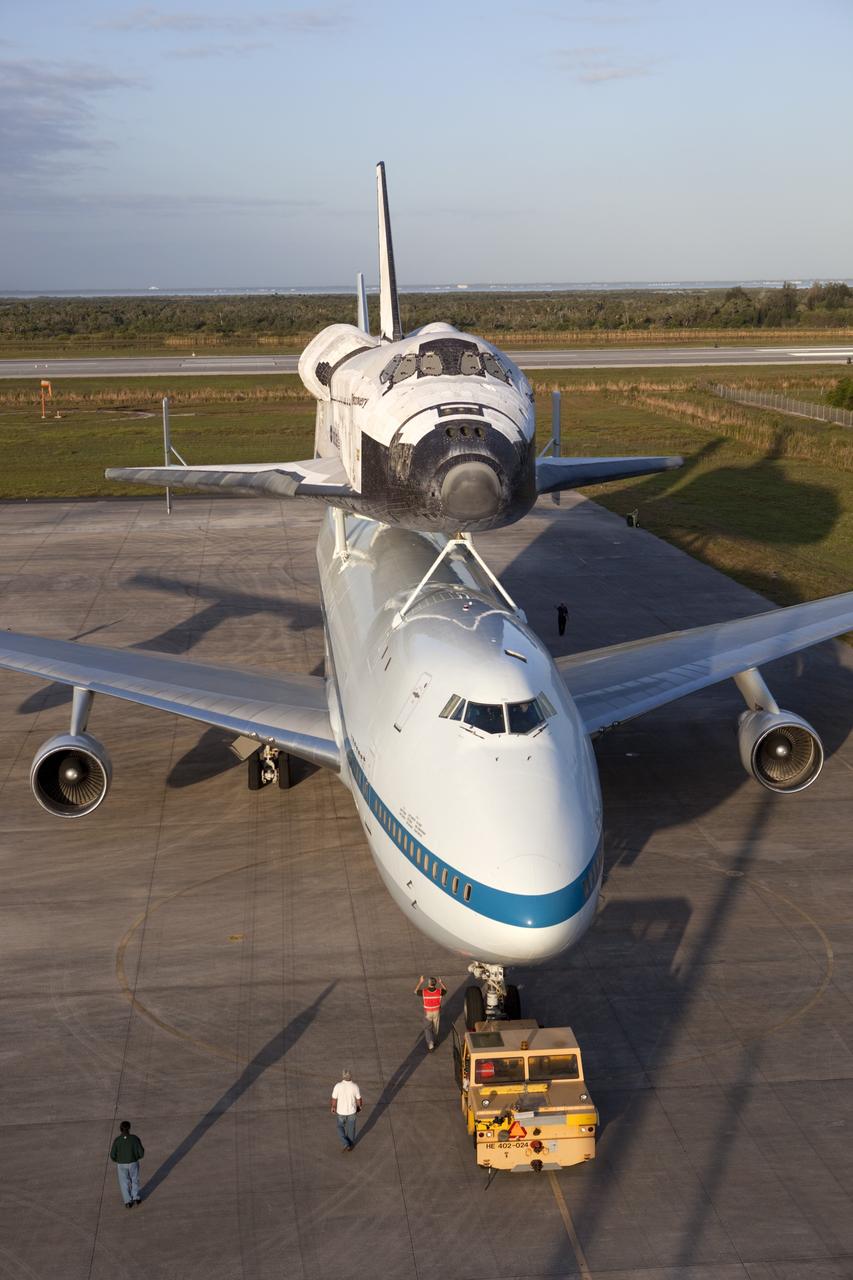
CAPE CANAVERAL, Fla. – At NASA Kennedy Space Center’s Shuttle Landing Facility in Florida, the Shuttle Carrier Aircraft, or SCA, with space shuttle Discovery attached atop, is backed away from the mate/demate device. Known as the MDD, the devise is a large gantry-like steel structure used to hoist a shuttle off the ground and position it onto the back of the SCA. The SCA is a Boeing 747 jet that was originally manufactured for commercial use and modified by NASA to transport the shuttles between destinations on Earth. This SCA, designated NASA 905, is assigned to the remaining ferry missions, delivering the shuttles to their permanent public display sites. NASA 905 is scheduled to ferry Discovery to the Washington Dulles International Airport in Virginia on April 17, after which the shuttle will be placed on display in the Smithsonian’s National Air and Space Museum, Steven F. Udvar-Hazy Center in Chantilly, Va. For more information on the SCA, visit http://www.nasa.gov/centers/dryden/news/FactSheets/FS-013-DFRC.html. For more information on shuttle transition and retirement activities, visit http://www.nasa.gov/transition. Photo credit: NASA/Dimitri Gerondidakis
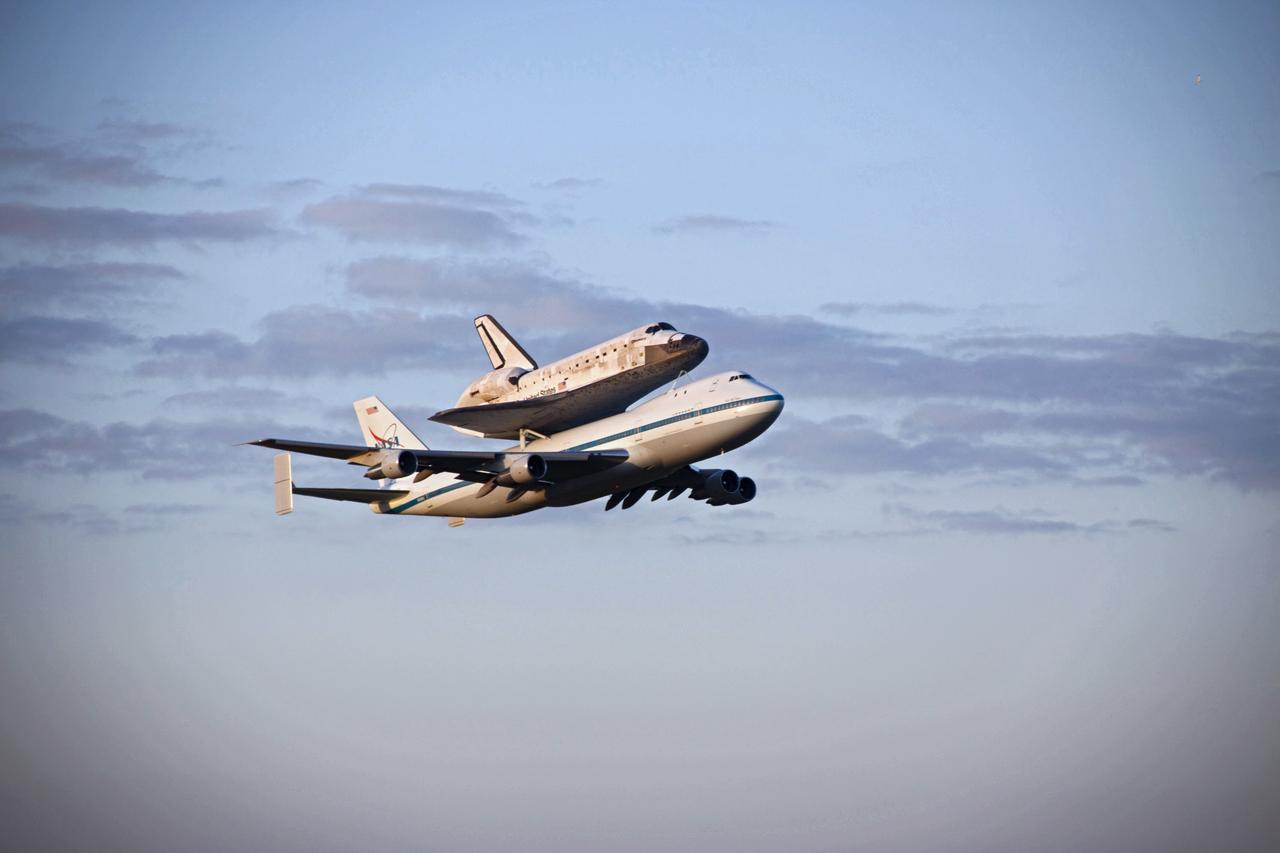
CAPE CANAVERAL, Fla. – The Shuttle Carrier Aircraft transporting space shuttle Discovery to its new home takes off from the Shuttle Landing Facility at NASA’s Kennedy Space Center in Florida at 7 a.m. EDT. The duo are heading south to fly over Brevard County’s beach communities for residents to get a look at the shuttle before it leaves the Space Coast for the last time. The aircraft, known as an SCA, is a Boeing 747 jet, originally manufactured for commercial use, which was modified by NASA to transport the shuttles between destinations on Earth. This SCA, designated NASA 905, is assigned to the remaining ferry missions, delivering the shuttles to their permanent public display sites. NASA 905 is scheduled to ferry Discovery to the Washington Dulles International Airport in Virginia on April 17, after which the shuttle will be placed on display in the Smithsonian's National Air and Space Museum Steven F. Udvar-Hazy Center. For more information on the SCA, visit http://www.nasa.gov/centers/dryden/news/FactSheets/FS-013-DFRC.html. For more information on shuttle transition and retirement activities, visit http://www.nasa.gov/transition. Photo credit: NASA/Jim Grossmann
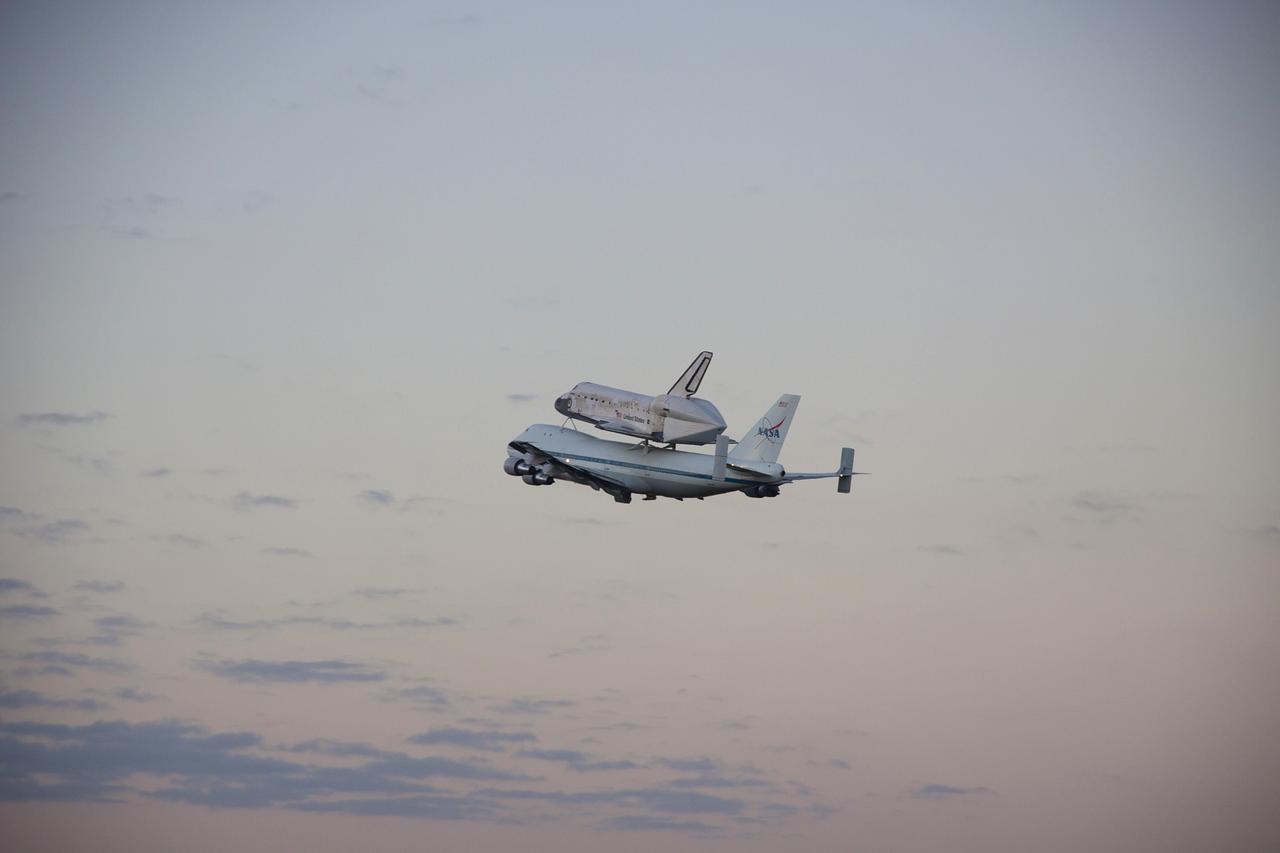
CAPE CANAVERAL, Fla. – The Shuttle Carrier Aircraft transporting space shuttle Discovery to its new home takes off from the Shuttle Landing Facility at NASA’s Kennedy Space Center in Florida at 7 a.m. EDT. The duo are heading south to fly over Brevard County’s beach communities for residents to get a look at the shuttle before it leaves the Space Coast for the last time. The aircraft, known as an SCA, is a Boeing 747 jet, originally manufactured for commercial use, which was modified by NASA to transport the shuttles between destinations on Earth. This SCA, designated NASA 905, is assigned to the remaining ferry missions, delivering the shuttles to their permanent public display sites. NASA 905 is scheduled to ferry Discovery to the Washington Dulles International Airport in Virginia on April 17, after which the shuttle will be placed on display in the Smithsonian's National Air and Space Museum Steven F. Udvar-Hazy Center. For more information on the SCA, visit http://www.nasa.gov/centers/dryden/news/FactSheets/FS-013-DFRC.html. For more information on shuttle transition and retirement activities, visit http://www.nasa.gov/transition. Photo credit: NASA/Jim Grossmann
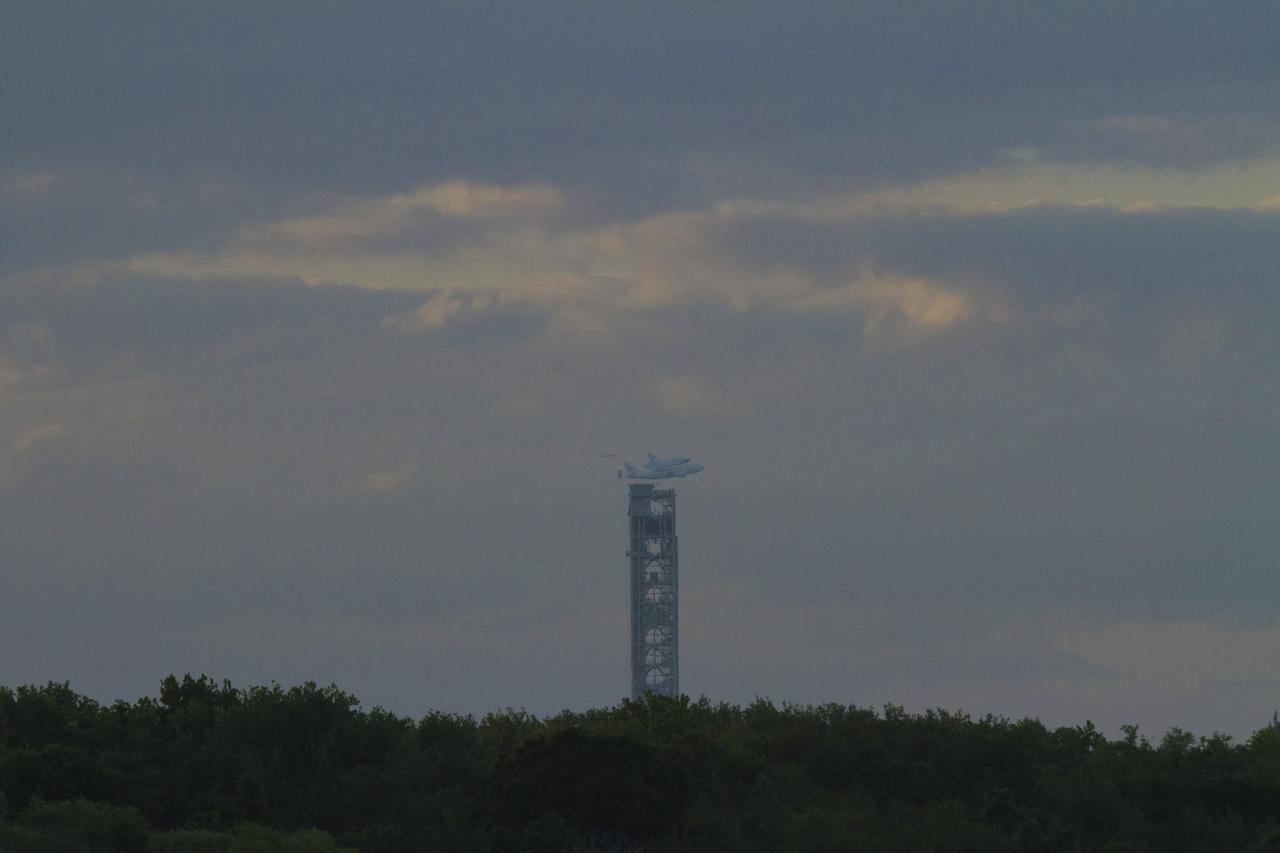
CAPE CANAVERAL, Fla. – Space shuttle Discovery, mounted to a Shuttle Carrier Aircraft, or SCA, takes off from NASA Kennedy Space Center’s Shuttle Landing Facility runway 15 in Florida at 7 a.m. EDT. The duo is beginning its ferry flight to the Washington Dulles International Airport in Virginia that also includes a flyby of the Space Coast and Washington, D.C. Also flying along with the pair is a T-38 training jet. Discovery is leaving Kennedy after more than 28 years of service beginning with its arrival on the space coast Nov. 9, 1983. Discovery first launched to space Aug. 30, 1984, on the STS-41D mission. Discovery is the agency’s most-flown shuttle with 39 missions, more than 148 million miles and a total of one year in space. Discovery is set to move to the Smithsonian’s National Air and Space Museum, Steven F. Udvar-Hazy Center in Chantilly, Va., on April 19 where it will be place on public display. For more information on the SCA, visit http://www.nasa.gov/centers/dryden/news/FactSheets/FS-013-DFRC.html. For more information on shuttle transition and retirement activities, visit http://www.nasa.gov/transition. Photo credit: NASA/Tim Powers and Rick Wetherington
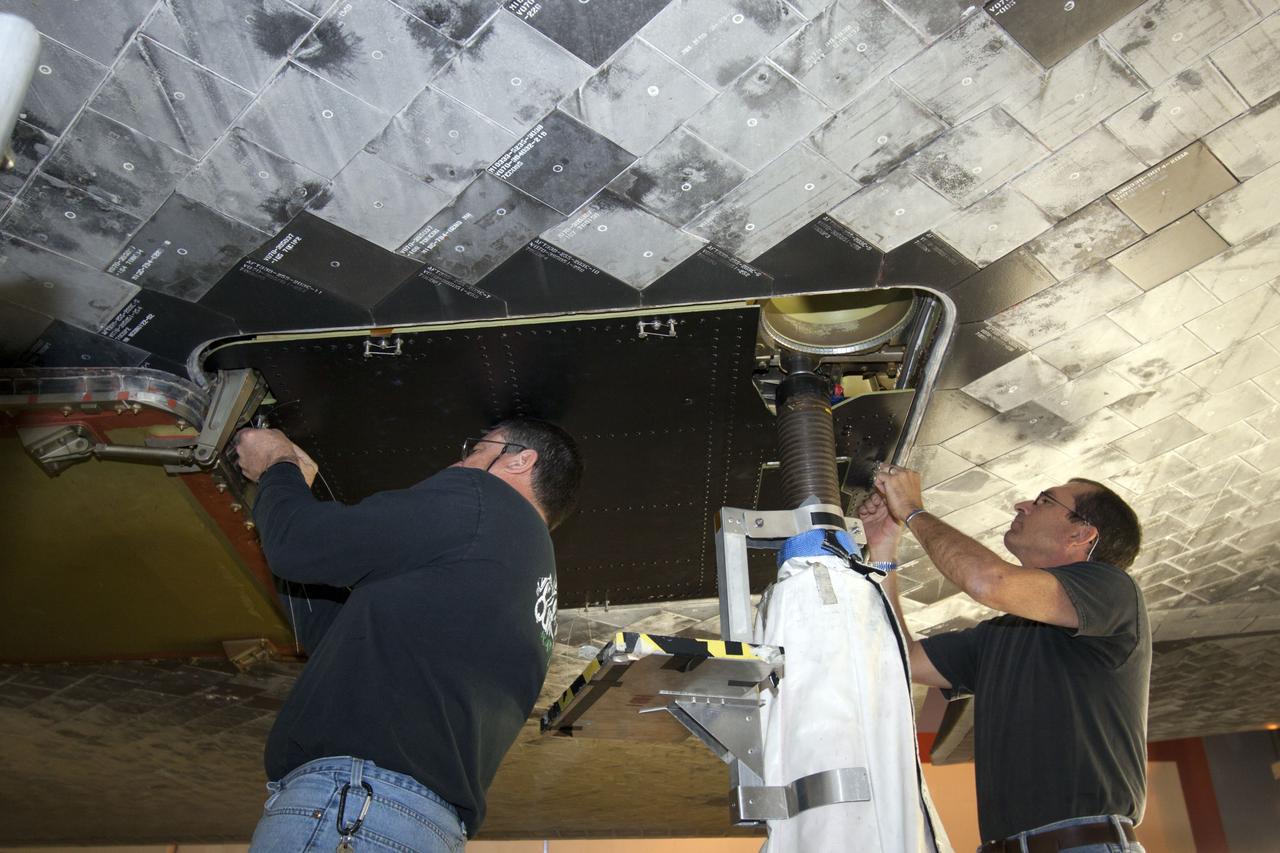
CAPE CANAVERAL, Fla. – Inside Orbiter Processing Facility-1 at NASA’s Kennedy Space Center in Florida, technicians install a ferry flight door on space shuttle Discovery. The work is part of the Space Shuttle Program’s transition and retirement processing of shuttle Discovery, which is being prepared for display at Smithsonian’s National Air and Space Museum, Steven F. Udvar-Hazy Center in Chantilly, Va. Discovery is scheduled to be transported atop a NASA Shuttle Carrier Aircraft modified 747 jet to Dulles International Airport in Virginia on April 17 and then moved to the Smithsonian for permanent public display on April 19. For more information, visit http://www.nasa.gov/shuttle. Photo credit: NASA/Jim Grossmann
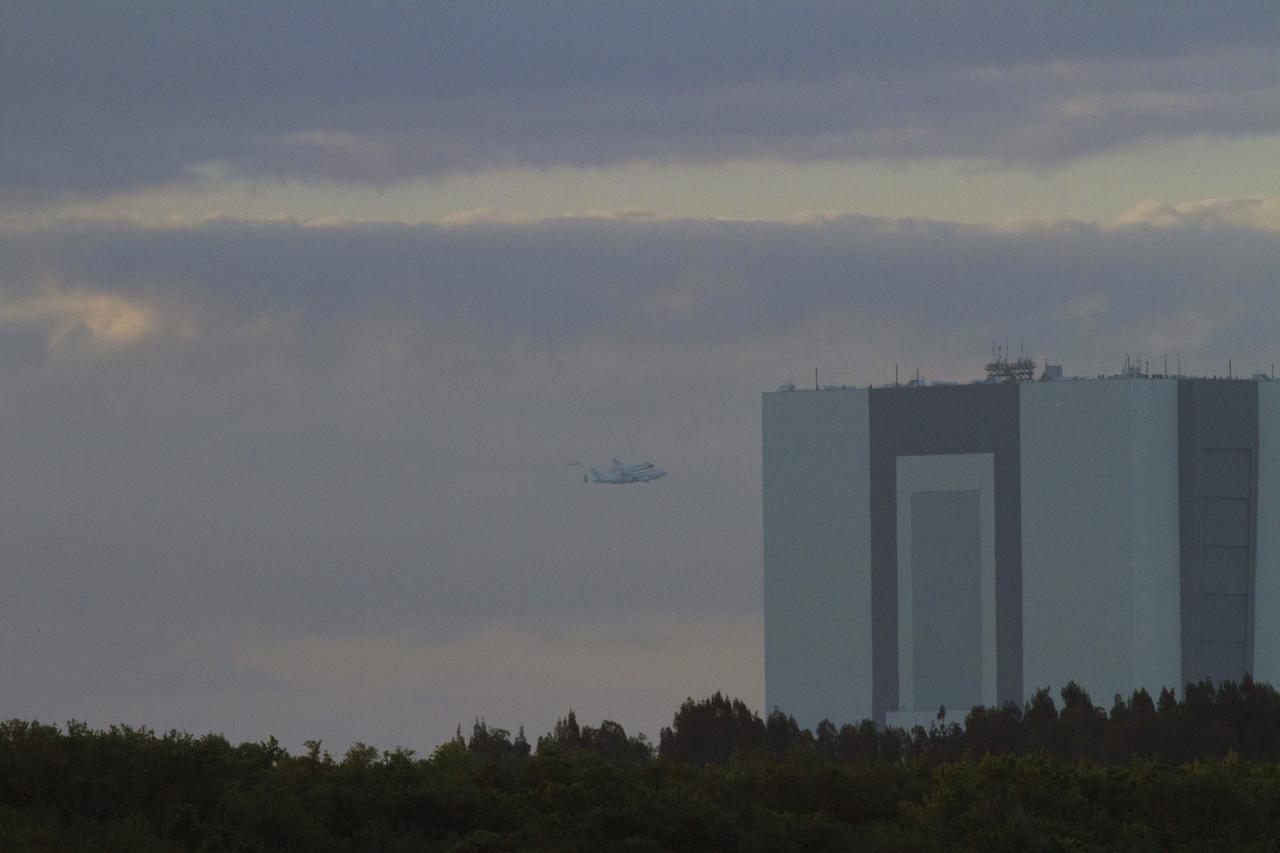
CAPE CANAVERAL, Fla. – Space shuttle Discovery, mounted to a Shuttle Carrier Aircraft, or SCA, takes off from NASA Kennedy Space Center’s Shuttle Landing Facility runway 15 in Florida at 7 a.m. EDT and makes a flyby near the 525-foot-tall Vehicle Assembly Building. The duo is beginning its ferry flight to the Washington Dulles International Airport in Virginia that also includes a flyby of the Space Coast and Washington, D.C. Also flying along with the pair is a T-38 training jet. Discovery is leaving Kennedy after more than 28 years of service beginning with its arrival on the space coast Nov. 9, 1983. Discovery first launched to space Aug. 30, 1984, on the STS-41D mission. Discovery is the agency’s most-flown shuttle with 39 missions, more than 148 million miles and a total of one year in space. Discovery is set to move to the Smithsonian’s National Air and Space Museum, Steven F. Udvar-Hazy Center in Chantilly, Va., on April 19 where it will be place on public display. For more information on the SCA, visit http://www.nasa.gov/centers/dryden/news/FactSheets/FS-013-DFRC.html. For more information on shuttle transition and retirement activities, visit http://www.nasa.gov/transition. Photo credit: NASA/Tim Powers and Rick Wetherington

CAPE CANAVERAL, Fla. – The “pathfinder” aircraft for space shuttle Discovery’s ferry flight arrives at the Shuttle Landing Facility at NASA’s Kennedy Space Center in Florida. The NASA C-9 aircraft will fly about 100 miles ahead of Discovery to scout for the safest route between destinations. Its crew includes an SCA flight engineer who studies the weather patterns along the flight path to find a route free of rain and other turbulence. The carrier aircraft, also known as an SCA, is a Boeing 747 jet, originally manufactured for commercial use which was modified by NASA to transport the shuttles between destinations on Earth. NASA 905 is scheduled to ferry Discovery to the Washington Dulles International Airport in Virginia on April 17, and is assigned to all remaining ferry missions, delivering the shuttles to their permanent public display sites. After its arrival at Dulles, Discovery will be placed on display in the Smithsonian's National Air and Space Museum Steven F. Udvar-Hazy Center on April 19. For more information on the SCA, visit http://www.nasa.gov/centers/dryden/news/FactSheets/FS-013-DFRC.html. For more information on shuttle transition and retirement activities, visit http://www.nasa.gov/transition. Photo credit: NASA/Amanda Diller
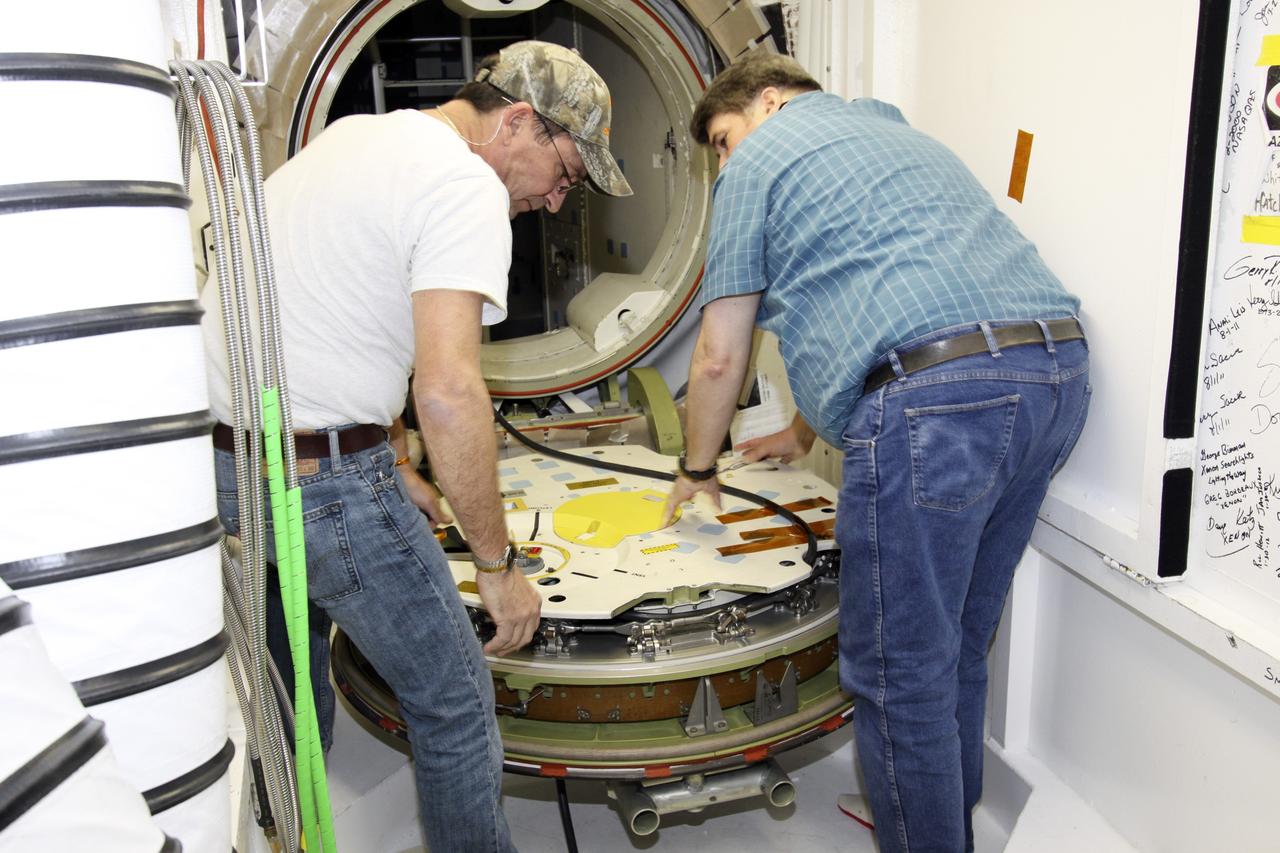
CAPE CANAVERAL, Fla. -- Inside Orbiter Processing Facility-1 at NASA’s Kennedy Space Center in Florida, technicians prepare space shuttle Discovery’s access hatch for final close out. The work is part of the Space Shuttle Program’s transition and retirement processing of shuttle Discovery, which is being prepared for display at Smithsonian’s National Air and Space Museum, Steven F. Udvar-Hazy Center in Chantilly, Va. Discovery is scheduled to be transported atop a NASA Shuttle Carrier Aircraft modified 747 jet to Dulles International Airport in Virginia on April 17 and then be transported to the Smithsonian on April 19. For more information, visit http://www.nasa.gov/shuttle. Photo credit: NASA/Jim Grossmann
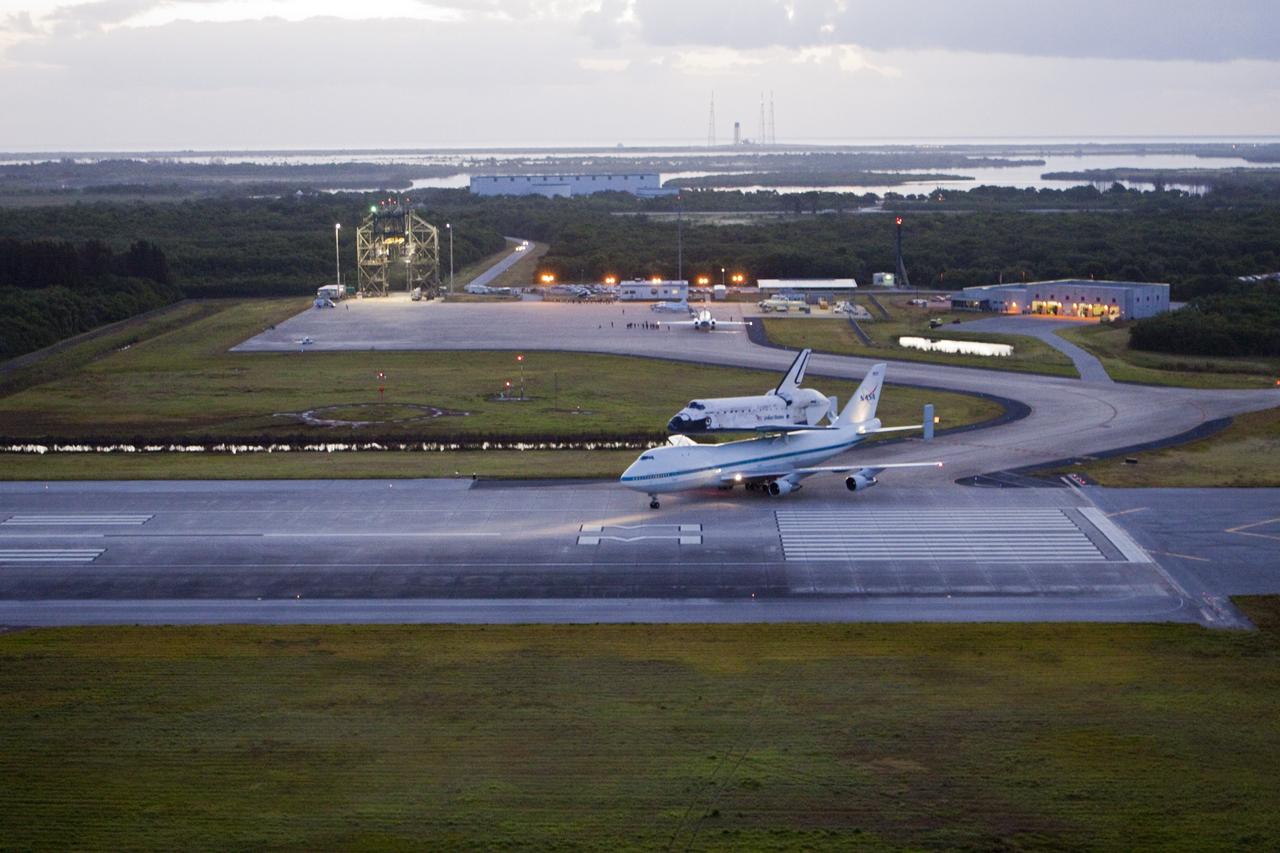
CAPE CANAVERAL, Fla. – At NASA Kennedy Space Center’s Shuttle Landing Facility in Florida, the Shuttle Carrier Aircraft, or SCA, with space shuttle Discovery secured atop, taxies out to the runway for a takeoff at 7 a.m. EDT. The aircraft, known as an SCA, is a Boeing 747 jet, originally manufactured for commercial use, which was modified by NASA to transport the shuttles between destinations on Earth. This SCA, designated NASA 905, is assigned to the remaining ferry missions, delivering the shuttles to their permanent public display sites. NASA 905 is scheduled to ferry Discovery to the Washington Dulles International Airport in Virginia on April 17, after which the shuttle will be placed on display in the Smithsonian’s National Air and Space Museum, Steven F. Udvar-Hazy Center in Chantilly, Va. For more information on the SCA, visit http://www.nasa.gov/centers/dryden/news/FactSheets/FS-013-DFRC.html. For more information on shuttle transition and retirement activities, visit http://www.nasa.gov/transition. Photo credit: NASA/Glenn Benson
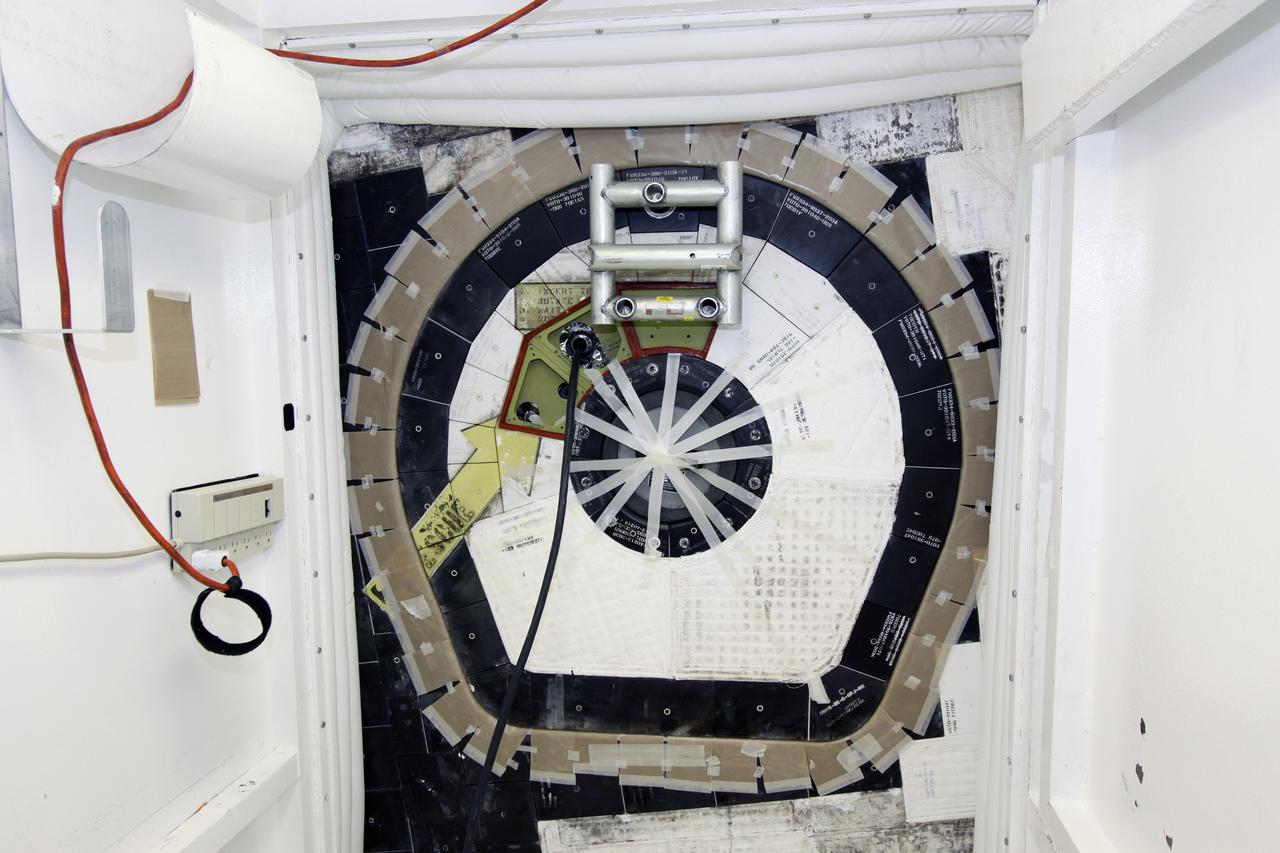
CAPE CANAVERAL, Fla. -- Inside Orbiter Processing Facility-1 at NASA’s Kennedy Space Center in Florida, space shuttle Discovery’s access hatch has been closed and sealed for the final time. The work is part of the Space Shuttle Program’s transition and retirement processing of shuttle Discovery, which is being prepared for display at Smithsonian’s National Air and Space Museum, Steven F. Udvar-Hazy Center in Chantilly, Va. Discovery is scheduled to be transported atop a NASA Shuttle Carrier Aircraft modified 747 jet to Dulles International Airport in Virginia on April 17 and then be transported to the Smithsonian on April 19. For more information, visit http://www.nasa.gov/shuttle. Photo credit: NASA/Jim Grossmann
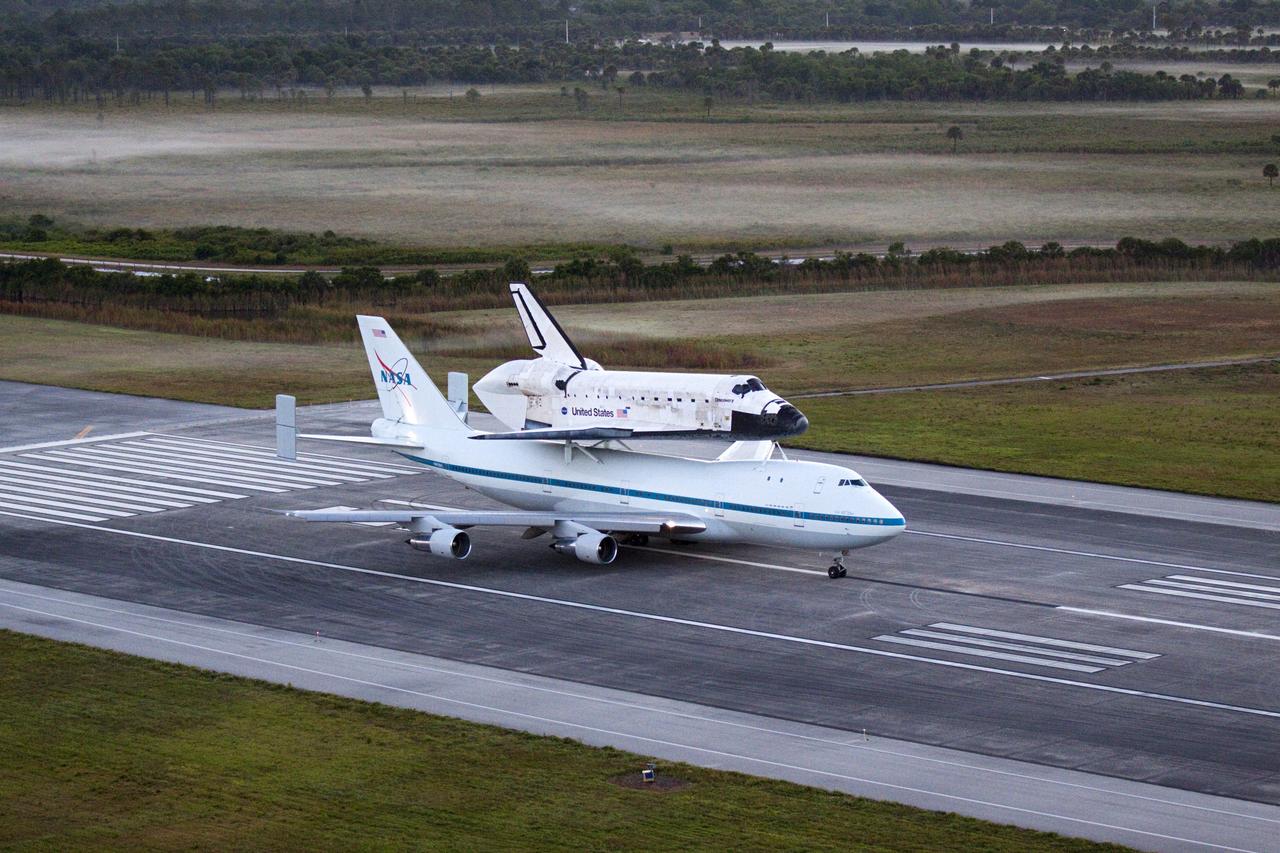
CAPE CANAVERAL, Fla. – In the early morning hours at NASA Kennedy Space Center’s Shuttle Landing Facility in Florida, the Shuttle Carrier Aircraft, or SCA, with space shuttle Discovery secured atop, waits on runway 15 for clearance from Kennedy’s air traffic control tower to begin takeoff at 7 a.m. EDT. The SCA will deliver Discovery to its new home. The aircraft, known as an SCA, is a Boeing 747 jet, originally manufactured for commercial use, which was modified by NASA to transport the shuttles between destinations on Earth. This SCA, designated NASA 905, is assigned to the remaining ferry missions, delivering the shuttles to their permanent public display sites. NASA 905 is scheduled to ferry Discovery to the Washington Dulles International Airport in Virginia on April 17, after which the shuttle will be placed on display in the Smithsonian’s National Air and Space Museum, Steven F. Udvar-Hazy Center in Chantilly, Va. For more information on the SCA, visit http://www.nasa.gov/centers/dryden/news/FactSheets/FS-013-DFRC.html. For more information on shuttle transition and retirement activities, visit http://www.nasa.gov/transition. Photo credit: NASA/Glenn Benson
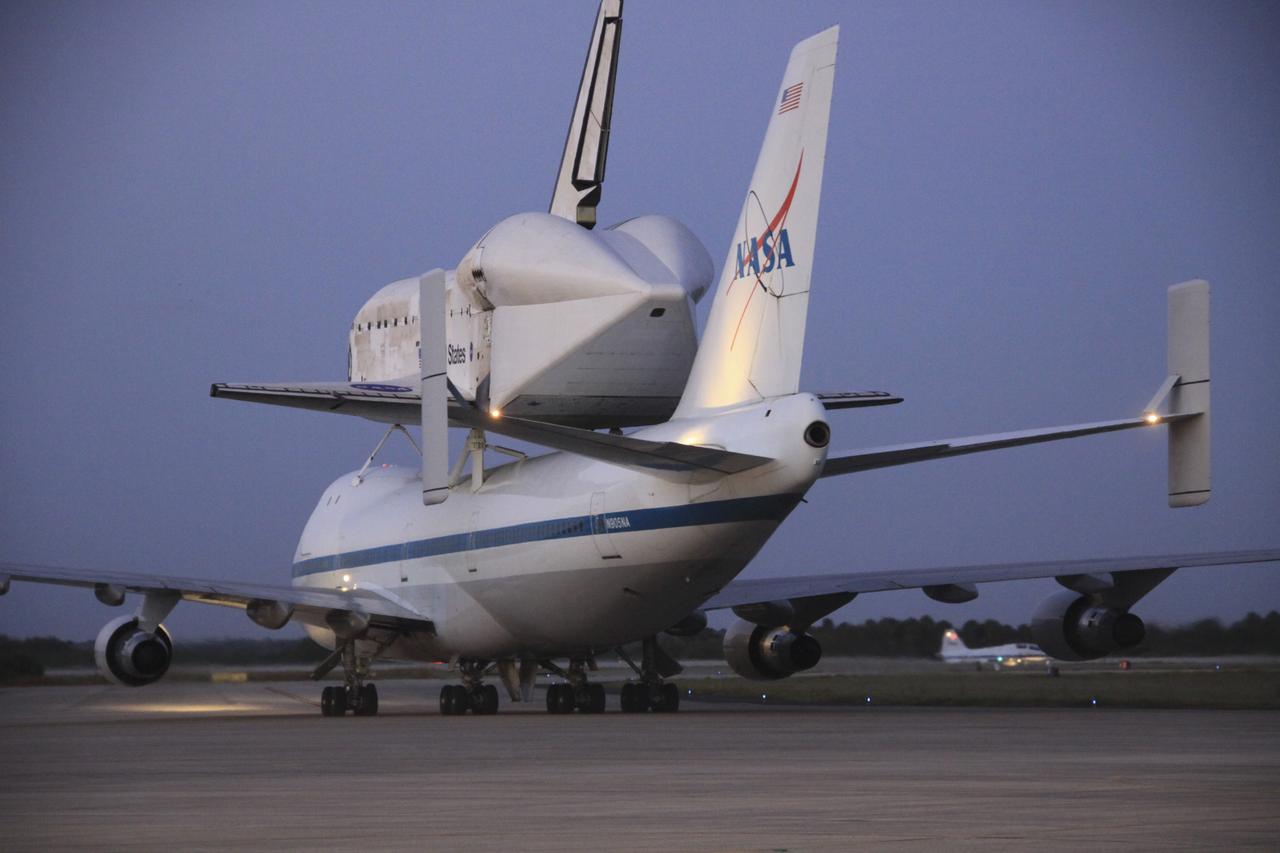
CAPE CANAVERAL, Fla. – The Shuttle Carrier Aircraft transporting space shuttle Discovery to its new home taxis to the runway at the Shuttle Landing Facility at NASA’s Kennedy Space Center in Florida preparing to take off at about 7 a.m. EDT. The aircraft, known as an SCA, is a Boeing 747 jet, originally manufactured for commercial use, which was modified by NASA to transport the shuttles between destinations on Earth. This SCA, designated NASA 905, is assigned to the remaining ferry missions, delivering the shuttles to their permanent public display sites. NASA 905 is scheduled to ferry Discovery to the Washington Dulles International Airport in Virginia on April 17, after which the shuttle will be placed on display in the Smithsonian's National Air and Space Museum Steven F. Udvar-Hazy Center. For more information on the SCA, visit http://www.nasa.gov/centers/dryden/news/FactSheets/FS-013-DFRC.html. For more information on shuttle transition and retirement activities, visit http://www.nasa.gov/transition. Photo credit: NASA/Jim Grossmann

CAPE CANAVERAL, Fla. – At NASA Kennedy Space Center’s Shuttle Landing Facility in Florida, A T-38 chase aircraft sits on runway 15 waiting for clearance from Kennedy’s air traffic control tower to begin takeoff prior to the Shuttle Carrier Aircraft, or SCA, with space shuttle Discovery attached atop. The aircraft, known as an SCA, is a Boeing 747 jet, originally manufactured for commercial use, which was modified by NASA to transport the shuttles between destinations on Earth. This SCA, designated NASA 905, is assigned to the remaining ferry missions, delivering the shuttles to their permanent public display sites. NASA 905 is scheduled to ferry Discovery to the Washington Dulles International Airport in Virginia on April 17, after which the shuttle will be placed on display in the Smithsonian’s National Air and Space Museum, Steven F. Udvar-Hazy Center in Chantilly, Va. For more information on the SCA, visit http://www.nasa.gov/centers/dryden/news/FactSheets/FS-013-DFRC.html. For more information on shuttle transition and retirement activities, visit http://www.nasa.gov/transition. Photo credit: NASA/Glenn Benson
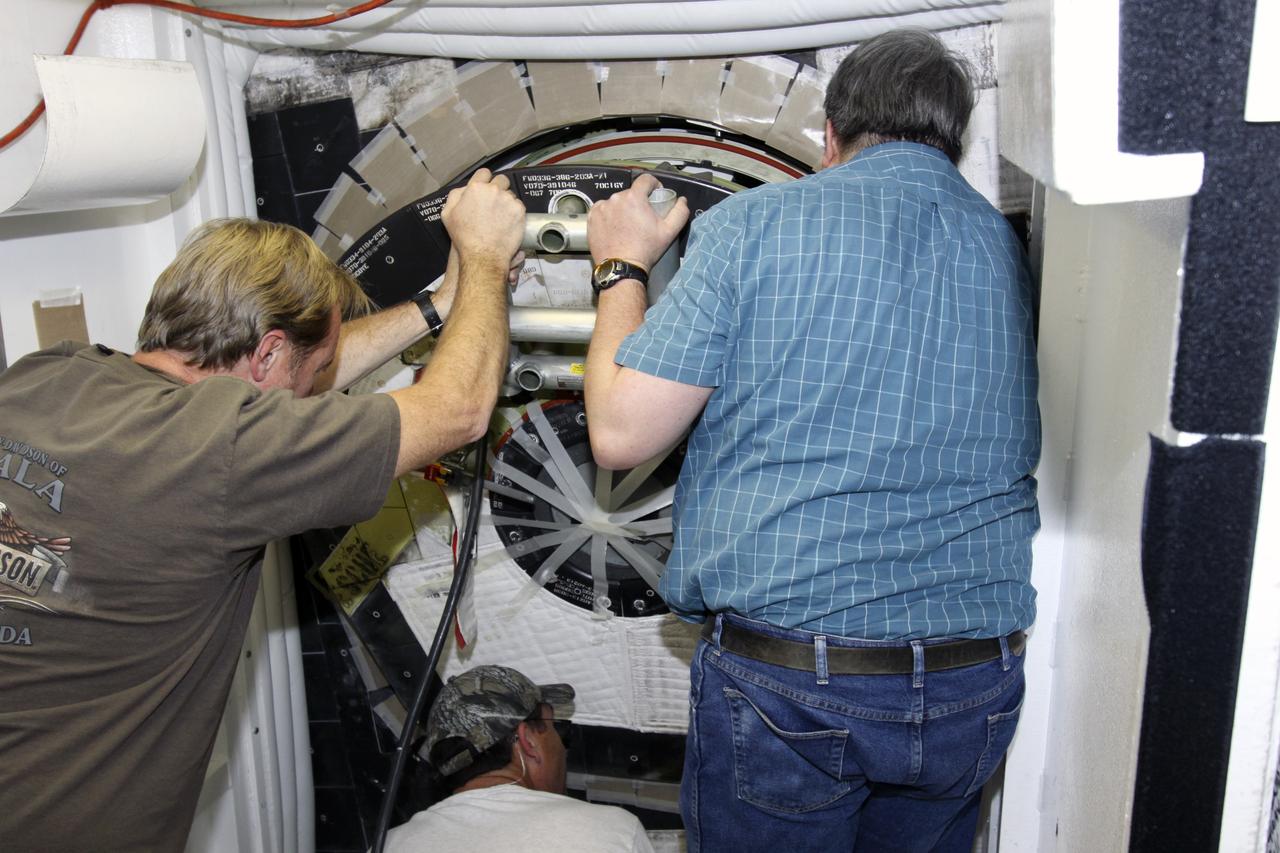
CAPE CANAVERAL, Fla. -- Inside Orbiter Processing Facility-1 at NASA’s Kennedy Space Center in Florida, technicians position space shuttle Discovery’s access hatch for final close out. The work is part of the Space Shuttle Program’s transition and retirement processing of shuttle Discovery, which is being prepared for display at Smithsonian’s National Air and Space Museum, Steven F. Udvar-Hazy Center in Chantilly, Va. Discovery is scheduled to be transported atop a NASA Shuttle Carrier Aircraft modified 747 jet to Dulles International Airport in Virginia on April 17 and then be transported to the Smithsonian on April 19. For more information, visit http://www.nasa.gov/shuttle. Photo credit: NASA/Jim Grossmann
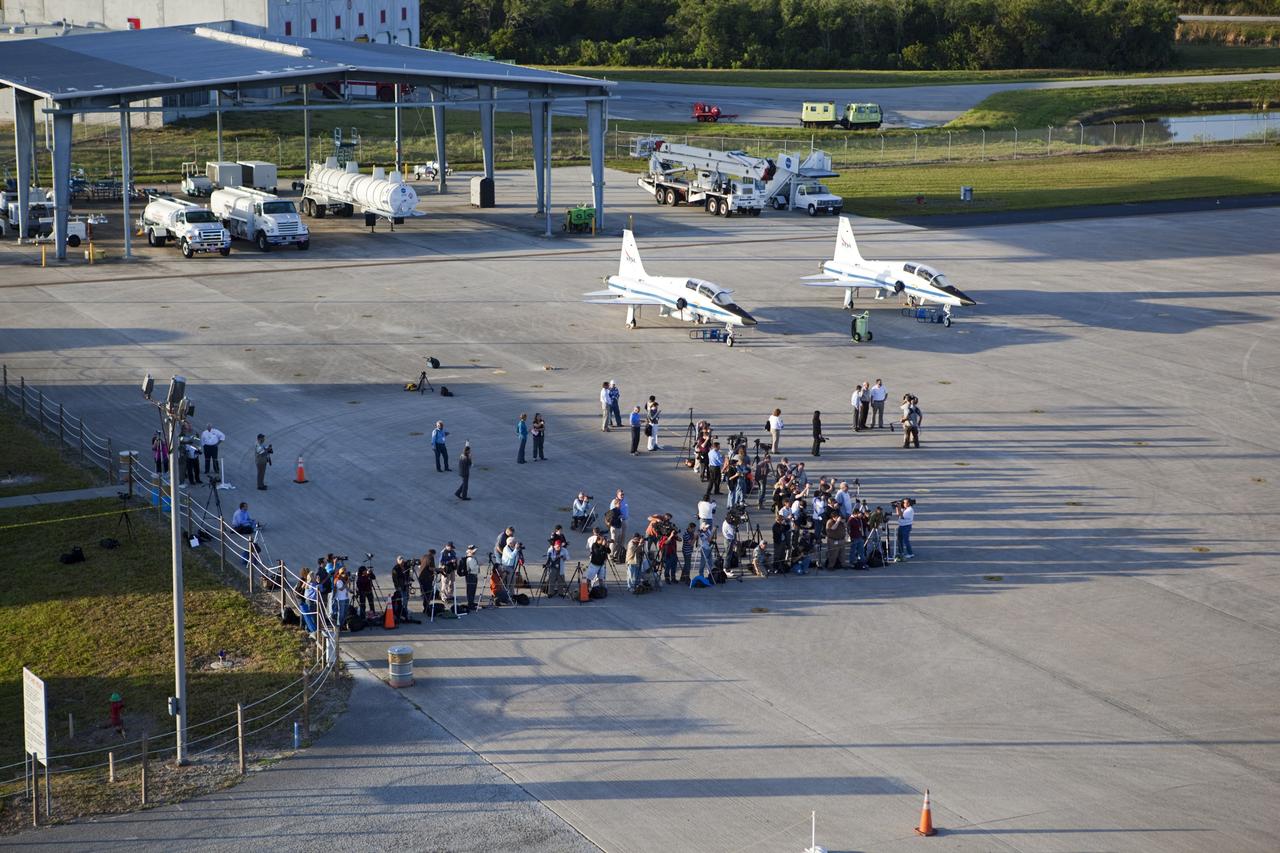
CAPE CANAVERAL, Fla. – At NASA Kennedy Space Center’s Shuttle Landing Facility in Florida, members of the media take photographs of space shuttle Discovery atop the Shuttle Carrier Aircraft, or SCA, at the mate/demate device. Known as the MDD, the devise is a large gantry-like steel structure used to hoist a shuttle off the ground and position it onto the back of the SCA. The SCA is a Boeing 747 jet that was originally manufactured for commercial use and modified by NASA to transport the shuttles between destinations on Earth. This SCA, designated NASA 905, is assigned to the remaining ferry missions, delivering the shuttles to their permanent public display sites. NASA 905 is scheduled to ferry Discovery to the Washington Dulles International Airport in Virginia on April 17, after which the shuttle will be placed on display in the Smithsonian’s National Air and Space Museum, Steven F. Udvar-Hazy Center in Chantilly, Va. For more information on the SCA, visit http://www.nasa.gov/centers/dryden/news/FactSheets/FS-013-DFRC.html. For more information on shuttle transition and retirement activities, visit http://www.nasa.gov/transition. Photo credit: NASA/Dimitri Gerondidakis
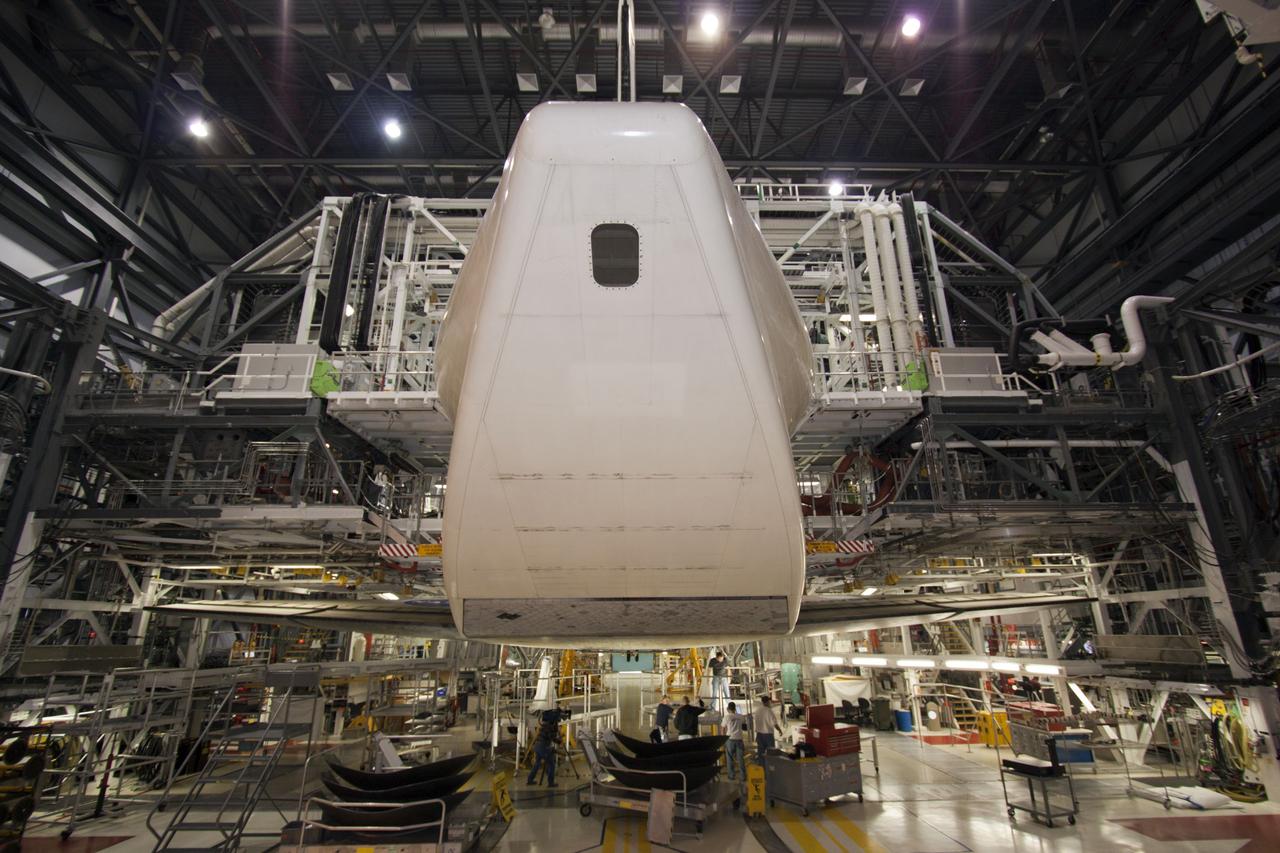
CAPE CANAVERAL, Fla. – Inside Orbiter Processing Facility-1 at NASA’s Kennedy Space Center in Florida, technicians continue work to install the ferry flight doors on space shuttle Discovery. The view shows the aft section of the shuttle with the tail cone installed over the shuttle replica engines.. The work is part of the Space Shuttle Program’s transition and retirement processing of shuttle Discovery, which is being prepared for display at Smithsonian’s National Air and Space Museum, Steven F. Udvar-Hazy Center in Chantilly, Va. Discovery is scheduled to be transported atop a NASA Shuttle Carrier Aircraft modified 747 jet to Dulles International Airport in Virginia on April 17 and then moved to the Smithsonian for permanent public display on April 19. For more information, visit http://www.nasa.gov/shuttle. Photo credit: NASA/Jim Grossmann
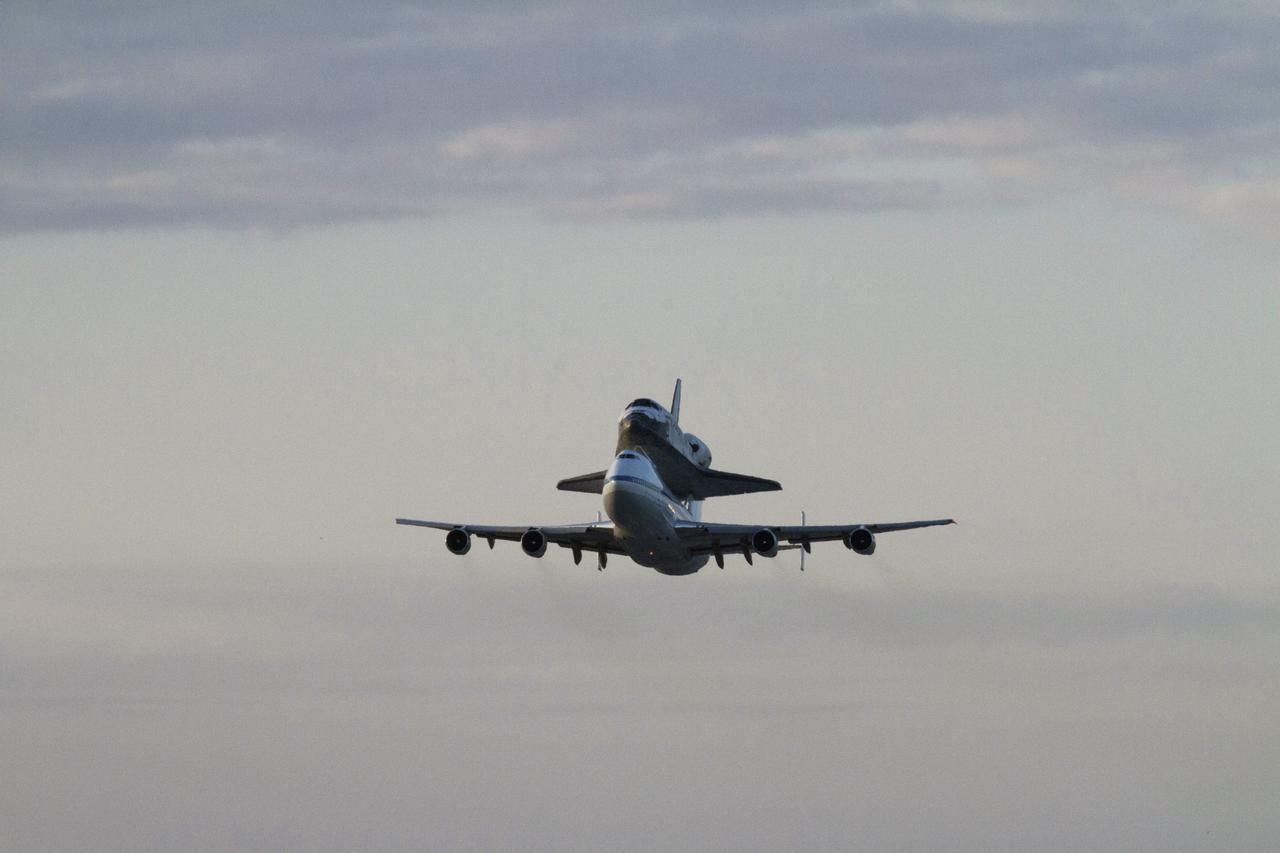
CAPE CANAVERAL, Fla. – Space shuttle Discovery, mounted to a Shuttle Carrier Aircraft, or SCA, takes off from NASA Kennedy Space Center’s Shuttle Landing Facility runway 15 in Florida at 7 a.m. EDT. The duo is beginning its ferry flight to the Washington Dulles International Airport in Virginia that also includes a flyby of the Space Coast and Washington, D.C. Discovery is leaving Kennedy after more than 28 years of service beginning with its arrival on the space coast Nov. 9, 1983. Discovery first launched to space Aug. 30, 1984, on the STS-41D mission. Discovery is the agency’s most-flown shuttle with 39 missions, more than 148 million miles and a total of one year in space. Discovery is set to move to the Smithsonian’s National Air and Space Museum, Steven F. Udvar-Hazy Center in Chantilly, Va., on April 19 where it will be place on public display. For more information on the SCA, visit http://www.nasa.gov/centers/dryden/news/FactSheets/FS-013-DFRC.html. For more information on shuttle transition and retirement activities, visit http://www.nasa.gov/transition. Photo credit: NASA/Tim Powers and Rick Wetherington

CAPE CANAVERAL, Fla. – Space shuttle Discovery, mounted to a Shuttle Carrier Aircraft, or SCA, takes off from NASA Kennedy Space Center’s Shuttle Landing Facility runway 15 in Florida at 7 a.m. EDT and makes a flyby near the mate/demate device. The duo is beginning its ferry flight to the Washington Dulles International Airport in Virginia that also includes a flyby of the Space Coast and Washington, D.C. Also flying along with the pair are a T-38 training jet and a helicopter. Discovery is leaving Kennedy after more than 28 years of service beginning with its arrival on the space coast Nov. 9, 1983. Discovery first launched to space Aug. 30, 1984, on the STS-41D mission. Discovery is the agency’s most-flown shuttle with 39 missions, more than 148 million miles and a total of one year in space. Discovery is set to move to the Smithsonian’s National Air and Space Museum, Steven F. Udvar-Hazy Center in Chantilly, Va., on April 19 where it will be place on public display. For more information on the SCA, visit http://www.nasa.gov/centers/dryden/news/FactSheets/FS-013-DFRC.html. For more information on shuttle transition and retirement activities, visit http://www.nasa.gov/transition. Photo credit: NASA/Tim Powers and Rick Wetherington

CAPE CANAVERAL, Fla. – The “pathfinder” aircraft for space shuttle Discovery’s ferry flight taxis down the runway at the Shuttle Landing Facility at NASA’s Kennedy Space Center in Florida. The NASA C-9 aircraft will fly about 100 miles ahead of Discovery to scout for the safest route between destinations. Its crew includes an SCA flight engineer who studies the weather patterns along the flight path to find a route free of rain and other turbulence. The carrier aircraft, also known as an SCA, is a Boeing 747 jet, originally manufactured for commercial use which was modified by NASA to transport the shuttles between destinations on Earth. NASA 905 is scheduled to ferry Discovery to the Washington Dulles International Airport in Virginia on April 17, and is assigned to all remaining ferry missions, delivering the shuttles to their permanent public display sites. After its arrival at Dulles, Discovery will be placed on display in the Smithsonian's National Air and Space Museum Steven F. Udvar-Hazy Center on April 19. For more information on the SCA, visit http://www.nasa.gov/centers/dryden/news/FactSheets/FS-013-DFRC.html. For more information on shuttle transition and retirement activities, visit http://www.nasa.gov/transition. Photo credit: NASA/Amanda Diller
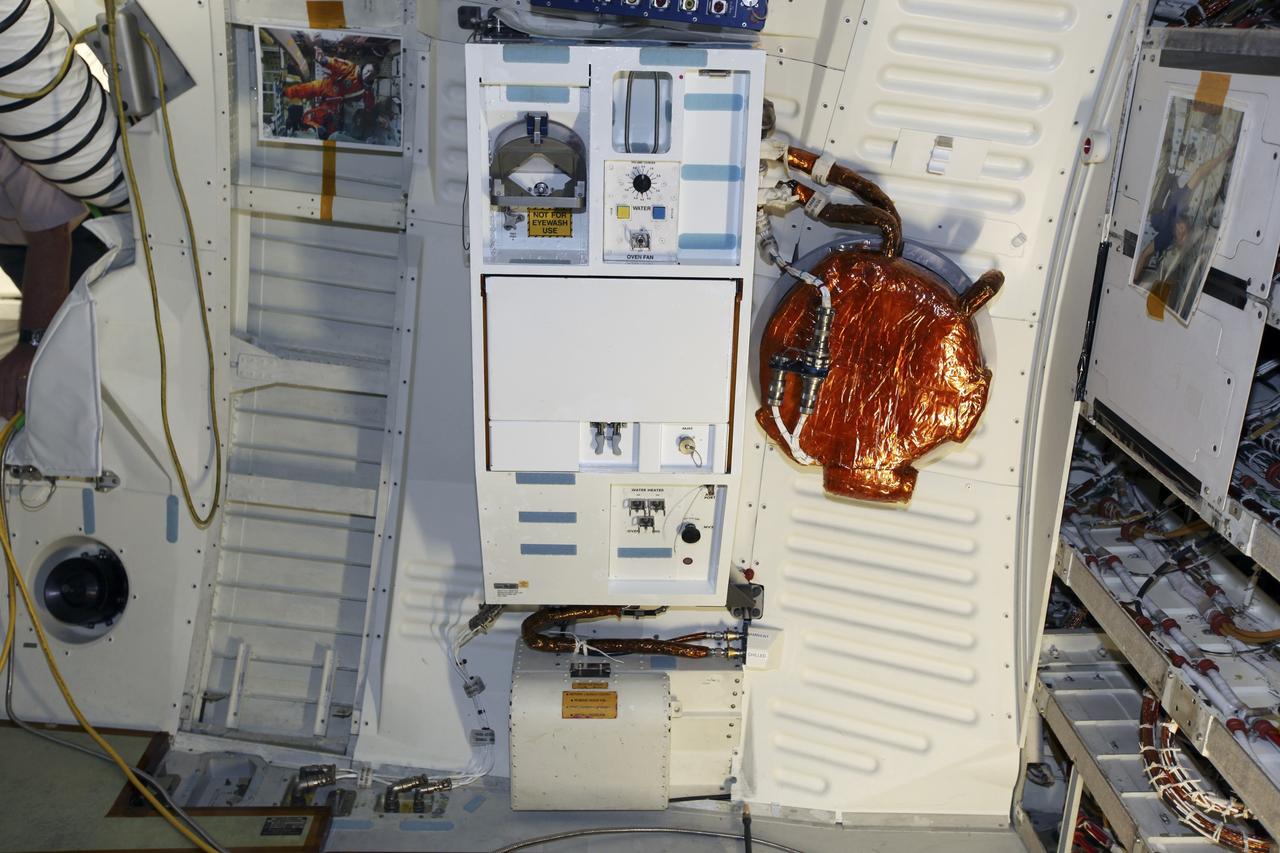
CAPE CANAVERAL, Fla. – Inside Orbiter Processing Facility-1 at NASA’s Kennedy Space Center in Florida, the shuttle orbiter repackaged galley (SORG) is installed in the middeck of space shuttle Discovery. After Discovery’s final mission, STS-133, the SORG was removed and sent to a United Space Alliance lab in Houston where it was cleaned and deserviced. Water in the microbial check valve and the orbiter water system was drained and dried. The SORG was returned to Kennedy Space Center. The work is part of the Space Shuttle Program’s transition and retirement processing of shuttle Discovery, which is being prepared for display at Smithsonian’s National Air and Space Museum, Steven F. Udvar-Hazy Center in Chantilly, Va. For more information, visit http://www.nasa.gov/shuttle. Photo credit: NASA/Dimitri Gerondidakis
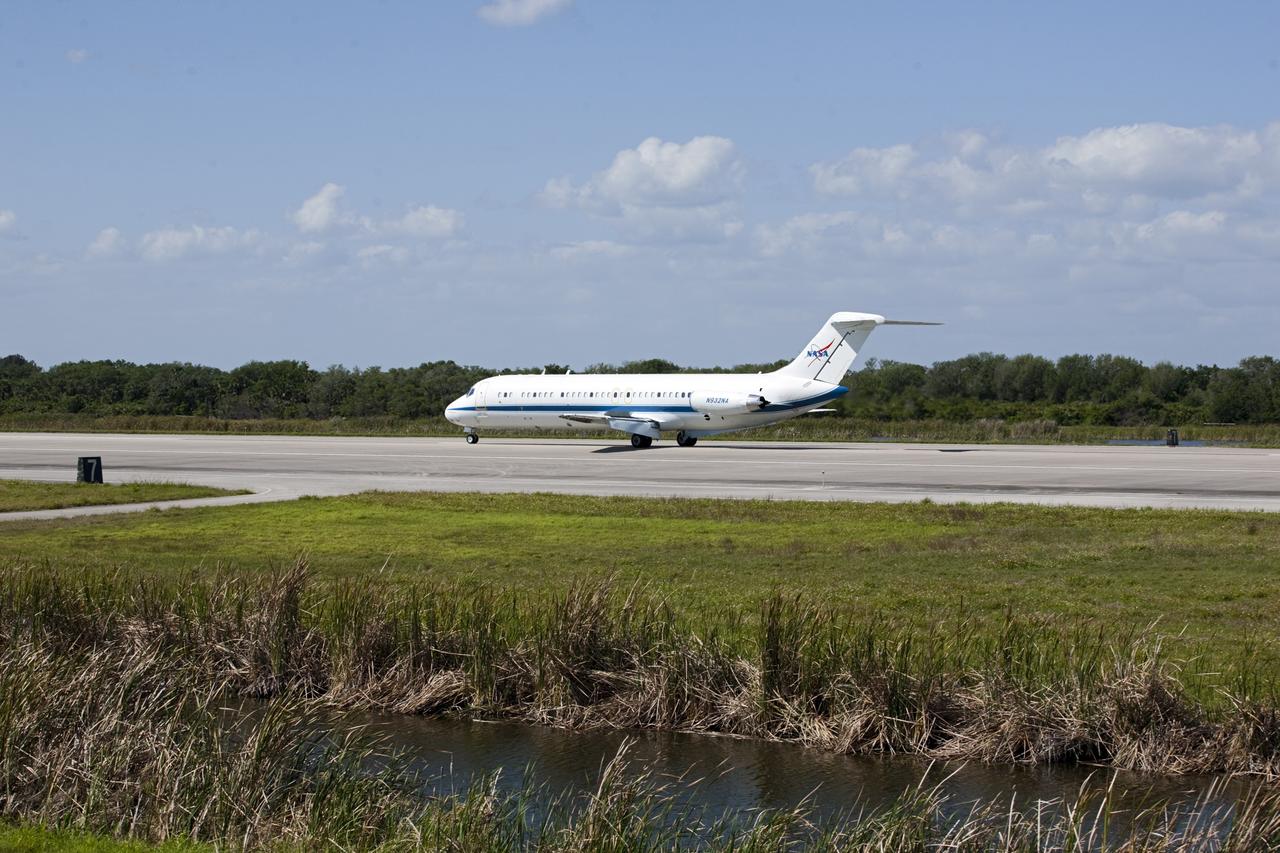
CAPE CANAVERAL, Fla. – The “pathfinder” aircraft for space shuttle Discovery’s ferry flight taxis down the runway at the Shuttle Landing Facility at NASA’s Kennedy Space Center in Florida. The NASA C-9 aircraft will fly about 100 miles ahead of Discovery to scout for the safest route between destinations. Its crew includes an SCA flight engineer who studies the weather patterns along the flight path to find a route free of rain and other turbulence. The carrier aircraft, also known as an SCA, is a Boeing 747 jet, originally manufactured for commercial use which was modified by NASA to transport the shuttles between destinations on Earth. NASA 905 is scheduled to ferry Discovery to the Washington Dulles International Airport in Virginia on April 17, and is assigned to all remaining ferry missions, delivering the shuttles to their permanent public display sites. After its arrival at Dulles, Discovery will be placed on display in the Smithsonian's National Air and Space Museum Steven F. Udvar-Hazy Center on April 19. For more information on the SCA, visit http://www.nasa.gov/centers/dryden/news/FactSheets/FS-013-DFRC.html. For more information on shuttle transition and retirement activities, visit http://www.nasa.gov/transition. Photo credit: NASA/Amanda Diller
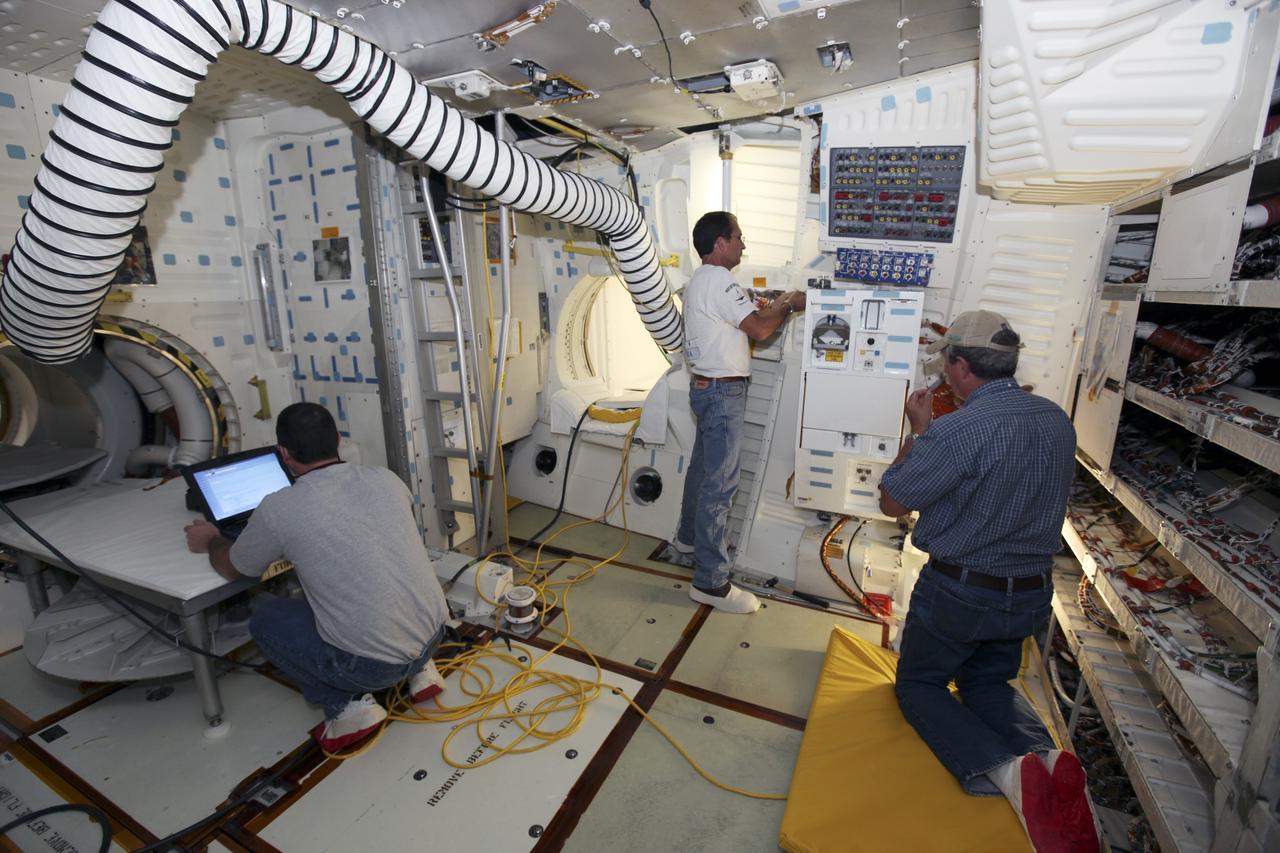
CAPE CANAVERAL, Fla. – Inside Orbiter Processing Facility-1 at NASA’s Kennedy Space Center in Florida, technicians install the shuttle orbiter repackaged galley (SORG) in the middeck of space shuttle Discovery. After Discovery’s final mission, STS-133, the SORG was removed and sent to a United Space Alliance lab in Houston where it was cleaned and deserviced. Water in the microbial check valve and the orbiter water system was drained and dried. The SORG was returned to Kennedy Space Center. The work is part of the Space Shuttle Program’s transition and retirement processing of shuttle Discovery, which is being prepared for display at Smithsonian’s National Air and Space Museum, Steven F. Udvar-Hazy Center in Chantilly, Va. For more information, visit http://www.nasa.gov/shuttle. Photo credit: NASA/Dimitri Gerondidakis
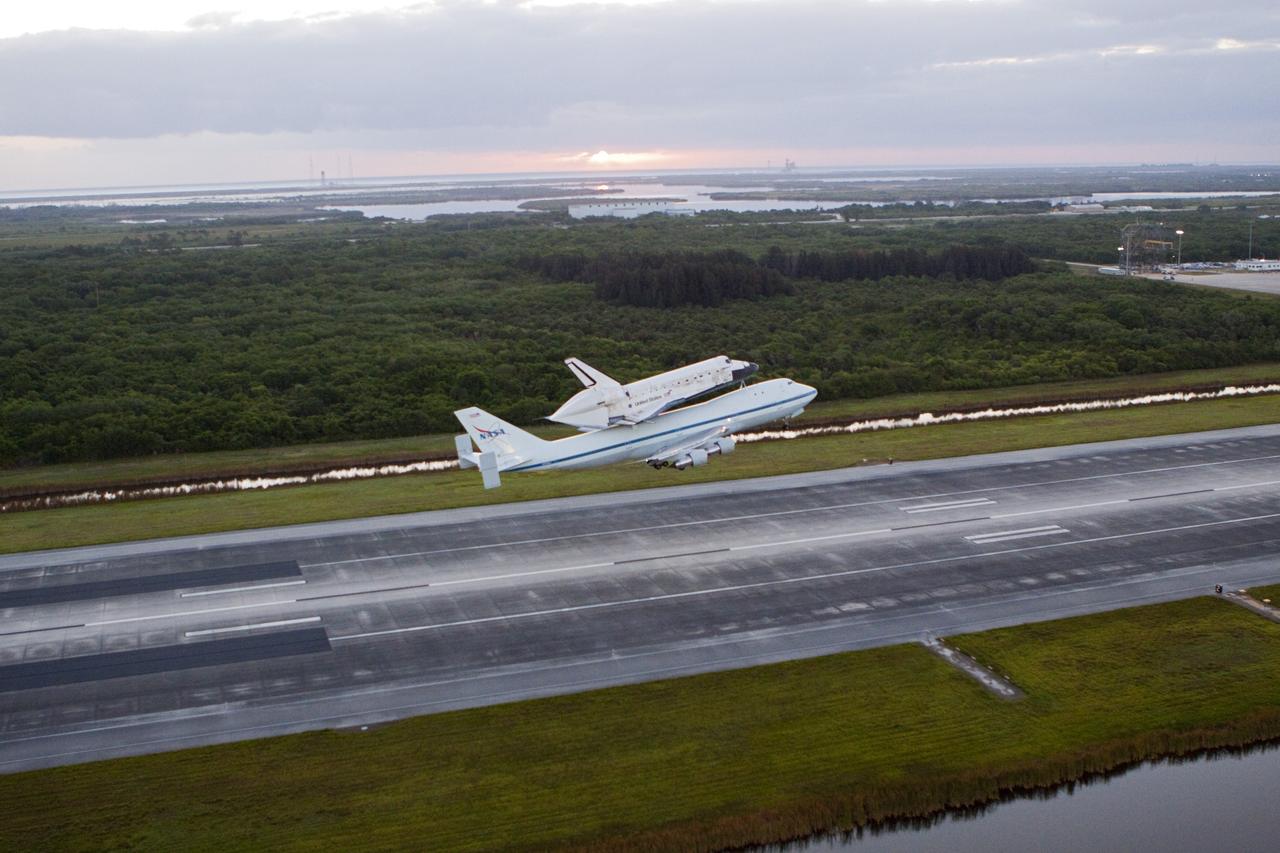
CAPE CANAVERAL, Fla. – In the early morning hours at NASA Kennedy Space Center’s Shuttle Landing Facility in Florida, the Shuttle Carrier Aircraft, or SCA, with space shuttle Discovery secured atop, takes off from runway 15 at 7 a.m. EDT. The SCA will deliver Discovery to its new home. The aircraft, known as an SCA, is a Boeing 747 jet, originally manufactured for commercial use, which was modified by NASA to transport the shuttles between destinations on Earth. This SCA, designated NASA 905, is assigned to the remaining ferry missions, delivering the shuttles to their permanent public display sites. NASA 905 is scheduled to ferry Discovery to the Washington Dulles International Airport in Virginia on April 17, after which the shuttle will be placed on display in the Smithsonian’s National Air and Space Museum, Steven F. Udvar-Hazy Center in Chantilly, Va. For more information on the SCA, visit http://www.nasa.gov/centers/dryden/news/FactSheets/FS-013-DFRC.html. For more information on shuttle transition and retirement activities, visit http://www.nasa.gov/transition. Photo credit: NASA/Glenn Benson
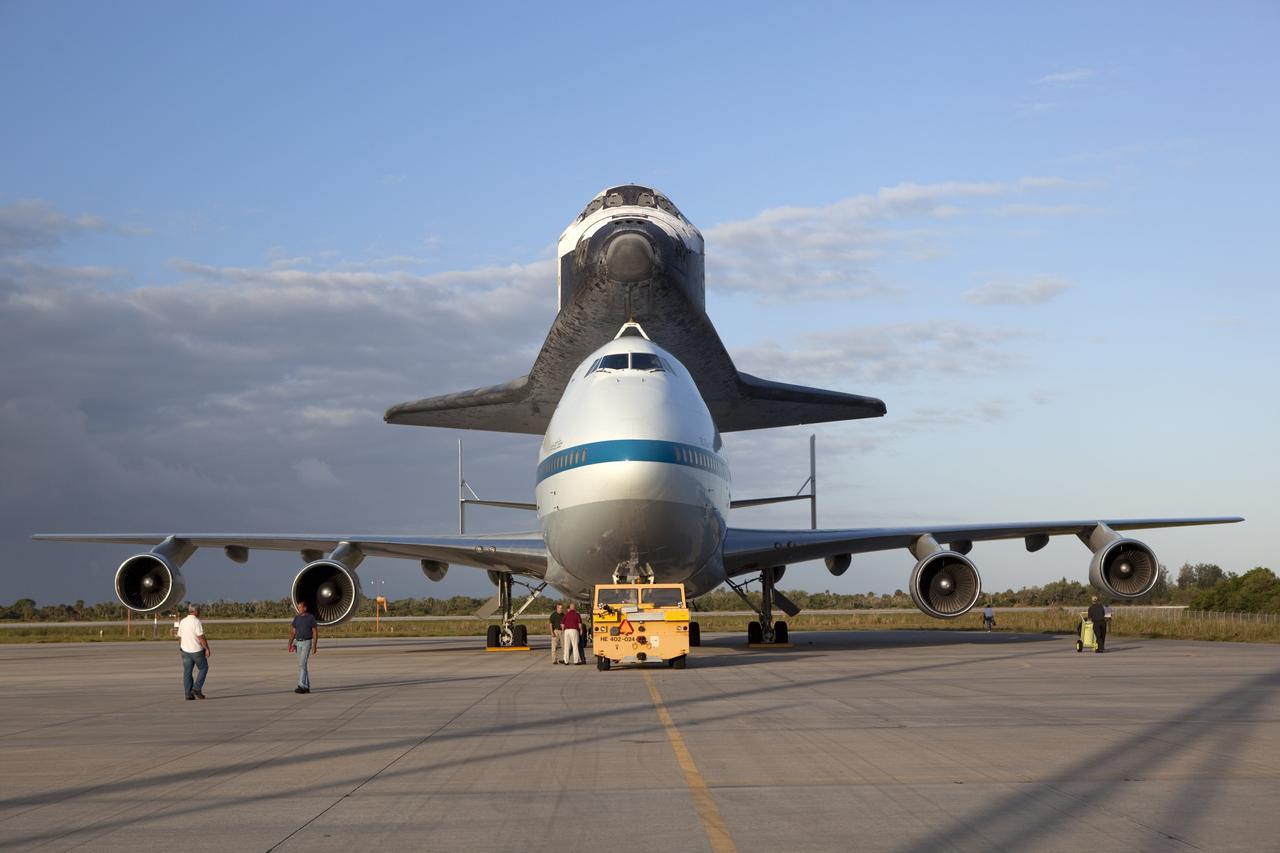
CAPE CANAVERAL, Fla. – At NASA Kennedy Space Center’s Shuttle Landing Facility in Florida, the Shuttle Carrier Aircraft, or SCA, with space shuttle Discovery attached atop, is backed away from the mate/demate device. Known as the MDD, the devise is a large gantry-like steel structure used to hoist a shuttle off the ground and position it onto the back of the SCA. The SCA is a Boeing 747 jet that was originally manufactured for commercial use and modified by NASA to transport the shuttles between destinations on Earth. This SCA, designated NASA 905, is assigned to the remaining ferry missions, delivering the shuttles to their permanent public display sites. NASA 905 is scheduled to ferry Discovery to the Washington Dulles International Airport in Virginia on April 17, after which the shuttle will be placed on display in the Smithsonian’s National Air and Space Museum, Steven F. Udvar-Hazy Center in Chantilly, Va. For more information on the SCA, visit http://www.nasa.gov/centers/dryden/news/FactSheets/FS-013-DFRC.html. For more information on shuttle transition and retirement activities, visit http://www.nasa.gov/transition. Photo credit: NASA/Dimitri Gerondidakis

CAPE CANAVERAL, Fla. – In the early morning hours at NASA Kennedy Space Center’s Shuttle Landing Facility in Florida, the Shuttle Carrier Aircraft, or SCA, with space shuttle Discovery secured atop, taxies down the runway for a takeoff at 7 a.m. EDT. In the background are the midfield air traffic control tower and the 525-foot-tall Vehicle Assembly Building. The aircraft, known as an SCA, is a Boeing 747 jet, originally manufactured for commercial use, which was modified by NASA to transport the shuttles between destinations on Earth. This SCA, designated NASA 905, is assigned to the remaining ferry missions, delivering the shuttles to their permanent public display sites. NASA 905 is scheduled to ferry Discovery to the Washington Dulles International Airport in Virginia on April 17, after which the shuttle will be placed on display in the Smithsonian’s National Air and Space Museum, Steven F. Udvar-Hazy Center in Chantilly, Va. For more information on the SCA, visit http://www.nasa.gov/centers/dryden/news/FactSheets/FS-013-DFRC.html. For more information on shuttle transition and retirement activities, visit http://www.nasa.gov/transition. Photo credit: NASA/Glenn Benson
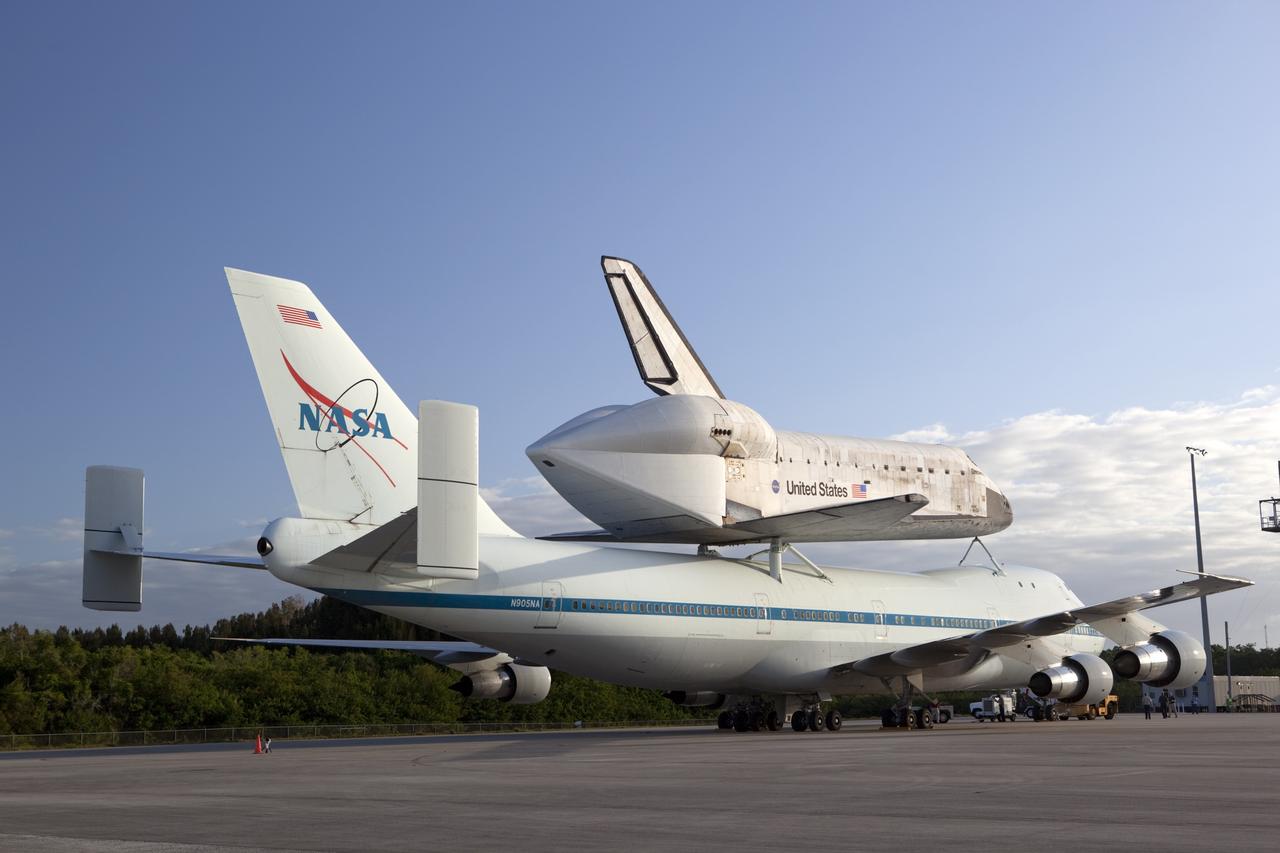
CAPE CANAVERAL, Fla. – At NASA Kennedy Space Center’s Shuttle Landing Facility in Florida, the Shuttle Carrier Aircraft, or SCA, with space shuttle Discovery attached atop, sits on the tarmac after being backed away from the mate/demate device. Known as the MDD, the devise is a large gantry-like steel structure used to hoist a shuttle off the ground and position it onto the back of the SCA. The SCA is a Boeing 747 jet that was originally manufactured for commercial use and modified by NASA to transport the shuttles between destinations on Earth. This SCA, designated NASA 905, is assigned to the remaining ferry missions, delivering the shuttles to their permanent public display sites. NASA 905 is scheduled to ferry Discovery to the Washington Dulles International Airport in Virginia on April 17, after which the shuttle will be placed on display in the Smithsonian’s National Air and Space Museum, Steven F. Udvar-Hazy Center in Chantilly, Va. For more information on the SCA, visit http://www.nasa.gov/centers/dryden/news/FactSheets/FS-013-DFRC.html. For more information on shuttle transition and retirement activities, visit http://www.nasa.gov/transition. Photo credit: NASA/Dimitri Gerondidakis
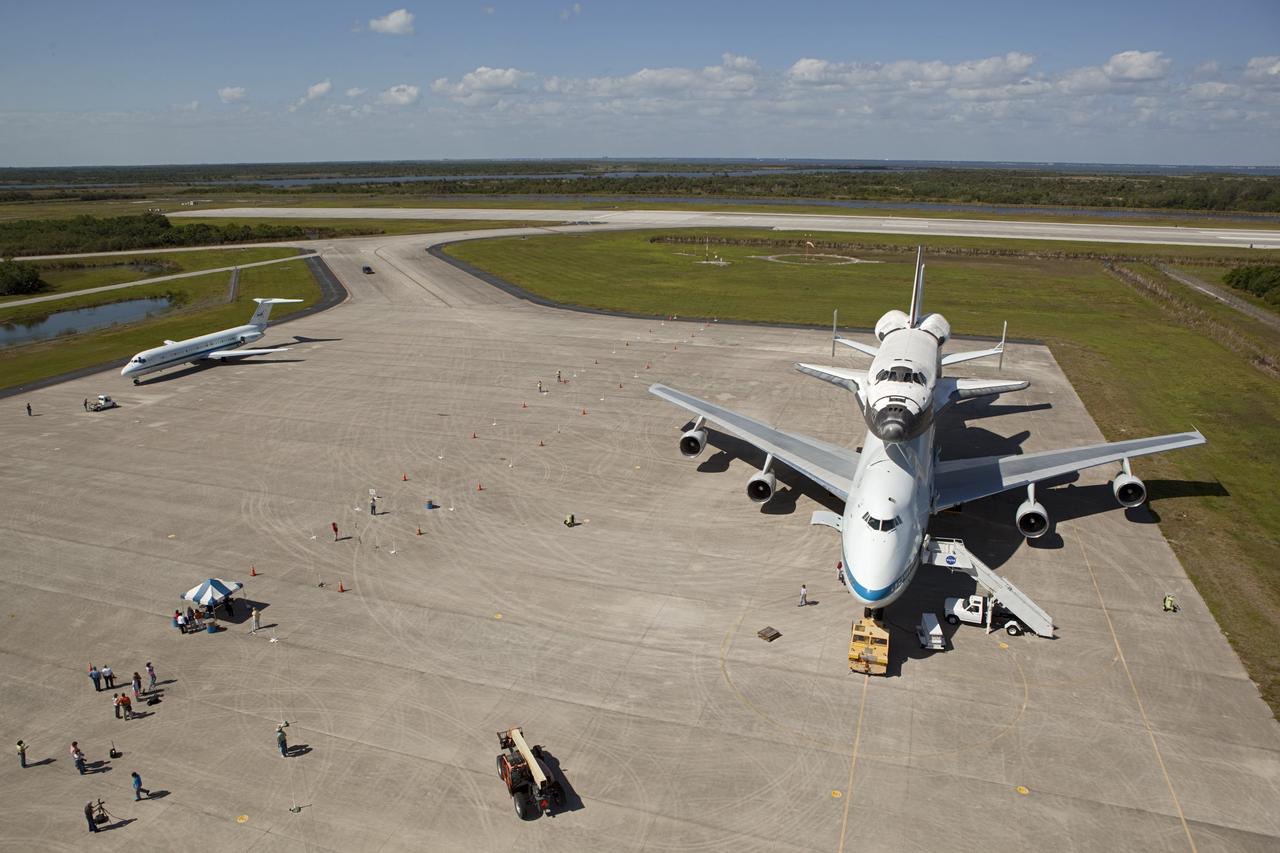
CAPE CANAVERAL, Fla. – The “pathfinder” aircraft for space shuttle Discovery’s ferry flight pulls up beside the Shuttle Carrier Aircraft on the apron of the Shuttle Landing Facility at NASA’s Kennedy Space Center in Florida. The NASA C-9 aircraft will fly about 100 miles ahead of Discovery to scout for the safest route between destinations. Its crew includes an SCA flight engineer who studies the weather patterns along the flight path to find a route free of rain and other turbulence. The carrier aircraft, also known as an SCA, is a Boeing 747 jet, originally manufactured for commercial use which was modified by NASA to transport the shuttles between destinations on Earth. NASA 905 is scheduled to ferry Discovery to the Washington Dulles International Airport in Virginia on April 17, and is assigned to all remaining ferry missions, delivering the shuttles to their permanent public display sites. After its arrival at Dulles, Discovery will be placed on display in the Smithsonian's National Air and Space Museum Steven F. Udvar-Hazy Center on April 19. For more information on the SCA, visit http://www.nasa.gov/centers/dryden/news/FactSheets/FS-013-DFRC.html. For more information on shuttle transition and retirement activities, visit http://www.nasa.gov/transition. Photo credit: NASA/Dimitri Gerondidaki
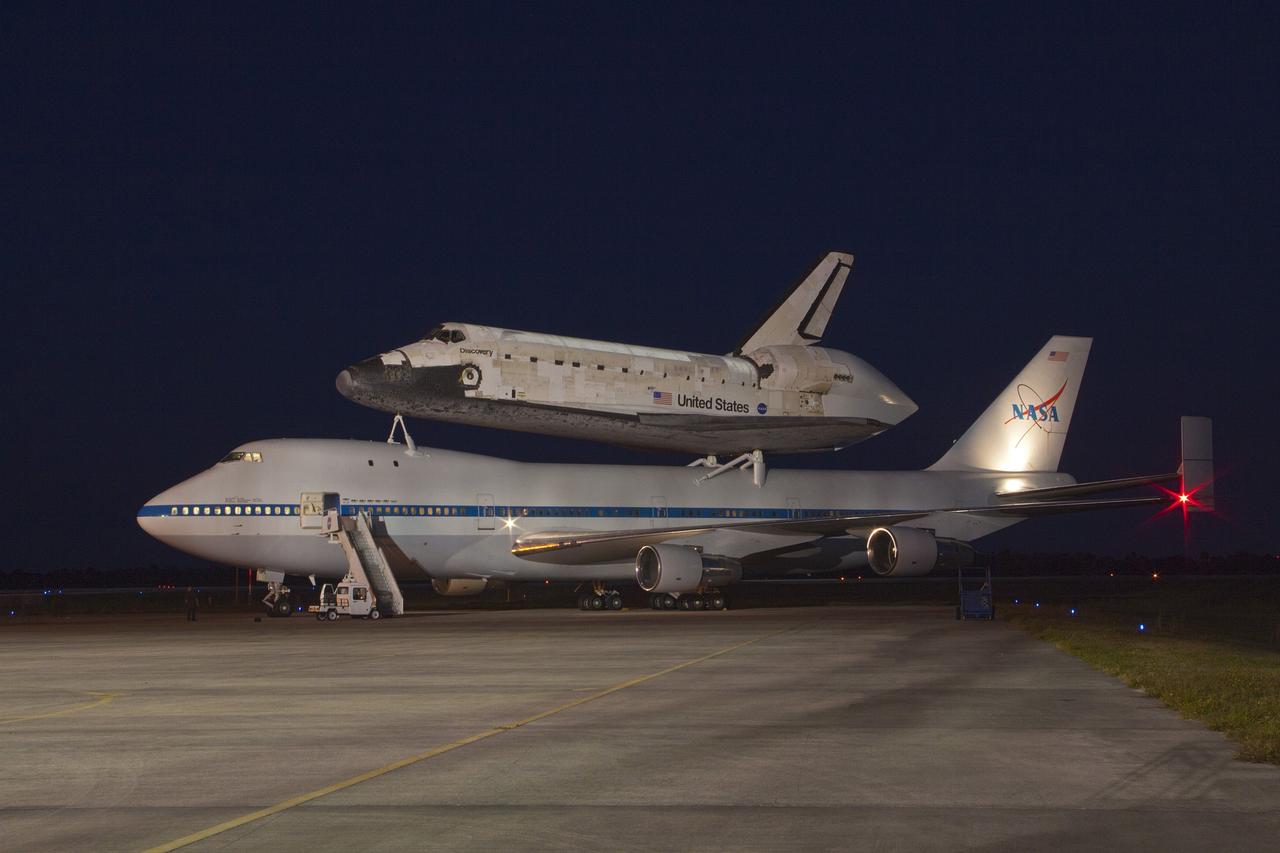
CAPE CANAVERAL, Fla. – The Shuttle Carrier Aircraft transporting space shuttle Discovery to its new home prepares to take off from the Shuttle Landing Facility at NASA’s Kennedy Space Center in Florida at about 7 a.m. EDT. The aircraft, known as an SCA, is a Boeing 747 jet, originally manufactured for commercial use, which was modified by NASA to transport the shuttles between destinations on Earth. This SCA, designated NASA 905, is assigned to the remaining ferry missions, delivering the shuttles to their permanent public display sites. NASA 905 is scheduled to ferry Discovery to the Washington Dulles International Airport in Virginia on April 17, after which the shuttle will be placed on display in the Smithsonian's National Air and Space Museum Steven F. Udvar-Hazy Center. For more information on the SCA, visit http://www.nasa.gov/centers/dryden/news/FactSheets/FS-013-DFRC.html. For more information on shuttle transition and retirement activities, visit http://www.nasa.gov/transition. Photo credit: NASA/Jim Grossmann
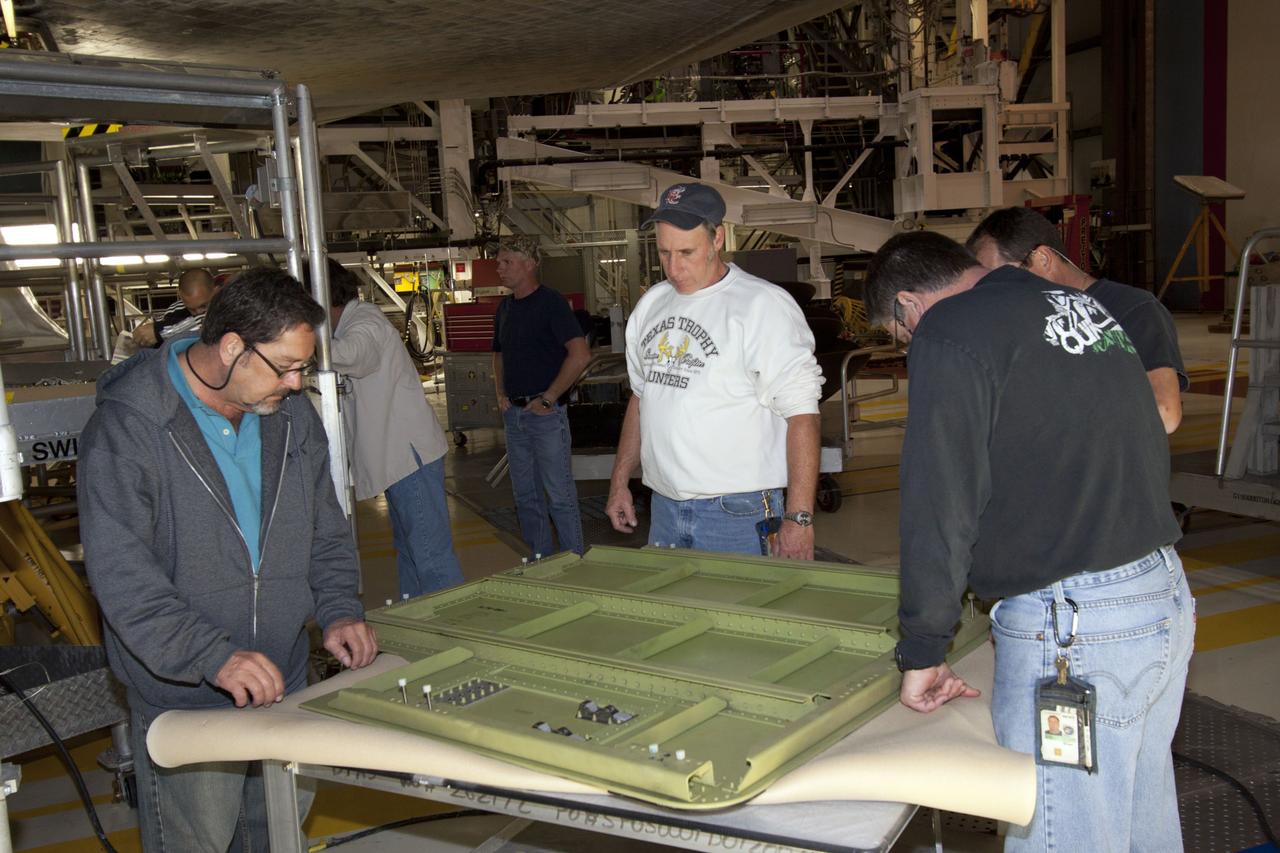
CAPE CANAVERAL, Fla. – Inside Orbiter Processing Facility-1 at NASA’s Kennedy Space Center in Florida, technicians review procedures before installing the ferry flight doors on space shuttle Discovery. The work is part of the Space Shuttle Program’s transition and retirement processing of shuttle Discovery, which is being prepared for display at Smithsonian’s National Air and Space Museum, Steven F. Udvar-Hazy Center in Chantilly, Va. Discovery is scheduled to be transported atop a NASA Shuttle Carrier Aircraft modified 747 jet to Dulles International Airport in Virginia on April 17 and then moved to the Smithsonian for permanent public display on April 19. For more information, visit http://www.nasa.gov/shuttle. Photo credit: NASA/Jim Grossmann
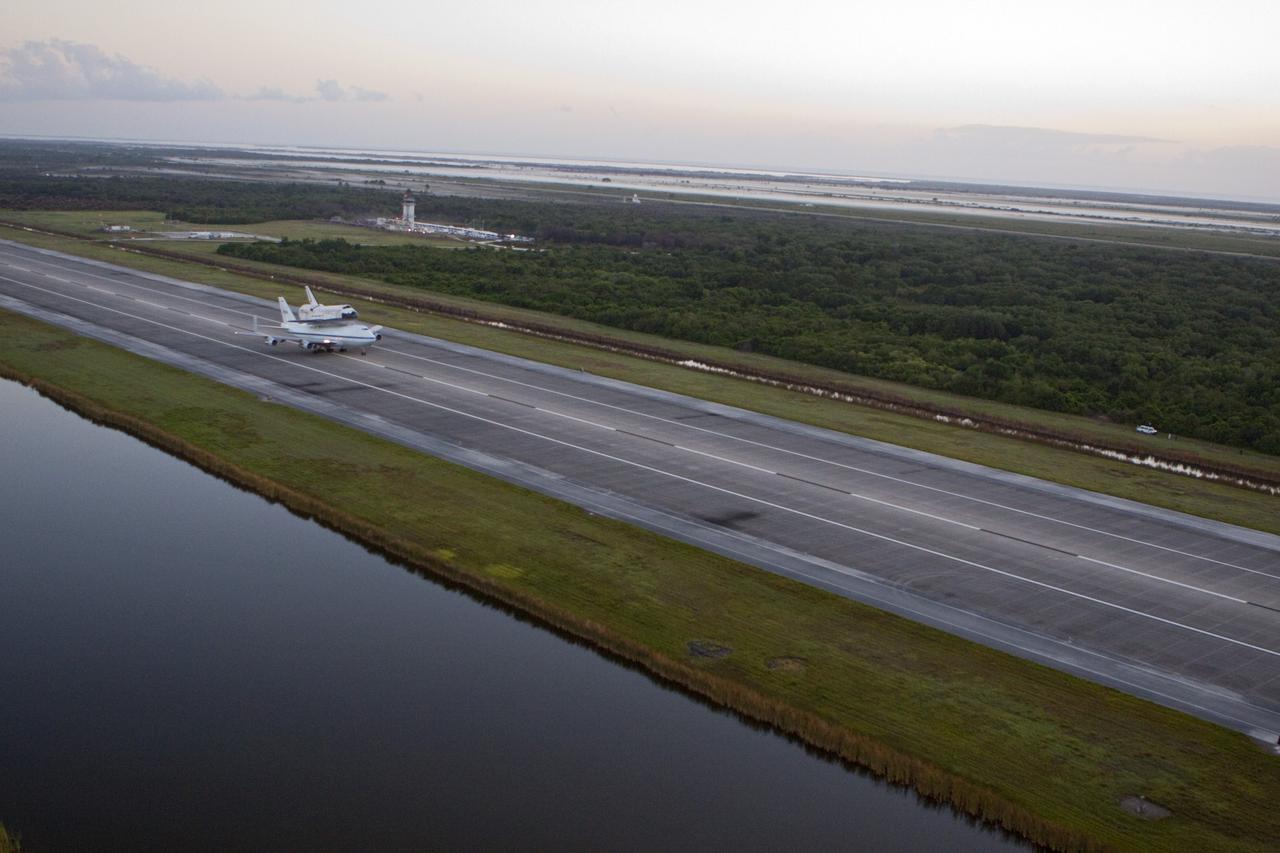
CAPE CANAVERAL, Fla. – In the early morning hours at NASA Kennedy Space Center’s Shuttle Landing Facility in Florida, the Shuttle Carrier Aircraft, or SCA, with space shuttle Discovery secured atop, begins takeoff from runway 15 at 7 a.m. EDT on its way to deliver Discovery to its new home. The aircraft, known as an SCA, is a Boeing 747 jet, originally manufactured for commercial use, which was modified by NASA to transport the shuttles between destinations on Earth. This SCA, designated NASA 905, is assigned to the remaining ferry missions, delivering the shuttles to their permanent public display sites. NASA 905 is scheduled to ferry Discovery to the Washington Dulles International Airport in Virginia on April 17, after which the shuttle will be placed on display in the Smithsonian’s National Air and Space Museum, Steven F. Udvar-Hazy Center in Chantilly, Va. For more information on the SCA, visit http://www.nasa.gov/centers/dryden/news/FactSheets/FS-013-DFRC.html. For more information on shuttle transition and retirement activities, visit http://www.nasa.gov/transition. Photo credit: NASA/Glenn Benson

CAPE CANAVERAL, Fla. – At NASA Kennedy Space Center’s Shuttle Landing Facility in Florida, crew members of space shuttle Discovery’s last mission, STS-133, have arrived. Mission Specialists Michael Barrett foreground and Alvin Drew visit with the media. Also present, but not in view, are Mission Specialists Nicole Stott and Steve Bowen, Pilot Eric Boe and Commander Steve Lindsay. The crew arrived to view the Shuttle Carrier Aircraft, or SCA, with space shuttle Discovery attached atop after being backed away from the mate/demate device. Known as the MDD, the devise is a large gantry-like steel structure used to hoist a shuttle off the ground and position it onto the back of the SCA. The SCA is a Boeing 747 jet that was originally manufactured for commercial use and modified by NASA to transport the shuttles between destinations on Earth. This SCA, designated NASA 905, is assigned to the remaining ferry missions, delivering the shuttles to their permanent public display sites. NASA 905 is scheduled to ferry Discovery to the Washington Dulles International Airport in Virginia on April 17, after which the shuttle will be placed on display in the Smithsonian’s National Air and Space Museum, Steven F. Udvar-Hazy Center in Chantilly, Va. For more information on the SCA, visit http://www.nasa.gov/centers/dryden/news/FactSheets/FS-013-DFRC.html. For more information on shuttle transition and retirement activities, visit http://www.nasa.gov/transition. Photo credit: NASA/Dimitri Gerondidakis
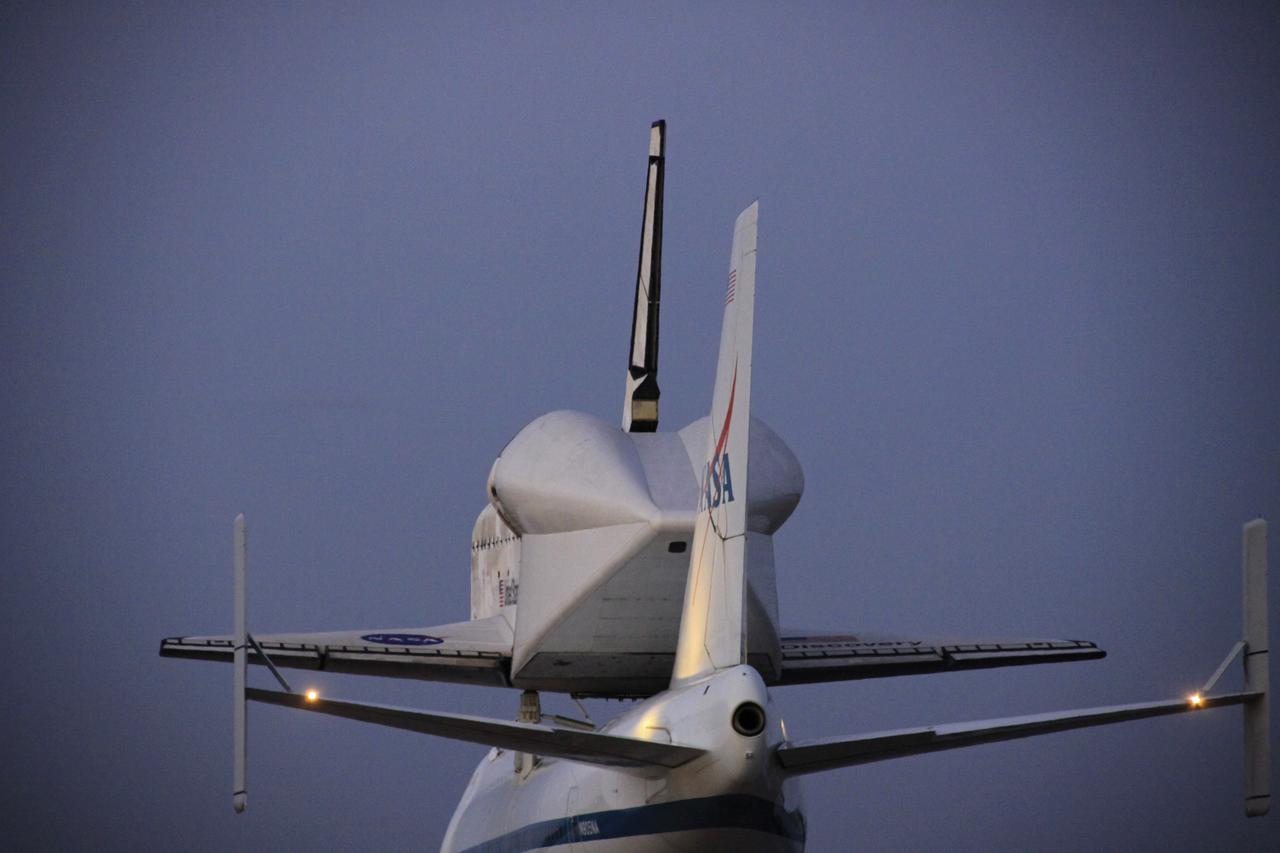
CAPE CANAVERAL, Fla. – The Shuttle Carrier Aircraft transporting space shuttle Discovery to its new home takes to the skies over the Shuttle Landing Facility at NASA’s Kennedy Space Center in Florida, lifting off at 7 a.m. EDT. The aircraft, known as an SCA, is a Boeing 747 jet, originally manufactured for commercial use, which was modified by NASA to transport the shuttles between destinations on Earth. This SCA, designated NASA 905, is assigned to the remaining ferry missions, delivering the shuttles to their permanent public display sites. NASA 905 is scheduled to ferry Discovery to the Washington Dulles International Airport in Virginia on April 17, after which the shuttle will be placed on display in the Smithsonian's National Air and Space Museum Steven F. Udvar-Hazy Center. For more information on the SCA, visit http://www.nasa.gov/centers/dryden/news/FactSheets/FS-013-DFRC.html. For more information on shuttle transition and retirement activities, visit http://www.nasa.gov/transition. Photo credit: NASA/Jim Grossmann
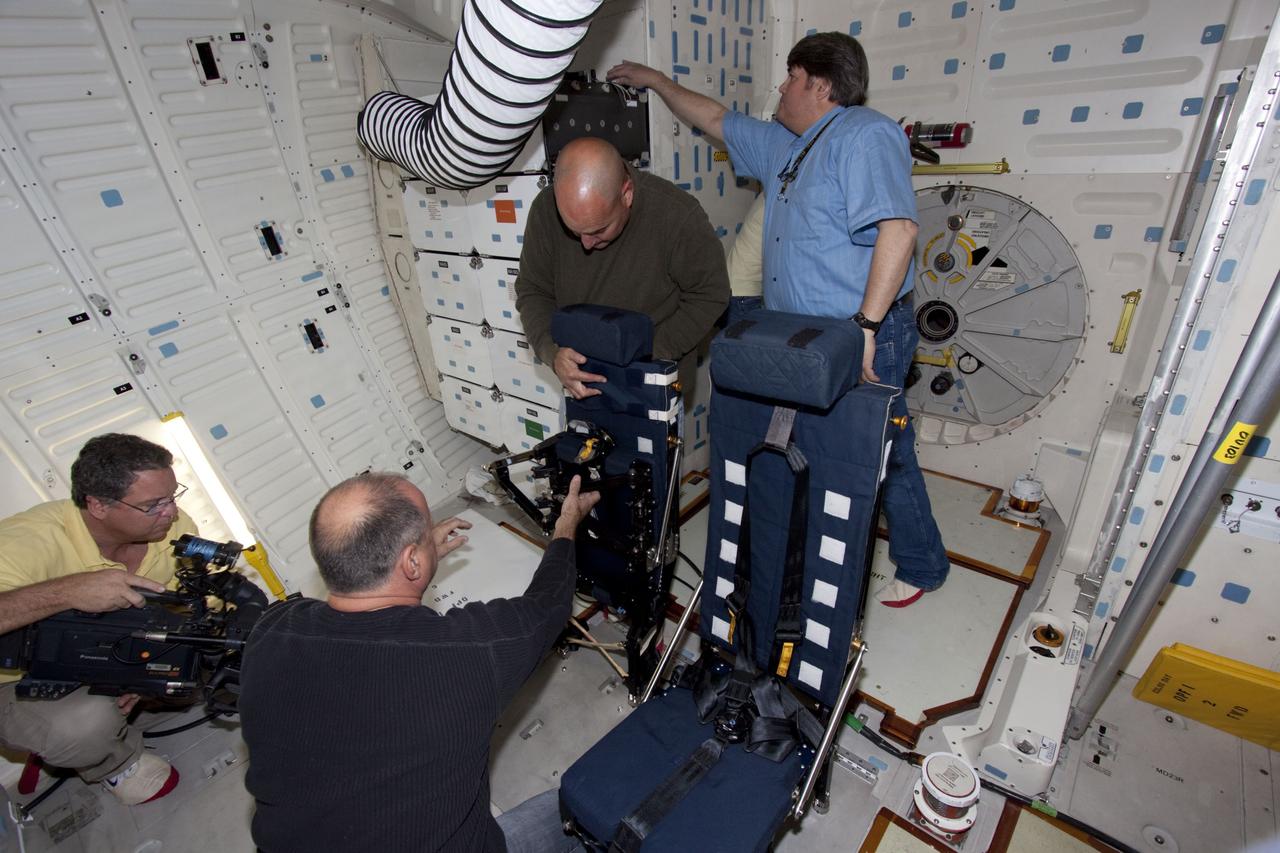
CAPE CANAVERAL, Fla. -- Inside Orbiter Processing Facility-1 at NASA’s Kennedy Space Center in Florida, technicians reinstall the seats in the middeck of space shuttle Discovery. The work is part of the Space Shuttle Program’s transition and retirement processing of shuttle Discovery, which is being prepared for display at Smithsonian’s National Air and Space Museum, Steven F. Udvar-Hazy Center in Chantilly, Va. Discovery is scheduled to be transported atop a NASA Shuttle Carrier Aircraft modified 747 jet to Dulles International Airport in Virginia on April 17 and then be transported to the Smithsonian on April 19. For more information, visit http://www.nasa.gov/shuttle. Photo credit: NASA/Jim Grossmann
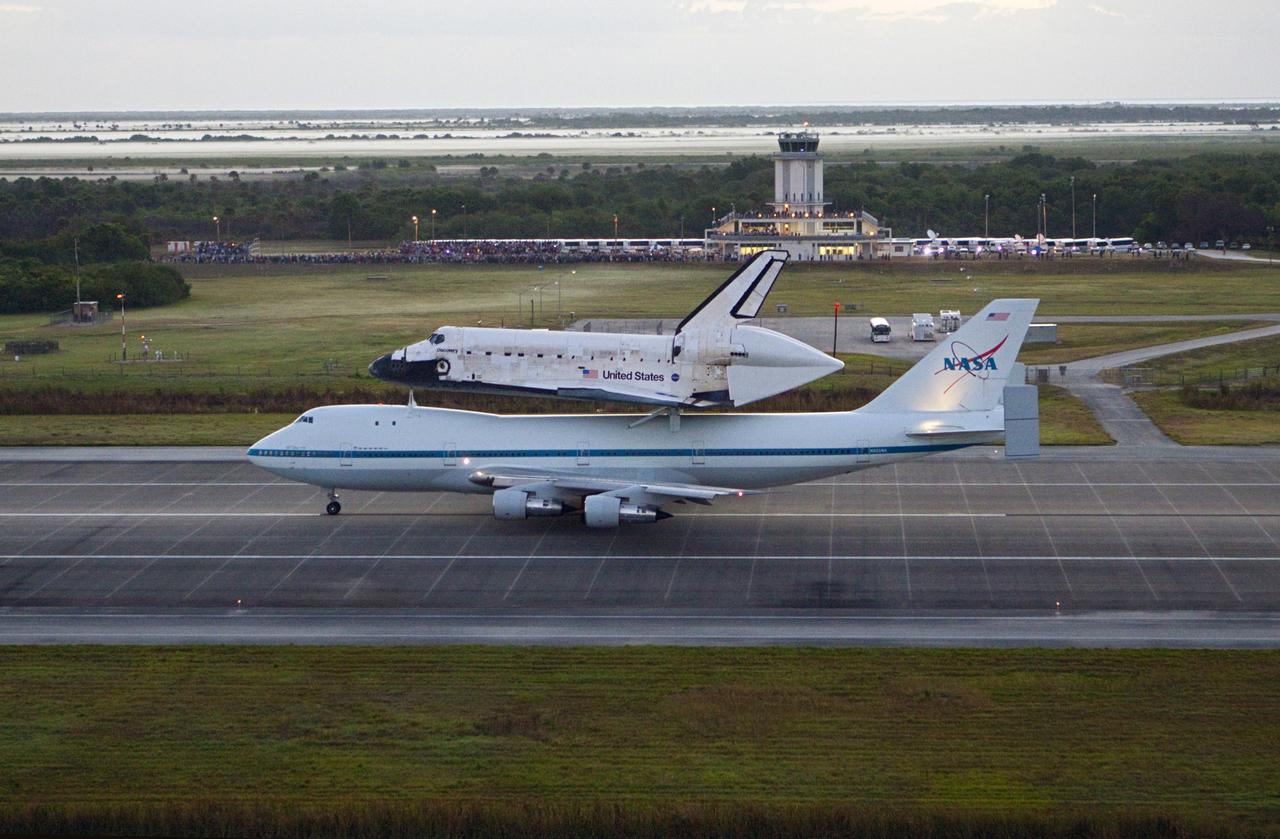
CAPE CANAVERAL, Fla. – In the early morning hours at NASA Kennedy Space Center’s Shuttle Landing Facility in Florida, the Shuttle Carrier Aircraft, or SCA, with space shuttle Discovery secured atop, taxies down the runway for a takeoff at 7 a.m. EDT. In the background is the midfield air traffic control tower. The aircraft, known as an SCA, is a Boeing 747 jet, originally manufactured for commercial use, which was modified by NASA to transport the shuttles between destinations on Earth. This SCA, designated NASA 905, is assigned to the remaining ferry missions, delivering the shuttles to their permanent public display sites. NASA 905 is scheduled to ferry Discovery to the Washington Dulles International Airport in Virginia on April 17, after which the shuttle will be placed on display in the Smithsonian’s National Air and Space Museum, Steven F. Udvar-Hazy Center in Chantilly, Va. For more information on the SCA, visit http://www.nasa.gov/centers/dryden/news/FactSheets/FS-013-DFRC.html. For more information on shuttle transition and retirement activities, visit http://www.nasa.gov/transition. Photo credit: NASA/Glenn Benson
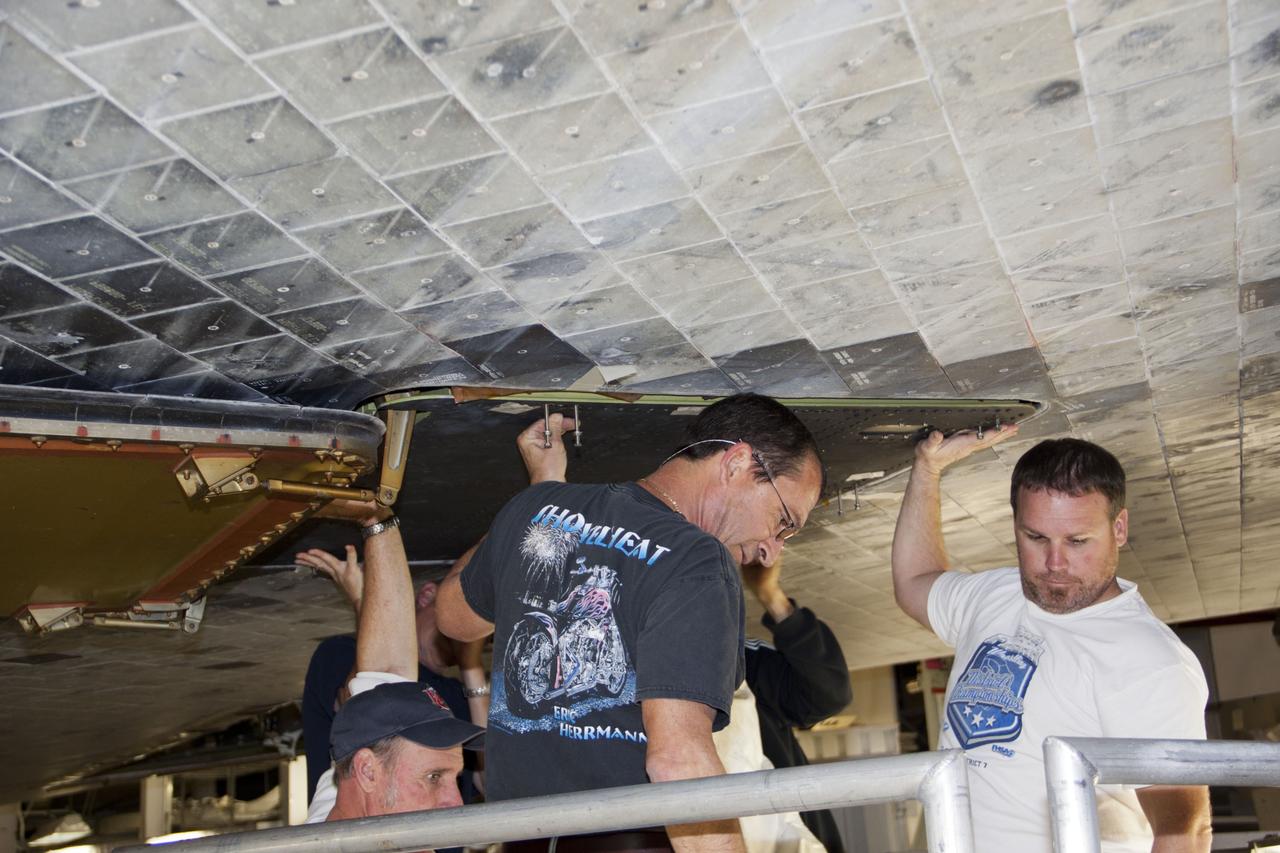
CAPE CANAVERAL, Fla. – Inside Orbiter Processing Facility-1 at NASA’s Kennedy Space Center in Florida, technicians install a ferry flight door on space shuttle Discovery. The work is part of the Space Shuttle Program’s transition and retirement processing of shuttle Discovery, which is being prepared for display at Smithsonian’s National Air and Space Museum, Steven F. Udvar-Hazy Center in Chantilly, Va. Discovery is scheduled to be transported atop a NASA Shuttle Carrier Aircraft modified 747 jet to Dulles International Airport in Virginia on April 17 and then moved to the Smithsonian for permanent public display on April 19. For more information, visit http://www.nasa.gov/shuttle. Photo credit: NASA/Jim Grossmann
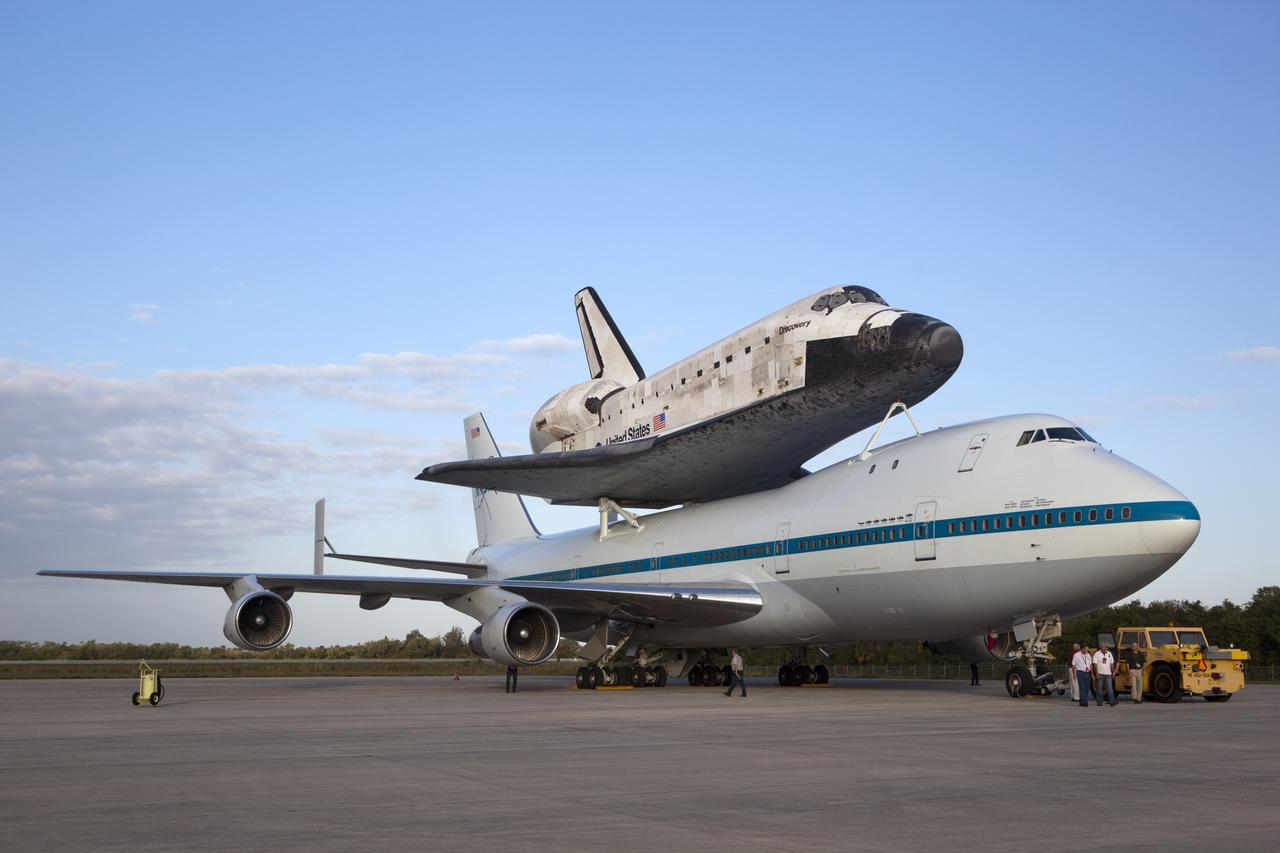
CAPE CANAVERAL, Fla. – At NASA Kennedy Space Center’s Shuttle Landing Facility in Florida, the Shuttle Carrier Aircraft, or SCA, with space shuttle Discovery attached atop, sits on the tarmac after being backed away from the mate/demate device. Known as the MDD, the devise is a large gantry-like steel structure used to hoist a shuttle off the ground and position it onto the back of the SCA. The SCA is a Boeing 747 jet that was originally manufactured for commercial use and modified by NASA to transport the shuttles between destinations on Earth. This SCA, designated NASA 905, is assigned to the remaining ferry missions, delivering the shuttles to their permanent public display sites. NASA 905 is scheduled to ferry Discovery to the Washington Dulles International Airport in Virginia on April 17, after which the shuttle will be placed on display in the Smithsonian’s National Air and Space Museum, Steven F. Udvar-Hazy Center in Chantilly, Va. For more information on the SCA, visit http://www.nasa.gov/centers/dryden/news/FactSheets/FS-013-DFRC.html. For more information on shuttle transition and retirement activities, visit http://www.nasa.gov/transition. Photo credit: NASA/Dimitri Gerondidakis
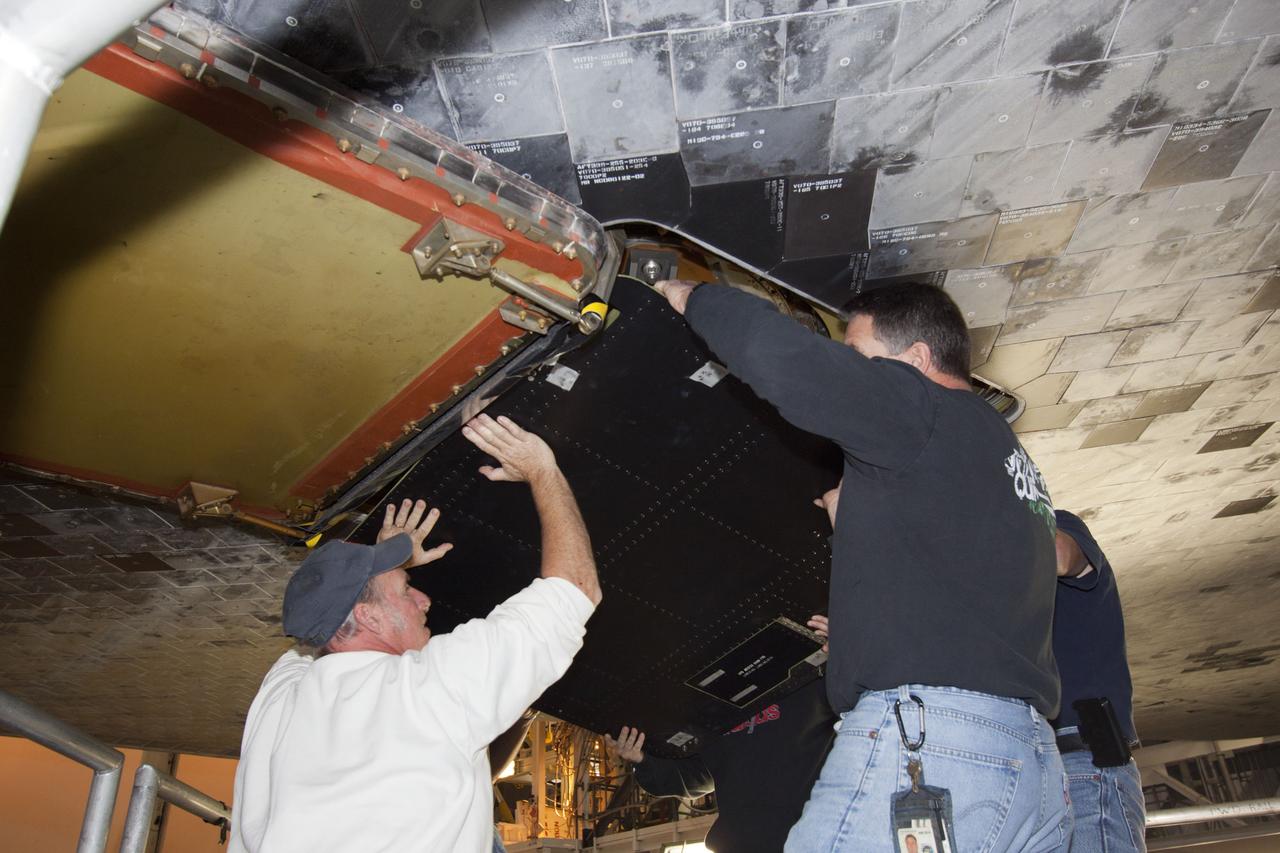
CAPE CANAVERAL, Fla. – Inside Orbiter Processing Facility-1 at NASA’s Kennedy Space Center in Florida, technicians position a ferry flight door for installation on space shuttle Discovery. The work is part of the Space Shuttle Program’s transition and retirement processing of shuttle Discovery, which is being prepared for display at Smithsonian’s National Air and Space Museum, Steven F. Udvar-Hazy Center in Chantilly, Va. Discovery is scheduled to be transported atop a NASA Shuttle Carrier Aircraft modified 747 jet to Dulles International Airport in Virginia on April 17 and then moved to the Smithsonian for permanent public display on April 19. For more information, visit http://www.nasa.gov/shuttle. Photo credit: NASA/Jim Grossmann
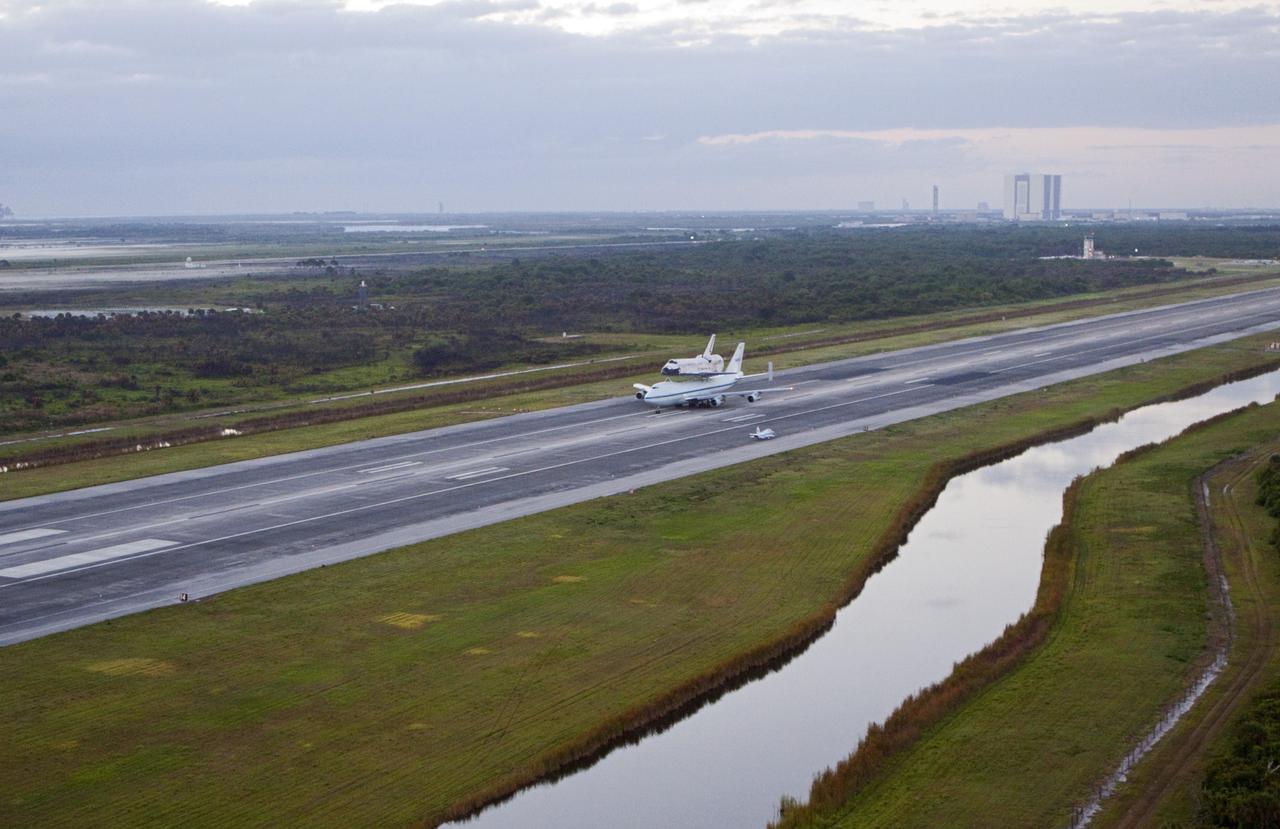
CAPE CANAVERAL, Fla. – In the early morning hours at NASA Kennedy Space Center’s Shuttle Landing Facility in Florida, the Shuttle Carrier Aircraft, or SCA, with space shuttle Discovery secured atop, taxies down the runway for a takeoff at 7 a.m. EDT. In the background is the 525-foot-tall Vehicle Assembly Building. The aircraft, known as an SCA, is a Boeing 747 jet, originally manufactured for commercial use, which was modified by NASA to transport the shuttles between destinations on Earth. This SCA, designated NASA 905, is assigned to the remaining ferry missions, delivering the shuttles to their permanent public display sites. NASA 905 is scheduled to ferry Discovery to the Washington Dulles International Airport in Virginia on April 17, after which the shuttle will be placed on display in the Smithsonian’s National Air and Space Museum, Steven F. Udvar-Hazy Center in Chantilly, Va. For more information on the SCA, visit http://www.nasa.gov/centers/dryden/news/FactSheets/FS-013-DFRC.html. For more information on shuttle transition and retirement activities, visit http://www.nasa.gov/transition. Photo credit: NASA/Glenn Benson
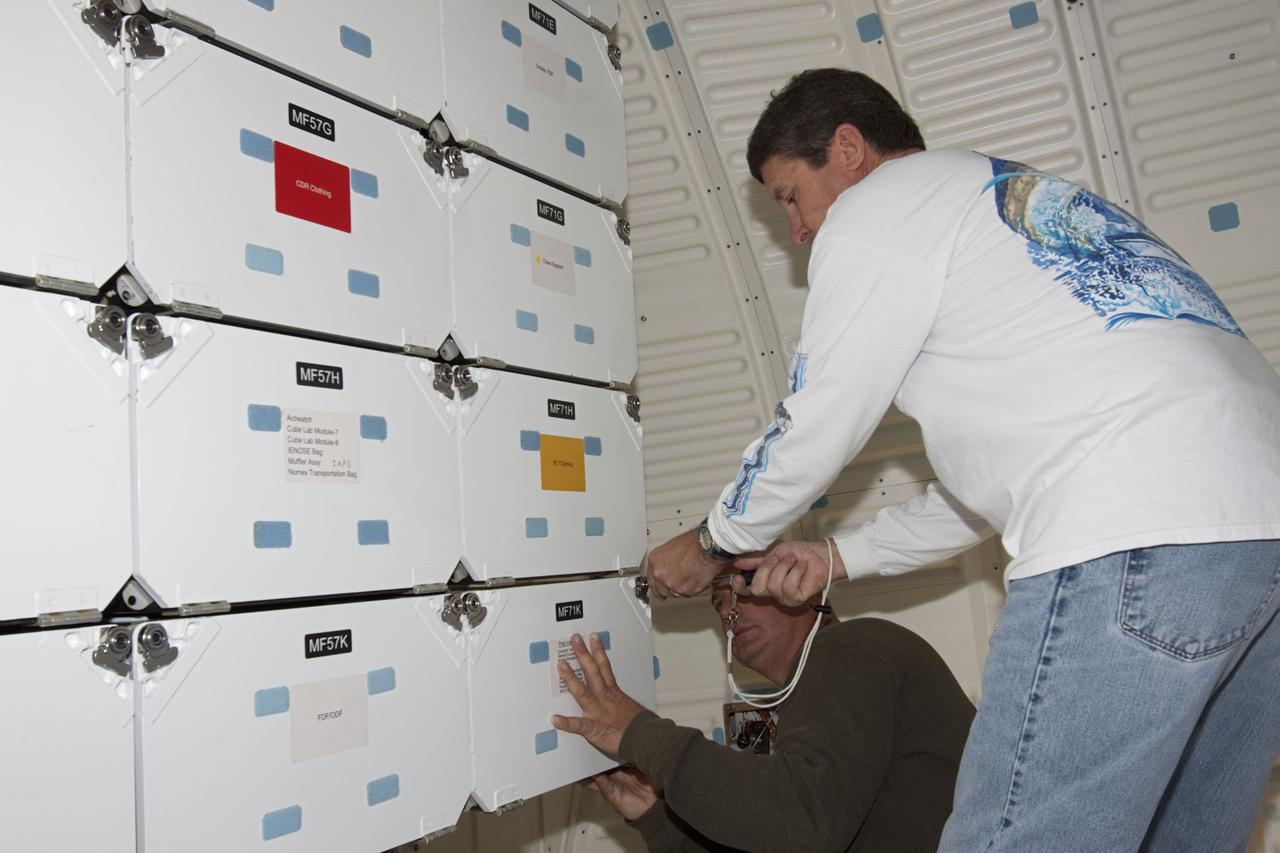
CAPE CANAVERAL, Fla. -- Inside Orbiter Processing Facility-1 at NASA’s Kennedy Space Center in Florida, technicians reinstall the lockers in the middeck of space shuttle Discovery. The work is part of the Space Shuttle Program’s transition and retirement processing of shuttle Discovery, which is being prepared for display at Smithsonian’s National Air and Space Museum, Steven F. Udvar-Hazy Center in Chantilly, Va. Discovery is scheduled to be transported atop a NASA Shuttle Carrier Aircraft modified 747 jet to Dulles International Airport in Virginia on April 17 and then be transported to the Smithsonian on April 19. For more information, visit http://www.nasa.gov/shuttle. Photo credit: NASA/Jim Grossmann
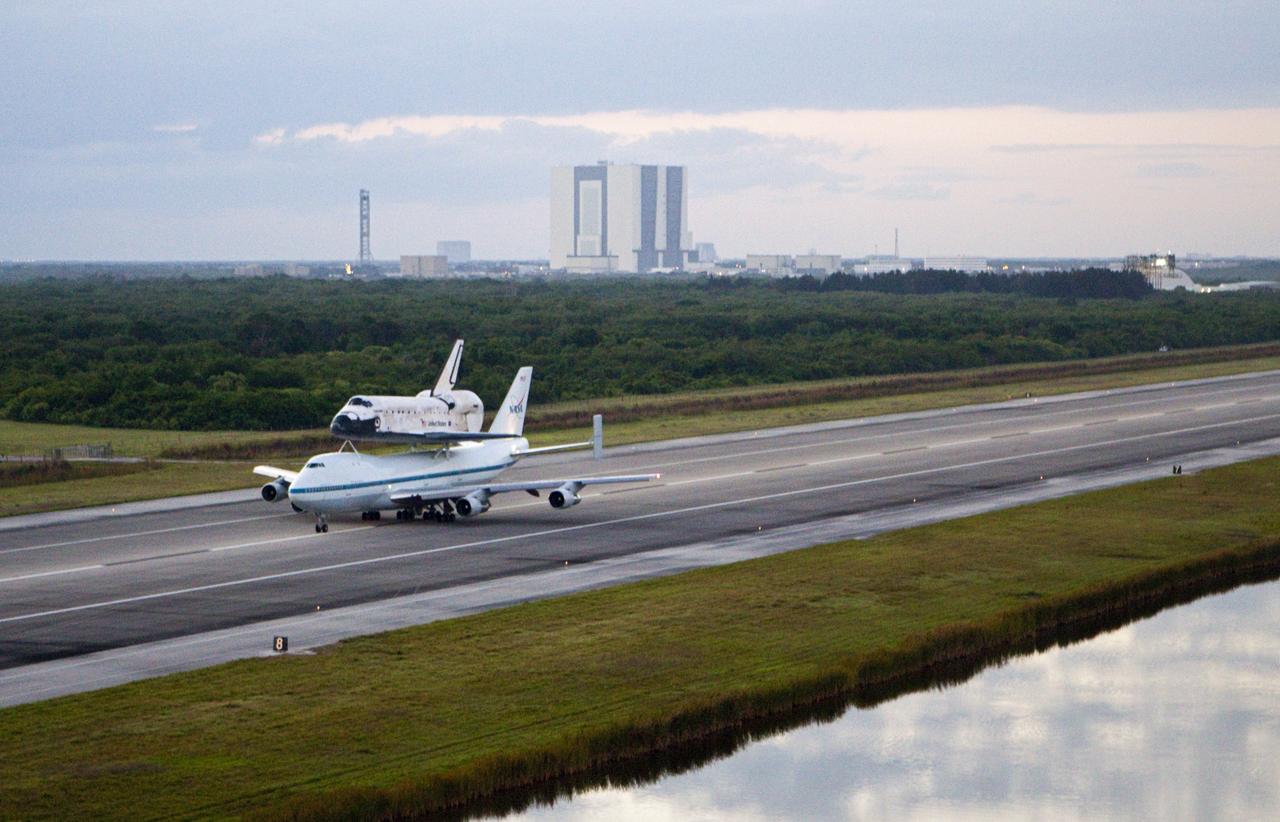
CAPE CANAVERAL, Fla. – In the early morning hours at NASA Kennedy Space Center’s Shuttle Landing Facility in Florida, the Shuttle Carrier Aircraft, or SCA, with space shuttle Discovery secured atop, taxies down the runway for a takeoff at 7 a.m. EDT. In the background is the midfield air traffic control tower. The aircraft, known as an SCA, is a Boeing 747 jet, originally manufactured for commercial use, which was modified by NASA to transport the shuttles between destinations on Earth. This SCA, designated NASA 905, is assigned to the remaining ferry missions, delivering the shuttles to their permanent public display sites. NASA 905 is scheduled to ferry Discovery to the Washington Dulles International Airport in Virginia on April 17, after which the shuttle will be placed on display in the Smithsonian’s National Air and Space Museum, Steven F. Udvar-Hazy Center in Chantilly, Va. For more information on the SCA, visit http://www.nasa.gov/centers/dryden/news/FactSheets/FS-013-DFRC.html. For more information on shuttle transition and retirement activities, visit http://www.nasa.gov/transition. Photo credit: NASA/Glenn Benson

CAPE CANAVERAL, Fla. – The “pathfinder” aircraft for space shuttle Discovery’s ferry flight pulls up beside the Shuttle Carrier Aircraft on the tarmac of the Shuttle Landing Facility at NASA’s Kennedy Space Center in Florida. The NASA C-9 aircraft will fly about 100 miles ahead of Discovery to scout for the safest route between destinations. Its crew includes an SCA flight engineer who studies the weather patterns along the flight path to find a route free of rain and other turbulence. The carrier aircraft, also known as an SCA, is a Boeing 747 jet, originally manufactured for commercial use which was modified by NASA to transport the shuttles between destinations on Earth. NASA 905 is scheduled to ferry Discovery to the Washington Dulles International Airport in Virginia on April 17, and is assigned to all remaining ferry missions, delivering the shuttles to their permanent public display sites. After its arrival at Dulles, Discovery will be placed on display in the Smithsonian's National Air and Space Museum Steven F. Udvar-Hazy Center on April 19. For more information on the SCA, visit http://www.nasa.gov/centers/dryden/news/FactSheets/FS-013-DFRC.html. For more information on shuttle transition and retirement activities, visit http://www.nasa.gov/transition. Photo credit: NASA/Amanda Diller
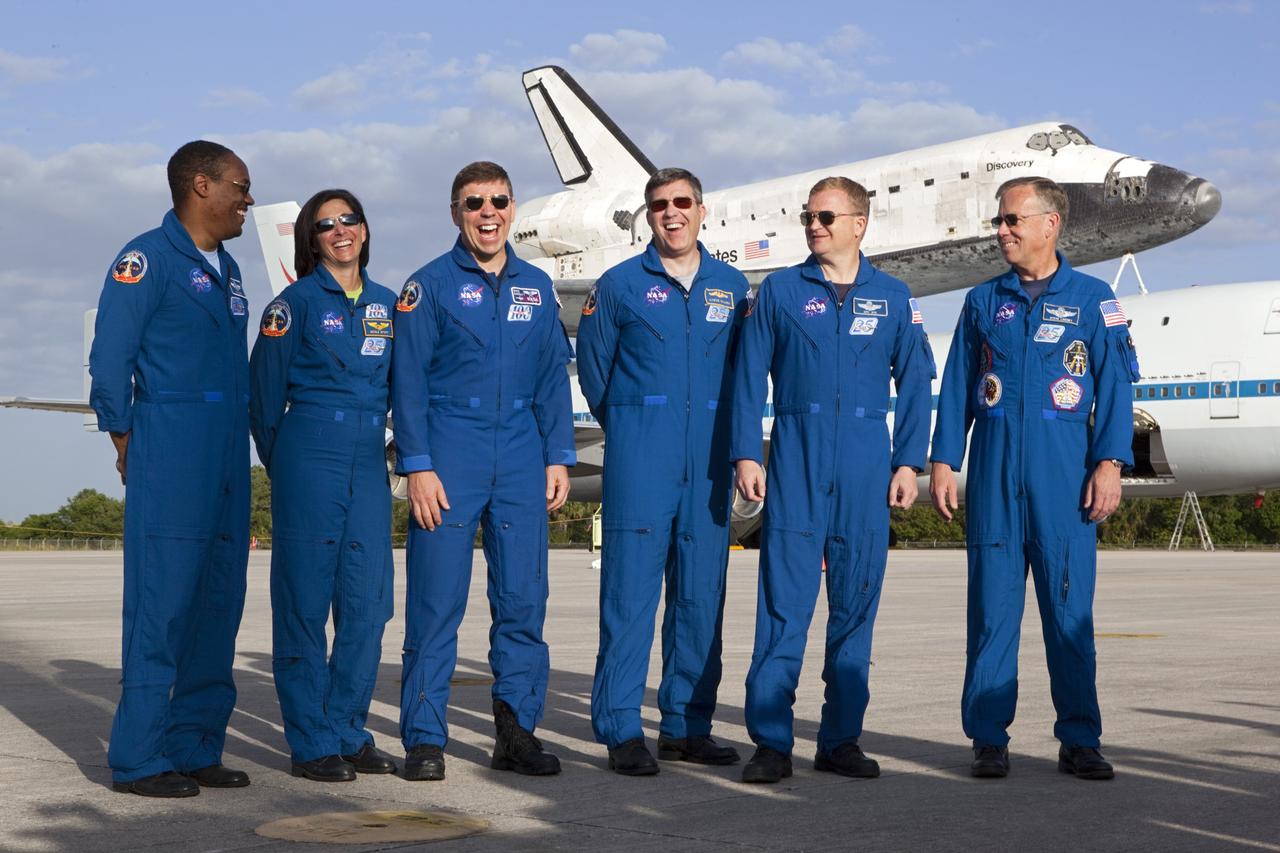
CAPE CANAVERAL, Fla. – At NASA Kennedy Space Center’s Shuttle Landing Facility in Florida, crew members of space shuttle Discovery’s last mission, STS-133, visit with each other after arriving in T-38 jet aircraft. From the left, are Mission Specialists Alvin Drew, Nicole Stott, Michael Barrett and Steve Bowen, Pilot Eric Boe and Commander Steve Lindsay. In the background is the Shuttle Carrier Aircraft, or SCA, with space shuttle Discovery attached atop after being backed away from the mate/demate device. Known as the MDD, the devise is a large gantry-like steel structure used to hoist a shuttle off the ground and position it onto the back of the SCA. The SCA is a Boeing 747 jet that was originally manufactured for commercial use and modified by NASA to transport the shuttles between destinations on Earth. This SCA, designated NASA 905, is assigned to the remaining ferry missions, delivering the shuttles to their permanent public display sites. NASA 905 is scheduled to ferry Discovery to the Washington Dulles International Airport in Virginia on April 17, after which the shuttle will be placed on display in the Smithsonian’s National Air and Space Museum, Steven F. Udvar-Hazy Center in Chantilly, Va. For more information on the SCA, visit http://www.nasa.gov/centers/dryden/news/FactSheets/FS-013-DFRC.html. For more information on shuttle transition and retirement activities, visit http://www.nasa.gov/transition. Photo credit: NASA/Dimitri Gerondidakis
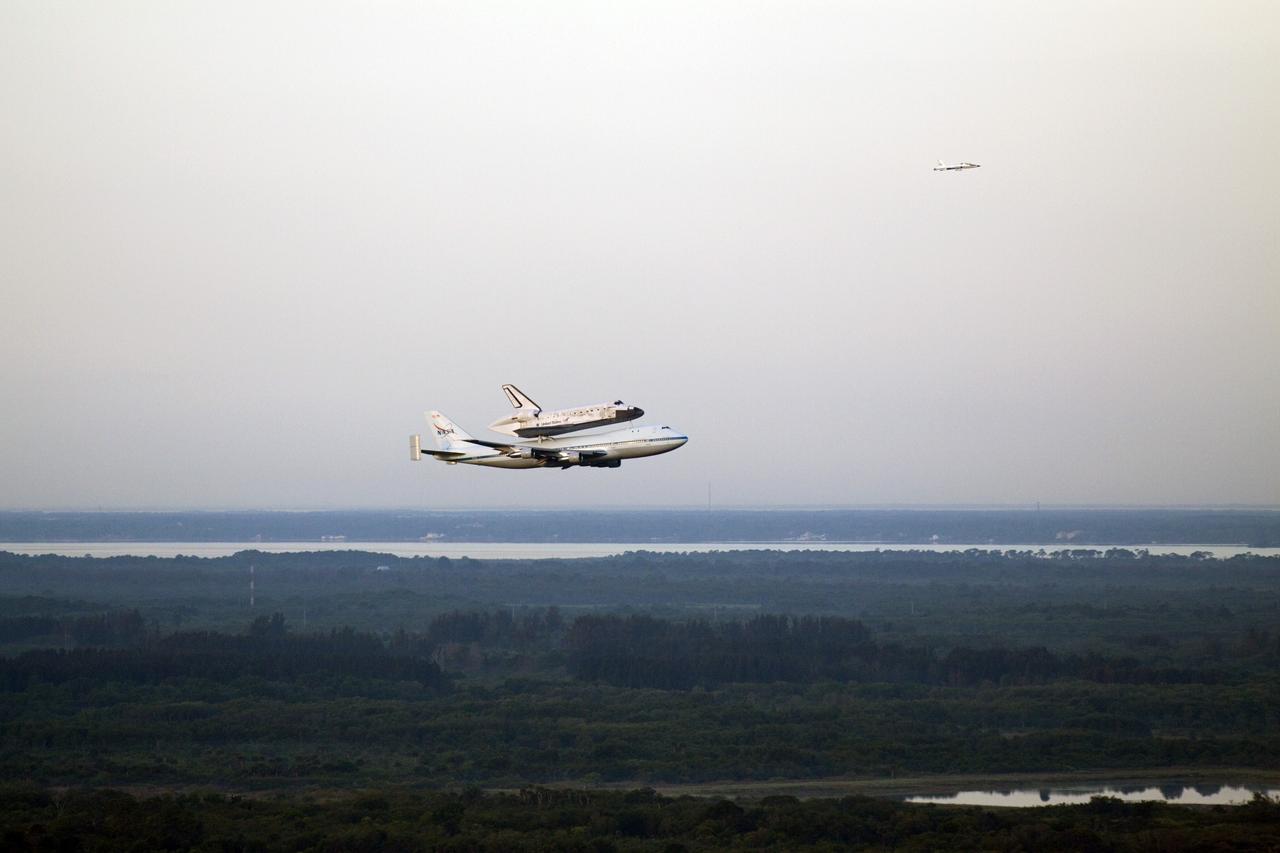
CAPE CANAVERAL, Fla. – The Shuttle Carrier Aircraft transporting space shuttle Discovery to its new home takes off from the Shuttle Landing Facility at NASA’s Kennedy Space Center in Florida at 7 a.m. EDT accompanied by a T-38 jet. The aircraft, known as an SCA, is a Boeing 747 jet, originally manufactured for commercial use, which was modified by NASA to transport the shuttles between destinations on Earth. This SCA, designated NASA 905, is assigned to the remaining ferry missions, delivering the shuttles to their permanent public display sites. NASA 905 is scheduled to ferry Discovery to the Washington Dulles International Airport in Virginia today, after which the shuttle will be placed on display in the Smithsonian's National Air and Space Museum Steven F. Udvar-Hazy Center. For more information on the SCA, visit http://www.nasa.gov/centers/dryden/news/FactSheets/FS-013-DFRC.html. For more information on shuttle transition and retirement activities, visit http://www.nasa.gov/transition. Photo credit: NASA/Glenn Benson

CAPE CANAVERAL, Fla. – At NASA Kennedy Space Center’s Shuttle Landing Facility in Florida, crew members of space shuttle Discovery’s last mission, STS-133, have arrived. Mission Specialist Nicole Stott visits with the media. Also present, but not in view, are Mission Specialists Michael Barrett, Steve Bowen and Alvin Drew, Pilot Eric Boe and Commander Steve Lindsay. The crew arrived to view the Shuttle Carrier Aircraft, or SCA, with space shuttle Discovery attached atop after being backed away from the mate/demate device. Known as the MDD, the devise is a large gantry-like steel structure used to hoist a shuttle off the ground and position it onto the back of the SCA. The SCA is a Boeing 747 jet that was originally manufactured for commercial use and modified by NASA to transport the shuttles between destinations on Earth. This SCA, designated NASA 905, is assigned to the remaining ferry missions, delivering the shuttles to their permanent public display sites. NASA 905 is scheduled to ferry Discovery to the Washington Dulles International Airport in Virginia on April 17, after which the shuttle will be placed on display in the Smithsonian’s National Air and Space Museum, Steven F. Udvar-Hazy Center in Chantilly, Va. For more information on the SCA, visit http://www.nasa.gov/centers/dryden/news/FactSheets/FS-013-DFRC.html. For more information on shuttle transition and retirement activities, visit http://www.nasa.gov/transition. Photo credit: NASA/Dimitri Gerondidakis
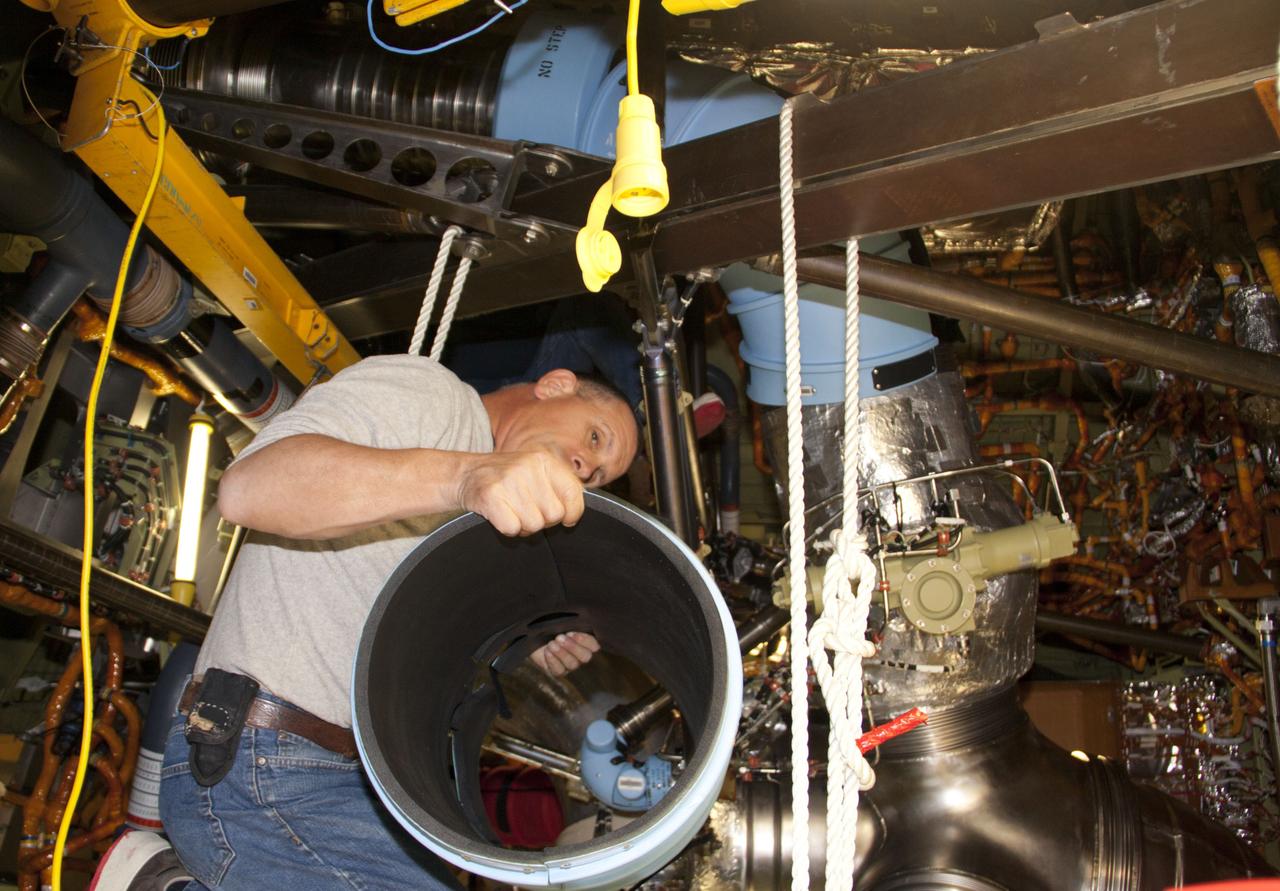
CAPE CANAVERAL, Fla. – Inside Orbiter Processing Facility-1 at NASA’s Kennedy Space Center in Florida, technicians prepare to remove space shuttle Discovery’s main propulsion system protective covers. The work is part of the Space Shuttle Program’s transition and retirement processing of shuttle Discovery, which is being prepared for display at Smithsonian’s National Air and Space Museum, Steven F. Udvar-Hazy Center in Chantilly, Va. Discovery is scheduled to be transported atop a NASA Shuttle Carrier Aircraft modified 747 jet to Dulles International Airport in Virginia on April 17 and then moved to the Smithsonian for permanent public display on April 19. For more information, visit http://www.nasa.gov/shuttle. Photo credit: NASA/Jim Grossmann
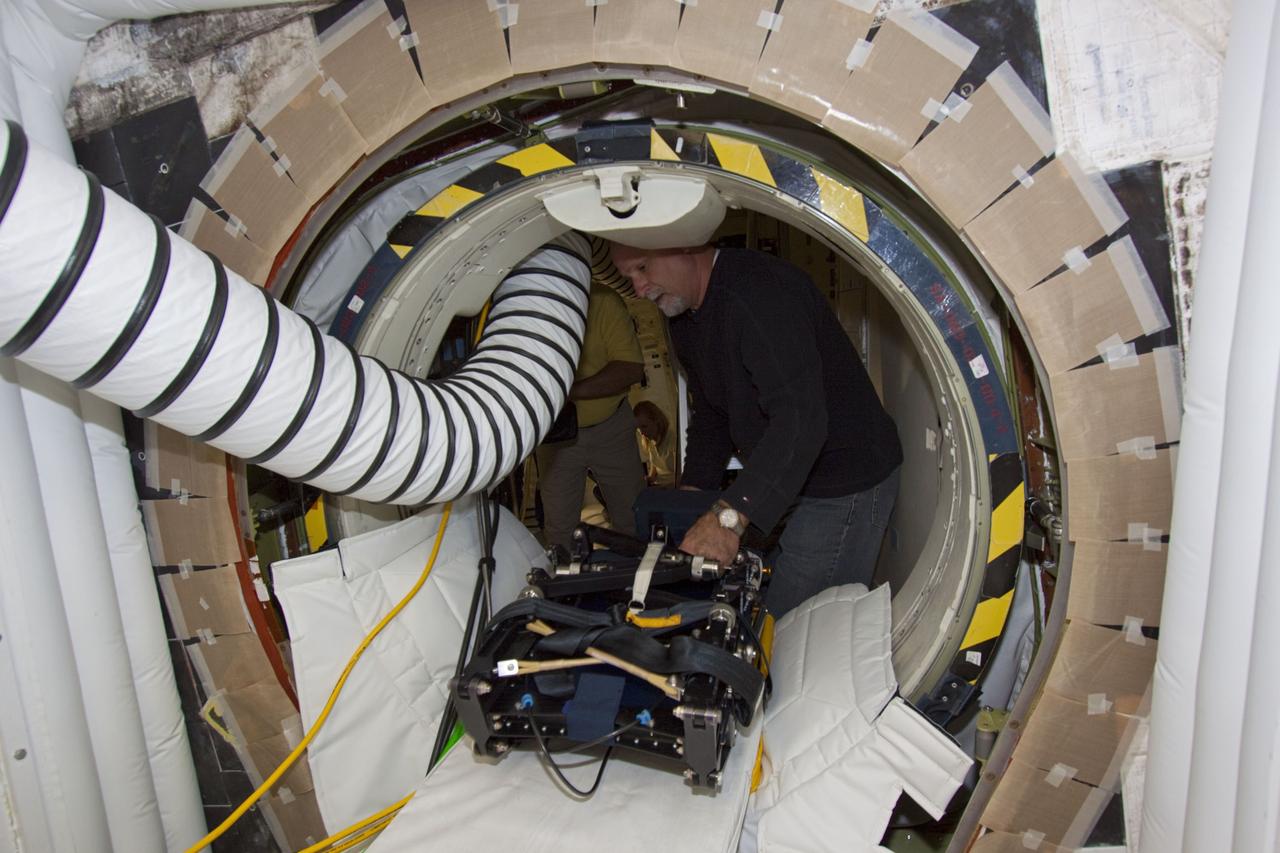
CAPE CANAVERAL, Fla. -- Inside Orbiter Processing Facility-1 at NASA’s Kennedy Space Center in Florida, technicians prepare to reinstall the seats in the middeck of space shuttle Discovery. The work is part of the Space Shuttle Program’s transition and retirement processing of shuttle Discovery, which is being prepared for display at Smithsonian’s National Air and Space Museum, Steven F. Udvar-Hazy Center in Chantilly, Va. Discovery is scheduled to be transported atop a NASA Shuttle Carrier Aircraft modified 747 jet to Dulles International Airport in Virginia on April 17 and then be transported to the Smithsonian on April 19. For more information, visit http://www.nasa.gov/shuttle. Photo credit: NASA/Jim Grossmann
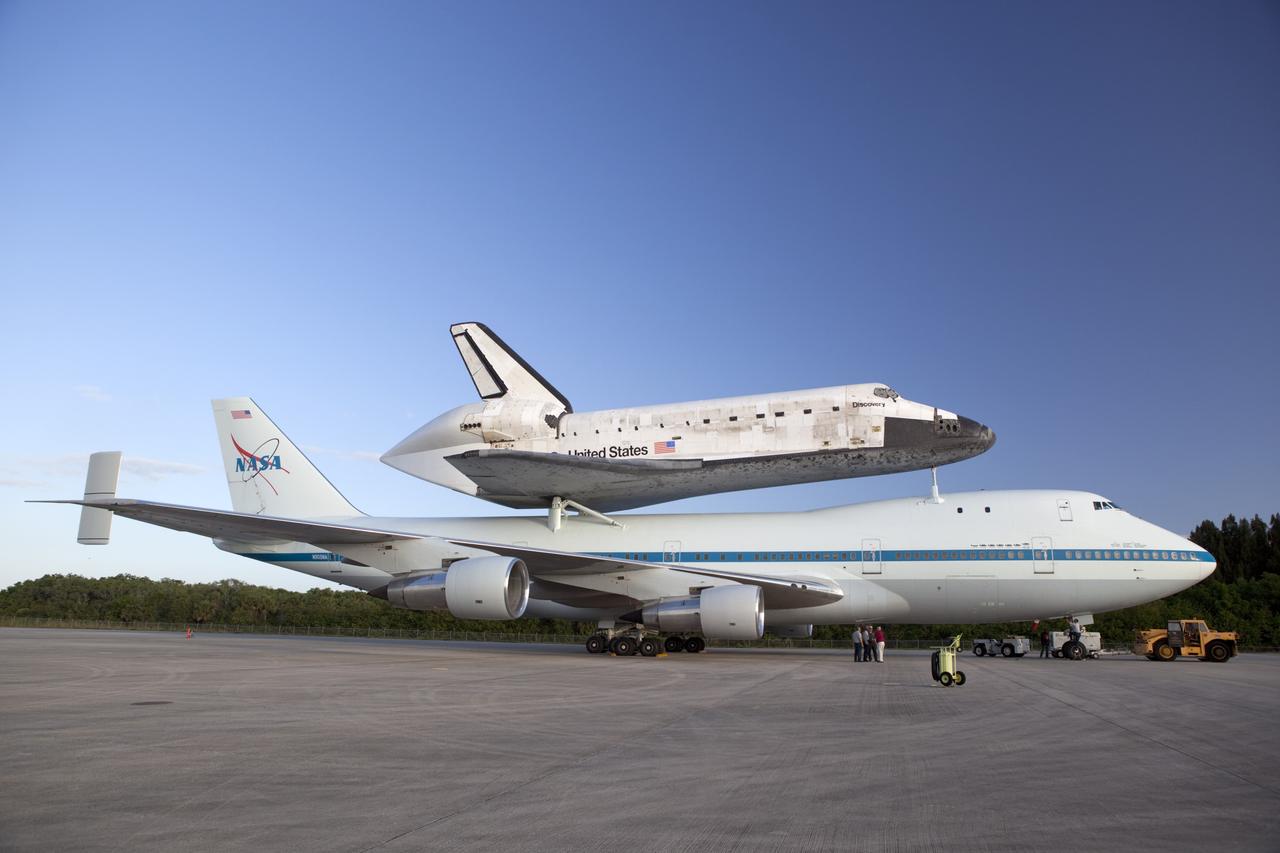
CAPE CANAVERAL, Fla. – At NASA Kennedy Space Center’s Shuttle Landing Facility in Florida, the Shuttle Carrier Aircraft, or SCA, with space shuttle Discovery attached atop, sits on the tarmac after being backed away from the mate/demate device. Known as the MDD, the devise is a large gantry-like steel structure used to hoist a shuttle off the ground and position it onto the back of the SCA. The SCA is a Boeing 747 jet that was originally manufactured for commercial use and modified by NASA to transport the shuttles between destinations on Earth. This SCA, designated NASA 905, is assigned to the remaining ferry missions, delivering the shuttles to their permanent public display sites. NASA 905 is scheduled to ferry Discovery to the Washington Dulles International Airport in Virginia on April 17, after which the shuttle will be placed on display in the Smithsonian’s National Air and Space Museum, Steven F. Udvar-Hazy Center in Chantilly, Va. For more information on the SCA, visit http://www.nasa.gov/centers/dryden/news/FactSheets/FS-013-DFRC.html. For more information on shuttle transition and retirement activities, visit http://www.nasa.gov/transition. Photo credit: NASA/Dimitri Gerondidakis
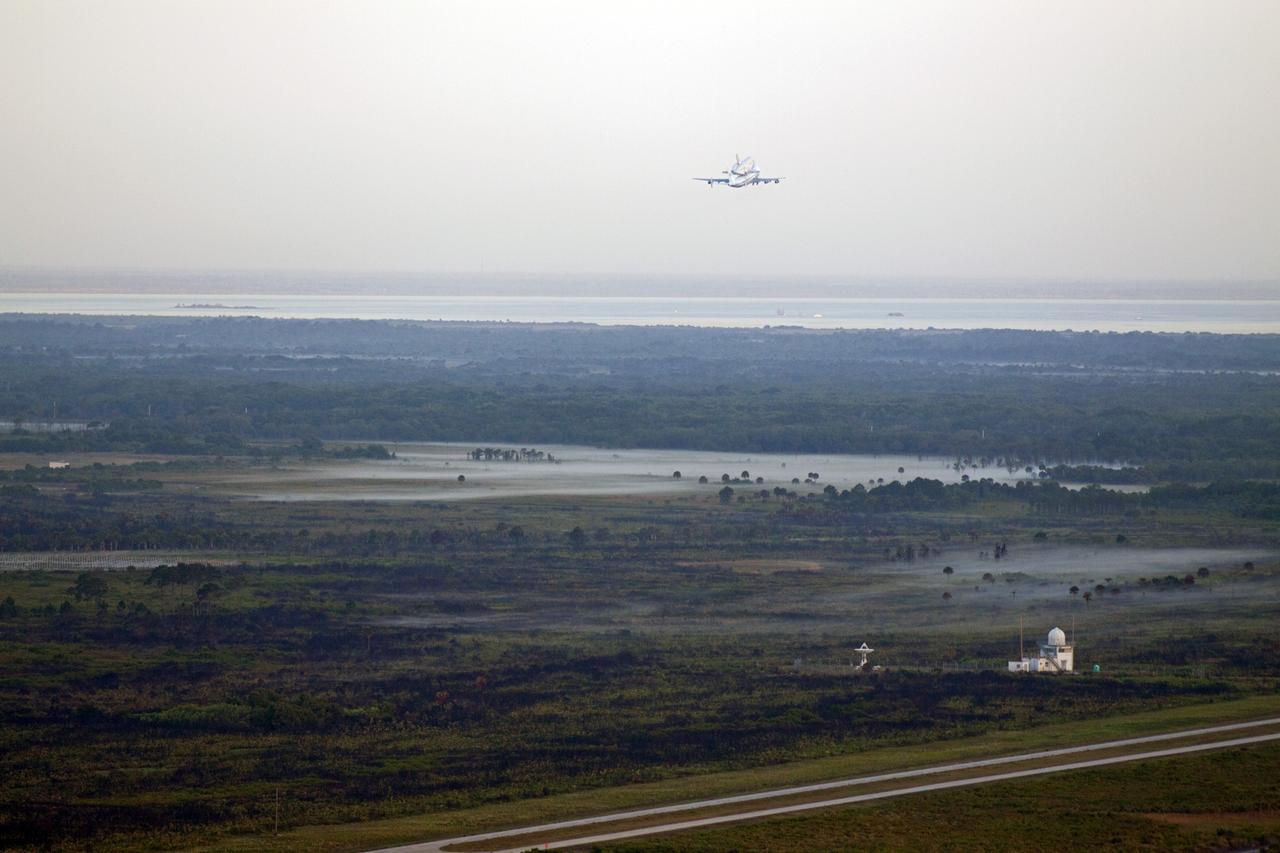
CAPE CANAVERAL, Fla. – The Shuttle Carrier Aircraft transporting space shuttle Discovery to its new home takes off from the Shuttle Landing Facility at NASA’s Kennedy Space Center in Florida at 7 a.m. EDT. The aircraft, known as an SCA, is a Boeing 747 jet, originally manufactured for commercial use, which was modified by NASA to transport the shuttles between destinations on Earth. This SCA, designated NASA 905, is assigned to the remaining ferry missions, delivering the shuttles to their permanent public display sites. NASA 905 is scheduled to ferry Discovery to the Washington Dulles International Airport in Virginia today, after which the shuttle will be placed on display in the Smithsonian's National Air and Space Museum Steven F. Udvar-Hazy Center. For more information on the SCA, visit http://www.nasa.gov/centers/dryden/news/FactSheets/FS-013-DFRC.html. For more information on shuttle transition and retirement activities, visit http://www.nasa.gov/transition. Photo credit: NASA/Glenn Benson

CAPE CANAVERAL, Fla. – At NASA Kennedy Space Center’s Shuttle Landing Facility in Florida, crew members of space shuttle Discovery’s last mission, STS-133, have arrived. Pilot Eric Boe visits with the media. Also present, but not in view, are Mission Specialists Nicole Stott, Michael Barrett, Steve Bowen and Alvin Drew, and Commander Steve Lindsay. The crew arrived to view the Shuttle Carrier Aircraft, or SCA, with space shuttle Discovery attached atop after being backed away from the mate/demate device. Known as the MDD, the devise is a large gantry-like steel structure used to hoist a shuttle off the ground and position it onto the back of the SCA. The SCA is a Boeing 747 jet that was originally manufactured for commercial use and modified by NASA to transport the shuttles between destinations on Earth. This SCA, designated NASA 905, is assigned to the remaining ferry missions, delivering the shuttles to their permanent public display sites. NASA 905 is scheduled to ferry Discovery to the Washington Dulles International Airport in Virginia on April 17, after which the shuttle will be placed on display in the Smithsonian’s National Air and Space Museum, Steven F. Udvar-Hazy Center in Chantilly, Va. For more information on the SCA, visit http://www.nasa.gov/centers/dryden/news/FactSheets/FS-013-DFRC.html. For more information on shuttle transition and retirement activities, visit http://www.nasa.gov/transition. Photo credit: NASA/Dimitri Gerondidakis
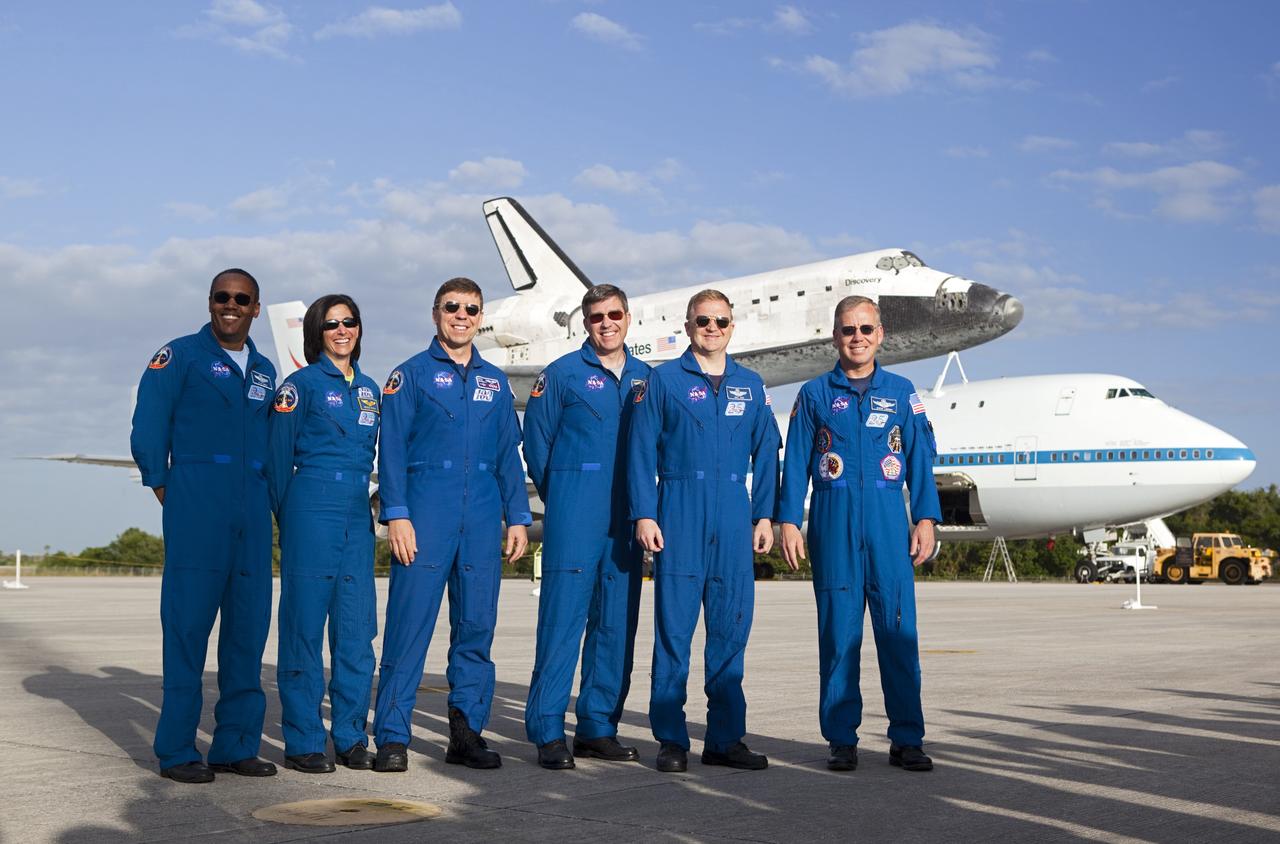
CAPE CANAVERAL, Fla. – At NASA Kennedy Space Center’s Shuttle Landing Facility in Florida, crew members of space shuttle Discovery’s last mission, STS-133, have arrived. From the left, are Mission Specialists Alvin Drew, Nicole Stott, Michael Barrett and Steve Bowen, Pilot Eric Boe and Commander Steve Lindsay. In the background is the Shuttle Carrier Aircraft, or SCA, with space shuttle Discovery attached atop after being backed away from the mate/demate device. Known as the MDD, the devise is a large gantry-like steel structure used to hoist a shuttle off the ground and position it onto the back of the SCA. The SCA is a Boeing 747 jet that was originally manufactured for commercial use and modified by NASA to transport the shuttles between destinations on Earth. This SCA, designated NASA 905, is assigned to the remaining ferry missions, delivering the shuttles to their permanent public display sites. NASA 905 is scheduled to ferry Discovery to the Washington Dulles International Airport in Virginia on April 17, after which the shuttle will be placed on display in the Smithsonian’s National Air and Space Museum, Steven F. Udvar-Hazy Center in Chantilly, Va. For more information on the SCA, visit http://www.nasa.gov/centers/dryden/news/FactSheets/FS-013-DFRC.html. For more information on shuttle transition and retirement activities, visit http://www.nasa.gov/transition. Photo credit: NASA/Dimitri Gerondidakis
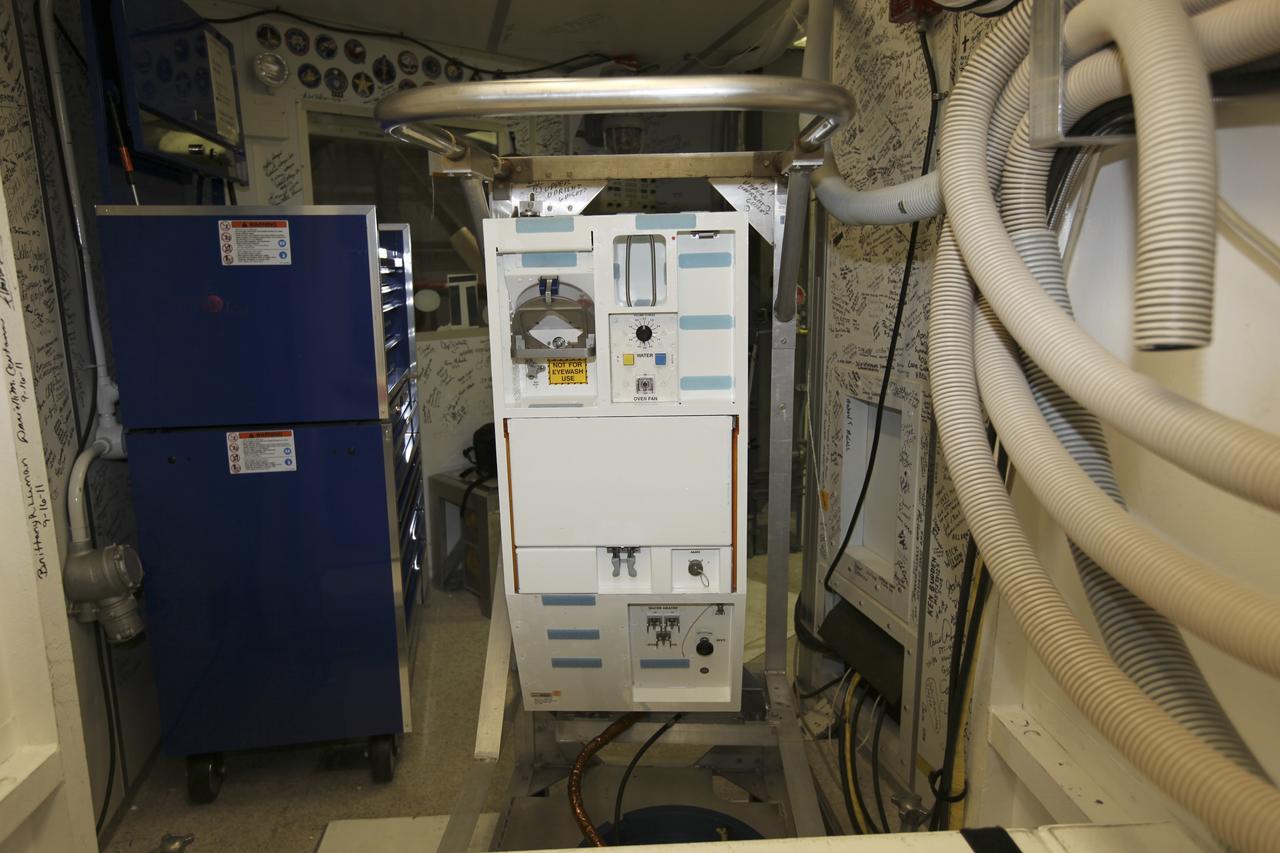
CAPE CANAVERAL, Fla. – Inside Orbiter Processing Facility-1 at NASA’s Kennedy Space Center in Florida, the shuttle orbiter repackaged galley (SORG) is being installed in the middeck of space shuttle Discovery. After Discovery’s final mission, STS-133, the SORG was removed and sent to a United Space Alliance lab in Houston where it was cleaned and deserviced. Water in the microbial check valve and the orbiter water system was drained and dried. The SORG was returned to Kennedy Space Center. The work is part of the Space Shuttle Program’s transition and retirement processing of shuttle Discovery, which is being prepared for display at Smithsonian’s National Air and Space Museum, Steven F. Udvar-Hazy Center in Chantilly, Va. For more information, visit http://www.nasa.gov/shuttle. Photo credit: NASA/Dimitri Gerondidakis
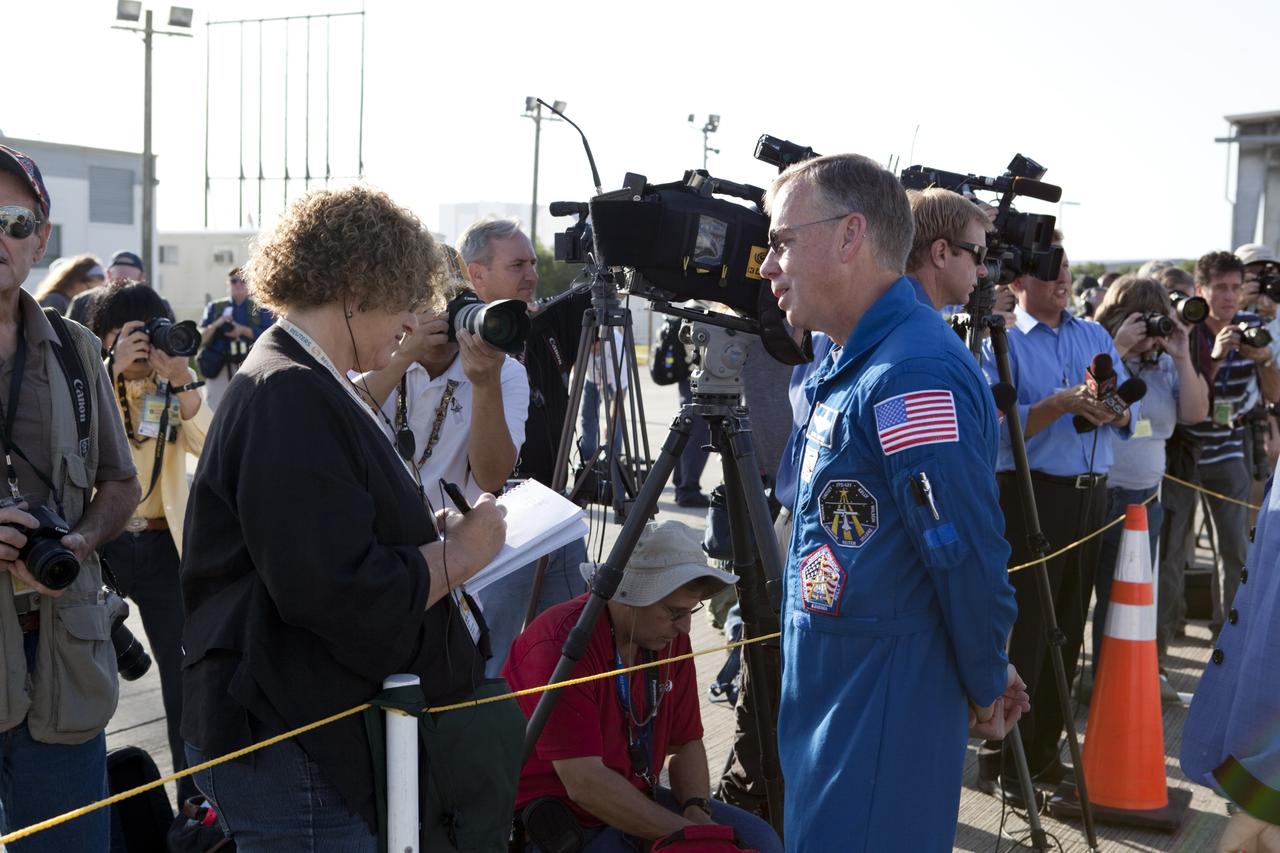
CAPE CANAVERAL, Fla. – At NASA Kennedy Space Center’s Shuttle Landing Facility in Florida, crew members of space shuttle Discovery’s last mission, STS-133, have arrived. Commander Steve Lindsay visits with the media. Also present, but not in view, are Mission Specialists Nicole Stott, Michael Barrett, Steve Bowen and Alvin Drew, and Pilot Eric Boe. The crew arrived to view the Shuttle Carrier Aircraft, or SCA, with space shuttle Discovery attached atop after being backed away from the mate/demate device. Known as the MDD, the devise is a large gantry-like steel structure used to hoist a shuttle off the ground and position it onto the back of the SCA. The SCA is a Boeing 747 jet that was originally manufactured for commercial use and modified by NASA to transport the shuttles between destinations on Earth. This SCA, designated NASA 905, is assigned to the remaining ferry missions, delivering the shuttles to their permanent public display sites. NASA 905 is scheduled to ferry Discovery to the Washington Dulles International Airport in Virginia on April 17, after which the shuttle will be placed on display in the Smithsonian’s National Air and Space Museum, Steven F. Udvar-Hazy Center in Chantilly, Va. For more information on the SCA, visit http://www.nasa.gov/centers/dryden/news/FactSheets/FS-013-DFRC.html. For more information on shuttle transition and retirement activities, visit http://www.nasa.gov/transition. Photo credit: NASA/Dimitri Gerondidakis

CAPE CANAVERAL, Fla. -- Inside Orbiter Processing Facility-1 at NASA’s Kennedy Space Center in Florida, technicians transfer seats to the middeck of space shuttle Discovery for installation. The work is part of the Space Shuttle Program’s transition and retirement processing of shuttle Discovery, which is being prepared for display at Smithsonian’s National Air and Space Museum, Steven F. Udvar-Hazy Center in Chantilly, Va. Discovery is scheduled to be transported atop a NASA Shuttle Carrier Aircraft modified 747 jet to Dulles International Airport in Virginia on April 17 and then be transported to the Smithsonian on April 19. For more information, visit http://www.nasa.gov/shuttle. Photo credit: NASA/Jim Grossmann
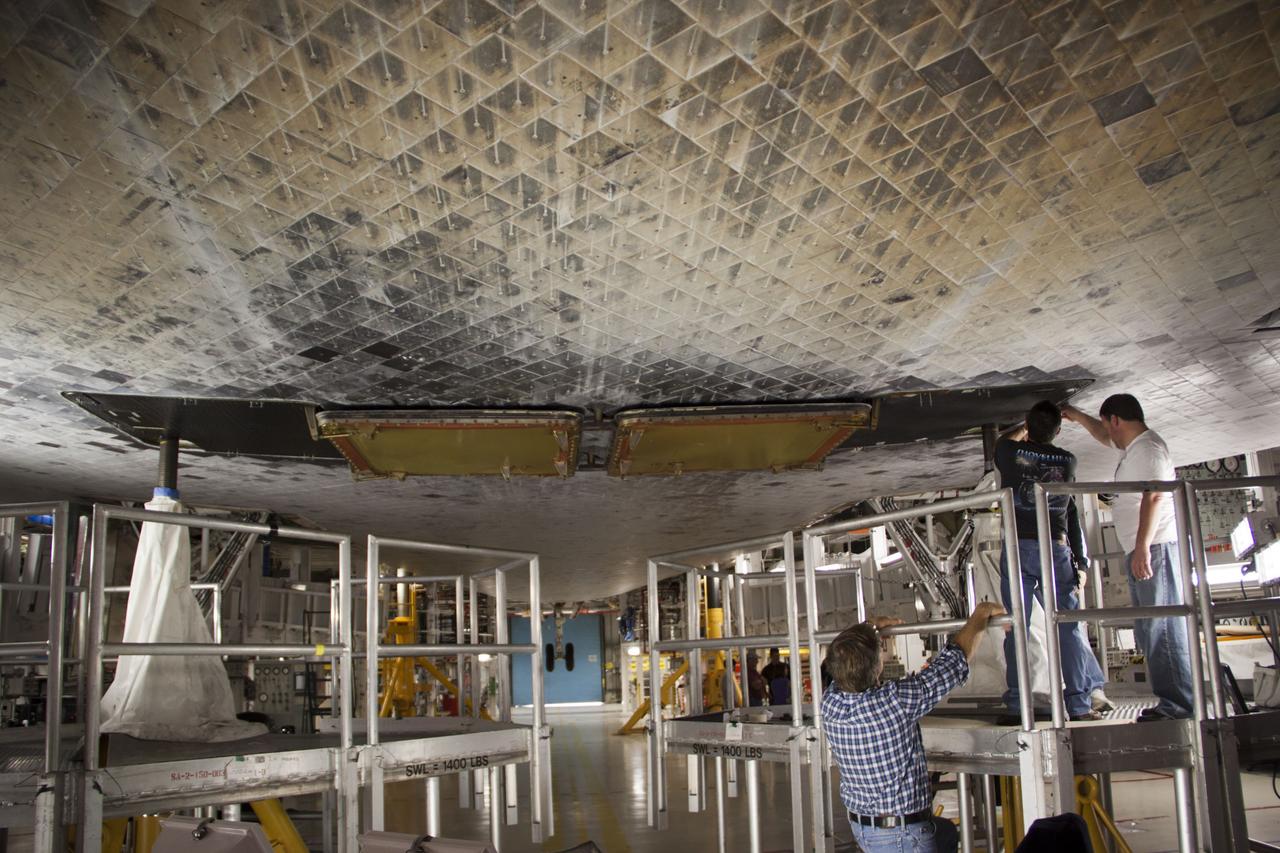
CAPE CANAVERAL, Fla. – Inside Orbiter Processing Facility-1 at NASA’s Kennedy Space Center in Florida, technicians complete the work to install the ferry flight doors on space shuttle Discovery. The work is part of the Space Shuttle Program’s transition and retirement processing of shuttle Discovery, which is being prepared for display at Smithsonian’s National Air and Space Museum, Steven F. Udvar-Hazy Center in Chantilly, Va. Discovery is scheduled to be transported atop a NASA Shuttle Carrier Aircraft modified 747 jet to Dulles International Airport in Virginia on April 17 and then moved to the Smithsonian for permanent public display on April 19. For more information, visit http://www.nasa.gov/shuttle. Photo credit: NASA/Jim Grossmann
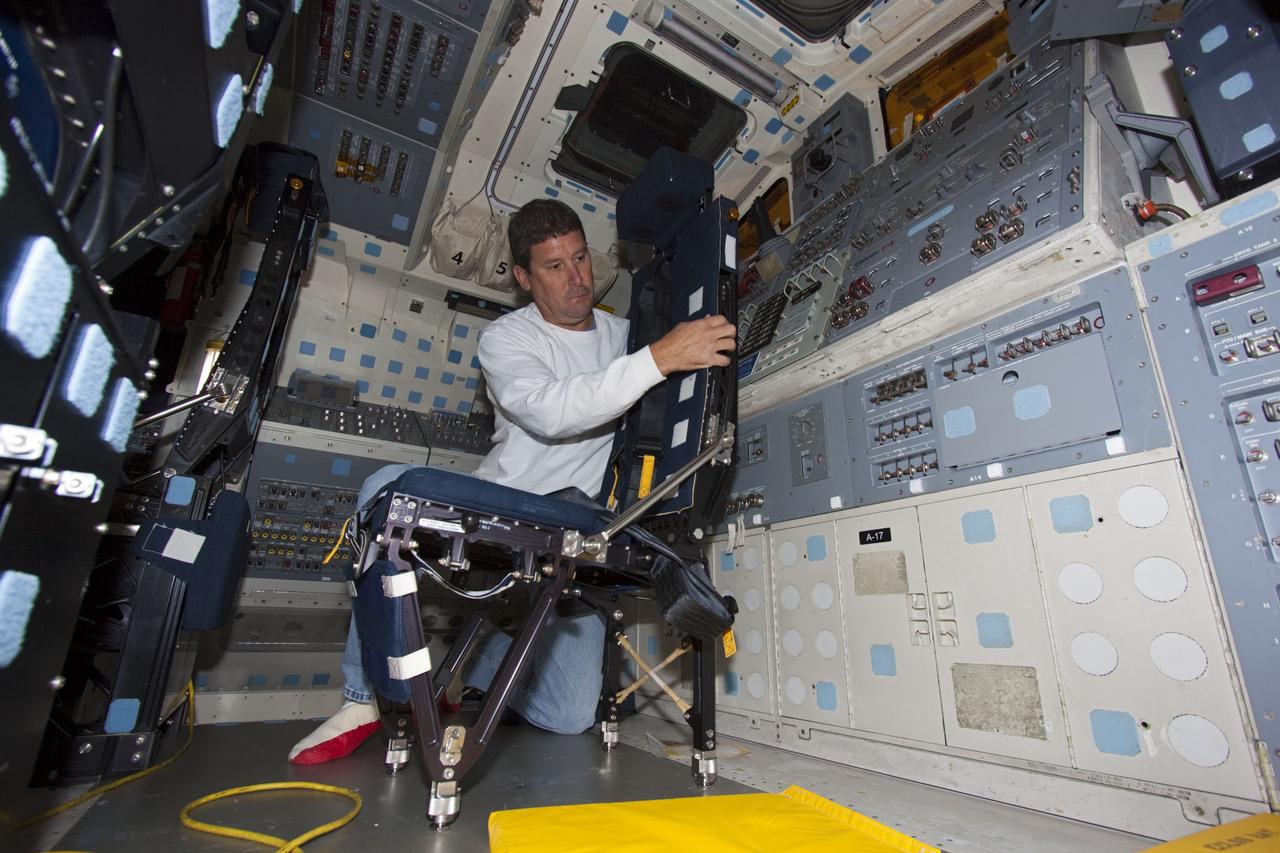
CAPE CANAVERAL, Fla. -- Inside Orbiter Processing Facility-1 at NASA’s Kennedy Space Center in Florida, a technician reinstalls a seat in the middeck of space shuttle Discovery. The work is part of the Space Shuttle Program’s transition and retirement processing of shuttle Discovery, which is being prepared for display at Smithsonian’s National Air and Space Museum, Steven F. Udvar-Hazy Center in Chantilly, Va. Discovery is scheduled to be transported atop a NASA Shuttle Carrier Aircraft modified 747 jet to Dulles International Airport in Virginia on April 17 and then be transported to the Smithsonian on April 19. For more information, visit http://www.nasa.gov/shuttle. Photo credit: NASA/Jim Grossmann

CAPE CANAVERAL, Fla. – A T-38 jet parks beside space shuttle Discovery secured atop a Shuttle Carrier Aircraft on the tarmac of the Shuttle Landing Facility at NASA’s Kennedy Space Center in Florida. Astronauts are arriving to participate in the festivities related to the final departure of Discovery from Kennedy. The carrier aircraft, also known as an SCA, is a Boeing 747 jet, originally manufactured for commercial use which was modified by NASA to transport the shuttles between destinations on Earth. NASA 905 is scheduled to ferry Discovery to the Washington Dulles International Airport in Virginia on April 17, and is assigned to all remaining ferry missions, delivering the shuttles to their permanent public display sites. After its arrival at Dulles, Discovery will be placed on display in the Smithsonian's National Air and Space Museum Steven F. Udvar-Hazy Center on April 19. For more information on the SCA, visit http://www.nasa.gov/centers/dryden/news/FactSheets/FS-013-DFRC.html. For more information on shuttle transition and retirement activities, visit http://www.nasa.gov/transition. Photo credit: NASA/Amanda Diller
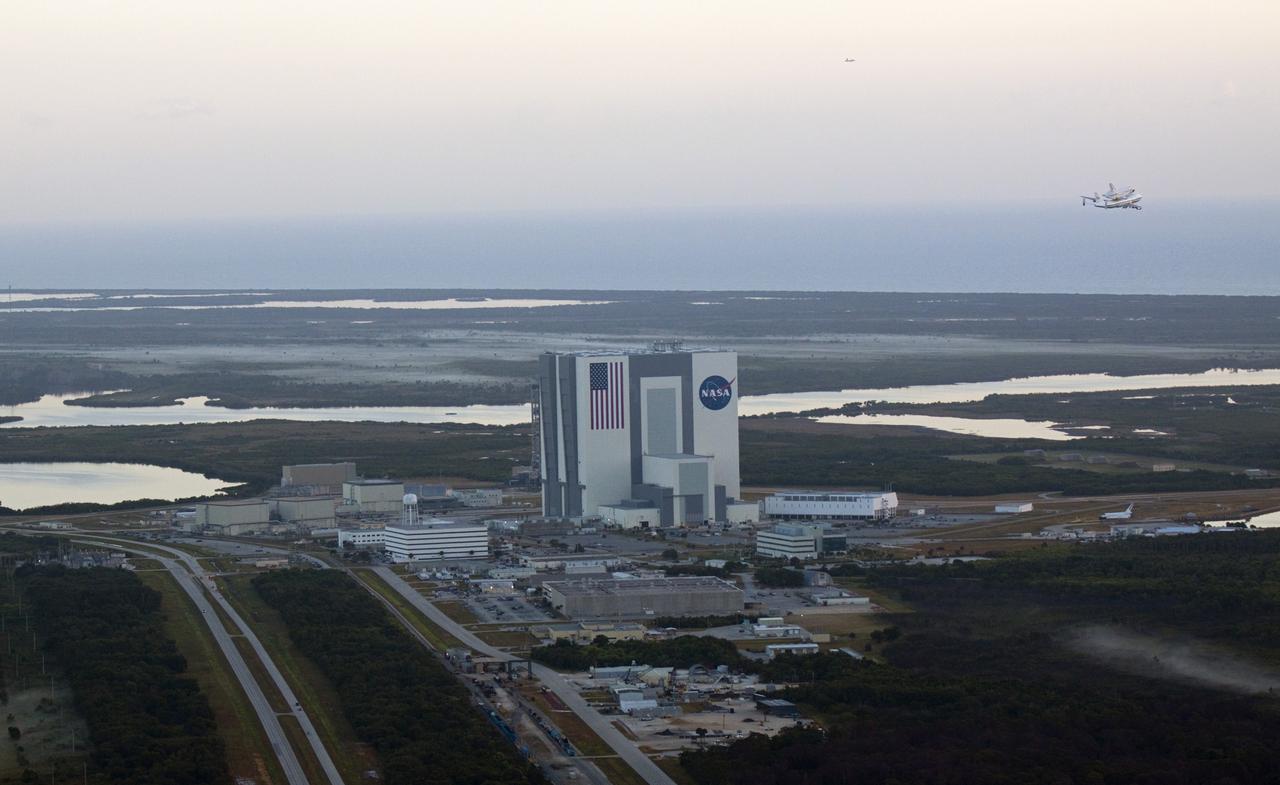
CAPE CANAVERAL, Fla. – The Shuttle Carrier Aircraft transporting space shuttle Discovery to its new home flies past the 525-foot-tall Vehicle Assembly Building at NASA’s Kennedy Space Center in Florida. The duo took off from Kennedy’s Shuttle Landing Facility at 7 a.m. EDT and are heading south to fly over Brevard County’s beach communities for residents to get a look at the shuttle before it leaves the Space Coast for the last time. The aircraft, known as an SCA, is a Boeing 747 jet, originally manufactured for commercial use, which was modified by NASA to transport the shuttles between destinations on Earth. This SCA, designated NASA 905, is assigned to the remaining ferry missions, delivering the shuttles to their permanent public display sites. NASA 905 is scheduled to ferry Discovery to the Washington Dulles International Airport in Virginia on April 17, after which the shuttle will be placed on display in the Smithsonian's National Air and Space Museum Steven F. Udvar-Hazy Center. For more information on the SCA, visit http://www.nasa.gov/centers/dryden/news/FactSheets/FS-013-DFRC.html. For more information on shuttle transition and retirement activities, visit http://www.nasa.gov/transition. Photo credit: NASA/Glenn Benson
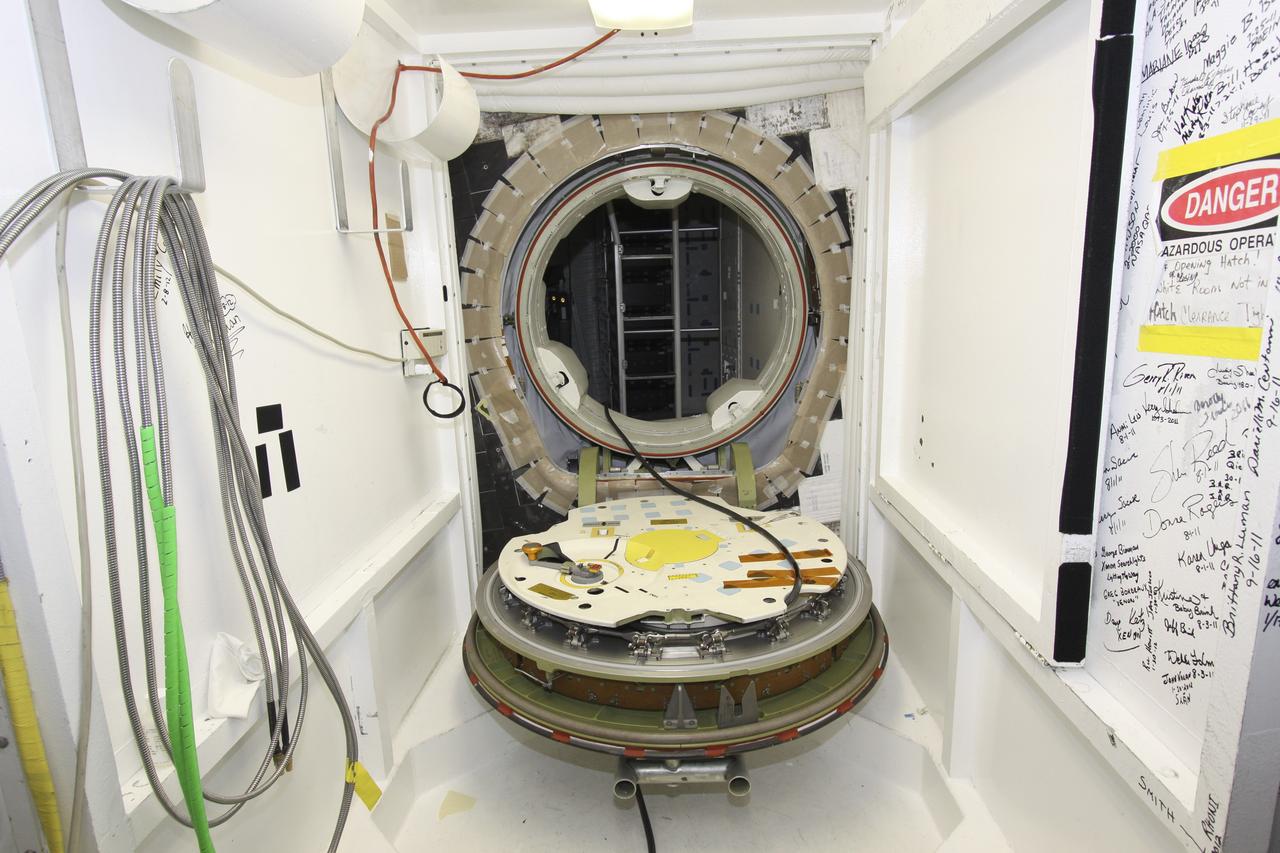
CAPE CANAVERAL, Fla. -- Inside Orbiter Processing Facility-1 at NASA’s Kennedy Space Center in Florida, space shuttle Discovery’s access hatch is being prepared for final close out. The work is part of the Space Shuttle Program’s transition and retirement processing of shuttle Discovery, which is being prepared for display at Smithsonian’s National Air and Space Museum, Steven F. Udvar-Hazy Center in Chantilly, Va. Discovery is scheduled to be transported atop a NASA Shuttle Carrier Aircraft modified 747 jet to Dulles International Airport in Virginia on April 17 and then be transported to the Smithsonian on April 19. For more information, visit http://www.nasa.gov/shuttle. Photo credit: NASA/Jim Grossmann
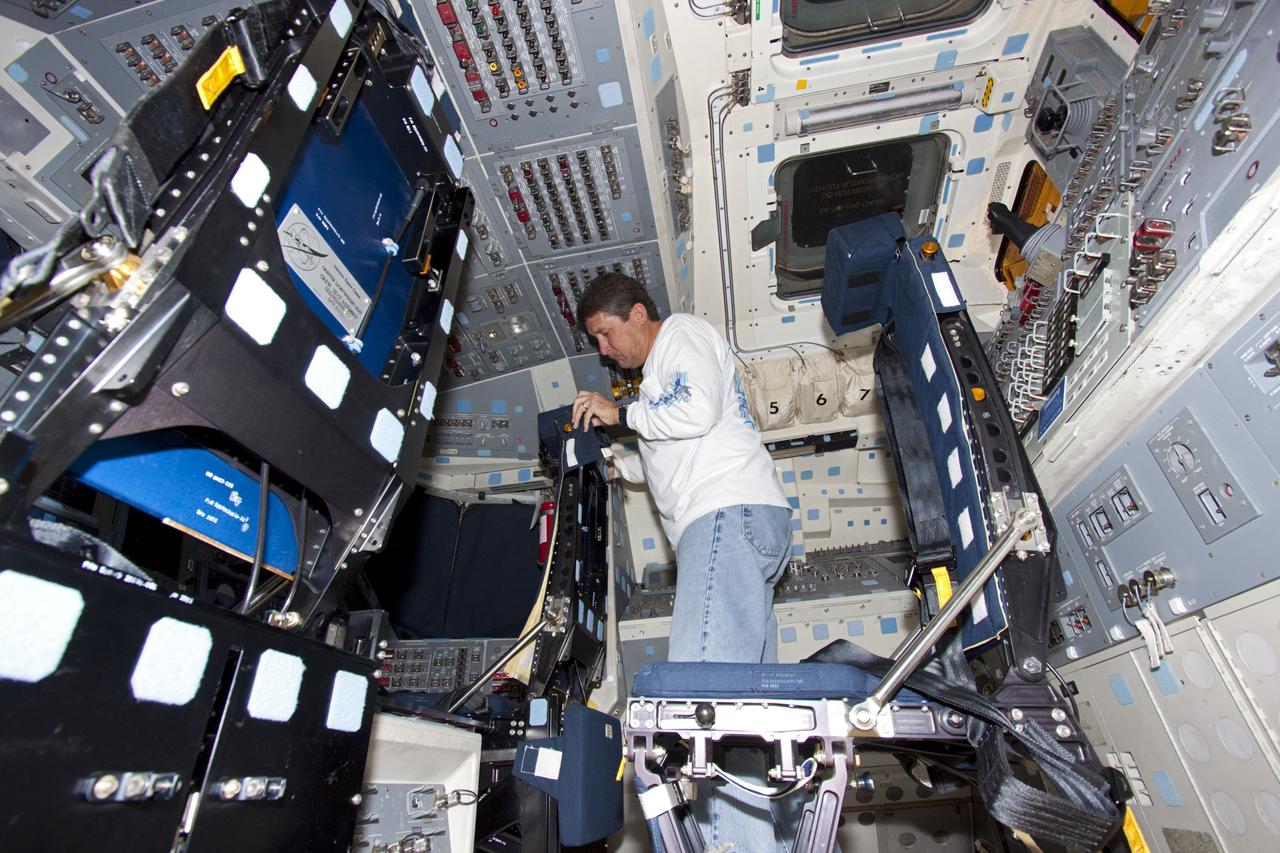
CAPE CANAVERAL, Fla. -- Inside Orbiter Processing Facility-1 at NASA’s Kennedy Space Center in Florida, a technician reinstalls one of the seats in the middeck of space shuttle Discovery. The work is part of the Space Shuttle Program’s transition and retirement processing of shuttle Discovery, which is being prepared for display at Smithsonian’s National Air and Space Museum, Steven F. Udvar-Hazy Center in Chantilly, Va. Discovery is scheduled to be transported atop a NASA Shuttle Carrier Aircraft modified 747 jet to Dulles International Airport in Virginia on April 17 and then be transported to the Smithsonian on April 19. For more information, visit http://www.nasa.gov/shuttle. Photo credit: NASA/Jim Grossmann
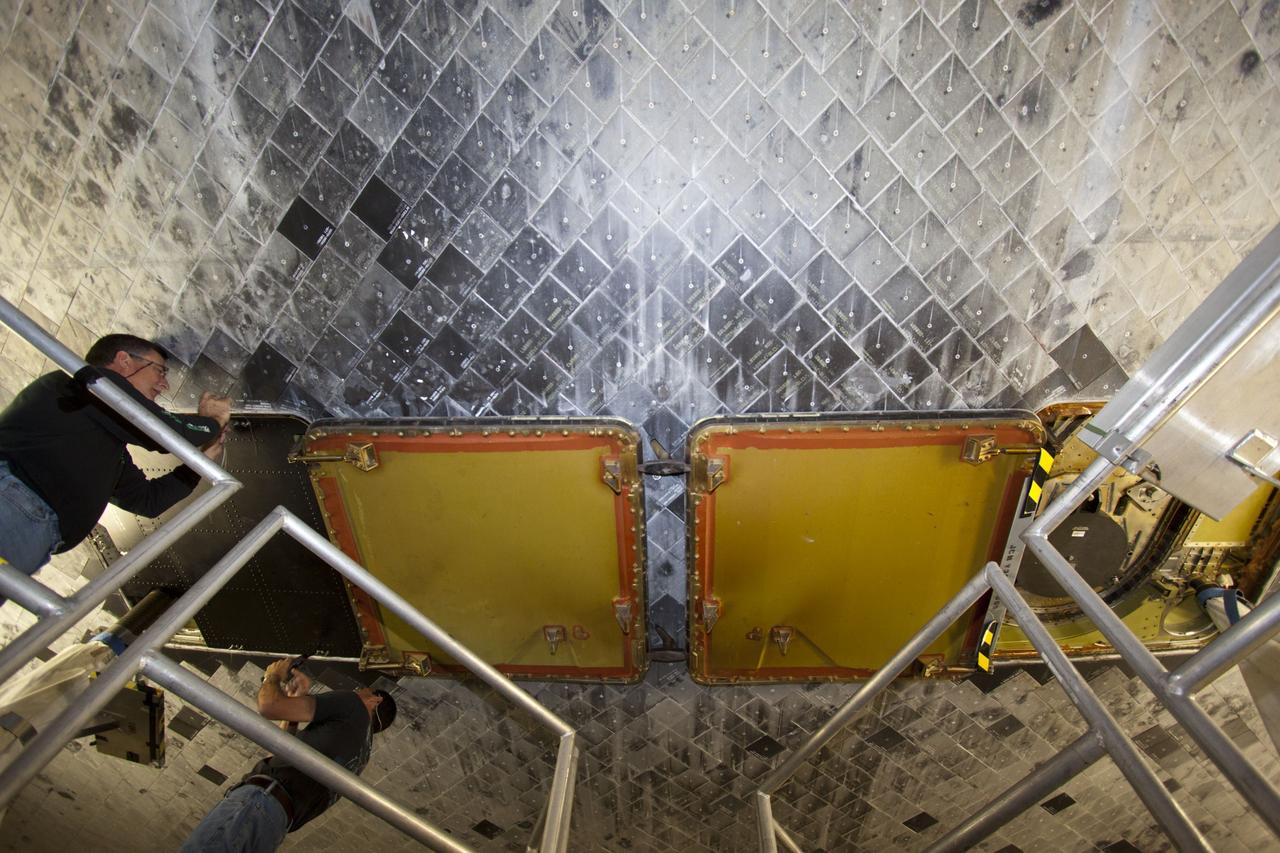
CAPE CANAVERAL, Fla. – Inside Orbiter Processing Facility-1 at NASA’s Kennedy Space Center in Florida, technicians install the ferry flight doors on space shuttle Discovery. The work is part of the Space Shuttle Program’s transition and retirement processing of shuttle Discovery, which is being prepared for display at Smithsonian’s National Air and Space Museum, Steven F. Udvar-Hazy Center in Chantilly, Va. Discovery is scheduled to be transported atop a NASA Shuttle Carrier Aircraft modified 747 jet to Dulles International Airport in Virginia on April 17 and then moved to the Smithsonian for permanent public display on April 19. For more information, visit http://www.nasa.gov/shuttle. Photo credit: NASA/Jim Grossmann